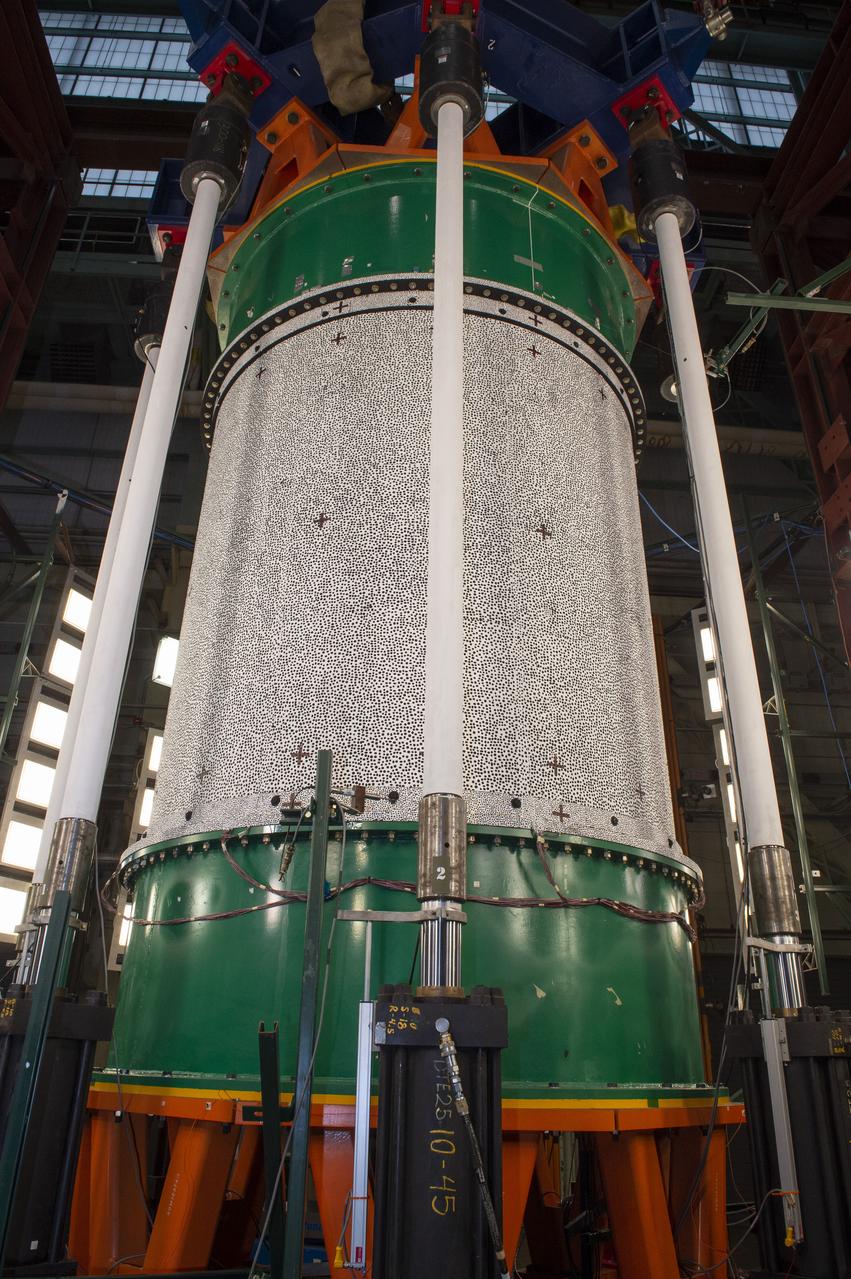
SHELL BUCKLING KNOCKDOWN FACTOR (SBKF) PROJECT - COMPOSITE TEST ARTICLE, (CTA) 8.3 – 12/17/19 – VIEW 1 OF 12
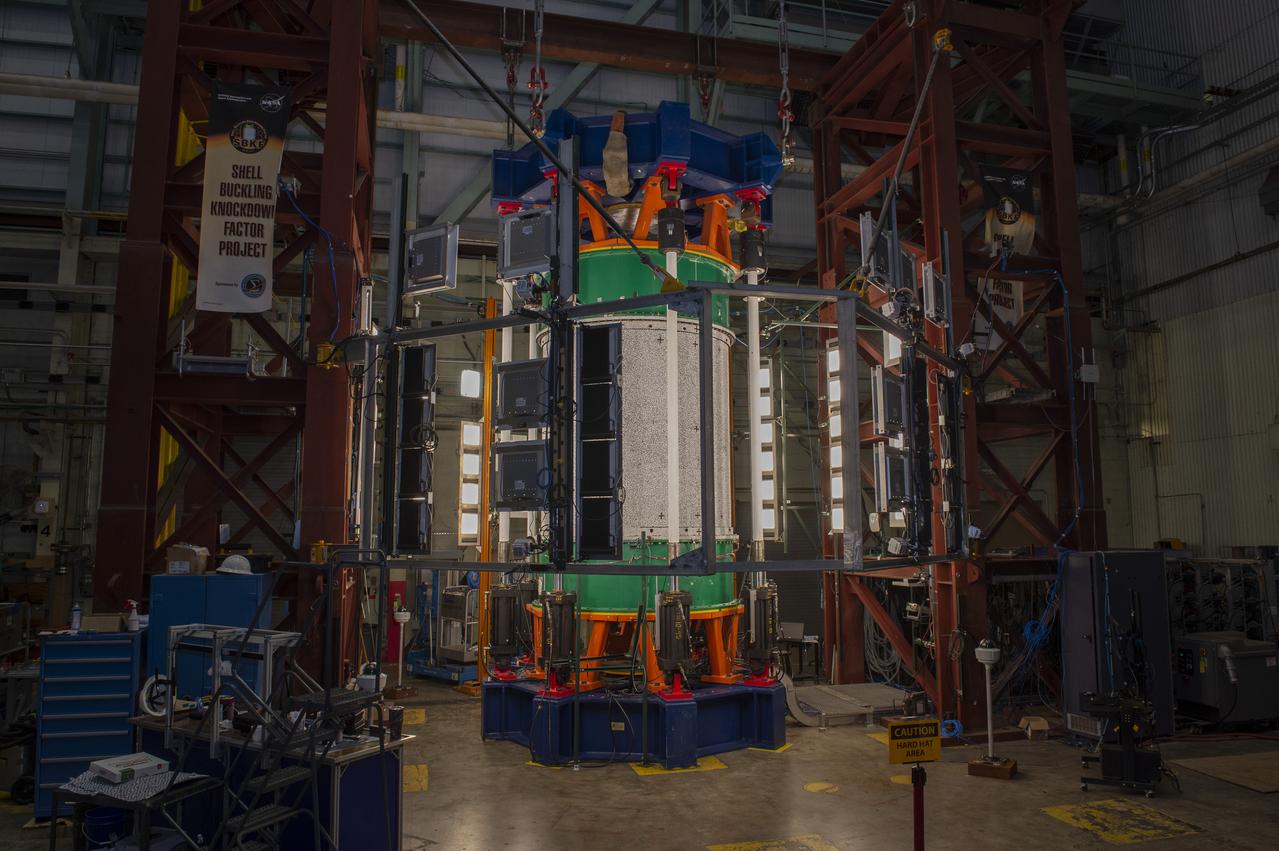
SHELL BUCKLING KNOCKDOWN FACTOR (SBKF) PROJECT - COMPOSITE TEST ARTICLE, (CTA) 8.3 – 12/17/19 – VIEW 1 OF 12
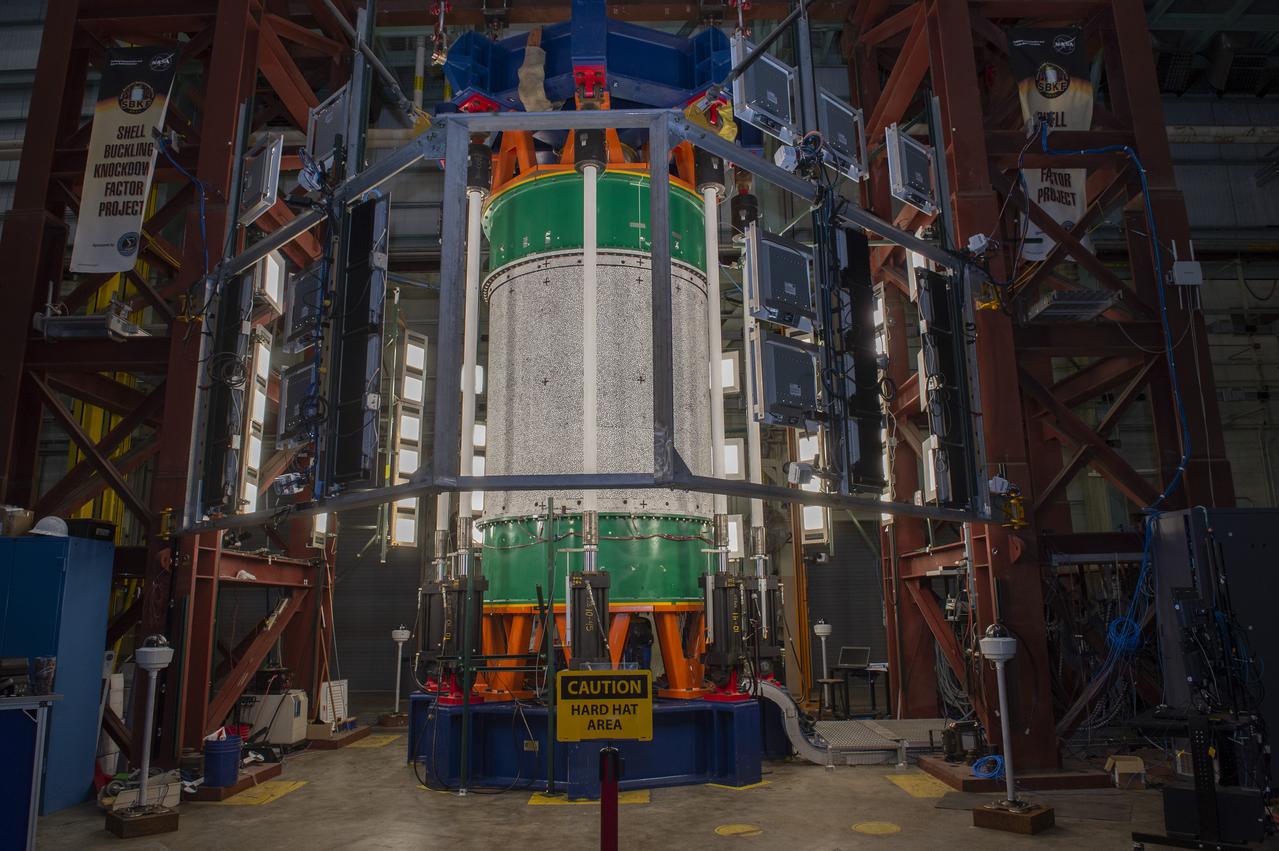
SHELL BUCKLING KNOCKDOWN FACTOR (SBKF) PROJECT - COMPOSITE TEST ARTICLE, (CTA) 8.3 – 12/17/19 – VIEW 1 OF 12
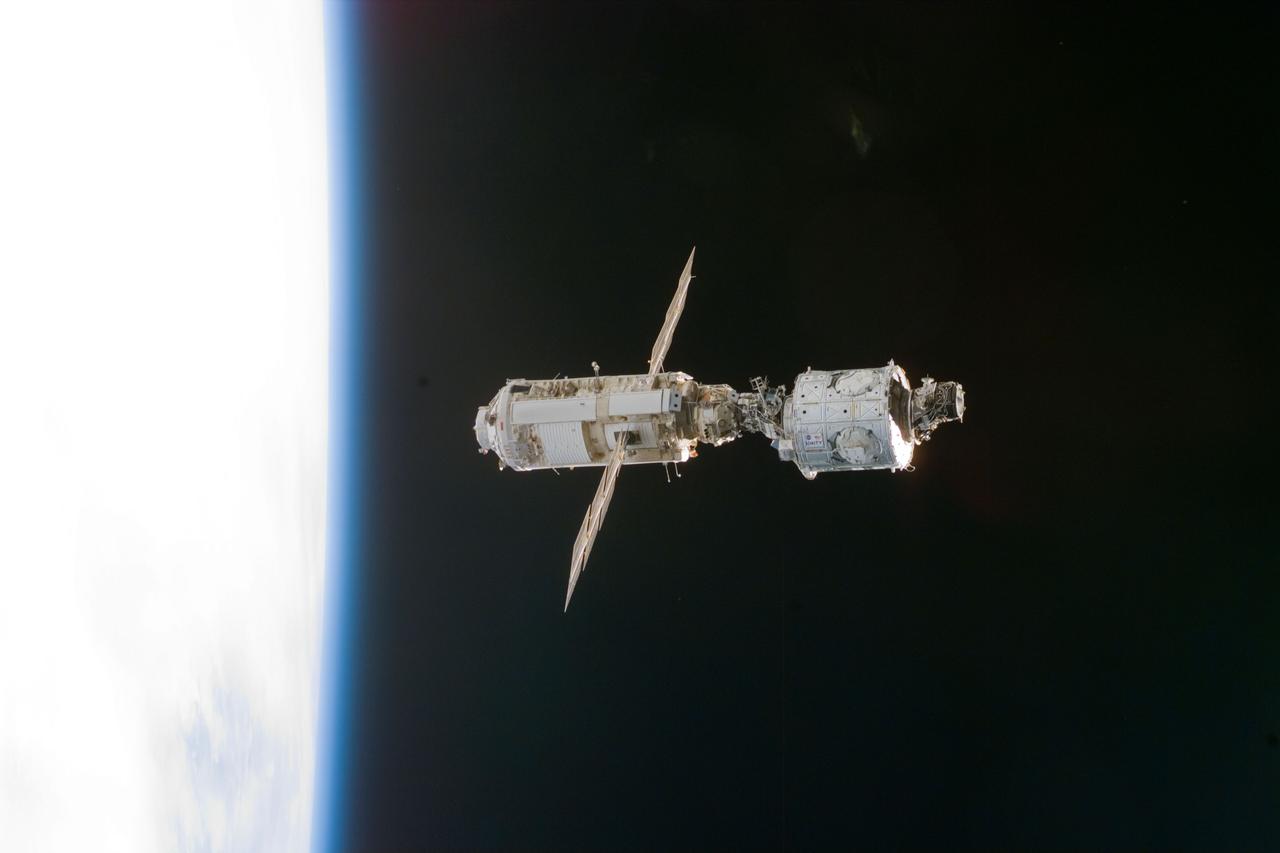
S88-E-5156 (12-13-98) --- The mated Russian-built Zarya (left) and U.S.-built Unity modules are backdropped against the blackness of space over Earth's horizon shortly after leaving Endeavour's cargo bay. The photo was taken with an electronic still camera at 21:19:17 GMT, Dec. 13.
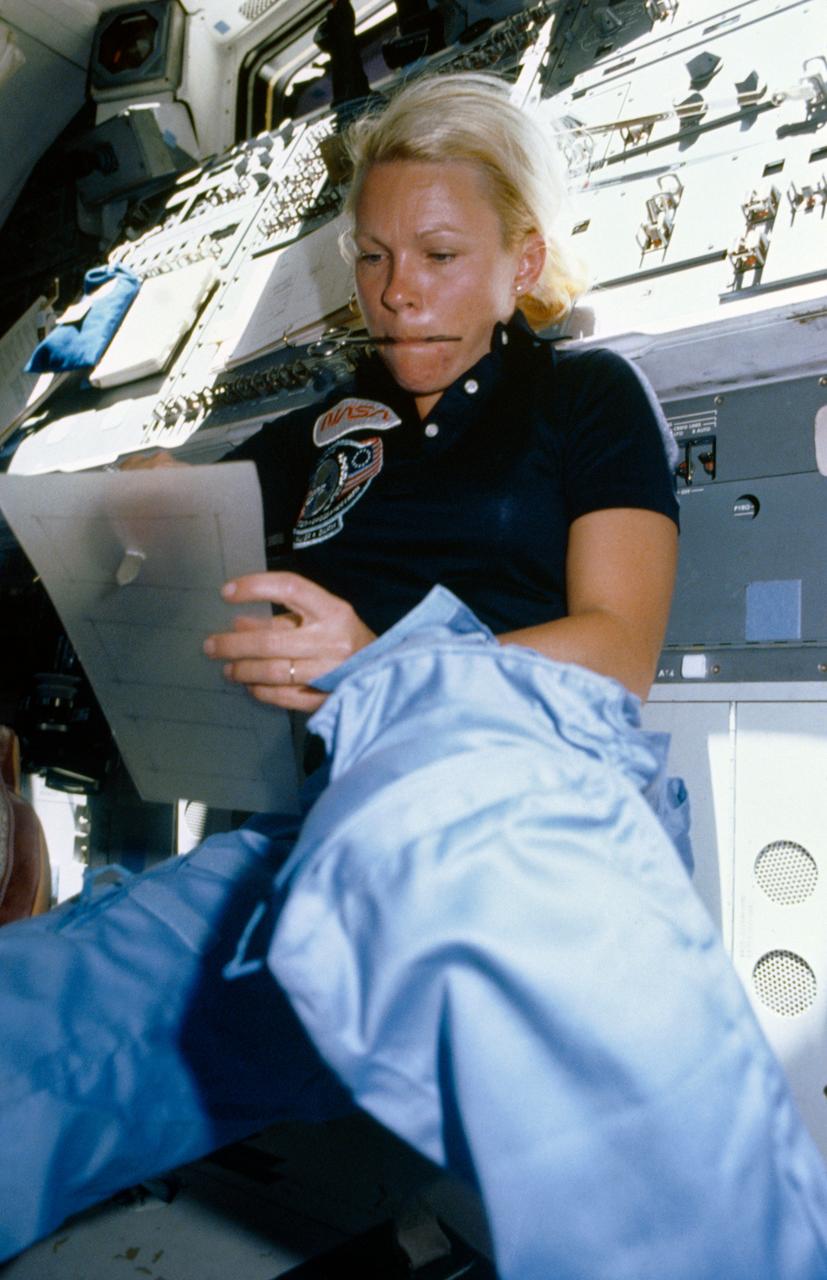
51D-07-003 (12-19 April 1985) --- Astronaut Rhea Seddon begins early work on a fly swatter-like snagging device to be used as an extension to the Remote Manipulator System (RMS) arm on Discovery for an April 17, 1985 attempt to trip a lever on the troubled Syncom-IV satellite.
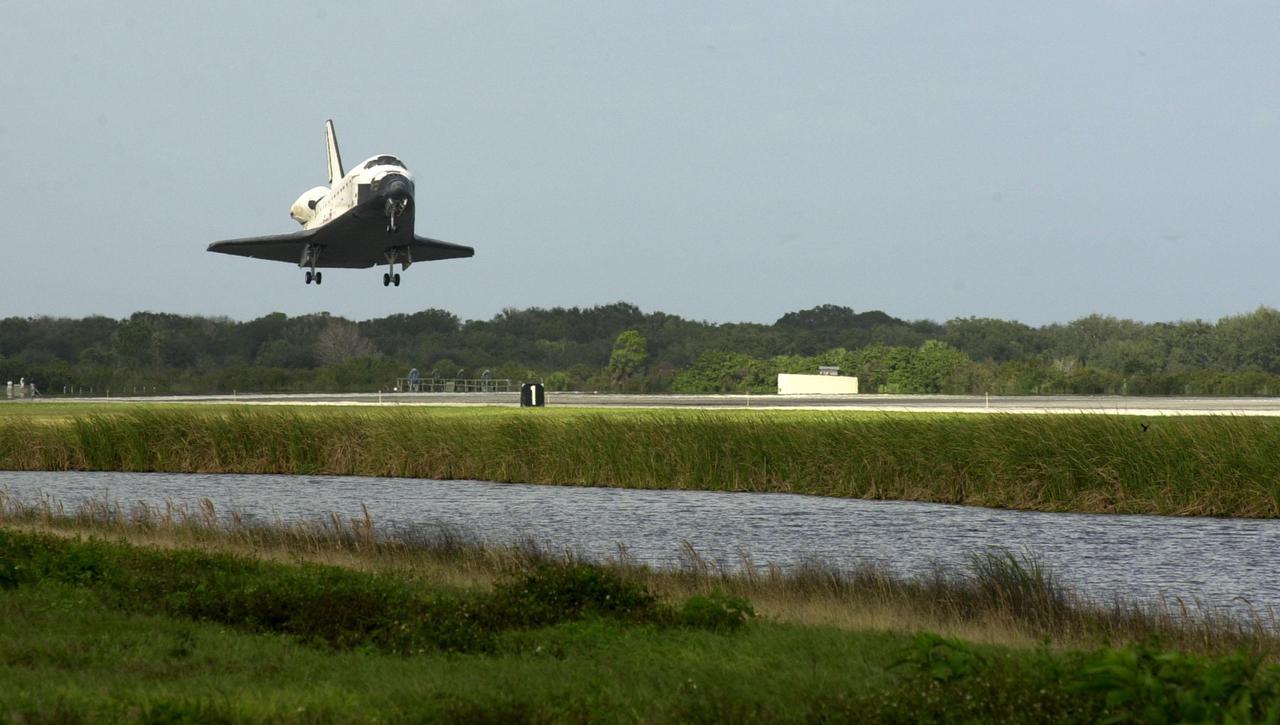
KENNEDY SPACE CENTER, FLA. -- Orbiter Endeavour glides toward touchdown on Runway 15 at the KSC Shuttle Landing Facility, completing mission STS-108. After a mission-elapsed time of 11 days, 19 hours and 35 minutes, the landing is the 57th at KSC in the history of the program. Main gear touchdown occurred at 12:55:10 p.m. EST (17:55:10 GMT), nose gear touchdown at 12:55:23 p.m. (17:55:23 GMT) , wheel stop at 12:56:13 p.m. (17:56:13 GMT). STS-108 was the 12th mission to the International Space Station. This mission was the 107th flight in the Shuttle program and the 17th flight for the orbiter. Endeavour carries both the mission crew and the Expedition 3 crew - Commander Frank Culbertson and cosmonauts Vladimir Dezhurov and Mikhail Tyurin - who are returning to Earth after 129 days in space on the Space Station
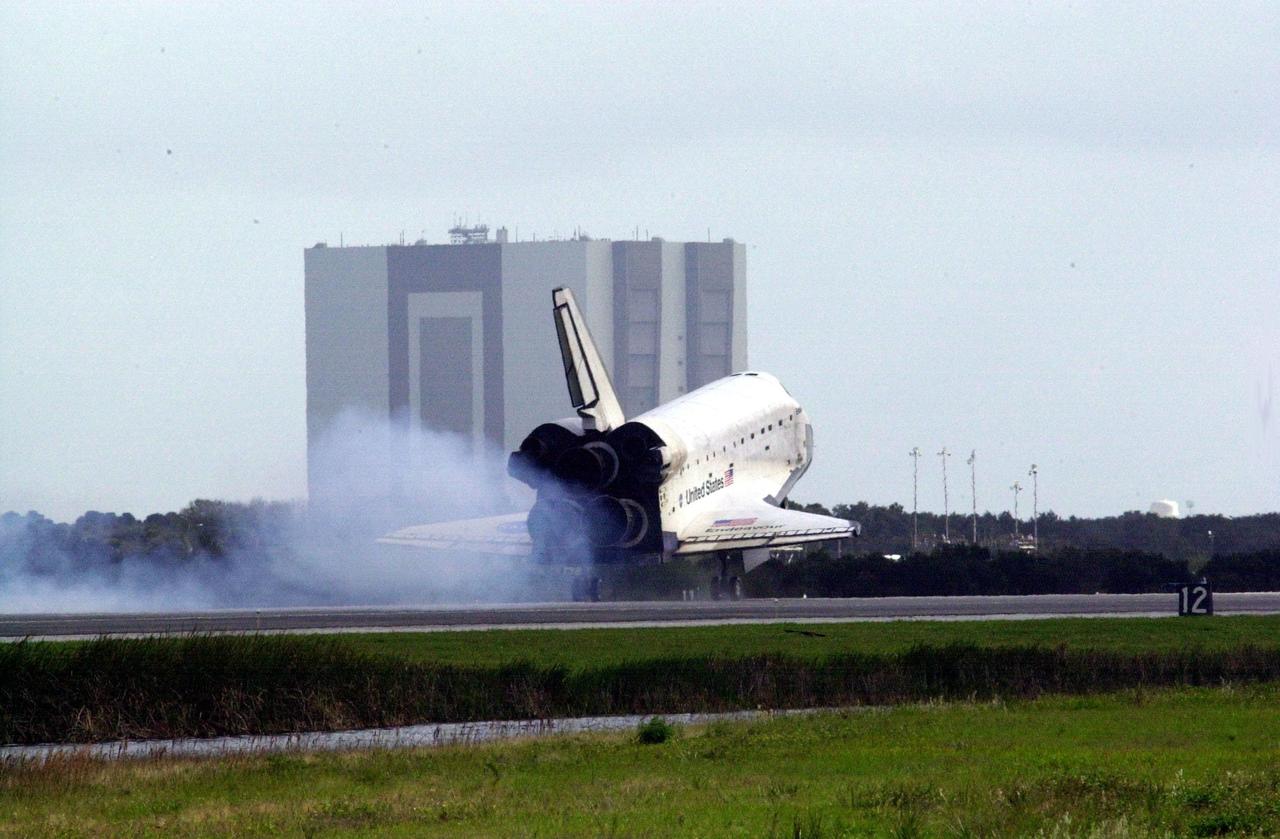
KENNEDY SPACE CENTER, FLA. - Dust streams behind orbiter Endeavour as it touches down on Runway 15 at the Shuttle Landing Facility, completing mission STS-108 after a mission-elapsed time of 11 days, 19 hours and 35 minutes. The landing is the 57th at KSC in the history of the program. Main gear touchdown occurred at 12:55:10 p.m. EST (17:55:10 GMT), nose gear touchdown at 12:55:23 p.m. (17:55:23 GMT) , wheel stop at 12:56:13 p.m. (17:56:13 GMT). STS-108 was the 12th mission to the International Space Station. This mission was the 107th flight in the Shuttle program and the 17th flight for the orbiter. Endeavour carries both the mission crew and the Expedition 3 crew - Commander Frank Culbertson and cosmonauts Vladimir Dezhurov and Mikhail Tyurin - who are returning to Earth after 129 days in space on the Space Station
KENNEDY SPACE CENTER, FLA. - Dust streams behind orbiter Endeavour as it touches down on Runway 15 at the Shuttle Landing Facility, completing mission STS-108 after a mission-elapsed time of 11 days, 19 hours and 35 minutes. The landing is the 57th at KSC in the history of the program. Main gear touchdown occurred at 12:55:10 p.m. EST (17:55:10 GMT), nose gear touchdown at 12:55:23 p.m. (17:55:23 GMT) , wheel stop at 12:56:13 p.m. (17:56:13 GMT). STS-108 was the 12th mission to the International Space Station. This mission was the 107th flight in the Shuttle program and the 17th flight for the orbiter. Endeavour carries both the mission crew and the Expedition 3 crew - Commander Frank Culbertson and cosmonauts Vladimir Dezhurov and Mikhail Tyurin - who are returning to Earth after 129 days in space on the Space Station
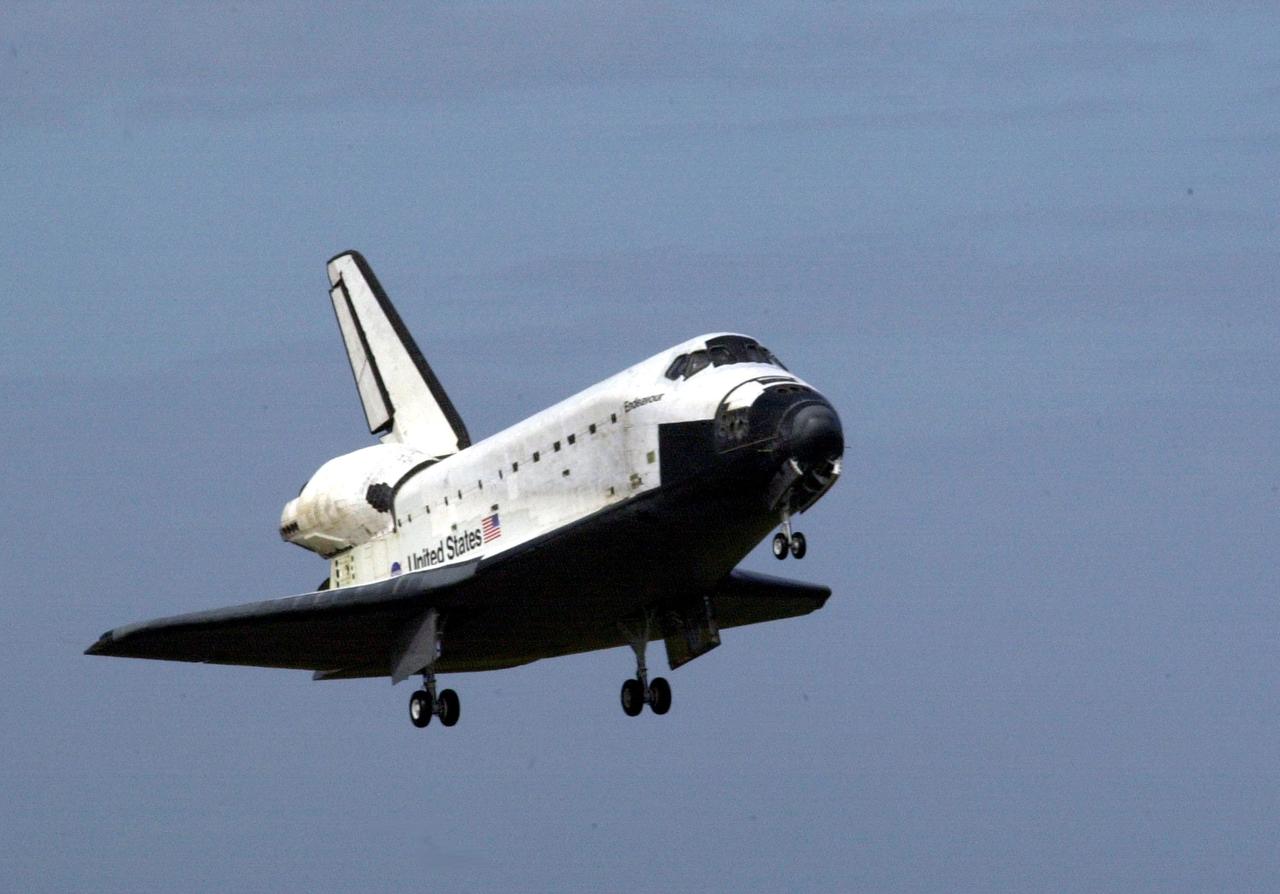
KENNEDY SPACE CENTER, FLA. -- Orbiter Endeavour glides smoothly through the air towards touchdown on Runway 15 at the KSC Shuttle Landing Facility, completing mission STS-108. After a mission-elapsed time of 11 days, 19 hours and 35 minutes, the landing is the 57th at KSC in the history of the program. Main gear touchdown occurred at 12:55:10 p.m. EST (17:55:10 GMT), nose gear touchdown at 12:55:23 p.m. (17:55:23 GMT) , wheel stop at 12:56:13 p.m. (17:56:13 GMT). STS-108 was the 12th mission to the International Space Station. This mission was the 107th flight in the Shuttle program and the 17th flight for the orbiter. Endeavour carries both the mission crew and the Expedition 3 crew - Commander Frank Culbertson and cosmonauts Vladimir Dezhurov and Mikhail Tyurin - who are returning to Earth after 129 days in space on the Space Station
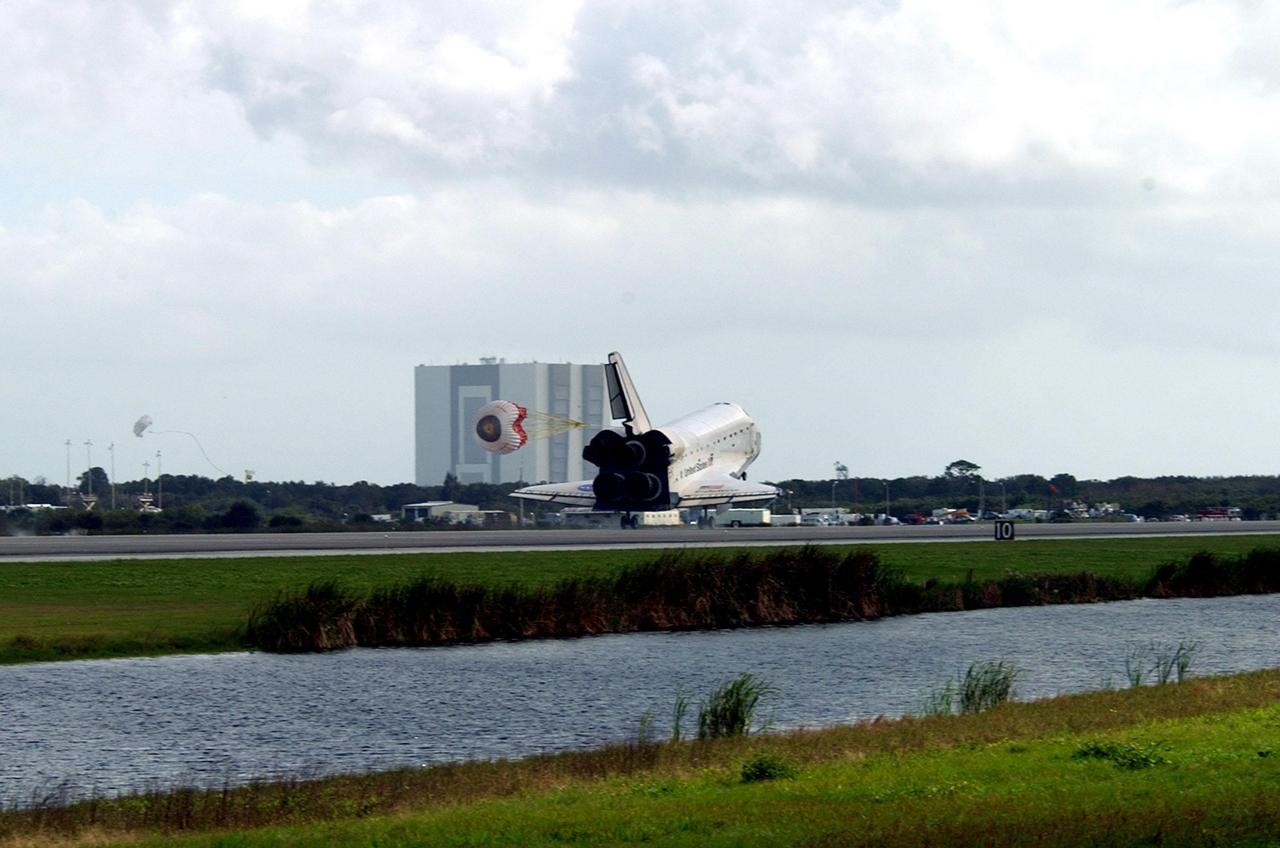
KENNEDY SPACE CENTER, FLA. -- Endeavour's drag chute is deployed as the orbiter touches down on Runway 15 at the KSC Shuttle Landing Facility, completing mission STS-108. After a mission-elapsed time of 11 days, 19 hours and 35 minutes, the landing is the 57th at KSC in the history of the program. Main gear touchdown occurred at 12:55:10 p.m. EST (17:55:10 GMT), nose gear touchdown at 12:55:23 p.m. (17:55:23 GMT) , wheel stop at 12:56:13 p.m. (17:56:13 GMT). STS-108 was the 12th mission to the International Space Station. This mission was the 107th flight in the Shuttle program and the 17th flight for the orbiter. Endeavour carries both the mission crew and the Expedition 3 crew - Commander Frank Culbertson and cosmonauts Vladimir Dezhurov and Mikhail Tyurin - who are returning to Earth after 129 days in space on the Space Station
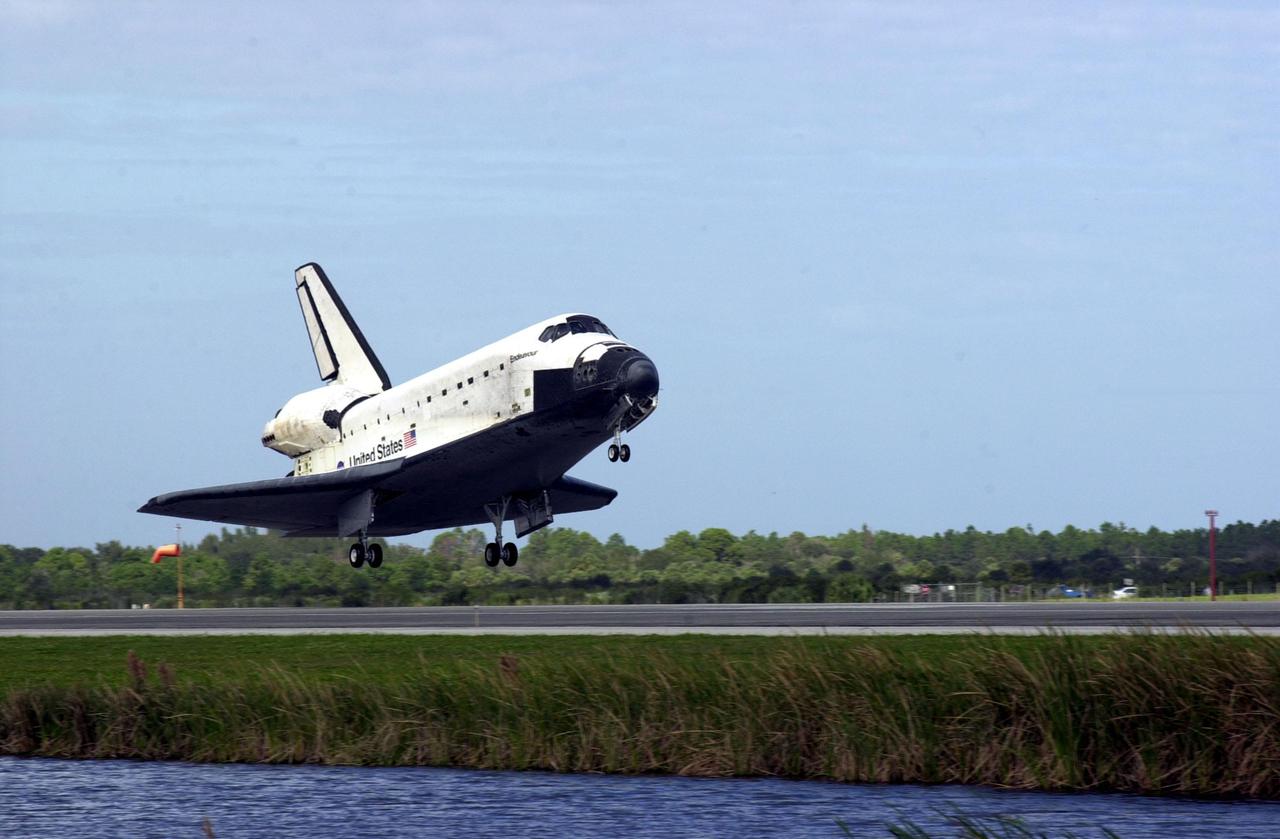
KENNEDY SPACE CENTER, FLA. -- Orbiter Endeavour drops through scattered clouds to land on Runway 15 at the KSC Shuttle Landing Facility, completing mission STS-108. After a mission-elapsed time of 11 days, 19 hours and 35 minutes, the landing is the 57th at KSC in the history of the program. Main gear touchdown occurred at 12:55:10 p.m. EST (17:55:10 GMT), nose gear touchdown at 12:55:23 p.m. (17:55:23 GMT) , wheel stop at 12:56:13 p.m. (17:56:13 GMT). STS-108 was the 12th mission to the International Space Station. This mission was the 107th flight in the Shuttle program and the 17th flight for the orbiter. Endeavour carries both the mission crew and the Expedition 3 crew - Commander Frank Culbertson and cosmonauts Vladimir Dezhurov and Mikhail Tyurin - who are returning to Earth after 129 days in space on the Space Station
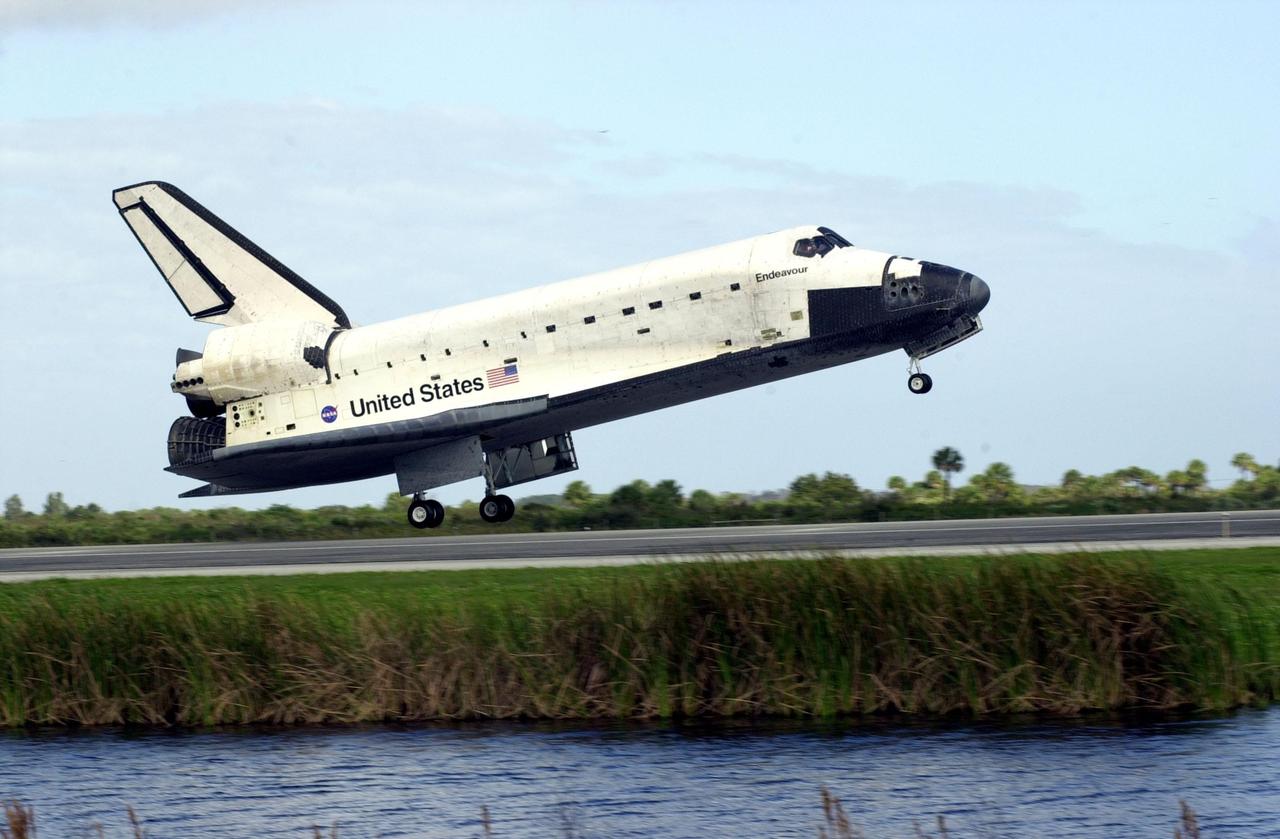
KENNEDY SPACE CENTER, FLA. -- Orbiter Endeavour approaches touchdown on Runway 15 at the KSC Shuttle Landing Facility, completing mission STS-108. After a mission-elapsed time of 11 days, 19 hours and 35 minutes, the landing is the 57th at KSC in the history of the program. Main gear touchdown occurred at 12:55:10 p.m. EST (17:55:10 GMT), nose gear touchdown at 12:55:23 p.m. (17:55:23 GMT) , wheel stop at 12:56:13 p.m. (17:56:13 GMT). STS-108 was the 12th mission to the International Space Station. This mission was the 107th flight in the Shuttle program and the 17th flight for the orbiter. Endeavour carries both the mission crew and the Expedition 3 crew - Commander Frank Culbertson and cosmonauts Vladimir Dezhurov and Mikhail Tyurin - who are returning to Earth after 129 days in space on the Space Station
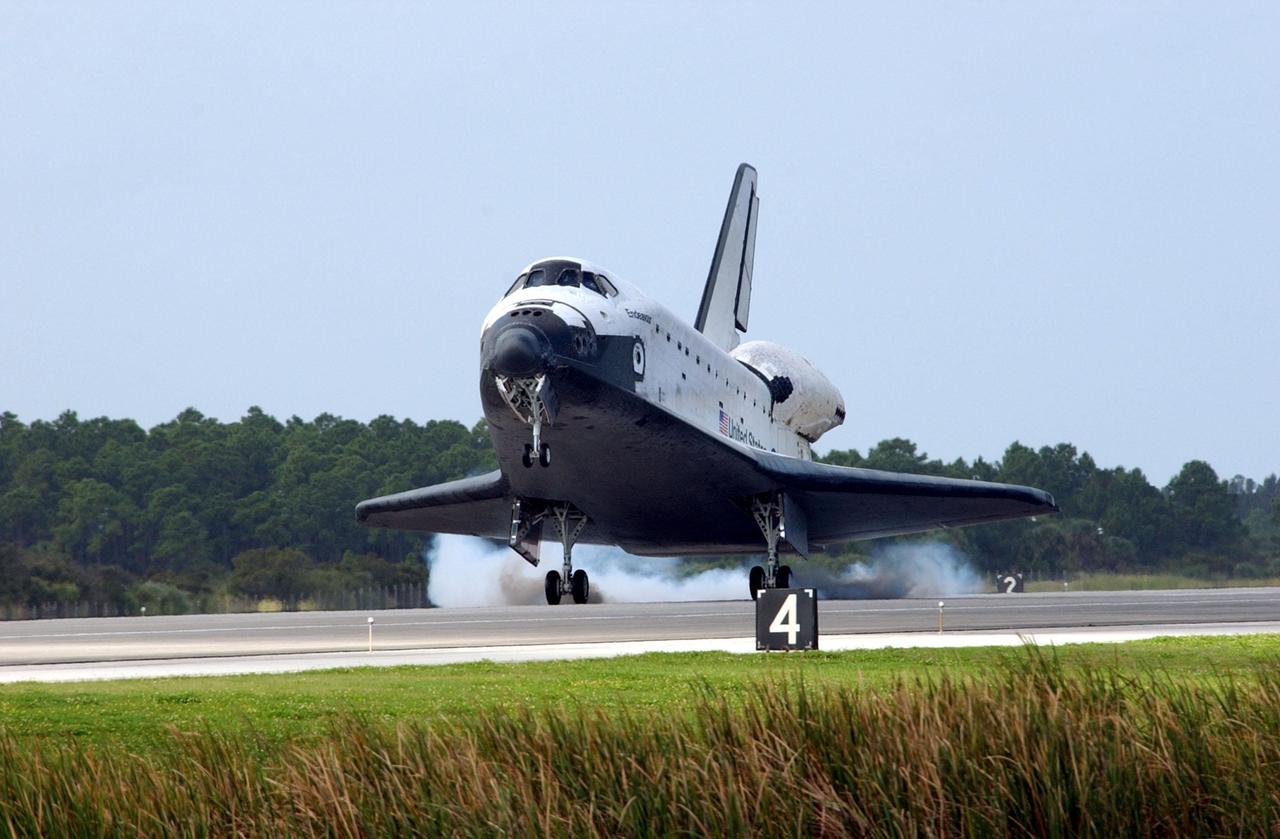
KENNEDY SPACE CENTER, FLA. - Orbiter Endeavour kicks up dust as it touches down on Runway 15 at the KSC Shuttle Landing Facility, completing mission STS-108. After a mission-elapsed time of 11 days, 19 hours and 35 minutes, the landing is the 57th at KSC in the history of the program. Main gear touchdown occurred at 12:55:10 p.m. EST (17:55:10 GMT), nose gear touchdown at 12:55:23 p.m. (17:55:23 GMT) , wheel stop at 12:56:13 p.m. (17:56:13 GMT). STS-108 was the 12th mission to the International Space Station. This mission was the 107th flight in the Shuttle program and the 17th flight for the orbiter. Endeavour carries both the mission crew and the Expedition 3 crew - Commander Frank Culbertson and cosmonauts Vladimir Dezhurov and Mikhail Tyurin - who are returning to Earth after 129 days in space on the Space Station
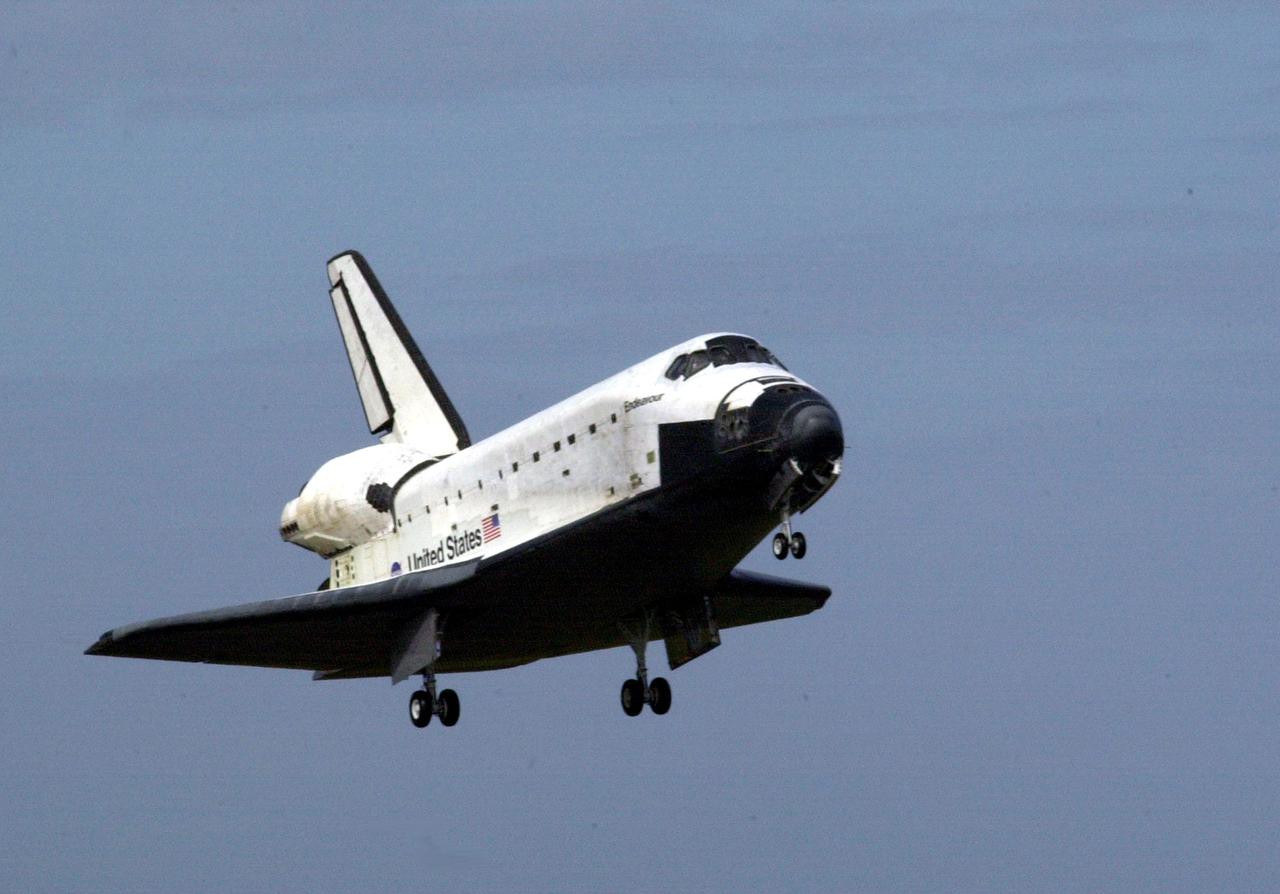
KENNEDY SPACE CENTER, FLA. -- Orbiter Endeavour glides smoothly through the air towards touchdown on Runway 15 at the KSC Shuttle Landing Facility, completing mission STS-108. After a mission-elapsed time of 11 days, 19 hours and 35 minutes, the landing is the 57th at KSC in the history of the program. Main gear touchdown occurred at 12:55:10 p.m. EST (17:55:10 GMT), nose gear touchdown at 12:55:23 p.m. (17:55:23 GMT) , wheel stop at 12:56:13 p.m. (17:56:13 GMT). STS-108 was the 12th mission to the International Space Station. This mission was the 107th flight in the Shuttle program and the 17th flight for the orbiter. Endeavour carries both the mission crew and the Expedition 3 crew - Commander Frank Culbertson and cosmonauts Vladimir Dezhurov and Mikhail Tyurin - who are returning to Earth after 129 days in space on the Space Station
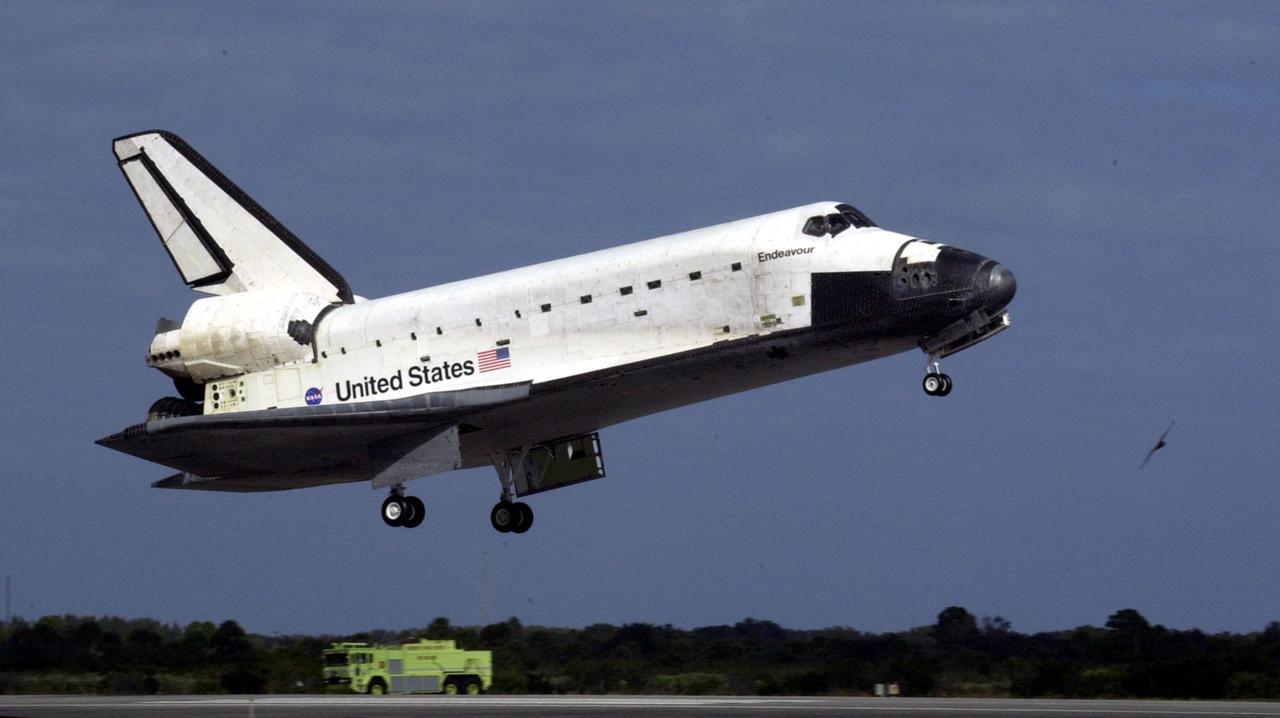
KENNEDY SPACE CENTER, FLA. -- A safety vehicle waits near Runway 15 at the Shuttle Landing Facility as orbiter Endeavour approaches for a landing, completing mission STS-108 after a mission-elapsed time of 11 days, 19 hours and 35 minutes. The landing is the 57th at KSC in the history of the program. Main gear touchdown occurred at 12:55:10 p.m. EST (17:55:10 GMT), nose gear touchdown at 12:55:23 p.m. (17:55:23 GMT) , wheel stop at 12:56:13 p.m. (17:56:13 GMT). STS-108 was the 12th mission to the International Space Station. This mission was the 107th flight in the Shuttle program and the 17th flight for the orbiter. Endeavour carries both the mission crew and the Expedition 3 crew - Commander Frank Culbertson and cosmonauts Vladimir Dezhurov and Mikhail Tyurin - who are returning to Earth after 129 days in space on the Space Station
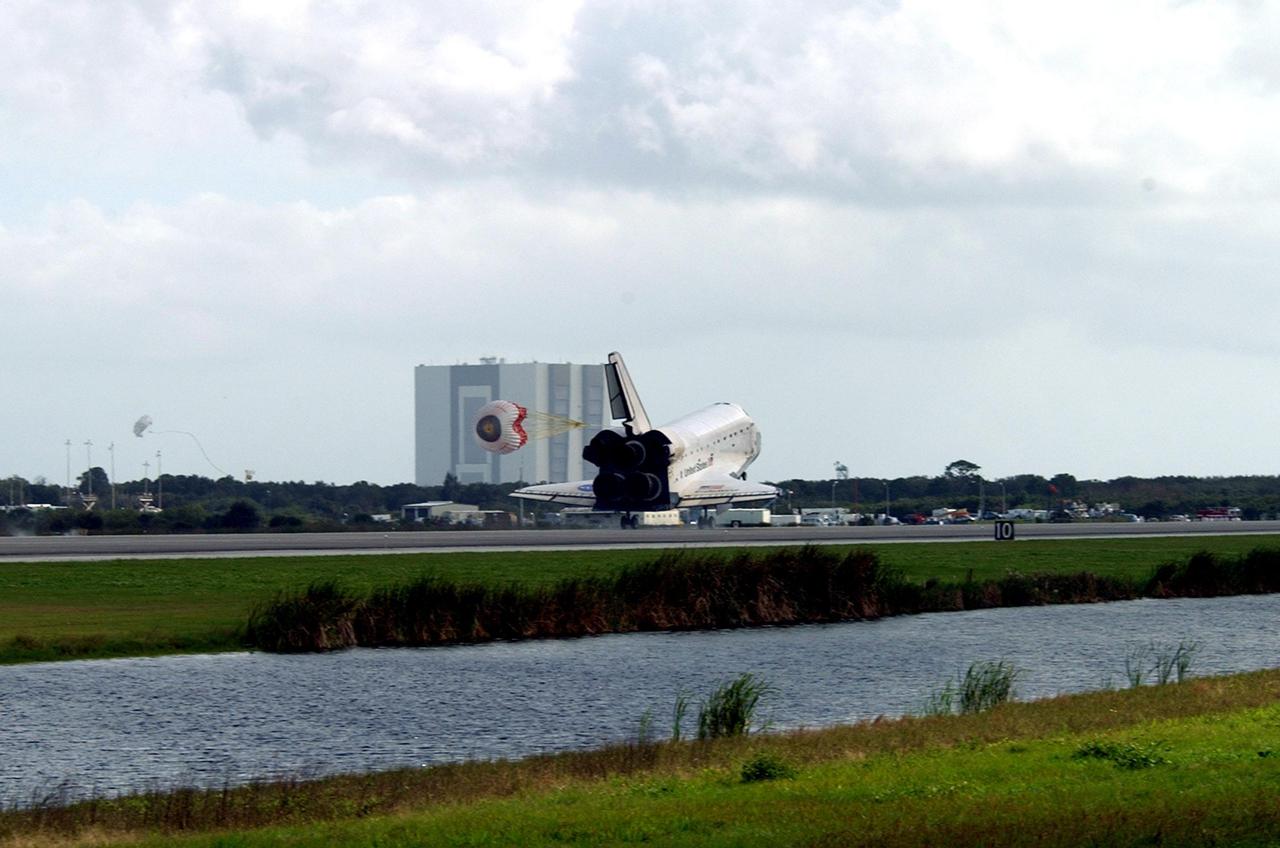
KENNEDY SPACE CENTER, FLA. -- Endeavour's drag chute is deployed as the orbiter touches down on Runway 15 at the KSC Shuttle Landing Facility, completing mission STS-108. After a mission-elapsed time of 11 days, 19 hours and 35 minutes, the landing is the 57th at KSC in the history of the program. Main gear touchdown occurred at 12:55:10 p.m. EST (17:55:10 GMT), nose gear touchdown at 12:55:23 p.m. (17:55:23 GMT) , wheel stop at 12:56:13 p.m. (17:56:13 GMT). STS-108 was the 12th mission to the International Space Station. This mission was the 107th flight in the Shuttle program and the 17th flight for the orbiter. Endeavour carries both the mission crew and the Expedition 3 crew - Commander Frank Culbertson and cosmonauts Vladimir Dezhurov and Mikhail Tyurin - who are returning to Earth after 129 days in space on the Space Station
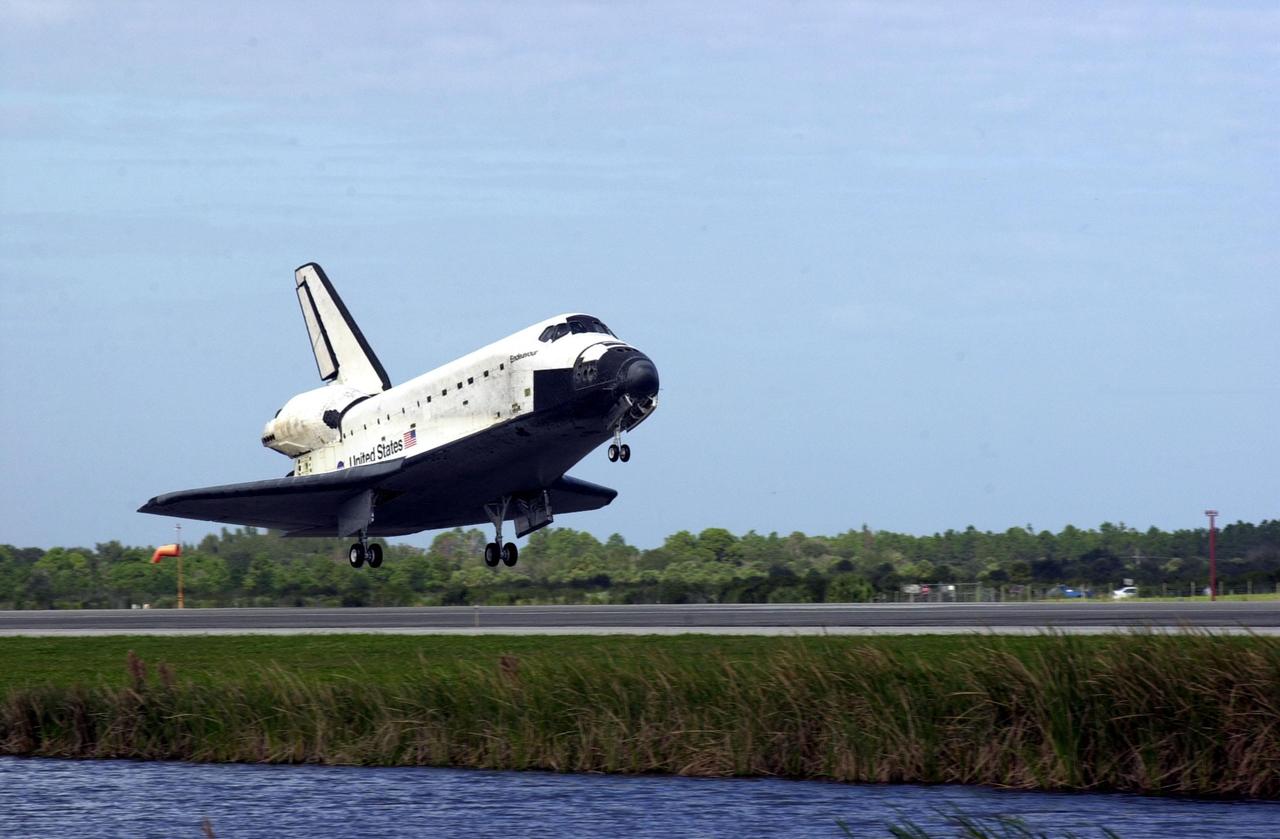
KENNEDY SPACE CENTER, FLA. -- Orbiter Endeavour drops through scattered clouds to land on Runway 15 at the KSC Shuttle Landing Facility, completing mission STS-108. After a mission-elapsed time of 11 days, 19 hours and 35 minutes, the landing is the 57th at KSC in the history of the program. Main gear touchdown occurred at 12:55:10 p.m. EST (17:55:10 GMT), nose gear touchdown at 12:55:23 p.m. (17:55:23 GMT) , wheel stop at 12:56:13 p.m. (17:56:13 GMT). STS-108 was the 12th mission to the International Space Station. This mission was the 107th flight in the Shuttle program and the 17th flight for the orbiter. Endeavour carries both the mission crew and the Expedition 3 crew - Commander Frank Culbertson and cosmonauts Vladimir Dezhurov and Mikhail Tyurin - who are returning to Earth after 129 days in space on the Space Station
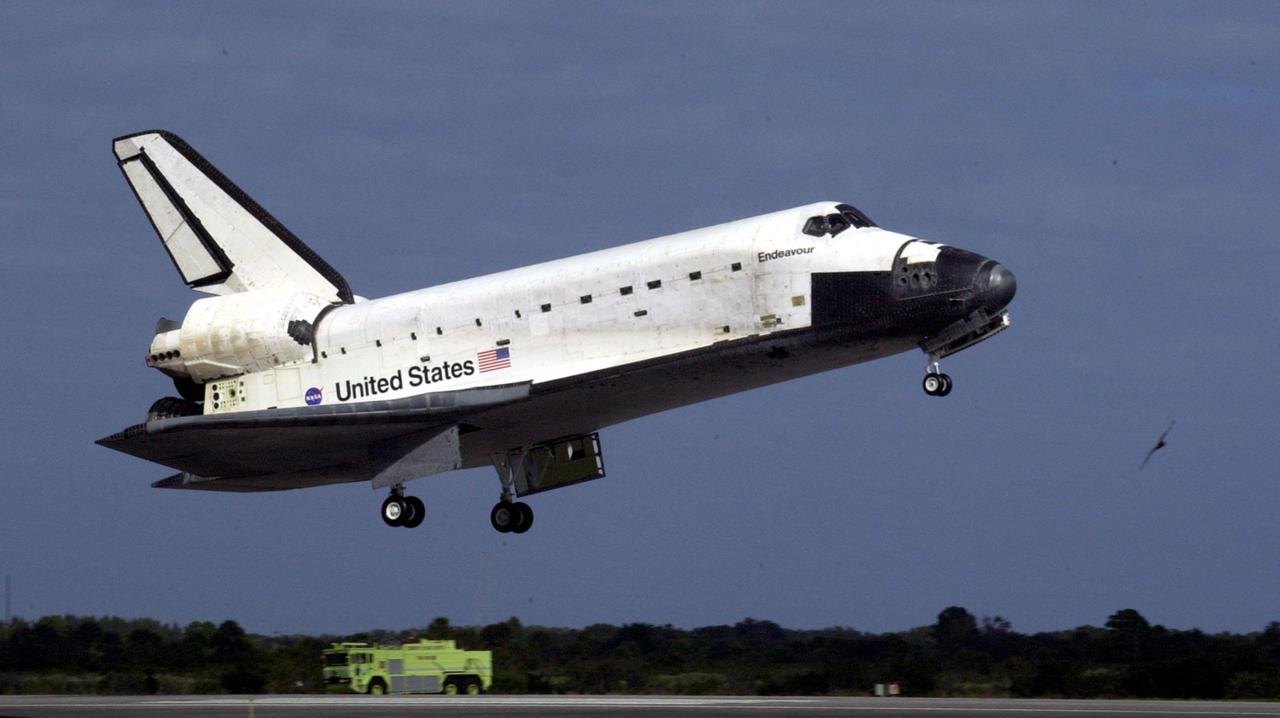
KENNEDY SPACE CENTER, FLA. -- A safety vehicle waits near Runway 15 at the Shuttle Landing Facility as orbiter Endeavour approaches for a landing, completing mission STS-108 after a mission-elapsed time of 11 days, 19 hours and 35 minutes. The landing is the 57th at KSC in the history of the program. Main gear touchdown occurred at 12:55:10 p.m. EST (17:55:10 GMT), nose gear touchdown at 12:55:23 p.m. (17:55:23 GMT) , wheel stop at 12:56:13 p.m. (17:56:13 GMT). STS-108 was the 12th mission to the International Space Station. This mission was the 107th flight in the Shuttle program and the 17th flight for the orbiter. Endeavour carries both the mission crew and the Expedition 3 crew - Commander Frank Culbertson and cosmonauts Vladimir Dezhurov and Mikhail Tyurin - who are returning to Earth after 129 days in space on the Space Station
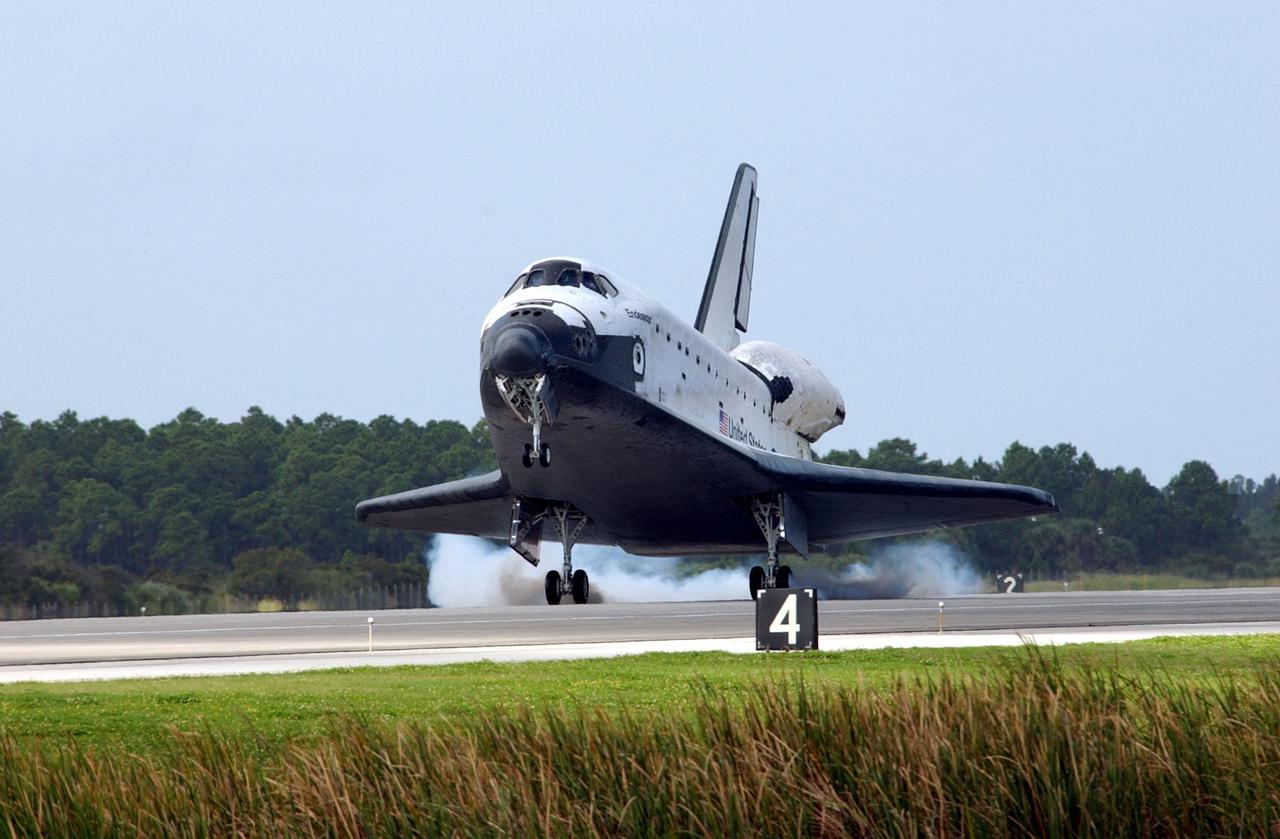
KENNEDY SPACE CENTER, FLA. - Orbiter Endeavour kicks up dust as it touches down on Runway 15 at the KSC Shuttle Landing Facility, completing mission STS-108. After a mission-elapsed time of 11 days, 19 hours and 35 minutes, the landing is the 57th at KSC in the history of the program. Main gear touchdown occurred at 12:55:10 p.m. EST (17:55:10 GMT), nose gear touchdown at 12:55:23 p.m. (17:55:23 GMT) , wheel stop at 12:56:13 p.m. (17:56:13 GMT). STS-108 was the 12th mission to the International Space Station. This mission was the 107th flight in the Shuttle program and the 17th flight for the orbiter. Endeavour carries both the mission crew and the Expedition 3 crew - Commander Frank Culbertson and cosmonauts Vladimir Dezhurov and Mikhail Tyurin - who are returning to Earth after 129 days in space on the Space Station
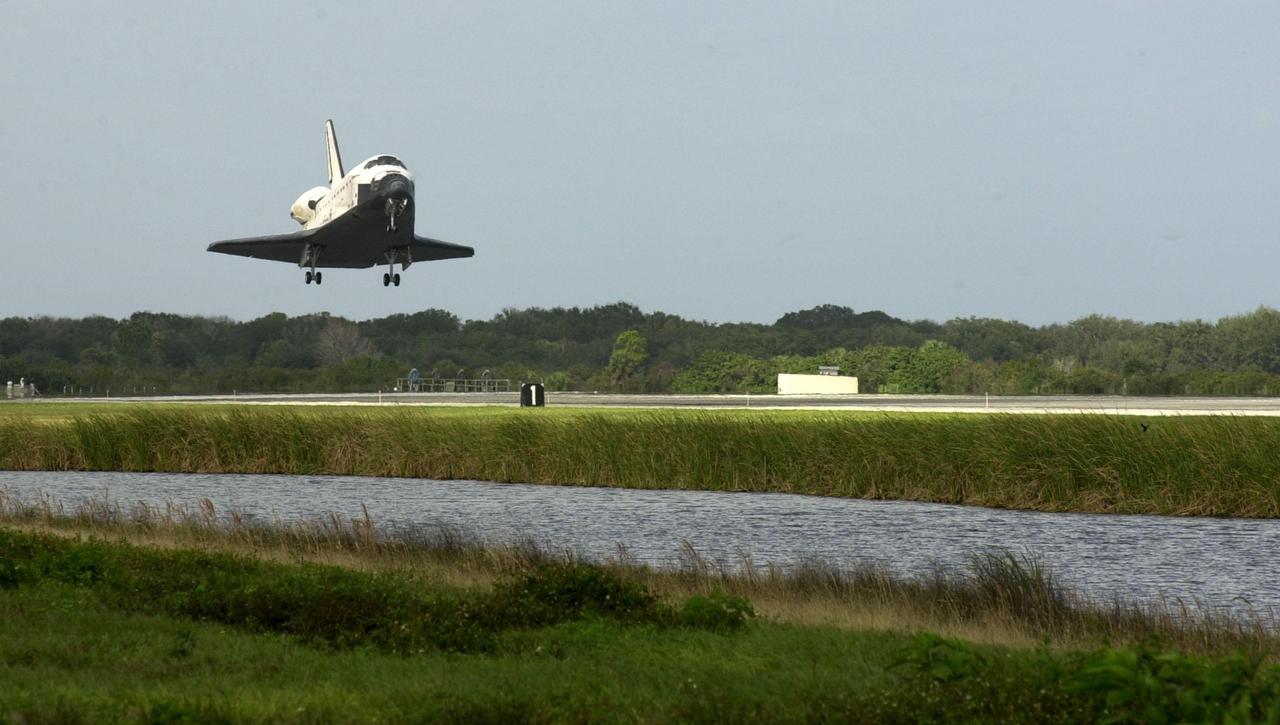
KENNEDY SPACE CENTER, FLA. -- Orbiter Endeavour glides toward touchdown on Runway 15 at the KSC Shuttle Landing Facility, completing mission STS-108. After a mission-elapsed time of 11 days, 19 hours and 35 minutes, the landing is the 57th at KSC in the history of the program. Main gear touchdown occurred at 12:55:10 p.m. EST (17:55:10 GMT), nose gear touchdown at 12:55:23 p.m. (17:55:23 GMT) , wheel stop at 12:56:13 p.m. (17:56:13 GMT). STS-108 was the 12th mission to the International Space Station. This mission was the 107th flight in the Shuttle program and the 17th flight for the orbiter. Endeavour carries both the mission crew and the Expedition 3 crew - Commander Frank Culbertson and cosmonauts Vladimir Dezhurov and Mikhail Tyurin - who are returning to Earth after 129 days in space on the Space Station
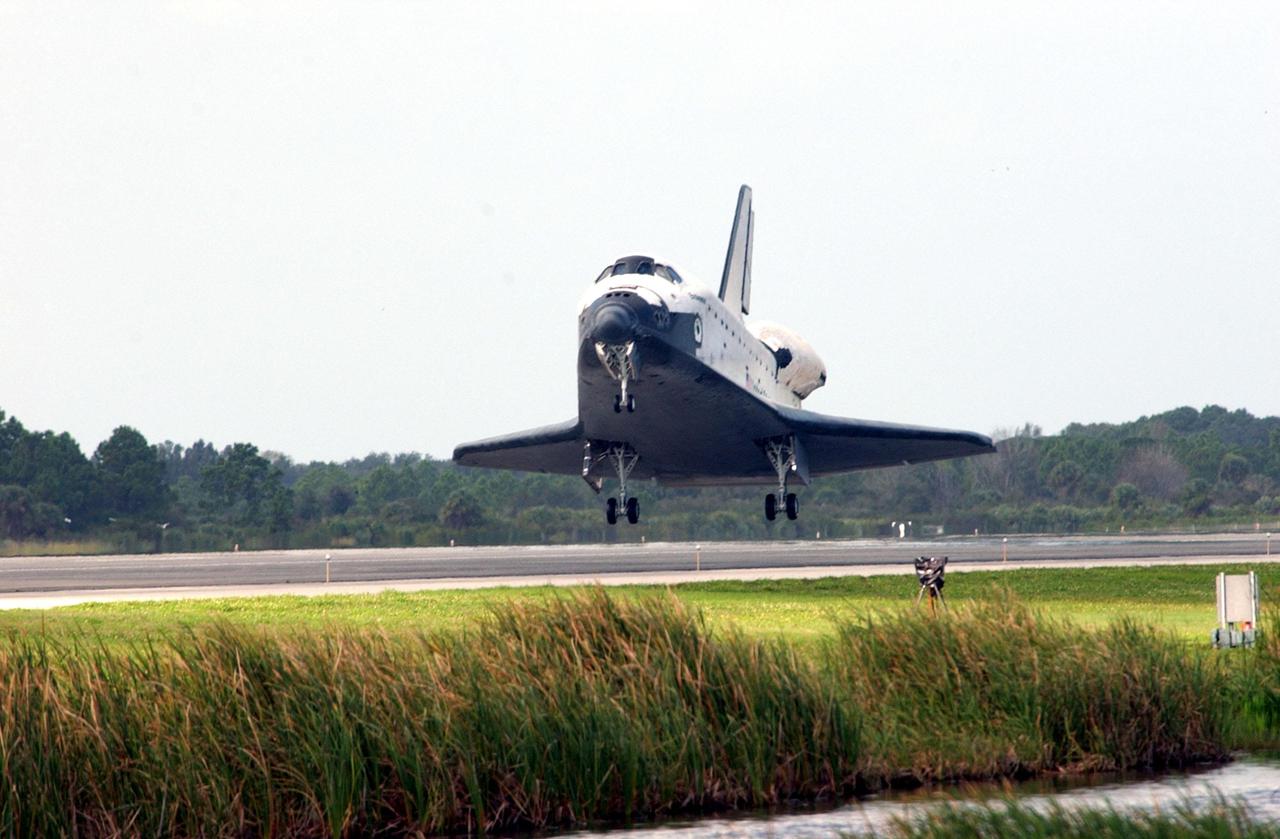
KENNEDY SPACE CENTER, FLA. -- Orbiter Endeavour approaches touchdown on Runway 15 at the KSC Shuttle Landing Facility, completing mission STS-108. After a mission-elapsed time of 11 days, 19 hours and 35 minutes, the landing is the 57th at KSC in the history of the program. Main gear touchdown occurred at 12:55:10 p.m. EST (17:55:10 GMT), nose gear touchdown at 12:55:23 p.m. (17:55:23 GMT) , wheel stop at 12:56:13 p.m. (17:56:13 GMT). STS-108 was the 12th mission to the International Space Station. This mission was the 107th flight in the Shuttle program and the 17th flight for the orbiter. Endeavour carries both the mission crew and the Expedition 3 crew - Commander Frank Culbertson and cosmonauts Vladimir Dezhurov and Mikhail Tyurin - who are returning to Earth after 129 days in space on the Space Station
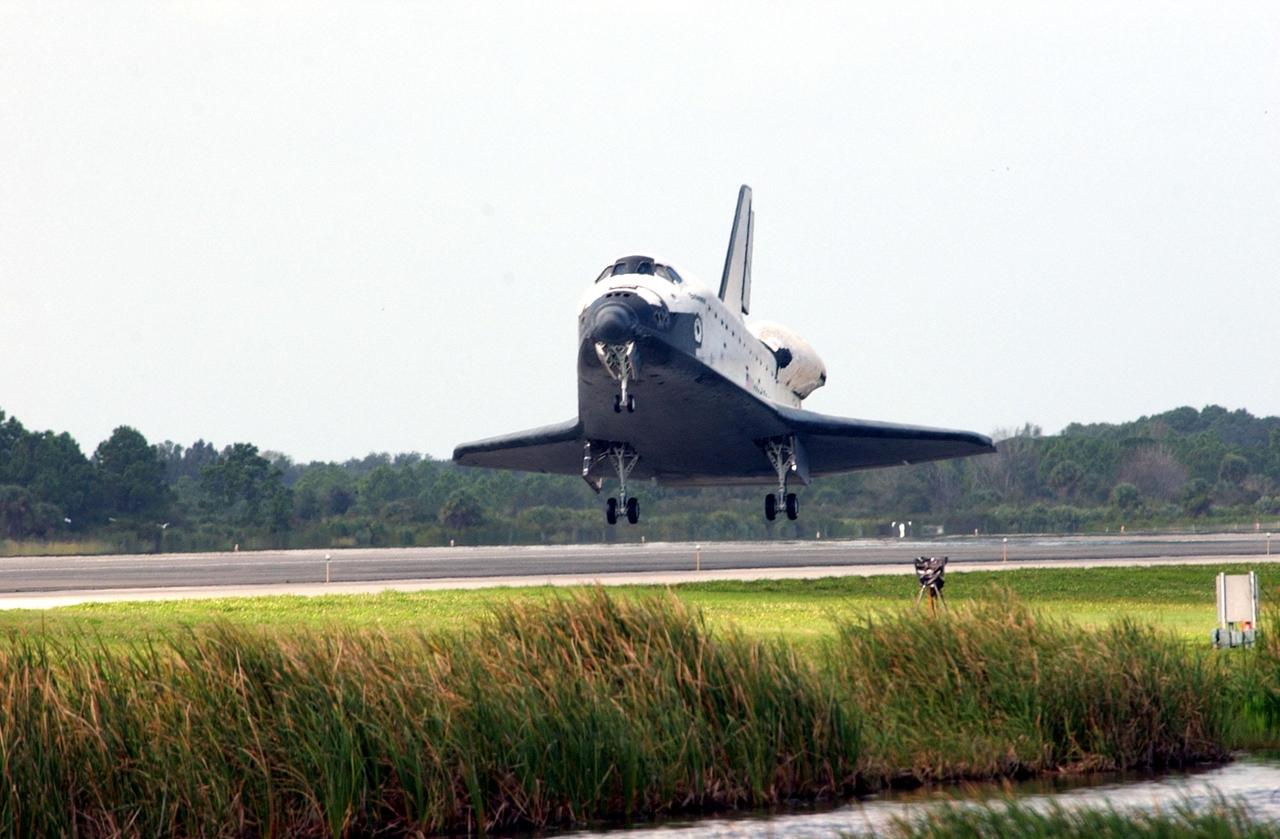
KENNEDY SPACE CENTER, FLA. -- Orbiter Endeavour approaches touchdown on Runway 15 at the KSC Shuttle Landing Facility, completing mission STS-108. After a mission-elapsed time of 11 days, 19 hours and 35 minutes, the landing is the 57th at KSC in the history of the program. Main gear touchdown occurred at 12:55:10 p.m. EST (17:55:10 GMT), nose gear touchdown at 12:55:23 p.m. (17:55:23 GMT) , wheel stop at 12:56:13 p.m. (17:56:13 GMT). STS-108 was the 12th mission to the International Space Station. This mission was the 107th flight in the Shuttle program and the 17th flight for the orbiter. Endeavour carries both the mission crew and the Expedition 3 crew - Commander Frank Culbertson and cosmonauts Vladimir Dezhurov and Mikhail Tyurin - who are returning to Earth after 129 days in space on the Space Station
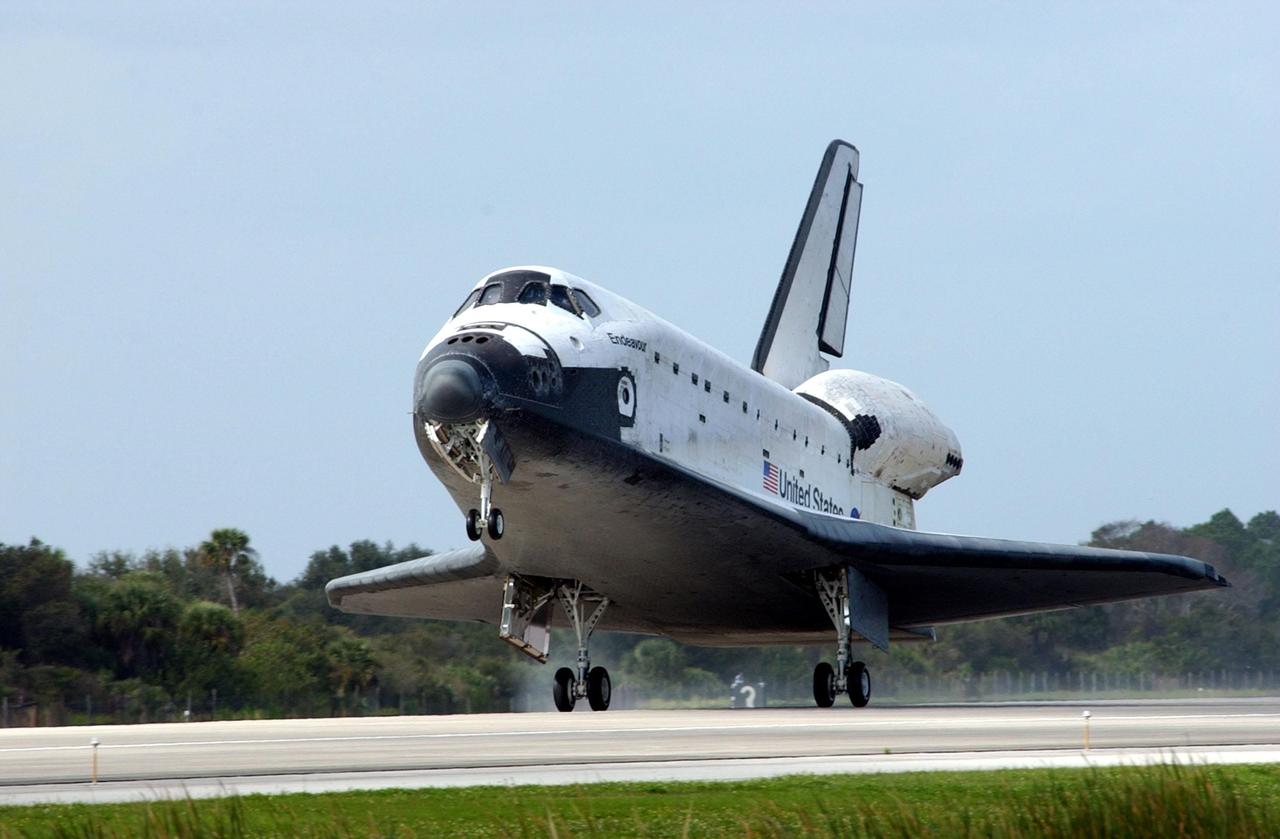
KENNEDY SPACE CENTER, FLA. -- Orbiter Endeavour touches down on Runway 15 at the KSC Shuttle Landing Facility, completing mission STS-108. After a mission-elapsed time of 11 days, 19 hours and 35 minutes, the landing is the 57th at KSC in the history of the program. Main gear touchdown occurred at 12:55:10 p.m. EST (17:55:10 GMT), nose gear touchdown at 12:55:23 p.m. (17:55:23 GMT) , wheel stop at 12:56:13 p.m. (17:56:13 GMT). STS-108 was the 12th mission to the International Space Station. This mission was the 107th flight in the Shuttle program and the 17th flight for the orbiter. Endeavour carries both the mission crew and the Expedition 3 crew - Commander Frank Culbertson and cosmonauts Vladimir Dezhurov and Mikhail Tyurin - who are returning to Earth after 129 days in space on the Space Station
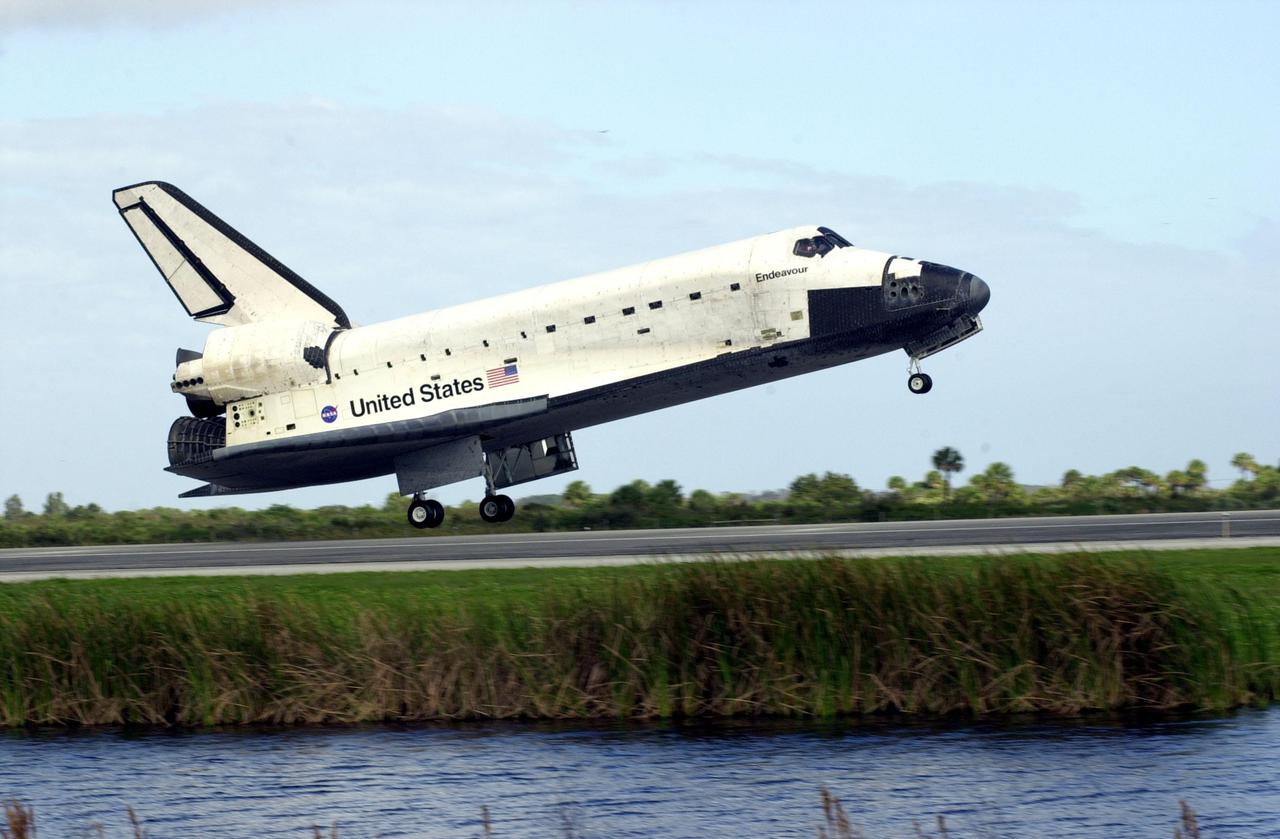
KENNEDY SPACE CENTER, FLA. -- Orbiter Endeavour approaches touchdown on Runway 15 at the KSC Shuttle Landing Facility, completing mission STS-108. After a mission-elapsed time of 11 days, 19 hours and 35 minutes, the landing is the 57th at KSC in the history of the program. Main gear touchdown occurred at 12:55:10 p.m. EST (17:55:10 GMT), nose gear touchdown at 12:55:23 p.m. (17:55:23 GMT) , wheel stop at 12:56:13 p.m. (17:56:13 GMT). STS-108 was the 12th mission to the International Space Station. This mission was the 107th flight in the Shuttle program and the 17th flight for the orbiter. Endeavour carries both the mission crew and the Expedition 3 crew - Commander Frank Culbertson and cosmonauts Vladimir Dezhurov and Mikhail Tyurin - who are returning to Earth after 129 days in space on the Space Station
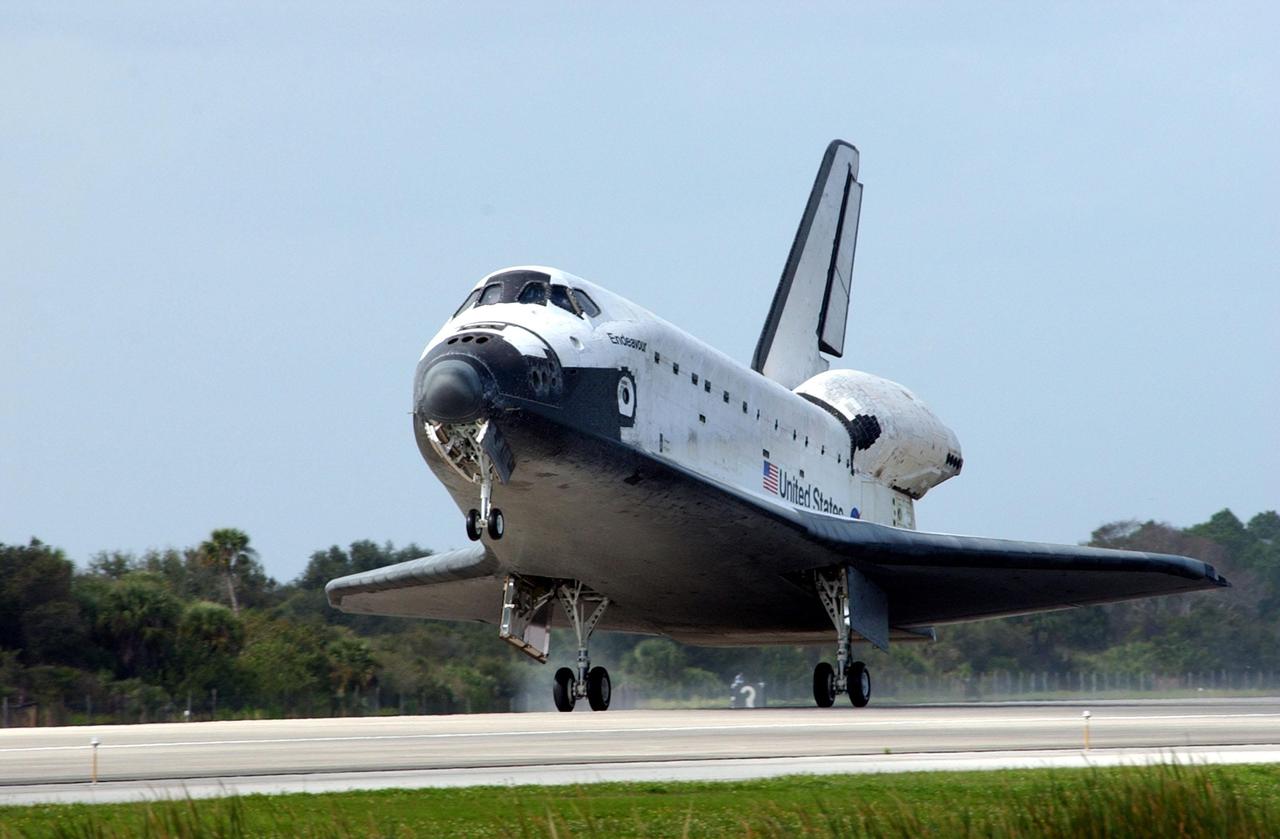
KENNEDY SPACE CENTER, FLA. -- Orbiter Endeavour touches down on Runway 15 at the KSC Shuttle Landing Facility, completing mission STS-108. After a mission-elapsed time of 11 days, 19 hours and 35 minutes, the landing is the 57th at KSC in the history of the program. Main gear touchdown occurred at 12:55:10 p.m. EST (17:55:10 GMT), nose gear touchdown at 12:55:23 p.m. (17:55:23 GMT) , wheel stop at 12:56:13 p.m. (17:56:13 GMT). STS-108 was the 12th mission to the International Space Station. This mission was the 107th flight in the Shuttle program and the 17th flight for the orbiter. Endeavour carries both the mission crew and the Expedition 3 crew - Commander Frank Culbertson and cosmonauts Vladimir Dezhurov and Mikhail Tyurin - who are returning to Earth after 129 days in space on the Space Station
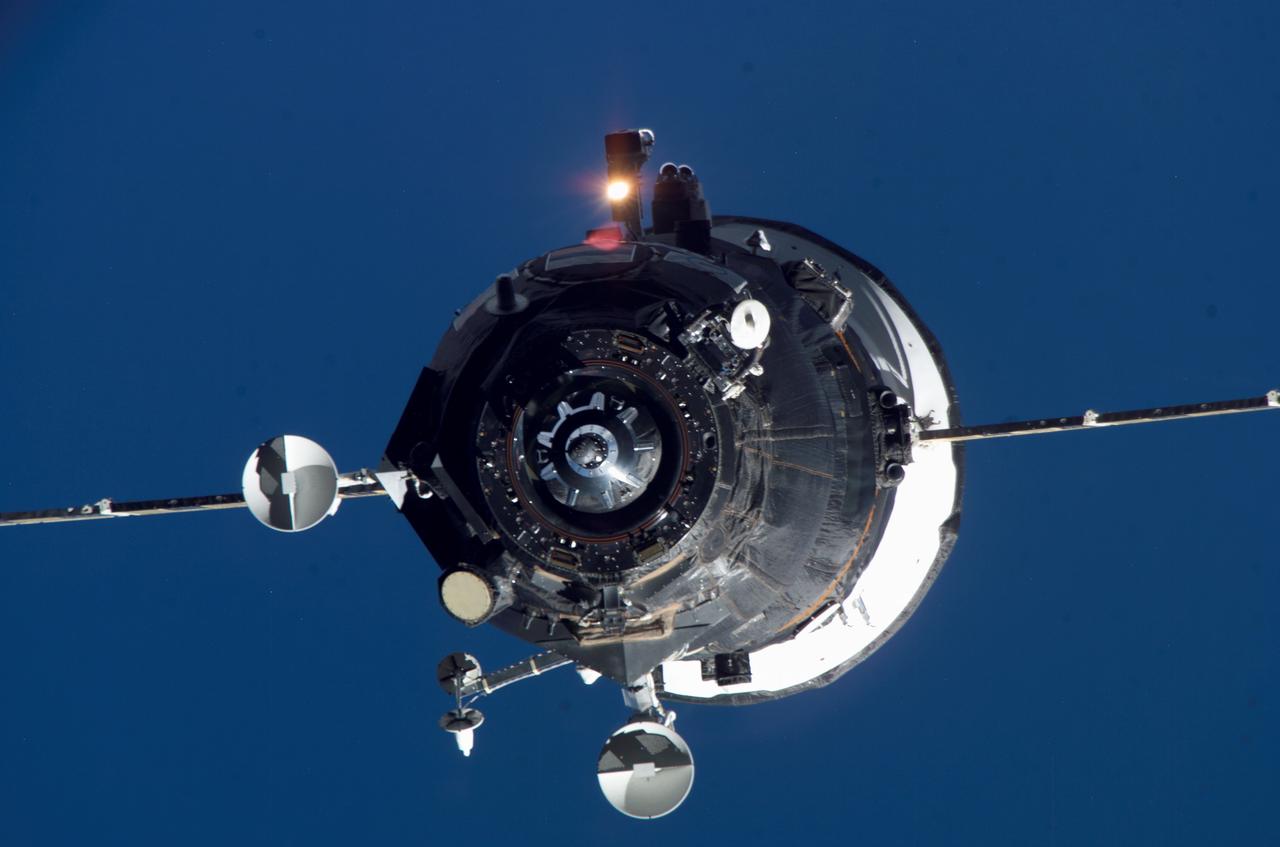
ISS014-E-12364 (19 Jan. 2007) --- Backdropped by a blue Earth, an unpiloted Progress supply vehicle approaches the International Space Station. The Progress 24 resupply craft launched at 8:12 p.m. (CST) on Jan. 17, 2007 from the Baikonur Cosmodrome in Kazakhstan to deliver 2.5 tons of food, fuel, oxygen and other supplies to the Expedition 14 crewmembers onboard the station. Progress automatically docked to the Pirs Docking Compartment at 8:59 p.m. (CST) on Jan. 19 as the spacecraft and the station flew approximately 220 miles above a point near the South Atlantic off the southeast coast of Uruguay.
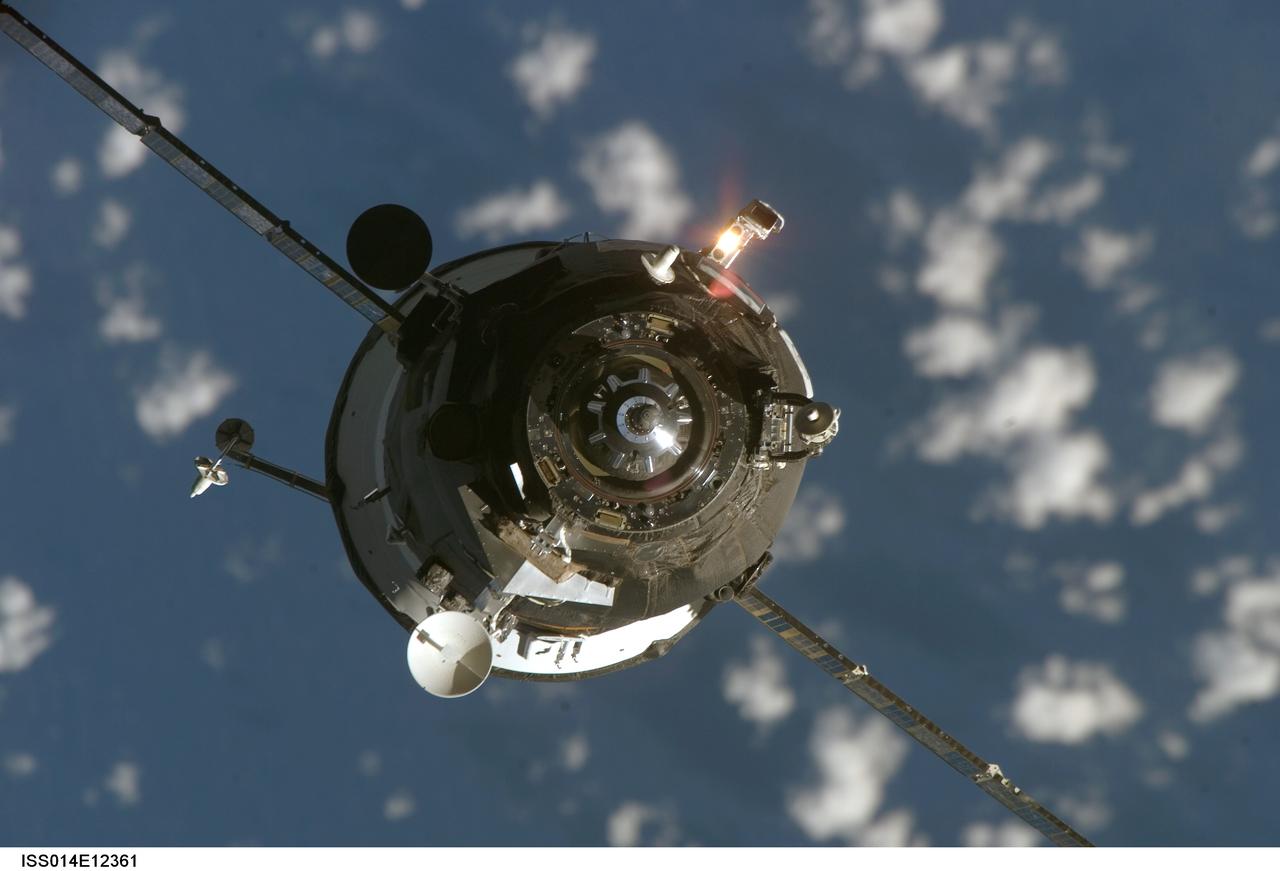
ISS014-E-12361 (19 Jan. 2007) --- Backdropped by a sprinkling of small clouds over a blue Earth, an unpiloted Progress supply vehicle approaches the International Space Station. The Progress 24 resupply craft launched at 8:12 p.m. (CST) on Jan. 17, 2007 from the Baikonur Cosmodrome in Kazakhstan to deliver 2.5 tons of food, fuel, oxygen and other supplies to the Expedition 14 crewmembers onboard the station. Progress automatically docked to the Pirs Docking Compartment at 8:59 p.m. (CST) on Jan. 19 as the spacecraft and the station flew approximately 220 miles above a point near the South Atlantic off the southeast coast of Uruguay.
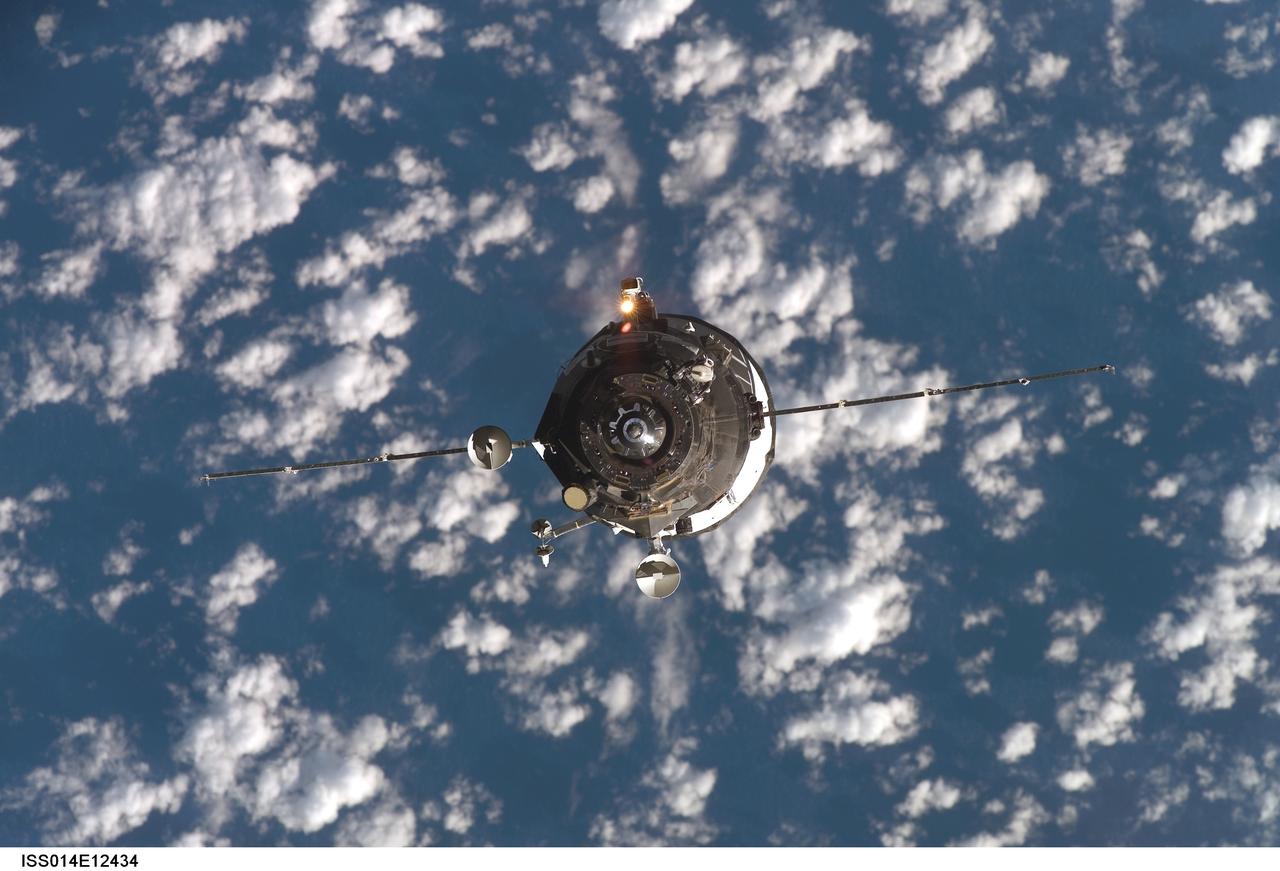
ISS014-E-12434 (19 Jan. 2007) --- Backdropped by a blue and white Earth, an unpiloted Progress supply vehicle approaches the International Space Station. The Progress 24 resupply craft launched at 8:12 p.m. (CST) on Jan. 17, 2007 from the Baikonur Cosmodrome in Kazakhstan to deliver 2.5 tons of food, fuel, oxygen and other supplies to the Expedition 14 crewmembers onboard the station. Progress automatically docked to the Pirs Docking Compartment at 8:59 p.m. (CST) on Jan. 19 as the spacecraft and the station flew approximately 220 miles above a point near the South Atlantic off the southeast coast of Uruguay.
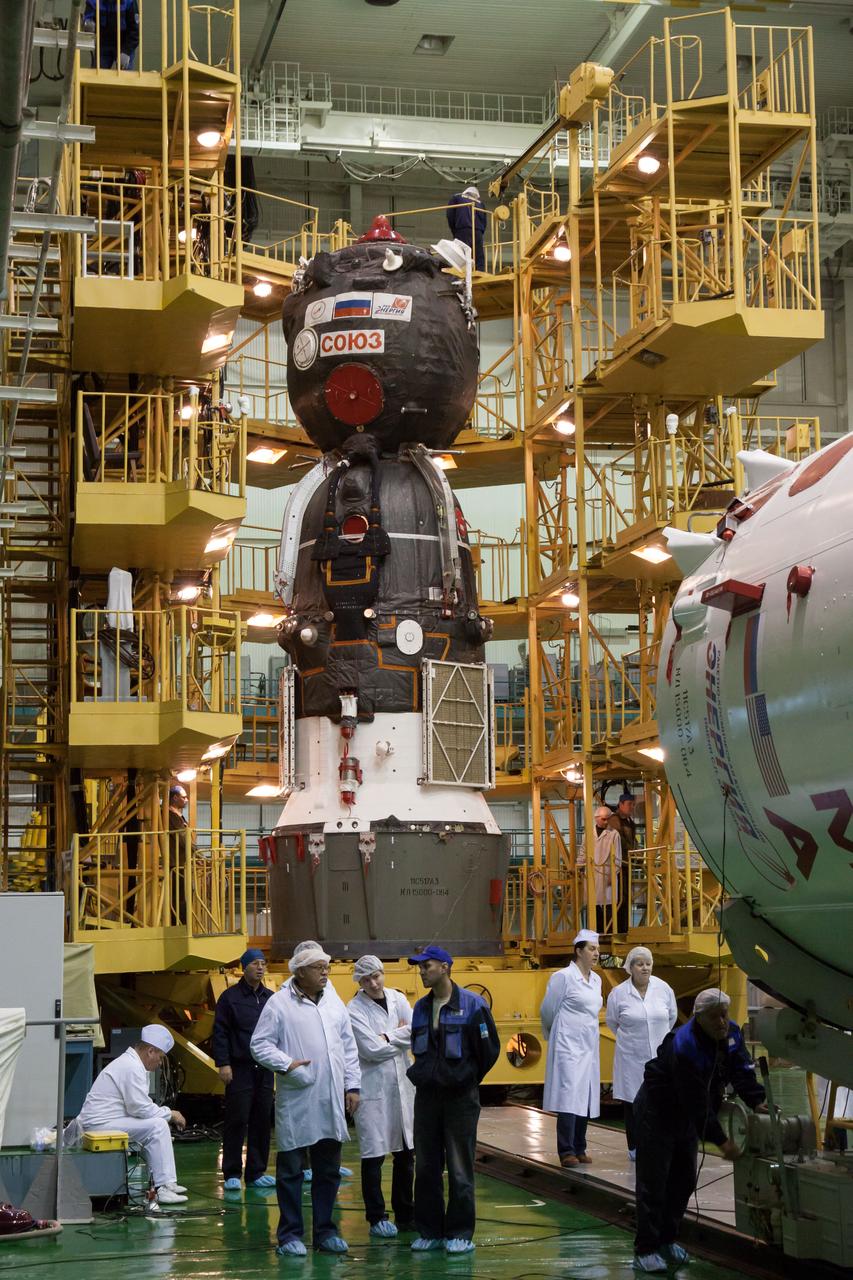
In the Integration Facility at the Baikonur Cosmodrome in Kazakhstan, the Soyuz TMA-07M spacecraft is prepared for its encapsulation into the upper stage of the Soyuz booster Dec. 12, 2012 as preparations continue for the launch of the Expedition 34/35 crew. The vehicle will be rolled to the launch pad at Baikonur Dec. 17 in advance of the Dec. 19 launch of NASA Flight Engineer Tom Marshburn, Soyuz Commander Roman Romanenko and Flight Engineer Chris Hadfield of the Canadian Space Agency for a five-month mission on the International Space Station. Photo Credit: NASA/Victor Zelentsov
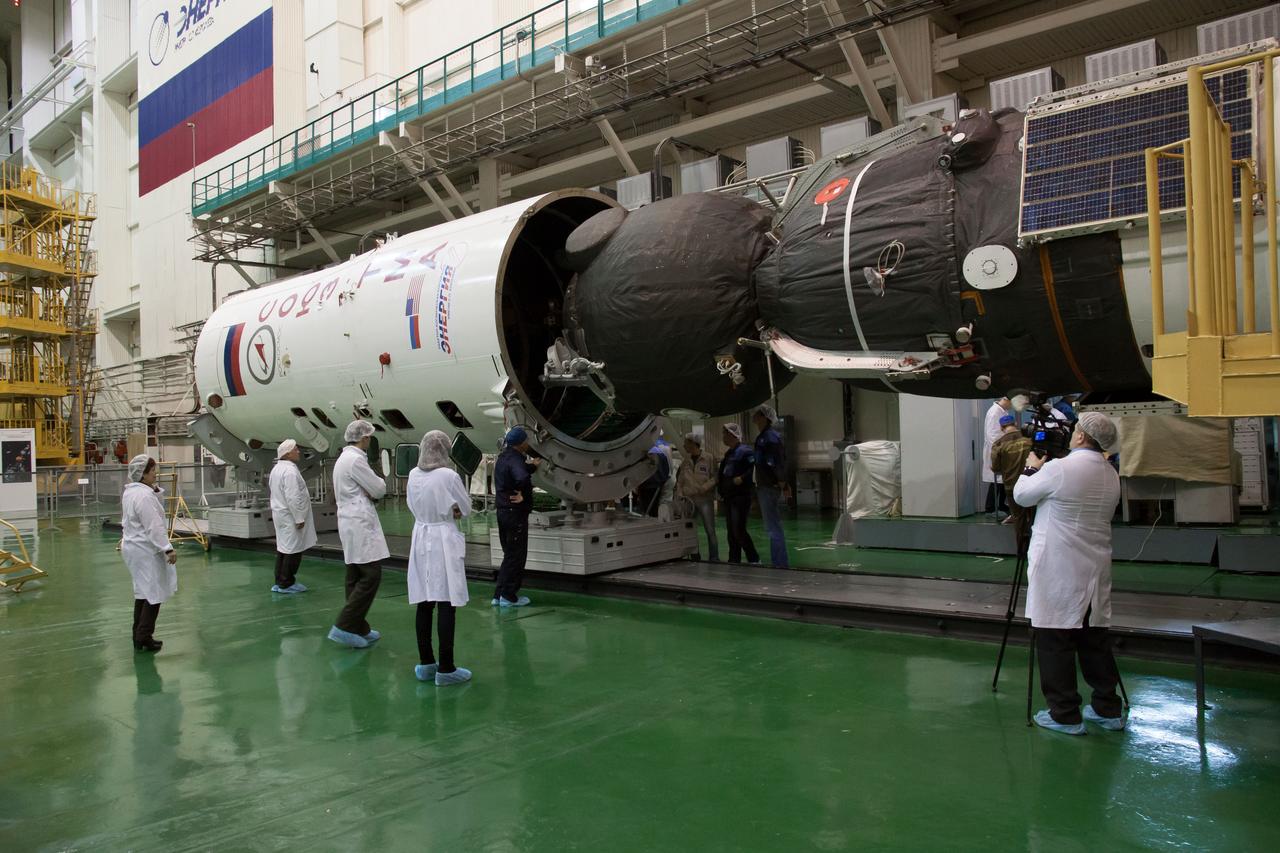
In the Integration Facility at the Baikonur Cosmodrome in Kazakhstan, the Soyuz TMA-07M spacecraft is encapsulated into the upper stage of the Soyuz booster Dec. 12, 2012 as preparations continue for the launch of the Expedition 34/35 crew. The vehicle will be rolled to the launch pad at Baikonur Dec. 17 in advance of the Dec. 19 launch of NASA Flight Engineer Tom Marshburn, Soyuz Commander Roman Romanenko and Flight Engineer Chris Hadfield of the Canadian Space Agency for a five-month mission on the International Space Station. Photo Credit: NASA/Victor Zelentsov

KENNEDY SPACE CENTER, FLA. -- After a successful return to Earth aboard orbiter Endeavour (background), the STS-108 crew pose for a photo. From left are Mission Specialists Daniel M. Tani and Linda A. Godwin, Pilot Mark E. Kelly and Commander Dominic L. Gorie. The mission had an elapsed time of 11 days, 19 hours and 35 minutes. Main gear touchdown occurred at 12:55:10 p.m. EST (17:55:10 GMT), nose gear touchdown at 12:55:23 p.m. (17:55:23 GMT) , wheel stop at 12:56:13 p.m. (17:56:13 GMT). STS-108 was the 12th mission to the International Space Station. This mission was the 107th flight in the Shuttle program and the 17th flight for the orbiter. The landing is the 57th at KSC in the history of the program. Endeavour carried both the mission crew and the Expedition 3 crew - Commander Frank Culbertson and cosmonauts Vladimir Dezhurov and Mikhail Tyurin - who returned to Earth after 129 days in space on the Space Station
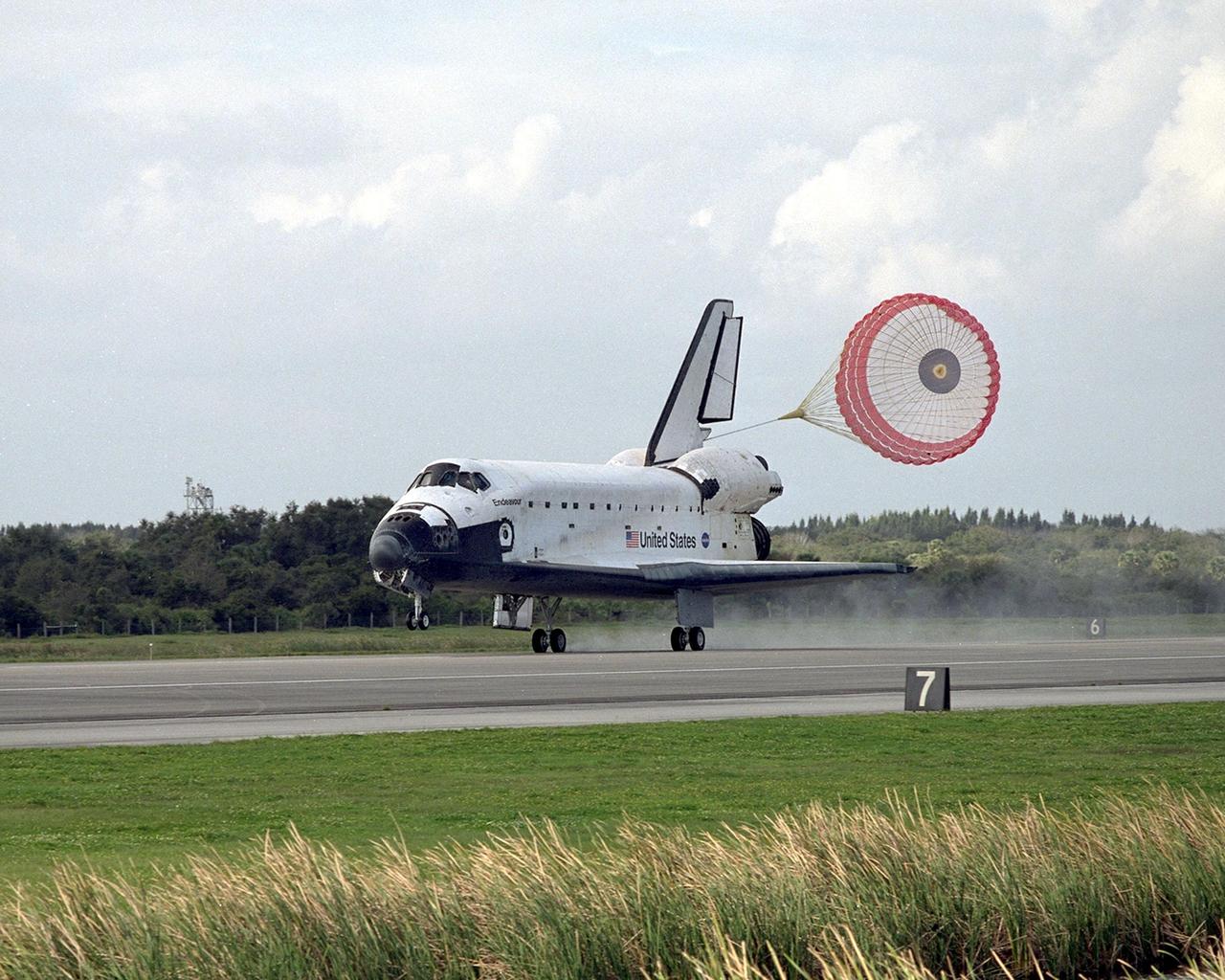
KENNEDY SPACE CENTER, FLA. -- With its drag chute billowing behind, orbiter Endeavour slows for a full touchdown on Runway 15 at the KSC Shuttle Landing Facility, completing mission STS-108. Endeavour carries both the mission crew and the Expedition 3 crew - Commander Frank Culbertson and cosmonauts Vladimir Dezhurov and Mikhail Tyurin - who are returning to Earth after 129 days in space on the International Space Station. After a mission-elapsed time of 11 days, 19 hours and 35 minutes, Endeavour had main gear touchdown at 12:55:10 p.m. EST (17:55:10 GMT). Nose gear touchdown occurred at 12:55:23 p.m. (17:55:23 GMT); wheel stop at 12:56:13 p.m. (17:56:13 GMT). Rollout distance was 8,941 feet. The landing is the 57th at KSC in the history of the program STS-108 was the 12th mission to the Space Station. This mission was the 107th flight in the Shuttle program and the 17th flight for the orbiter
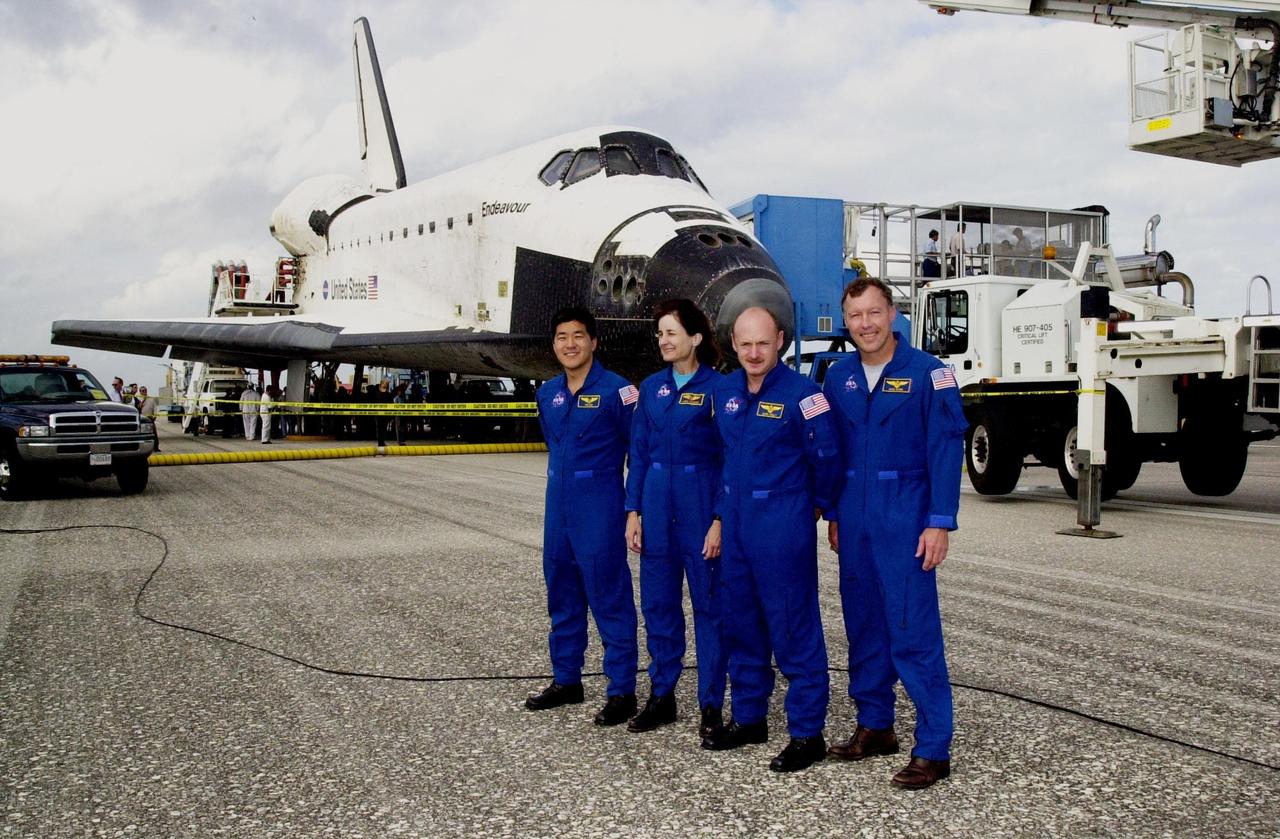
KENNEDY SPACE CENTER, FLA. -- After a successful return to Earth aboard orbiter Endeavour (background), the STS-108 crew pose for a photo. From left are Mission Specialists Daniel M. Tani and Linda A. Godwin, Pilot Mark E. Kelly and Commander Dominic L. Gorie. The mission had an elapsed time of 11 days, 19 hours and 35 minutes. Main gear touchdown occurred at 12:55:10 p.m. EST (17:55:10 GMT), nose gear touchdown at 12:55:23 p.m. (17:55:23 GMT) , wheel stop at 12:56:13 p.m. (17:56:13 GMT). STS-108 was the 12th mission to the International Space Station. This mission was the 107th flight in the Shuttle program and the 17th flight for the orbiter. The landing is the 57th at KSC in the history of the program. Endeavour carried both the mission crew and the Expedition 3 crew - Commander Frank Culbertson and cosmonauts Vladimir Dezhurov and Mikhail Tyurin - who returned to Earth after 129 days in space on the Space Station
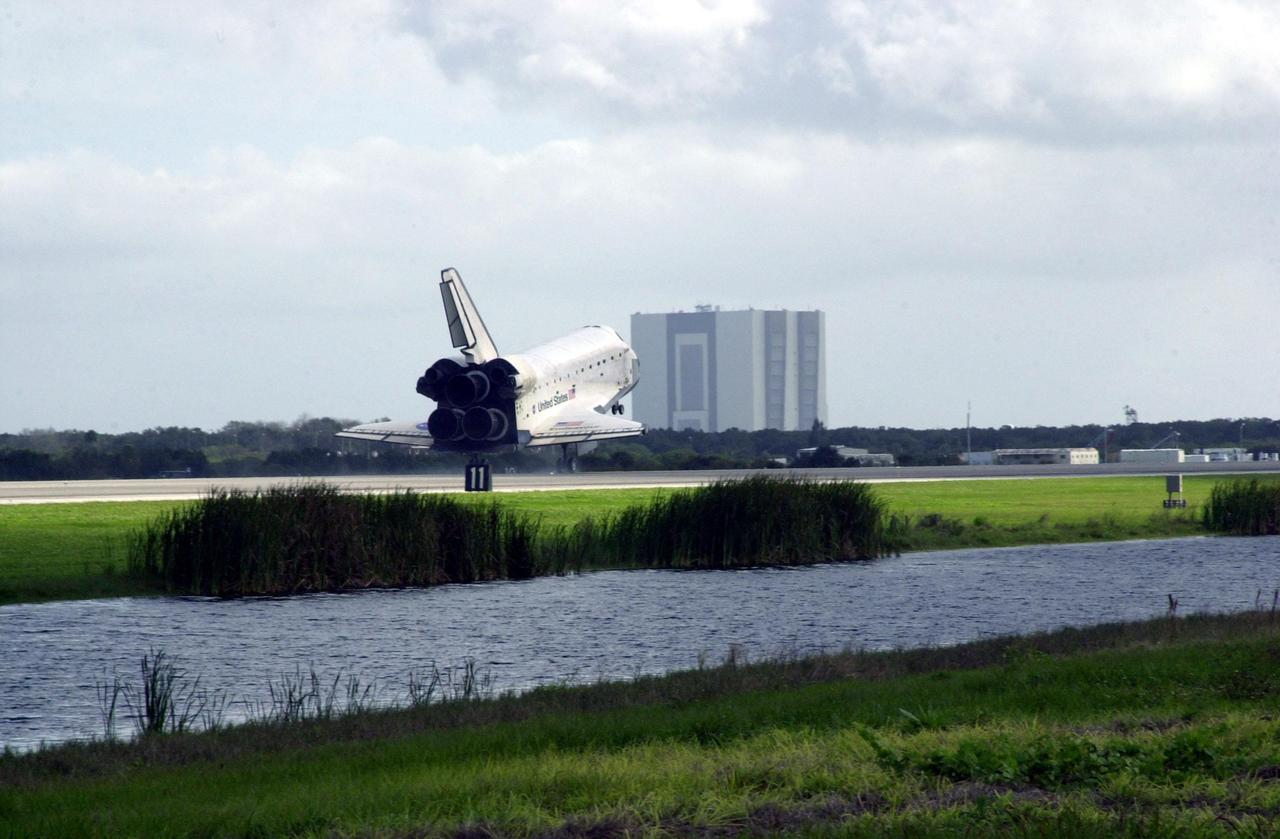
KENNEDY SPACE CENTER, FLA. -- Orbiter Endeavour appears to head toward the Vehicle Assembly Building (background) as it approaches touchdown on Runway 15 at the KSC Shuttle Landing Facility, completing mission STS-108. After a mission-elapsed time of 11 days, 19 hours and 35 minutes, the landing is the 57th at KSC in the history of the program. Main gear touchdown occurred at 12:55:10 p.m. EST (17:55:10 GMT), nose gear touchdown at 12:55:23 p.m. (17:55:23 GMT) , wheel stop at 12:56:13 p.m. (17:56:13 GMT). STS-108 was the 12th mission to the International Space Station. This mission was the 107th flight in the Shuttle program and the 17th flight for the orbiter. Endeavour carries both the mission crew and the Expedition 3 crew - Commander Frank Culbertson and cosmonauts Vladimir Dezhurov and Mikhail Tyurin - who are returning to Earth after 129 days in space on the Space Station

KENNEDY SPACE CENTER, FLA. -- The STS-108 crew wave to the crowd as they head for the van to transport them back to crew quarters. The crew completed their mission with a successful landing on Runway 15 of the KSC Shuttle Landing Facility. The mission had an elapsed time of 11 days, 19 hours and 35 minutes. Main gear touchdown occurred at 12:55:10 p.m. EST (17:55:10 GMT), nose gear touchdown at 12:55:23 p.m. (17:55:23 GMT) , wheel stop at 12:56:13 p.m. (17:56:13 GMT). Rollout distance was 8,941 feet. Endeavour carried both the mission crew and the Expedition 3 crew - Commander Frank Culbertson and cosmonauts Vladimir Dezhurov and Mikhail Tyurin - who returned to Earth after 129 days in space on the Space Station. STS-108 was the 12th mission to the International Space Station. This mission was the 107th flight in the Shuttle program and the 17th flight for the orbiter. The landing is the 57th at KSC in the history of the program
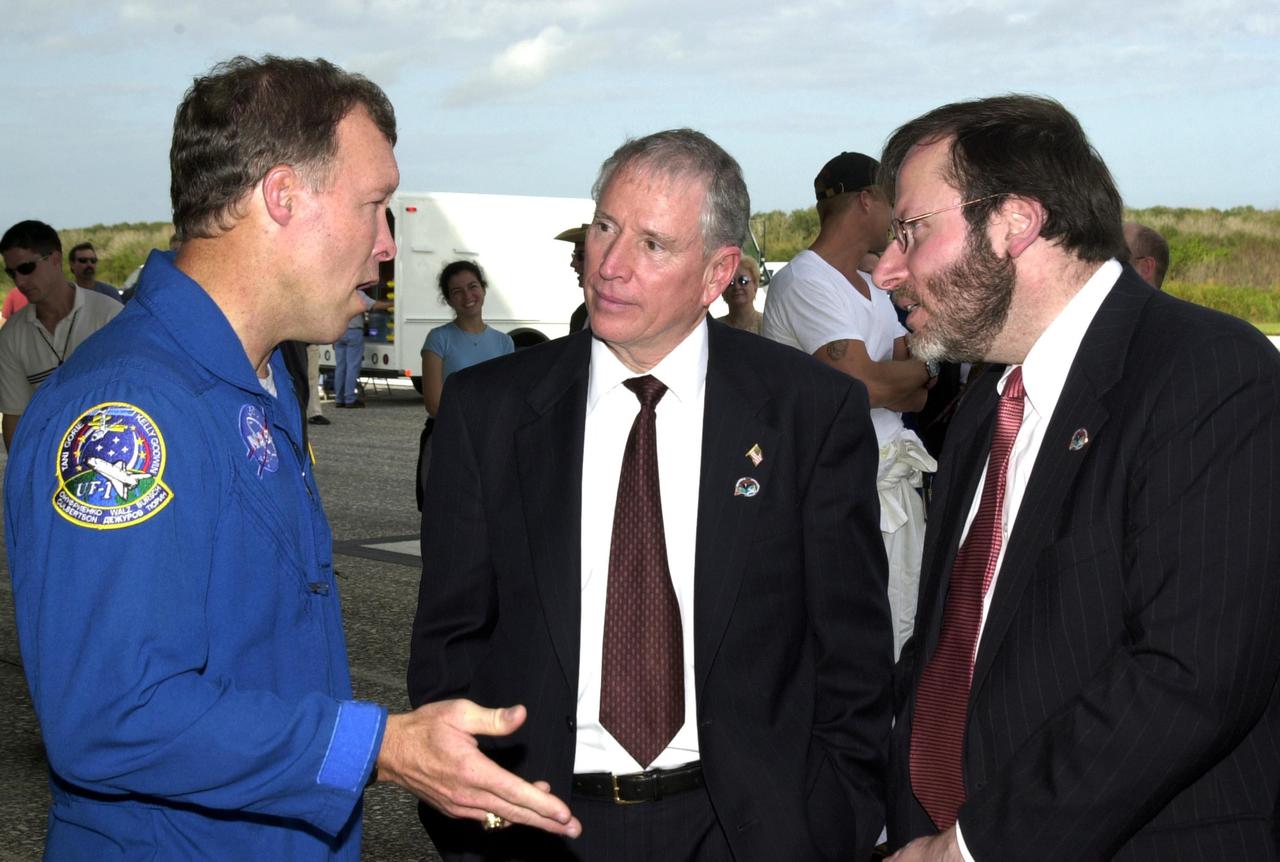
KENNEDY SPACE CENTER, FLA. -- After a successful landing at the KSC Shuttle Landing Facility, completing mission STS-108, Commander Dominic L. Gorie (left) talks with Acting NASA Administrator Daniel Mulville (center) and White House liaison Courtney Stadd. Endeavour carried both the mission crew and the Expedition 3 crew -- Commander Frank Culbertson and cosmonauts Vladimir Dezhurov and Mikhail Tyurin -- who returned to Earth after 129 days on the International Space Station. Completing a mission-elapsed time of 11 days, 19 hours and 35 minutes, Endeavour had main gear touchdown at 12:55:10 p.m. EST (17:55:10 GMT). Nose gear touchdown occurred at 12:55:23 p.m. (17:55:23 GMT); wheel stop at 12:56:13 p.m. (17:56:13 GMT). Rollout distance was 8,941 feet. The landing is the 57th at KSC in the history of the program STS-108 was the 12th mission to the Space Station. This mission was the 107th flight in the Shuttle program and the 17th flight for the orbiter
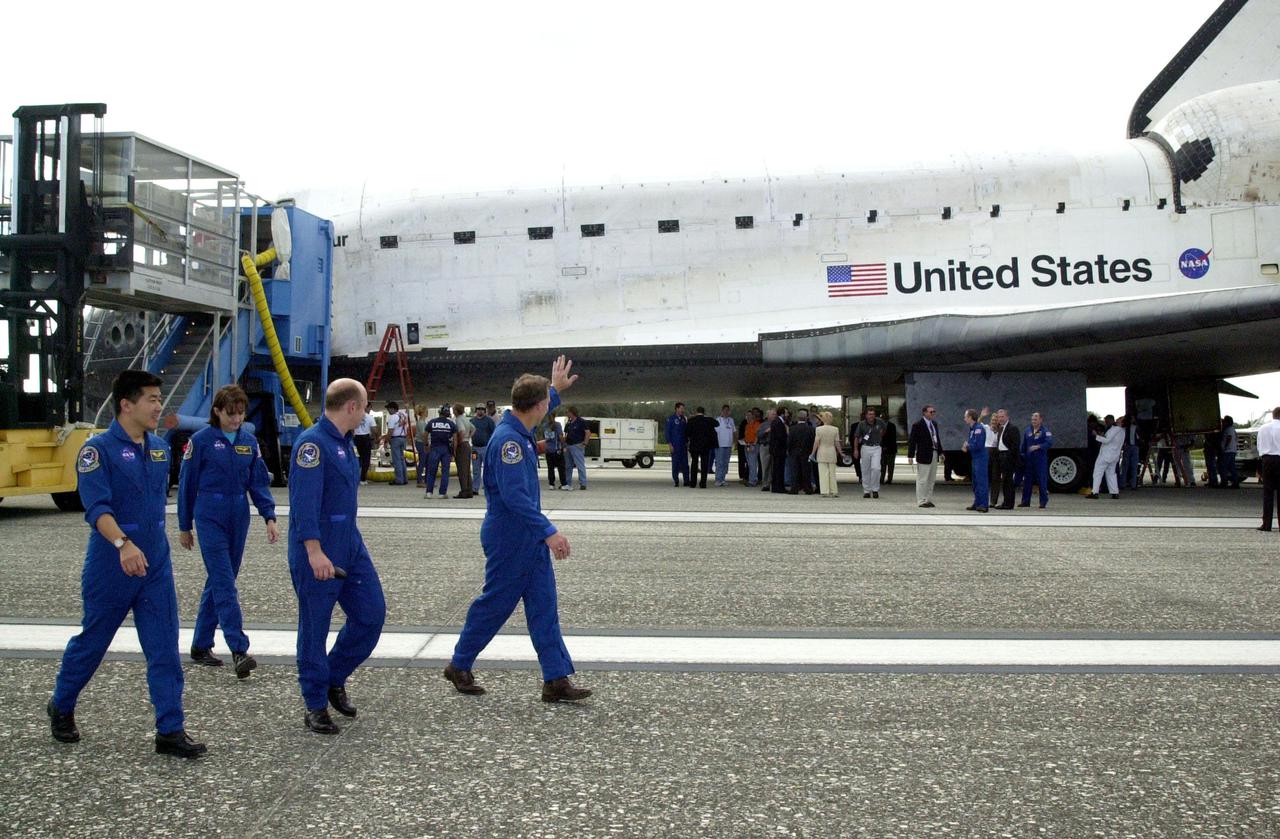
KENNEDY SPACE CENTER, FLA. -- The STS-108 crew wave to the crowd as they head for the van to transport them back to crew quarters. The crew completed their mission with a successful landing on Runway 15 of the KSC Shuttle Landing Facility. The mission had an elapsed time of 11 days, 19 hours and 35 minutes. Main gear touchdown occurred at 12:55:10 p.m. EST (17:55:10 GMT), nose gear touchdown at 12:55:23 p.m. (17:55:23 GMT) , wheel stop at 12:56:13 p.m. (17:56:13 GMT). Rollout distance was 8,941 feet. Endeavour carried both the mission crew and the Expedition 3 crew - Commander Frank Culbertson and cosmonauts Vladimir Dezhurov and Mikhail Tyurin - who returned to Earth after 129 days in space on the Space Station. STS-108 was the 12th mission to the International Space Station. This mission was the 107th flight in the Shuttle program and the 17th flight for the orbiter. The landing is the 57th at KSC in the history of the program
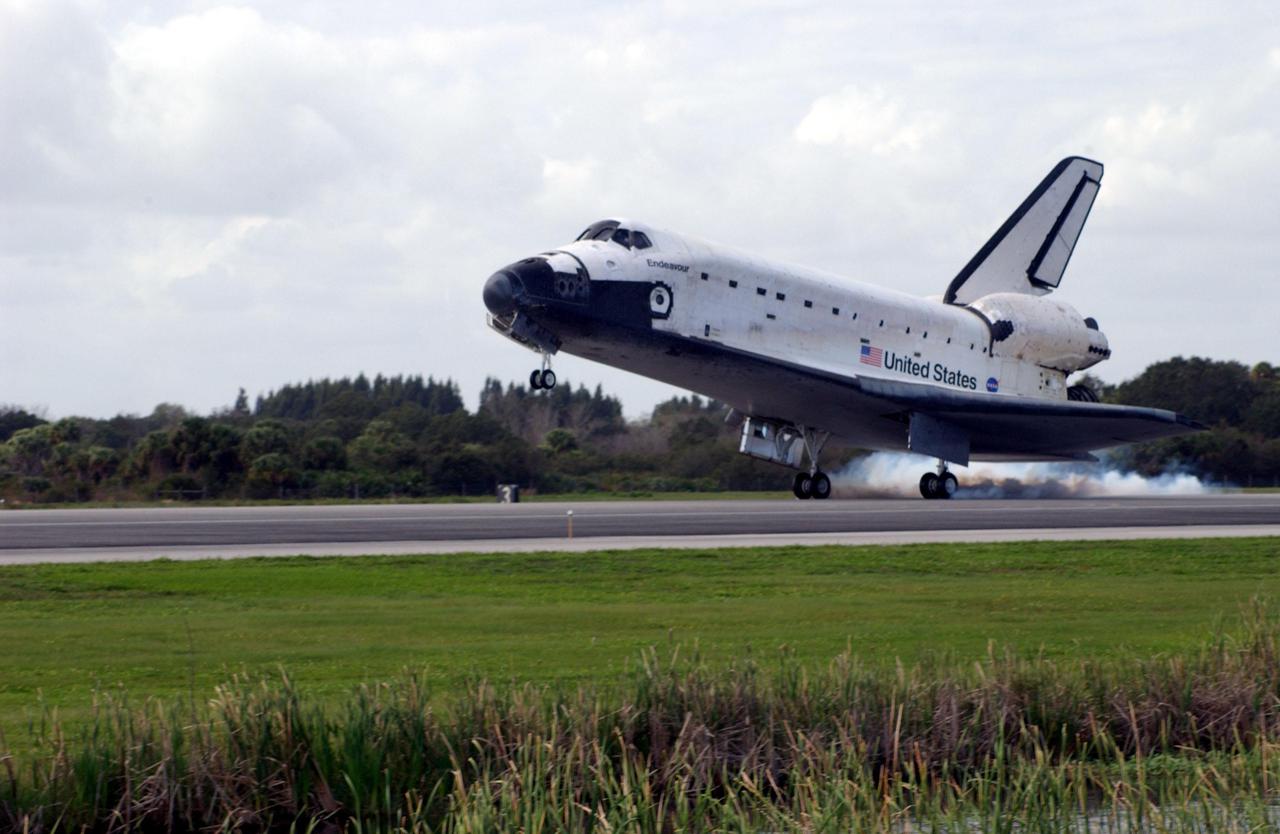
KENNEDY SPACE CENTER, FLA. -- Orbiter Endeavour kicks up dust as it touches down on Runway 15 at the KSC Shuttle Landing Facility, completing mission STS-108. Endeavour carries both the mission crew and the Expedition 3 crew - Commander Frank Culbertson and cosmonauts Vladimir Dezhurov and Mikhail Tyurin - who are returning to Earth after 129 days in space on the International Space Station. After a mission-elapsed time of 11 days, 19 hours and 35 minutes, Endeavour had main gear touchdown at 12:55:10 p.m. EST (17:55:10 GMT). Nose gear touchdown occurred at 12:55:23 p.m. (17:55:23 GMT); wheel stop at 12:56:13 p.m. (17:56:13 GMT). Rollout distance was 8,941 feet. The landing is the 57th at KSC in the history of the program STS-108 was the 12th mission to the Space Station. This mission was the 107th flight in the Shuttle program and the 17th flight for the orbiter
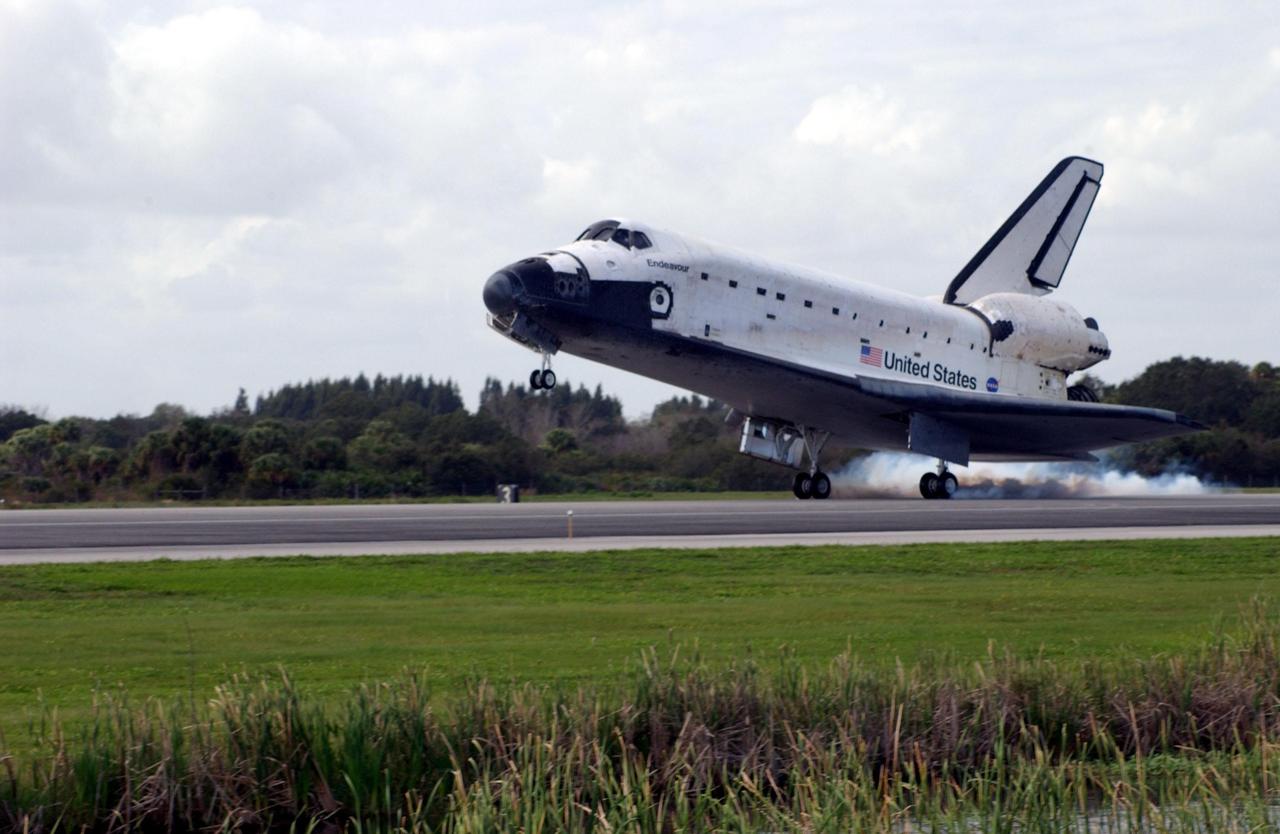
KENNEDY SPACE CENTER, FLA. -- Orbiter Endeavour kicks up dust as it touches down on Runway 15 at the KSC Shuttle Landing Facility, completing mission STS-108. Endeavour carries both the mission crew and the Expedition 3 crew - Commander Frank Culbertson and cosmonauts Vladimir Dezhurov and Mikhail Tyurin - who are returning to Earth after 129 days in space on the International Space Station. After a mission-elapsed time of 11 days, 19 hours and 35 minutes, Endeavour had main gear touchdown at 12:55:10 p.m. EST (17:55:10 GMT). Nose gear touchdown occurred at 12:55:23 p.m. (17:55:23 GMT); wheel stop at 12:56:13 p.m. (17:56:13 GMT). Rollout distance was 8,941 feet. The landing is the 57th at KSC in the history of the program STS-108 was the 12th mission to the Space Station. This mission was the 107th flight in the Shuttle program and the 17th flight for the orbiter
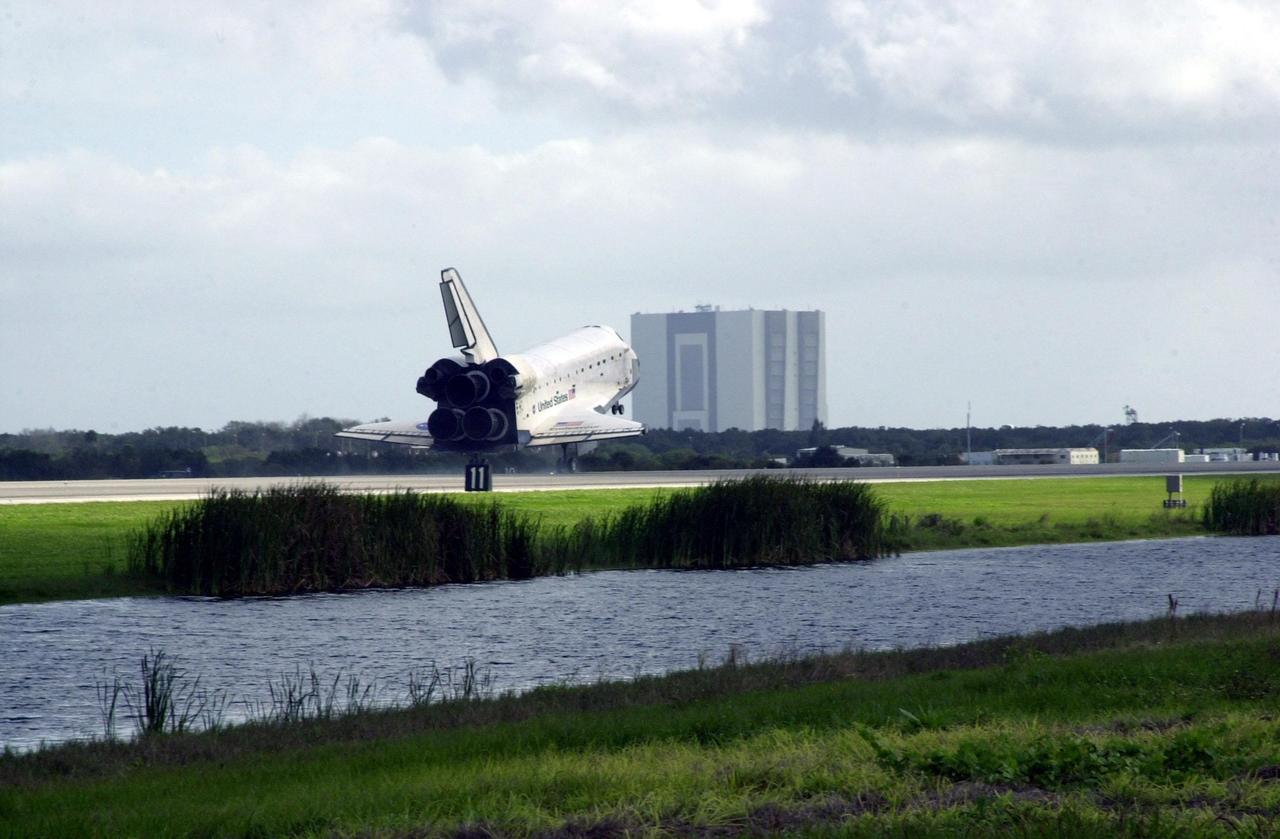
KENNEDY SPACE CENTER, FLA. -- Orbiter Endeavour appears to head toward the Vehicle Assembly Building (background) as it approaches touchdown on Runway 15 at the KSC Shuttle Landing Facility, completing mission STS-108. After a mission-elapsed time of 11 days, 19 hours and 35 minutes, the landing is the 57th at KSC in the history of the program. Main gear touchdown occurred at 12:55:10 p.m. EST (17:55:10 GMT), nose gear touchdown at 12:55:23 p.m. (17:55:23 GMT) , wheel stop at 12:56:13 p.m. (17:56:13 GMT). STS-108 was the 12th mission to the International Space Station. This mission was the 107th flight in the Shuttle program and the 17th flight for the orbiter. Endeavour carries both the mission crew and the Expedition 3 crew - Commander Frank Culbertson and cosmonauts Vladimir Dezhurov and Mikhail Tyurin - who are returning to Earth after 129 days in space on the Space Station
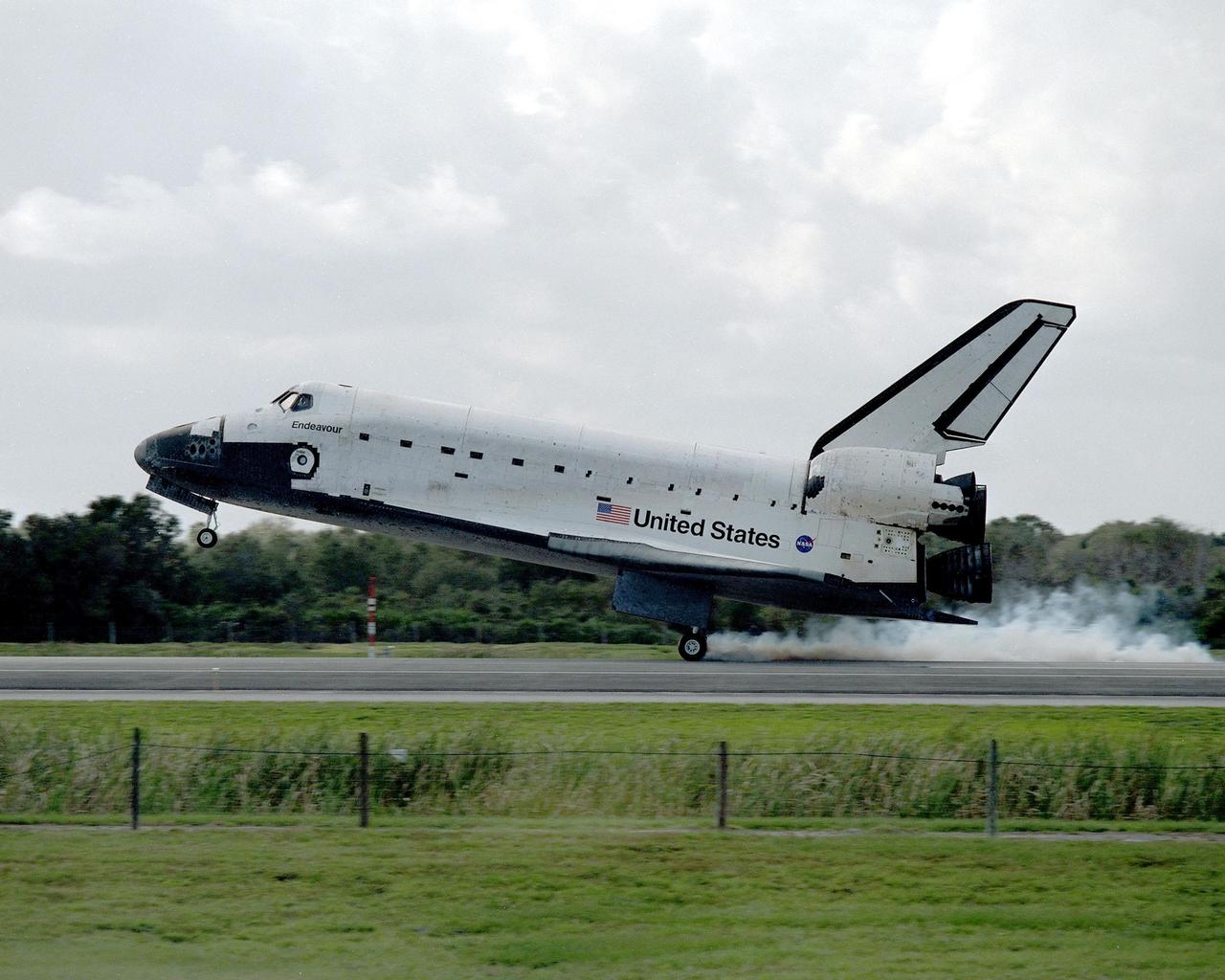
KENNEDY SPACE CENTER, FLA. -- Endeavour raises dust as it glides to a smooth landing on Runway 15 at the KSC Shuttle Landing Facility, completing mission STS-108. Endeavour carries both the mission crew and the Expedition 3 crew - Commander Frank Culbertson and cosmonauts Vladimir Dezhurov and Mikhail Tyurin - who are returning to Earth after 129 days in space on the International Space Station. After a mission-elapsed time of 11 days, 19 hours and 35 minutes, Endeavour had main gear touchdown at 12:55:10 p.m. EST (17:55:10 GMT). Nose gear touchdown occurred at 12:55:23 p.m. (17:55:23 GMT); wheel stop at 12:56:13 p.m. (17:56:13 GMT). Rollout distance was 8,941 feet. The landing is the 57th at KSC in the history of the program STS-108 was the 12th mission to the Space Station. This mission was the 107th flight in the Shuttle program and the 17th flight for the orbiter
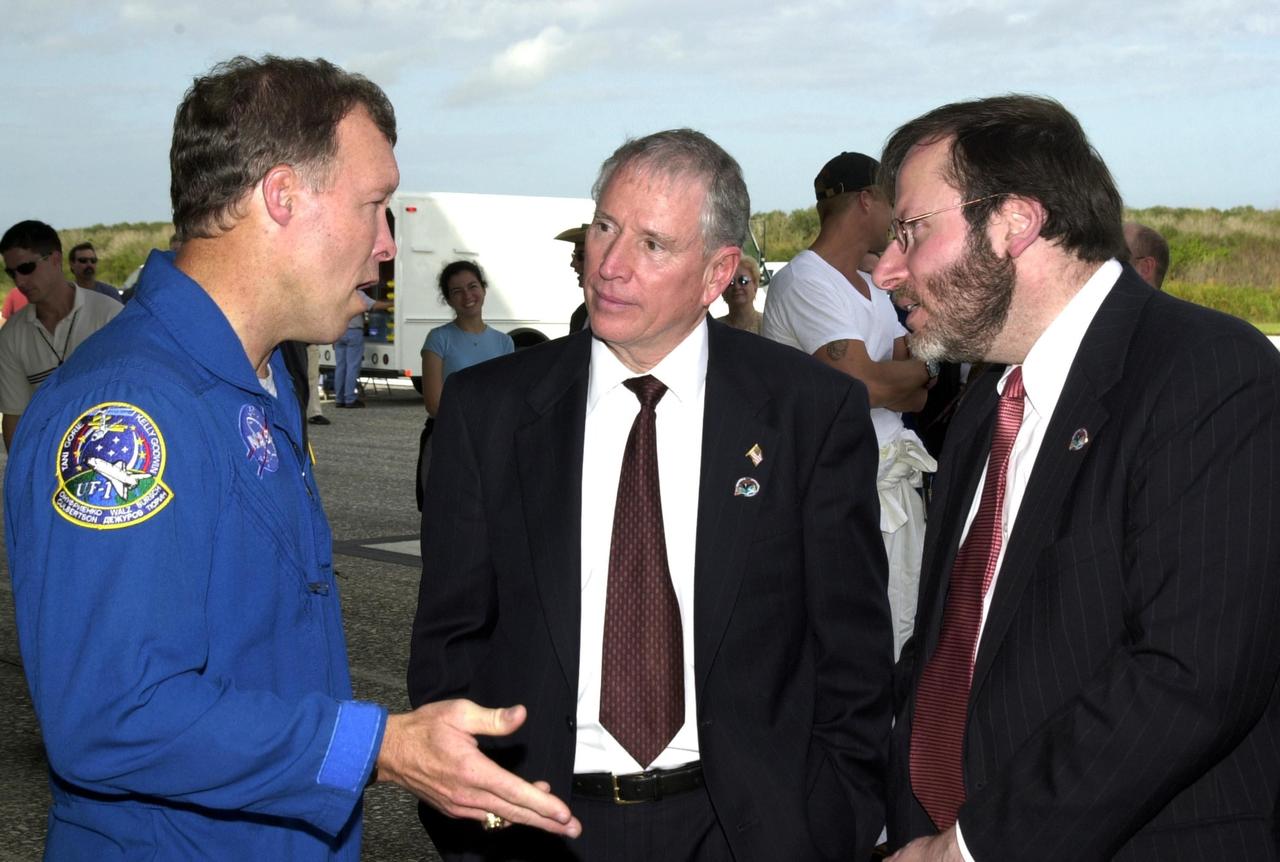
KENNEDY SPACE CENTER, FLA. -- After a successful landing at the KSC Shuttle Landing Facility, completing mission STS-108, Commander Dominic L. Gorie (left) talks with Acting NASA Administrator Daniel Mulville (center) and White House liaison Courtney Stadd. Endeavour carried both the mission crew and the Expedition 3 crew -- Commander Frank Culbertson and cosmonauts Vladimir Dezhurov and Mikhail Tyurin -- who returned to Earth after 129 days on the International Space Station. Completing a mission-elapsed time of 11 days, 19 hours and 35 minutes, Endeavour had main gear touchdown at 12:55:10 p.m. EST (17:55:10 GMT). Nose gear touchdown occurred at 12:55:23 p.m. (17:55:23 GMT); wheel stop at 12:56:13 p.m. (17:56:13 GMT). Rollout distance was 8,941 feet. The landing is the 57th at KSC in the history of the program STS-108 was the 12th mission to the Space Station. This mission was the 107th flight in the Shuttle program and the 17th flight for the orbiter

In the Integration Facility at the Baikonur Cosmodrome in Kazakhstan, the Soyuz TMA-07M spacecraft is moved into place for its encapsulation into the upper stage of the Soyuz booster Dec. 12, 2012 as preparations continue for the launch of the Expedition 34/35 crew. The vehicle will be rolled to the launch pad at Baikonur Dec. 17 in advance of the Dec. 19 launch of NASA Flight Engineer Tom Marshburn, Soyuz Commander Roman Romanenko and Flight Engineer Chris Hadfield of the Canadian Space Agency for a five-month mission on the International Space Station. Photo Credit: NASA/Victor Zelentsov
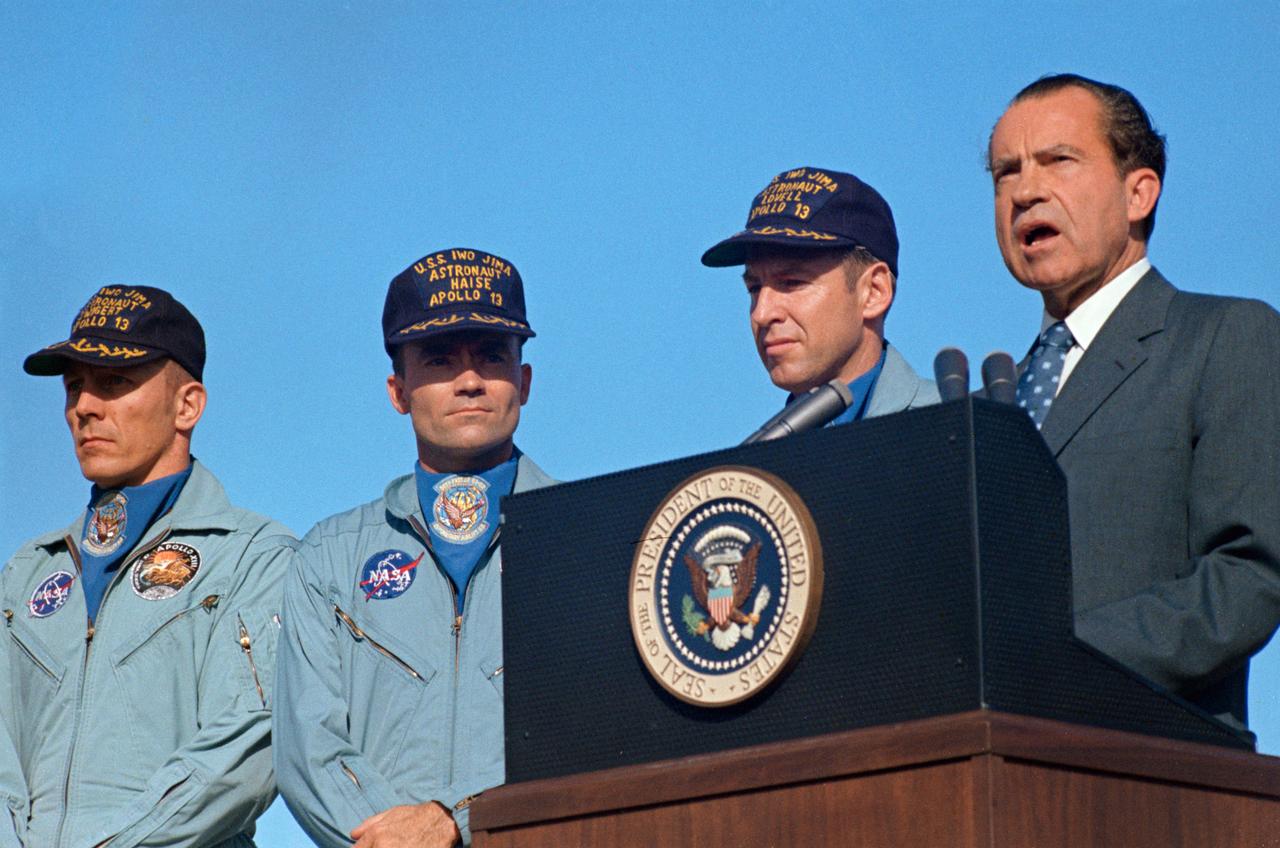
S70-15511 (19 April 1970) --- President Richard M. Nixon speaks at Hickham Air Force Base prior to presenting the nation's highest civilian award to the Apollo 13 crew. Receiving the Presidential Medal of Freedom were astronauts James A. Lovell Jr., (next to the Chief Executive), commander; John L. Swigert Jr. (left), command module pilot; and Fred W. Haise Jr., lunar module pilot. Wives of Lovell and Haise and the parents of Swigert accompanied the President to Hawaii. The Apollo 13 splashdown occurred at 12:07:44 p.m. (CST), April 17, 1970, about a day and a half prior to the Hickam Air Force Base ceremonies.
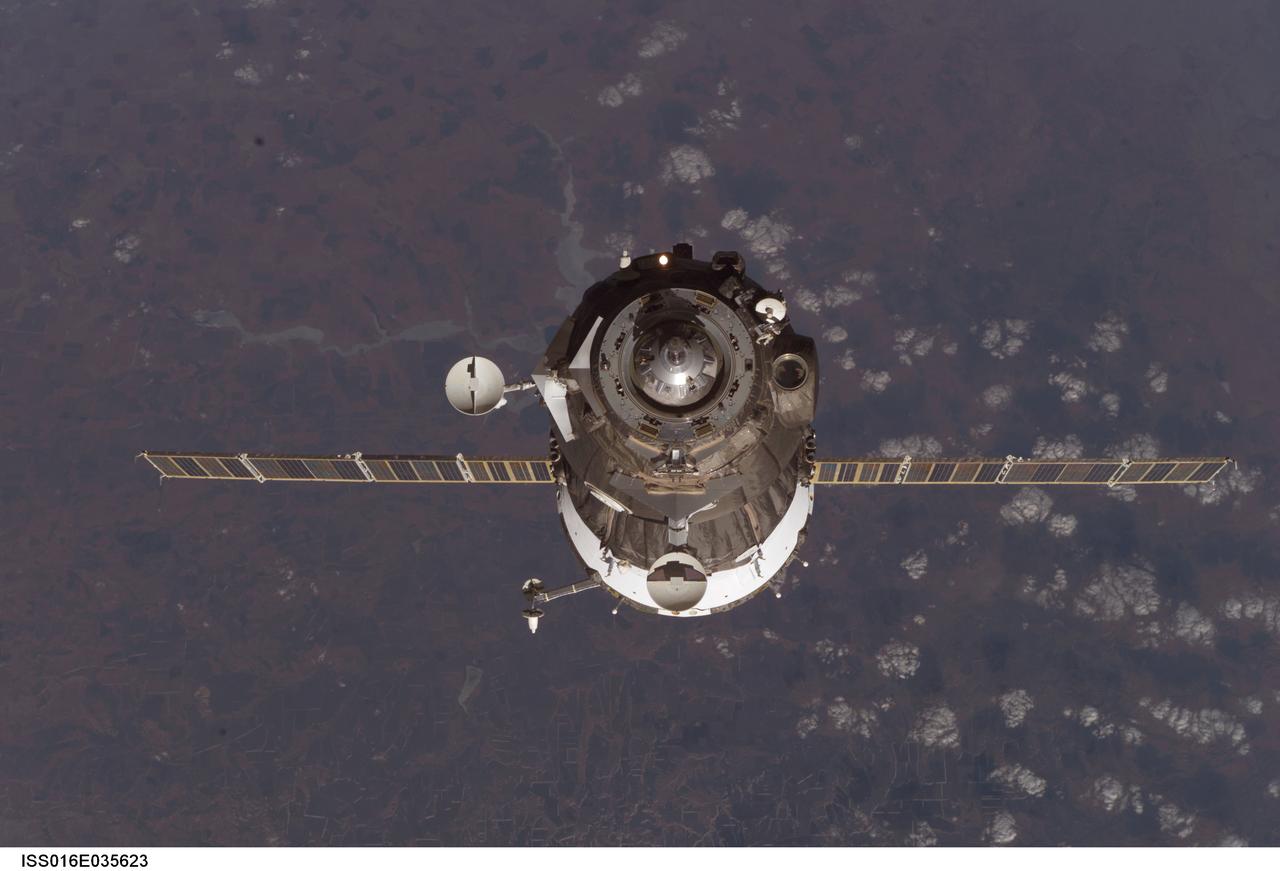
ISS016-E-035623 (10 April 2008) --- The Soyuz TMA-12 spacecraft approaches the International Space Station, carrying Russian Federal Space Agency cosmonauts Sergei Volkov, Expedition 17 commander; Oleg Kononenko, flight engineer; and South Korean spaceflight participant So-yeon Yi. Volkov and Kononenko will spend six months on the station, while Yi will return to Earth April 19 with two of the Expedition 16 crewmembers currently on the complex. Docking with the Pirs Docking Compartment occurred at 8:57 a.m. (EDT) on April 10, 2008.
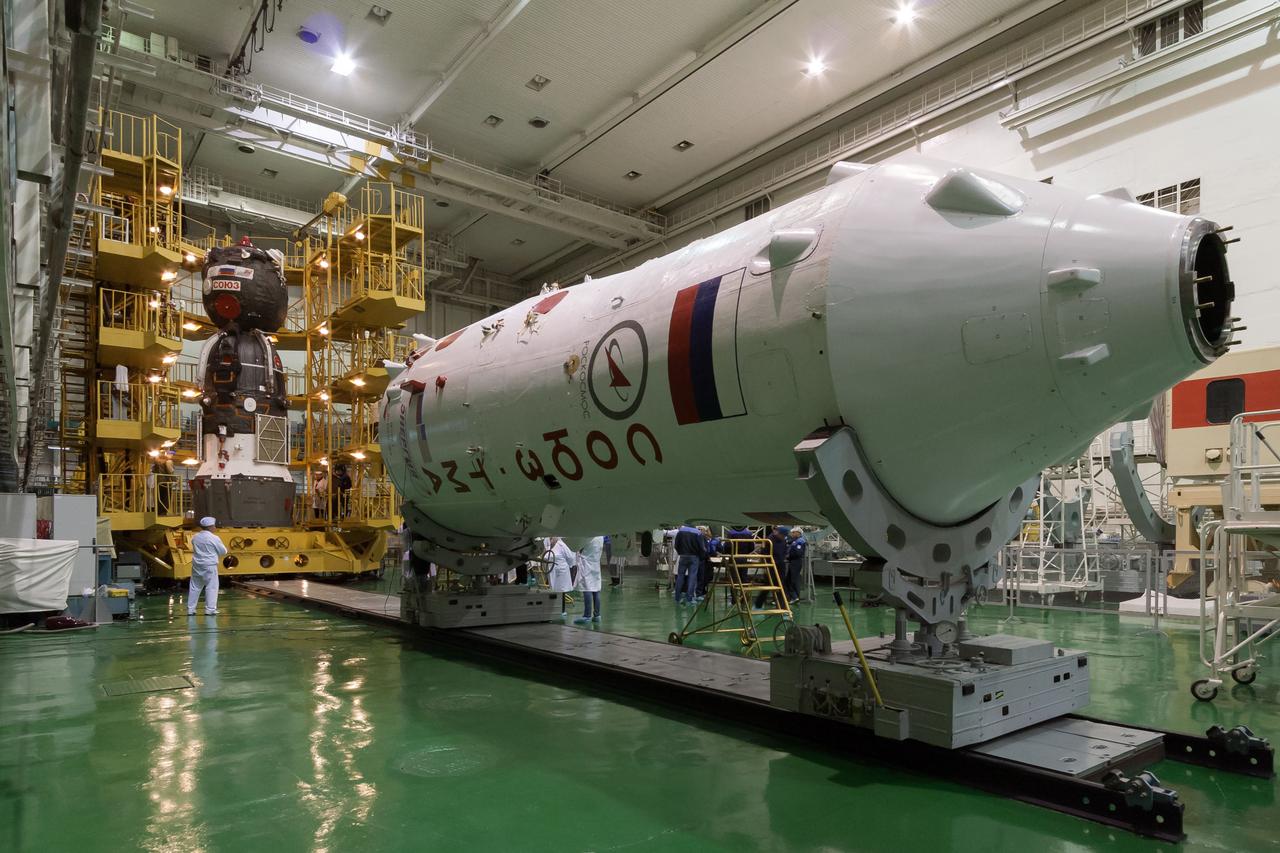
In the Integration Facility at the Baikonur Cosmodrome in Kazakhstan, the Soyuz TMA-07M spacecraft is seen in the background against the Soyuz booster rocket upper stage (in the foreground) as technicians worked to encapsulate the vehicle in the upper stage Dec. 12, 2012 for the launch of the Expedition 34/35 crew. The vehicle will be rolled to the launch pad at Baikonur Dec. 17 in advance of the Dec. 19 launch of NASA Flight Engineer Tom Marshburn, Soyuz Commander Roman Romanenko and Flight Engineer Chris Hadfield of the Canadian Space Agency for a five-month mission on the International Space Station. Photo Credit: NASA/Victor Zelentsov

In the Integration Facility at the Baikonur Cosmodrome in Kazakhstan, the Soyuz TMA-07M spacecraft is lowered into place for its encapsulation into the upper stage of the Soyuz booster Dec. 12, 2012 as preparations continue for the launch of the Expedition 34/35 crew. The vehicle will be rolled to the launch pad at Baikonur Dec. 17 in advance of the Dec. 19 launch of NASA Flight Engineer Tom Marshburn, Soyuz Commander Roman Romanenko and Flight Engineer Chris Hadfield of the Canadian Space Agency for a five-month mission on the International Space Station. Photo Credit: NASA/Victor Zelentsov
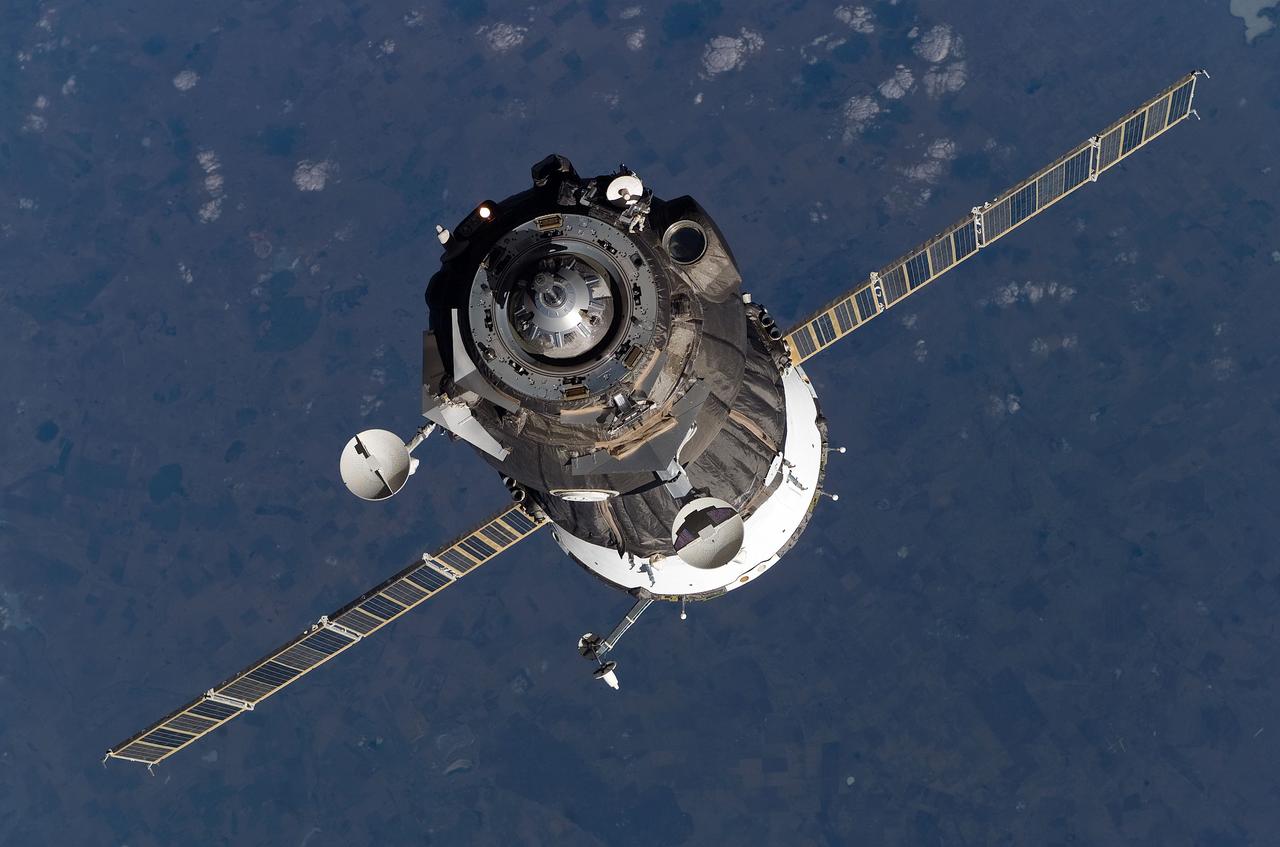
ISS016-E-035625 (10 April 2008) --- The Soyuz TMA-12 spacecraft approaches the International Space Station, carrying Russian Federal Space Agency cosmonauts Sergei Volkov, Expedition 17 commander; Oleg Kononenko, flight engineer; and South Korean spaceflight participant So-yeon Yi. Volkov and Kononenko will spend six months on the station, while Yi will return to Earth April 19 with two of the Expedition 16 crewmembers currently on the complex. Docking with the Pirs Docking Compartment occurred at 8:57 a.m. (EDT) on April 10, 2008.
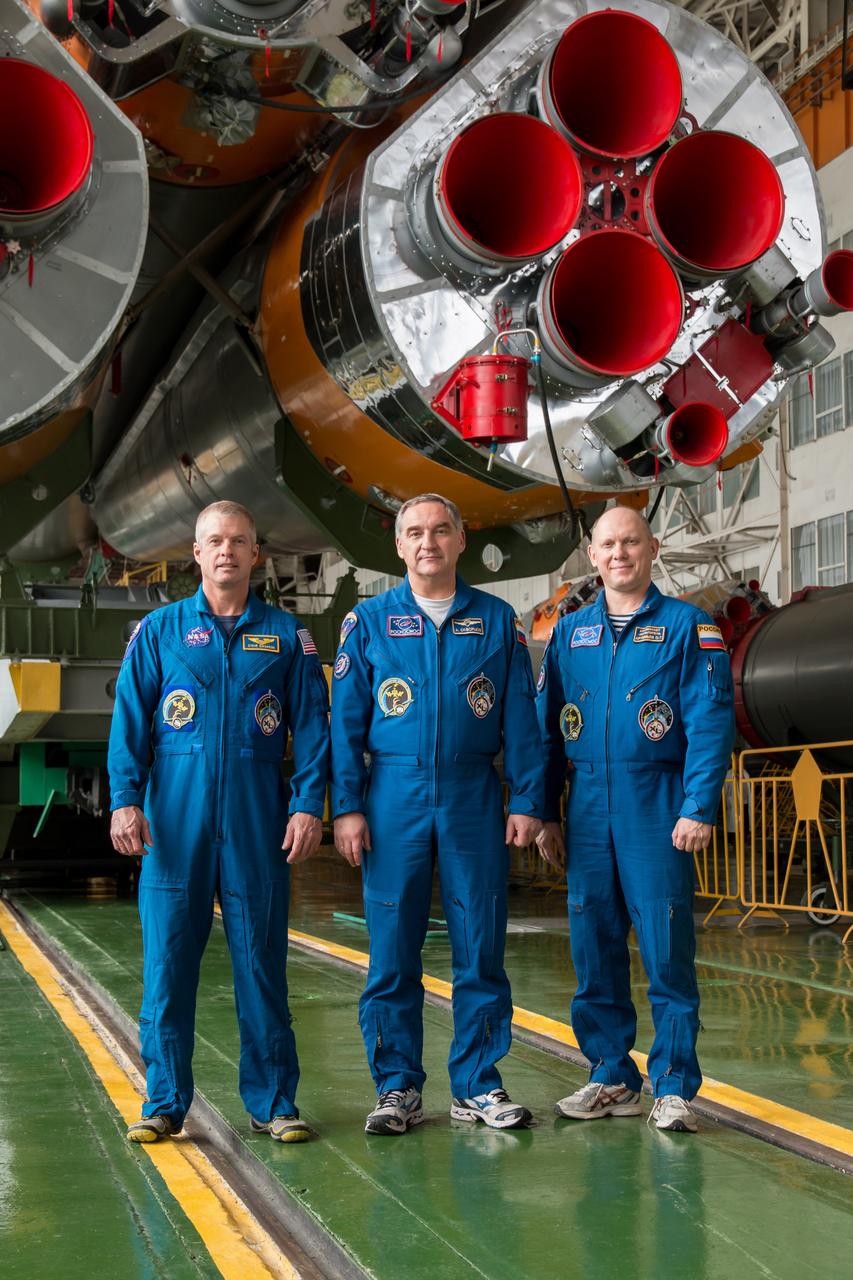
12-19-17-2: In the Integration Facility at the Baikonur Cosmodrome in Kazakhstan, Expedition 39/40 Flight Engineer Steve Swanson of NASA (left), Soyuz Commander Alexander Skvortsov of the Russian Federal Space Agency (Roscosmos; center) and Flight Engineer Oleg Artemyev of Roscosmos (right) pose for pictures in front of the first stage engines of their Soyuz TMA-12M spacecraft March 21. Swanson, Skvortsov and Artemyev are wrapping up training for their launch to the International Space Station March 26, Kazakh time, for a six-month mission on the orbital laboratory. NASA/Victor Zelentsov
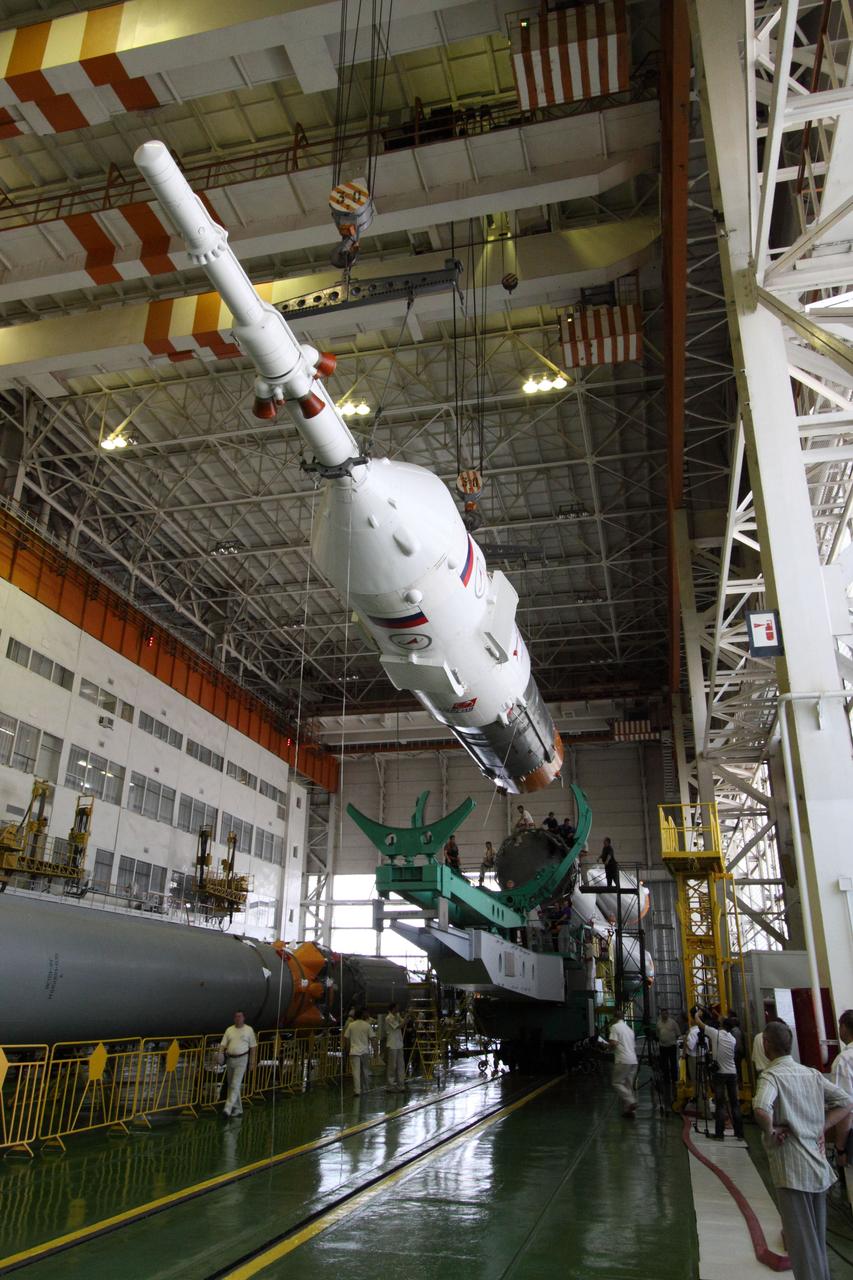
JSC2010-E-092273 (12 June 2010) --- At the Baikonur Cosmodrome in Kazakhstan, Russian technicians prepare to mate the upper stage of the Soyuz TMA-19 spacecraft and its launch escape tower to the remainder of the booster June 12, 2010 as work continues for the launch of the remaining three members of the Expedition 24 crew to the International Space Station. The Soyuz rolled out to its launch pad in Baikonur June 13. Soyuz commander Fyodor Yurchikhin of Russia's Federal Space Agency and NASA astronauts Doug Wheelock and Shannon Walker are set to launch 5:35 p.m. (EDT) on June 15 (or at 3:35 a.m. June 16, Kazakhstan time), on the Soyuz with docking to the station scheduled at 6:25 p.m. (EDT) June 17. Photo credit: NASA/Victor Zelentsov
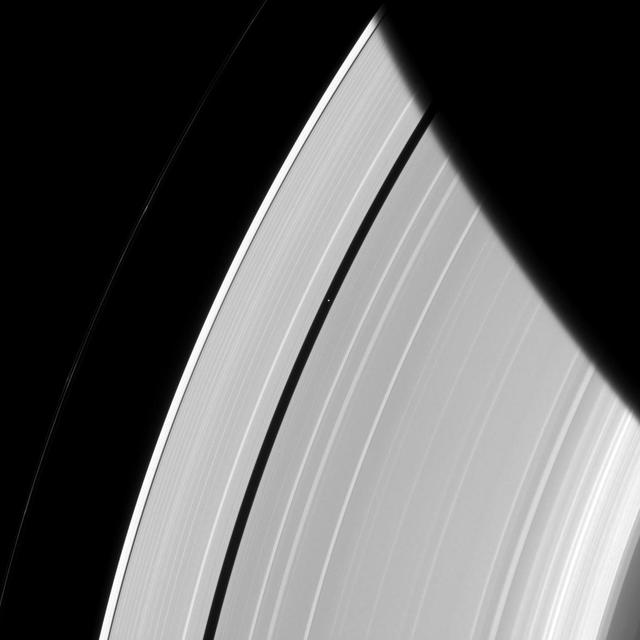
Saturn's innermost moon Pan orbits the giant planet seemingly alone in a ring gap its own gravity creates. Pan (17 miles, or 28 kilometers across) maintains the Encke Gap in Saturn's A ring by gravitationally nudging the ring particles back into the rings when they stray in the gap. Scientists think similar processes might be at work as forming planets clear gaps in the circumstellar disks from which they form. This view looks toward the sunlit side of the rings from about 38 degrees above the ringplane. The image was taken in visible light with the Cassini spacecraft narrow-angle camera on May 3, 2014. The view was acquired at a distance of approximately 2 million miles (3.2 million kilometers) from Pan and at a Sun-Pan-spacecraft, or phase, angle of 56 degrees. Image scale is 12 miles (19 kilometers) per pixel. http://photojournal.jpl.nasa.gov/catalog/PIA18281

KENNEDY SPACE CENTER, FLA. - Sunset-shaded clouds of purple and pink fill the sky as the launch tower on pad 17-A, Cape Canaveral Air Force Station, rolls back to reveal the Boeing Delta II rocket with NASA's Comet Nucleus Tour (CONTOUR) spacecraft attached. The launch is scheduled for 2:47 a.m. EDT July 3. Designed and built by The Johns Hopkins University Applied Physics Laboratory (APL) in Laurel, Md., the 2,138-pound (970-kilogram) spacecraft will be placed into an elliptical Earth orbit until Aug. 15, when it is scheduled to fire its main engine and enter a comet-chasing orbit around the sun. The mission's flexible four-year plan includes encounters with comets Encke (Nov. 12, 2003) and Schwassmann-Wachmann 3 (June 19, 2006), though it can add an encounter with a "new" and scientifically valuable comet from the outer solar system, should one be discovered in time for CONTOUR to fly past it. CONTOUR's four scientific instruments will take detailed pictures and measure the chemical makeup of each comet's nucleus -- a chunk of ice and rock -- while analyzing the surrounding gas and dust.
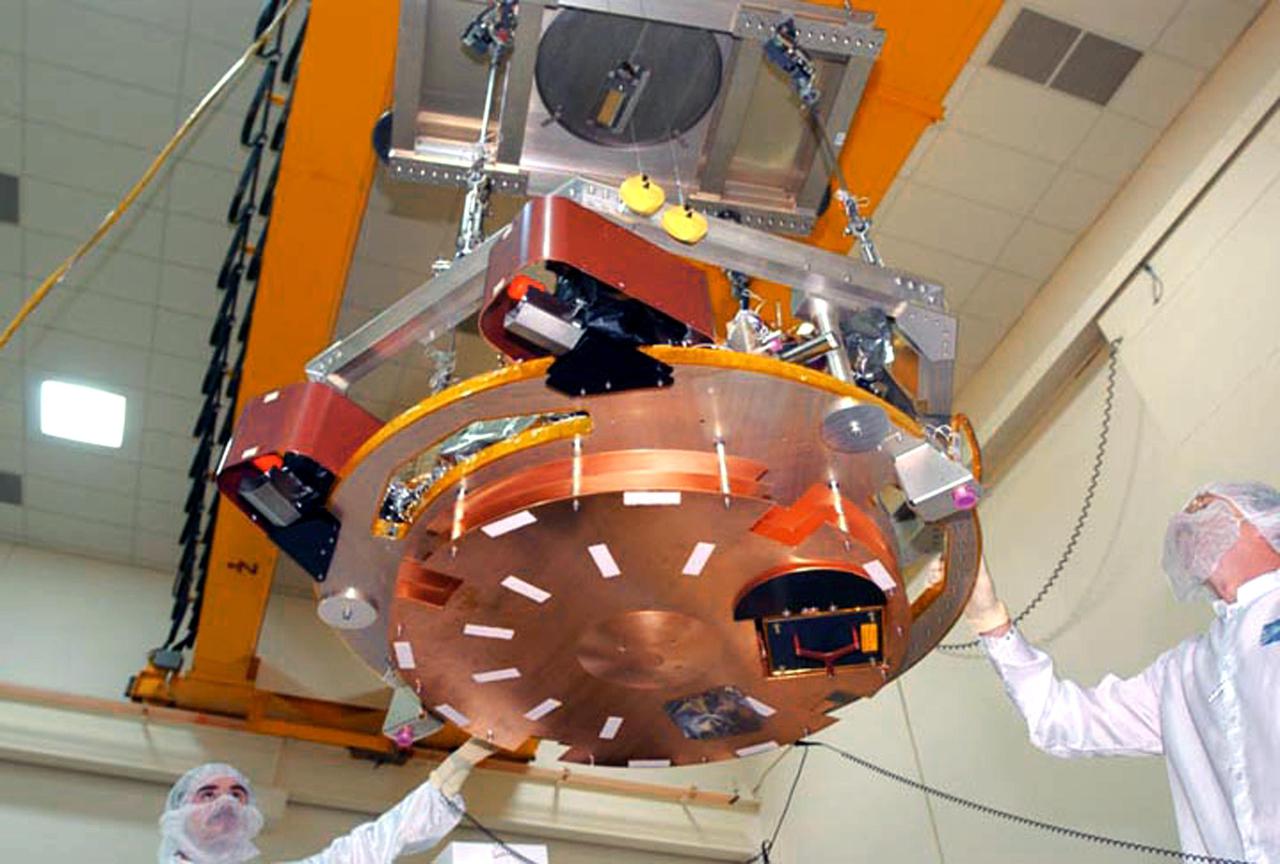
JET PROPULSION LABORATORY, CALIF. - The impactor of the Deep Impact spacecraft, suspended by an overhead crane, undergoes inspection in the Fischer Assembly building at Ball Aerospace in Boulder, Colo. Deep Impact will probe beneath the surface of Comet Tempel 1 on July 4, 2005, when the comet is 83 million miles from Earth, and reveal the secrets of its interior. After releasing a 3- by 3-foot projectile (impactor) to crash onto the surface, Deep Impact’s flyby spacecraft will collect pictures and data of how the crater forms, measuring the crater’s depth and diameter, as well as the composition of the interior of the crater and any material thrown out, and determining the changes in natural outgassing produced by the impact. The impactor will separate from the flyby spacecraft 24 hours before it impacts the surface of Tempel 1's nucleus. The impactor delivers 19 Gigajoules (that's 4.8 tons of TNT) of kinetic energy to excavate the crater. This kinetic energy is generated by the combination of the mass of the impactor and its velocity when it impacts. To accomplish this feat, the impactor uses a high-precision star tracker, the Impactor Target Sensor (ITS), and Auto-Navigation algorithms developed by Jet Propulsion Laboratory to guide it to the target. Deep Impact is a NASA Discovery mission. Launch of Deep Impact is scheduled for Jan. 12 from Launch Pad 17-B, Cape Canaveral Air Force Station, Fla.
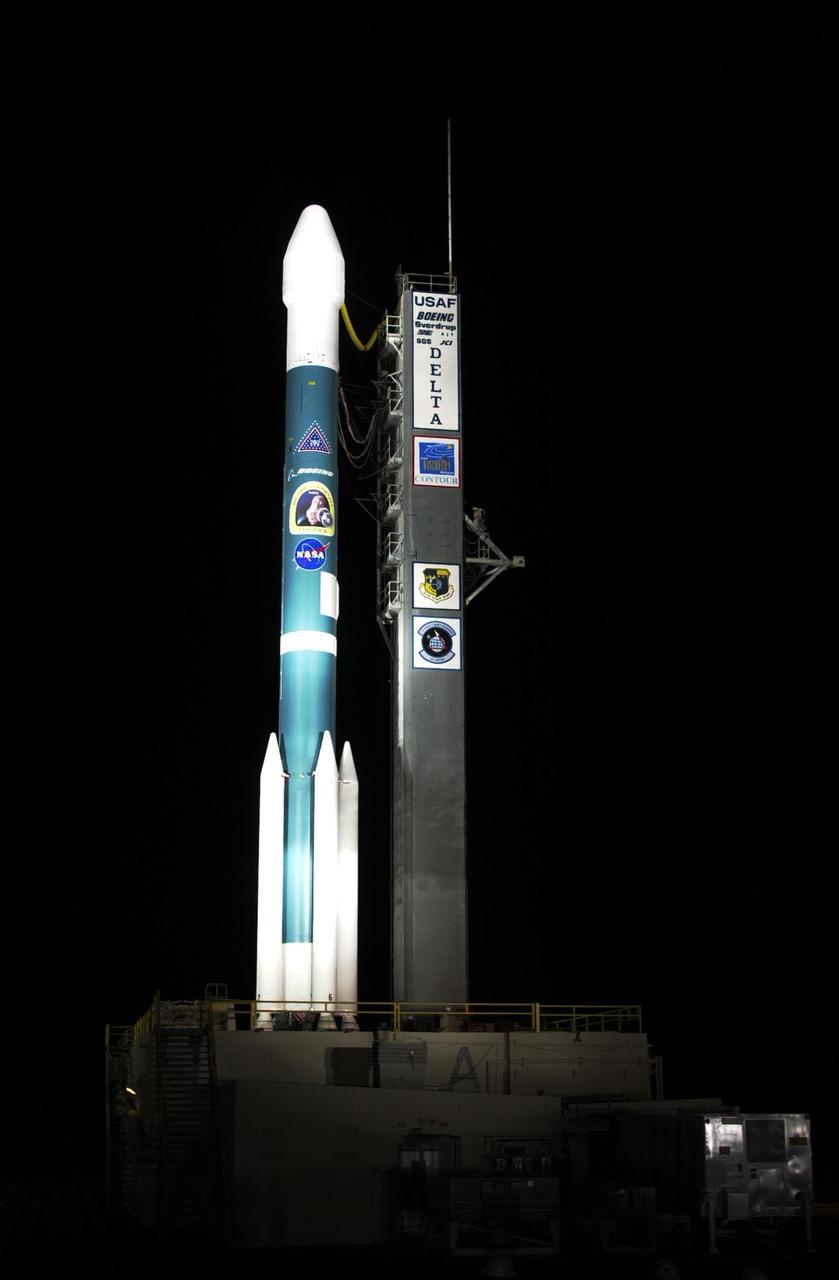
KENNEDY SPACE CENTER, FLA. -- The Boeing Delta II rocket with NASA's Comet Nucleus Tour (CONTOUR) spacecraft attached is bathed in light as it sits on pad 17-A, Cape Canaveral Air Force Station. The launch is scheduled for 2:47 a.m. EDT July 3. Designed and built by The Johns Hopkins University Applied Physics Laboratory (APL) in Laurel, Md., the 2,138-pound (970-kilogram) spacecraft will be placed into an elliptical Earth orbit until Aug. 15, when it is scheduled to fire its main engine and enter a comet-chasing orbit around the sun. The mission's flexible four-year plan includes encounters with comets Encke (Nov. 12, 2003) and Schwassmann-Wachmann 3 (June 19, 2006), though it can add an encounter with a "new" and scientifically valuable comet from the outer solar system, should one be discovered in time for CONTOUR to fly past it. CONTOUR's four scientific instruments will take detailed pictures and measure the chemical makeup of each comet's nucleus -- a chunk of ice and rock -- while analyzing the surrounding gas and dust.
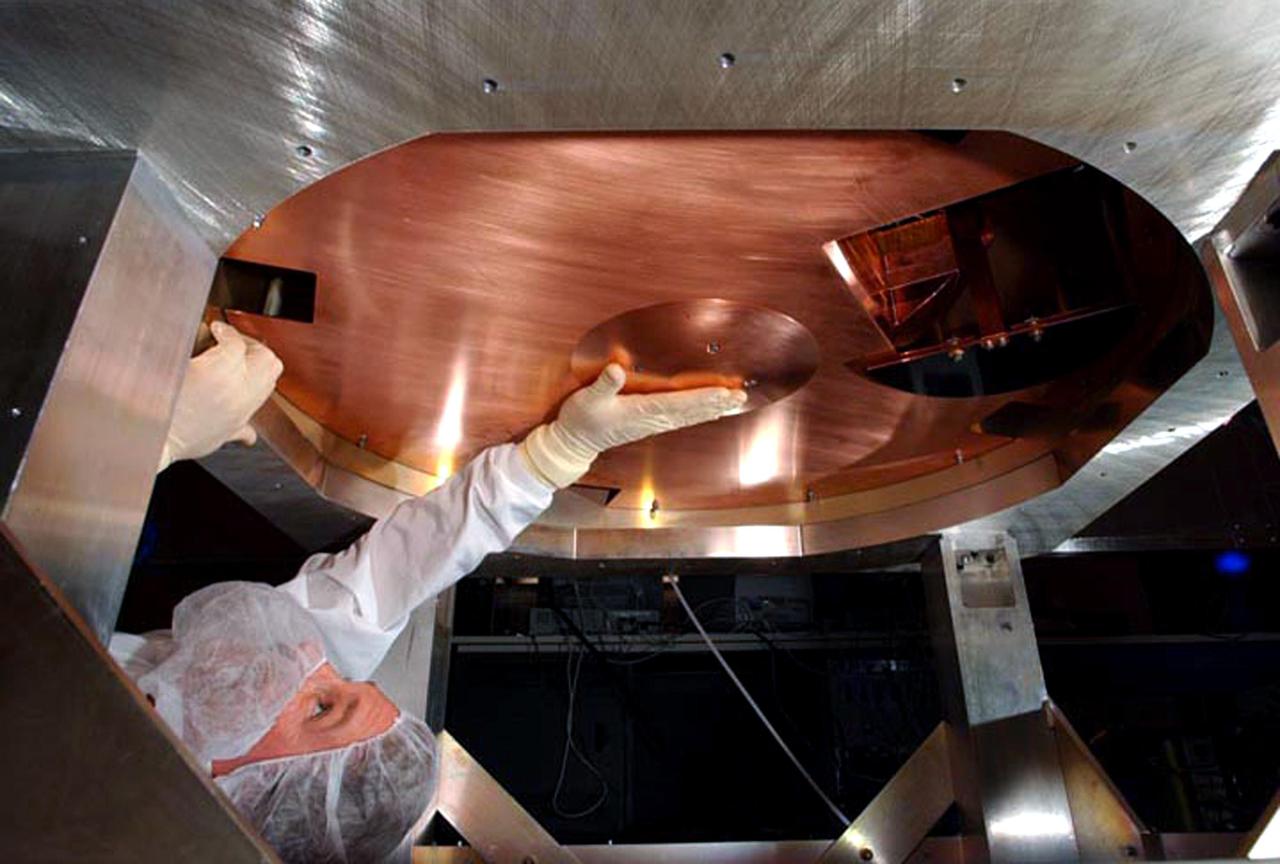
KENNEDY SPACE CENTER, FLA. - At Ball Aerospace in Boulder, Colo., the impactor on the Deep Impact spacecraft is tested. Deep Impact will probe beneath the surface of Comet Tempel 1 on July 4, 2005, when the comet is 83 million miles from Earth, and reveal the secrets of its interior. After releasing a 3- by 3-foot projectile (impactor) to crash onto the surface, Deep Impact’s flyby spacecraft will collect pictures and data of how the crater forms, measuring the crater’s depth and diameter, as well as the composition of the interior of the crater and any material thrown out, and determining the changes in natural outgassing produced by the impact. The impactor will separate from the flyby spacecraft 24 hours before it impacts the surface of Tempel 1's nucleus. The impactor delivers 19 Gigajoules (that's 4.8 tons of TNT) of kinetic energy to excavate the crater. This kinetic energy is generated by the combination of the mass of the impactor and its velocity when it impacts. To accomplish this feat, the impactor uses a high-precision star tracker, the Impactor Target Sensor (ITS), and Auto-Navigation algorithms developed by Jet Propulsion Laboratory to guide it to the target. Deep Impact is a NASA Discovery mission. Launch of Deep Impact is scheduled for Jan. 12 from Launch Pad 17-B, Cape Canaveral Air Force Station, Fla.
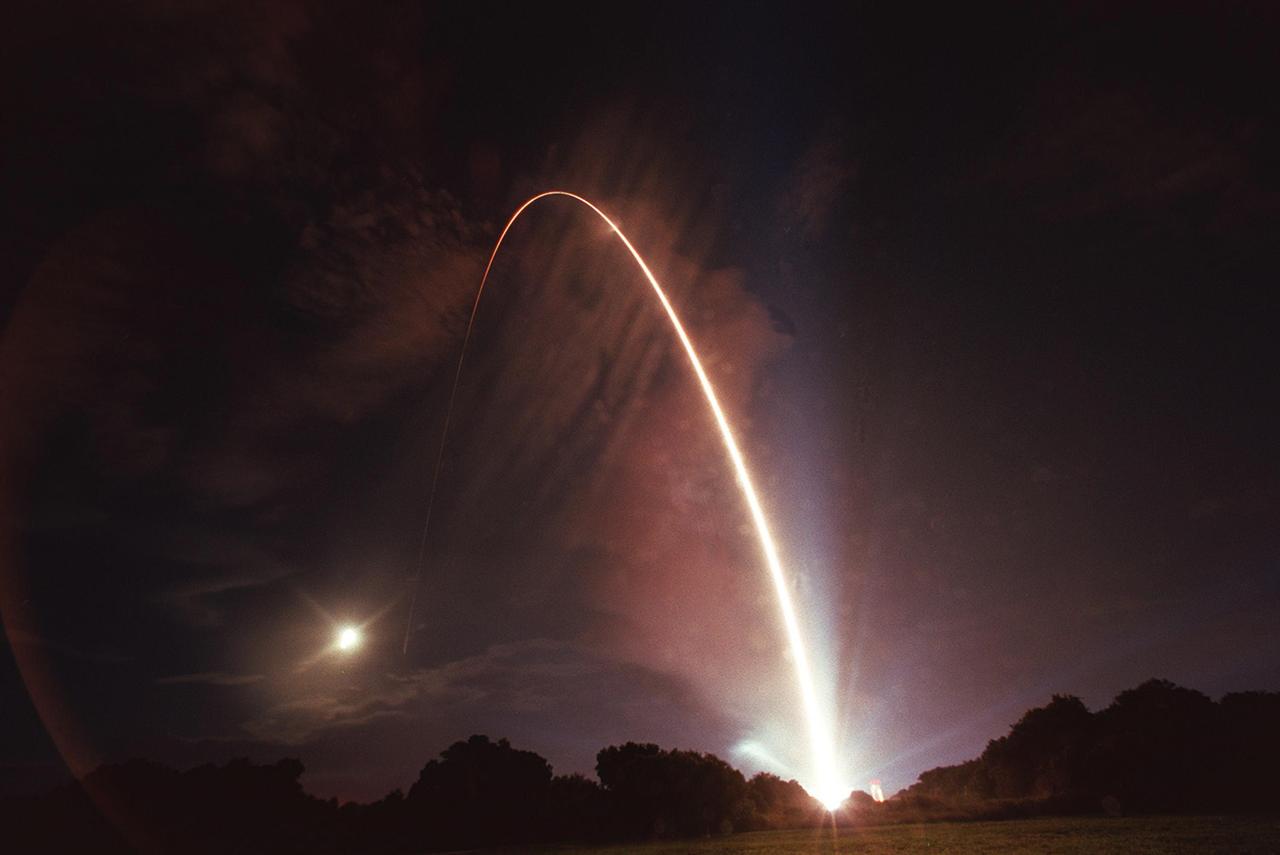
KENNEDY SPACE CENTER, FLA. -- The Boeing Delta II rocket carrying NASA's Comet Nucleus Tour (CONTOUR) spacecraft streaks across the night sky above pad 17-A, Cape Canaveral Air Force Station. The launch took place at 2:47:41 a.m. EDT July 3. Designed and built by The Johns Hopkins University Applied Physics Laboratory (APL) in Laurel, Md., the 2,138-pound (970-kilogram) spacecraft will be placed into an elliptical Earth orbit until Aug. 15, when it is scheduled to fire its main engine and enter a comet-chasing orbit around the sun. The mission's flexible four-year plan includes encounters with comets Encke (Nov. 12, 2003) and Schwassmann-Wachmann 3 (June 19, 2006), though it can add an encounter with a "new" and scientifically valuable comet from the outer solar system, should one be discovered in time for CONTOUR to fly past it. CONTOUR's four scientific instruments will take detailed pictures and measure the chemical makeup of each comet's nucleus -- a chunk of ice and rock -- while analyzing the surrounding gas and dust.
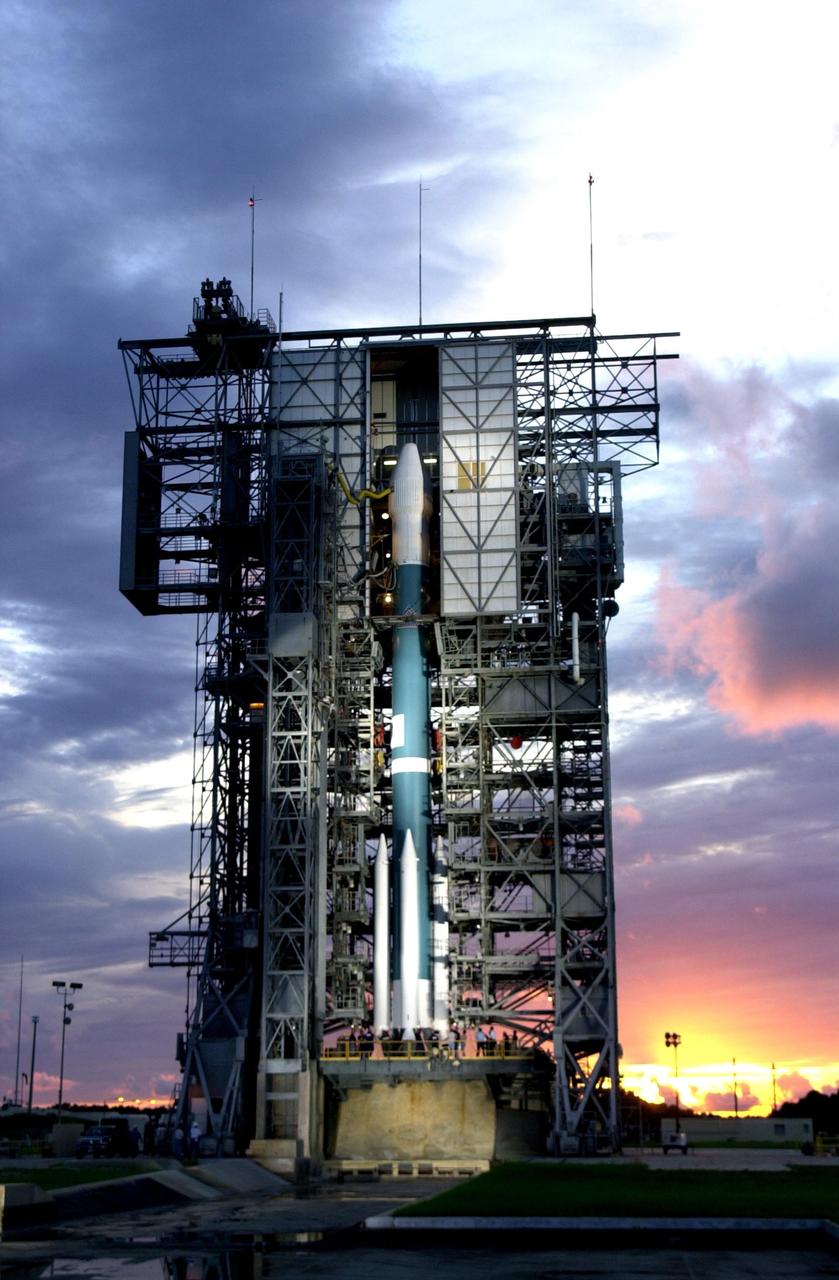
KENNEDY SPACE CENTER, FLA. -- The setting sun casts purple and pink shades in the sky as the launch tower on pad 17-A, Cape Canaveral Air Force Station, rolls back to reveal the Boeing Delta II rocket with NASA's Comet Nucleus Tour (CONTOUR) spacecraft attached. The launch is scheduled for 2:47 a.m. EDT July 3. Designed and built by The Johns Hopkins University Applied Physics Laboratory (APL) in Laurel, Md., the 2,138-pound (970-kilogram) spacecraft will be placed into an elliptical Earth orbit until Aug. 15, when it is scheduled to fire its main engine and enter a comet-chasing orbit around the sun. The mission's flexible four-year plan includes encounters with comets Encke (Nov. 12, 2003) and Schwassmann-Wachmann 3 (June 19, 2006), though it can add an encounter with a "new" and scientifically valuable comet from the outer solar system, should one be discovered in time for CONTOUR to fly past it. CONTOUR's four scientific instruments will take detailed pictures and measure the chemical makeup of each comet's nucleus -- a chunk of ice and rock -- while analyzing the surrounding gas and dust.

It’s usually the big, sprawling storms that attract the attention of meteorologists, but occasionally tiny storms can make news as well. The most recent example is a suspected mini-typhoon that drifted across the western Pacific Ocean in mid-July 2013. The storm system emerged on July 16 and dissipated by July 19 without making landfall or causing any significant damage. The Moderate Resolution Imaging Spectroradiometer (MODIS) on NASA’s Terra satellite captured this true-color image of the storm on July 17, 2013. It had the spiral shape of a tropical cyclone, but the cloud field was less than 100 kilometers (60 miles) across. For comparison, Super Typhoon Jelawat, the most intense storm of the 2012 season, had a cloud field that stretched nearly 1,000 kilometers (600 miles). Jelawat’s eye alone—with a diameter of 64 kilometers (40 miles)—was two-thirds the size of the entire July 2013 storm. Despite their small size, mini-cyclones are driven by the same forces that drive larger storms. Both small and large cyclonic storms are simply organized convection feeding off warm water in areas with low wind shear. According to the Joint Typhoon Warning Center, the low-pressure areas for these mini-typhoons must span less than two degrees of latitude (about 140 miles) and have sustained winds of 65 knots (74 miles per hour). The 2013 storm in the Pacific certainly meets the first criteria, but it is unlikely that the storm achieved typhoon-force winds. It’s also unlikely that the system had a “warm core,” which all true tropical cyclones have. While this storm did not cause damage, other mini storms certainly have. In 1974, the miniature cyclone Tracy hit Darwin, Australia, killing 71 people and destroying more than 70 percent of the city’s buildings. According to the National Hurricane Center, tropical cyclone Marco unseated Tracy as the smallest tropical cyclone on record in 2008. Marco had gale force winds that extended just 19 kilometers (12 miles). Typhoon Tip, with gale force winds extending 1,000 kilometers (675 miles) is the largest tropical cyclone on record. Credit: NASA/GSFC/Jeff Schmaltz/MODIS Land Rapid Response Team <b><a href="http://www.nasa.gov/audience/formedia/features/MP_Photo_Guidelines.html" rel="nofollow">NASA image use policy.</a></b> <b><a href="http://www.nasa.gov/centers/goddard/home/index.html" rel="nofollow">NASA Goddard Space Flight Center</a></b> enables NASA’s mission through four scientific endeavors: Earth Science, Heliophysics, Solar System Exploration, and Astrophysics. Goddard plays a leading role in NASA’s accomplishments by contributing compelling scientific knowledge to advance the Agency’s mission. <b>Follow us on <a href="http://twitter.com/NASA_GoddardPix" rel="nofollow">Twitter</a></b> <b>Like us on <a href="http://www.facebook.com/pages/Greenbelt-MD/NASA-Goddard/395013845897?ref=tsd" rel="nofollow">Facebook</a></b> <b>Find us on <a href="http://instagrid.me/nasagoddard/?vm=grid" rel="nofollow">Instagram</a></b>
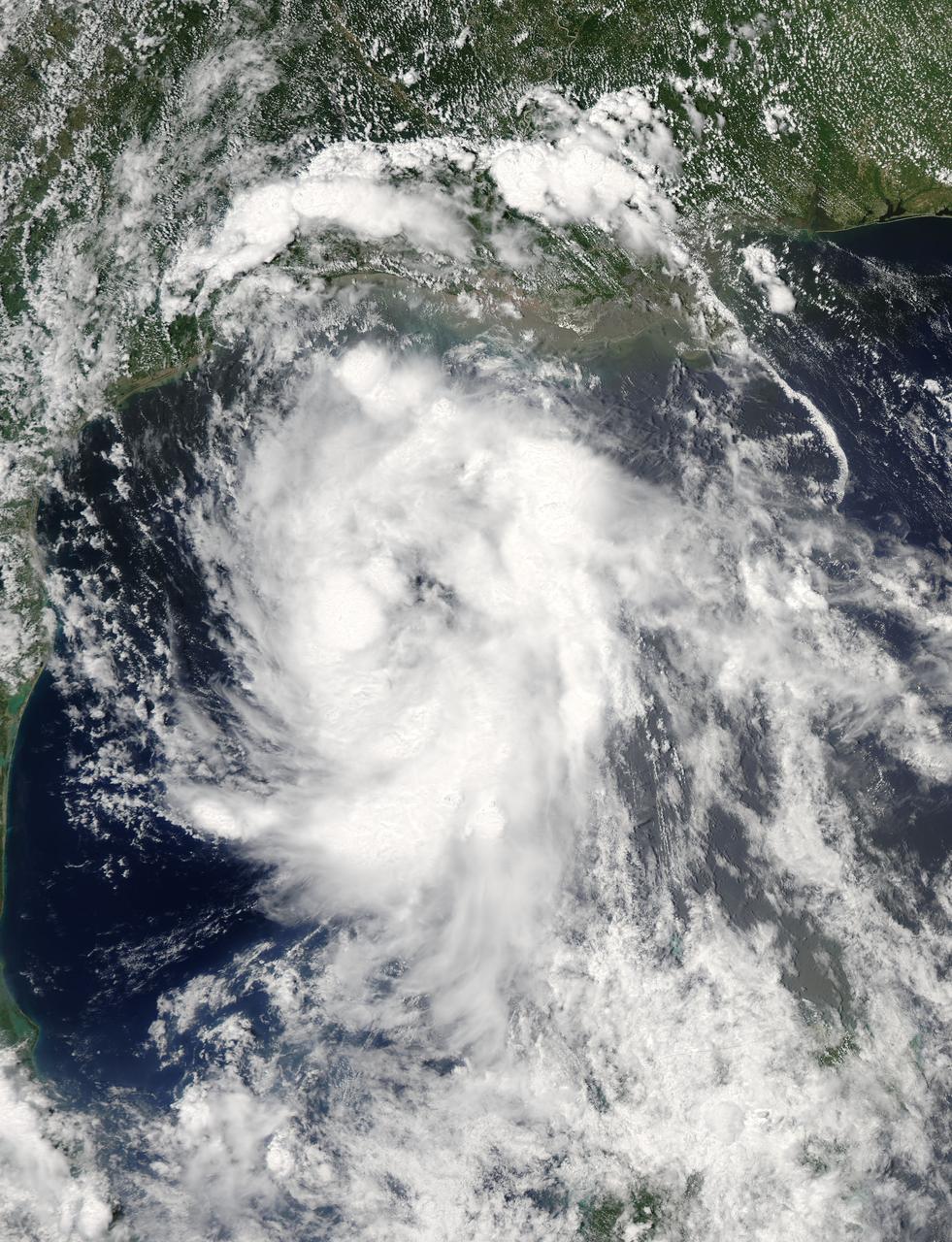
On June 15 at 19:15 UTC (3:15 p.m. EDT) the MODIS instrument aboard NASA's Aqua satellite captured a visible image of Tropical Storm Bill approaching Texas and Louisiana. Powerful thunderstorms circled the center in fragmented bands. At 11 a.m. CDT on June 16, a Tropical Storm Warning was in effect from Baffin Bay to High Island Texas as Bill was making landfall. The National Hurricane Center noted that Bill is expected to produce total rain accumulations of 4 to 8 inches over eastern Texas and eastern Oklahoma and 2 to 4 inches over western Arkansas and southern Missouri, with possible isolated maximum amounts of 12 inches in eastern Texas. In eastern Texas and far western Louisiana today and tonight, isolated tornadoes are also possible, as with any landfalling tropical storm. Tropical storm conditions are expected to continue into the evening in the warning area. Along the coasts, the combination of a storm surge and the tide will cause normally dry areas near the coast to be flooded by rising waters. The water could reach the following heights above ground if the peak surge occurs at the time of high tide. The NHC noted that the Upper Texas coast could experience 2 to 4 feet, and the western Louisiana coast between 1 to 2 feet. At 10 a.m. CDT (1500 UTC), the center of Tropical Storm Bill was located near latitude 28.2 North, longitude 96.4 West. Bill was moving toward the northwest near 10 mph (17 kph) and that general motion is expected to continue today. The latest minimum central pressure reported by an Air Force Reserve Hurricane Hunter aircraft was 997 millibars. Reports from an Air Force Reserve reconnaissance aircraft indicate that maximum sustained winds remain near 60 mph (95 kph) with higher gusts. Unlike Carlos, Bill is not a compact storm. Tropical-storm-force winds extend outward up to 150 miles (240 km) from the center. Between 9 and 10 a.m. CDT, an automated observing station at Port O'Connor also reported a sustained wind of 44 mph (70 kph) and a gust to 53 mph (85 kph). For updated forecasts, watches and warnings, visit the National Hurricane Center webpage at <a href="http://www.nhc.noaa.gov" rel="nofollow">www.nhc.noaa.gov</a>. For local forecasts and advisories, visit: <a href="http://www.weather.gov" rel="nofollow">www.weather.gov</a>. Bill is forecast to continue moving inland and is expected to be a tropical depression by Wednesday, June 17, west of Dallas. The remnants of Bill are forecast to move into the Midwest later in the week. Credit: NASA/GSFC/Jeff Schmaltz/MODIS Land Rapid Response Team <b><a href="http://www.nasa.gov/audience/formedia/features/MP_Photo_Guidelines.html" rel="nofollow">NASA image use policy.</a></b> <b><a href="http://www.nasa.gov/centers/goddard/home/index.html" rel="nofollow">NASA Goddard Space Flight Center</a></b> enables NASA’s mission through four scientific endeavors: Earth Science, Heliophysics, Solar System Exploration, and Astrophysics. Goddard plays a leading role in NASA’s accomplishments by contributing compelling scientific knowledge to advance the Agency’s mission. <b>Follow us on <a href="http://twitter.com/NASAGoddardPix" rel="nofollow">Twitter</a></b> <b>Like us on <a href="http://www.facebook.com/pages/Greenbelt-MD/NASA-Goddard/395013845897?ref=tsd" rel="nofollow">Facebook</a></b> <b>Find us on <a href="http://instagrid.me/nasagoddard/?vm=grid" rel="nofollow">Instagram</a></b>
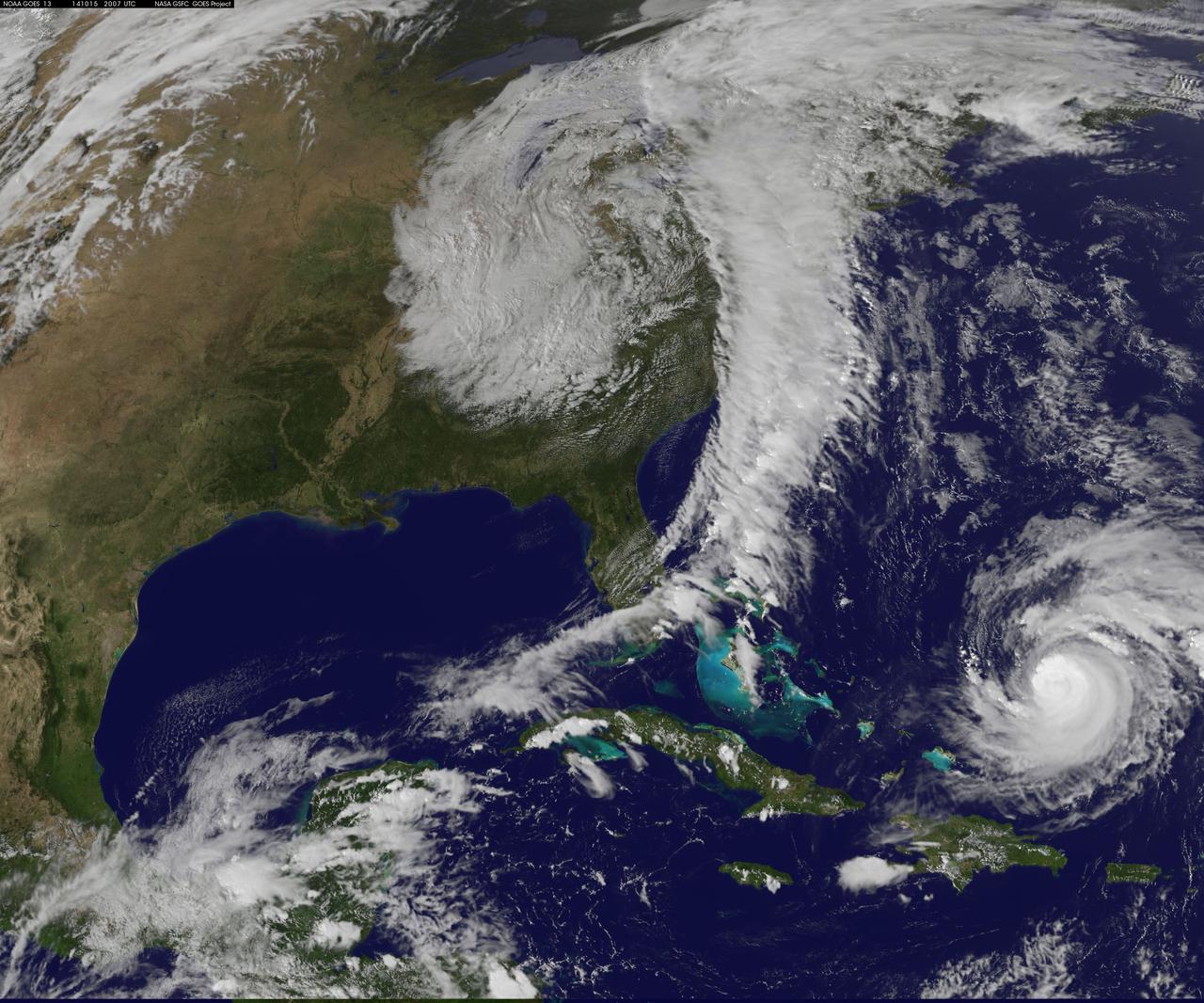
Hurricane Gonzalo has made the jump to major hurricane status and on Oct. 15 was a Category 4 storm on the Saffir-Simpson Hurricane Scale. NOAA's GOES-East satellite provided imagery of the storm. According to the National Hurricane Center, Gonzalo is the first category 4 hurricane in the Atlantic basin since Ophelia in 2011. NOAA's GOES-East satellite provides visible and infrared images of weather from its orbit in a fixed position over the Earth. On Oct. 15 at 15:15 UTC (11:15 a.m. EDT) GOES saw Gonzalo had tightly wrapped bands of thunderstorms spiraling into the center of its circulation. The eye of the storm was obscured by high clouds in the image. NOAA aircraft data and microwave images clearly show concentric eyewalls, with the inner radius of maximum winds now only about 4-5 nautical miles from the center. NOAA manages the GOES satellites, while NASA/NOAA's GOES Project at NASA's Goddard Space Flight Center in Greenbelt, Maryland created the image. The NASA/NOAA GOES Project creates images and animations from GOES data. At 11 a.m. EDT on Oct. 15, Gonzalo's maximum sustained winds increased to near 130 mph (215 kph) and the National Hurricane Center (NHC) noted that fluctuations in intensity are expected over the next couple of days. Gonzalo's cloud-covered eye was located near latitude 23.5 north and longitude 68.0 west, about 640 miles (1,025 km) south-southwest of Bermuda. Gonzalo is moving toward the northwest near 12 mph (19 kph). The minimum central pressure recently reported by an air force reconnaissance aircraft was 949 millibars. Tropical storm conditions are possible in Bermuda by late Thursday night, Oct. 16, and hurricane conditions are possible over Bermuda on Friday Oct. 16. Ocean swells however, will be felt over a much larger area, reached the U.S. east coast on Oct. 16. Large swells generated by Gonzalo are affecting portions of the Virgin Islands, the northern coasts of Puerto Rico and the Dominican Republic and portions of the Bahamas. Swells will reach much of the east coast of the United States and Bermuda on Thursday. By late Oct. 16, Gonzalo is expected to turn to the northeast and the center is expected to approach Bermuda sometime on Oct. 17. Credit: NASA/GSFC/Jeff Schmaltz/MODIS Land Rapid Response Team <b><a href="http://www.nasa.gov/audience/formedia/features/MP_Photo_Guidelines.html" rel="nofollow">NASA image use policy.</a></b> <b><a href="http://www.nasa.gov/centers/goddard/home/index.html" rel="nofollow">NASA Goddard Space Flight Center</a></b> enables NASA’s mission through four scientific endeavors: Earth Science, Heliophysics, Solar System Exploration, and Astrophysics. Goddard plays a leading role in NASA’s accomplishments by contributing compelling scientific knowledge to advance the Agency’s mission. <b>Follow us on <a href="http://twitter.com/NASAGoddardPix" rel="nofollow">Twitter</a></b> <b>Like us on <a href="http://www.facebook.com/pages/Greenbelt-MD/NASA-Goddard/395013845897?ref=tsd" rel="nofollow">Facebook</a></b> <b>Find us on <a href="http://instagram.com/nasagoddard?vm=grid" rel="nofollow">Instagram</a></b>
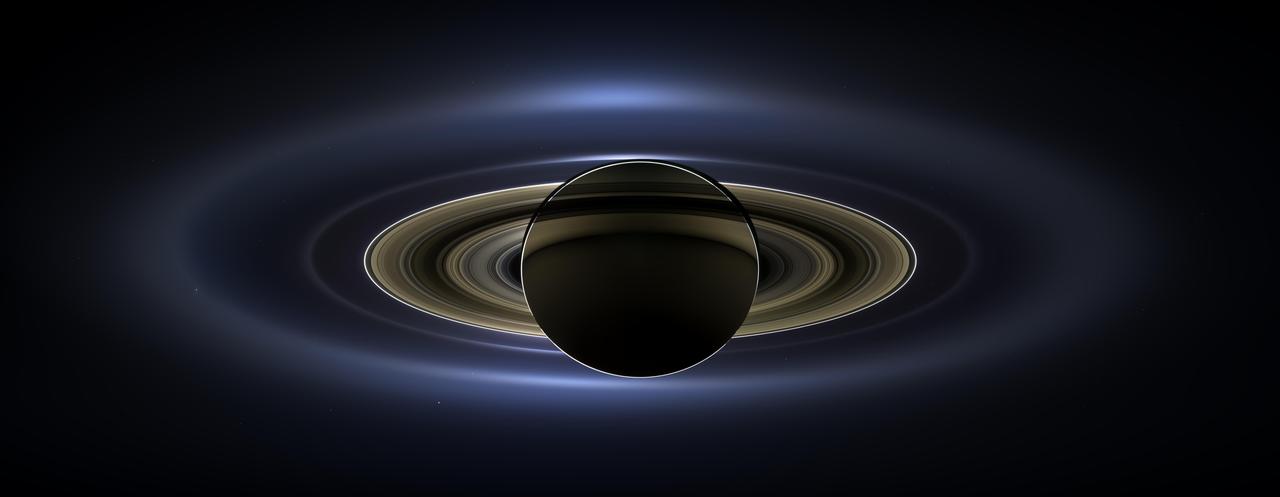
On July 19, 2013, in an event celebrated the world over, NASA's Cassini spacecraft slipped into Saturn's shadow and turned to image the planet, seven of its moons, its inner rings -- and, in the background, our home planet, Earth. With the sun's powerful and potentially damaging rays eclipsed by Saturn itself, Cassini's onboard cameras were able to take advantage of this unique viewing geometry. They acquired a panoramic mosaic of the Saturn system that allows scientists to see details in the rings and throughout the system as they are backlit by the sun. This mosaic is special as it marks the third time our home planet was imaged from the outer solar system; the second time it was imaged by Cassini from Saturn's orbit; and the first time ever that inhabitants of Earth were made aware in advance that their photo would be taken from such a great distance. With both Cassini's wide-angle and narrow-angle cameras aimed at Saturn, Cassini was able to capture 323 images in just over four hours. This final mosaic uses 141 of those wide-angle images. Images taken using the red, green and blue spectral filters of the wide-angle camera were combined and mosaicked together to create this natural-color view. A brightened version with contrast and color enhanced (Figure 1), a version with just the planets annotated (Figure 2), and an annotated version (Figure 3) are shown above. This image spans about 404,880 miles (651,591 kilometers) across. The outermost ring shown here is Saturn's E ring, the core of which is situated about 149,000 miles (240,000 kilometers) from Saturn. The geysers erupting from the south polar terrain of the moon Enceladus supply the fine icy particles that comprise the E ring; diffraction by sunlight gives the ring its blue color. Enceladus (313 miles, or 504 kilometers, across) and the extended plume formed by its jets are visible, embedded in the E ring on the left side of the mosaic. At the 12 o'clock position and a bit inward from the E ring lies the barely discernible ring created by the tiny, Cassini-discovered moon, Pallene (3 miles, or 4 kilometers, across). (For more on structures like Pallene's ring, see PIA08328). The next narrow and easily seen ring inward is the G ring. Interior to the G ring, near the 11 o'clock position, one can barely see the more diffuse ring created by the co-orbital moons, Janus (111 miles, or 179 kilometers, across) and Epimetheus (70 miles, or 113 kilometers, across). Farther inward, we see the very bright F ring closely encircling the main rings of Saturn. Following the outermost E ring counter-clockwise from Enceladus, the moon Tethys (662 miles, or 1,066 kilometers, across) appears as a large yellow orb just outside of the E ring. Tethys is positioned on the illuminated side of Saturn; its icy surface is shining brightly from yellow sunlight reflected by Saturn. Continuing to about the 2 o'clock position is a dark pixel just outside of the G ring; this dark pixel is Saturn's Death Star moon, Mimas (246 miles, or 396 kilometers, across). Mimas appears, upon close inspection, as a very thin crescent because Cassini is looking mostly at its non-illuminated face. The moons Prometheus, Pandora, Janus and Epimetheus are also visible in the mosaic near Saturn's bright narrow F ring. Prometheus (53 miles, or 86 kilometers, across) is visible as a faint black dot just inside the F ring and at the 9 o'clock position. On the opposite side of the rings, just outside the F ring, Pandora (50 miles, or 81 kilometers, across) can be seen as a bright white dot. Pandora and Prometheus are shepherd moons and gravitational interactions between the ring and the moons keep the F ring narrowly confined. At the 11 o'clock position in between the F ring and the G ring, Janus (111 miles, or 179 kilometers, across) appears as a faint black dot. Janus and Prometheus are dark for the same reason Mimas is mostly dark: we are looking at their non-illuminated sides in this mosaic. Midway between the F ring and the G ring, at about the 8 o'clock position, is a single bright pixel, Epimetheus. Looking more closely at Enceladus, Mimas and Tethys, especially in the brightened version of the mosaic, one can see these moons casting shadows through the E ring like a telephone pole might cast a shadow through a fog. In the non-brightened version of the mosaic, one can see bright clumps of ring material orbiting within the Encke gap near the outer edge of the main rings and immediately to the lower left of the globe of Saturn. Also, in the dark B ring within the main rings, at the 9 o'clock position, one can see the faint outlines of two spoke features, first sighted by NASA's Voyager spacecraft in the early 1980s and extensively studied by Cassini. Finally, in the lower right of the mosaic, in between the bright blue E ring and the faint but defined G ring, is the pale blue dot of our planet, Earth. Look closely and you can see the moon protruding from the Earth's lower right. (For a higher resolution view of the Earth and moon taken during this campaign, see PIA14949.) Earth's twin, Venus, appears as a bright white dot in the upper left quadrant of the mosaic, also between the G and E rings. Mars also appears as a faint red dot embedded in the outer edge of the E ring, above and to the left of Venus. For ease of visibility, Earth, Venus, Mars, Enceladus, Epimetheus and Pandora were all brightened by a factor of eight and a half relative to Saturn. Tethys was brightened by a factor of four. In total, 809 background stars are visible and were brightened by a factor ranging from six, for the brightest stars, to 16, for the faintest. The faint outer rings (from the G ring to the E ring) were also brightened relative to the already bright main rings by factors ranging from two to eight, with the lower-phase-angle (and therefore fainter) regions of these rings brightened the most. The brightened version of the mosaic was further brightened and contrast-enhanced all over to accommodate print applications and a wide range of computer-screen viewing conditions. Some ring features -- such as full rings traced out by tiny moons -- do not appear in this version of the mosaic because they require extreme computer enhancement, which would adversely affect the rest of the mosaic. This version was processed for balance and beauty. This view looks toward the unlit side of the rings from about 17 degrees below the ring plane. Cassini was approximately 746,000 miles (1.2 million kilometers) from Saturn when the images in this mosaic were taken. Image scale on Saturn is about 45 miles (72 kilometers) per pixel. This mosaic was made from pictures taken over a span of more than four hours while the planets, moons and stars were all moving relative to Cassini. Thus, due to spacecraft motion, these objects in the locations shown here were not in these specific places over the entire duration of the imaging campaign. Note also that Venus appears far from Earth, as does Mars, because they were on the opposite side of the sun from Earth. http://photojournal.jpl.nasa.gov/catalog/PIA17172