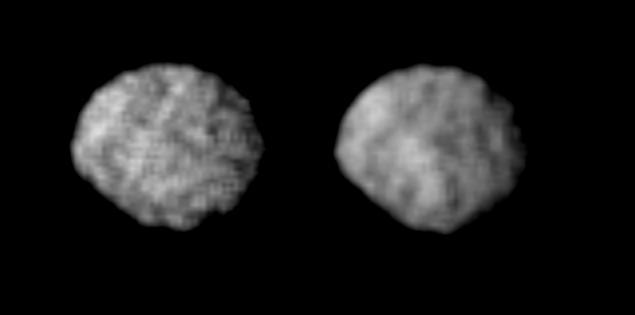
Satellite 1989N2

In this image from NASA's Voyager wide-angle taken on Aug. 23 1989, the two main rings of Neptune can be clearly seen. In the lower part of the frame the originally announced ring arc, consisting of three distinct features, is visible. This feature covers about 35 degrees of longitude and has yet to be radially resolved in Voyager images. From higher resolution images it is known that this region contains much more material than the diffuse belts seen elsewhere in its orbit, which seem to encircle the planet. This is consistent with the fact that ground-based observations of stellar occultations by the rings show them to be very broken and clumpy. The more sensitive wide-angle camera is revealing more widely distributed but fainter material. Each of these rings of material lies just outside of the orbit of a newly discovered moon. One of these moons, 1989N2, may be seen in the upper right corner. The moon is streaked by its orbital motion, whereas the stars in the frame are less smeared. The dark area around the bright moon and star are artifacts of the processing required to bring out the faint rings. This wide-angle image was taken from a range of 2 million kilometers (1.2 million miles), through the clear filter. http://photojournal.jpl.nasa.gov/catalog/PIA00053

NASA Voyager 2 obtained these images of satellite 1989N2 and revealed it to be and irregularly shaped, dark object. The satellite appeared to have several craters. The irregular outline suggests that this moon has remained cold and rigid throughout much
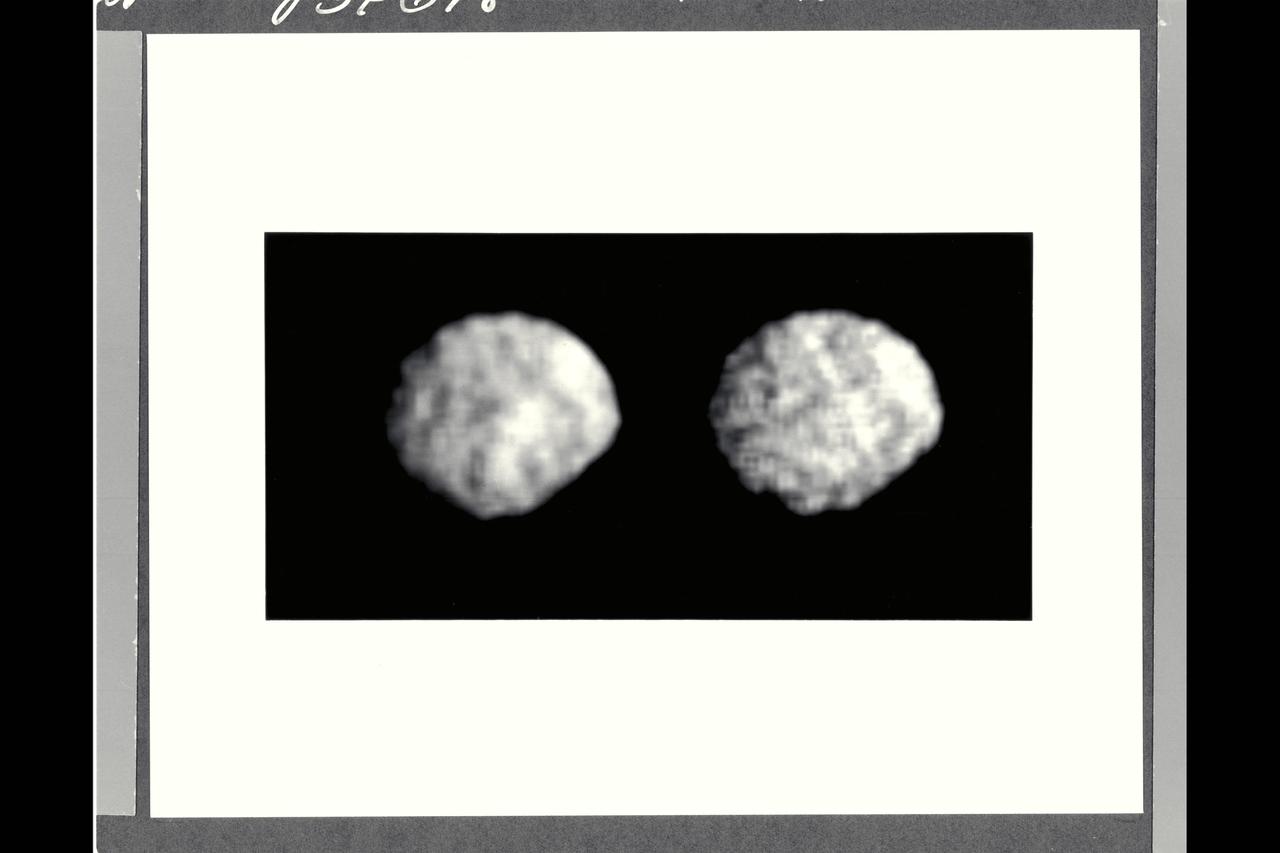
P-34698 These Voyager 2 images of satellite 1989N2 at a resolution of 4.2 kilometers (2.6 miles) per pixel reveals it to be an irregularly shaped, dark object. The satellite appears to have several craters 30 to 50 kilometers (18.5 to 31 miles) across. The irregular outline suggests that this moon has remained cold and rigid throughout much of its history. It is about 210 by 190 kilometers (130 by 118 miles), about half the size of 1989N1. It has a low albedo surface reflecting about 5 percent of the incident light.

P-34679 Range : 2 million km. ( 1.2 million miles ) In this Voyager 2, wide-angle image, the two main rings of Neptune can be clearly seen. In the lower part of the frame, the originally-announced ring arc, consisting of three distinct features, is visible. This feature covers about 35 degrees of longitude and has yet to be radially resolved in Voyager Images. from higher resolution images it is known that this region contains much more material than the diffuse belts seen elsewhere in its orbit, which seem to encircle the planet. This is consistent with the fact that ground-based observations of stellar occultations by the rings show them to be very broken and clumpy. The more sensitive, wide-angle camera is revealing more widely distributed but fainter material. Each of these rings of material lies just outside of the orbit of a newly discovered moon. One of these moons, 1989N2, may be seen in the upper right corner. The moon is streaked by its orbital motion, whereas the stars in the frame are less smeared. the dark area around the bright moon and star are artifacts of the processing required to bring out the faint rings.
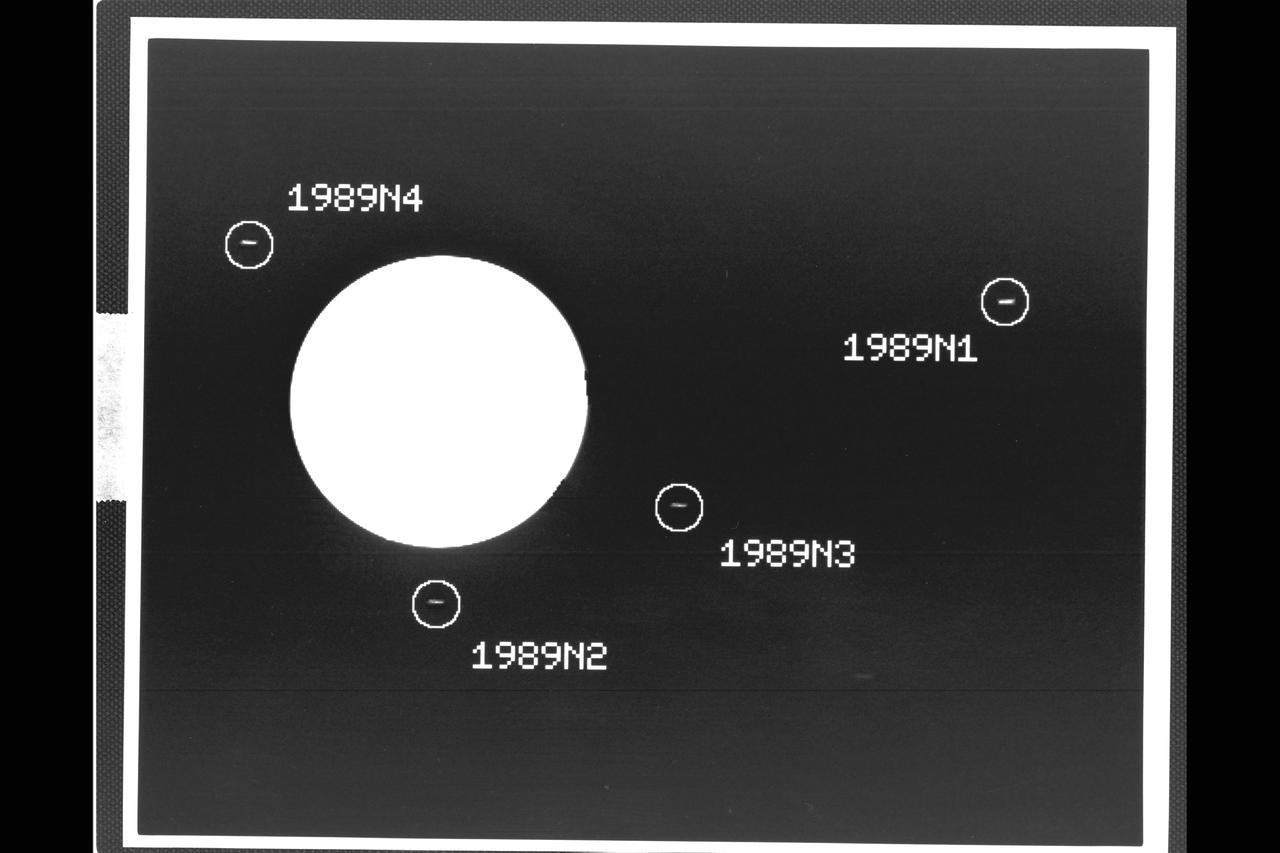
P-34540 Range: 37.3 million kilometers (23.6 million miles) This image captured by the Voyager 2 spacecraft was used to confirm the discovery of three new satellites orbiting Neptune. The 46-second exposure was taken with the narrow angle camera and shows the large globe of the planet to be severely overexposed and almost pure white in appearance. The image has been computer-processed to accentuate the new moons, which otherwise would be hard to distinguish from background noise. The satellite 1989N1, at right in this frame, was discovered by Voyager 2 in early July 1989. The new satellites confirmed later are 1989N2, 1989N3 and 1989N4. Each of the moons appears as a small streak, an effect caused by movement of the spacecraft during the long exposure. The new moons occupy nearly circular and equatorial orbits ranging from about 27,300 to 48,300 kilometers (17,000 to 30,000 miles) from Neptunes's cloud tops, and are estimated to range in diameter from about 100 to 200 kilometers (about 60 to 125 miles).