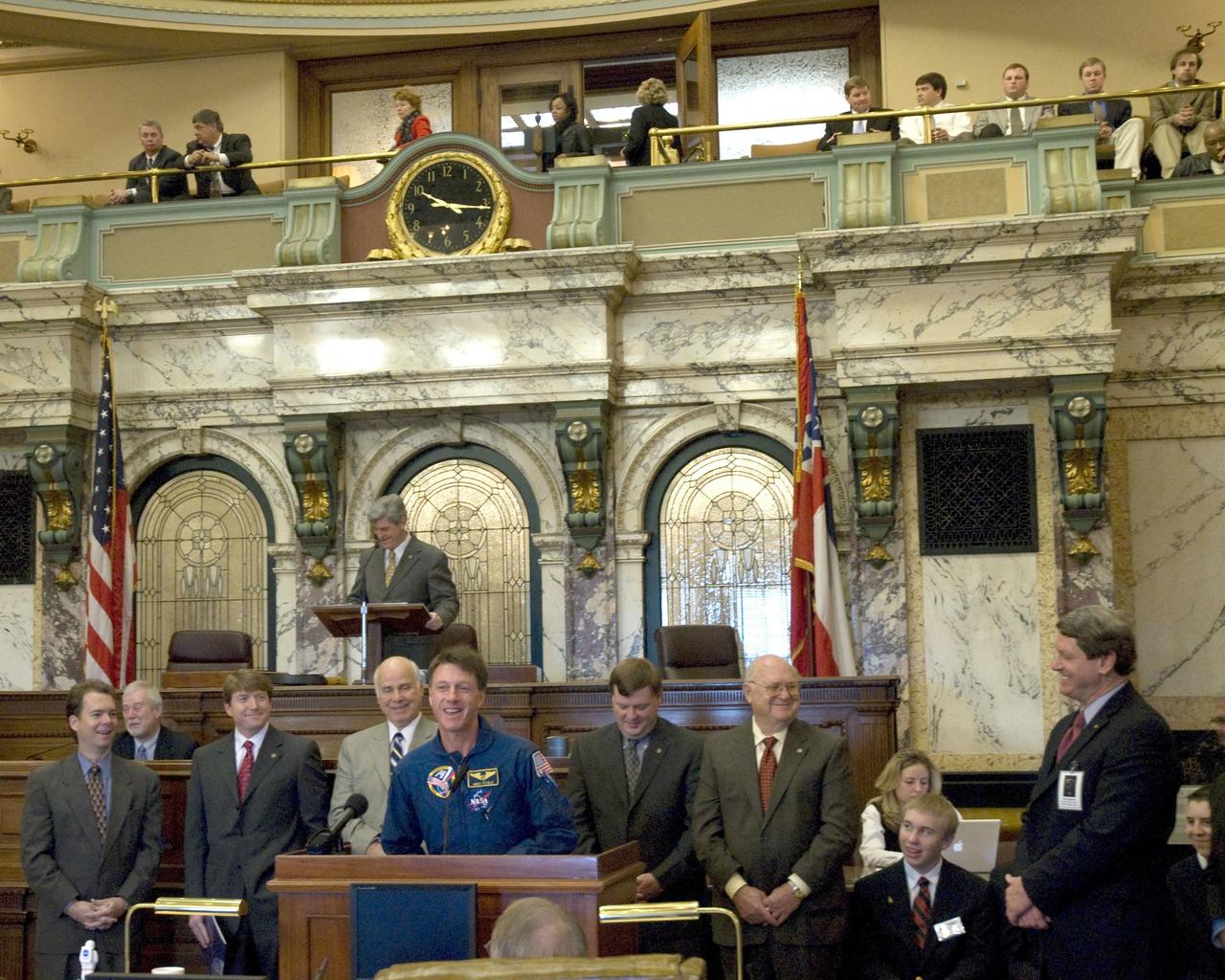
Astronaut Michael Foale (center) and Stennis Space Center officials met with Mississippi Lt. Gov. Phil Bryant (at rear podium) and Gulf Coast delegation members in Mississippi Senate chambers during NASA Space Day in Mississippi activities at the Capitol on January 30.
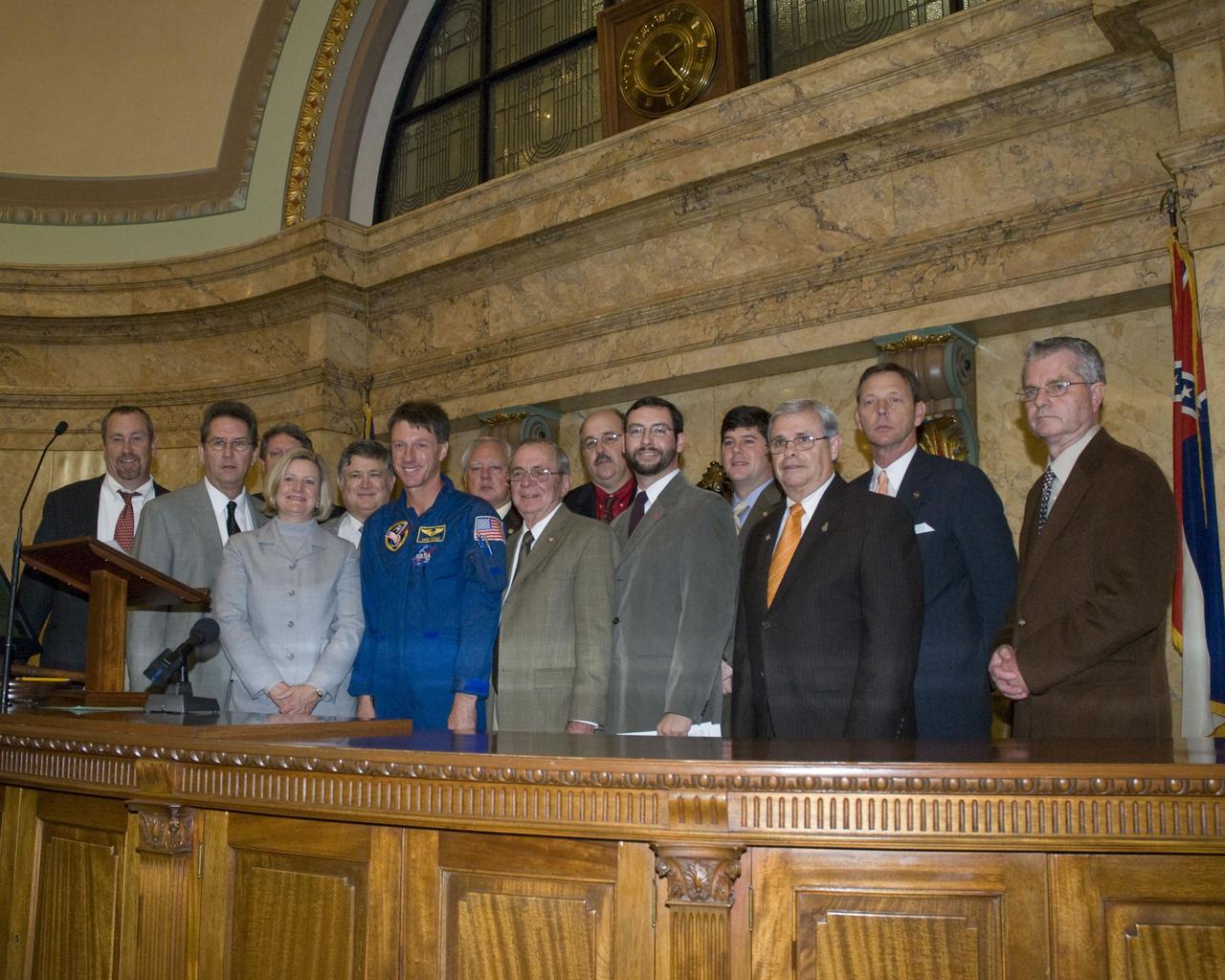
Astronaut Michael Foale (center) and Stennis Space Center officials met with Mississippi House of Representatives Gulf Coast delegation, including Speaker William 'Billy' McCoy (far right), during NASA Space Day in Mississippi on January 30.
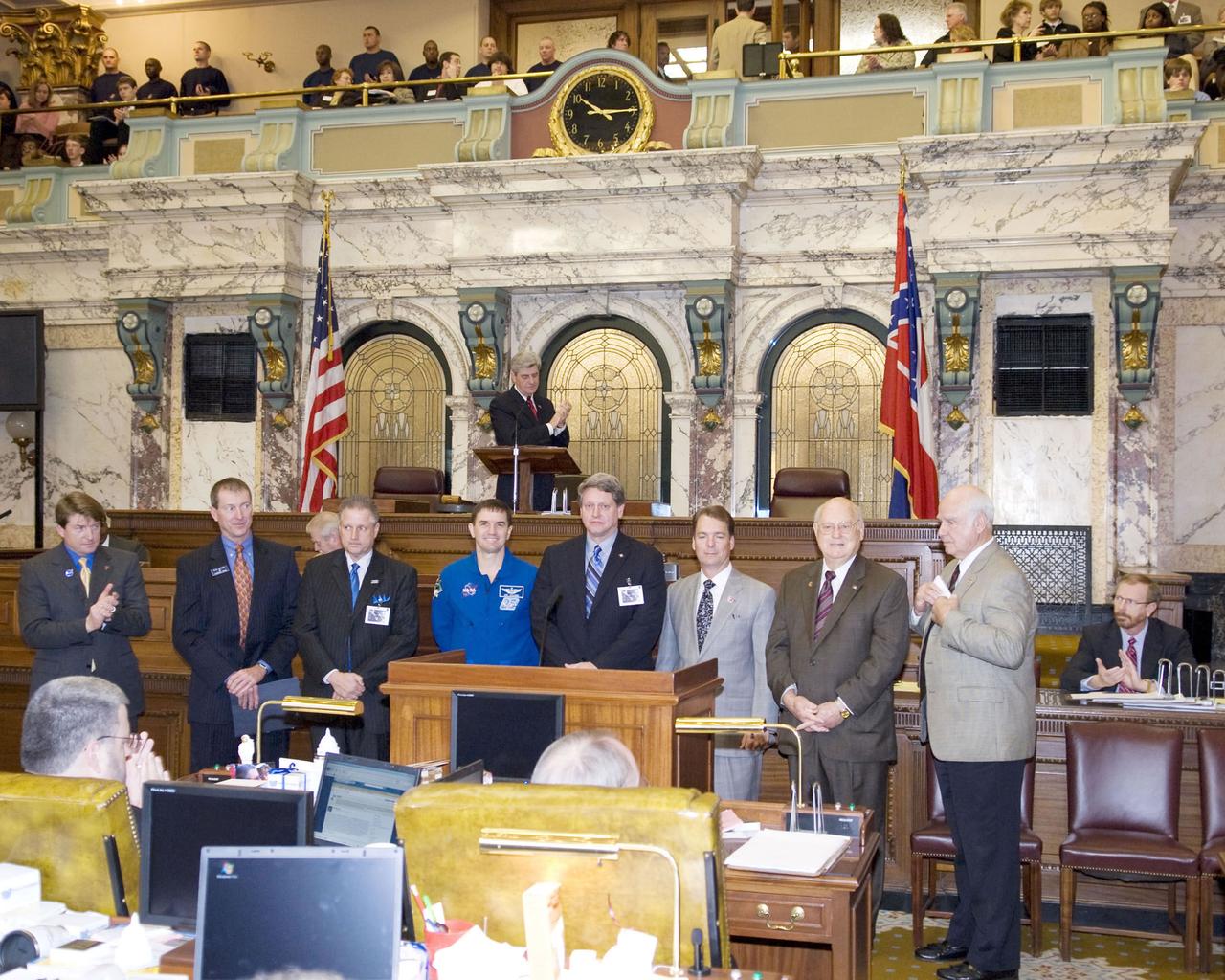
Astronaut Rex Walheim (center) speaks to members of the Mississippi House of Representatives in chambers during NASA Day at the Capitol in Jackson on Feb. 19. Walheim was joined at the podium by members of the Mississippi House of Representatives Gulf Coast delegation, as well as Stennis Space Center Director Gene Goldman (astronaut's immediate right) and NASA's Shared Services Center Director Rick Arbuthnot and Partners for Stennis Executive Director Tish Williams (astronaut's immediate left).
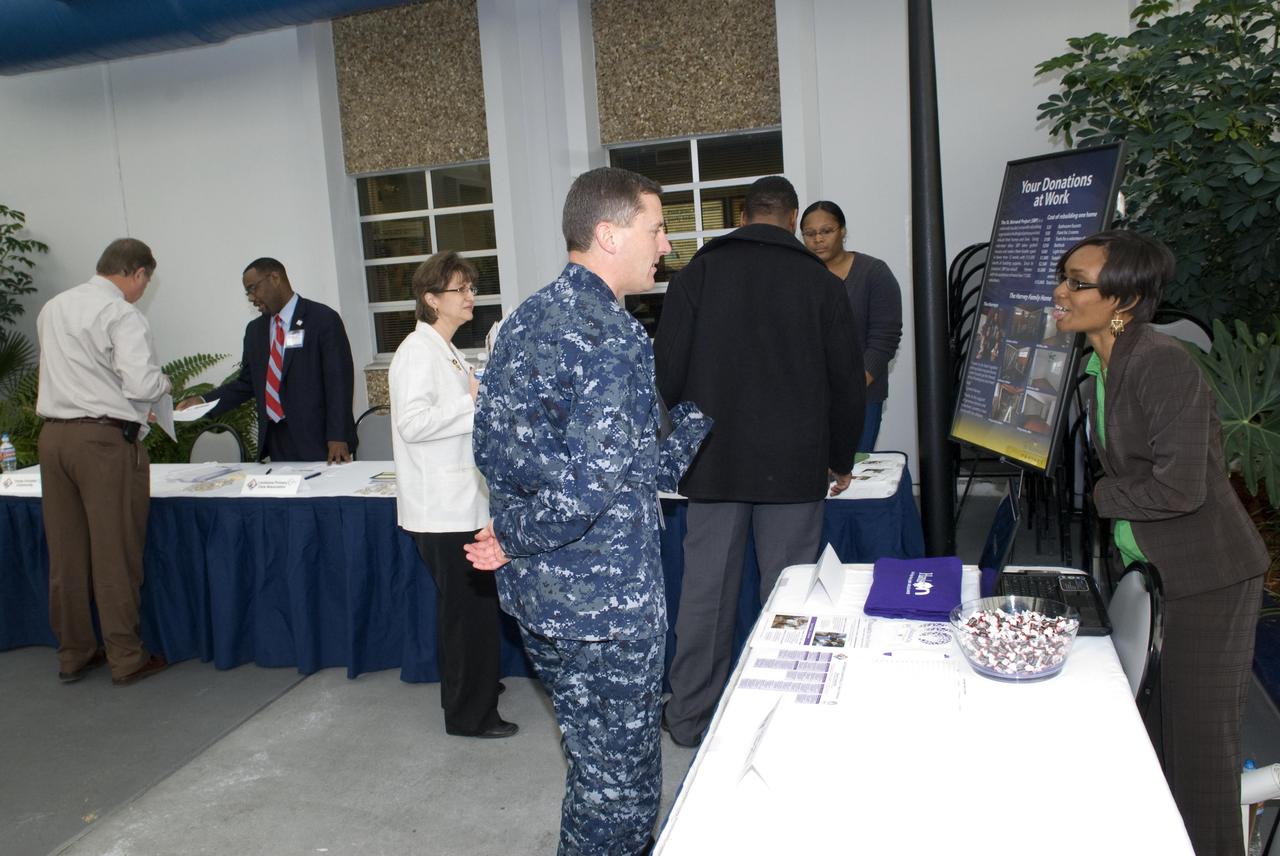
Rich Delgado, commanding officer of the Fleet Survey Team located at NASA's John C. Stennis Space Center, visits with Kertrina Watson Lewis, executive director of the HandsOn volunteer organization in New Orleans, during Day of Service activities Jan. 12. The Day of Service was part of the annual Martin Luther King Jr. Day observance at Stennis. During the day, Mississippi and Louisiana organizations visited the center to encourage employees to register and serve as volunteers for various community activities.
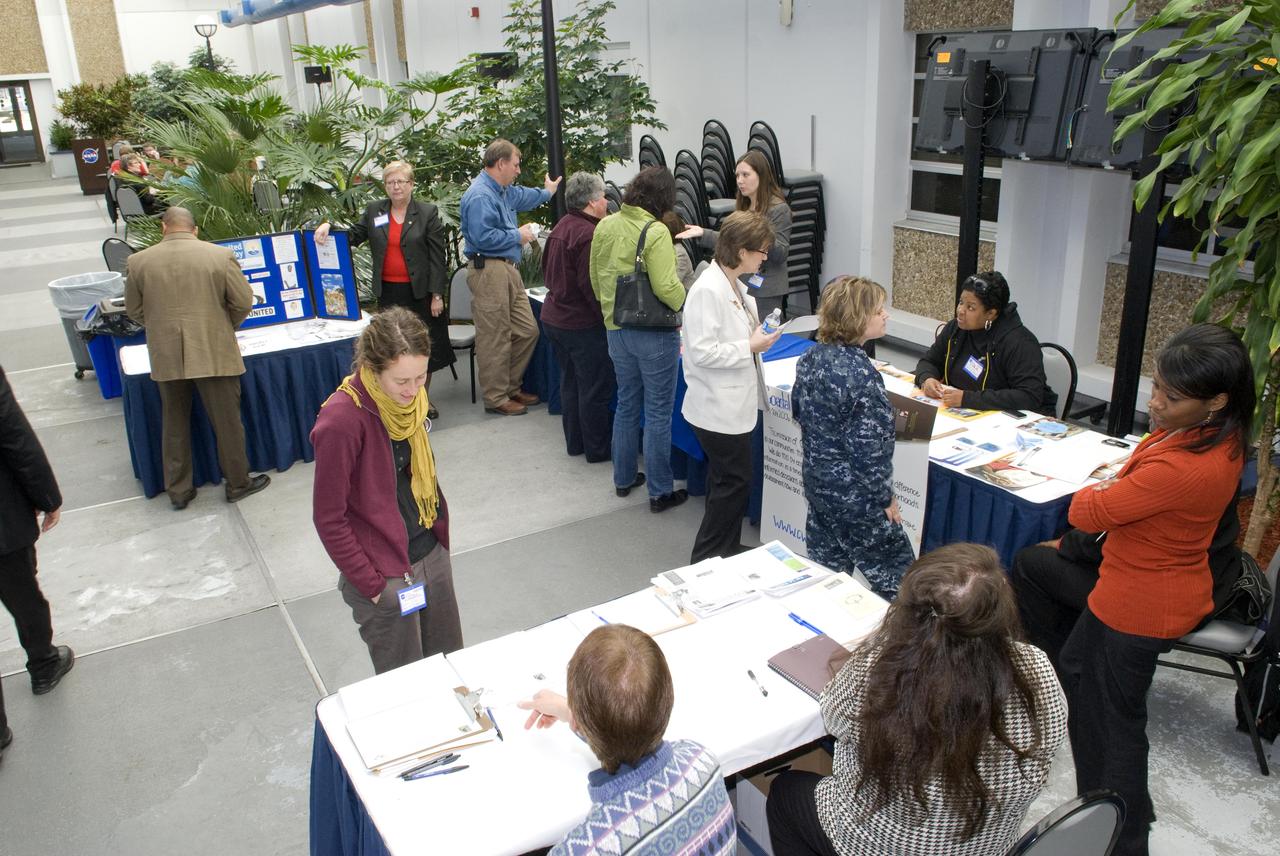
Employees at NASA's John C. Stennis Space Center visit exhibits of volunteer organizations during their observance of Martin Luther King Jr. Day with a Day of Service on Jan. 12. During the day, Mississippi and Louisiana organizations visited the center to encourage employees to register and serve as volunteers for various community activities. The day's focus was emphasized again and again - great things can happen when individuals work together toward a common goal.
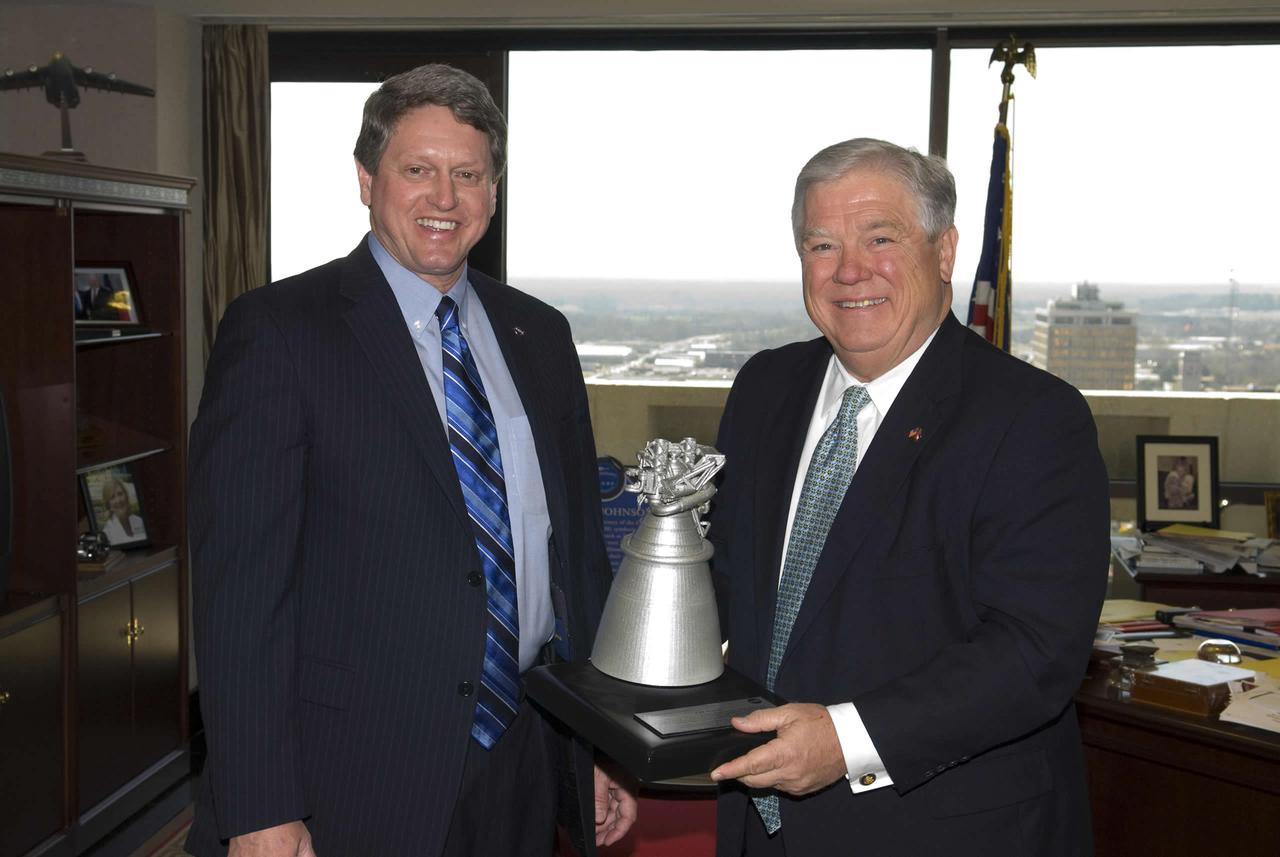
Stennis Space Center Director Gene Goldman visits with Mississippi Gov. Haley Barbour during NASA Day at the Capitol activities on Feb. 19. During the visit, Goldman presented the governor with a model of the J-2X rocket engine currently in development. Stennis engineers did early component testing for the new engine.
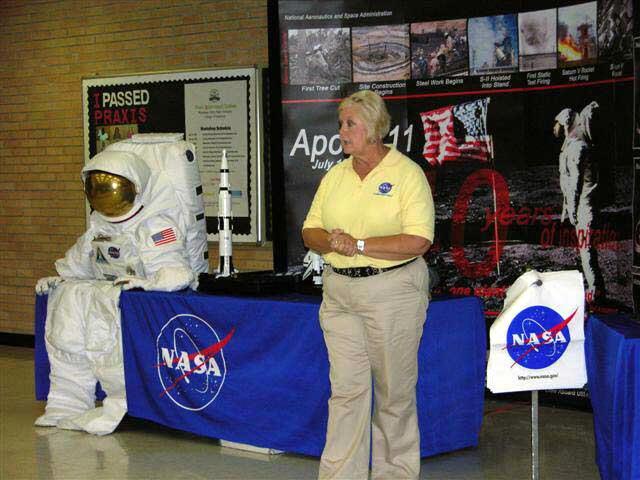
Pat Gaspard, a visitor relations specialist with NASA's StenniSphere visitor center, speaks to Mississippi Valley State University students. Gaspard spoke July 15 during Stennis Space Center's three-day educational outreach program at the college.
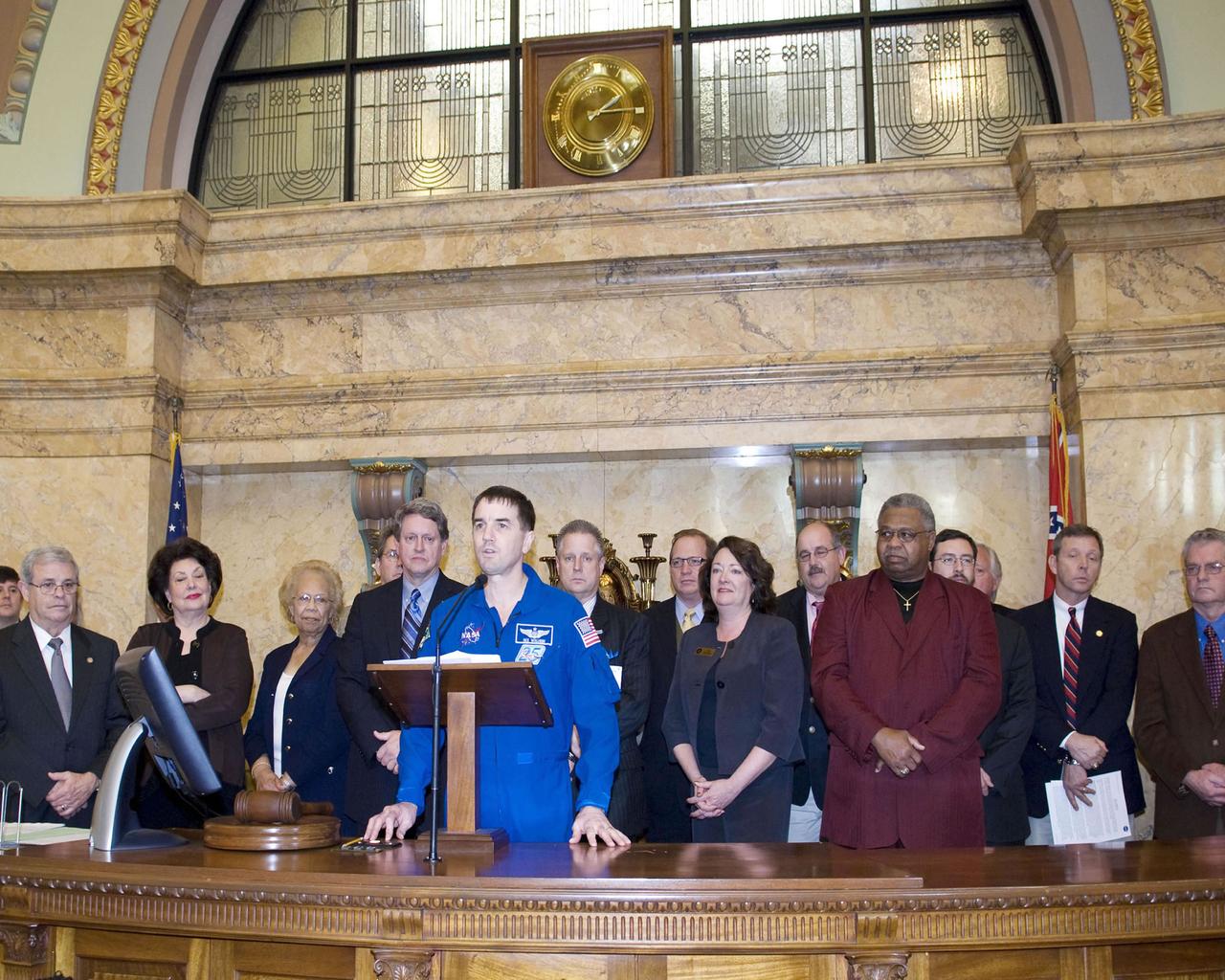
Stennis Space Center leaders and guests visit with Mississippi Senate members in chambers during NASA Day at the Capitol events in Jackson on Feb. 19. Standing at the Senate podium (rear) is Mississippi Lt. Gov. Phil Bryant. Standing at the lectern below are (l to r): Sen. David Baria, D-Bay St. Louis; Partners for Stennis Chair Clay Wagner; NASA Shared Services Center Director Rick Arbuthnot; astronaut Rex Walheim; Stennis Space Center Director Gene Goldman; President Pro Tempore Billy Hewes, R-Gulfport; Sen. Ezell Lee, D-Picayune; and Sen. Tommy Gollott, R-Biloxi.
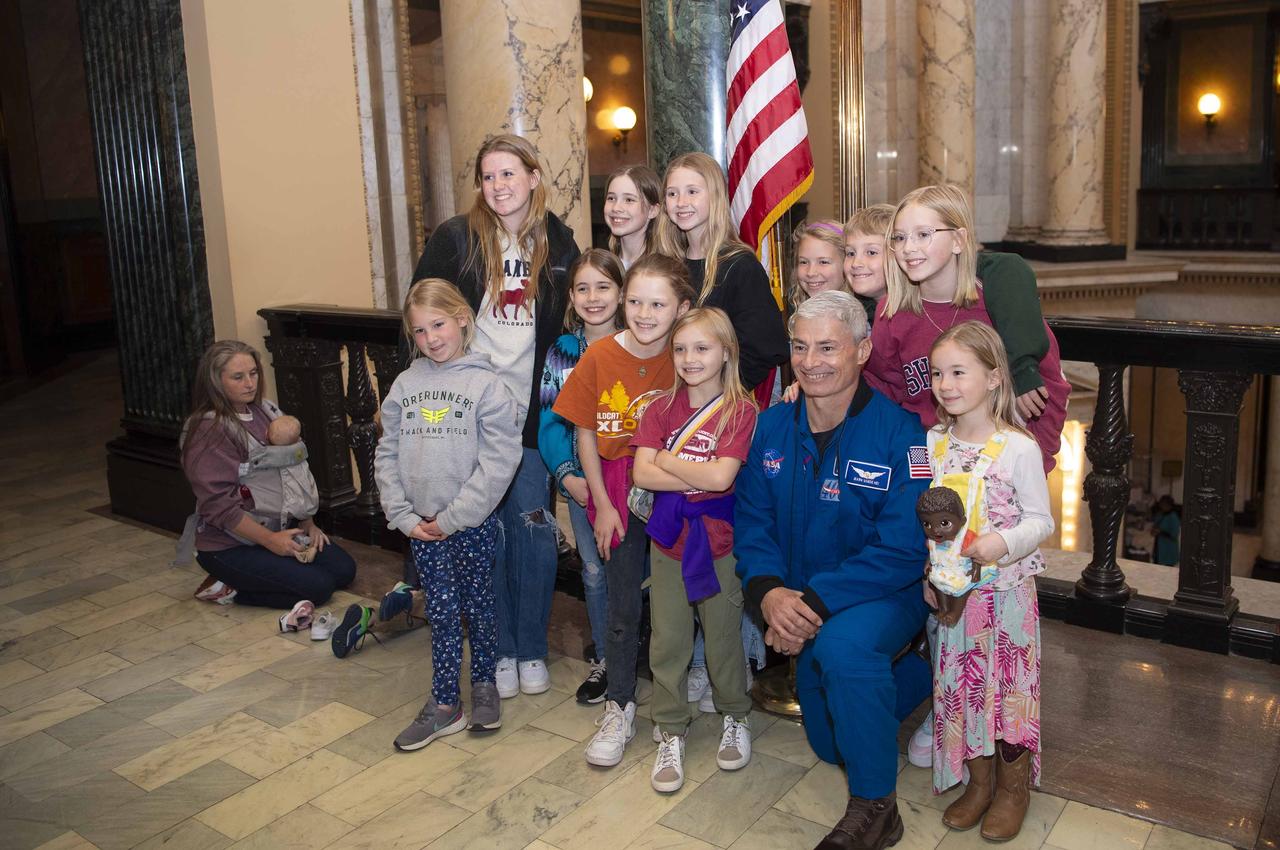
Leaders from NASA’s Stennis Space Center and NASA Shared Services Center visit Jackson, Mississippi, on Feb. 28-29 to share site updates with state leaders during the annual Stennis Day at the Capitol. NASA Stennis is on the front line of the next great era of human space exploration as NASA explores the secrets of the universe for the benefit of all. The south Mississippi center tests propulsion systems and engines helping power Artemis missions on the SLS (Space Launch System) rocket to deep space. Through Artemis, NASA will establish the foundation for long-term scientific exploration at the Moon, land the first woman, first person of color, and first international partner astronaut on the lunar surface, and prepare for human expeditions to Mars. Moving forward, NASA Stennis is working to accelerate the exploration and commercialization of space, innovate to benefit NASA and industry, and leverage assets to stimulate the economy and enhance national security.
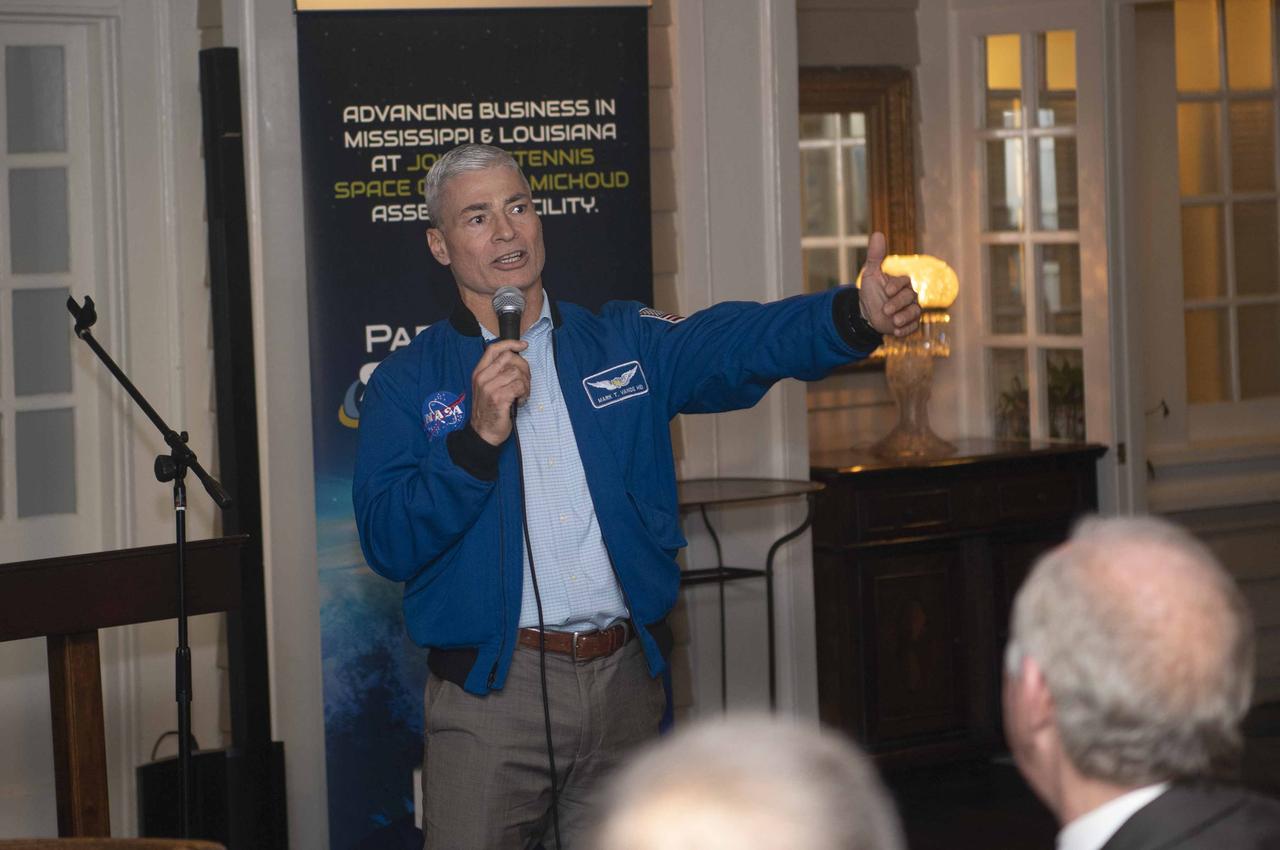
Leaders from NASA’s Stennis Space Center and NASA Shared Services Center visit Jackson, Mississippi, on Feb. 28-29 to share site updates with state leaders during the annual Stennis Day at the Capitol. NASA Stennis is on the front line of the next great era of human space exploration as NASA explores the secrets of the universe for the benefit of all. The south Mississippi center tests propulsion systems and engines helping power Artemis missions on the SLS (Space Launch System) rocket to deep space. Through Artemis, NASA will establish the foundation for long-term scientific exploration at the Moon, land the first woman, first person of color, and first international partner astronaut on the lunar surface, and prepare for human expeditions to Mars. Moving forward, NASA Stennis is working to accelerate the exploration and commercialization of space, innovate to benefit NASA and industry, and leverage assets to stimulate the economy and enhance national security.
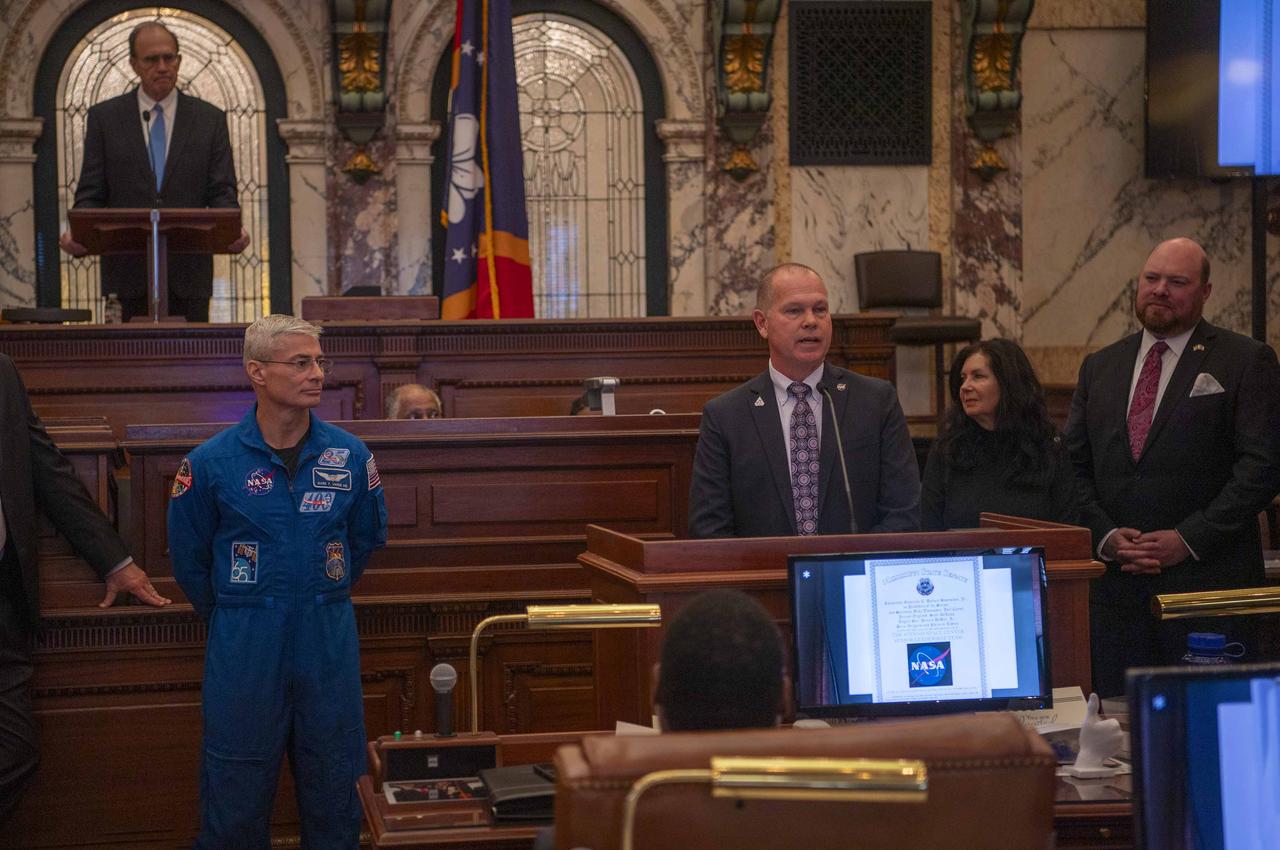
Leaders from NASA’s Stennis Space Center and NASA Shared Services Center visit Jackson, Mississippi, on Feb. 28-29 to share site updates with state leaders during the annual Stennis Day at the Capitol. NASA Stennis is on the front line of the next great era of human space exploration as NASA explores the secrets of the universe for the benefit of all. The south Mississippi center tests propulsion systems and engines helping power Artemis missions on the SLS (Space Launch System) rocket to deep space. Through Artemis, NASA will establish the foundation for long-term scientific exploration at the Moon, land the first woman, first person of color, and first international partner astronaut on the lunar surface, and prepare for human expeditions to Mars. Moving forward, NASA Stennis is working to accelerate the exploration and commercialization of space, innovate to benefit NASA and industry, and leverage assets to stimulate the economy and enhance national security.
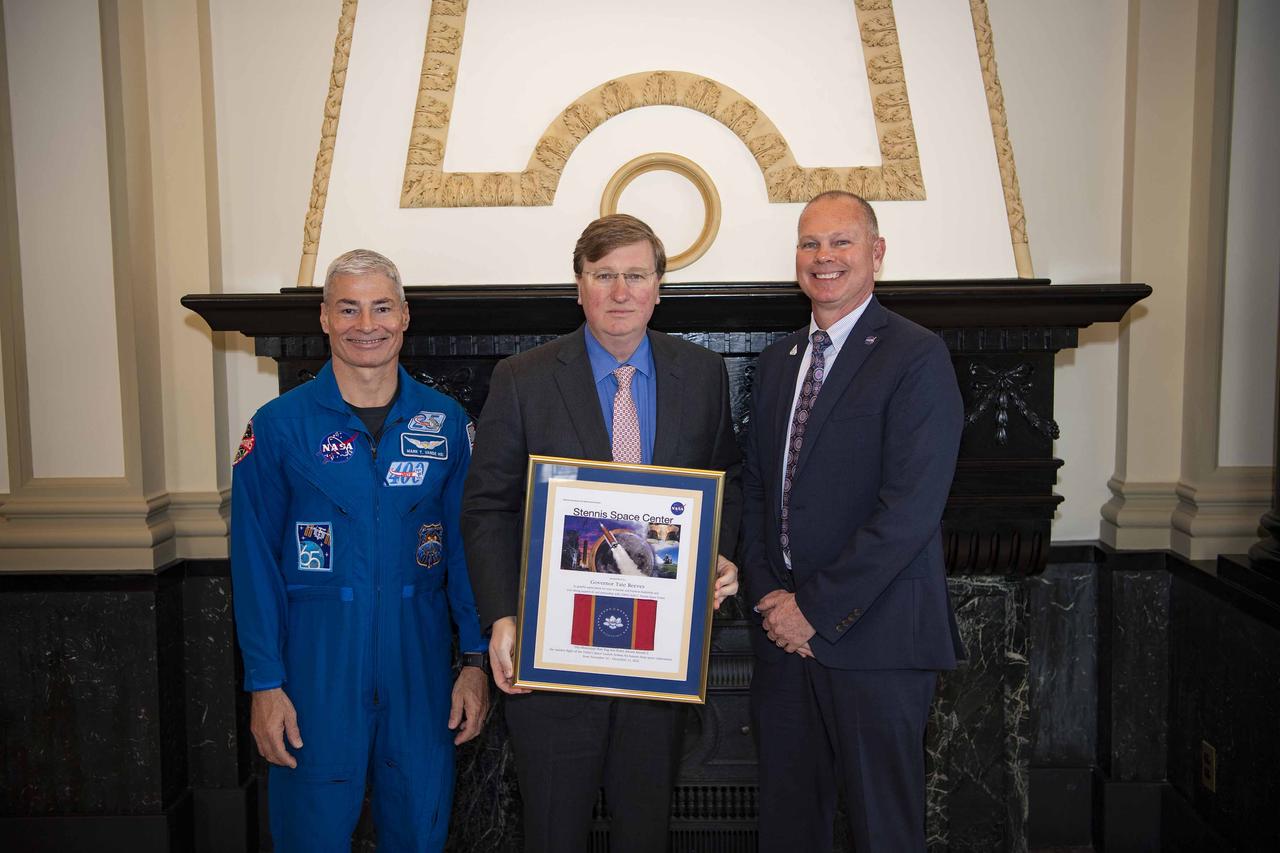
Leaders from NASA’s Stennis Space Center and NASA Shared Services Center visit Jackson, Mississippi, on Feb. 28-29 to share site updates with state leaders during the annual Stennis Day at the Capitol. NASA Stennis is on the front line of the next great era of human space exploration as NASA explores the secrets of the universe for the benefit of all. The south Mississippi center tests propulsion systems and engines helping power Artemis missions on the SLS (Space Launch System) rocket to deep space. Through Artemis, NASA will establish the foundation for long-term scientific exploration at the Moon, land the first woman, first person of color, and first international partner astronaut on the lunar surface, and prepare for human expeditions to Mars. Moving forward, NASA Stennis is working to accelerate the exploration and commercialization of space, innovate to benefit NASA and industry, and leverage assets to stimulate the economy and enhance national security.
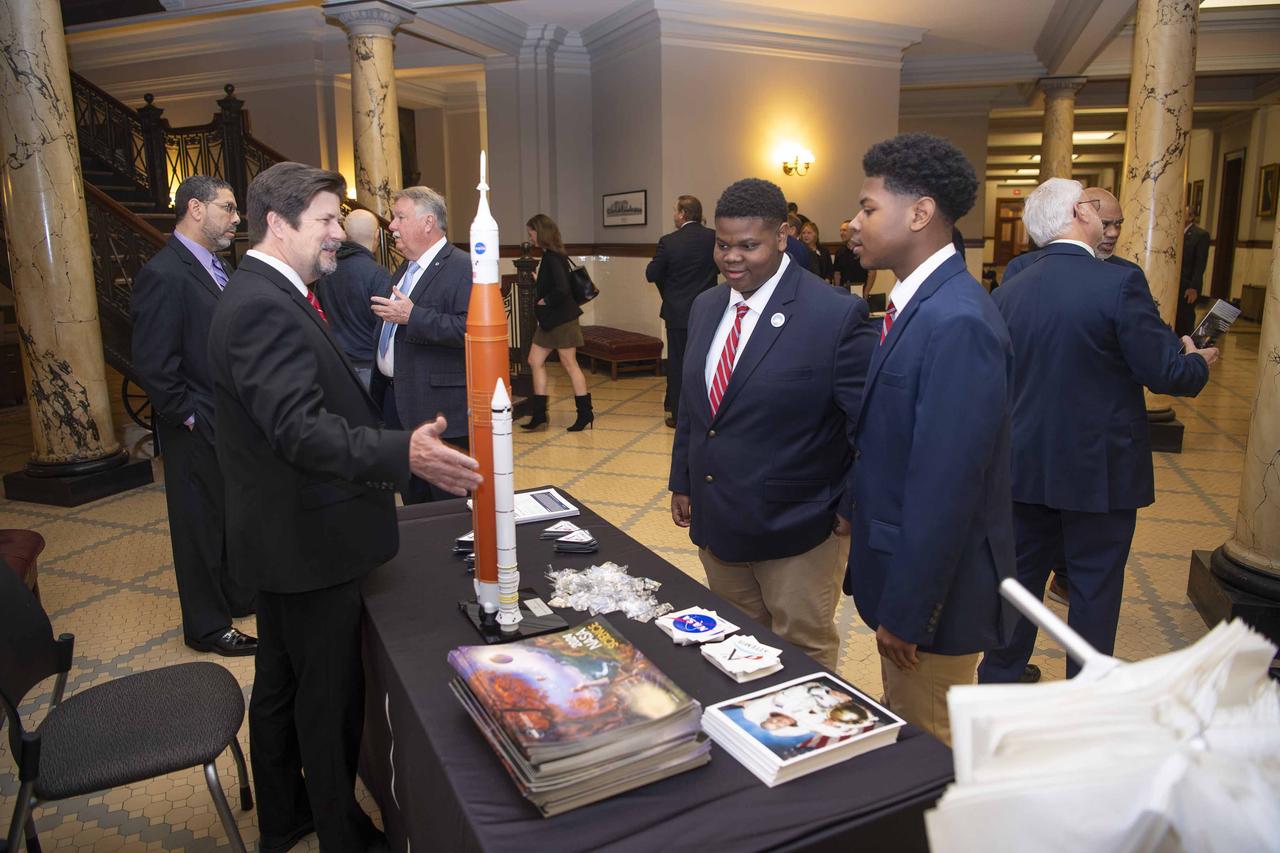
Leaders from NASA’s Stennis Space Center and NASA Shared Services Center visit Jackson, Mississippi, on Feb. 28-29 to share site updates with state leaders during the annual Stennis Day at the Capitol. NASA Stennis is on the front line of the next great era of human space exploration as NASA explores the secrets of the universe for the benefit of all. The south Mississippi center tests propulsion systems and engines helping power Artemis missions on the SLS (Space Launch System) rocket to deep space. Through Artemis, NASA will establish the foundation for long-term scientific exploration at the Moon, land the first woman, first person of color, and first international partner astronaut on the lunar surface, and prepare for human expeditions to Mars. Moving forward, NASA Stennis is working to accelerate the exploration and commercialization of space, innovate to benefit NASA and industry, and leverage assets to stimulate the economy and enhance national security.
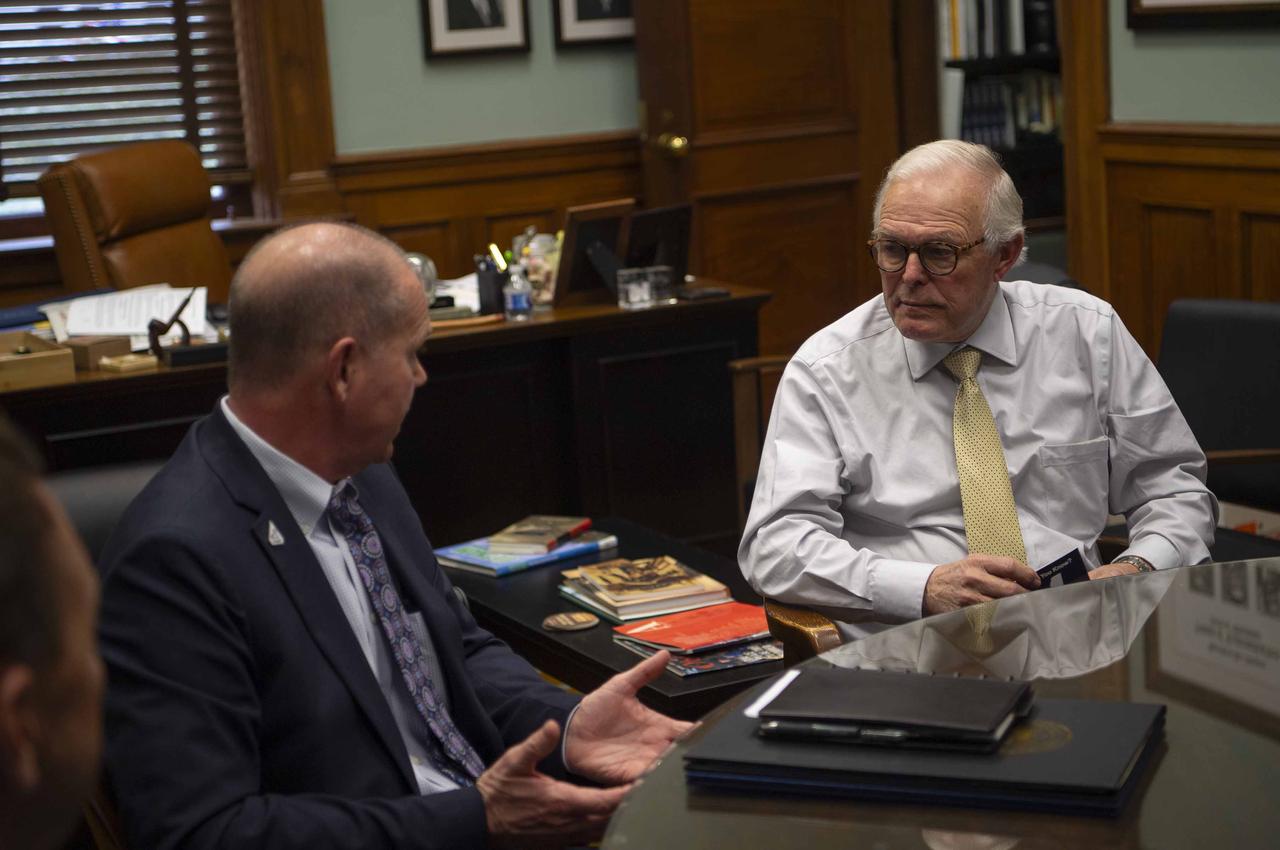
Leaders from NASA’s Stennis Space Center and NASA Shared Services Center visit Jackson, Mississippi, on Feb. 28-29 to share site updates with state leaders during the annual Stennis Day at the Capitol. NASA Stennis is on the front line of the next great era of human space exploration as NASA explores the secrets of the universe for the benefit of all. The south Mississippi center tests propulsion systems and engines helping power Artemis missions on the SLS (Space Launch System) rocket to deep space. Through Artemis, NASA will establish the foundation for long-term scientific exploration at the Moon, land the first woman, first person of color, and first international partner astronaut on the lunar surface, and prepare for human expeditions to Mars. Moving forward, NASA Stennis is working to accelerate the exploration and commercialization of space, innovate to benefit NASA and industry, and leverage assets to stimulate the economy and enhance national security.
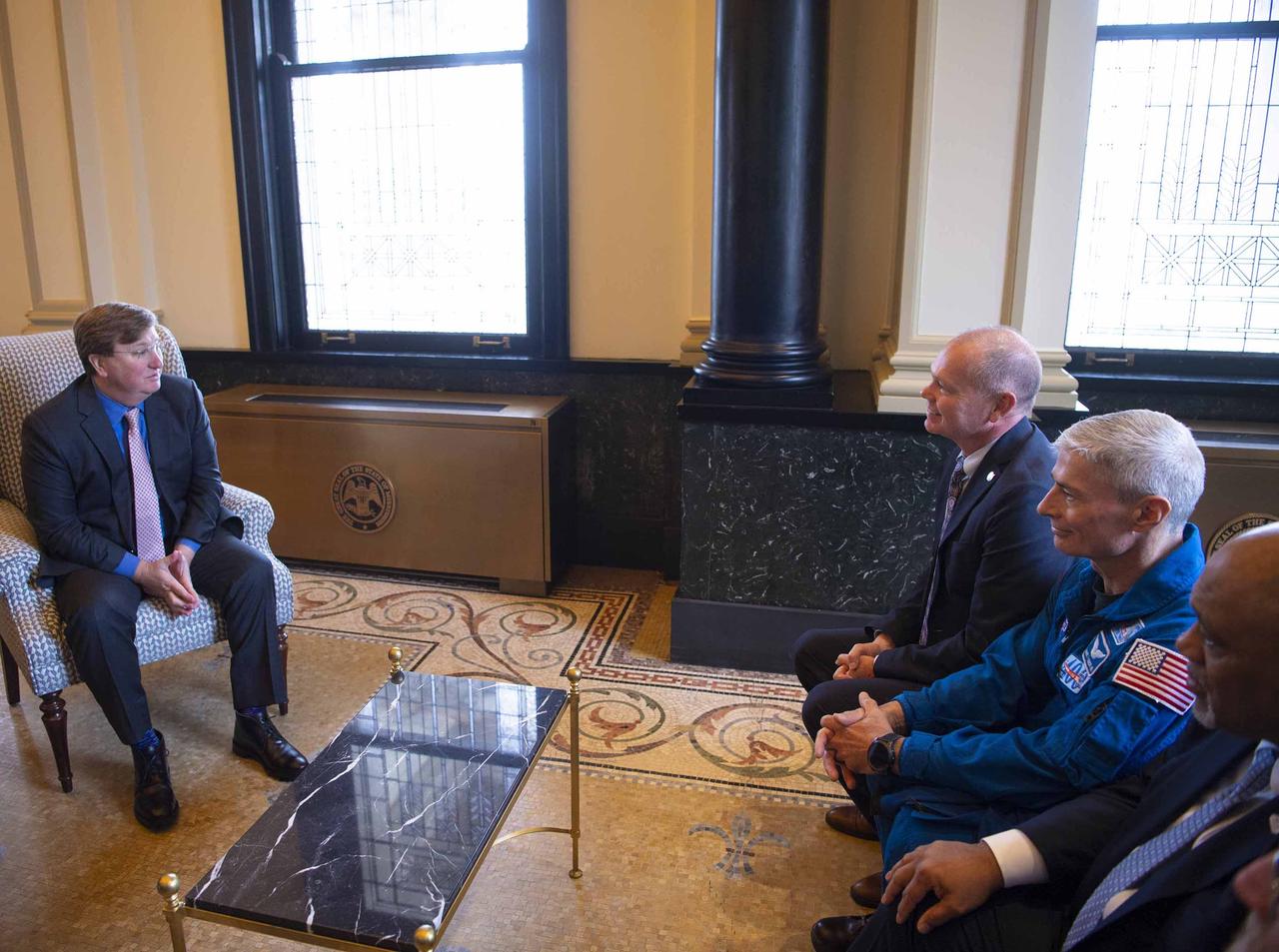
Leaders from NASA’s Stennis Space Center and NASA Shared Services Center visit Jackson, Mississippi, on Feb. 28-29 to share site updates with state leaders during the annual Stennis Day at the Capitol. NASA Stennis is on the front line of the next great era of human space exploration as NASA explores the secrets of the universe for the benefit of all. The south Mississippi center tests propulsion systems and engines helping power Artemis missions on the SLS (Space Launch System) rocket to deep space. Through Artemis, NASA will establish the foundation for long-term scientific exploration at the Moon, land the first woman, first person of color, and first international partner astronaut on the lunar surface, and prepare for human expeditions to Mars. Moving forward, NASA Stennis is working to accelerate the exploration and commercialization of space, innovate to benefit NASA and industry, and leverage assets to stimulate the economy and enhance national security.
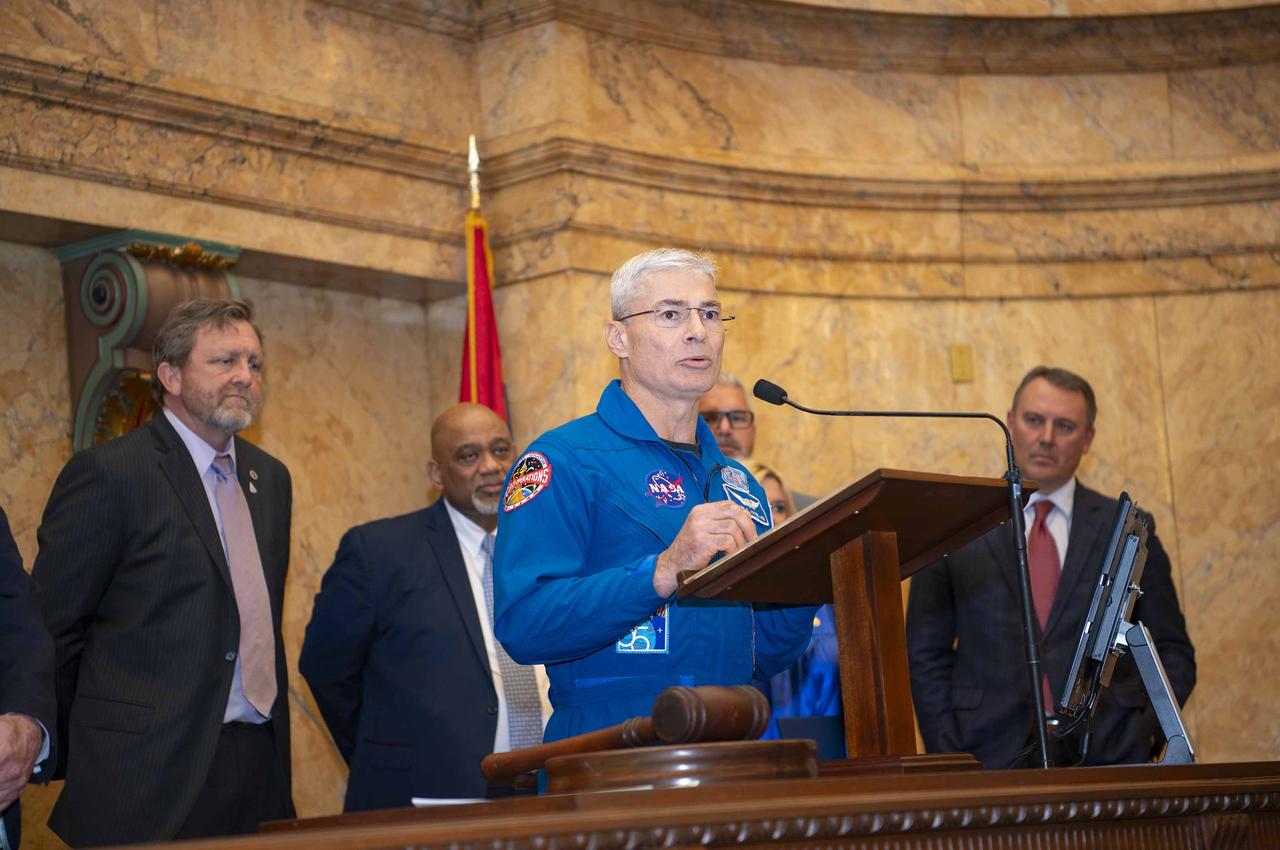
Leaders from NASA’s Stennis Space Center and NASA Shared Services Center visit Jackson, Mississippi, on Feb. 28-29 to share site updates with state leaders during the annual Stennis Day at the Capitol. NASA Stennis is on the front line of the next great era of human space exploration as NASA explores the secrets of the universe for the benefit of all. The south Mississippi center tests propulsion systems and engines helping power Artemis missions on the SLS (Space Launch System) rocket to deep space. Through Artemis, NASA will establish the foundation for long-term scientific exploration at the Moon, land the first woman, first person of color, and first international partner astronaut on the lunar surface, and prepare for human expeditions to Mars. Moving forward, NASA Stennis is working to accelerate the exploration and commercialization of space, innovate to benefit NASA and industry, and leverage assets to stimulate the economy and enhance national security.
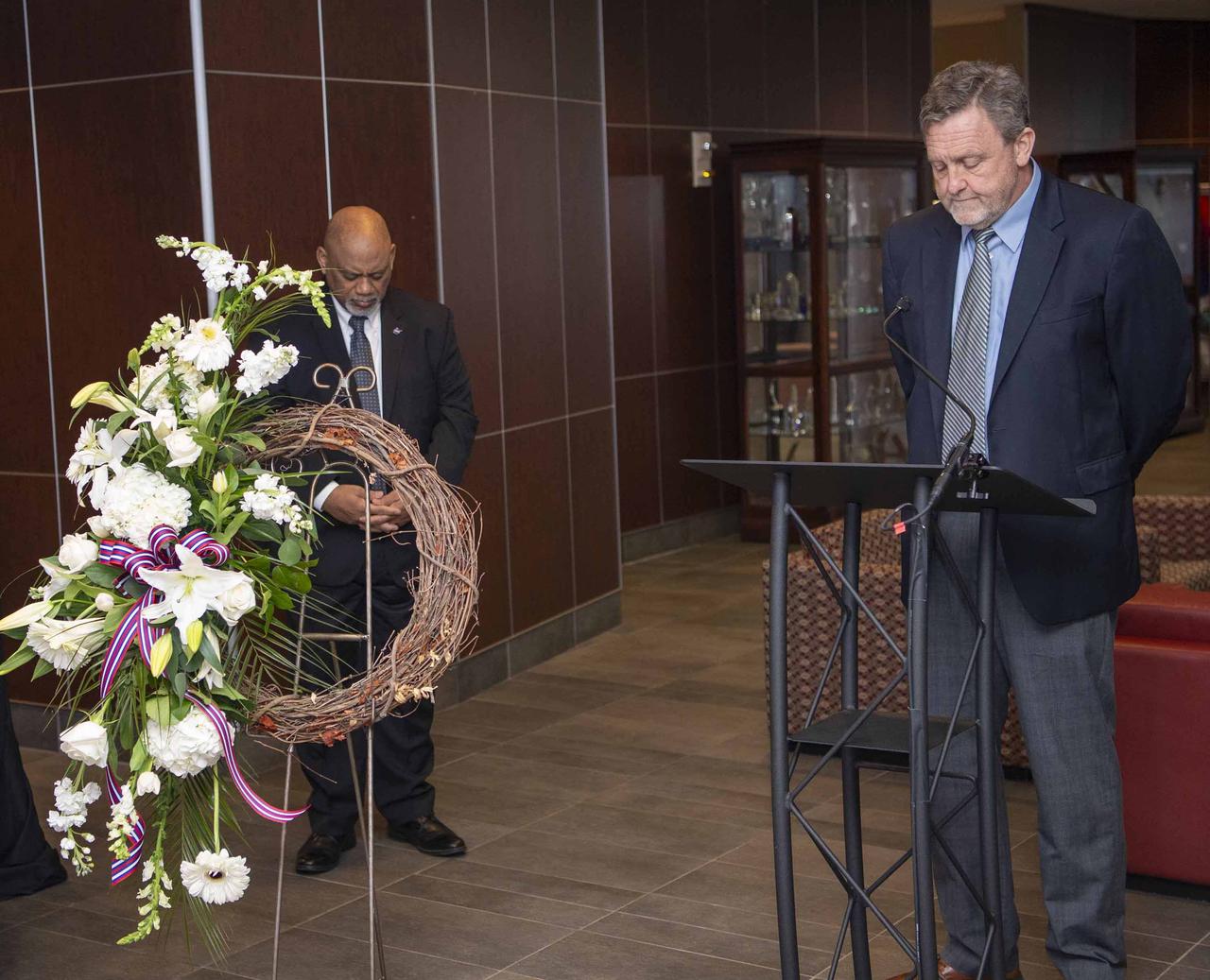
NASA’s Stennis Space Center and NASA Shared Services Center leaders commemorate NASA Day of Remembrance on Jan. 25 with a ceremony at the south Mississippi site. Rodney McKellip, NASA Stennis associate director (right), and Ken Newton, NASA Shared Services Center acting executive director, observe a moment of silence as employees honor members of the NASA family who lost their lives while furthering the cause of exploration and discovery, including the crews of Apollo 1, and space shuttles Challenger and Columbia.

Mississippi Gov. Haley Barbour speaks to members of the World Presidents' Organization during the group's visit to NASA's John C. Stennis Space Center on Jan. 26. WPO members from several states spent the day touring Stennis facilities and learning about the work of the nation's premier rocket engine testing site. Barbour visited with group members during a morning session in StenniSphere, the center's visitors center and museum.
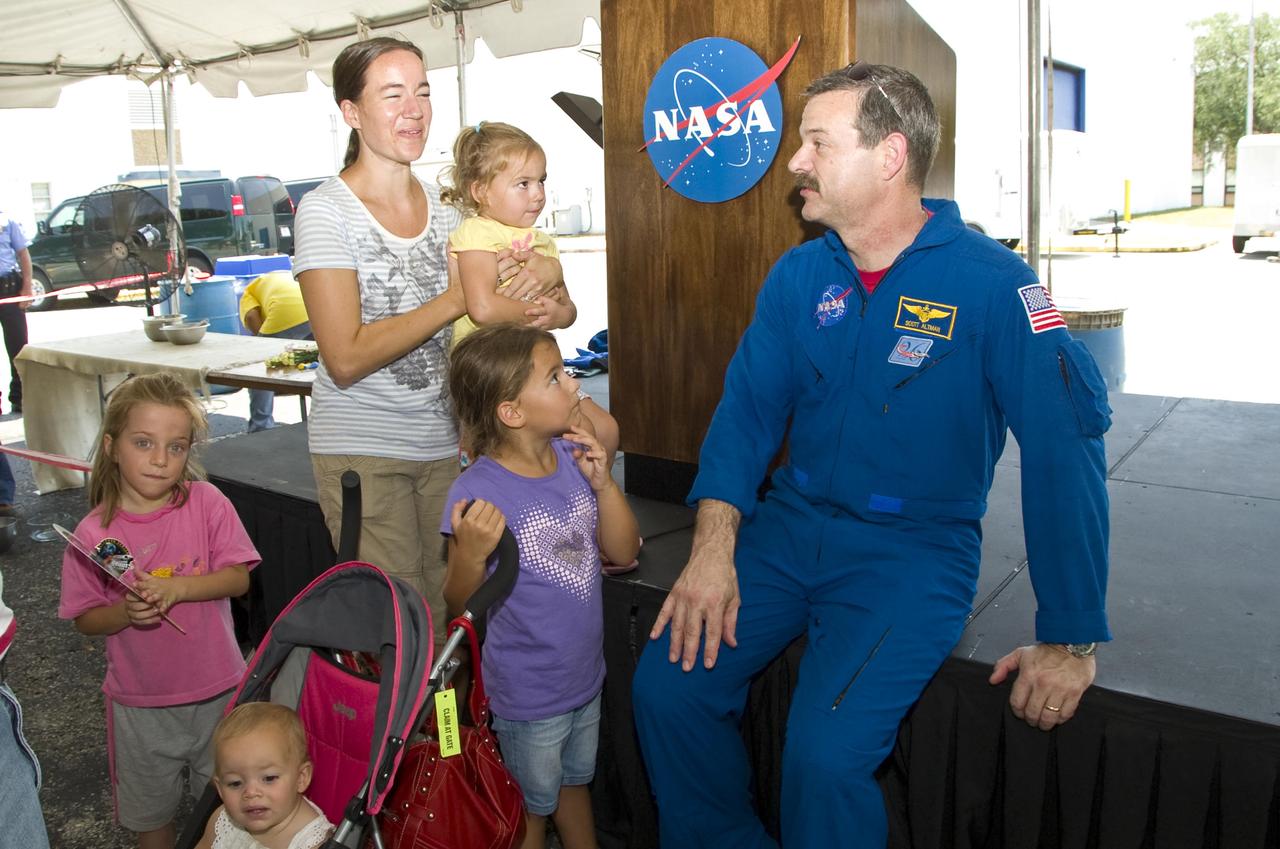
Astronaut Scott Altman talks with guests during a 50th Anniversary Open House activity at Stennis Space Center on June 2. Stennis' yearlong anniversary celebration culminates Oct. 25, the anniversary of the day in 1961 that NASA publicly announced plans to build the south Mississippi facility. The June 2 open house attracted more than 1,000 visitors.
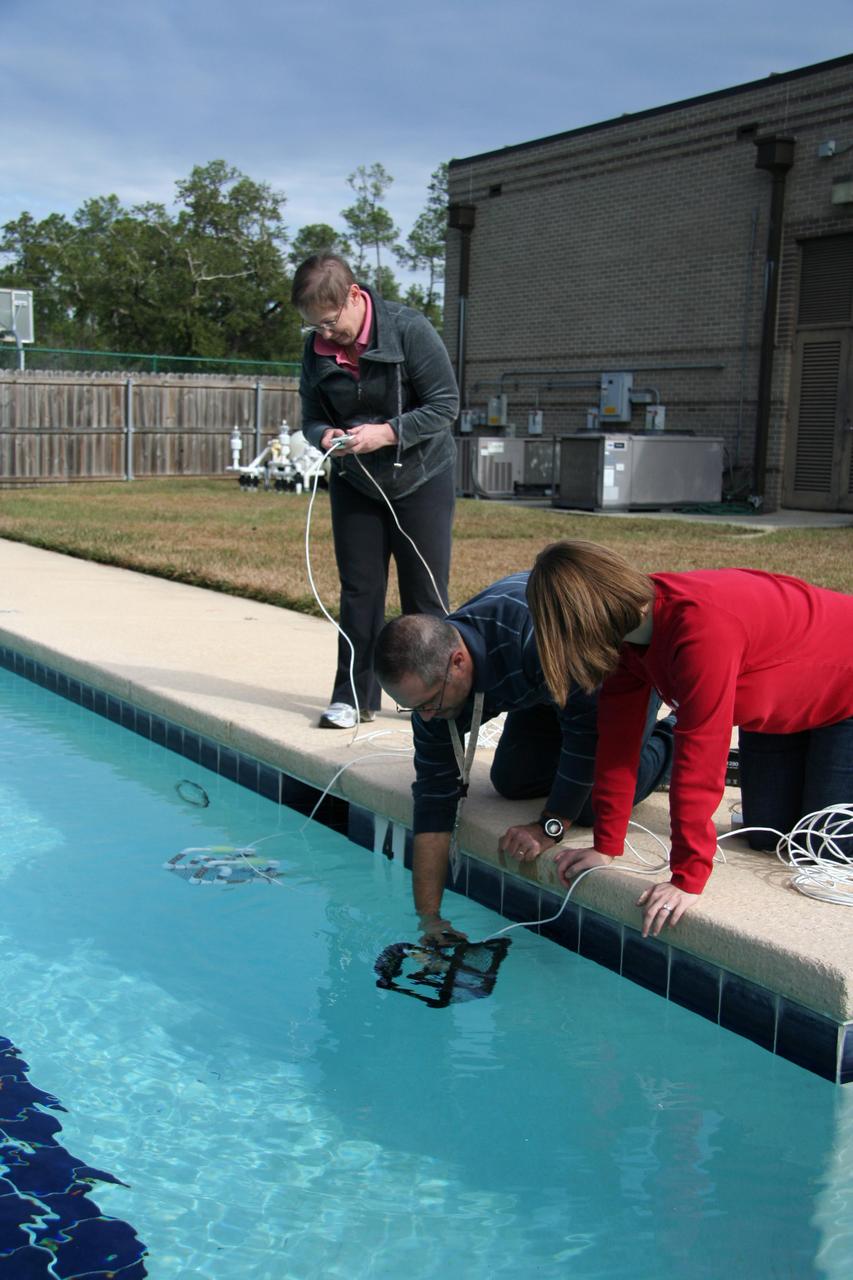
David Lalejini, an employee of the Naval Research Laboratory at NASA's John C. Stennis Space Center, helps a pair of teachers deploy a remotely-operated underwater Sea Perch robot during workshop activities Dec. 11. The Stennis Education Office teamed with Naval Research Laboratory counterparts to conduct a two-day workshop Dec. 10-11 for Louisiana and Mississippi teachers. During the no-cost workshop, teachers learned to build and operate Sea Perch robots. The teachers now can take the Sea Perch Program back to students.
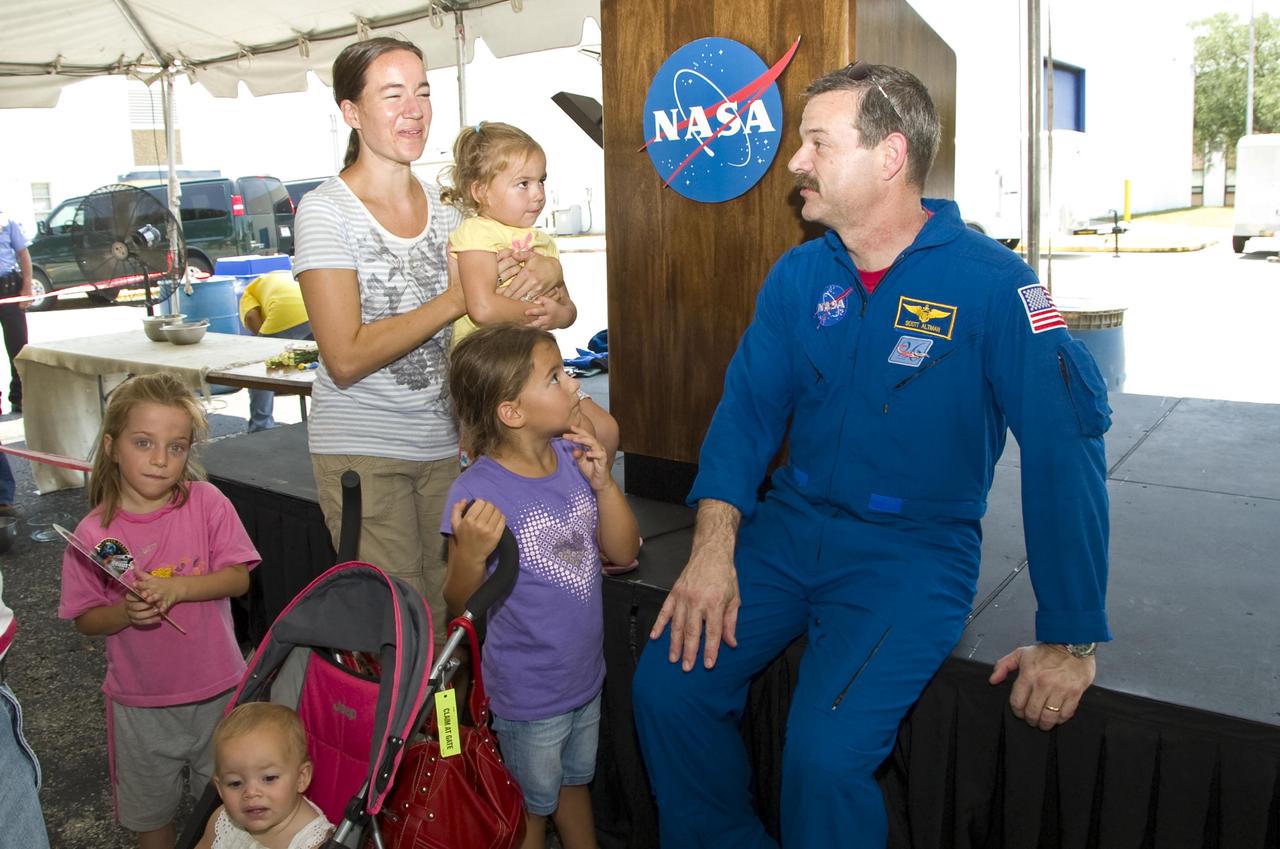
Astronaut Scott Altman talks with guests during a 50th Anniversary Open House activity at Stennis Space Center on June 2. Stennis' yearlong anniversary celebration culminates Oct. 25, the anniversary of the day in 1961 that NASA publicly announced plans to build the south Mississippi facility. The June 2 open house attracted more than 1,000 visitors.
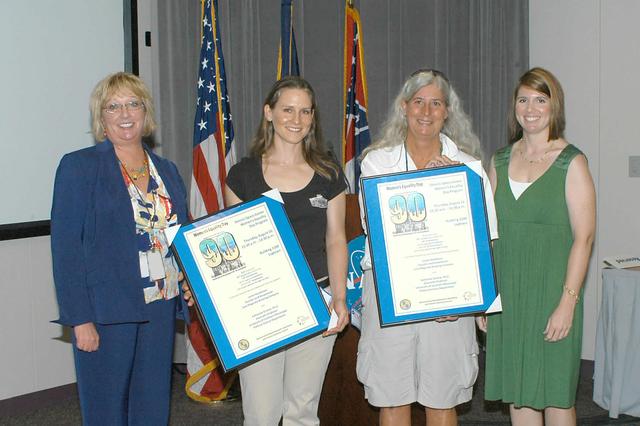
NASA's John C. Stennis Space Center celebrated Women's Equality Day with a program featuring presentations from a pair of area women - Leslie Henderson, founder and brewmaster of Lazy Magnolia Brewing Co. in Kiln, Miss., and Kathanne Greene, associate professor of political science at the University of Southern Mississippi in Hattiesburg. Shown are (l to r): Jo Ann Larson, Stennis Equal Opportunity officer; Henderson; Greene; and Shannon Breland, public affairs officer for the Naval Research Laboratory at Stennis and a member of the Stennis Diversity Council.
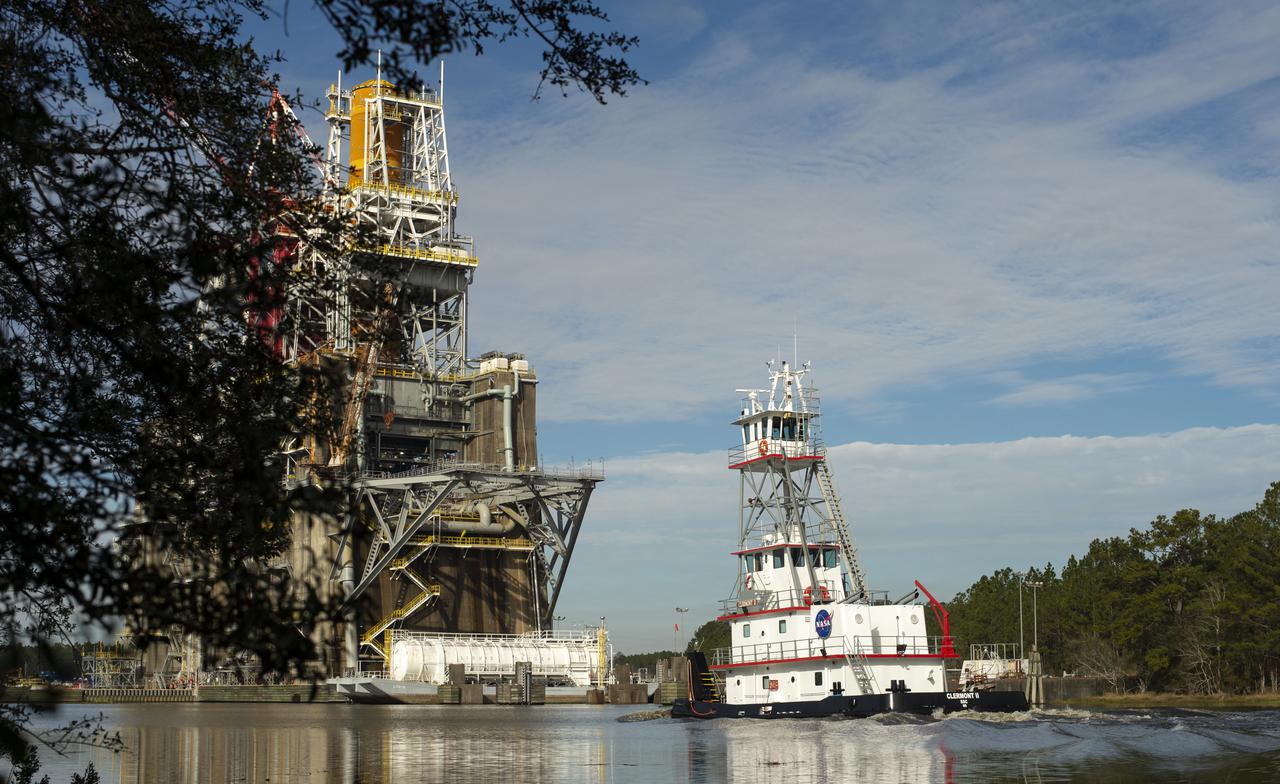
NASA tugboat Clermont II arrives at the B-2 Test Stand the day after a hot fire test of the core stage for the first flight of NASA’s Space Launch System rocket, Saturday, Jan. 16, 2021, at NASA’s Stennis Space Center near Bay St. Louis, Mississippi. During the test the four RS-25 engines fired for a little more than one minute and generated 1.6 million pounds of thrust. The hot fire is the final test of the Green Run test series, a comprehensive assessment of the Space Launch System’s core stage prior to launching the Artemis I mission to the Moon. Photo Credit: (NASA/Robert Markowitz)
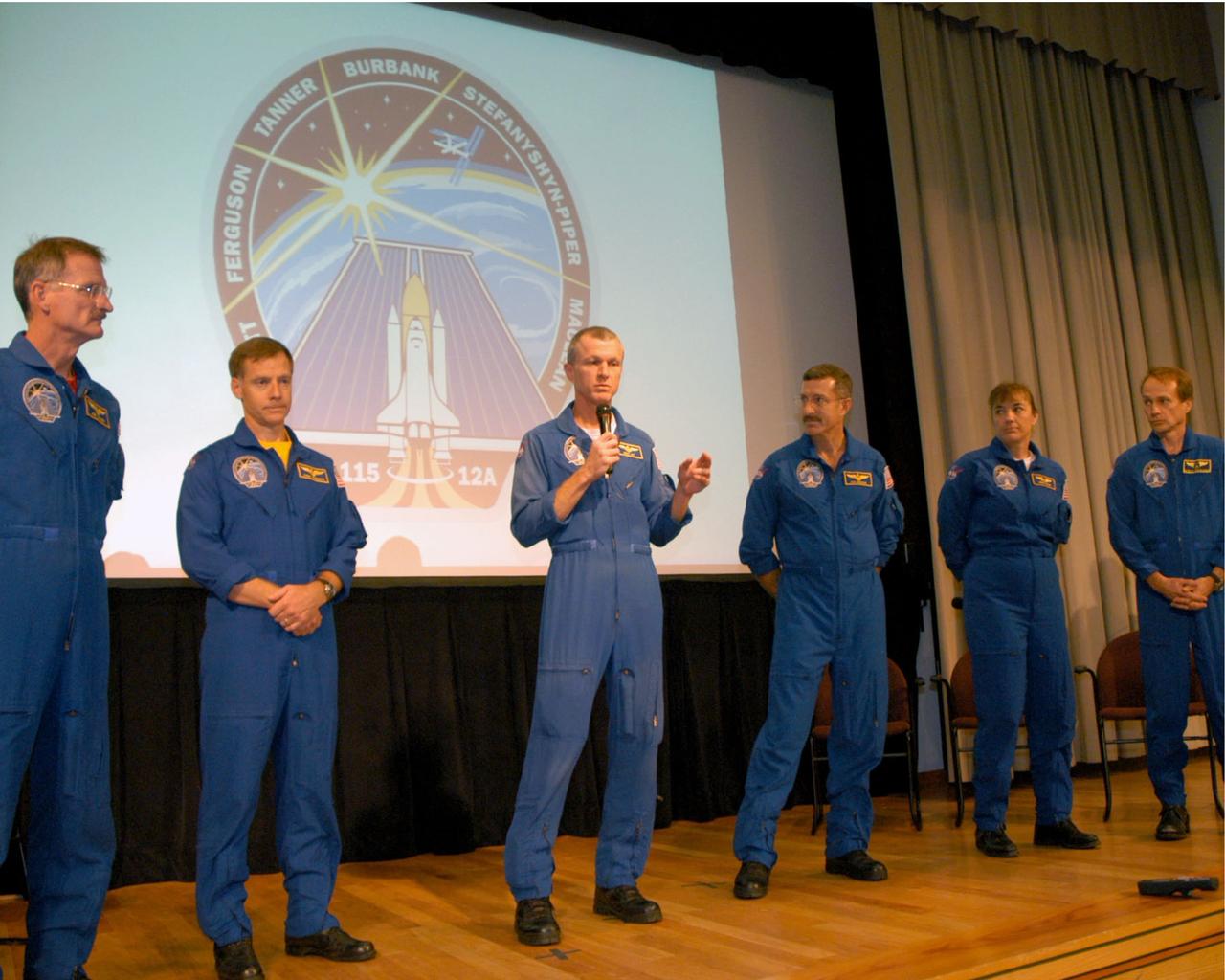
Commander Brent Jett (center) talks with employees and visitors at NASA Stennis Space Center. The astronauts of NASA's STS-115 space shuttle mission visited SSC in south Mississippi to share highlights of their 12-day mission and to thank SSC employees for the reliability of the space shuttle's main engines, which helped propel Space Shuttle Atlantis into orbit. STS-115's other crewmembers are (from left) Mission Specialists Joe Tanner, Dan Burbank, Heidemarie Stefanyshyn-Piper and Steve MacLean of the Canadian Space Agency. The mission launched Sept. 9, 2006, resuming construction of the International Space Station.
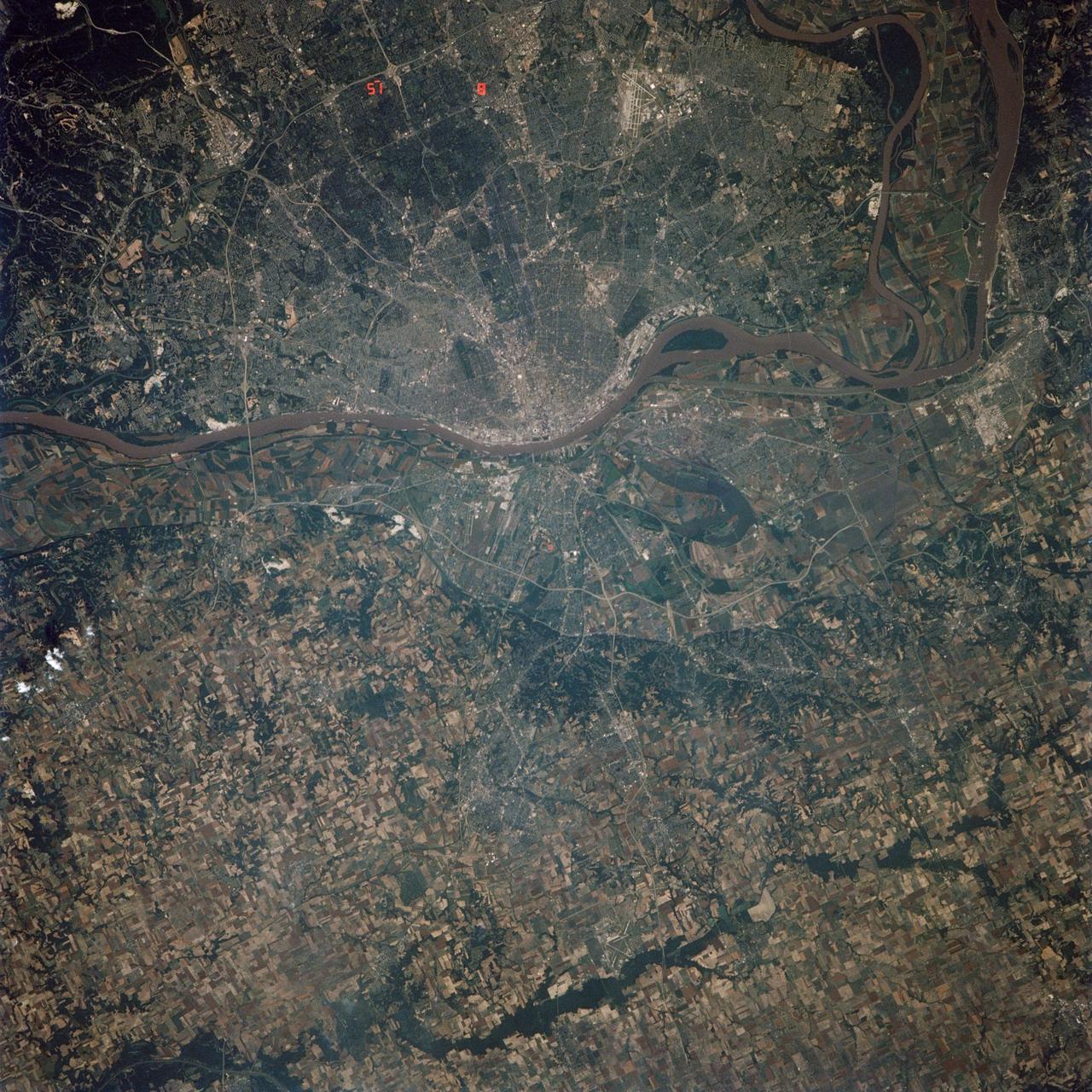
STS040-614-066 (5-14 June 1991) --- St. Louis, Missouri-East St. Louis, Illinois and surrounding area were photographed by the STS 40 crewmembers aboard the Space Shuttle Columbia. The winding Mississippi River serves as a reference point for finding features of the area. Busch Stadium is clearly seen. NASA photo experts studying the STS 40 imagery claim photographs of this type aid in following demographic changes and in planning for development. The ground track of STS-40 and the existence of exceptionally clear skies during much of the nine-day flight permitted photographic acquisition of several cities not generally seen from the space flights flying at 28-degree inclinations to the Equator.
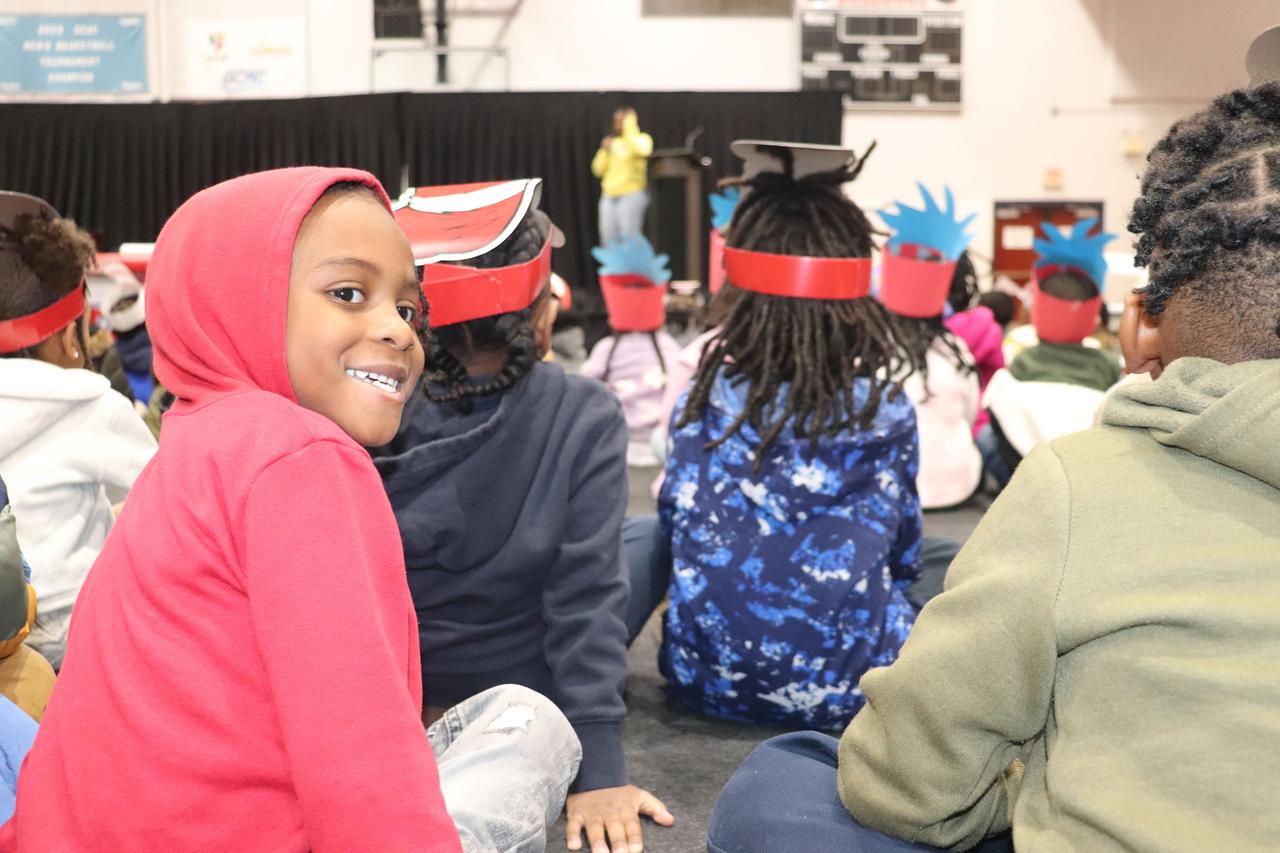
Representatives from NASA’s Stennis Space Center and NASA Shared Services Center participate in multiple related outreach events throughout Jackson, Mississippi, as part of the annual Stennis Day at the Capitol activities on Feb. 29. NASA personnel inspired the Artemis Generation with visits to Spann Elementary and Blackburn Middle schools. Activities included students learning about life as a NASA astronaut and a hands-on STEM (science, technology, engineering, and mathematics) activity. Sending the first woman and first person of color to the Moon on future Artemis missions will inspire the Artemis Generation to see themselves in space and understand the importance of STEM studies and careers. As NASA takes giant leaps to bridge disparities and break barriers in STEM, the agency’s efforts in the future workforce advances the nation’s space exploration.
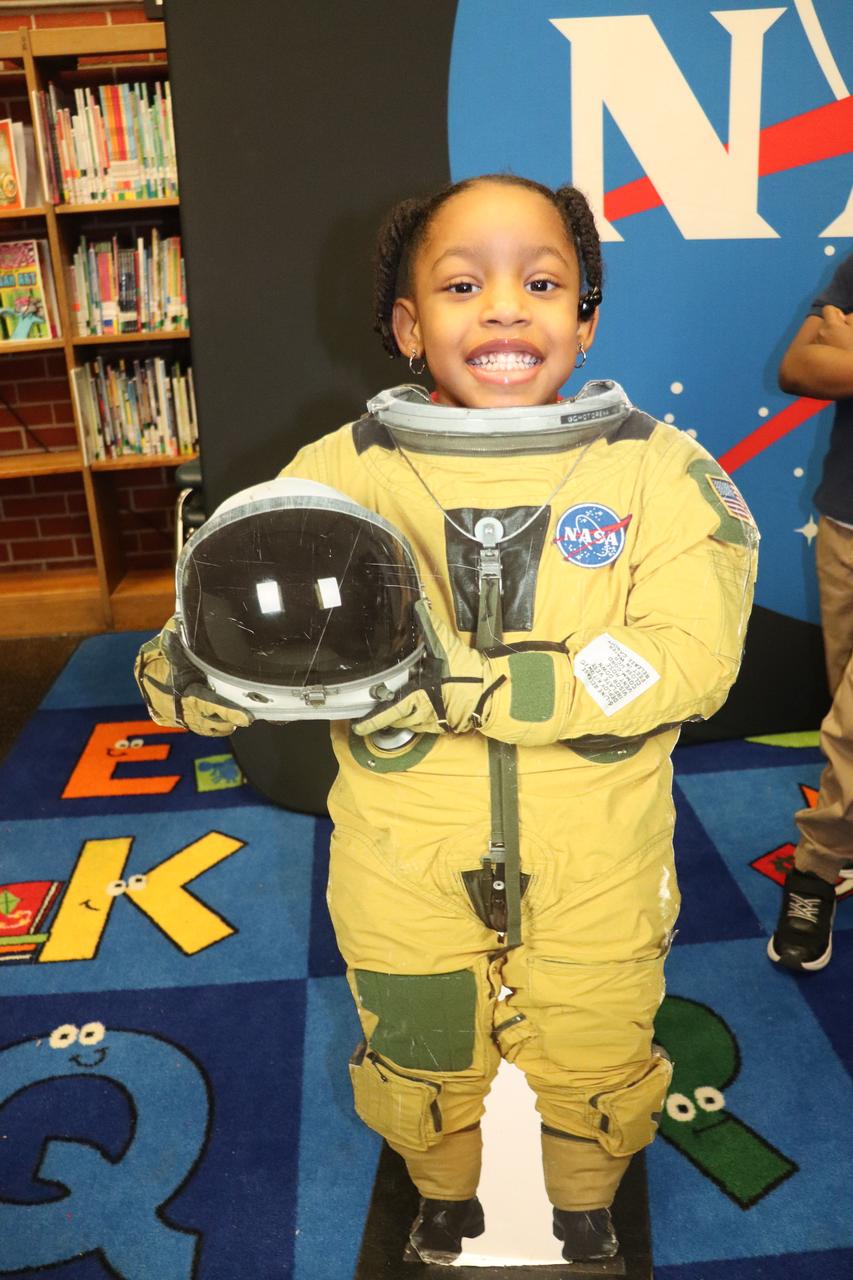
Representatives from NASA’s Stennis Space Center and NASA Shared Services Center participate in multiple related outreach events throughout Jackson, Mississippi, as part of the annual Stennis Day at the Capitol activities on Feb. 29. NASA personnel inspired the Artemis Generation with visits to Spann Elementary and Blackburn Middle schools. Activities included students learning about life as a NASA astronaut and a hands-on STEM (science, technology, engineering, and mathematics) activity. Sending the first woman and first person of color to the Moon on future Artemis missions will inspire the Artemis Generation to see themselves in space and understand the importance of STEM studies and careers. As NASA takes giant leaps to bridge disparities and break barriers in STEM, the agency’s efforts in the future workforce advances the nation’s space exploration.
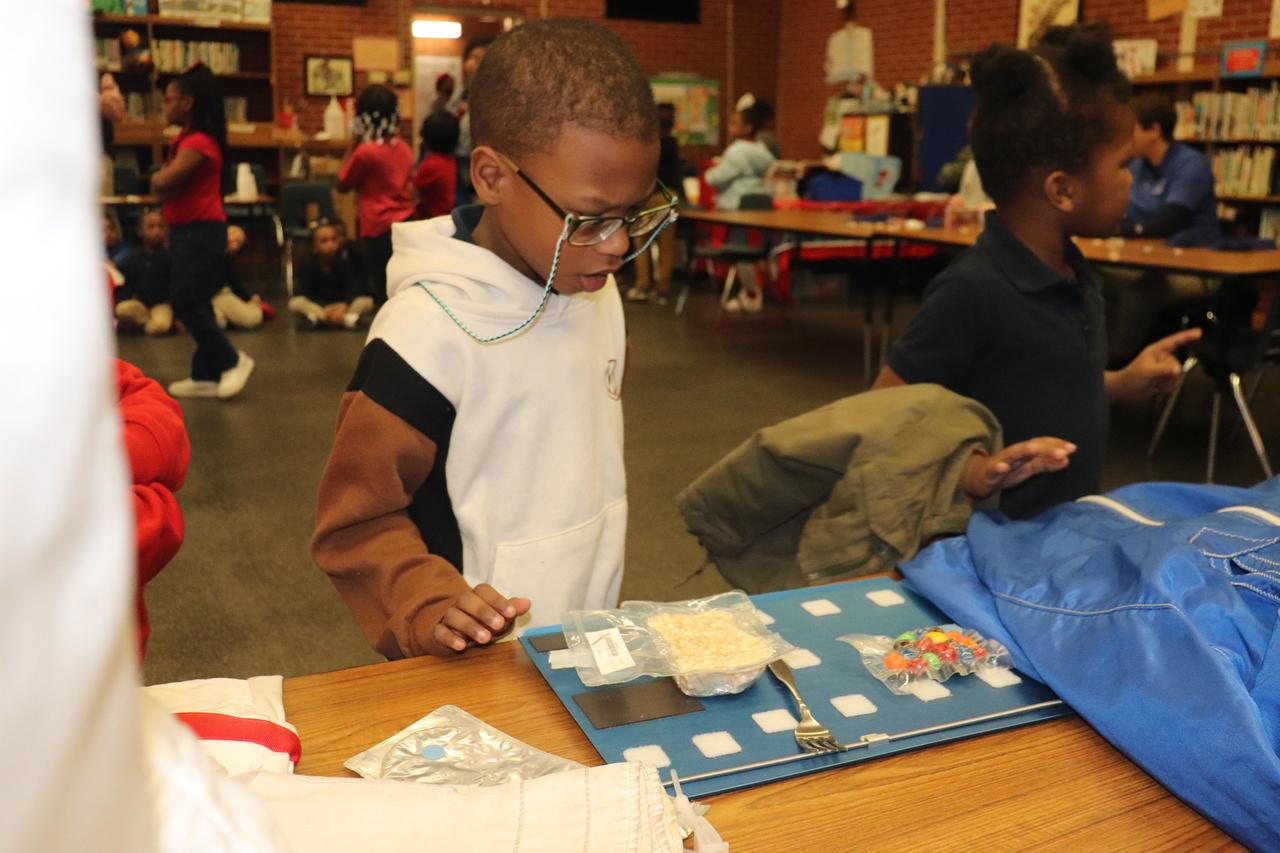
Representatives from NASA’s Stennis Space Center and NASA Shared Services Center participate in multiple related outreach events throughout Jackson, Mississippi, as part of the annual Stennis Day at the Capitol activities on Feb. 29. NASA personnel inspired the Artemis Generation with visits to Spann Elementary and Blackburn Middle schools. Activities included students learning about life as a NASA astronaut and a hands-on STEM (science, technology, engineering, and mathematics) activity. Sending the first woman and first person of color to the Moon on future Artemis missions will inspire the Artemis Generation to see themselves in space and understand the importance of STEM studies and careers. As NASA takes giant leaps to bridge disparities and break barriers in STEM, the agency’s efforts in the future workforce advances the nation’s space exploration.
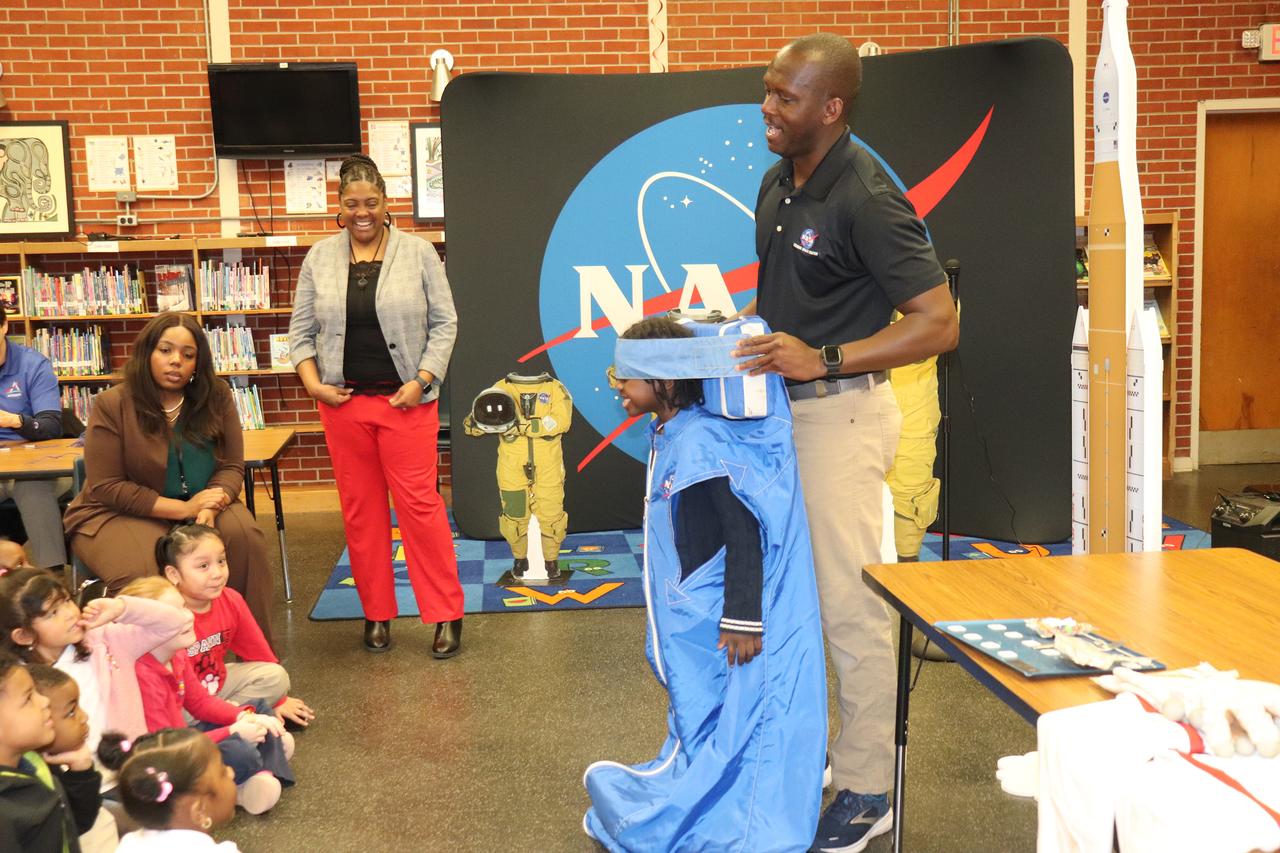
Representatives from NASA’s Stennis Space Center and NASA Shared Services Center participate in multiple related outreach events throughout Jackson, Mississippi, as part of the annual Stennis Day at the Capitol activities on Feb. 29. NASA personnel inspired the Artemis Generation with visits to Spann Elementary and Blackburn Middle schools. Activities included students learning about life as a NASA astronaut and a hands-on STEM (science, technology, engineering, and mathematics) activity. Sending the first woman and first person of color to the Moon on future Artemis missions will inspire the Artemis Generation to see themselves in space and understand the importance of STEM studies and careers. As NASA takes giant leaps to bridge disparities and break barriers in STEM, the agency’s efforts in the future workforce advances the nation’s space exploration.
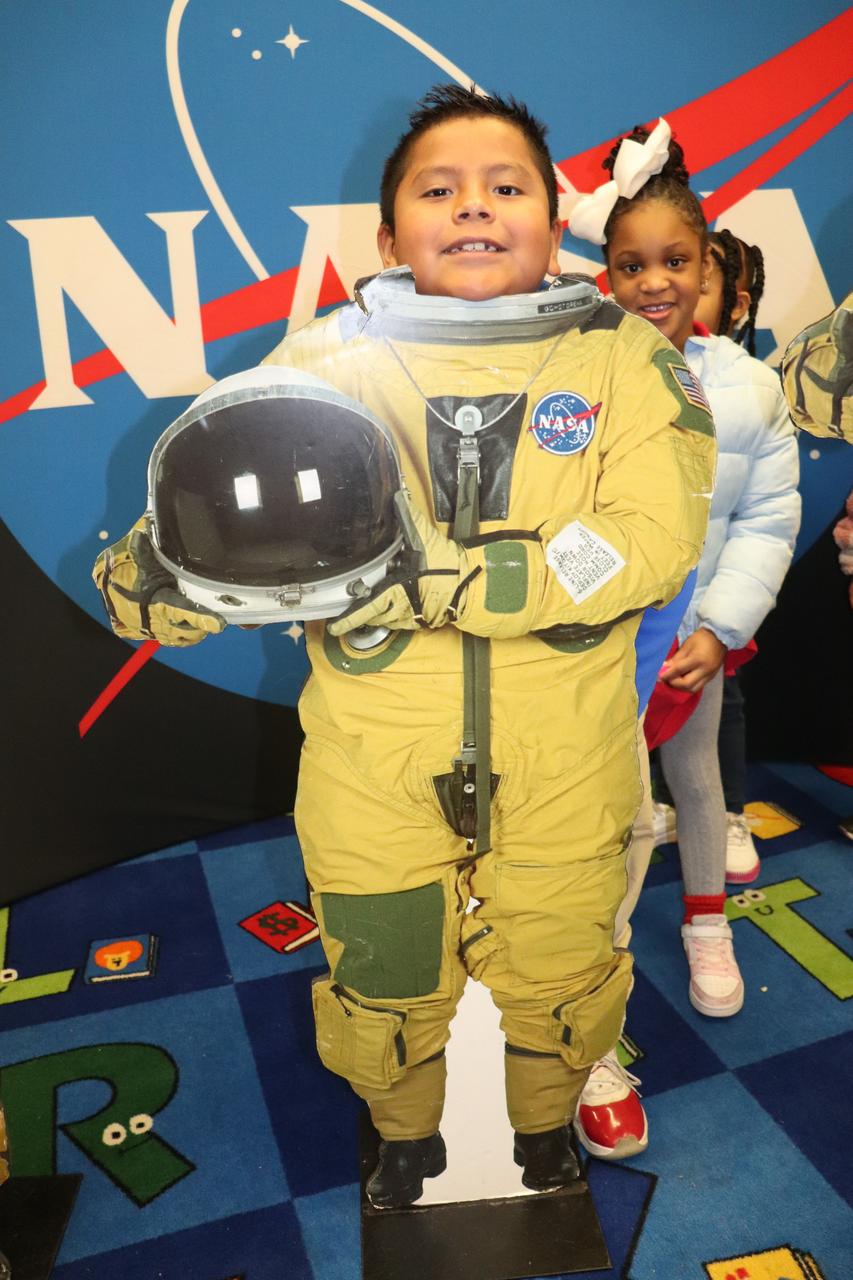
Representatives from NASA’s Stennis Space Center and NASA Shared Services Center participate in multiple related outreach events throughout Jackson, Mississippi, as part of the annual Stennis Day at the Capitol activities on Feb. 29. NASA personnel inspired the Artemis Generation with visits to Spann Elementary and Blackburn Middle schools. Activities included students learning about life as a NASA astronaut and a hands-on STEM (science, technology, engineering, and mathematics) activity. Sending the first woman and first person of color to the Moon on future Artemis missions will inspire the Artemis Generation to see themselves in space and understand the importance of STEM studies and careers. As NASA takes giant leaps to bridge disparities and break barriers in STEM, the agency’s efforts in the future workforce advances the nation’s space exploration.
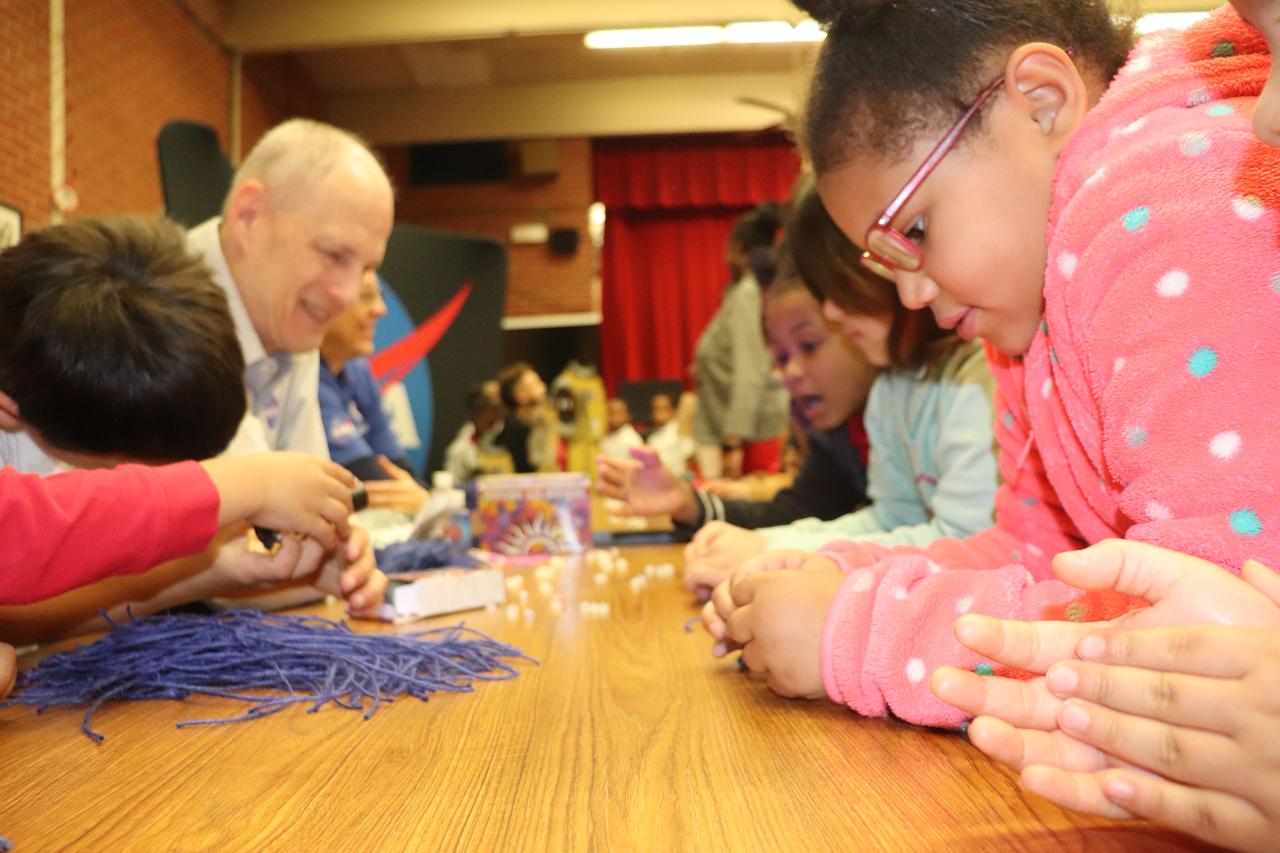
Representatives from NASA’s Stennis Space Center and NASA Shared Services Center participate in multiple related outreach events throughout Jackson, Mississippi, as part of the annual Stennis Day at the Capitol activities on Feb. 29. NASA personnel inspired the Artemis Generation with visits to Spann Elementary and Blackburn Middle schools. Activities included students learning about life as a NASA astronaut and a hands-on STEM (science, technology, engineering, and mathematics) activity. Sending the first woman and first person of color to the Moon on future Artemis missions will inspire the Artemis Generation to see themselves in space and understand the importance of STEM studies and careers. As NASA takes giant leaps to bridge disparities and break barriers in STEM, the agency’s efforts in the future workforce advances the nation’s space exploration.
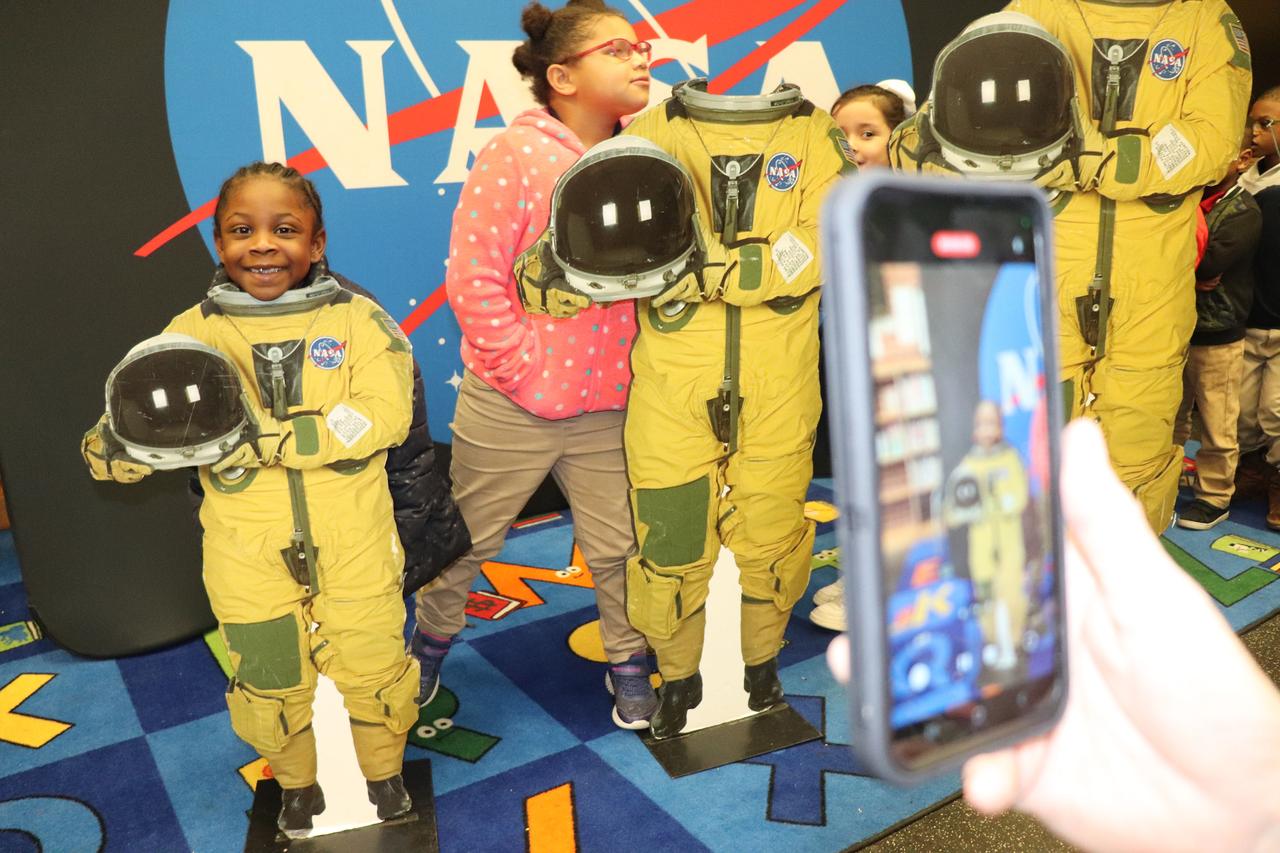
Representatives from NASA’s Stennis Space Center and NASA Shared Services Center participate in multiple related outreach events throughout Jackson, Mississippi, as part of the annual Stennis Day at the Capitol activities on Feb. 29. NASA personnel inspired the Artemis Generation with visits to Spann Elementary and Blackburn Middle schools. Activities included students learning about life as a NASA astronaut and a hands-on STEM (science, technology, engineering, and mathematics) activity. Sending the first woman and first person of color to the Moon on future Artemis missions will inspire the Artemis Generation to see themselves in space and understand the importance of STEM studies and careers. As NASA takes giant leaps to bridge disparities and break barriers in STEM, the agency’s efforts in the future workforce advances the nation’s space exploration.
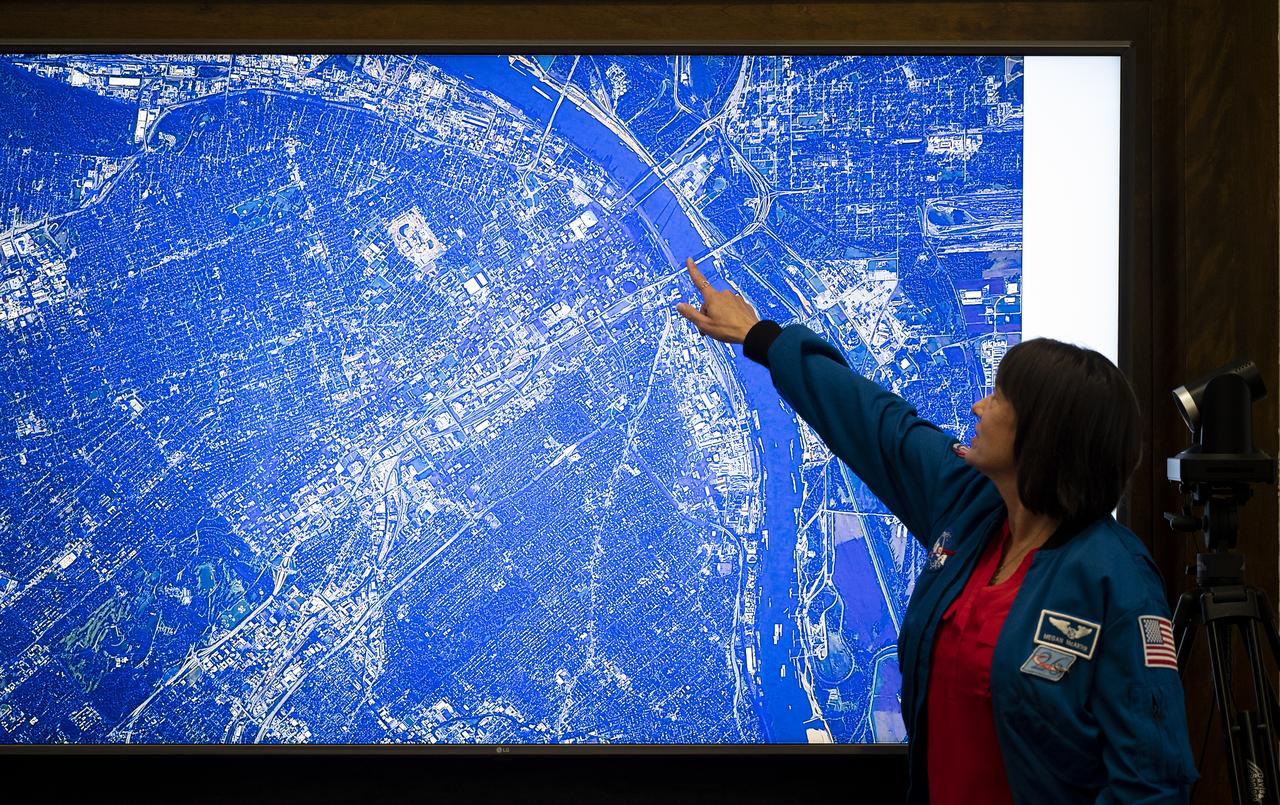
NASA astronaut Megan McArthur points to the shadow of the Gateway Arch on the Mississippi River in St. Louis while showing images of National Parks taken from the International Space Station during Expeditions 65 and 66 during a presentation to leadership and rangers who participate in the National Park Service’s astronomy and dark sky programs, Thursday, June 9, 2022 at the U.S. Department of the Interior in Washington, DC. McArthur, NASA astronaut Shane Kimbrough, Japan Aerospace Exploration Agency (JAXA) astronaut Akihiko Hoshide, and ESA (European Space Agency) astronaut Thomas Pesquet, flew on NASA’s SpaceX Crew-2 mission, the second crew rotation mission to the International Space Station as part of the agency’s Commercial Crew Program, and spent 198 days aboard the orbiting laboratory as part of Expeditions 65 and 66. Photo Credit: (NASA/Joel Kowsky)
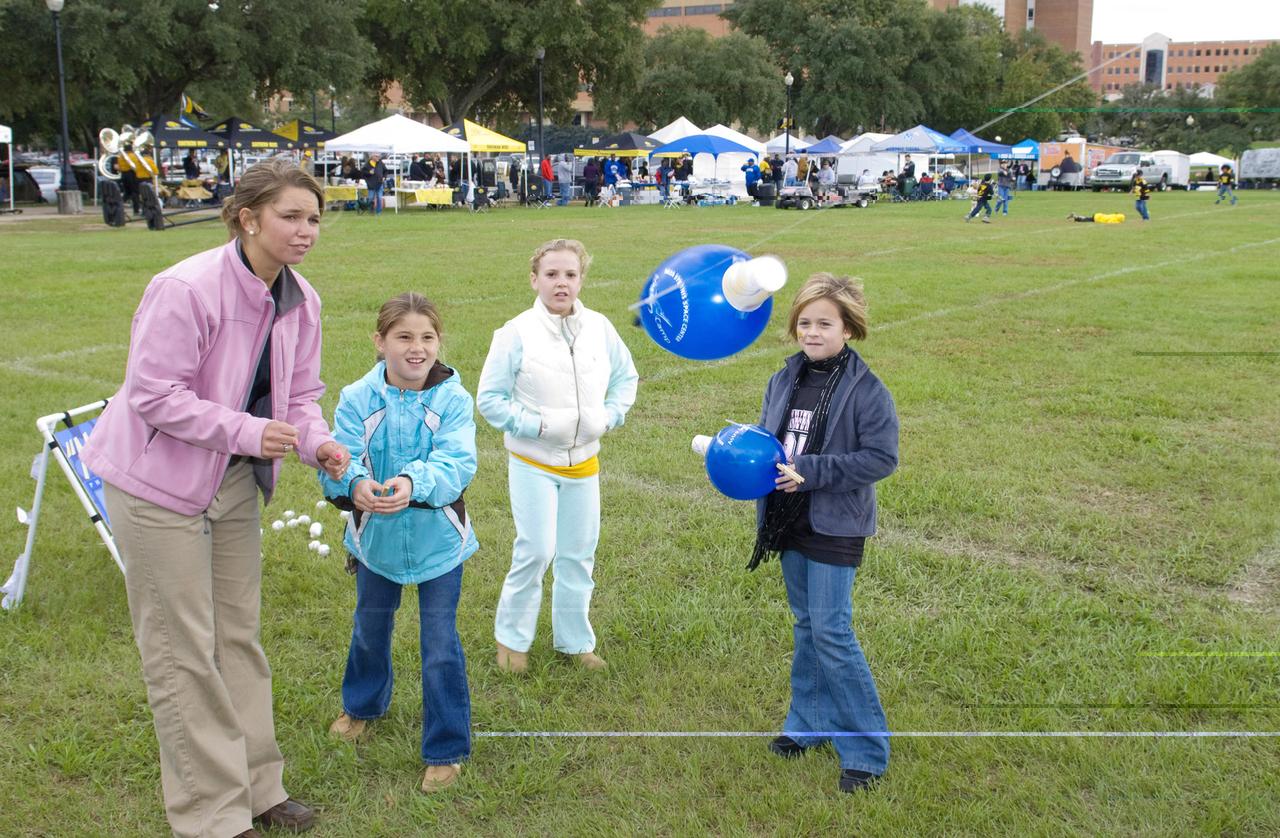
Fallon Nettles (left), an Astro Camp counselor at NASA's John C. Stennis Space Center, assists a young fan attending the University of Southern Mississippi football game in Hattiesburg, Miss., on Oct. 17 in launching a balloon 'rocket.' Prior to the game, Stennis Space Center hosted hands-on activities and exhibits for families as part of its first-ever Space Day at USM. The activities were versions of those featured in the daylong and weeklong Astro Camp sessions sponsored by Stennis throughout each year. Stennis Space Center is located in nearby Hancock County and is the nation's premier rocket engine testing facility. The USM activities were part of Stennis' ongoing effort to educate people about the NASA mission and to introduce children and young people to space and space exploration.

On the second day of NASA's 9th Robotic Mining Competition, May 15, team members from Mississippi State University work on their robot miner in the RobotPits in the Educator Resource Center at Kennedy Space Center Visitor Complex in Florida. At far right is Kennedy Space Center Director Bob Cabana. More than 40 student teams from colleges and universities around the U.S. will use their mining robots to dig in a supersized sandbox filled with BP-1, or simulated Lunar soil, gravel and rocks, and participate in other competition requirements. The Robotic Mining Competition is a NASA Human Exploration and Operations Mission Directorate project designed to encourage students in science, technology, engineering and math, or STEM fields. The project provides a competitive environment to foster innovative ideas and solutions that could be used on NASA's deep space missions.
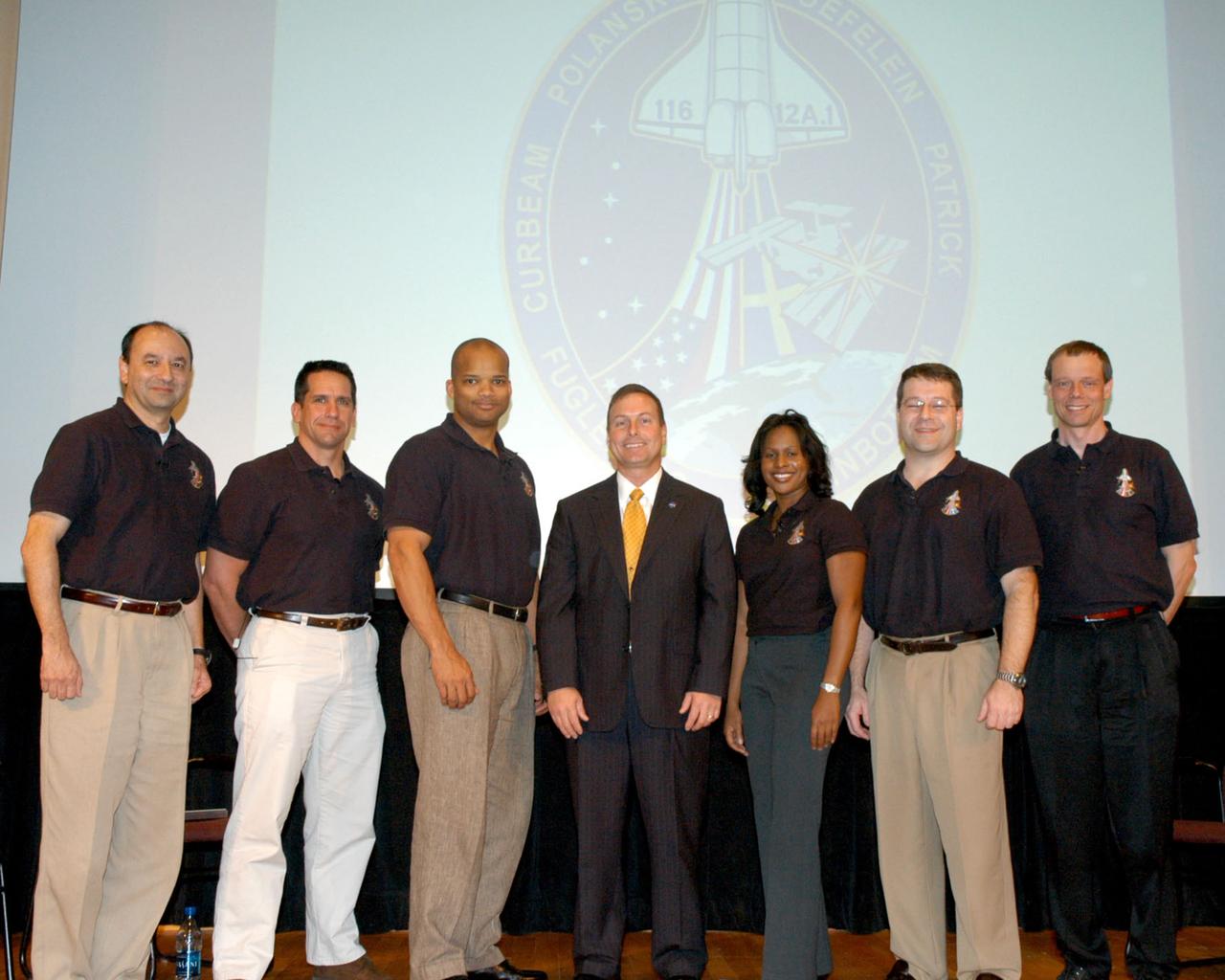
The astronauts of NASA's STS-116 space shuttle mission visited NASA Stennis Space Center in south Mississippi to share highlights of their 13-day mission and to thank SSC employees for the reliability of the space shuttle's main engines, which helped propel Space Shuttle Discovery into orbit during its Dec. 9, 2006, launch. Pictured (from left) are STS-116 crewmembers Commander Mark Polansky, Pilot Bill Oefelein, Mission Specialist Robert Curbeam, SSC Center Director, Richard Gilbrech, Mission Specialists Joan Higginbotham, Nicholas Patrick and Christer Fuglesang. During the mission, which began with the first evening launch since 2002, the astronauts installed the P5 spacer truss segment and rewired the International Space Station's power system.
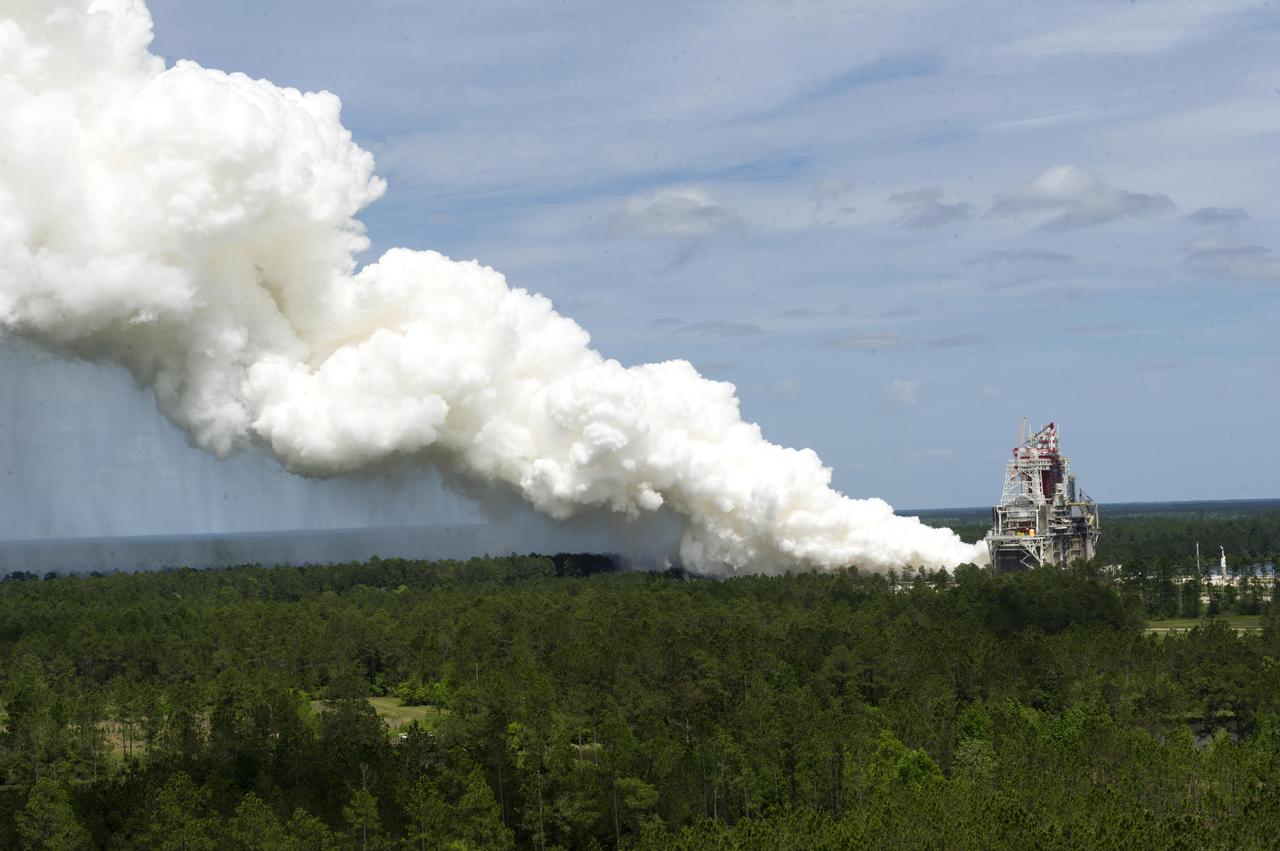
What better way to mark 50 years of rocket engine testing than with a rocket engine test? Stennis Space Center employees enjoyed a chance to view an RS-68 engine test at the B-1 Test Stand on April 19, almost 50 years to the day that the first test was conducted at the south Mississippi site in 1966. The test viewing was part of a weeklong celebration of the 50th year of rocket engine testing at Stennis. The first test at the site occurred April 23, 1966, with a 15-second firing of a Saturn V second stage prototype (S-II-C) on the A-2 Test Stand. The center subsequently tested Apollo rocket stages that carried humans to the moon and every main engine used to power 135 space shuttle missions. It currently tests engines for NASA’s new Space Launch System vehicle.
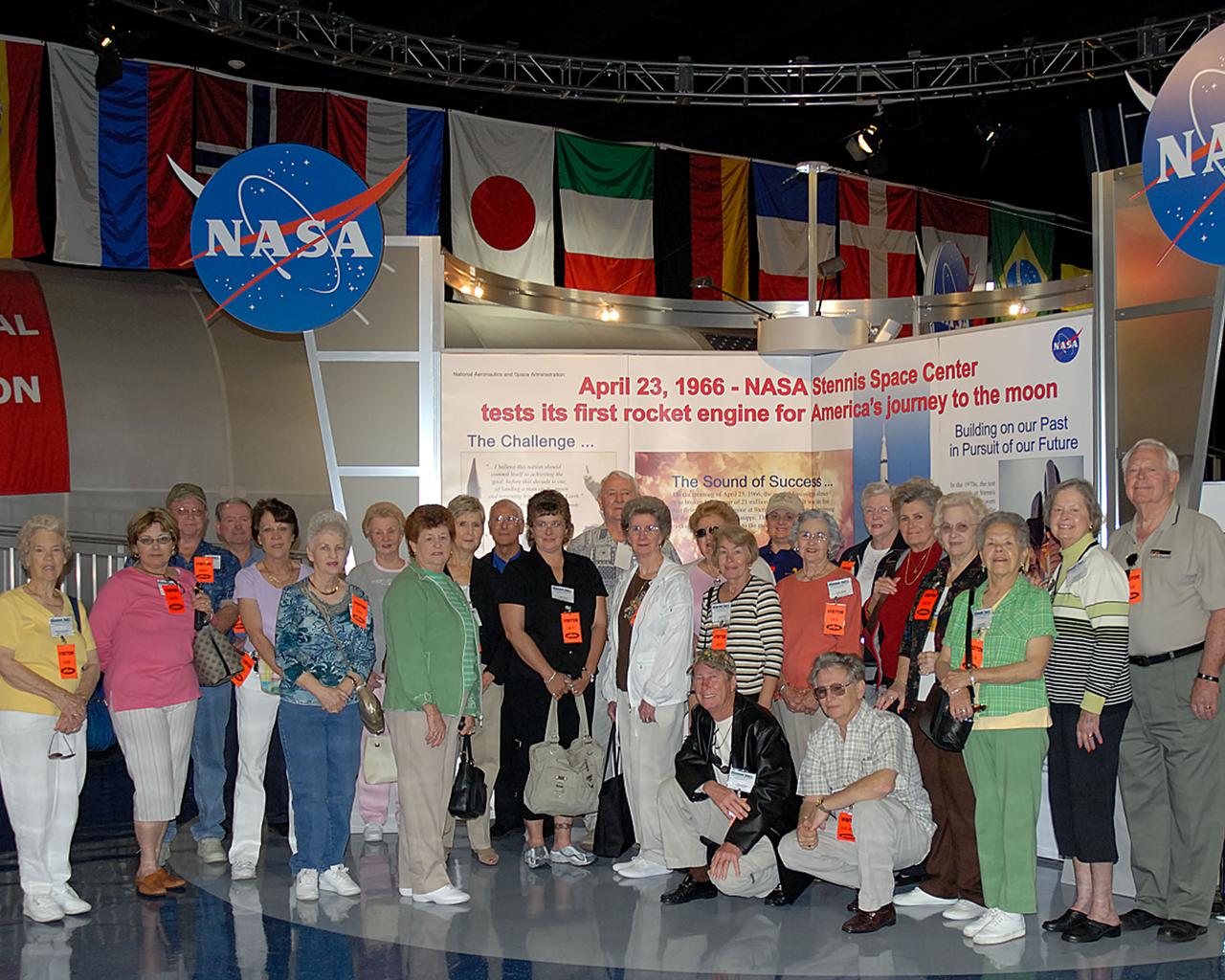
On April 24, a group traveling with Diamond Tours visited StenniSphere, the visitor center at NASA John C. Stennis Space Center in South Mississippi. The trip marked Diamond Tours' return to StenniSphere since Hurricane Katrina struck the Gulf Coast on Aug. 29, 2005. About 25 business professionals from Georgia enjoyed the day's tour of America's largest rocket engine test complex, along with the many displays and exhibits at the museum. Before Hurricane Katrina, the nationwide company brought more than 1,000 visitors to StenniSphere each month. That contributed to more than 100,000 visitors from around the world touring the space center each year. In past years StenniSphere's visitor relations specialists booked Diamond Tours two or three times a week, averaging 40 to 50 people per visit. SSC was established in the 1960s to test the huge engines for the Saturn V moon rockets. Now 40 years later, the center tests every main engine for the space shuttle. SSC will soon begin testing the rocket engines that will power spacecraft carrying Americans back to the moon and on to Mars. For more information or to book a tour, visit http://www.nasa.gov/centers/stennis/home/index.html and click on the StenniSphere logo; or call 800-237-1821 or 228-688-2370.
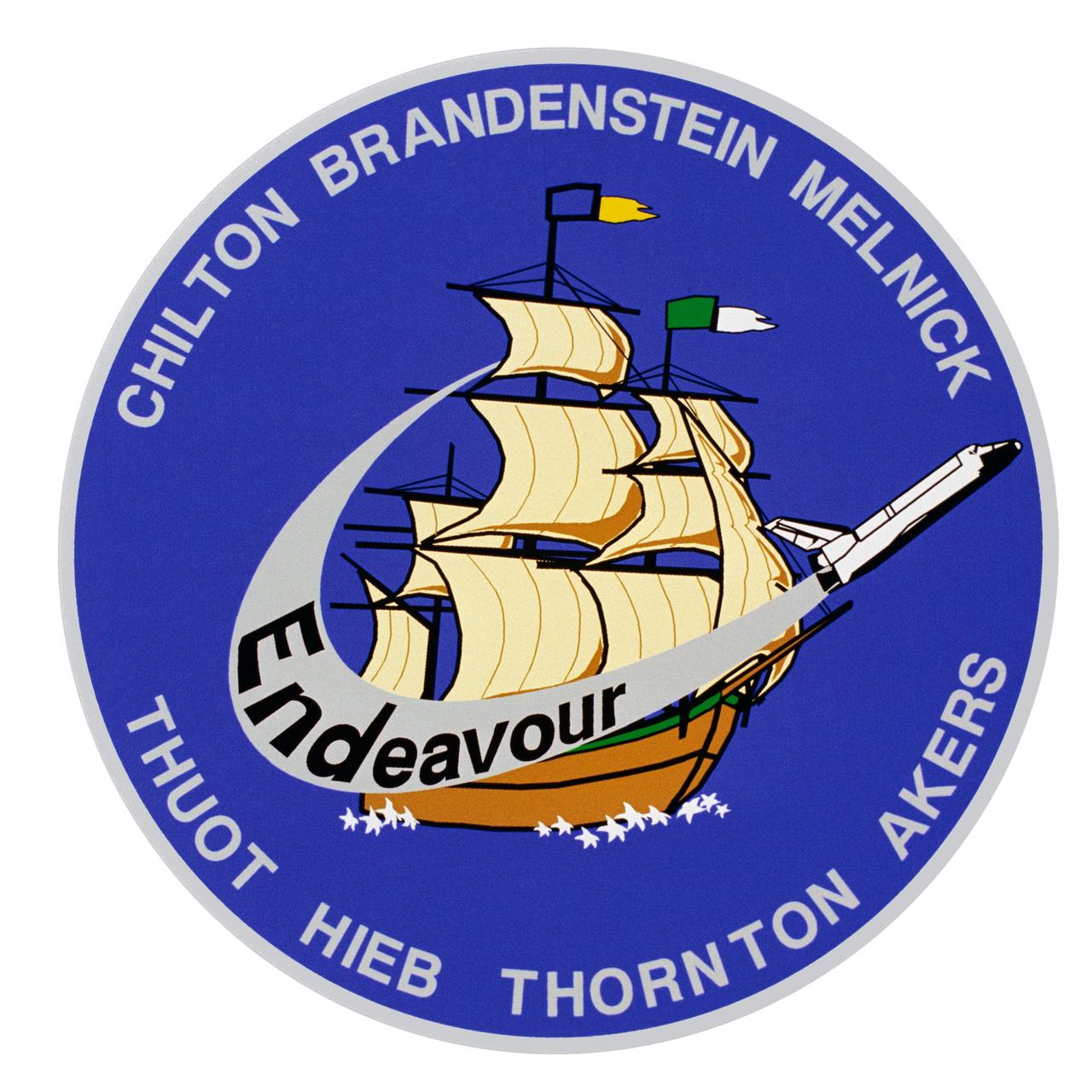
STS049-S-001 (March 1991) --- The patch, designed by its crew members, captures spaceflight's spirit of exploration which has its origins in the early seagoing vessels that explored the uncharted reaches of Earth and its oceans. The ship depicted on the patch is HMS Endeavour, the sailing vessel which Captain James Cook commanded on his first scientific expedition to the South Pacific. Just as Captain Cook engaged in unprecedented feats of exploration during his voyage, on the space shuttle Endeavour's maiden flight, its crew will expand the horizons of space operations with an unprecedented rendezvous and series of three spacewalks. During three consecutive days of extravehicular activity (EVA), the crew will conduct one spacewalk to retrieve, repair and deploy the Intelsat IV-F3 communications satellite, and two additional EVA's to evaluate potential Space Station Freedom assembly concepts. The flags flying high on Endeavour's masts wear the colors of the two schools that won the nationwide contest when Endeavour was chosen as the name of NASA's newest space shuttle: Senatobia (Mississippi) Middle School and Tallulah Falls (Georgia) School. The NASA insignia design for space shuttle flights is reserved for use by the astronauts and for other official use as the NASA Administrator may authorize. Public availability has been approved only in the form of illustrations by the various news media. When and if there is any change in this policy, which is not anticipated, it will be publicly announced. Photo credit: NASA
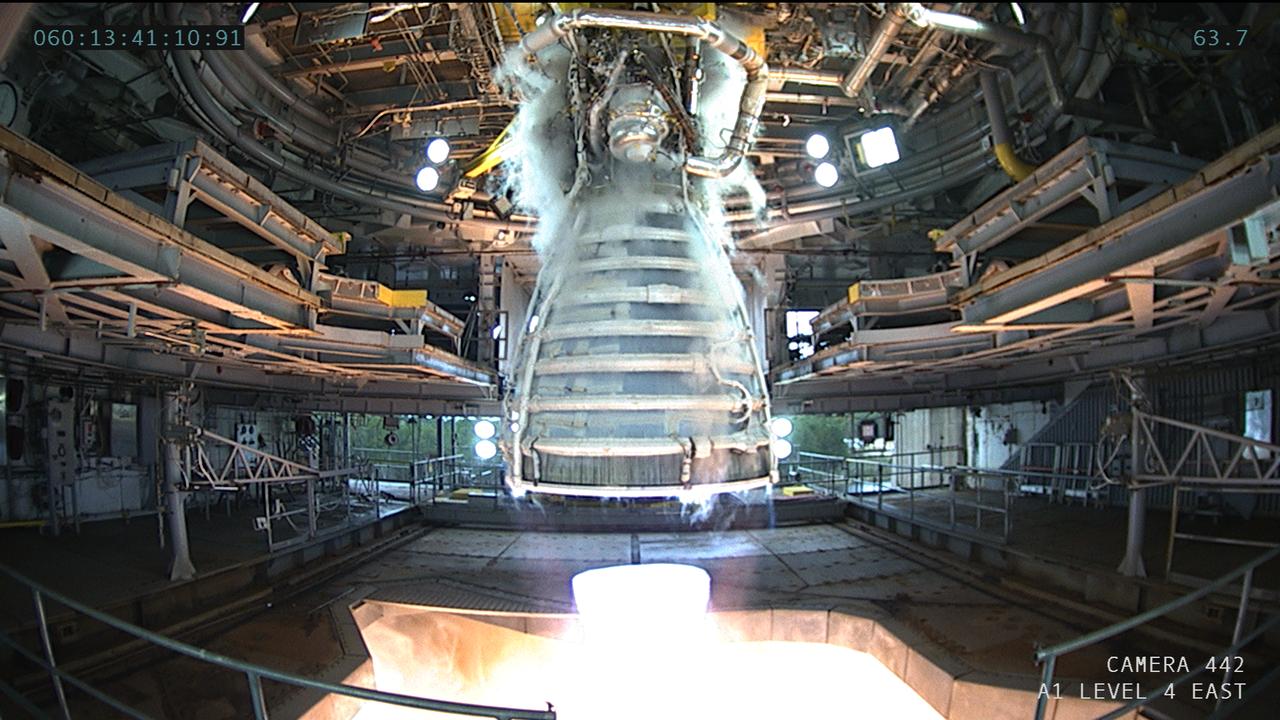
NASA conducted a full-duration RS-25 hot fire Feb. 29 on the Fred Haise Test Stand at NASA’s Stennis Space Center near Bay St. Louis, Mississippi, continuing a key test series for future Artemis flights of NASA’s SLS (Space Launch System) rocket. The hot fire to certify new production RS-25 engines for SLS marked only the second ever Leap Day engine test. Fourty-four years ago on Feb. 29, 1980, before the first space shuttle launch, a test-fire occurred for RS-25 engine #0009. Both tests were conducted on the Fred Haise Test, previously known as the A-1 Test Stand at NASA Stennis. The Feb. 29, 2024, hot fire is the second test following installation of a second production engine nozzle that will provide additional performance data on the upgraded unit. It also marked the eighth in a 12-test series to certify production of new RS-25 engines by lead contractor Aerojet Rocketdyne, an L3Harris Technologies company, to help power NASA’s SLS rocket on Artemis missions to the Moon and beyond, beginning with Artemis V. The current series is the second and final series to certify restart production of the upgraded engines. NASA completed an initial 12-test certification series with the upgraded components in June 2023. Four RS-25 engines fire simultaneously to help launch each SLS rocket, producing up to 2 million pounds of combined thrust.
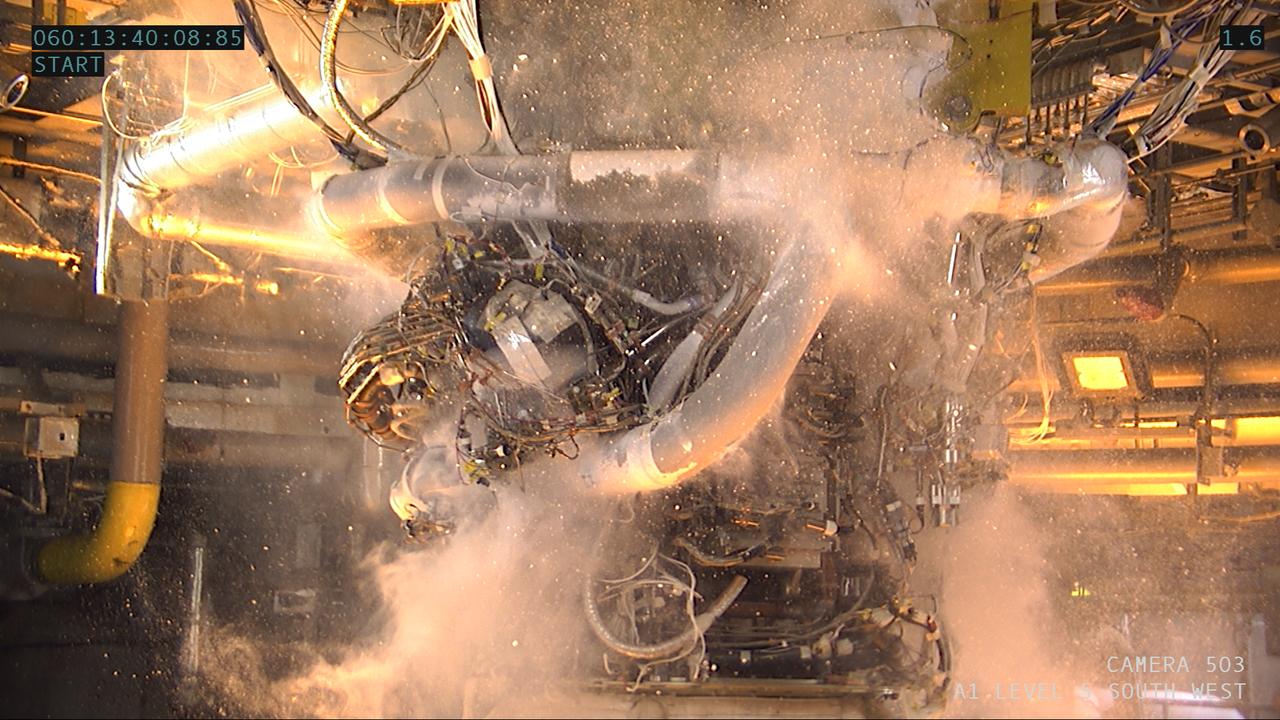
NASA conducted a full-duration RS-25 hot fire Feb. 29 on the Fred Haise Test Stand at NASA’s Stennis Space Center near Bay St. Louis, Mississippi, continuing a key test series for future Artemis flights of NASA’s SLS (Space Launch System) rocket. The hot fire to certify new production RS-25 engines for SLS marked only the second ever Leap Day engine test. Fourty-four years ago on Feb. 29, 1980, before the first space shuttle launch, a test-fire occurred for RS-25 engine #0009. Both tests were conducted on the Fred Haise Test, previously known as the A-1 Test Stand at NASA Stennis. The Feb. 29, 2024, hot fire is the second test following installation of a second production engine nozzle that will provide additional performance data on the upgraded unit. It also marked the eighth in a 12-test series to certify production of new RS-25 engines by lead contractor Aerojet Rocketdyne, an L3Harris Technologies company, to help power NASA’s SLS rocket on Artemis missions to the Moon and beyond, beginning with Artemis V. The current series is the second and final series to certify restart production of the upgraded engines. NASA completed an initial 12-test certification series with the upgraded components in June 2023. Four RS-25 engines fire simultaneously to help launch each SLS rocket, producing up to 2 million pounds of combined thrust.
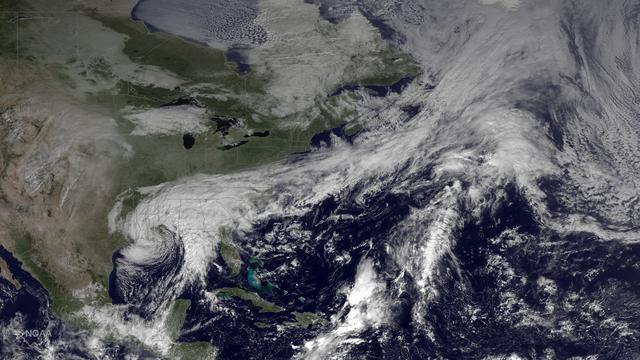
The system that brought heavy rainfall and flash flooding to parts of the southern Plains and western Gulf Coast over the past several days continues to push eastward, with the greatest potential for heavy rain and flash flooding on Monday across parts of the lower Mississippi Valley and Southeast. This image was taken by GOES East at 1515Z on October 26, 2015. <b><a href="http://goes.gsfc.nasa.gov/" rel="nofollow">Credit: NOAA/NASA GOES Project</a></b> Credit: NASA/NOAA via <b><a href="www.nnvl.noaa.gov/" rel="nofollow"> NOAA Environmental Visualization Laboratory</a></b> <b><a href="http://www.nasa.gov/audience/formedia/features/MP_Photo_Guidelines.html" rel="nofollow">NASA image use policy.</a></b> <b><a href="http://www.nasa.gov/centers/goddard/home/index.html" rel="nofollow">NASA Goddard Space Flight Center</a></b> enables NASA’s mission through four scientific endeavors: Earth Science, Heliophysics, Solar System Exploration, and Astrophysics. Goddard plays a leading role in NASA’s accomplishments by contributing compelling scientific knowledge to advance the Agency’s mission. <b>Follow us on <a href="http://twitter.com/NASAGoddardPix" rel="nofollow">Twitter</a></b> <b>Like us on <a href="http://www.facebook.com/pages/Greenbelt-MD/NASA-Goddard/395013845897?ref=tsd" rel="nofollow">Facebook</a></b> <b>Find us on <a href="http://instagrid.me/nasagoddard/?vm=grid" rel="nofollow">Instagram</a></b>
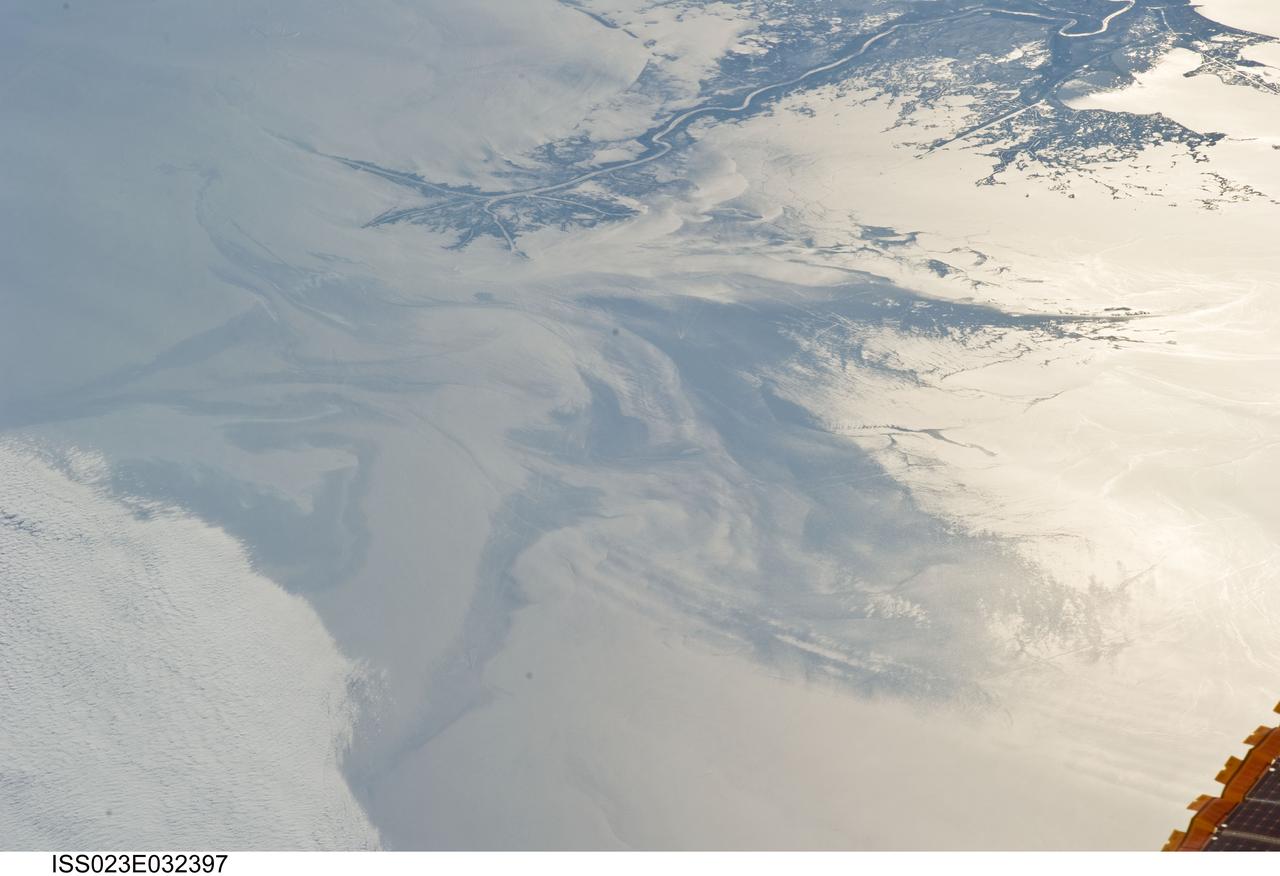
ISS023-E-032397 (4 May 2010) --- The Gulf of Mexico oil spill is featured in this image photographed by an Expedition 23 crew member on the International Space Station. On April 20, 2010 the oil rig Deepwater Horizon suffered an explosion and sank two days later. Shortly thereafter oil began leaking into the Gulf of Mexico from ruptured pipes as safety cutoff mechanisms failed to operate. Automated nadir-viewing orbital NASA sensors have been tracking the growth of the oil spill as it has spread towards the northern Gulf Coast. This detailed photograph provides a different viewing perspective on the ongoing event. The image is oblique, meaning that it was taken with a sideways viewing angle from the space station, rather than the ?straight down? or nadir view typical of automated satellite sensors. The view is towards the west; the ISS was located over the eastern edge of the Gulf of Mexico when the image was taken. The Mississippi River Delta and nearby Louisiana coast (top) appear dark in the sunglint that illuminates most of the image. This phenomenon is caused by sunlight reflecting off the water surface ? much like a mirror ? directly back towards the astronaut observer onboard the orbital complex. The sunglint improves the identification of the oil spill (colored dark to light gray) which is creating a different water texture, and therefore a contrast, between the smooth and rougher water of the reflective ocean surface (colored silver to white). Wind and water current patterns have modified the oil spill?s original shape into streamers and elongated masses. Efforts are ongoing to contain the spill and protect fragile coastal ecosystems and habitats such as the Chandeleur Islands (right center). Other features visible in the image include a solid field of low cloud cover at the lower left corner of the image. A part of one of the ISS solar arrays is visible at lower right. Wave patterns at lower right are most likely caused by tidal effects.
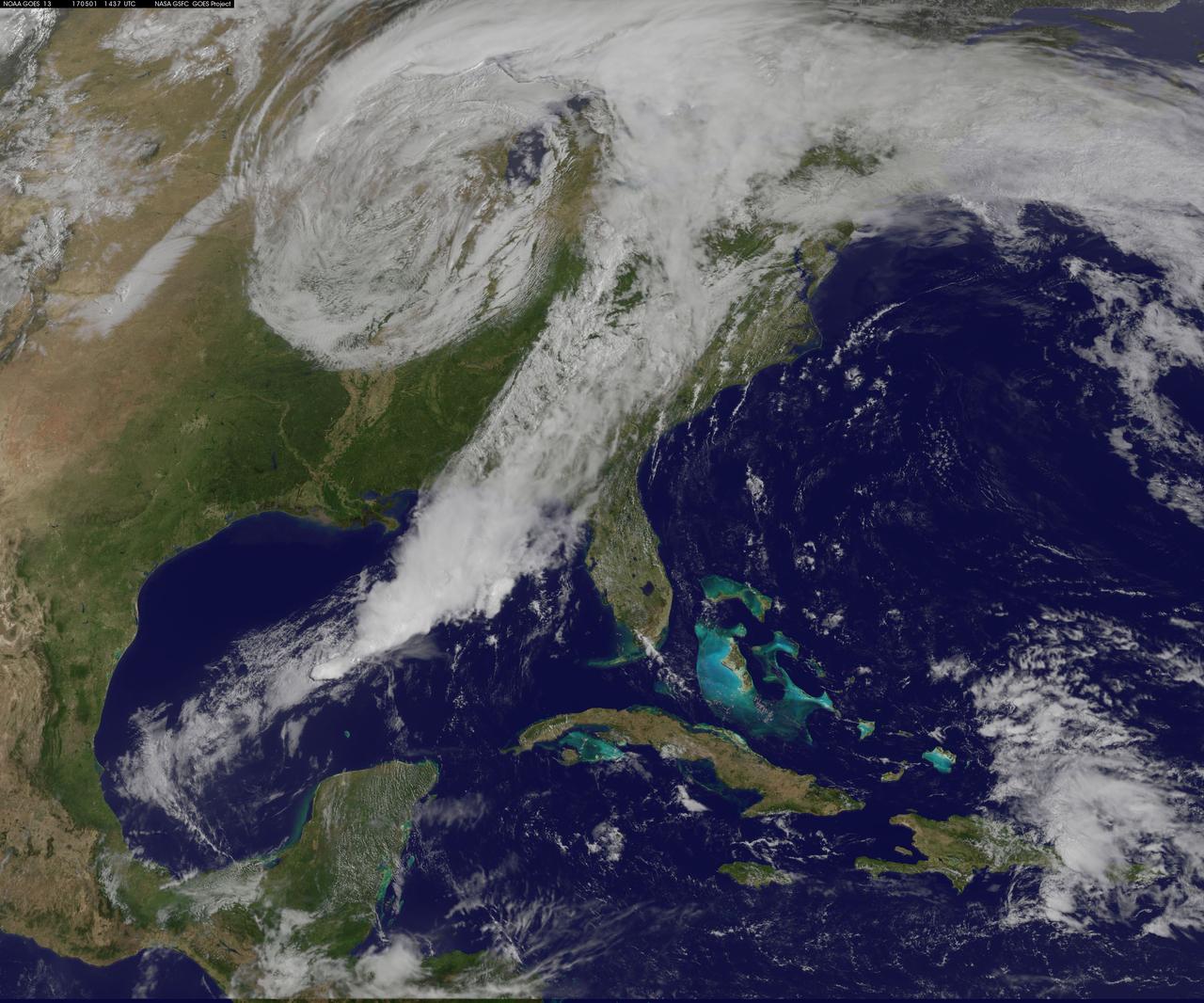
NASA Sees Severe Weather from Central to Eastern US A vigorous weather system has generated severe weather over the mid-section of the U.S. and satellites are providing a look at it as it is moving toward the East Coast. NASA and NOAA satellites have been tracking a storm system that has generated flooding and tornadic thunderstorms in the central U.S. and is expected bring severe weather to the U.S. Mid-Atlantic region. At NASA's Goddard Space Flight Center in Greenbelt, Maryland, data from NOAA's GOES-East satellite were used to create images and an animation of the movement of the powerful storm. On April 30, the Moderate Resolution Imaging Spectroradiometer, or MODIS, instrument aboard NASA's Aqua satellite captured a visible image of the storms moving over eastern Texas and Louisiana. Tornadoes in eastern Texas killed four people. The system generated heavy rainfall and caused additional fatalities and damages in Arkansas, Missouri, Mississippi, Alabama and Tennessee. On Monday, May 1, NOAA's National Weather Service noted, "Major to record flooding continues over portions of the central U.S. Severe thunderstorms are possible from the Mid-Atlantic to the northeastern U.S. "Major to record flooding will continue over portions of eastern Oklahoma, northern Arkansas, Missouri, Illinois and Indiana. Rivers will gradually recede over the next several days. Additional strong to severe thunderstorms will be possible Monday afternoon and evening over portions of the Mid-Atlantic and Northeast U.S. Damaging winds, large hail, and isolated tornadoes will be possible." Image caption: On May 1, 2017, at 10:37 a.m. EDT (1437 UTC) NOAA's GOES-East satellite captured this visible image of the storm system centered over Iowa with an associated cold front that stretches into the Gulf of Mexico. Credits: NASA/NOAA GOES Project <b><a href="http://www.nasa.gov/audience/formedia/features/MP_Photo_Guidelines.html" rel="nofollow">NASA image use policy.</a></b> <b><a href="http://www.nasa.gov/centers/goddard/home/index.html" rel="nofollow">NASA Goddard Space Flight Center</a></b> enables NASA’s mission through four scientific endeavors: Earth Science, Heliophysics, Solar System Exploration, and Astrophysics. Goddard plays a leading role in NASA’s accomplishments by contributing compelling scientific knowledge to advance the Agency’s mission. <b>Follow us on <a href="http://twitter.com/NASAGoddardPix" rel="nofollow">Twitter</a></b> <b>Like us on <a href="http://www.facebook.com/pages/Greenbelt-MD/NASA-Goddard/395013845897?ref=tsd" rel="nofollow">Facebook</a></b> <b>Find us on <a href="http://instagrid.me/nasagoddard/?vm=grid" rel="nofollow">Instagram</a></b>
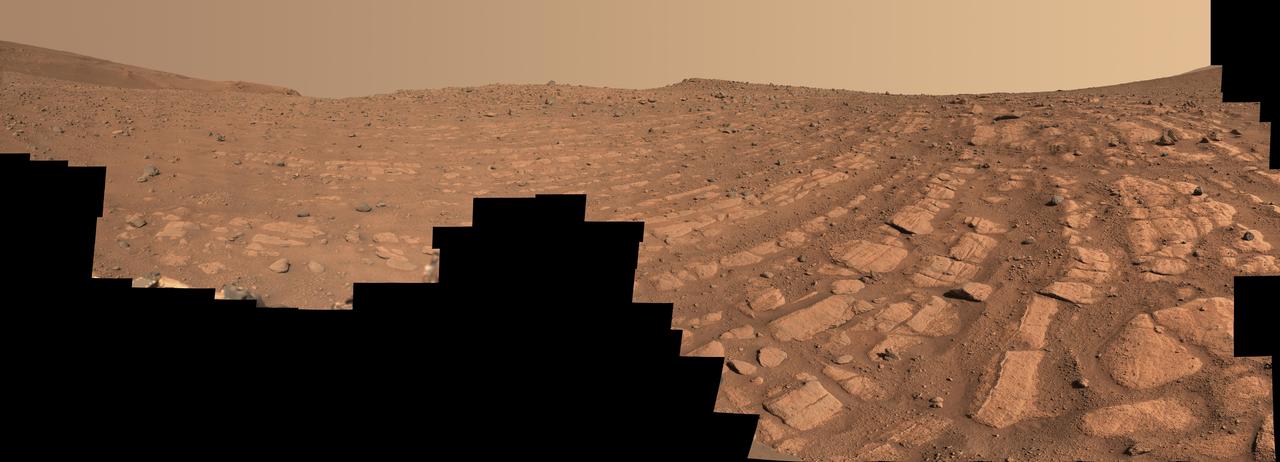
Scientists think that the bands of rocks seen in this image may have been formed by a very fast, deep river – the first of its kind evidence has been found for on Mars. NASA's Perseverance Mars rover captured this mosaic at a location nicknamed "Skrinkle Haven" using its Mastcam-Z camera between Feb. 28 and March 9, 2023 (between the 721st and 729th Martian days, or sols, of the mission). The mosaic is made up of 203 individual images that were stitched together after being sent back from Mars. This natural color view is approximately how the scene would appear to an average person if they were on Mars. "Skrinkle Haven" offers the clearest example of these curved rock layers – called "the curvilinear unit" – that had previously only been seen from space. Scientists are now debating what kind of powerfully flowing water formed those curves: a river like the Mississippi, which winds snakelike across the landscape, or a braided river like Nebraska's Platte, which forms small islands of sediment called sandbars. When viewed from the ground, the curved layers are arranged in rows, and appear to ripple out across the landscape. They could be the remnants of a river's banks that shifted over time – or the remnants of sandbars that formed in the river. The layers were likely much taller in the past; scientists suspect that after these piles of sediment turned to rock, they were sand-blasted by wind over the course of eons and carved down to their present size. Arizona State University leads the operations of the Mastcam-Z instrument, working in collaboration with Malin Space Science Systems in San Diego, on the design, fabrication, testing, and operation of the cameras, and in collaboration with the Niels Bohr Institute of the University of Copenhagen on the design, fabrication, and testing of the calibration targets. A key objective for Perseverance's mission on Mars is astrobiology, including the search for signs of ancient microbial life. The rover will characterize the planet's geology and past climate, pave the way for human exploration of the Red Planet, and be the first mission to collect and cache Martian rock and regolith (broken rock and dust). Subsequent NASA missions, in cooperation with ESA (European Space Agency), would send spacecraft to Mars to collect these sealed samples from the surface and return them to Earth for in-depth analysis. The Mars 2020 Perseverance mission is part of NASA's Moon to Mars exploration approach, which includes Artemis missions to the Moon that will help prepare for human exploration of the Red Planet. https://photojournal.jpl.nasa.gov/catalog/PIA25829