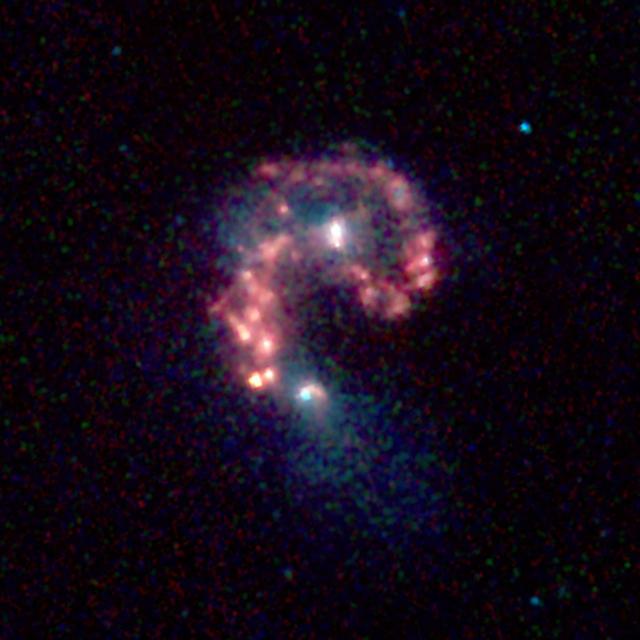
This false-color image from NASA's Spitzer Space Telescope reveals hidden populations of newborn stars at the heart of the colliding "Antennae" galaxies. These two galaxies, known individually as NGC 4038 and 4039, are located around 68 million light-years away and have been merging together for about the last 800 million years. The latest Spitzer observations provide a snapshot of the tremendous burst of star formation triggered in the process of this collision, particularly at the site where the two galaxies overlap. The image was taken by Spitzer's infrared array camera and is a combination of infrared light ranging from 3.6 microns (shown in blue) to 8.0 microns (shown in red). The dust emission (red) is by far the strongest feature in this image. Starlight was systematically subtracted from the longer wavelength data (red) to enhance dust features. The two nuclei, or centers, of the merging galaxies show up as white areas, one above the other. The brightest clouds of forming stars lie in the overlap region between and left of the nuclei. Throughout the sky, astronomers have identified many of these so-called "interacting" galaxies, whose spiral discs have been stretched and distorted by their mutual gravity as they pass close to one another. The distances involved are so large that the interactions evolve on timescales comparable to geologic changes on Earth. Observations of such galaxies, combined with computer models of these collisions, show that the galaxies often become forever bound to one another, eventually merging into a single, spheroidal-shaped galaxy. Wavelengths of 3.6 microns are represented in blue, 4.5 microns in green and 5.8-8.0 microns in red. This image was taken on Dec. 24, 2003. http://photojournal.jpl.nasa.gov/catalog/PIA06853

This false-color image composite from NASA's Spitzer Space Telescope reveals hidden populations of newborn stars at the heart of the colliding "Antennae" galaxies. These two galaxies, known individually as NGC 4038 and 4039, are located around 68 million light-years away and have been merging together for about the last 800 million years. The latest Spitzer observations provide a snapshot of the tremendous burst of star formation triggered in the process of this collision, particularly at the site where the two galaxies overlap. The image is a composite of infrared data from Spitzer and visible-light data from Kitt Peak National Observatory, Tucson, Ariz. Visible light from stars in the galaxies (blue and green) is shown together with infrared light from warm dust clouds heated by newborn stars (red). The two nuclei, or centers, of the merging galaxies show up as yellow-white areas, one above the other. The brightest clouds of forming stars lie in the overlap region between and left of the nuclei. Throughout the sky, astronomers have identified many of these so-called "interacting" galaxies, whose spiral discs have been stretched and distorted by their mutual gravity as they pass close to one another. The distances involved are so large that the interactions evolve on timescales comparable to geologic changes on Earth. Observations of such galaxies, combined with computer models of these collisions, show that the galaxies often become forever bound to one another, eventually merging into a single, spheroidal-shaped galaxy. Wavelengths of 0.44 microns are represented in blue, .70 microns in green and 8.0 microns in red. This image was taken on Dec. 24, 2003. http://photojournal.jpl.nasa.gov/catalog/PIA06854
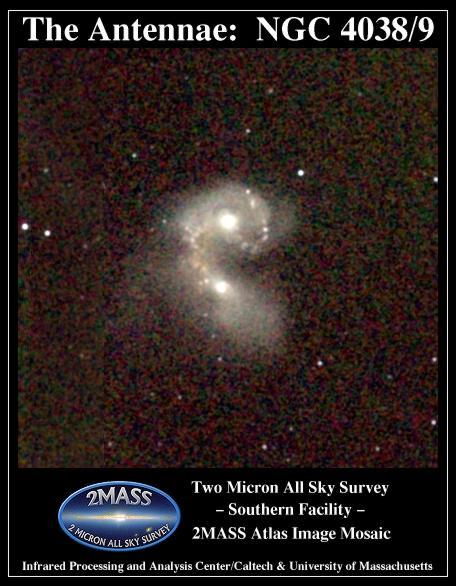
Atlas Image mosaic, covering 7 x 7 on the sky of the interacting galaxies NGC 4038 and NGC 4039, better known as the Antennae, or Ring Tail galaxies. The two galaxies are engaged in a tug-of-war as they collide.
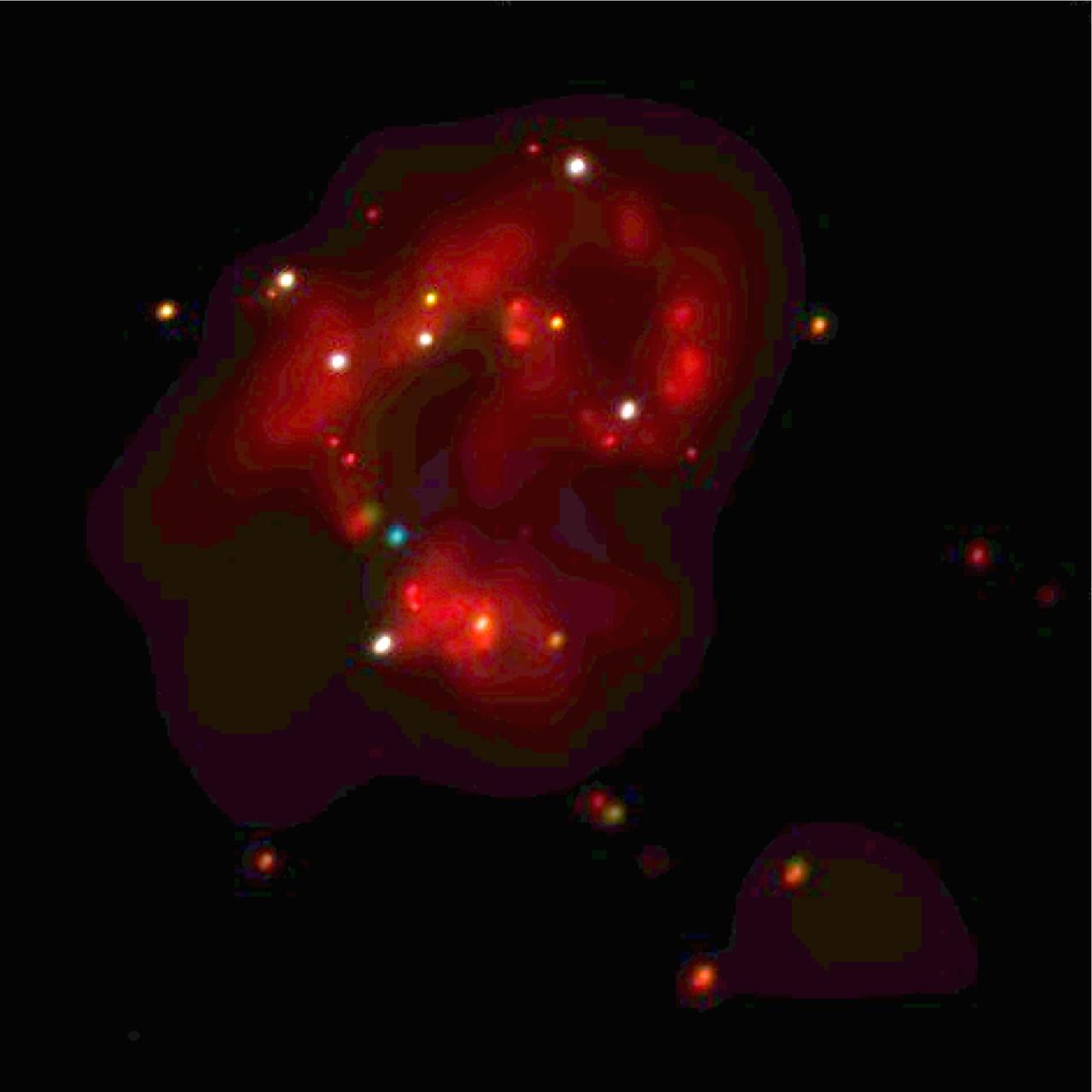
This Chandra image shows the central regions of two colliding galaxies known collectively as the Antennae (NGC-4038/4039). The Chandra image reveals a large population of extremely bright x-ray sources in this area of intense star formation. These x-ray sources, which emit 10 to several hundred times more x-ray power than similar sources in our own galaxy, are believed to be either massive black holes, or black holes that are beaming their energy toward Earth. In this x-ray image, red represents the low energy band, green intermediate, and blue the highest observed energies. The white and yellow sources are those that emit significant amounts of both low and high energy x-rays. About 60 million light years from Earth in the constellation Corvus, the Antennae Galaxies got their nickname from the wispy anntennae-like streams of gas as seen by optical telescopes. These ongoing wisps are believed to have been produced approximately 100 million years ago by the collision between the gala
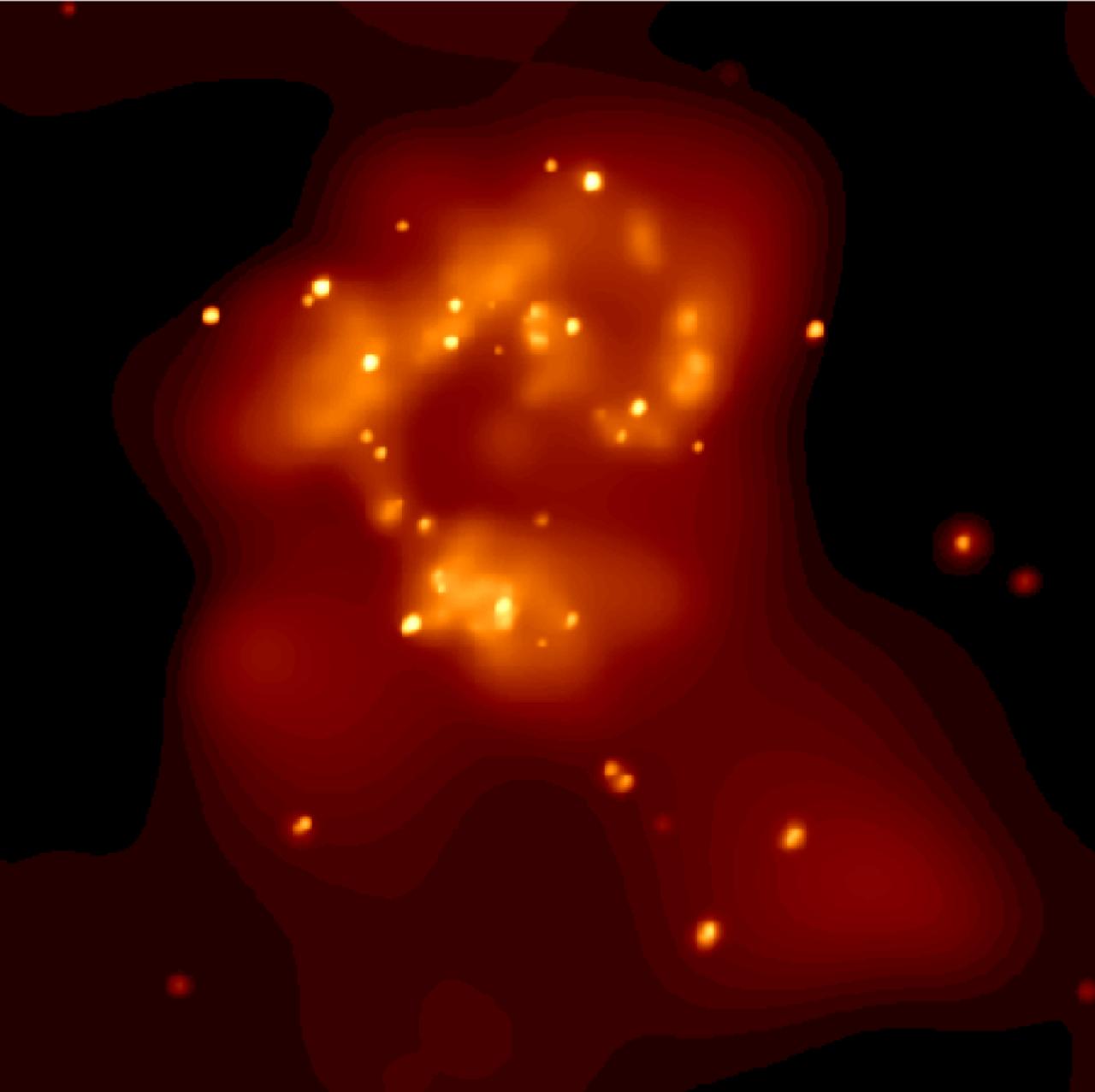
This Chandra image shows the central regions of two colliding galaxies known collectively as the Antennae (NGC-4038/4039). The dozens of bright pointy-like sources are neutron stars or black holes pulling gas off nearby stars. The bright fuzzy patches are multimillion degree gas superbubbles, thousands of light years in diameter that were produced by the accumulated power of thousands of supernovae. The remaining glow of x-ray emission could be due to many faint x-ray sources or to clouds of hot gas in the galaxies. About 60 million light years from Earth in the constellation Corvus, the Antennae Galaxies got their nickname from the wispy anntennae-like streams of gas as seen by optical telescopes. These ongoing wisps are believed to have been produced approximately 100 million years ago by the collision between the galaxies. Although it is rare for stars to hit each other during a galactic collision, clouds of dust and gas do collide. Compression of these clouds can lead to the rebirth of millions of stars, and a few million years later, to thousands of supernovae.
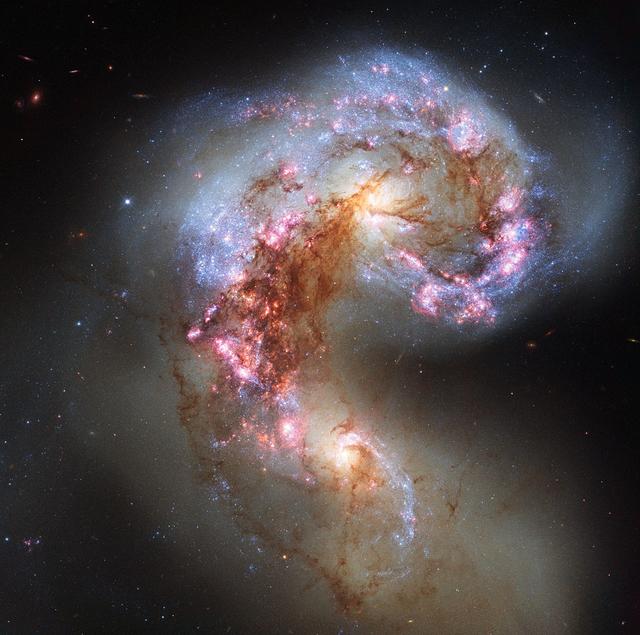
The NASA/ESA Hubble Space Telescope has snapped the best ever image of the Antennae Galaxies. Hubble has released images of these stunning galaxies twice before, once using observations from its Wide Field and Planetary Camera 2 (WFPC2) in 1997, and again in 2006 from the Advanced Camera for Surveys (ACS). Each of Hubble’s images of the Antennae Galaxies has been better than the last, due to upgrades made during the famous servicing missions, the last of which took place in 2009. The galaxies — also known as NGC 4038 and NGC 4039 — are locked in a deadly embrace. Once normal, sedate spiral galaxies like the Milky Way, the pair have spent the past few hundred million years sparring with one another. This clash is so violent that stars have been ripped from their host galaxies to form a streaming arc between the two. In wide-field images of the pair the reason for their name becomes clear — far-flung stars and streamers of gas stretch out into space, creating long tidal tails reminiscent of antennae. This new image of the Antennae Galaxies shows obvious signs of chaos. Clouds of gas are seen in bright pink and red, surrounding the bright flashes of blue star-forming regions — some of which are partially obscured by dark patches of dust. The rate of star formation is so high that the Antennae Galaxies are said to be in a state of starburst, a period in which all of the gas within the galaxies is being used to form stars. This cannot last forever and neither can the separate galaxies; eventually the nuclei will coalesce, and the galaxies will begin their retirement together as one large elliptical galaxy. This image uses visible and near-infrared observations from Hubble’s Wide Field Camera 3 (WFC3), along with some of the previously-released observations from Hubble’s Advanced Camera for Surveys (ACS). Credit: NASA/European Space Agency <b><a href="http://www.nasa.gov/audience/formedia/features/MP_Photo_Guidelines.html" rel="nofollow">NASA image use policy.</a></b> <b><a href="http://www.nasa.gov/centers/goddard/home/index.html" rel="nofollow">NASA Goddard Space Flight Center</a></b> enables NASA’s mission through four scientific endeavors: Earth Science, Heliophysics, Solar System Exploration, and Astrophysics. Goddard plays a leading role in NASA’s accomplishments by contributing compelling scientific knowledge to advance the Agency’s mission. <b>Follow us on <a href="http://twitter.com/NASA_GoddardPix" rel="nofollow">Twitter</a></b> <b>Like us on <a href="http://www.facebook.com/pages/Greenbelt-MD/NASA-Goddard/395013845897?ref=tsd" rel="nofollow">Facebook</a></b> <b>Find us on <a href="http://instagram.com/nasagoddard?vm=grid" rel="nofollow">Instagram</a></b>