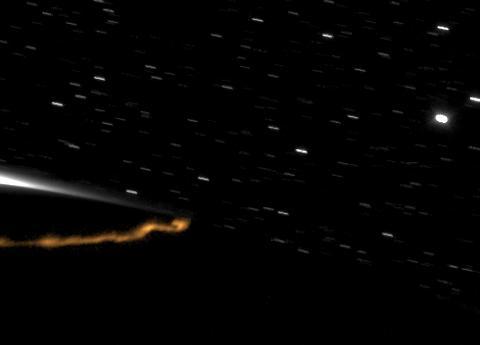
An aurora, shining high above the northern part of Saturn, moves from the night side to the day side of the planet in this movie recorded by NASA Cassini spacecraft.

This photograph of aurora borealis, northern aurora, was taken during the Spacelab-J (SL-J) mission (STS-47). People who live in the northernmost areas like Alaska or work in the southernmost regions like Antarctica often see colorful lights produced by Earth's natural electromagnetic generator; these shimmering expanses of light are auroras, commonly called the northern and southern lights. Charged particles from the magnetosphere follow magnetic fields and are accelerated toward Earth at the magnetic poles where they strike molecules in the upper atmosphere, staining the sky with the red and green lights of oxygen and hydrogen, and the purples and pinks of nitrogen. The altitude and inclination of the Spacelab will give scientists unique views of auroras, which occur at altitudes ranging from about 90 to 300 kilometers (56 to 186 miles). Most views of the auroras have been from the ground where only limited parts can be seen. These Spacelab views will give scientists information on their complex structure and chemical composition. The Spacelab-J was a joint mission of NASA and the National Space Development Agency of Japan (NASDA) utilizing a marned Spacelab module. The mission conducted microgravity investigations in materials and life sciences. The SL-J was launched aboard the Space Shuttle Orbiter Endeavour (STS-47) on September 12, 1992.
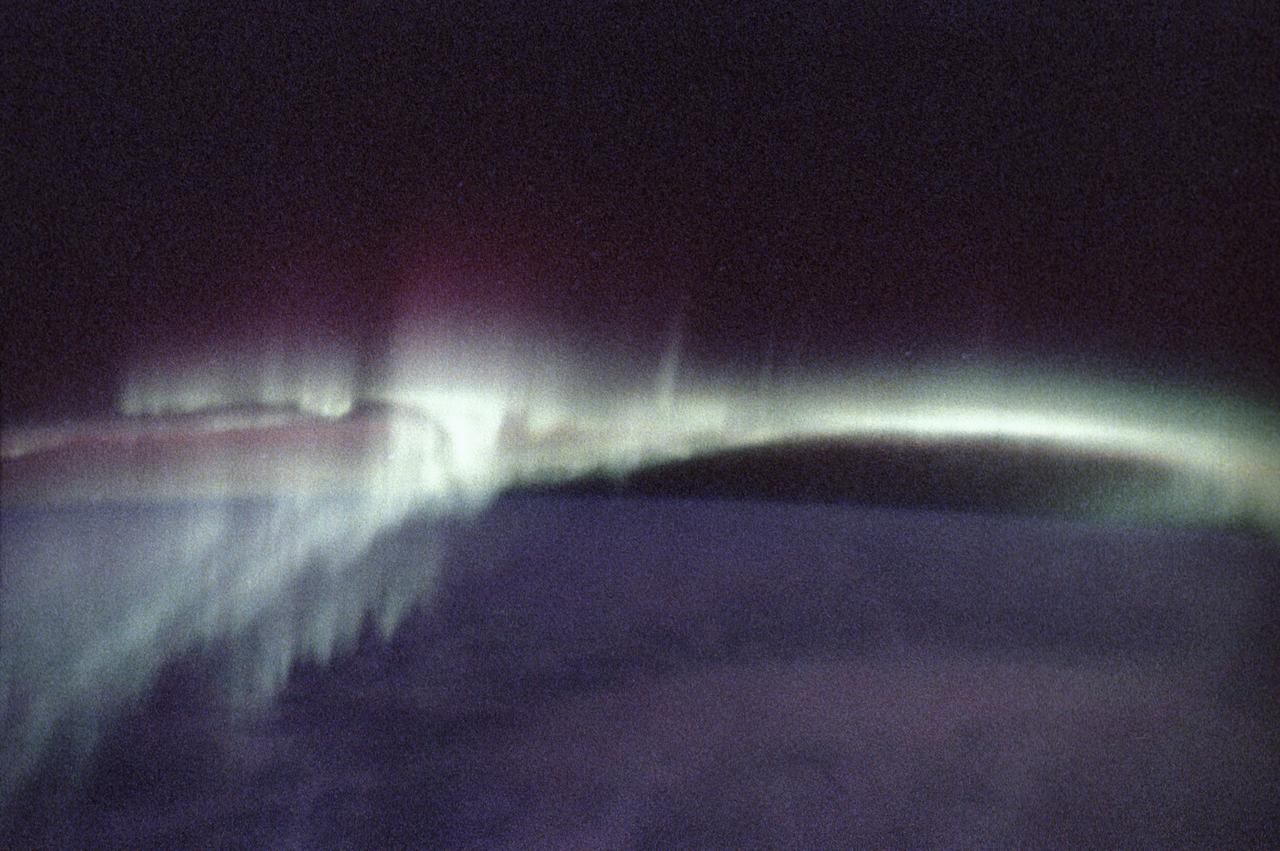
This photograph of aurora borealis, northern aurora, was taken during the Spacelab-J (SL-J) mission (STS-47). People who live in the northernmost areas like Alaska or work in the southernmost regions like Antarctica often see colorful lights produced by Earth's natural electromagnetic generator; these shimmering expanses of light are auroras, commonly called the northern and southern lights. Charged particles from the magnetosphere follow magnetic fields and are accelerated toward Earth at the magnetic poles where they strike molecules in the upper atmosphere, staining the sky with the red and green lights of oxygen and hydrogen, and the purples and pinks of nitrogen. The altitude and inclination of the Spacelab will give scientists unique views of auroras, which occur at altitudes ranging from about 90 to 300 kilometers (56 to 186 miles). Most views of the auroras have been from the ground where only limited parts can be seen. These Skylab views will give scientists information on their complex structure and chemical composition. The Spacelab-J was a joint mission of NASA and the National Space Development Agency of Japan (NASDA) utilizing a marned Spacelab module. The mission conducted microgravity investigations in materials and life sciences. The SL-J was launched aboard the Space Shuttle Orbiter Endeavour (STS-47) on September 12, 1992.
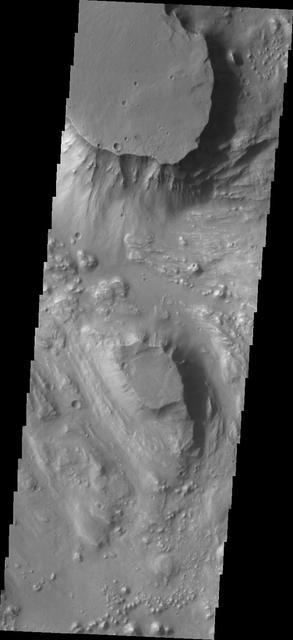
Located at the eastern end of Vallis Marineris is the region of chaos called Aurorae. This image from NASA Mars Odyssey is from the northern part of Aurorae Chaos and contains mesas separated by complex low lying regions.
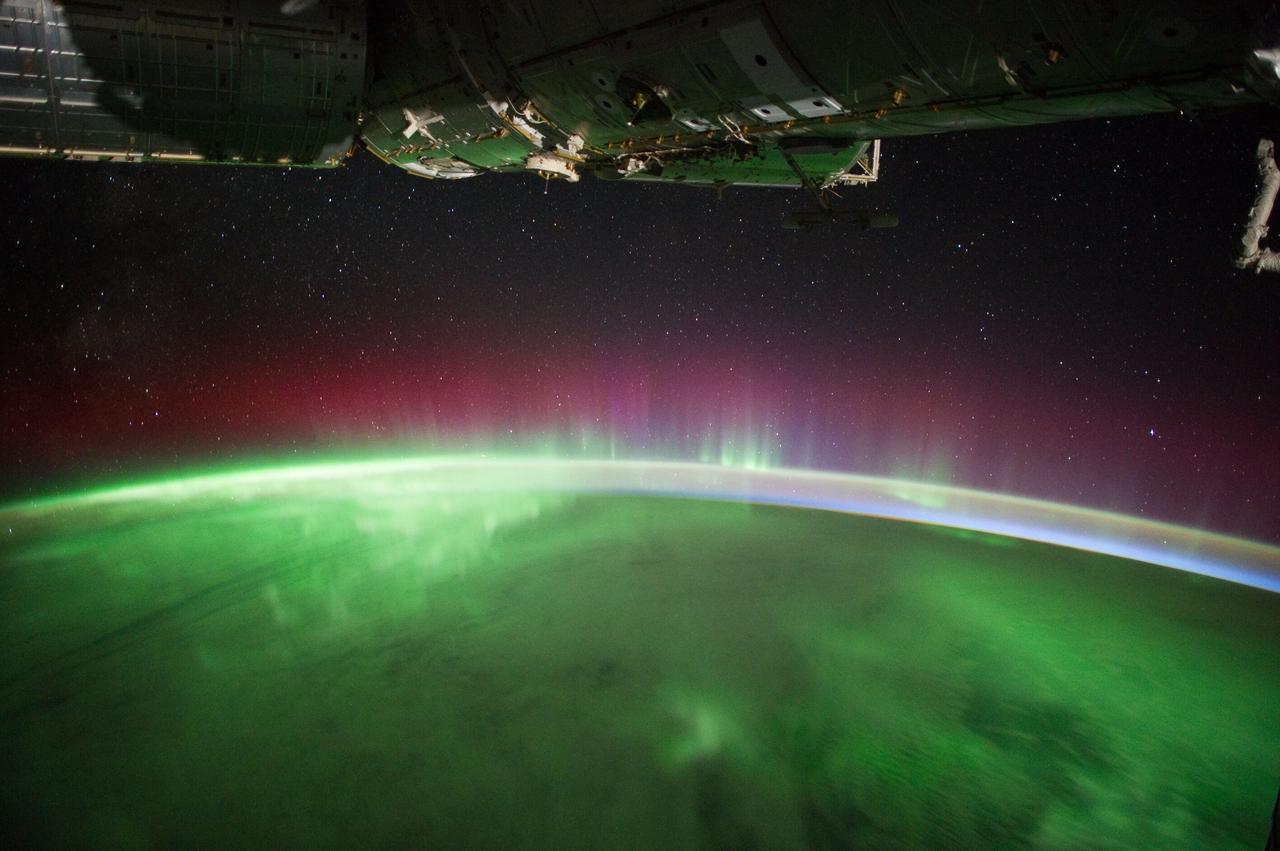
iss030e119777 (3/3/2012) --- A view of the night earth taken aboard the International Space Station (ISS) showing an aurora. An aurora sometimes referred to as polar lights, northern lights (aurora borealis), or southern lights (aurora australis), is a natural light display in the Earth's sky, predominantly seen in the high-latitude regions (around the Arctic and Antarctic). Auroras are the result of disturbances in the magnetosphere caused by solar wind.
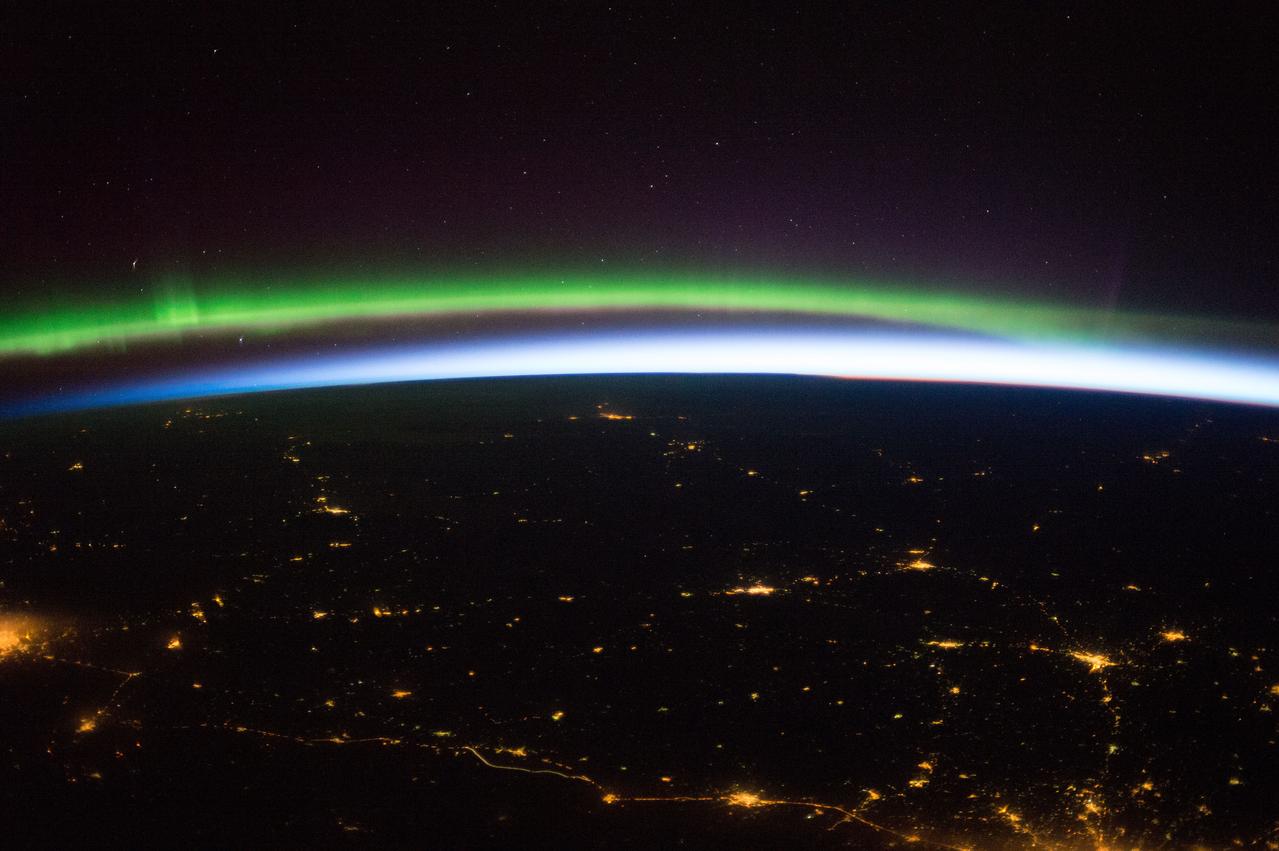
ISS043e059141 (03/26/2015) --- Members of Expedition 43 on the International Space Station captured this contrasting image of Earth sunrise, aurora and sparling cities in northern Europe.

iss066e118171 (Jan. 17, 2022) --- A faint aurora and the Earth's atmospheric glow crown this night time photograph of Ireland, Great Britain, and a portion of Northern Europe, as the International Space Station orbited 262 miles above the Atlantic Ocean.
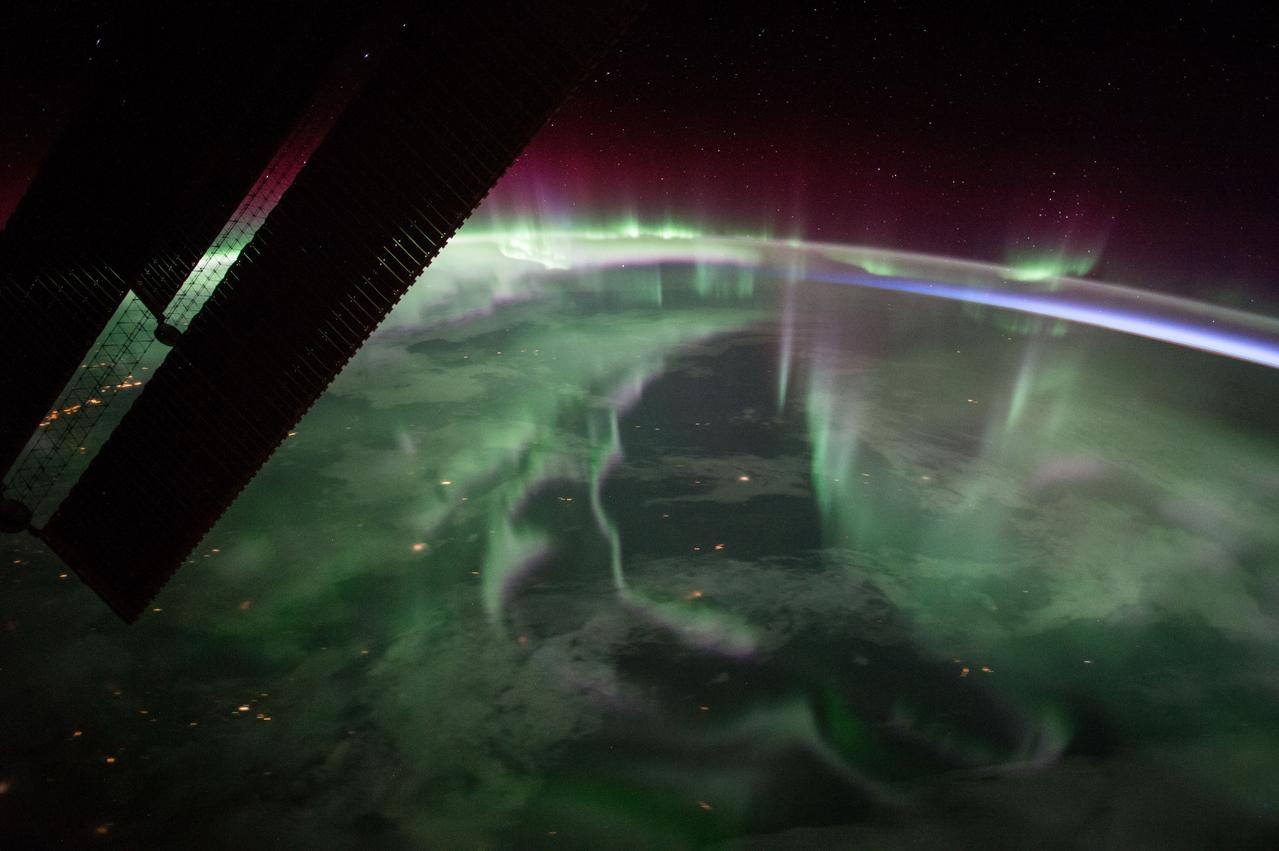
iss053e023965 (Sept. 15, 2017) --- The spectacular aurora borealis, or the “northern lights,” over Canada is sighted from the space station near the highest point of its orbital path. The station’s main solar arrays are seen in the left foreground.
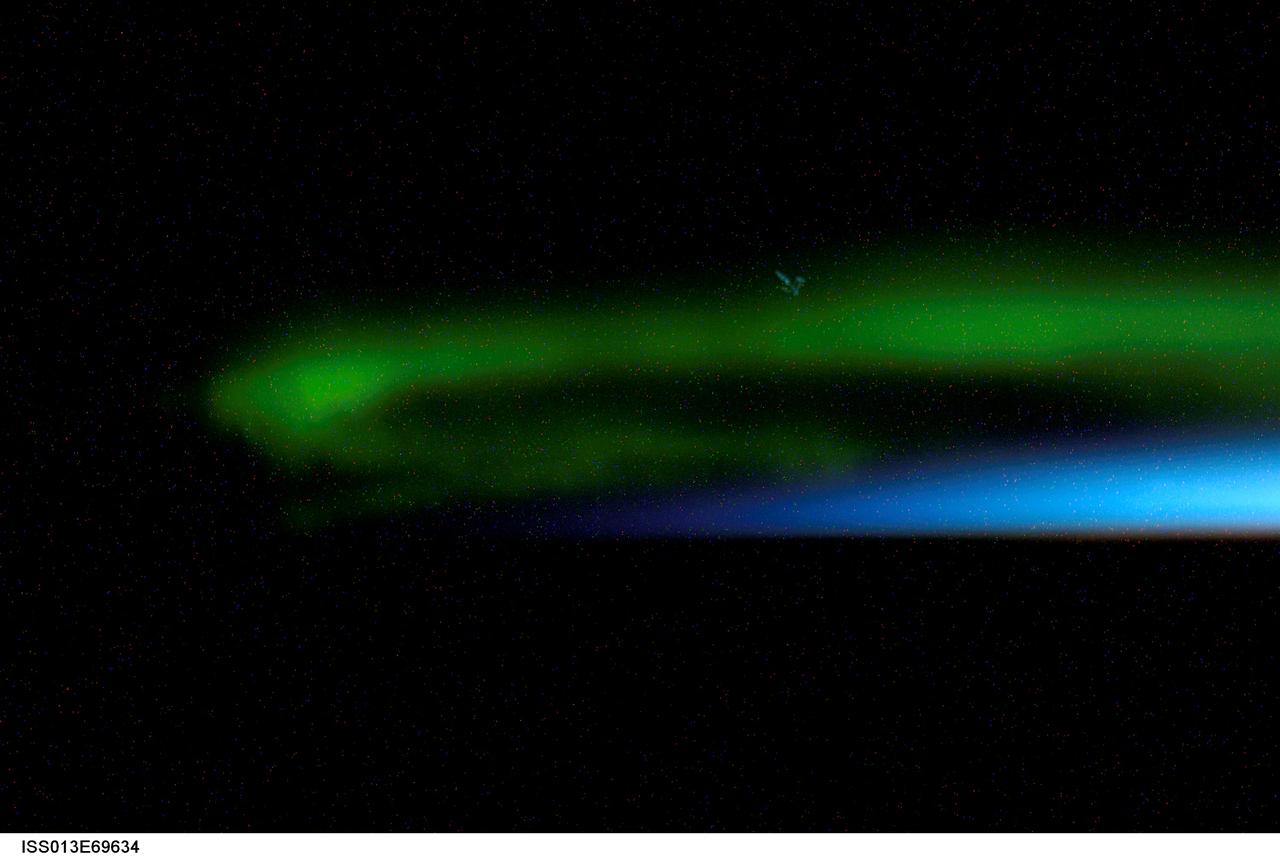
ISS013-E-69634 (20 Aug. 2006) --- The Aurora Borealis, also known as "northern lights", is featured in this photograph taken by an Expedition 13 crewmember on the International Space Station.
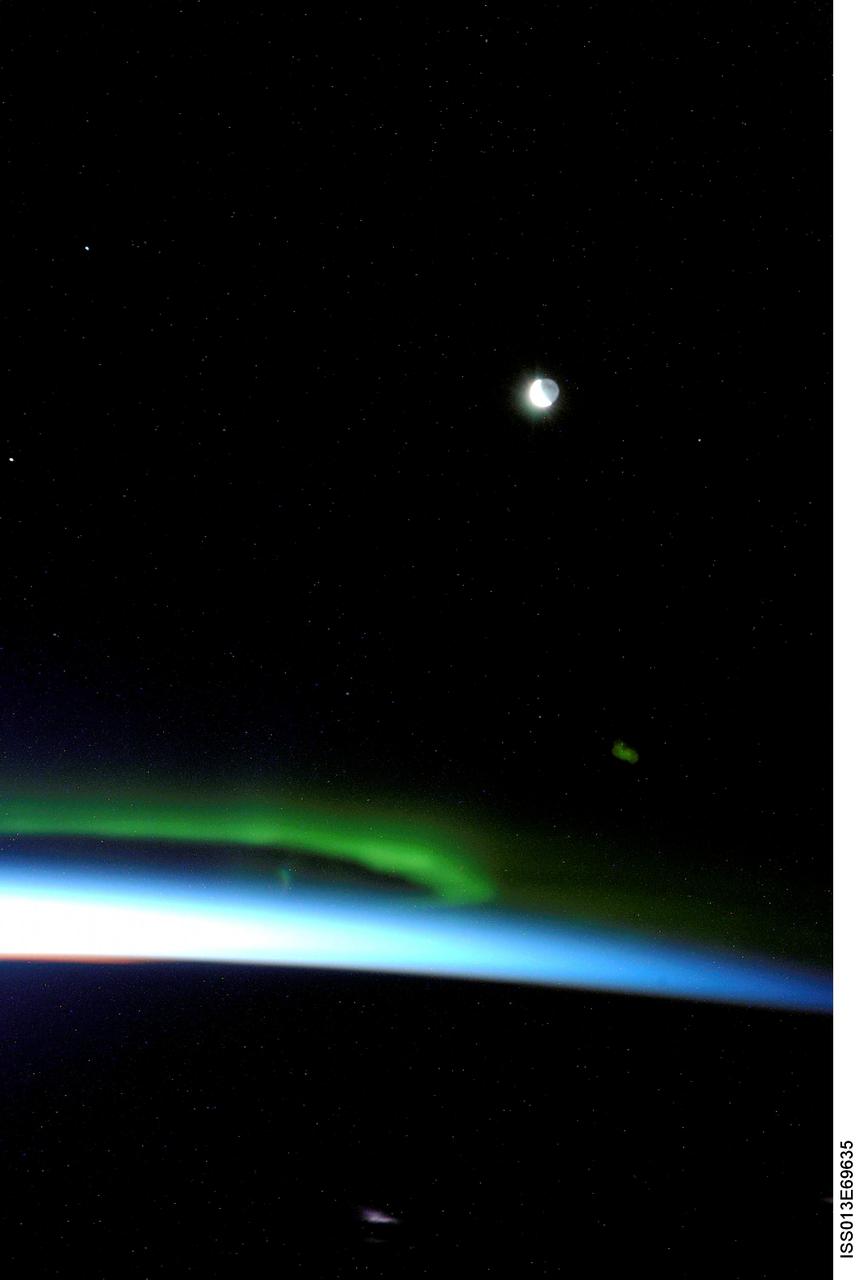
ISS013-E-69635 (19 Aug. 2006) --- The Aurora Borealis, also known as "northern lights", is featured in this photograph taken by an Expedition 13 crewmember on the International Space Station. The moon is visible at upper right.
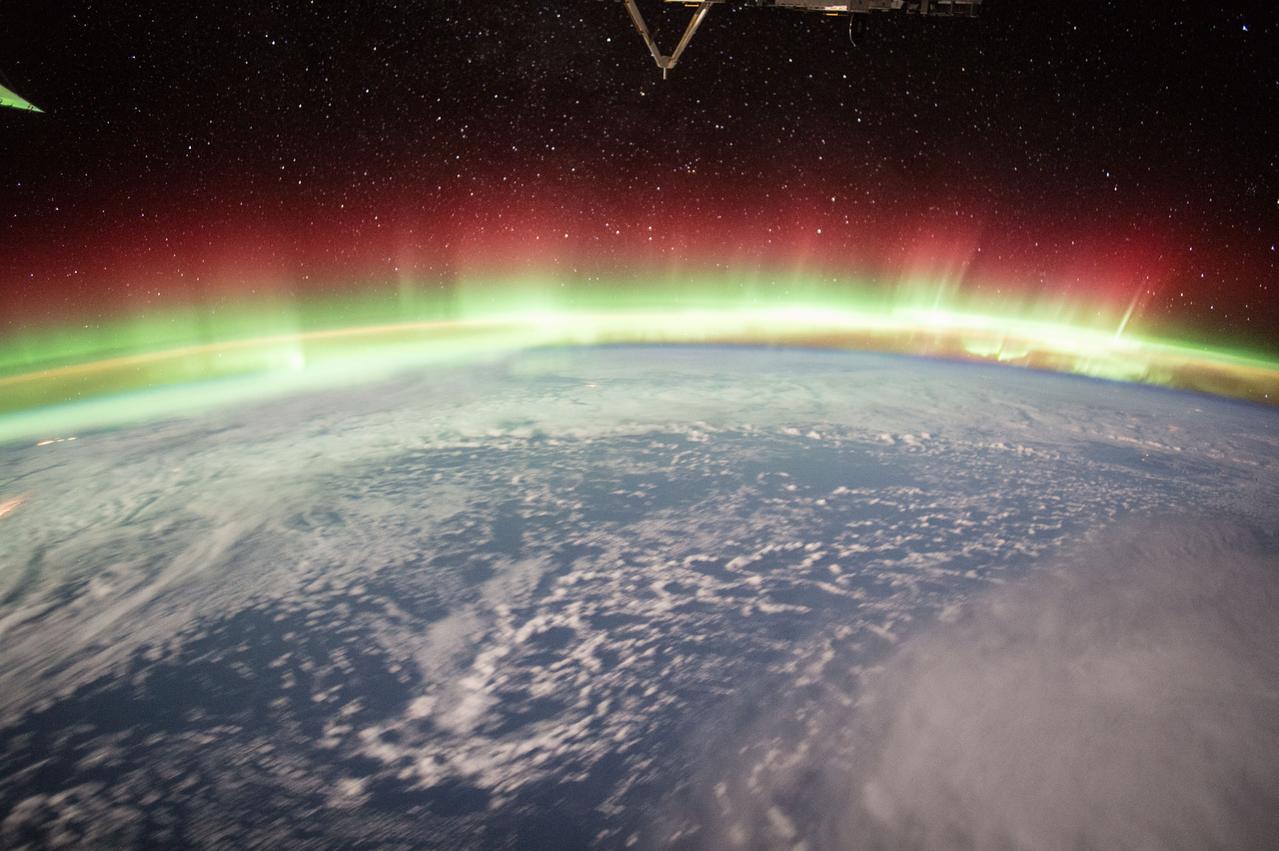
ISS046e015599 (01/20/2016) --- A brilliant and vivid Aurora Borealis illuminates the Earth’s northern hemisphere on Jan 20, 2016, providing a spectacular view for members of Expedition 46 aboard the International Space Station.

At Astrotech Space Operations, workers look over the integrated THEMIS spacecraft before spin-balance testing. THEMIS consists of five identical probes, the largest number of scientific satellites ever launched into orbit aboard a single rocket. This unique constellation of satellites will resolve the tantalizing mystery of what causes the spectacular sudden brightening of the aurora borealis and aurora australis - the fiery skies over the Earth's northern and southern polar regions. THEMIS is scheduled to launch Feb. 15 from Cape Canaveral Air Force Station.
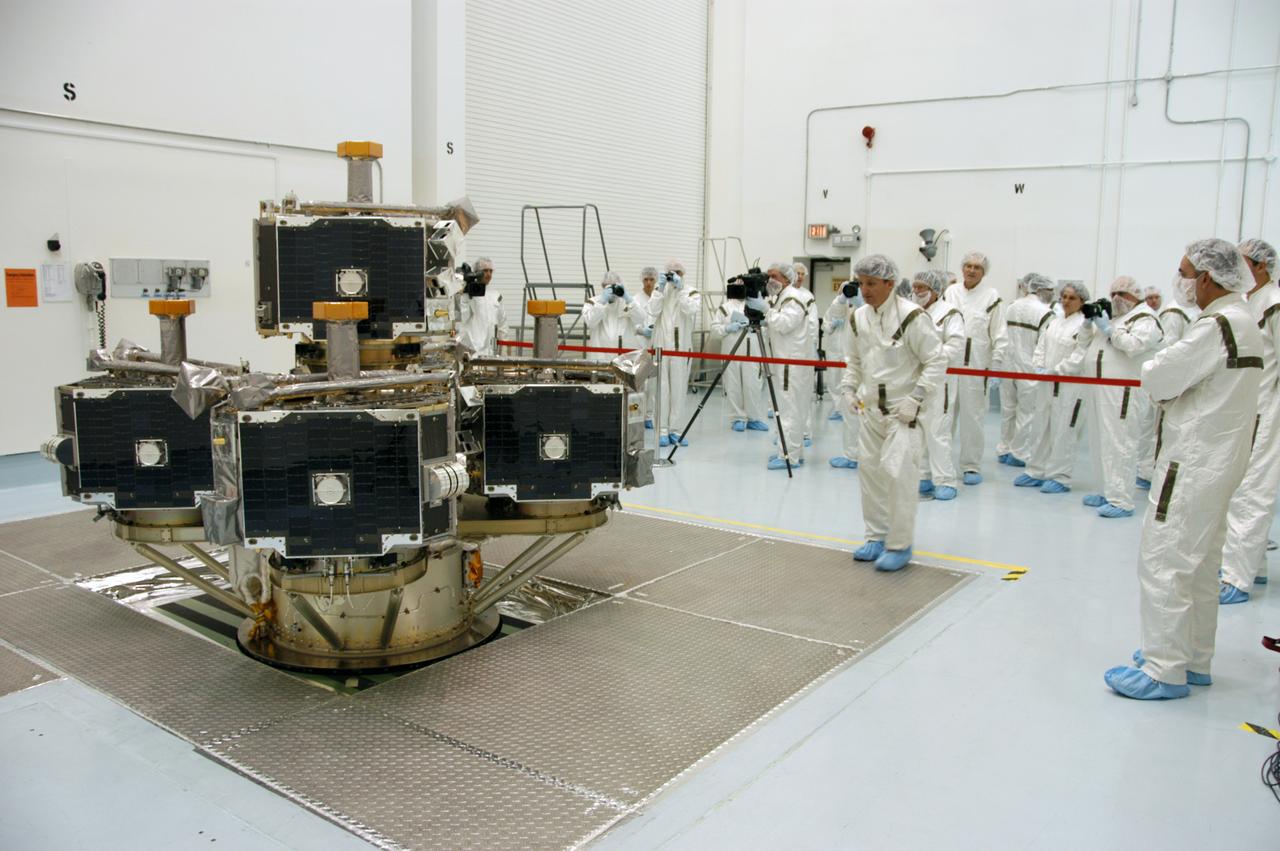
At Astrotech Space Operations, the media are dressed in clean room, or bunny, suits to photograph the integrated THEMIS spacecraft. THEMIS consists of five identical probes, the largest number of scientific satellites ever launched into orbit aboard a single rocket. This unique constellation of satellites will resolve the tantalizing mystery of what causes the spectacular sudden brightening of the aurora borealis and aurora australis - the fiery skies over the Earth's northern and southern polar regions. THEMIS is scheduled to launch Feb. 15 from Cape Canaveral Air Force Station.
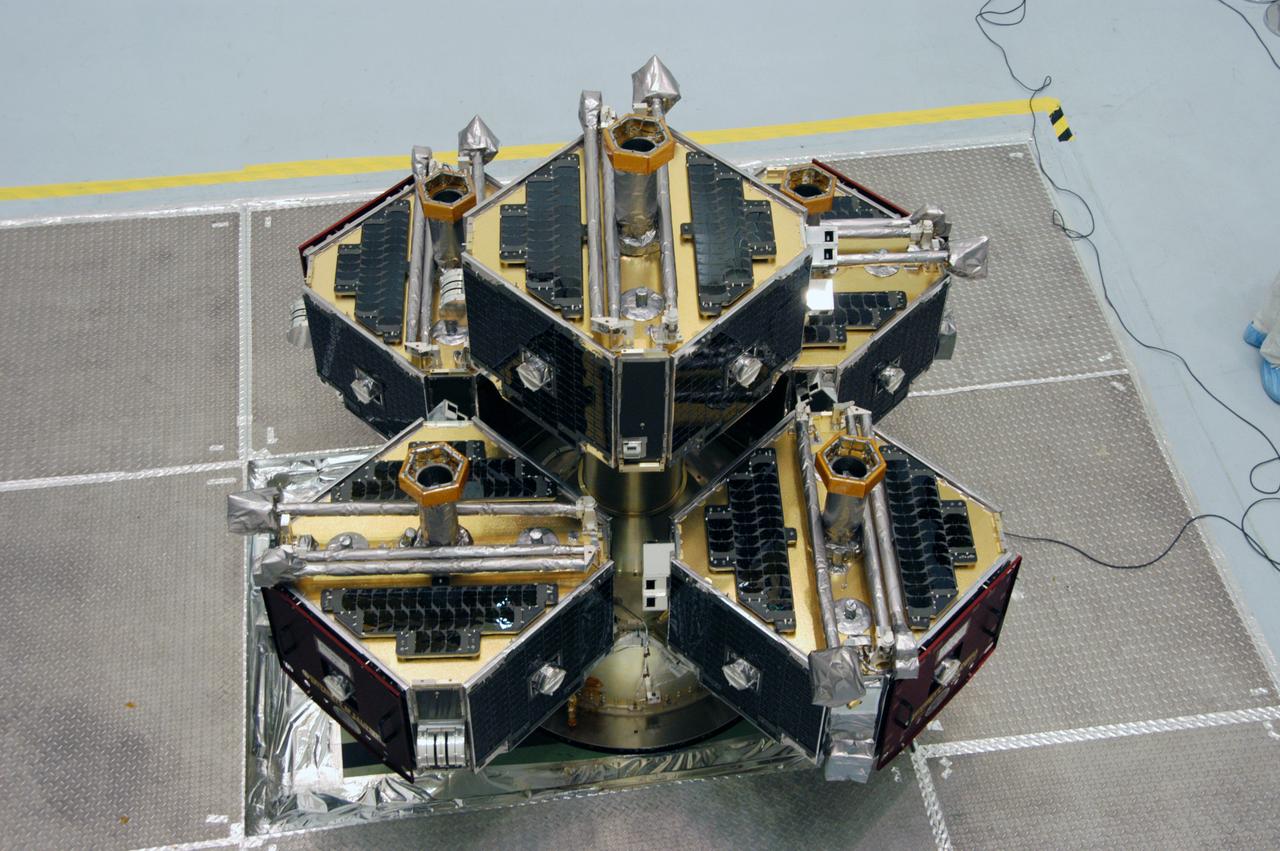
At Astrotech Space Operations, the integrated THEMIS spacecraft is ready for spin-balance testing. THEMIS consists of five identical probes, the largest number of scientific satellites ever launched into orbit aboard a single rocket. This unique constellation of satellites will resolve the tantalizing mystery of what causes the spectacular sudden brightening of the aurora borealis and aurora australis - the fiery skies over the Earth's northern and southern polar regions. THEMIS is scheduled to launch Feb. 15 from Cape Canaveral Air Force Station.
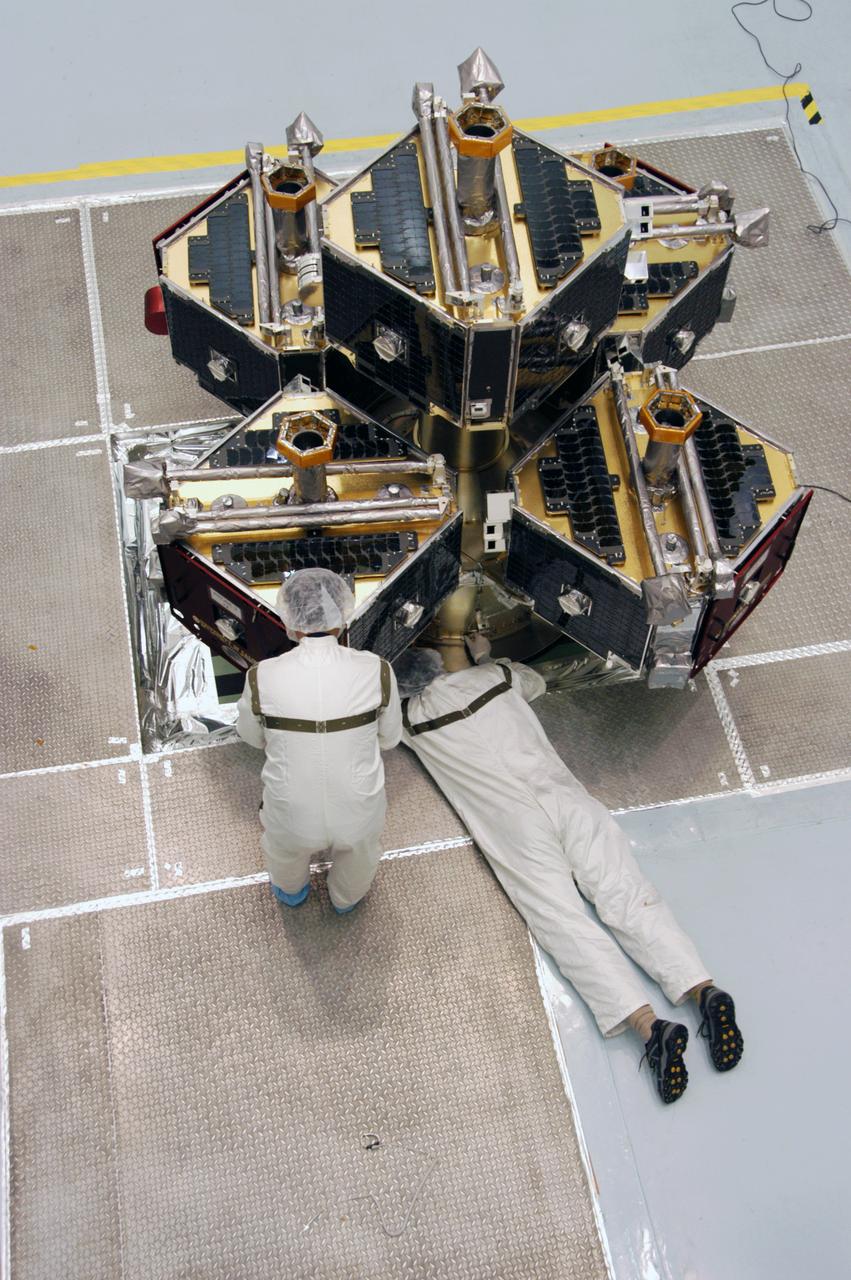
At Astrotech Space Operations, workers prepare the integrated THEMIS spacecraft for spin-balance testing. THEMIS consists of five identical probes, the largest number of scientific satellites ever launched into orbit aboard a single rocket. This unique constellation of satellites will resolve the tantalizing mystery of what causes the spectacular sudden brightening of the aurora borealis and aurora australis - the fiery skies over the Earth's northern and southern polar regions. THEMIS is scheduled to launch Feb. 15 from Cape Canaveral Air Force Station.
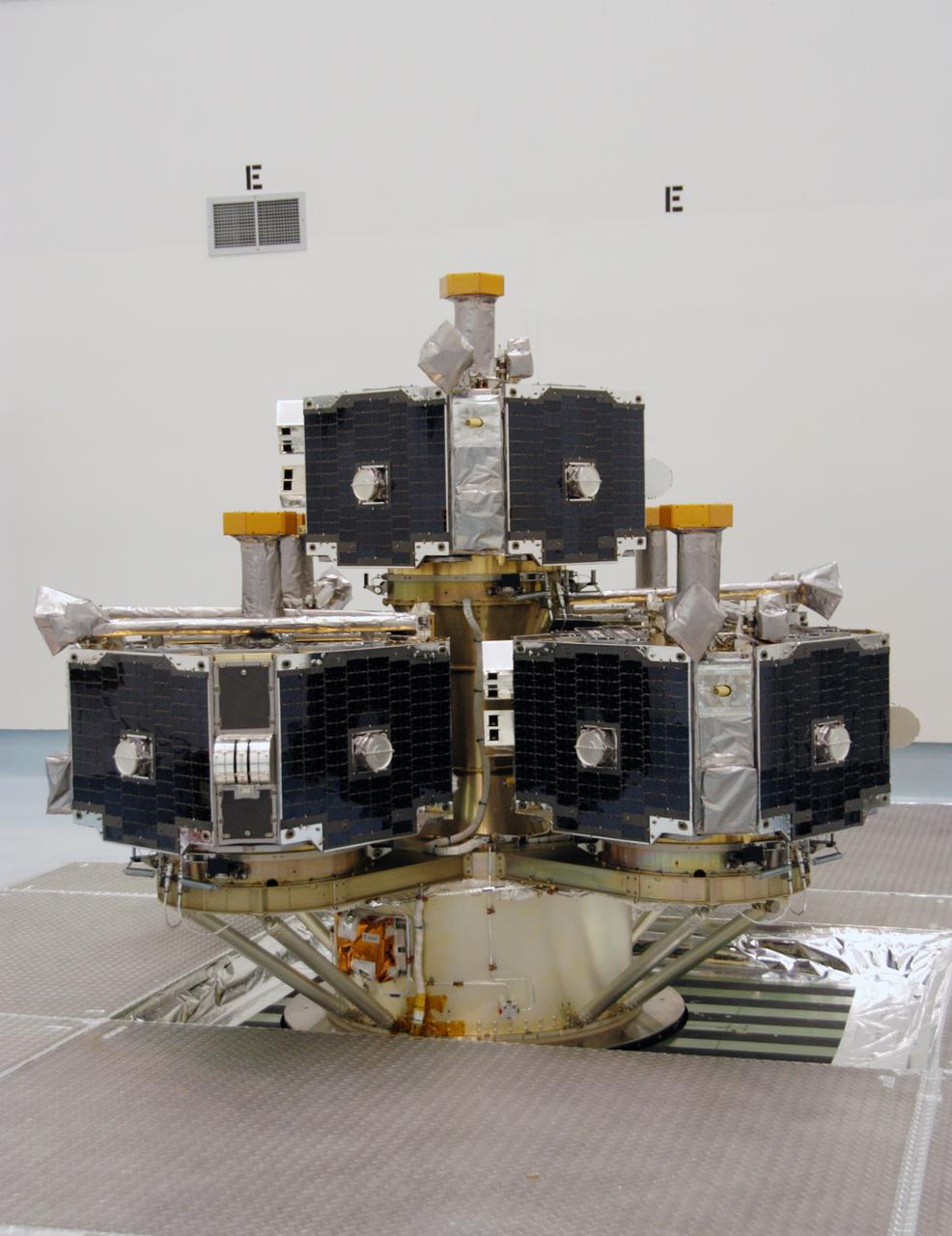
At Astrotech Space Operations, the integrated THEMIS spacecraft is on ready for spin-balance testing. THEMIS consists of five identical probes, the largest number of scientific satellites ever launched into orbit aboard a single rocket. This unique constellation of satellites will resolve the tantalizing mystery of what causes the spectacular sudden brightening of the aurora borealis and aurora australis - the fiery skies over the Earth's northern and southern polar regions. THEMIS is scheduled to launch Feb. 15 from Cape Canaveral Air Force Station.
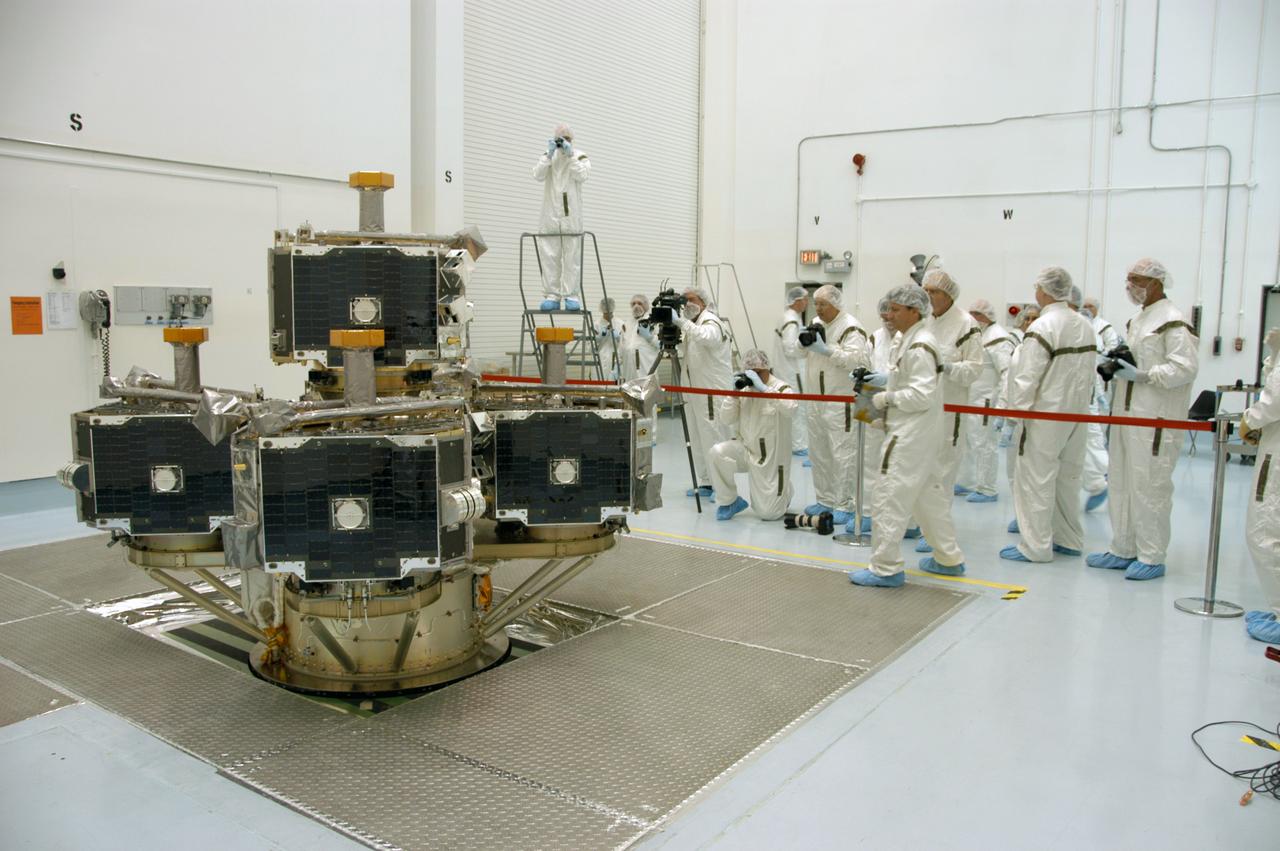
At Astrotech Space Operations, the media are dressed in clean room, or bunny, suits to photograph the integrated THEMIS spacecraft. THEMIS consists of five identical probes, the largest number of scientific satellites ever launched into orbit aboard a single rocket. This unique constellation of satellites will resolve the tantalizing mystery of what causes the spectacular sudden brightening of the aurora borealis and aurora australis - the fiery skies over the Earth's northern and southern polar regions. THEMIS is scheduled to launch Feb. 15 from Cape Canaveral Air Force Station.
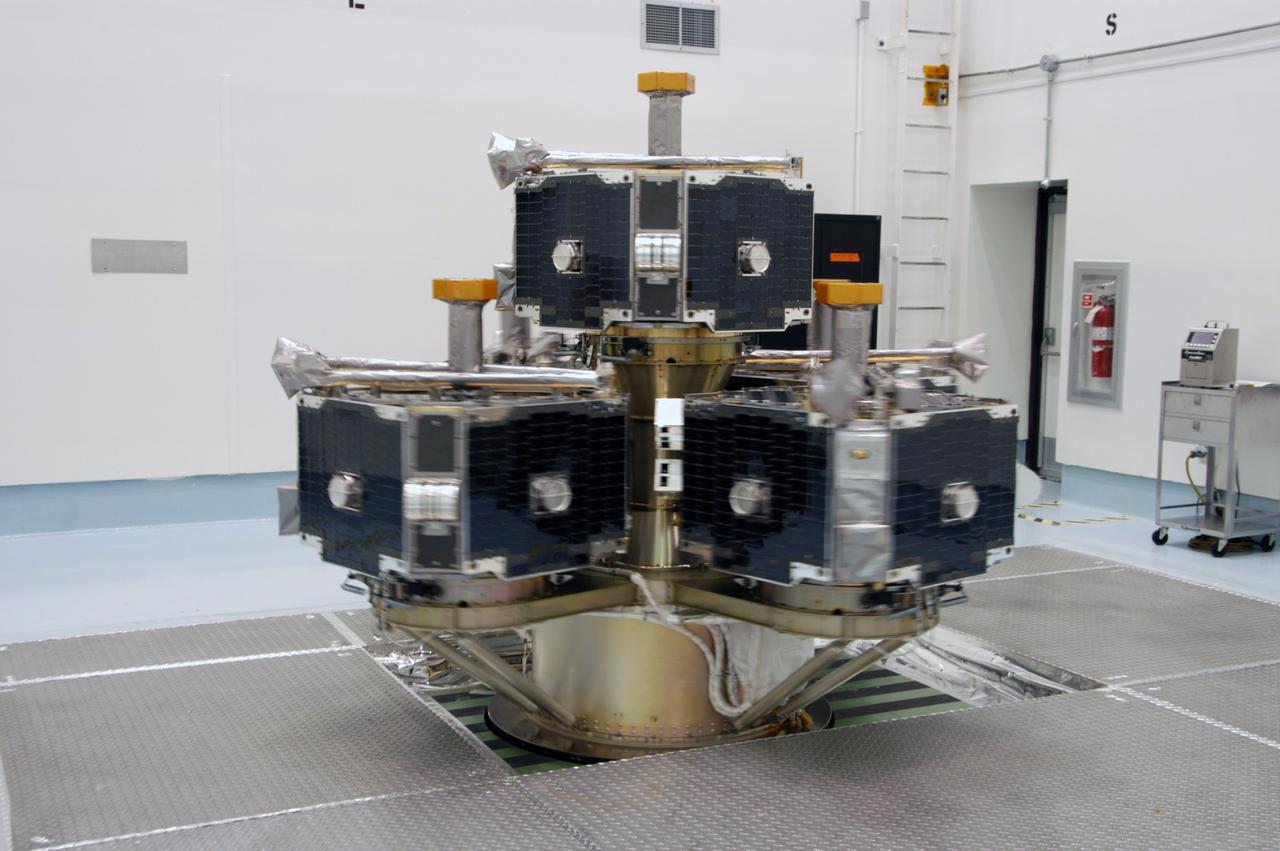
At Astrotech Space Operations, the integrated THEMIS spacecraft is spinning on the spin table, part of spin-balance testing. THEMIS consists of five identical probes, the largest number of scientific satellites ever launched into orbit aboard a single rocket. This unique constellation of satellites will resolve the tantalizing mystery of what causes the spectacular sudden brightening of the aurora borealis and aurora australis - the fiery skies over the Earth's northern and southern polar regions. THEMIS is scheduled to launch Feb. 15 from Cape Canaveral Air Force Station.
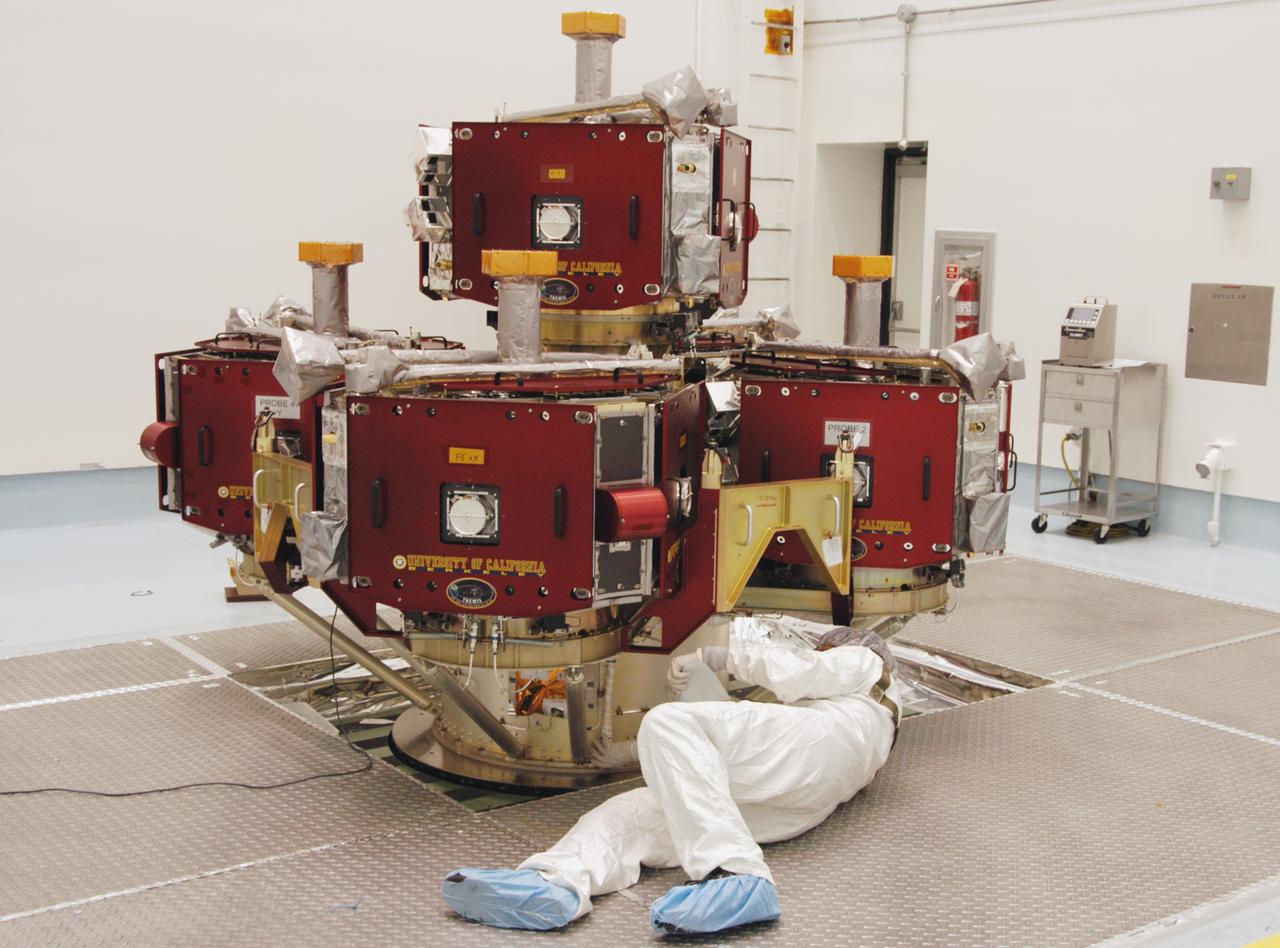
In the Hazardous Processing Facility at Astrotech Space Operations, a worker checks data on the integrated THEMIS spacecraft sitting on the spin table. THEMIS consists of five identical probes, the largest number of scientific satellites ever launched into orbit aboard a single rocket. This unique constellation of satellites will resolve the tantalizing mystery of what causes the spectacular sudden brightening of the aurora borealis and aurora australis - the fiery skies over the Earth's northern and southern polar regions. THEMIS is scheduled to launch Feb. 15 from Cape Canaveral Air Force Station.
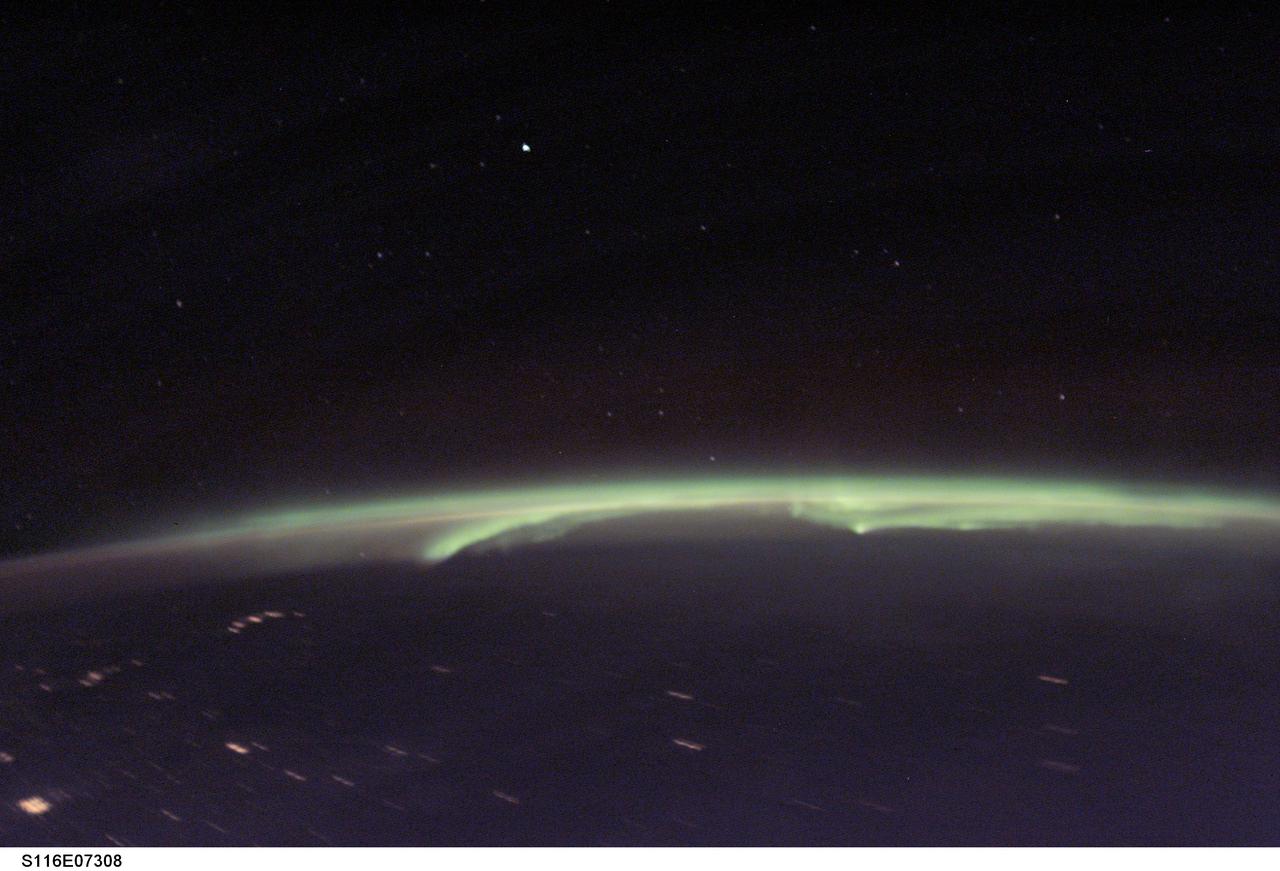
S116-E-07308 (19 Dec. 2006) --- The Aurora Borealis, also known as "northern lights", is featured in this photograph taken by a STS-116 crew member onboard Space Shuttle Discovery during flight day 11 activities. The long exposure on the digital still camera enabled the astronaut to capture stars and city lights.
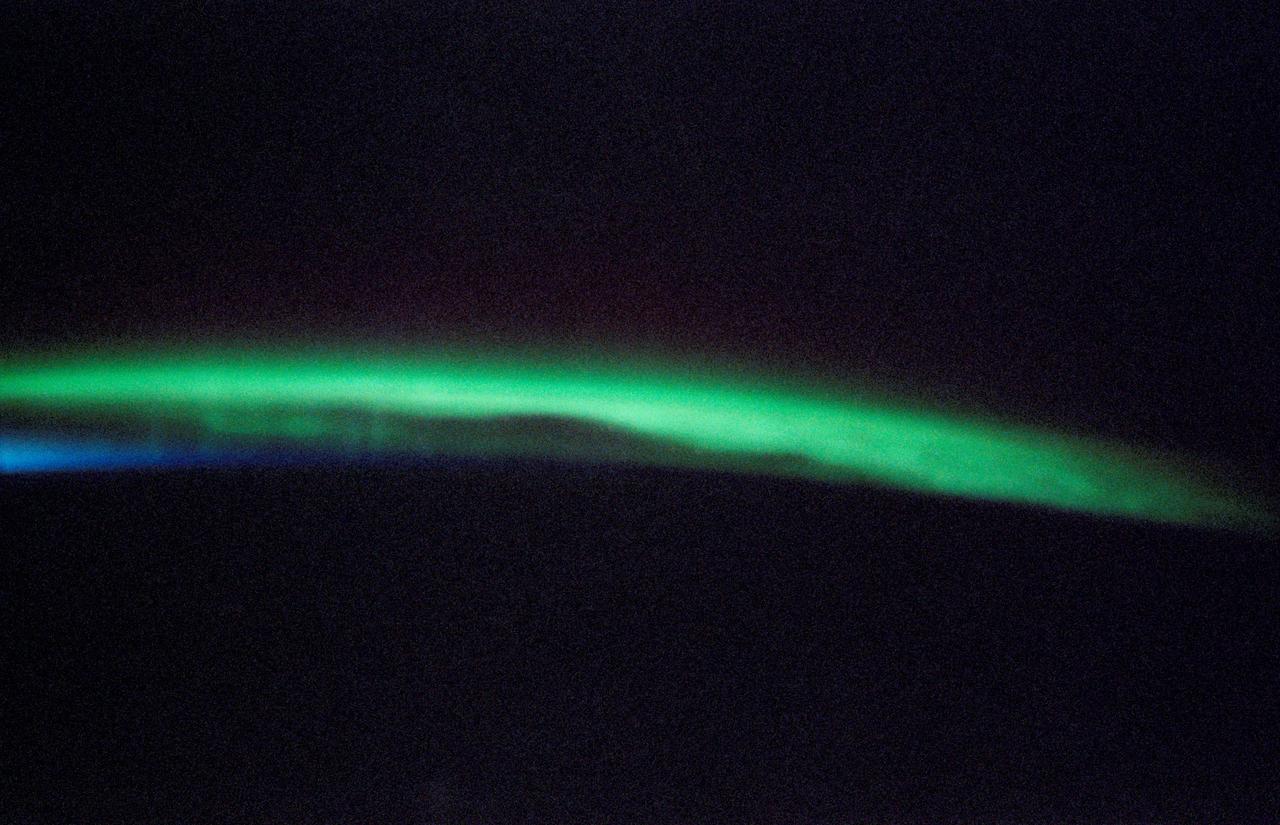
ISS006-327-027 (March 2003) --- The Aurora Borealis, also known as “northern lights”, is featured in this photograph taken by astronaut Donald R. Pettit, Expedition 6 NASA ISS science officer, onboard the International Space Station (ISS).
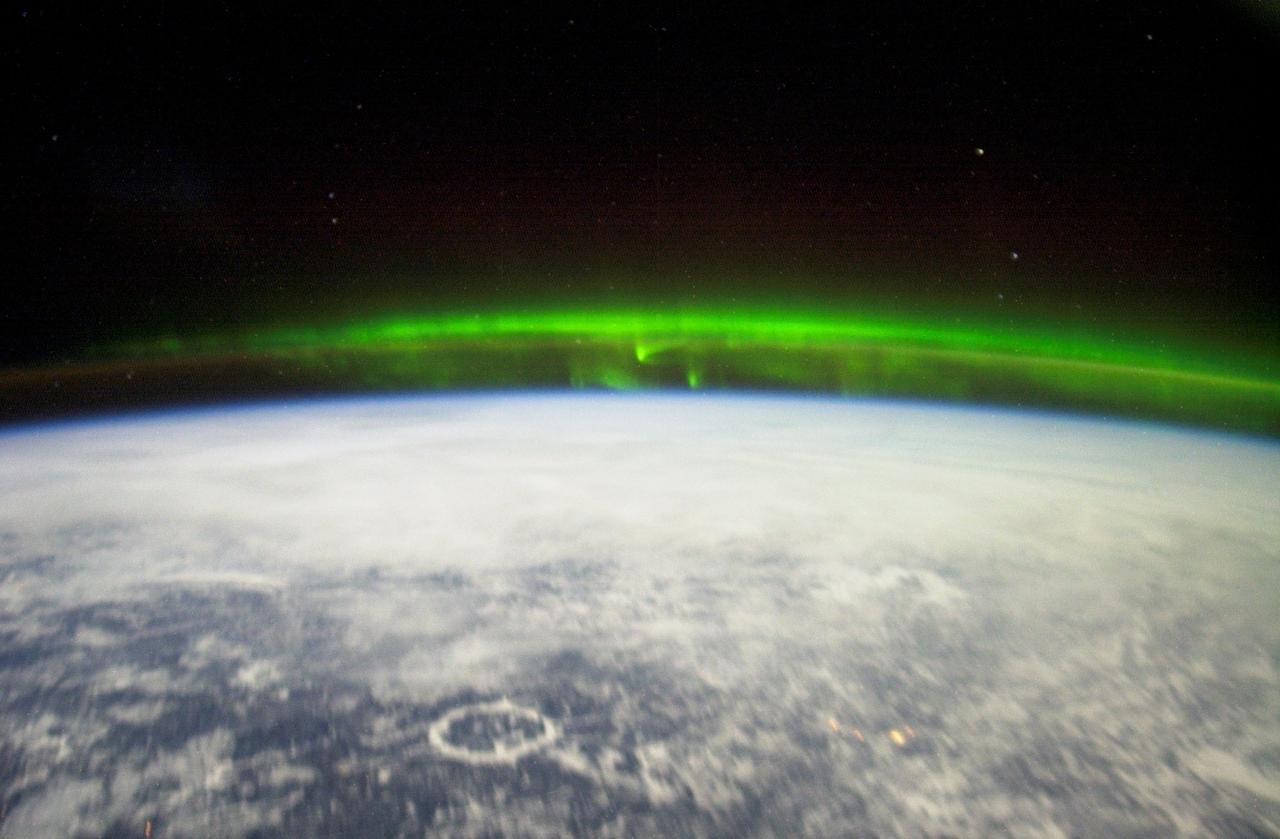
ISS006-E-18372 (January 2003) --- The Aurora Borealis or “northern lights” and the Manicouagan Impact Crater reservoir (foreground) in Quebec, Canada, were featured in this photograph taken by astronaut Donald R. Pettit, Expedition 6 NASA ISS science officer, on board the International Space Station (ISS).
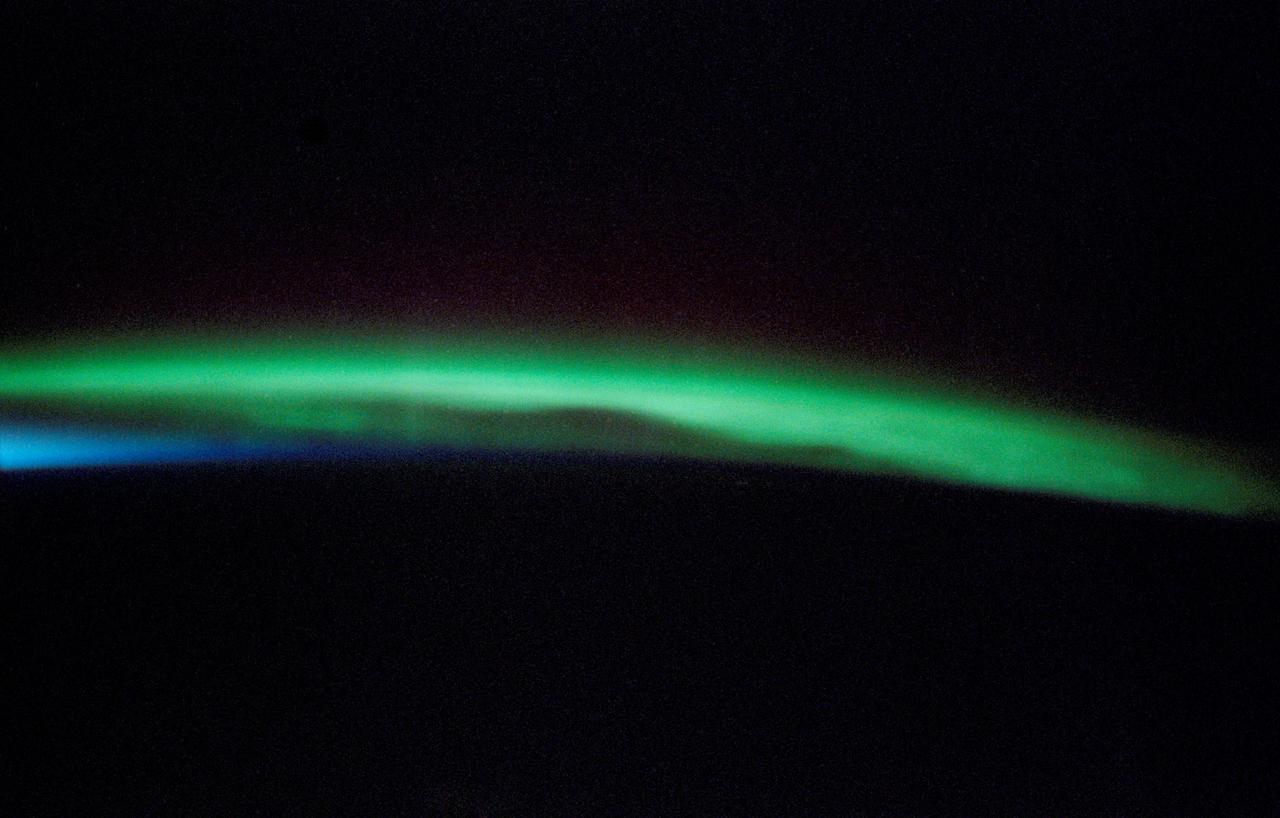
ISS006-327-026 (March 2003) --- The Aurora Borealis, also known as “northern lights”, is featured in this photograph taken by astronaut Donald R. Pettit, Expedition 6 NASA ISS science officer, onboard the International Space Station (ISS).
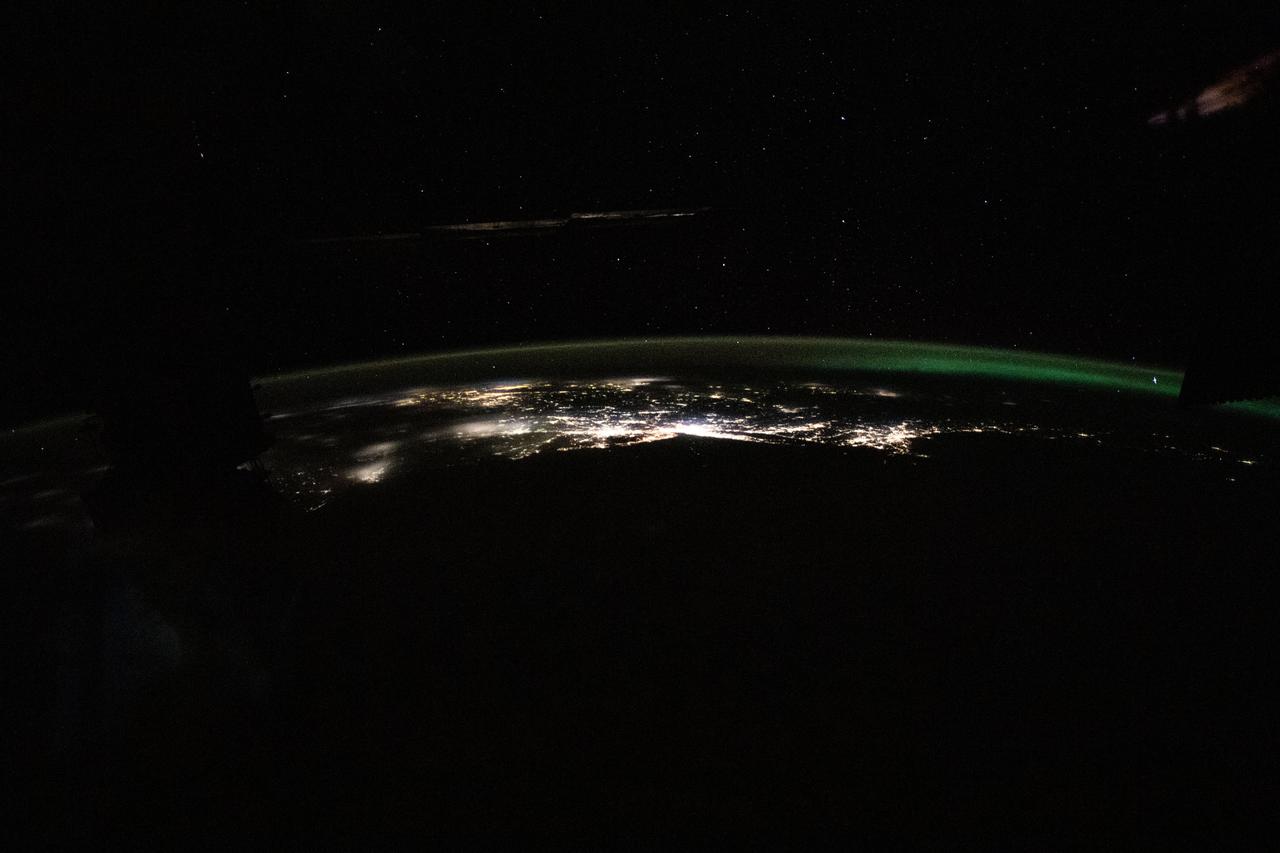
iss070e025086 (Nov. 15, 2023) --- The photograph from the International Space Station looks back toward the northeast Atlantic coast of the United States revealing the city lights (from left) of Norfolk, Virginia, to Boston, Massachusetts. At far right, an aurora in northern Canada crowns the Earth's horizon.
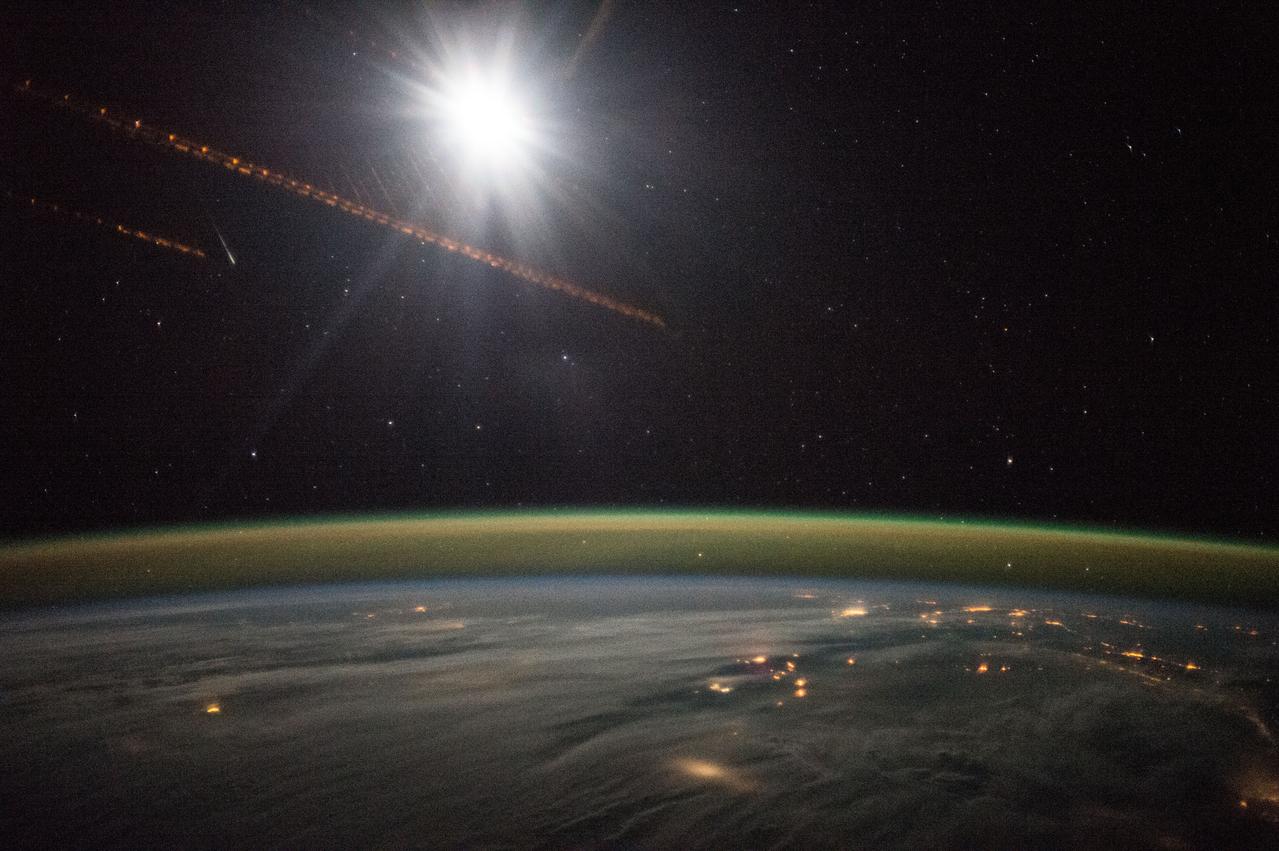
ISS042E037793 (12/13/2014) --- ESA (European Space Station) astronaut Samantha Cristoforetti on board the International Space Station Dec. 13th, 2014 took this night exposure of the Earth showing an Aurora with city lights over the Baltic countries of northern Europe and England.
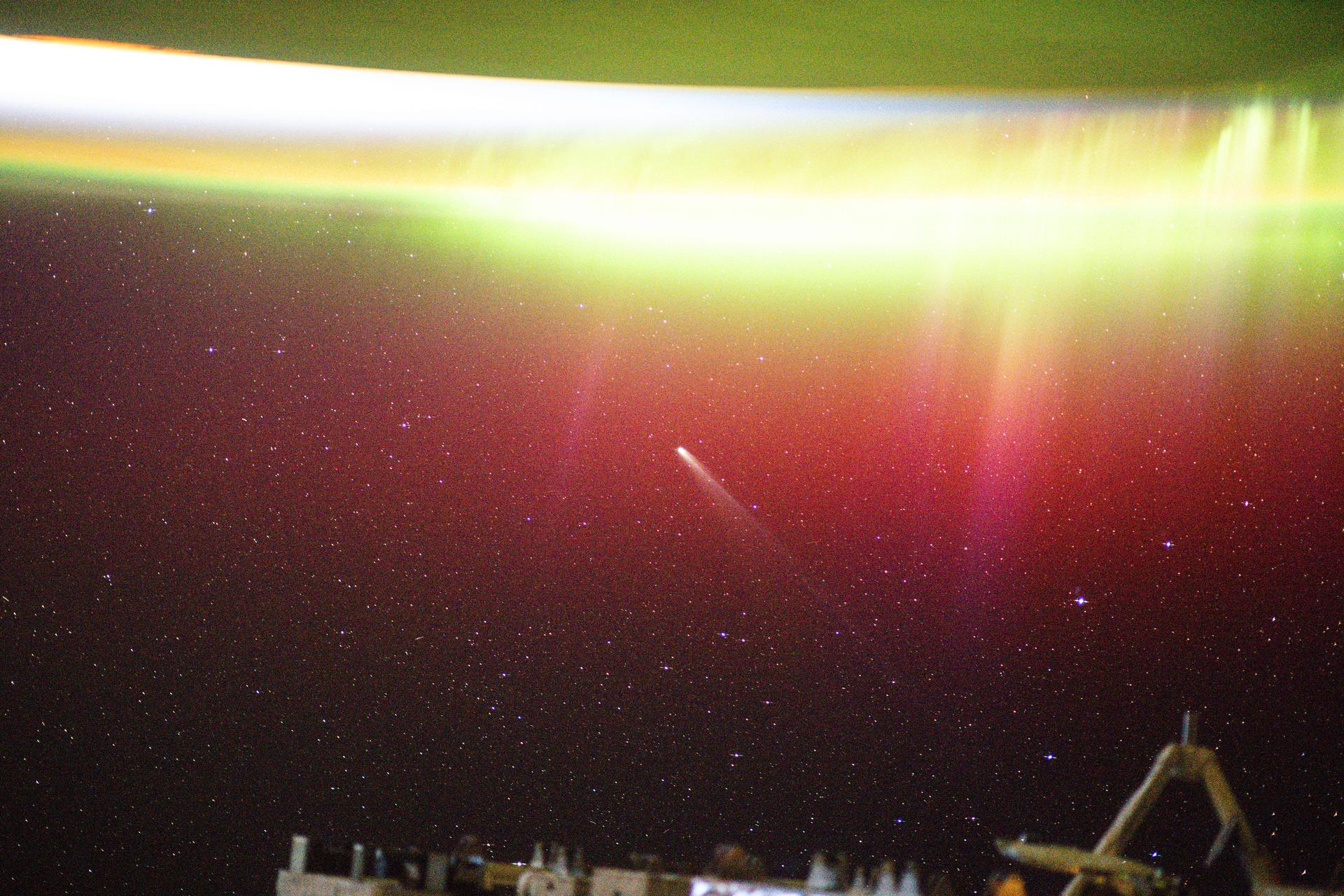
iss073e0981058 (Oct. 24, 2025) --- This long-exposure photograph shows a bright aurora radiating above Earth as Comet Lemmon (C/2025 A6) soared past the planet at a distance of about 57.2 million miles (92.1 million kilometers). The International Space Station was orbiting 263 miles above northern Minnesota at the time of this photograph.
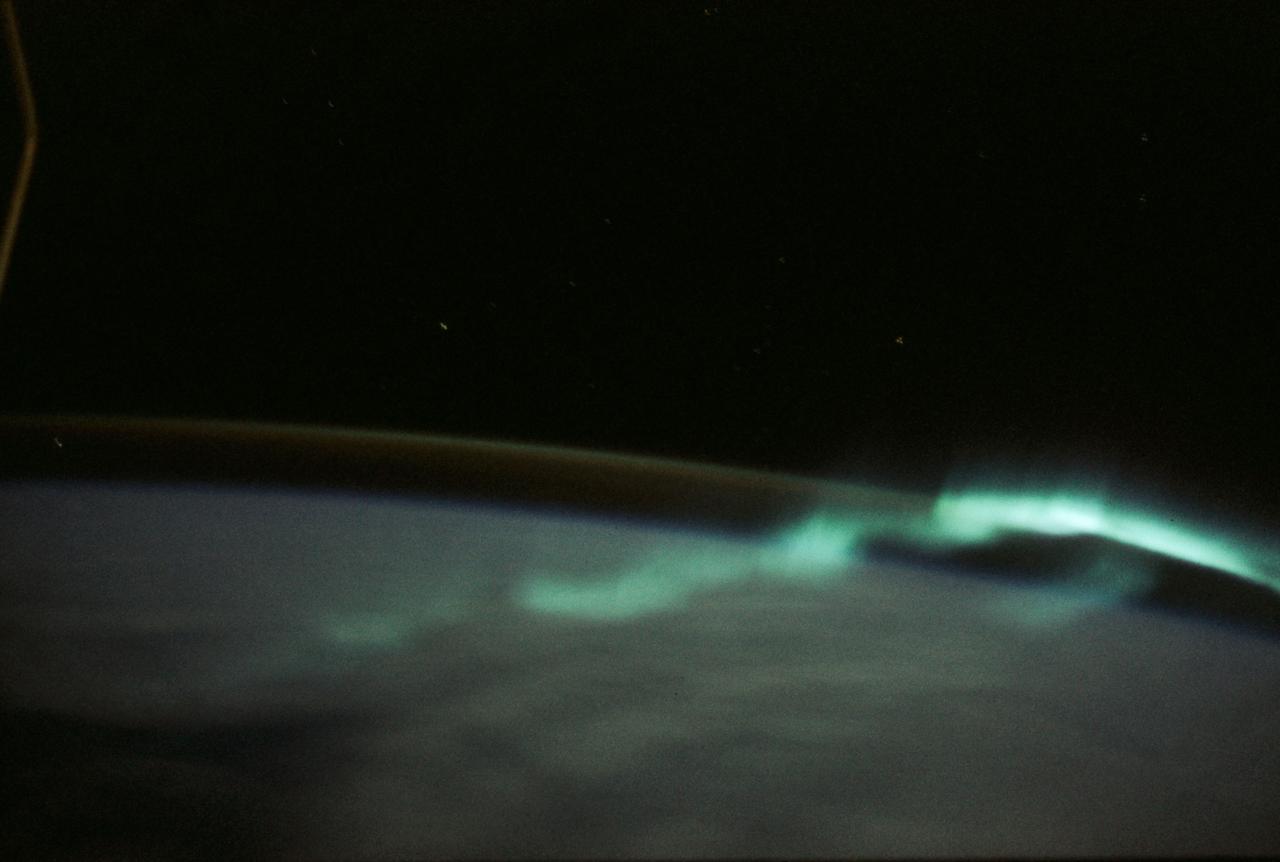
SL3-130-3130 (July-September 1973) --- An excellent view of the southern aurora, luminous bands or streamer of light, in the Southern Hemisphere, as photographed from the Skylab space station in Earth orbit. The space station was moving into the sunlight when this picture was taken. This view is near the edge of the aurora cap. The surface of the Earth is in the foreground. The permanent aurora over the South Pole is in the background. Scientist-astronaut Owen K. Garriott, Skylab 3 science pilot, took this photograph with a hand-held 35mm Nikon camera, with a four-second exposure at f/1.2, using high-speed Ektacrome film. Because auroras are caused by solar activity, they occur at the same time in the Northern and Southern hemispheres. Photo credit: NASA
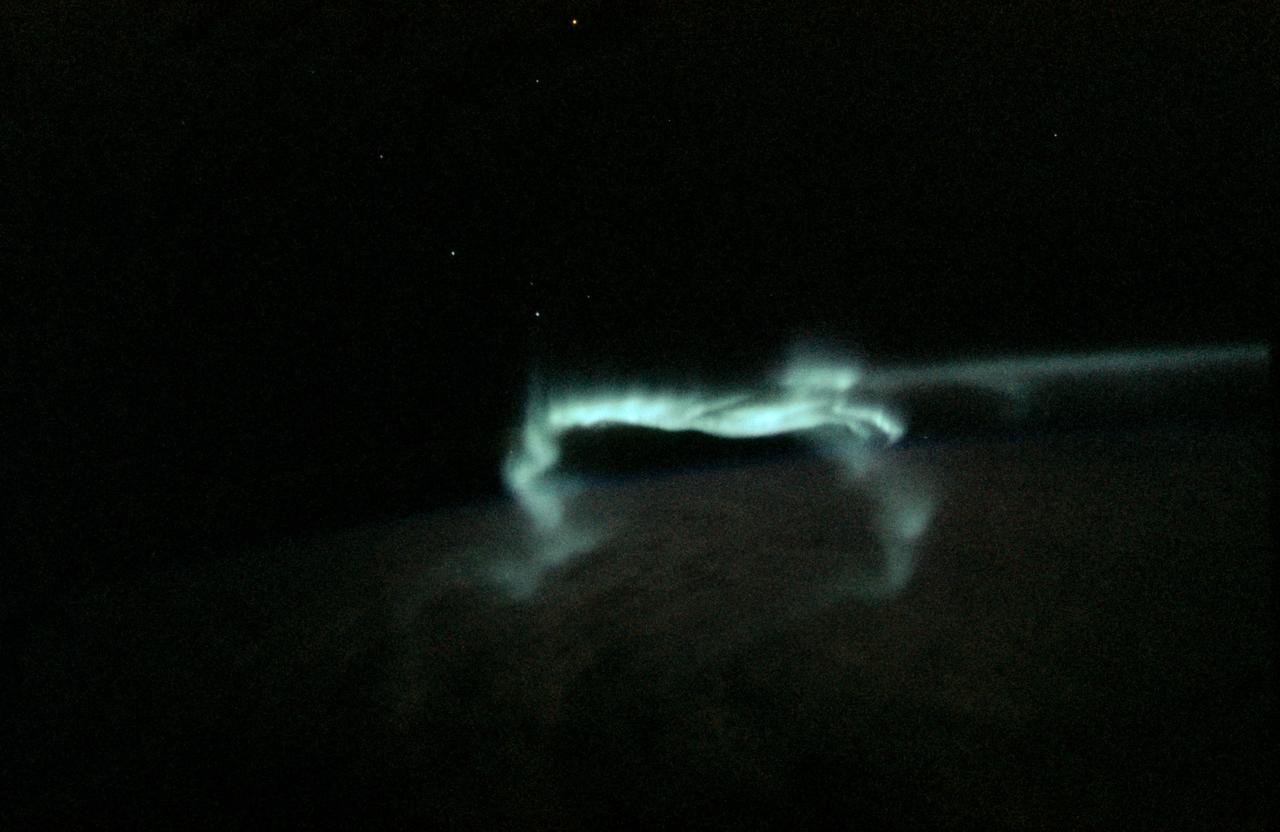
SL3-130-3131 (July-September 1973) --- An excellent view of the southern aurora, luminous bands or streamers of light, in the Southern Hemisphere, as photographed from the Skylab Space Station in Earth orbit. The space station was moving into the sunlight when this picture was taken. This view is near the edge of the aurora cap. The surface of Earth is in the foreground. The permanent aurora over the South Pole is in the background. Scientist-astronaut Owen K. Garriott, Skylab 3 science pilot, took this photograph with a hand-held 35mm Nikon camera, with a four-second exposure at f/1.2, using high-speed Ektachrome film. Because auroras are caused by solar activity, they occur at the same time in the Northern and Southern hemispheres. Photo credit: NASA

Juno's Radiation Monitoring Investigation used the Stellar Reference Unit (SRU) star camera to collect this high-resolution image of the dark side of Jupiter during Perijove 11 on Feb. 7, 2018. The clouds are illuminated by moonlight from Jupiter's moon Io and the two bright spots on the right side of the image are flashes of Jovian lightning. Juno was only 41,000 miles (66,000 kilometers) from the cloud tops when this SRU image was collected. The left side of the composite image shows a 3-dimensional visualization of Jupiter's Northern hemisphere with its northern aurora included. To the right of the aurora and solar terminator line, is a box illustrating the position of the SRU field of view at the time the image was taken. Further to the right is an exploded view of the SRU image. https://photojournal.jpl.nasa.gov/catalog/PIA22965
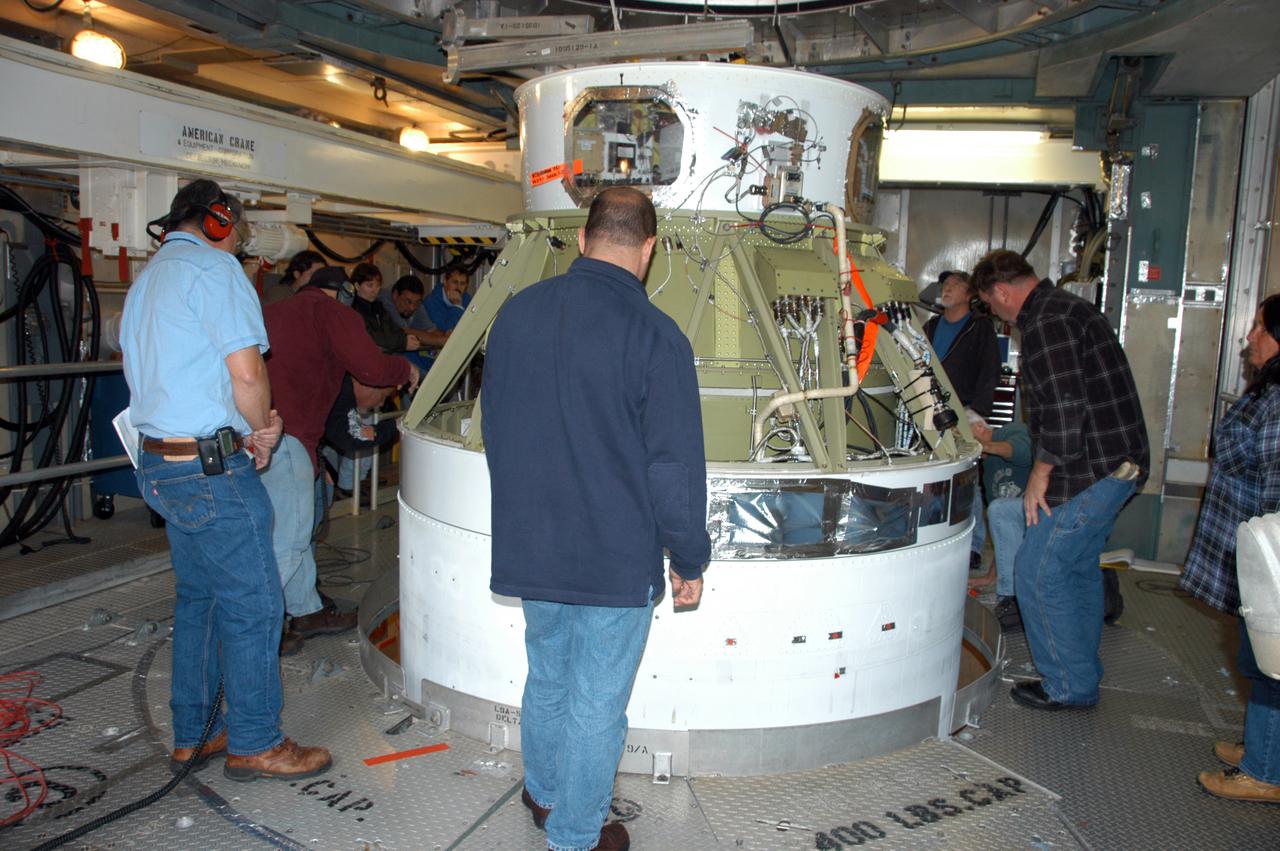
Inside the mobile service tower on Pad 17-B at Cape Canaveral Air Force Station, the Delta II second stage is mated with the first stage. The Delta II is the launch vehicle for the THEMIS spacecraft. THEMIS consists of five identical probes, the largest number of scientific satellites ever launched into orbit aboard a single rocket. This unique constellation of satellites will resolve the tantalizing mystery of what causes the spectacular sudden brightening of the aurora borealis and aurora australis - the fiery skies over the Earth's northern and southern polar regions. THEMIS is scheduled to launch Feb. 15 from Cape Canaveral Air Force Station.
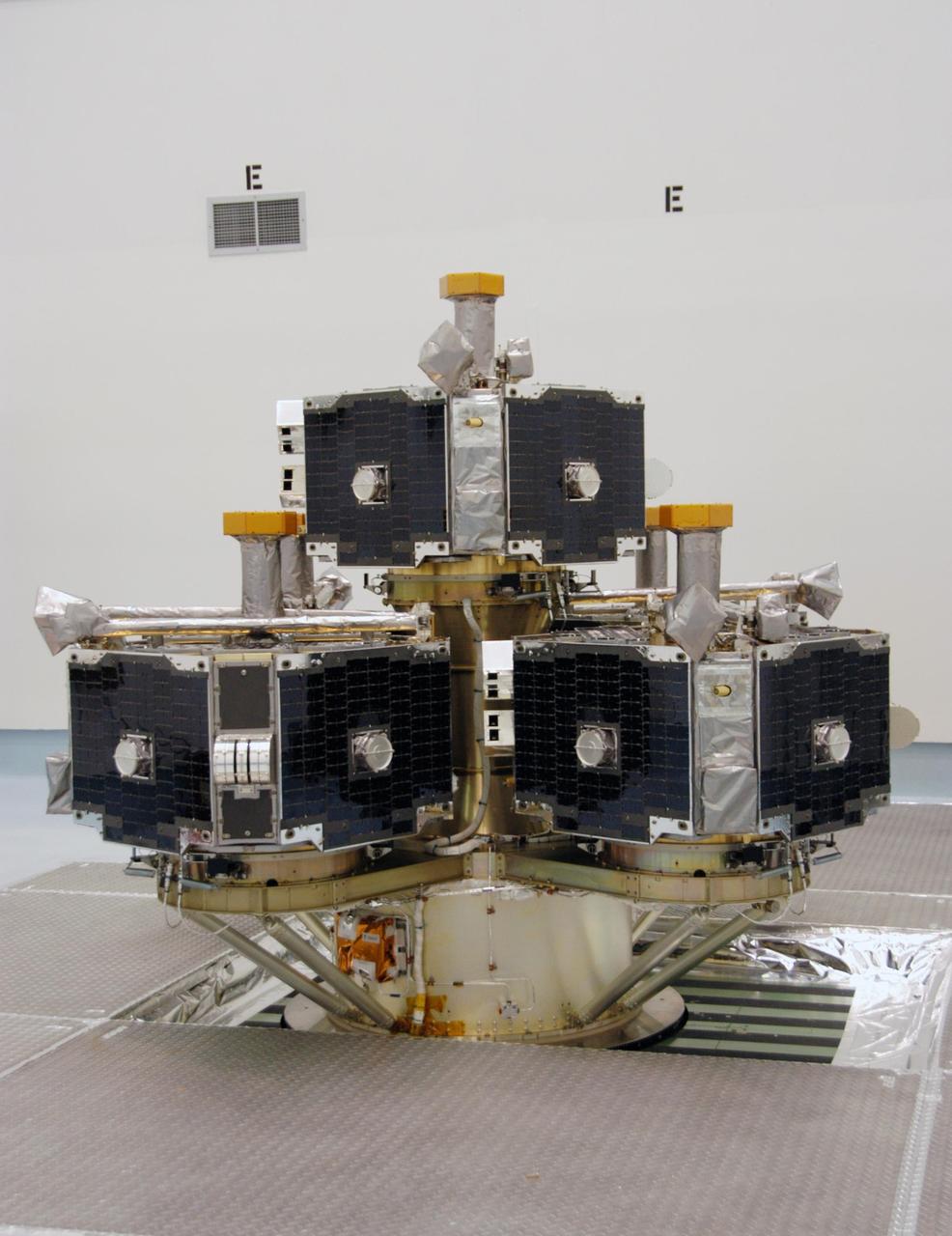
KENNEDY SPACE CENTER, FLA. -- At Astrotech Space Operations, the integrated THEMIS spacecraft is on ready for spin-balance testing. THEMIS consists of five identical probes, the largest number of scientific satellites ever launched into orbit aboard a single rocket. This unique constellation of satellites will resolve the tantalizing mystery of what causes the spectacular sudden brightening of the aurora borealis and aurora australis - the fiery skies over the Earth's northern and southern polar regions. THEMIS is scheduled to launch Feb. 15 from Cape Canaveral Air Force Station. Photo credit: NASA/George Shelton
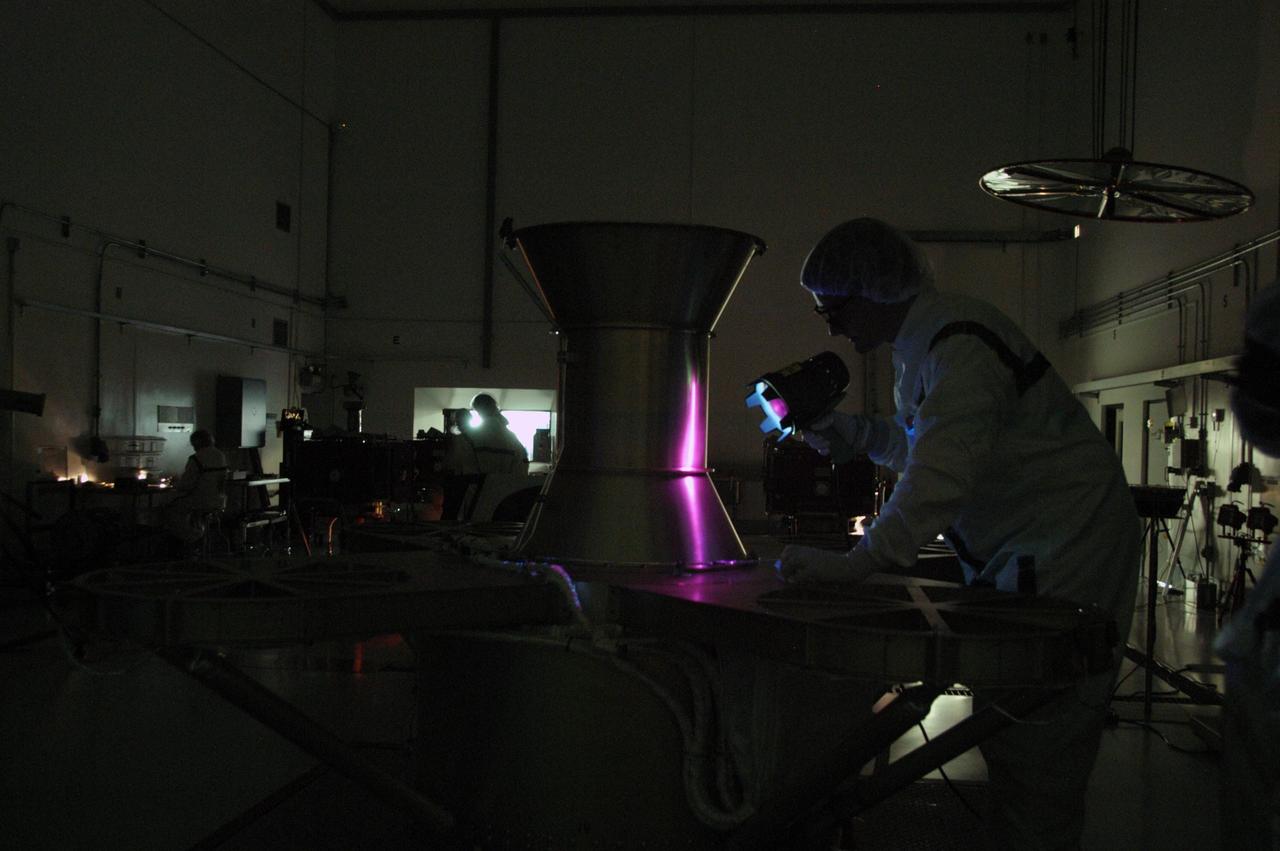
KENNEDY SPACE CENTER, FLA. -- At Astrotech Space Operations, technicians conduct black light inspection of the THEMIS probes. Black light inspection uses UVA fluorescence to detect possible particulate microcontamination, minute cracks or fluid leaks. THEMIS consists of five identical probes, the largest number of scientific satellites ever launched into orbit aboard a single rocket. This unique constellation of satellites will resolve the tantalizing mystery of what causes the spectacular sudden brightening of the aurora borealis and aurora australis - the fiery skies over the Earth's northern and southern polar regions. THEMIS is scheduled to launch Feb. 15 from Cape Canaveral Air Force Station. Photo credit: NASA/George Shelton

KENNEDY SPACE CENTER, FLA. -- At Astrotech Space Operations, technicians conduct black light inspection of the THEMIS probes. Black light inspection uses UVA fluorescence to detect possible particulate microcontamination, minute cracks or fluid leaks. THEMIS consists of five identical probes, the largest number of scientific satellites ever launched into orbit aboard a single rocket. This unique constellation of satellites will resolve the tantalizing mystery of what causes the spectacular sudden brightening of the aurora borealis and aurora australis - the fiery skies over the Earth's northern and southern polar regions. THEMIS is scheduled to launch Feb. 15 from Cape Canaveral Air Force Station. Photo credit: NASA/George Shelton

KENNEDY SPACE CENTER, FLA. -- At Astrotech Space Operations in Titusville, Fla., a worker attaches a high pressure line on the THEMIS spacecraft in preparation for fueling, which is scheduled for Jan. 3-5. THEMIS consists of five identical probes, the largest number of scientific satellites ever launched into orbit aboard a single rocket. This unique constellation of satellites will resolve the tantalizing mystery of what causes the spectacular sudden brightening of the aurora borealis and aurora australis - the fiery skies over the Earth's northern and southern polar regions. THEMIS is scheduled to launch Feb. 15 from Cape Canaveral Air Force Station. Photo credit: NASA/George Shelton
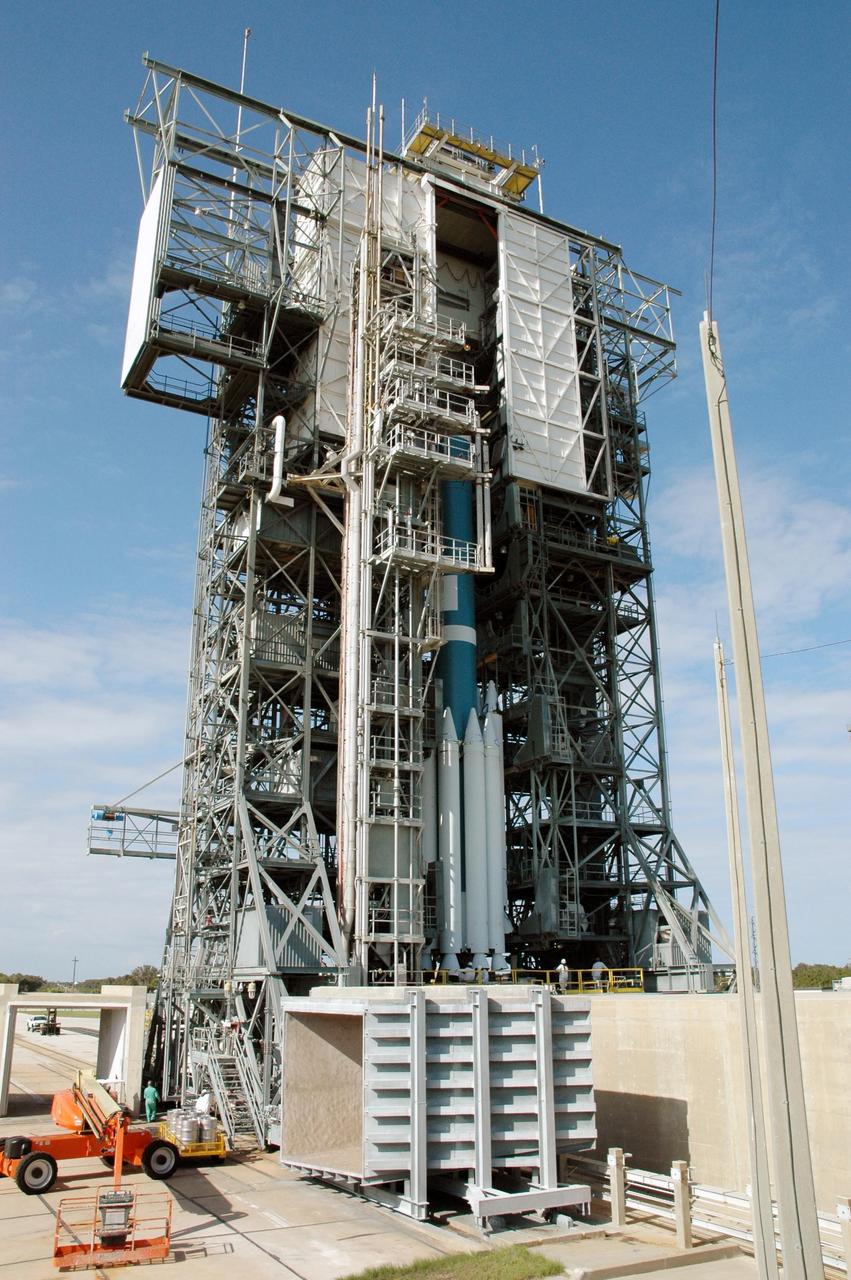
KENNEDY SPACE CENTER, FLA. -- Solid rocket boosters are clustered around the base of the United Launch Alliance Delta II rocket in the mobile service tower. A total of nine will assist in the launch of the THEMIS integrated spacecraft. THEMIS consists of five identical probes, the largest number of scientific satellites ever launched into orbit aboard a single rocket. This unique constellation of satellites will resolve the tantalizing mystery of what causes the spectacular sudden brightening of the aurora borealis and aurora australis - the fiery skies over the Earth's northern and southern polar regions. THEMIS is scheduled to launch Feb. 15 from Cape Canaveral Air Force Station. Photo credit: NASA/Jack Pfaller

In the Hazardous Processing Facility at Astrotech Space Operations, a technician observes one of the THEMIS probes as it undergoes solar array illumination telemetry testing. THEMIS consists of five identical probes, the largest number of scientific satellites ever launched into orbit aboard a single rocket. This unique constellation of satellites will resolve the tantalizing mystery of what causes the spectacular sudden brightening of the aurora borealis and aurora australis - the fiery skies over the Earth's northern and southern polar regions. THEMIS is scheduled to launch aboard the Delta II at 6:07 p.m. EST on Feb. 15.
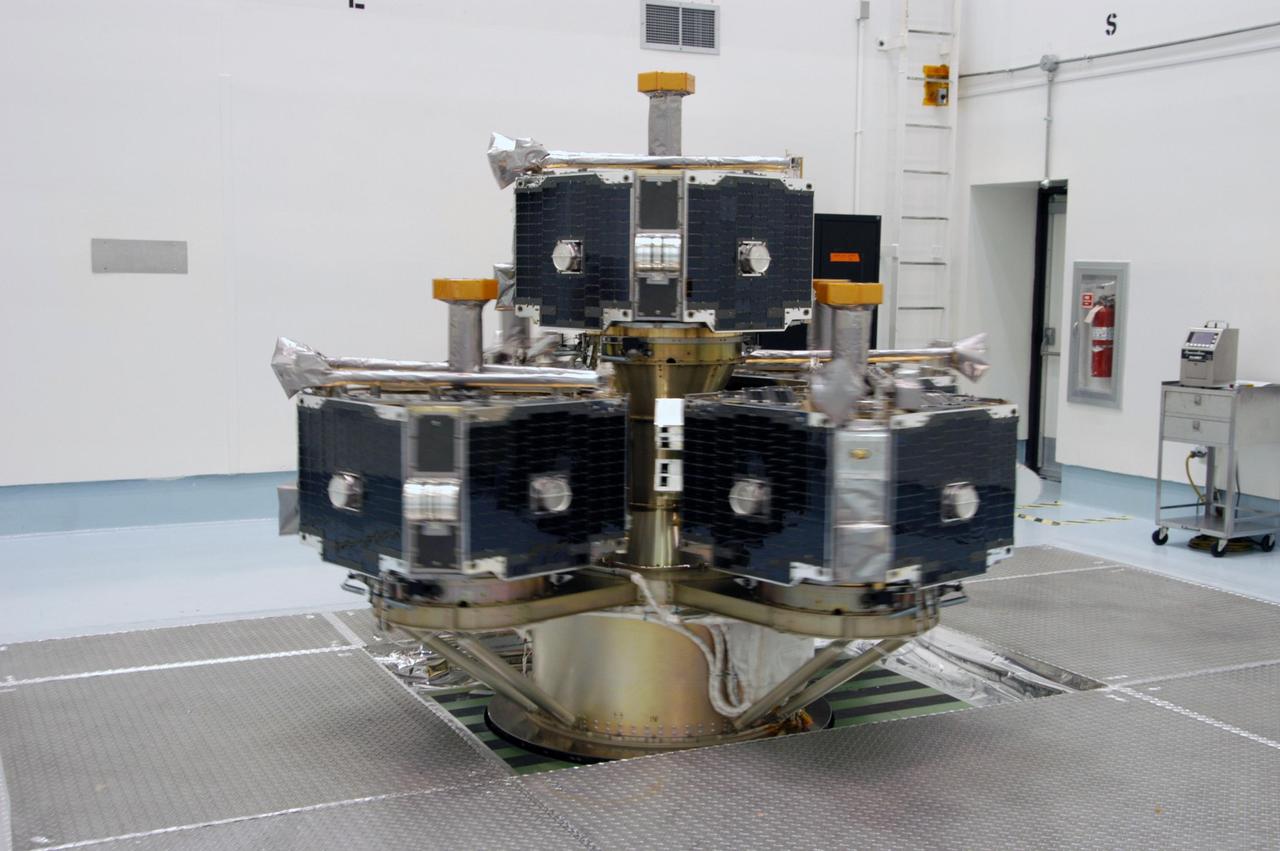
KENNEDY SPACE CENTER, FLA. -- At Astrotech Space Operations, the integrated THEMIS spacecraft is spinning on the spin table, part of spin-balance testing. THEMIS consists of five identical probes, the largest number of scientific satellites ever launched into orbit aboard a single rocket. This unique constellation of satellites will resolve the tantalizing mystery of what causes the spectacular sudden brightening of the aurora borealis and aurora australis - the fiery skies over the Earth's northern and southern polar regions. THEMIS is scheduled to launch Feb. 15 from Cape Canaveral Air Force Station. Photo credit: NASA/George Shelton
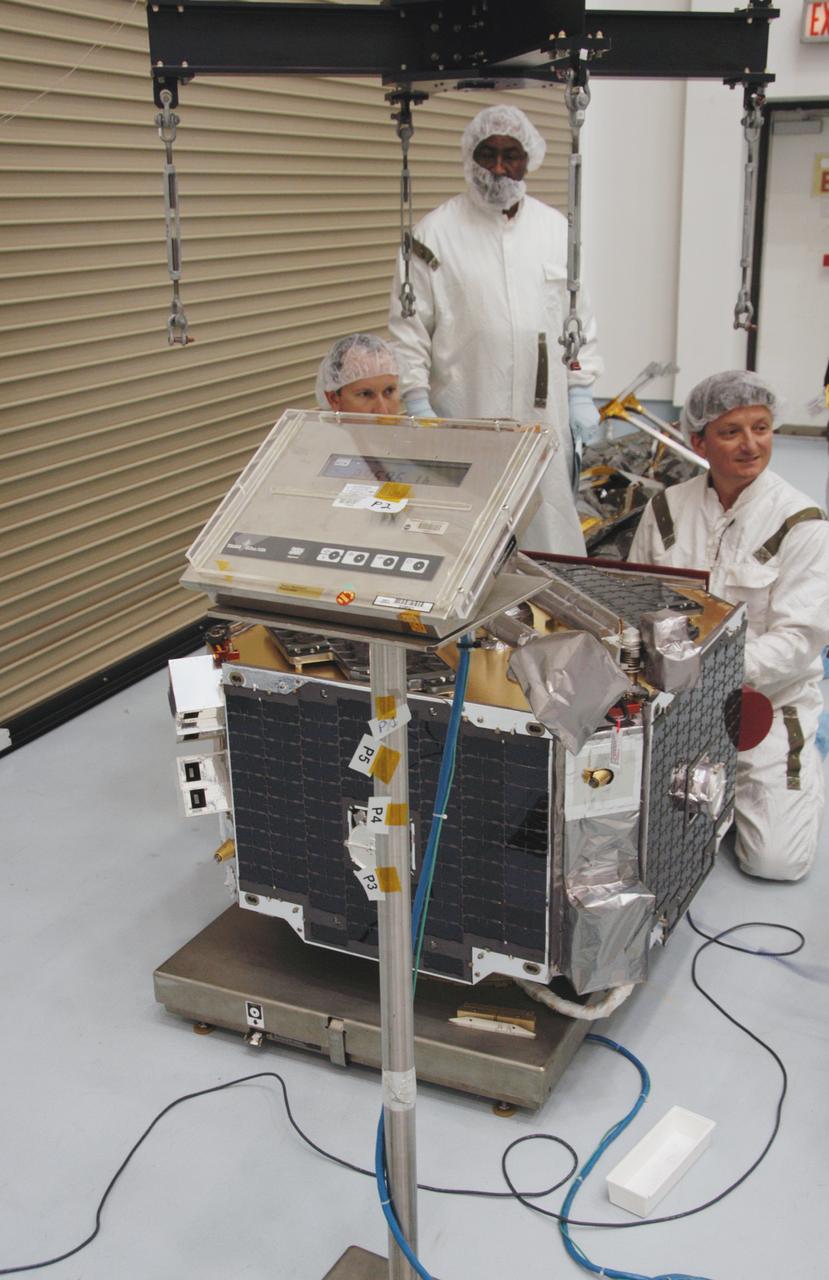
At Astrotech Space Operations, technicians weigh one of the THEMIS probes. Next the probe will be installed on a probe carrier, along with is four mates, and then undergo spin-balance testing. THEMIS consists of five identical probes, the largest number of scientific satellites ever launched into orbit aboard a single rocket. This unique constellation of satellites will resolve the tantalizing mystery of what causes the spectacular sudden brightening of the aurora borealis and aurora australis - the fiery skies over the Earth's northern and southern polar regions. THEMIS is scheduled to launch Feb. 15 from Cape Canaveral Air Force Station.
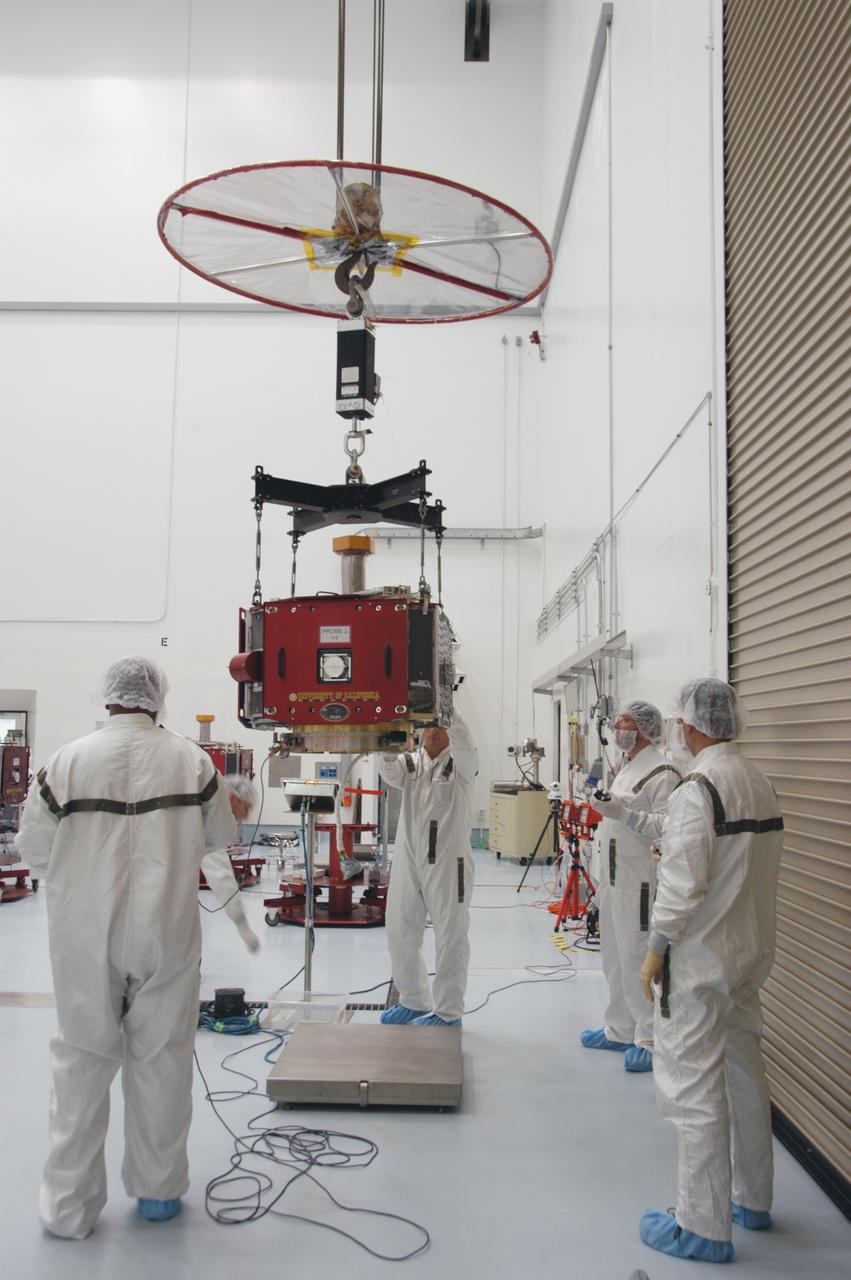
At Astrotech Space Operations, one of the five THEMIS probes is lifted from a scale. It will be moved to a probe carrier for installation, along with its four mates, and then undergo spin-balance testing. THEMIS consists of five identical probes, the largest number of scientific satellites ever launched into orbit aboard a single rocket. This unique constellation of satellites will resolve the tantalizing mystery of what causes the spectacular sudden brightening of the aurora borealis and aurora australis - the fiery skies over the Earth's northern and southern polar regions. THEMIS is scheduled to launch Feb. 15 from Cape Canaveral Air Force Station.
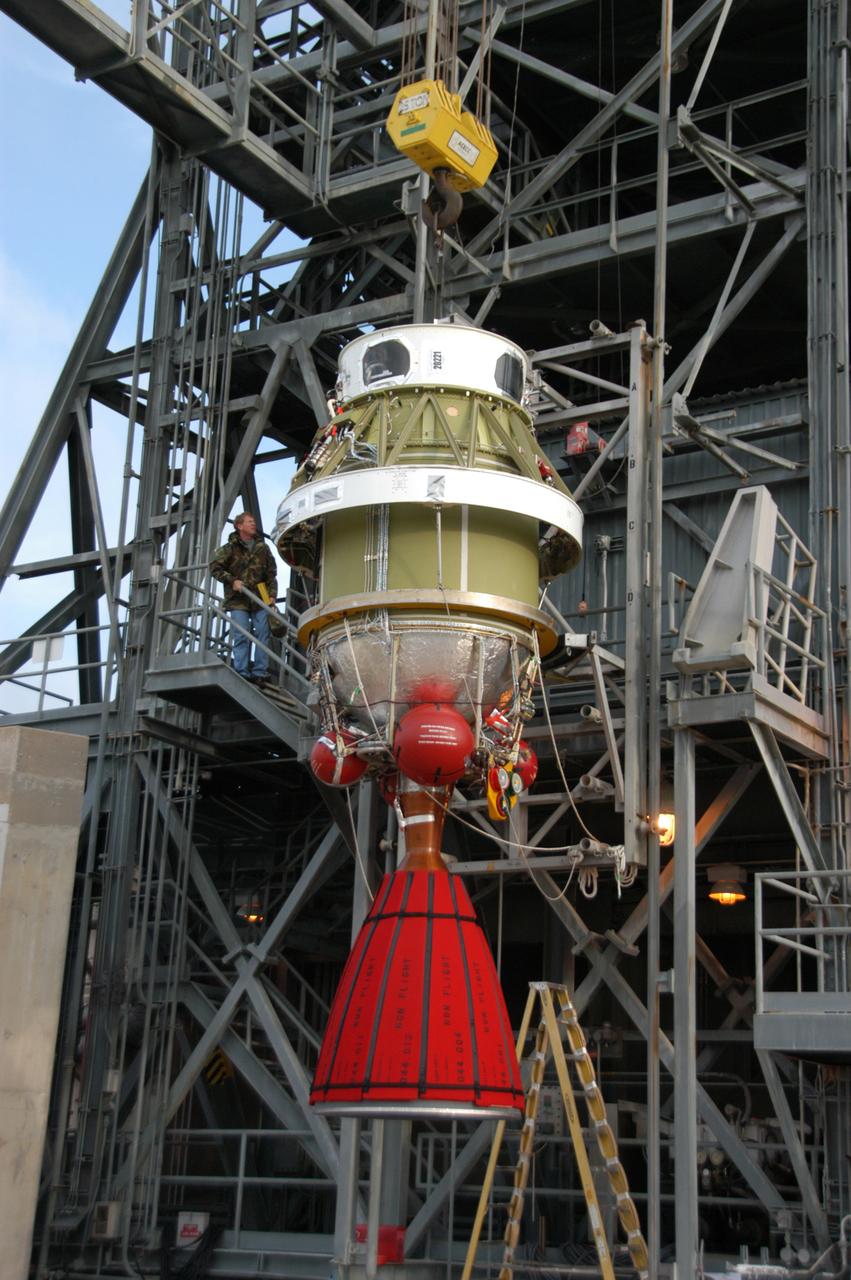
On Pad 17-B at Cape Canaveral Air Force Station, the Delta II second stage is being lifted alongside the mobile service tower. Once inside, it will be mated with the first stage already in place. The Delta II is the launch vehicle for the THEMIS spacecraft. THEMIS consists of five identical probes, the largest number of scientific satellites ever launched into orbit aboard a single rocket. This unique constellation of satellites will resolve the tantalizing mystery of what causes the spectacular sudden brightening of the aurora borealis and aurora australis - the fiery skies over the Earth's northern and southern polar regions. THEMIS is scheduled to launch Feb. 15 from Cape Canaveral Air Force Station.
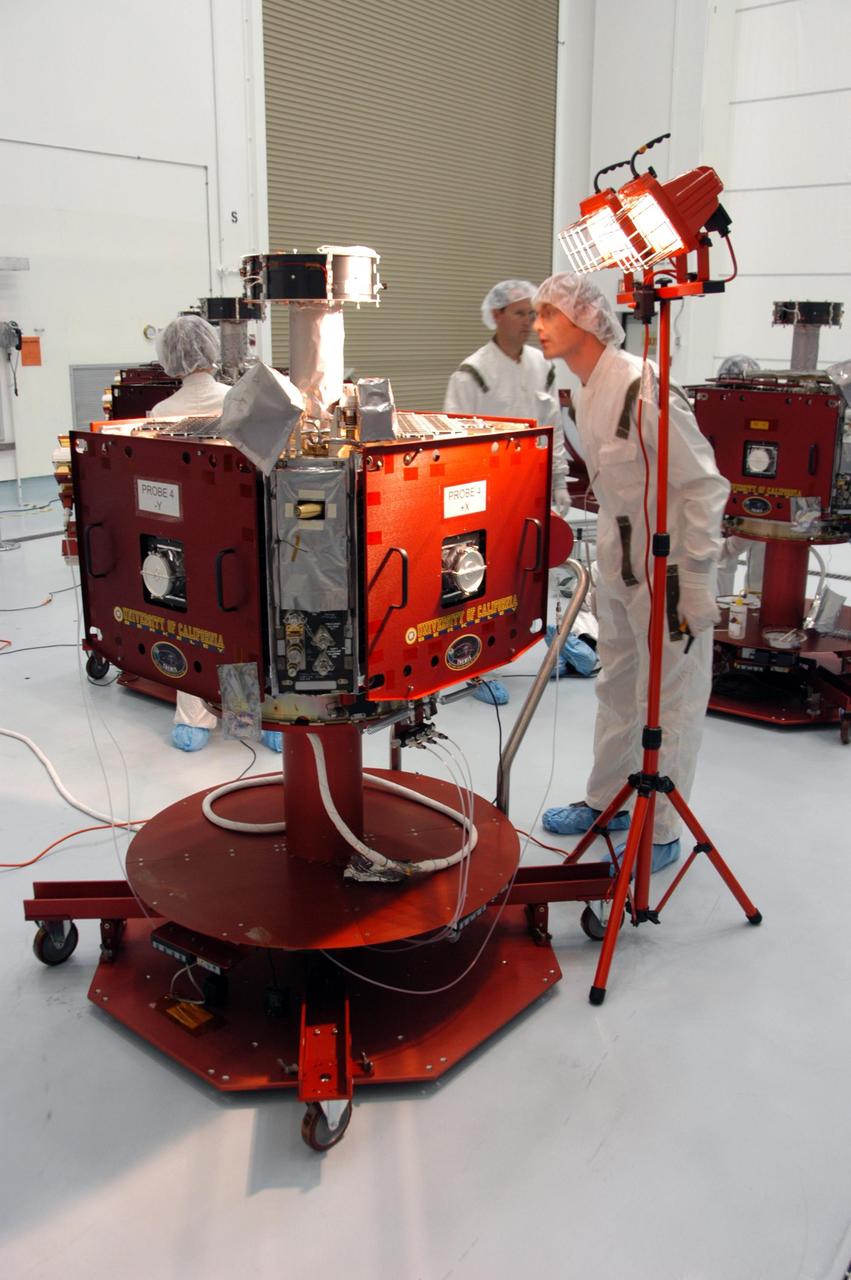
KENNEDY SPACE CENTER, FLA. -- In the Hazardous Processing Facility at Astrotech Space Operations, a technician observes one of the THEMIS probes as it undergoes solar array illumination telemetry testing. THEMIS consists of five identical probes, the largest number of scientific satellites ever launched into orbit aboard a single rocket. This unique constellation of satellites will resolve the tantalizing mystery of what causes the spectacular sudden brightening of the aurora borealis and aurora australis - the fiery skies over the Earth's northern and southern polar regions. THEMIS is scheduled to launch aboard the Delta II at 6:07 p.m. EST on Feb. 15. Photo credit: NASA/George Shelton
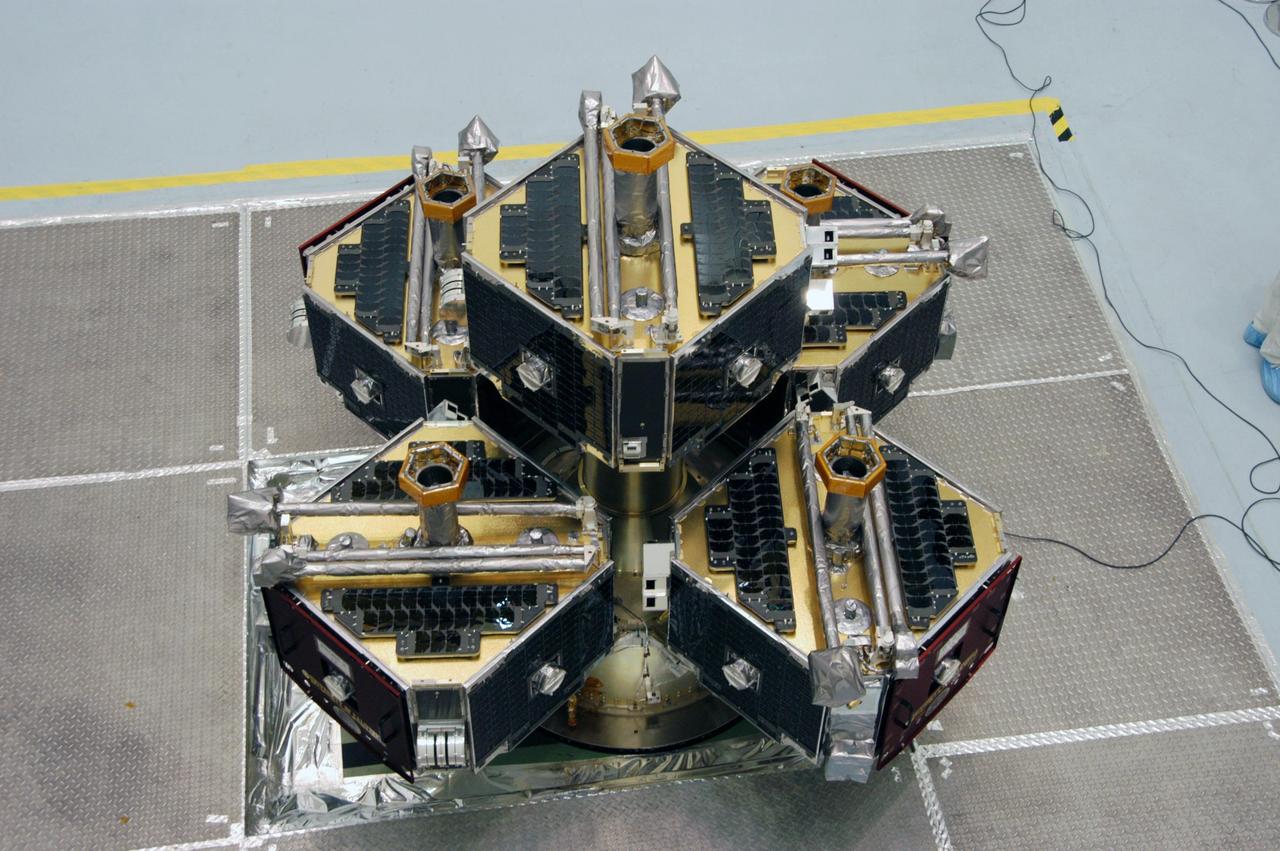
KENNEDY SPACE CENTER, FLA. -- At Astrotech Space Operations, the integrated THEMIS spacecraft is ready for spin-balance testing. THEMIS consists of five identical probes, the largest number of scientific satellites ever launched into orbit aboard a single rocket. This unique constellation of satellites will resolve the tantalizing mystery of what causes the spectacular sudden brightening of the aurora borealis and aurora australis - the fiery skies over the Earth's northern and southern polar regions. THEMIS is scheduled to launch Feb. 15 from Cape Canaveral Air Force Station. Photo credit: NASA/George Shelton

KENNEDY SPACE CENTER, FLA. -- At Astrotech Space Operations, the media are dressed in clean room, or bunny, suits to photograph the integrated THEMIS spacecraft. THEMIS consists of five identical probes, the largest number of scientific satellites ever launched into orbit aboard a single rocket. This unique constellation of satellites will resolve the tantalizing mystery of what causes the spectacular sudden brightening of the aurora borealis and aurora australis - the fiery skies over the Earth's northern and southern polar regions. THEMIS is scheduled to launch Feb. 15 from Cape Canaveral Air Force Station. Photo credit: NASA/George Shelton
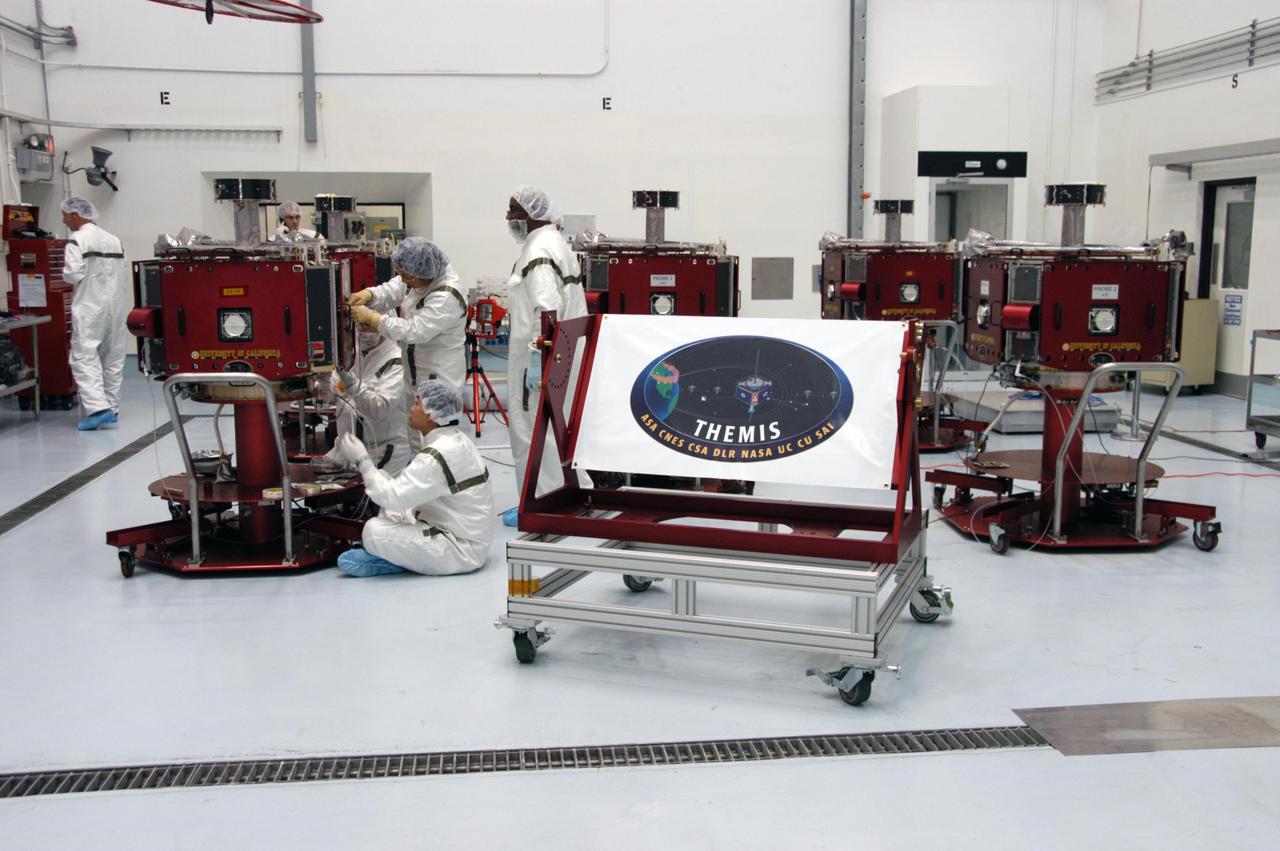
KENNEDY SPACE CENTER, FLA. -- In the Hazardous Processing Facility at Astrotech Space Operations, technicians prepare THEMIS probes for solar array illumination telemetry tests. THEMIS consists of five identical probes, the largest number of scientific satellites ever launched into orbit aboard a single rocket. This unique constellation of satellites will resolve the tantalizing mystery of what causes the spectacular sudden brightening of the aurora borealis and aurora australis - the fiery skies over the Earth's northern and southern polar regions. THEMIS is scheduled to launch aboard the Delta II at 6:07 p.m. EST on Feb. 15. Photo credit: NASA/George Shelton

At Astrotech Space Operations, technicians guide one of the THEMIS probes into position on the probe carrier. When all five probes are in place, the carrier will undergo spin-balance testing. THEMIS consists of five identical probes, the largest number of scientific satellites ever launched into orbit aboard a single rocket. This unique constellation of satellites will resolve the tantalizing mystery of what causes the spectacular sudden brightening of the aurora borealis and aurora australis - the fiery skies over the Earth's northern and southern polar regions. THEMIS is scheduled to launch Feb. 15 from Cape Canaveral Air Force Station.
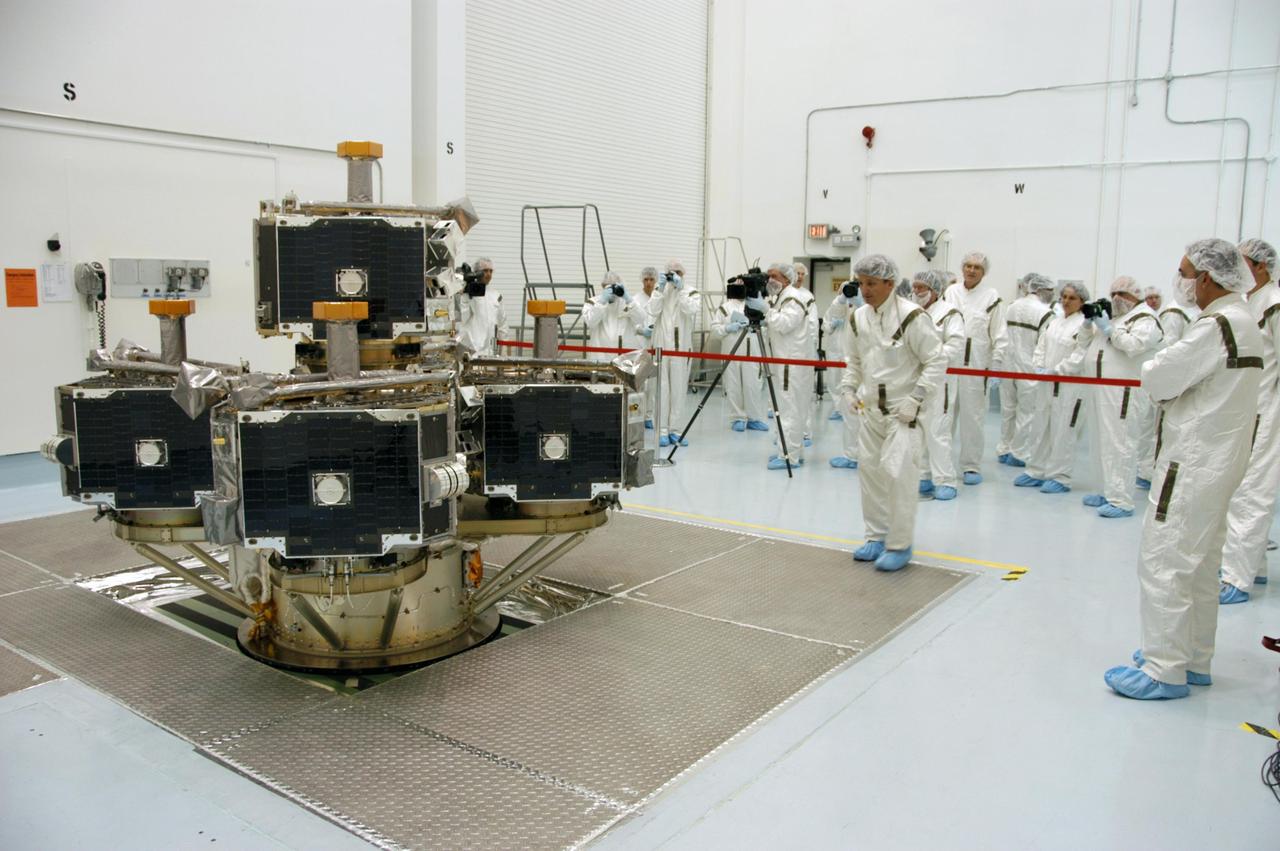
KENNEDY SPACE CENTER, FLA. -- At Astrotech Space Operations, the media are dressed in clean room, or bunny, suits to photograph the integrated THEMIS spacecraft. THEMIS consists of five identical probes, the largest number of scientific satellites ever launched into orbit aboard a single rocket. This unique constellation of satellites will resolve the tantalizing mystery of what causes the spectacular sudden brightening of the aurora borealis and aurora australis - the fiery skies over the Earth's northern and southern polar regions. THEMIS is scheduled to launch Feb. 15 from Cape Canaveral Air Force Station. Photo credit: NASA/George Shelton
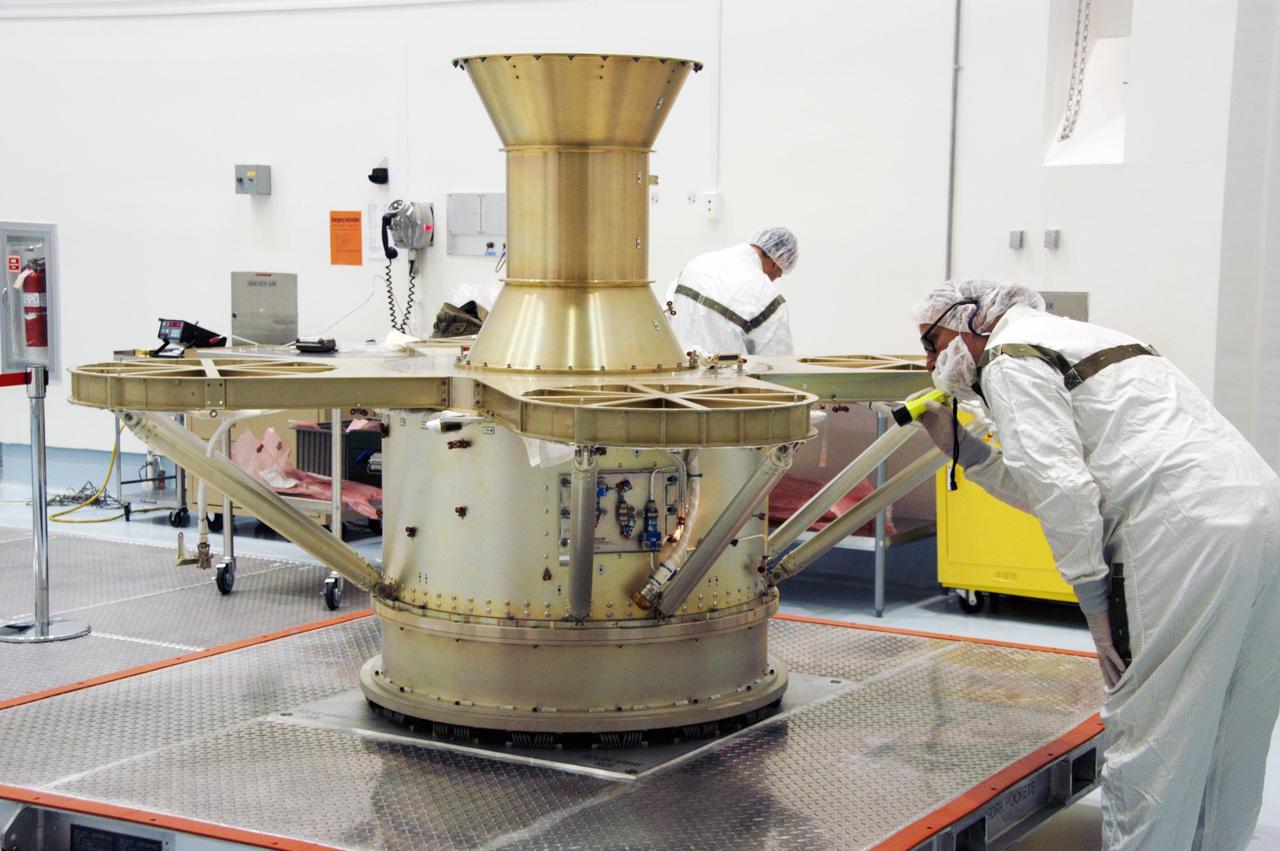
KENNEDY SPACE CENTER, FLA. -- At Astrotech Space Operations in Titusville, Fla., a worker examines connections on the THEMIS spacecraft, which is expected to be fueled Jan. 3-5. THEMIS consists of five identical probes, the largest number of scientific satellites ever launched into orbit aboard a single rocket. This unique constellation of satellites will resolve the tantalizing mystery of what causes the spectacular sudden brightening of the aurora borealis and aurora australis - the fiery skies over the Earth's northern and southern polar regions. THEMIS is scheduled to launch Feb. 15 from Cape Canaveral Air Force Station. Photo credit: NASA/George Shelton
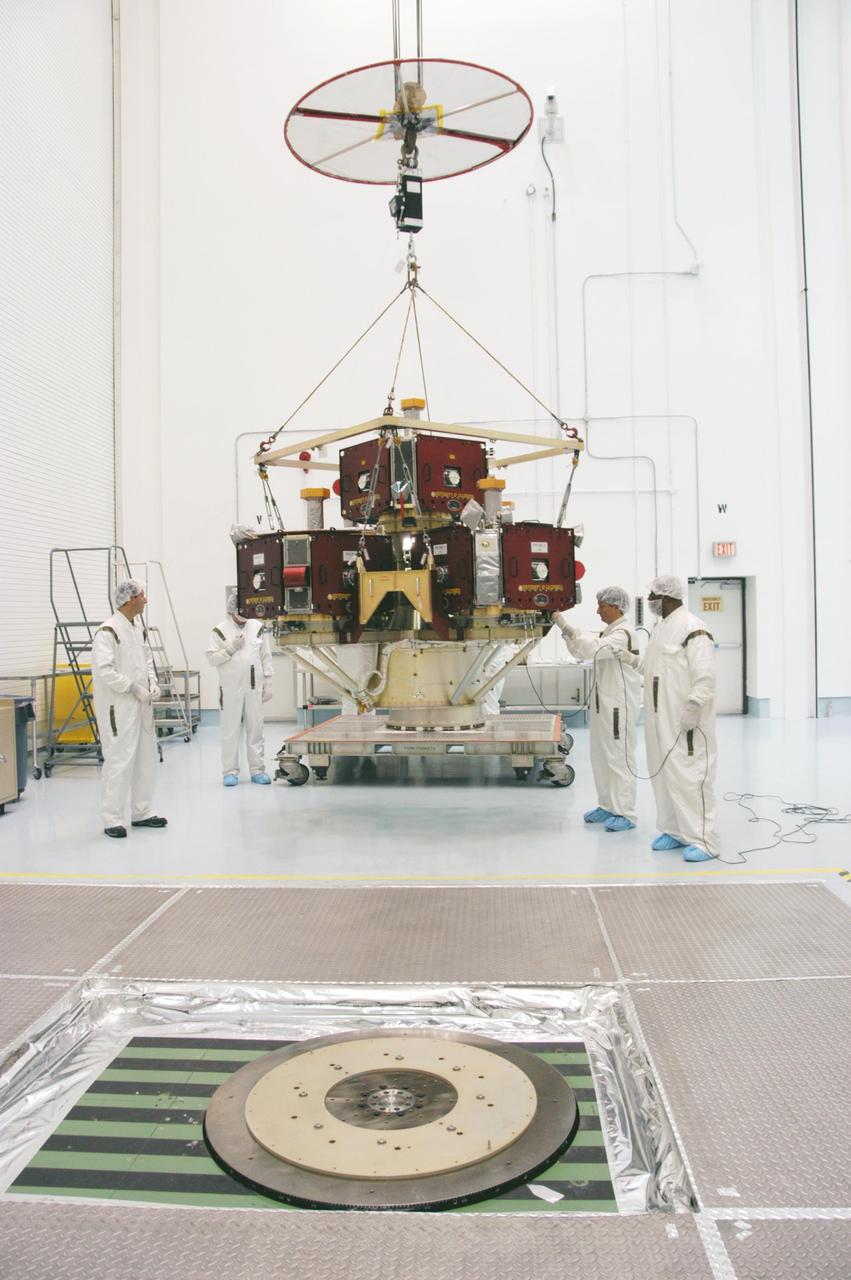
KENNEDY SPACE CENTER, FLA. -- In the Hazardous Processing Facility at Astrotech Space Operations, workers get ready to move the integrated THEMIS spacecraft to the spin table in the foreground. There it will undergo spin-balance testing. THEMIS consists of five identical probes, the largest number of scientific satellites ever launched into orbit aboard a single rocket. This unique constellation of satellites will resolve the tantalizing mystery of what causes the spectacular sudden brightening of the aurora borealis and aurora australis - the fiery skies over the Earth's northern and southern polar regions. THEMIS is scheduled to launch Feb. 15 from Cape Canaveral Air Force Station. Photo credit: NASA/George Shelton
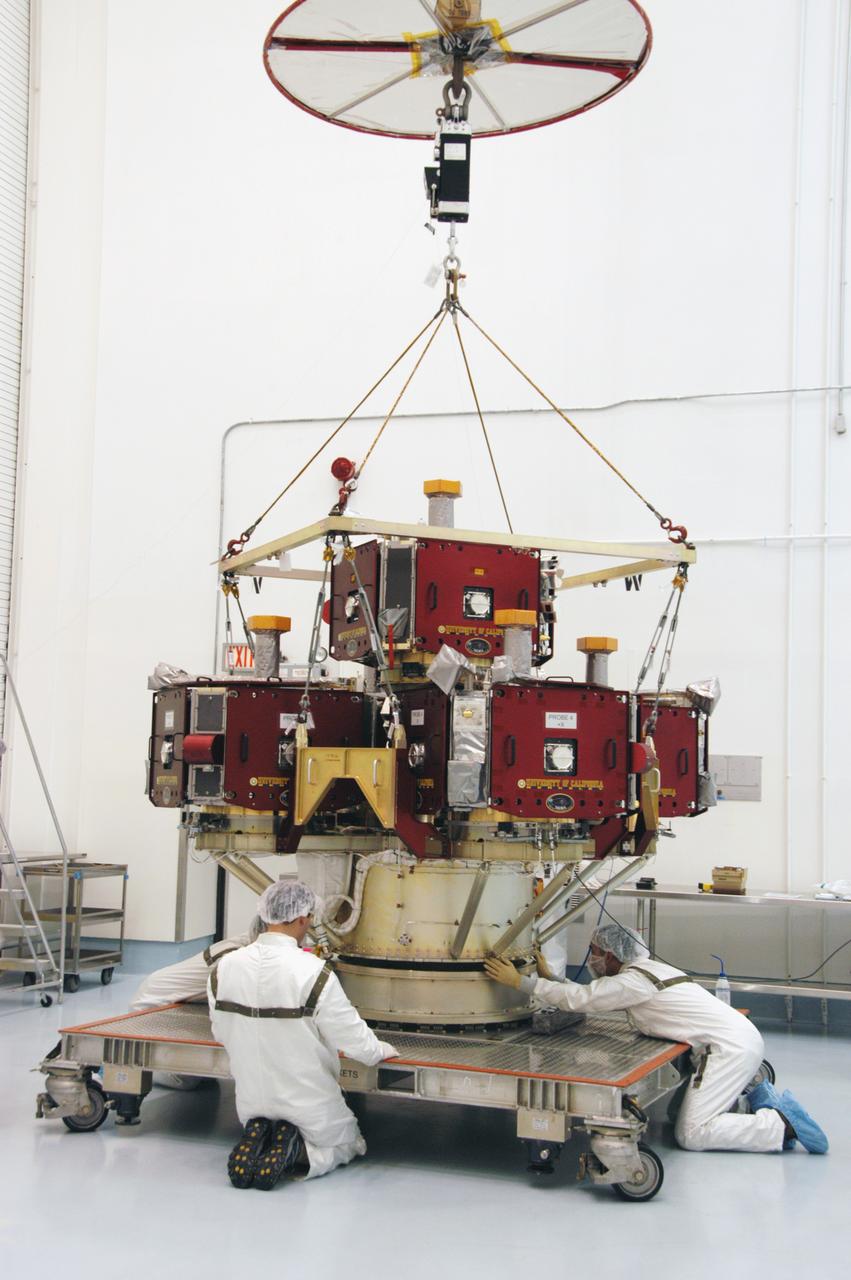
In the Hazardous Processing Facility at Astrotech Space Operations, workers attach an overhead crane to the integrated THEMIS spacecraft. The carrier is being moved to a spin table for spin-balance testing. THEMIS consists of five identical probes, the largest number of scientific satellites ever launched into orbit aboard a single rocket. This unique constellation of satellites will resolve the tantalizing mystery of what causes the spectacular sudden brightening of the aurora borealis and aurora australis - the fiery skies over the Earth's northern and southern polar regions. THEMIS is scheduled to launch Feb. 15 from Cape Canaveral Air Force Station.
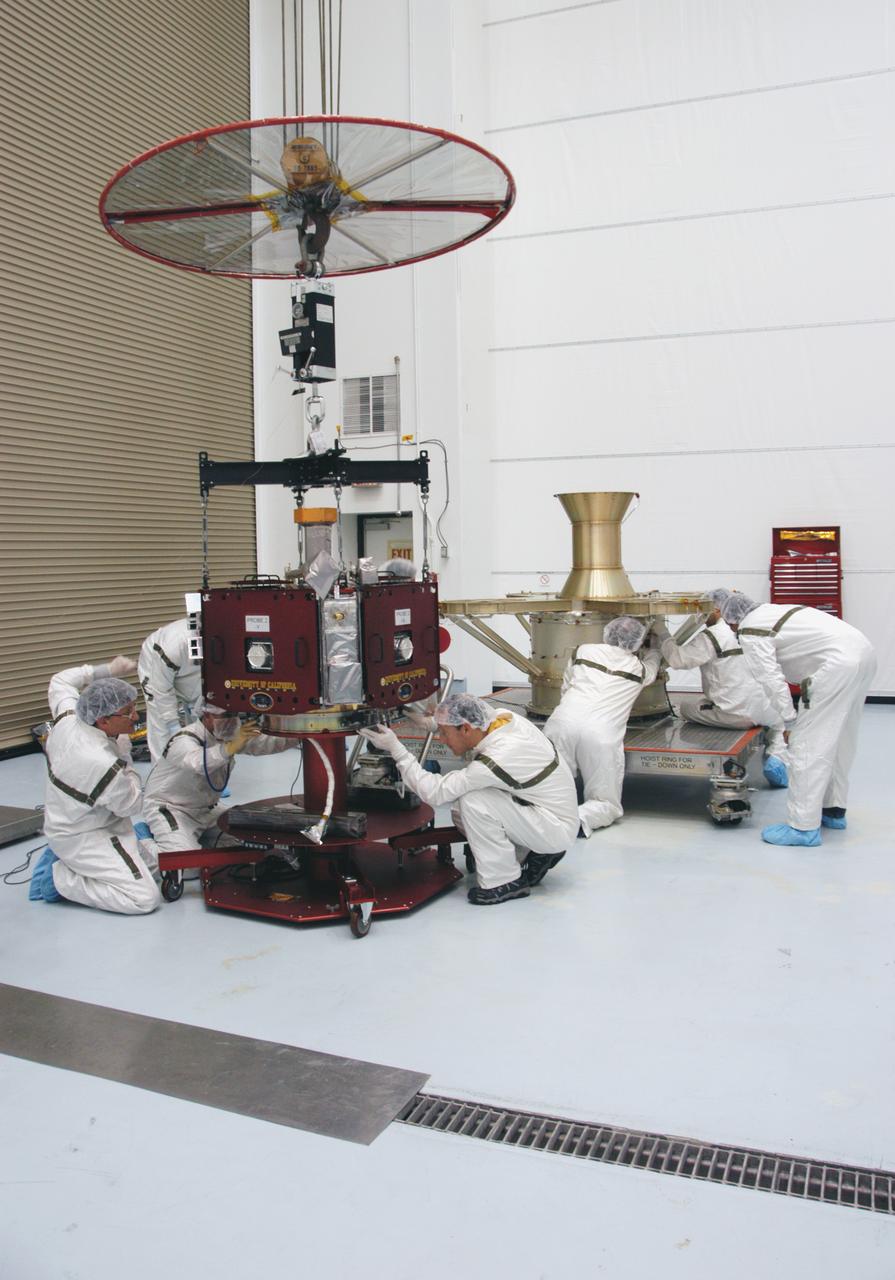
At Astrotech Space Operations, technicians adjust connections of the overhead crane on one of the THEMIS probes. The probe and its other four mates will be lifted and installed on the probe carrier in the background. The probes will then undergo spin-balance testing. THEMIS consists of five identical probes, the largest number of scientific satellites ever launched into orbit aboard a single rocket. This unique constellation of satellites will resolve the tantalizing mystery of what causes the spectacular sudden brightening of the aurora borealis and aurora australis - the fiery skies over the Earth's northern and southern polar regions. THEMIS is scheduled to launch Feb. 15 from Cape Canaveral Air Force Station.
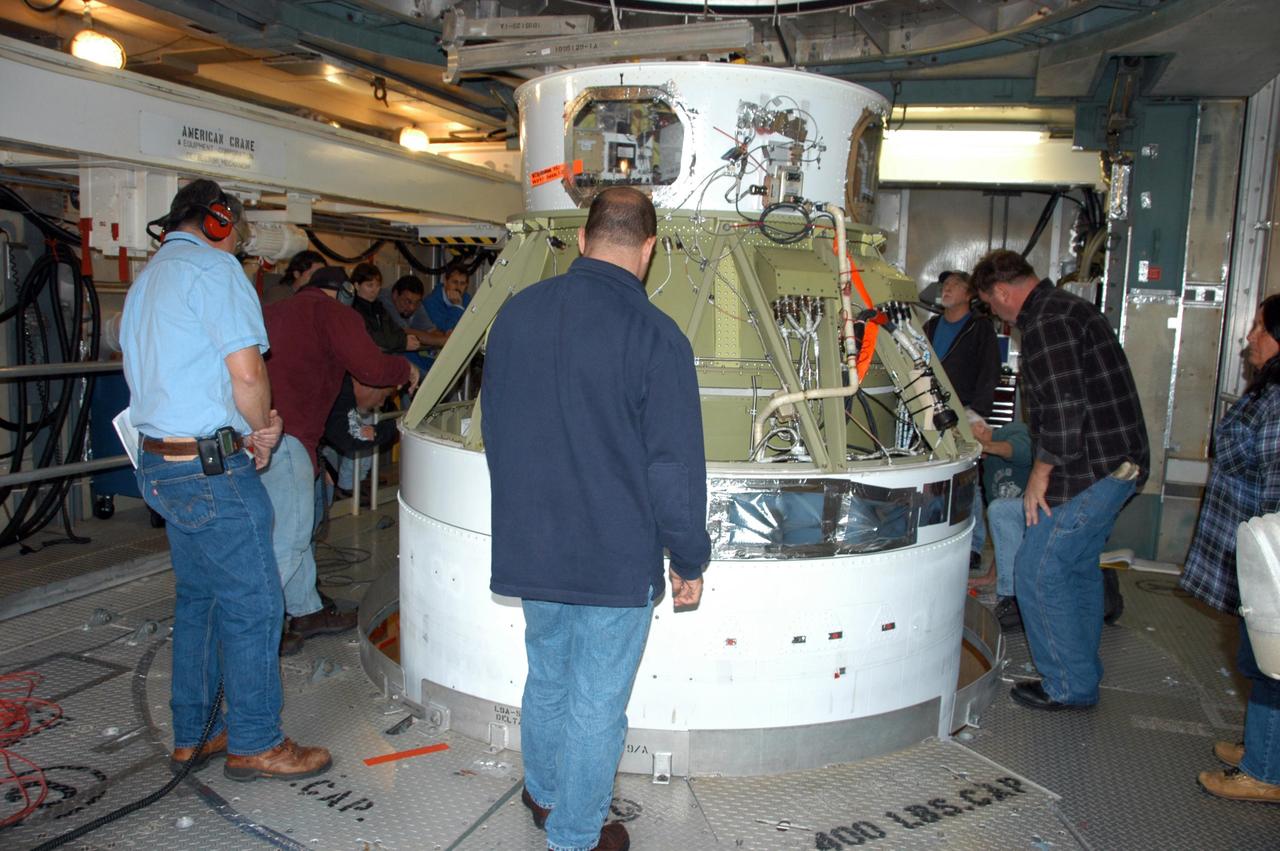
KENNEDY SPACE CENTER, FLA. -- Inside the mobile service tower on Pad 17-B at Cape Canaveral Air Force Station, the Delta II second stage is mated with the first stage. The Delta II is the launch vehicle for the THEMIS spacecraft. THEMIS consists of five identical probes, the largest number of scientific satellites ever launched into orbit aboard a single rocket. This unique constellation of satellites will resolve the tantalizing mystery of what causes the spectacular sudden brightening of the aurora borealis and aurora australis - the fiery skies over the Earth's northern and southern polar regions. THEMIS is scheduled to launch Feb. 15 from Cape Canaveral Air Force Station. Photo credit: NASA/George Shelton
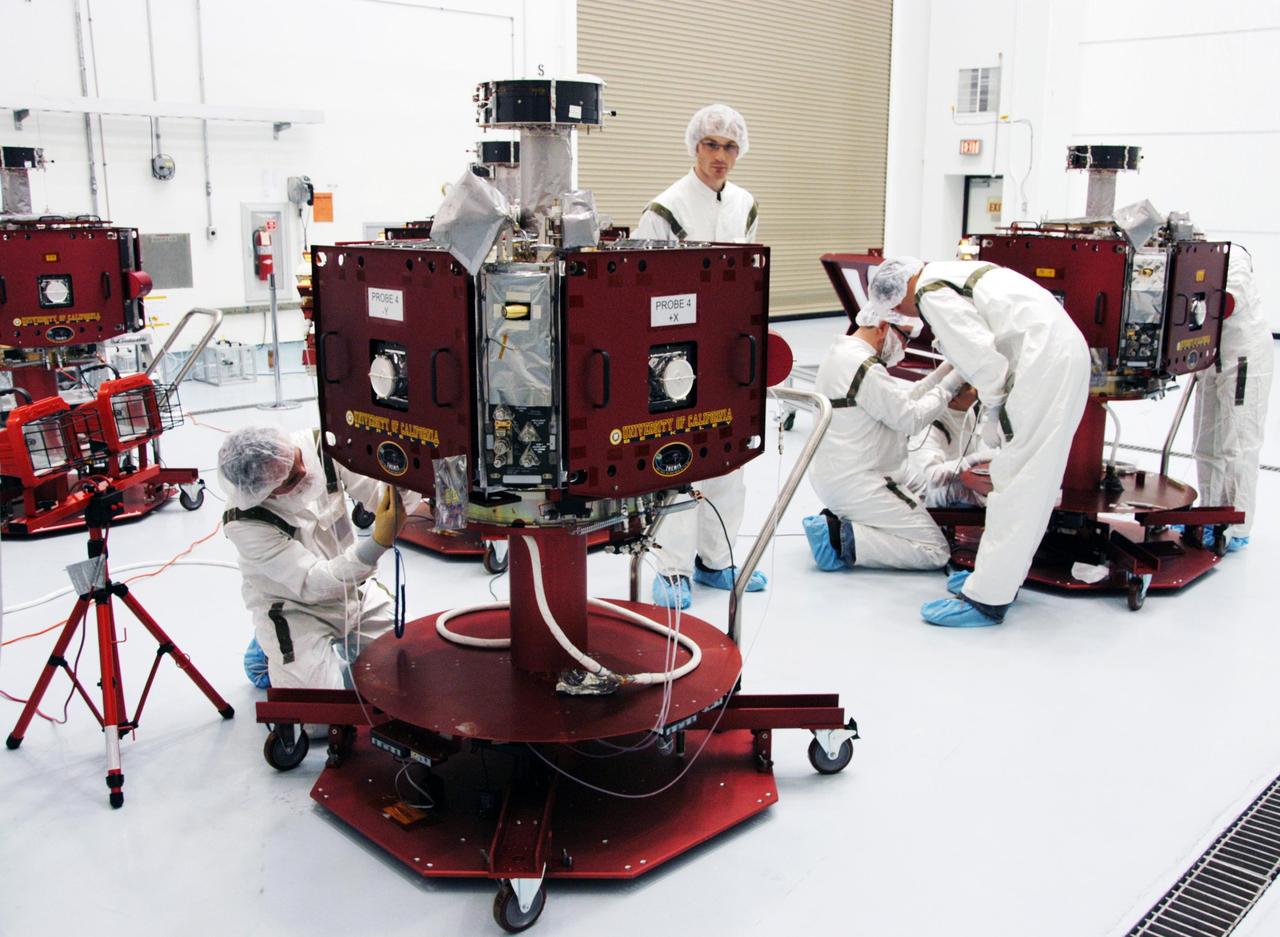
KENNEDY SPACE CENTER, FLA. -- In the Hazardous Processing Facility at Astrotech Space Operations, technicians prepare THEMIS probes for solar array illumination telemetry tests. THEMIS consists of five identical probes, the largest number of scientific satellites ever launched into orbit aboard a single rocket. This unique constellation of satellites will resolve the tantalizing mystery of what causes the spectacular sudden brightening of the aurora borealis and aurora australis - the fiery skies over the Earth's northern and southern polar regions. THEMIS is scheduled to launch aboard the Delta II at 6:07 p.m. EST on Feb. 15. Photo credit: NASA/George Shelton

KENNEDY SPACE CENTER, FLA. -- At Astrotech Space Operations, a technician helps guide one of the THEMIS probes toward the probe carrier for installation. When all five probes are in place, the carrier will undergo spin-balance testing. THEMIS consists of five identical probes, the largest number of scientific satellites ever launched into orbit aboard a single rocket. This unique constellation of satellites will resolve the tantalizing mystery of what causes the spectacular sudden brightening of the aurora borealis and aurora australis - the fiery skies over the Earth's northern and southern polar regions. THEMIS is scheduled to launch Feb. 15 from Cape Canaveral Air Force Station. Photo credit: NASA/George Shelton
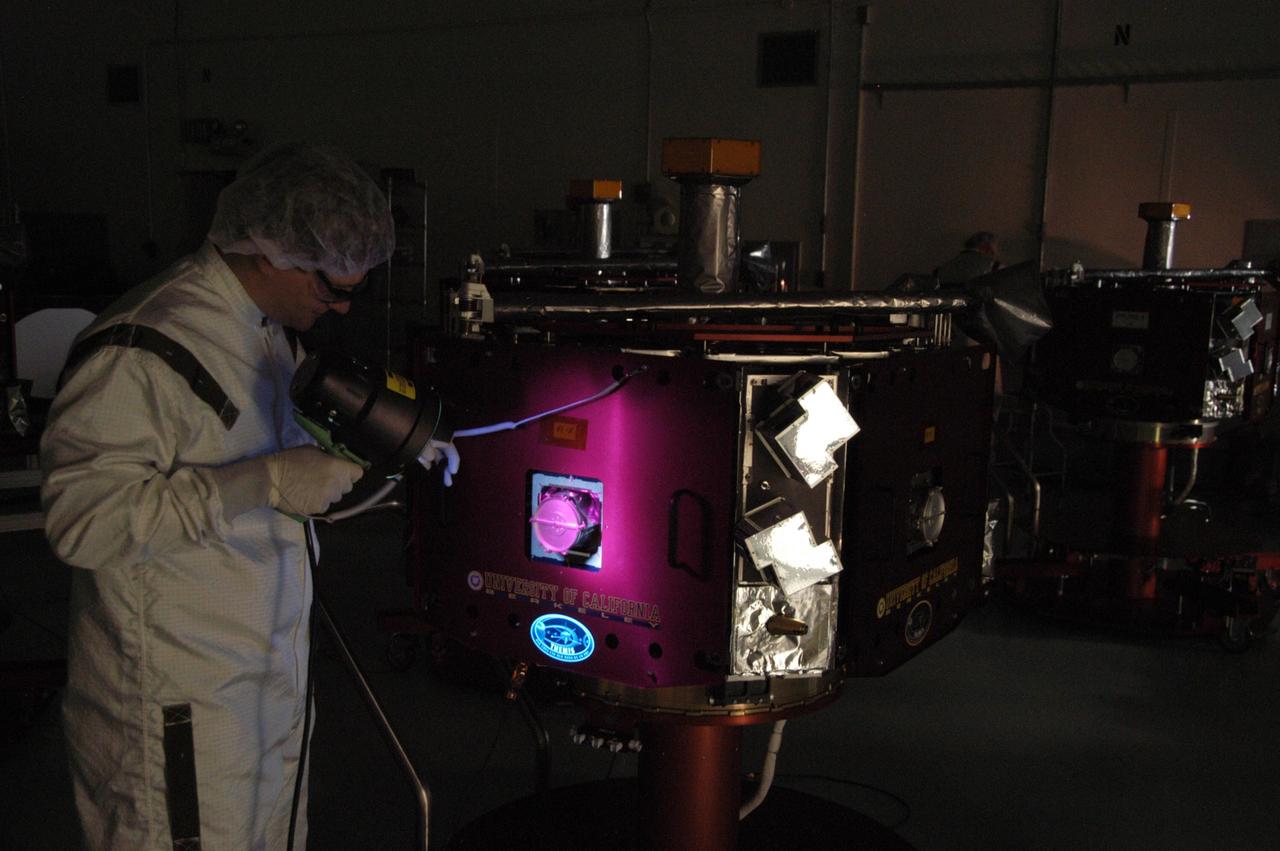
KENNEDY SPACE CENTER, FLA. -- At Astrotech Space Operations, technicians conduct black light inspection of the THEMIS probes. Black light inspection uses UVA fluorescence to detect possible particulate microcontamination, minute cracks or fluid leaks. THEMIS consists of five identical probes, the largest number of scientific satellites ever launched into orbit aboard a single rocket. This unique constellation of satellites will resolve the tantalizing mystery of what causes the spectacular sudden brightening of the aurora borealis and aurora australis - the fiery skies over the Earth's northern and southern polar regions. THEMIS is scheduled to launch Feb. 15 from Cape Canaveral Air Force Station. Photo credit: NASA/George Shelton
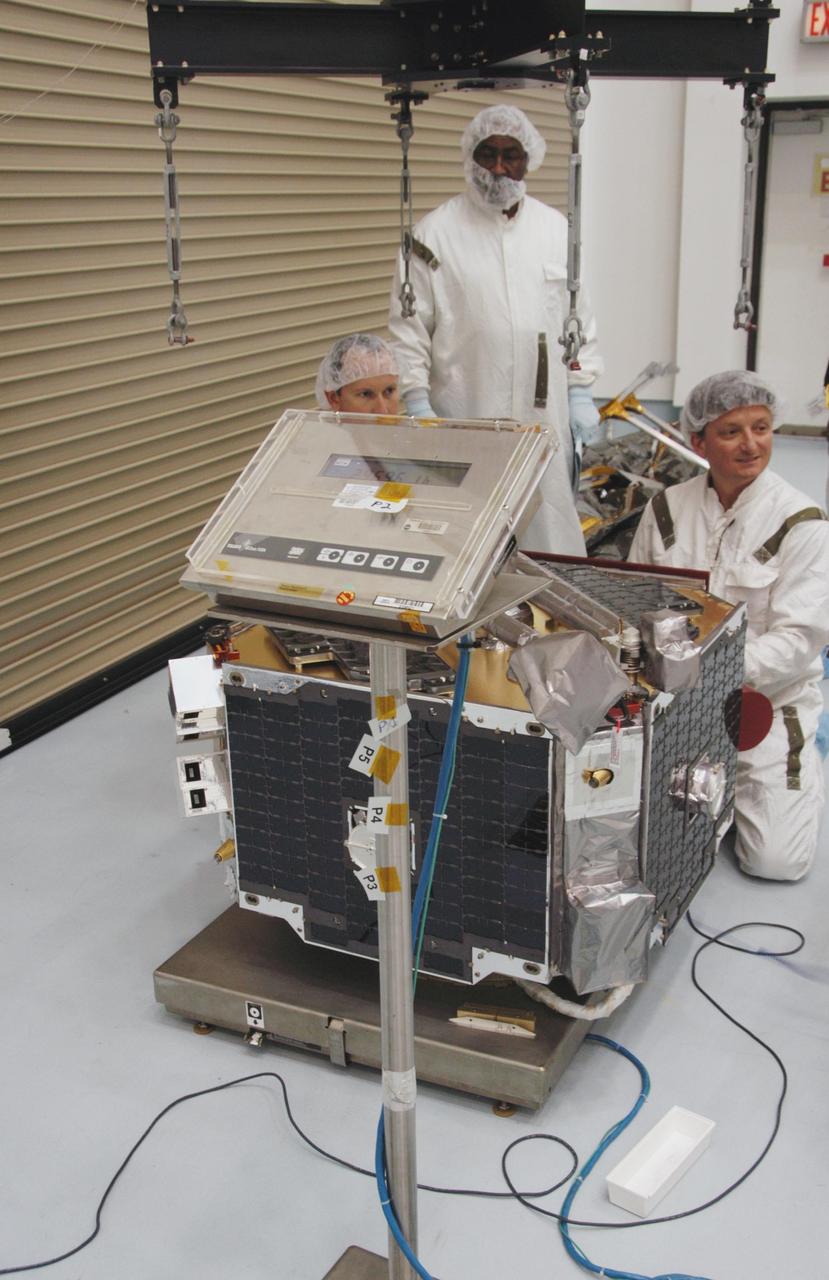
KENNEDY SPACE CENTER, FLA. -- At Astrotech Space Operations, technicians weigh one of the THEMIS probes. Next the probe will be installed on a probe carrier, along with is four mates, and then undergo spin-balance testing. THEMIS consists of five identical probes, the largest number of scientific satellites ever launched into orbit aboard a single rocket. This unique constellation of satellites will resolve the tantalizing mystery of what causes the spectacular sudden brightening of the aurora borealis and aurora australis - the fiery skies over the Earth's northern and southern polar regions. THEMIS is scheduled to launch Feb. 15 from Cape Canaveral Air Force Station. Photo credit: NASA/George Shelton
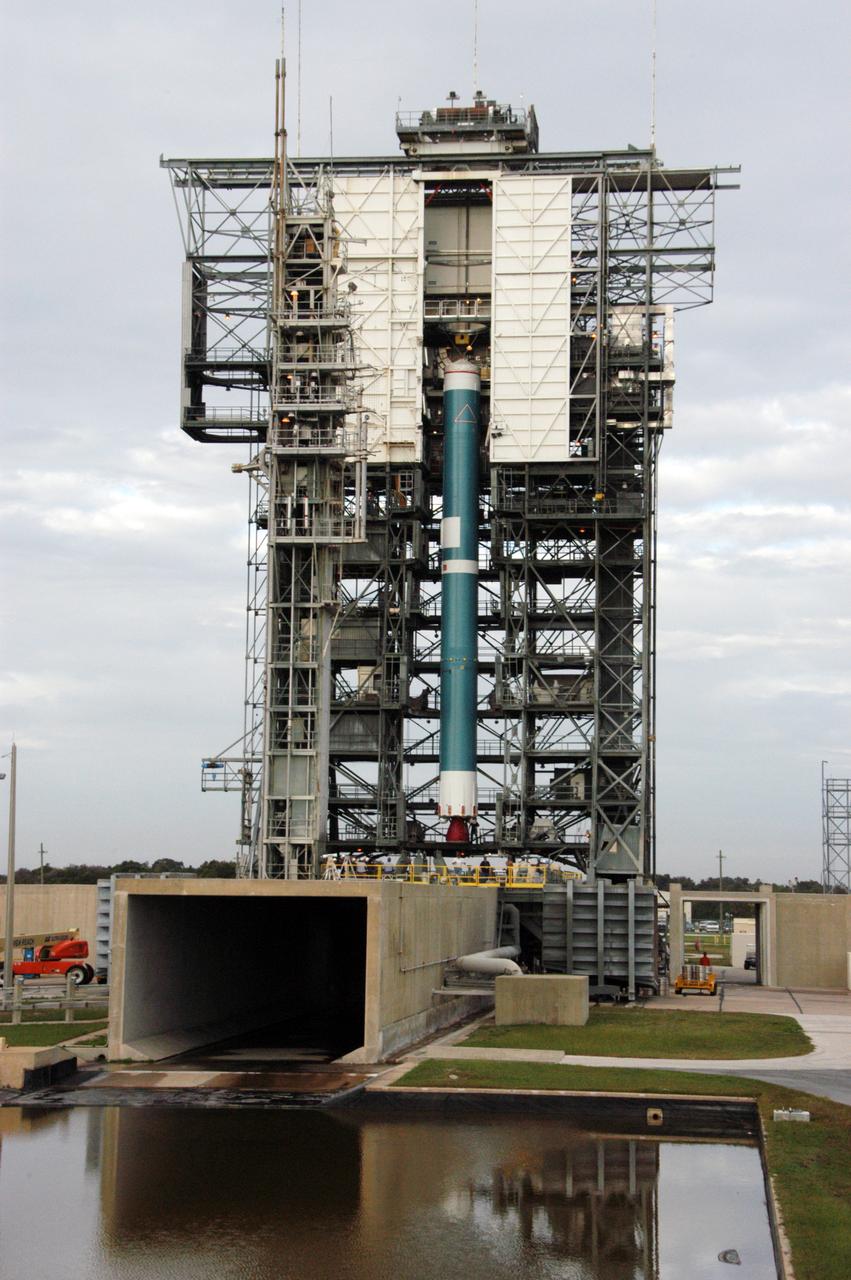
On Launch Pad 17-B at Cape Canaveral Air Force Station in Florida, the United Launch Alliance Delta II rocket is moved inside the mobile service tower where nine solid rocket boosters will be attached in sets of three. The rocket is the launch vehicle for the THEMIS spacecraft, consisting of five identical probes, the largest number of scientific satellites ever launched into orbit aboard a single rocket. This unique constellation of satellites will resolve the tantalizing mystery of what causes the spectacular sudden brightening of the aurora borealis and aurora australis - the fiery skies over the Earth's northern and southern polar regions. THEMIS is scheduled to launch aboard the Delta II at 6:07 p.m. EST on Feb. 15.
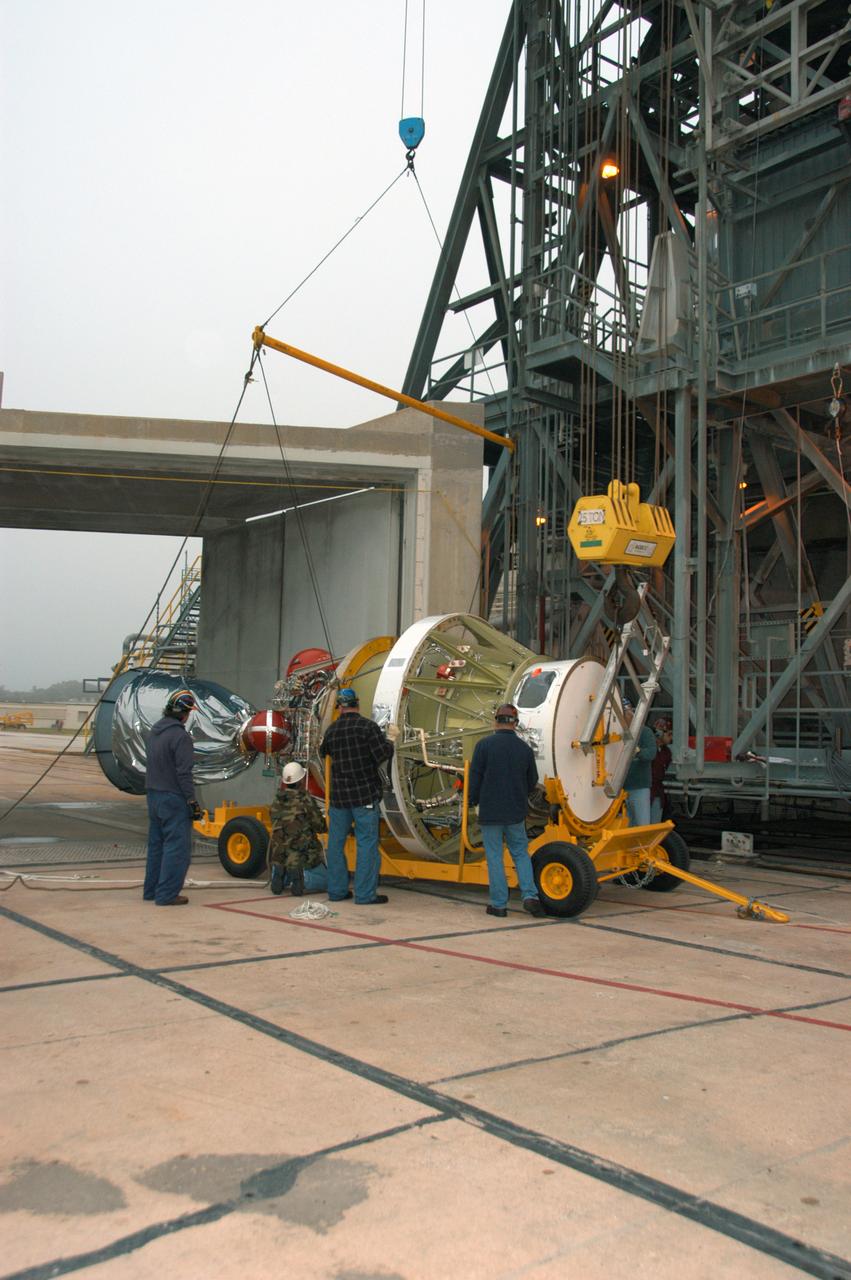
On Pad 17-B at Cape Canaveral Air Force Station, workers attach an overhead crane to the Delta II second stage in order to raise it to vertical. It will be lifted into the mobile service tower and mated with the first stage already in place. The Delta II is the launch vehicle for the THEMIS spacecraft. THEMIS consists of five identical probes, the largest number of scientific satellites ever launched into orbit aboard a single rocket. This unique constellation of satellites will resolve the tantalizing mystery of what causes the spectacular sudden brightening of the aurora borealis and aurora australis - the fiery skies over the Earth's northern and southern polar regions. THEMIS is scheduled to launch Feb. 15 from Cape Canaveral Air Force Station.
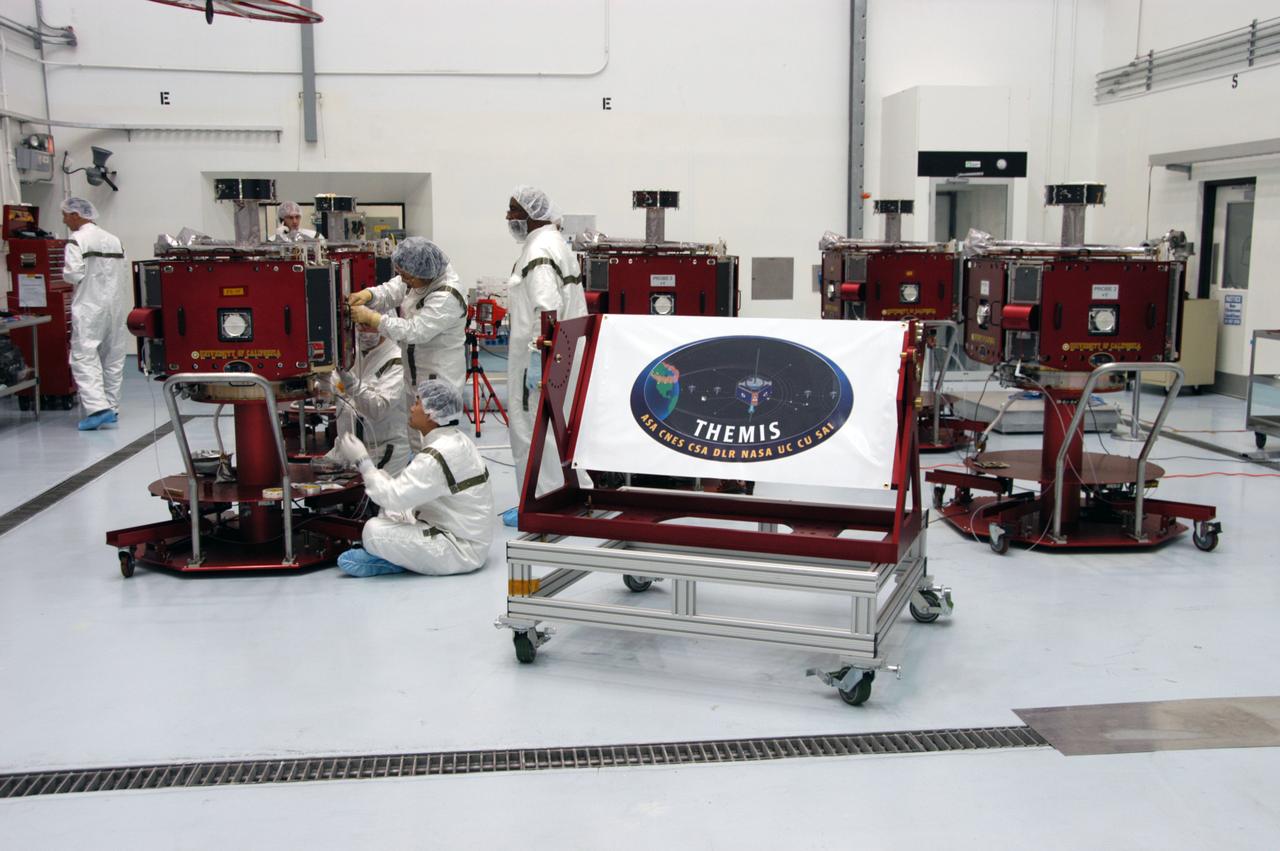
In the Hazardous Processing Facility at Astrotech Space Operations, technicians prepare THEMIS probes for solar array illumination telemetry tests. THEMIS consists of five identical probes, the largest number of scientific satellites ever launched into orbit aboard a single rocket. This unique constellation of satellites will resolve the tantalizing mystery of what causes the spectacular sudden brightening of the aurora borealis and aurora australis - the fiery skies over the Earth's northern and southern polar regions. THEMIS is scheduled to launch aboard the Delta II at 6:07 p.m. EST on Feb. 15.
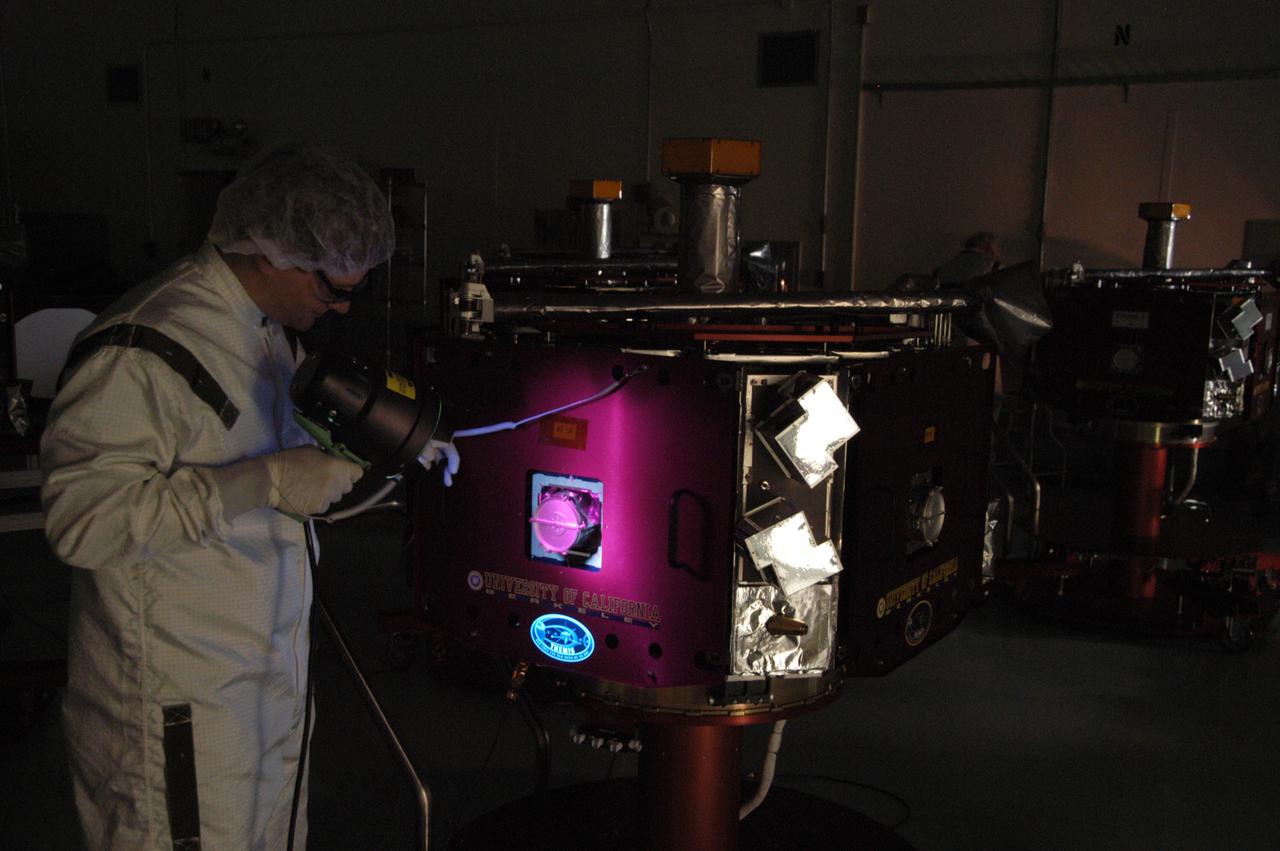
At Astrotech Space Operations, technicians conduct black light inspection of the THEMIS probes. Black light inspection uses UVA fluorescence to detect possible particulate microcontamination, minute cracks or fluid leaks. THEMIS consists of five identical probes, the largest number of scientific satellites ever launched into orbit aboard a single rocket. This unique constellation of satellites will resolve the tantalizing mystery of what causes the spectacular sudden brightening of the aurora borealis and aurora australis - the fiery skies over the Earth's northern and southern polar regions. THEMIS is scheduled to launch Feb. 15 from Cape Canaveral Air Force Station.

KENNEDY SPACE CENTER, FLA. -- At Astrotech Space Operations, technicians guide one of the THEMIS probes into position on the probe carrier. When all five probes are in place, the carrier will undergo spin-balance testing. THEMIS consists of five identical probes, the largest number of scientific satellites ever launched into orbit aboard a single rocket. This unique constellation of satellites will resolve the tantalizing mystery of what causes the spectacular sudden brightening of the aurora borealis and aurora australis - the fiery skies over the Earth's northern and southern polar regions. THEMIS is scheduled to launch Feb. 15 from Cape Canaveral Air Force Station. Photo credit: NASA/George Shelton
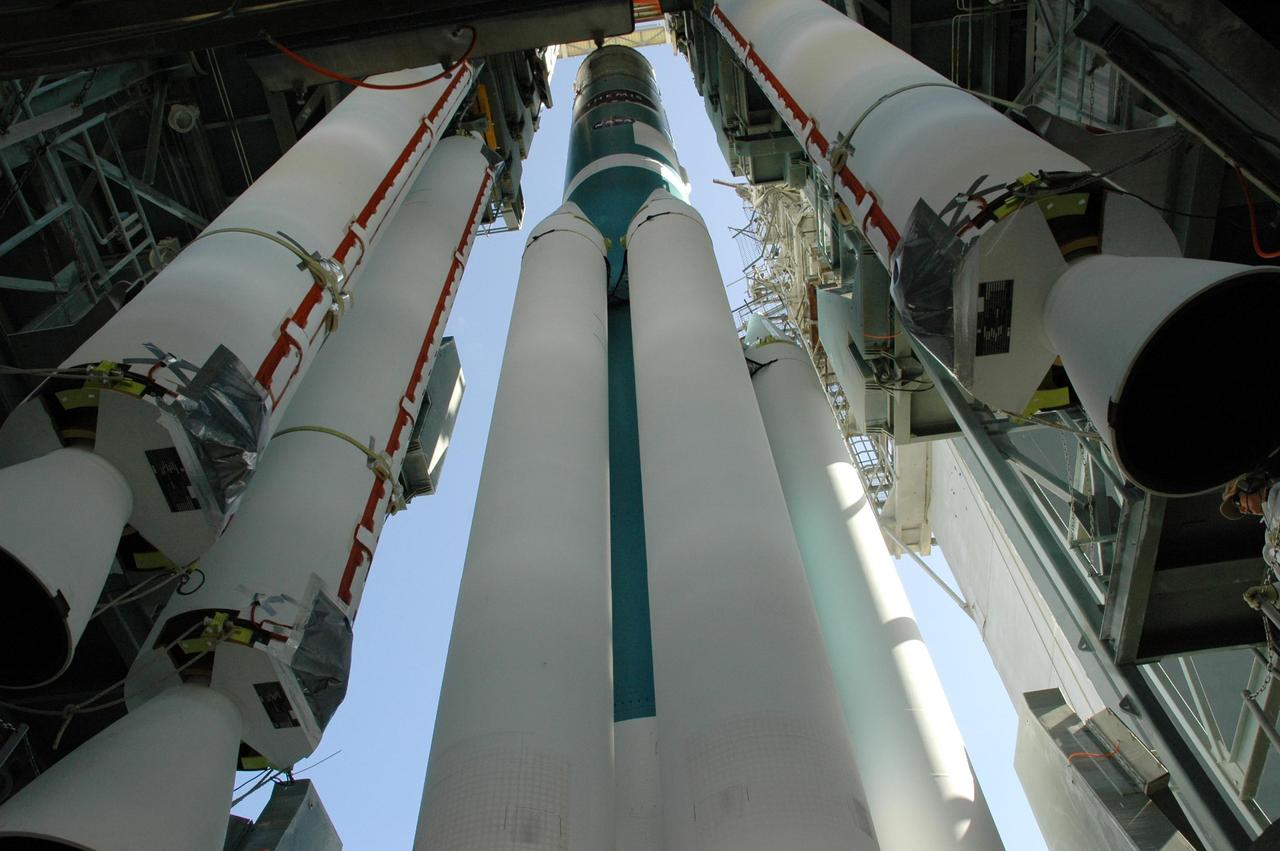
KENNEDY SPACE CENTER, FLA. -- Solid rocket boosters left and right are being added to those already clustered around the base of the United Launch Alliance Delta II rocket. A total of nine will assist in the launch of the THEMIS integrated spacecraft. THEMIS consists of five identical probes, the largest number of scientific satellites ever launched into orbit aboard a single rocket. This unique constellation of satellites will resolve the tantalizing mystery of what causes the spectacular sudden brightening of the aurora borealis and aurora australis - the fiery skies over the Earth's northern and southern polar regions. THEMIS is scheduled to launch Feb. 15 from Cape Canaveral Air Force Station. Photo credit: NASA/Jack Pfaller
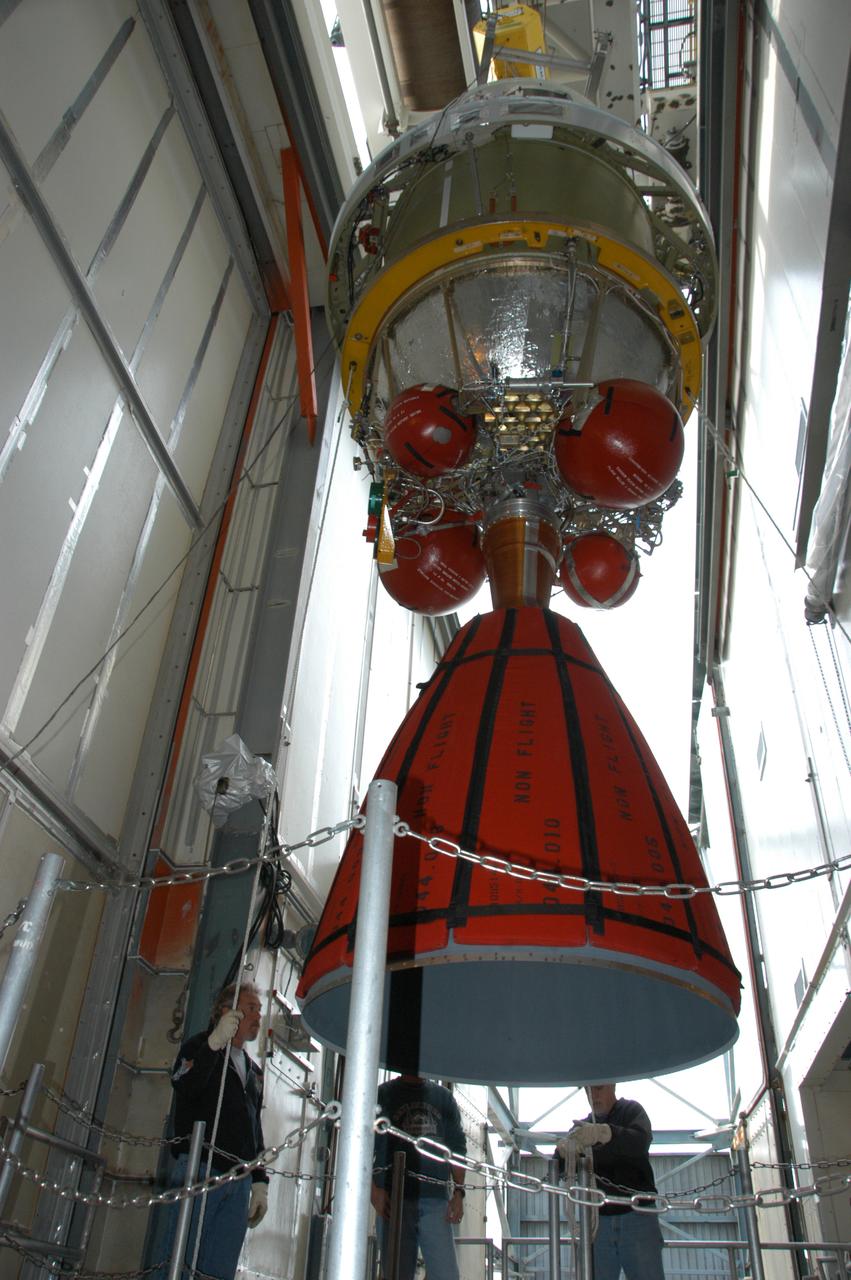
On Pad 17-B at Cape Canaveral Air Force Station, the Delta II second stage is moved inside level 9 of the tower. It will be mated with the first stage already in place. The Delta II is the launch vehicle for the THEMIS spacecraft. THEMIS consists of five identical probes, the largest number of scientific satellites ever launched into orbit aboard a single rocket. This unique constellation of satellites will resolve the tantalizing mystery of what causes the spectacular sudden brightening of the aurora borealis and aurora australis - the fiery skies over the Earth's northern and southern polar regions. THEMIS is scheduled to launch Feb. 15 from Cape Canaveral Air Force Station.
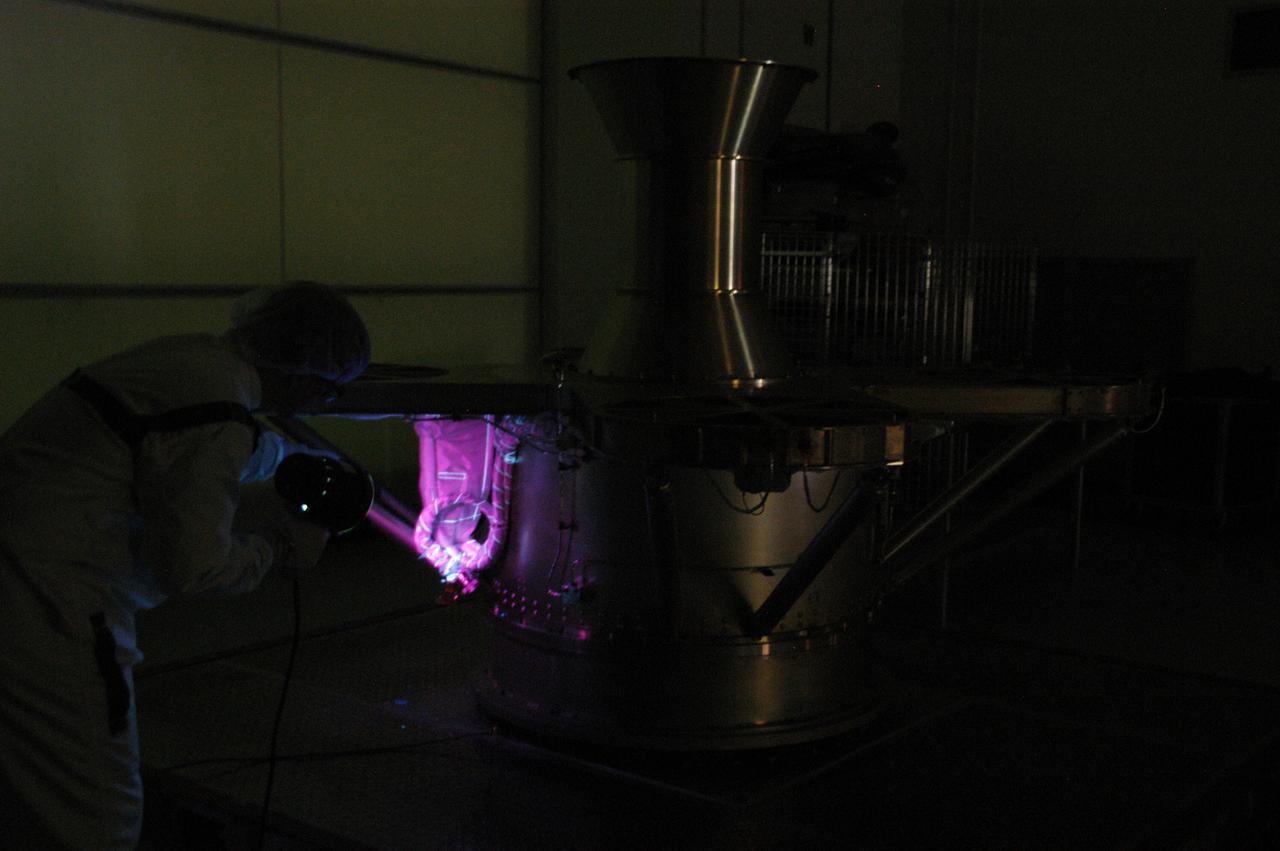
At Astrotech Space Operations, technicians conduct black light inspection of the THEMIS probes. Black light inspection uses UVA fluorescence to detect possible particulate microcontamination, minute cracks or fluid leaks. THEMIS consists of five identical probes, the largest number of scientific satellites ever launched into orbit aboard a single rocket. This unique constellation of satellites will resolve the tantalizing mystery of what causes the spectacular sudden brightening of the aurora borealis and aurora australis - the fiery skies over the Earth's northern and southern polar regions. THEMIS is scheduled to launch Feb. 15 from Cape Canaveral Air Force Station.
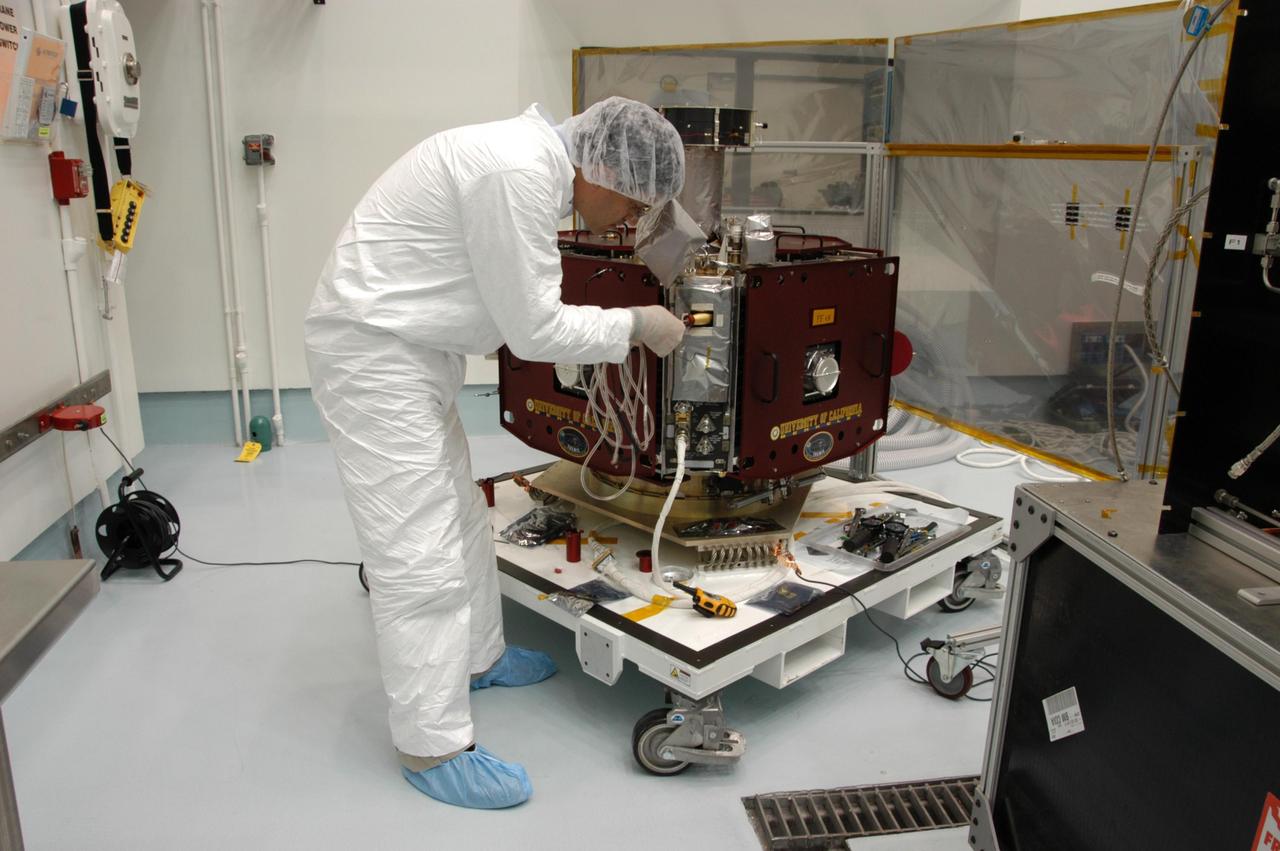
KENNEDY SPACE CENTER, FLA. -- At Astrotech Space Operations in Titusville, Fla., a worker prepares one of the THEMIS probes for electrical system checkout. THEMIS consists of five identical probes, the largest number of scientific satellites ever launched into orbit aboard a single rocket. This unique constellation of satellites will resolve the tantalizing mystery of what causes the spectacular sudden brightening of the aurora borealis and aurora australis - the fiery skies over the Earth's northern and southern polar regions. THEMIS is scheduled to launch Feb. 15 from Cape Canaveral Air Force Station. Photo credit: NASA/George Shelton
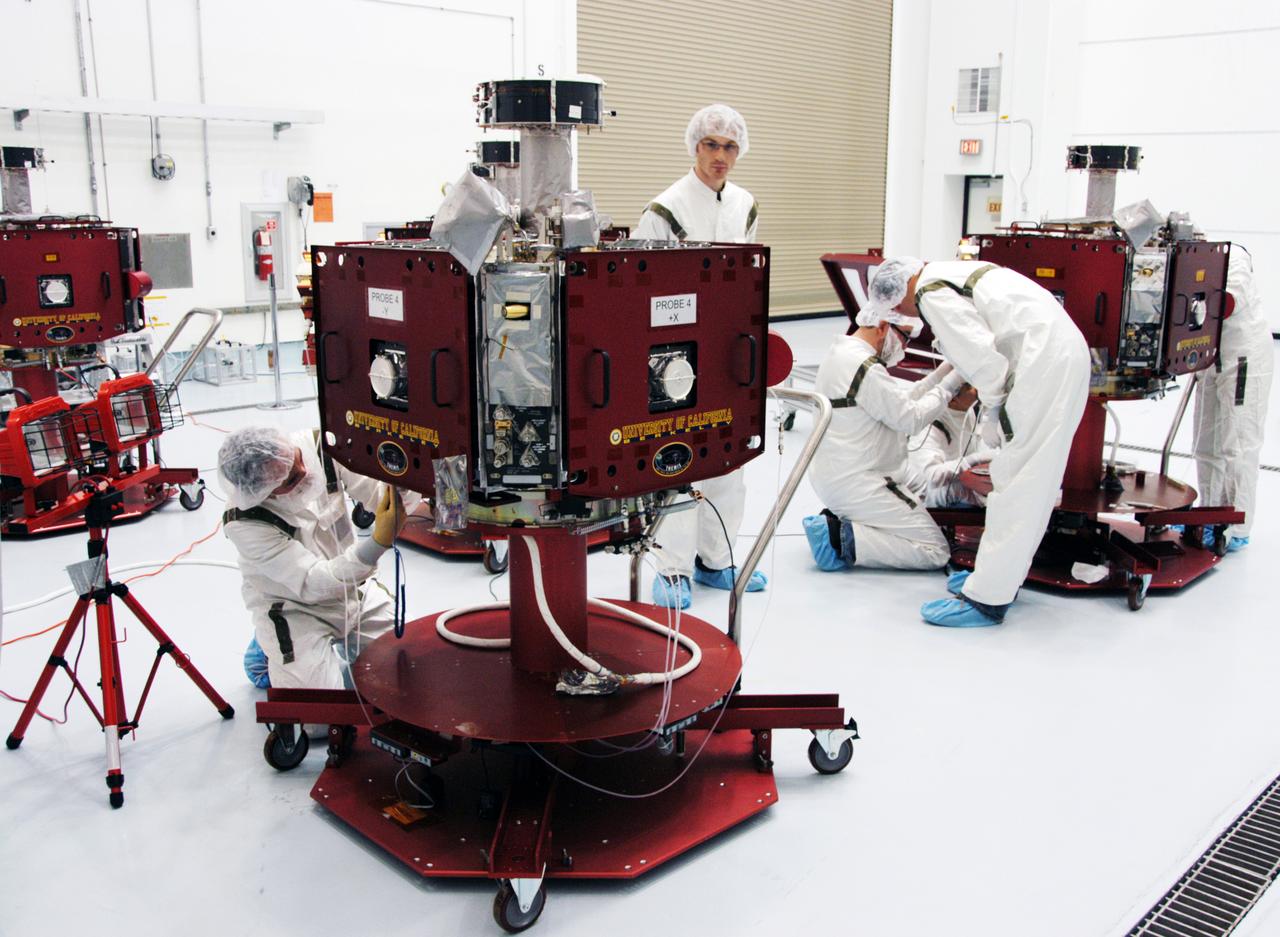
In the Hazardous Processing Facility at Astrotech Space Operations, technicians prepare THEMIS probes for solar array illumination telemetry tests. THEMIS consists of five identical probes, the largest number of scientific satellites ever launched into orbit aboard a single rocket. This unique constellation of satellites will resolve the tantalizing mystery of what causes the spectacular sudden brightening of the aurora borealis and aurora australis - the fiery skies over the Earth's northern and southern polar regions. THEMIS is scheduled to launch aboard the Delta II at 6:07 p.m. EST on Feb. 15.

At Astrotech Space Operations, a technician helps guide one of the THEMIS probes toward the probe carrier for installation. When all five probes are in place, the carrier will undergo spin-balance testing. THEMIS consists of five identical probes, the largest number of scientific satellites ever launched into orbit aboard a single rocket. This unique constellation of satellites will resolve the tantalizing mystery of what causes the spectacular sudden brightening of the aurora borealis and aurora australis - the fiery skies over the Earth's northern and southern polar regions. THEMIS is scheduled to launch Feb. 15 from Cape Canaveral Air Force Station.
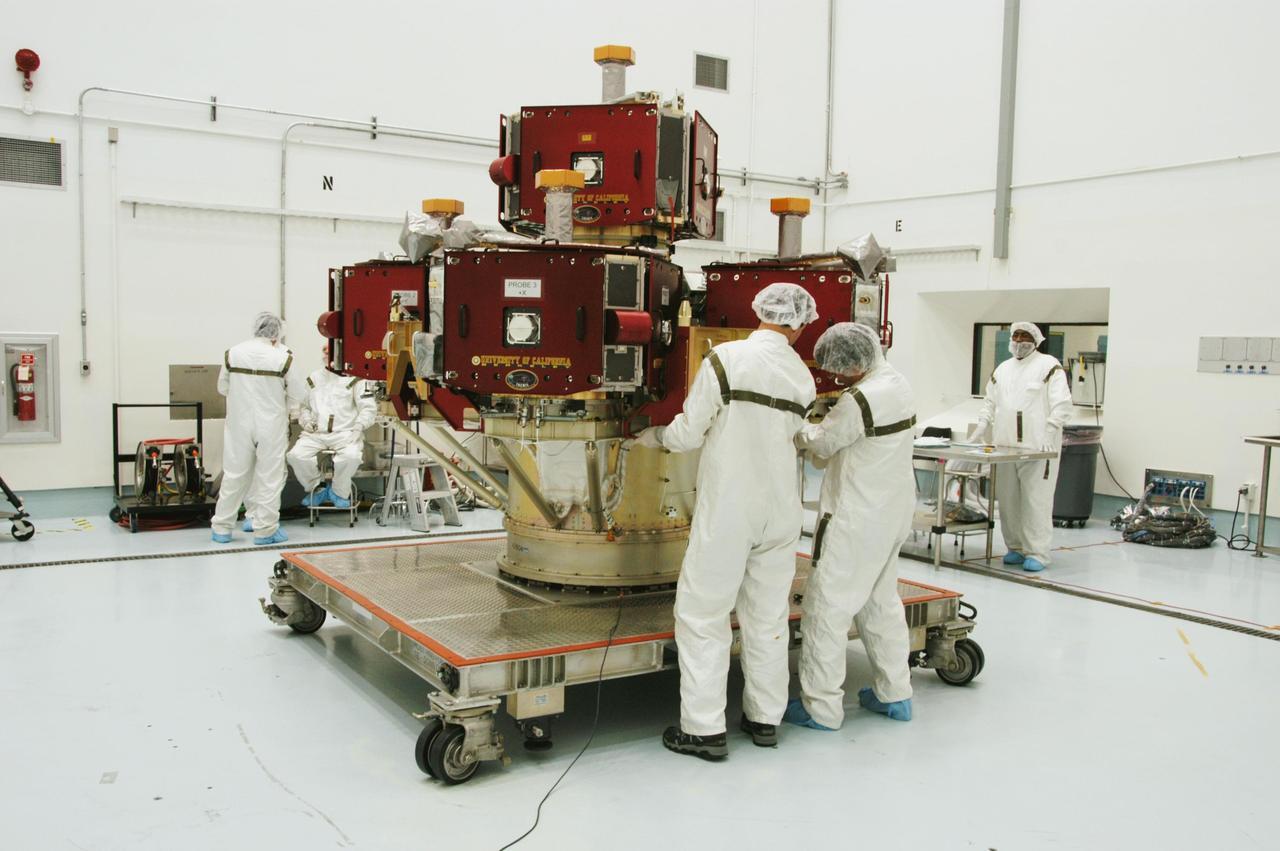
KENNEDY SPACE CENTER, FLA. -- In the Hazardous Processing Facility at Astrotech Space Operations, workers prepare the integrated THEMIS spacecraft to be moved to a spin table for spin-balance testing. THEMIS consists of five identical probes, the largest number of scientific satellites ever launched into orbit aboard a single rocket. This unique constellation of satellites will resolve the tantalizing mystery of what causes the spectacular sudden brightening of the aurora borealis and aurora australis - the fiery skies over the Earth's northern and southern polar regions. THEMIS is scheduled to launch Feb. 15 from Cape Canaveral Air Force Station. Photo credit: NASA/George Shelton
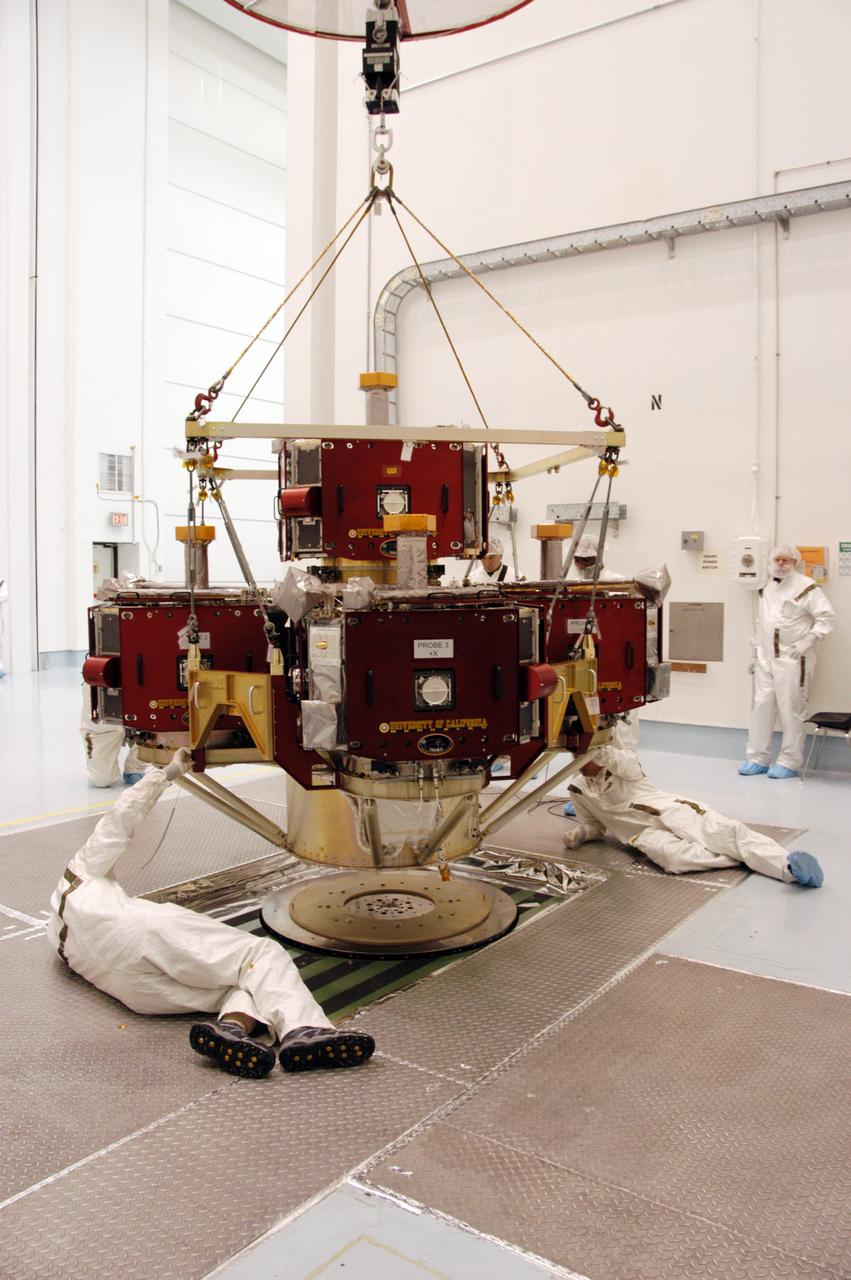
In the Hazardous Processing Facility at Astrotech Space Operations, workers guide the integrated THEMIS spacecraft onto the spin table in the foreground. There it will undergo spin-balance testing. THEMIS consists of five identical probes, the largest number of scientific satellites ever launched into orbit aboard a single rocket. This unique constellation of satellites will resolve the tantalizing mystery of what causes the spectacular sudden brightening of the aurora borealis and aurora australis - the fiery skies over the Earth's northern and southern polar regions. THEMIS is scheduled to launch Feb. 15 from Cape Canaveral Air Force Station.
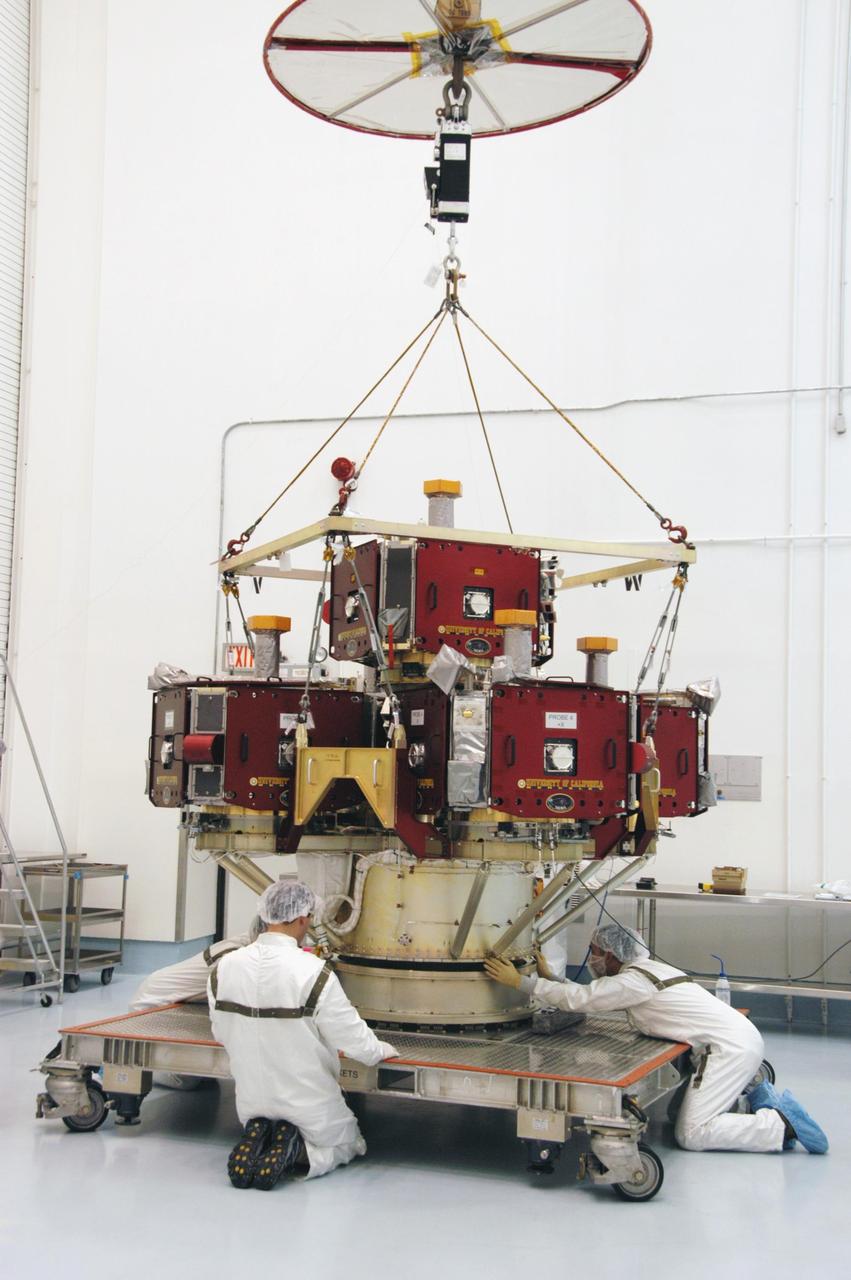
KENNEDY SPACE CENTER, FLA. -- In the Hazardous Processing Facility at Astrotech Space Operations, workers attach an overhead crane to the integrated THEMIS spacecraft. The carrier is being moved to a spin table for spin-balance testing. THEMIS consists of five identical probes, the largest number of scientific satellites ever launched into orbit aboard a single rocket. This unique constellation of satellites will resolve the tantalizing mystery of what causes the spectacular sudden brightening of the aurora borealis and aurora australis - the fiery skies over the Earth's northern and southern polar regions. THEMIS is scheduled to launch Feb. 15 from Cape Canaveral Air Force Station. Photo credit: NASA/George Shelton
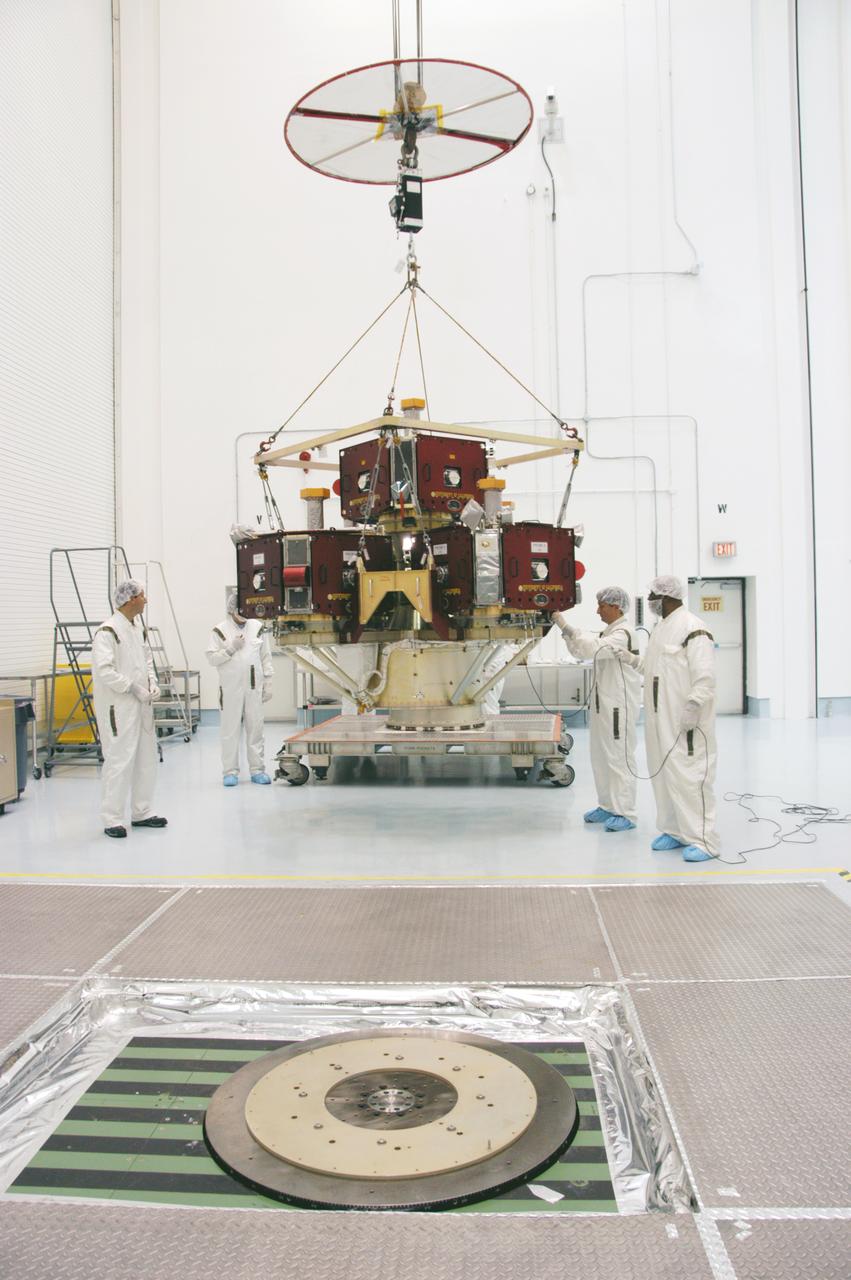
In the Hazardous Processing Facility at Astrotech Space Operations, workers get ready to move the integrated THEMIS spacecraft to the spin table in the foreground. There it will undergo spin-balance testing. THEMIS consists of five identical probes, the largest number of scientific satellites ever launched into orbit aboard a single rocket. This unique constellation of satellites will resolve the tantalizing mystery of what causes the spectacular sudden brightening of the aurora borealis and aurora australis - the fiery skies over the Earth's northern and southern polar regions. THEMIS is scheduled to launch Feb. 15 from Cape Canaveral Air Force Station.

At Astrotech Space Operations, technicians guide one of the THEMIS probes into position on the probe carrier. When all five probes are in place, the carrier will undergo spin-balance testing. THEMIS consists of five identical probes, the largest number of scientific satellites ever launched into orbit aboard a single rocket. This unique constellation of satellites will resolve the tantalizing mystery of what causes the spectacular sudden brightening of the aurora borealis and aurora australis - the fiery skies over the Earth's northern and southern polar regions. THEMIS is scheduled to launch Feb. 15 from Cape Canaveral Air Force Station.
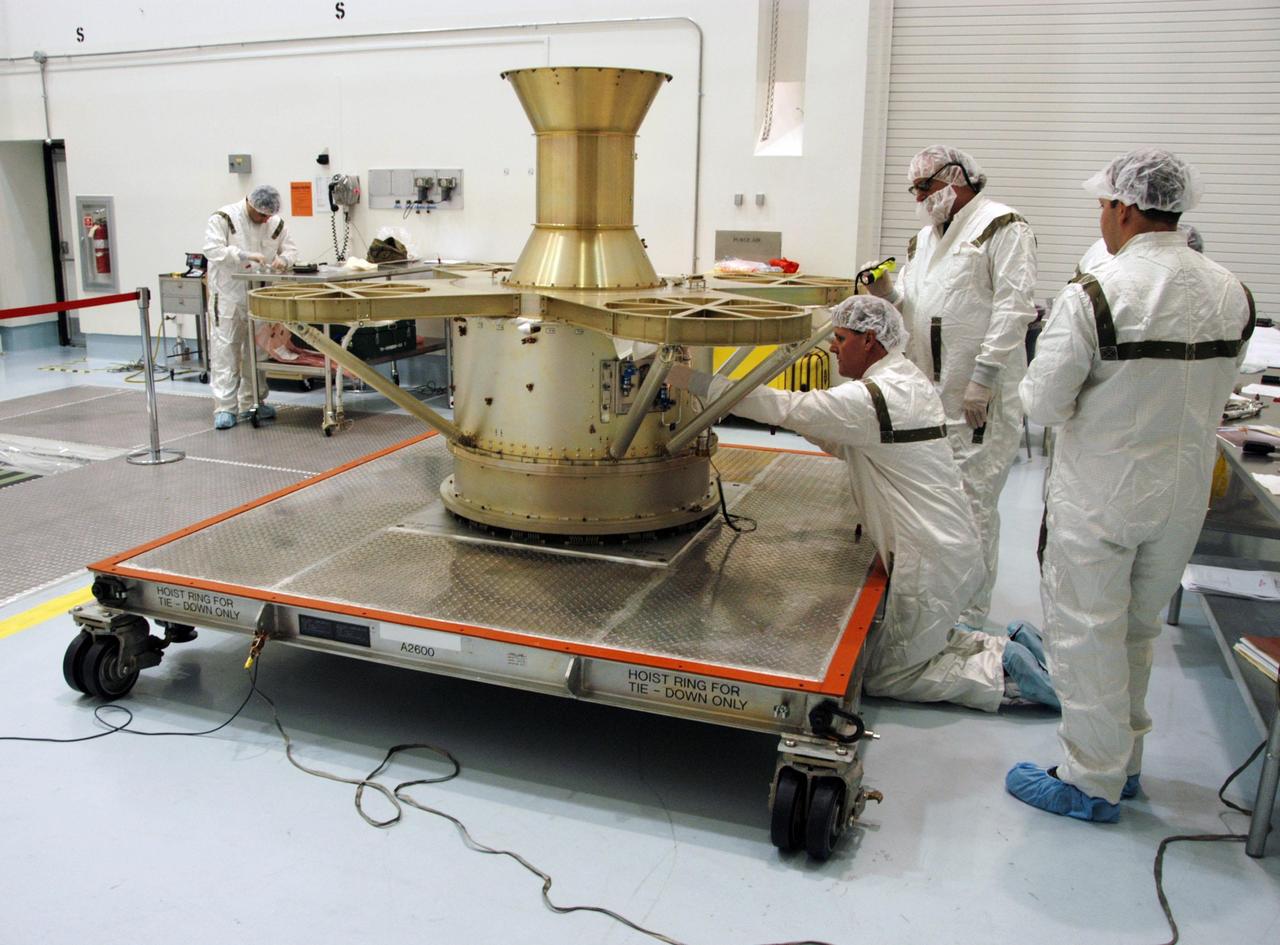
KENNEDY SPACE CENTER, FLA. -- At Astrotech Space Operations in Titusville, Fla., a worker attaches a high pressure line on the THEMIS spacecraft in preparation for fueling, which is scheduled for Jan. 3-5. THEMIS consists of five identical probes, the largest number of scientific satellites ever launched into orbit aboard a single rocket. This unique constellation of satellites will resolve the tantalizing mystery of what causes the spectacular sudden brightening of the aurora borealis and aurora australis - the fiery skies over the Earth's northern and southern polar regions. THEMIS is scheduled to launch Feb. 15 from Cape Canaveral Air Force Station. Photo credit: NASA/George Shelton
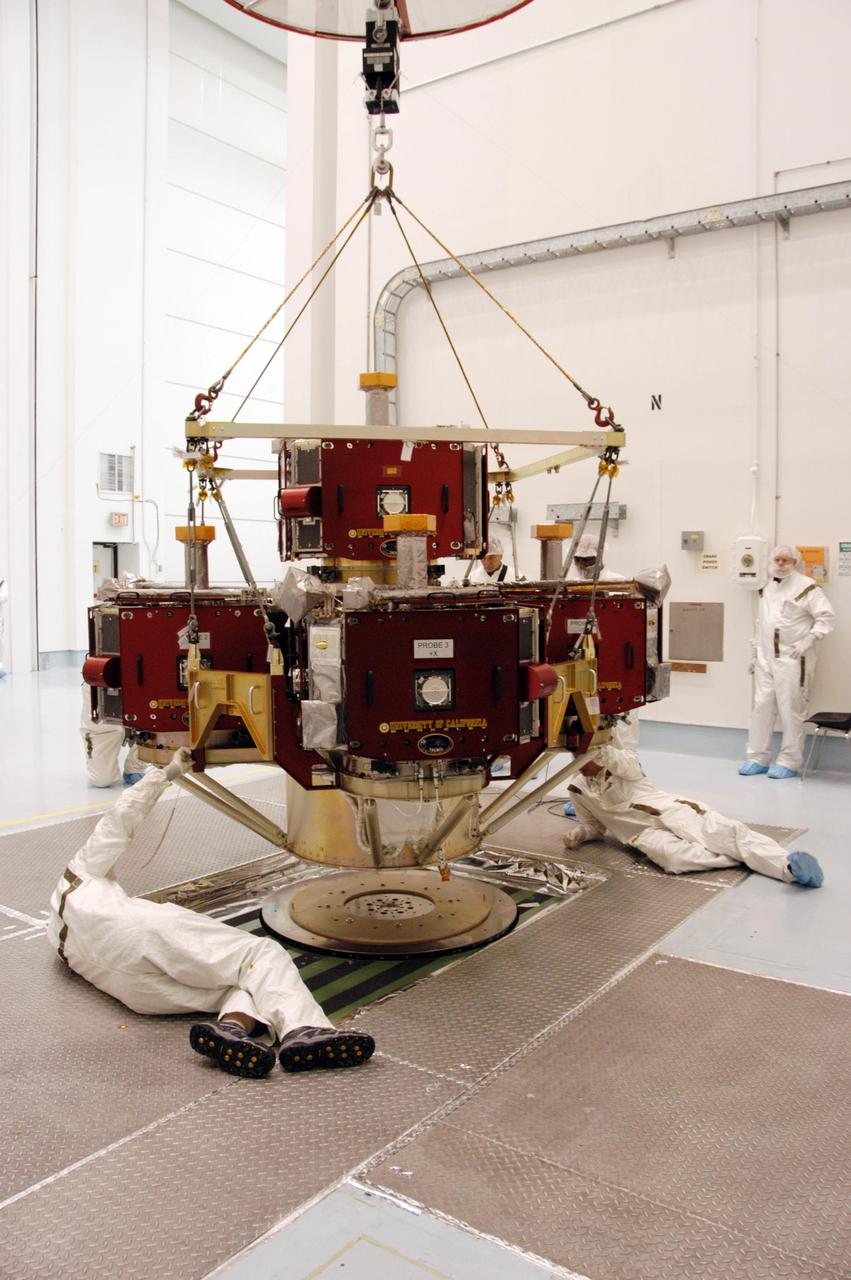
KENNEDY SPACE CENTER, FLA. -- In the Hazardous Processing Facility at Astrotech Space Operations, workers guide the integrated THEMIS spacecraft onto the spin table in the foreground. There it will undergo spin-balance testing. THEMIS consists of five identical probes, the largest number of scientific satellites ever launched into orbit aboard a single rocket. This unique constellation of satellites will resolve the tantalizing mystery of what causes the spectacular sudden brightening of the aurora borealis and aurora australis - the fiery skies over the Earth's northern and southern polar regions. THEMIS is scheduled to launch Feb. 15 from Cape Canaveral Air Force Station. Photo credit: NASA/George Shelton
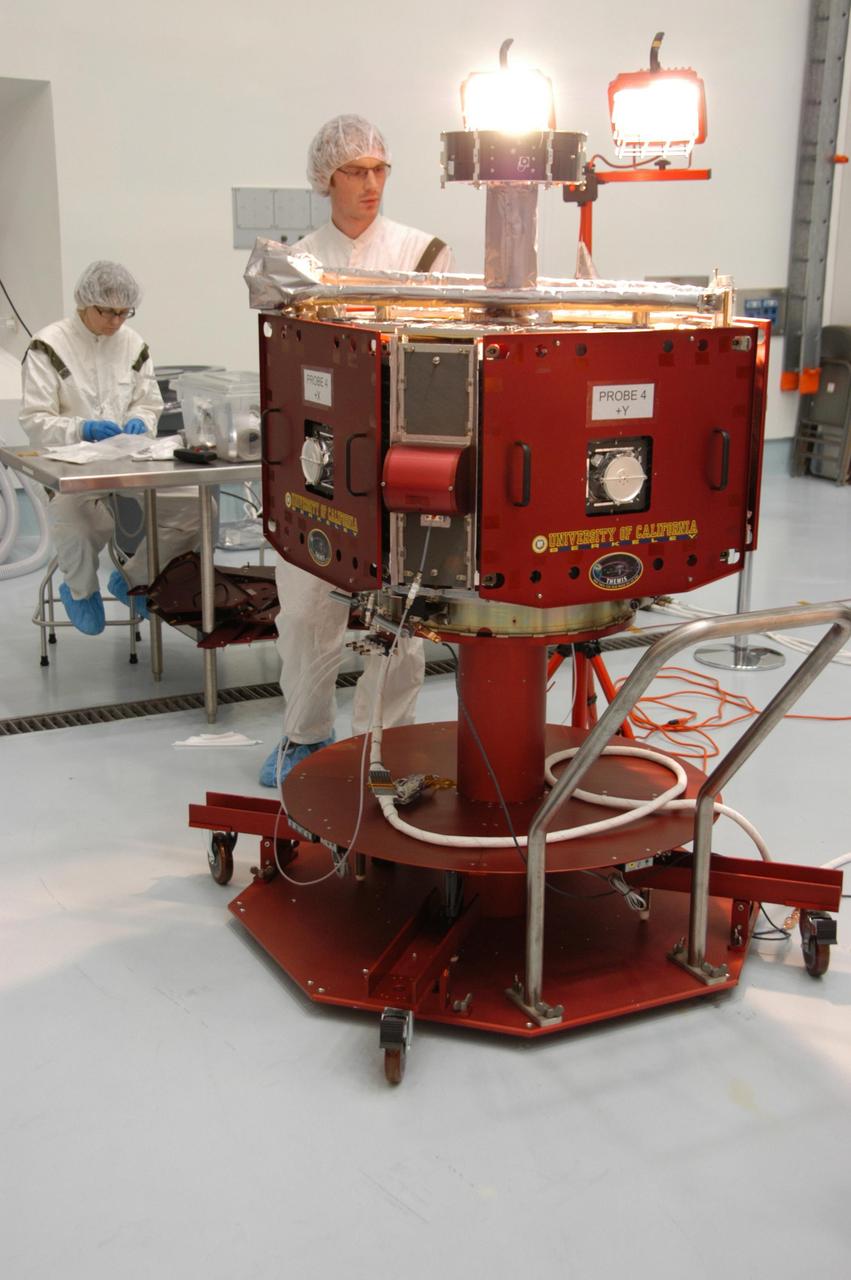
KENNEDY SPACE CENTER, FLA. -- In the Hazardous Processing Facility at Astrotech Space Operations, a technician observes one of the THEMIS probes as it undergoes solar array illumination telemetry testing. THEMIS consists of five identical probes, the largest number of scientific satellites ever launched into orbit aboard a single rocket. This unique constellation of satellites will resolve the tantalizing mystery of what causes the spectacular sudden brightening of the aurora borealis and aurora australis - the fiery skies over the Earth's northern and southern polar regions. THEMIS is scheduled to launch aboard the Delta II at 6:07 p.m. EST on Feb. 15. Photo credit: NASA/George Shelton
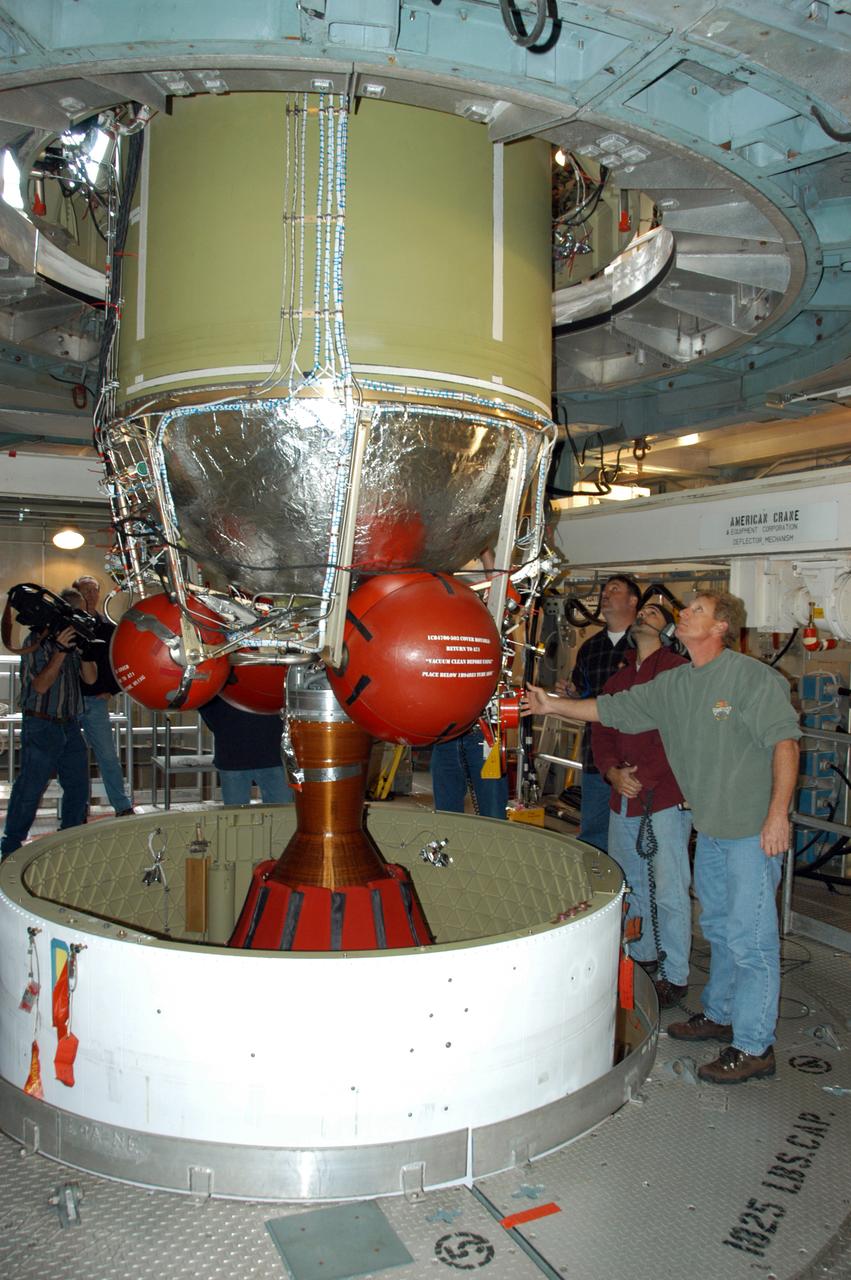
On Pad 17-B at Cape Canaveral Air Force Station, the Delta II second stage is being lowered toward the Delta II first stage, already in place inside the mobile service tower. The Delta II is the launch vehicle for the THEMIS spacecraft. THEMIS consists of five identical probes, the largest number of scientific satellites ever launched into orbit aboard a single rocket. This unique constellation of satellites will resolve the tantalizing mystery of what causes the spectacular sudden brightening of the aurora borealis and aurora australis - the fiery skies over the Earth's northern and southern polar regions. THEMIS is scheduled to launch Feb. 15 from Cape Canaveral Air Force Station.
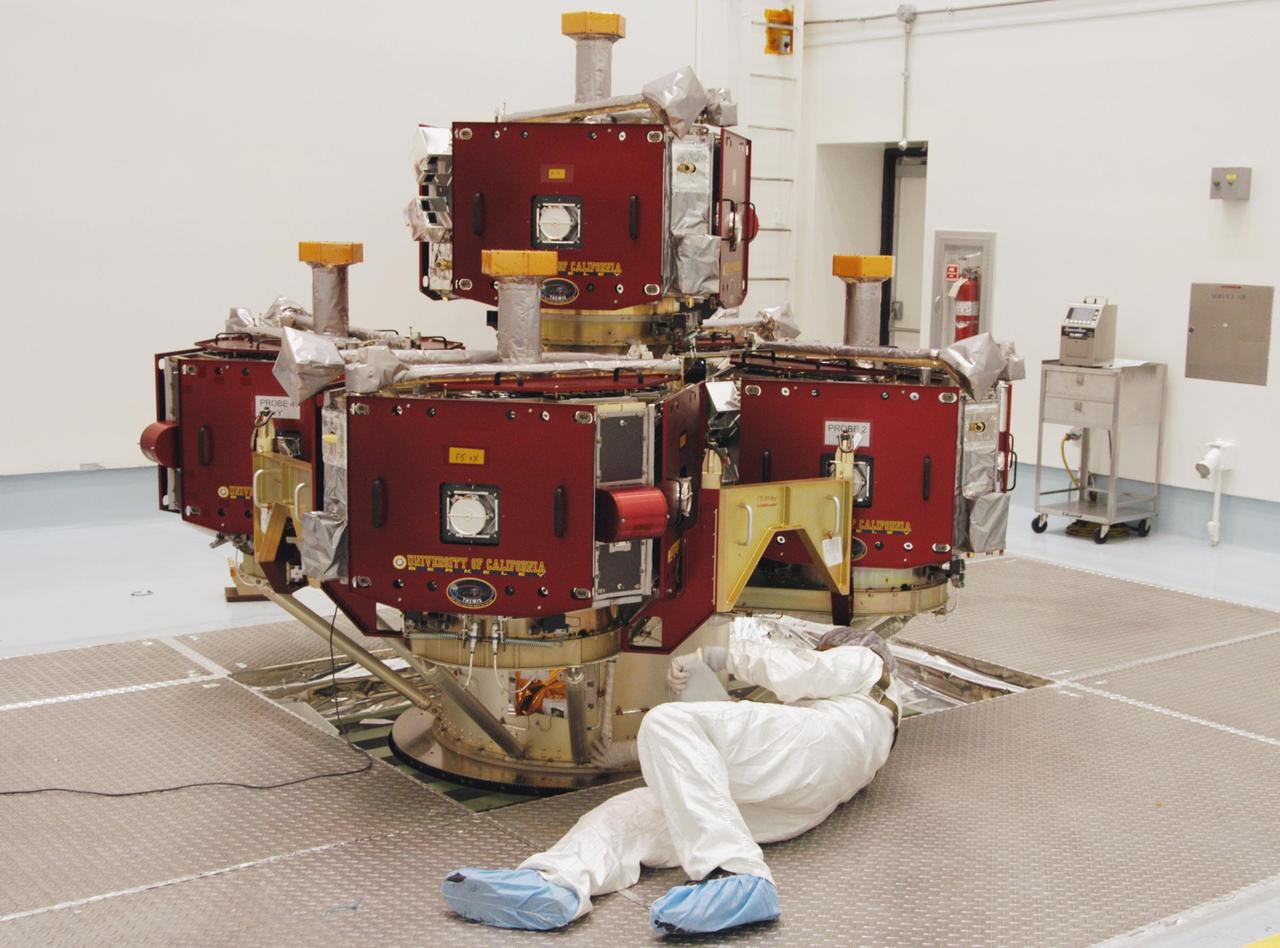
KENNEDY SPACE CENTER, FLA. -- In the Hazardous Processing Facility at Astrotech Space Operations, a worker checks data on the integrated THEMIS spacecraft sitting on the spin table. THEMIS consists of five identical probes, the largest number of scientific satellites ever launched into orbit aboard a single rocket. This unique constellation of satellites will resolve the tantalizing mystery of what causes the spectacular sudden brightening of the aurora borealis and aurora australis - the fiery skies over the Earth's northern and southern polar regions. THEMIS is scheduled to launch Feb. 15 from Cape Canaveral Air Force Station. Photo credit: NASA/George Shelton
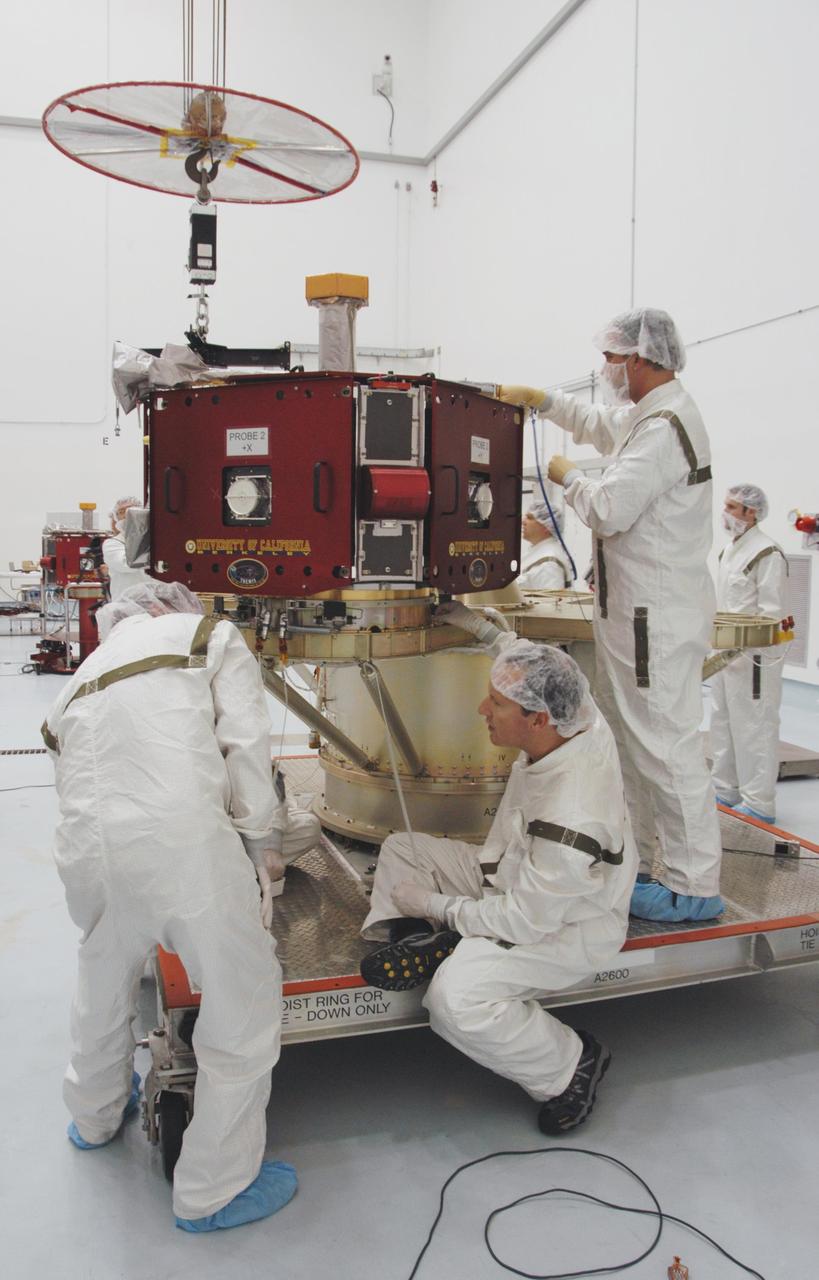
KENNEDY SPACE CENTER, FLA. -- At Astrotech Space Operations, technicians guide one of the THEMIS probes into position on the probe carrier. When all five probes are in place, the carrier will undergo spin-balance testing. THEMIS consists of five identical probes, the largest number of scientific satellites ever launched into orbit aboard a single rocket. This unique constellation of satellites will resolve the tantalizing mystery of what causes the spectacular sudden brightening of the aurora borealis and aurora australis - the fiery skies over the Earth's northern and southern polar regions. THEMIS is scheduled to launch Feb. 15 from Cape Canaveral Air Force Station. Photo credit: NASA/George Shelton
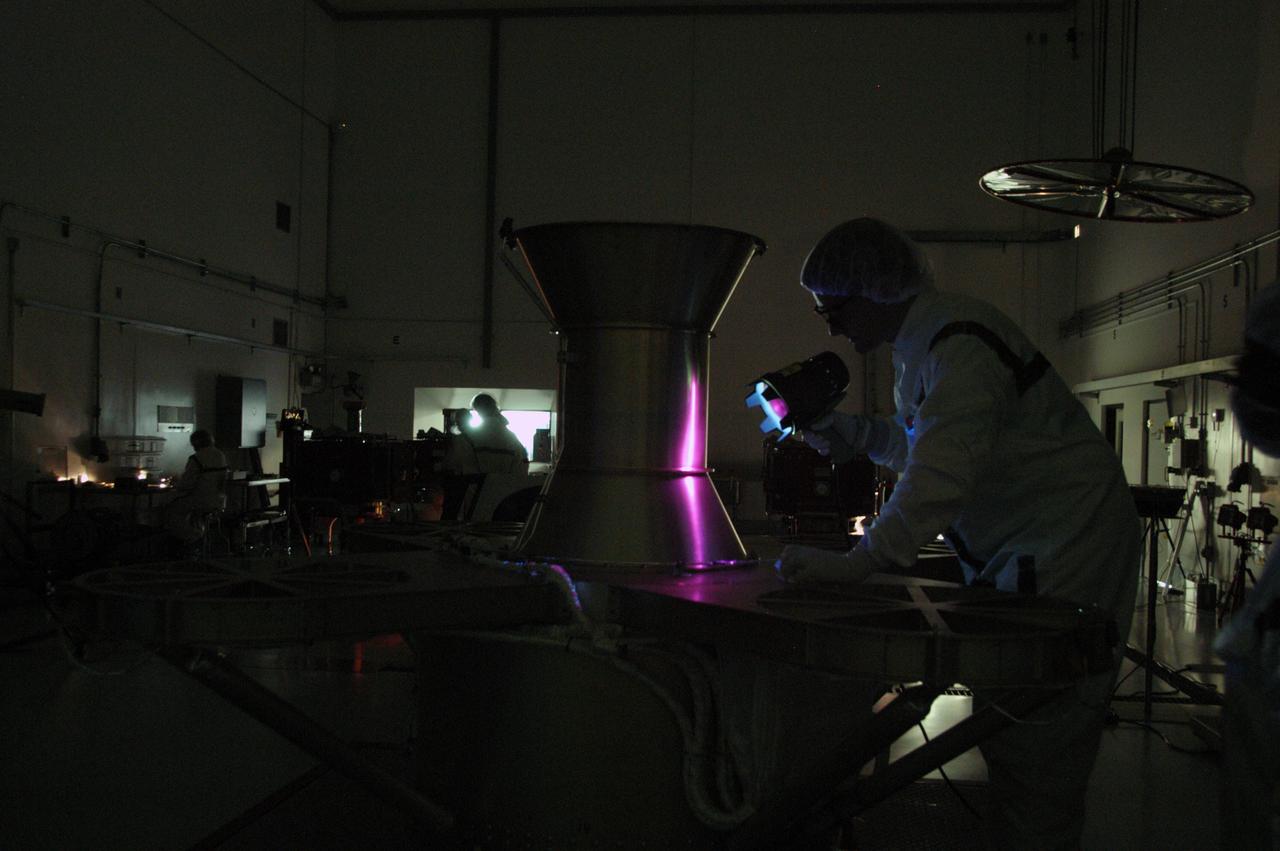
At Astrotech Space Operations, technicians conduct black light inspection of the THEMIS probes. Black light inspection uses UVA fluorescence to detect possible particulate microcontamination, minute cracks or fluid leaks. THEMIS consists of five identical probes, the largest number of scientific satellites ever launched into orbit aboard a single rocket. This unique constellation of satellites will resolve the tantalizing mystery of what causes the spectacular sudden brightening of the aurora borealis and aurora australis - the fiery skies over the Earth's northern and southern polar regions. THEMIS is scheduled to launch Feb. 15 from Cape Canaveral Air Force Station.
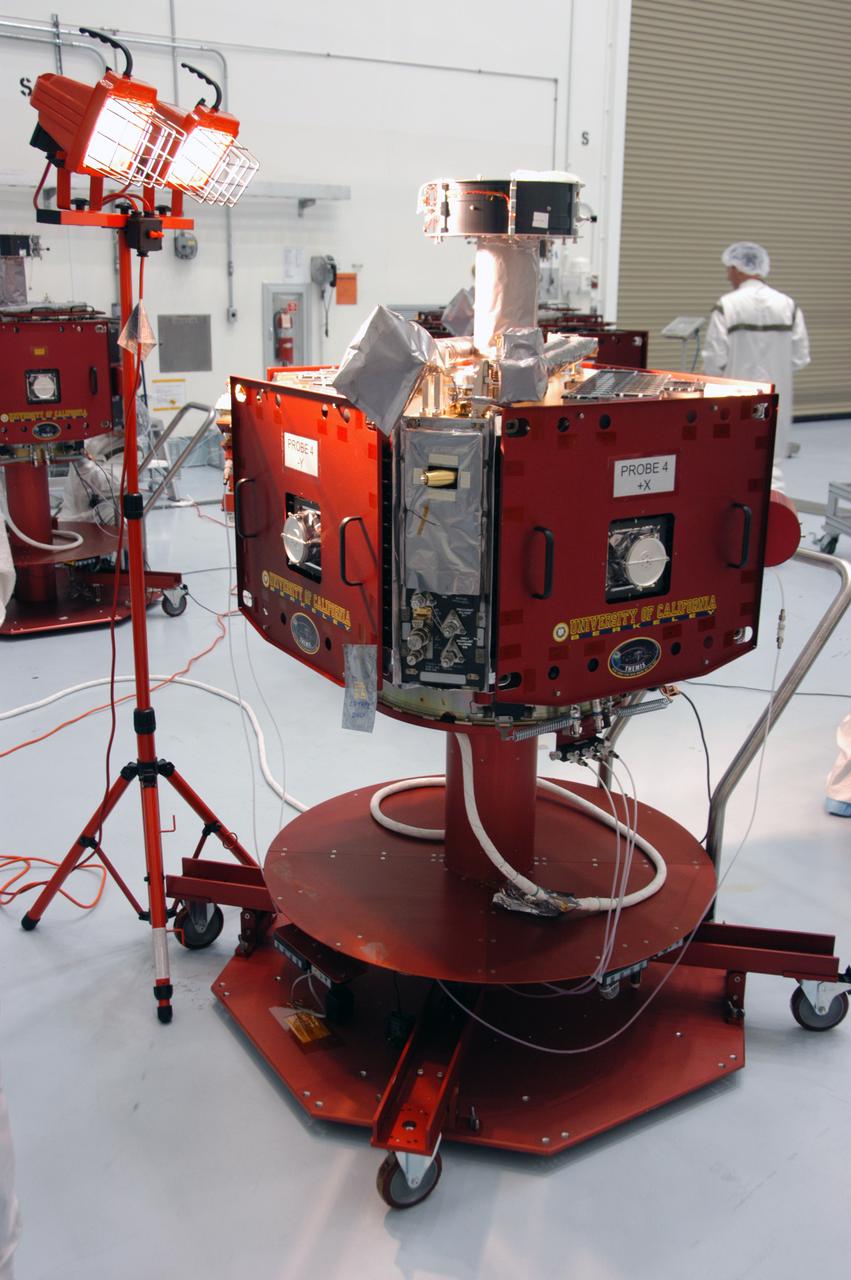
In the Hazardous Processing Facility at Astrotech Space Operations, one of the THEMIS probes undergoes solar array illumination telemetry testing. THEMIS consists of five identical probes, the largest number of scientific satellites ever launched into orbit aboard a single rocket. This unique constellation of satellites will resolve the tantalizing mystery of what causes the spectacular sudden brightening of the aurora borealis and aurora australis - the fiery skies over the Earth's northern and southern polar regions. THEMIS is scheduled to launch aboard the Delta II at 6:07 p.m. EST on Feb. 15.
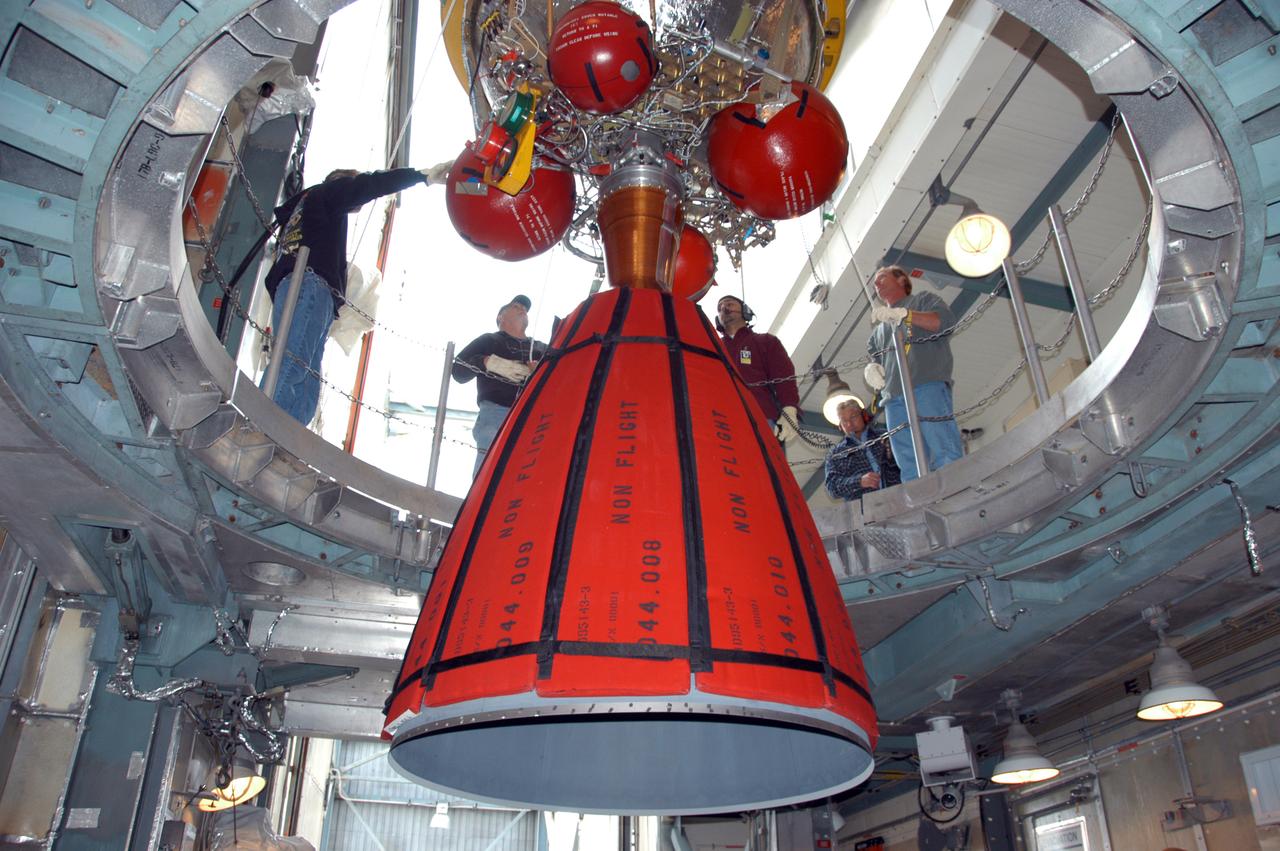
On Pad 17-B at Cape Canaveral Air Force Station, the Delta II second stage is being lowered toward the Delta II first stage, already in place inside the mobile service tower. The Delta II is the launch vehicle for the THEMIS spacecraft. THEMIS consists of five identical probes, the largest number of scientific satellites ever launched into orbit aboard a single rocket. This unique constellation of satellites will resolve the tantalizing mystery of what causes the spectacular sudden brightening of the aurora borealis and aurora australis - the fiery skies over the Earth's northern and southern polar regions. THEMIS is scheduled to launch Feb. 15 from Cape Canaveral Air Force Station.
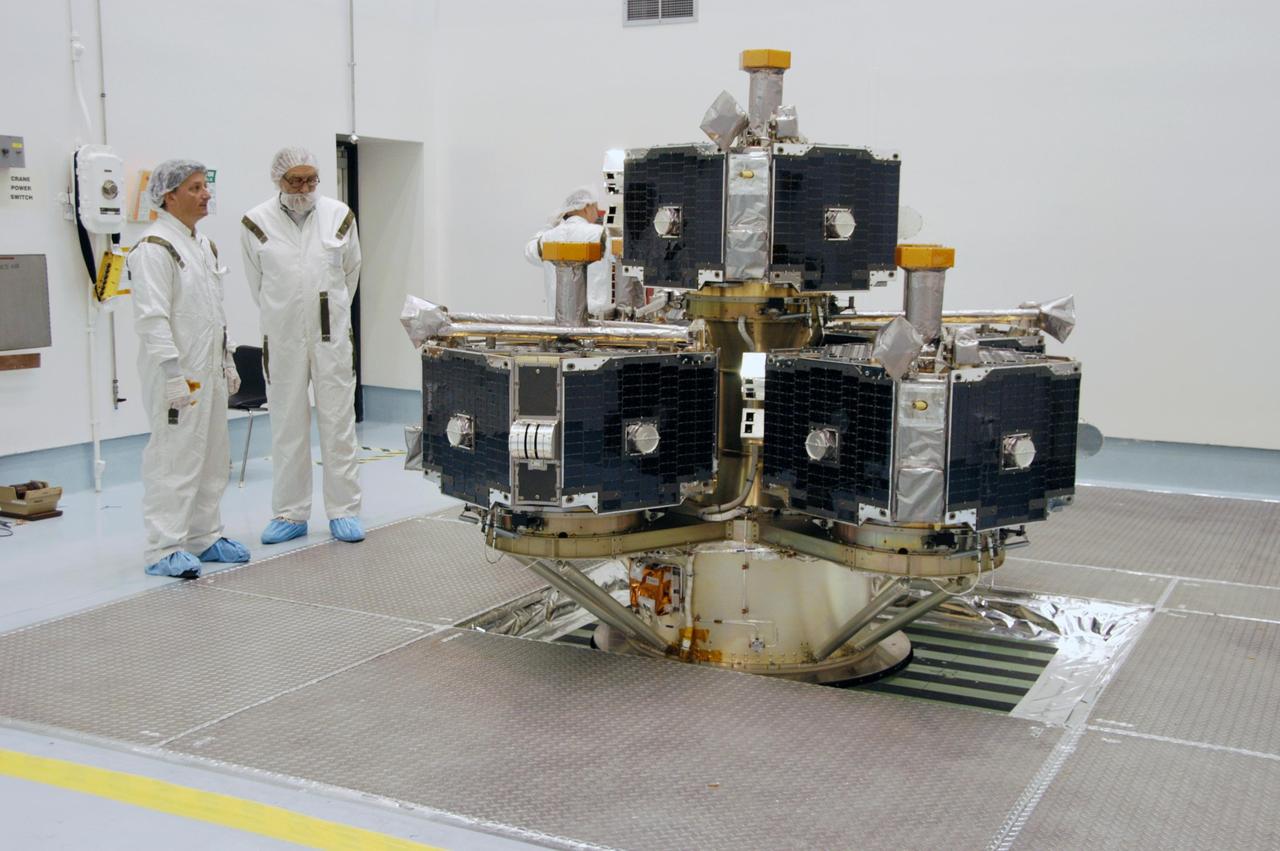
KENNEDY SPACE CENTER, FLA. -- At Astrotech Space Operations, workers look over the integrated THEMIS spacecraft before spin-balance testing. THEMIS consists of five identical probes, the largest number of scientific satellites ever launched into orbit aboard a single rocket. This unique constellation of satellites will resolve the tantalizing mystery of what causes the spectacular sudden brightening of the aurora borealis and aurora australis - the fiery skies over the Earth's northern and southern polar regions. THEMIS is scheduled to launch Feb. 15 from Cape Canaveral Air Force Station. Photo credit: NASA/George Shelton
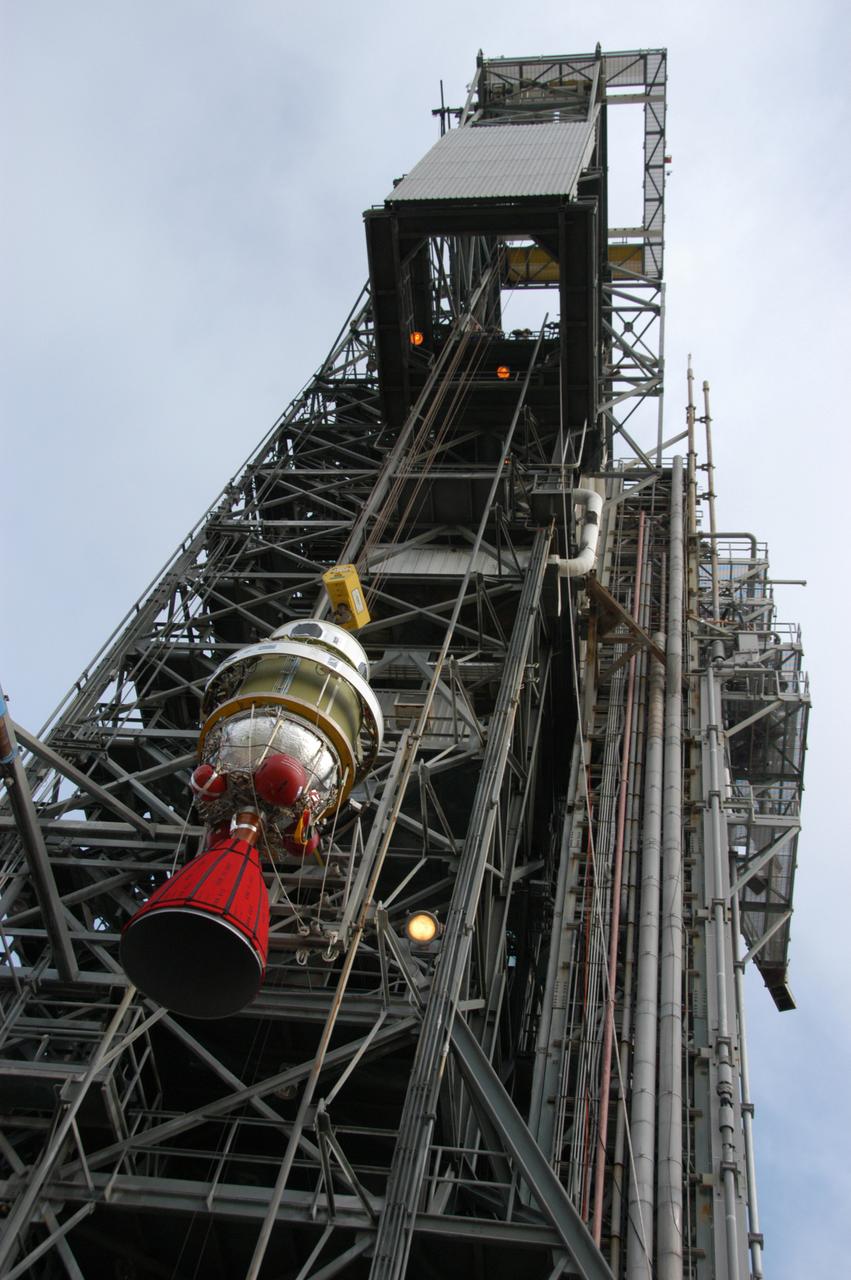
On Pad 17-B at Cape Canaveral Air Force Station, the Delta II second stage is being lifted alongside the mobile service tower. Once inside, it will be mated with the first stage already in place. The Delta II is the launch vehicle for the THEMIS spacecraft. THEMIS consists of five identical probes, the largest number of scientific satellites ever launched into orbit aboard a single rocket. This unique constellation of satellites will resolve the tantalizing mystery of what causes the spectacular sudden brightening of the aurora borealis and aurora australis - the fiery skies over the Earth's northern and southern polar regions. THEMIS is scheduled to launch Feb. 15 from Cape Canaveral Air Force Station.
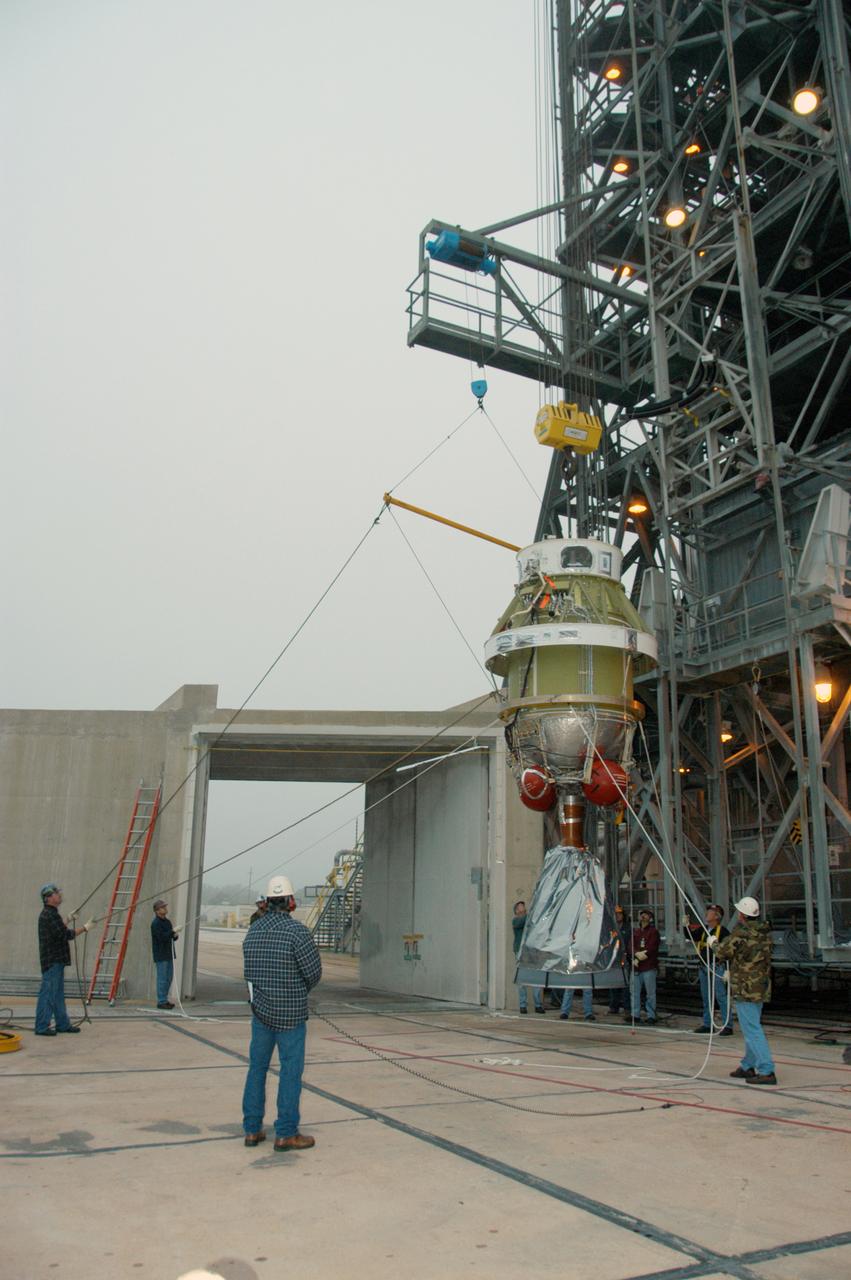
On Pad 17-B at Cape Canaveral Air Force Station, the Delta II second stage is lifted toward the mobile service tower. Once inside, it will be mated with the first stage already in place. The Delta II is the launch vehicle for the THEMIS spacecraft. THEMIS consists of five identical probes, the largest number of scientific satellites ever launched into orbit aboard a single rocket. This unique constellation of satellites will resolve the tantalizing mystery of what causes the spectacular sudden brightening of the aurora borealis and aurora australis - the fiery skies over the Earth's northern and southern polar regions. THEMIS is scheduled to launch Feb. 15 from Cape Canaveral Air Force Station.
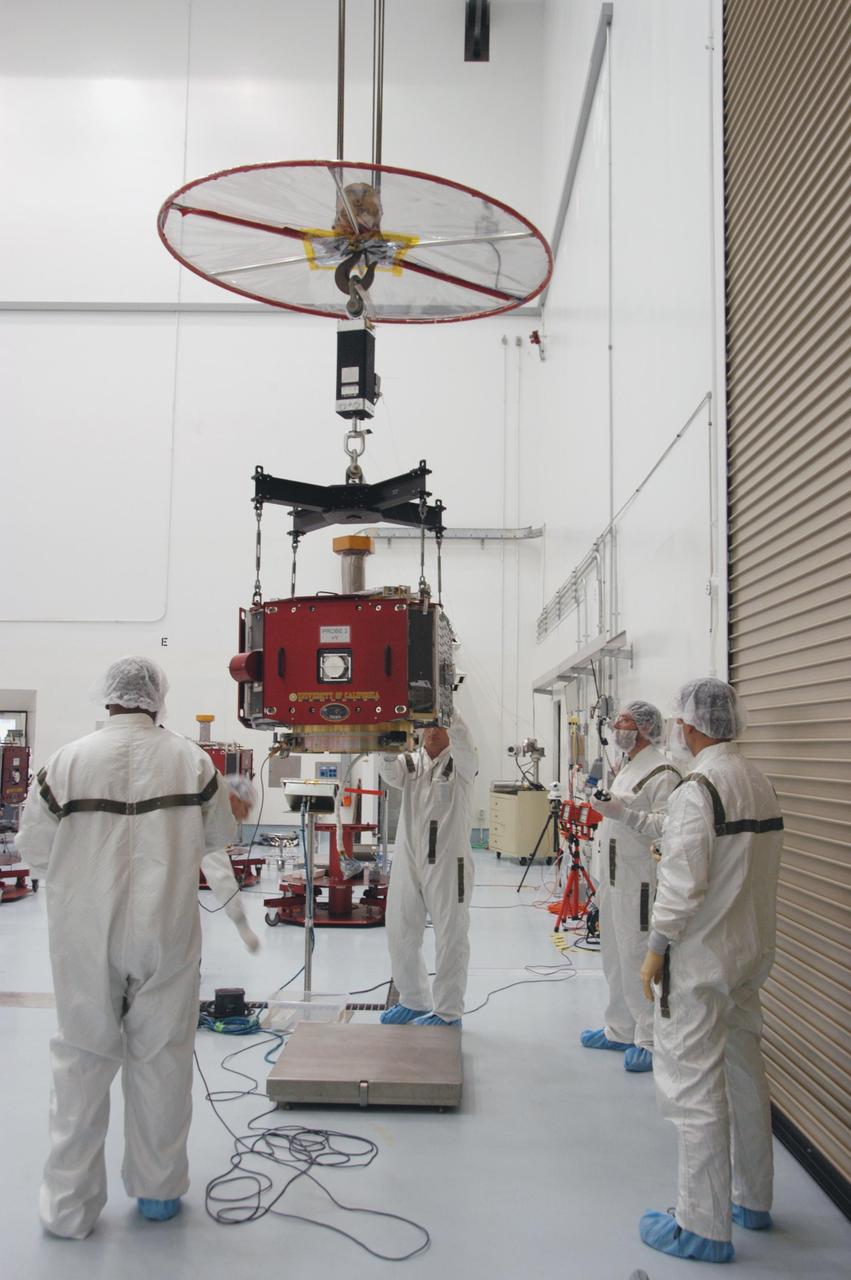
KENNEDY SPACE CENTER, FLA. -- At Astrotech Space Operations, one of the five THEMIS probes is lifted from a scale. It will be moved to a probe carrier for installation, along with its four mates, and then undergo spin-balance testing. THEMIS consists of five identical probes, the largest number of scientific satellites ever launched into orbit aboard a single rocket. This unique constellation of satellites will resolve the tantalizing mystery of what causes the spectacular sudden brightening of the aurora borealis and aurora australis - the fiery skies over the Earth's northern and southern polar regions. THEMIS is scheduled to launch Feb. 15 from Cape Canaveral Air Force Station. Photo credit: NASA/George Shelton
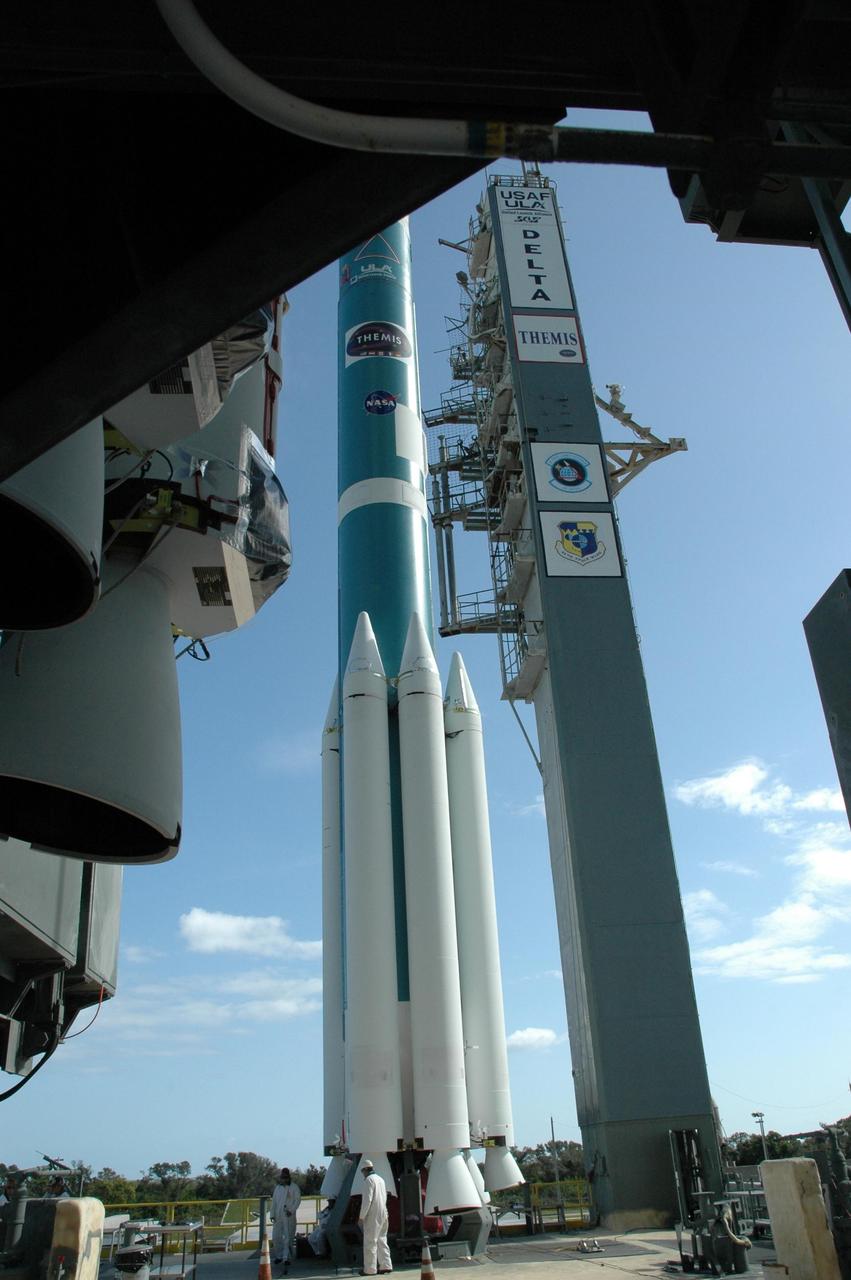
KENNEDY SPACE CENTER, FLA. -- Solid rocket boosters are clustered around the base of the United Launch Alliance Delta II rocket. A total of nine will assist in the launch of the THEMIS integrated spacecraft. THEMIS consists of five identical probes, the largest number of scientific satellites ever launched into orbit aboard a single rocket. This unique constellation of satellites will resolve the tantalizing mystery of what causes the spectacular sudden brightening of the aurora borealis and aurora australis - the fiery skies over the Earth's northern and southern polar regions. THEMIS is scheduled to launch Feb. 15 from Cape Canaveral Air Force Station. Photo credit: NASA/Jack Pfaller
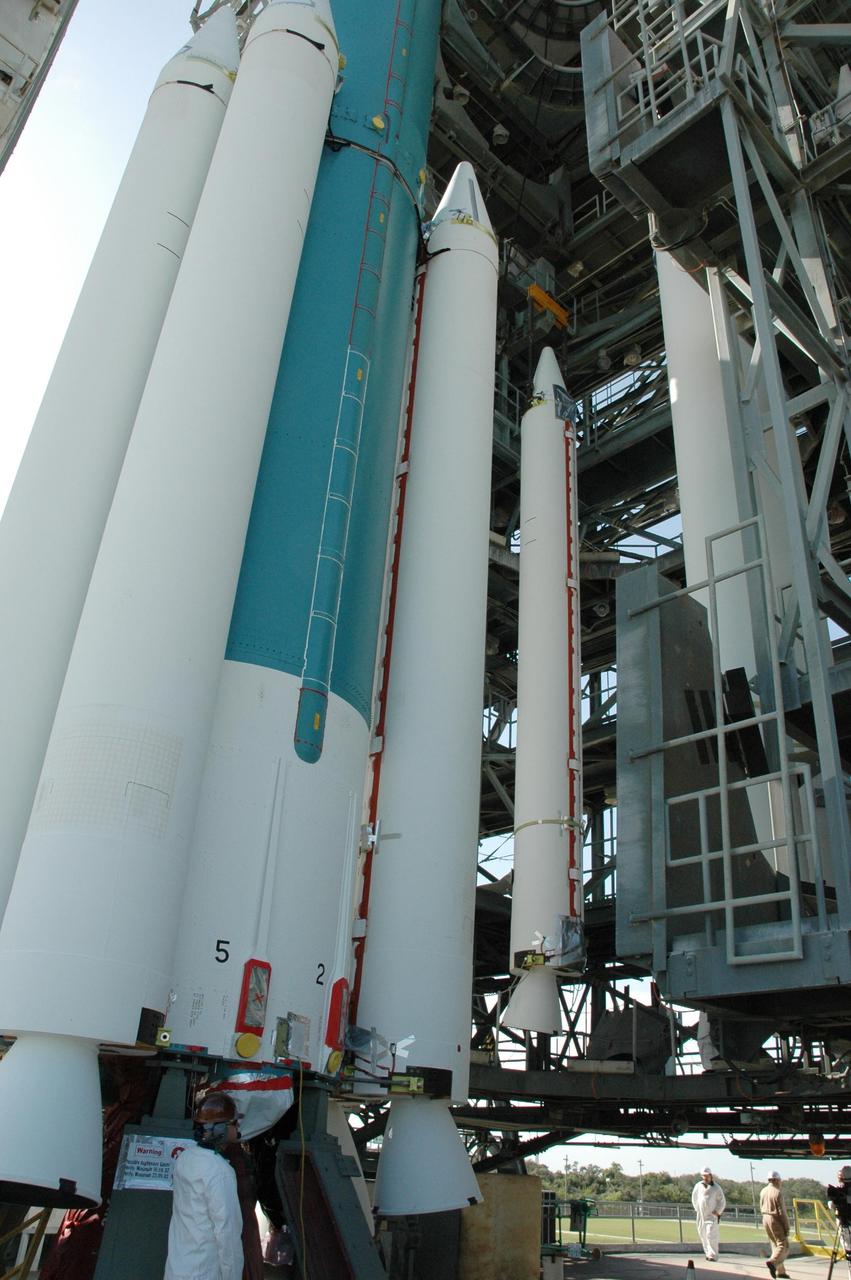
KENNEDY SPACE CENTER, FLA. -- Solid rocket boosters are clustered around the base of the United Launch Alliance Delta II rocket. A total of nine will assist in the launch of the THEMIS integrated spacecraft. THEMIS consists of five identical probes, the largest number of scientific satellites ever launched into orbit aboard a single rocket. This unique constellation of satellites will resolve the tantalizing mystery of what causes the spectacular sudden brightening of the aurora borealis and aurora australis - the fiery skies over the Earth's northern and southern polar regions. THEMIS is scheduled to launch Feb. 15 from Cape Canaveral Air Force Station. Photo credit: NASA/Jack Pfaller

KENNEDY SPACE CENTER, FLA. -- In the Hazardous Processing Facility at Astrotech Space Operations, one of the THEMIS probes undergoes solar array illumination telemetry testing. THEMIS consists of five identical probes, the largest number of scientific satellites ever launched into orbit aboard a single rocket. This unique constellation of satellites will resolve the tantalizing mystery of what causes the spectacular sudden brightening of the aurora borealis and aurora australis - the fiery skies over the Earth's northern and southern polar regions. THEMIS is scheduled to launch aboard the Delta II at 6:07 p.m. EST on Feb. 15. Photo credit: NASA/George Shelton
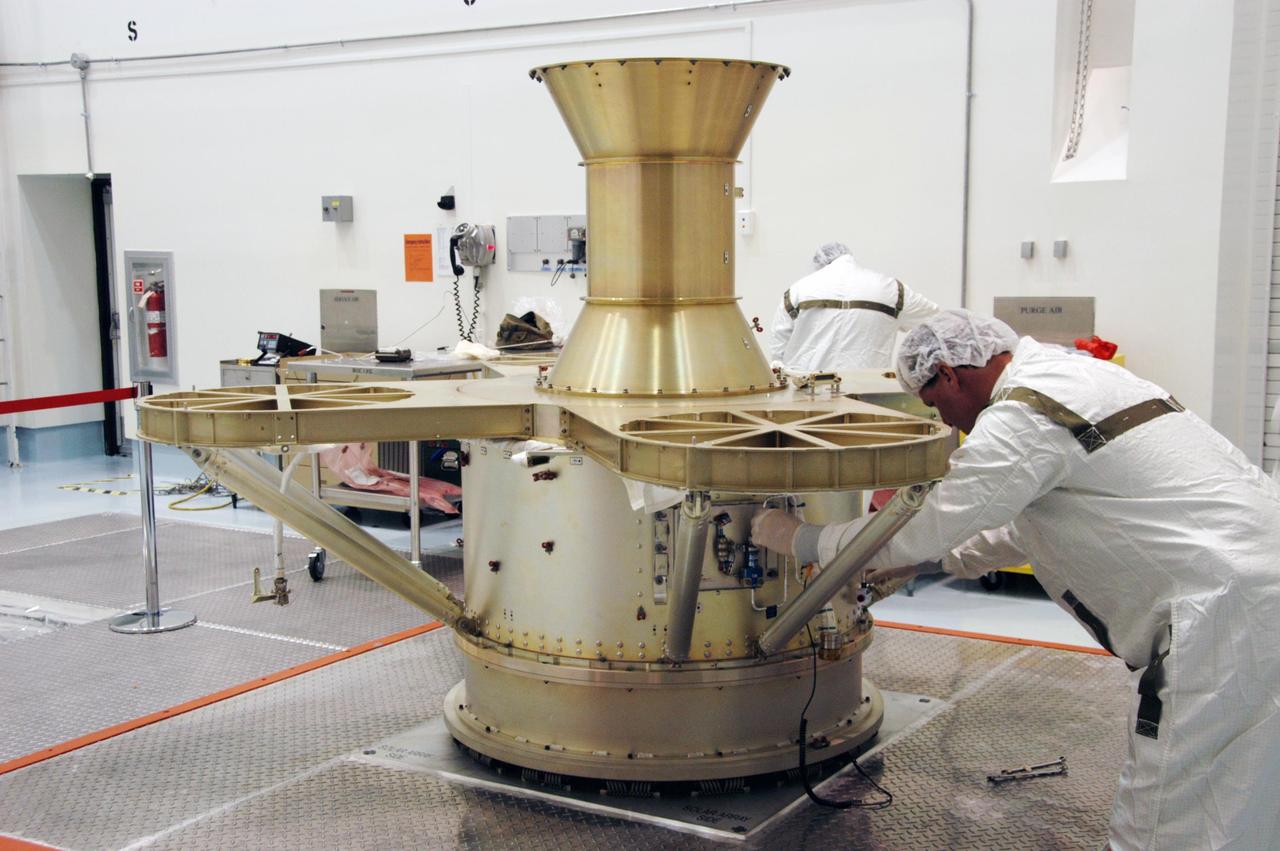
KENNEDY SPACE CENTER, FLA. -- At Astrotech Space Operations in Titusville, Fla., a worker attaches a high pressure line on the THEMIS spacecraft in preparation for fueling, which is scheduled for Jan. 3-5. THEMIS consists of five identical probes, the largest number of scientific satellites ever launched into orbit aboard a single rocket. This unique constellation of satellites will resolve the tantalizing mystery of what causes the spectacular sudden brightening of the aurora borealis and aurora australis - the fiery skies over the Earth's northern and southern polar regions. THEMIS is scheduled to launch Feb. 15 from Cape Canaveral Air Force Station. Photo credit: NASA/George Shelton
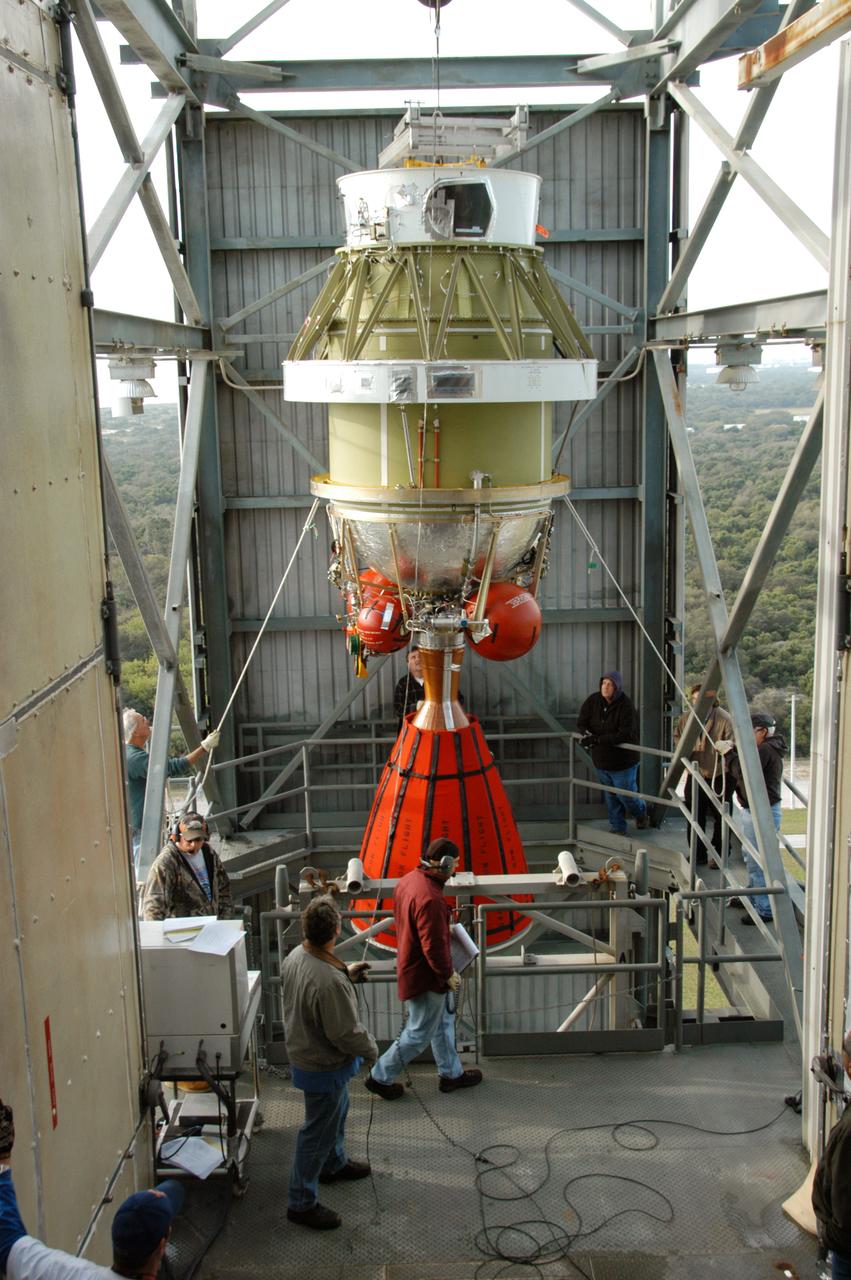
On Pad 17-B at Cape Canaveral Air Force Station, the Delta II second stage arrives at level 9 of the tower. The second stage will be moved inside and mated with the first stage already in place. The Delta II is the launch vehicle for the THEMIS spacecraft THEMIS consists of five identical probes, the largest number of scientific satellites ever launched into orbit aboard a single rocket. This unique constellation of satellites will resolve the tantalizing mystery of what causes the spectacular sudden brightening of the aurora borealis and aurora australis - the fiery skies over the Earth's northern and southern polar regions. THEMIS is scheduled to launch Feb. 15 from Cape Canaveral Air Force Station.
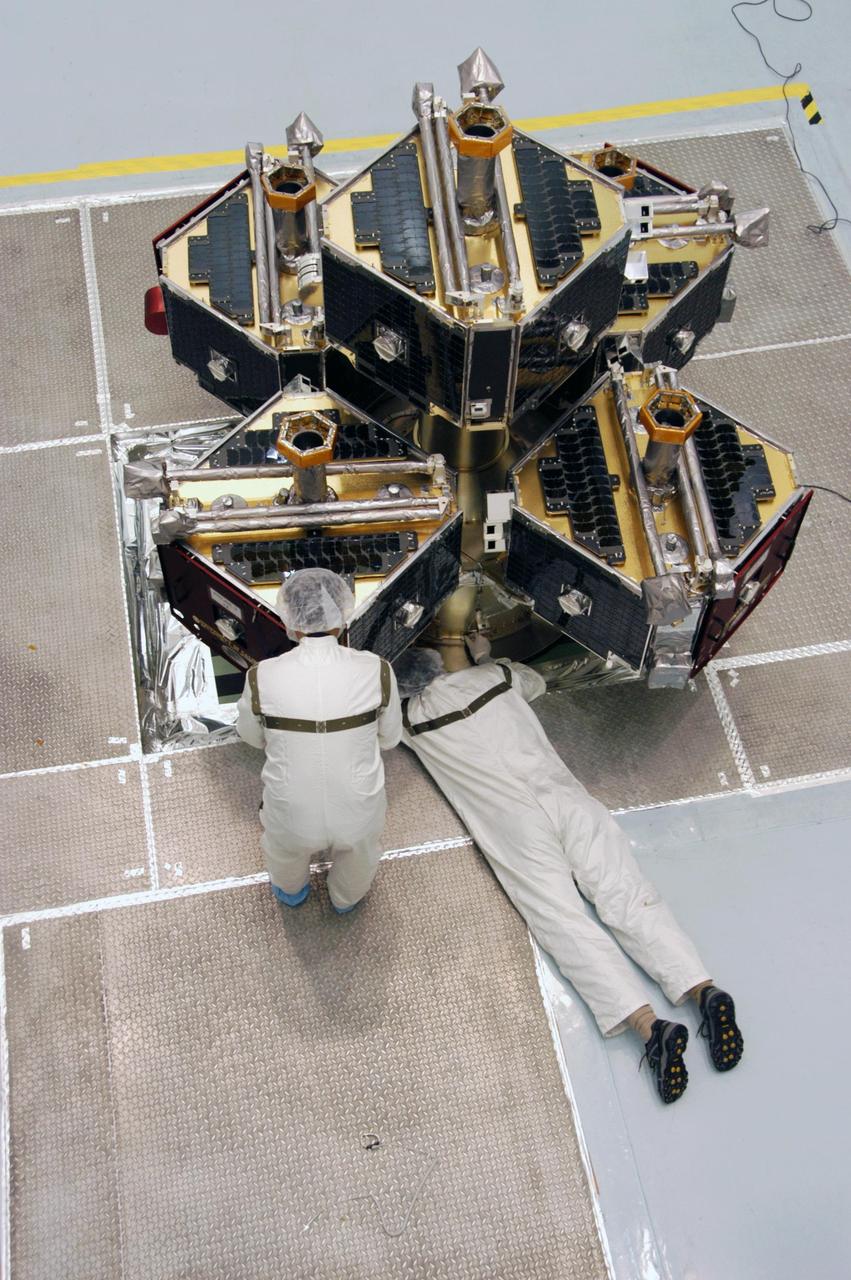
KENNEDY SPACE CENTER, FLA. -- At Astrotech Space Operations, workers prepare the integrated THEMIS spacecraft for spin-balance testing. THEMIS consists of five identical probes, the largest number of scientific satellites ever launched into orbit aboard a single rocket. This unique constellation of satellites will resolve the tantalizing mystery of what causes the spectacular sudden brightening of the aurora borealis and aurora australis - the fiery skies over the Earth's northern and southern polar regions. THEMIS is scheduled to launch Feb. 15 from Cape Canaveral Air Force Station. Photo credit: NASA/George Shelton
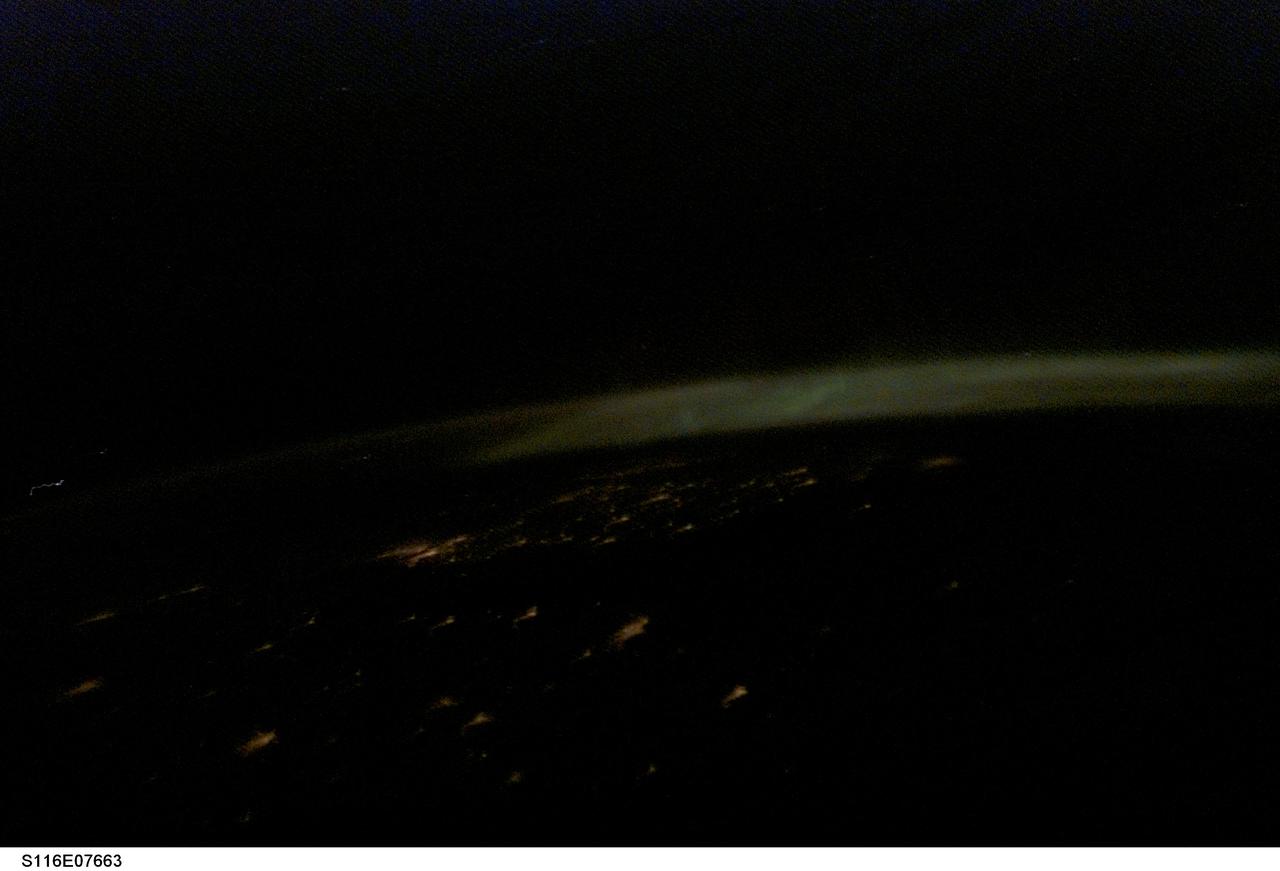
S116-E-07663 (20 Dec. 2006) --- One of the STS-116 crewmembers onboard the Space Shuttle Discovery captured this picture of Aurora Borealis over Norway, Poland and Sweden, as the crew made preparations for a Dec. 22 landing. European Space Agency astronaut Christer Fuglesang onboard the shuttle noted the rarity of pictures over this area from shuttle missions, and especially pictures that included the Northern Lights. Fuglesang is from Sweden. The city lights of Copenhagen (bright cluster of lights in the middle left portion of the image), Stockholm (under the aurora on the far right side of the image), and Gdansk (in the center forefront) are seen. The formation of the aurora starts with the sun releasing solar particles. The Earth's magnetic field captures and channels the solar particles toward the Earth's two magnetic poles (north and south). As the solar particles move towards the poles they collide with the Earth's atmosphere, which acts as an effective shield against these deadly particles. The collision between the solar particles and the atmospheric gas molecule emits a light particle (photon). When there are many collisions the aurora is formed.
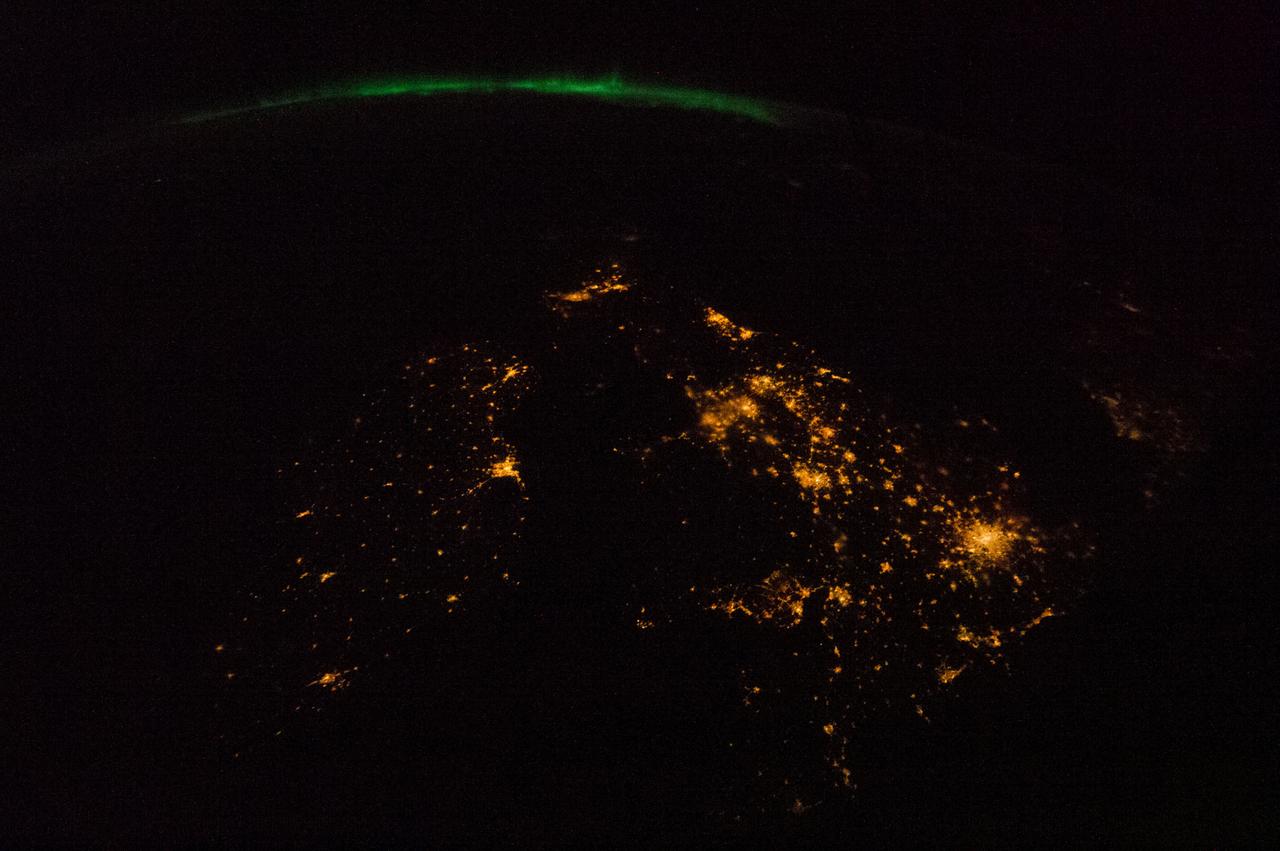
ISS034-E-050137 (14 Feb. 2013) --- One of the Expedition 34 crew members aboard the International Space Station recorded this night image of the British Isles. The view is to the north with Dublin, Ireland left of center. London appears as the bright cluster of lights centered in the lower right quadrant. The green appearance along the horizon is the Aurora Borealis or Northern Lights.
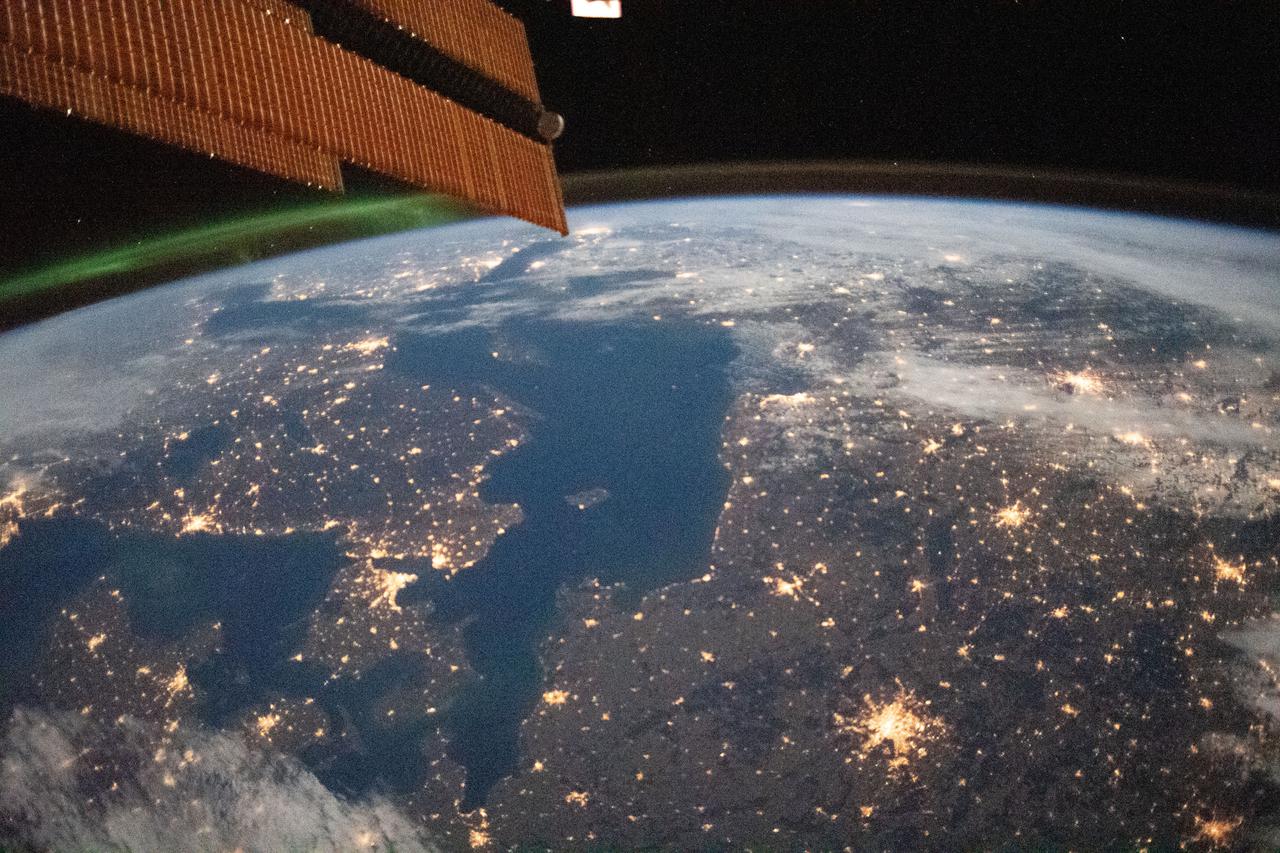
iss066e116300 (Jan. 17, 2022) --- A faint aurora and the Earth's atmospheric glow crown this night time photograph of Northern Europe, as the International Space Station orbited 262 miles above. Prominent city lights include those of (from right to left) Berlin, Germany; Copenhagen, Denmark; and Oslo, Norway. At center, is the Baltic Sea separating the Scandinavian nations of Sweden and Finland from the Baltic states of Estonia, Latvia and Lithuania
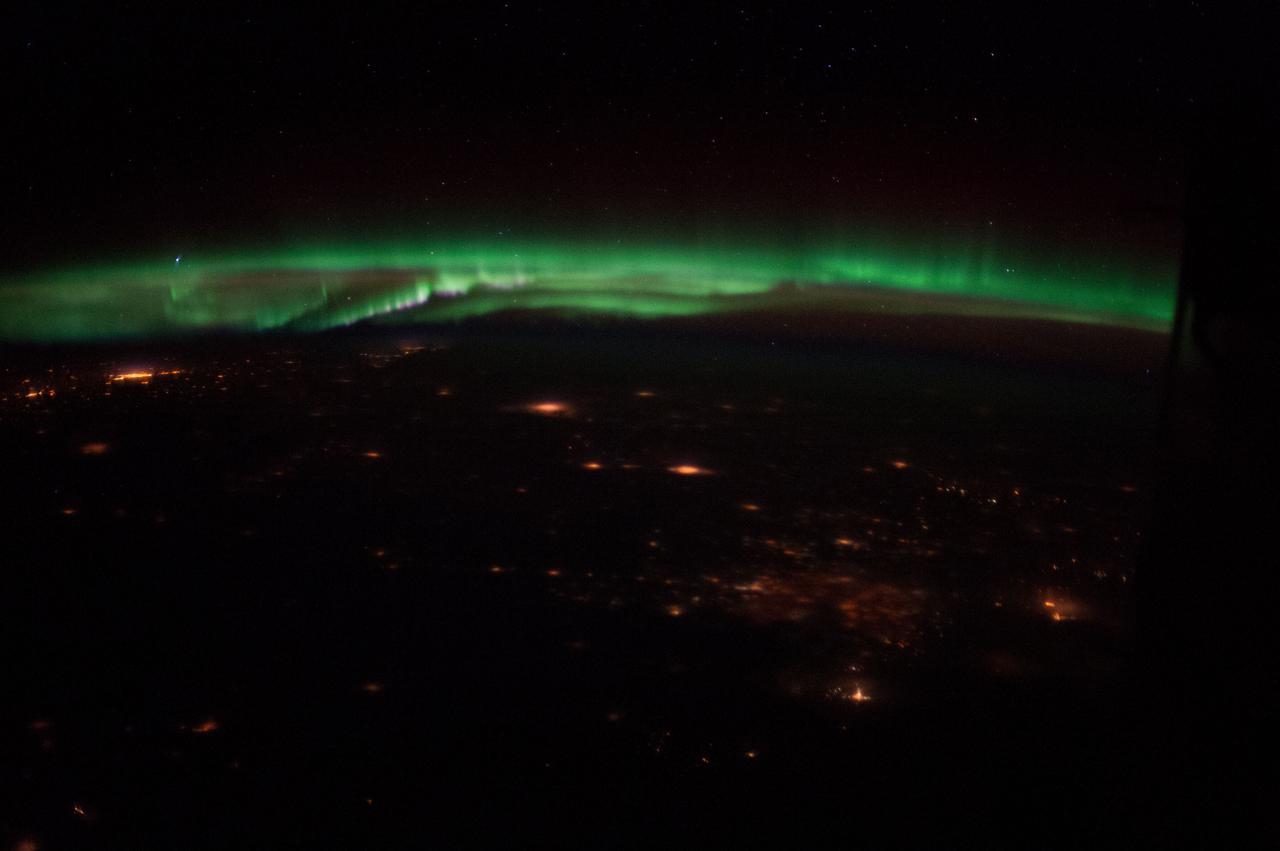
ISS034-E-045223 (10 Feb. 2013) -- One of the Expedition 34 crew members aboard the International Space Station captured this night panorama featuring a display of Northern Lights, also known as Aurora Borealis, and scattered lights in the more highly populated areas in the state of Colorado and possibly the states north of it. A 50 millimeter lens was used to record the image.

This animation shows the overlap of the field of view of Juno's Stellar Reference Unit (SRU) star camera (in yellow) and Juno's Microwave Radiometer (MWR) Antenna-1 beam (in red). The animation depicts Juno flying over Jupiter's North pole where the planet's massive northern aurora is located. Juno observes Jupiter's lightning using multiple instruments which detect lightning at different parts of its spectrum. Animation avaiable at https://photojournal.jpl.nasa.gov/catalog/PIA22967
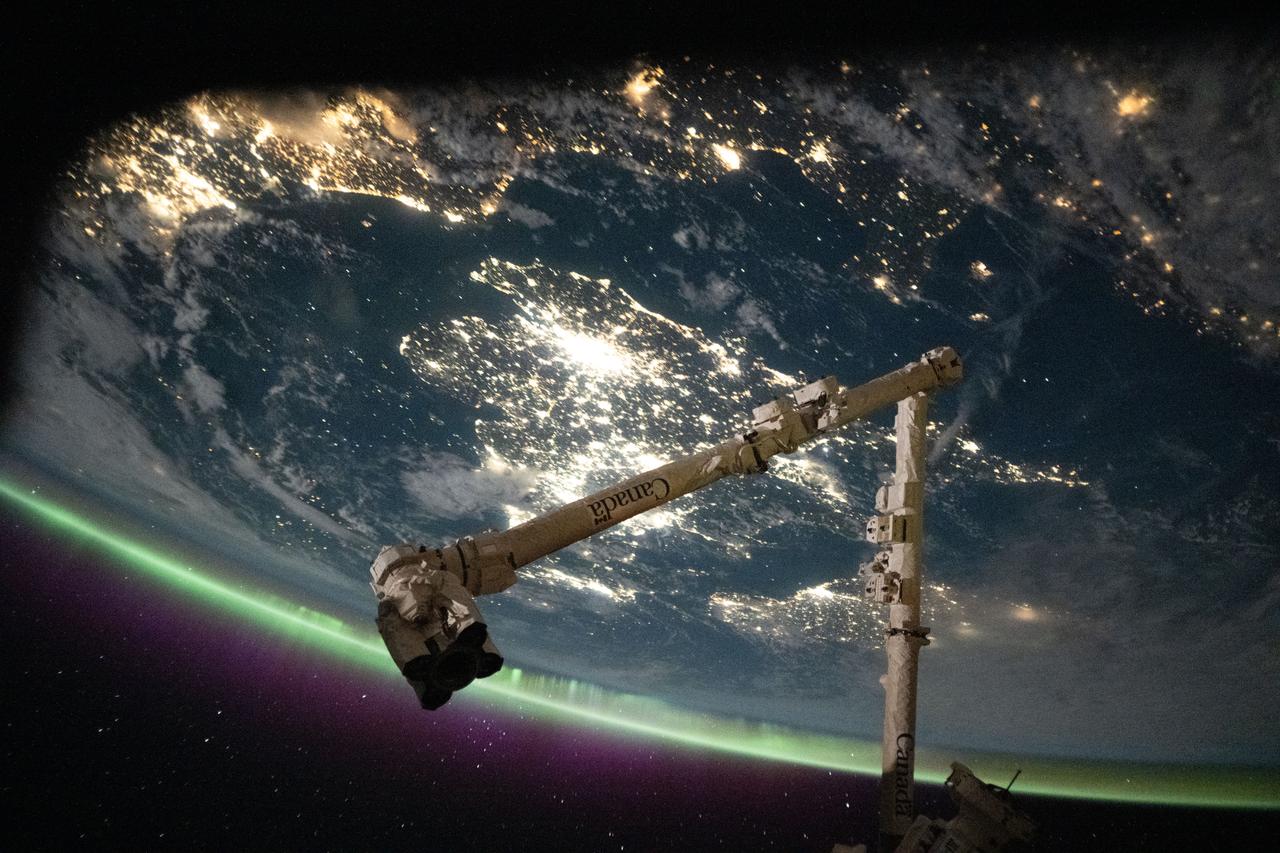
iss073e0698351 (Sept. 13, 2025) --- The English Channel separates the sparkling nighttime coasts of France and England highlighted by an aurora crowning Earth's atmosphere. The sprawling city lights of London are seen at center, while the coastal cities of northern Europe including Amsterdam can be seen at top left. In the foreground, is the Canadarm2 robotic arm. The International Space Station was orbiting 263 miles above France at approximately 11:38 p.m. local time when this photograph was taken.
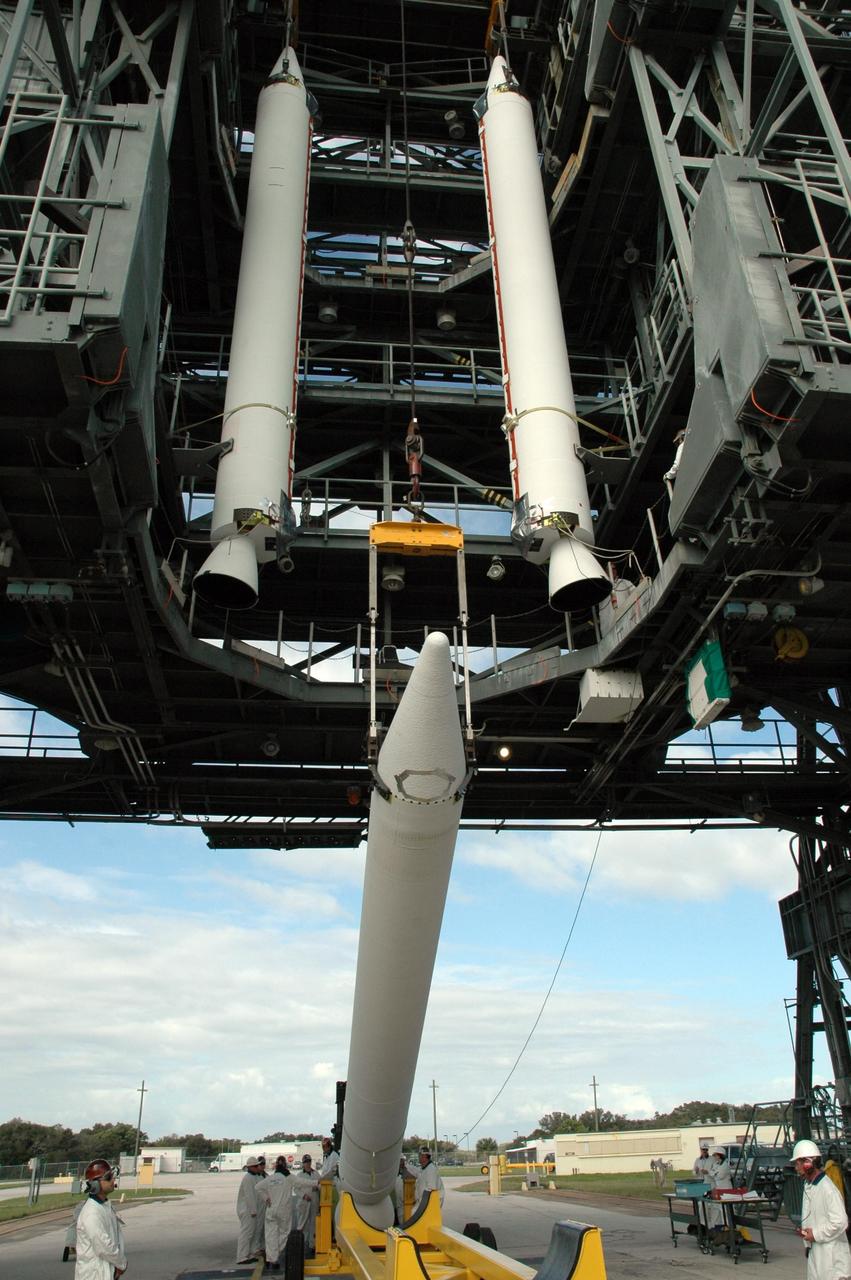
KENNEDY SPACE CENTER, FLA. -- Another solid rocket booster is raised to a vertical position for lifting into the mobile service tower on Launch Pad 17-B at Cape Canaveral Air Force Station. The boosters are being installed around the United Launch Alliance Delta II rocket for launch of the THEMIS integrated spacecraft. THEMIS consists of five identical probes, the largest number of scientific satellites ever launched into orbit aboard a single rocket. This unique constellation of satellites will resolve the tantalizing mystery of what causes the spectacular sudden brightening of the aurora borealis and aurora australis - the fiery skies over the Earth's northern and southern polar regions. THEMIS is scheduled to launch Feb. 15 from Cape Canaveral Air Force Station. Photo credit: NASA/Jack Pfaller
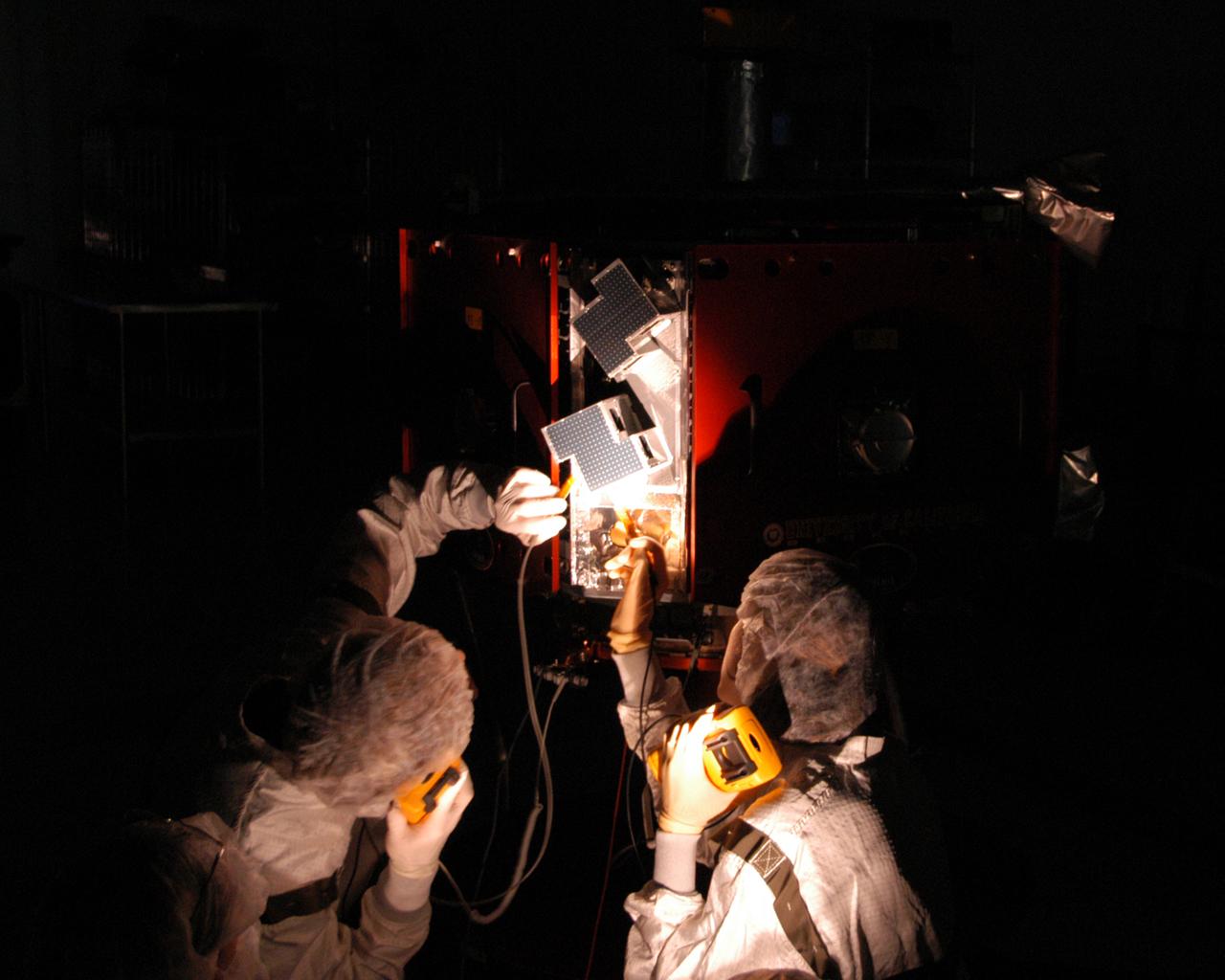
At Astrotech Space Operations, technicians conduct white light inspection of the THEMIS probes. They will also undergo black light inspection. White light inspection assures the telemetry is operating. Black light inspection uses UVA fluorescence to detect possible particulate microcontamination, minute cracks or fluid leaks. THEMIS consists of five identical probes, the largest number of scientific satellites ever launched into orbit aboard a single rocket. This unique constellation of satellites will resolve the tantalizing mystery of what causes the spectacular sudden brightening of the aurora borealis and aurora australis - the fiery skies over the Earth's northern and southern polar regions. THEMIS is scheduled to launch Feb. 15 from Cape Canaveral Air Force Station.
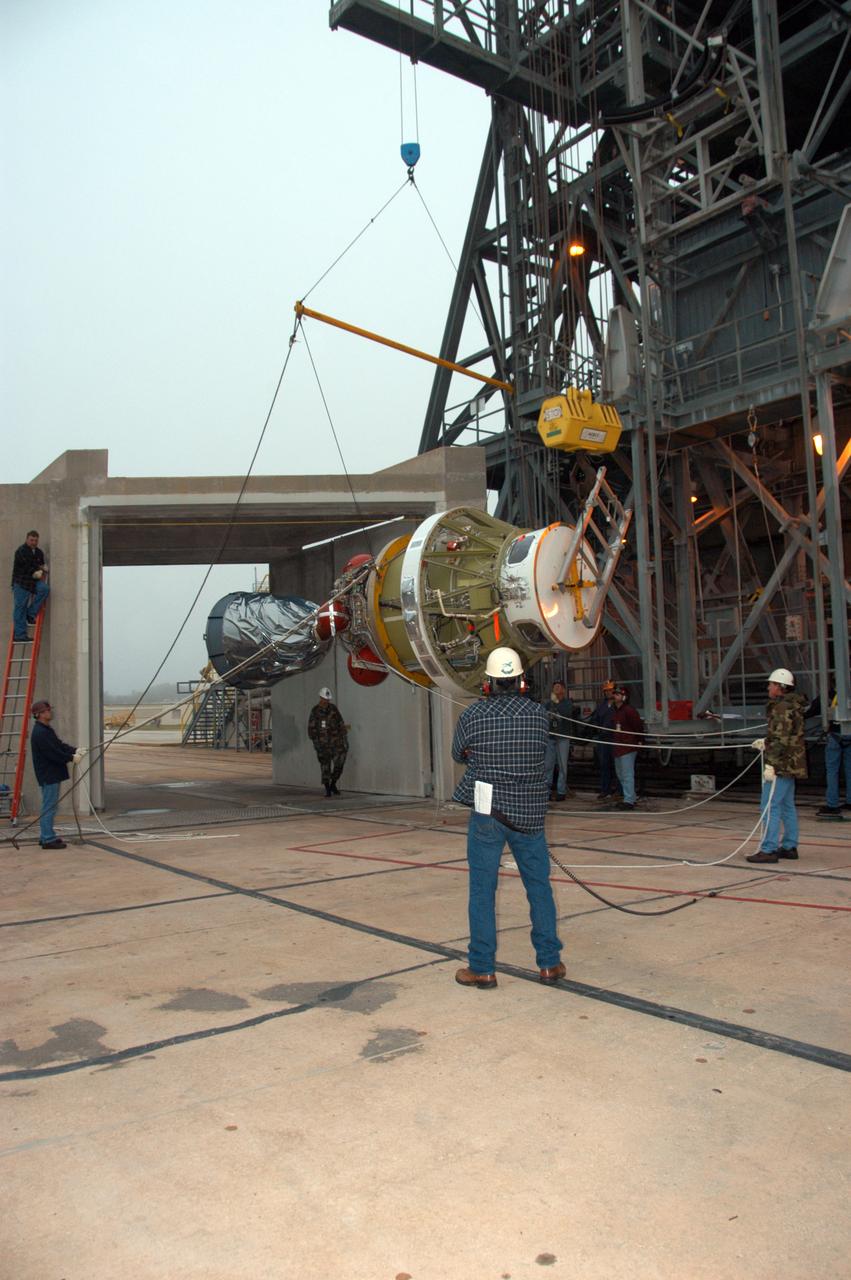
On Pad 17-B at Cape Canaveral Air Force Station, workers stand by while an overhead crane lifts the Delta II second stage to a vertical position. The second stage will be lifted into the mobile service tower and mated with the first stage already in place. The Delta II is the launch vehicle for the THEMIS spacecraft. THEMIS consists of five identical probes, the largest number of scientific satellites ever launched into orbit aboard a single rocket. This unique constellation of satellites will resolve the tantalizing mystery of what causes the spectacular sudden brightening of the aurora borealis and aurora australis - the fiery skies over the Earth's northern and southern polar regions. THEMIS is scheduled to launch Feb. 15 from Cape Canaveral Air Force Station.

The first stage of a United Launch Alliance Delta II rocket leaves for Launch Pad 17-B on Cape Canaveral Air Force Station in Florida. The rocket is the launch vehicle for the THEMIS spacecraft, consisting of five identical probes, the largest number of scientific satellites ever launched into orbit aboard a single rocket. This unique constellation of satellites will resolve the tantalizing mystery of what causes the spectacular sudden brightening of the aurora borealis and aurora australis - the fiery skies over the Earth's northern and southern polar regions. After the first stage is in the mobile service tower on the pad, nine solid rocket boosters will be placed around the base of the first stage and attached in sets of three. THEMIS is scheduled to launch aboard the Delta II at 6:07 p.m. EST on Feb. 15.