
A 2 week observation through the optic eye of the Chandra X-Ray Observatory revealed this sturning explosion occurring in the super massive black hole at the Milky Way's center, known as Sagittarius A or Sgr A*. Huge lobes of 20-million degree Centigrade gas ( red loops in image) flank both sides of the black hole and extend over dozens of light years indicating that enormous explosions occurred several times over the last 10 thousand years. Weighing in at 3-million times the mass of the sun, the Sgr A* is a starved black hole, possibly because explosive events in the past have cleared much of the gas around it.
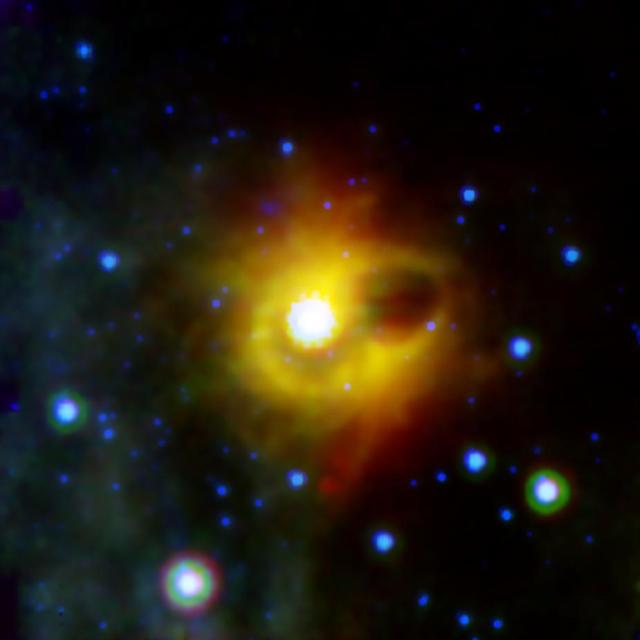
NASA Spitzer Space Telescope imaged the mysterious ring around magnetar SGR 1900+14 in infrared light.
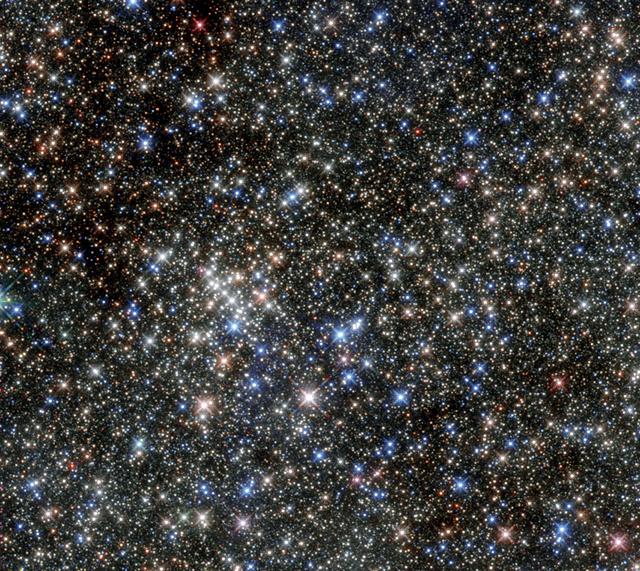
Although this cluster of stars gained its name due to its five brightest stars, it is home to hundreds more. The huge number of massive young stars in the cluster is clearly captured in this NASA/ESA Hubble Space Telescope image. The cluster is located close to the Arches Cluster and is just 100 light-years from the centre of our galaxy. The cluster’s proximity to the dust at the centre of the galaxy means that much of its visible light is blocked, which helped to keep the cluster unknown until its discovery in 1990, when it was revealed by observations in the infrared. Infrared images of the cluster, like the one shown here, allow us to see through the obscuring dust to the hot stars in the cluster. The Quintuplet Cluster hosts two extremely rare luminous blue variable stars: the Pistol Star and the lesser known V4650 Sgr. If you were to draw a line horizontally through the centre of this image from left to right, you could see the Pistol Star hovering just above the line about one third of the way along it. The Pistol Star is one of the most luminous known stars in the Milky Way and takes its name from the shape of the Pistol Nebula that it illuminates, but which is not visible in this infrared image. The exact age and future of the Pistol Star are uncertain, but it is expected to end in a supernova or even a hypernova in one to three million years. The cluster also contains a number of red supergiants. These stars are among the largest in the galaxy and are burning their fuel at an incredible speed, meaning they will have a very short lifetime. Their presence suggests an average cluster age of nearly four million years. At the moment these stars are on the verge of exploding as supernovae. During their spectacular deaths they will release vast amounts of energy which, in turn, will heat the material — dust and gas — between the other stars. This observation shows the Quintuplet Cluster in the infrared and demonstrates the leap in Hubble’s performance sinc

This artist concept illustrates the frenzied activity at the core of our Milky Way galaxy. The galactic center hosts a supermassive black hole in the region known as Sagittarius A*, or Sgr A*, with a mass of about four million times that of our sun.

This artist's concept depicts a magnetar – a type of neutron star with a strong magnetic field – losing material into space in an ejection that would have caused the object's rotation to slow. Shown as thin green lines, the magnetic field lines influence the movement of charged material around the magnetar. In October 2022, astronomers using NASA's NICER (Neutron Star Interior Composition Explorer) on the International Space Station and NuSTAR (Nuclear Spectroscopic Telescope Array) in low Earth orbit observed a rapid slowdown in a nearby magnetar called SGR 1935+2154. They believe the slowdown was caused by a rapid loss of material. The slowdown coincided with the release a fast radio burst – an eruption of radio waves that last only for a fraction of a second but can release about as much energy as the Sun does in a year. The light also forms a laser-like beam, setting them apart from more chaotic cosmic explosions. The telescopes were able to observe SGR 1935+2154 for hours, catching a glimpse of what happened on its surface and in its immediate surroundings both before and after the fast radio burst. https://photojournal.jpl.nasa.gov/catalog/PIA26274
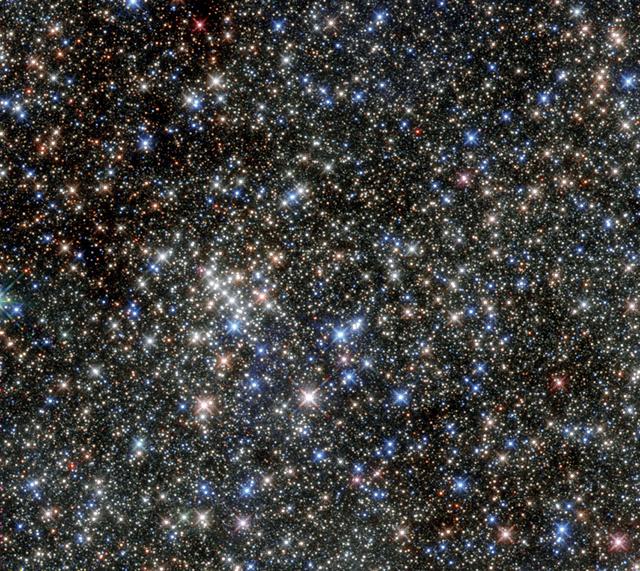
Although this cluster of stars gained its name due to its five brightest stars, it is home to hundreds more. The huge number of massive young stars in the cluster is clearly captured in this NASA/ESA Hubble Space Telescope image. The cluster is located close to the Arches Cluster and is just 100 light-years from the center of our galaxy. The cluster’s proximity to the dust at the center of the galaxy means that much of its visible light is blocked, which helped to keep the cluster unknown until its discovery in 1990, when it was revealed by infrared observations. Infrared images of the cluster, like the one shown here, allow us to see through the obscuring dust to the hot stars in the cluster. The Quintuplet Cluster hosts two extremely rare luminous blue variable stars: the Pistol Star and the lesser known V4650 Sgr. If you were to draw a line horizontally through the center of this image from left to right, you could see the Pistol Star hovering just above the line about one third of the way along it. The Pistol Star is one of the most luminous known stars in the Milky Way and takes its name from the shape of the Pistol Nebula that it illuminates, but which is not visible in this infrared image. The exact age and future of the Pistol Star are uncertain, but it is expected to end in a supernova or even a hypernova in one to three million years. The cluster also contains a number of red supergiants. These stars are among the largest in the galaxy and are burning their fuel at an incredible speed, meaning they will have a very short lifetime. Their presence suggests an average cluster age of nearly four million years. At the moment these stars are on the verge of exploding as supernovae. During their spectacular deaths they will release vast amounts of energy which, in turn, will heat the material — dust and gas — between the other stars. This observation shows the Quintuplet Cluster in the infrared and demonstrates the leap in Hubble’s performance since its 1999 image of same object. Credit: ESA/NASA <b><a href="http://www.nasa.gov/audience/formedia/features/MP_Photo_Guidelines.html" rel="nofollow">NASA image use policy.</a></b> <b><a href="http://www.nasa.gov/centers/goddard/home/index.html" rel="nofollow">NASA Goddard Space Flight Center</a></b> enables NASA’s mission through four scientific endeavors: Earth Science, Heliophysics, Solar System Exploration, and Astrophysics. Goddard plays a leading role in NASA’s accomplishments by contributing compelling scientific knowledge to advance the Agency’s mission. <b>Follow us on <a href="http://twitter.com/NASAGoddardPix" rel="nofollow">Twitter</a></b> <b>Like us on <a href="http://www.facebook.com/pages/Greenbelt-MD/NASA-Goddard/395013845897?ref=tsd" rel="nofollow">Facebook</a></b> <b>Find us on <a href="http://instagrid.me/nasagoddard/?vm=grid" rel="nofollow">Instagram</a></b>