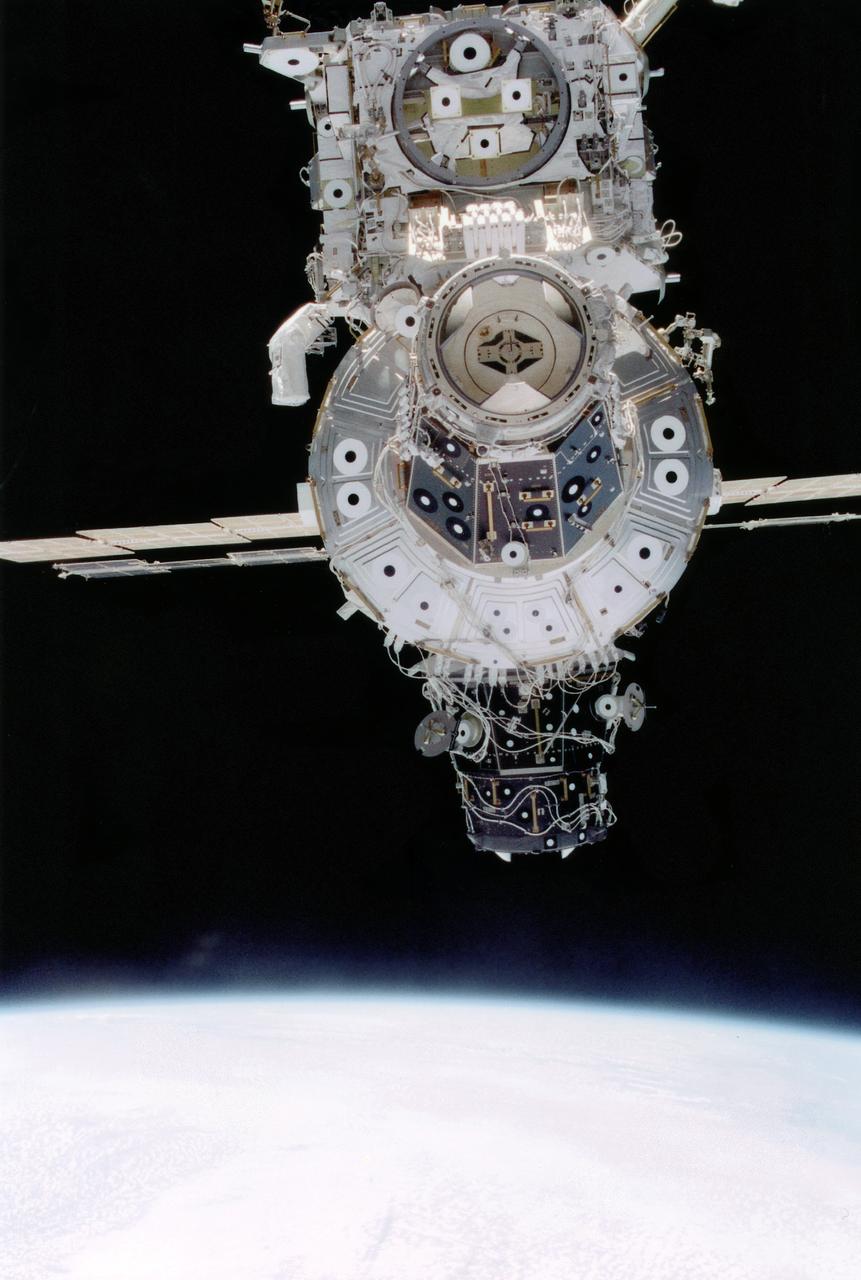
As the Space Shuttle Discovery began its separation from the International Space Station (ISS), a crew member captured this view of the ISS, revealing new additions to the complex. Most of the Z1 truss structure is visible, along with the recently installed Pressurized Mating Adapter (PMA-3).
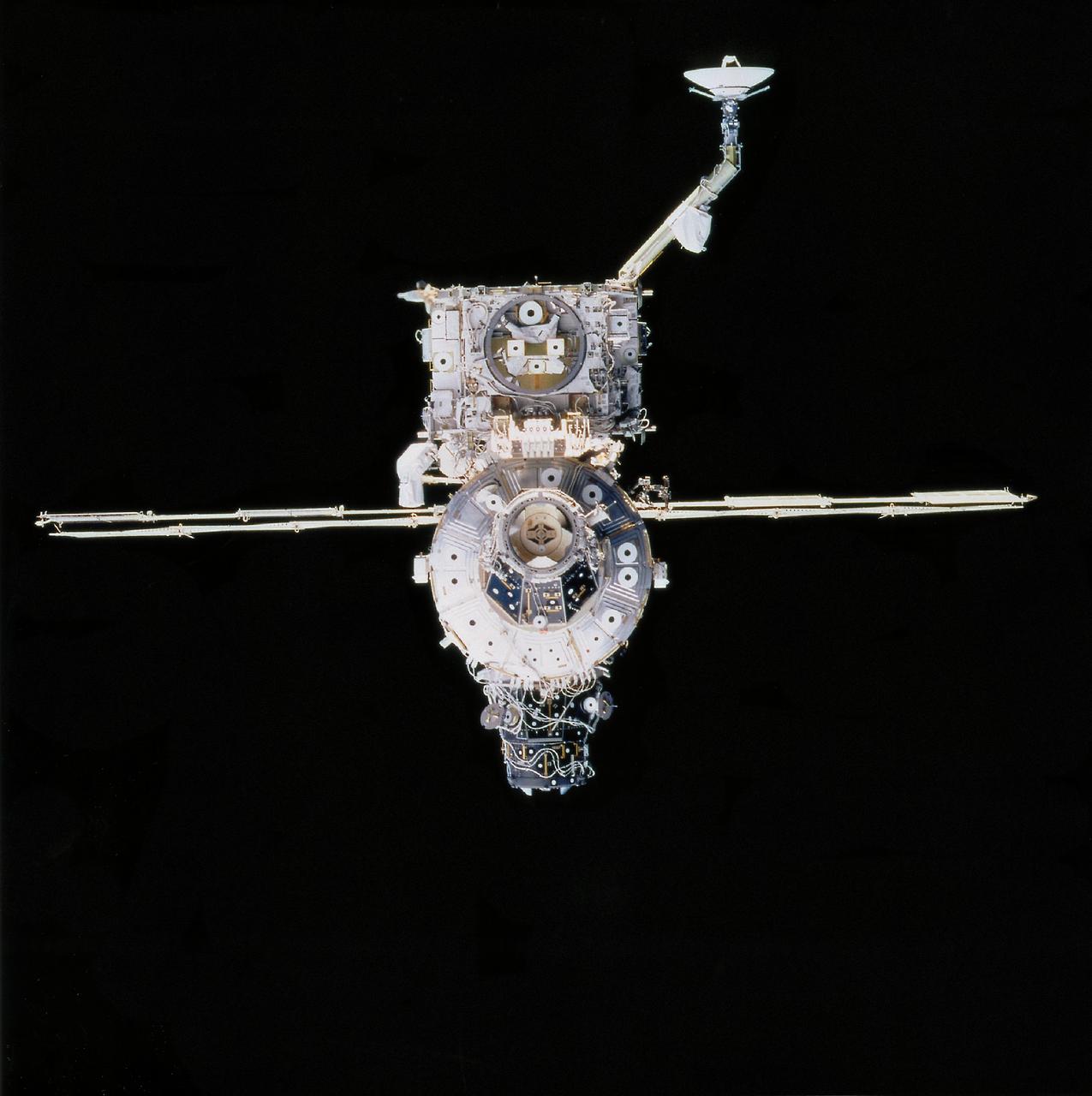
Not long after separation of the Space Shuttle Discovery from the International Space Station (ISS), a crew member was able to use a 70mm handheld camera to grab this image of the station, featuring its newest additions. Backdropped against the blackness of space, the Z1 truss structure and its anterna, as well as the new Pressurized Mating Adapter (PMA-3), are visible in the foreground.
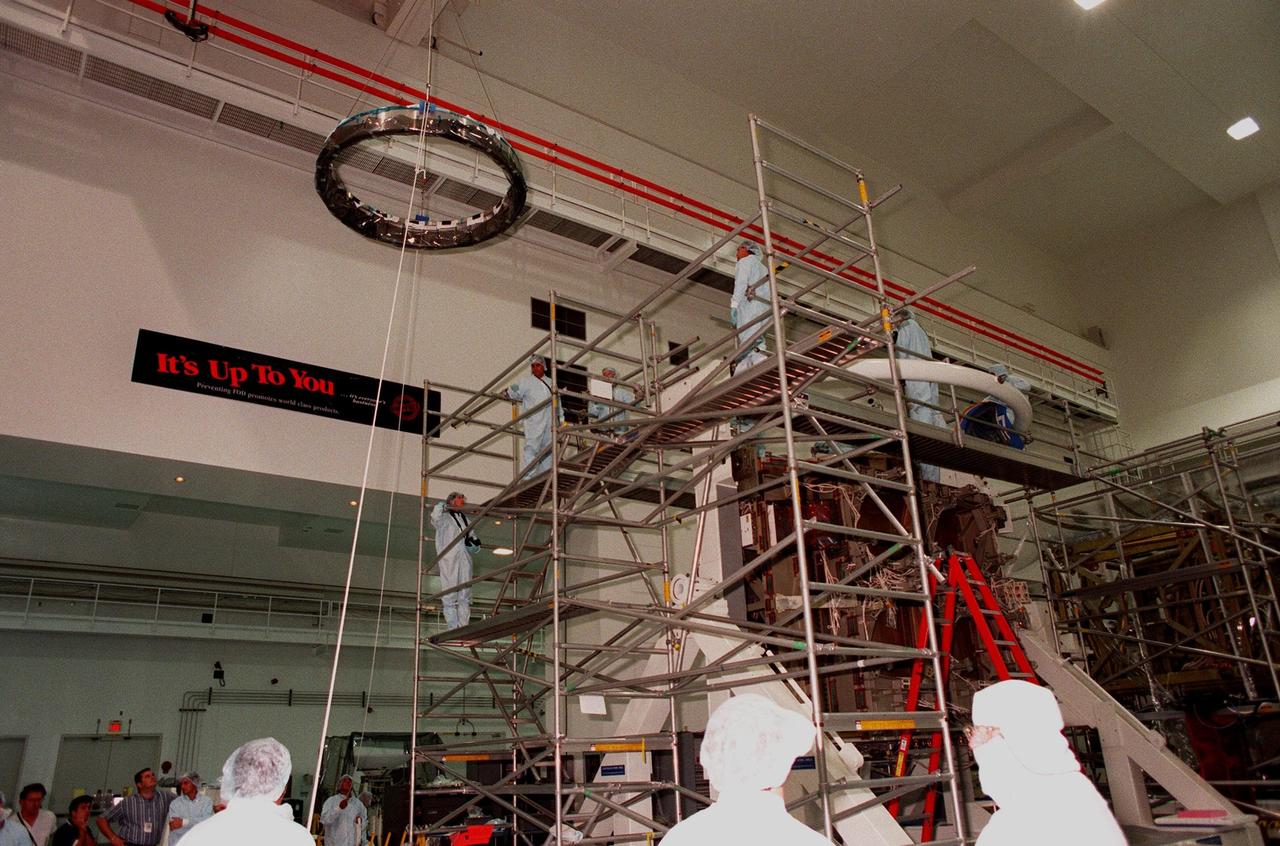
Workers in the Space Station Processing Facility watch the Passive Common Berthing Mechanism (PCBM) lifted high to move it over to the Z1 integrated truss structure at right. It will be mated to the Z1 truss, a component of the International Space Station (ISS). The Z1 truss will be used for the temporary installation of the P6 truss segment to the Unity connecting module. The P6 truss segment contains the solar arrays and batteries which will provide early station power. The truss is scheduled to be launched aboard STS-92 in late 1999
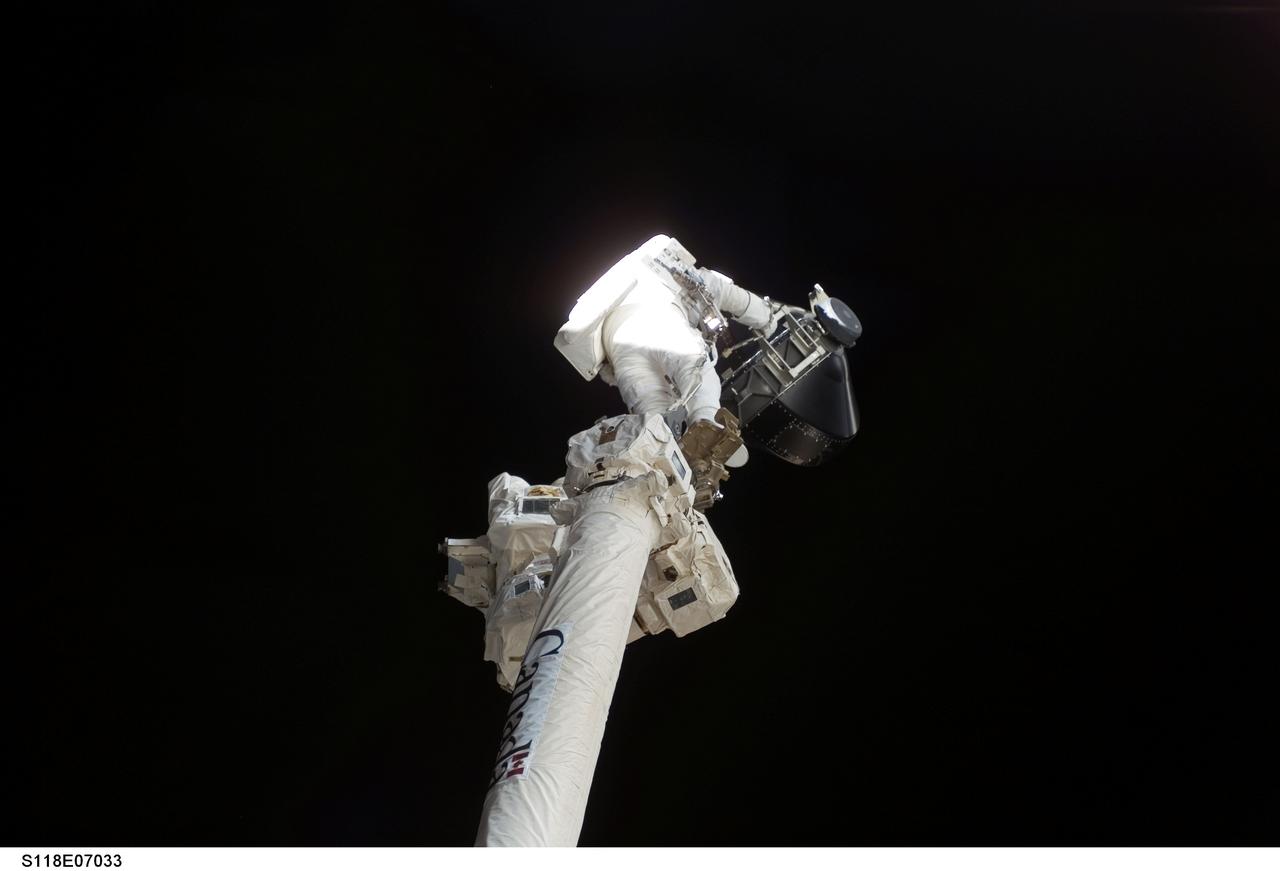
S118-E-07033 (13 Aug. 2007) --- While anchored to the foot restraint on the Canadarm2, astronaut Dave Williams, STS-118 mission specialist representing the Canadian Space Agency, participates in the mission's second planned session of extravehicular activity (EVA) as construction and maintenance continue on the International Space Station. During the 6-hour, 28-minute spacewalk, Williams and astronaut Rick Mastracchio (out of frame), mission specialist, removed a faulty control moment gyroscope (CMG-3) and installed a new CMG into the station's Z1 truss. The failed CMG will remain at its temporary stowage location on the station's exterior until it is returned to Earth on a later shuttle mission. The new gyroscope is one of four CMGs that are used to control the station's attitude in orbit.
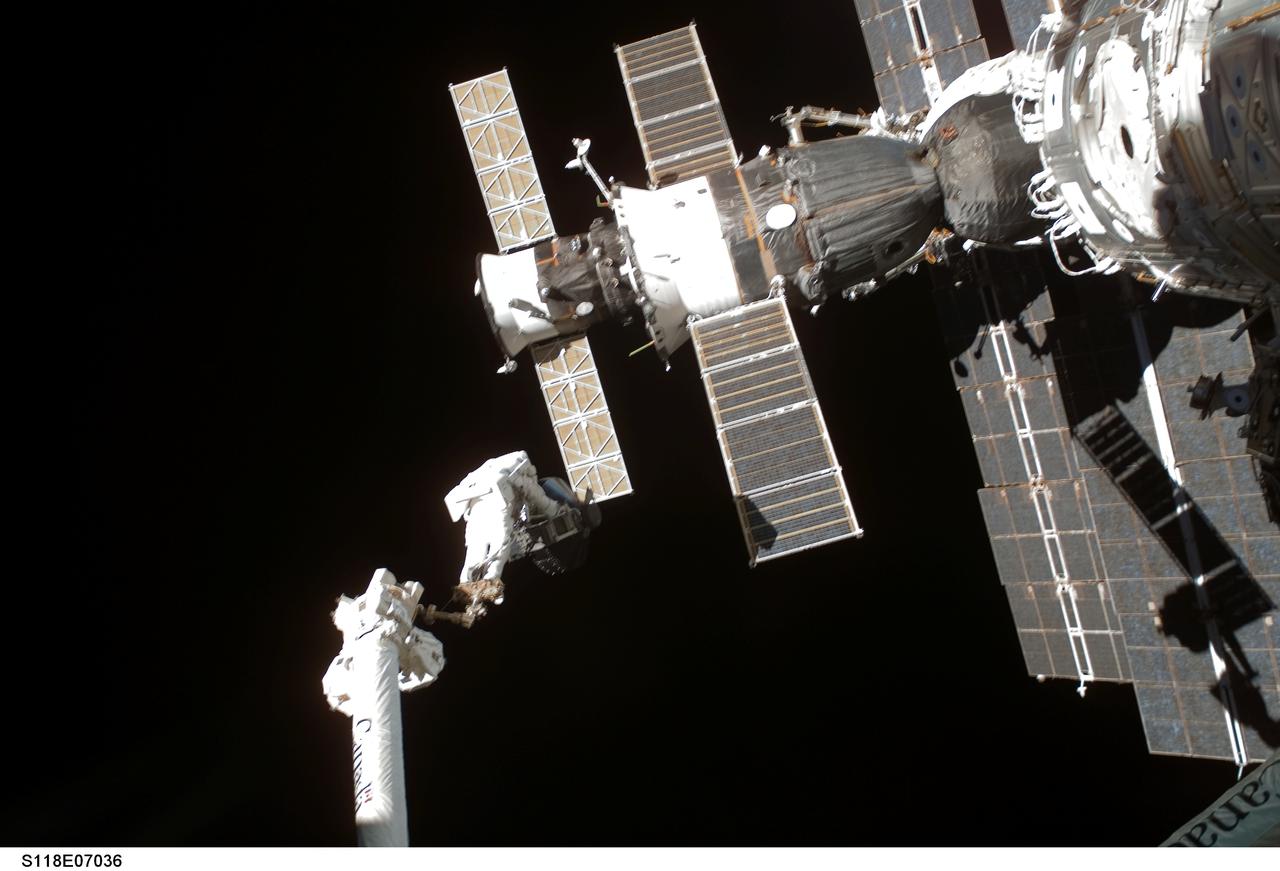
S118-E-07036 (13 Aug. 2007) --- While anchored to the foot restraint on the Canadarm2, astronaut Dave Williams, STS-118 mission specialist representing the Canadian Space Agency, participates in the mission's second planned session of extravehicular activity (EVA) as construction and maintenance continue on the International Space Station. During the 6-hour, 28-minute spacewalk, Williams and astronaut Rick Mastracchio (out of frame), mission specialist, removed a faulty control moment gyroscope (CMG-3) and installed a new CMG into the station's Z1 truss. The failed CMG will remain at its temporary stowage location on the station's exterior until it is returned to Earth on a later shuttle mission. The new gyroscope is one of four CMGs that are used to control the station's attitude in orbit.
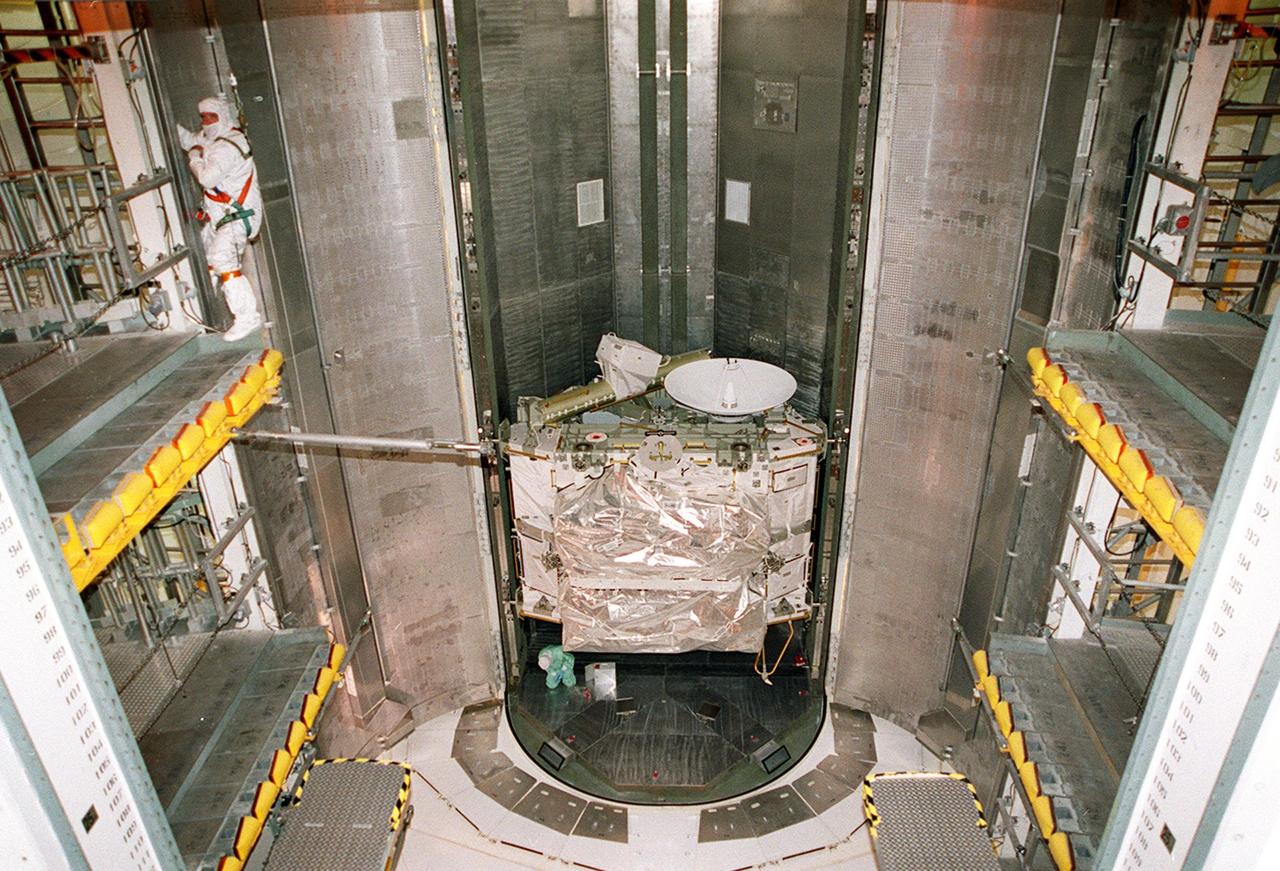
Inside the Payload Changeout Room (PCR), workers prepare to move the Integrated Truss Structure Z1 out of the payload canister. Once inside the PCR, workers will get ready to move the Z1 into the payload bay of Space Shuttle Discovery. The Z1 truss is the first of 10 that will become the backbone of the International Space Station, eventually stretching the length of a football field. Along with its companion payload, the third Pressurized Mating Adapter, the Z1 is scheduled to be launched aboard Discovery Oct. 5 at 9:38 p.m. EDT
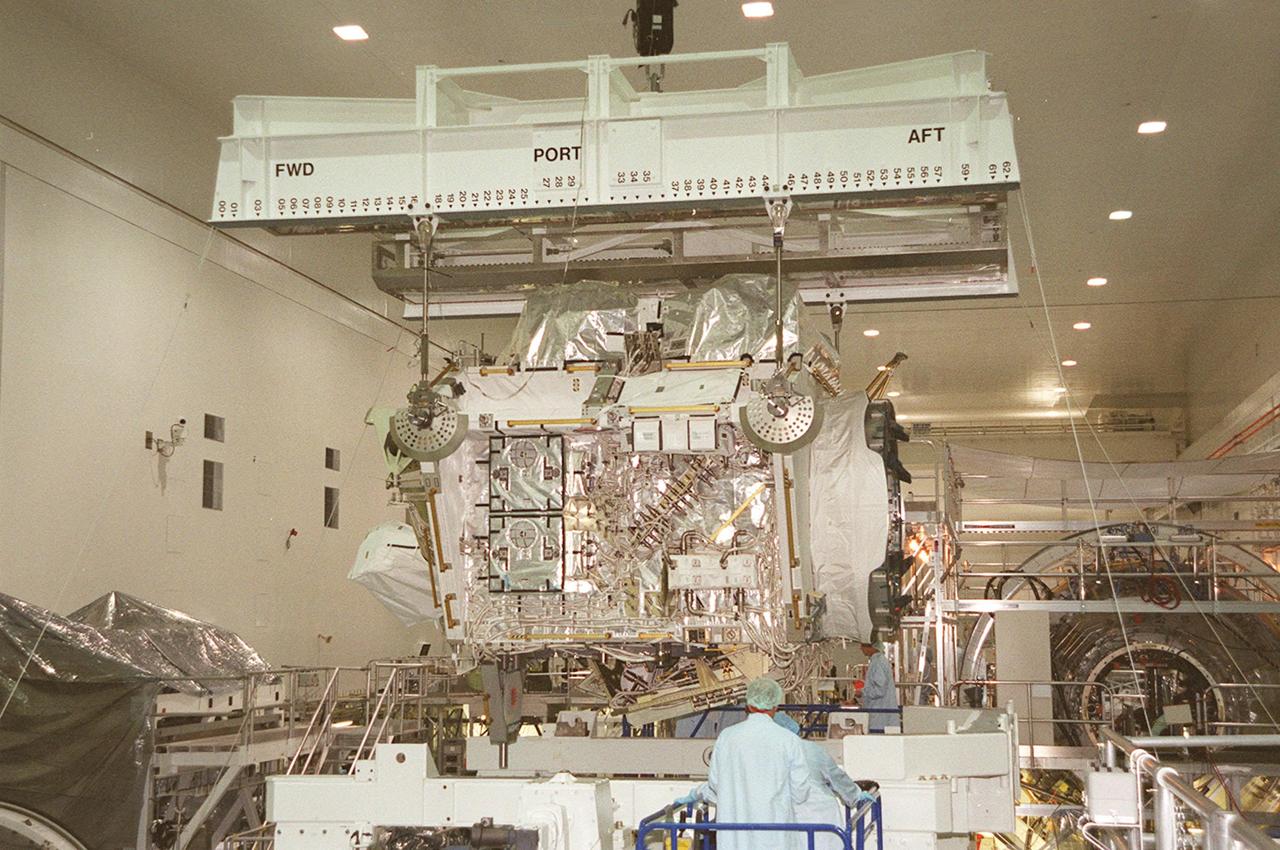
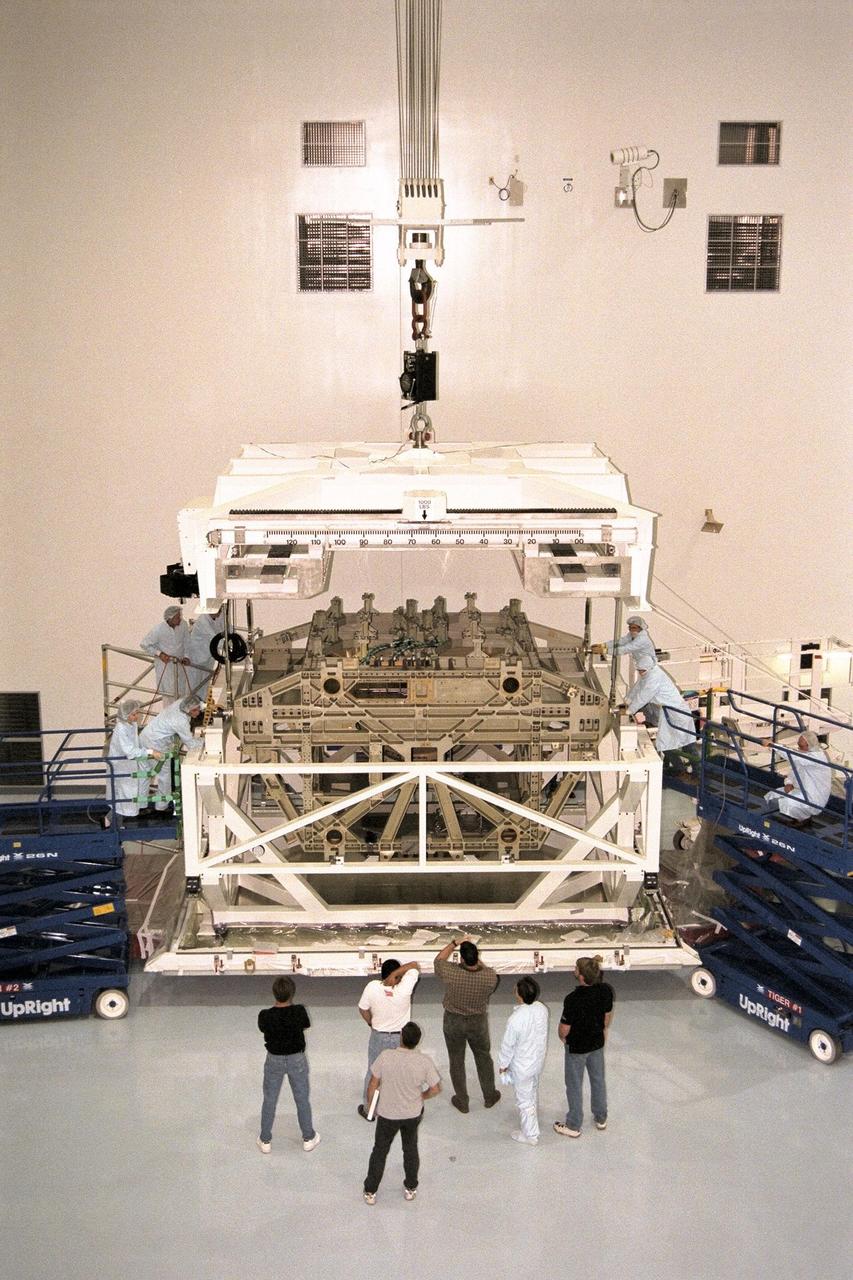
In the Space Station Processing Facility, the Integrated Truss Structure Z1, an element of the International Space Station, is lifted for moving to another stand to check its weight and balance. The Z1 truss is the first of 10 trusses that will become the backbone of the Space Station, eventually stretching the length of a football field. Along with its companion payload, the third Pressurized Mating Adapter, the Z1 is scheduled to be launched aboard Space Shuttle Discovery Oct. 5 at 9:38 p.m. EDT. The launch will be the 100th in the Shuttle program
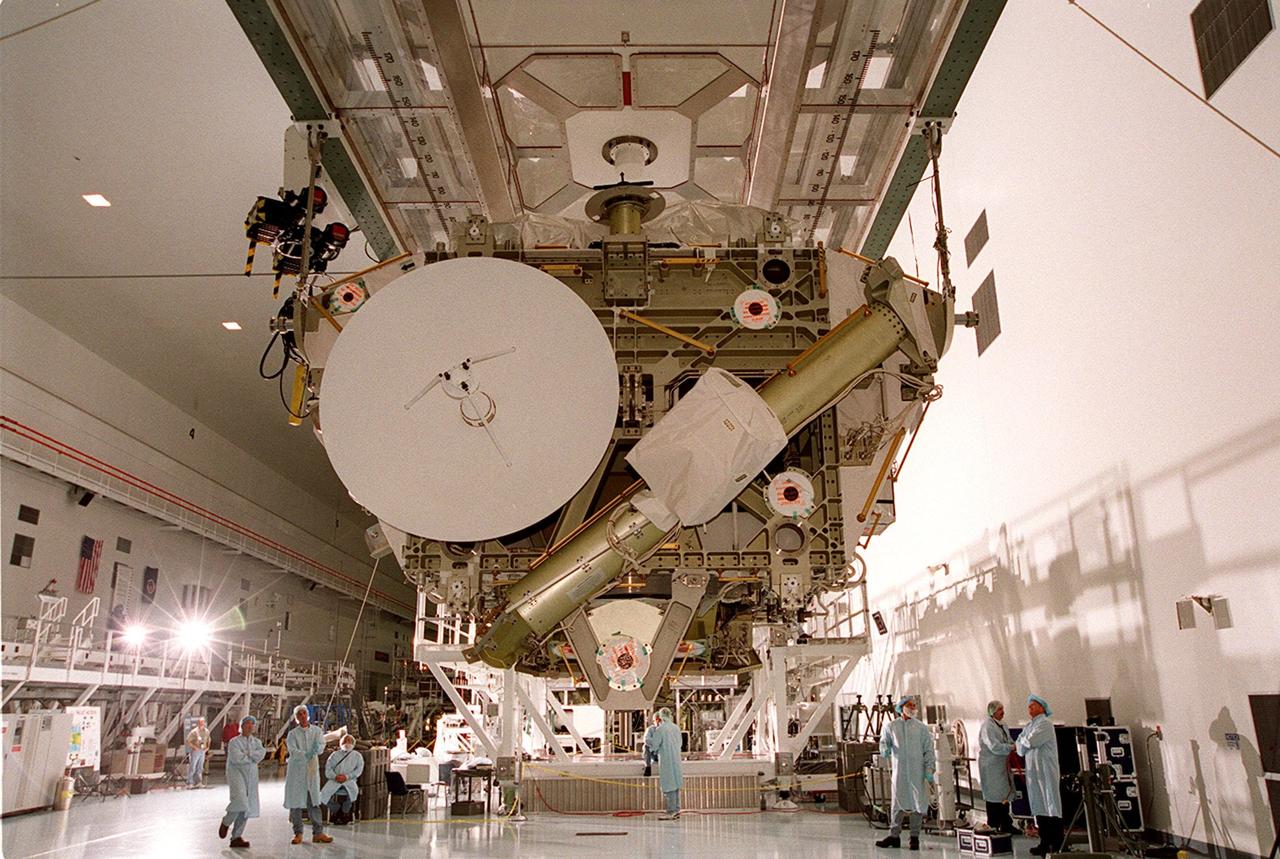
In the Space Station Processing Facility, workers watch as the Integrated Truss Structure Z1, an element of the International Space Station, is moved to another stand to check its weight and balance. The Z1 truss is the first of 10 trusses that will become the backbone of the Space Station, eventually stretching the length of a football field. Along with its companion payload, the third Pressurized Mating Adapter, the Z1 is scheduled to be launched aboard Space Shuttle Discovery Oct. 5 at 9:38 p.m. EDT. The launch will be the 100th in the Shuttle program
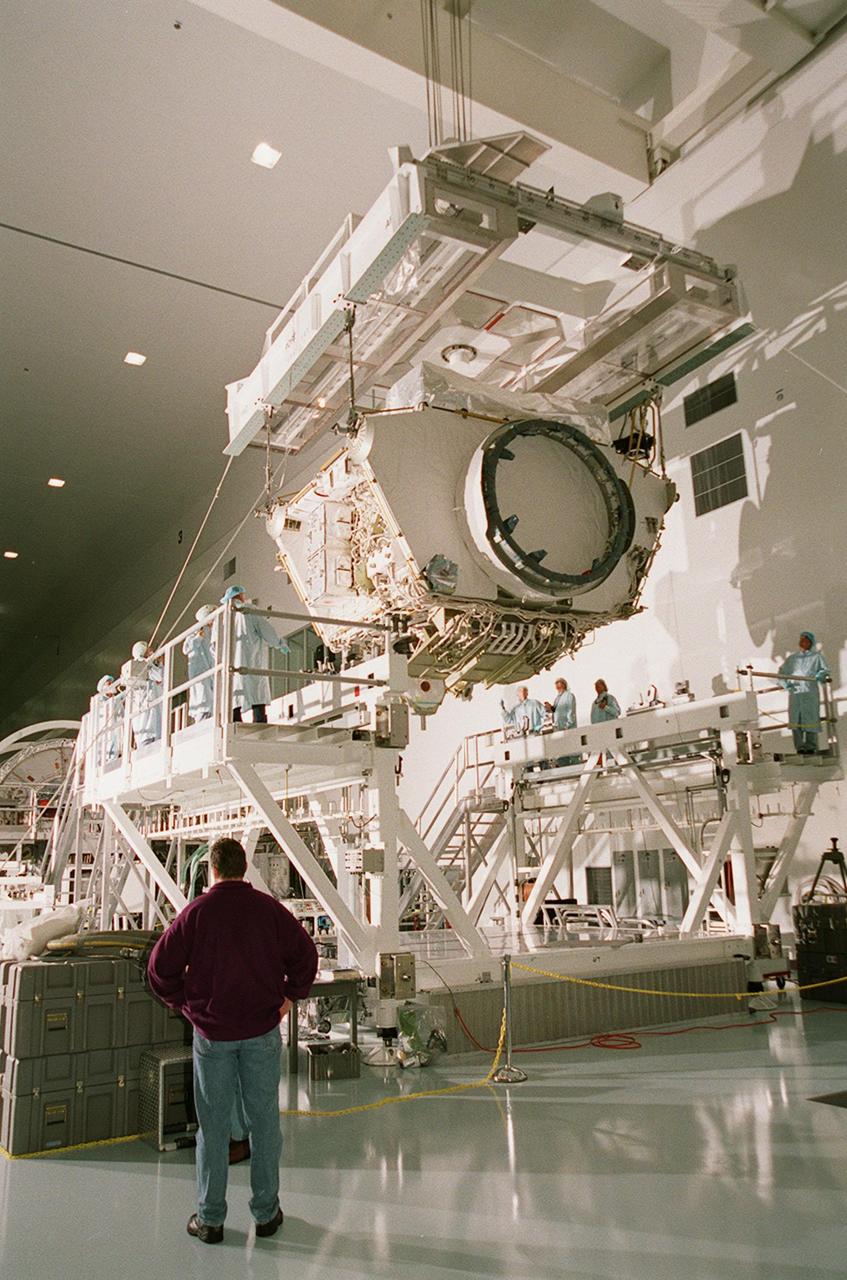
In the Space Station Processing Facility, an overhead crane lowers the Integrated Truss Structure Z1 onto a workstand to check its weight and balance. The Z1 truss is the first of 10 trusses that will become the backbone of the International Space Station, eventually stretching the length of a football field. Along with its companion payload, the third Pressurized Mating Adapter, the Z1 is scheduled to be launched aboard Space Shuttle Discovery Oct. 5 at 9:38 p.m. EDT. The launch will be the 100th in the Shuttle program
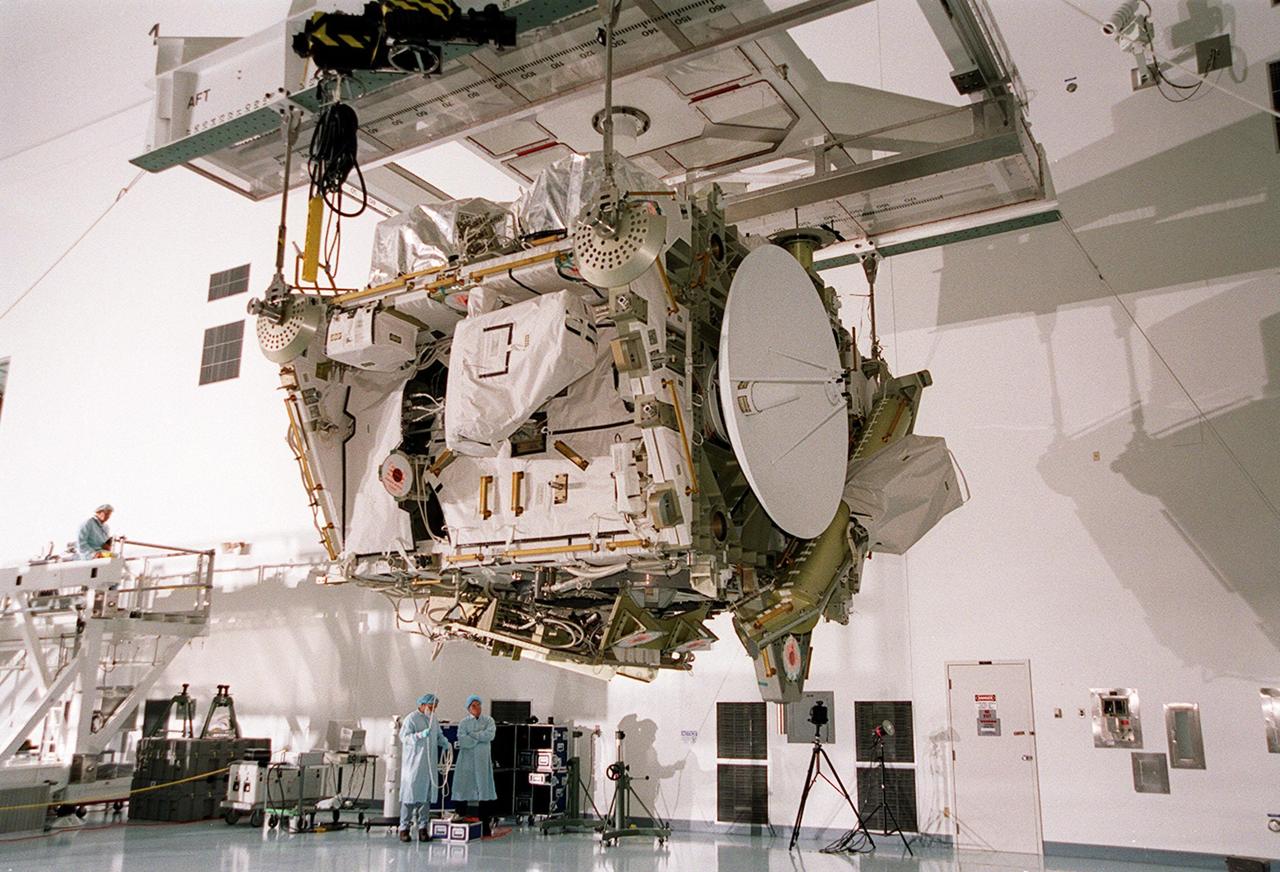
In the Space Station Processing Facility, the Integrated Truss Structure Z1, an element of the International Space Station, is moved to another stand to check its weight and balance. The Z1 truss is the first of 10 trusses that will become the backbone of the Space Station, eventually stretching the length of a football field. Along with its companion payload, the third Pressurized Mating Adapter, the Z1 is scheduled to be launched aboard Space Shuttle Discovery Oct. 5 at 9:38 p.m. EDT. The launch will be the 100th in the Shuttle program
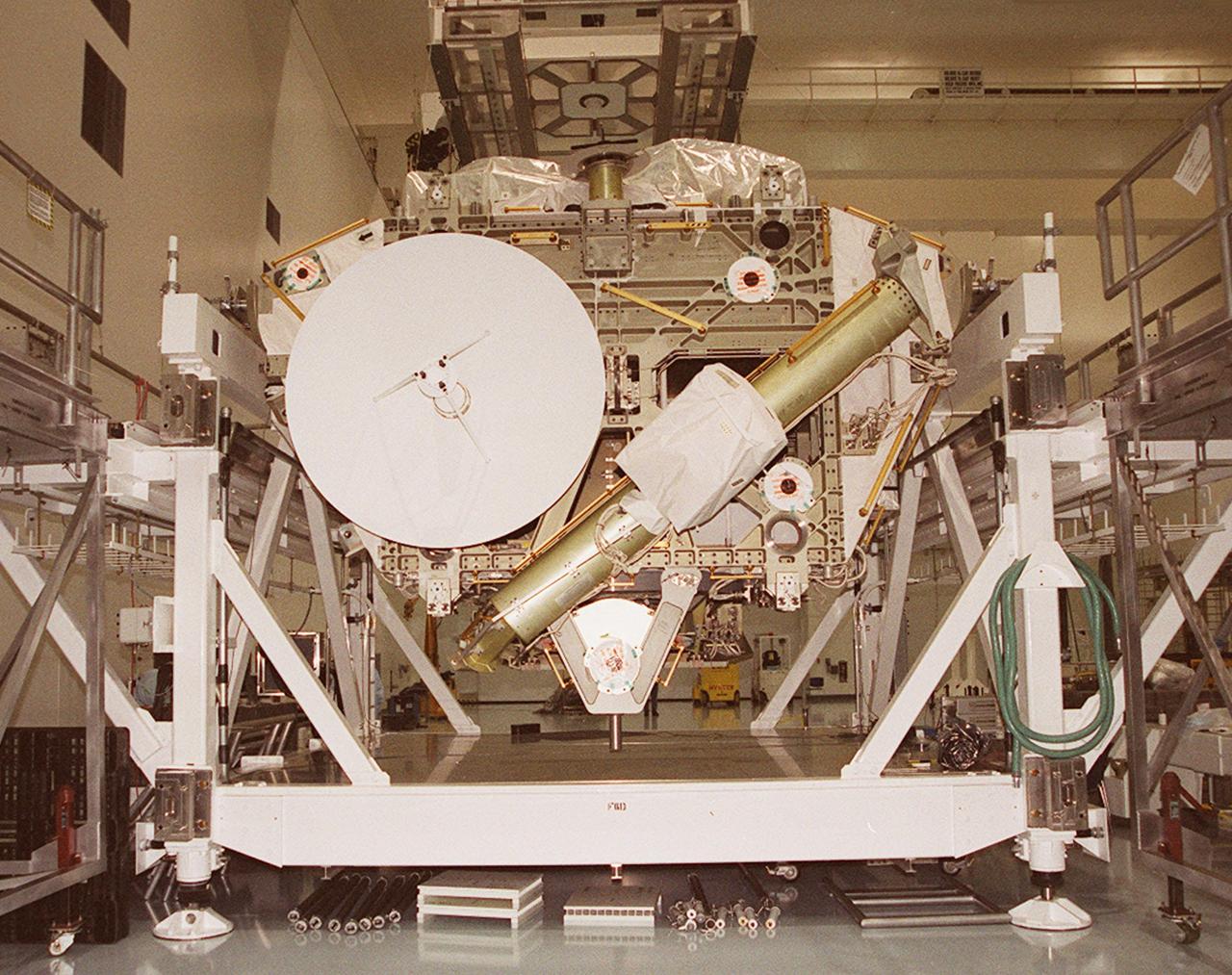
In the Space Station Processing Facility, the Integrated Truss Structure Z1 rests in the workstand to check its weight and balance. The Z1 truss is the first of 10 trusses that will become the backbone of the International Space Station, eventually stretching the length of a football field. Along with its companion payload, the third Pressurized Mating Adapter, the Z1 is scheduled to be launched aboard Space Shuttle Discovery Oct. 5 at 9:38 p.m. EDT. The launch will be the 100th in the Shuttle program

KENNEDY SPACE CENTER, Fla. -- With the onset of dawn, the payload canister (left) with the Integrated Truss Structure Z1 inside begins its journey up the side of the Rotating Service Structure to the Payload Changeout Room. There the Z1 truss will be removed and later transferred to Space Shuttle Discovery’s payload bay. The Z1 truss is the first of 10 that will become the backbone of the International Space Station, eventually stretching the length of a football field. Along with its companion payload, the third Pressurized Mating Adapter, the Z1 is scheduled to be launched aboard Discovery Oct. 5 at 9:38 p.m. EDT
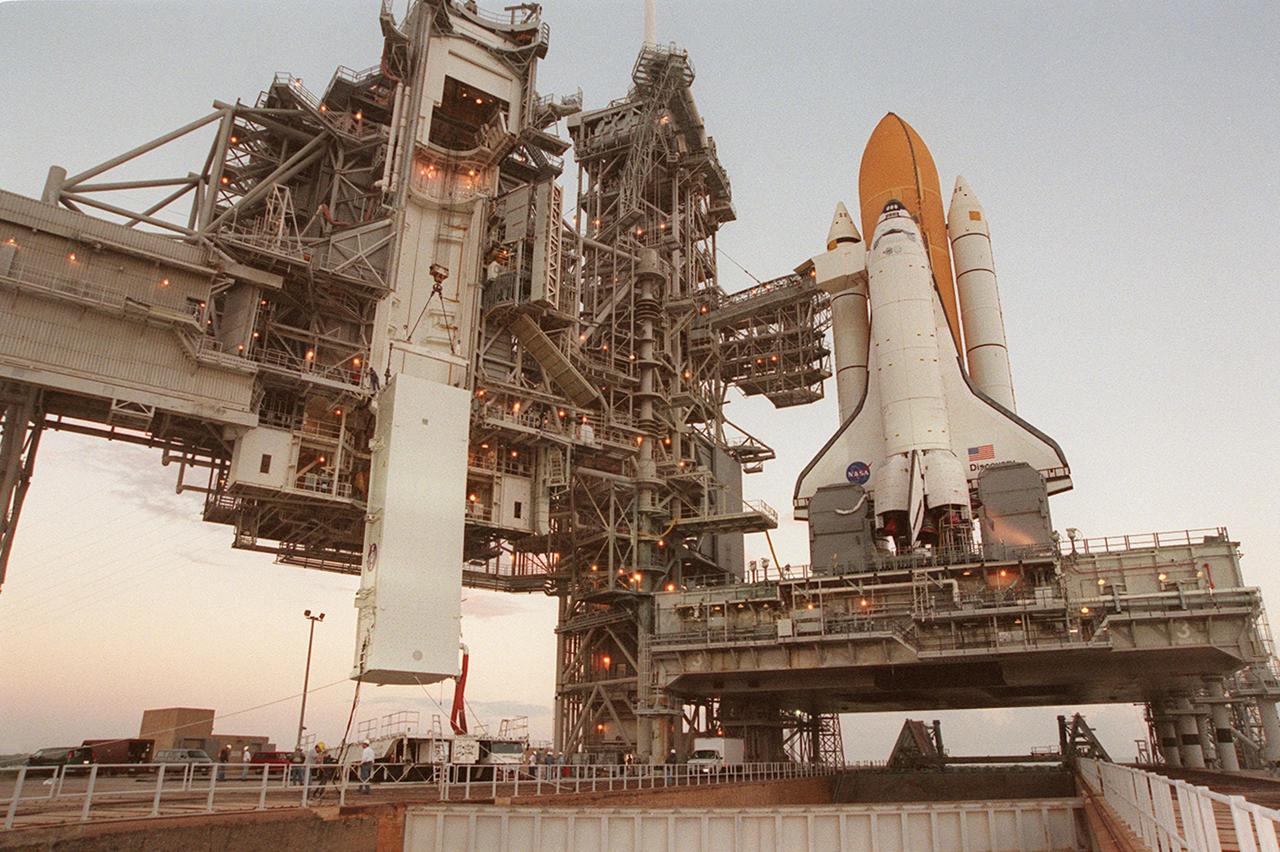
KENNEDY SPACE CENTER, Fla. -- As the sky grows lighter, , the payload canister (left) with the Integrated Truss Structure Z1 inside is slowly lifted up the side of the Rotating Service Structure to the Payload Changeout Room. There the Z1 truss will be removed and later transferred to Space Shuttle Discovery’s payload bay. The Z1 truss is the first of 10 that will become the backbone of the International Space Station, eventually stretching the length of a football field. Along with its companion payload, the third Pressurized Mating Adapter, the Z1 is scheduled to be launched aboard Discovery Oct. 5 at 9:38 p.m. EDT
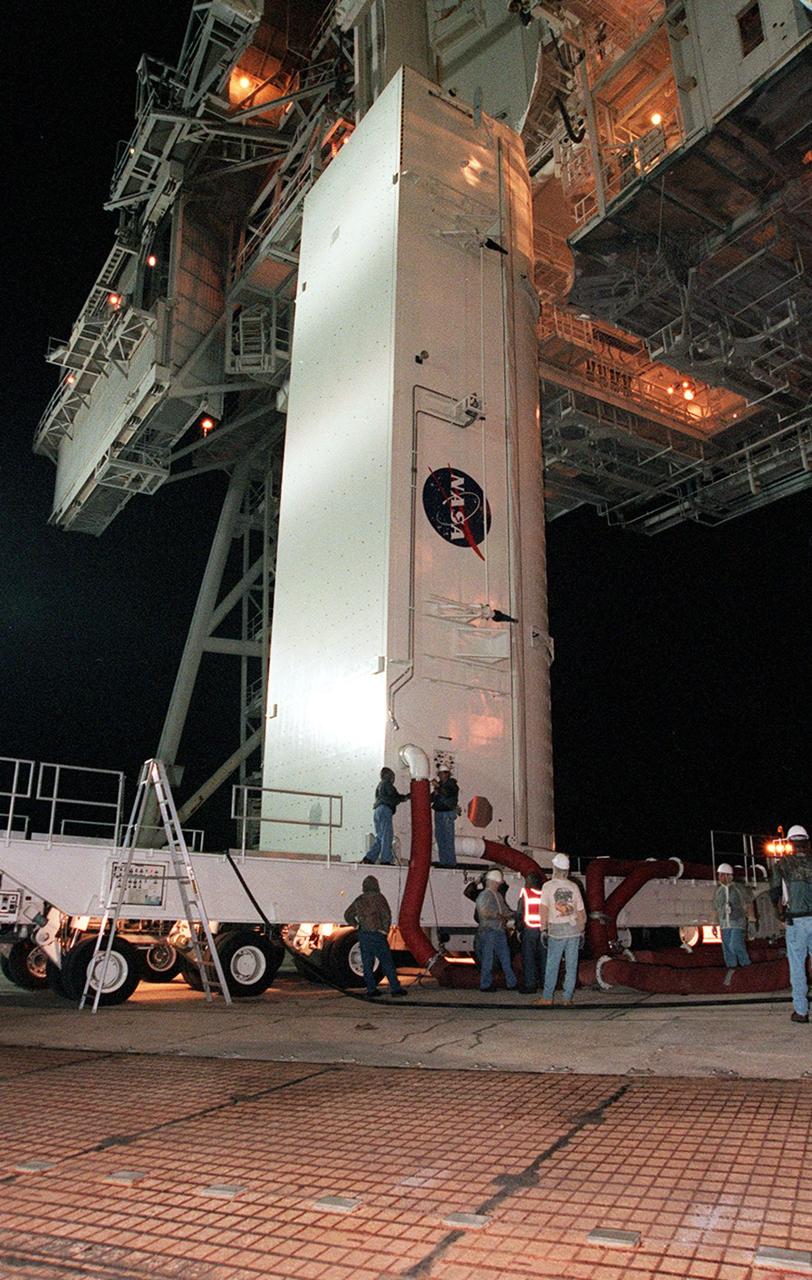
KENNEDY SPACE CENTER, Fla. -- At Launch Pad 39A, workers attach umbilical hoses onto the payload canister with the Integrated Truss Structure Z1 inside. The hoses will maintain the environmentally controlled environment while the canister is lifted up the Rotating Service Structure to the Payload Changeout Room. There the Z1 truss will be removed and later transferred to Space Shuttle Discovery’s payload bay. The Z1 truss is the first of 10 that will become the backbone of the International Space Station, eventually stretching the length of a football field. Along with its companion payload, the third Pressurized Mating Adapter, the Z1 is scheduled to be launched aboard Discovery Oct. 5 at 9:38 p.m. EDT
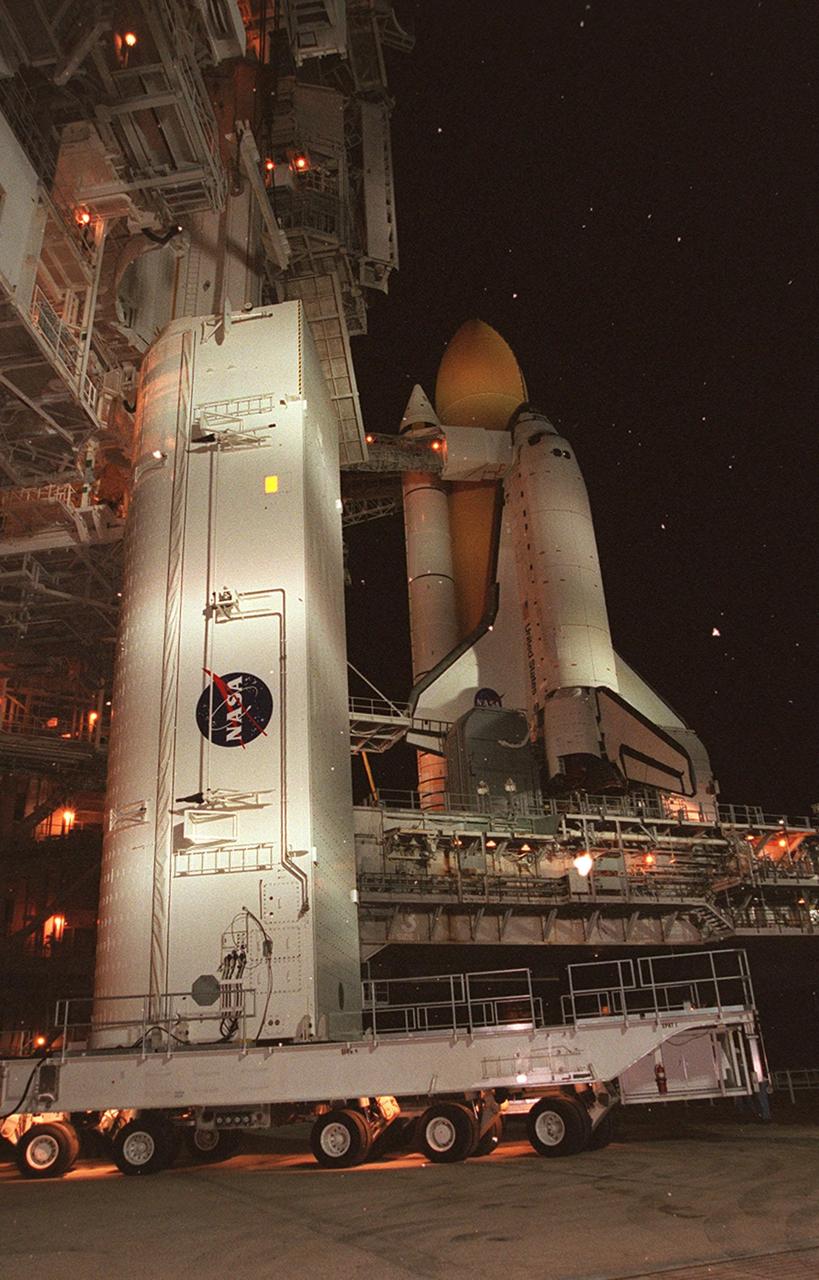
KENNEDY SPACE CENTER, Fla. -- At Launch Pad 39A, the payload canister with the Integrated Truss Structure Z1 inside arrives at the spot under the Rotating Service Structure where the canister can be lifted to the Payload Changeout Room. There the Z1 truss will be removed and later transferred to Space Shuttle Discovery’s payload bay. Discovery is at right, sitting atop the Mobile Launcher Platform. The Z1 truss is the first of 10 that will become the backbone of the International Space Station, eventually stretching the length of a football field. Along with its companion payload, the third Pressurized Mating Adapter, the Z1 is scheduled to be launched aboard Discovery Oct. 5 at 9:38 p.m. EDT
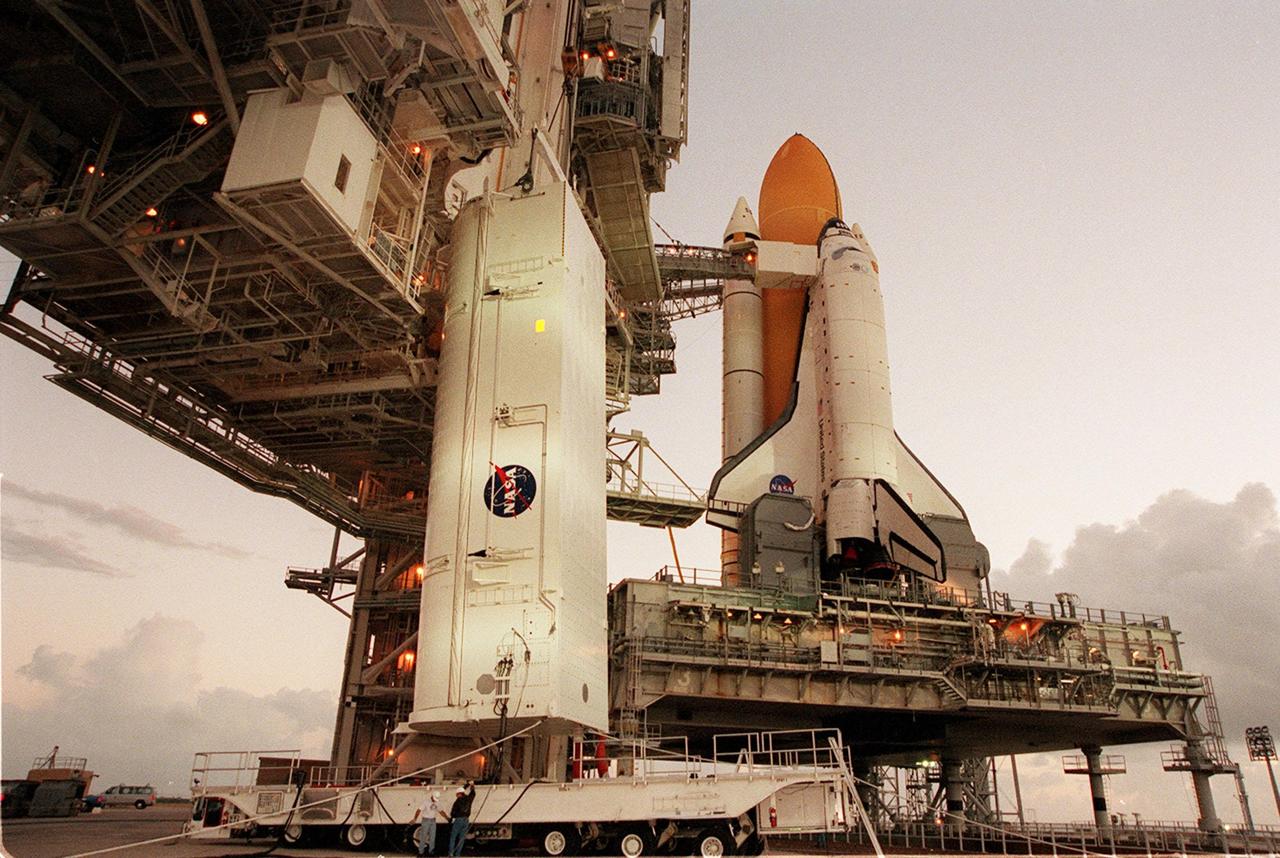
KENNEDY SPACE CENTER, Fla. -- With the onset of dawn, the payload canister (left) with the Integrated Truss Structure Z1 inside begins its journey up the side of the Rotating Service Structure to the Payload Changeout Room. There the Z1 truss will be removed and later transferred to Space Shuttle Discovery’s payload bay. The Z1 truss is the first of 10 that will become the backbone of the International Space Station, eventually stretching the length of a football field. Along with its companion payload, the third Pressurized Mating Adapter, the Z1 is scheduled to be launched aboard Discovery Oct. 5 at 9:38 p.m. EDT
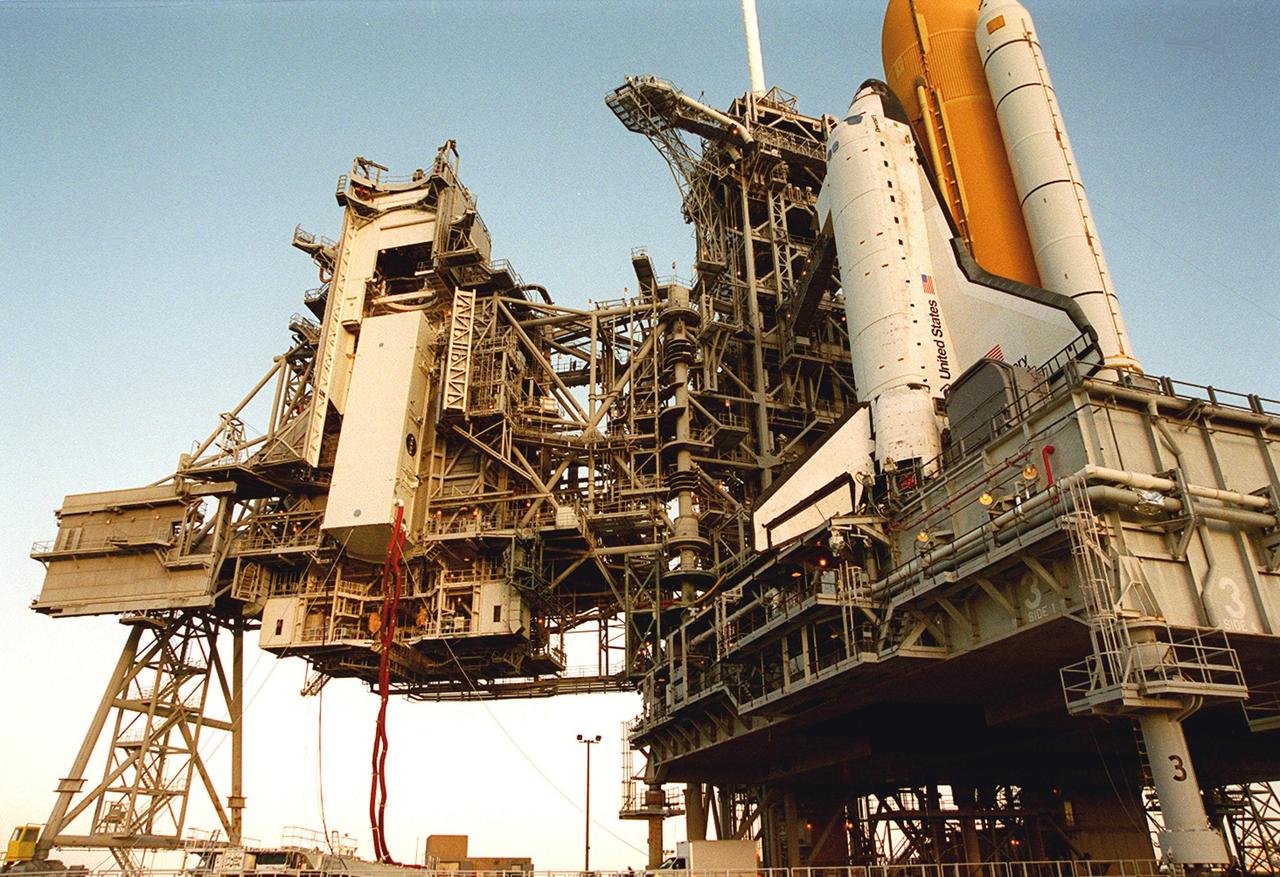
KENNEDY SPACE CENTER, Fla. -- With its umbilical hoses stretched out, the payload canister (left) with the Integrated Truss Structure Z1 inside nears the top of the passage to the Payload Changeout Room. There the Z1 truss will be removed and later transferred to Space Shuttle Discovery’s payload bay. The Z1 truss is the first of 10 that will become the backbone of the International Space Station, eventually stretching the length of a football field. Along with its companion payload, the third Pressurized Mating Adapter, the Z1 is scheduled to be launched aboard Discovery Oct. 5 at 9:38 p.m. EDT
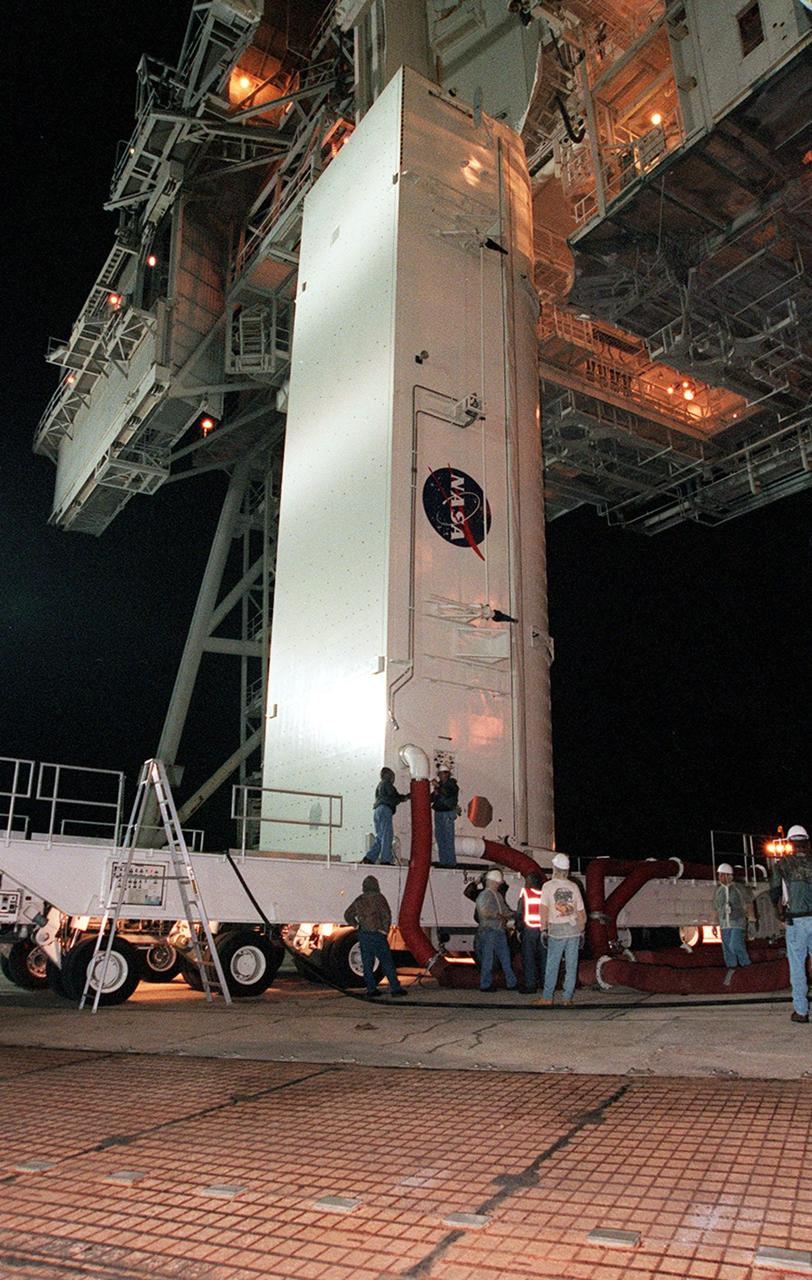
KENNEDY SPACE CENTER, Fla. -- At Launch Pad 39A, workers attach umbilical hoses onto the payload canister with the Integrated Truss Structure Z1 inside. The hoses will maintain the environmentally controlled environment while the canister is lifted up the Rotating Service Structure to the Payload Changeout Room. There the Z1 truss will be removed and later transferred to Space Shuttle Discovery’s payload bay. The Z1 truss is the first of 10 that will become the backbone of the International Space Station, eventually stretching the length of a football field. Along with its companion payload, the third Pressurized Mating Adapter, the Z1 is scheduled to be launched aboard Discovery Oct. 5 at 9:38 p.m. EDT
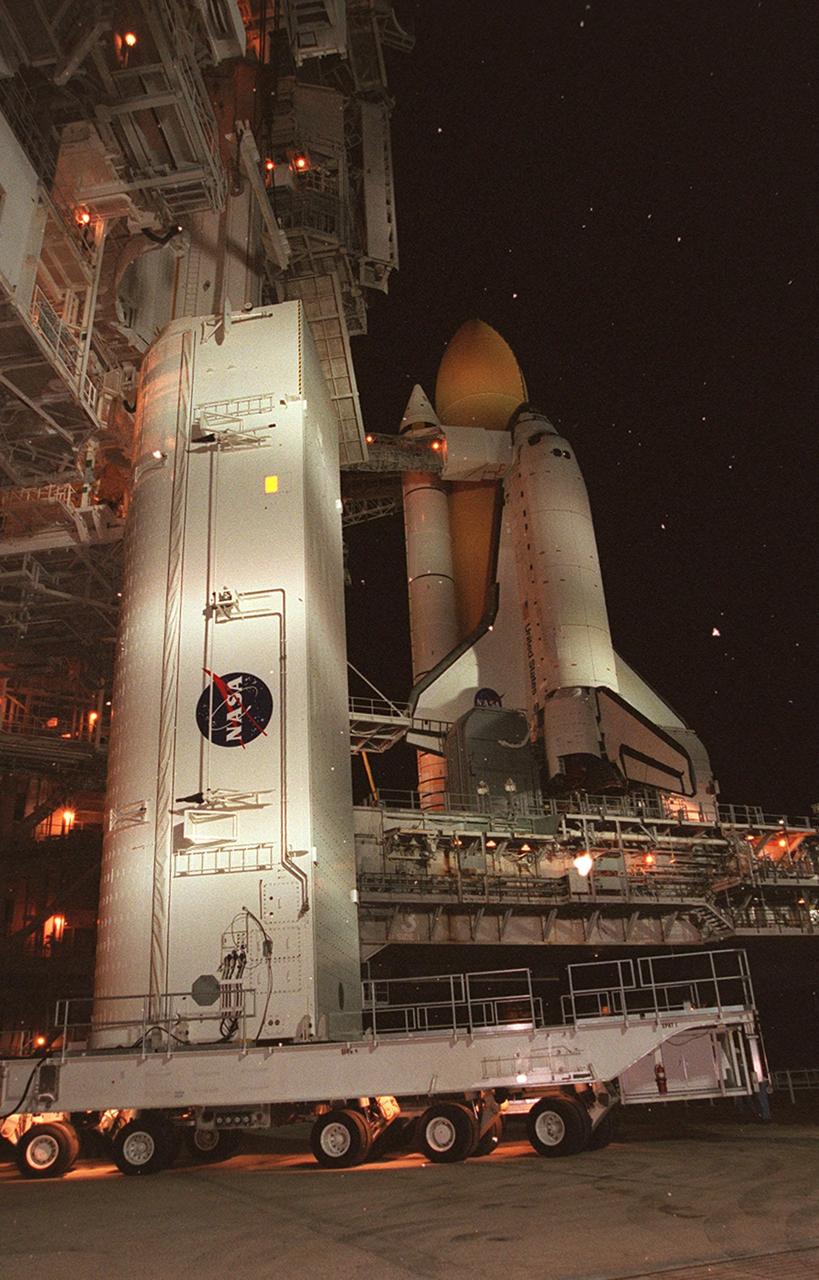
KENNEDY SPACE CENTER, Fla. -- At Launch Pad 39A, the payload canister with the Integrated Truss Structure Z1 inside arrives at the spot under the Rotating Service Structure where the canister can be lifted to the Payload Changeout Room. There the Z1 truss will be removed and later transferred to Space Shuttle Discovery’s payload bay. Discovery is at right, sitting atop the Mobile Launcher Platform. The Z1 truss is the first of 10 that will become the backbone of the International Space Station, eventually stretching the length of a football field. Along with its companion payload, the third Pressurized Mating Adapter, the Z1 is scheduled to be launched aboard Discovery Oct. 5 at 9:38 p.m. EDT
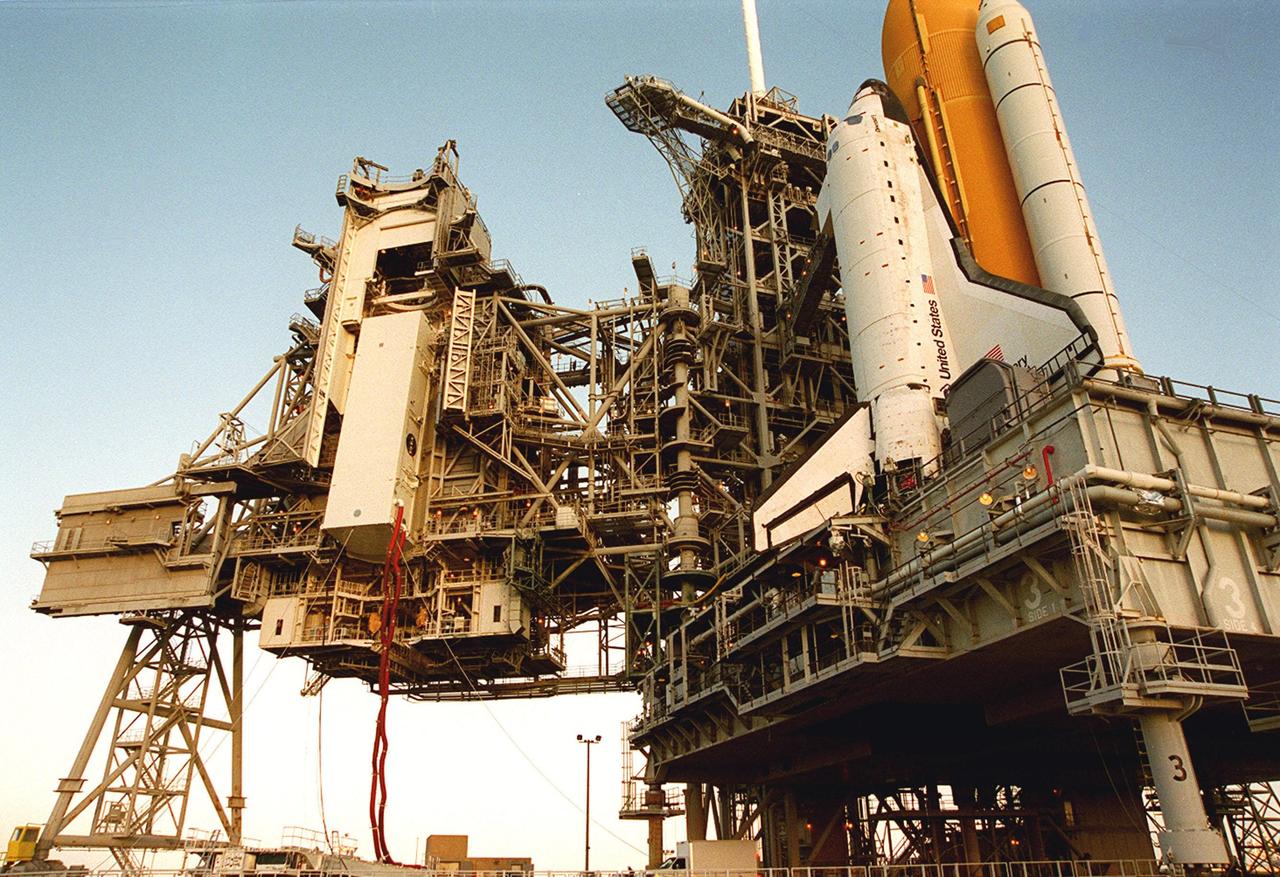
KENNEDY SPACE CENTER, Fla. -- With its umbilical hoses stretched out, the payload canister (left) with the Integrated Truss Structure Z1 inside nears the top of the passage to the Payload Changeout Room. There the Z1 truss will be removed and later transferred to Space Shuttle Discovery’s payload bay. The Z1 truss is the first of 10 that will become the backbone of the International Space Station, eventually stretching the length of a football field. Along with its companion payload, the third Pressurized Mating Adapter, the Z1 is scheduled to be launched aboard Discovery Oct. 5 at 9:38 p.m. EDT
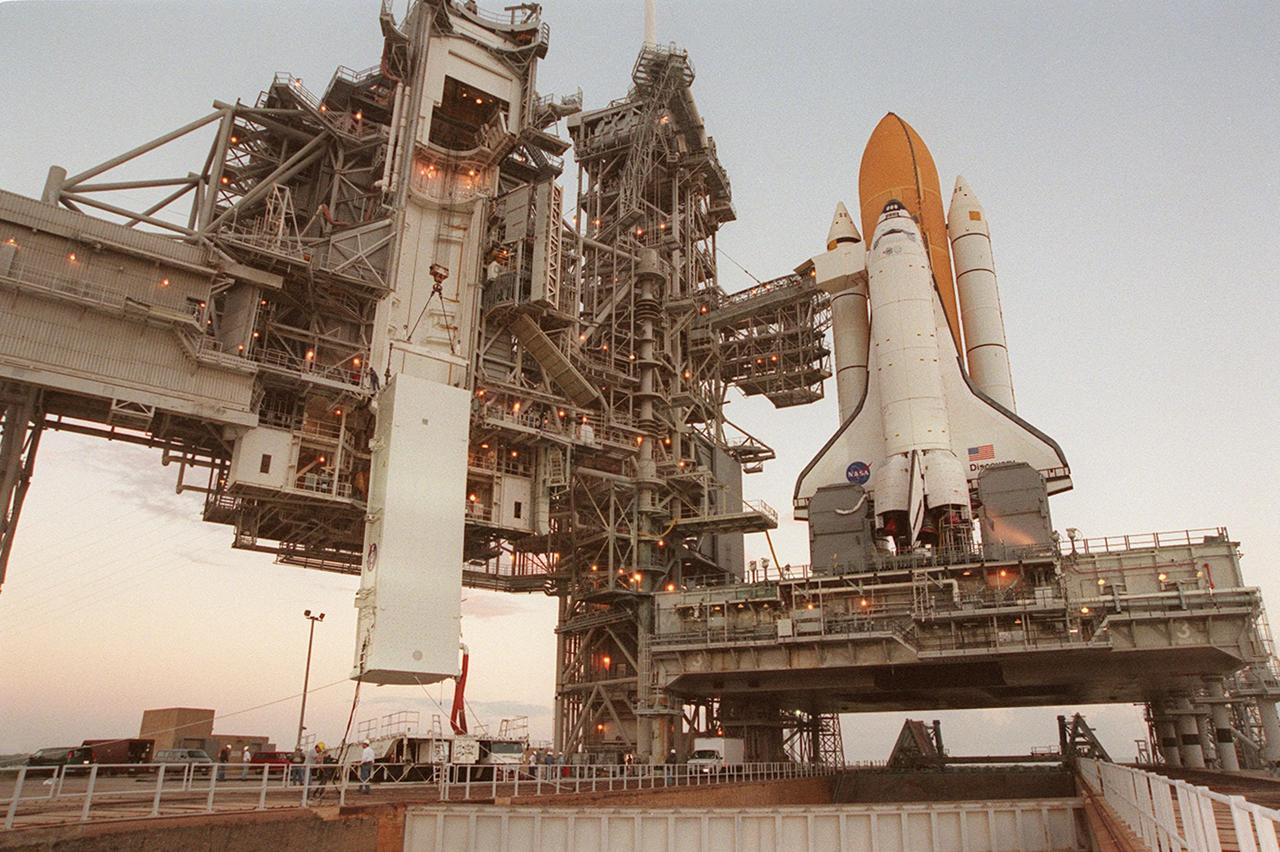
KENNEDY SPACE CENTER, Fla. -- As the sky grows lighter, , the payload canister (left) with the Integrated Truss Structure Z1 inside is slowly lifted up the side of the Rotating Service Structure to the Payload Changeout Room. There the Z1 truss will be removed and later transferred to Space Shuttle Discovery’s payload bay. The Z1 truss is the first of 10 that will become the backbone of the International Space Station, eventually stretching the length of a football field. Along with its companion payload, the third Pressurized Mating Adapter, the Z1 is scheduled to be launched aboard Discovery Oct. 5 at 9:38 p.m. EDT
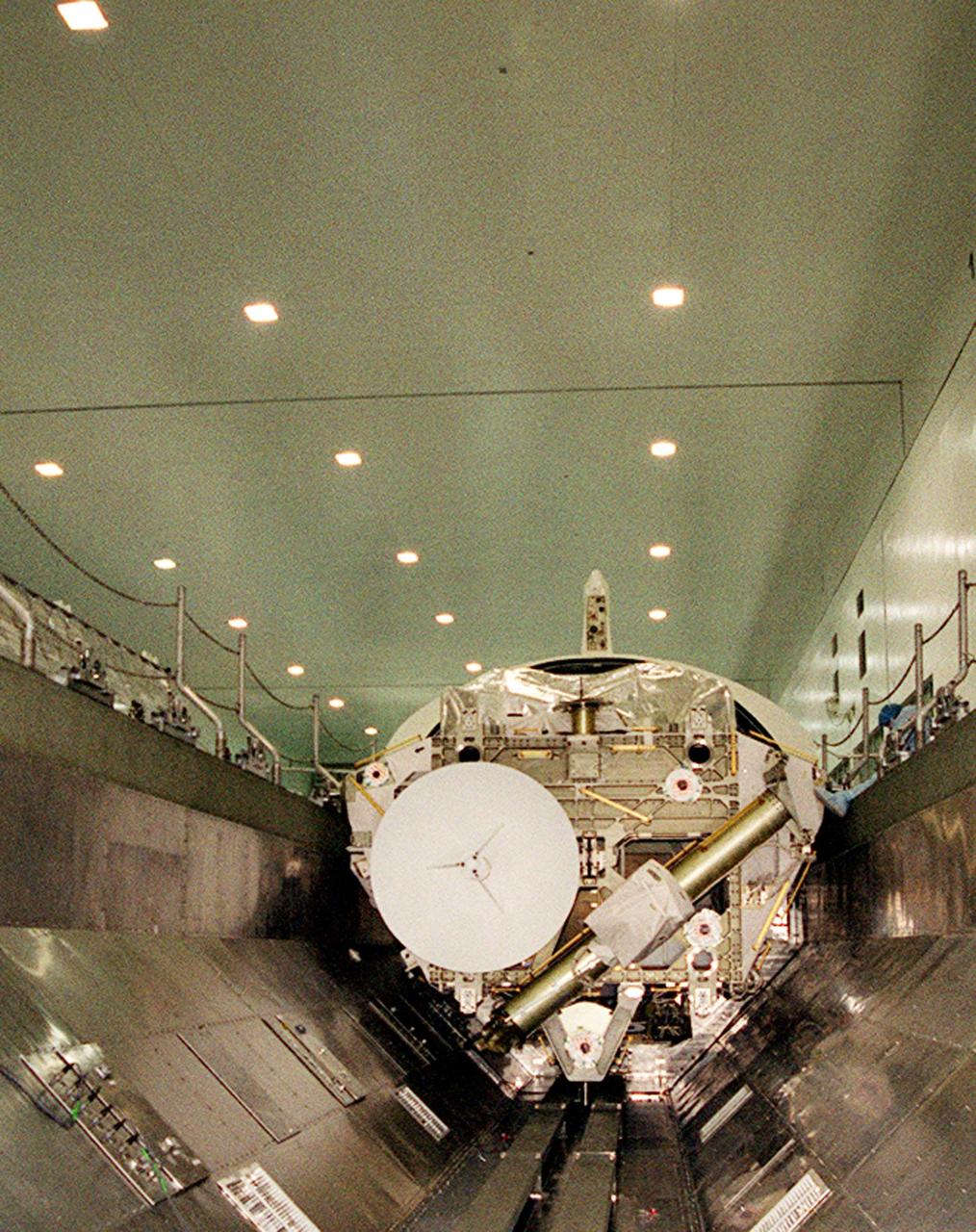
The Integrated Truss Structure Z1 rests on the bottom of the payload canister in this view from inside. Once it is secured, the truss will be transported from the Space Station Processing Facility to Launch Pad 39A. The Z1 is part of the payload on mission STS-92 scheduled to lift off Oct. 5, 2000

In the Space Station Processing Facility, photographers focus on the Integrated Truss Structure Z1, an element of the International Space Station, suspended by a crane overhead. The truss is being moved to another stand to check its weight and balance. The Z1 truss is the first of 10 trusses that will become the backbone of the Space Station, eventually stretching the length of a football field. Along with its companion payload, the third Pressurized Mating Adapter, the Z1 is scheduled to be launched aboard Space Shuttle Discovery Oct. 5 at 9:38 p.m. EDT. The launch will be the 100th in the Shuttle program
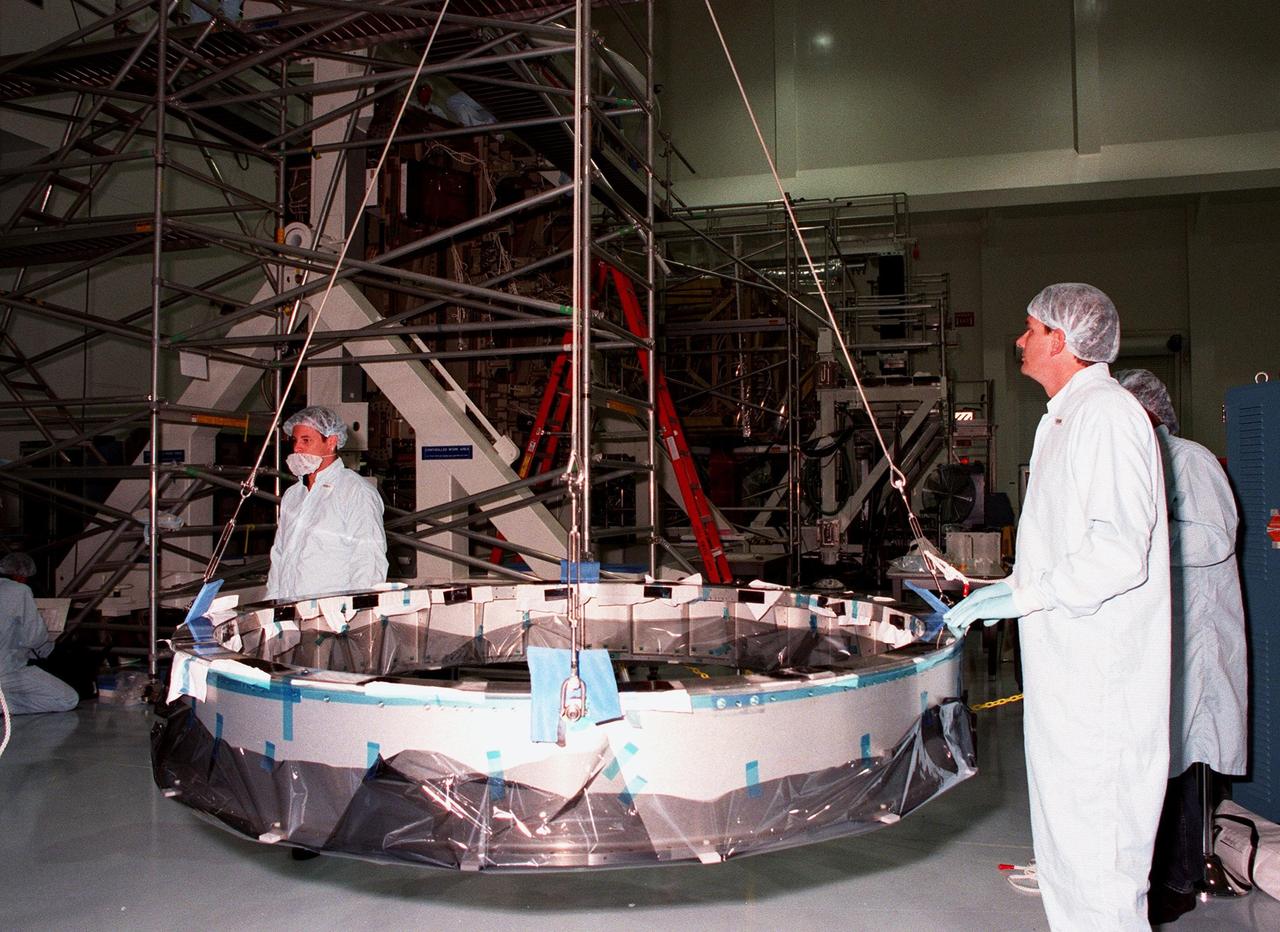
Workers in the Space Station Processing Facility watch as cables and a crane lift the Passive Common Berthing Mechanism (PCBM) before mating it to the Z1 integrated truss structure, a component of the International Space Station (ISS). The Z1 truss will be used for the temporary installation of the P6 truss segment to the Unity connecting module. The P6 truss segment contains the solar arrays and batteries which will provide early station power. The truss is scheduled to be launched aboard STS-92 in late 1999
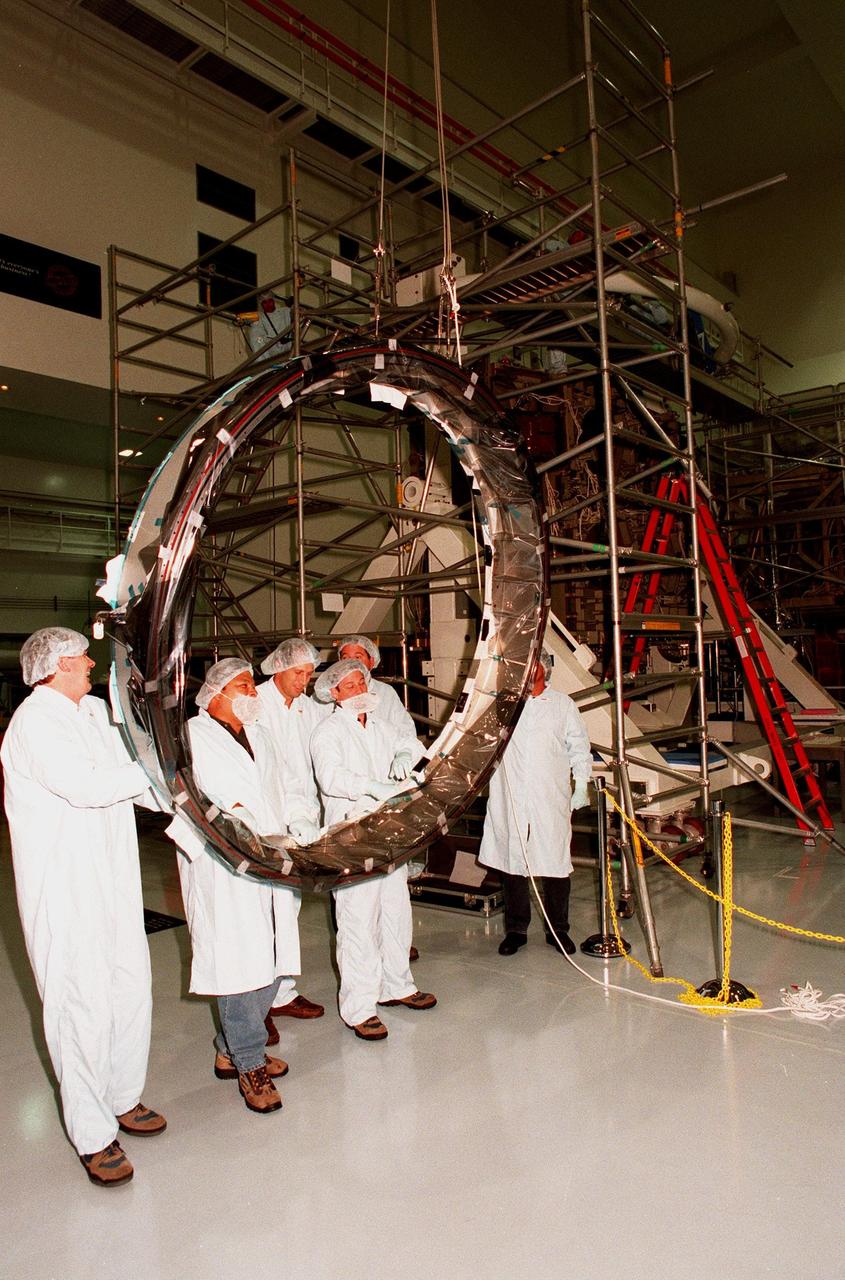
Workers in the Space Station Processing Facility look at the Passive Common Berthing Mechanism (PCBM) that will be attached to the Z1 integrated truss structure, a component of the International Space Station (ISS). The Z1 truss will be used for the temporary installation of the P6 truss segment to the Unity connecting module. The P6 truss segment contains the solar arrays and batteries which will provide early station power. The truss is scheduled to be launched aboard STS-92 in late 1999
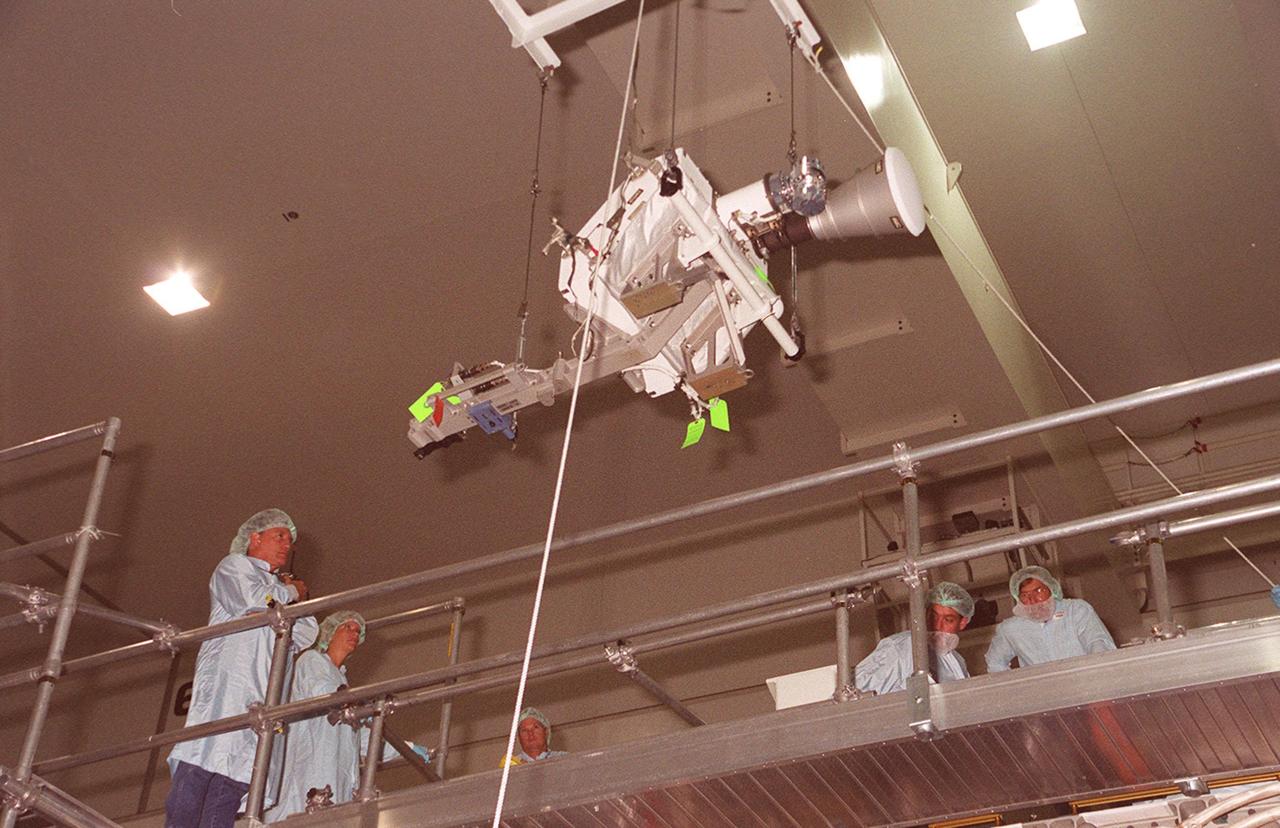
An overhead crane in the Space Station Processing Facility moves an S-band Antenna Support Assembly (SASA) to the Integrated Truss Structure (ITS) Z1, an element of the International Space Station. . The antenna will be attached to the truss. The SASA antenna is primarily for local communications between the orbiter and Space Station. The Z1 is an early exterior framework to allow the first U.S. solar arrays, on mission STS-97, flight 4A, to be temporarily installed on Unity for early power. The Z1 is scheduled on mission STS-92, the fifth flight to the Space Station, in the fall
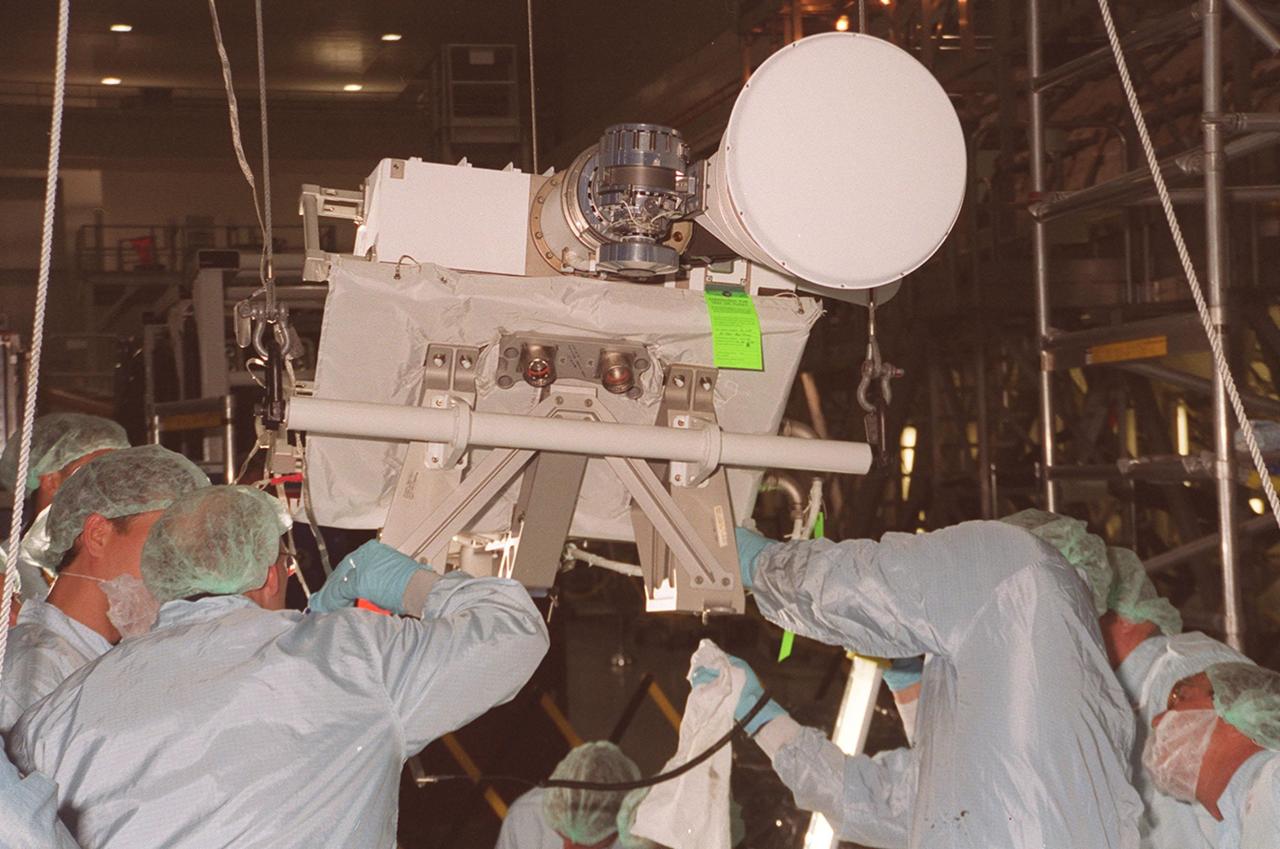
In the Space Station Processing Facility, workers prepare an S-band Antenna Support Assembly (SASA) to be lifted and moved to the Integrated Truss Structure (ITS) Z1, an element of the International Space Station. The antenna will be attached to the truss. The SASA antenna is primarily for local communications between the orbiter and Space Station. The Z1 is an early exterior framework to allow the first U.S. solar arrays, on mission STS-97, flight 4A, to be temporarily installed on Unity for early power. The Z1 is scheduled on mission STS-92, the fifth flight to the Space Station, in the fall
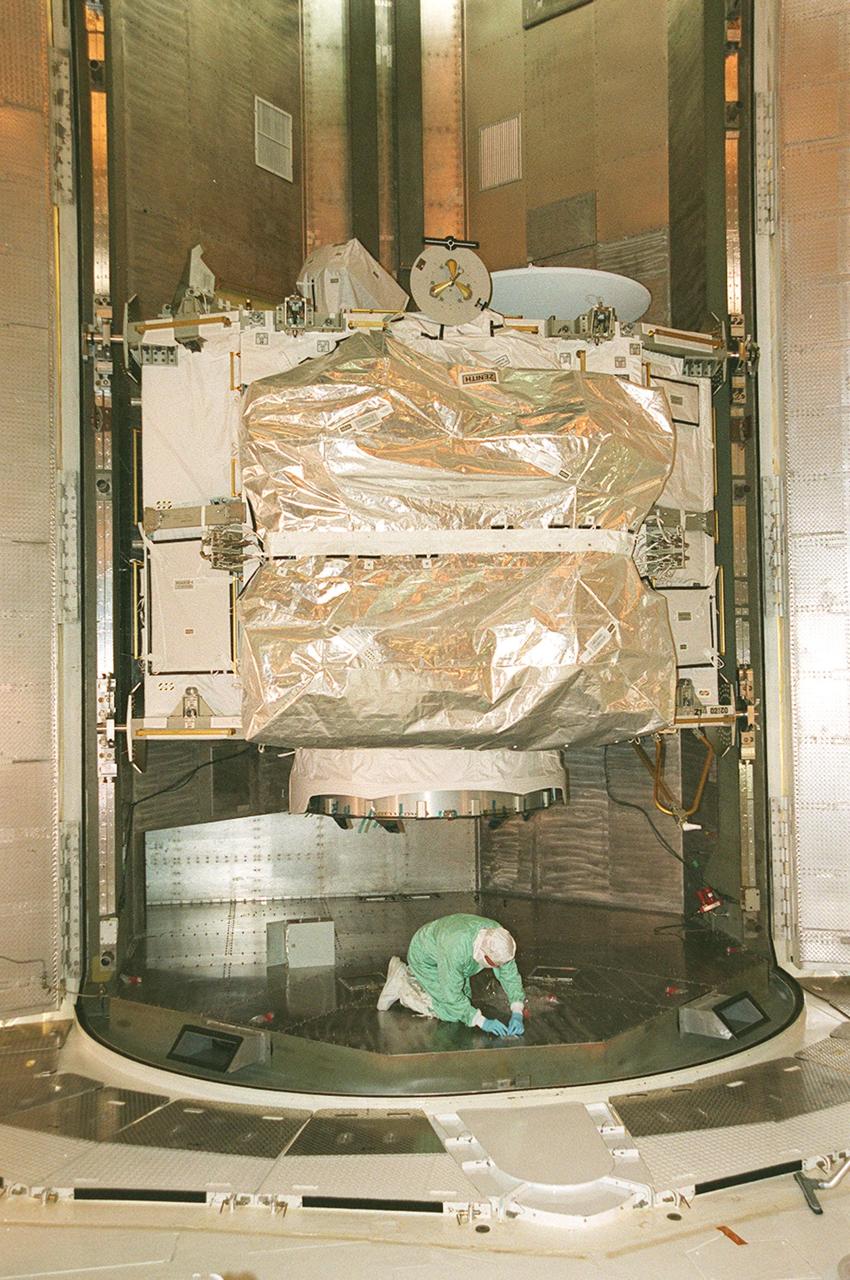
Inside the Payload Changeout Room (PCR), a worker makes sure the Integrated Truss Structure Z1 is ready to be moved into the payload bay of Space Shuttle Discovery. The Z1 truss is the first of 10 that will become the backbone of the International Space Station, eventually stretching the length of a football field. Along with its companion payload, the third Pressurized Mating Adapter, the Z1 is scheduled to be launched aboard Discovery Oct. 5 at 9:38 p.m. EDT
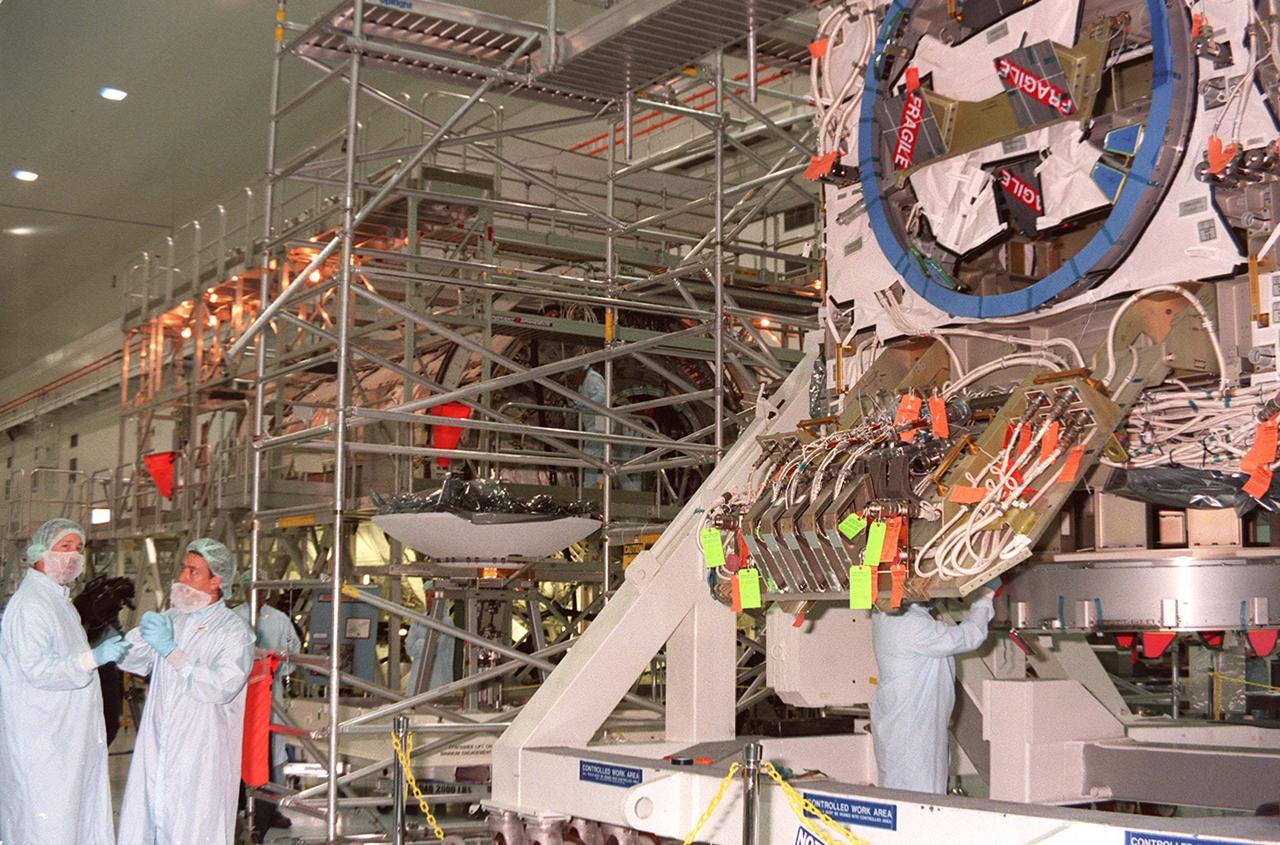
Workers at left stand by while work is done on the Integrated Truss Structure (ITS) Z1 at right. To the left of the Z1 is a high-gain antenna that will be installed on the Z1. An early exterior framework for the International Space Station, the Z1 will allow the first U.S. solar arrays, on mission STS-97, flight 4A, to be temporarily installed on Unity for early power. The Z1 is a payload scheduled on mission STS-92, the fifth flight to the Space Station, in the fall
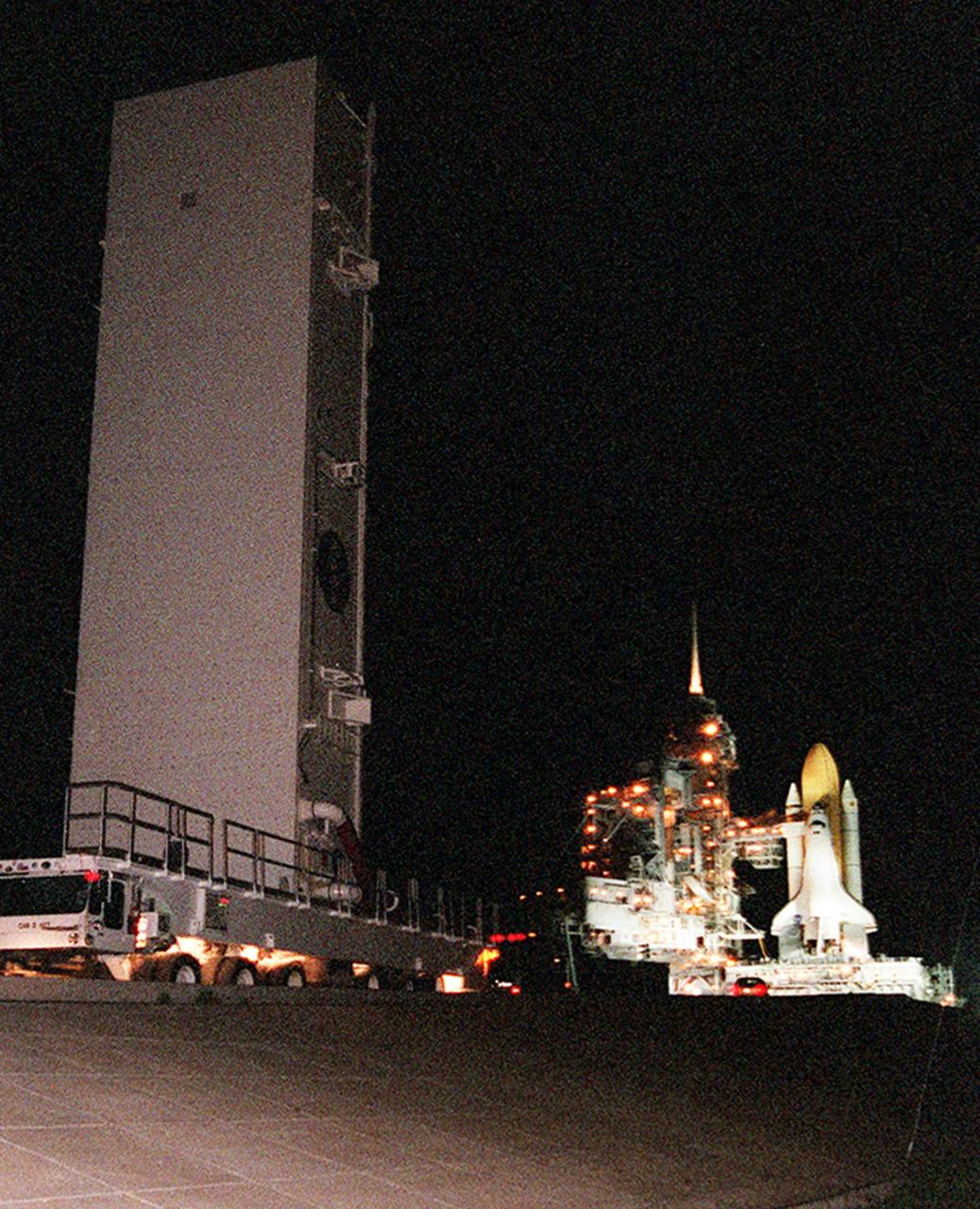
KENNEDY SPACE CENTER, Fla. -- Before dawn, the payload canister (left) with the Integrated Truss Structure Z1 moves slowly up the crawlerway ramp on Launch Pad 39A toward Space Shuttle Discovery in the background. The canister will be lifted up the Rotating Service Structure to the Payload Changeout Room where the Z1 will be removed and transferred to Discovery’s payload bay. The Z1 truss is the first of 10 that will become the backbone of the International Space Station, eventually stretching the length of a football field. Along with its companion payload, the third Pressurized Mating Adapter, the Z1 is scheduled to be launched aboard Discovery Oct. 5 at 9:38 p.m. EDT
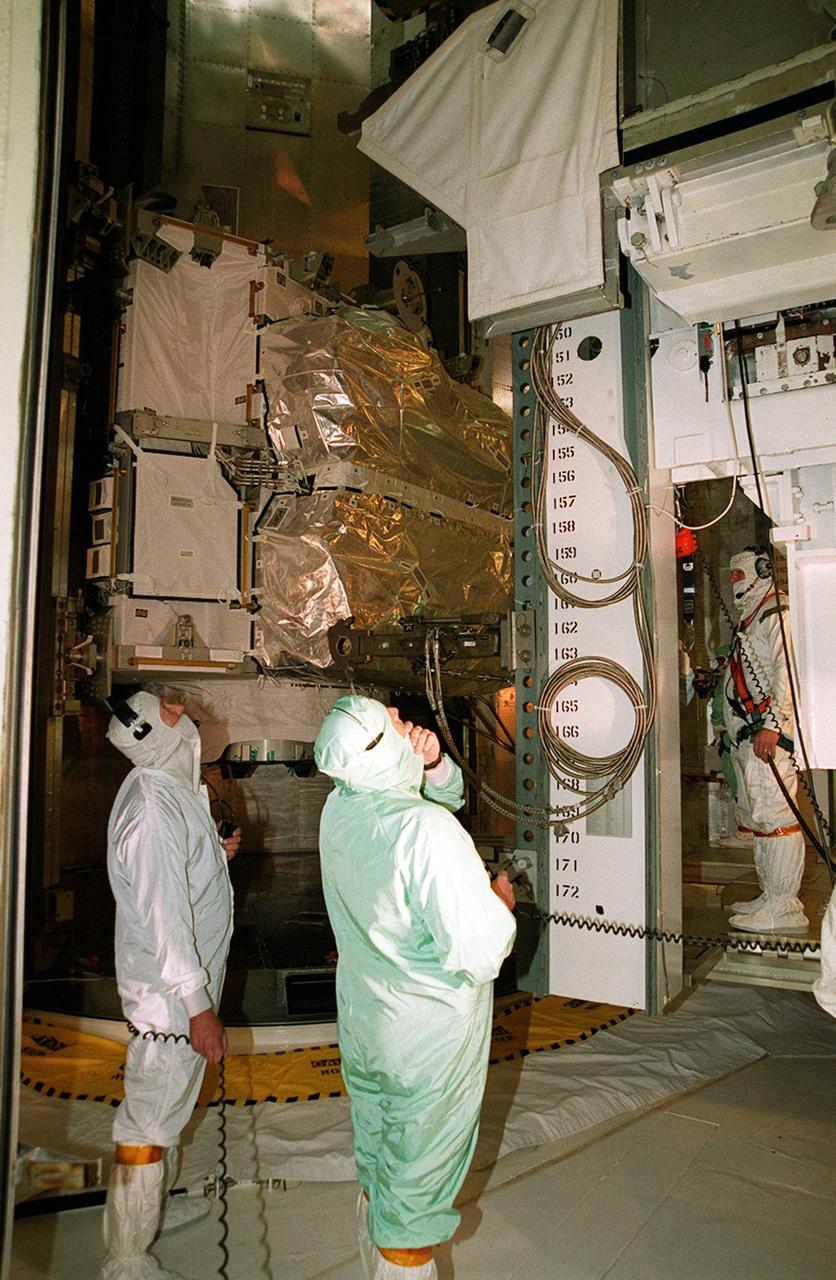
Inside the Payload Changeout Room (PCR), workers check the controls on movement of the Integrated Truss Structure Z1 behind them into the PCR from the payload canister. Once sealed inside the PCR, workers will get ready to move the Z1 into the payload bay of Space Shuttle Discovery. The Z1 truss is the first of 10 that will become the backbone of the International Space Station, eventually stretching the length of a football field. Along with its companion payload, the third Pressurized Mating Adapter, the Z1 is scheduled to be launched aboard Discovery Oct. 5 at 9:38 p.m. EDT
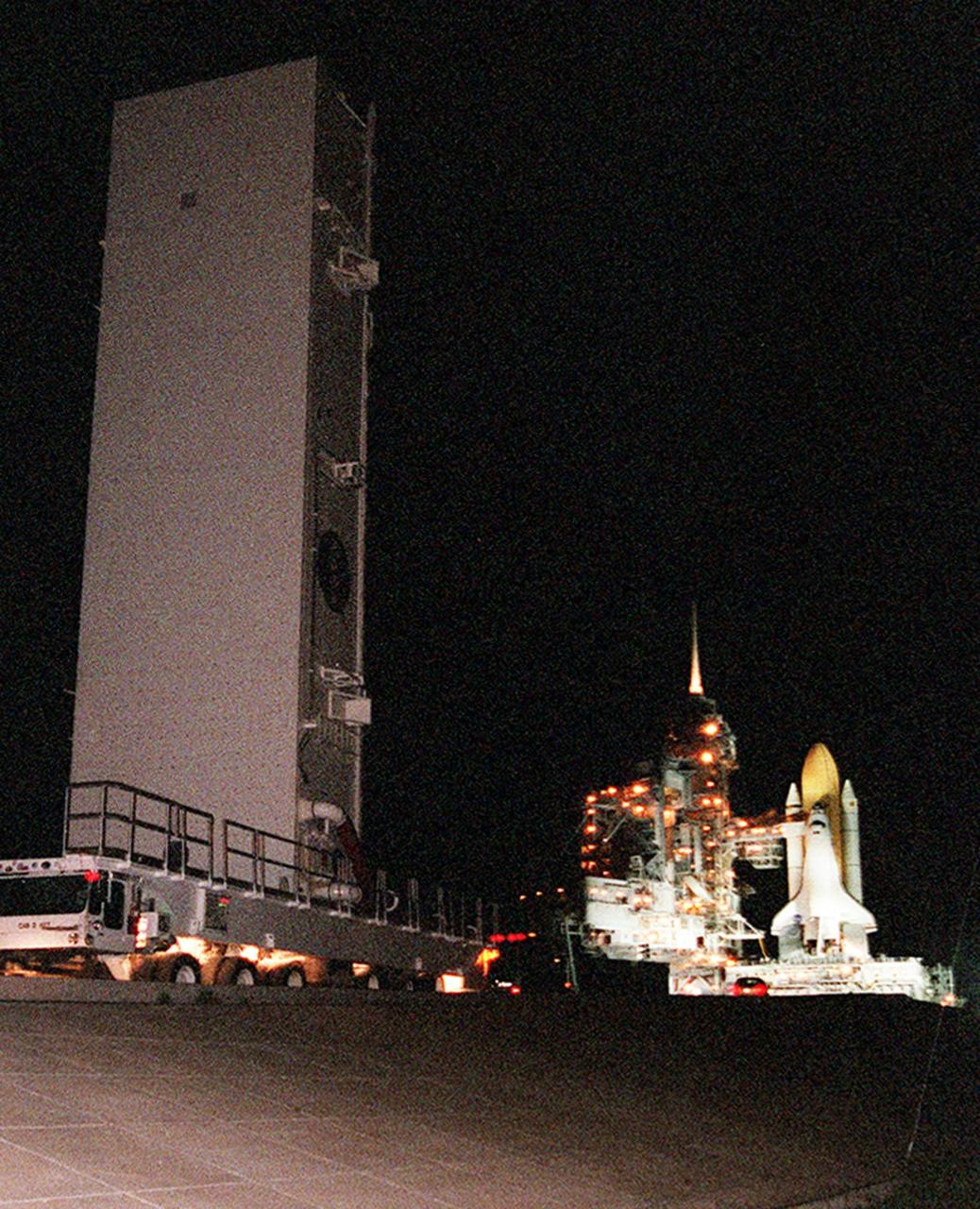
KENNEDY SPACE CENTER, Fla. -- Before dawn, the payload canister (left) with the Integrated Truss Structure Z1 moves slowly up the crawlerway ramp on Launch Pad 39A toward Space Shuttle Discovery in the background. The canister will be lifted up the Rotating Service Structure to the Payload Changeout Room where the Z1 will be removed and transferred to Discovery’s payload bay. The Z1 truss is the first of 10 that will become the backbone of the International Space Station, eventually stretching the length of a football field. Along with its companion payload, the third Pressurized Mating Adapter, the Z1 is scheduled to be launched aboard Discovery Oct. 5 at 9:38 p.m. EDT

Still suspended by a crane and cables in the Space Station Processing Facility, yet hidden by the top of the Z1 integrated truss structure, the Passive Common Berthing Mechanism (PCBM) is lowered onto the truss for attachment. Workers at the top of a workstand guide it into place. A component of the International Space Station (ISS), the Z1 truss will be used for the temporary installation of the P6 truss segment to the Unity connecting module. The P6 truss segment contains the solar arrays and batteries which will provide early station power. The truss is scheduled to be launched aboard STS-92 in late 1999
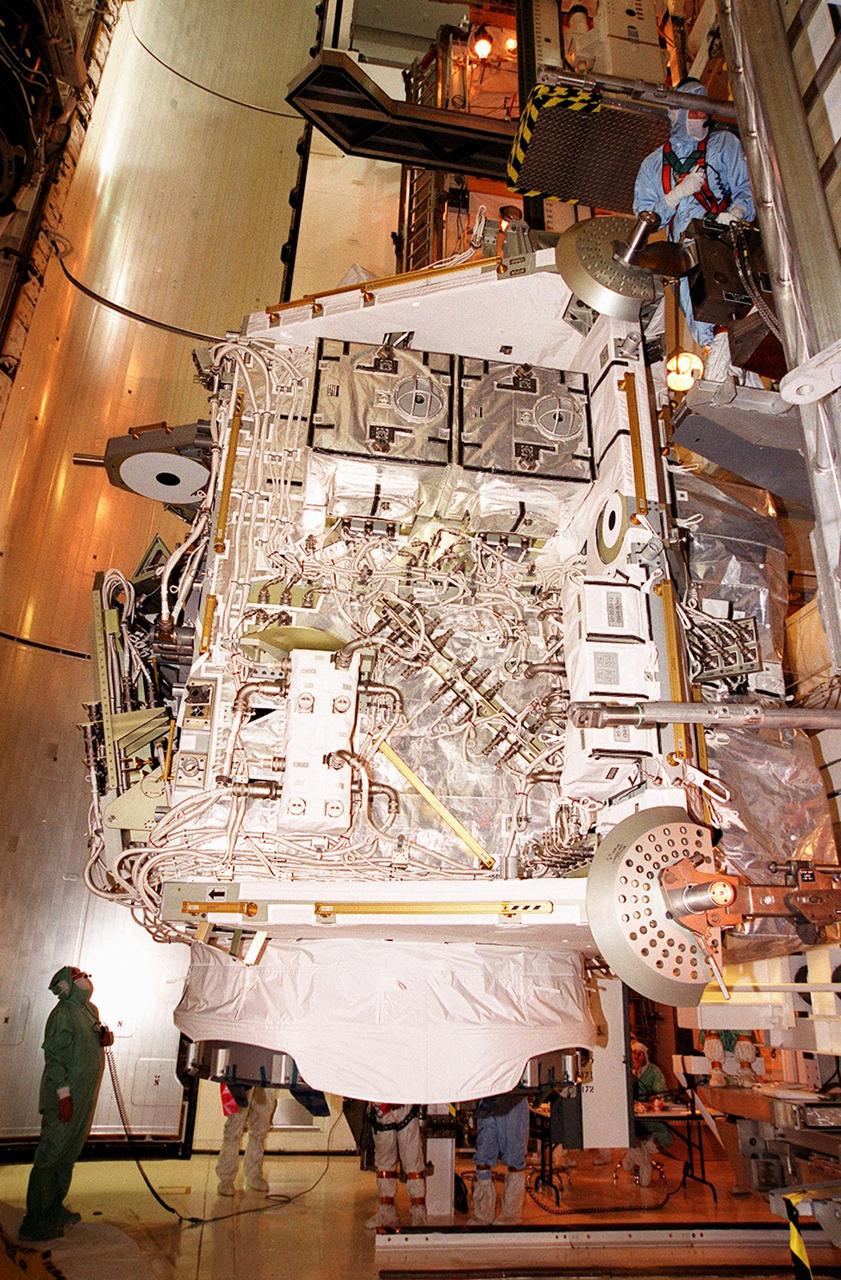
The Integrated Truss Structure Z1 is ready to be moved out of the Payload Changeout Room into the payload bay of Discovery on Launch Pad 39A. The Z1 is the first of 10 trusses to be installed on the International Space Station. The truss will allow the first U.S. solar arrays on flight 4A, scheduled for Nov. 30, to be temporarily installed on Unity for early power. Space Shuttle Discovery is scheduled for launch on Oct. 5 at 9:38 p.m. EDT. It will be the 100th flight in the Shuttle program
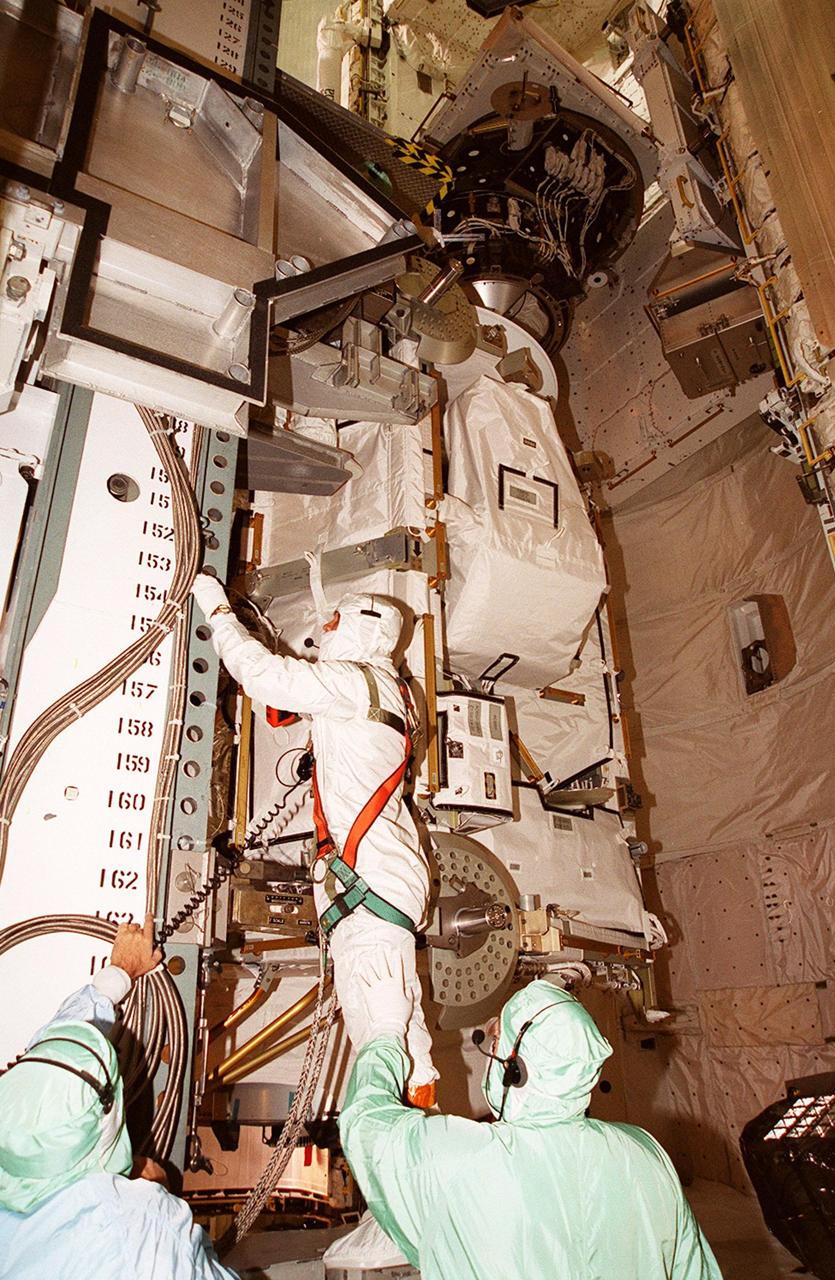
A worker in the Payload Changeout Room of Launch Pad 39A makes a final check on the Integrated Truss Structure Z1 waiting to be moved into the payload bay of Discovery. The Z1 is the first of 10 trusses to be installed on the International Space Station. The truss will allow the first U.S. solar arrays on flight 4A, scheduled for Nov. 30, to be temporarily installed on Unity for early power. Space Shuttle Discovery is scheduled for launch on Oct. 5 at 9:38 p.m. EDT. It will be the 100th flight in the Shuttle program
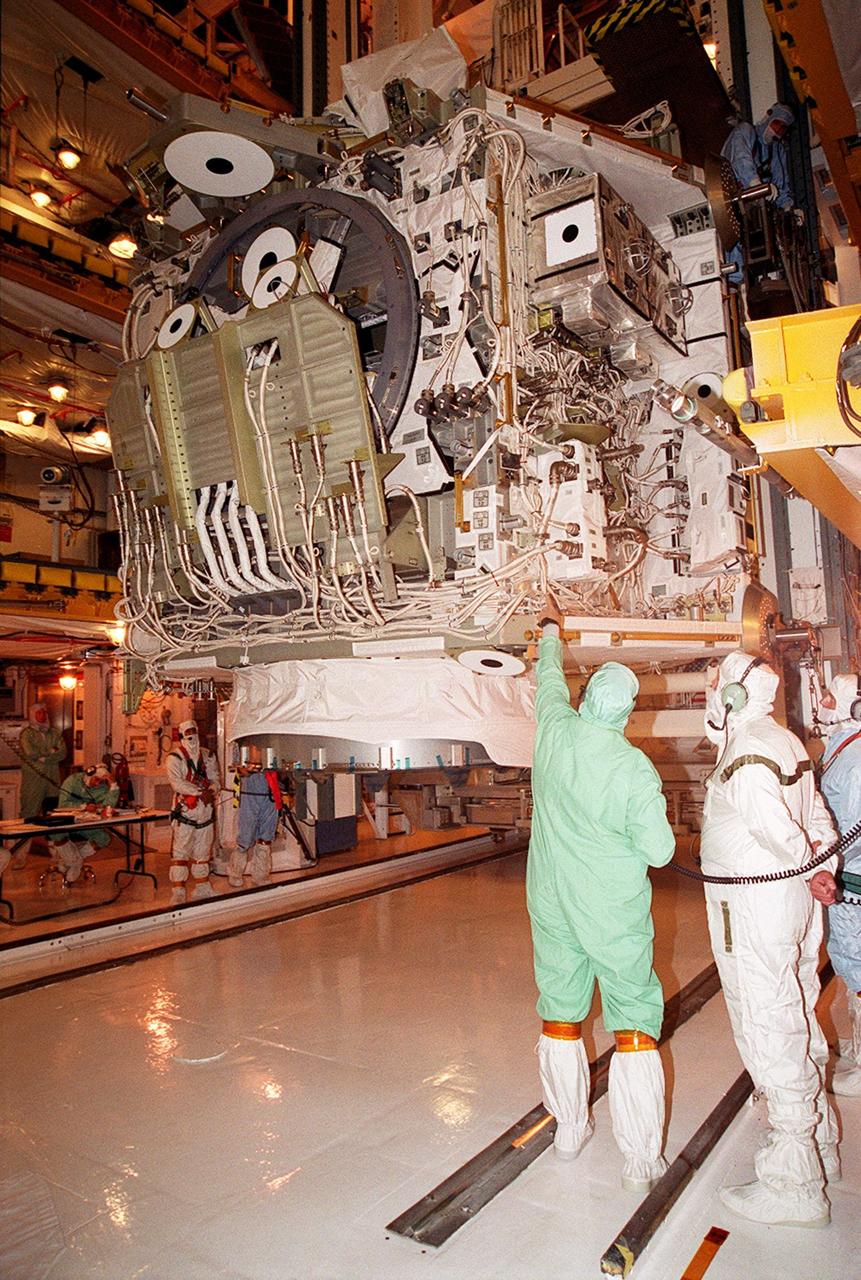
Workers in Payload Changeout Room at Launch Pad 39A prepare the Integrated Truss Structure Z1 for transfer to the payload bay of Discovery. The Z1 is the first of 10 trusses to be installed on the International Space Station. The truss will allow the first U.S. solar arrays on flight 4A, scheduled for Nov. 30, to be temporarily installed on Unity for early power. Space Shuttle Discovery is scheduled for launch on Oct. 5 at 9:38 p.m. EDT. It will be the 100th flight in the Shuttle program
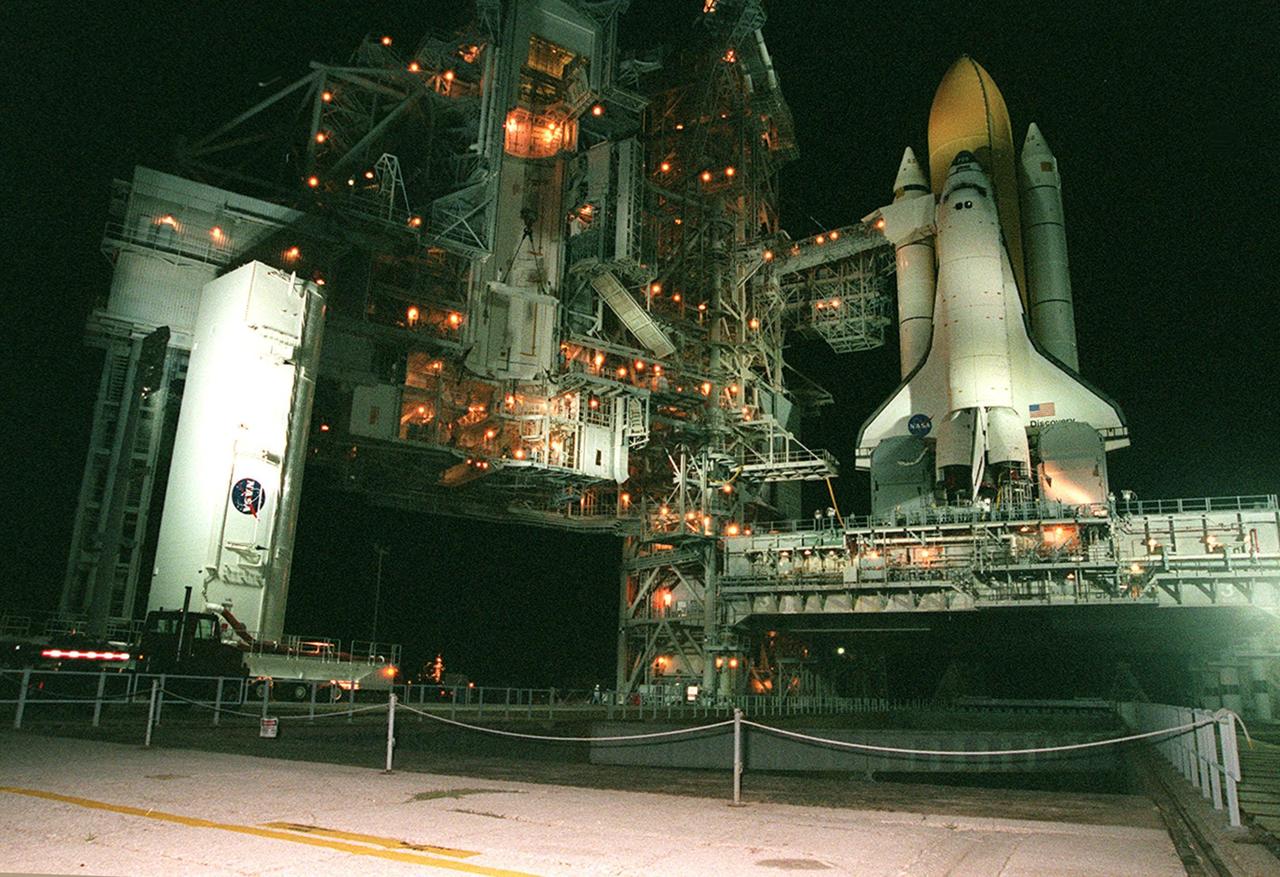
KENNEDY SPACE CENTER, Fla. -- At Launch Pad 39A, the payload canister at left draws closer to the Rotating Service Structure where it will be lifted to the Payload Changeout Room. There its cargo, the Integrated Truss Structure Z1, will be removed and later transferred to Space Shuttle Discovery’s payload bay. Discovery is at right, sitting atop the Mobile Launcher Platform. The Z1 truss is the first of 10 that will become the backbone of the International Space Station, eventually stretching the length of a football field. Along with its companion payload, the third Pressurized Mating Adapter, the Z1 is scheduled to be launched aboard Discovery Oct. 5 at 9:38 p.m. EDT
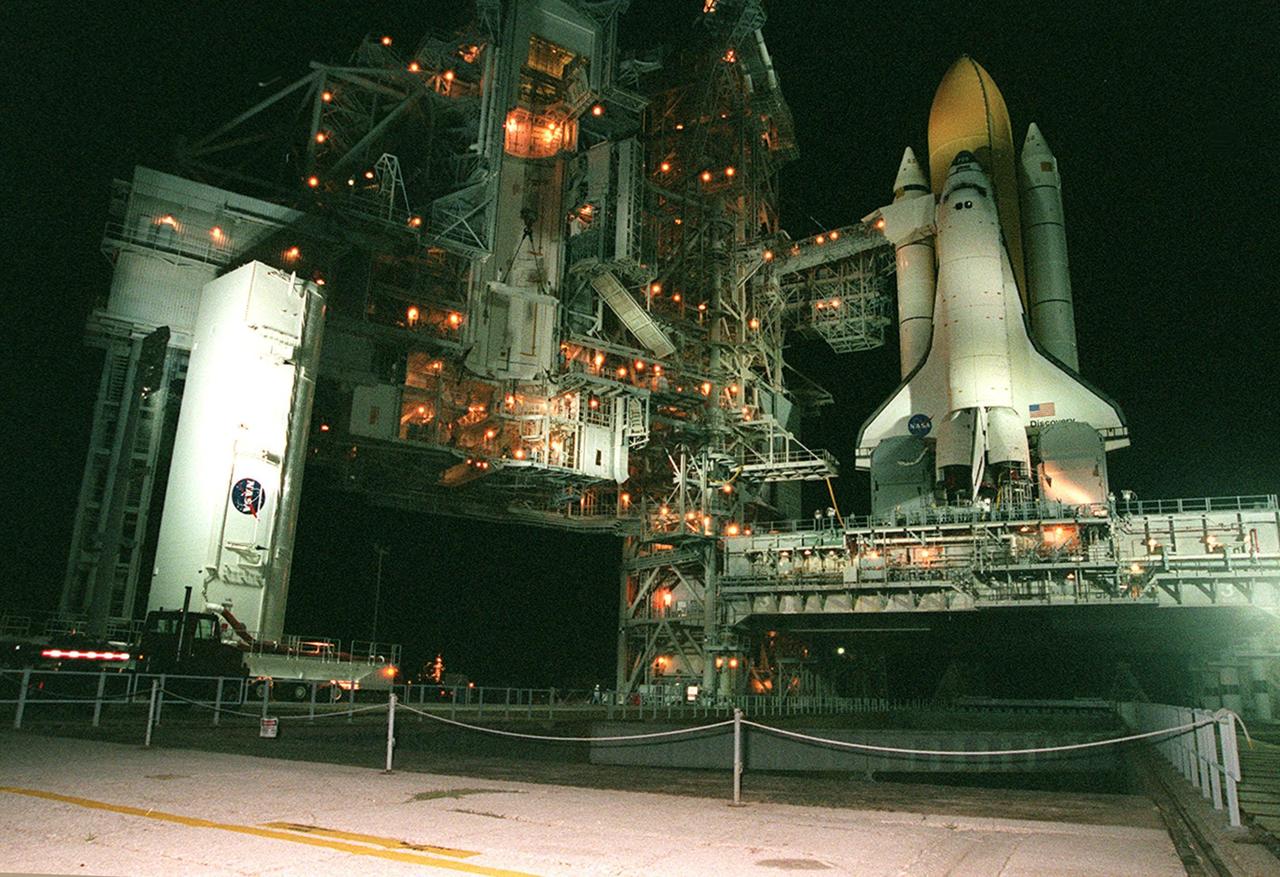
KENNEDY SPACE CENTER, Fla. -- At Launch Pad 39A, the payload canister at left draws closer to the Rotating Service Structure where it will be lifted to the Payload Changeout Room. There its cargo, the Integrated Truss Structure Z1, will be removed and later transferred to Space Shuttle Discovery’s payload bay. Discovery is at right, sitting atop the Mobile Launcher Platform. The Z1 truss is the first of 10 that will become the backbone of the International Space Station, eventually stretching the length of a football field. Along with its companion payload, the third Pressurized Mating Adapter, the Z1 is scheduled to be launched aboard Discovery Oct. 5 at 9:38 p.m. EDT
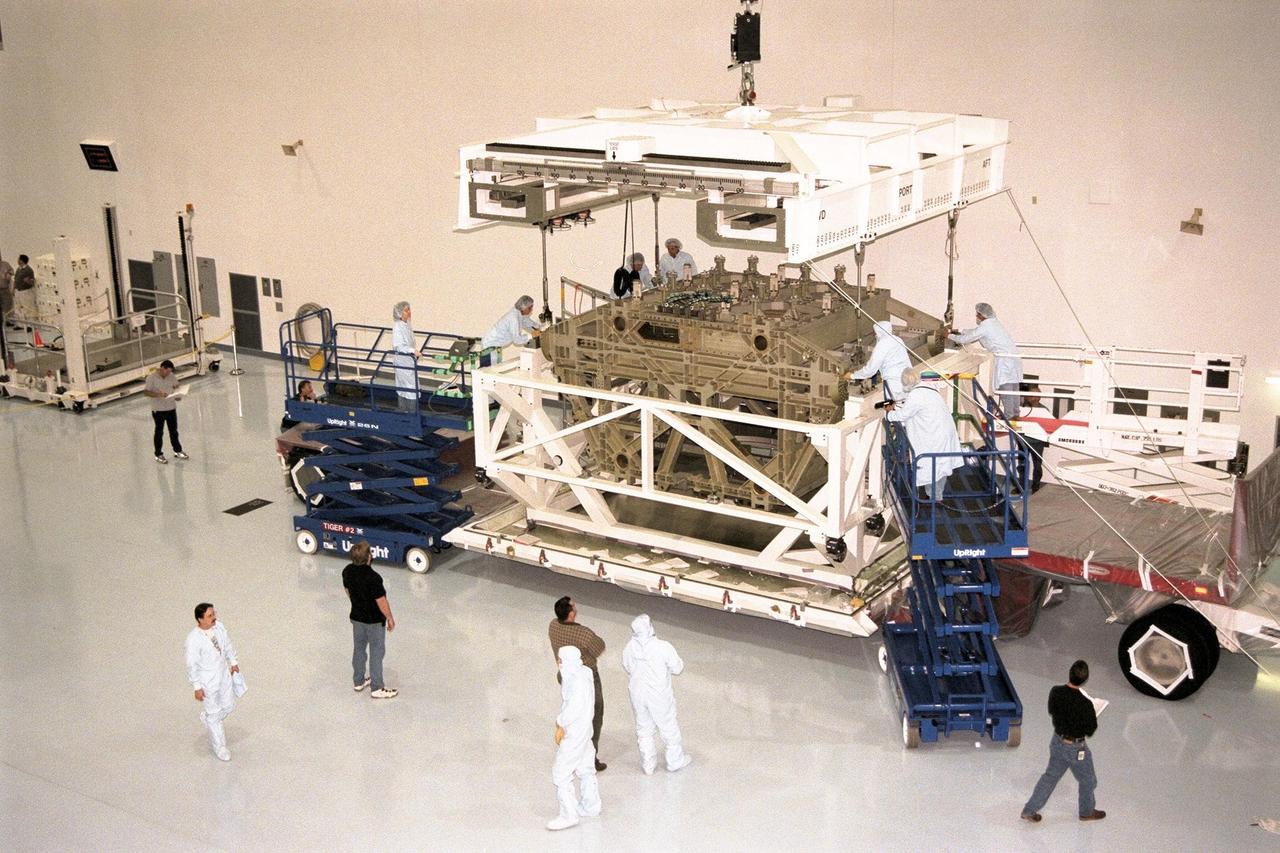
KENNEDY SPACE CENTER, FLA. -- The Z1 Integrated Truss Segment (ITS), a major element of the STS-92 mission scheduled for launch aboard Space Shuttle Atlantis in January 1999, is lowered into its workstand for processing in KSC's Space Station Processing Facility (SSPF). The Z-1 truss supports the staged buildup of International Space Station (ISS) on this third scheduled flight for ISS. The Z1 truss allows the temporary installation of the U.S. power module to Node 1. Early in the assembly sequence, the purpose of Z1 is to provide a mounting location for Ku-band and S-band telemetry and extravehicular activity (EVA) equipment. It also provides common berthing mechanism hardcover stowage. In addition, it will assist with the execution of nonpropulsive attitude control. The truss arrived at KSC on Feb. 17 for preflight processing in the SSPF
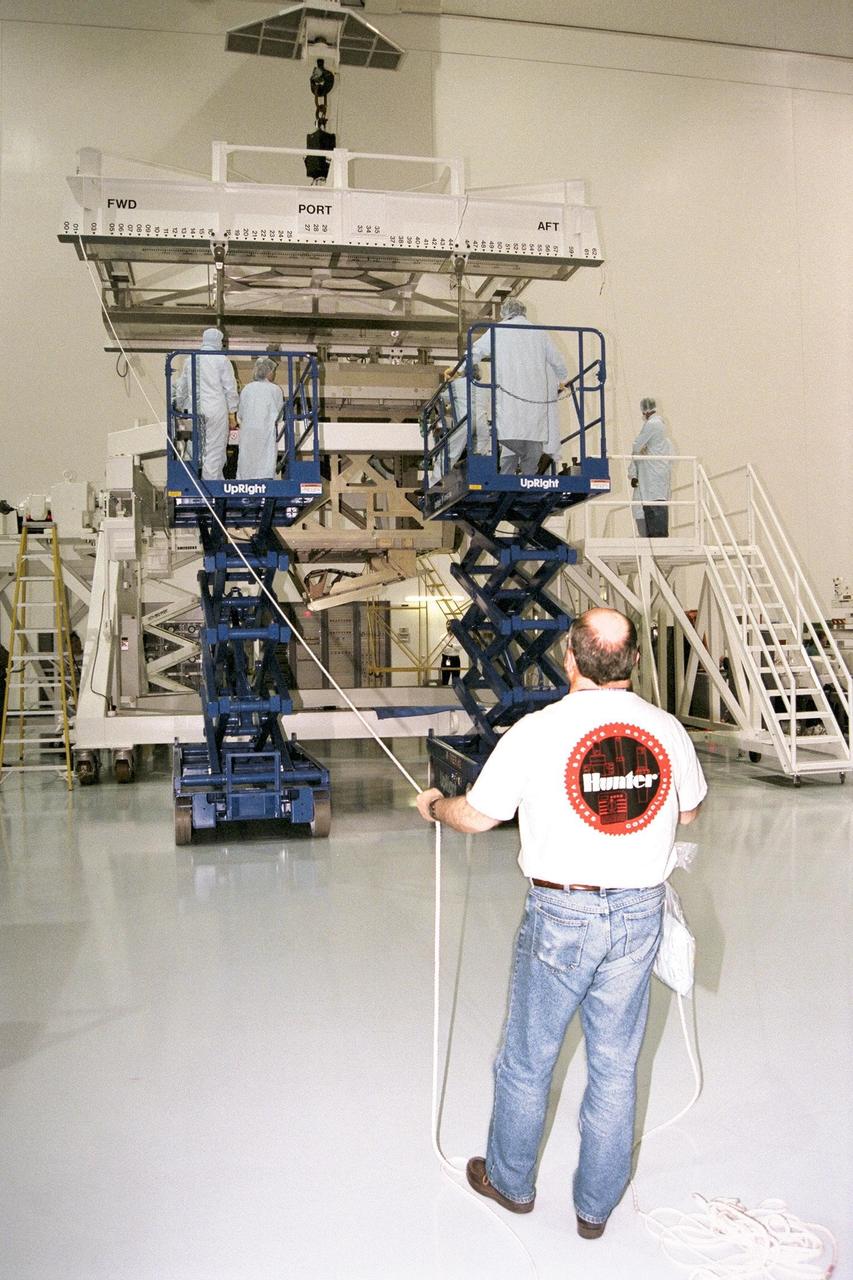
KENNEDY SPACE CENTER, FLA. -- The Z1 Integrated Truss Segment (ITS), a major element of the STS-92 mission scheduled for launch aboard Space Shuttle Atlantis in January 1999, is lowered into its workstand for processing in KSC's Space Station Processing Facility (SSPF). The Z-1 truss supports the staged buildup of International Space Station (ISS) on this third scheduled flight for ISS. The Z1 truss allows the temporary installation of the U.S. power module to Node 1. Early in the assembly sequence, the purpose of Z1 is to provide a mounting location for Ku-band and S-band telemetry and extravehicular activity (EVA) equipment. It also provides common berthing mechanism hardcover stowage. In addition, it will assist with the execution of nonpropulsive attitude control. The truss arrived at KSC on Feb. 17 for preflight processing in the SSPF
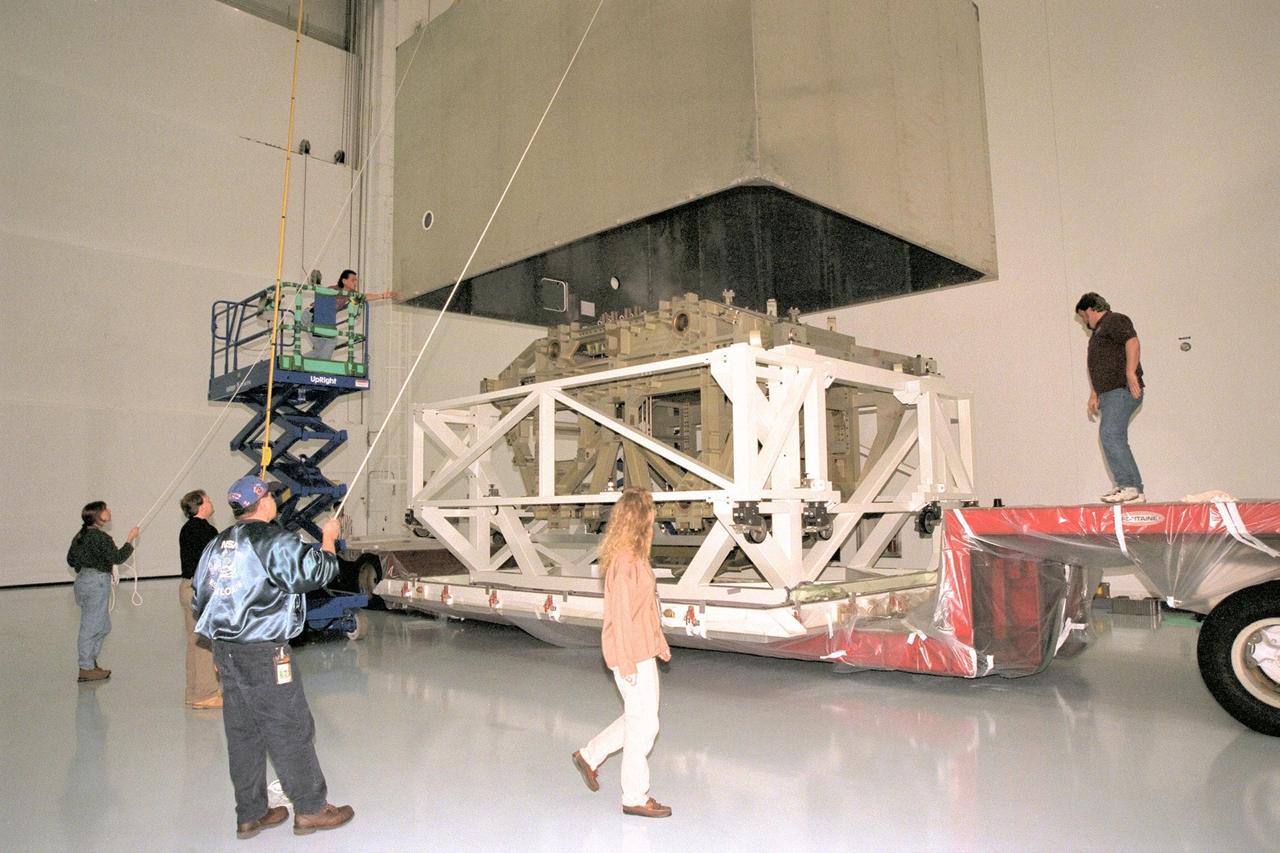
Workers in KSC's Space Station Processing Facility (SSPF) assist in removing the protective casing from the Z1 Integrated Truss Segment (ITS), a major element of the STS-92 mission scheduled for launch aboard Space Shuttle Atlantis in January 1999. The Z-1 truss supports the staged buildup of International Space Station (ISS) on this third scheduled flight for ISS. The Z1 truss allows the temporary installation of the U.S. power module to Node 1. Early in the assembly sequence, the purpose of Z1 is to provide a mounting location for Ku-band and S-band telemetry and extravehicular activity (EVA) equipment. It also provides common berthing mechanism hardcover stowage. In addition, it will assist with the execution of nonpropulsive attitude control. The truss arrived at KSC on Feb. 17 for preflight processing in the SSPF

KENNEDY SPACE CENTER, FLA. -- The Z1 Integrated Truss Segment (ITS), a major element of the STS-92 mission scheduled for launch aboard Space Shuttle Atlantis in January 1999, is lowered into its workstand for processing in KSC's Space Station Processing Facility (SSPF). The Z-1 truss supports the staged buildup of International Space Station (ISS) on this third scheduled flight for ISS. The Z1 truss allows the temporary installation of the U.S. power module to Node 1. Early in the assembly sequence, the purpose of Z1 is to provide a mounting location for Ku-band and S-band telemetry and extravehicular activity (EVA) equipment. It also provides common berthing mechanism hardcover stowage. In addition, it will assist with the execution of nonpropulsive attitude control. The truss arrived at KSC on Feb. 17 for preflight processing in the SSPF
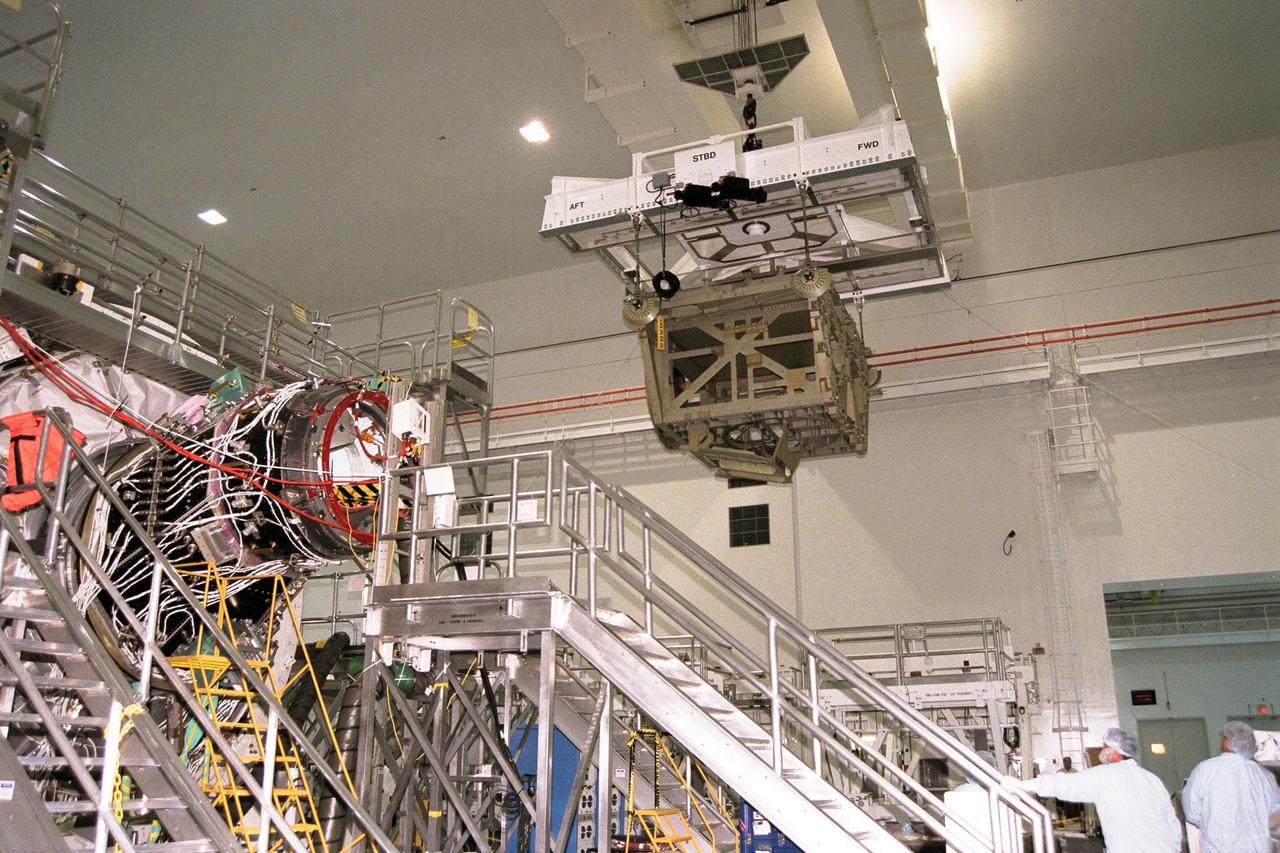
KENNEDY SPACE CENTER, FLA. -- The Z1 Integrated Truss Segment (ITS), a major element of the STS-92 mission scheduled for launch aboard Space Shuttle Atlantis in January 1999, is moved to its workstand for processing in KSC's Space Station Processing Facility (SSPF). The Z-1 truss supports the staged buildup of International Space Station (ISS) on this third scheduled flight for ISS. The Z1 truss allows the temporary installation of the U.S. power module to Node 1. Early in the assembly sequence, the purpose of Z1 is to provide a mounting location for Ku-band and S-band telemetry and extravehicular activity (EVA) equipment. It also provides common berthing mechanism hardcover stowage. In addition, it will assist with the execution of nonpropulsive attitude control. The truss arrived at KSC on Feb. 17 for preflight processing in the SSPF
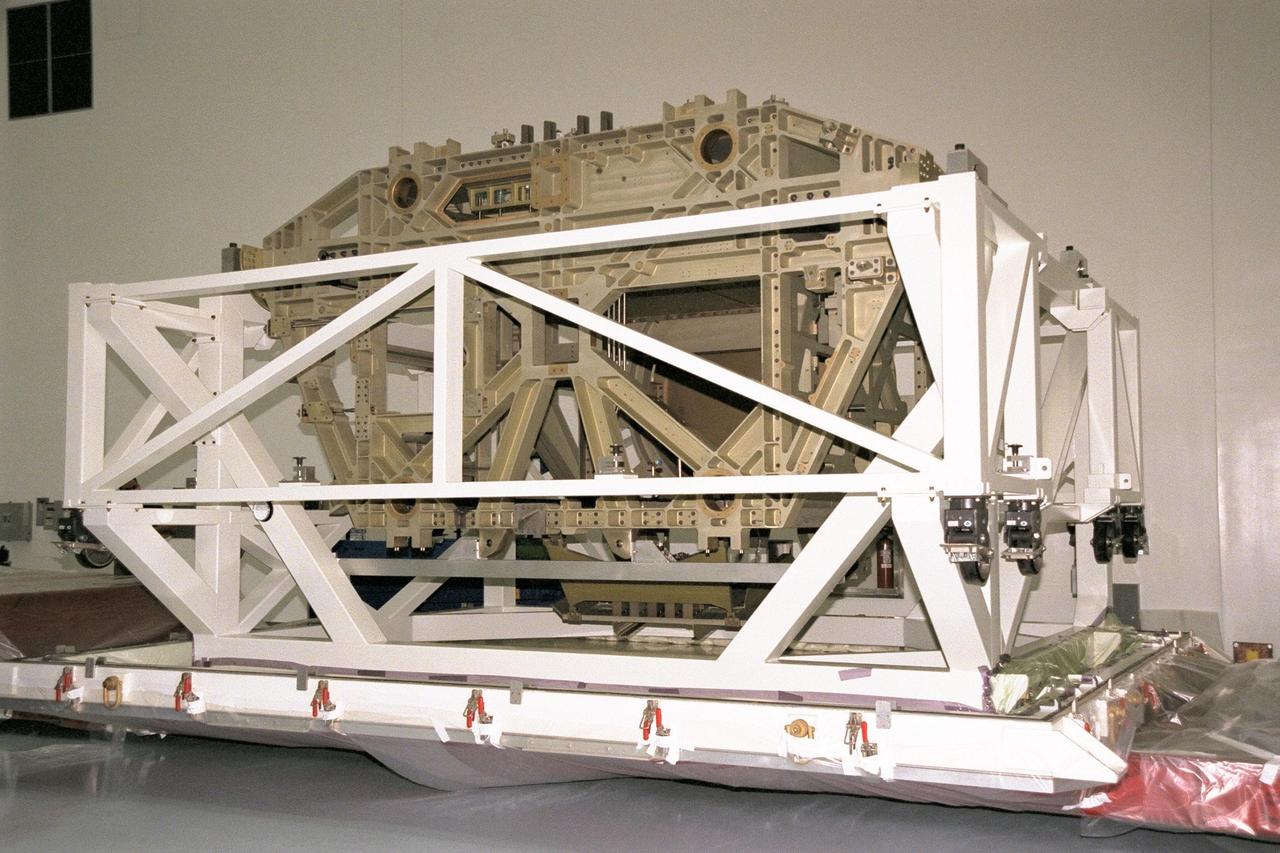
The Z1 Integrated Truss Segment (ITS), a major element of the STS-92 mission scheduled for launch aboard Space Shuttle Atlantis in January 1999, awaits processing in KSC's Space Station Processing Facility (SSPF). The Z-1 truss supports the staged buildup of International Space Station (ISS) on this third scheduled flight for ISS. The Z1 truss allows the temporary installation of the U.S. power module to Node 1. Early in the assembly sequence, the purpose of Z1 is to provide a mounting location for Ku-band and S-band telemetry and extravehicular activity (EVA) equipment. It also provides common berthing mechanism hardcover stowage. In addition, it will assist with the execution of nonpropulsive attitude control. The truss arrived at KSC on Feb. 17 for preflight processing in the SSPF

KENNEDY SPACE CENTER, FLA. -- The Z1 Integrated Truss Segment (ITS), a major element of the STS-92 mission scheduled for launch aboard Space Shuttle Atlantis in January 1999, is moved toward its workstand for processing in KSC's Space Station Processing Facility (SSPF). The Z-1 truss supports the staged buildup of International Space Station (ISS) on this third scheduled flight for ISS. The Z1 truss allows the temporary installation of the U.S. power module to Node 1. Early in the assembly sequence, the purpose of Z1 is to provide a mounting location for Ku-band and S-band telemetry and extravehicular activity (EVA) equipment. It also provides common berthing mechanism hardcover stowage. In addition, it will assist with the execution of nonpropulsive attitude control. The truss arrived at KSC on Feb. 17 for preflight processing in the SSPF
KENNEDY SPACE CENTER, FLA. -- The Z1 Integrated Truss Segment (ITS), a major element of the STS-92 mission scheduled for launch aboard Space Shuttle Atlantis in January 1999, is lowered into its workstand for processing in KSC's Space Station Processing Facility (SSPF). The Z-1 truss supports the staged buildup of International Space Station (ISS) on this third scheduled flight for ISS. The Z1 truss allows the temporary installation of the U.S. power module to Node 1. Early in the assembly sequence, the purpose of Z1 is to provide a mounting location for Ku-band and S-band telemetry and extravehicular activity (EVA) equipment. It also provides common berthing mechanism hardcover stowage. In addition, it will assist with the execution of nonpropulsive attitude control. The truss arrived at KSC on Feb. 17 for preflight processing in the SSPF
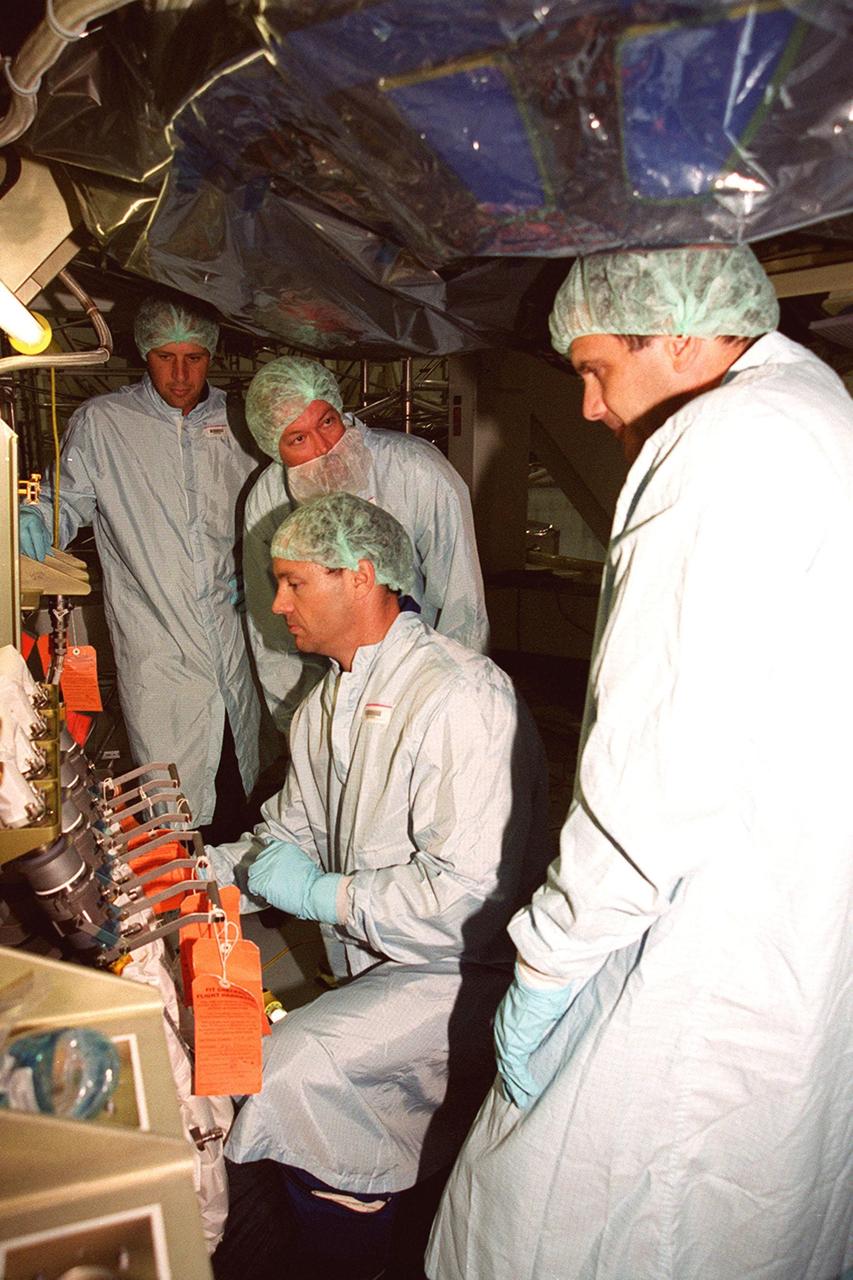
STS-92 Mission Specialists Michael Lopez-Alegria (center) and Jeff Wisoff (right) check out the Integrated Truss Structure Z1, a component of the International Space Station and payload on their mission. They and other crew members are taking part in Crew Equipment Interface Test (CEIT) activities while at KSC. The Z1 truss is an early exterior framework to allow the first U.S. solar arrays on a future flight to be temporarily installed on Unity for early power. STS-92 is scheduled to launch Oct. 5 from launch Pad 39A
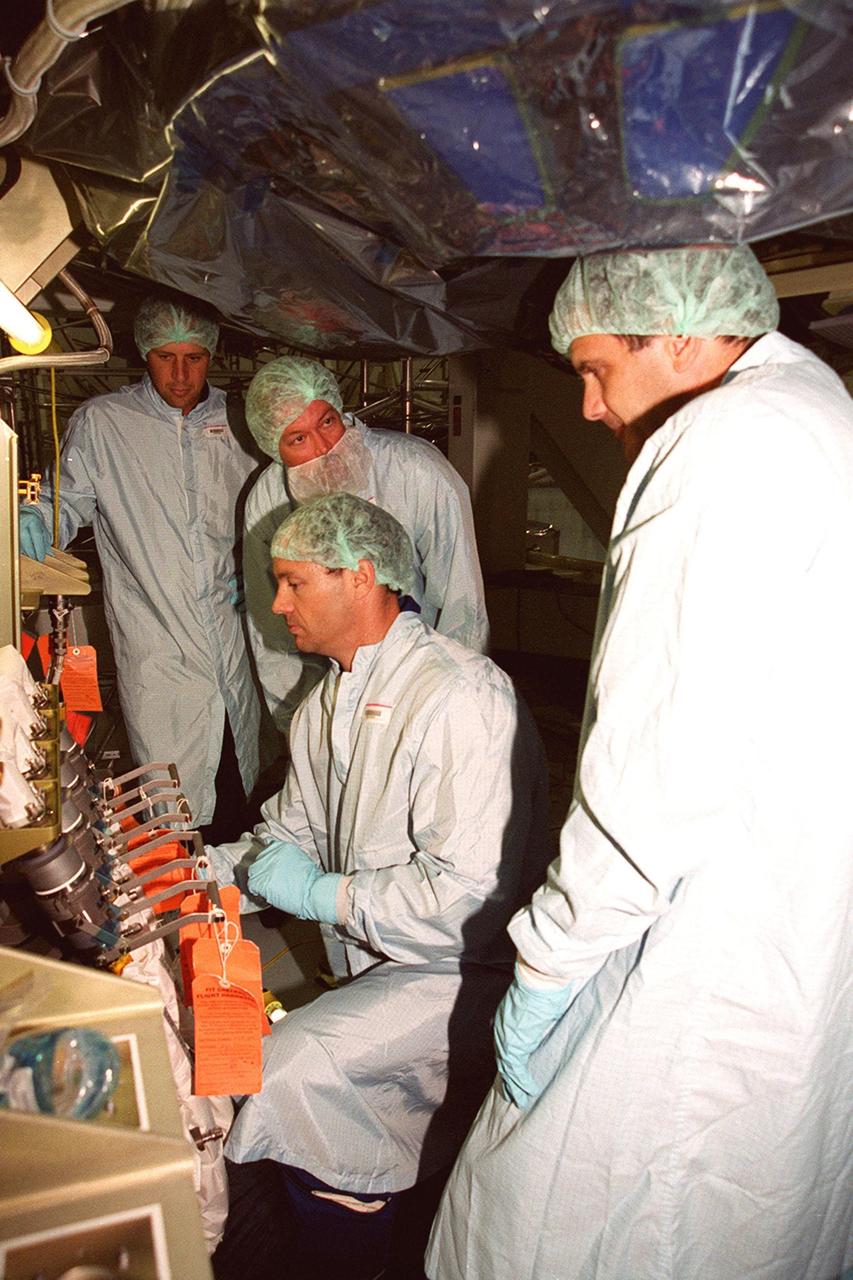
STS-92 Mission Specialists Michael Lopez-Alegria (center) and Jeff Wisoff (right) check out the Integrated Truss Structure Z1, a component of the International Space Station and payload on their mission. They and other crew members are taking part in Crew Equipment Interface Test (CEIT) activities while at KSC. The Z1 truss is an early exterior framework to allow the first U.S. solar arrays on a future flight to be temporarily installed on Unity for early power. STS-92 is scheduled to launch Oct. 5 from launch Pad 39A
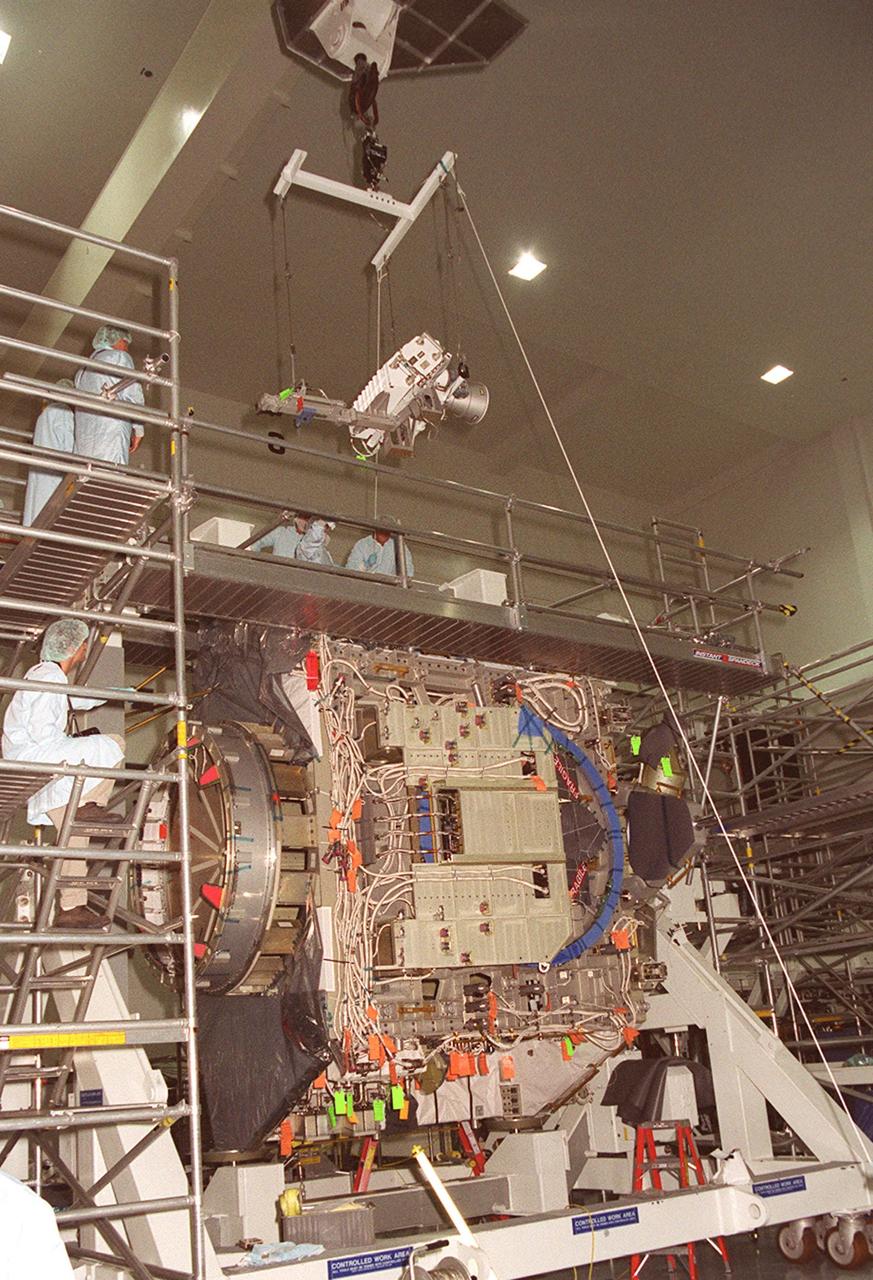
An S-band Antenna Support Assembly (SASA) is suspended from an overhead crane in the Space Station Processing Facility. It will be attached to the Integrated Truss Structure (ITS) Z1, an element of the International Space Station, sitting below. The SASA is primarily for local communications between the orbiter and Space Station. The Z1 is an early exterior framework to allow the first U.S. solar arrays, on mission STS-97, flight 4A, to be temporarily installed on Unity for early power. The Z1 is scheduled on mission STS-92, the fifth flight to the Space Station, in the fall
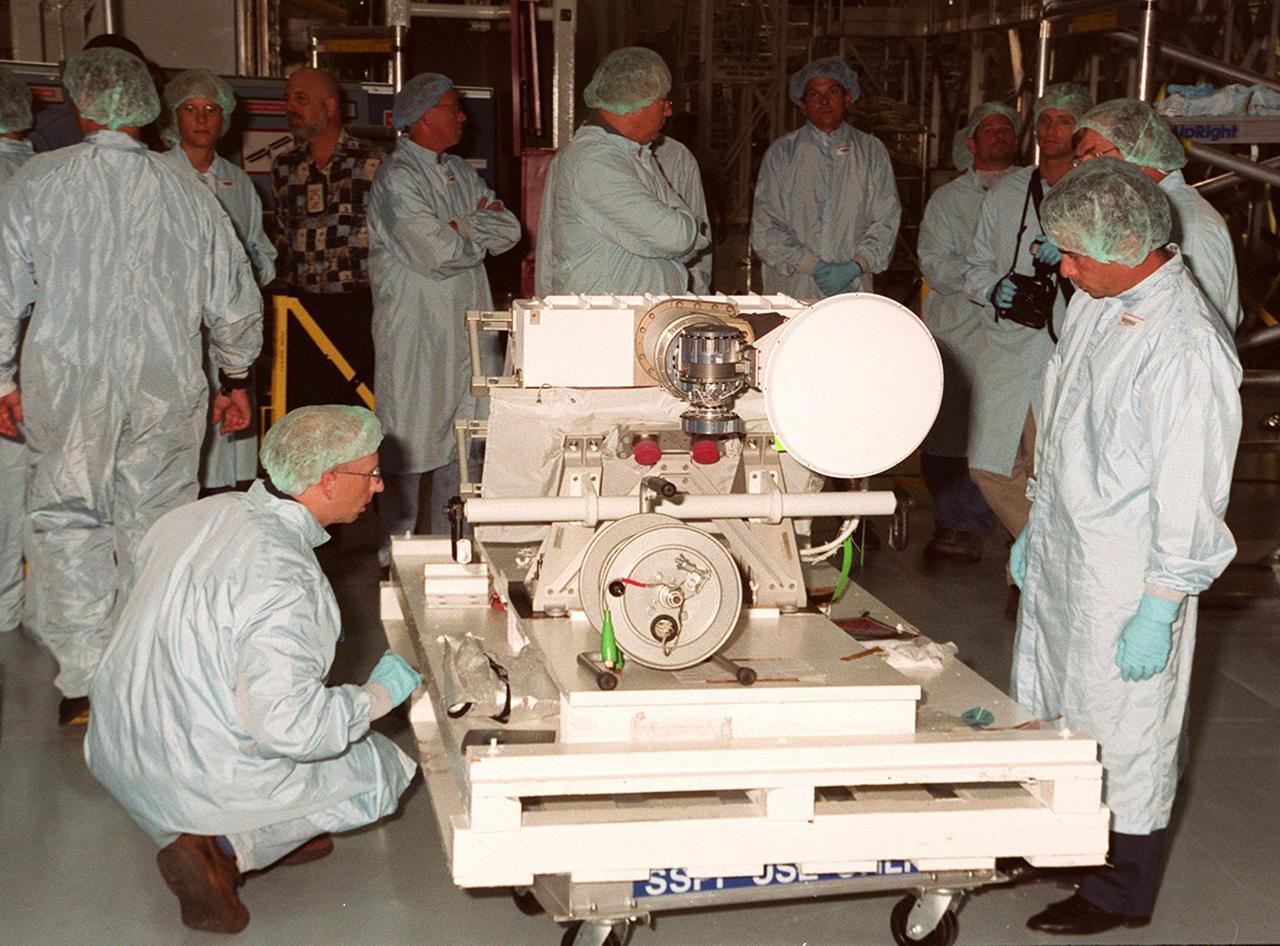
Workers in the Space Station Processing Facility look over an S-band Antenna Support Assembly (SASA) that will be attached to the Integrated Truss Structure (ITS) Z1 on the International Space Station. The SASA antenna is primarily for local communications between the orbiter and Space Station. The Z1 is an early exterior framework to allow the first U.S. solar arrays, on mission STS-97, flight 4A, to be temporarily installed on Unity for early power. The Z1 is scheduled on mission STS-92, the fifth flight to the Space Station, in the fall
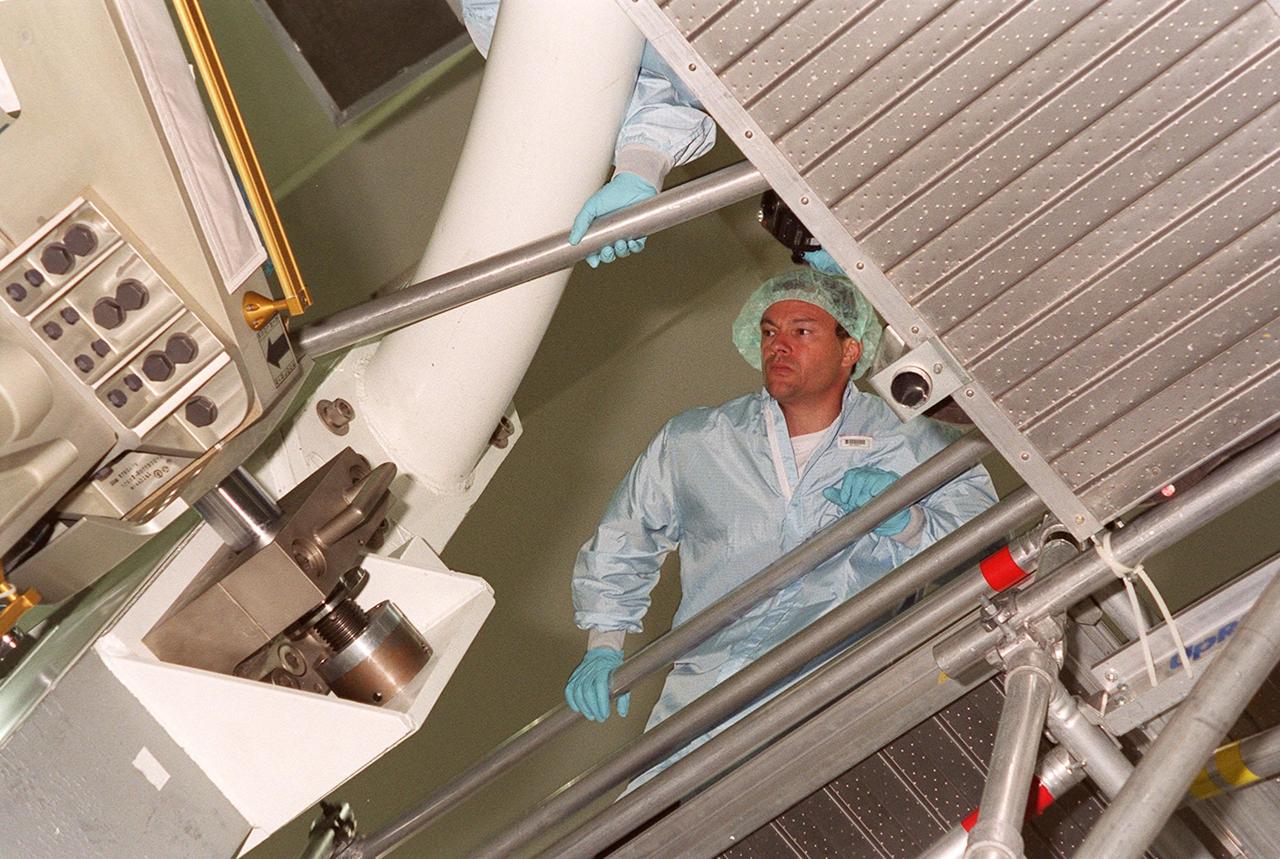
On the scaffolding in the Space Shuttle Processing Facility (SSPF), STS-92 Mission Specialist Michael Lopez-Alegria leans over to get a better look at the Integrated Truss Structure (ITS) Z1 below. The Z1 is a payload scheduled on mission STS-92, the fifth flight to the Space Station, in the fall. The Z1 is an early exterior framework for the International Space Station, and will allow the first U.S. solar arrays, on mission STS-97, flight 4A, to be temporarily installed on Unity for early power
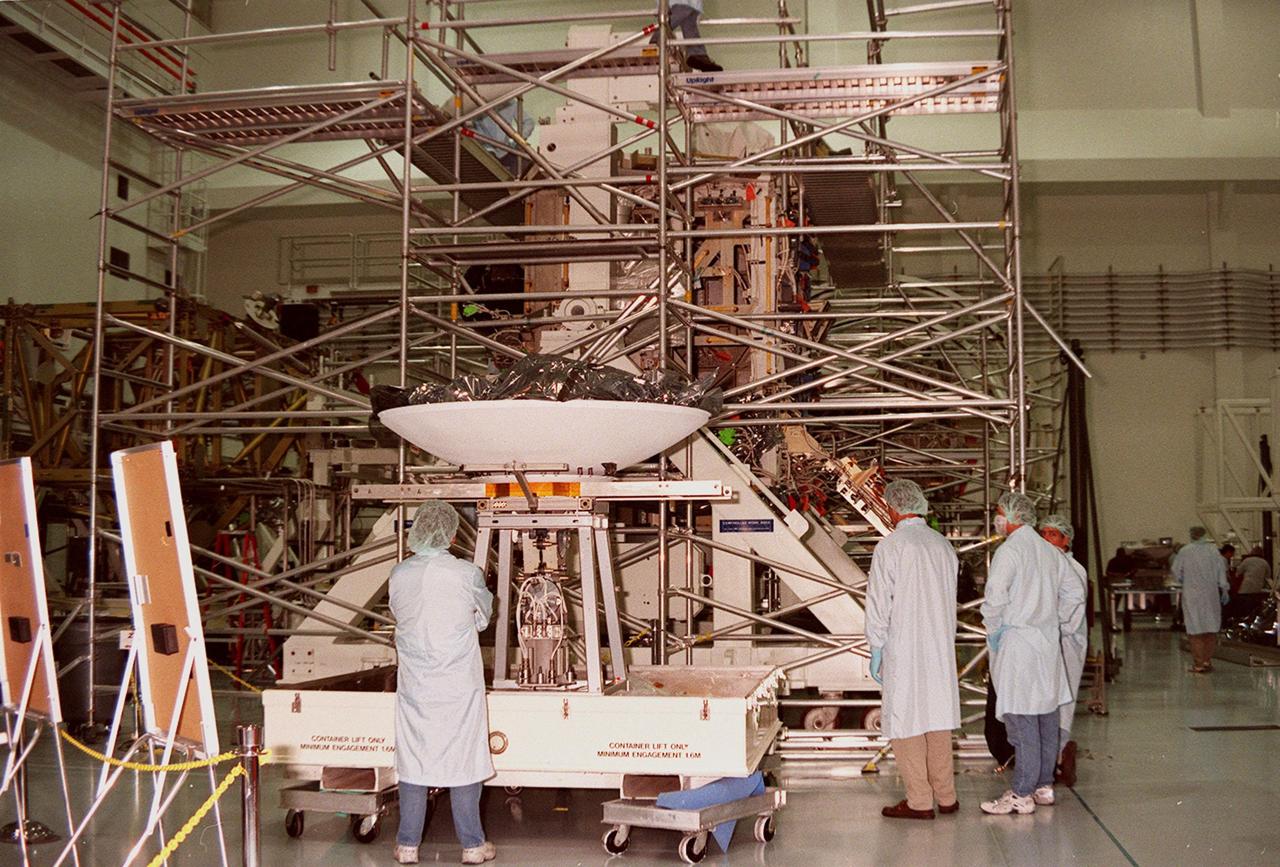
Workers in the Space Shuttle Processing Facility (SSPF) are getting ready to prepare the high-gain antenna beside them on the floor for installation on the Integrated Truss Structure (ITS) Z1, just beyond the scaffolding. The Z1 is an early exterior framework for the International Space Station to allow the first U.S. solar arrays, on mission STS-97, flight 4A, to be temporarily installed on Unity for early power. The Z1 is a payload scheduled on mission STS-92, the fifth flight to the Space Station, in the fall
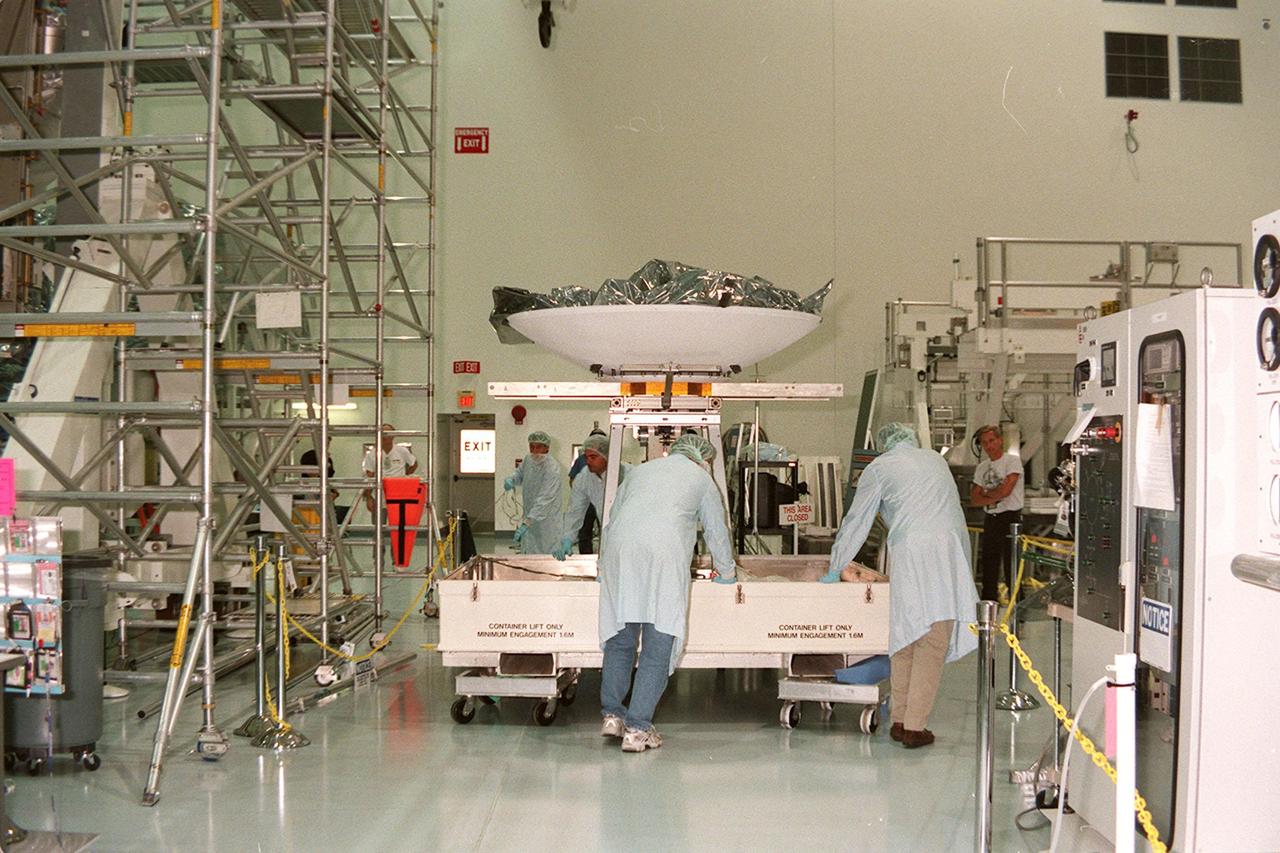
Workers in the Space Shuttle Processing Facility (SSPF) move a high-gain antenna for installation onto the Integrated Truss Structure (ITS) Z1, already in the SSPF. The Z1 is an early exterior framework for the International Space Station that will allow the first U.S. solar arrays, on mission STS-97, flight 4A, to be temporarily installed on Unity for early power. The Z1 is a payload scheduled on mission STS-92, the fifth flight to the Space Station, in the fall
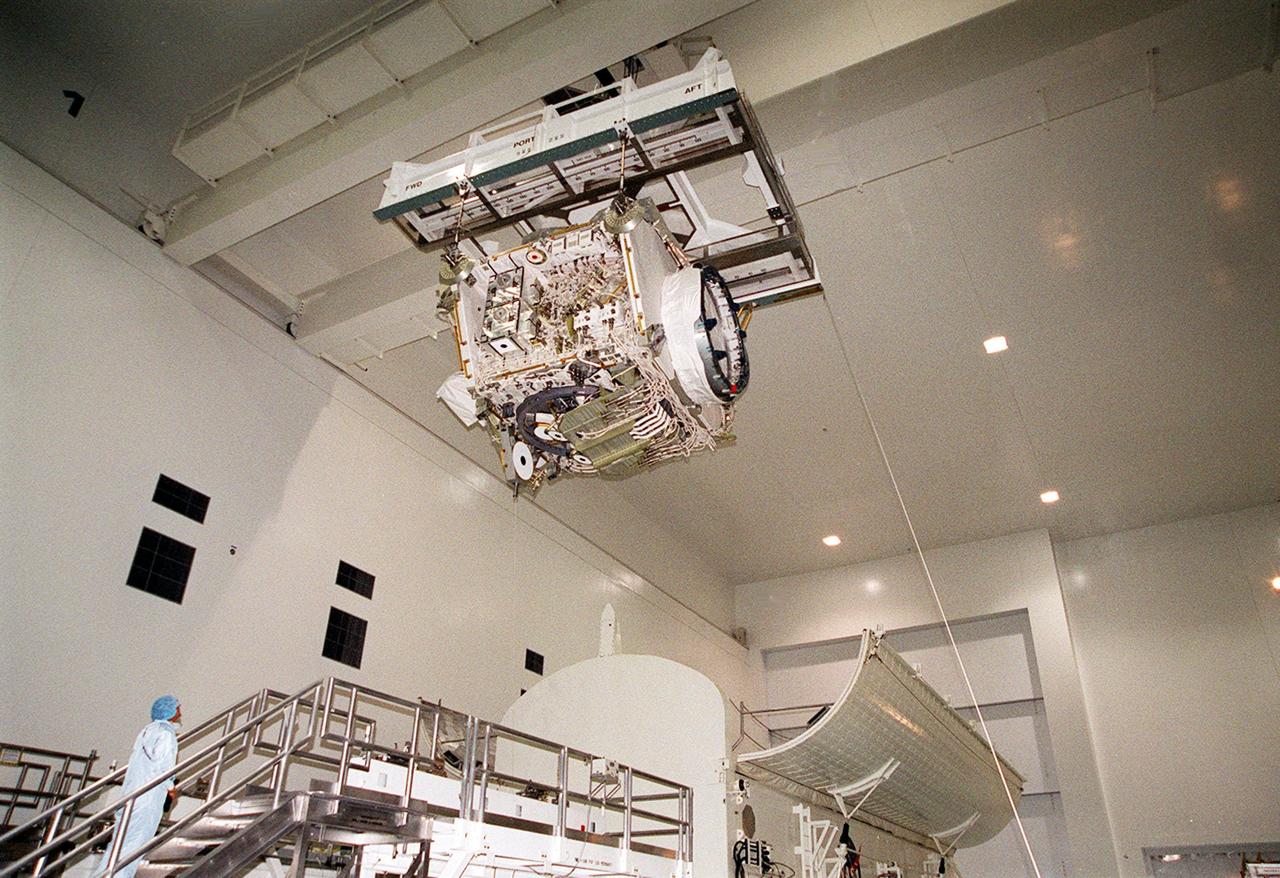
In the Space Station Processing Facility, the Integrated Truss Structure Z1, suspended from an overhead crane, is rotated before being placed inside the payload canister below it. The truss will then be transported to Launch Pad 39A. It is part of the payload on mission STS-92 scheduled to lift off Oct. 5, 2000

In the Space Station Processing Facility, the Integrated Truss Structure Z1 hangs from an overhead crane that will place it in the payload canister behind it. The truss will then be transported to Launch Pad 39A. It is part of the payload on mission STS-92 scheduled to lift off Oct. 5, 2000
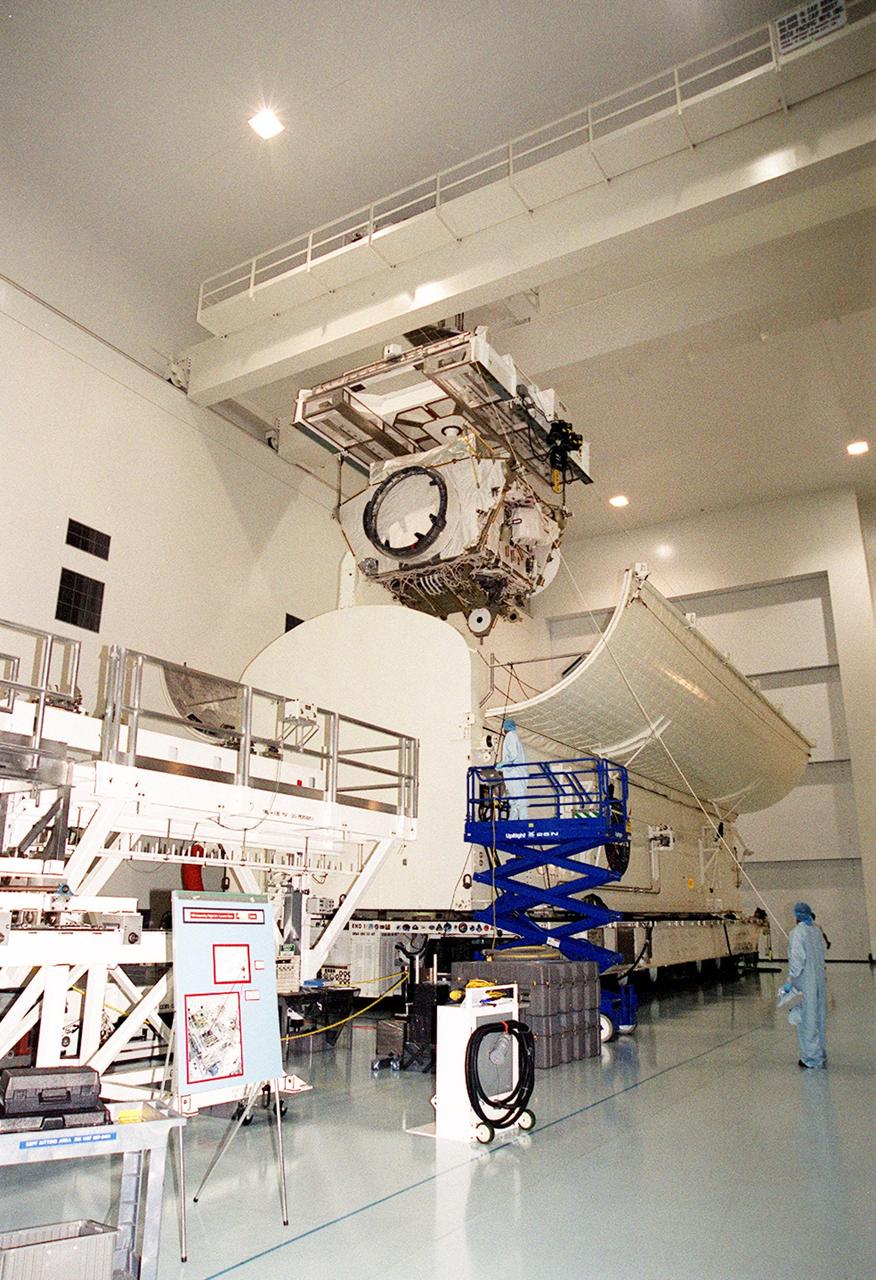
Suspended by an overhead crane in the Space Station Processing Facility, the Integrated Truss Structure Z1 is lowered toward the open doors of the payload canister below. After secured inside, the truss will be transported to Launch Pad 39A. It is part of the payload on mission STS-92 scheduled to lift off Oct. 5, 2000

After its overhead rotation in the Space Station Processing Facility, the Integrated Truss Structure Z1 is guided toward the open doors of the payload canister below. After secured inside, the truss will be transported to Launch Pad 39A. It is part of the payload on mission STS-92 scheduled to lift off Oct. 5, 2000
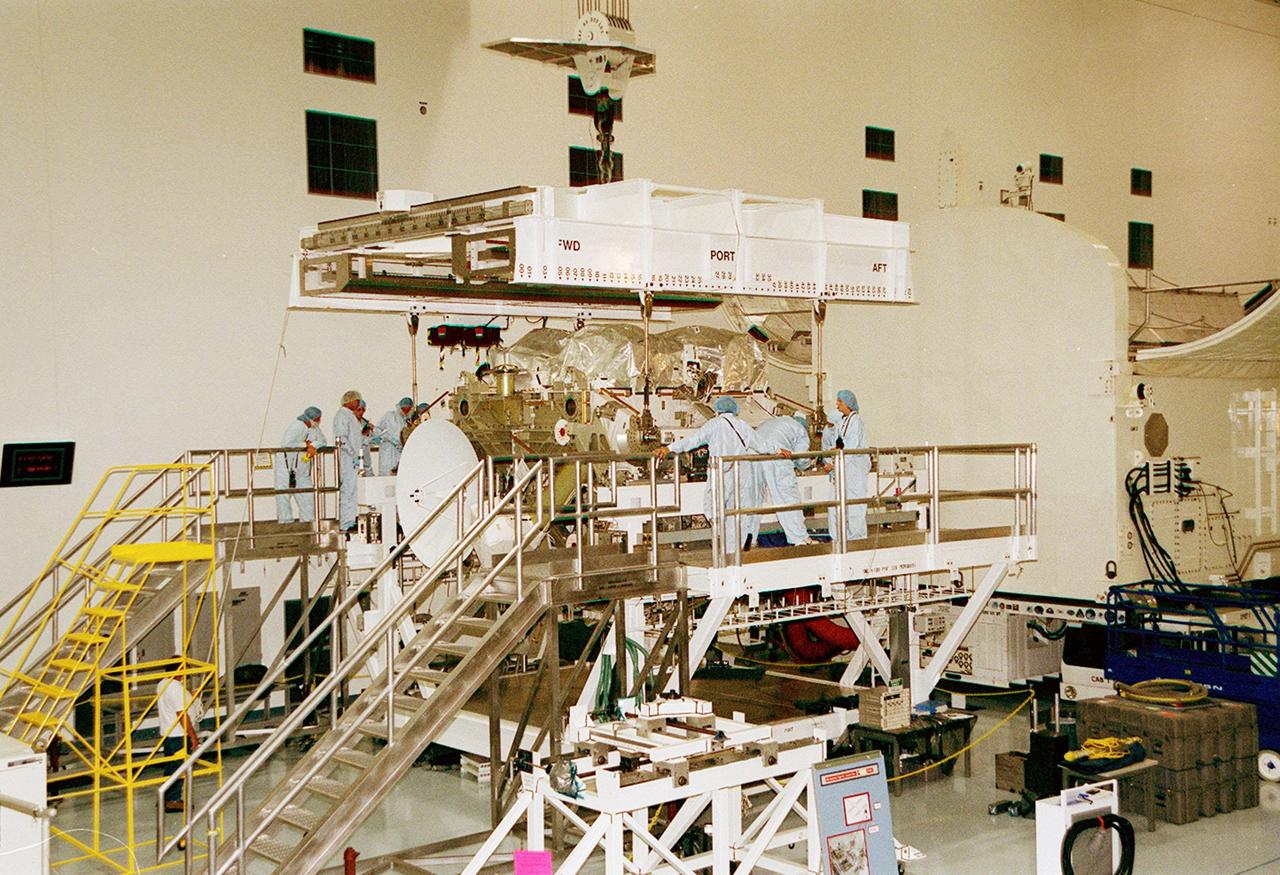
In the Space Station Processing Facility, an overhead crane is placed into position to lift the Integrated Truss Structure Z1, part of the backbone of the International Space Station. The truss, which is being moved to a payload canister for transport to Launch Pad 39A, is part of the payload on mission STS-92 scheduled to lift off Oct. 5, 2000
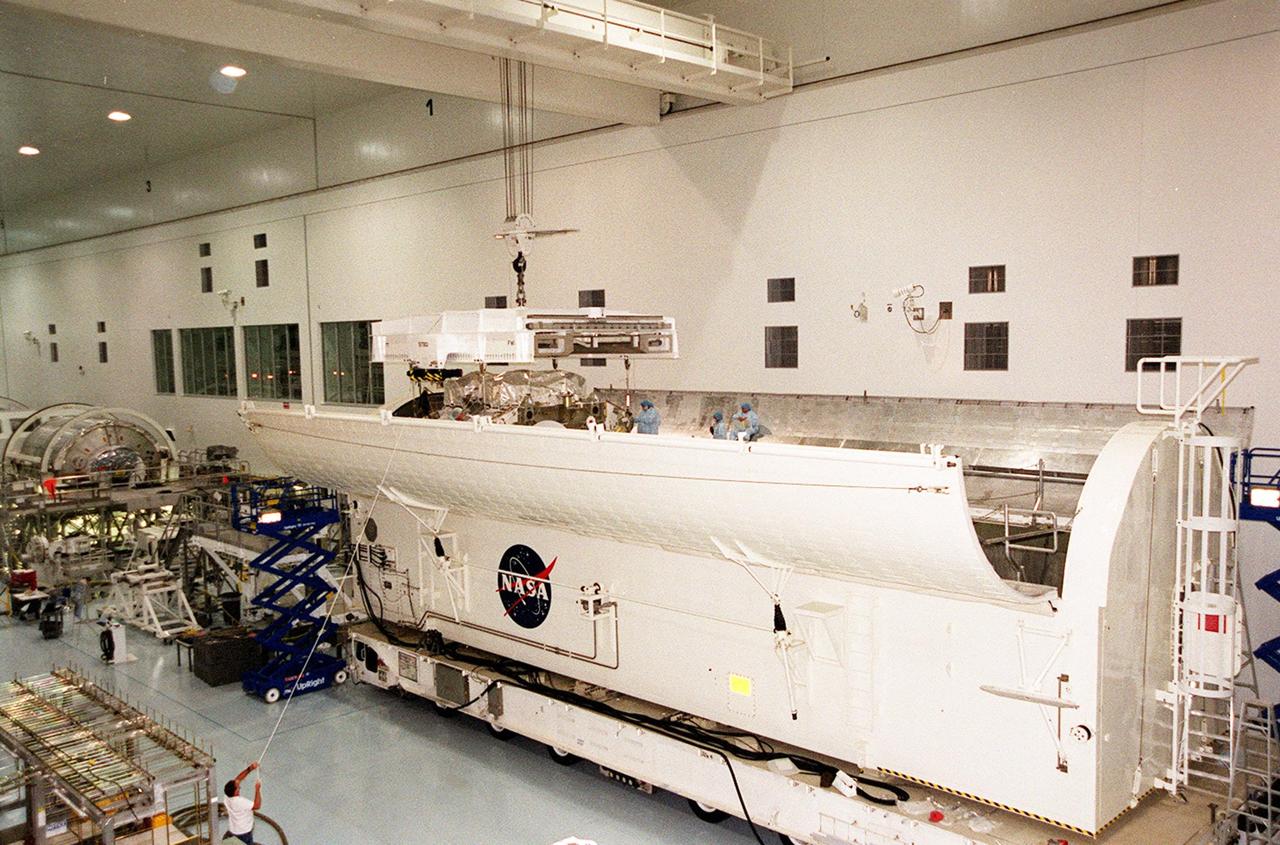
The Integrated Truss Structure Z1 disappears inside the payload canister after being lowered by the overhead crane in the Space Station Processing Facility. Once it is secured inside, the truss will be transported to Launch Pad 39A. It is part of the payload on mission STS-92 scheduled to lift off Oct. 5, 2000
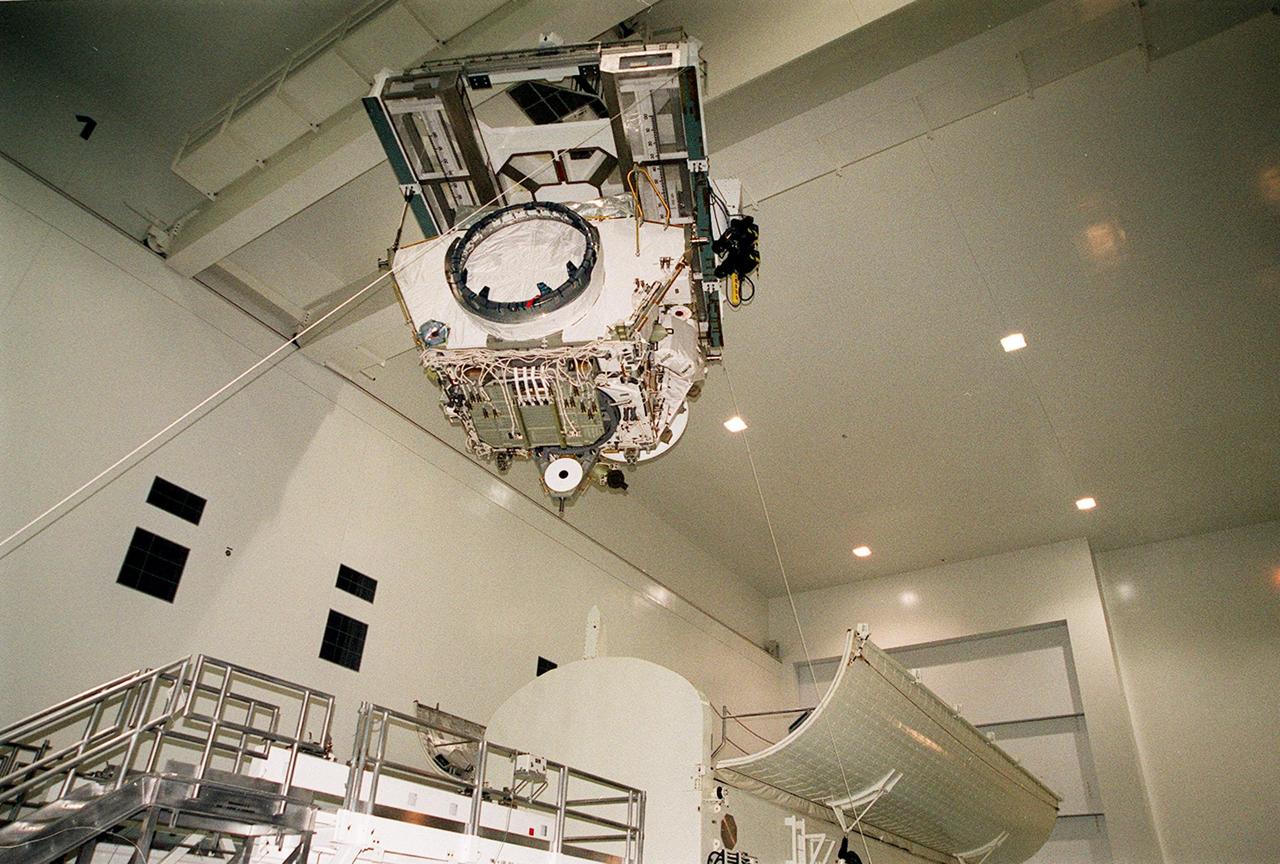
In the Space Station Processing Facility, the Integrated Truss Structure Z1, suspended from an overhead crane, nearly finishes rotation before placement inside the payload canister below it. The truss will then be transported to Launch Pad 39A. It is part of the payload on mission STS-92 scheduled to lift off Oct. 5, 2000
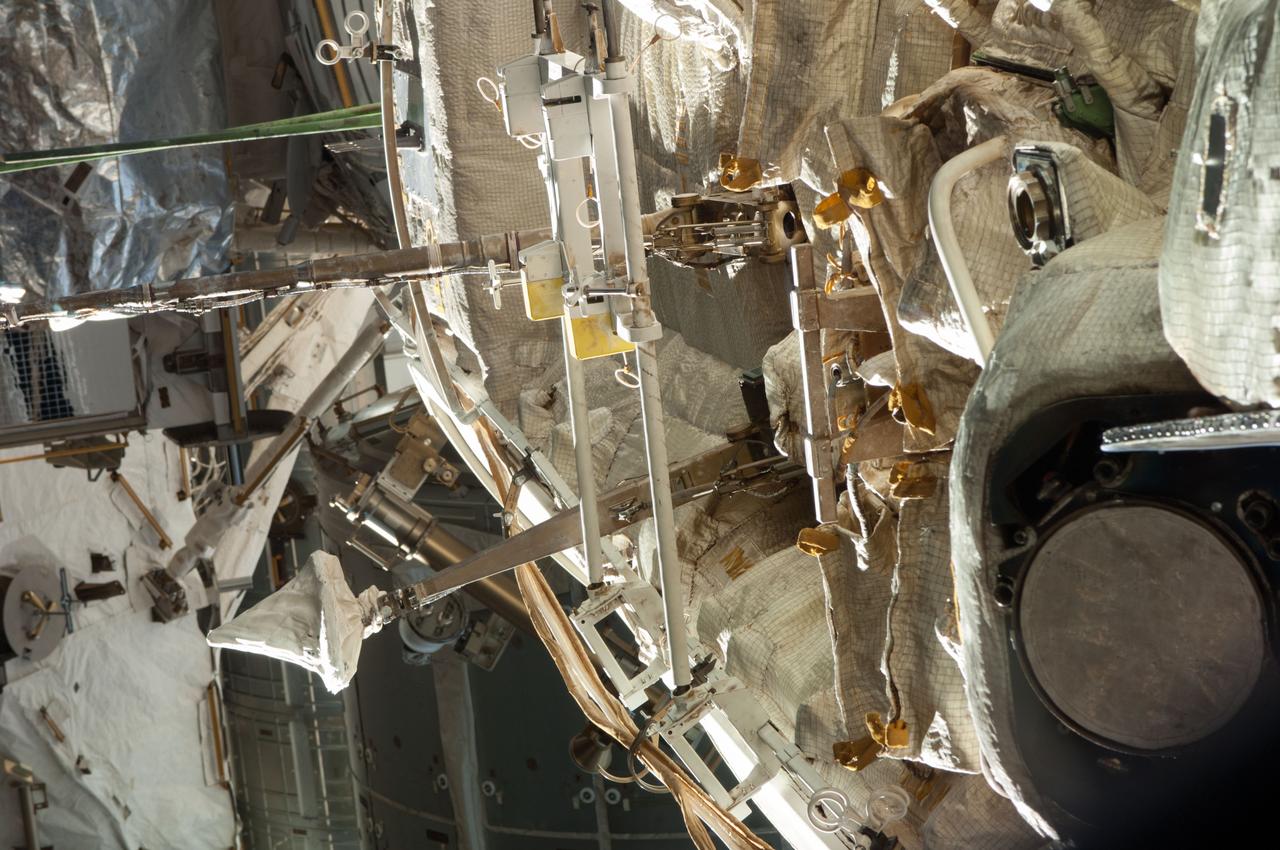
Survey view of a portion of the Zarya Functional Cargo Block (FGB) taken through a window in the Russian segment of the ISS during Expedition 35. Portions of the S0 and Z1 Truss segments are also in view.
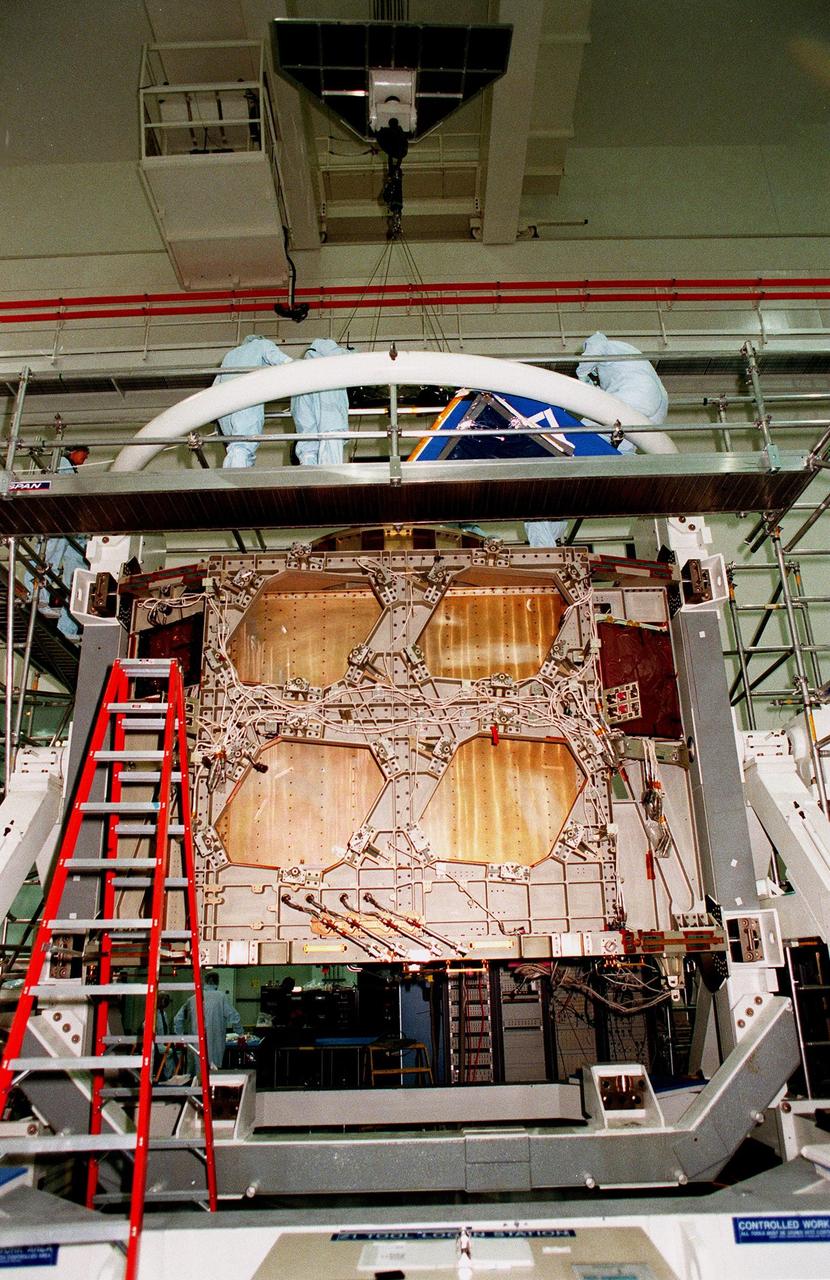
Workers in the Space Station Processing Facility look at the Passive Common Berthing Mechanism (PCBM) that will be attached to the Z1 integrated truss structure, a component of the International Space Station (ISS). The truss will be used for the temporary installation of the P6 truss segment to the Unity connecting module. The P6 truss segment contains the solar arrays and batteries which will provide early station power. The truss is scheduled to be launched aboard STS-92 in late 1999
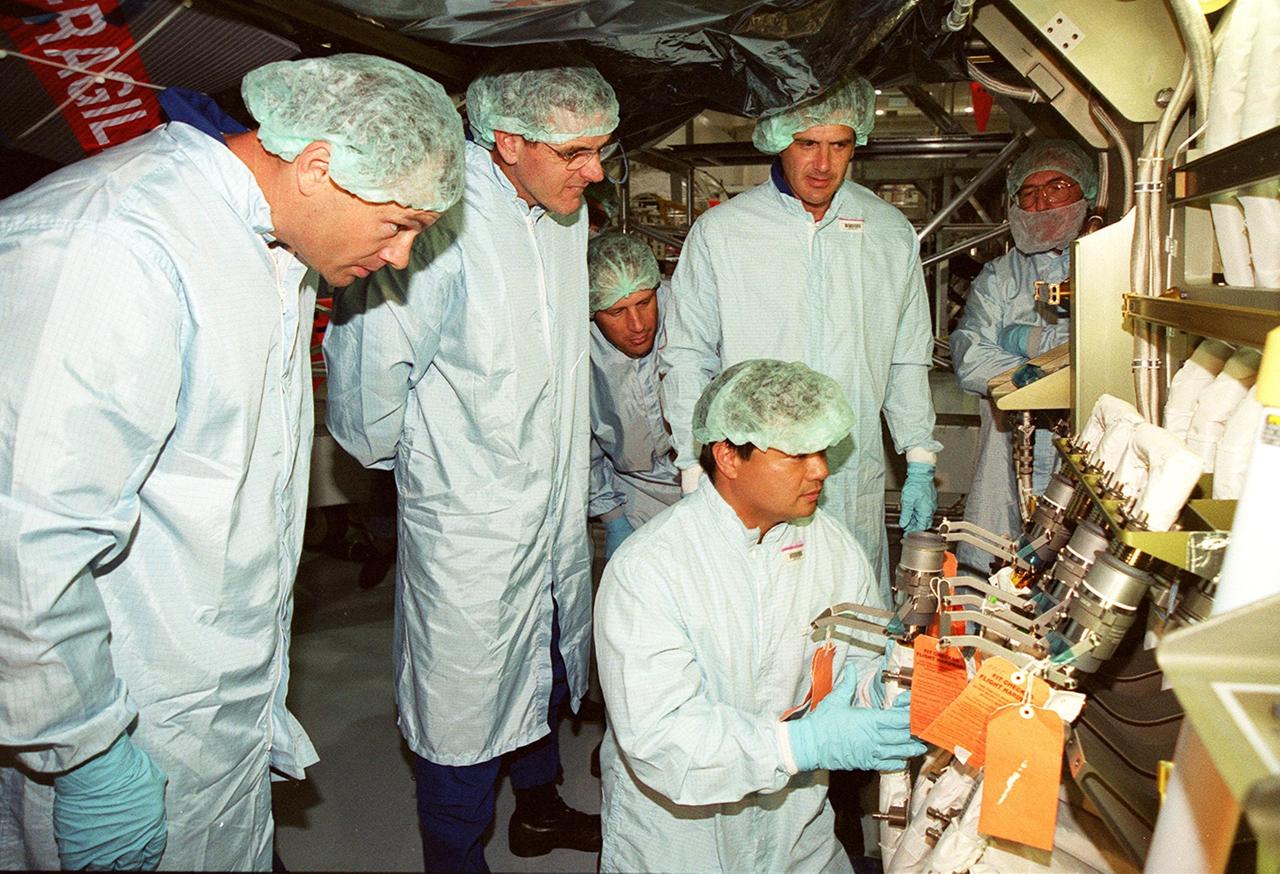
Members of the STS-92 crew check out the Integrated Truss Structure Z1, a component of the International Space Station and payload on their mission. From left are Mission Specialists Michael Lopez-Alegria, Bill McArthur, Jeff Wisoff and (kneeling) Leroy Chiao. They and other crew members are taking part in Crew Equipment Interface Test (CEIT) activities while at KSC. The Z1 truss is an early exterior framework to allow the first U.S. solar arrays on a future flight to be temporarily installed on Unity for early power. STS-92 is scheduled to launch Oct. 5 from launch Pad 39A
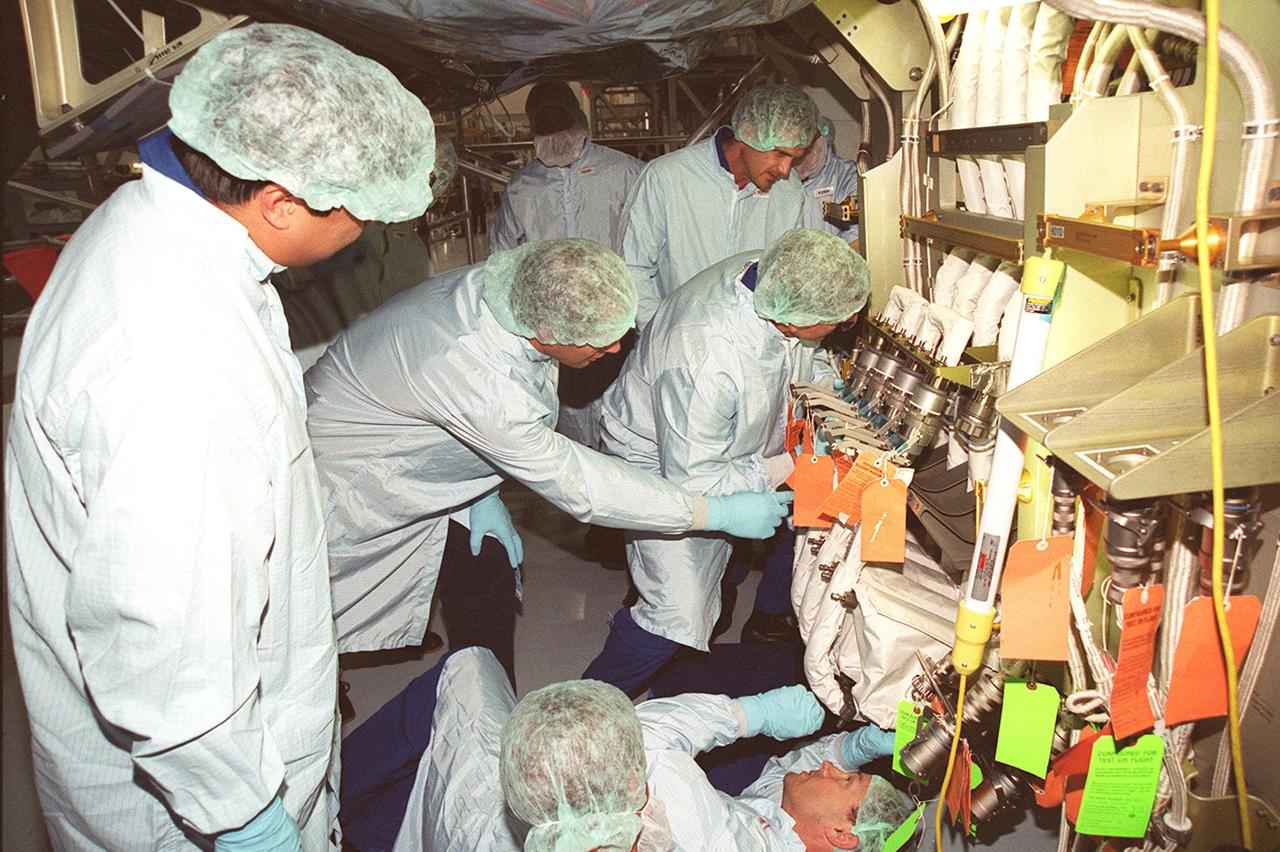
As part of Crew Equipment Interface Test (CEIT) activities, members of the STS-92 crew check out equipment they will be using on the mission to the International Space Station. At left is Mission Specialist Leroy Chiao, looking at part of the Integrated Truss Structure Z1, a component of the Station and payload on STS-92. Others seen in the photo are Mission Specialists Michael Lopez-Alegria (on his back, lower right); Jeff Wisoff (standing in back); and Bill McArthur (bending closer to the Z1 truss). Also taking part in the CIET are Commander Brian Duffy, Pilot Pam Melroy, and Mission Specialist Koichi Wakata. STS-92 is scheduled to launch Oct. 5 from launch Pad 39A
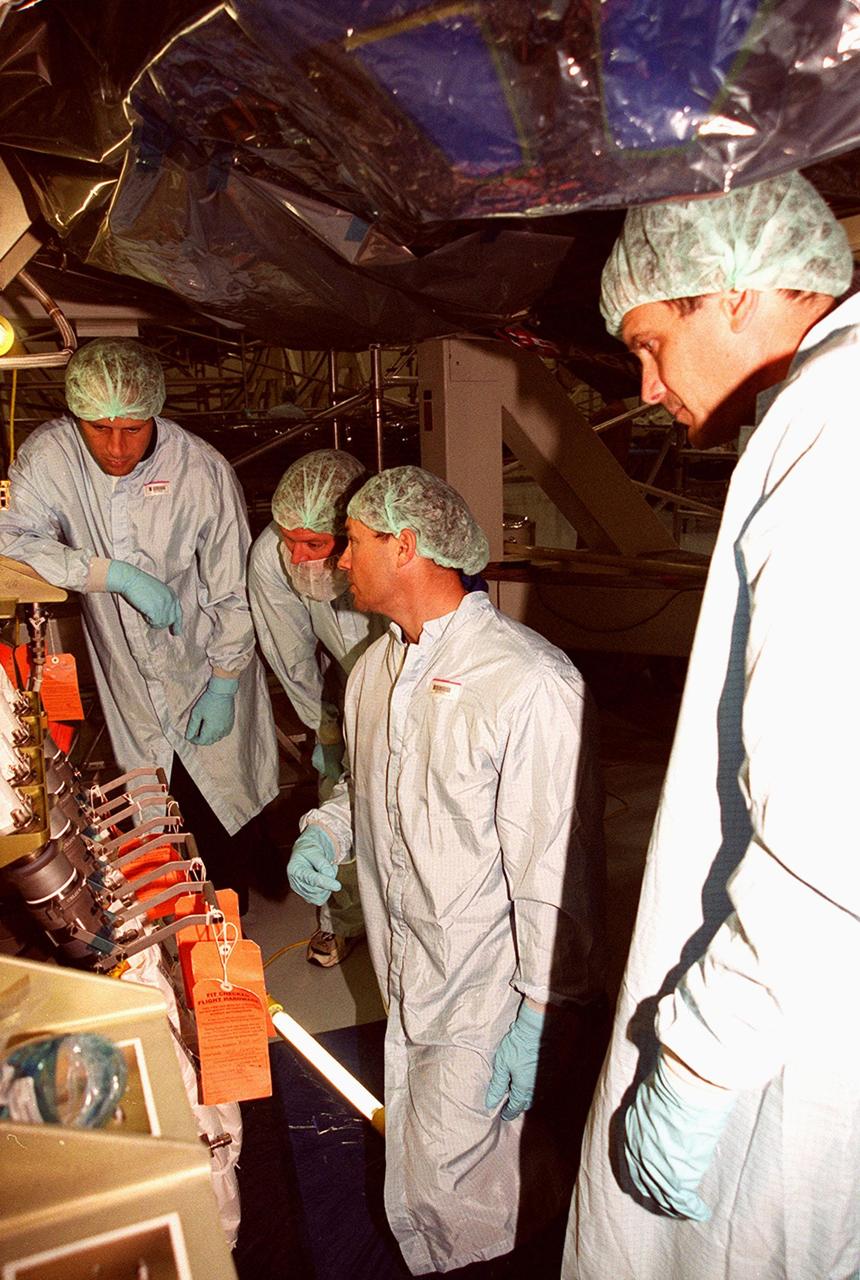
As part of Crew Equipment Interface Test (CEIT) activities, members of the STS-92 crew check out equipment they will be using on the mission to the International Space Station. Mission Specialists Michael Lopez-Alegria (center) and Jeff Wisoff (right) talk with Boeing technicians about the Integrated Truss Structure Z1, a component of the Station and payload on STS-92, in front of them. The Z1 truss is an early exterior framework to allow the first U.S. solar arrays on a future flight to be temporarily installed on Unity for early power. STS-92 is scheduled to launch Oct. 5 from launch Pad 39A
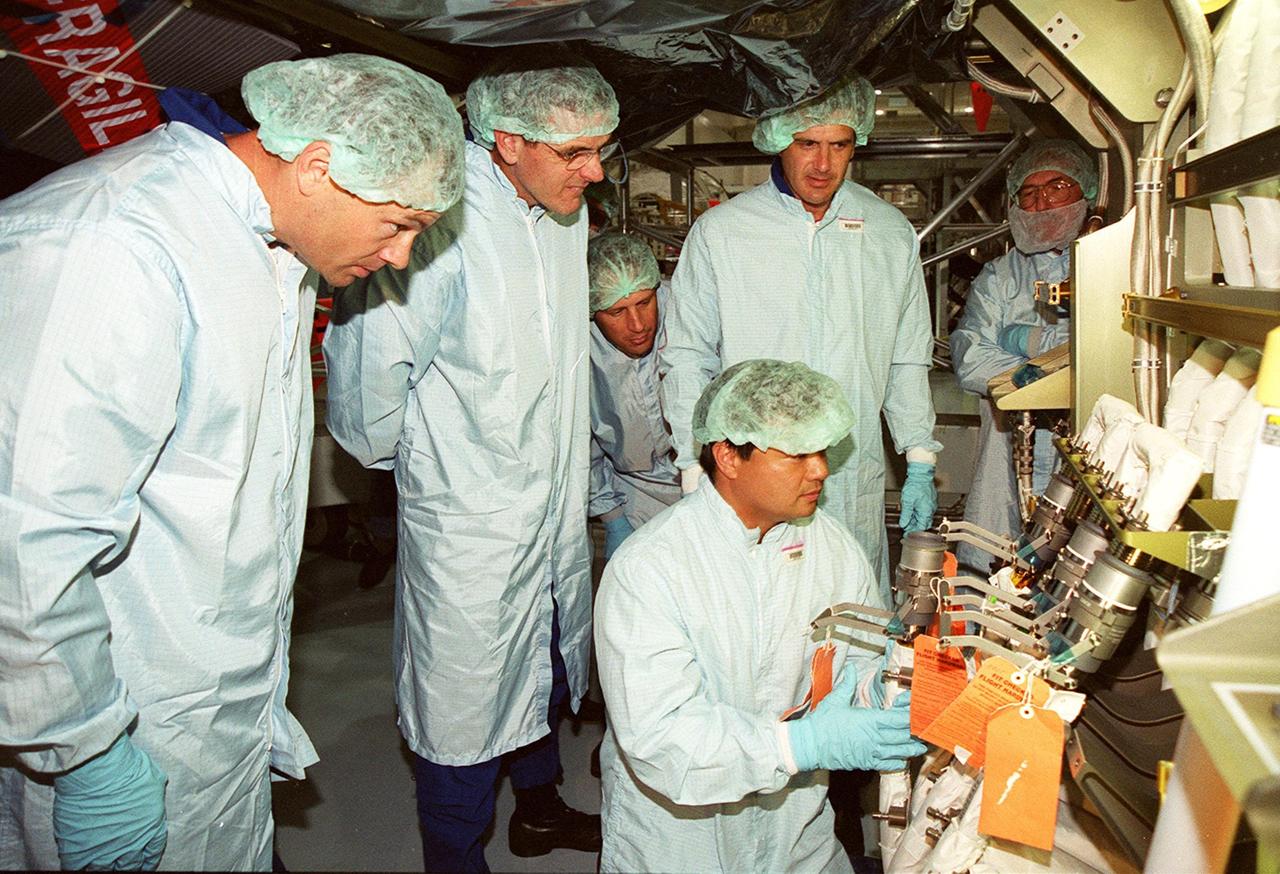
Members of the STS-92 crew check out the Integrated Truss Structure Z1, a component of the International Space Station and payload on their mission. From left are Mission Specialists Michael Lopez-Alegria, Bill McArthur, Jeff Wisoff and (kneeling) Leroy Chiao. They and other crew members are taking part in Crew Equipment Interface Test (CEIT) activities while at KSC. The Z1 truss is an early exterior framework to allow the first U.S. solar arrays on a future flight to be temporarily installed on Unity for early power. STS-92 is scheduled to launch Oct. 5 from launch Pad 39A

On a workstand in the Space Station Processing Facility, workers release the S-band Antenna Support Assembly (SASA) from an overhead crane. The SASA will be attached to the Integrated Truss Structure (ITS) Z1, an element of the International Space Station, sitting below. The antenna is primarily for local communications between the orbiter and Space Station. The Z1 is an early exterior framework to allow the first U.S. solar arrays, on mission STS-97, flight 4A, to be temporarily installed on Unity for early power. The Z1 is scheduled on mission STS-92, the fifth flight to the Space Station, in the fall
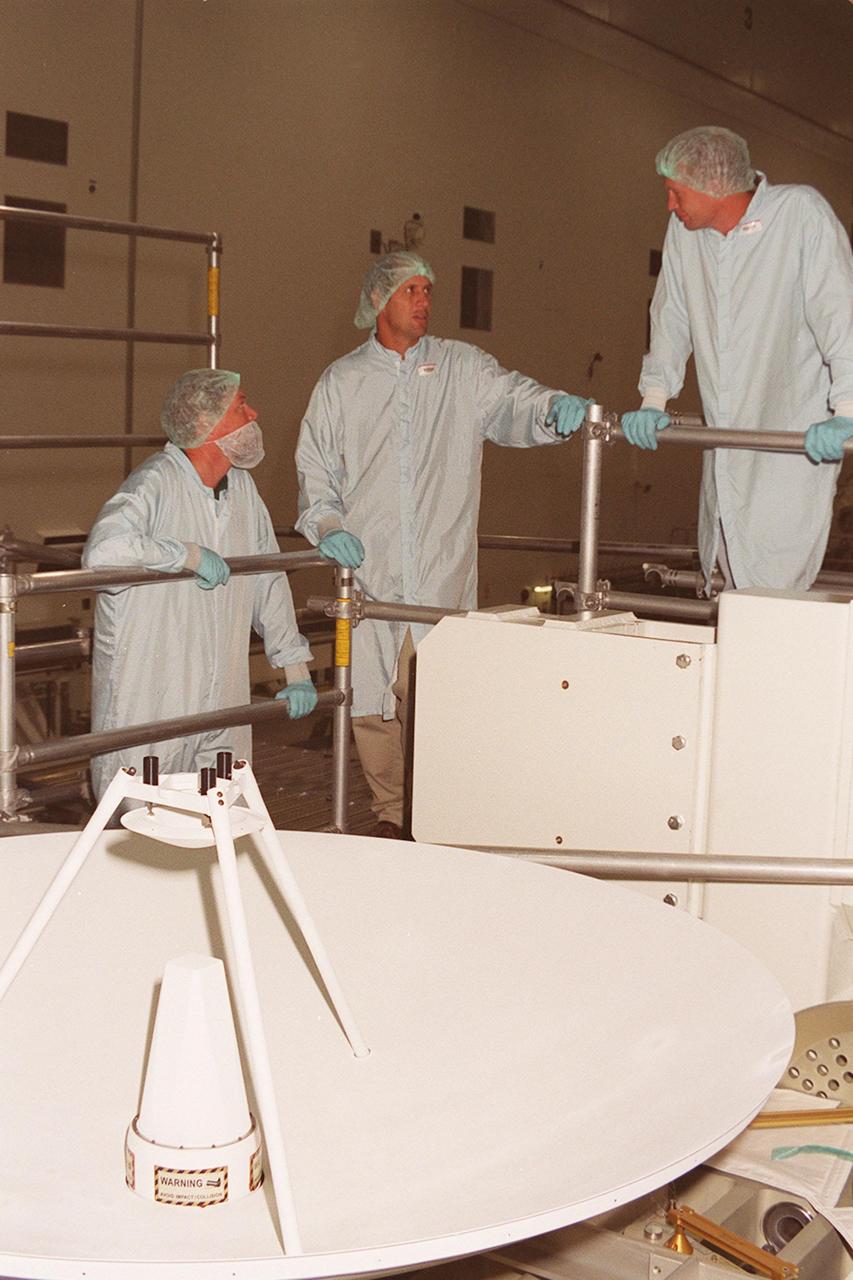
In the Space Shuttle Processing Facility, workers confer about the high-gain antenna in front of them that will be attached to the Integrated Truss Structure (ITS) Z1. The Z1, part of the payload on mission STS-92 (flight 3A) to be launched in mid-fall, is an early exterior framework for the International Space Station. It will allow the first U.S. solar arrays, on mission STS-97 (flight 4A), to be temporarily installed on Unity for early power
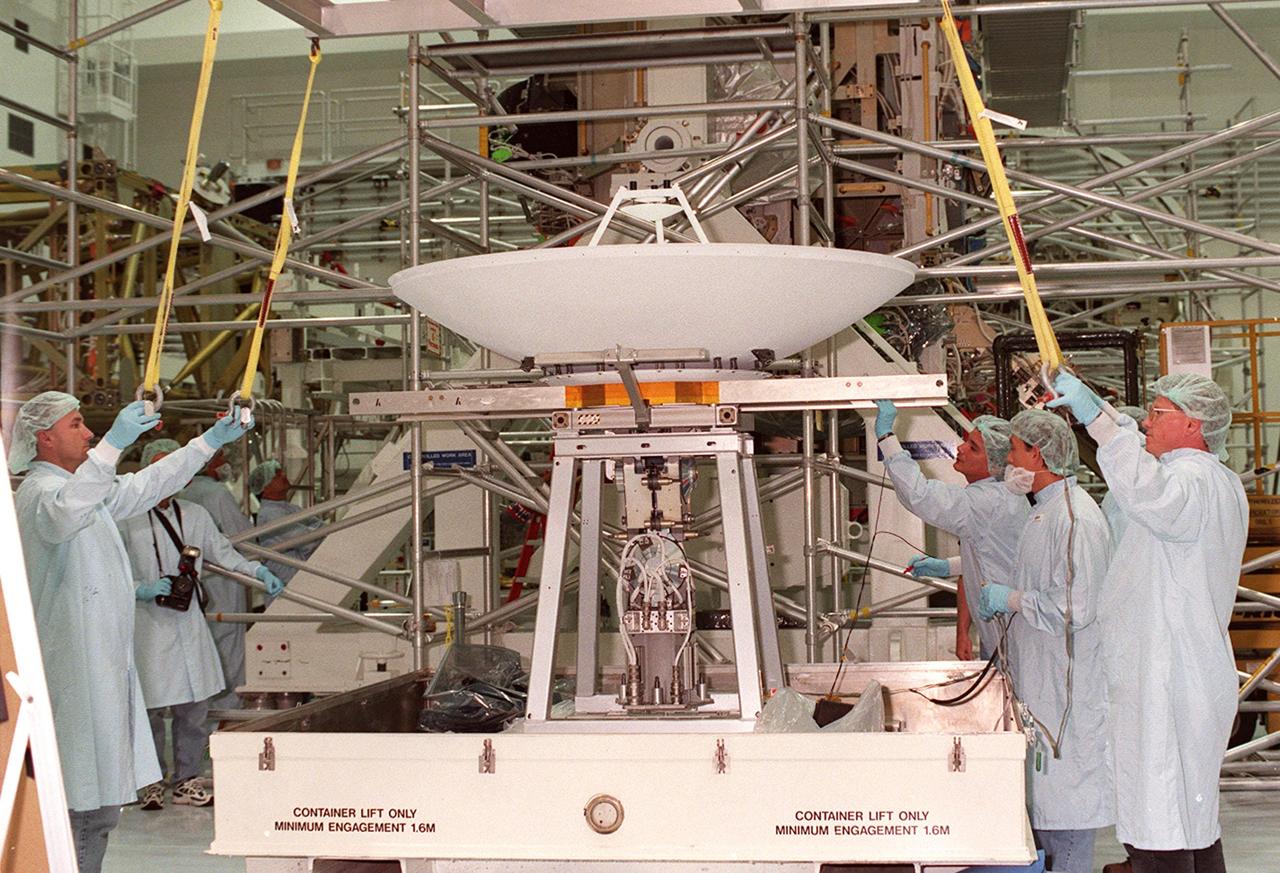
In the Space Shuttle Processing Facility, workers get ready to attach cables to a high-gain antenna that will be lifted and attached to the Integrated Truss Structure (ITS) Z1. The Z1, part of the payload on mission STS-92 (flight 3A) to be launched in mid-fall, is an early exterior framework for the International Space Station. It will allow the first U.S. solar arrays, on mission STS-97 (flight 4A), to be temporarily installed on Unity for early power

STS-92 Mission Specialist Leroy Chiao poses in front of the Integrated Truss Structure (ITS) Z1 in the Space Shuttle Processing Facility. Chiao is a member of the crew on the fifth flight to the International Space Station, scheduled for launch in mid-fall. The Z1 is an early exterior framework for the Space Station, and will allow the first U.S. solar arrays, on mission STS-97, flight 4A, to be temporarily installed on Unity for early power
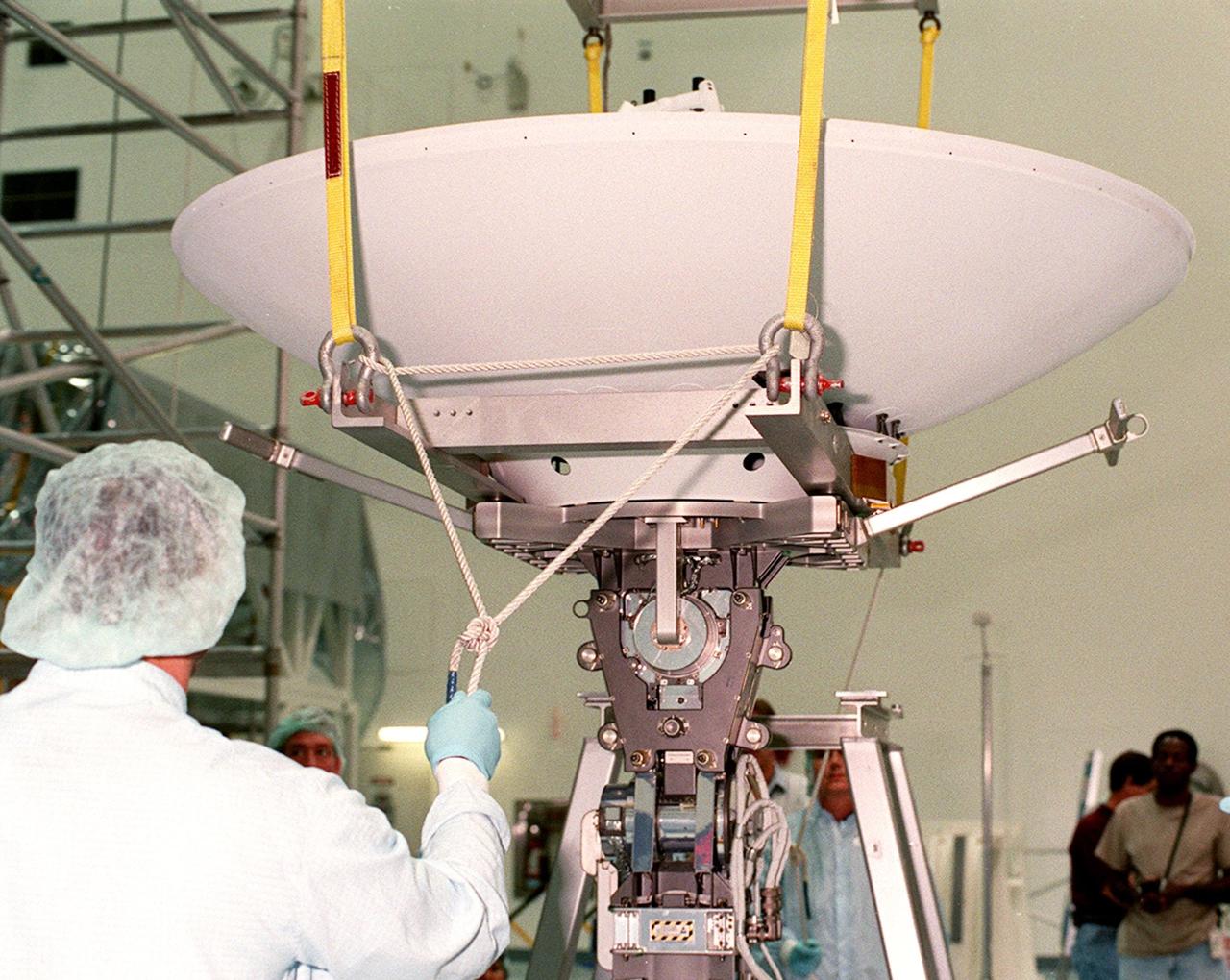
In the Space Shuttle Processing Facility, a worker checks a rope attached to a high-gain antenna before it moves to the Integrated Truss Structure (ITS) Z1, to which it will be attached. The Z1, part of the payload on mission STS-92 (flight 3A) to be launched in mid-fall, is an early exterior framework for the International Space Station. It will allow the first U.S. solar arrays, on mission STS-97 (flight 4A), to be temporarily installed on Unity for early power
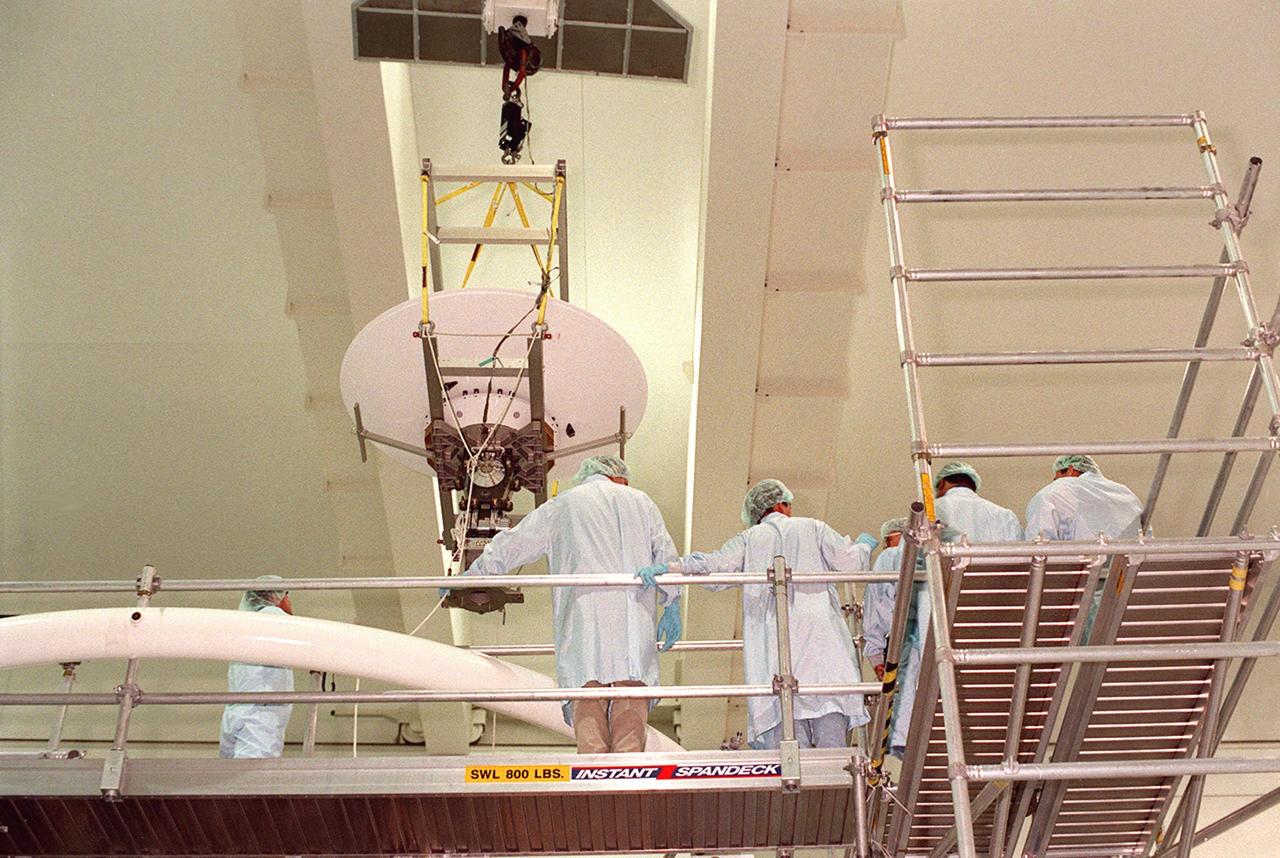
An overhead crane in the Space Shuttle Processing Facility lifts a high-gain antenna over a work platform toward the Integrated Truss Structure (ITS) Z1, to which it will be attached. The Z1, part of the payload on mission STS-92 (flight 3A) to be launched in mid-fall, is an early exterior framework for the International Space Station. It will allow the first U.S. solar arrays, on mission STS-97 (flight 4A), to be temporarily installed on Unity for early power
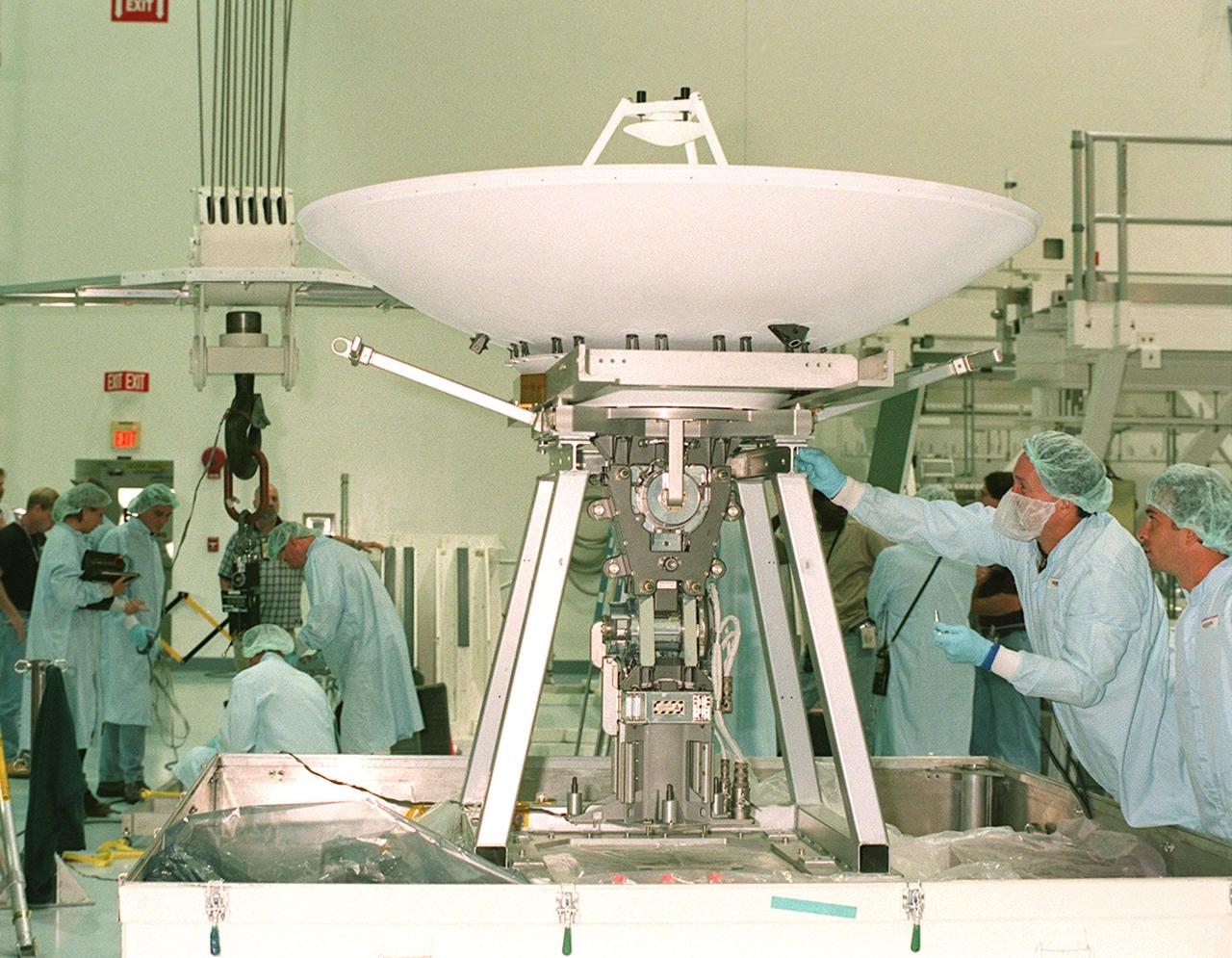
In the Space Shuttle Processing Facility, workers make adjustments on a high-gain antenna that will be attached to the Integrated Truss Structure (ITS) Z1. The Z1, part of the payload on mission STS-92 (flight 3A) to be launched in mid-fall, is an early exterior framework for the International Space Station. It will allow the first U.S. solar arrays, on mission STS-97 (flight 4A), to be temporarily installed on Unity for early power
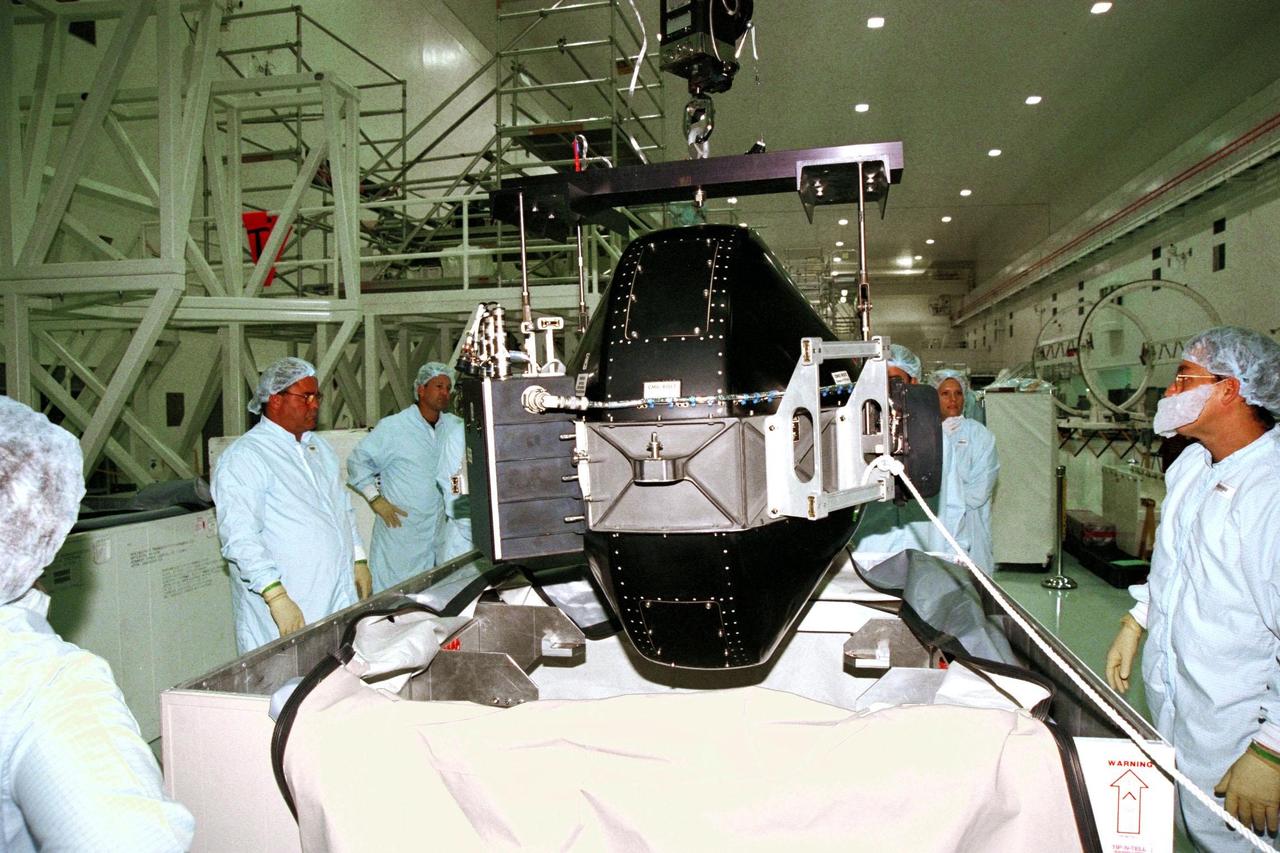
Boeing technicians remove the cover from a Control Moment Gyroscope (CMG) in the Space Station Processing Facility at KSC. The CMG will be attached to the Integrated Truss Structure (ITS) Z1. Gyroscopes are used for stabilization of the International Space Station (ISS). The CMG and Z1, part of the construction of the ISS, will be carried on STS-92, the third U.S. flight planned for on-orbit construction of the ISS. STS-92 is scheduled for liftoff on June 17, 1999, aboard the Space Shuttle Atlantis
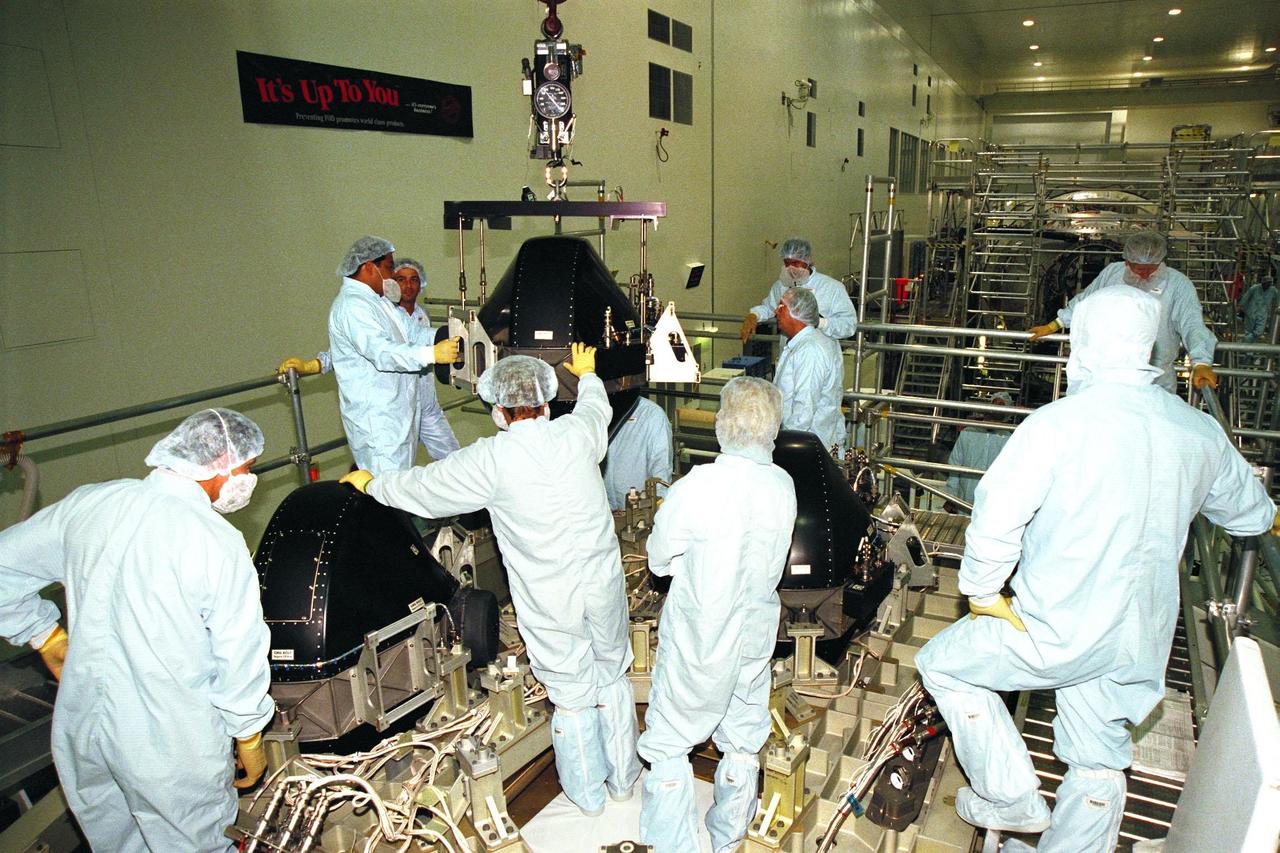
Boeing technicians lower a Control Moment Gyroscope (CMG) into place on the Integrated Truss Structure (ITS) Z1 in the Space Station Processing Facility at KSC. Gyroscopes are used for stabilization of the International Space Station (ISS). The CMG and Z1, part of the construction of the ISS, will be carried on STS-92, the third U.S. flight planned for on-orbit construction of the ISS. STS-92 is scheduled for liftoff on June 17, 1999, aboard the Space Shuttle Atlantis
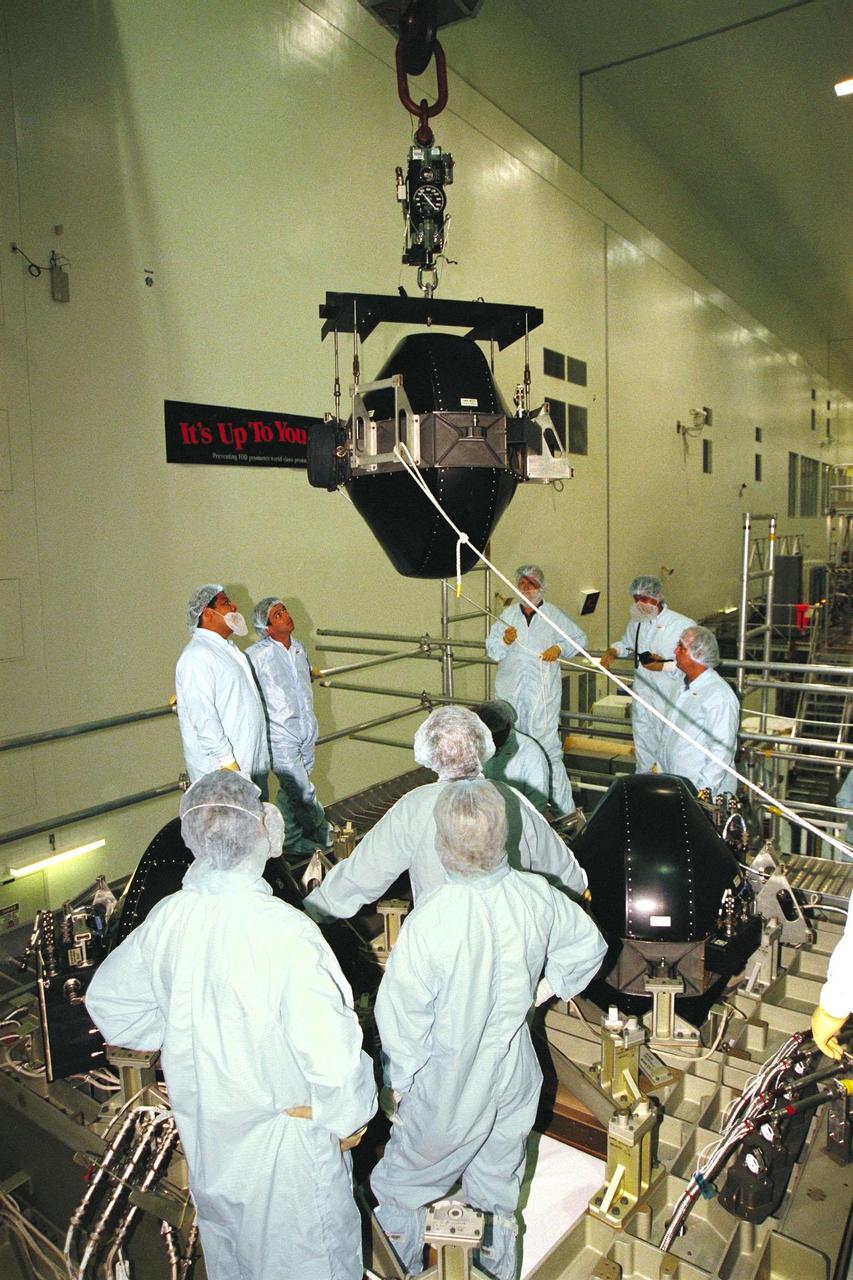
Boeing technicians move a Control Moment Gyroscope (CMG) to the Integrated Truss Structure (ITS) Z1 in the Space Station Processing Facility at KSC. Gyroscopes are used for stabilization of the International Space Station (ISS). The CMG and Z1, part of the construction of the ISS, will be carried on STS-92, the third U.S. flight planned for on-orbit construction of the ISS. STS-92 is scheduled for liftoff on June 17, 1999, aboard the Space Shuttle Atlantis
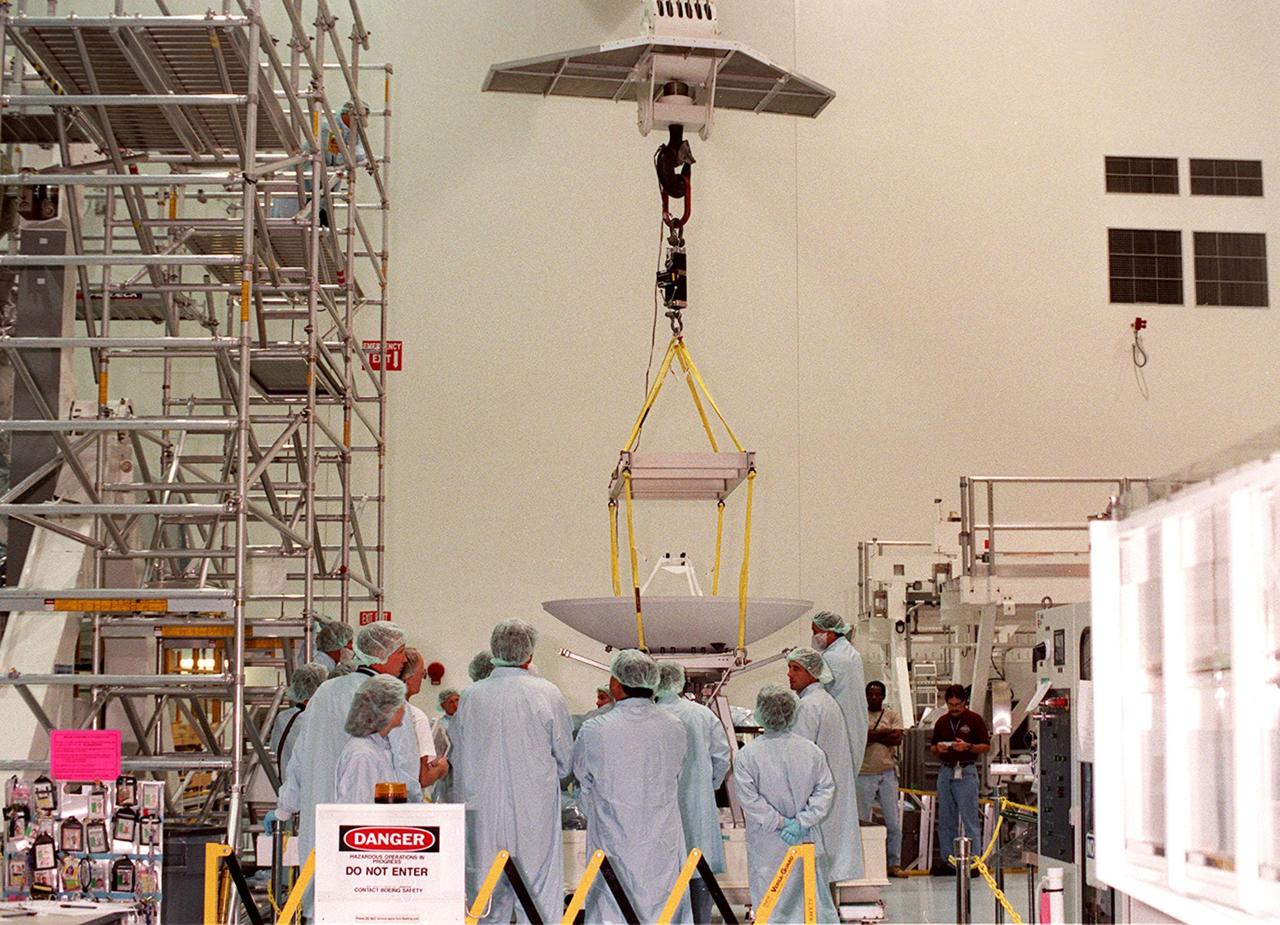
In the Space Shuttle Processing Facility, an overhead crane begins lifting a high-gain antenna to move it to the Integrated Truss Structure (ITS) Z1, to which it will be attached. The Z1, part of the payload on mission STS-92 (flight 3A) to be launched in mid-fall, is an early exterior framework for the International Space Station. It will allow the first U.S. solar arrays, on mission STS-97 (flight 4A), to be temporarily installed on Unity for early power
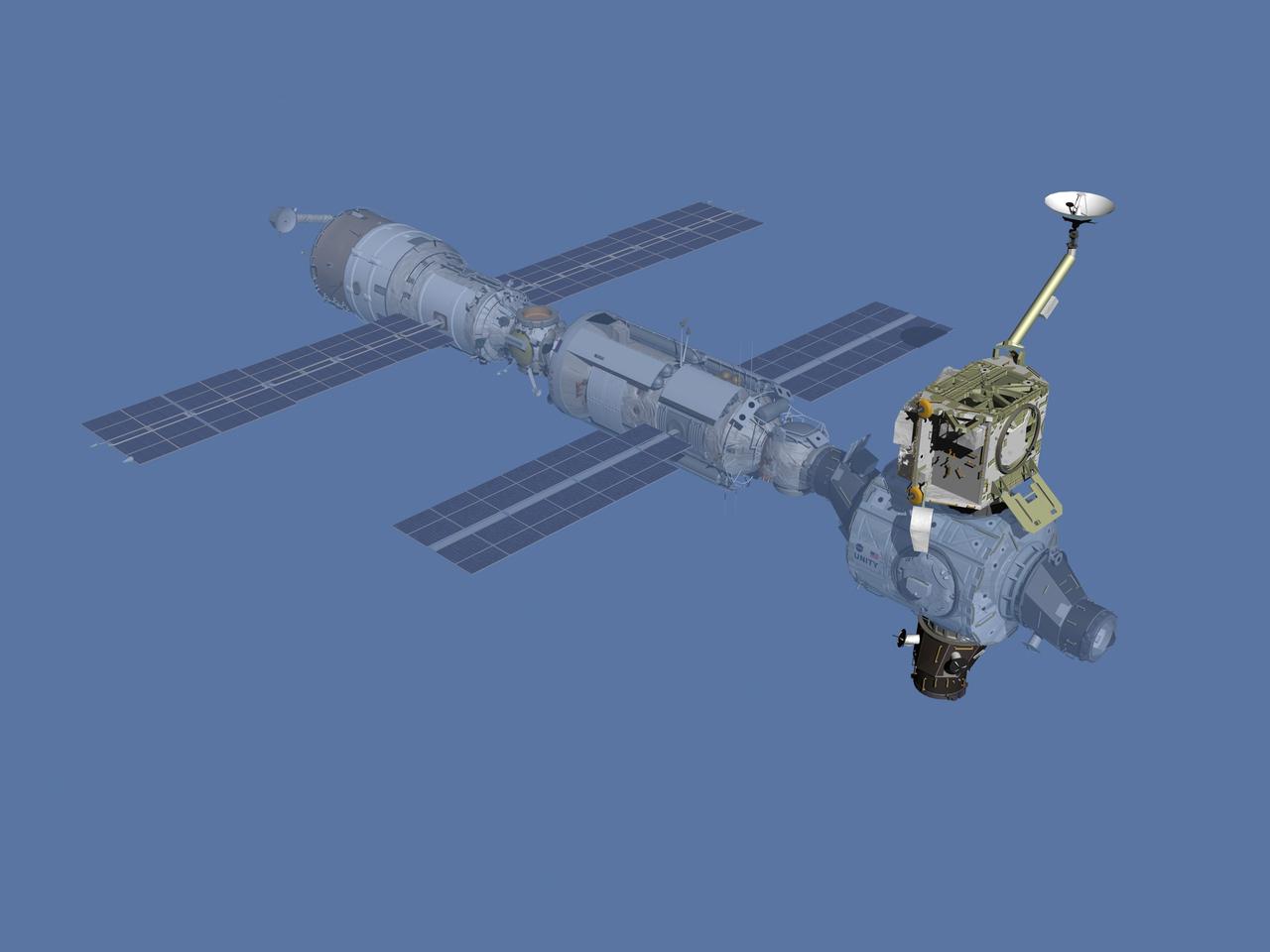
JSC2006-E-43482 (October 2000) --- Computer-generated artist's rendering of the International Space Station after flight STS-92/3A. Arriving aboard Space Shuttle Discovery, the STS-92 crew installed the Z1 truss, a third pressurized mating adapter and a Ku-band antenna.
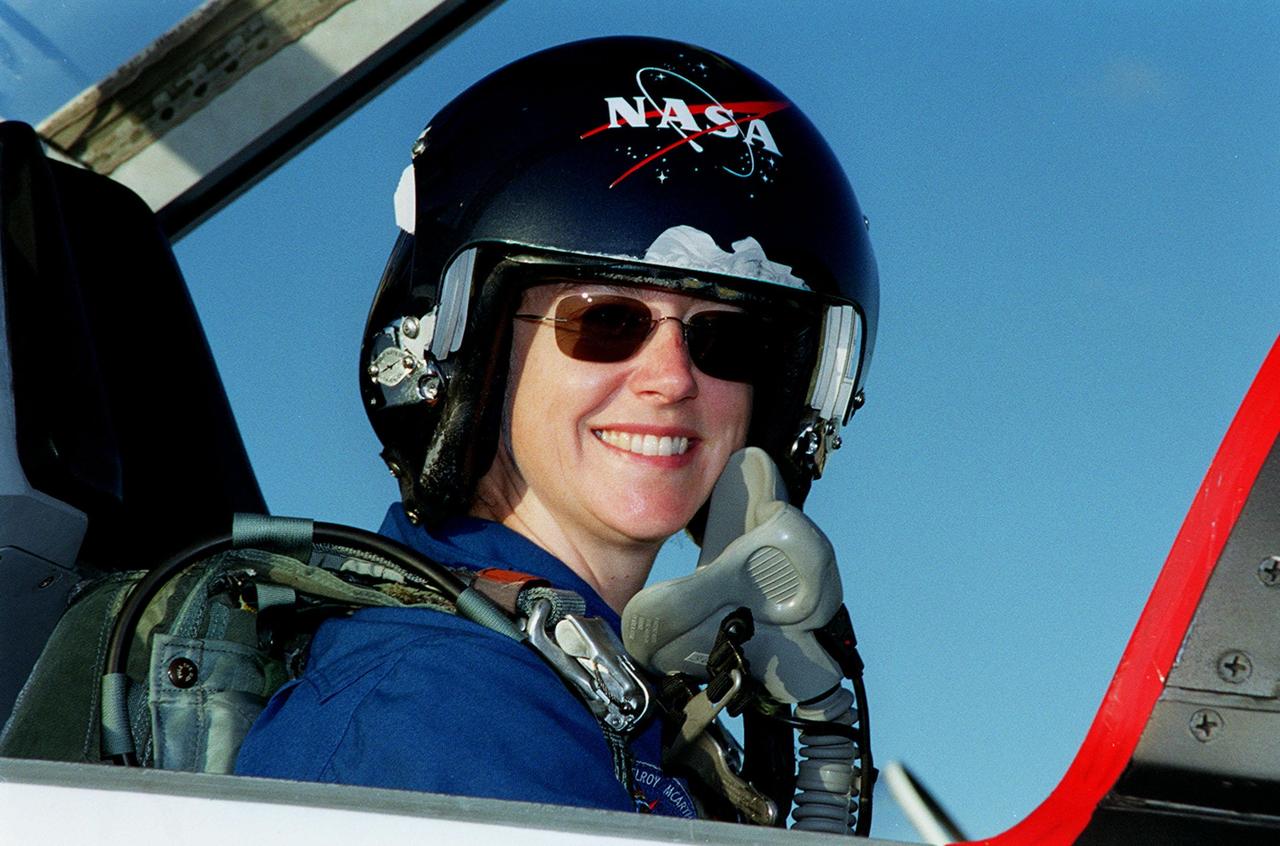
STS-92 Pilot Pamela Ann Melroy is happy to arrive at the KSC Shuttle Landing Facility after a flight from Houston. She and the rest of the crew are at KSC to take part in Terminal Countdown Demonstration Test activities, which include emergency egress training from the orbiter and pad, and a simulated countdown. The fifth mission to the International Space Station, STS-92 will carry the Integrated Truss Structure Z1, the first of the planned 10 trusses on the Space Station, and the third Pressurized Mating Adapter. The Z1 will allow the first U.S. solar arrays on a future flight to be temporarily installed on Unity for early power. PMA-3 will provide a Shuttle docking port for the solar array installation on the sixth ISS flight and Lab installation on the seventh ISS flight. STS-92 is scheduled to launch Oct. 5 from launch Pad 39A. It will be the 100th flight in the Shuttle program
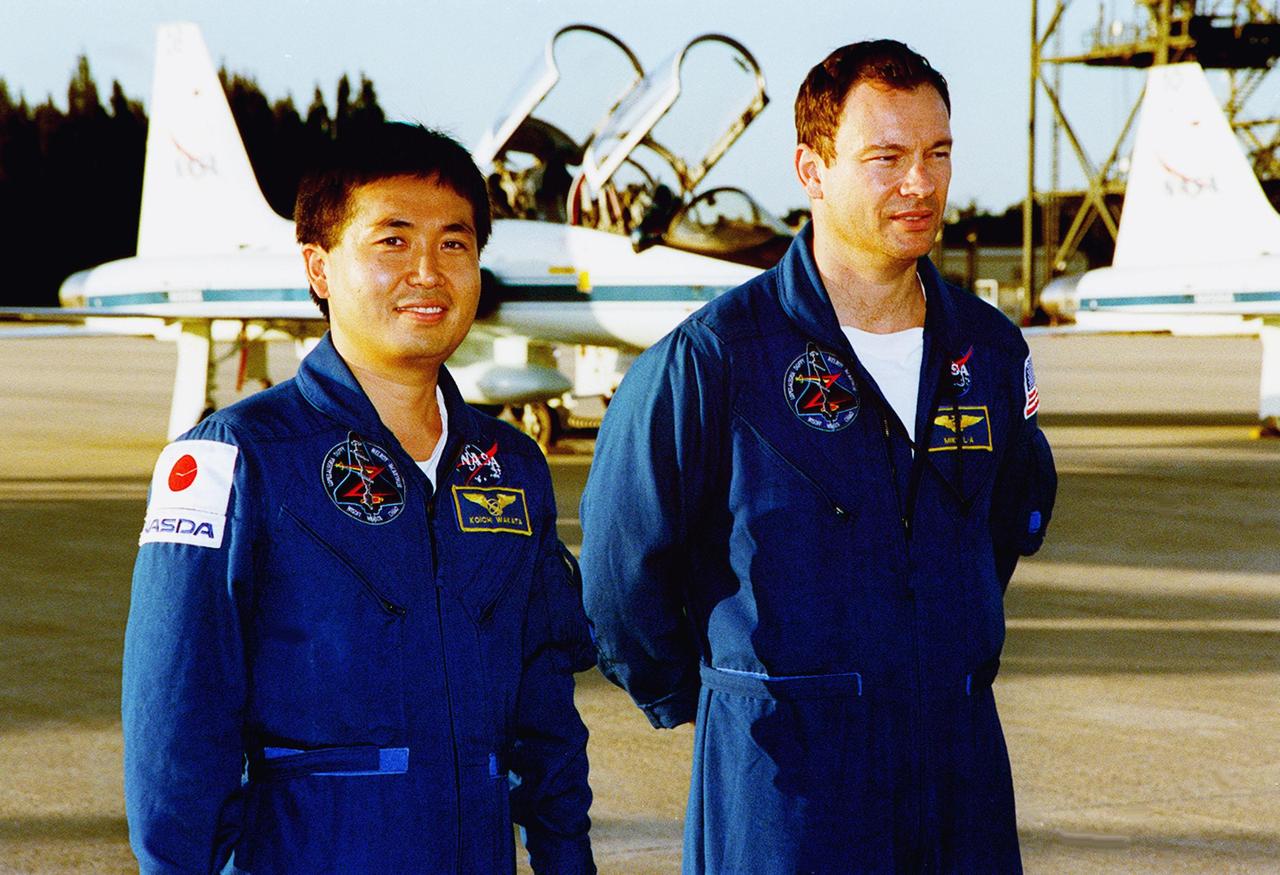
STS-92 Mission Specialists Koichi Wakata and Michael Lopez-Alegria pause on the tarmac after their arrival aboard the T-38 jet aircraft in the background. They and the rest of the crew are at KSC to take part in Terminal Countdown Demonstration Test (TCDT) activities. The TCDT includes emergency egress training from the orbiter and pad, plus a simulated countdown. The fifth mission to the International Space Station, STS-92 will carry the Integrated Truss Structure Z1, the first of the planned 10 trusses on the Space Station, and the third Pressurized Mating Adapter. The Z1 will allow the first U.S. solar arrays on a future flight to be temporarily installed on Unity for early power. PMA-3 will provide a Shuttle docking port for the solar array installation on the sixth ISS flight and Lab installation on the seventh ISS flight. STS-92 is scheduled to launch Oct. 5 from launch Pad 39A. It will be the 100th flight in the Shuttle program
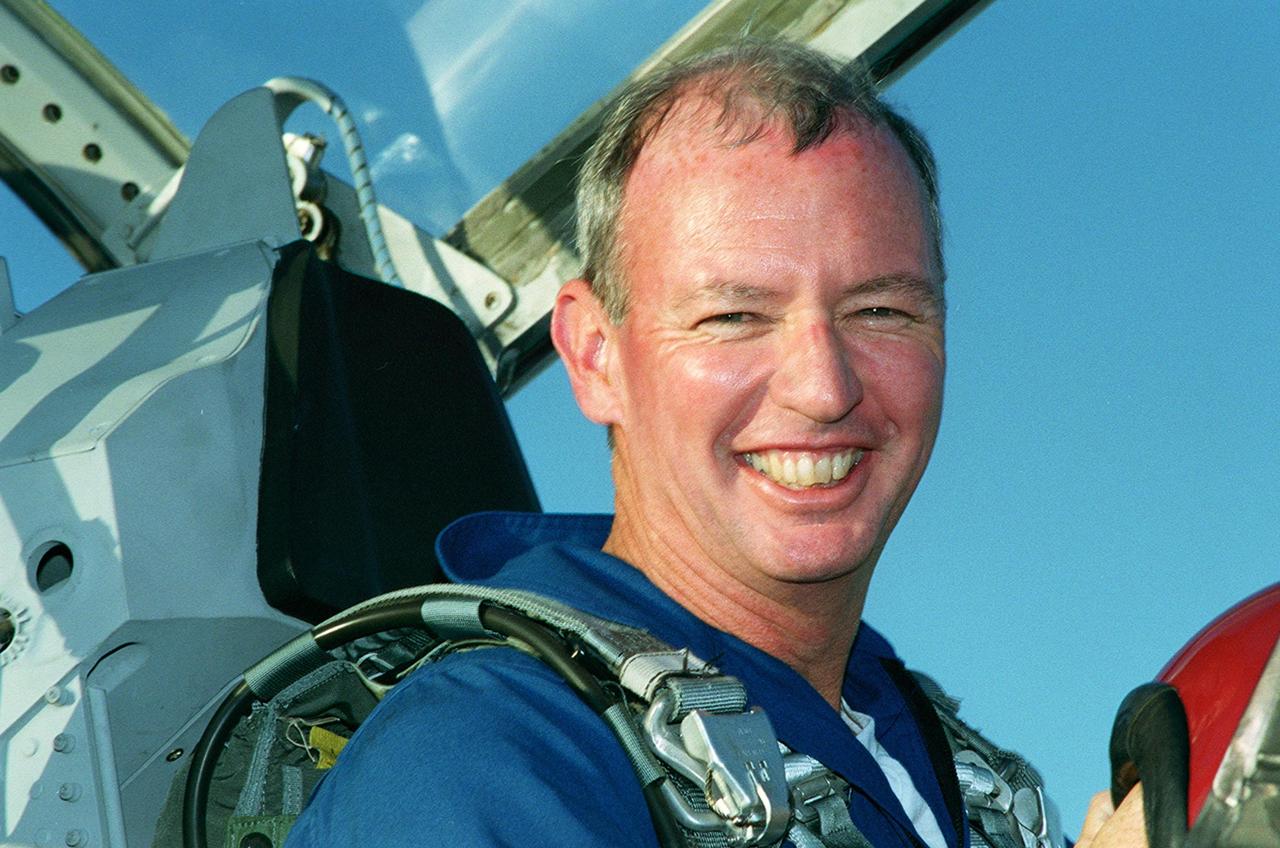
STS-92 Commander Brian Duffy smiles after landing at the KSC Shuttle Landing Facility in a T-38 training jet aircraft. He and the rest of the crew are at KSC to take part in Terminal Countdown Demonstration Test activities, which include emergency egress training from the orbiter and pad, and a simulated countdown. The fifth mission to the International Space Station, STS-92 will carry the Integrated Truss Structure Z1, the first of the planned 10 trusses on the Space Station, and the third Pressurized Mating Adapter. The Z1 will allow the first U.S. solar arrays on a future flight to be temporarily installed on Unity for early power. PMA-3 will provide a Shuttle docking port for the solar array installation on the sixth ISS flight and Lab installation on the seventh ISS flight. STS-92 is scheduled to launch Oct. 5 from launch Pad 39A. It will be the 100th flight in the Shuttle program
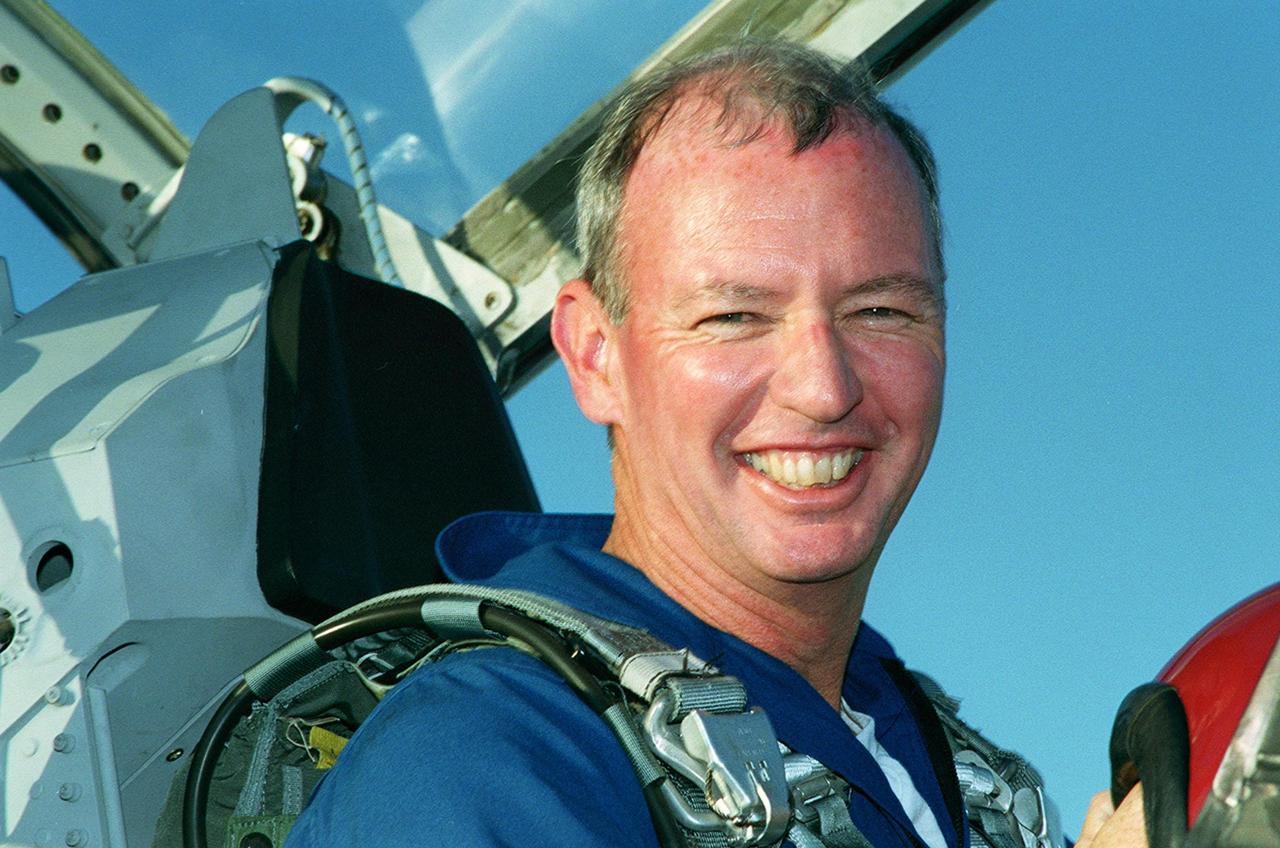
STS-92 Commander Brian Duffy smiles after landing at the KSC Shuttle Landing Facility in a T-38 training jet aircraft. He and the rest of the crew are at KSC to take part in Terminal Countdown Demonstration Test activities, which include emergency egress training from the orbiter and pad, and a simulated countdown. The fifth mission to the International Space Station, STS-92 will carry the Integrated Truss Structure Z1, the first of the planned 10 trusses on the Space Station, and the third Pressurized Mating Adapter. The Z1 will allow the first U.S. solar arrays on a future flight to be temporarily installed on Unity for early power. PMA-3 will provide a Shuttle docking port for the solar array installation on the sixth ISS flight and Lab installation on the seventh ISS flight. STS-92 is scheduled to launch Oct. 5 from launch Pad 39A. It will be the 100th flight in the Shuttle program
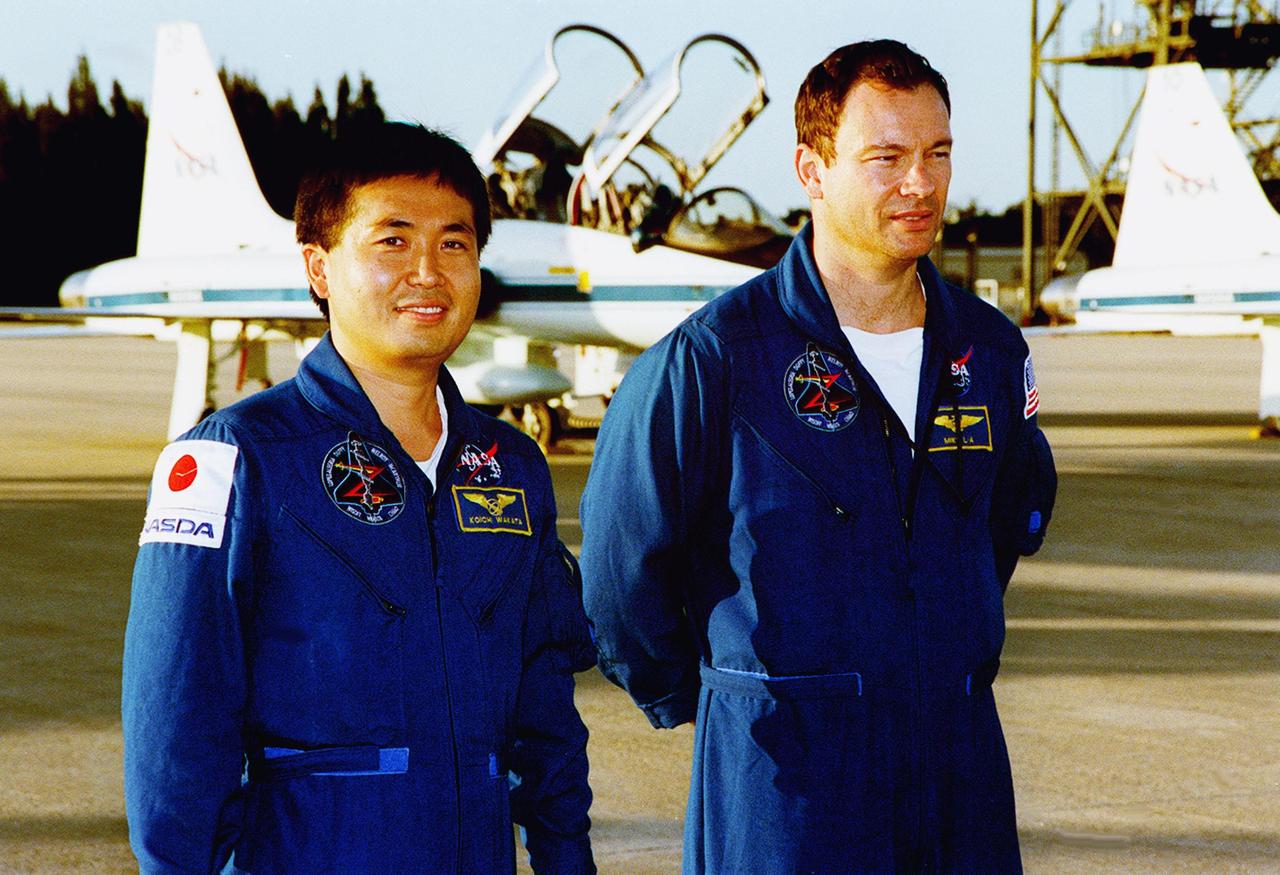
STS-92 Mission Specialists Koichi Wakata and Michael Lopez-Alegria pause on the tarmac after their arrival aboard the T-38 jet aircraft in the background. They and the rest of the crew are at KSC to take part in Terminal Countdown Demonstration Test (TCDT) activities. The TCDT includes emergency egress training from the orbiter and pad, plus a simulated countdown. The fifth mission to the International Space Station, STS-92 will carry the Integrated Truss Structure Z1, the first of the planned 10 trusses on the Space Station, and the third Pressurized Mating Adapter. The Z1 will allow the first U.S. solar arrays on a future flight to be temporarily installed on Unity for early power. PMA-3 will provide a Shuttle docking port for the solar array installation on the sixth ISS flight and Lab installation on the seventh ISS flight. STS-92 is scheduled to launch Oct. 5 from launch Pad 39A. It will be the 100th flight in the Shuttle program

STS-92 Pilot Pamela Ann Melroy is happy to arrive at the KSC Shuttle Landing Facility after a flight from Houston. She and the rest of the crew are at KSC to take part in Terminal Countdown Demonstration Test activities, which include emergency egress training from the orbiter and pad, and a simulated countdown. The fifth mission to the International Space Station, STS-92 will carry the Integrated Truss Structure Z1, the first of the planned 10 trusses on the Space Station, and the third Pressurized Mating Adapter. The Z1 will allow the first U.S. solar arrays on a future flight to be temporarily installed on Unity for early power. PMA-3 will provide a Shuttle docking port for the solar array installation on the sixth ISS flight and Lab installation on the seventh ISS flight. STS-92 is scheduled to launch Oct. 5 from launch Pad 39A. It will be the 100th flight in the Shuttle program
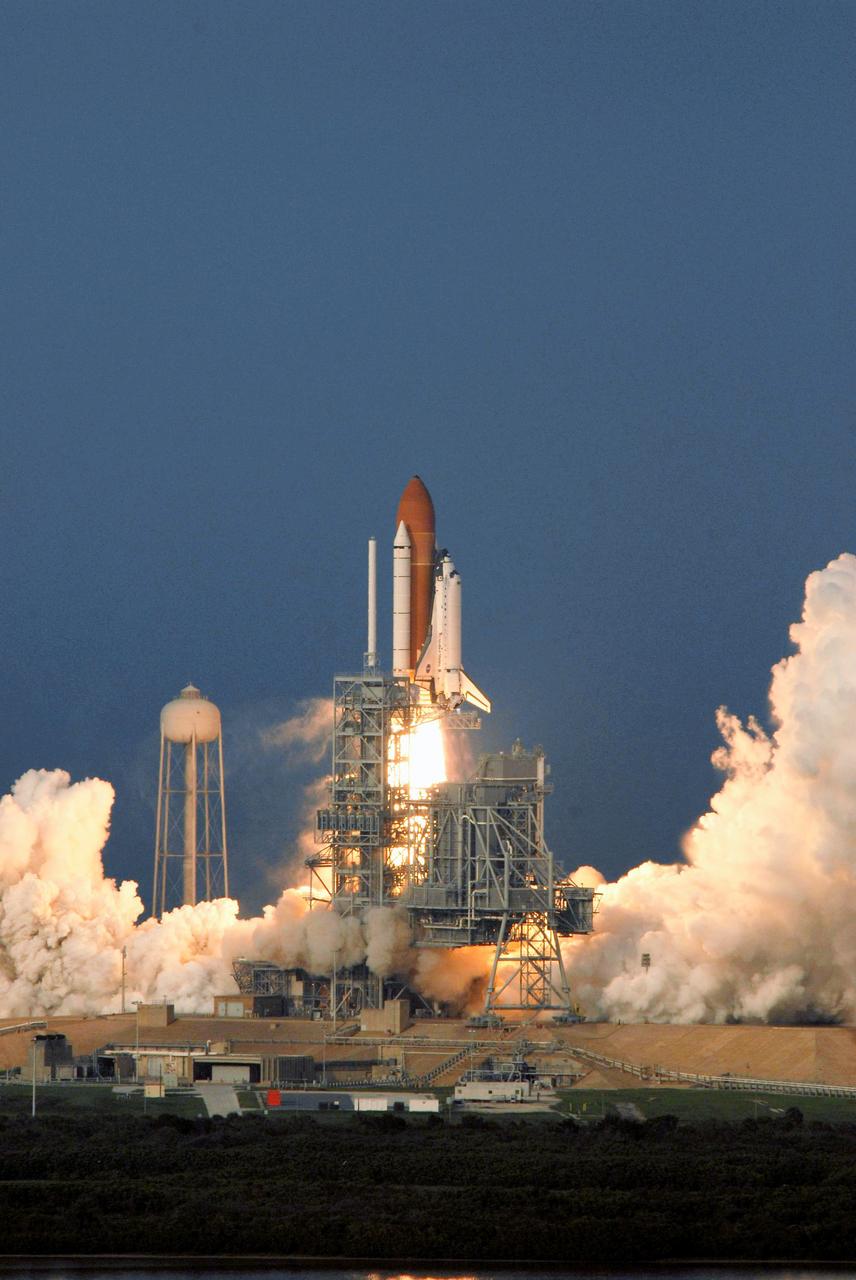
Enroute to the International Space Station (ISS), Space Shuttle Endeavor and its seven member STS-118 crew, blasted off from the launch pad at Kennedy Space Center on August 8, 2007. Construction resumed on the ISS as STS-118 mission specialists and the Expedition 15 crew completed installation of the third Starboard 5 (S-5) truss segment, removed a faulty Control Moment Gyroscope (CMG-3), installed a new CMG into the Z1 truss, relocated the S-band Antenna Sub-Assembly from the Port 6 (P6) to Port 1 (P1) truss, installed a new transponder on P1, retrieved the P6 transponder, and delivered roughly 5,000 pounds of equipment and supplies.
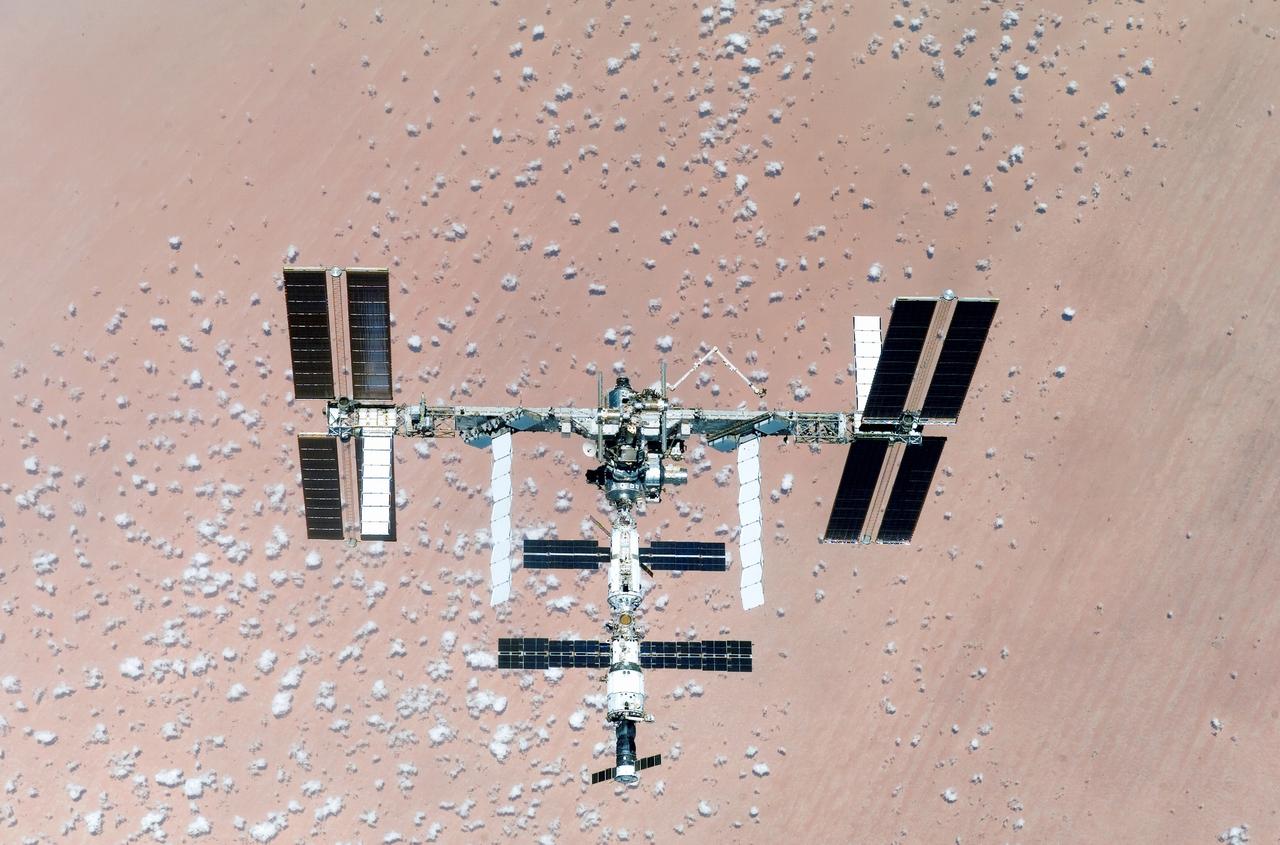
Back dropped by the colorful Earth, the International Space Station (ISS) boasts its newest configuration upon the departure of Space Shuttle Endeavor and STS-118 mission. Days earlier, construction resumed on the ISS as STS-118 mission specialists and the Expedition 15 crew completed installation of the Starboard 5 (S-5) truss segment, removed a faulty Control Moment Gyroscope (CMG-3), installed a new CMG into the Z1 truss, relocated the S-band Antenna Sub-Assembly from the Port 6 (P6) to Port 1 (P1) truss, installed a new transponder on P1, retrieved the P6 transponder, and delivered roughly 5,000 pounds of supplies.
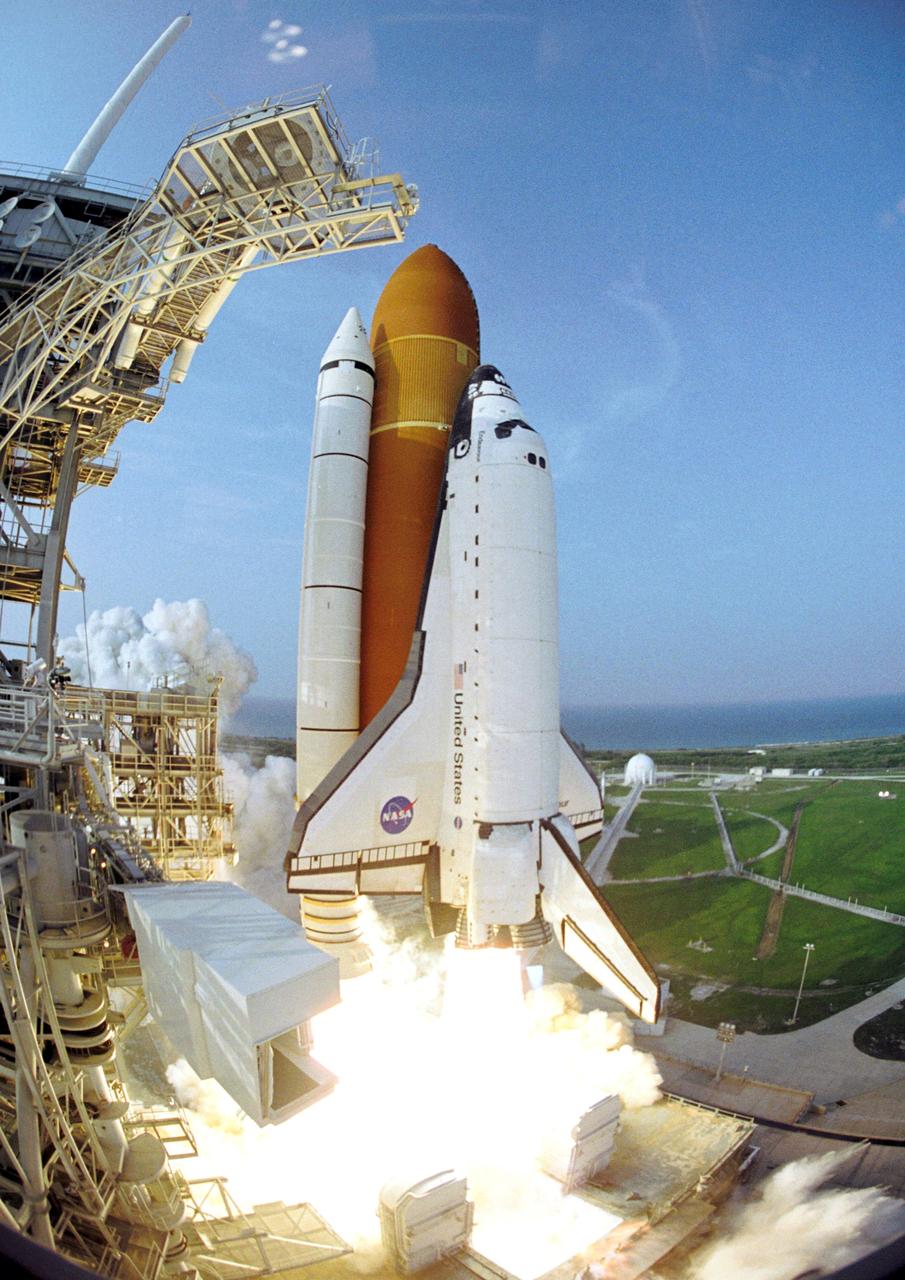
Enroute to the International Space Station (ISS), Space Shuttle Endeavor and its seven member STS-118 crew, blasted off from the launch pad at Kennedy Space Center on August 8, 2007. Construction resumed on the ISS as STS-118 mission specialists and the Expedition 15 crew completed installation of the third Starboard 5 (S-5) truss segment, removed a faulty Control Moment Gyroscope (CMG-3), installed a new CMG into the Z1 truss, relocated the S-band Antenna Sub-Assembly from the Port 6 (P6) to Port 1 (P1) truss, installed a new transponder on P1, retrieved the P6 transponder, and delivered roughly 5,000 pounds of equipment and supplies.
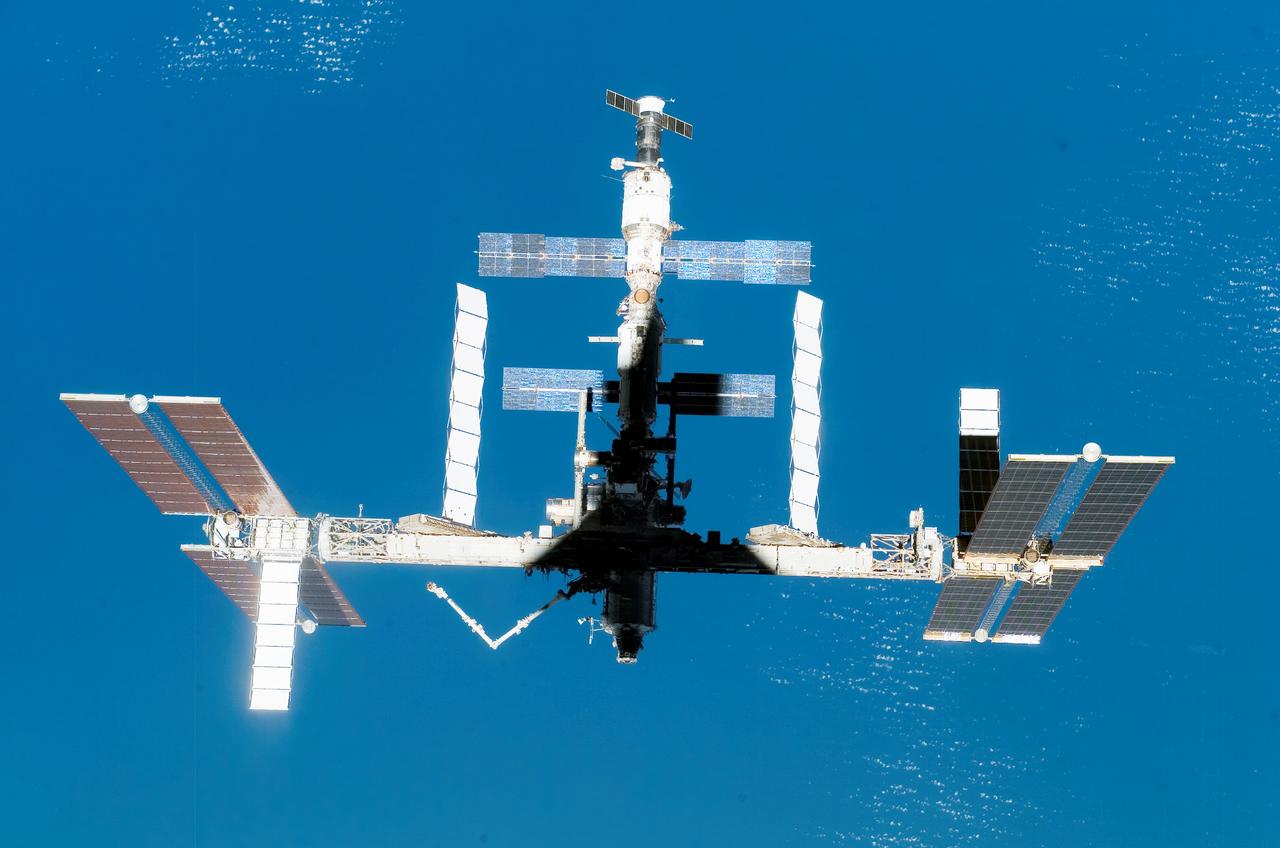
Back dropped by the blue Earth, the International Space Station (ISS) boasts its newest configuration upon the departure of Space Shuttle Endeavor and STS-118 mission. Days earlier, construction resumed on the ISS as STS-118 mission specialists and the Expedition 15 crew completed installation of the Starboard 5 (S-5) truss segment, removed a faulty Control Moment Gyroscope (CMG-3), installed a new CMG into the Z1 truss, relocated the S-band Antenna Sub-Assembly from the Port 6 (P6) to Port 1 (P1) truss, installed a new transponder on P1, retrieved the P6 transponder, and delivered roughly 5,000 pounds of equipment and supplies.
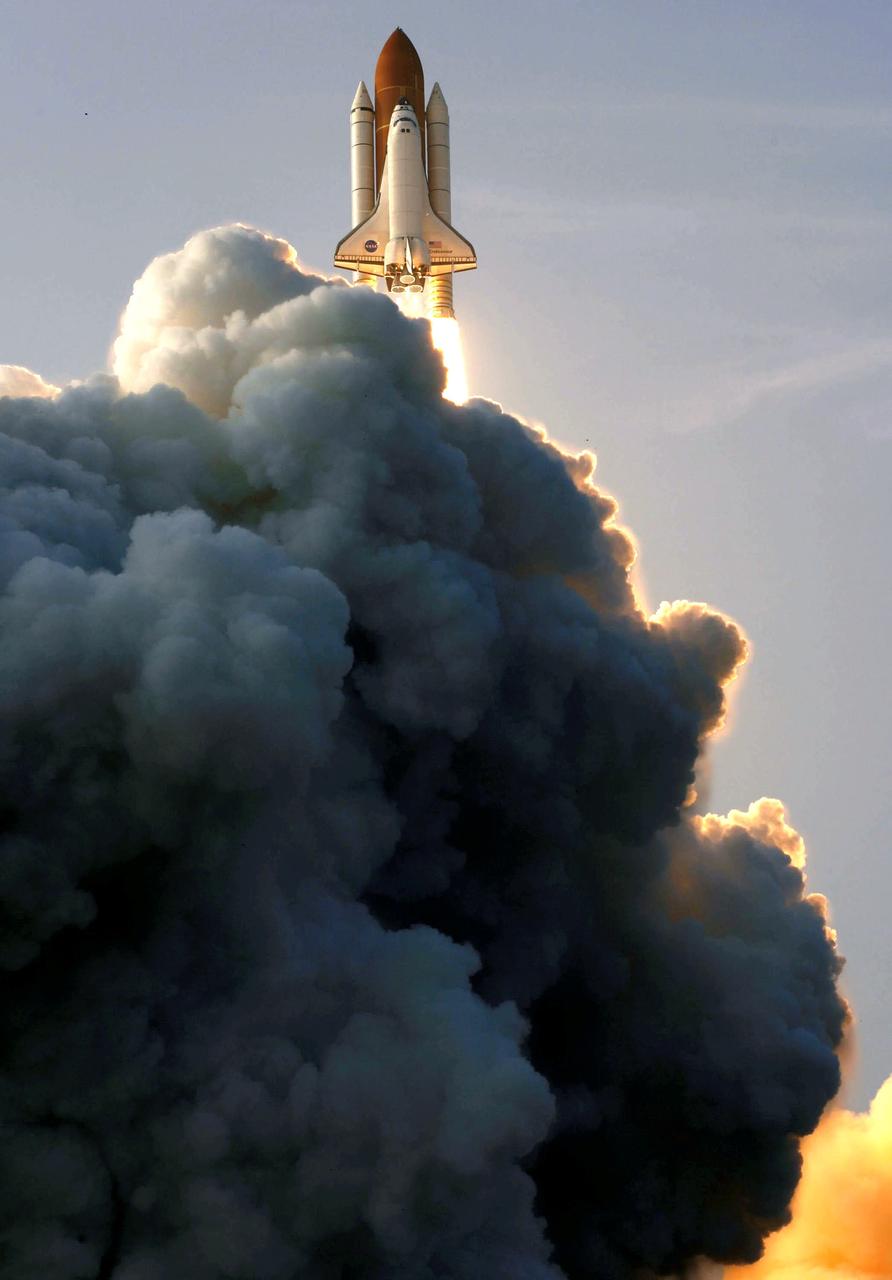
Enroute to the International Space Station (ISS), Space Shuttle Endeavor and its seven member STS-118 crew, blasted off from the launch pad at Kennedy Space Center on August 8, 2007. Construction resumed on the ISS as STS-118 mission specialists and the Expedition 15 crew completed installation of the third Starboard 5 (S-5) truss segment, removed a faulty Control Moment Gyroscope (CMG-3), installed a new CMG into the Z1 truss, relocated the S-band Antenna Sub-Assembly from the Port 6 (P6) to Port 1 (P1) truss, installed a new transponder on P1, retrieved the P6 transponder, and delivered roughly 5,000 pounds of equipment and supplies.
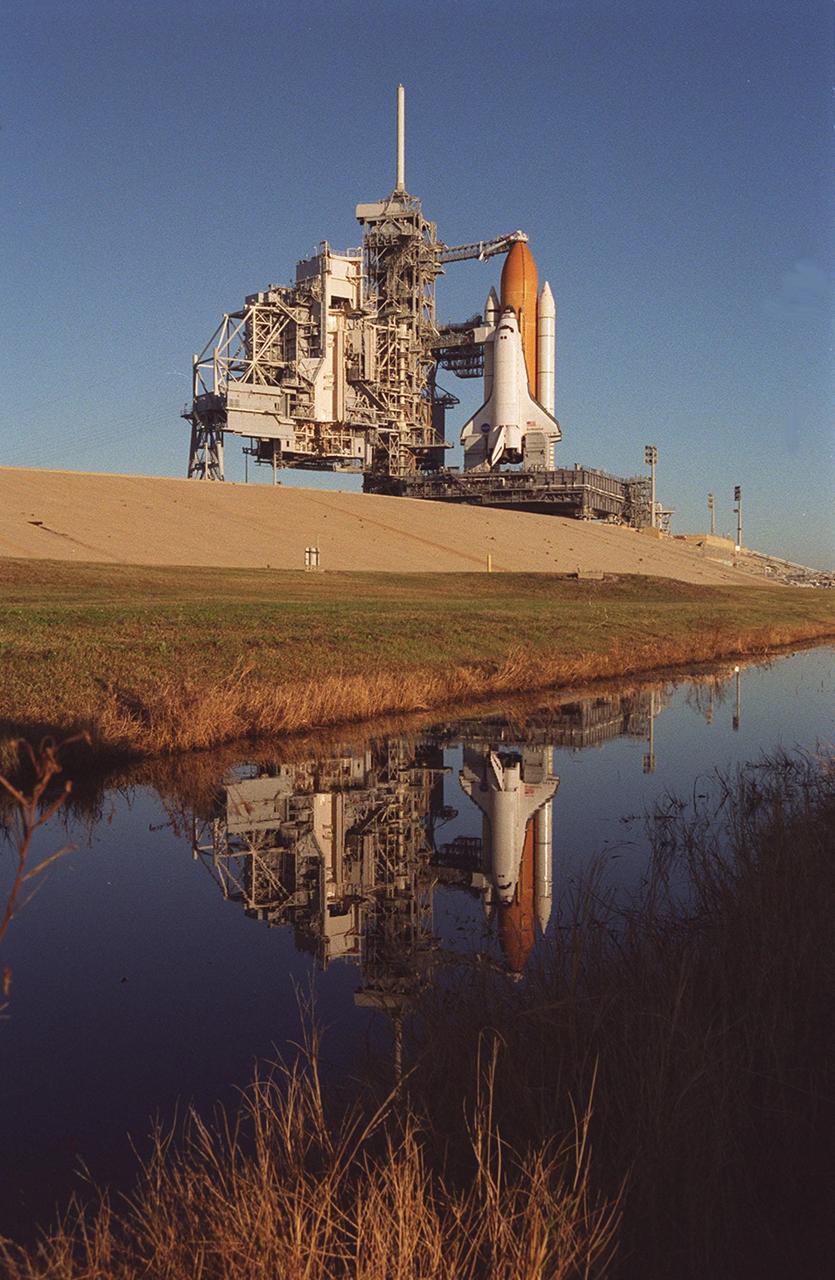
After rollback of the Rotating Service Structure (at left), Space Shuttle Endeavour stands ready for launch targeted for 10:06 p.m. EST tonight on mission STS-97 to the International Space Station. The orbiter carries the P6 Integrated Truss Segment containing solar arrays that will be temporarily installed to the Unity connecting module by the Z1 truss, recently delivered to and installed on the Station on mission STS-92. The two solar arrays are each more than 100 feet long. They will capture energy from the sun and convert it to power for the Station. Two spacewalks will be required to install the solar array connections
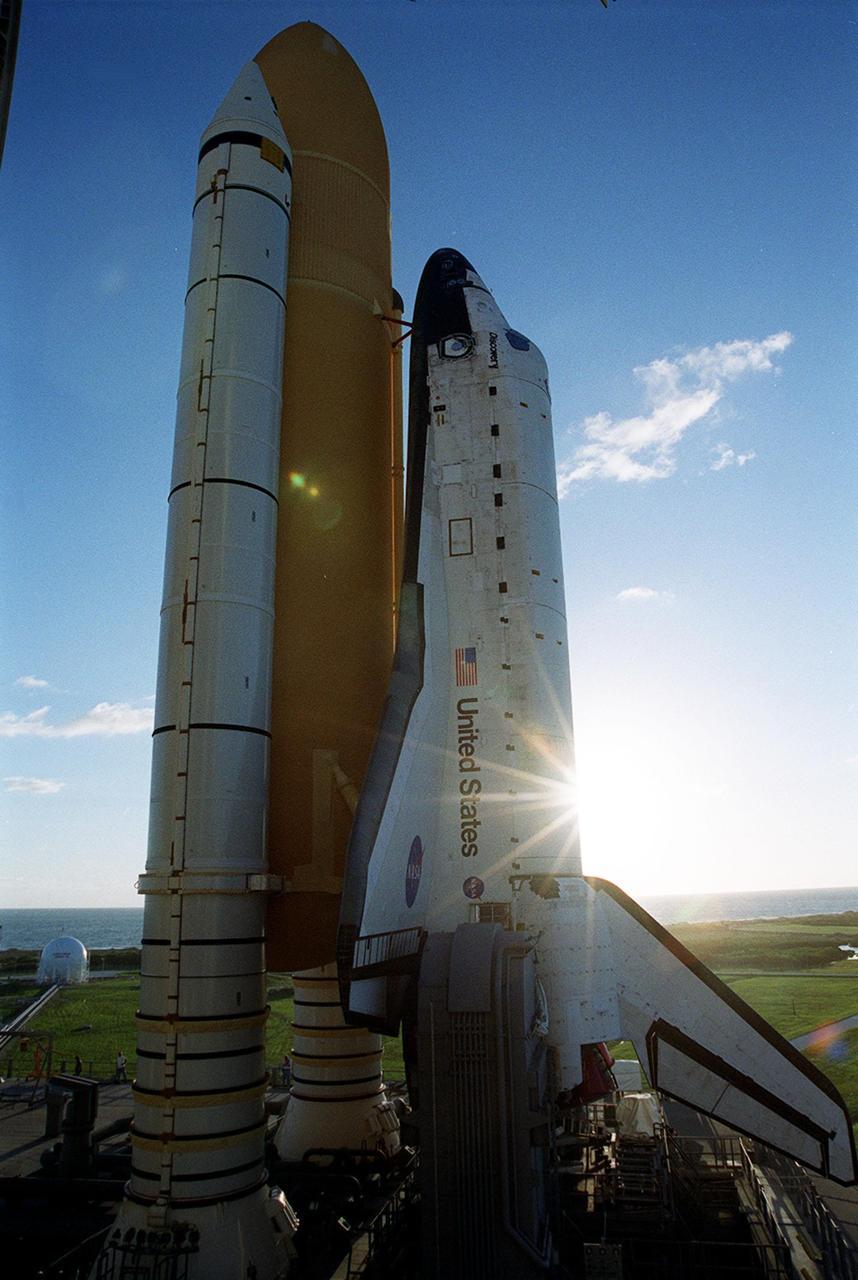
KENNEDY SPACE CENTER, Fla. -- Light from the morning sun glances off the back of Space Shuttle Discovery as it sits on Launch Pad 39A. On the horizon can be seen the Atlantic Ocean. Discovery is scheduled to launch Oct. 5 at 9:30 p.m. EDT on mission STS-92. Making the 100th Space Shuttle mission launched from Kennedy Space Center, Discovery will carry two pieces of hardware for the International Space Station, the Z1 truss, which is the cornerstone truss of the Station, and the third Pressurized Mating Adapter. Discovery also will be making its 28th flight into space, more than any of the other orbiters to date
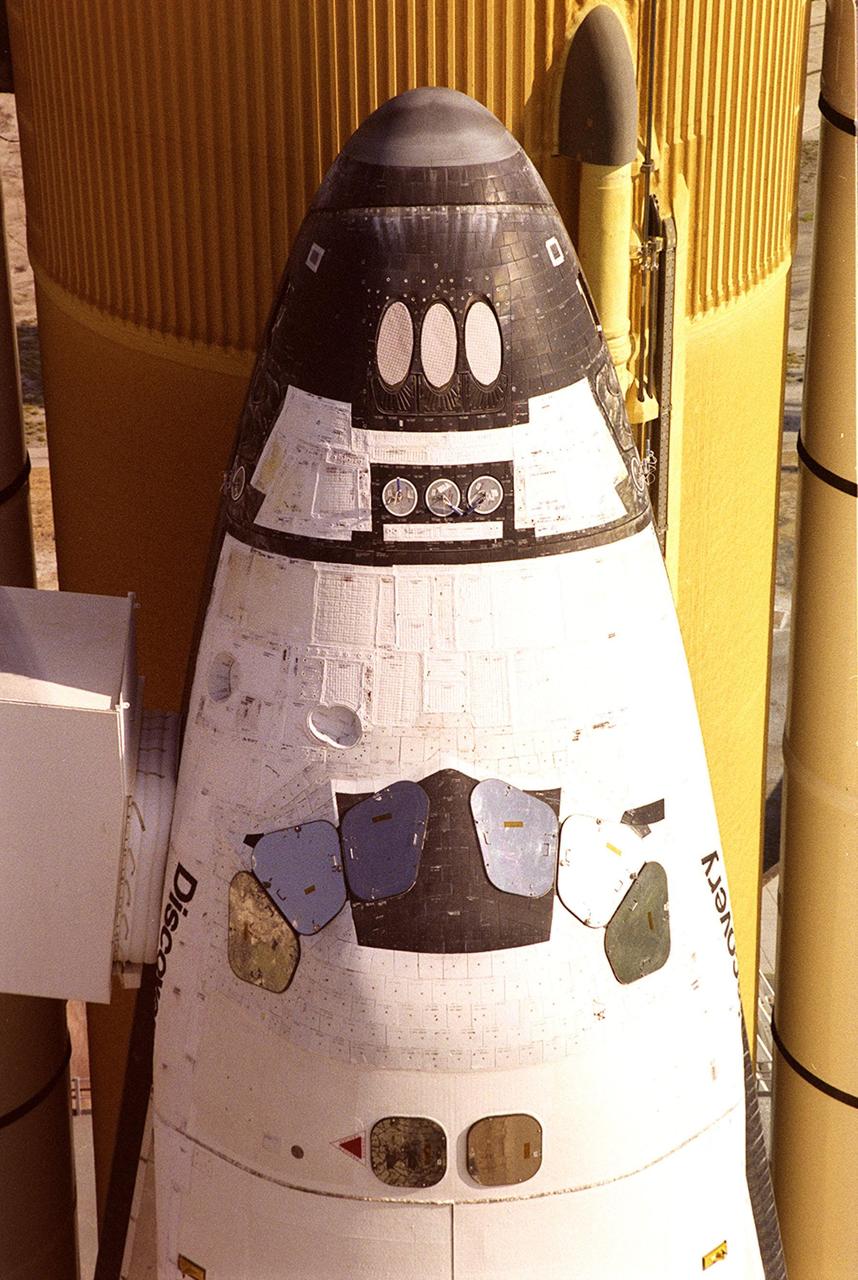
KENNEDY SPACE CENTER, FLA. -- A closeup of Space Shuttle Discovery on Launch Pad 39A shows the White Room (left) extended to the side of the orbiter, at the entrance to the crew compartment. Discovery is undergoing final launch preparations of STS-92. Scheduled to lift off Oct. 5 at 9:38 p.m. EDT, Discovery will be making the 100th Space Shuttle mission launched from Kennedy Space Center. Discovery also will be making its 28th flight into space, more than any of the other orbiters to date. STS-92 is a mission to the International Space Station, carrying the Z1 truss, which is the first of 10 trusses on the Station, and the third Pressurized Mating Adapter

A rising sun illuminates the coastal waters beyond Space Shuttle Endeavour, poised for launch on Nov. 30 at about 10:06 p.m. EST on mission STS-97. On the left, extending toward the orbiter, is the orbiter access arm. The mission to the International Space Station carries the P6 Integrated Truss Segment containing solar arrays and batteries that will be temporarily installed to the Unity connecting module by the Z1 truss, recently delivered to and installed on the Station on mission STS-92. The two solar arrays are each more than 100 feet long. They will capture energy from the sun and convert it to power for the Station. Two spacewalks will be required to install the solar array connections
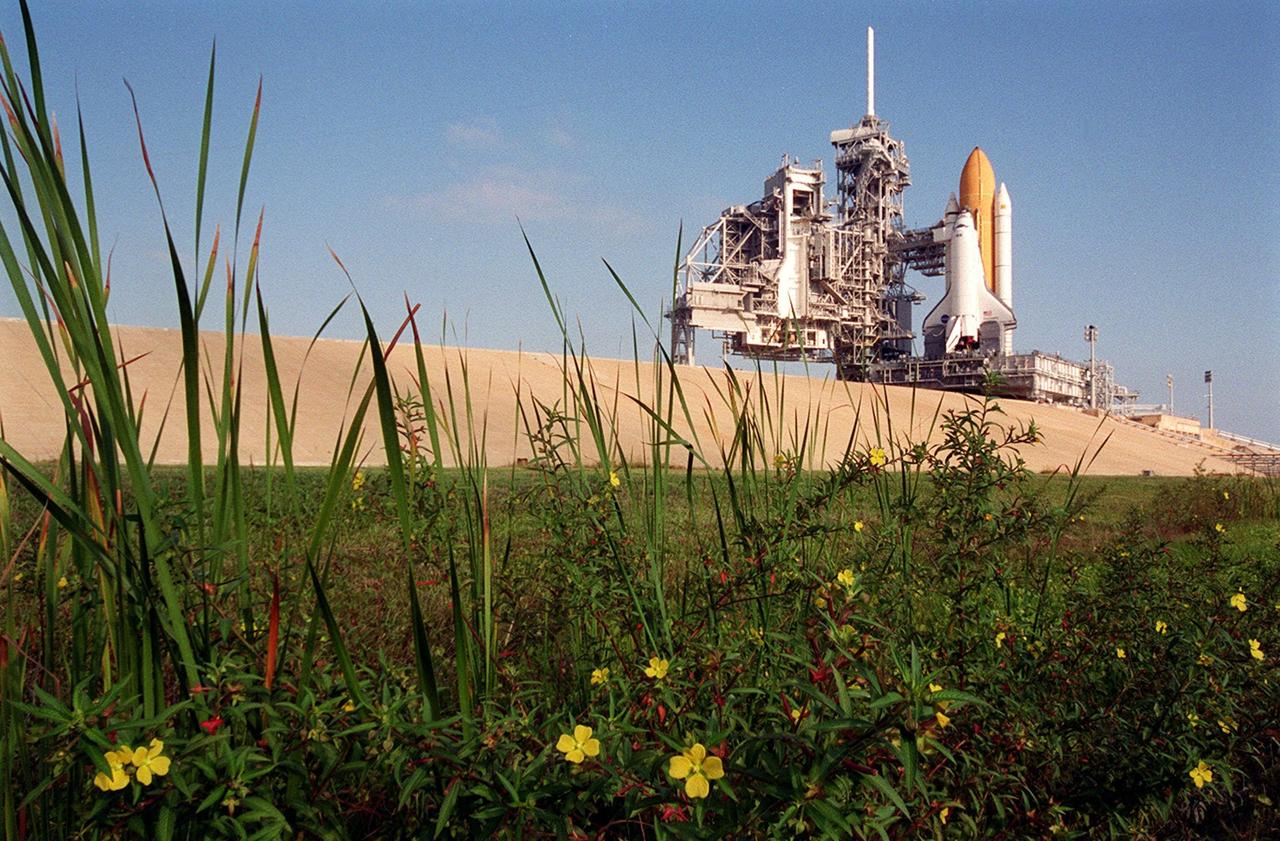
KENNEDY SPACE CENTER, FLA. -- Viewed across a field of wildflowers and other greenery, Space Shuttle Discovery rises above them on Launch Pad 39A. Discovery is undergoing final launch preparations of STS-92. Scheduled to lift off Oct. 5 at 9:38 p.m. EDT, Discovery will be making the 100th Space Shuttle mission launched from Kennedy Space Center. Discovery also will be making its 28th flight into space, more than any of the other orbiters to date. STS-92 is a mission to the International Space Station, carrying the Z1 truss, which is the first of 10 trusses on the Station, and the third Pressurized Mating Adapter
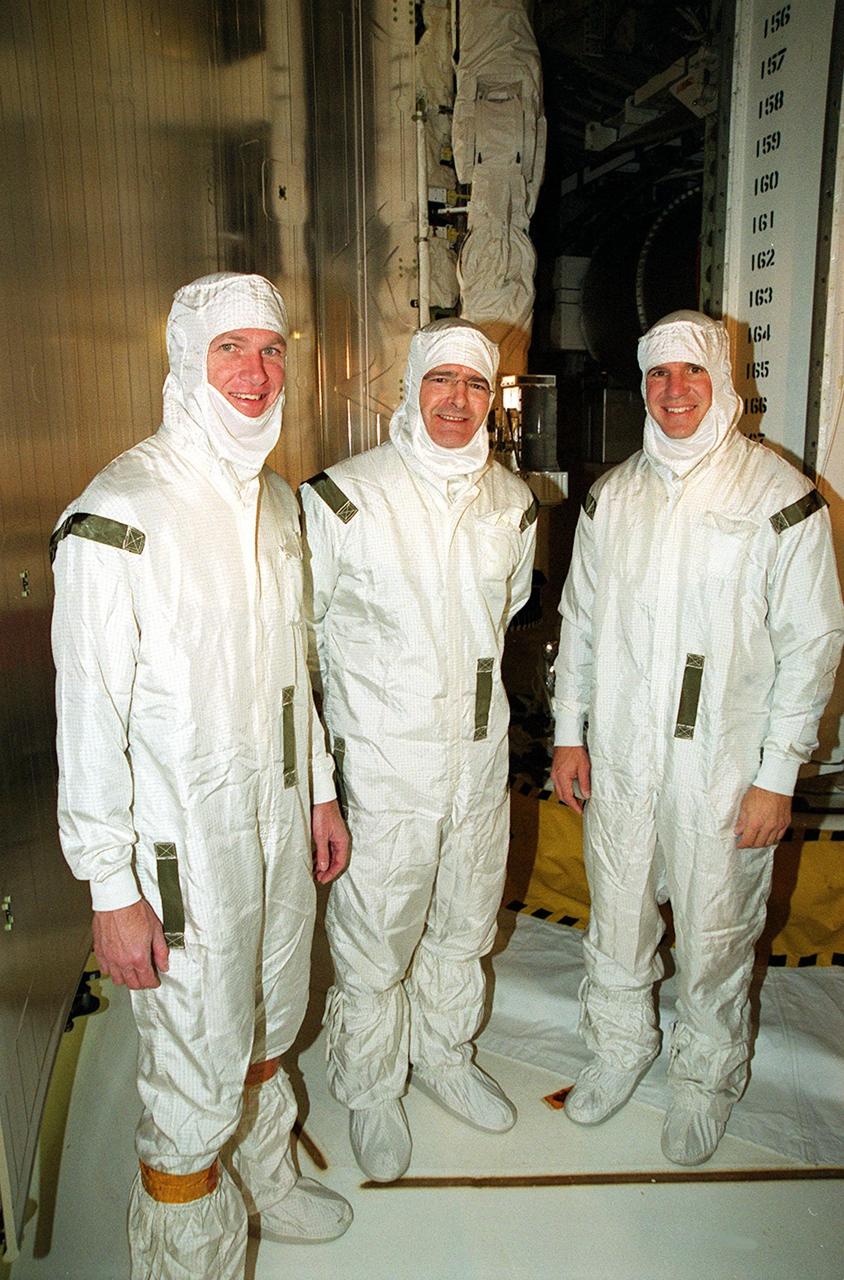
In the payload changeout room at Launch Pad 39B, STS-97 Commander Brent Jett (left), Mission Specialist Marc Garneau (center) and Pilot Michael Bloomfield (right) pause during a payload walkdown. The payload comprises the P6 Integrated Truss Segment, with solar arrays and batteries that will be temporarily installed on the recently delivered Z1 truss, connecting them to the Unity module. The two solar arrays are each more than 100 feet long. They will capture energy from the sun and convert it to power for the Station. Two spacewalks will be required to install the solar array connections. STS-97 is scheduled to launch Nov. 30 at about 10:06 p.m. EST
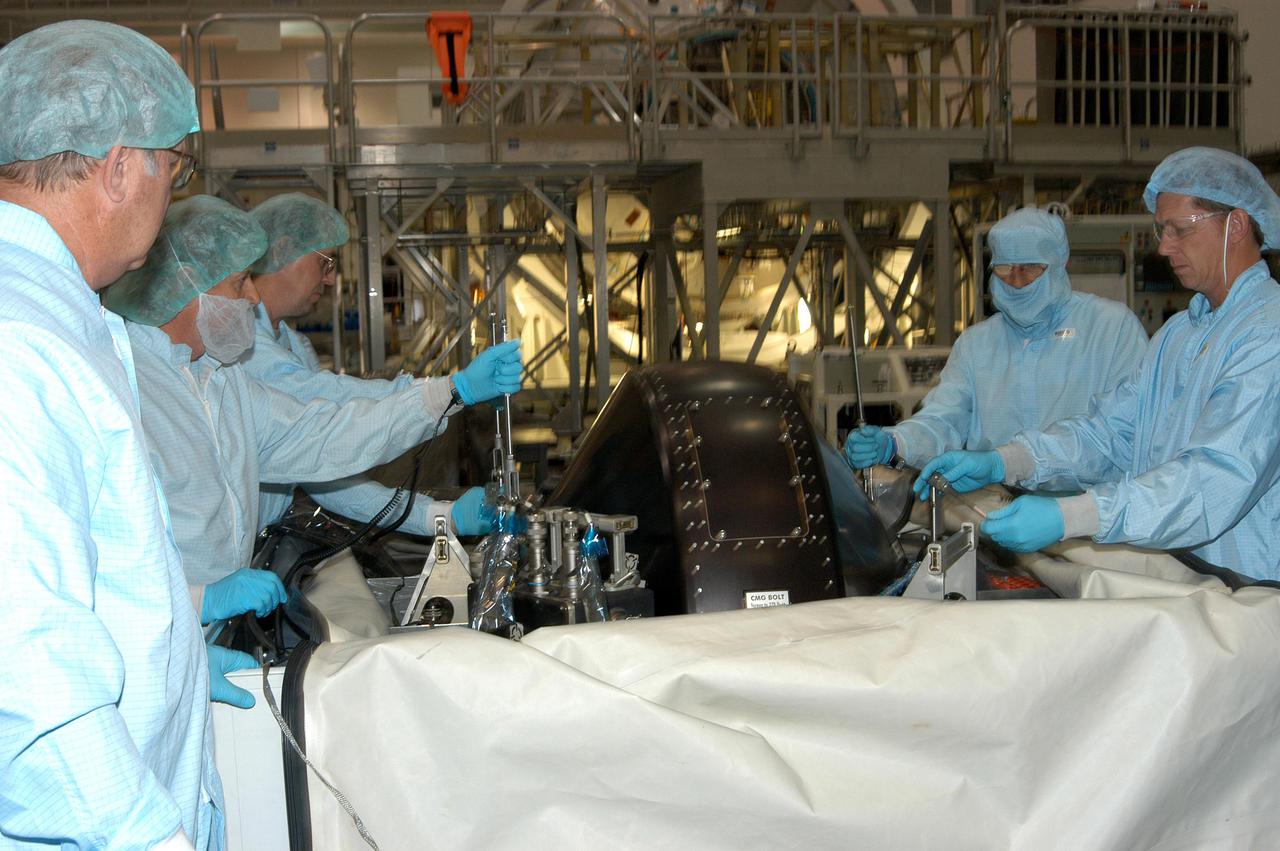
KENNEDY SPACE CENTER, FLA. - In the Space Station Processing Facility, workers remove the protective cover from the Control Moment Gyroscope (CMG), which will be delivered to the International Space Station on Mission STS-114 aboard Space Shuttle Discovery to replace one that has failed. CMGs are critical to ISS operation, keeping the outpost properly oriented toward the Sun without the use of rocket fuel. Four CMGs are mounted inside a truss that extends upward from the Unity module’s zenith port. The Z1 truss, attached to the ISS during Mission STS-92 in October 2000, also carries the station’s main solar arrays. The launch window for Discovery is May 15 to June 3, 2005.
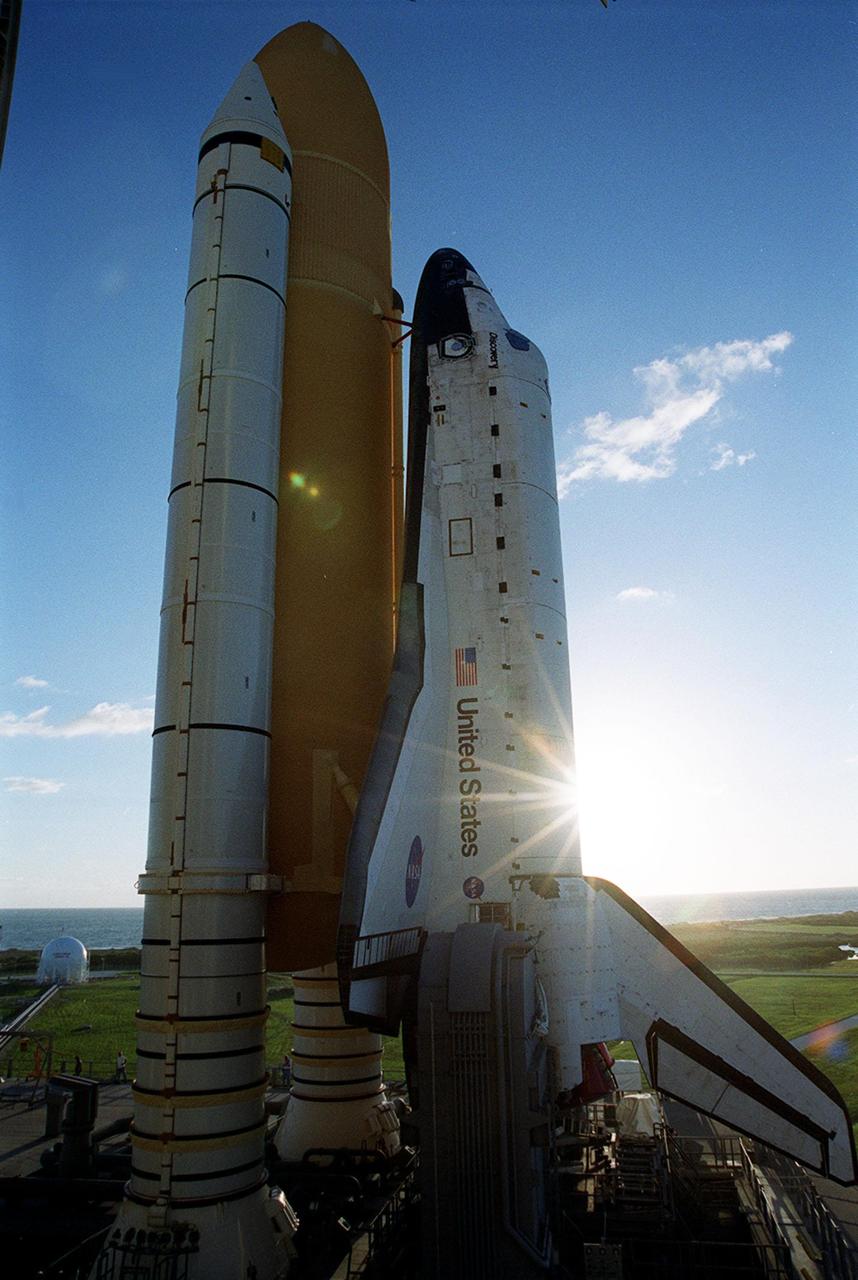
KENNEDY SPACE CENTER, Fla. -- Light from the morning sun glances off the back of Space Shuttle Discovery as it sits on Launch Pad 39A. On the horizon can be seen the Atlantic Ocean. Discovery is scheduled to launch Oct. 5 at 9:30 p.m. EDT on mission STS-92. Making the 100th Space Shuttle mission launched from Kennedy Space Center, Discovery will carry two pieces of hardware for the International Space Station, the Z1 truss, which is the cornerstone truss of the Station, and the third Pressurized Mating Adapter. Discovery also will be making its 28th flight into space, more than any of the other orbiters to date
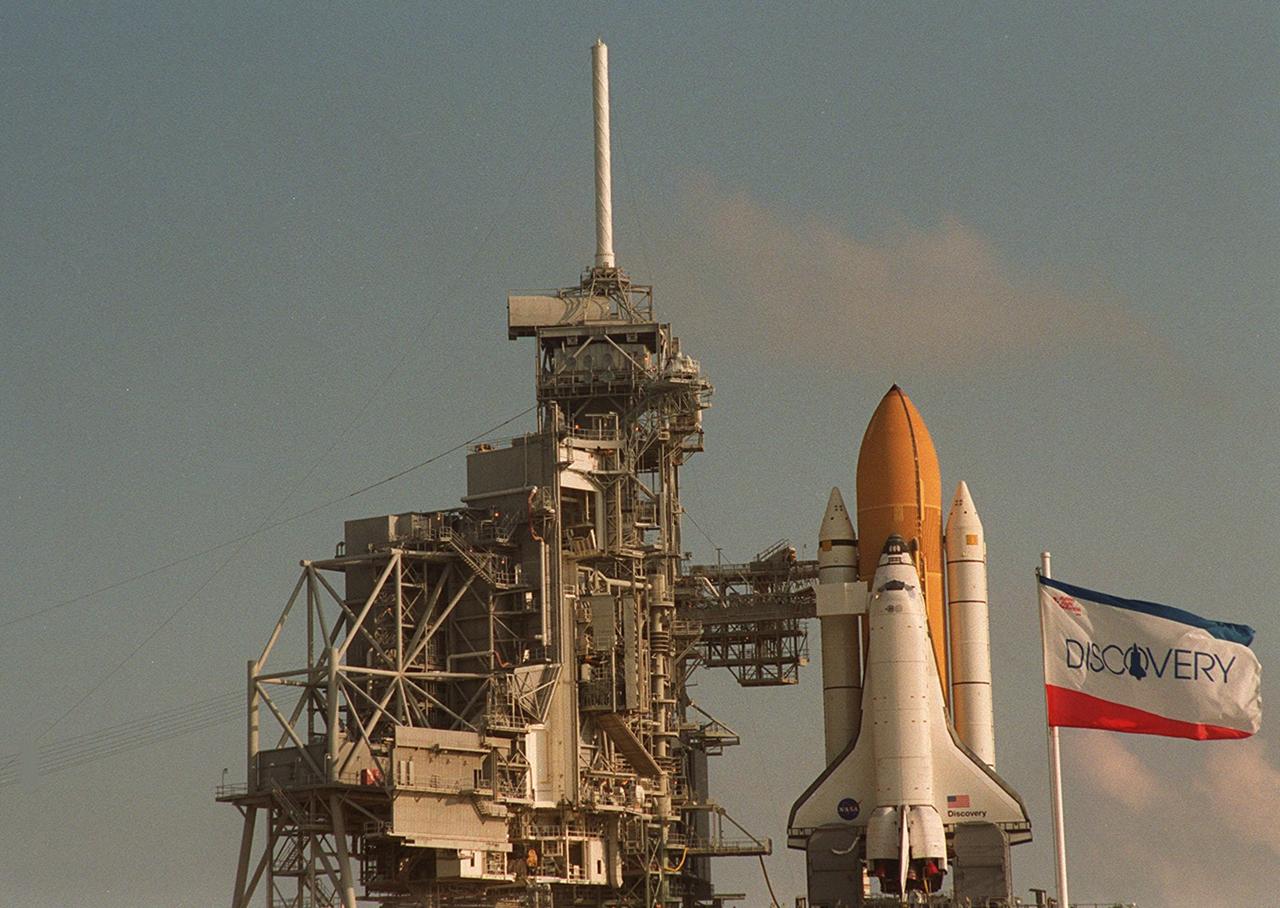
KENNEDY SPACE CENTER, FLA. -- The flag at right identifies Space Shuttle Discovery on Launch Pad 39A after its rollout and before the Rotating Service Structure is moved around it. Scheduled to launch Oct. 5 at 9:38 p.m. EDT on mission STS-92, Discovery will be making the 100th Space Shuttle mission launched from Kennedy Space Center. Discovery also will be making its 28th flight into space, more than any of the other orbiters to date. STS-92 is a mission to the International Space Station, carrying the Z1 truss, which is the first of 10 trusses on the Station, and the third Pressurized Mating Adapter
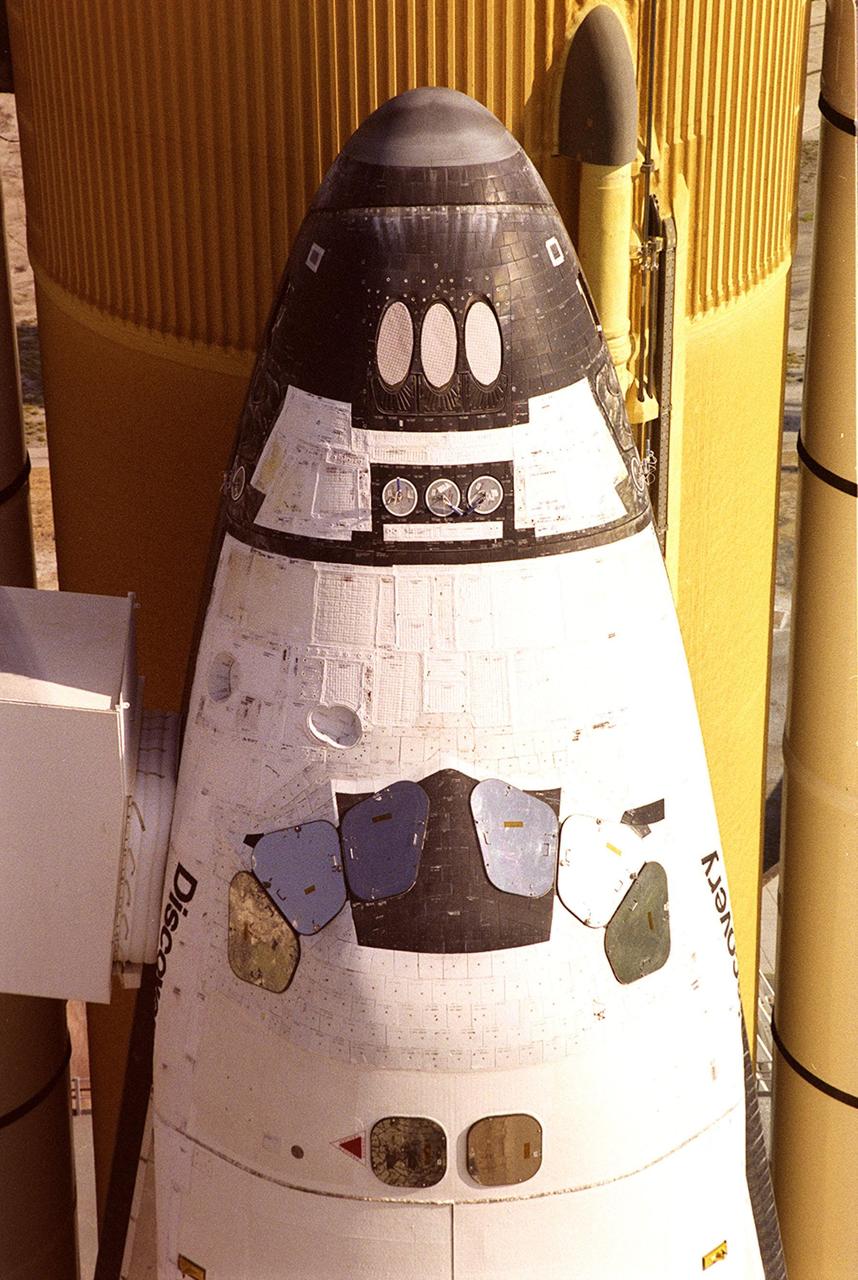
KENNEDY SPACE CENTER, FLA. -- A closeup of Space Shuttle Discovery on Launch Pad 39A shows the White Room (left) extended to the side of the orbiter, at the entrance to the crew compartment. Discovery is undergoing final launch preparations of STS-92. Scheduled to lift off Oct. 5 at 9:38 p.m. EDT, Discovery will be making the 100th Space Shuttle mission launched from Kennedy Space Center. Discovery also will be making its 28th flight into space, more than any of the other orbiters to date. STS-92 is a mission to the International Space Station, carrying the Z1 truss, which is the first of 10 trusses on the Station, and the third Pressurized Mating Adapter
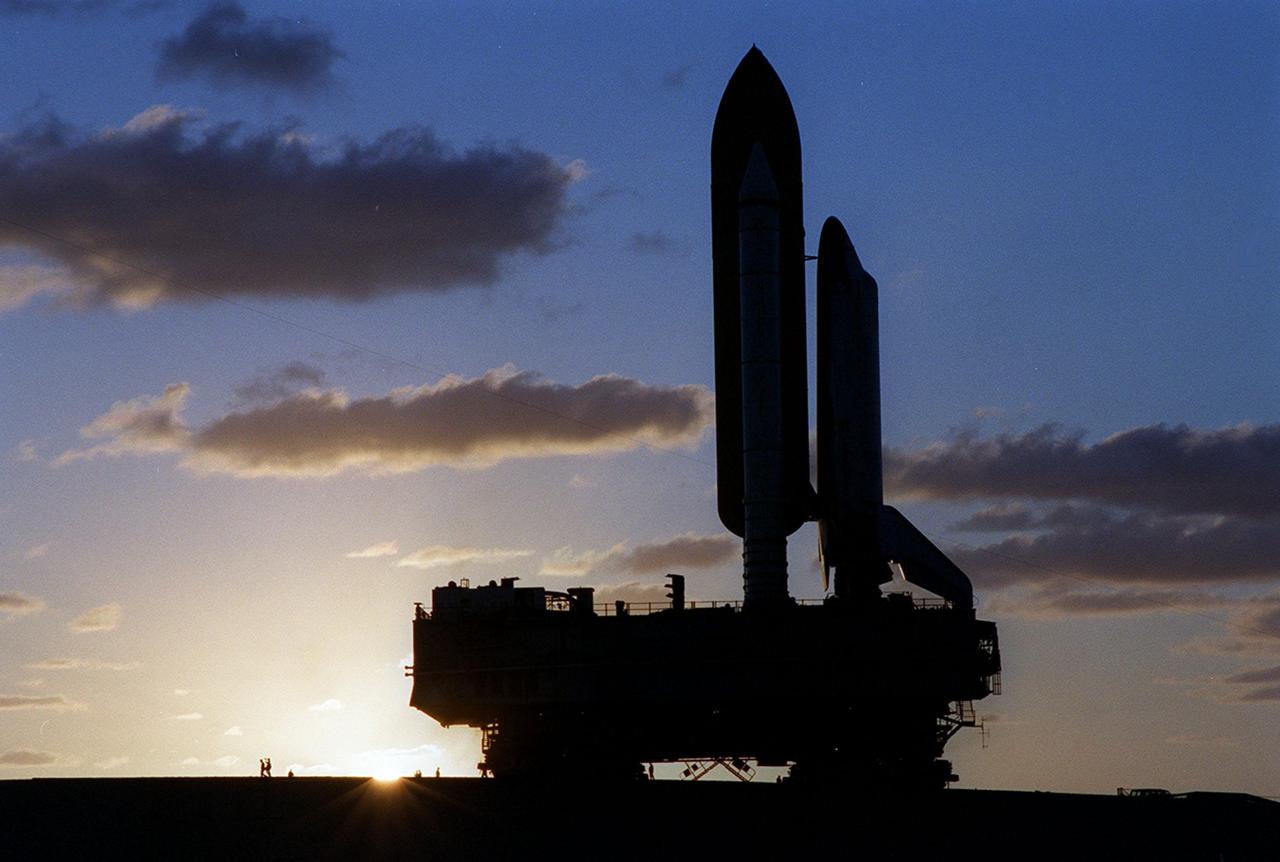
KENNEDY SPACE CENTER, Fla. -- Dawn’s early light creates a powerful silhouette of the Space Shuttle Discovery on its mobile launcher platform as it creeps to Launch Pad 39B. Discovery is scheduled to launch Oct. 5 at 9:30 p.m. EDT on mission STS-92. Making the 100th Space Shuttle mission launched from Kennedy Space Center, Discovery will carry two pieces of hardware for the International Space Station, the Z1 truss, which is the cornerstone truss of the Station, and the third Pressurized Mating Adapter. Discovery also will be making its 28th flight into space, more than any of the other orbiters to date