
NASA Astronaut Frank Rubio dons a spacesuit at the Neutral Buoyancy Laboratory at NASA's Johnson Space Center in Houston to train for spacewalks.
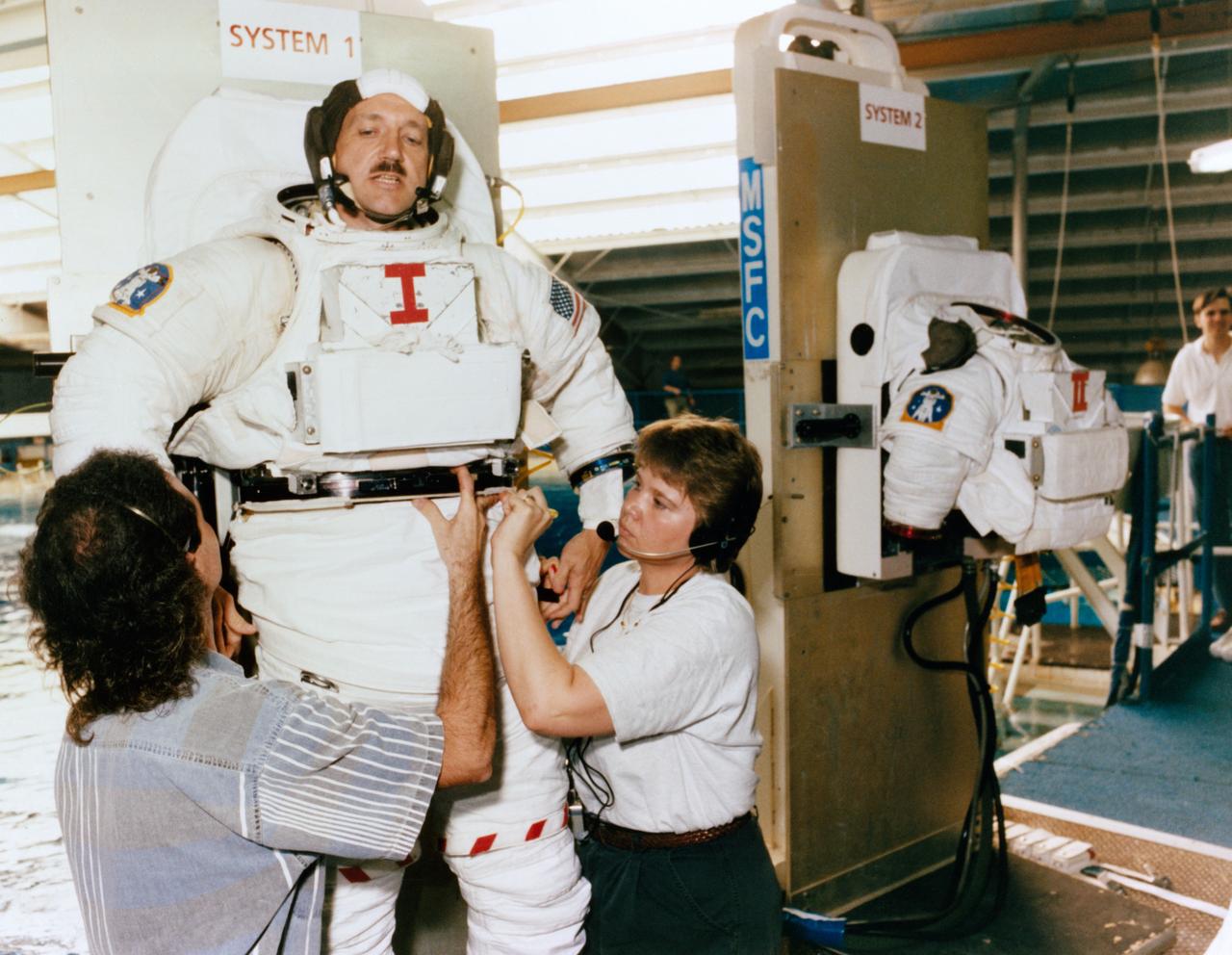
Astronaut Thomas D. Akers gets assistance in donning a training version of the Shuttle extravehicular mobility unit (EMU) space suit prior to a training session in the Neutral Buoyancy Simulator at Marshall Space Flight Center (MSFC) (39735); Astronaut Kathryn C. Thornton (foreground) and Thomas Akers, STS-61 mission specialists scheduled for extravehicular activity (EVA) duty, prepare for an underwater rehearsal session. Thornton recieves assistance from a technician in donning her EMU gloves (39736).
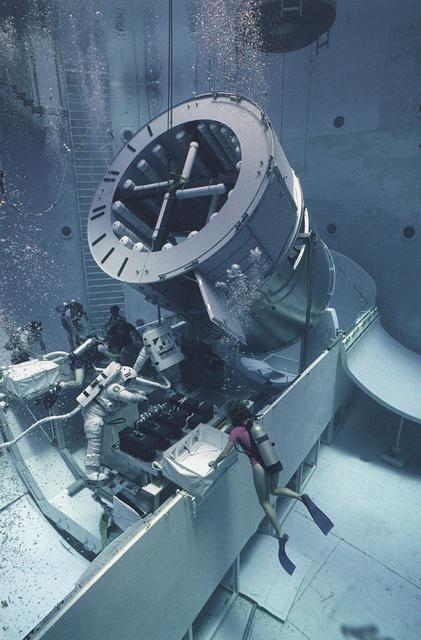
Marshall scientist practices working on the Hubble Space Telescope (HST) in the Neutral Buoyancy Simulator.
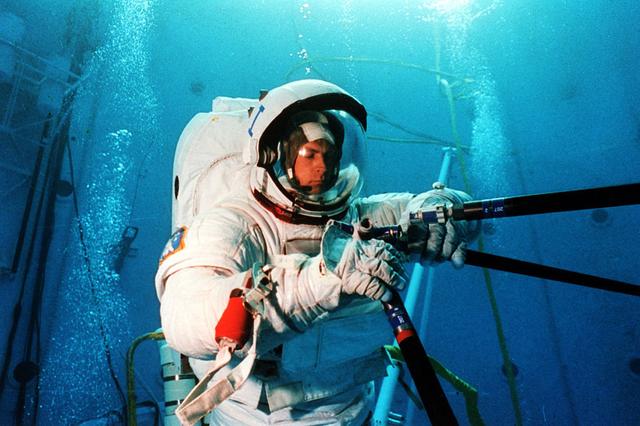
Astronaut Mark Lee participates in the Nitrox breathing system test in Marshall's Neutral Buoyancy Simulator (NBS).
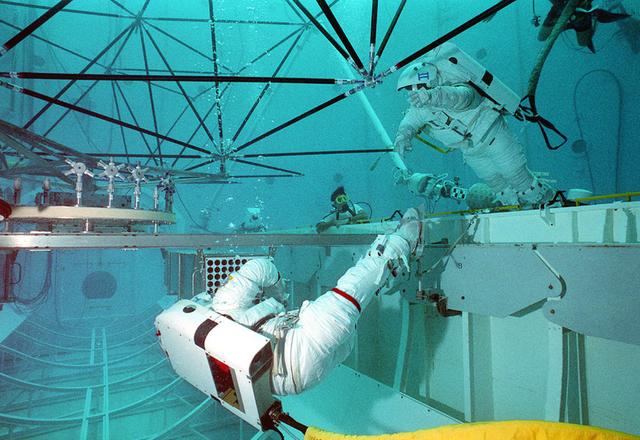
Astronaut Mark Lee participates in the Nitrox breathing system test in Marshall's Neutral Buoyancy Simulator (NBS).
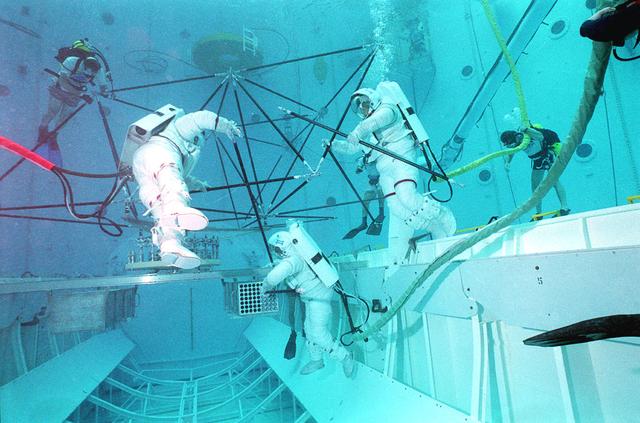
Astronauts Mark Lee and Mike Gerhardt, and a technician participate in the Nitrox breathing system test in Marshall's Neutral Buoyancy Simulator (NBS).
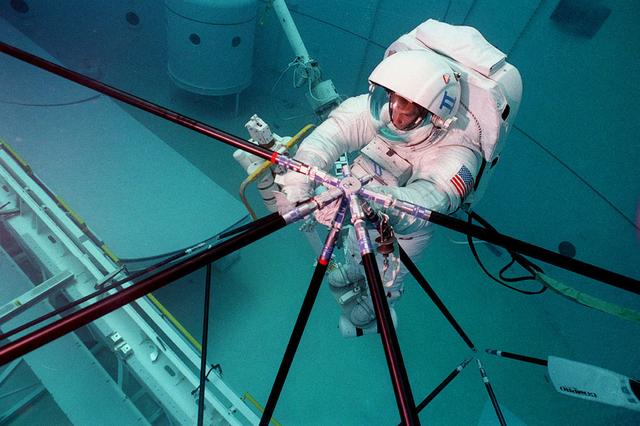
Astronaut Scott Parazynski participates in a Nitrox breathing system test in Marshall's Neutral Buoyancy Simulator (NBS).
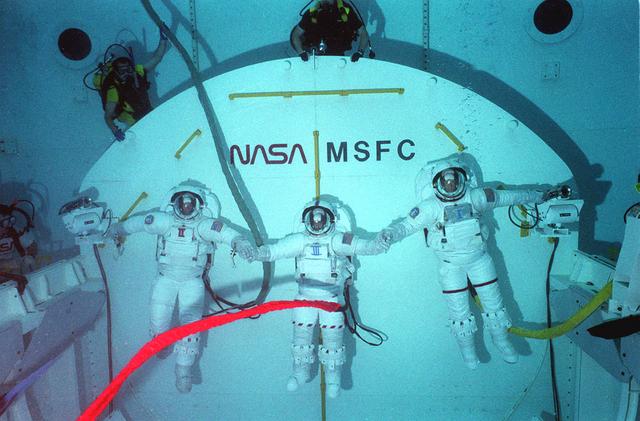
Astronauts Mark Lee and Mike Gerhardt, and a technician participate in the Nitrox breathing system test in Marshall's Neutral Buoyancy Simulator (NBS).
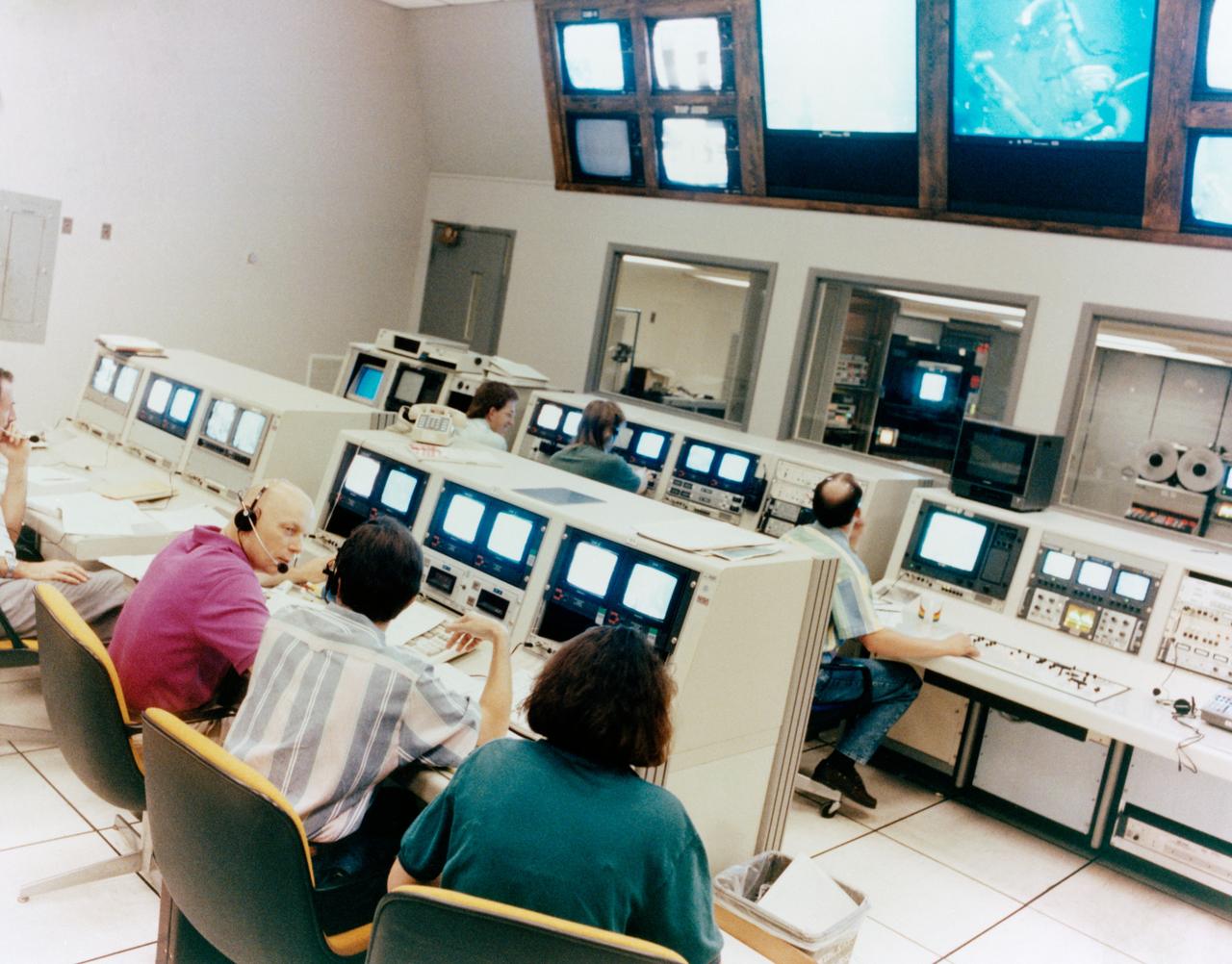
Astronauts Jeffrey A. Hoffman (far left) and F. Story Musgrave (second left) monitor a training session from consoles in the control room for the Neutral Buoyancy Simulator (NBS) at the Marshall Space Flight Center (MSFC). Seen underwater in the NBS on the big screen and the monitors at the consoles is astronaut Thomas D. Akers. The three mission specialists, along with astronaut Kathryn C. Thornton, are scheduled to be involved in a total of five sessions of extravehicular activity (EVA) to service the Hubble Space Telescope (HST) in orbit during the STS-61 mission, scheduled for December 1993.
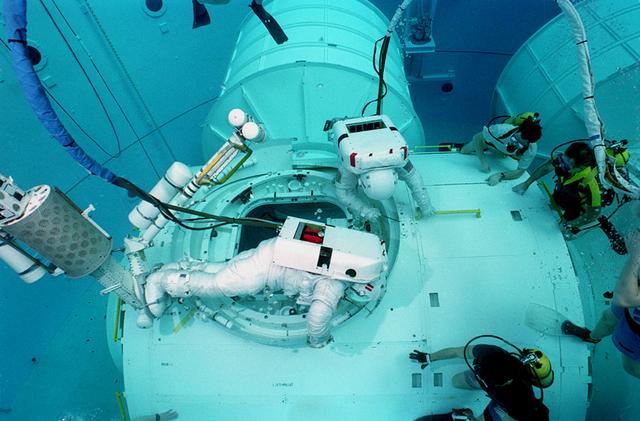
International Space Station testing is conducted in Marshall's Neutral Buoyancy Simulator (NBS).
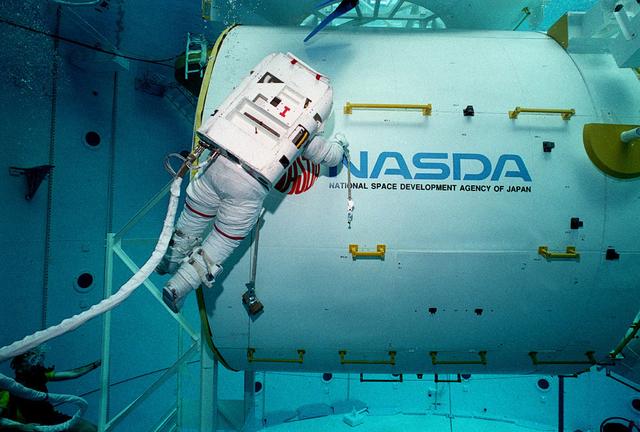
Japanese Experimental Module testing in Marshall's Neutral Buoyancy Simulator (NBS).
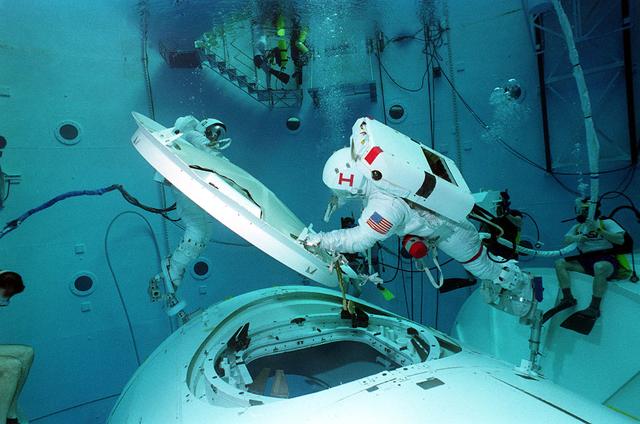
International Space Station testing is conducted in Marshall's Neutral Buoyancy Simulator (NBS).
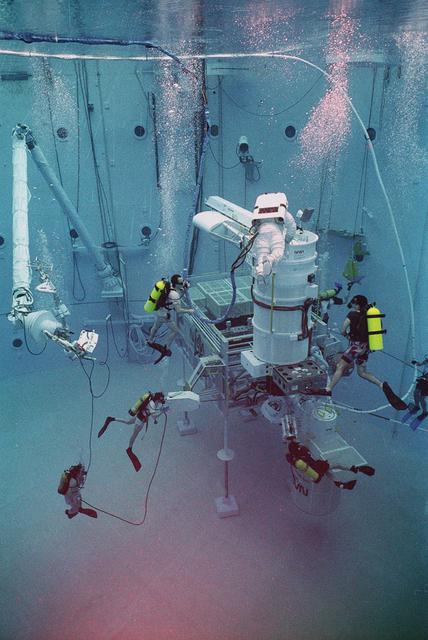
Photo Voltaic Module testing in Marshall's Neutral Buoyancy Simulator (NBS).
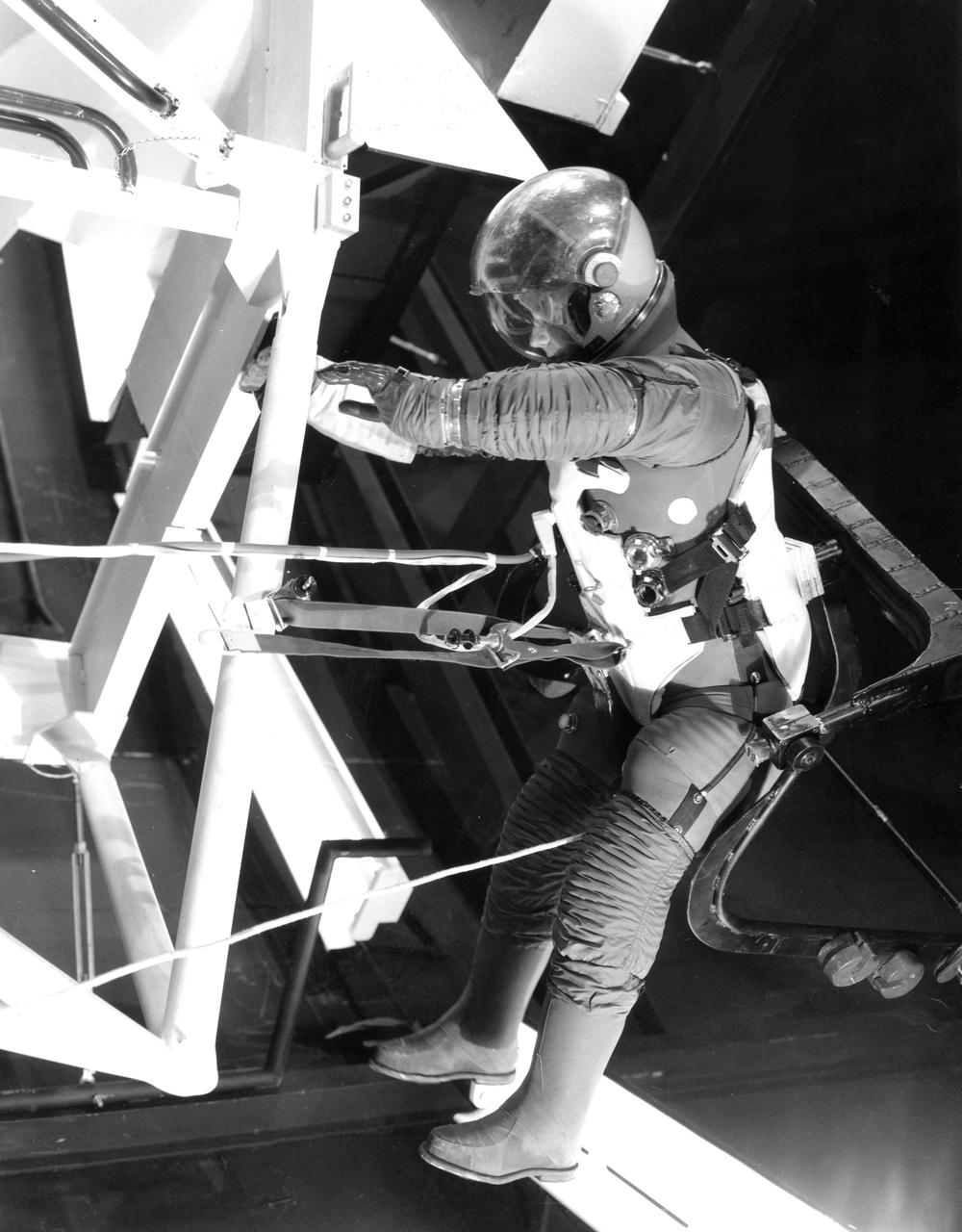
An astronaut wearing a pressurized space suit performed a work task while suspended in a “zero-gravity” simulator known as the Neutral Buoyancy Simulator (NBS) at Marshall Space Flight Center. This particular task was one of many performed by astronauts while checking out the mockup for the Apollo Telescope Mount.
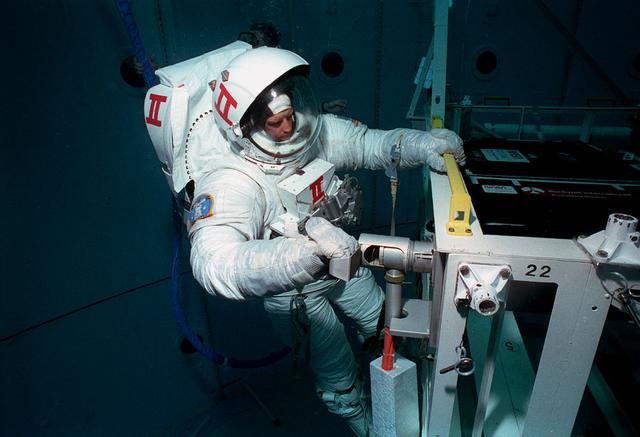
Astronaut Mark Lee participates in the Photo Voltaic Module testing in Marshall's Neutral Buoyancy Simulator (NBS).
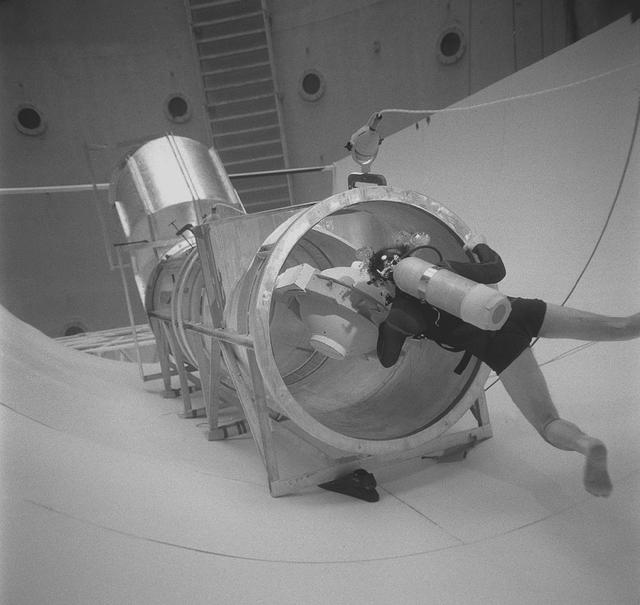
A Marshall scientist practices transferring objects in the Neutral Buoyancy Simulator (NBS) for the Spacelab transfer tunnel test.
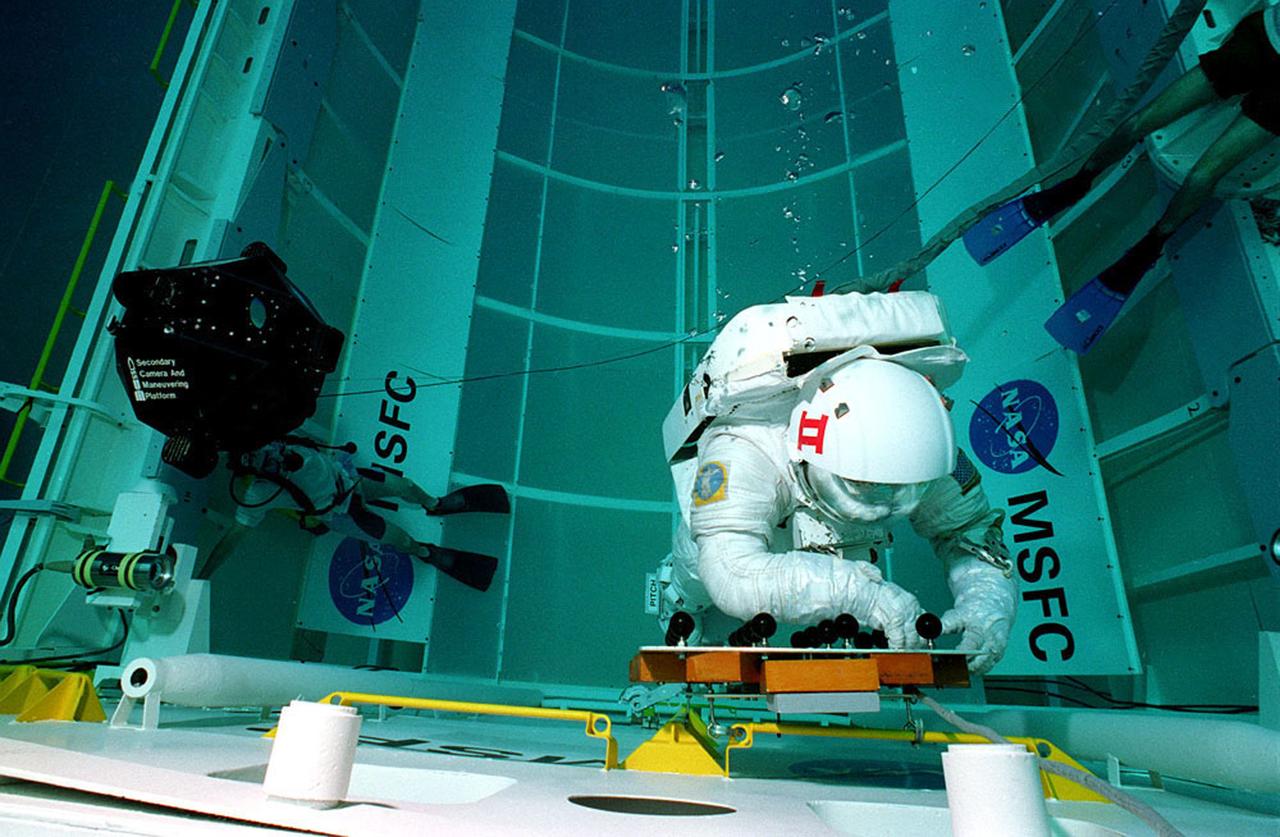
Underwater tests are conducted with Space Systems lab at Marshall's Neutral Buoyancy Simulator (NBS).

NASA Astronaut Frank Rubio gets help putting on a spacesuit at the Neutral Buoyancy Laboratory at NASA's Johnson Space Center in Houston to train for spacewalks.
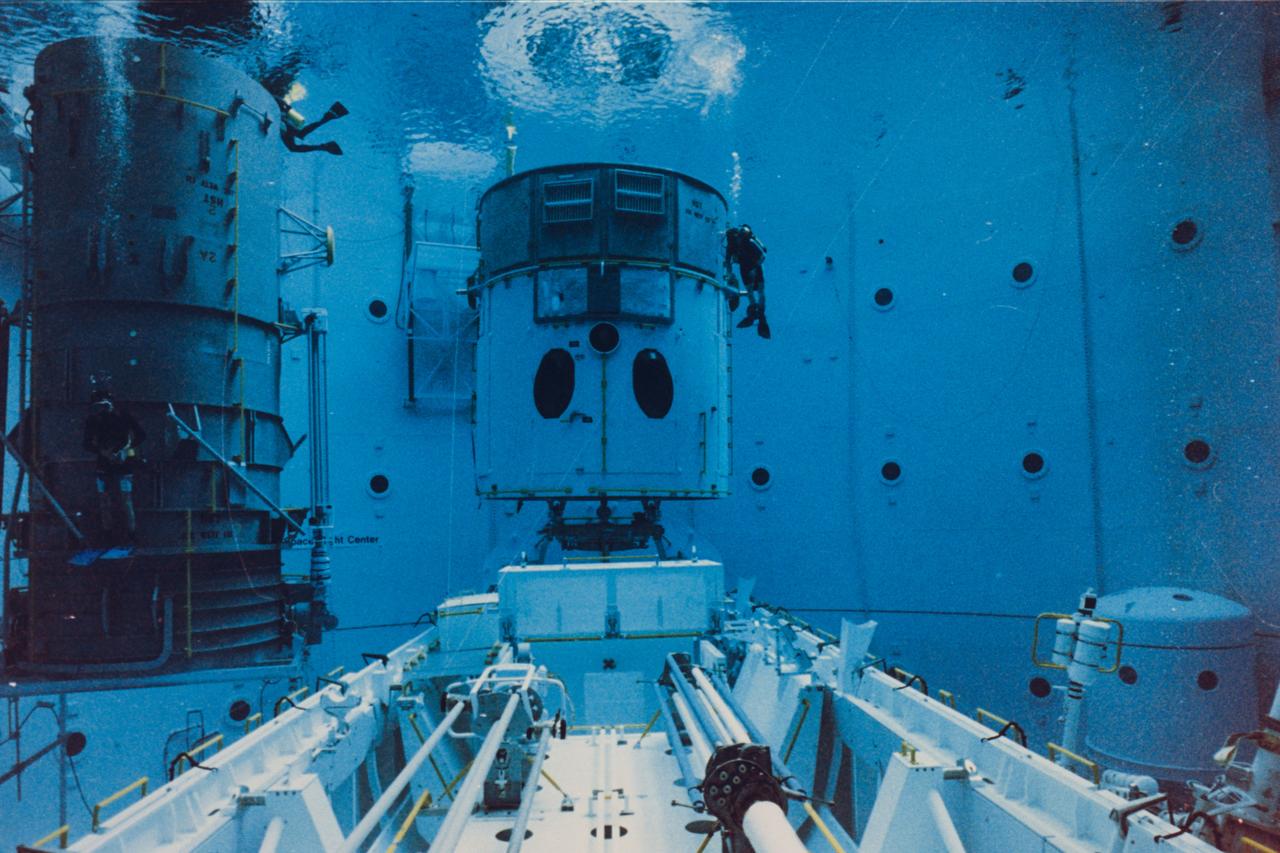
Safety divers in the Neutral Buoyancy Simulator (NBS) at the Marshall Space Flight Center (MSFC) prepare a mockup of the Hubble Space Telescope (HST) for one of 32 separate training sessions conducted by four of the STS-61 crew members in June. The three-week process allowed mission trainers to refine the timelines for the five separate spacewalks scheduled to be conducted on the actual mission scheduled for December 1993. The HST is separated into two pieces since the water tank depth cannot support the entire structure in one piece. The full length payload bay mockup shows the Solar Array Carrier in the foreground and the various containers that will house replacement hardware that will be carried on the mission.
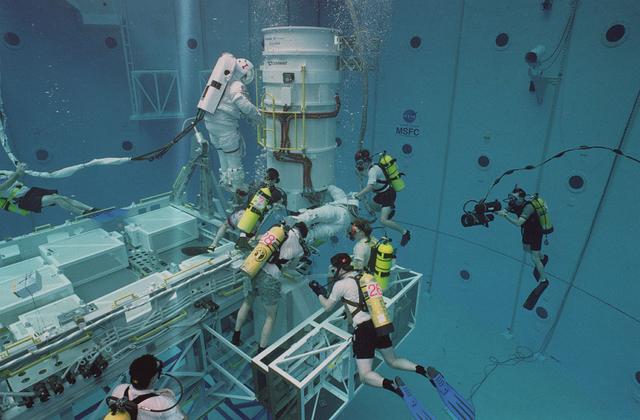
Astronaut Joe Lindquist and Kate Rupley conduct underwater testing on the International Space Station's power module in Marshall's Neutral Buoyancy Simulator (NBS).
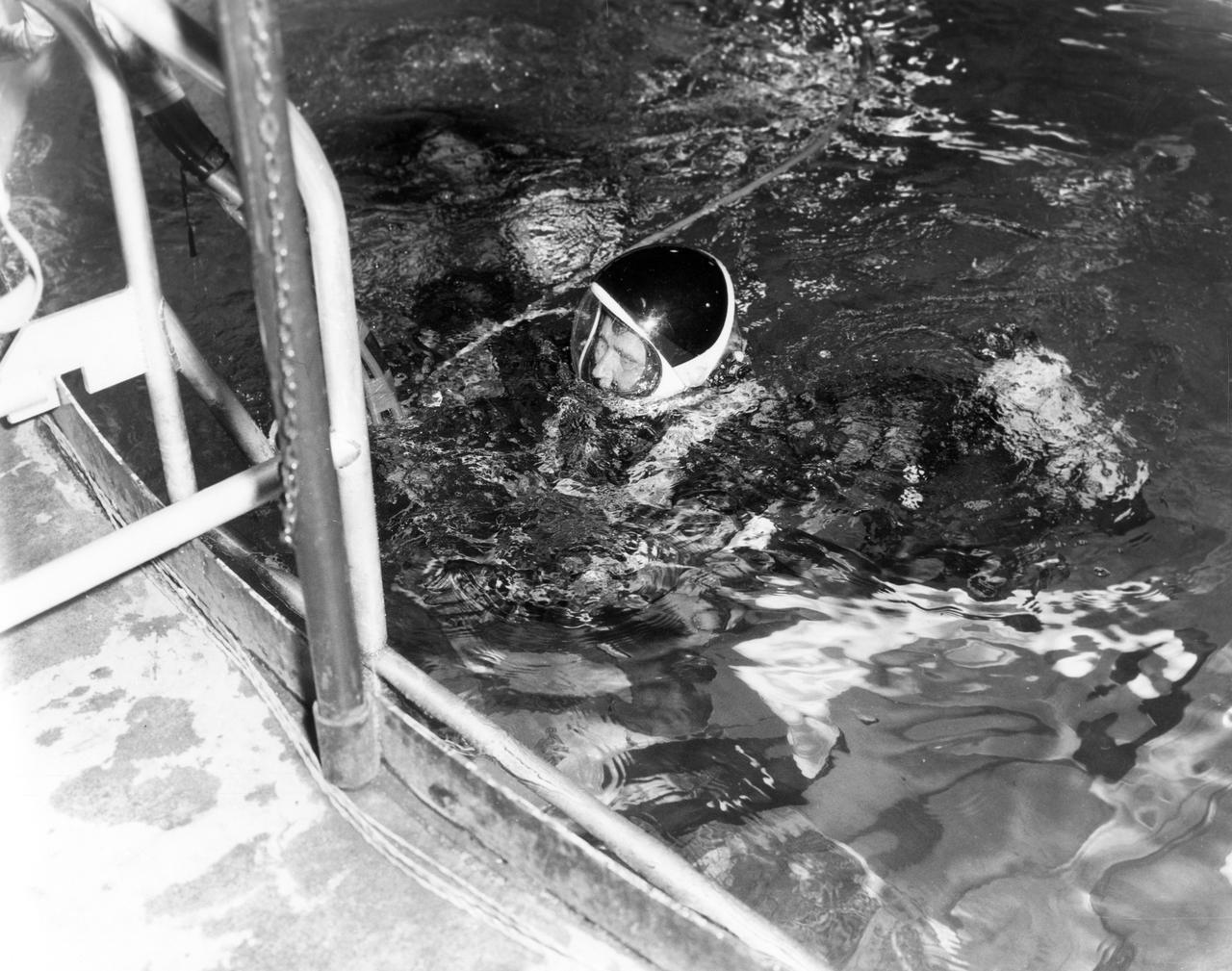
Marshall Space Flight Center (MSFC) Director, Dr. von Braun, submerges after spending some time under water in the MSFC Neutral Buoyancy Simulator (NBS). Weighted to a neutrally buoyant condition, Dr. von Braun was able to perform tasks underwater which simulated weightless conditions found in space.
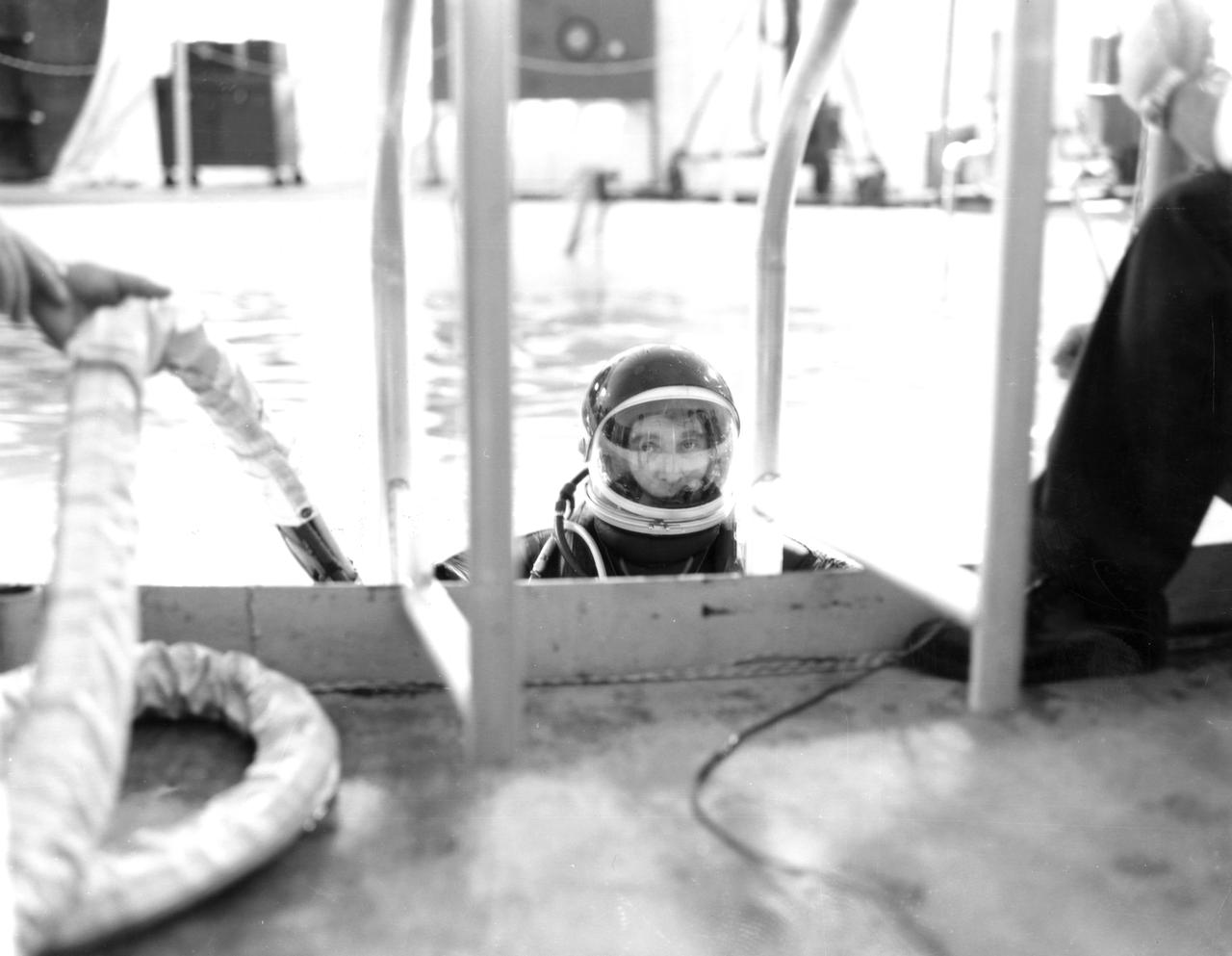
Marshall Space Flight Center (MSFC) Director, Dr. von Braun, submerges after spending some time under water in the MSFC Neutral Buoyancy Simulator (NBS). Weighted to a neutrally buoyant condition, Dr. von Braun was able to perform tasks underwater which simulated weightless conditions found in space.
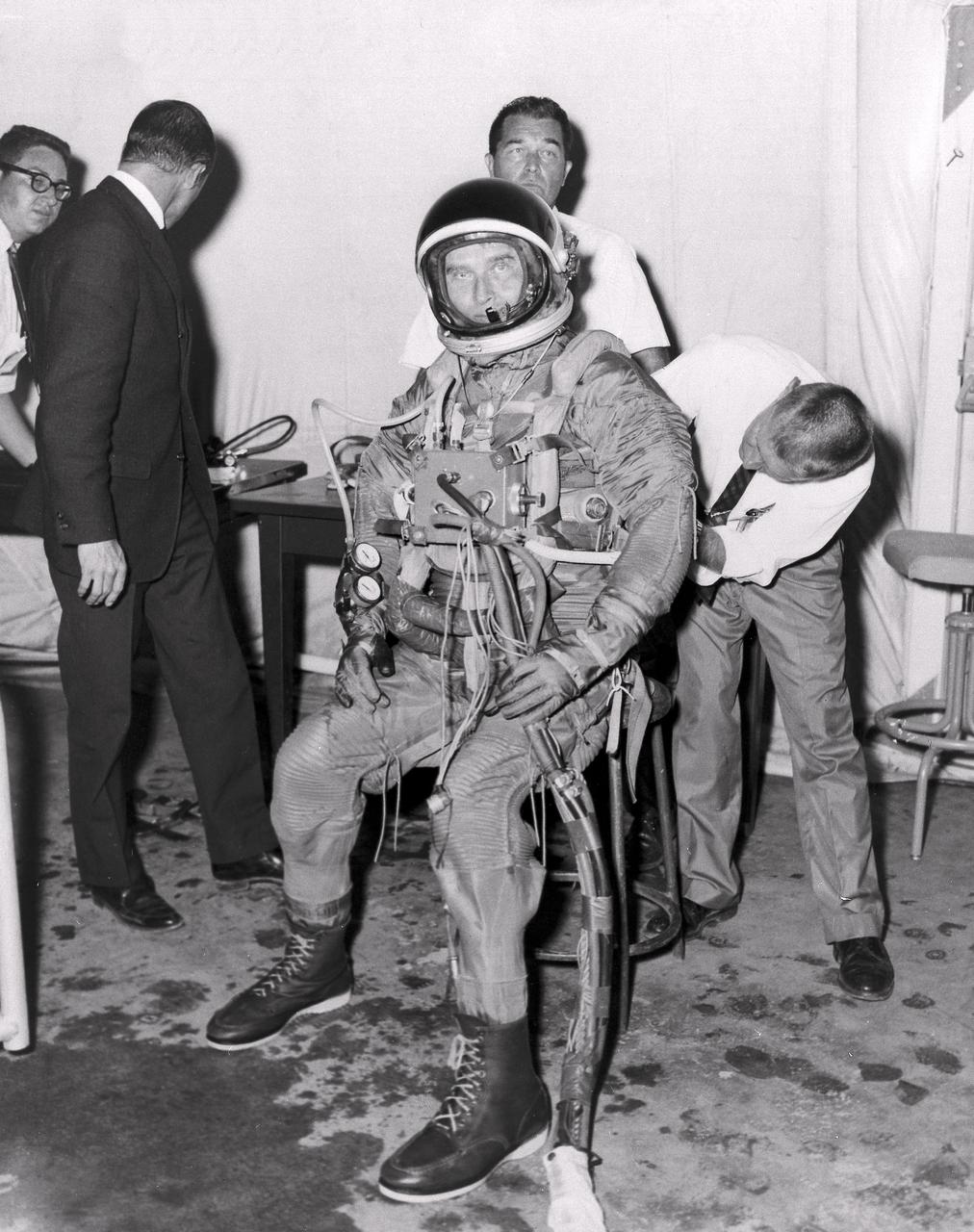
Marshall Space Flight Center (MSFC) Director, Dr. von Braun, is shown fitted with suit and diving equipment as he prepares for a tryout in the MSFC Neutral Buoyancy Simulator (NBS). Weighted to a neutrally buoyant condition, Dr. von Braun was able to perform tasks underwater which simulated weightless conditions found in space.
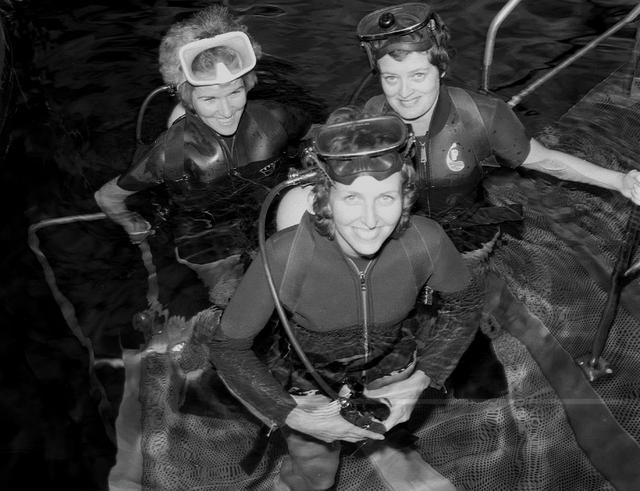
Candid shots of Carolyn Griner (front), Drs. Mary-Helen Johnston and Ann Whitaker (L to R) wearing scuba gear at the Neutral Buoyancy Simulator (NBS) for training.
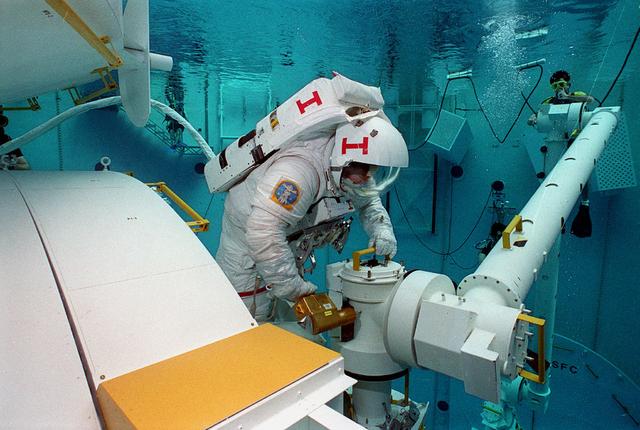
This photograph was taken in the Marshall Space Flight Center (MSFC) Neutral Buoyancy Simulator (NBS) during the testing of the Japanese Experimental Module. The NBS provided the weightless environment encountered in space needed for testing and the practices of extra-vehicular activities.
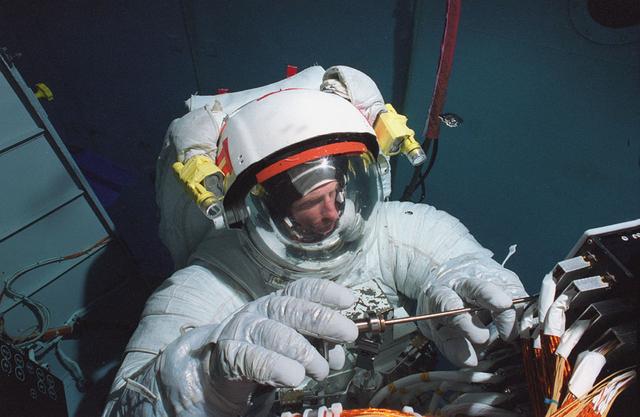
Astronauts Greg Harbaugh and Joe Tarner conduct Hubble Space Telescope training in Marshall's Neutral Buoyancy Simulator (NBS).
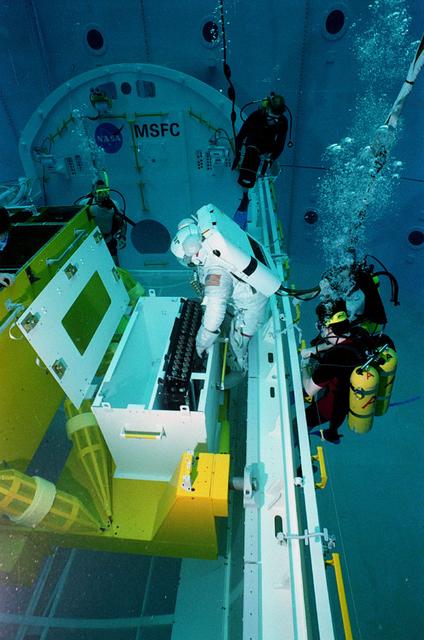
Astronaut Jeff Hoffman conducts Hubble Space Telescope training in Marshall's Neutral Buoyancy Simulator (NBS)
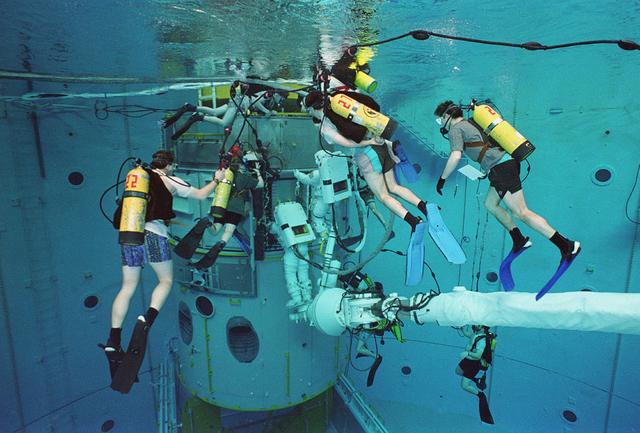
Underwater training is conducted in Marshall's Neutral Buoyancy Simulator (NBS) in preparation for on-orbit Hubble Space Telescope operations.
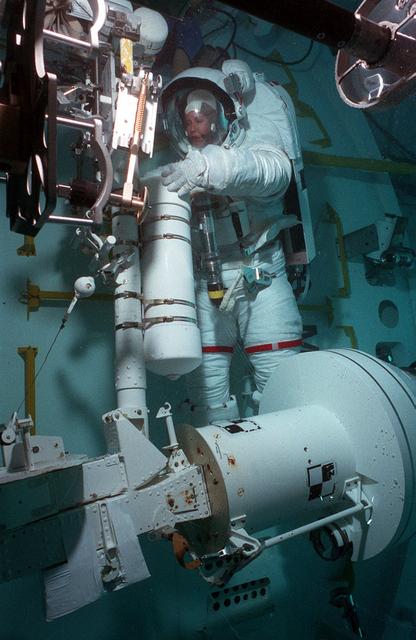
Astronaut Kathy Thornton conducts Hubble Space Telescope training in Marshall's Neutral Buoyancy Simulator (NBS).
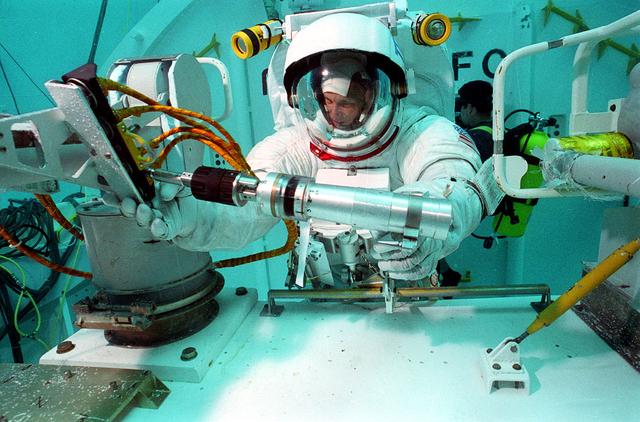
Astronaut Storey Musgrave conducts Hubble Space Telescope (HST) training in Marshall's Neutral Buoyancy Simulator (NBS).
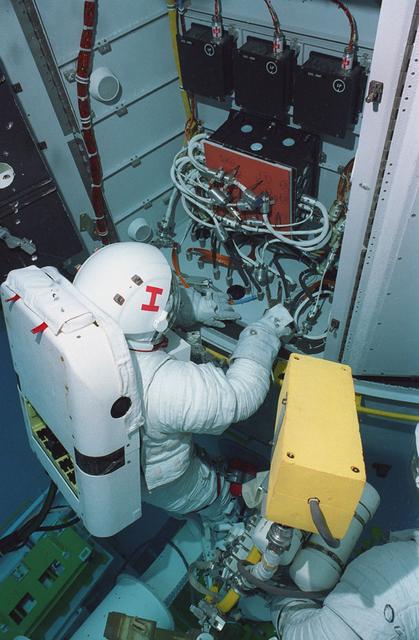
Astronauts Mark Lee and Joe Tarner conduct Hubble Space Telescope training in Marshall's Neutral Buoyancy Simulator (NBS).
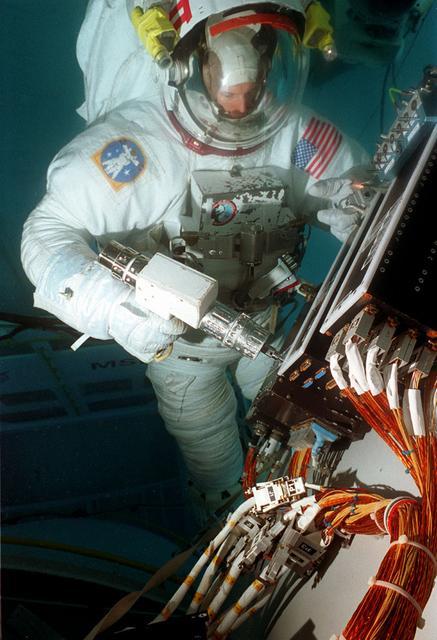
Astronaut Mark Lee conducts Hubble Space Telescope training in Marshall's Neutral Buoyancy Simulator (NBS)
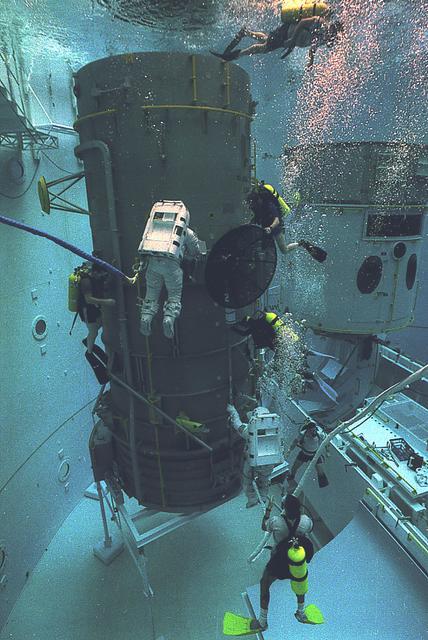
Underwater training is conducted in Marshall's Neutral Buoyancy Simulator (NBS) in preparation for on-orbit Hubble Space Telescope operations.
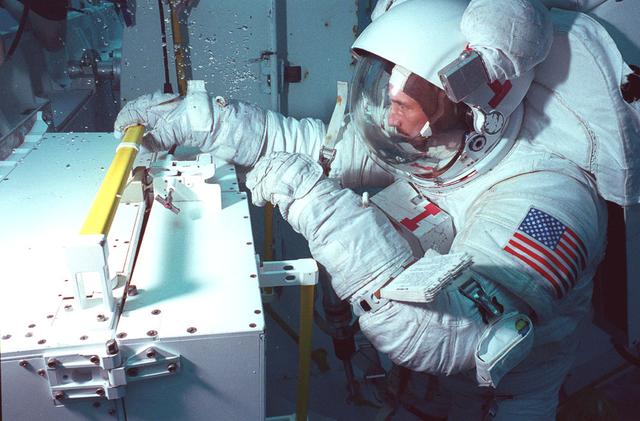
Underwater crew training is conducted in Marshall's Neutral Buoyancy Simulator (NBS) in preparation for on-orbit Hubble Space Telescope (HST) operations.
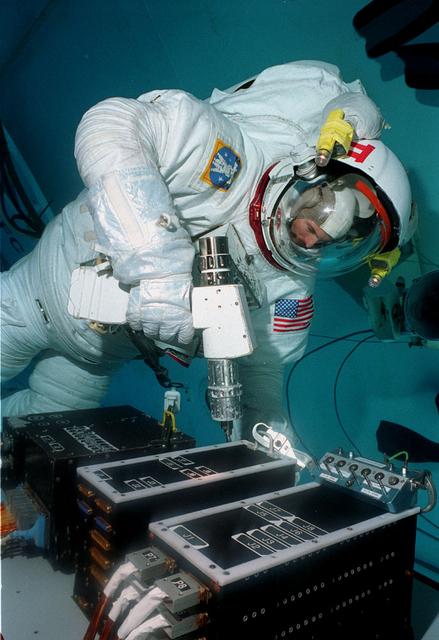
Astronaut Mark Lee conducts Hubble Space Telescope training in Marshall's Neutral Buoyancy Simulator (NBS)
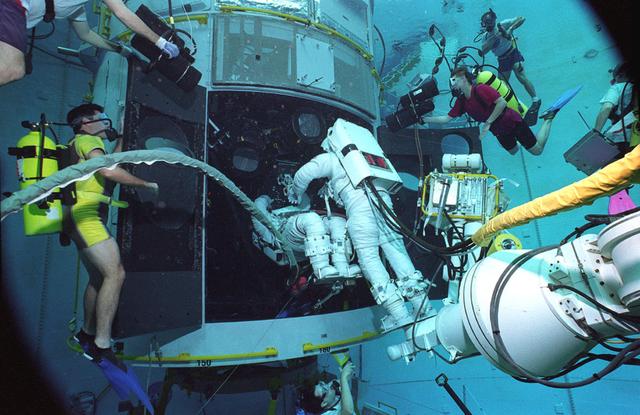
Astronauts Greg Harbaugh and Steve Smith conduct Hubble Space Telescope (HST) training in Marshall's Neutral Buoyancy Simulator (NBS).
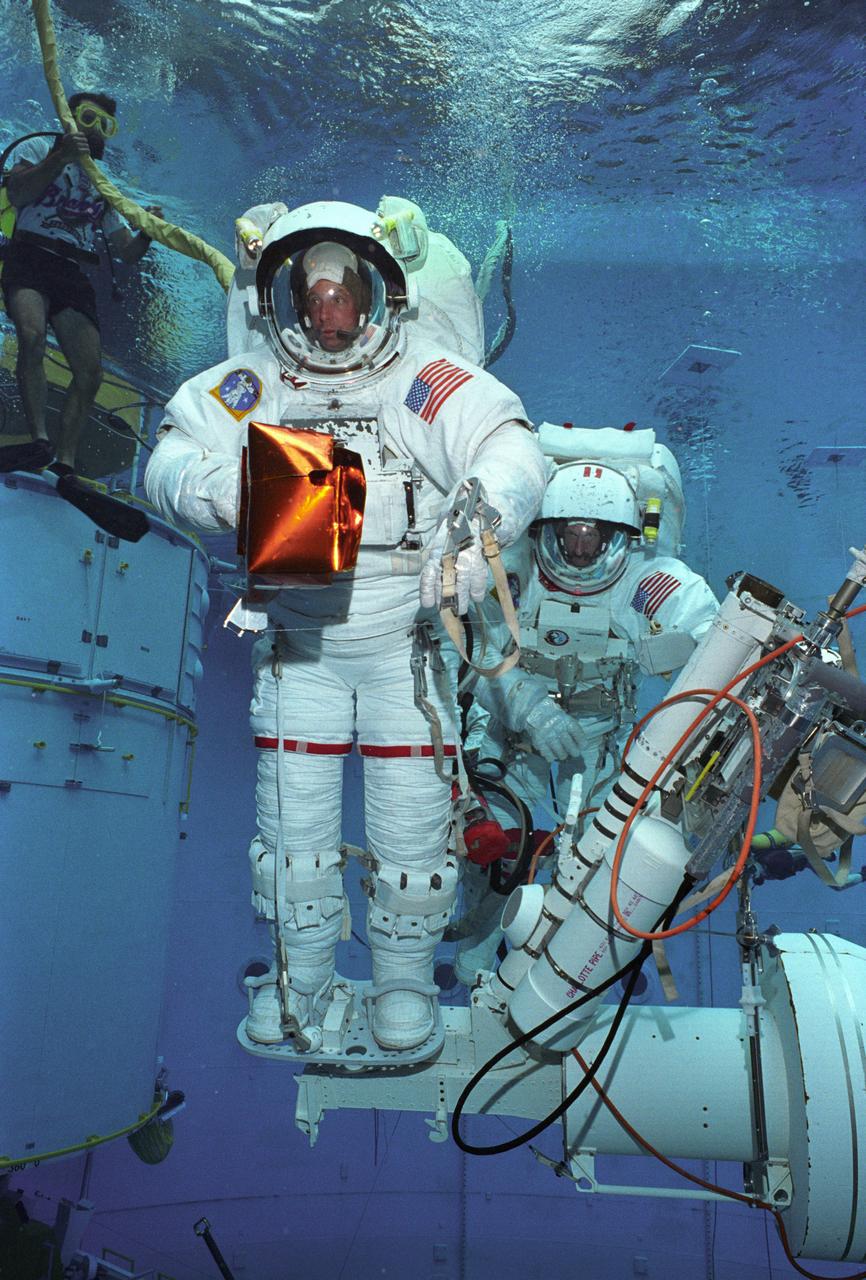
Astronauts Greg Harbaugh and Joe Tarner conduct Hubble Space Telescope training in Marshall's Neutral Buoyancy Simulator (NBS).
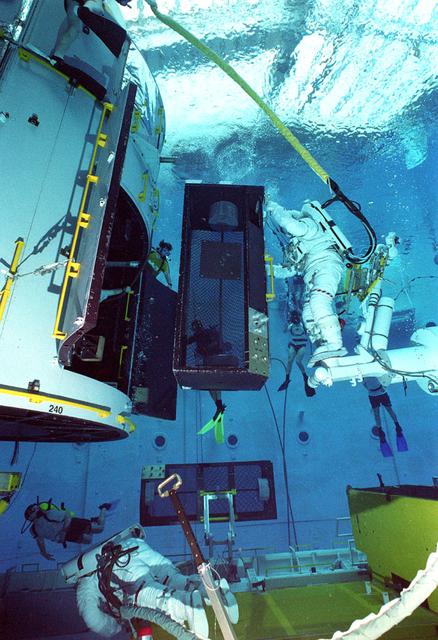
Astronauts Greg Harbaugh and Joe Tarner conduct Hubble Space Telescope training in Marshall's Neutral Buoyancy Simulator (NBS).
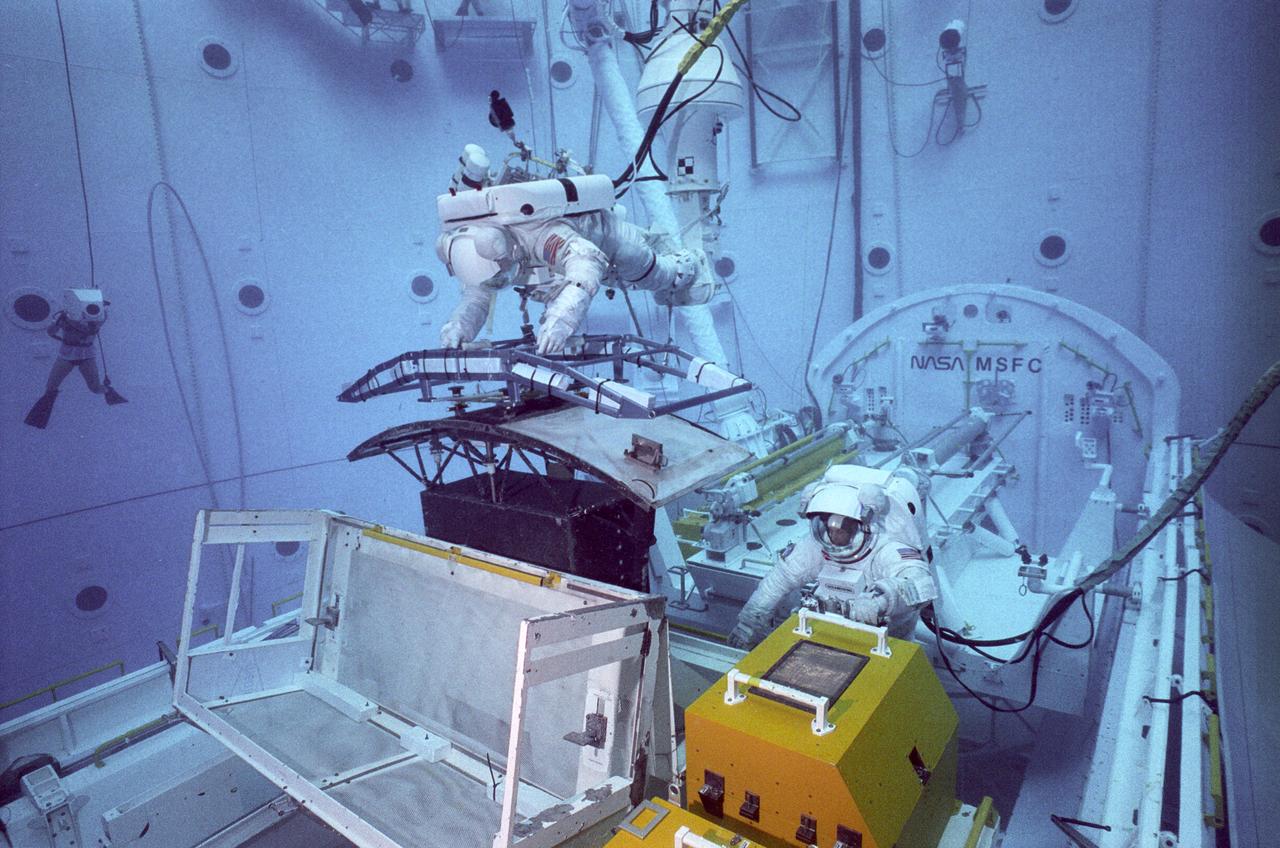
Underwater crew training is conducted in Marshall's Neutral Buoyancy Simulator (NBS) in preparation for on-orbit Hubble Space Telescope (HST) operations.
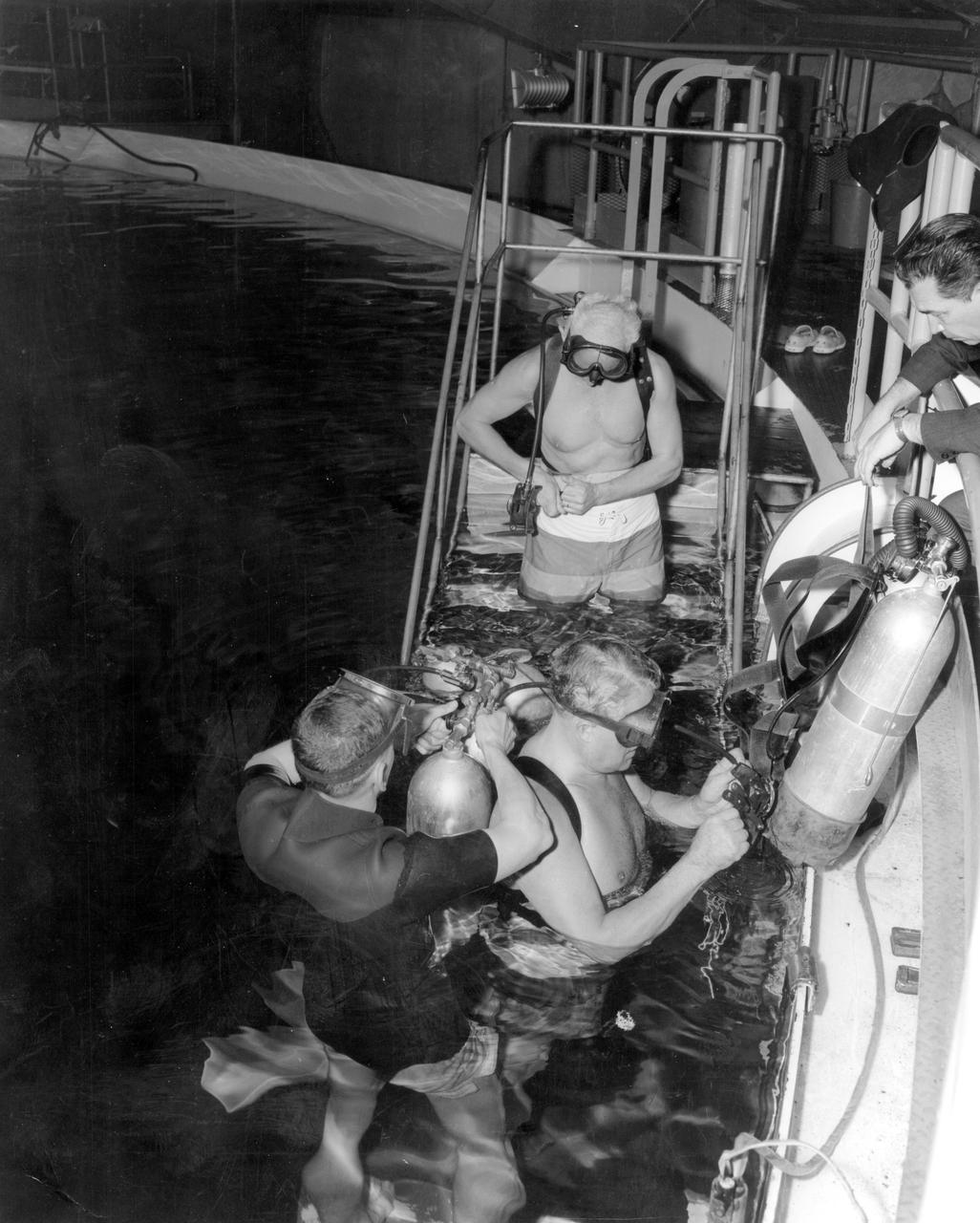
Marshall Space Flight Center’s (MSFC) Dr. Ernst Stuhlinger, Director of Research Projects Office; and Dr. Wernher von Braun, center director, along with others, took a swim in the Neutral Buoyancy Simulator (NBS) at MSFC. A safety diver adjusts scuba equipment worn by von Braun, while Stuhlinger adjusts his weight belt prior to entering the tank. In the NBS, subjects were weighted to a neutrally buoyant condition underwater to perform and practice tasks in a simulated weightless condition as would be encountered in space.
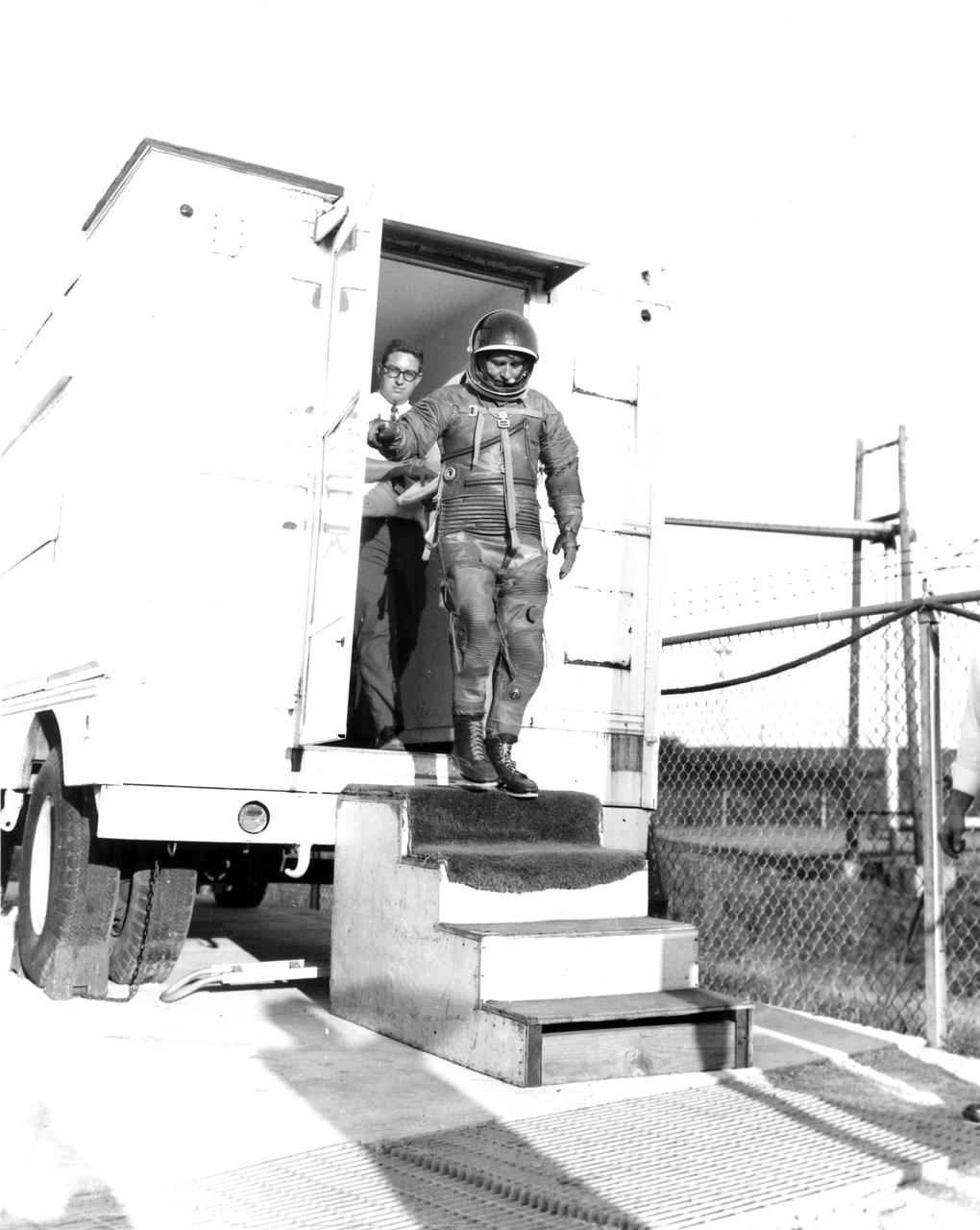
Marshall Space Flight Center (MSFC) Director, Dr. von Braun, is shown leaving the suiting-up van wearing a pressure suit prepared for a tryout in the MSFC Neutral Buoyancy Simulator (NBS). Weighted to a neutrally buoyant condition, Dr. von Braun was able to perform tasks underwater which simulated weightless conditions found in space.
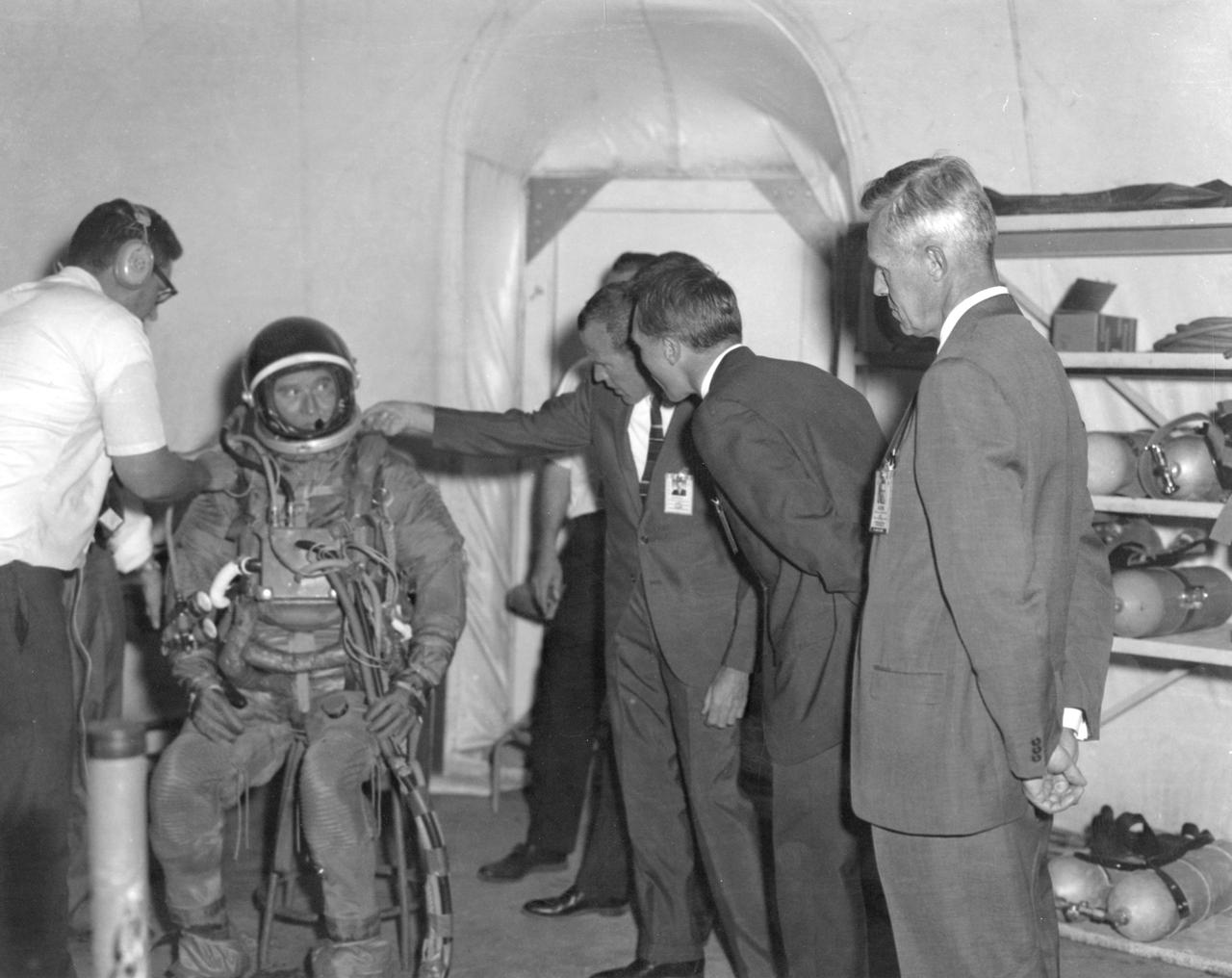
Astronaut L. Gordon Cooper checks the neck ring of a space suit worn by Marshall Space Flight Center (MSFC) Director, Dr. von Braun before he submerges into the water of the MSFC Neutral Buoyancy Simulator (NBS). Wearing a pressurized suit and weighted to a neutrally buoyant condition, Dr. von Braun was able to perform tasks underwater which simulated weightless conditions found in space.
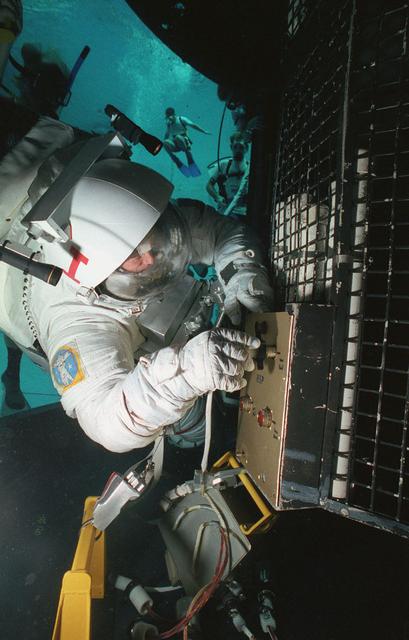
STS-61 astronauts practice installing the corrective optics module on a Hubble Space Telescope mockup in Marshall Space Flight Center's Neutral Buoyancy Simulator. Test activities for STS-61 were carried out at Marshall from June 21, 1993 through July 2, 1993 and again in October 1993.
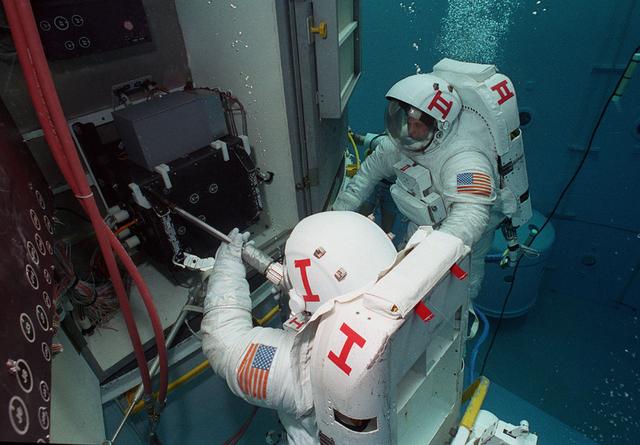
Astronauts Kathy Thornton and Tom Akers practice installing the Wide Field Planetary camera into the Hubble Space Telescope at Marshall's Neutral Buoyancy Simulator (NBS).
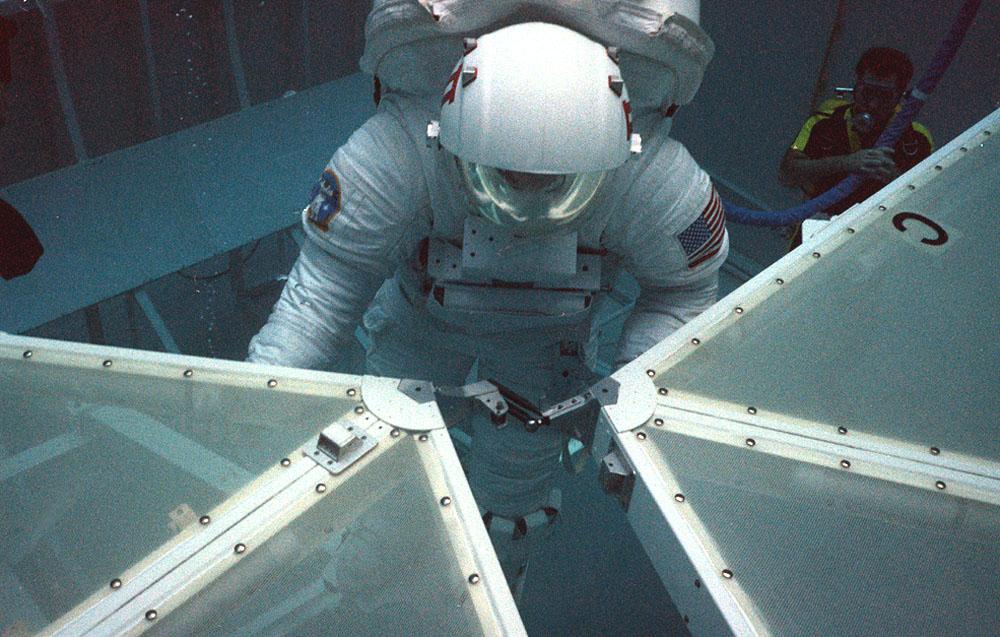
Marshall scientist practices assembling the solar panel array for the space station during the Collector Panel Assembly Test (COPAT) at Marshall's Neutral Buoyancy Simulator (NBS).
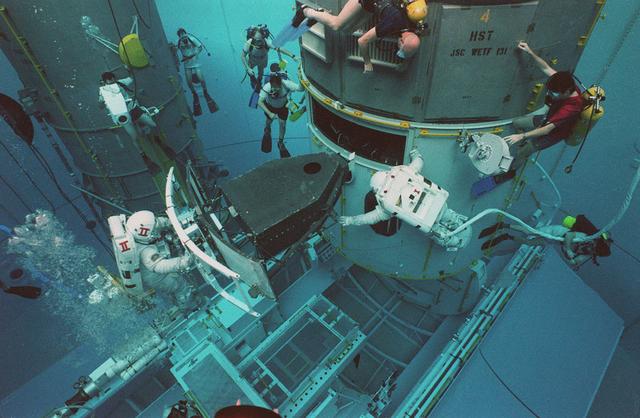
Astronauts Kathy Thornton and Tom Akers practice installing the Wide Field Planetary camera into the Hubble Space Telescope at Marshall's Neutral Buoyancy Simulator (NBS).
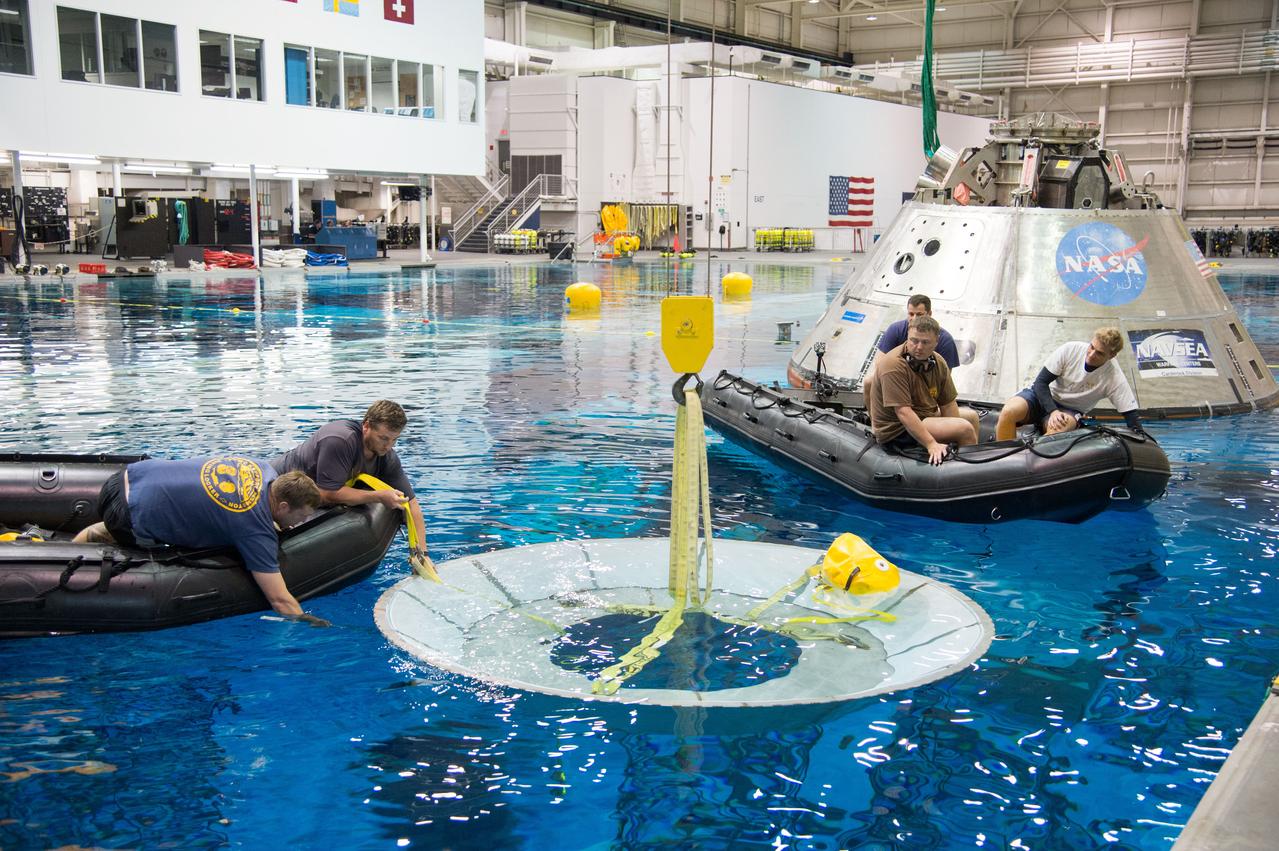
NASA, Department of Defense personnel from Detachment 3 out of Patrick Air Force Base, and the Mobile Diving Salvage Unit based in San Diego conduct a testing session at the Neutral Buoyancy Lab in Houston on Dec. 5, 2012 to evaluate procedures, mockups, and prototype hardware used to train personnel in recovery of the Orion crew module and the forward bay cover for Exploration Flight Test-1 (EFT-1). Part of Batch image transfer from Flickr.
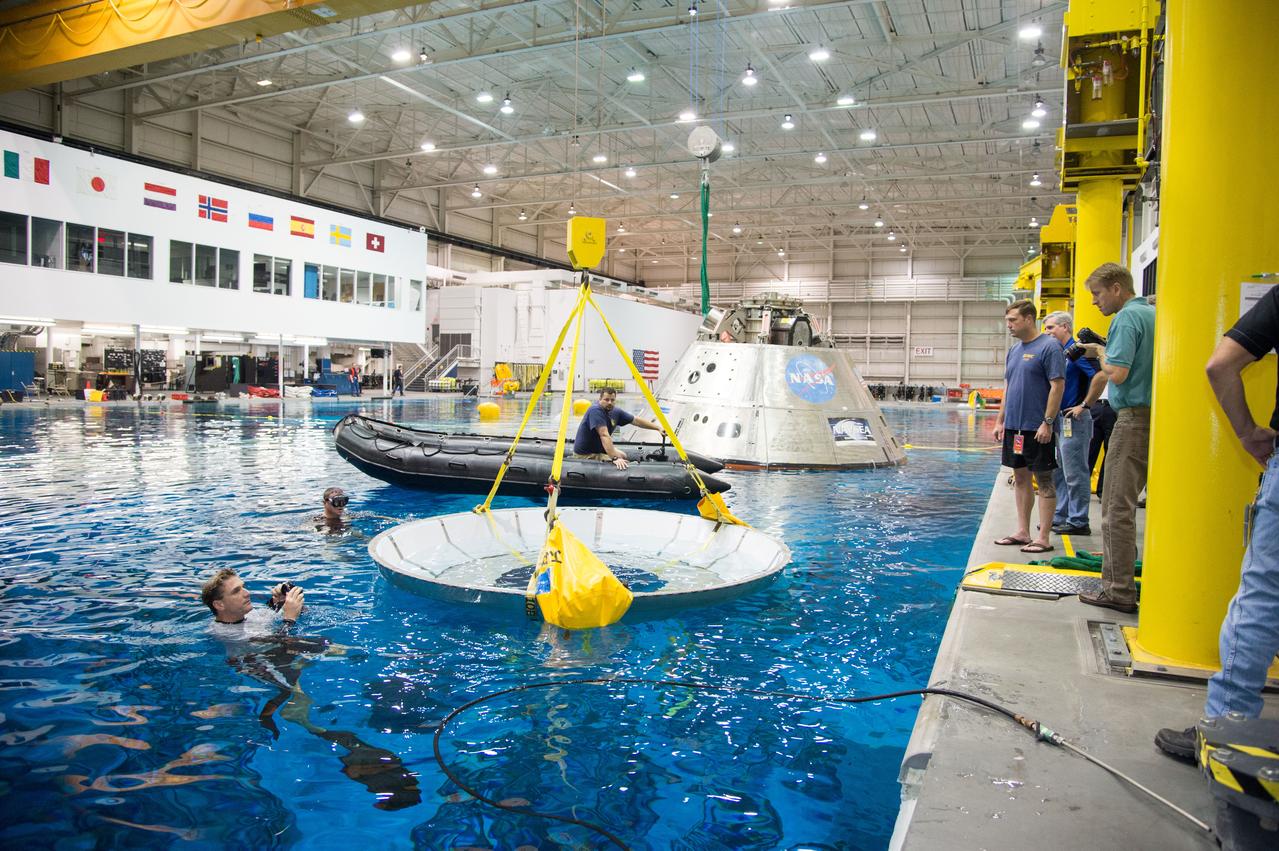
NASA, Department of Defense personnel from Detachment 3 out of Patrick Air Force Base, and the Mobile Diving Salvage Unit based in San Diego conduct a testing session at the Neutral Buoyancy Lab in Houston on Dec. 5, 2012 to evaluate procedures, mockups, and prototype hardware used to train personnel in recovery of the Orion crew module and the forward bay cover for Exploration Flight Test-1 (EFT-1). Part of Batch image transfer from Flickr.
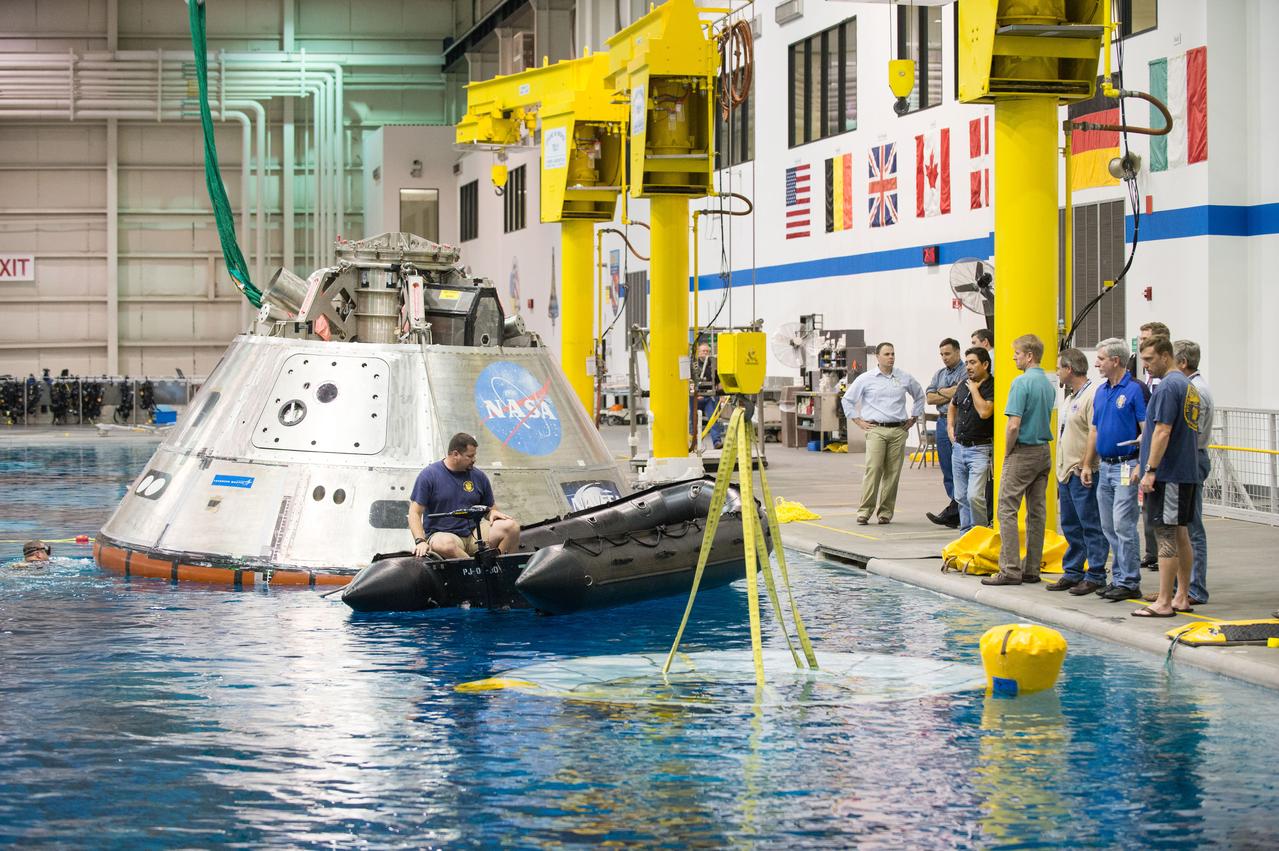
NASA, Department of Defense personnel from Detachment 3 out of Patrick Air Force Base, and the Mobile Diving Salvage Unit based in San Diego conduct a testing session at the Neutral Buoyancy Lab in Houston on Dec. 5, 2012 to evaluate procedures, mockups, and prototype hardware used to train personnel in recovery of the Orion crew module and the forward bay cover for Exploration Flight Test-1 (EFT-1). Part of Batch image transfer from Flickr.
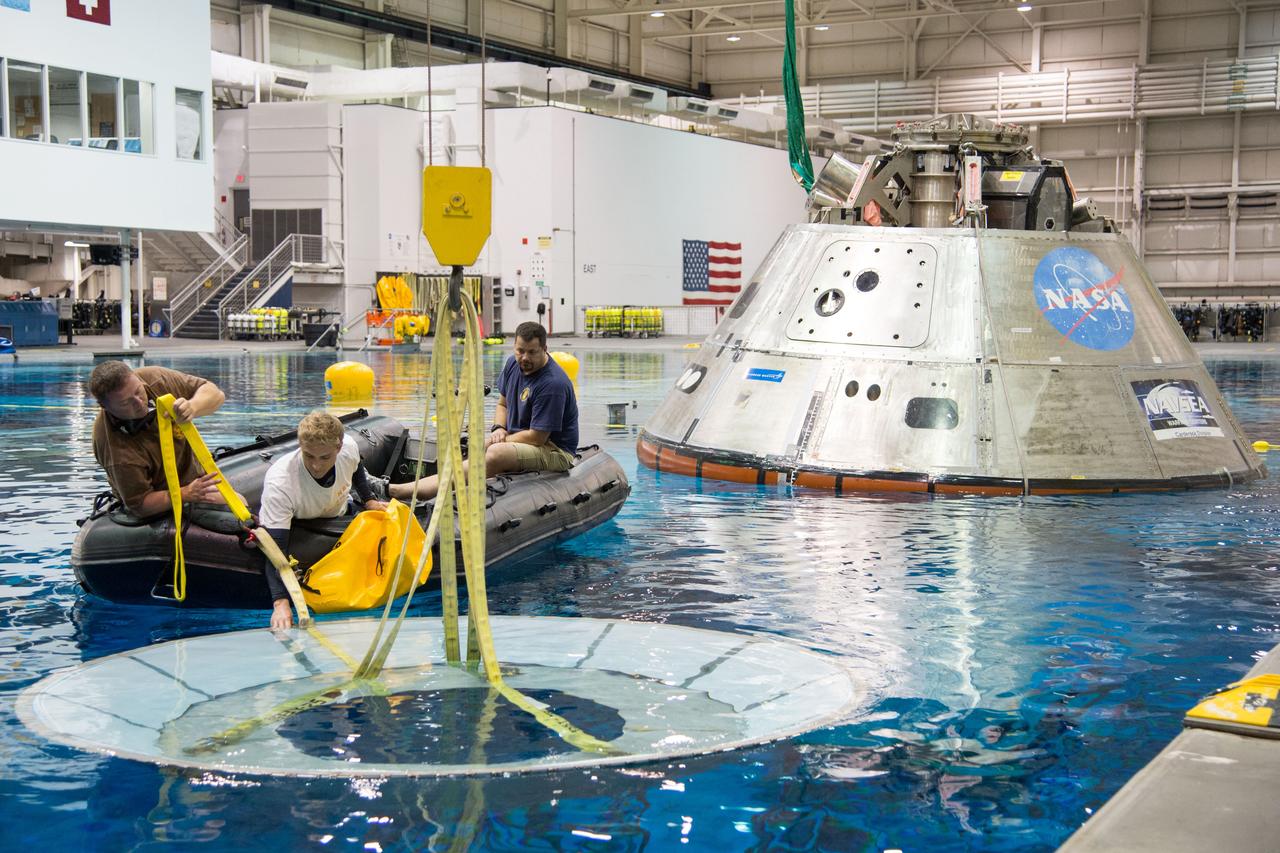
NASA, Department of Defense personnel from Detachment 3 out of Patrick Air Force Base, and the Mobile Diving Salvage Unit based in San Diego conduct a testing session at the Neutral Buoyancy Lab in Houston on Dec. 5, 2012 to evaluate procedures, mockups, and prototype hardware used to train personnel in recovery of the Orion crew module and the forward bay cover for Exploration Flight Test-1 (EFT-1). Part of Batch image transfer from Flickr.
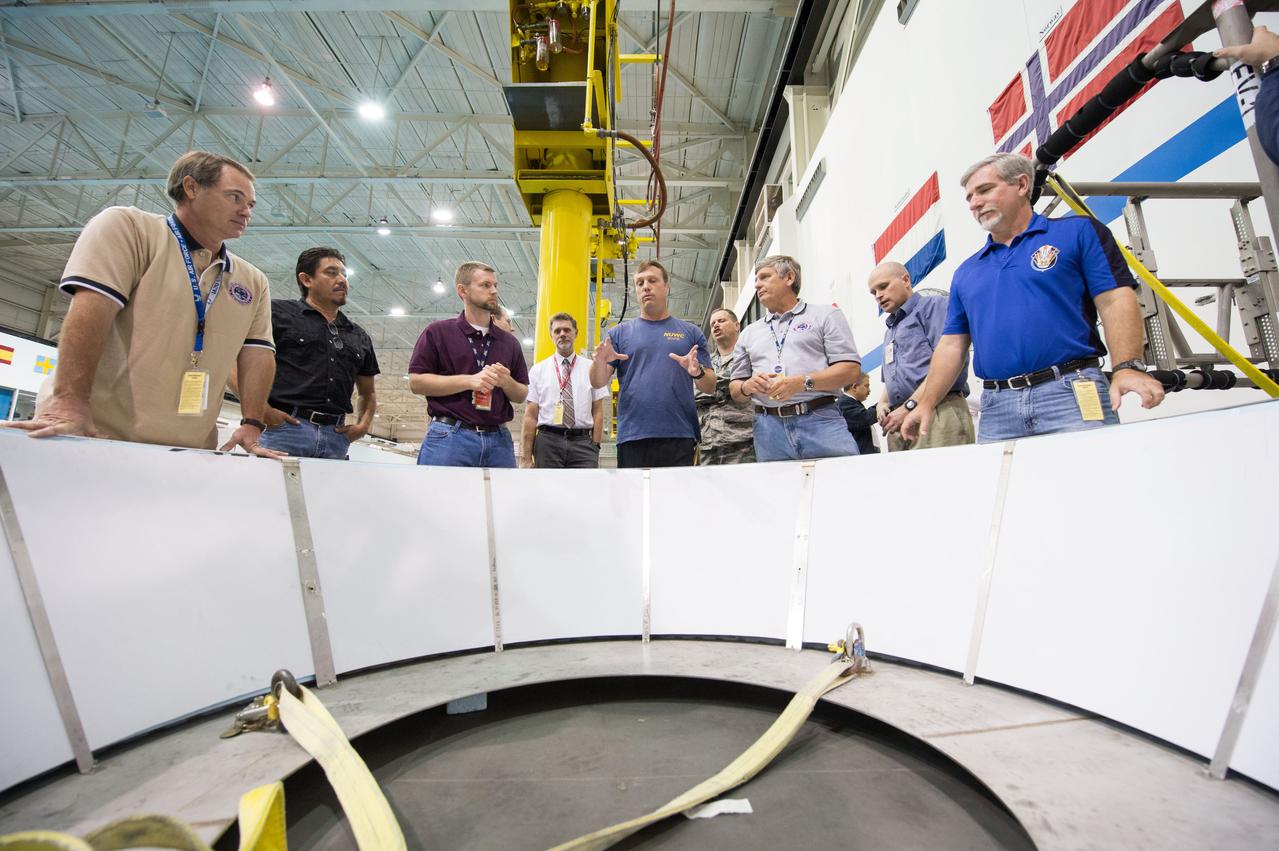
NASA, Department of Defense personnel from Detachment 3 out of Patrick Air Force Base, and the Mobile Diving Salvage Unit based in San Diego conduct a testing session at the Neutral Buoyancy Lab in Houston on Dec. 5, 2012 to evaluate procedures, mockups, and prototype hardware used to train personnel in recovery of the Orion crew module and the forward bay cover for Exploration Flight Test-1 (EFT-1). Part of Batch image transfer from Flickr.
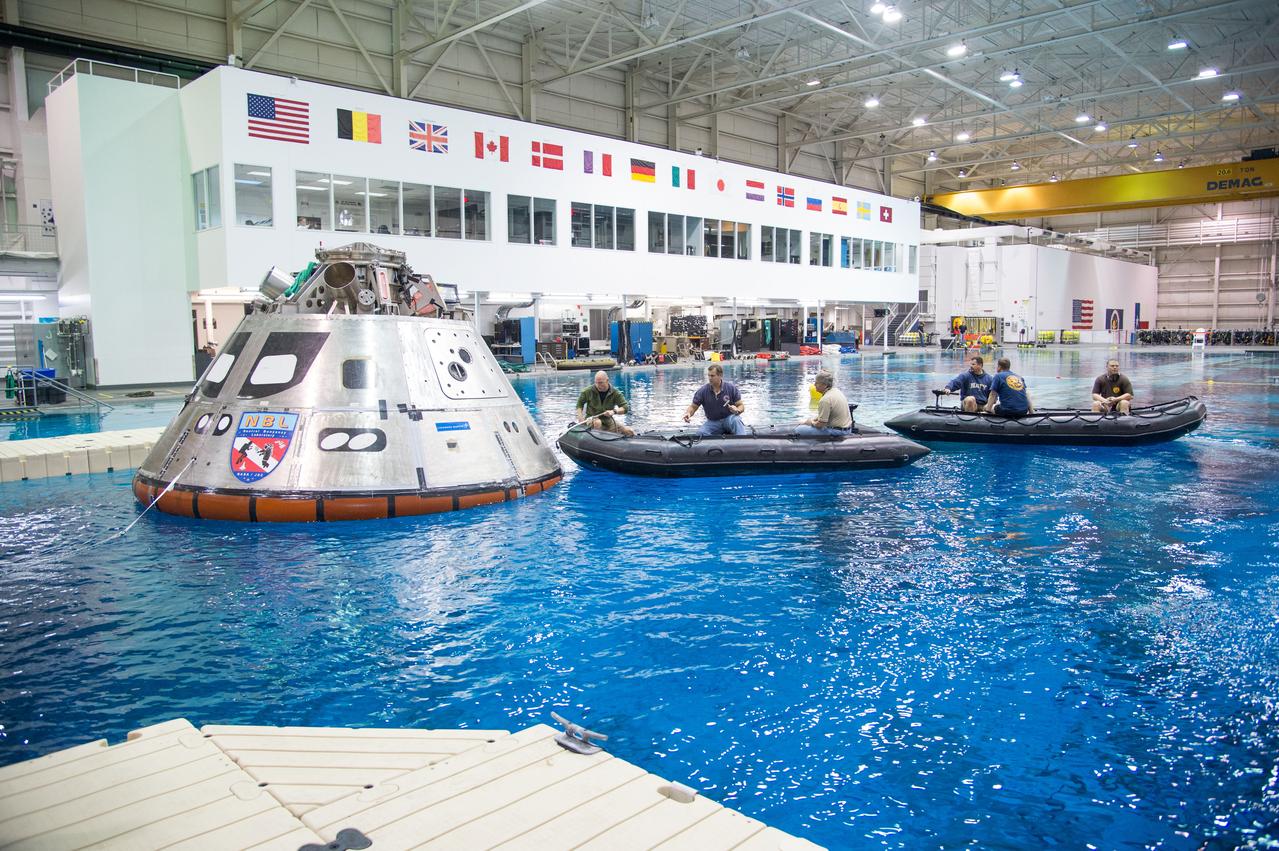
NASA, Department of Defense personnel from Detachment 3 out of Patrick Air Force Base, and the Mobile Diving Salvage Unit based in San Diego conduct a testing session at the Neutral Buoyancy Lab in Houston on Dec. 5, 2012 to evaluate procedures, mockups, and prototype hardware used to train personnel in recovery of the Orion crew module and the forward bay cover for Exploration Flight Test-1 (EFT-1). Part of Batch image transfer from Flickr.
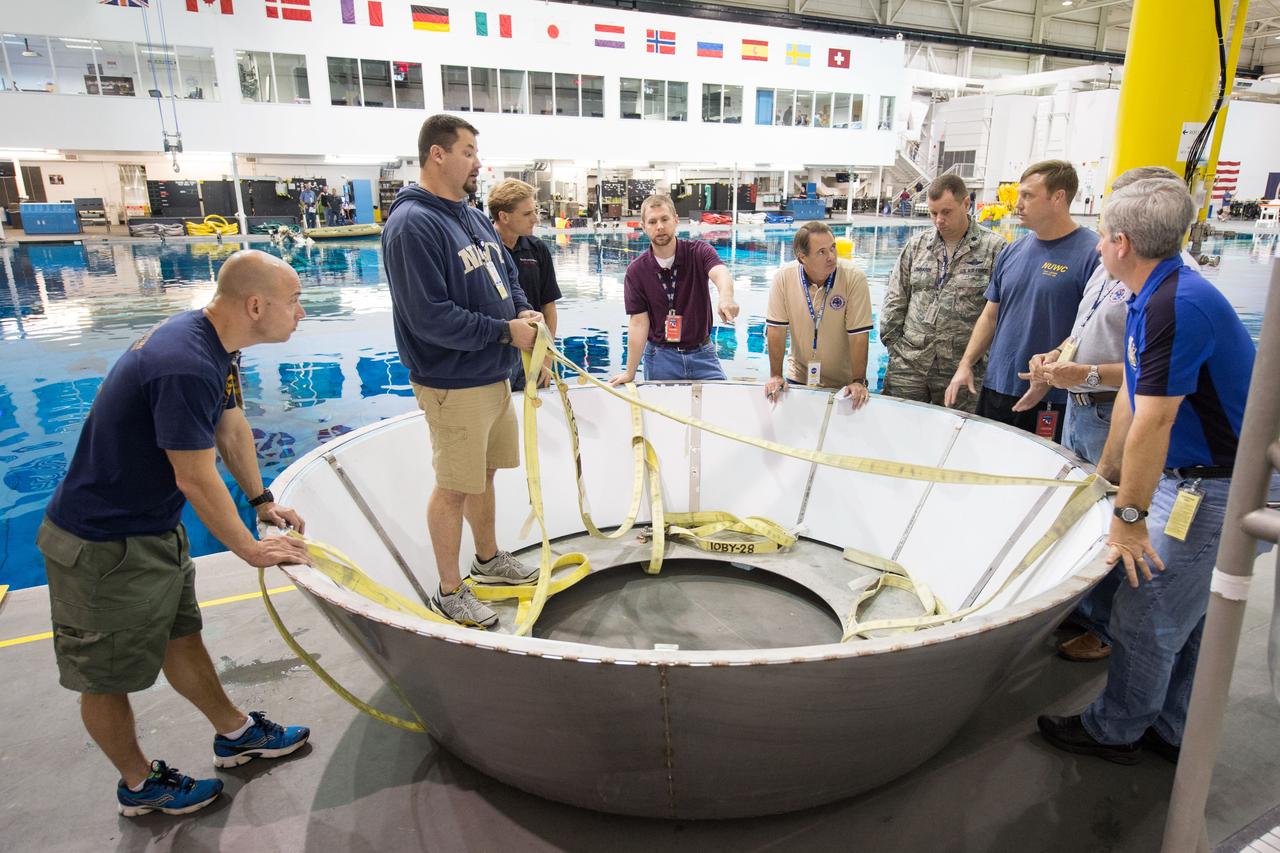
NASA, Department of Defense personnel from Detachment 3 out of Patrick Air Force Base, and the Mobile Diving Salvage Unit based in San Diego conduct a testing session at the Neutral Buoyancy Lab in Houston on Dec. 5, 2012 to evaluate procedures, mockups, and prototype hardware used to train personnel in recovery of the Orion crew module and the forward bay cover for Exploration Flight Test-1 (EFT-1). Part of Batch image transfer from Flickr.
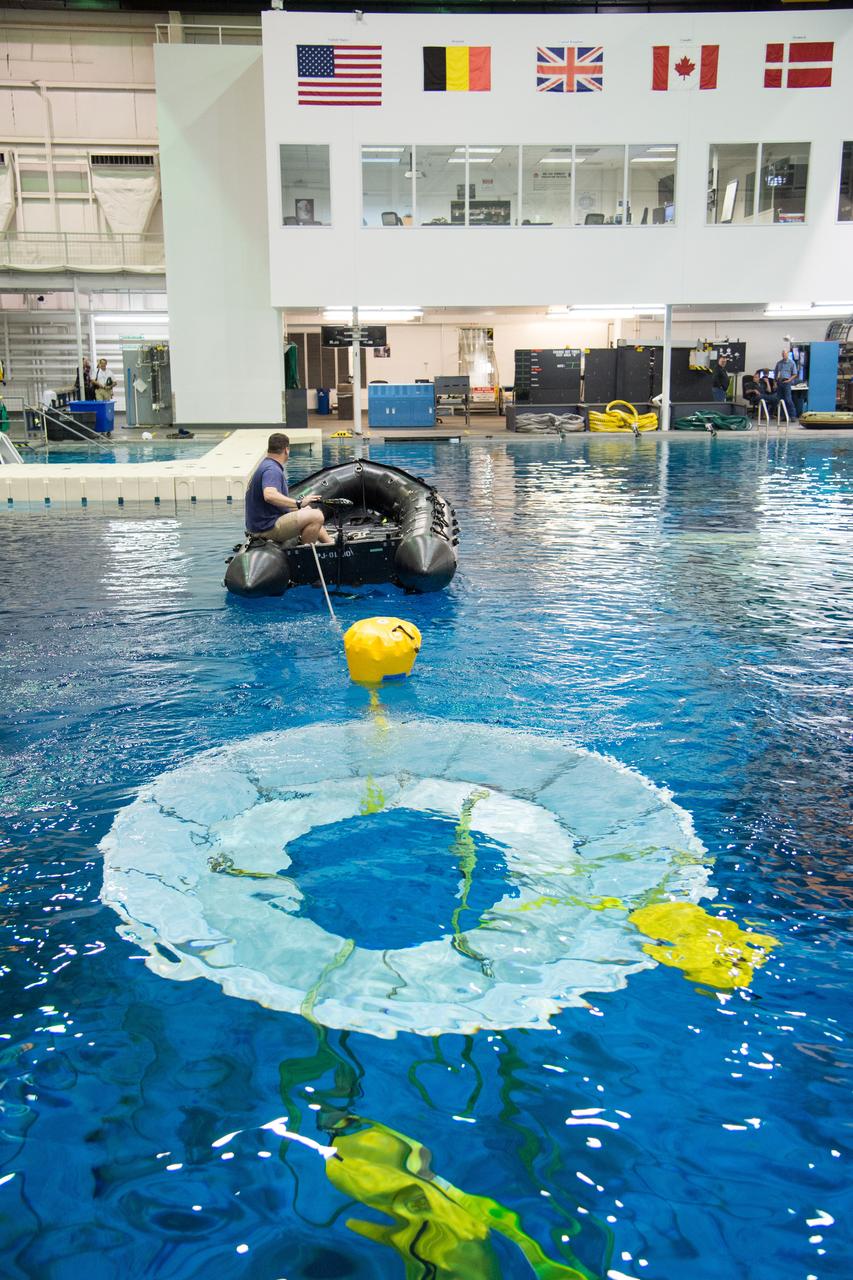
NASA, Department of Defense personnel from Detachment 3 out of Patrick Air Force Base, and the Mobile Diving Salvage Unit based in San Diego conduct a testing session at the Neutral Buoyancy Lab in Houston on Dec. 5, 2012 to evaluate procedures, mockups, and prototype hardware used to train personnel in recovery of the Orion crew module and the forward bay cover for Exploration Flight Test-1 (EFT-1). Part of Batch image transfer from Flickr.
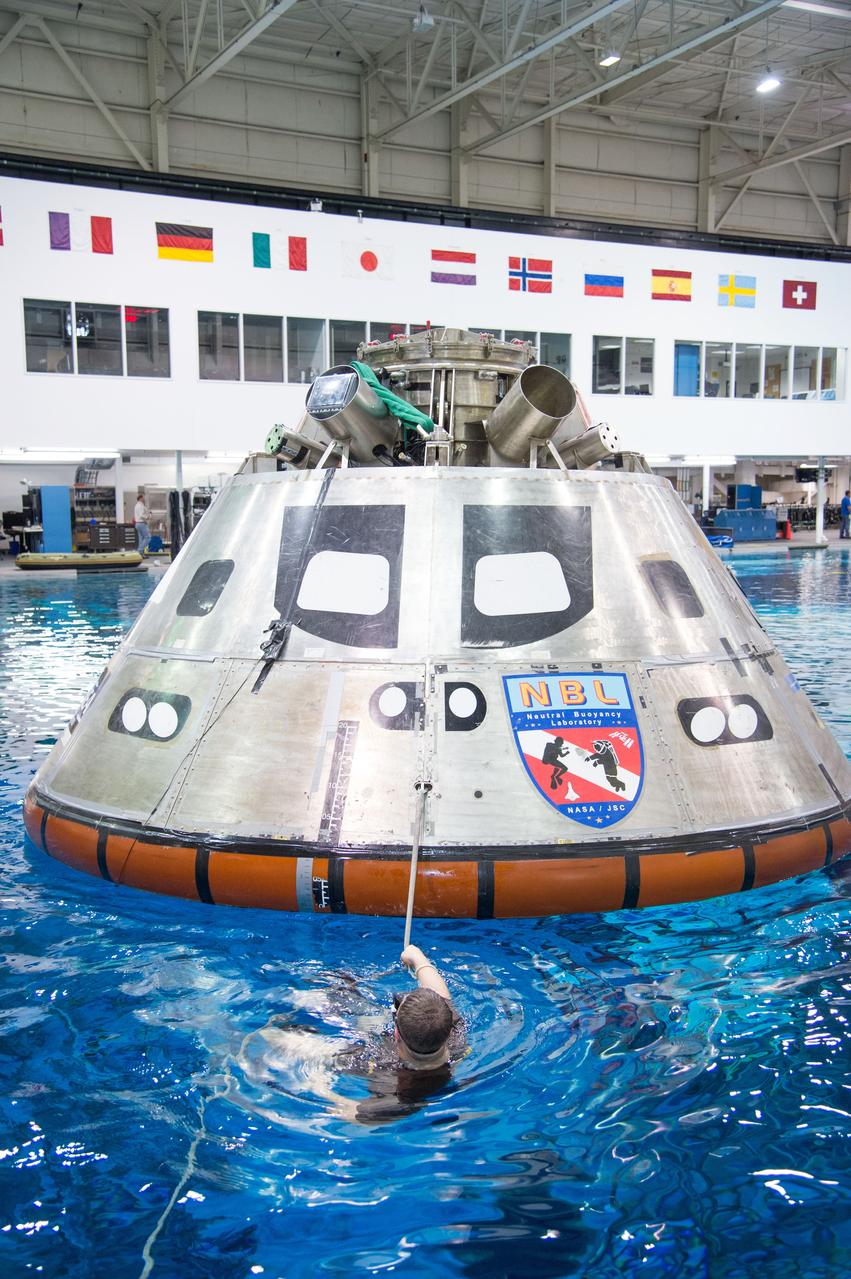
NASA, Department of Defense personnel from Detachment 3 out of Patrick Air Force Base, and the Mobile Diving Salvage Unit based in San Diego conduct a testing session at the Neutral Buoyancy Lab in Houston on Dec. 5, 2012 to evaluate procedures, mockups, and prototype hardware used to train personnel in recovery of the Orion crew module and the forward bay cover for Exploration Flight Test-1 (EFT-1). Part of Batch image transfer from Flickr.
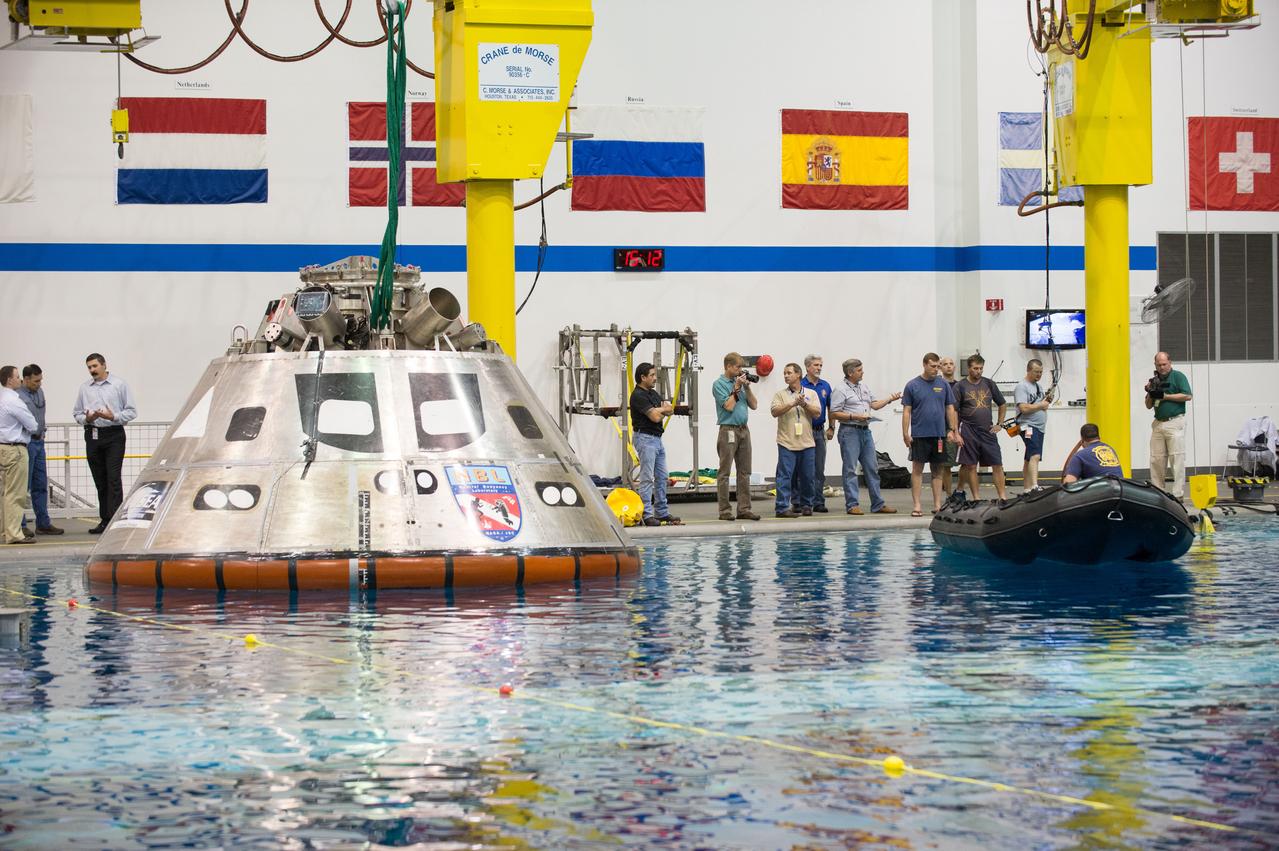
NASA, Department of Defense personnel from Detachment 3 out of Patrick Air Force Base, and the Mobile Diving Salvage Unit based in San Diego conduct a testing session at the Neutral Buoyancy Lab in Houston on Dec. 5, 2012 to evaluate procedures, mockups, and prototype hardware used to train personnel in recovery of the Orion crew module and the forward bay cover for Exploration Flight Test-1 (EFT-1). Part of Batch image transfer from Flickr.
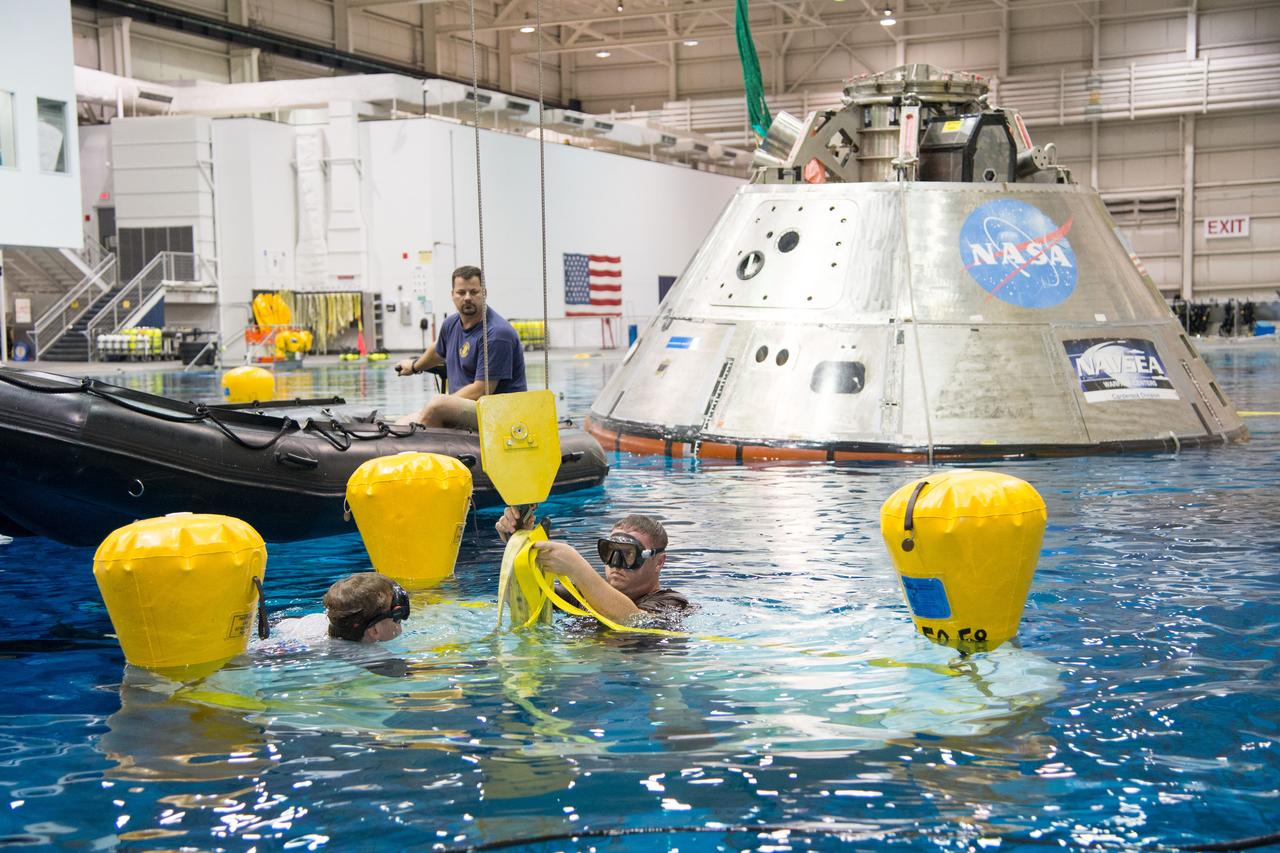
NASA, Department of Defense personnel from Detachment 3 out of Patrick Air Force Base, and the Mobile Diving Salvage Unit based in San Diego conduct a testing session at the Neutral Buoyancy Lab in Houston on Dec. 5, 2012 to evaluate procedures, mockups, and prototype hardware used to train personnel in recovery of the Orion crew module and the forward bay cover for Exploration Flight Test-1 (EFT-1). Part of Batch image transfer from Flickr.
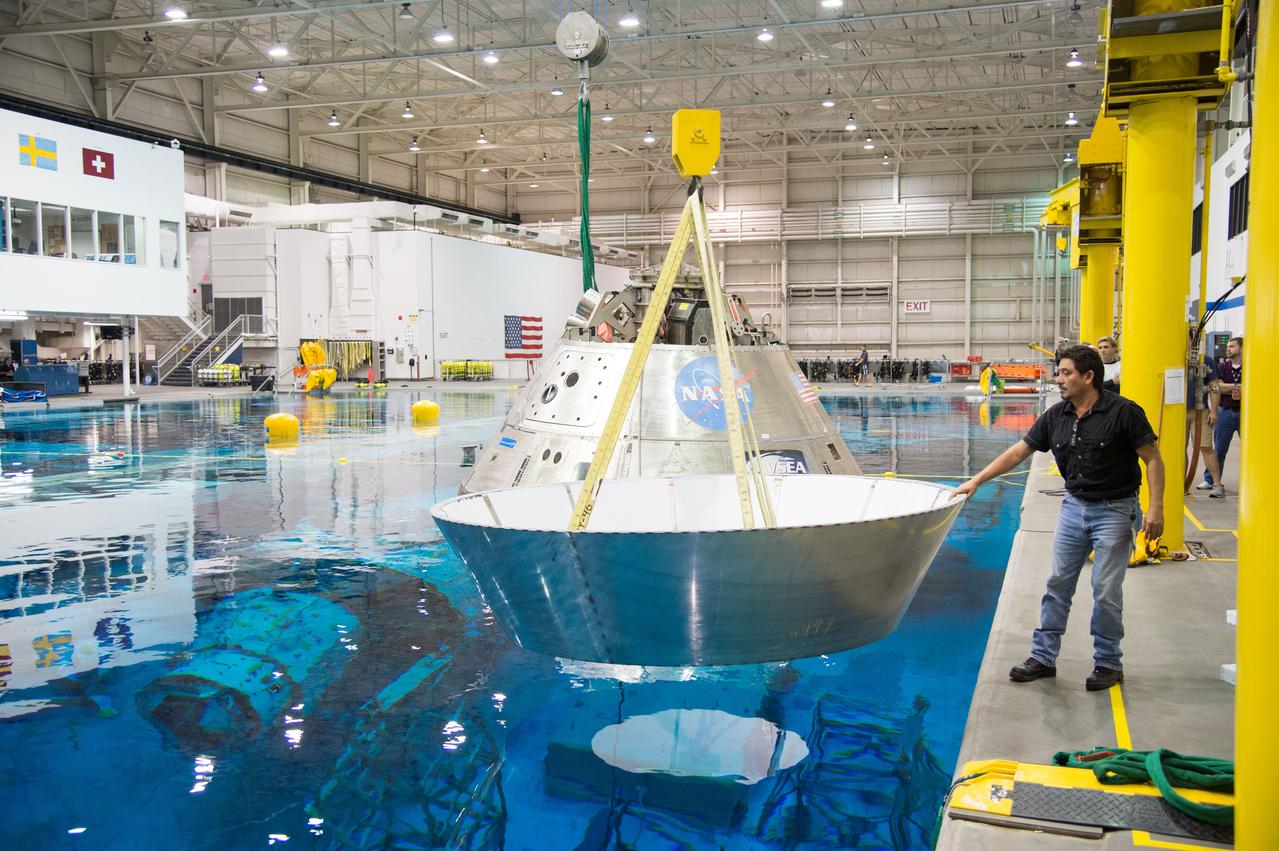
NASA, Department of Defense personnel from Detachment 3 out of Patrick Air Force Base, and the Mobile Diving Salvage Unit based in San Diego conduct a testing session at the Neutral Buoyancy Lab in Houston on Dec. 5, 2012 to evaluate procedures, mockups, and prototype hardware used to train personnel in recovery of the Orion crew module and the forward bay cover for Exploration Flight Test-1 (EFT-1). Part of Batch image transfer from Flickr.
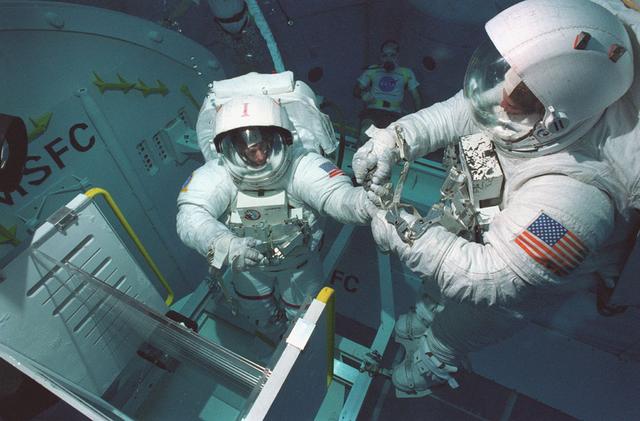
Marshall's Neutral Buoyancy Simulator (NBS) is used to simulate the gravitational fields and buoyancy effects outer space has on astronauts and their ability to perform tasks in this environment. In this example, a diver performs a temporary fluid line repair task using a repair kit developed by Marshall engineers. The analysis will determine the value of this repair kit and its feasibility.
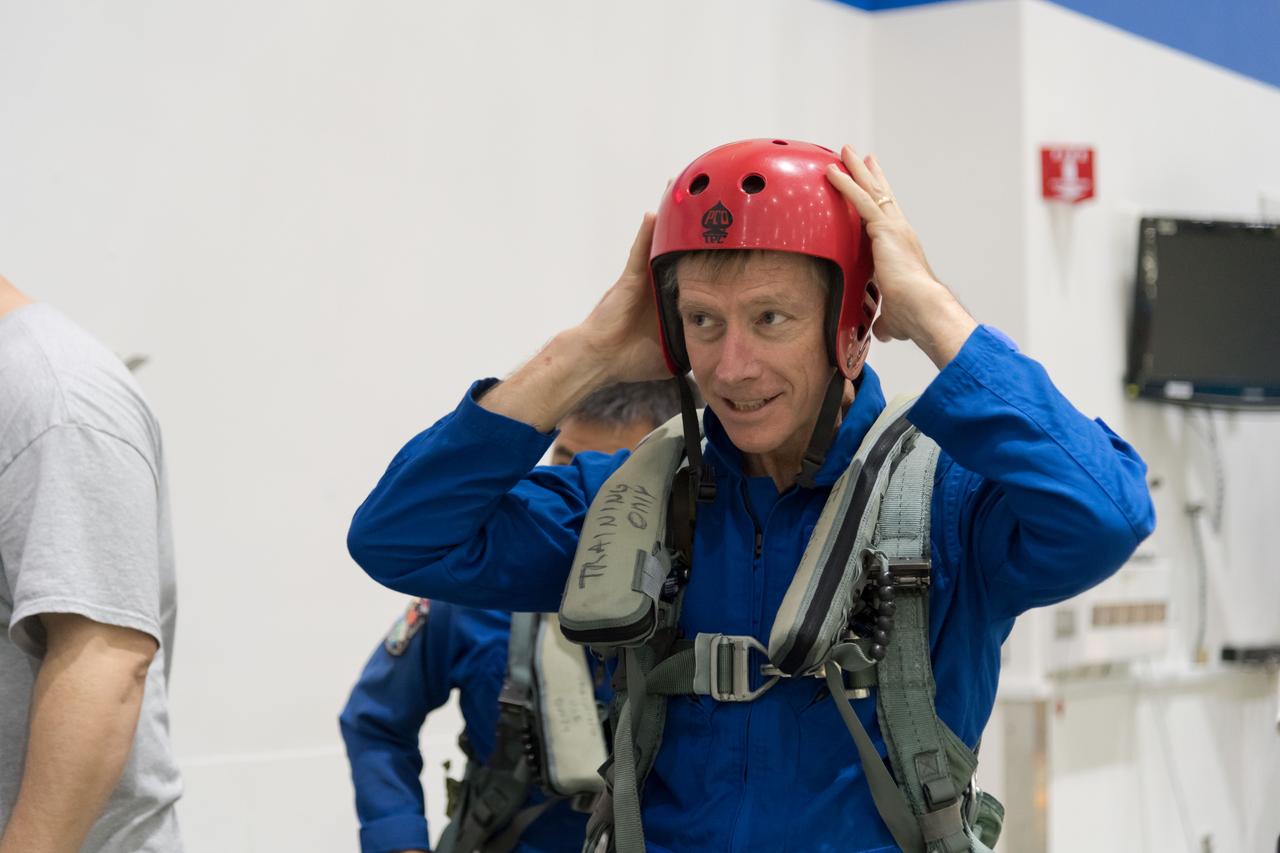
Boeing astronaut Chris Ferguson prepares for water survival training at the Neutral Buoyancy Laboratory near NASA's Johnson Space Center in Houston. Ferguson will fly on Boeing's Crew Flight Test with NASA astronauts Eric Boe and Nicole Mann.
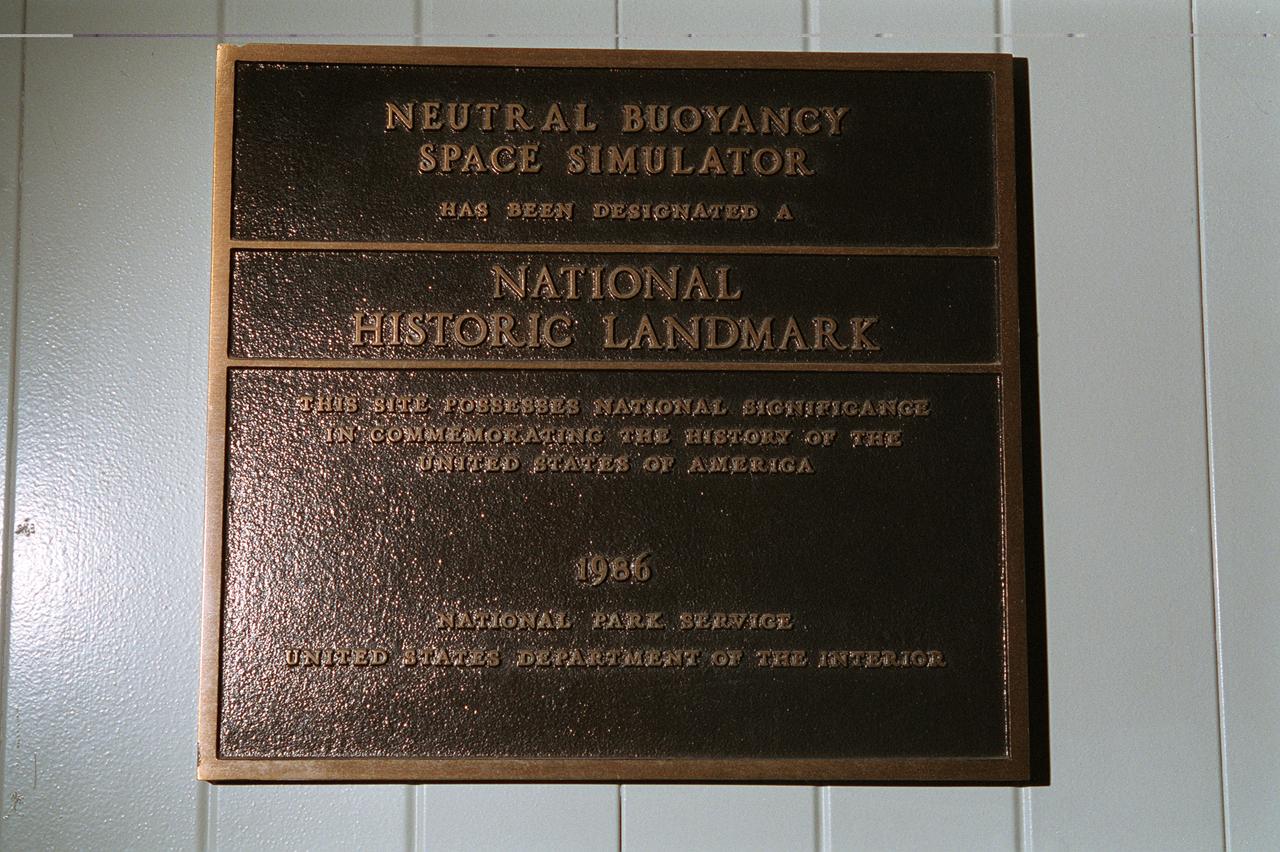
This plaque, displayed on the grounds of Marshall Space Flight Center in Huntsville, Alabama commemorates the Neutral Buoyancy Space Simulator as a National Historic Landmark. The site was designated as such in 1986 by the National Park Service of the United States Department of the Interior.
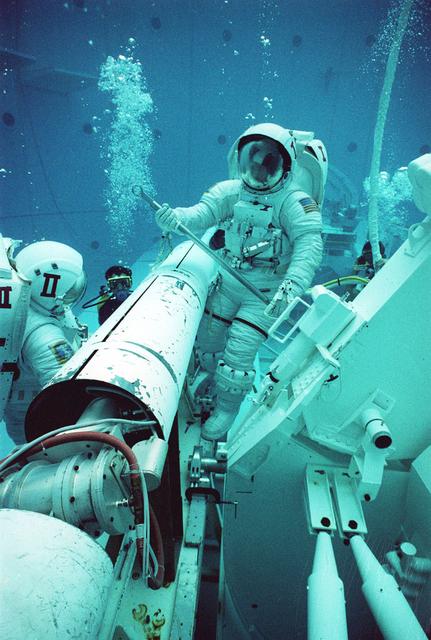
Two years prior to being used during a shuttle mission, the Transfer to Orbit System (TOS) is being demonstrated at Marshall Space Flight Center's (MSFC) Neutral Buoyancy Simulator (NBS). TOS is an upper stage launch system used to place satellites into higher orbits. TOS was used only once, on September 12, 1993 when the Space Shuttle Discovery (STS51) deployed ACTS (Advanced Communications Technology Satellite). The test pictured was to provide an evaluation of the extravehicular activity (EVA) tools that were to be used by future shuttle crews.
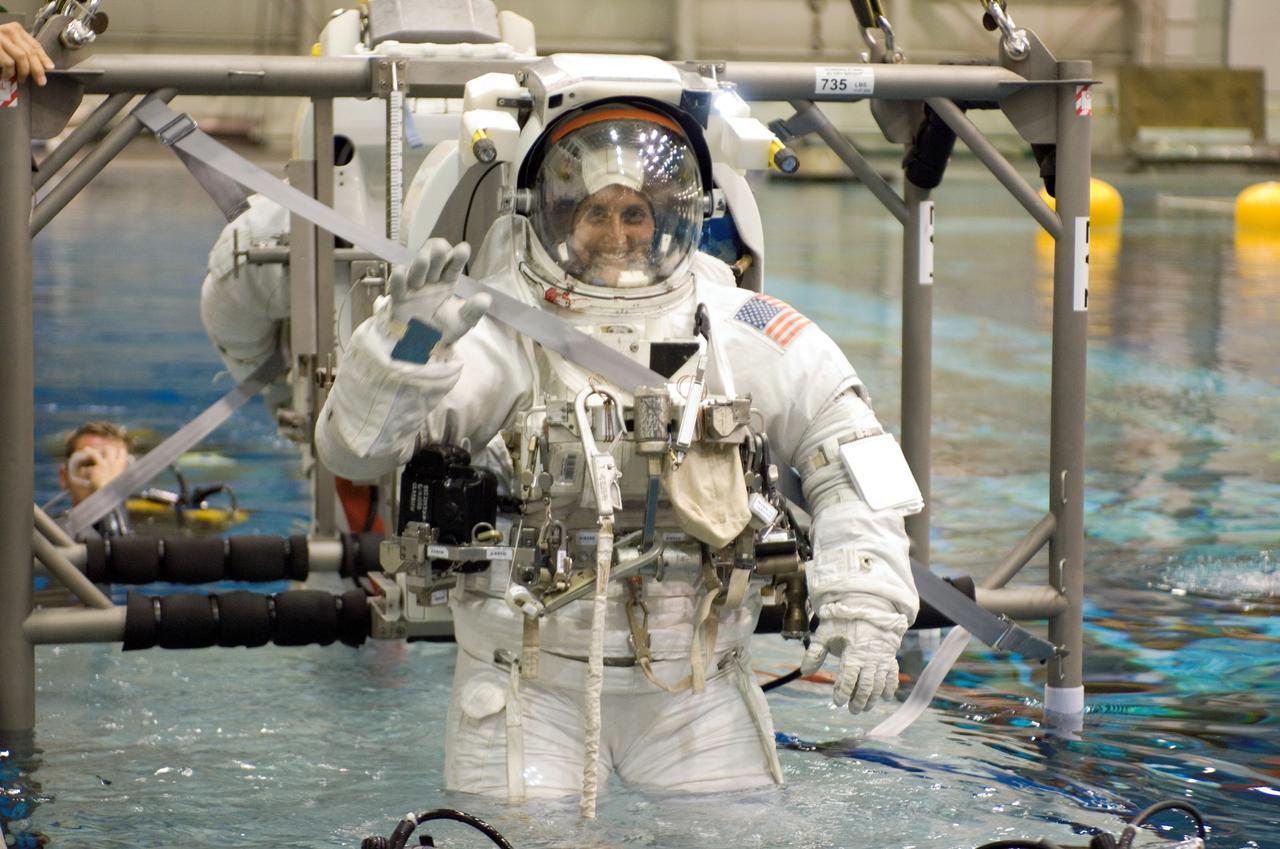
Astronauts Sunita L. Williams, Expedition 14 flight engineer, and Robert L. Curbeam (partially obscured), STS-116 mission specialist, are about to be submerged in the waters of the Neutral Buoyancy Laboratory (NBL) near Johnson Space Center. Williams and Curbeam are attired in training versions of the Extravehicular Mobility Unit (EMU) space suit. SCUBA-equipped divers are in the water to assist the crew members in their rehearsal intended to help prepare them for work on the exterior of the International Space Station (ISS).
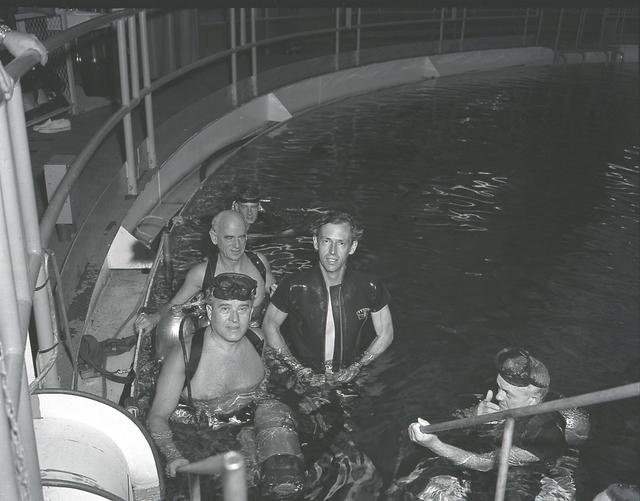
Dr. E. Stuhlinger, Dr. W. von Braun, and Dr. J. Piccard, along with others, take a swim in the Neutral Buoyancy Simulator (NBS) at the Marshall Space Flight Center. The NBS was instrumental in providing a zero-gravity environment where astronauts could practice tasks assigned for up coming space flights.
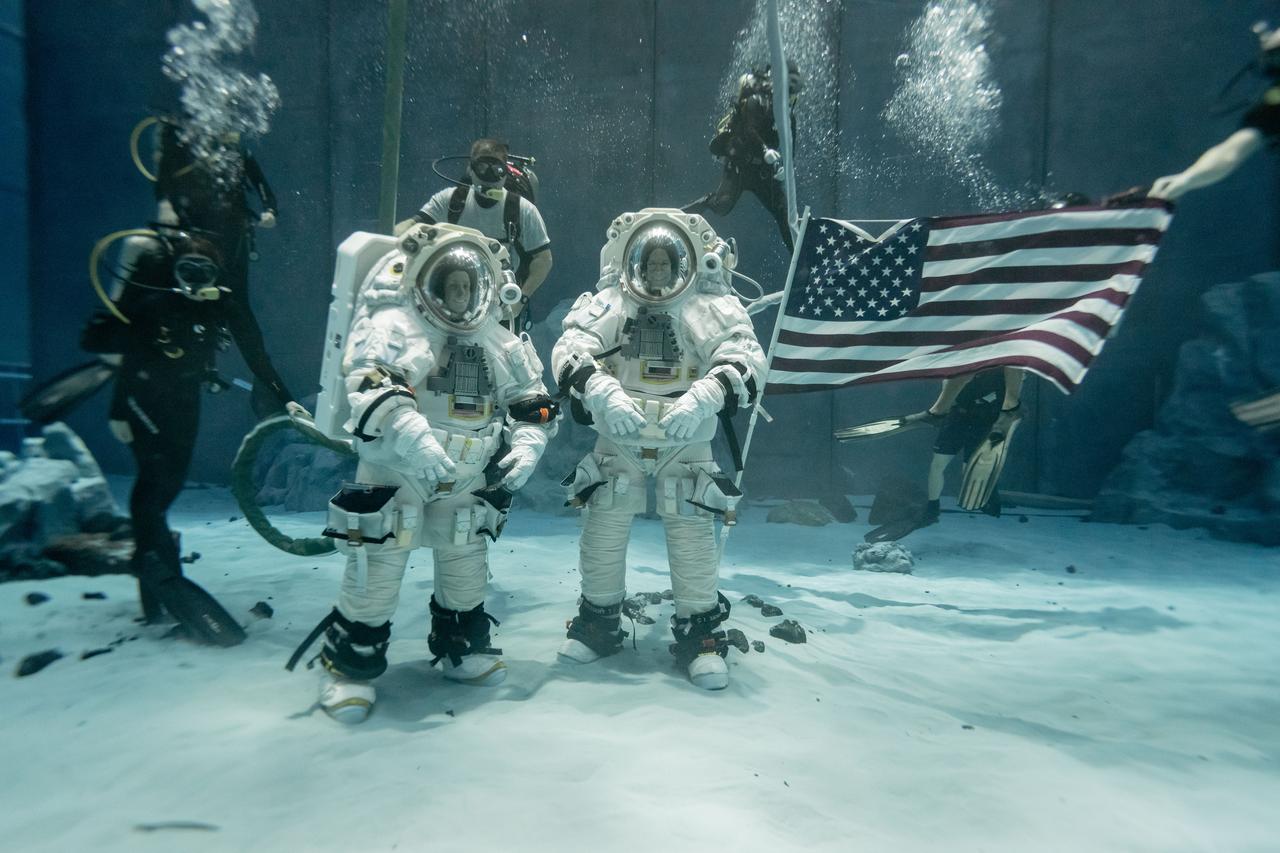
NASA astronauts Loral O’Hara (left) and Stan Love (right) pose for a photo during the first dual spacesuit run at NASA’s Neutral Buoyancy Laboratory while wearing Axiom Space’s lunar spacesuits. NASA and Axiom Space teams held the first dual spacesuit run at the Neutral Buoyancy Laboratory in Houston on September 24, 2025 with NASA Astronauts Stan Love and Loral O’Hara wearing Axiom Space’s lunar spacesuit, called the Axiom Extravehicular Mobility Unit (AxEMU). This was the final integration test in the pool, proving both the spacesuit and facility are prepped and ready for Artemis training.
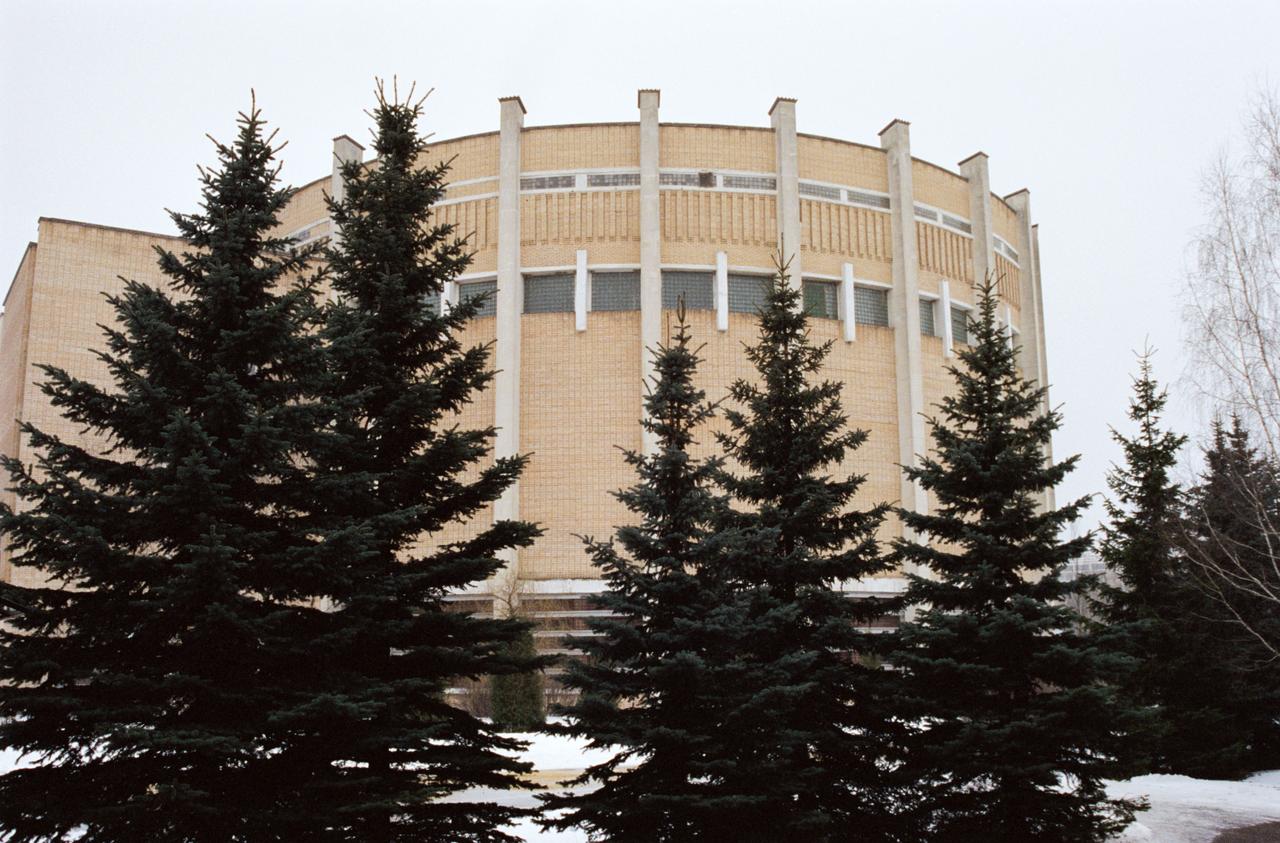
S95-04319 (22 Feb 1995) --- The neutral buoyancy facility at the Gagarin Cosmonaut Training Center in Star City, Russia, is used for underwater training for missions aboard the Russian Mir Space Station. The facility is similar to NASA's Weightless Environment Training Facility (WET-F) at the Johnson Space Center (JSC) in Houston, Texas, and the Neutral Buoyancy Simulator (NBS) at the Marshall Space Flight Center (MSFC) in Huntsville, Alabama.
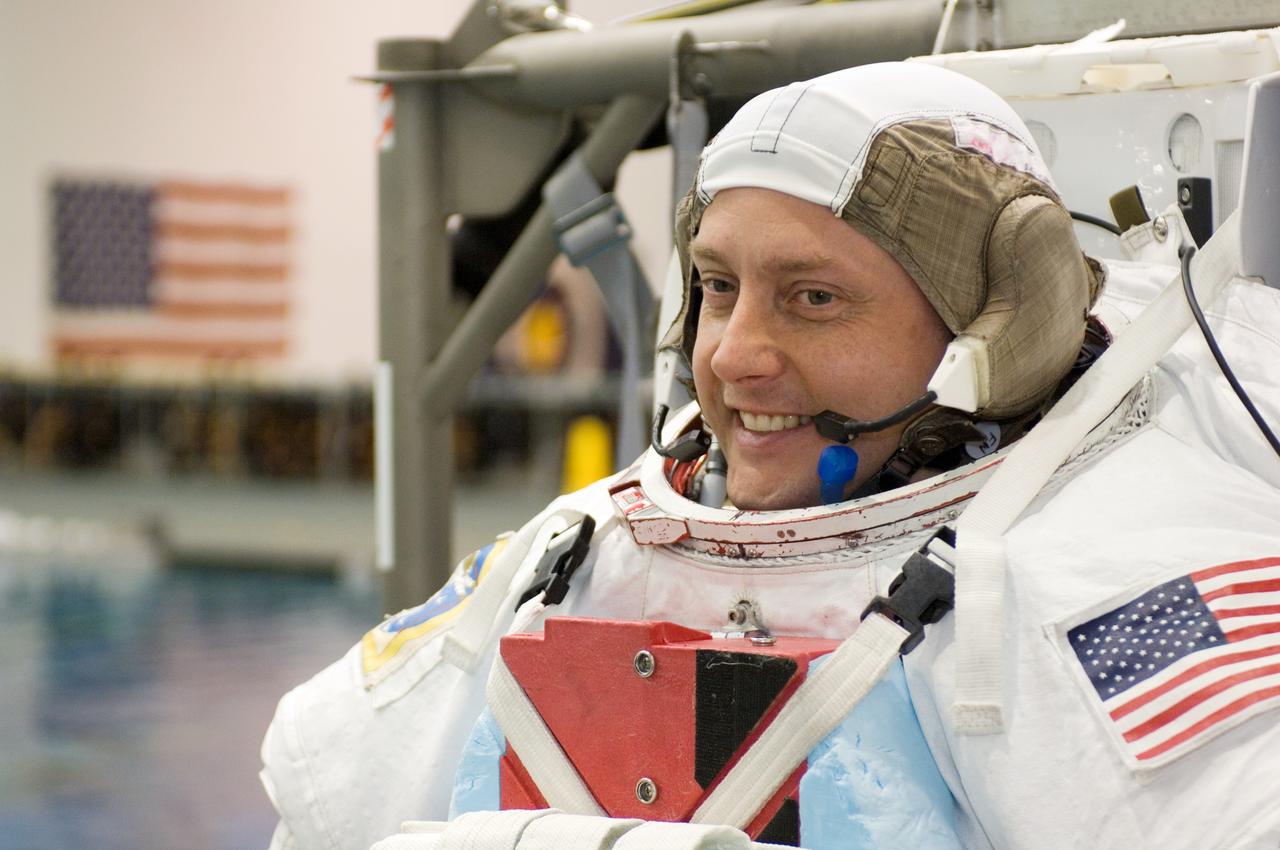
JSC2008-E-045474 (6 June 2008) --- Attired in a training version of his Extravehicular Mobility Unit (EMU) spacesuit, astronaut Edward M. (Mike) Fincke, Expedition 18 commander, awaits the start of a training session in the waters of the Neutral Buoyancy Laboratory (NBL) near NASA's Johnson Space Center.
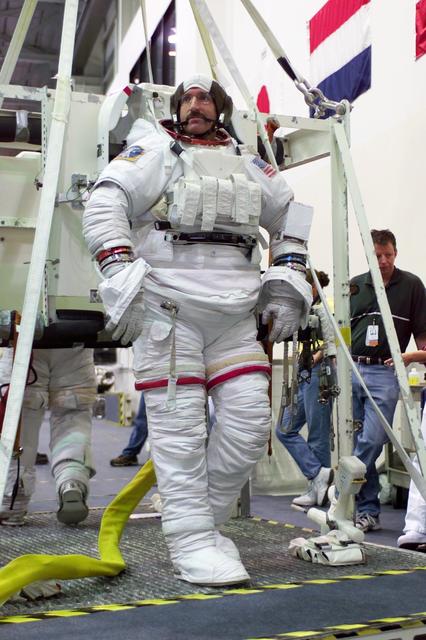
JSC2002-E-39739 (26 September 2002) --- Astronaut Daniel C. Burbank, STS-115 mission specialist, attired in a training version of the Extravehicular Mobility Unit (EMU) space suit, is about to be submerged in the waters of the Neutral Buoyancy Laboratory (NBL) near the Johnson Space Center (JSC).
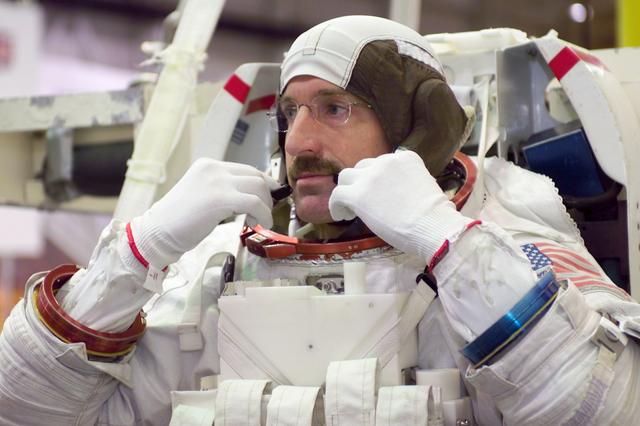
JSC2002-E-39737 (26 September 2002) --- Astronaut Daniel C. Burbank, STS-115 mission specialist, attired in a training version of the Extravehicular Mobility Unit (EMU) space suit, is about to begin a training session in the Neutral Buoyancy Laboratory (NBL) near the Johnson Space Center (JSC).
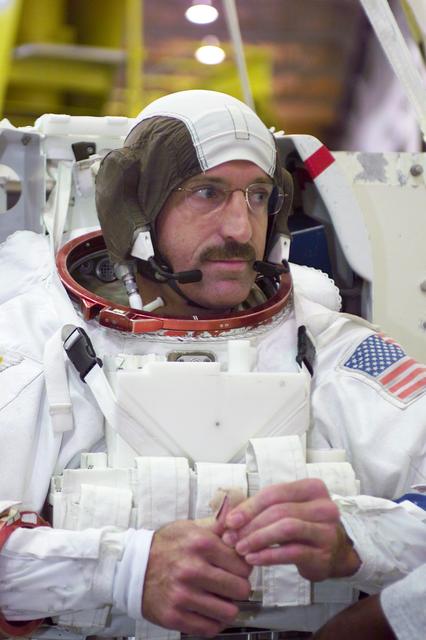
JSC2002-E-39735 (26 September 2002) --- Astronaut Daniel C. Burbank, STS-115 mission specialist, attired in a training version of the Extravehicular Mobility Unit (EMU) space suit, is about to begin a training session in the Neutral Buoyancy Laboratory (NBL) near the Johnson Space Center (JSC).
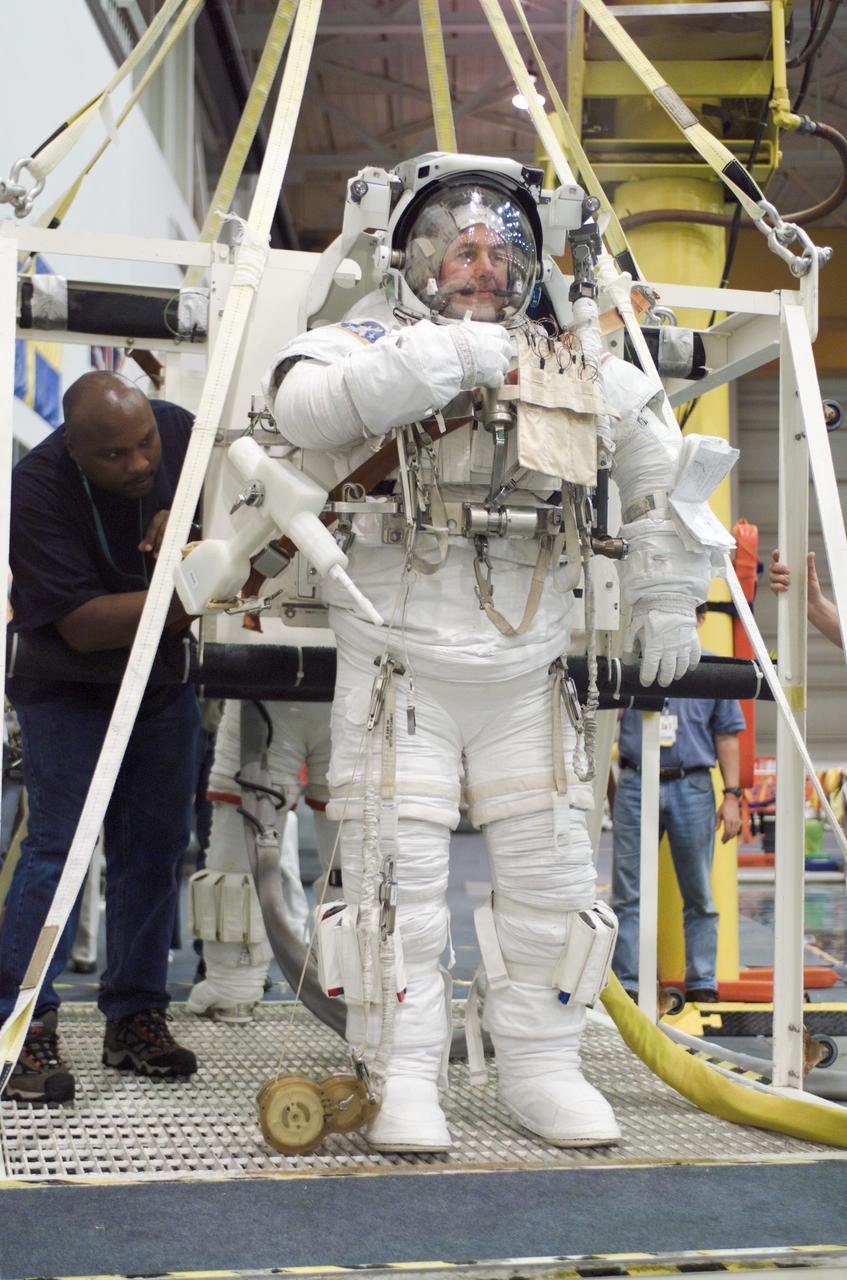
JSC2002-E-23138 (28 May 2002) --- Astronaut Stephen K. Robinson, STS-114 mission specialist, is photographed as the final touches are made on the training version of his Extravehicular Mobility Unit (EMU) spacesuit prior to being submerged in the waters of the Neutral Buoyancy Laboratory (NBL) near the Johnson Space Center (JSC).
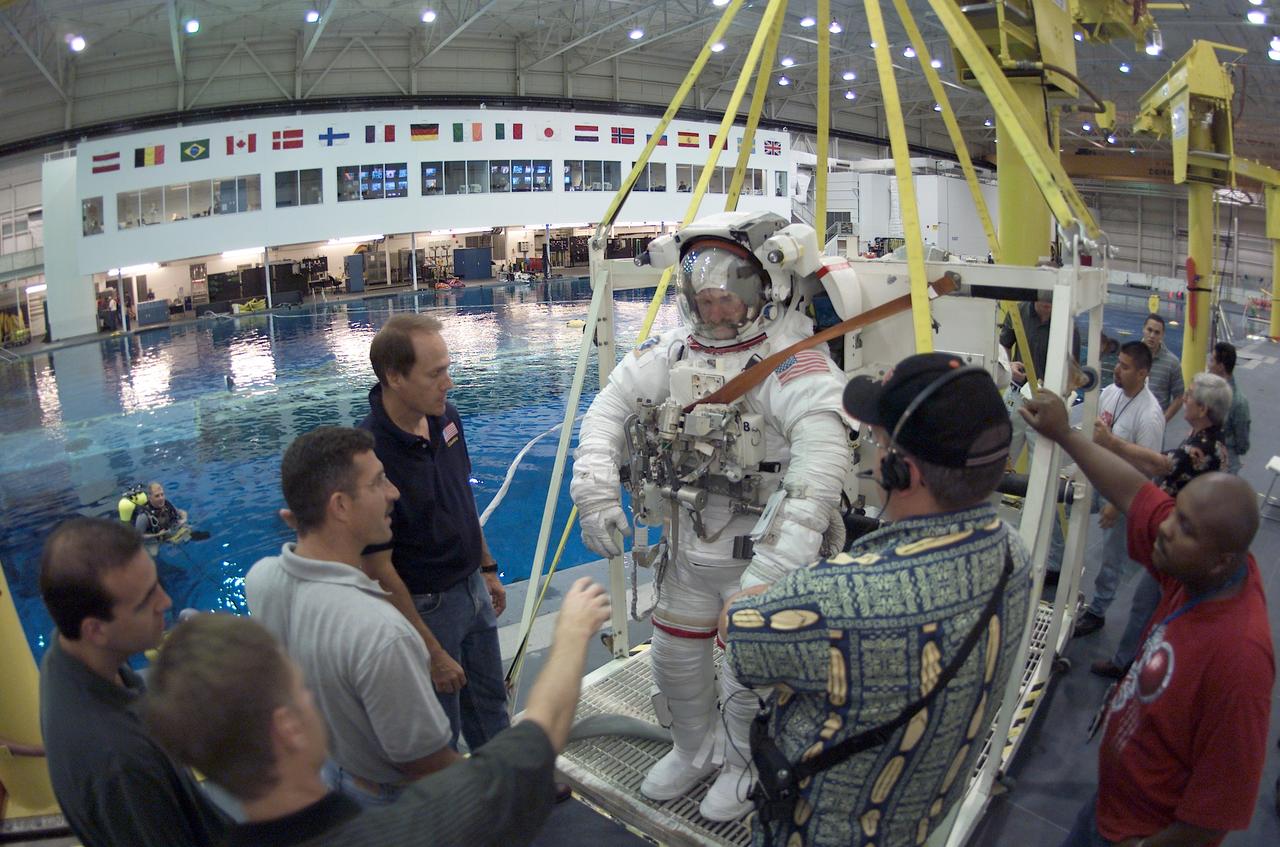
JSC2002-E-37424 (6 September 2002) --- Astronaut Joseph R. (Joe) Tanner, STS-115 mission specialist, attired in a training version of the Extravehicular Mobility Unit (EMU) space suit, is about to be submerged in the waters of the Neutral Buoyancy Laboratory (NBL) near the Johnson Space Center (JSC).
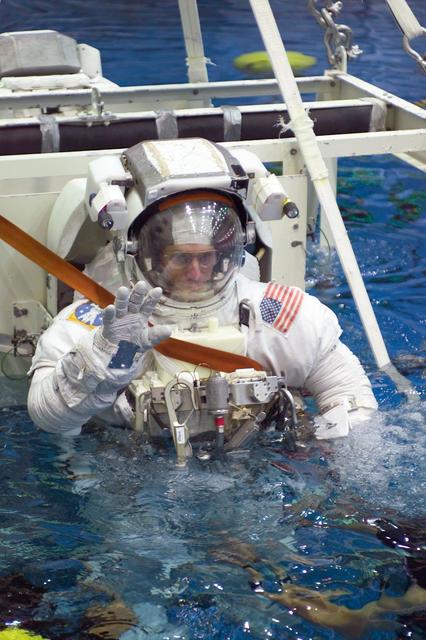
JSC2002-E-39744 (26 Sept. 2002) --- Astronaut Steven G. MacLean, STS-115 mission specialist representing the Canadian Space Agency, waves as he is submerged in the waters of the Neutral Buoyancy Laboratory (NBL) near the Johnson Space Center. MacLean is wearing a training version of the Extravehicular Mobility Unit (EMU) space suit.
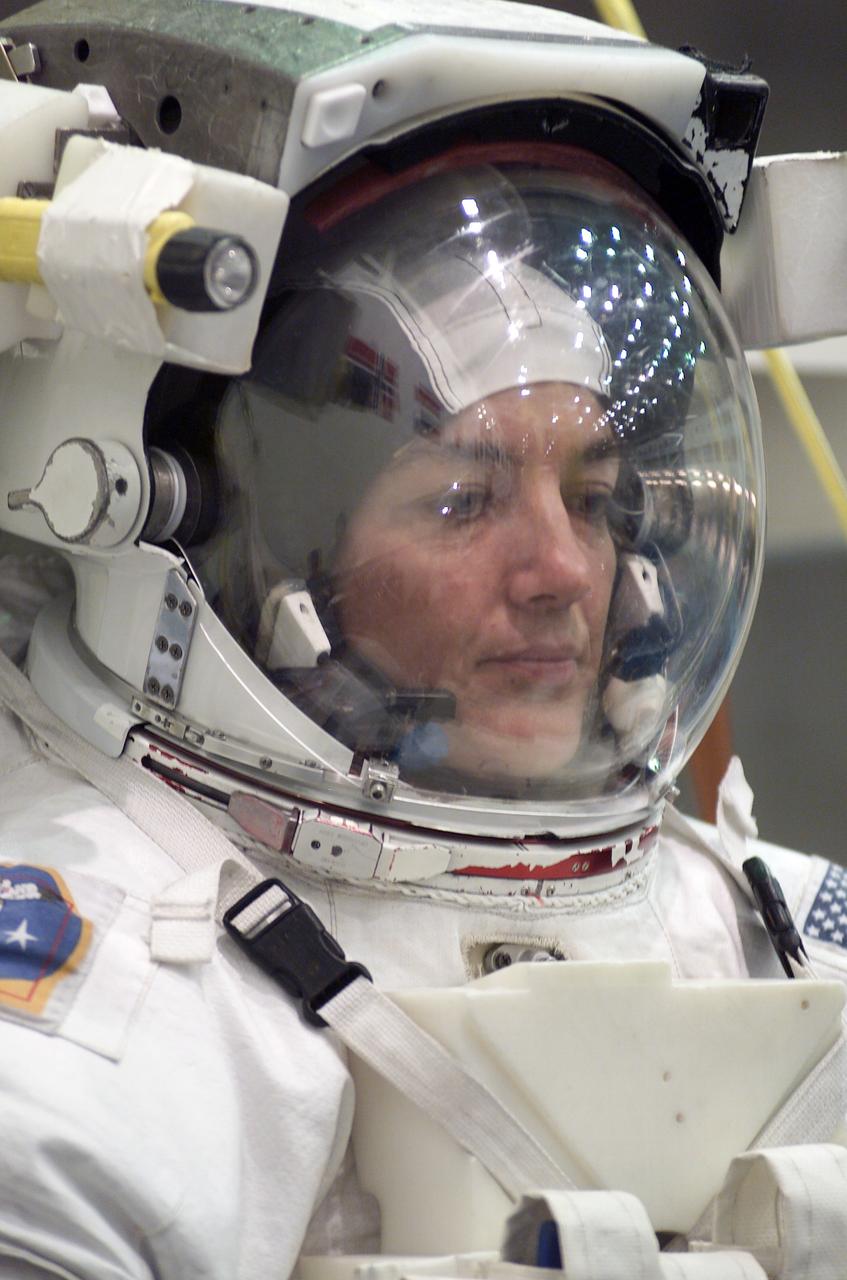
JSC2002-E-37419 (6 September 2002) --- Astronaut Heidemarie M. Stefanyshyn-Piper, STS-115 mission specialist, attired in a training version of the Extravehicular Mobility Unit (EMU) space suit, is about to begin a training session in the Neutral Buoyancy Laboratory (NBL) near the Johnson Space Center (JSC).
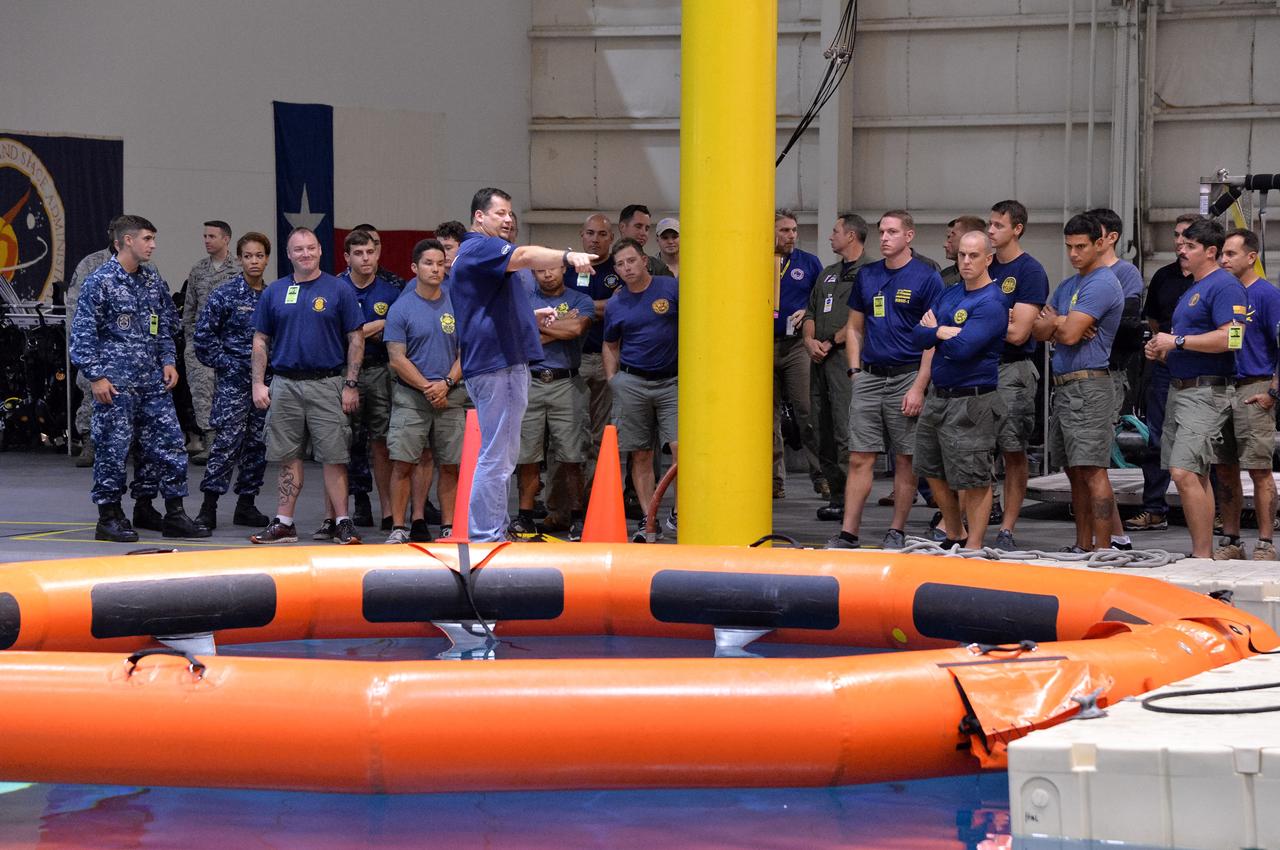
Tim Goddard, NASA Open Water Recovery Operations director, briefs U.S. Navy divers, Air Force pararescuemen and Coast Guard rescue swimmers during training in the Neutral Buoyancy Laboratory at NASA’s Johnson Space Center in Houston. The group is preparing to practice Orion underway recovery techniques using a test version of the Orion spacecraft. Training will help the team prepare for Underway Recovery Test 5 for Exploration Mission 1 aboard the USS San Diego in the Pacific Ocean off the coast of California in October. The Ground Systems Development and Operations Program, along with the U.S. Navy and Lockheed Martin, are preparing the recovery team, hardware and operations to support EM-1 recovery.
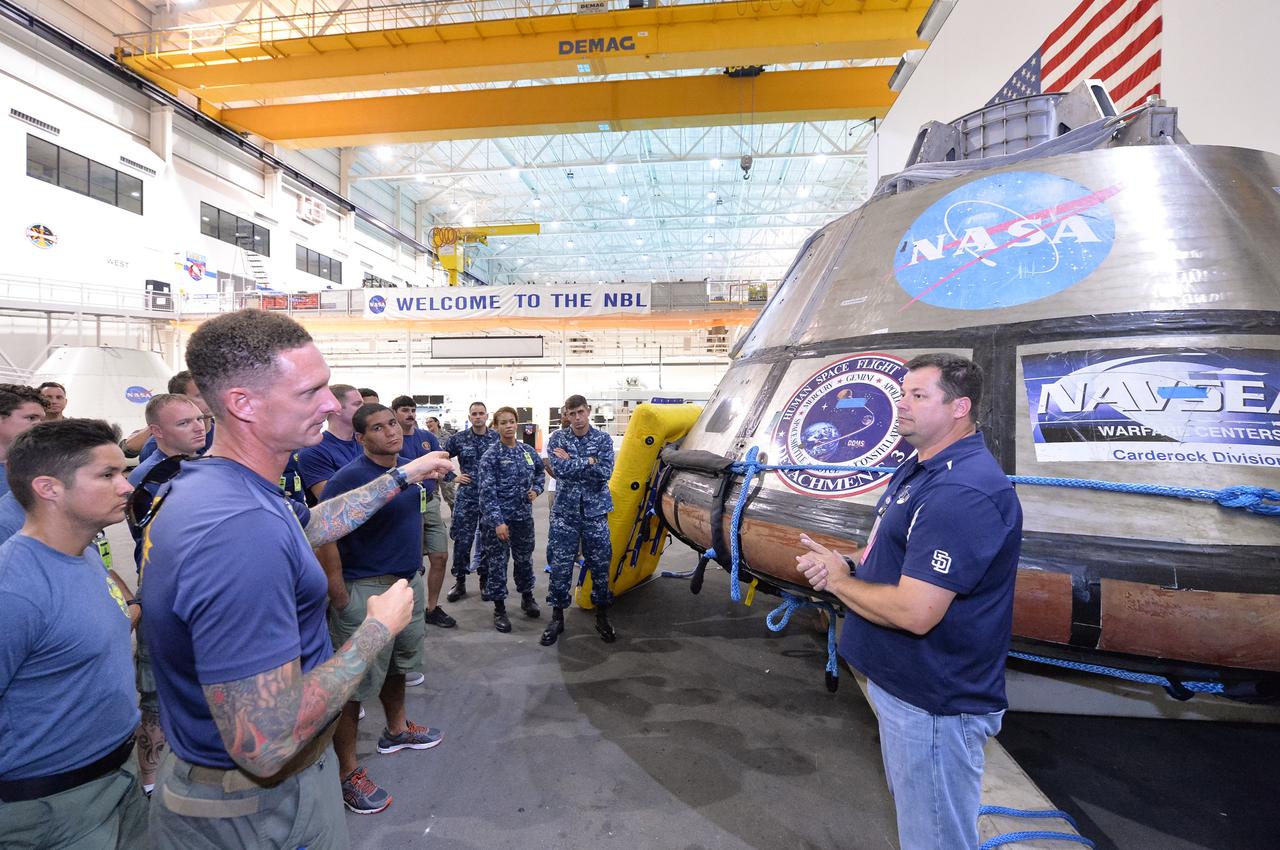
Tim Goddard, far right, NASA Open Water Recovery Operations director, briefs U.S. Navy divers, Air Force pararescuemen and Coast Guard rescue swimmers during training in the Neutral Buoyancy Laboratory at NASA’s Johnson Space Center in Houston. The group is preparing to practice Orion underway recovery techniques using a test version of the Orion spacecraft. Training will help the team prepare for Underway Recovery Test 5 for Exploration Mission 1 aboard the USS San Diego in the Pacific Ocean off the coast of California in October. The Ground Systems Development and Operations Program, along with the U.S. Navy and Lockheed Martin, are preparing the recovery team, hardware and operations to support EM-1 recovery.
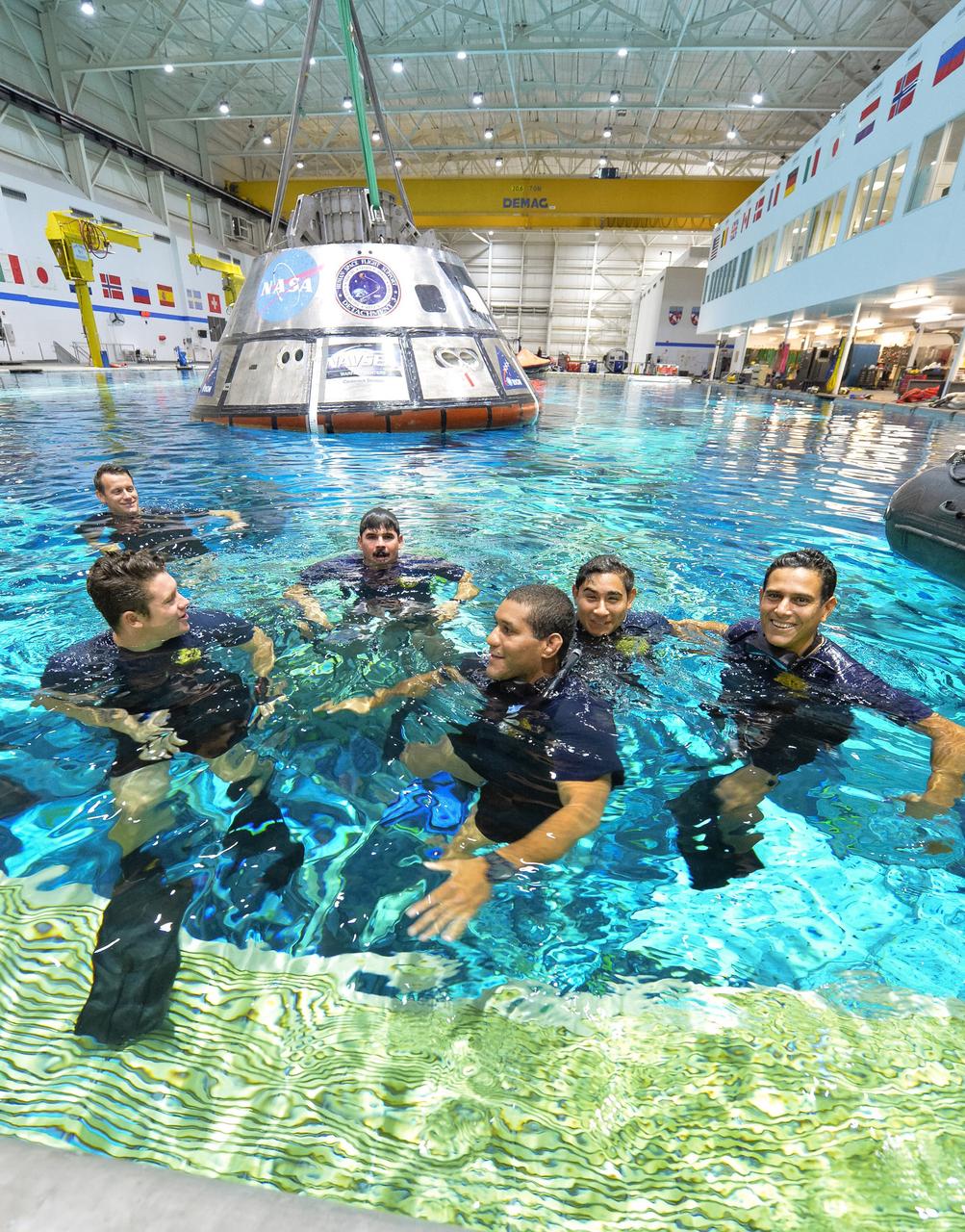
U.S. Navy divers are training in the Neutral Buoyancy Laboratory at NASA’s Johnson Space Center in Houston. Navy divers, Air Force pararescuemen and Coast Guard rescue swimmers practice Orion underway recovery techniques using a test version of the Orion spacecraft. Training will help the team prepare for Underway Recovery Test 5 for Exploration Mission 1 aboard the USS San Diego in the Pacific Ocean off the coast of California in October. The Ground Systems Development and Operations Program, along with the U.S. Navy and Lockheed Martin, are preparing the recovery team, hardware and operations to support EM-1 recovery.
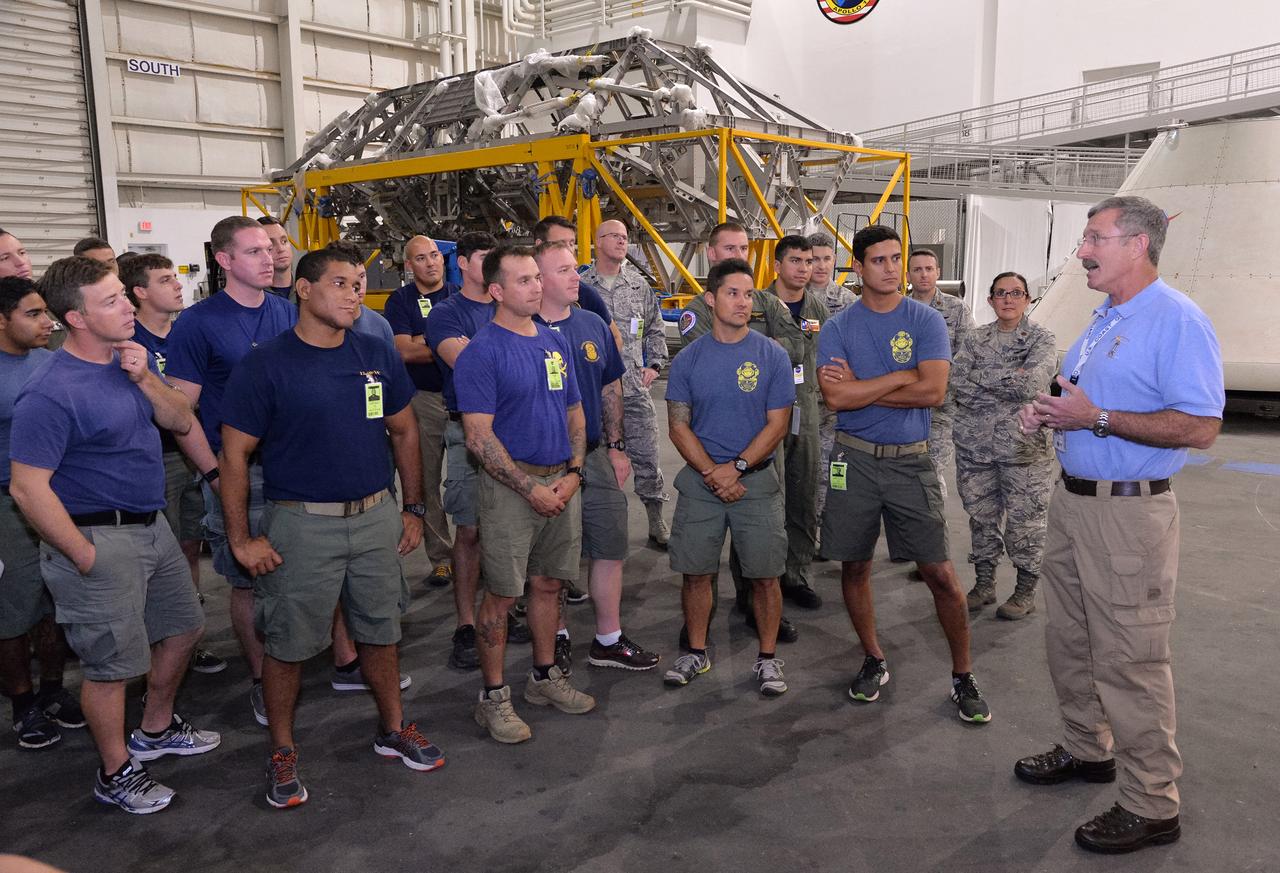
NASA astronaut Dan Burbank speaks to a group of U.S. Navy divers at the Neutral Buoyancy Laboratory (NBL) at the agency’s Johnson Space Center in Houston. Navy divers, Air Force pararescuemen and Coast Guard rescue swimmers are preparing to practice Orion underway recovery techniques with a test version of the Orion spacecraft. Training will help the team prepare for Underway Recovery Test 5 for Exploration Mission 1 aboard the USS San Diego in the Pacific Ocean off the coast of California in October. The Ground Systems Development and Operations Program, along with the U.S. Navy and Lockheed Martin, are preparing the recovery team, hardware and operations to support EM-1 recovery.
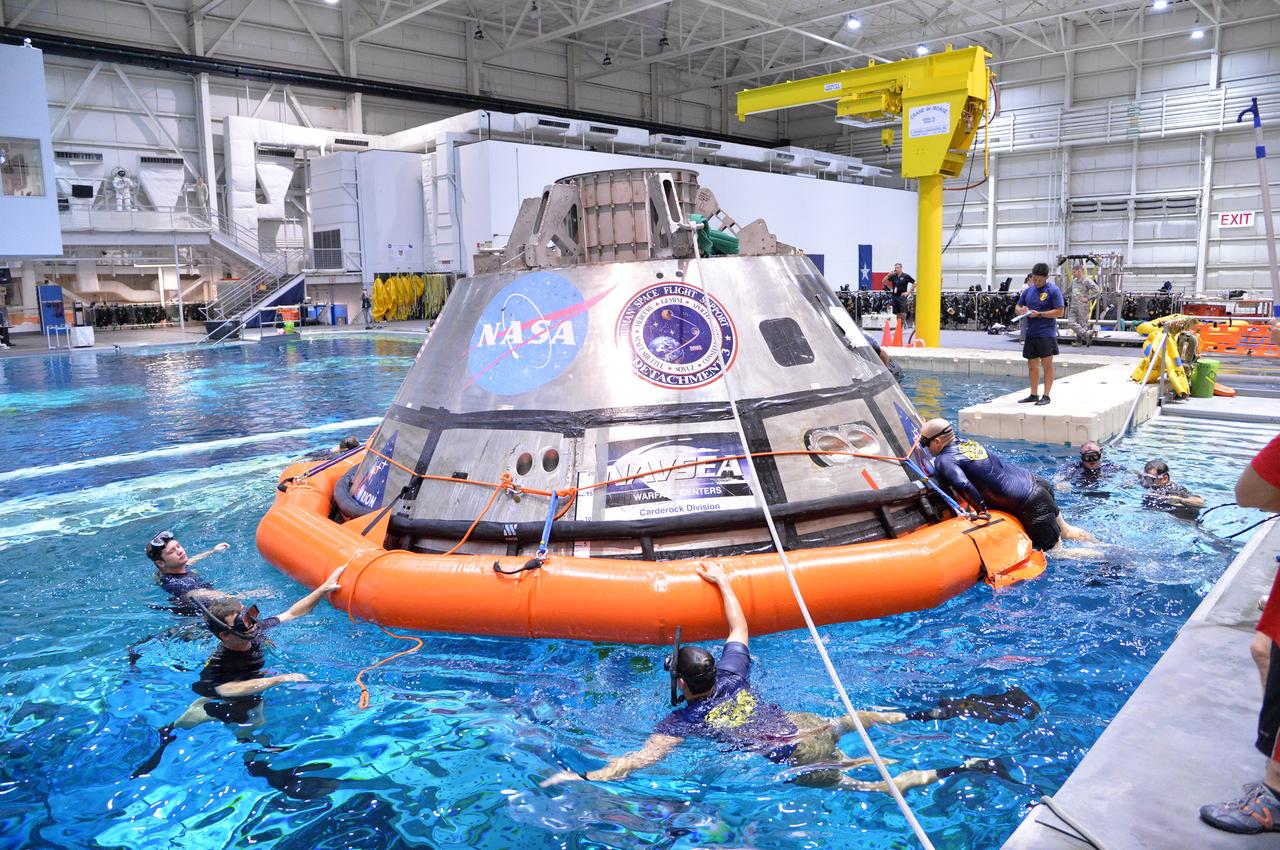
U.S. Navy divers, Air Force pararescuemen and Coast Guard rescue swimmers practice Orion recovery techniques at the Neutral Buoyancy Laboratory (NBL) at the agency’s Johnson Space Center in Houston. The recovery team is practicing underway recovery techniques using a test version of the Orion spacecraft. Training will help the team prepare for Underway Recovery Test 5 for Exploration Mission 1 aboard the USS San Diego in the Pacific Ocean off the coast of California in October. The Ground Systems Development and Operations Program, along with the U.S. Navy and Lockheed Martin, are preparing the recovery team, hardware and operations to support EM-1 recovery.
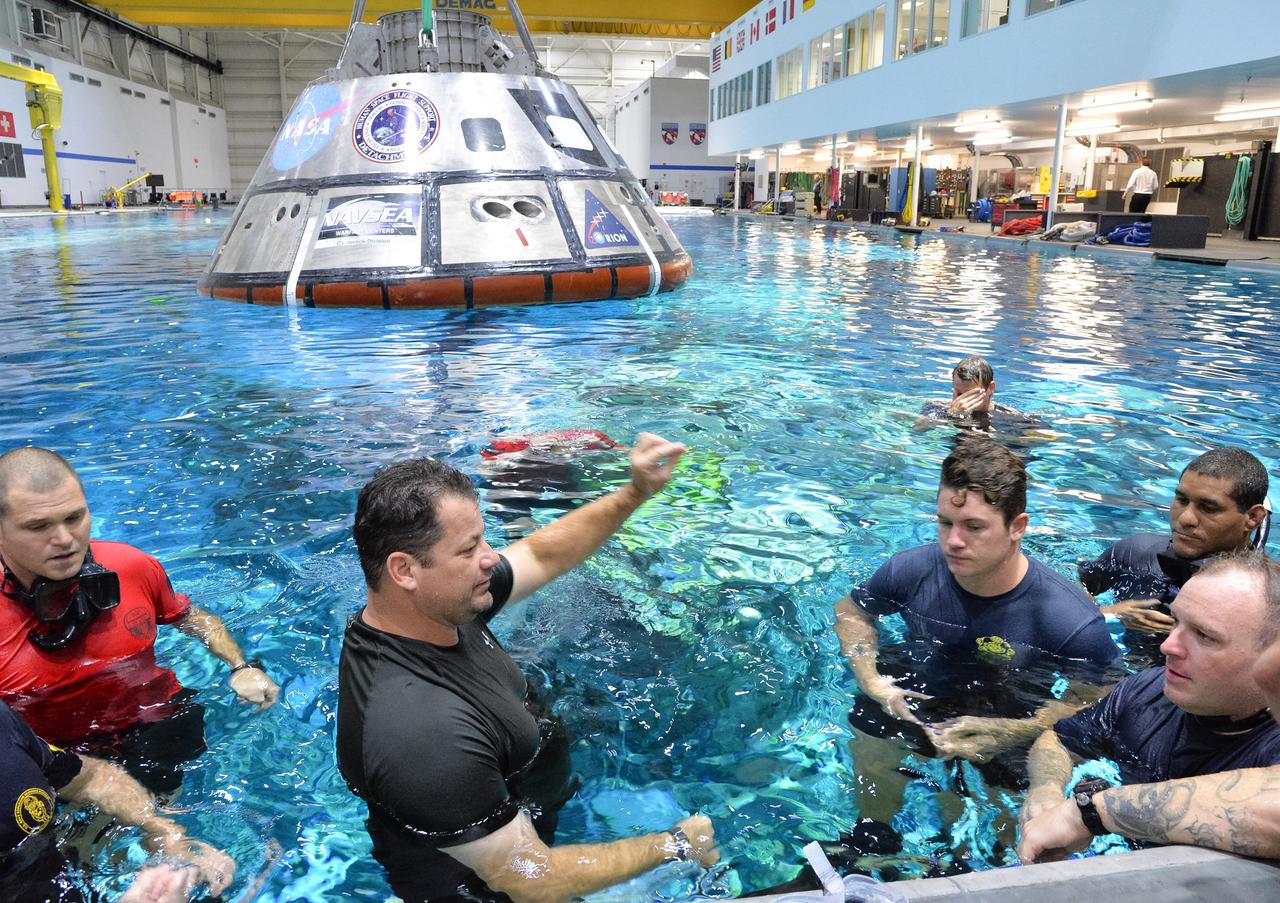
Tim Goddard, center, NASA Open Water Recovery Operations director, reviews recovery procedures with U.S. Navy divers, Air Force pararescuemen and Coast Guard rescue swimmers during training in the Neutral Buoyancy Laboratory at NASA’s Johnson Space Center in Houston. The group is practicing Orion underway recovery techniques using a test version of the Orion spacecraft. Training will help the team prepare for Underway Recovery Test 5 for Exploration Mission 1 aboard the USS San Diego in the Pacific Ocean off the coast of California in October. The Ground Systems Development and Operations Program, along with the U.S. Navy and Lockheed Martin, are preparing the recovery team, hardware and operations to support EM-1 recovery.
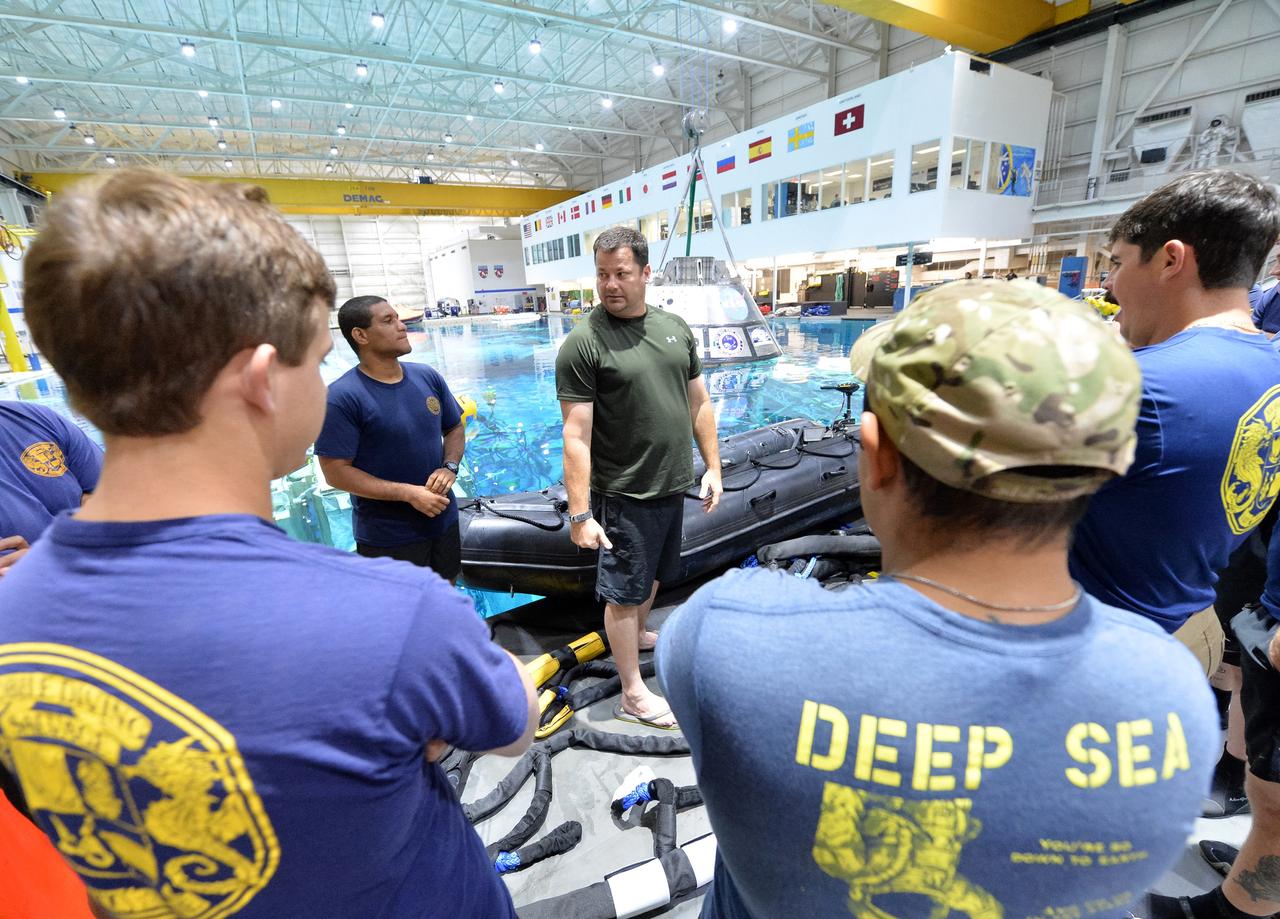
Tim Goddard, center, NASA Open Water Recovery Operations director, briefs U.S. Navy divers, Air Force pararescuemen and Coast Guard rescue swimmers during training in the Neutral Buoyancy Laboratory at NASA’s Johnson Space Center in Houston. The group will practice Orion underway recovery techniques using a test version of the Orion spacecraft. Training will help the team prepare for Underway Recovery Test 5 for Exploration Mission 1 aboard the USS San Diego in the Pacific Ocean off the coast of California in October. The Ground Systems Development and Operations Program, along with the U.S. Navy and Lockheed Martin, are preparing the recovery team, hardware and operations to support EM-1 recovery.
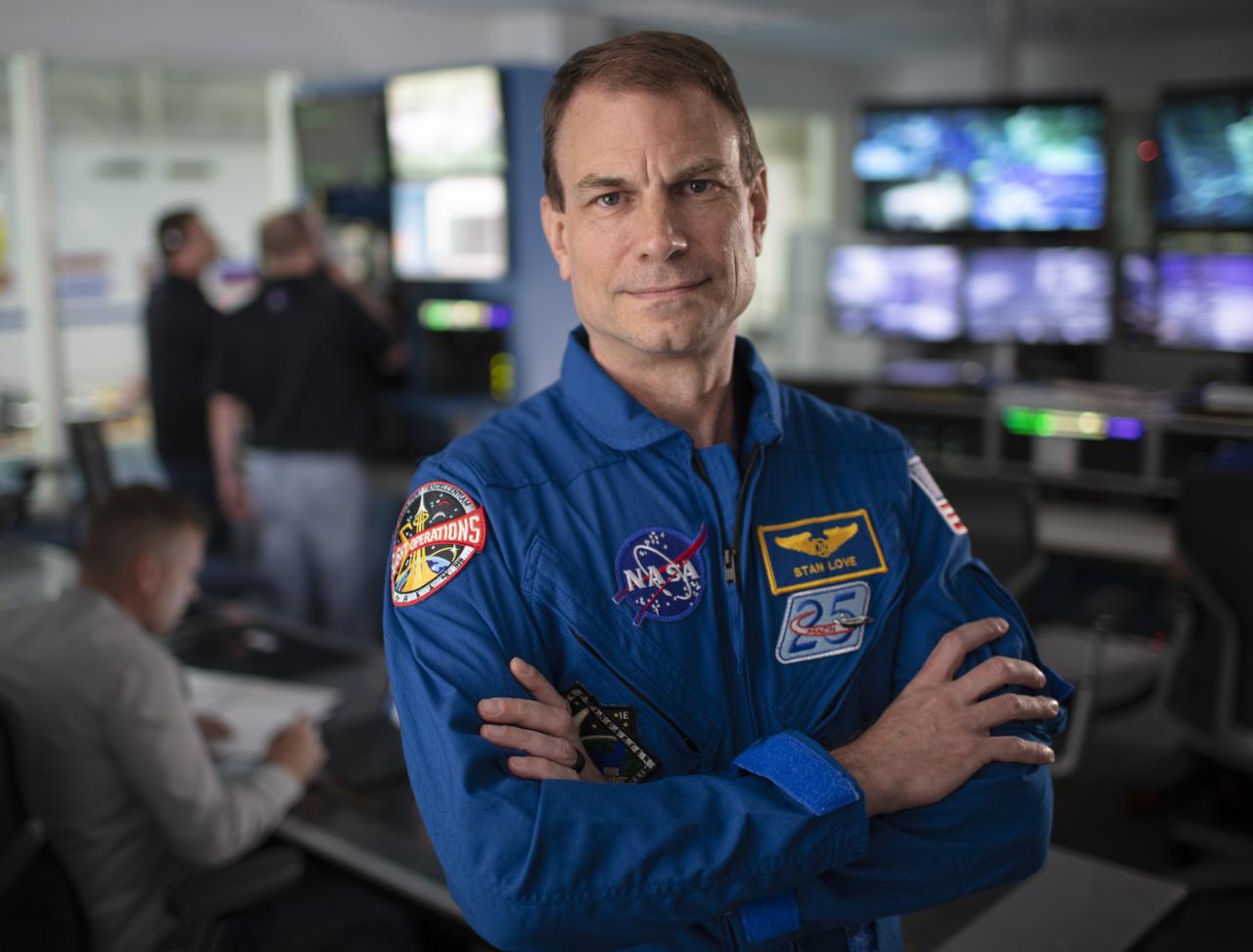
NASA astronaut Stan Love poses for a portrait in the Neutral Buoyancy Lab control room, Monday, July 8, 2019 at NASA's Johnson Space Center in Houston, Texas. Photo Credit: (NASA/Bill Ingalls)
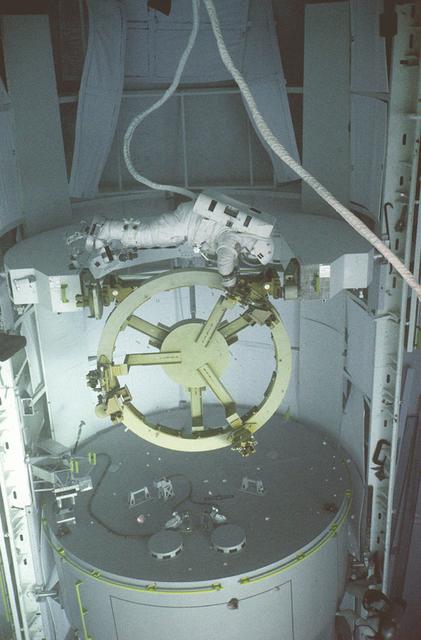
Preparing for the eventual launch of the Hubble Space Telescope (HST), an astronaut prepares himself for the rigorous duties of maintenance and repairs after launch, at Marshall Space Flight Center's (MSFC) Neutral Buoyancy Simulator (NBS). The NBS provided mock-ups of the HST, the Remote Manipulator System (RMS), the orbiter's cargo bay, and the low-gravity environment that the astronauts would encounter while working in space. All aspects of shuttle missions were pre-plarned and practiced at the NBS to forego any problems in space.
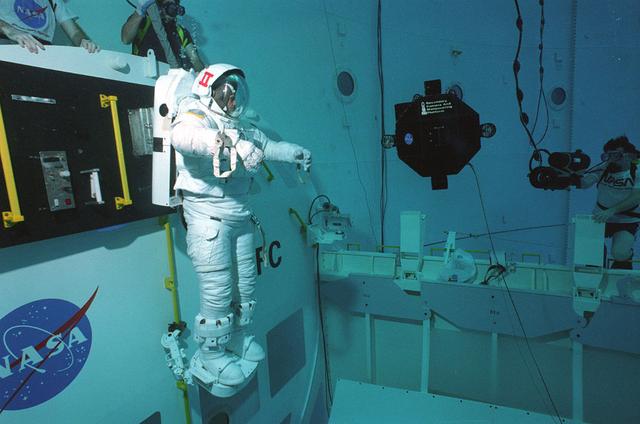
A diver tests a secondary camera and maneuvering platform in Marshall's Neutral Buoyancy Simulator (NBS).The secondary camera will be beneficial for recording repairs and other extra vehicular activities (EVA) the astronuats will perform while making repairs on the Hubble Space Telescope (HST). The maneuvering platform was developed to give the astronauts something to stand on while performing maintenance tasks. These platforms were developed to be mobile so that the astronauts could move them to accommadate different sites.
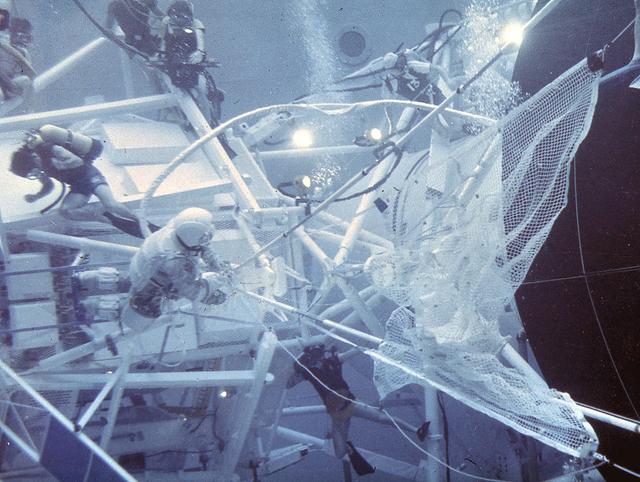
After its launch on May 14, 1973, it was immediately known that there were some major problems with Skylab. The large, delicate, meteoroid shield on the outside of the workshop was ripped off by the vibration of the launch. Its tearing off caused serious damage to the two wings of solar cells that were to supply most of the electric power to the workshop. Once in orbit, the news worsened. The loss of the big shade exposed the metal skin of the workshop to the sun. Internal temperatures soared to 126 degrees F. This heat not only threatened its habitation by astronauts, but if prolonged, would cause serious damage to instruments and film. After twice delaying the launch of the first astronaut crew, engineers worked frantically to develop solutions to these problems and salvage the Skylab. After designing a protective solar sail to cover the workshop, crews needed to practice using the specially designed tools and materials to facilitate the repair procedure. Marshall Space Flight Center's Neutral Buoyancy Simulator (NBS), was used to practice these maneuvers. Pictured here are the astronauts in the NBS deploying the protecticve solar sail. On may 25, 1973, an Apollo command and service module was launched and later docked with Skylab. The next day, astronauts Conrad and Kerwin were able to complete the needed repairs to Skylab, salvaging the entire program.
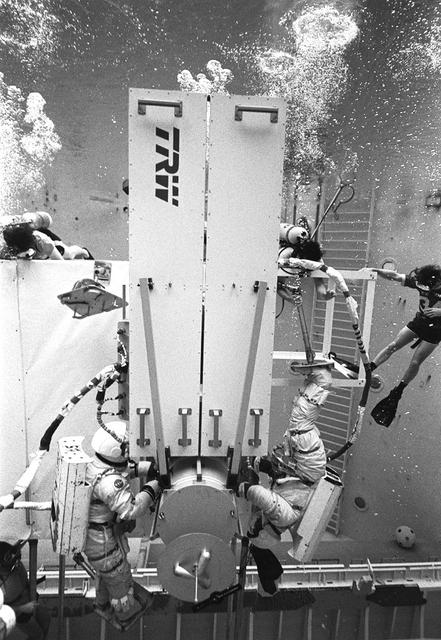
The Space Platform was first conceived as a launching site for deep space exploration. The original idea was to build this space platform either on the moon's surface or near lunar orbit. It would be used as a staging base, where the reusable launch vehicles (later known as Space Shuttles) would ferry machinery and equipment to assemble deep space exploration vehicles. Replaced by the Space Station concept, the space platform idea was never completed. However, early in the space platform development, astronauts trained at the Marshall Space Flight Center's (MSFC) Neutral Buoyancy Simulator (NBS), as pictured here, working on solar array equipment. This experiment was deployed from the shuttle to study the motions of large structures in space. Similar arrays will be used on the Space Station and large observatory spacecraft in the future.
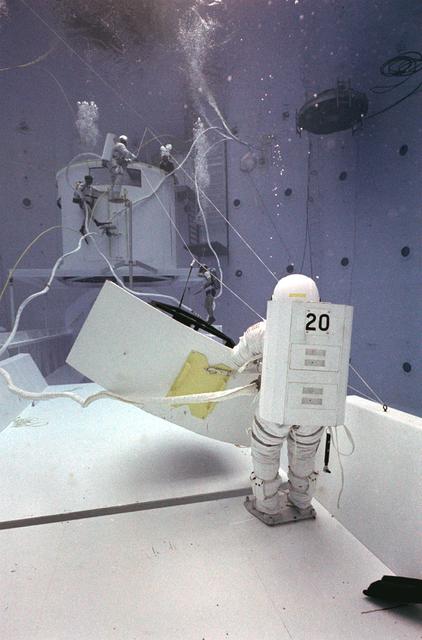
Once the United States' space program had progressed from Earth's orbit into outerspace, the prospect of building and maintaining a permanent presence in space was realized. To accomplish this feat, NASA launched a temporary workstation, Skylab, to discover the effects of low gravity and weightlessness on the human body, and also to develop tools and equipment that would be needed in the future to build and maintain a more permanent space station. The structures, techniques, and work schedules had to be carefully designed to fit this unique construction site. The components had to be lightweight for transport into orbit, yet durable. The station also had to be made with removable parts for easy servicing and repairs by astronauts. All of the tools necessary for service and repairs had to be designed for easy manipulation by a suited astronaut. And construction methods had to be efficient due to limited time the astronauts could remain outside their controlled environment. In lieu of all the specific needs for this project, an environment on Earth had to be developed that could simulate a low gravity atmosphere. A Neutral Buoyancy Simulator (NBS) was constructed by NASA Marshall Space Flight Center (MSFC) in 1968. Since then, NASA scientists have used this facility to understand how humans work best in low gravity and also provide information about the different kinds of structures that can be built. Included in the plans for the space station was a space telescope. This telescope would be attached to the space station and directed towards outerspace. Astronomers hoped that the space telescope would provide a look at space that is impossible to see from Earth because of Earth's atmosphere and other man made influences. In an effort to make replacement and repairs easier on astronauts the space telescope was designed to be modular. Practice makes perfect as demonstrated in this photo: an astronaut practices moving modular pieces of the space telescope in the Neutral Buoyancy Simulator (NBS) at MSFC. The space telescope was later deployed in April 1990 as the Hubble Space Telescope.
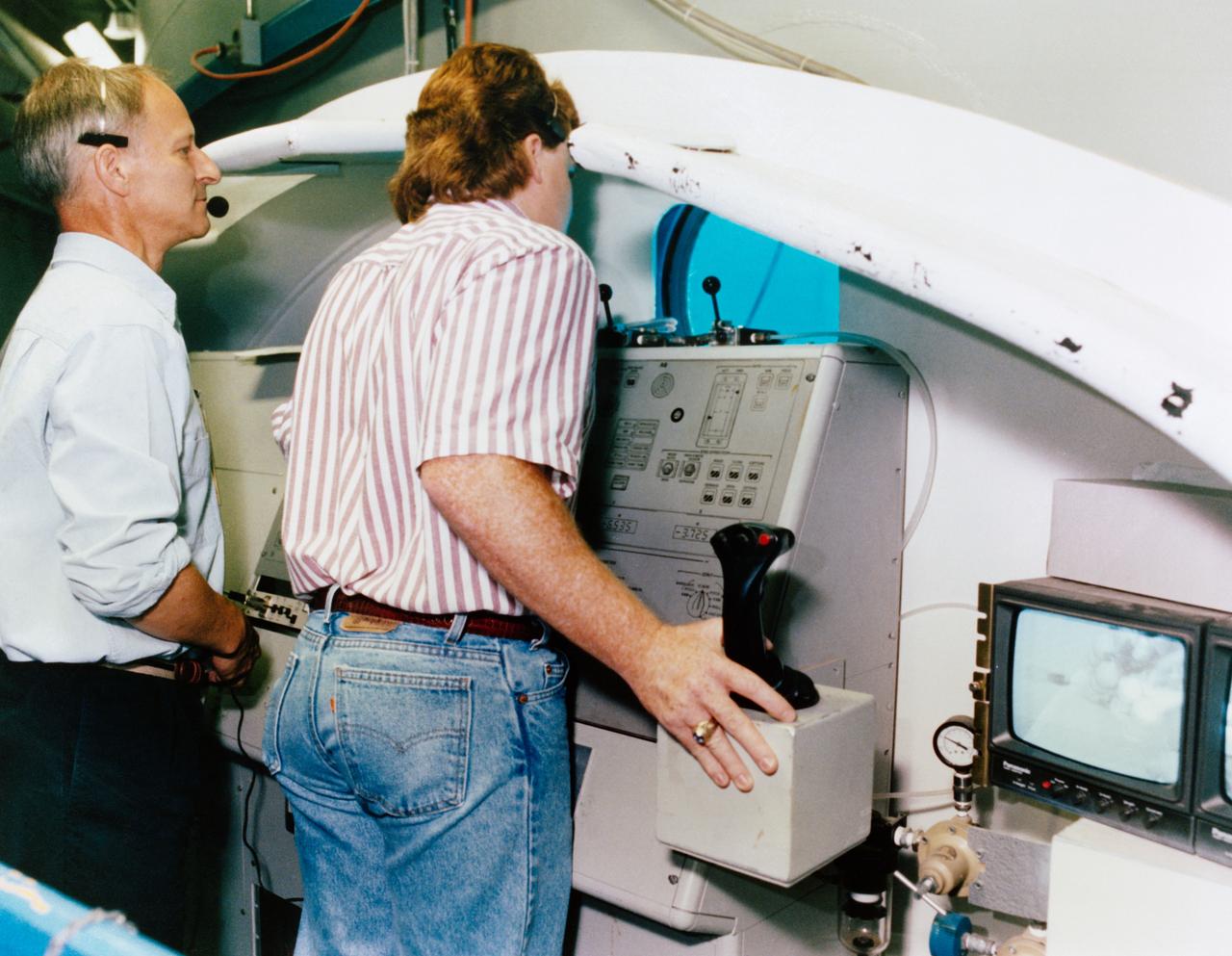
Swiss scientits Claude Nicollier (left), STS-61 mission specialist, waits his turn at the controls for the remote manipulator system (RMS) during a training session in the Neutral Buoyancy Simulator at Marshall Space Flight Center (MSFC). Mark Norman of MSFC has control of the RMS in this frame.
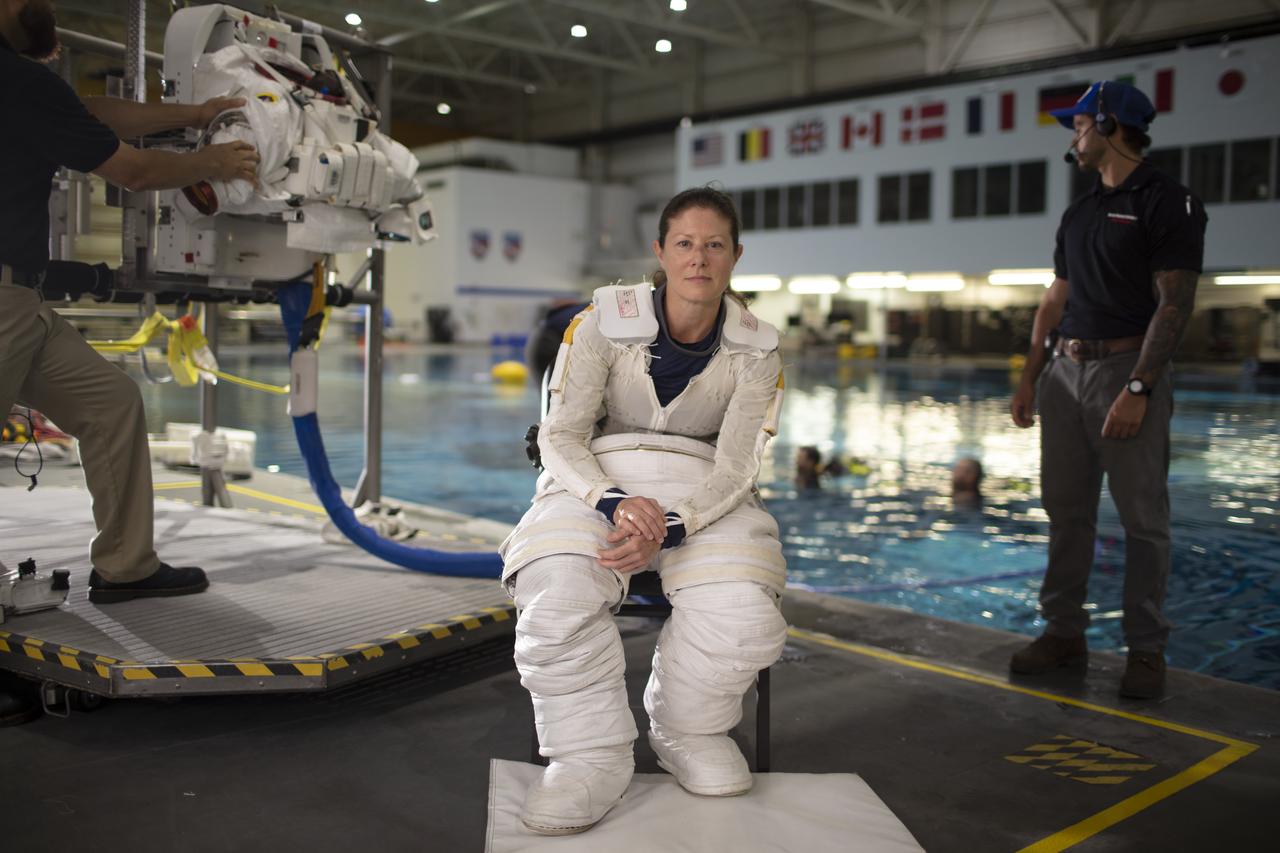
NASA astronaut Tracy Caldwell Dyson pauses for a portrait while donning her spacesuit and going under water in the Neutral Buoyancy Lab, Monday, July 8, 2019 at NASA's Johnson Space Center in Houston, Texas. Photo Credit: (NASA/Bill Ingalls)
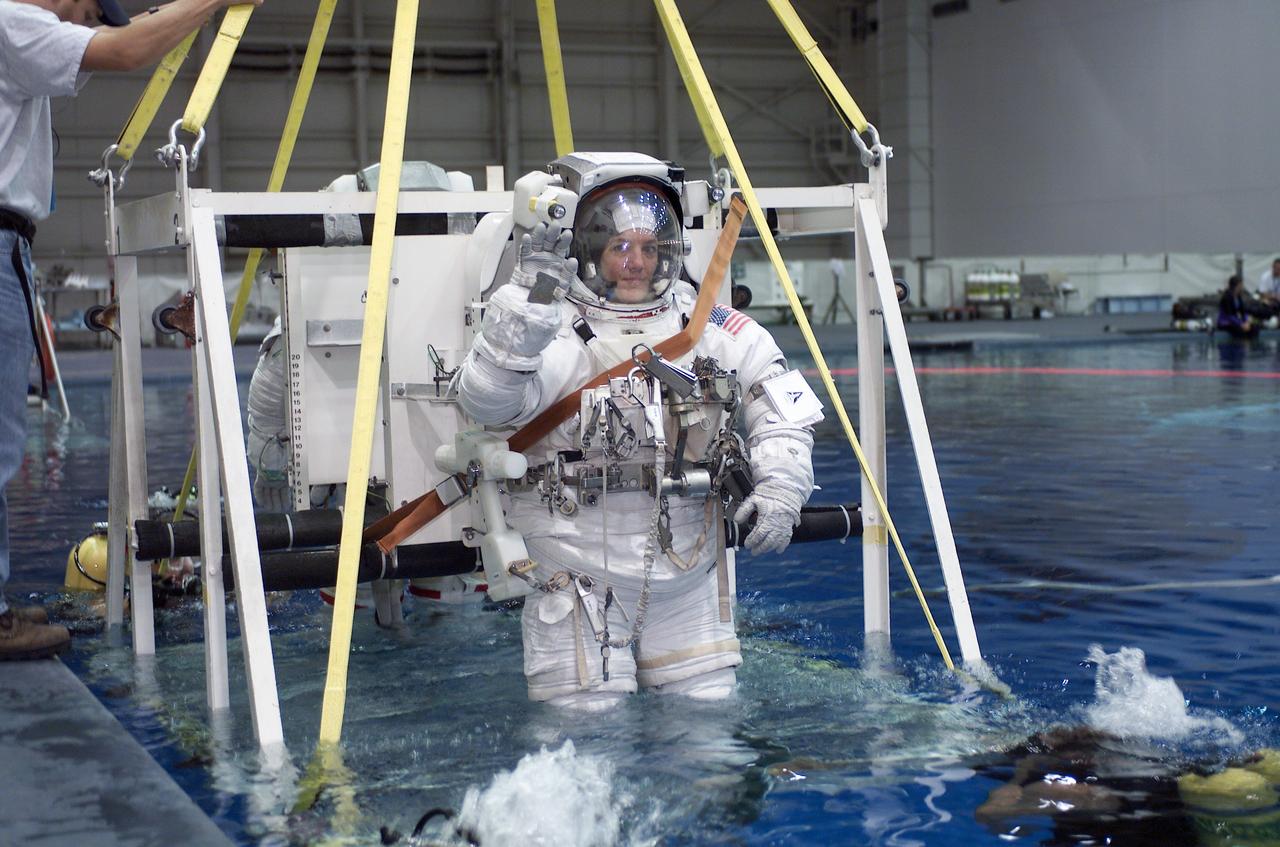
JSC2002-E-37426 (6 September 2002) --- Astronaut Heidemarie M. Stefanyshyn-Piper, STS-115 mission specialist, is submerged in the waters of the Neutral Buoyancy Laboratory (NBL) at the Johnson Space Center (JSC). Stefanyshyn-Piper is wearing the training version of the Extravehicular Mobility Unit (EMU) space suit. SCUBA-equipped divers are in the water to assist the astronauts in their rehearsal, intended to help prepare them for work on the exterior of the International Space Station (ISS).
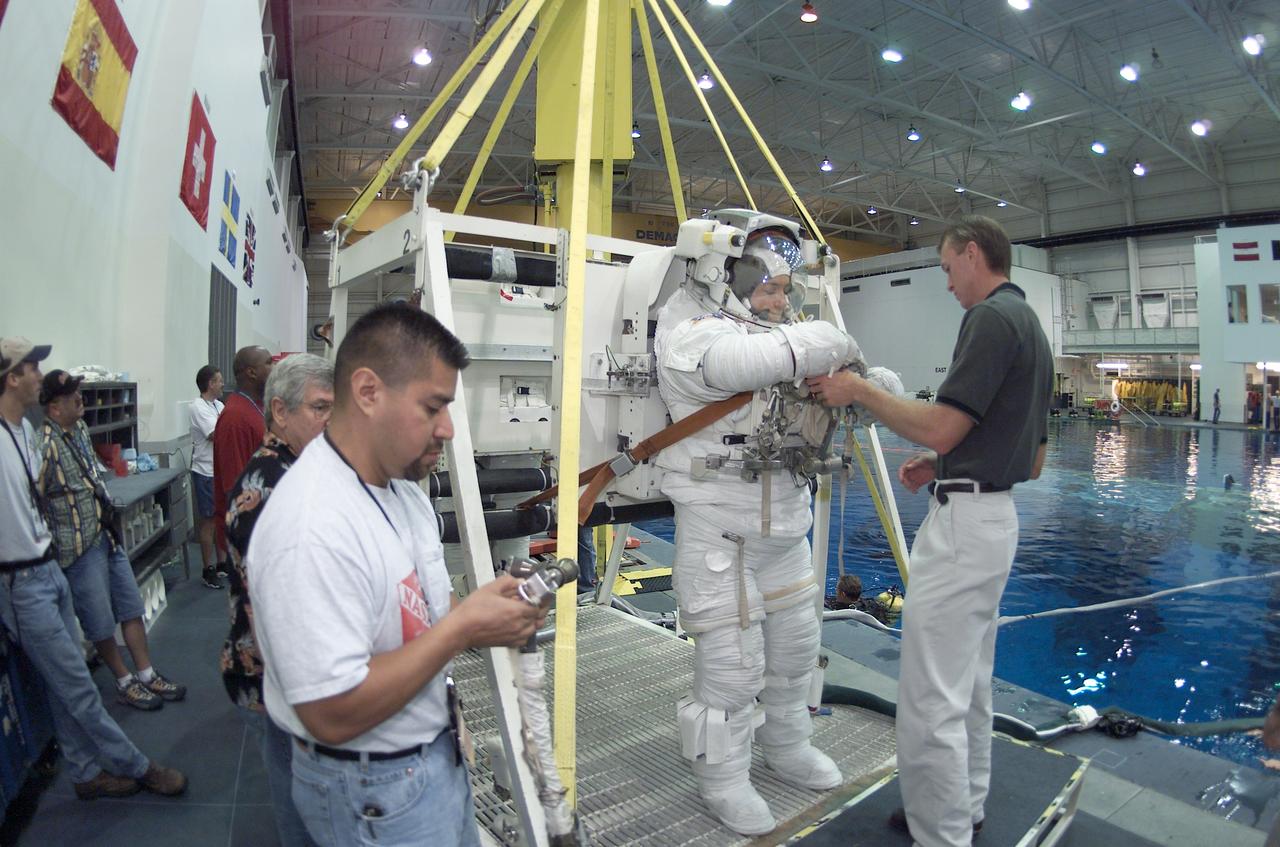
JSC2002-E-37422 (6 September 2002) --- Astronaut Heidemarie M. Stefanyshyn-Piper, STS-115 mission specialist, is photographed as the final touches are made on the training version of her Extravehicular Mobility Unit (EMU) spacesuit prior to being submerged in the waters of the Neutral Buoyancy Laboratory (NBL) near the Johnson Space Center (JSC). Astronaut Brent W. Jett, Jr., mission commander, assisted Stefanyshyn-Piper.
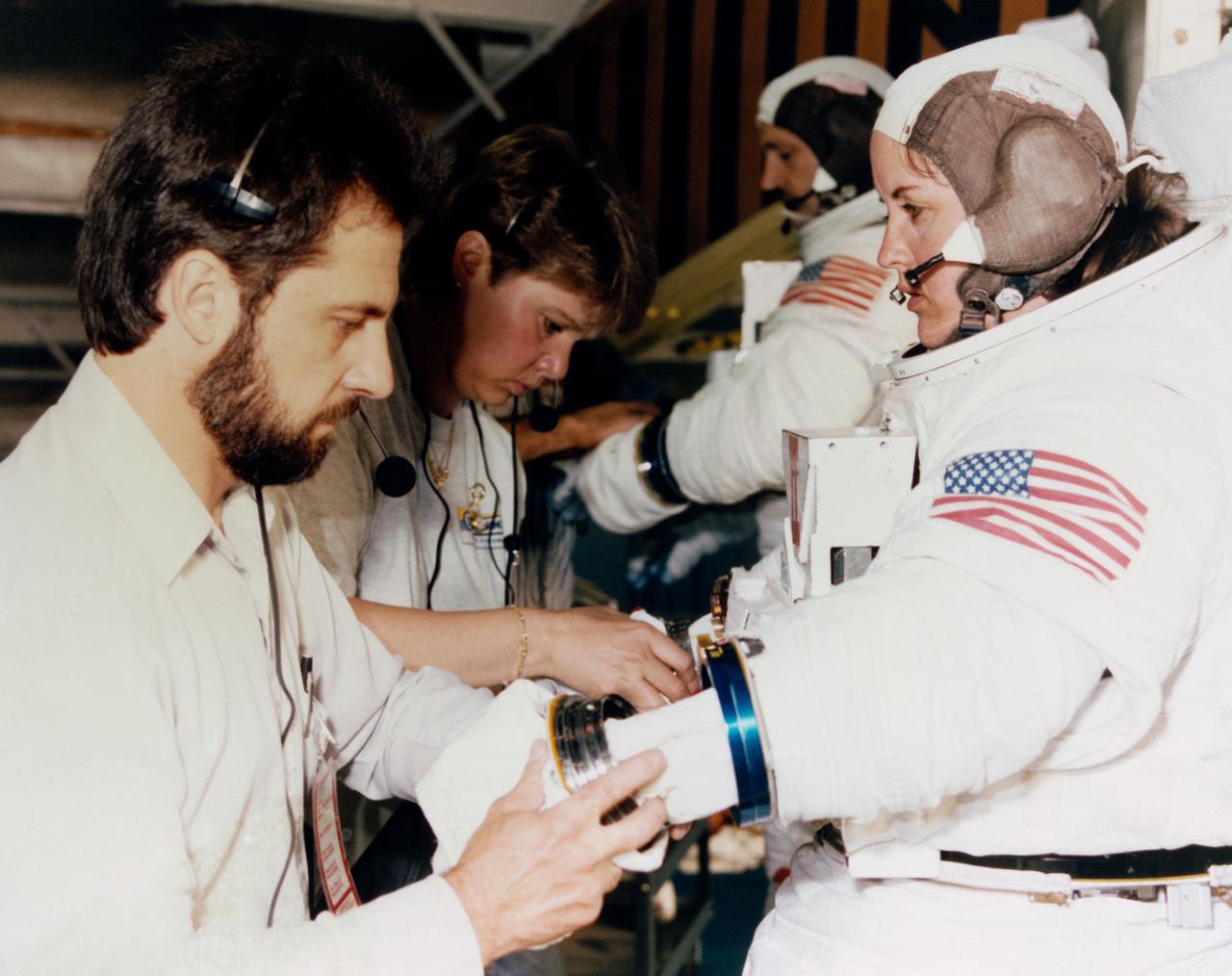
Astronaut Thomas D. Akers gets assistance in donning a training version of the Shuttle extravehicular mobility unit (EMU) space suit prior to a training session in the Neutral Buoyancy Simulator at Marshall Space Flight Center (MSFC) (39735); Astronaut Kathryn C. Thornton (foreground) and Thomas Akers, STS-61 mission specialists scheduled for extravehicular activity (EVA) duty, prepare for an underwater rehearsal session. Thornton recieves assistance from a technician in donning her EMU gloves (39736).
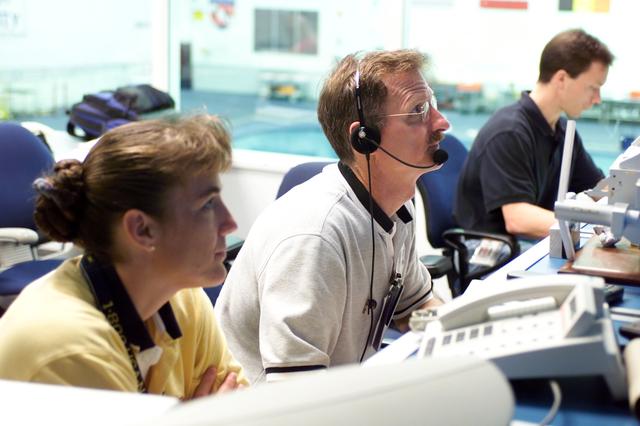
JSC2002-E-39745 (26 September 2002) --- Astronauts Heidemarie M. Stefanyshyn-Piper (left) and Joseph R. (Joe) Tanner, both STS-115 mission specialists, observe training activities of their crewmates from the simulation control area in the Neutral Buoyancy Laboratory (NBL) at the Sonny Carter Training Facility (SCTF) near the Johnson Space Center (JSC).
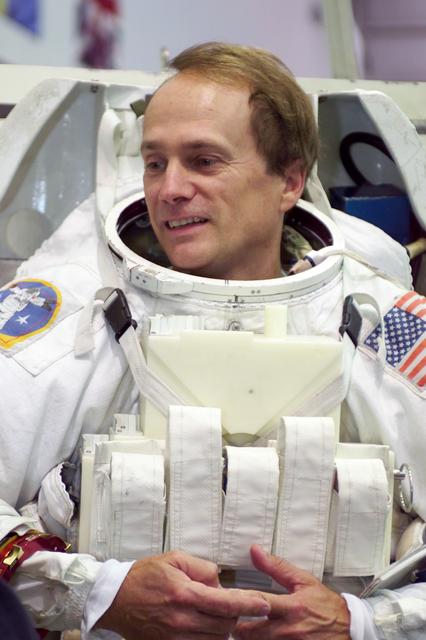
JSC2002-E-39736 (26 September 2002) --- Astronaut Steven G. MacLean, STS-115 mission specialist, attired in a training version of the Extravehicular Mobility Unit (EMU) space suit, is about to begin a training session in the Neutral Buoyancy Laboratory (NBL) near the Johnson Space Center (JSC). MacLean represents the Canadian Space Agency.
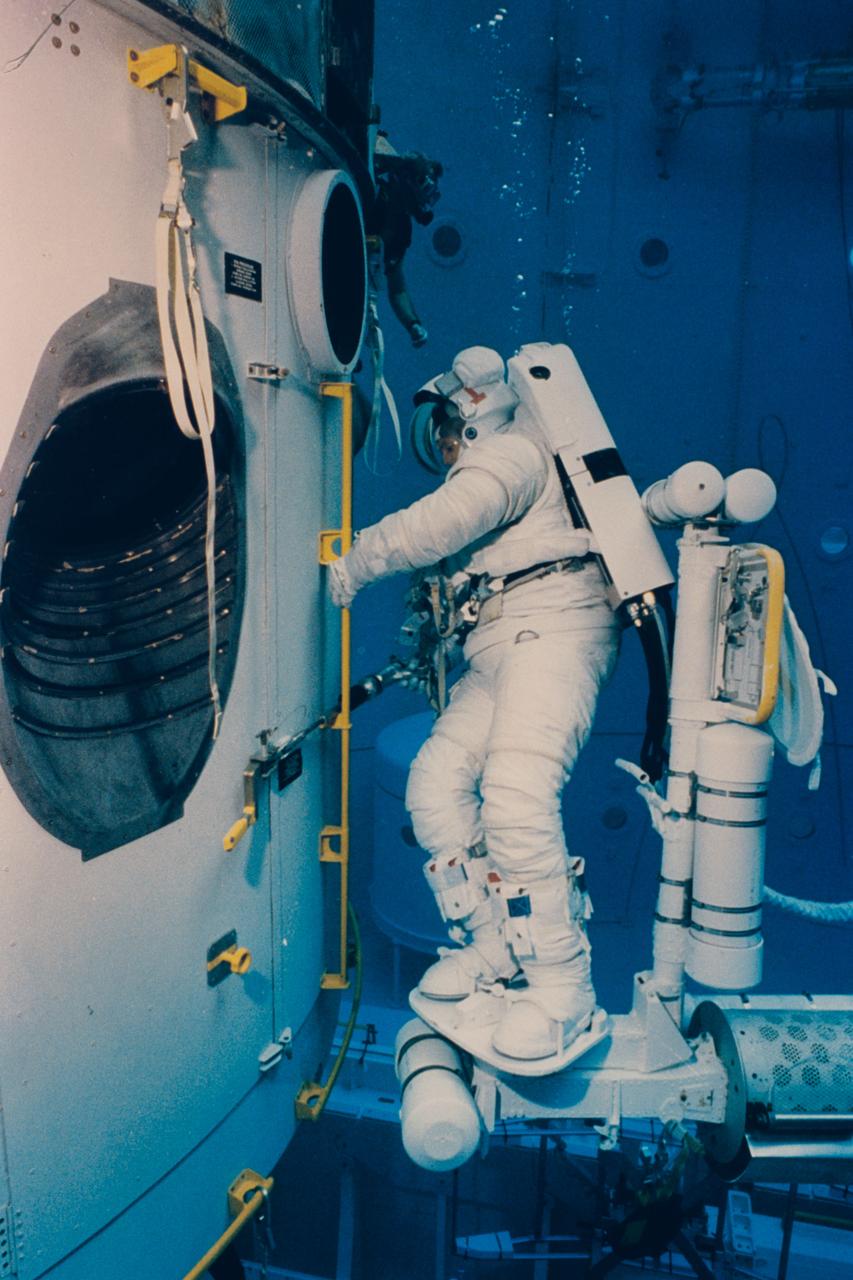
Astronaut Thomas D. Akers uses a power wrench to deploy one of the tools on the Hubble Space Telescope (HST) during a training session in the Neutral Buoyancy Simulator at Marshall Space Flight Center.
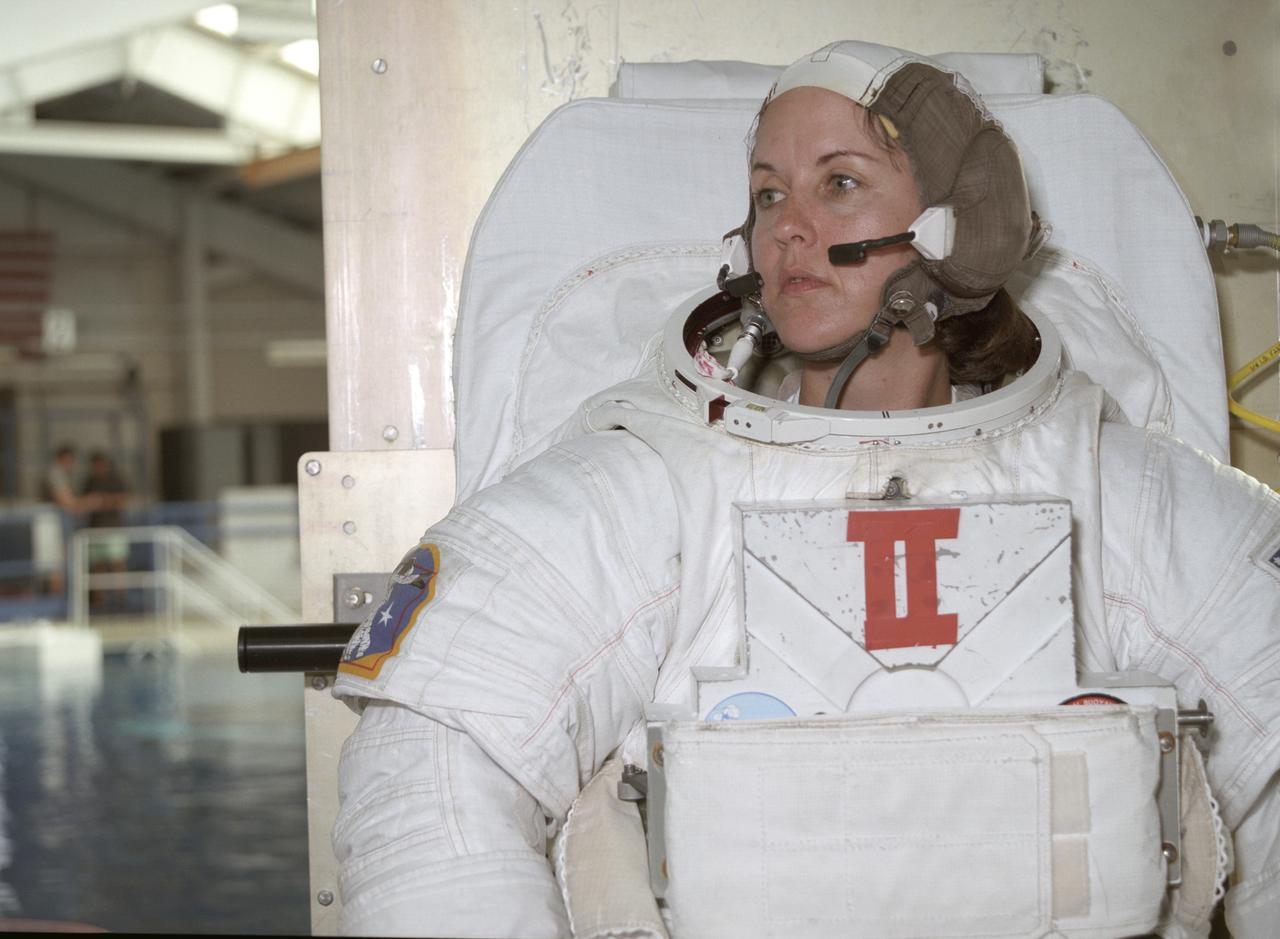
This close-up of astronaut and mission specialist Kathryn Thornton readies herself for submersion into the water in the Marshall Space Flight Center (MSFC) Neutral Buoyancy Simulator (NBS) where she is participating in a training session for the STS-61 mission. The NBS provided the weightless environment encountered in space needed for testing and the practices of Extravehicular Activities (EVA). Launched on December 2, 1993 aboard the Space Shuttle Orbiter Endeavor, STS-61 was the first Hubble Space Telescope (HST) serving mission. During the 2nd EVA of the mission, Thornton, along with astronaut and mission specialist Thomas Akers, performed the task of replacing the solar arrays. The EVA lasted 6 hours and 35 minutes.
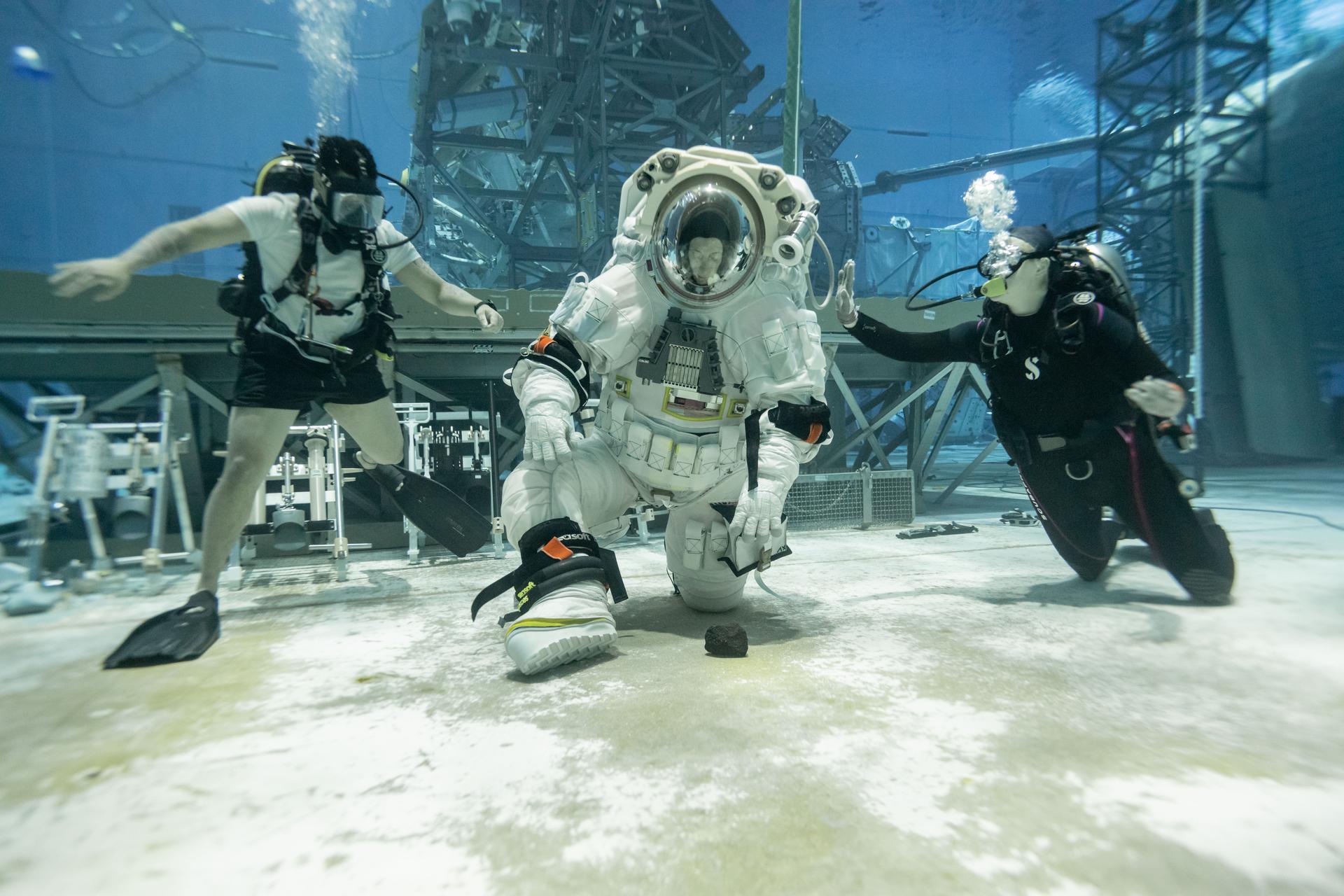
NASA astronaut Loral O’Hara kneels to pick up a rock while testing the mobility of Axiom Space’s lunar spacesuit. NASA and Axiom Space teams held the first dual spacesuit run at the Neutral Buoyancy Laboratory in Houston on September 24, 2025 with NASA Astronauts Stan Love and Loral O’Hara wearing Axiom Space’s lunar spacesuit, called the Axiom Extravehicular Mobility Unit (AxEMU). This was the final integration test in the pool, proving both the spacesuit and facility are prepped and ready for Artemis training.
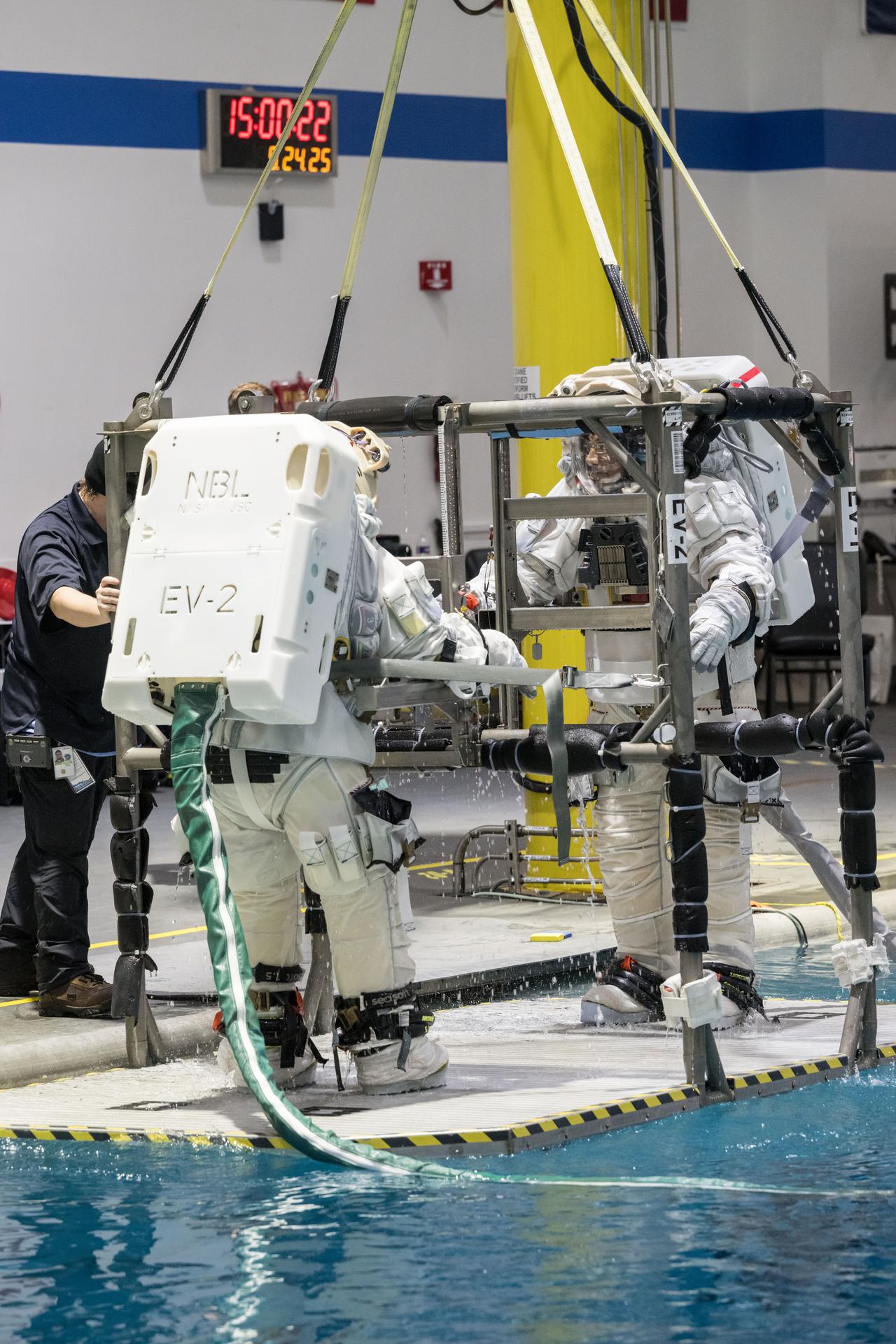
NASA and Axiom Space teams held the first dual spacesuit run at the Neutral Buoyancy Laboratory in Houston on September 24, 2025 with NASA Astronauts Stan Love and Loral O’Hara wearing Axiom Space’s lunar spacesuit, called the Axiom Extravehicular Mobility Unit (AxEMU). This was the final integration test in the pool, proving both the spacesuit and facility are prepped and ready for Artemis training.
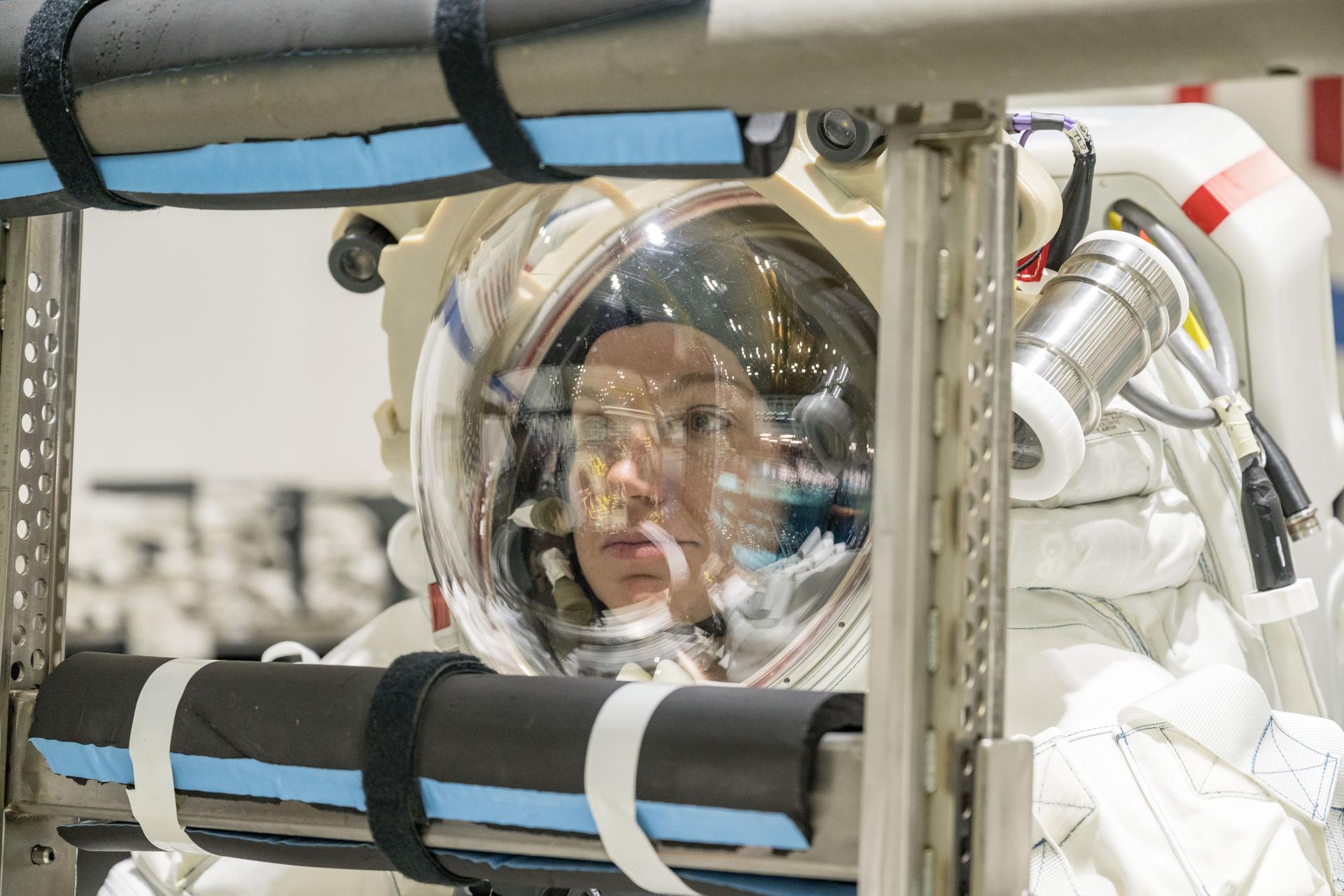
Canadian Space Agency astronaut Jenni Gibbons gets suited up in Axiom Space’s lunar spacesuit at NASA’s Neutral Buoyancy Laboratory in Houston. During a recent test series, NASA engineers and crewmembers wore the lunar spacesuit under water and conducted numerous tasks during simulated lunar operations to test its mobility and functionality and ensure the spacesuit is prepped and ready for Artemis training.
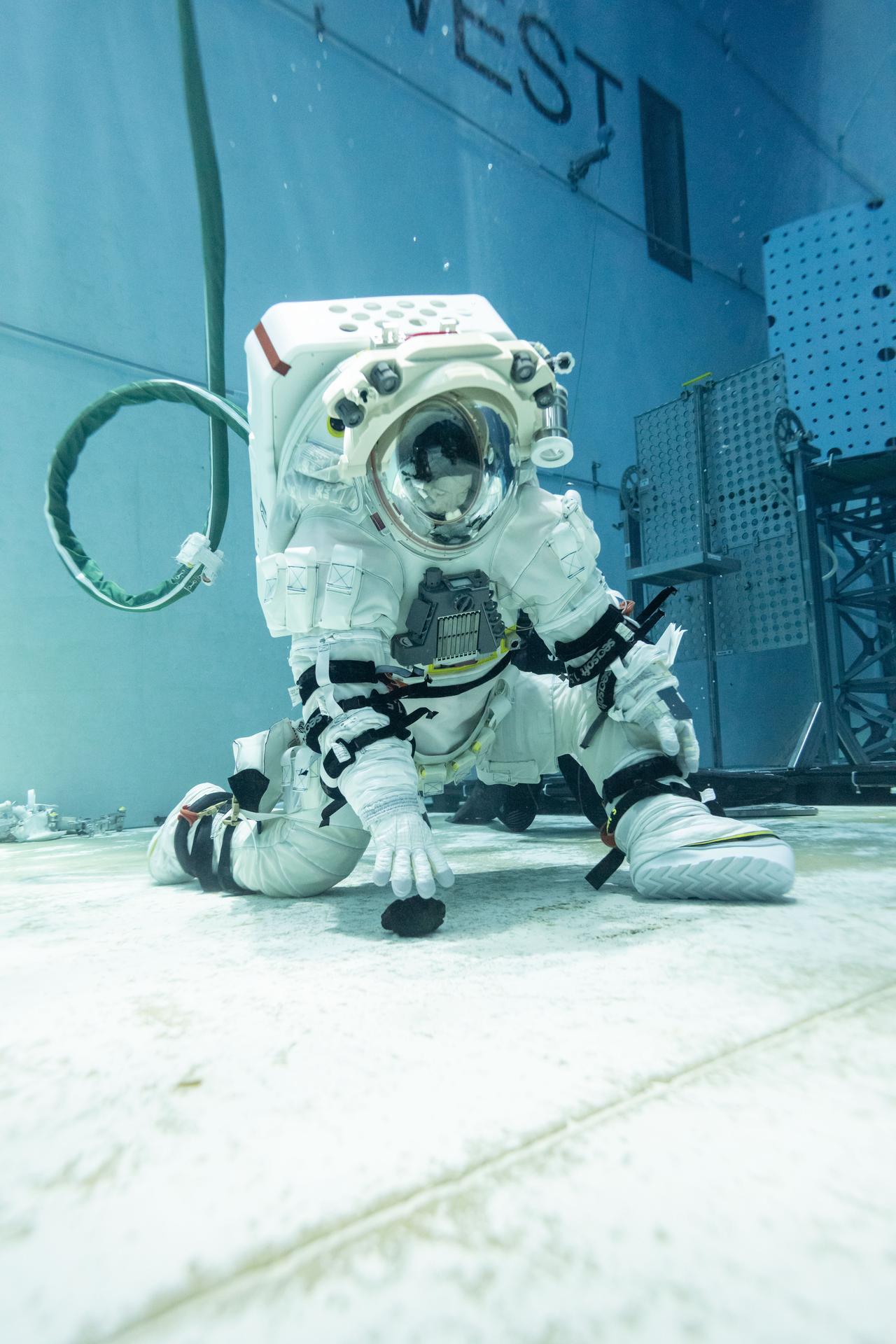
Canadian Space Agency astronaut Jenni Gibbons practices simulated lunar tasks under water while wearing Axiom Space’s lunar spacesuit at NASA’s Neutral Buoyancy Laboratory in Houston. During a recent test series, NASA engineers and crewmembers wore the lunar spacesuit under water and conducted numerous tasks during simulated lunar operations to test its mobility and functionality and ensure the spacesuit is prepped and ready for Artemis training.