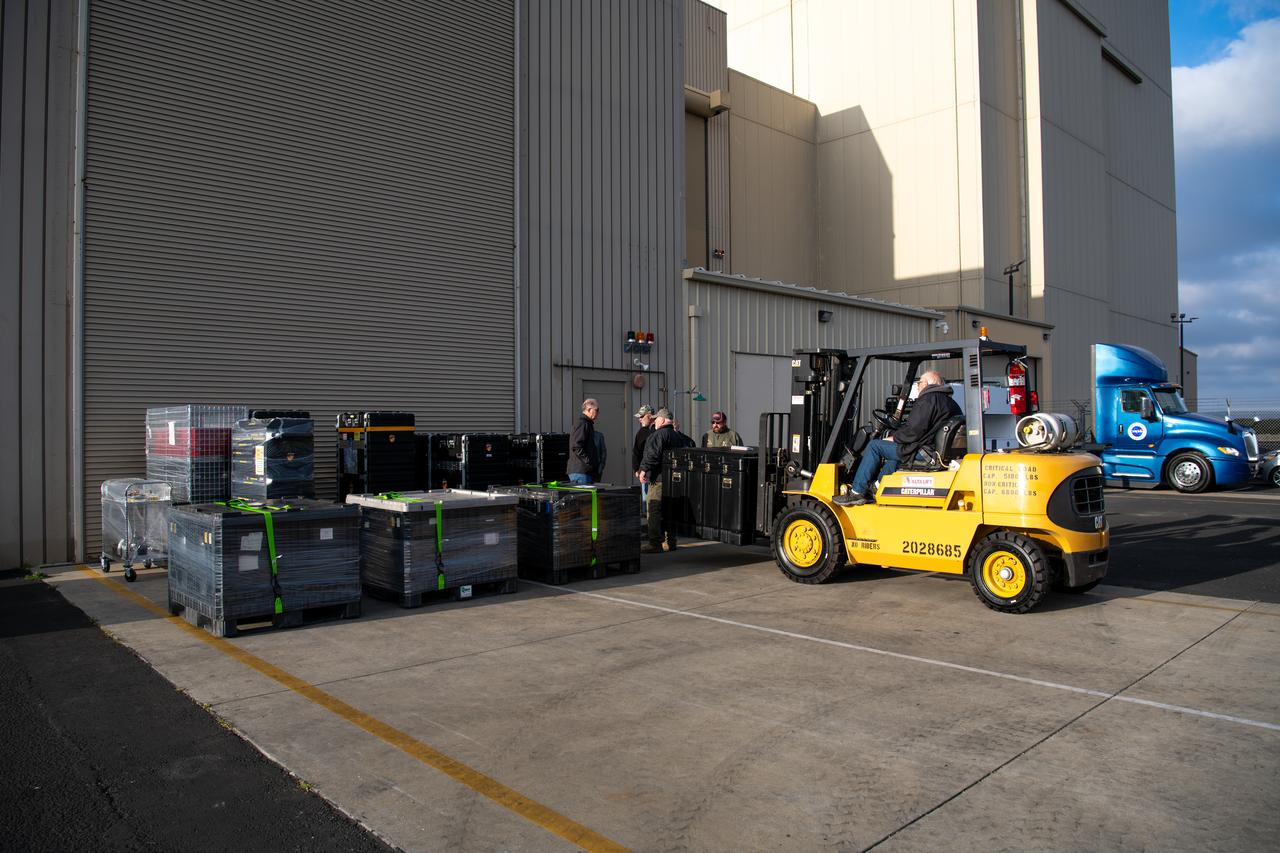
Teams at Vandenberg Space Force Base in California offload several shipping containers protecting NASA’s PUNCH (Polarimeter to Unify the Corona and Heliosphere) satellites on Saturday, Jan. 18, 2025. PUNCH will make 3D observations of the Sun’s corona to learn how the mass and energy becomes solar wind. PUNCH, along with NASA’s SPHEREx (Spectro-Photometer for the History of the Universe, Epoch of Reionization and Ices Explorer), a space telescope, will launch aboard a SpaceX Falcon 9 rocket in late February 2025.
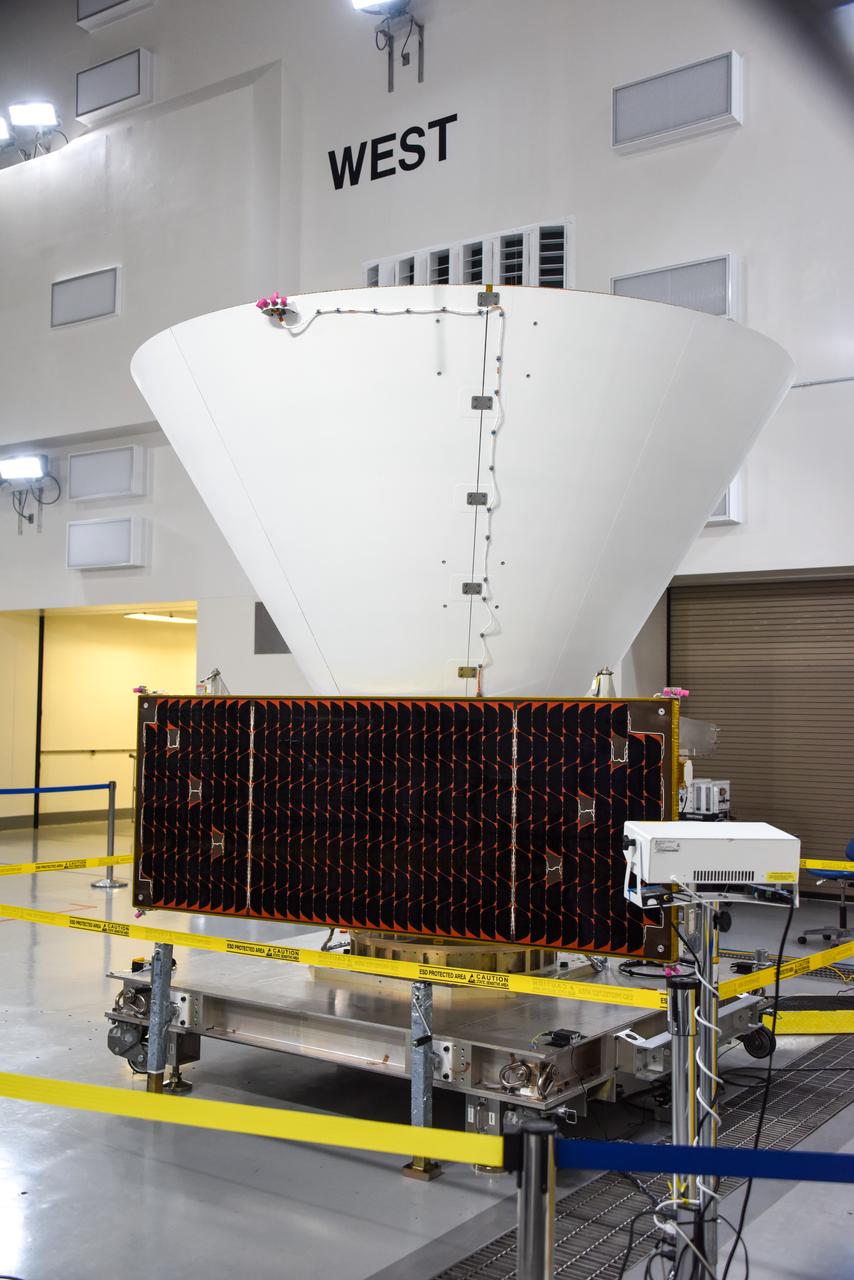
NASA’s SPHEREx (Spectro-Photometer for the History of the Universe, Epoch of Reionization and Ices Explorer), a space telescope, is situated on a work stand ahead of prelaunch operations at the Astrotech Processing Facility at Vandenberg Space Force Base in California on Friday, Jan. 17, 2025. SPHEREx will enter a polar orbit around Earth and create a 3D map of the entire sky, gathering information about millions of galaxies for scientists to study what happened after the big bang, the history of galaxy evolution, and the origins of water in planetary systems in our galaxy. SPHEREx will launch aboard a SpaceX Falcon 9 rocket in late February 2025.
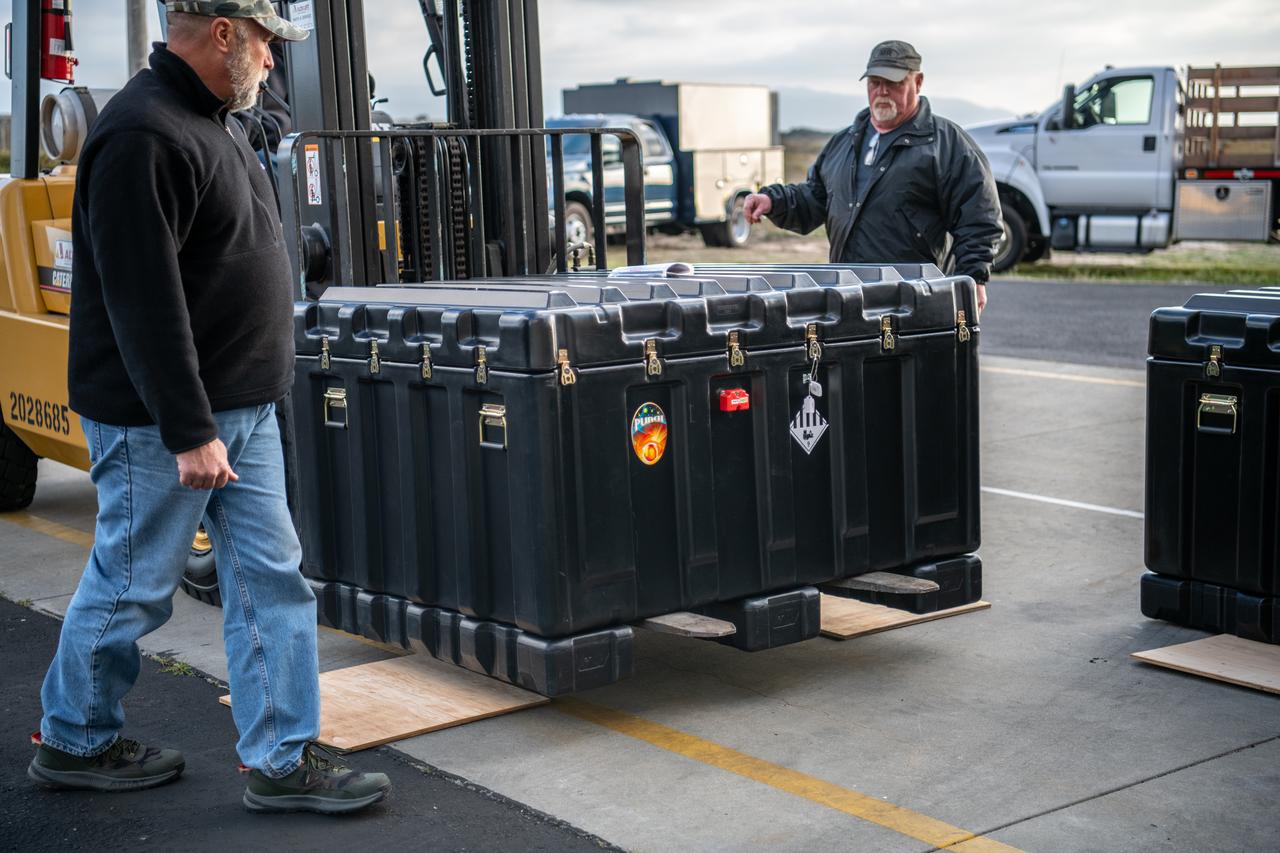
Teams at Vandenberg Space Force Base in California offload several shipping containers protecting NASA’s PUNCH (Polarimeter to Unify the Corona and Heliosphere) satellites on Saturday, Jan. 18, 2025. PUNCH will make 3D observations of the Sun’s corona to learn how the mass and energy becomes solar wind. PUNCH, along with NASA’s SPHEREx (Spectro-Photometer for the History of the Universe, Epoch of Reionization and Ices Explorer), a space telescope, will launch aboard a SpaceX Falcon 9 rocket in late February 2025.
Crews conduct a solar array deployment test on the spacecraft of NASA’s PUNCH (Polarimeter to Unify the Corona and Heliosphere) satellites at Astrotech Space Operations located on Vandenberg Space Force Base in California on Tuesday, Jan. 21, 2025. The four satellites of PUNCH will make 3D observations of the Sun’s corona to learn how the mass and energy becomes solar wind. PUNCH, along with NASA’s SPHEREx (Spectro-Photometer for the History of the Universe, Epoch of Reionization and Ices Explorer), a space telescope, will launch aboard a SpaceX Falcon 9 rocket in late February 2025.
Technicians integrate NASA’s four PUNCH (Polarimeter to Unify the Corona and Heliosphere) satellites to the evolved expendable launch vehicle secondary payload adapter array ring inside the Astrotech Space Operations Facility at Vandenberg Space Force Base in California on Friday, Feb. 14, 2025. PUNCH will study origins of the Sun’s outflow of material, or the solar wind, capturing continuous 3D images of the Sun’s corona and the solar wind’s journey into the solar system. The PUNCH mission is launching as a rideshare with NASA’s SPHEREx (Spectro-Photometer for the History of the Universe, Epoch of Reionization and Ices Explorer) observatory scheduled to launch aboard a SpaceX Falcon 9 rocket at 10:09 p.m. EST (7:09 p.m. PST), Friday, Feb. 28, 2025, at Space Launch Complex 4 East from Vandenberg Space Force Base in California.

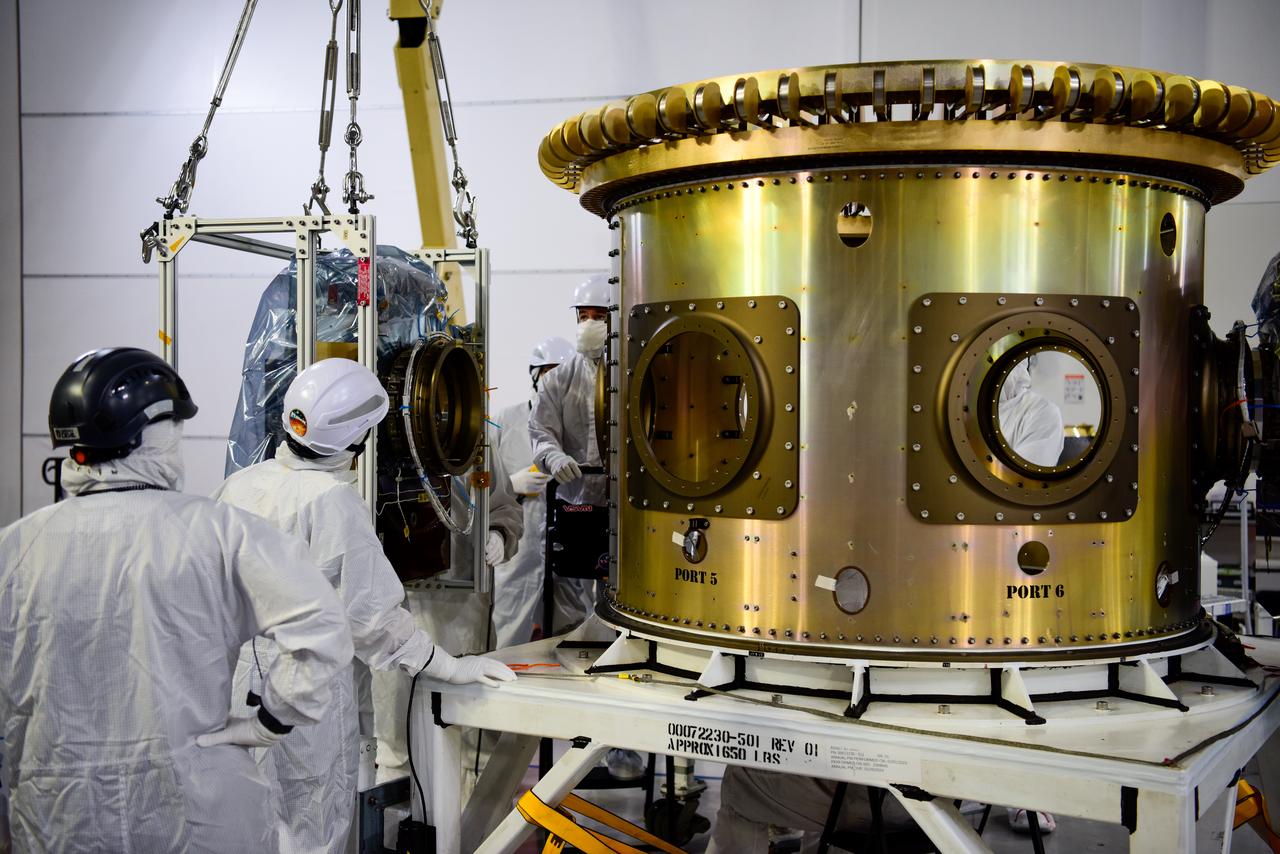
On Aug. 11, 2022, teams at the Astrotech facility at Vandenberg Space Force Base (VSFB) in California use a crane to raise to vertical one of the United Launch Alliance (ULA) Atlas V payload fairing halves for NASA and the National Oceanic and Atmospheric Administration’s (NOAA) Joint Polar Satellite System-2 (JPSS-2) satellite mission. The payload fairing protects the spacecraft during launch and flight through the atmosphere. JPSS-2 is the third satellite in the Joint Polar Satellite System series. It is scheduled to lift off from VSFB on Nov. 1 from Space Launch Complex-3 East. JPSS-2 will scan the globe as it orbits from the North to the South Pole, crossing the equator 14 times a day. From 512 miles above Earth, it will capture data that inform weather forecasts, extreme weather events, and climate change. The Visible Infrared Radiometer Suite instrument will collect imagery for global observations of the land, atmosphere, cryosphere, and oceans. Launching as a secondary payload to JPSS-2 is NASA’s Low-Earth Orbit Flight Test of an Inflatable Decelerator (LOFTID), dedicated to the memory of Bernard Kutter. LOFTID is a demonstration of a hypersonic inflatable aerodynamic decelerator, or aeroshell, technology that could one day help land humans on Mars.
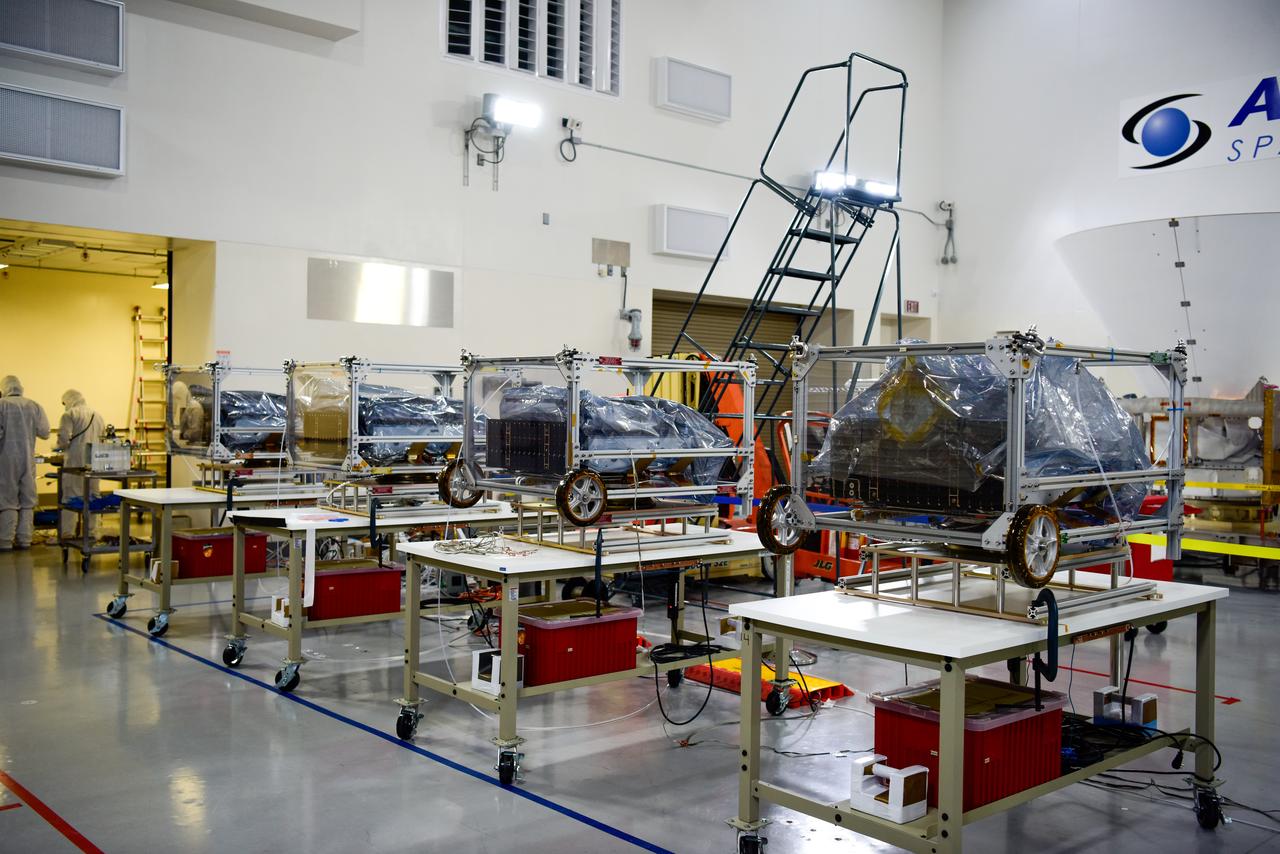
NASA’s four PUNCH (Polarimeter to Unify the Corona and Heliosphere) satellites await integration to the evolved expendable launch vehicle secondary payload adapter array ring inside the Astrotech Space Operations Facility at Vandenberg Space Force Base in California on Friday, Feb. 14, 2025. PUNCH will study origins of the Sun’s outflow of material, or the solar wind, capturing continuous 3D images of the Sun’s corona and the solar wind’s journey into the solar system. The PUNCH mission is launching as a rideshare with NASA’s SPHEREx (Spectro-Photometer for the History of the Universe, Epoch of Reionization and Ices Explorer) observatory scheduled to launch aboard a SpaceX Falcon 9 rocket at 10:09 p.m. EST (7:09 p.m. PST), Friday, Feb. 28, 2025, at Space Launch Complex 4 East from Vandenberg Space Force Base in California.
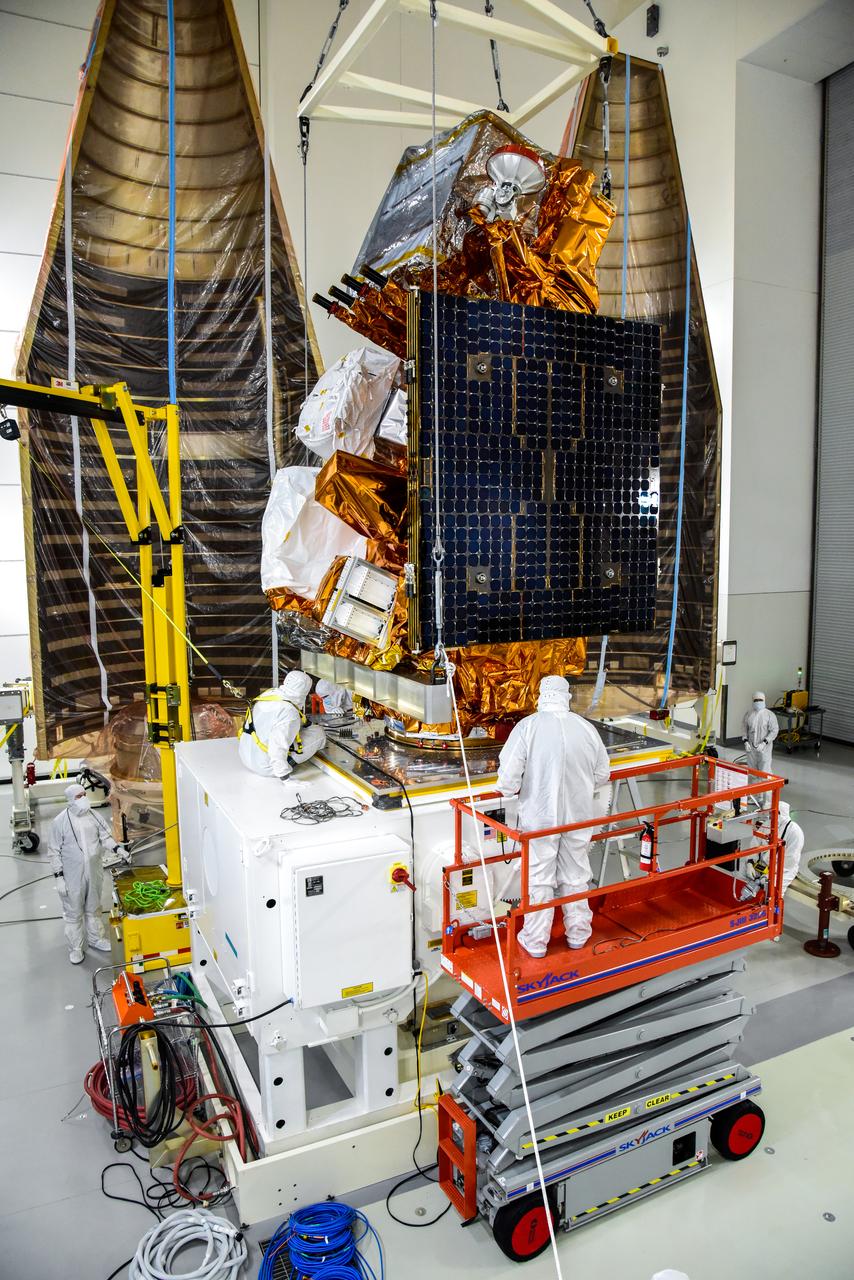
Technicians secure NASA and the National Oceanic and Atmospheric Administration’s (NOAA) Joint Polar Satellite System-2 (JPSS-2) satellite onto an Aronson Table inside the Astrotech Space Operations facility at Vandenberg Space Force Base in California on Aug. 22, 2022. In the background are the United Launch Alliance Atlas V payload fairings that will encase the satellite and protect it during launch. JPSS-2 is the third satellite in the Joint Polar Satellite System series. It is scheduled to lift off from VSFB on Nov. 1 from Space Launch Complex-3. JPSS-2, which will be renamed NOAA-21 after reaching orbit, will join a constellation of JPSS satellites that orbit from the North to the South pole, circling Earth 14 times a day and providing a full view of the entire globe twice daily. The NOAA/NASA Suomi National Polar-orbiting Partnership (Suomi NPP) satellite, and NOAA-20, previously known as JPSS-1, are both already in orbit. Each satellite carries at least four advanced instruments to measure weather and climate conditions on Earth. A secondary payload on the mission is the Low-Earth Orbit Flight Test of an Inflatable Decelerator (LOFTID), and is dedicated to the memory of Bernard Kutter. LOFTID will demonstrate inflatable heat shield technology that could enable a variety of proposed NASA missions to destinations such as Mars, Venus, and Titan, as well as returning heavier payloads from low-Earth orbit.
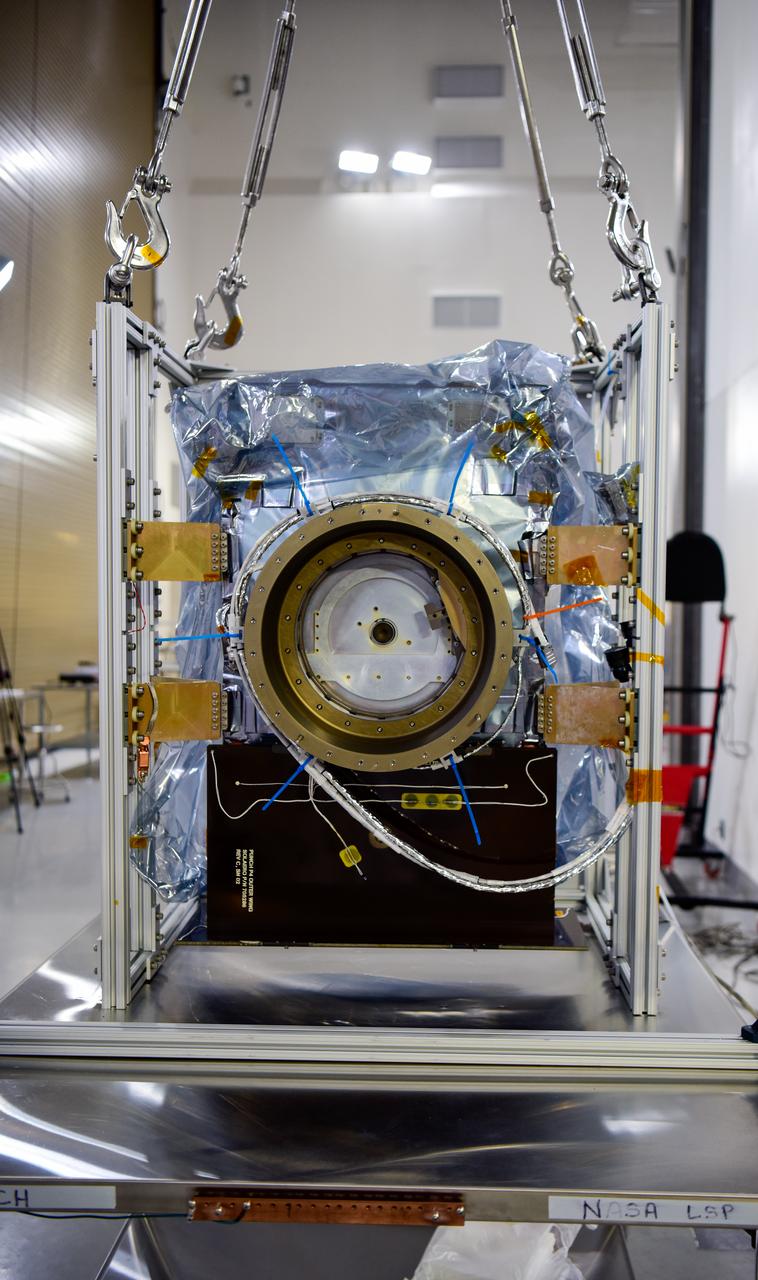
Technicians integrate NASA’s four PUNCH (Polarimeter to Unify the Corona and Heliosphere) satellites to the evolved expendable launch vehicle secondary payload adapter array ring inside the Astrotech Space Operations Facility at Vandenberg Space Force Base in California on Friday, Feb. 14, 2025. PUNCH will study origins of the Sun’s outflow of material, or the solar wind, capturing continuous 3D images of the Sun’s corona and the solar wind’s journey into the solar system. The PUNCH mission is launching as a rideshare with NASA’s SPHEREx (Spectro-Photometer for the History of the Universe, Epoch of Reionization and Ices Explorer) observatory scheduled to launch aboard a SpaceX Falcon 9 rocket at 10:09 p.m. EST (7:09 p.m. PST), Friday, Feb. 28, 2025, at Space Launch Complex 4 East from Vandenberg Space Force Base in California.
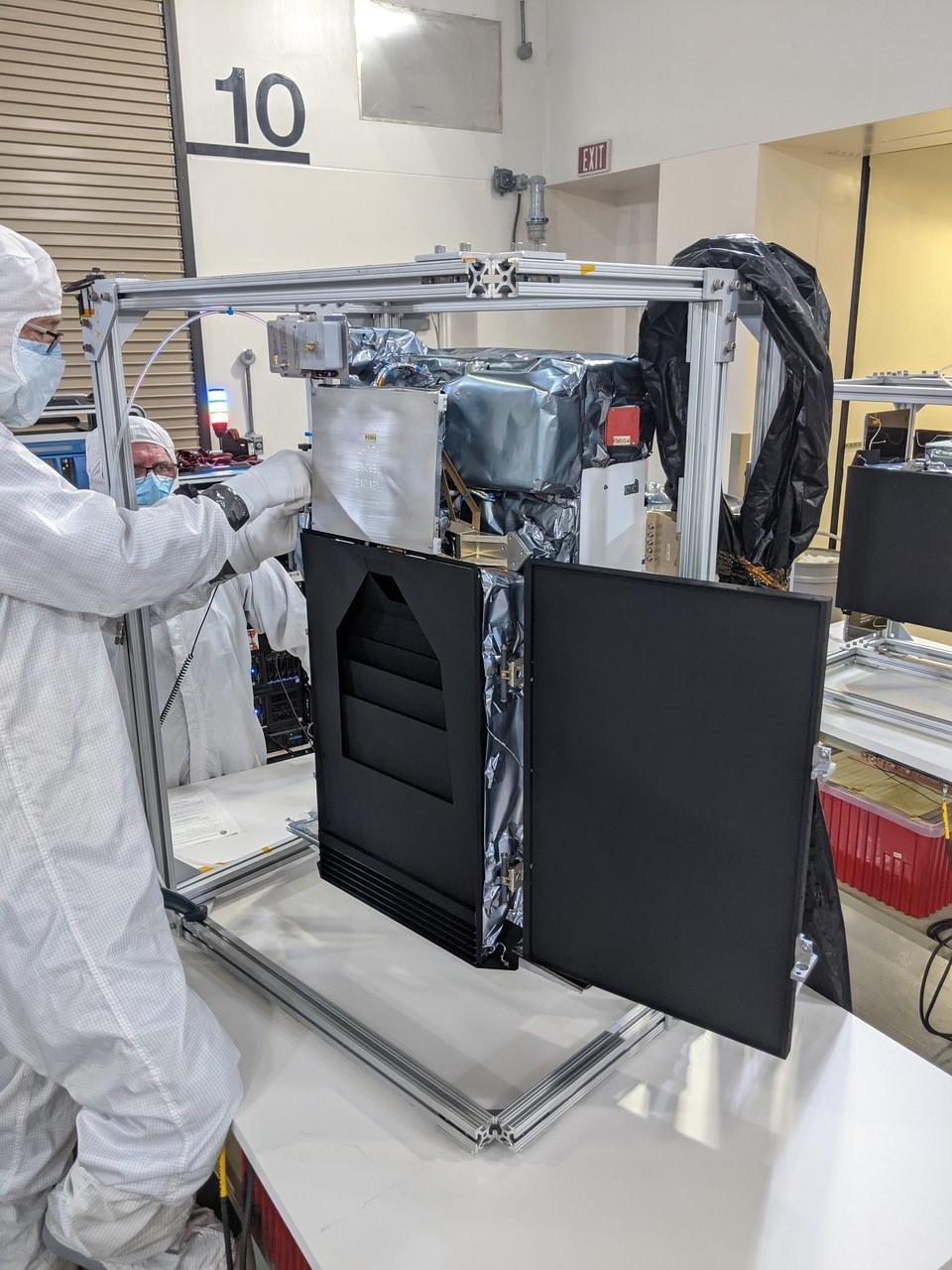
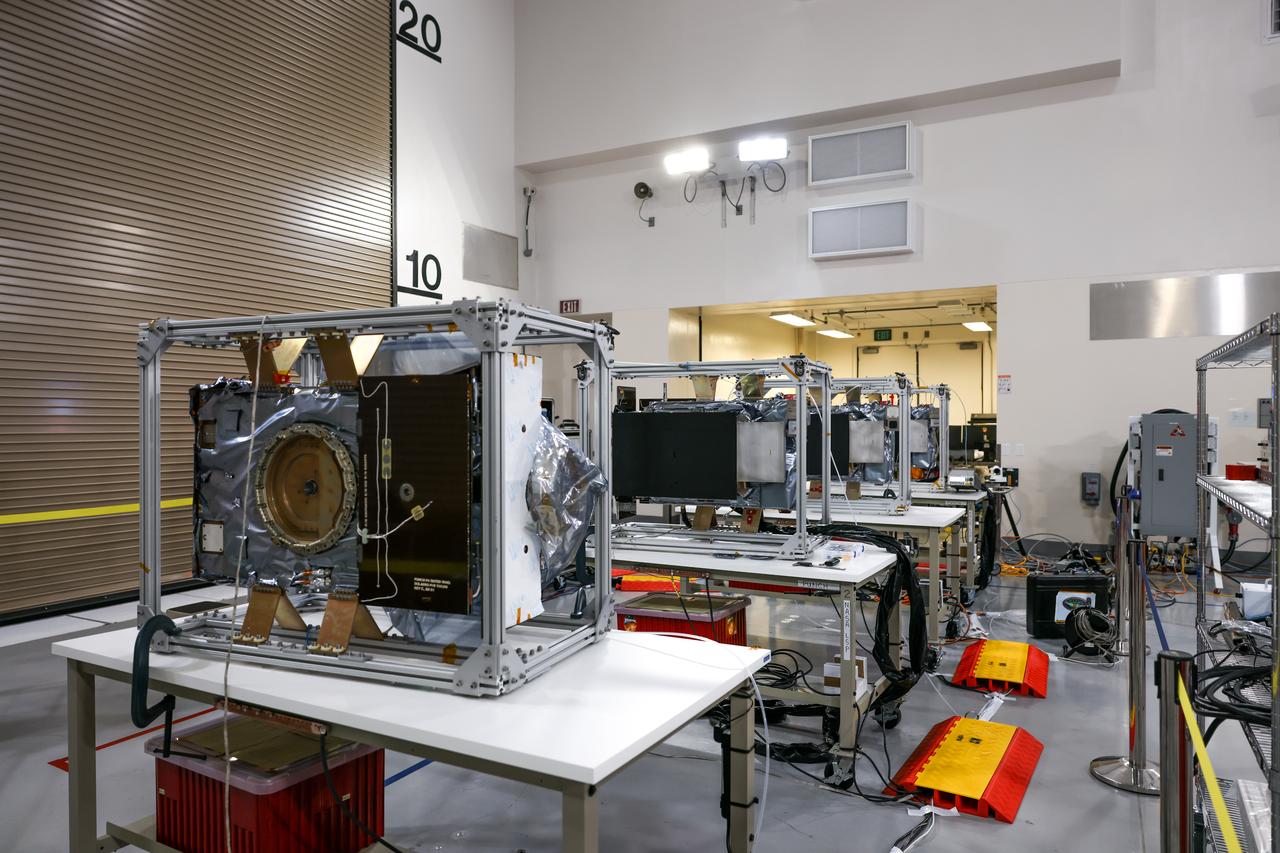
Technicians conduct integration and testing of NASA’s PUNCH (Polarimeter to Unify the Corona and Heliosphere) satellites during prelaunch operations inside Astrotech Space Operations on Vandenberg Space Force Base in California on Thursday, Jan. 23, 2025. PUNCH, consisting of four satellites, will produce continuous 3D images of the solar wind and solar storms as it travels from the Sun to Earth to better understand how material in the corona accelerates to become the solar wind that fills the solar system. PUNCH, along with NASA’s SPHEREx (Spectro-Photometer for the History of the Universe, Epoch of Reionization and Ices Explorer), a space telescope, will launch aboard a SpaceX Falcon 9 rocket in late February 2025.
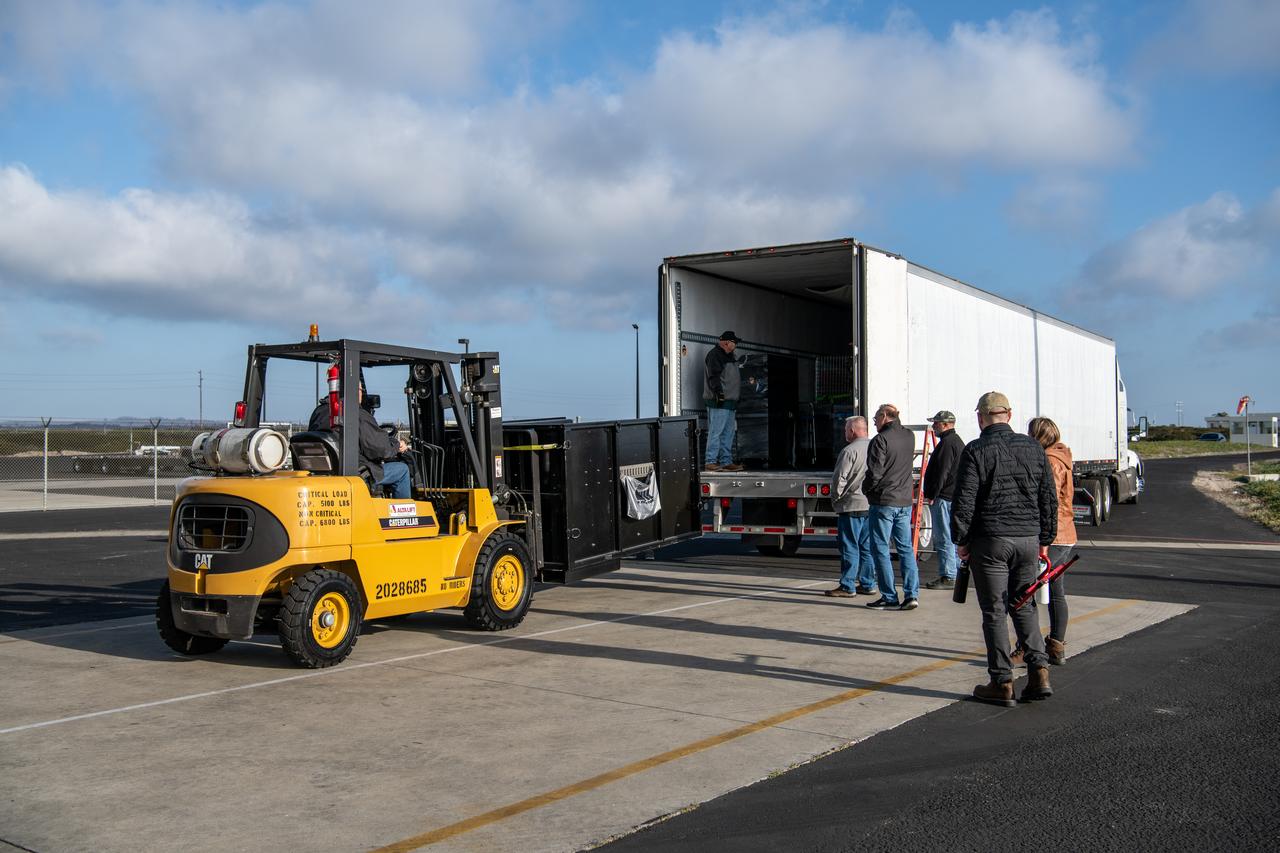
Teams at Vandenberg Space Force Base in California offload several shipping containers protecting NASA’s PUNCH (Polarimeter to Unify the Corona and Heliosphere) satellites on Saturday, Jan. 18, 2025. PUNCH will make 3D observations of the Sun’s corona to learn how the mass and energy becomes solar wind. PUNCH, along with NASA’s SPHEREx (Spectro-Photometer for the History of the Universe, Epoch of Reionization and Ices Explorer), a space telescope, will launch aboard a SpaceX Falcon 9 rocket in late February 2025.
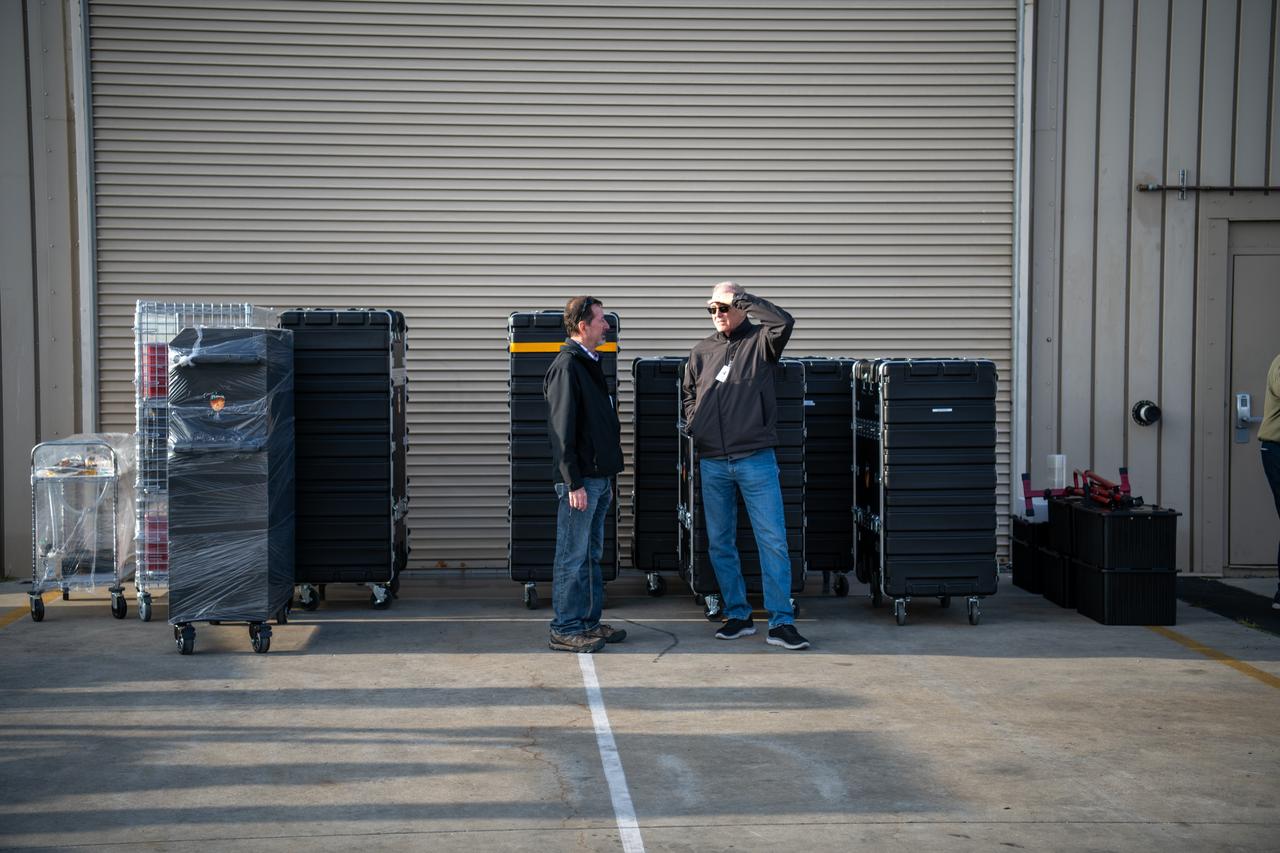
NASA’s four PUNCH (Polarimeter to Unify the Corona and Heliosphere) satellites arrive at Astrotech Space Operations located inside Vandenberg Space Force Base in California on Saturday, Jan. 18, 2025. The four satellites of PUNCH will make 3D observations of the Sun’s corona to learn how the mass and energy becomes solar wind. PUNCH, along with NASA’s SPHEREx (Spectro-Photometer for the History of the Universe, Epoch of Reionization and Ices Explorer), a space telescope, will launch aboard a SpaceX Falcon 9 rocket in late February 2025.
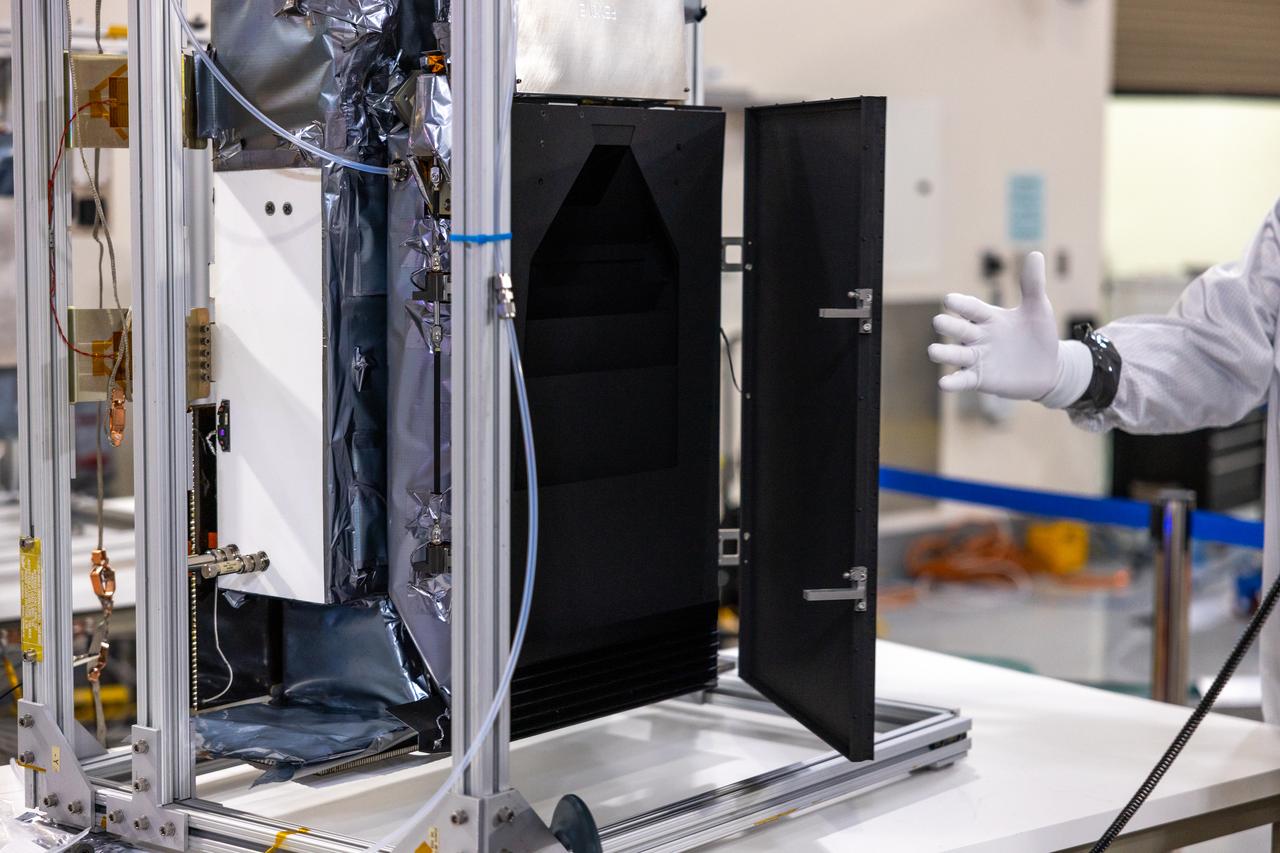
Crews conduct additional solar array deployment testing for NASA’s PUNCH (Polarimeter to Unify the Corona and Heliosphere) satellites at Astrotech Space Operations located on Vandenberg Space Force Base in California on Wednesday, Jan. 22, 2025. PUNCH, consisting of four satellites, will produce continuous 3D images of the solar wind and solar storms as it travels from the Sun to Earth to better understand how material in the corona accelerates. PUNCH, along with NASA’s SPHEREx (Spectro-Photometer for the History of the Universe, Epoch of Reionization and Ices Explorer), a space telescope, will launch aboard a SpaceX Falcon 9 rocket from Launch Complex 4E at Vandenberg Space Force Base in Central California on Thursday, Feb. 27, 2025.
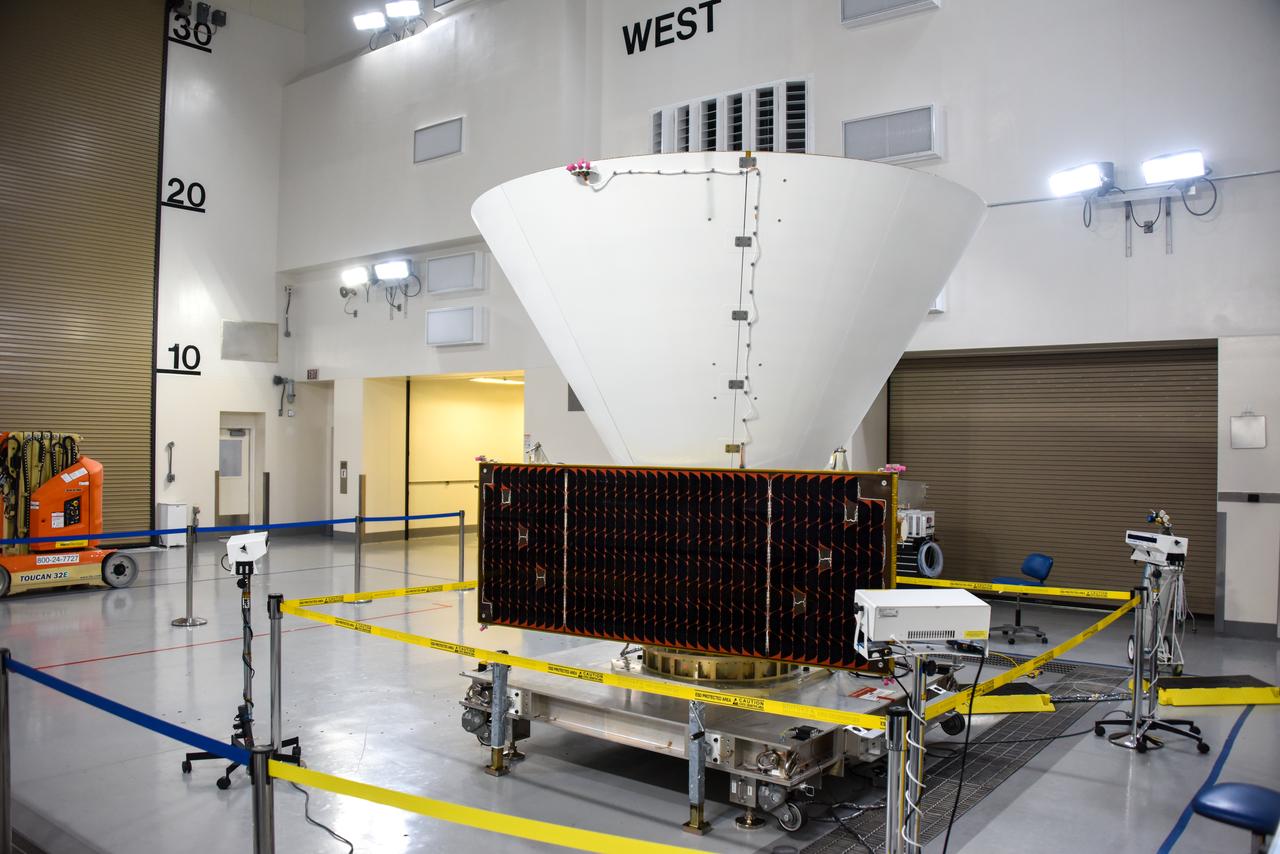
NASA’s SPHEREx (Spectro-Photometer for the History of the Universe, Epoch of Reionization and Ices Explorer), a space telescope, is situated on a work stand ahead of prelaunch operations at the Astrotech Processing Facility at Vandenberg Space Force Base in California on Friday, Jan. 17, 2025. SPHEREx will enter a polar orbit around Earth and create a 3D map of the entire sky, gathering information about millions of galaxies for scientists to study what happened after the big bang, the history of galaxy evolution, and the origins of water in planetary systems in our galaxy. SPHEREx will launch aboard a SpaceX Falcon 9 rocket in late February 2025.
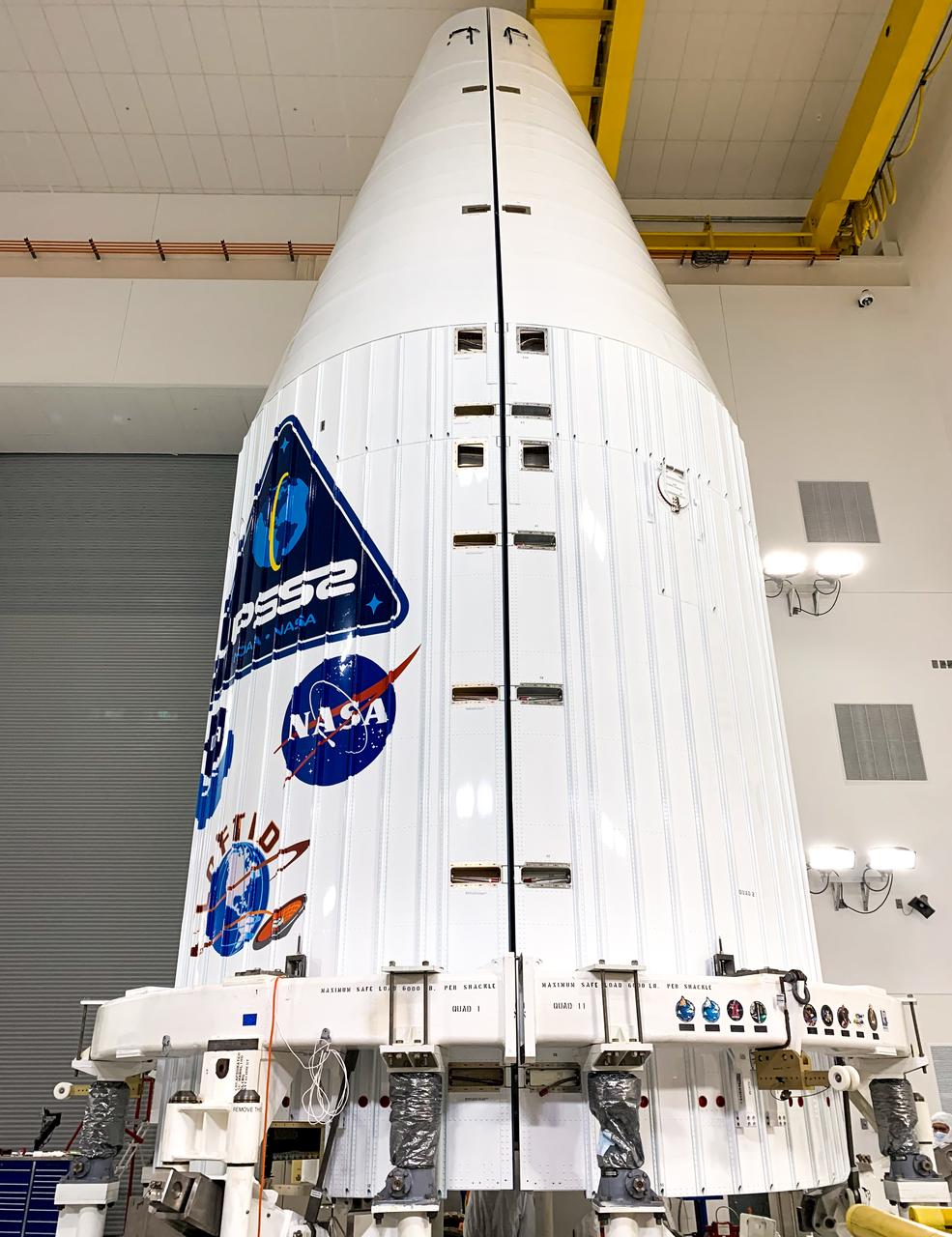
Both halves of the United Launch Alliance (ULA) Atlas V payload fairing are joined together during a fit check at the Astrotech Processing Facility at Vandenberg Space Force Base (VSFB) in California on Aug. 13, 2022, for NASA and the National Oceanic and Atmospheric Administration’s (NOAA) Joint Polar Satellite System-2 (JPSS-2) satellite mission. JPSS-2 is the third satellite in the Joint Polar Satellite System series. It is scheduled to lift off from VSFB on Nov. 1 from Space Launch Complex-3 East. JPSS-2 will scan the globe as it orbits from the North to the South Pole, crossing the equator 14 times a day. From 512 miles above Earth, it will capture data that inform weather forecasts, extreme weather events, and climate change. The Visible Infrared Radiometer Suite instrument will collect imagery for global observations of the land, atmosphere, cryosphere, and oceans. Launching as a secondary payload to JPSS-2 is NASA’s Low-Earth Orbit Flight Test of an Inflatable Decelerator (LOFTID), dedicated to the memory of Bernard Kutter. LOFTID is a demonstration of a hypersonic inflatable aerodynamic decelerator, or aeroshell, technology that could one day help land humans on Mars.
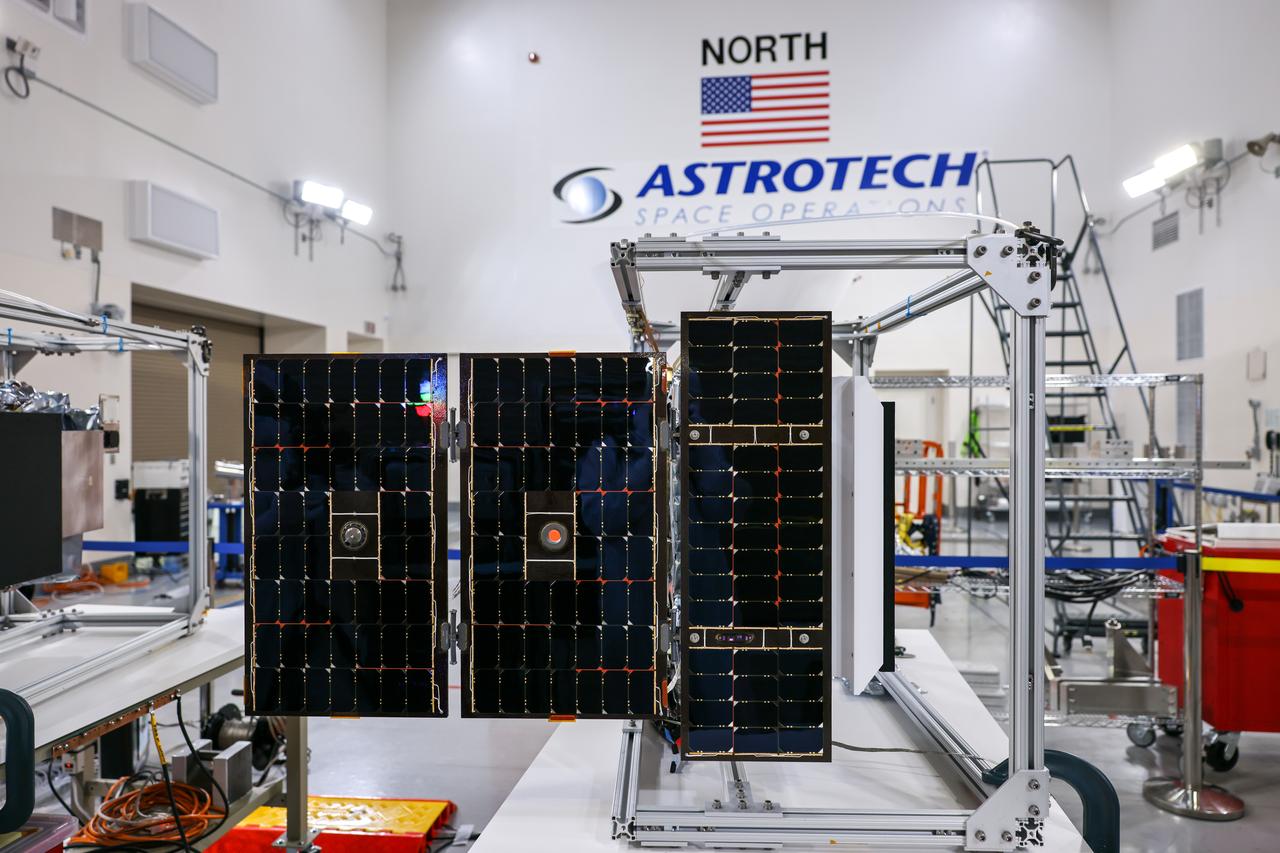
Crews conduct a solar array deployment test on the spacecraft of NASA’s PUNCH (Polarimeter to Unify the Corona and Heliosphere) satellites at Astrotech Space Operations located on Vandenberg Space Force Base in California on Tuesday, Jan. 21, 2025. The four satellites of PUNCH will make 3D observations of the Sun’s corona to learn how the mass and energy becomes solar wind. PUNCH, along with NASA’s SPHEREx (Spectro-Photometer for the History of the Universe, Epoch of Reionization and Ices Explorer), a space telescope, will launch aboard a SpaceX Falcon 9 rocket in late February 2025.
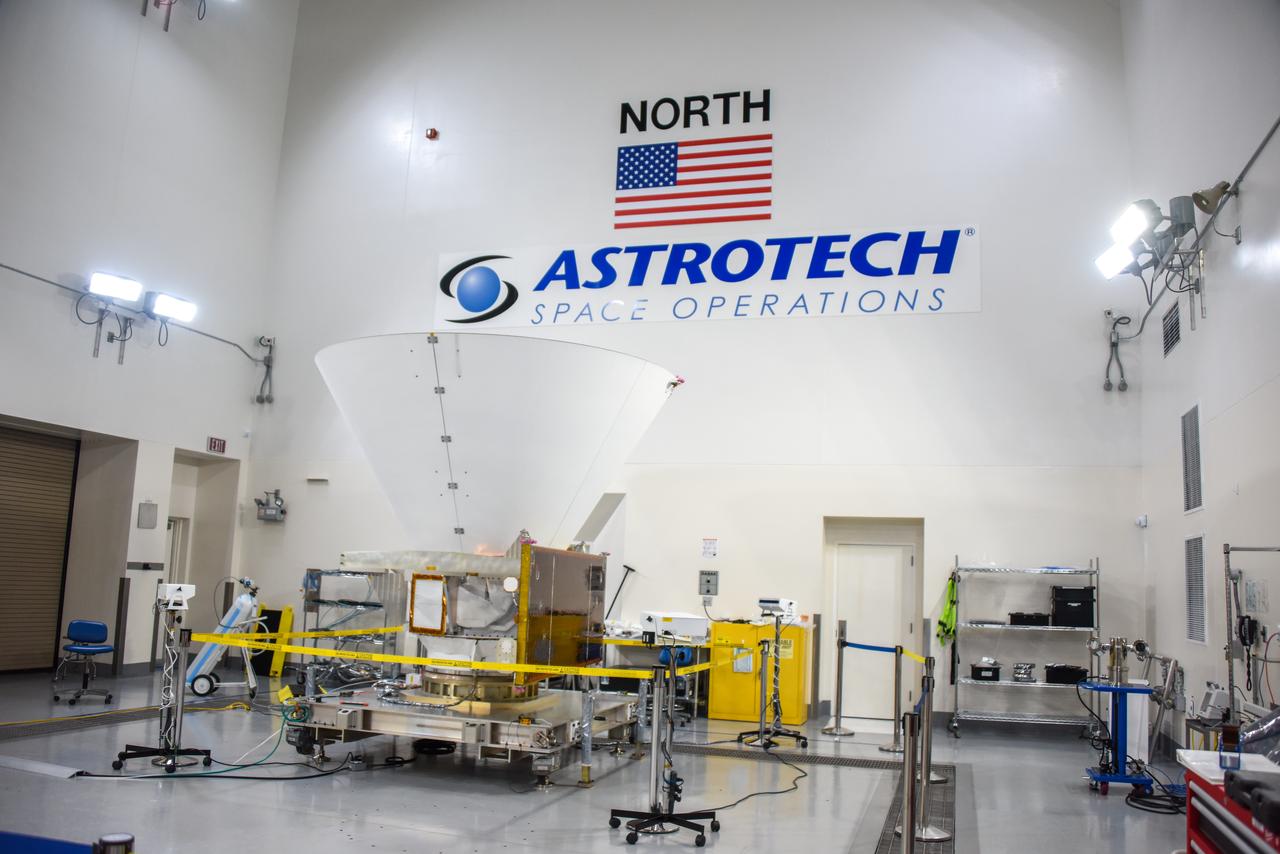
NASA’s SPHEREx (Spectro-Photometer for the History of the Universe, Epoch of Reionization and Ices Explorer), a space telescope, is situated on a work stand ahead of prelaunch operations at the Astrotech Processing Facility at Vandenberg Space Force Base in California on Friday, Jan. 17, 2025. SPHEREx will enter a polar orbit around Earth and create a 3D map of the entire sky, gathering information about millions of galaxies for scientists to study what happened after the big bang, the history of galaxy evolution, and the origins of water in planetary systems in our galaxy. SPHEREx will launch aboard a SpaceX Falcon 9 rocket in late February 2025.
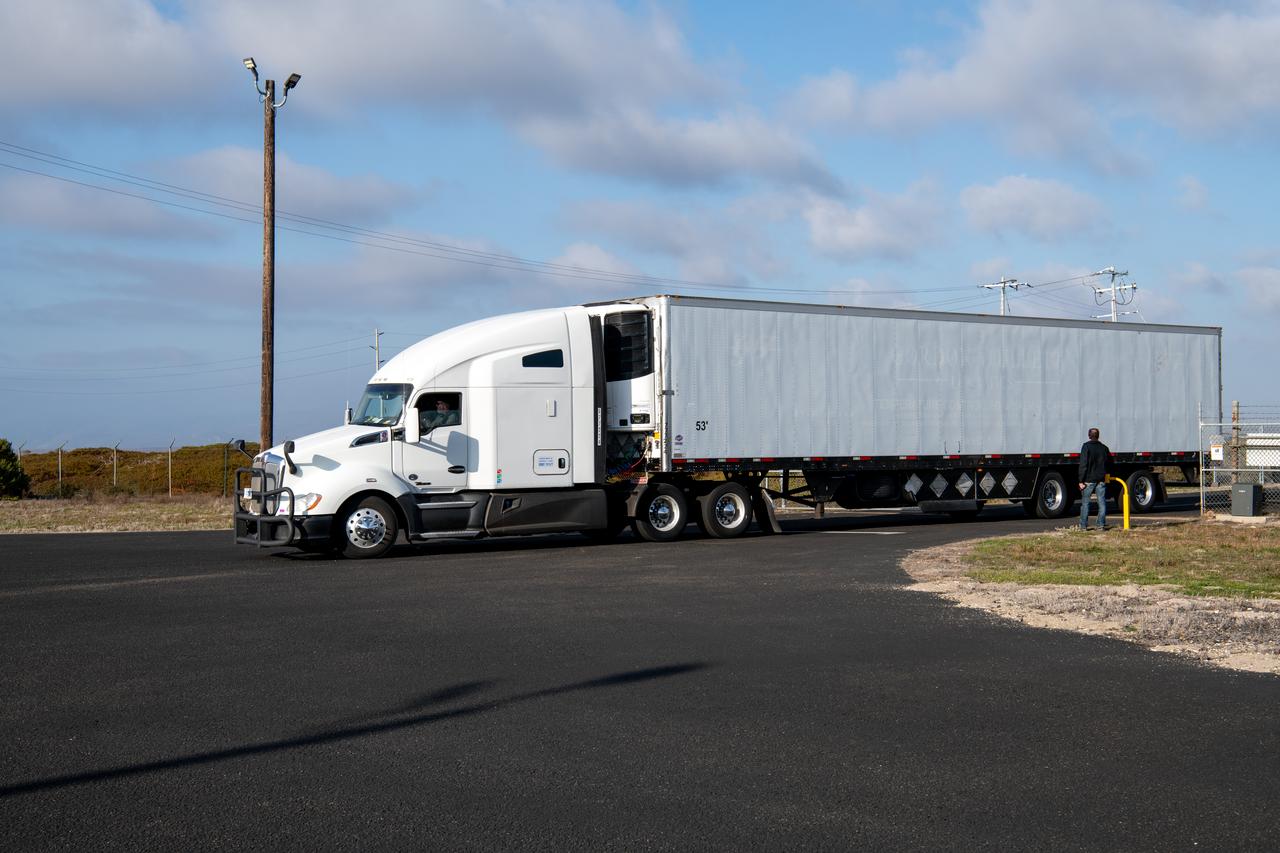
A transport truck carrying four small satellites of NASA’s PUNCH (Polarimeter to Unify the Corona and Heliosphere) arrives at Astrotech Space Operations located inside Vandenberg Space Force Base in California on Saturday, Jan. 18, 2025. PUNCH will make 3D observations of the Sun’s corona to learn how the mass and energy becomes solar wind. PUNCH, along with NASA’s SPHEREx (Spectro-Photometer for the History of the Universe, Epoch of Reionization and Ices Explorer), a space telescope, will launch aboard a SpaceX Falcon 9 rocket in late February 2025.
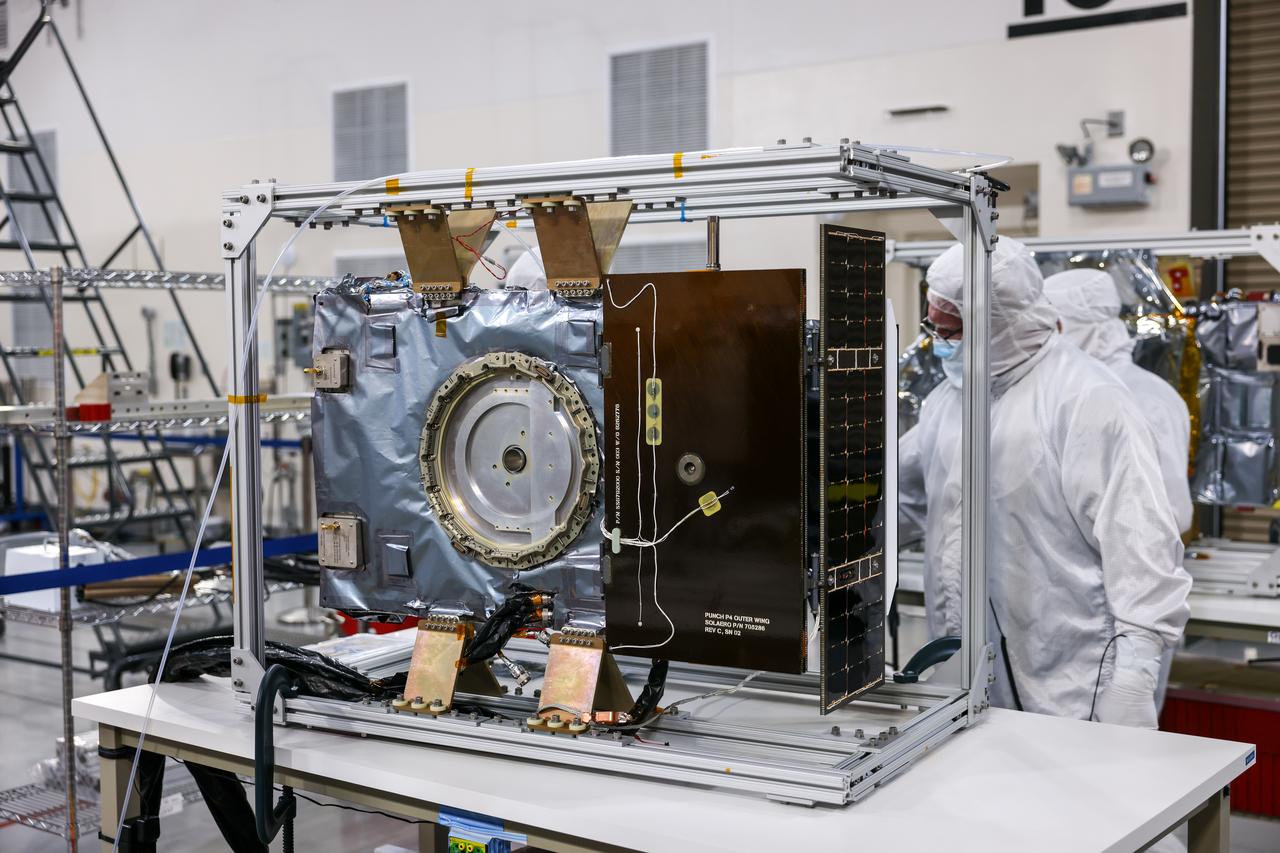
Crews conduct a solar array deployment test on the spacecraft of NASA’s PUNCH (Polarimeter to Unify the Corona and Heliosphere) satellites at Astrotech Space Operations located on Vandenberg Space Force Base in California on Tuesday, Jan. 21, 2025. The four satellites of PUNCH will make 3D observations of the Sun’s corona to learn how the mass and energy becomes solar wind. PUNCH, along with NASA’s SPHEREx (Spectro-Photometer for the History of the Universe, Epoch of Reionization and Ices Explorer), a space telescope, will launch aboard a SpaceX Falcon 9 rocket in late February 2025.
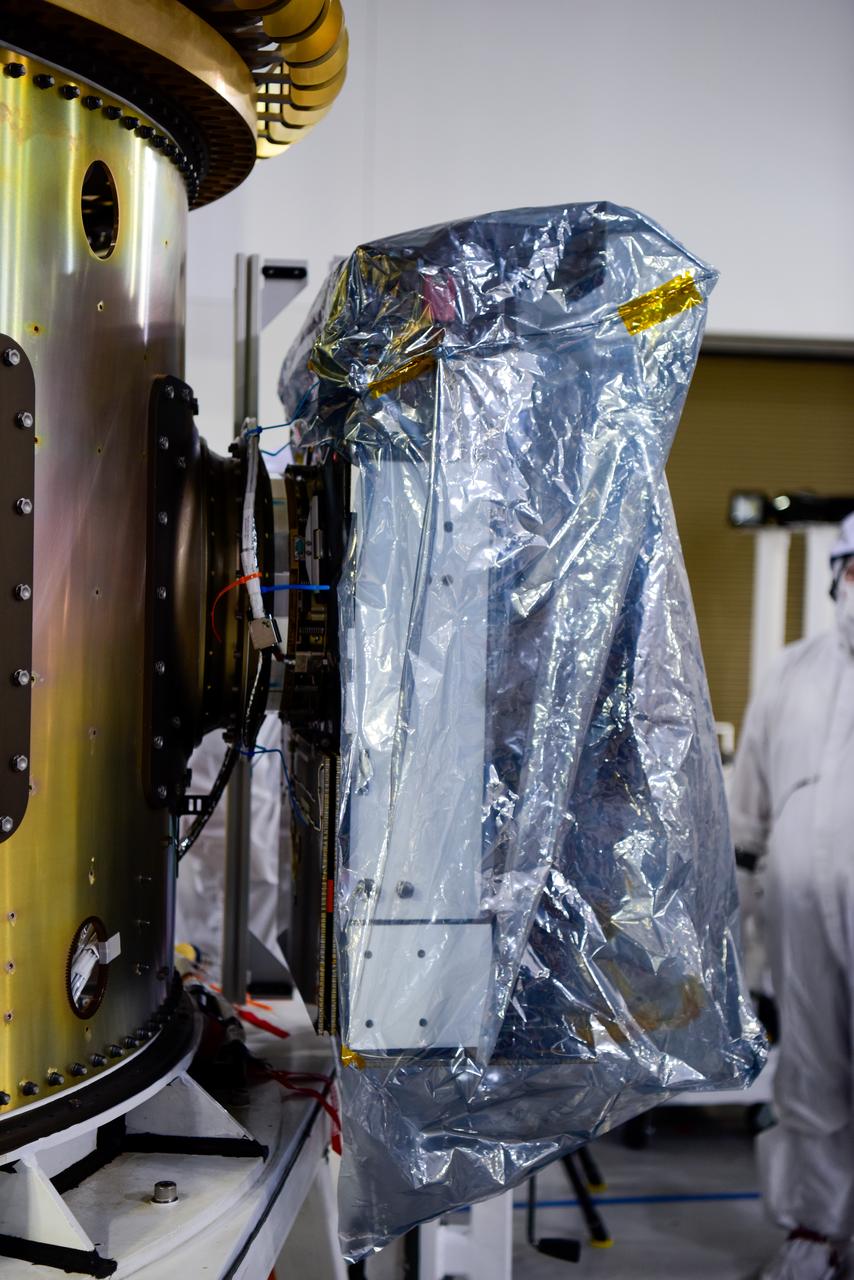
Technicians integrate NASA’s four PUNCH (Polarimeter to Unify the Corona and Heliosphere) satellites to the evolved expendable launch vehicle secondary payload adapter array ring inside the Astrotech Space Operations Facility at Vandenberg Space Force Base in California on Friday, Feb. 14, 2025. PUNCH will study origins of the Sun’s outflow of material, or the solar wind, capturing continuous 3D images of the Sun’s corona and the solar wind’s journey into the solar system. The PUNCH mission is launching as a rideshare with NASA’s SPHEREx (Spectro-Photometer for the History of the Universe, Epoch of Reionization and Ices Explorer) observatory scheduled to launch aboard a SpaceX Falcon 9 rocket at 10:09 p.m. EST (7:09 p.m. PST), Friday, Feb. 28, 2025, at Space Launch Complex 4 East from Vandenberg Space Force Base in California.
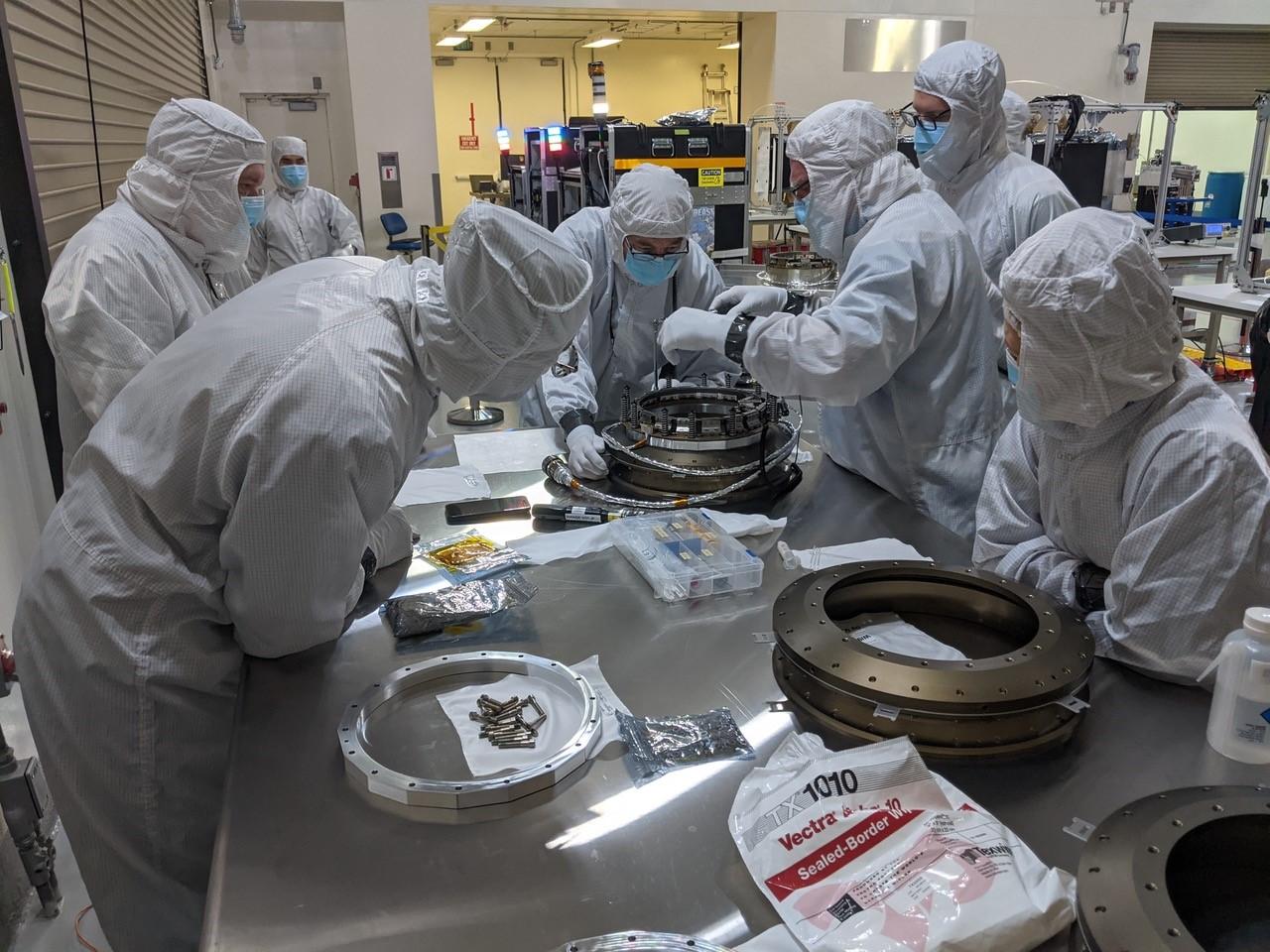
Technicians conduct integration and testing of NASA’s PUNCH (Polarimeter to Unify the Corona and Heliosphere) satellites during prelaunch operations inside Astrotech Space Operations on Vandenberg Space Force Base in California on Thursday, Jan. 23, 2025. PUNCH, consisting of four satellites, will produce continuous 3D images of the solar wind and solar storms as it travels from the Sun to Earth to better understand how material in the corona accelerates to become the solar wind that fills the solar system. PUNCH, along with NASA’s SPHEREx (Spectro-Photometer for the History of the Universe, Epoch of Reionization and Ices Explorer), a space telescope, will launch aboard a SpaceX Falcon 9 rocket in late February 2025.
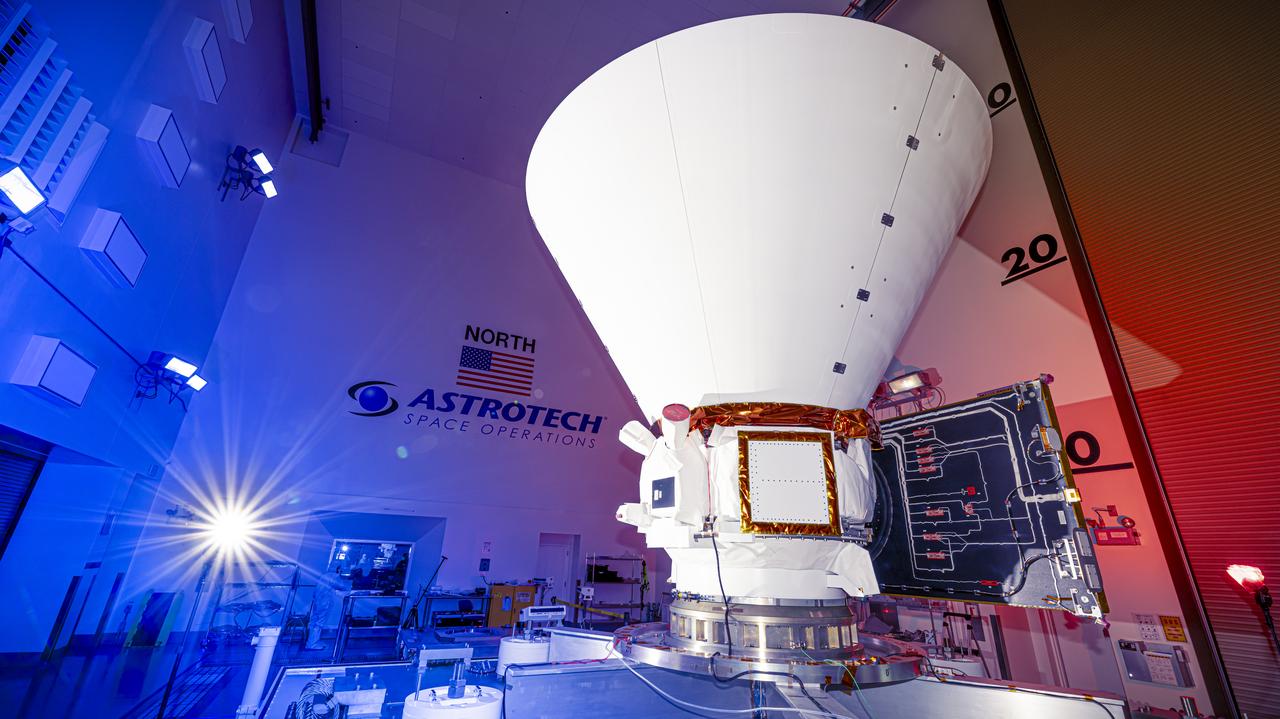
NASA’s SPHEREx (Spectro-Photometer for the History of the Universe, Epoch of Reionization and Ices Explorer), a space telescope, is situated on a work stand ahead of prelaunch operations at the Astrotech Processing Facility at Vandenberg Space Force Base in California on Thursday, Jan. 16, 2025. SPHEREx will enter a polar orbit around Earth and create a 3D map of the entire sky, gathering information about millions of galaxies for scientists to study what happened after the big bang, the history of galaxy evolution, and the origins of water in planetary systems in our galaxy. SPHEREx will launch aboard a SpaceX Falcon 9 rocket in late February 2025.
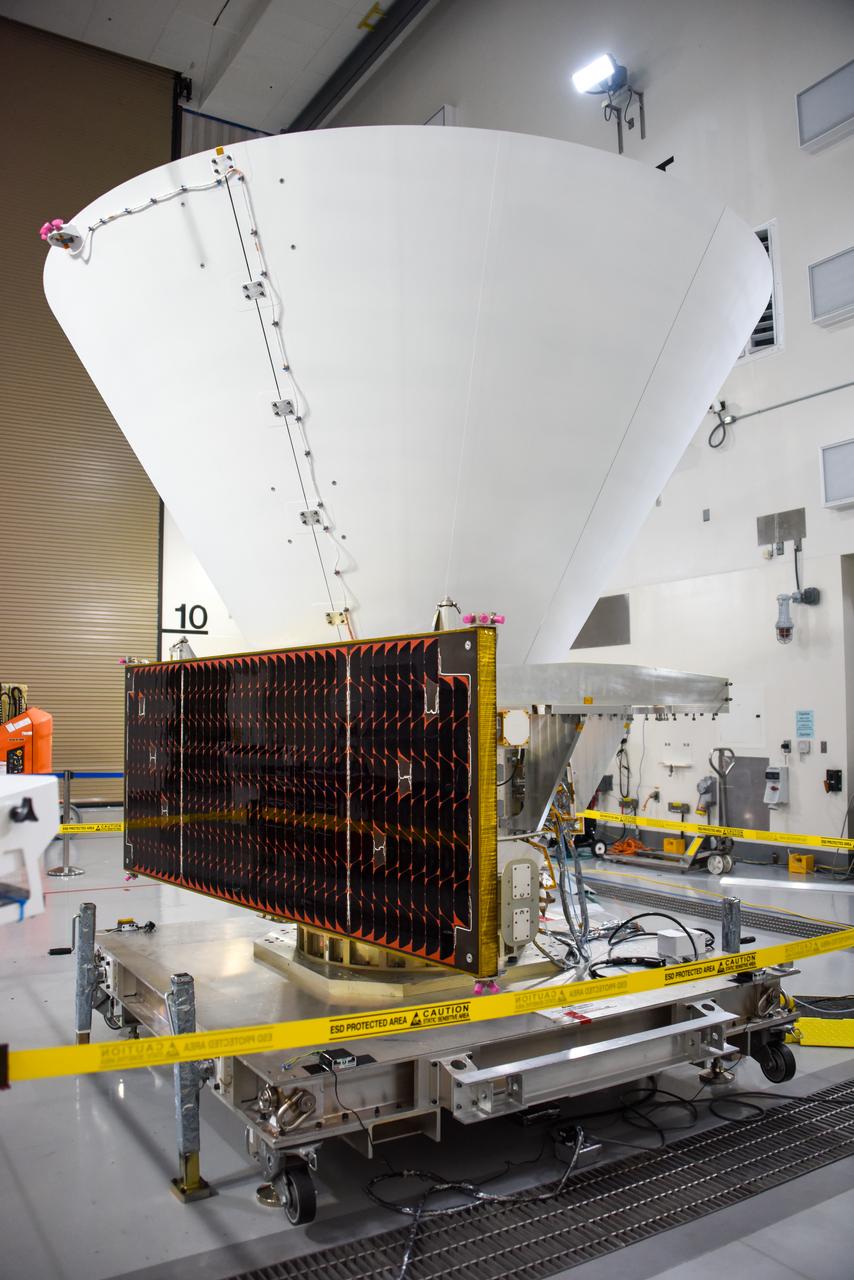
NASA’s SPHEREx (Spectro-Photometer for the History of the Universe, Epoch of Reionization and Ices Explorer), a space telescope, is situated on a work stand ahead of prelaunch operations at the Astrotech Processing Facility at Vandenberg Space Force Base in California on Friday, Jan. 17, 2025. SPHEREx will enter a polar orbit around Earth and create a 3D map of the entire sky, gathering information about millions of galaxies for scientists to study what happened after the big bang, the history of galaxy evolution, and the origins of water in planetary systems in our galaxy. SPHEREx will launch aboard a SpaceX Falcon 9 rocket in late February 2025.
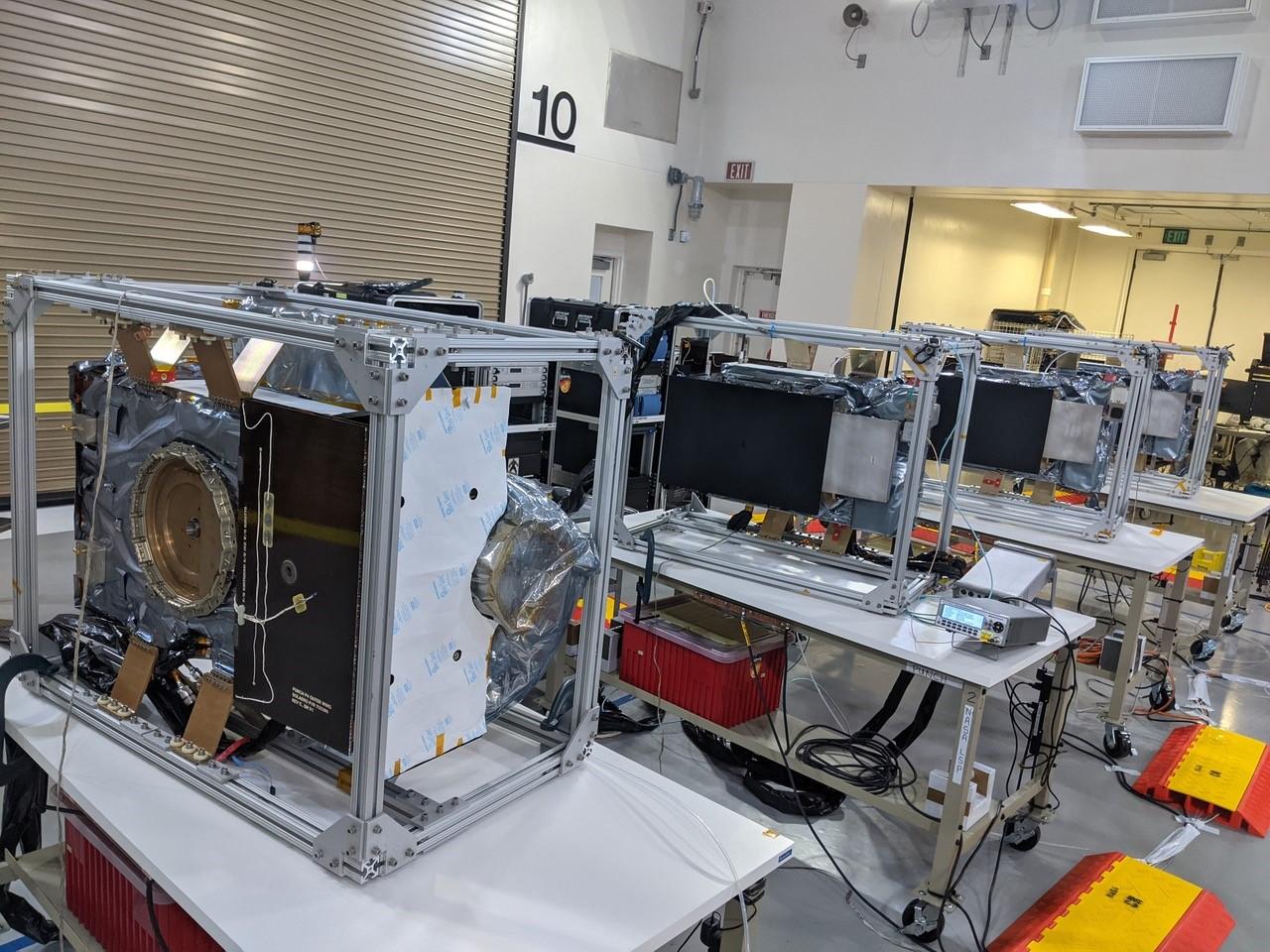
Technicians conduct integration and testing of NASA’s PUNCH (Polarimeter to Unify the Corona and Heliosphere) satellites during prelaunch operations inside Astrotech Space Operations on Vandenberg Space Force Base in California on Thursday, Jan. 23, 2025. PUNCH, consisting of four satellites, will produce continuous 3D images of the solar wind and solar storms as it travels from the Sun to Earth to better understand how material in the corona accelerates to become the solar wind that fills the solar system. PUNCH, along with NASA’s SPHEREx (Spectro-Photometer for the History of the Universe, Epoch of Reionization and Ices Explorer), a space telescope, will launch aboard a SpaceX Falcon 9 rocket in late February 2025.
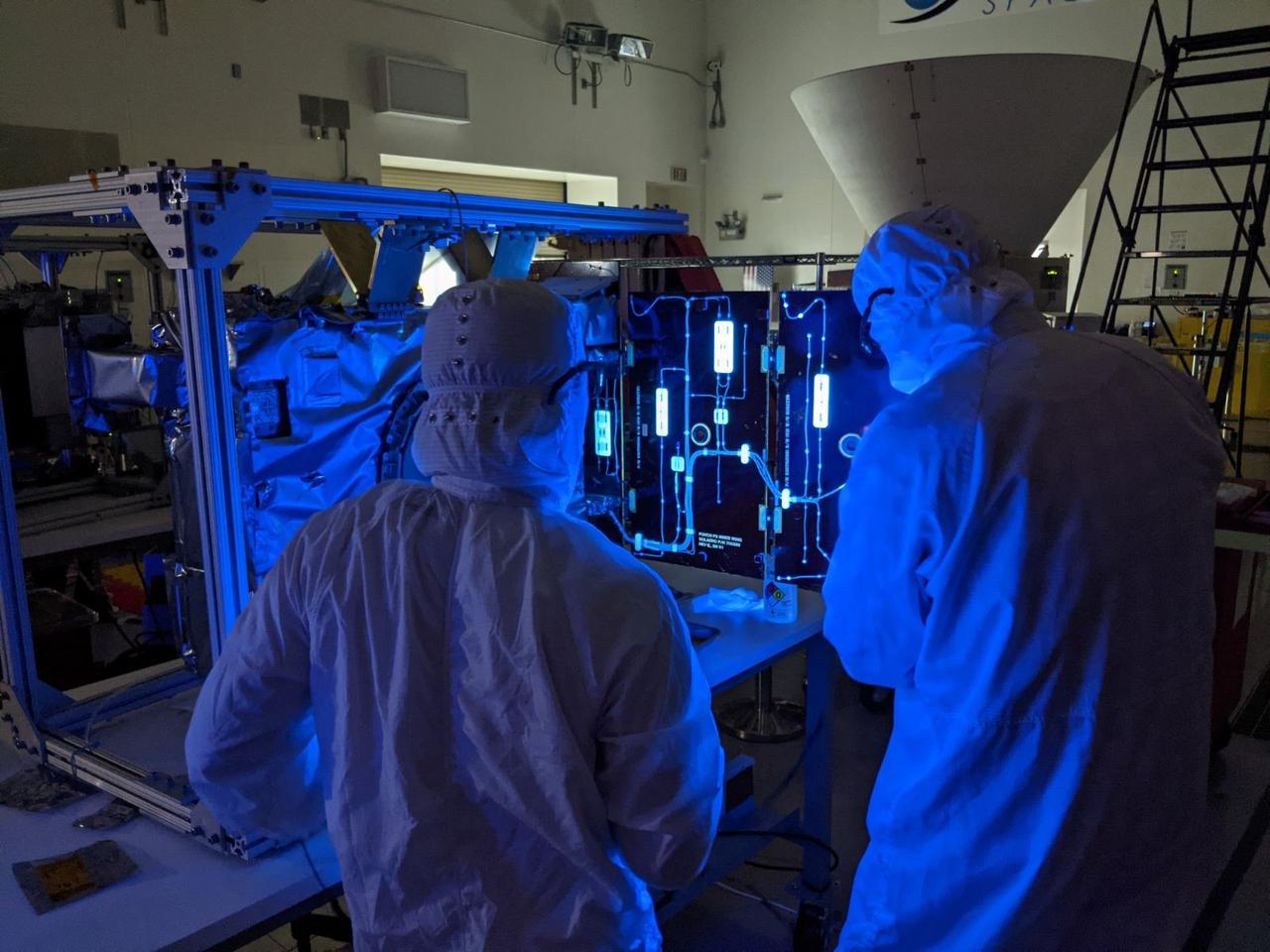
Technicians conduct integration and testing of NASA’s PUNCH (Polarimeter to Unify the Corona and Heliosphere) satellites during prelaunch operations inside Astrotech Space Operations on Vandenberg Space Force Base in California on Thursday, Jan. 23, 2025. PUNCH, consisting of four satellites, will produce continuous 3D images of the solar wind and solar storms as it travels from the Sun to Earth to better understand how material in the corona accelerates to become the solar wind that fills the solar system. PUNCH, along with NASA’s SPHEREx (Spectro-Photometer for the History of the Universe, Epoch of Reionization and Ices Explorer), a space telescope, will launch aboard a SpaceX Falcon 9 rocket in late February 2025.
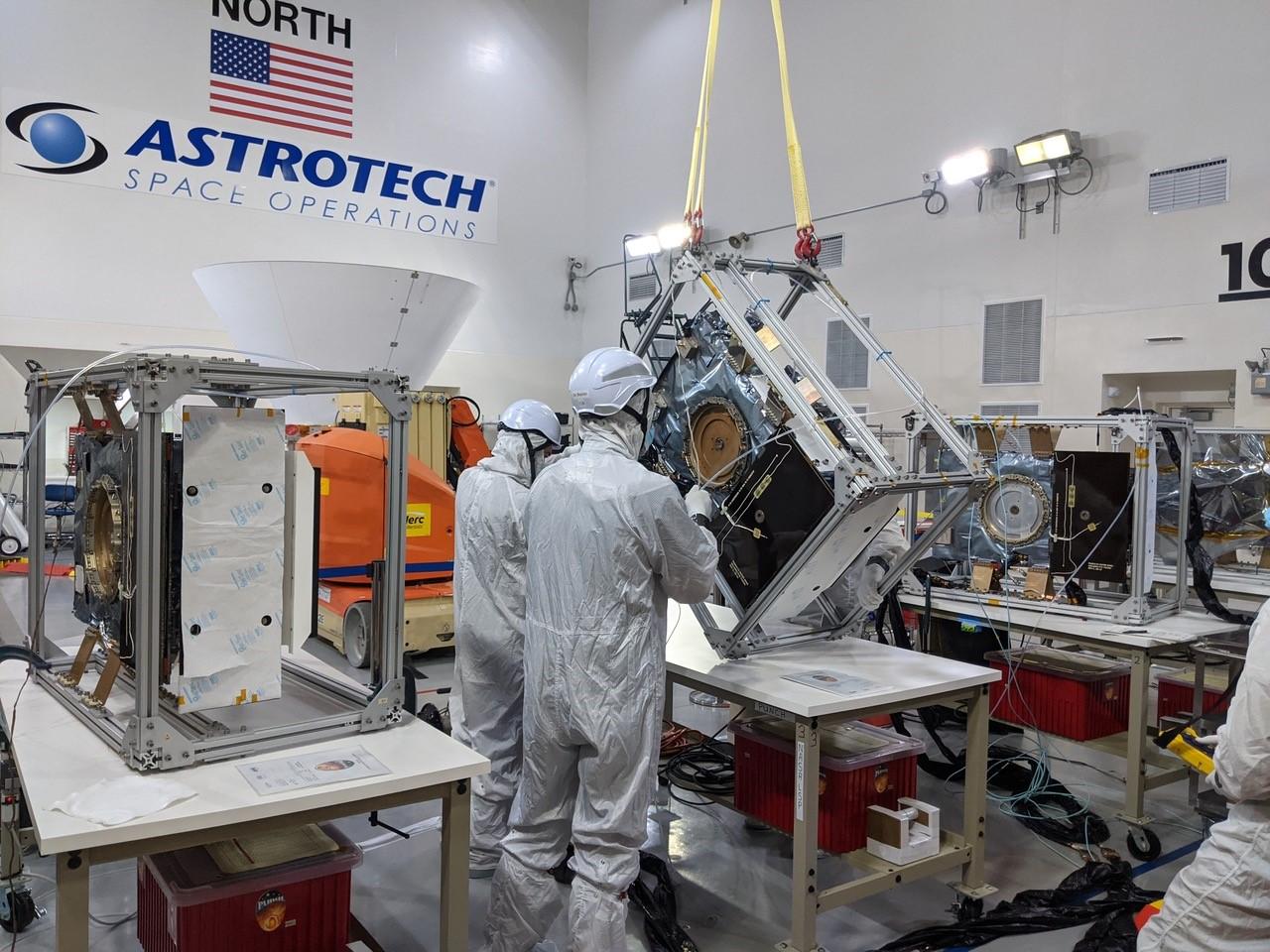
Technicians conduct integration and testing of NASA’s PUNCH (Polarimeter to Unify the Corona and Heliosphere) satellites during prelaunch operations inside Astrotech Space Operations on Vandenberg Space Force Base in California on Thursday, Jan. 23, 2025. PUNCH, consisting of four satellites, will produce continuous 3D images of the solar wind and solar storms as it travels from the Sun to Earth to better understand how material in the corona accelerates to become the solar wind that fills the solar system. PUNCH, along with NASA’s SPHEREx (Spectro-Photometer for the History of the Universe, Epoch of Reionization and Ices Explorer), a space telescope, will launch aboard a SpaceX Falcon 9 rocket in late February 2025.
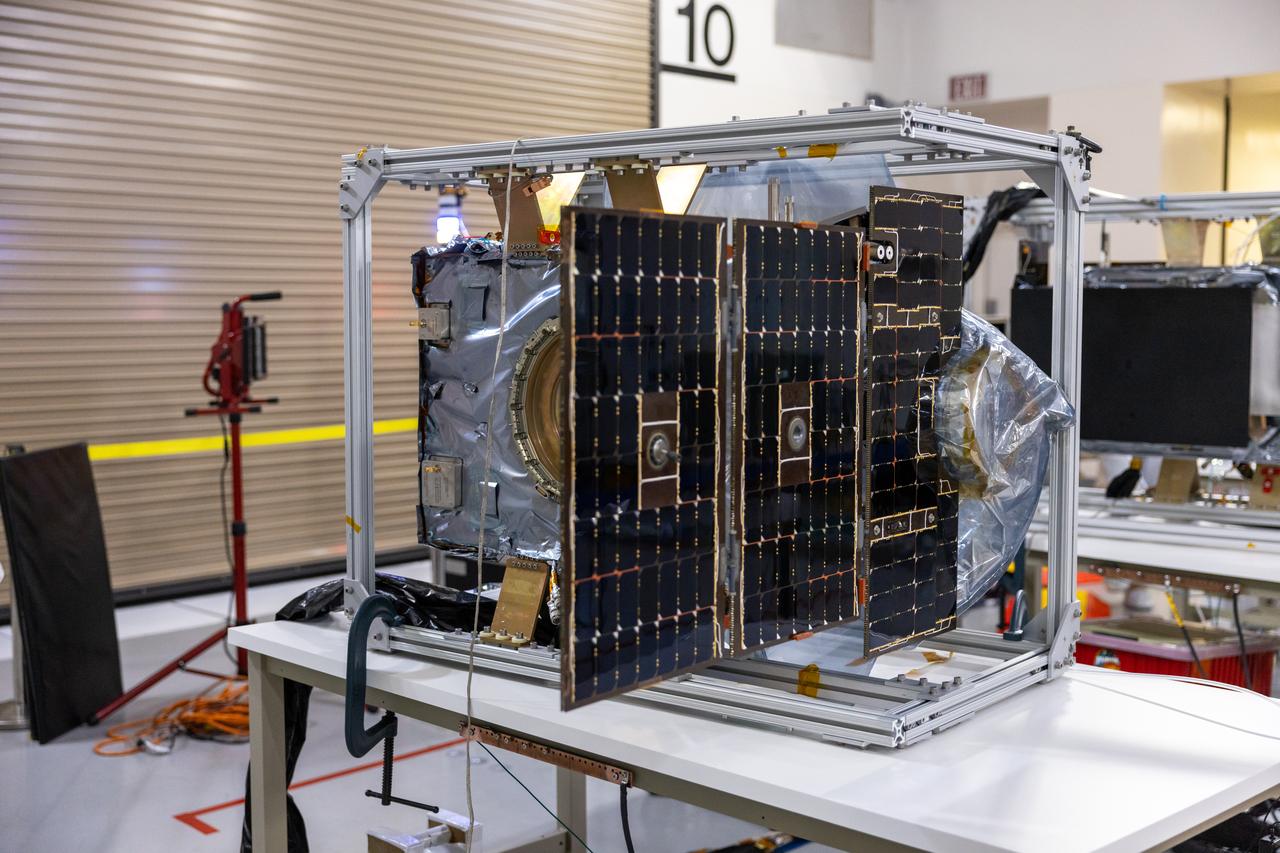
Crews conduct additional solar array deployment testing for NASA’s PUNCH (Polarimeter to Unify the Corona and Heliosphere) satellites at Astrotech Space Operations located on Vandenberg Space Force Base in California on Wednesday, Jan. 22, 2025. PUNCH, consisting of four satellites, will produce continuous 3D images of the solar wind and solar storms as it travels from the Sun to Earth to better understand how material in the corona accelerates. PUNCH, along with NASA’s SPHEREx (Spectro-Photometer for the History of the Universe, Epoch of Reionization and Ices Explorer), a space telescope, will launch aboard a SpaceX Falcon 9 rocket from Launch Complex 4E at Vandenberg Space Force Base in Central California on Thursday, Feb. 27, 2025.

Employees with BAE Systems pose for a photo following the arrival of NASA’s SPHEREx (Spectro-Photometer for the History of the Universe, Epoch of Reionization and Ices Explorer) observatory inside the Astrotech Space Operations Facility at Vandenberg Space Force Base in California on Tuesday, Jan. 14, 2025. BAE Systems (formerly Ball Aerospace) built the telescope and the spacecraft bus. SPHEREx will use its telescope to provide an all-sky spectral survey, creating a 3D map of the entire sky to help scientists investigate the origins of our universe. Riding along with SPHEREx, NASA’s PUNCH (Polarimeter to Unify the Corona and Heliosphere) mission will study origins of the Sun’s outflow of material, or the solar wind. Liftoff aboard a SpaceX Falcon 9 rocket is targeted for 10:09 p.m. EST (7:09 p.m. PST), Thursday, Feb. 27, 2025, from Space Launch Complex 4 East.
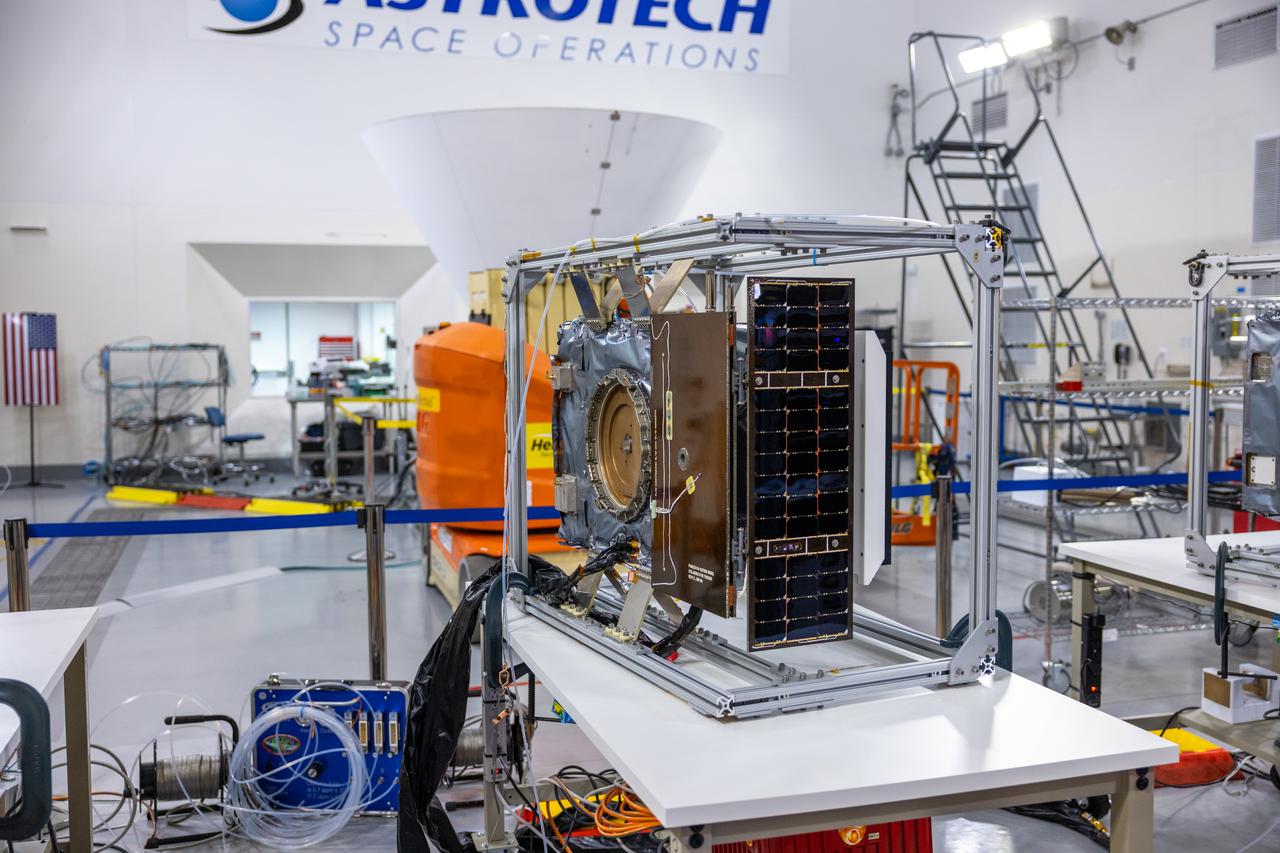
Crews conduct additional solar array deployment testing for NASA’s PUNCH (Polarimeter to Unify the Corona and Heliosphere) satellites at Astrotech Space Operations located on Vandenberg Space Force Base in California on Wednesday, Jan. 22, 2025. PUNCH, consisting of four satellites, will produce continuous 3D images of the solar wind and solar storms as it travels from the Sun to Earth to better understand how material in the corona accelerates. PUNCH, along with NASA’s SPHEREx (Spectro-Photometer for the History of the Universe, Epoch of Reionization and Ices Explorer), a space telescope, will launch aboard a SpaceX Falcon 9 rocket from Launch Complex 4E at Vandenberg Space Force Base in Central California on Thursday, Feb. 27, 2025.

Both halves of the United Launch Alliance (ULA) Atlas V payload fairing are moved into position for a fit check at the Astrotech Processing Facility at Vandenberg Space Force Base (VSFB) in California on Aug. 13, 2022, for NASA and the National Oceanic and Atmospheric Administration’s (NOAA) Joint Polar Satellite System-2 (JPSS-2) satellite mission. JPSS-2 is the third satellite in the Joint Polar Satellite System series. It is scheduled to lift off from VSFB on Nov. 1 from Space Launch Complex-3 East. JPSS-2 will scan the globe as it orbits from the North to the South Pole, crossing the equator 14 times a day. From 512 miles above Earth, it will capture data that inform weather forecasts, extreme weather events, and climate change. The Visible Infrared Radiometer Suite instrument will collect imagery for global observations of the land, atmosphere, cryosphere, and oceans. Launching as a secondary payload to JPSS-2 is NASA’s Low-Earth Orbit Flight Test of an Inflatable Decelerator (LOFTID), dedicated to the memory of Bernard Kutter. LOFTID is a demonstration of a hypersonic inflatable aerodynamic decelerator, or aeroshell, technology that could one day help land humans on Mars.
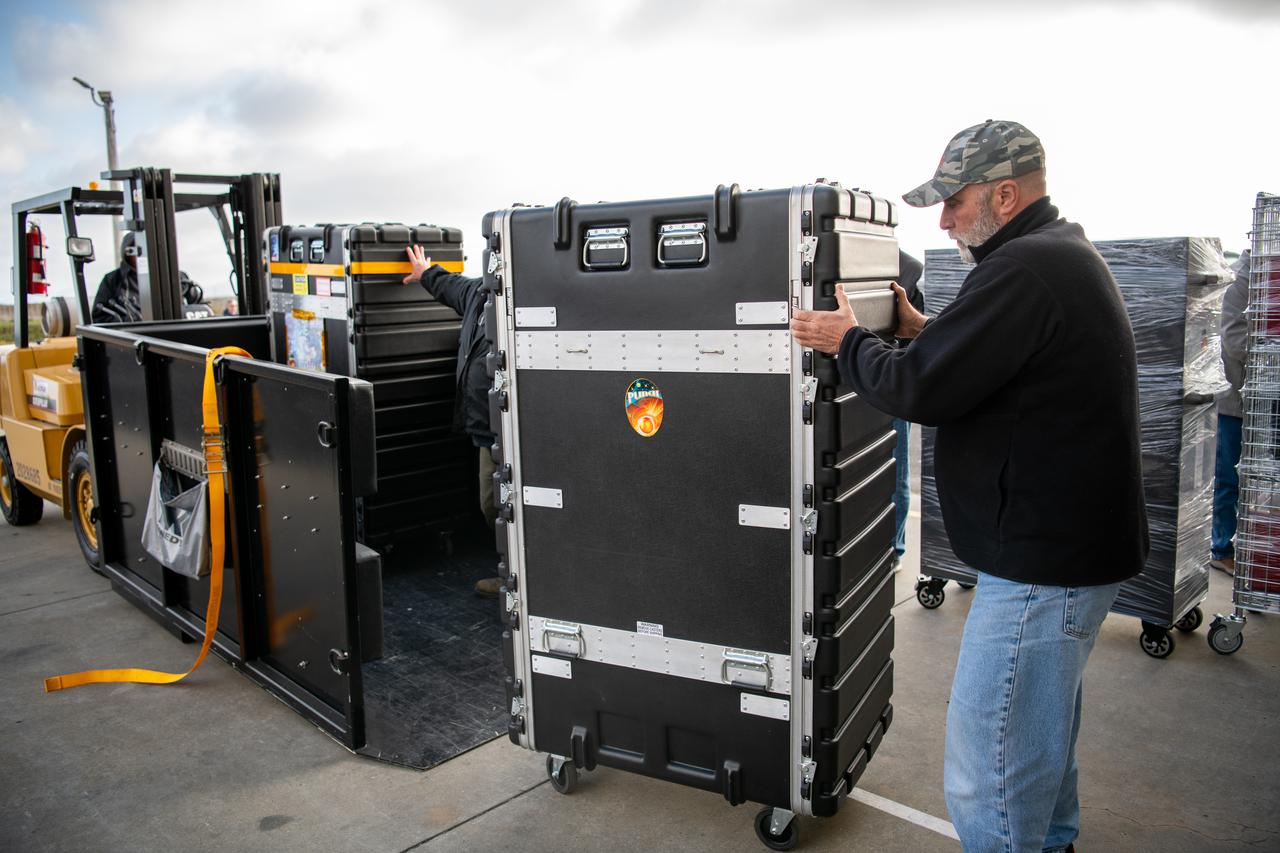
Teams at Vandenberg Space Force Base in California offload several shipping containers protecting NASA’s PUNCH (Polarimeter to Unify the Corona and Heliosphere) satellites on Saturday, Jan. 18, 2025. PUNCH will make 3D observations of the Sun’s corona to learn how the mass and energy becomes solar wind. PUNCH, along with NASA’s SPHEREx (Spectro-Photometer for the History of the Universe, Epoch of Reionization and Ices Explorer), a space telescope, will launch aboard a SpaceX Falcon 9 rocket in late February 2025.
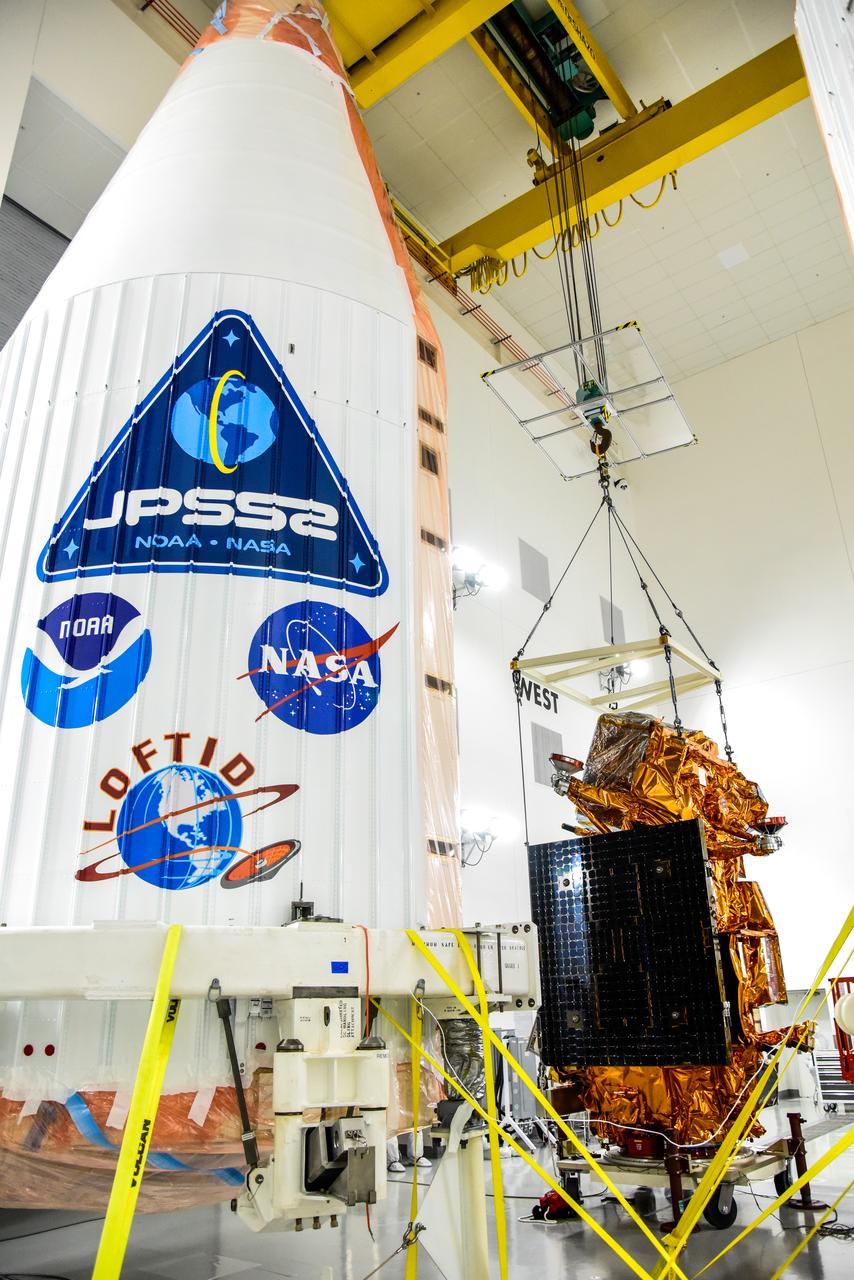
A crane is used to lift NASA and the National Oceanic and Atmospheric Administration’s (NOAA) Joint Polar Satellite System-2 (JPSS-2) satellite for transfer to an Aronson Table for processing inside the Astrotech Space Operations facility at Vandenberg Space Force Base in California on Aug. 22, 2022. JPSS-2 is the third satellite in the Joint Polar Satellite System series. It is scheduled to lift off from VSFB on Nov. 1 from Space Launch Complex-3. JPSS-2, which will be renamed NOAA-21 after reaching orbit, will join a constellation of JPSS satellites that orbit from the North to the South pole, circling Earth 14 times a day and providing a full view of the entire globe twice daily. The NOAA/NASA Suomi National Polar-orbiting Partnership (Suomi NPP) satellite, and NOAA-20, previously known as JPSS-1, are both already in orbit. Each satellite carries at least four advanced instruments to measure weather and climate conditions on Earth. A secondary payload on the mission is the Low-Earth Orbit Flight Test of an Inflatable Decelerator (LOFTID), and is dedicated to the memory of Bernard Kutter. LOFTID will demonstrate inflatable heat shield technology that could enable a variety of proposed NASA missions to destinations such as Mars, Venus, and Titan, as well as returning heavier payloads from low-Earth orbit.
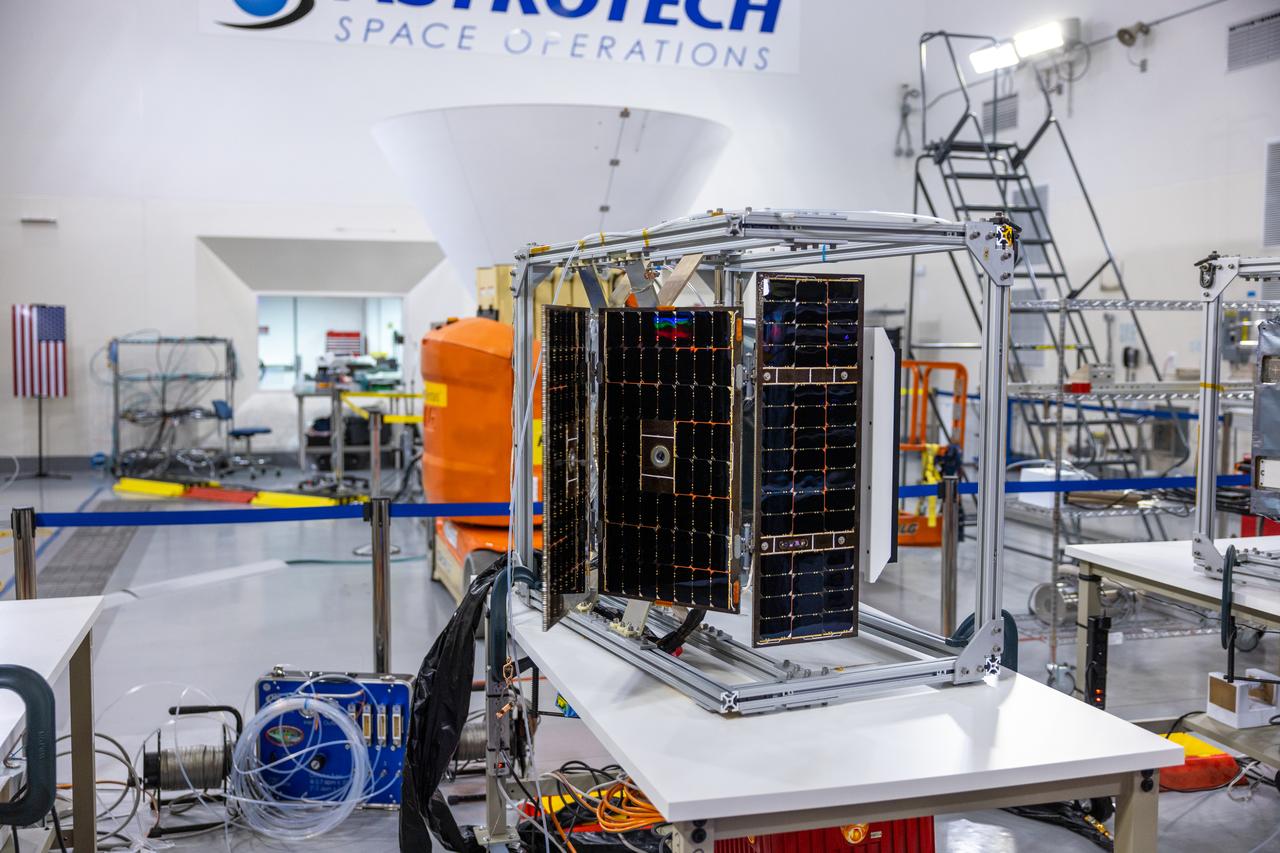
Crews conduct additional solar array deployment testing for NASA’s PUNCH (Polarimeter to Unify the Corona and Heliosphere) satellites at Astrotech Space Operations located on Vandenberg Space Force Base in California on Wednesday, Jan. 22, 2025. PUNCH, consisting of four satellites, will produce continuous 3D images of the solar wind and solar storms as it travels from the Sun to Earth to better understand how material in the corona accelerates. PUNCH, along with NASA’s SPHEREx (Spectro-Photometer for the History of the Universe, Epoch of Reionization and Ices Explorer), a space telescope, will launch aboard a SpaceX Falcon 9 rocket from Launch Complex 4E at Vandenberg Space Force Base in Central California on Thursday, Feb. 27, 2025.
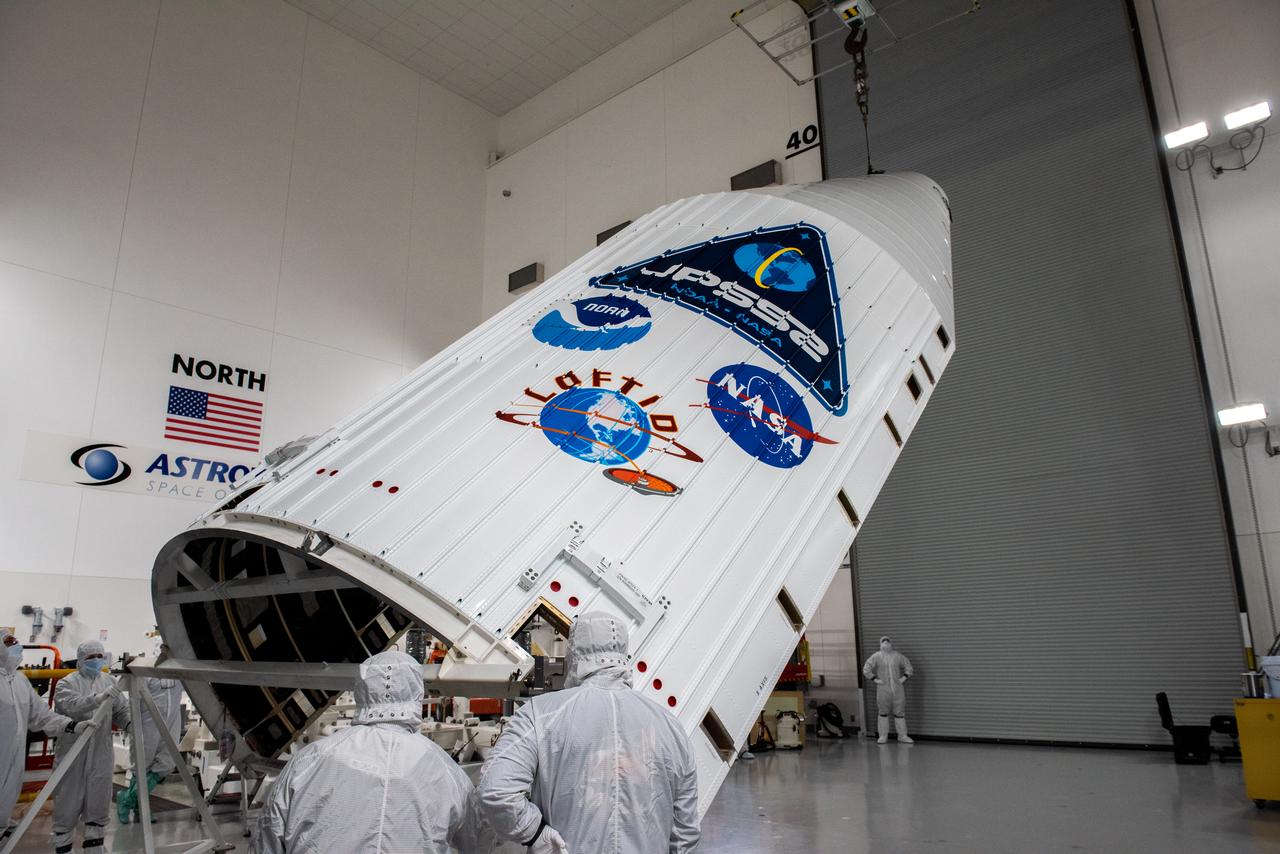
On Aug. 11, 2022, teams at the Astrotech facility at Vandenberg Space Force Base (VSFB) in California use a crane to raise to vertical one of the United Launch Alliance (ULA) Atlas V payload fairing halves for NASA and the National Oceanic and Atmospheric Administration’s (NOAA) Joint Polar Satellite System-2 (JPSS-2) satellite mission. The payload fairing protects the spacecraft during launch and flight through the atmosphere. JPSS-2 is the third satellite in the Joint Polar Satellite System series. It is scheduled to lift off from VSFB on Nov. 1 from Space Launch Complex-3 East. JPSS-2 will scan the globe as it orbits from the North to the South Pole, crossing the equator 14 times a day. From 512 miles above Earth, it will capture data that inform weather forecasts, extreme weather events, and climate change. The Visible Infrared Radiometer Suite instrument will collect imagery for global observations of the land, atmosphere, cryosphere, and oceans. Launching as a secondary payload to JPSS-2 is NASA’s Low-Earth Orbit Flight Test of an Inflatable Decelerator (LOFTID), dedicated to the memory of Bernard Kutter. LOFTID is a demonstration of a hypersonic inflatable aerodynamic decelerator, or aeroshell, technology that could one day help land humans on Mars.
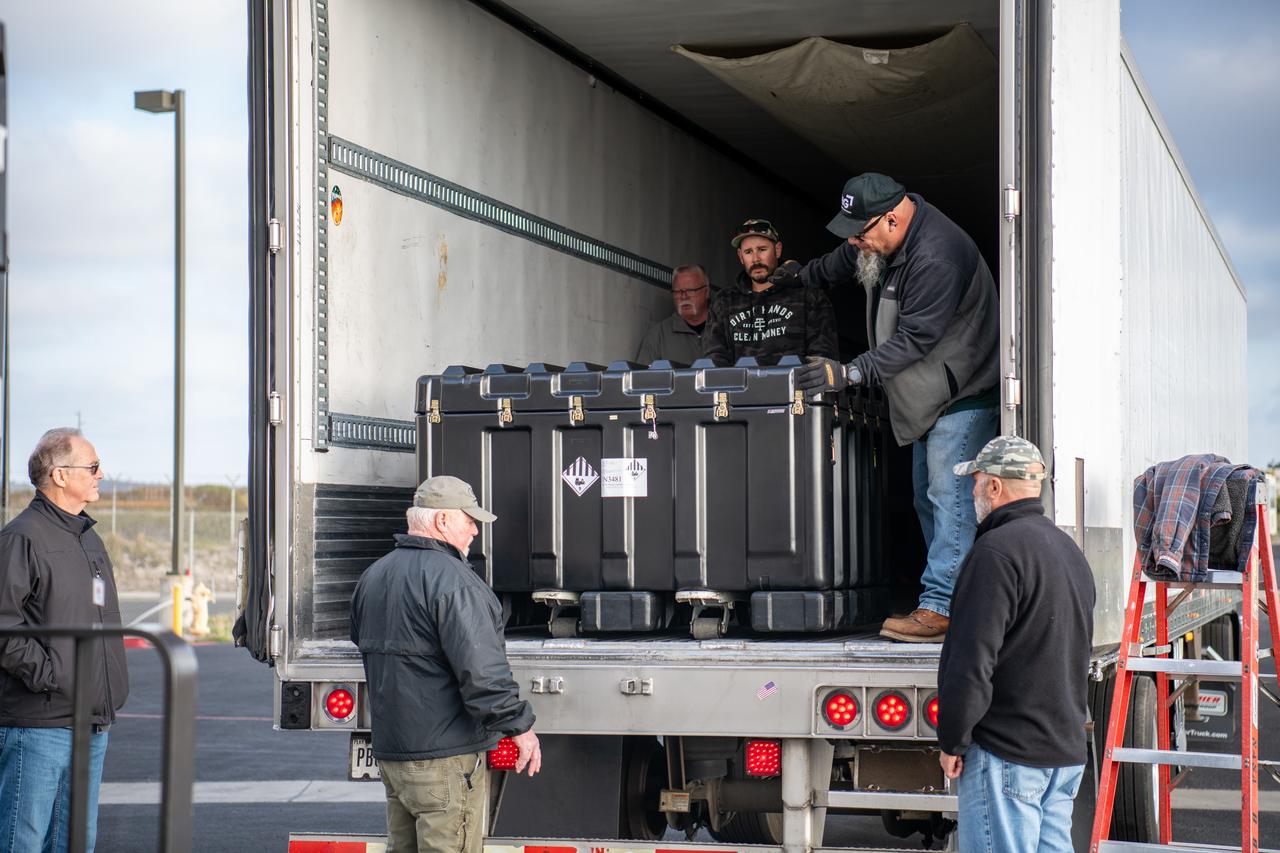
Teams at Vandenberg Space Force Base in California offload several shipping containers protecting NASA’s PUNCH (Polarimeter to Unify the Corona and Heliosphere) satellites on Saturday, Jan. 18, 2025. PUNCH will make 3D observations of the Sun’s corona to learn how the mass and energy becomes solar wind. PUNCH, along with NASA’s SPHEREx (Spectro-Photometer for the History of the Universe, Epoch of Reionization and Ices Explorer), a space telescope, will launch aboard a SpaceX Falcon 9 rocket in late February 2025.
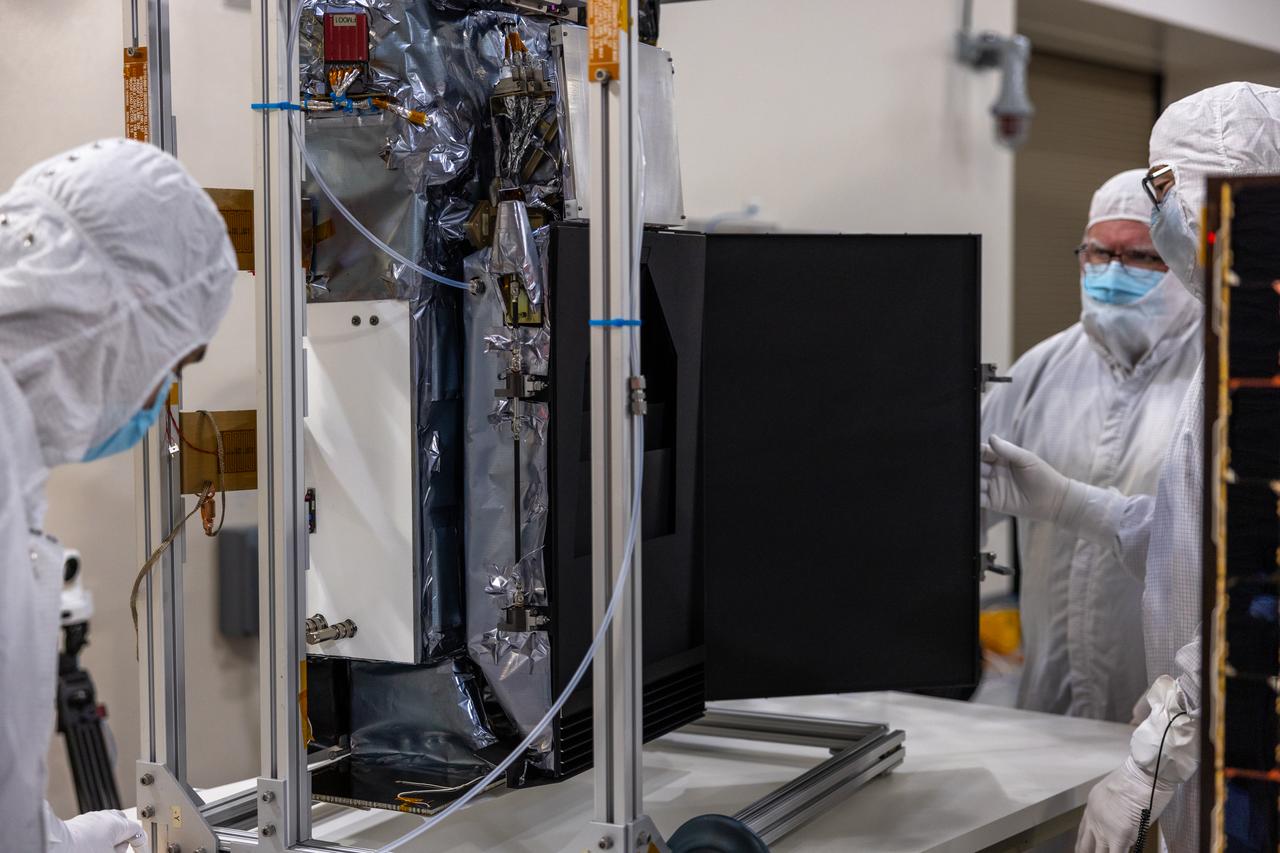
Crews conduct additional solar array deployment testing for NASA’s PUNCH (Polarimeter to Unify the Corona and Heliosphere) satellites at Astrotech Space Operations located on Vandenberg Space Force Base in California on Wednesday, Jan. 22, 2025. PUNCH, consisting of four satellites, will produce continuous 3D images of the solar wind and solar storms as it travels from the Sun to Earth to better understand how material in the corona accelerates. PUNCH, along with NASA’s SPHEREx (Spectro-Photometer for the History of the Universe, Epoch of Reionization and Ices Explorer), a space telescope, will launch aboard a SpaceX Falcon 9 rocket from Launch Complex 4E at Vandenberg Space Force Base in Central California on Thursday, Feb. 27, 2025.
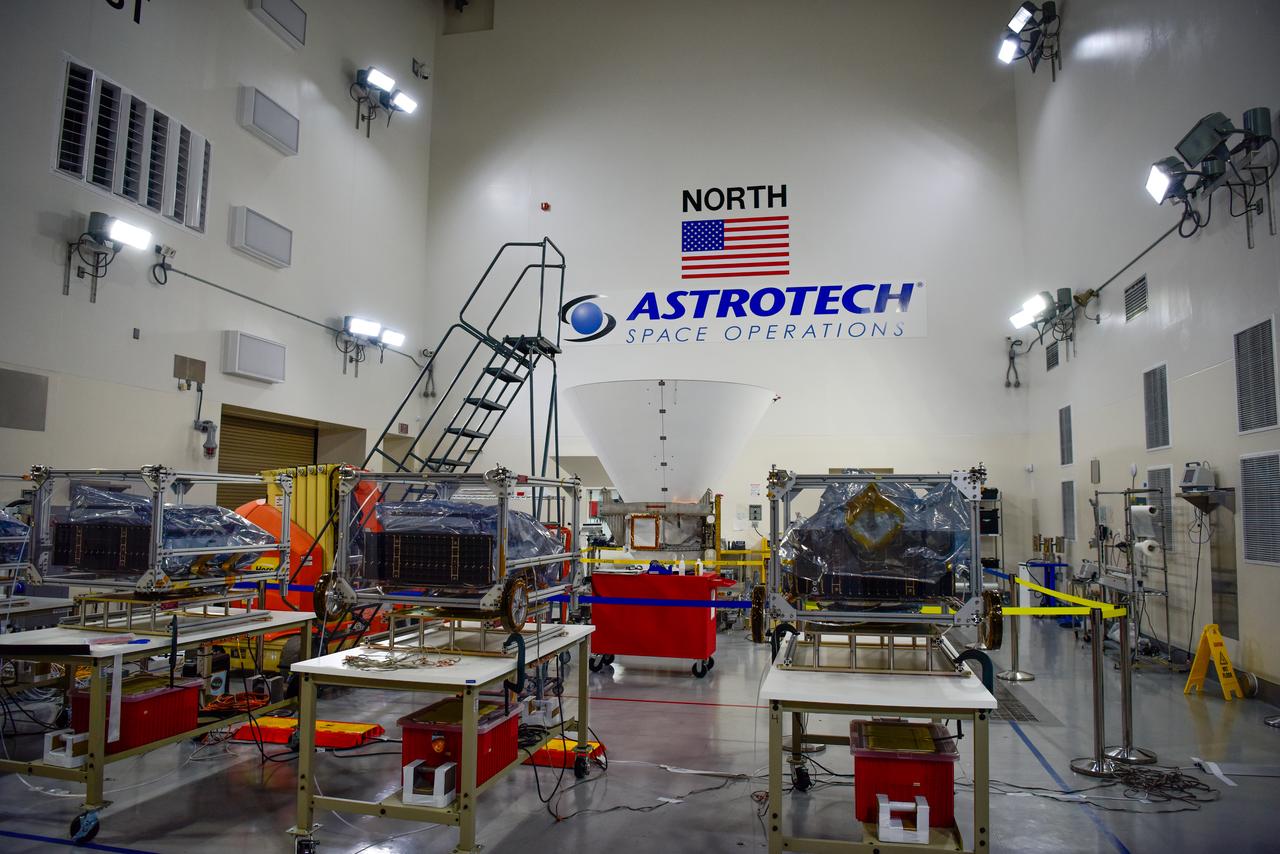
NASA’s four PUNCH (Polarimeter to Unify the Corona and Heliosphere) satellites await integration to the evolved expendable launch vehicle secondary payload adapter array ring inside the Astrotech Space Operations Facility at Vandenberg Space Force Base in California on Friday, Feb. 14, 2025. PUNCH will study origins of the Sun’s outflow of material, or the solar wind, capturing continuous 3D images of the Sun’s corona and the solar wind’s journey into the solar system. The PUNCH mission is launching as a rideshare with NASA’s SPHEREx (Spectro-Photometer for the History of the Universe, Epoch of Reionization and Ices Explorer) observatory scheduled to launch aboard a SpaceX Falcon 9 rocket at 10:09 p.m. EST (7:09 p.m. PST), Friday, Feb. 28, 2025, at Space Launch Complex 4 East from Vandenberg Space Force Base in California.
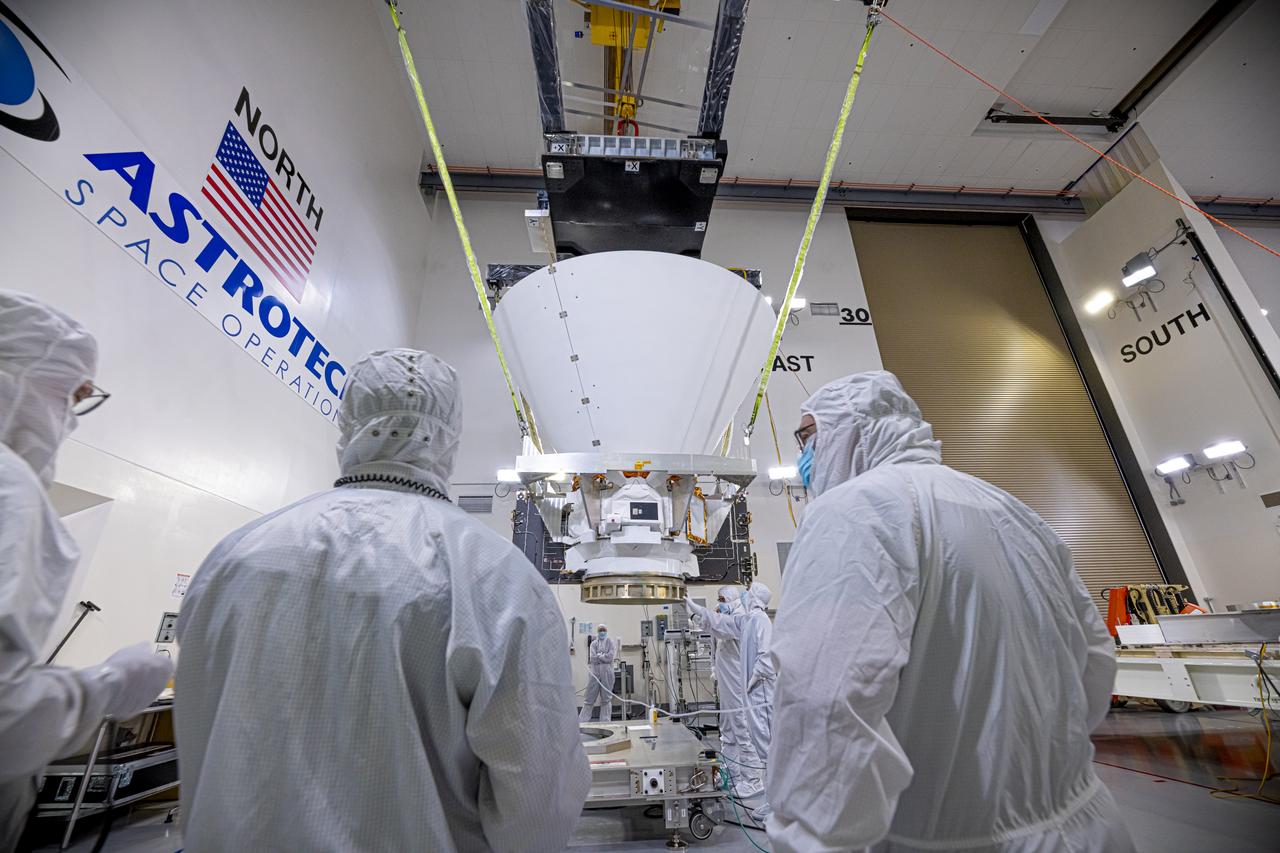
Employees with BAE Systems conduct spacecraft processing of NASA’s SPHEREx (Spectro-Photometer for the History of the Universe, Epoch of Reionization and Ices Explorer) observatory inside the Astrotech Space Operations Facility at Vandenberg Space Force Base in California on Thursday, Jan. 16, 2025. BAE Systems (formerly Ball Aerospace) built the telescope and the spacecraft bus. SPHEREx will use its telescope to provide an all-sky spectral survey, creating a 3D map of the entire sky to help scientists investigate the origins of our universe. Riding along with SPHEREx, NASA’s PUNCH (Polarimeter to Unify the Corona and Heliosphere) mission will study origins of the Sun’s outflow of material, or the solar wind. Liftoff aboard a SpaceX Falcon 9 rocket is targeted for 10:09 p.m. EST (7:09 p.m. PST), Thursday, Feb. 27, 2025, from Space Launch Complex 4 East.
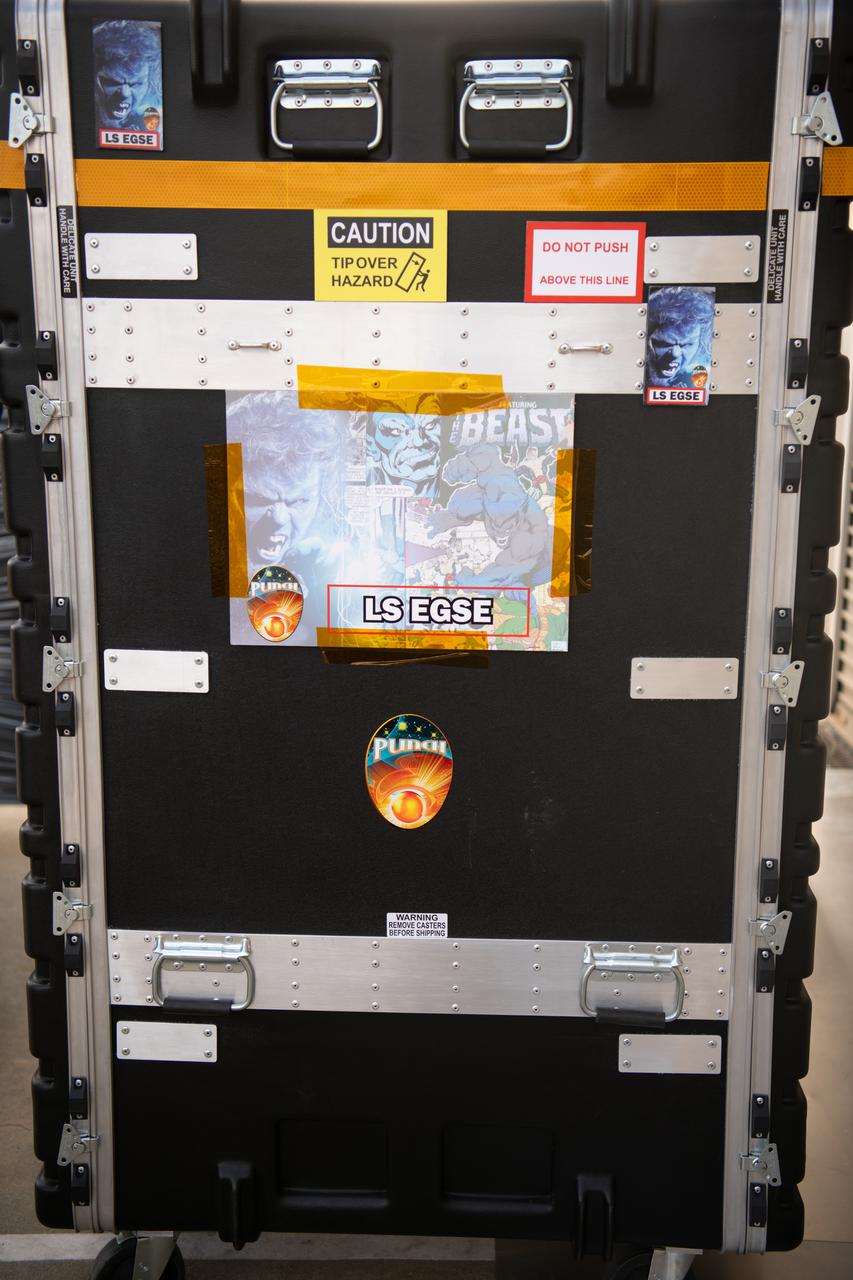
Teams at Vandenberg Space Force Base in California offload several shipping containers protecting NASA’s PUNCH (Polarimeter to Unify the Corona and Heliosphere) satellites on Saturday, Jan. 18, 2025. PUNCH will make 3D observations of the Sun’s corona to learn how the mass and energy becomes solar wind. PUNCH, along with NASA’s SPHEREx (Spectro-Photometer for the History of the Universe, Epoch of Reionization and Ices Explorer), a space telescope, will launch aboard a SpaceX Falcon 9 rocket in late February 2025.
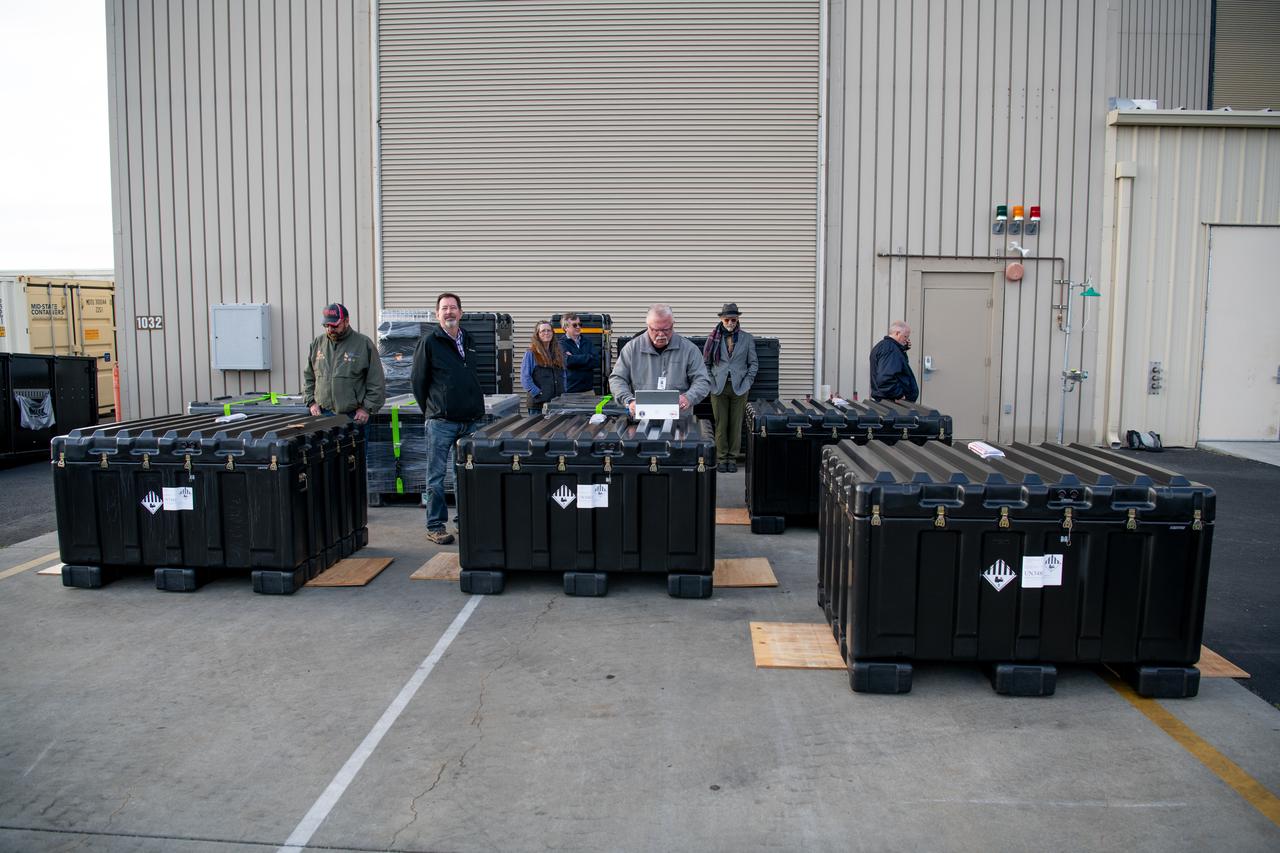
NASA’s four PUNCH (Polarimeter to Unify the Corona and Heliosphere) satellites arrive at Astrotech Space Operations located inside Vandenberg Space Force Base in California on Saturday, Jan. 18, 2025. The four satellites of PUNCH will make 3D observations of the Sun’s corona to learn how the mass and energy becomes solar wind. PUNCH, along with NASA’s SPHEREx (Spectro-Photometer for the History of the Universe, Epoch of Reionization and Ices Explorer), a space telescope, will launch aboard a SpaceX Falcon 9 rocket in late February 2025.
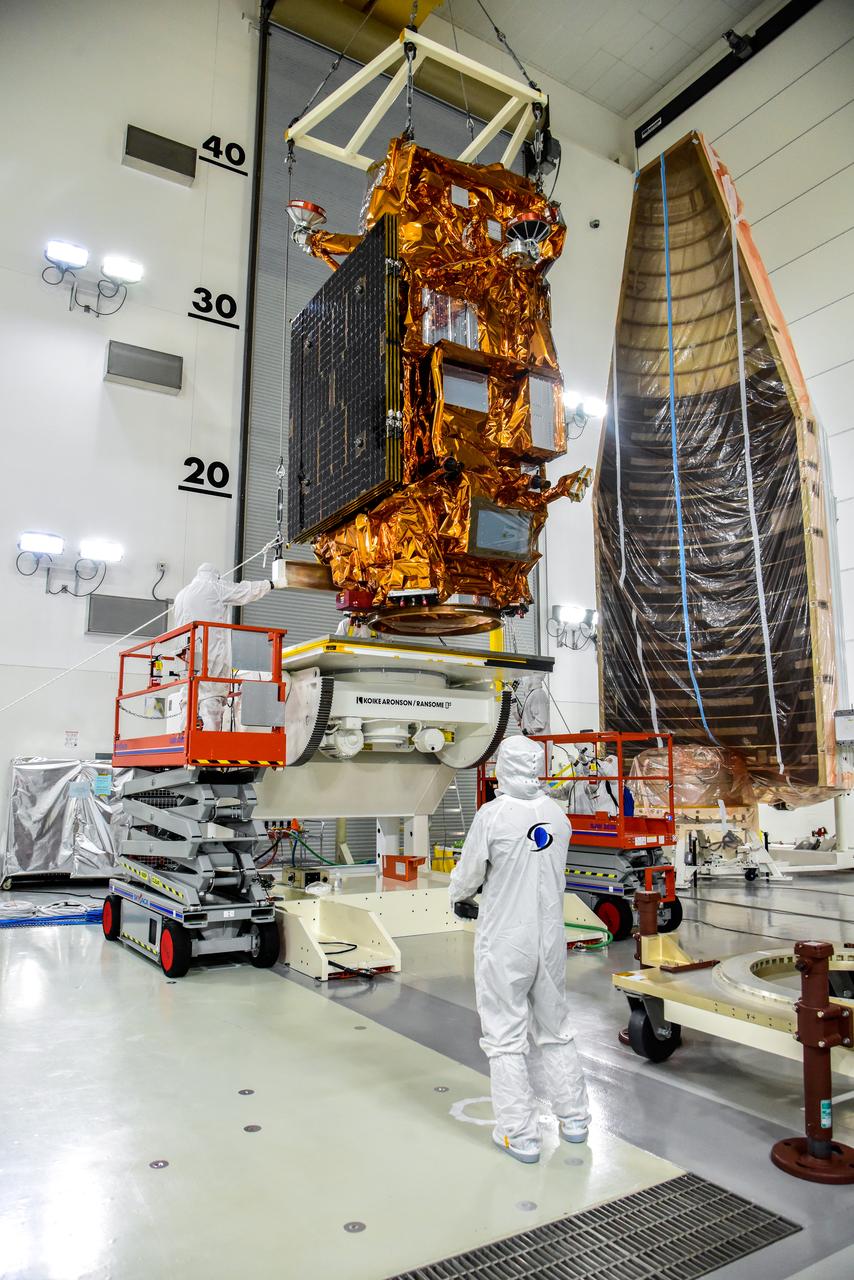
A crane is used to transfer NASA and the National Oceanic and Atmospheric Administration’s (NOAA) Joint Polar Satellite System-2 (JPSS-2) satellite to an Aronson Table for processing inside the Astrotech Space Operations facility at Vandenberg Space Force Base in California on Aug. 22, 2022. JPSS-2 is the third satellite in the Joint Polar Satellite System series. It is scheduled to lift off from VSFB on Nov. 1 from Space Launch Complex-3. JPSS-2, which will be renamed NOAA-21 after reaching orbit, will join a constellation of JPSS satellites that orbit from the North to the South pole, circling Earth 14 times a day and providing a full view of the entire globe twice daily. The NOAA/NASA Suomi National Polar-orbiting Partnership (Suomi NPP) satellite, and NOAA-20, previously known as JPSS-1, are both already in orbit. Each satellite carries at least four advanced instruments to measure weather and climate conditions on Earth. A secondary payload on the mission is the Low-Earth Orbit Flight Test of an Inflatable Decelerator (LOFTID), and is dedicated to the memory of Bernard Kutter. LOFTID will demonstrate inflatable heat shield technology that could enable a variety of proposed NASA missions to destinations such as Mars, Venus, and Titan, as well as returning heavier payloads from low-Earth orbit.
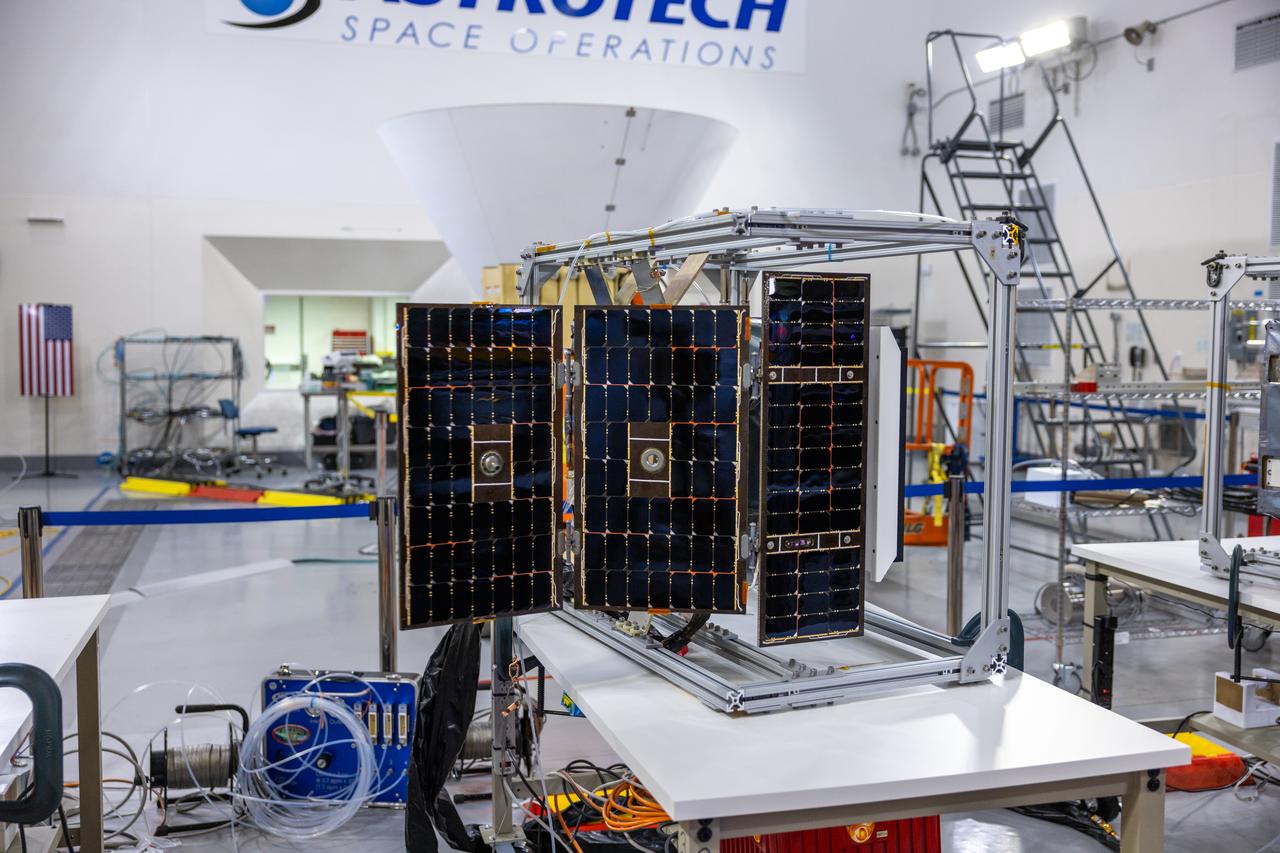
Crews conduct additional solar array deployment testing for NASA’s PUNCH (Polarimeter to Unify the Corona and Heliosphere) satellites at Astrotech Space Operations located on Vandenberg Space Force Base in California on Wednesday, Jan. 22, 2025. PUNCH, consisting of four satellites, will produce continuous 3D images of the solar wind and solar storms as it travels from the Sun to Earth to better understand how material in the corona accelerates. PUNCH, along with NASA’s SPHEREx (Spectro-Photometer for the History of the Universe, Epoch of Reionization and Ices Explorer), a space telescope, will launch aboard a SpaceX Falcon 9 rocket from Launch Complex 4E at Vandenberg Space Force Base in Central California on Thursday, Feb. 27, 2025.
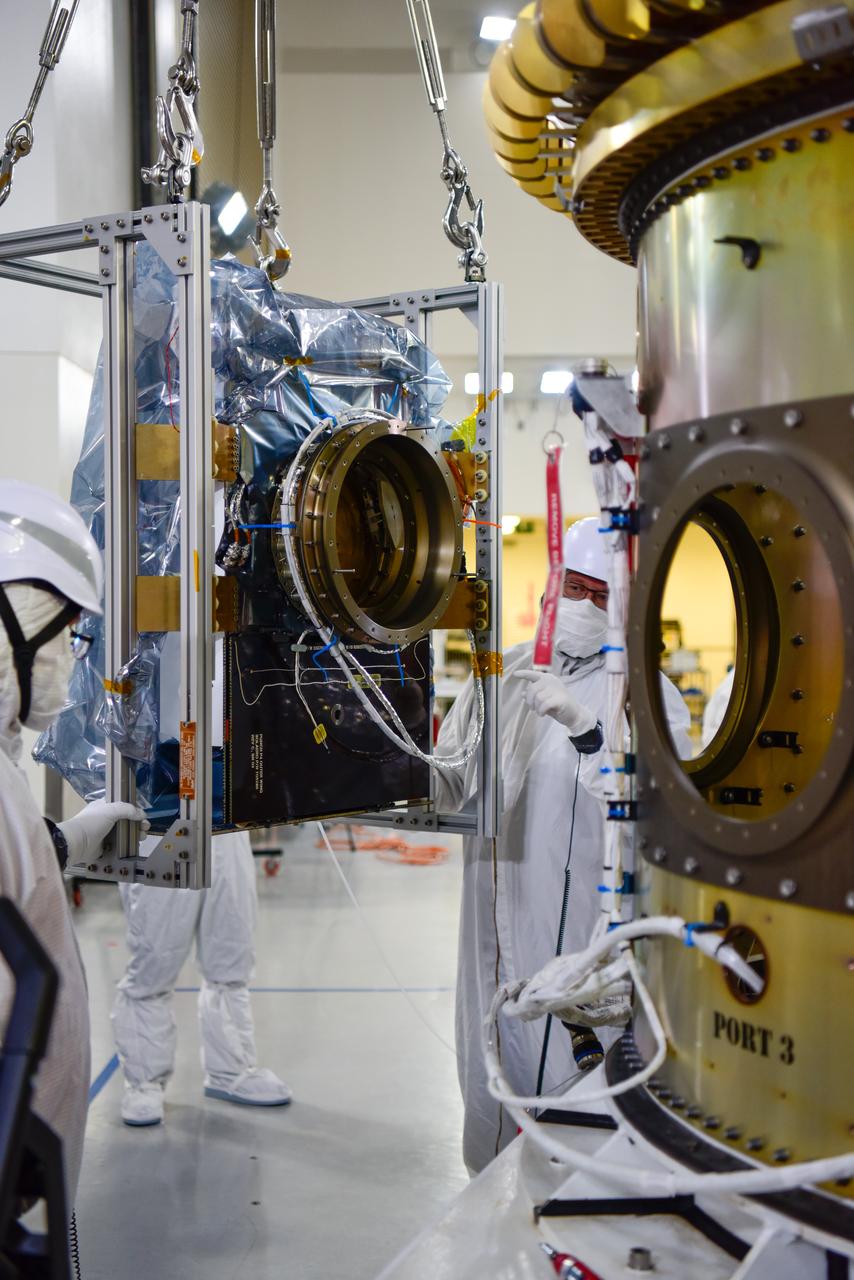
Technicians integrate NASA’s four PUNCH (Polarimeter to Unify the Corona and Heliosphere) satellites to the evolved expendable launch vehicle secondary payload adapter array ring inside the Astrotech Space Operations Facility at Vandenberg Space Force Base in California on Friday, Feb. 14, 2025. PUNCH will study origins of the Sun’s outflow of material, or the solar wind, capturing continuous 3D images of the Sun’s corona and the solar wind’s journey into the solar system. The PUNCH mission is launching as a rideshare with NASA’s SPHEREx (Spectro-Photometer for the History of the Universe, Epoch of Reionization and Ices Explorer) observatory scheduled to launch aboard a SpaceX Falcon 9 rocket at 10:09 p.m. EST (7:09 p.m. PST), Friday, Feb. 28, 2025, at Space Launch Complex 4 East from Vandenberg Space Force Base in California.
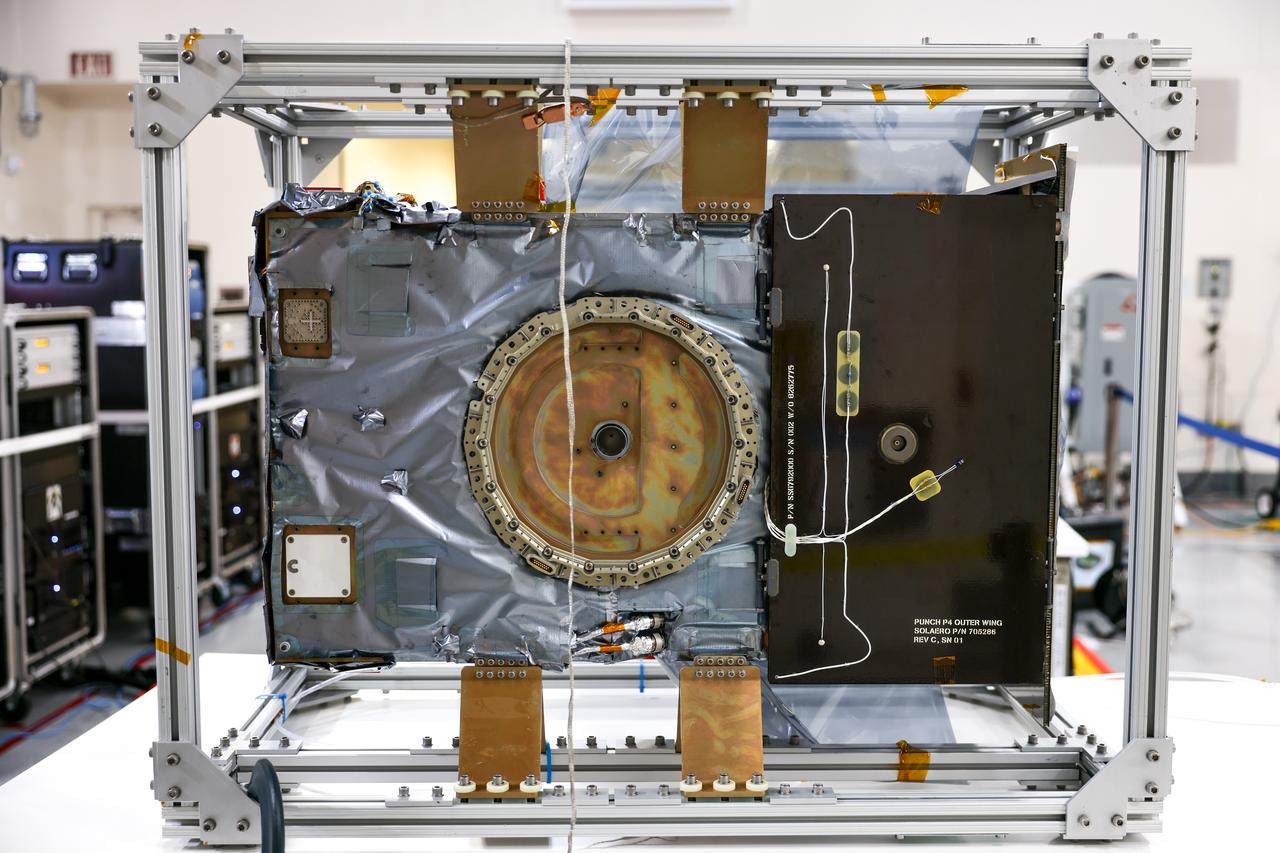
Crews conduct a solar array deployment test on the spacecraft of NASA’s PUNCH (Polarimeter to Unify the Corona and Heliosphere) satellites at Astrotech Space Operations located on Vandenberg Space Force Base in California on Tuesday, Jan. 21, 2025. The four satellites of PUNCH will make 3D observations of the Sun’s corona to learn how the mass and energy becomes solar wind. PUNCH, along with NASA’s SPHEREx (Spectro-Photometer for the History of the Universe, Epoch of Reionization and Ices Explorer), a space telescope, will launch aboard a SpaceX Falcon 9 rocket in late February 2025.
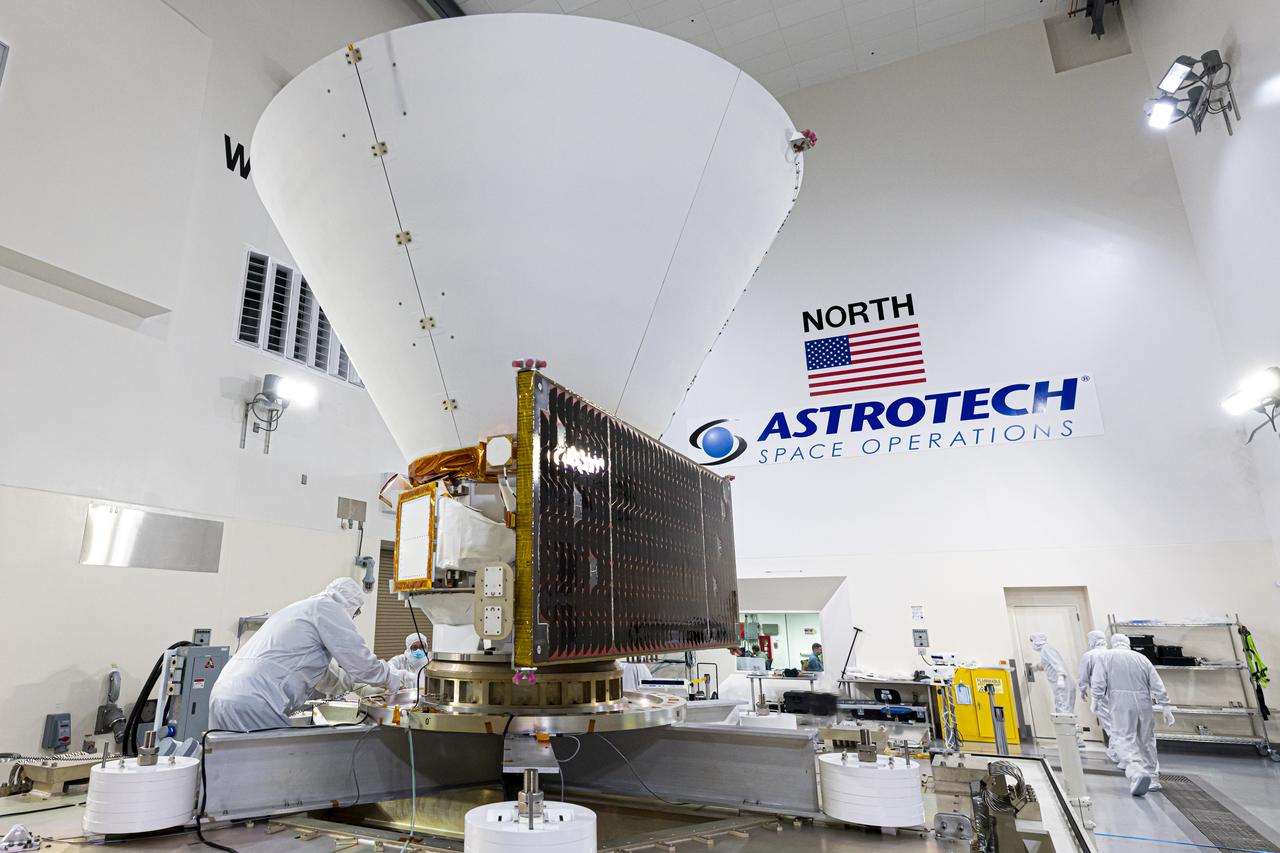
NASA’s SPHEREx (Spectro-Photometer for the History of the Universe, Epoch of Reionization and Ices Explorer), a space telescope, is situated on a work stand ahead of prelaunch operations at the Astrotech Processing Facility at Vandenberg Space Force Base in California on Thursday, Jan. 16, 2025. SPHEREx will enter a polar orbit around Earth and create a 3D map of the entire sky, gathering information about millions of galaxies for scientists to study what happened after the big bang, the history of galaxy evolution, and the origins of water in planetary systems in our galaxy. SPHEREx will launch aboard a SpaceX Falcon 9 rocket in late February 2025.
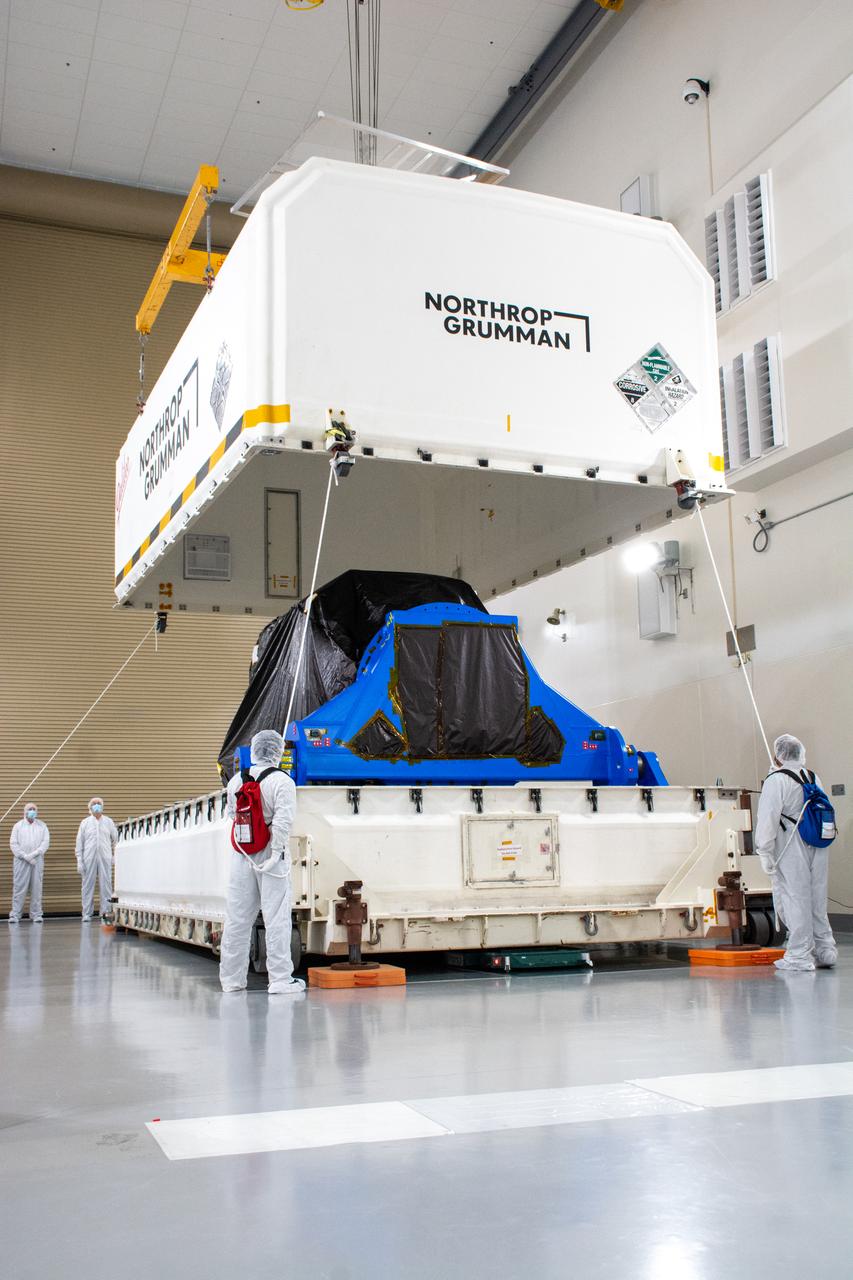
NASA and the National Oceanic and Atmospheric Association's Joint Polar Satellite System-2 (JPSS-2) satellite is removed from its shipping container inside the airlock of the Astrotech processing facility on Aug. 20, 2022, at Vandenberg Space Force Base (VSFB) in California. JPSS-2 was shipped from the Northrop Grumman facility in Gilbert, Arizona, where it was built and tested. JPSS-2 is the third satellite in the Joint Polar Satellite System series. It is scheduled to lift off from VSFB on Nov. 1 from Space Launch Complex-3 East. JPSS-2 will scan the globe as it orbits from the North to the South Pole, crossing the equator 14 times a day. From 512 miles above Earth, it will capture data that inform weather forecasts, extreme weather events, and climate change. The Visible Infrared Radiometer Suite instrument will collect imagery for global observations of the land, atmosphere, cryosphere, and oceans. Launching as a secondary payload to JPSS-2 is NASA’s Low-Earth Orbit Flight Test of an Inflatable Decelerator (LOFTID), dedicated to the memory of Bernard Kutter. LOFTID is a demonstration of a hypersonic inflatable aerodynamic decelerator, or aeroshell, technology that could one day help land humans on Mars.
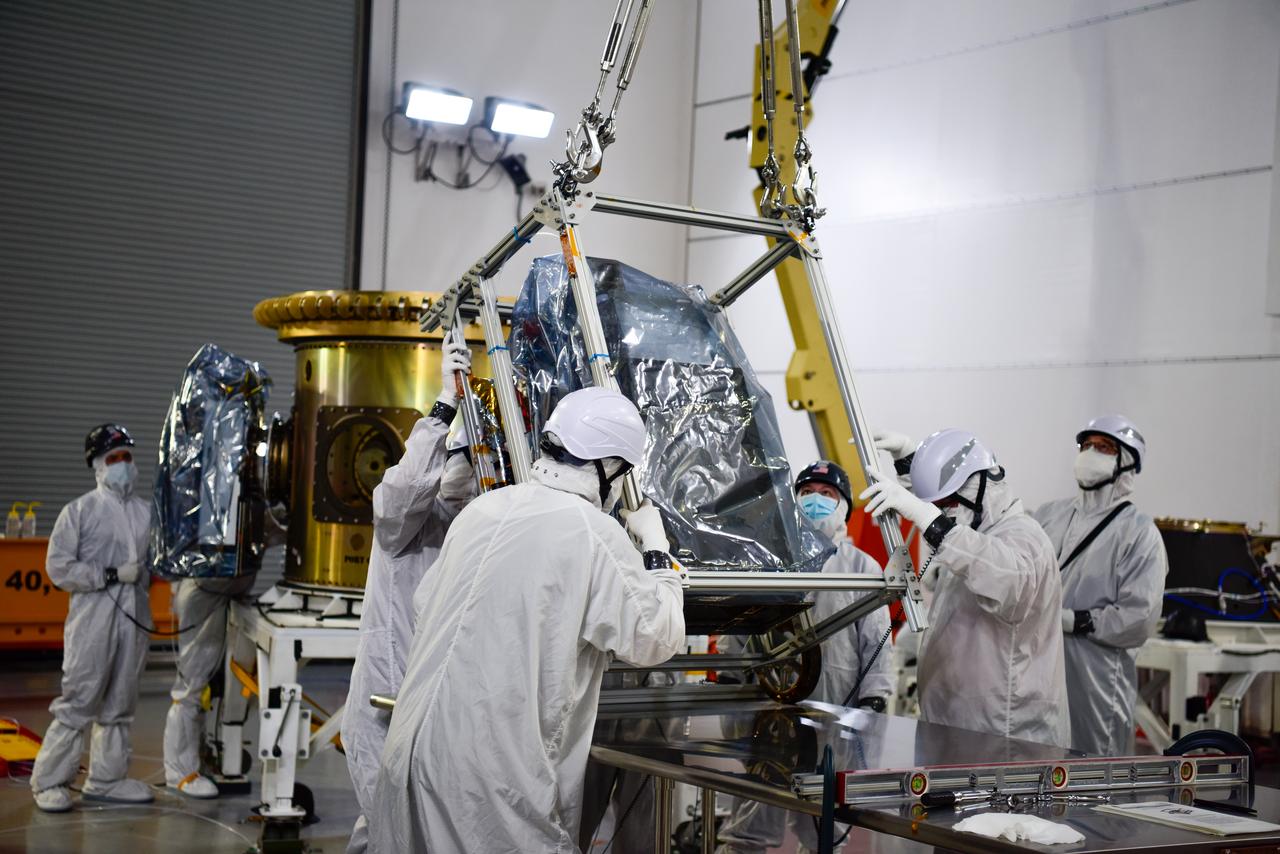
Technicians integrate NASA’s four PUNCH (Polarimeter to Unify the Corona and Heliosphere) satellites to the evolved expendable launch vehicle secondary payload adapter array ring inside the Astrotech Space Operations Facility at Vandenberg Space Force Base in California on Friday, Feb. 14, 2025. PUNCH will study origins of the Sun’s outflow of material, or the solar wind, capturing continuous 3D images of the Sun’s corona and the solar wind’s journey into the solar system. The PUNCH mission is launching as a rideshare with NASA’s SPHEREx (Spectro-Photometer for the History of the Universe, Epoch of Reionization and Ices Explorer) observatory scheduled to launch aboard a SpaceX Falcon 9 rocket at 10:09 p.m. EST (7:09 p.m. PST), Friday, Feb. 28, 2025, at Space Launch Complex 4 East from Vandenberg Space Force Base in California.
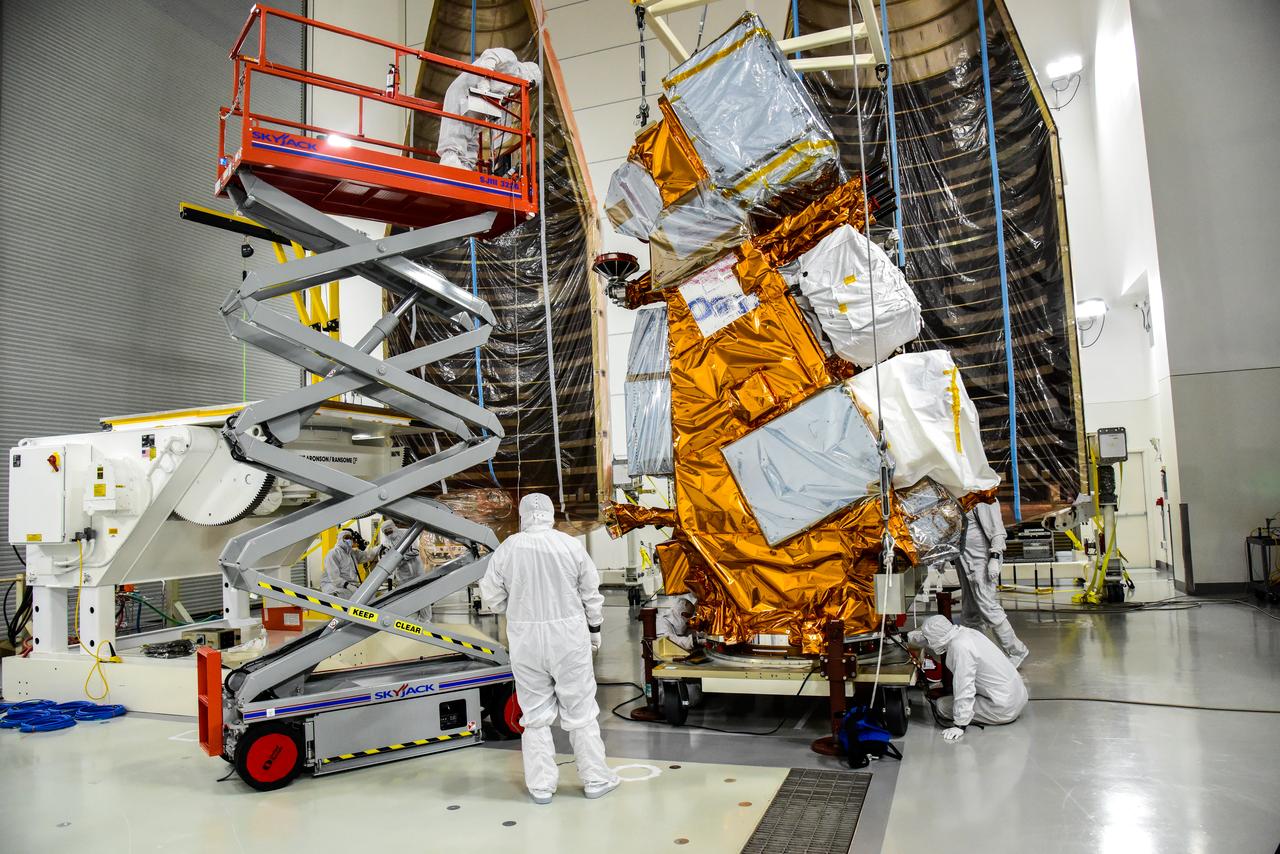
Technicians help transfer NASA and the National Oceanic and Atmospheric Administration’s (NOAA) Joint Polar Satellite System-2 (JPSS-2) satellite onto an integration and testing cart inside the Astrotech Space Operations facility at Vandenberg Space Force Base in California on Aug. 22, 2022. JPSS-2 is the third satellite in the Joint Polar Satellite System series. It is scheduled to lift off from VSFB on Nov. 1 from Space Launch Complex-3. JPSS-2, which will be renamed NOAA-21 after reaching orbit, will join a constellation of JPSS satellites that orbit from the North to the South pole, circling Earth 14 times a day and providing a full view of the entire globe twice daily. The NOAA/NASA Suomi National Polar-orbiting Partnership (Suomi NPP) satellite, and NOAA-20, previously known as JPSS-1, are both already in orbit. Each satellite carries at least four advanced instruments to measure weather and climate conditions on Earth. A secondary payload on the mission is the Low-Earth Orbit Flight Test of an Inflatable Decelerator (LOFTID), and is dedicated to the memory of Bernard Kutter. LOFTID will demonstrate inflatable heat shield technology that could enable a variety of proposed NASA missions to destinations such as Mars, Venus, and Titan, as well as returning heavier payloads from low-Earth orbit.
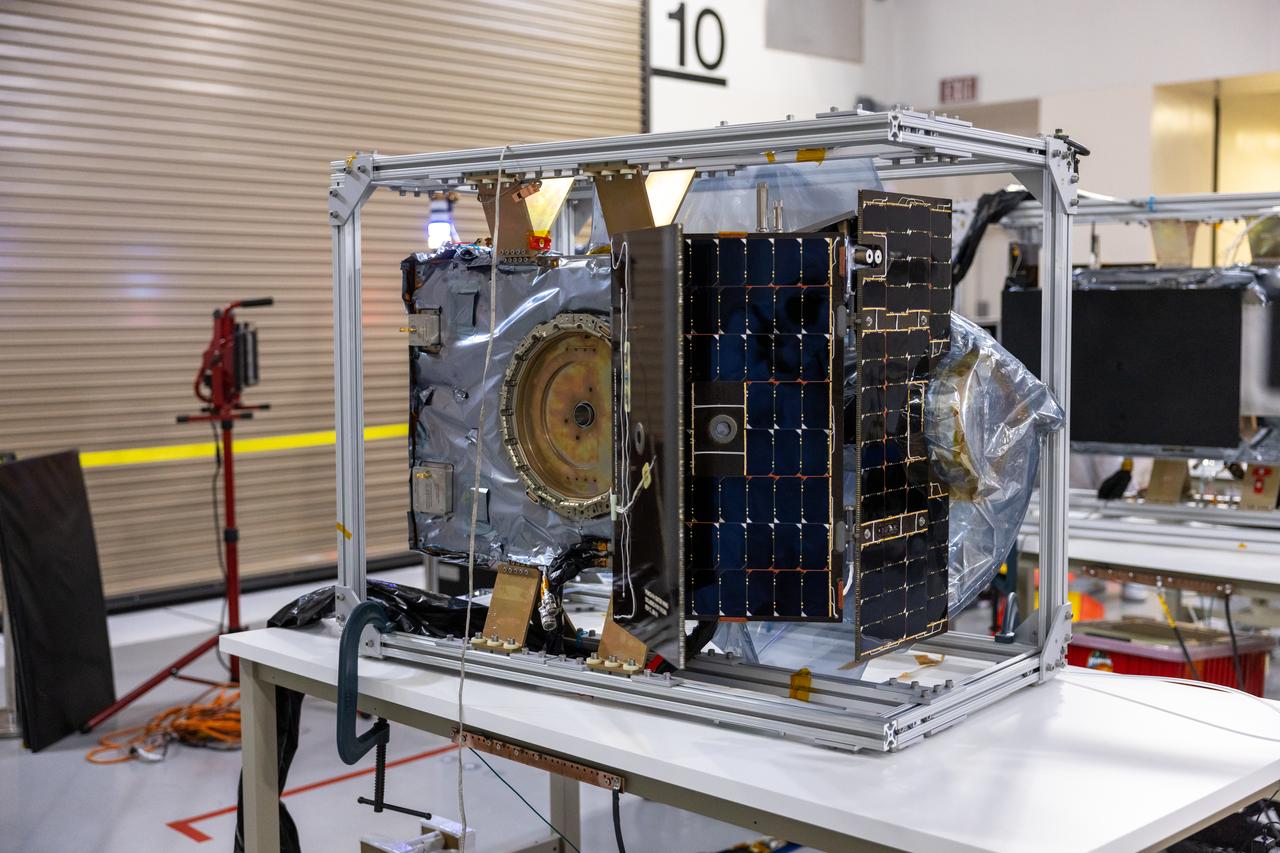
Crews conduct additional solar array deployment testing for NASA’s PUNCH (Polarimeter to Unify the Corona and Heliosphere) satellites at Astrotech Space Operations located on Vandenberg Space Force Base in California on Wednesday, Jan. 22, 2025. PUNCH, consisting of four satellites, will produce continuous 3D images of the solar wind and solar storms as it travels from the Sun to Earth to better understand how material in the corona accelerates. PUNCH, along with NASA’s SPHEREx (Spectro-Photometer for the History of the Universe, Epoch of Reionization and Ices Explorer), a space telescope, will launch aboard a SpaceX Falcon 9 rocket from Launch Complex 4E at Vandenberg Space Force Base in Central California on Thursday, Feb. 27, 2025.

On Aug. 11, 2022, teams at the Astrotech facility at Vandenberg Space Force Base (VSFB) in California use a crane to raise to vertical one of the United Launch Alliance (ULA) Atlas V payload fairing halves for NASA and the National Oceanic and Atmospheric Administration’s (NOAA) Joint Polar Satellite System-2 (JPSS-2) satellite mission. The payload fairing protects the spacecraft during launch and flight through the atmosphere. JPSS-2 is the third satellite in the Joint Polar Satellite System series. It is scheduled to lift off from VSFB on Nov. 1 from Space Launch Complex-3 East. JPSS-2 will scan the globe as it orbits from the North to the South Pole, crossing the equator 14 times a day. From 512 miles above Earth, it will capture data that inform weather forecasts, extreme weather events, and climate change. The Visible Infrared Radiometer Suite instrument will collect imagery for global observations of the land, atmosphere, cryosphere, and oceans. Launching as a secondary payload to JPSS-2 is NASA’s Low-Earth Orbit Flight Test of an Inflatable Decelerator (LOFTID), dedicated to the memory of Bernard Kutter. LOFTID is a demonstration of a hypersonic inflatable aerodynamic decelerator, or aeroshell, technology that could one day help land humans on Mars.
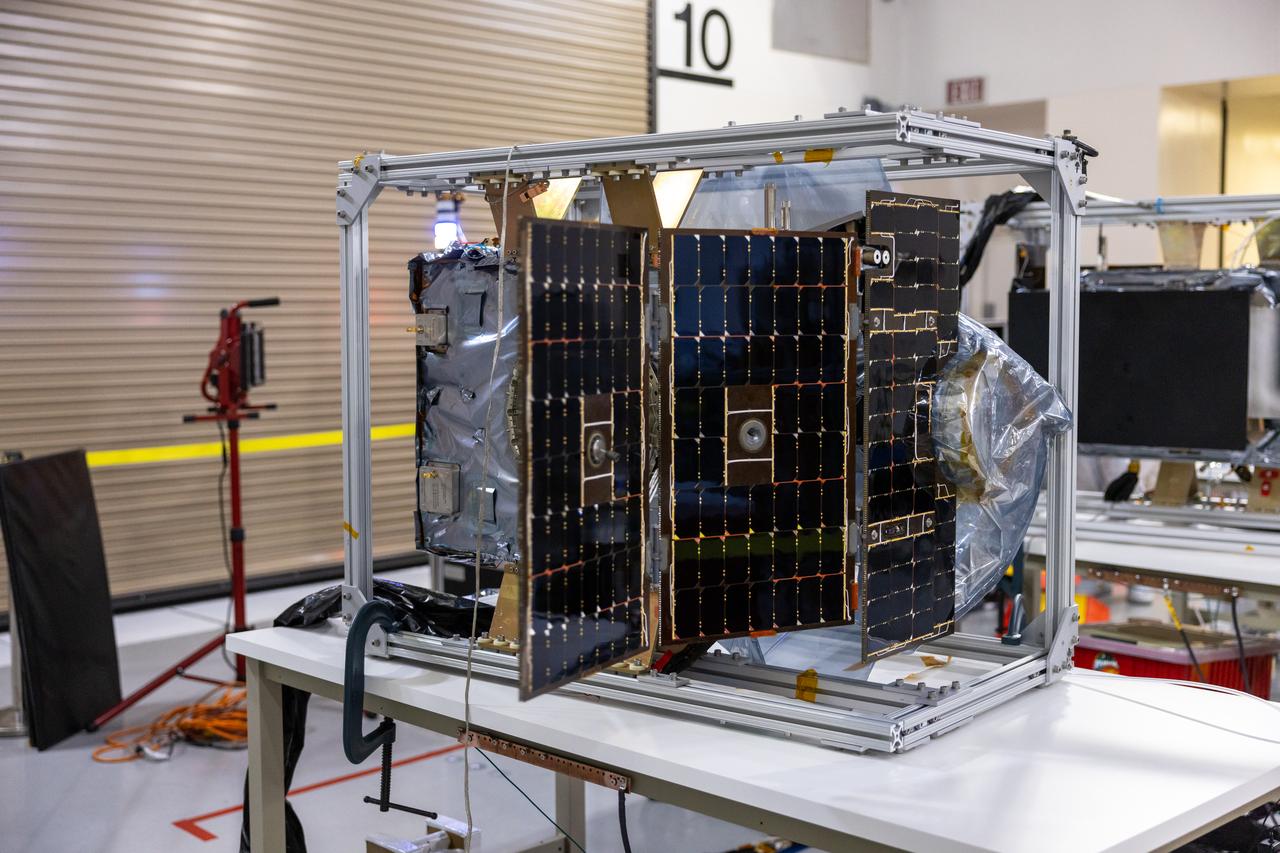
Crews conduct additional solar array deployment testing for NASA’s PUNCH (Polarimeter to Unify the Corona and Heliosphere) satellites at Astrotech Space Operations located on Vandenberg Space Force Base in California on Wednesday, Jan. 22, 2025. PUNCH, consisting of four satellites, will produce continuous 3D images of the solar wind and solar storms as it travels from the Sun to Earth to better understand how material in the corona accelerates. PUNCH, along with NASA’s SPHEREx (Spectro-Photometer for the History of the Universe, Epoch of Reionization and Ices Explorer), a space telescope, will launch aboard a SpaceX Falcon 9 rocket from Launch Complex 4E at Vandenberg Space Force Base in Central California on Thursday, Feb. 27, 2025.
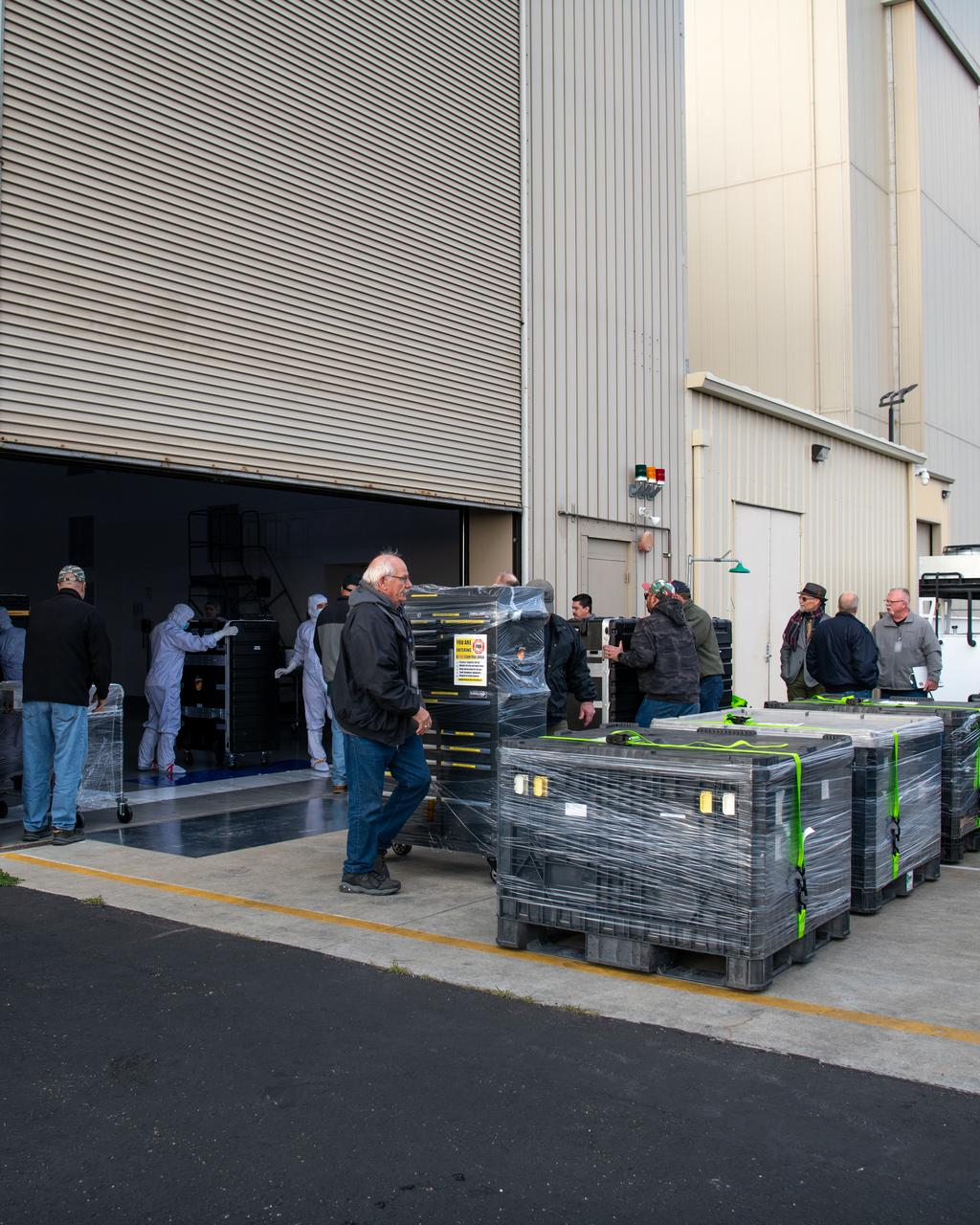
Teams at Vandenberg Space Force Base in California offload several shipping containers protecting NASA’s PUNCH (Polarimeter to Unify the Corona and Heliosphere) satellites on Saturday, Jan. 18, 2025. PUNCH will make 3D observations of the Sun’s corona to learn how the mass and energy becomes solar wind. PUNCH, along with NASA’s SPHEREx (Spectro-Photometer for the History of the Universe, Epoch of Reionization and Ices Explorer), a space telescope, will launch aboard a SpaceX Falcon 9 rocket in late February 2025.
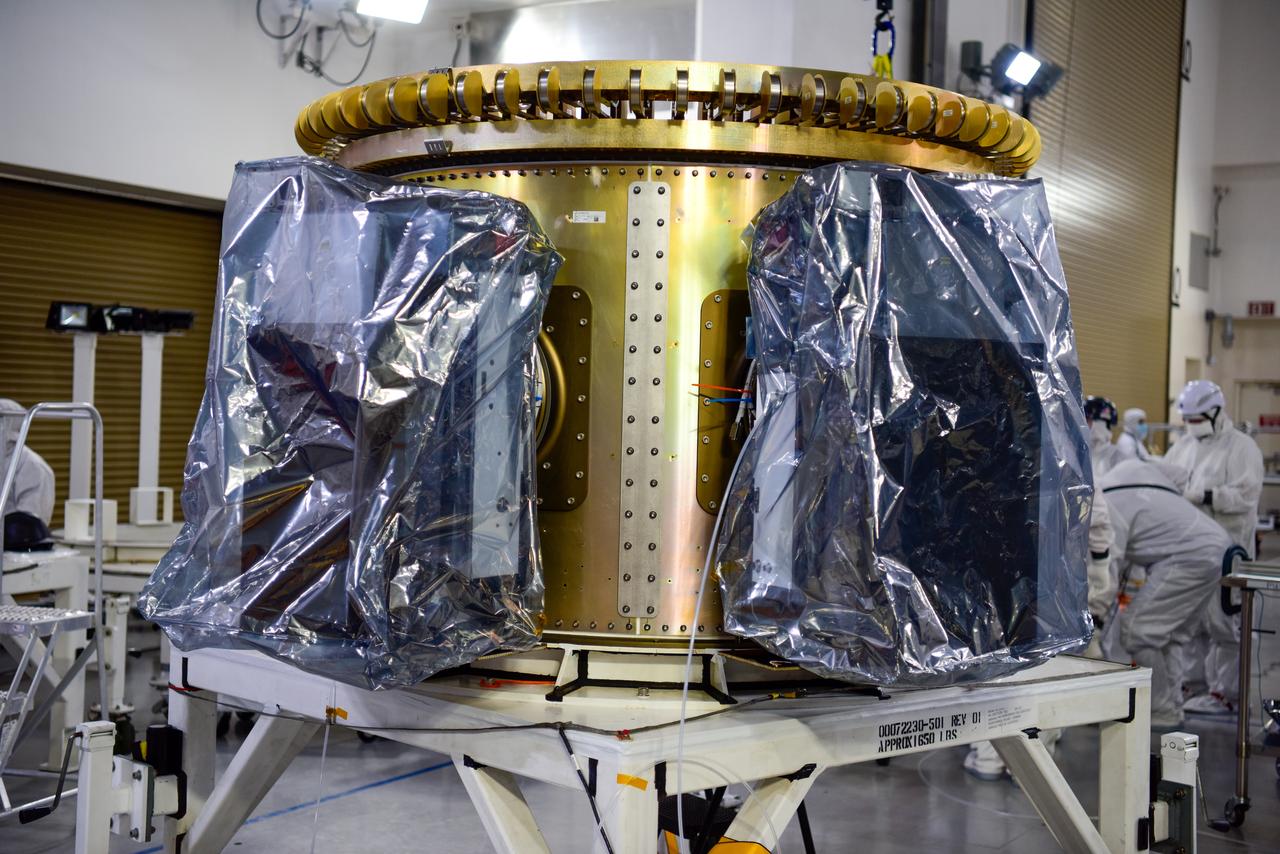
Technicians integrate NASA’s four PUNCH (Polarimeter to Unify the Corona and Heliosphere) satellites to the evolved expendable launch vehicle secondary payload adapter array ring inside the Astrotech Space Operations Facility at Vandenberg Space Force Base in California on Friday, Feb. 14, 2025. PUNCH will study origins of the Sun’s outflow of material, or the solar wind, capturing continuous 3D images of the Sun’s corona and the solar wind’s journey into the solar system. The PUNCH mission is launching as a rideshare with NASA’s SPHEREx (Spectro-Photometer for the History of the Universe, Epoch of Reionization and Ices Explorer) observatory scheduled to launch aboard a SpaceX Falcon 9 rocket at 10:09 p.m. EST (7:09 p.m. PST), Friday, Feb. 28, 2025, at Space Launch Complex 4 East from Vandenberg Space Force Base in California.
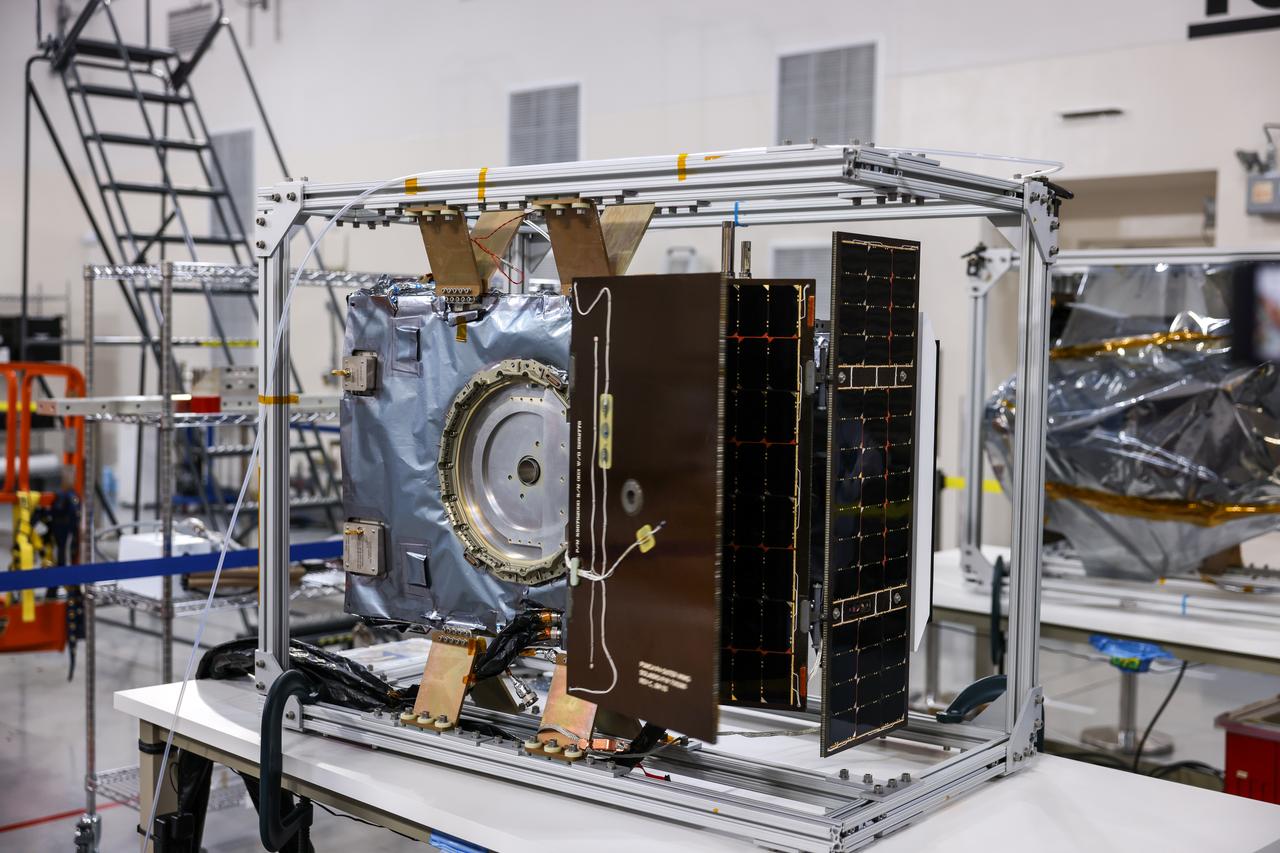
Crews conduct a solar array deployment test on the spacecraft of NASA’s PUNCH (Polarimeter to Unify the Corona and Heliosphere) satellites at Astrotech Space Operations located on Vandenberg Space Force Base in California on Tuesday, Jan. 21, 2025. The four satellites of PUNCH will make 3D observations of the Sun’s corona to learn how the mass and energy becomes solar wind. PUNCH, along with NASA’s SPHEREx (Spectro-Photometer for the History of the Universe, Epoch of Reionization and Ices Explorer), a space telescope, will launch aboard a SpaceX Falcon 9 rocket in late February 2025.

NASA and the National Oceanic and Atmospheric Administration's Joint Polar Satellite System-2 (JPSS-2) satellite is rotated to a vertical position after it was removed from its shipping container inside the airlock of the Astrotech processing facility on Aug. 20, 2022, at Vandenberg Space Force Base (VSFB) in California. JPSS-2 was shipped from the Northrop Grumman facility in Gilbert, Arizona, where it was built and tested. JPSS-2 is the third satellite in the Joint Polar Satellite System series. It is scheduled to lift off from VSFB on Nov. 1 from Space Launch Complex-3 East. JPSS-2 will scan the globe as it orbits from the North to the South Pole, crossing the equator 14 times a day. From 512 miles above Earth, it will capture data that inform weather forecasts, extreme weather events, and climate change. The Visible Infrared Radiometer Suite instrument will collect imagery for global observations of the land, atmosphere, cryosphere, and oceans. Launching as a secondary payload to JPSS-2 is NASA’s Low-Earth Orbit Flight Test of an Inflatable Decelerator (LOFTID), dedicated to the memory of Bernard Kutter. LOFTID is a demonstration of a hypersonic inflatable aerodynamic decelerator, or aeroshell, technology that could one day help land humans on Mars.
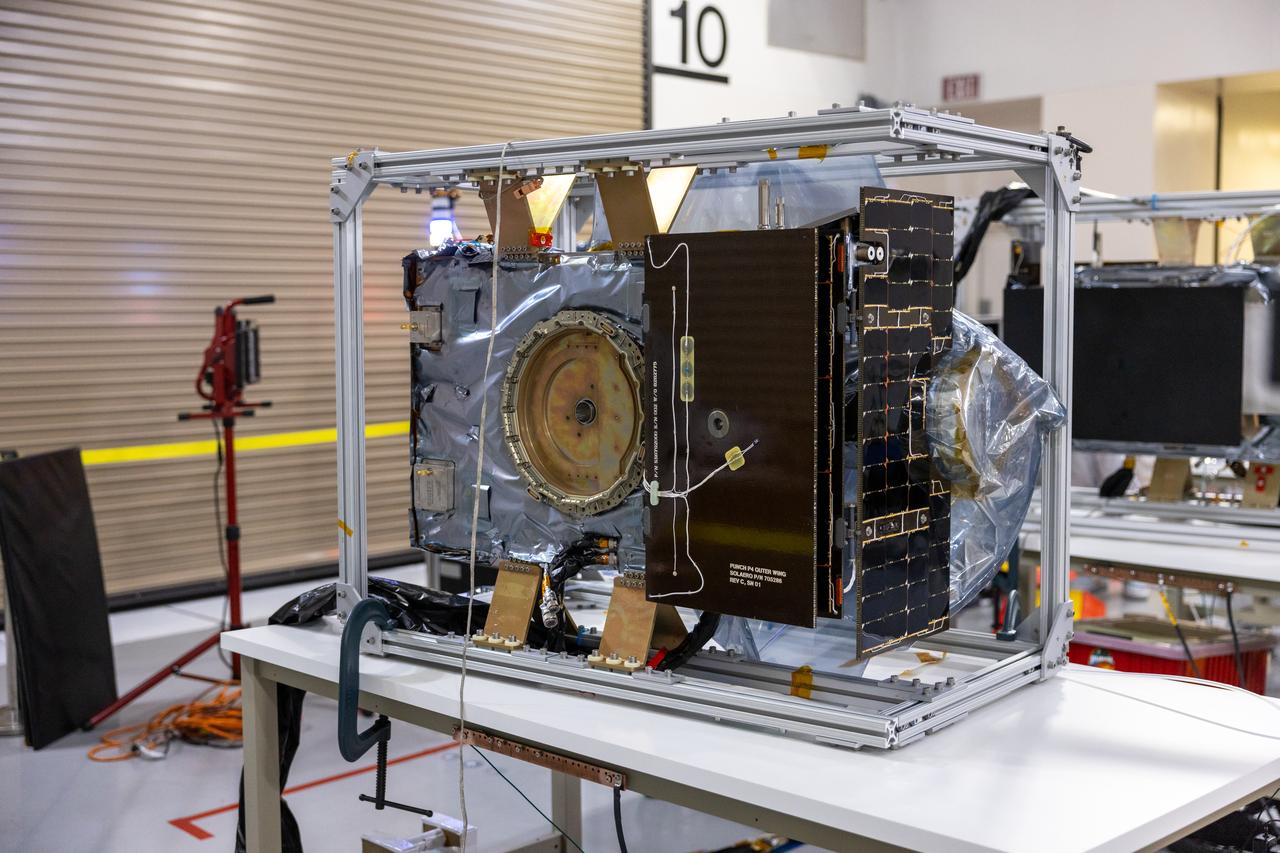
Crews conduct additional solar array deployment testing for NASA’s PUNCH (Polarimeter to Unify the Corona and Heliosphere) satellites at Astrotech Space Operations located on Vandenberg Space Force Base in California on Wednesday, Jan. 22, 2025. PUNCH, consisting of four satellites, will produce continuous 3D images of the solar wind and solar storms as it travels from the Sun to Earth to better understand how material in the corona accelerates. PUNCH, along with NASA’s SPHEREx (Spectro-Photometer for the History of the Universe, Epoch of Reionization and Ices Explorer), a space telescope, will launch aboard a SpaceX Falcon 9 rocket from Launch Complex 4E at Vandenberg Space Force Base in Central California on Thursday, Feb. 27, 2025.

NASA’s SPHEREx (Spectro-Photometer for the History of the Universe, Epoch of Reionization and Ices Explorer), a space telescope, is situated on a work stand ahead of prelaunch operations at the Astrotech Processing Facility at Vandenberg Space Force Base in California on Friday, Jan. 17, 2025. SPHEREx will enter a polar orbit around Earth and create a 3D map of the entire sky, gathering information about millions of galaxies for scientists to study what happened after the big bang, the history of galaxy evolution, and the origins of water in planetary systems in our galaxy. SPHEREx will launch aboard a SpaceX Falcon 9 rocket in late February 2025.
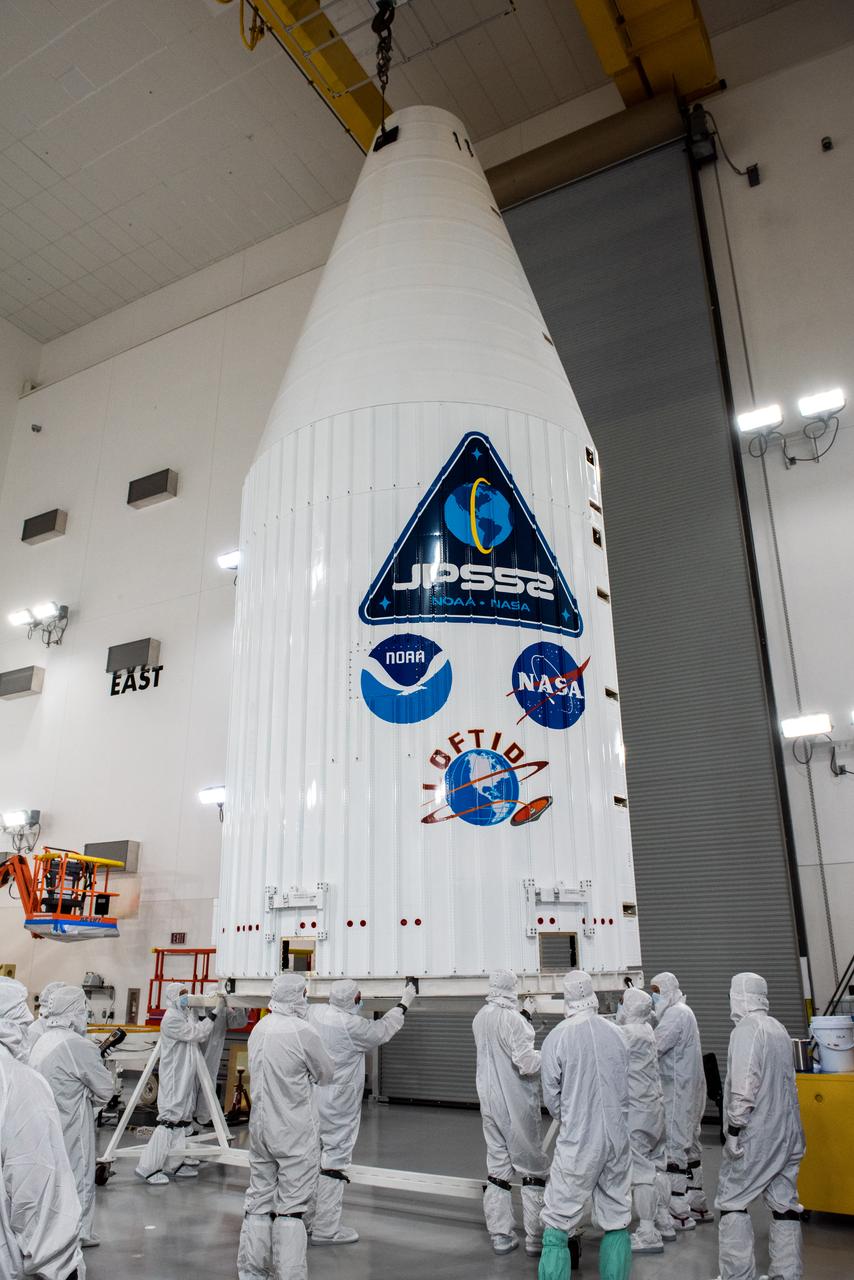
On Aug. 11, 2022, teams at the Astrotech facility at Vandenberg Space Force Base (VSFB) in California use a crane to raise to vertical one of the United Launch Alliance (ULA) Atlas V payload fairing halves for NASA and the National Oceanic and Atmospheric Administration’s (NOAA) Joint Polar Satellite System-2 (JPSS-2) satellite mission. The payload fairing protects the spacecraft during launch and flight through the atmosphere. JPSS-2 is the third satellite in the Joint Polar Satellite System series. It is scheduled to lift off from VSFB on Nov. 1 from Space Launch Complex-3 East. JPSS-2 will scan the globe as it orbits from the North to the South Pole, crossing the equator 14 times a day. From 512 miles above Earth, it will capture data that inform weather forecasts, extreme weather events, and climate change. The Visible Infrared Radiometer Suite instrument will collect imagery for global observations of the land, atmosphere, cryosphere, and oceans. Launching as a secondary payload to JPSS-2 is NASA’s Low-Earth Orbit Flight Test of an Inflatable Decelerator (LOFTID), dedicated to the memory of Bernard Kutter. LOFTID is a demonstration of a hypersonic inflatable aerodynamic decelerator, or aeroshell, technology that could one day help land humans on Mars.
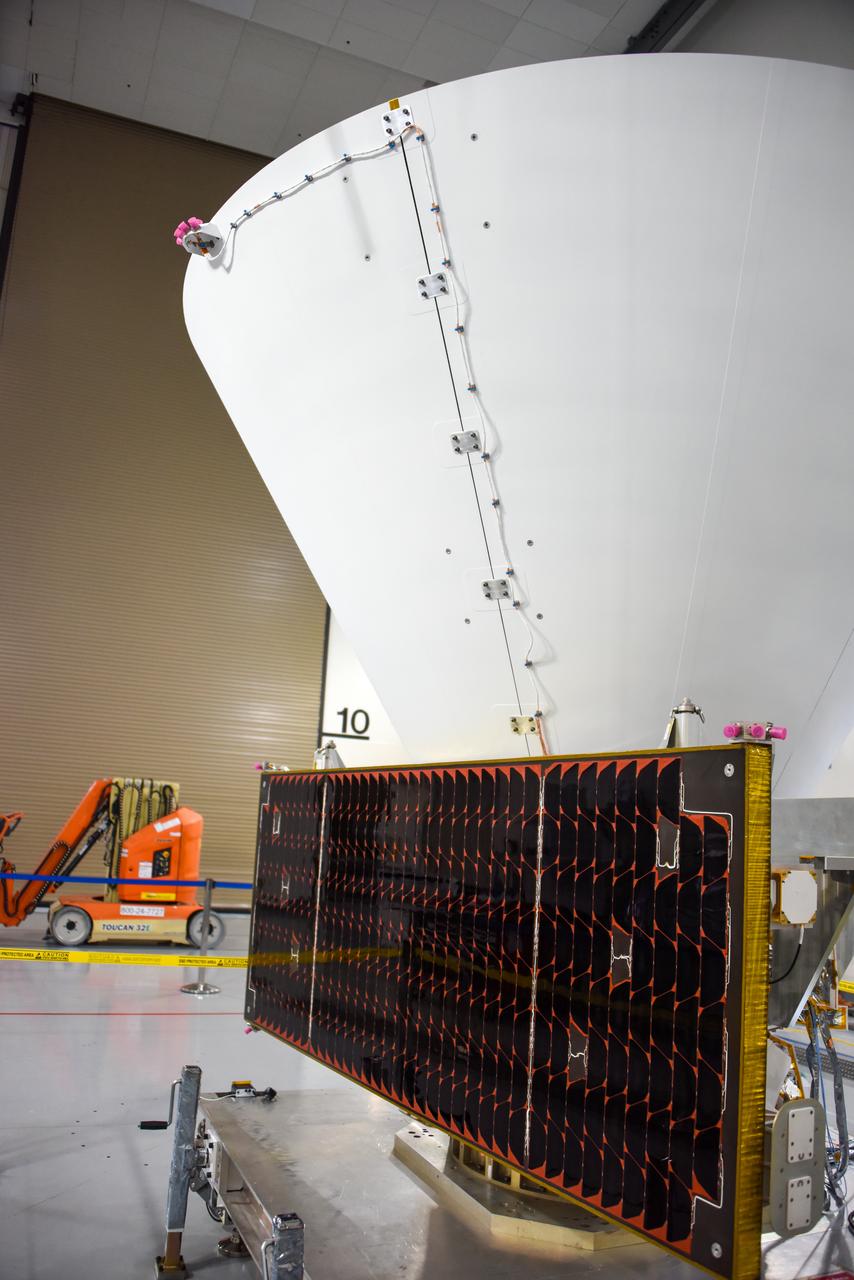
NASA’s SPHEREx (Spectro-Photometer for the History of the Universe, Epoch of Reionization and Ices Explorer), a space telescope, is situated on a work stand ahead of prelaunch operations at the Astrotech Processing Facility at Vandenberg Space Force Base in California on Friday, Jan. 17, 2025. SPHEREx will enter a polar orbit around Earth and create a 3D map of the entire sky, gathering information about millions of galaxies for scientists to study what happened after the big bang, the history of galaxy evolution, and the origins of water in planetary systems in our galaxy. SPHEREx will launch aboard a SpaceX Falcon 9 rocket in late February 2025.
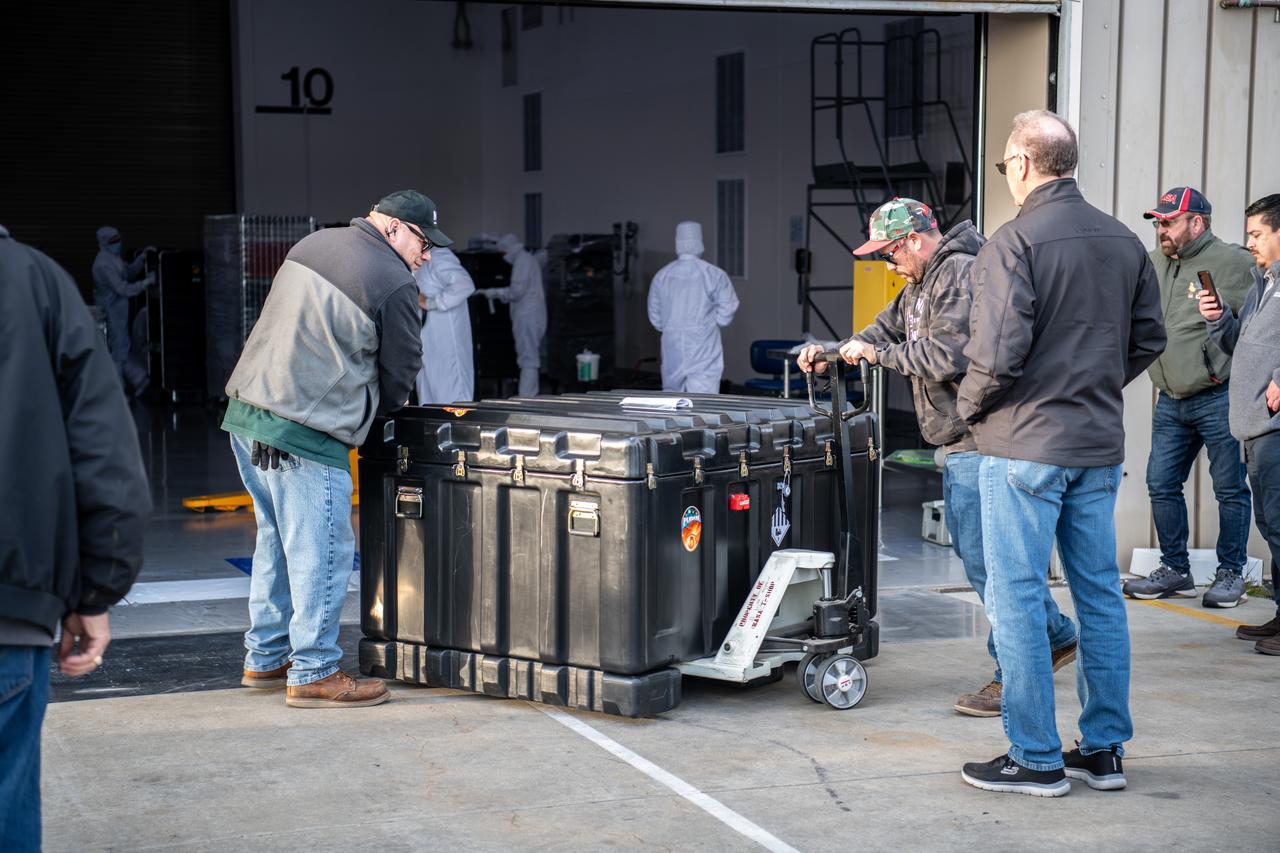
Teams at Vandenberg Space Force Base in California offload several shipping containers protecting NASA’s PUNCH (Polarimeter to Unify the Corona and Heliosphere) satellites on Saturday, Jan. 18, 2025. PUNCH will make 3D observations of the Sun’s corona to learn how the mass and energy becomes solar wind. PUNCH, along with NASA’s SPHEREx (Spectro-Photometer for the History of the Universe, Epoch of Reionization and Ices Explorer), a space telescope, will launch aboard a SpaceX Falcon 9 rocket in late February 2025.
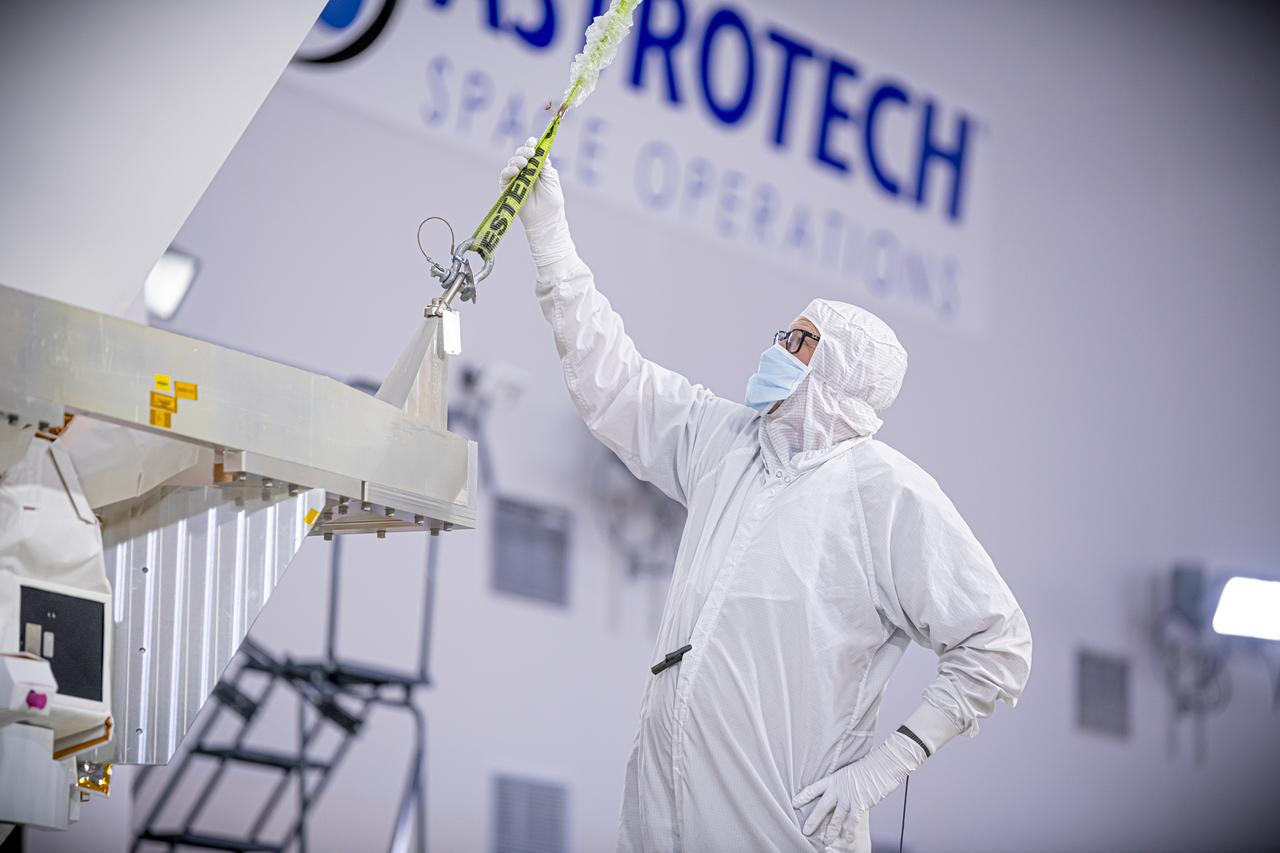
Employees with BAE Systems conduct spacecraft processing of NASA’s SPHEREx (Spectro-Photometer for the History of the Universe, Epoch of Reionization and Ices Explorer) observatory inside the Astrotech Space Operations Facility at Vandenberg Space Force Base in California on Thursday, Jan. 16, 2025. BAE Systems (formerly Ball Aerospace) built the telescope and the spacecraft bus. SPHEREx will use its telescope to provide an all-sky spectral survey, creating a 3D map of the entire sky to help scientists investigate the origins of our universe. Riding along with SPHEREx, NASA’s PUNCH (Polarimeter to Unify the Corona and Heliosphere) mission will study origins of the Sun’s outflow of material, or the solar wind. Liftoff aboard a SpaceX Falcon 9 rocket is targeted for 10:09 p.m. EST (7:09 p.m. PST), Thursday, Feb. 27, 2025, from Space Launch Complex 4 East.
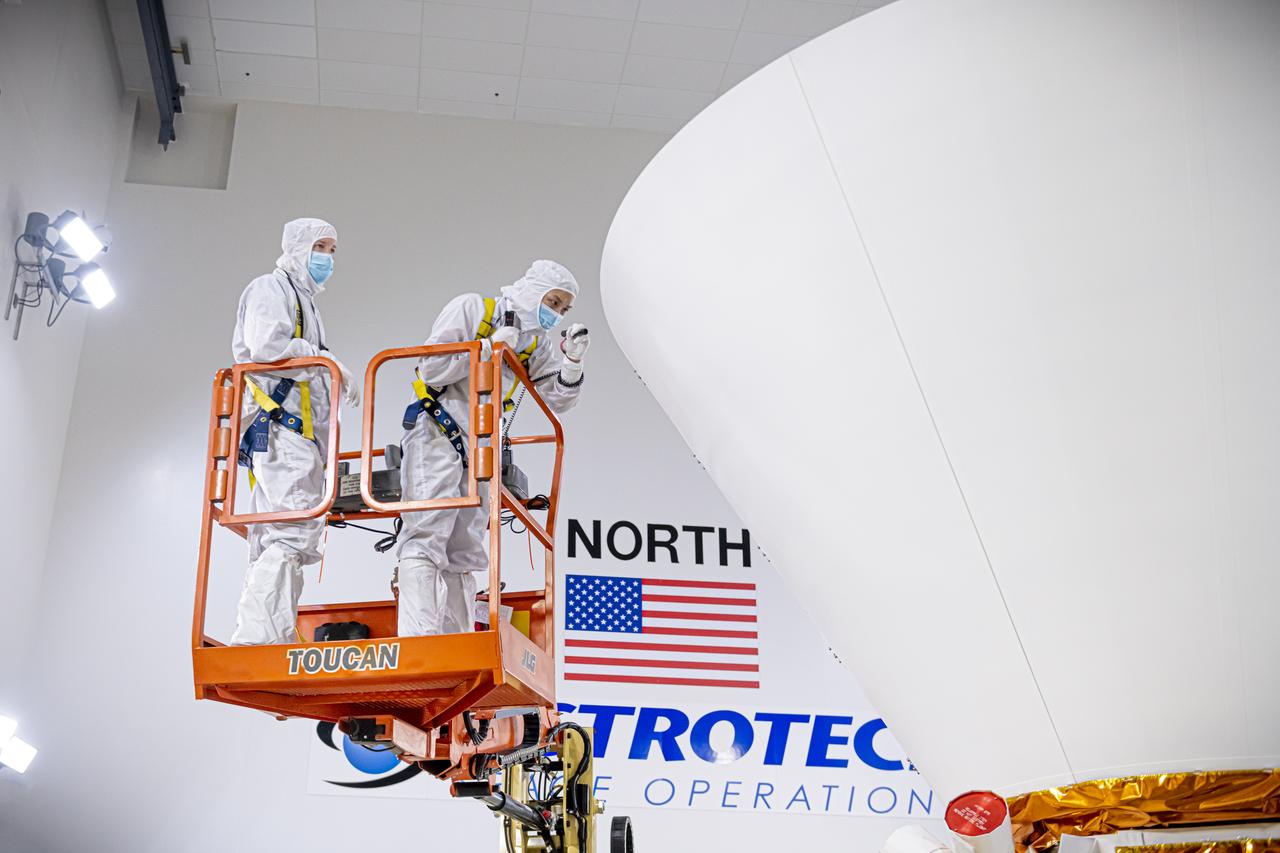
Employees with BAE Systems conduct spacecraft processing of NASA’s SPHEREx (Spectro-Photometer for the History of the Universe, Epoch of Reionization and Ices Explorer) observatory inside the Astrotech Space Operations Facility at Vandenberg Space Force Base in California on Thursday, Jan. 16, 2025. BAE Systems (formerly Ball Aerospace) built the telescope and the spacecraft bus. SPHEREx will use its telescope to provide an all-sky spectral survey, creating a 3D map of the entire sky to help scientists investigate the origins of our universe. Riding along with SPHEREx, NASA’s PUNCH (Polarimeter to Unify the Corona and Heliosphere) mission will study origins of the Sun’s outflow of material, or the solar wind. Liftoff aboard a SpaceX Falcon 9 rocket is targeted for 10:09 p.m. EST (7:09 p.m. PST), Thursday, Feb. 27, 2025, from Space Launch Complex 4 East.

NASA’s SPHEREx (Spectro-Photometer for the History of the Universe, Epoch of Reionization and Ices Explorer), a space telescope, is situated on a work stand ahead of prelaunch operations at the Astrotech Processing Facility at Vandenberg Space Force Base in California on Friday, Jan. 17, 2025. SPHEREx will enter a polar orbit around Earth and create a 3D map of the entire sky, gathering information about millions of galaxies for scientists to study what happened after the big bang, the history of galaxy evolution, and the origins of water in planetary systems in our galaxy. SPHEREx will launch aboard a SpaceX Falcon 9 rocket in late February 2025.

NASA and the National Oceanic and Atmospheric Association's (NOAA) Joint Polar Satellite System-2 (JPSS-2) satellite arrives to the Astrotech processing facility at Vandenberg Space Force Base (VSFB) in California on Aug. 19, 2022. JPSS-2 was shipped from the Northrop Grumman facility in Gilbert, Arizona, where it was built and tested. JPSS-2 is the third satellite in the Joint Polar Satellite System series. It is scheduled to lift off from VSFB on Nov. 1 from Space Launch Complex-3 East. JPSS-2 will scan the globe as it orbits from the North to the South Pole, crossing the equator 14 times a day. From 512 miles above Earth, it will capture data that inform weather forecasts, extreme weather events, and climate change. JPSS-2’s instruments will collect observations of the land, oceans, cryosphere, and atmosphere, as well as provide information about the atmosphere including temperature and moisture. Launching as a secondary payload to JPSS-2 is NASA’s Low-Earth Orbit Flight Test of an Inflatable Decelerator (LOFTID), dedicated to the memory of Bernard Kutter. LOFTID is a demonstration of a hypersonic inflatable aerodynamic decelerator, or aeroshell, technology that could one day help land humans on Mars.
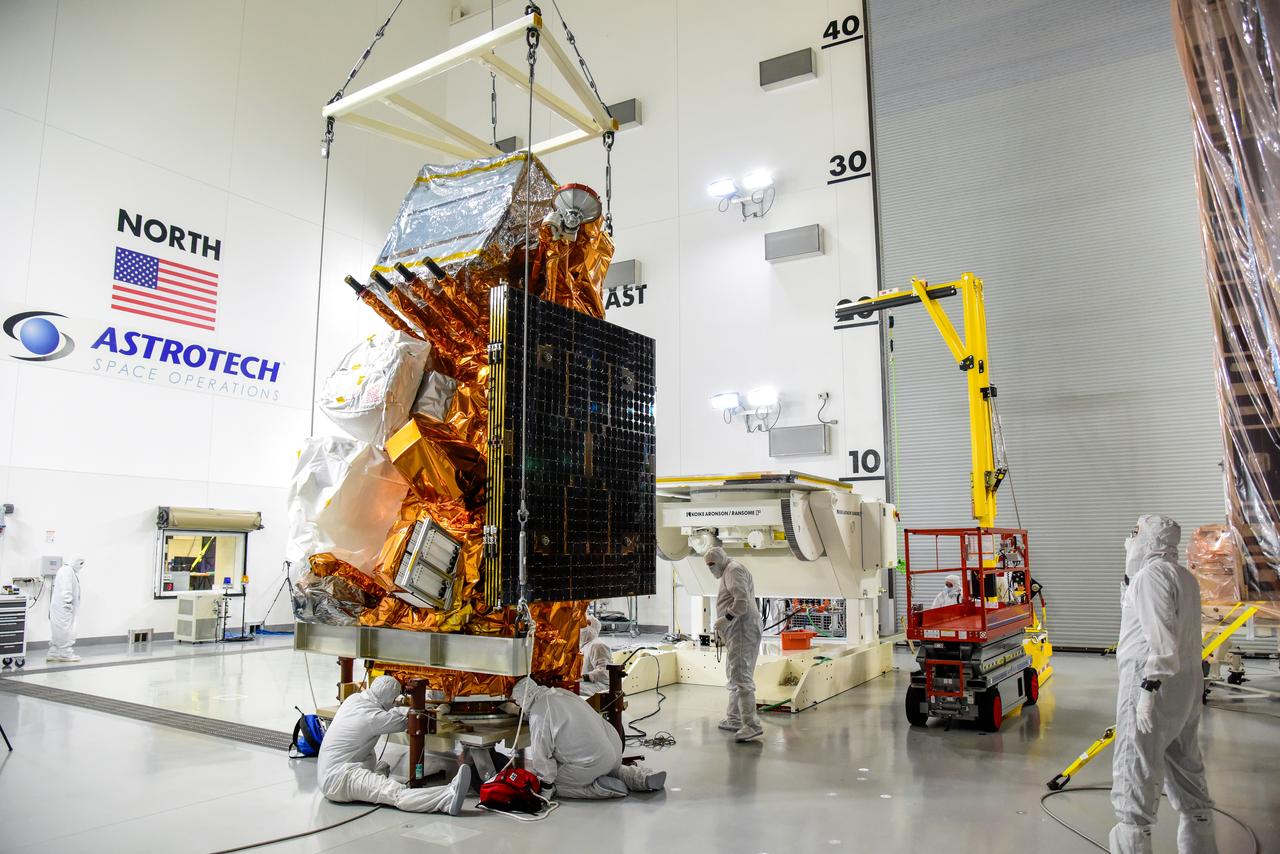
Technicians help secure NASA and the National Oceanic and Atmospheric Administration’s (NOAA) Joint Polar Satellite System-2 (JPSS-2) satellite onto an integration and testing cart inside the Astrotech Space Operations facility at Vandenberg Space Force Base in California on Aug. 22, 2022. JPSS-2 is the third satellite in the Joint Polar Satellite System series. It is scheduled to lift off from VSFB on Nov. 1 from Space Launch Complex-3. JPSS-2, which will be renamed NOAA-21 after reaching orbit, will join a constellation of JPSS satellites that orbit from the North to the South pole, circling Earth 14 times a day and providing a full view of the entire globe twice daily. The NOAA/NASA Suomi National Polar-orbiting Partnership (Suomi NPP) satellite, and NOAA-20, previously known as JPSS-1, are both already in orbit. Each satellite carries at least four advanced instruments to measure weather and climate conditions on Earth. A secondary payload on the mission is the Low-Earth Orbit Flight Test of an Inflatable Decelerator (LOFTID), and is dedicated to the memory of Bernard Kutter. LOFTID will demonstrate inflatable heat shield technology that could enable a variety of proposed NASA missions to destinations such as Mars, Venus, and Titan, as well as returning heavier payloads from low-Earth orbit.
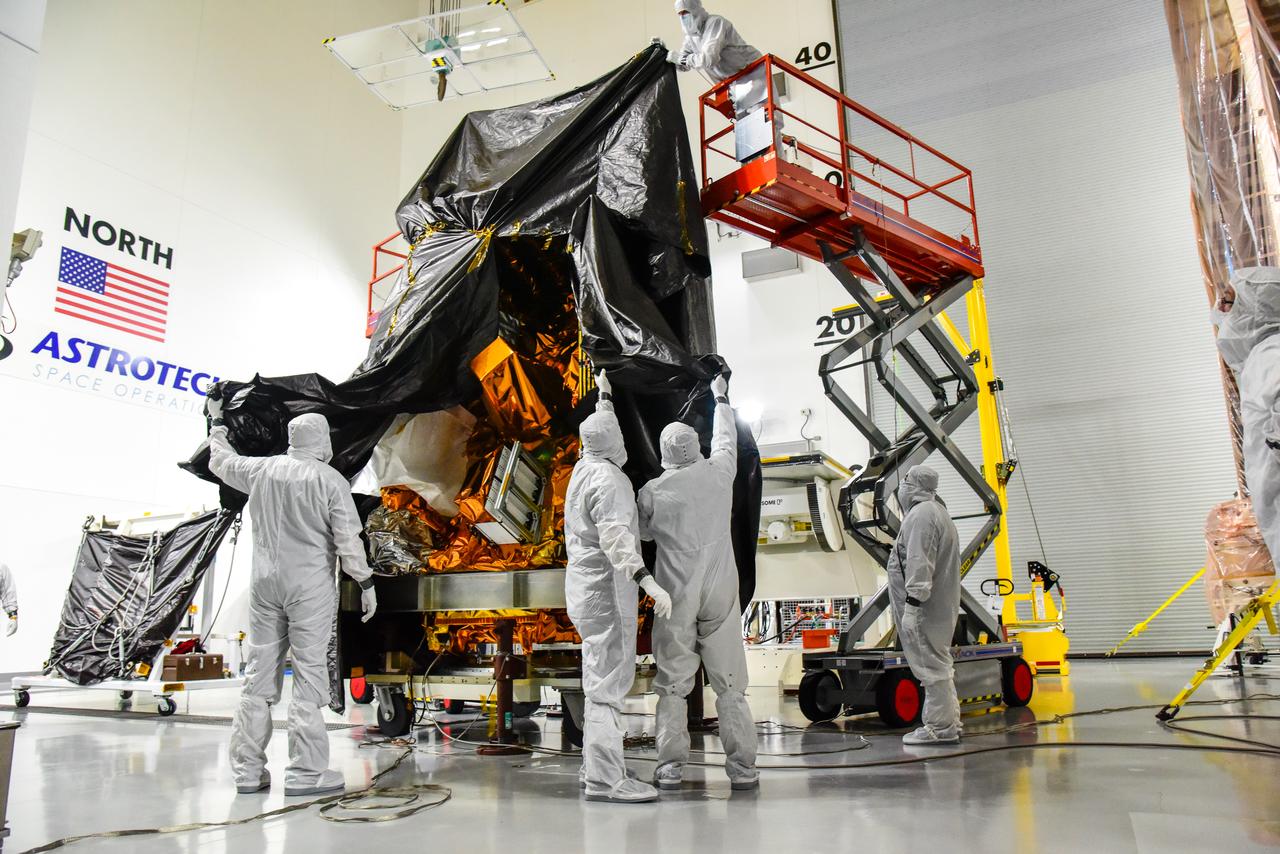
Technicians remove the protective covering from NASA and the National Oceanic and Atmospheric Administration’s (NOAA) Joint Polar Satellite System-2 (JPSS-2) satellite inside the Astrotech Space Operations facility at Vandenberg Space Force Base in California on Aug. 22, 2022. JPSS-2 is the third satellite in the Joint Polar Satellite System series. It is scheduled to lift off from VSFB on Nov. 1 from Space Launch Complex-3. JPSS-2, which will be renamed NOAA-21 after reaching orbit, will join a constellation of JPSS satellites that orbit from the North to the South pole, circling Earth 14 times a day and providing a full view of the entire globe twice daily. The NOAA/NASA Suomi National Polar-orbiting Partnership (Suomi NPP) satellite, and NOAA-20, previously known as JPSS-1, are both already in orbit. Each satellite carries at least four advanced instruments to measure weather and climate conditions on Earth. A secondary payload on the mission is the Low-Earth Orbit Flight Test of an Inflatable Decelerator (LOFTID), and is dedicated to the memory of Bernard Kutter. LOFTID will demonstrate inflatable heat shield technology that could enable a variety of proposed NASA missions to destinations such as Mars, Venus, and Titan, as well as returning heavier payloads from low-Earth orbit.
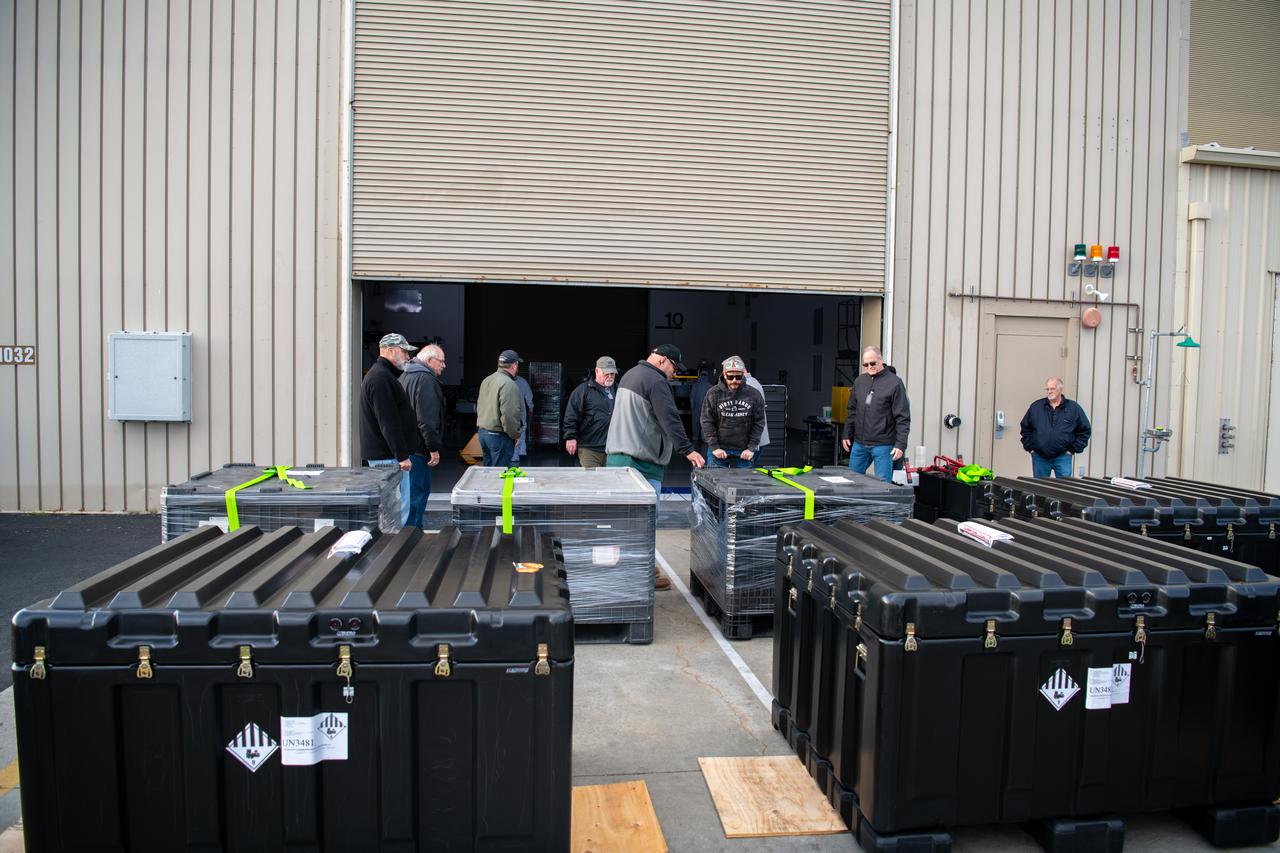
Teams at Vandenberg Space Force Base in California offload several shipping containers protecting NASA’s PUNCH (Polarimeter to Unify the Corona and Heliosphere) satellites on Saturday, Jan. 18, 2025. PUNCH will make 3D observations of the Sun’s corona to learn how the mass and energy becomes solar wind. PUNCH, along with NASA’s SPHEREx (Spectro-Photometer for the History of the Universe, Epoch of Reionization and Ices Explorer), a space telescope, will launch aboard a SpaceX Falcon 9 rocket in late February 2025.

The first half of the United Launch Alliance (ULA) Atlas V payload fairing is moved into position for a fit check at the Astrotech Processing Facility at Vandenberg Space Force Base (VSFB) in California on Aug. 13, 2022, for NASA and the National Oceanic and Atmospheric Administration’s (NOAA) Joint Polar Satellite System-2 (JPSS-2) satellite mission. JPSS-2 is the third satellite in the Joint Polar Satellite System series. It is scheduled to lift off from VSFB on Nov. 1 from Space Launch Complex-3 East. JPSS-2 will scan the globe as it orbits from the North to the South Pole, crossing the equator 14 times a day. From 512 miles above Earth, it will capture data that inform weather forecasts, extreme weather events, and climate change. The Visible Infrared Radiometer Suite instrument will collect imagery for global observations of the land, atmosphere, cryosphere, and oceans. Launching as a secondary payload to JPSS-2 is NASA’s Low-Earth Orbit Flight Test of an Inflatable Decelerator (LOFTID), dedicated to the memory of Bernard Kutter. LOFTID is a demonstration of a hypersonic inflatable aerodynamic decelerator, or aeroshell, technology that could one day help land humans on Mars.
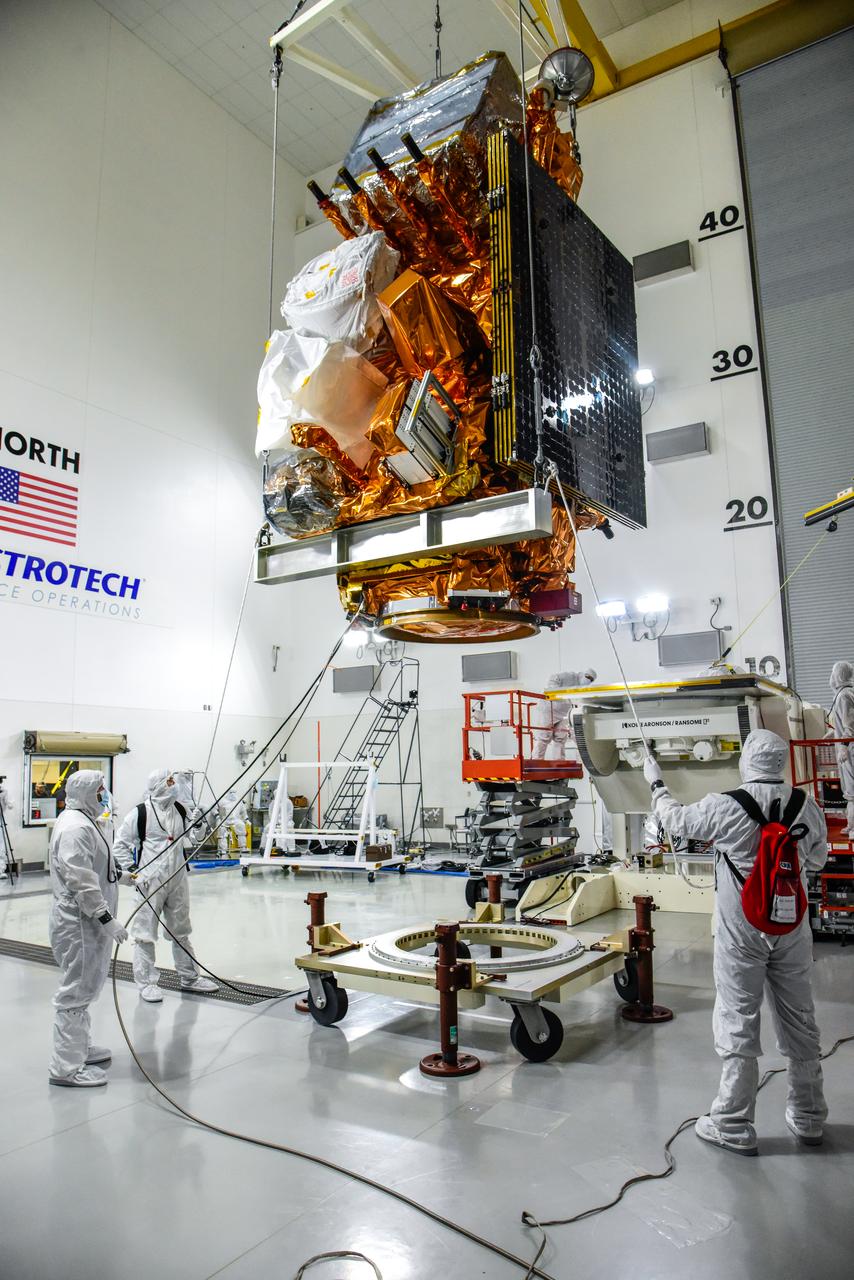
A crane is used to lift NASA and the National Oceanic and Atmospheric Administration’s (NOAA) Joint Polar Satellite System-2 (JPSS-2) satellite for transfer to an Aronson Table for processing inside the Astrotech Space Operations facility at Vandenberg Space Force Base in California on Aug. 22, 2022. JPSS-2 is the third satellite in the Joint Polar Satellite System series. It is scheduled to lift off from VSFB on Nov. 1 from Space Launch Complex-3. JPSS-2, which will be renamed NOAA-21 after reaching orbit, will join a constellation of JPSS satellites that orbit from the North to the South pole, circling Earth 14 times a day and providing a full view of the entire globe twice daily. The NOAA/NASA Suomi National Polar-orbiting Partnership (Suomi NPP) satellite, and NOAA-20, previously known as JPSS-1, are both already in orbit. Each satellite carries at least four advanced instruments to measure weather and climate conditions on Earth. A secondary payload on the mission is the Low-Earth Orbit Flight Test of an Inflatable Decelerator (LOFTID), and is dedicated to the memory of Bernard Kutter. LOFTID will demonstrate inflatable heat shield technology that could enable a variety of proposed NASA missions to destinations such as Mars, Venus, and Titan, as well as returning heavier payloads from low-Earth orbit.
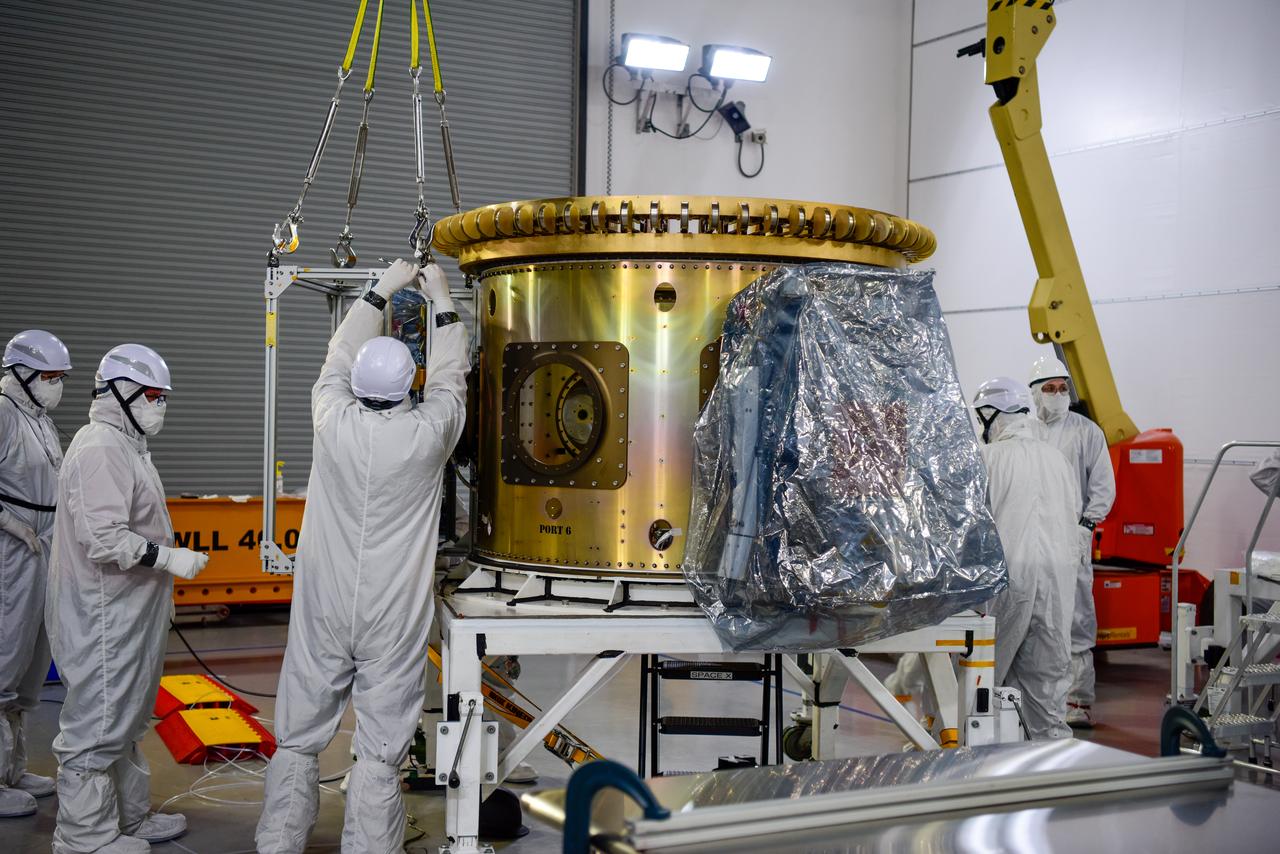
Technicians integrate NASA’s four PUNCH (Polarimeter to Unify the Corona and Heliosphere) satellites to the evolved expendable launch vehicle secondary payload adapter array ring inside the Astrotech Space Operations Facility at Vandenberg Space Force Base in California on Friday, Feb. 14, 2025. PUNCH will study origins of the Sun’s outflow of material, or the solar wind, capturing continuous 3D images of the Sun’s corona and the solar wind’s journey into the solar system. The PUNCH mission is launching as a rideshare with NASA’s SPHEREx (Spectro-Photometer for the History of the Universe, Epoch of Reionization and Ices Explorer) observatory scheduled to launch aboard a SpaceX Falcon 9 rocket at 10:09 p.m. EST (7:09 p.m. PST), Friday, Feb. 28, 2025, at Space Launch Complex 4 East from Vandenberg Space Force Base in California.
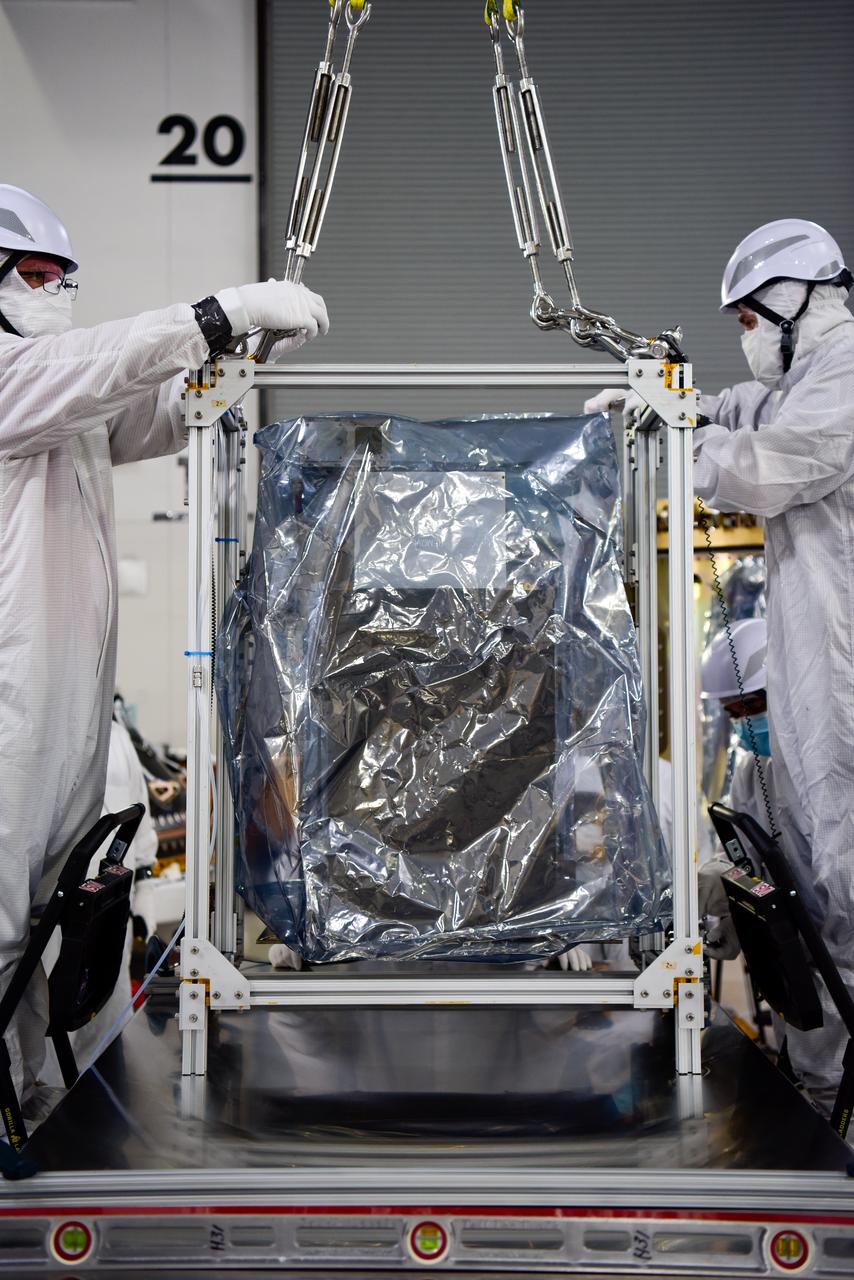
Technicians integrate NASA’s four PUNCH (Polarimeter to Unify the Corona and Heliosphere) satellites to the evolved expendable launch vehicle secondary payload adapter array ring inside the Astrotech Space Operations Facility at Vandenberg Space Force Base in California on Friday, Feb. 14, 2025. PUNCH will study origins of the Sun’s outflow of material, or the solar wind, capturing continuous 3D images of the Sun’s corona and the solar wind’s journey into the solar system. The PUNCH mission is launching as a rideshare with NASA’s SPHEREx (Spectro-Photometer for the History of the Universe, Epoch of Reionization and Ices Explorer) observatory scheduled to launch aboard a SpaceX Falcon 9 rocket at 10:09 p.m. EST (7:09 p.m. PST), Friday, Feb. 28, 2025, at Space Launch Complex 4 East from Vandenberg Space Force Base in California.
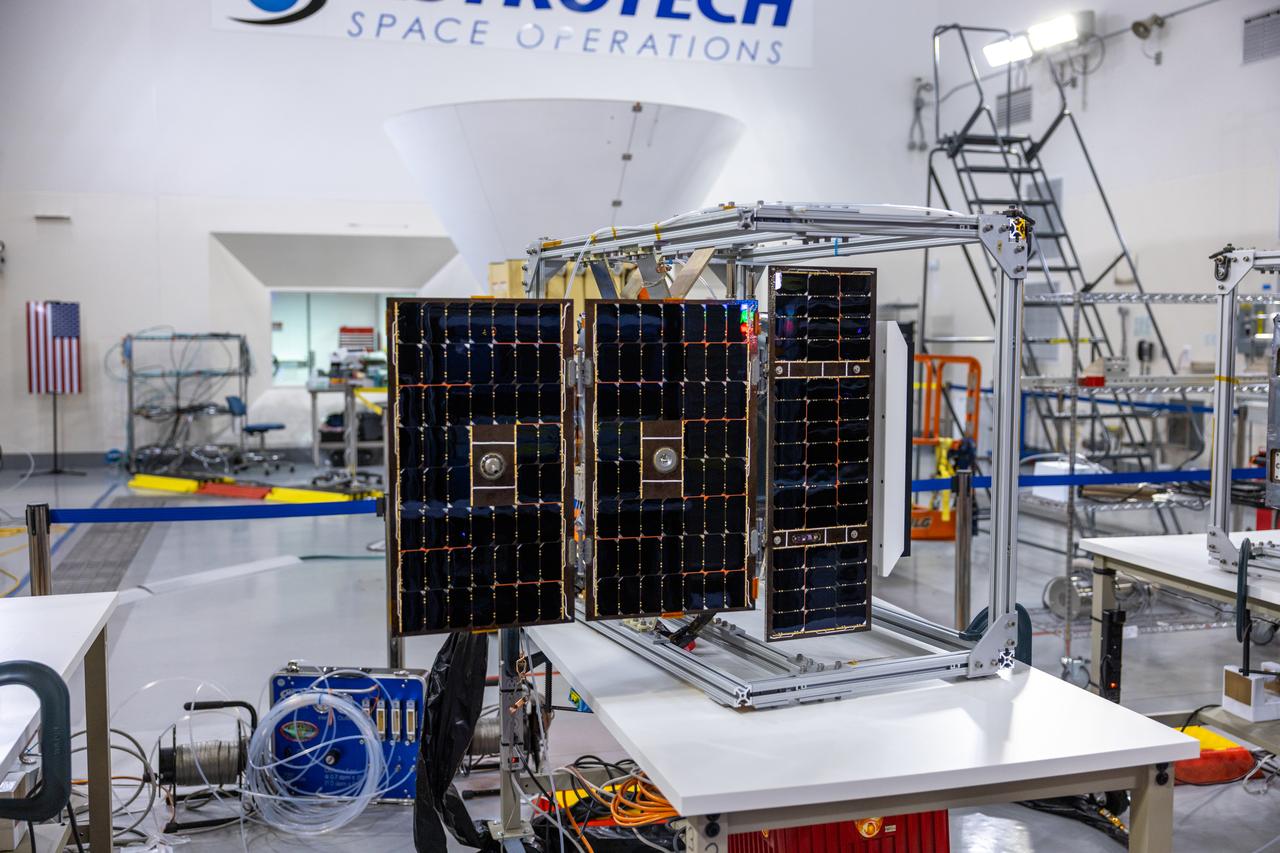
Crews conduct a solar array deployment test on the spacecraft of NASA’s PUNCH (Polarimeter to Unify the Corona and Heliosphere) satellites at Astrotech Space Operations located on Vandenberg Space Force Base in California on Tuesday, Jan. 21, 2025. The four satellites of PUNCH will make 3D observations of the Sun’s corona to learn how the mass and energy becomes solar wind. PUNCH, along with NASA’s SPHEREx (Spectro-Photometer for the History of the Universe, Epoch of Reionization and Ices Explorer), a space telescope, will launch aboard a SpaceX Falcon 9 rocket in late February 2025.
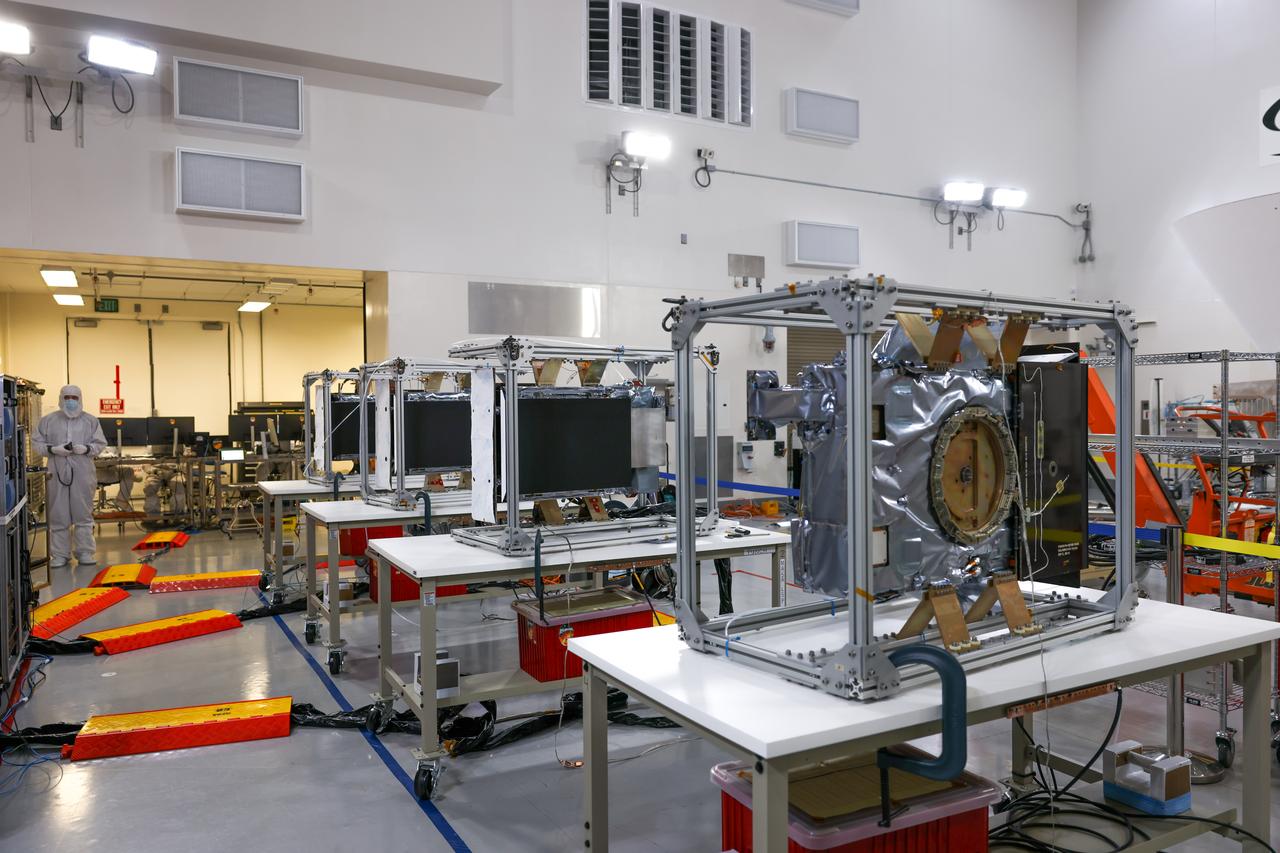
Crews conduct additional solar array deployment testing for NASA’s PUNCH (Polarimeter to Unify the Corona and Heliosphere) satellites at Astrotech Space Operations located on Vandenberg Space Force Base in California on Wednesday, Jan. 22, 2025. PUNCH, consisting of four satellites, will produce continuous 3D images of the solar wind and solar storms as it travels from the Sun to Earth to better understand how material in the corona accelerates. PUNCH, along with NASA’s SPHEREx (Spectro-Photometer for the History of the Universe, Epoch of Reionization and Ices Explorer), a space telescope, will launch aboard a SpaceX Falcon 9 rocket from Launch Complex 4E at Vandenberg Space Force Base in Central California on Thursday, Feb. 27, 2025.
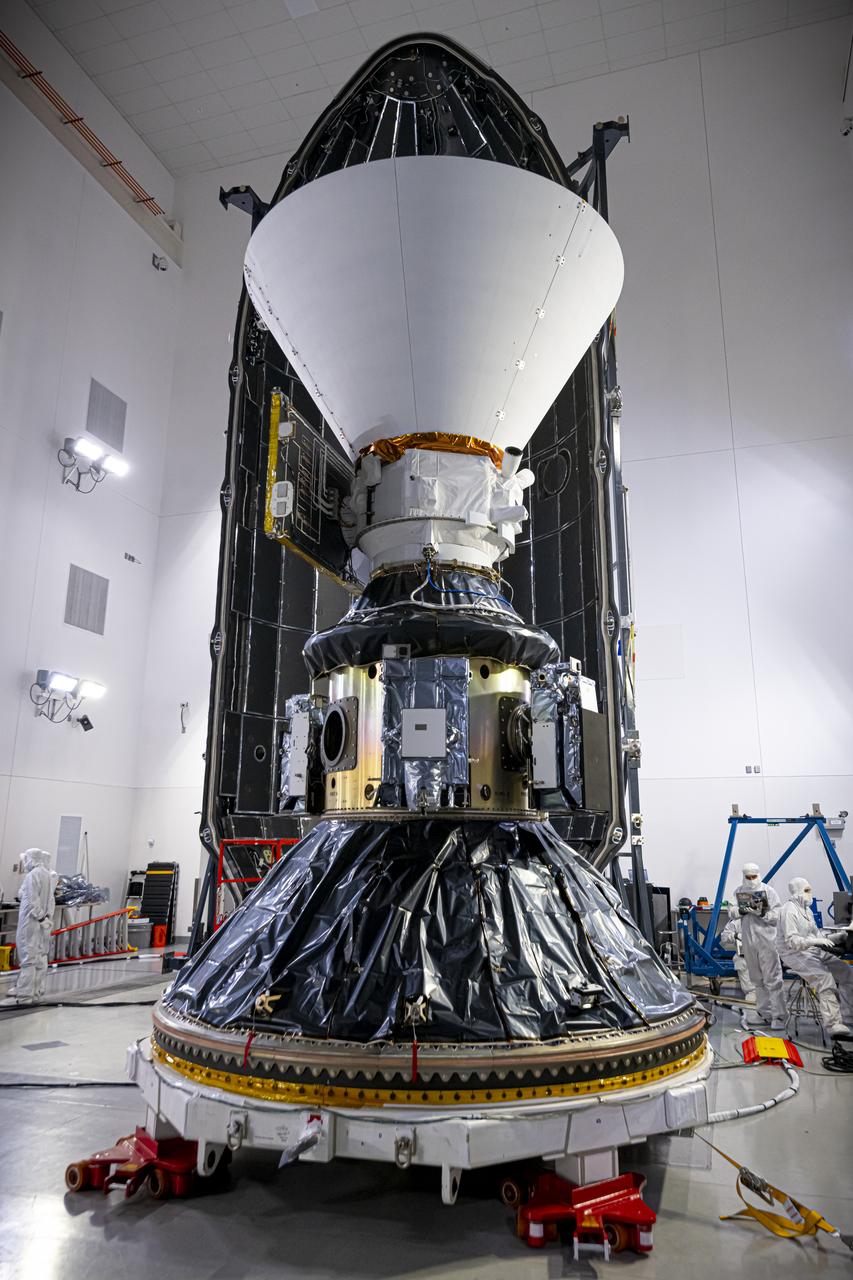
Technicians and engineers encapsulate NASA’s SPHEREx (Spectro-Photometer for the History of the Universe, Epoch of Reionization and Ices Explorer) observatory and PUNCH (Polarimeter to Unify the Corona and Heliosphere) satellites within a protective payload fairing inside the Astrotech Space Operations facility at Vandenberg Space Force Base in California, on Thursday, Feb. 27, 2025. SPHEREx will use its telescope to provide an all-sky spectral survey, creating a 3D map of the entire sky to help scientists investigate the origins of our universe. PUNCH will study origins of the Sun’s outflow of material, or the solar wind, capturing continuous 3D images of the Sun’s corona and the solar wind’s journey into the solar system. Liftoff aboard a SpaceX Falcon 9 rocket is targeted for NET 10:09 EST (7:09 p.m. PST), Tuesday, March 4, 2025, at Space Launch Complex 4 East from Vandenberg Space Force Base in California.
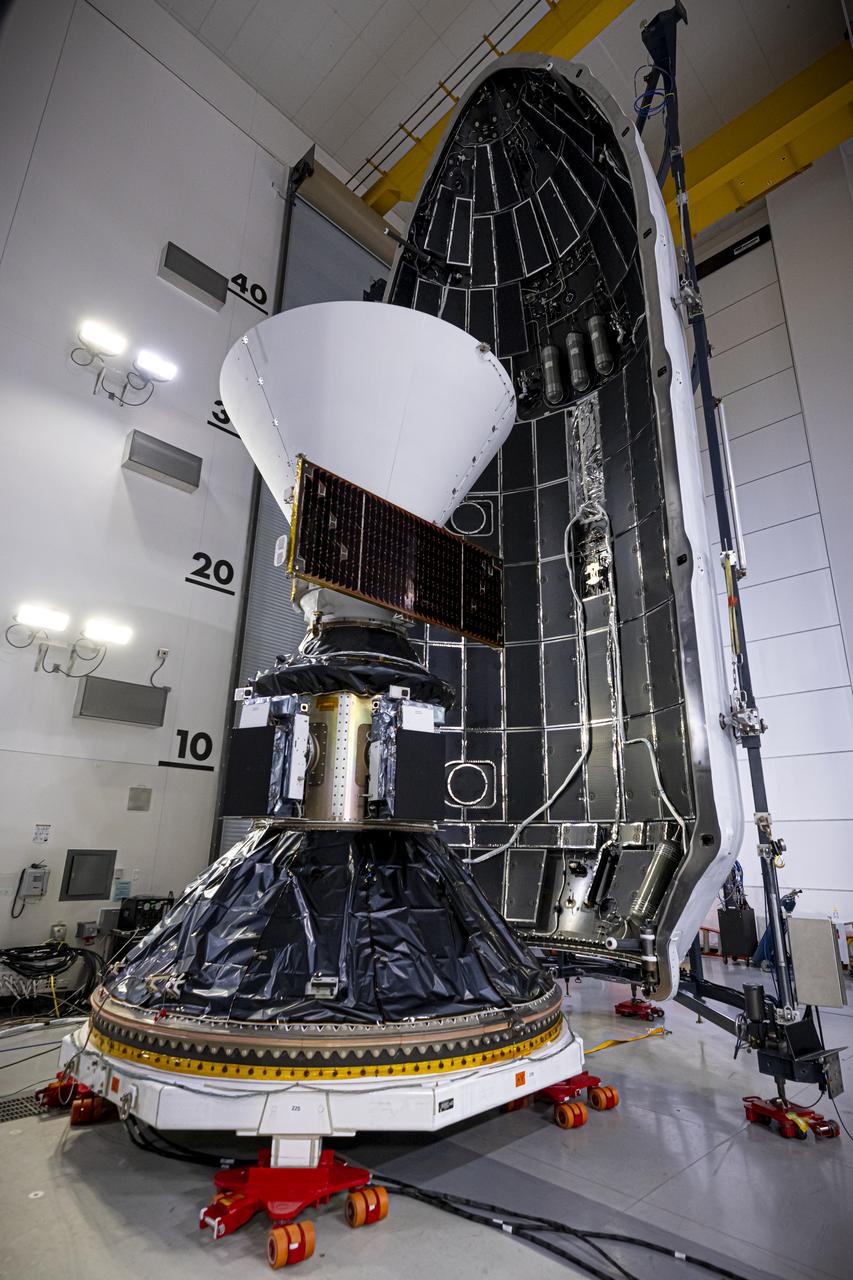
Technicians and engineers encapsulate NASA’s SPHEREx (Spectro-Photometer for the History of the Universe, Epoch of Reionization and Ices Explorer) observatory and PUNCH (Polarimeter to Unify the Corona and Heliosphere) satellites within a protective payload fairing inside the Astrotech Space Operations facility at Vandenberg Space Force Base in California, on Thursday, Feb. 27, 2025. SPHEREx will use its telescope to provide an all-sky spectral survey, creating a 3D map of the entire sky to help scientists investigate the origins of our universe. PUNCH will study origins of the Sun’s outflow of material, or the solar wind, capturing continuous 3D images of the Sun’s corona and the solar wind’s journey into the solar system. Liftoff aboard a SpaceX Falcon 9 rocket is targeted for NET 10:09 EST (7:09 p.m. PST), Tuesday, March 4, 2025, at Space Launch Complex 4 East from Vandenberg Space Force Base in California.
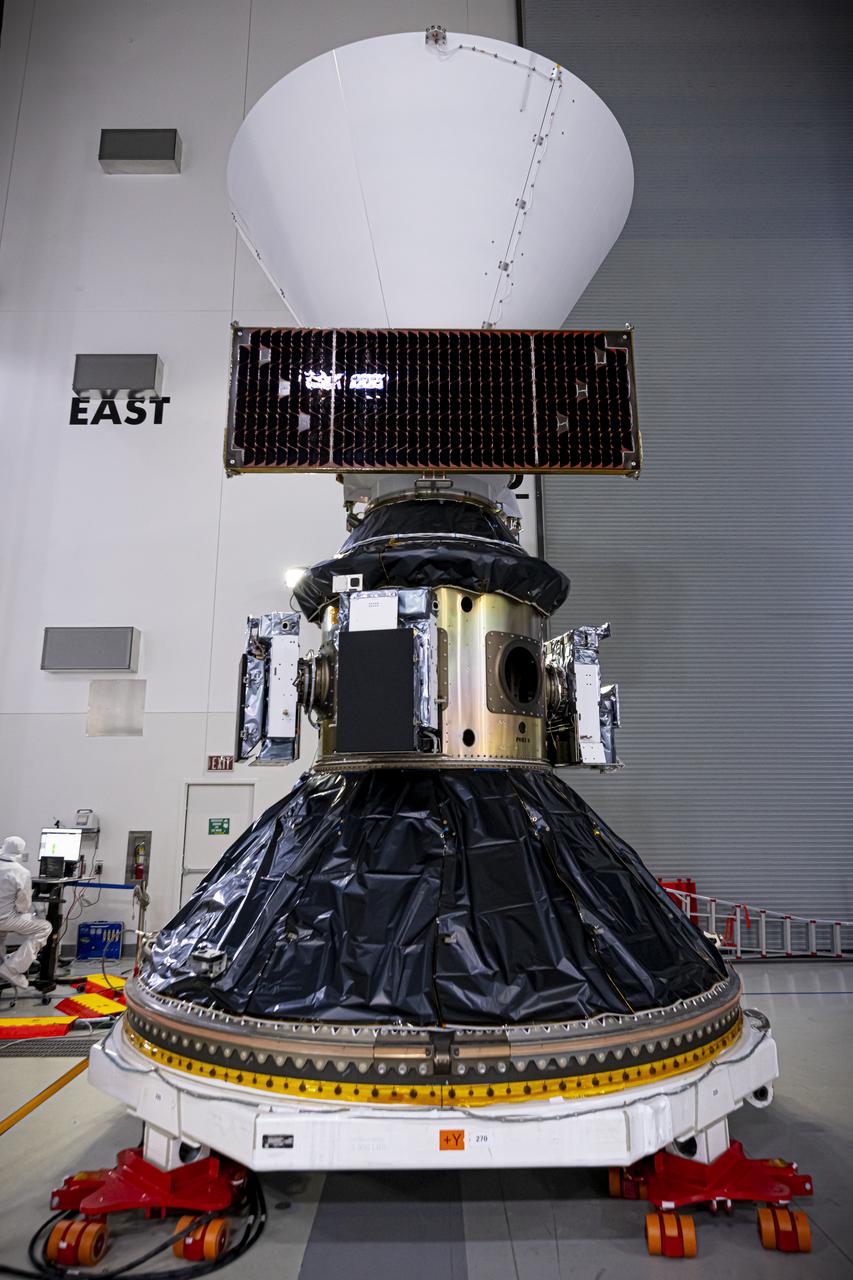
Technicians and engineers encapsulate NASA’s SPHEREx (Spectro-Photometer for the History of the Universe, Epoch of Reionization and Ices Explorer) observatory and PUNCH (Polarimeter to Unify the Corona and Heliosphere) satellites within a protective payload fairing inside the Astrotech Space Operations facility at Vandenberg Space Force Base in California, on Thursday, Feb. 27, 2025. SPHEREx will use its telescope to provide an all-sky spectral survey, creating a 3D map of the entire sky to help scientists investigate the origins of our universe. PUNCH will study origins of the Sun’s outflow of material, or the solar wind, capturing continuous 3D images of the Sun’s corona and the solar wind’s journey into the solar system. Liftoff aboard a SpaceX Falcon 9 rocket is targeted for NET 10:09 EST (7:09 p.m. PST), Tuesday, March 4, 2025, at Space Launch Complex 4 East from Vandenberg Space Force Base in California.
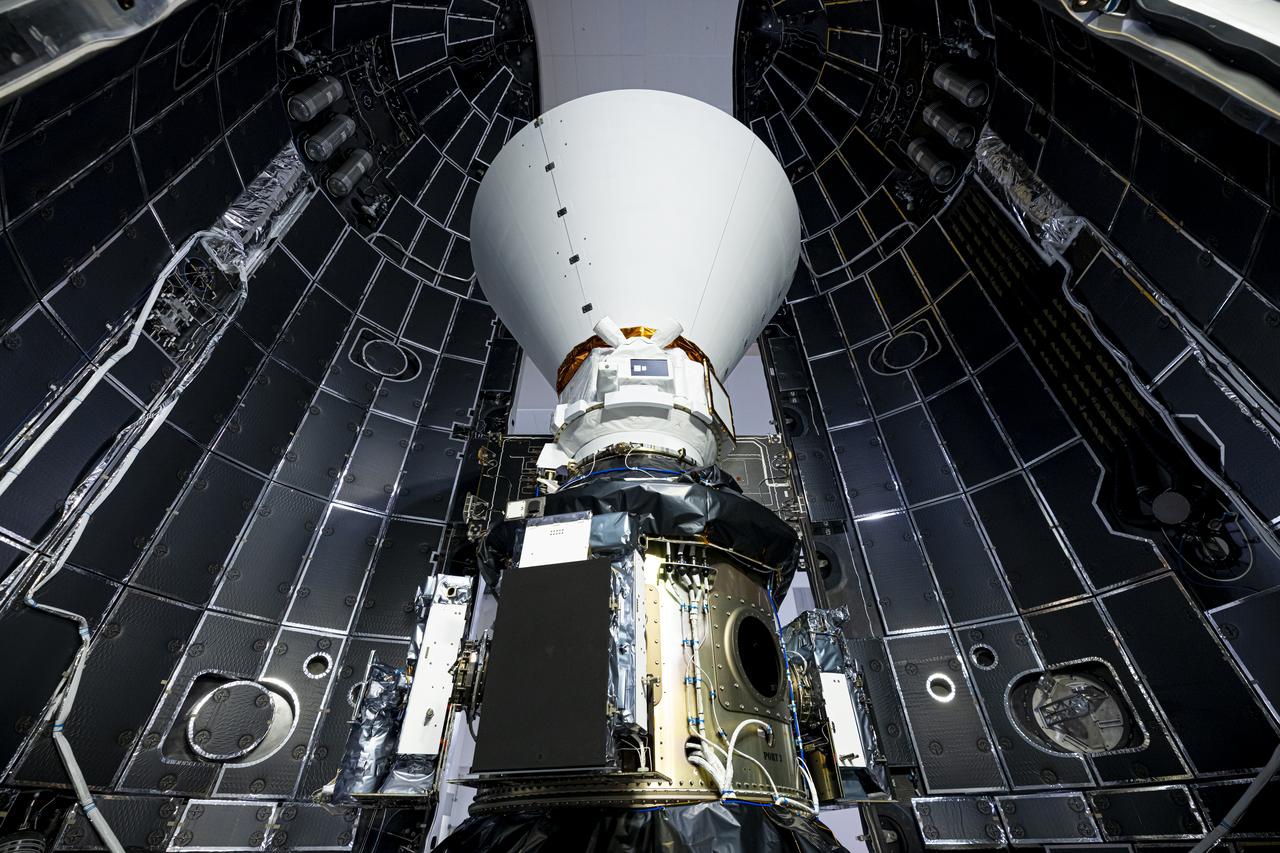
Technicians and engineers encapsulate NASA’s SPHEREx (Spectro-Photometer for the History of the Universe, Epoch of Reionization and Ices Explorer) observatory and PUNCH (Polarimeter to Unify the Corona and Heliosphere) satellites within a protective payload fairing inside the Astrotech Space Operations facility at Vandenberg Space Force Base in California, on Thursday, Feb. 27, 2025. SPHEREx will use its telescope to provide an all-sky spectral survey, creating a 3D map of the entire sky to help scientists investigate the origins of our universe. PUNCH will study origins of the Sun’s outflow of material, or the solar wind, capturing continuous 3D images of the Sun’s corona and the solar wind’s journey into the solar system. Liftoff aboard a SpaceX Falcon 9 rocket is targeted for NET 10:09 EST (7:09 p.m. PST), Tuesday, March 4, 2025, at Space Launch Complex 4 East from Vandenberg Space Force Base in California.
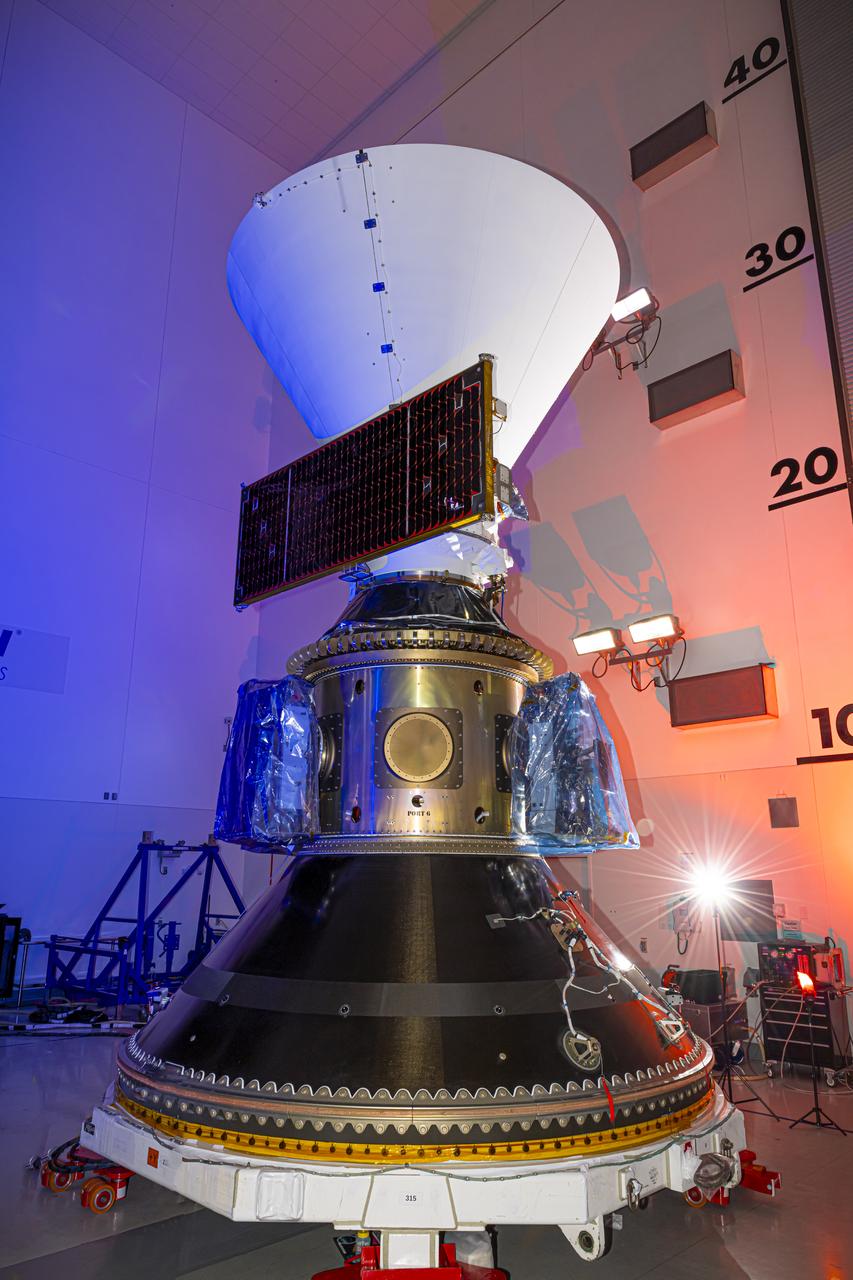
Technicians and engineers encapsulate NASA’s SPHEREx (Spectro-Photometer for the History of the Universe, Epoch of Reionization and Ices Explorer) observatory and PUNCH (Polarimeter to Unify the Corona and Heliosphere) satellites within a protective payload fairing inside the Astrotech Space Operations facility at Vandenberg Space Force Base in California, on Saturday, March 1, 2025. SPHEREx will use its telescope to provide an all-sky spectral survey, creating a 3D map of the entire sky to help scientists investigate the origins of our universe. PUNCH will study origins of the Sun’s outflow of material, or the solar wind, capturing continuous 3D images of the Sun’s corona and the solar wind’s journey into the solar system. Liftoff aboard a SpaceX Falcon 9 rocket is targeted for NET 10:09 EST (7:09 p.m. PST), Tuesday, March 4, 2025, at Space Launch Complex 4 East from Vandenberg Space Force Base in California.
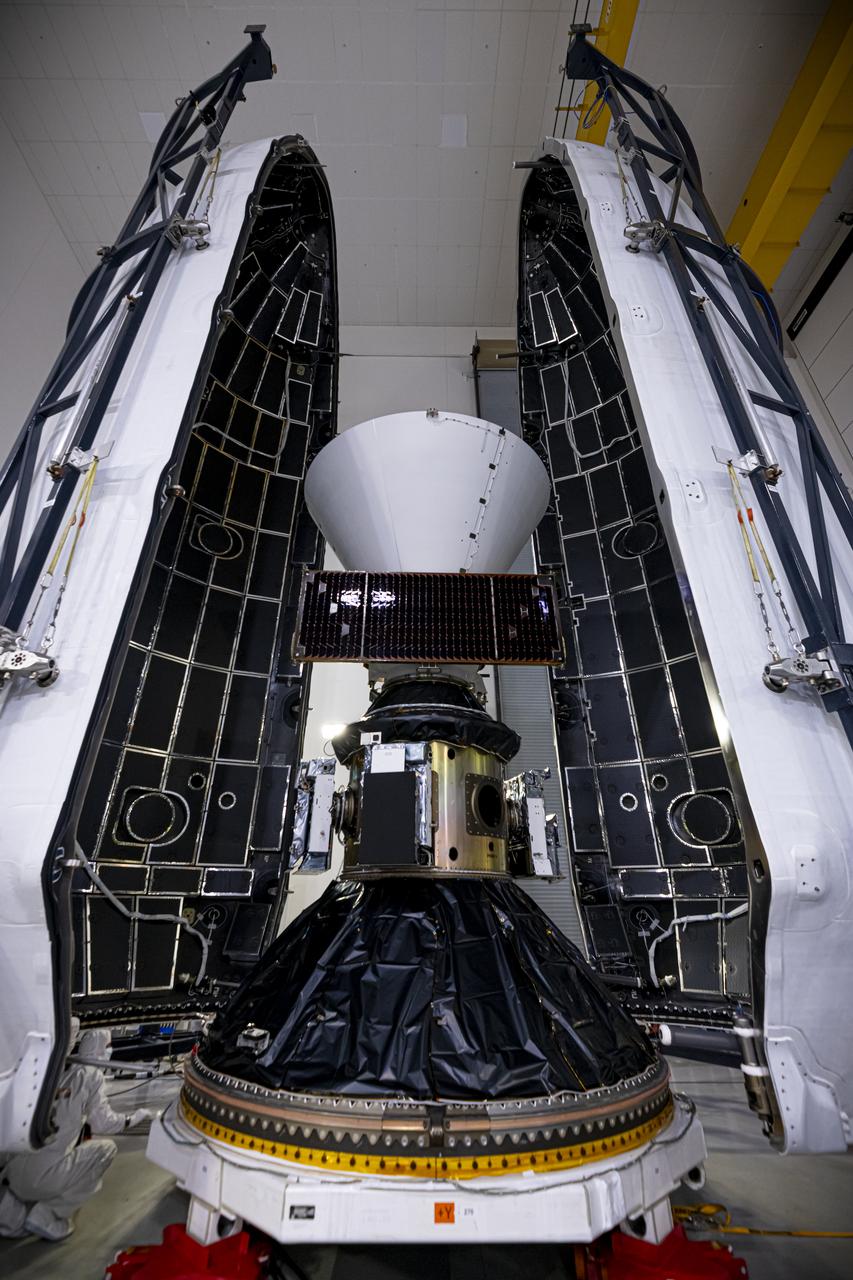
Technicians and engineers encapsulate NASA’s SPHEREx (Spectro-Photometer for the History of the Universe, Epoch of Reionization and Ices Explorer) observatory and PUNCH (Polarimeter to Unify the Corona and Heliosphere) satellites within a protective payload fairing inside the Astrotech Space Operations facility at Vandenberg Space Force Base in California, on Thursday, Feb. 27, 2025. SPHEREx will use its telescope to provide an all-sky spectral survey, creating a 3D map of the entire sky to help scientists investigate the origins of our universe. PUNCH will study origins of the Sun’s outflow of material, or the solar wind, capturing continuous 3D images of the Sun’s corona and the solar wind’s journey into the solar system. Liftoff aboard a SpaceX Falcon 9 rocket is targeted for NET 10:09 EST (7:09 p.m. PST), Tuesday, March 4, 2025, at Space Launch Complex 4 East from Vandenberg Space Force Base in California.
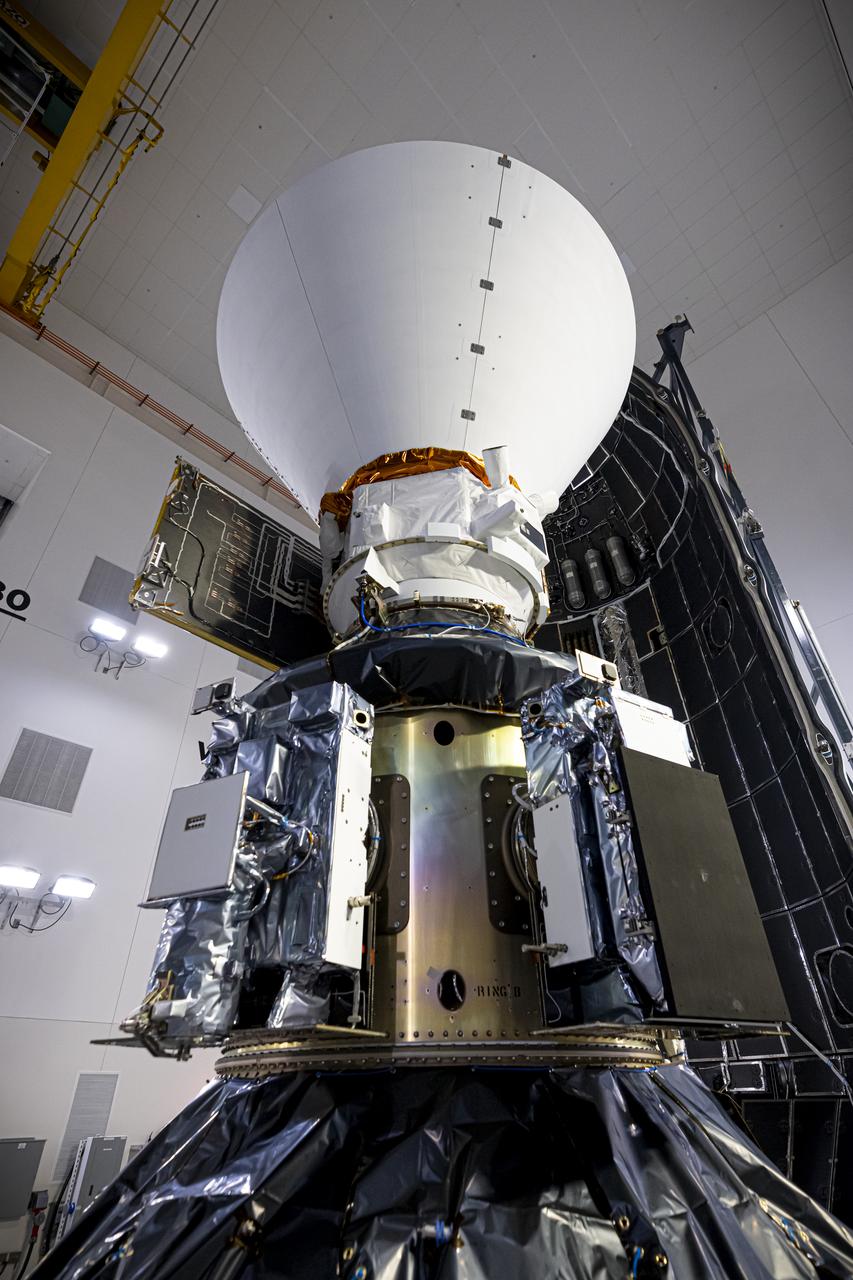
Technicians and engineers encapsulate NASA’s SPHEREx (Spectro-Photometer for the History of the Universe, Epoch of Reionization and Ices Explorer) observatory and PUNCH (Polarimeter to Unify the Corona and Heliosphere) satellites within a protective payload fairing inside the Astrotech Space Operations facility at Vandenberg Space Force Base in California, on Thursday, Feb. 27, 2025. SPHEREx will use its telescope to provide an all-sky spectral survey, creating a 3D map of the entire sky to help scientists investigate the origins of our universe. PUNCH will study origins of the Sun’s outflow of material, or the solar wind, capturing continuous 3D images of the Sun’s corona and the solar wind’s journey into the solar system. Liftoff aboard a SpaceX Falcon 9 rocket is targeted for NET 10:09 EST (7:09 p.m. PST), Tuesday, March 4, 2025, at Space Launch Complex 4 East from Vandenberg Space Force Base in California.