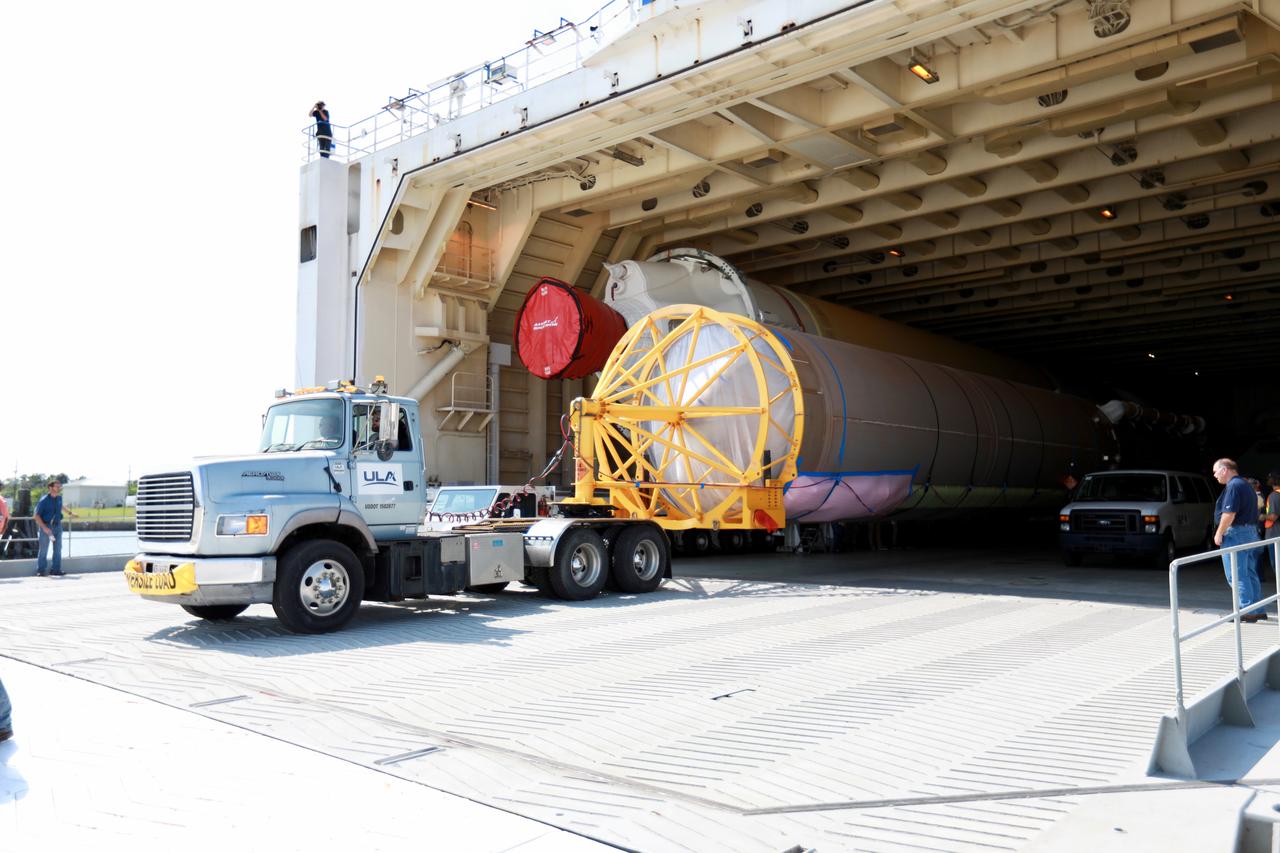
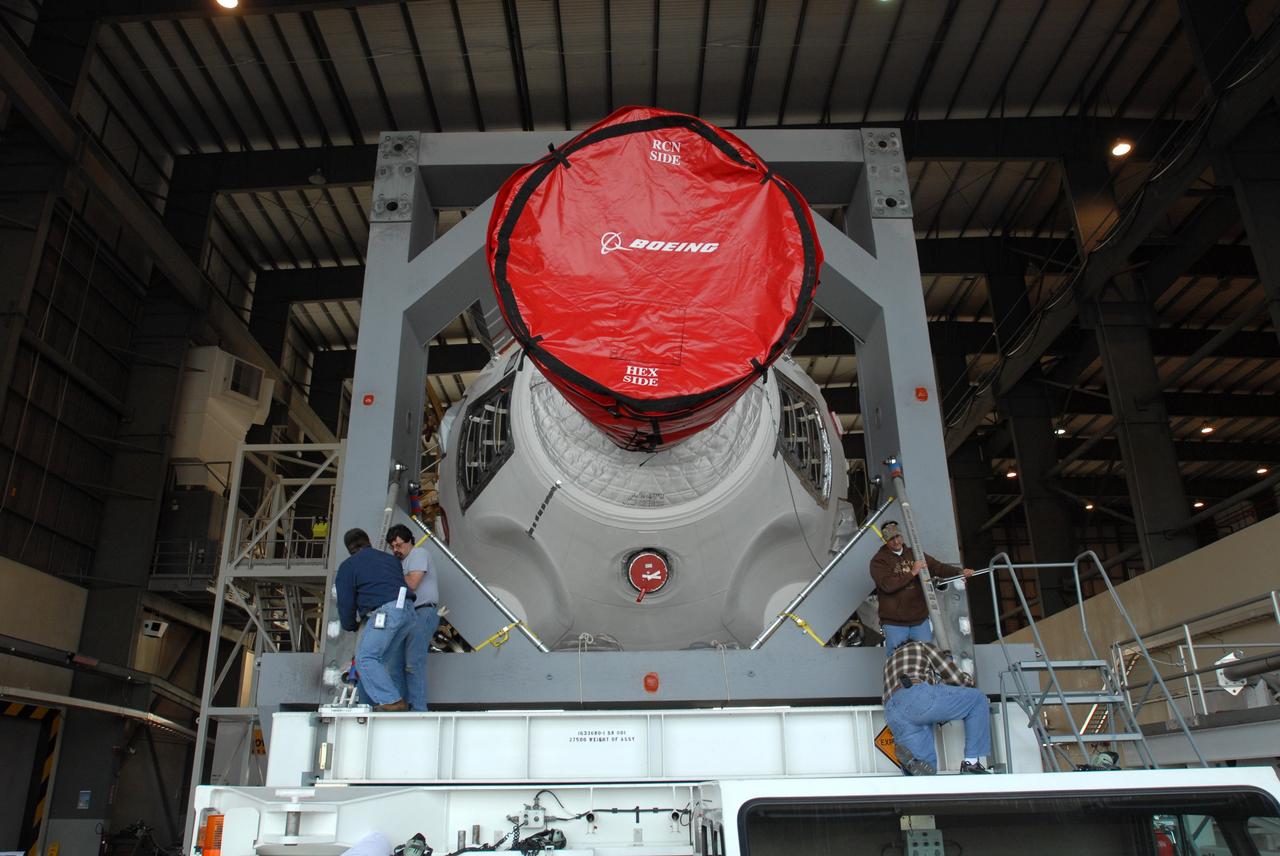
At the Army Wharf at Cape Canaveral Air Force Station in Florida, the United Launch Alliance (ULA) Mariner cargo ship door is lowered on June 5, 2019, for offloading of the ULA Atlas V booster that will be used for Boeing’s Crew Flight Test (CFT). The Atlas V rocket will launch the CST-100 Starliner spacecraft and its crew, NASA astronauts Mike Fincke and Nicole Mann and Boeing astronaut Chris Ferguson, to the International Space Station for NASA’s Commercial Crew Program. The booster will be transported to the Atlas Spaceflight Operations Center to await the start of operations for its mission. The CFT will demonstrate Starliner and Atlas V’s ability to safely carry crew to and from the orbiting laboratory.
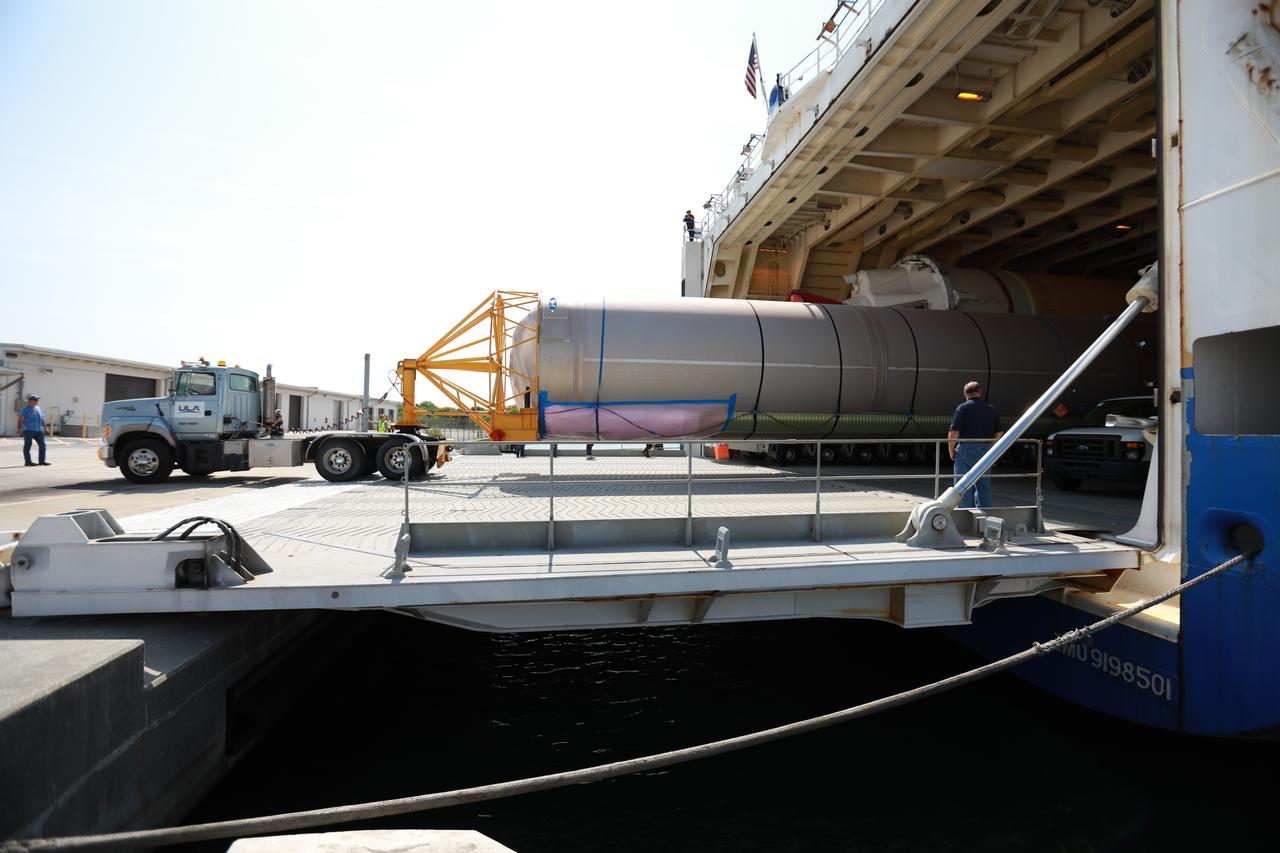
The United Launch Alliance (ULA) Atlas V booster that will be used for Boeing’s Crew Flight Test (CFT) is moved out of the Mariner cargo ship at the Army Wharf at Cape Canaveral Air Force Station in Florida on June 5, 2019. The ULA Atlas V rocket will launch the CST-100 Starliner and its crew, NASA astronauts Mike Fincke and Nicole Mann and Boeing astronaut Chris Ferguson, to the International Space Station for NASA’s Commercial Crew Program. The booster will be transported to the Atlas Spaceflight Operations Center to await the start of operations for its missions. The CFT will demonstrate Starliner and Atlas V’s ability to safely carry crew to and from the orbiting laboratory.
The United Launch Alliance (ULA) Atlas V booster that will be used for Boeing’s Crew Flight Test (CFT) is moved out of the Mariner cargo ship at the Army Wharf at Cape Canaveral Air Force Station in Florida on June 5, 2019. The ULA Atlas V rocket will launch the CST-100 Starliner and its crew, NASA astronauts Mike Fincke and Nicole Mann and Boeing astronaut Chris Ferguson, to the International Space Station for NASA’s Commercial Crew Program. The booster will be transported to the Atlas Spaceflight Operations Center to await the start of operations for its missions. The CFT will demonstrate Starliner and Atlas V’s ability to safely carry crew to and from the orbiting laboratory.
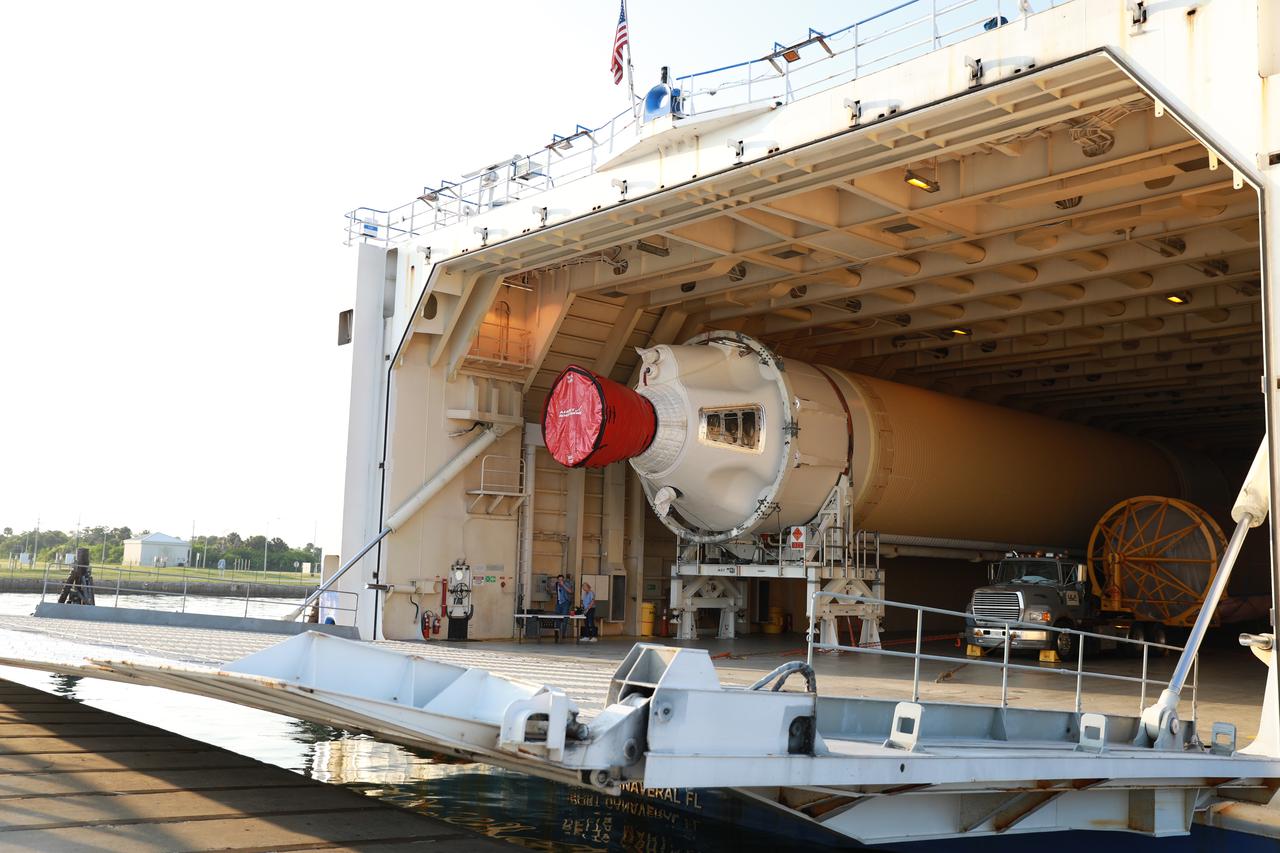
At the Army Wharf at Cape Canaveral Air Force Station in Florida, the United Launch Alliance (ULA) Mariner cargo ship door is lowered on June 5, 2019, for offloading of the ULA Atlas V booster that will be used for Boeing’s Crew Flight Test (CFT). The Atlas V rocket will launch the CST-100 Starliner spacecraft and its crew, NASA astronauts Mike Fincke and Nicole Mann and Boeing astronaut Chris Ferguson, to the International Space Station for NASA’s Commercial Crew Program. The booster will be transported to the Atlas Spaceflight Operations Center to await the start of operations for its mission. The CFT will demonstrate Starliner and Atlas V’s ability to safely carry crew to and from the orbiting laboratory.
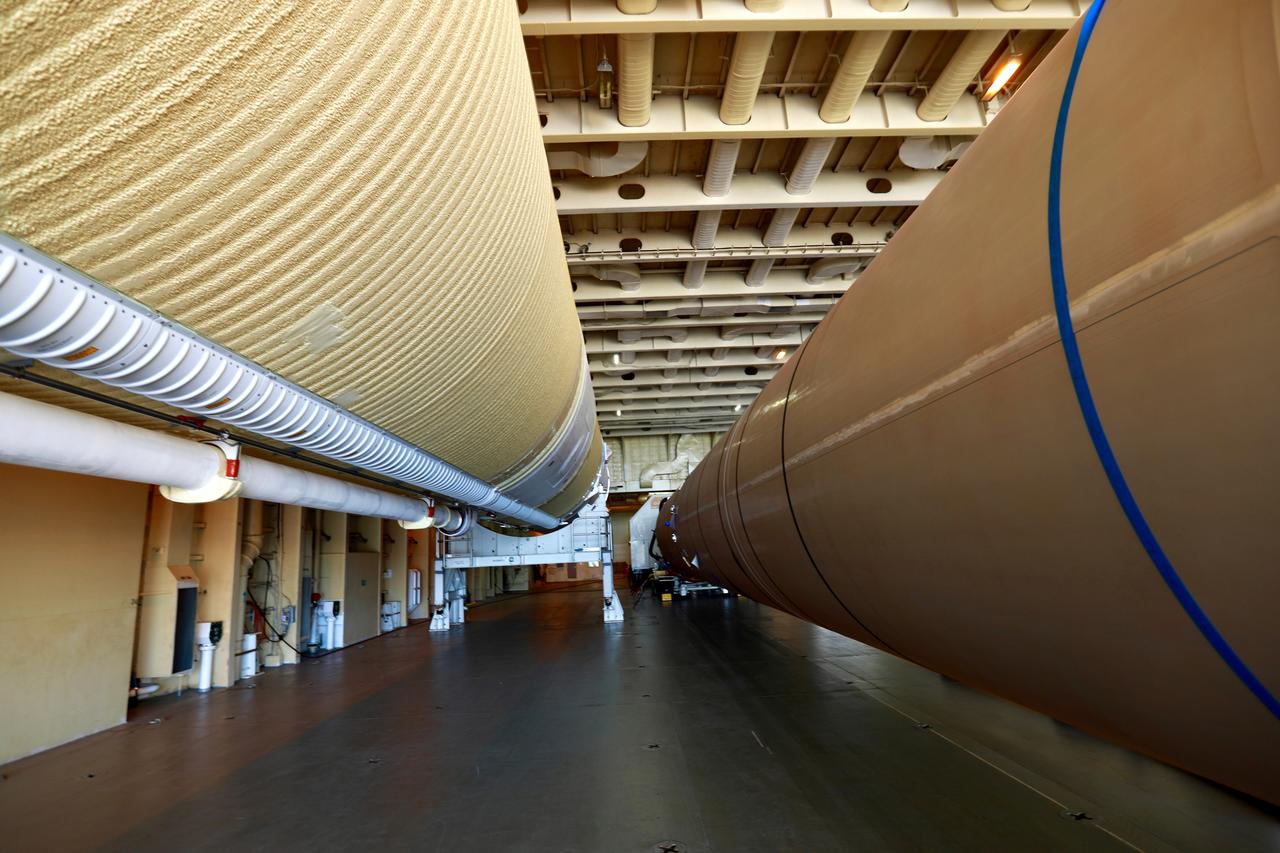
The United Launch Alliance (ULA) Atlas V booster that will be used for Boeing’s Crew Flight Test (CFT) is moved out of the Mariner cargo ship at the Army Wharf at Cape Canaveral Air Force Station in Florida on June 5, 2019. The ULA Atlas V rocket will launch the CST-100 Starliner and its crew, NASA astronauts Mike Fincke and Nicole Mann and Boeing astronaut Chris Ferguson, to the International Space Station for NASA’s Commercial Crew Program. The booster will be transported to the Atlas Spaceflight Operations Center to await the start of operations for its missions. The CFT will demonstrate Starliner and Atlas V’s ability to safely carry crew to and from the orbiting laboratory.
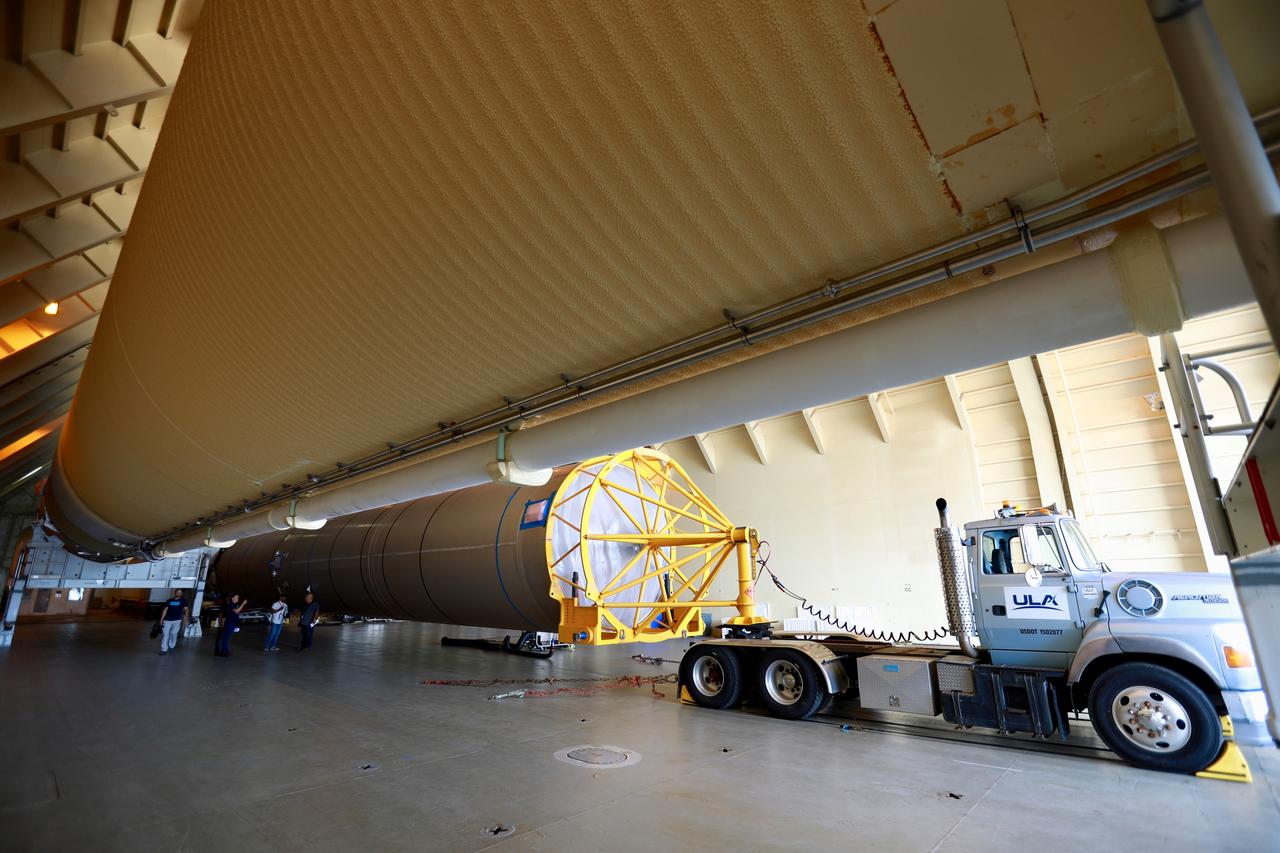
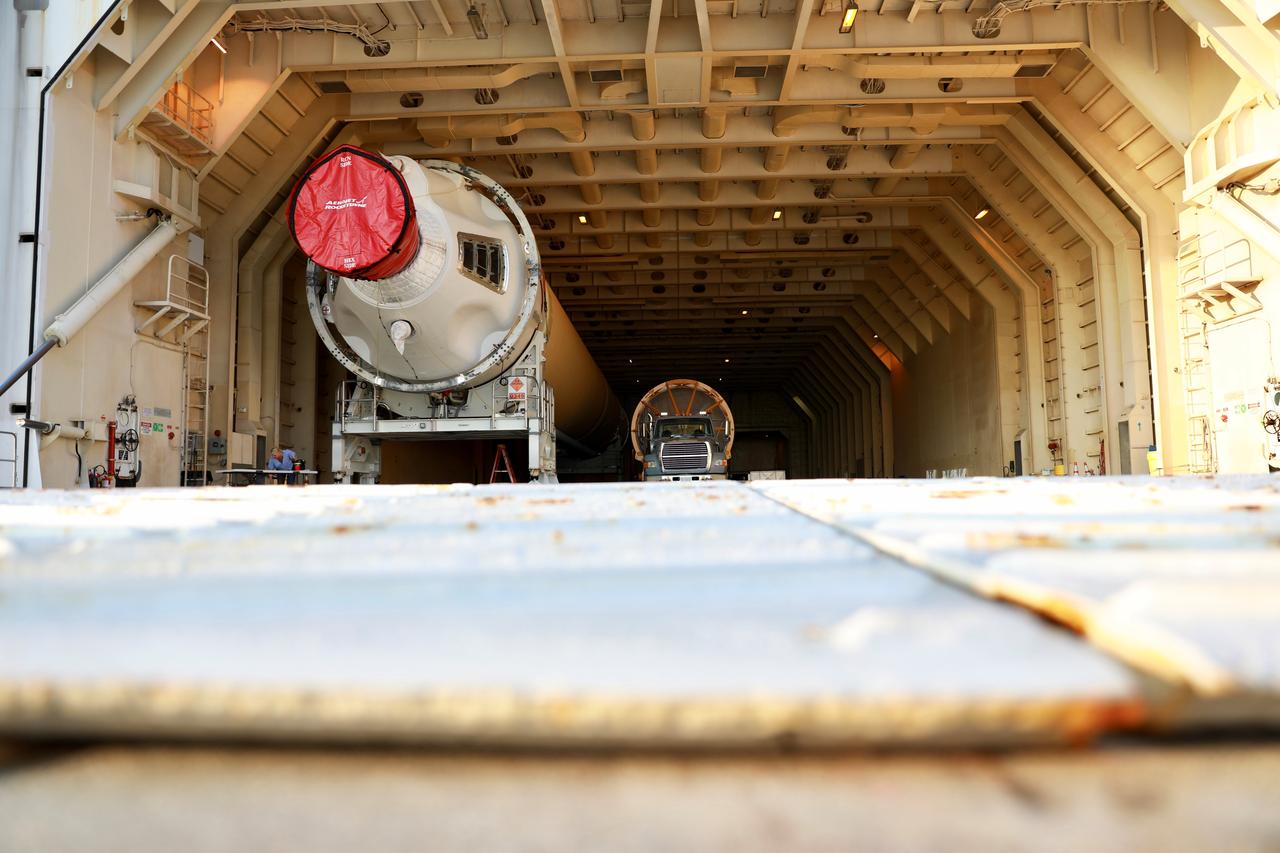
The United Launch Alliance (ULA) Atlas V booster that will be used for Boeing’s Crew Flight Test (CFT) is moved out of the Mariner cargo ship at the Army Wharf at Cape Canaveral Air Force Station in Florida on June 5, 2019. The ULA Atlas V rocket will launch the CST-100 Starliner and its crew, NASA astronauts Mike Fincke and Nicole Mann and Boeing astronaut Chris Ferguson, to the International Space Station for NASA’s Commercial Crew Program. The booster will be transported to the Atlas Spaceflight Operations Center to await the start of operations for its missions. The CFT will demonstrate Starliner and Atlas V’s ability to safely carry crew to and from the orbiting laboratory.
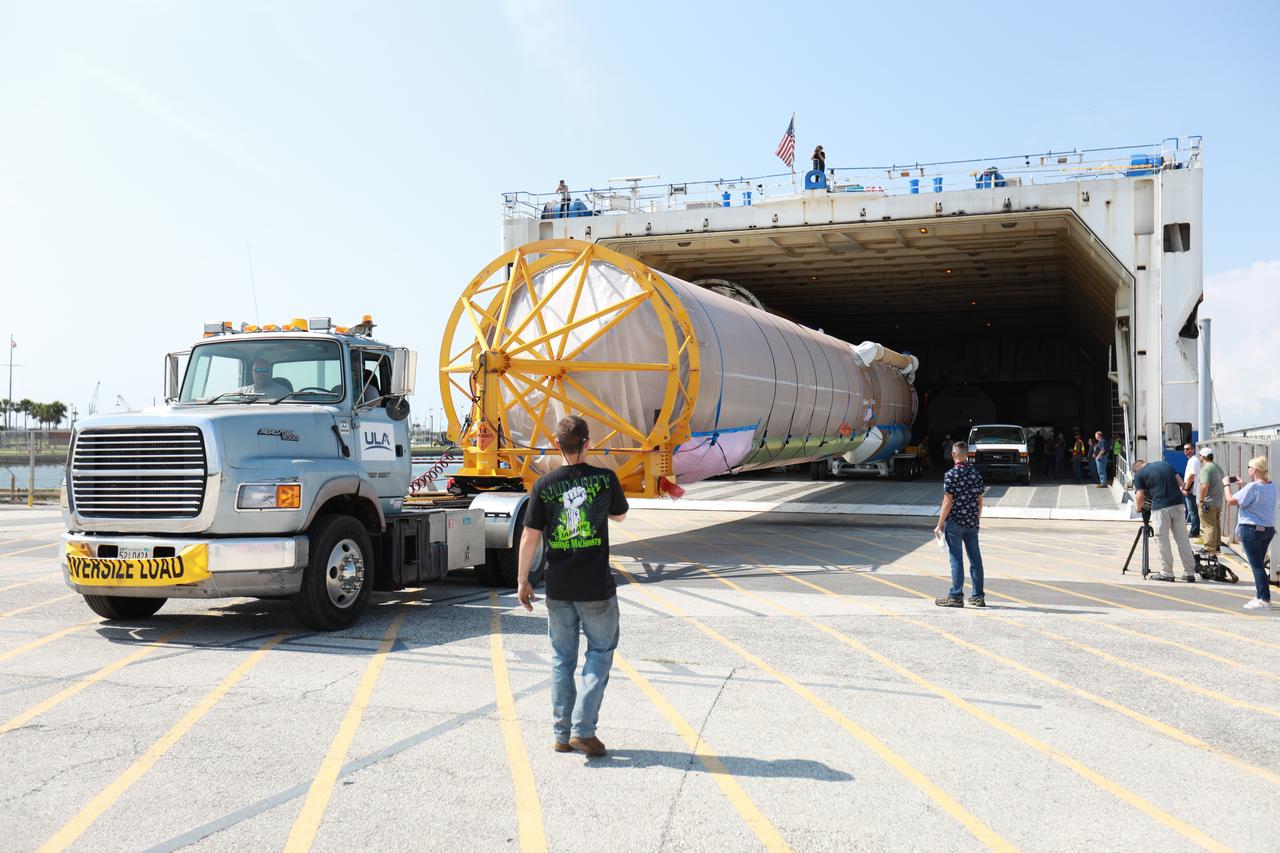
The United Launch Alliance (ULA) Atlas V booster that will be used for Boeing’s Crew Flight Test (CFT) is moved out of the Mariner cargo ship at the Army Wharf at Cape Canaveral Air Force Station in Florida on June 5, 2019. The ULA Atlas V rocket will launch the CST-100 Starliner and its crew, NASA astronauts Mike Fincke and Nicole Mann and Boeing astronaut Chris Ferguson, to the International Space Station for NASA’s Commercial Crew Program. The booster will be transported to the Atlas Spaceflight Operations Center to await the start of operations for its missions. The CFT will demonstrate Starliner and Atlas V’s ability to safely carry crew to and from the orbiting laboratory.
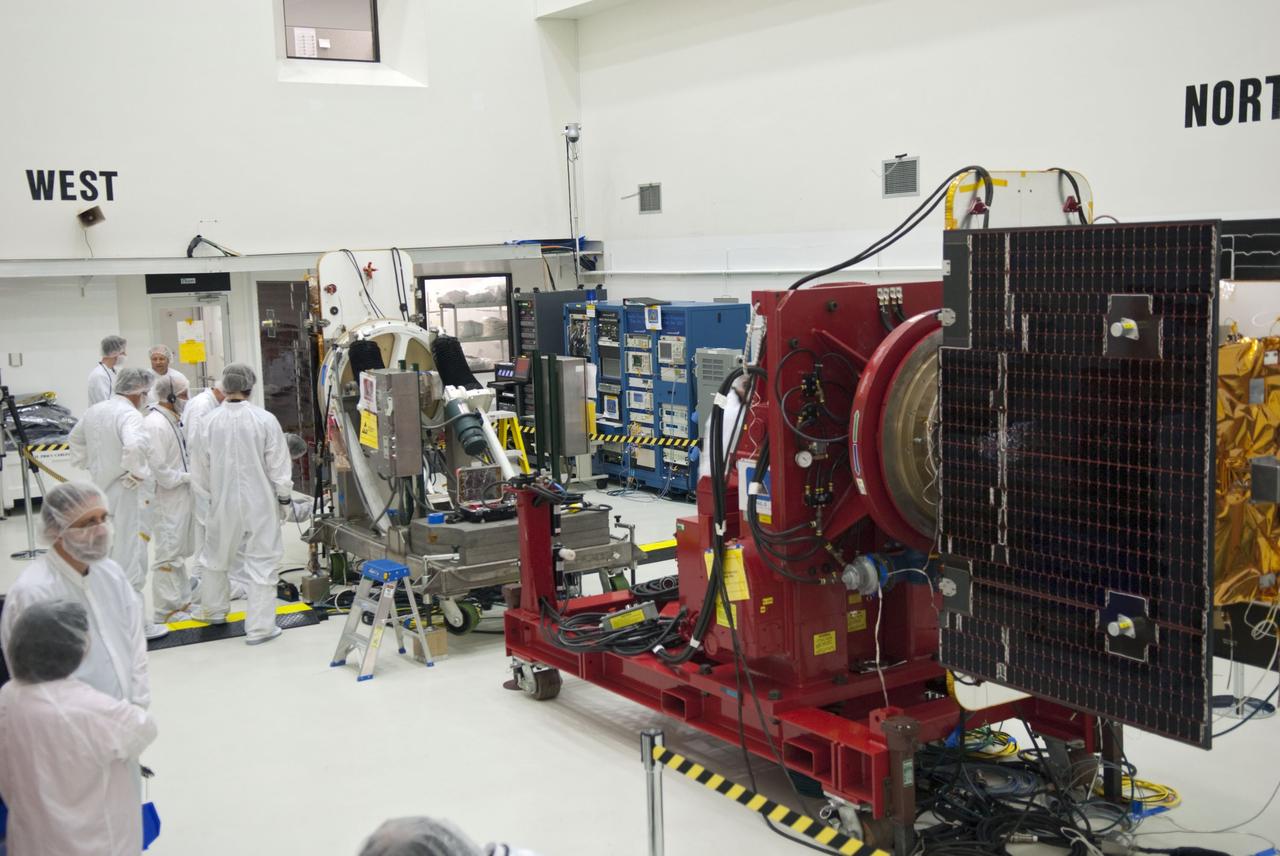
CAPE CANAVERAL, Fla. -- Technicians at Astrotech payload processing facility in Titusville, Fla., are conducting solar panel deployment tests on NASA's Gravity Recovery and Interior Laboratory, or GRAIL, twin spacecraft. The United Launch Alliance Delta II rocket that will carry GRAIL into lunar orbit already is fully stacked at NASA's Space Launch Complex 17B, and launch is scheduled for Sept. 8. The GRAIL mission is a part of NASA's Discovery Program. GRAIL will fly the twin spacecraft in tandem orbits around the moon for several months to measure its gravity field. The mission also will answer longstanding questions about Earth's moon and provide scientists a better understanding of how Earth and other rocky planets in the solar system formed. For more information, visit http://solarsystem.nasa.gov/grail/. Photo credit: NASA/Jim Grossmann
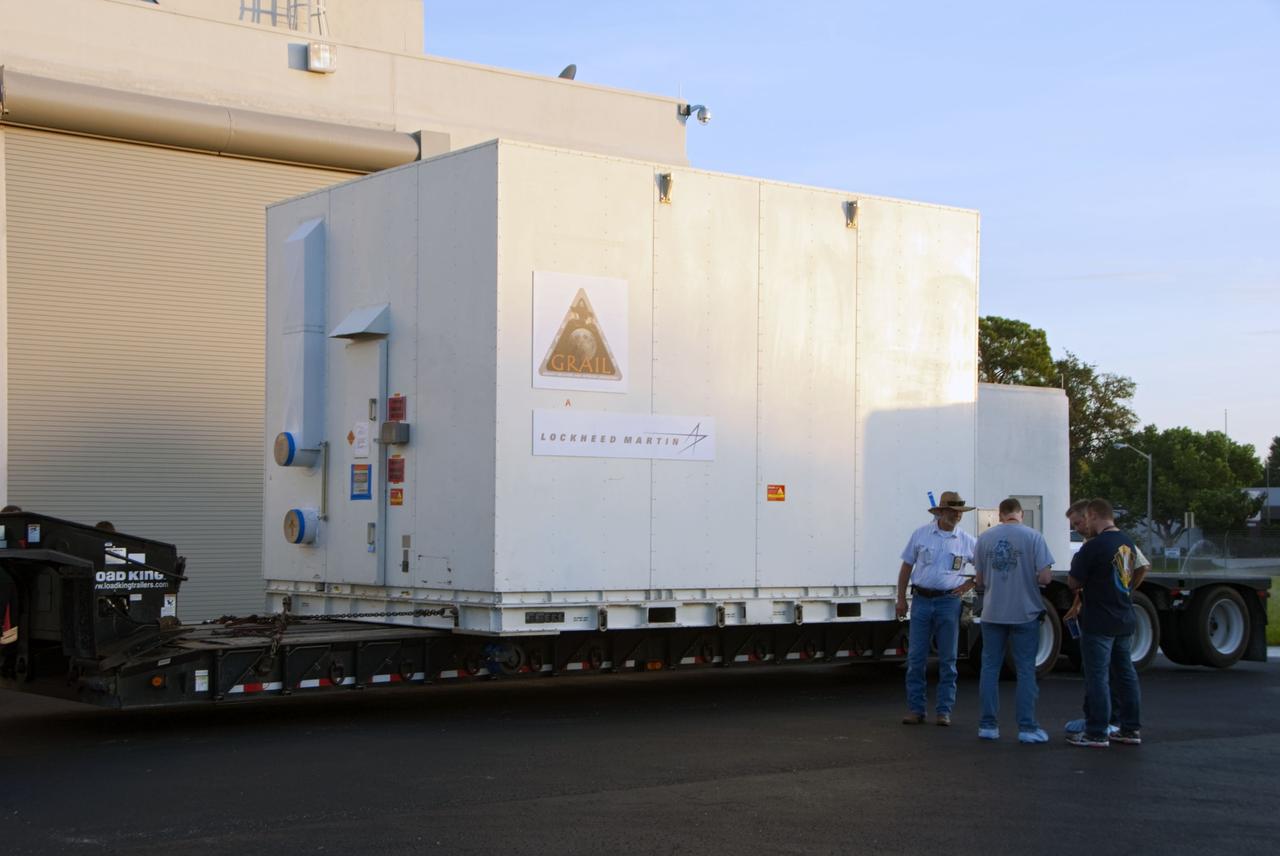
CAPE CANAVERAL, Fla. -- Preparations are under way to transport the protective canister housing NASA's twin Gravity Recovery and Interior Laboratory lunar spacecraft to the Hazardous Processing Facility (HPF) at Astrotech Space Operation's payload processing facility in Titusville, Fla. In the HPF, the spacecraft will undergo two days of fueling activities. GRAIL will fly in tandem orbits around the moon for several months to measure its gravity field. GRAIL's primary science objectives are to determine the structure of the lunar interior, from crust to core, and to advance understanding of the thermal evolution of the moon. Launch aboard a United Launch Alliance Delta II rocket from Space Launch Complex 17B on Cape Canaveral Air Force Station is scheduled for Sept. 8. For more information, visit http://www.nasa.gov/grail. Photo credit: NASA/Charisse Nahser
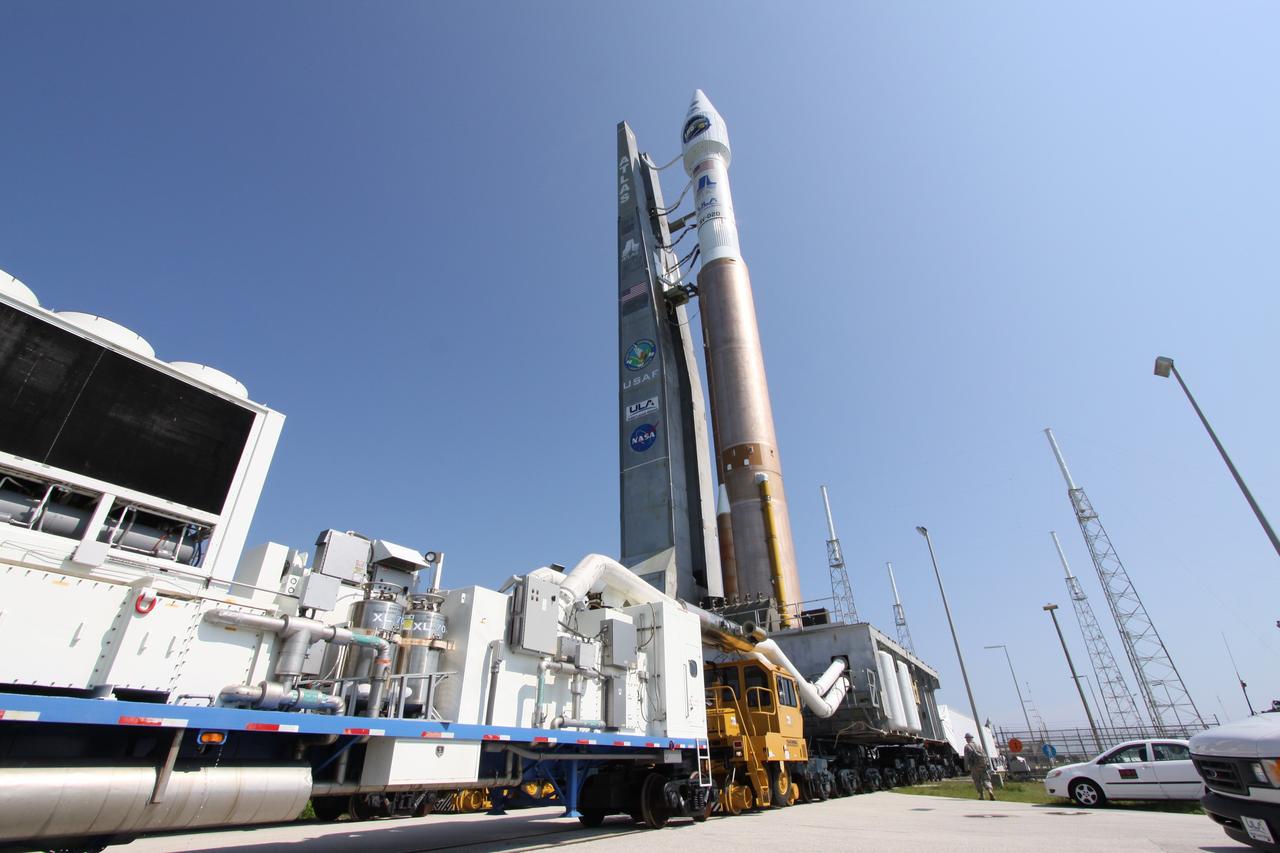
CAPE CANAVERAL, Fla. – On Launch Complex-41 on Cape Canaveral Air Force Station in Florida, the Atlas V/Centaur rocket with NASA's Lunar Reconnaissance Orbiter, or LRO, and NASA's Lunar Crater Observation and Sensing Satellite, known as LCROSS, on top roll out to the launch pad. At right are the protective lightning towers that surround the pad. LRO and LCROSS are the first missions in NASA's plan to return humans to the moon and begin establishing a lunar outpost by 2020. The LRO also includes seven instruments that will help NASA characterize the moon's surface: DIVINER, LAMP, LEND, LOLA, CRATER, Mini-RF and LROC. Launch is scheduled for 5:22 p.m. EDT June 18 . Photo credit: NASA/Jack Pfaller
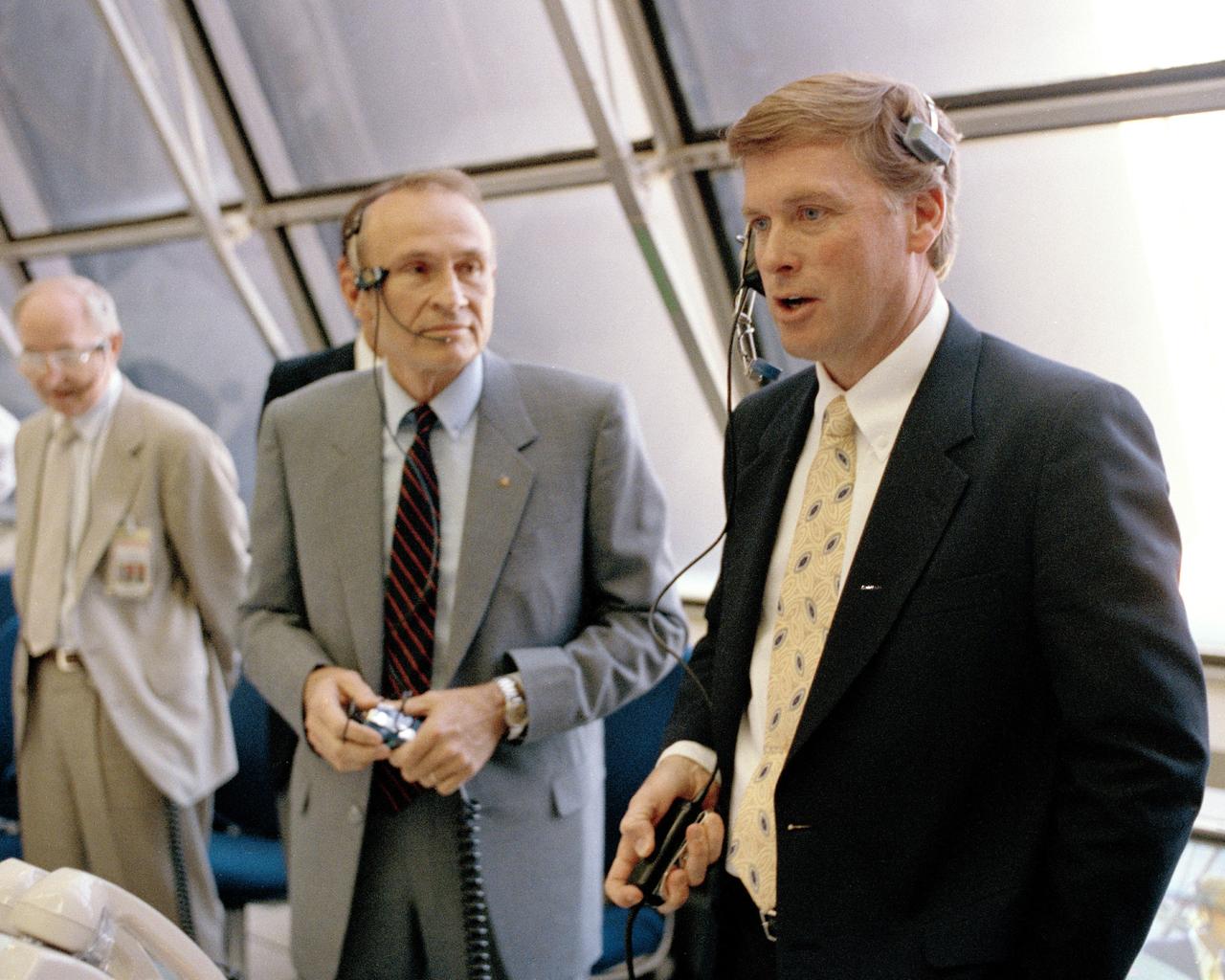
CAPE CANAVERAL, Fla. -- Vice President of the United States Dan Quayle. right. tries on a communications headset in the Launch Control Center and learns about firing room activities from Launch Director Robert Sieck. Quayle spoke with members of the STS-39 flight crew participating in the Terminal Countdown Demonstration Test, toured the launch pad and other center facilities, addressed workers and held a press conference. Image credit: NASA
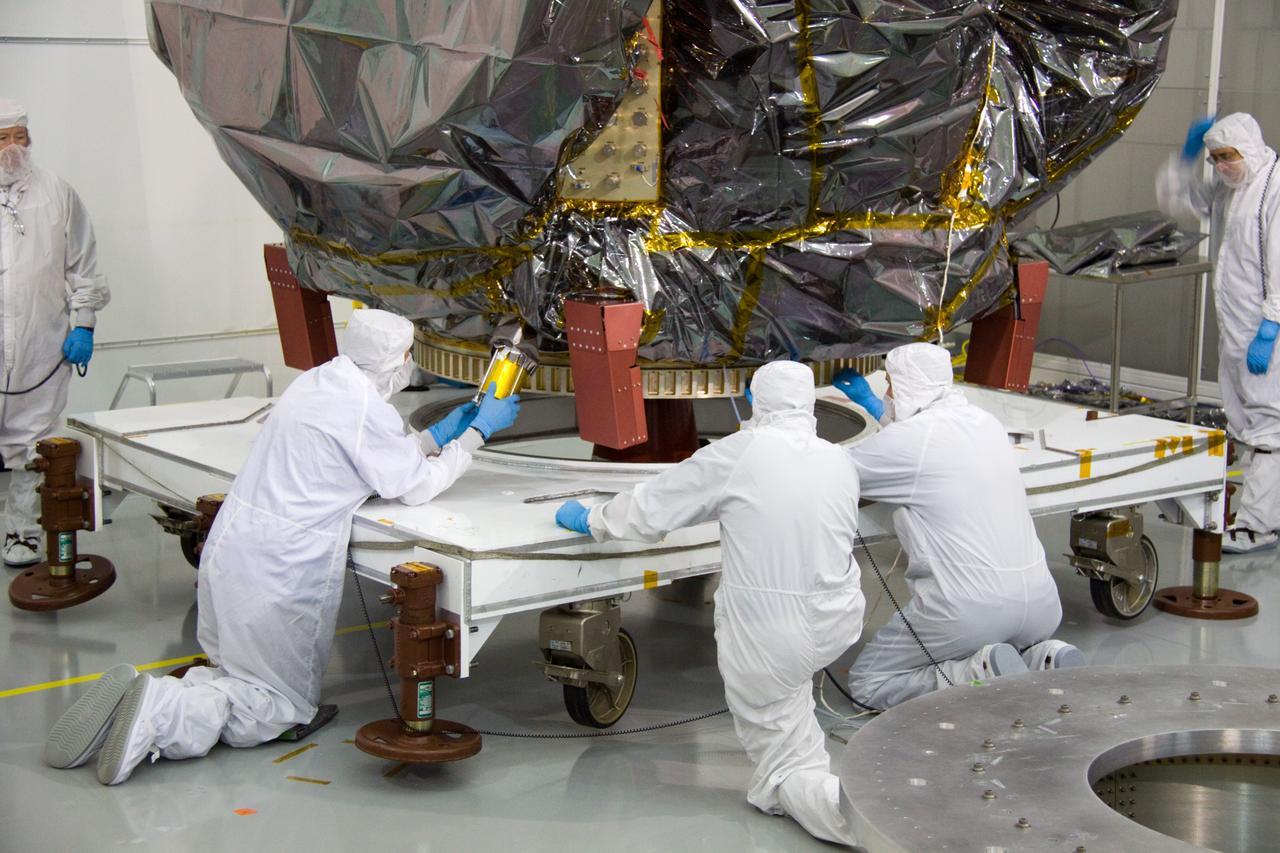
CAPE CANAVERAL, Fla. – At the Astrotech Space Operations facility in Titusville, Fla., NASA Goddard Space Flight Center technician Carl Clause, second from left, installs an aft omni coupler on the bagged Solar Dynamics Observatory, or SDO. SDO is the first space weather research network mission in NASA's Living With a Star Program. The spacecraft's long-term measurements will give solar scientists in-depth information about changes in the sun's magnetic field and insight into how they affect Earth. Liftoff on an Atlas V rocket is scheduled for Feb. 3, 2010. For information on SDO, visit http://www.nasa.gov/sdo. Photo credit: NASA/Troy Cryder
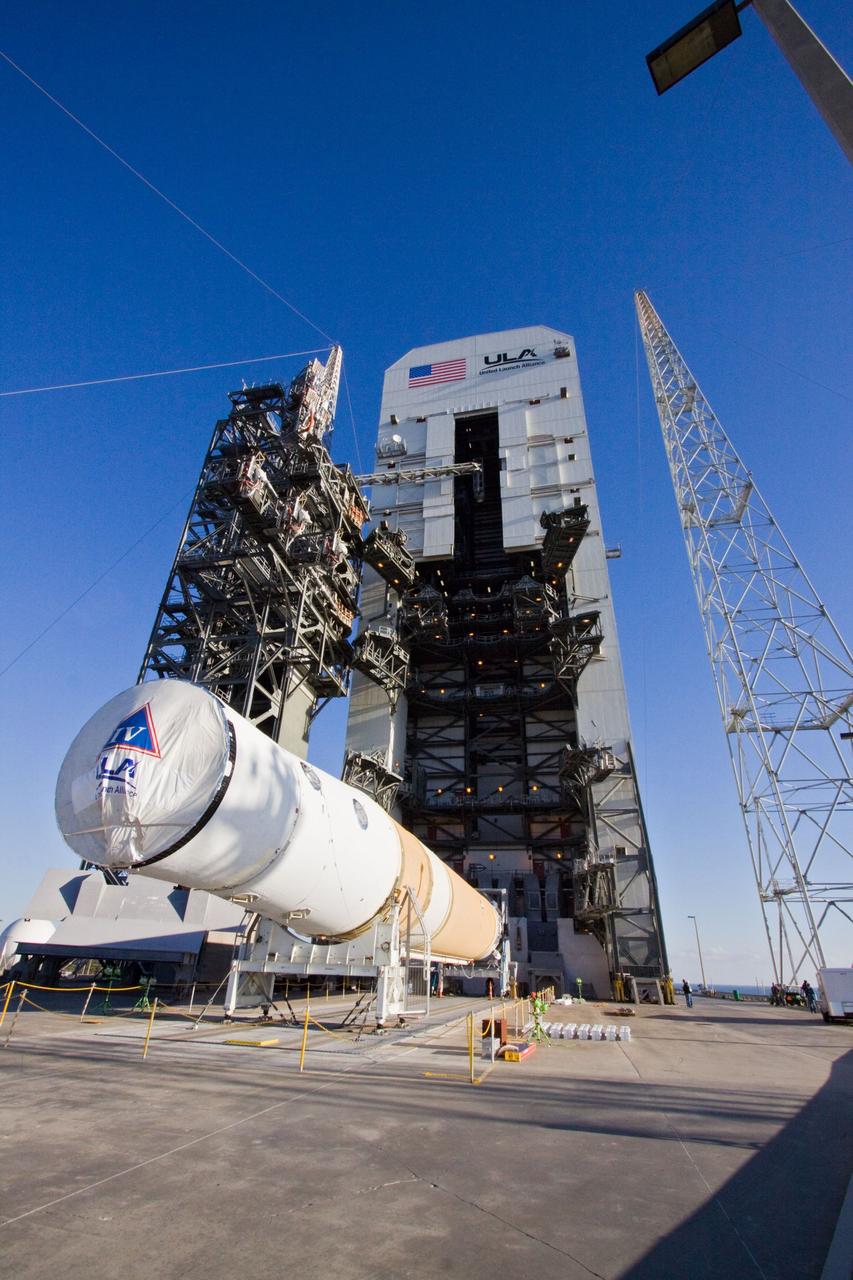
CAPE CANAVERAL, Fla. – At Launch Complex 37 on Cape Canaveral Air Force Station in Florida, preparations are under way to lift the core stage of a Delta IV rocket into the mobile service tower. The rocket's first stage mated to its second stage comprise the core stage. The rocket is slated to launch GOES-P, the latest Geostationary Operational Environmental Satellite developed by NASA for the National Oceanic and Atmospheric Administration, or NOAA. The Delta IV rocket will be launched by United Launch Alliance for Boeing Launch Services under an FAA commercial license. Launch is targeted for no earlier than March 1. For information on GOES-P, visit http://goespoes.gsfc.nasa.gov/goes/spacecraft/n_p_spacecraft.html. Photo credit: NASA/Jack Pfaller
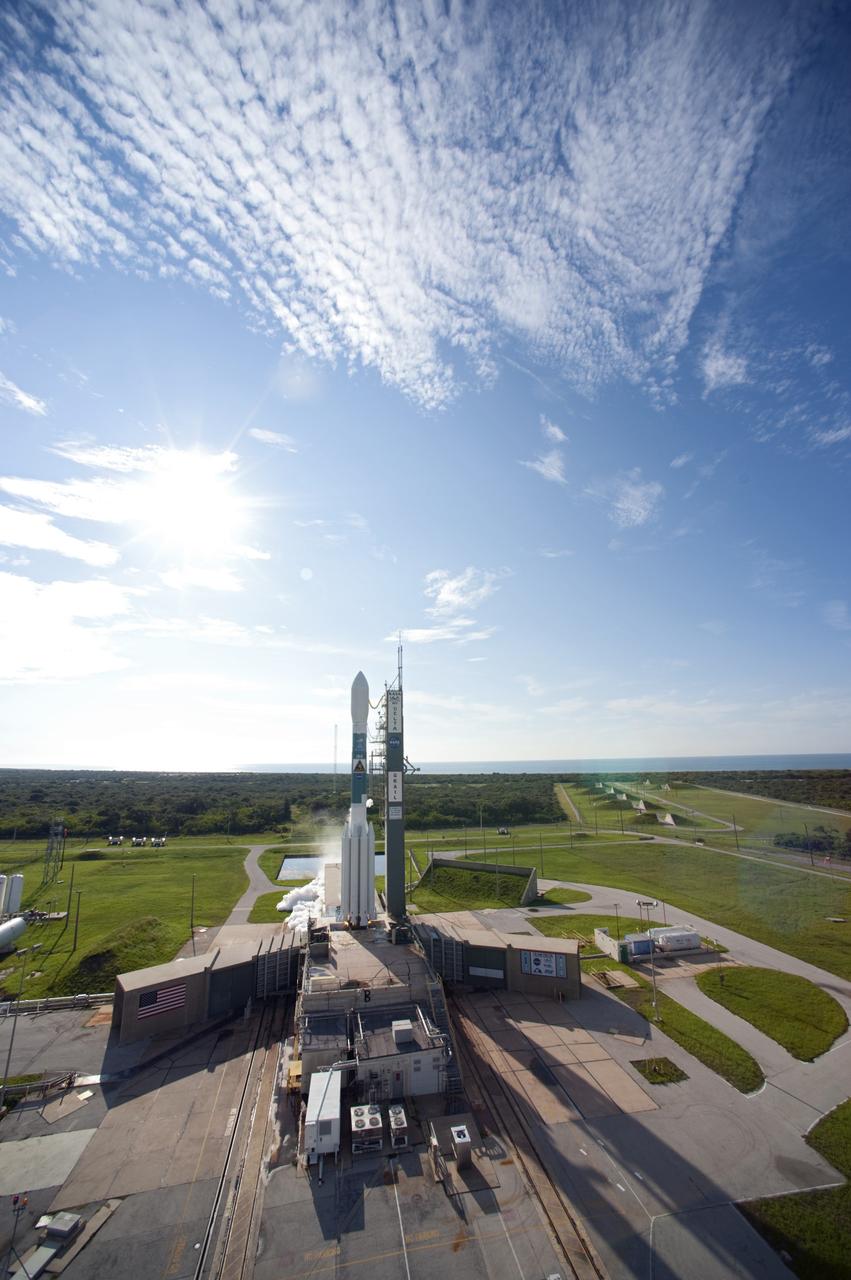
CAPE CANAVERAL, Fla. – Under a blue sky, engine ignition begins liftoff of the United Launch Alliance Delta II Heavy rocket carrying NASA’s twin Gravity Recovery and Interior Laboratory (GRAIL) mission off Space Launch Complex 17B on Cape Canaveral Air Force Station in Florida. The spacecraft launched at 9:08:52 a.m. EDT Sept. 10. GRAIL-A will separate from the second stage of the rocket at about one hour, 21 minutes after liftoff, followed by GRAIL-B at 90 minutes after launch. The spacecraft are embarking on a three-month journey to reach the moon. GRAIL will fly twin spacecraft in tandem around the moon to precisely measure and map variations in the moon's gravitational field. The mission will provide the most accurate global gravity field to date for any planet, including Earth. This detailed information will reveal differences in the density of the moon's crust and mantle and will help answer fundamental questions about the moon's internal structure, thermal evolution, and history of collisions with asteroids. The aim is to map the moon's gravity field so completely that future moon vehicles can safely navigate anywhere on the moon’s surface. For more information, visit http://www.nasa.gov/grail. Photo credit: NASA/Sandra Joseph and Don Kight
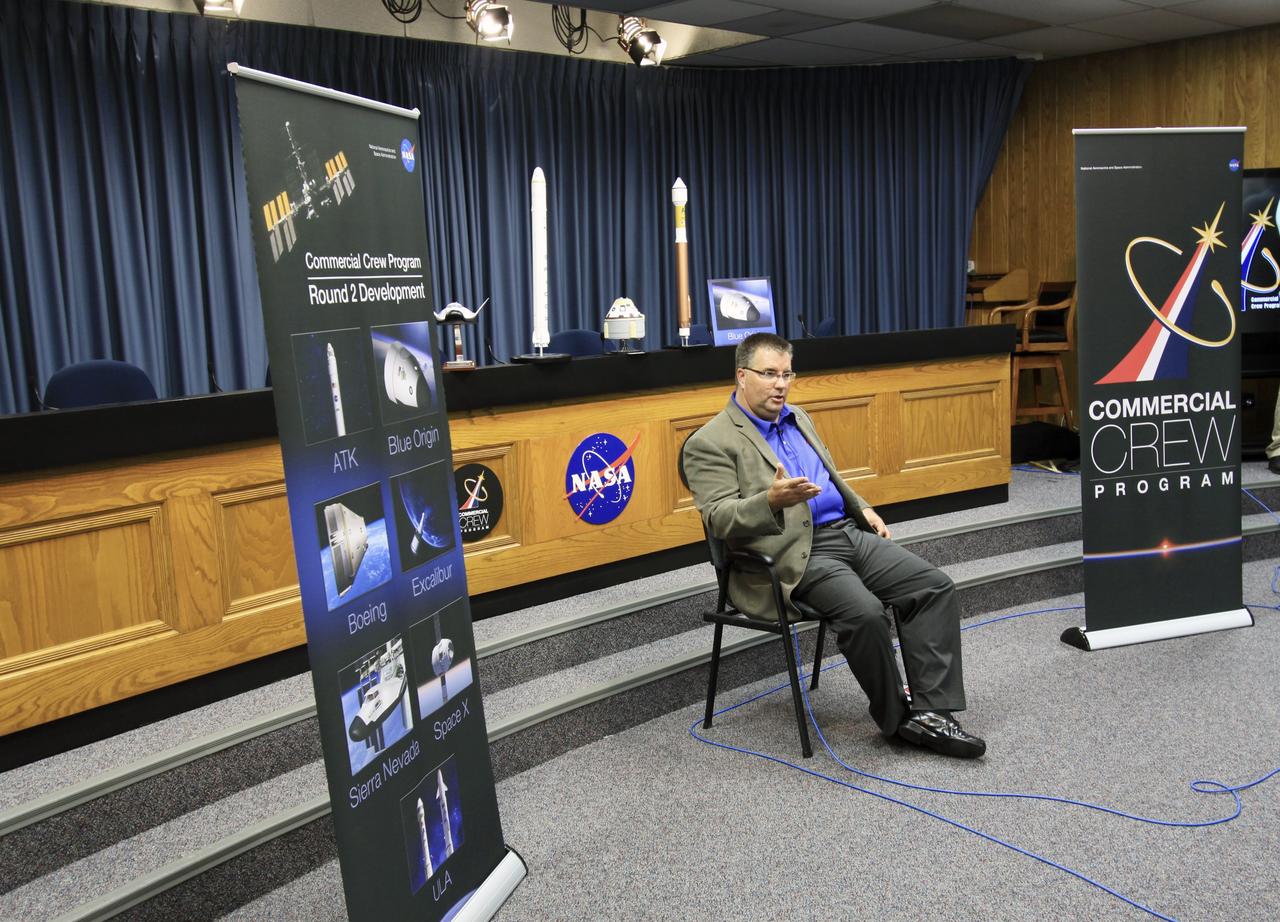
CAPE CANAVERAL, Fla. -- Ed Mango, program manager for NASA's Commercial Crew Program (CCP), updates media on the progress of Commercial Crew Development Round 2 (CCDev2) activities in which seven aerospace companies are maturing launch vehicle and spacecraft systems designed to take astronauts to the International Space Station. The goal of the program is to drive down the cost of space travel as well as open up space to more people than ever before by balancing industry’s own innovative capabilities with NASA's 50 years of human spaceflight experience. Seven aerospace companies are maturing launch vehicle and spacecraft designs under CCDev2, including Alliant Techsystems Inc. (ATK) of Promontory, Utah, Blue Origin of Kent, Wash., The Boeing Co., of Houston, Excalibur Almaz Inc. of Houston, Sierra Nevada Corp. of Louisville, Colo., Space Exploration Technologies (SpaceX) of Hawthorne, Calif., and United Launch Alliance (ULA) of Centennial, Colo. For more information, visit www.nasa.gov/exploration/commercial Photo credit: Jim Grossmann
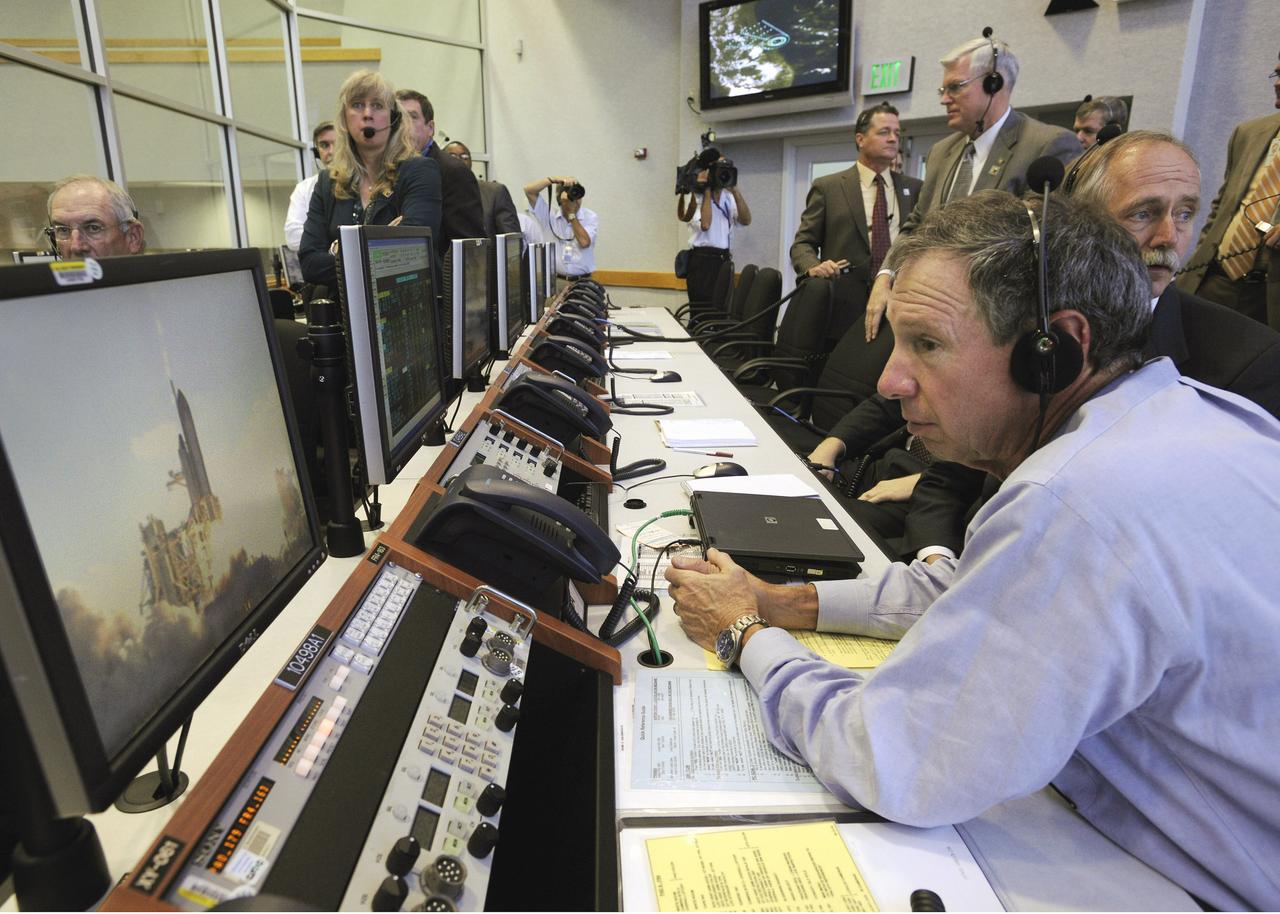
NASA Administrator, Michael Griffin watches the launch of the Space Shuttle Discovery (STS-124) from the Launch Control Center Saturday, May 31, 2008, at the Kennedy Space Center in Cape Canaveral, Fla. The Shuttle lifted off from launch pad 39A at 5:02 p.m. EDT. Photo Credit: (NASA/Bill Ingalls)

The first stage of a Boeing Delta II rocket is lifted to its vertical position on the tower at Launch Complex 17, Cape Canaveral Air Station. The rocket will carry the Stardust spacecraft into space for a close encounter with the comet Wild 2 in January 2004. Using a medium called aerogel, it will capture comet particles flying off the nucleus of the comet, plus collect interstellar dust for later analysis. The collected samples will return to Earth in a Sample Return Capsule to be jettisoned as Stardust swings by Earth in January 2006. Stardust is scheduled to be launched on Feb. 6, 1999
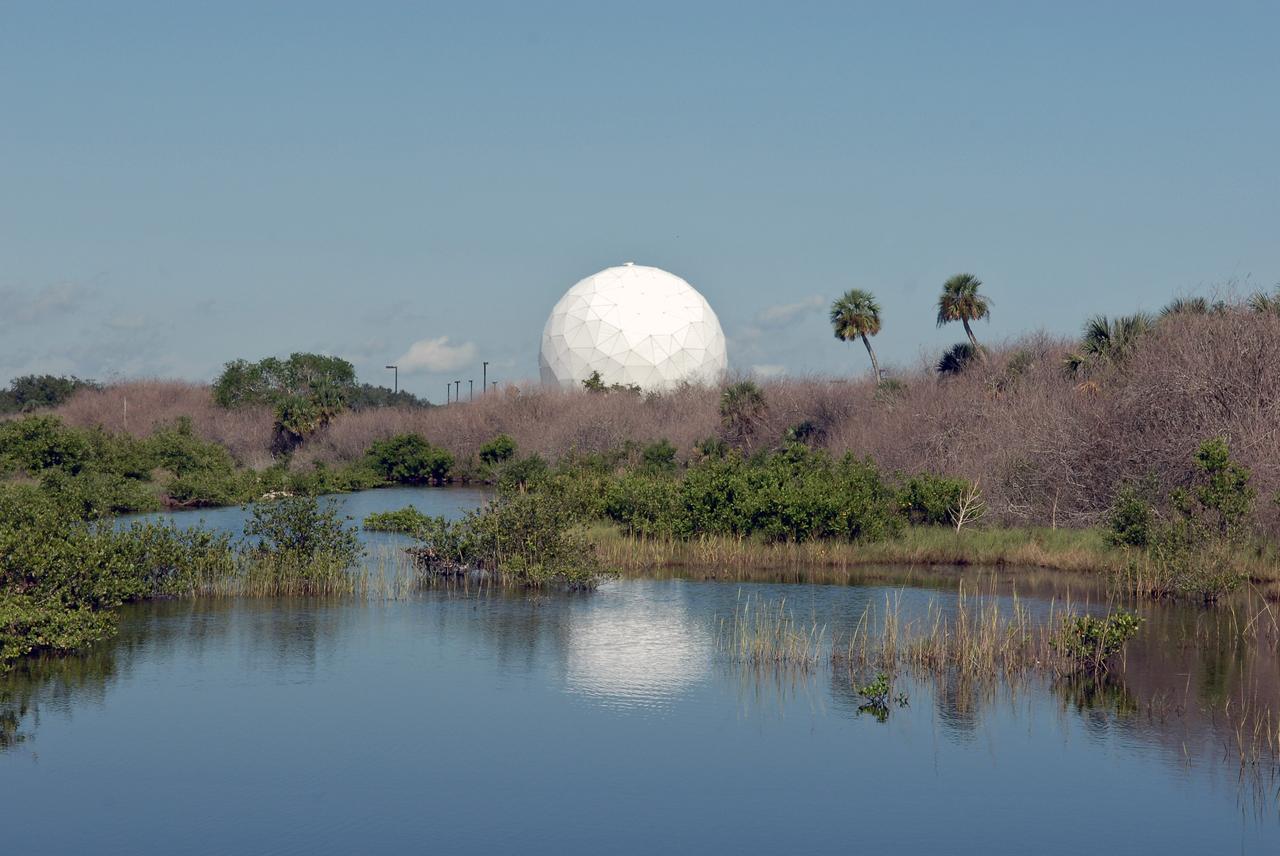
CAPE CANAVERAL, Fla. – This is the radome beneath which is the NASA Debris Radar. It is located at a remote site on North Merritt Island in Florida. One of the largest of its kind in the world, the C-band radar provided critical support to pinpoint debris during the launch of space shuttle Atlantis on the STS-125 mission. The need for this radar was identified after the Columbia tragedy. It worked together with smaller X-band radars placed on the solid rocket booster ship Liberty Star and the U.S. Army landing craft utility ship Brandy Station. Together they provided extremely high resolution images of any debris that created by Atlantis during launch. Photo credit: NASA/Troy Cryder
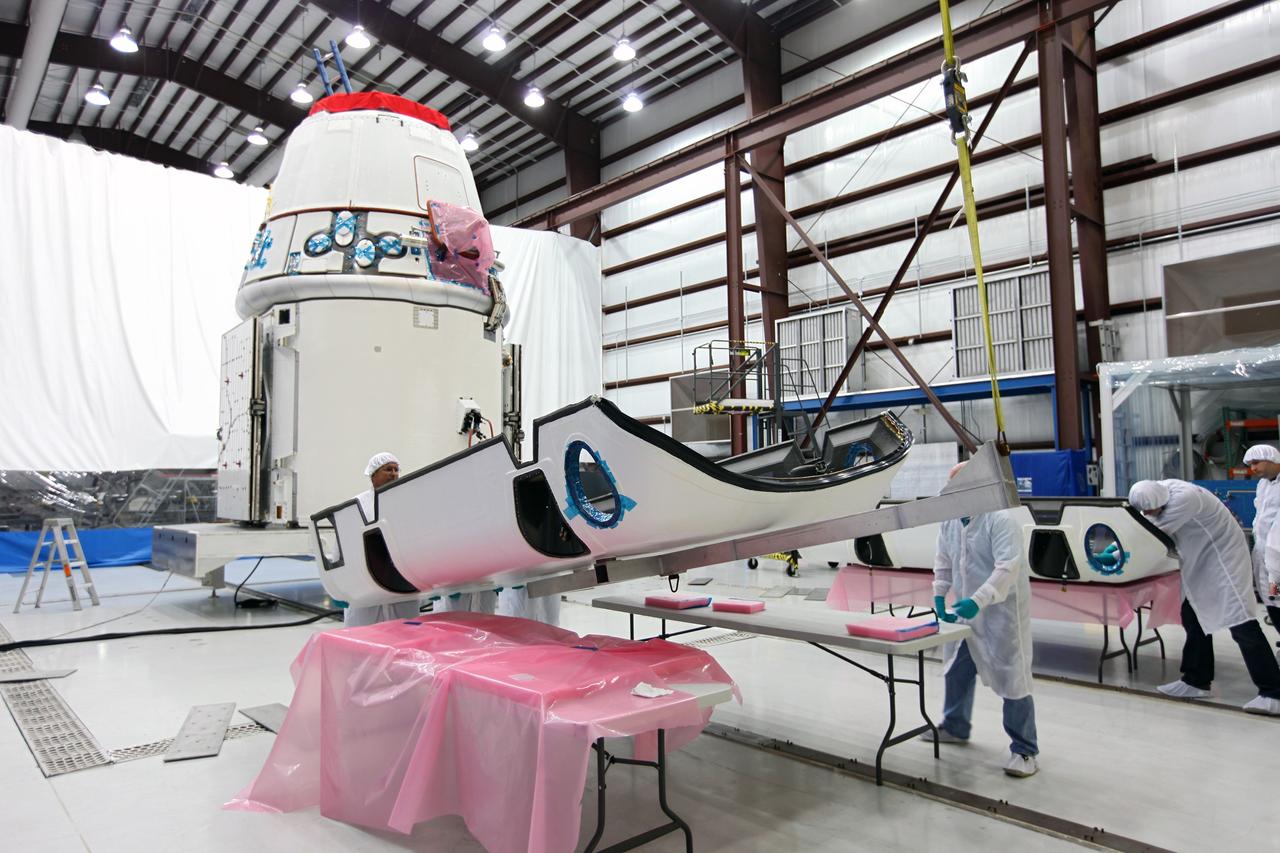
CAPE CANAVERAL, Fla. – Workers lift a solar array fairing at the processing hangar used by Space Exploration Technologies, or SpaceX, at Cape Canaveral Air Force Station, Fla. The fairing will be installed on the Dragon spacecraft undergoing launch preparations inside the hangar. The spacecraft will launch on the upcoming SpaceX CRS-2 mission. The flight will be the second commercial resupply mission to the International Space Station by SpaceX. NASA has contracted for a total of 12 commercial resupply flights from SpaceX and eight from the Orbital Sciences Corp. Photo credit: NASA/Kim Shiflett
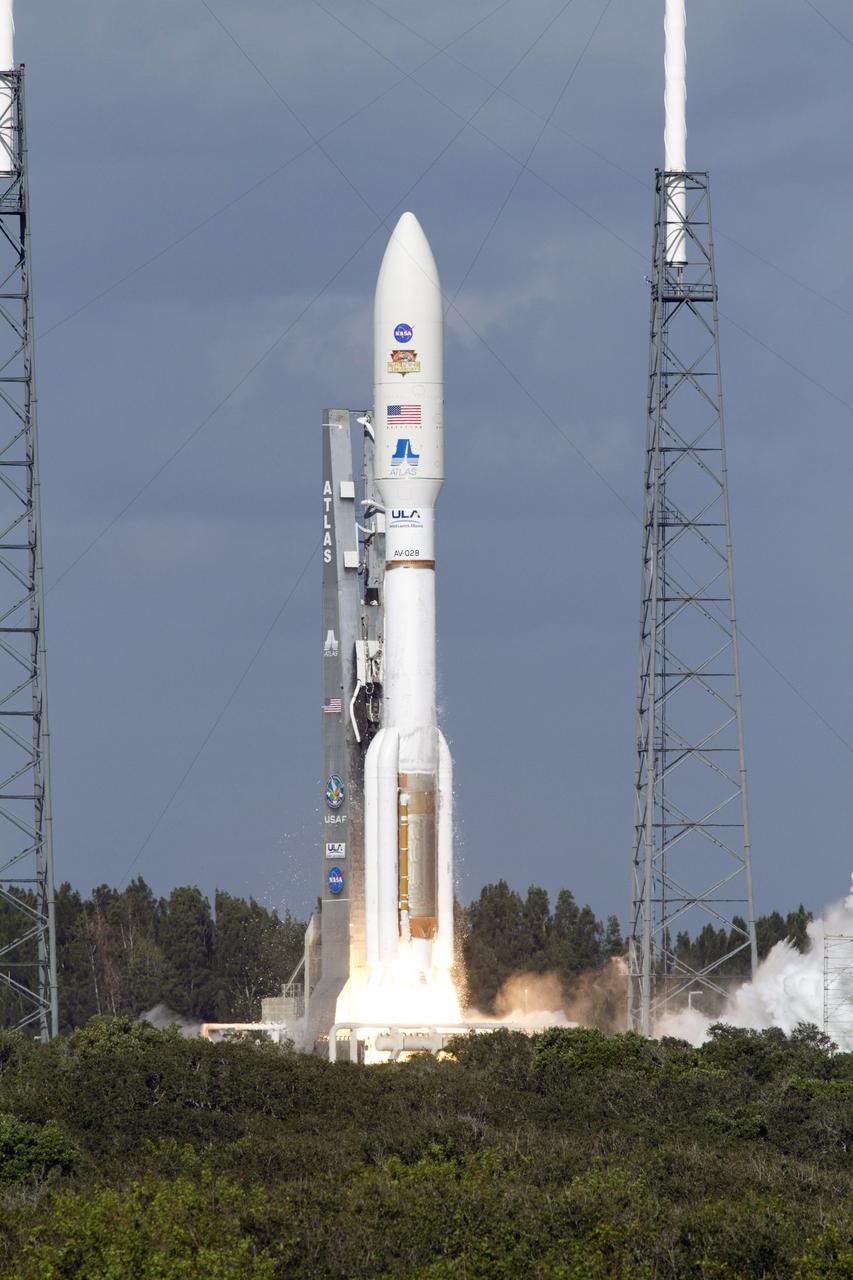
CAPE CANAVERAL, Fla. -- With NASA's Mars Science Laboratory (MSL) spacecraft sealed inside its payload fairing, the United Launch Alliance Atlas V rocket prepares to liftoff from Space Launch Complex-41 on Cape Canaveral Air Force Station in Florida at 10:02 a.m. EST Nov. 26. MSL's components include a car-sized rover, Curiosity, which has 10 science instruments designed to search for signs of life, including methane, and help determine if the gas is from a biological or geological source. For more information, visit http://www.nasa.gov/msl. Photo credit: NASA/George Roberts
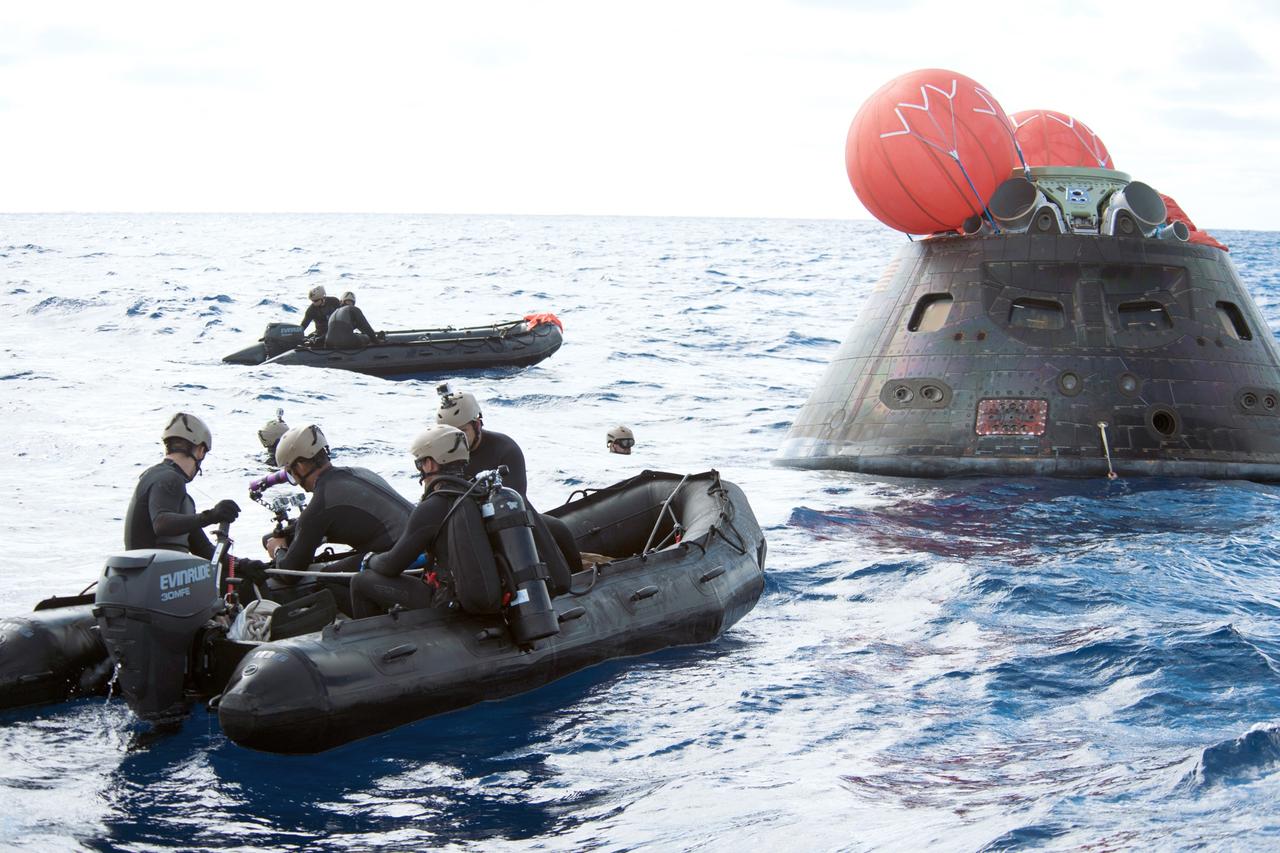
SAN DIEGO, Calif. -- NASA's Orion spacecraft splashed down in the Pacific Ocean after its first flight test atop a Delta IV Heavy rocket from Space Launch Complex 37 at Cape Canaveral Air Force Station in Florida. U.S. Navy divers in Zodiac boats prepare to recover Orion and tow her in to the well deck of the USS Anchorage. NASA's Orion spacecraft completed a two-orbit, four-and-a-half hour mission to test systems critical to crew safety, including the launch abort system, the heat shield and the parachute system. The Ground Systems Development and Operations Program is leading the recovery efforts. For more information, visit www.nasa.gov/orion Photo credit: Courtesy of U.S. Navy
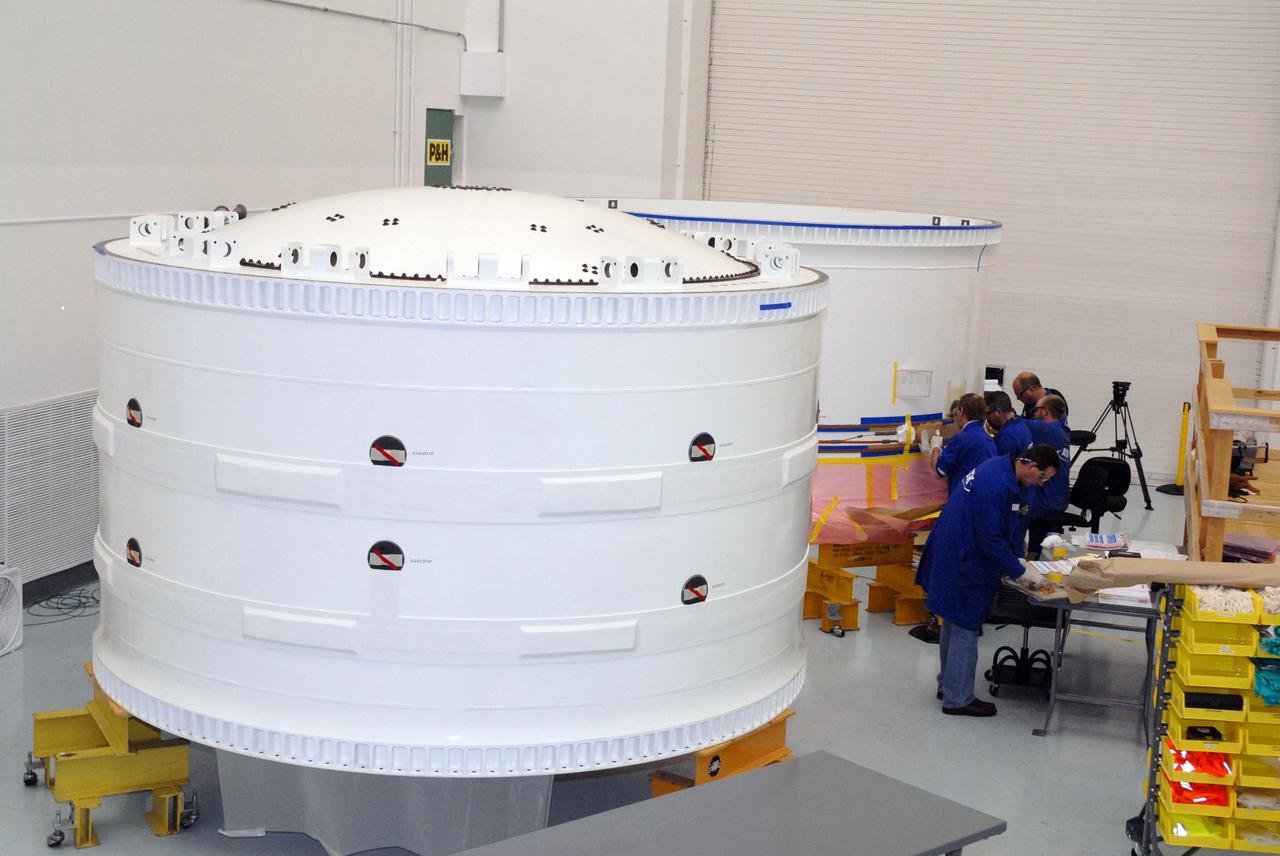
CAPE CANAVERAL, Fla. – At Astrotech in Titusville, Fla., the forward fifth segment simulator of the Ares I-X is being prepared for cork application. Ares I-X is the test vehicle for the Ares I, which is part of the Constellation Program to return men to the moon and beyond. Ares I is the essential core of a safe, reliable, cost-effective space transportation system that eventually will carry crewed missions back to the moon, on to Mars and out into the solar system. Ares I may also use its 25-ton payload capacity to deliver resources and supplies to the International Space Station, or to "park" payloads in orbit for retrieval by other spacecraft bound for the moon or other destinations. The Ares I-X is targeted for launch in July 2009. Photo credit: NASA/Tim Jacobs
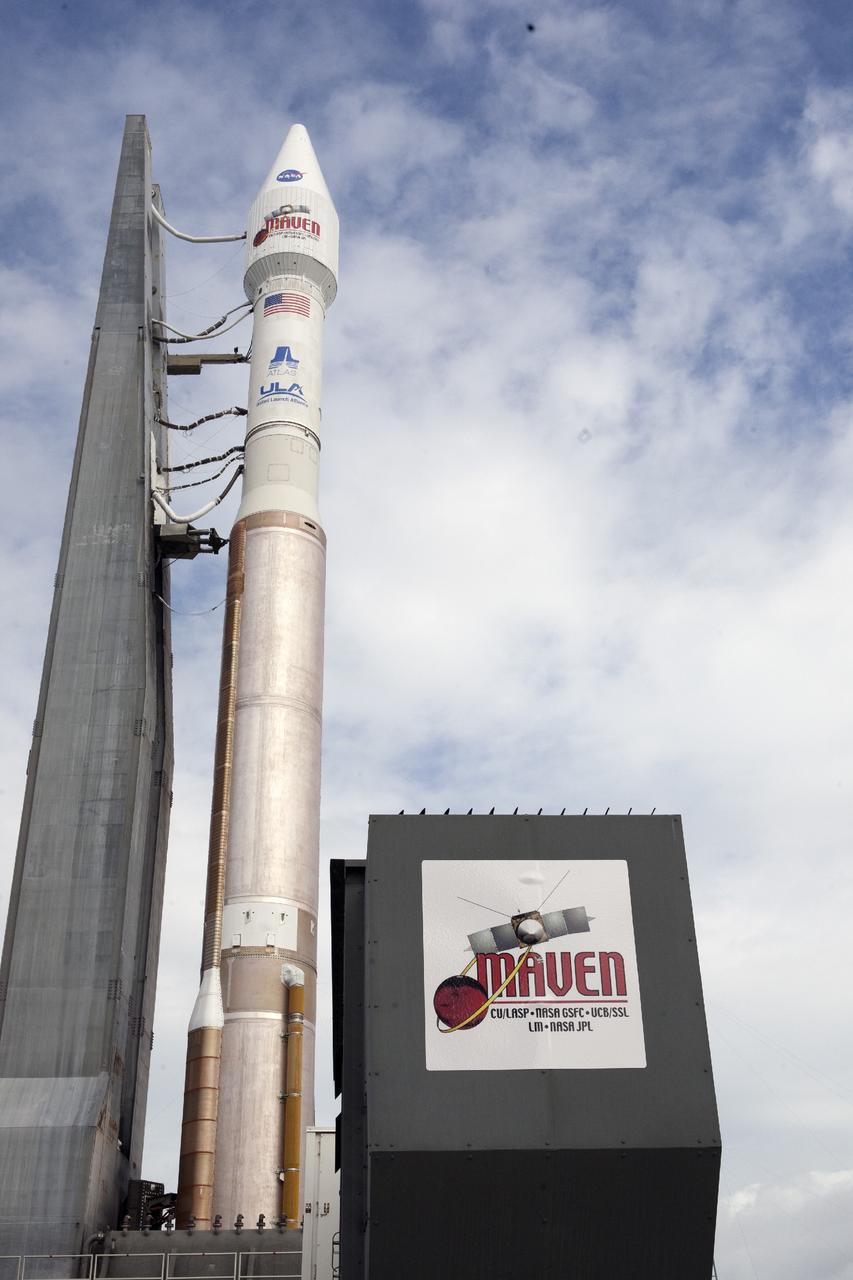
CAPE CANAVERAL, Fla. -- The United Launch Alliance Atlas V rocket carrying NASA’s Mars Atmosphere and Volatile EvolutioN, or MAVEN, spacecraft is transported along the roadway from the Vertical Integration Facility to the pad at Space Launch Complex 41 on Cape Canaveral Air Force Station in Florida. Rollout began on schedule with first motion at 9:57 a.m. Launch is scheduled for Nov. 18 during a window that extends from 1:28 to 3:28 p.m. Once positioned in orbit above the Red Planet, MAVEN will study its upper atmosphere in unprecedented detail. For more information, visit: http://www.nasa.gov/mission_pages/maven/main/index.html. Photo credit: NASA/Kim Shiflett
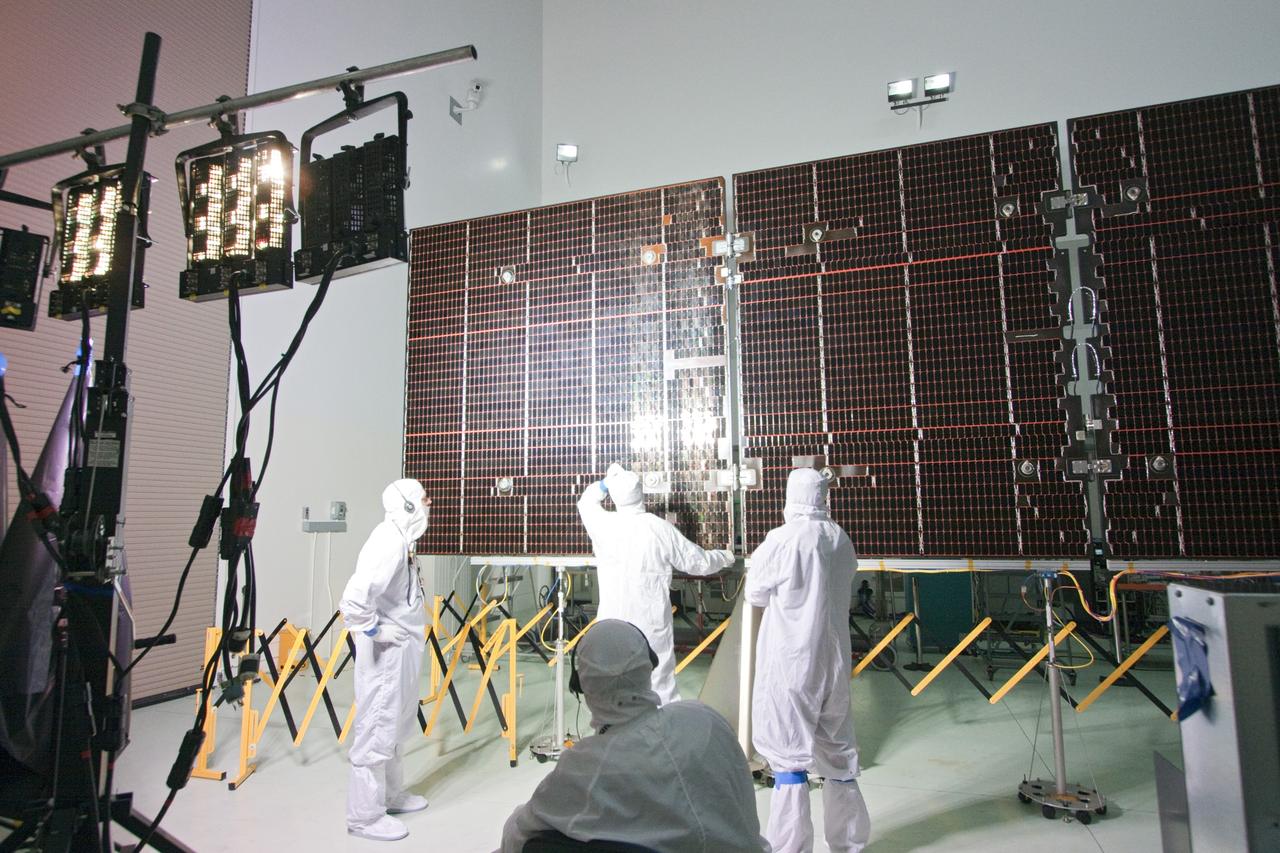
CAPE CANAVERAL, Fla. -- In a clean-room environment at Astrotech's payload processing facility in Titusville, Fla. technicians conduct an illumination test on the solar array panels for NASA's Juno spacecraft. Juno is scheduled to launch aboard a United Launch Alliance Atlas V rocket from Cape Canaveral, Fla. Aug. 5.The solar-powered spacecraft will orbit Jupiter's poles 33 times to find out more about the gas giant's origins, structure, atmosphere and magnetosphere and investigate the existence of a solid planetary core. For more information visit: www.nasa.gov/juno. Photo credit: NASA/Jack Pfaller
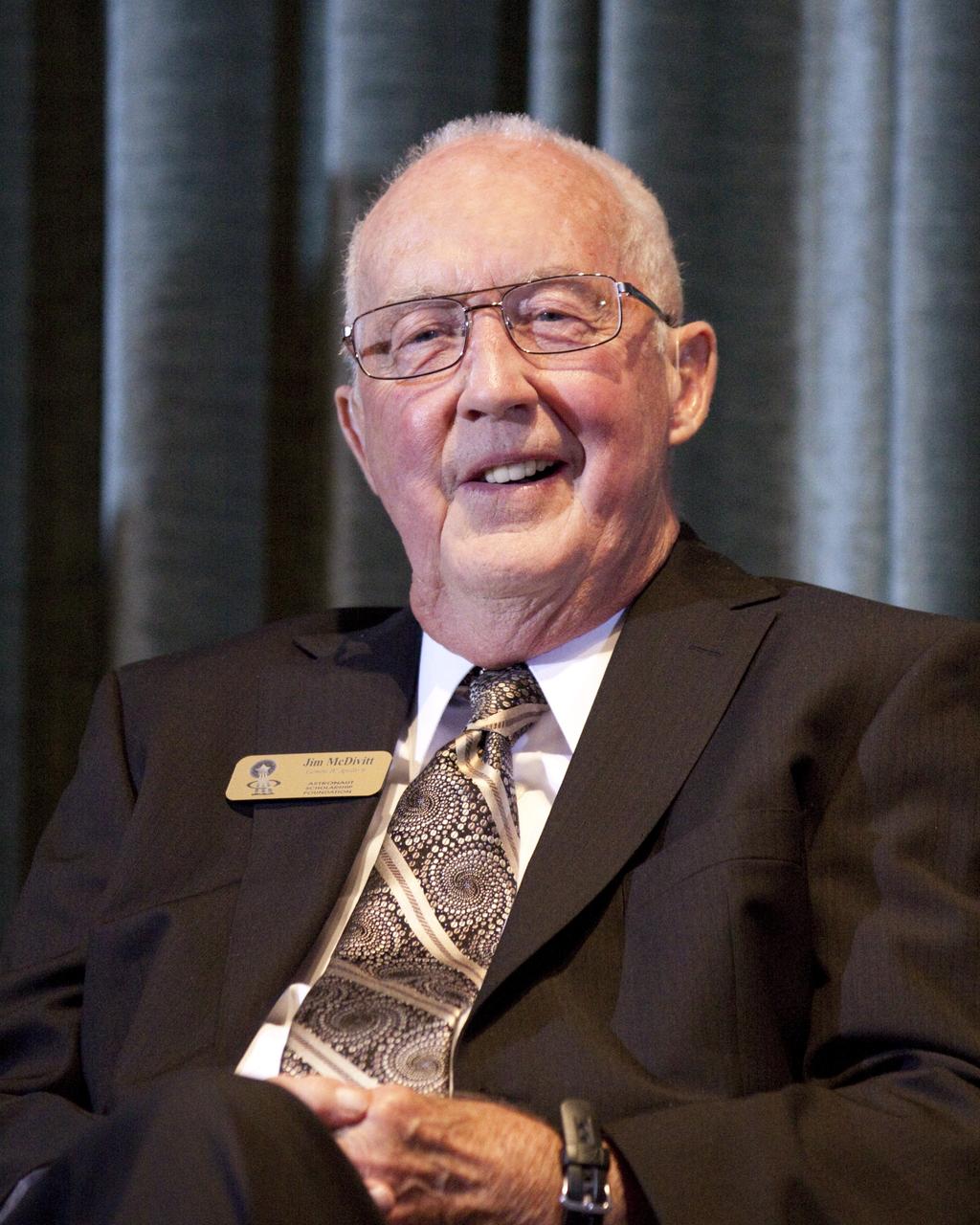
CAPE CANAVERAL, Fla. – Gemini 4 and Apollo 9 astronaut James McDivitt speaks to guests gathered for the Astronaut Scholarship Foundation's dinner at the Radisson Resort at the Port in Cape Canaveral celebrating the 40th anniversary of Apollo 17. The gala commemorating the anniversary of Apollo 17 included mission commander Eugene Cernan and other astronauts who flew Apollo missions. Launched Dec. 7, 1972, Cernan and lunar module pilot Harrison Schmitt landed in the moon's Taurus-Littrow highlands while command module pilot Ronald Evans remained in lunar orbit operating a scientific instrument module. For more information, visit http://www-pao.ksc.nasa.gov/history/apollo/apollo-17/apollo-17.htm Photo credit: NASA/Kim Shiflett
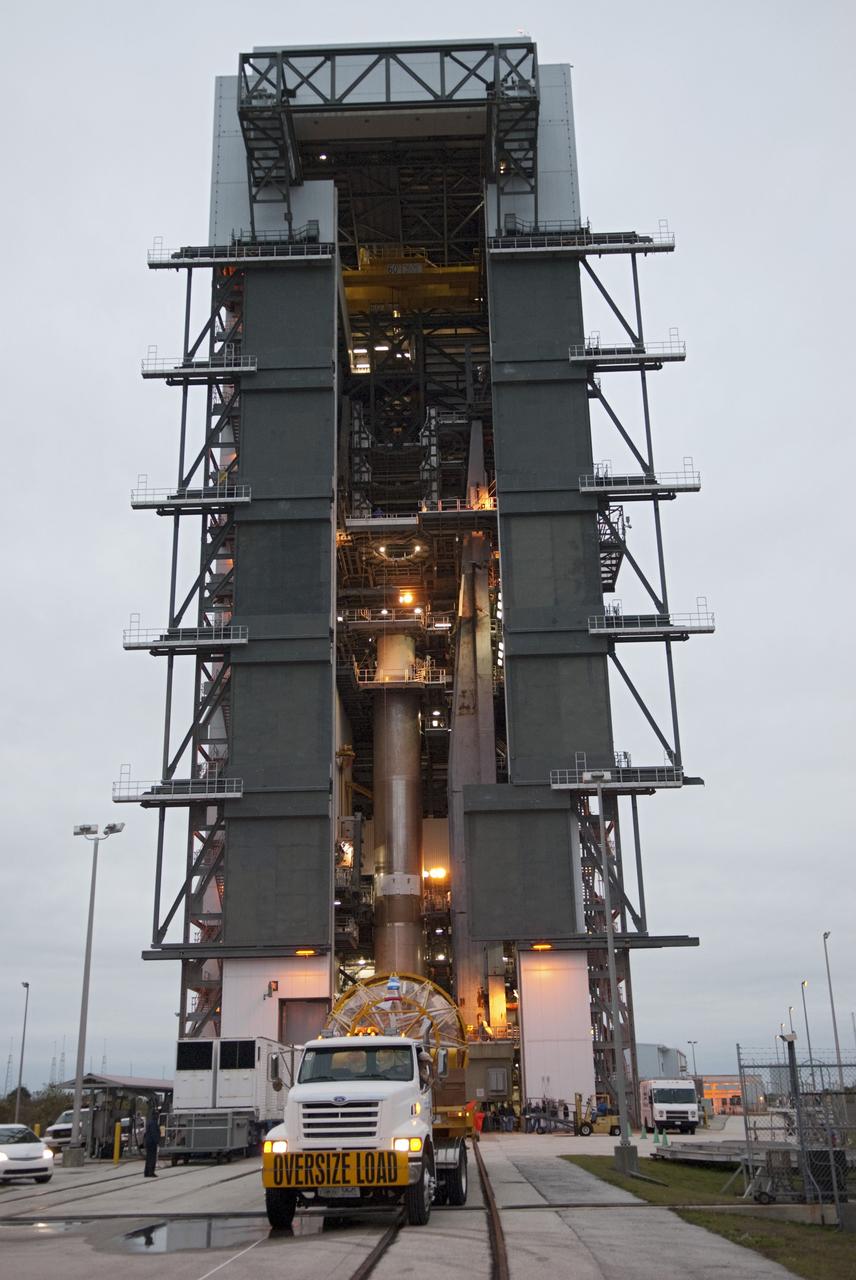
CAPE CANAVERAL, Fla. -- The Centaur stage which will help boost the Tracking and Data Relay Satellite, TDRS-K, into orbit arrives by transport truck at Cape Canaveral Air Force Station's Space Launch Complex 41 in Florida for mating to an Atlas V rocket. Launch of the TDRS-K on the Atlas V rocket is planned for January 29, 2013. The TDRS-K spacecraft is part of the next-generation series in the Tracking and Data Relay Satellite System, a constellation of space-based communication satellites providing tracking, telemetry, command and high-bandwidth data return services. For more information, visit http://www.nasa.gov/mission_pages/tdrs/index.html Photo credit: NASA/Charisse Nahser
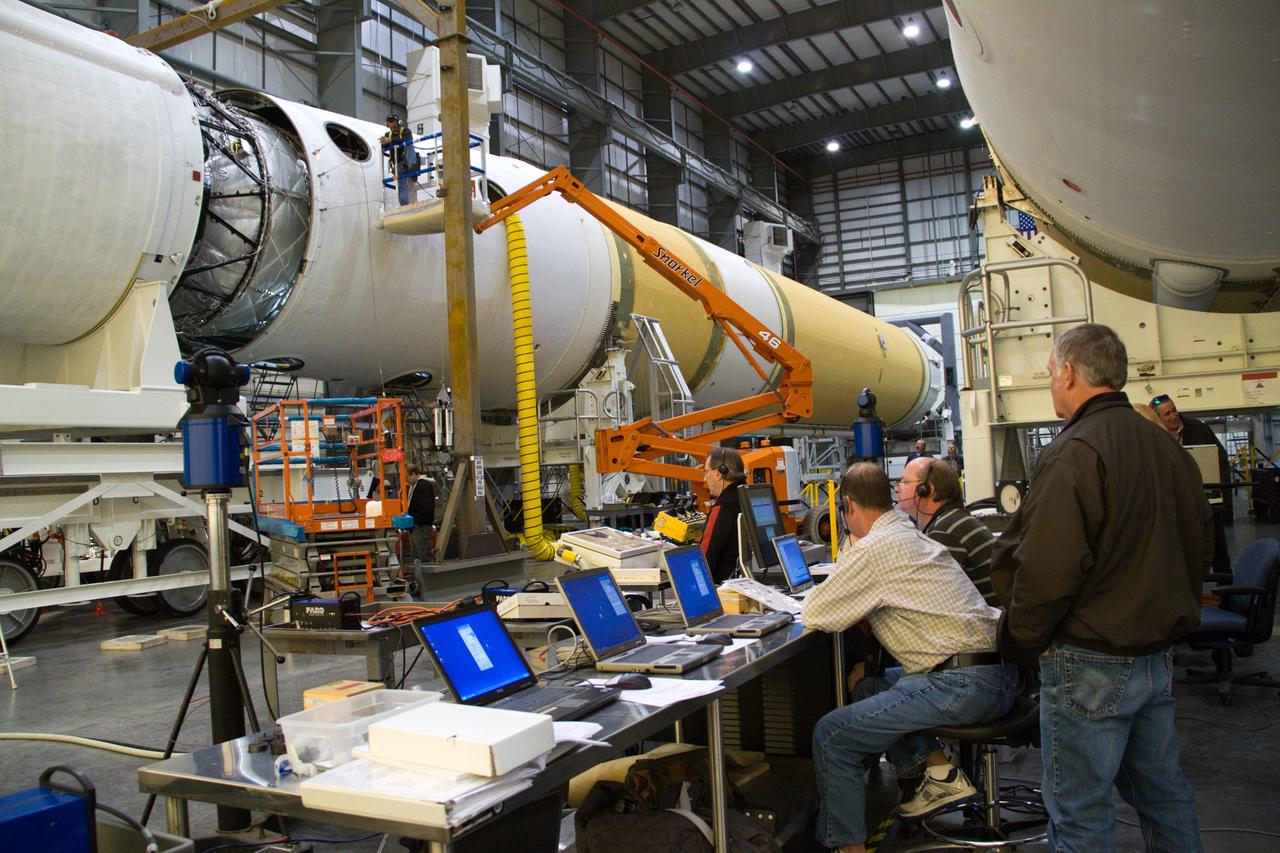
CAPE CANAVERAL, Fla. – In the Horizontal Integration Facility at Launch Complex 37 on Cape Canaveral Air Force Station in Florida, a team of rocket specialists monitors the progress of the operation to mate the second stage of a Delta IV rocket to the first stage. This United Launch Alliance Delta IV rocket is slated to launch GOES-P, the latest Geostationary Operational Environmental Satellite developed by NASA for the National Oceanic and Atmospheric Administration, or NOAA. Launch is targeted for Feb. 25. For information on GOES-P, visit http://goespoes.gsfc.nasa.gov/goes/spacecraft/n_p_spacecraft.html. Photo credit: NASA/Jack Pfaller
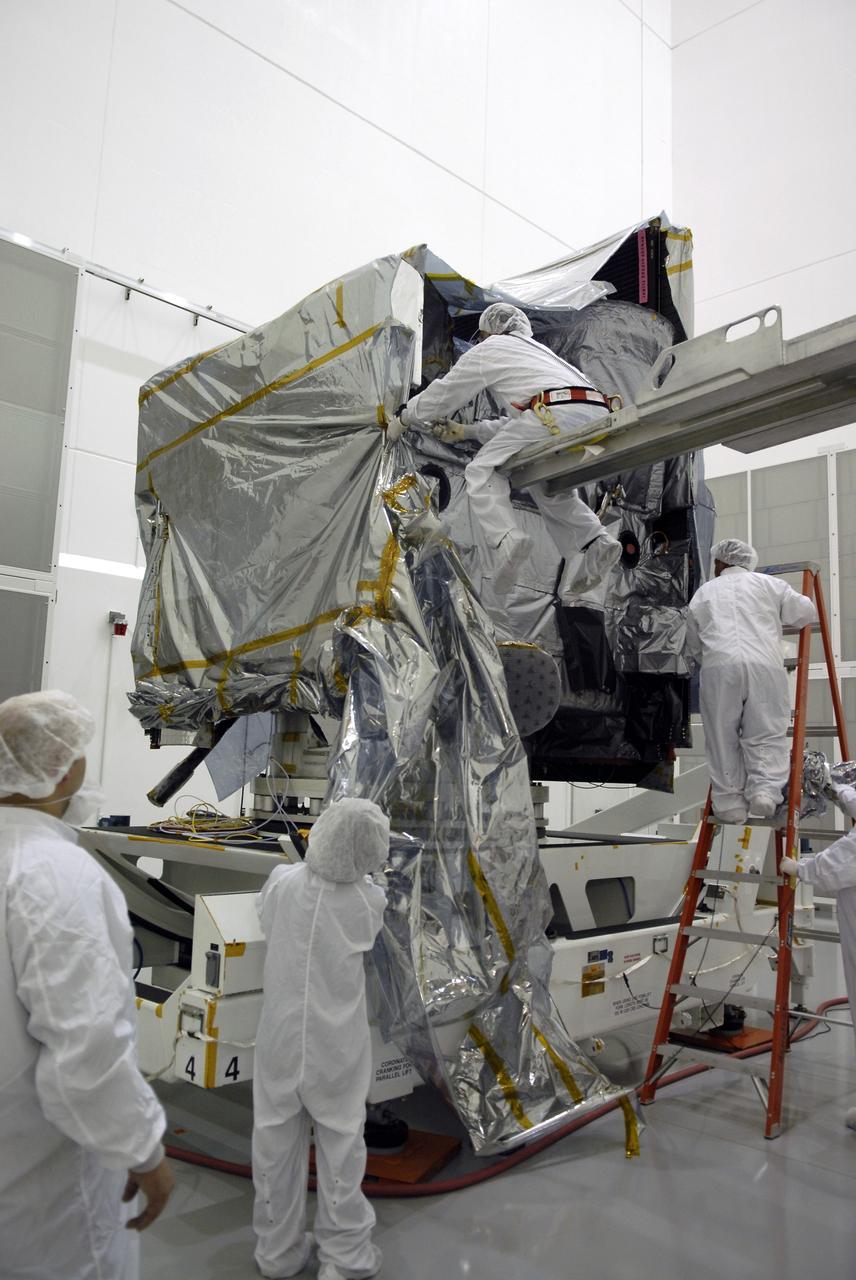
CAPE CANAVERAL, Fla. – At the Astrotech payload processing facility in Titusville, Fla., technicians remove the protective cover wrapped around the GOES-O satellite. The satellite will undergo final testing of the imaging system, instrumentation, communications and power systems. The latest Geostationary Operational Environmental Satellite, GOES-O was developed by NASA for the National Oceanic and Atmospheric Administration, or NOAA. The GOES-O satellite is targeted to launch April 28 onboard a United Launch Alliance Delta IV expendable launch vehicle. Once in orbit, GOES-O will be designated GOES-14, and NASA will provide on-orbit checkout and then transfer operational responsibility to NOAA. GOES-O will be placed in on-orbit storage as a replacement for an older GOES satellite. GOES-O carries an advanced attitude control system using star trackers with spacecraft optical bench Imager and Sounder mountings that provide enhanced instrument pointing performance for improved image navigation and registration to better locate severe storms and other events important to the NOAA National Weather Service. Photo credit: NASA/Kim Shiflett
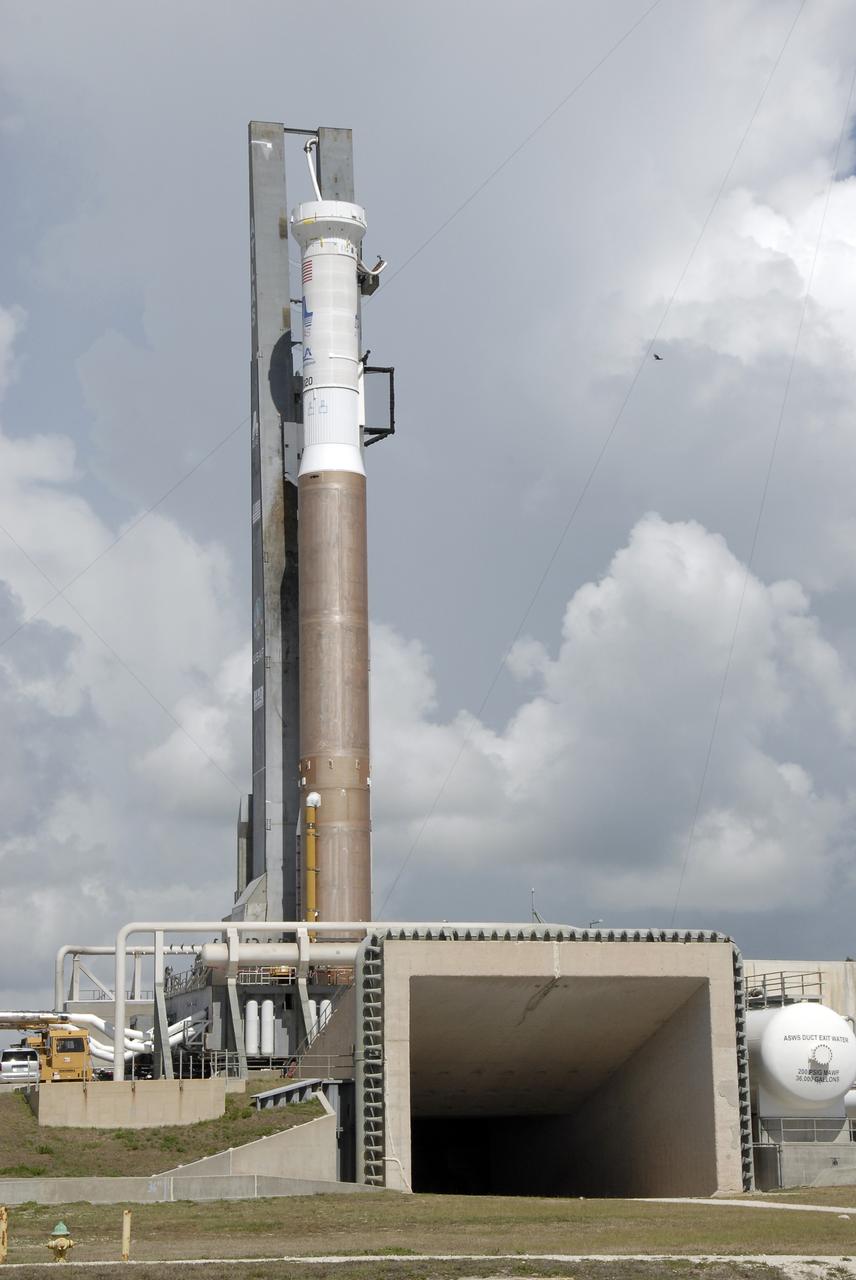
CAPE CANAVERAL, Fla. – The Atlas V/Centaur arrives on Launch Complex-41 at Cape Canaveral Air Force Station in Florida. The Atlas was rolled to the launch pad from the Vertical Integration Facility in preparation for the wet dress rehearsal, or countdown test, which means being fully loaded with propellants including liquid hydrogen, liquid oxygen and RP-1 fuel. The launch vehicle will be rolled off the pad and returned to the VIF on May 16. The Atlas V/Centaur is the launch vehicle for NASA's Lunar Reconnaissance Orbiter, or LRO, and NASA's Lunar CRater Observation and Sensing Satellite, known as LCROSS. They will be mated with the Atlas in late May. LCROSS and LRO are the first missions in NASA's plan to return humans to the moon and begin establishing a lunar outpost by 2020. Launch is scheduled for no earlier than June 17. Photo credit: NASA/Kim Shiflett
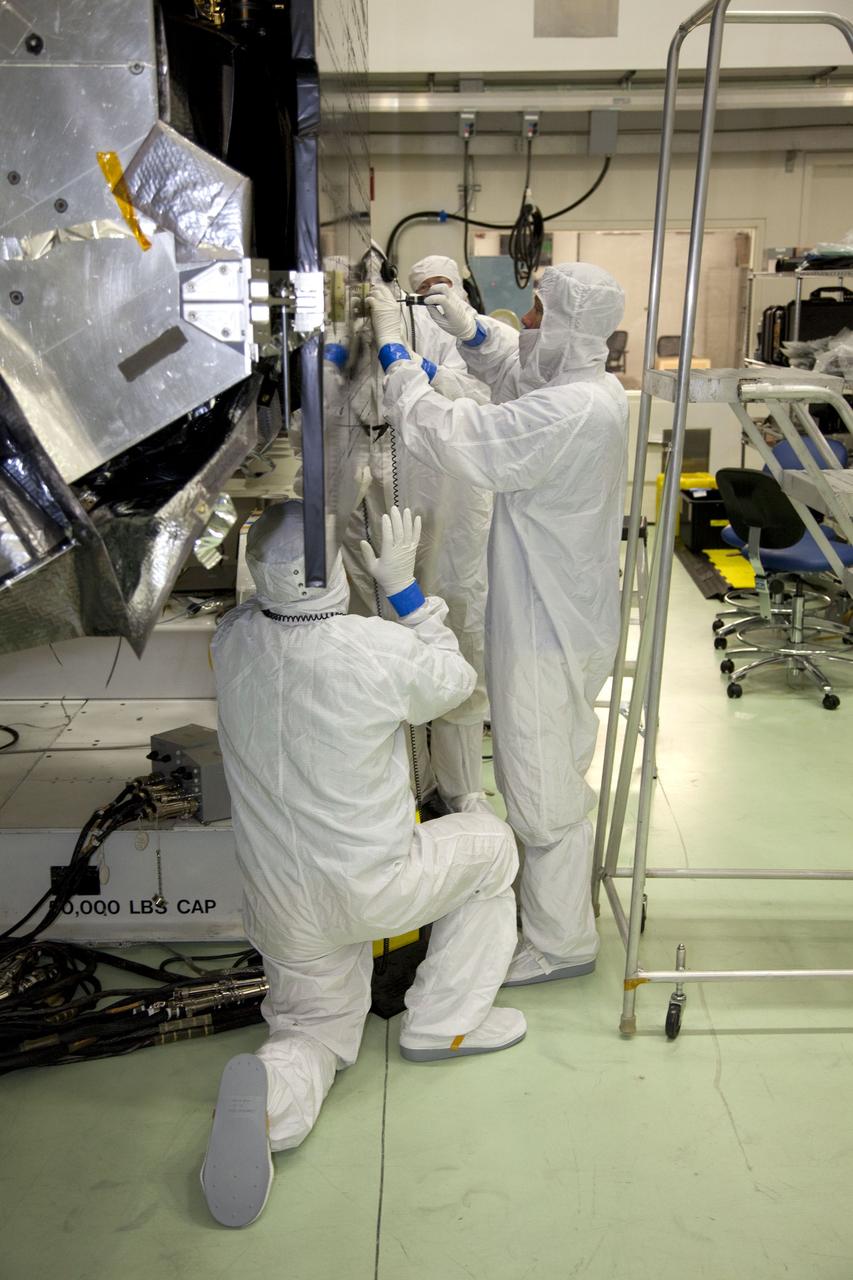
TITUSVILLE, Fla. -- Lockheed Martin technicians in the Astrotech payload processing facility in Titusville, Fla., install the Radio and Plasma Wave Sensor, called WAVES for short, on to NASA's Juno spacecraft. WAVES is a science boom instrument that will measure radio and plasma waves emitting from Jupiter. Juno is scheduled to launch aboard an Atlas V rocket from Cape Canaveral, Fla., on Aug. 5, 2011, reaching Jupiter in July 2016. The spacecraft will orbit the giant planet more than 30 times, skimming to within 3,000 miles above its cloud tops, for about one year. With its suite of science instruments, the spacecraft will investigate the existence of a solid planetary core, map Jupiter's intense magnetic field, measure the amount of water and ammonia in the deep atmosphere, and observe the planet's auroras. For more information visit, www.nasa.gov/mission_pages/juno. Photo credit: NASA/Frankie Martin

CAPE CANAVERAL, Fla. -- At Cape Canaveral Air Force Station in Florida, the first stage of the SpaceX Falcon 9 rocket arrives at Launch Complex-40's horizontal processing hangar. Once assembled, it will be a two-stage fully integrated launch vehicle, consisting of a first stage powered by nine SpaceX-developed Merlin 1C engines, a second stage, an interstage, an unpressurized trunk and the Dragon spacecraft qualification unit. SpaceX was awarded procurement for three demonstration flights under the Commercial Orbital Transportation Services, or COTS, program managed by NASA's Johnson Space Center in Houston. A subsequent contract for Commercial Resupply Services, or CRS, was awarded in late 2008 to resupply the International Space Station. The SpaceX CRS contract provides for 12 missions to resupply the station from 2011 through 2015. Photo credit: NASA/Troy Cryder
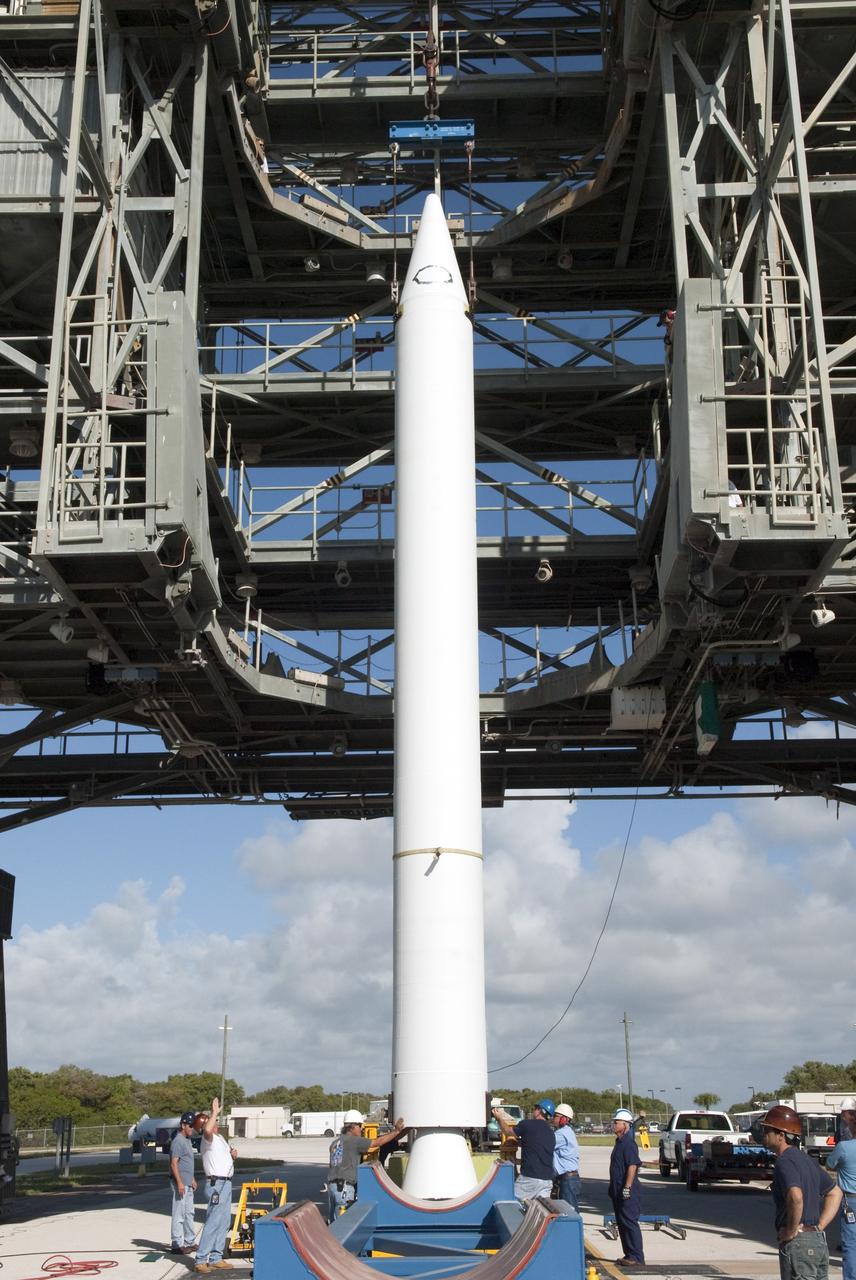
CAPE CANAVERAL, Fla. -- A solid-fueled booster is lifted into Launch Complex 17-B at Cape Canaveral Air Force Station in Florida where a United Launch Alliance Delta II is being prepared for launch. The Delta II will carry NASA's Gravity Recovery and Interior Laboratory, or GRAIL, spacecraft into lunar orbit. The GRAIL mission is a part of NASA's Discovery Program. GRAIL will fly twin spacecraft in tandem orbits around the moon for several months to measure its gravity field. The mission also will answer longstanding questions about Earth's moon and provide scientists a better understanding of how Earth and other rocky planets in the solar system formed. GRAIL is scheduled to launch September 8, 2011. For more information visit: http://science.nasa.gov/missions/grail/. Photo credit: NASA/Jim Grossmann
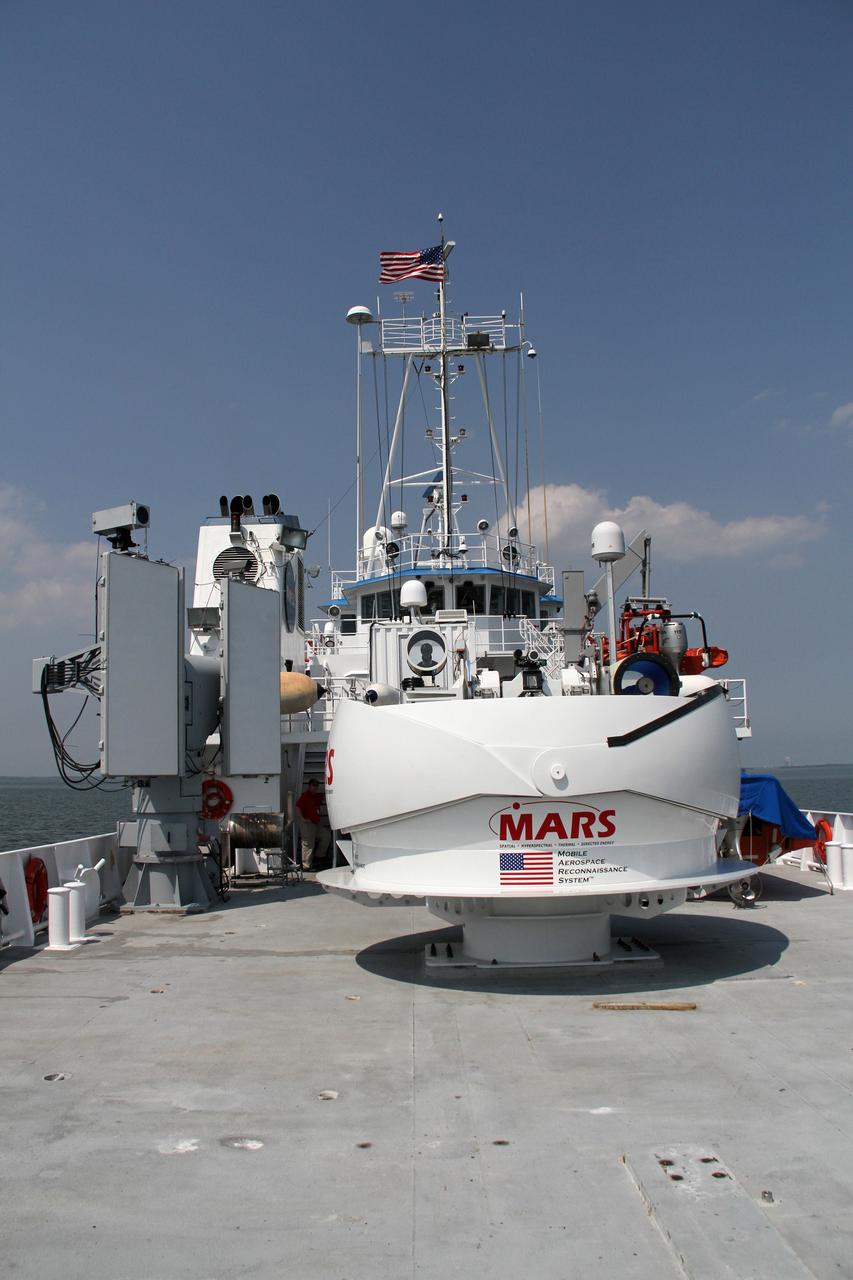
CAPE CANAVERAL, Fla. – Aboard NASA’s Freedom Star boat in the Atlantic Ocean off the coast of Port Canaveral in Florida, NASA’s Mobile Aerospace Reconnaissance System, or MARS, is being tested. MARS, run by NASA’s Langley Research Center in Hampton, Va., with its spatial, hyperspectral, thermal, and directed energy capabilities will be used for thermal imaging testing for the upcoming SpaceX Falcon 9 and Dragon capsule test flight to the International Space Station. During today’s test, the MARS X-band radar and kineto tracking mount KTM were tested to ensure that they were synchronized to receive a rocket launch feed. The radar was used to identify an object to see if the KTM could lock on to and track it. The MARS team performed maintenance on the system, confirmed communications links, and tested the design of the mounting system and environmental enclosure. Photo credit: NASA/Cory Huston

CAPE CANAVERAL, Fla. – At Walt Disney World's Magic Kingdom in Orlando, Fla., toy space ranger Buzz Lightyear participates in a ticker-tape parade to welcome him home from space. The 12-inch-tall action figure spent more than 15 months aboard the International Space Station and returned to Earth aboard space shuttle Discovery on Sept. 11 with the STS-128 crew. Lightyear's space adventure, a collaboration between NASA and Disney Parks, is intended to share the excitement of space exploration with students around the world and encourage them to pursue studies in science, technology, engineering and mathematics. For additional information, visit http://www.nasa.gov/buzzoniss. Photo credit: NASA/Dimitri Gerondidakis
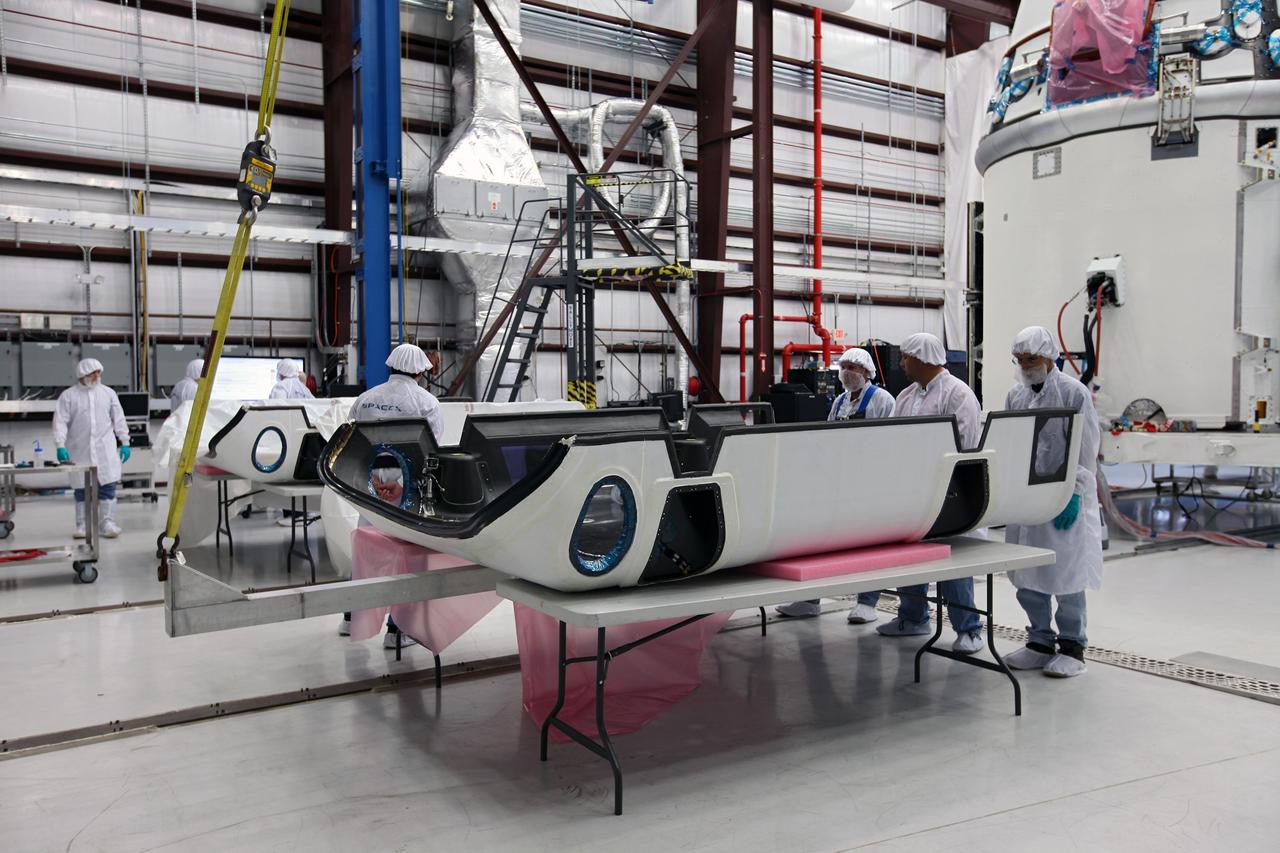
CAPE CANAVERAL, Fla. – Workers prepare to lift a solar array fairing at the processing hangar used by Space Exploration Technologies, or SpaceX, at Cape Canaveral Air Force Station, Fla. The fairing will be installed on the Dragon spacecraft undergoing launch preparations inside the hangar. The spacecraft will launch on the upcoming SpaceX CRS-2 mission. The flight will be the second commercial resupply mission to the International Space Station by SpaceX. NASA has contracted for a total of 12 commercial resupply flights from SpaceX and eight from the Orbital Sciences Corp. Photo credit: NASA/Kim Shiflett
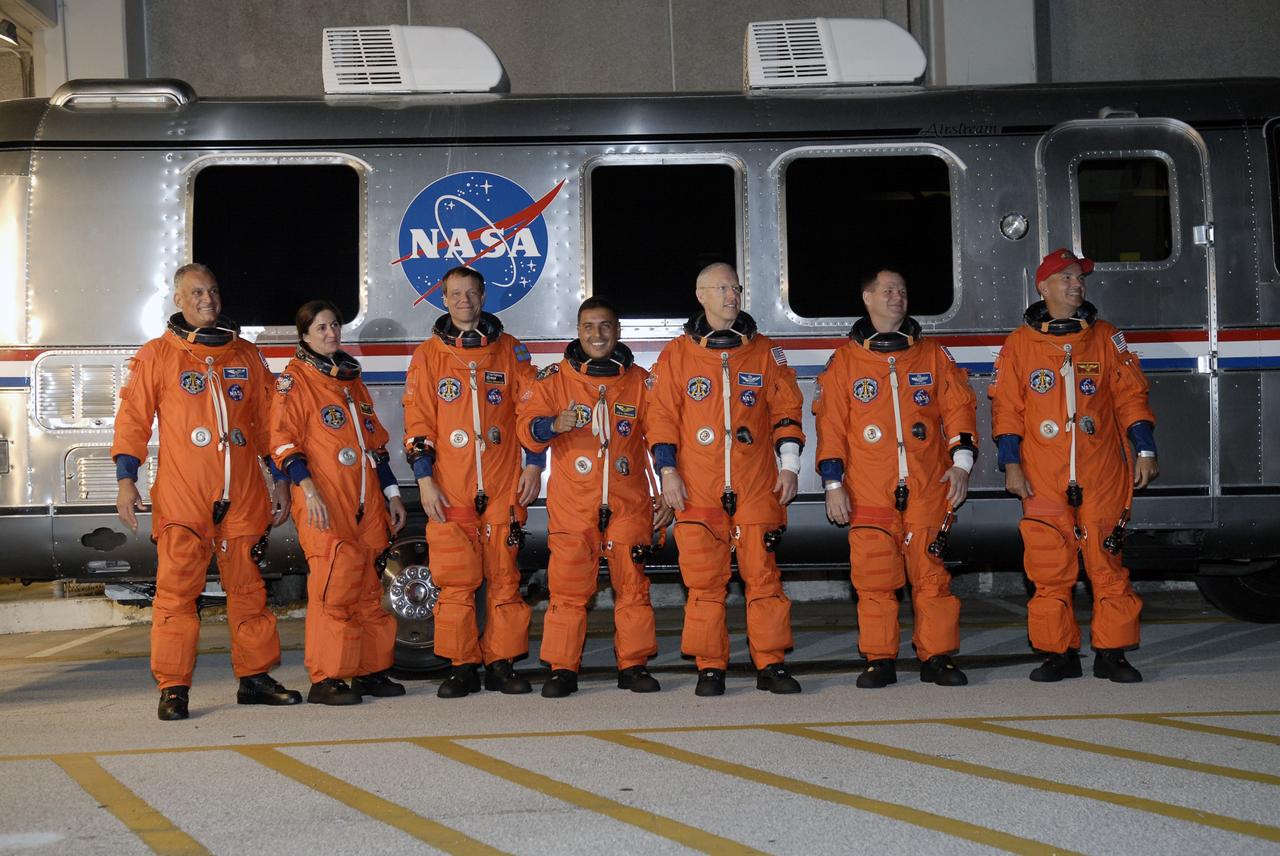
CAPE CANAVERAL, Fla. – The STS-128 crew members pause in front of the Astrovan that will take them to Launch Pad 39A. From left are Mission Specialists Danny Olivas, Nicole Stott, Christer Fuglesang, Jose Hernandez and Patrick Forrester, Pilot Kevin Ford and Commander Rick Sturckow. At the pad, the astronauts will complete their suitup and enter space shuttle Discovery for the 1:36 a.m. EDT liftoff. The 13-day mission will deliver more than 7 tons of supplies, science racks and equipment, as well as additional environmental hardware to sustain six crew members on the International Space Station. The equipment includes a freezer to store research samples, a new sleeping compartment and the COLBERT treadmill. The mission is the 128th in the Space Shuttle Program, the 37th flight of Discovery and the 30th station assembly flight. Photo credit: NASA/Kim Shiflett
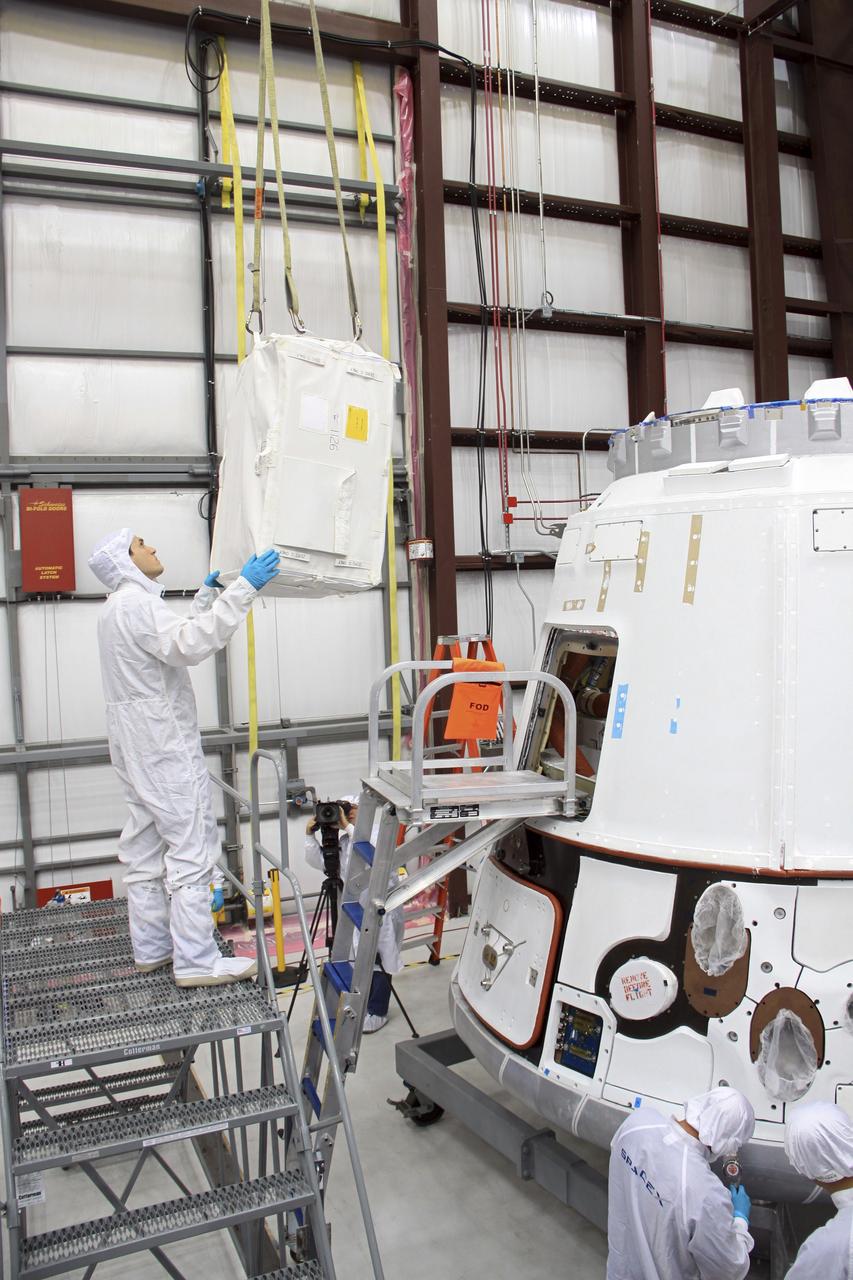
CAPE CANAVERAL, Fla. – In a processing hangar at Space Launch Complex-40 on Cape Canaveral Air Force Station in Florida, a cargo bag is lowered into the hands of a Space Exploration Technologies technician who will load it into the Dragon capsule in preparation for its scheduled April 30 liftoff aboard a Falcon 9 rocket. Known as SpaceX, the launch will be the company's second demonstration test flight for NASA's Commercial Orbital Transportation Services program, or COTS. During the flight, the capsule will conduct a series of checkout procedures to test and prove its systems, including rendezvous and berthing with the International Space Station. The cargo includes food and provisions for the station’s Expedition crews, such as clothing, batteries, and computer equipment. Under COTS, NASA has partnered with two private companies to launch cargo safely to the station. For more information, visit http://www.nasa.gov/spacex. Photo credit: NASA/Jim Grossmann
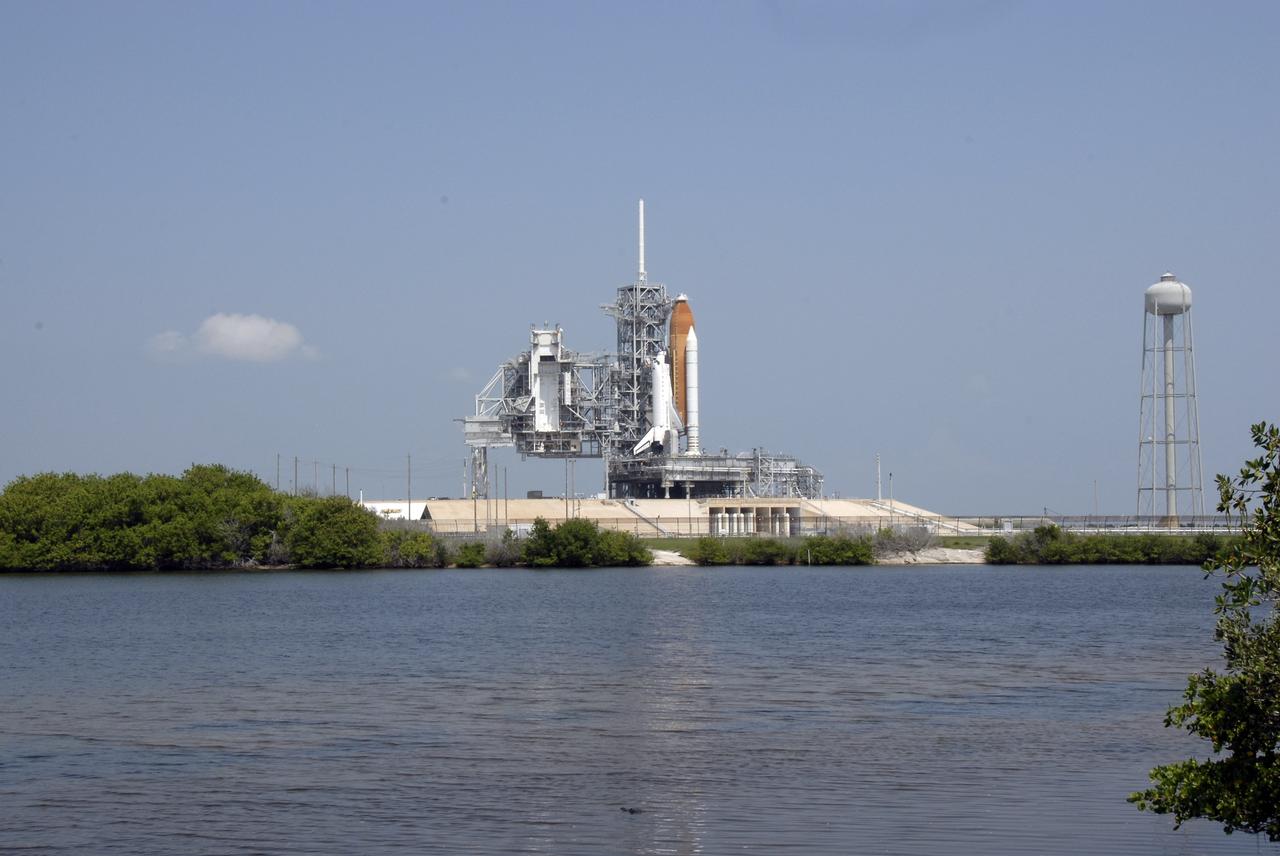
CAPE CANAVERAL, Fla. – Viewed across the Indian River Lagoon, space shuttle Endeavour waits for launch after rollback of the rotating service structure, or RSS, at left. First motion of the RSS was at 10:15 a.m. EDT. At far right is the tank that holds 300,000 gallons of water used for sound suppression during liftoff. First motion of the RSS was at 10:15 a.m. EDT. The rollback is in preparation for Endeavour's liftoff on the STS-127 mission with a crew of seven. This is the second launch attempt for Endeavour after the June 13 launch was scrubbed due to a hydrogen leak at the Ground Umbilical Carrier Plate during tanking June 12. The launch will be Endeavour's 23rd flight. The shuttle will carry the Japanese Experiment Module's Exposed Facility, or JEM-EF, and the Experiment Logistics Module-Exposed Section, or ELM-ES, on STS-127. The mission is the final of three flights dedicated to the assembly of the Japan Aerospace Exploration Agency's Kibo laboratory complex on the space station. Endeavour's launch is scheduled for June 17 at 5:40 a.m. EDT. Photo credit: NASA/Kim Shiflett
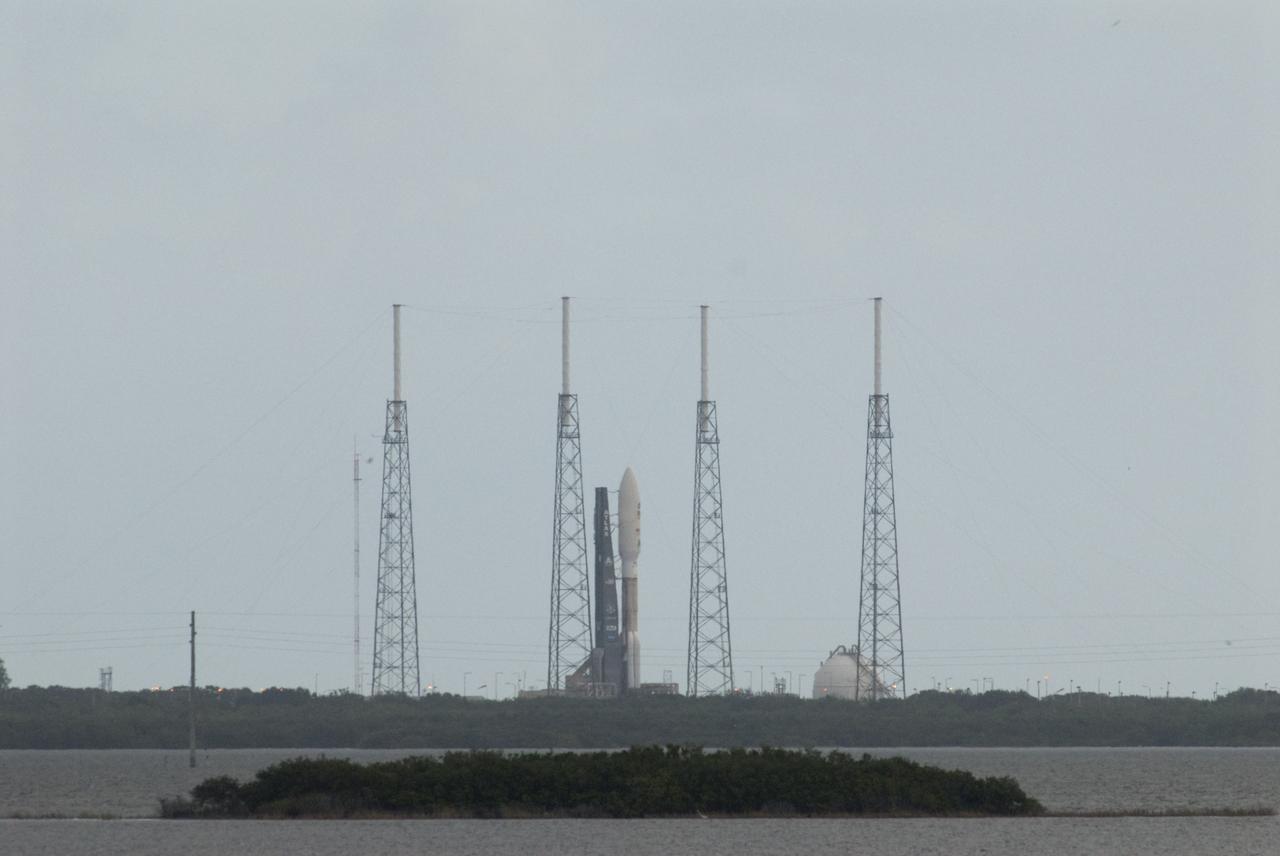
CAPE CANAVERAL, Fla. – Four towering lightning protection masts seem to stand guard as NASA's Mars Science Laboratory (MSL) spacecraft, sealed inside its payload fairing, awaits liftoff aboard the United Launch Alliance Atlas V rocket. MSL lifted off from Space Launch Complex 41 on Cape Canaveral Air Force Station in Florida at 10:02 a.m. EST Nov. 26, beginning a 9-month interplanetary cruise to Mars. MSL's components include a car-sized rover, Curiosity, which has 10 science instruments designed to search for signs of life, including methane, and help determine if the gas is from a biological or geological source. For more information, visit http://www.nasa.gov/msl. Photo credit: NASA/Bill White
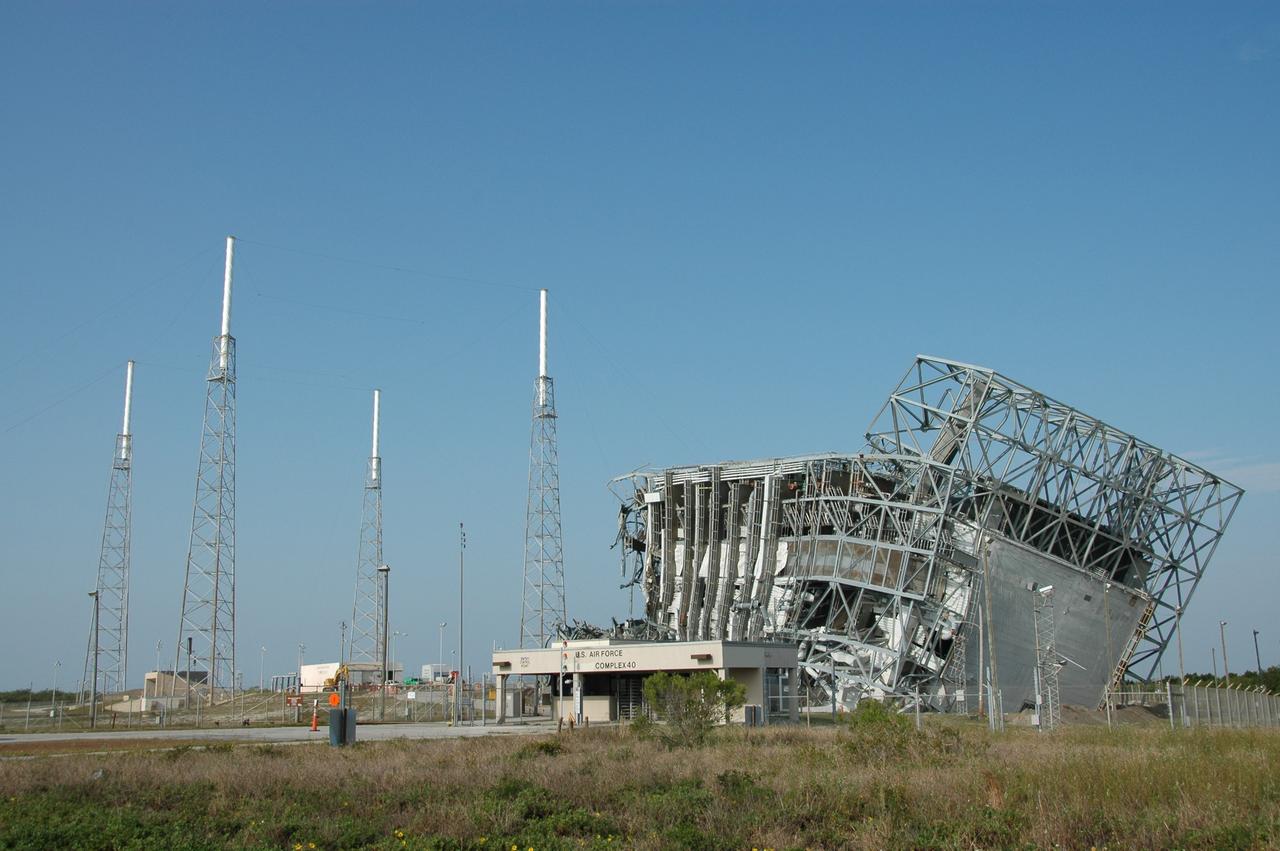
CAPE CANAVERAL, Fla. – Twisted metal is all that’s left of the mobile service tower, or gantry, at Space Launch Complex 40 on Cape Canaveral Air Force Station after its demolition April 27. This mammoth structure, with its cavernous clean room, was imploded to make room for the construction of launch pad access and servicing facilities for the new Falcon rockets to be launched by Space Exploration Technologies, known as SpaceX. The gantry was used for the final spacecraft launch preparations for NASA’s Cassini spacecraft, currently orbiting Saturn. The launch occurred on Oct. 15, 1997, aboard an Air Force Titan IV-Centaur rocket. Photo credit: NASA/Jim Grossmann
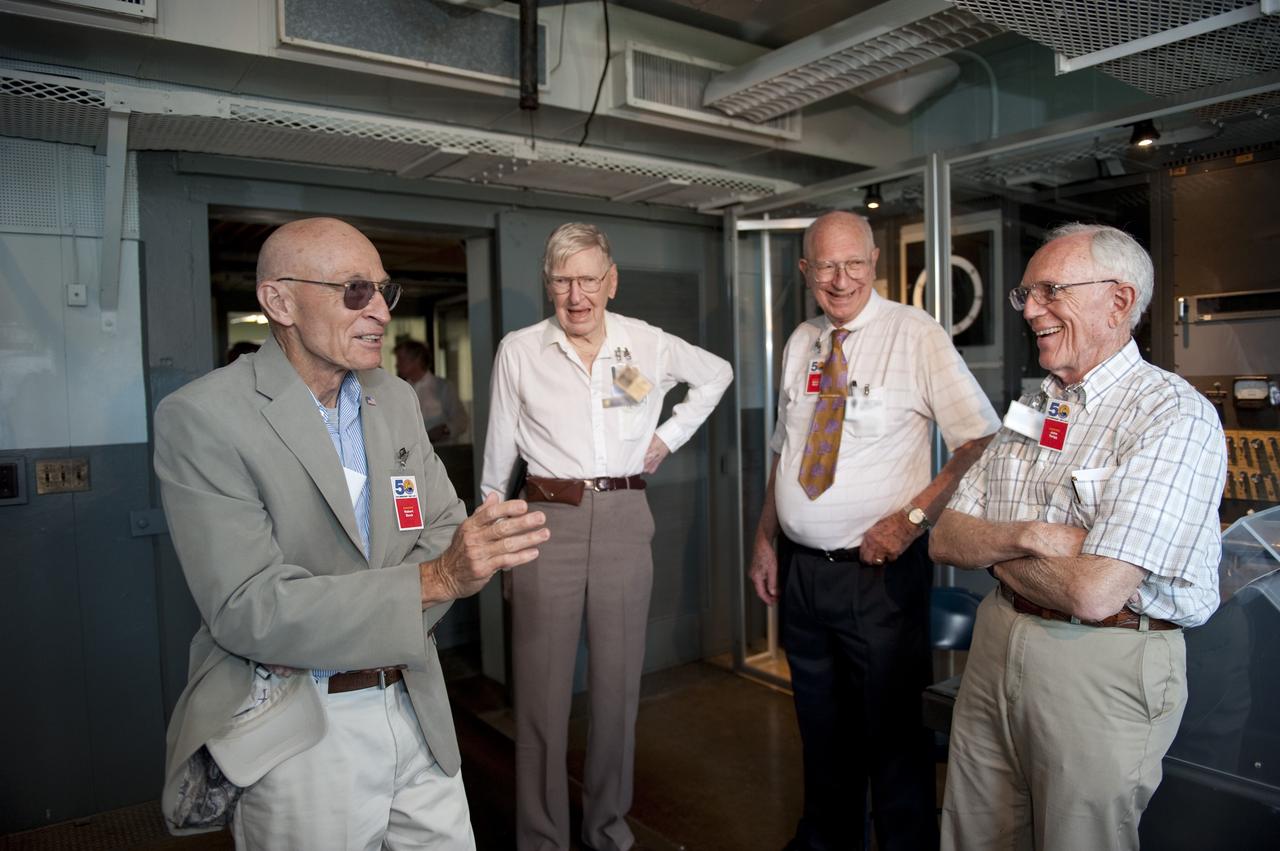
CAPE CANAVERAL, Fla. -- On Cape Canaveral Air Force Station in Florida, invited guests tour the blockhouse at Complex 5/6 during a celebration of Alan Shepard's historic flight 50 years ago. From left are Robert Sieck, former shuttle launch director; Andy Anderson, former manager for communications in the Mercury Mission Control Center; Bob Moser, former chief test conductor for the Mercury-Redstone launches; and John Twigg, former backup chief test conductor for the Mercury-Redstone launches. The celebration was held at the launch site of the first U.S. manned spaceflight May 5, 1961, to mark the 50th anniversary of the flight. Fifty years ago, astronaut Alan Shepard lifted off inside the Mercury capsule, "Freedom 7," atop an 82-foot-tall Mercury-Redstone rocket at 9:34 a.m. EST, sending him on a remarkably successful, 15-minute suborbital flight. The event was attended by more than 200 workers from the original Mercury program and included a re-creation of Shepard's flight and recovery, as well as a tribute to his contributions as a moonwalker on the Apollo 14 lunar mission. For more information, visit www.nasa.gov/topics/history/milestones/index.html. Photo credit: NASA/Kim Shiflett
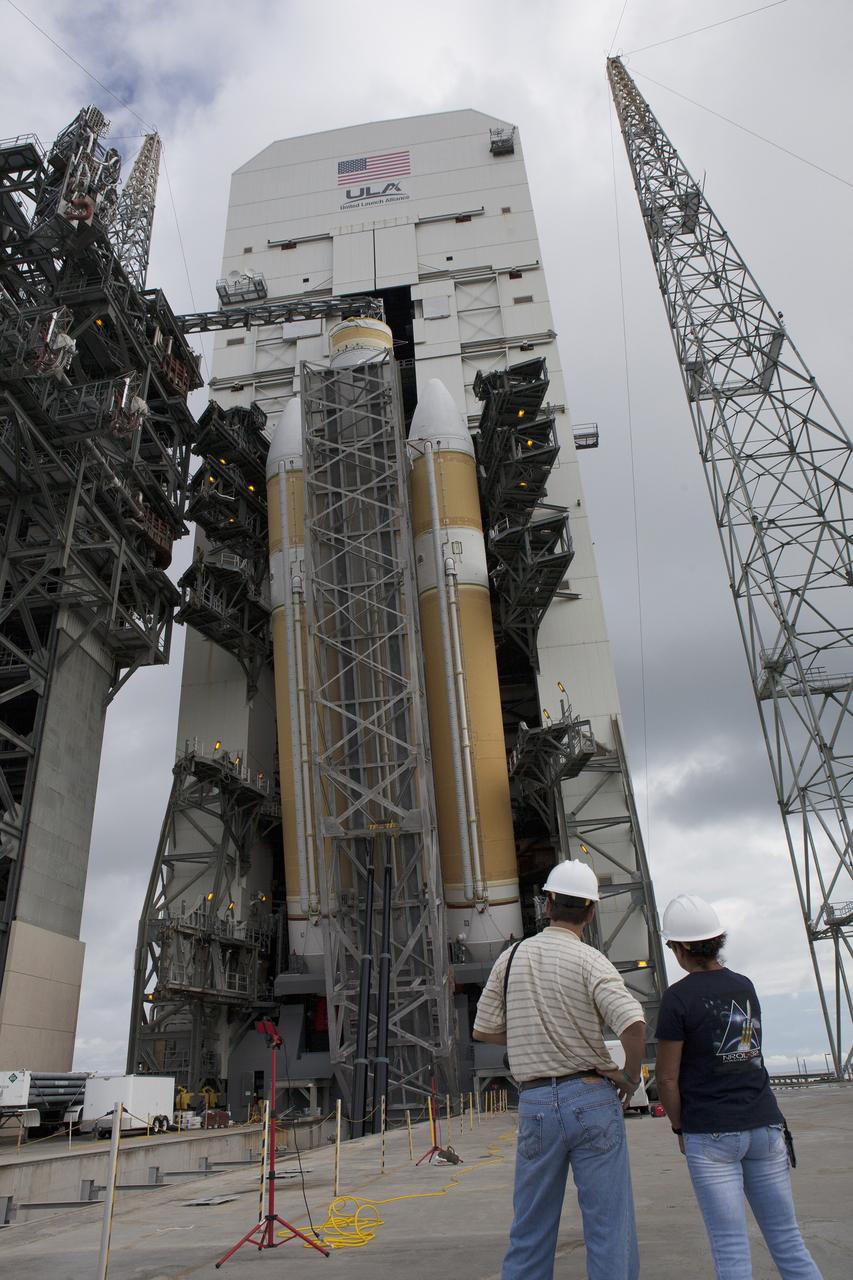
CAPE CANAVERAL, Fla. – United Launch Alliance, or ULA, workers monitor the progress as the ULA Delta IV Heavy rocket for Exploration Flight Test-1 is lifted to the vertical position in the mobile service tower on the pad at Space Launch Complex 37 at Cape Canaveral Air Force Station in Florida. The Delta IV Heavy is being readied to launch Orion on its first flight test. During its first flight test, Orion will travel farther into space than any human spacecraft has gone in more than 40 years. The data gathered during the flight will influence design decisions, validate existing computer models and innovative new approaches to space systems development, as well as reduce overall mission risks and costs for later Orion flights. Liftoff of Orion on the first flight test is planned for December 2014. Photo credit: NASA/Daniel Casper
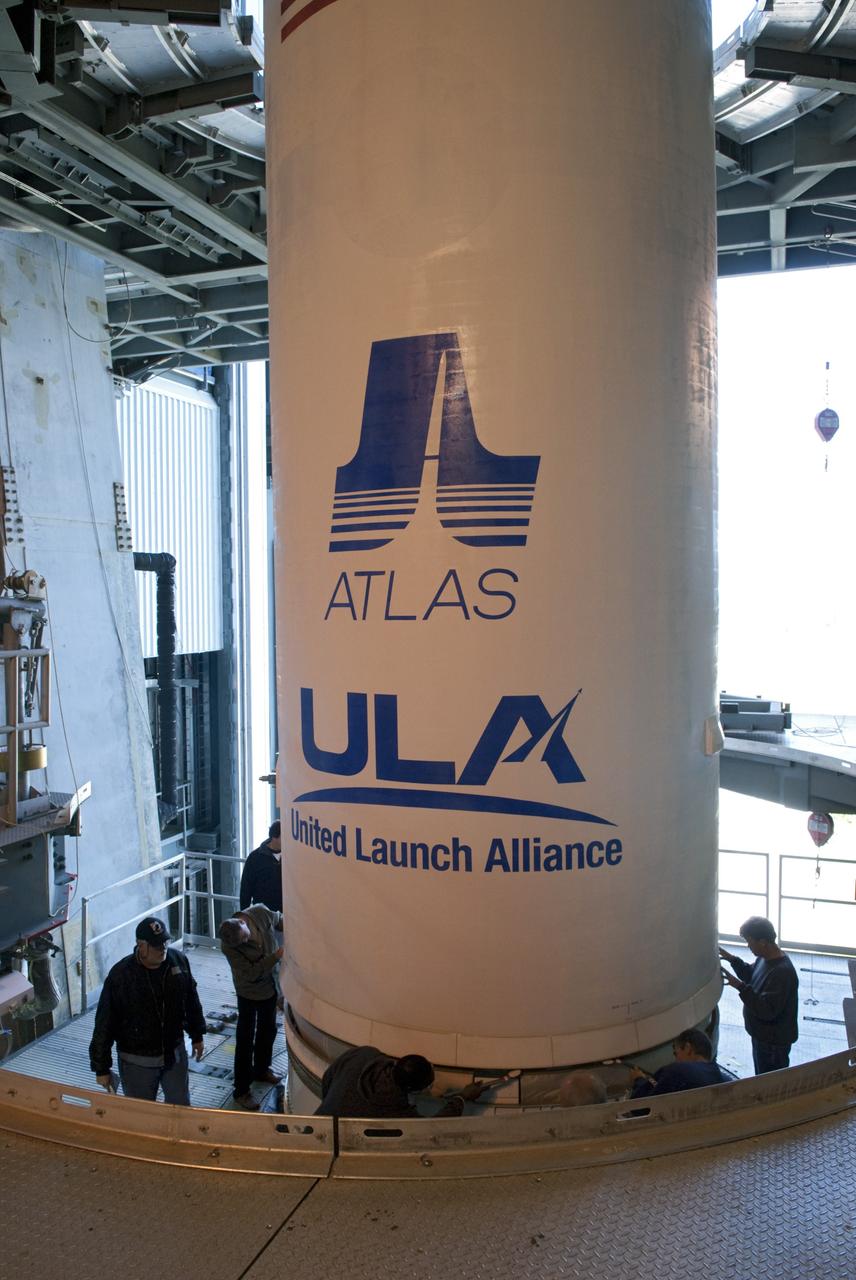
CAPE CANAVERAL, Fla. -- At Cape Canaveral Air Force Station's Space Launch Complex 41 in Florida, United Launch Alliance technicians support operations to mate the Centaur stage to the Atlas V rocket that will carry the Tracking and Data Relay Satellite, TDRS-K, into orbit. Launch of the TDRS-K on the Atlas V rocket is planned for January 29, 2013. The TDRS-K spacecraft is part of the next-generation series in the Tracking and Data Relay Satellite System, a constellation of space-based communication satellites providing tracking, telemetry, command and high-bandwidth data return services. For more information, visit http://www.nasa.gov/mission_pages/tdrs/index.html Photo credit: NASA/Charisse Nahser

CAPE CANAVERAL, Fla. -- Taken during the STS-95 mission from a point over Cuba, this photo shows an oblique, foreshortened view of the Florida Peninsula, with the light blue, shallow seafloor of both the Florida Keys (curving across the bottom of the view) and the Bahama banks (right). "Popcorn" cumulus cloud covers Miami and the Southern Everglades, although the built-up area from Ft. Lauderdale to West Palm Beach can be discerned. Lake Okeechobee is the prominent waterbody in Florida. Cape Canaveral is shown well, half way up the peninsula. Orlando appears as the lighter patch West (left) of Cape Canaveral, near the middle of the peninsula. Cape Hatteras appears top right, with the North part of Chesapeake Bay also visible. This is a visibility of 16 degrees of latitude (23 degrees N over Cuba to 39 degrees at Baltimore), showing unusual atmospheric clarity.
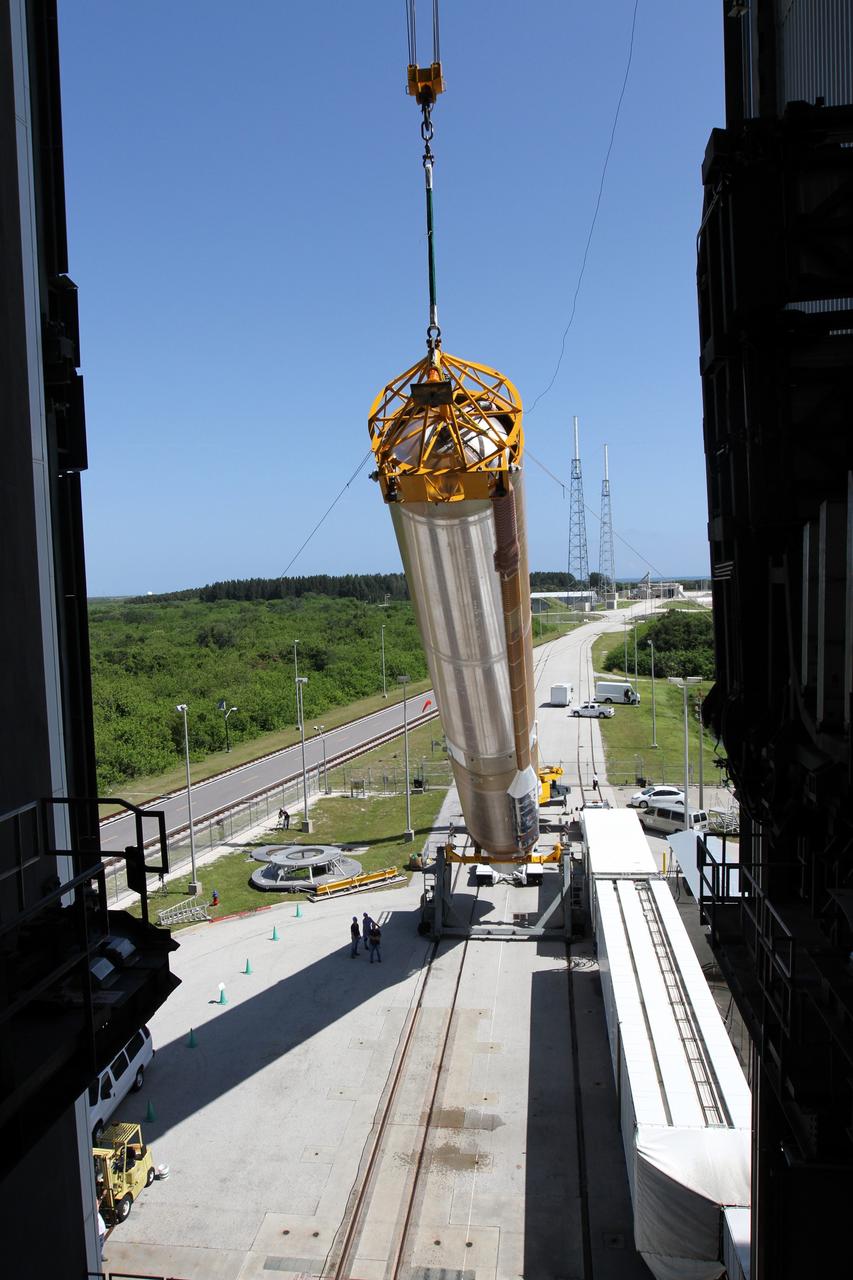
CAPE CANAVERAL, Fla. - At Launch Complex 41 at Cape Canaveral Air Force Station in Florida, a large crane lifts the first stage of the United Launch Alliance Atlas V rocket into the vertical position. The Atlas V is being prepared for the Radiation Belt Storm Probes, or RBSP, mission. NASA’s RBSP mission will help us understand the sun’s influence on Earth and near-Earth space by studying the Earth’s radiation belts on various scales of space and time. RBSP will begin its mission of exploration of Earth’s Van Allen radiation belts and the extremes of space weather after its launch aboard an Atlas V rocket. Launch is targeted for Aug. 23. For more information, visit http://www.nasa.gov/rbsp. Photo credit: NASA/Cory Huston
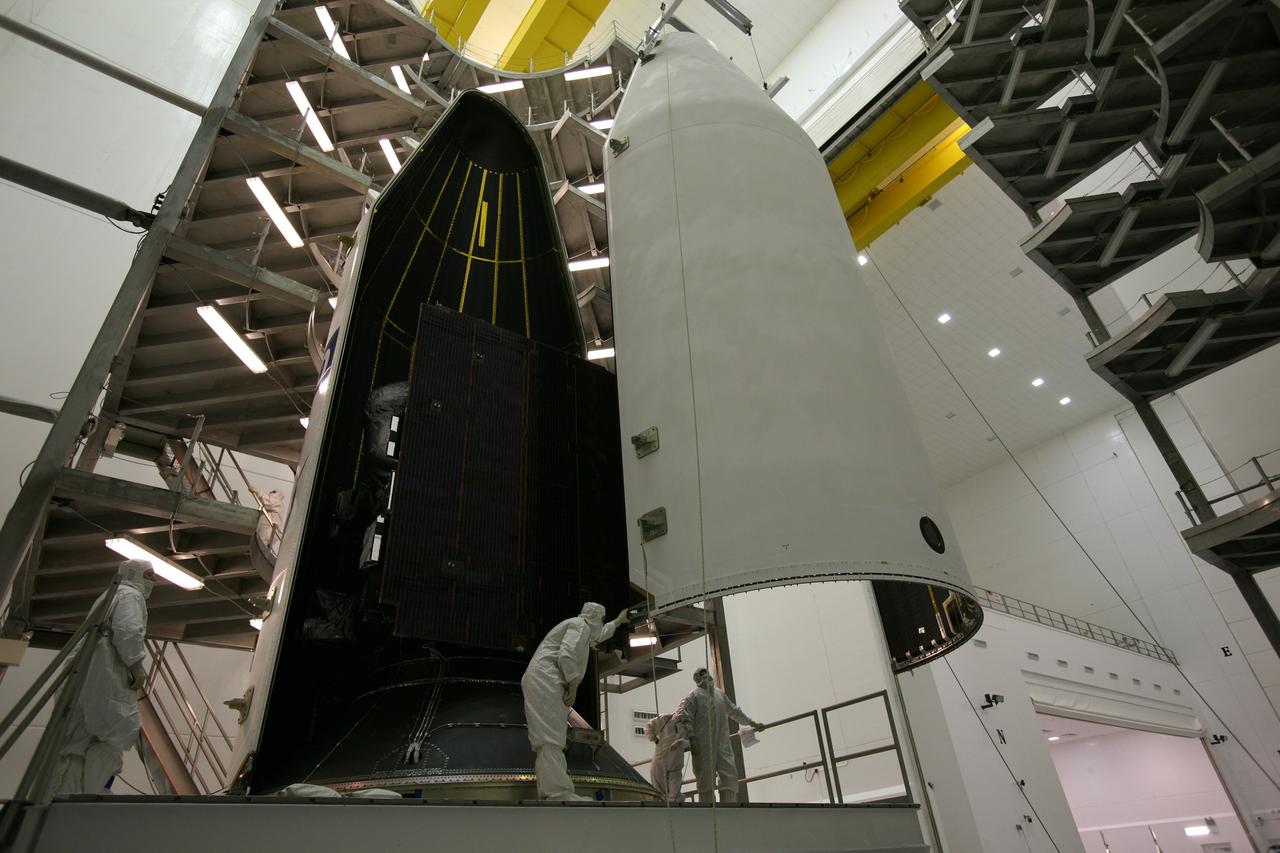
CAPE CANAVERAL, Fla. – In the Astrotech payload processing facility in Titusville, Fla., technicians monitor the second half of the payload fairing as it is moved toward the GOES-O satellite to complete encapsulation. The fairing is a molded structure that fits flush with the outside surface of the rocket and forms an aerodynamically smooth nose cone, protecting the spacecraft during launch and ascent. The latest Geostationary Operational Environmental Satellite, GOES-O was developed by NASA for the National Oceanic and Atmospheric Administration, or NOAA. The GOES satellites continuously provide observations of 60 percent of the Earth including the continental United States, providing weather monitoring and forecast operations as well as a continuous and reliable stream of environmental information and severe weather warnings. Once in orbit, GOES-O will be designated GOES-14, and NASA will provide on-orbit checkout and then transfer operational responsibility to NOAA. The GOES-O satellite is targeted to launch from Cape Canaveral Air Force Station's Launch Complex 37 on April 28 onboard a United Launch Alliance Delta IV expendable launch vehicle. Photo credit: NASA/Dimitri Gerondidakis
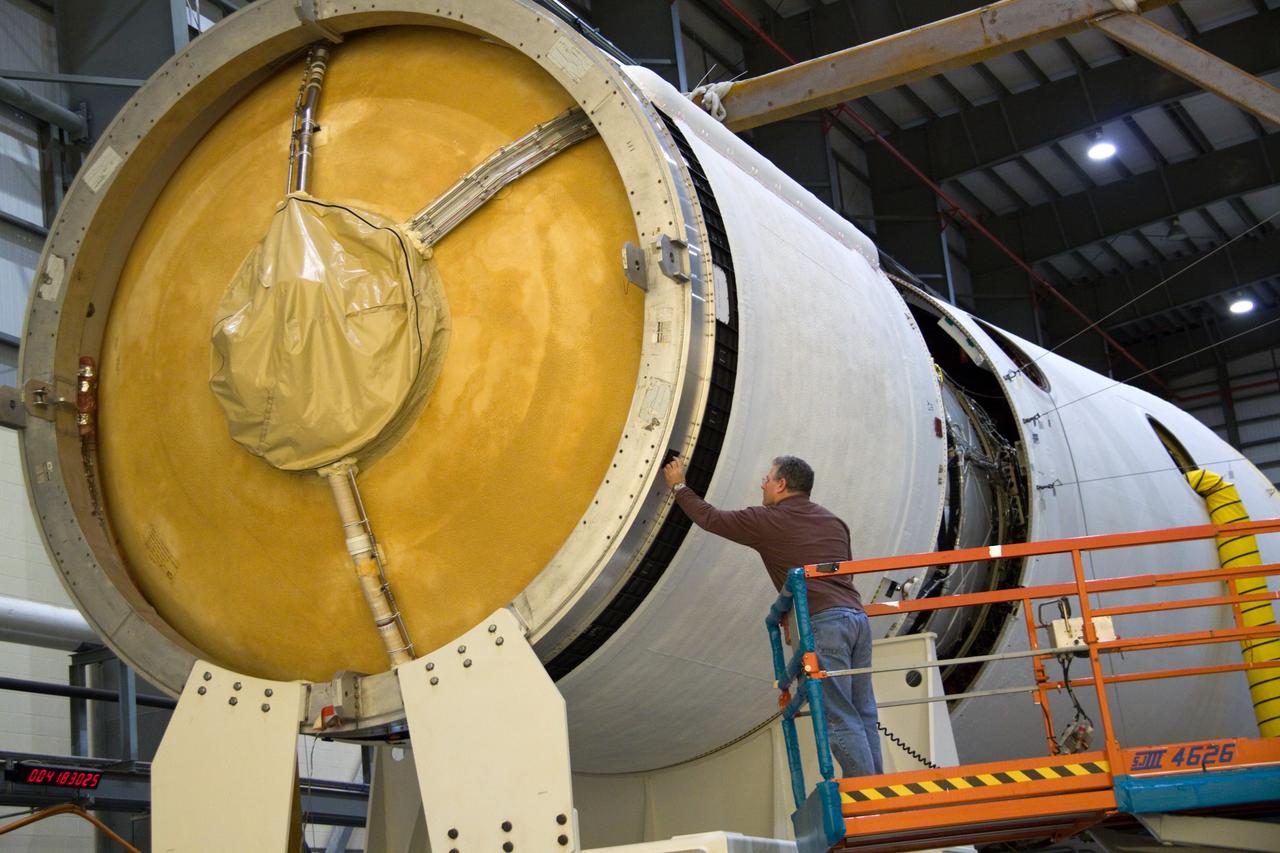
CAPE CANAVERAL, Fla. – In the Horizontal Integration Facility at Launch Complex 37 on Cape Canaveral Air Force Station in Florida, a worker prepares the second stage of a Delta IV rocket for mating to the first stage. This United Launch Alliance Delta IV rocket is slated to launch GOES-P, the latest Geostationary Operational Environmental Satellite developed by NASA for the National Oceanic and Atmospheric Administration, or NOAA. Launch is targeted for Feb. 25. For information on GOES-P, visit http://goespoes.gsfc.nasa.gov/goes/spacecraft/n_p_spacecraft.html. Photo credit: NASA/Jack Pfaller
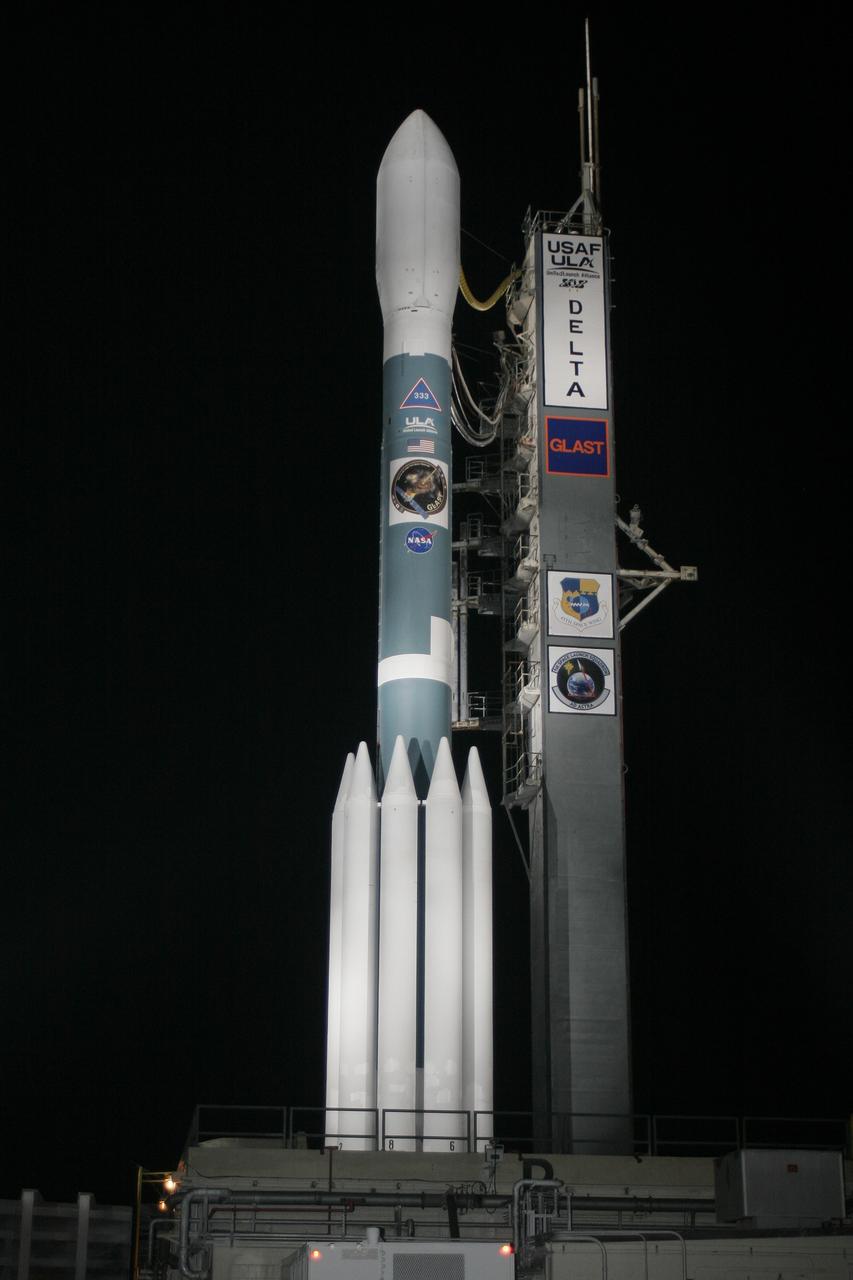
CAPE CANAVERAL, Fla. -- On Cape Canaveral Air Force Station's Launch Pad 17-B, NASA's Gamma-ray Large Area Space Telescope , or GLAST, sits poised for launch atop the United Launch Alliance Delta II rocket after rollback of the mobile service tower. GLAST is a powerful space observatory that will explore the universe's ultimate frontier, where nature harnesses forces and energies far beyond anything possible on Earth; probe some of science's deepest questions, such as what our universe is made of, and search for new laws of physics; explain how black holes accelerate jets of material to nearly light speed; and help crack the mystery of stupendously powerful explosions known as gamma-ray bursts. Launch is scheduled for 11:45 a.m. June 11. Photo credit: Carleton Bailie photograph for United Launch Alliance
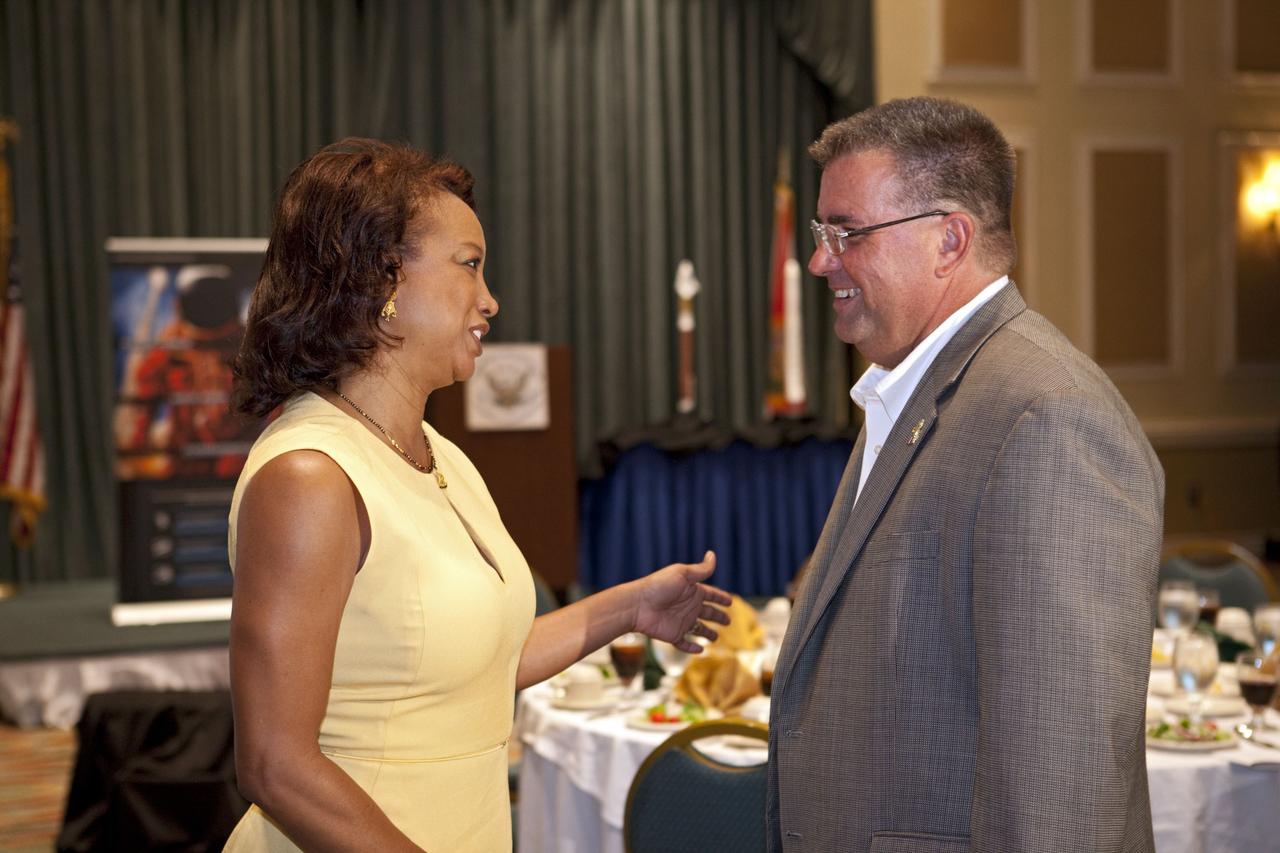
CAPE CANAVERAL, Fla. -- Florida's Lt. Gov. Jennifer Carroll, left, and NASA Commercial Crew Program Manager Ed Mango discuss the future of human spaceflight at the National Space Club Florida Committee's August luncheon at the Radisson Resort at the Port in Cape Canaveral, Fla. Mango was the event's guest speaker, discussing the innovative steps the agency is taking with industry partners to develop the next U.S. space transportation capability to and from low Earth orbit, which will eventually be available for use by the U.S. government and other commercial customers. To learn more about the Commercial Crew Program, visit www.nasa.gov/commercialcrew. Photo credit: Kim Shiflett
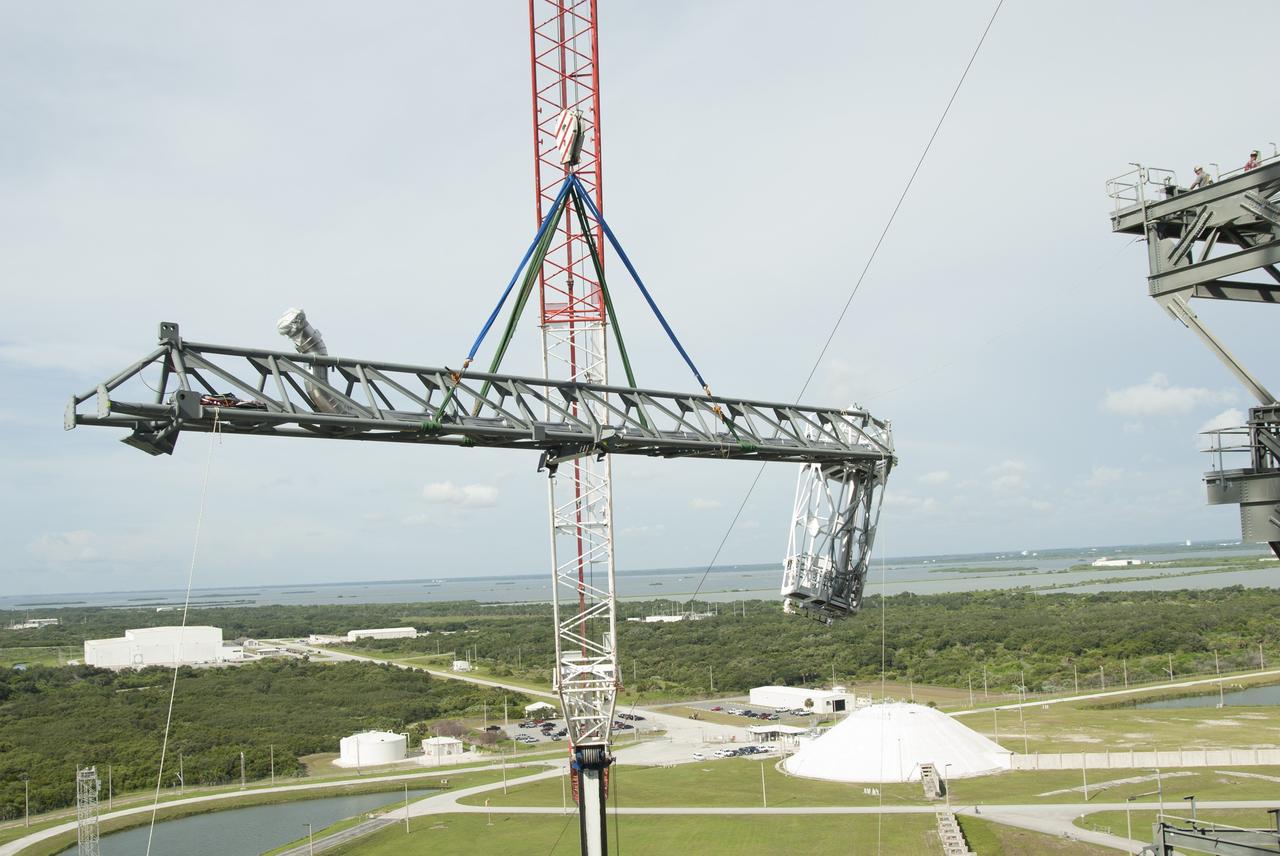
CAPE CANAVERAL, Fla. – The umbilical swing arm for Exploration Flight Test 1, or EFT-1, is lifted high by crane for installation on the fixed umbilical tower at Space Launch Complex 37 at Cape Canaveral Air Force Station in Florida. The swing arm is the uppermost of three swing arms that will be attached to the fixed umbilical tower. The swing arm will carry umbilicals that will be mated to Orion's launch abort system and environmental control system. During launch, the umbilicals will pull away from Orion and the United Launch Alliance Delta IV Heavy rocket at T-0. During the EFT-1 mission, Orion will travel farther into space than any human spacecraft has gone in more than 40 years. The data gathered during the flight will influence design decisions, validate existing computer models and innovative new approaches to space systems development, as well as reduce overall mission risks and costs for later Orion flights. Liftoff of Orion on its first flight test is planned for fall 2014. Photo credit: NASA/Jim Grossmann
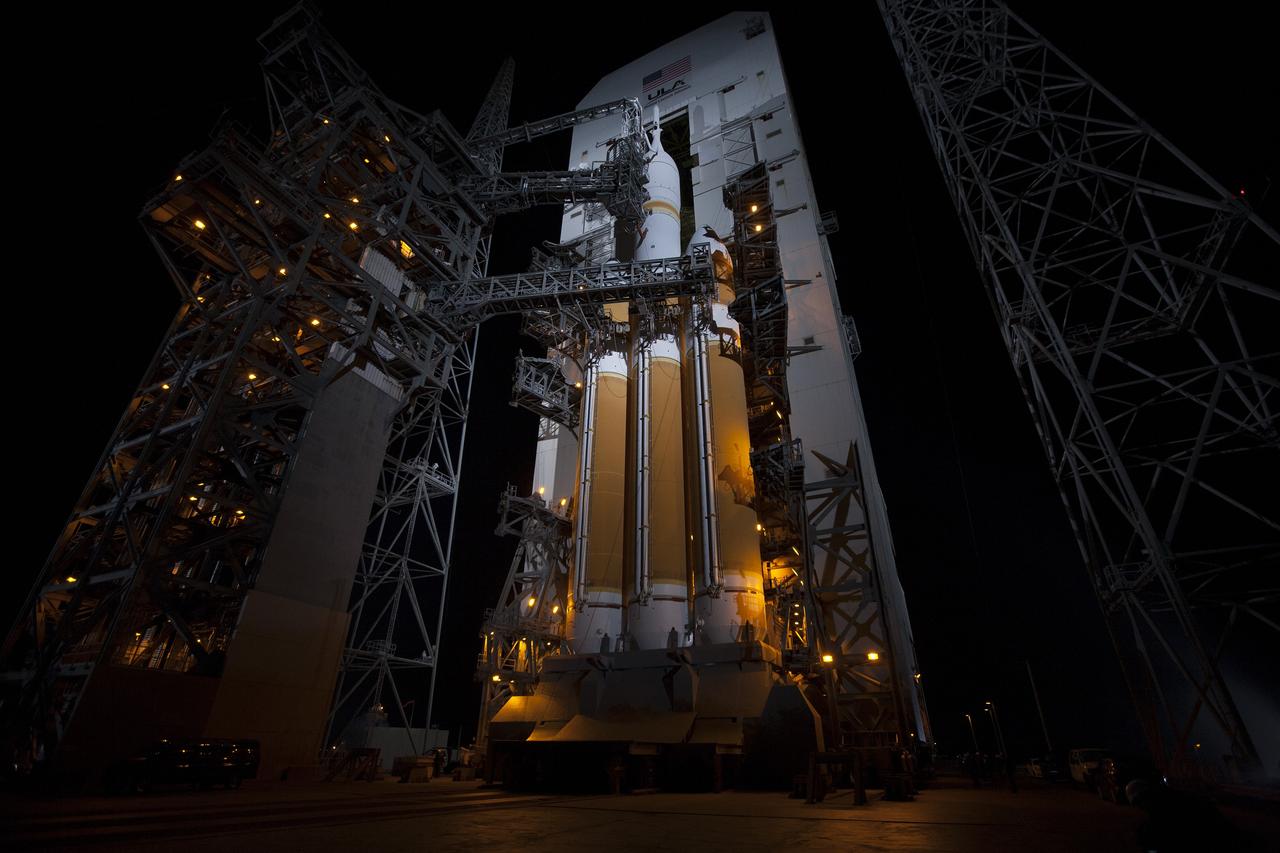
CAPE CANAVERAL, Fla. – The launch gantry is rolled back to reveal NASA's Orion spacecraft mounted atop a United Launch Alliance Delta IV Heavy rocket at Cape Canaveral Air Force Station's Space Launch Complex 37. Orion is NASA’s new spacecraft built to carry humans, designed to allow us to journey to destinations never before visited by humans, including an asteroid and Mars. For more information, visit www.nasa.gov/orion Photo credit: NASA/Kim Shiflett
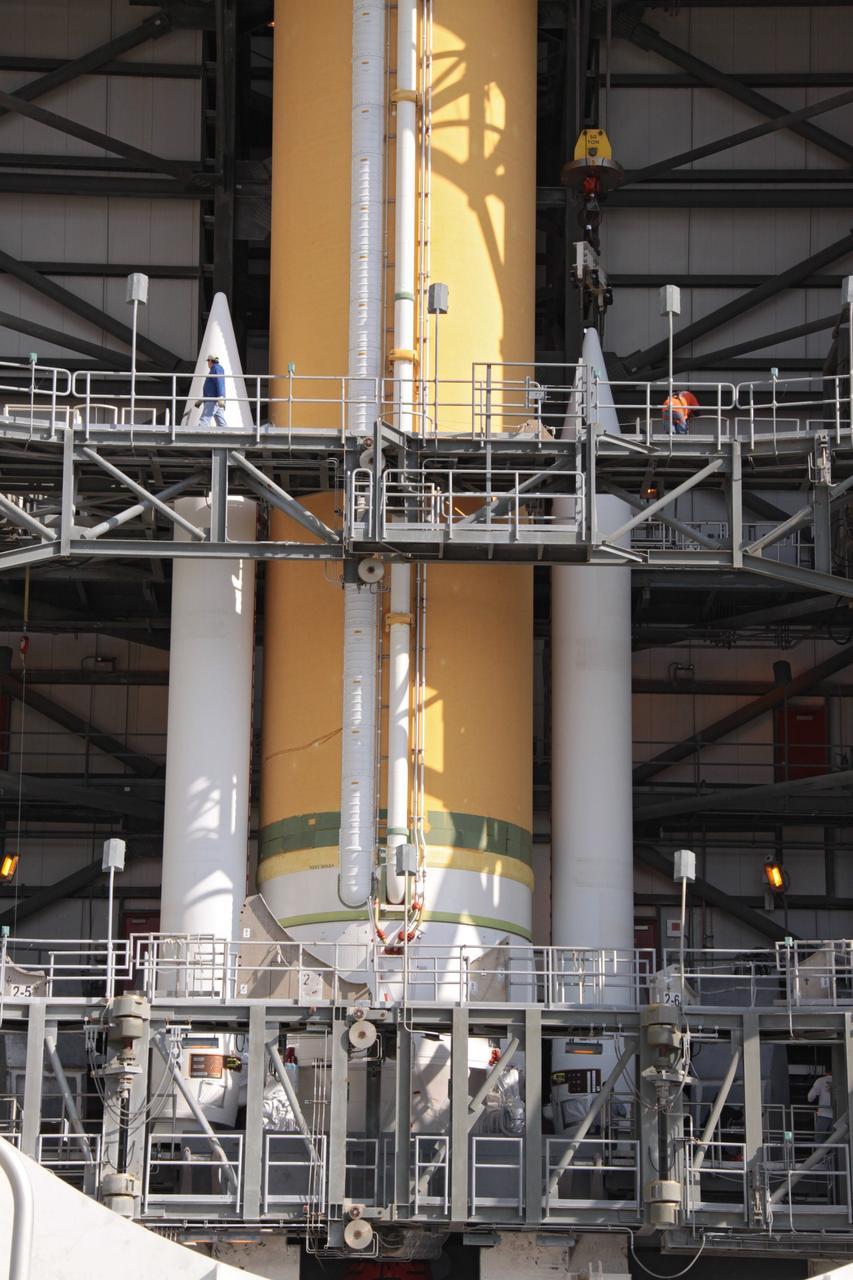
CAPE CANAVERAL, Fla. – In the mobile service tower at Launch Complex 37 on Cape Canaveral Air Force Station in Florida, the Delta IV rocket slated to launch NASA's GOES-P meteorological satellite now has two solid rocket boosters attached to the base of the rocket. GOES-P is the latest Geostationary Operational Environmental Satellite developed by NASA for the National Oceanic and Atmospheric Administration, or NOAA. The Delta IV rocket will be launched by United Launch Alliance for Boeing Launch Services under an FAA commercial license. Launch is targeted for no earlier than March 1. For information on GOES-P, visit http://goespoes.gsfc.nasa.gov/goes/spacecraft/n_p_spacecraft.html. Photo credit: NASA/Jack Pfaller
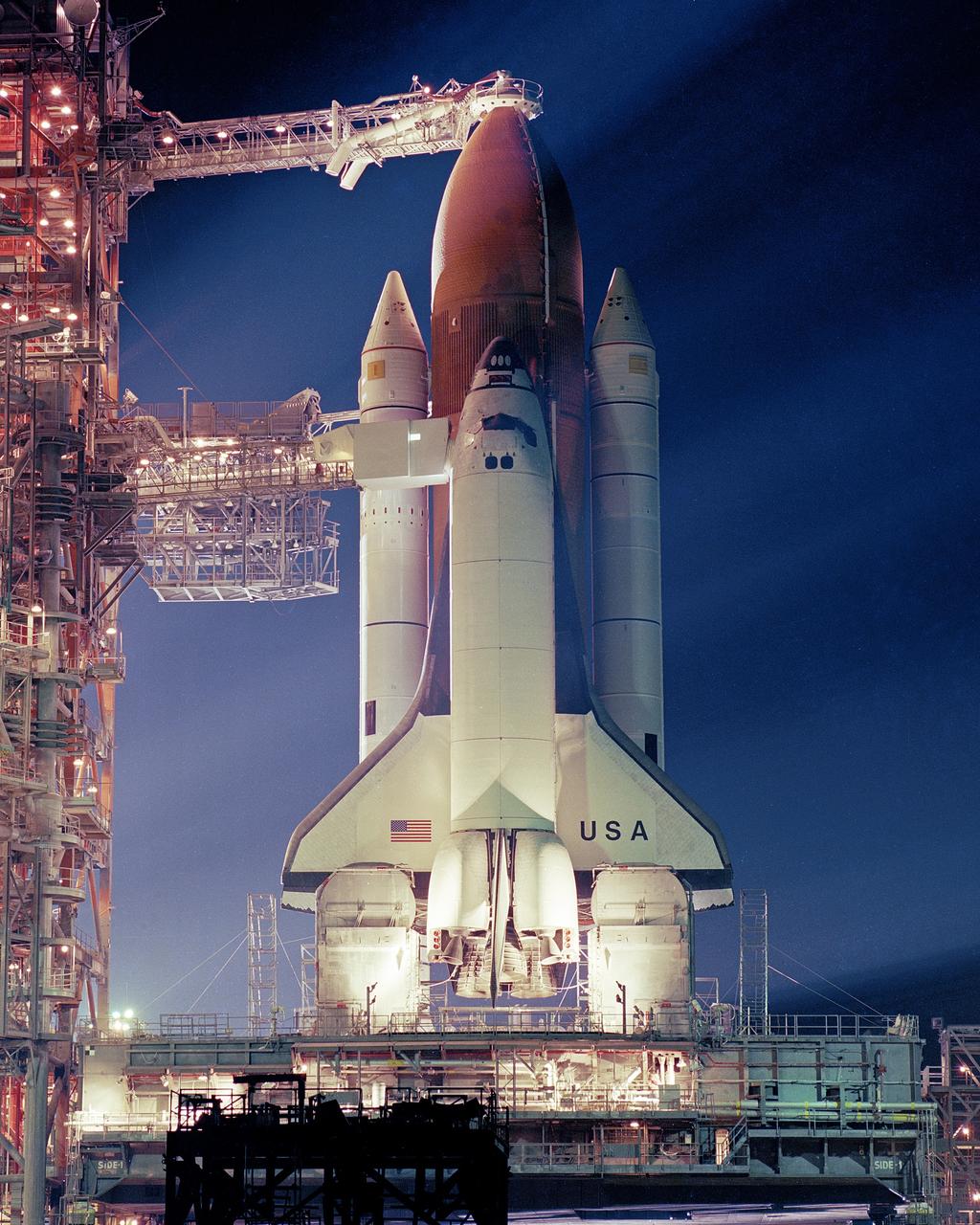
CAPE CANAVERAL, Fla. - STS-3 on Launch Pad 39A with searchlights during loading tests. Photo credit: NASA

CAPE CANAVERAL, Fla. – United Launch Alliance, or ULA, workers monitor the progress as the ULA Delta IV Heavy rocket for Exploration Flight Test-1 is lifted to the vertical position in the mobile service tower on the pad at Space Launch Complex 37 at Cape Canaveral Air Force Station in Florida. The Delta IV Heavy is being readied to launch Orion on its first flight test. During its first flight test, Orion will travel farther into space than any human spacecraft has gone in more than 40 years. The data gathered during the flight will influence design decisions, validate existing computer models and innovative new approaches to space systems development, as well as reduce overall mission risks and costs for later Orion flights. Liftoff of Orion on the first flight test is planned for December 2014. Photo credit: NASA/Daniel Casper
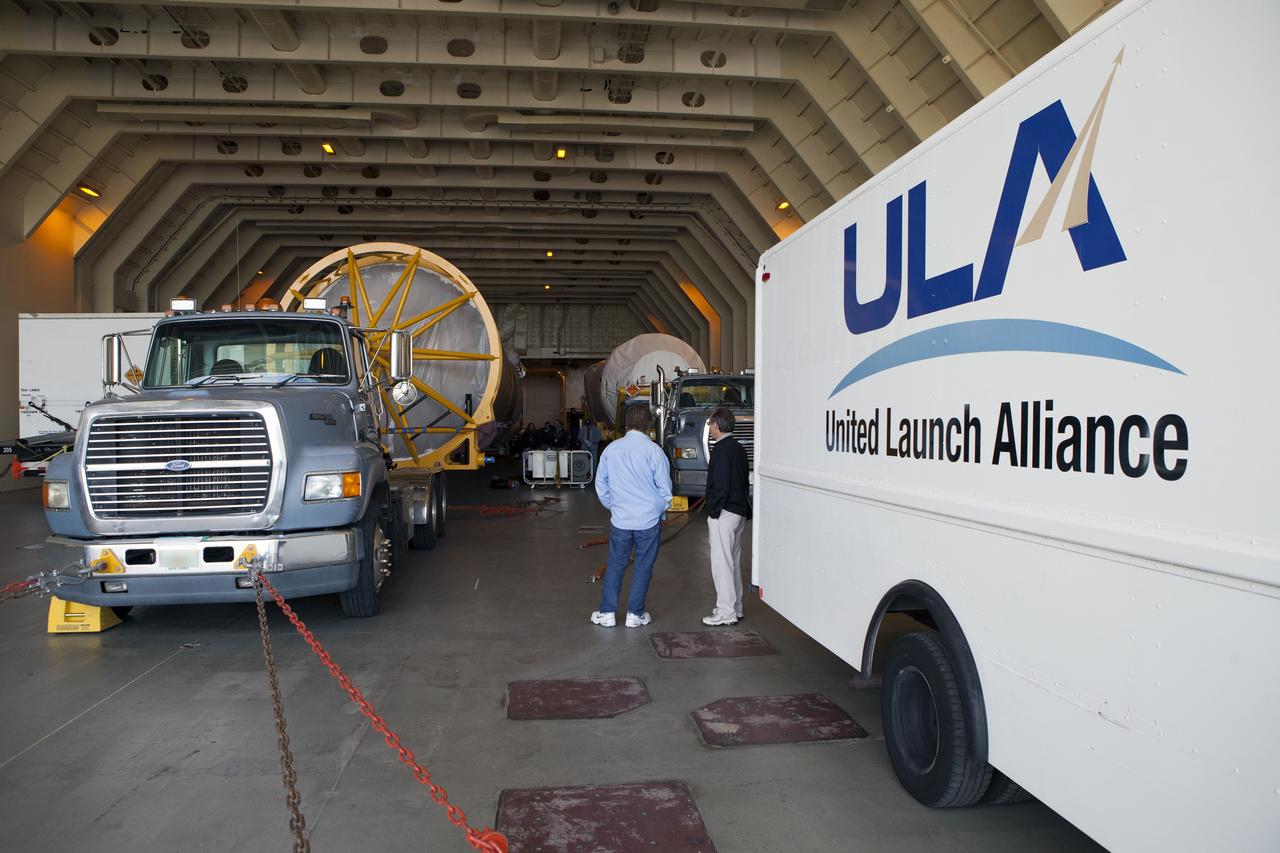
CAPE CANAVERAL, Fla. – Trucks inside the United Launch Alliance Delta Mariner prepare to transport the Atlas V rocket and Centaur upper stage that will be used to launch NASA's Magnetospheric Multiscale mission. To learn about the MMS, go to http://go.nasa.gov/1GUbzxb. Photo credit: NASA/Ben Smegelsky

CAPE CANAVERAL, Fla. – At Cape Canaveral Air Force Station in Florida, United Launch Alliance, or ULA, technicians monitor the progress as the ULA Atlas V rocket, carrying NASA’s twin Radiation Belt Storm Probes, or RBSP, are rolled back from Space Launch Complex 41 to the Vertical Integration Facility. The rocket and spacecraft will be secured and protected from inclement weather due to Tropical Storm Isaac. RBSP will explore changes in Earth's space environment caused by the sun -- known as "space weather" -- that can disable satellites, create power-grid failures and disrupt GPS service. The mission also will provide data on the fundamental radiation and particle acceleration processes throughout the universe. The launch is rescheduled for 4:05 a.m. EDT on Aug. 30, pending approval from the range. For more information on RBSP, visit http://www.nasa.gov/rbsp. Photo credit: NASA/Ben Smegelsky
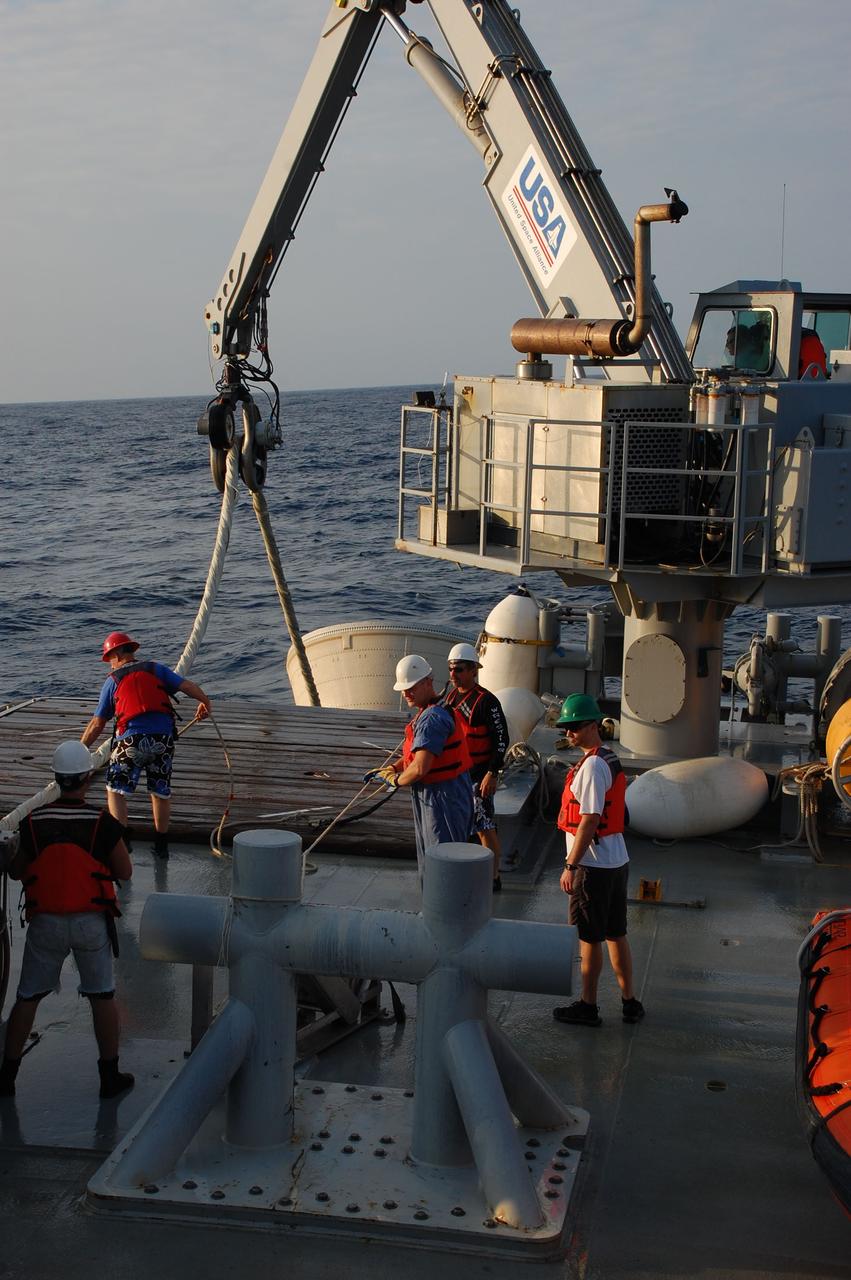
CAPE CANAVERAL, Fla. -- Crew members from Freedom Star, one of NASA's solid rocket booster retrieval ships, use a crane to pull the left spent booster nose cap out of the Atlantic Ocean after space shuttle Discovery's STS-133 launch. The shuttle’s two solid rocket booster casings and associated flight hardware are recovered in the Atlantic Ocean after every launch by Liberty Star and Freedom Star. The boosters impact the Atlantic about seven minutes after liftoff and the retrieval ships are stationed about 10 miles from the impact area at the time of splashdown. After the spent segments are processed, they will be transported to Utah, where they will be refurbished and stored, if needed. Photo credit: NASA/Ben Smegelsky
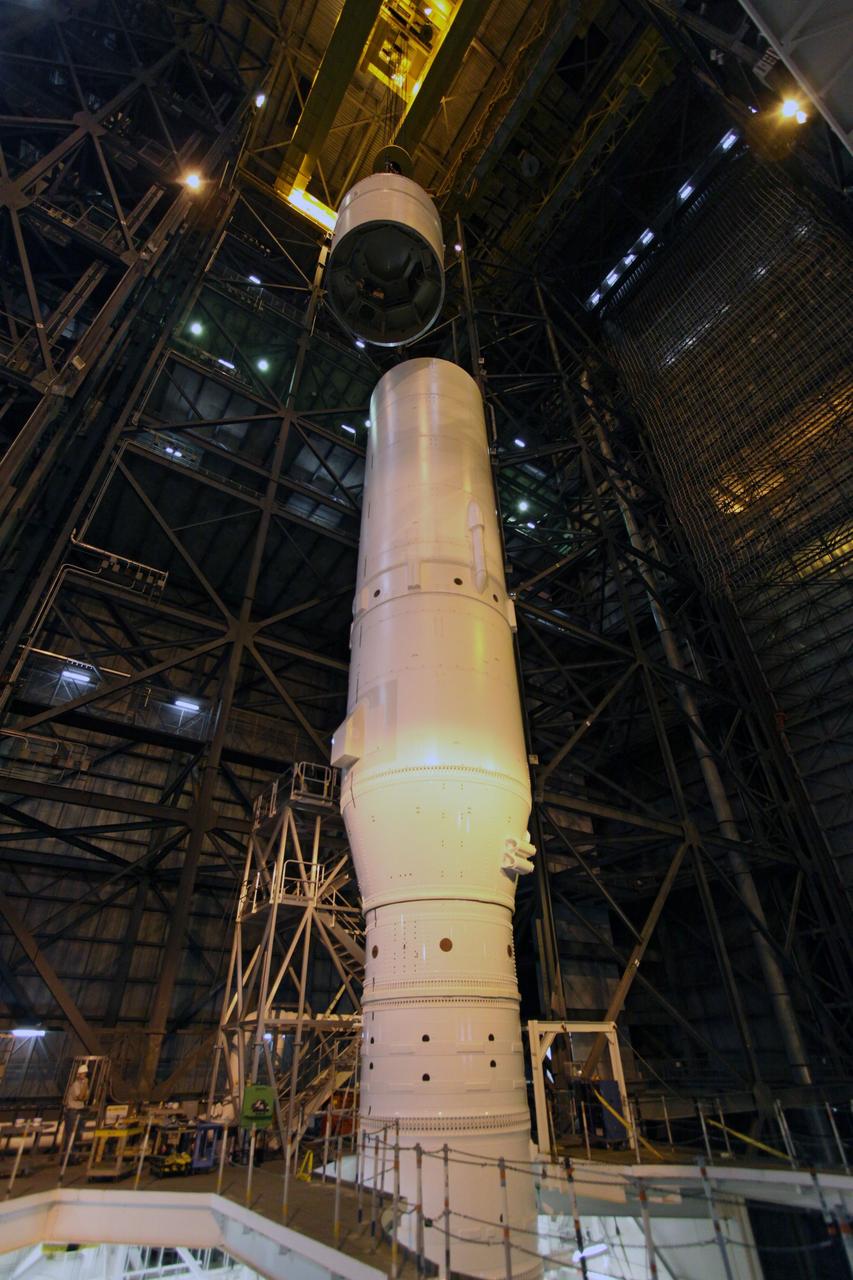
CAPE CANAVERAL, Fla. –In the Vehicle Assembly Building's High Bay 3, a crane lowers the Ares I-X Super Stack 4 toward Super Stack 3 for integration. Five super stacks make up the upper stage that will be integrated with the four-segment solid rocket booster first stage on the mobile launch platform. Ares I-X is the test vehicle for the Ares I, which is part of the Constellation Program to return men to the moon and beyond. The Ares I-X flight test is targeted for Oct. 31, pending formal NASA Headquarters approval. Photo credit: NASA/Jack Pfaller
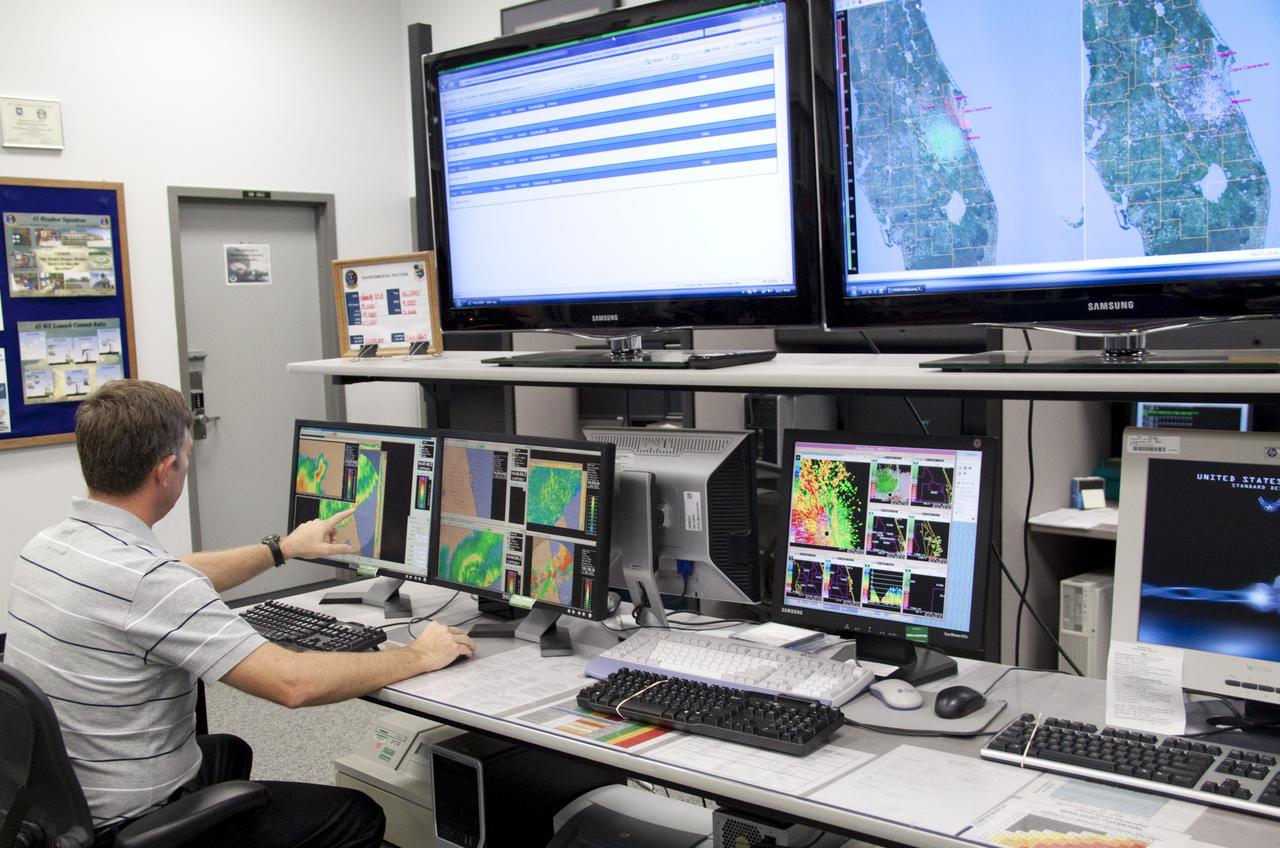
CAPE CANAVERAL, Fla. - At the Cape Canaveral Air Force Station forecast facility in Florida, a member of the weather team demonstrates the effectiveness of the new weather radar display recently installed. The facility is operated by the U.S. Air Force 45th Weather Squadron and will generate a launch weather forecast for the scheduled July 8 lift off of space shuttle Atlantis on the STS-135 mission. Photo credit: NASA/Jack Pfaller
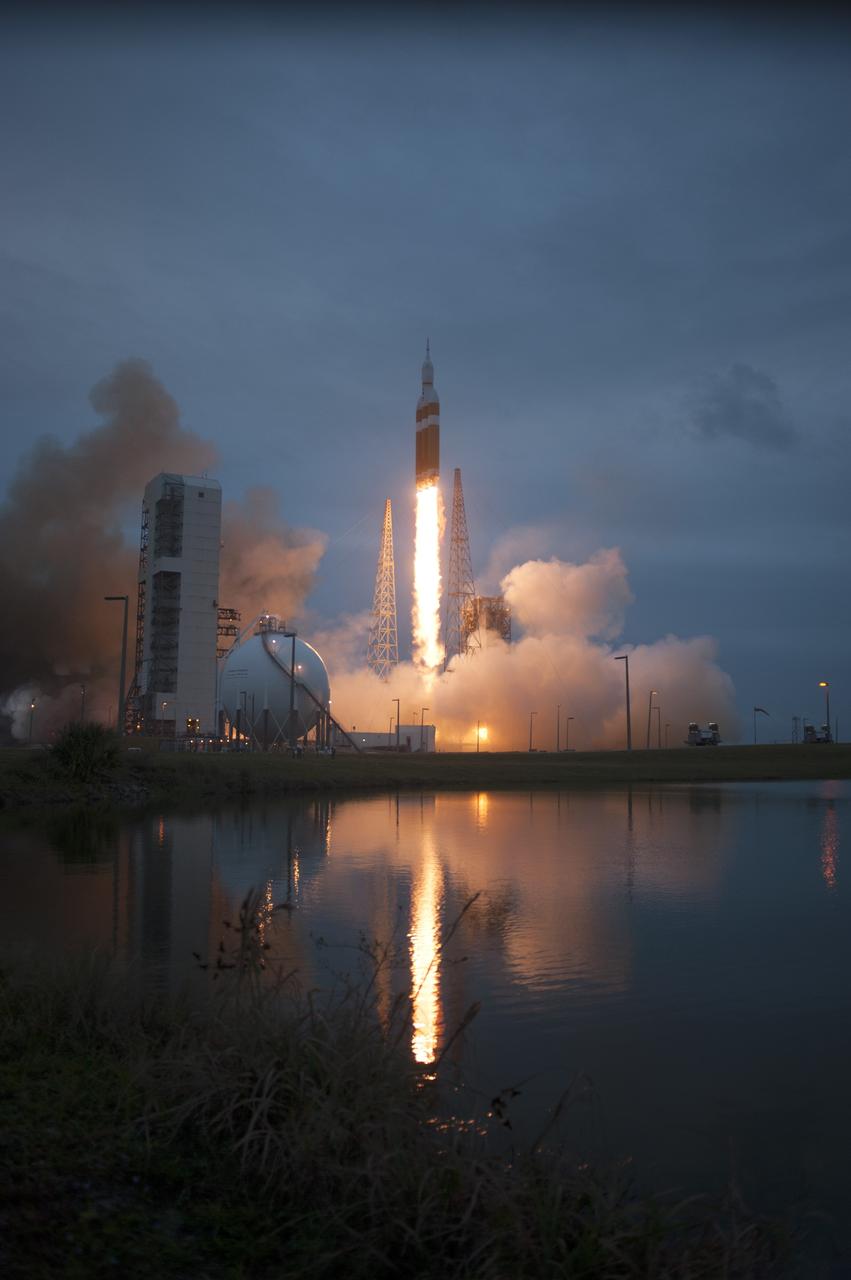
CAPE CANAVERAL, Fla. -- A Delta IV Heavy rocket lifts off from Space Launch Complex 37 at Cape Canaveral Air Force Station in Florida carrying NASA's Orion spacecraft on an unpiloted flight test to Earth orbit. Liftoff was at 7:05 a.m. EST. During the two-orbit, four-and-a-half hour mission, engineers will evaluate the systems critical to crew safety, the launch abort system, the heat shield and the parachute system. For more information, visit www.nasa.gov/orion Photo credit: NASA/ Sandy Joseph/Kevin O’Connell
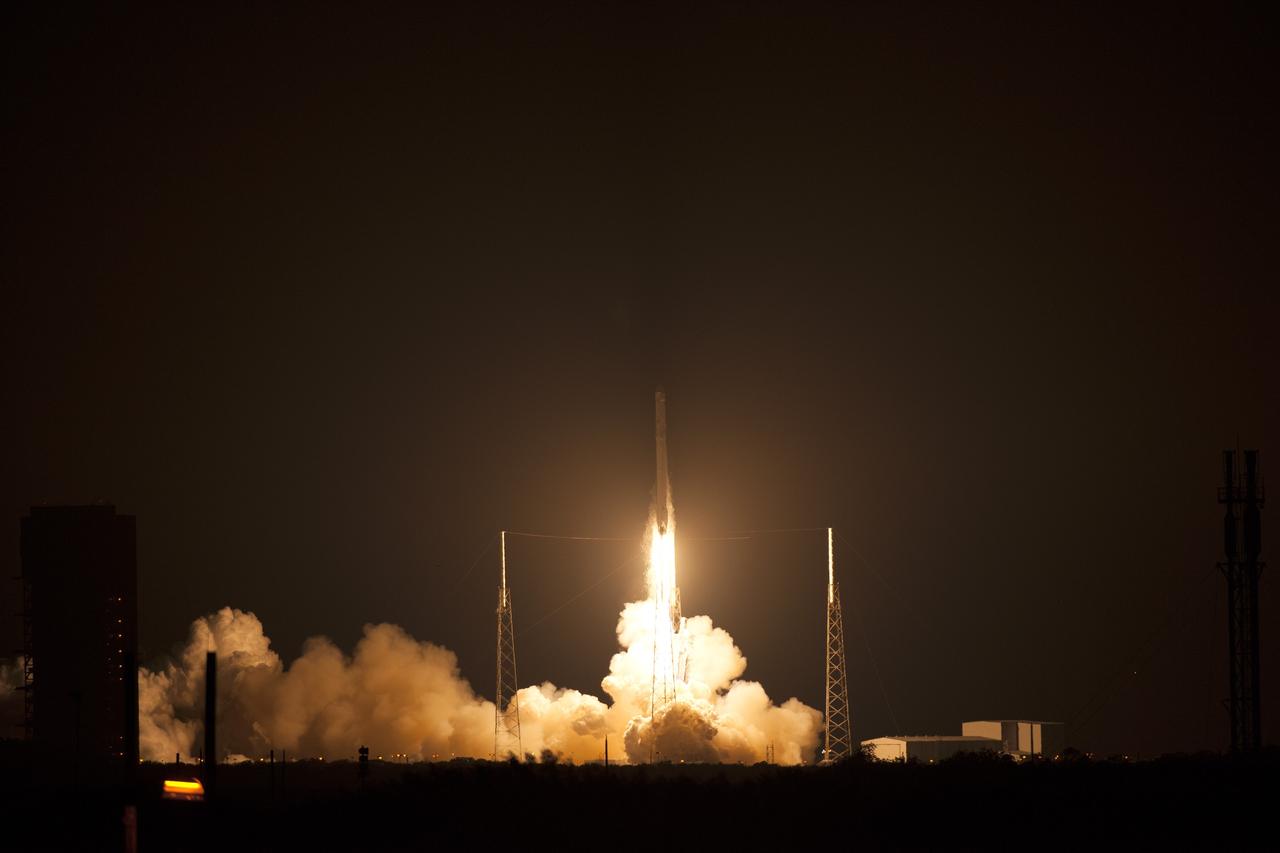
CAPE CANAVERAL, Fla. – SpaceX rocket lifts off from Space Launch Complex 40 at Cape Canaveral Air Force Station carrying the Dragon resupply spacecraft to the International Space Station. Liftoff was at 4:47 a.m. EST. The commercial resupply mission will deliver 3,700 pounds of scientific experiments, technology demonstrations and supplies, including critical materials to support 256 science and research investigations that will take place on the space station. Photo credit: NASA/George Roberts
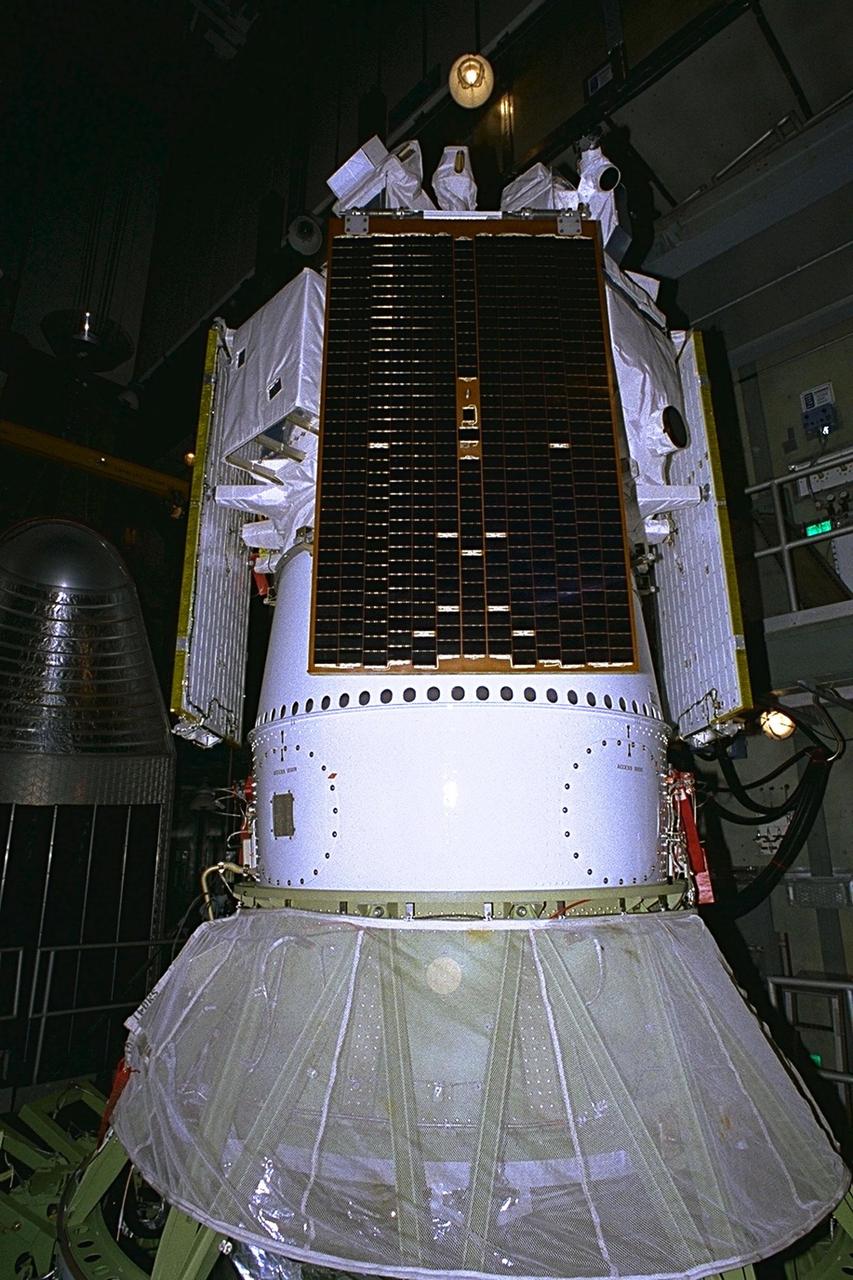
Final prelaunch preparations are made at Launch Complex 17A, Cape Canaveral Air Station, for liftoff of the Boeing Delta II expendable launch vehicle with the Advanced Composition Explorer (ACE) spacecraft, at top. The black rectangular-shaped panel in front is one of ACE’s solar arrays. ACE will investigate the origin and evolution of solar phenomenon, the formation of solar corona, solar flares and acceleration of the solar wind. This will be the second Delta launch under the Boeing name and the first from Cape Canaveral. Liftoff is scheduled Aug. 24
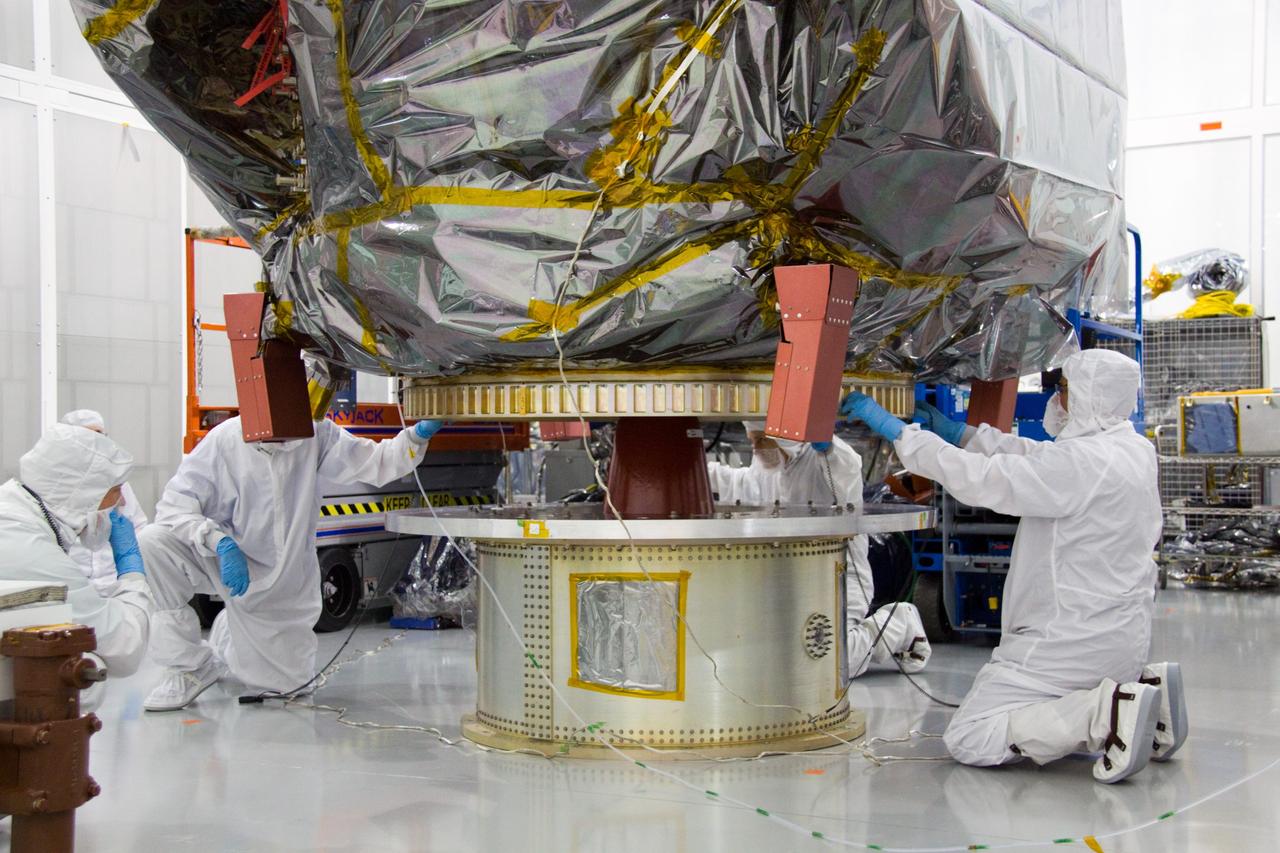
CAPE CANAVERAL, Fla. – At the Astrotech Space Operations facility in Titusville, Fla., technicians from NASA's Goddard Space Flight Center prepare to lift the bagged Solar Dynamics Observatory, or SDO, onto a dolly for further processing. SDO is the first space weather research network mission in NASA's Living With a Star Program. The spacecraft's long-term measurements will give solar scientists in-depth information about changes in the sun's magnetic field and insight into how they affect Earth. Liftoff on an Atlas V rocket is scheduled for Feb. 3, 2010. For information on SDO, visit http://www.nasa.gov/sdo. Photo credit: NASA/Troy Cryder
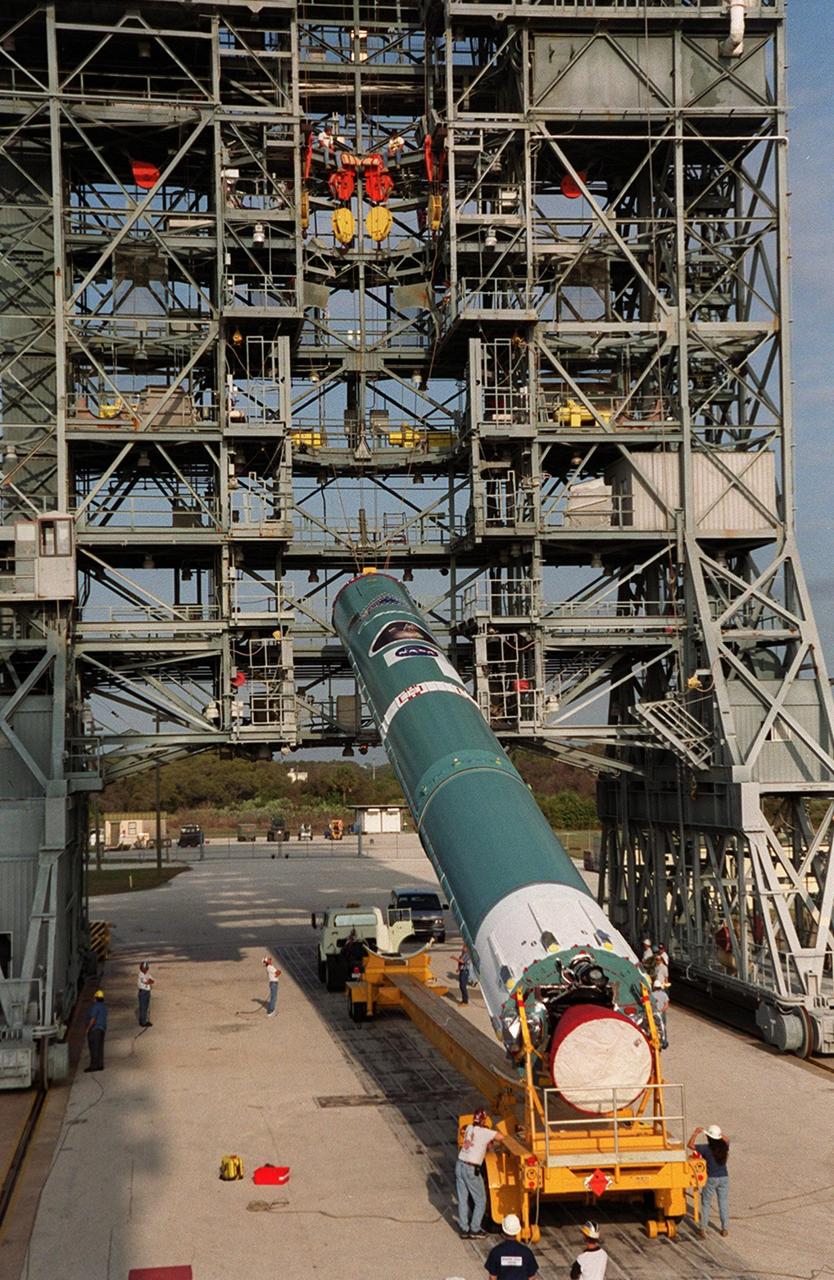
Cranes on the gantry on Launch Pad 17-A, Cape Canaveral Air Force Station, lift the first stage of a Boeing Delta rocket to a vertical position. The rocket will carry the 2001 Mars Odyssey Orbiter, scheduled for launch April 7, 2001. Mars Odyssey contains three science instruments: THEMIS, the Gamma Ray Spectrometer (GRS), and the Mars Radiation Environment Experiment (MARIE). THEMIS will map the mineralogy and morphology of the Martian surface using a high-resolution camera and a thermal infrared imaging spectrometer. The GRS will achieve global mapping of the elemental composition of the surface and determine the abundance of hydrogen in the shallow subsurface. The MARIE will characterize aspects of the near-space radiation environment with regards to the radiation-related risk to human explorers
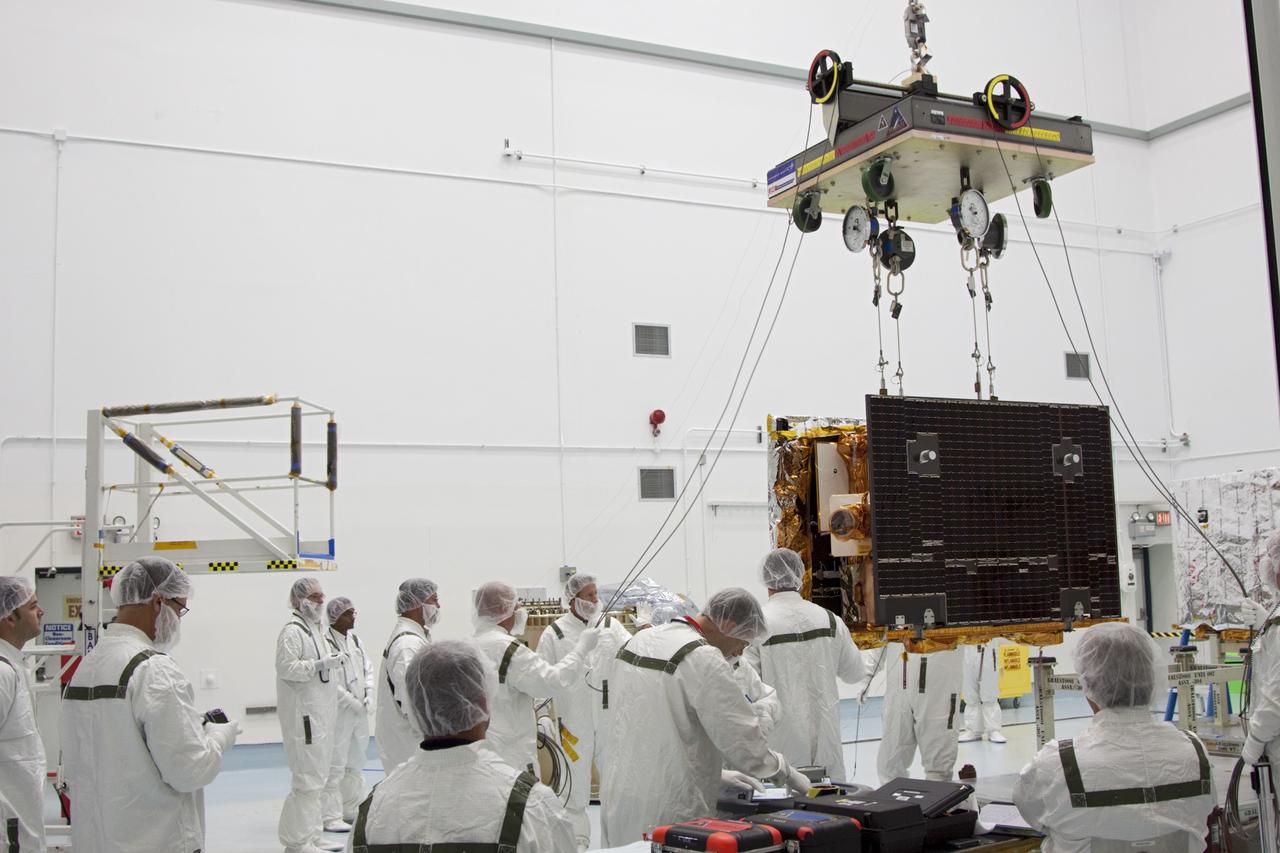
CAPE CANAVERAL, Fla. -- At Astrotech Space Operation's payload processing facility in Titusville, Fla., Lockheed Martin technicians lift NASA's Gravity Recovery and Interior Laboratory-B (GRAIL-B) lunar probe from its workstand. After the twin GRAIL spacecraft are attached to their spacecraft adapter ring in their side-by-side launch configuration, they will be transported to the launch pad. GRAIL will fly in tandem orbits around the moon for several months to measure its gravity field. GRAIL's primary science objectives are to determine the structure of the lunar interior, from crust to core, and to advance understanding of the thermal evolution of the moon. Launch aboard a United Launch Alliance Delta II rocket from Space Launch Complex 17B on Cape Canaveral Air Force Station is scheduled for Sept. 8. For more information, visit http://www.nasa.gov/grail. Photo credit: NASA/Jim Grossmann
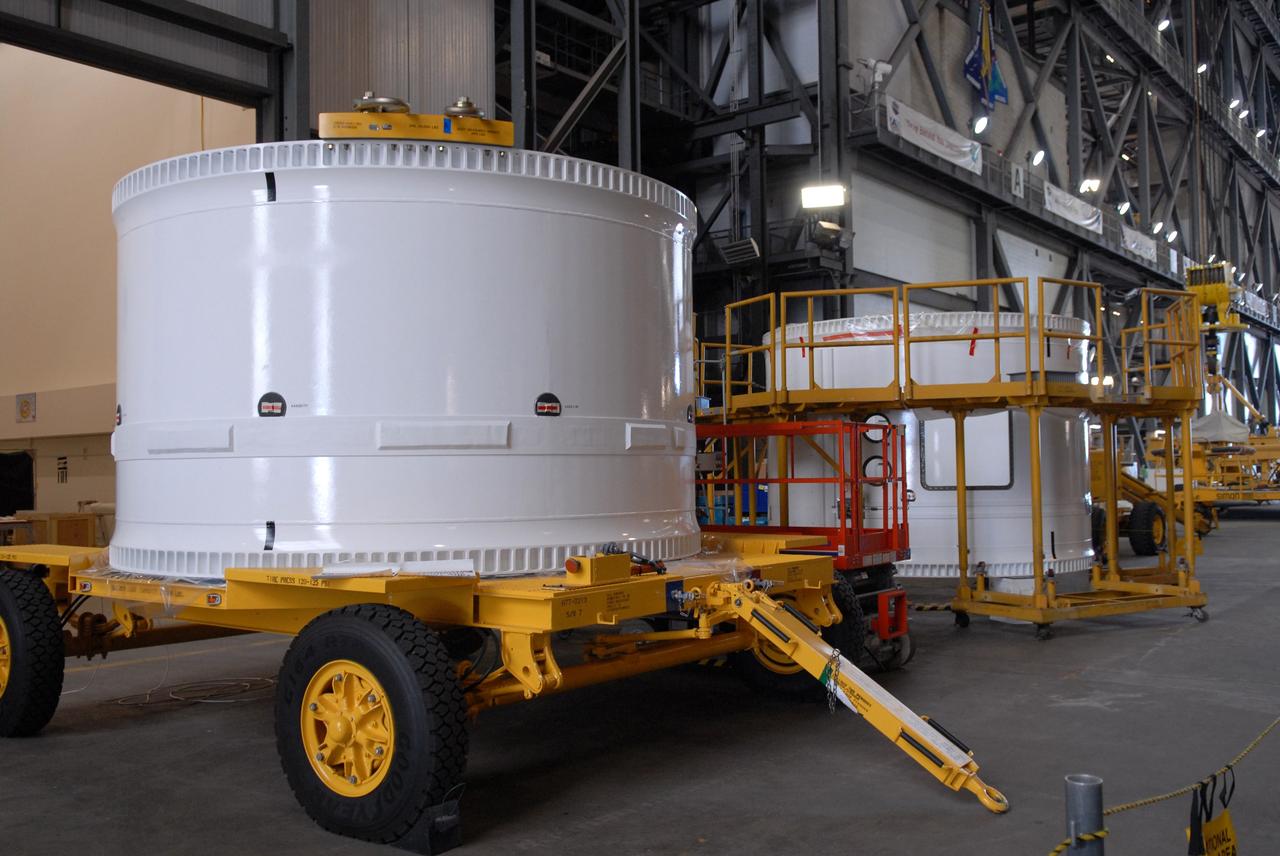
CAPE CANAVERAL, Fla. – In the Vehicle Assembly Building, the forward fifth segment simulator for the Ares I-X rocket is ready to be lifted for stacking with the center segment beside it. Ares I-X is the test vehicle for the Ares I, which is part of the Constellation Program to return men to the moon and beyond. Ares I is the essential core of a safe, reliable, cost-effective space transportation system that eventually will carry crewed missions back to the moon, on to Mars and out into the solar system. Ares I-X is targeted for launch in July 2009. Photo credit: NASA/Dimitri Gerondidakis
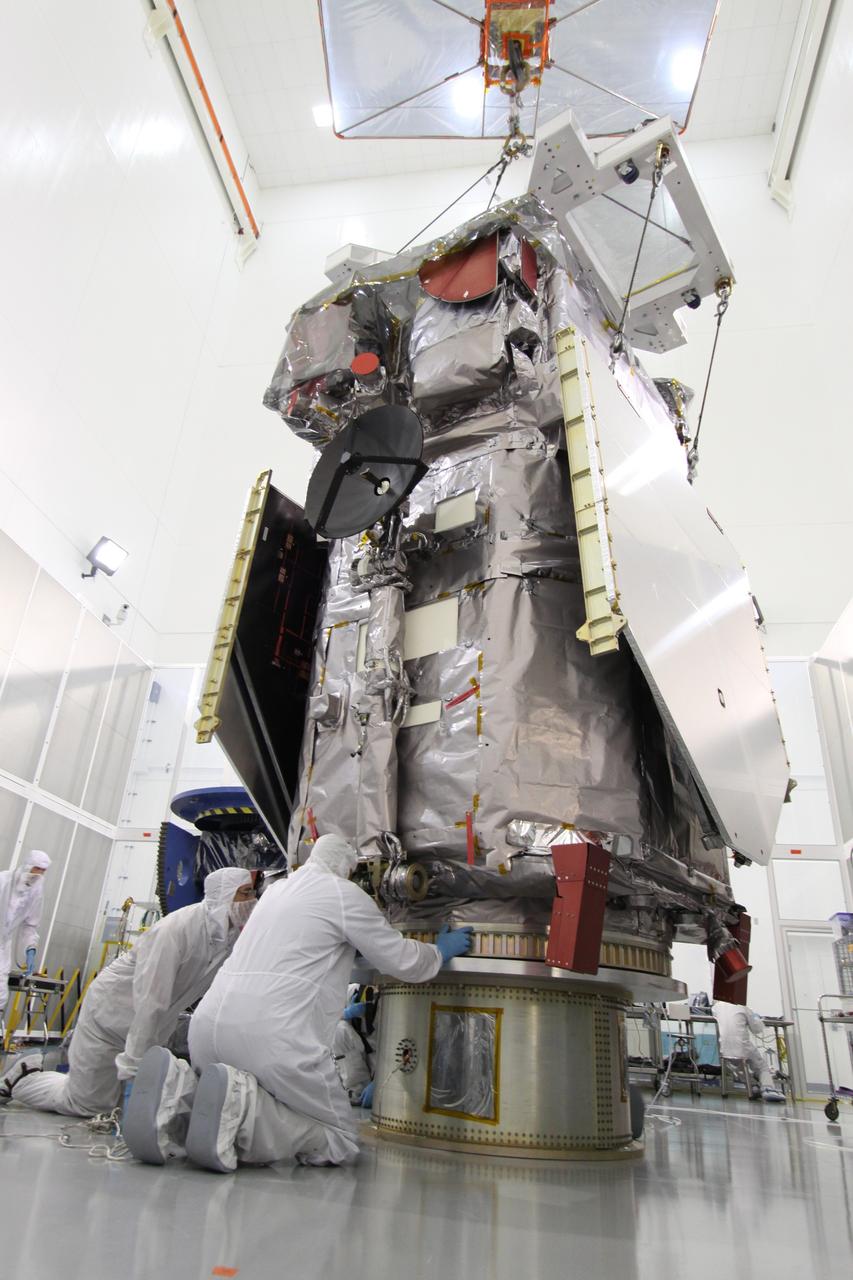
CAPE CANAVERAL, Fla. – At the Astrotech Payload Processing Facility in Titusville, Fla., technicians check the Solar Dynamics Observatory after it was lifted from its work stand. The spacecraft is being moved onto a Ransome table that will allow it to be rotated in various directions for access to different areas of the spacecraft. SDO is the first space weather research network mission in NASA's Living With a Star Program. The spacecraft's long-term measurements will give solar scientists in-depth information about changes in the sun's magnetic field and insight into how they affect Earth. In preparation for its anticipated November launch, engineers will perform a battery of comprehensive tests to ensure SDO can withstand the stresses and vibrations of the launch itself, as well as what it will encounter in the space environment after launch. Photo credit: NASA/Jack Pfaller
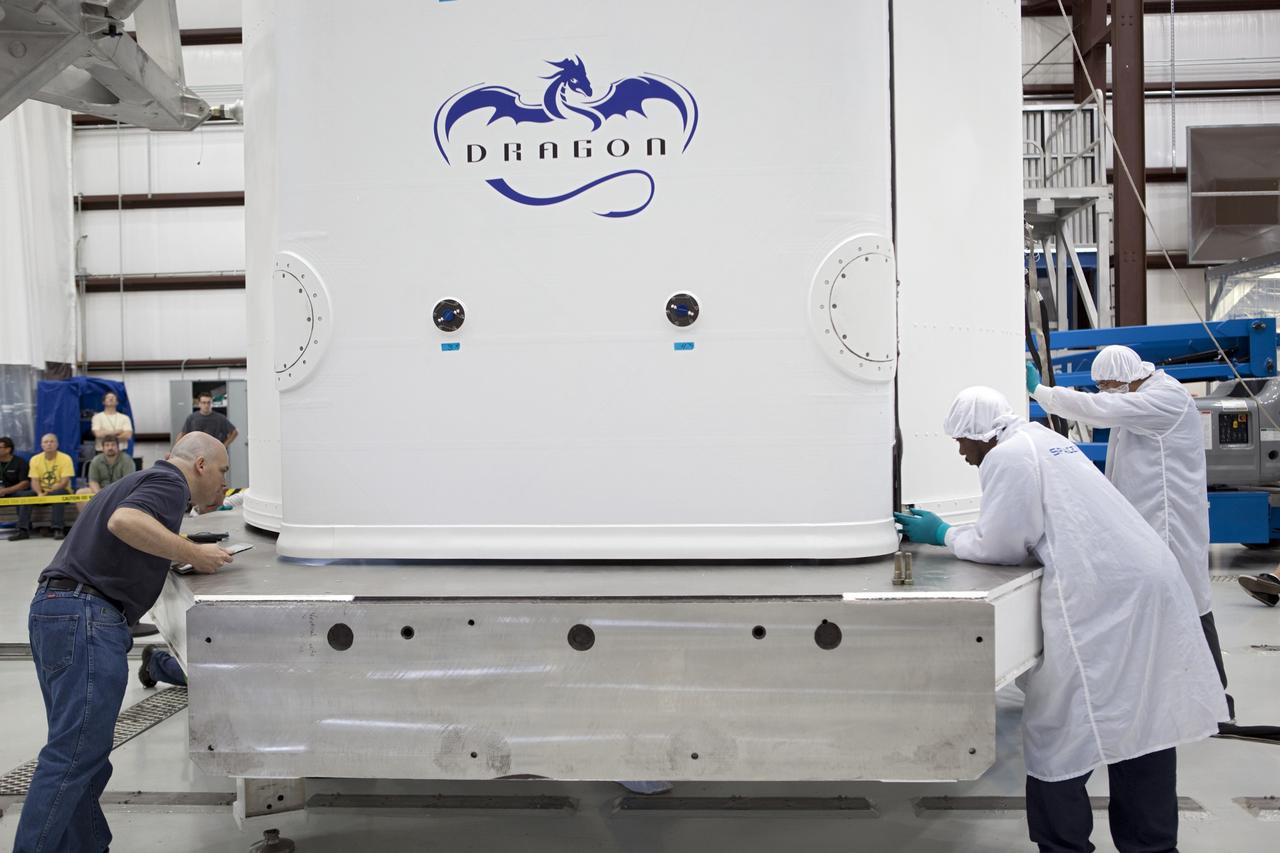
CAPE CANAVERAL, Fla. - Space Exploration Technologies, or SpaceX, technicians inspect a Dragon spacecraft being prepared for the company's first Commercial Resupply Services, or CRS-1, mission to the International Space Station. The capsule is scheduled to lift off from on Oct. 7, 2012 Space Launch Complex 40 at Cape Canaveral Air Force Station in Florida aboard a Falcon 9 rocket. The mission will be the company's second demonstration test flight for NASA's Commercial Orbital Transportation Services Program, or COTS. The SpaceX CRS contract with NASA provides for 12 cargo resupply missions to the station through 2015, the first of which is targeted to launch in October 2012.SpaceX became the first private company to berth a spacecraft with the space station in 2012 during its final demonstration flight under the Commercial Orbital Transportation Services, or COTS, program managed by NASA's Johnson Space Center in Houston. For more information, visit http://www.nasa.gov/mission_pages/station/living/launch/index.htmlPhoto credit: NASA/Ben Smegelsky
![CAPE CANAVERAL, Fla. – In the Astrotech payload processing facility in Titusville, Fla. , the STSS Demonstrator SV-1 spacecraft is lowered onto a stand. The spacecraft is a midcourse tracking technology demonstrator, part of an evolving ballistic missile defense system. STSS is capable of tracking objects after boost phase and provides trajectory information to other sensors. It will be launched by NASA for the Missile Defense Agency in late summer. Photo credit: NASA/Tim Jacobs (Approved for Public Release 09-MDA-4800 [30 July 09] )](https://images-assets.nasa.gov/image/KSC-2009-4623/KSC-2009-4623~medium.jpg)
CAPE CANAVERAL, Fla. – In the Astrotech payload processing facility in Titusville, Fla. , the STSS Demonstrator SV-1 spacecraft is lowered onto a stand. The spacecraft is a midcourse tracking technology demonstrator, part of an evolving ballistic missile defense system. STSS is capable of tracking objects after boost phase and provides trajectory information to other sensors. It will be launched by NASA for the Missile Defense Agency in late summer. Photo credit: NASA/Tim Jacobs (Approved for Public Release 09-MDA-4800 [30 July 09] )
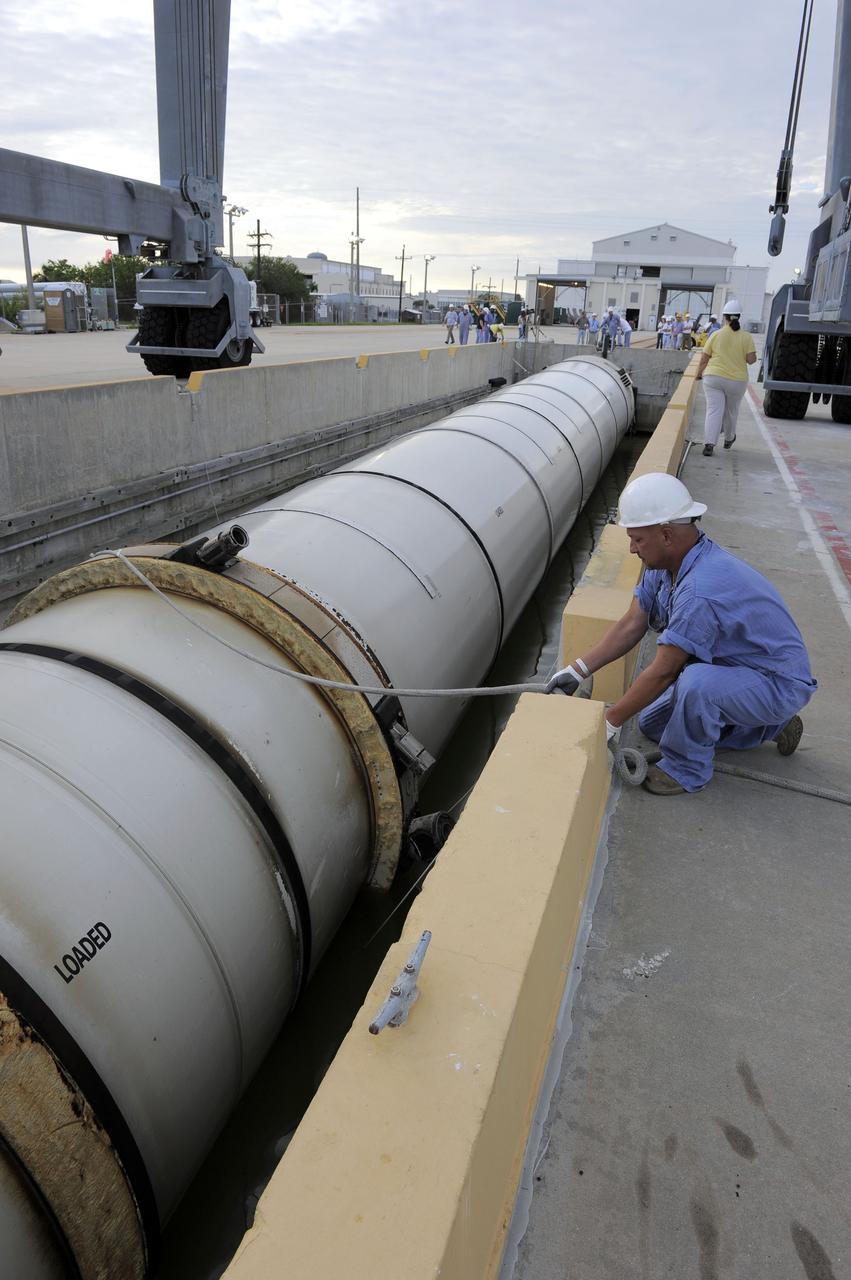
CAPE CANAVERAL, Fla. – A worker secures one of two solid rocket boosters to a mooring at Port Canaveral in Florida. Liberty Star, one of NASA’s two booster retrieval ships, towed the spent booster from space shuttle Atlantis’ final launch to the port. The shuttle’s two solid rocket booster casings and associated flight hardware are recovered in the Atlantic Ocean after every launch by Freedom Star and Liberty Star. The boosters impact the Atlantic about seven minutes after liftoff, and the retrieval ships are stationed about 10 miles from the impact area at the time of splashdown. After the spent segments are processed, they will be transported to Utah, where they will be deserviced and stored, if needed. Atlantis began its final flight, STS-135, at 11:29 a.m. EDT on July 8 to deliver the Raffaello multi-purpose logistics module packed with supplies and spare parts to the International Space Station. Photo credit: NASA/Kim Shiflett
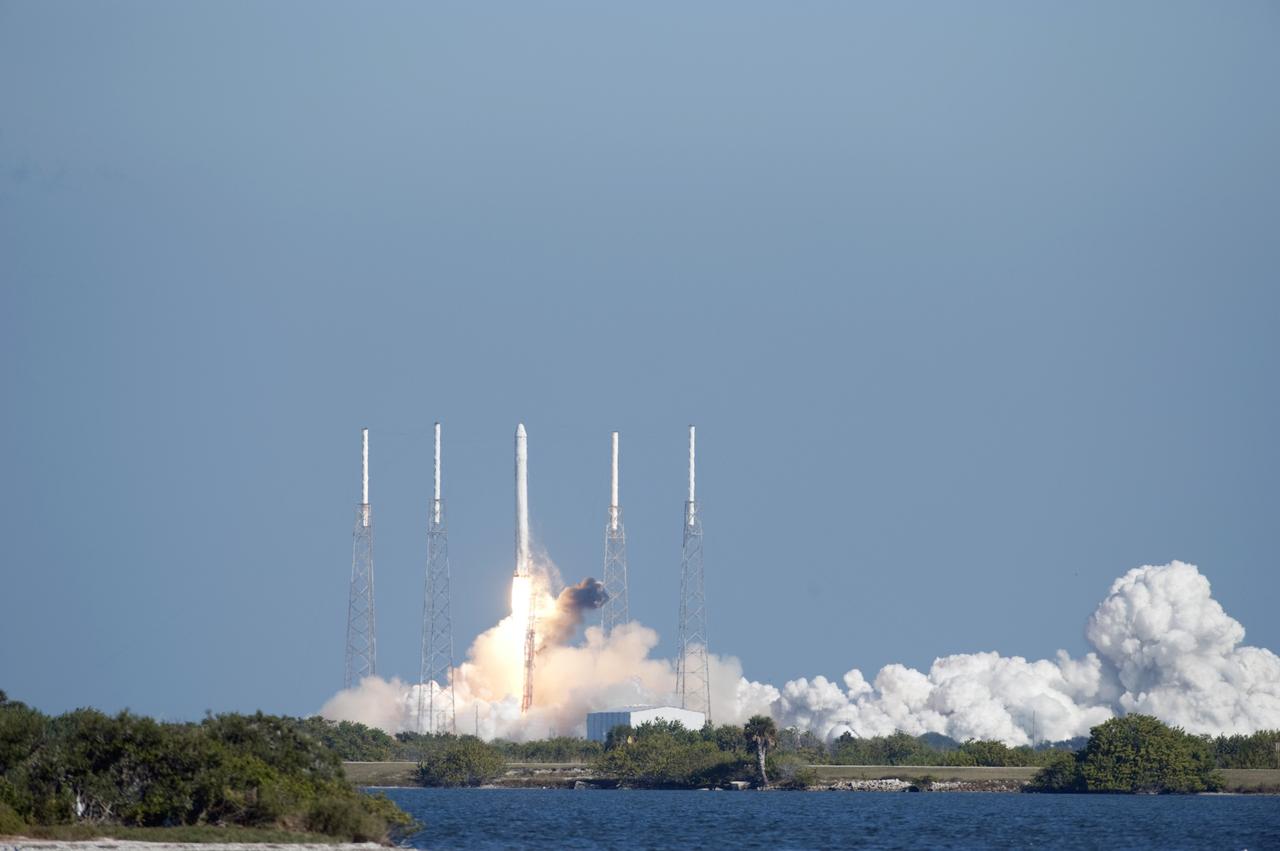
CAPE CANAVERAL, Fla. -- SpaceX’s Falcon 9 rocket and Dragon spacecraft lift off from Launch Complex-40 at Cape Canaveral Air Force Station, Fla., at 10:43 a.m. EST. In orbit, the Dragon capsule will go through several maneuvers before it re-enters the atmosphere and splashes down in the Pacific Ocean about 500 miles west of the coast of Mexico. This is first demonstration flight for NASA's Commercial Orbital Transportation Services (COTS) program, which will provide cargo flights to the International Space Station in the future. Photo credit: NASA/Kevin O'Connell

Dornier Satelliten Systeme (DSS) workers lift the heat shield of the Huygens probe in the Payload Hazardous Servicing Facility (PHSF) at KSC. The spacecraft was returned to the PHSF after damage to thermal insulation was discovered inside Huygens from an abnormally high flow of conditioned air. Internal inspection, insulation repair and a cleaning of the probe were required. Mission managers are targeting a mid-October launch date after the Cassini spacecraft, aboard which Huygens will be launched, returns to the pad and is once again placed atop its Titan IVB expendable launch vehicle at Launch Pad 40 at Cape Canaveral Air Station
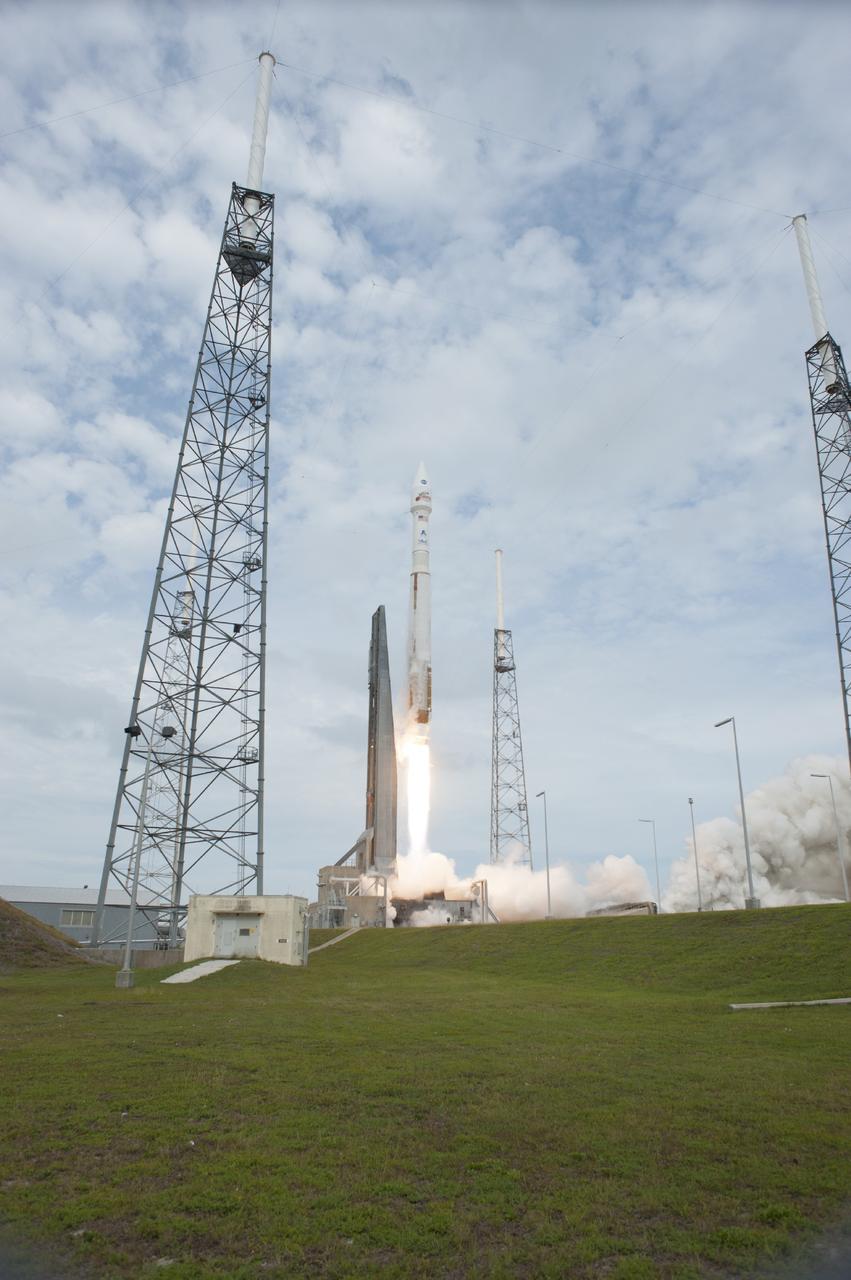
CAPE CANAVERAL, Fla. -- The United Launch Alliance Atlas V rocket carrying NASA's Mars Atmosphere and Volatile EvolutioN, or MAVEN, spacecraft rises off Space Launch Complex 41 on Cape Canaveral Air Force Station in Florida. Launch was on schedule at 1:28 p.m. EST Nov. 18 at the opening of a two-hour launch window. After a 10-month journey to the Red Planet, MAVEN will study its upper atmosphere in unprecedented detail from orbit above the planet. Built by Lockheed Martin in Littleton, Colo., MAVEN will arrive at Mars in September 2014 and will be inserted into an elliptical orbit with a high point of 3,900 miles, swooping down to as close as 93 miles above the planet's surface. For more information, visit: http://www.nasa.gov/mission_pages/maven/main/index.html. Photo credit: NASA/Tony Gray and Rick Wetherington
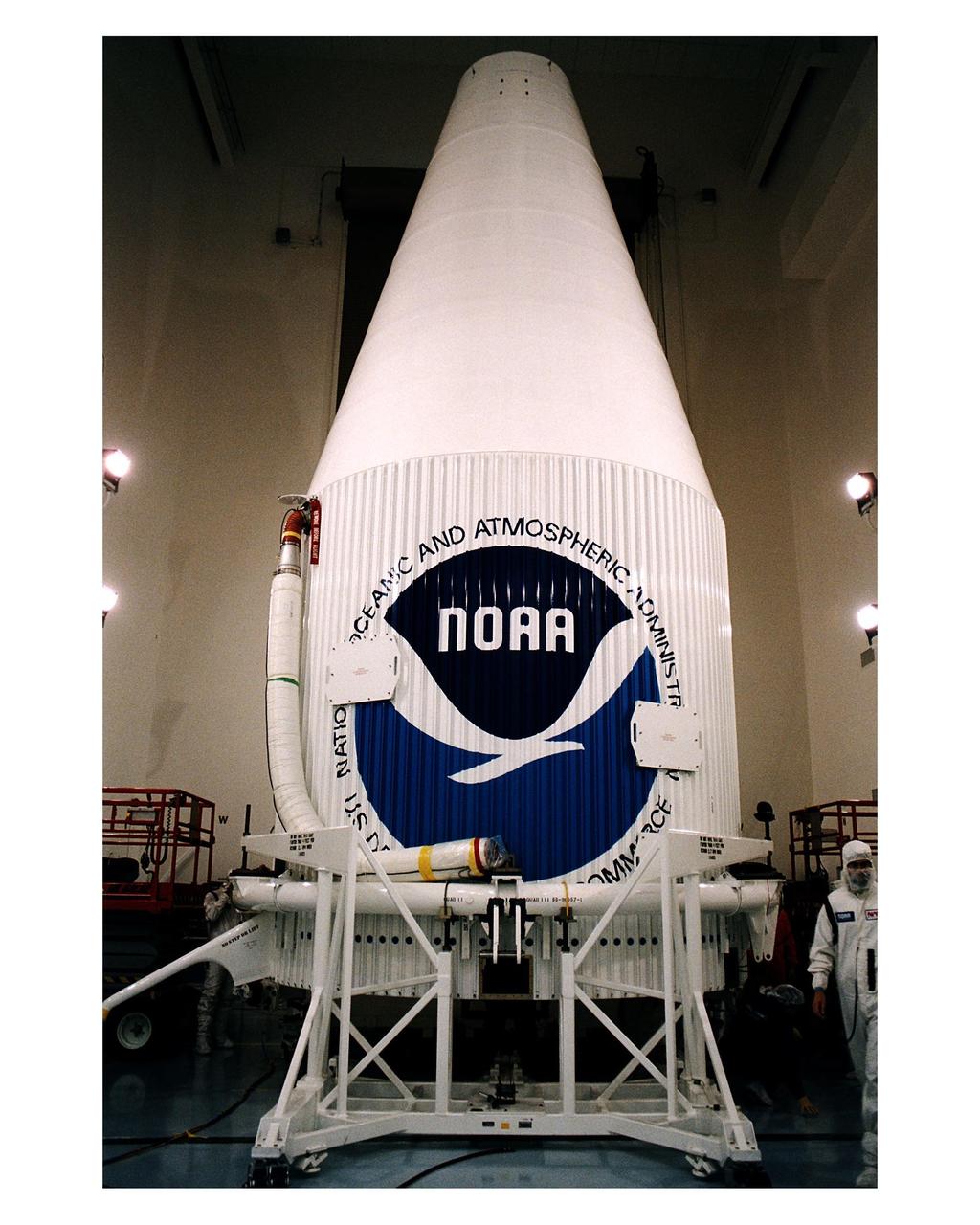
The Atlas 1 payload fairing with the encapsulated GOES-K advanced weather satellite awaits transport to the launch pad. GOES-K was prepared for launch at the Astrotech Space Operations LP facility in Titusville. GOES-K will be the third spacecraft to be launched in the advanced series of Geostationary Operational Environmental Satellites (GOES). The GOES satellites are owned and operated by the National Oceanic and Atmospheric Administration (NOAA); NASA manages the design, development and launch of the spacecraft. GOES-K is targeted for an <a href="http://www-pao.ksc.nasa.gov/kscpao/release/1997/63-97.htm">April 24 launch</a> aboard a Lockheed Martin Atlas 1 expendable launch vehicle (AC-79) from Launch Complex 36, Pad B, Cape Canaveral Air Station. The launch window opens at 1:50 a.m. and extends to 3:09 a.m. EDT. Once in orbit, GOES-K will become GOES-10, joining GOES-8 and GOES-9 in space
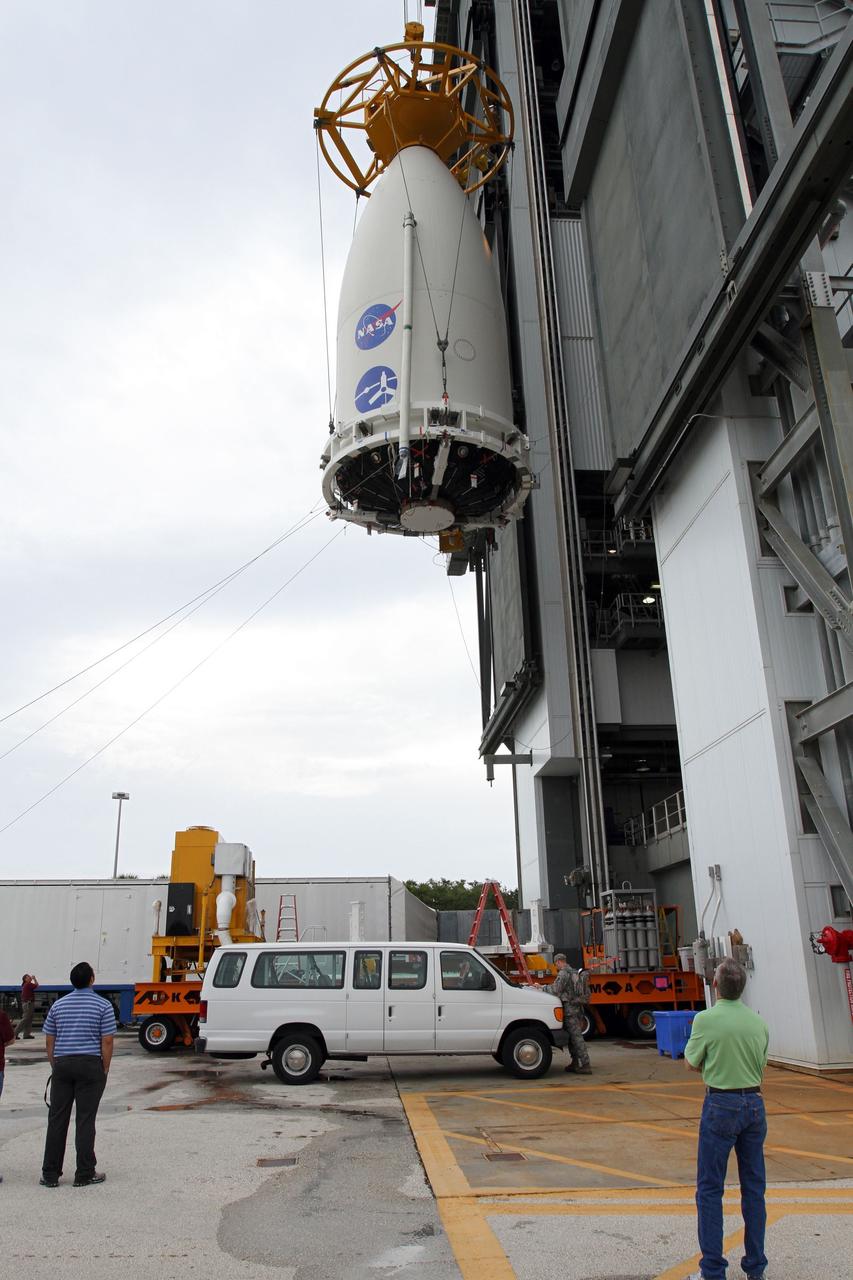
CAPE CANAVERAL, Fla. -- At Space Launch Complex 41, the Juno spacecraft, enclosed in an Atlas payload fairing, appears to hover over its transporter as it is lifted up the side of the Vertical Integration Facility to the top of the Atlas rocket already stacked inside. The spacecraft was prepared for launch in the Astrotech Space Operations' payload processing facility in Titusville, Fla. The fairing will protect the spacecraft from the impact of aerodynamic pressure and heating during ascent and will be jettisoned once the spacecraft is outside the Earth's atmosphere. Juno is scheduled to launch Aug. 5 aboard a United Launch Alliance Atlas V rocket from Cape Canaveral Air Force Station in Florida. The solar-powered spacecraft will orbit Jupiter's poles 33 times to find out more about the gas giant's origins, structure, atmosphere and magnetosphere and investigate the existence of a solid planetary core. For more information, visit www.nasa.gov/juno. Photo credit: NASA/Cory Huston
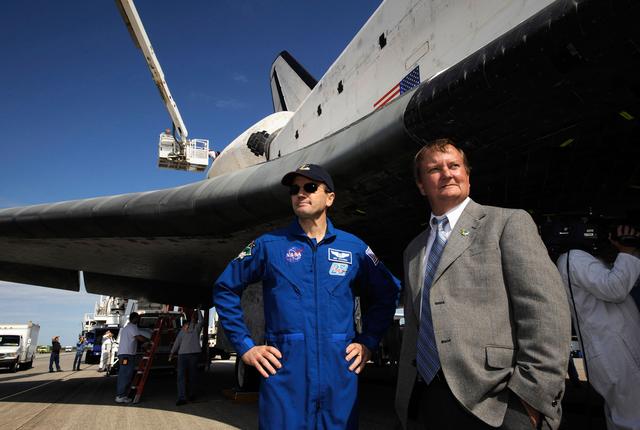
STS-122 Mission Specialist, Rex Walheim, left, and Shuttle Launch Director, Michael D. Leinbach take a moment to watch the close out crew work on the space shuttle Atlantis. Atlantis landed at the Shuttle Landing Facility, 9:07a.m., Wednesday, Feb. 20, 2008 at Kennedy Space Center, Fla. completing delivery of the European Space Agency’s (ESA) Columbus laboratory to the International Space Station. Photo Credit: (NASA/Bill Ingalls)
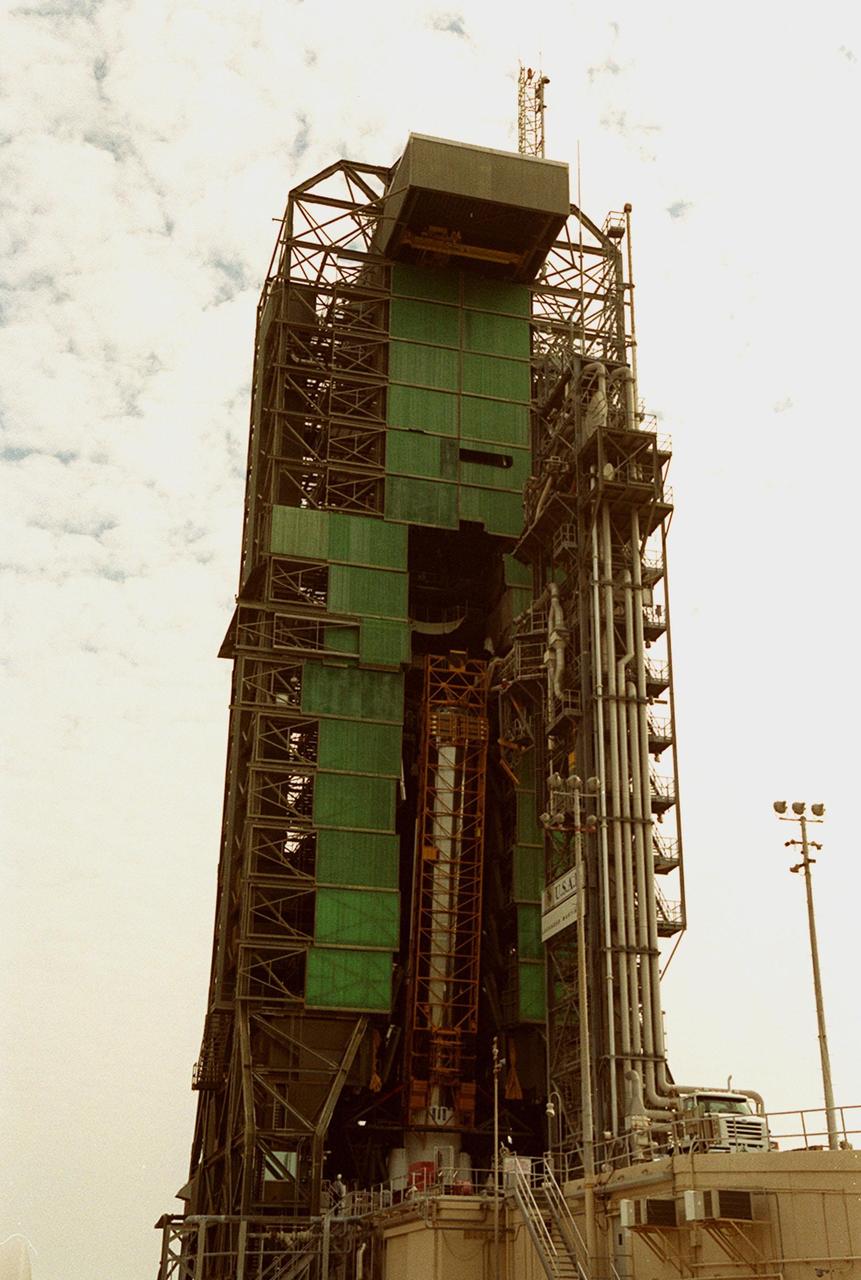
The Atlas IIA rocket is close to its vertical position in the launch tower at Launch Pad 36A, Cape Canaveral Air Force Station (CCAFS). It will be mated with a Centaur upper stage to launch the latest Tracking and Data Relay Satellite (TDRS) June 29 from CCAFS. The Atlas/Centaur launch vehicle is manufactured and operated by Lockheed Martin. Atlas IIA is capable of lifting payload systems weights in the 2,850 kg (6,300 lb) to 3,070 kg (6,760 lb) class to geosynchronous transfer orbit. It is 25 m (82 ft) long and 3.05 m (10 ft) in diameter. The Centaur is 10.0 m (33-ft) long and 3.05 m (10 ft) in diameter
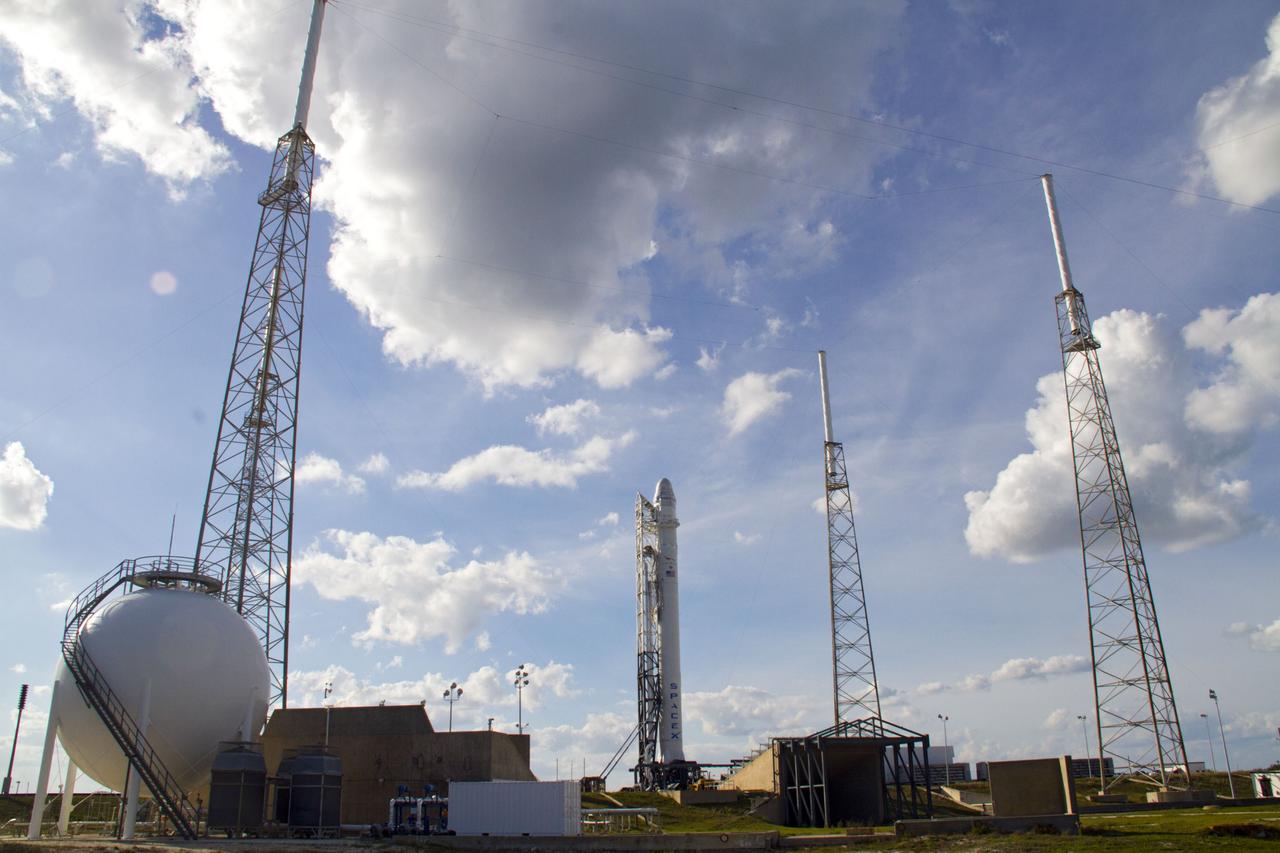
CAPE CANAVERAL, Fla. – The lightning protection system on Space Launch Complex-40 on Cape Canaveral Air Force Station in Florida is in place to protect a Falcon 9 rocket if a storm should develop following a wet dress rehearsal on March 1, which included loading the rocket with its propellants and a simulated countdown. Atop the rocket is a Dragon capsule. The new rocket and capsule were designed and manufactured by Space Exploration Technologies Corp., or SpaceX, for the company’s upcoming demonstration test flight for NASA’s Commercial Orbital Transportation Services, or COTS, program. Under COTS, NASA has partnered with two private companies to develop the capability to deliver cargo to the International Space Station. During the flight, SpaceX's Dragon capsule will conduct a series of checkout procedures that will test and prove its systems. These tests include rendezvous and berthing with the space station and are intended to lead to regular resupply missions to the station. Liftoff is targeted for April 30 at 12:22 p.m. EDT pending official approval at the Flight Readiness Review on April 16. For more information, visit www.nasa.gov/exploration/commercial/cargo/spacex_index.html. Photo credit: NASA/Cory Huston
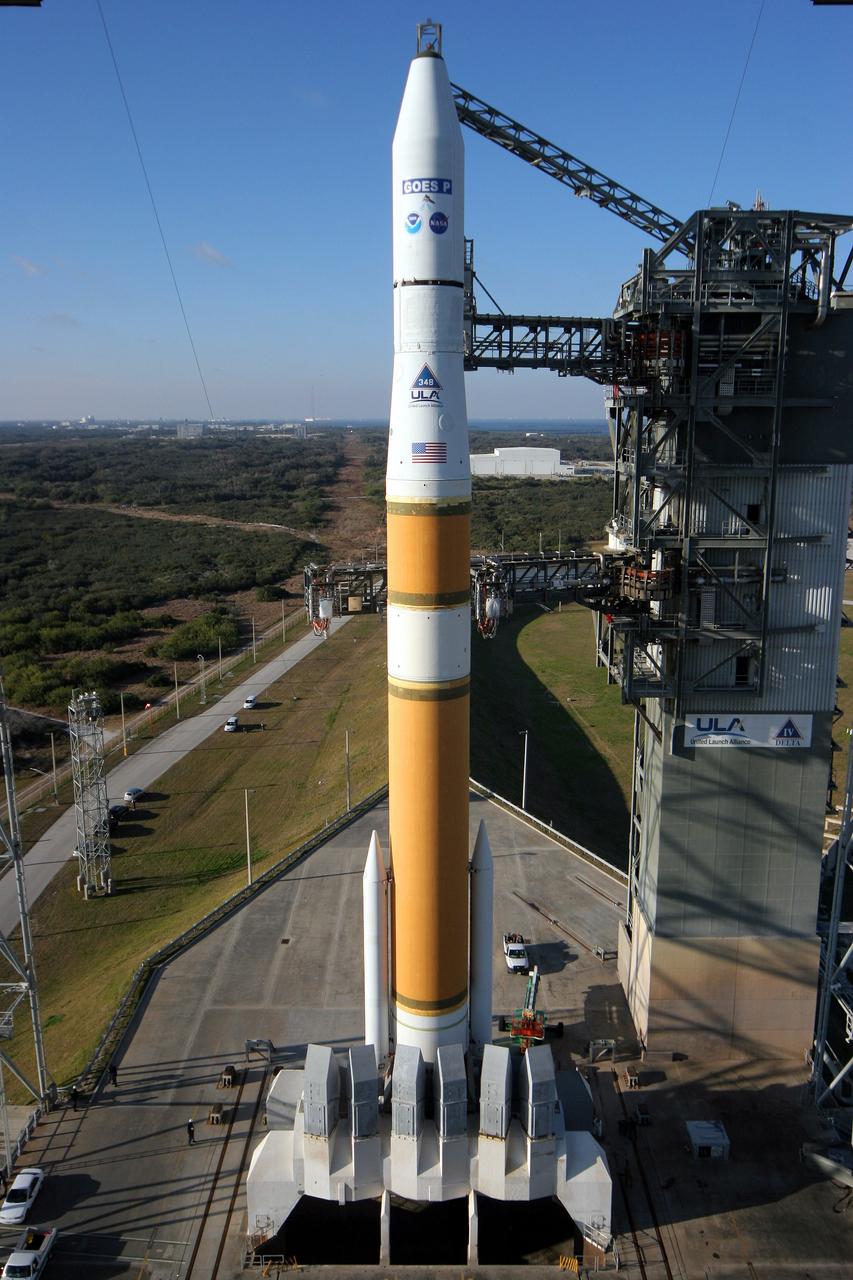
Cape Canaveral AFS, Fla. - A United Launch Alliance Delta IV rocket sits poised on its launch pad with the NASA/NOAA Geostationary Operational Environmental Satellite P (GOES P) at Space Launch Complex-37. GOES P will provide NOAA and NASA scientists with data to support weather, solar and space operations, and will enable future science improvements in weather prediction and remote sensing. Additionally, GOES-P will provide data on global climate changes and capability for search and rescue. Photo credit: Carleton Bailie, The Boeing Company
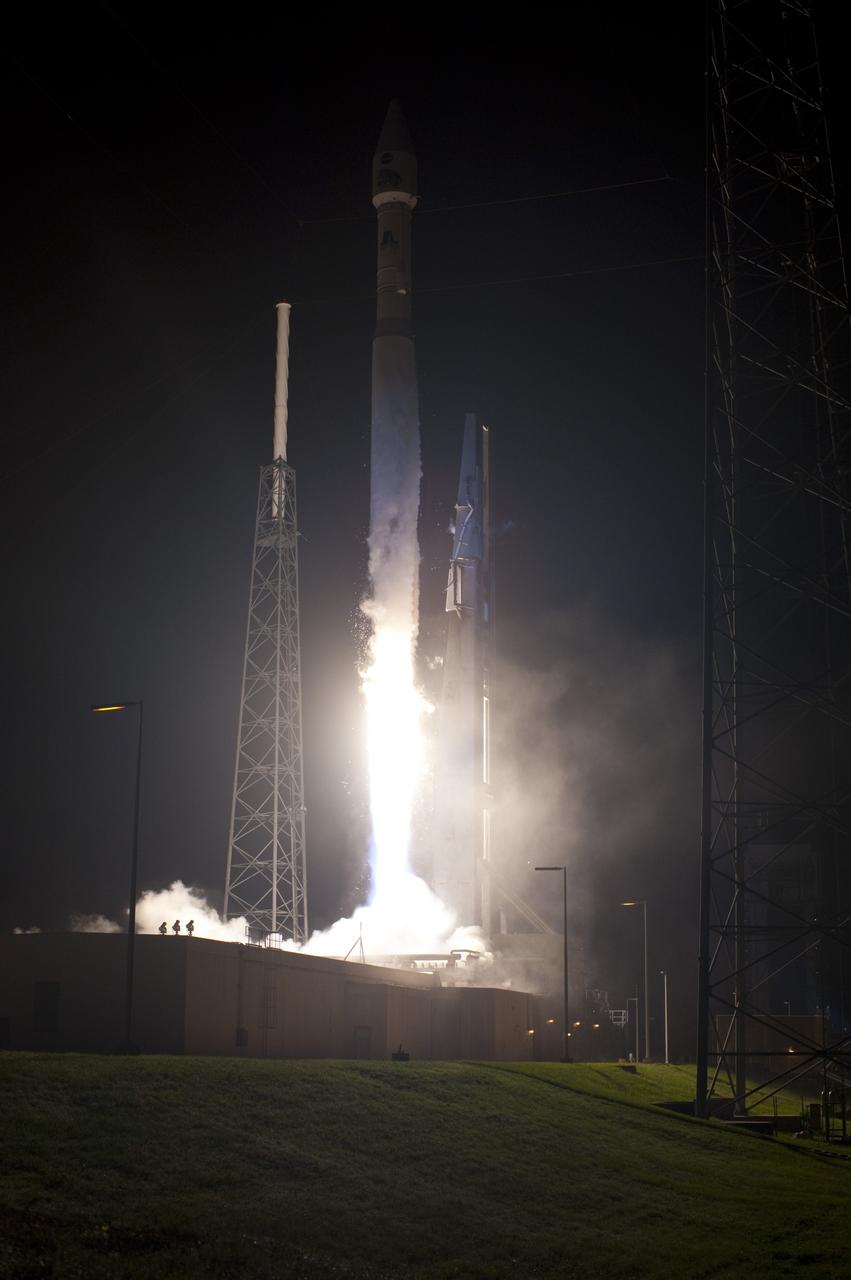
CAPE CANAVERAL, Fla. – The United Launch Alliance Atlas V rocket carrying NASA's Radiation Belt Storm Probes, or RBSP, lifts off Space Launch Complex 41 on Cape Canaveral Air Force Station in Florida at 4:05 a.m. EDT. RBSP will explore changes in Earth's space environment caused by the sun -- known as "space weather" -- that can disable satellites, create power-grid failures and disrupt GPS service. The mission also will provide data on the fundamental radiation and particle acceleration processes throughout the universe. For more information on RBSP, visit http://www.nasa.gov/rbsp. Photo credit: NASA/Tony Gray and Robert Murray
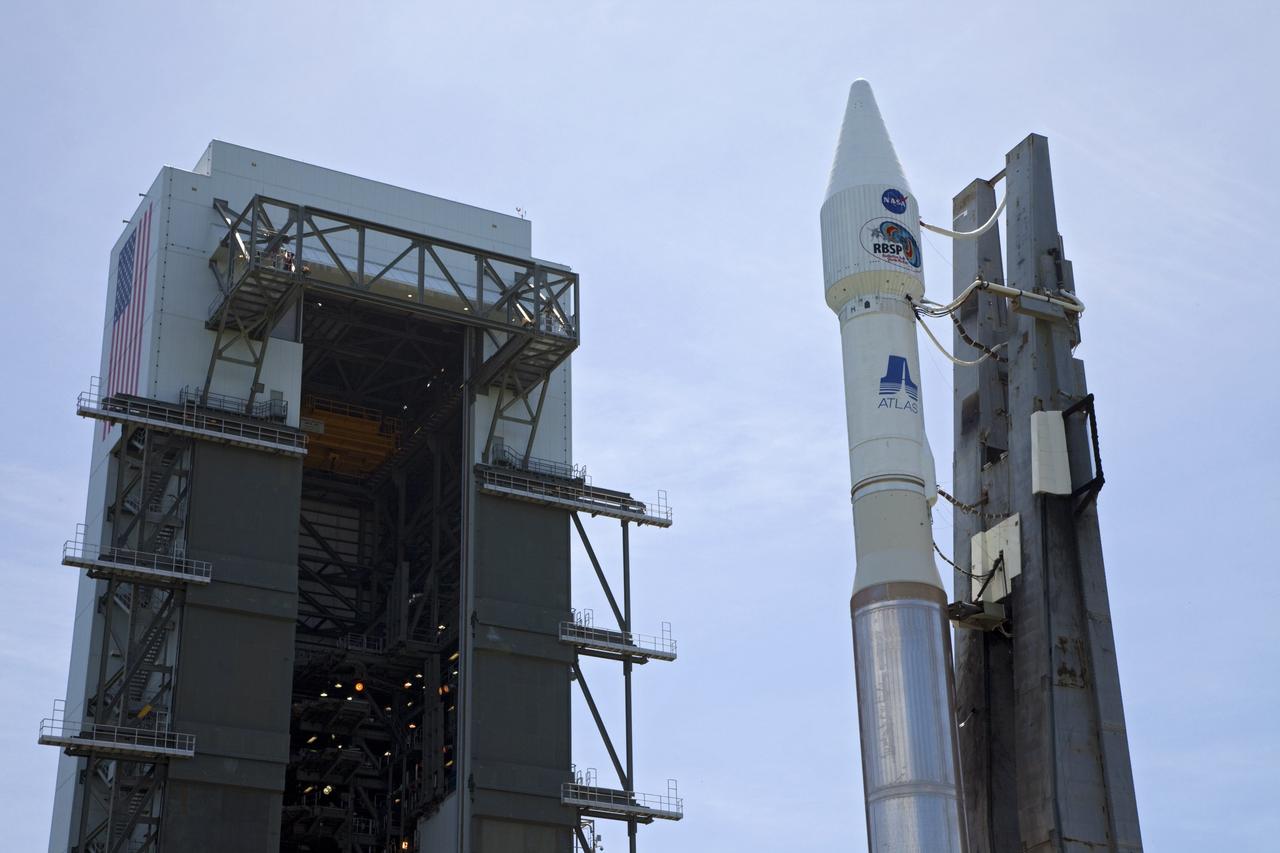
CAPE CANAVERAL, Fla. – At Cape Canaveral Air Force Station in Florida, the United Launch Alliance, or ULA, Atlas V rocket carrying NASA’s twin Radiation Belt Storm Probes, or RBSP, began rolling out of the ULA Vertical Integration Facility at Space Launch Complex 41 at 1:59 p.m. EDT heading to the launch pad. The Atlas V rocket had been rolled back to the facility on August 26 to ensure the launch vehicle and RBSP spacecraft were secured and protected from inclement weather caused by Tropical Storm Isaac. RBSP will explore changes in Earth's space environment caused by the sun -- known as "space weather" -- that can disable satellites, create power-grid failures and disrupt GPS service. The mission also will provide data on the fundamental radiation and particle acceleration processes throughout the universe. The launch is rescheduled for 4:05 a.m. EDT on Aug. 30. For more information on RBSP, visit http://www.nasa.gov/rbsp. Photo credit: NASA/Kim Shiflett
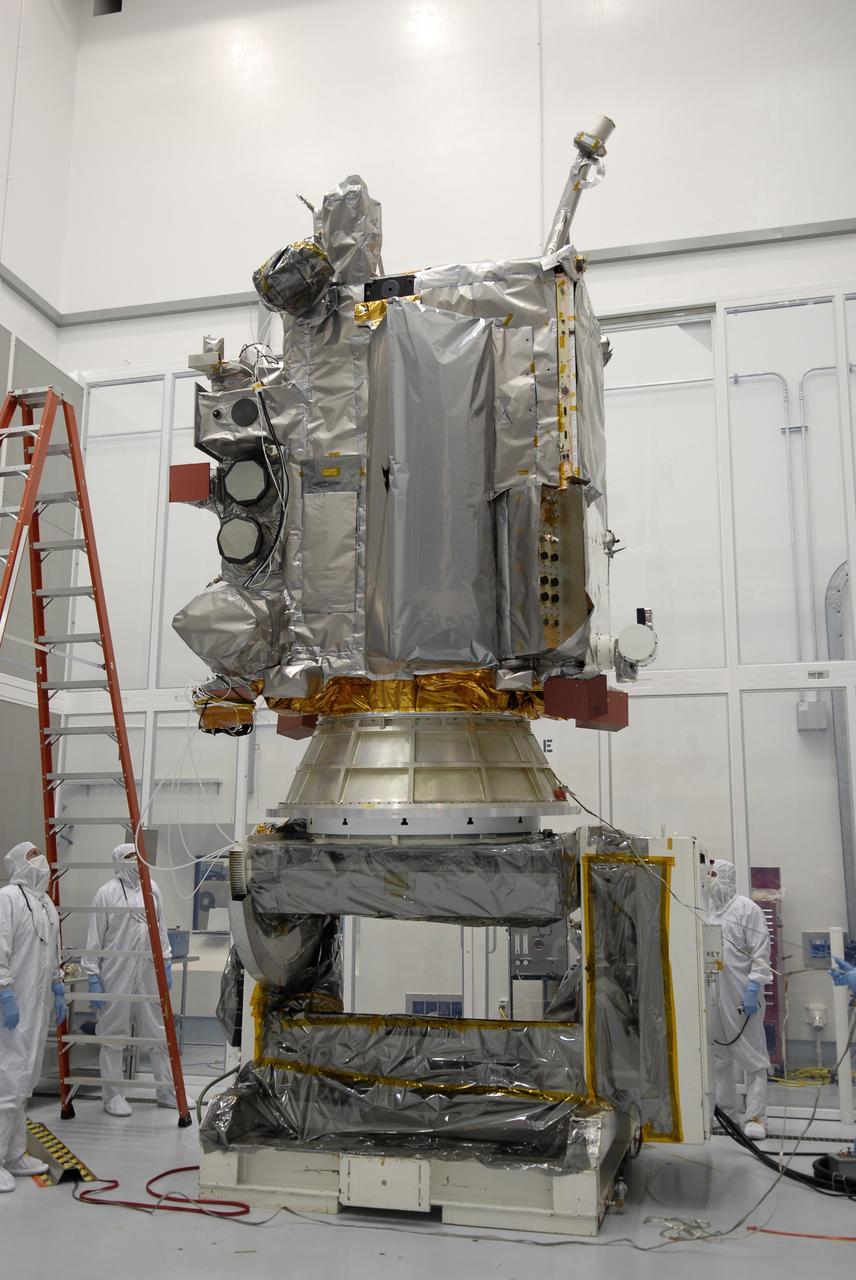
CAPE CANAVERAL, Fla. – At the Astrotech facility in Titusville, Fla., NASA's Lunar Reconnaissance Orbiter, or LRO, has been rotated to vertical on the Aronson stand. A crane will be attached to move it to another stand. The orbiter will carry seven instruments to provide scientists with detailed maps of the lunar surface and enhance our understanding of the moon's topography, lighting conditions, mineralogical composition and natural resources. Information gleaned from LRO will be used to select safe landing sites, determine locations for future lunar outposts and help mitigate radiation dangers to astronauts. The polar regions of the moon are the main focus of the mission because continuous access to sunlight may be possible and water ice may exist in permanently shadowed areas of the poles. Accompanying LRO on its journey to the moon will be the Lunar CRater Observation and Sensing Satellite, or LCROSS, a mission that will impact the lunar surface in its search for water ice. Launch of LRO is targeted for May 20. Photo credit: NASA/Kim Shiflett

CAPE CANAVERAL, Fla. – At Cape Canaveral Air Force Station's Launch Complex 37, United Launch Alliance engineers and technicians prepare to mate the agency's Orion spacecraft to its Delta IV Heavy rocket. Orion is the exploration spacecraft designed to carry astronauts to destinations not yet explored by humans, including an asteroid and Mars. It will have emergency abort capability, sustain the crew during space travel and provide safe re-entry from deep space return velocities. The first unpiloted flight test of Orion is scheduled to launch Dec. 4, 2014 atop a United Launch Alliance Delta IV Heavy rocket, and in 2018 on NASA’s Space Launch System rocket. For more information, visit www.nasa.gov/orion Photo credit: NASA/Radislav Sinyak
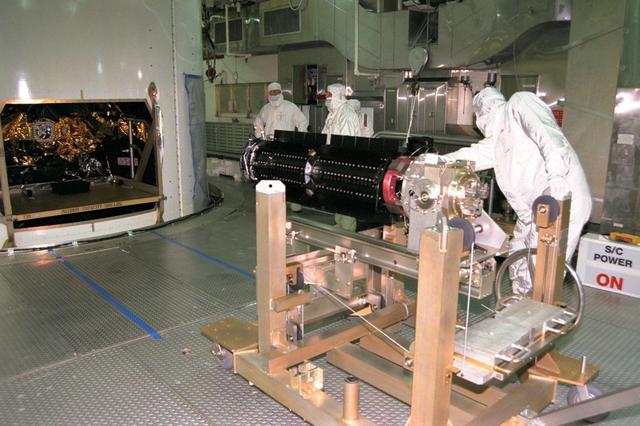
At Launch Complex 40 on Cape Canaveral Air Station, workers are installing three Radioisotope Thermoelectric Generators (RTGs) on the Cassini spacecraft. RTGs are lightweight, compact spacecraft electrical power systems that have flown successfully on 23 previous U.S. missions over the past 37 years. These generators produce power by converting heat into electrical energy; the heat is provided by the natural radioactive decay of plutonium-238 dioxide, a non-weapons-grade material. RTGs enable spacecraft to operate at significant distances from the Sun where solar power systems would not be feasible. Cassini will travel two billion miles to reach Saturn and another 1.1 billion miles while in orbit around Saturn. Cassini is undergoing final preparations for liftoff on a Titan IVB/Centaur launch vehicle, with the launch window opening at 4:55 a.m. EDT, Oct. 13
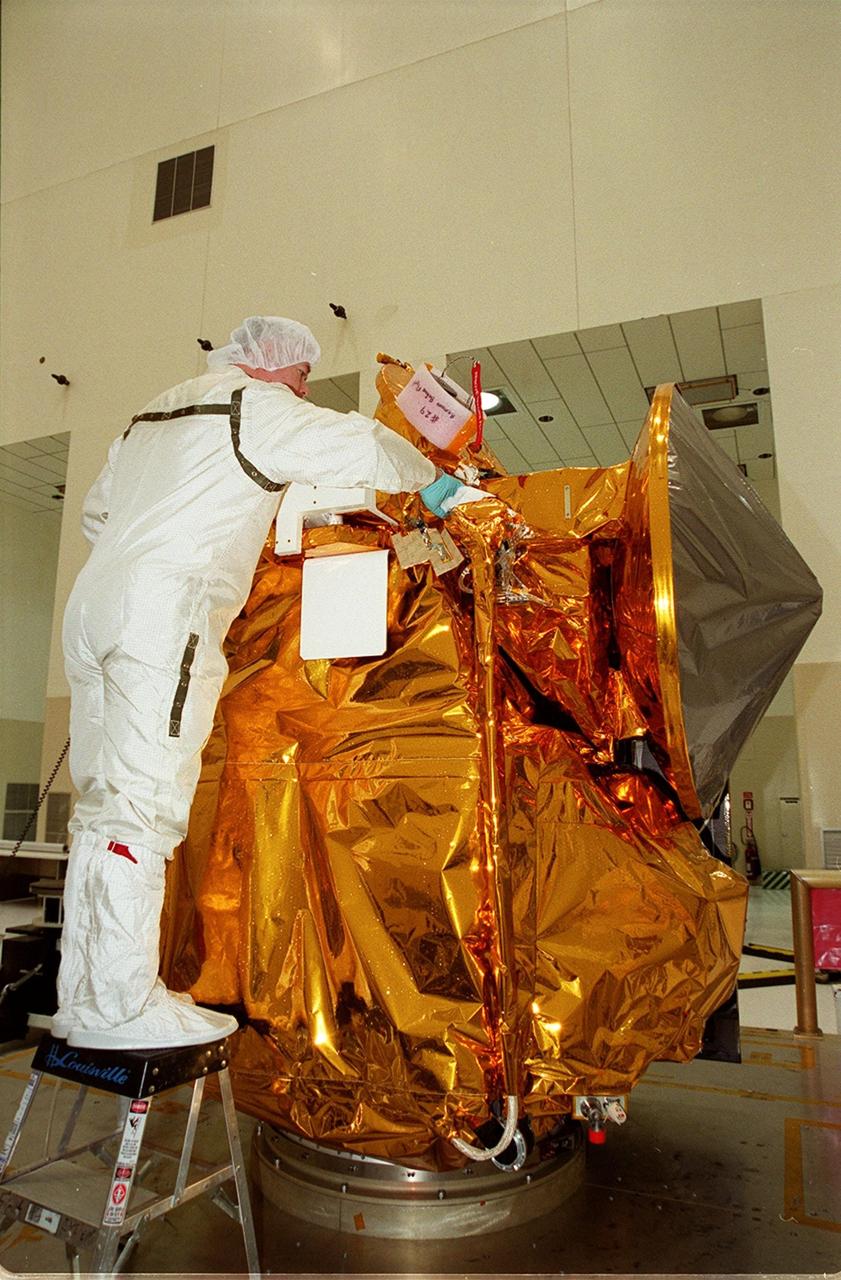
A worker in the Space Assembly and Encapsulation Facility 2 checks out the Mars Odyssey Orbiter before its move to the third stage of a Delta rocket. The Mars Odyssey is scheduled for launch on April 7, 2001, aboard a Delta II rocket from Launch Pad 17-A, Cape Canaveral Air Force Station
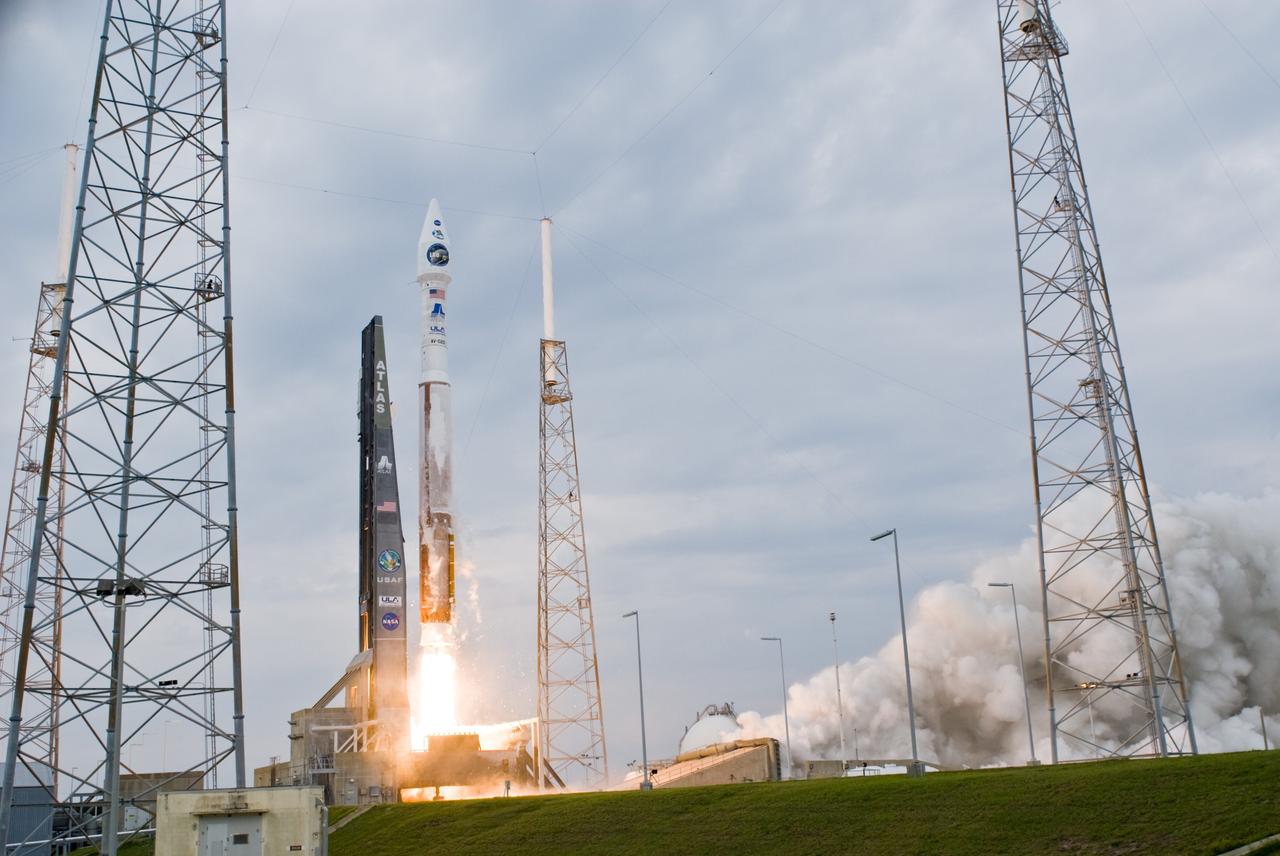
CAPE CANAVERAL, Fla. – Fire and smoke signal the liftoff of the Atlas V/Centaur carrying NASA's Lunar Reconnaissance Orbiter, or LRO, and NASA's Lunar Crater Observation and Sensing Satellite, known as LCROSS, toward orbit around the moon. Launch from Launch Complex 41 at Cape Canaveral Air Force Station in Florida was on-time at 5:32 p.m. EDT. The towers around the pad are part of the lightning protection system. LRO and LCROSS are the first missions in NASA's plan to return humans to the moon and begin establishing a lunar outpost by 2020. The LRO also includes seven instruments that will help NASA characterize the moon's surface: DIVINER, LAMP, LEND, LOLA , CRATER, Mini-RF and LROC. Photo credit: NASA/Tom Farrar, Kevin O'Connell
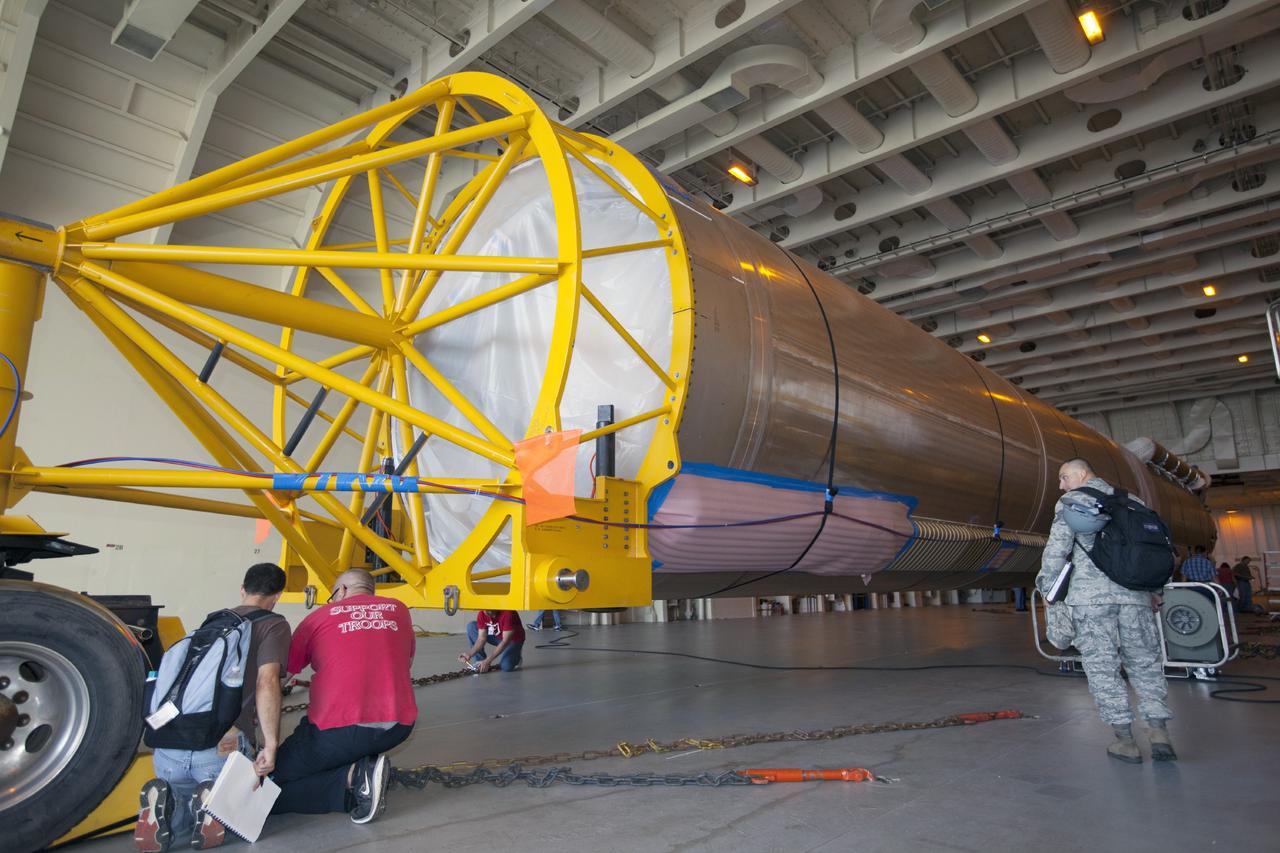
PORT CANAVERAL, Fla. – Following arrival of the United Launch Alliance barge, Delta Mariner, at Port Canaveral, Fla. engineers and technicians prepare to offload the Atlas V launch vehicle that will boost the Tracking and Data Relay Satellite, or TDRS-L, spacecraft into orbit around the Earth. The rocket's first-stage booster and Centaur upper stage will be transported to the hangar at the Atlas Spaceflight Operations Center on Cape Canaveral Air Force Station for checkout in preparation for launch. TDRS-L is the second of three next-generation satellites designed to ensure vital operational continuity for the NASA Space Network. It is scheduled to launch from Cape Canaveral's Space Launch Complex 41 atop an Atlas V rocket in January 2014. The current Tracking and Data Relay Satellite system consists of eight in-orbit satellites distributed to provide near continuous information relay service to missions such as the Hubble Space Telescope and International Space Station. For more information, visit: http://www.nasa.gov/content/tracking-and-data-relay-satellite-tdrs/ Photo credit: NASA/ Kim Shiflett

CAPE CANAVERAL, Fla. – At the Astrotech payload processing facility in Titusville, Fla., an overhead crane with a scale is being moved to attach to the SV1-SV2 spacecraft, which will be weighed. The two spacecraft are known as the Space Tracking and Surveillance System – Demonstrators, or STSS Demo, which is a space-based sensor component of a layered Ballistic Missile Defense System designed for the overall mission of detecting, tracking and discriminating ballistic missiles. STSS is capable of tracking objects after boost phase and provides trajectory information to other sensors. It will be launched by NASA for the Missile Defense Agency between 8 and 8:58 a.m. EDT Sept. 18. Approved for Public Release 09-MDA-04886 (10 SEPT 09) Photo credit: NASA/Jim Grossmann

CAPE CANAVERAL, Fla. – Inside the mobile service tower on Launch Pad 17-B at Cape Canaveral Air Force Station in Florida, the second half of the fairing is being moved into place around the Space Tracking and Surveillance System – Demonstrator spacecraft. The fairing is a two-part molded structure that fits flush with the outside surface of the rocket and forms an aerodynamically smooth nose cone, protecting the spacecraft during launch and ascent. STSS Demo is a space-based sensor component of a layered Ballistic Missile Defense System designed for the overall mission of detection, tracking and discriminating ballistic missiles. STSS is capable of tracking objects after boost phase and provides trajectory information to other sensors. It will be launched by NASA for the Missile Defense Agency between 8 and 8:58 a.m. EDT Sept. 18. Approved for Public Release 09-MDA-4934 (09-22-09) Photo credit: NASA/Cory Huston
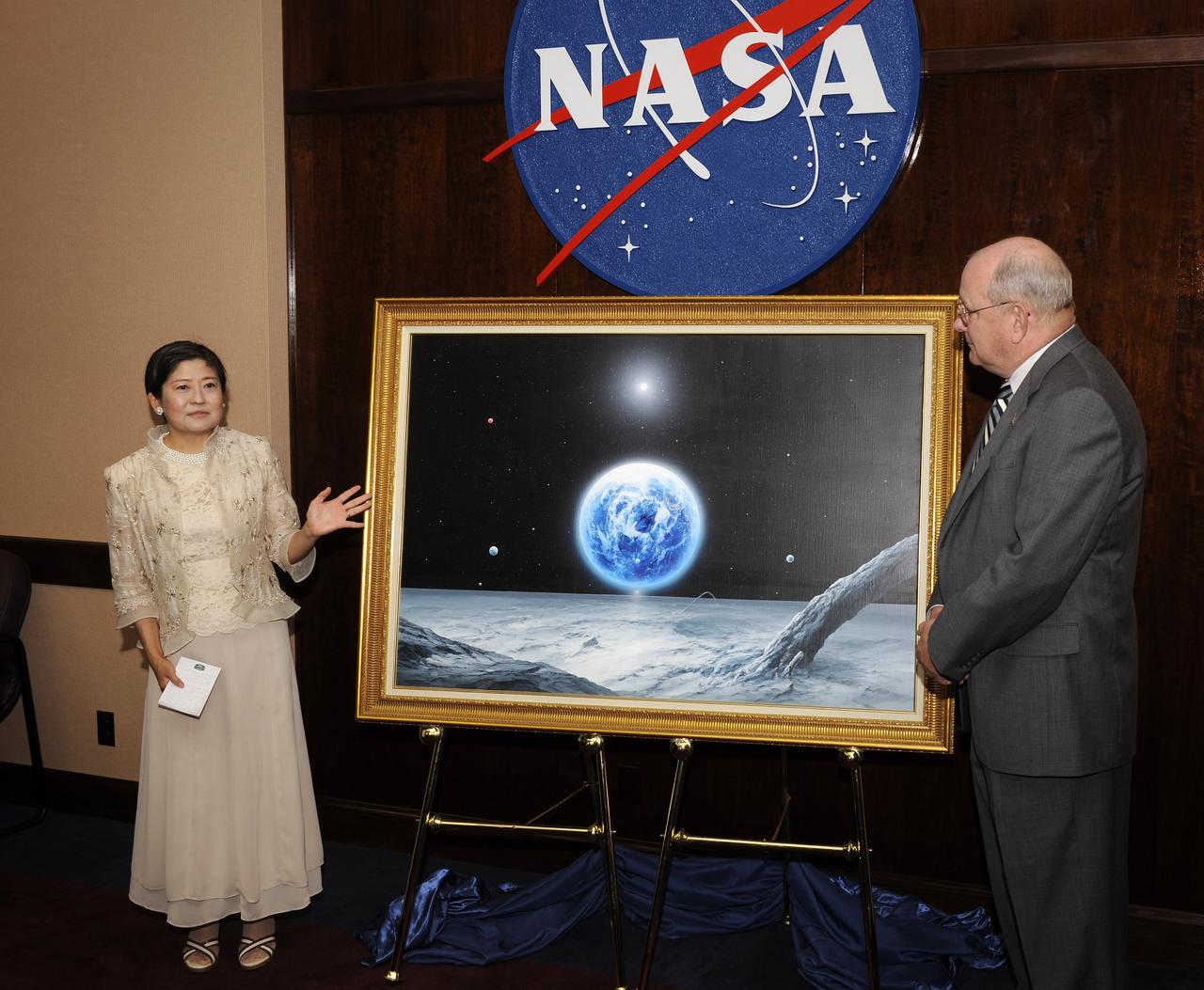
Suzu Sawanuki presents artwork by her husband Toshiro Sawanuki to James Hathaway, Associate Director for Business Operations at NASA's Kennedy Space Center in Cape Canaveral, Fla., Thursday, May 29, 2008. Photo Credit: (NASA/Bill Ingalls)
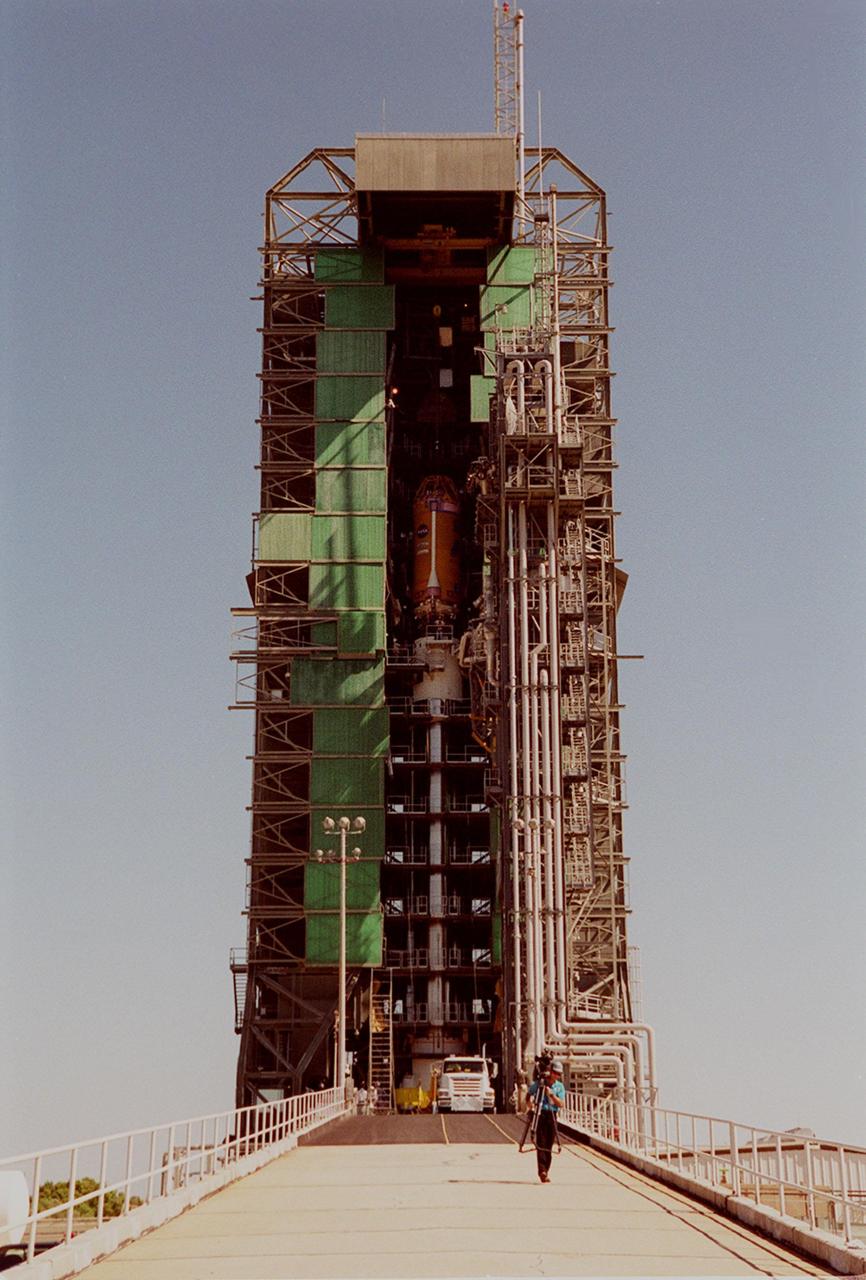
At launch pad 36-A, Cape Canaveral Air Force Station, lifting of the second stage of an Atlas II/Centaur rocket in the launch gantry is completed. The rocket is the launch vehicle for the GOES-L satellite, part of the NOAA National Weather Service system in weather imagery and atmospheric sounding information. The primary objective of the GOES-L is to provide a full capability satellite in an on-orbit storage condition, to assure NOAA continuity in services from a two-satellite constellation. Launch services are being provided by the 45th Space Wing
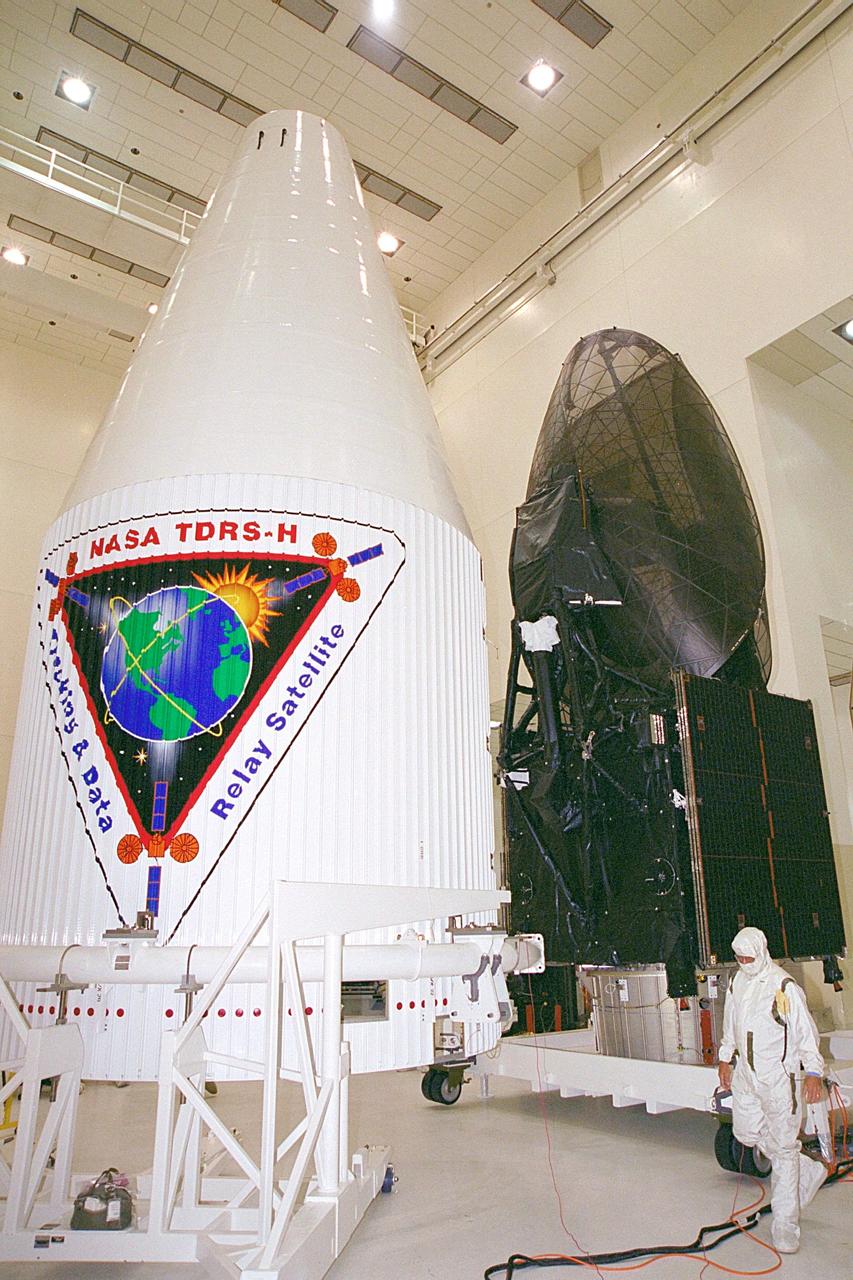
In the Spacecraft Assembly and Encapsulation Facility, the Tracking and Data Relay Satellite (TDRS-H) at right sits while one-half of the fairing (left) is moved closer to it. After encapsulation in the fairing, TDRS will be transported to Launch Pad 36A, Cape Canaveral Air Force Station for launch scheduled June 29 aboard an Atlas IIA/Centaur rocket. One of three satellites (labeled H, I and J) being built in the Hughes Space and Communications Company Integrated Satellite Factory in El Segundo, Calif., the latest TDRS uses an innovative springback antenna design. A pair of 15-foot-diameter, flexible mesh antenna reflectors fold up for launch, then spring back into their original cupped circular shape on orbit. The new satellites will augment the TDRS system’s existing Sand Ku-band frequencies by adding Ka-band capability. TDRS will serve as the sole means of continuous, high-data-rate communication with the space shuttle, with the International Space Station upon its completion, and with dozens of unmanned scientific satellites in low earth orbit
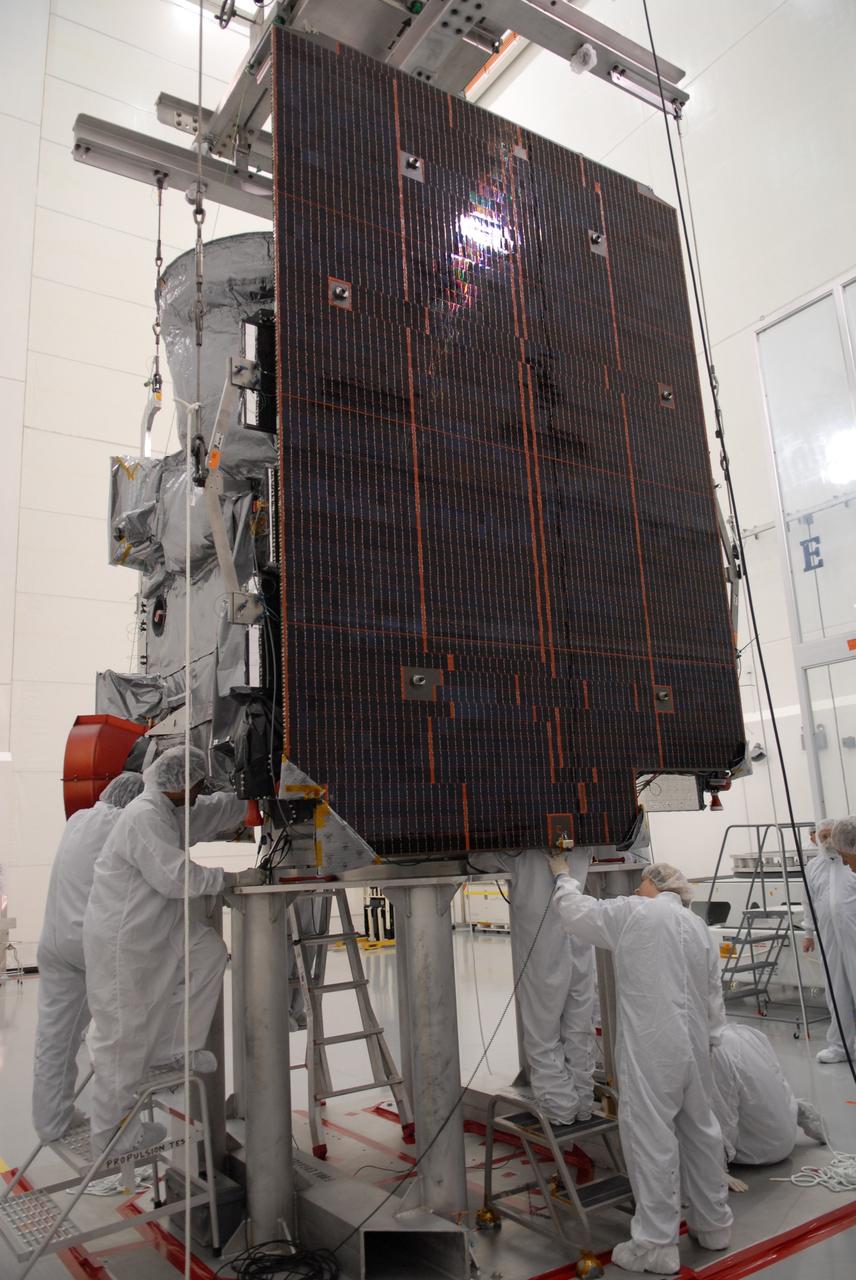
CAPE CANAVERAL, Fla. – In the Astrotech payload processing facility in Titusville, Fla., technicians secure the GOES-O satellite onto a special stand for loading of its oxidizer and hydrazine propellants. The latest Geostationary Operational Environmental Satellite, GOES-O was developed by NASA for the National Oceanic and Atmospheric Administration, or NOAA. The GOES satellites continuously provide observations of 60 percent of the Earth including the continental United States, providing weather monitoring and forecast operations as well as a continuous and reliable stream of environmental information and severe weather warnings. Once in orbit, GOES-O will be designated GOES-14, and NASA will provide on-orbit checkout and then transfer operational responsibility to NOAA. The GOES-O satellite is targeted to launch from Cape Canaveral Air Force Station's Launch Complex 37 no earlier than May 12 onboard a United Launch Alliance Delta IV expendable launch vehicle. Photo credit: NASA/Troy Cryder

CAPE CANAVERAL, Fla. --- In the mobile service tower on Pad 17-B at Cape Canaveral Air Force Station in Florida, a United Launch Alliance technician watches over the placement of the last set of three solid rocket boosters being mated to the Delta II rocket for the launch of NASA's Gamma-ray Large Area Space Telescope, or GLAST. Because the Delta rocket is configured as a Delta II 7920 Heavy, the boosters are larger than those used on the standard configuration. The GLAST is a powerful space observatory that will explore the Universe's ultimate frontier, where nature harnesses forces and energies far beyond anything possible on Earth; probe some of science's deepest questions, such as what our Universe is made of, and search for new laws of physics; explain how black holes accelerate jets of material to nearly light speed; and help crack the mystery of stupendously powerful explosions known as gamma-ray bursts. Launch is currently planned in a window between 11:45 a.m. and 1:40 p.m. May 16. Photo credit: NASA/Troy Cryder
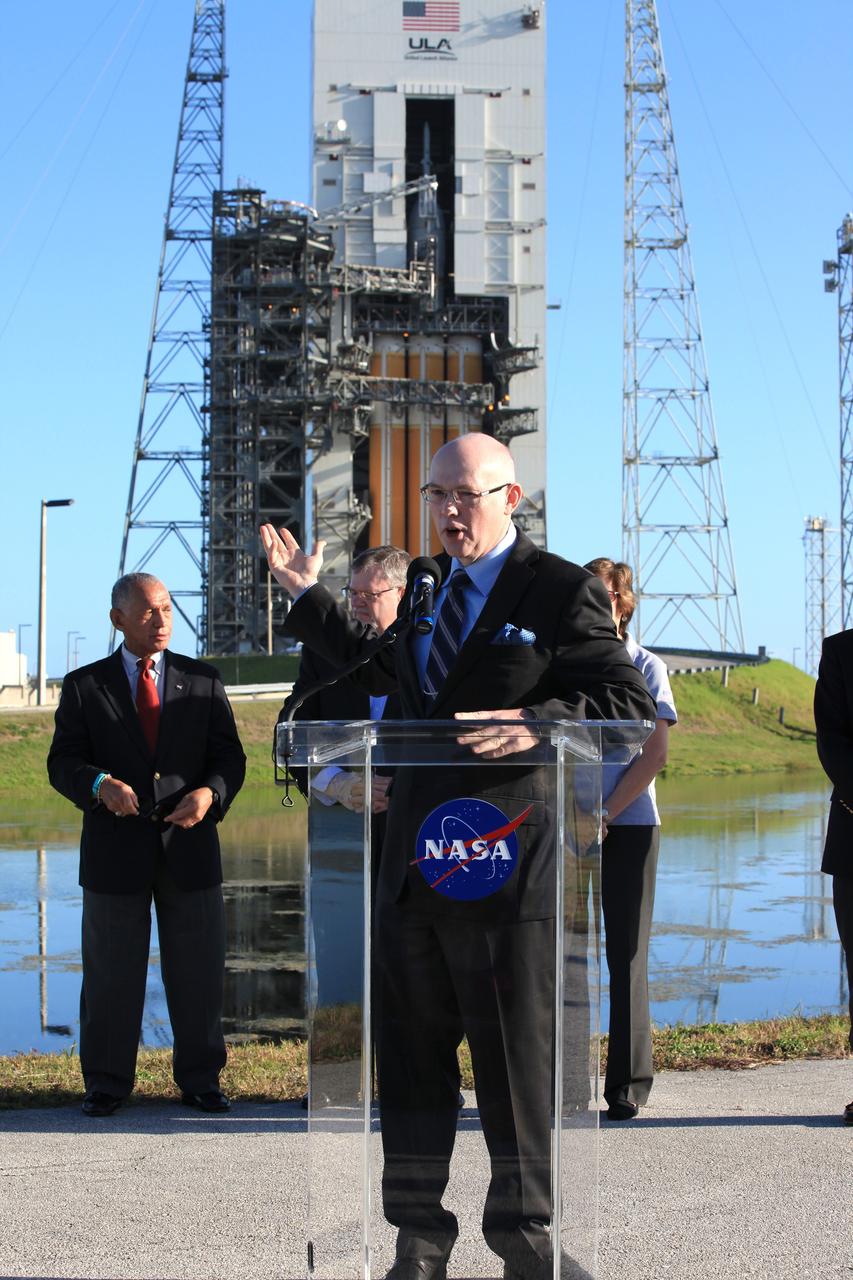
CAPE CANAVERAL, Fla. – At Cape Canaveral Air Force Station's Launch Complex 37, United Launch Alliance CEO Tory Bruno speaks to members of the news media as the Orion spacecraft and its United Launch Alliance Delta IV Heavy rocket were being prepared for launch. Behind Bruno, from the left, are NASA Administrator Charlie Bolden, Lockheed Martin Orion Program Manager Mike Hawes and Johnson Space Center Director Ellen Ochoa. For more information, visit www.nasa.gov/orion. Photo credit: NASA/Kim Shiflett
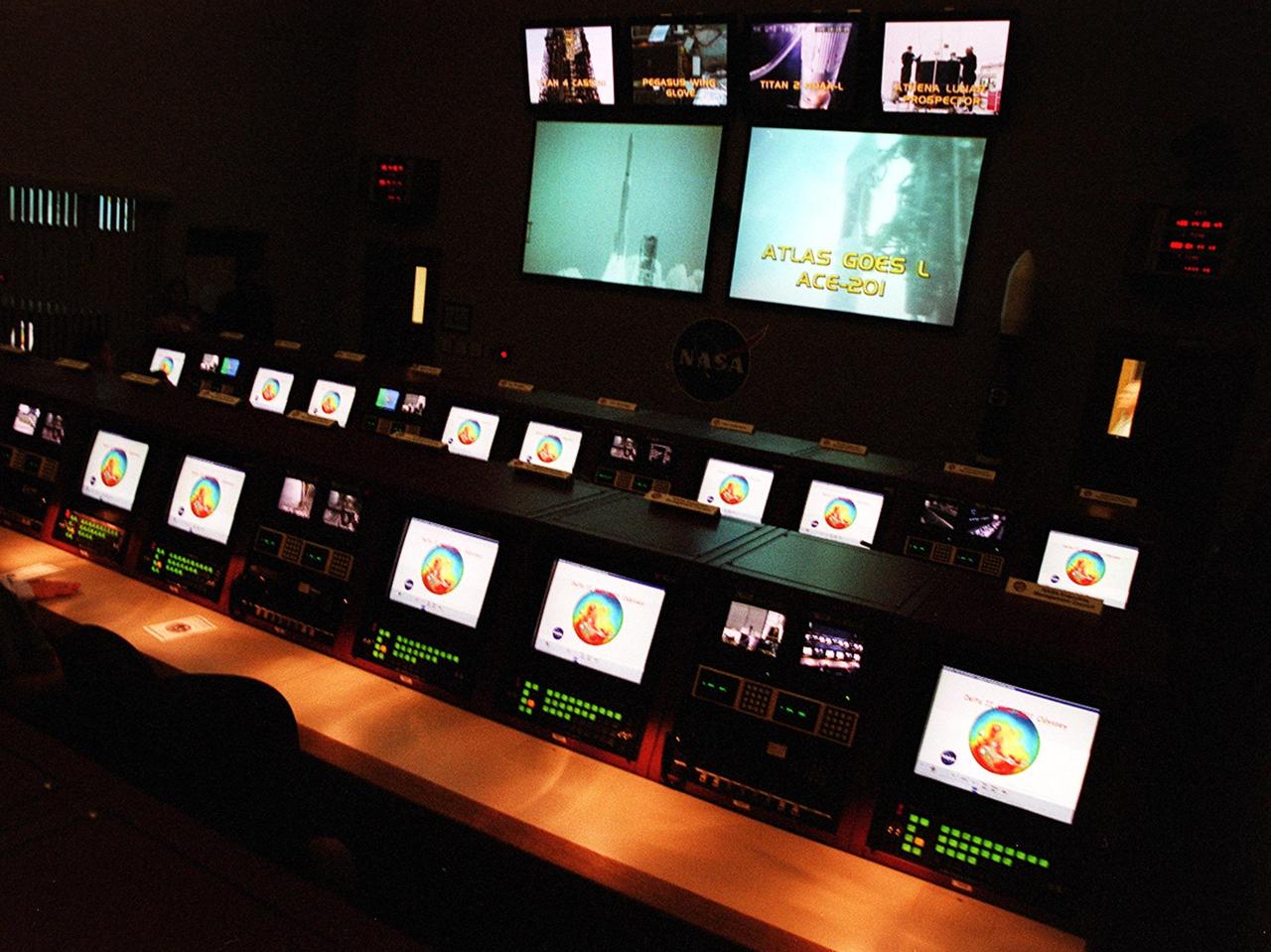
State-of-the-art displays shown here provide enhanced capability to engineers in the upgraded Launch Vehicle Data Center in Hangar AE, Cape Canaveral Air Force Station, Fla. The new facility’s three individual control rooms replace a single LVDC control room in use since the mid-1970s. Developed by NASA-KSC to support multiple test operations in parallel or a single large launch operation, the new LVDC allows up to 100 launch vehicle engineers to monitor the voice, data and video systems that support the checkout and launch of an expendable vehicle
CAPE CANAVERAL, Fla. – On Complex 37 at Cape Canaveral Air Force Station in Florida, workers ensure the GOES-O and Delta IV second stage are ready to leave the Horizontal Integration Facility for the launch pad. GOES–O is one of a series of Geostationary Operational Environmental Satellites. The multi-mission GOES series N-P will be a vital contributor to weather, solar and space operations and science. NASA and the National Oceanic and Atmospheric Administration, or NOAA, are actively engaged in a cooperative program to expand the existing GOES system with the launch of the GOES N-P satellites. Launch of the GOES-O is targeted for no earlier than April 2009. Photo credit: NASA/Jim Grossmann

A C-17 Globemaster aircraft from the Alaska Air National Guard’s 249th Airlift Squadron flies overhead as pararescue specialists from the 304th Rescue Squadron, located in Portland, Oregon complete an astronaut rescue training exercise inside a covered life raft on the Atlantic Ocean. The pararescue specialists, supporting the 45th Operations Group’s Detachment 3, based out of Patrick Air Force Base, conducted the exercise in April with NASA’s Commercial Crew Program and SpaceX off of Florida’s eastern coast. The specially designed 20-person life raft is equipped with enough food, water and medical supplies to sustain both rescuers and crew for up to three days, if necessary. In this situation, the Department of Defense (DOD) would complete the rescue by enlisting help from the US Coast Guard, a DOD ship, or a nearby commercial ship of opportunity to transport the crew to safety.
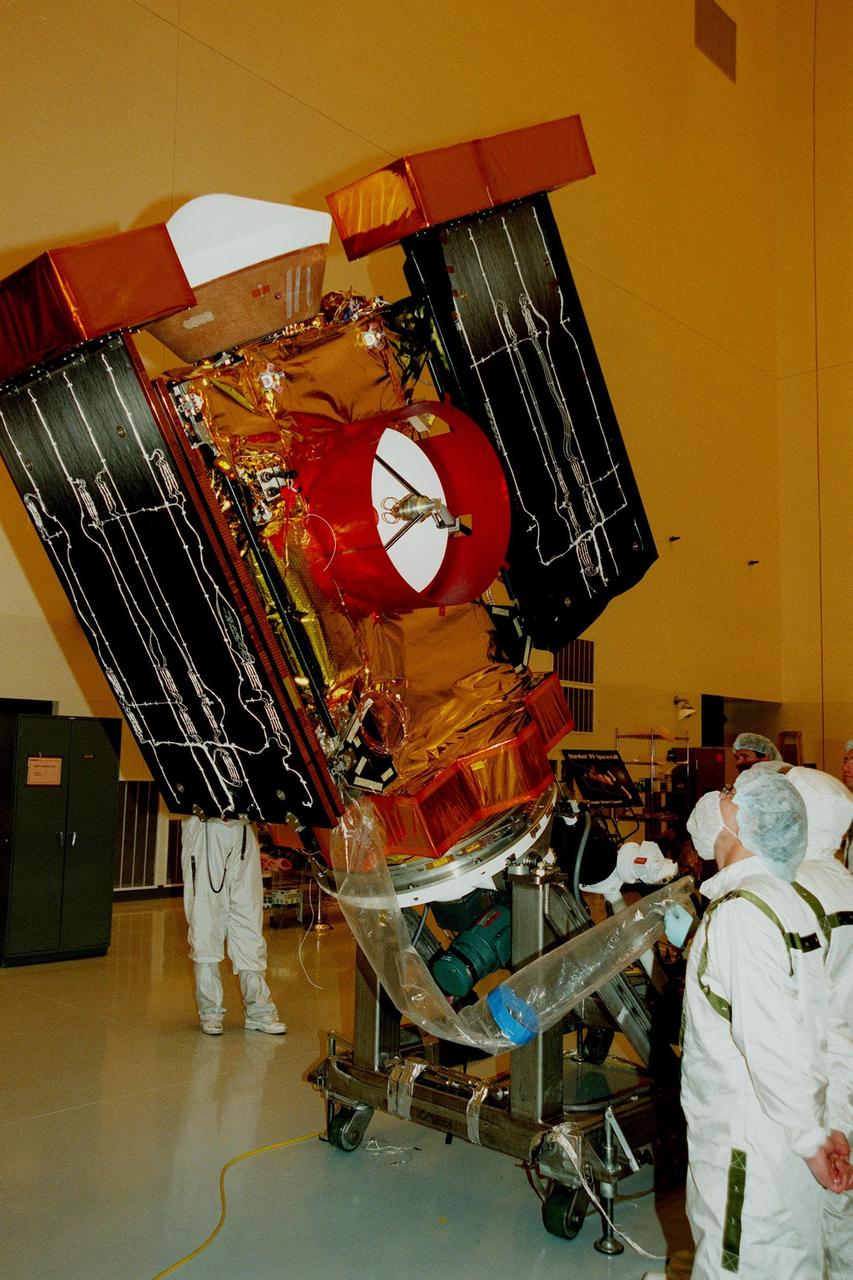
Workers in the Payload Hazardous Servicing Facility watch as the <a href="http://www-pao.ksc.nasa.gov/kscpao/captions/subjects/stardust.htm"> Stardust</a> spacecraft is rotated and lowered before deploying the solar panels for lighting tests. Stardust is scheduled to be launched aboard a Boeing Delta II rocket from Launch Pad 17A, Cape Canaveral Air Station, on Feb. 6, 1999, for a rendezvous with the comet Wild 2 in January 2004. Stardust will use a substance called aerogel to capture comet particles flying off the nucleus of the comet, plus collect interstellar dust for later analysis. The collected samples will return to Earth in a sample return capsule (seen on top of the spacecraft) to be jettisoned as it swings by Earth in January 2006
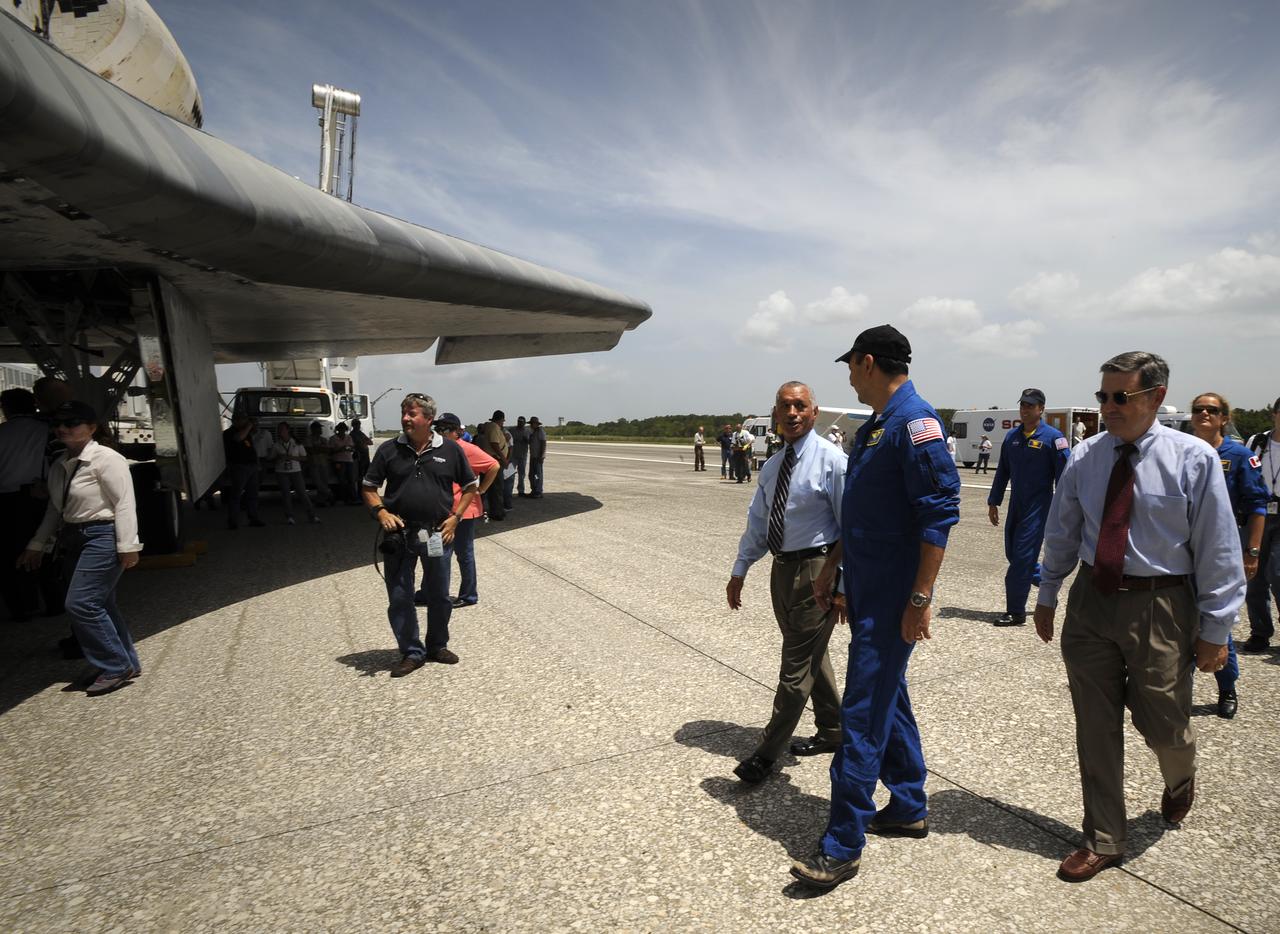
NASA Administrator Charles Bolden, left, STS-127 mission commander Mark Polansky, and NASA Kennedy Space Center Director Bob Cabana, right, walk around the space shuttle Endeavour shortly after it and its crew landed, Friday, July 31, 2009 at NASA's Kennedy Space Center in Cape Canaveral, Fla., completing a 16-day journey of more than 6.5 million miles. Endeavour delivered the final segment to the Japan Aerospace Exploration Agency's Kibo laboratory and a new crew member to the International Space Station. Photo Credit: (NASA/Bill Ingalls)