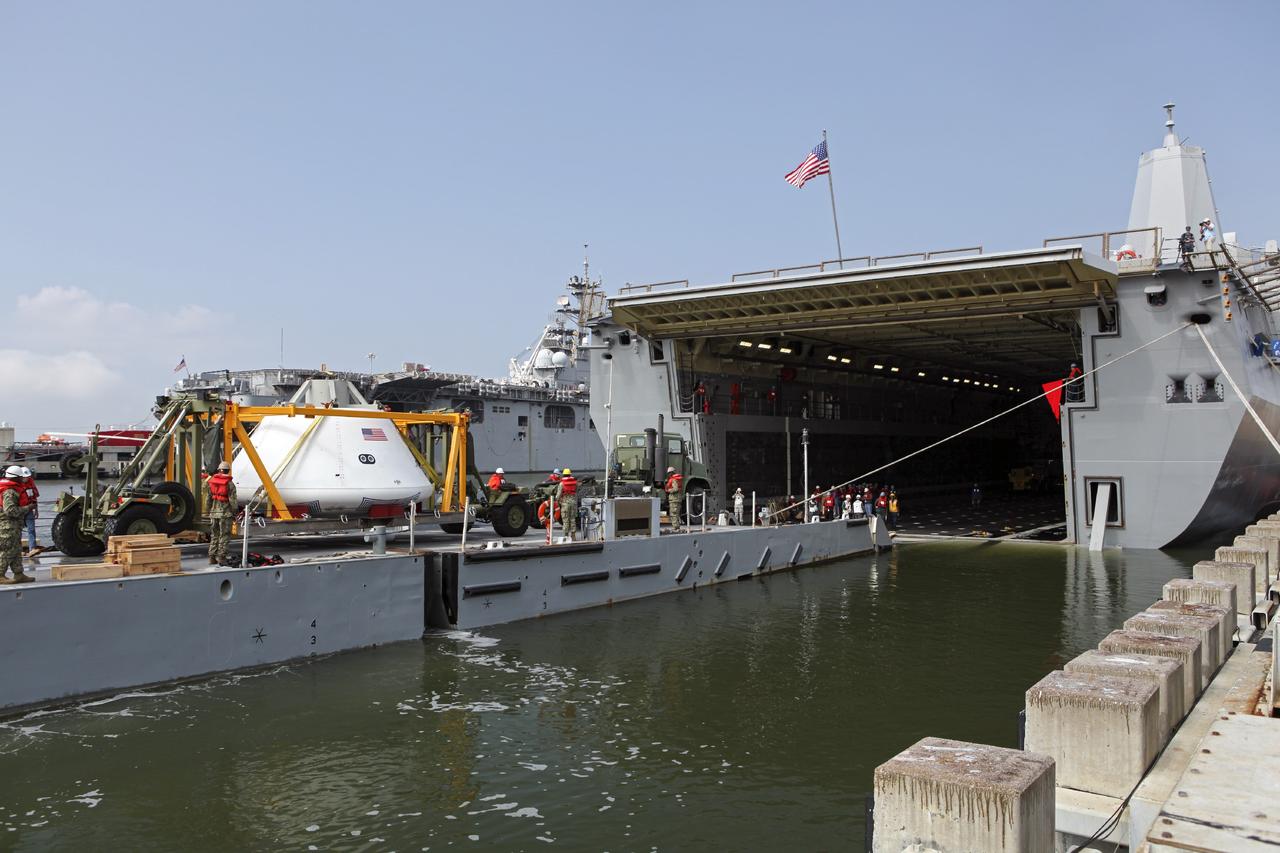
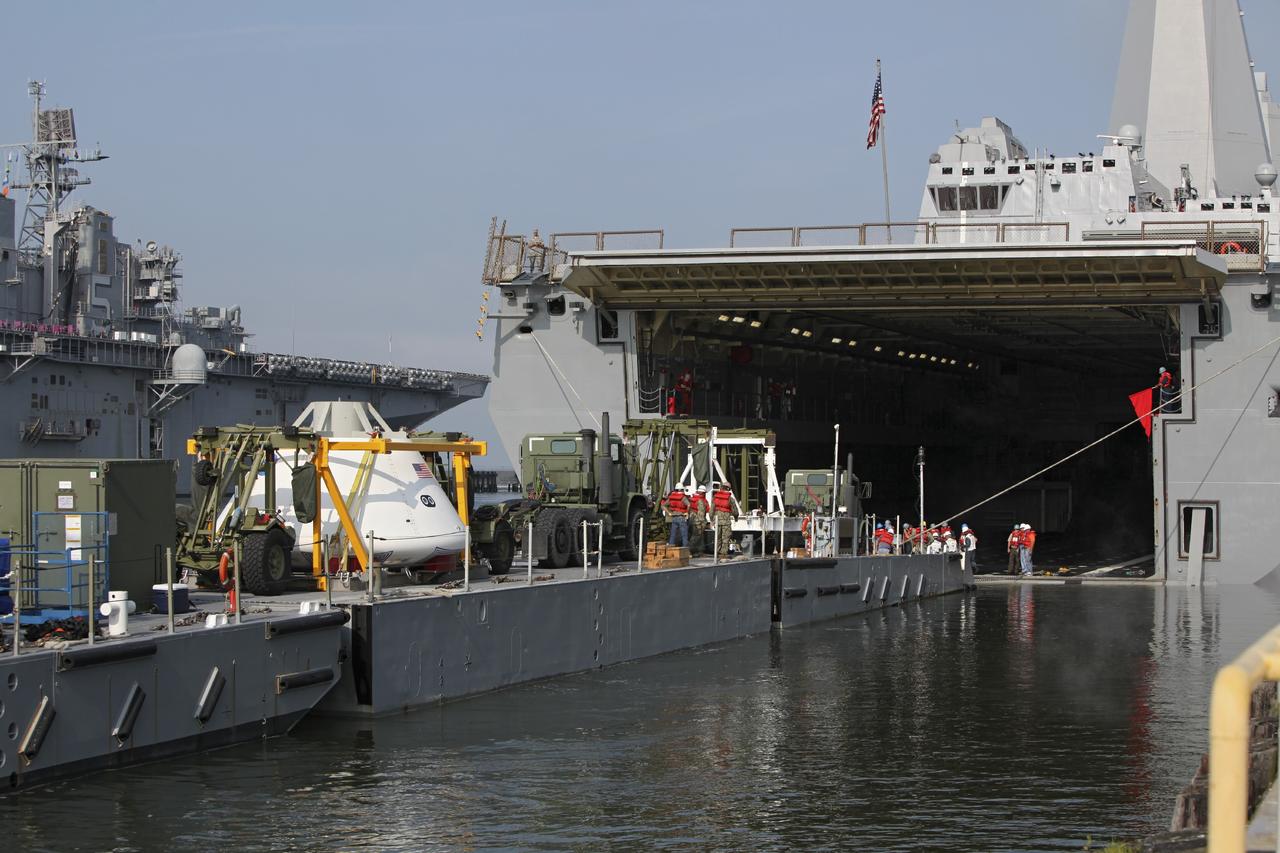
HAMPTON, Va. – At the Naval Station Norfolk near NASA’s Langley Research Center in Virginia, the Orion boilerplate test article and support equipment for a stationary recovery test are being transferred on a floating dock system to a U.S. Navy ship. NASA and the U.S. Navy are conducting tests to prepare for recovery of the Orion crew module and forward bay cover on its return from a deep space mission. The stationary recovery test will allow the teams to demonstrate and evaluate the recovery processes, procedures, hardware and personnel in a controlled environment before conducting a second recovery test next year in open waters. Orion is the exploration spacecraft designed to carry astronauts to destinations not yet explored by humans, including an asteroid and Mars. It will have emergency abort capability, sustain the crew during space travel and provide safe re-entry from deep space return velocities. The first unpiloted test flight of the Orion is scheduled to launch in 2014 atop a Delta IV rocket and in 2017 on NASA’s Space Launch System rocket. For more information, visit http://www.nasa.gov/orion. Photo credit: NASA/Dimitri Gerondidakis
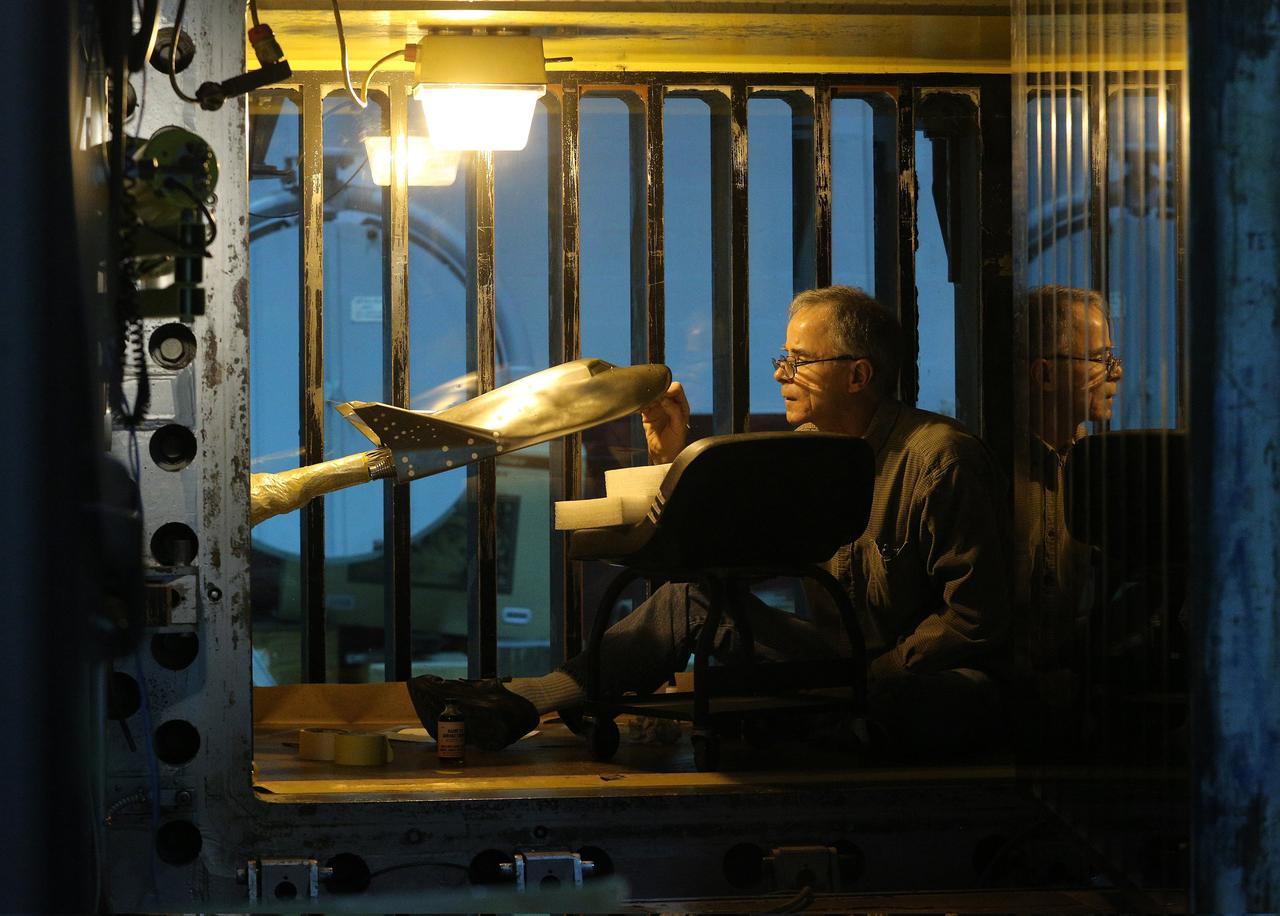
HAMPTON, Va. – NASA technician Ricky Hall works inside the Unitary Plan Wind Tunnel at NASA's Langley Research Center in Virginia to affix grains of sand to a precise scale model of the Dream Chaser spacecraft. Sierra Nevada Corporation is developing the Dream Chaser in partnership with NASA's Commercial Crew Program. The sand creates turbulence at key points to simulate the conditions the real spacecraft will encounter during its return to Earth. The data gathered from the wind tunnel was used to further test the design through the company's Commercial Crew Integrated Capability agreement with NASA. Photo credit: NASA/ David C. Bowman
HAMPTON, Va. – At the Naval Station Norfolk near NASA’s Langley Research Center in Virginia, the Orion boilerplate test article is being returned to a U.S. Navy ship following a stationary recovery test in the water. NASA and the U.S. Navy are conducting tests to prepare for recovery of the Orion crew module and forward bay cover on its return from a deep space mission. The stationary recovery test will allow the teams to demonstrate and evaluate the recovery processes, procedures, hardware and personnel in a controlled environment before conducting a second recovery test next year in open waters. Orion is the exploration spacecraft designed to carry astronauts to destinations not yet explored by humans, including an asteroid and Mars. It will have emergency abort capability, sustain the crew during space travel and provide safe re-entry from deep space return velocities. The first unpiloted test flight of the Orion is scheduled to launch in 2014 atop a Delta IV rocket and in 2017 on NASA’s Space Launch System rocket. For more information, visit http://www.nasa.gov/orion. Photo credit: NASA/Dimitri Gerondidakis
HAMPTON, Va. – At the Naval Station Norfolk near NASA’s Langley Research Center in Virginia, the Orion boilerplate test article and support equipment for a stationary recovery test are being transferred on a floating dock system to a U.S. Navy ship. NASA and the U.S. Navy are conducting tests to prepare for recovery of the Orion crew module and forward bay cover on its return from a deep space mission. The stationary recovery test will allow the teams to demonstrate and evaluate the recovery processes, procedures, hardware and personnel in a controlled environment before conducting a second recovery test next year in open waters. Orion is the exploration spacecraft designed to carry astronauts to destinations not yet explored by humans, including an asteroid and Mars. It will have emergency abort capability, sustain the crew during space travel and provide safe re-entry from deep space return velocities. The first unpiloted test flight of the Orion is scheduled to launch in 2014 atop a Delta IV rocket and in 2017 on a Space Launch System rocket. For more information, visit http://www.nasa.gov/orion. Photo credit: NASA/Dimitri Gerondidakis
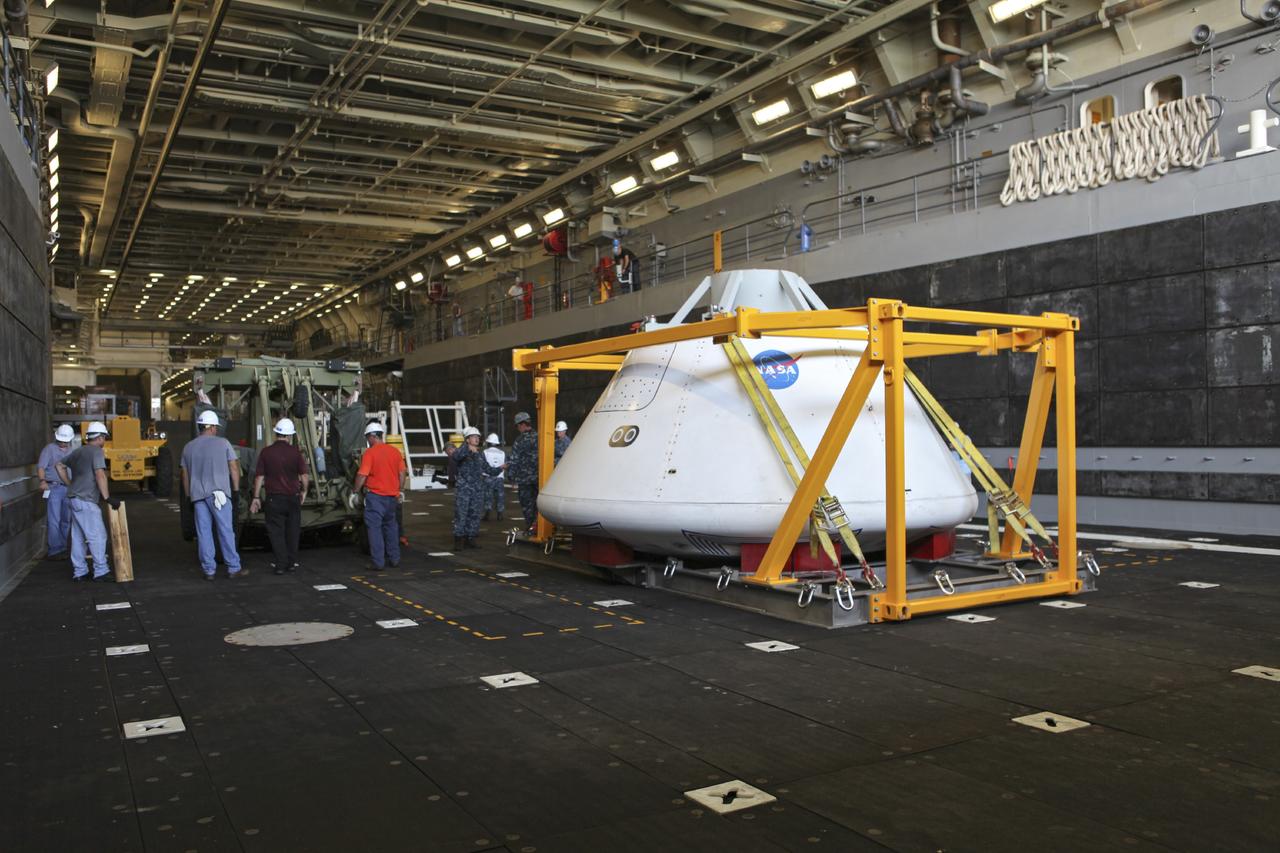
HAMPTON, Va. – At the Naval Station Norfolk near NASA’s Langley Research Center in Virginia, the Orion boilerplate test article and support equipment for a stationary recovery test have been secured on a U.S. Navy ship after arriving by floating dock system. NASA and the U.S. Navy are conducting tests to prepare for recovery of the Orion crew module and forward bay cover on its return from a deep space mission. The stationary recovery test will allow the teams to demonstrate and evaluate the recovery processes, procedures, hardware and personnel in a controlled environment before conducting a second recovery test next year in open waters. Orion is the exploration spacecraft designed to carry astronauts to destinations not yet explored by humans, including an asteroid and Mars. It will have emergency abort capability, sustain the crew during space travel and provide safe re-entry from deep space return velocities. The first unpiloted test flight of the Orion is scheduled to launch in 2014 atop a Delta IV rocket and in 2017 on NASA’s Space Launch System rocket. For more information, visit http://www.nasa.gov/orion. Photo credit: NASA/Dimitri Gerondidakis
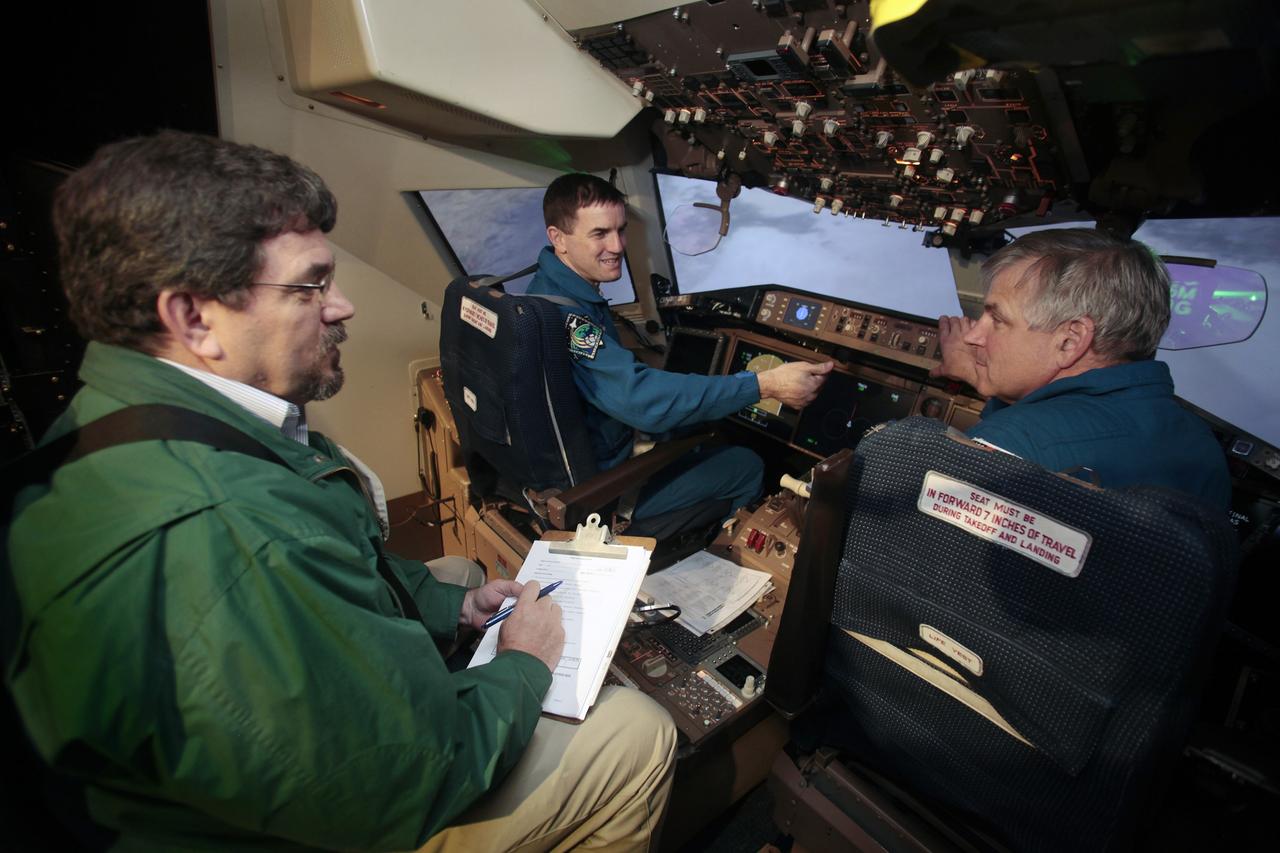
HAMPTON, Va. – Bruce Jackson, an aerospace engineer at NASA’s Langley Flight Research Center, briefs astronauts Rex Walheim, left, and Gregory Johnson as they evaluate Sierra Nevada Corporation, or SNC, Space Systems' Dream Chaser landing simulation, in support of NASA Commercial Crew Program, or CCP, efforts. The simulation makes use of the Synthetic Vision and Enhanced Vision systems in the center's Cockpit Motion Facility. SNC is one of three companies working with CCP during the agency's Commercial Crew Integrated Capability, or CCiCap, initiative, which is intended to lead to the availability of commercial human spaceflight services for government and commercial customers. To learn more about CCP and its industry partners, visit www.nasa.gov/commercialcrew. Image credit: NASA/David C. Bowman
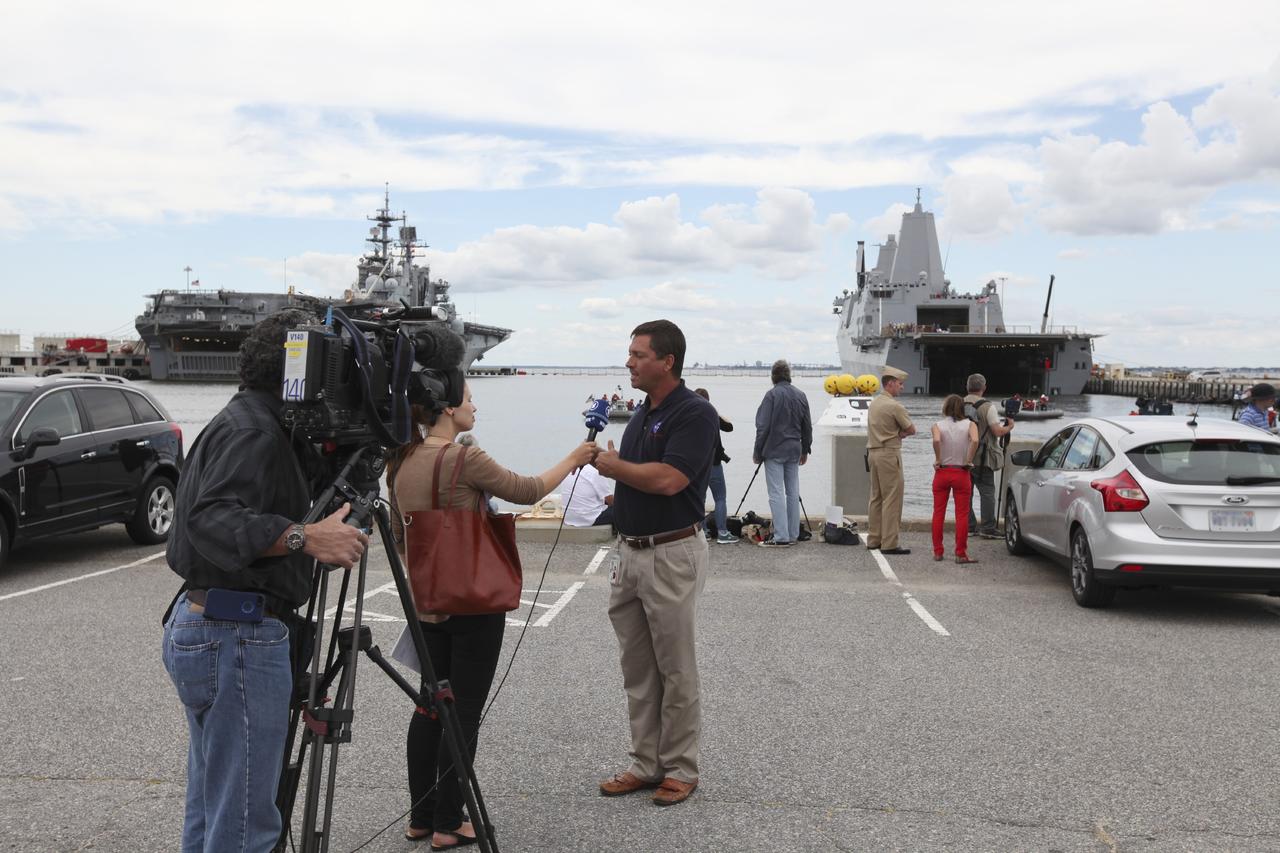
HAMPTON, Va. – At the Naval Station Norfolk near NASA’s Langley Research Center in Virginia, members of the news media speak with Louis Garcia, NASA recovery director, during the stationary recovery test being performed on the Orion boilerplate test in the water near a U.S. Navy ship. NASA and the U.S. Navy are conducting tests to prepare for recovery of the Orion crew module and forward bay cover on its return from a deep space mission. The stationary recovery test will allow the teams to demonstrate and evaluate the recovery processes, procedures, hardware and personnel in a controlled environment before conducting a second recovery test next year in open waters. Orion is the exploration spacecraft designed to carry astronauts to destinations not yet explored by humans, including an asteroid and Mars. It will have emergency abort capability, sustain the crew during space travel and provide safe re-entry from deep space return velocities. The first unpiloted test flight of the Orion is scheduled to launch in 2014 atop a Delta IV rocket and in 2017 on NASA’s Space Launch System rocket. For more information, visit http://www.nasa.gov/orion. Photo credit: NASA/Dimitri Gerondidakis
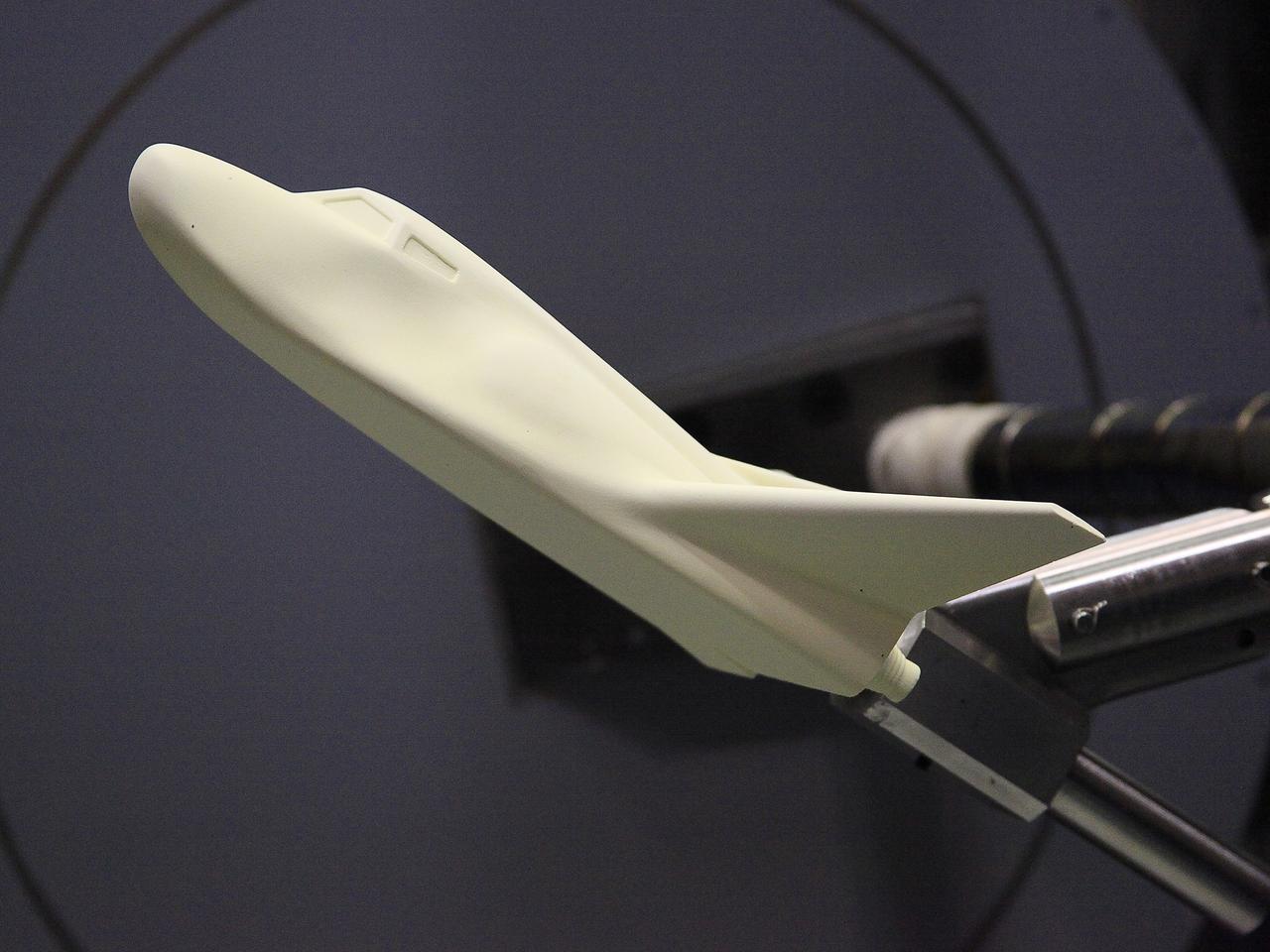
HAMPTON, Va. –A 10-inch long ceramic model of the Sierra Nevada Corporation, or SNC, Dream Chaser spacecraft is prepared for high-speed wind tunnel tests at NASA's Langley Research Center in Hampton, Va. The tests measure how much heat the winged vehicle would experience during ascent and re-entry through the atmosphere, including the spacecraft's lower- and upper-body flaps, elevons and a rudder. They're also helping the company obtain necessary data for the material selection and design of the spacecraft's thermal protection system. SNC is continuing the development of its Dream Chaser spacecraft under the agency's Commercial Crew Integrated Capability, or CCiCap, initiative, which is intended to lead to the availability of commercial human spaceflight services for government and commercial customers. To learn more about CCP and its industry partners, visit www.nasa.gov/commercialcrew. Image credit: NASA/David Bowman
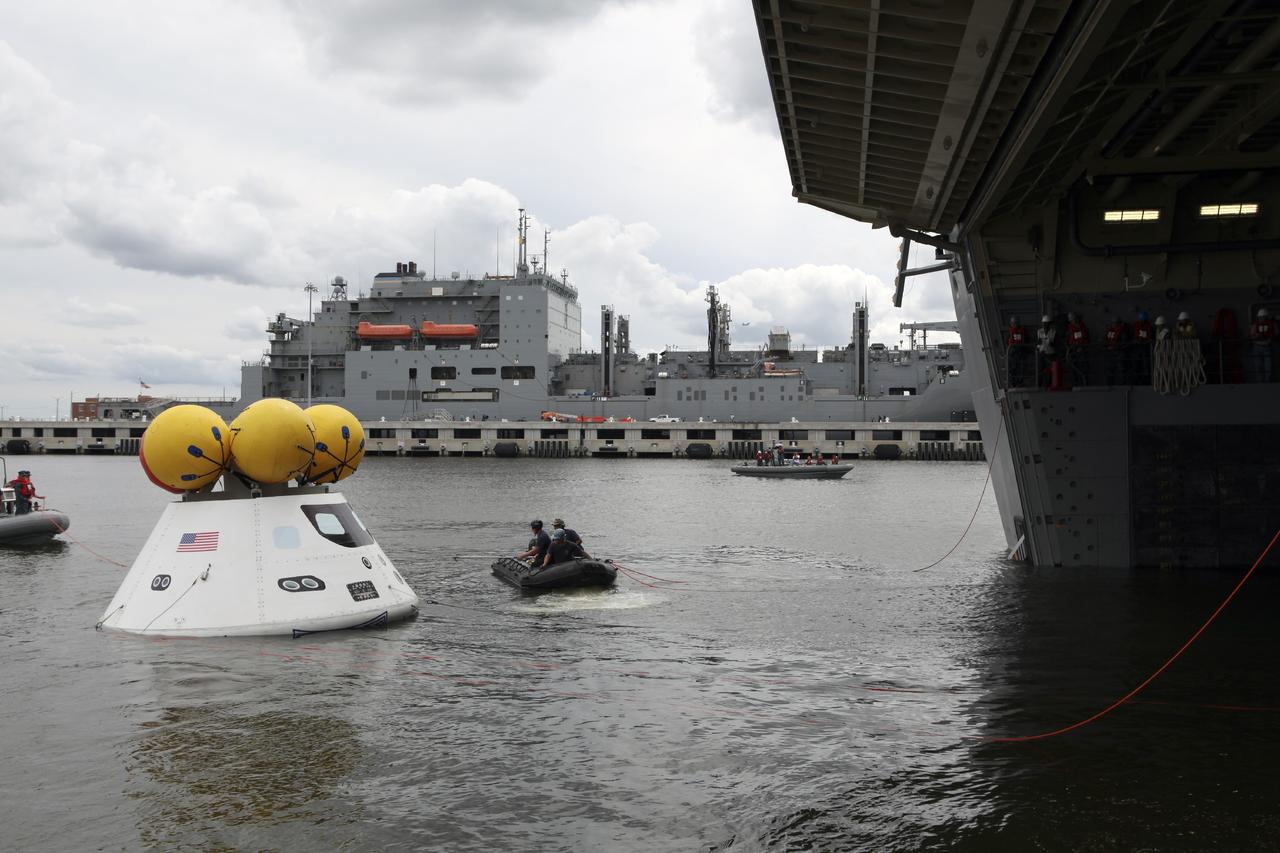
HAMPTON, Va. – At the Naval Station Norfolk near NASA’s Langley Research Center in Virginia, NASA and the U.S. Navy are conducting a stationary recovery test on the Orion boilerplate test article in the water near a U.S. Navy ship. NASA and the U.S. Navy are conducting tests to prepare for recovery of the Orion crew module and forward bay cover on its return from a deep space mission. The stationary recovery test will allow the teams to demonstrate and evaluate the recovery processes, procedures, hardware and personnel in a controlled environment before conducting a second recovery test next year in open waters. Orion is the exploration spacecraft designed to carry astronauts to destinations not yet explored by humans, including an asteroid and Mars. It will have emergency abort capability, sustain the crew during space travel and provide safe re-entry from deep space return velocities. The first unpiloted test flight of the Orion is scheduled to launch in 2014 atop a Delta IV rocket and in 2017 on NASA’s Space Launch System rocket. For more information, visit http://www.nasa.gov/orion. Photo credit: NASA/Dimitri Gerondidakis
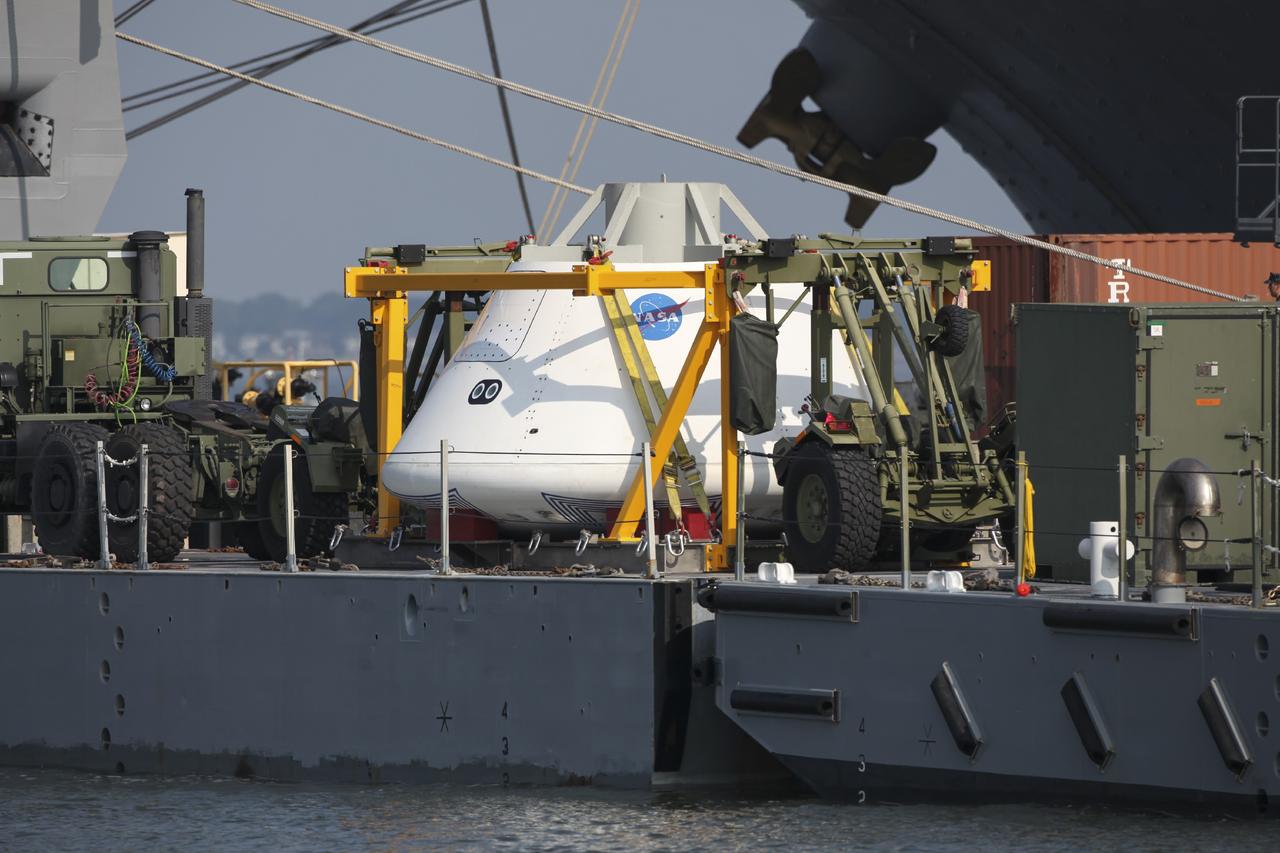
HAMPTON, Va. – At the Naval Station Norfolk near NASA’s Langley Research Center in Virginia, the Orion boilerplate test article and support equipment for a stationary recovery test are being transferred from a floating dock system to a U.S. Navy ship. NASA and the U.S. Navy are conducting tests to prepare for recovery of the Orion crew module and forward bay cover on its return from a deep space mission. The stationary recovery test will allow the teams to demonstrate and evaluate the recovery processes, procedures, hardware and personnel in a controlled environment before conducting a second recovery test next year in open waters. Orion is the exploration spacecraft designed to carry astronauts to destinations not yet explored by humans, including an asteroid and Mars. It will have emergency abort capability, sustain the crew during space travel and provide safe re-entry from deep space return velocities. The first unpiloted test flight of the Orion is scheduled to launch in 2014 atop a Delta IV rocket and in 2017 on a Space Launch System rocket. For more information, visit http://www.nasa.gov/orion. Photo credit: NASA/Dimitri Gerondidakis
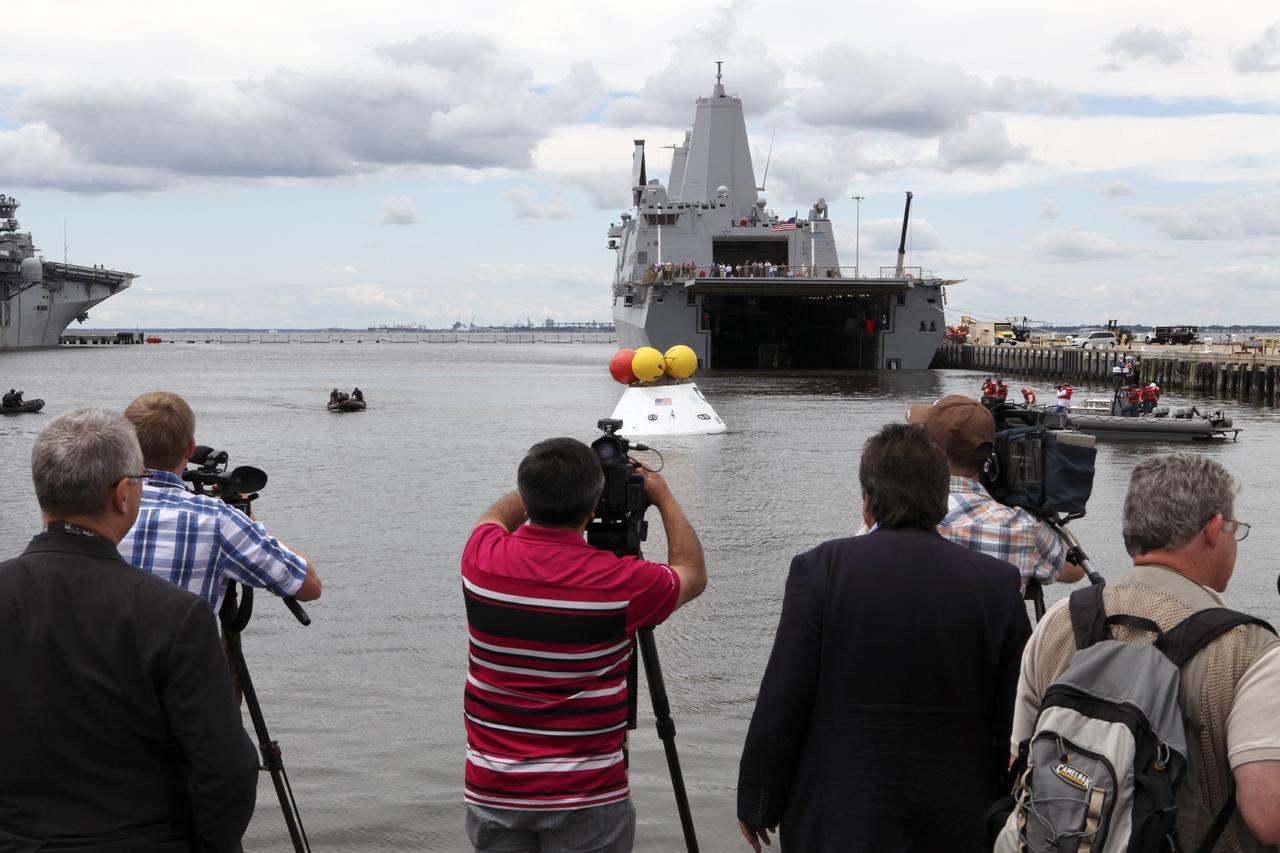
HAMPTON, Va. – At the Naval Station Norfolk near NASA’s Langley Research Center in Virginia, members of the news media observe the stationary recovery test being conducted on the Orion boilerplate test article in the water near a U.S. Navy ship. NASA and the U.S. Navy are conducting tests to prepare for recovery of the Orion crew module and forward bay cover on its return from a deep space mission. The stationary recovery test will allow the teams to demonstrate and evaluate the recovery processes, procedures, hardware and personnel in a controlled environment before conducting a second recovery test next year in open waters. Orion is the exploration spacecraft designed to carry astronauts to destinations not yet explored by humans, including an asteroid and Mars. It will have emergency abort capability, sustain the crew during space travel and provide safe re-entry from deep space return velocities. The first unpiloted test flight of the Orion is scheduled to launch in 2014 atop a Delta IV rocket and in 2017 on NASA’s Space Launch System rocket. For more information, visit http://www.nasa.gov/orion. Photo credit: NASA/Dimitri Gerondidakis
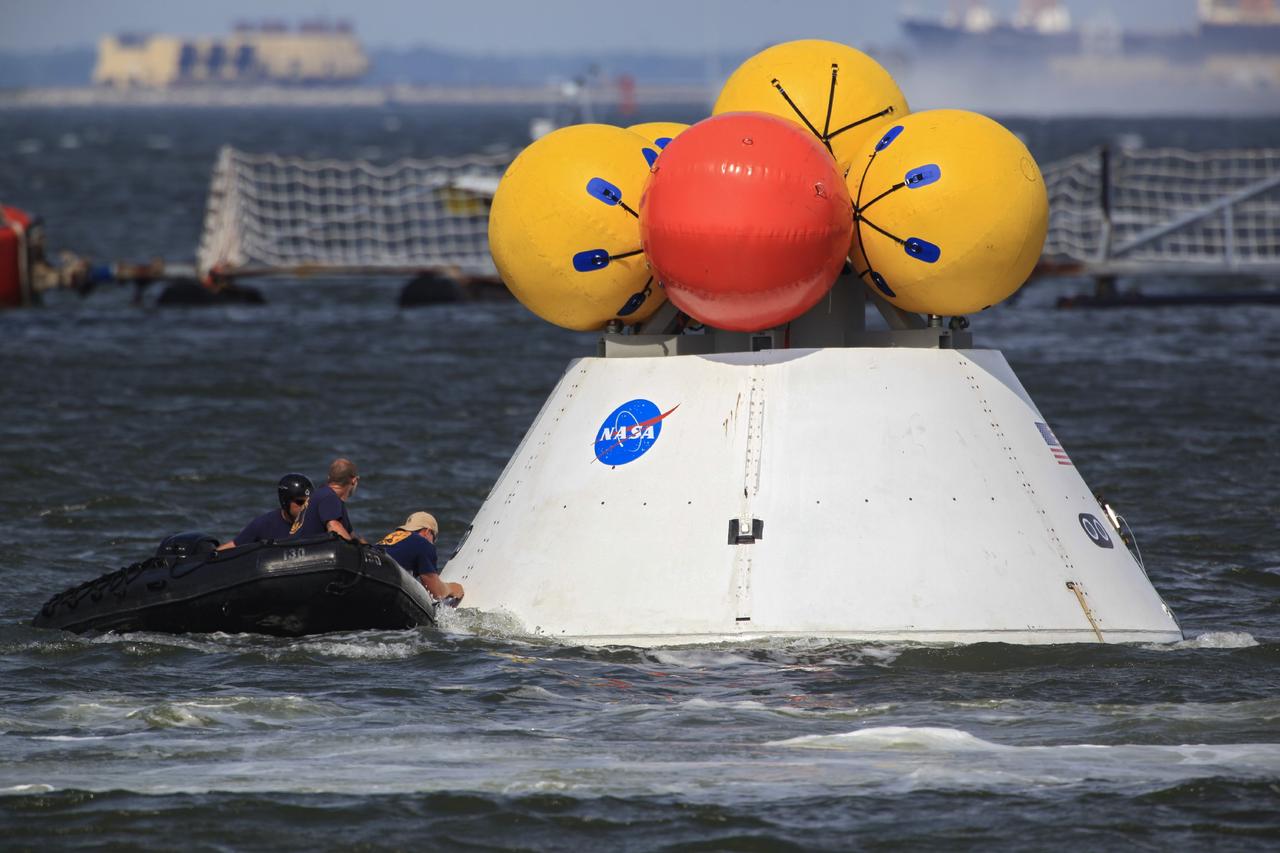
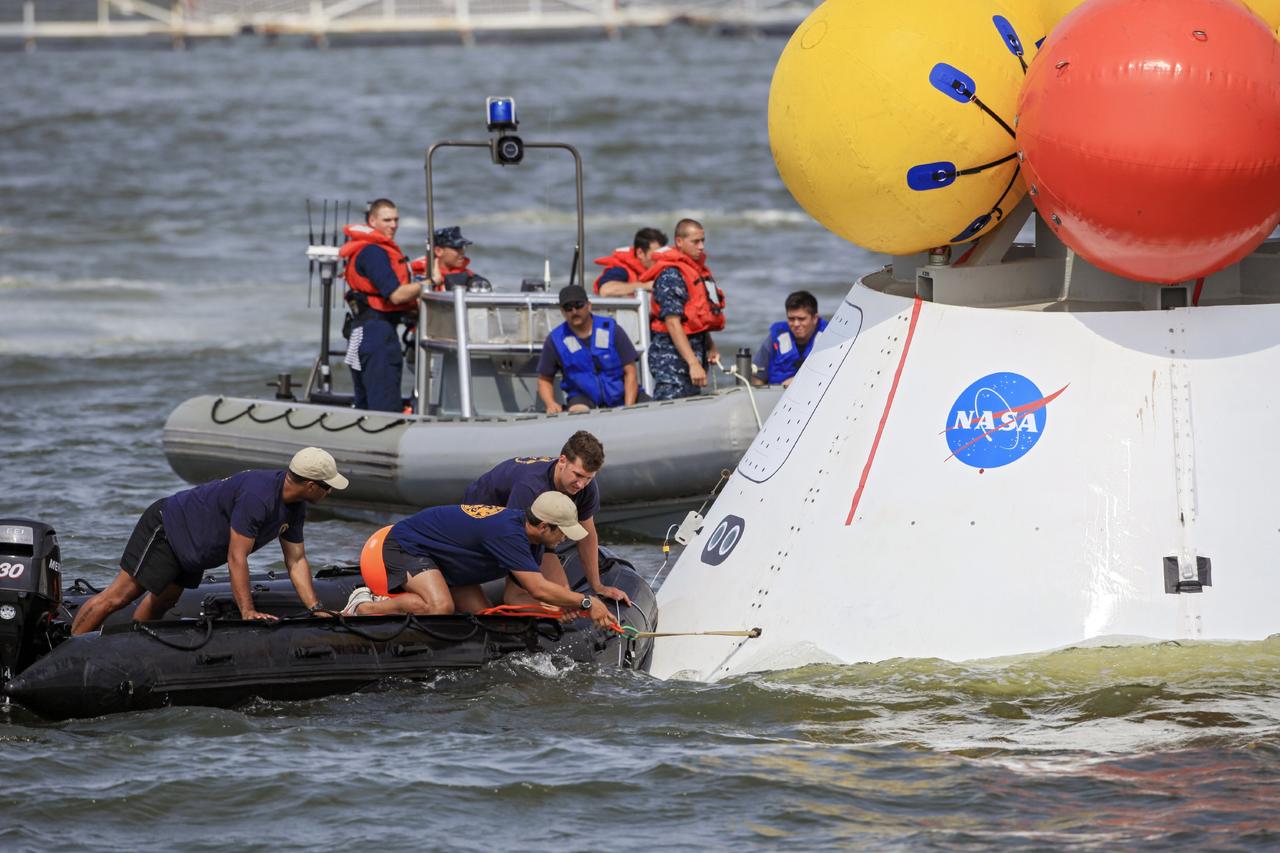
HAMPTON, Va. – At the Naval Station Norfolk near NASA’s Langley Research Center in Virginia, U.S. Navy personnel detach tether lines from the Orion boilerplate test article during a stationary recovery test in the water. NASA and the U.S. Navy are conducting tests to prepare for recovery of the Orion crew module and forward bay cover on its return from a deep space mission. The stationary recovery test will allow the teams to demonstrate and evaluate the recovery processes, procedures, hardware and personnel in a controlled environment before conducting a second recovery test next year in open waters. Orion is the exploration spacecraft designed to carry astronauts to destinations not yet explored by humans, including an asteroid and Mars. It will have emergency abort capability, sustain the crew during space travel and provide safe re-entry from deep space return velocities. The first unpiloted test flight of the Orion is scheduled to launch in 2014 atop a Delta IV rocket and in 2017 on NASA’s Space Launch System rocket. For more information, visit http://www.nasa.gov/orion. Photo credit: NASA/Dimitri Gerondidakis
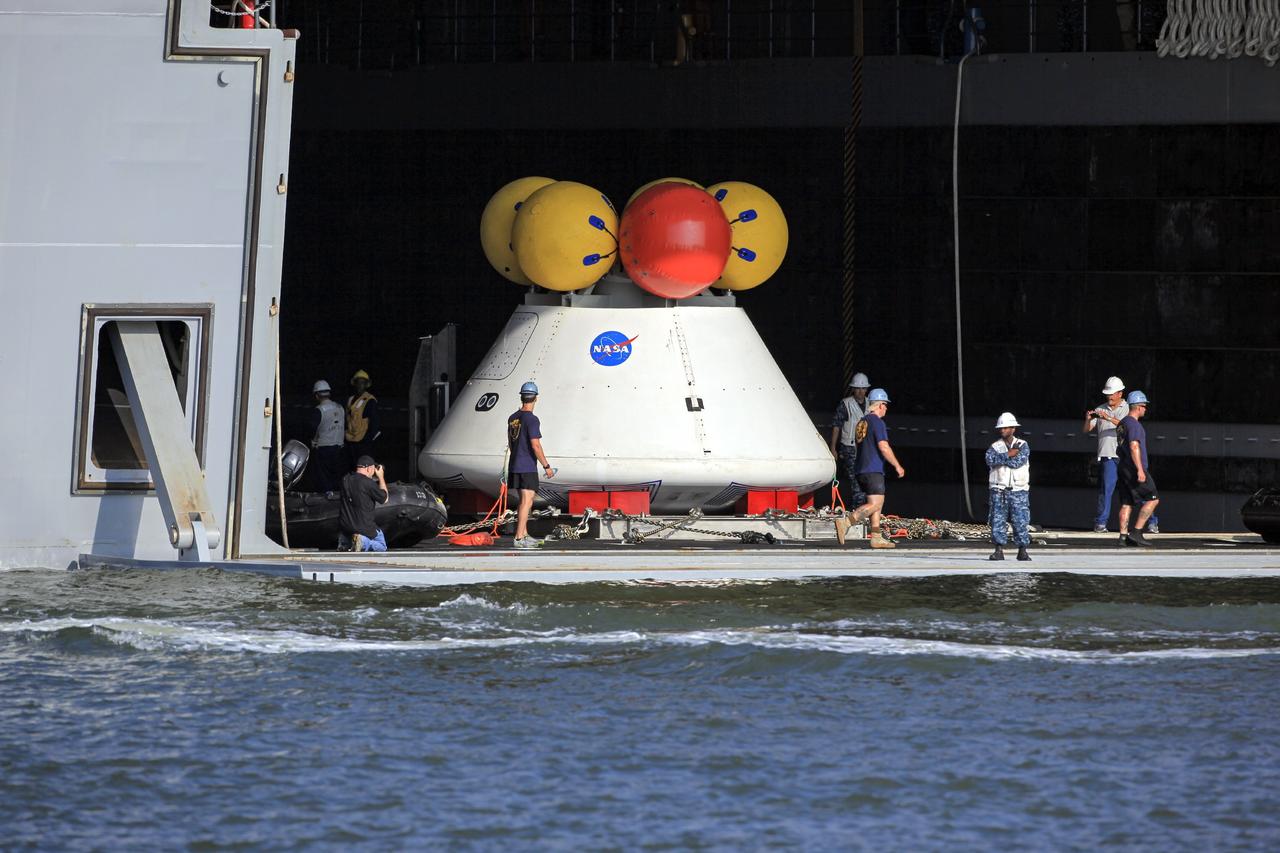
HAMPTON, Va. – At the Naval Station Norfolk near NASA’s Langley Research Center in Virginia, NASA and U.S. Navy personnel prepare the Orion boilerplate test article for a stationary recovery test aboard a U.S. Navy ship. NASA and the U.S. Navy are conducting tests to prepare for recovery of the Orion crew module and forward bay cover on its return from a deep space mission. The stationary recovery test will allow the teams to demonstrate and evaluate the recovery processes, procedures, hardware and personnel in a controlled environment before conducting a second recovery test next year in open waters. Orion is the exploration spacecraft designed to carry astronauts to destinations not yet explored by humans, including an asteroid and Mars. It will have emergency abort capability, sustain the crew during space travel and provide safe re-entry from deep space return velocities. The first unpiloted test flight of the Orion is scheduled to launch in 2014 atop a Delta IV rocket and in 2017 on NASA’s Space Launch System rocket. For more information, visit http://www.nasa.gov/orion. Photo credit: NASA/Dimitri Gerondidakis
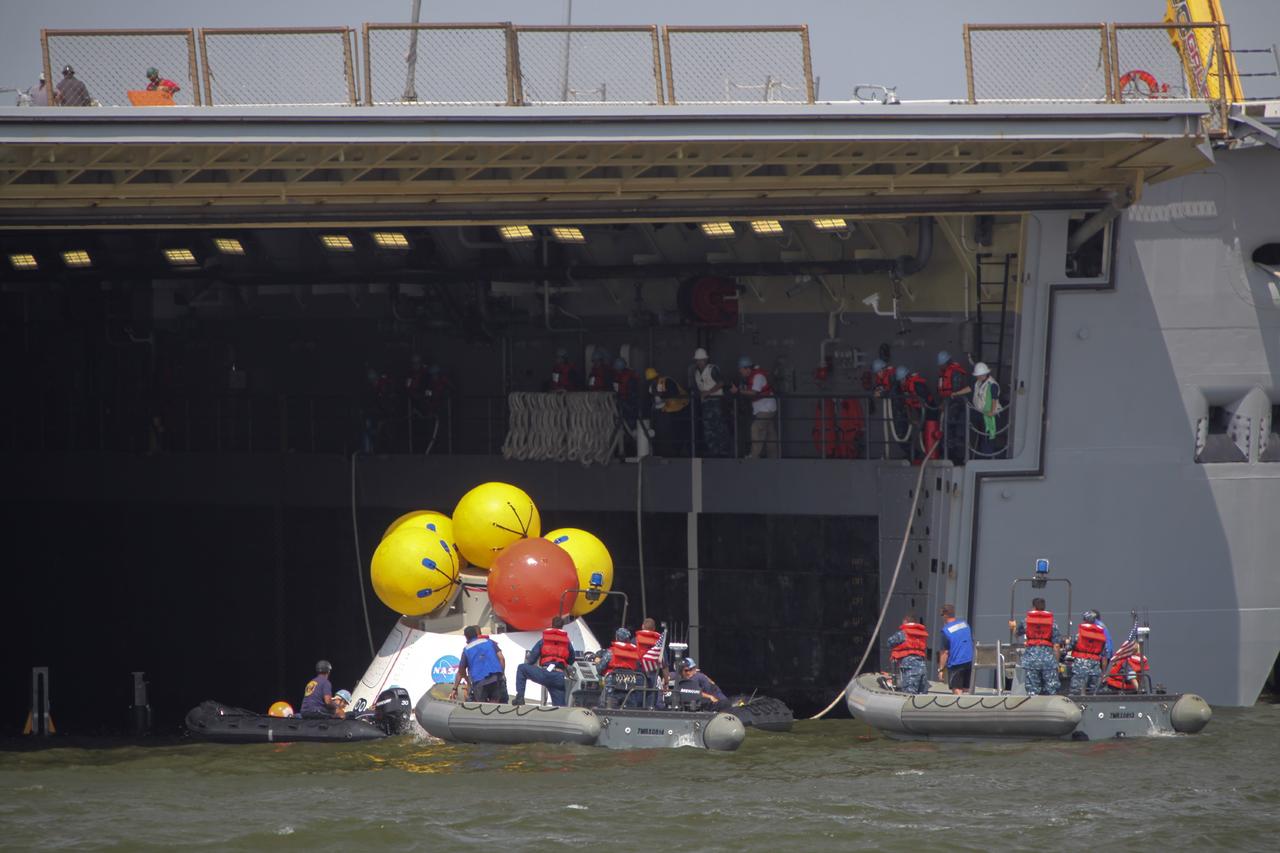
HAMPTON, Va. – At the Naval Station Norfolk near NASA’s Langley Research Center in Virginia, the Orion boilerplate test article is being returned to a U.S. Navy ship following a stationary recovery test in the water. NASA and the U.S. Navy are conducting tests to prepare for recovery of the Orion crew module and forward bay cover on its return from a deep space mission. The stationary recovery test will allow the teams to demonstrate and evaluate the recovery processes, procedures, hardware and personnel in a controlled environment before conducting a second recovery test next year in open waters. Orion is the exploration spacecraft designed to carry astronauts to destinations not yet explored by humans, including an asteroid and Mars. It will have emergency abort capability, sustain the crew during space travel and provide safe re-entry from deep space return velocities. The first unpiloted test flight of the Orion is scheduled to launch in 2014 atop a Delta IV rocket and in 2017 on NASA’s Space Launch System rocket. For more information, visit http://www.nasa.gov/orion. Photo credit: NASA/Dimitri Gerondidakis
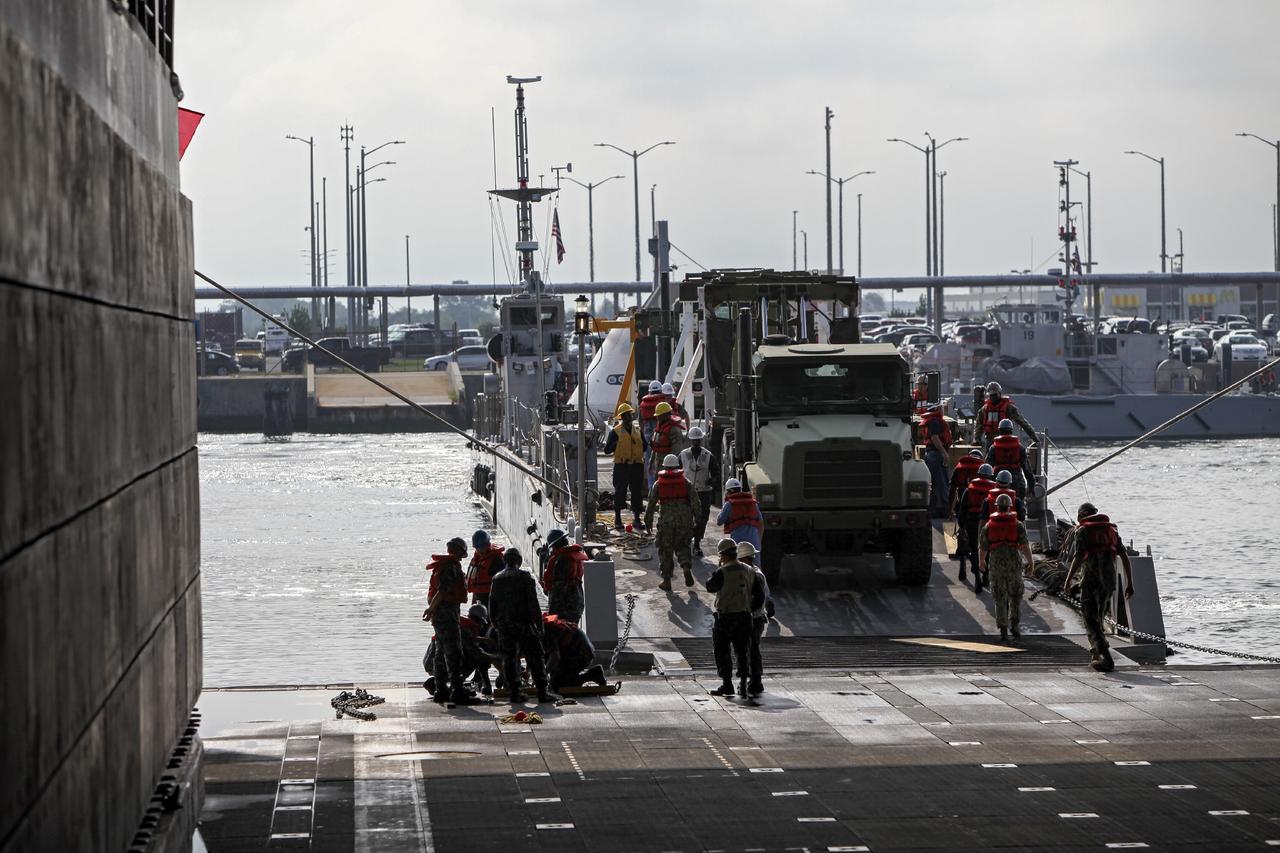
HAMPTON, Va. – At the Naval Station Norfolk near NASA’s Langley Research Center in Virginia, the Orion boilerplate test article and support equipment for a stationary recovery test are being transferred from a floating dock system to a U.S. Navy ship. NASA and the U.S. Navy are conducting tests to prepare for recovery of the Orion crew module and forward bay cover on its return from a deep space mission. The stationary recovery test will allow the teams to demonstrate and evaluate the recovery processes, procedures, hardware and personnel in a controlled environment before conducting a second recovery test next year in open waters. Orion is the exploration spacecraft designed to carry astronauts to destinations not yet explored by humans, including an asteroid and Mars. It will have emergency abort capability, sustain the crew during space travel and provide safe re-entry from deep space return velocities. The first unpiloted test flight of the Orion is scheduled to launch in 2014 atop a Delta IV rocket and in 2017 on a Space Launch System rocket. For more information, visit http://www.nasa.gov/orion. Photo credit: NASA/Dimitri Gerondidakis
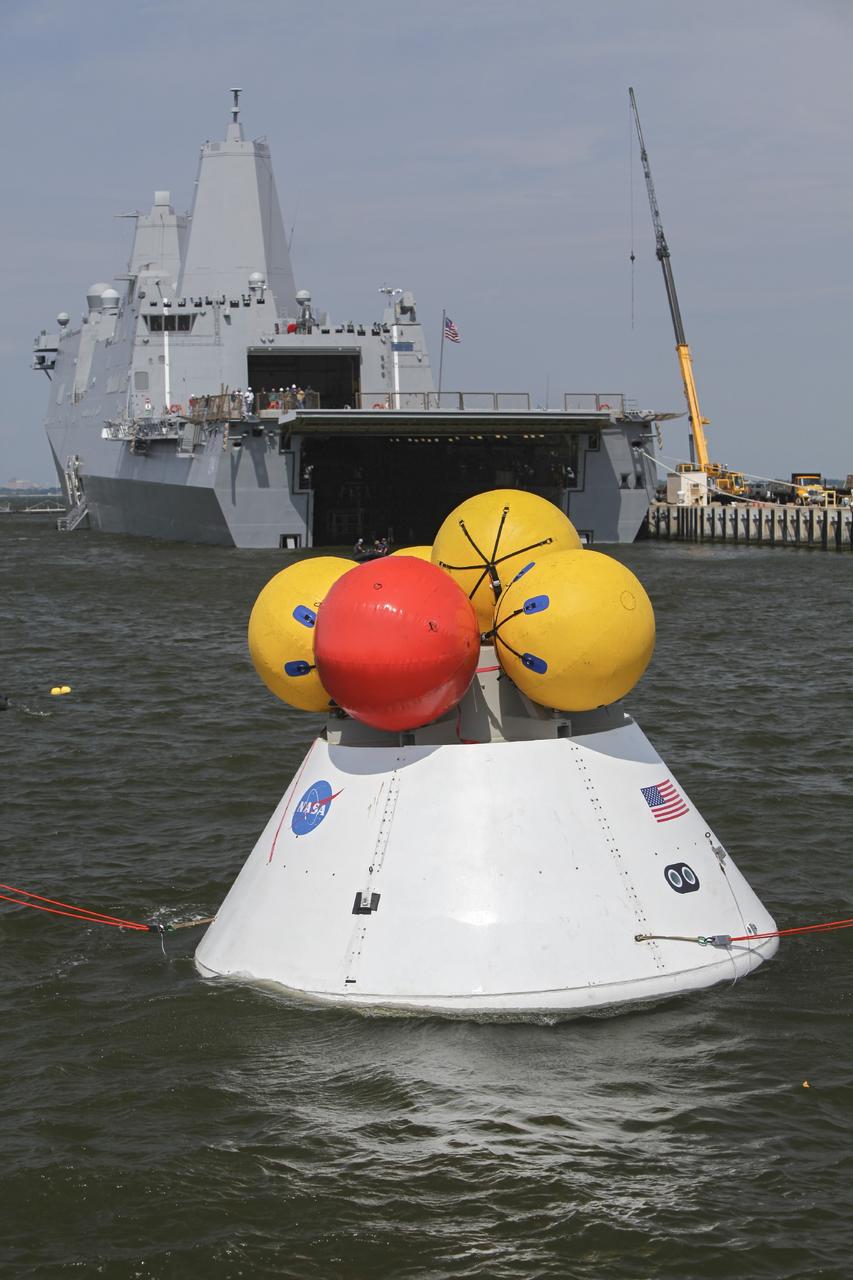
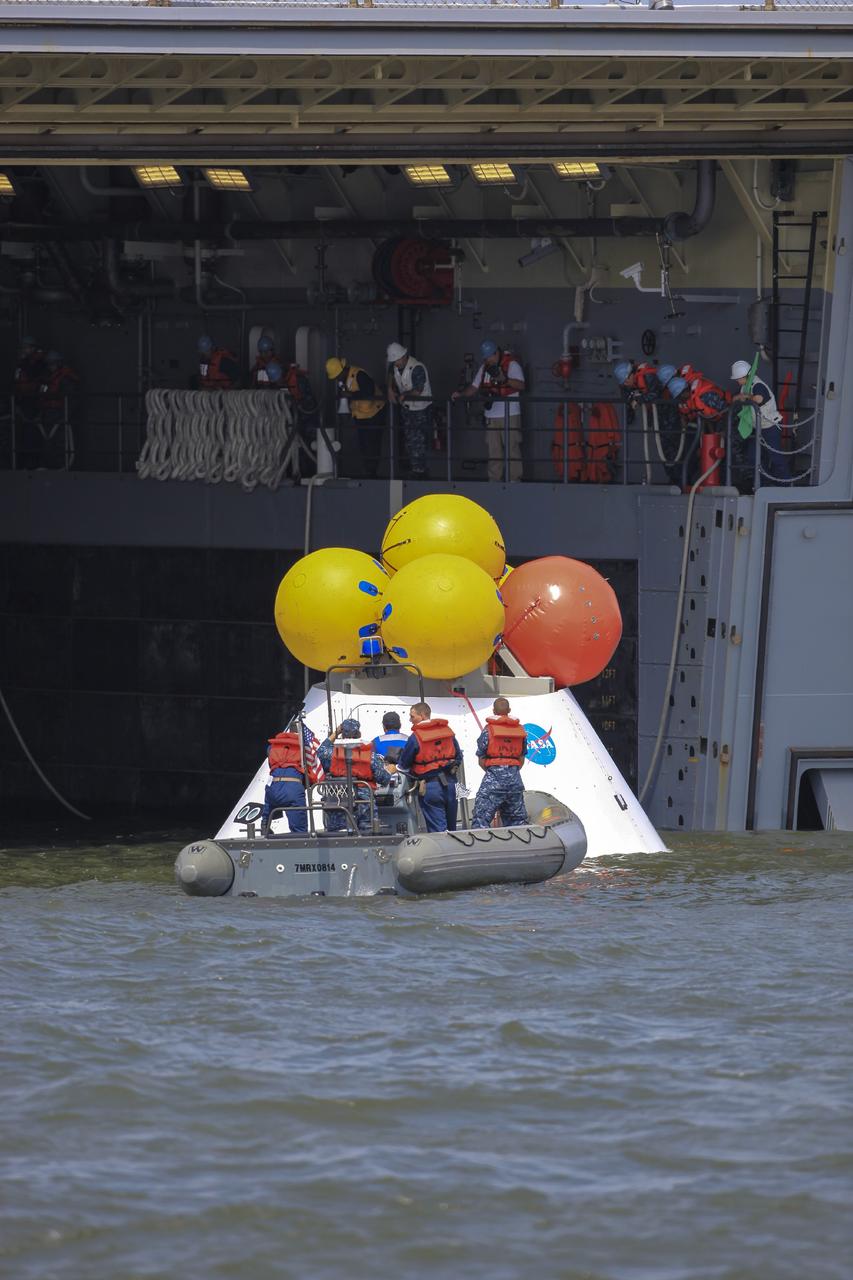
HAMPTON, Va. – At the Naval Station Norfolk near NASA’s Langley Research Center in Virginia, the Orion boilerplate test article floats in the water near a U.S. Navy ship during a stationary recovery test. NASA and the U.S. Navy are conducting tests to prepare for recovery of the Orion crew module and forward bay cover on its return from a deep space mission. The stationary recovery test will allow the teams to demonstrate and evaluate the recovery processes, procedures, hardware and personnel in a controlled environment before conducting a second recovery test next year in open waters. Orion is the exploration spacecraft designed to carry astronauts to destinations not yet explored by humans, including an asteroid and Mars. It will have emergency abort capability, sustain the crew during space travel and provide safe re-entry from deep space return velocities. The first unpiloted test flight of the Orion is scheduled to launch in 2014 atop a Delta IV rocket and in 2017 on NASA’s Space Launch System rocket. For more information, visit http://www.nasa.gov/orion. Photo credit: NASA/Dimitri Gerondidakis
HAMPTON, Va. – At the Naval Station Norfolk near NASA’s Langley Research Center in Virginia, the Orion boilerplate test article and support equipment for a stationary recovery test are being transferred from a floating dock system to a U.S. Navy ship. NASA and the U.S. Navy are conducting tests to prepare for recovery of the Orion crew module and forward bay cover on its return from a deep space mission. The stationary recovery test will allow the teams to demonstrate and evaluate the recovery processes, procedures, hardware and personnel in a controlled environment before conducting a second recovery test next year in open waters. Orion is the exploration spacecraft designed to carry astronauts to destinations not yet explored by humans, including an asteroid and Mars. It will have emergency abort capability, sustain the crew during space travel and provide safe re-entry from deep space return velocities. The first unpiloted test flight of the Orion is scheduled to launch in 2014 atop a Delta IV rocket and in 2017 on a Space Launch System rocket. For more information, visit http://www.nasa.gov/orion. Photo credit: NASA/Dimitri Gerondidakis
HAMPTON, Va. – At the Naval Station Norfolk near NASA’s Langley Research Center in Virginia, NASA and U.S. Navy personnel practice procedures during a stationary recovery test on the Orion boilerplate test article. NASA and the U.S. Navy are conducting tests to prepare for recovery of the Orion crew module and forward bay cover on its return from a deep space mission. The stationary recovery test will allow the teams to demonstrate and evaluate the recovery processes, procedures, hardware and personnel in a controlled environment before conducting a second recovery test next year in open waters. Orion is the exploration spacecraft designed to carry astronauts to destinations not yet explored by humans, including an asteroid and Mars. It will have emergency abort capability, sustain the crew during space travel and provide safe re-entry from deep space return velocities. The first unpiloted test flight of the Orion is scheduled to launch in 2014 atop a Delta IV rocket and in 2017 on NASA’s Space Launch System rocket. For more information, visit http://www.nasa.gov/orion. Photo credit: NASA/Dimitri Gerondidakis
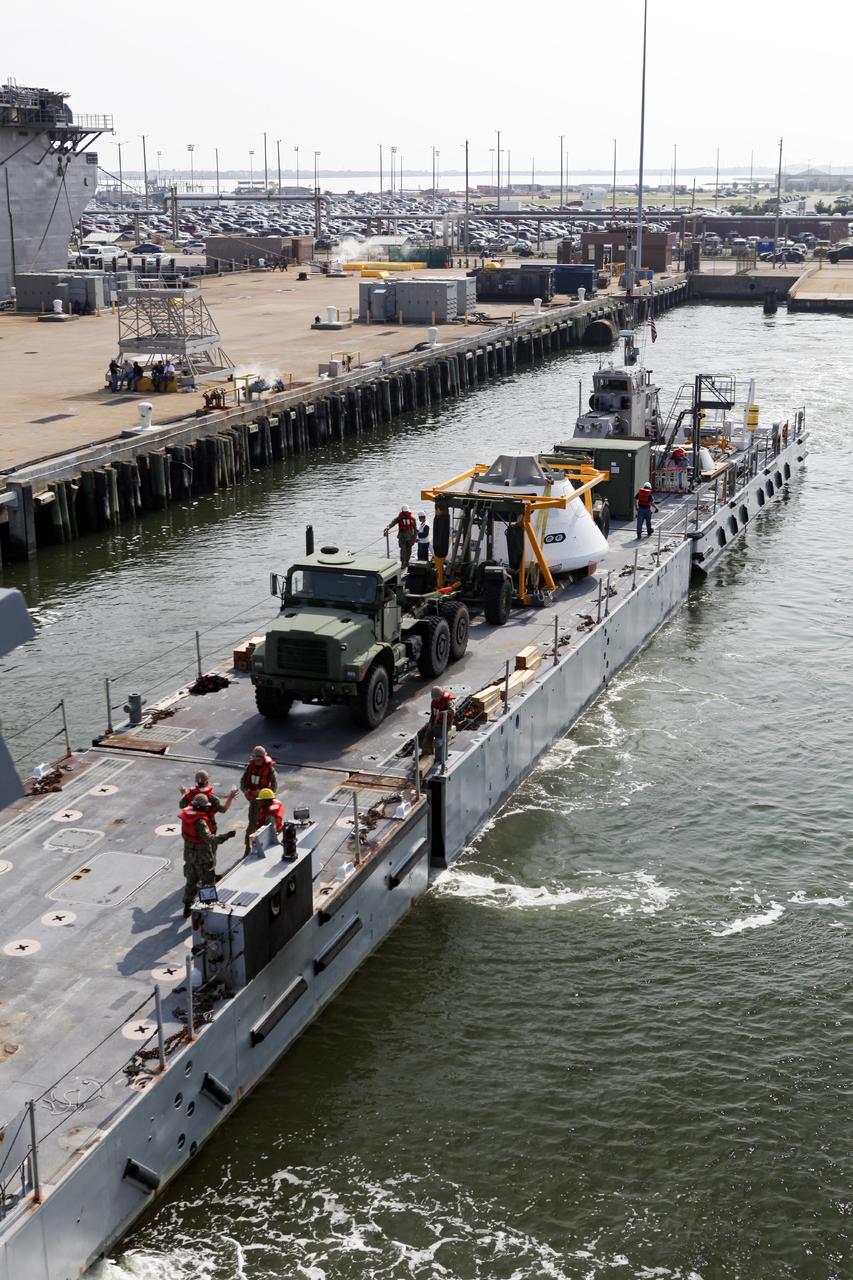
HAMPTON, Va. – At the Naval Station Norfolk near NASA’s Langley Research Center in Virginia, a floating dock system carries the Orion boilerplate test article and support equipment for a stationary recovery test aboard a U.S. Navy ship. NASA and the U.S. Navy are conducting tests to prepare for recovery of the Orion crew module and forward bay cover on its return from a deep space mission. The stationary recovery test will allow the teams to demonstrate and evaluate the recovery processes, procedures, hardware and personnel in a controlled environment before conducting a second recovery test next year in open waters. Orion is the exploration spacecraft designed to carry astronauts to destinations not yet explored by humans, including an asteroid and Mars. It will have emergency abort capability, sustain the crew during space travel and provide safe re-entry from deep space return velocities. The first unpiloted test flight of the Orion is scheduled to launch in 2014 atop a Delta IV rocket and in 2017 on NASA’s Space Launch System rocket. For more information, visit http://www.nasa.gov/orion. Photo credit: NASA/Dimitri Gerondidakis
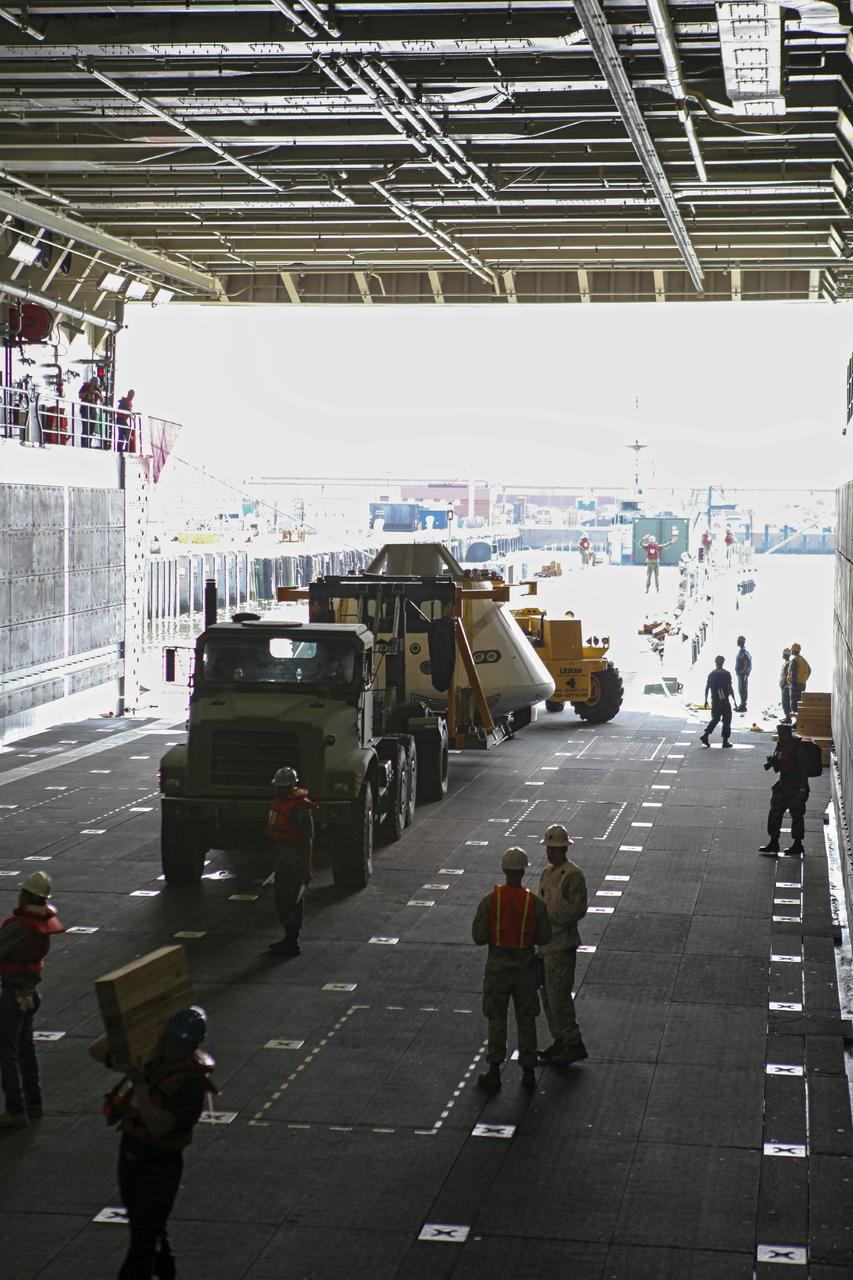
HAMPTON, Va. – At the Naval Station Norfolk near NASA’s Langley Research Center in Virginia, the Orion boilerplate test article and support equipment for a stationary recovery test are transferred to a U.S. Navy ship from a floating dock system. NASA and the U.S. Navy are conducting tests to prepare for recovery of the Orion crew module and forward bay cover on its return from a deep space mission. The stationary recovery test will allow the teams to demonstrate and evaluate the recovery processes, procedures, hardware and personnel in a controlled environment before conducting a second recovery test next year in open waters. Orion is the exploration spacecraft designed to carry astronauts to destinations not yet explored by humans, including an asteroid and Mars. It will have emergency abort capability, sustain the crew during space travel and provide safe re-entry from deep space return velocities. The first unpiloted test flight of the Orion is scheduled to launch in 2014 atop a Delta IV rocket and in 2017 on NASA’s Space Launch System rocket. For more information, visit http://www.nasa.gov/orion. Photo credit: NASA/Dimitri Gerondidakis
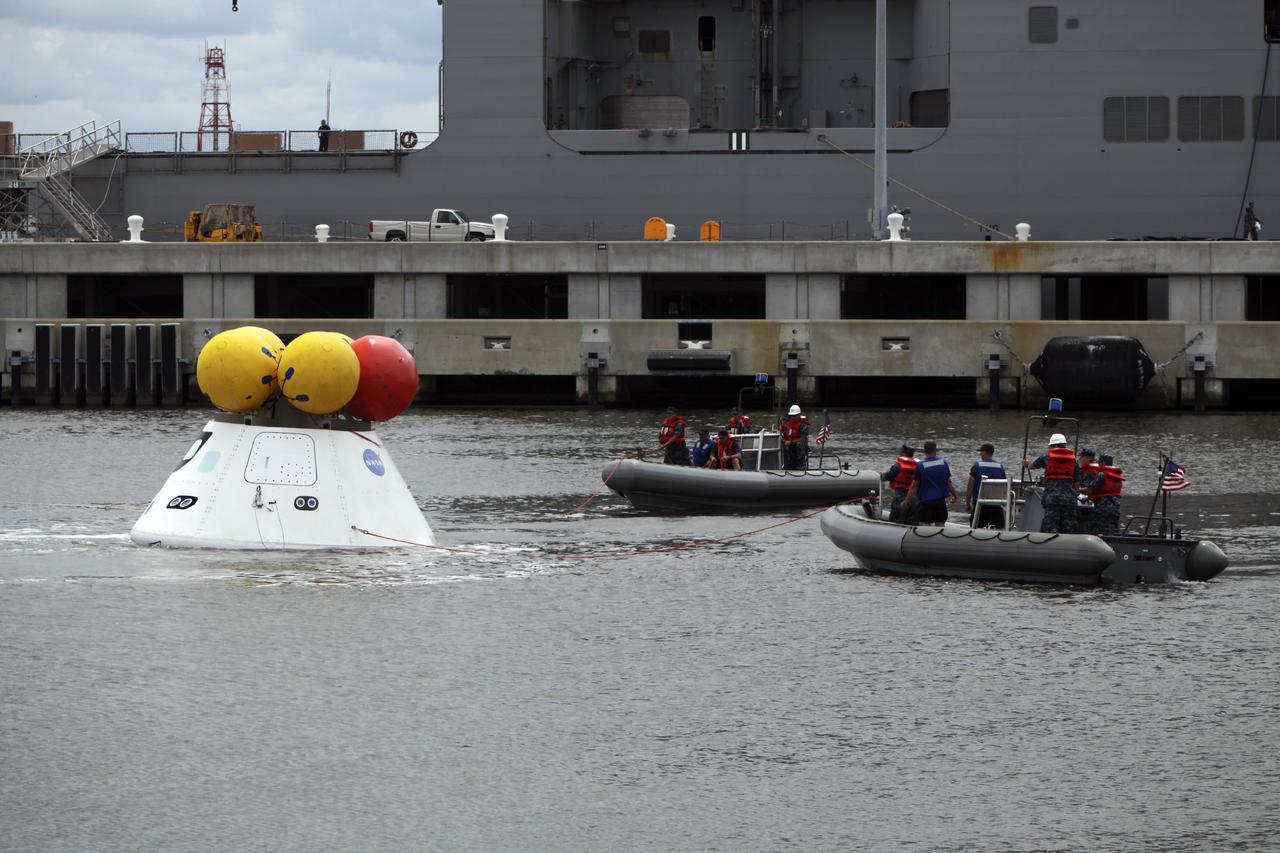
HAMPTON, Va. – At the Naval Station Norfolk near NASA’s Langley Research Center in Virginia, NASA and the U.S. Navy are conducting a stationary recovery test on the Orion boilerplate test article in the water near a U.S. Navy ship. NASA and the U.S. Navy are conducting tests to prepare for recovery of the Orion crew module and forward bay cover on its return from a deep space mission. The stationary recovery test will allow the teams to demonstrate and evaluate the recovery processes, procedures, hardware and personnel in a controlled environment before conducting a second recovery test next year in open waters. Orion is the exploration spacecraft designed to carry astronauts to destinations not yet explored by humans, including an asteroid and Mars. It will have emergency abort capability, sustain the crew during space travel and provide safe re-entry from deep space return velocities. The first unpiloted test flight of the Orion is scheduled to launch in 2014 atop a Delta IV rocket and in 2017 on NASA’s Space Launch System rocket. For more information, visit http://www.nasa.gov/orion. Photo credit: NASA/Dimitri Gerondidakis
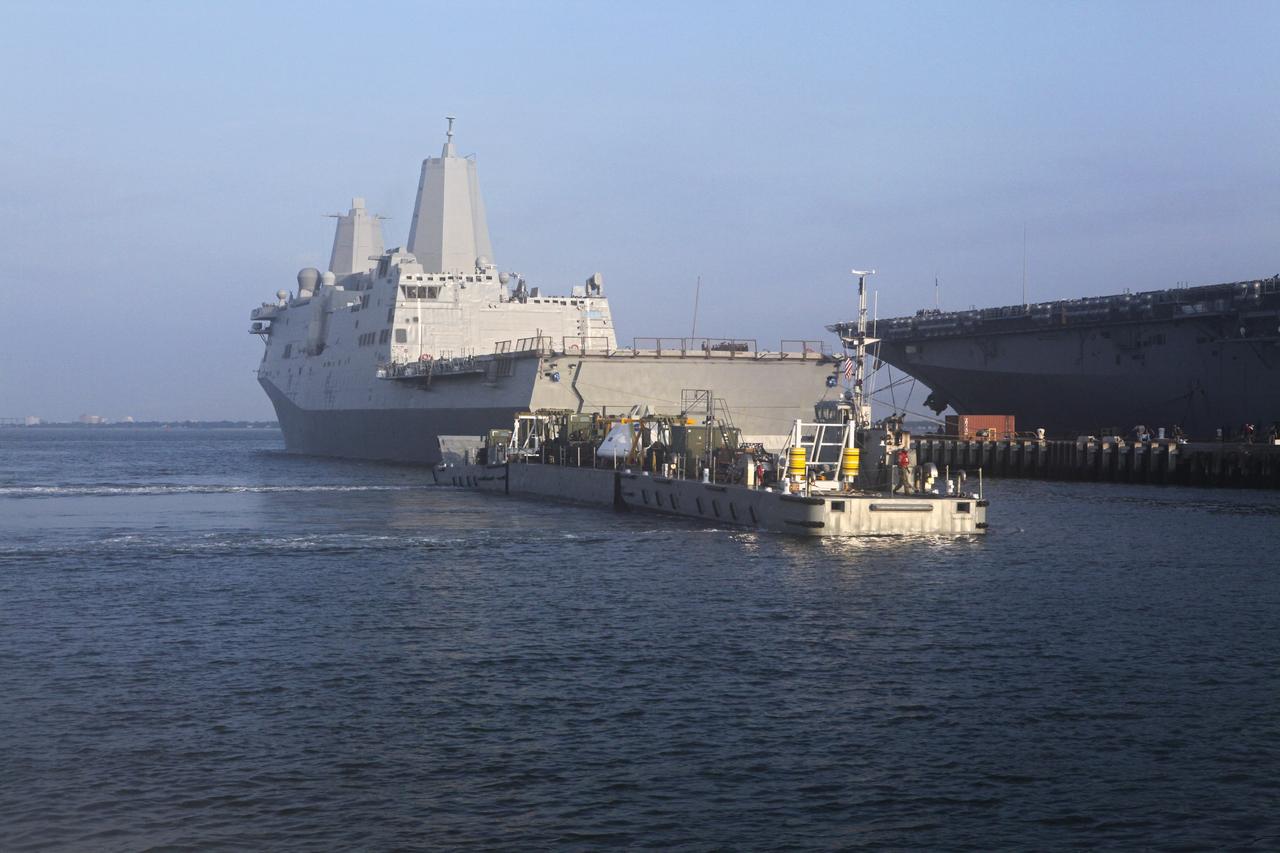
HAMPTON, Va. – At the Naval Station Norfolk near NASA’s Langley Research Center in Virginia, a floating dock system carries the Orion boilerplate test article and support equipment for a stationary recovery test aboard a U.S. Navy ship. NASA and the U.S. Navy are conducting tests to prepare for recovery of the Orion crew module and forward bay cover on its return from a deep space mission. The stationary recovery test will allow the teams to demonstrate and evaluate the recovery processes, procedures, hardware and personnel in a controlled environment before conducting a second recovery test next year in open waters. Orion is the exploration spacecraft designed to carry astronauts to destinations not yet explored by humans, including an asteroid and Mars. It will have emergency abort capability, sustain the crew during space travel and provide safe re-entry from deep space return velocities. The first unpiloted test flight of the Orion is scheduled to launch in 2014 atop a Delta IV rocket and in 2017 on a Space Launch System rocket. For more information, visit http://www.nasa.gov/orion. Photo credit: NASA/Dimitri Gerondidakis
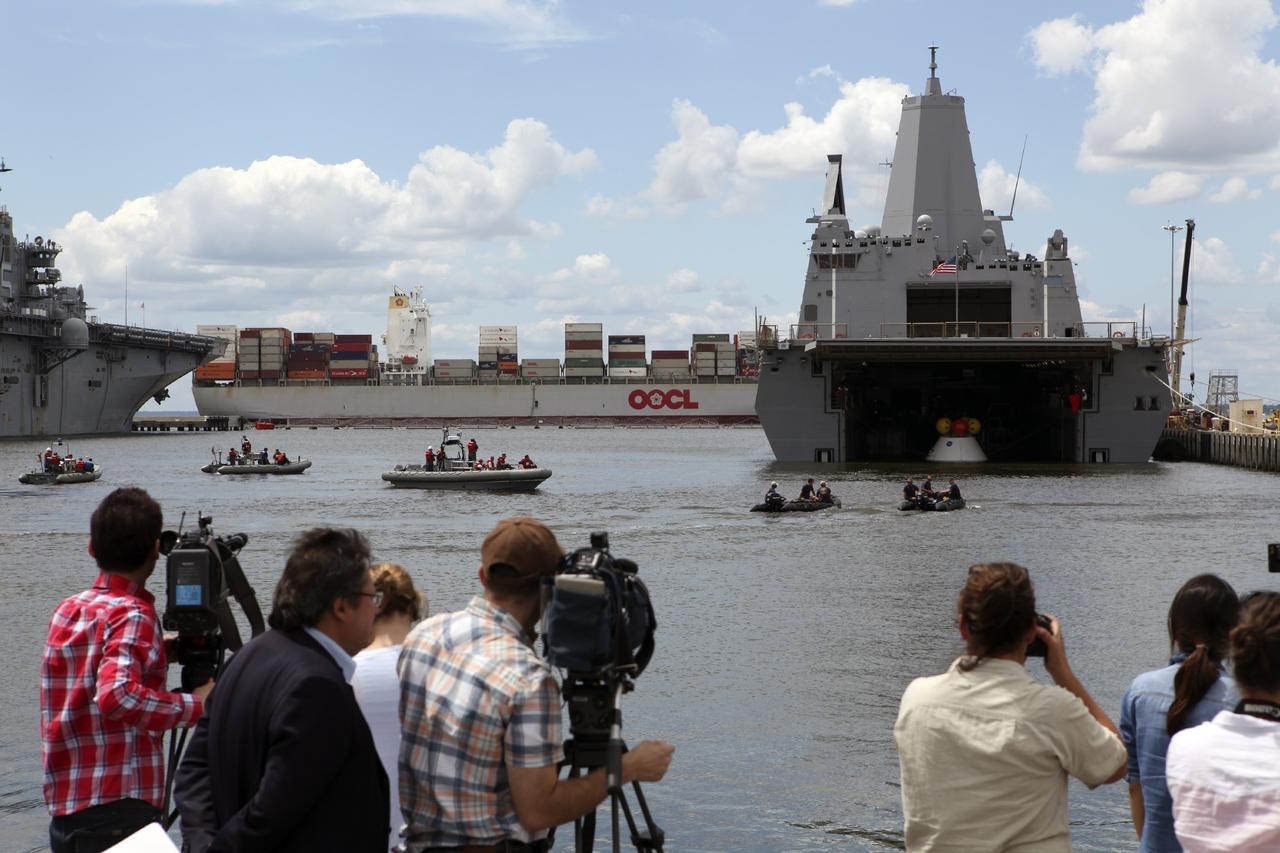
HAMPTON, Va. – At the Naval Station Norfolk near NASA’s Langley Research Center in Virginia, members of the news media observe the stationary recovery test being conducted on the Orion boilerplate test article in the water near a U.S. Navy ship. NASA and the U.S. Navy are conducting tests to prepare for recovery of the Orion crew module and forward bay cover on its return from a deep space mission. The stationary recovery test will allow the teams to demonstrate and evaluate the recovery processes, procedures, hardware and personnel in a controlled environment before conducting a second recovery test next year in open waters. Orion is the exploration spacecraft designed to carry astronauts to destinations not yet explored by humans, including an asteroid and Mars. It will have emergency abort capability, sustain the crew during space travel and provide safe re-entry from deep space return velocities. The first unpiloted test flight of the Orion is scheduled to launch in 2014 atop a Delta IV rocket and in 2017 on NASA’s Space Launch System rocket. For more information, visit http://www.nasa.gov/orion. Photo credit: NASA/Dimitri Gerondidakis

HAMPTON, Va. – At the Naval Station Norfolk near NASA’s Langley Research Center in Virginia, the Orion boilerplate test article is being prepared for a stationary recovery test aboard a U.S. Navy ship. NASA and the U.S. Navy are conducting tests to prepare for recovery of the Orion crew module and forward bay cover on its return from a deep space mission. The stationary recovery test will allow the teams to demonstrate and evaluate the recovery processes, procedures, hardware and personnel in a controlled environment before conducting a second recovery test next year in open waters. Orion is the exploration spacecraft designed to carry astronauts to destinations not yet explored by humans, including an asteroid and Mars. It will have emergency abort capability, sustain the crew during space travel and provide safe re-entry from deep space return velocities. The first unpiloted test flight of the Orion is scheduled to launch in 2014 atop a Delta IV rocket and in 2017 on NASA’s Space Launch System rocket. For more information, visit http://www.nasa.gov/orion. Photo credit: NASA/Dimitri Gerondidakis
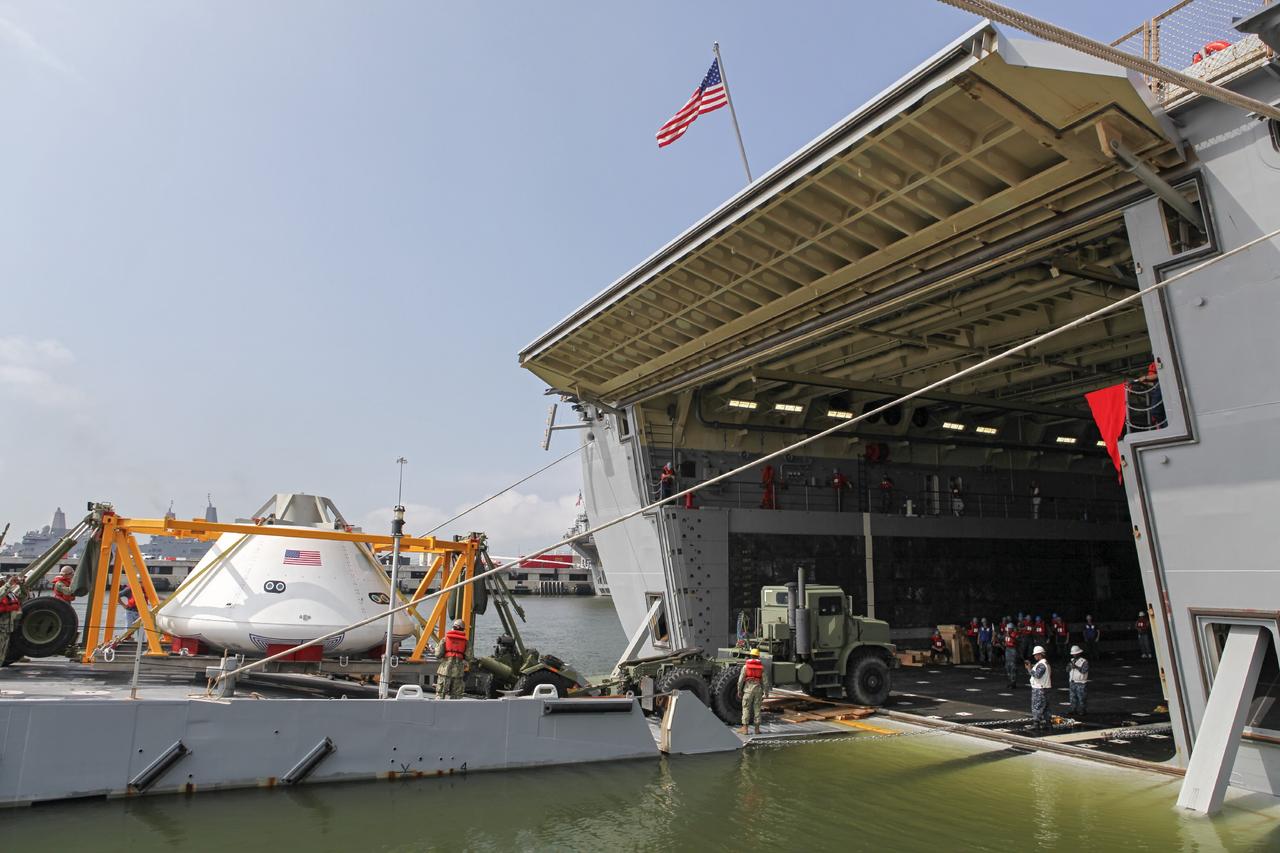
HAMPTON, Va. – At the Naval Station Norfolk near NASA’s Langley Research Center in Virginia, the Orion boilerplate test article and support equipment for a stationary recovery test are transferred by floating dock system to a U.S. Navy ship. NASA and the U.S. Navy are conducting tests to prepare for recovery of the Orion crew module and forward bay cover on its return from a deep space mission. The stationary recovery test will allow the teams to demonstrate and evaluate the recovery processes, procedures, hardware and personnel in a controlled environment before conducting a second recovery test next year in open waters. Orion is the exploration spacecraft designed to carry astronauts to destinations not yet explored by humans, including an asteroid and Mars. It will have emergency abort capability, sustain the crew during space travel and provide safe re-entry from deep space return velocities. The first unpiloted test flight of the Orion is scheduled to launch in 2014 atop a Delta IV rocket and in 2017 on NASA’s Space Launch System rocket. For more information, visit http://www.nasa.gov/orion. Photo credit: NASA/Dimitri Gerondidakis
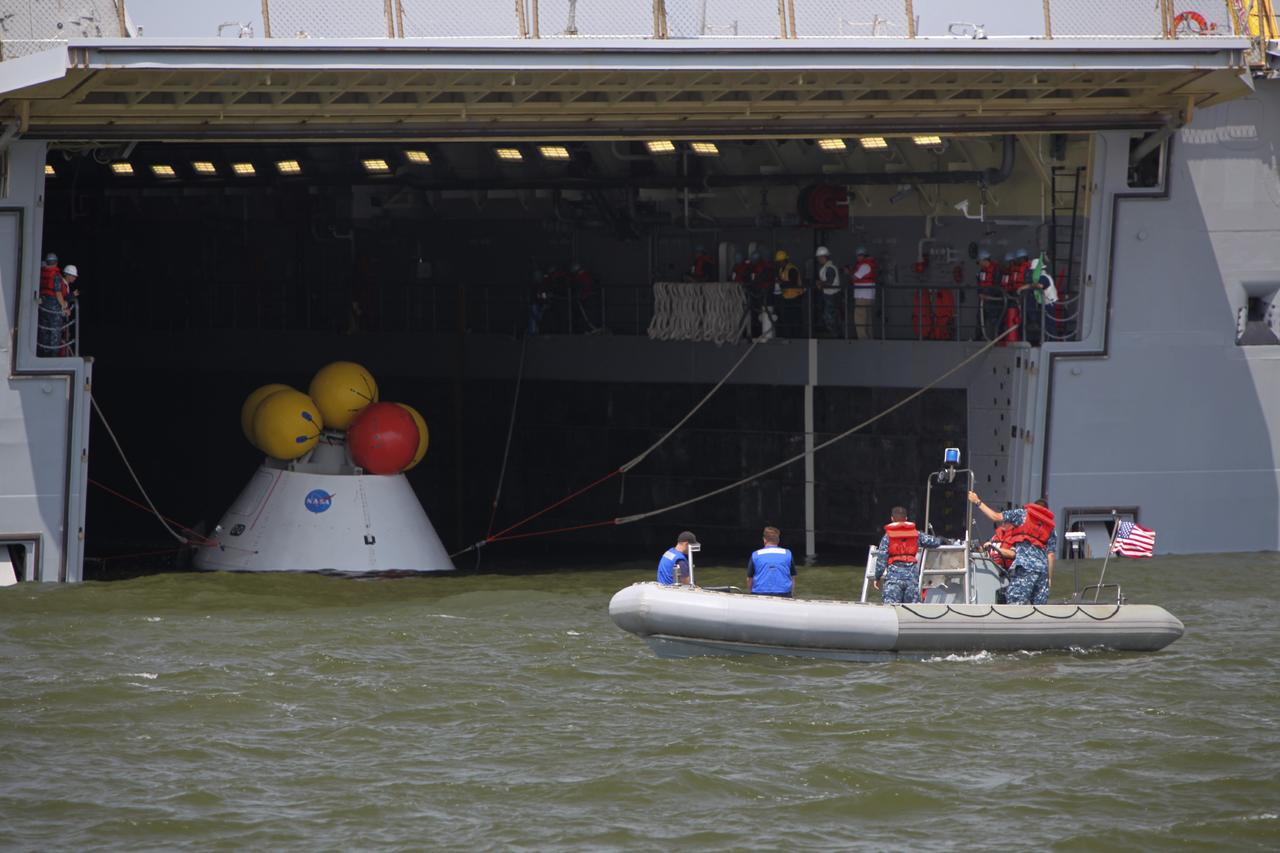
HAMPTON, Va. – At the Naval Station Norfolk near NASA’s Langley Research Center in Virginia, the Orion boilerplate test article has been returned to a U.S. Navy ship following a stationary recovery test in the water. NASA and the U.S. Navy are conducting tests to prepare for recovery of the Orion crew module and forward bay cover on its return from a deep space mission. The stationary recovery test will allow the teams to demonstrate and evaluate the recovery processes, procedures, hardware and personnel in a controlled environment before conducting a second recovery test next year in open waters. Orion is the exploration spacecraft designed to carry astronauts to destinations not yet explored by humans, including an asteroid and Mars. It will have emergency abort capability, sustain the crew during space travel and provide safe re-entry from deep space return velocities. The first unpiloted test flight of the Orion is scheduled to launch in 2014 atop a Delta IV rocket and in 2017 on NASA’s Space Launch System rocket. For more information, visit http://www.nasa.gov/orion. Photo credit: NASA/Dimitri Gerondidakis
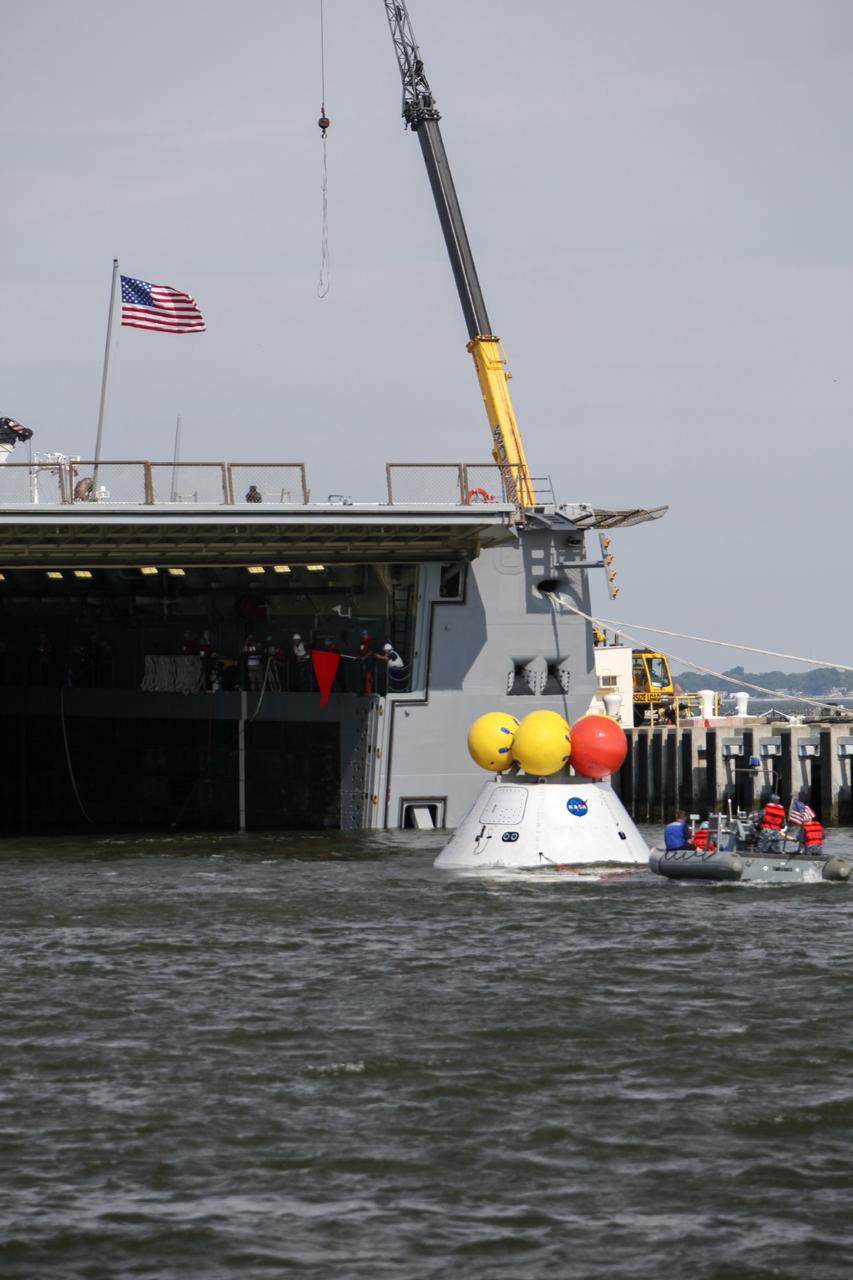
HAMPTON, Va. – At the Naval Station Norfolk near NASA’s Langley Research Center in Virginia, the Orion boilerplate test article has been moved from a U.S. Navy ship and placed in the water for a stationary recovery test. NASA and the U.S. Navy are conducting tests to prepare for recovery of the Orion crew module and forward bay cover on its return from a deep space mission. The stationary recovery test will allow the teams to demonstrate and evaluate the recovery processes, procedures, hardware and personnel in a controlled environment before conducting a second recovery test next year in open waters. Orion is the exploration spacecraft designed to carry astronauts to destinations not yet explored by humans, including an asteroid and Mars. It will have emergency abort capability, sustain the crew during space travel and provide safe re-entry from deep space return velocities. The first unpiloted test flight of the Orion is scheduled to launch in 2014 atop a Delta IV rocket and in 2017 on NASA’s Space Launch System rocket. For more information, visit http://www.nasa.gov/orion. Photo credit: NASA/Dimitri Gerondidakis
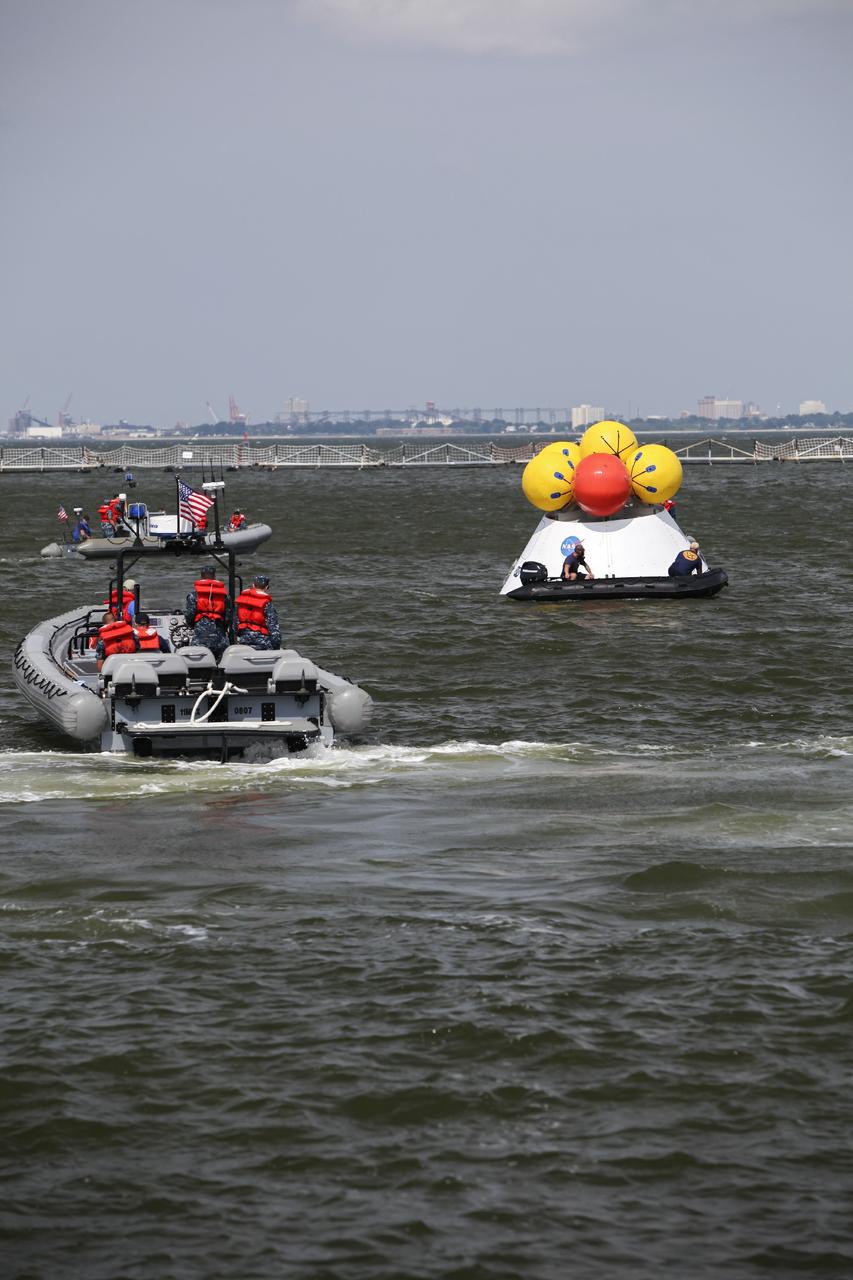
HAMPTON, Va. – At the Naval Station Norfolk near NASA’s Langley Research Center in Virginia, NASA and U.S. Navy personnel monitor the progress as the Orion boilerplate test article floats in the water during a stationary recovery test. NASA and the U.S. Navy are conducting tests to prepare for recovery of the Orion crew module and forward bay cover on its return from a deep space mission. The stationary recovery test will allow the teams to demonstrate and evaluate the recovery processes, procedures, hardware and personnel in a controlled environment before conducting a second recovery test next year in open waters. Orion is the exploration spacecraft designed to carry astronauts to destinations not yet explored by humans, including an asteroid and Mars. It will have emergency abort capability, sustain the crew during space travel and provide safe re-entry from deep space return velocities. The first unpiloted test flight of the Orion is scheduled to launch in 2014 atop a Delta IV rocket and in 2017 on NASA’s Space Launch System rocket. For more information, visit http://www.nasa.gov/orion. Photo credit: NASA/Dimitri Gerondidakis
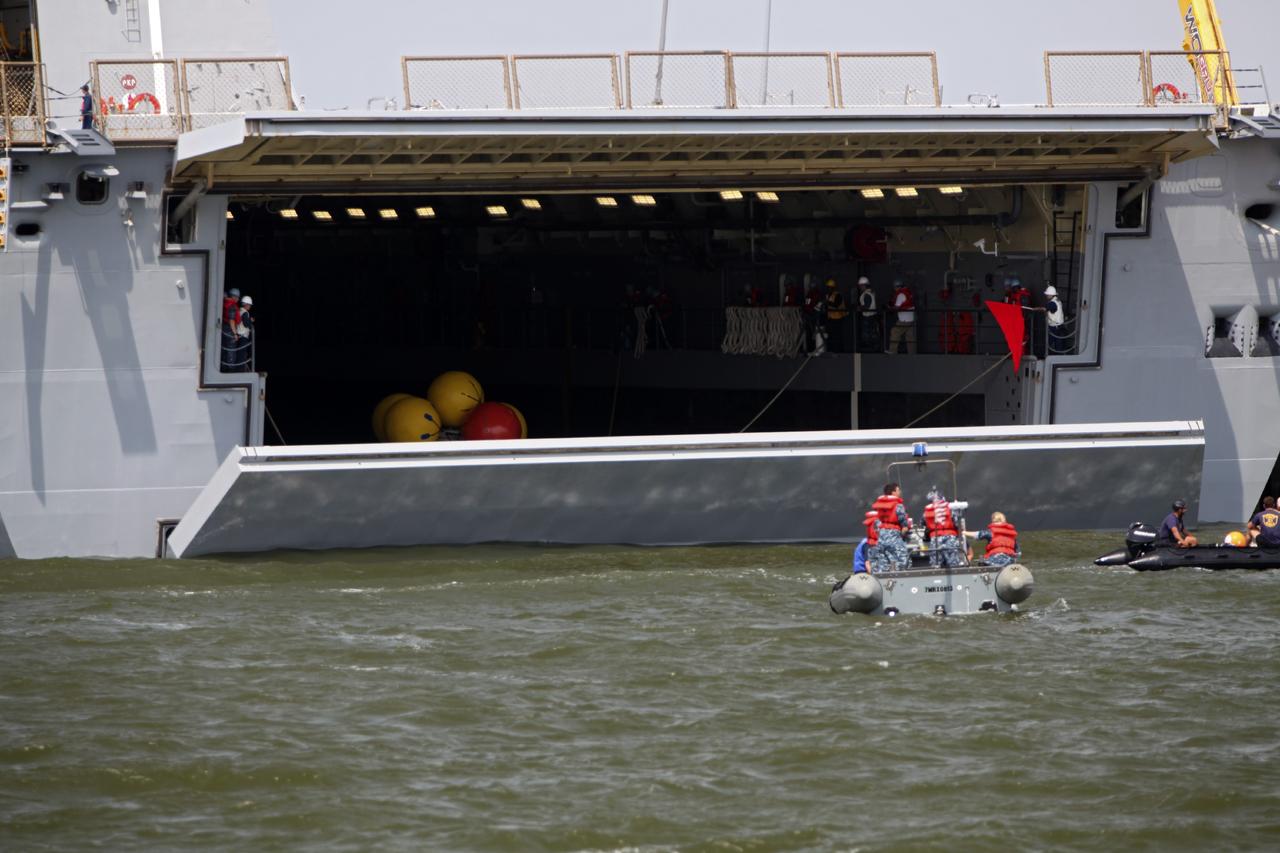
HAMPTON, Va. – At the Naval Station Norfolk near NASA’s Langley Research Center in Virginia, the Orion boilerplate test article has been returned to a U.S. Navy ship following a stationary recovery test in the water. NASA and the U.S. Navy are conducting tests to prepare for recovery of the Orion crew module and forward bay cover on its return from a deep space mission. The stationary recovery test will allow the teams to demonstrate and evaluate the recovery processes, procedures, hardware and personnel in a controlled environment before conducting a second recovery test next year in open waters. Orion is the exploration spacecraft designed to carry astronauts to destinations not yet explored by humans, including an asteroid and Mars. It will have emergency abort capability, sustain the crew during space travel and provide safe re-entry from deep space return velocities. The first unpiloted test flight of the Orion is scheduled to launch in 2014 atop a Delta IV rocket and in 2017 on NASA’s Space Launch System rocket. For more information, visit http://www.nasa.gov/orion. Photo credit: NASA/Dimitri Gerondidakis
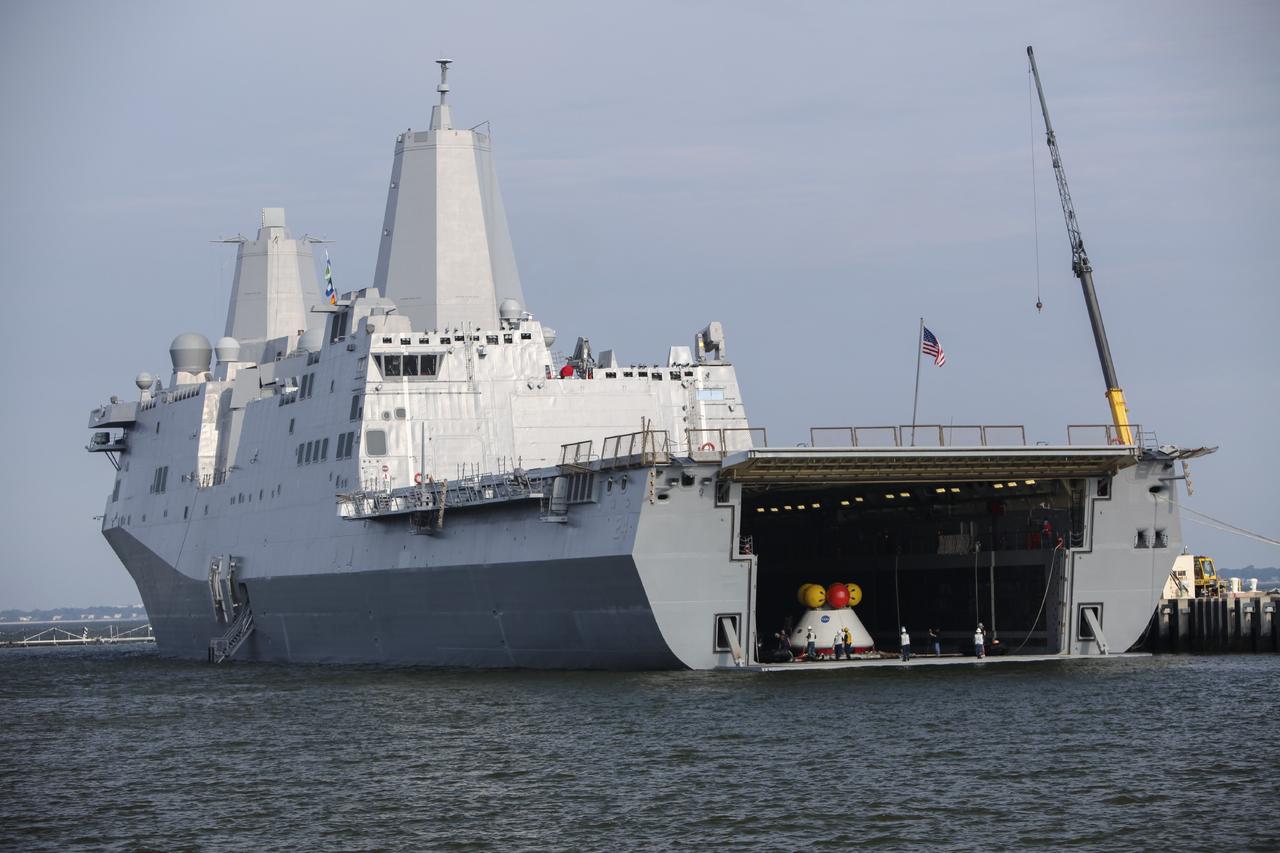
HAMPTON, Va. – At the Naval Station Norfolk near NASA’s Langley Research Center in Virginia, NASA and U.S. Navy personnel prepare the Orion boilerplate test article and support equipment for a stationary recovery test on a U.S. Navy ship. NASA and the U.S. Navy are conducting tests to prepare for recovery of the Orion crew module and forward bay cover on its return from a deep space mission. The stationary recovery test will allow the teams to demonstrate and evaluate the recovery processes, procedures, hardware and personnel in a controlled environment before conducting a second recovery test next year in open waters. Orion is the exploration spacecraft designed to carry astronauts to destinations not yet explored by humans, including an asteroid and Mars. It will have emergency abort capability, sustain the crew during space travel and provide safe re-entry from deep space return velocities. The first unpiloted test flight of the Orion is scheduled to launch in 2014 atop a Delta IV rocket and in 2017 on NASA’s Space Launch System rocket. For more information, visit http://www.nasa.gov/orion. Photo credit: NASA/Dimitri Gerondidakis
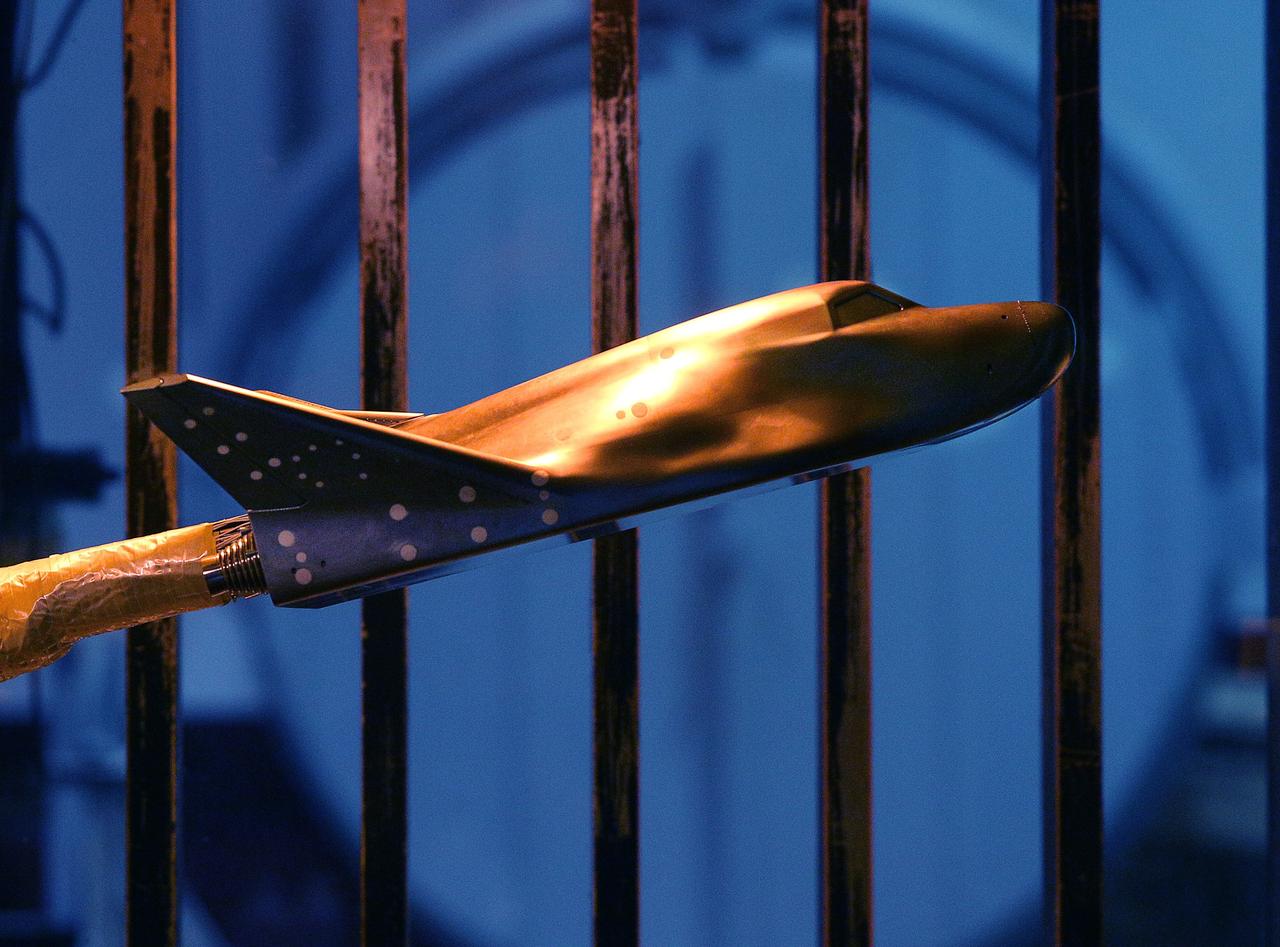
HAMPTON, Va. – A precise scale model of the Dream Chaser spacecraft begins an evaluation inside the Unitary Plan Wind Tunnel at NASA's Langley Research Center in Virginia. The Dream Chaser is in development by Sierra Nevada Corporation in partnership with NASA's Commercial Crew Program. The data gathered from the wind tunnel was used to further test the design through the company's Commercial Crew Integrated Capability agreement with NASA. Photo credit: NASA/ David C. Bowman
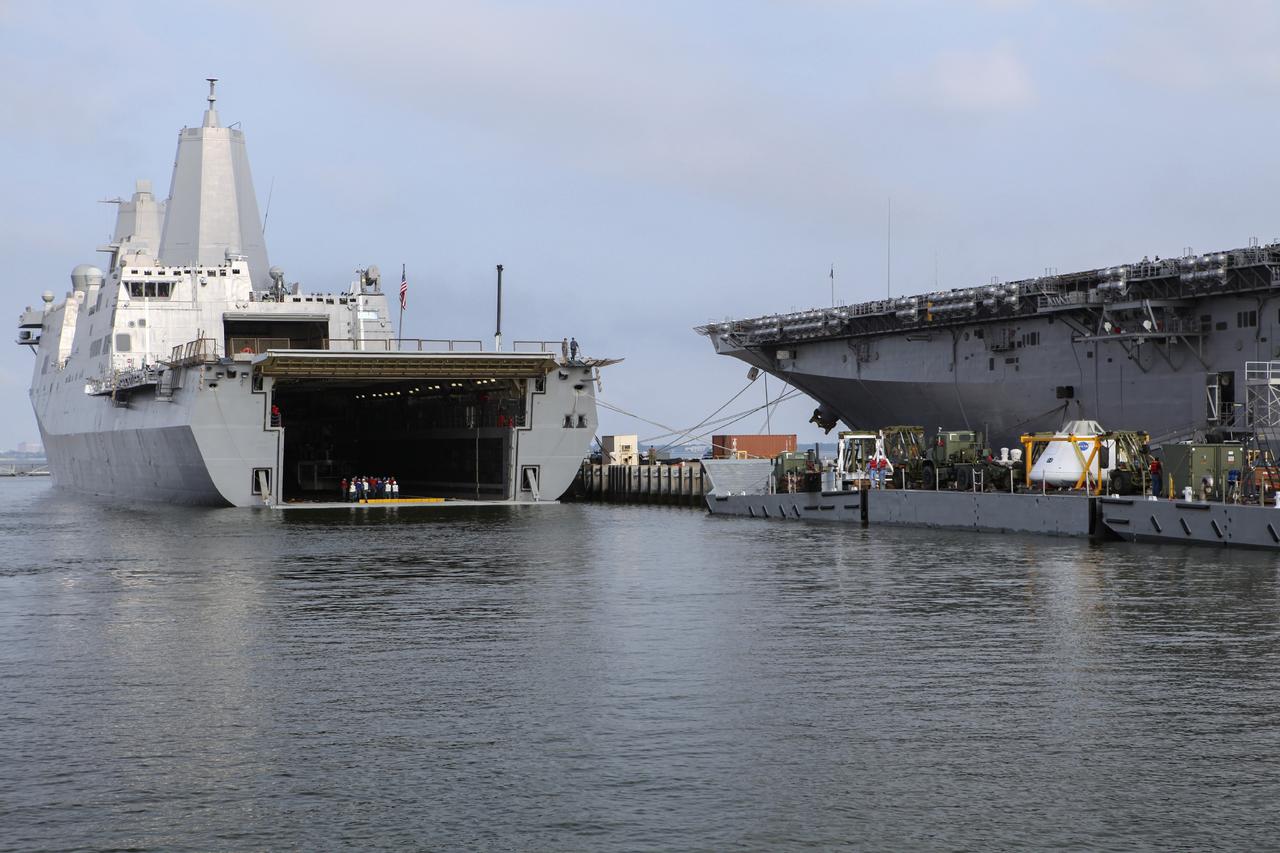
HAMPTON, Va. – At the Naval Station Norfolk near NASA’s Langley Research Center in Virginia, the Orion boilerplate test article and support equipment for a stationary recovery test are being transferred on a floating dock system to a U.S. Navy ship. NASA and the U.S. Navy are conducting tests to prepare for recovery of the Orion crew module and forward bay cover on its return from a deep space mission. The stationary recovery test will allow the teams to demonstrate and evaluate the recovery processes, procedures, hardware and personnel in a controlled environment before conducting a second recovery test next year in open waters. Orion is the exploration spacecraft designed to carry astronauts to destinations not yet explored by humans, including an asteroid and Mars. It will have emergency abort capability, sustain the crew during space travel and provide safe re-entry from deep space return velocities. The first unpiloted test flight of the Orion is scheduled to launch in 2014 atop a Delta IV rocket and in 2017 on a Space Launch System rocket. For more information, visit http://www.nasa.gov/orion. Photo credit: NASA/Dimitri Gerondidakis
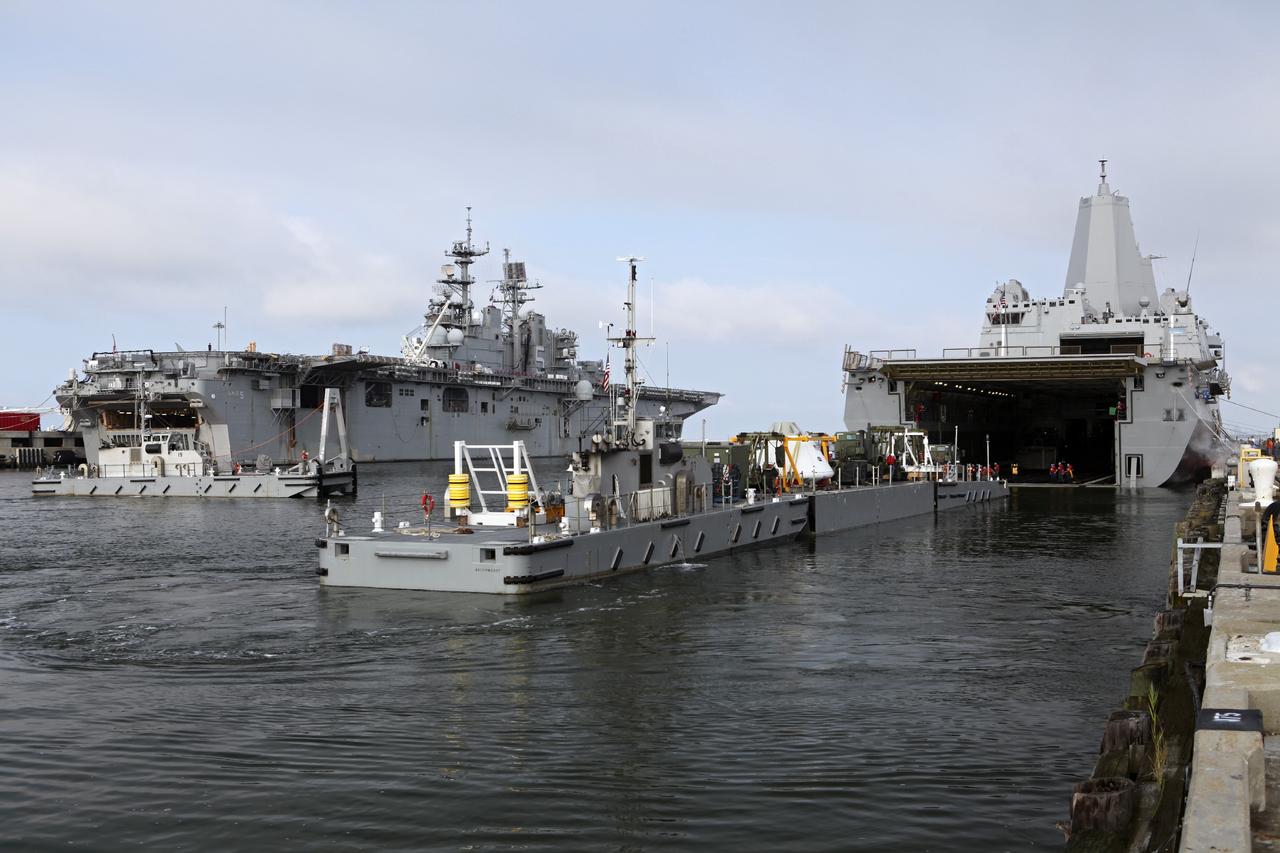
HAMPTON, Va. – At the Naval Station Norfolk near NASA’s Langley Research Center in Virginia, the Orion boilerplate test article and support equipment for a stationary recovery test are being transferred on a floating dock system to a U.S. Navy ship. NASA and the U.S. Navy are conducting tests to prepare for recovery of the Orion crew module and forward bay cover on its return from a deep space mission. The stationary recovery test will allow the teams to demonstrate and evaluate the recovery processes, procedures, hardware and personnel in a controlled environment before conducting a second recovery test next year in open waters. Orion is the exploration spacecraft designed to carry astronauts to destinations not yet explored by humans, including an asteroid and Mars. It will have emergency abort capability, sustain the crew during space travel and provide safe re-entry from deep space return velocities. The first unpiloted test flight of the Orion is scheduled to launch in 2014 atop a Delta IV rocket and in 2017 on a Space Launch System rocket. For more information, visit http://www.nasa.gov/orion. Photo credit: NASA/Dimitri Gerondidakis
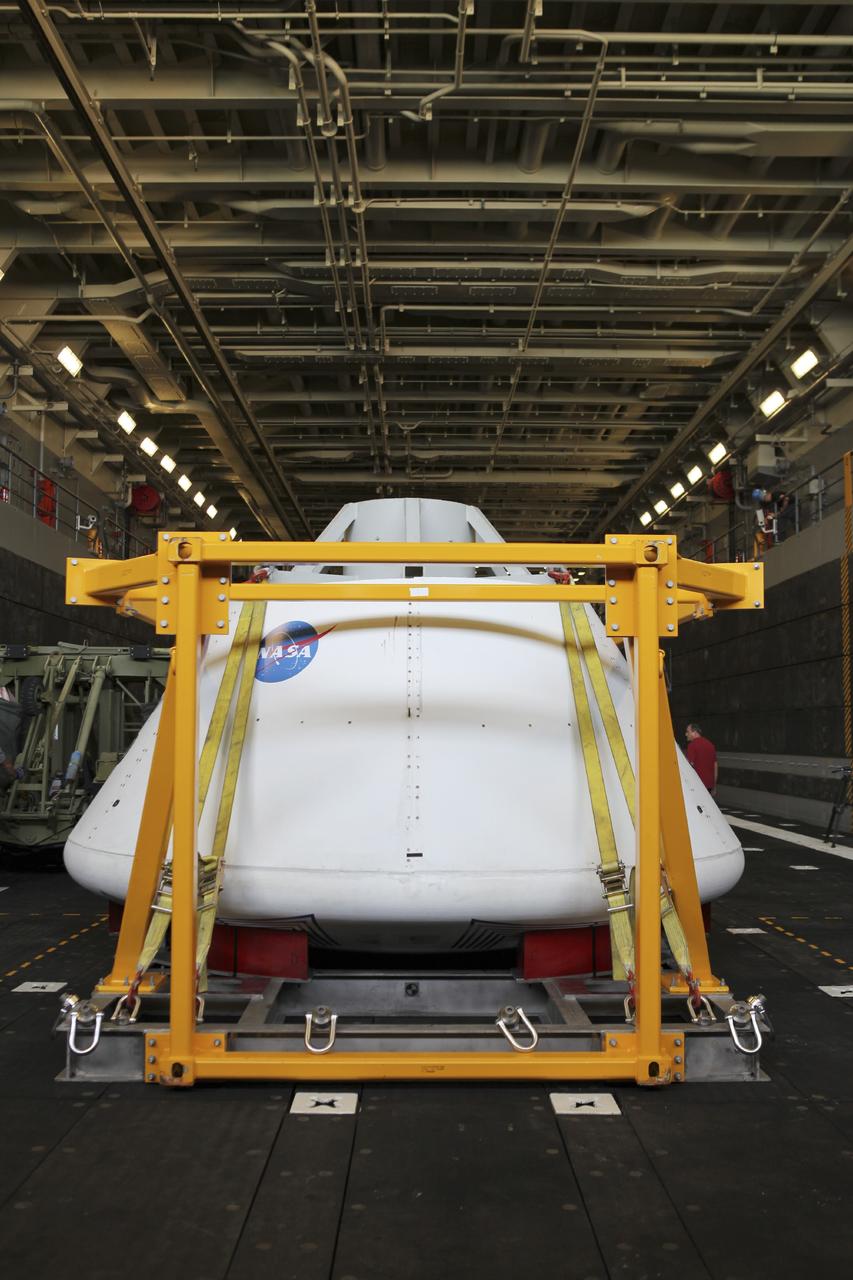
HAMPTON, Va. – At the Naval Station Norfolk near NASA’s Langley Research Center in Virginia, the Orion boilerplate test article was secured on a U.S. Navy ship after arriving by floating dock system for a stationary recovery test. NASA and the U.S. Navy are conducting tests to prepare for recovery of the Orion crew module and forward bay cover on its return from a deep space mission. The stationary recovery test will allow the teams to demonstrate and evaluate the recovery processes, procedures, hardware and personnel in a controlled environment before conducting a second recovery test next year in open waters. Orion is the exploration spacecraft designed to carry astronauts to destinations not yet explored by humans, including an asteroid and Mars. It will have emergency abort capability, sustain the crew during space travel and provide safe re-entry from deep space return velocities. The first unpiloted test flight of the Orion is scheduled to launch in 2014 atop a Delta IV rocket and in 2017 on NASA’s Space Launch System rocket. For more information, visit http://www.nasa.gov/orion. Photo credit: NASA/Dimitri Gerondidakis
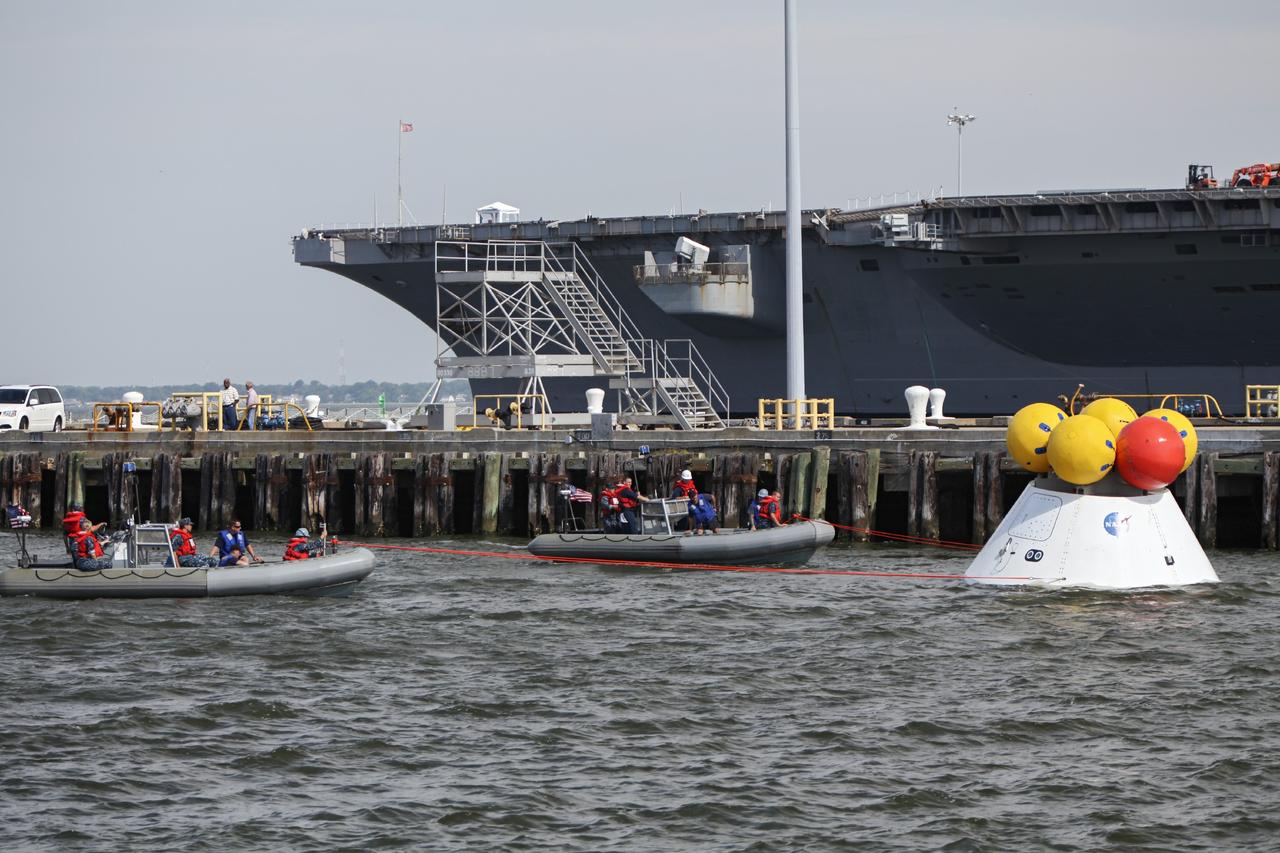
HAMPTON, Va. – At the Naval Station Norfolk near NASA’s Langley Research Center in Virginia, NASA and U.S. Navy personnel have attached tether lines to the Orion boilerplate test article for a stationary recovery test. NASA and the U.S. Navy are conducting tests to prepare for recovery of the Orion crew module and forward bay cover on its return from a deep space mission. The stationary recovery test will allow the teams to demonstrate and evaluate the recovery processes, procedures, hardware and personnel in a controlled environment before conducting a second recovery test next year in open waters. Orion is the exploration spacecraft designed to carry astronauts to destinations not yet explored by humans, including an asteroid and Mars. It will have emergency abort capability, sustain the crew during space travel and provide safe re-entry from deep space return velocities. The first unpiloted test flight of the Orion is scheduled to launch in 2014 atop a Delta IV rocket and in 2017 on NASA’s Space Launch System rocket. For more information, visit http://www.nasa.gov/orion. Photo credit: NASA/Dimitri Gerondidakis
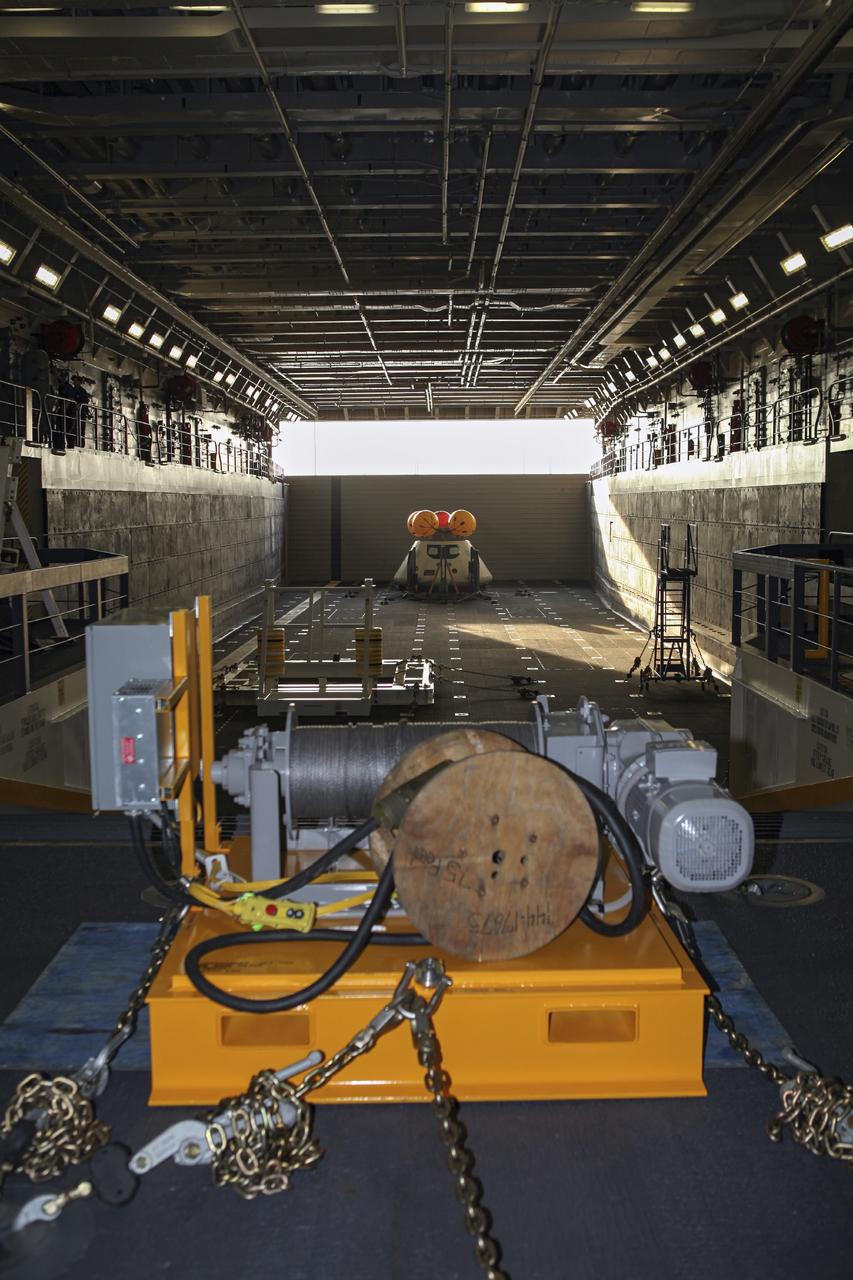
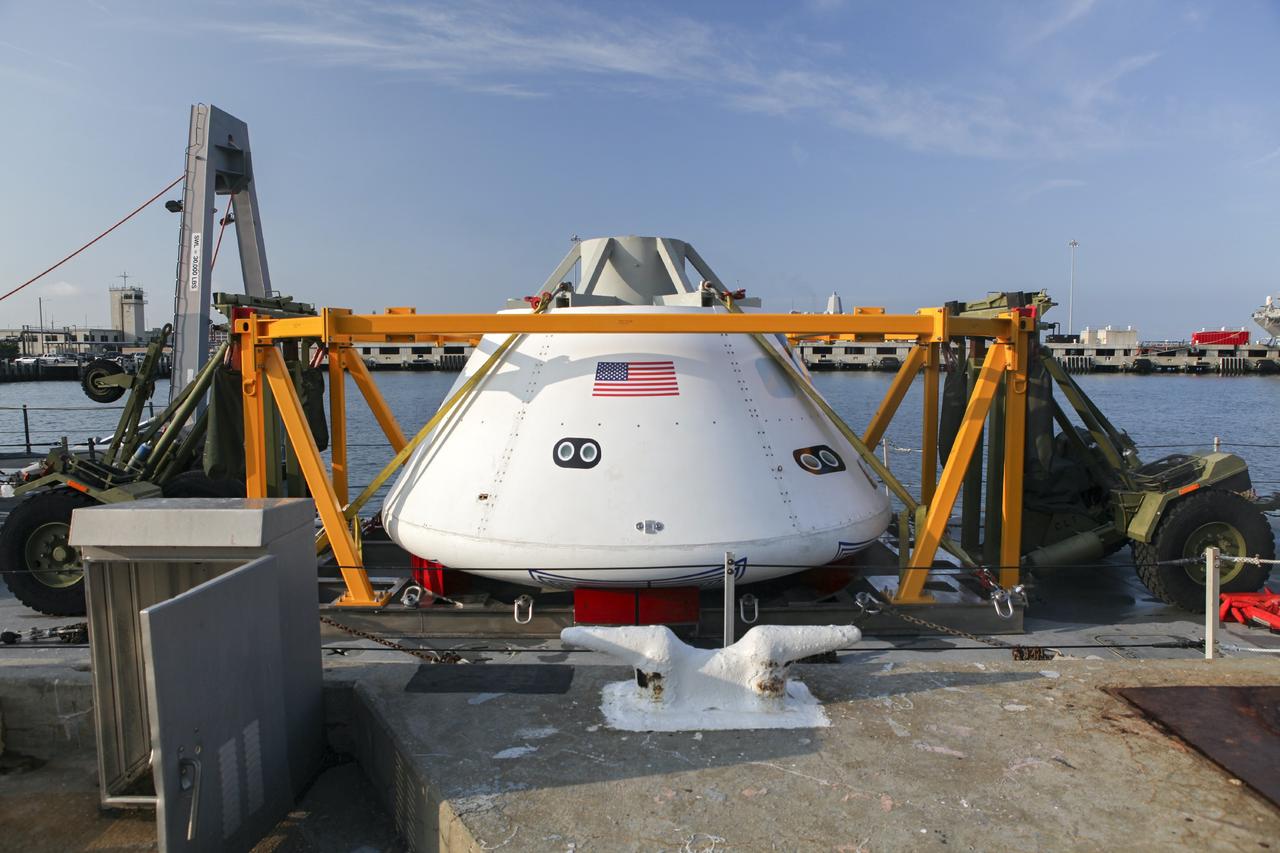
HAMPTON, Va. – At the Naval Station Norfolk near NASA’s Langley Research Center in Virginia, the Orion boilerplate test article and support equipment for a stationary recovery test are secured on a U.S. Navy ship. NASA and the U.S. Navy are conducting tests to prepare for recovery of the Orion crew module and forward bay cover on its return from a deep space mission. The stationary recovery test will allow the teams to demonstrate and evaluate the recovery processes, procedures, hardware and personnel in a controlled environment before conducting a second recovery test next year in open waters. Orion is the exploration spacecraft designed to carry astronauts to destinations not yet explored by humans, including an asteroid and Mars. It will have emergency abort capability, sustain the crew during space travel and provide safe re-entry from deep space return velocities. The first unpiloted test flight of the Orion is scheduled to launch in 2014 atop a Delta IV rocket and in 2017 on NASA’s Space Launch System rocket. For more information, visit http://www.nasa.gov/orion. Photo credit: NASA/Dimitri Gerondidakis
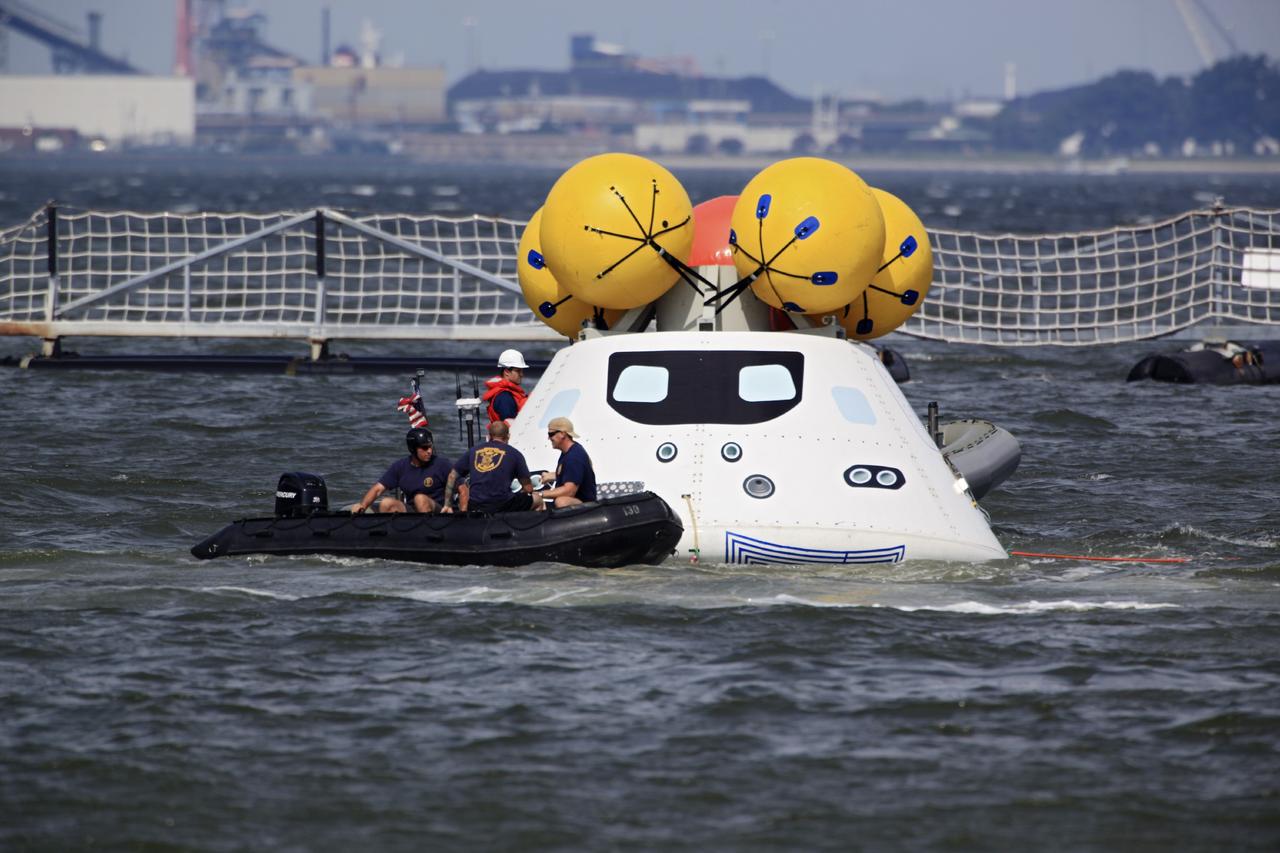
HAMPTON, Va. – At the Naval Station Norfolk near NASA’s Langley Research Center in Virginia, U.S. Navy personnel detach tether lines from the Orion boilerplate test article during a stationary recovery test in the water. NASA and the U.S. Navy are conducting tests to prepare for recovery of the Orion crew module and forward bay cover on its return from a deep space mission. The stationary recovery test will allow the teams to demonstrate and evaluate the recovery processes, procedures, hardware and personnel in a controlled environment before conducting a second recovery test next year in open waters. Orion is the exploration spacecraft designed to carry astronauts to destinations not yet explored by humans, including an asteroid and Mars. It will have emergency abort capability, sustain the crew during space travel and provide safe re-entry from deep space return velocities. The first unpiloted test flight of the Orion is scheduled to launch in 2014 atop a Delta IV rocket and in 2017 on NASA’s Space Launch System rocket. For more information, visit http://www.nasa.gov/orion. Photo credit: NASA/Dimitri Gerondidakis
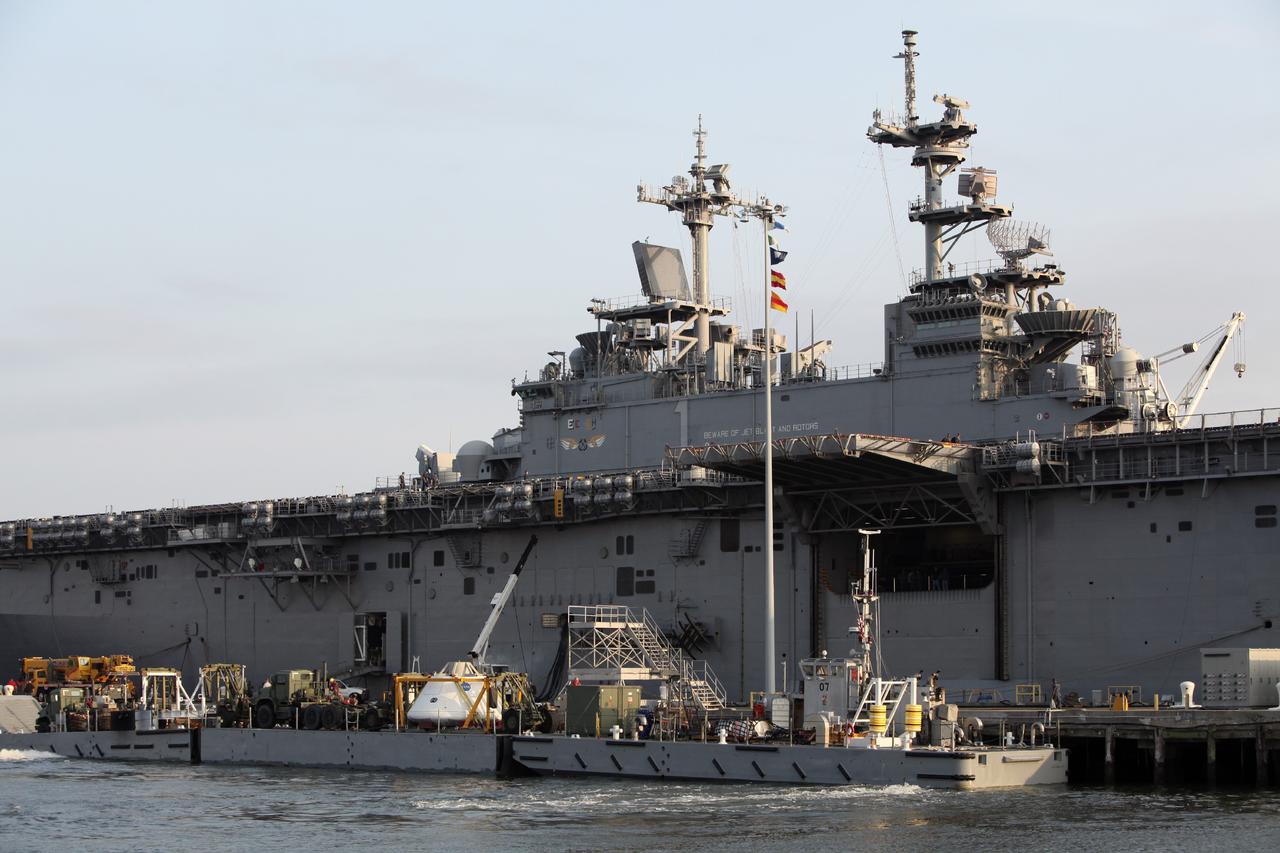
HAMPTON, Va. – At the Naval Station Norfolk near NASA’s Langley Research Center in Virginia, the Orion boilerplate test article and support equipment for a stationary recovery test are being transferred on a floating dock system to a U.S. Navy ship. NASA and the U.S. Navy are conducting tests to prepare for recovery of the Orion crew module and forward bay cover on its return from a deep space mission. The stationary recovery test will allow the teams to demonstrate and evaluate the recovery processes, procedures, hardware and personnel in a controlled environment before conducting a second recovery test next year in open waters. Orion is the exploration spacecraft designed to carry astronauts to destinations not yet explored by humans, including an asteroid and Mars. It will have emergency abort capability, sustain the crew during space travel and provide safe re-entry from deep space return velocities. The first unpiloted test flight of the Orion is scheduled to launch in 2014 atop a Delta IV rocket and in 2017 on a Space Launch System rocket. For more information, visit http://www.nasa.gov/orion. Photo credit: NASA/Dimitri Gerondidakis
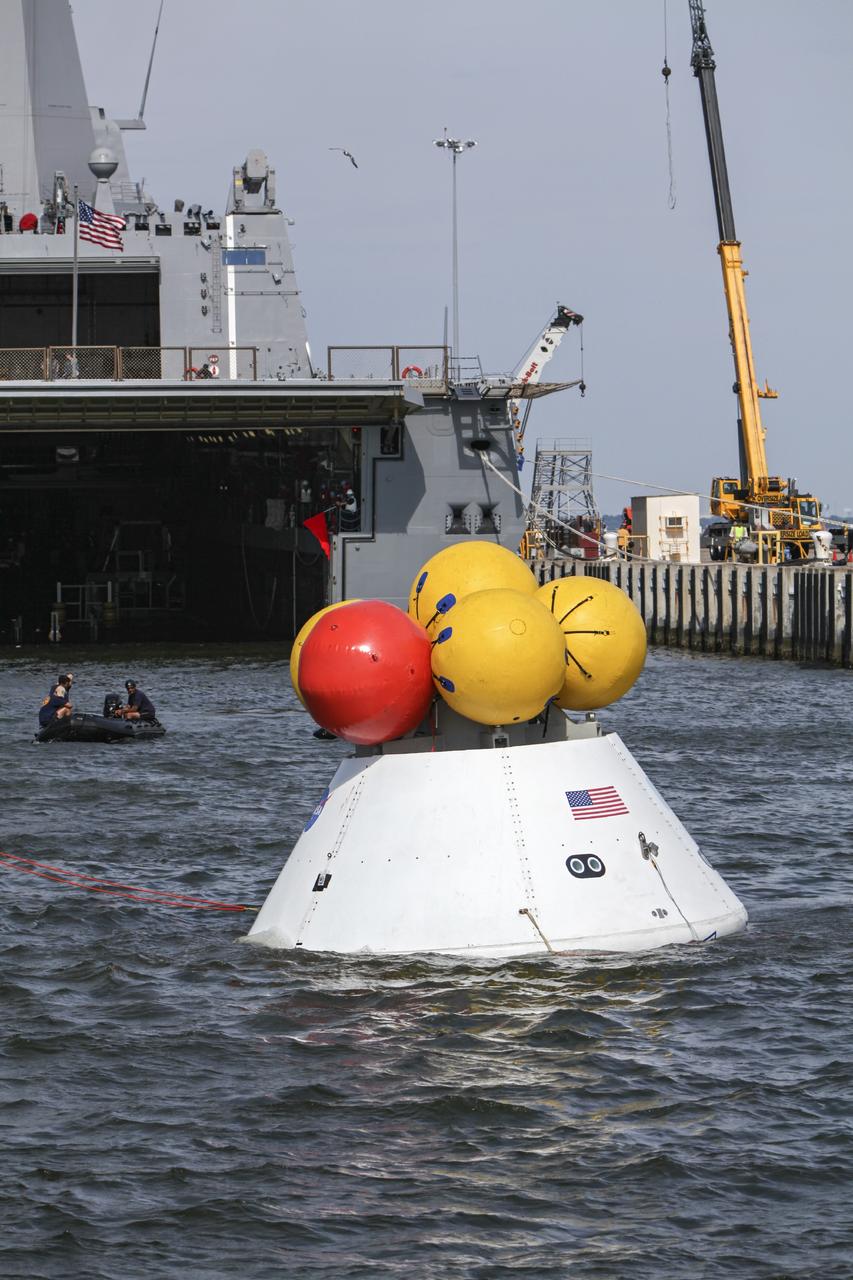
HAMPTON, Va. – At the Naval Station Norfolk near NASA’s Langley Research Center in Virginia, NASA and U.S. Navy personnel are conducting a stationary recovery test using the Orion boilerplate test article. The test article was transferred from a U.S. Navy ship into the water and tether lines have been attached. NASA and the U.S. Navy are conducting tests to prepare for recovery of the Orion crew module and forward bay cover on its return from a deep space mission. The stationary recovery test will allow the teams to demonstrate and evaluate the recovery processes, procedures, hardware and personnel in a controlled environment before conducting a second recovery test next year in open waters. Orion is the exploration spacecraft designed to carry astronauts to destinations not yet explored by humans, including an asteroid and Mars. It will have emergency abort capability, sustain the crew during space travel and provide safe re-entry from deep space return velocities. The first unpiloted test flight of the Orion is scheduled to launch in 2014 atop a Delta IV rocket and in 2017 on NASA’s Space Launch System rocket. For more information, visit http://www.nasa.gov/orion. Photo credit: NASA/Dimitri Gerondidakis
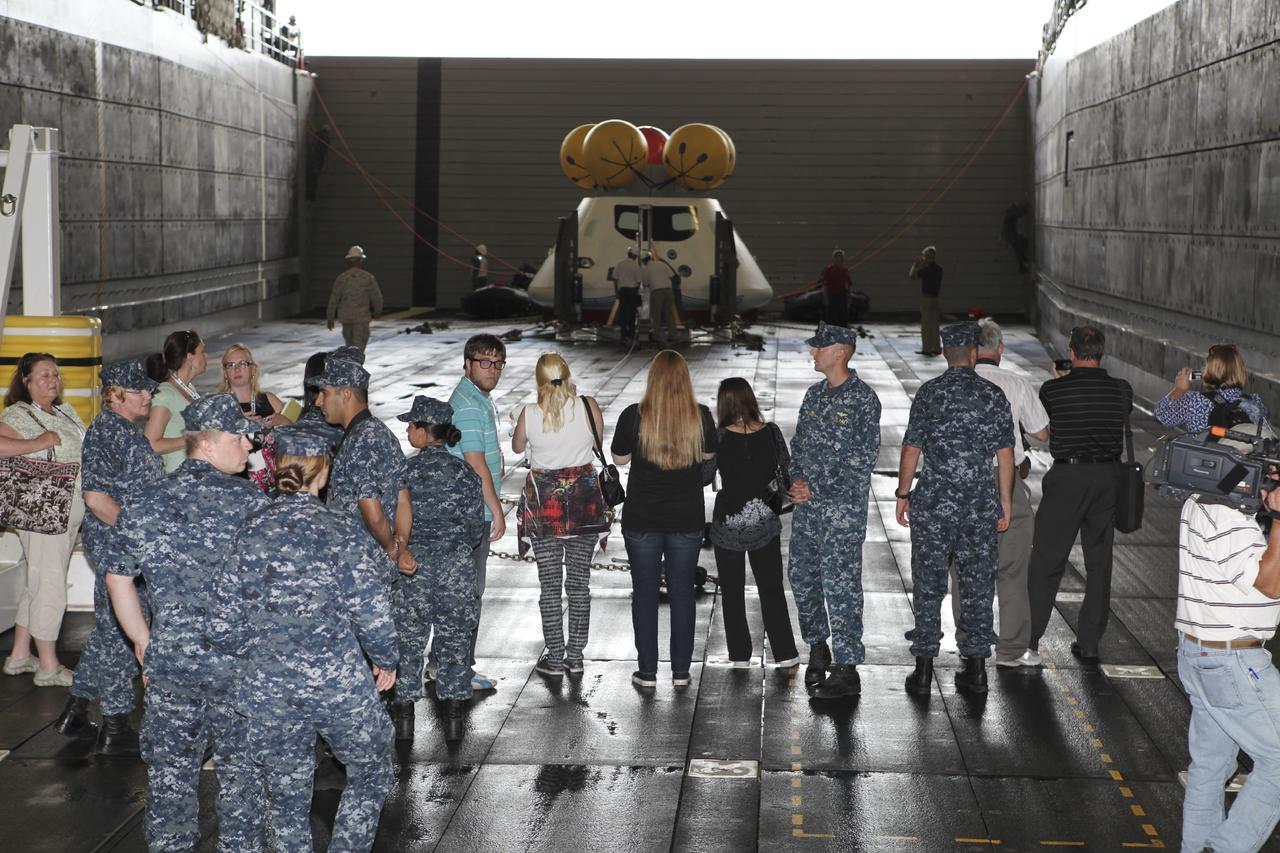
HAMPTON, Va. – At the Naval Station Norfolk near NASA’s Langley Research Center in Virginia, members of the media observe the Orion boilerplate test article and support equipment for a stationary recovery test secured in a U.S. Navy ship. NASA and the U.S. Navy are conducting tests to prepare for recovery of the Orion crew module and forward bay cover on its return from a deep space mission. The stationary recovery test will allow the teams to demonstrate and evaluate the recovery processes, procedures, hardware and personnel in a controlled environment before conducting a second recovery test next year in open waters. Orion is the exploration spacecraft designed to carry astronauts to destinations not yet explored by humans, including an asteroid and Mars. It will have emergency abort capability, sustain the crew during space travel and provide safe re-entry from deep space return velocities. The first unpiloted test flight of the Orion is scheduled to launch in 2014 atop a Delta IV rocket and in 2017 on NASA’s Space Launch System rocket. For more information, visit http://www.nasa.gov/orion. Photo credit: NASA/Dimitri Gerondidakis
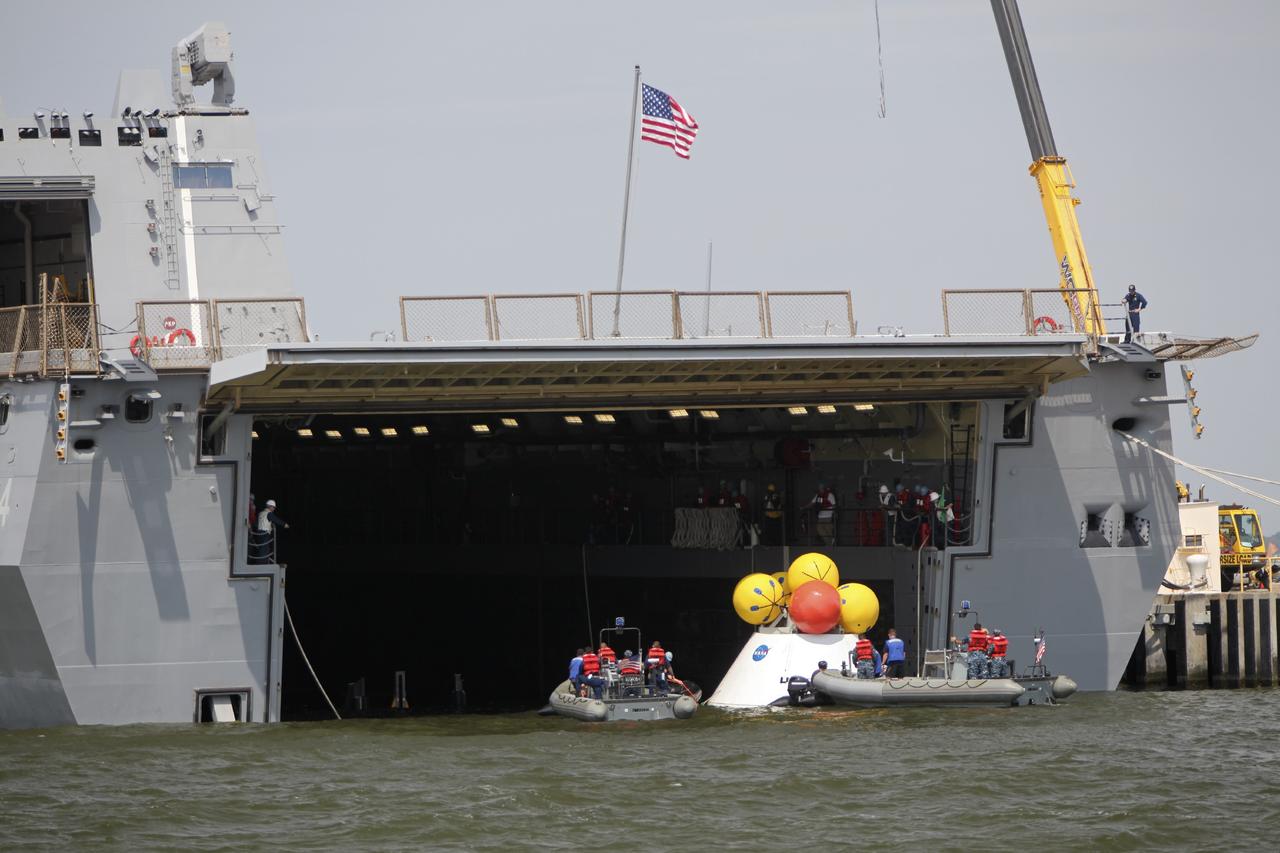
HAMPTON, Va. – At the Naval Station Norfolk near NASA’s Langley Research Center in Virginia, the Orion boilerplate test article is being returned to a U.S. Navy ship following a stationary recovery test in the water. NASA and the U.S. Navy are conducting tests to prepare for recovery of the Orion crew module and forward bay cover on its return from a deep space mission. The stationary recovery test will allow the teams to demonstrate and evaluate the recovery processes, procedures, hardware and personnel in a controlled environment before conducting a second recovery test next year in open waters. Orion is the exploration spacecraft designed to carry astronauts to destinations not yet explored by humans, including an asteroid and Mars. It will have emergency abort capability, sustain the crew during space travel and provide safe re-entry from deep space return velocities. The first unpiloted test flight of the Orion is scheduled to launch in 2014 atop a Delta IV rocket and in 2017 on NASA’s Space Launch System rocket. For more information, visit http://www.nasa.gov/orion. Photo credit: NASA/Dimitri Gerondidakis
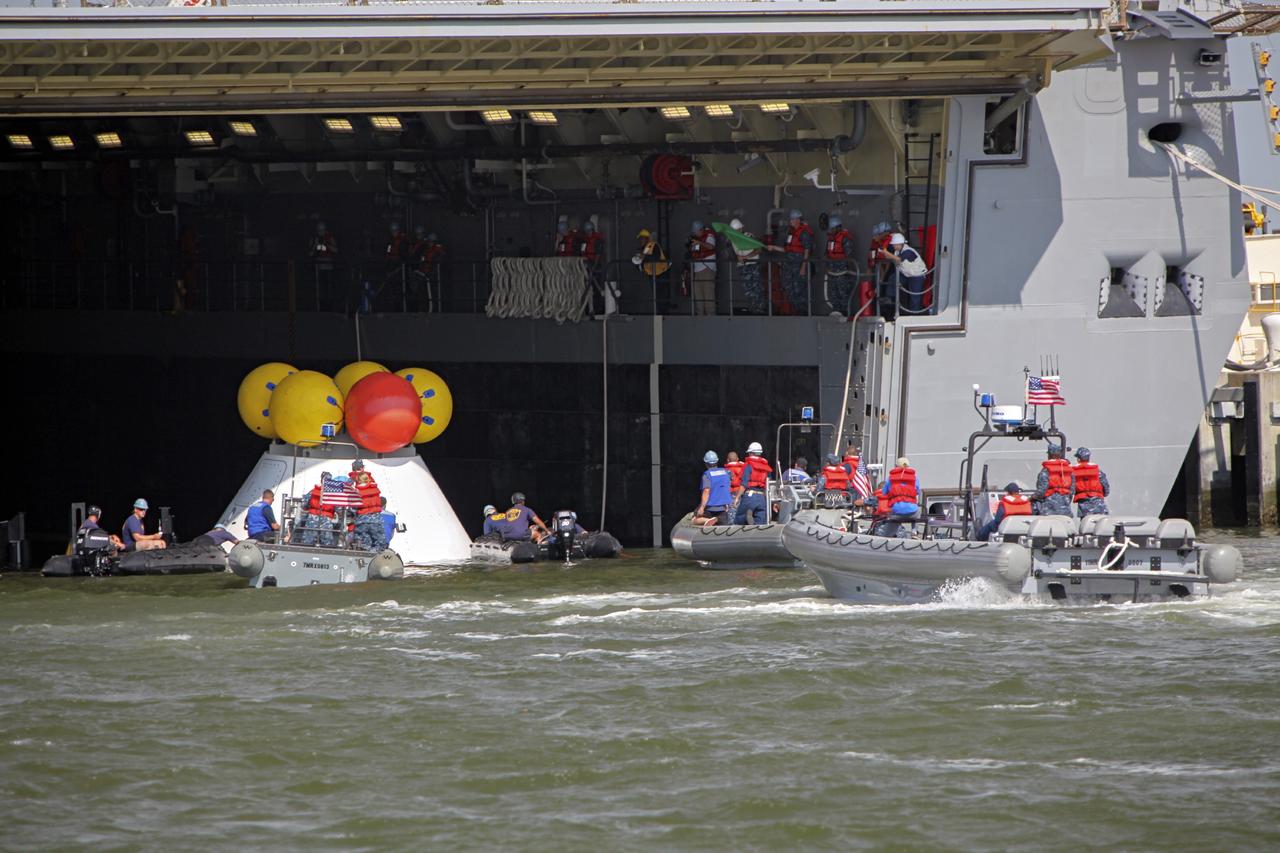
HAMPTON, Va. – At the Naval Station Norfolk near NASA’s Langley Research Center in Virginia, the Orion boilerplate test article is being moved from a U.S. Navy ship and placed in the water for a stationary recovery test. NASA and the U.S. Navy are conducting tests to prepare for recovery of the Orion crew module and forward bay cover on its return from a deep space mission. The stationary recovery test will allow the teams to demonstrate and evaluate the recovery processes, procedures, hardware and personnel in a controlled environment before conducting a second recovery test next year in open waters. Orion is the exploration spacecraft designed to carry astronauts to destinations not yet explored by humans, including an asteroid and Mars. It will have emergency abort capability, sustain the crew during space travel and provide safe re-entry from deep space return velocities. The first unpiloted test flight of the Orion is scheduled to launch in 2014 atop a Delta IV rocket and in 2017 on NASA’s Space Launch System rocket. For more information, visit http://www.nasa.gov/orion. Photo credit: NASA/Dimitri Gerondidakis
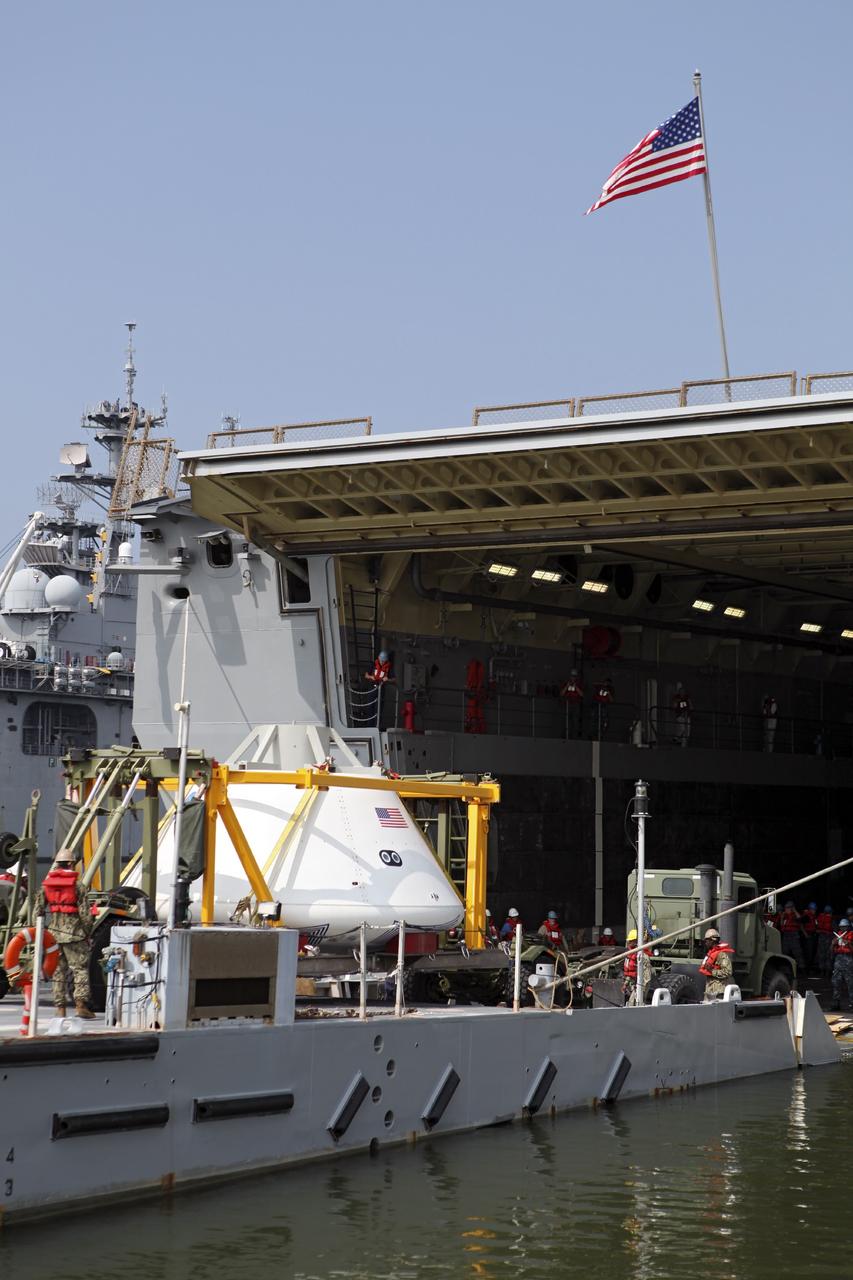
HAMPTON, Va. – At the Naval Station Norfolk near NASA’s Langley Research Center in Virginia, the Orion boilerplate test article and support equipment for a stationary recovery test are transferred by floating dock system to a U.S. Navy ship. NASA and the U.S. Navy are conducting tests to prepare for recovery of the Orion crew module and forward bay cover on its return from a deep space mission. The stationary recovery test will allow the teams to demonstrate and evaluate the recovery processes, procedures, hardware and personnel in a controlled environment before conducting a second recovery test next year in open waters. Orion is the exploration spacecraft designed to carry astronauts to destinations not yet explored by humans, including an asteroid and Mars. It will have emergency abort capability, sustain the crew during space travel and provide safe re-entry from deep space return velocities. The first unpiloted test flight of the Orion is scheduled to launch in 2014 atop a Delta IV rocket and in 2017 on NASA’s Space Launch System rocket. For more information, visit http://www.nasa.gov/orion. Photo credit: NASA/Dimitri Gerondidakis
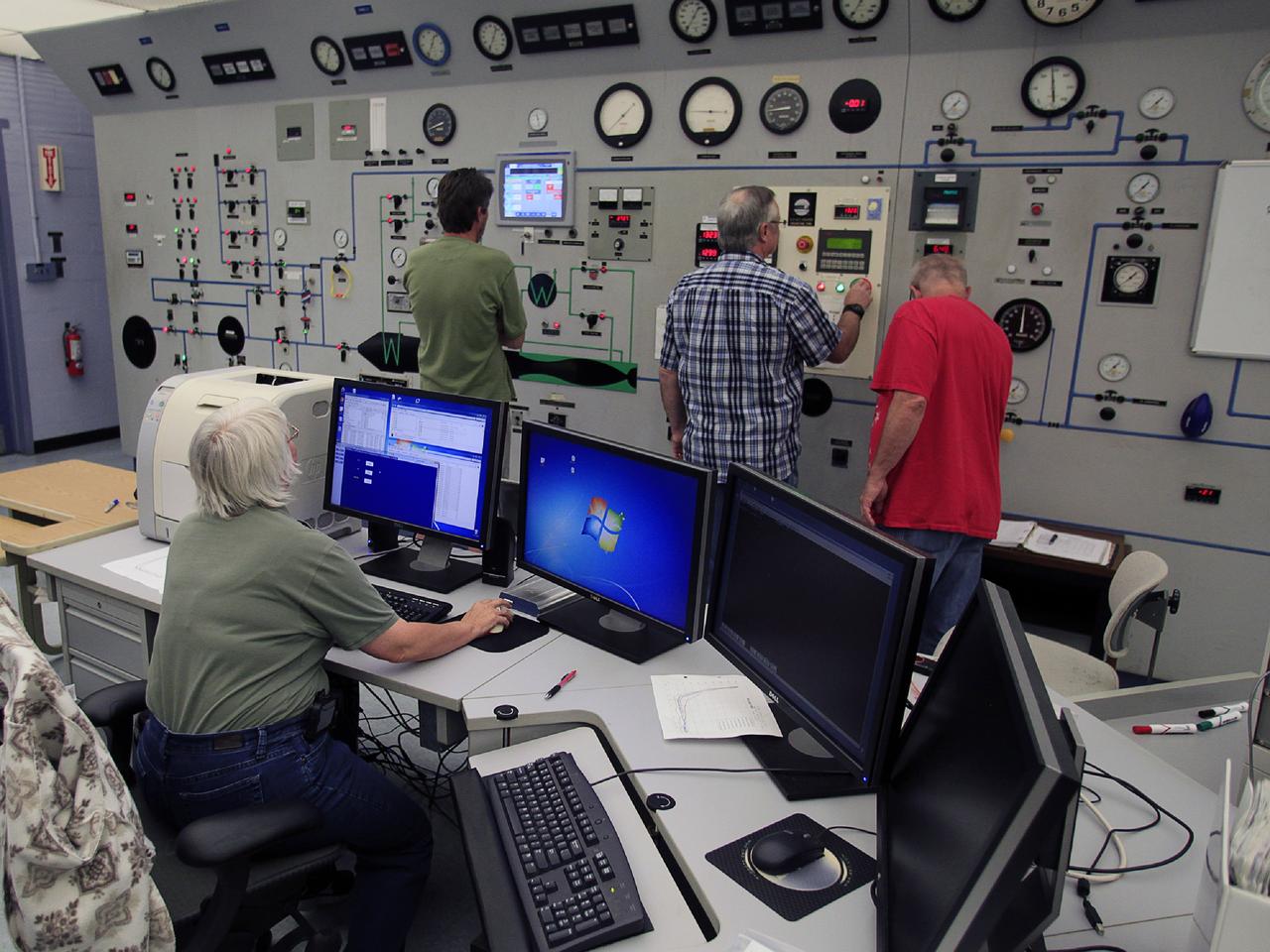
HAMPTON, Va. –Engineers monitor high-speed wind tunnel testing of a 10-inch long ceramic model of the Sierra Nevada Corporation, or SNC, Dream Chaser spacecraft at NASA's Langley Research Center in Hampton, Va. The tests measure how much heat the winged vehicle would experience during ascent and re-entry through the atmosphere, including the spacecraft's lower- and upper-body flaps, elevons and a rudder. They're also helping the company obtain necessary data for the material selection and design of the spacecraft's thermal protection system. SNC is continuing the development of its Dream Chaser spacecraft under the agency's Commercial Crew Integrated Capability, or CCiCap, initiative, which is intended to lead to the availability of commercial human spaceflight services for government and commercial customers. To learn more about CCP and its industry partners, visit www.nasa.gov/commercialcrew. Image credit: NASA/David Bowman
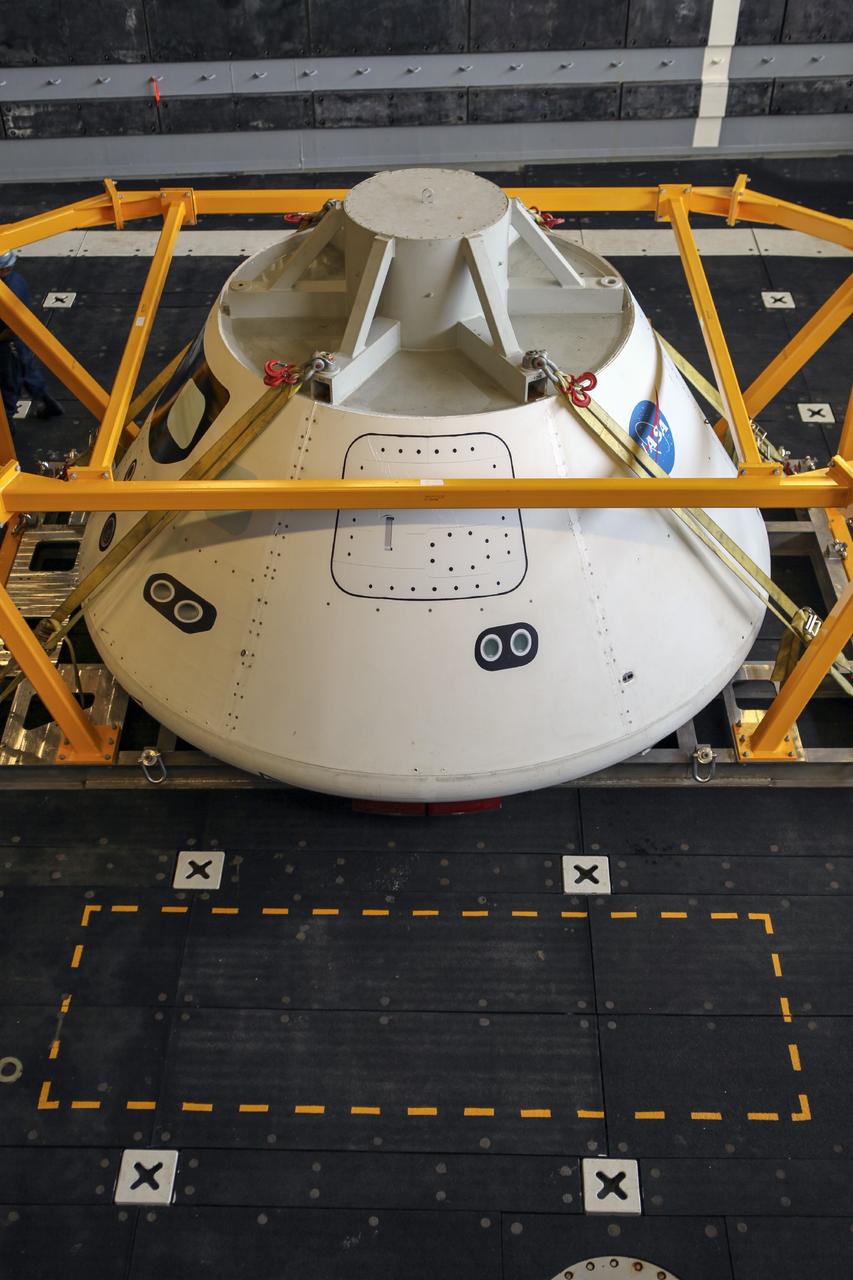
HAMPTON, Va. – At the Naval Station Norfolk near NASA’s Langley Research Center in Virginia, the Orion boilerplate test article has been secured on a U.S. Navy ship after arriving by floating dock system for a stationary recovery test. NASA and the U.S. Navy are conducting tests to prepare for recovery of the Orion crew module and forward bay cover on its return from a deep space mission. The stationary recovery test will allow the teams to demonstrate and evaluate the recovery processes, procedures, hardware and personnel in a controlled environment before conducting a second recovery test next year in open waters. Orion is the exploration spacecraft designed to carry astronauts to destinations not yet explored by humans, including an asteroid and Mars. It will have emergency abort capability, sustain the crew during space travel and provide safe re-entry from deep space return velocities. The first unpiloted test flight of the Orion is scheduled to launch in 2014 atop a Delta IV rocket and in 2017 on NASA’s Space Launch System rocket. For more information, visit http://www.nasa.gov/orion. Photo credit: NASA/Dimitri Gerondidakis
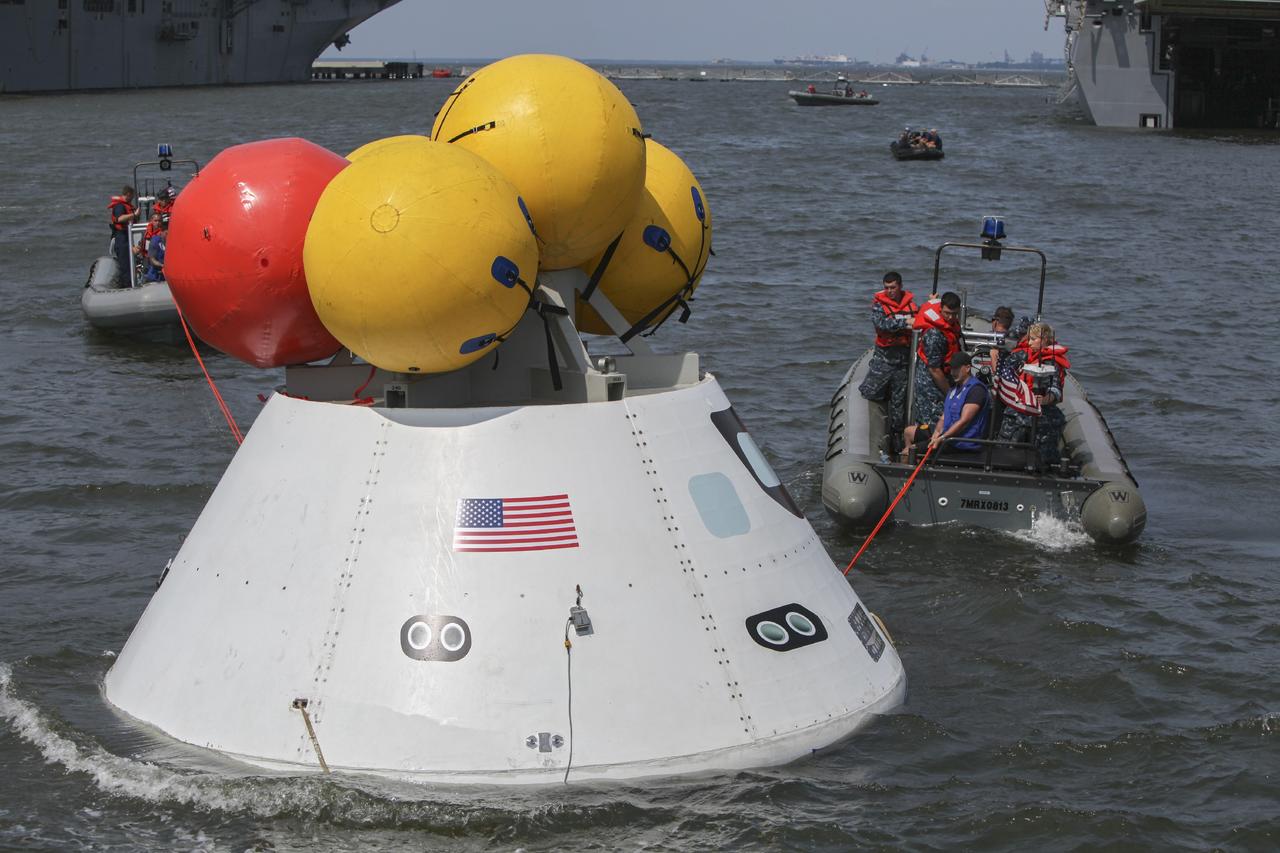
HAMPTON, Va. – At the Naval Station Norfolk near NASA’s Langley Research Center in Virginia, the Orion boilerplate test article floats in the water near a U.S. Navy ship during a stationary recovery test. NASA and the U.S. Navy are conducting tests to prepare for recovery of the Orion crew module and forward bay cover on its return from a deep space mission. The stationary recovery test will allow the teams to demonstrate and evaluate the recovery processes, procedures, hardware and personnel in a controlled environment before conducting a second recovery test next year in open waters. Orion is the exploration spacecraft designed to carry astronauts to destinations not yet explored by humans, including an asteroid and Mars. It will have emergency abort capability, sustain the crew during space travel and provide safe re-entry from deep space return velocities. The first unpiloted test flight of the Orion is scheduled to launch in 2014 atop a Delta IV rocket and in 2017 on NASA’s Space Launch System rocket. For more information, visit http://www.nasa.gov/orion. Photo credit: NASA/Dimitri Gerondidakis
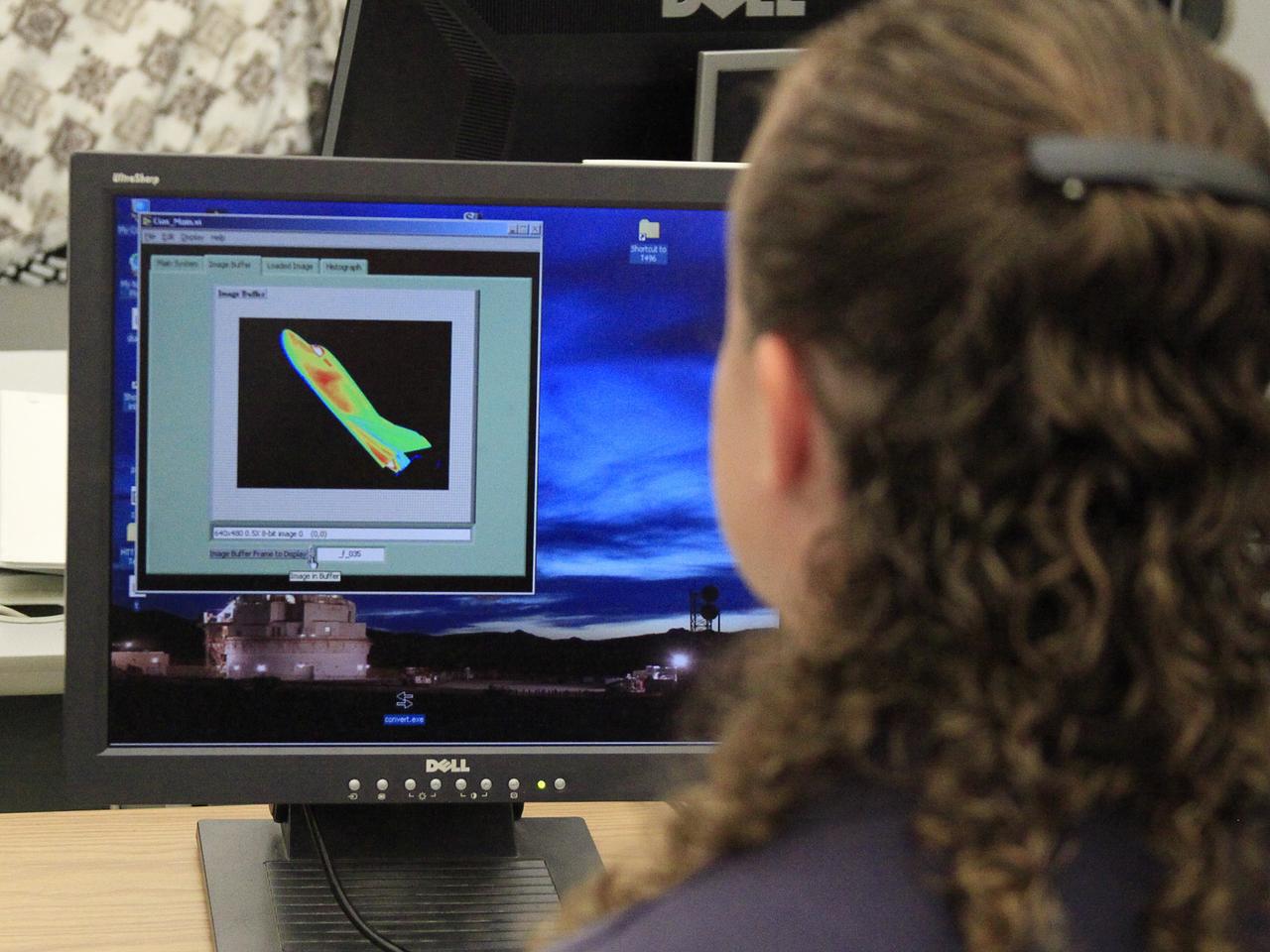
HAMPTON, Va. –An engineer monitors high-speed wind tunnel testing of a 10-inch long ceramic model of the Sierra Nevada Corporation, or SNC, Dream Chaser spacecraft at NASA's Langley Research Center in Hampton, Va. The tests measure how much heat the winged vehicle would experience during ascent and re-entry through the atmosphere, including the spacecraft's lower- and upper-body flaps, elevons and a rudder. They're also helping the company obtain necessary data for the material selection and design of the spacecraft's thermal protection system. SNC is continuing the development of its Dream Chaser spacecraft under the agency's Commercial Crew Integrated Capability, or CCiCap, initiative, which is intended to lead to the availability of commercial human spaceflight services for government and commercial customers. To learn more about CCP and its industry partners, visit www.nasa.gov/commercialcrew. Image credit: NASA/David Bowman
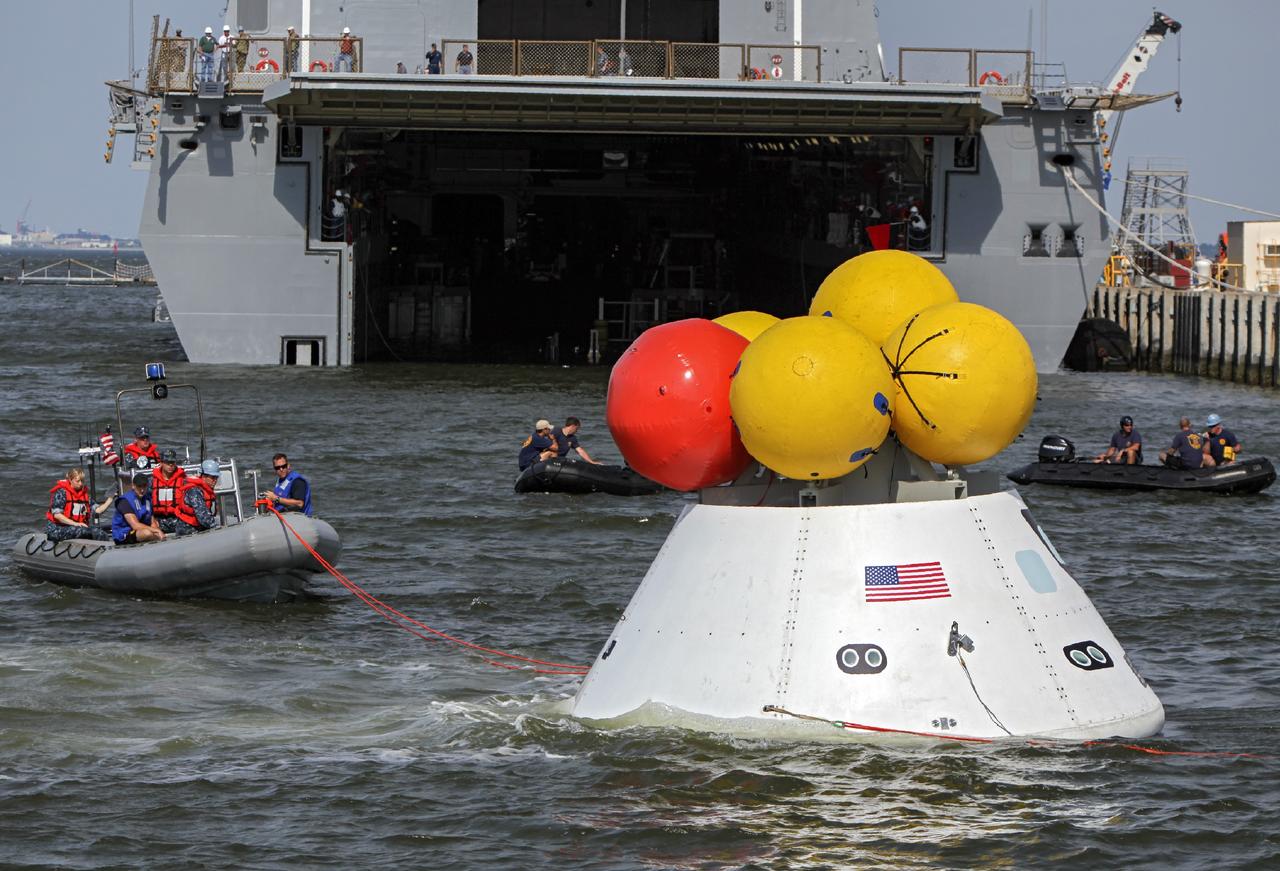
HAMPTON, Va. – At the Naval Station Norfolk near NASA’s Langley Research Center in Virginia, the Orion boilerplate test article floats in the water near a U.S. Navy ship during a stationary recovery test. NASA and the U.S. Navy are conducting tests to prepare for recovery of the Orion crew module and forward bay cover on its return from a deep space mission. The stationary recovery test will allow the teams to demonstrate and evaluate the recovery processes, procedures, hardware and personnel in a controlled environment before conducting a second recovery test next year in open waters. Orion is the exploration spacecraft designed to carry astronauts to destinations not yet explored by humans, including an asteroid and Mars. It will have emergency abort capability, sustain the crew during space travel and provide safe re-entry from deep space return velocities. The first unpiloted test flight of the Orion is scheduled to launch in 2014 atop a Delta IV rocket and in 2017 on NASA’s Space Launch System rocket. For more information, visit http://www.nasa.gov/orion. Photo credit: NASA/Dimitri Gerondidakis
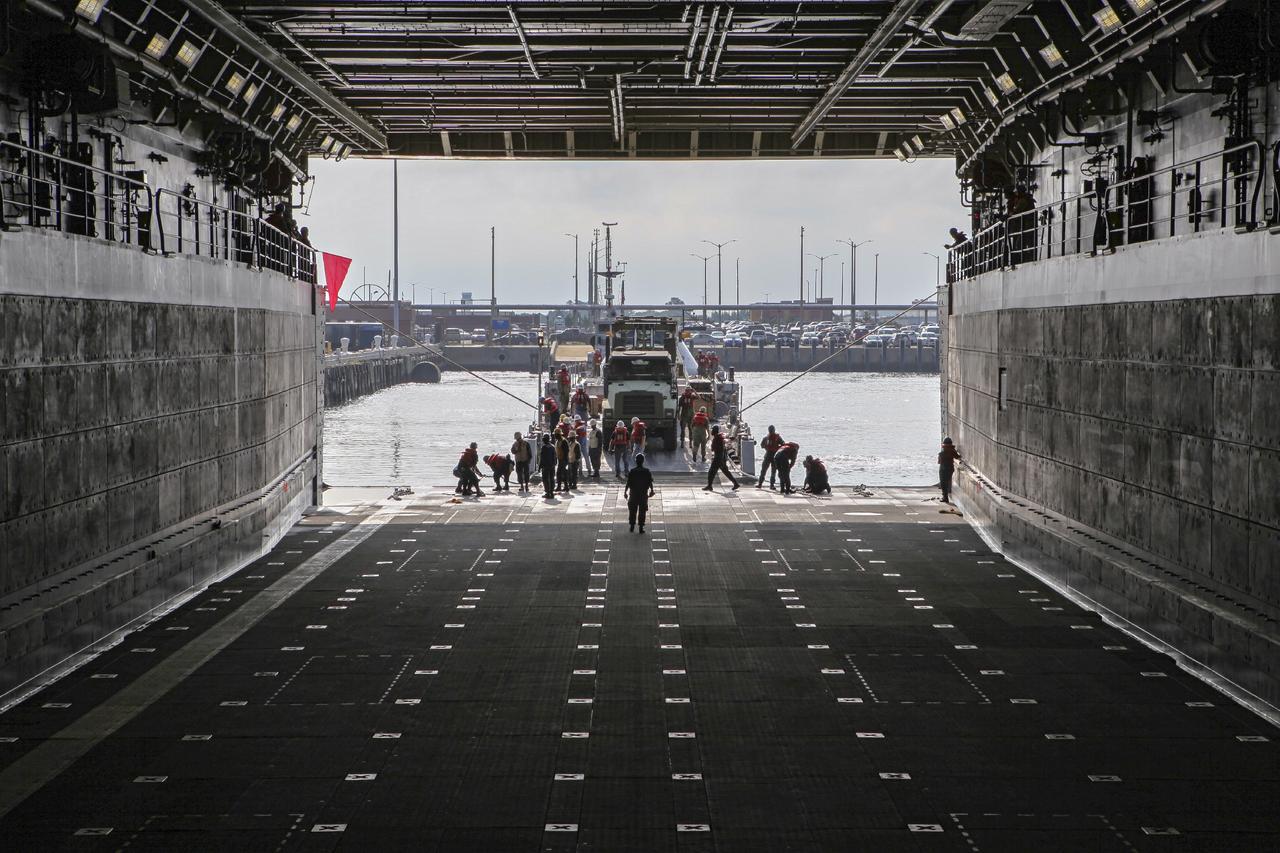
HAMPTON, Va. – At the Naval Station Norfolk near NASA’s Langley Research Center in Virginia, the Orion boilerplate test article and support equipment for a stationary recovery test are being transferred from a floating dock system to a U.S. Navy ship. NASA and the U.S. Navy are conducting tests to prepare for recovery of the Orion crew module and forward bay cover on its return from a deep space mission. The stationary recovery test will allow the teams to demonstrate and evaluate the recovery processes, procedures, hardware and personnel in a controlled environment before conducting a second recovery test next year in open waters. Orion is the exploration spacecraft designed to carry astronauts to destinations not yet explored by humans, including an asteroid and Mars. It will have emergency abort capability, sustain the crew during space travel and provide safe re-entry from deep space return velocities. The first unpiloted test flight of the Orion is scheduled to launch in 2014 atop a Delta IV rocket and in 2017 on a Space Launch System rocket. For more information, visit http://www.nasa.gov/orion. Photo credit: NASA/Dimitri Gerondidakis
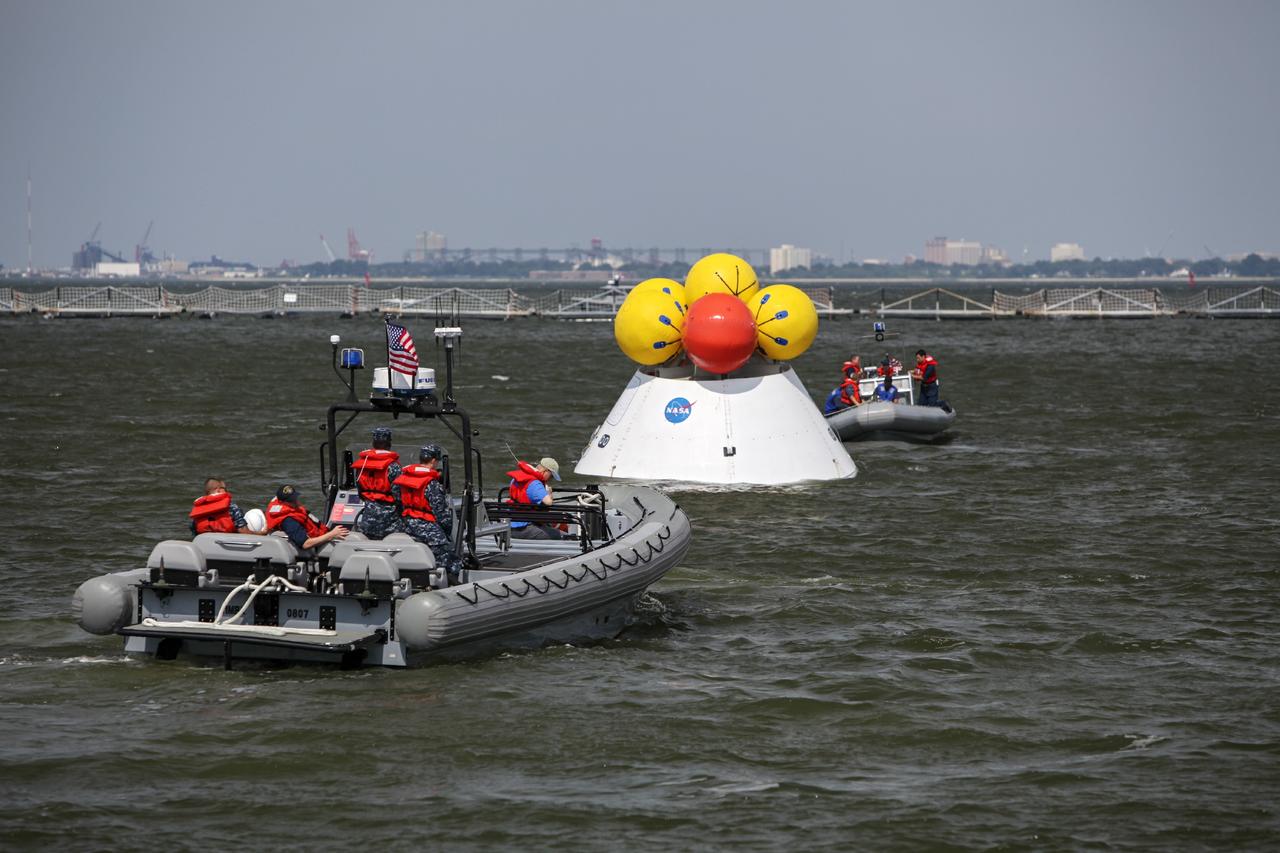
HAMPTON, Va. – At the Naval Station Norfolk near NASA’s Langley Research Center in Virginia, U.S. Navy personnel practice procedures during a stationary recovery test using the Orion boilerplate test article. NASA and the U.S. Navy are conducting tests to prepare for recovery of the Orion crew module and forward bay cover on its return from a deep space mission. The stationary recovery test will allow the teams to demonstrate and evaluate the recovery processes, procedures, hardware and personnel in a controlled environment before conducting a second recovery test next year in open waters. Orion is the exploration spacecraft designed to carry astronauts to destinations not yet explored by humans, including an asteroid and Mars. It will have emergency abort capability, sustain the crew during space travel and provide safe re-entry from deep space return velocities. The first unpiloted test flight of the Orion is scheduled to launch in 2014 atop a Delta IV rocket and in 2017 on NASA’s Space Launch System rocket. For more information, visit http://www.nasa.gov/orion. Photo credit: NASA/Dimitri Gerondidakis
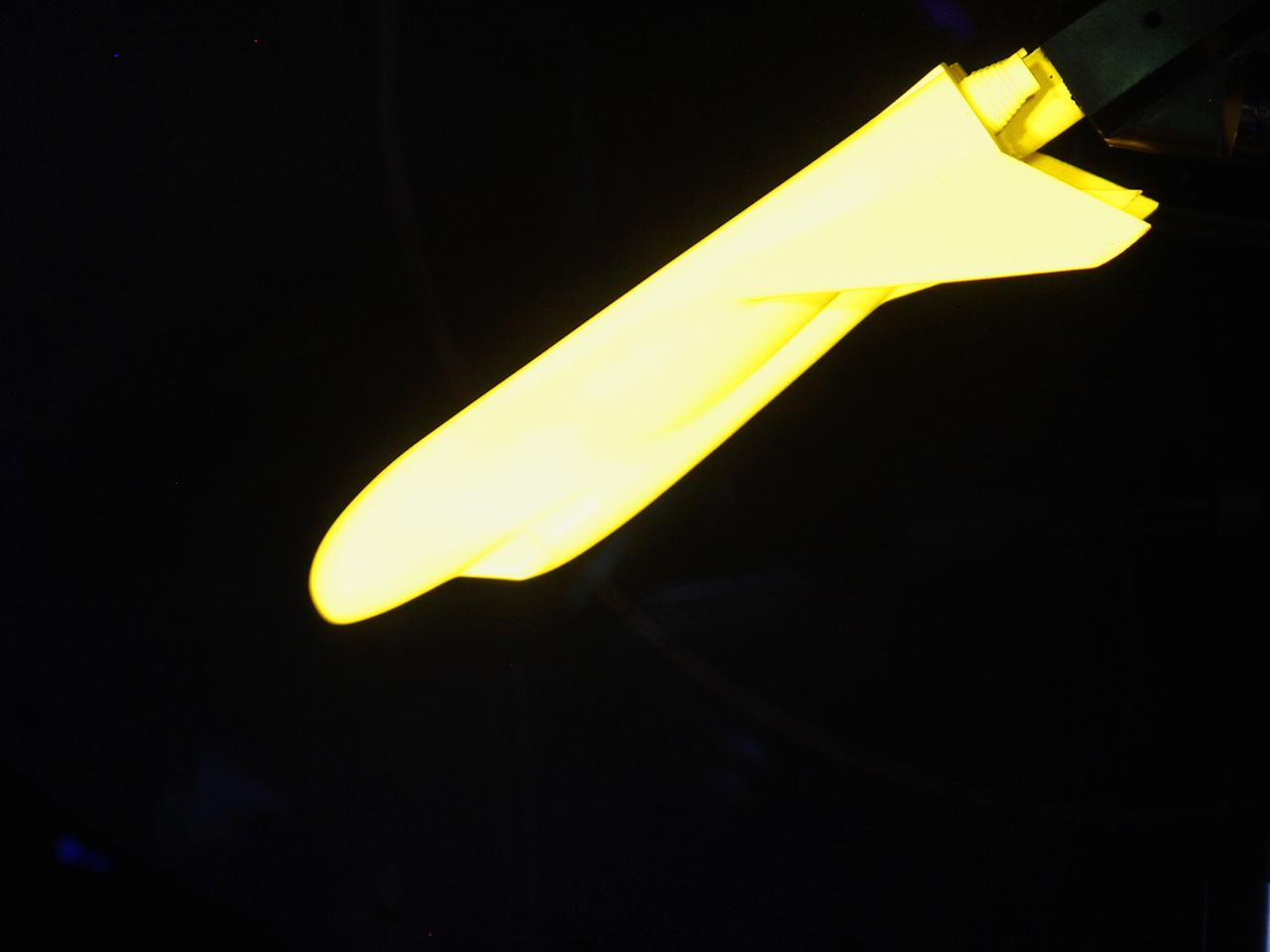
HAMPTON, Va. –A 10-inch long ceramic model of the Sierra Nevada Corporation, or SNC, Dream Chaser spacecraft undergoes high-speed wind tunnel tests at NASA's Langley Research Center in Hampton, Va. The tests measure how much heat the winged vehicle would experience during ascent and re-entry through the atmosphere, including the spacecraft's lower- and upper-body flaps, elevons and a rudder. They're also helping the company obtain necessary data for the material selection and design of the spacecraft's thermal protection system. SNC is continuing the development of its Dream Chaser spacecraft under the agency's Commercial Crew Integrated Capability, or CCiCap, initiative, which is intended to lead to the availability of commercial human spaceflight services for government and commercial customers. To learn more about CCP and its industry partners, visit www.nasa.gov/commercialcrew. Image credit: NASA/David Bowman
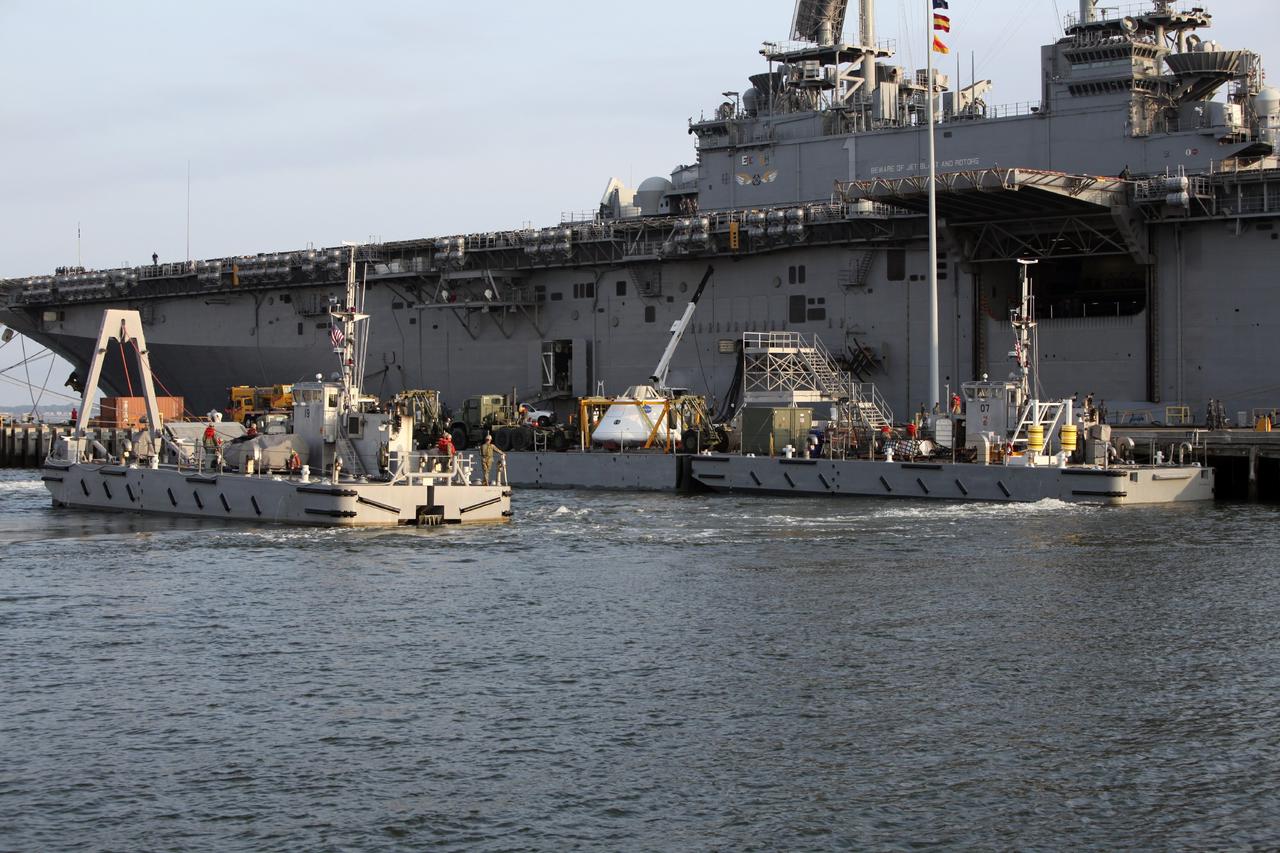
HAMPTON, Va. – At the Naval Station Norfolk near NASA’s Langley Research Center in Virginia, the Orion boilerplate test article and support equipment for a stationary recovery test are transferred by floating dock system to a U.S. Navy ship. NASA and the U.S. Navy are conducting tests to prepare for recovery of the Orion crew module and forward bay cover on its return from a deep space mission. The stationary recovery test will allow the teams to demonstrate and evaluate the recovery processes, procedures, hardware and personnel in a controlled environment before conducting a second recovery test next year in open waters. Orion is the exploration spacecraft designed to carry astronauts to destinations not yet explored by humans, including an asteroid and Mars. It will have emergency abort capability, sustain the crew during space travel and provide safe re-entry from deep space return velocities. The first unpiloted test flight of the Orion is scheduled to launch in 2014 atop a Delta IV rocket and in 2017 on a Space Launch System rocket. For more information, visit http://www.nasa.gov/orion. Photo credit: NASA/Dimitri Gerondidakis
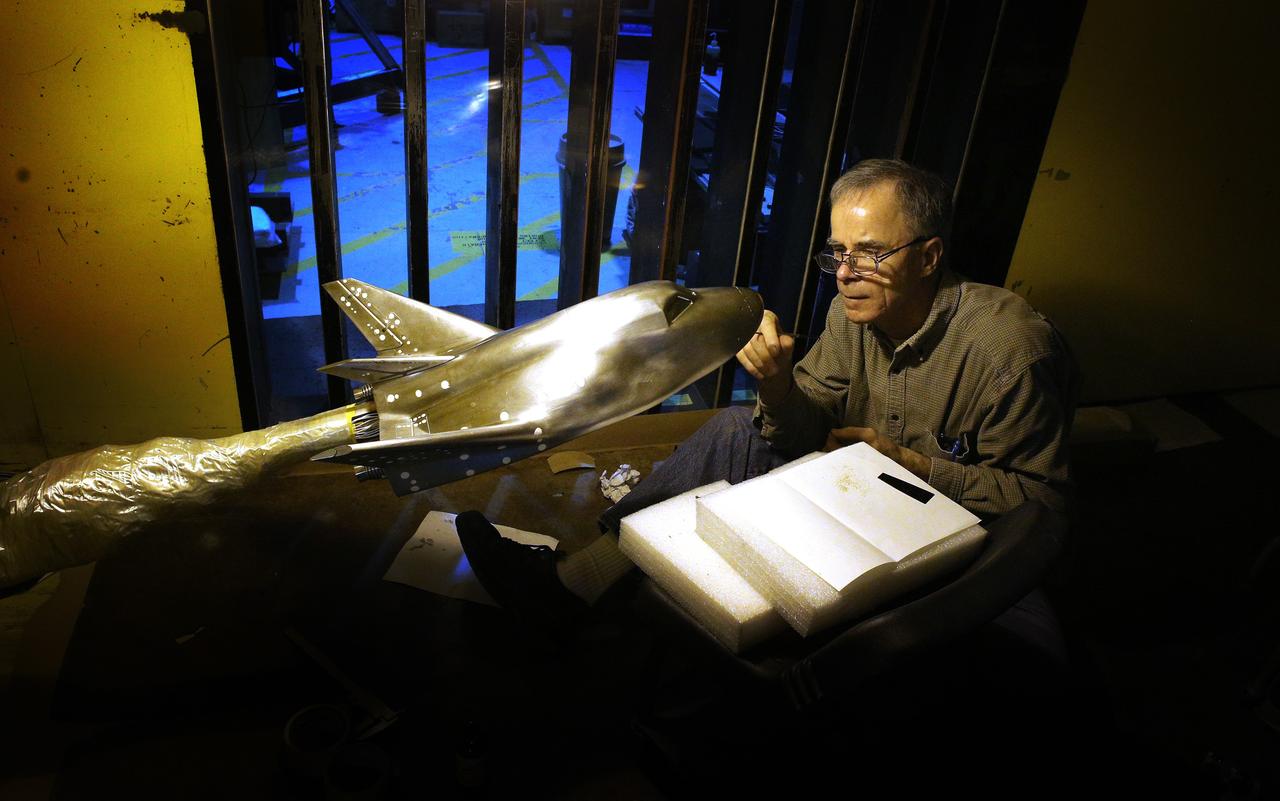
HAMPTON, Va. – NASA technician Ricky Hall works inside the Unitary Plan Wind Tunnel at NASA's Langley Research Center in Virginia to affix grains of sand to a precise scale model of the Dream Chaser spacecraft. Sierra Nevada Corporation is developing the Dream Chaser in partnership with NASA's Commercial Crew Program. The sand creates turbulence at key points to simulate the conditions the real spacecraft will encounter during its return to Earth. The data gathered from the wind tunnel was used to further test the design through the company's Commercial Crew Integrated Capability agreement with NASA. Photo credit: NASA/ David C. Bowman
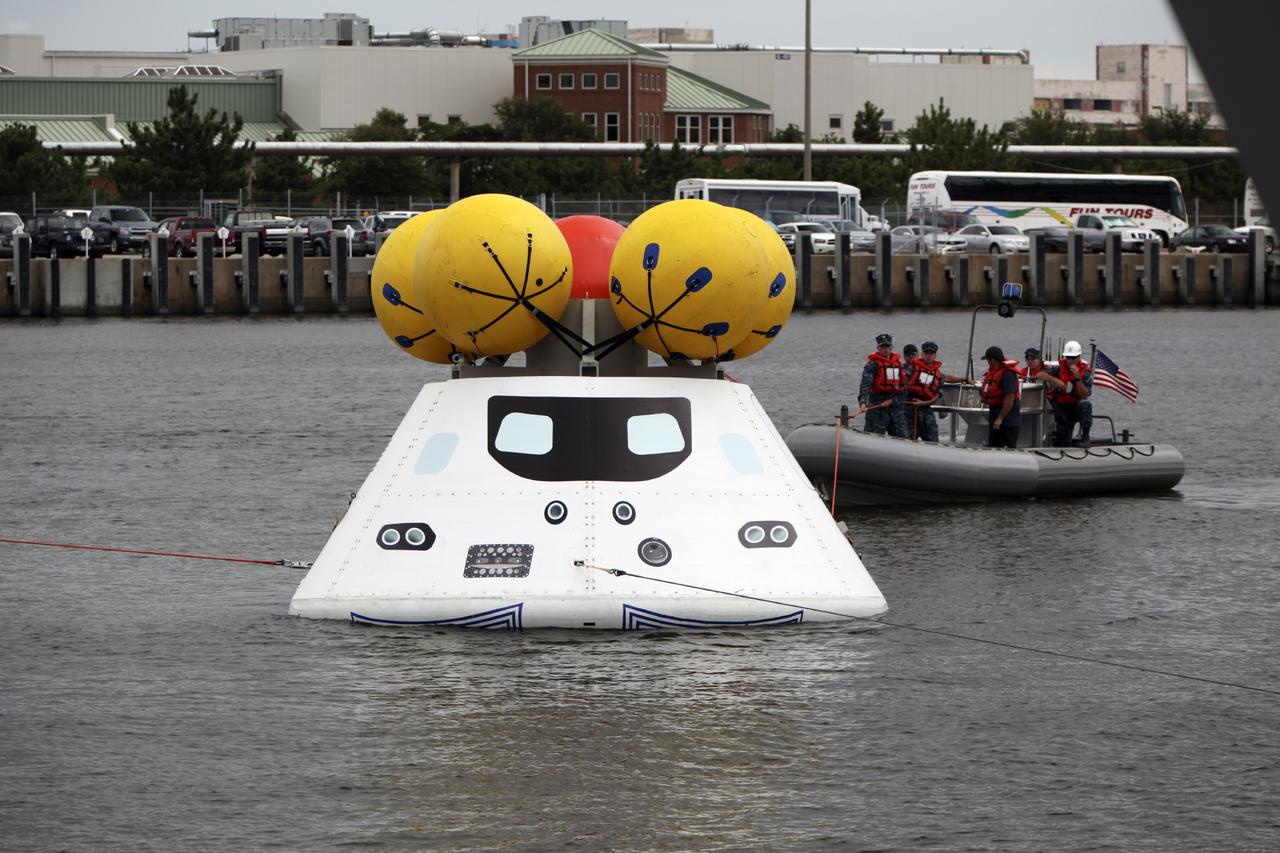
HAMPTON, Va. – At the Naval Station Norfolk near NASA’s Langley Research Center in Virginia, NASA and the U.S. Navy are conducting a stationary recovery test on the Orion boilerplate test article in the water near a U.S. Navy ship. NASA and the U.S. Navy are conducting tests to prepare for recovery of the Orion crew module and forward bay cover on its return from a deep space mission. The stationary recovery test will allow the teams to demonstrate and evaluate the recovery processes, procedures, hardware and personnel in a controlled environment before conducting a second recovery test next year in open waters. Orion is the exploration spacecraft designed to carry astronauts to destinations not yet explored by humans, including an asteroid and Mars. It will have emergency abort capability, sustain the crew during space travel and provide safe re-entry from deep space return velocities. The first unpiloted test flight of the Orion is scheduled to launch in 2014 atop a Delta IV rocket and in 2017 on NASA’s Space Launch System rocket. For more information, visit http://www.nasa.gov/orion. Photo credit: NASA/Dimitri Gerondidakis
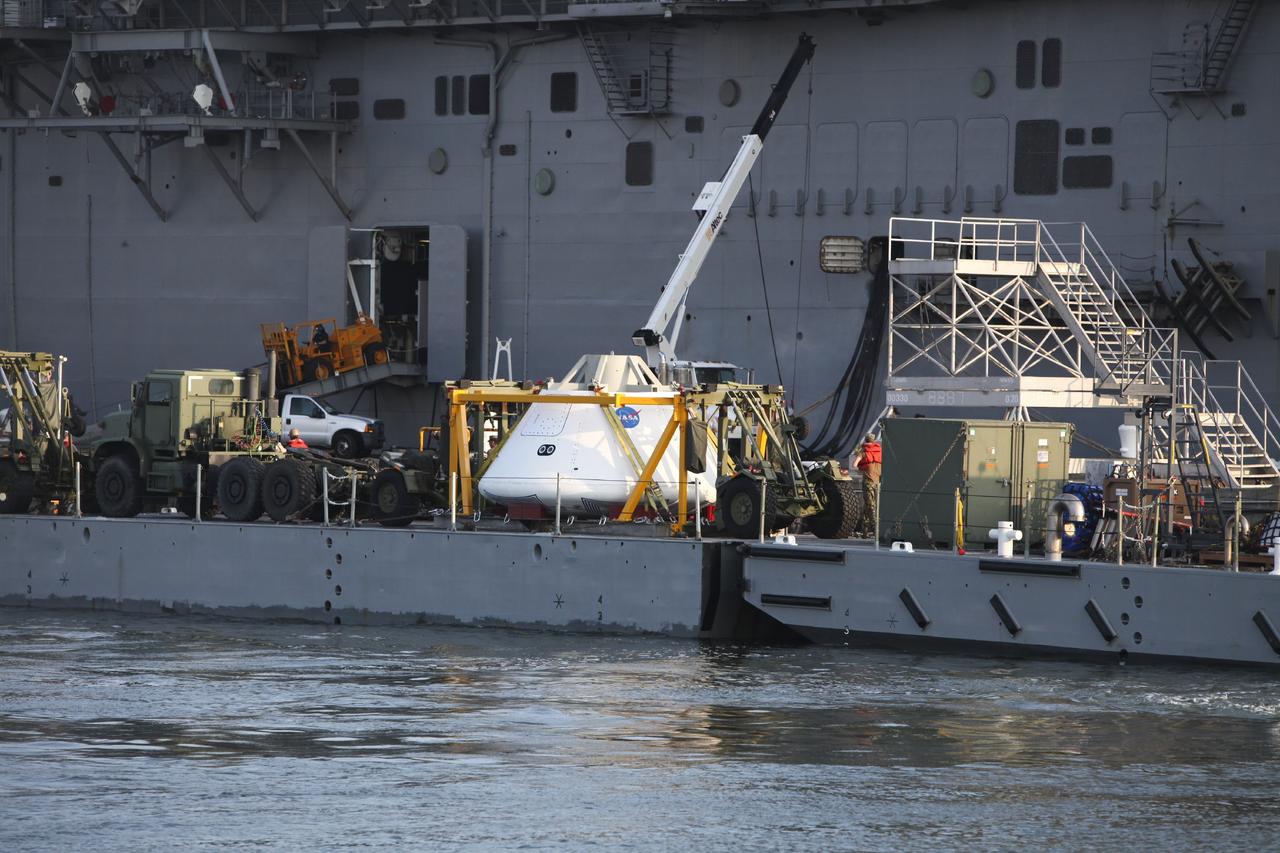
HAMPTON, Va. – At the Naval Station Norfolk near NASA’s Langley Research Center in Virginia, the Orion boilerplate test article and support equipment for a stationary recovery test are being transferred on a floating dock system to a U.S. Navy ship. NASA and the U.S. Navy are conducting tests to prepare for recovery of the Orion crew module and forward bay cover on its return from a deep space mission. The stationary recovery test will allow the teams to demonstrate and evaluate the recovery processes, procedures, hardware and personnel in a controlled environment before conducting a second recovery test next year in open waters. Orion is the exploration spacecraft designed to carry astronauts to destinations not yet explored by humans, including an asteroid and Mars. It will have emergency abort capability, sustain the crew during space travel and provide safe re-entry from deep space return velocities. The first unpiloted test flight of the Orion is scheduled to launch in 2014 atop a Delta IV rocket and in 2017 on a Space Launch System rocket. For more information, visit http://www.nasa.gov/orion. Photo credit: NASA/Dimitri Gerondidakis
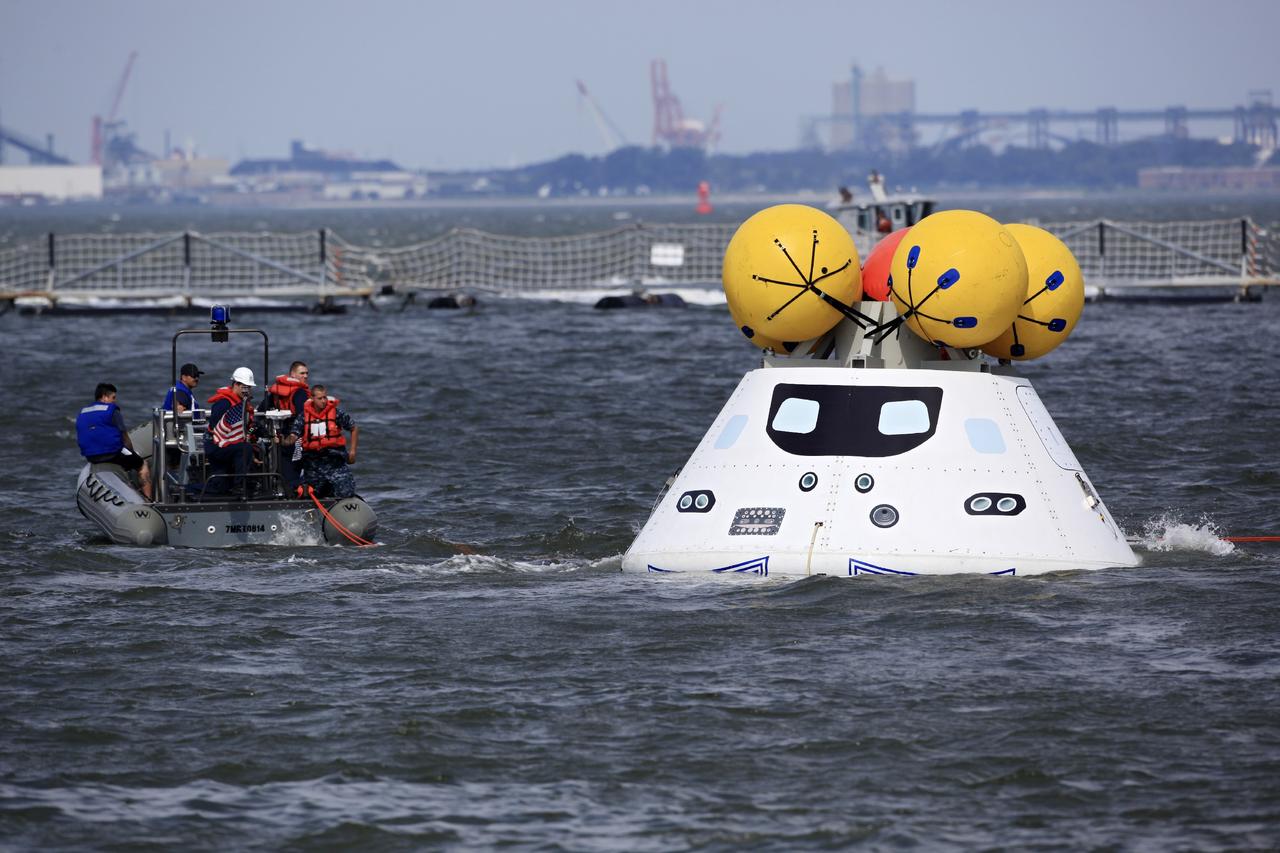
HAMPTON, Va. – At the Naval Station Norfolk near NASA’s Langley Research Center in Virginia, U.S. Navy personnel approach the Orion boilerplate test article during a stationary recovery test in the water. NASA and the U.S. Navy are conducting tests to prepare for recovery of the Orion crew module and forward bay cover on its return from a deep space mission. The stationary recovery test will allow the teams to demonstrate and evaluate the recovery processes, procedures, hardware and personnel in a controlled environment before conducting a second recovery test next year in open waters. Orion is the exploration spacecraft designed to carry astronauts to destinations not yet explored by humans, including an asteroid and Mars. It will have emergency abort capability, sustain the crew during space travel and provide safe re-entry from deep space return velocities. The first unpiloted test flight of the Orion is scheduled to launch in 2014 atop a Delta IV rocket and in 2017 on NASA’s Space Launch System rocket. For more information, visit http://www.nasa.gov/orion. Photo credit: NASA/Dimitri Gerondidakis
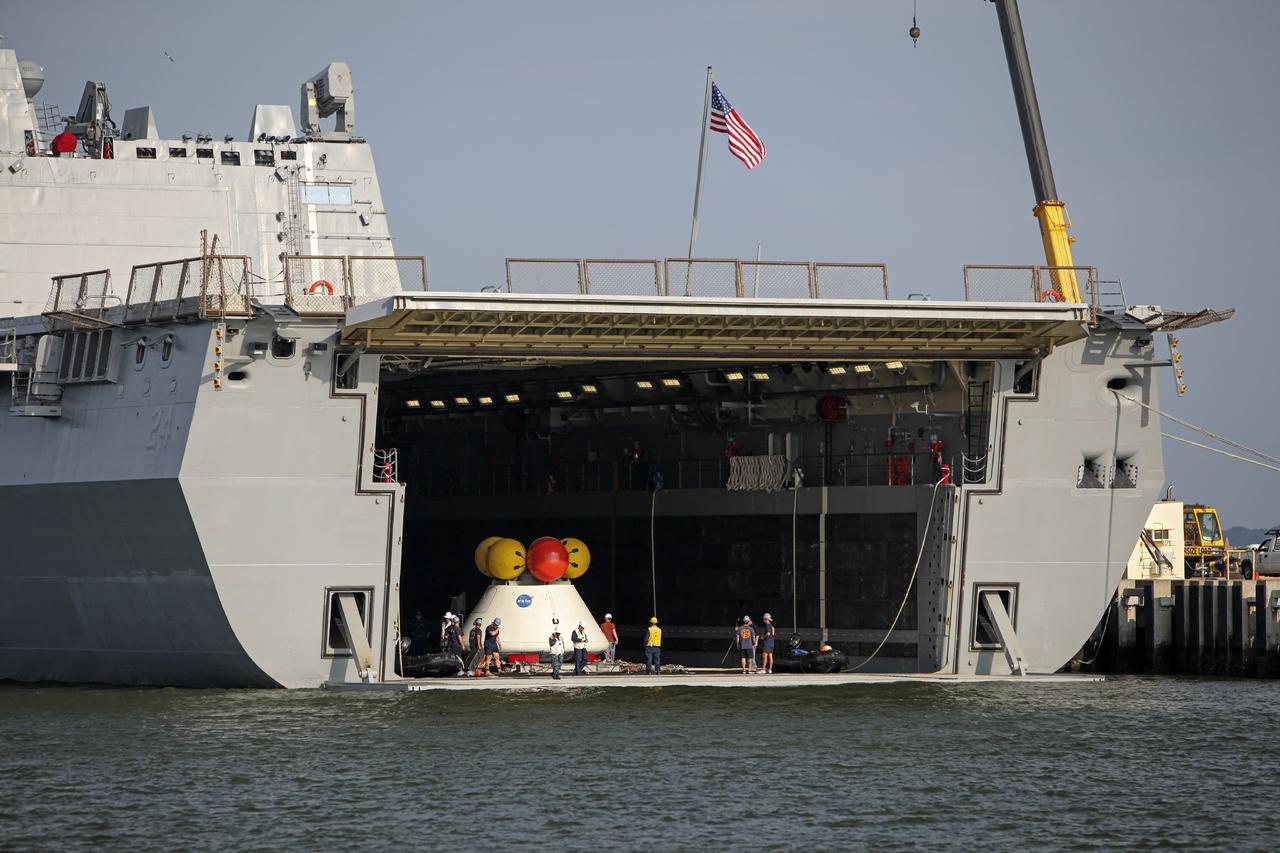
HAMPTON, Va. – At the Naval Station Norfolk near NASA’s Langley Research Center in Virginia, NASA and U.S. Navy personnel prepare the Orion boilerplate test article and support equipment for a stationary recovery test on a U.S. Navy ship. NASA and the U.S. Navy are conducting tests to prepare for recovery of the Orion crew module and forward bay cover on its return from a deep space mission. The stationary recovery test will allow the teams to demonstrate and evaluate the recovery processes, procedures, hardware and personnel in a controlled environment before conducting a second recovery test next year in open waters. Orion is the exploration spacecraft designed to carry astronauts to destinations not yet explored by humans, including an asteroid and Mars. It will have emergency abort capability, sustain the crew during space travel and provide safe re-entry from deep space return velocities. The first unpiloted test flight of the Orion is scheduled to launch in 2014 atop a Delta IV rocket and in 2017 on NASA’s Space Launch System rocket. For more information, visit http://www.nasa.gov/orion. Photo credit: NASA/Dimitri Gerondidakis
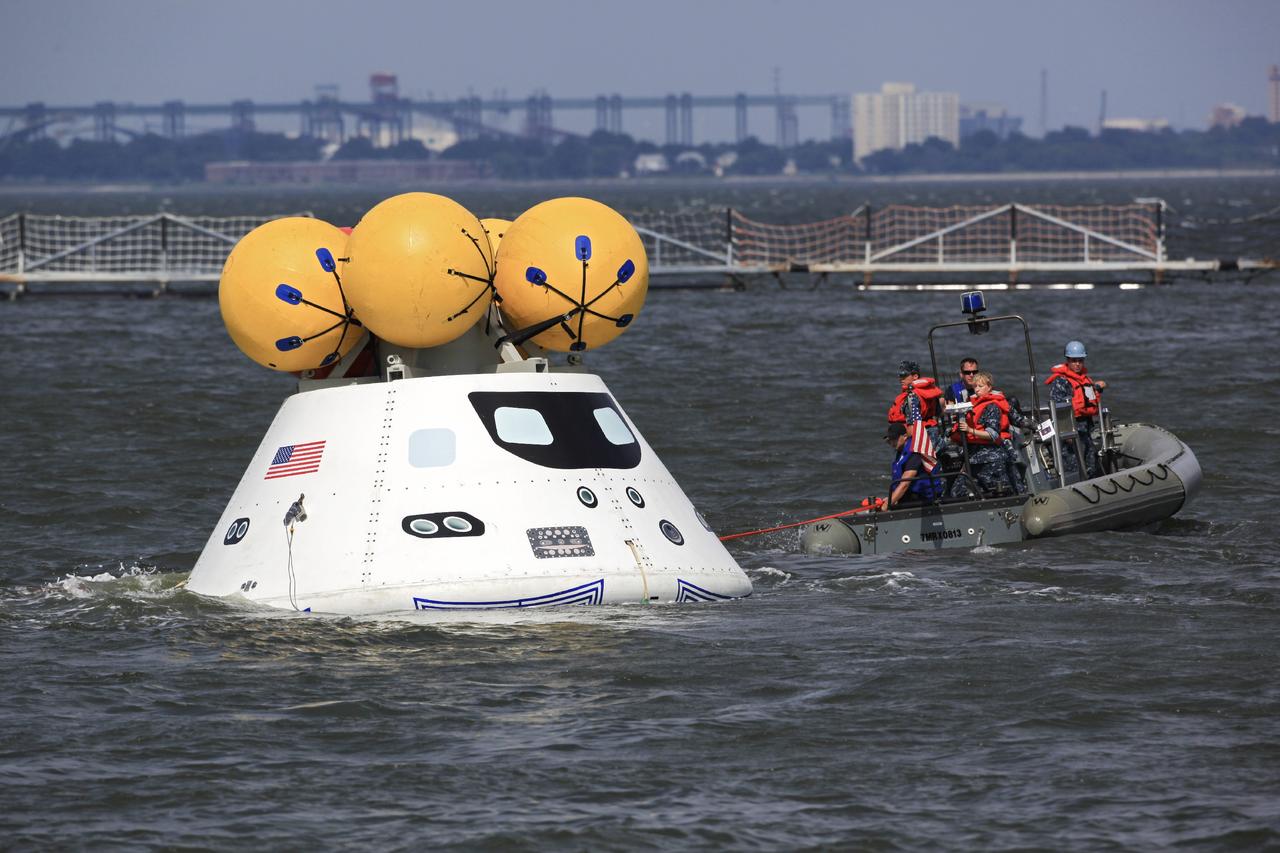
HAMPTON, Va. – At the Naval Station Norfolk near NASA’s Langley Research Center in Virginia, U.S. Navy personnel approach the Orion boilerplate test article to remove a tether line during a stationary recovery test in the water. NASA and the U.S. Navy are conducting tests to prepare for recovery of the Orion crew module and forward bay cover on its return from a deep space mission. The stationary recovery test will allow the teams to demonstrate and evaluate the recovery processes, procedures, hardware and personnel in a controlled environment before conducting a second recovery test next year in open waters. Orion is the exploration spacecraft designed to carry astronauts to destinations not yet explored by humans, including an asteroid and Mars. It will have emergency abort capability, sustain the crew during space travel and provide safe re-entry from deep space return velocities. The first unpiloted test flight of the Orion is scheduled to launch in 2014 atop a Delta IV rocket and in 2017 on NASA’s Space Launch System rocket. For more information, visit http://www.nasa.gov/orion. Photo credit: NASA/Dimitri Gerondidakis
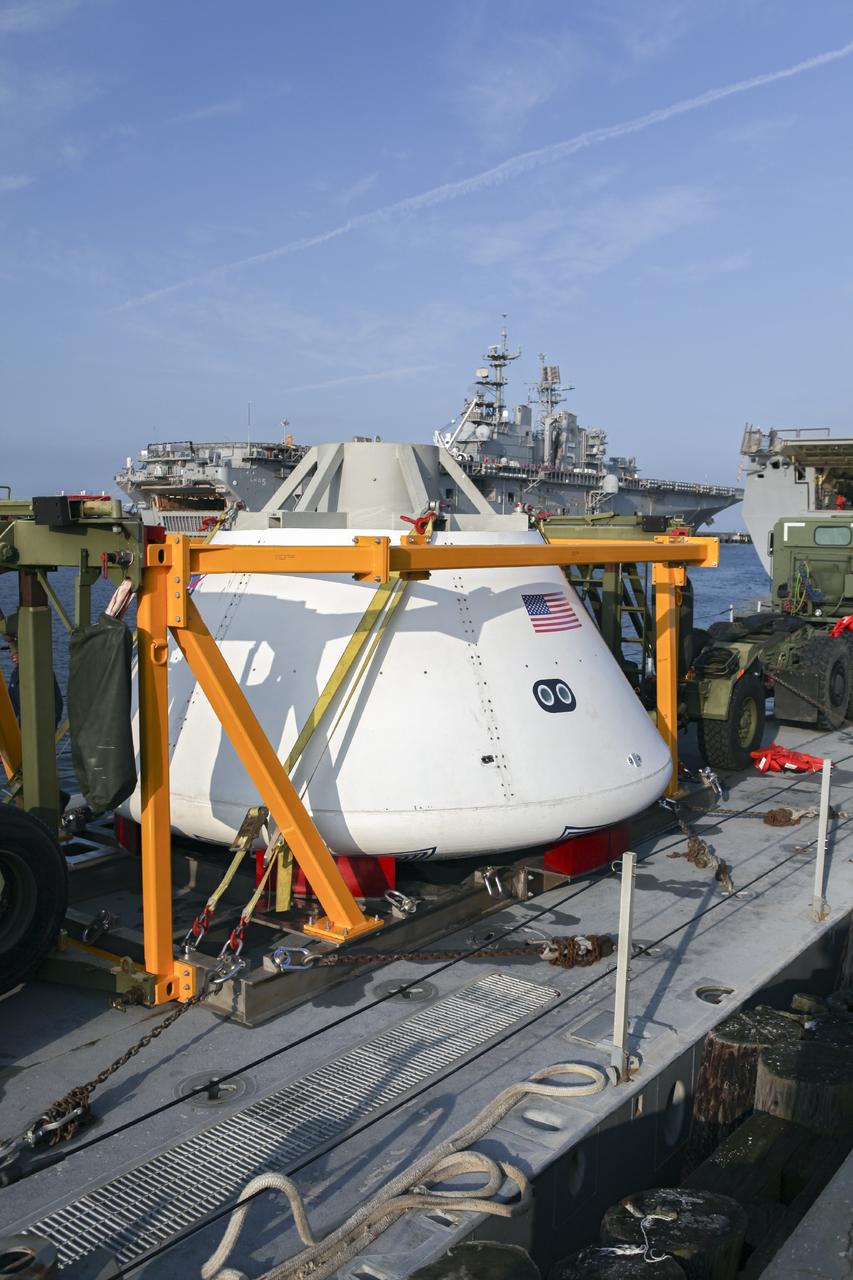
HAMPTON, Va. – At the Naval Station Norfolk near NASA’s Langley Research Center in Virginia, the Orion boilerplate test article and support equipment for a stationary recovery test are secured on a floating dock system for transfer to a U.S. Navy ship. NASA and the U.S. Navy are conducting tests to prepare for recovery of the Orion crew module and forward bay cover on its return from a deep space mission. The stationary recovery test will allow the teams to demonstrate and evaluate the recovery processes, procedures, hardware and personnel in a controlled environment before conducting a second recovery test next year in open waters. Orion is the exploration spacecraft designed to carry astronauts to destinations not yet explored by humans, including an asteroid and Mars. It will have emergency abort capability, sustain the crew during space travel and provide safe re-entry from deep space return velocities. The first unpiloted test flight of the Orion is scheduled to launch in 2014 atop a Delta IV rocket and in 2017 on a Space Launch System rocket. For more information, visit http://www.nasa.gov/orion. Photo credit: NASA/Dimitri Gerondidakis
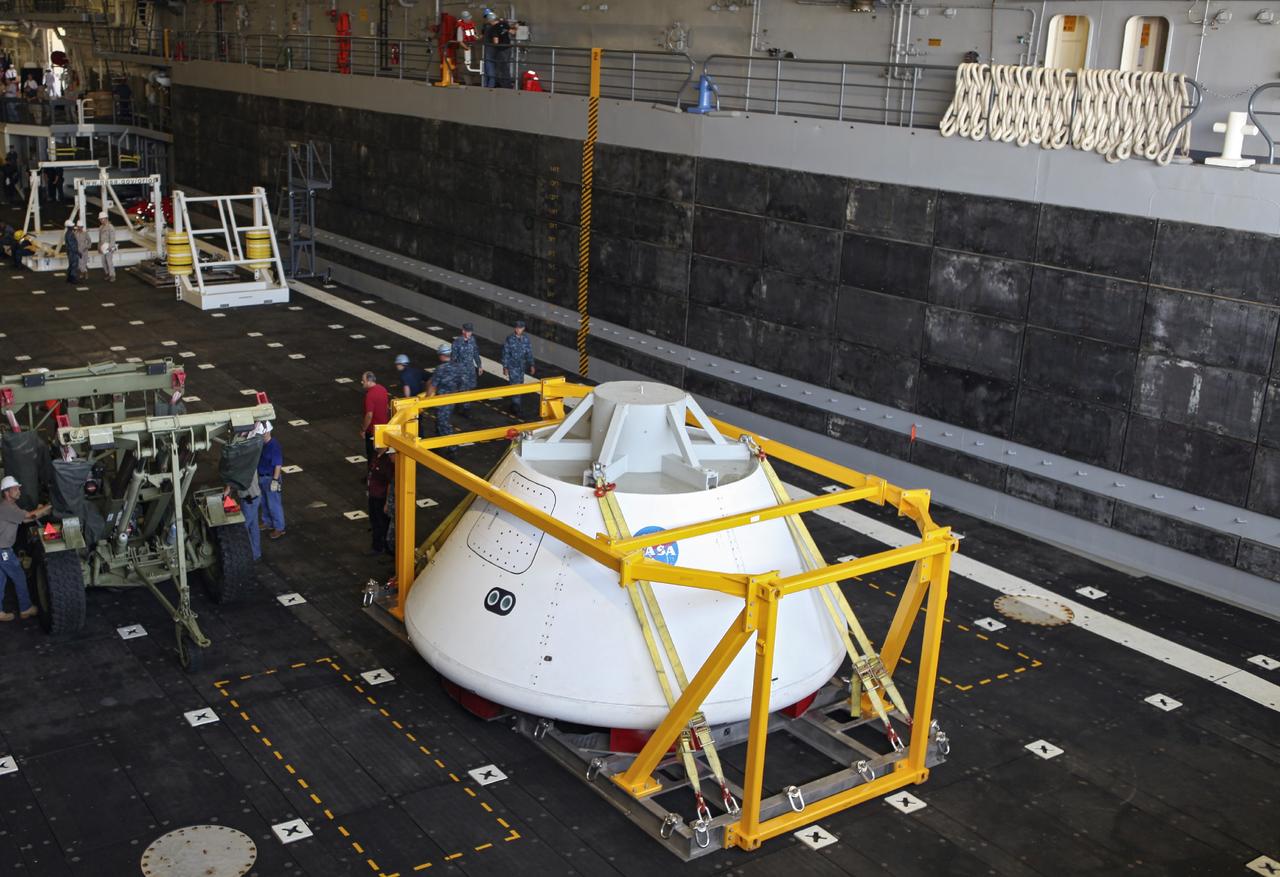
HAMPTON, Va. – At the Naval Station Norfolk near NASA’s Langley Research Center in Virginia, the Orion boilerplate test article and support equipment for a stationary recovery test have been secured on a U.S. Navy ship from a floating dock system. NASA and the U.S. Navy are conducting tests to prepare for recovery of the Orion crew module and forward bay cover on its return from a deep space mission. The stationary recovery test will allow the teams to demonstrate and evaluate the recovery processes, procedures, hardware and personnel in a controlled environment before conducting a second recovery test next year in open waters. Orion is the exploration spacecraft designed to carry astronauts to destinations not yet explored by humans, including an asteroid and Mars. It will have emergency abort capability, sustain the crew during space travel and provide safe re-entry from deep space return velocities. The first unpiloted test flight of the Orion is scheduled to launch in 2014 atop a Delta IV rocket and in 2017 on NASA’s Space Launch System rocket. For more information, visit http://www.nasa.gov/orion. Photo credit: NASA/Dimitri Gerondidakis
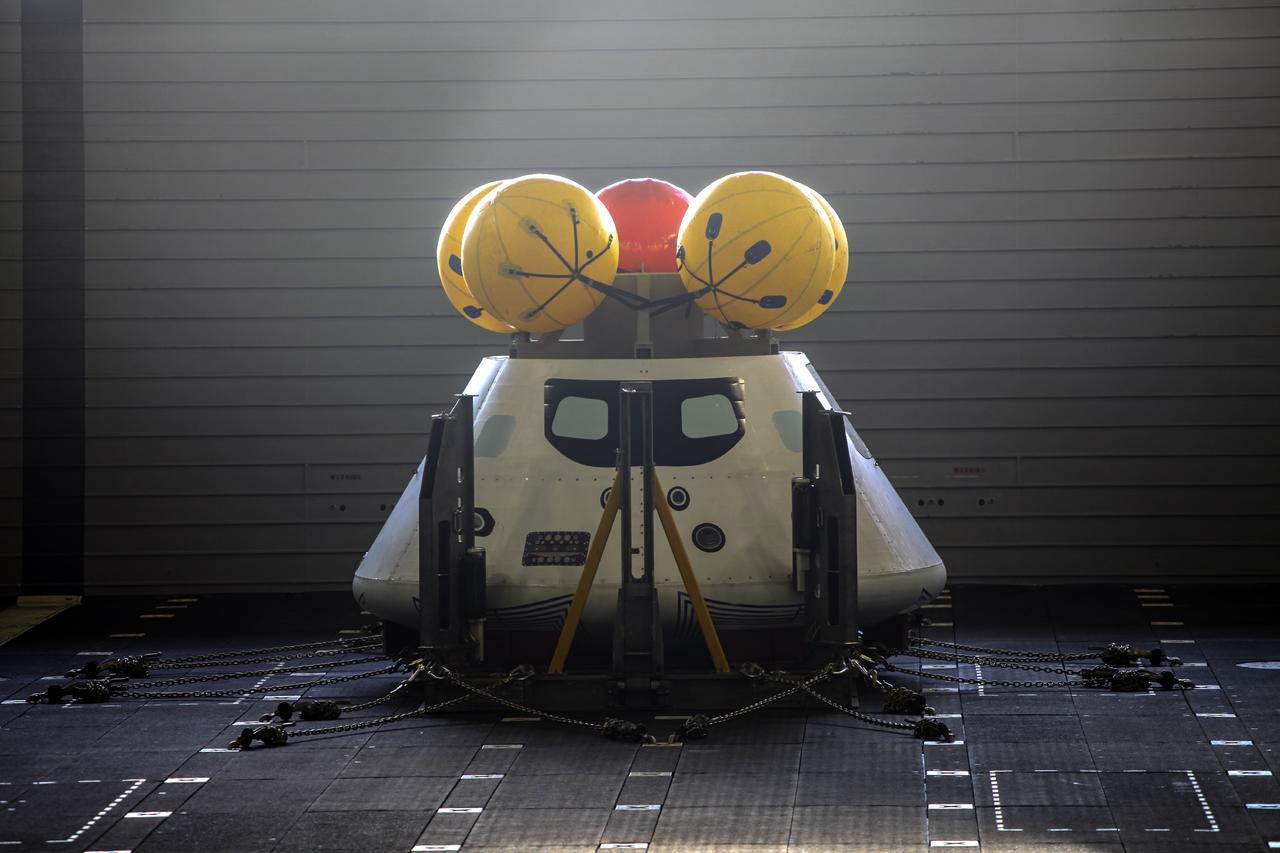
HAMPTON, Va. – At the Naval Station Norfolk near NASA’s Langley Research Center in Virginia, the Orion boilerplate test article is being prepared for a stationary recovery test on a U.S. Navy ship. NASA and the U.S. Navy are conducting tests to prepare for recovery of the Orion crew module and forward bay cover on its return from a deep space mission. The stationary recovery test will allow the teams to demonstrate and evaluate the recovery processes, procedures, hardware and personnel in a controlled environment before conducting a second recovery test next year in open waters. Orion is the exploration spacecraft designed to carry astronauts to destinations not yet explored by humans, including an asteroid and Mars. It will have emergency abort capability, sustain the crew during space travel and provide safe re-entry from deep space return velocities. The first unpiloted test flight of the Orion is scheduled to launch in 2014 atop a Delta IV rocket and in 2017 on NASA’s Space Launch System rocket. For more information, visit http://www.nasa.gov/orion. Photo credit: NASA/Dimitri Gerondidakis
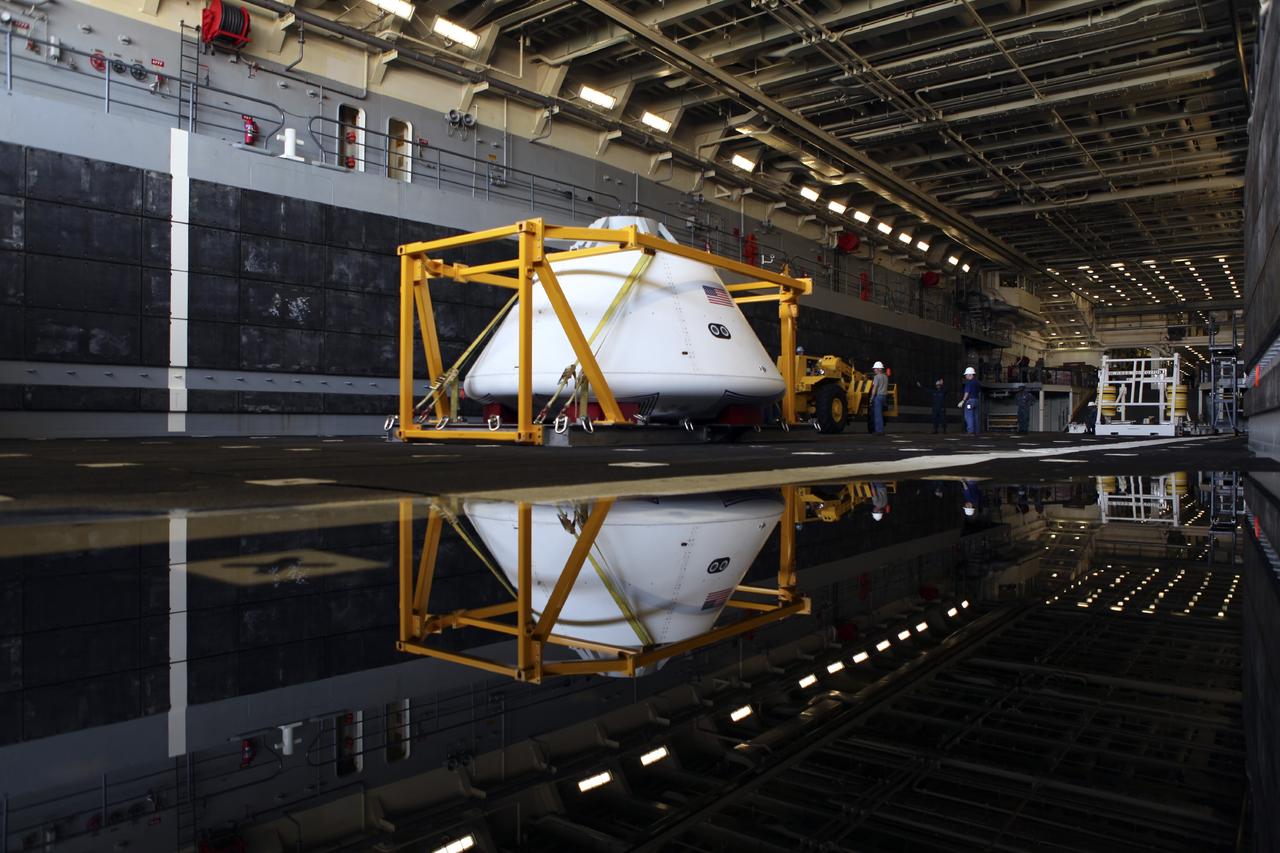
HAMPTON, Va. – At the Naval Station Norfolk near NASA’s Langley Research Center in Virginia, the Orion boilerplate test article is reflected in water on a U.S. Navy ship. The test article and support equipment for a stationary recovery test were transferred to the ship from a floating dock system. NASA and the U.S. Navy are conducting tests to prepare for recovery of the Orion crew module and forward bay cover on its return from a deep space mission. The stationary recovery test will allow the teams to demonstrate and evaluate the recovery processes, procedures, hardware and personnel in a controlled environment before conducting a second recovery test next year in open waters. Orion is the exploration spacecraft designed to carry astronauts to destinations not yet explored by humans, including an asteroid and Mars. It will have emergency abort capability, sustain the crew during space travel and provide safe re-entry from deep space return velocities. The first unpiloted test flight of the Orion is scheduled to launch in 2014 atop a Delta IV rocket and in 2017 on NASA’s Space Launch System rocket. For more information, visit http://www.nasa.gov/orion. Photo credit: NASA/Dimitri Gerondidakis
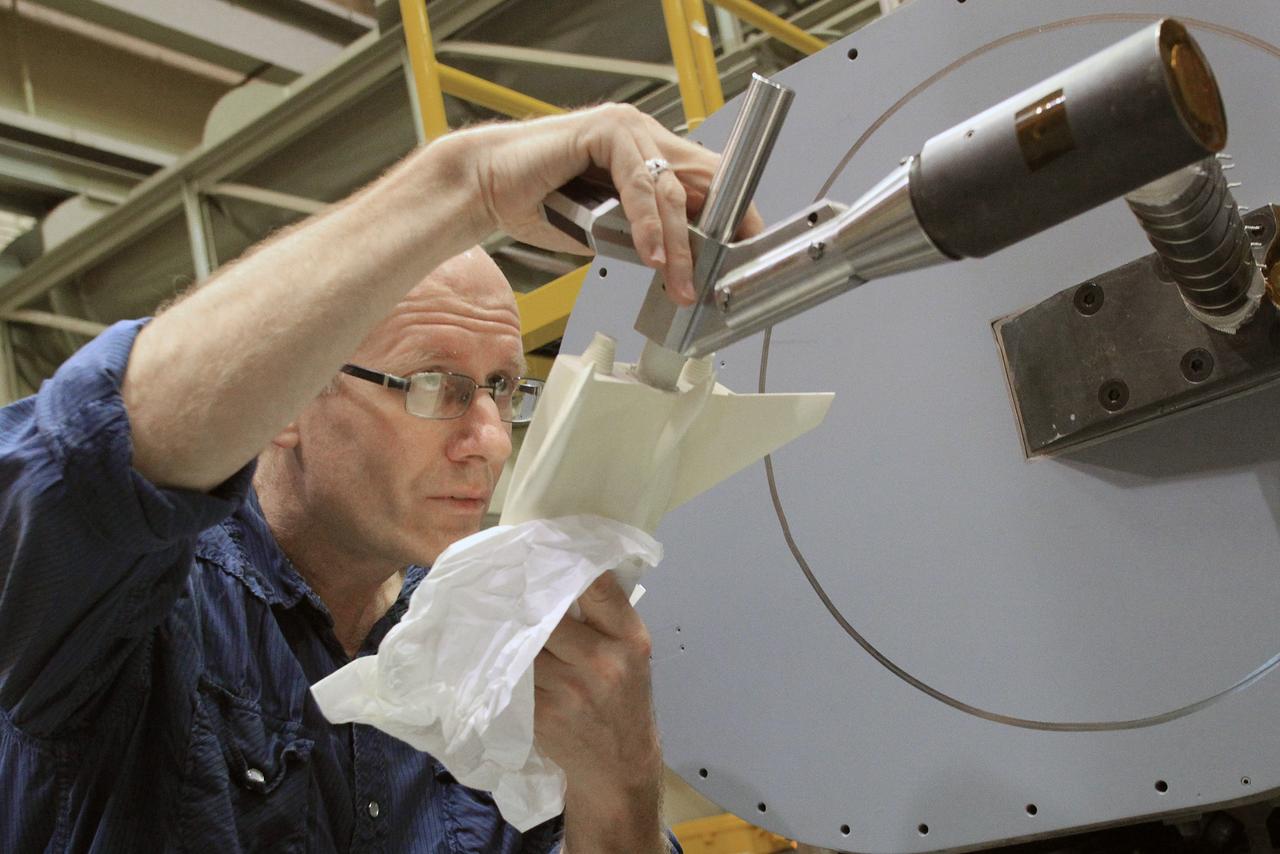
HAMPTON, Va. –A 10-inch long ceramic model of the Sierra Nevada Corporation, or SNC, Dream Chaser spacecraft is prepared for high-speed wind tunnel tests at NASA's Langley Research Center in Hampton, Va. The tests measure how much heat the winged vehicle would experience during ascent and re-entry through the atmosphere, including the spacecraft's lower- and upper-body flaps, elevons and a rudder. They're also helping the company obtain necessary data for the material selection and design of the spacecraft's thermal protection system. SNC is continuing the development of its Dream Chaser spacecraft under the agency's Commercial Crew Integrated Capability, or CCiCap, initiative, which is intended to lead to the availability of commercial human spaceflight services for government and commercial customers. To learn more about CCP and its industry partners, visit www.nasa.gov/commercialcrew. Image credit: NASA/David Bowman
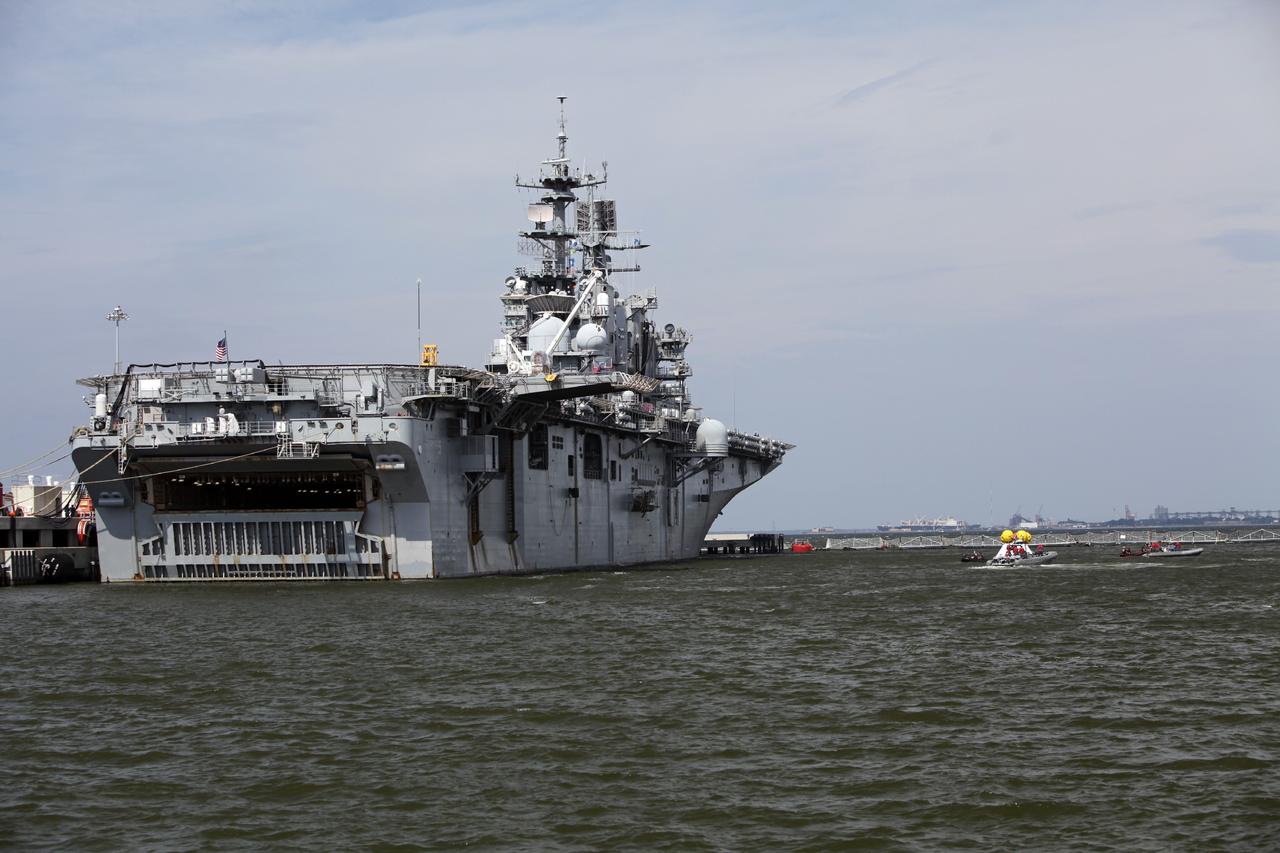
HAMPTON, Va. – At the Naval Station Norfolk near NASA’s Langley Research Center in Virginia, the Orion boilerplate test article floats in the water near a U.S. Navy ship during a stationary recovery test. NASA and the U.S. Navy are conducting tests to prepare for recovery of the Orion crew module and forward bay cover on its return from a deep space mission. The stationary recovery test will allow the teams to demonstrate and evaluate the recovery processes, procedures, hardware and personnel in a controlled environment before conducting a second recovery test next year in open waters. Orion is the exploration spacecraft designed to carry astronauts to destinations not yet explored by humans, including an asteroid and Mars. It will have emergency abort capability, sustain the crew during space travel and provide safe re-entry from deep space return velocities. The first unpiloted test flight of the Orion is scheduled to launch in 2014 atop a Delta IV rocket and in 2017 on NASA’s Space Launch System rocket. For more information, visit http://www.nasa.gov/orion. Photo credit: NASA/Dimitri Gerondidakis
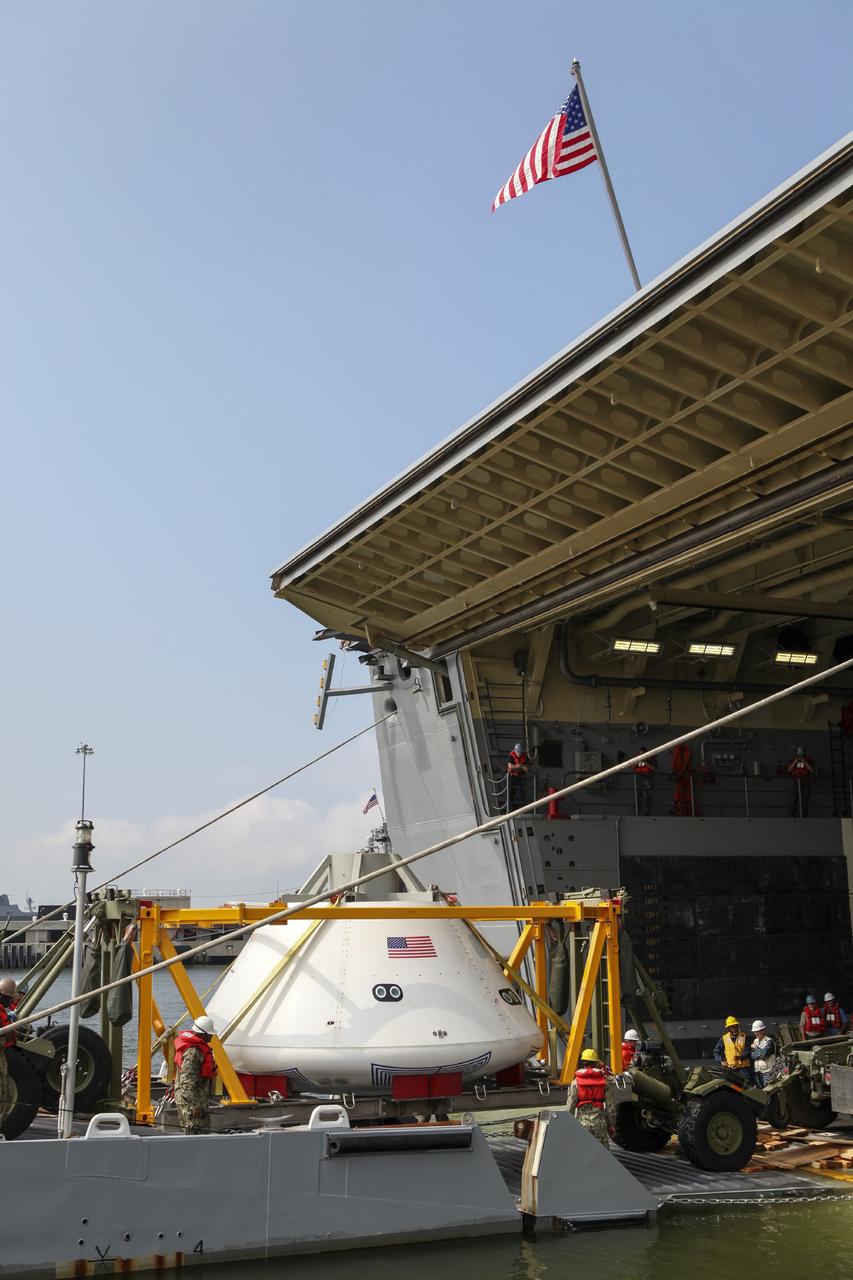
HAMPTON, Va. – At the Naval Station Norfolk near NASA’s Langley Research Center in Virginia, the Orion boilerplate test article and support equipment for a stationary recovery test are transferred by floating dock system to a U.S. Navy ship. NASA and the U.S. Navy are conducting tests to prepare for recovery of the Orion crew module and forward bay cover on its return from a deep space mission. The stationary recovery test will allow the teams to demonstrate and evaluate the recovery processes, procedures, hardware and personnel in a controlled environment before conducting a second recovery test next year in open waters. Orion is the exploration spacecraft designed to carry astronauts to destinations not yet explored by humans, including an asteroid and Mars. It will have emergency abort capability, sustain the crew during space travel and provide safe re-entry from deep space return velocities. The first unpiloted test flight of the Orion is scheduled to launch in 2014 atop a Delta IV rocket and in 2017 on NASA’s Space Launch System rocket. For more information, visit http://www.nasa.gov/orion. Photo credit: NASA/Dimitri Gerondidakis
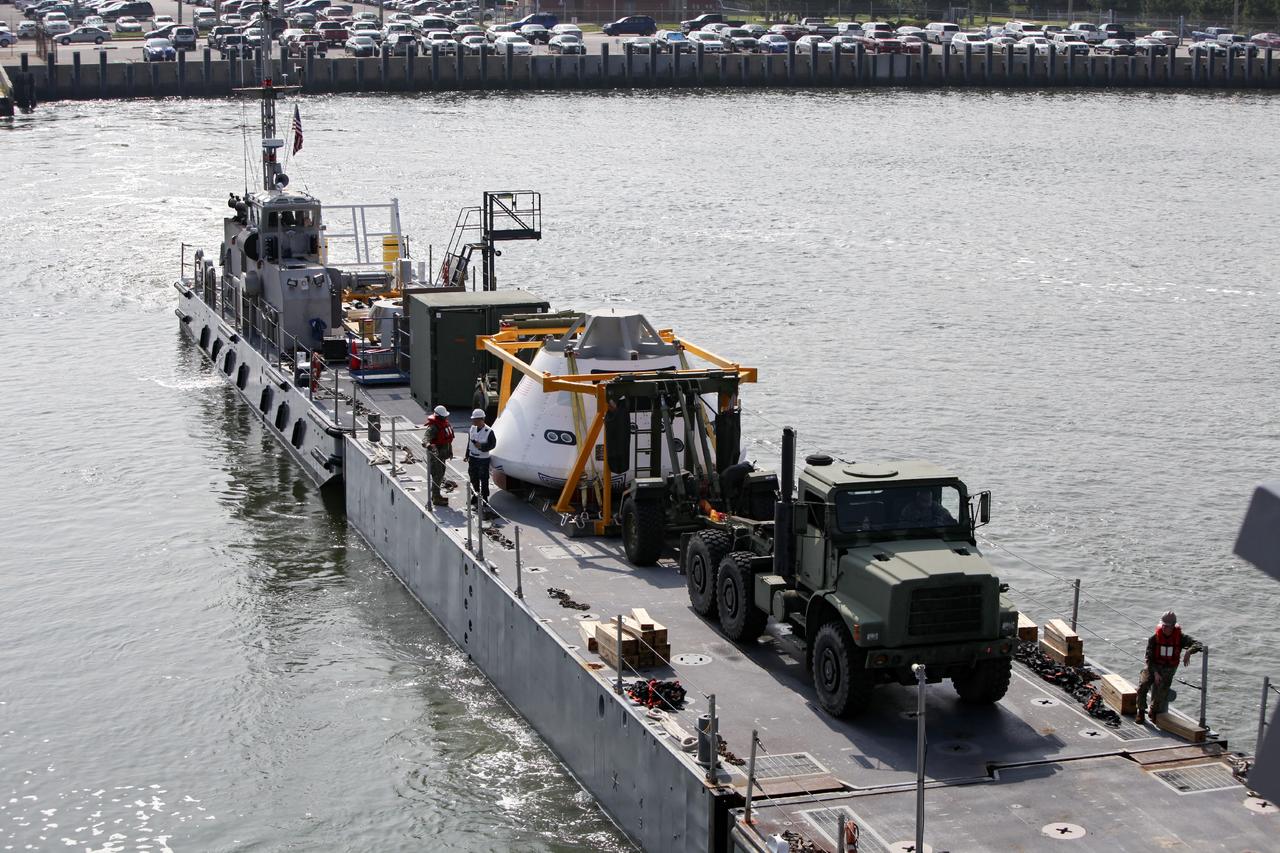
HAMPTON, Va. – At the Naval Station Norfolk near NASA’s Langley Research Center in Virginia, a floating dock system carries the Orion boilerplate test article and support equipment for a stationary recovery test aboard a U.S. Navy ship. NASA and the U.S. Navy are conducting tests to prepare for recovery of the Orion crew module and forward bay cover on its return from a deep space mission. The stationary recovery test will allow the teams to demonstrate and evaluate the recovery processes, procedures, hardware and personnel in a controlled environment before conducting a second recovery test next year in open waters. Orion is the exploration spacecraft designed to carry astronauts to destinations not yet explored by humans, including an asteroid and Mars. It will have emergency abort capability, sustain the crew during space travel and provide safe re-entry from deep space return velocities. The first unpiloted test flight of the Orion is scheduled to launch in 2014 atop a Delta IV rocket and in 2017 on NASA’s Space Launch System rocket. For more information, visit http://www.nasa.gov/orion. Photo credit: NASA/Dimitri Gerondidakis
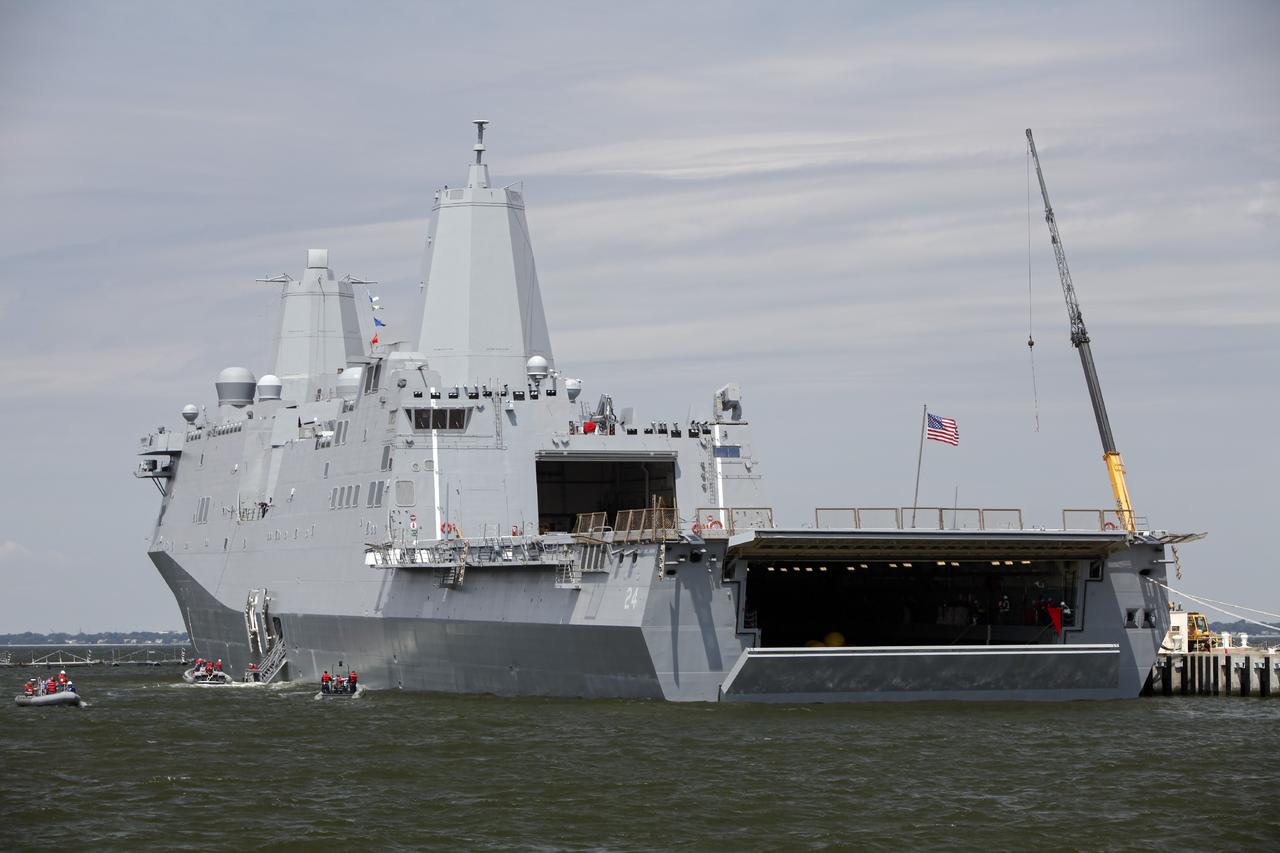
HAMPTON, Va. – At the Naval Station Norfolk near NASA’s Langley Research Center in Virginia, the Orion boilerplate test article has been returned to a U.S. Navy ship following a stationary recovery test in the water. NASA and the U.S. Navy are conducting tests to prepare for recovery of the Orion crew module and forward bay cover on its return from a deep space mission. The stationary recovery test will allow the teams to demonstrate and evaluate the recovery processes, procedures, hardware and personnel in a controlled environment before conducting a second recovery test next year in open waters. Orion is the exploration spacecraft designed to carry astronauts to destinations not yet explored by humans, including an asteroid and Mars. It will have emergency abort capability, sustain the crew during space travel and provide safe re-entry from deep space return velocities. The first unpiloted test flight of the Orion is scheduled to launch in 2014 atop a Delta IV rocket and in 2017 on NASA’s Space Launch System rocket. For more information, visit http://www.nasa.gov/orion. Photo credit: NASA/Dimitri Gerondidakis
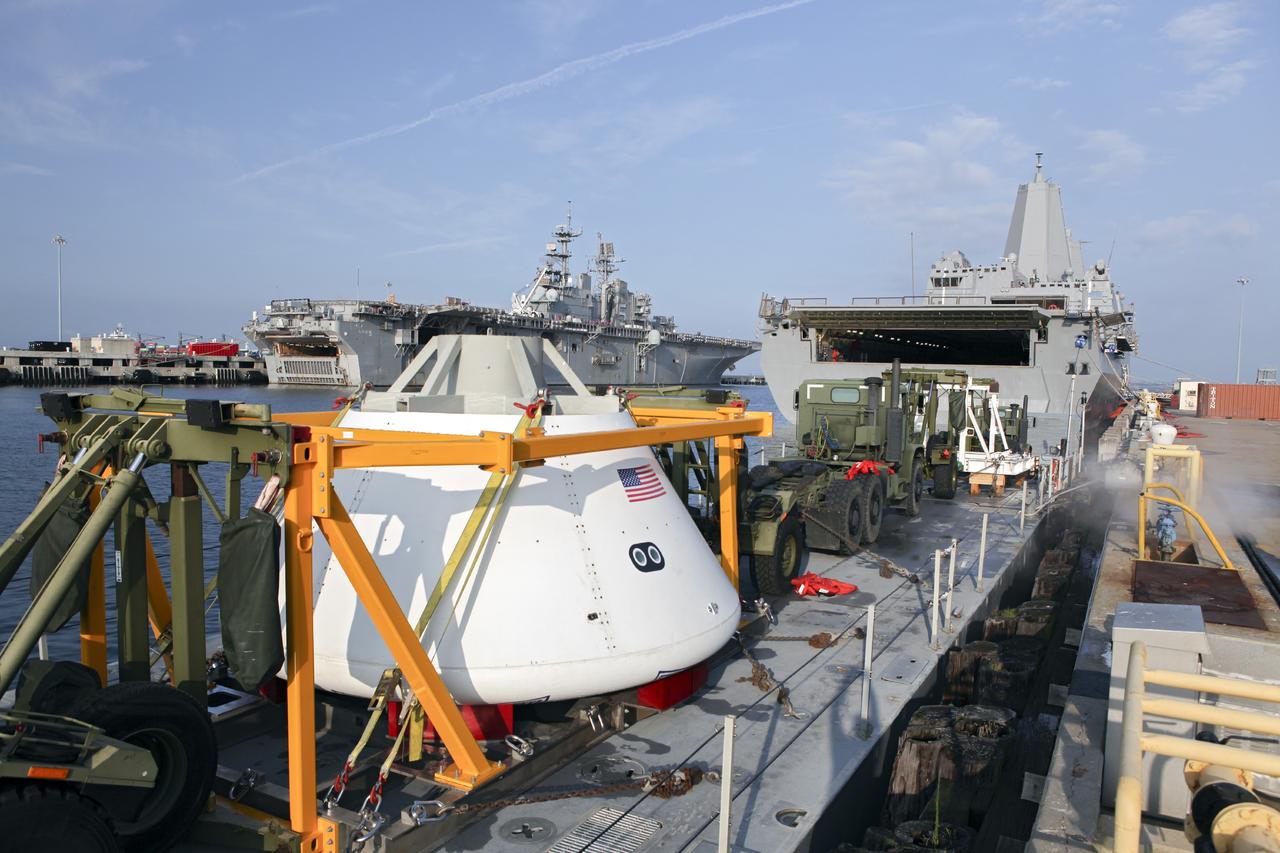
HAMPTON, Va. – At the Naval Station Norfolk near NASA’s Langley Research Center in Virginia, the Orion boilerplate test article and support equipment for a stationary recovery test are secured on a floating dock system for transfer to a U.S. Navy ship. NASA and the U.S. Navy are conducting tests to prepare for recovery of the Orion crew module and forward bay cover on its return from a deep space mission. The stationary recovery test will allow the teams to demonstrate and evaluate the recovery processes, procedures, hardware and personnel in a controlled environment before conducting a second recovery test next year in open waters. Orion is the exploration spacecraft designed to carry astronauts to destinations not yet explored by humans, including an asteroid and Mars. It will have emergency abort capability, sustain the crew during space travel and provide safe re-entry from deep space return velocities. The first unpiloted test flight of the Orion is scheduled to launch in 2014 atop a Delta IV rocket and in 2017 on a Space Launch System rocket. For more information, visit http://www.nasa.gov/orion. Photo credit: NASA/Dimitri Gerondidakis
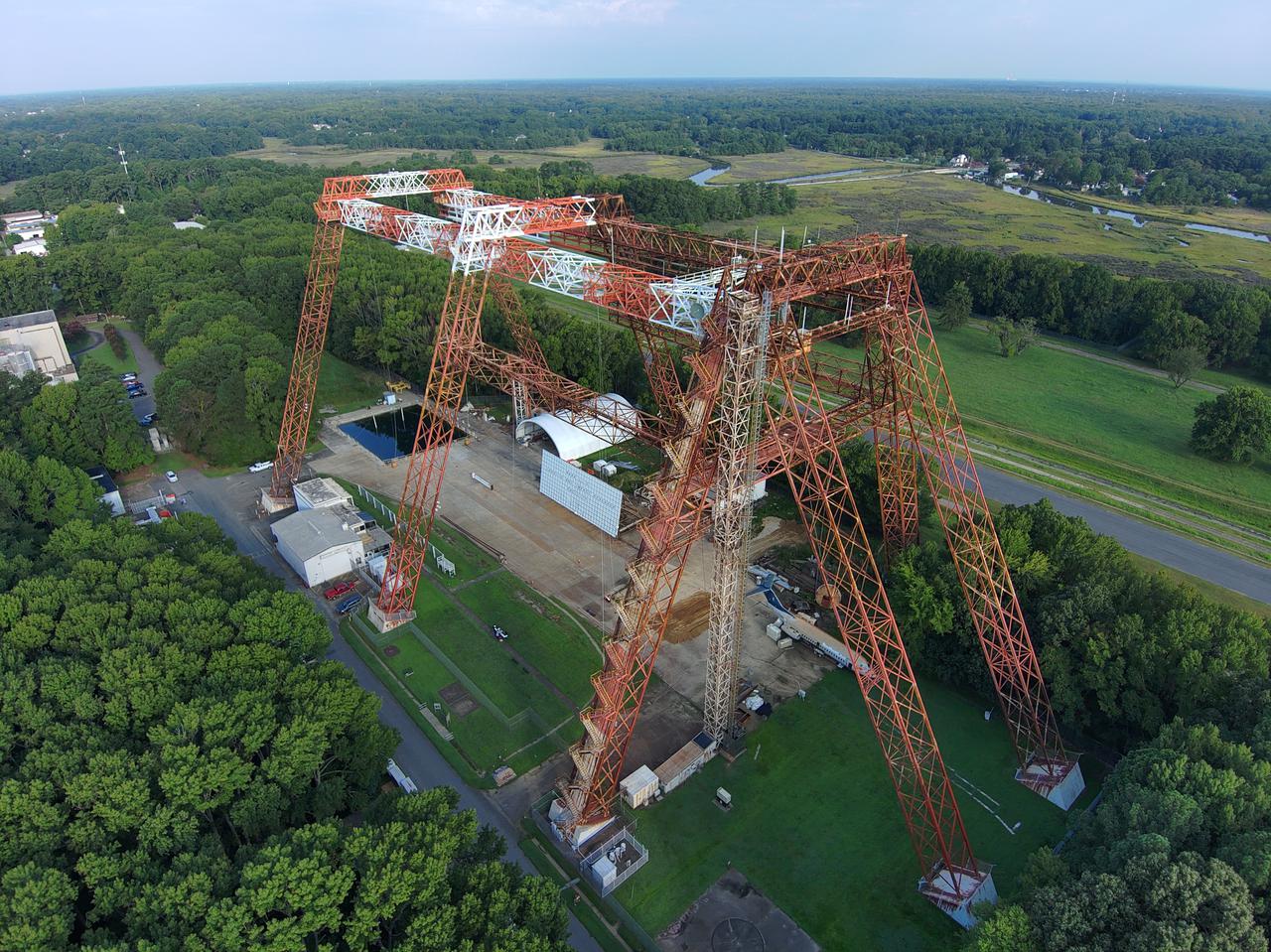
Langley’s historic Impact Dynamics Facility for full-scale aircraft crash testing stands on the western corner of the NASA Langley campus. In its original configuration, the “gantry” was used to train the Mercury 7