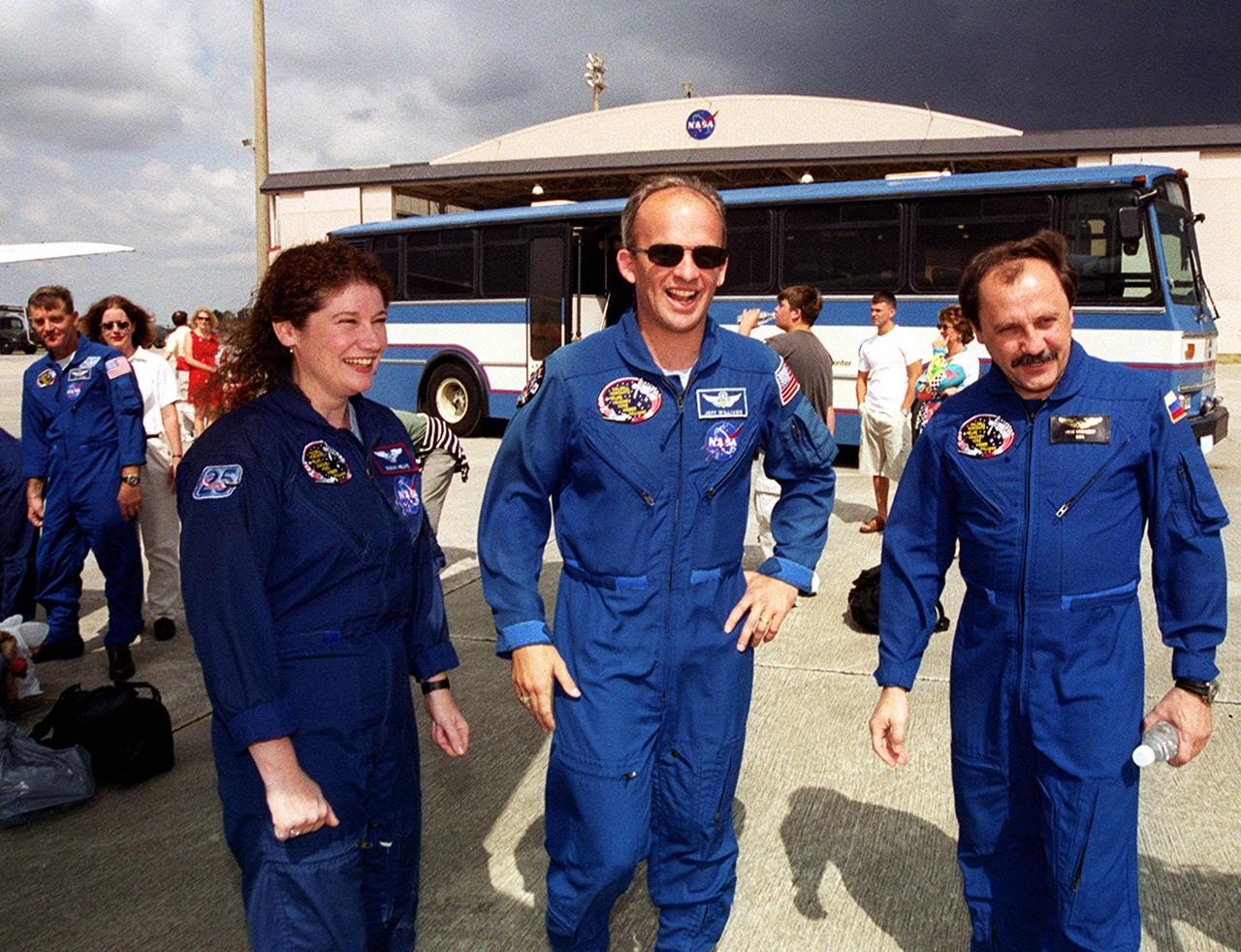
Members of the STS-101 crew gather with families and friends at Patrick Air Force Base before departure for Houston. In the foreground are Mission Specialists Susan J. Helms, Jeffrey N. Williams and Yury Usachev of Russia. At far left is Mission Specialist James S. Voss. After landing at 2:20 a.m. EDT May 29, the crew and their families enjoyed the Memorial Day holiday in Florida. The crew returned from the third flight to the International Space Station where they made repairs, transferred cargo and completed a space walk to install and connect several pieces of equipment on the outside of the Space Station
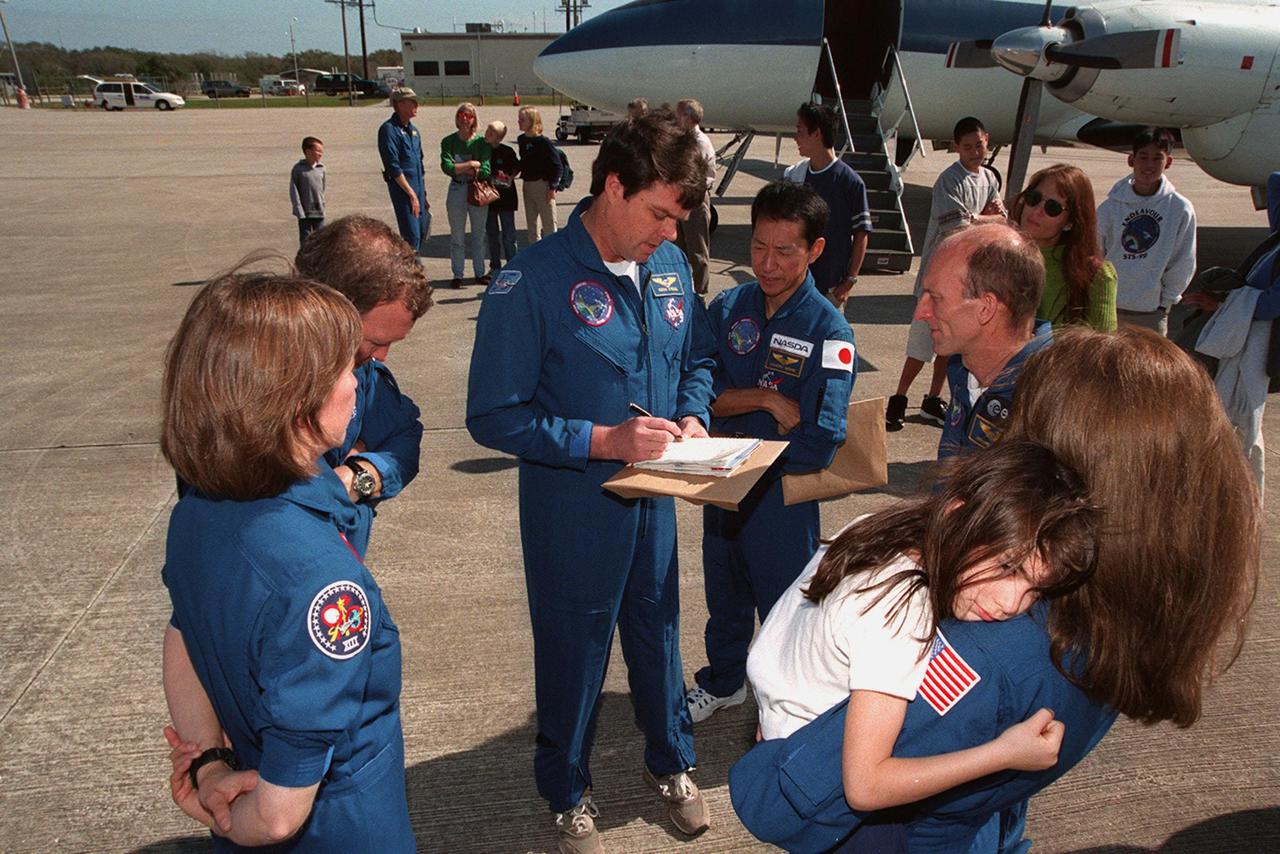
The STS-99 crew get ready to leave KSC with their families for a return trip to Houston. From left are Mission Specialist Janice Voss, Pilot Dominic Gorie, Commander Kevin Kregel, and Mission Specialists Mamoru Mohri of Japan, Gerhard Thiele of Germany, and Janet Kavandi, holding her daughter. The STS-99 crew completed a successful 11-day Shuttle Radar Topography Mission mapping 47 million square miles of the Earth's surface before landing at KSC Feb. 22
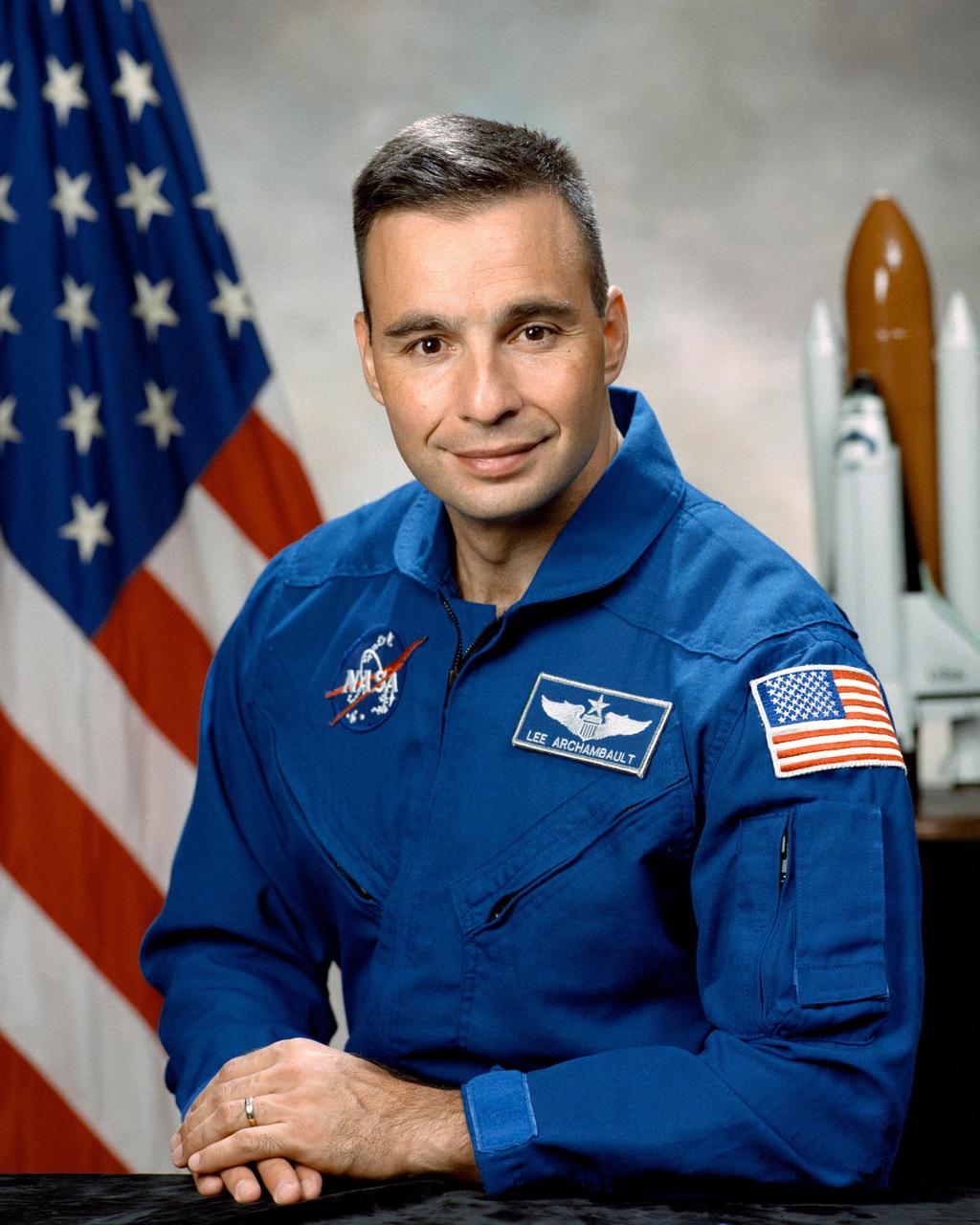
HOUSTON, Texas -- S98-16197: Official portrait of Lee J. Archambault, commander on mission STS-119.

During Crew Equipment Interface Test (CEIT) in the Payload Bay of Discovery, STS-95 Mission Specialist Pedro Duque (center),of the European Space Agency, and Mission Specialist Stephen K. Robinson (right), look over the Spartan payload that is part of the mission. At left is Keith Johnson, United Space Alliance-Houston. The CEIT gives astronauts an opportunity for a hands-on look at the payloads and equipment with which they will be working on orbit. The launch of the STS-95 mission is scheduled for Oct. 29, 1998. The mission includes research payloads such as the Spartan solar-observing deployable spacecraft, the Hubble Space Telescope Orbital Systems Test Platform, the International Extreme Ultraviolet Hitchhiker, as well as the SPACEHAB single module with experiments on space flight and the aging process
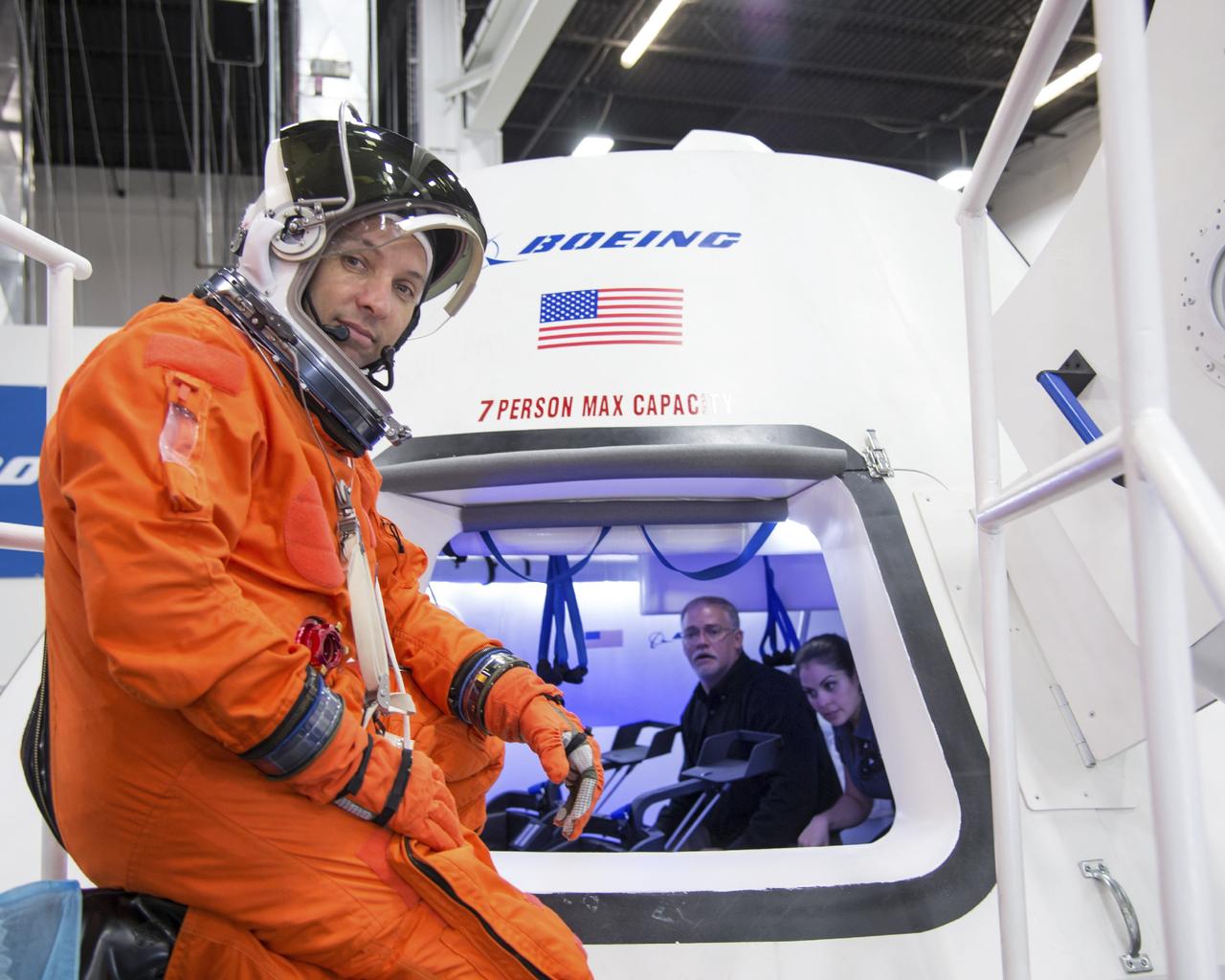
HOUSTON - JSC2013e068333 - NASA astronaut Randy Bresnik prepares to enter The Boeing Company's CST-100 spacecraft for a fit check evaluation at the company's Houston Product Support Center. Bresnik's fit check will help evaluate a crew's maneuverability in the spacecraft and test communications. Boeing's CST-100 is being designed to transport crew members or a mix of crew and cargo to low-Earth-orbit destinations. The evaluation is part of the ongoing work supporting Boeing's funded Space Act Agreement with NASA's Commercial Crew Program, or CCP, during the agency's Commercial Crew Integrated Capability, or CCiCap, initiative. CCiCap is intended to make commercial human spaceflight services available for government and commercial customers. To learn more about CCP, visit http://www.nasa.gov/commercialcrew. Photo credit: NASA/Robert Markowitz

Members of the STS-101 crew gather with families and friends at Patrick Air Force Base before departure for Houston. Pilot Scott “Doc” Horowitz is joined by his wife, Lisa, and daughter; Mission Specialist Susan J. Helms is at right. After landing at 2:20 a.m. EDT May 29, the crew and their families enjoyed the Memorial Day holiday in Florida. The crew returned from the third flight to the International Space Station where they made repairs, transferred cargo and completed a space walk to install and connect several pieces of equipment on the outside of the Space Station
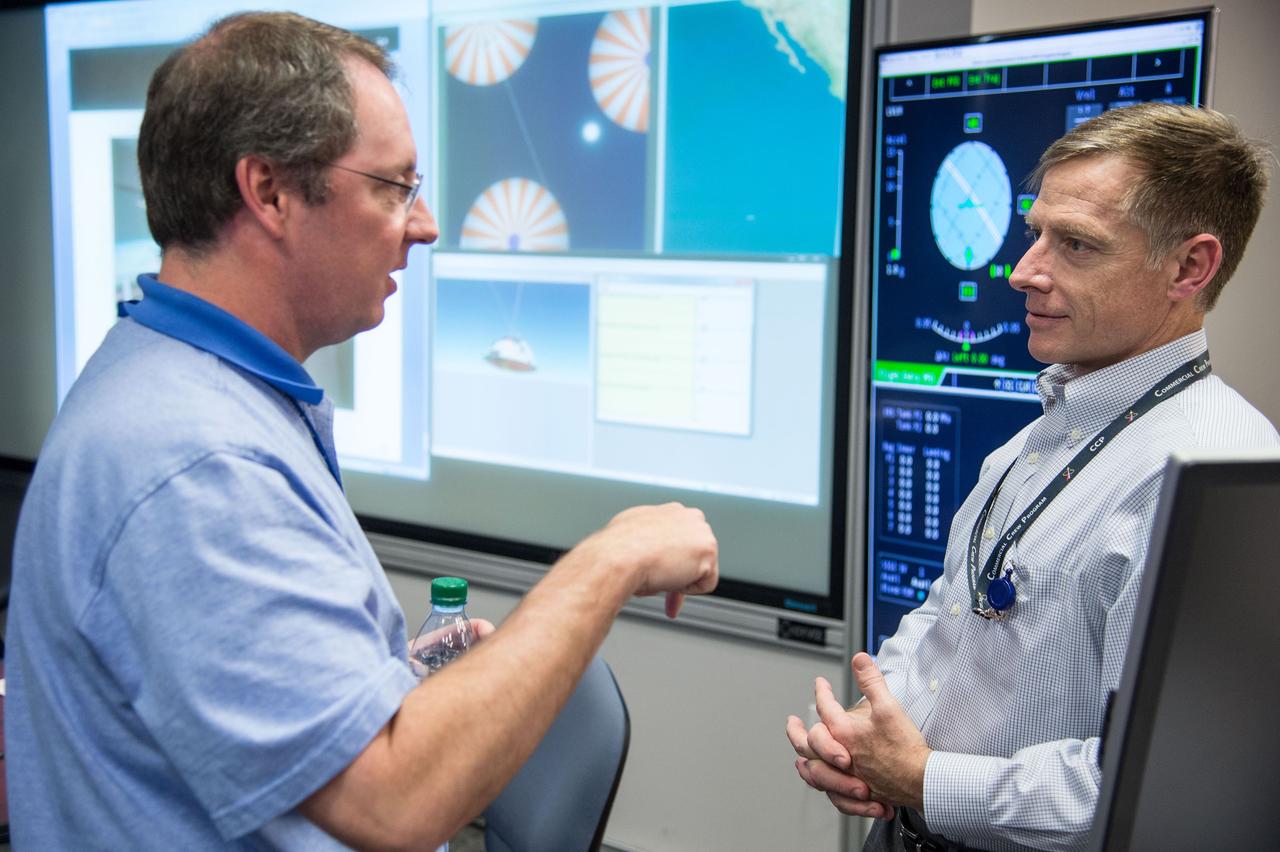
HOUSTON – Chris Ferguson, a former space shuttle commander who is now director of Crew and Mission Operations for Boeing Space Exploration, talks with an engineer following simulations that showed that the CST-100 software. Boeing demonstrated that the CST-100 software allows a human pilot to take over control of the spacecraft from the computer during all phases of a mission following separation from the launch vehicle. The pilot-in-the-loop demonstration at the Houston Product Support Center is a milestone under Boeing's Commercial Crew Integrated Capability agreement with the agency and its Commercial Crew Program. Photo credit: NASA/Bill Stafford
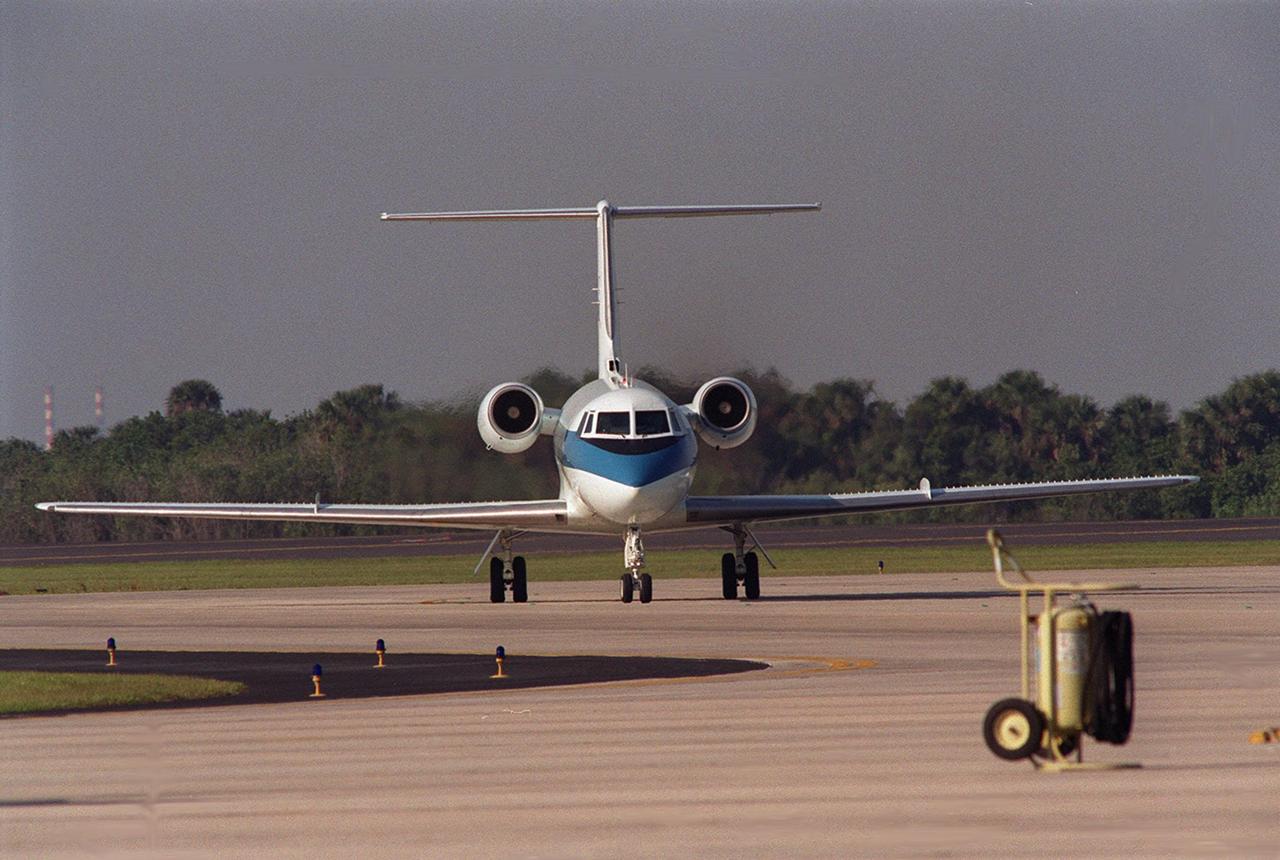
A Shuttle Training Aircraft (STA) taxis into the parking area of KSC's Shuttle Landing Facility. The STA is a modified Grumman American Aviation-built Gulfstream II executive jet that was modified to simulate an orbiter's cockpit, motion and visual cues, and handling qualities. It is used by Shuttle flight crews to practice landing the orbiter. In flight, the STA duplicates the orbiter's atmospheric descent trajectory from approximately 35,000 feet altitude to landing on a runway. The orbiter differs in at least one major aspect from conventional aircraft; it is unpowered during re-entry and landing so its high-speed glide must be perfectly executed the first time there is no go-around capability. The orbiter touchdown speed is 213 to 226 miles (343 to 364 kilometers) per hour. There are two STAs, based in Houston
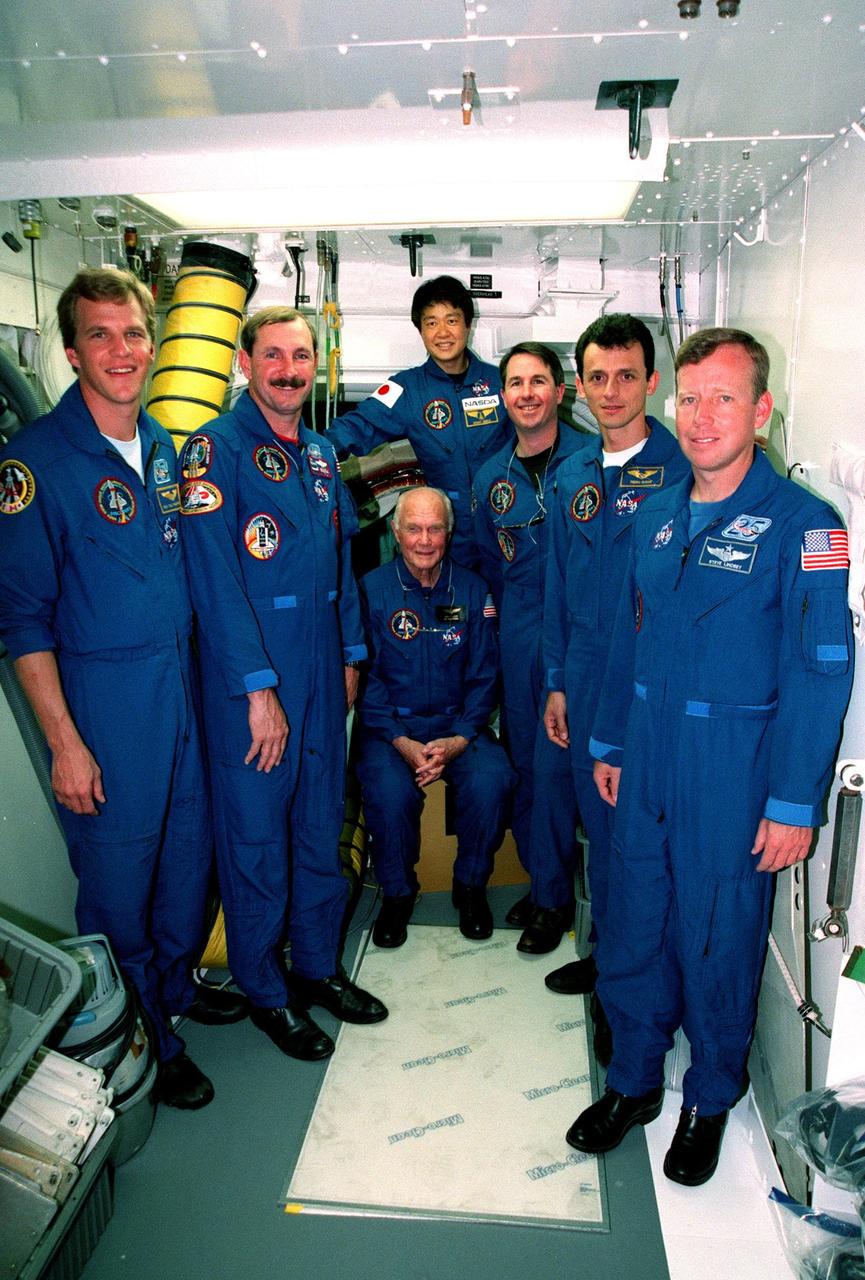
At Launch Pad 39-B, the STS-95 crew gather in the white room, an environmental chamber that mates with the orbiter and can provide emergency egress for the flight crew before launch. The white room is the outer end of the orbiter access arm, which is part of the fixed service structure on the pad. Pictured are (left to right) Mission Specialist Scott E. Parazynski, Mission Commander Curtis L. Brown, Payload Specialist John H. Glenn Jr. (seated), senator from Ohio, Payload Specialist Chiaki Mukai (behind Glenn), representing the National Space Development Agency of Japan (NASDA), Mission Specialist Stephen K. Robinson, Mission Specialist Pedro Duque of Spain, representing the European Space Agency (ESA), and Pilot Steven W. Lindsey. The STS-95 crew are at KSC to participate in a Terminal Countdown Demonstration Test (TCDT) which includes mission familiarization activities, emergency egress training, and a simulated main engine cut-off exercise. The STS-95 mission, targeted for liftoff on Oct. 29, includes research payloads such as the Spartan solar-observing deployable spacecraft, the Hubble Space Telescope Orbital Systems Test Platform, the International Extreme Ultraviolet Hitchhiker, as well as the SPACEHAB single module with experiments on space flight and the aging process. Following the TCDT, the crew will be returning to Houston for final flight preparations
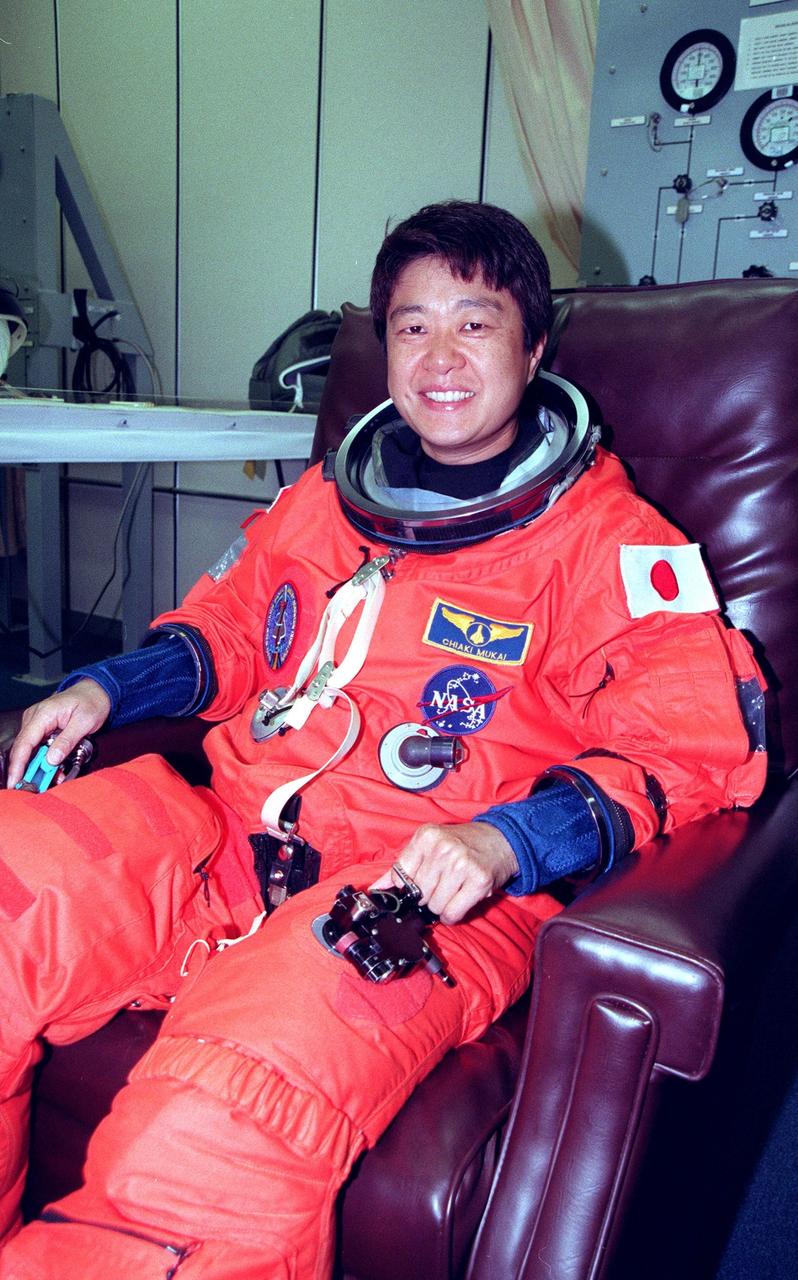
STS-95 Payload Specialist Chiaki Mukai (M.D., Ph.D.), representing the National Space Development Agency of Japan (NASDA), suits up in the Operations and Checkout (O&C) Building prior to her trip to Launch Pad 39-B. Mukai and the rest of the STS-95 crew are at KSC to participate in the Terminal Countdown Demonstration Test (TCDT) which includes mission familiarization activities, emergency egress training, and a simulated main engine cutoff. The other crew members are Pilot Steven W. Lindsey, Mission Specialist Scott E. Parazynski, Mission Specialist Stephen K. Robinson, Mission Specialist Pedro Duque of Spain, representing the European Space Agency (ESA), Payload Specialist John H. Glenn Jr., senator from Ohio, and Mission Commander Curtis L. Brown. The STS-95 mission, targeted for liftoff on Oct. 29, includes research payloads such as the Spartan solar-observing deployable spacecraft, the Hubble Space Telescope Orbital Systems Test Platform, the International Extreme Ultraviolet Hitchhiker, as well as the SPACEHAB single module with experiments on space flight and the aging process. Following the TCDT, the crew will be returning to Houston for final flight preparations
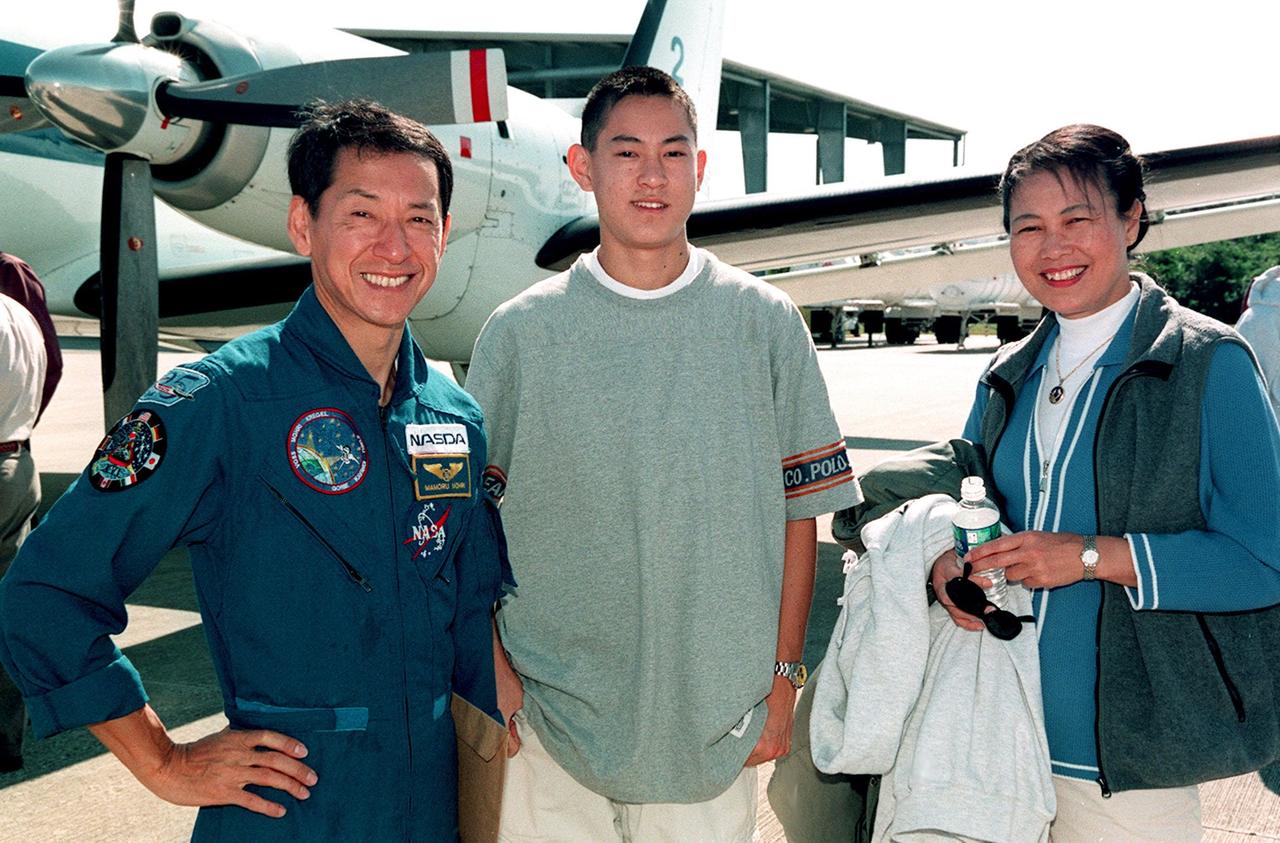
STS-99 Mission Specialist Mamoru Mohri (left) is joined by his son and wife, Akiko, at the Shuttle Landing Facility before their departure for Houston. The STS-99 crew completed a successful 11-day Shuttle Radar Topography Mission mapping 47 million square miles of the Earth's surface before landing at KSC Feb. 22
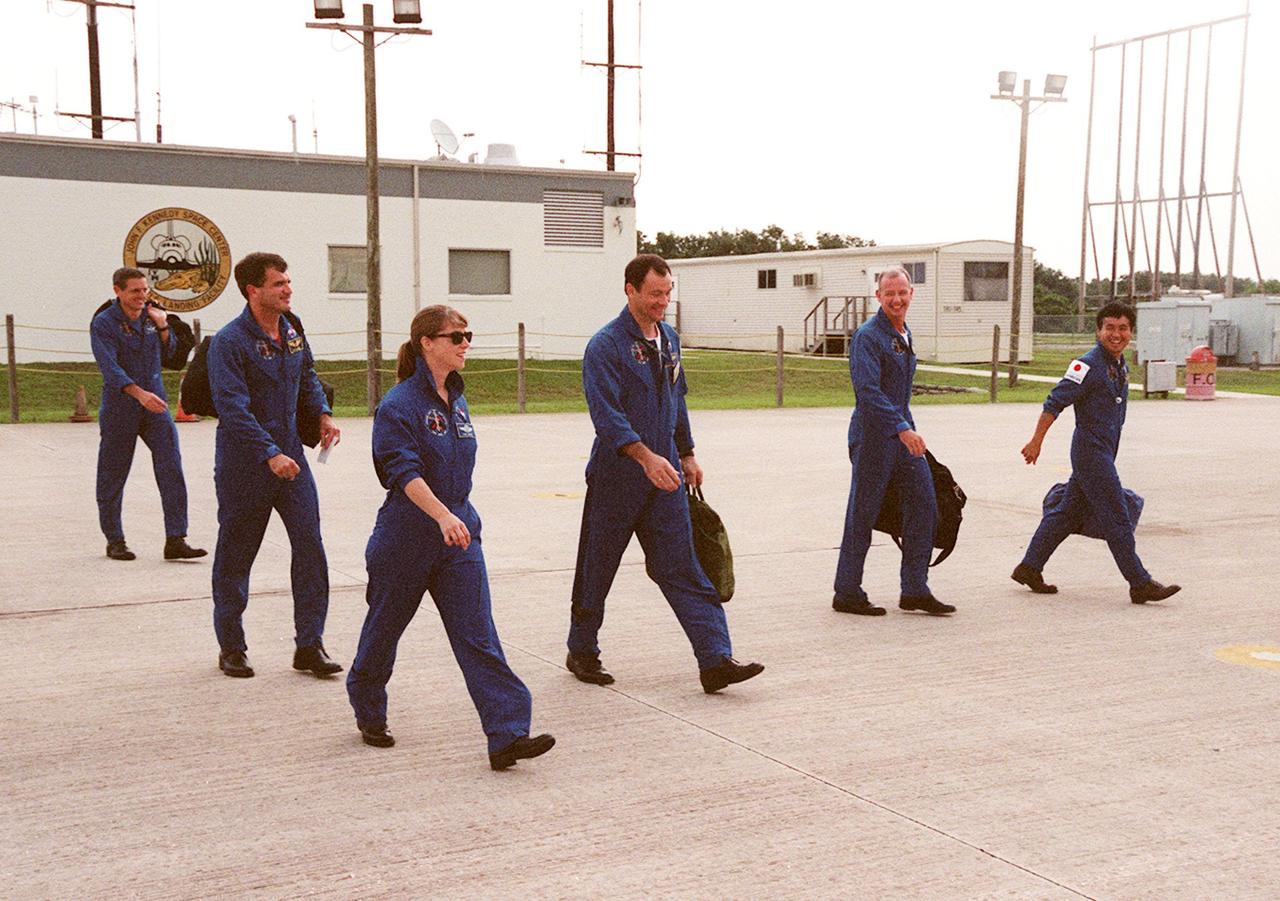
The STS-92 crew strides across the runway at KSC’s Shuttle Landing Facility, heading toward the aircraft that will take them back to Houston. They were at KSC for Crew Equipment Interface Test (CEIT) activities, looking over their mission payload and related equipment. From left are Mission Specialists Bill McArthur and Jeff Wisoff, Pilot Pam Melroy, Mission Specialist Michael Lopez-Alegria, Commander Brian Duffy and Mission Specialist Koichi Wakata, who is with the Japanese space agency. Not seen is Mission Specialist Leroy Chiao, who was also at KSC for the CEIT. STS-92 is scheduled to launch Oct. 5 on Shuttle Discovery from Launch Pad 39A on the fifth flight to the International Space Station. Discovery will carry the Integrated Truss Structure (ITS) Z1, the PMA-3, Ku-band Communications System, and Control Moment Gyros (CMGs)
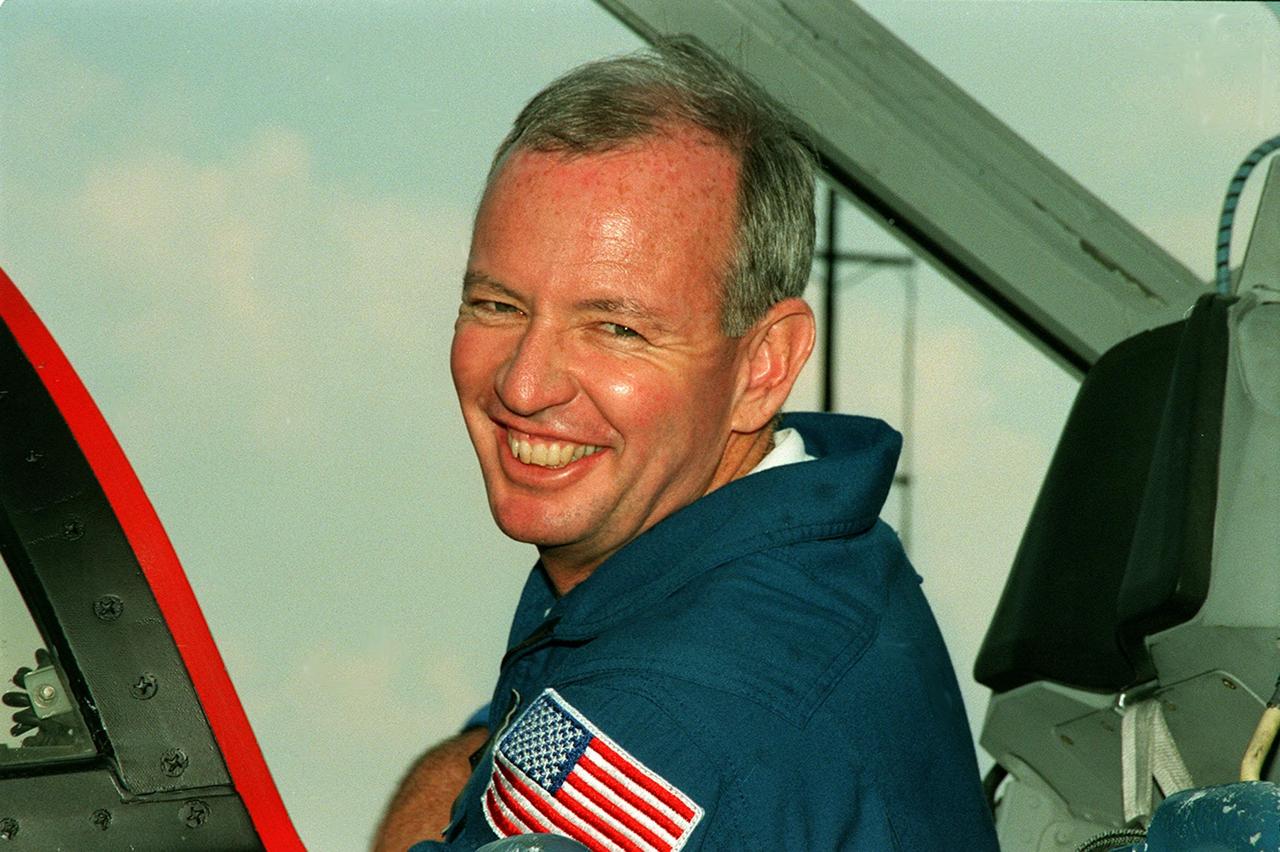
STS-92 Commander Brian Duffy climbs into a T-38 jet aircraft at KSC’s Shuttle Landing Facility for a flight back to Houston. He and other crew members were at KSC for Crew Equipment Interface Test (CEIT) activities, looking over their mission payload and related equipment. STS-92 is scheduled to launch Oct. 5 on Shuttle Discovery from Launch Pad 39A on the fifth flight to the International Space Station. Discovery will carry the Integrated Truss Structure (ITS) Z1, the PMA-3, Ku-band Communications System, and Control Moment Gyros (CMGs)
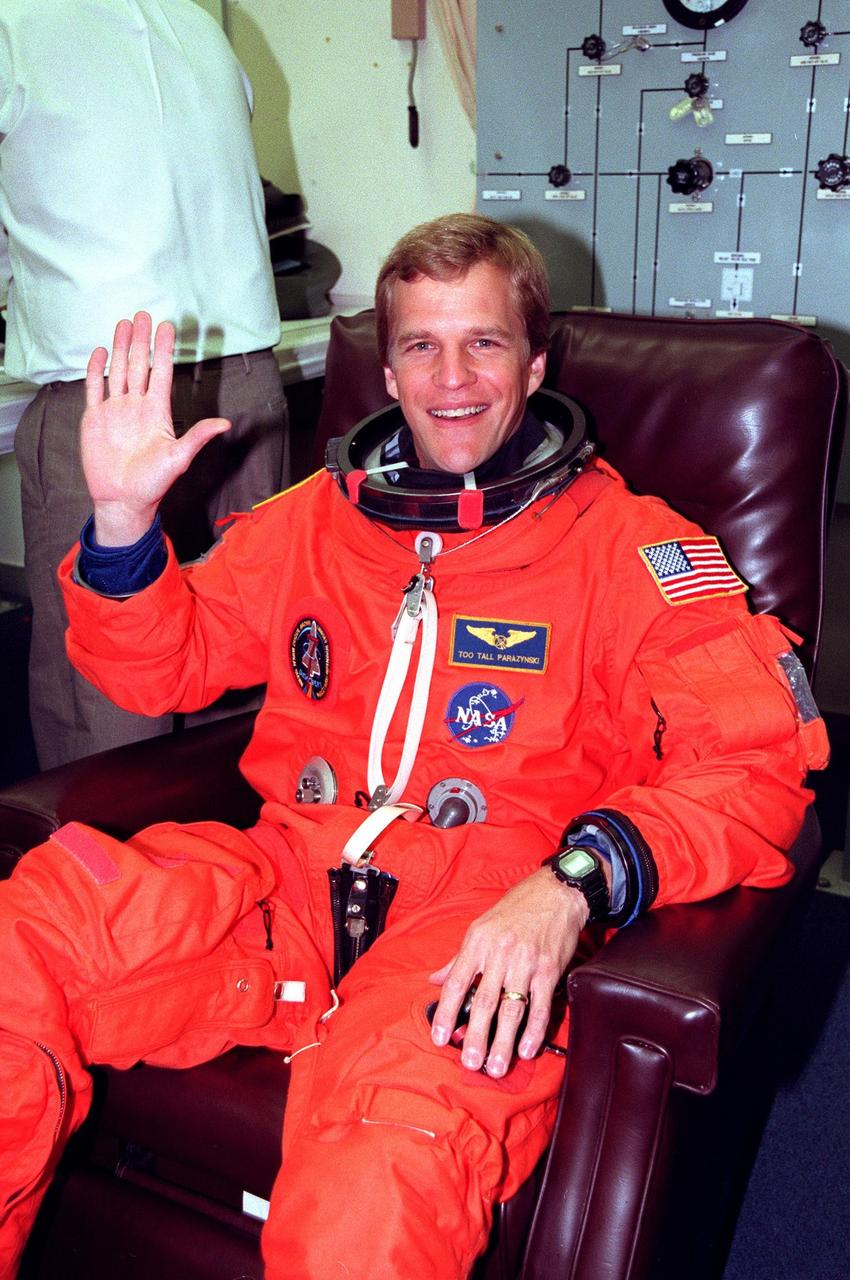
STS-95 Mission Specialist Scott E. Parazynski suits up in the Operations and Checkout Building prior to his trip to Launch Pad 39-B. Parazynski and the rest of the STS-95 crew are at KSC to participate in the Terminal Countdown Demonstration Test (TCDT) which includes mission familiarization activities, emergency egress training, and a simulated main engine cutoff. The other crew members are Payload Specialist Chiaki Mukai (M.D., Ph.D.), representing the National Space Development Agency of Japan (NASDA), Pilot Steven W. Lindsey, Mission Specialist Stephen K. Robinson, Mission Specialist Pedro Duque of Spain, representing the European Space Agency (ESA), Payload Specialist John H. Glenn Jr., senator from Ohio, and Mission Commander Curtis L. Brown. The STS-95 mission, targeted for liftoff on Oct. 29, includes research payloads such as the Spartan solar-observing deployable spacecraft, the Hubble Space Telescope Orbital Systems Test Platform, the International Extreme Ultraviolet Hitchhiker, as well as the SPACEHAB single module with experiments on space flight and the aging process. Following the TCDT, the crew will be returning to Houston for final flight preparations
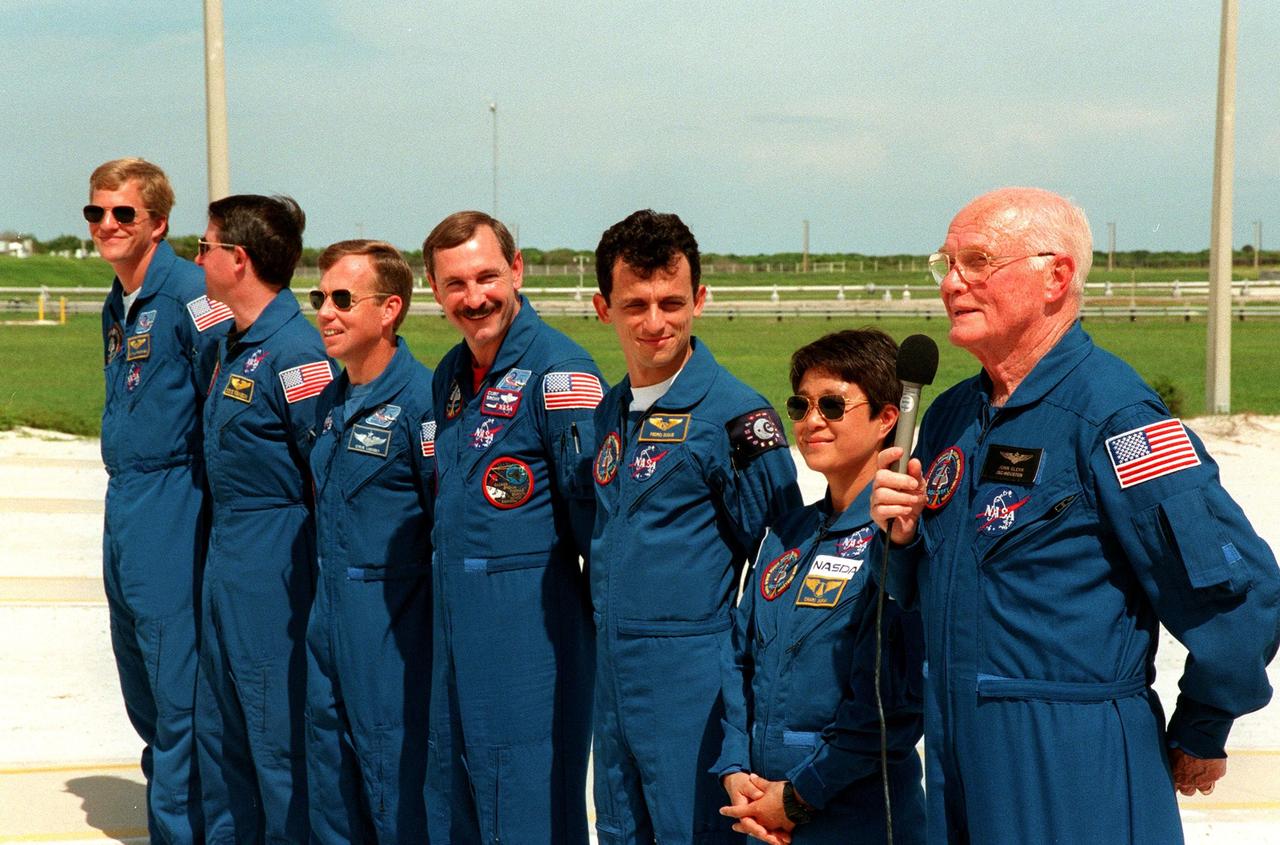
At Launch Pad 39-B, (far right) STS-95 Payload Specialist John H. Glenn Jr., senator from Ohio, responds to one of the many questions he was asked about the mission and training by reporters during a brief break from the Terminal Countdown Demonstration Test (TCDT). Amused with his answer are other crew members (from left) Mission Specialist Scott E. Parazynski, Mission Specialist Stephen K. Robinson, who also serves as Payload Commander, Pilot Steven W. Lindsey, Mission Commander Curtis L. Brown, Mission Specialist Pedro Duque of Spain, representing the European Space Agency (ESA), and Chiaki Mukai, representing the National Space Development Agency of Japan (NASDA). The crew were at the pad for emergency egress training after the break. The TCDT also involves mission familiarization activities and a simulated main engine cut-off exercise. The STS-95 mission, targeted for liftoff on Oct. 29, includes research payloads such as the Spartan solar-observing deployable spacecraft, the Hubble Space Telescope Orbital Systems Test Platform, the International Extreme Ultraviolet Hitchhiker, as well as the SPACEHAB single module with experiments on space flight and the aging process. Following the TCDT, the crew will be returning to Houston for final flight preparations
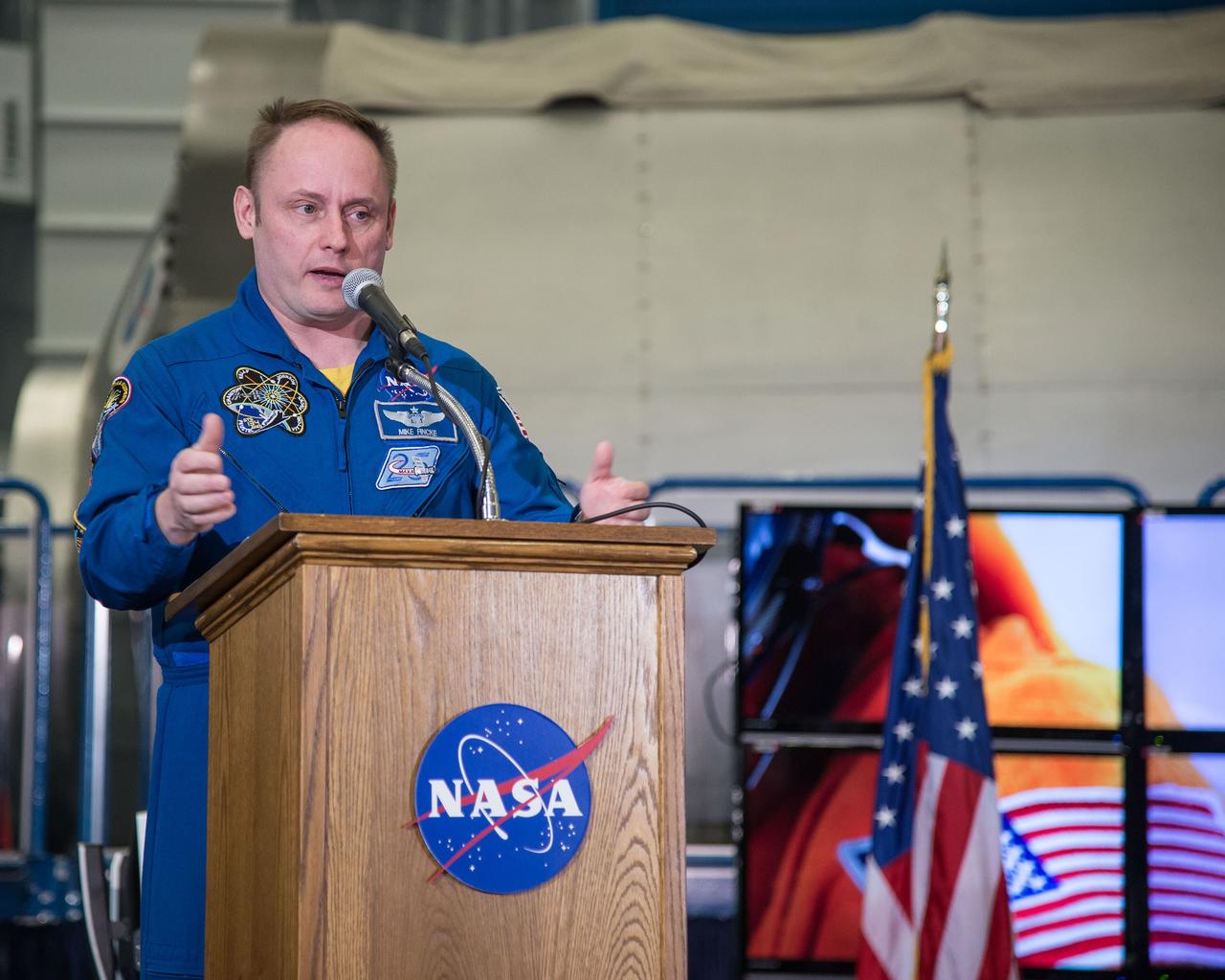
HOUSTON, Texas - jsc2015e031248 - NASA astronaut Mike Fincke discusses the agency's Commercial Crew Program during a presentation highlighting key development activities, test plans and objectives for achieving certification of two American crew transportation systems with NASA Administrator Charlie Bolden, Commercial Crew Program Manager Kathy Lueders, Boeing Space Exploration Vice President and General Manager John Elbon, Space X President and Chief Operating Officer Gwynne Shotwell and NASA Astronaut Mike Fincke. Photo credit: NASA/Robert Markowitz
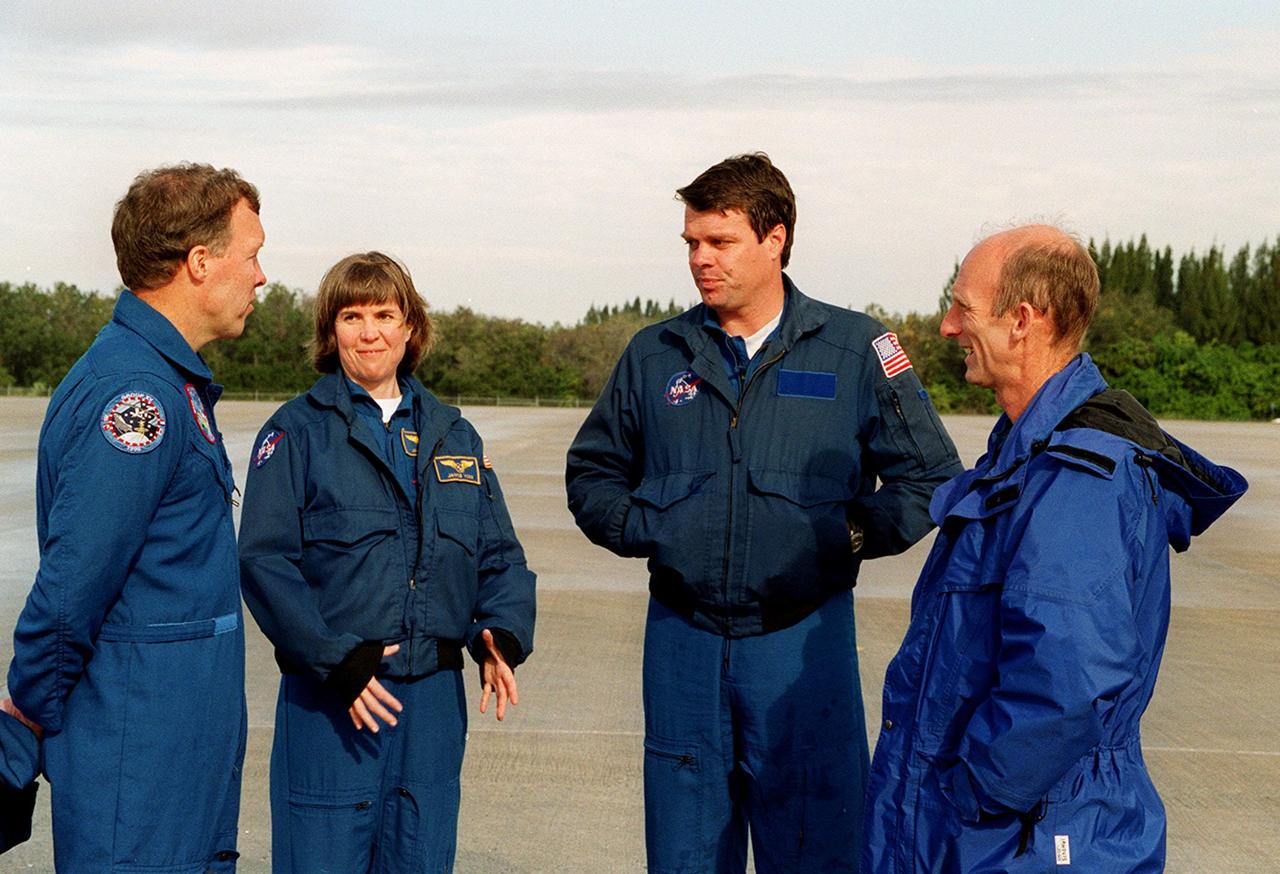
On the runway at the Shuttle Landing Facility, STS-99 crew members Pilot Dominic Gorie, Mission Specialist Janice Voss, Commander Kevin Kregel and Mission Specialist Gerhard Thiele discuss departure plans to Houston. Kregel and Gorie will be piloting T-38 jets with Voss and Thiele as passengers. During the Jan. 31 launch countdown, Endeavour's enhanced master events controller (E-MEC) No. 2 failed a standard preflight test. Launch was postponed and Shuttle managers decided to replace the E-MEC located in the orbiter's aft compartment. Launch controllers will be in a position to begin the STS-99 countdown the morning of Feb. 6 and ready to support a launch midto latenext week pending availability of the Eastern Range. The postponed launch gives the crew an opportunity for more training and time with their families. Known as the Shuttle Radar Topography Mission, it will chart a new course to produce unrivaled 3-D images of the Earth's surface, using two antennae and a 200-foot-long section of space station-derived mast protruding from the payload bay. The result could be close to 1 trillion measurements of the Earth's topography. Besides contributing to the production of better maps, these measurements could lead to improved water drainage modeling, more realistic flight simulators, better locations for cell phone towers, and enhanced navigation safety

STS-92 Pilot Pamela Ann Melroy is happy to arrive at the KSC Shuttle Landing Facility after a flight from Houston. She and the rest of the crew are at KSC to take part in Terminal Countdown Demonstration Test activities, which include emergency egress training from the orbiter and pad, and a simulated countdown. The fifth mission to the International Space Station, STS-92 will carry the Integrated Truss Structure Z1, the first of the planned 10 trusses on the Space Station, and the third Pressurized Mating Adapter. The Z1 will allow the first U.S. solar arrays on a future flight to be temporarily installed on Unity for early power. PMA-3 will provide a Shuttle docking port for the solar array installation on the sixth ISS flight and Lab installation on the seventh ISS flight. STS-92 is scheduled to launch Oct. 5 from launch Pad 39A. It will be the 100th flight in the Shuttle program
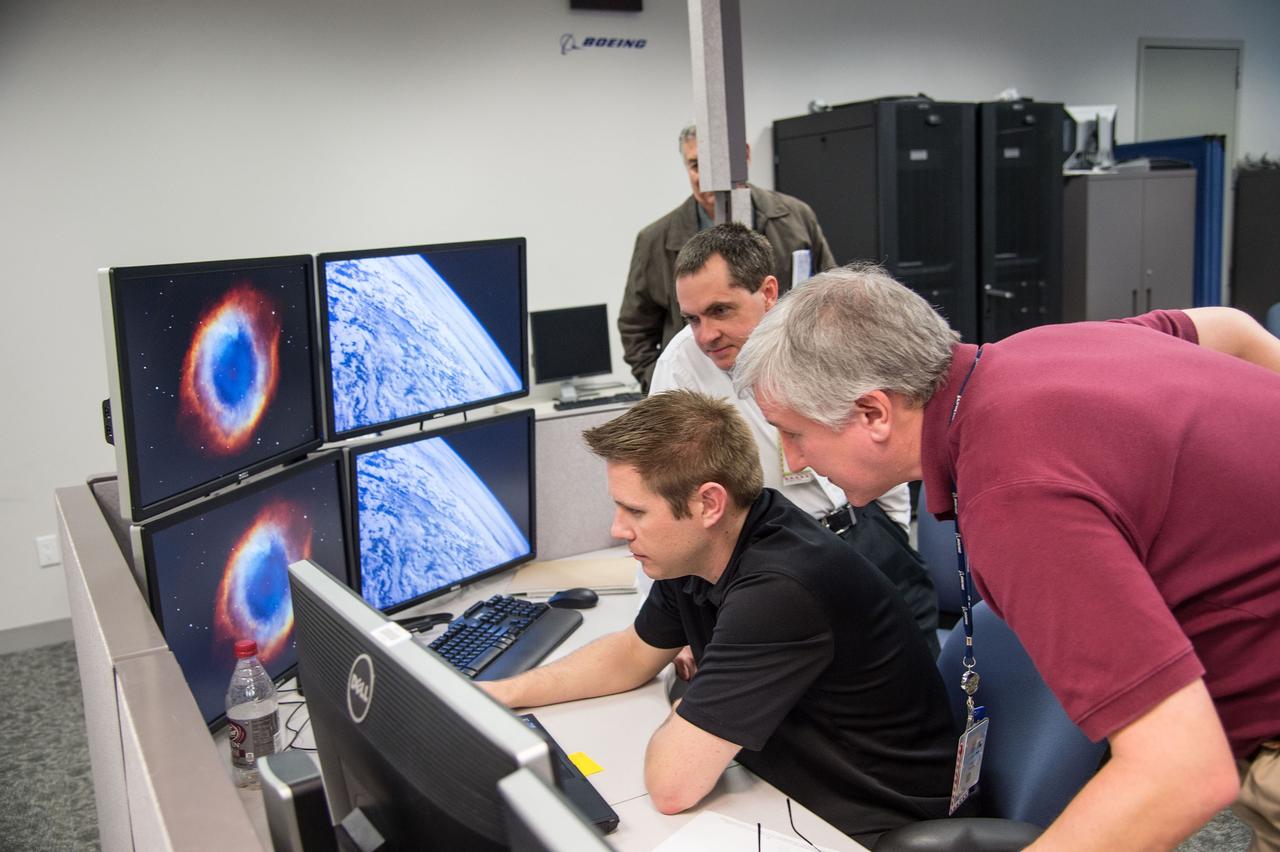
HOUSTON – Engineers for Boeing Space Exploration demonstrate that the CST-100 software allows a human pilot to take over control of the spacecraft from the computer during all phases of a mission following separation from the launch vehicle. The pilot-in-the-loop demonstration at the Houston Product Support Center is a milestone under Boeing's Commercial Crew Integrated Capability agreement with the agency and its Commercial Crew Program. Photo credit: NASA/Bill Stafford
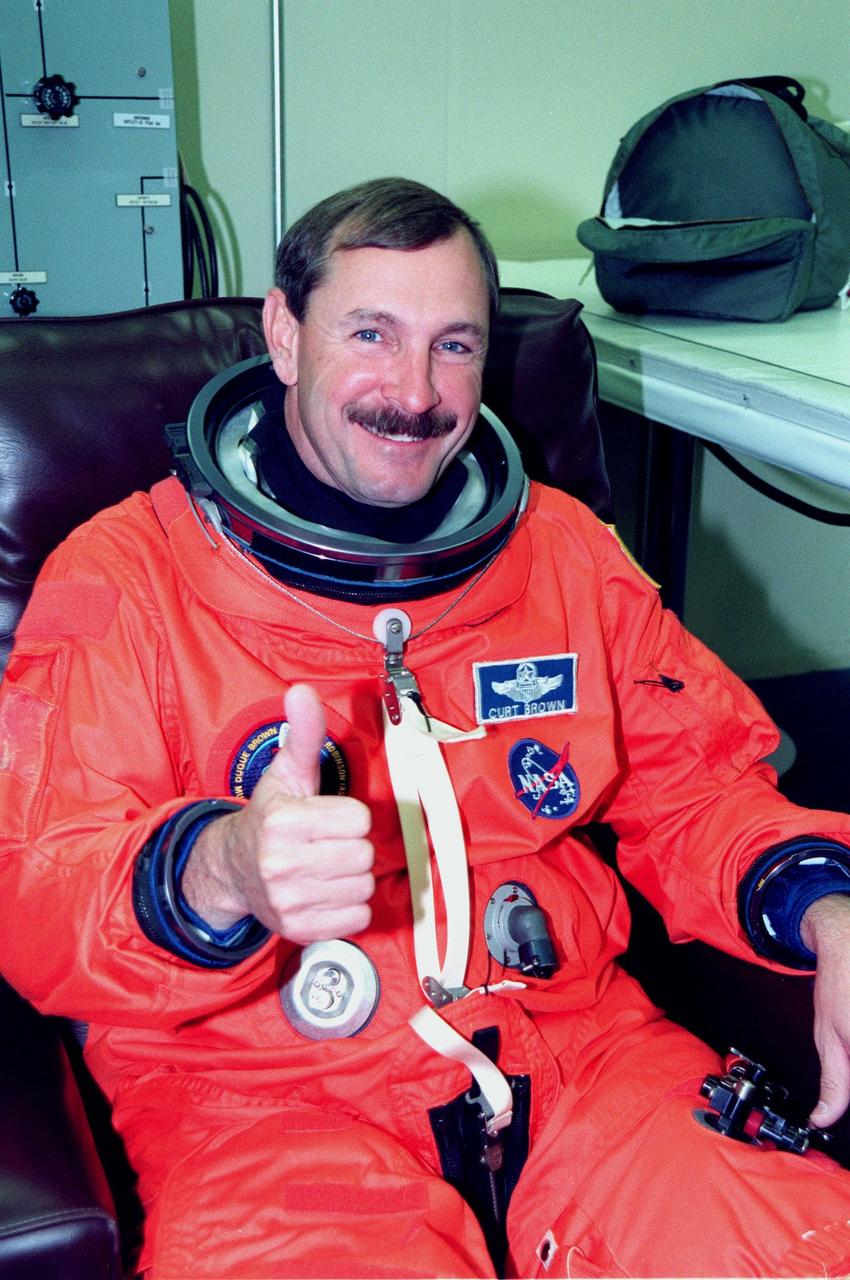
STS-95 Mission Commander Curtis L. Brown suits up in the Operations and Checkout Building prior to his trip to Launch Pad 39-B. Brown and the rest of the STS-95 crew are at KSC to participate in the Terminal Countdown Demonstration Test (TCDT) which includes mission familiarization activities, emergency egress training, and a simulated main engine cutoff. The other crew members are Payload Specialist Chiaki Mukai (M.D., Ph.D.), representing the National Space Development Agency of Japan (NASDA), Pilot Steven W. Lindsey, Mission Specialist Scott E. Parazynski, Mission Specialist Stephen K. Robinson, Mission Specialist Pedro Duque of Spain, representing the European Space Agency (ESA), and Payload Specialist John H. Glenn Jr., senator from Ohio. The STS-95 mission, targeted for liftoff on Oct. 29, includes research payloads such as the Spartan solar-observing deployable spacecraft, the Hubble Space Telescope Orbital Systems Test Platform, the International Extreme Ultraviolet Hitchhiker, as well as the SPACEHAB single module with experiments on space flight and the aging process. Following the TCDT, the crew will be returning to Houston for final flight preparations
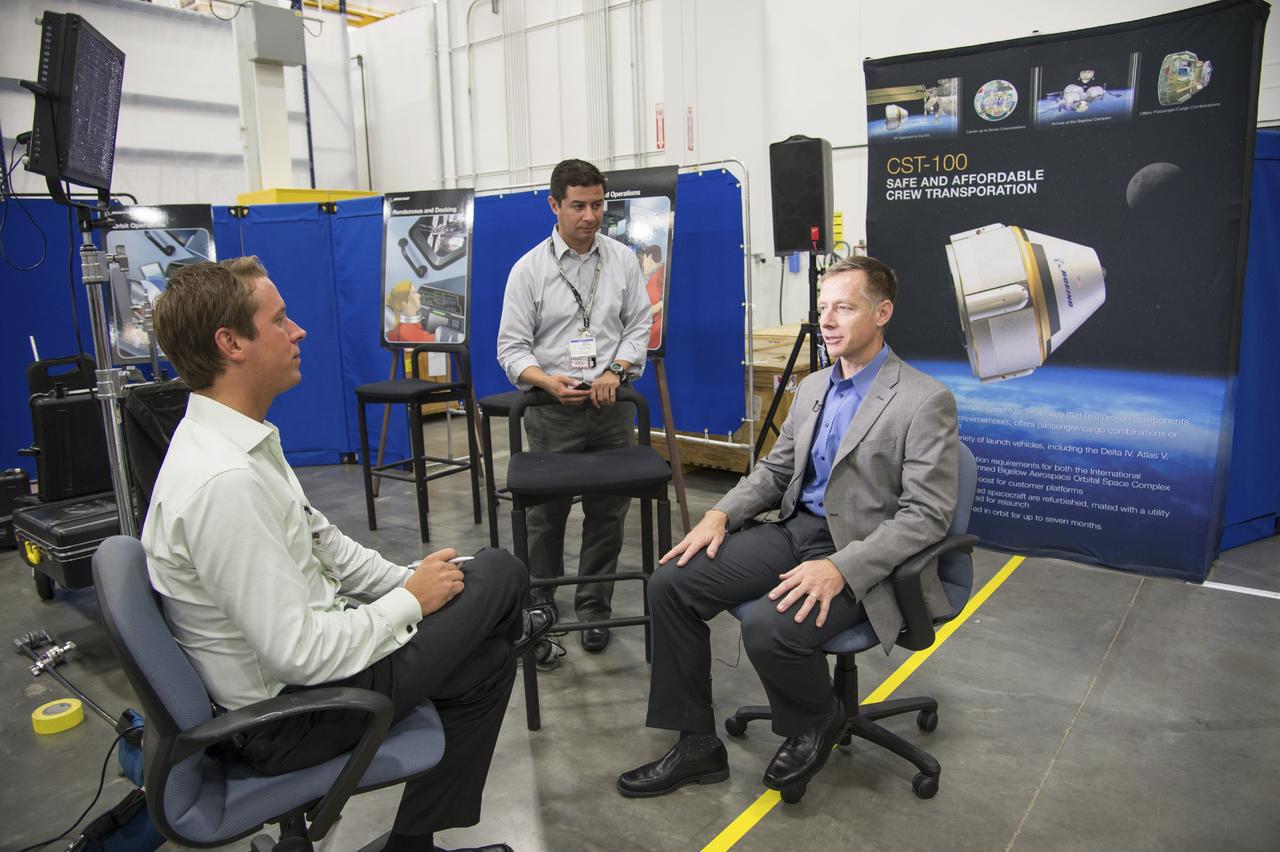
HOUSTON - JSC2013e068248 - Chris Ferguson, director of Crew and Mission Operations for The Boeing Company, is interviewed by the media during the unveiling of a CST-100 mock-up at the company's Houston Product Support Center. This test version is optimized to support five crew members and will allow the company to evaluate crew safety, interfaces, communications, maneuverability and ergonomics. Boeing's CST-100 is being designed to transport crew members or a mix of crew and cargo to low-Earth-orbit destinations, including the International Space Station. Boeing is one of three aerospace industry partners working with CCP during its Commercial Crew Integrated Capability, or CCiCap, initiative, which is intended to make commercial human spaceflight services available for government and commercial customers. To learn more about CCP, visit http://www.nasa.gov/commercialcrew. Photo credit: NASA/Robert Markowitz

STS-95 Mission Specialist Pedro Duque of Spain, representing the European Space Agency, suits up in the Operations and Checkout Building prior to his trip to Launch Pad 39-B. Duque and the rest of the STS-95 crew are at KSC to participate in the Terminal Countdown Demonstration Test (TCDT) which includes mission familiarization activities, emergency egress training, and a simulated main engine cutoff. The other crew members are Payload Specialist Chiaki Mukai (M.D., Ph.D.), representing the National Space Development Agency of Japan (NASDA), Pilot Steven W. Lindsey, Mission Specialist Scott E. Parazynski, Mission Specialist Stephen K. Robinson, Payload Specialist John H. Glenn Jr., senator from Ohio, and Mission Commander Curtis L. Brown. The STS-95 mission, targeted for liftoff on Oct. 29, includes research payloads such as the Spartan solar-observing deployable spacecraft, the Hubble Space Telescope Orbital Systems Test Platform, the International Extreme Ultraviolet Hitchhiker, as well as the SPACEHAB single module with experiments on space flight and the aging process. Following the TCDT, the crew will be returning to Houston for final flight preparations
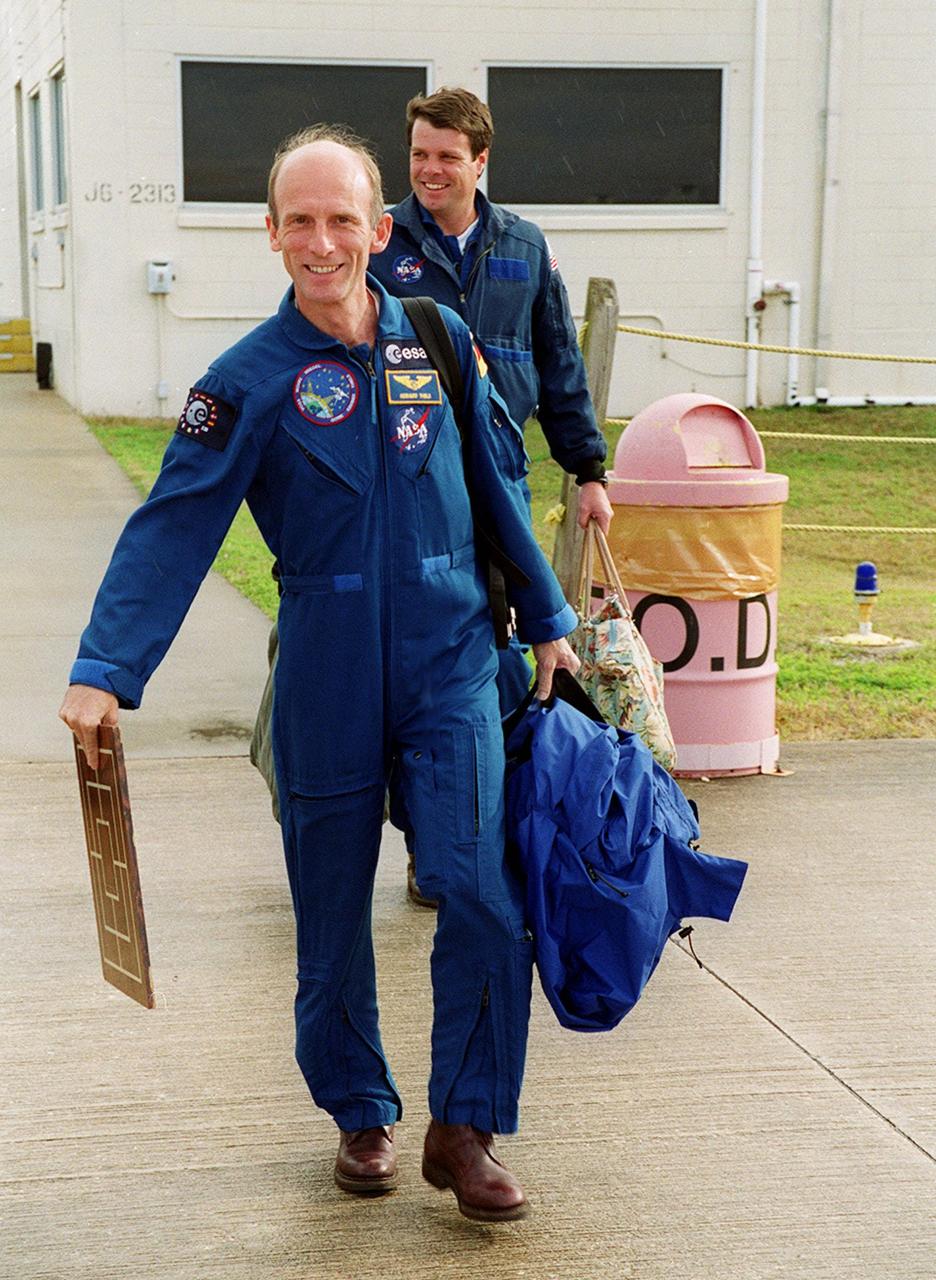
STS-99 Mission Specialist Gerhard Thiele (foreground) and Commander Kevin Kregel make their way to the runway at the Shuttle Landing Facility for a return flight to Houston. During the Jan. 31 launch countdown, Endeavour's enhanced master events controller (E-MEC) No. 2 failed a standard preflight test. Launch was postponed and Shuttle managers decided to replace the E-MEC located in the orbiter's aft compartment. Launch controllers will be in a position to begin the STS-99 countdown the morning of Feb. 6 and ready to support a launch midto late next week pending availability of the Eastern Range. The postponed launch gives the crew an opportunity for more training and time with their families. Known as the Shuttle Radar Topography Mission, it will chart a new course to produce unrivaled 3-D images of the Earth's surface, using two antennae and a 200-foot-long section of space station-derived mast protruding from the payload bay. The result could be close to 1 trillion measurements of the Earth's topography. Besides contributing to the production of better maps, these measurements could lead to improved water drainage modeling, more realistic flight simulators, better locations for cell phone towers, and enhanced navigation safety
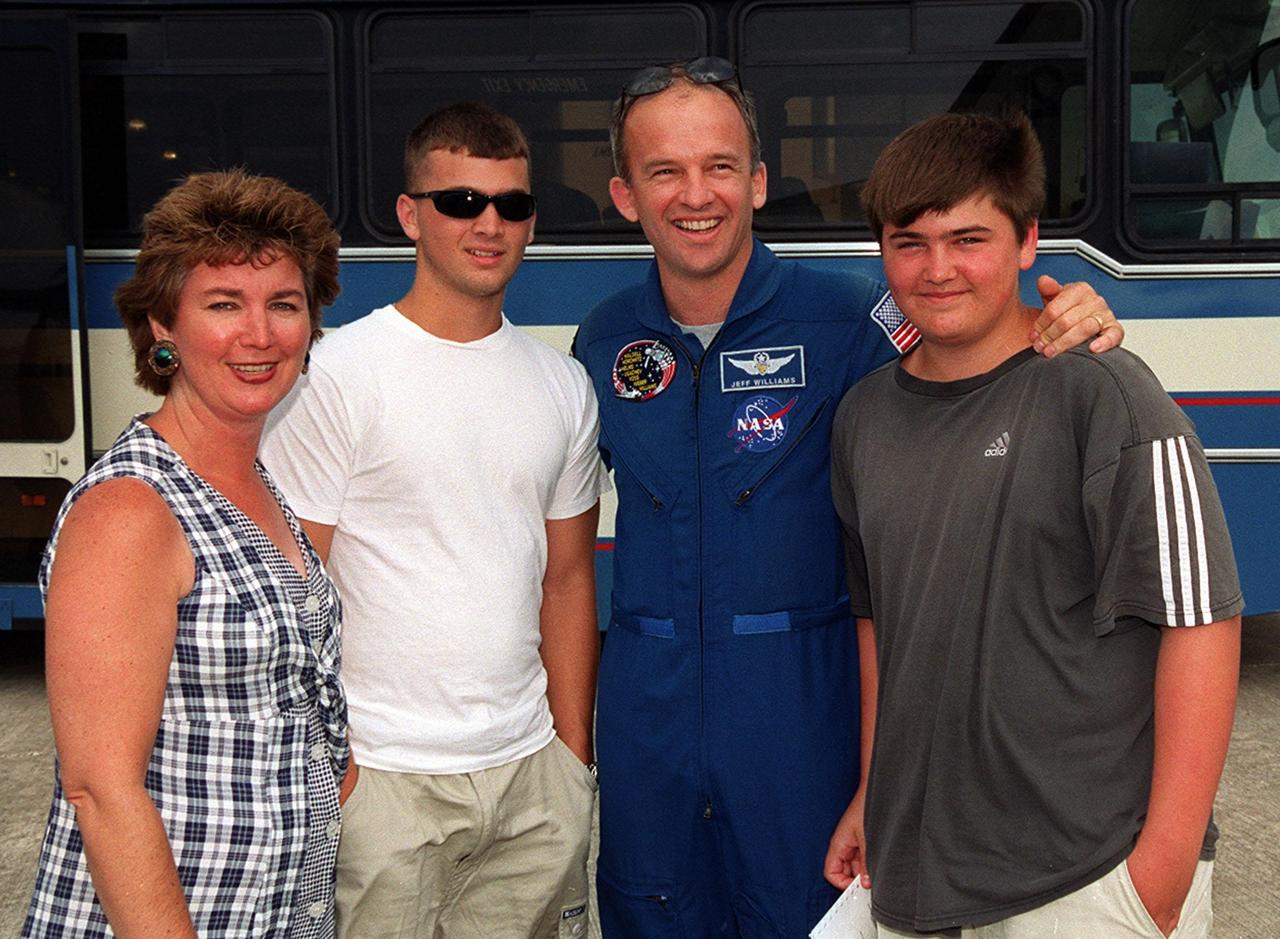
Members of the STS-101 crew gather with families and friends at Patrick Air Force Base before departure for Houston. Mission Specialist Jeffrey N. Williams is joined by his wife, Anna-Marie, and two sons. After landing at 2:20 a.m. EDT May 29, the crew and their families enjoyed the Memorial Day holiday in Florida. The crew returned from the third flight to the International Space Station where they made repairs, transferred cargo and completed a space walk to install and connect several pieces of equipment on the outside of the Space Station

During suitup in the Operations and Checkout Building, STS-92 Mission Specialist Leroy Chiao gives thumbs up for launch. With him (left) is VITT Mission Lead Roland Nedelkovich, from Houston. During the 11-day mission to the International Space Station, four extravehicular activities (EVAs), or spacewalks, are planned for construction. The payload includes the Integrated Truss Structure Z-1 and the third Pressurized Mating Adapter. The Z-1 truss is the first of 10 that will become the backbone of the Space Station, eventually stretching the length of a football field. PMA-3 will provide a Shuttle docking port for solar array installation on the sixth Station flight and Lab installation on the seventh Station flight. Launch is scheduled for 7:17 p.m. EDT. Landing is expected Oct. 22 at 2:10 p.m. EDT
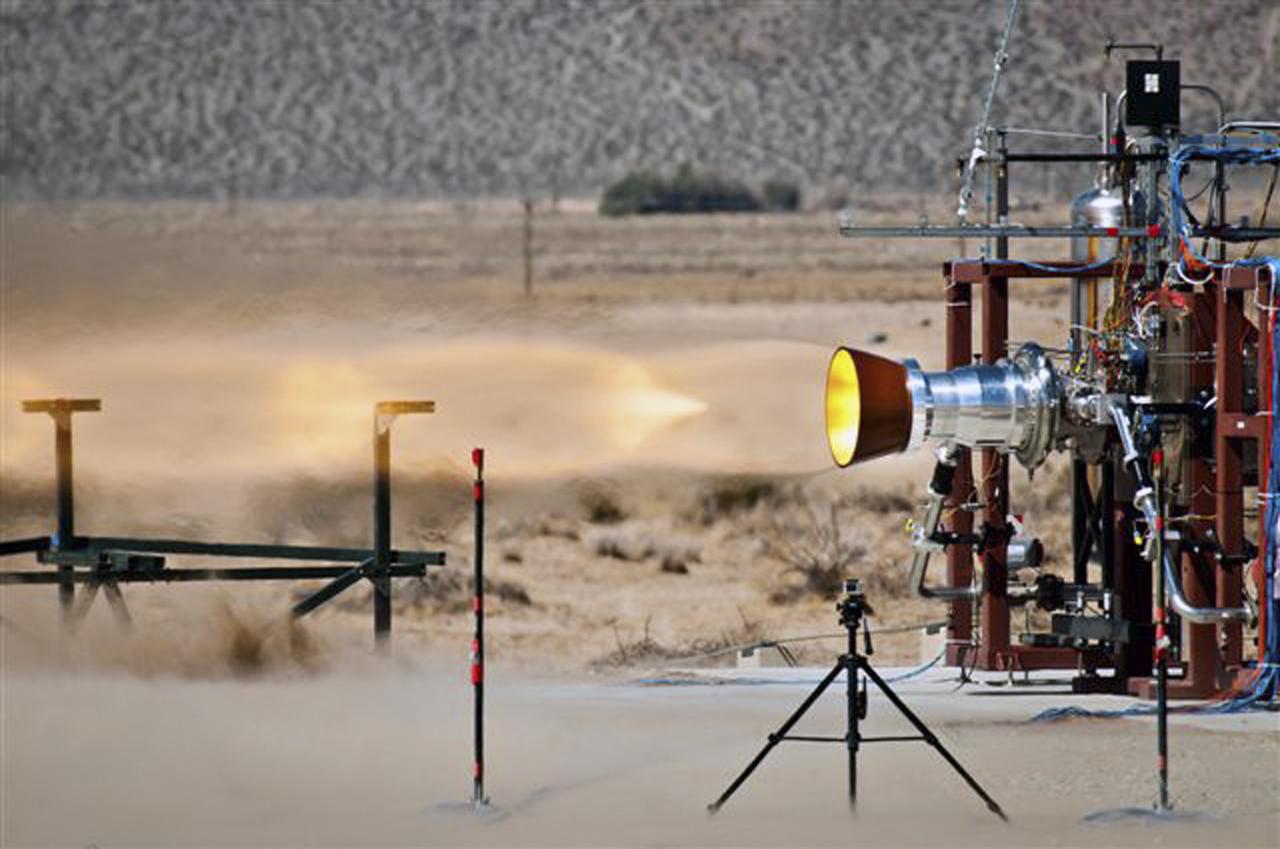
CANOGA PARK, Calif. -- Pratt & Whitney Rocketdyne hot-fires a launch abort engine for The Boeing Co., which is developing its CST-100 spacecraft for NASA's Commercial Crew Program. Under its fixed-price contract with Boeing, Pratt and Whitney Rocketdyne is combining its Attitude Control Propulsion System thrusters from heritage spaceflight programs, Bantam abort engine design and storable propellant engineering capabilities. In 2011, NASA selected Boeing of Houston during Commercial Crew Development Round 2 CCDev2) activities to mature the design and development of a crew transportation system with the overall goal of accelerating a United States-led capability to the International Space Station. The goal of CCP is to drive down the cost of space travel as well as open up space to more people than ever before by balancing industry’s own innovative capabilities with NASA's 50 years of human spaceflight experience. Six other aerospace companies also are maturing launch vehicle and spacecraft designs under CCDev2, including Alliant Techsystems Inc. ATK, Blue Origin, Excalibur Almaz Inc., Sierra Nevada Corp., Space Exploration Technologies SpaceX, and United Launch Alliance ULA. For more information, visit www.nasa.gov/commercialcrew. Image credit: Pratt & Whitney Rocketdyne
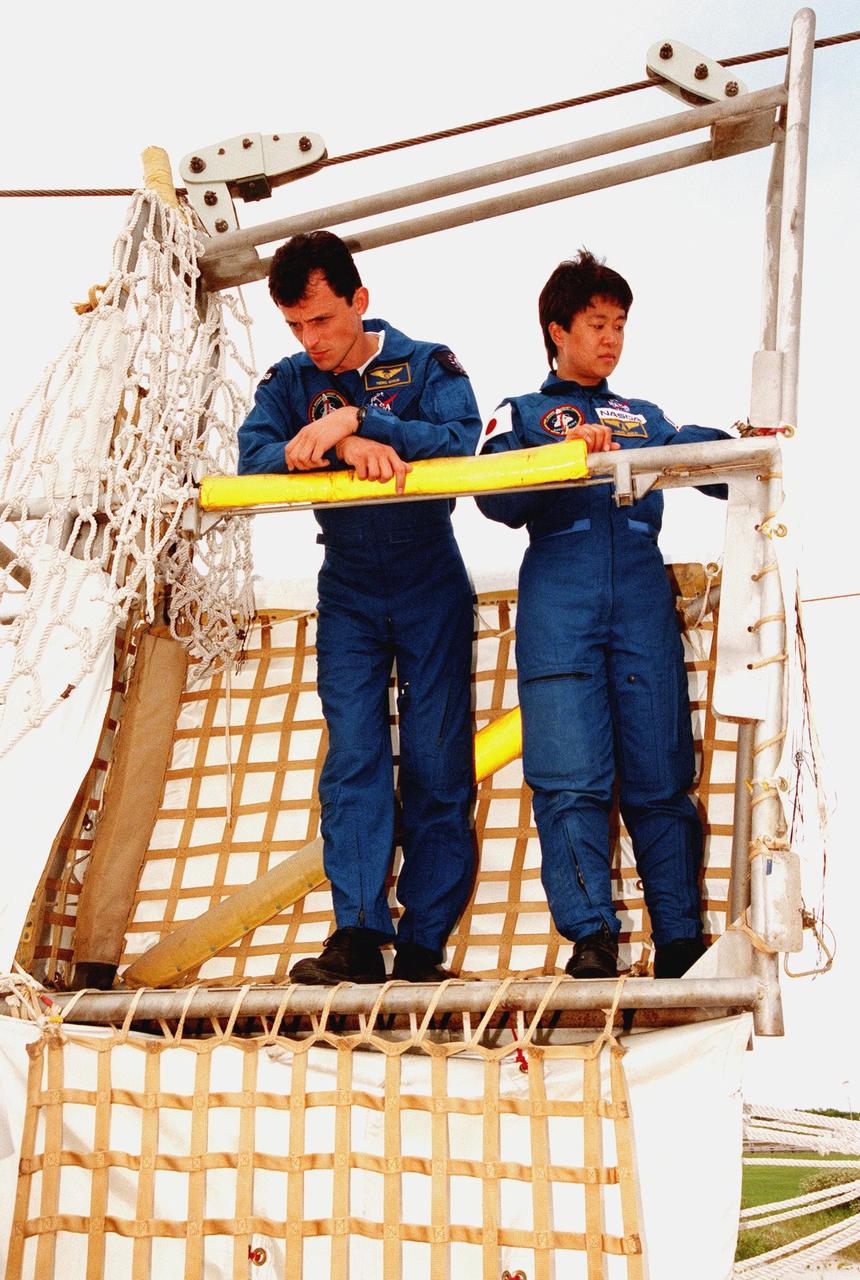
At Launch Pad 39-B, STS-95 Mission Specialist Pedro Duque of Spain (left) and Payload Specialist Chiaki Mukai look over the gate for the slidewire basket, part of the emergency egress system on the pad. Mukai represents the National Space Development Agency of Japan (NASDA), and Duque the European Space Agency (ESA). The STS-95 crew are at KSC to participate in a Terminal Countdown Demonstration Test (TCDT) which includes mission familiarization activities, emergency egress training, and a simulated main engine cut-off exercise. Other STS-95 crew members are Mission Specialist Stephen K. Robinson, Mission Commander Curtis L. Brown, Pilot Steven W. Lindsey, Payload Specialists John H. Glenn Jr., senator from Ohio, and Mission Specialist Scott E. Parazynski. The STS-95 mission, targeted for liftoff on Oct. 29, includes research payloads such as the Spartan solar-observing deployable spacecraft, the Hubble Space Telescope Orbital Systems Test Platform, the International Extreme Ultraviolet Hitchhiker, as well as the SPACEHAB single module with experiments on space flight and the aging process. Following the TCDT, the crew will be returning to Houston for final flight preparations
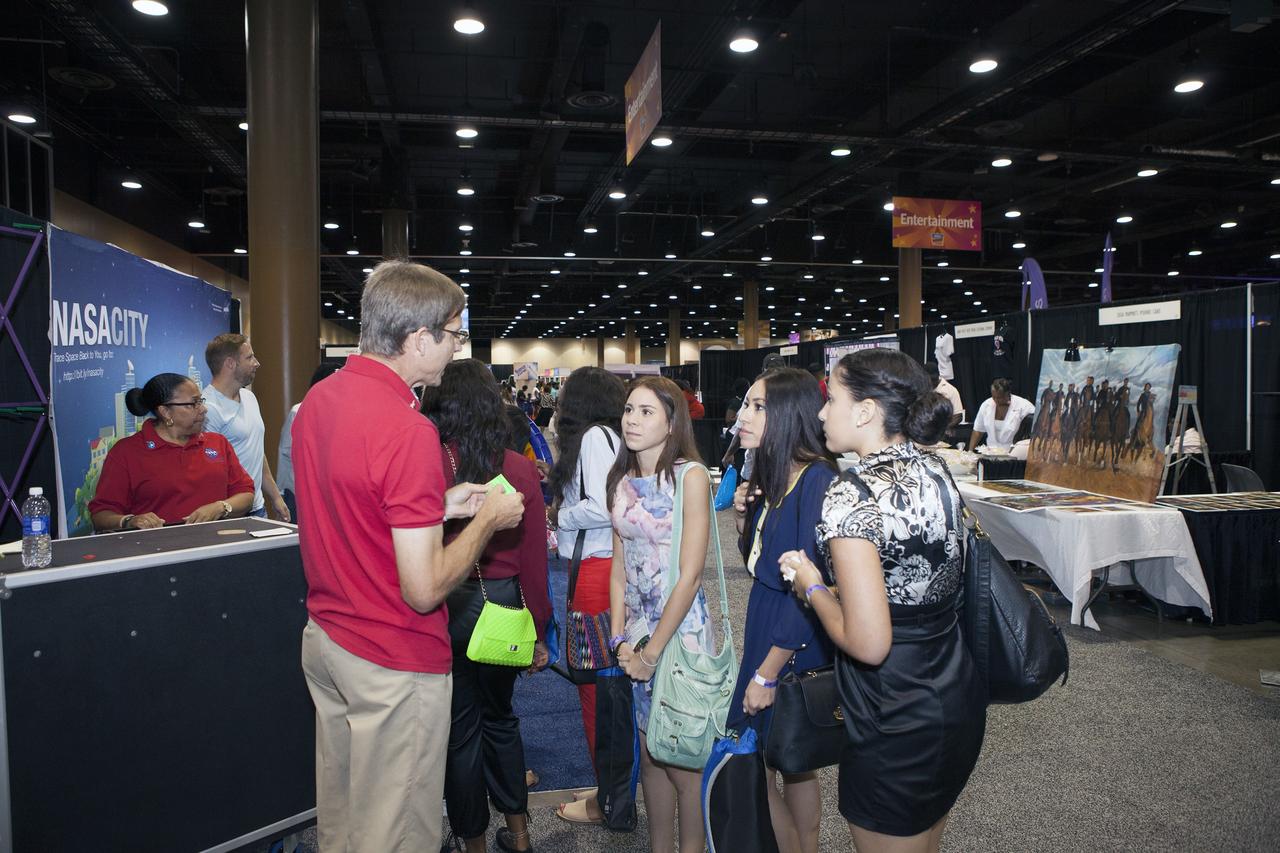
KISSIMMEE, Fla. – Guests at the Tom Joyner Family Reunion participate in "Learn and Spin Challenge," an opportunity to answer questions related to science, technology, engineering and math. Robert Smith asks a question as part of NASA’s educational theme during the five-day event. Behind Smith, to the left, is Debbie Houston who also supported the "Learn and Spin Challenge." The Tom Joyner Family Reunion is designed to present uplifting programs, entertainment and information about growing, diverse communities. An annual event of the nationally-syndicated Tom Joyner Morning Show, the many exhibits included NASA's participation focusing on encouraging young people to consider studies and careers in STEM -- science, technology, engineering and math. NASA's Education Division promoted the benefits of math and scientific learning along with career opportunities offered by the space agency. The activities took place at the Gaylord Palms Resort in Kissimmee, Florida, during the Labor Day weekend. Photo credit: NASA/Daniel Casper
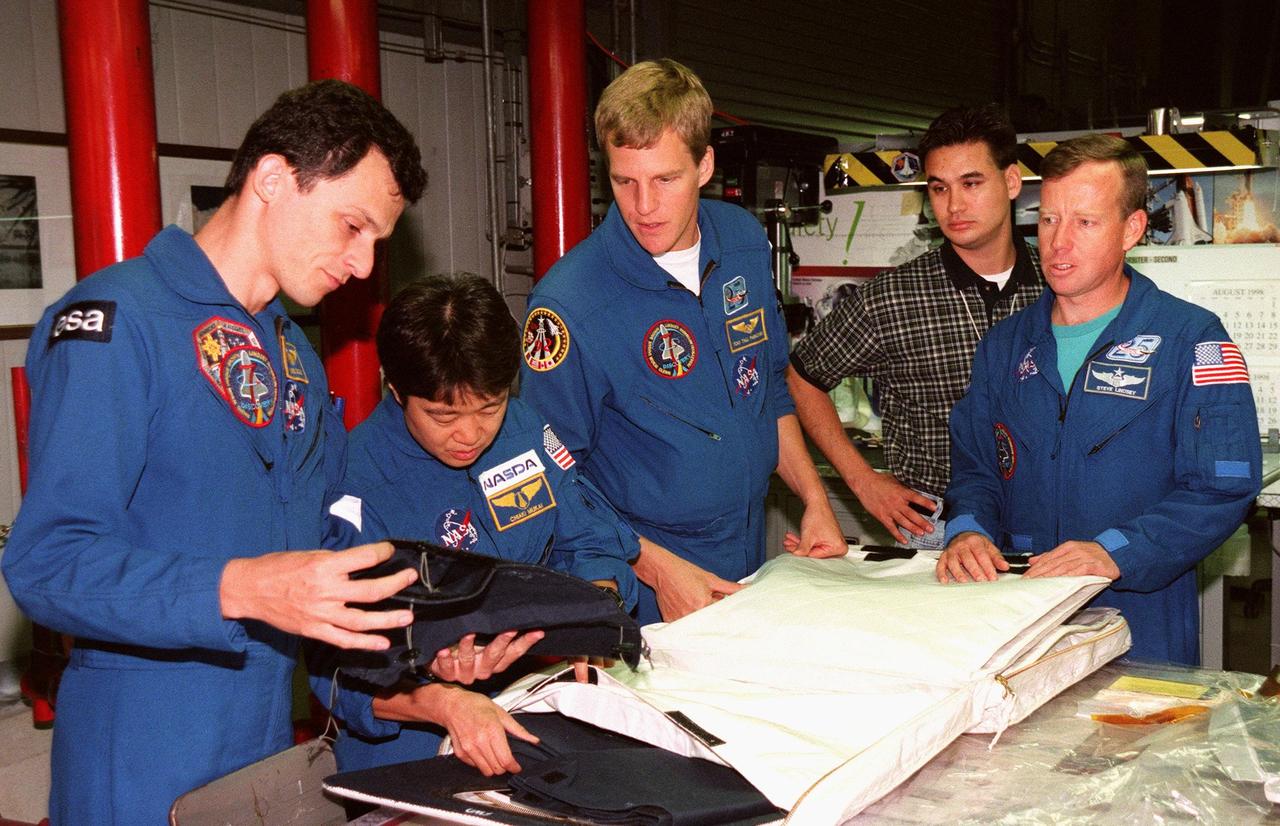
STS-95 crew members look over equipment in Orbiter Processing Facility Bay 2 during the Crew Equipment Interface Test (CEIT) for their mission. From left, they are Mission Specialist Pedro Duque, of the European Space Agency; Payload Specialist Chiaki Mukai, of the National Space Development Agency of Japan (NASDA); Mission Specialist Scott E. Parazynski; and Pilot Steven W. Lindsey. Behind them is Adam Flagan, United Space Alliance-Houston. The CEIT gives astronauts an opportunity for a hands-on look at the payloads and equipment with which they will be working on orbit. The launch of the STS-95 mission, aboard Space Shuttle Discovery, is scheduled for Oct. 29, 1998. The mission includes research payloads such as the Spartan solar-observing deployable spacecraft, the Hubble Space Telescope Orbital Systems Test Platform, the International Extreme Ultraviolet Hitchhiker, as well as the SPACEHAB single module with experiments on space flight and the aging process
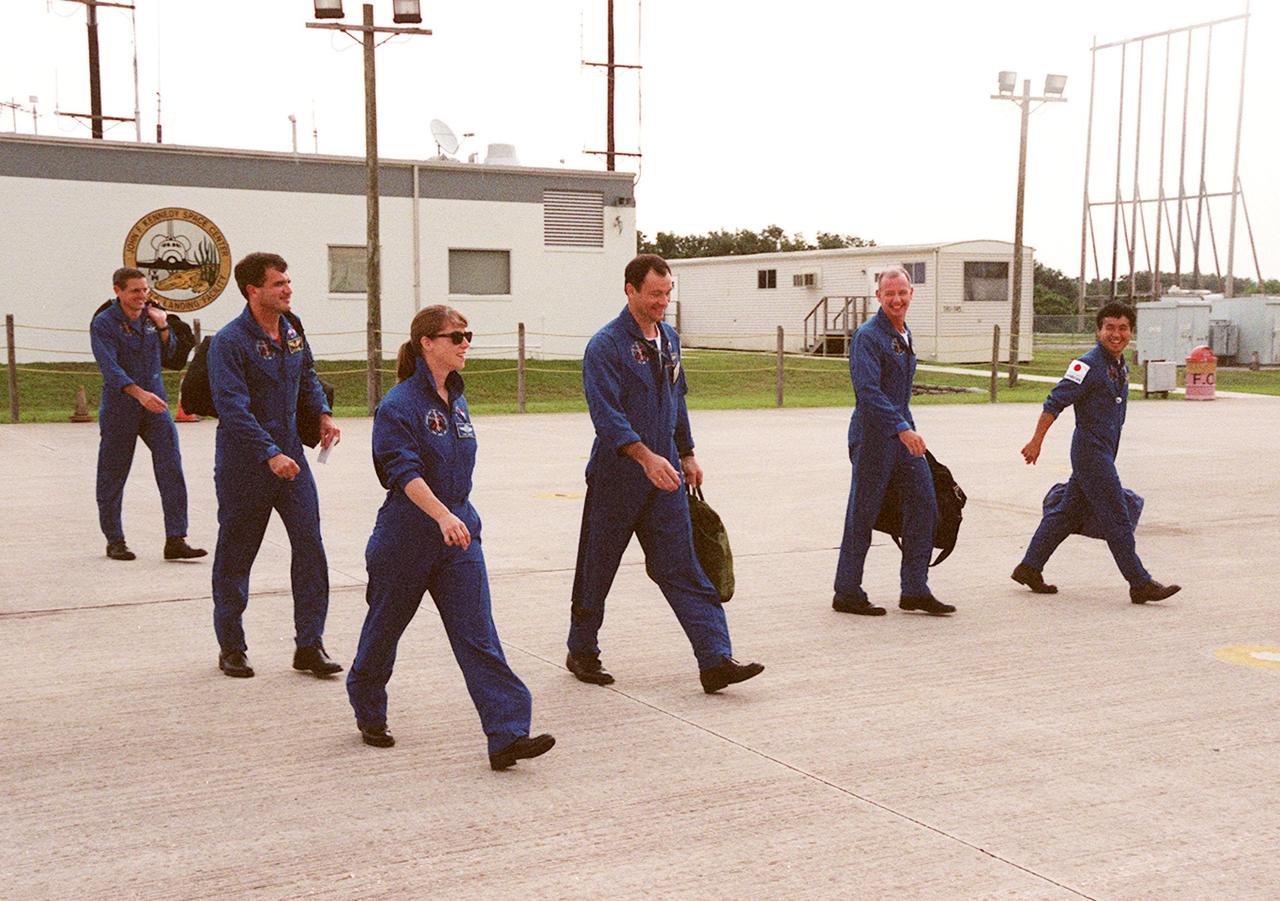
The STS-92 crew strides across the runway at KSC’s Shuttle Landing Facility, heading toward the aircraft that will take them back to Houston. They were at KSC for Crew Equipment Interface Test (CEIT) activities, looking over their mission payload and related equipment. From left are Mission Specialists Bill McArthur and Jeff Wisoff, Pilot Pam Melroy, Mission Specialist Michael Lopez-Alegria, Commander Brian Duffy and Mission Specialist Koichi Wakata, who is with the Japanese space agency. Not seen is Mission Specialist Leroy Chiao, who was also at KSC for the CEIT. STS-92 is scheduled to launch Oct. 5 on Shuttle Discovery from Launch Pad 39A on the fifth flight to the International Space Station. Discovery will carry the Integrated Truss Structure (ITS) Z1, the PMA-3, Ku-band Communications System, and Control Moment Gyros (CMGs)
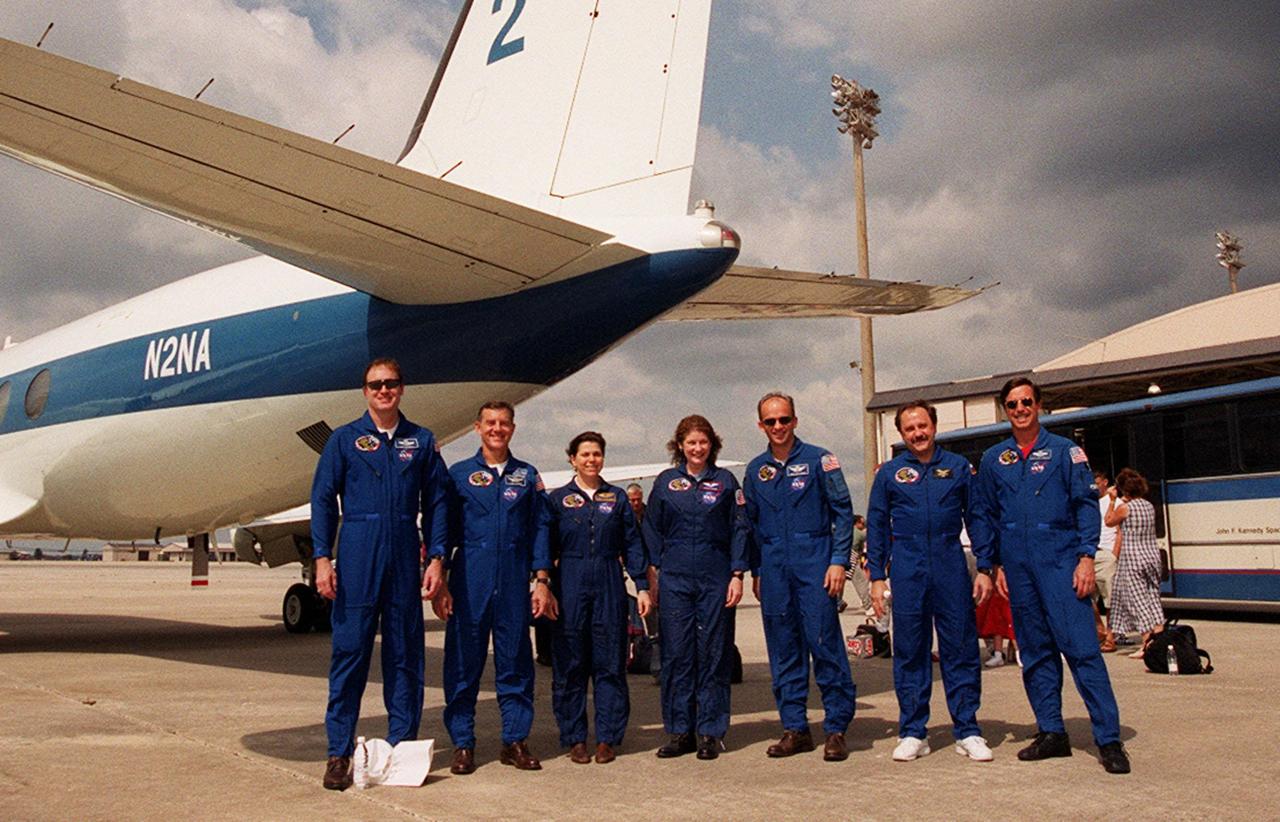
The STS-101 crew pose one more time before departing for Houston from Patrick Air Force Base. From left are Commander James D. Halsell Jr., Mission Specialists James S. Voss, Mary Ellen Weber, Susan J. Helms, Jeffrey N. Williams, Yury Usachev of Russia, and Pilot Scott “Doc” Horowitz. After landing at 2:20 a.m. EDT May 29, the crew and their families enjoyed the Memorial Day holiday in Florida. The crew returned from the third flight to the International Space Station where they made repairs, transferred cargo and completed a space walk to install and connect several pieces of equipment on the outside of the Space Station

STS-95 Mission Specialist Stephen K. Robinson, with the help of Carlos Gillis, of Lockheed Martin, suits up in the Operations and Checkout Building prior to his trip to Launch Pad 39-B. Robinson and the rest of the STS-95 crew are at KSC to participate in the Terminal Countdown Demonstration Test (TCDT) which includes mission familiarization activities, emergency egress training, and a simulated main engine cutoff. The other crew members are Payload Specialist Chiaki Mukai (M.D., Ph.D.), representing the National Space Development Agency of Japan (NASDA), Pilot Steven W. Lindsey, Mission Specialist Scott E. Parazynski, Mission Specialist Pedro Duque of Spain, representing the European Space Agency (ESA), Payload Specialist John H. Glenn Jr., senator from Ohio, and Mission Commander Curtis L. Brown. The STS-95 mission, targeted for liftoff on Oct. 29, includes research payloads such as the Spartan solar-observing deployable spacecraft, the Hubble Space Telescope Orbital Systems Test Platform, the International Extreme Ultraviolet Hitchhiker, as well as the SPACEHAB single module with experiments on space flight and the aging process. Following the TCDT, the crew will be returning to Houston for final flight preparations
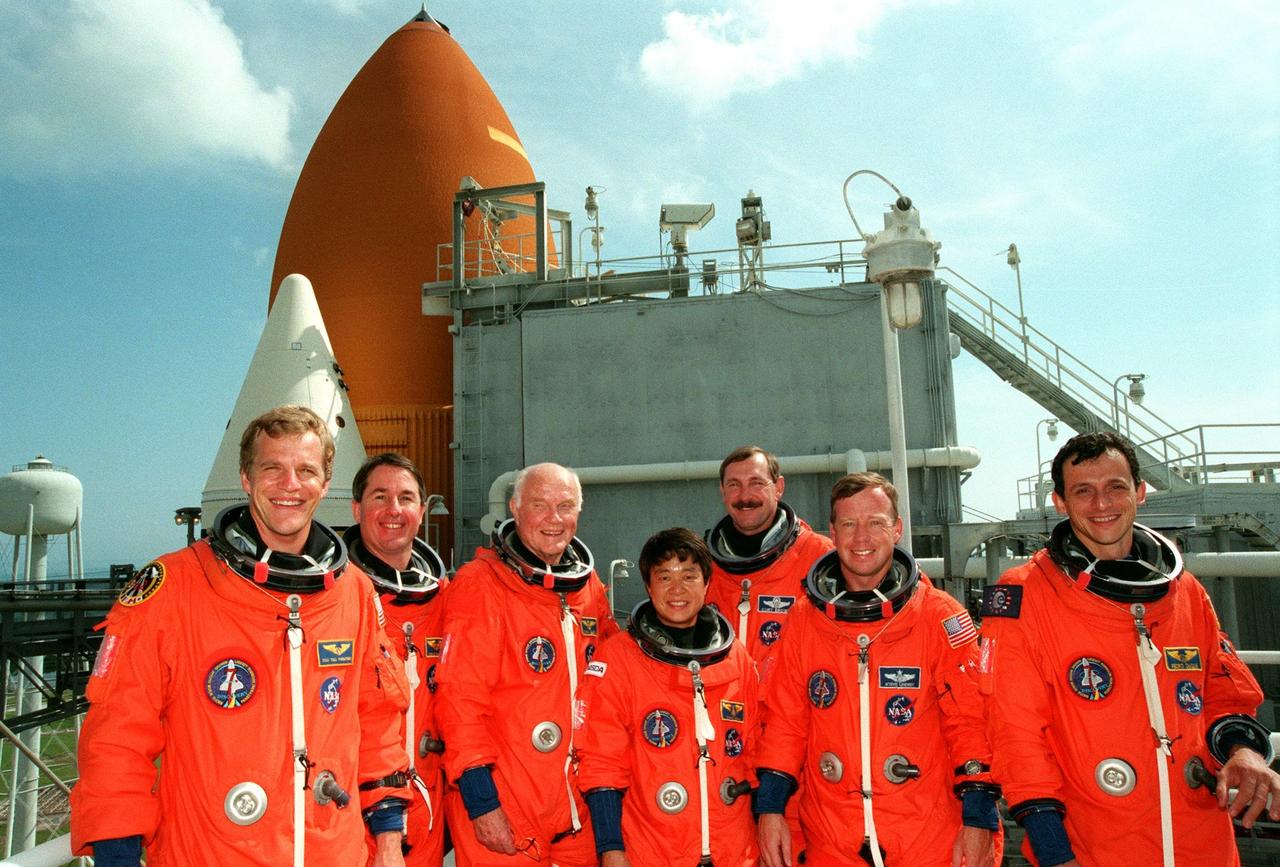
On Launch Pad 39B, the STS-95 crew pose after successfully completing a pre-launch countdown exercise on Space Shuttle Discovery. Standing from left to right are Mission Specialist Scott E. Parazynski, Mission Specialist Stephen K. Robinson, Payload Specialist John H. Glenn Jr., senator from Ohio, Payload Specialist Chiaki Mukai (M.D., Ph.D.), representing the National Space Development Agency in Japan (NASDA), Mission Commander Curtis L. Brown, Pilot Steven W. Lindsey, and Mission Specialist Pedro Duque of Spain, representing the European Space Agency (ESA). In the background can be seen one of the solid rocket boosters and the external tank. The STS-95 crew are at KSC to participate in the Terminal Countdown Demonstration Test (TCDT) which includes mission familiarization activities, emergency egress training, and a simulated main engine cutoff. The STS-95 mission, targeted for liftoff on Oct. 29, includes research payloads such as the Spartan solar-observing deployable spacecraft, the Hubble Space Telescope Orbital Systems Test Platform, the International Extreme Ultraviolet Hitchhiker, as well as the SPACEHAB single module with experiments on space flight and the aging process. Following the TCDT, the crew will be returning to Houston for final flight preparations
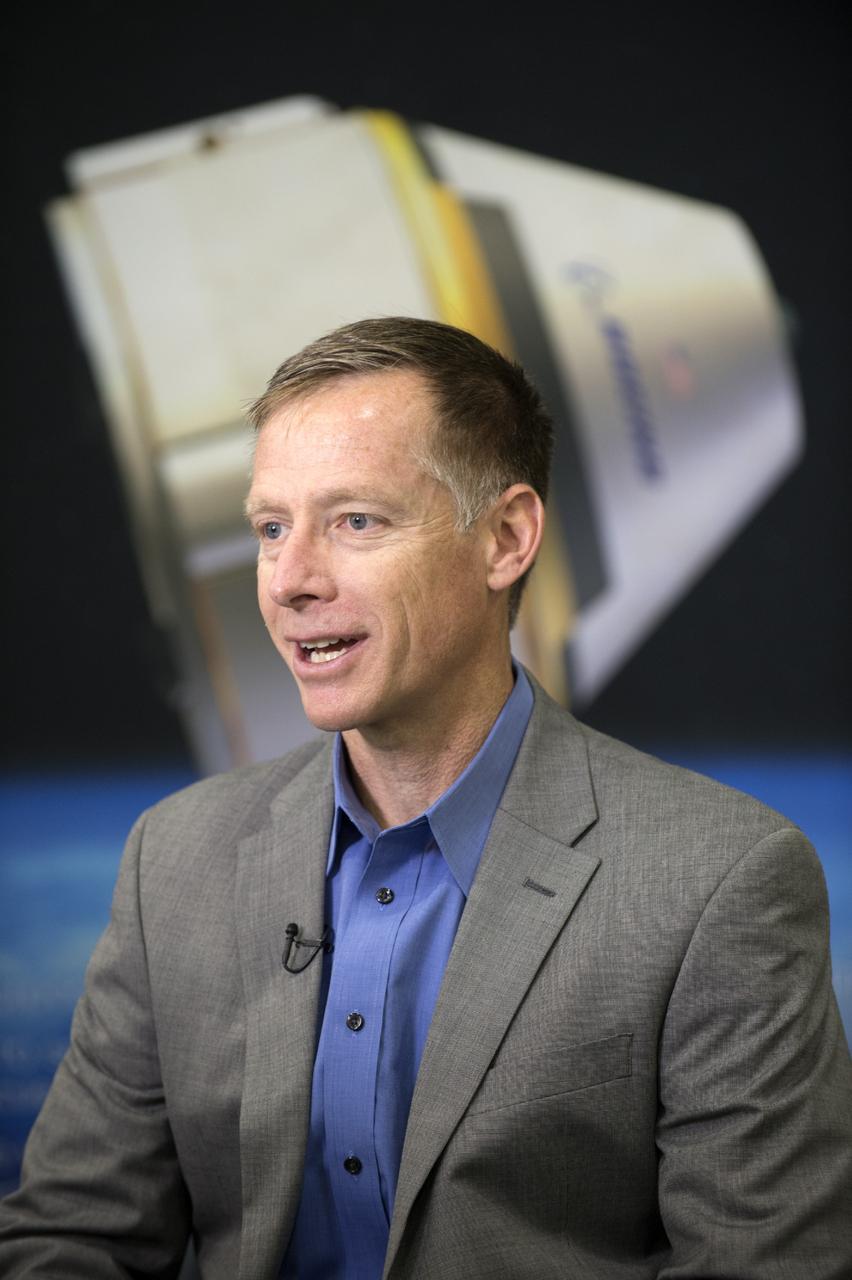
HOUSTON - Chris Ferguson, director of Crew and Mission Operations for The Boeing Company, is interviewed by the media during the unveiling of a CST-100 mock-up at the company's Houston Product Support Center. Boeing's CST-100 is being designed to transport crew members or a mix of crew and cargo to low-Earth-orbit destinations, including the International Space Station. Boeing is one of three aerospace industry partners working with NASA's Commercial Crew Program, or CCP, during its Commercial Crew Integrated Capability, or CCiCap, initiative, which is intended to make commercial human spaceflight services available for government and commercial customers. To learn more about CCP, visit http://www.nasa.gov/commercialcrew. Photo credit: NASA/Robert Markowitz
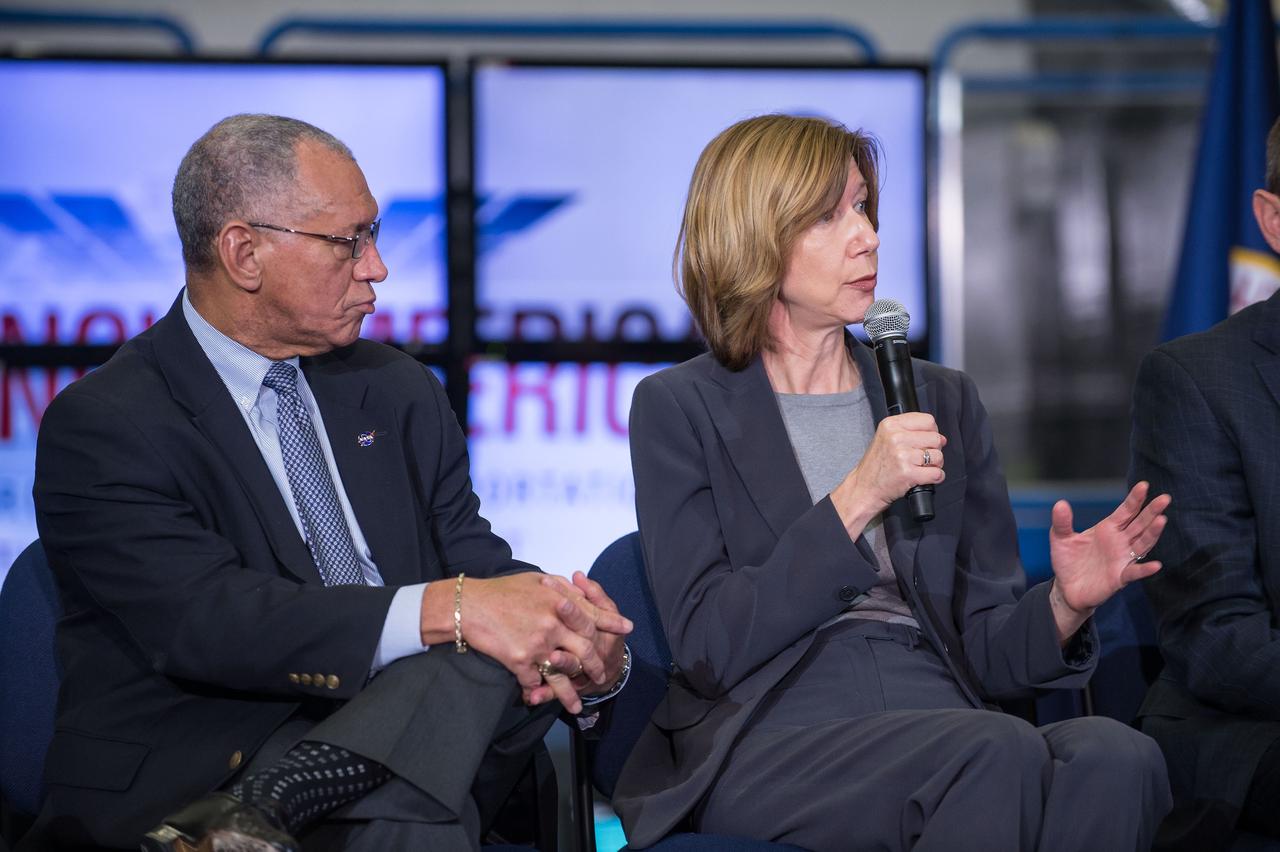
HOUSTON, Texas - jsc2015e031256 - Kathy Lueders, program manager of NASA's Commercial Crew Program, discusses the agency's approach while NASA Administrator Charles Bolden looks on during a presentation highlighting key development activities, test plans and objectives for achieving certification of two American crew transportation systems. Photo credit: NASA/Robert Markowitz
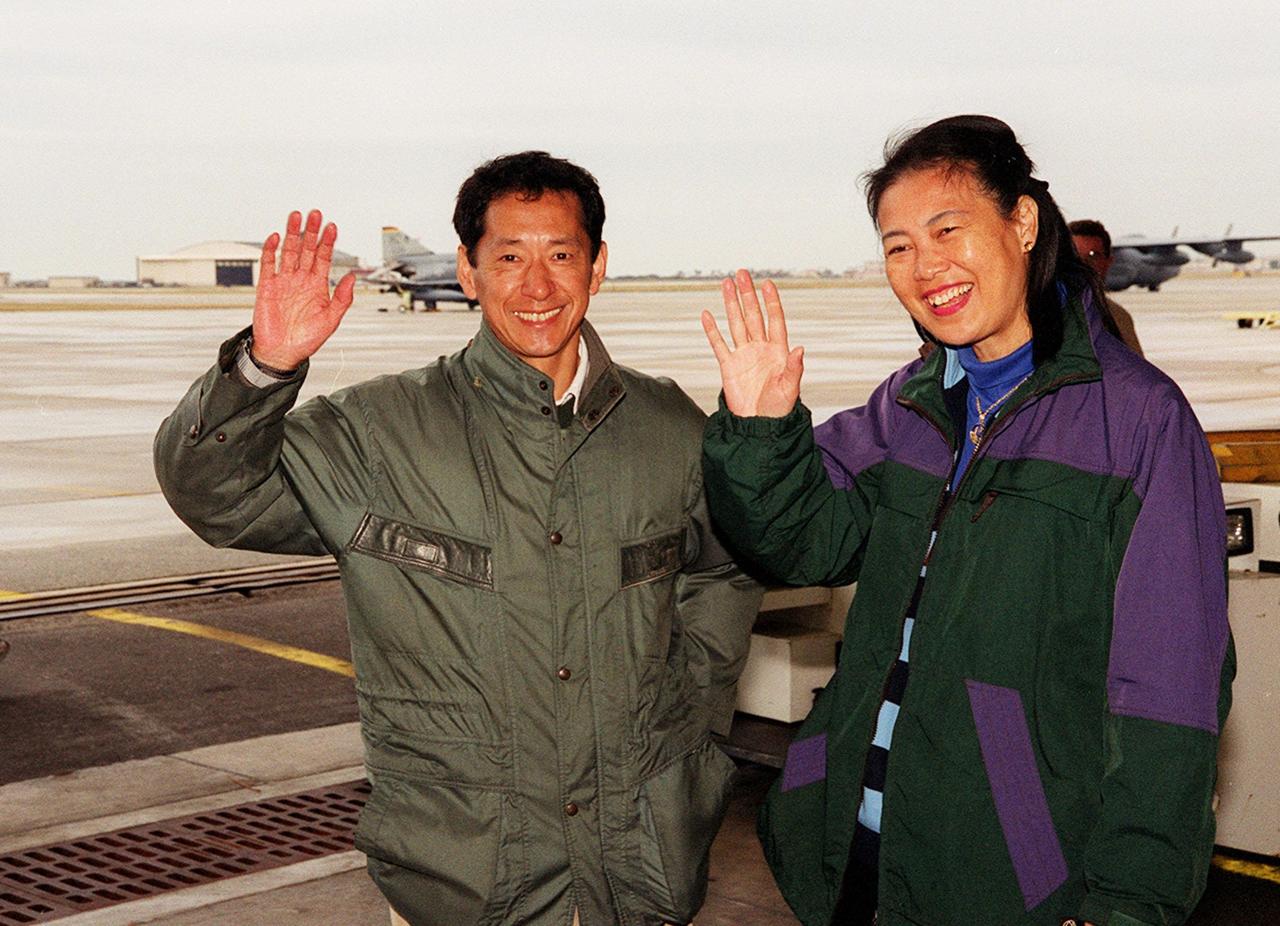
STS-99 Mission Specialist Mamoru Mohri of Japan and his wife, Akiko, wave before their departure from Patrick Air Force Base and return to Houston. With the postponement of the launch of STS-99 on Jan. 31, the crew have an opportunity for more training and time with their families. During the launch countdown, Endeavour's enhanced master events controller (E-MEC) No. 2 failed a standard preflight test. Launch was postponed and Shuttle managers decided to replace the E-MEC located in the orbiter's aft compartment. Launch controllers will be in a position to begin the STS-99 countdown the morning of Feb. 6 and ready to support a launch midto late next week pending availability of the Eastern Range. Known as the Shuttle Radar Topography Mission, it will chart a new course to produce unrivaled 3-D images of the Earth's surface, using two antennae and a 200-foot-long section of space station-derived mast protruding from the payload bay. The result could be close to 1 trillion measurements of the Earth's topography. Besides contributing to the production of better maps, these measurements could lead to improved water drainage modeling, more realistic flight simulators, better locations for cell phone towers, and enhanced navigation safety
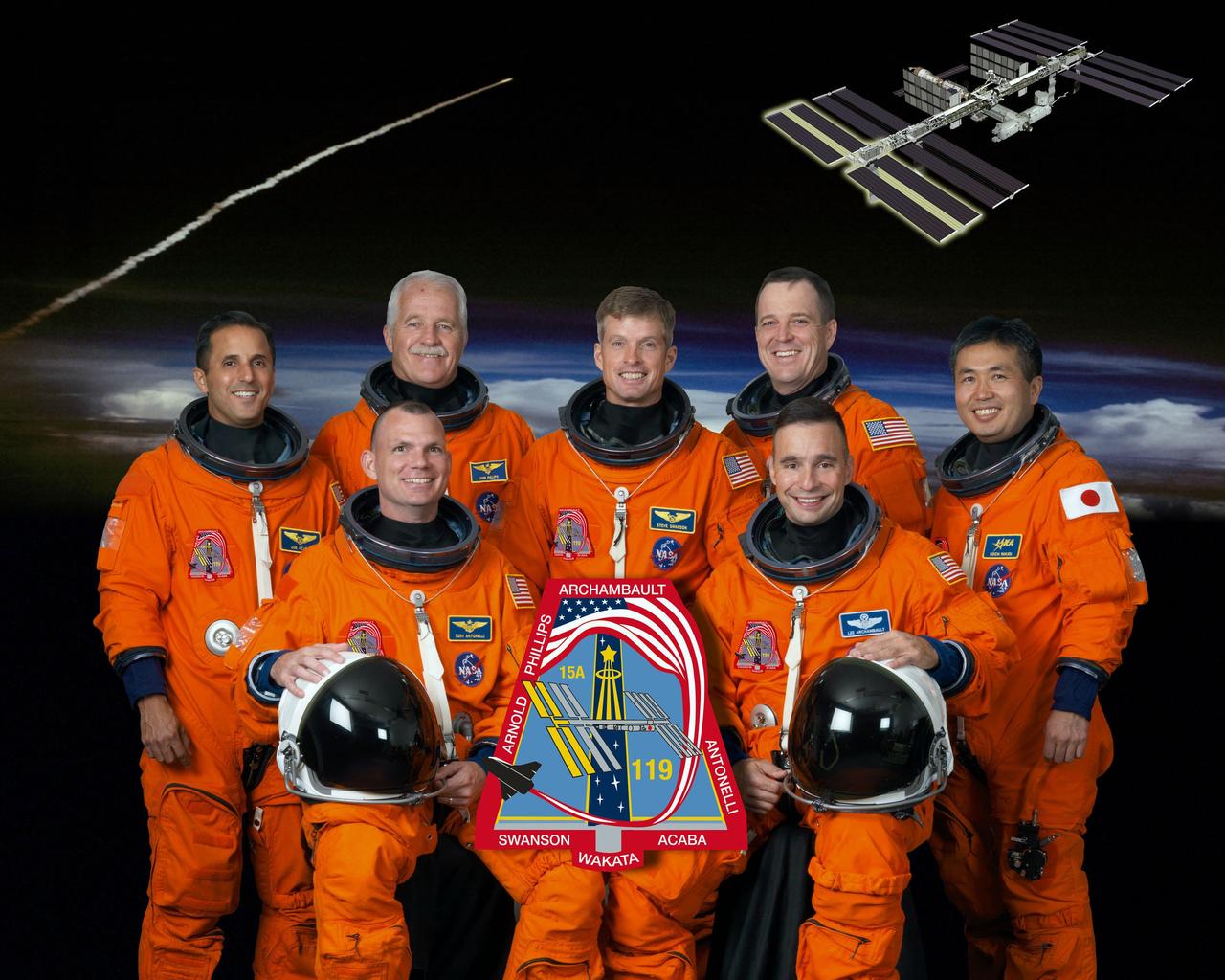
HOUSTON, Texas -- STS119-S-002: Attired in training versions of their shuttle launch and entry suits, these seven astronauts take a break from training to pose for the STS-119 crew portrait. From the right (front row) are NASA astronauts Lee Archambault, commander, and Tony Antonelli, pilot. From the left (back row) are NASA astronauts Joseph Acaba, John Phillips, Steve Swanson, Richard Arnold and Japan Aerospace Exploration Agency astronaut Koichi Wakata, all mission specialists. Wakata is scheduled to join Expedition 18 as flight engineer after launching to the International Space Station on STS-119.
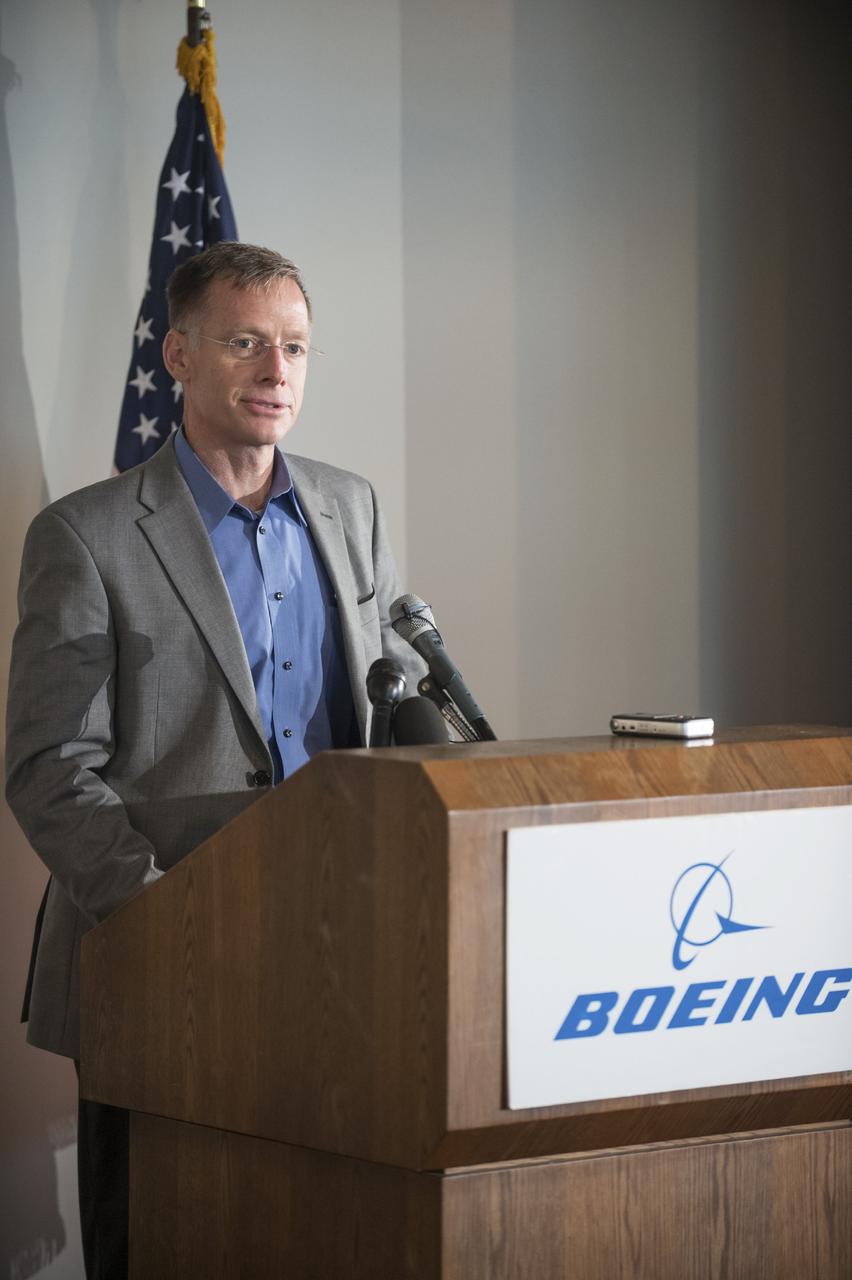
HOUSTON - JSC2013e068300 - Chris Ferguson, director of Crew and Mission Operations for The Boeing Company and former NASA astronaut, addresses the media before the unveiling of a CST-100 mock-up at the company's Houston Product Support Center. This test version is optimized to support five crew members and will allow the company to evaluate crew safety, interfaces, communications, maneuverability and ergonomics. Boeing's CST-100 is being designed to transport crew members or a mix of crew and cargo to low-Earth-orbit destinations. The evaluation is part of the ongoing work supporting Boeing's funded Space Act Agreement with NASA's Commercial Crew Program, or CCP, during the agency's Commercial Crew Integrated Capability, or CCiCap, initiative. CCiCap is intended to make commercial human spaceflight services available for government and commercial customers. To learn more about CCP, visit http://www.nasa.gov/commercialcrew. Photo credit: NASA/Robert Markowitz
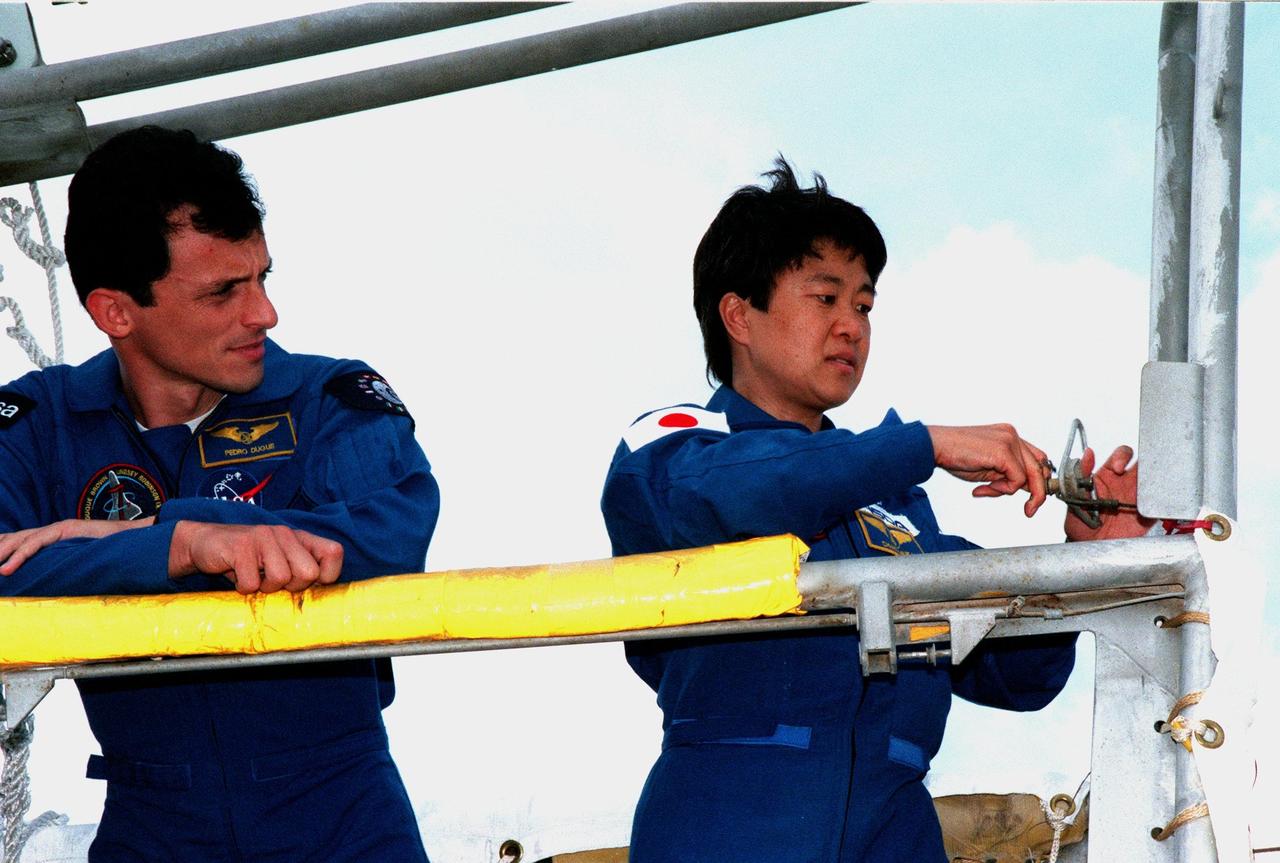
At Launch Pad 39-B, STS-95 Payload Specialist Chiaki Mukai (right) pulls the pin that releases the gate for the slidewire basket, part of the emergency egress system on the pad, while Mission Specialist Pedro Duque of Spain watches. Mukai represents the National Space Development Agency of Japan (NASDA), and Duque the European Space Agency (ESA). The STS-95 crew are at KSC to participate in a Terminal Countdown Demonstration Test (TCDT) which includes mission familiarization activities, emergency egress training, and a simulated main engine cut-off exercise. Other STS-95 crew members are Mission Specialist Stephen K. Robinson, Mission Commander Curtis L. Brown, Pilot Steven W. Lindsey, Payload Specialists John H. Glenn Jr., senator from Ohio, and Mission Specialist Scott E. Parazynski. The STS-95 mission, targeted for liftoff on Oct. 29, includes research payloads such as the Spartan solar-observing deployable spacecraft, the Hubble Space Telescope Orbital Systems Test Platform, the International Extreme Ultraviolet Hitchhiker, as well as the SPACEHAB single module with experiments on space flight and the aging process. Following the TCDT, the crew will be returning to Houston for final flight preparations
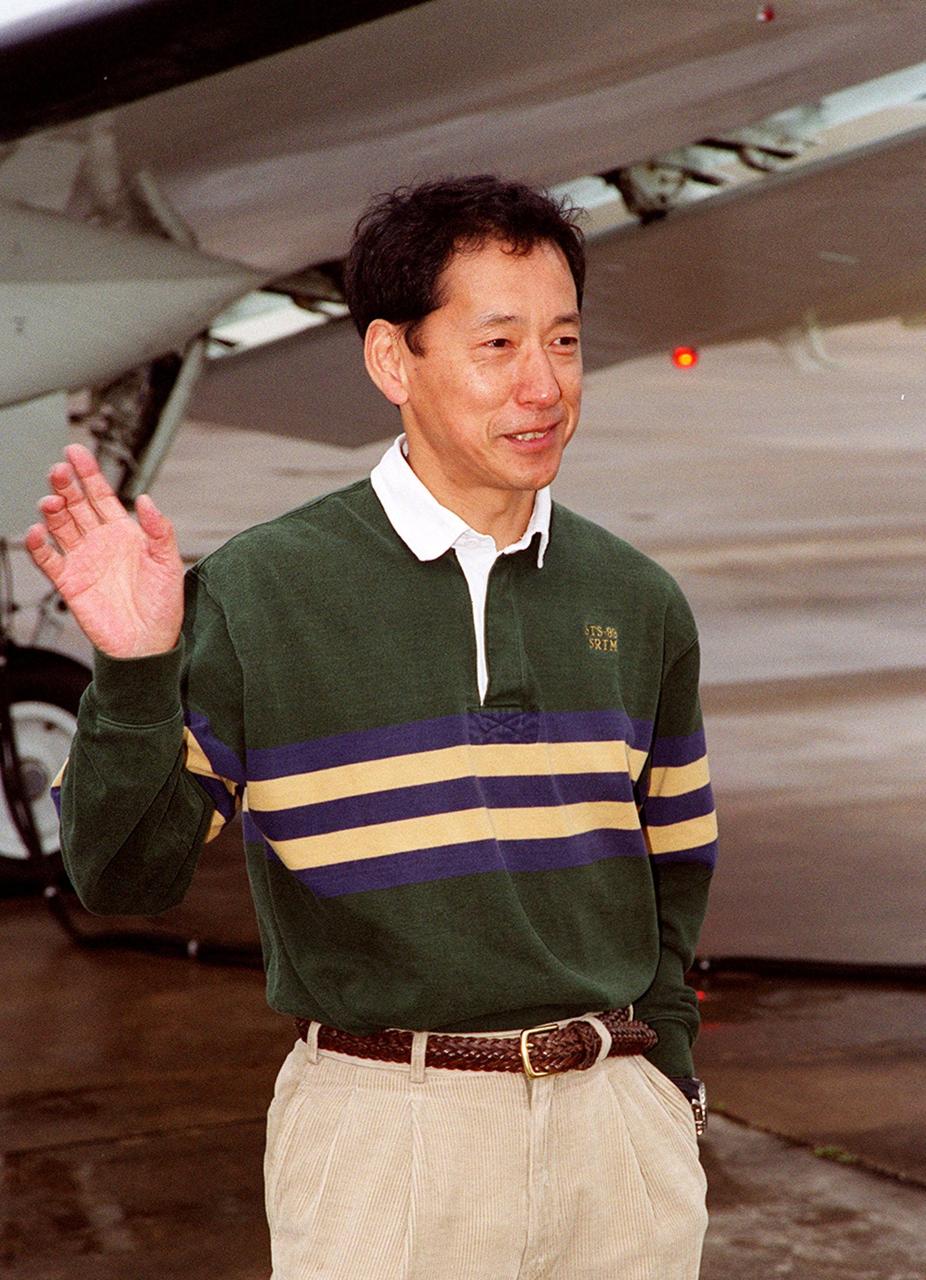
STS-99 Mission Specialist Mamoru Mohri of Japan waves before his departure from Patrick Air Force Base and return to Houston. With the postponement of the launch of STS-99 on Jan. 31, the crew have an opportunity for more training and time with their families. During the launch countdown, Endeavour's enhanced master events controller (E-MEC) No. 2 failed a standard preflight test. Launch was postponed and Shuttle managers decided to replace the E-MEC located in the orbiter's aft compartment. Launch controllers will be in a position to begin the STS-99 countdown the morning of Feb. 6 and ready to support a launch midto late next week pending availability of the Eastern Range. Known as the Shuttle Radar Topography Mission, it will chart a new course to produce unrivaled 3-D images of the Earth's surface, using two antennae and a 200-foot-long section of space station-derived mast protruding from the payload bay. The result could be close to 1 trillion measurements of the Earth's topography. Besides contributing to the production of better maps, these measurements could lead to improved water drainage modeling, more realistic flight simulators, better locations for cell phone towers, and enhanced navigation safety

A Shuttle Training Aircraft (STA) taxis down the runway at KSC's Shuttle Landing Facility. The STA is a modified Grumman American Aviation-built Gulfstream II executive jet that was modified to simulate an orbiter's cockpit, motion and visual cues, and handling qualities. It is used by Shuttle flight crews to practice landing the orbiter. In flight, the STA duplicates the orbiter's atmospheric descent trajectory from approximately 35,000 feet altitude to landing on a runway. The orbiter differs in at least one major aspect from conventional aircraft; it is unpowered during re-entry and landing so its high-speed glide must be perfectly executed the first time there is no go-around capability. The orbiter touchdown speed is 213 to 226 miles (343 to 364 kilometers) per hour. There are two STAs, based in Houston
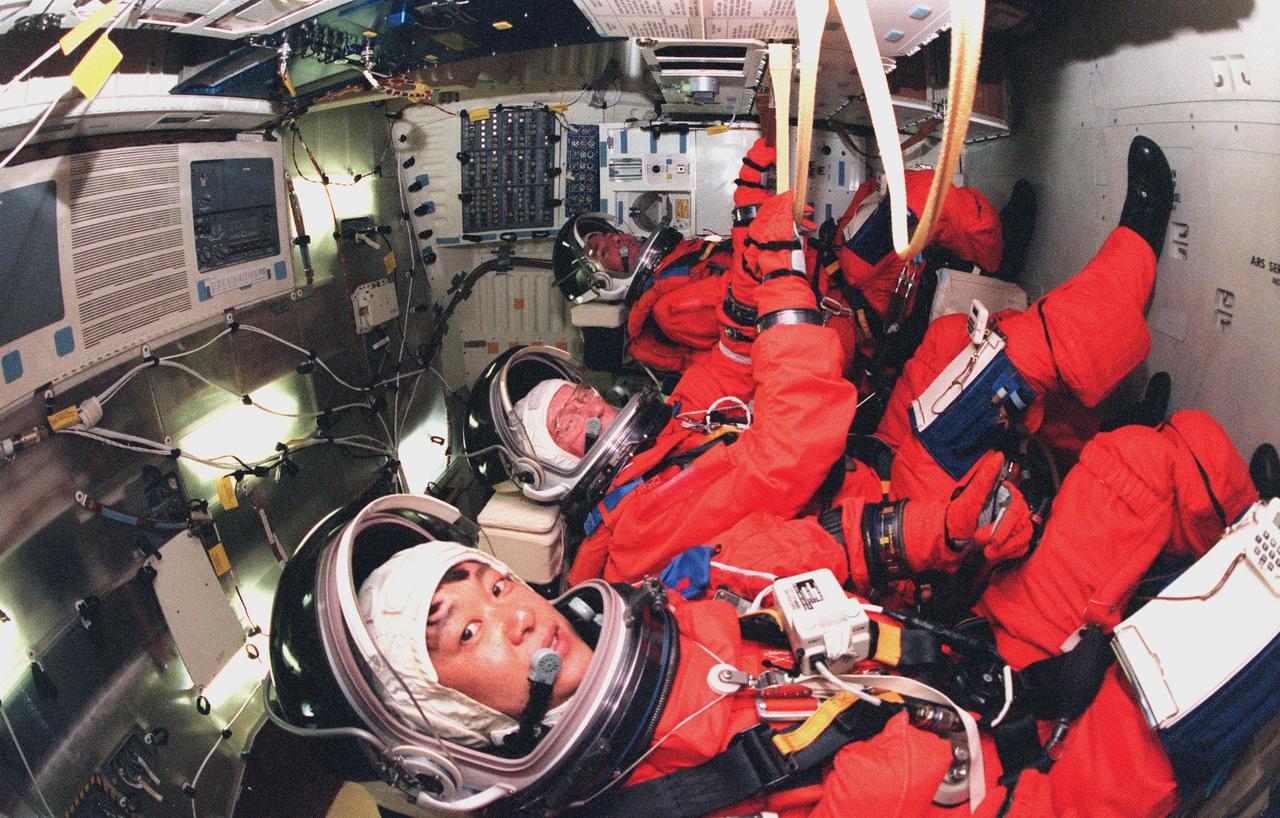
In their flight seats aboard Space Shuttle Discovery are (front to back) STS-95 Payload Specialists Chiaki Mukai (M.D., Ph.D.), representing the National Space Development Agency of Japan (NASDA), and John H. Glenn Jr., senator from Ohio, and Mission Specialist Stephen K. Robinson. Mukai, Glenn and Robinson, along with other crew members are at KSC to participate in the Terminal Countdown Demonstration Test (TCDT) which includes mission familiarization activities, emergency egress training, and a simulated main engine cutoff. Not shown are Pilot Steven W. Lindsey, Mission Specialist Scott E. Parazynski, Mission Specialist Pedro Duque of Spain, representing the European Space Agency (ESA), and Mission Commander Curtis L. Brown. The STS-95 mission, targeted for liftoff on Oct. 29, includes research payloads such as the Spartan solar-observing deployable spacecraft, the Hubble Space Telescope Orbital Systems Test Platform, the International Extreme Ultraviolet Hitchhiker, as well as the SPACEHAB single module with experiments on space flight and the aging process. Following the TCDT, the crew will be returning to Houston for final flight preparations
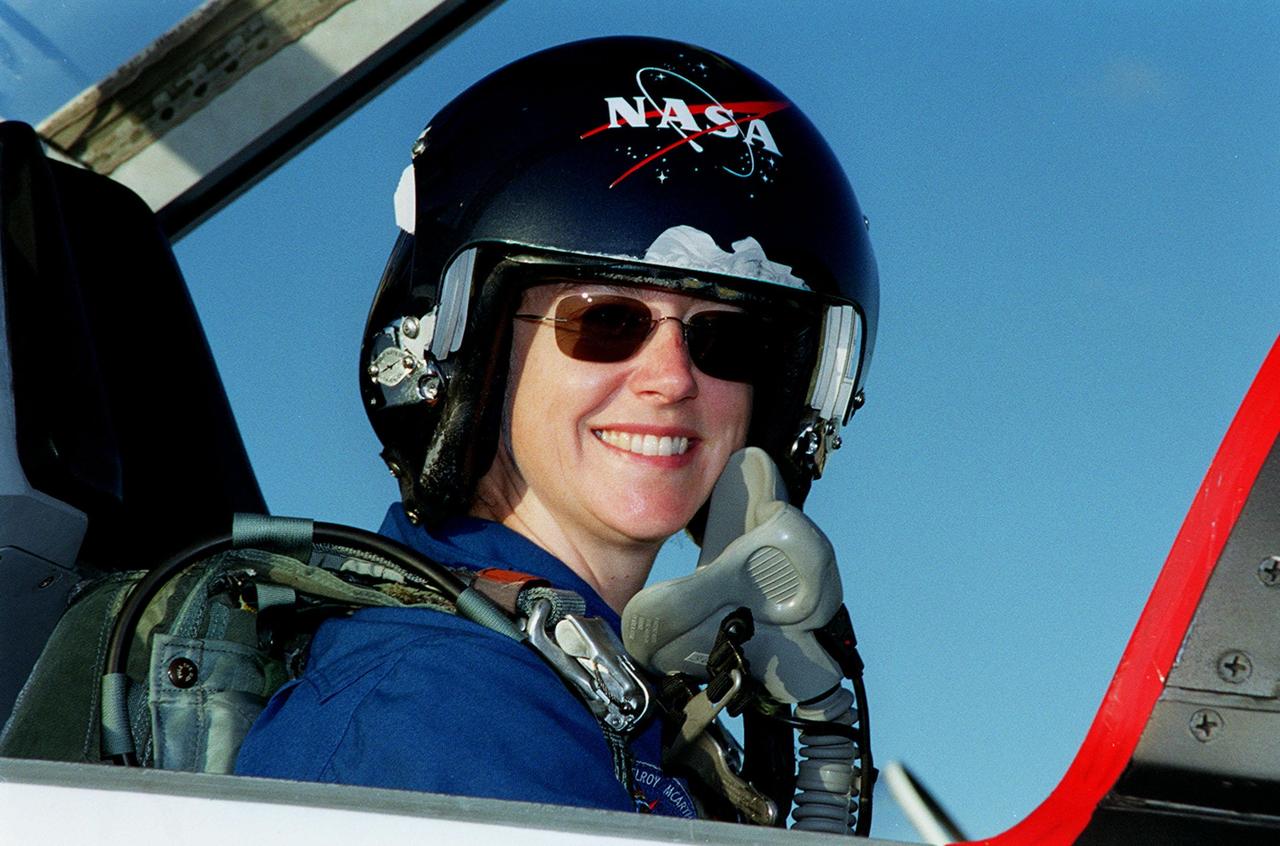
STS-92 Pilot Pamela Ann Melroy is happy to arrive at the KSC Shuttle Landing Facility after a flight from Houston. She and the rest of the crew are at KSC to take part in Terminal Countdown Demonstration Test activities, which include emergency egress training from the orbiter and pad, and a simulated countdown. The fifth mission to the International Space Station, STS-92 will carry the Integrated Truss Structure Z1, the first of the planned 10 trusses on the Space Station, and the third Pressurized Mating Adapter. The Z1 will allow the first U.S. solar arrays on a future flight to be temporarily installed on Unity for early power. PMA-3 will provide a Shuttle docking port for the solar array installation on the sixth ISS flight and Lab installation on the seventh ISS flight. STS-92 is scheduled to launch Oct. 5 from launch Pad 39A. It will be the 100th flight in the Shuttle program
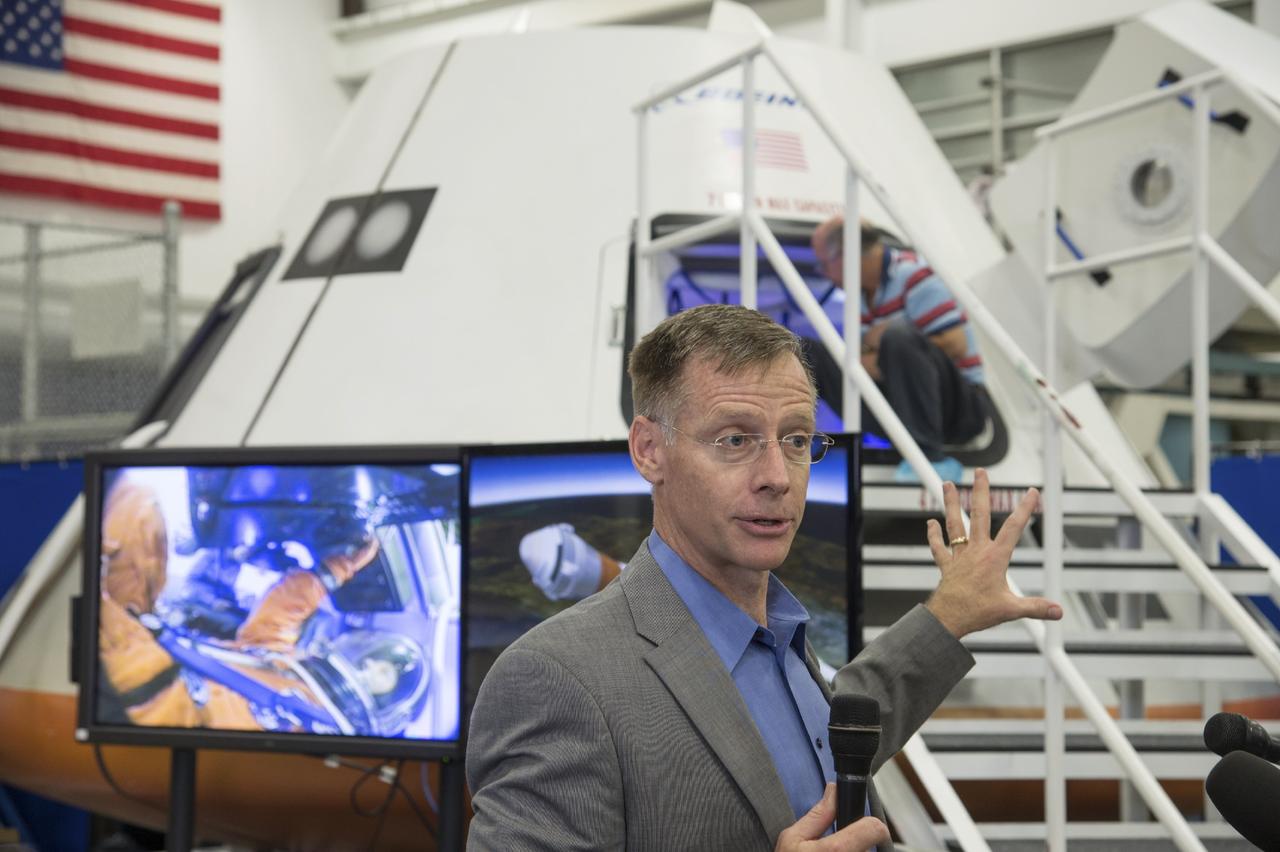
HOUSTON - JSC2013e068310 - Chris Ferguson, director of Crew and Mission Operations for The Boeing Company and former NASA astronaut, discusses the fit check evaluation of the CST-100 mock-up with the media during its unveiling at the company's Houston Product Support Center. This test version is optimized to support five crew members and will allow the company to evaluate crew safety, interfaces, communications, maneuverability and ergonomics. Boeing's CST-100 is being designed to transport crew members or a mix of crew and cargo to low-Earth-orbit destinations. The evaluation is part of the ongoing work supporting Boeing's funded Space Act Agreement with NASA's Commercial Crew Program, or CCP, during the agency's Commercial Crew Integrated Capability, or CCiCap, initiative. CCiCap is intended to make commercial human spaceflight services available for government and commercial customers. To learn more about CCP, visit http://www.nasa.gov/commercialcrew. Photo credit: NASA/Robert Markowitz
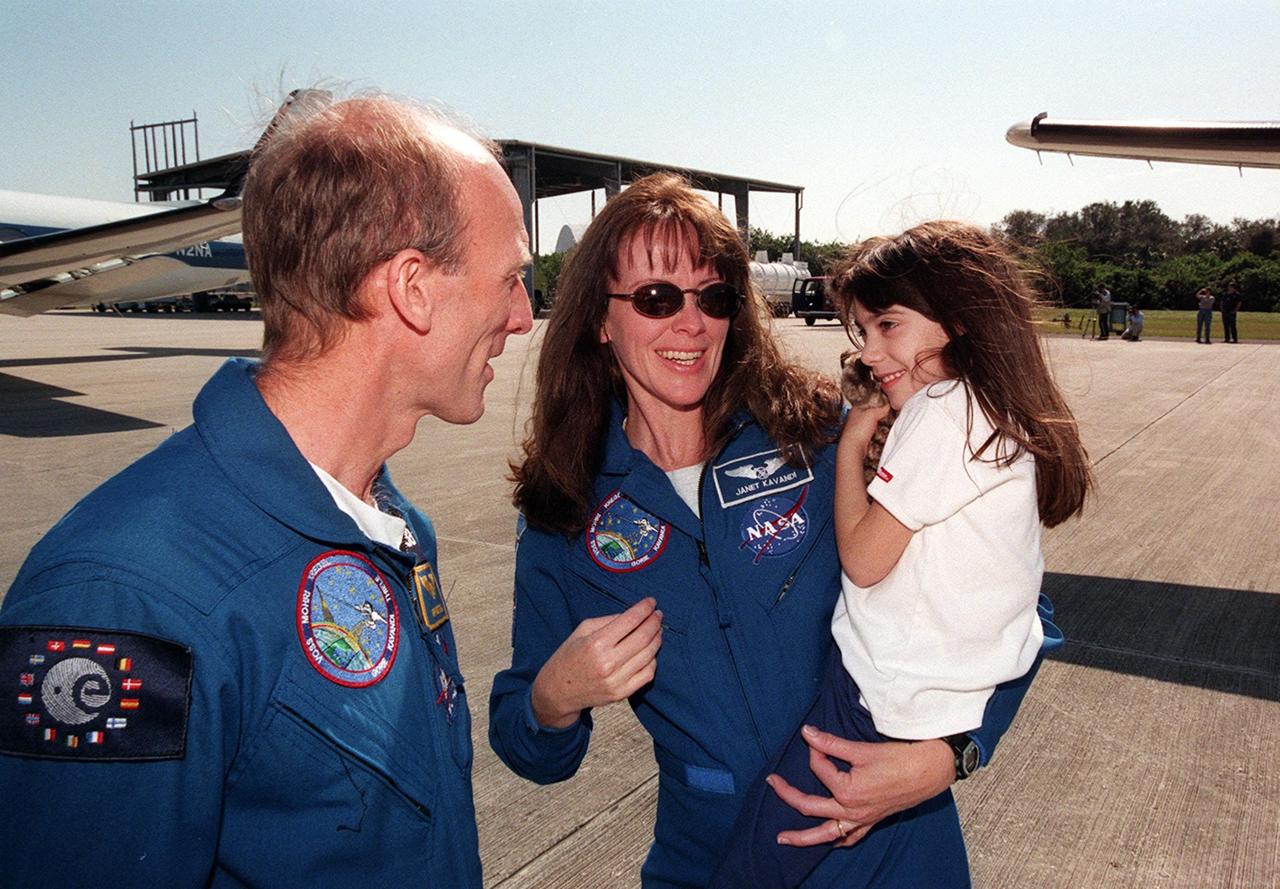
At the Shuttle Landing Facility, STS-99 Mission Specialist Gerhard Thiele (left) joins Mission Specialist Janet Kavandi with her daughter before their departure for Houston. The STS-99 crew completed a successful 11-day Shuttle Radar Topography Mission mapping 47 million square miles of the Earth's surface before landing at KSC Feb. 22
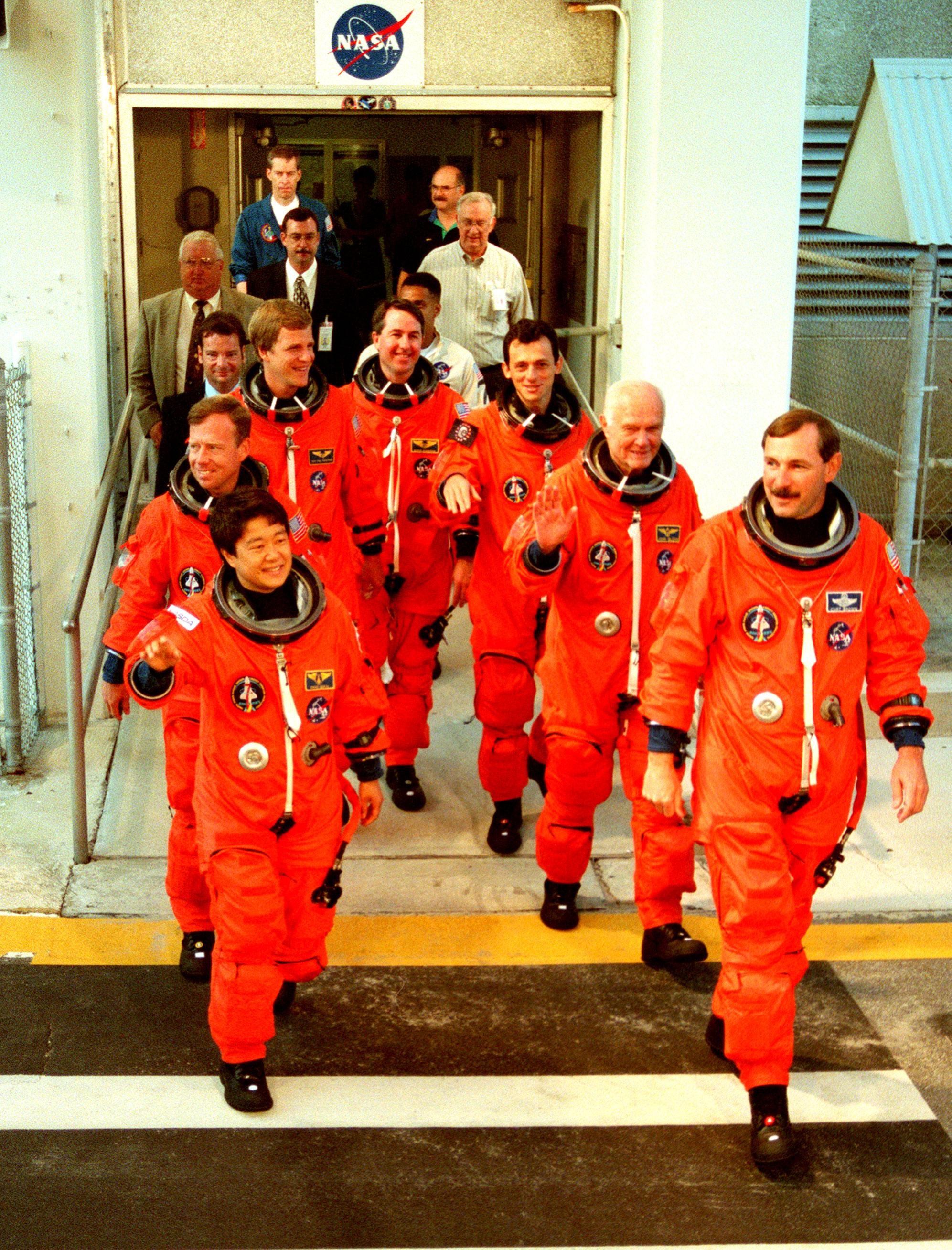
STS-95 crew members exit the Operations and Checkout Building where they suited up before leaving for Launch Pad 39-B. Pictured are (clockwise from lower left) Payload Specialist Chiaki Mukai (M.D., Ph.D.), representing the National Space Development Agency of Japan (NASDA), Pilot Steven W. Lindsey, Mission Specialist Scott E. Parazynski, Mission Specialist Stephen K. Robinson, Mission Specialist Pedro Duque of Spain, representing the European Space Agency (ESA), Payload Specialist John H. Glenn Jr., senator from Ohio, and Mission Commander Curtis L. Brown. The STS-95 crew are at KSC to participate in a Terminal Countdown Demonstration Test (TCDT) which includes mission familiarization activities, emergency egress training, and the simulated main engine cut-off exercise. The STS-95 mission, targeted for liftoff on Oct. 29, includes research payloads such as the Spartan solar-observing deployable spacecraft, the Hubble Space Telescope Orbital Systems Test Platform, the International Extreme Ultraviolet Hitchhiker, as well as the SPACEHAB single module with experiments on space flight and the aging process. Following the TCDT, the crew will be returning to Houston for final flight preparations
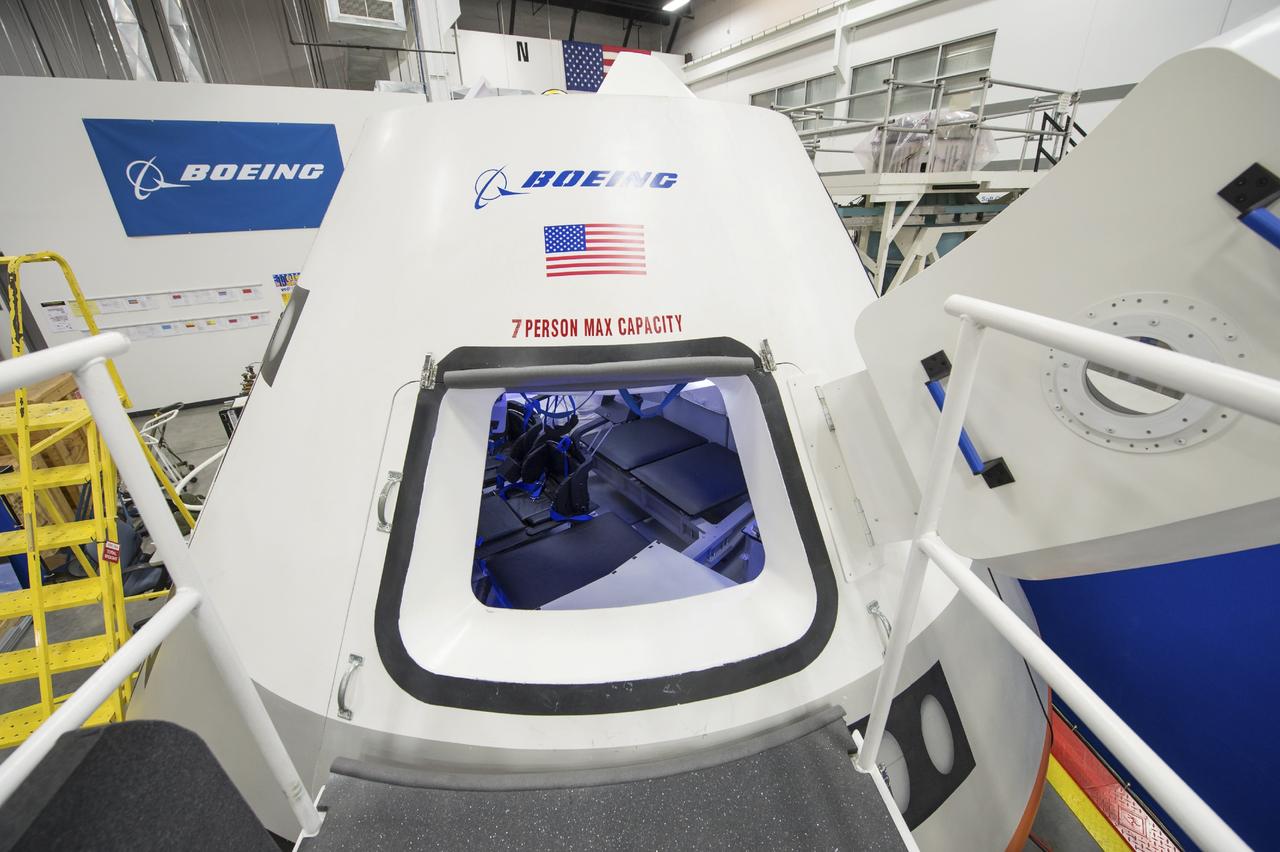
HOUSTON - JSC2013e068247 - The Boeing Company unveils its fully outfitted CST-100 mock-up at the company's Houston Product Support Center in Texas. This test version is optimized to support five crew members and will allow the company to evaluate crew safety, interfaces, communications, maneuverability and ergonomics. Boeing's CST-100 is designed being to transport crew members or a mix of crew and cargo to low-Earth-orbit destinations, including the International Space Station. Boeing is one of three aerospace industry partners working with CCP during its Commercial Crew Integrated Capability, or CCiCap, initiative, which is intended to make commercial human spaceflight services available for government and commercial customers. To learn more about CCP, visit www.nasa.gov/commercialcrew. Photo credit: NASA/Robert Markowitz

STS-91 Mission Specialist Franklin R. Chang-Diaz gets assistance from a suit technician as he dons his flight suit in the Operations and Checkout (O&C) Building. The fitting takes place prior to the crew walkout and transport to Launch Pad 39A. He is on his sixth space flight. Chang-Diaz holds a doctorate in applied plasma physics and is director of the Advanced Space Propulsion Laboratory at the University of Houston. Franklin’s background will serve him well during the mission, since he will be primarily responsible for crew activities in support of the of the Alpha Magnetic Spectrometer. He will also back up Lawrence with the mideck experiments and Kavandi with SPACEHAB operations. STS-91 is scheduled to be launched on June 2 with a launch window opening around 6:10 p.m. EDT. The mission will feature the ninth and final Shuttle docking with the Russian Space Station Mir, the first Mir docking for Discovery, the first on-orbit test of the Alpha Magnetic Spectrometer (AMS), and the first flight of the new Space Shuttle super lightweight external tank. Astronaut Andrew S. W. Thomas will return to Earth as a STS-91 crew member after living more than four months aboard Mir
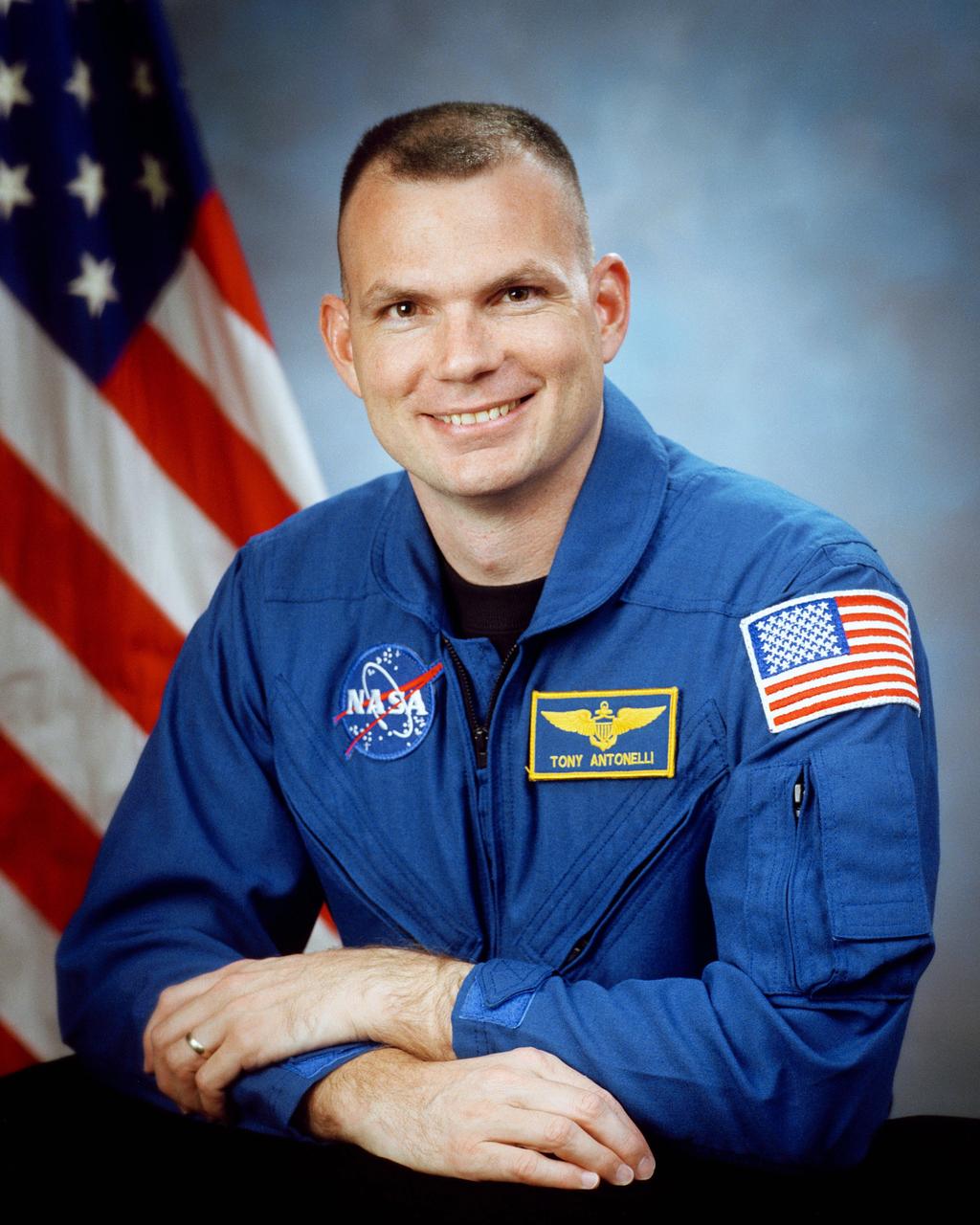
HOUSTON, Texas -- JSC2000-07308: Astronaut Dominic A. (Tony) Antonelli, pilot

On Launch Pad 39B, the STS-95 crew pose after successfully completing a pre-launch countdown exercise on Space Shuttle Discovery. Standing from left to right are Mission Specialist Scott E. Parazynski, Mission Specialist Stephen K. Robinson, Payload Specialist John H. Glenn Jr., senator from Ohio, Payload Specialist Chiaki Mukai (M.D., Ph.D.), representing the National Space Development Agency in Japan (NASDA), Mission Commander Curtis L. Brown, Pilot Steven W. Lindsey, and Mission Specialist Pedro Duque of Spain, representing the European Space Agency (ESA). In the background (left) can be seen one of the solid rocket boosters and the external tank. The STS-95 crew are at KSC to participate in the Terminal Countdown Demonstration Test (TCDT) which includes mission familiarization activities, emergency egress training, and a simulated main engine cutoff. The STS-95 mission, targeted for liftoff on Oct. 29, includes research payloads such as the Spartan solar-observing deployable spacecraft, the Hubble Space Telescope Orbital Systems Test Platform, the International Extreme Ultraviolet Hitchhiker, as well as the SPACEHAB single module with experiments on space flight and the aging process. Following the TCDT, the crew will be returning to Houston for final flight preparations
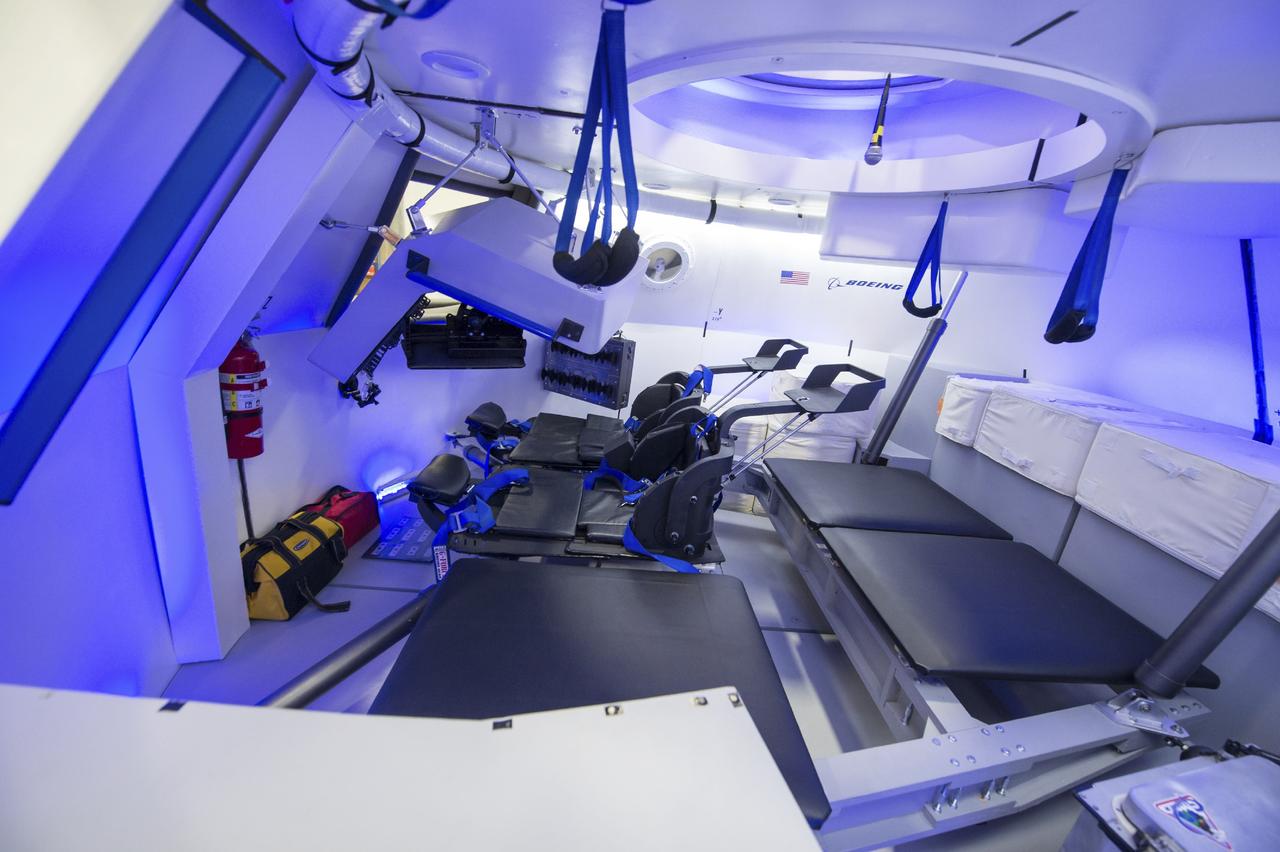
HOUSTON - JSC2013e068244 - The Boeing Company unveils the interior of its fully outfitted CST-100 mock-up at the company's Houston Product Support Center in Texas. This test version is optimized to support five crew members and will allow the company to evaluate crew safety, interfaces, communications, maneuverability and ergonomics. Boeing's CST-100 is being designed to transport crew members or a mix of crew and cargo to low-Earth-orbit destinations, including the International Space Station. Boeing is one of three aerospace industry partners working with CCP during its Commercial Crew Integrated Capability, or CCiCap, initiative, which is intended to make commercial human spaceflight services available for government and commercial customers. To learn more about CCP, visit http://www.nasa.gov/commercialcrew. Photo credit: NASA/Robert Markowitz
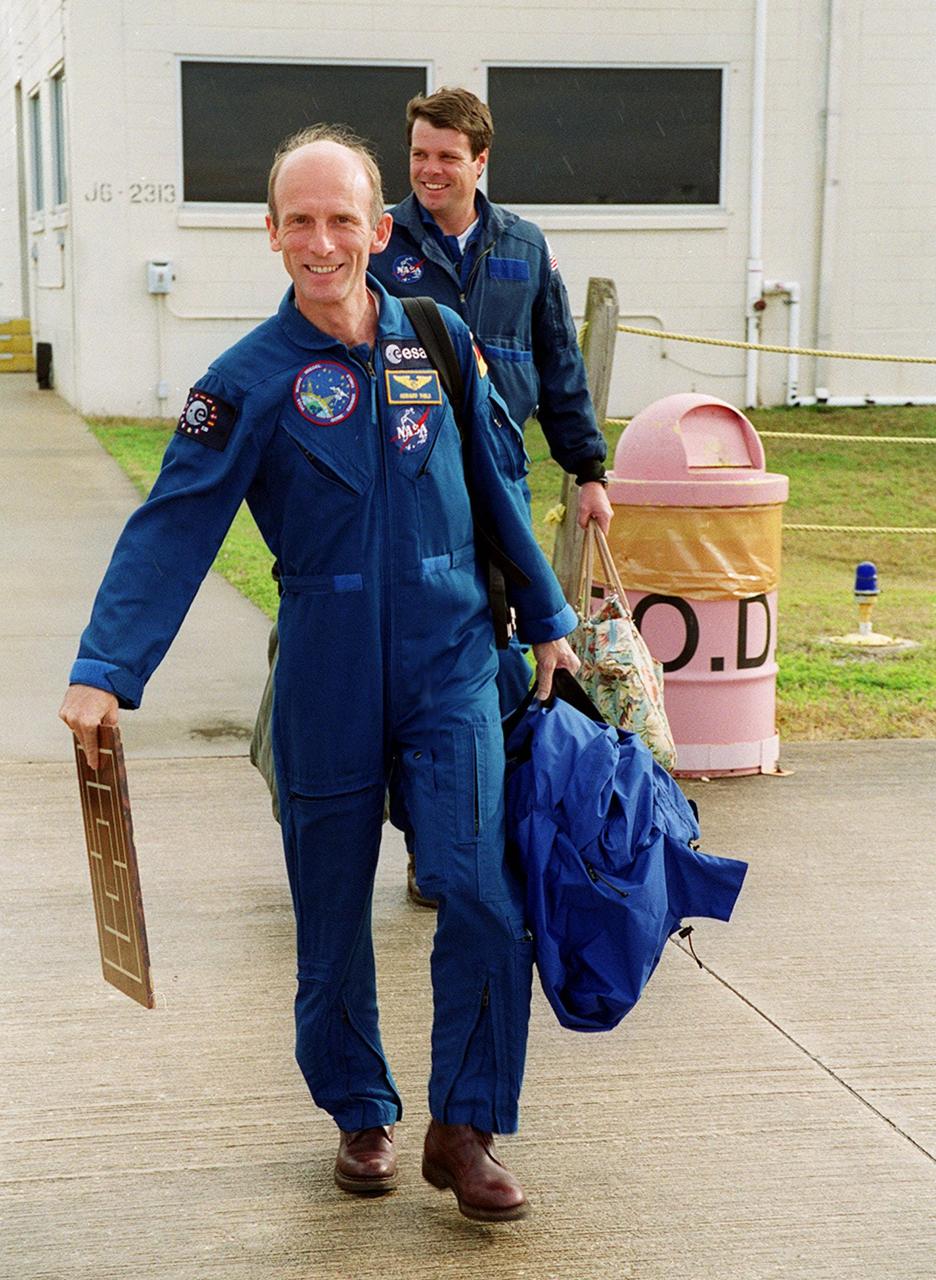
STS-99 Mission Specialist Gerhard Thiele (foreground) and Commander Kevin Kregel make their way to the runway at the Shuttle Landing Facility for a return flight to Houston. During the Jan. 31 launch countdown, Endeavour's enhanced master events controller (E-MEC) No. 2 failed a standard preflight test. Launch was postponed and Shuttle managers decided to replace the E-MEC located in the orbiter's aft compartment. Launch controllers will be in a position to begin the STS-99 countdown the morning of Feb. 6 and ready to support a launch midto late next week pending availability of the Eastern Range. The postponed launch gives the crew an opportunity for more training and time with their families. Known as the Shuttle Radar Topography Mission, it will chart a new course to produce unrivaled 3-D images of the Earth's surface, using two antennae and a 200-foot-long section of space station-derived mast protruding from the payload bay. The result could be close to 1 trillion measurements of the Earth's topography. Besides contributing to the production of better maps, these measurements could lead to improved water drainage modeling, more realistic flight simulators, better locations for cell phone towers, and enhanced navigation safety
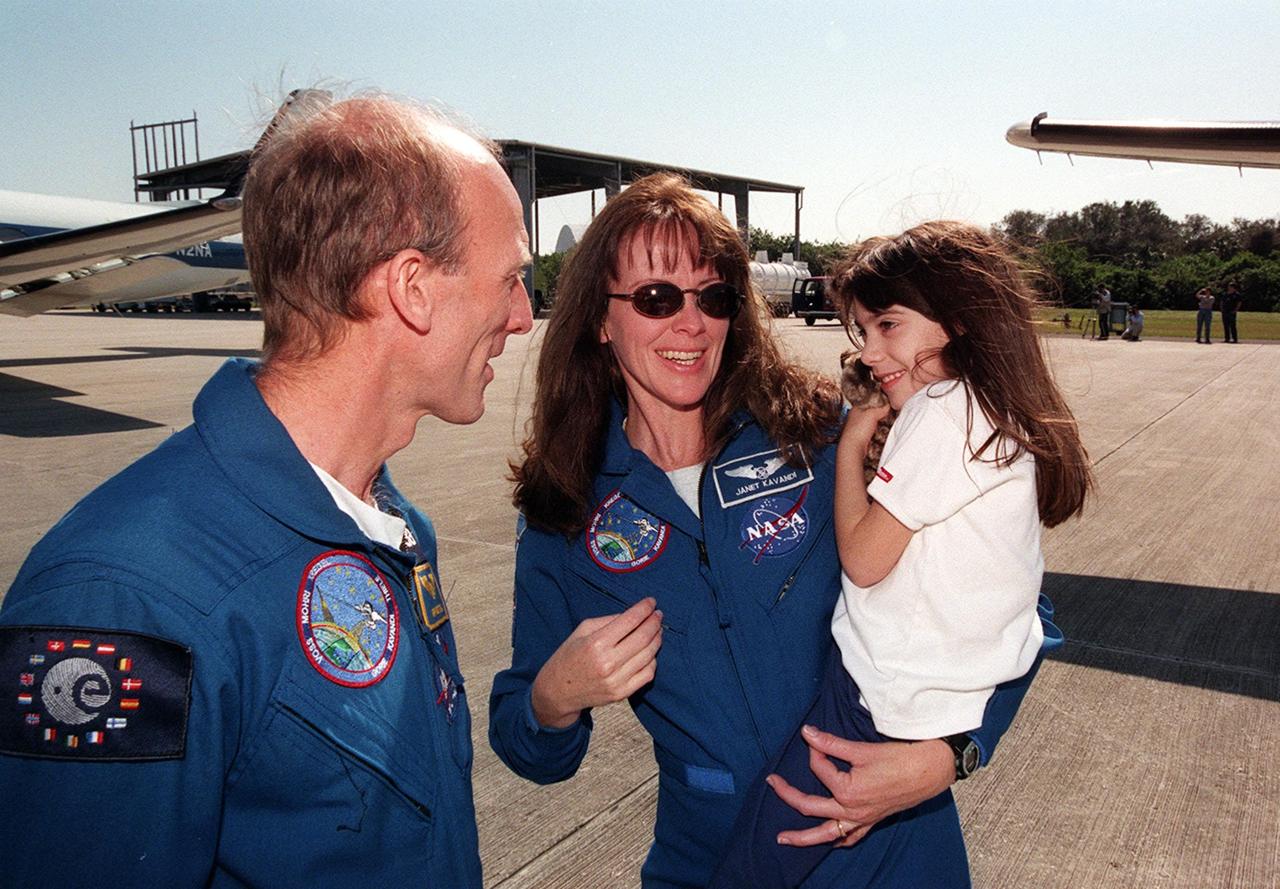
At the Shuttle Landing Facility, STS-99 Mission Specialist Gerhard Thiele (left) joins Mission Specialist Janet Kavandi with her daughter before their departure for Houston. The STS-99 crew completed a successful 11-day Shuttle Radar Topography Mission mapping 47 million square miles of the Earth's surface before landing at KSC Feb. 22
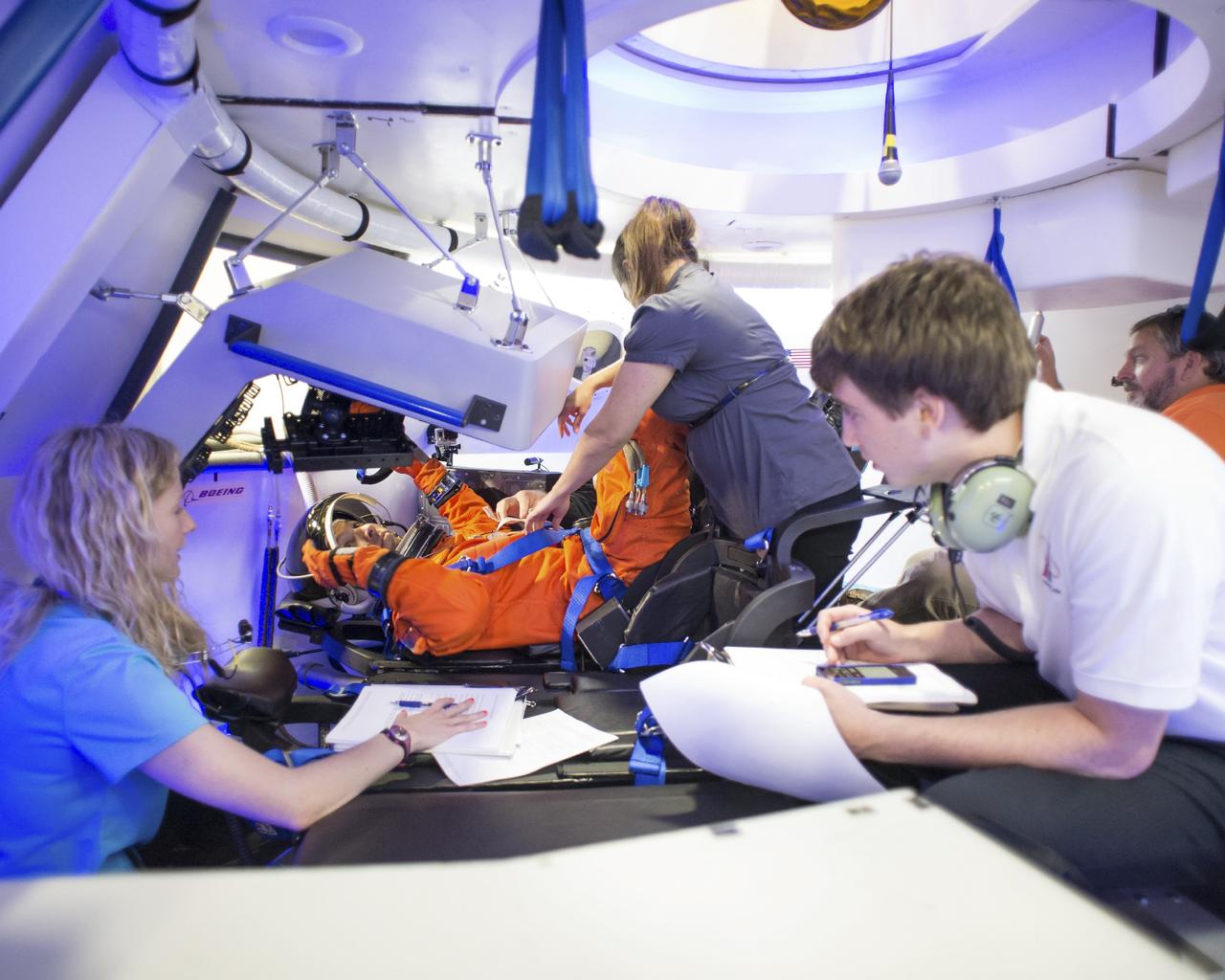
HOUSTON - JSC2013e068344 - NASA astronaut Randy Bresnik gets into position in The Boeing Company's CST-100 spacecraft for a fit check evaluation at the company's Houston Product Support Center. Bresnik's fit check will help evaluate a crew's maneuverability in the spacecraft and test communications. Boeing's CST-100 is being designed to transport crew members or a mix of crew and cargo to low-Earth-orbit destinations. The evaluation is part of the ongoing work supporting Boeing's funded Space Act Agreement with NASA's Commercial Crew Program, or CCP, during the agency's Commercial Crew Integrated Capability, or CCiCap, initiative. CCiCap is intended to make commercial human spaceflight services available for government and commercial customers. To learn more about CCP, visit http://www.nasa.gov/commercialcrew. Photo credit: NASA/Robert Markowitz
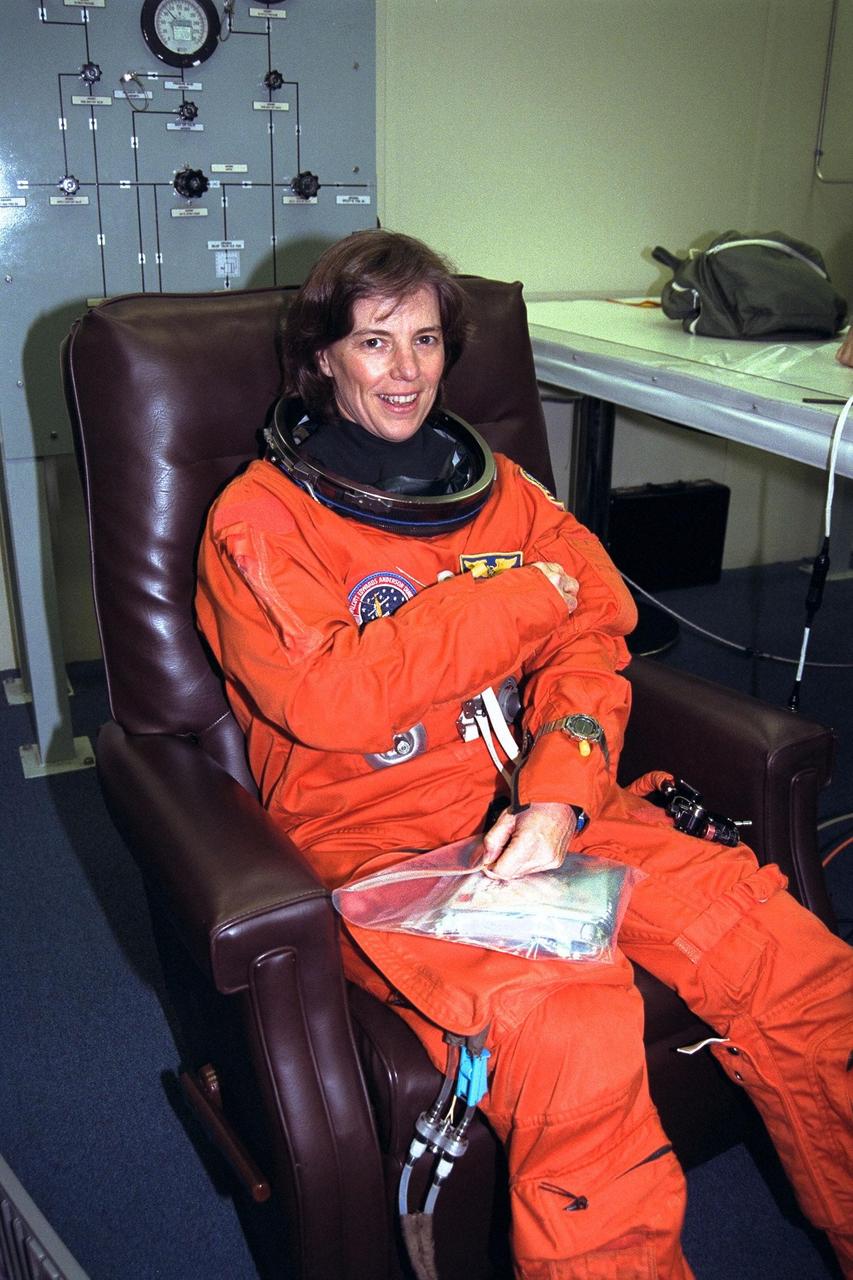
STS-89 Mission Specialist Bonnie Dunbar, Ph.D., smiles as she completes the donning of her launch/entry suit in the Operations and Checkout (O&C) Building. Dr. Dunbar completed her doctorate at the University of Houston in Texas. Her multi-disciplinary dissertation (materials science and physiology) involved evaluating the effects of simulated space flight on bone strength and fracture toughness. She and six fellow crew members will shortly depart the O&C and head for Launch Pad 39A, where the Space Shuttle Endeavour will lift off during a launch window that opens at 9:43 p.m. EST, Jan. 22. STS-89 is the eighth of nine planned missions to dock the Space Shuttle with Russia's Mir space station
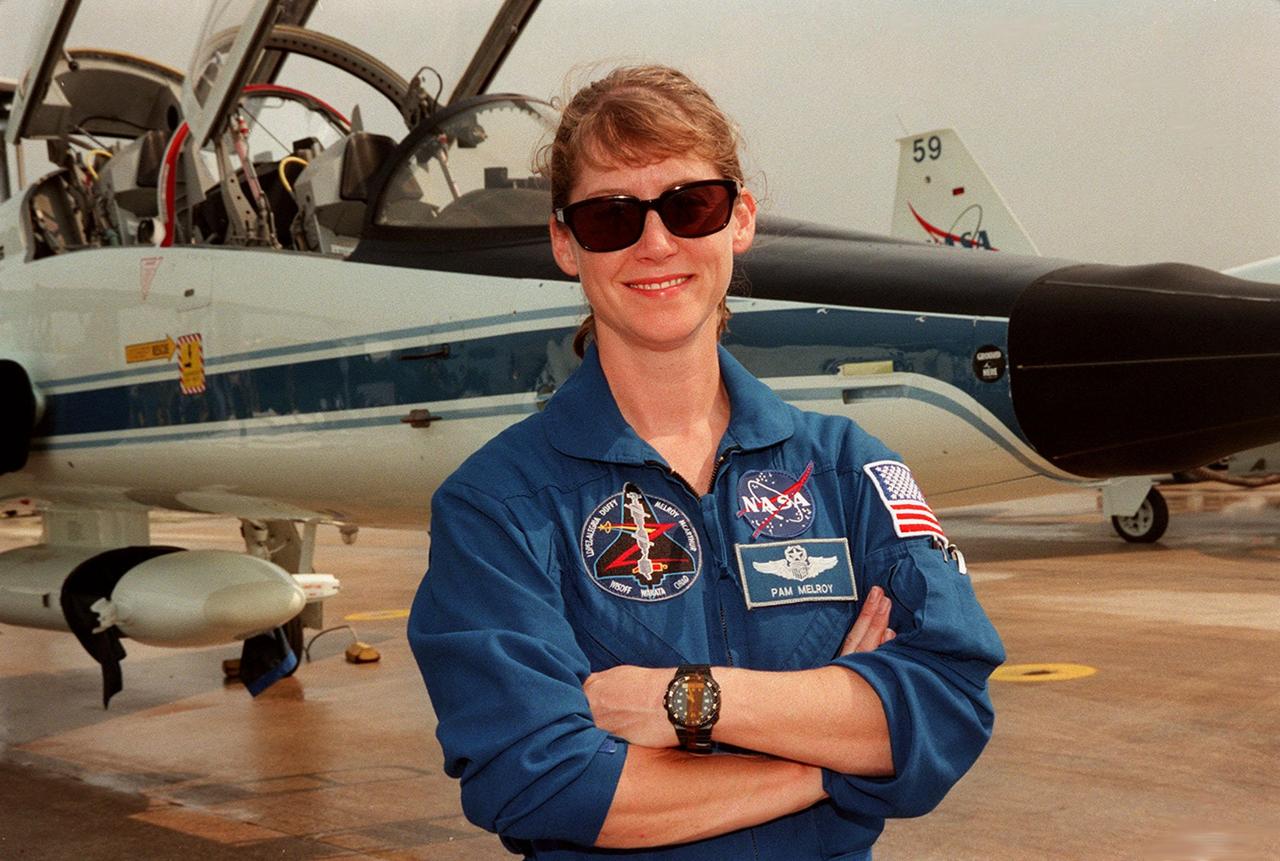
STS-92 Pilot Pam Melroy poses at the Shuttle Landing Facility before flying back to Houston. She and other crew members completed their Crew Equipment Interface Test activities, looking over their mission payload and related equipment. STS-92 is scheduled to launch Oct. 5 on Shuttle Discovery from Launch Pad 39A on the fifth flight to the International Space Station. Discovery will carry the Integrated Truss Structure (ITS) Z1, the PMA-3, Ku-band Communications System, and Control Moment Gyros (CMGs)
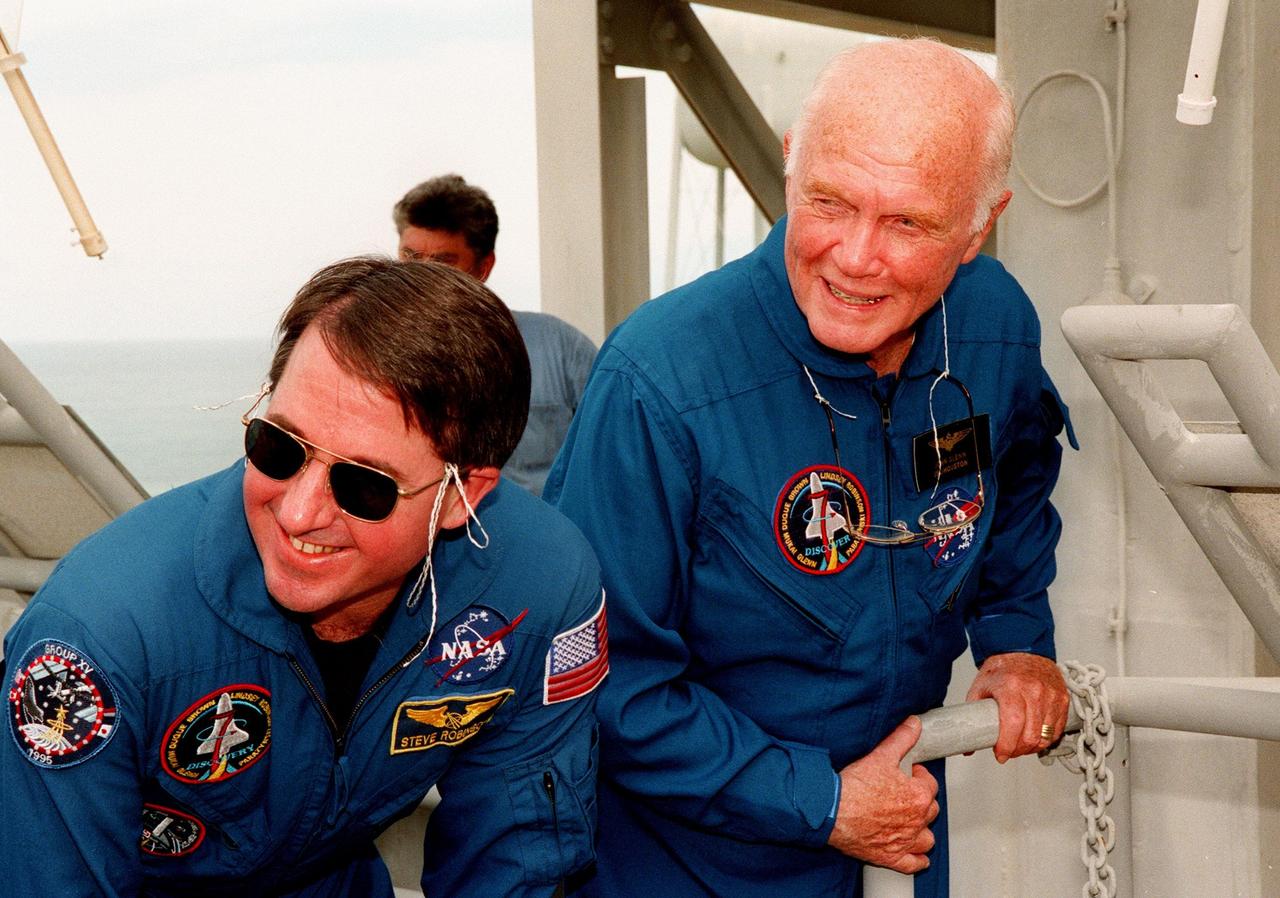
STS-95 Payload Specialist John H. Glenn Jr. and Mission Specialist Stephen K. Robinson watch the progress of the slidewire basket, an emergency egress vehicle, Glenn released at the 195-foot level of Launch Pad 39-B. The STS-95 crew are at KSC to participate in a Terminal Countdown Demonstration Test (TCDT) which includes mission familiarization activities, emergency egress training, and a simulated main engine cut-off exercise. Other crew members are Mission Specialist Scott E. Parazynski, Mission Specialist Pedro Duque of Spain, representing the European Space Agency (ESA), Pilot Steven W. Lindsey, Payload Specialist Chiaki Mukai, representing the National Space Development Agency of Japan (NASDA), and Mission Commander Curtis L. Brown. The STS-95 mission, targeted for liftoff on Oct. 29, includes research payloads such as the Spartan solar-observing deployable spacecraft, the Hubble Space Telescope Orbital Systems Test Platform, the International Extreme Ultraviolet Hitchhiker, as well as the SPACEHAB single module with experiments on space flight and the aging process. Following the TCDT, the crew will be returning to Houston for final flight preparations
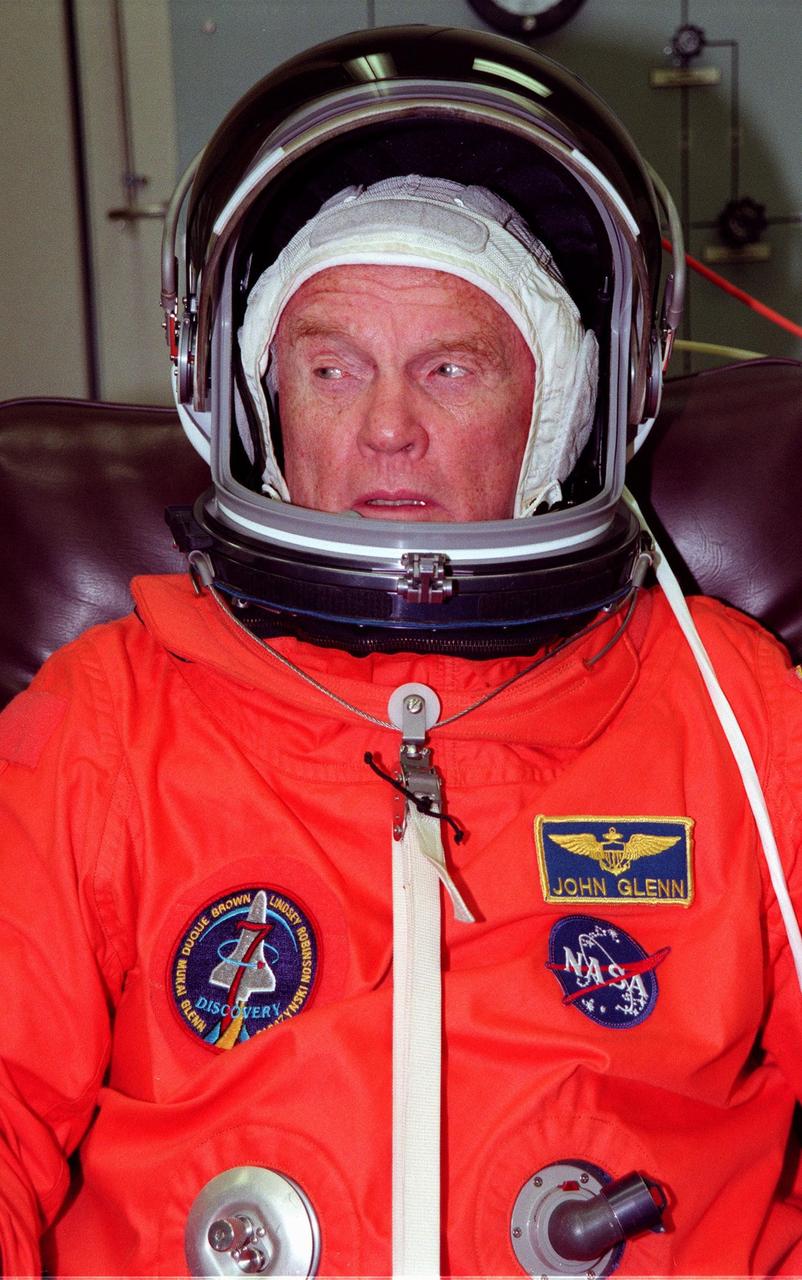
STS-95 Payload Specialist John H. Glenn Jr., a senator from Ohio and one of the original seven Project Mercury astronauts, suits up in the Operations and Checkout (O&C) Building prior to his trip to Launch Pad 39-B. Glenn and the rest of the STS-95 crew are at KSC to participate in the Terminal Countdown Demonstration Test (TCDT) which includes mission familiarization activities, emergency egress training, and a simulated main engine cutoff. The other crew members are Payload Specialist Chiaki Mukai (M.D., Ph.D.), representing the National Space Development Agency of Japan (NASDA), Pilot Steven W. Lindsey, Mission Specialist Scott E. Parazynski, Mission Specialist Stephen K. Robinson, Mission Specialist Pedro Duque of Spain, representing the European Space Agency (ESA), and Mission Commander Curtis L. Brown. The STS-95 mission, targeted for liftoff on Oct. 29, includes research payloads such as the Spartan solar-observing deployable spacecraft, the Hubble Space Telescope Orbital Systems Test Platform, the International Extreme Ultraviolet Hitchhiker, as well as the SPACEHAB single module with experiments on space flight and the aging process. Following the TCDT, the crew will be returning to Houston for final flight preparations
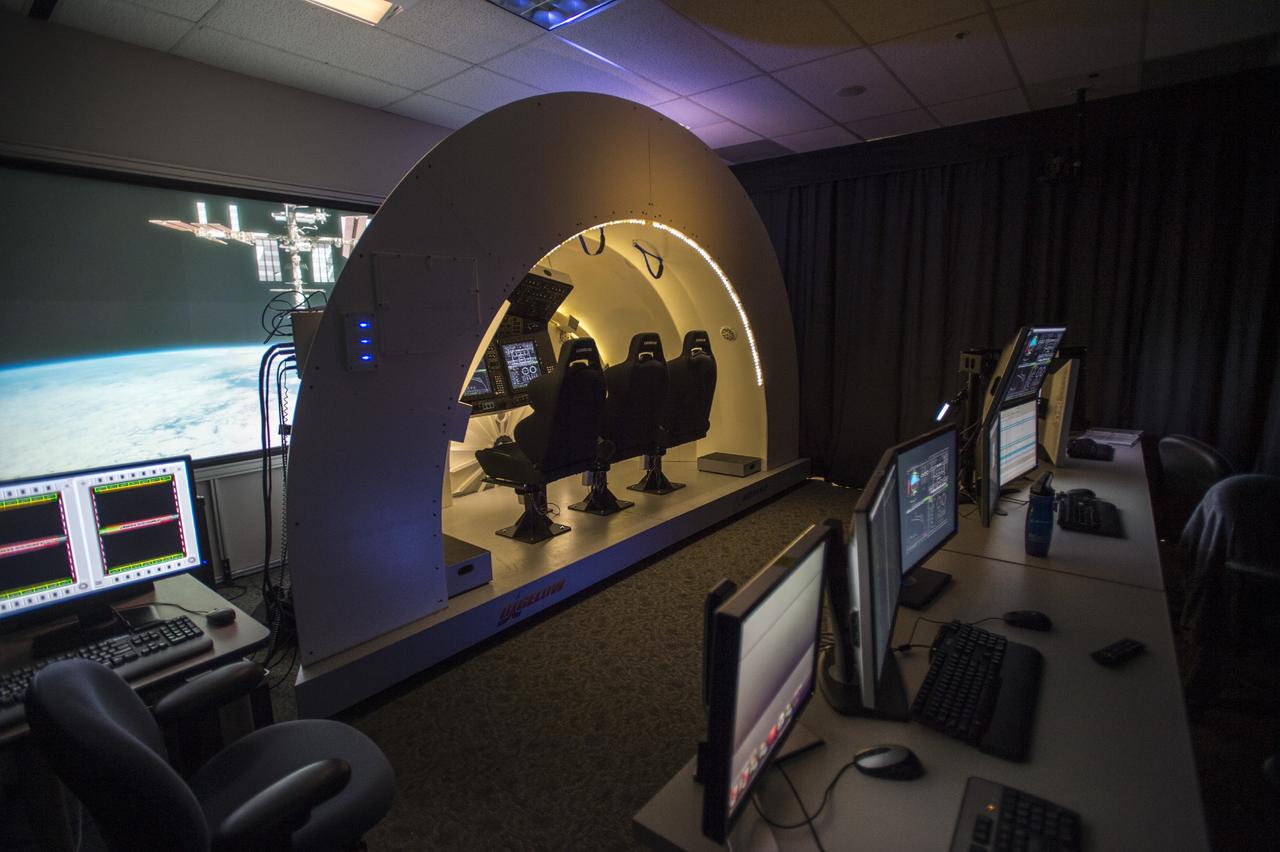
HOUSTON – A simulator of The Boeing Company's CST-100 spacecraft stands ready to begin evaluations of potential designs and software functions in a room at the company's Houston location. The CST-100 is under development in partnership between the company and NASA's Commercial Crew Program, or CCP. The spacecraft is designed to fly to low-Earth orbit and potentially dock with the International Space Station, which is seen on the screen in front of the simulator. Photo credit: The Boeing Company
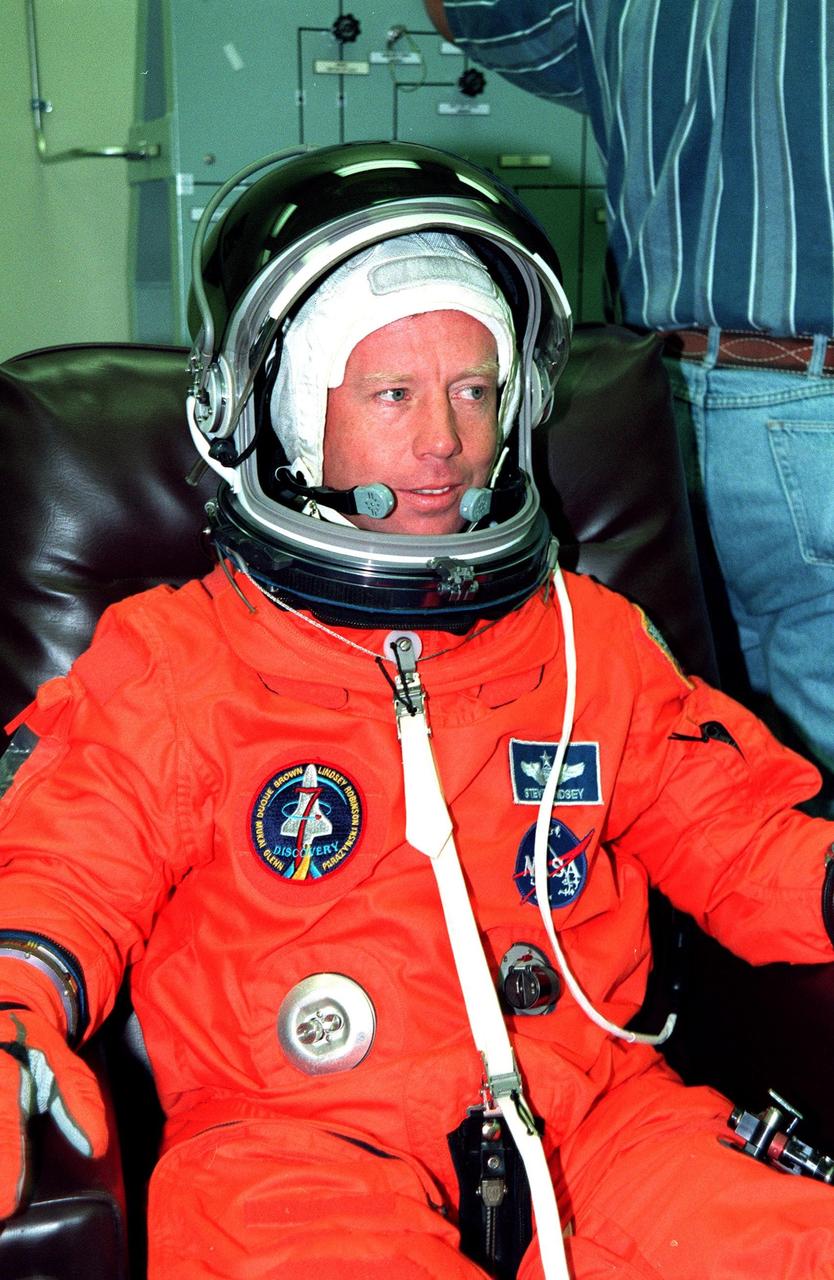
STS-95 Pilot Steven W. Lindsey suits up in the Operations and Checkout Building prior to his trip to Launch Pad 39-B. Lindsey and the rest of the STS-95 crew are at KSC to participate in the Terminal Countdown Demonstration Test (TCDT) which includes mission familiarization activities, emergency egress training, and a simulated main engine cutoff. The other crew members are Payload Specialist Chiaki Mukai (M.D., Ph.D.), representing the National Space Development Agency of Japan (NASDA), Mission Specialist Scott E. Parazynski, Mission Specialist Stephen K. Robinson, Mission Specialist Pedro Duque of Spain, representing the European Space Agency (ESA), Payload Specialist John H. Glenn Jr., senator from Ohio, and Mission Commander Curtis L. Brown. The STS-95 mission, targeted for liftoff on Oct. 29, includes research payloads such as the Spartan solar-observing deployable spacecraft, the Hubble Space Telescope Orbital Systems Test Platform, the International Extreme Ultraviolet Hitchhiker, as well as the SPACEHAB single module with experiments on space flight and the aging process. Following the TCDT, the crew will be returning to Houston for final flight preparations
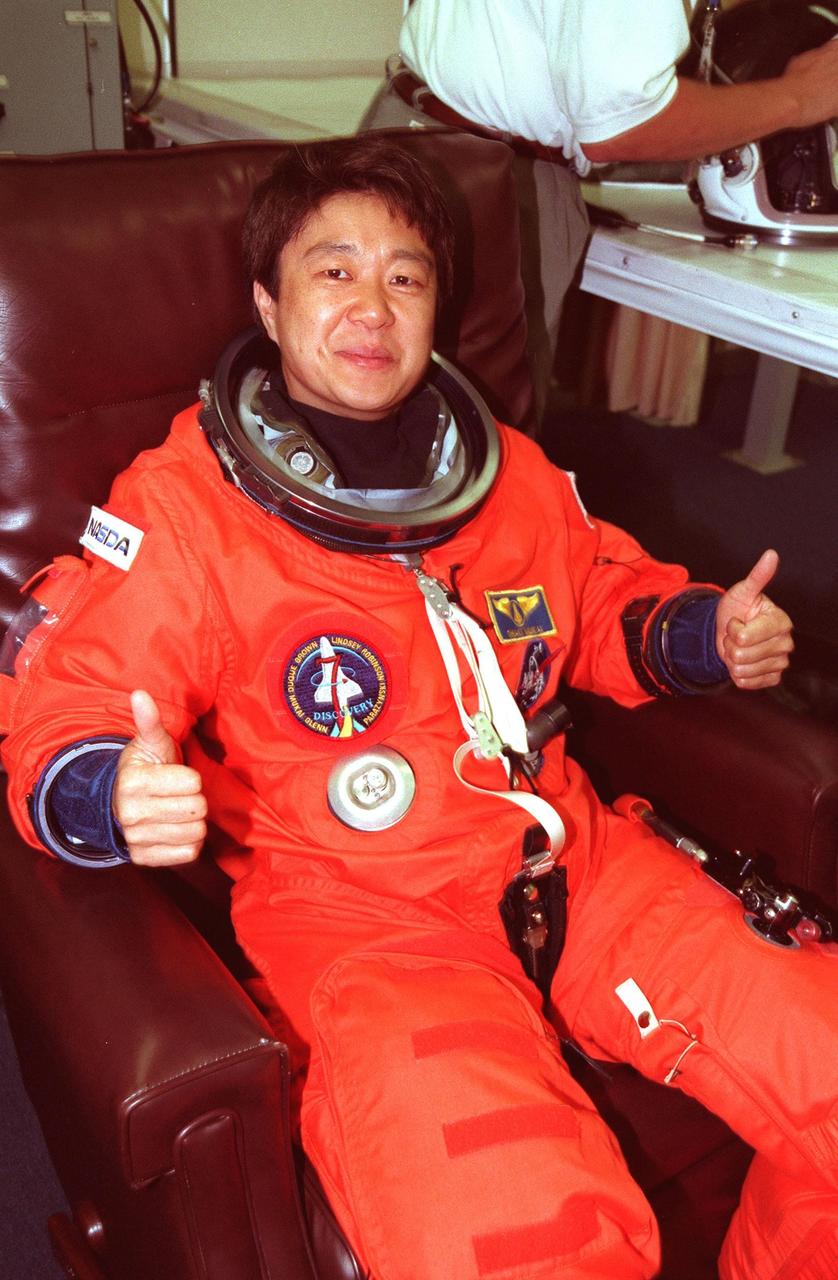
STS-95 Payload Specialist Chiaki Mukai (M.D., Ph.D.), representing the National Space Development Agency of Japan (NASDA), gives a two-thumbs up salute while suiting up in the Operations and Checkout Building prior to her trip to Launch Pad 39-B. Mukai and the rest of the STS-95 crew are at KSC to participate in the Terminal Countdown Demonstration Test (TCDT) which includes mission familiarization activities, emergency egress training, and a simulated main engine cutoff. The other crew members are Pilot Steven W. Lindsey, Mission Specialist Scott E. Parazynski, Mission Specialist Stephen K. Robinson, Mission Specialist Pedro Duque of Spain, representing the European Space Agency (ESA), Payload Specialist John H. Glenn Jr., senator from Ohio, and Mission Commander Curtis L. Brown. The STS-95 mission, targeted for liftoff on Oct. 29, includes research payloads such as the Spartan solar-observing deployable spacecraft, the Hubble Space Telescope Orbital Systems Test Platform, the International Extreme Ultraviolet Hitchhiker, as well as the SPACEHAB single module with experiments on space flight and the aging process. Following the TCDT, the crew will be returning to Houston for final flight preparations
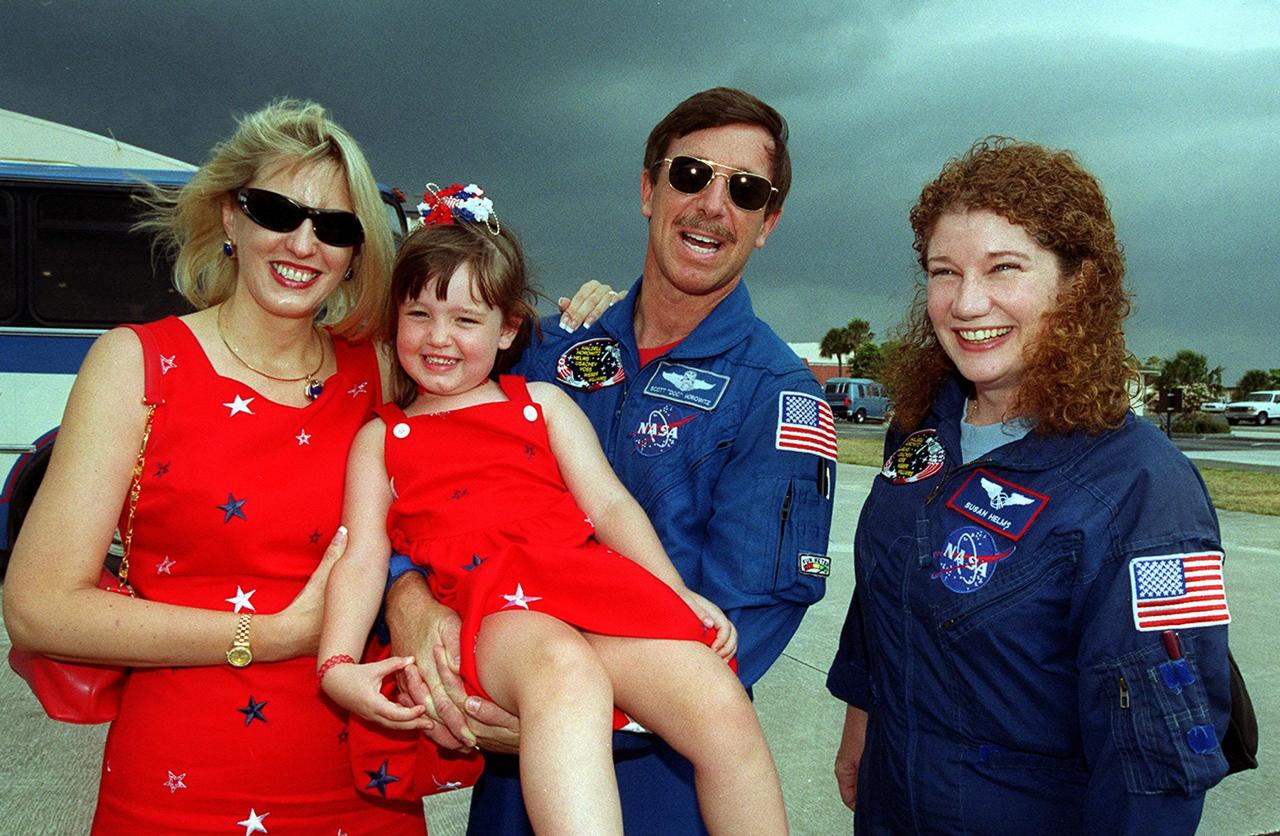
Members of the STS-101 crew gather with families and friends at Patrick Air Force Base before departure for Houston. Pilot Scott “Doc” Horowitz is joined by his wife, Lisa, and daughter; Mission Specialist Susan J. Helms is at right. After landing at 2:20 a.m. EDT May 29, the crew and their families enjoyed the Memorial Day holiday in Florida. The crew returned from the third flight to the International Space Station where they made repairs, transferred cargo and completed a space walk to install and connect several pieces of equipment on the outside of the Space Station
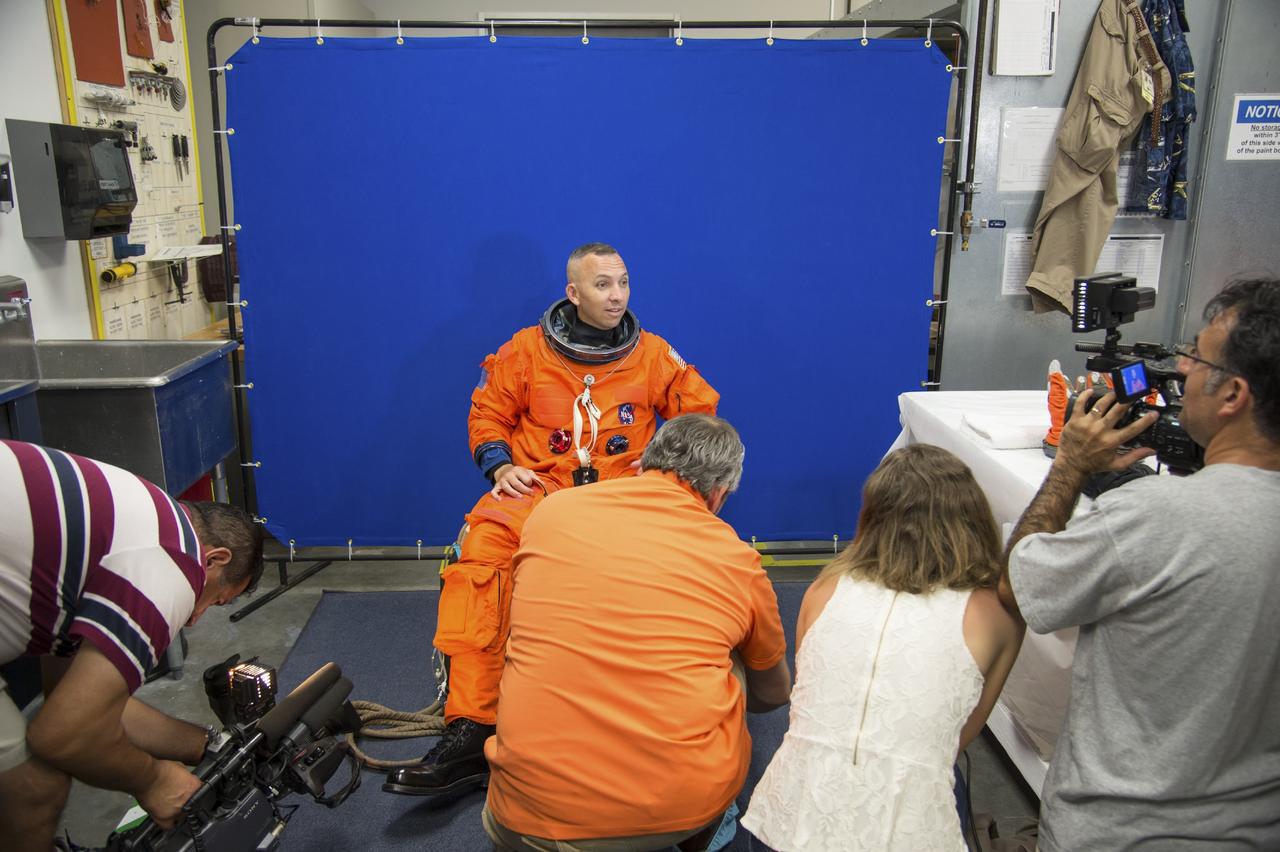
HOUSTON - JSC2013e068329 - NASA astronaut Randy Bresnik is interviewed by the media before he enters The Boeing Company's CST-100 spacecraft for a fit check evaluation at the company's Houston Product Support Center. Bresnik's fit check will help evaluate a crew's maneuverability in the spacecraft and test communications. Boeing's CST-100 is being designed to transport crew members or a mix of crew and cargo to low-Earth-orbit destinations. The evaluation is part of the ongoing work supporting Boeing's funded Space Act Agreement with NASA's Commercial Crew Program, or CCP, during the agency's Commercial Crew Integrated Capability, or CCiCap, initiative. CCiCap is intended to make commercial human spaceflight services available for government and commercial customers. To learn more about CCP, visit http://www.nasa.gov/commercialcrew. Photo credit: NASA/Robert Markowitz
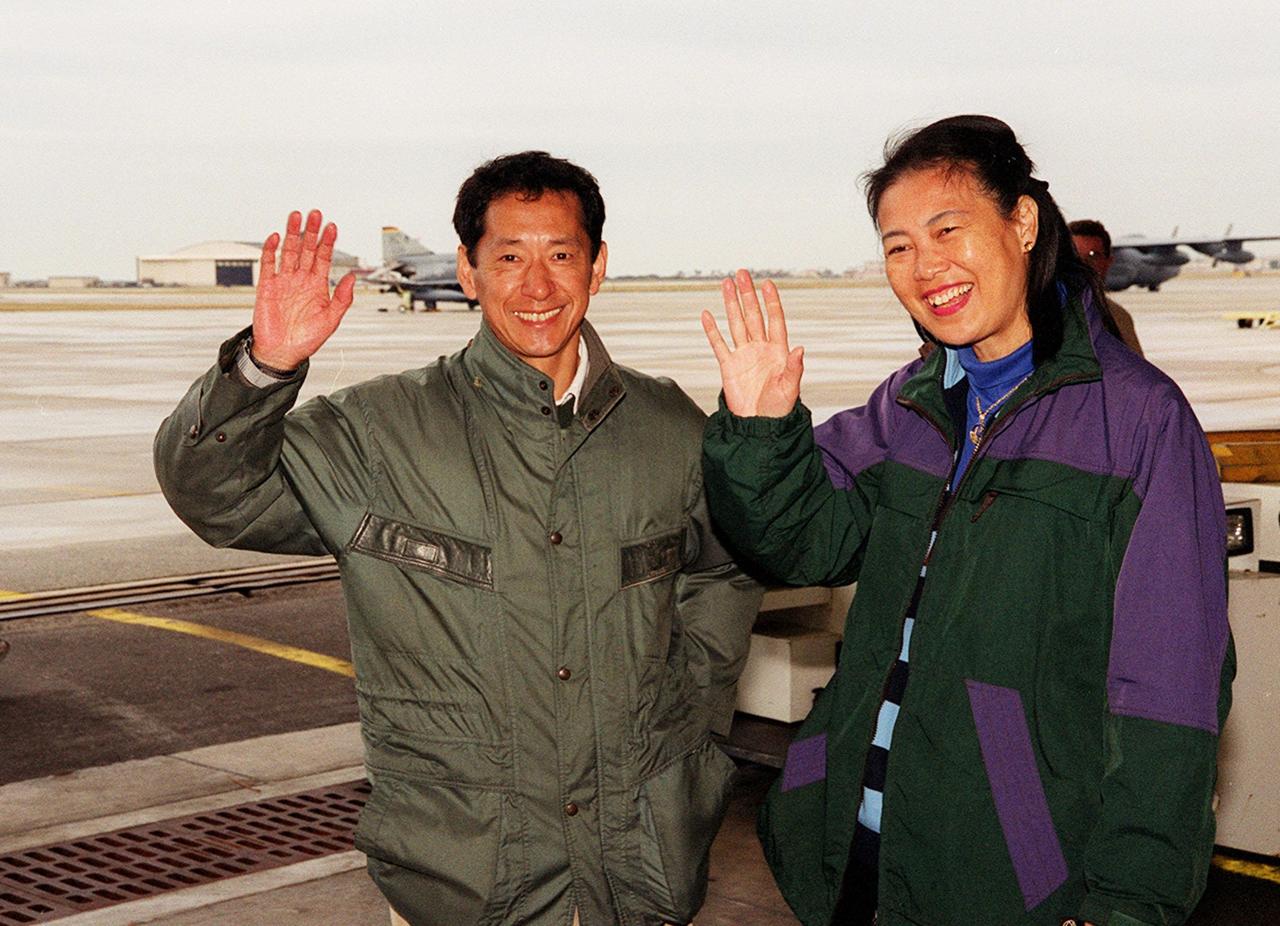
STS-99 Mission Specialist Mamoru Mohri of Japan and his wife, Akiko, wave before their departure from Patrick Air Force Base and return to Houston. With the postponement of the launch of STS-99 on Jan. 31, the crew have an opportunity for more training and time with their families. During the launch countdown, Endeavour's enhanced master events controller (E-MEC) No. 2 failed a standard preflight test. Launch was postponed and Shuttle managers decided to replace the E-MEC located in the orbiter's aft compartment. Launch controllers will be in a position to begin the STS-99 countdown the morning of Feb. 6 and ready to support a launch midto late next week pending availability of the Eastern Range. Known as the Shuttle Radar Topography Mission, it will chart a new course to produce unrivaled 3-D images of the Earth's surface, using two antennae and a 200-foot-long section of space station-derived mast protruding from the payload bay. The result could be close to 1 trillion measurements of the Earth's topography. Besides contributing to the production of better maps, these measurements could lead to improved water drainage modeling, more realistic flight simulators, better locations for cell phone towers, and enhanced navigation safety

At Launch Pad 39-B, a Safety Egress trainer explains the use of the slidewire basket system for emergency egress before launch to STS-95 crew members (left to right) Mission Specialist Stephen K. Robinson, , Mission Commander Curtis L. Brown (behind Robinson), Pilot Steven W. Lindsey, Payload Specialists John H. Glenn Jr., senator from Ohio, Chiaki Mukai (in front of Glenn), representing the National Space Development Agency of Japan (NASDA), Mission Specialist Pedro Duque of Spain, representing the European Space Agency, and Mission Specialist Scott E. Parazynski . The STS-95 crew are at KSC to participate in a Terminal Countdown Demonstration Test (TCDT) which includes mission familiarization activities, emergency egress training, and a simulated main engine cut-off exercise. The STS-95 mission, targeted for liftoff on Oct. 29, includes research payloads such as the Spartan solar-observing deployable spacecraft, the Hubble Space Telescope Orbital Systems Test Platform, the International Extreme Ultraviolet Hitchhiker, as well as the SPACEHAB single module with experiments on space flight and the aging process. Following the TCDT, the crew will be returning to Houston for final flight preparations
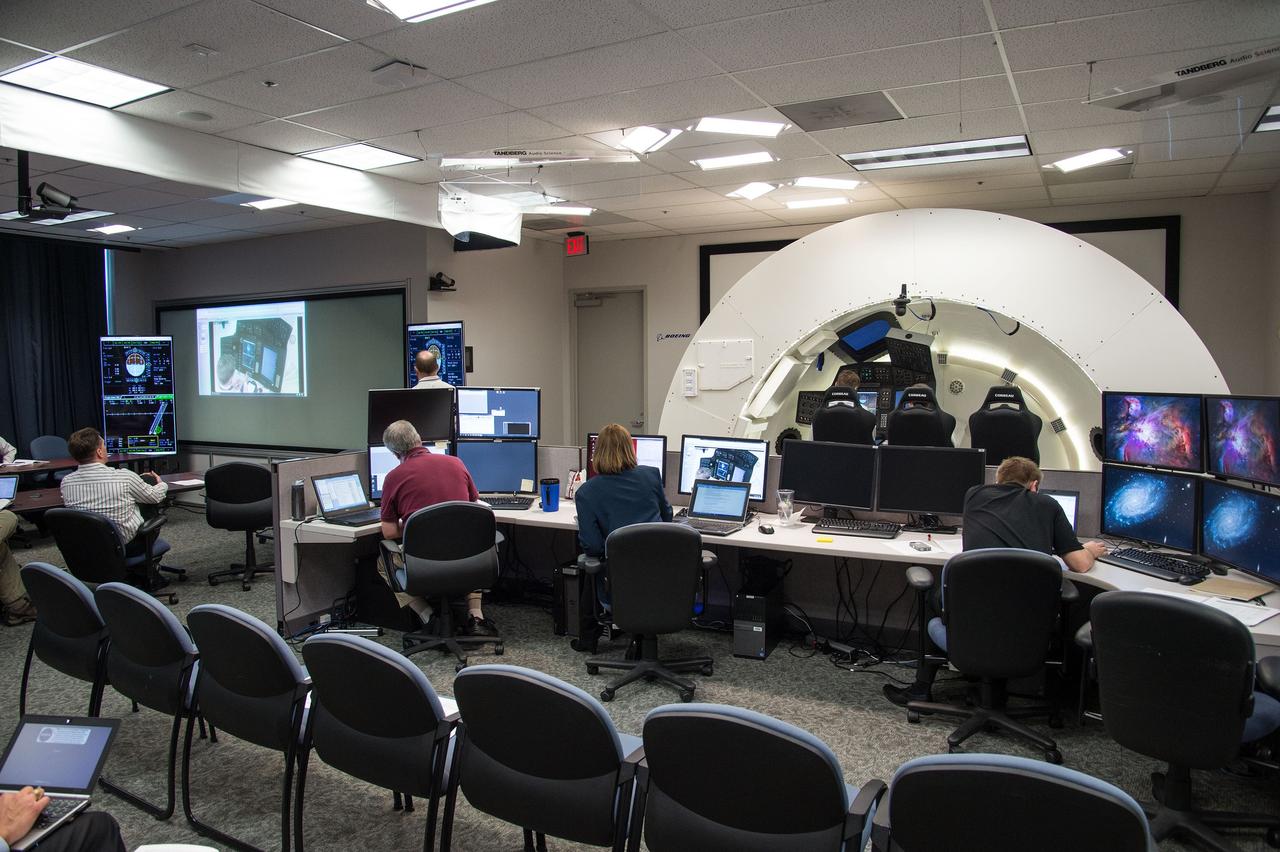
HOUSTON – Engineers for Boeing Space Exploration demonstrate that the CST-100 software allows a human pilot to take over control of the spacecraft from the computer during all phases of a mission following separation from the launch vehicle. The pilot-in-the-loop demonstration at the Houston Product Support Center is a milestone under Boeing's Commercial Crew Integrated Capability agreement with the agency and its Commercial Crew Program. Photo credit: NASA/Bill Stafford
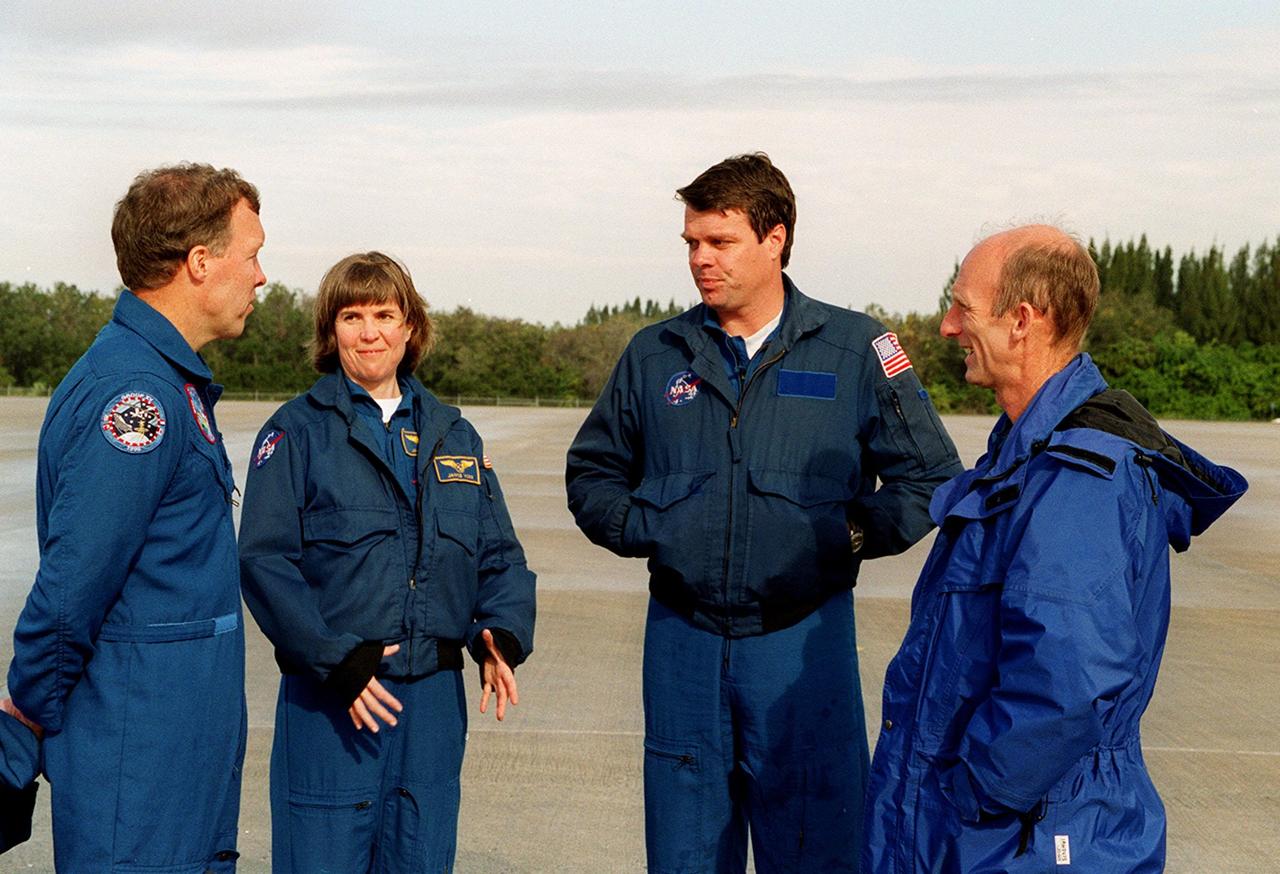
On the runway at the Shuttle Landing Facility, STS-99 crew members Pilot Dominic Gorie, Mission Specialist Janice Voss, Commander Kevin Kregel and Mission Specialist Gerhard Thiele discuss departure plans to Houston. Kregel and Gorie will be piloting T-38 jets with Voss and Thiele as passengers. During the Jan. 31 launch countdown, Endeavour's enhanced master events controller (E-MEC) No. 2 failed a standard preflight test. Launch was postponed and Shuttle managers decided to replace the E-MEC located in the orbiter's aft compartment. Launch controllers will be in a position to begin the STS-99 countdown the morning of Feb. 6 and ready to support a launch midto latenext week pending availability of the Eastern Range. The postponed launch gives the crew an opportunity for more training and time with their families. Known as the Shuttle Radar Topography Mission, it will chart a new course to produce unrivaled 3-D images of the Earth's surface, using two antennae and a 200-foot-long section of space station-derived mast protruding from the payload bay. The result could be close to 1 trillion measurements of the Earth's topography. Besides contributing to the production of better maps, these measurements could lead to improved water drainage modeling, more realistic flight simulators, better locations for cell phone towers, and enhanced navigation safety
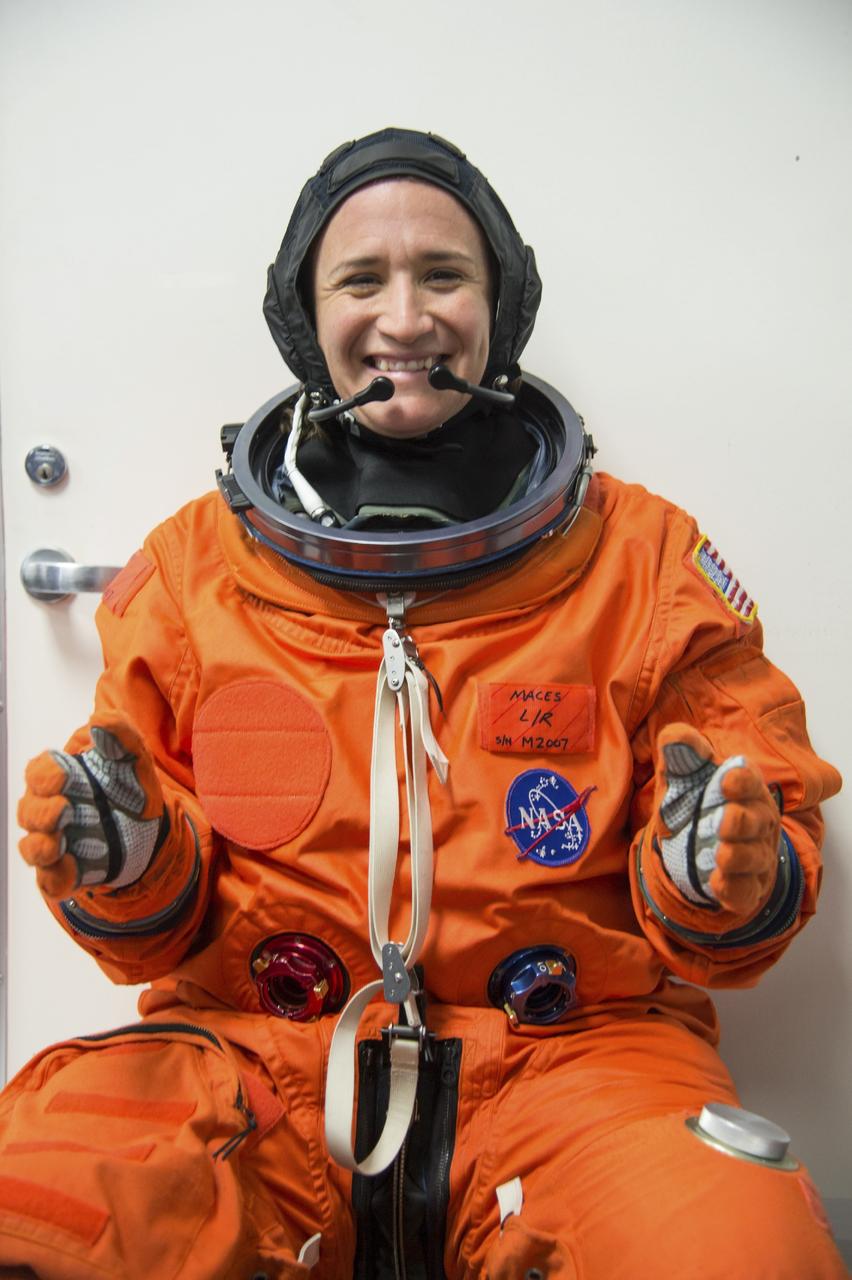
HOUSTON - JSC2013e068260 - NASA astronaut Serena Aunon suits up for a fit check evaluation of The Boeing Company's CST-100 spacecraft at the company's Houston Product Support Center. Aunon's fit check will help evaluate a crew's maneuverability in the spacecraft and test communications. Boeing's CST-100 is being designed to transport crew members or a mix of crew and cargo to low-Earth-orbit destinations. The evaluation is part of the ongoing work supporting Boeing's funded Space Act Agreement with NASA's Commercial Crew Program, or CCP, during the agency's Commercial Crew Integrated Capability, or CCiCap, initiative. CCiCap is intended to make commercial human spaceflight services available for government and commercial customers. To learn more about CCP, visit http://www.nasa.gov/commercialcrew. Photo credit: NASA/Robert Markowitz
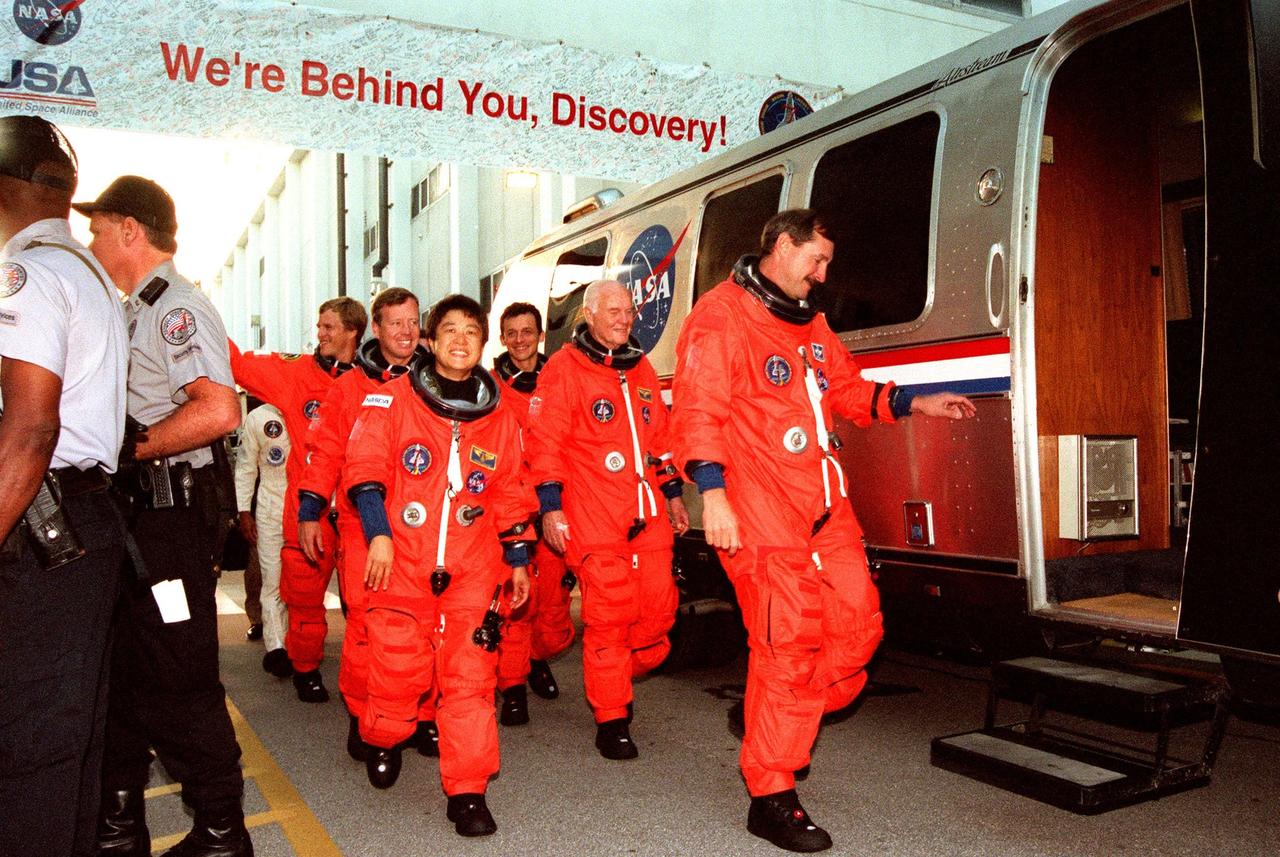
After suiting up for their practice countdown exercise, STS-95 crew members head for the bus outside the Operations and Checkout Building for the trip to Launch Pad 39-B. Pictured are (left to right) Mission Specialist Scott E. Parazynski, Pilot Steven W. Lindsey, Payload Specialist Chiaki Mukai (M.D., Ph.D.), representing the National Space Development Agency of Japan (NASDA), Mission Specialist Pedro Duque of Spain, representing the European Space Agency (ESA), Payload Specialist John H. Glenn Jr., senator from Ohio, and Mission Commander Curtis L. Brown. Not seen is Mission Specialist Stephen K. Robinson. The STS-95 crew are at KSC to participate in a Terminal Countdown Demonstration Test (TCDT) which includes mission familiarization activities, emergency egress training, and the simulated main engine cut-off exercise. The STS-95 mission, targeted for liftoff on Oct. 29, includes research payloads such as the Spartan solar-observing deployable spacecraft, the Hubble Space Telescope Orbital Systems Test Platform, the International Extreme Ultraviolet Hitchhiker, as well as the SPACEHAB single module with experiments on space flight and the aging process. Following the TCDT, the crew will be returning to Houston for final flight preparations

At Launch Pad 39-B, at the 195-foot level, STS-95 crew members learn about the slidewire basket, lower right, that is part of the emergency egress system from the orbiter before launch. Shown are (left to right) Mission Specialist Scott E. Parazynski, Pilot Steven W. Lindsey, Mission Specialist Pedro Duque of Spain, representing the European Space Agency (ESA), Mission Specialist Stephen K. Robinson, Payload Specialist Chiaki Mukai, representing the National Space Development Agency of Japan (NASDA), Payload Specialist John H. Glenn Jr., senator from Ohio, and Mission Commander Curtis L. Brown. The STS-95 crew are at KSC to participate in a Terminal Countdown Demonstration Test (TCDT) which includes mission familiarization activities, emergency egress training, and a simulated main engine cut-off exercise. The STS-95 mission, targeted for liftoff on Oct. 29, includes research payloads such as the Spartan solar-observing deployable spacecraft, the Hubble Space Telescope Orbital Systems Test Platform, the International Extreme Ultraviolet Hitchhiker, as well as the SPACEHAB single module with experiments on space flight and the aging process. Following the TCDT, the crew will be returning to Houston for final flight preparations
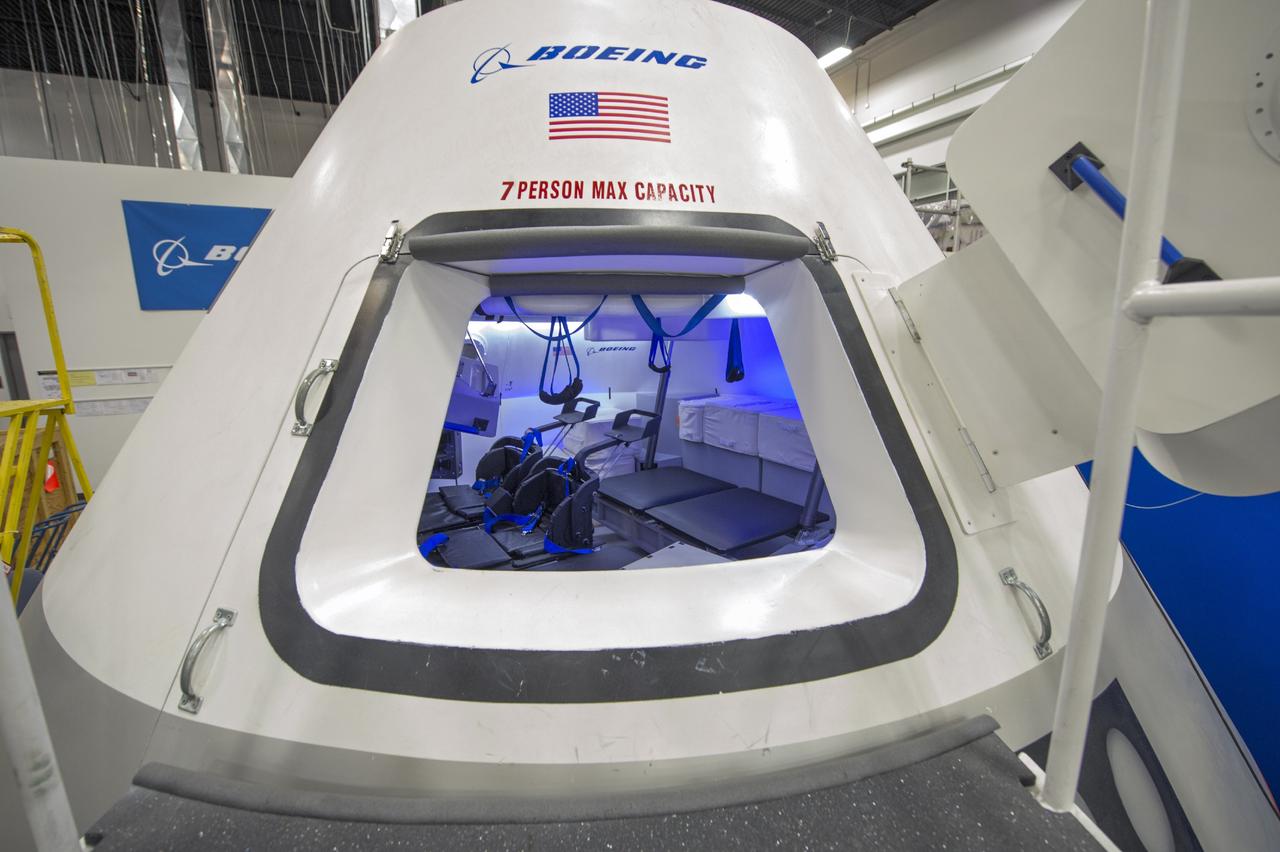
HOUSTON - The Boeing Company unveils its fully outfitted CST-100 mock-up at the company's Houston Product Support Center in Texas. This test version is optimized to support five crew members and will allow the company to evaluate crew safety, interfaces, communications, maneuverability and ergonomics. Boeing's CST-100 is being designed to transport crew members or a mix of crew and cargo to low-Earth-orbit destinations, including the International Space Station. Boeing is one of three aerospace industry partners working with CCP during its Commercial Crew Integrated Capability, or CCiCap, initiative, which is intended to make commercial human spaceflight services available for government and commercial customers. To learn more about CCP, visit http://www.nasa.gov/commercialcrew. Photo credit: NASA/Robert Markowitz
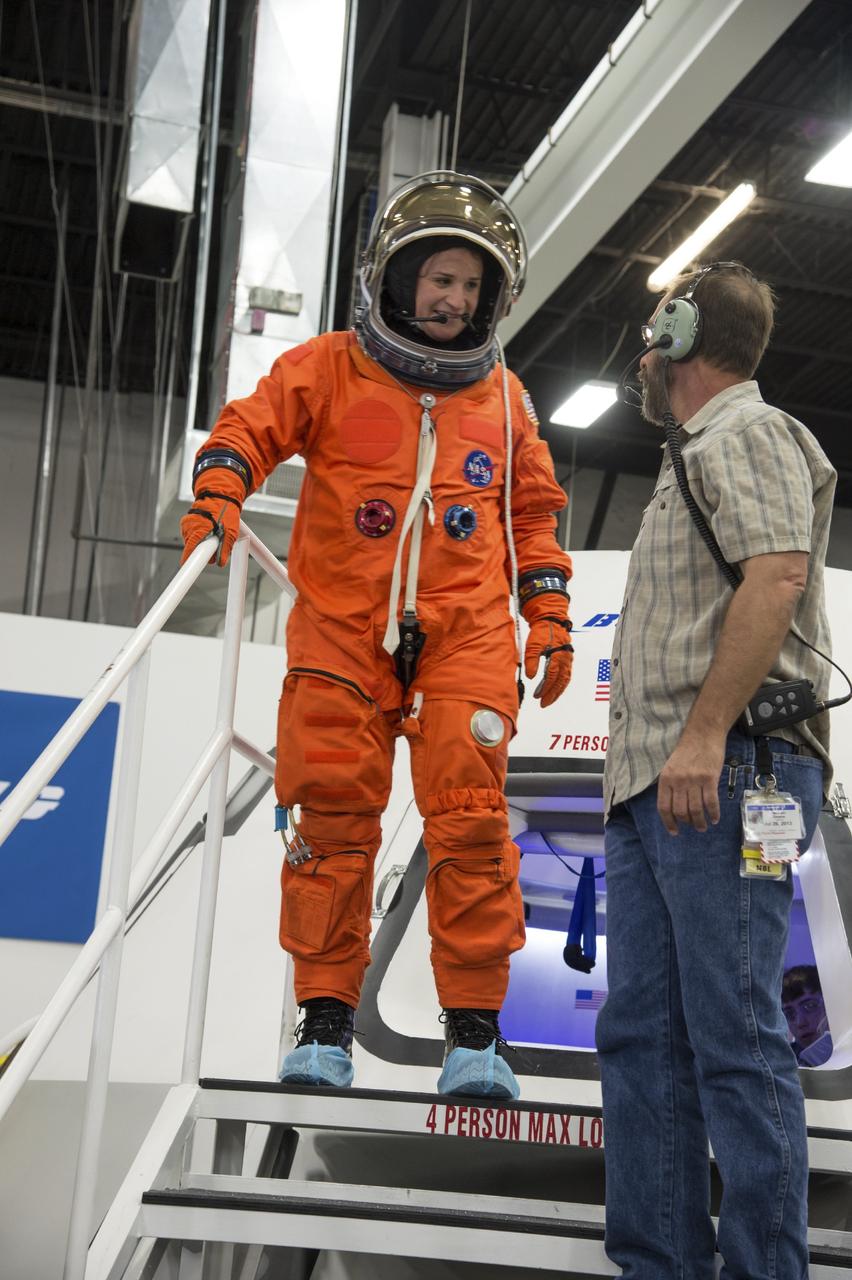
HOUSTON - JSC2013e068317 - NASA astronaut Serena Aunon exits The Boeing Company's CST-100 spacecraft following a fit check evaluation at the company's Houston Product Support Center. Aunon's fit check will help evaluate a crew's maneuverability in the spacecraft and test communications. Boeing's CST-100 is being designed to transport crew members or a mix of crew and cargo to low-Earth-orbit destinations. The evaluation is part of the ongoing work supporting Boeing's funded Space Act Agreement with NASA's Commercial Crew Program, or CCP, during the agency's Commercial Crew Integrated Capability, or CCiCap, initiative. CCiCap is intended to make commercial human spaceflight services available for government and commercial customers. To learn more about CCP, visit http://www.nasa.gov/commercialcrew. Photo credit: NASA/Robert Markowitz
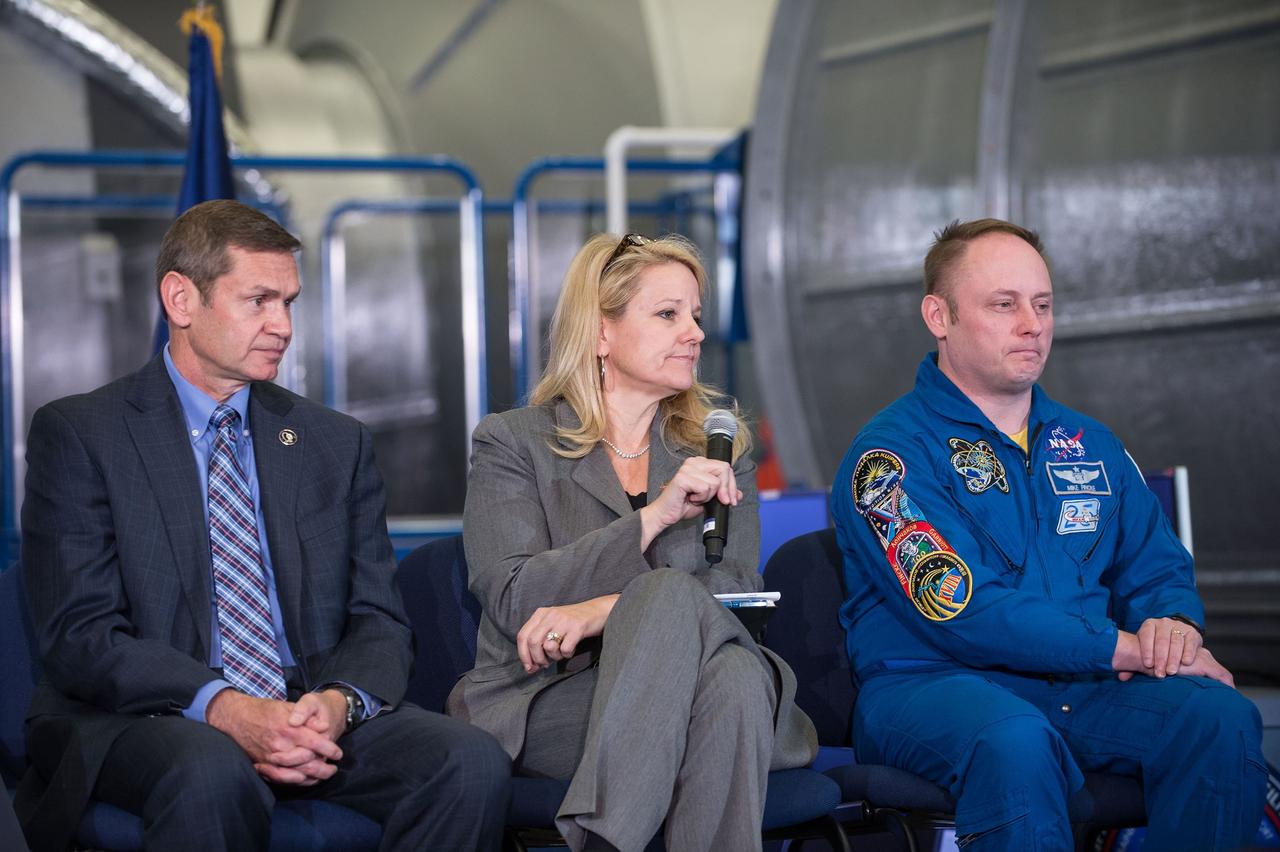
HOUSTON, Texas - jsc2015e031266 - Gwynne Shotwell, SpaceX President and Chief Operating Officer discusses the company's work with NASA's Commercial Crew Program as Boeing's John Elbon, left, and NASA astronaut Mike Fincke look on. Photo credit: NASA/Robert Markowitz
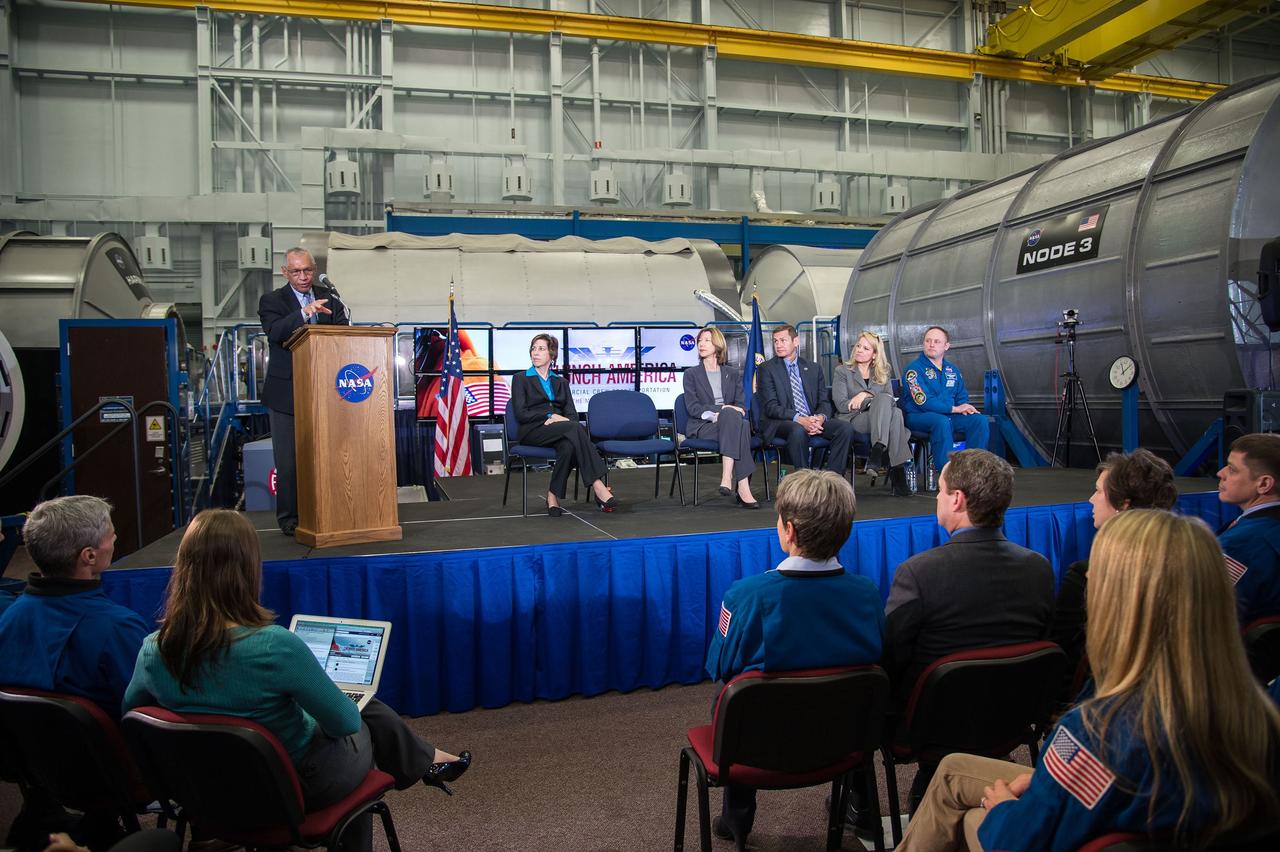
HOUSTON, Texas - jsc2015e031229 - NASA Administrator Charles Bolden discusses the agency's Commercial Crew Program during a presentation highlighting key development activities, test plans and objectives for achieving certification of two American crew transportation systems with Commercial Crew Program Manager Kathy Lueders, Boeing Space Exploration Vice President and General Manager John Elbon, Space X President and Chief Operating Officer Gwynne Shotwell and NASA Astronaut Mike Fincke. Photo credit: NASA/Robert Markowitz

HOUSTON, Texas -- JSC2008-E-053106: Astronaut Richard Arnold, mission specialist on mission STS-119.
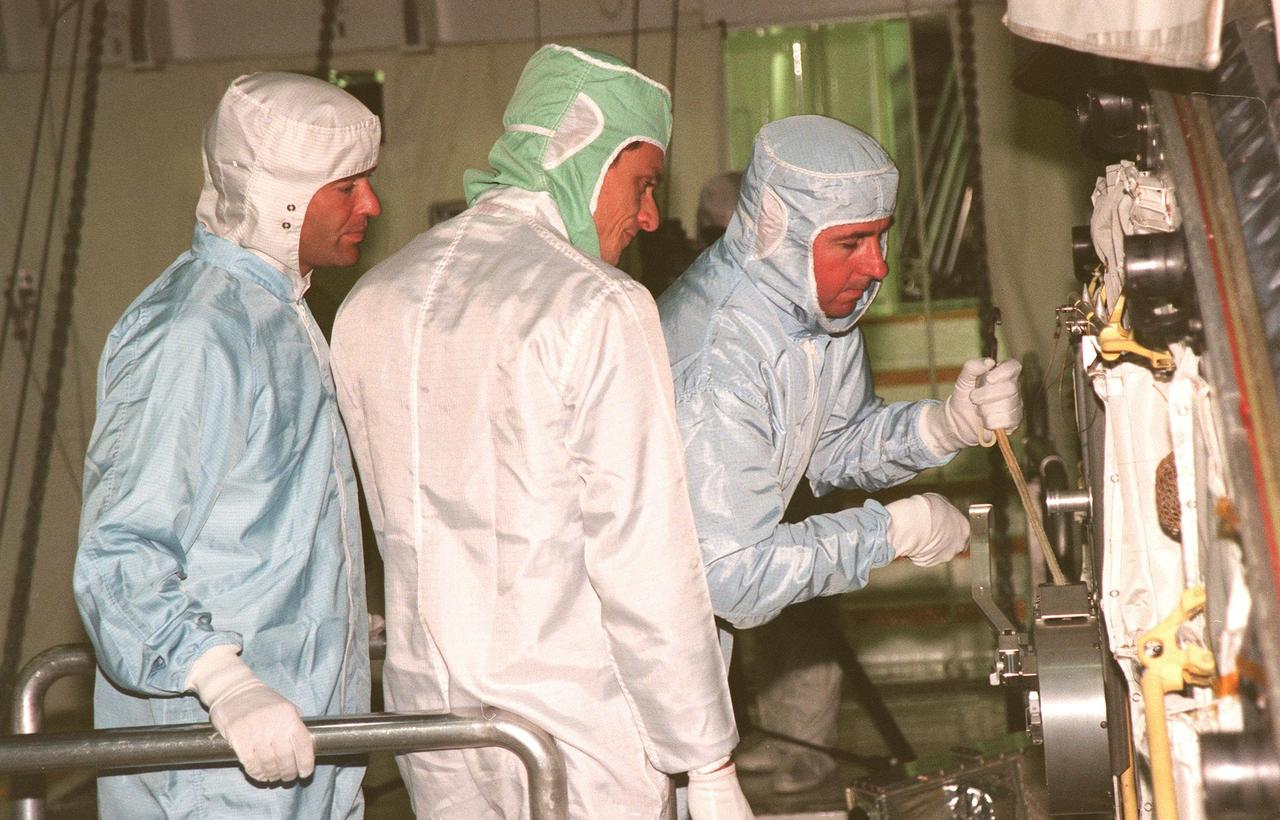
During the Crew Equipment Interface Test (CEIT) in the payload bay of Discovery, STS-95 Mission Specialist Stephen K. Robinson (right) checks a cable that can be used to close a hatch on the orbiter. Looking over his shoulder are Mission Specialist Pedro Duque (center), of the European Space Agency, and Keith Johnson (left), United Space Alliance-Houston. The CEIT gives astronauts an opportunity for a hands-on look at the payloads and equipment they will be using on orbit. The launch of the STS-95 mission, aboard Space Shuttle Discovery, is scheduled for Oct. 29, 1998. The mission includes research payloads such as the Spartan solar-observing deployable spacecraft, the Hubble Space Telescope Orbital Systems Test Platform, the International Extreme Ultraviolet Hitchhiker, as well as the SPACEHAB single module with experiments on space flight and the aging process
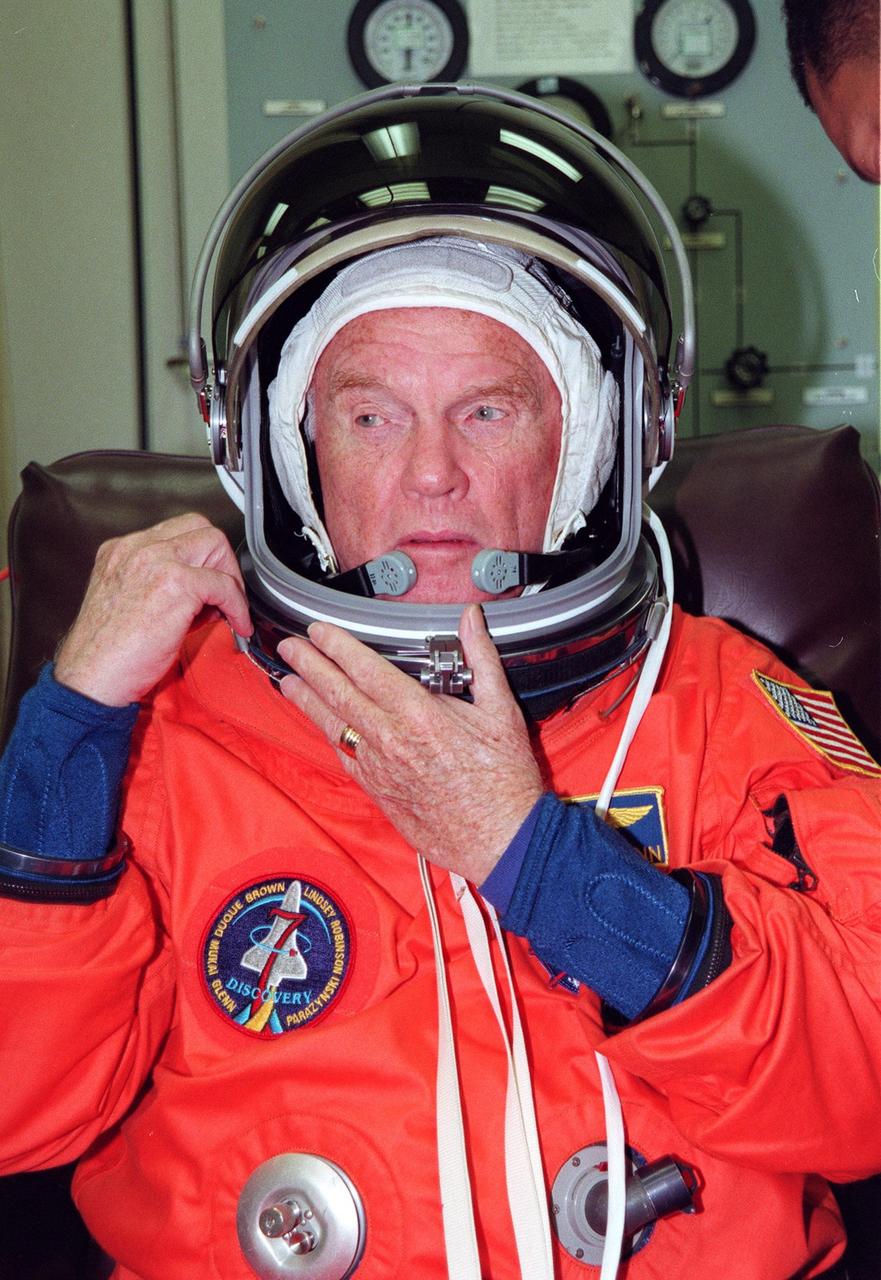
STS-95 Payload Specialist John H. Glenn Jr., a senator from Ohio and one of the original seven Project Mercury astronauts, suits up in the Operations and Checkout (O&C) Building prior to his trip to Launch Pad 39-B. Glenn and the rest of the STS-95 crew are at KSC to participate in the Terminal Countdown Demonstration Test (TCDT) which includes mission familiarization activities, emergency egress training, and a simulated main engine cutoff. The other crew members are Payload Specialist Chiaki Mukai (M.D., Ph.D.), representing the National Space Development Agency of Japan (NASDA), Pilot Steven W. Lindsey, Mission Specialist Scott E. Parazynski, Mission Specialist Stephen K. Robinson, Mission Specialist Pedro Duque of Spain, representing the European Space Agency (ESA), and Mission Commander Curtis L. Brown. The STS-95 mission, targeted for liftoff on Oct. 29, includes research payloads such as the Spartan solar-observing deployable spacecraft, the Hubble Space Telescope Orbital Systems Test Platform, the International Extreme Ultraviolet Hitchhiker, as well as the SPACEHAB single module with experiments on space flight and the aging process. Following the TCDT, the crew will be returning to Houston for final flight preparations
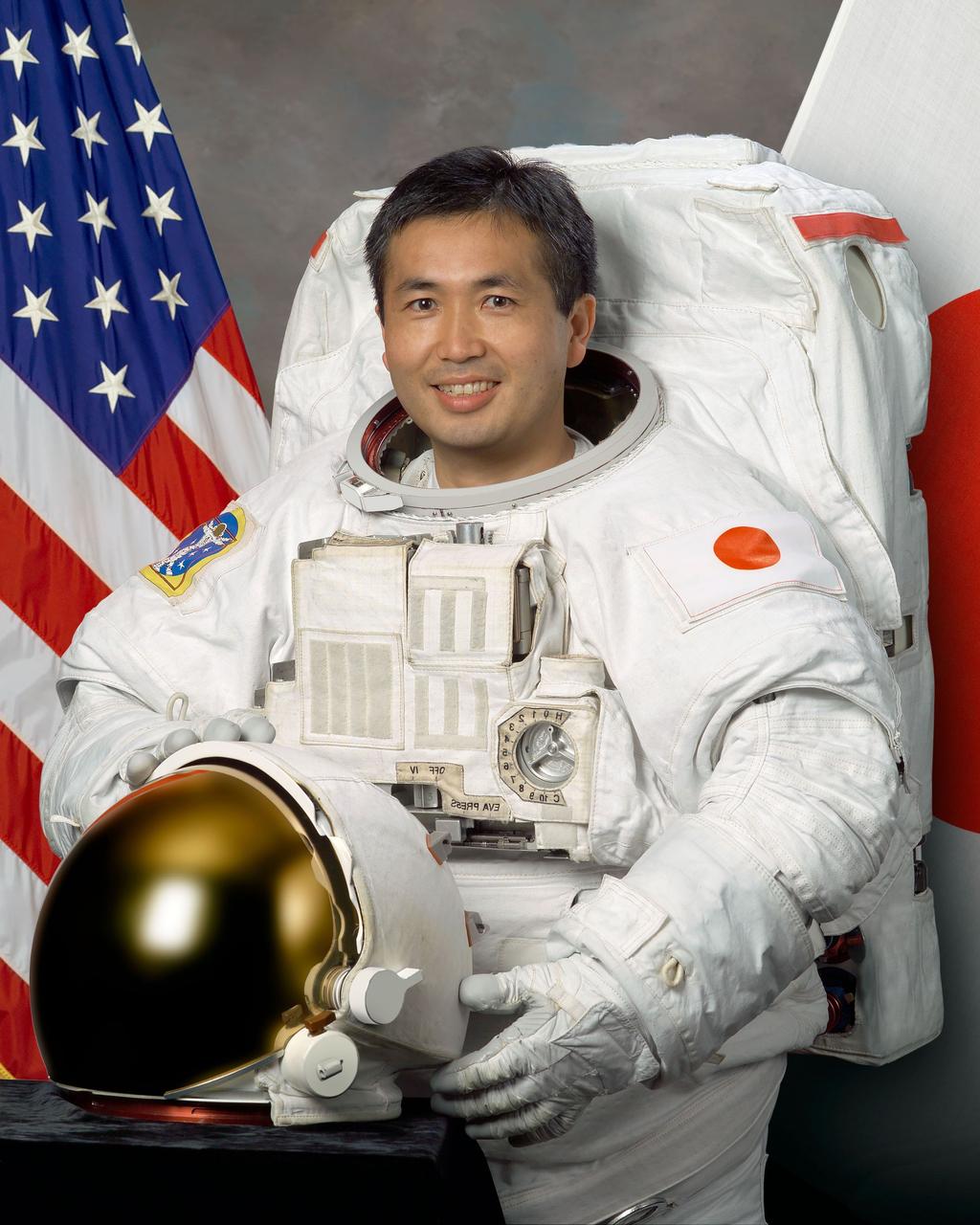
HOUSTON, Texas -- JSC2007-E-19404: Japan Aerospace Exploration Agency (JAXA) astronaut Koichi Wakata, flight engineer on mission STS-119.
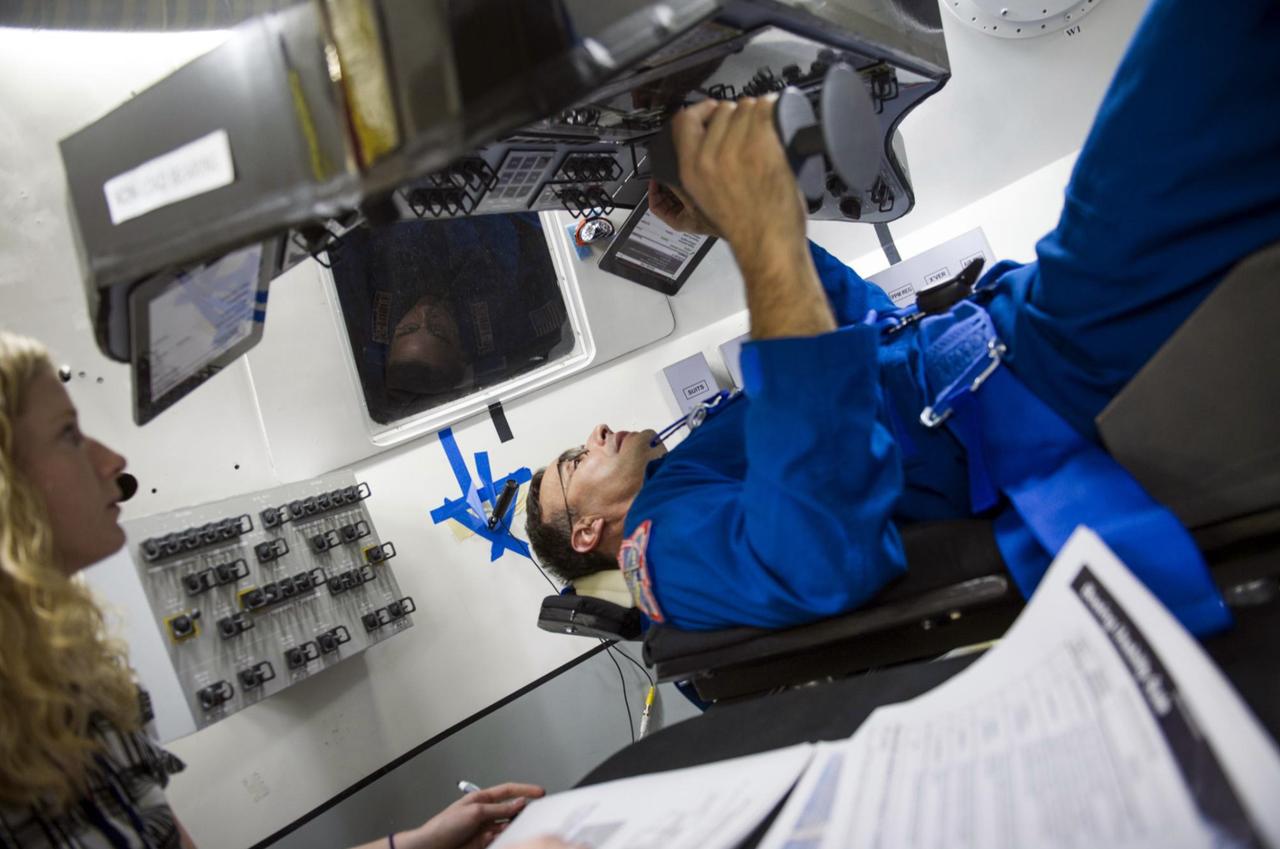
HOUSTON -- NASA Astronaut Lee Archambault performs an evaluation of reach and visibility of controls and displays during an end-of-year interior layout evaluation of The Boeing Company's CST-100 spacecraft. The evaluation at Boeing's Houston Product Support Center in Texas was part of the company's ongoing work supporting its funded Space Act Agreement with NASA's Commercial Crew Program, or CCP, during the Commercial Crew Integrated Capability, or CCiCap, initiative. CCP is intended to lead to the availability of commercial human spaceflight services for government and commercial customers to low-Earth orbit. Future development and certification initiatives eventually will lead to the availability of human spaceflight services for NASA to send its astronauts to the International Space Station, where critical research is taking place daily. For more information about CCP, go to http://www.nasa.gov/commercialcrew. Photo credit: Boeing
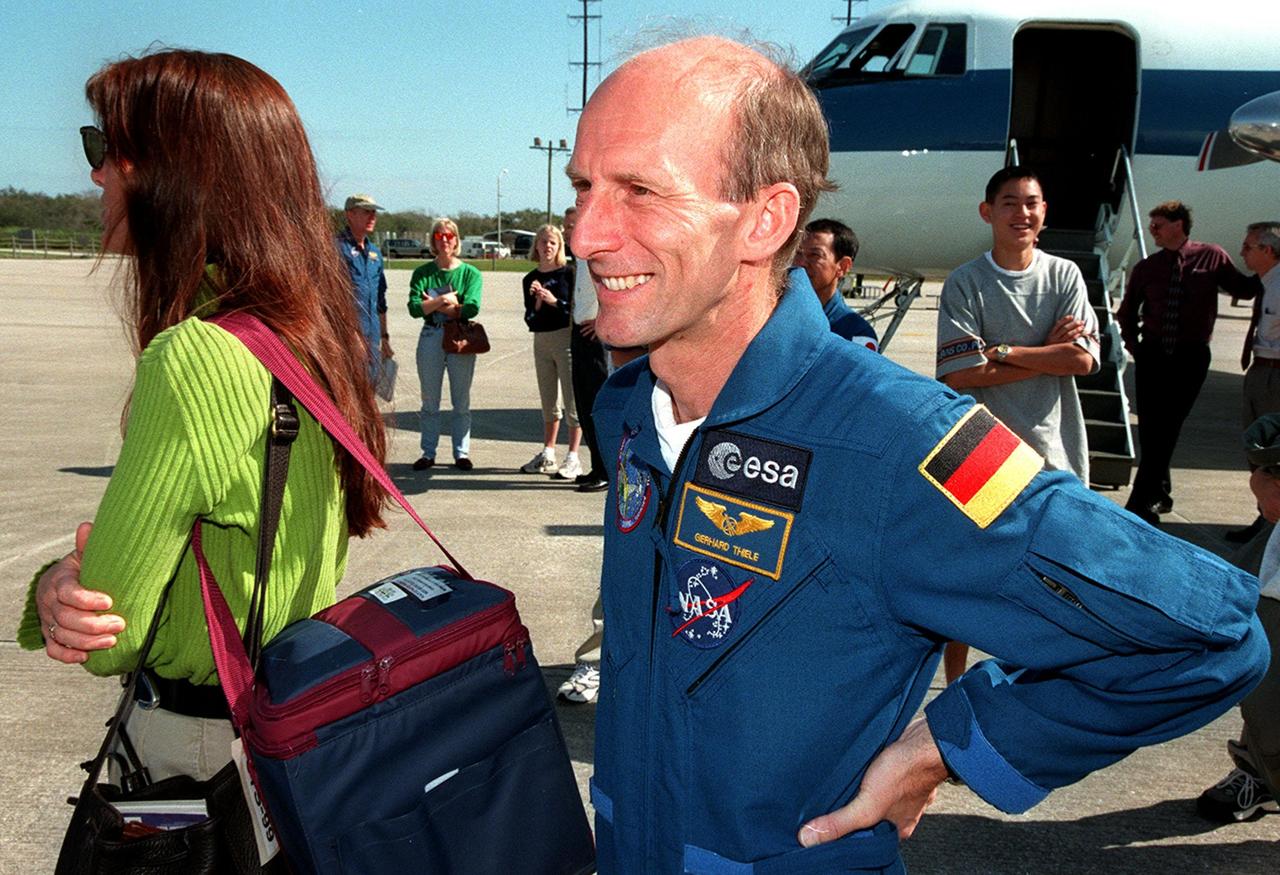
At the Shuttle Landing Facility, STS-99 crew members join family members for their return trip to Houston. At left is Jeanne Kregel, wife of Commander Kevin Kregel. At right is Mission Specialist Gerhard Thiele of Germany. The STS-99 crew completed a successful 11-day Shuttle Radar Topography Mission mapping 47 million square miles of the Earth's surface before landing at KSC Feb. 22
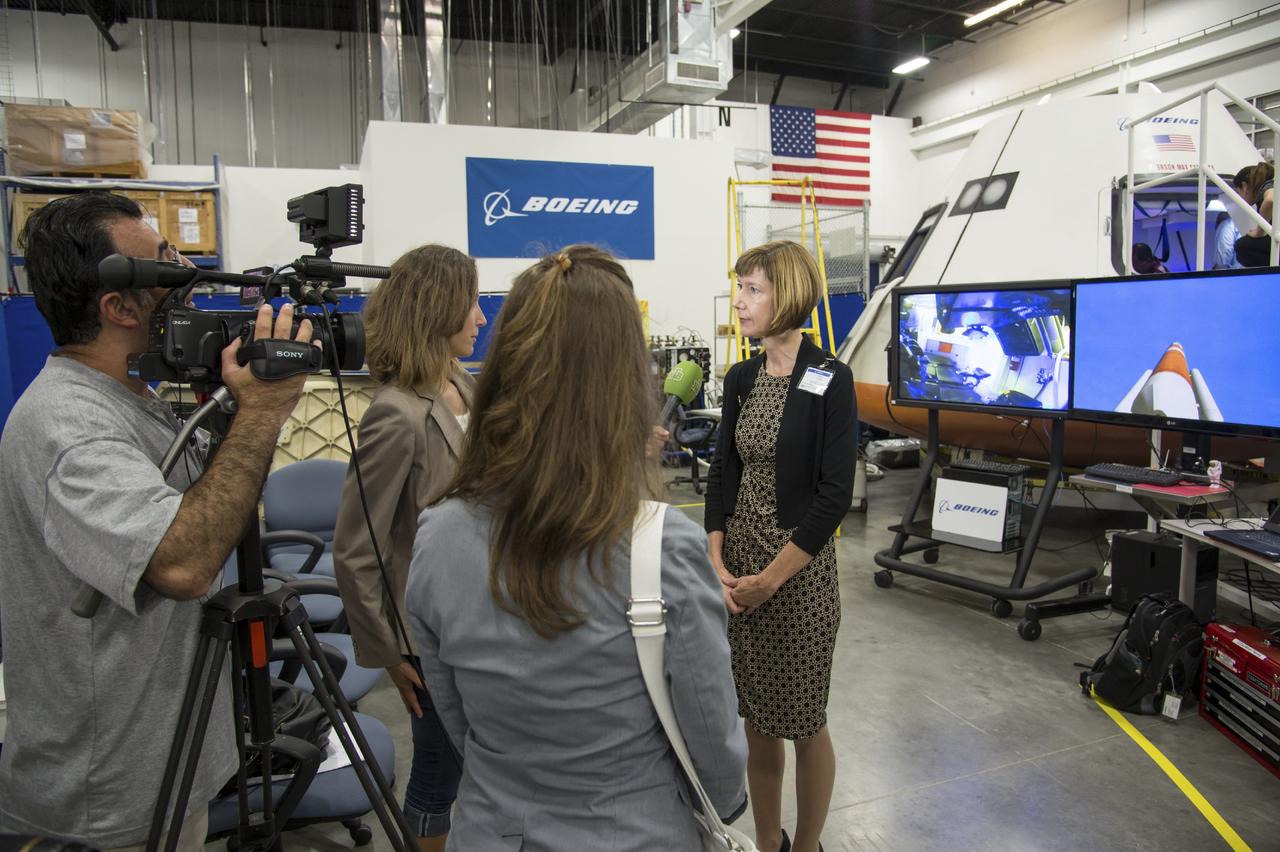
HOUSTON - JSC2013e068324 - Kathy Lueders, NASA deputy manager for the Commercial Crew Program, is interviewed by the media during the unveiling of a CST-100 mock-up at the company's Houston Product Support Center. This test version is optimized to support five crew members and will allow the company to evaluate crew safety, interfaces, communications, maneuverability and ergonomics. Boeing's CST-100 is being designed to transport crew members or a mix of crew and cargo to low-Earth-orbit destinations. The evaluation is part of the ongoing work supporting Boeing's funded Space Act Agreement with NASA's Commercial Crew Program, or CCP, during the agency's Commercial Crew Integrated Capability, or CCiCap, initiative. CCiCap is intended to make commercial human spaceflight services available for government and commercial customers. To learn more about CCP, visit http://www.nasa.gov/commercialcrew. Photo credit: NASA/Robert Markowitz
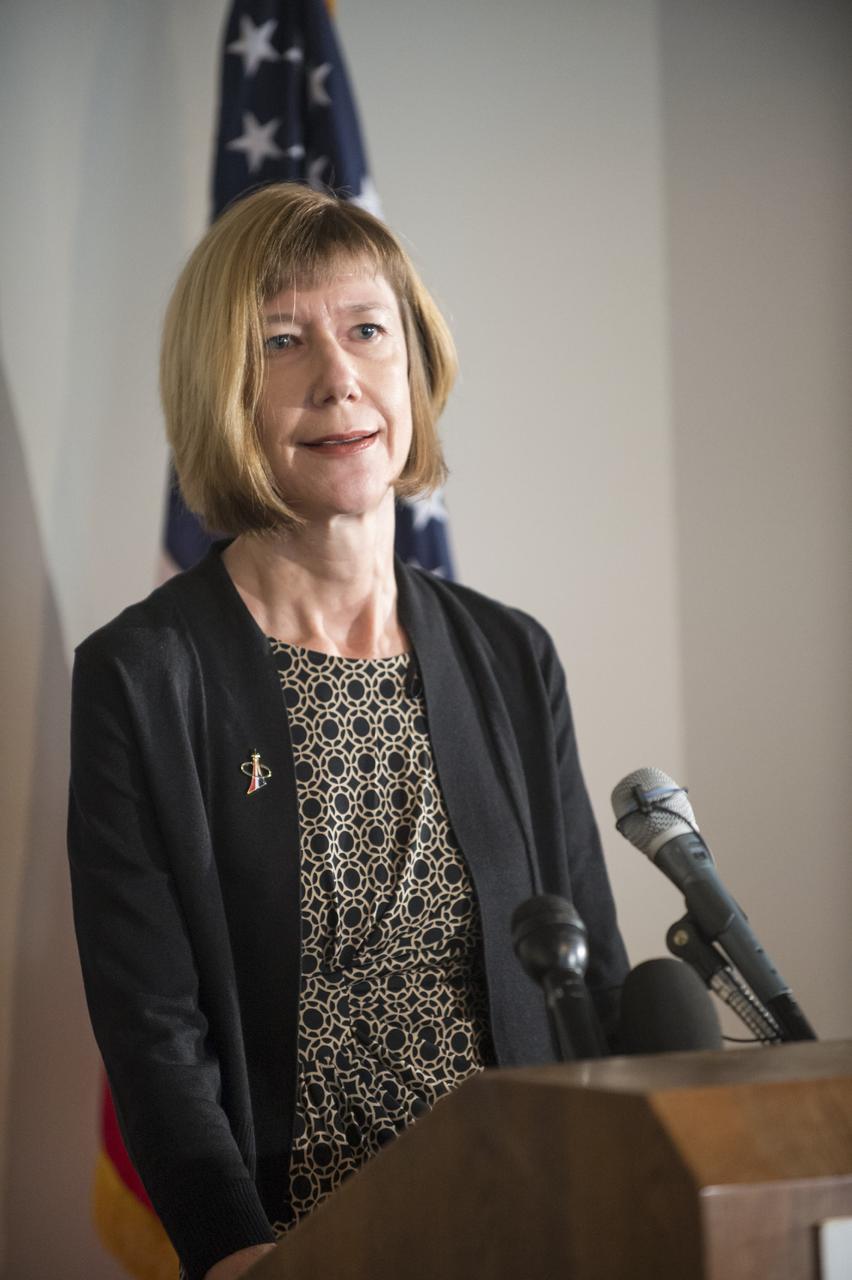
HOUSTON - JSC2013e068290 - Kathy Lueders, NASA deputy manager for the Commercial Crew Program, addresses the media before the unveiling of a CST-100 mock-up at the company's Houston Product Support Center. This test version is optimized to support five crew members and will allow the company to evaluate crew safety, interfaces, communications, maneuverability and ergonomics. Boeing's CST-100 is being designed to transport crew members or a mix of crew and cargo to low-Earth-orbit destinations. The evaluation is part of the ongoing work supporting Boeing's funded Space Act Agreement with NASA's Commercial Crew Program, or CCP, during the agency's Commercial Crew Integrated Capability, or CCiCap, initiative. CCiCap is intended to make commercial human spaceflight services available for government and commercial customers. To learn more about CCP, visit http://www.nasa.gov/commercialcrew. Photo credit: NASA/Robert Markowitz
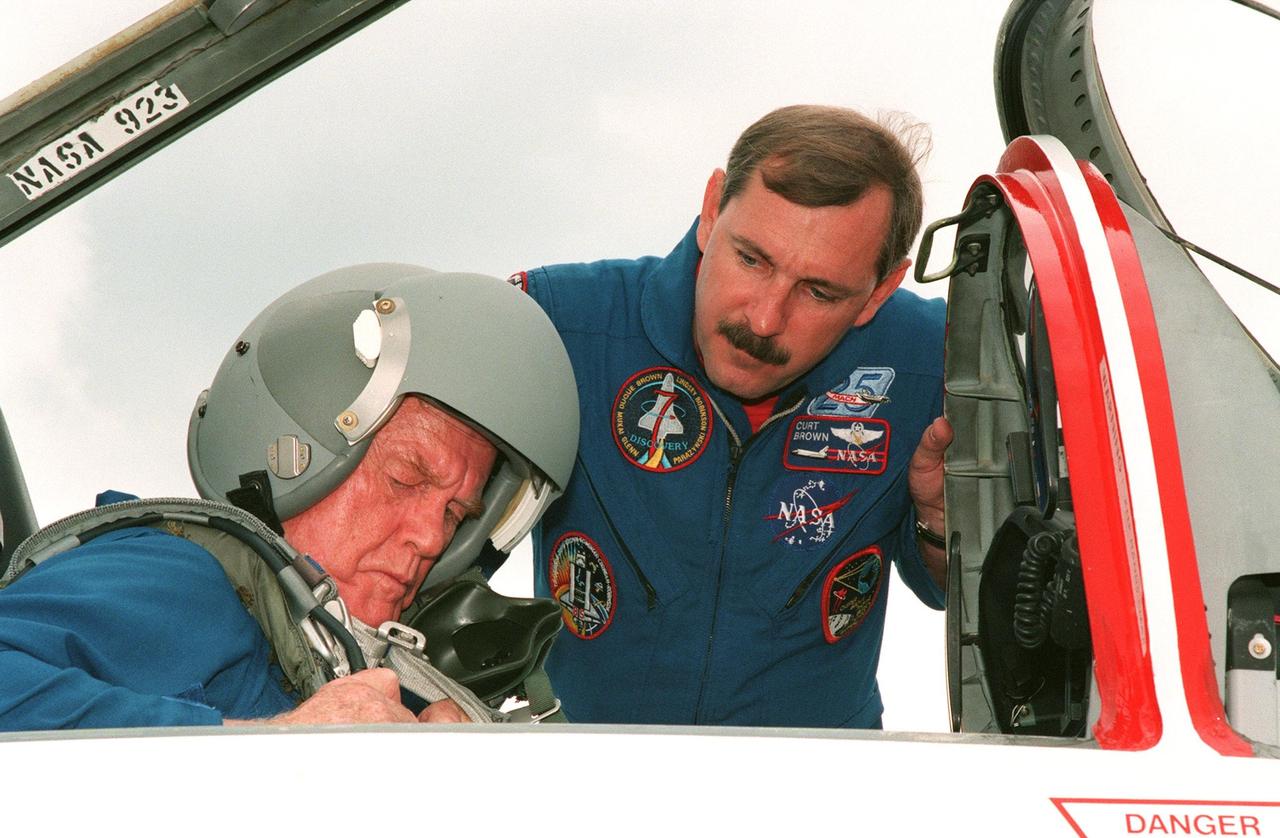
STS-95 Payload Specialist John H. Glenn Jr., senator from Ohio, straps into the seat of the T-38 jet aircraft that will carry him back to Houston. Mission Commander Curtis L. Brown, his pilot on the jet, looks on. The STS-95 successfully completed their Terminal Countdown Demonstration Test (TCDT) which included mission familiarization activities, emergency egress training, and a simulated main engine cutoff. Other crew members participating were Pilot Steven W. Lindsey, Mission Specialist Stephen K. Robinson, Payload Specialist Chiaki Mukai (M.D., Ph.D.), representing the National Space Development Agency of Japan (NASDA), Mission Specialist Pedro Duque of Spain, representing the European Space Agency (ESA), and Mission Specialist Scott E. Parazynski. The STS-95 mission, targeted for liftoff on Oct. 29, includes research payloads such as the Spartan solar-observing deployable spacecraft, the Hubble Space Telescope Orbital Systems Test Platform, the International Extreme Ultraviolet Hitchhiker, as well as the SPACEHAB single module with experiments on space flight and the aging process. Following the TCDT, the entire crew returned to Houston for final flight preparations
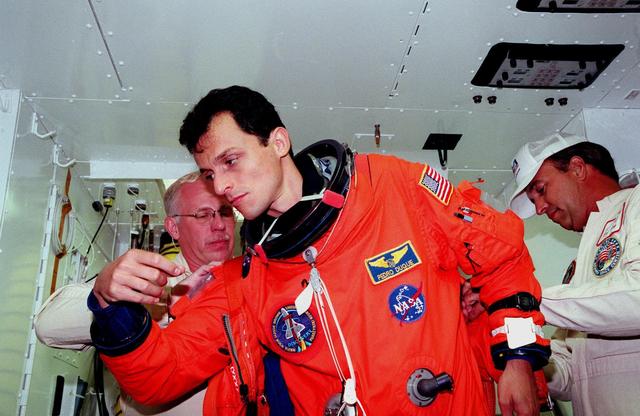
STS-95 Mission Specialist Pedro Duque of Spain, representing the European Space Agency (ESA) is checked by Danny Wyatt (left), with KSC, and Dave Martin (right), with United Space Alliance, in the white room before entry into Space Shuttle Discovery for a pre-launch countdown exercise. Duque and other crew members are at KSC to participate in the Terminal Countdown Demonstration Test (TCDT) which includes mission familiarization activities, emergency egress training, and a simulated main engine cutoff. The other crew members are Payload Specialist Chiaki Mukai (M.D., Ph.D.), representing the National Space Development Agency of Japan (NASDA), Pilot Steven W. Lindsey, Mission Specialist Scott E. Parazynski, Mission Specialist Stephen K. Robinson, Payload Specialist John H. Glenn Jr., senator from Ohio, and Mission Commander Curtis L. Brown. The STS-95 mission, targeted for liftoff on Oct. 29, includes research payloads such as the Spartan solar-observing deployable spacecraft, the Hubble Space Telescope Orbital Systems Test Platform, the International Extreme Ultraviolet Hitchhiker, as well as the SPACEHAB single module with experiments on space flight and the aging process. Following the TCDT, the crew will be returning to Houston for final flight preparations
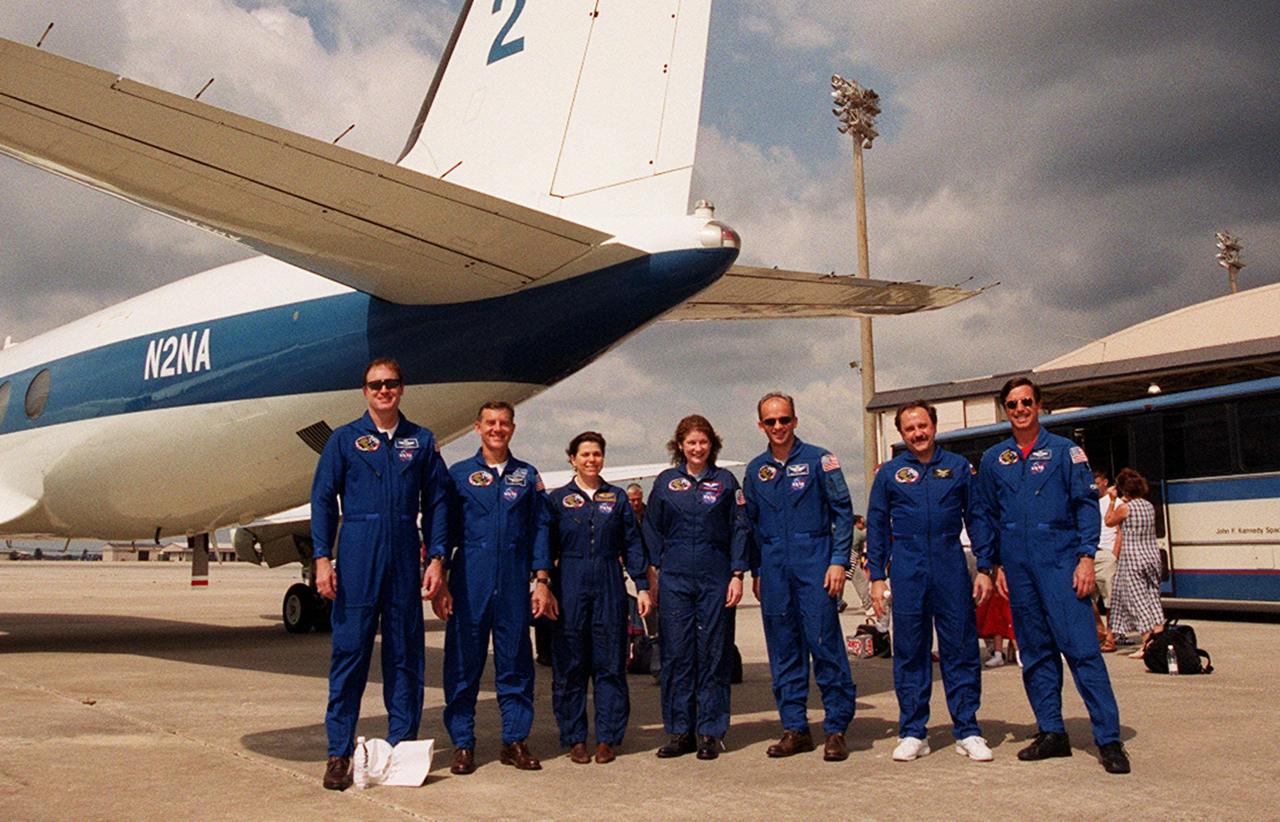
The STS-101 crew pose one more time before departing for Houston from Patrick Air Force Base. From left are Commander James D. Halsell Jr., Mission Specialists James S. Voss, Mary Ellen Weber, Susan J. Helms, Jeffrey N. Williams, Yury Usachev of Russia, and Pilot Scott “Doc” Horowitz. After landing at 2:20 a.m. EDT May 29, the crew and their families enjoyed the Memorial Day holiday in Florida. The crew returned from the third flight to the International Space Station where they made repairs, transferred cargo and completed a space walk to install and connect several pieces of equipment on the outside of the Space Station
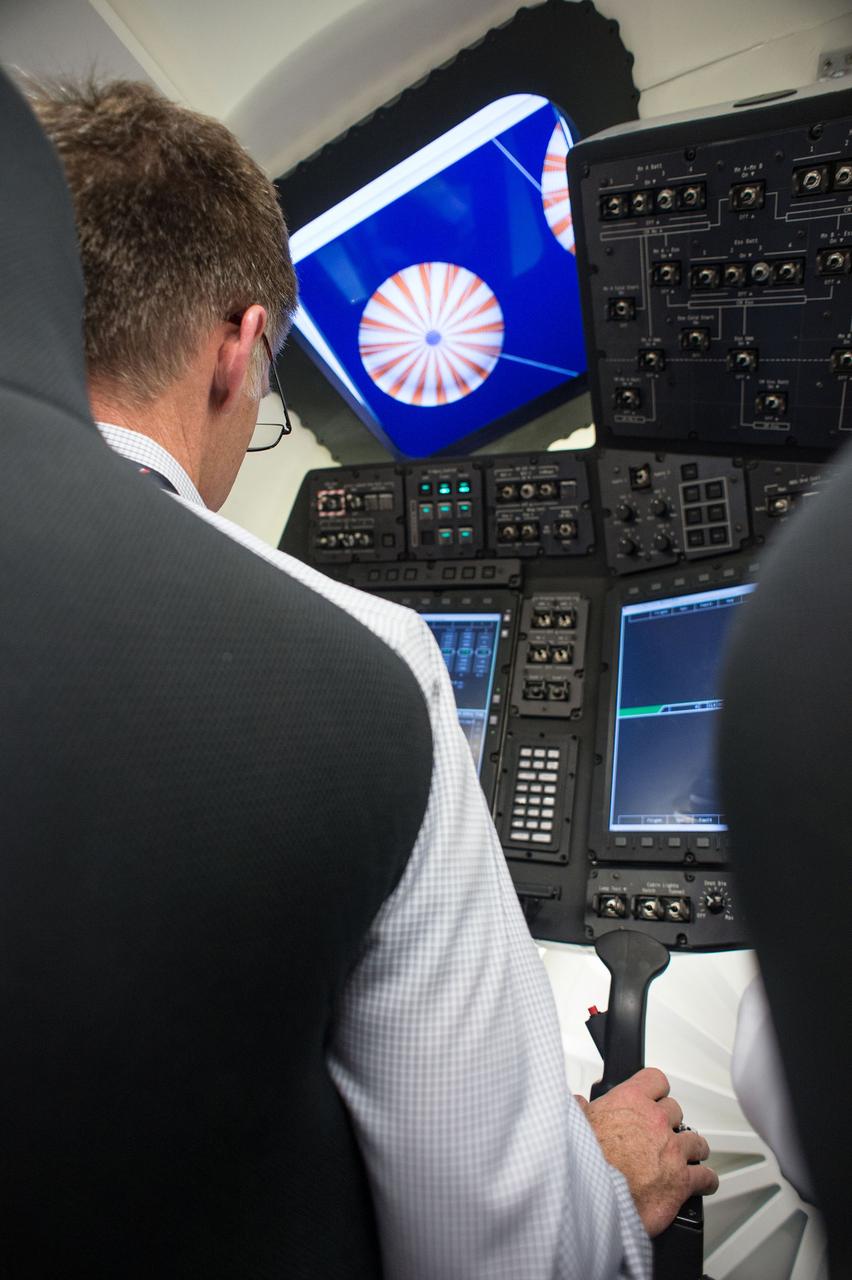
HOUSTON – Chris Ferguson, a former space shuttle commander who is now director of Crew and Mission Operations for Boeing Space Exploration, sits at the controls in the inside the company's CST-100 spacecraft simulator. Boeing demonstrated that the CST-100 software allows a human pilot to take over control of the spacecraft from the computer during all phases of a mission following separation from the launch vehicle. The pilot-in-the-loop demonstration at the Houston Product Support Center is a milestone under Boeing's Commercial Crew Integrated Capability agreement with the agency and its Commercial Crew Program. Photo credit: NASA/Bill Stafford
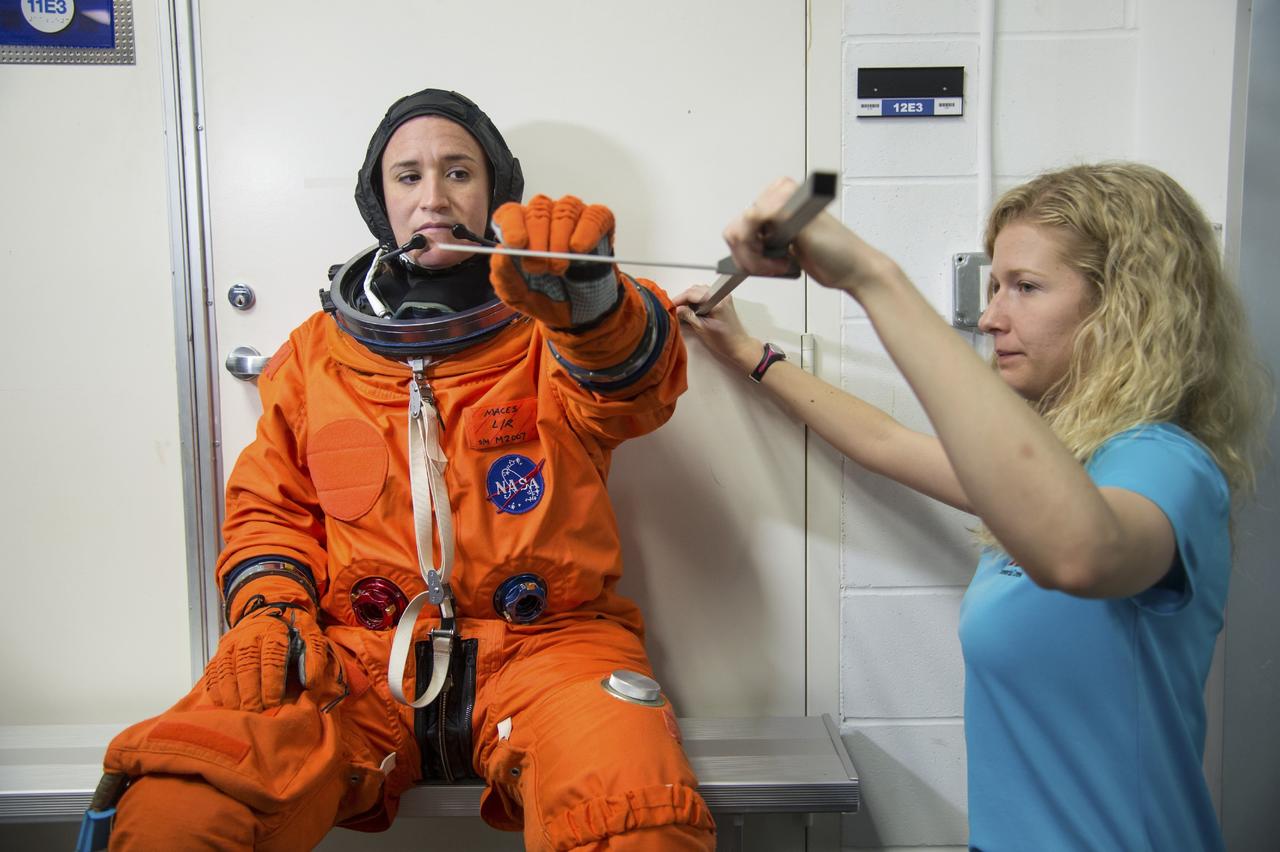
HOUSTON - JSC2013e068259 - NASA astronaut Serena Aunon prepares for a fit check evaluation of The Boeing Company's CST-100 spacecraft at the company's Houston Product Support Center. Assisting her is Andrea Gilkey, a human factors engineer with The Boeing Company. Aunon's fit check will help evaluate a crew's maneuverability in the spacecraft and test communications. Boeing's CST-100 is being designed to transport crew members or a mix of crew and cargo to low-Earth-orbit destinations. The evaluation is part of the ongoing work supporting Boeing's funded Space Act Agreement with NASA's Commercial Crew Program, or CCP, during the agency's Commercial Crew Integrated Capability, or CCiCap, initiative. CCiCap is intended to make commercial human spaceflight services available for government and commercial customers. To learn more about CCP, visit http://www.nasa.gov/commercialcrew. Photo credit: NASA/Robert Markowitz
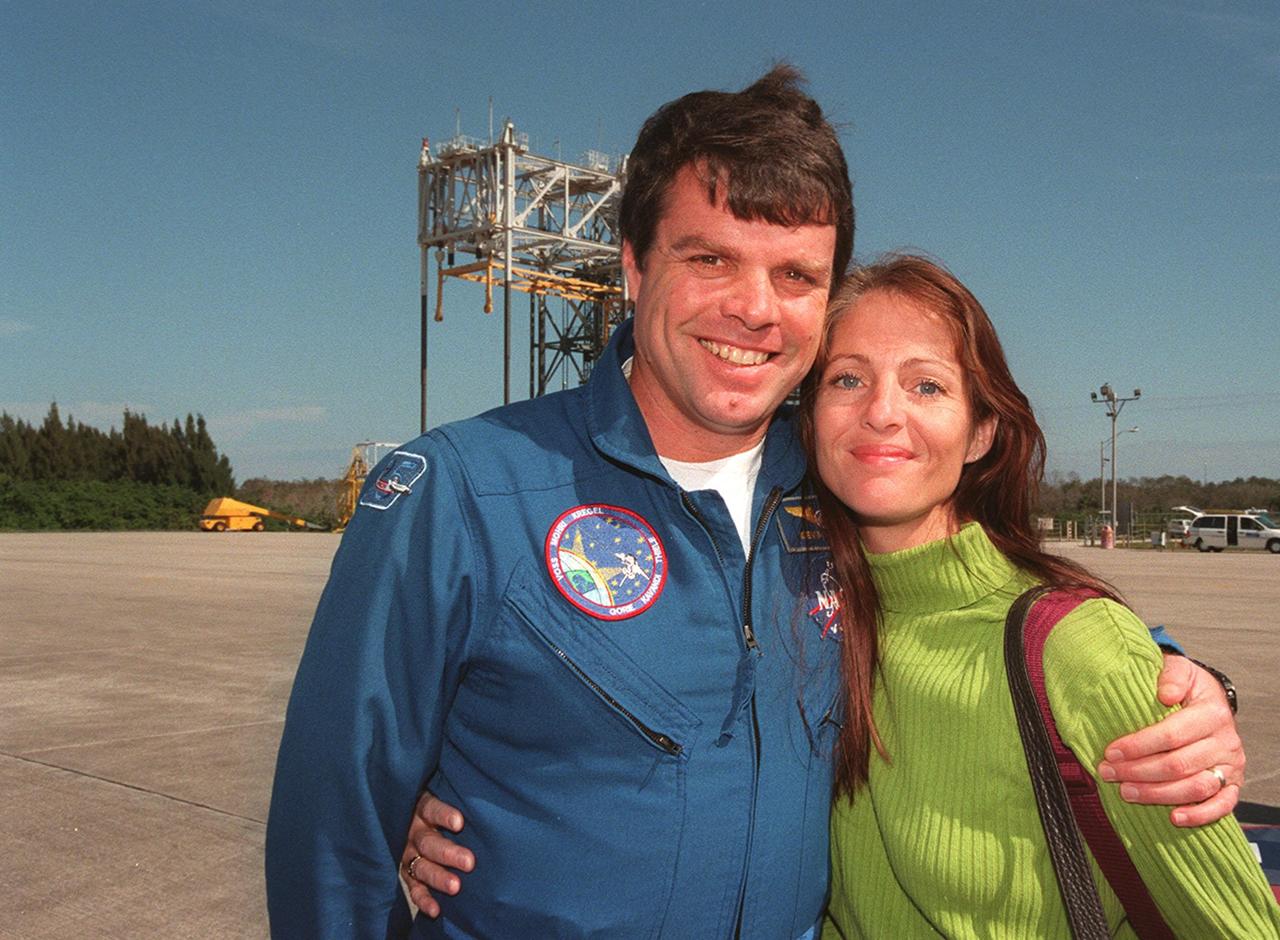
At the Shuttle Landing Facility, STS-99 Commander Kevin Kregel is joined by his wife, Jeanne, before their departure for Houston. The STS-99 crew completed a successful 11-day Shuttle Radar Topography Mission mapping 47 million square miles of the Earth's surface before landing at KSC Feb. 22

At Launch Pad 39-B, STS-95 Mission Commander Curtis L. Brown (center, with microphone) responds to questions about the mission and training from reporters during a brief break from the Terminal Countdown Demonstration Test (TCDT). Amused with his answer are other crew members (from left) Mission Specialist Scott E. Parazynski, Mission Specialist Stephen K. Robinson, who also serves as Payload Commander, Pilot Steven W. Lindsey, (Brown), Mission Specialist Pedro Duque of Spain, representing the European Space Agency (ESA), Chiaki Mukai, representing the National Space Development Agency of Japan (NASDA), and Payload Specialist John H. Glenn Jr., senator from Ohio. The crew were at the pad for emergency egress training after the break. The TCDT also involves mission familiarization activities and a simulated main engine cut-off exercise. The STS-95 mission, targeted for liftoff on Oct. 29, includes research payloads such as the Spartan solar-observing deployable spacecraft, the Hubble Space Telescope Orbital Systems Test Platform, the International Extreme Ultraviolet Hitchhiker, as well as the SPACEHAB single module with experiments on space flight and the aging process. Following the TCDT, the crew will be returning to Houston for final flight preparations
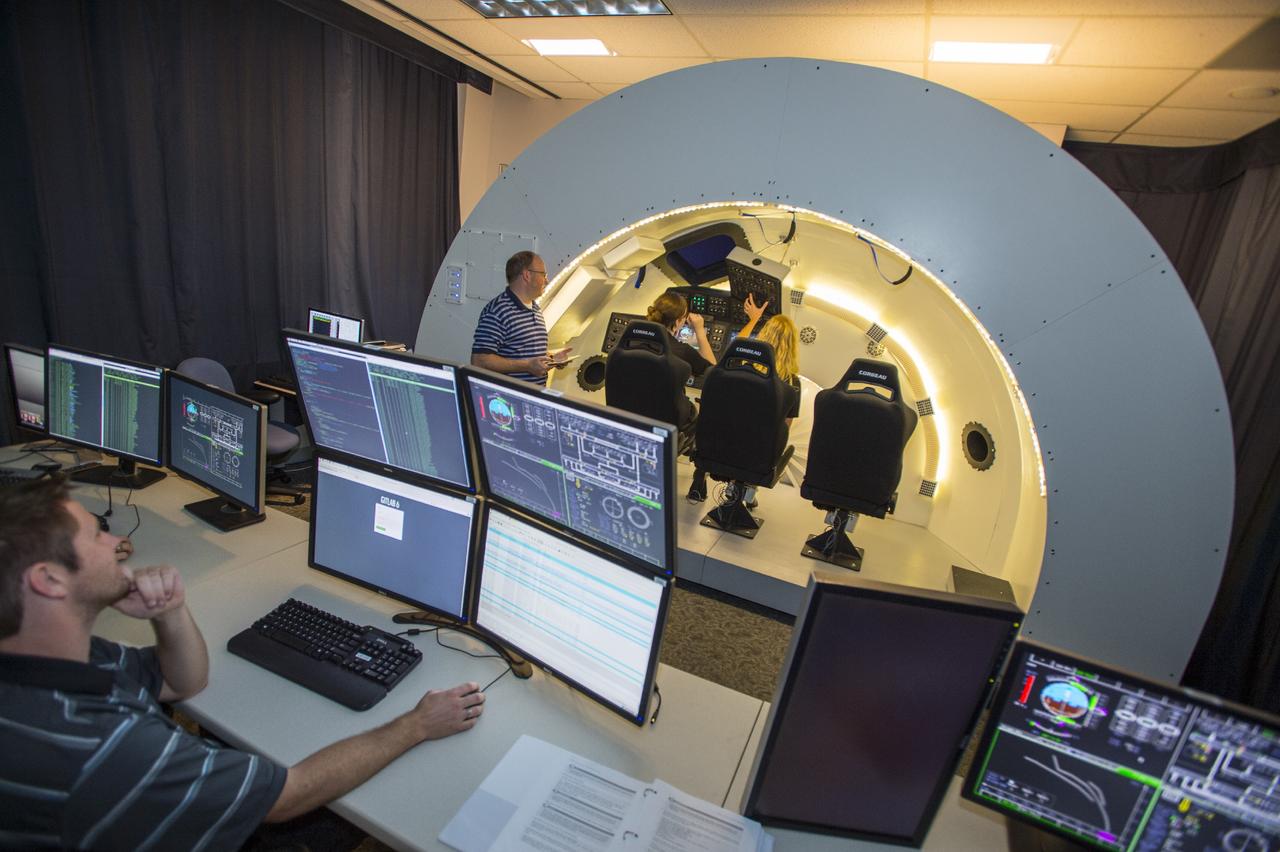
HOUSTON – Engineers and managers work inside a simulator of The Boeing Company's CST-100 spacecraft during evaluations of potential designs and software functions in a room at the company's Houston location. The CST-100 is under development in partnership between the company and NASA's Commercial Crew Program, or CCP. The spacecraft is designed to fly to low-Earth orbit and potentially dock with the International Space Station. Photo credit: The Boeing Company
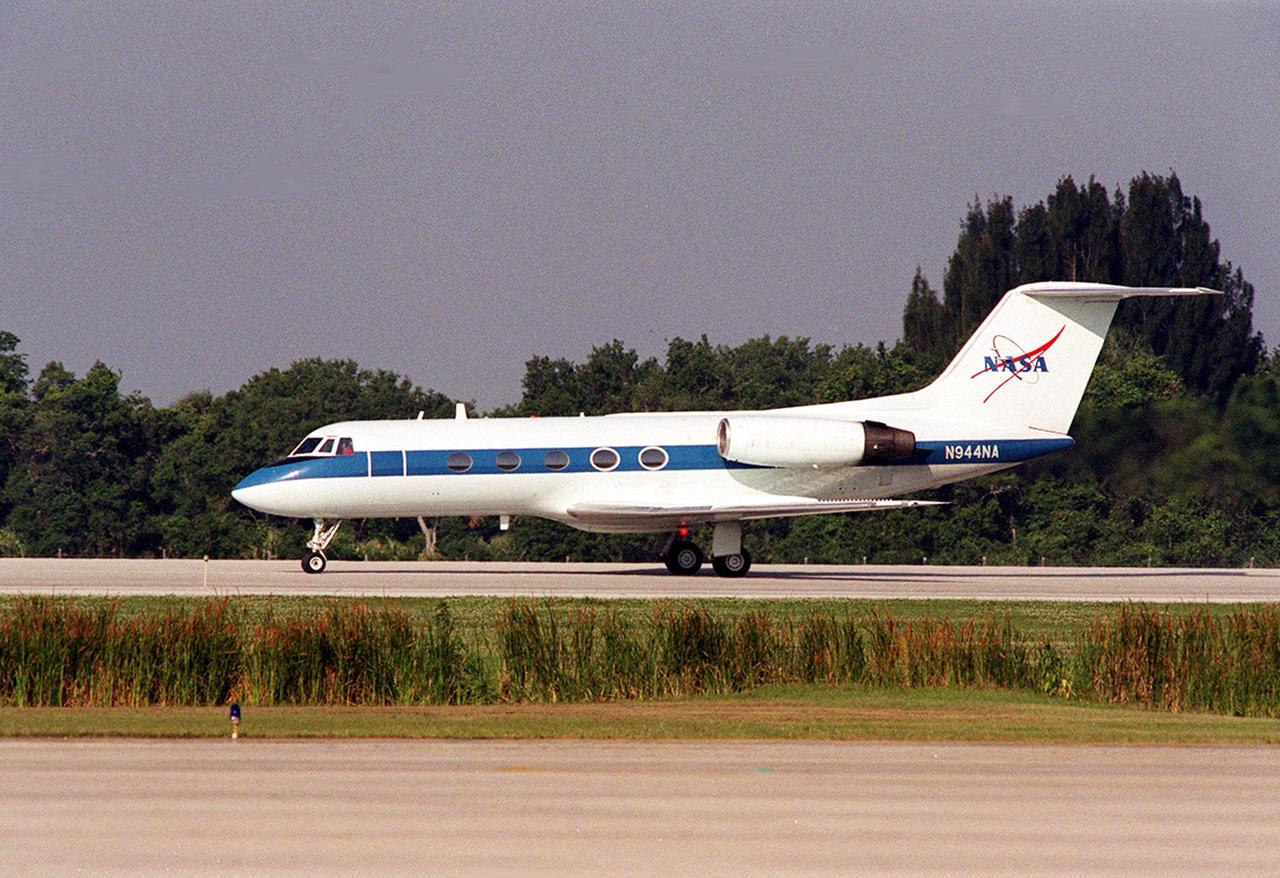
A Shuttle Training Aircraft (STA) taxis down the runway at KSC's Shuttle Landing Facility. The STA is a modified Grumman American Aviation-built Gulfstream II executive jet that was modified to simulate an orbiter's cockpit, motion and visual cues, and handling qualities. It is used by Shuttle flight crews to practice landing the orbiter. In flight, the STA duplicates the orbiter's atmospheric descent trajectory from approximately 35,000 feet altitude to landing on a runway. The orbiter differs in at least one major aspect from conventional aircraft; it is unpowered during re-entry and landing so its high-speed glide must be perfectly executed the first time there is no go-around capability. The orbiter touchdown speed is 213 to 226 miles (343 to 364 kilometers) per hour. There are two STAs, based in Houston

STS-95 Pilot Steven W. Lindsey, Payload Specialist John H. Glenn Jr., senator from Ohio, and Payload Specialist Chiaki Mukai, representing the National Space Development Agency of Japan (NASDA), listen to the Safety Egress trainer talk about the emergency egress system from the pad. The STS-95 crew are at KSC to participate in a Terminal Countdown Demonstration Test (TCDT) which includes mission familiarization activities, emergency egress training, and a simulated main engine cut-off exercise. Other crew members are Mission Specialist Scott E. Parazynski, Mission Specialist Pedro Duque of Spain, representing the European Space Agency (ESA), Mission Commander Curtis L. Brown, and Mission Specialist Stephen K. Robinson. The STS-95 mission, targeted for liftoff on Oct. 29, includes research payloads such as the Spartan solar-observing deployable spacecraft, the Hubble Space Telescope Orbital Systems Test Platform, the International Extreme Ultraviolet Hitchhiker, as well as the SPACEHAB single module with experiments on space flight and the aging process. Following the TCDT, the crew will be returning to Houston for final flight preparations
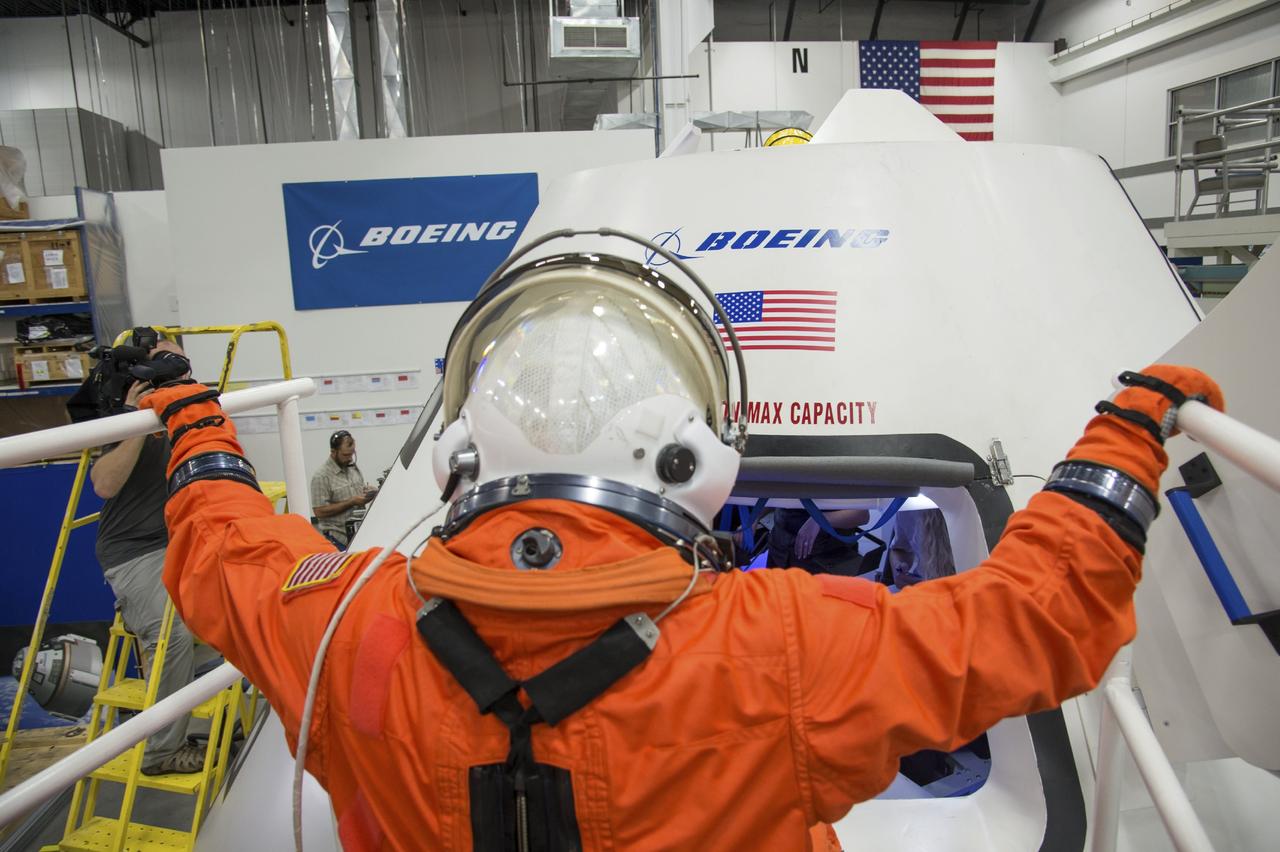
HOUSTON - JSC2013e068269 - NASA astronaut Serena Aunon prepares to enter The Boeing Company's CST-100 spacecraft for a fit check evaluation at the company's Houston Product Support Center. Aunon's fit check will help evaluate a crew's maneuverability in the spacecraft and test communications. Boeing's CST-100 is being designed to transport crew members or a mix of crew and cargo to low-Earth-orbit destinations. The evaluation is part of the ongoing work supporting Boeing's funded Space Act Agreement with NASA's Commercial Crew Program, or CCP, during the agency's Commercial Crew Integrated Capability, or CCiCap, initiative. CCiCap is intended to make commercial human spaceflight services available for government and commercial customers. To learn more about CCP, visit http://www.nasa.gov/commercialcrew. Photo credit: NASA/Robert Markowitz
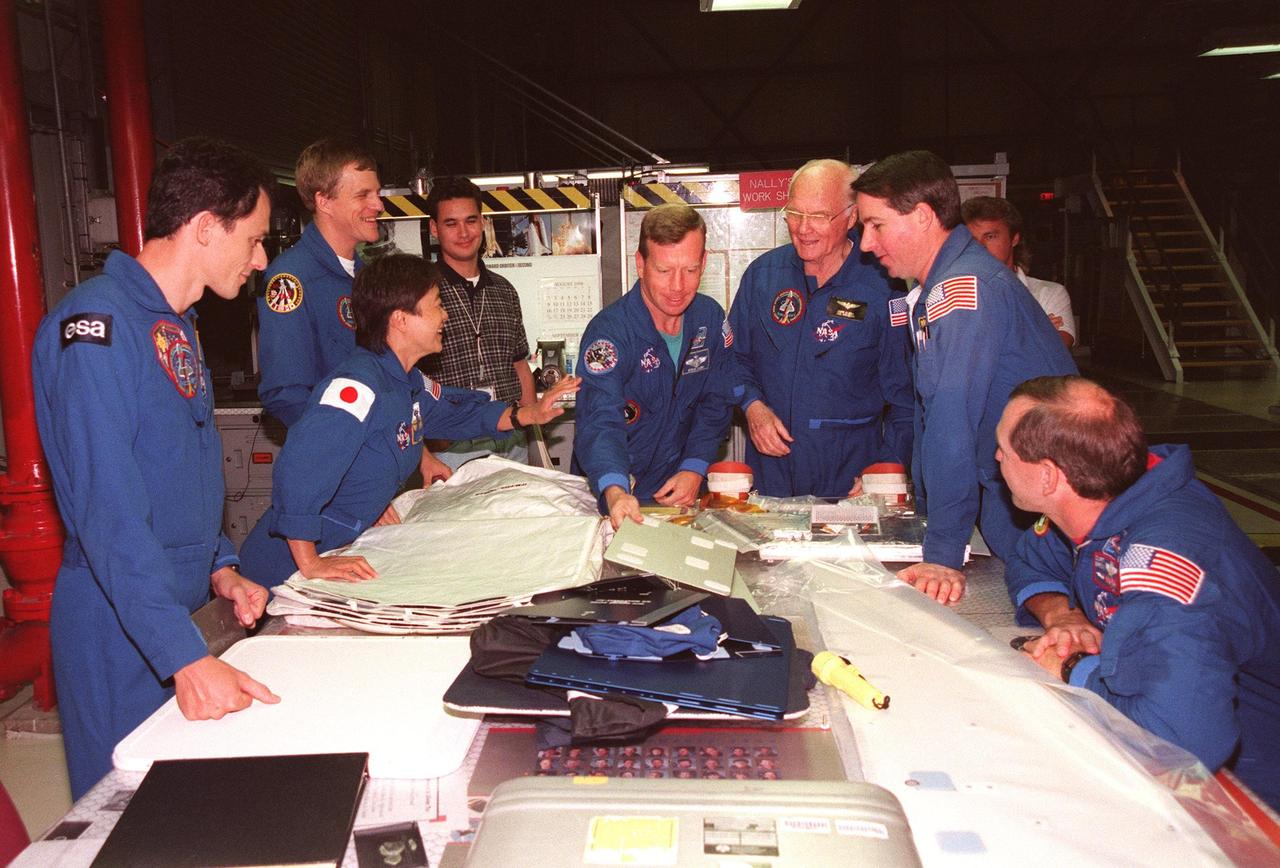
Around a table in Orbiter Processing Facility Bay 2 , STS-95 crew members look over equipment during the Crew Equipment Interface Test (CEIT) for their mission. From left, they are Mission Specialist Pedro Duque, of the European Space Agency; Payload Specialist Chiaki Mukai, of the National Space Development Agency of Japan (NASDA); Mission Specialist Scott E. Parazynski, M.D.; Pilot Steven W. Lindsey; Payload Specialist John H. Glenn Jr., senator from Ohio; Mission Specialist Stephen K. Robinson; and Mission Commander Curtis L. Brown Jr. Behind them is Adam Flagan, United Space Alliance-Houston. The CEIT gives astronauts an opportunity for a hands-on look at the payloads and equipment with which they will be working on orbit. The launch of the STS-95 mission, aboard Space Shuttle Discovery, is scheduled for Oct. 29, 1998. The mission includes research payloads such as the Spartan solar-observing deployable spacecraft, the Hubble Space Telescope Orbital Systems Test Platform, the International Extreme Ultraviolet Hitchhiker, as well as the SPACEHAB single module with experiments on space flight and the aging process
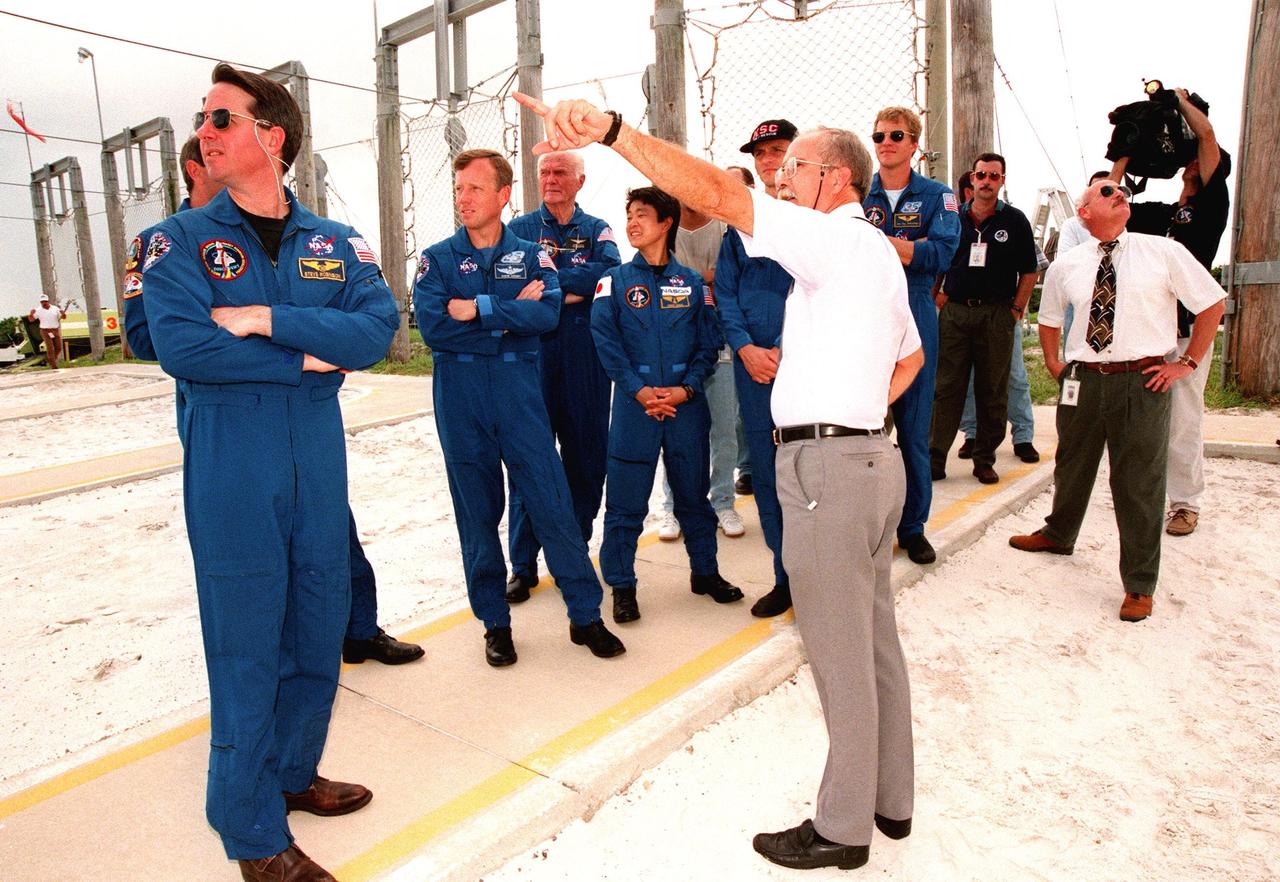
On Launch Pad 39-B, a Safety Egress trainer points out to the STS-95 crew the path the slidewire baskets, emergency egress vehicles, will take if the crew needs to use them before launch. Watching are (left to right) Mission Specialist Stephen K. Robinson, Mission Commander Curtis L. Brown (partially hidden behind Robinson), Pilot Steven W. Lindsey, Payload Specialists John H. Glenn Jr., senator from Ohio, and Chiaki Mukai, representing the National Space Development Agency of Japan (NASDA), Mission Specialist Pedro Duque of Spain, representing the European Space Agency (ESA), and Mission Specialist Scott E. Parazynski. The STS-95 crew are at KSC to participate in a Terminal Countdown Demonstration Test (TCDT) which includes mission familiarization activities, emergency egress training, and a simulated main engine cut-off exercise. The STS-95 mission, targeted for liftoff on Oct. 29, includes research payloads such as the Spartan solar-observing deployable spacecraft, the Hubble Space Telescope Orbital Systems Test Platform, the International Extreme Ultraviolet Hitchhiker, as well as the SPACEHAB single module with experiments on space flight and the aging process. Following the TCDT, the crew will be returning to Houston for final flight preparations
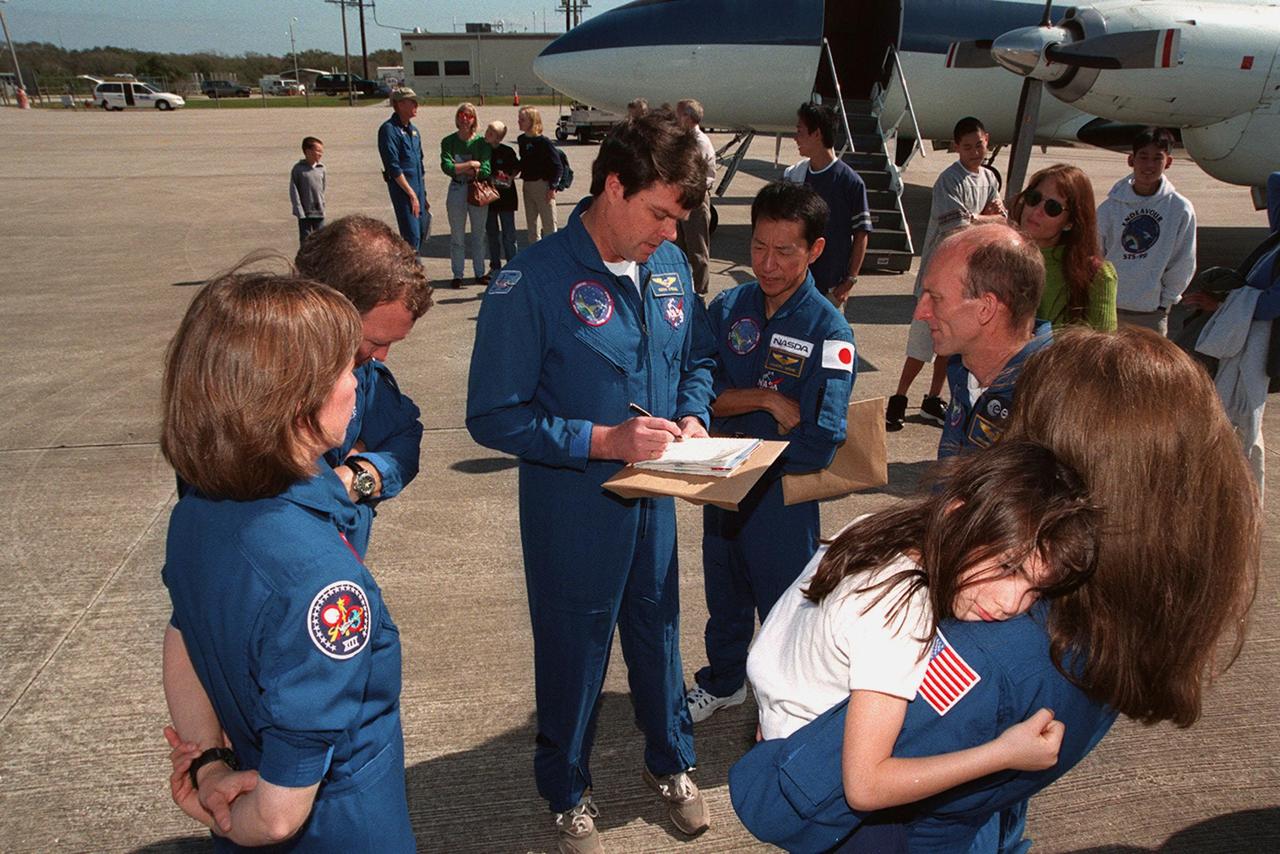
The STS-99 crew get ready to leave KSC with their families for a return trip to Houston. From left are Mission Specialist Janice Voss, Pilot Dominic Gorie, Commander Kevin Kregel, and Mission Specialists Mamoru Mohri of Japan, Gerhard Thiele of Germany, and Janet Kavandi, holding her daughter. The STS-99 crew completed a successful 11-day Shuttle Radar Topography Mission mapping 47 million square miles of the Earth's surface before landing at KSC Feb. 22
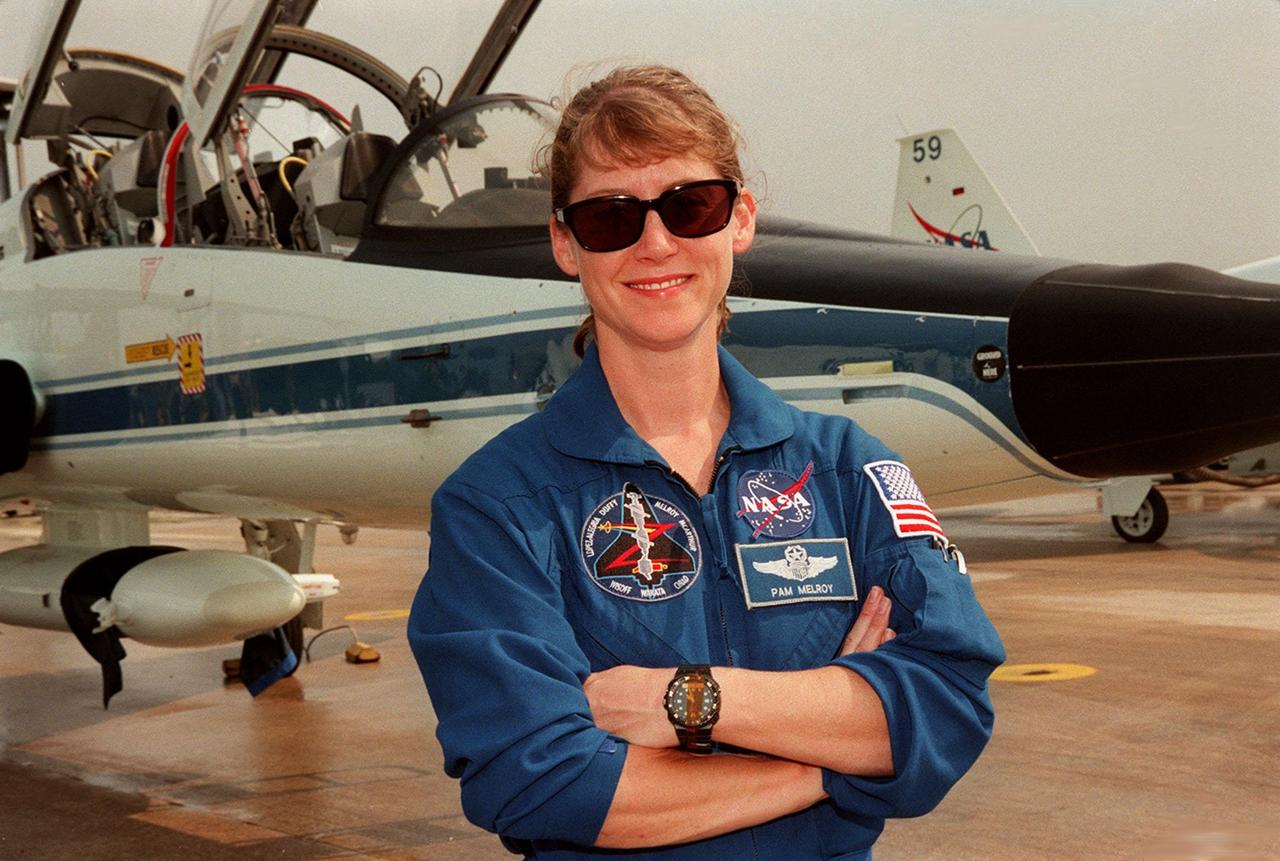
STS-92 Pilot Pam Melroy poses at the Shuttle Landing Facility before flying back to Houston. She and other crew members completed their Crew Equipment Interface Test activities, looking over their mission payload and related equipment. STS-92 is scheduled to launch Oct. 5 on Shuttle Discovery from Launch Pad 39A on the fifth flight to the International Space Station. Discovery will carry the Integrated Truss Structure (ITS) Z1, the PMA-3, Ku-band Communications System, and Control Moment Gyros (CMGs)
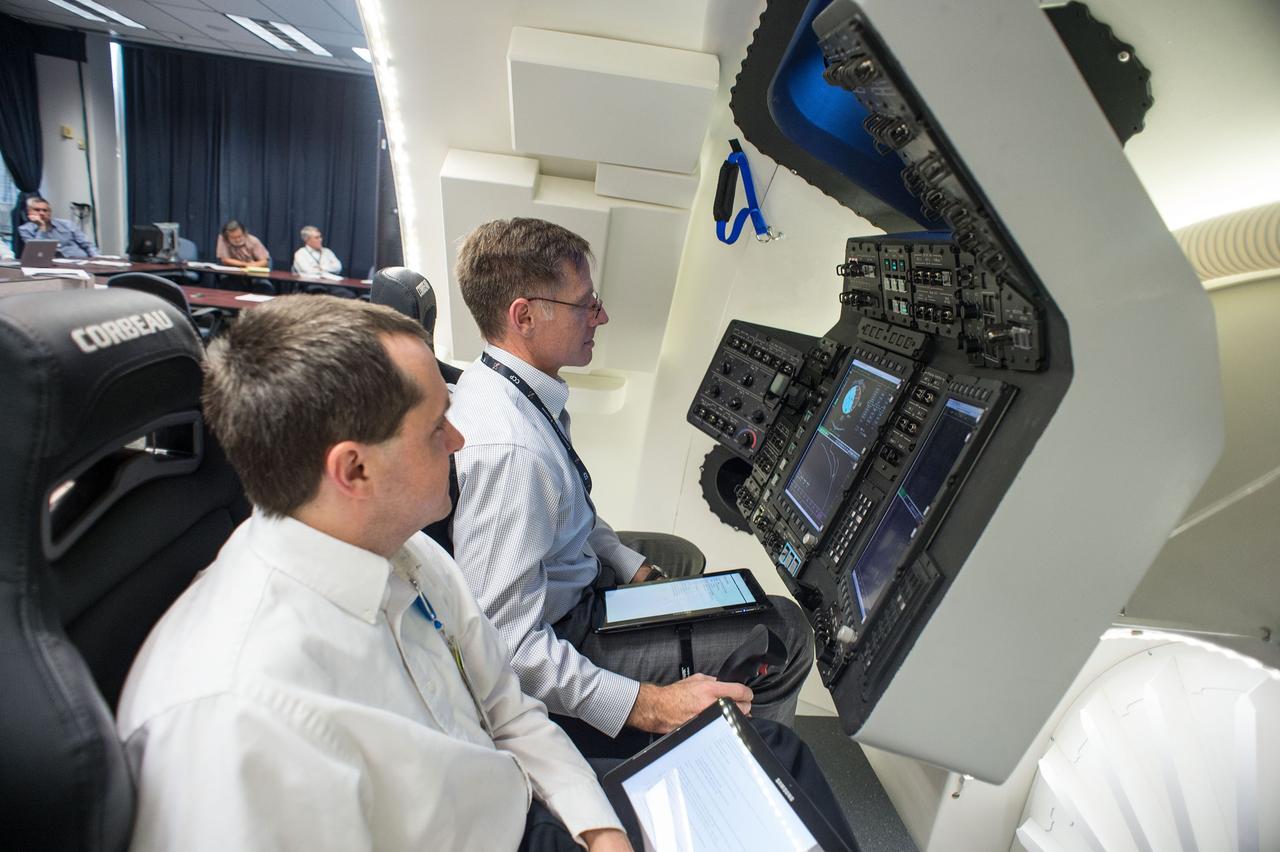
HOUSTON – Chris Ferguson, a former space shuttle commander who is now director of Crew and Mission Operations for Boeing Space Exploration, takes the controls inside the company's CST-100 spacecraft simulator. To Ferguson's right, an engineer observes the exercise. Boeing demonstrated that the CST-100's software allows a human pilot to take over control of the spacecraft from the computer during all phases of a mission following separation from the launch vehicle. The pilot-in-the-loop demonstration at the Houston Product Support Center is a milestone under Boeing's Commercial Crew Integrated Capability agreement with the agency and its Commercial Crew Program. Photo credit: NASA/Bill Stafford
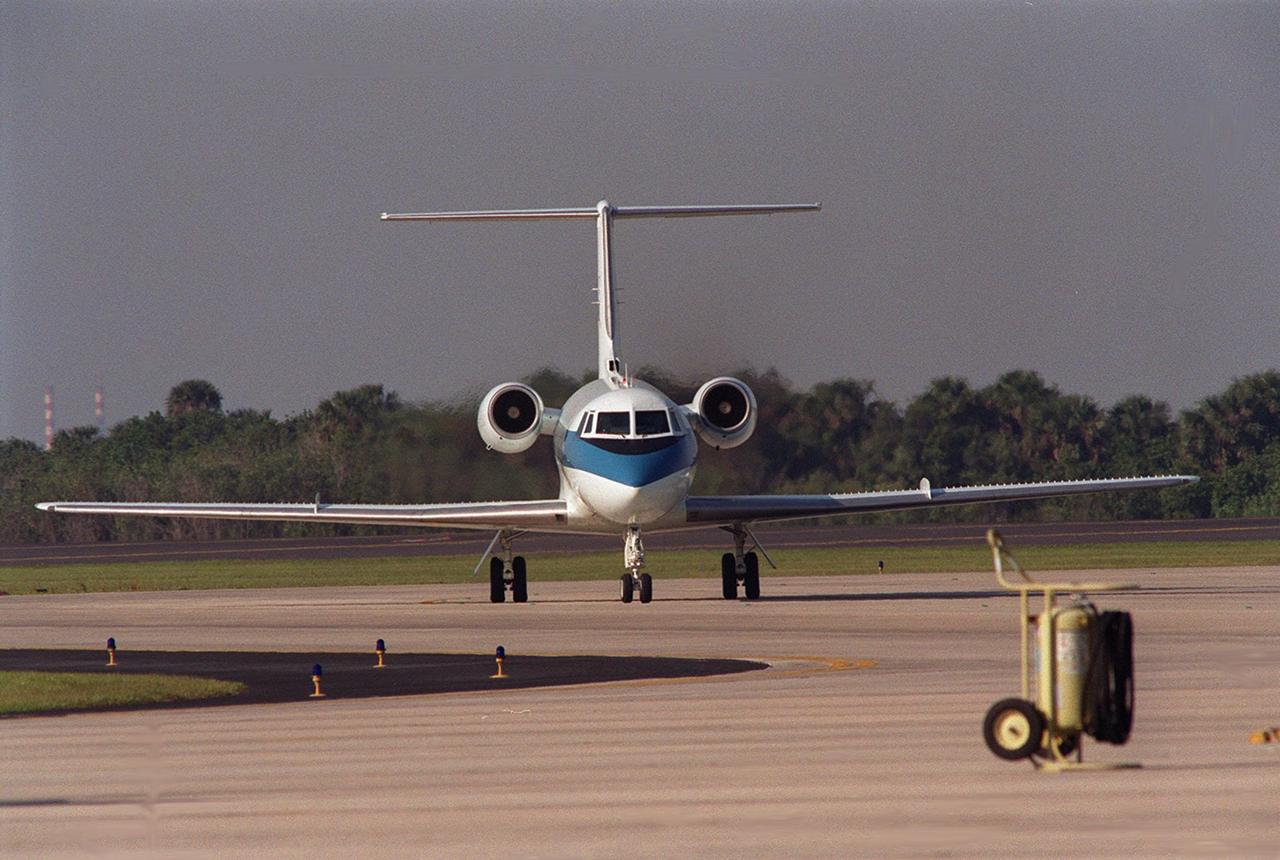
A Shuttle Training Aircraft (STA) taxis into the parking area of KSC's Shuttle Landing Facility. The STA is a modified Grumman American Aviation-built Gulfstream II executive jet that was modified to simulate an orbiter's cockpit, motion and visual cues, and handling qualities. It is used by Shuttle flight crews to practice landing the orbiter. In flight, the STA duplicates the orbiter's atmospheric descent trajectory from approximately 35,000 feet altitude to landing on a runway. The orbiter differs in at least one major aspect from conventional aircraft; it is unpowered during re-entry and landing so its high-speed glide must be perfectly executed the first time there is no go-around capability. The orbiter touchdown speed is 213 to 226 miles (343 to 364 kilometers) per hour. There are two STAs, based in Houston

A Shuttle Training Aircraft (STA) taxis into the parking area of KSC's Shuttle Landing Facility. The STA is a modified Grumman American Aviation-built Gulfstream II executive jet that was modified to simulate an orbiter's cockpit, motion and visual cues, and handling qualities. It is used by Shuttle flight crews to practice landing the orbiter. In flight, the STA duplicates the orbiter's atmospheric descent trajectory from approximately 35,000 feet altitude to landing on a runway. The orbiter differs in at least one major aspect from conventional aircraft; it is unpowered during re-entry and landing so its high-speed glide must be perfectly executed the first time there is no go-around capability. The orbiter touchdown speed is 213 to 226 miles (343 to 364 kilometers) per hour. There are two STAs, based in Houston