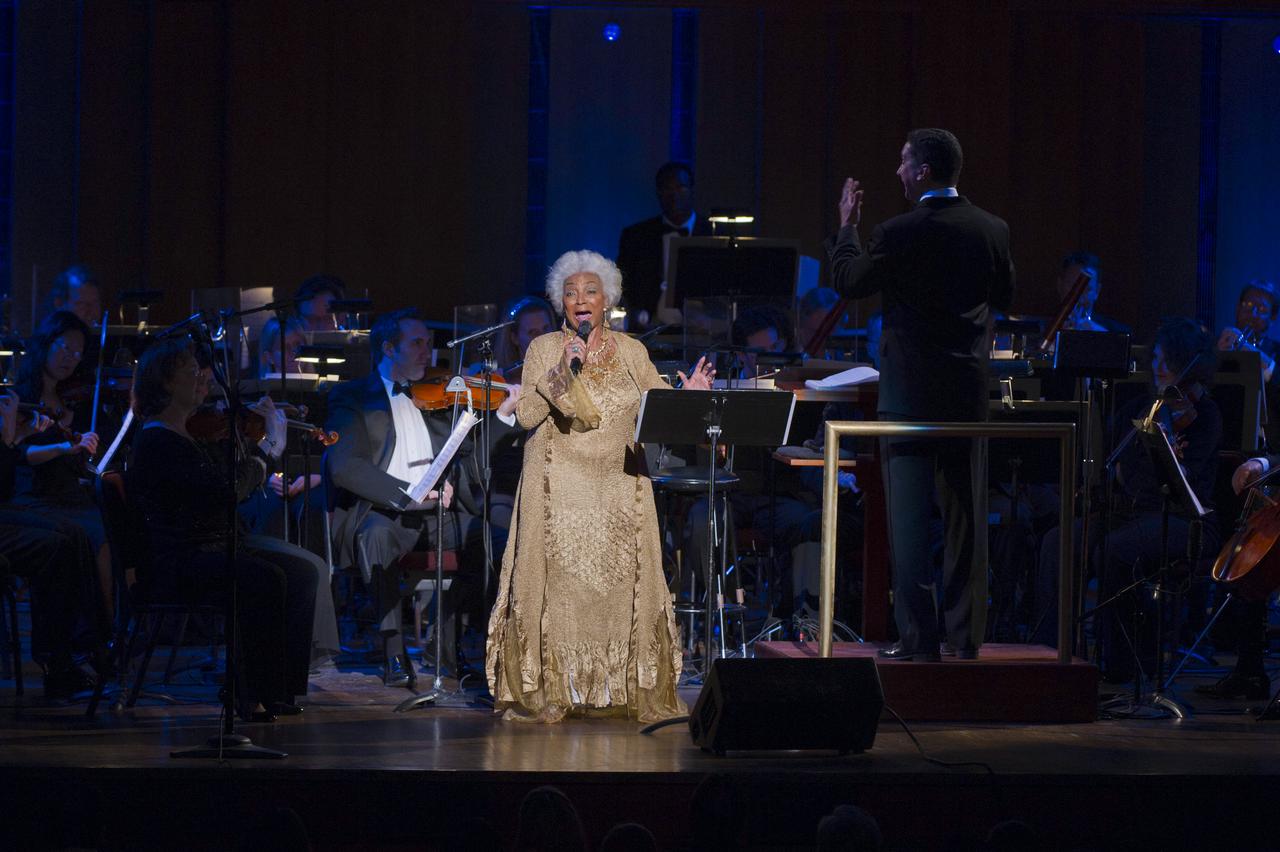
Actress Nichelle Nichols, best known for her role as communications officer Lieutenant Uhura in the series "Star Trek", sings as Emil de Cou, right, conducts the Space Philharmonic, Wednesday, May 25, 2011, in the concert hall at the John F. Kennedy Center for the Performing Arts in Washington. The event marked the 50th Anniversary of President John F. Kennedy's Special Message to the Congress on Urgent National Needs in which he stated "landing a man on the moon and returning him safely to earth". Photo Credit: (NASA/Paul E. Alers)
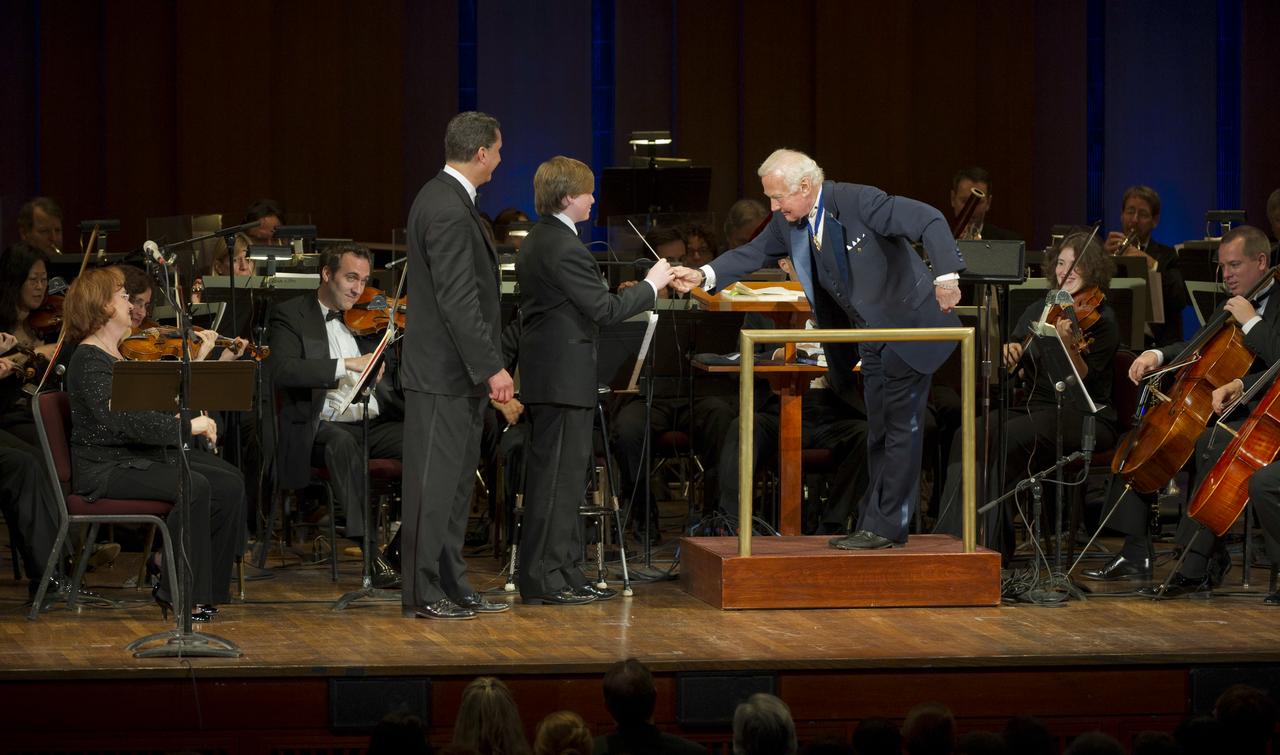
Former Apolo 11 astronaut Buzz Aldrin, right, passes the baton to second guest conductor Ted Kennedy III as conductor Emil de Cou looks on while the Space Philharmonic plays on during a program commemorating Human Spaceflight and the Kennedy Legacy, Wednesday, May 25, 2011, in the concert hall at the John F. Kennedy Center for the Performing Arts in Washington. The event marked the 50th Anniversary of President John F. Kennedy's Special Message to the Congress on Urgent National Needs in which he stated "landing a man on the moon and returning him safely to earth". Photo Credit: (NASA/Paul E. Alers)
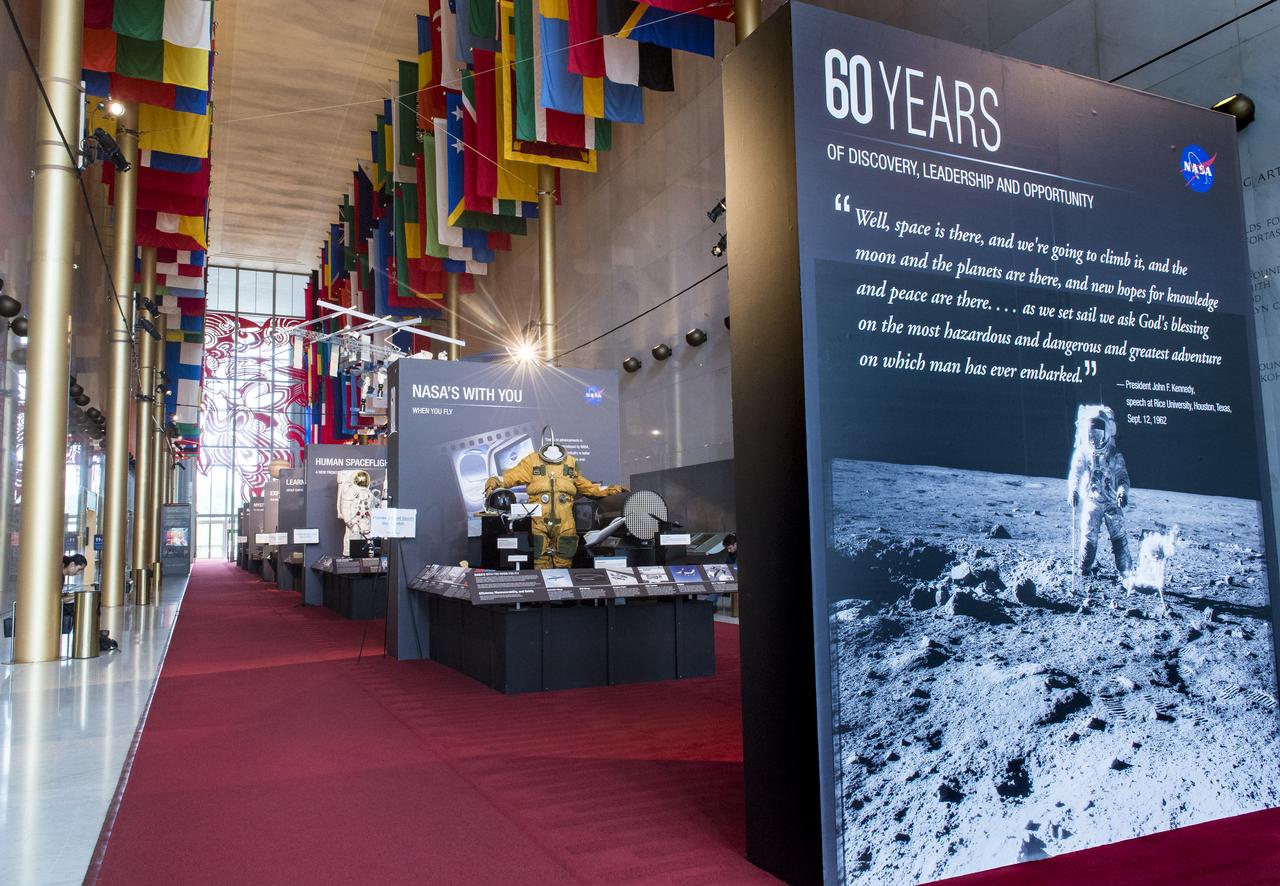
NASA's 60th Anniversary exhibits are seen at the Kennedy Center, Thursday, May 31, 2018 in Washington. Photo Credit: (NASA/Aubrey Gemignani)
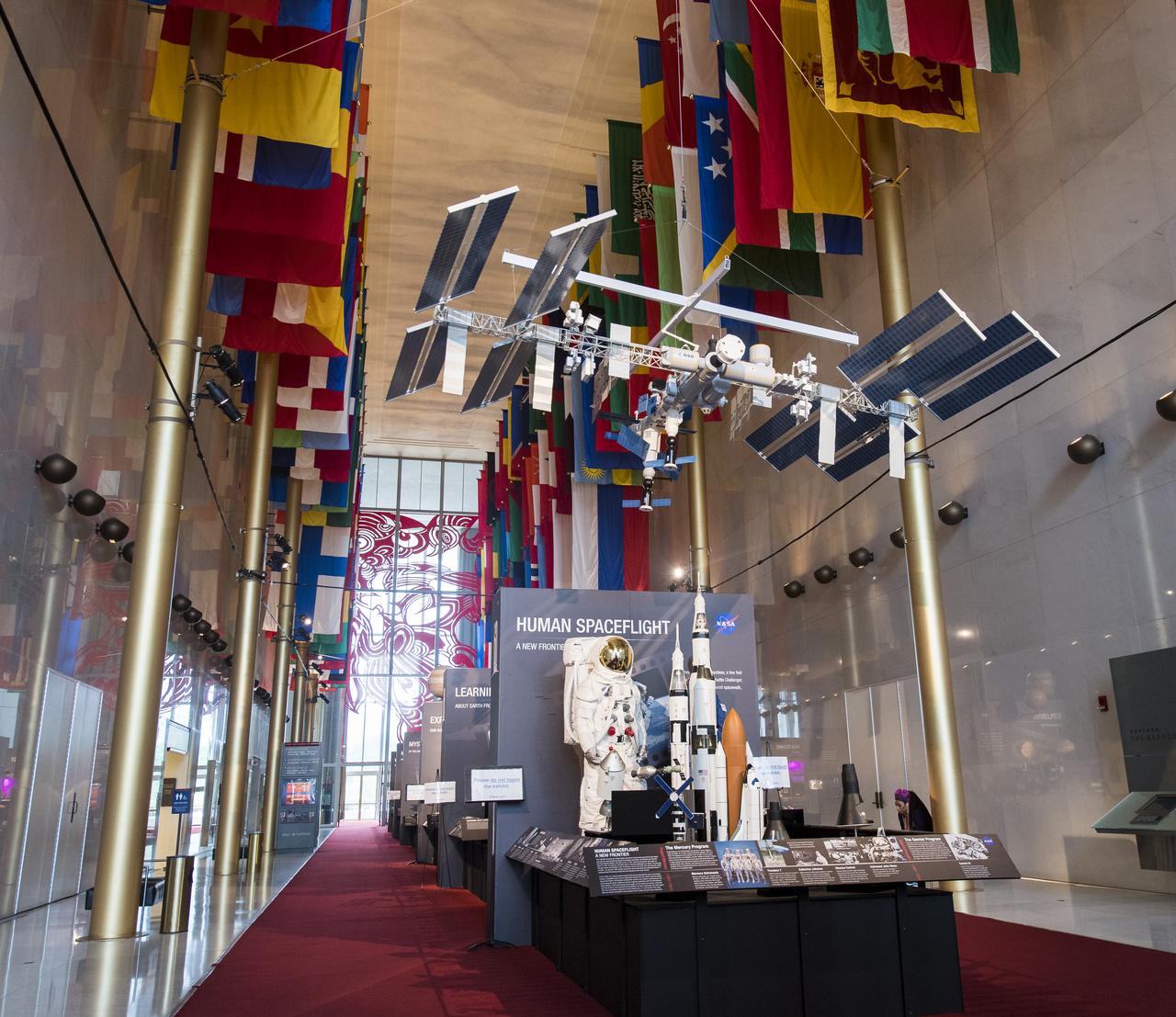
NASA's 60th Anniversary exhibits are seen at the Kennedy Center, Thursday, May 31, 2018 in Washington. Photo Credit: (NASA/Aubrey Gemignani)
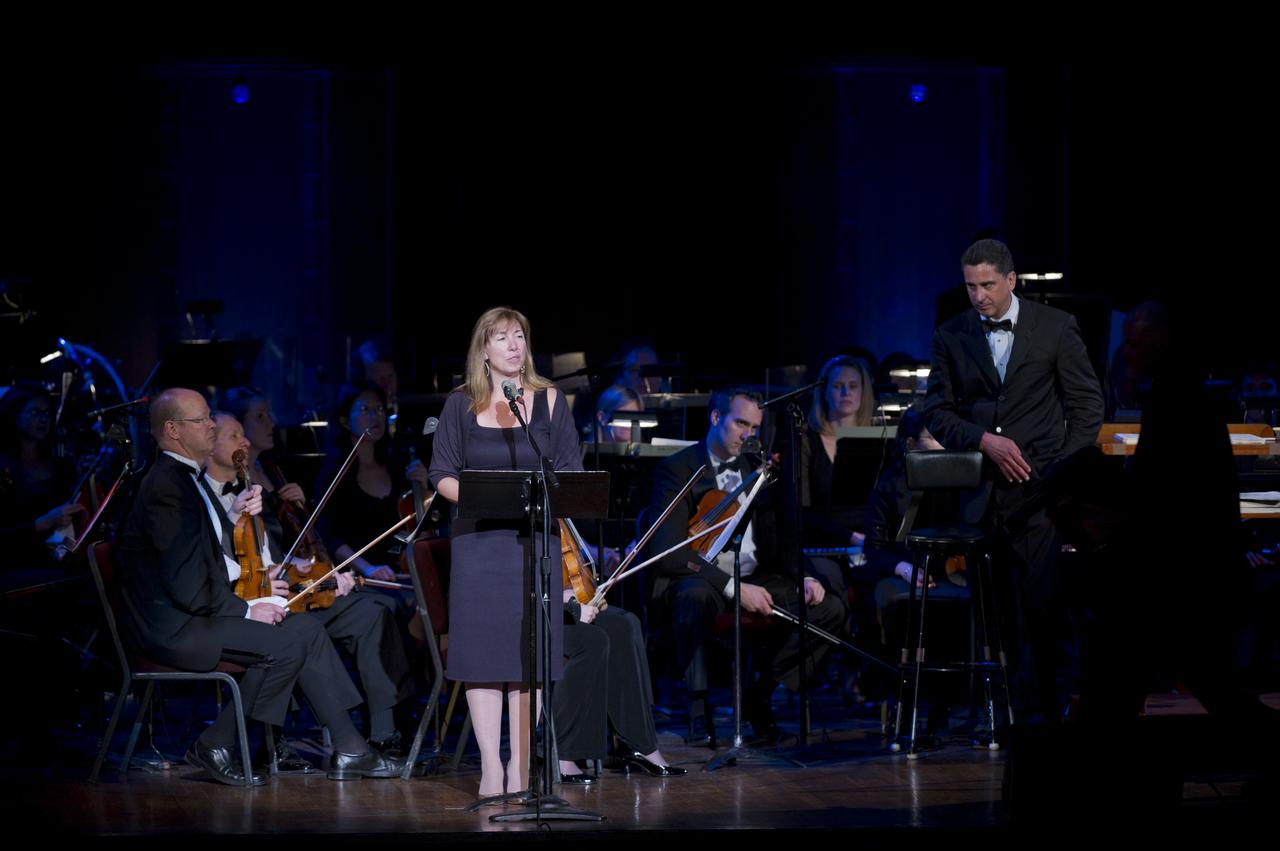
Deputy Administrator Lori Garver delivers remarks as Emil de Cou, right, looks on during a program commemorating Human Spaceflight and the Kennedy Legacy, Wednesday, May 25, 2011, in the concert hall at the John F. Kennedy Center for the Performing Arts in Washington. The event marked the 50th Anniversary of President John F. Kennedy's Special Message to the Congress on Urgent National Needs in which he stated "landing a man on the moon and returning him safely to earth". Photo Credit: (NASA/Paul E. Alers)
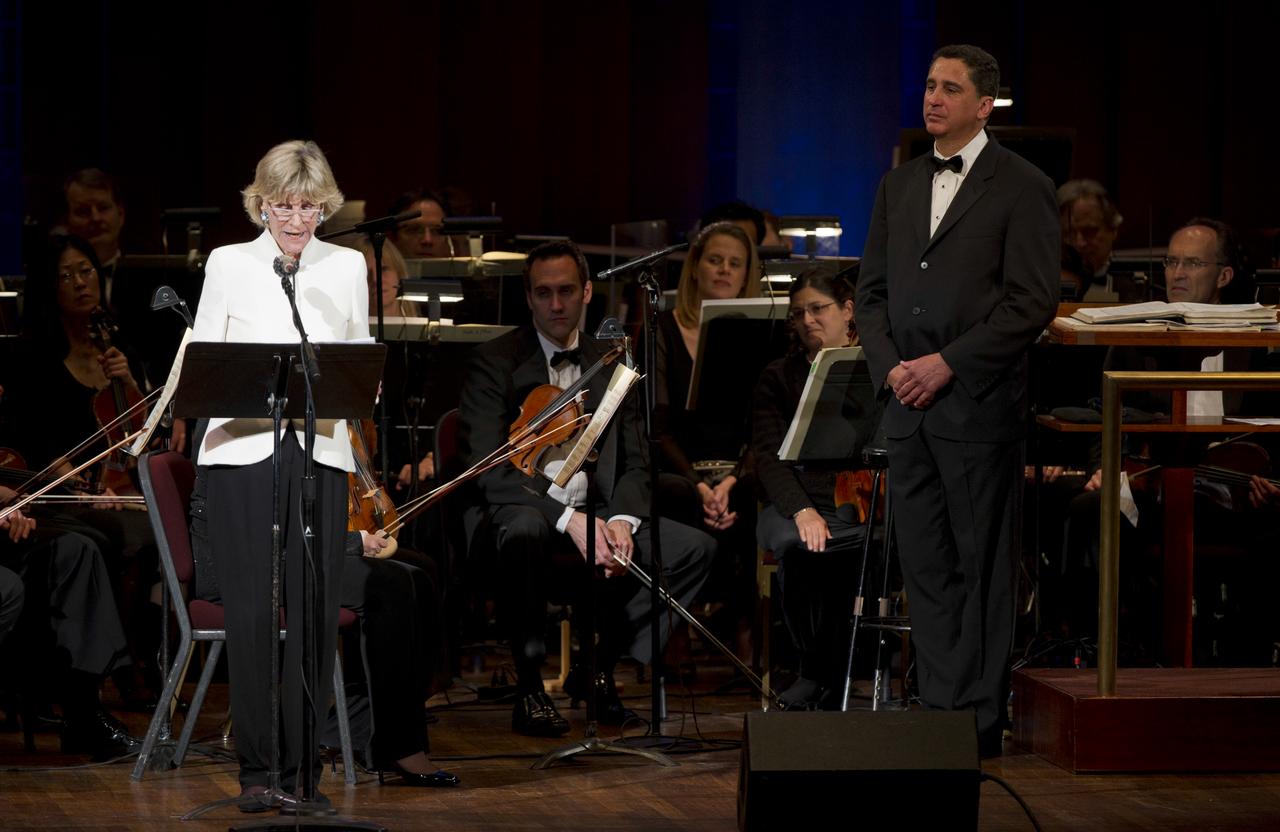
Jean Kennedy Smith, sister of John F. Kennedy, delivers remarks during a program entitled Human Spaceflight: The Kennedy Legacy as Emil de Cou, conductor of the Space Philharmonic, right, looks on, Wednesday, May 25, 2011, in the concert hall at the John F. Kennedy Center for the Performing Arts in Washington. The event marked the 50th Anniversary of President John F. Kennedy's Special Message to the Congress on Urgent National Needs in which he stated "landing a man on the moon and returning him safely to earth". Photo Credit: (NASA/Paul E. Alers)
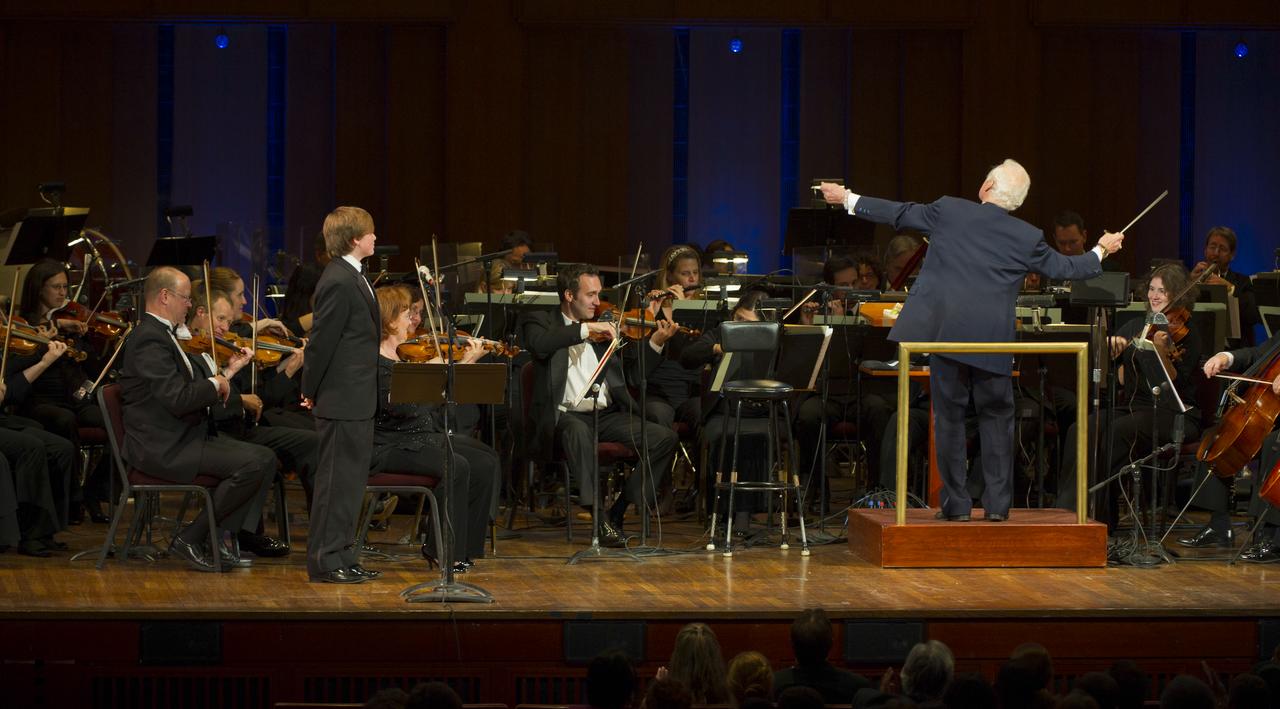
Former Apolo 11 astronaut Buzz Aldrin guest conducts the Space Philharmonic as Ted Kennedy III, left, looks on during a program commemorating Human Spaceflight and the Kennedy Legacy, Wednesday, May 25, 2011, in the concert hall at the John F. Kennedy Center for the Performing Arts in Washington. The event marked the 50th Anniversary of President John F. Kennedy's Special Message to the Congress on Urgent National Needs in which he stated "landing a man on the moon and returning him safely to earth". Photo Credit: (NASA/Paul E. Alers)
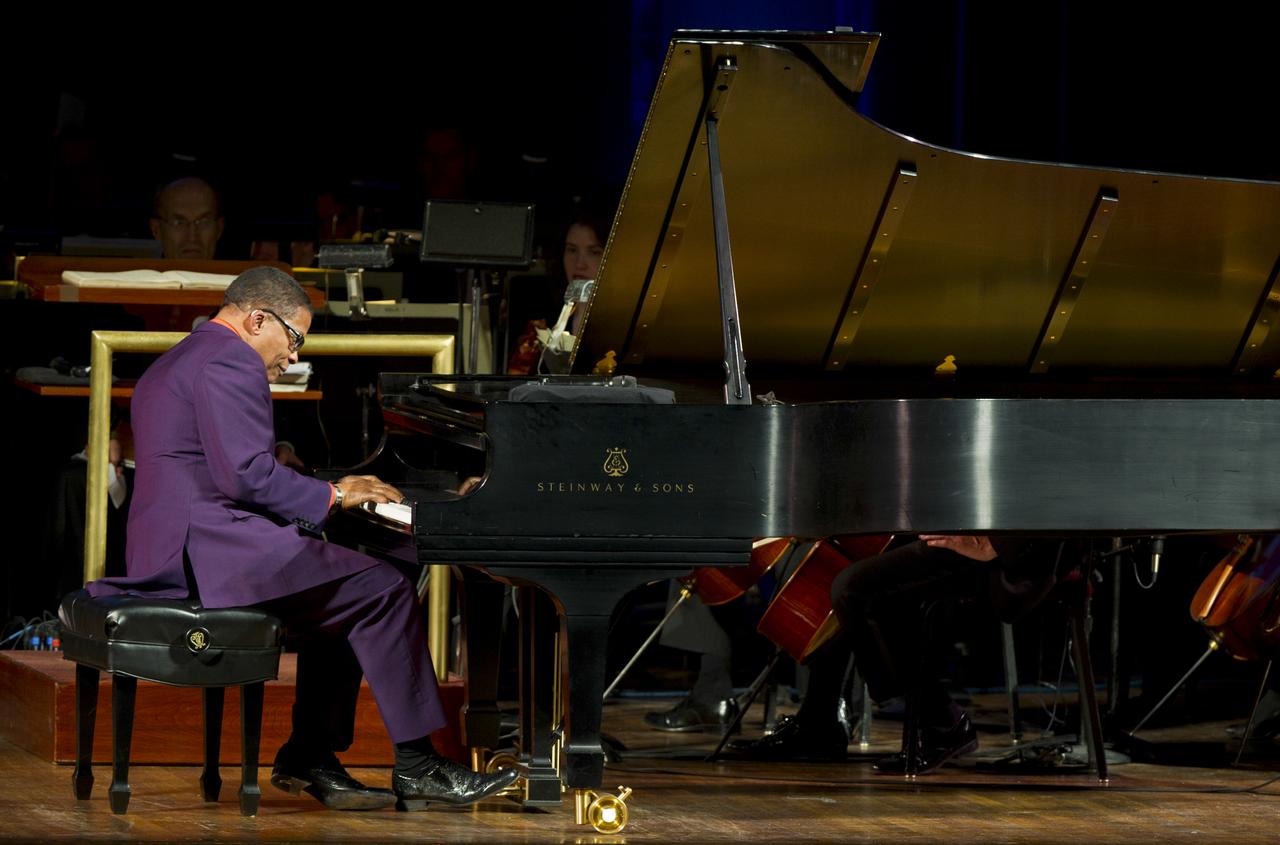
Musician Herbie Hancock plays a piece on the piano during a program commemorating Human Spaceflight and the Kennedy Legacy, Wednesday, May 25, 2011, in the concert hall at the John F. Kennedy Center for the Performing Arts in Washington. The event marked the 50th Anniversary of President John F. Kennedy's Special Message to the Congress on Urgent National Needs in which he stated "landing a man on the moon and returning him safely to earth". Photo Credit: (NASA/Paul E. Alers)
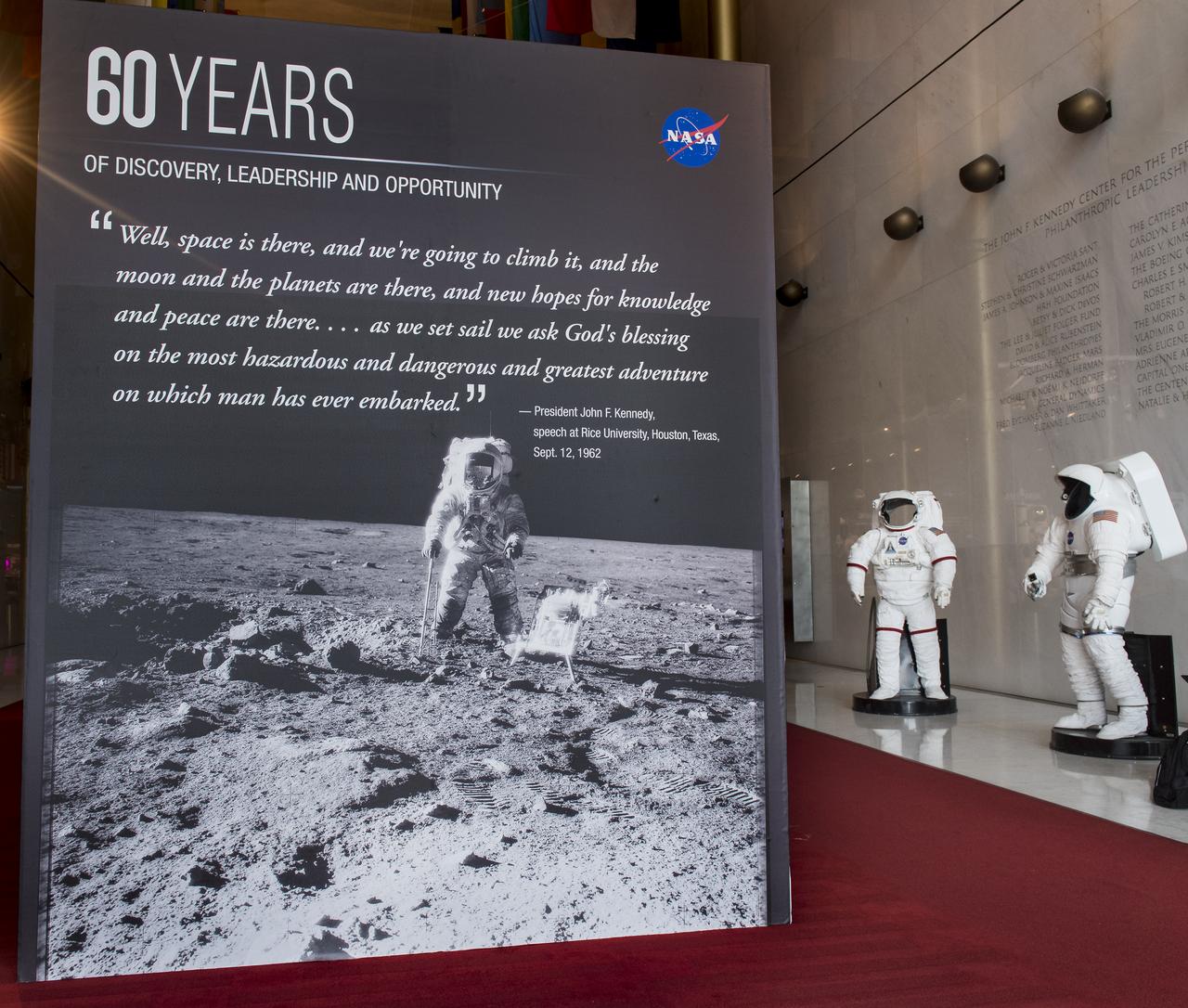
NASA's 60th Anniversary exhibits are seen at the Kennedy Center, Thursday, May 31, 2018 in Washington. Photo Credit: (NASA/Aubrey Gemignani)
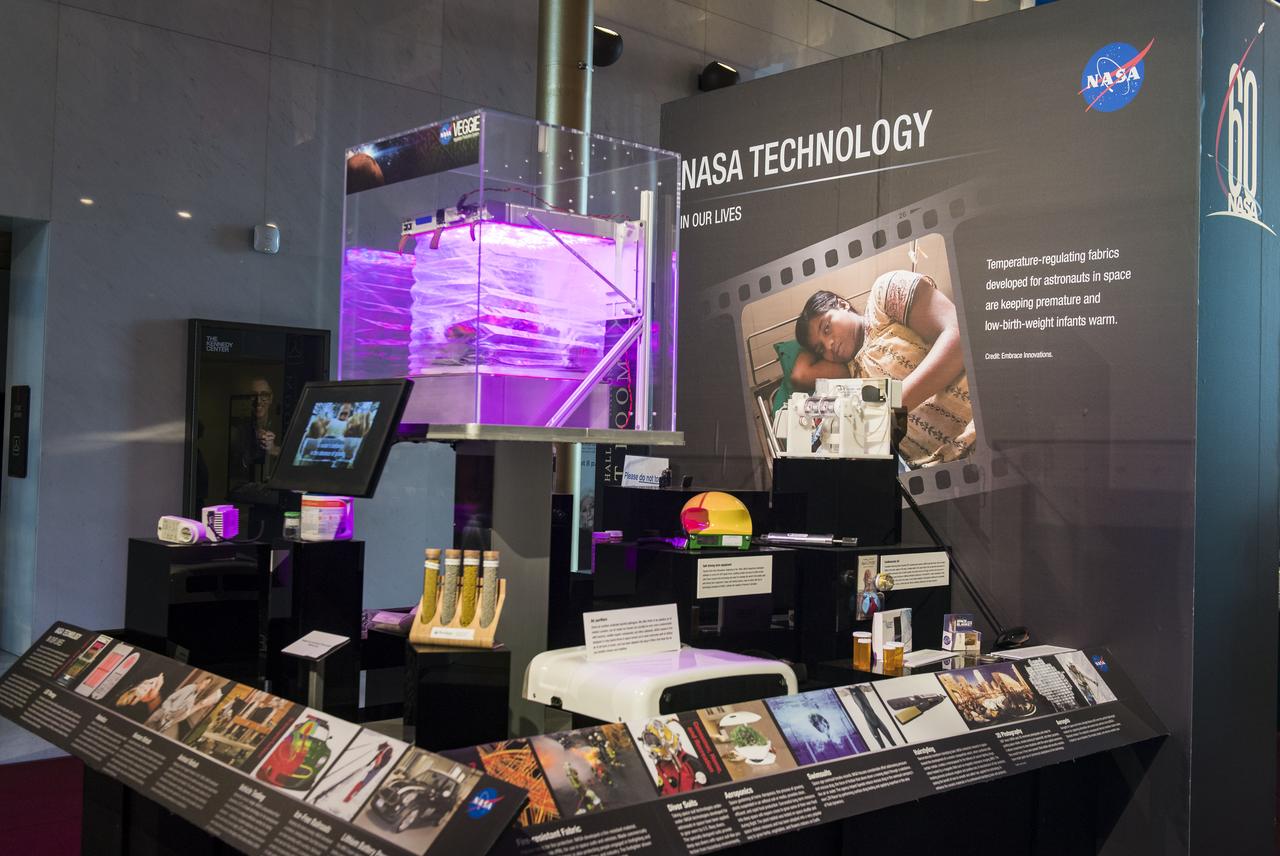
NASA's 60th Anniversary exhibits are seen at the Kennedy Center, Thursday, May 31, 2018 in Washington. Photo Credit: (NASA/Aubrey Gemignani)
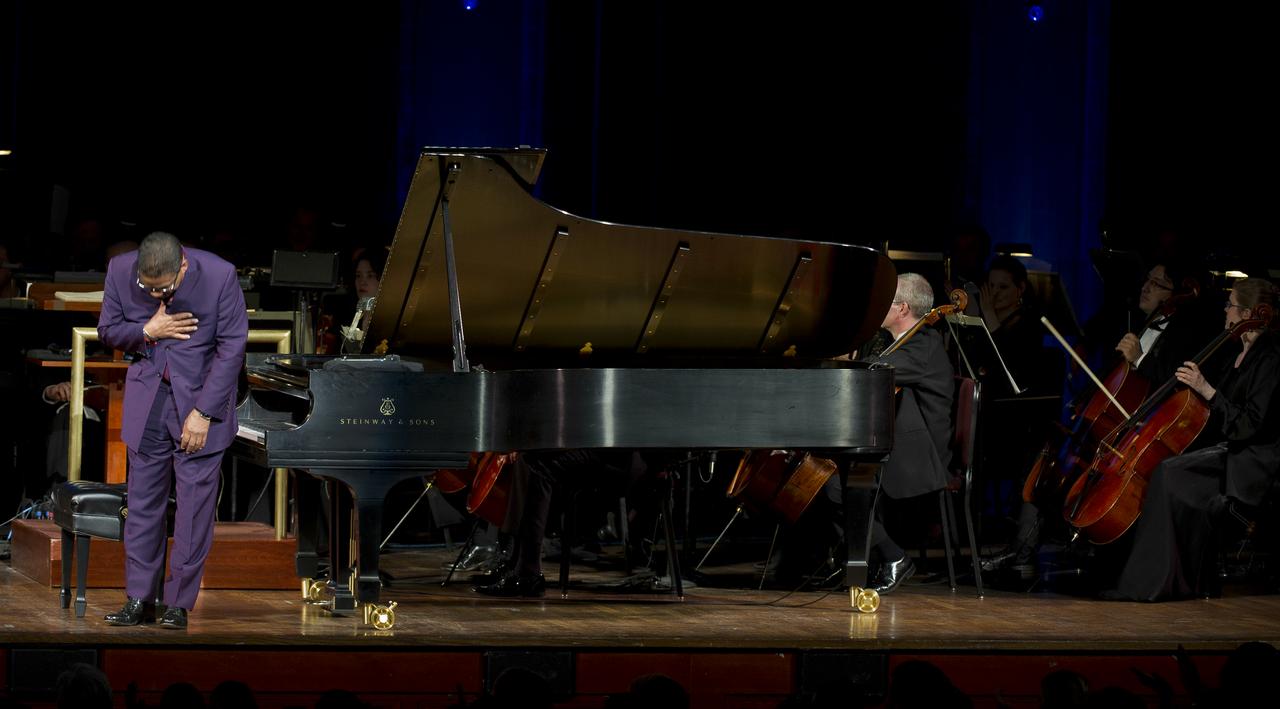
Musician Herbie Hancock bows to the audience after perfrorming during a program commemorating Human Spaceflight and the Kennedy Legacy, Wednesday, May 25, 2011, in the concert hall at the John F. Kennedy Center for the Performing Arts in Washington. The event marked the 50th Anniversary of President John F. Kennedy's Special Message to the Congress on Urgent National Needs in which he stated "landing a man on the moon and returning him safely to earth". Photo Credit: (NASA/Paul E. Alers)
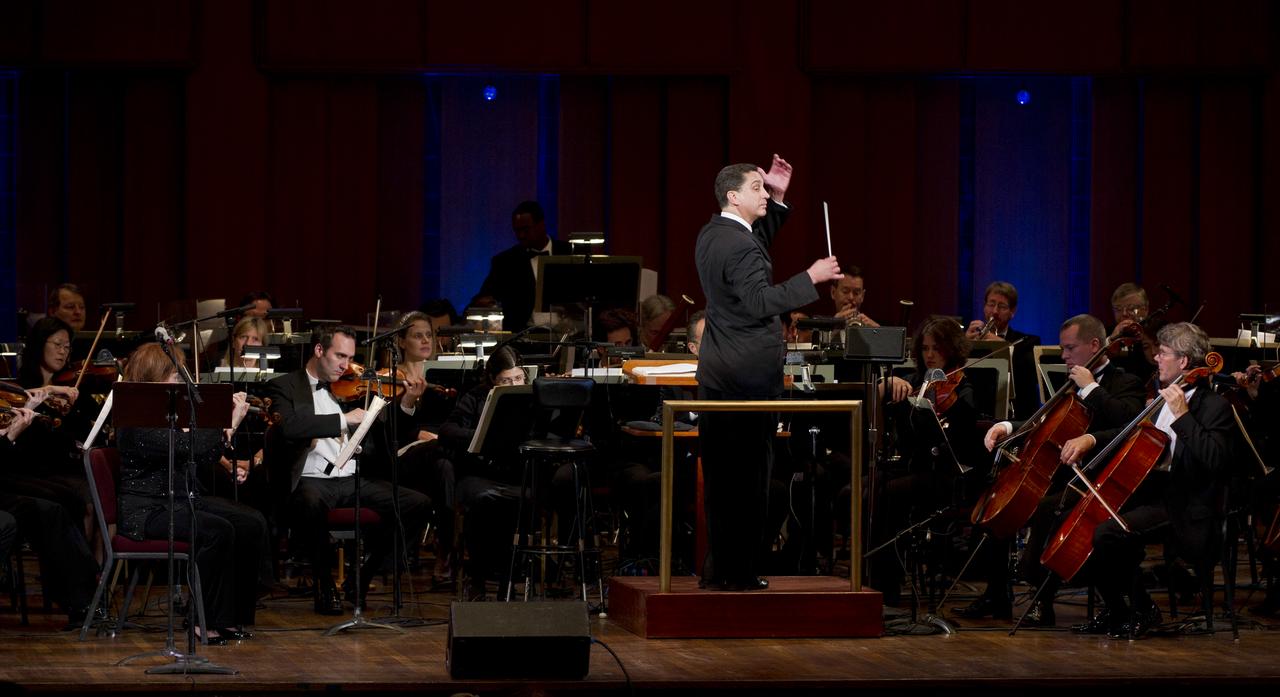
Emil de Cou conducts the Space Philharmonic during a program entitled Human Spaceflight: The Kennedy Legacy, Wednesday, May 25, 2011, in the concert hall at the John F. Kennedy Center for the Performing Arts in Washington. The event marked the 50th Anniversary of President John F. Kennedy's Special Message to the Congress on Urgent National Needs in which he stated "landing a man on the moon and returning him safely to earth". Photo Credit: (NASA/Paul E. Alers)
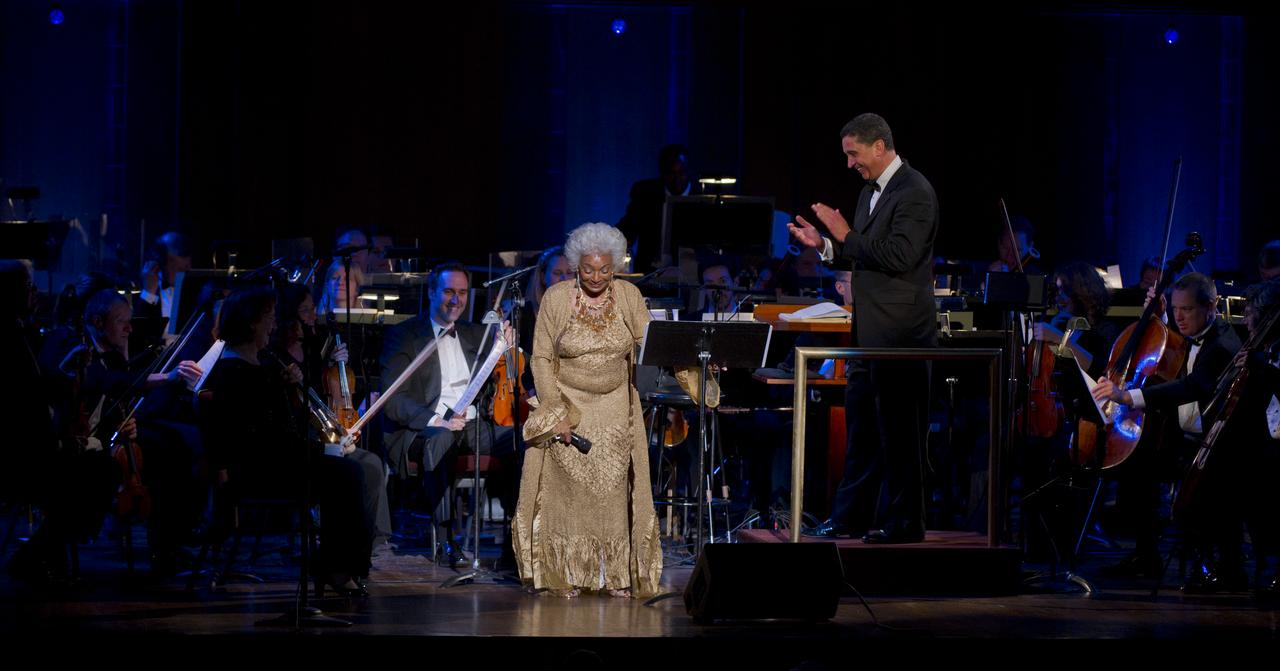
Actress Nichelle Nichols, best known for her role as communications officer Lieutenant Uhura in the series "Star Trek", bows as Emil de Cou, right, applauds, Wednesday, May 25, 2011, in the concert hall at the John F. Kennedy Center for the Performing Arts in Washington. The event marked the 50th Anniversary of President John F. Kennedy's Special Message to the Congress on Urgent National Needs in which he stated "landing a man on the moon and returning him safely to earth". Photo Credit: (NASA/Paul E. Alers)
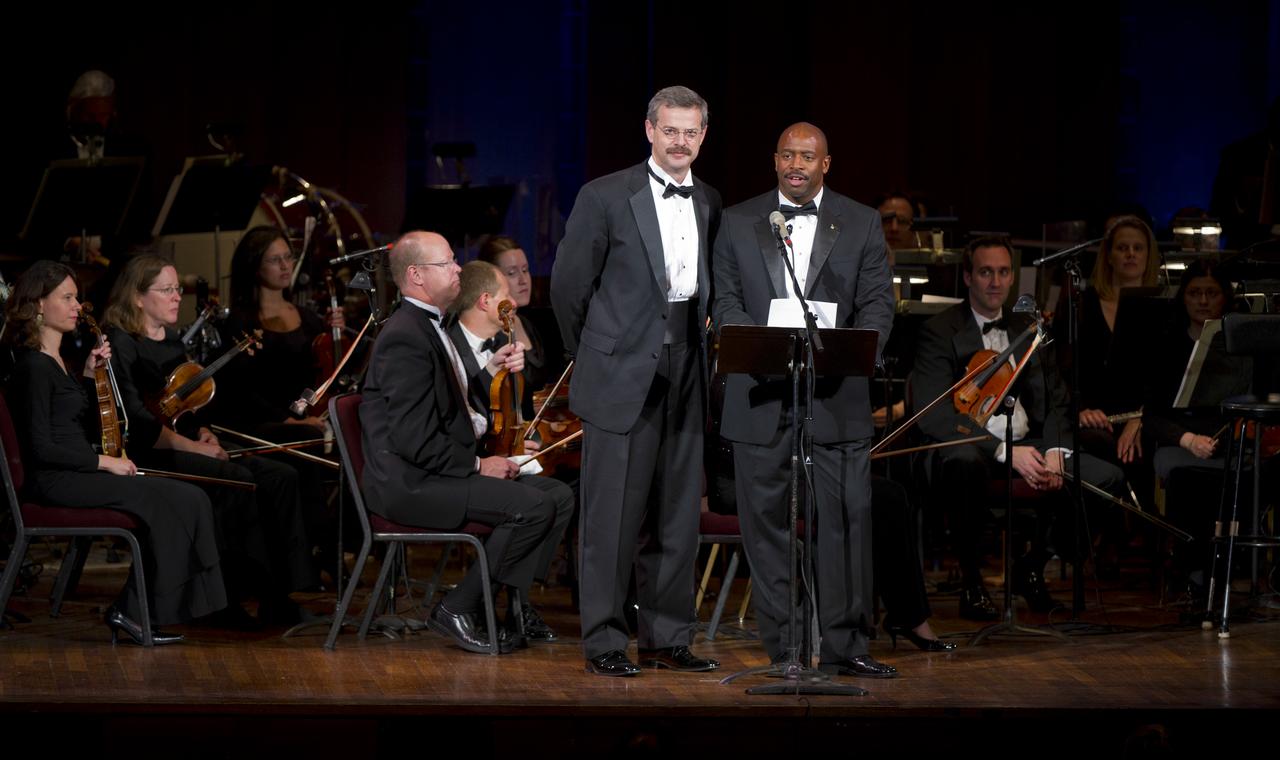
Astronauts Scott Altman, left, and Leland Melvin speak of their fallen comrades during a program commemorating Human Spaceflight and the Kennedy Legacy, Wednesday, May 25, 2011, in the concert hall at the John F. Kennedy Center for the Performing Arts in Washington. The event marked the 50th Anniversary of President John F. Kennedy's Special Message to the Congress on Urgent National Needs in which he stated "landing a man on the moon and returning him safely to earth". Photo Credit: (NASA/Paul E. Alers)
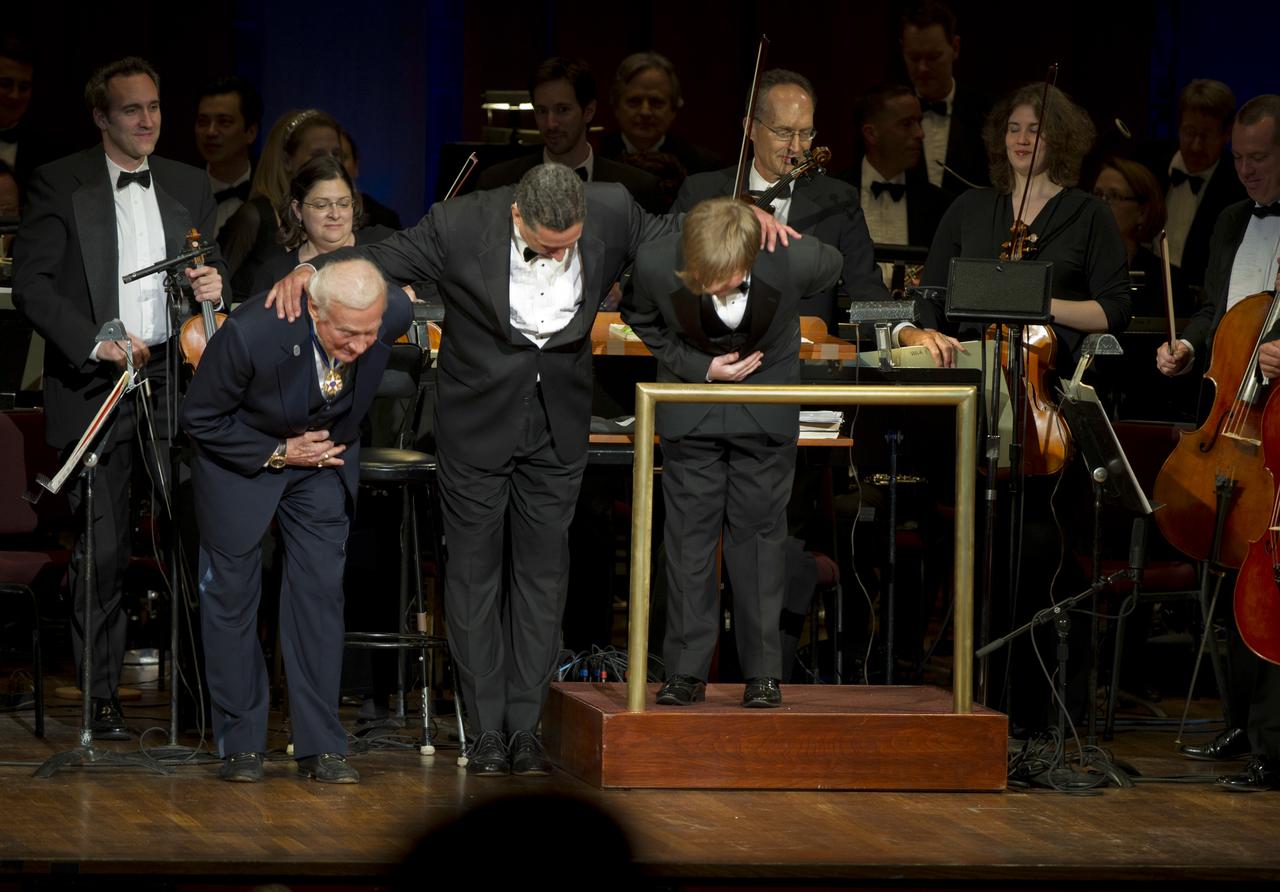
Former Apolo 11 astronaut Buzz Aldrin, left, Emil de Cou, and Ted Kennedy III, right, bow at the end of a program commemorating Human Spaceflight and the Kennedy Legacy, Wednesday, May 25, 2011, in the concert hall at the John F. Kennedy Center for the Performing Arts in Washington. The event marked the 50th Anniversary of President John F. Kennedy's Special Message to the Congress on Urgent National Needs in which he stated "landing a man on the moon and returning him safely to earth". Photo Credit: (NASA/Paul E. Alers)
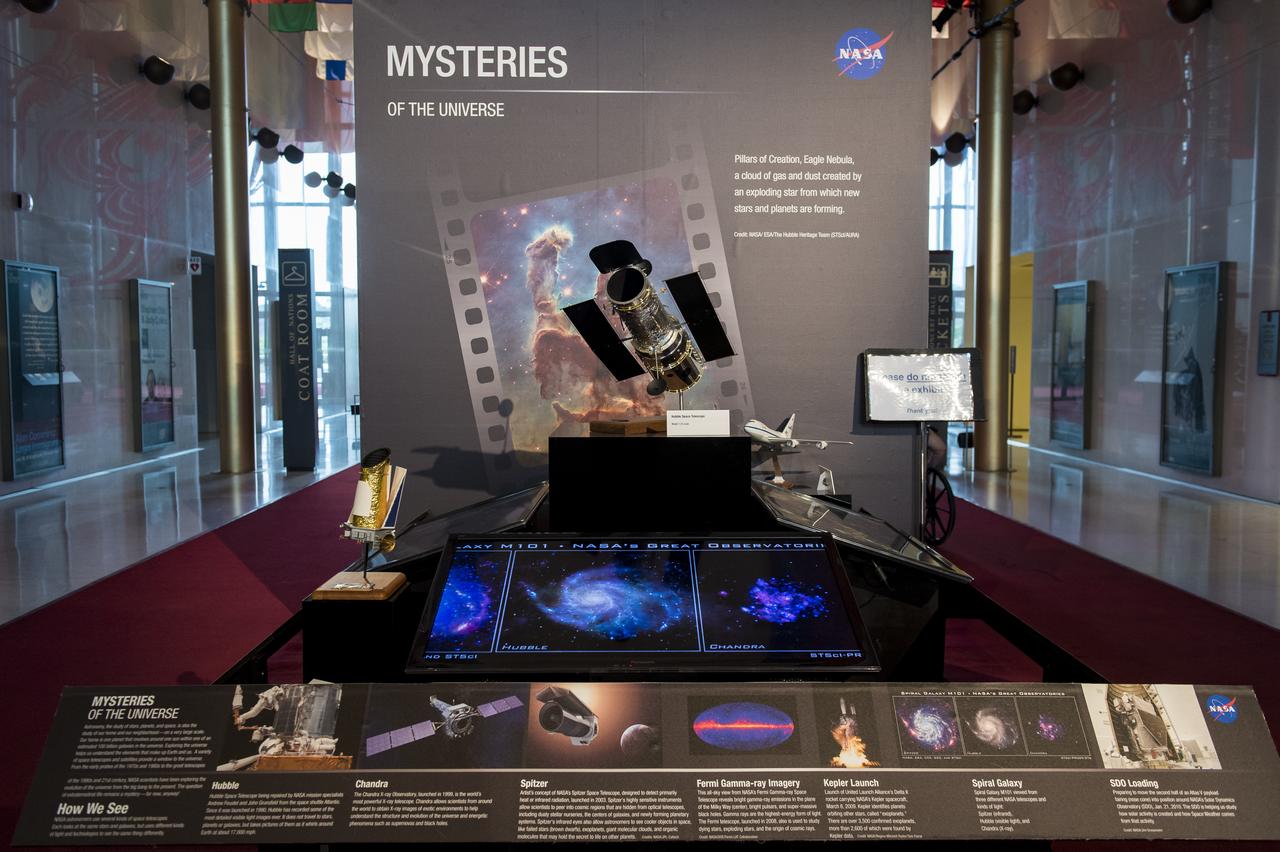
NASA's 60th Anniversary exhibits are seen at the Kennedy Center, Thursday, May 31, 2018 in Washington. Photo Credit: (NASA/Aubrey Gemignani)
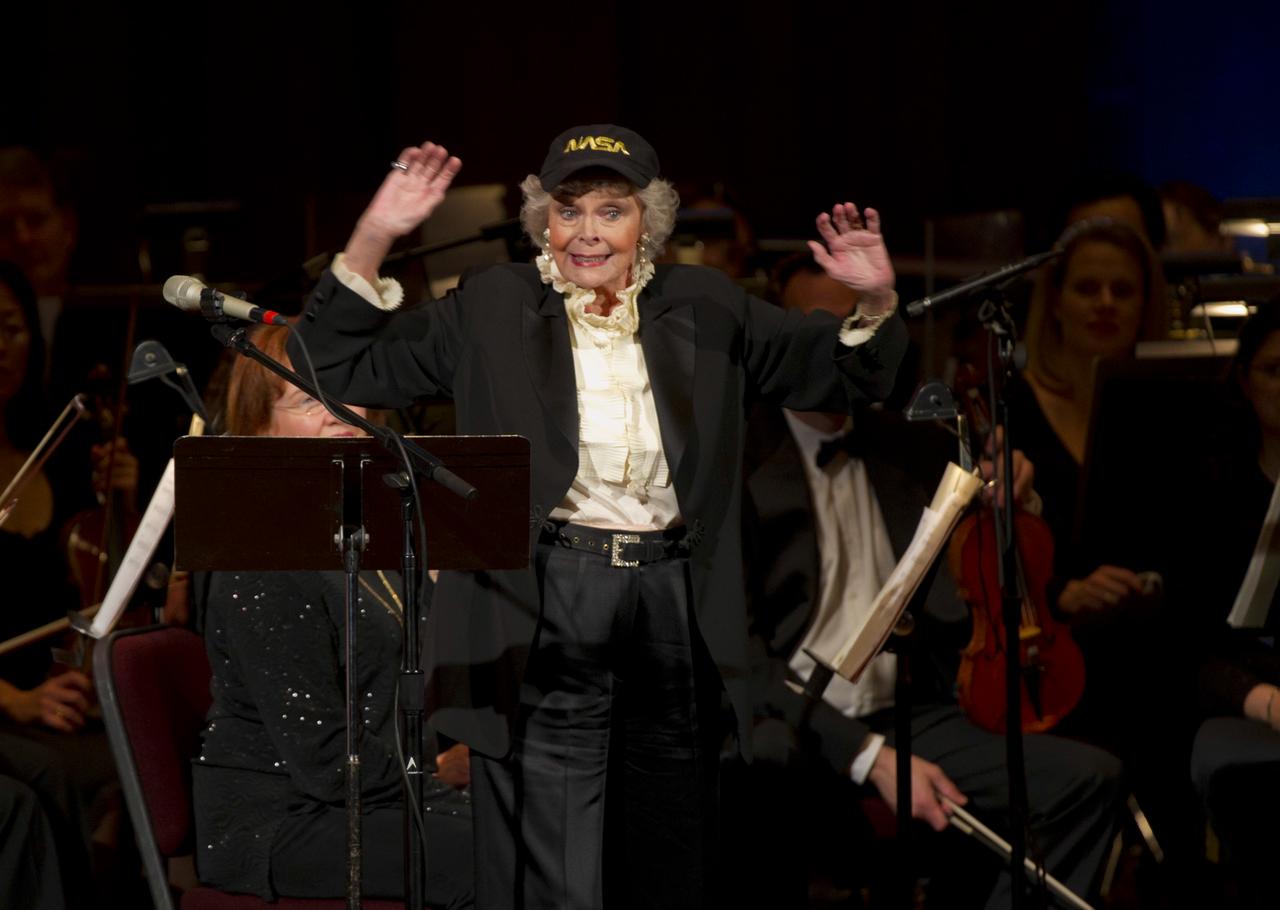
Actress June Lockhart livens up the audience after donning a NASA cap during a program entitled Human Spaceflight: The Kennedy Legacy, Wednesday, May 25, 2011, in the concert hall at the John F. Kennedy Center for the Performing Arts in Washington. The event marked the 50th Anniversary of President John F. Kennedy's Special Message to the Congress on Urgent National Needs in which he stated "landing a man on the moon and returning him safely to earth". Photo Credit: (NASA/Paul E. Alers)
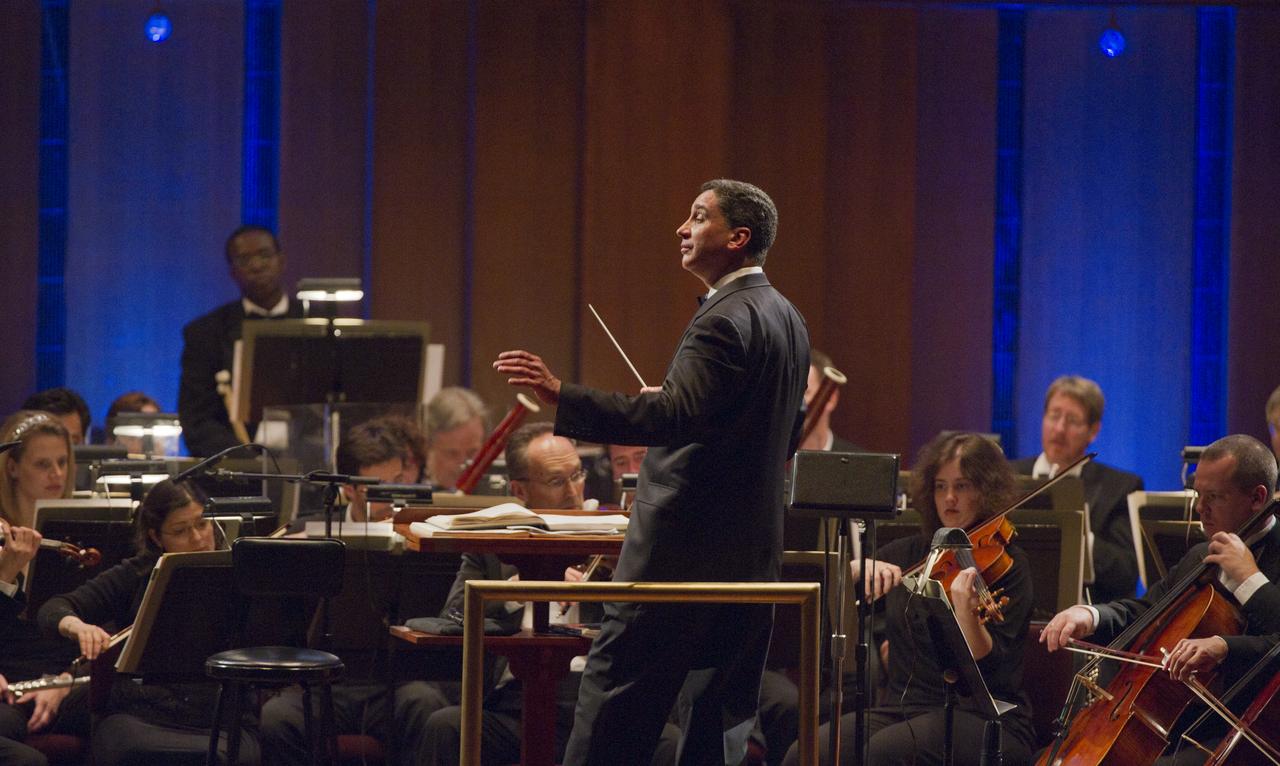
Emil de Cou conducts the Space Philharmonic during a program entitled Human Spaceflight: The Kennedy Legacy, Wednesday, May 25, 2011, in the concert hall at the John F. Kennedy Center for the Performing Arts in Washington. The event marked the 50th Anniversary of President John F. Kennedy's Special Message to the Congress on Urgent National Needs in which he stated "landing a man on the moon and returning him safely to earth". Photo Credit: (NASA/Paul E. Alers)
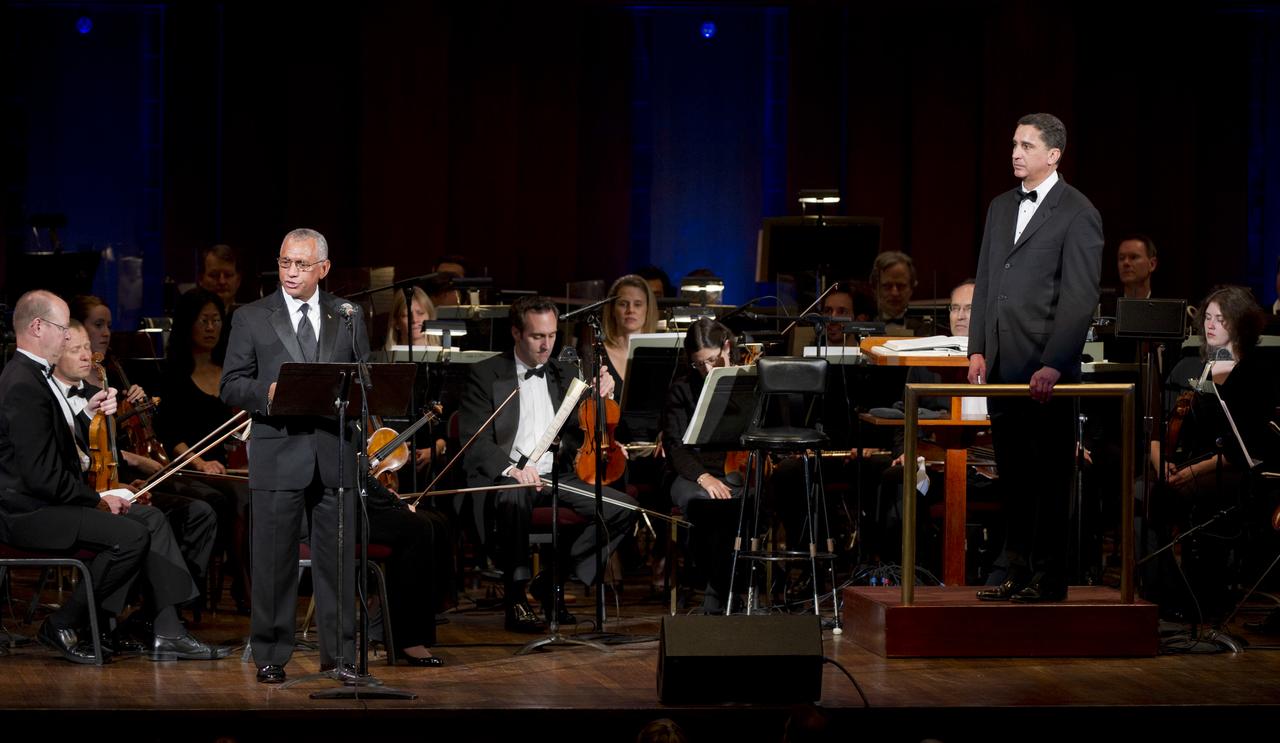
NASA Administrator Charles Bolden delivers opening remarks at the beginning of a program entitled Human Spaceflight: The Kennedy Legacy as Emil de Cou, conductor of the Space Philharmonic, right, looks on, Wednesday, May 25, 2011, in the concert hall at the John F. Kennedy Center for the Performing Arts in Washington. The event marked the 50th Anniversary of President John F. Kennedy's Special Message to the Congress on Urgent National Needs in which he stated "landing a man on the moon and returning him safely to earth". Photo Credit: (NASA/Paul E. Alers)
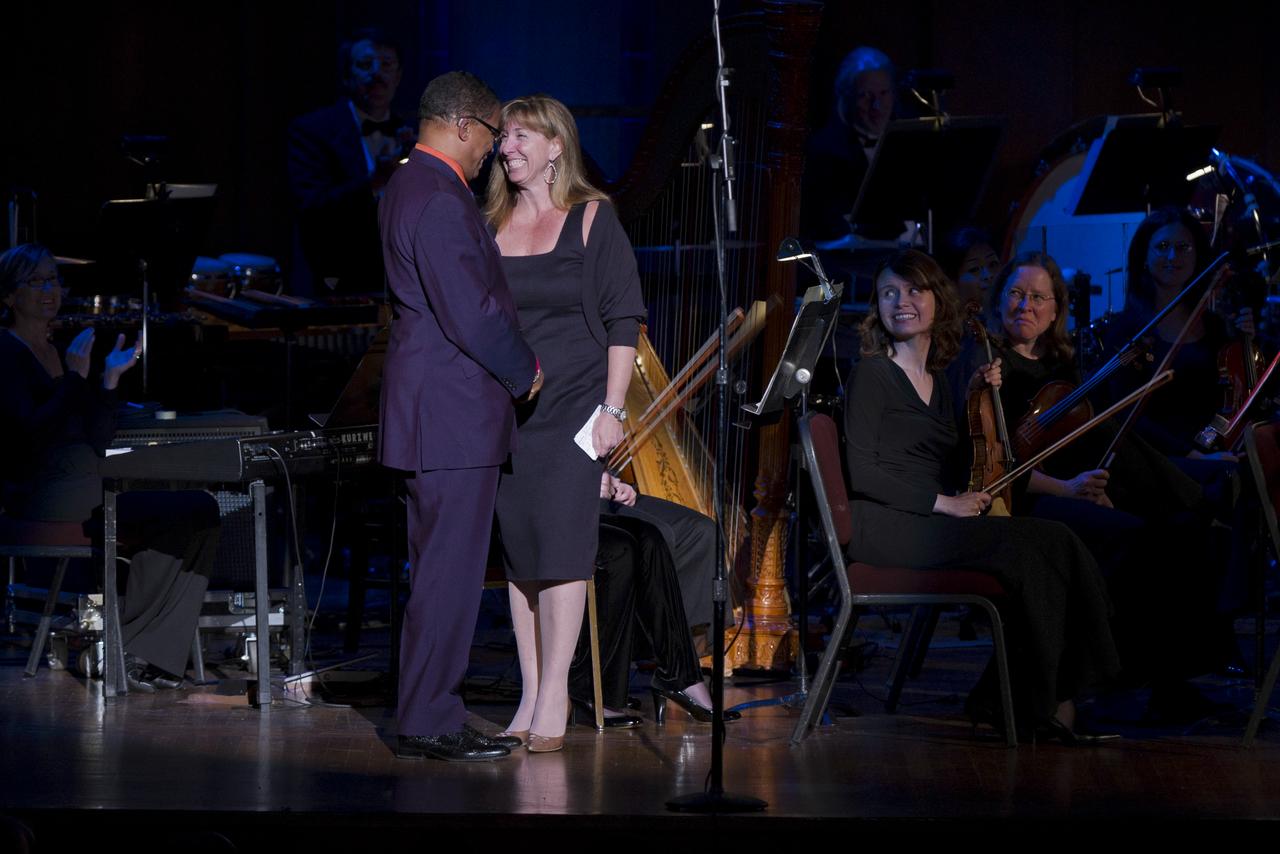
Deputy Administrator Lori Garver, right, smiles after introducing musical guest Herbie Hancock, left, as members of the Space Philharmonic look on during a program commemorating Human Spaceflight and the Kennedy Legacy, Wednesday, May 25, 2011, in the concert hall at the John F. Kennedy Center for the Performing Arts in Washington. The event marked the 50th Anniversary of President John F. Kennedy's Special Message to the Congress on Urgent National Needs in which he stated "landing a man on the moon and returning him safely to earth". Photo Credit: (NASA/Paul E. Alers)
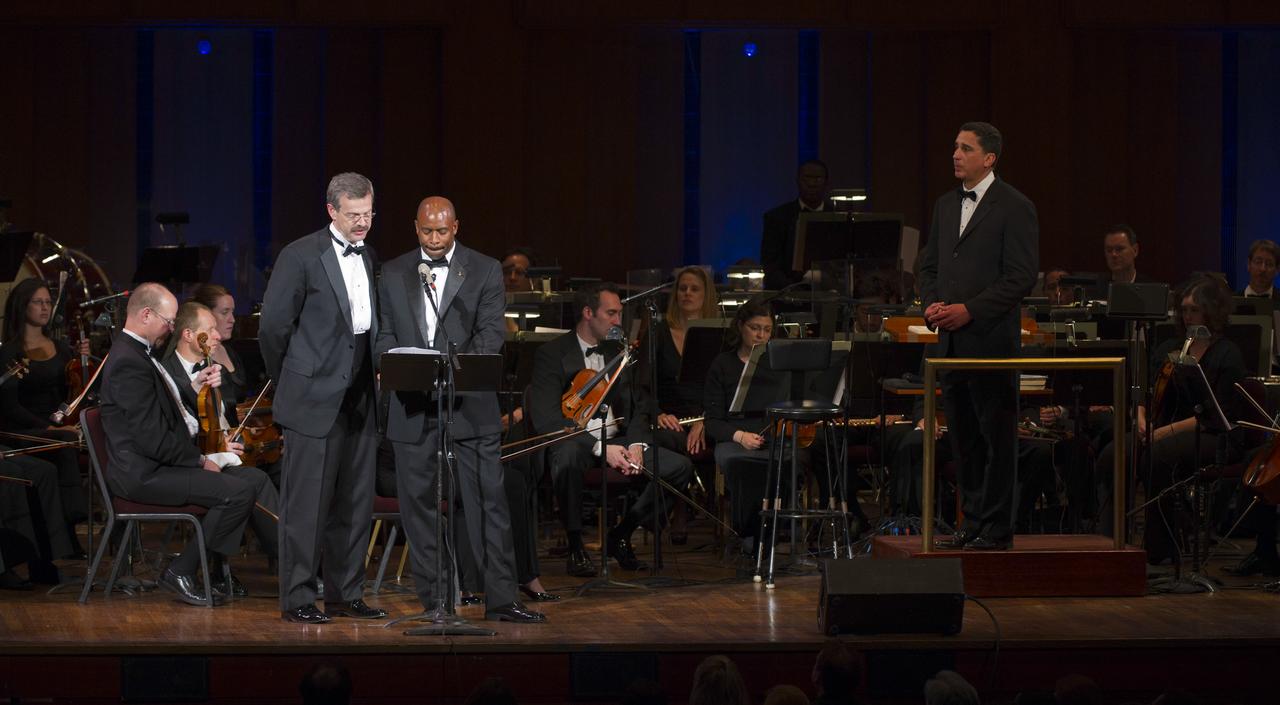
Astronauts Scott Altman, left, and Leland Melvin speak of their fallen comrades as Emil de Cou, right, looks on during a program commemorating Human Spaceflight and the Kennedy Legacy, Wednesday, May 25, 2011, in the concert hall at the John F. Kennedy Center for the Performing Arts in Washington. The event marked the 50th Anniversary of President John F. Kennedy's Special Message to the Congress on Urgent National Needs in which he stated "landing a man on the moon and returning him safely to earth". Photo Credit: (NASA/Paul E. Alers)

Musician Herbie Hancock delivers remarks as members of the Space Philharmonic look on during a program commemorating Human Spaceflight and the Kennedy Legacy, Wednesday, May 25, 2011, in the concert hall at the John F. Kennedy Center for the Performing Arts in Washington. The event marked the 50th Anniversary of President John F. Kennedy's Special Message to the Congress on Urgent National Needs in which he stated "landing a man on the moon and returning him safely to earth". Photo Credit: (NASA/Paul E. Alers)
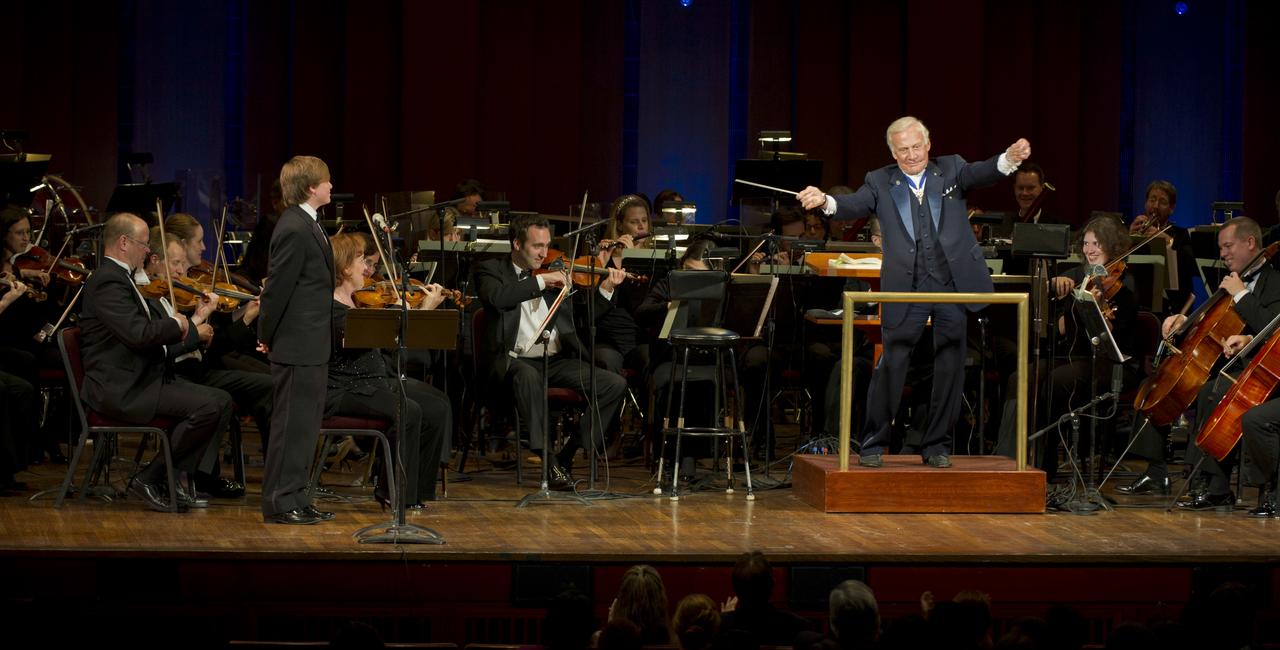
Former Apolo 11 astronaut Buzz Aldrin guest conducts the Space Philharmonic as Ted Kennedy III, left, looks on during a program commemorating Human Spaceflight and the Kennedy Legacy, Wednesday, May 25, 2011, in the concert hall at the John F. Kennedy Center for the Performing Arts in Washington. The event marked the 50th Anniversary of President John F. Kennedy's Special Message to the Congress on Urgent National Needs in which he stated "landing a man on the moon and returning him safely to earth". Photo Credit: (NASA/Paul E. Alers)
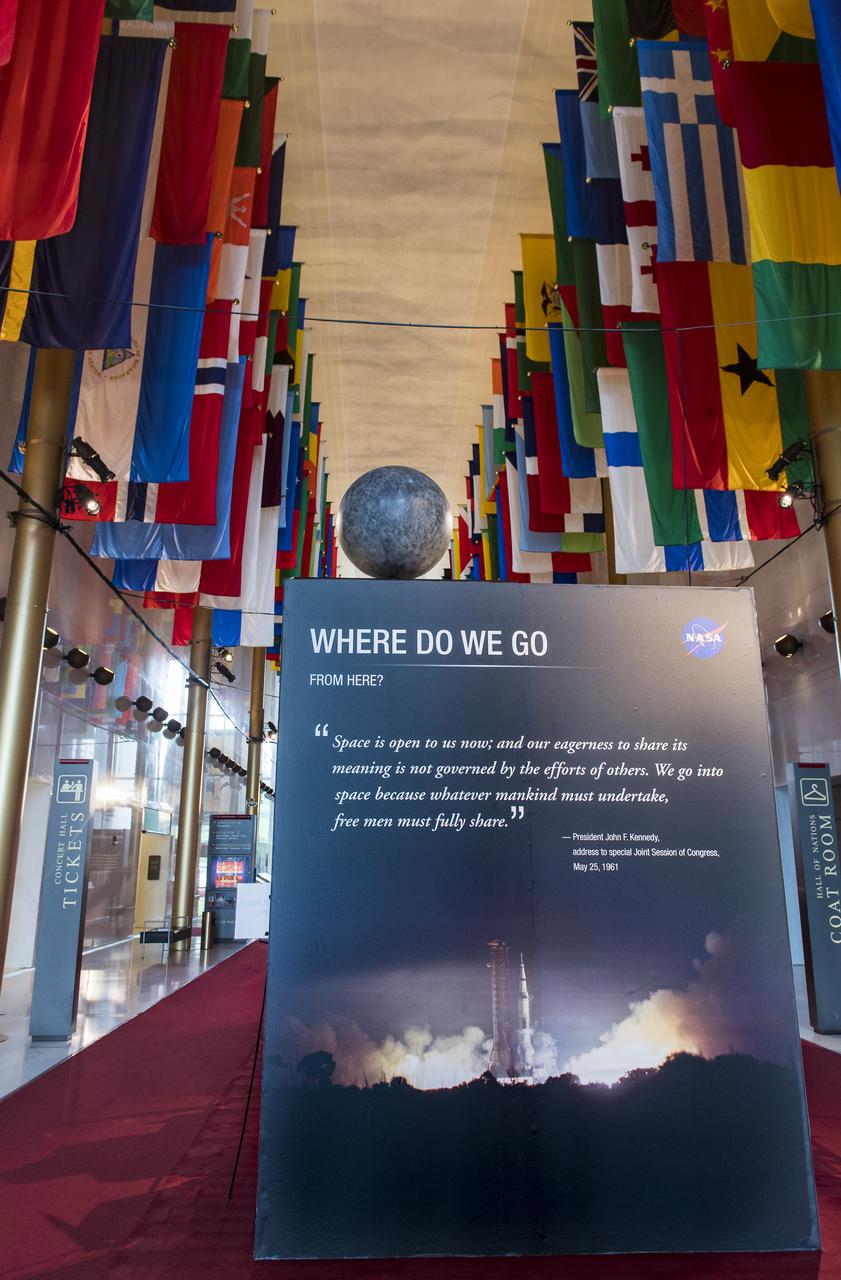
NASA's 60th Anniversary exhibits are seen at the Kennedy Center, Thursday, May 31, 2018 in Washington. Photo Credit: (NASA/Aubrey Gemignani)

Actress June Lockhart delivers remarks during a program entitled Human Spaceflight: The Kennedy Legacy, Wednesday, May 25, 2011, in the concert hall at the John F. Kennedy Center for the Performing Arts in Washington. The event marked the 50th Anniversary of President John F. Kennedy's Special Message to the Congress on Urgent National Needs in which he stated "landing a man on the moon and returning him safely to earth". Photo Credit: (NASA/Paul E. Alers)
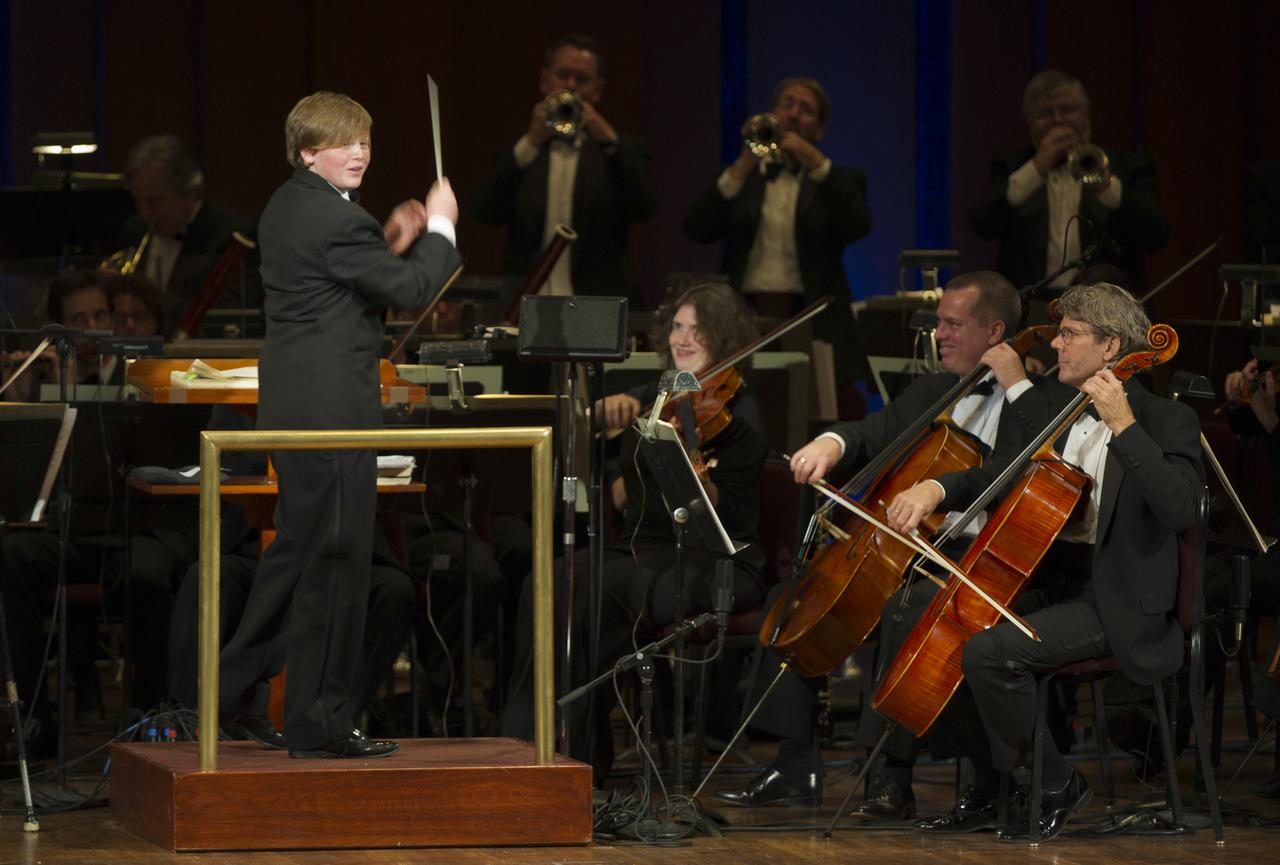
Ted Kennedy III guest conducts the Space Philharmonic during a program commemorating Human Spaceflight and the Kennedy Legacy, Wednesday, May 25, 2011, in the concert hall at the John F. Kennedy Center for the Performing Arts in Washington. The event marked the 50th Anniversary of President John F. Kennedy's Special Message to the Congress on Urgent National Needs in which he stated "landing a man on the moon and returning him safely to earth". Photo Credit: (NASA/Paul E. Alers)

Actress Nichelle Nichols, best known for her role as communications officer Lieutenant Uhura in the series "Star Trek", sings as she is escorted on stage, Wednesday, May 25, 2011, in the concert hall at the John F. Kennedy Center for the Performing Arts in Washington. The event marked the 50th Anniversary of President John F. Kennedy's Special Message to the Congress on Urgent National Needs in which he stated "landing a man on the moon and returning him safely to earth". Photo Credit: (NASA/Paul E. Alers)
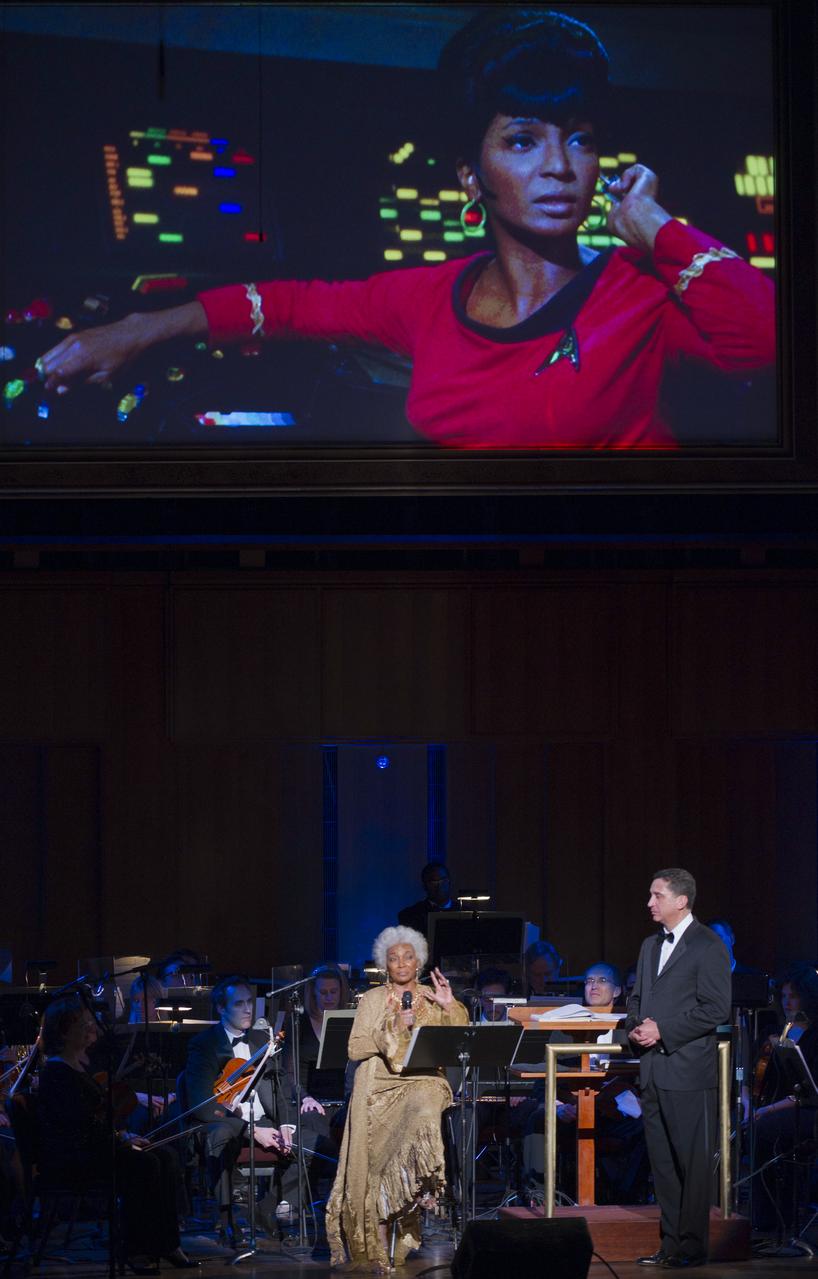
Actress Nichelle Nichols, best known for her role as communications officer Lieutenant Uhura in the series "Star Trek", speaks as Emil de Cou, right, looks on, Wednesday, May 25, 2011, in the concert hall at the John F. Kennedy Center for the Performing Arts in Washington. The event marked the 50th Anniversary of President John F. Kennedy's Special Message to the Congress on Urgent National Needs in which he stated "landing a man on the moon and returning him safely to earth". Photo Credit: (NASA/Paul E. Alers)
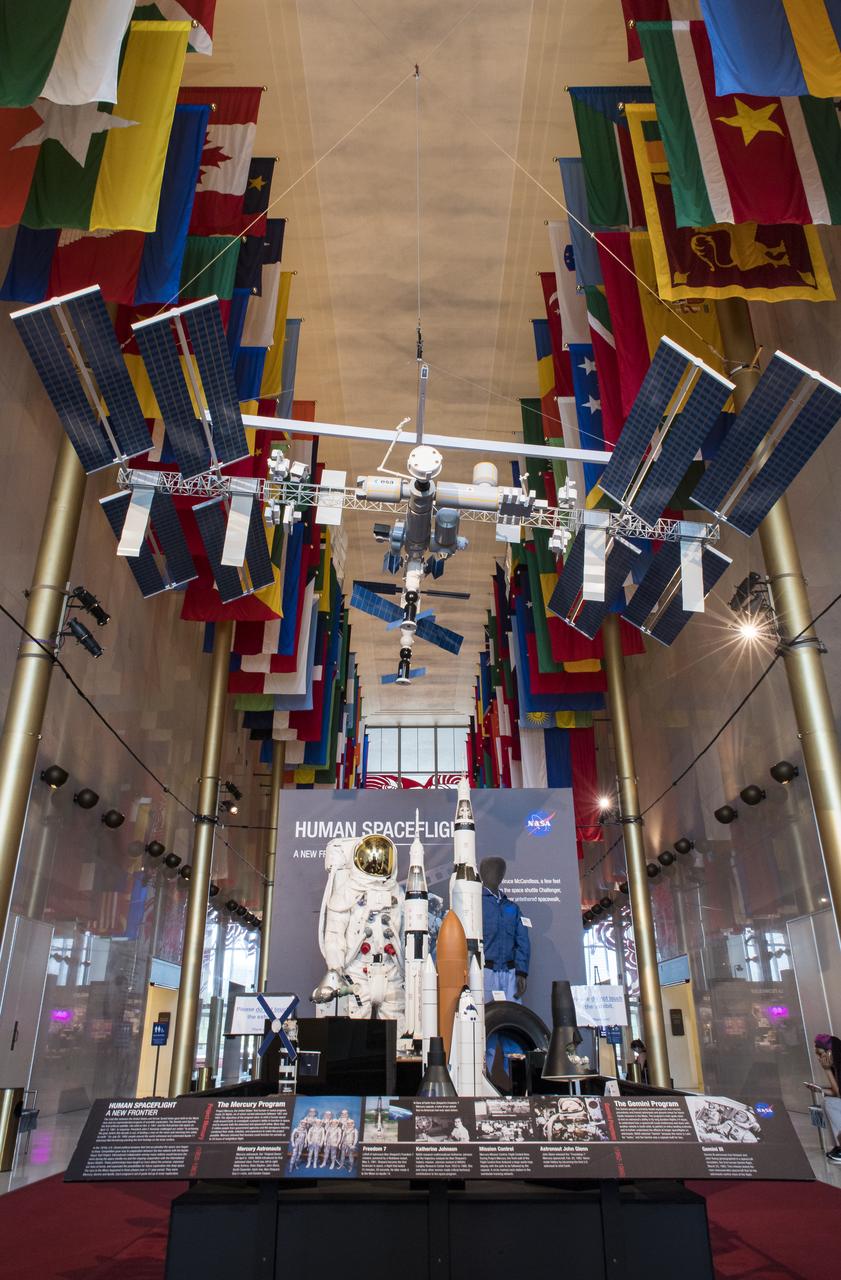
NASA's 60th Anniversary exhibits are seen at the Kennedy Center, Thursday, May 31, 2018 in Washington. Photo Credit: (NASA/Aubrey Gemignani)
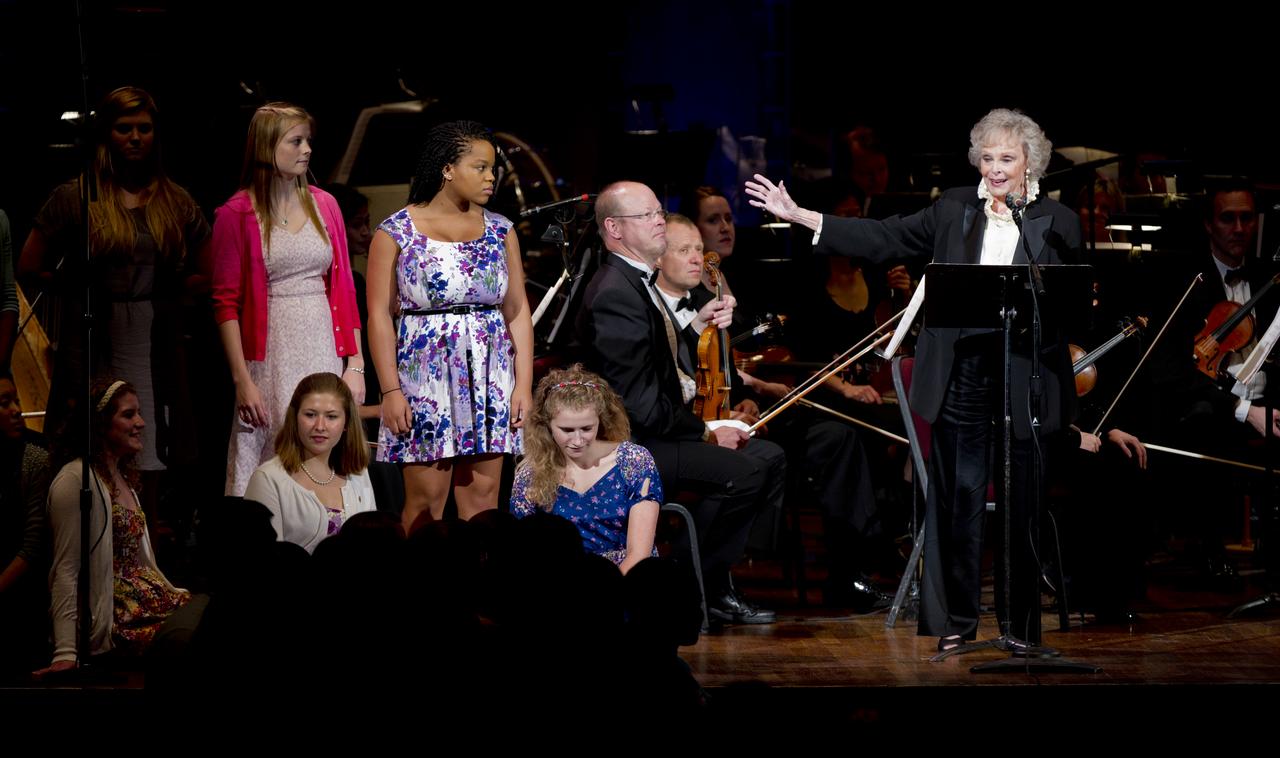
Actress June Lockhart speaks at a program entitled Human Spaceflight: The Kennedy Legacy, Wednesday, May 25, 2011, in the concert hall at the John F. Kennedy Center for the Performing Arts in Washington. The event marked the 50th Anniversary of President John F. Kennedy's Special Message to the Congress on Urgent National Needs in which he stated "landing a man on the moon and returning him safely to earth". Photo Credit: (NASA/Paul E. Alers)
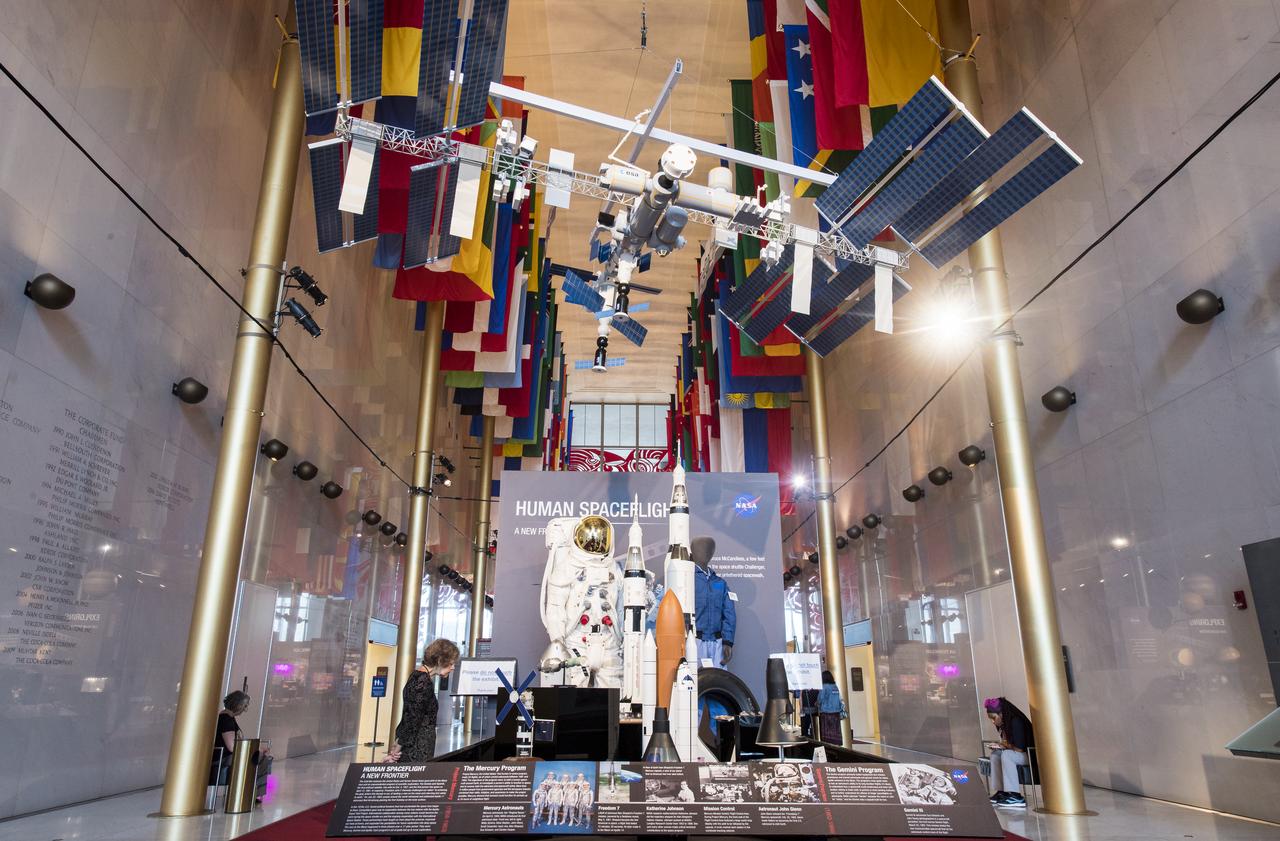
NASA's 60th Anniversary exhibits are seen at the Kennedy Center, Thursday, May 31, 2018 in Washington. Photo Credit: (NASA/Aubrey Gemignani)
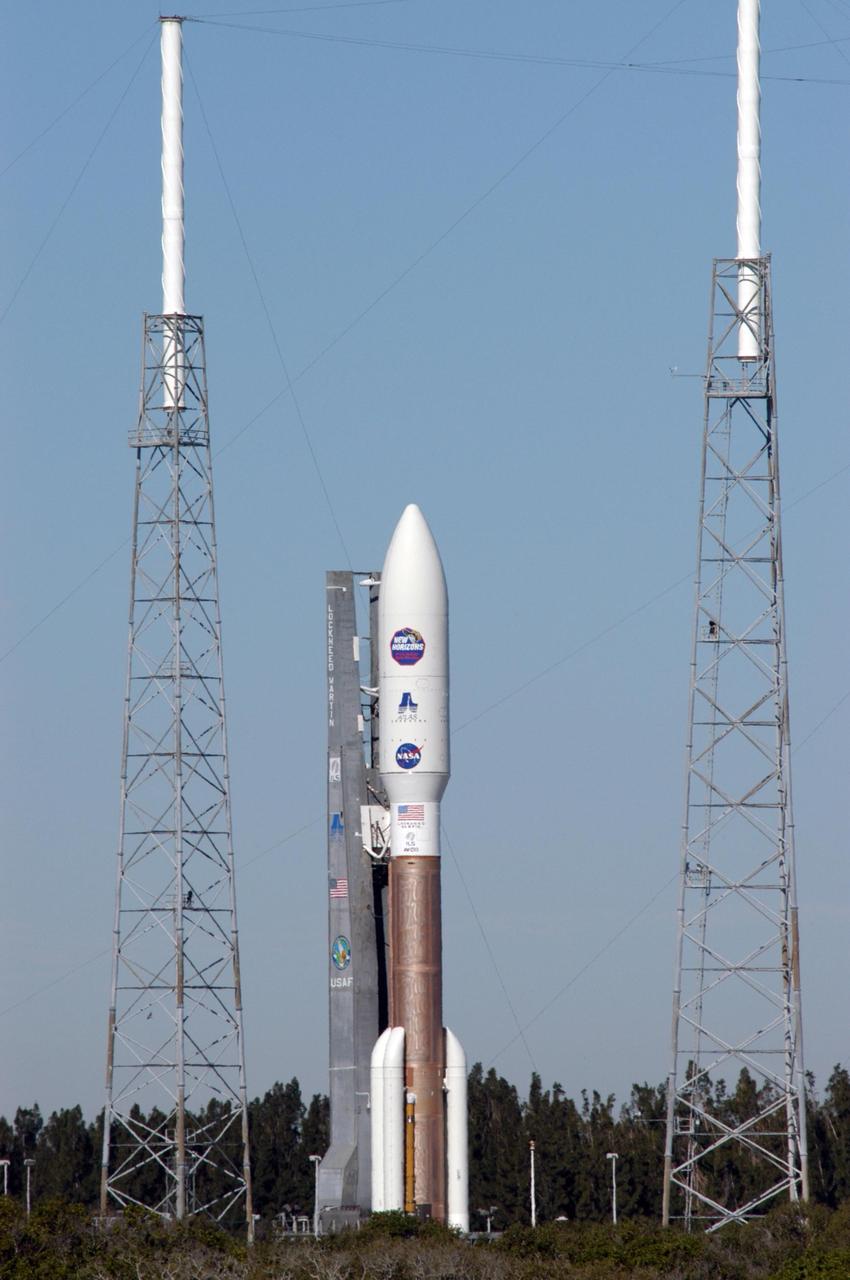
KENNEDY SPACE CENTER, FLA. - On Complex 41 at Cape Canaveral Air Force Station, the Atlas V expendable launch vehicle with the New Horizons spacecraft moves with the launcher umbilical tower between lightning masts on its way to the launch pad. The liftoff is scheduled for 1:24 p.m. EST Jan. 17. After its launch aboard the Atlas V, the compact, 1,050-pound piano-sized probe will get a boost from a kick-stage solid propellant motor for its journey to Pluto. New Horizons will be the fastest spacecraft ever launched, reaching lunar orbit distance in just nine hours and passing Jupiter 13 months later. The New Horizons science payload, developed under direction of Southwest Research Institute, includes imaging infrared and ultraviolet spectrometers, a multi-color camera, a long-range telescopic camera, two particle spectrometers, a space-dust detector and a radio science experiment. The dust counter was designed and built by students at the University of Colorado, Boulder. A launch before Feb. 3 allows New Horizons to fly past Jupiter in early 2007 and use the planet’s gravity as a slingshot toward Pluto. The Jupiter flyby trims the trip to Pluto by as many as five years and provides opportunities to test the spacecraft’s instruments and flyby capabilities on the Jupiter system. New Horizons could reach the Pluto system as early as mid-2015, conducting a five-month-long study possible only from the close-up vantage of a spacecraft.
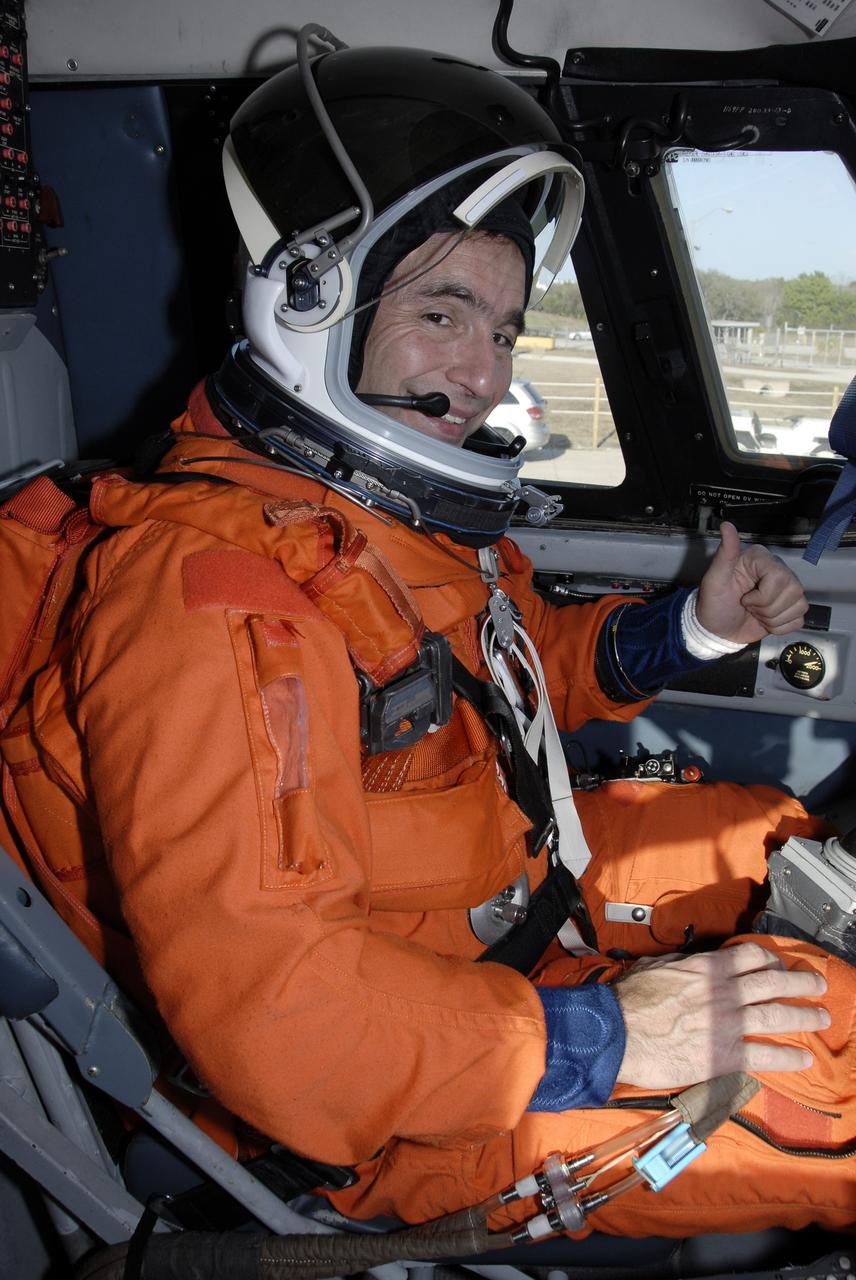
CAPE CANAVERAL, Fla. – On the Shuttle Landing Facility at NASA's Kennedy Space Center in Florida, STS-119 Commander Lee Archambault is seated in the Shuttle Training Aircraft to practice shuttle landings. The mission crew members arrived in the afternoon at Kennedy to prepare for launch. The mission is the 28th to the International Space Station and the 125th space shuttle flight. Space shuttle Discovery will deliver the final pair of power-generating solar array wings and truss element, S6. Photo credit: NASA/Kim Shiflett
![KENNEDY SPACE CENTER, FLA. - Against a black moonless sky, Space Shuttle Endeavour lights up the night as it blazes into space after an ontime liftoff at 7:49:47 p.m. EST. The launch is the 19th for Endeavour, and the 112th flight in the Shuttle program. Mission STS-113 is the 16th assembly flight to the International Space Station, carrying another structure for the Station, the P1 integrated truss. Also onboard are the Expedition 6 crew, who will replace Expedition 5. Endeavour is scheduled to land at KSC after an 11-day journey. [Photo by Scott Andrews]](https://images-assets.nasa.gov/image/KSC-02pd1806/KSC-02pd1806~medium.jpg)
KENNEDY SPACE CENTER, FLA. - Against a black moonless sky, Space Shuttle Endeavour lights up the night as it blazes into space after an ontime liftoff at 7:49:47 p.m. EST. The launch is the 19th for Endeavour, and the 112th flight in the Shuttle program. Mission STS-113 is the 16th assembly flight to the International Space Station, carrying another structure for the Station, the P1 integrated truss. Also onboard are the Expedition 6 crew, who will replace Expedition 5. Endeavour is scheduled to land at KSC after an 11-day journey. [Photo by Scott Andrews]
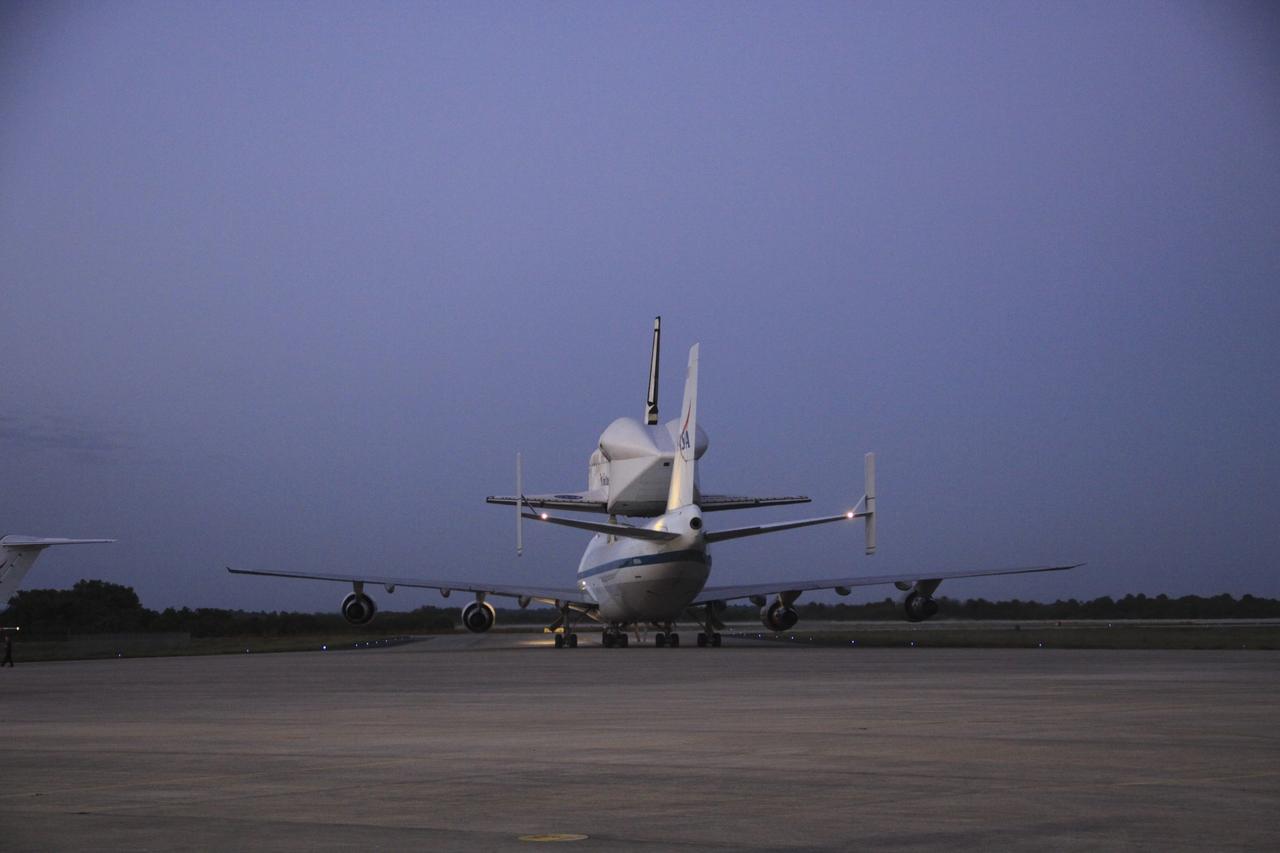
CAPE CANAVERAL, Fla. – The Shuttle Carrier Aircraft transporting space shuttle Discovery to its new home taxis to the runway at the Shuttle Landing Facility at NASA’s Kennedy Space Center in Florida preparing to take off at about 7 a.m. EDT. The aircraft, known as an SCA, is a Boeing 747 jet, originally manufactured for commercial use, which was modified by NASA to transport the shuttles between destinations on Earth. This SCA, designated NASA 905, is assigned to the remaining ferry missions, delivering the shuttles to their permanent public display sites. NASA 905 is scheduled to ferry Discovery to the Washington Dulles International Airport in Virginia on April 17, after which the shuttle will be placed on display in the Smithsonian's National Air and Space Museum Steven F. Udvar-Hazy Center. For more information on the SCA, visit http://www.nasa.gov/centers/dryden/news/FactSheets/FS-013-DFRC.html. For more information on shuttle transition and retirement activities, visit http://www.nasa.gov/transition. Photo credit: NASA/Jim Grossmann
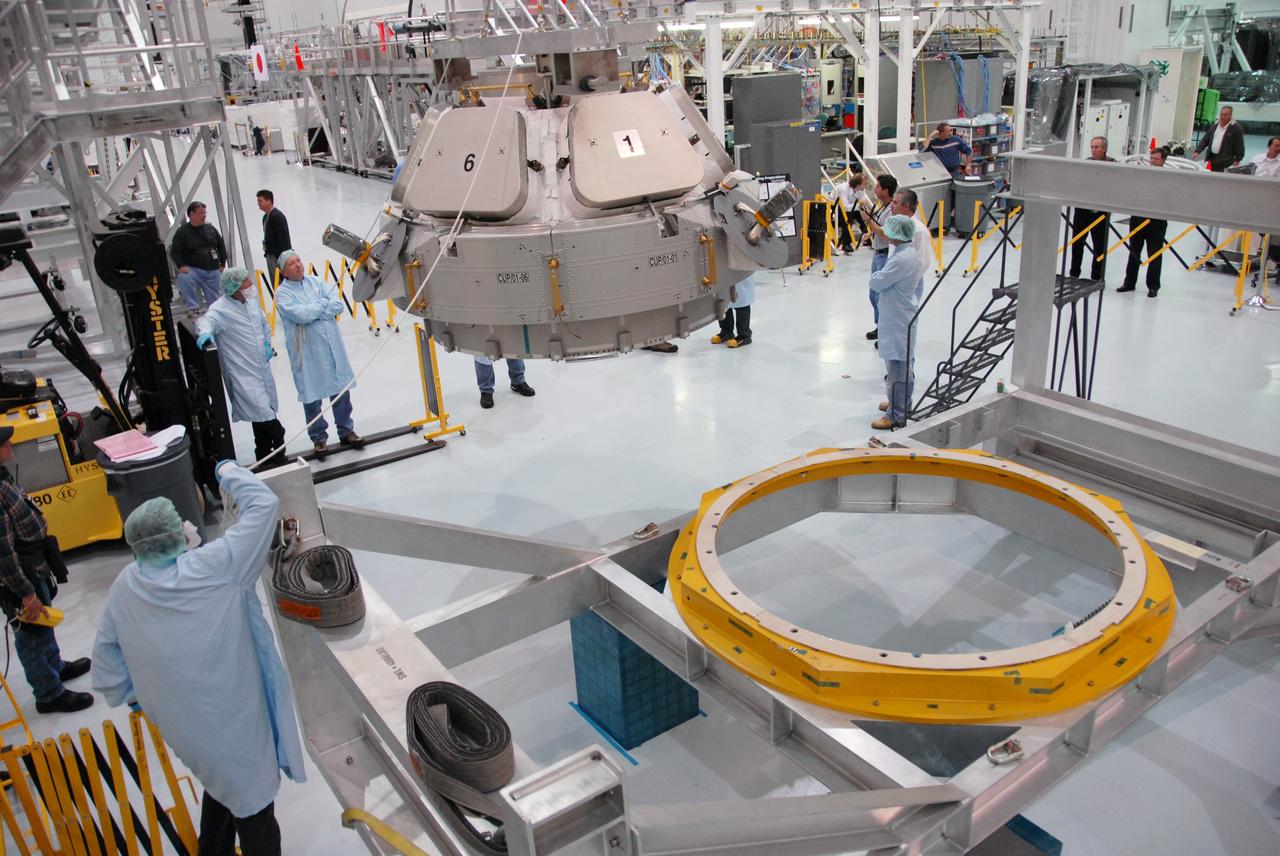
CAPE CANAVERAL, Fla. – Suspended by a crane in the Space Station Processing Facility at NASA's Kennedy Space Center in Florida, the Cupola module moves closer to the workstand at right. The module was delivered to Kennedy by the European Space Agency in 2004 from Alenia Spazio in Turin, Italy. Cupola will provide a 360-degree panoramic view of activities outside the station and spectacular views of the Earth. Cupola has the capability for command and control workstations to be installed to assist in space station remote manipulator system and extra vehicular activities. The final element of the space station core, Cupola is scheduled for launch on space shuttle Endeavour's STS-130 mission, targeted for Dec. 10, 2009. Photo credit: NASA/Cory Huston

NASA astronaut Mike Hopkins, center, speaks to members of the media after arriving from Houston at the Launch and Landing Facility at NASA’s Kennedy Space Center with fellow NASA astronauts Shannon Walker, Victor Glover, and Japan Aerospace Exploration Agency (JAXA) astronaut Soichi Noguchi, ahead of SpaceX’s Crew-1 mission, Sunday, Nov. 8, 2020, in Florida. NASA’s SpaceX Crew-1 mission is the first operational mission of the SpaceX Crew Dragon spacecraft and Falcon 9 rocket to the International Space Station as part of the agency’s Commercial Crew Program. Hopkins, Glover, Walker, and Noguchi are scheduled to launch at 7:49 p.m. EST on Saturday, Nov. 14, from Launch Complex 39A at the Kennedy Space Center. Photo Credit: (NASA/Joel Kowsky)

KENNEDY SPACE CENTER, FLA. - Workers in the Multi-Purpose Processing Facility move the rotating work stand away from NASA's Solar Radiation and Climate Experiment (SORCE) after mating with the Pegasus XL Expendable Launch Vehicle. SORCE will study and measure solar irradiance as a source of energy in the Earth's atmosphere. The launch of SORCE is scheduled for Jan. 25 at 3:14 p.m. from Cape Canaveral Air Force Station, Fla.

KENNEDY SPACE CENTER, FLA. -- In the Space Station Processing Facility, as part of the Crew Equipment Interface Test, STS-112 Commander Jeffrey Ashby looks over the S1 Integrated Truss Structure, part of the payload for the mission to the International Space Station. The S1 truss is the first starboard (right-side) truss segment, whose main job is providing structural support for the orbiting research facility's radiator panels that cool the Space Station's complex power system. The S1 truss segment also will house communications systems, external experiment positions and other subsystems. The S1 truss will be attached to the S0 truss. Launch of STS-112 is scheduled for Aug. 22, 2002
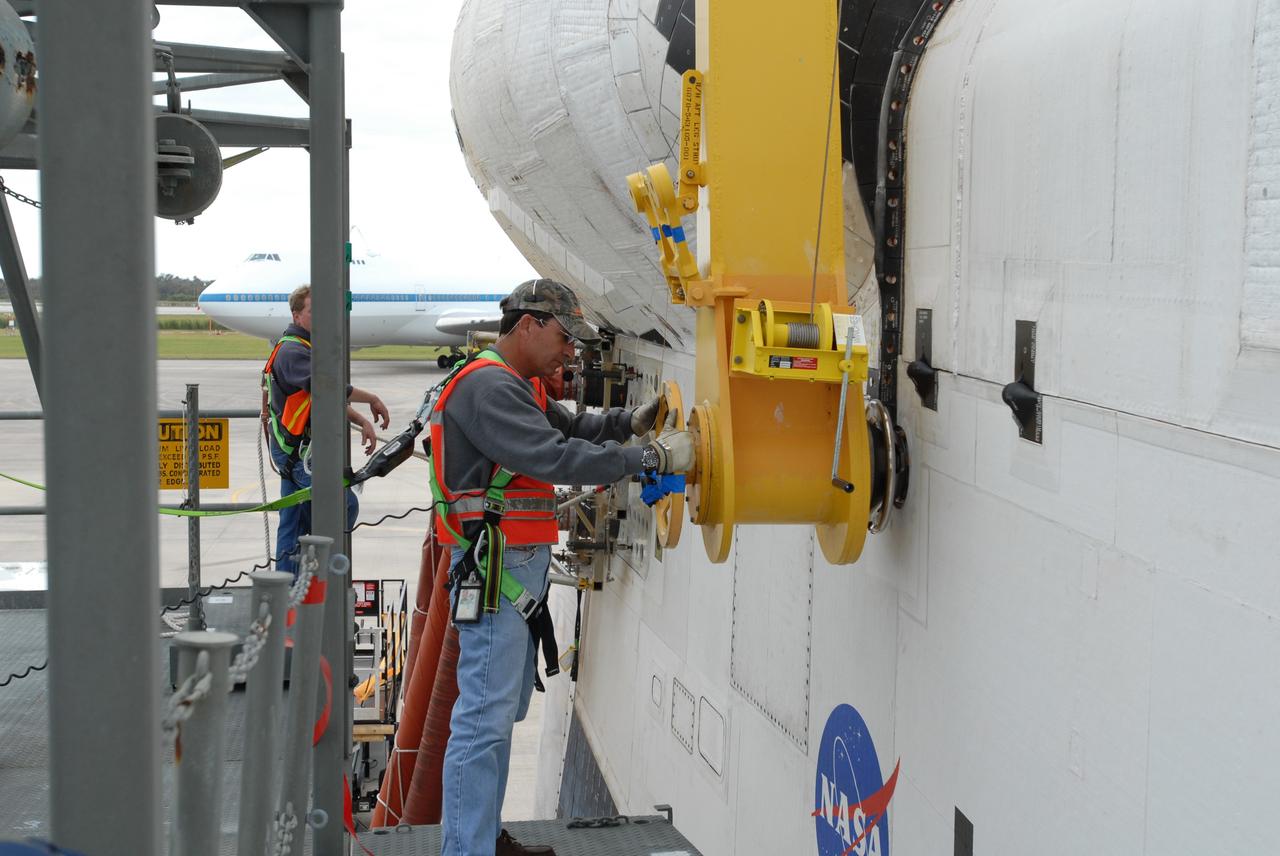
CAPE CANAVERAL, Fla. -- At the Shuttle Landing Facility, or SLF, at NASA's Kennedy Space Center in Florida, workers begin removing the sling from around space shuttle Endeavour. Part of the mate/demate device, the sling enabled Endeavour to be lifted away from shuttle carrier aircraft, or SCA, and lowered to the ground. The SCA carried the shuttle piggyback from California, where Endeavour landed Nov. 30 to end the STS-126 mission. Endeavour will be towed via the two-mile tow-way from the SLF by a diesel-powered tractor to the Orbiter Processing Facility where it will begin preparations for its next mission, STS-127, targeted for May 2009. Photo credit: NASA/Jim Grossmann
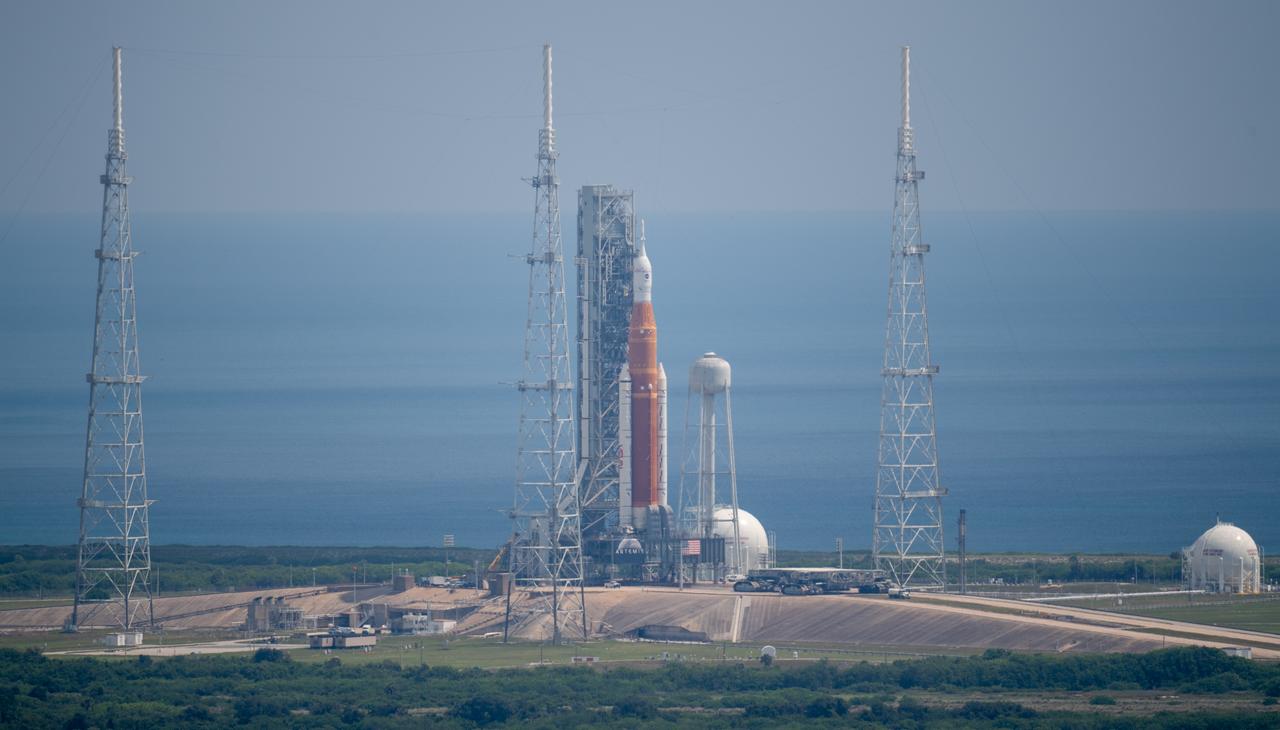
NASA’s Space Launch System (SLS) rocket with the Orion spacecraft aboard is seen atop a mobile launcher at Launch Pad 39B, Wednesday, Aug. 17, 2022, after making the four-mile journey to the launch pad at NASA’s Kennedy Space Center in Florida. NASA’s Artemis I mission is the first integrated test of the agency’s deep space exploration systems: the Orion spacecraft, SLS rocket, and supporting ground systems. Launch of the uncrewed flight test is targeted for no earlier than Aug. 29. Photo Credit: (NASA/Joel Kowsky)
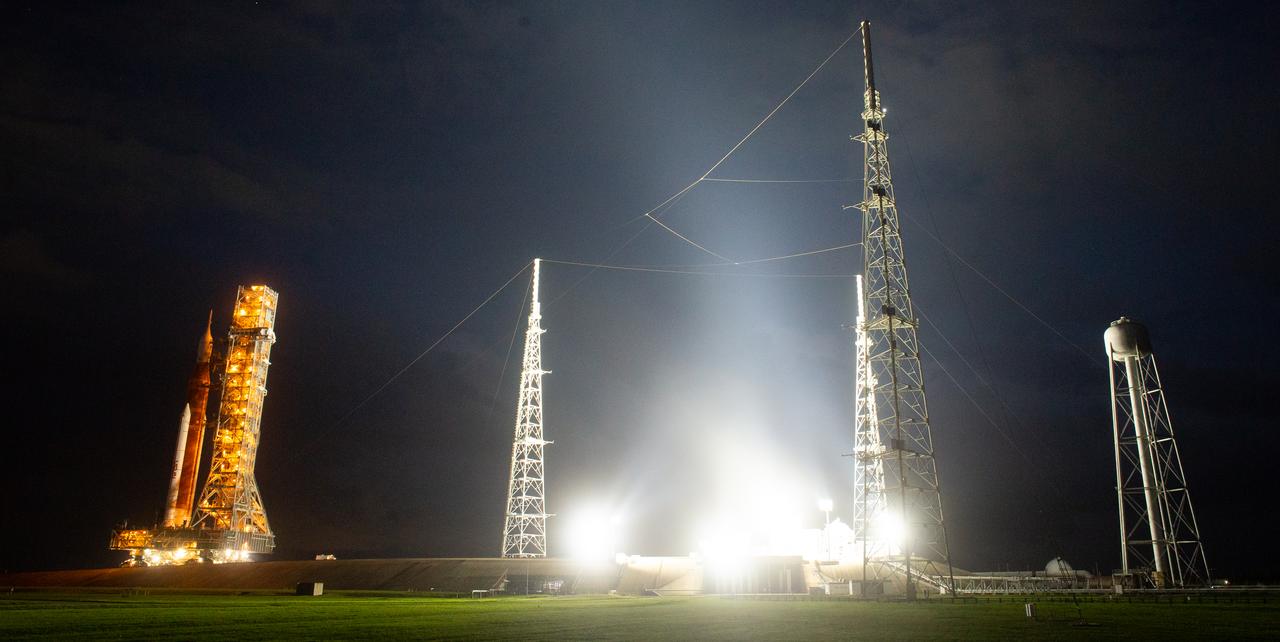
NASA’s Space Launch System (SLS) rocket with the Orion spacecraft aboard is seen atop the mobile launcher as Crawler Transporter-2 (CT-2) climbs the ramp at Launch Pad 39B, Friday, Nov. 4, 2022, at NASA’s Kennedy Space Center in Florida. NASA’s Artemis I mission is the first integrated test of the agency’s deep space exploration systems: the Orion spacecraft, SLS rocket, and supporting ground systems. Launch of the uncrewed flight test is targeted for Nov. 14 at 12:07 a.m. EST. Photo Credit: (NASA/Joel Kowsky)
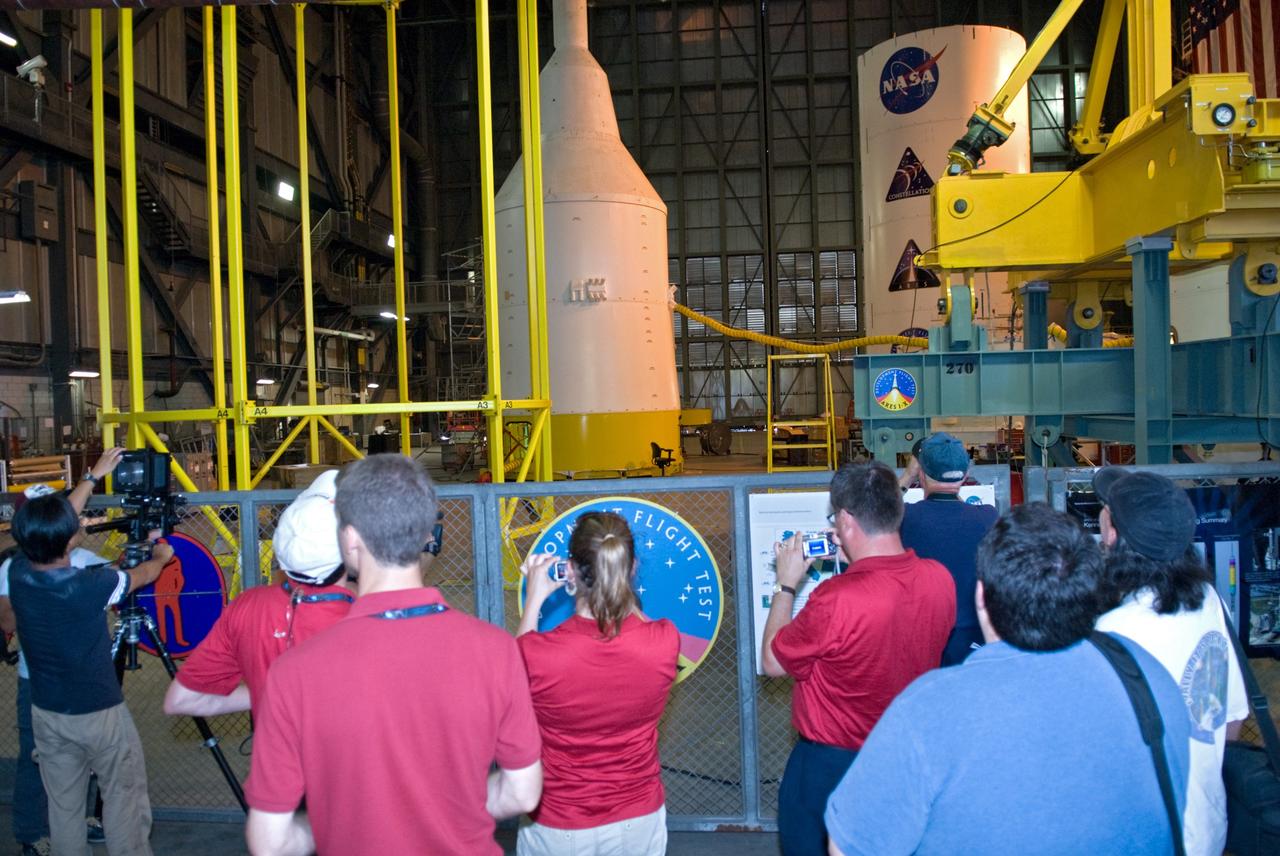
CAPE CANAVERAL, Fla. – In the Vehicle Assembly Building at NASA's Kennedy Space Center in Florida, media get a close look at various segments for the Ares I-X rocket being assembled in High Bay 4. In front at left is the yellow crane known as the "birdcage" that is used to lift the crew module-launch abort system. Ares I-X is the test vehicle for the Ares I, which is part of the Constellation Program to return men to the moon and beyond. Ares I-X is targeted for launch in August 2009. Photo credit: NASA/Kim Shiflett

CAPE CANAVERAL, Fla. -- In the Orbiter Processing Facility at NASA's Kennedy Space Center in Florida, STS-119 Pilot Tony Antonelli checks the cockpit window of space shuttle Discovery. He and other crew members are at Kennedy for a Crew Equipment Interface Test that provides experience handling tools, equipment and hardware they will use on the mission. On the STS-119 mission, space shuttle Discovery will carry the S6 truss segment to complete the 361-foot-long backbone of the International Space Station. The truss includes the fourth pair of solar array wings and electronics that convert sunlight to power for the orbiting laboratory. Discovery is targeted for launch on Feb. 12, 2009. Photo credit: NASA/Kim Shiflett
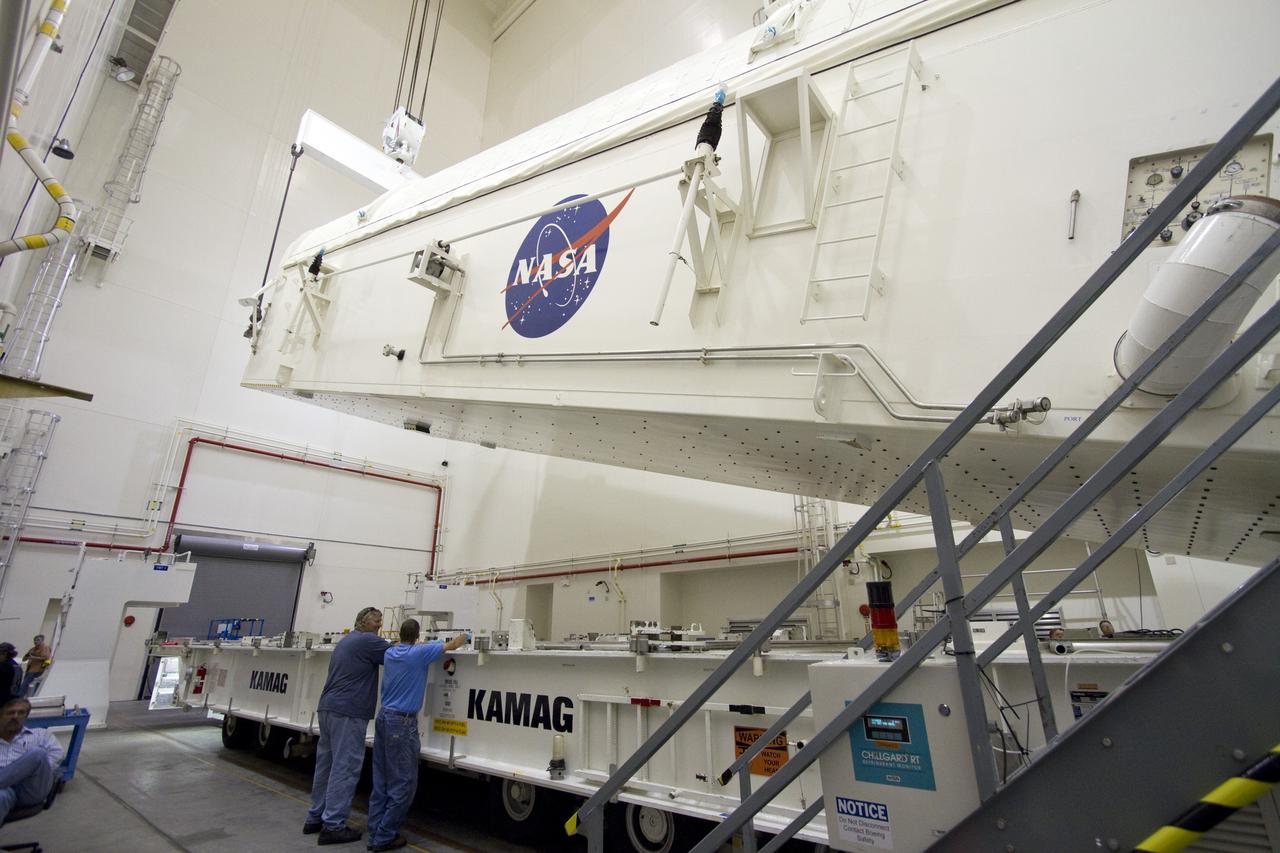
CAPE CANAVERAL, Fla. -- A canister, carrying the Alpha Magnetic Spectrometer-2 AMS and Express Logistics Carrier-3 for space shuttle Endeavour's STS-134 mission, is rotated from a horizontal to vertical position in the Canister Rotation Facility at NASA's Kennedy Space Center in Florida. Endeavour and its six-member STS-134 crew are targeted to lift off April 19 at 7:48 p.m. EDT to deliver the payload to the International Space Station. For more information visit, www.nasa.gov/mission_pages/shuttle/shuttlemissions/sts134/index.html. Photo credit: NASA/Jack Pfaller
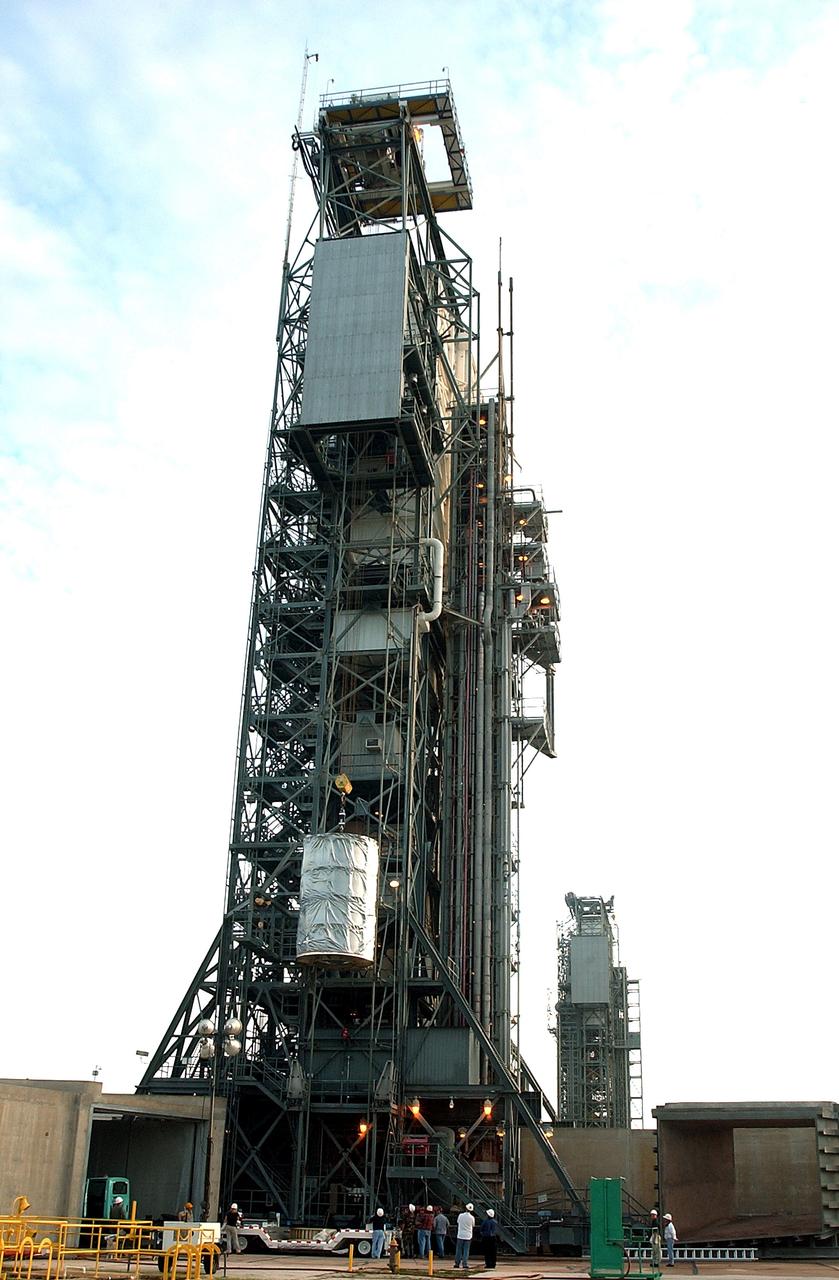
KENNEDY SPACE CENTER, FLA. - After dawn, the Space Infrared Telescope Facility (SIRTF) is lifted up the mobile service tower on Launch Pad 17-B, Cape Canaveral Air Force Station. SIRTF will be attached to the Delta II rocket and encapsulated in its fairing before launch. Consisting of three cryogenically cooled science instruments and an 0.85-meter telescope, SIRTF is one of NASA’s largest infrared telescopes to be launched. It is the fourth and final element in NASA’s family of orbiting “Great Observatories.” SIRTF will obtain images and spectra by detecting the infrared energy, or heat, radiated by objects in space. Most of this infrared radiation is blocked by the Earth's atmosphere and cannot be observed from the ground.
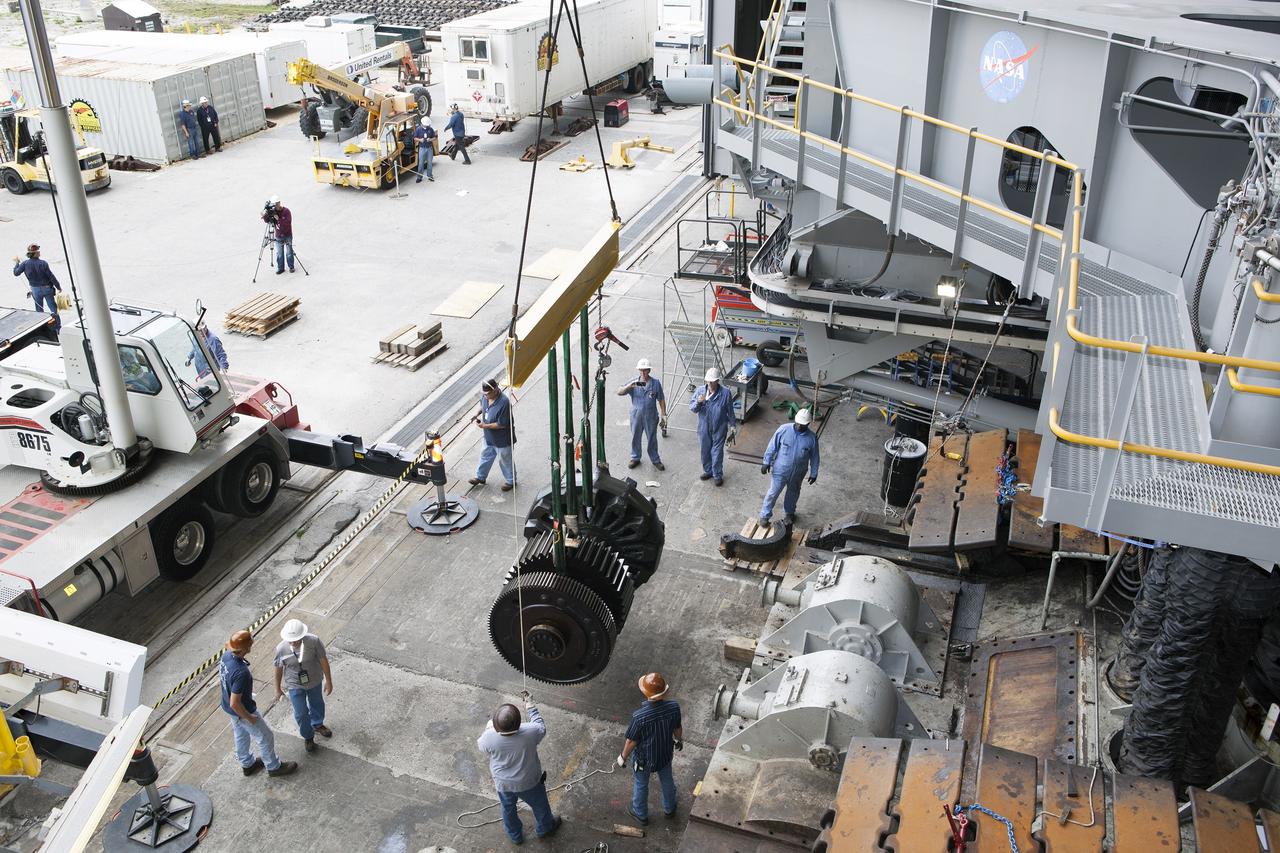
CAPE CANAVERAL, Fla. - Inside the Vehicle Assembly Building at NASA’s Kennedy Space Center in Florida, ground support technicians monitor the progress as an overhead crane lifts a sprocket shaft assembly away from the C truck of crawler-transporter 2, or CT-2. A section of the treads on the C truck were removed to allow access to the sprocket assemblies. The sprocket assemblies will be placed into shipping cradles on pallets and positioned on a flatbed trailer. The assemblies will be sent to a vendor for inspections and refurbishment. Work continues in high bay 2 to upgrade CT-2. The modifications are designed to ensure CT-2’s ability to transport launch vehicles currently in development, such as the agency’s Space Launch System, to the launch pad. The Ground Systems Development and Operations Program office at Kennedy is overseeing the upgrades. For more than 45 years the crawler-transporters were used to transport the mobile launcher platform and the Apollo-Saturn V rockets and, later, space shuttles to Launch Pads 39A and B. For more information, visit: http://www.nasa.gov/exploration/systems/ground/crawler-transporter. Photo credit: NASA/Dimitri Gerondidakis
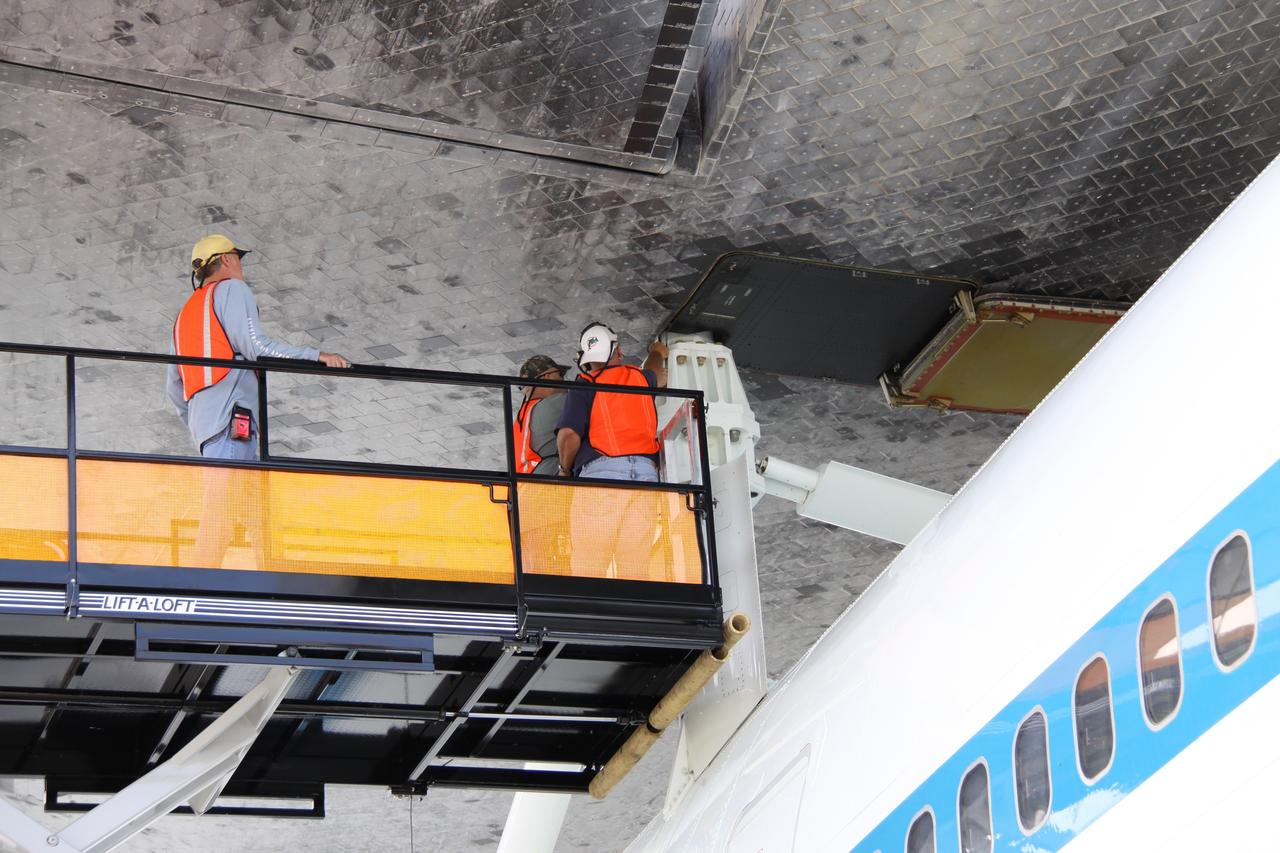
CAPE CANAVERAL, Fla. – Work is under way to separate space shuttle Atlantis from the Shuttle Carrier Aircraft, or SCA, underneath via the mate/demate device on the Shuttle Landing Facility at NASA's Kennedy Space Center in Florida. Workers are removing the struts that attached Atlantis to the SCA. A hoist attached to Atlantis will suspend the shuttle while the SCA is moved away. Atlantis returned from California atop the SCA, a modified Boeing 747, after its May 24 landing at Edwards Air Force Base, concluding mission STS-125. The ferry flight from Edwards Air Force Base began June 1. Atlantis' next assignment is the STS-129 mission, targeted to launch in November 2009. Photo credit: NASA/Jack Pfaller
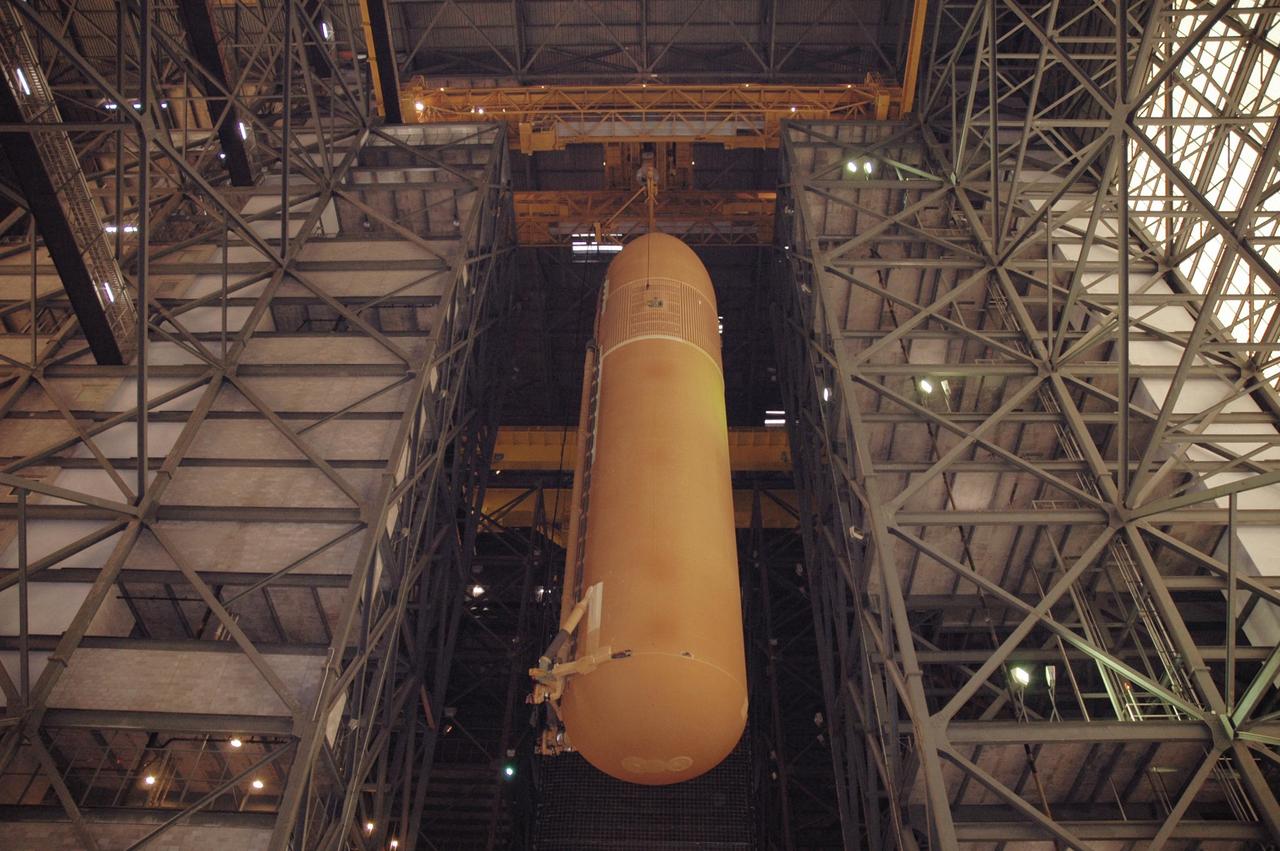
KENNEDY SPACE CENTER, FLA. - In the upper regions of NASA Kennedy Space Center's Vehicle Assembly Building, the newly delivered external tank is moved over a crossbeam toward a checkout cell for further work. Designated ET-119, the 154-foot tank will be lifted into a checkout cell for further work. The tank, which will launch space shuttle Discovery on mission STS-121, will fly with many major safety changes, including the removal of the protuberance air load ramps. A large piece of foam from a ramp came off during the last shuttle launch in July 2005. The ramps were removed to eliminate a potential source of damaging debris to the space shuttle. The next launch of Discovery is scheduled for May 2006. Photo credit: NASA/Jim Grossmann
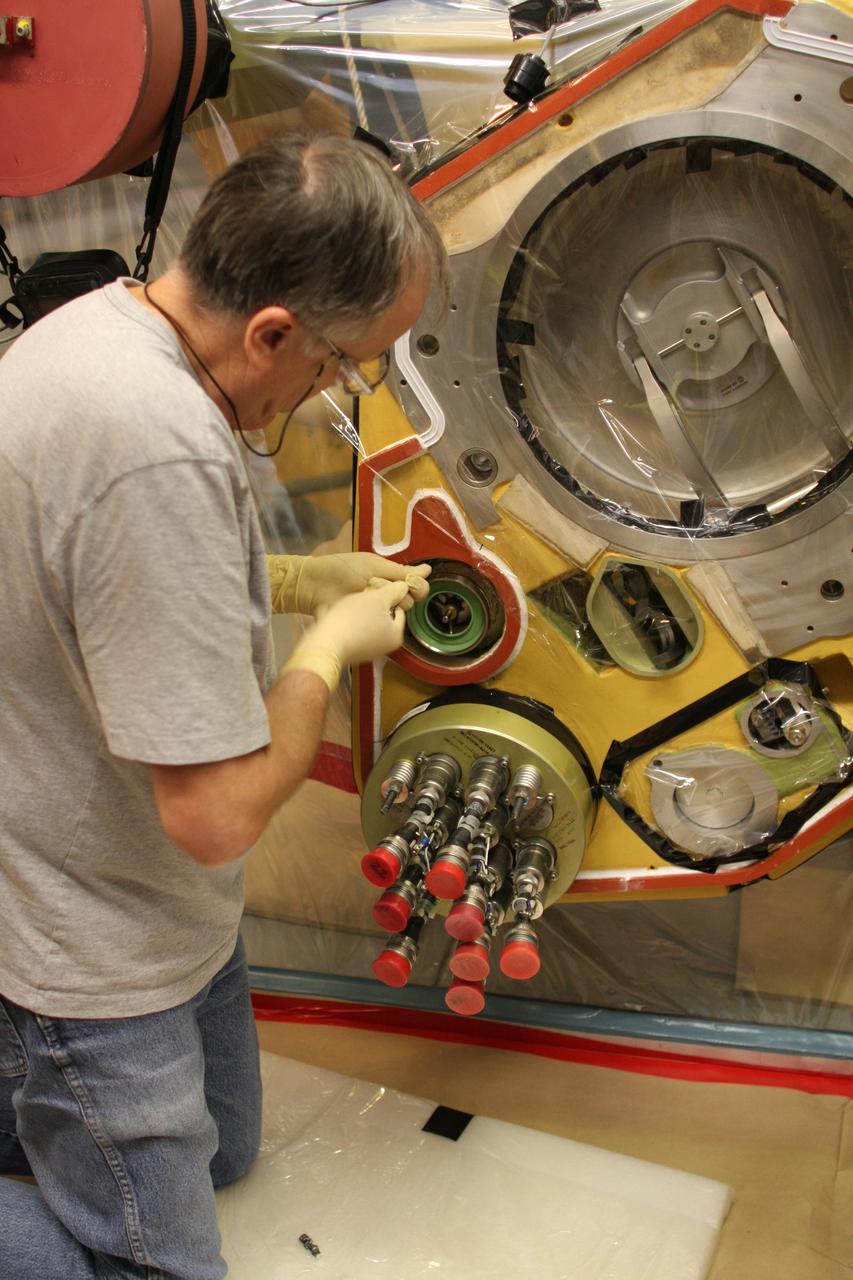
CAPE CANAVERAL, Fla. – Inside the Vehicle Assembly Building at NASA’s Kennedy Space Center, a technician removes a valve from Atlantis’ external tank after small dings were found on the sealing surface of the quick disconnect system that handles liquid-hydrogen fuel for the shuttle’s three main engines. The tank will be attached to the twin solid rocket boosters on Aug. 3 for the STS-125 mission, the fifth and final shuttle servicing mission to NASA’s Hubble Space Telescope. During the mission, the crew will install new instruments on the telescope, including the Cosmic Origins Spectrograph and the Wide Field Camera 3. A refurbished Fine Guidance Sensor will replace one unit of three now onboard. Mission specialists will also install new gyroscopes, batteries and thermal blankets on the telescope. Launch is targeted for Oct. 8. Photo credit: NASA/Dimitri Gerondidakis
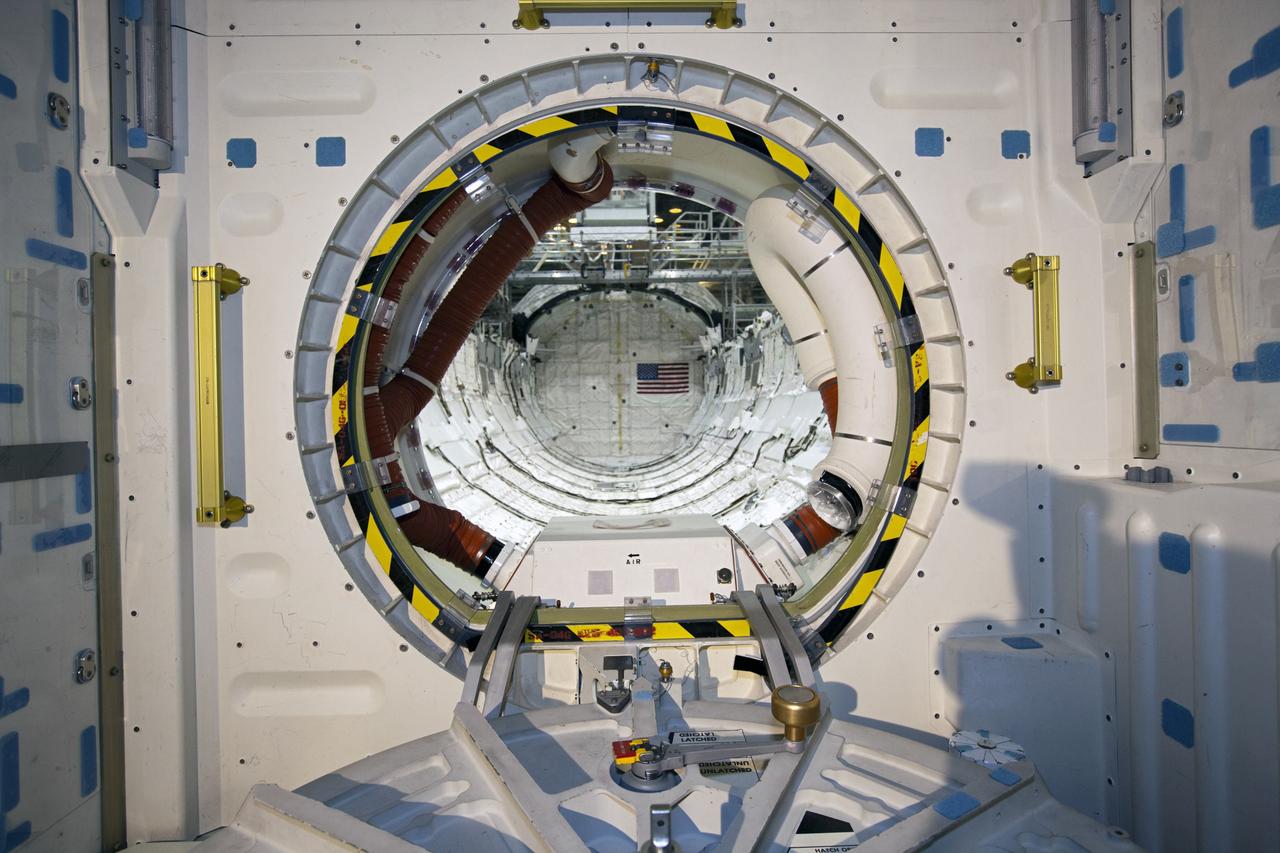
CAPE CANAVERAL, Fla. – In Orbiter Processing Facility-2 at NASA’s Kennedy Space Center in Florida, the camera captures a final view through space shuttle Endeavour’s airlock into the payload bay before the airlock's hatch is closed for the final time during processing for the shuttle’s retirement. Endeavour is being prepared for public display at the California Science Center in Los Angeles. Its ferry flight to California is targeted for mid-September. Endeavour, designated OV-105, was the last space shuttle added to NASA’s orbiter fleet. Over the course of its 19-year career, Endeavour spent 299 days in space during 25 missions. For more information, visit http://www.nasa.gov/transition. Photo credit: NASA/Dimitri Gerondidakis
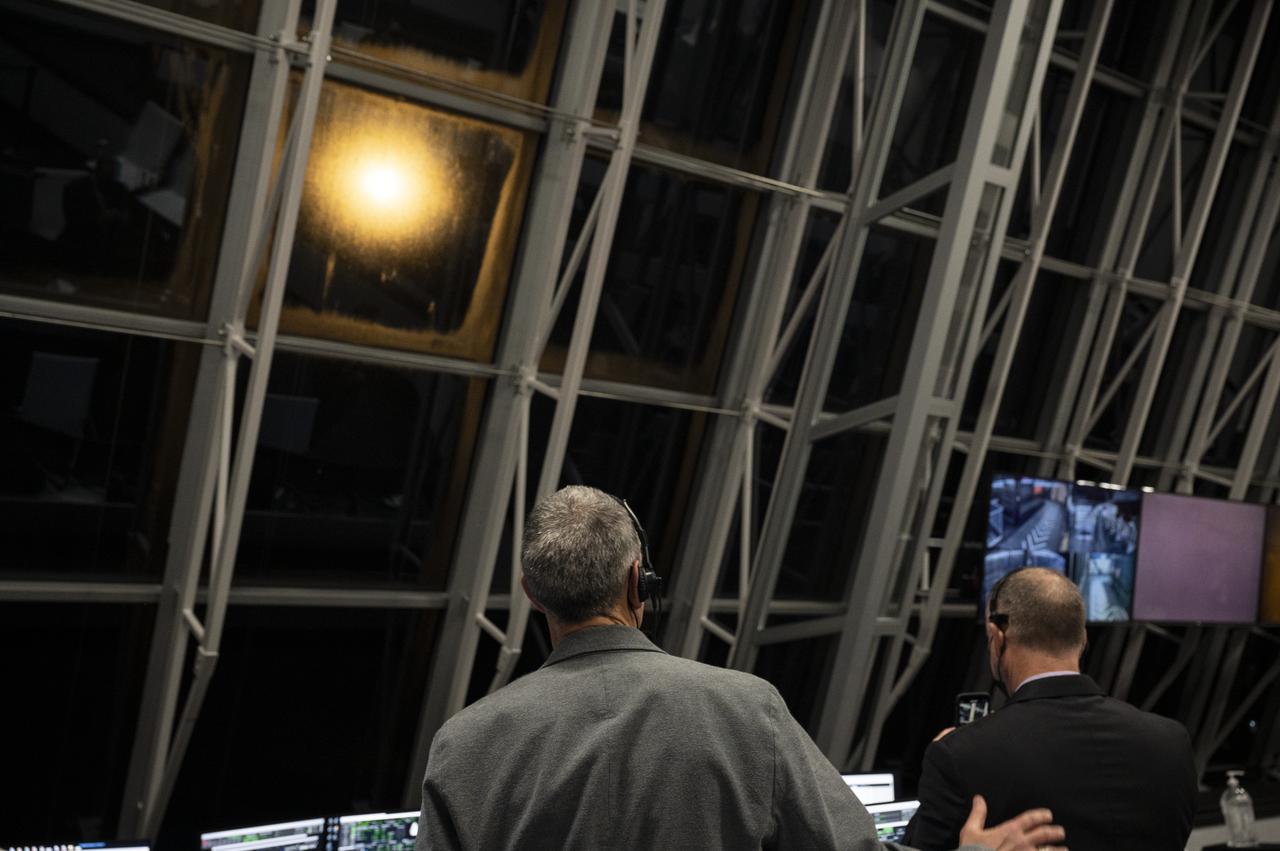
Lee Rosen, vice president, Mission and Launch Operations at SpaceX pats Norm Knight, deputy director of Flight Operations at NASA's Johnson Space Center on the back as they watch the launch of a SpaceX Falcon 9 rocket carrying the company's Crew Dragon spacecraft on NASA’s SpaceX Crew-1 mission with NASA astronauts Mike Hopkins, Victor Glover, Shannon Walker, and Japan Aerospace Exploration Agency (JAXA) astronaut Soichi Noguchi onboard, Sunday, Nov. 15, 2020, in firing room four of the Launch Control Center at NASA’s Kennedy Space Center in Florida. NASA’s SpaceX Crew-1 mission is the first crew rotation mission of the SpaceX Crew Dragon spacecraft and Falcon 9 rocket to the International Space Station as part of the agency’s Commercial Crew Program. Hopkins, Glover, Walker, and Noguchi launched at 7:27 p.m. EST, from Launch Complex 39A at the Kennedy Space Center. Photo Credit: (NASA/Aubrey Gemignani)
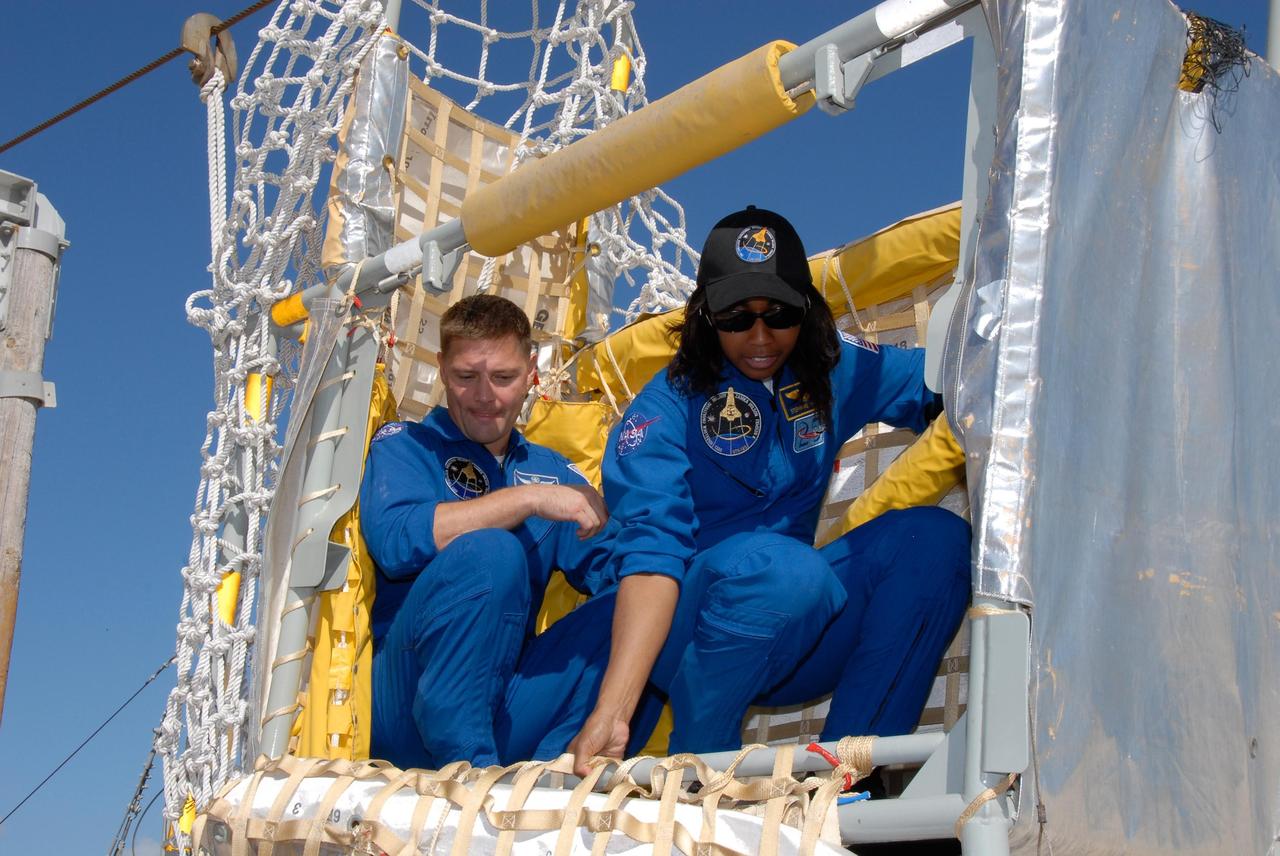
KENNEDY SPACE CENTER, FLA. -- During emergency egress training as part of the pre-launch terminal countdown demonstration test, or TCDT, STS-120 crew members learn how to get out of the slidewire basket at the landing site. In the basket are Mission Specialists Doug Wheelock and Stephanie Wilson. The TCDT provides astronauts and ground crews an opportunity to participate in various simulated countdown activities, including equipment familiarization and emergency training. The STS-120 mission will deliver the U.S. Node 2 module, named Harmony, aboard space shuttle Discovery to the International Space Station. Launch of Discovery on mission STS-120 is targeted for Oct. 23 at 11:38 a.m. EDT on a 14-day mission. Photo credit: NASA/Kim Shiflett
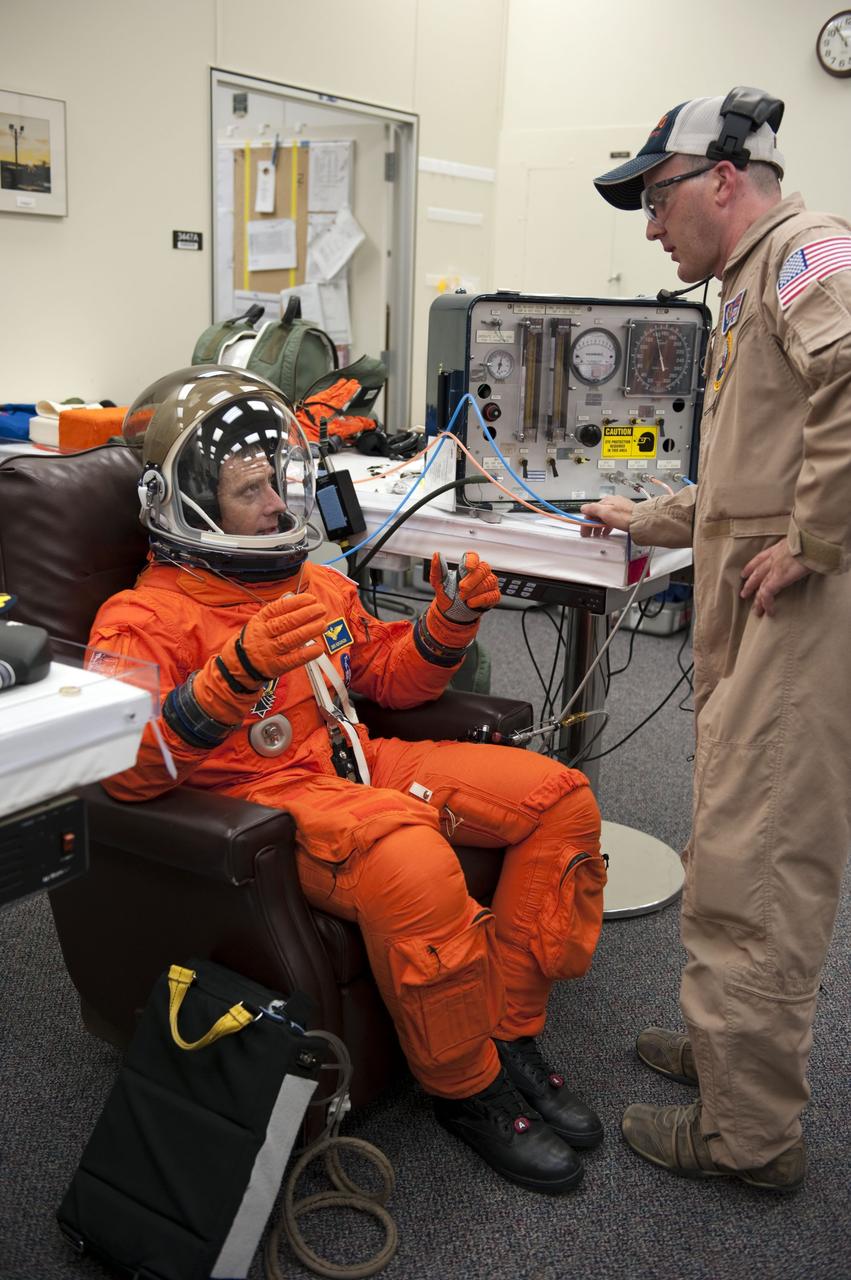
CAPE CANAVERAL, Fla. -- In the Operations and Checkout Building at NASA's Kennedy Space Center in Florida, Commander Chris Ferguson has his launch and landing suit checked by suit technician Jeremy Spruell. The STS-135 crew is at Kennedy to participate in a launch countdown dress rehearsal called the Terminal Countdown Demonstration Test (TCDT) and related training in preparation for the upcoming STS-135 mission. Atlantis and its crew are targeted to lift off July 8, taking with them the Raffaello multi-purpose logistics module packed with supplies and spare parts to the International Space Station. The STS-135 mission also will fly a system to investigate the potential for robotically refueling existing satellites and return a failed ammonia pump module to help NASA better understand the failure mechanism and improve pump designs for future systems. STS-135 will be the 33rd flight of Atlantis, the 37th shuttle mission to the space station, and the 135th and final mission of NASA's Space Shuttle Program. For more information visit, www.nasa.gov/mission_pages/shuttle/shuttlemissions/sts135/index.html. Photo credit: NASA/Kim Shiflett

CAPE CANAVERAL, Fla. -- In Firing Room 4 of the Launch Control Center at NASA's Kennedy Space Center in Florida, NASA Administrator Charles Bolden (right), Associate Administrator for Space Operations Bill Gerstenmaier and Space Shuttle Program Manager John Shannon monitor the countdown to the launch of space shuttle Atlantis on its STS-135 mission to the International Space Station. Atlantis with its crew of four; Commander Chris Ferguson, Pilot Doug Hurley, Mission Specialists Sandy Magnus and Rex Walheim, lifted off at 11:29 a.m. EDT on July 8, 2011 to deliver the Raffaello multi-purpose logistics module packed with supplies and spare parts for the station. Atlantis also will fly the Robotic Refueling Mission experiment that will investigate the potential for robotically refueling existing satellites in orbit. In addition, Atlantis will return with a failed ammonia pump module to help NASA better understand the failure mechanism and improve pump designs for future systems. STS-135 will be the 33rd flight of Atlantis, the 37th shuttle mission to the space station, and the 135th and final mission of NASA's Space Shuttle Program. For more information, visit www.nasa.gov/mission_pages/shuttle/shuttlemissions/sts135/index.html. Photo credit: NASA/Kim Shiflett

Singer Patti Austin performs Tena Clark's "Way Up There" during the National Tribute to Sally Ride at the John F. Kennedy Center for the Performing Arts, Monday, May 20, 2013 in Washington. Photo Credit: (NASA/Bill Ingalls)
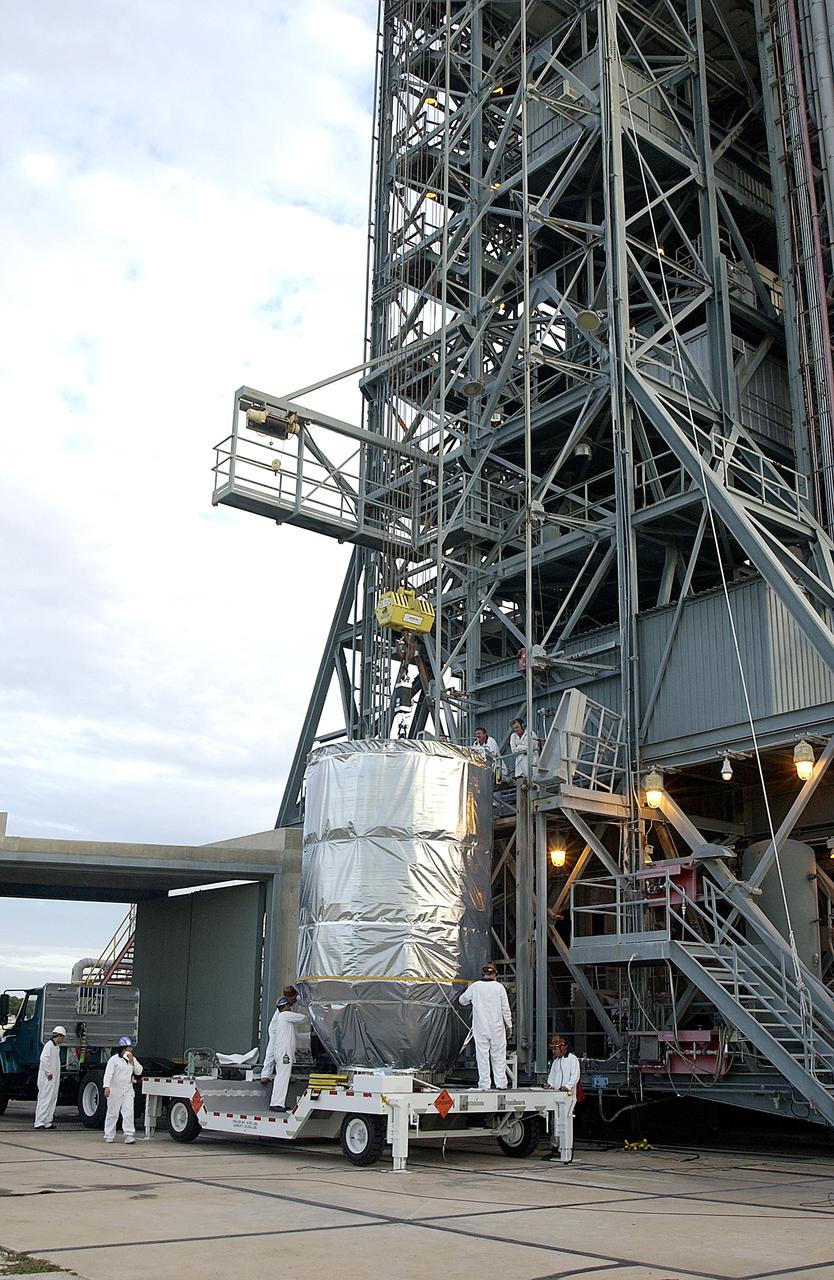
KENNEDY SPACE CENTER, FLA. - On Launch Pad 17-B, Cape Canaveral Air Force Station, the Mars Exploration Rover 1 (MER-B) is ready to be lifted up the tower for mating with the Delta rocket. The second of twin rovers being sent to Mars, it is equipped with a robotic arm, a drilling tool, three spectrometers, and four pairs of cameras that allow it to have a human-like, 3D view of the terrain. Each rover could travel as far as 100 meters in one day to act as Mars scientists' eyes and hands, exploring an environment where humans can't yet go. MER-B is scheduled to launch June 26 at one of two available times, 12:27:31 a.m. EDT or 1:08:45 a.m. EDT.
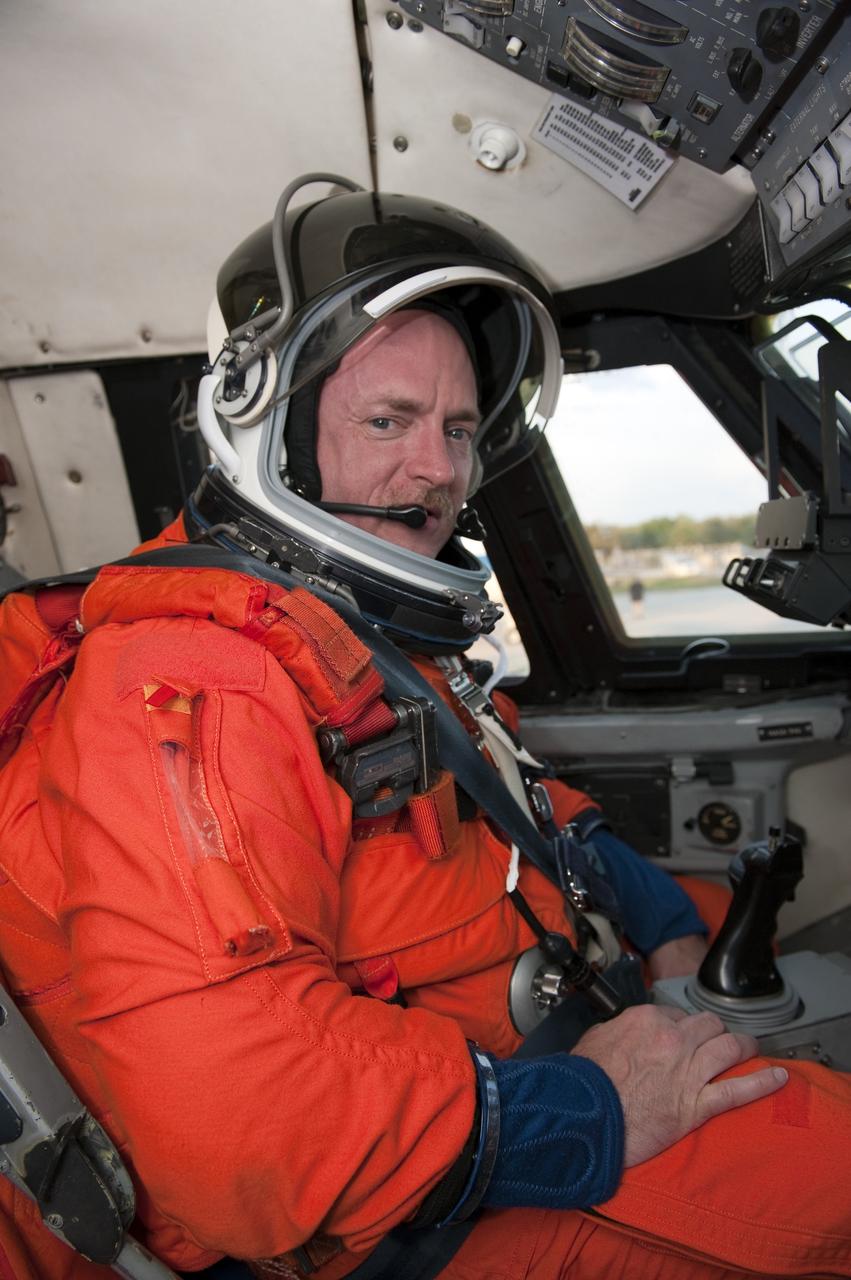
CAPE CANAVERAL, Fla. -- STS-134 Commander Mark Kelly prepares to perform touch-and-go landings aboard a Shuttle Training Aircraft (STA) on the Shuttle Landing Facility runway at NASA's Kennedy Space Center in Florida. An STA is a Gulfstream II jet that is modified to mimic the shuttle's handling during the final phase of landing. Kelly and Johnson will practice landings as part of standard training before space shuttle Endeavour's launch to the International Space Station. Endeavour and its crew will deliver the Express Logistics Carrier-3, Alpha Magnetic Spectrometer-2 (AMS), a high-pressure gas tank and additional spare parts for the Dextre robotic helper to the station. This will be the final spaceflight for Endeavour. For more information visit, www.nasa.gov/mission_pages/shuttle/shuttlemissions/sts134/index.html. Photo credit: NASA/Kim Shiflett
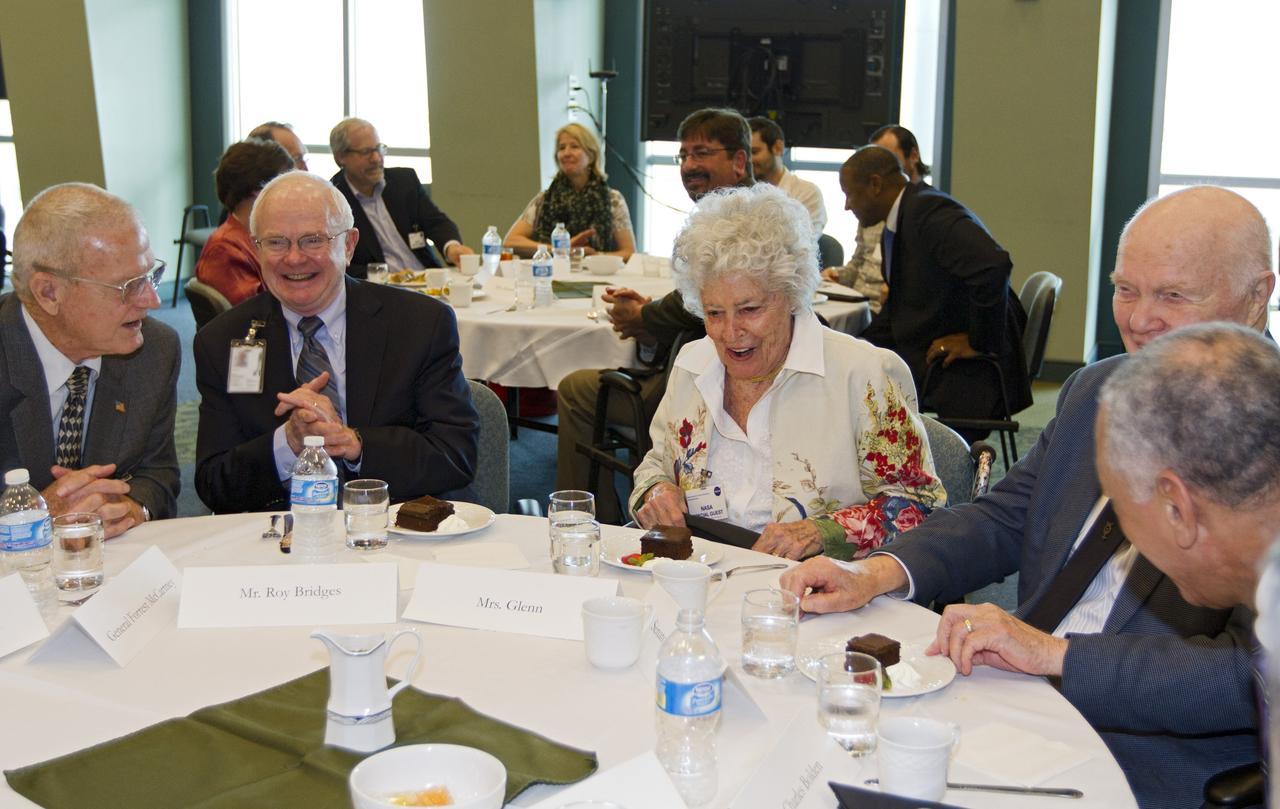
CAPE CANAVERAL, Fla. - Former Kennedy Space Center directors Forrest McCartney and Roy Bridges join Annie Glenn, astronaut John Glenn and NASA Administrator Charles Bolden during a luncheon Feb. 17, 2012, celebrating 50 years of Americans in orbit, an era which began with Glenn's Mercury mission MA-6, on Feb. 20, 1962. Glenn's launch aboard an Atlas rocket took with it the hopes of an entire nation and ushered in a new era of space travel that eventually led to Americans walking on the moon by the end of the 1960s. Glenn soon was followed into orbit by Scott Carpenter, Walter Schirra and Gordon Cooper. Their fellow Mercury astronauts Alan Shepard and Virgil "Gus" Grissom flew earlier suborbital flights. Deke Slayton, a member of NASA's original Mercury 7 astronauts, was grounded by a medical condition until the Apollo-Soyuz Test Project in 1975. Photo credit: NASA/Kim Shiflett
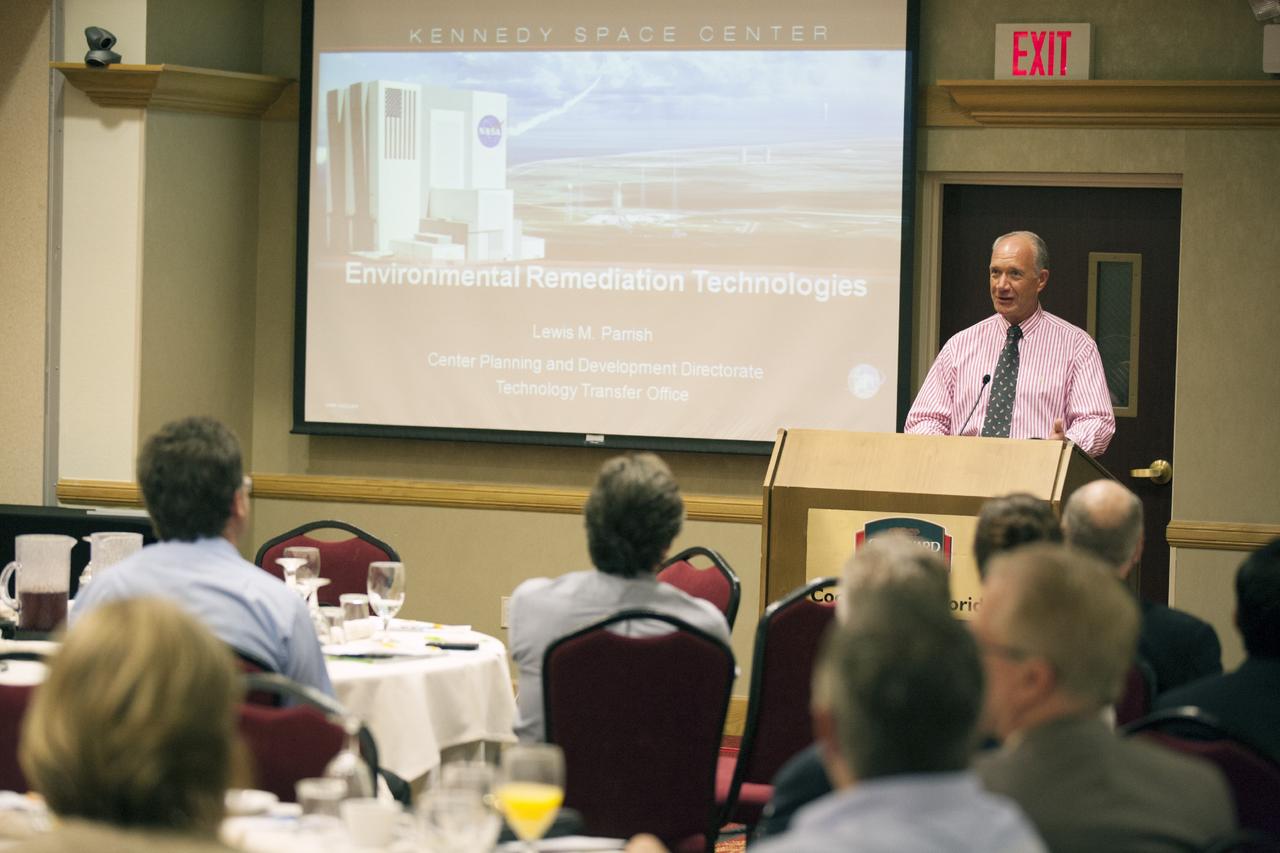
CAPE CANAVERAL, Fla. – Lewis Parrish, senior Technology Transfer specialist for Qinetiq at NASA's Kennedy Space Center in Florida, discusses technology transfer with attendees at the Technology Transfer Forum of the Economic Development Commission of Florida's Space Coast. A goal of the session was to showcase ways commercial businesses can work with NASA to develop technology and apply existing technology to commercial uses. Photo credit: NASA/Glenn Benson
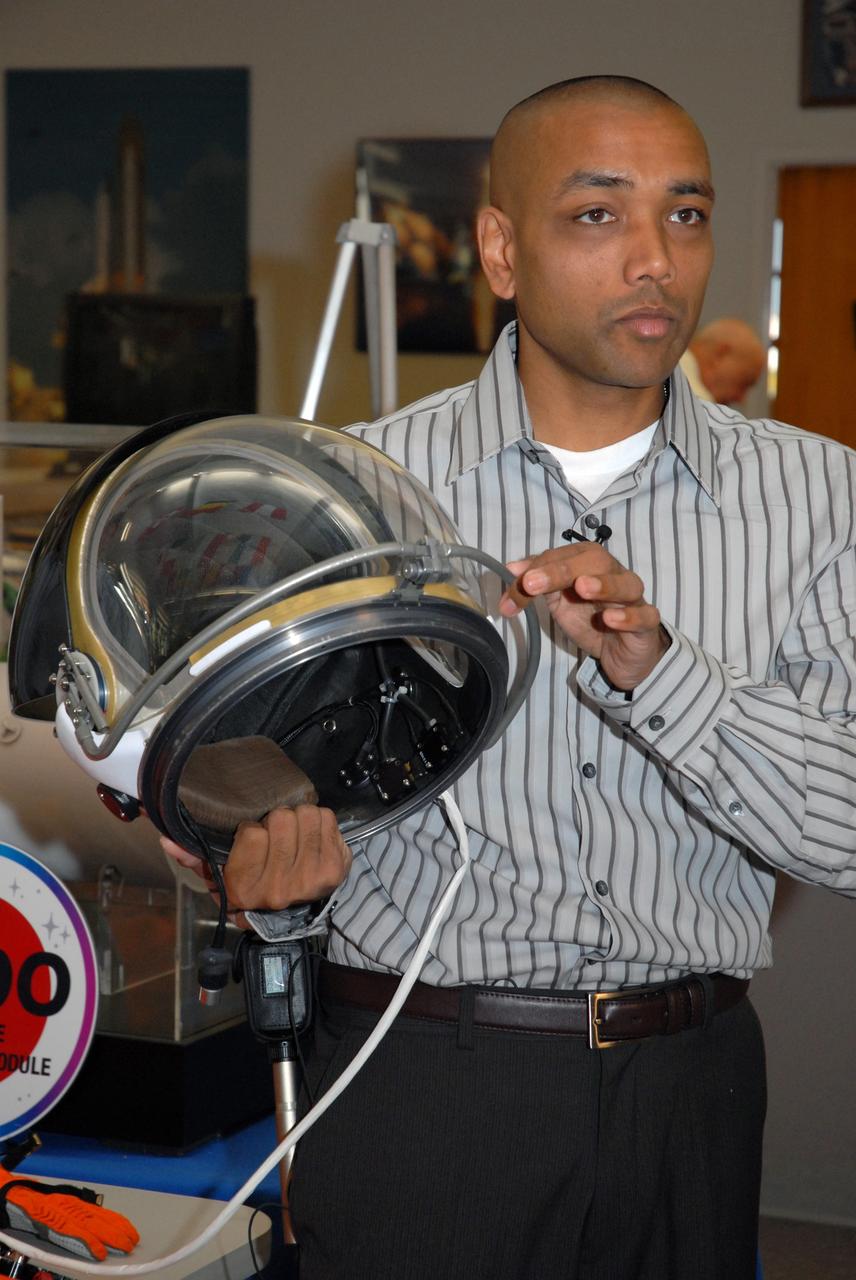
CAPE CANAVERAL, Fla. -- In the NASA News Center at NASA's Kennedy Space Center, Shuttle Crew Escape System Manager KC Chhipwadia describes for the media the elements of the helmet that is part of the launch and entry suit (seen on the table) used by shuttle crews during their missions. He is holding onto the bar that latches to secure the closed visor. The helmet provides oxygen when needed plus a communication system. Photo credit: NASA/Amanda Diller
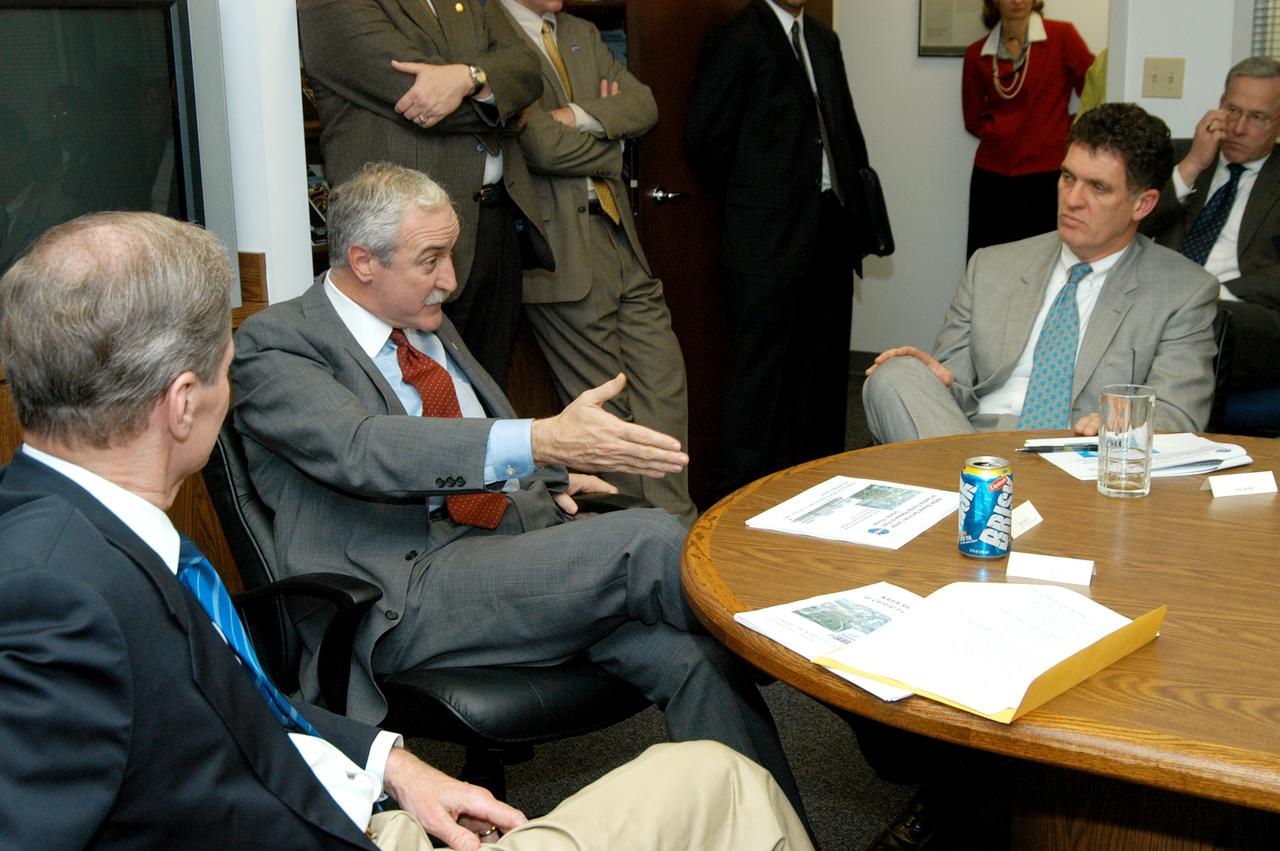
KENNEDY SPACE CENTER, FLA. - NASA Administrator Sean O’Keefe gestures during a discussion with Florida government leaders about the location for NASA’s new Shared Services Center. At left of O’Keefe is U.S. Senator Bill Nelson; at right is Congressman Dave Weldon. Six sites around the U.S. are under consideration for location of the Center, which would centralize NASA’s payroll, accounting, human resources, facilities and procurement offices that are now handled at each field center. The Florida location being proposed is of the Central Florida Research Park, near Orlando. Others attending the presentation included Congressman Tom Feeney, U.S. Representative Ric Keller, Center Director Jim Kennedy and Pamella J. Dana, Ph.D., director, Office of Tourism, Trade, and Economic Development in Florida.

KENNEDY SPACE CENTER, FLA. - Crawler-transporter No. 2 makes its way toward Launch Pad 39B (in the background). The crawler is being moved nearby in the event the mission management team decides to roll back Space Shuttle Atlantis due to Hurricane Ernesto. The hurricane has been forecast on a heading north and east from Cuba, taking it along the eastern coast of Florida. NASA's lighted launch window extends to Sept. 13, but mission managers are hoping to launch on mission STS-115 by Sept. 7 to avoid a conflict with a Russian Soyuz rocket also bound for the International Space Station. The crawler is 131 feet long, 113 feet wide and 20 feet high. It weights 5.5 million pounds unloaded. The combined weight of crawler, mobile launcher platform and a space shuttle is 12 million pounds. Unloaded, the crawler moves at 2 mph. Loaded, the snail's pace slows to 1 mph. Photo credit: NASA/Kim Shiflett

KENNEDY SPACE CENTER, FLA. -- Astronaut Clayton Anderson dons his helmet as he gets ready for launch of Space Shuttle Atlantis at 7:38 p.m. EDT from Launch Pad 39A. Anderson will join the Expedition 15 crew aboard the International Space Station, exchanging his seat on the return trip for Flight Engineer Suni Williams. The shuttle is delivering a new segment to the starboard side of the International Space Station's backbone, known as the truss. Three spacewalks are planned to install the S3/S4 truss segment, deploy a set of solar arrays and prepare them for operation. STS-117 is the 118th space shuttle flight, the 21st flight to the station, the 28th flight for Atlantis and the first of four flights planned for 2007. Photo credit: NASA/Kim Shiflett

KENNEDY SPACE CENTER, Fla. -- Expedition 4 crew member Daniel W. Bursch waits patiently for final checkout of his launch and entry suit prior to heading to Launch Pad 39B and Space Shuttle Endeavour. Top priorities for the 11-day STS-108 (UF-1) mission of Endeavour are rotation of the International Space Station Expedition 3 and Expedition 4 crews; bringing water, equipment and supplies to the station in the Multi-Purpose Logistics Module Raffaello; and the crew's completion of robotics tasks and a spacewalk to install thermal blankets over two pieces of equipment at the bases of the Space Station's solar wings. Launch is scheduled for 5:45 p.m. EST Dec. 4, 2001, from Launch Pad 39B

KENNEDY SPACE CENTER, FLA. -- The orbiter Discovery touches down on Runway 15 of KSC's Shuttle Landing Facility to complete the STS-91 mission. Main gear touchdown was at 2:00:18 p.m. EDT on June 12, 1998, landing on orbit 155 of the mission. The wheels stopped at 2:01:22 p.m. EDT, for a total mission-elapsed time of 9 days, 19 hours, 55 minutes and 1 second. The 91st Shuttle mission was the 44th KSC landing in the history of the Space Shuttle program and the 15th consecutive landing at KSC. During the mission, the orbiter docked with the Russian space station Mir for the ninth time, concluding Phase I of the joint U.S.-Russian International Space Station Program. STS-91 also featured first flights for both the Alpha Magnetic Spectrometer and the Space Shuttle super lightweight external tank. The STS-91 flight crew included Mission Commander Charles J. Precourt; Pilot Dominic L. Gorie; and Mission Specialists Wendy B. Lawrence, Franklin R. Chang-Diaz, Janet Lynn Kavandi and Valery Victorovitch Ryumin of the Russian Space Agency. Astronaut Andrew S. W. Thomas also returned to Earth as an STS-91 crew member after 141 days in space
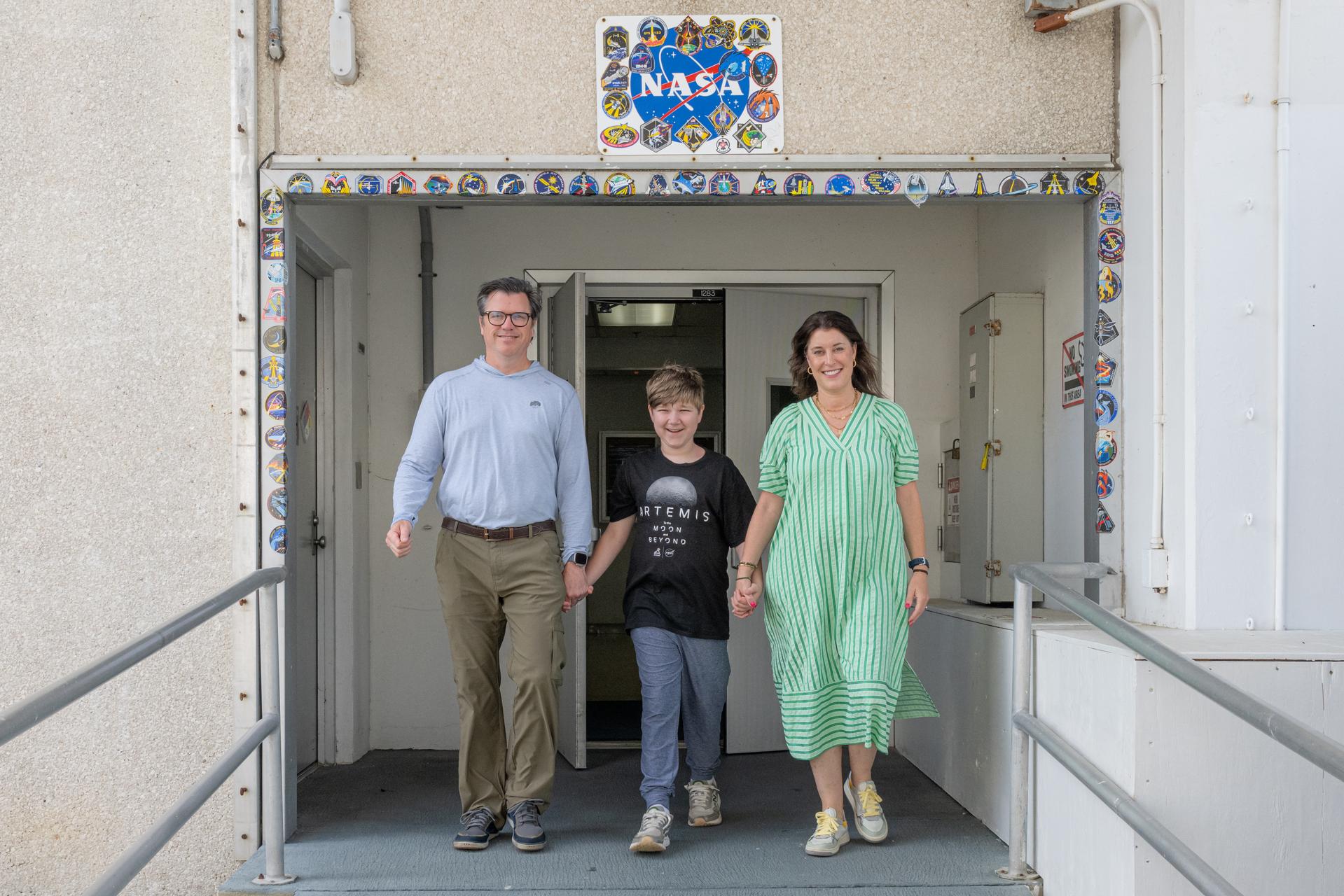
Eleven-year-old Hilt Boling, center, and parents Kent Boling, left, and Rachel Boling, right, depart the Neil A. Armstrong Operations and Checkout Building, Friday, Apr. 3, 2026, at NASA’s Kennedy Space Center in Florida. When asked during an April 1 television appearance why he loved space and being at the Artemis II launch, Boling exclaimed: “We’re going back to the freaking Moon, that’s why!” His comments received widespread social media attention in the following days. Photo Credit: (NASA/John Kraus)
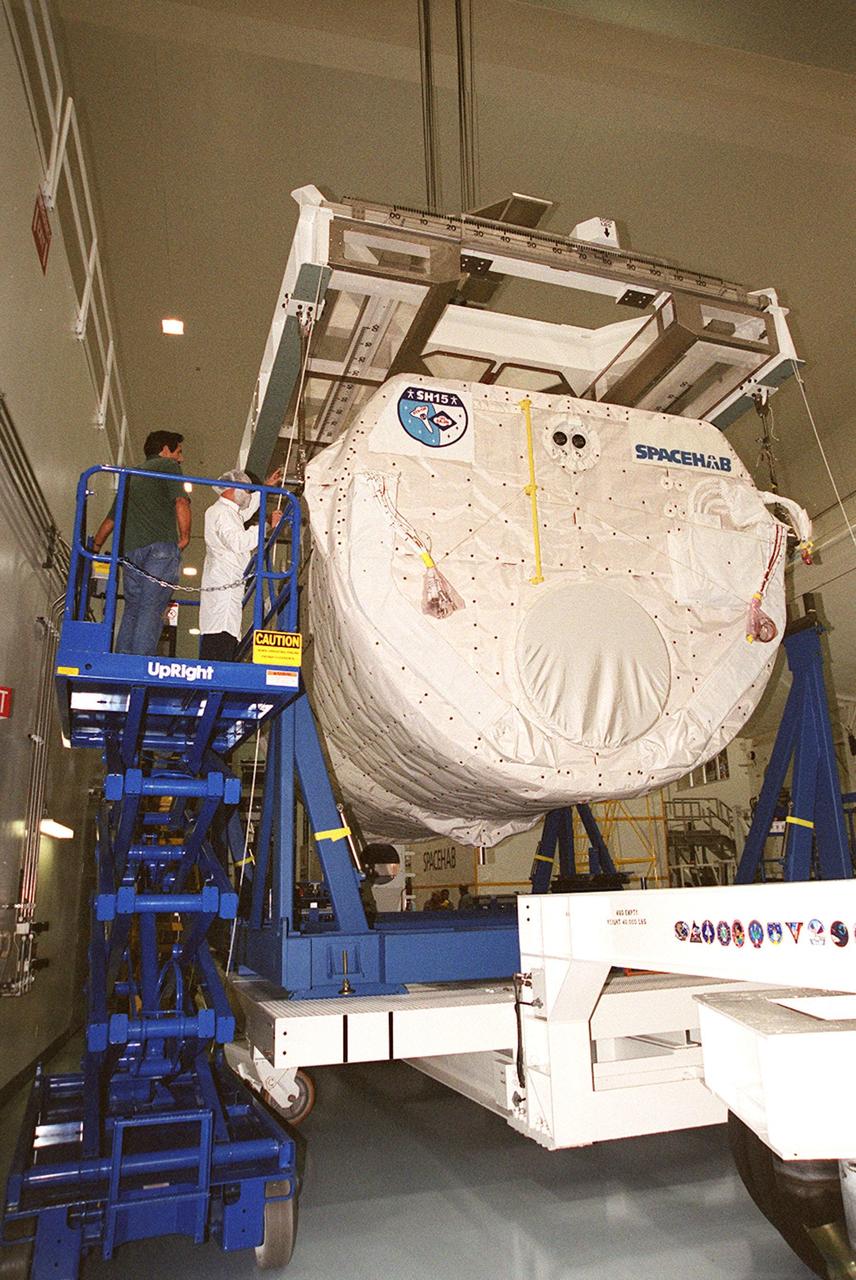
KENNEDY SPACE CENTER, FLA. -- Workers attach an overhead crane to the SPACEHAB module to lift it off the transport vehicle beneath it. The module, part of the payload on mission STS-106, will be placed in the payload canister for transport to the launch pad. STS-106 is scheduled to launch Sept. 8 at 8:31 a.m. EDT
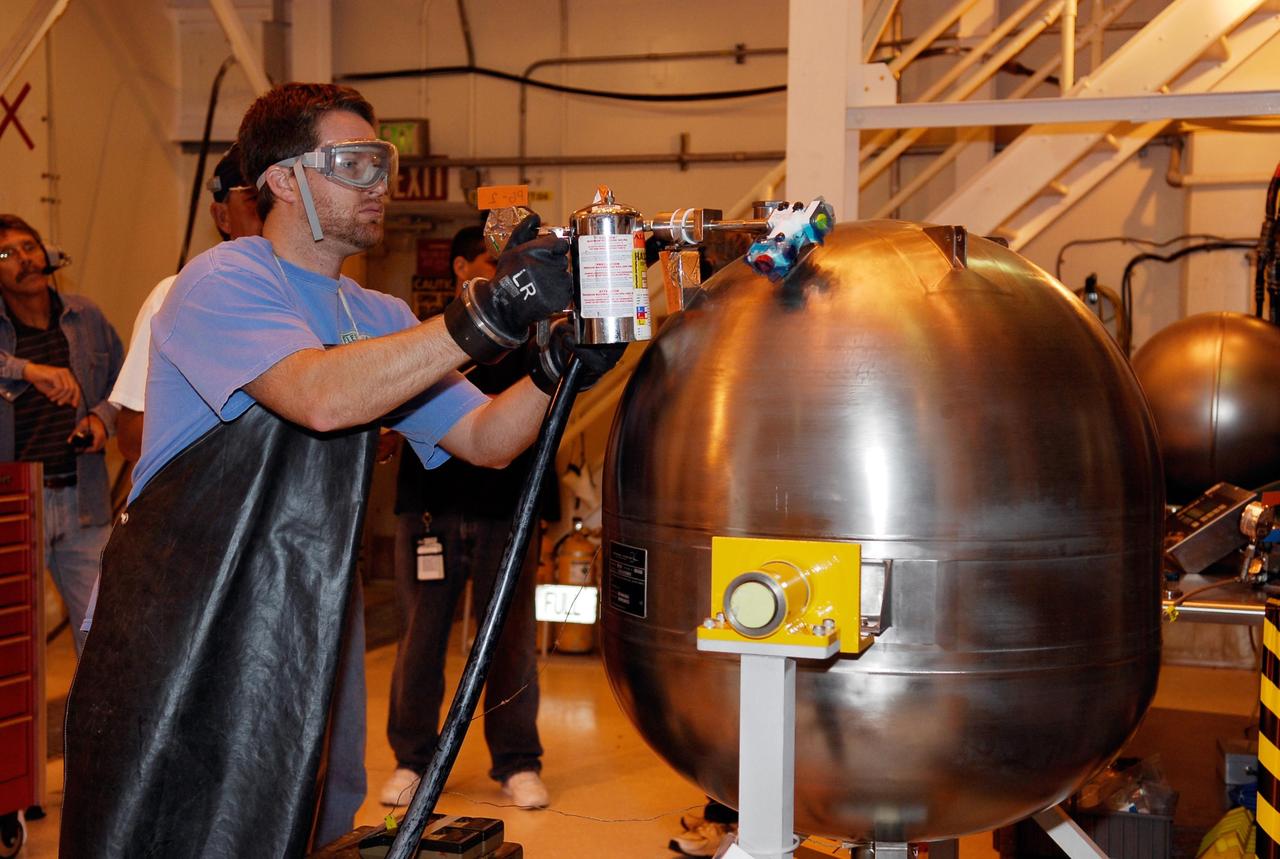
KENNEDY SPACE CENTER, FLA. -- In the hypergolic maintenance facility at NASA's Kennedy Space Center, a technician adjusts equipment during testing of the Ares I-X Roll Control System, or RoCS. The RoCS Servicing Simulation Test is to gather data that will be used to help certify the ground support equipment design and validate the servicing requirements and processes. The RoCS is part of the Interstage structure, the lowest axial segment of the Upper Stage Simulator. In an effort to reduce costs and meet the schedule, most of the ground support equipment that will be used for the RoCS servicing is of space shuttle heritage. This high-fidelity servicing simulation will provide confidence that servicing requirements can be met with the heritage system. At the same time, the test will gather process data that will be used to modify or refine the equipment and processes to be used for the actual flight element. Photo credit: NASA/Kim Shiflett
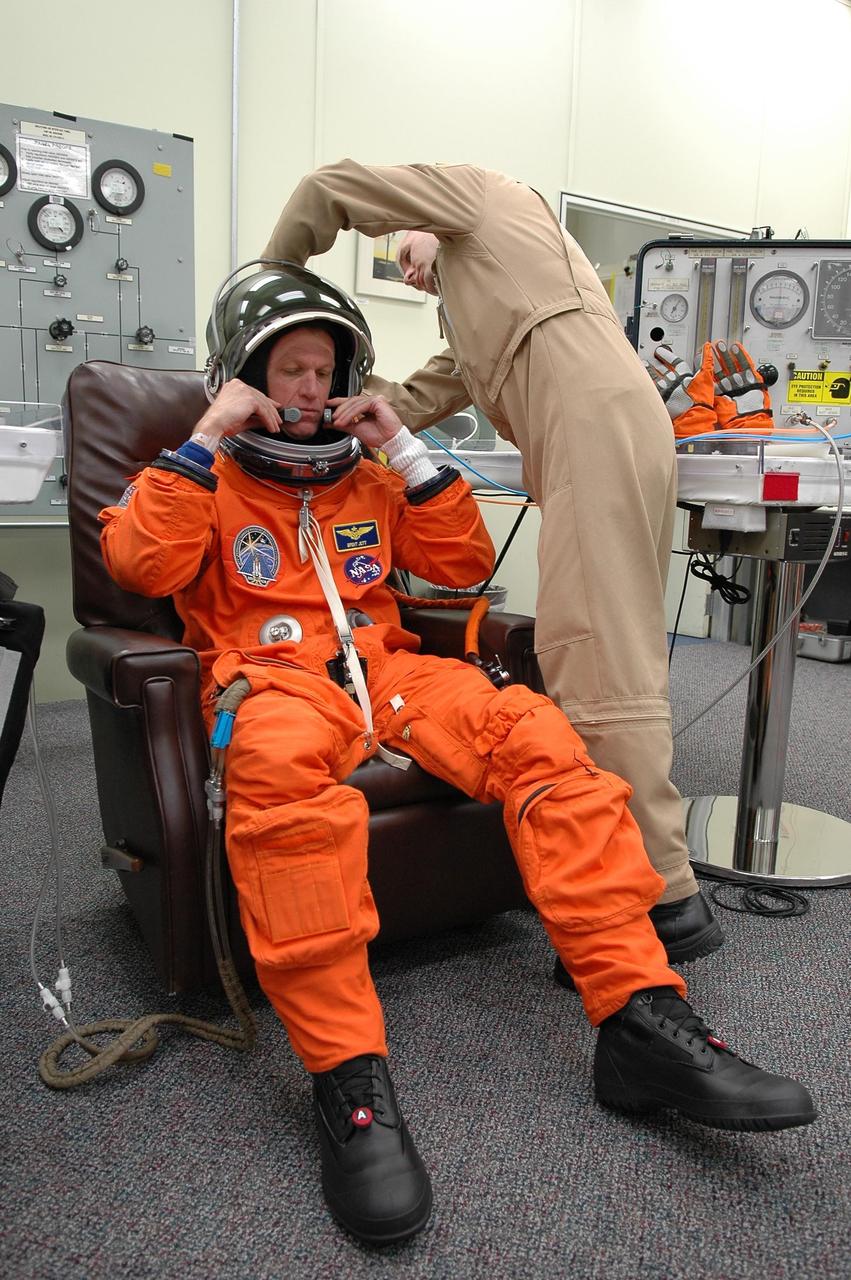
KENNEDY SPACE CENTER, FLA. - In the Operations and Checkout Building at NASA Kennedy Space Center, STS-115 Commander Brent Jett dons his launch and re-entry suit before heading to the launch pad. Jett is making his fourth shuttle flight on this mission to the International Space Station aboard Space Shuttle Atlantis. On its second attempt for launch, Atlantis is scheduled to lift off at 11:41 a.m. EDT today from Launch Pad 39B. During the STS-115 mission, Atlantis' astronauts will deliver and install the 17.5-ton, bus-sized P3/P4 integrated truss segment on the station. The girder-like truss includes a set of giant solar arrays, batteries and associated electronics and will provide one-fourth of the total power-generation capability for the completed station. This mission is the 116th space shuttle flight, the 27th flight for orbiter Atlantis, and the 19th U.S. flight to the ISS. STS-115 is scheduled to last 11 days with a planned landing at KSC. Photo credit: NASA/Kim Shiflett
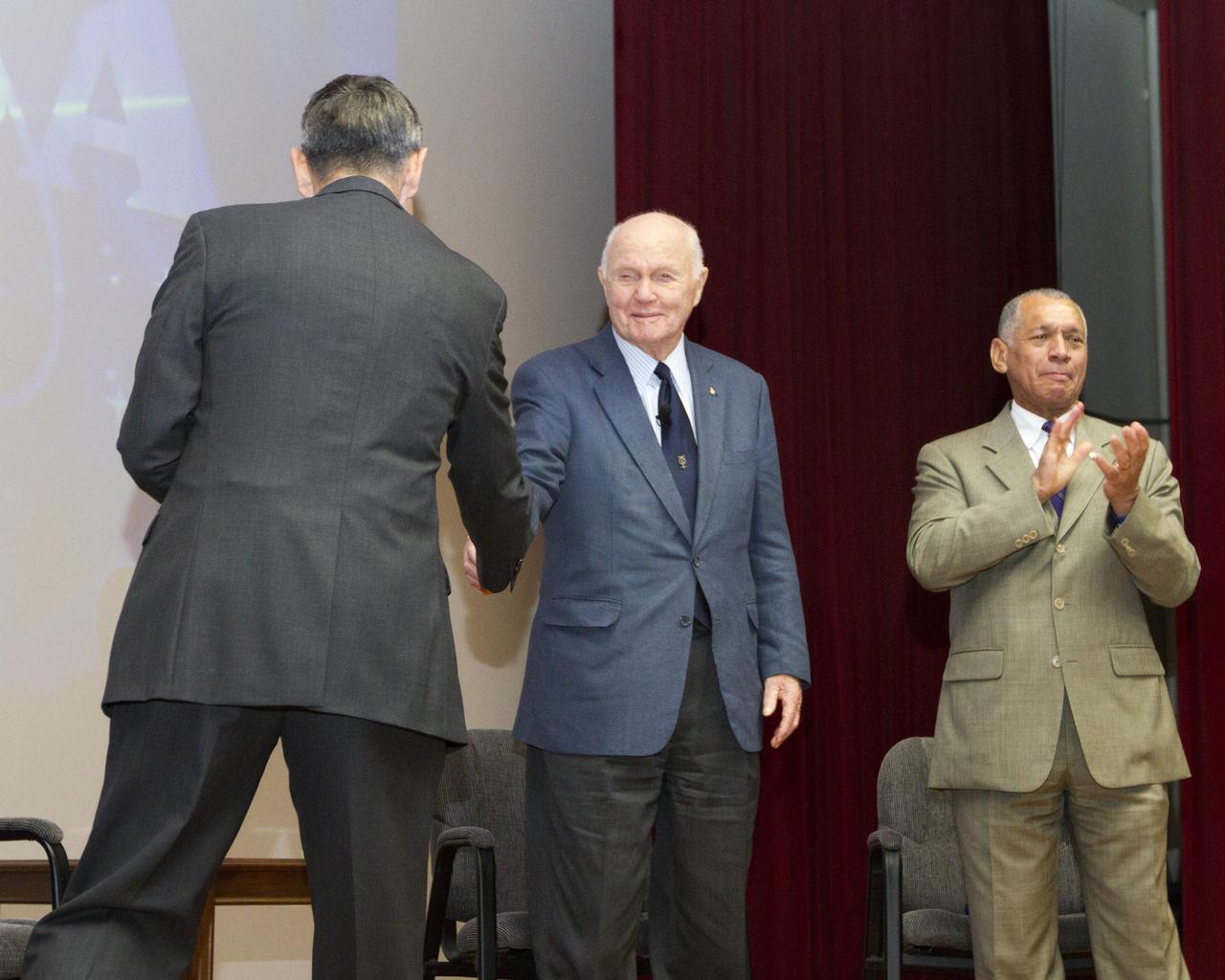
CAPE CANAVERAL, Fla. -- Bob Cabana, director of NASA's Kennedy Space Center in Florida, shakes the hand of Mercury astronaut John Glenn as NASA Administrator Charles Bolden applauds at the "50 Years of Americans in Orbit" presentation for Kennedy employees. Mercury astronaut Scott Carpenter joined Glenn, Bolden and Cabana for the event. This year marks 50 years since Glenn and Carpenter became the first two Americans to orbit Earth. Photo credit: NASA/Kim Shiflett
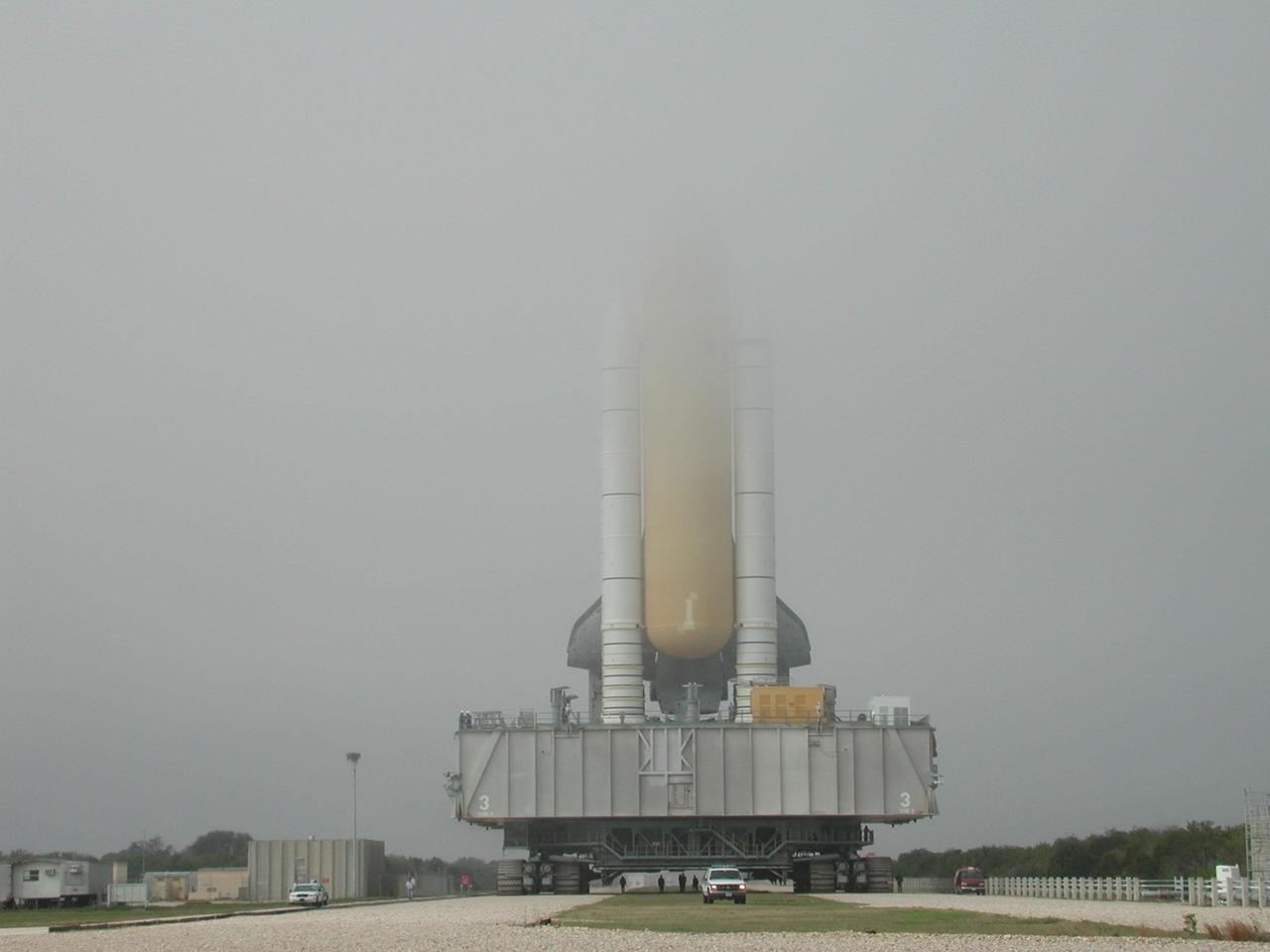
KENNEDY SPACE CENTER, Fla. -- As Space Shuttle Discovery, on its Mobile Launcher Platform, nears Launch Pad 39B, fog rolls over the top of the external tank and solid rocket boosters. Discovery will be flying on mission STS-102 to the International Space Station. Its payload is the Multi-Purpose Logistics Module Leonardo, a “moving van,” to carry laboratory racks filled with equipment, experiments and supplies to and from the Space Station aboard the Space Shuttle. The flight will also carry the Expedition Two crew up to the Space Station, replacing Expedition One, who will return to Earth on Discovery. Launch is scheduled for March 8 at 6:45 a.m. EST
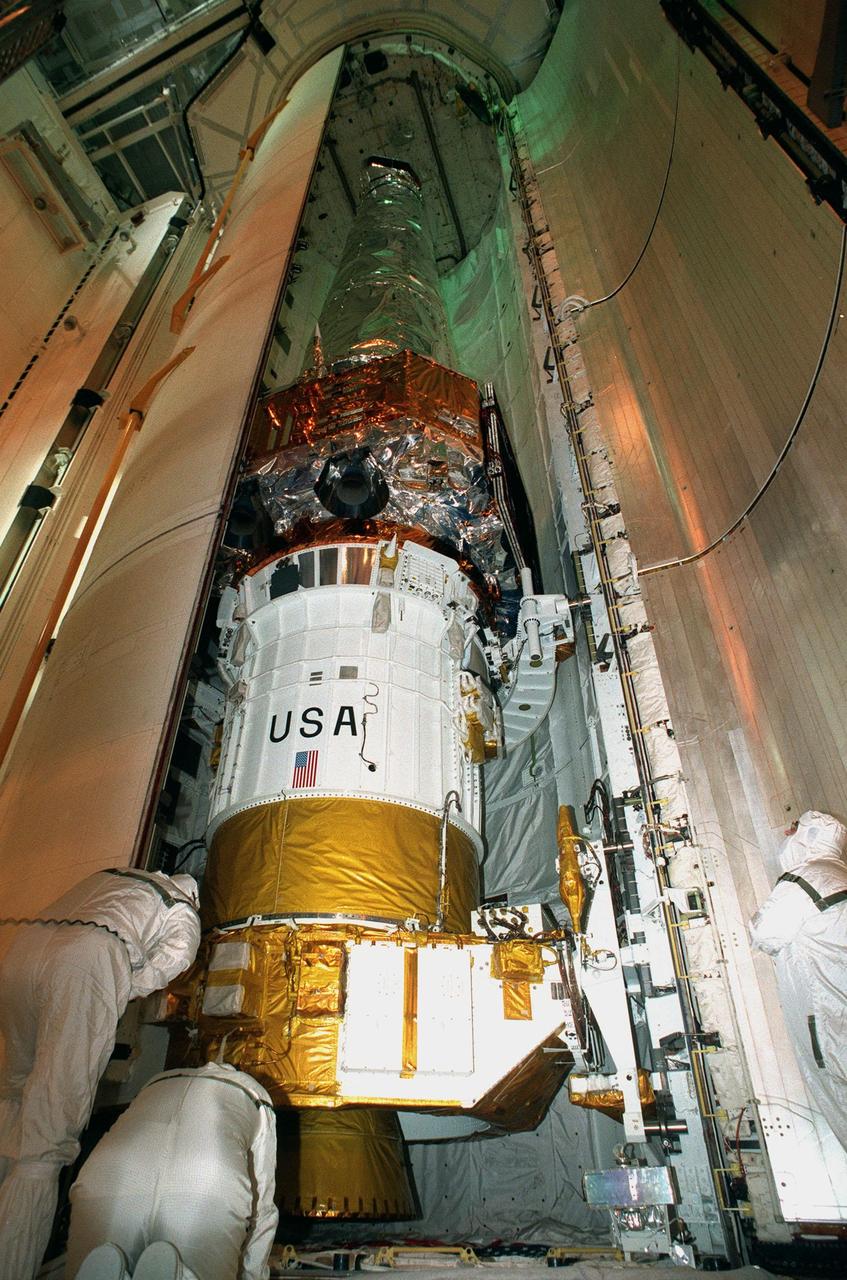
At Launch Pad 39-B, the Space Shuttle Columbia's payload bay doors close around the Chandra X-ray Observatory inside, while workers monitor the activity. Chandra is the primary payload on mission STS-93, scheduled to launch aboard Columbia July 20 at 12:36 a.m. EDT. The combined Chandra/Inertial Upper Stage, seen here, measures 57 feet long and weighs 50,162 pounds. Fully deployed with solar arrays extended, the observatory measures 45.3 feet long and 64 feet wide. The world's most powerful X-ray telescope, Chandra will allow scientists from around the world to see previously invisible black holes and high-temperature gas clouds, giving the observatory the potential to rewrite the books on the structure and evolution of our universe
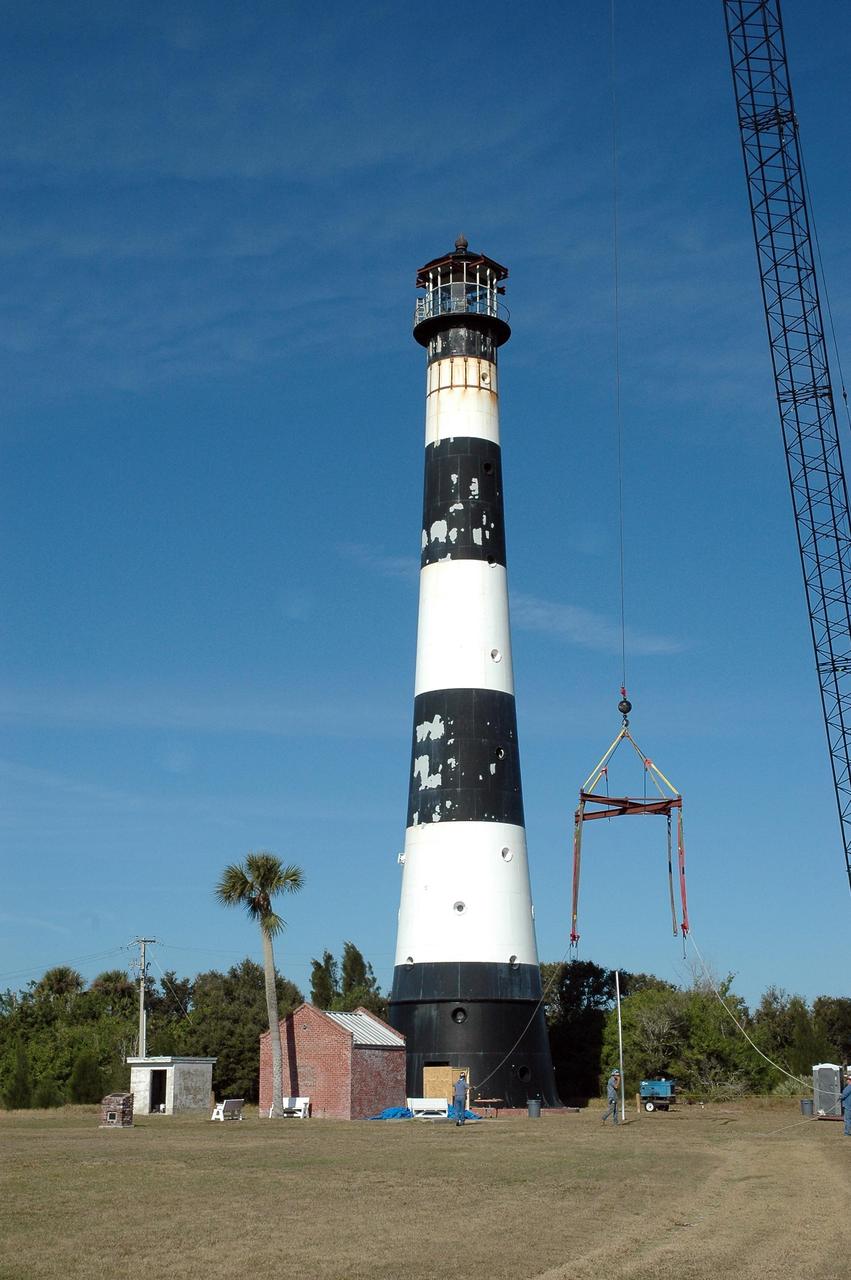
KENNEDY SPACE CENTER, FLA. - At Cape Canaveral Air Force Station, a crane is lifted near the Cape Canaveral Lighthouse for use in removing the lamp room at top. Leaks in the roof allowed moisture to seep in. The lamp room is being removed for repairs and refurbishment. In addition, the original brass roof will be restored and put back in place. The Cape Canaveral Lighthouse is the only operational lighthouse owned by the Air Force. It was first erected in 1868 near the edge of the Atlantic Ocean. Photo credit: NASA/Jack Pfaller
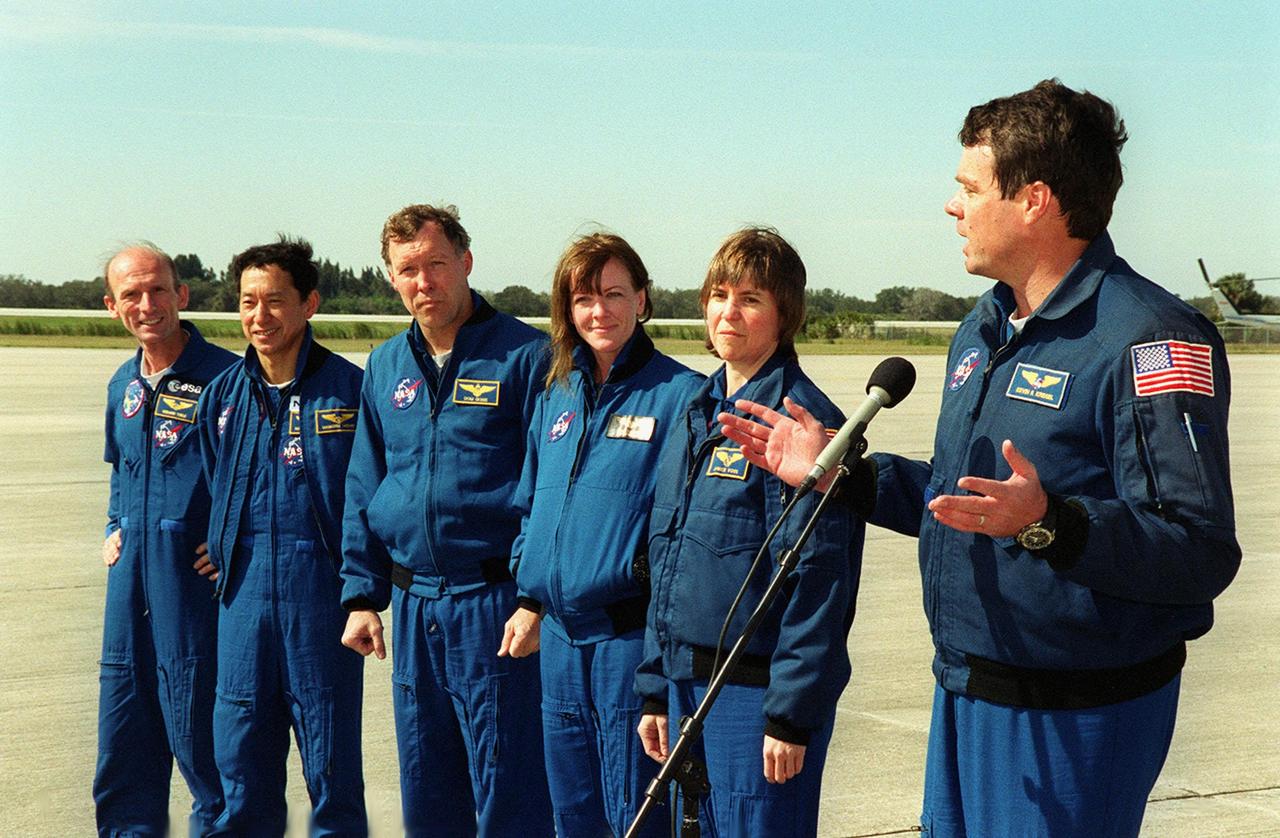
After arriving at KSC's Shuttle Landing Facility, the STS-99 crew pause to greet the media and Commander Kevin Kregel (right) introduces his crew: (from left) Mission Specialists Gerhard Thiele (Ph.D.) and Mamoru Mohri (Ph.D.); Pilot Dominic Gorie; and Mission Specialists Janet Lynn Kavandi (Ph.D.) and Janice Voss (Ph.D.). Thiele is with the European Space Agency and Mohri is with the National Space Development Agency (NASDA) of Japan. Over the next few days, the crew will review mission procedures, conduct test flights in the Shuttle Training Aircraft and undergo routine preflight medical exams. STS-99 is the Shuttle Radar Topography Mission, which will chart a new course, using two antennae and a 200-foot-long section of space station-derived mast protruding from the payload bay to produce unrivaled 3-D images of the Earth's surface. The result of the Shuttle Radar Topography Mission could be close to 1 trillion measurements of the Earth's topography. Besides contributing to the production of better maps, these measurements could lead to improved water drainage modeling, more realistic flight simulators, better locations for cell phone towers, and enhanced navigation safety. Launch of Endeavour is scheduled for Jan. 31 at 12:47 p.m. EST
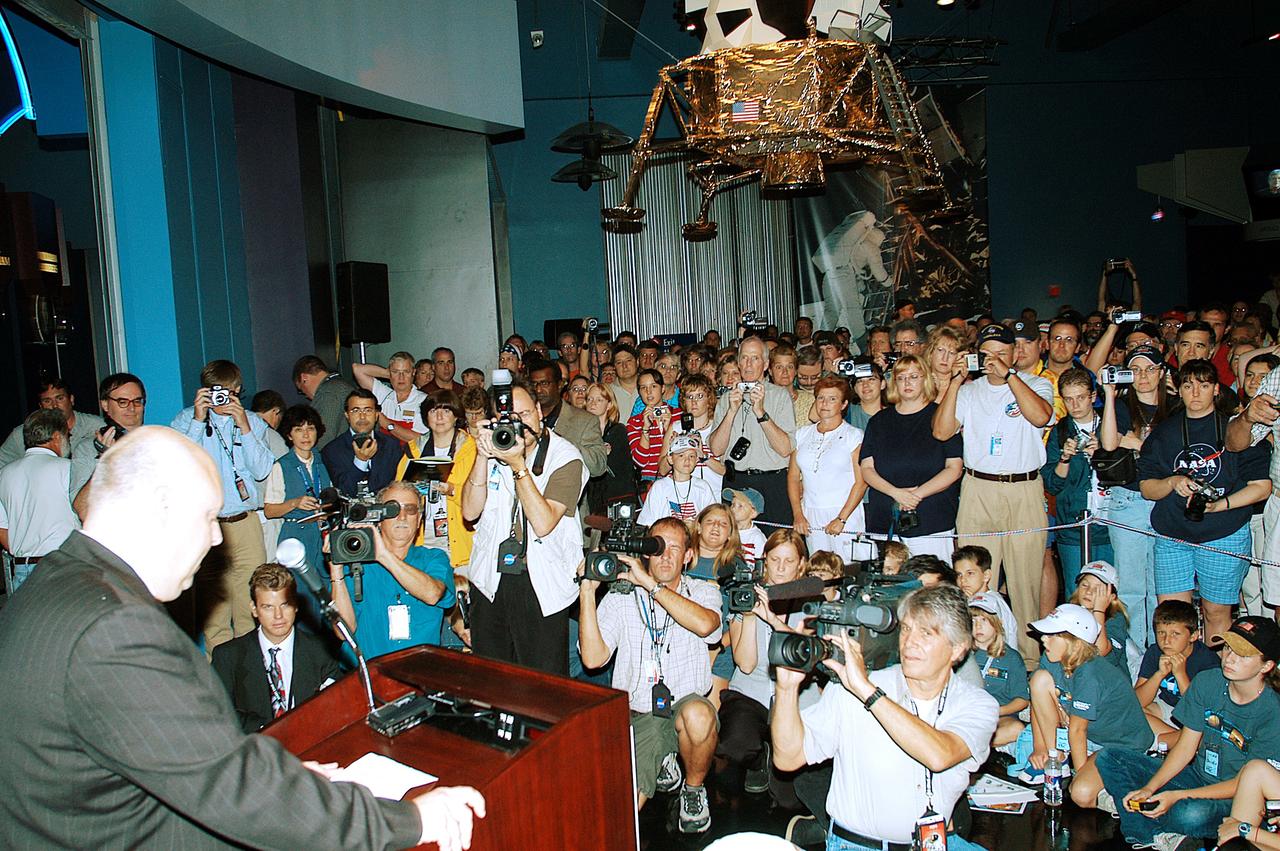
KENNEDY SPACE CENTER, FLA. - Daniel LeBlanc, chief operating officer of Delaware North Companies Parks and Resorts at KSC, makes the opening remarks to hundreds of guests and media representatives attending a ribbon cutting ceremony officially opening the U.S. Astronaut Hall of Fame as part of the Kennedy Space Center Visitor Complex. The ceremony was held in conjunction with the induction of four Space Shuttle astronauts into the Hall of Fame including Daniel Brandenstein, Robert "Hoot" Gibson, Story Musgrave, and Sally Ride. Conceived by six of the Mercury Program astronauts, the U.S. Astronaut Hall of Fame opened in 1990 to provide a place where space travelers could be remembered for their participation and accomplishments in the U.S. space program. The four new inductees join 48 previously honored astronauts from the ranks of the Gemini, Apollo, Skylab, Apollo-Soyuz, and Space Shuttle programs.
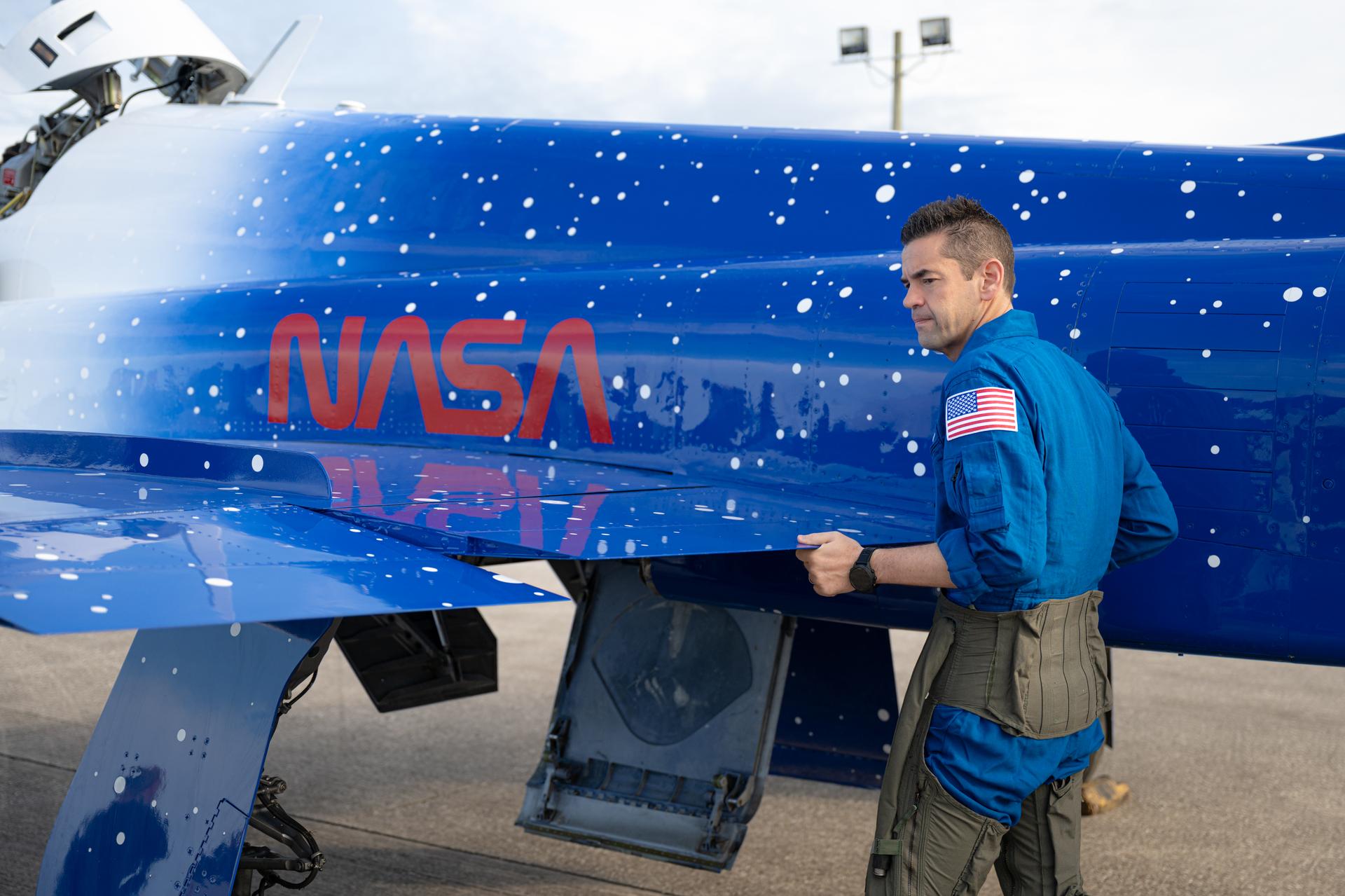
NASA Administrator Jared Isaacman is seen with his personal F-5 aircraft, Thursday, Jan. 22, 2026, at NASA’s Kennedy Space Center in Florida. Photo Credit: (NASA/John Kraus)
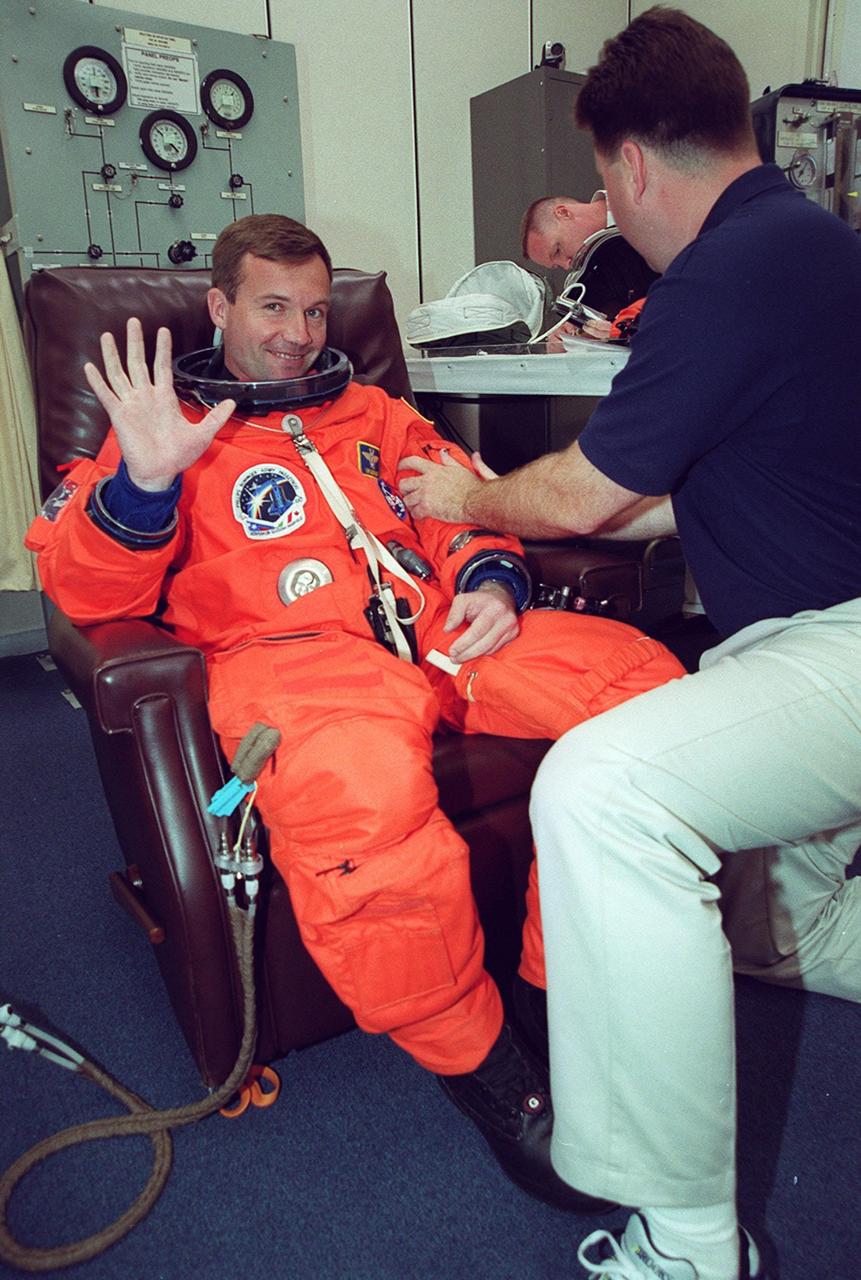
Smiling, STS-100 Mission Specialist Yuri V. Lonchakov waves as he suits up for launch in the Operations and Checkout Building. Lonchakov is with the Russian Aviation and Space Agency. The 11-day mission to the International Space Station will deliver and integrate the Spacelab Logistics Pallet/Launch Deployment Assembly, which includes the Space Station Remote Manipulator system and the UHF Antenna, and the Multi-Purpose Logistics Module Raffaello. The mission includes two planned spacewalks for installation of the SSRMS. The mission is also the inaugural flight of Raffaello, carrying resupply stowage racks and resupply/return stowage platforms. Liftoff on mission STS-100 is scheduled at 2:41 p.m. EDT April 19
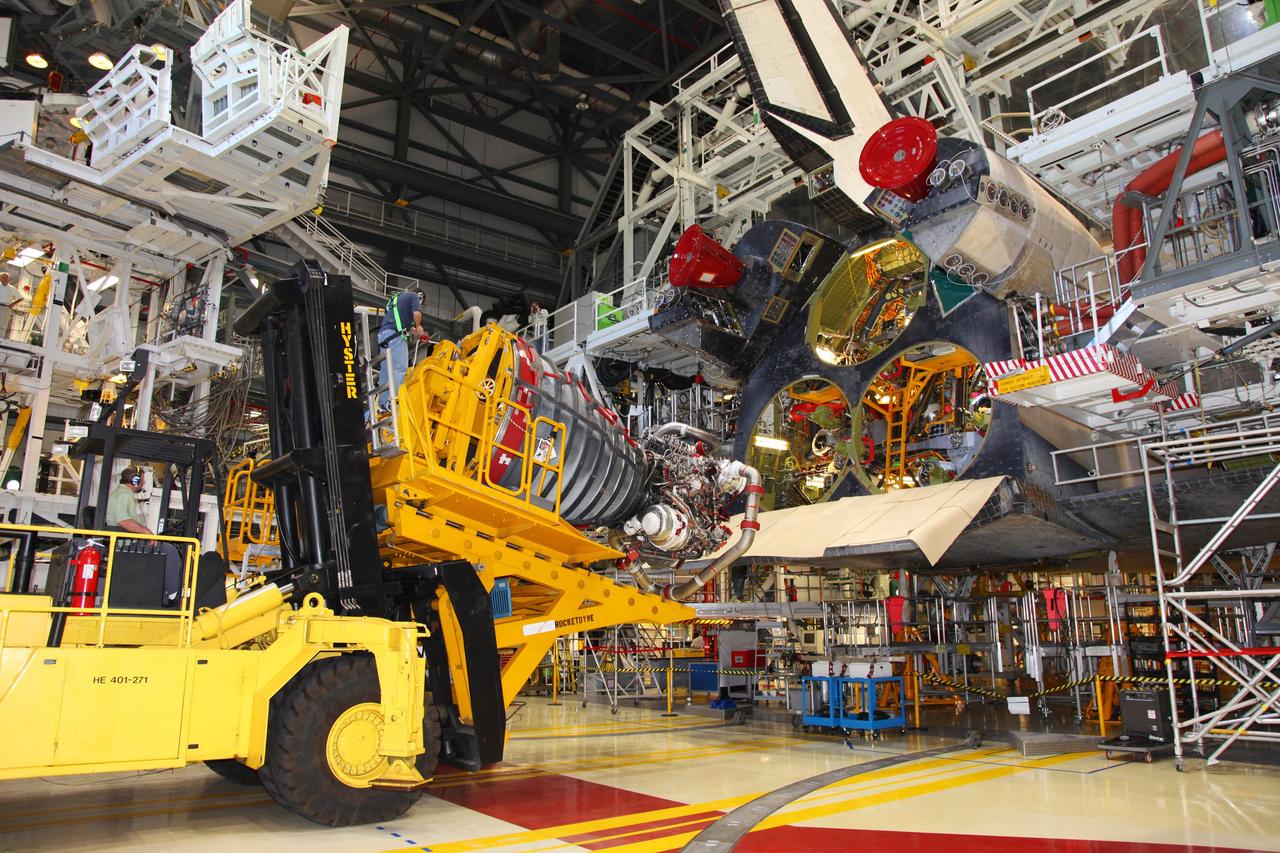
CAPE CANAVERAL, Fla. -- In Orbiter Processing Facility-2 at NASA’s Kennedy Space Center in Florida, technicians used a Hyster forklift to remove Engine #1, the final engine to be removed from space shuttle Atlantis. The forklift will be used to transport the engine to the Engine Shop for possible future use. Each of the three space shuttle main engines is 14 feet long and weighs 7,800 pounds. Removal of the space shuttle main engines is part of the Transition and Retirement work that is being performed in order to prepare Atlantis for eventual display at the Kennedy Space Center Visitor Complex in Florida. Photo credit: Frankie Martin
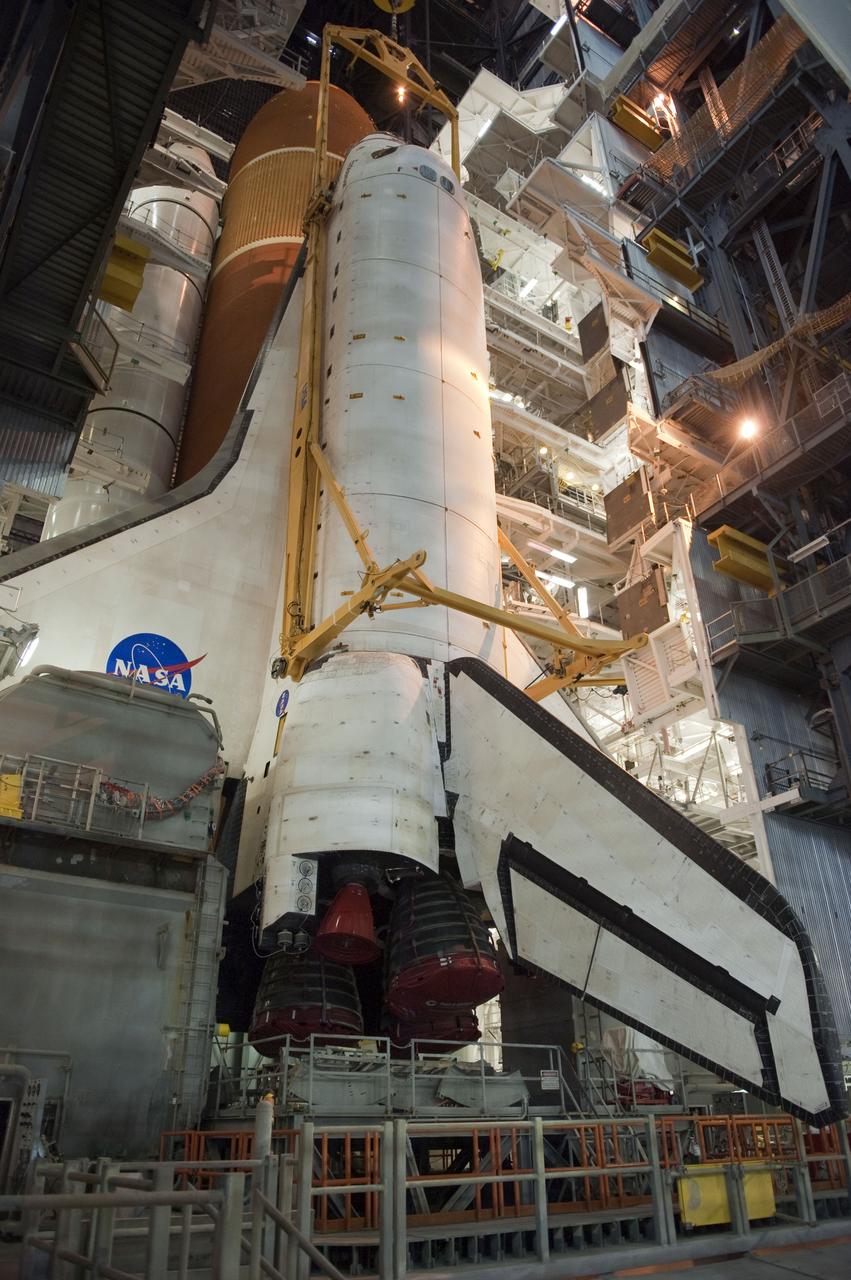
CAPE CANAVERAL, Fla. -- In the Vehicle Assembly Building at NASA's Kennedy Space Center in Florida, shuttle Endeavour is lowered into place where it is being attached to its external fuel tank and solid rocket boosters, already positioned on the mobile launcher platform. Endeavour and its STS-134 crew will deliver the Express Logistics Carrier-3, Alpha Magnetic Spectrometer, a high-pressure gas tank, additional spare parts for Dextre and micrometeoroid debris shields to the International Space Station. Endeavour's final launch is targeted for April 19 at 7:48 p.m. EDT. For more information visit, http://www.nasa.gov/mission_pages/shuttle/shuttlemissions/sts134/index.html. Photo credit: NASA/Kim Shiflett
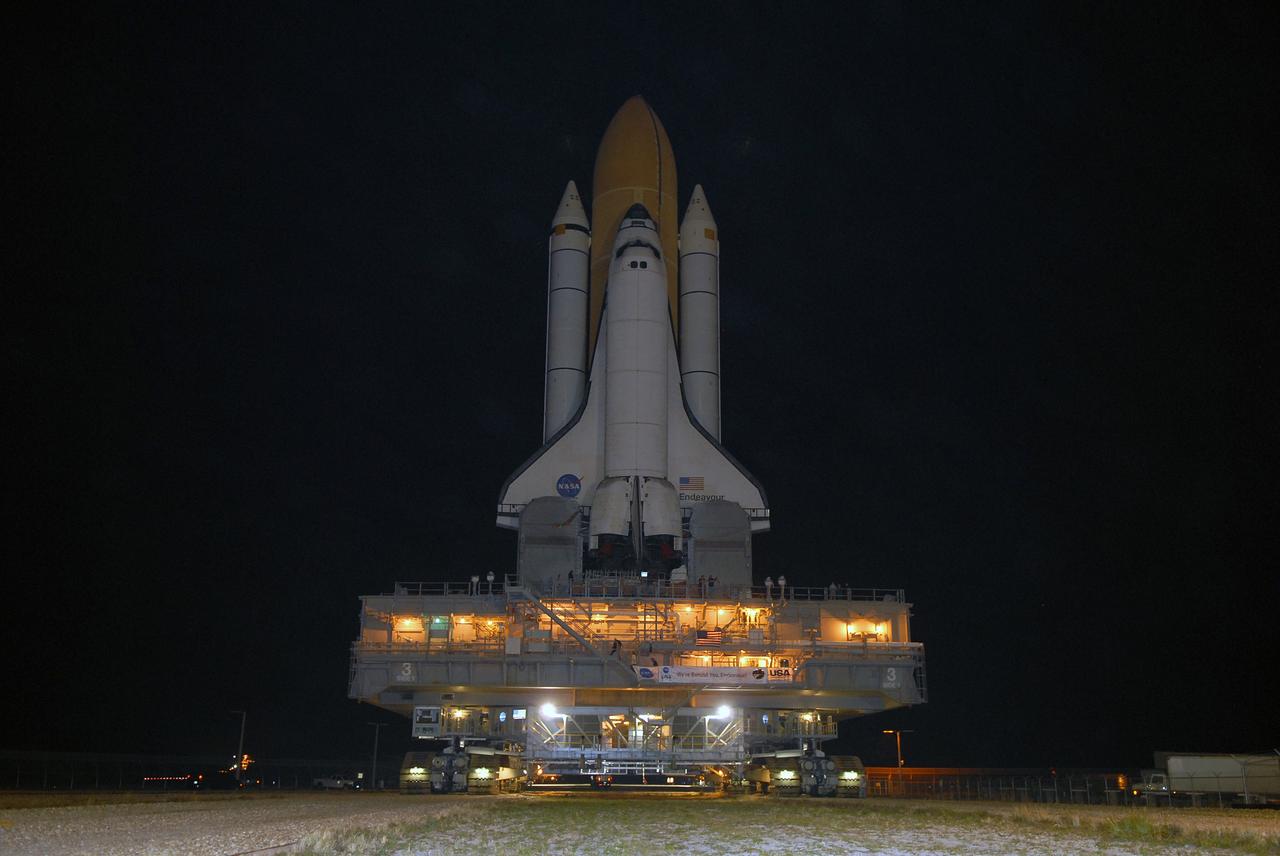
CAPE CANAVERAL, Fla. – Space shuttle Endeavour, installed on the mobile launcher platform atop the crawler-transporter, moves along the crawlerway at NASA's Kennedy Space Center in Florida as it rolls out to Launch Pad 39B. First motion was at 11:57 p.m. EDT April 16. The 4.2-mile journey is expected to take approximately 7 hours. Endeavour will be prepared on the pad for liftoff in the unlikely event that a rescue mission is necessary following space shuttle Atlantis' launch on the STS-125 mission to service NASA's Hubble Space Telescope. After Atlantis is cleared to land, Endeavour will move to Launch Pad 39A for its upcoming STS-127 mission to the International Space Station, targeted to launch June 13. Photo credit: NASA/Jack Pfaller
![KENNEDY SPACE CENTER, FLA. -- At the conclusion of Terminal Countdown Demonstration Test activities, the STS-107 crew returns to Houston. In the cockpit of the T-38 jet trainer is Pilot William "Willie" McCool. Reflected in his helmet is another T-38 with other crew members. The launch of mission STS-107 is planned for Jan. 16, 2003, between 10 a.m. and 2 p.m. EST aboard Space Shuttle Columbia. A mission devoted to research, STS-107 will include more than 80 experiments that will study Earth and space science, advanced technology development, and astronaut health and safety. [Photo by: astronaut Willie McCool]](https://images-assets.nasa.gov/image/KSC-02pd2066/KSC-02pd2066~medium.jpg)
KENNEDY SPACE CENTER, FLA. -- At the conclusion of Terminal Countdown Demonstration Test activities, the STS-107 crew returns to Houston. In the cockpit of the T-38 jet trainer is Pilot William "Willie" McCool. Reflected in his helmet is another T-38 with other crew members. The launch of mission STS-107 is planned for Jan. 16, 2003, between 10 a.m. and 2 p.m. EST aboard Space Shuttle Columbia. A mission devoted to research, STS-107 will include more than 80 experiments that will study Earth and space science, advanced technology development, and astronaut health and safety. [Photo by: astronaut Willie McCool]
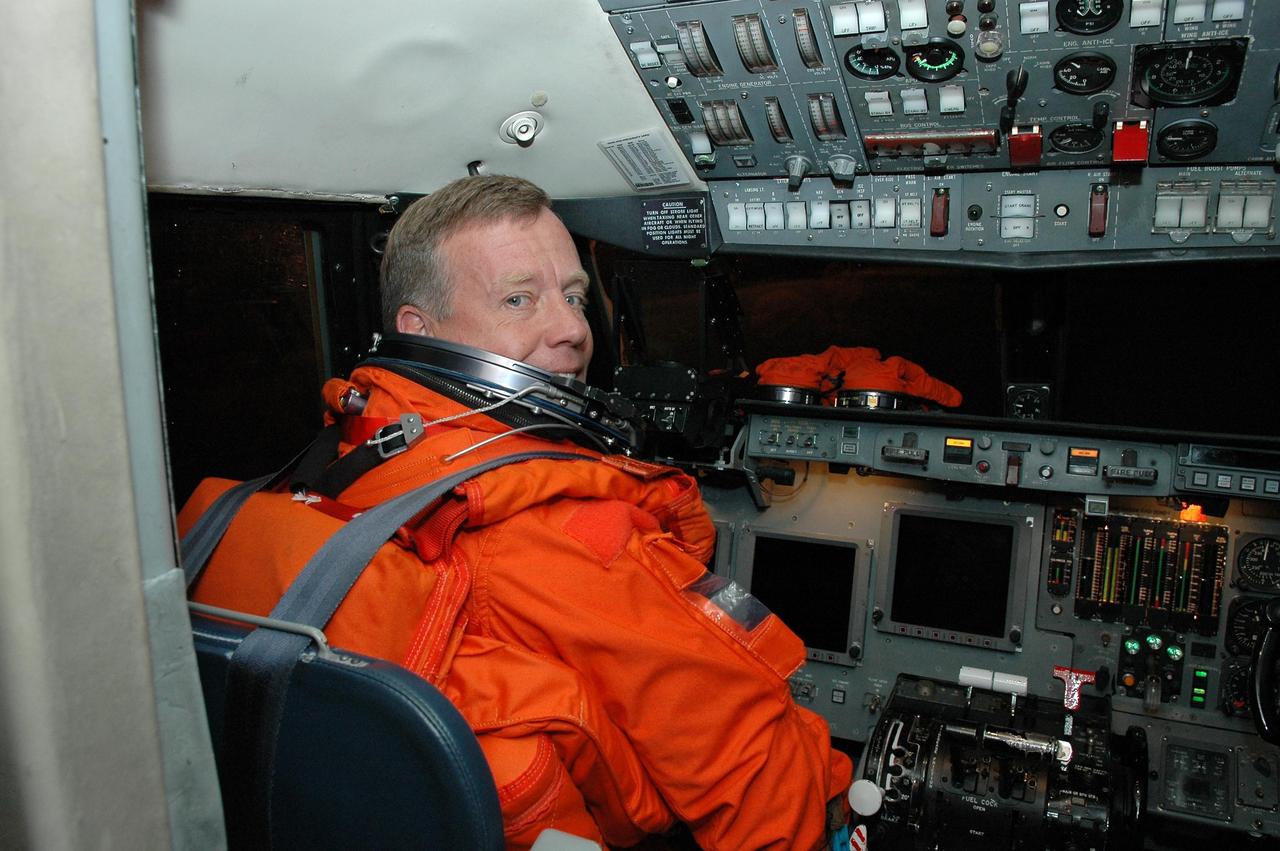
KENNEDY SPACE CENTER, FLA. - Inside the Shuttle Training Aircraft (STA), STS-121 Commander Steven Lindsey settles into his seat in the cockpit. Lindsey and Pilot Mark Kelly will be making practice landings in preparation for the July 1 launch of Space Shuttle Discovery. The STA is a Grumman American Aviation-built Gulf Stream II jet that was modified to simulate an orbiter’s cockpit, motion and visual cues, and handling qualities. In flight, the STA duplicates the orbiter’s atmospheric descent trajectory from approximately 35,000 feet altitude to landing on a runway. Because the orbiter is unpowered during re-entry and landing, its high-speed glide must be perfectly executed the first time. Photo credit: NASA/Kim Shiflett
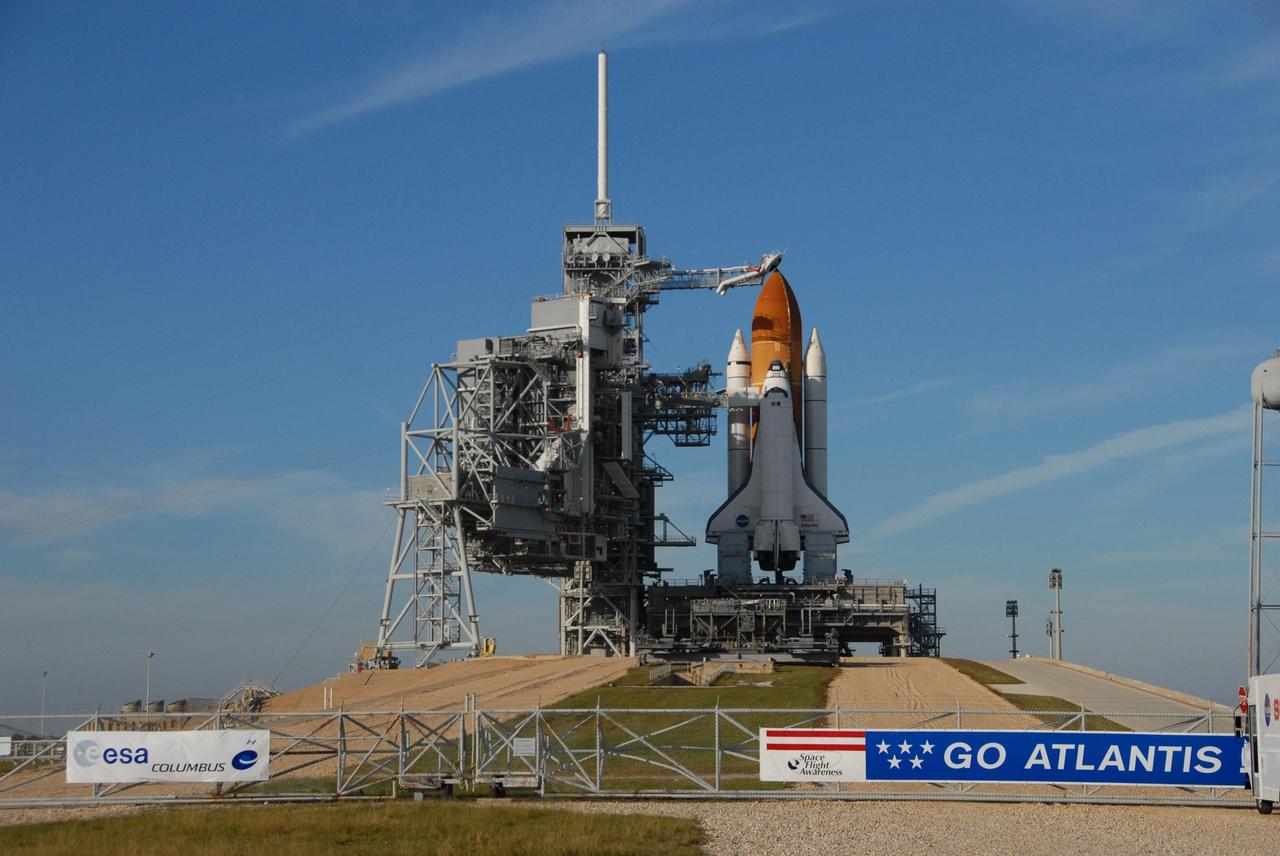
KENNEDY SPACE CENTER, FLA. -- Shadows spill across space shuttle Atlantis, still poised on the pad after its launch on mission STS-122 was postponed Thursday. It sits atop the mobile launcher platform. Shuttle program managers decided at 9:56 a.m. to postpone the launch because of an issue with a fuel cut-off sensor system inside the external fuel tank. This is one of several systems that protect the shuttle's main engines by triggering their shut down if fuel runs unexpectedly low. During countdown activities this morning, two sensors failed a routine prelaunch check. There are four engine cut-off, or ECO, sensors inside the liquid hydrogen section of the tank, and Launch Commit Criteria require three of the four sensor systems to be functioning properly. The tank's liquid oxygen and liquid hydrogen was drained from the tank, and preparations will begin for a possible launch attempt Friday. NASA's launch rules have a preplanned procedure that states in the case of ECO sensor system failure, engineers need to drain the tank and verify all the sensors are working as they go dry. Atlantis carries the Columbus Laboratory, the European Space Agency's largest contribution to the construction of the space station. When permanently attached to Node 2, the laboratory will carry out experiments in materials science, fluid physics and biosciences, as well as perform a number of technological applications, in a microgravity environment. Photo credit: NASA/George Shelton
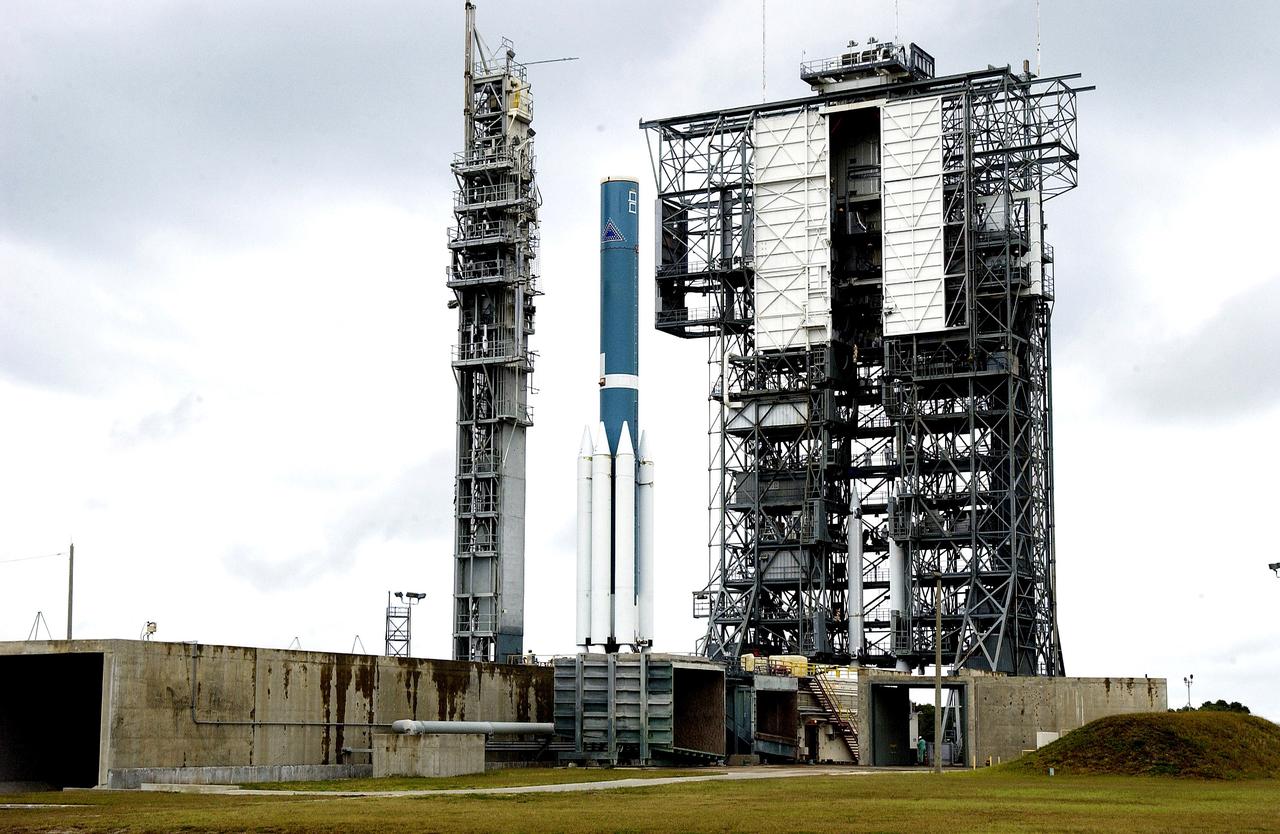
KENNEDY SPACE CENTER, FLA. - Solid rocket boosters are positioned around the base of a Delta II rocket for the Mars Exploration Rover 1 (MER-1) launch on June 25 at Launch Complex 17-B, Cape Canaveral Air Force Station. NASA’s twin Mars Exploration Rovers are designed to study the history of water on Mars. These robotic geologists are equipped with a robotic arm, a drilling tool, three spectrometers, and four pairs of cameras that allow them to have a human-like, 3D view of the terrain. Each rover could travel as far as 100 meters in one day to act as Mars scientists' eyes and hands, exploring an environment where humans can’t yet go. MER-2 (MER-A) will launch June 5.
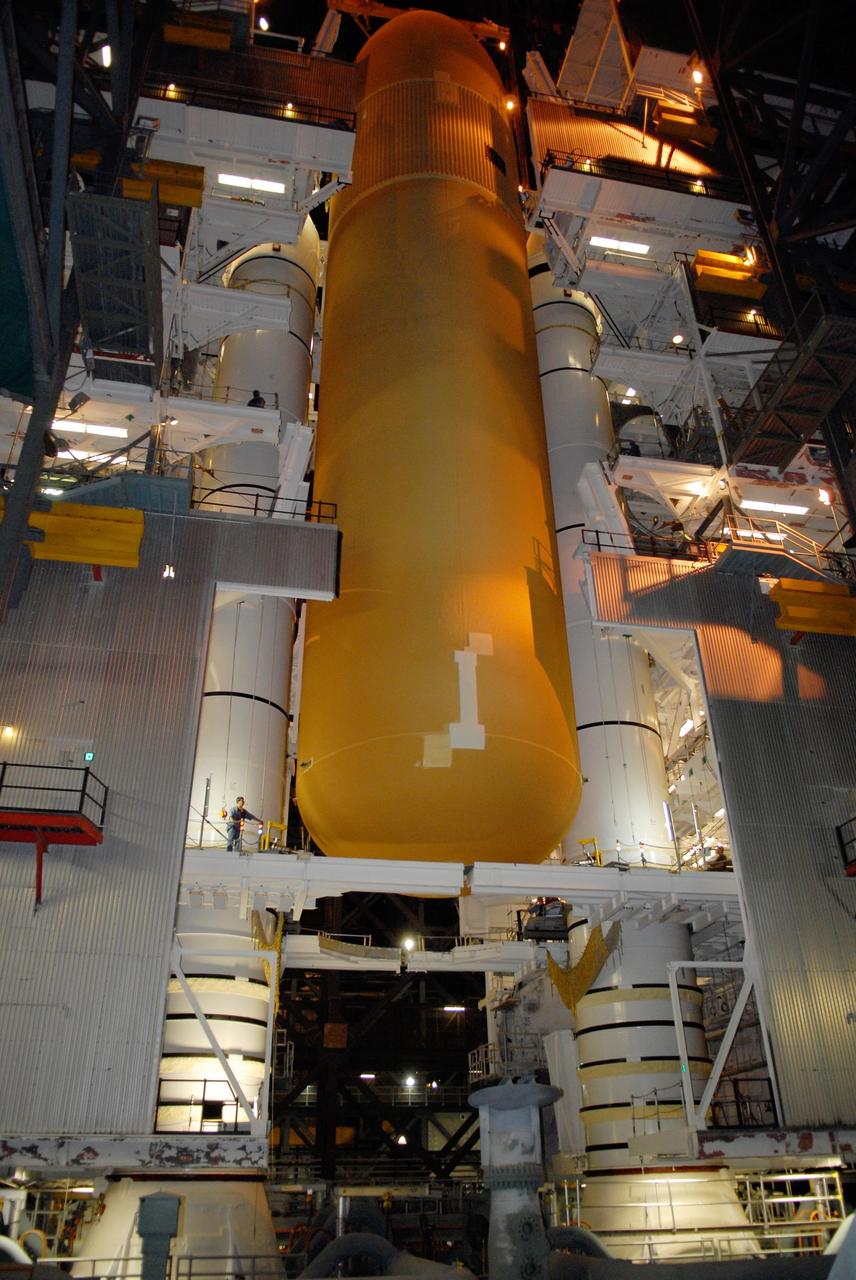
KENNEDY SPACE CENTER, FLA. -- In the Vehicle Assembly Building at NASA's Kennedy Space Center, the external tank is lowered between the solid rocket boosters on the mobile launcher platform below. After mating, the boosters-tank configuration will be used on space shuttle Atlantis for mission STS-122, which is targeted for launch on Dec. 6. Photo credit: Kim Shiflett
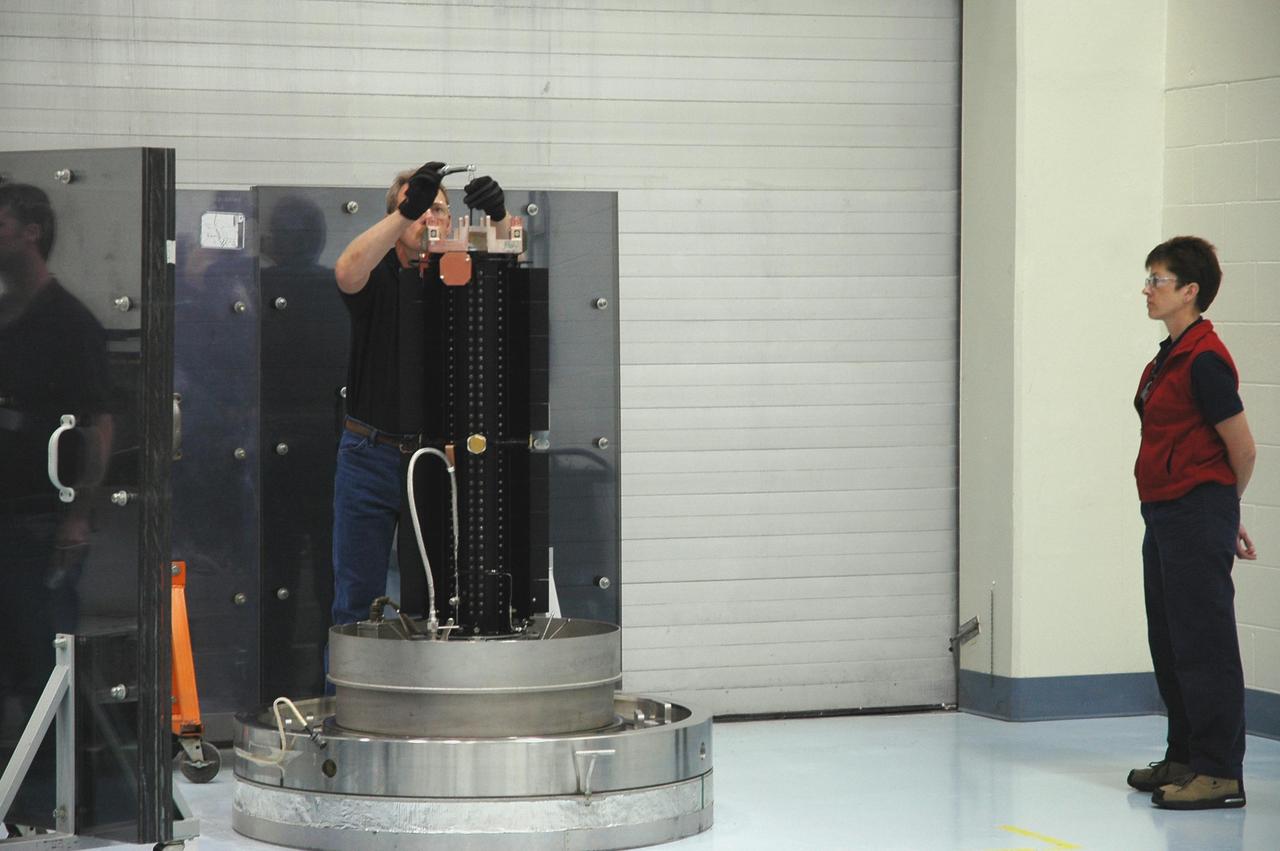
KENNEDY SPACE CENTER, FLA. - In the RTG Facility at Kennedy Space Center, Dan Brunson places a lift attachment onto the radioisotope thermoelectric generator (RTG) so it can be lifted off the stand. Watching at right is Amy Powell. The RTG is the baseline power supply for the NASA’s New Horizons spacecraft, scheduled to launch in January 2006 on a journey to Pluto and its moon, Charon. As it approaches Pluto, the spacecraft will look for ultraviolet emission from Pluto's atmosphere and make the best global maps of Pluto and Charon in green, blue, red and a special wavelength that is sensitive to methane frost on the surface. It will also take spectral maps in the near infrared, telling the science team about Pluto's and Charon's surface compositions and locations and temperatures of these materials. When the spacecraft is closest to Pluto or its moon, it will take close-up pictures in both visible and near-infrared wavelengths. It is expected to reach Pluto in July 2015.
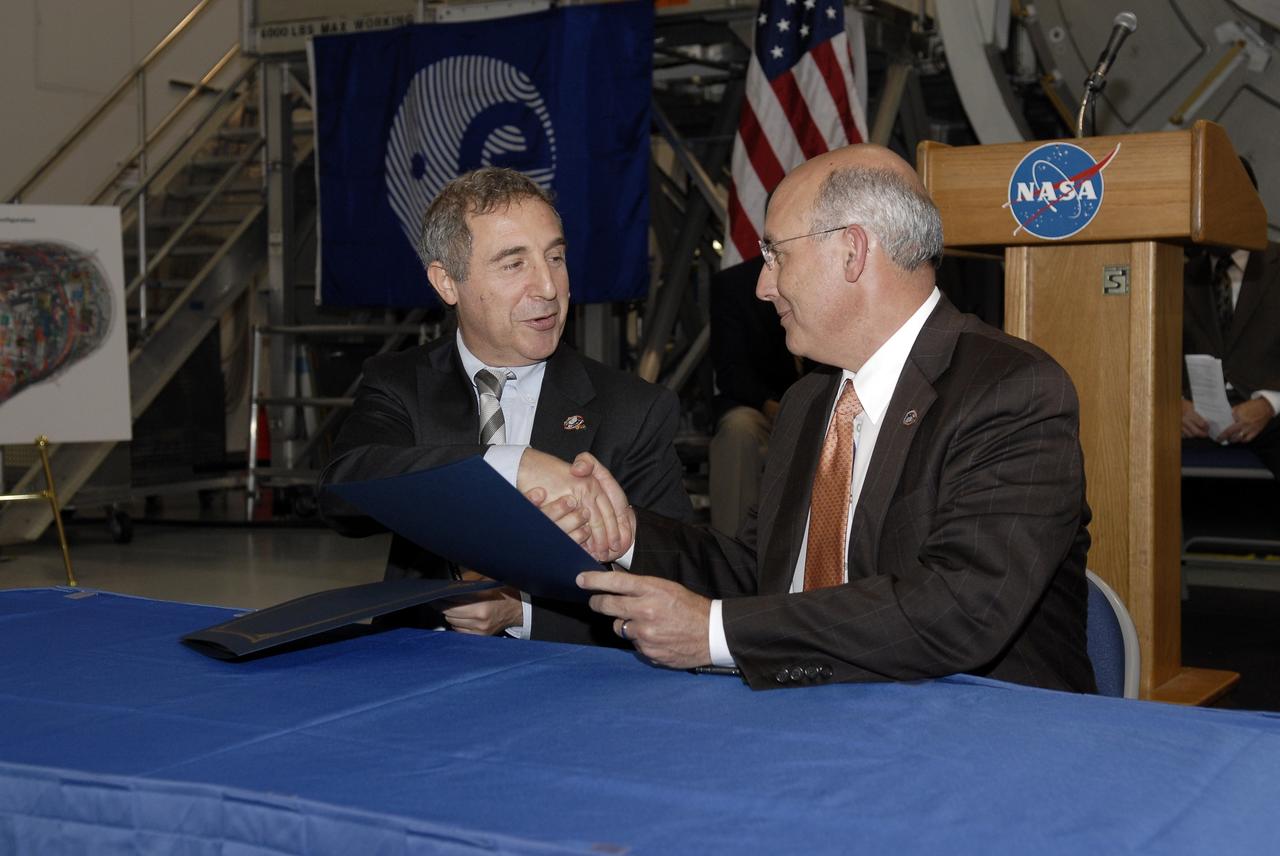
CAPE CANAVERAL, Fla. – In the Space Station Processing Facility at NASA's Kennedy Space Center in Florida, Bernardo Patti, at left, head of International Space Station, Program Department, European Space Agency, congratulates Michael Suffredini, program manager, International Space Station, NASA, upon transfer of the ownership of node 3 for the International Space Station from the European Space Agency, or ESA, to NASA. Node 3 is named "Tranquility" after the Sea of Tranquility, the lunar landing site of Apollo 11. The payload for the STS-130 mission, Tranquility is a pressurized module that will provide room for many of the International Space Station's life support systems. The module was built for ESA by Thales Alenia Space in Turin, Italy. Attached to one end of Tranquility is a cupola, a unique work station with six windows on its sides and one on top. The cupola resembles a circular bay window and will provide a vastly improved view of the station's exterior. Just under 10 feet in diameter, the module will accommodate two crew members and portable workstations that can control station and robotic activities. The multi-directional view will allow the crew to monitor spacewalks and docking operations, as well as provide a spectacular view of Earth and other celestial objects. Space shuttle Endeavour's STS-130 mission is targeted to launch Feb. 4, 2010. Photo credit: NASA/Kim Shiflett
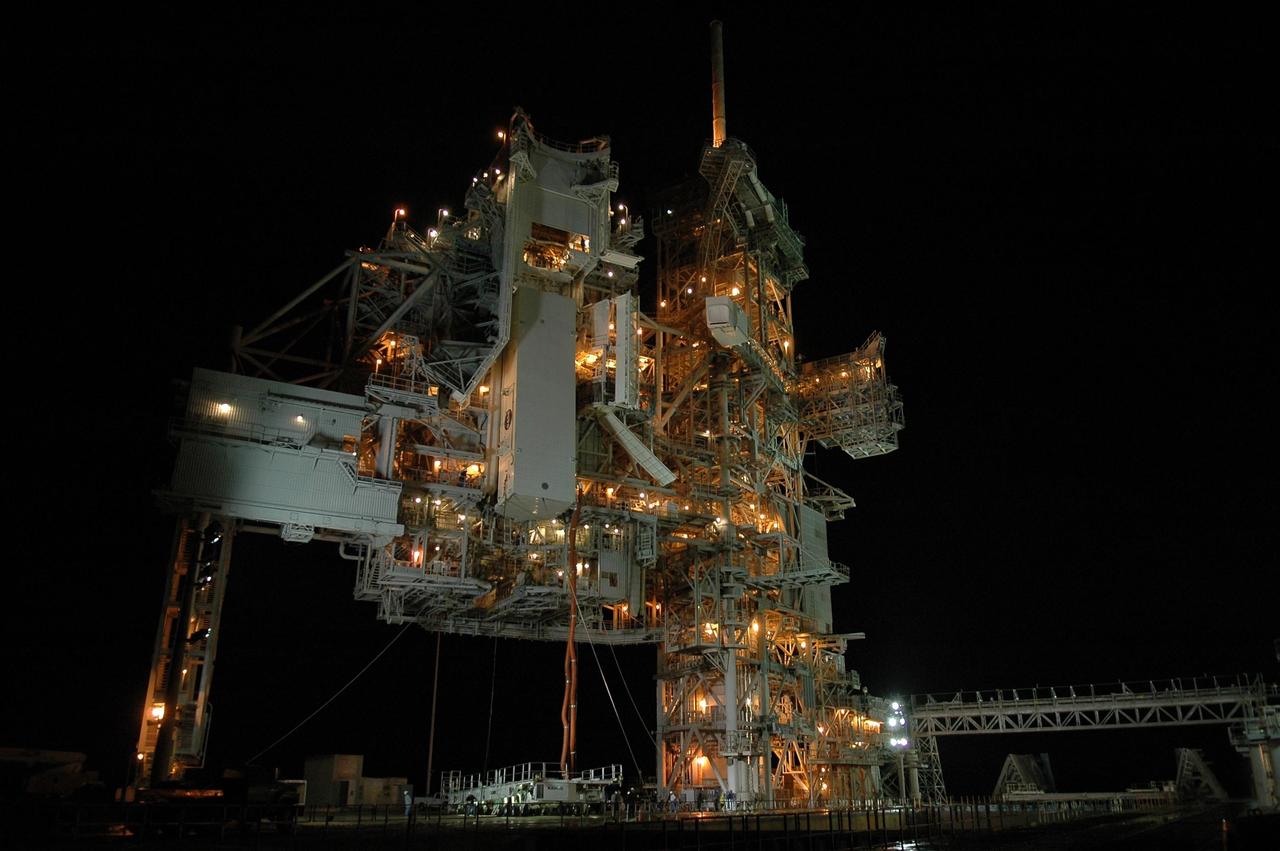
KENNEDY SPACE CENTER, FLA. -- With umbilical lines still attached, the payload canister is lifted up to the payload changeout room (PCR) on the rotating service structure (RSS) on Launch Pad 39B. Inside the canister are the SPACEHAB module and the port 5 truss segment for mission STS-116. Once inside the PCR, they will be transferred into Space Shuttle Discovery's payload bay once the vehicle has rolled out to the pad. On the right is the fixed service structure. The PCR is the enclosed, environmentally controlled portion of the RSS that supports cargo delivery to the pad and subsequent vertical installation into the orbiter payload bay. Seals around the mating surface of the PCR fit against the orbiter and allow the opening of the payload bay or canister doors and removal of the cargo without exposure to outside air and contaminants. A clean-air purge in the PCR maintains environmental control during PCR cargo operations. Cargo is removed from the payload canister and installed vertically in the orbiter by the payload ground handling mechanism (PGHM). Photo credit: NASA/Kim Shiflett
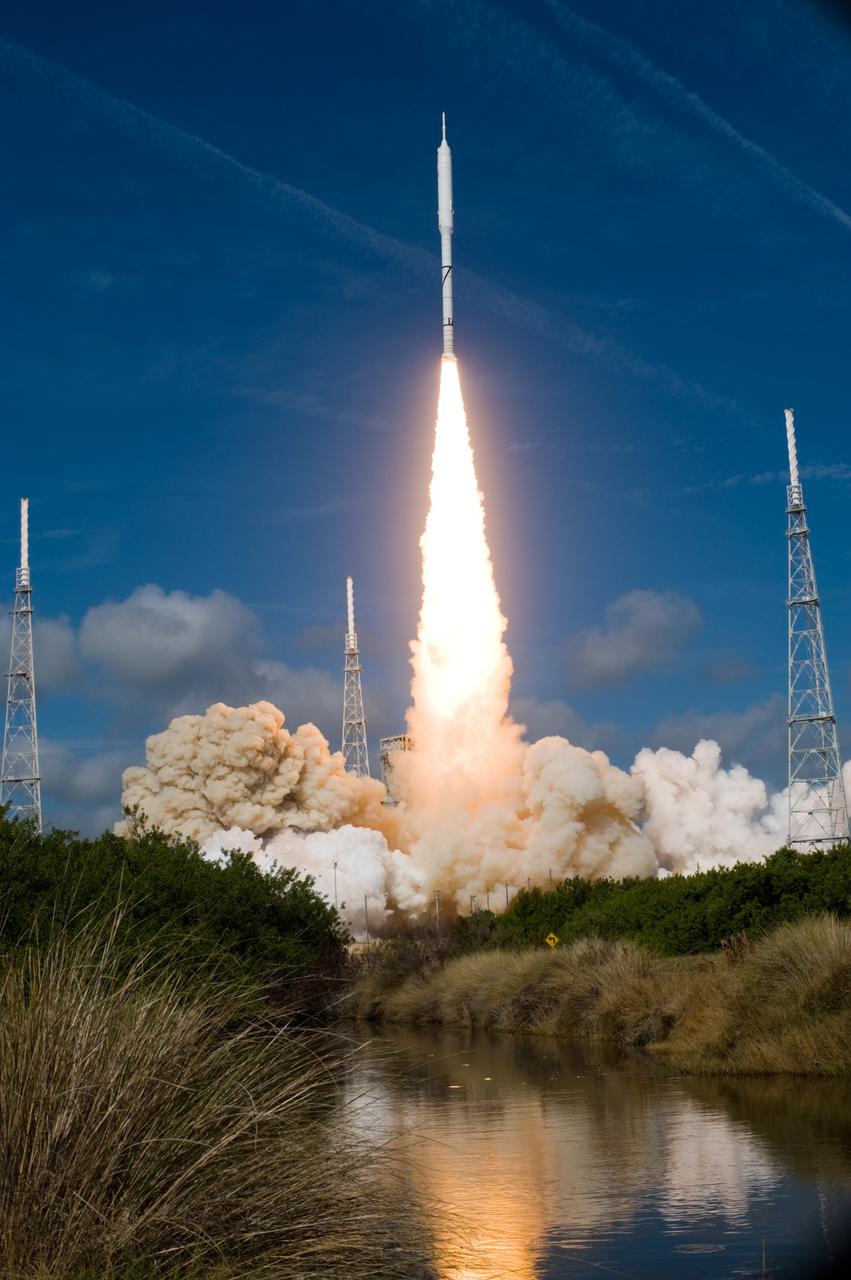
CAPE CANAVERAL, Fla. – NASA’s Ares I-X test rocket clears the tower at Launch Pad 39B at NASA's Kennedy Space Center in Florida at 11:30 a.m. EDT on Oct. 28. The rocket produces 2.96 million pounds of thrust at liftoff and reaches a speed of 100 mph in eight seconds. This was the first launch from Kennedy's pads of a vehicle other than the space shuttle since the Apollo Program's Saturn rockets were retired. The parts used to make the Ares I-X booster flew on 30 different shuttle missions ranging from STS-29 in 1989 to STS-106 in 2000. The data returned from more than 700 sensors throughout the rocket will be used to refine the design of future launch vehicles and bring NASA one step closer to reaching its exploration goals. For information on the Ares I-X vehicle and flight test, visit http://www.nasa.gov/aresIX. Photo credit: NASA/ Sandra Joseph and Kevin O'Connell
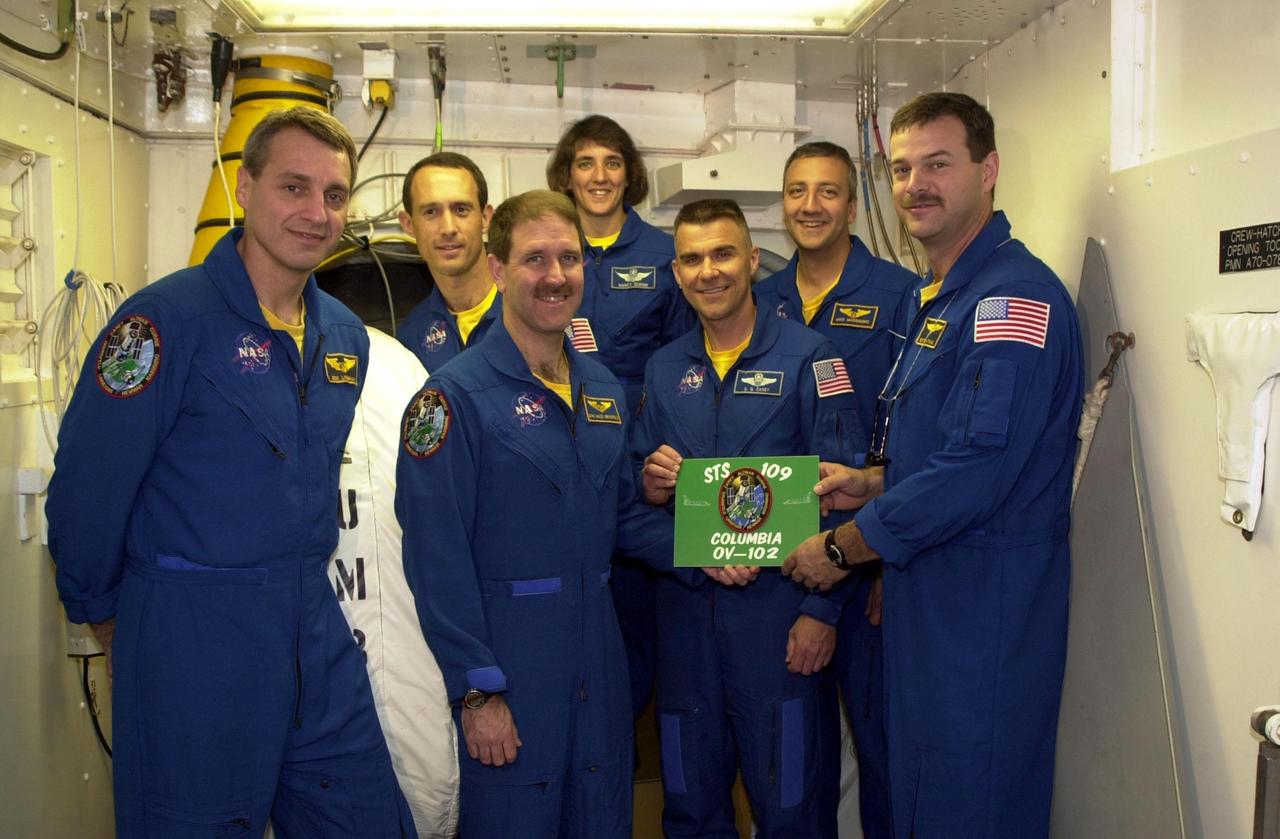
KENNEDY SPACE CENTER, FLA. -- At Launch Pad 39A, the STS-109 crew stands in the White Room, outside the entry into Space Shuttle Columbia, displaying the mission patch and placard. Standing, left to right, are Mission Specialists Richard Linnehan, James Newman, John Grunsfeld and Nancy Currie; Pilot Duane Carey; Mission Specialist Michael Massimino; and Commander Scott Altman. The White Room is an environmentally controlled structure at the end of the Orbiter Access Room that provides access to the orbiter. The crew is taking part in Terminal Countdown Demonstration Test activities that include emergency egress training and a simulated countdown at the pad. Columbia is scheduled to be launched Feb. 28 on mission STS-109, a Hubble Servicing Mission. The goal of the mission is to replace Solar Array 2 with Solar Array 3, replace the Power Control Unit, remove the Faint Object Camera and install the ACS, install the Near Infrared Camera and Multi-Object Spectrometer (NICMOS) Cooling System, and install New Outer Blanket Layer insulation. . The launch will be the first for Columbia after returning from California where it underwent extensive maintenance, inspections and enhancements. More than 100 upgrades make Columbia safer and more reliable than ever before

NASA’s Artemis II SLS (Space Launch System) rocket with the Orion spacecraft atop a mobile launcher is seen at Launch Complex 39B, Saturday, March 28, 2026, at NASA’s Kennedy Space Center in Florida. The Artemis II test flight will take Commander Reid Wiseman, Pilot Victor Glover, and Mission Specialist Christina Koch from NASA, and Mission Specialist Jeremy Hansen from the CSA (Canadian Space Agency), around the Moon and back to Earth.
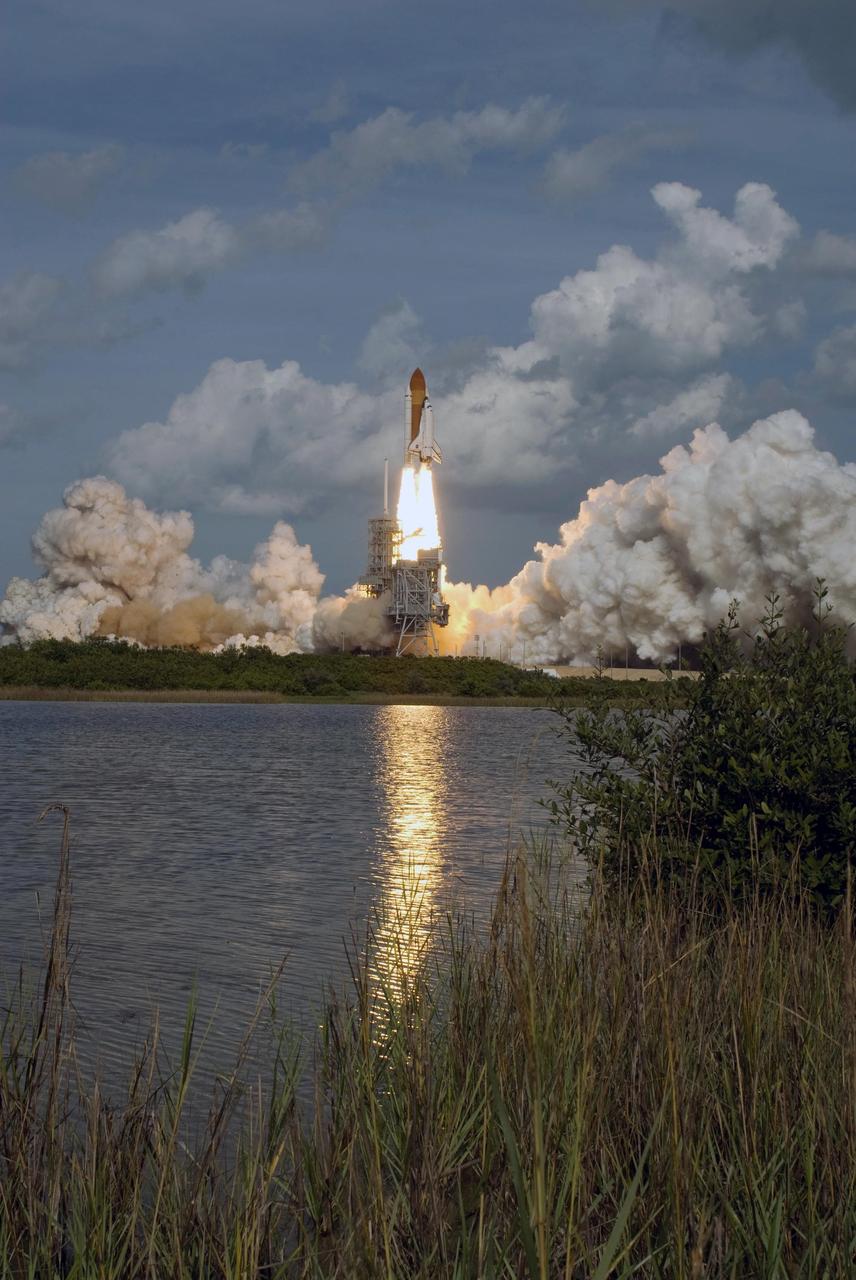
KENNEDY SPACE CENTER, FLA. -- Hurtling away from the clouds of smoke and steam, space shuttle Atlantis hurtles into the cloud-streaked sky on mission STS-122 to the International Space Station. Liftoff was on time at 2:45 p.m. EST. The launch is the third attempt for Atlantis since December 2007 to carry the European Space Agency's Columbus laboratory to the International Space Station. During the 11-day mission, the crew's prime objective is to attach the laboratory to the Harmony module, adding to the station's size and capabilities. Photo credit: NASA/Sandra Joseph, Tony Gray, Robert Murray
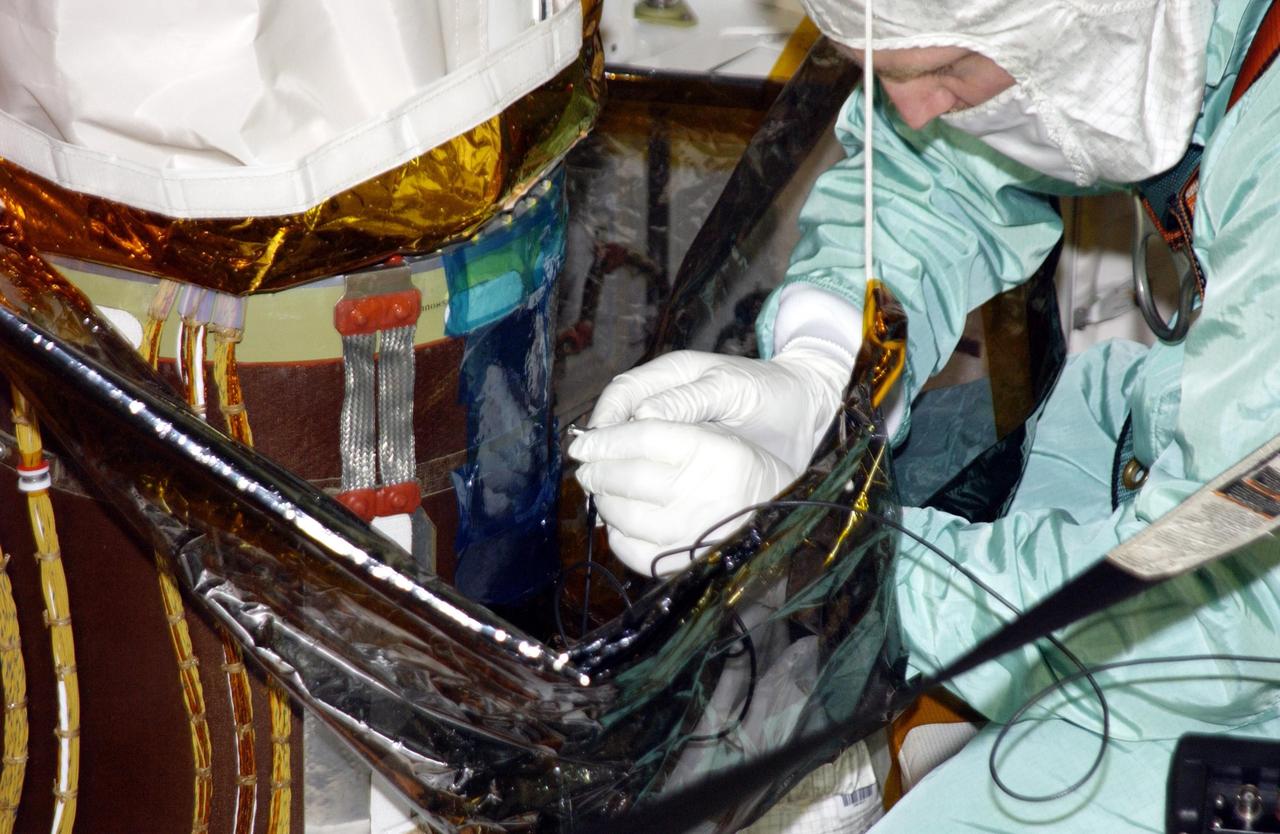
KENNEDY SPACE CENTER, FLA. -- Robotic arm experts get ready for ultrasound testing on Endeavour's robotic arm. A scrape of the honeycomb shell around the arm occurred while work platforms were being installed to gain access to repair the oxygen leak in the Shuttle's mid-body. Launch of Endeavour on mission STS-113 has been postponed until no earlier than Nov. 22.
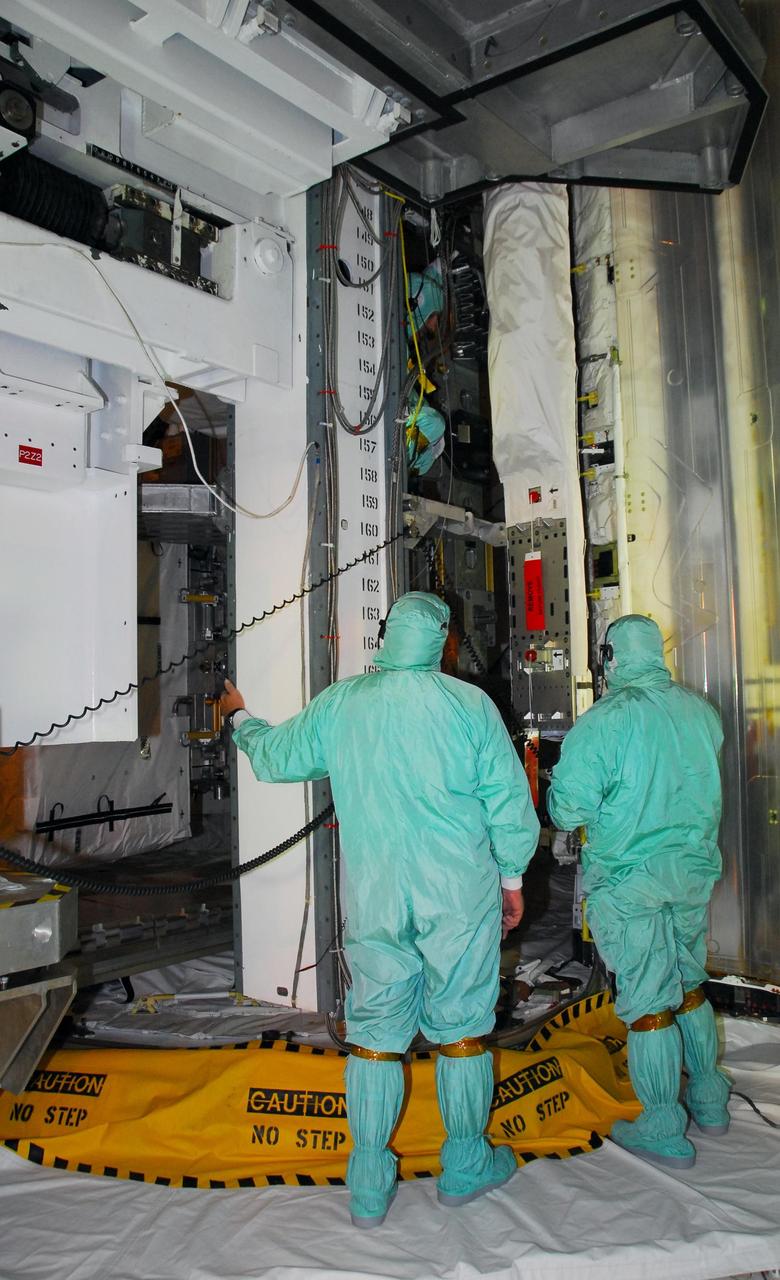
KENNEDY SPACE CENTER, FLA. -- On Launch Pad 39A, workers in the payload changeout room monitor the payload ground-handling mechanism as it transfers the mission STS-118 payload into the payload bay on Space Shuttle Endeavour. The payload includes the S5 truss, the SPACEHAB module and the external stowage platform 3. The mission is the 22nd flight to the International Space Station and is targeted for launch on Aug.7. Photo credit: NASA/Amanda Diller
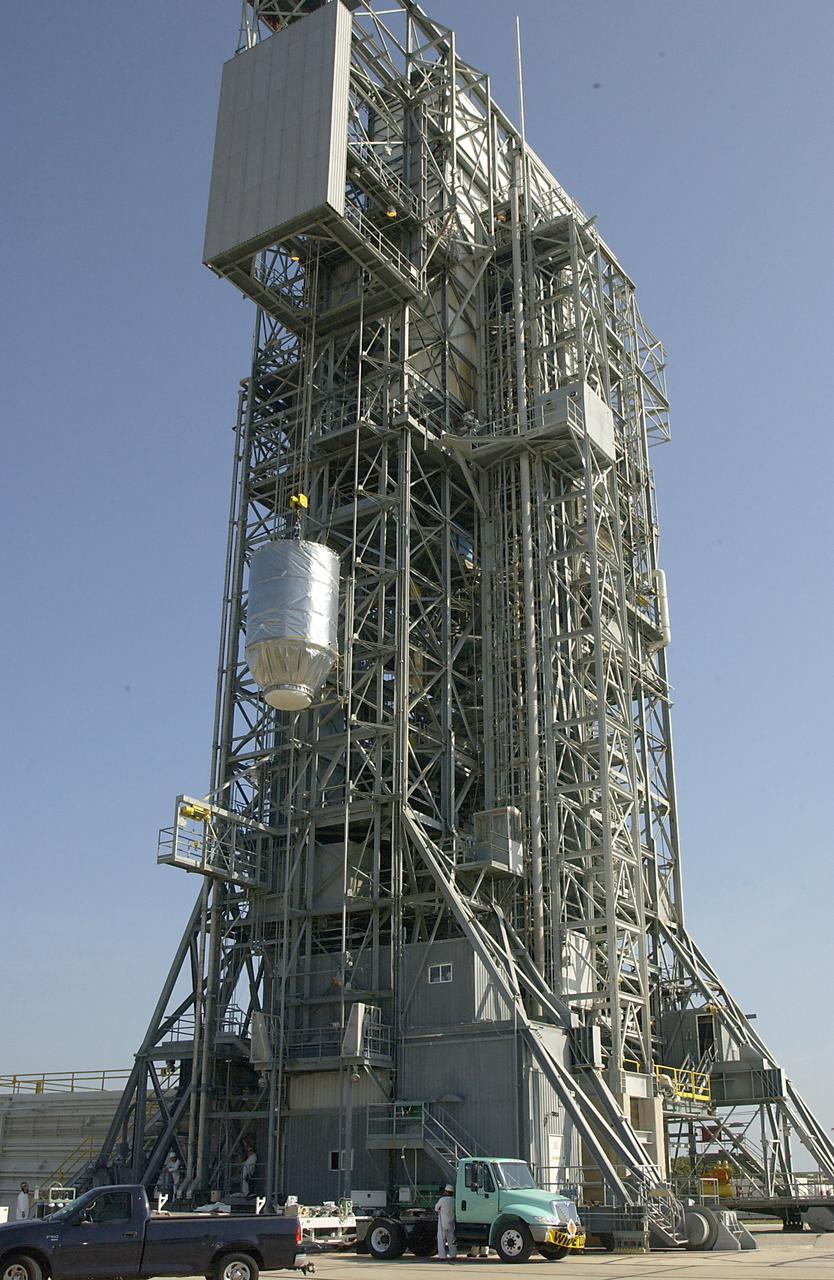
KENNEDY SPACE CENTER, FLA. - On Launch Pad 17-A, Cape Canaveral Air Force Station, the Mars Exploration Rover 2 (MER-2), inside the transport canister, is lifted up the launch tower where it will be mated to the Delta II rocket for launch. MER-2 is one of NASA's twin Mars Exploration Rovers designed to study the history of water on Mars. These robotic geologists are equipped with a robotic arm, a drilling tool, three spectrometers, and four pairs of cameras that allow them to have a human-like, 3D view of the terrain. Each rover could travel as far as 100 meters in one day to act as Mars scientists' eyes and hands, exploring an environment where humans can't yet go. MER-2 is scheduled to launch no earlier than June 8 as MER-A.
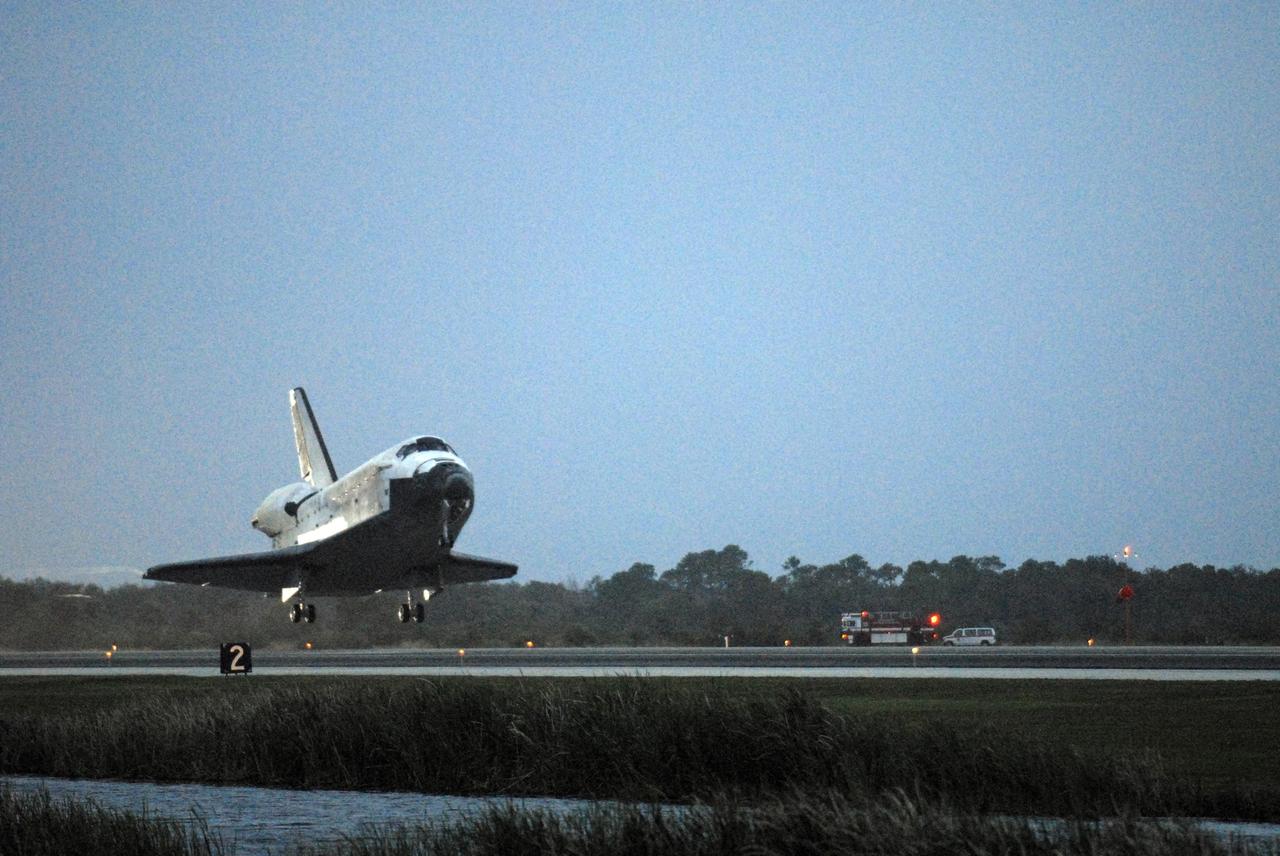
KENNEDY SPACE CENTER, FLA. -- On the shortest day of the year, Discovery touches down at sunset on Runway 15 at NASA Kennedy Space Center's Shuttle Landing Facility as the sun sets, concluding mission STS-116. The rescue vehicles in the background are in position in the unlikely event they are needed during post-landing operations. Aboard are Commander Mark Polansky, Pilot William Oefelein, and Mission Specialists Robert Curbeam, Joan Higginbotham, Nicholas Patrick and Christer Fuglesang, who represents the European Space Agency, as well as Thomas Reiter, who is returning from a 6-month stay on the International Space Station. During the mission, three spacewalks attached the P5 integrated truss structure to the station, and completed the rewiring of the orbiting laboratory's power system. A fourth spacewalk retracted a stubborn solar array. Main gear touchdown was at 5:32 p.m. EST. Nose gear touchdown was at 5:32:12 p.m. and wheel stop was at 5:32:52 p.m. At touchdown -- nominally about 2,500 ft. beyond the runway threshold -- the orbiter is traveling at a speed ranging from 213 to 226 mph. Discovery traveled 5,330,000 miles, landing on orbit 204. Mission elapsed time was 12 days, 20 hours, 44 minutes and 16 seconds. This is the 64th landing at KSC. Photo credit: NASA/Tom Joseph
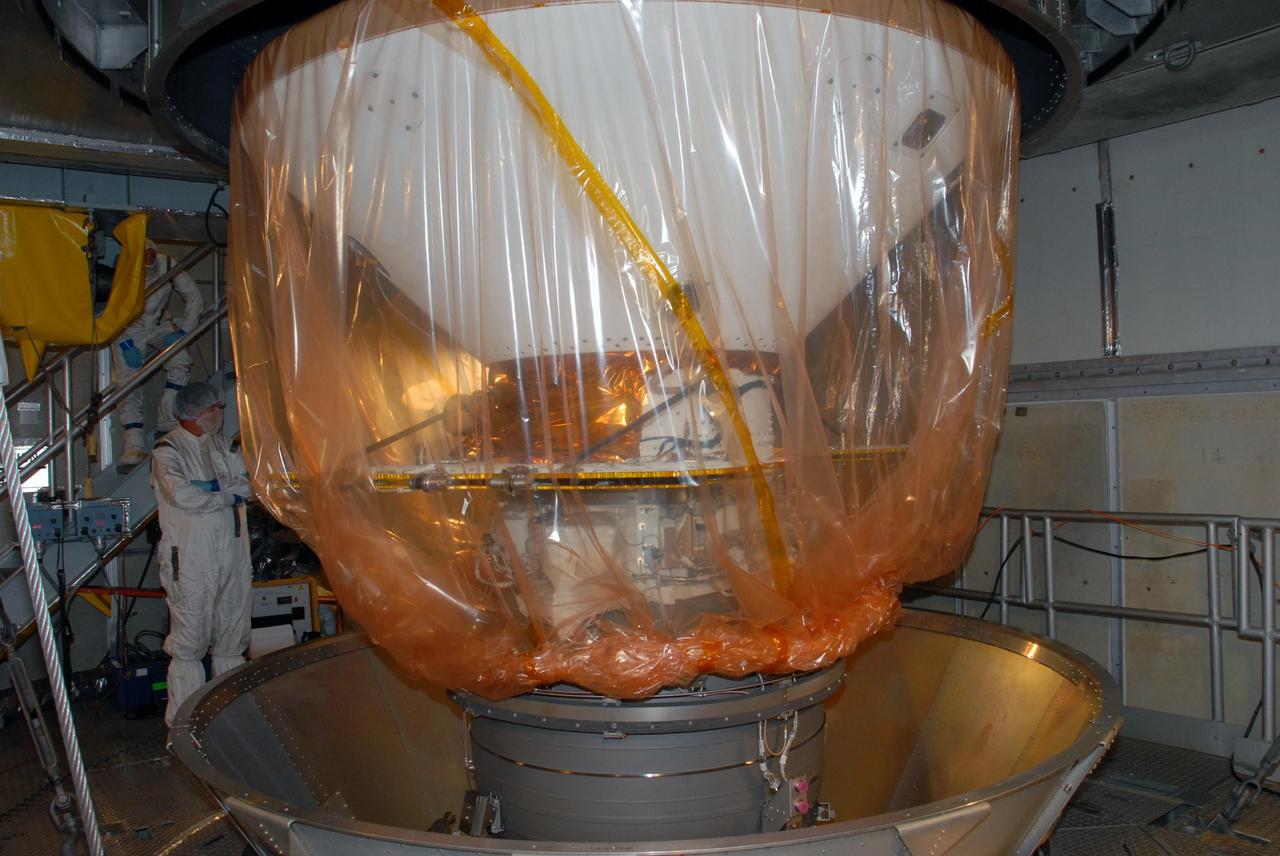
KENNEDY SPACE CENTER, FLA. -- Inside the mobile service tower of Launch Pad 17-A at Cape Canaveral Air Force Station in Florida, workers remove the container from NASA's Phoenix Mars Lander. Launch of Phoenix is scheduled to launch on the Delta II launch vehicle no earlier than Aug. 3. Phoenix will land in icy soils near the north polar permanent ice cap of Mars and explore the history of the water in these soils and any associated rocks, while monitoring polar climate. Landing on Mars is planned in May 2008 on arctic ground where a mission currently in orbit, Mars Odyssey, detected high concentrations of ice just beneath the top layer of soil. NASA/George Shelton

KENNEDY SPACE CENTER, FLA. -- A U.S. Air Force F-22 Raptor is parked on the Shuttle Landing Facility at NASA's Kennedy Space Center. The plane is participating in the World Space Expo being held from Nov. 1 to Nov. 4 at the NASA Kennedy Space Center Visitor Complex. Other aircraft joining in the salute include U.S. Air Force Thunderbirds Aerial Demonstration Squadron, U.S. Navy F-18 Super Hornets, the P-51 Mustang Heritage Flight and the U.S. Air Force 920th Rescue Wing, which was responsible for Mercury and Gemini capsule recovery. The U.S. Army Golden Knights also will demonstrate precision skydiving. The World Space Expo is an event to commemorate humanity's first 50 years in space while looking forward to returning people to the moon and exploring beyond. The expo will showcase various panels, presentations and educational programs. It also is a part of NASA's 50th anniversary celebrations, highlighting the 45th Anniversary of the Mercury Program celebration featuring original NASA astronauts John Glenn and Scott Carpenter and the Pioneering Women of Aerospace forum featuring Eileen Collins and other prominent female space veterans. The agency was founded Oct. 1, 1958. Photo credit: NASA/Jack Pfaller
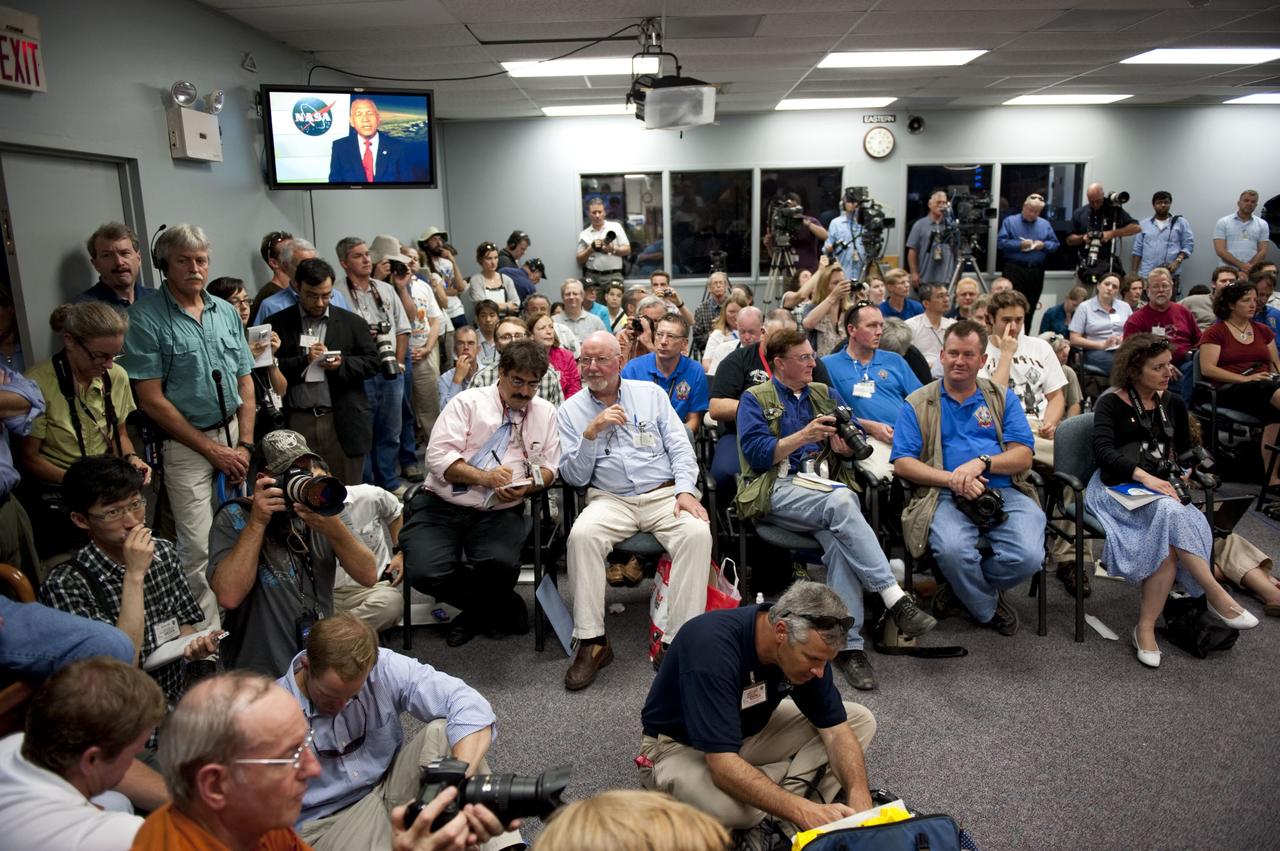
CAPE CANAVERAL, Fla. -- Members of the media gather for a post-launch news conference held in the Press Site auditorium at NASA's Kennedy Space Center in Florida, following the successful launch of space shuttle Atlantis on its STS-135 mission to the International Space Station. Atlantis began its final flight at 11:29 a.m. EDT on July 8. STS-135 will deliver the Raffaello multi-purpose logistics module packed with supplies and spare parts for the International Space Station. Atlantis also will fly the Robotic Refueling Mission experiment that will investigate the potential for robotically refueling existing satellites in orbit. In addition, Atlantis will return with a failed ammonia pump module to help NASA better understand the failure mechanism and improve pump designs for future systems. STS-135 will be the 33rd flight of Atlantis, the 37th shuttle mission to the space station, and the 135th and final mission of NASA's Space Shuttle Program. For more information, visit www.nasa.gov/mission_pages/shuttle/shuttlemissions/sts135/index.html. Photo credit: NASA/Kim Shiflett