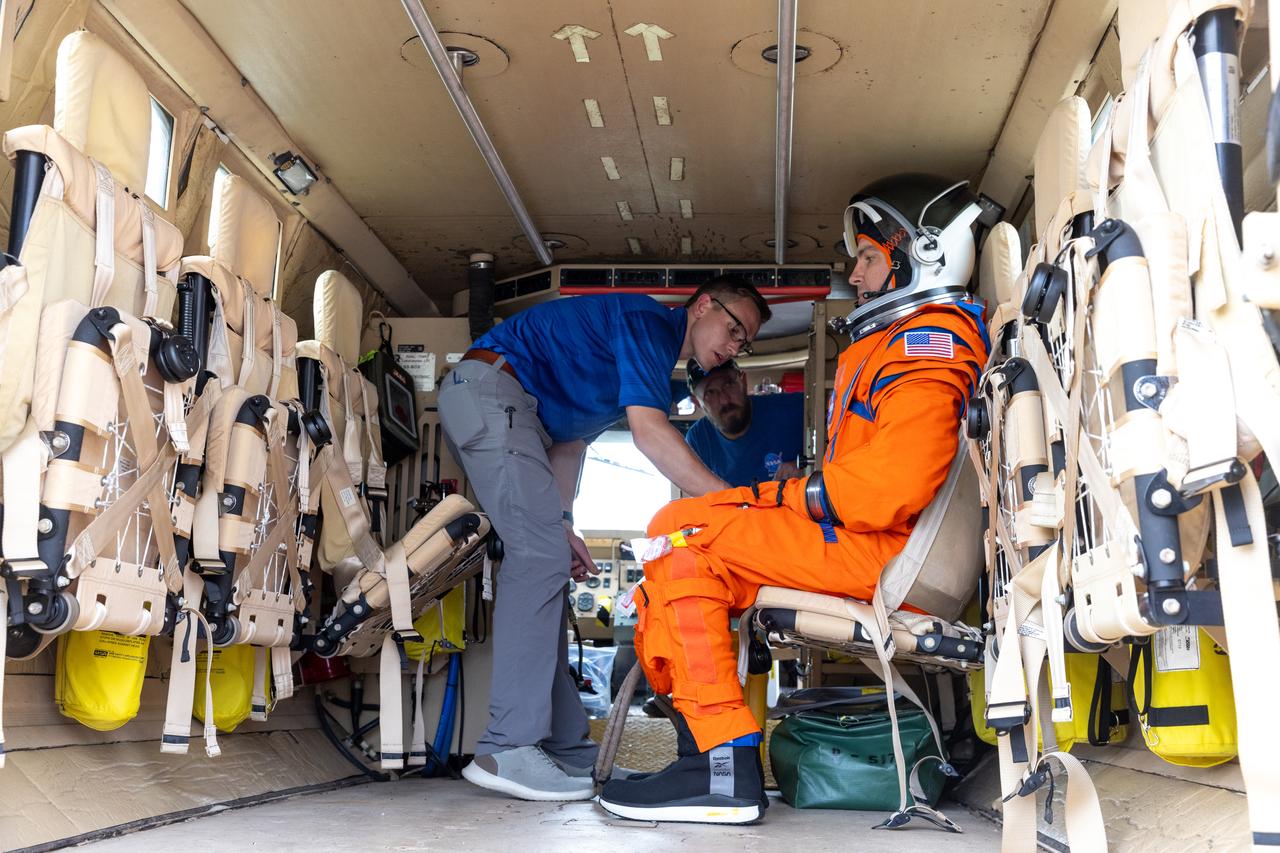
Teams with NASA’s Exploration Ground Systems Program, including an astronaut stand-in, participate in a series of integrated system verification and validation tests inside a mine-resistant ambush protected vehicle, or MRAP, at Launch Pad 39B at the agency’s Kennedy Space Center in Florida on Thursday, Aug. 8, 2024. Originally designed for military applications, the 45,000-pound MRAP offers a mobile bunker for astronauts and ground crews in the unlikely event they have to get away from the launch pad quickly in an emergency.
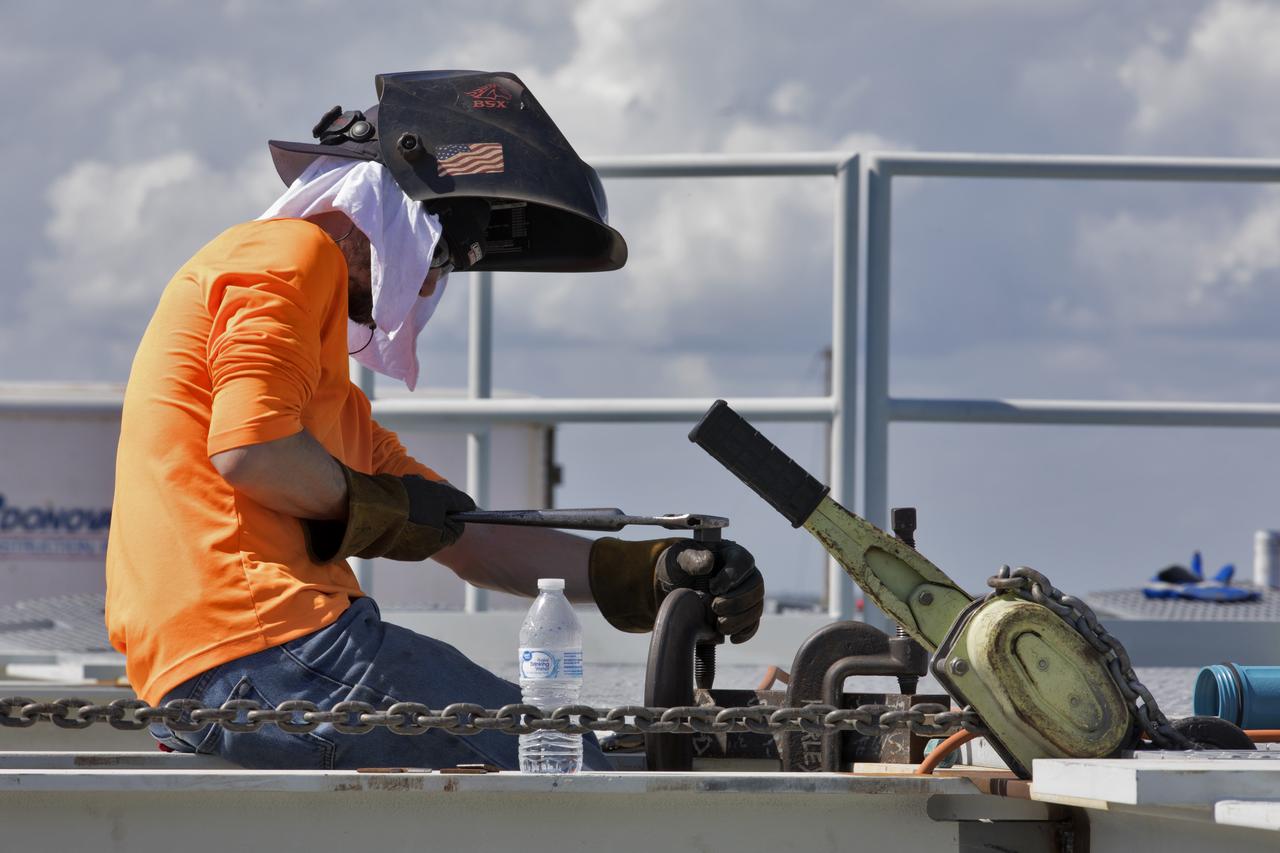
To continue his work, a construction worker secures clamps on a section of metal on the surface of Launch Pad 39B at NASA's Kennedy Space Center in Florida on July 26, 2018. The launch pad has undergone upgrades and modifications to accommodate NASA's Space Launch System and Orion spacecraft for Exploration Mission-1 and subsequent missions. Upgrades include new heat-resistant bricks on the walls of the flame trench and installation of a new flame deflector. All of the upgrades have been managed by Exploration Ground Systems.
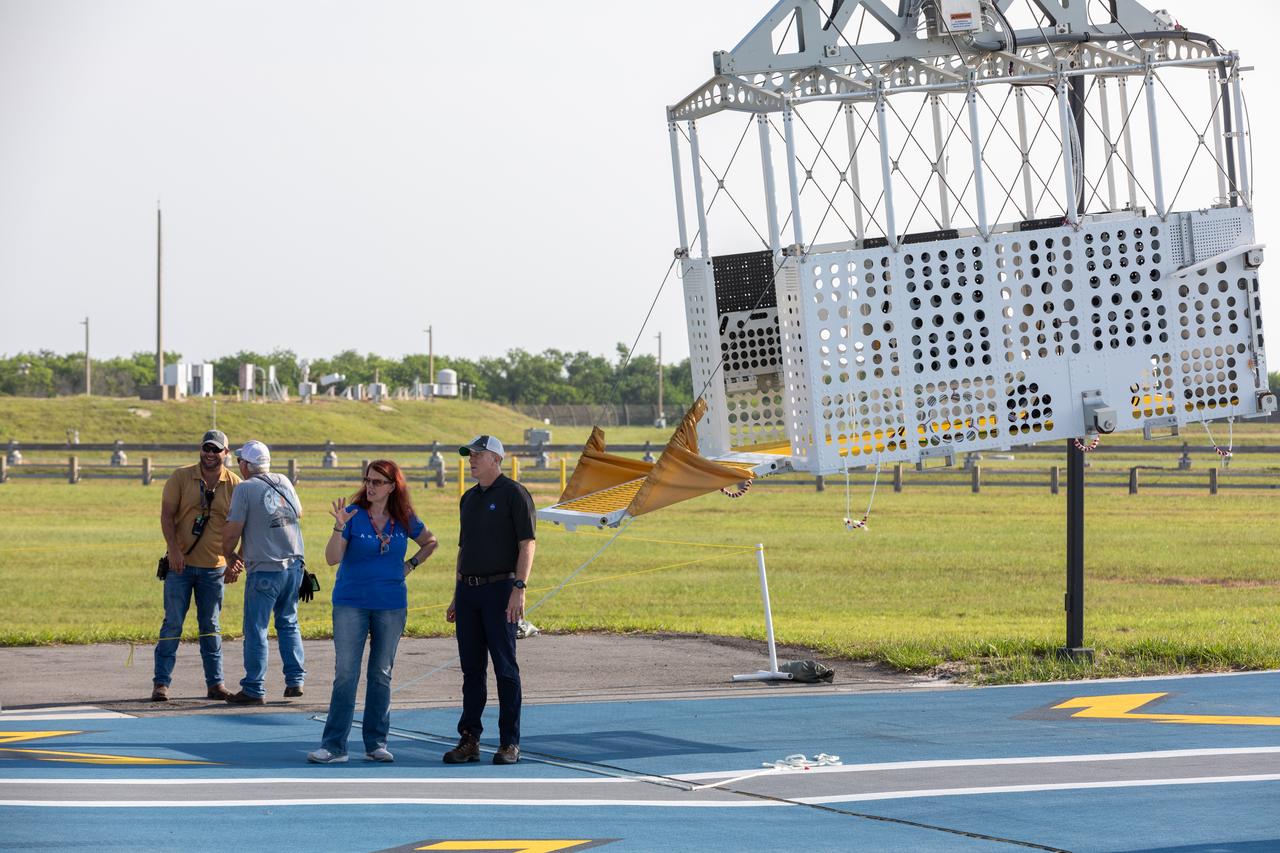
Teams at NASA’s Kennedy Space Center in Florida practice the Artemis mission emergency procedures during a series of integrated system verification and validation tests at Launch Pad 39B on Friday, Aug. 9, 2024. Members of the closeout crew, pad rescue team, and the Exploration Ground Systems Program practiced the process of getting inside and out of the emergency egress baskets. While the crew and other personnel will ride the emergency egress baskets to the terminus area in a real emergency, no one rode the baskets for this test. Instead, teams tested the baskets during separate occasions by using water tanks filled to different levels to replicate simulate the weight of passengers.
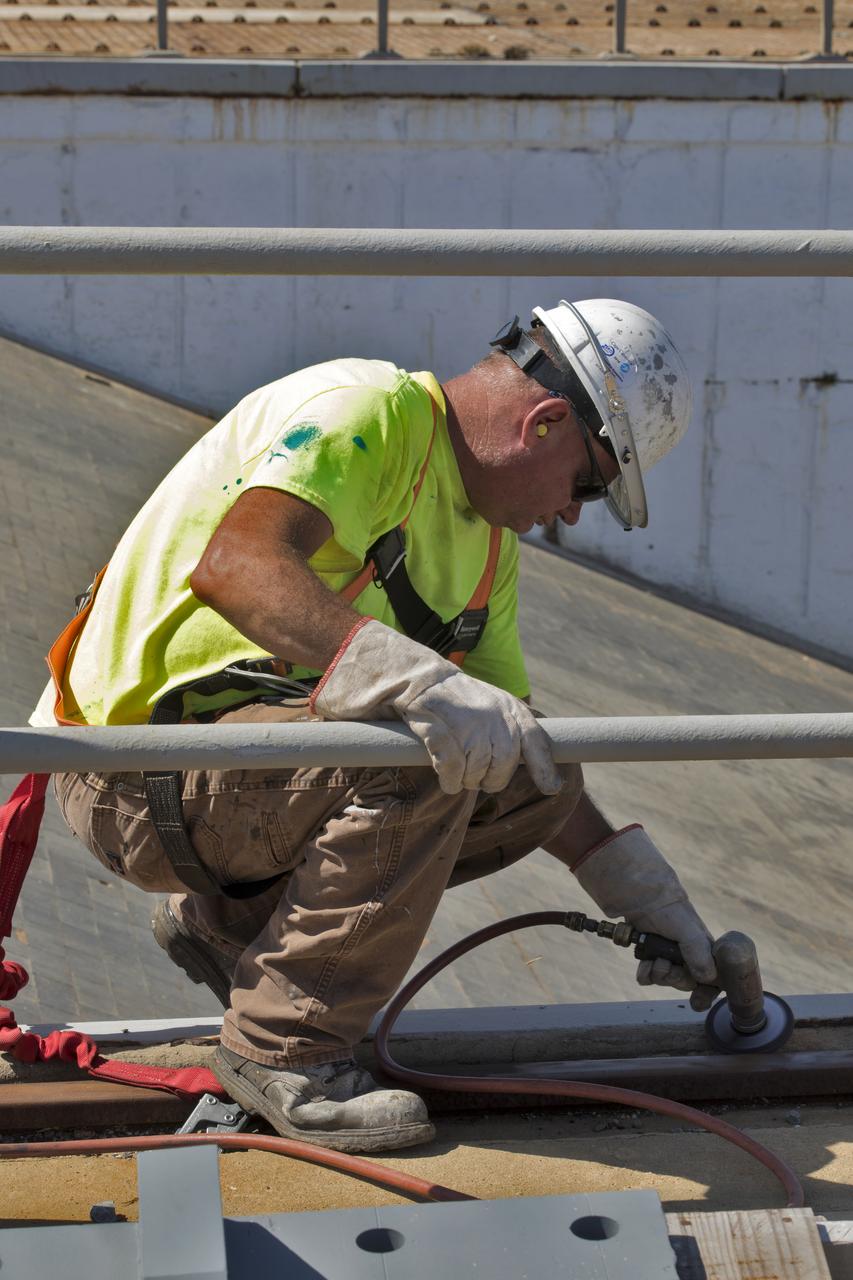
A construction worker sands a section of a wood beam on the surface of Launch Pad 39B at NASA’s Kennedy Space Center in Florida on Feb. 22, 2019. The launch pad has undergone upgrades and modifications to accommodate NASA's Space Launch System and Orion spacecraft for Exploration Mission-1 and subsequent missions. Upgrades include new heat-resistant bricks on the walls of the flame trench and installation of a new flame deflector. All of the upgrades have been managed by Exploration Ground Systems.
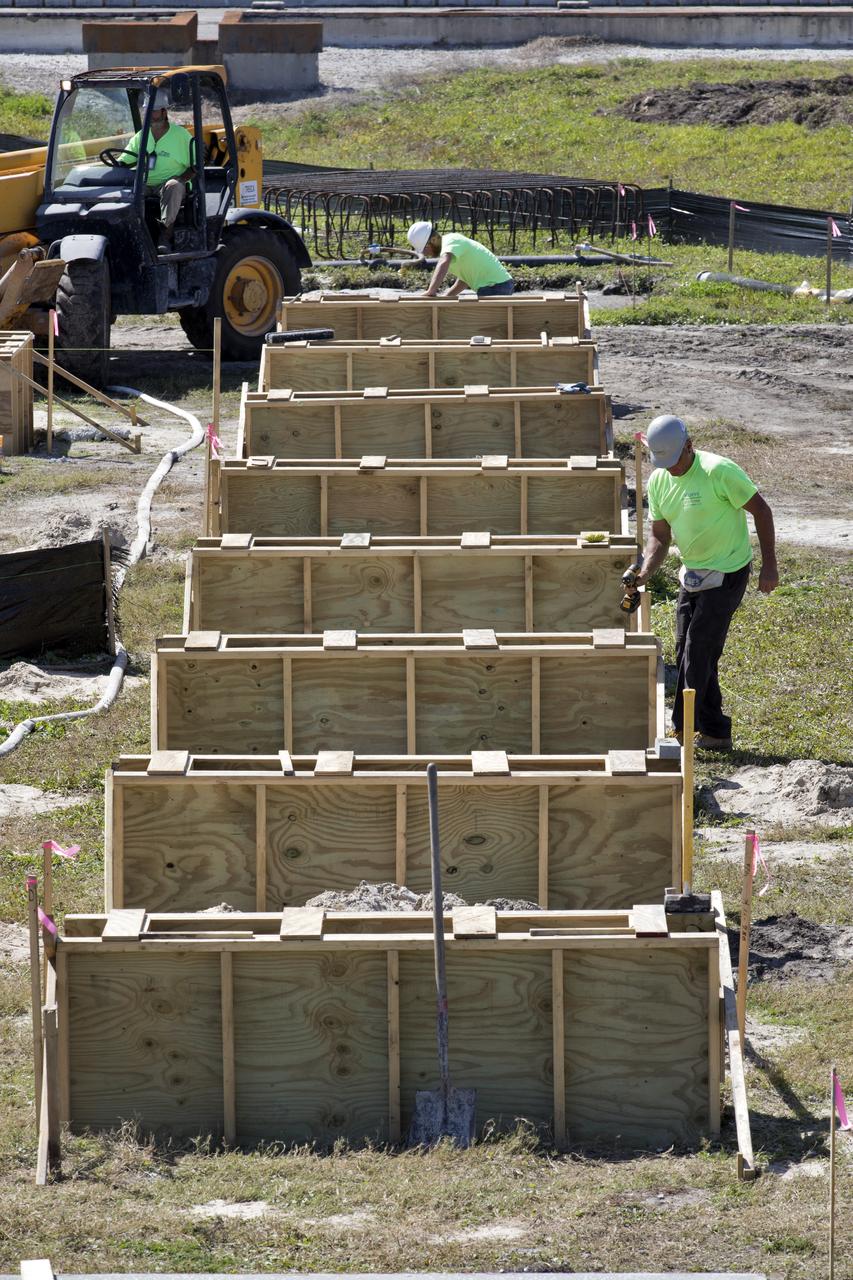
Construction workers stage parts and equipment nearby Launch Pad 39B at NASA’s Kennedy Space Center in Florida on Feb. 22, 2019. The launch pad has undergone upgrades and modifications to accommodate NASA's Space Launch System and Orion spacecraft for Exploration Mission-1 and subsequent missions. Upgrades include new heat-resistant bricks on the walls of the flame trench and installation of a new flame deflector. All of the upgrades have been managed by Exploration Ground Systems.
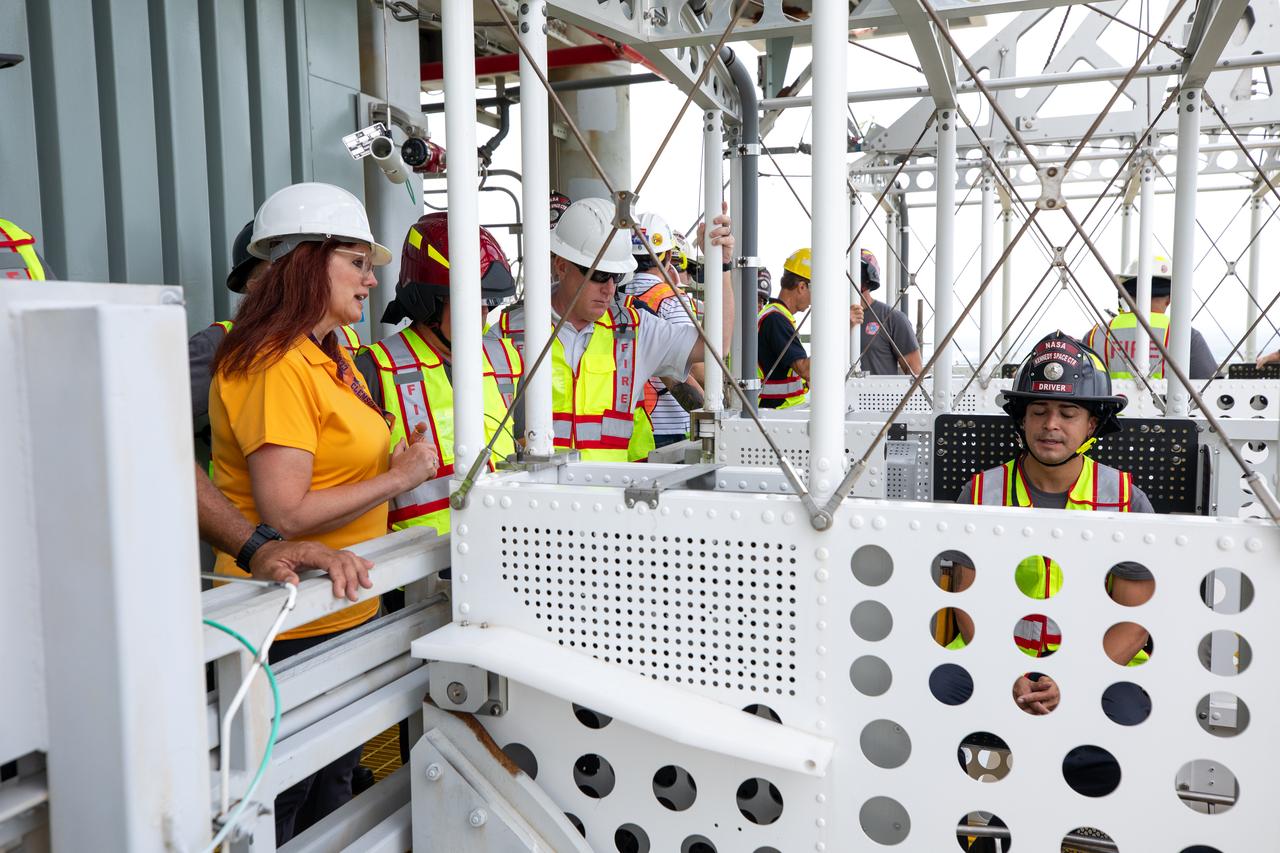
Teams with NASA’s Exploration Ground Systems Program, as well as NASA’s pad rescue team, conduct training inside the Artemis emergency egress baskets at Launch Pad 39B as part of the Artemis emergency egress demonstration training at the agency’s Kennedy Space Center in Florida on Thursday, Aug. 8, 2024. The baskets, similar to gondolas on ski lifts, are used in the case of a pad abort emergency to enable astronauts and other pad personnel a way to quickly escape away from the mobile launcher to the base of the pad and where waiting emergency transport vehicles will then drive them away.
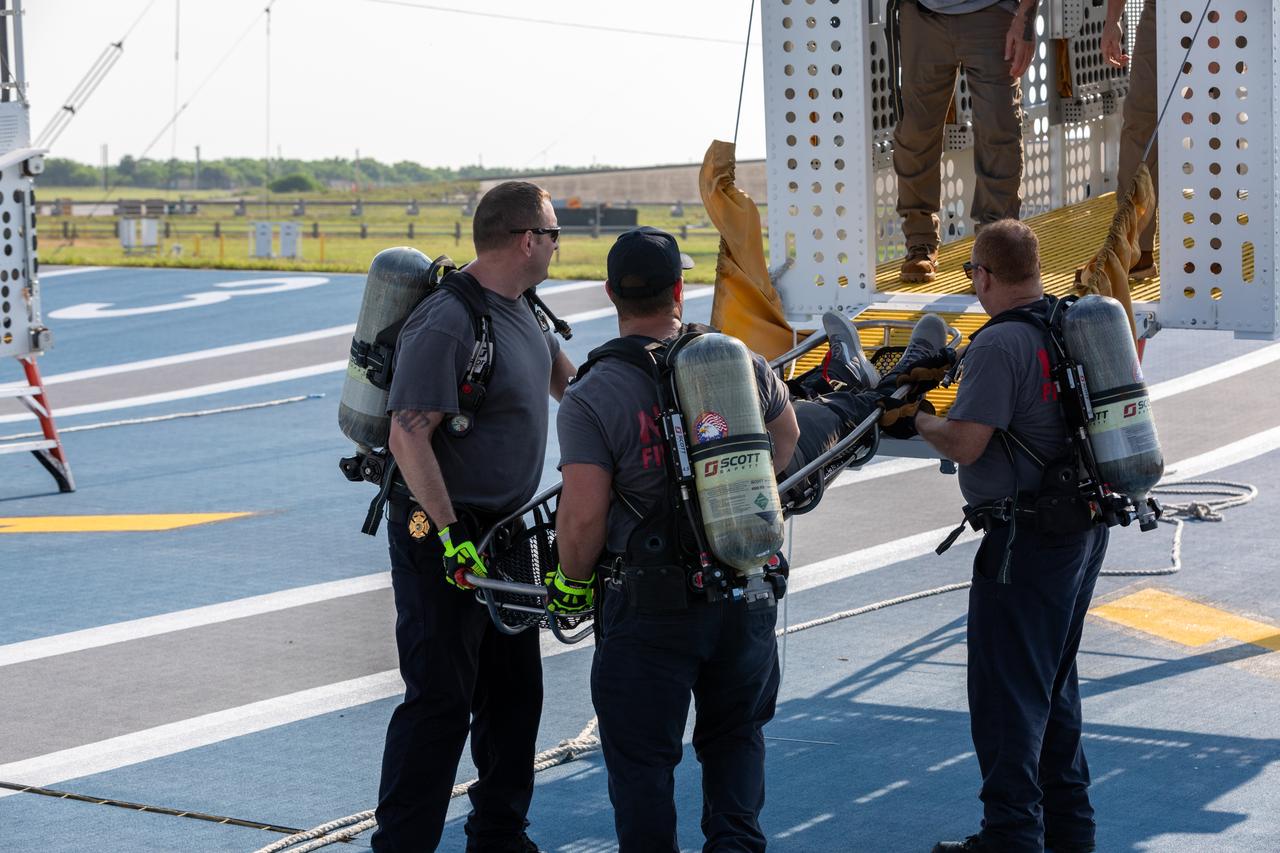
Teams at NASA’s Kennedy Space Center in Florida practice the Artemis mission emergency procedures during a series of integrated system verification and validation tests at Launch Pad 39B on Friday, Aug. 9, 2024. Members of the closeout crew, pad rescue team, and the Exploration Ground Systems Program practiced the process of getting inside and out of the emergency egress baskets. While the crew and other personnel will ride the emergency egress baskets to the terminus area in a real emergency, no one rode the baskets for this test. Instead, teams tested the baskets during separate occasions by using water tanks filled to different levels to replicate simulate the weight of passengers.
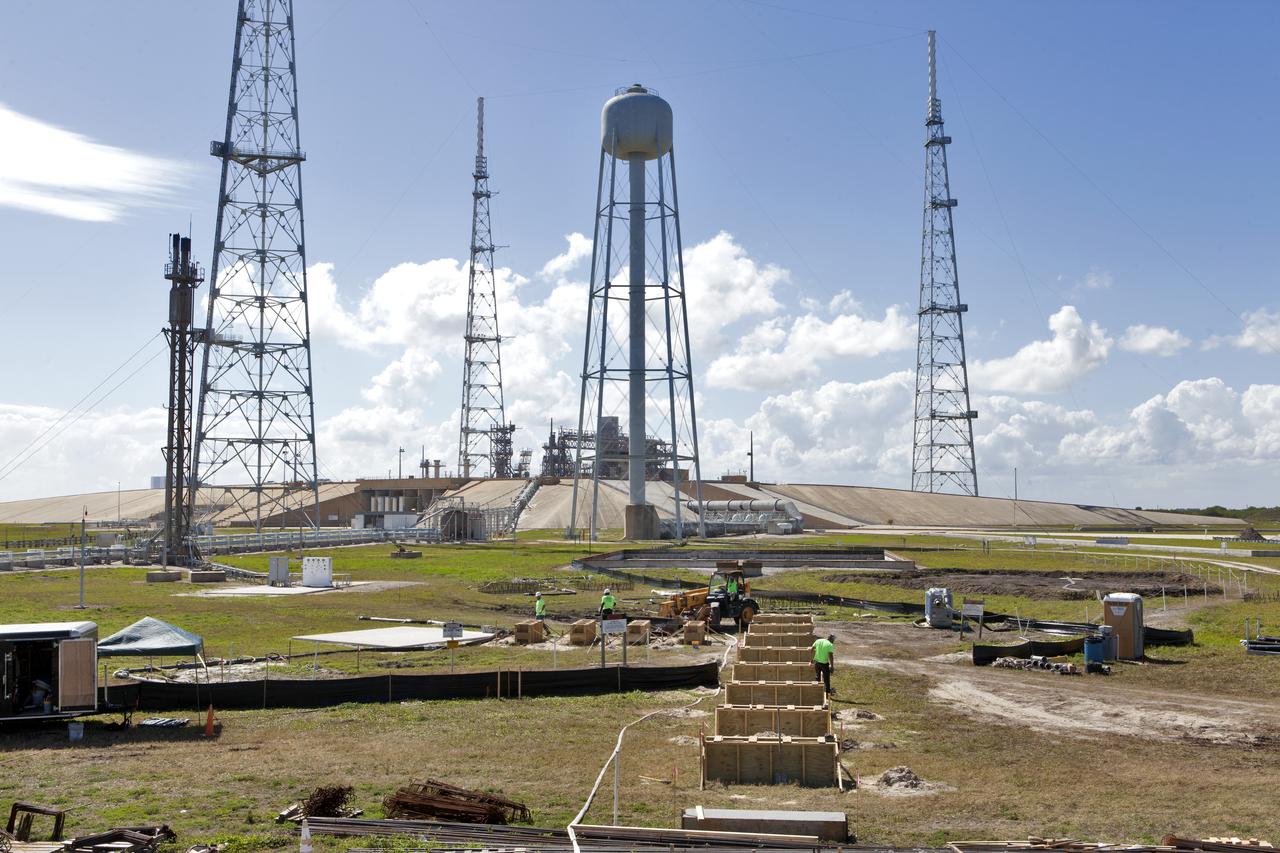
Construction workers stage parts and equipment nearby Launch Pad 39B at NASA’s Kennedy Space Center in Florida on Feb. 22, 2019. The launch pad has undergone upgrades and modifications to accommodate NASA's Space Launch System and Orion spacecraft for Exploration Mission-1 and subsequent missions. Upgrades include new heat-resistant bricks on the walls of the flame trench and installation of a new flame deflector. All of the upgrades have been managed by Exploration Ground Systems.
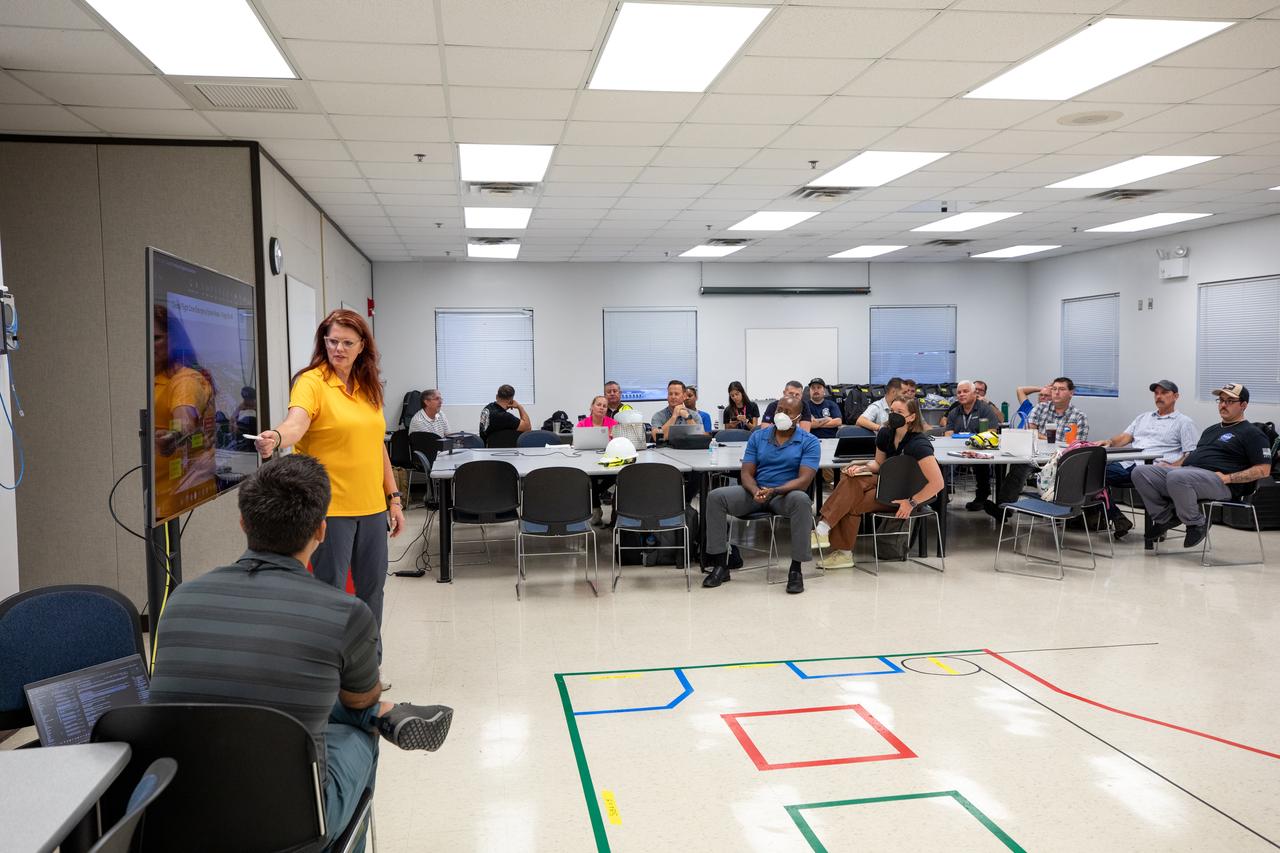
NASA Artemis Launch Director Charlie Blackwell-Thompson participates in an Artemis II classroom training on the Artemis emergency egress system with teams from the agency’s Exploration Ground Systems Program and others on Thursday, Aug. 8, 2024, at NASA’s Kennedy Space Center in Florida. Teams are training for the Artemis emergency egress demonstration as part of a series of integrated system verification and validation tests conducted at Kennedy to ensure teams are ready for launch.
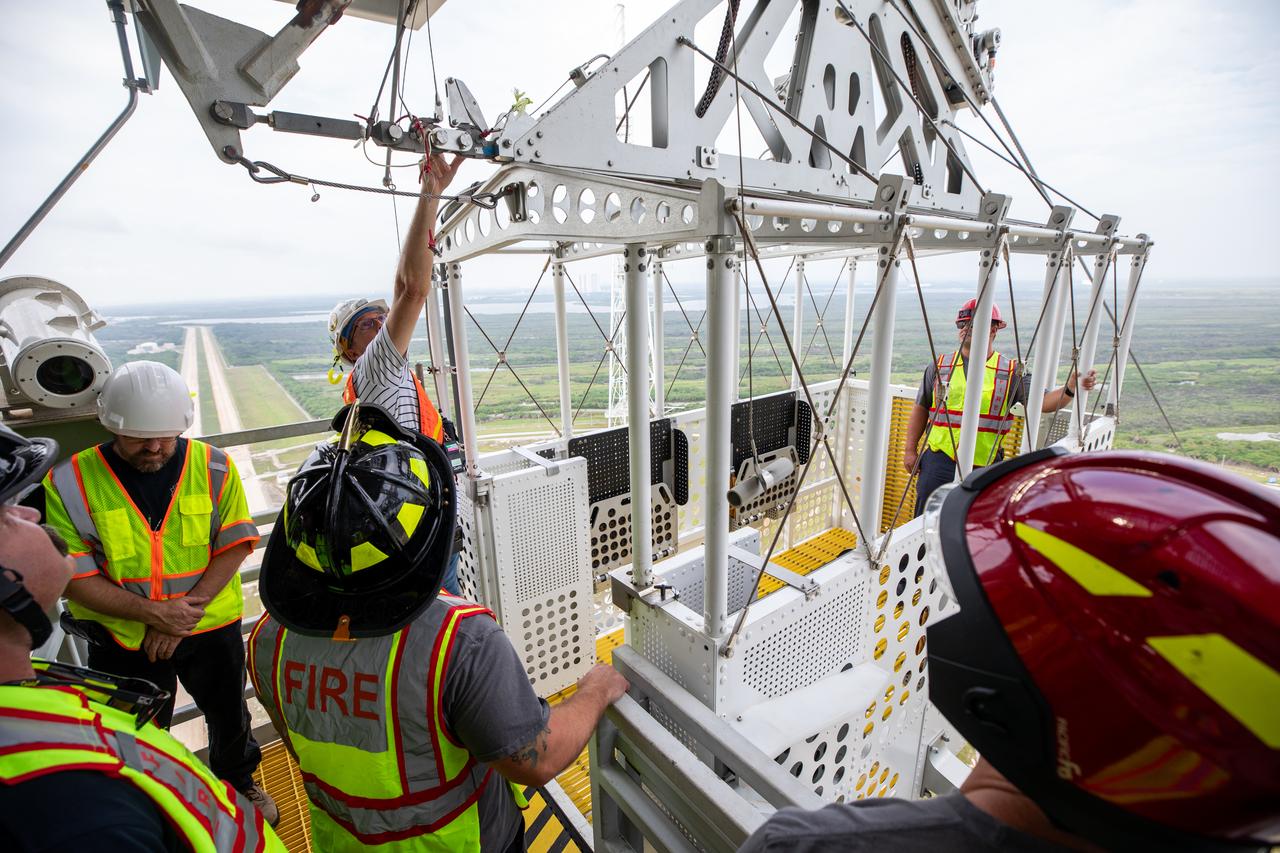
Teams with NASA’s Exploration Ground Systems Program, as well as NASA’s pad rescue team, conduct training inside the Artemis emergency egress baskets at Launch Pad 39B as part of the Artemis emergency egress demonstration training at the agency’s Kennedy Space Center in Florida on Thursday, Aug. 8, 2024. The baskets, similar to gondolas on ski lifts, are used in the case of a pad abort emergency to enable astronauts and other pad personnel a way to quickly escape away from the mobile launcher to the base of the pad and where waiting emergency transport vehicles will then drive them away.

Multiple 45,000-pound mine-resistant ambush protected vehicles, or MRAPs, participate in a series of integrated system verification and validation tests inside at Launch Pad 39B at the agency’s Kennedy Space Center in Florida on Thursday, Aug. 8, 2024. Originally designed for military applications, the MRAP offers a mobile bunker for astronauts and ground crews in the unlikely event they have to get away from the launch pad quickly in an emergency.
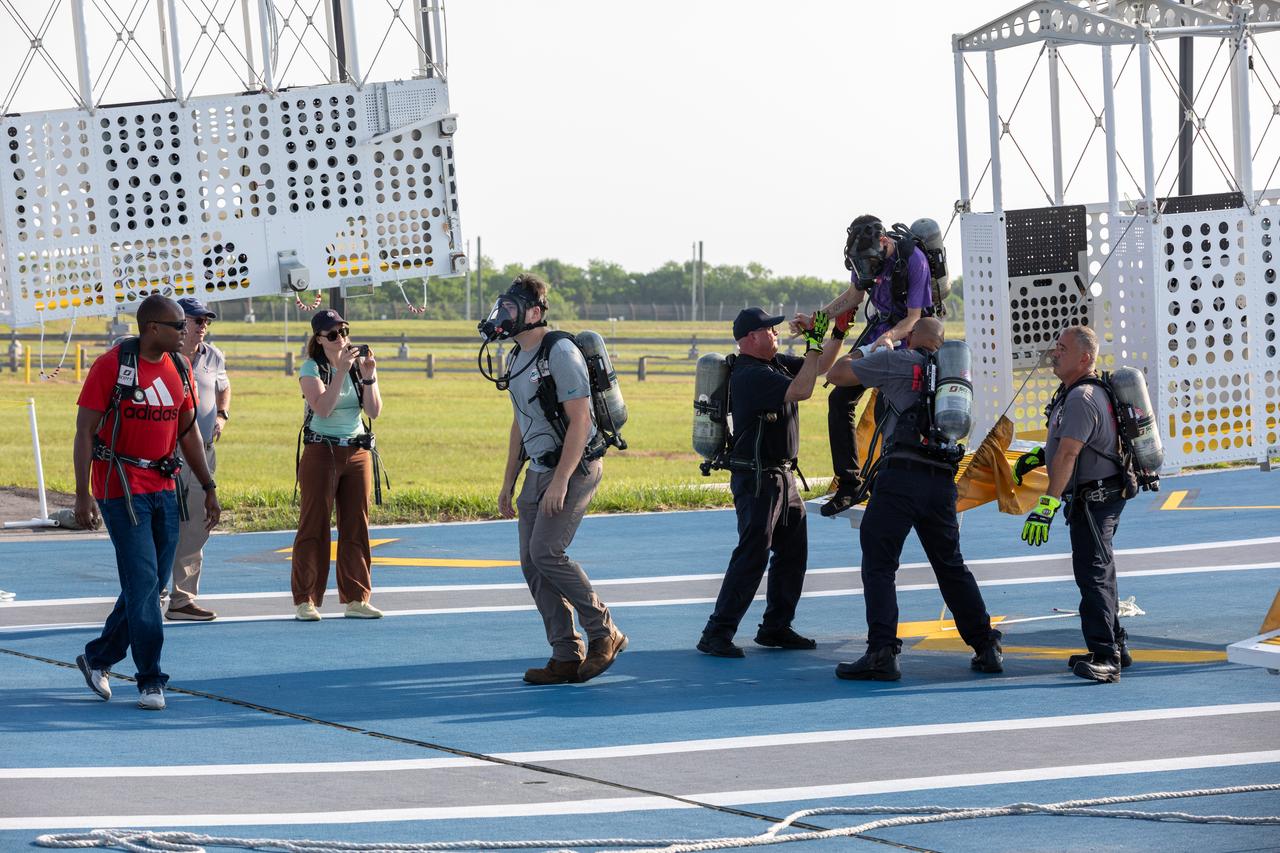
Teams at NASA’s Kennedy Space Center in Florida practice the Artemis mission emergency procedures during a series of integrated system verification and validation tests at Launch Pad 39B on Friday, Aug. 9, 2024. Members of the closeout crew, pad rescue team, and the Exploration Ground Systems Program practiced the process of getting inside and out of the emergency egress baskets. While the crew and other personnel will ride the emergency egress baskets to the terminus area in a real emergency, no one rode the baskets for this test. Instead, teams tested the baskets during separate occasions by using water tanks filled to different levels to replicate simulate the weight of passengers.

NASA’s pad rescue team learn about the Orion Crew Survival Suit ahead of the Artemis II emergency egress demonstration, which is one of the integrated system verification and validation tests taking place at Launch Pad 39B at the agency’s Kennedy Space Center in Florida on Thursday, Aug. 8, 2024. In the event of an emergency during launch countdown, the pad rescue team is there to help personnel leave the launch pad if needed.

Teams with NASA’s Exploration Ground Systems Program, as well as NASA’s pad rescue team, conduct training inside the Artemis emergency egress baskets at Launch Pad 39B as part of the Artemis emergency egress demonstration training at the agency’s Kennedy Space Center in Florida on Thursday, Aug. 8, 2024. The baskets, similar to gondolas on ski lifts, are used in the case of a pad abort emergency to enable astronauts and other pad personnel a way to quickly escape away from the mobile launcher to the base of the pad and where waiting emergency transport vehicles will then drive them away.
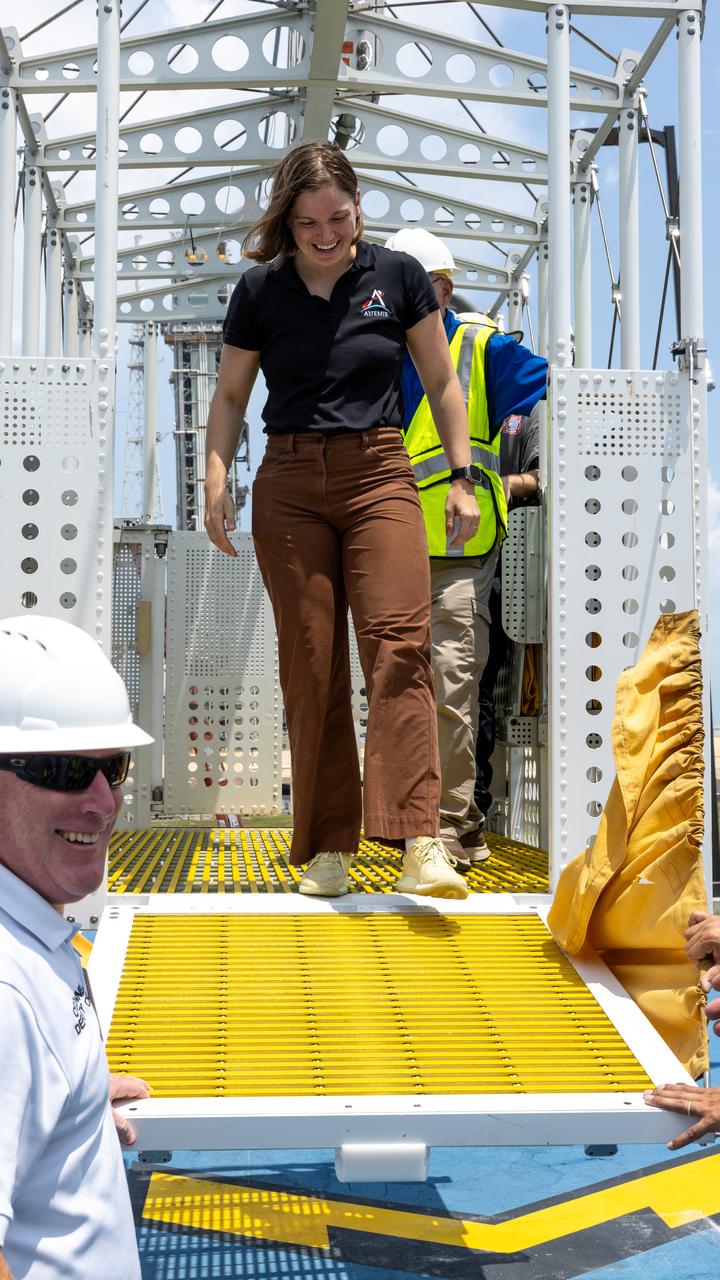
Artemis II backup crew member, CSA (Canadian Space Agency) astronaut Jenni Gibbons, participates in the Artemis II emergency egress demonstration, which is one of the integrated system verification and validation tests taking place at Launch Complex 39B at the agency’s Kennedy Space Center in Florida on Thursday, Aug. 8, 2024. The baskets, similar to gondolas on ski lifts, are used in the case of a pad abort emergency to enable astronauts and other pad personnel a way to quickly escape away from the mobile launcher to the base of the pad and where waiting emergency transport vehicles will then drive them away.
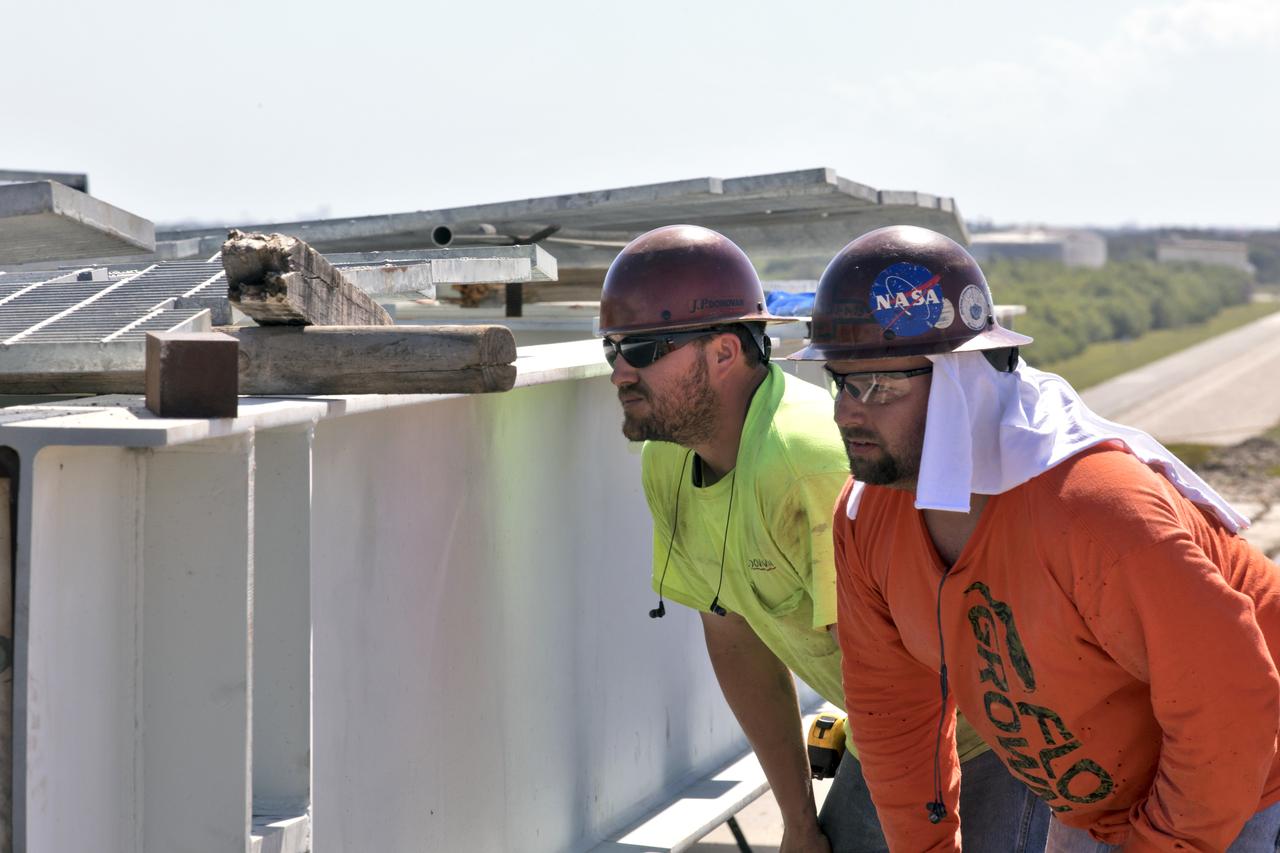
Construction workers assess the repairs needed on the surface of Launch Pad 39B at NASA’s Kennedy Space Center in Florida on Feb. 22, 2019. The launch pad has undergone upgrades and modifications to accommodate NASA's Space Launch System and Orion spacecraft for Exploration Mission-1 and subsequent missions. Upgrades include new heat-resistant bricks on the walls of the flame trench and installation of a new flame deflector. All of the upgrades have been managed by Exploration Ground Systems.
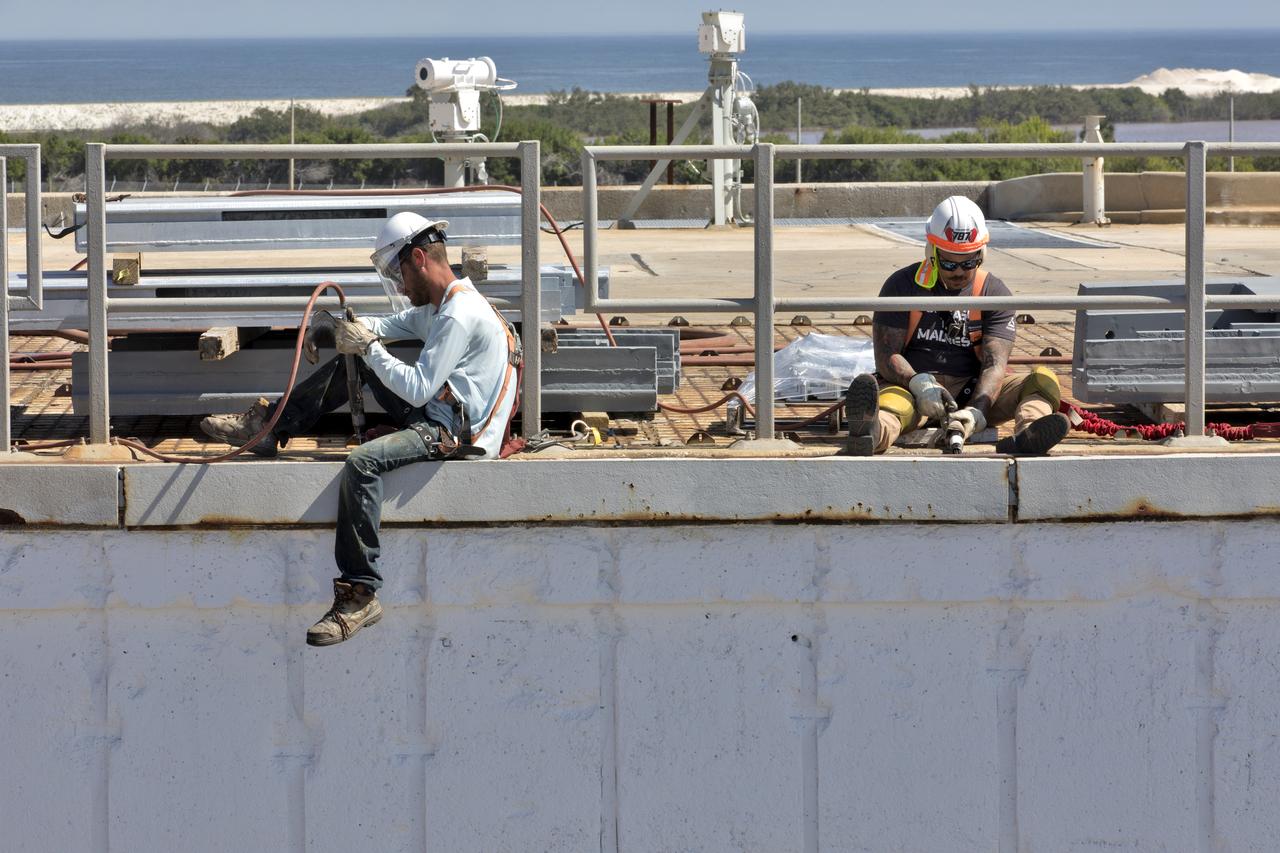
Constructions workers are busy repairing the concrete on the surface of Launch Pad 39B at NASA’s Kennedy Space Center in Florida on Feb. 22, 2019. The launch pad has undergone upgrades and modifications to accommodate NASA's Space Launch System and Orion spacecraft for Exploration Mission-1 and subsequent missions. Upgrades include new heat-resistant bricks on the walls of the flame trench and installation of a new flame deflector. All of the upgrades have been managed by Exploration Ground Systems.
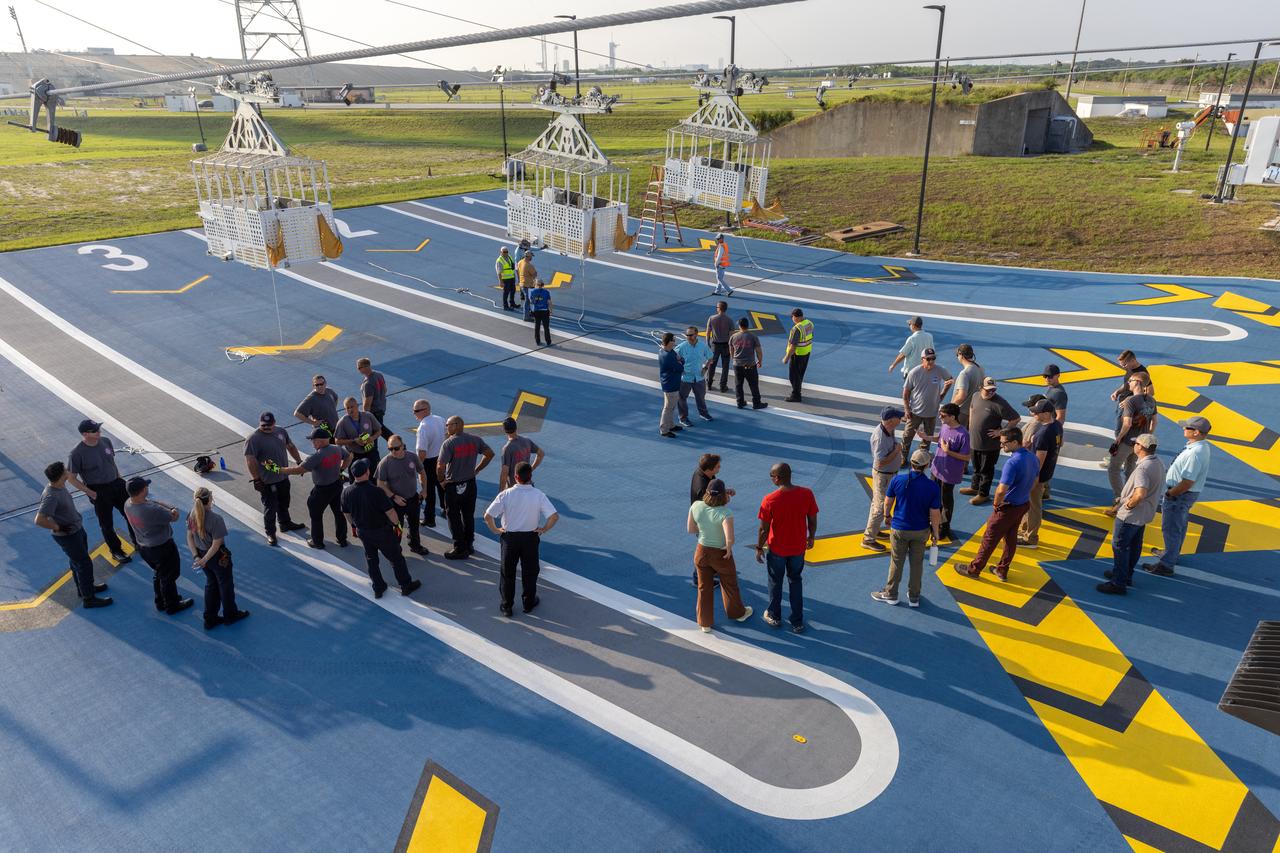
Teams at NASA’s Kennedy Space Center in Florida practice the Artemis mission emergency procedures during a series of integrated system verification and validation tests at Launch Pad 39B on Friday, Aug. 9, 2024. Members of the closeout crew, pad rescue team, and the Exploration Ground Systems Program practiced the process of getting inside and out of the emergency egress baskets. While the crew and other personnel will ride the emergency egress baskets to the terminus area in a real emergency, no one rode the baskets for this test. Instead, teams tested the baskets during separate occasions by using water tanks filled to different levels to replicate simulate the weight of passengers.
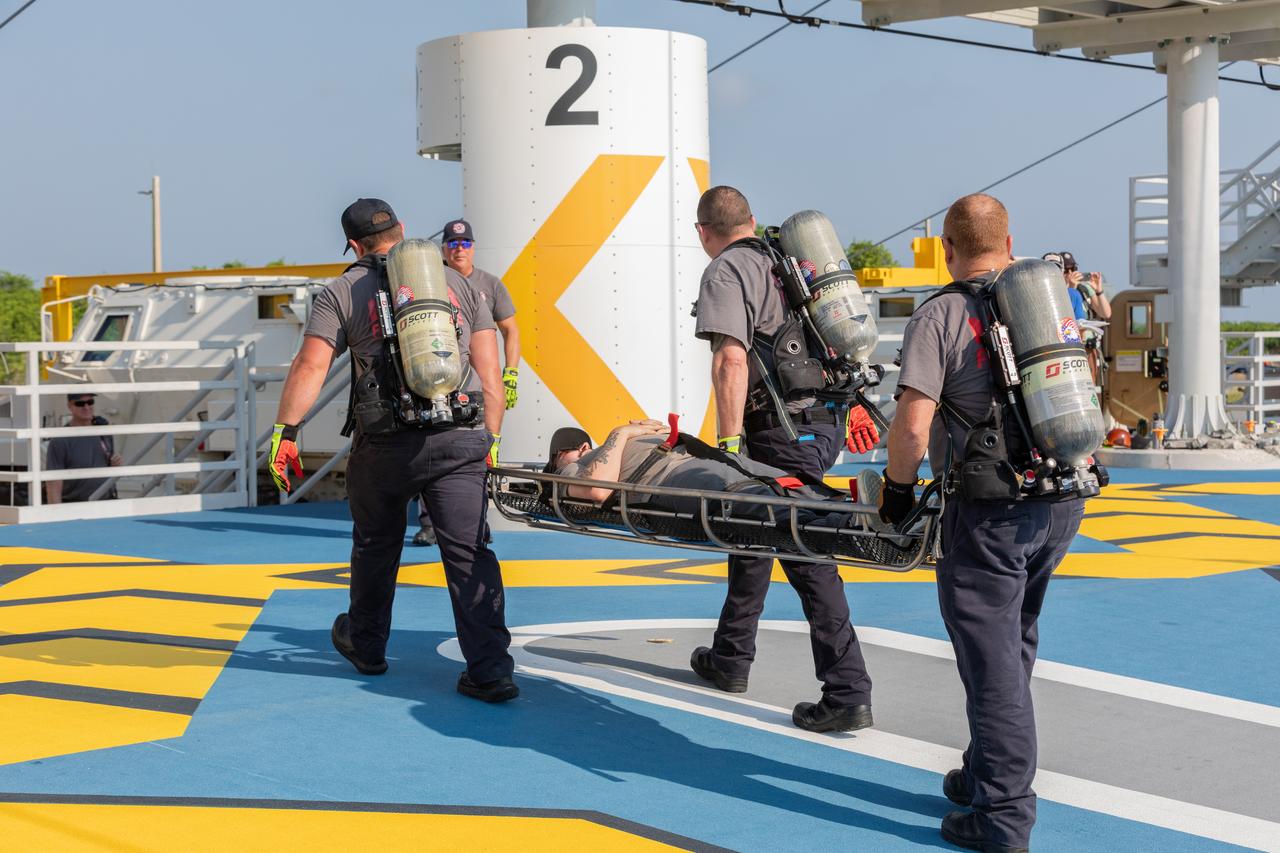
Teams at NASA’s Kennedy Space Center in Florida practice the Artemis mission emergency procedures during a series of integrated system verification and validation tests at Launch Pad 39B on Friday, Aug. 9, 2024. Members of the closeout crew, pad rescue team, and the Exploration Ground Systems Program practiced the process of getting inside and out of the emergency egress baskets. While the crew and other personnel will ride the emergency egress baskets to the terminus area in a real emergency, no one rode the baskets for this test. Instead, teams tested the baskets during separate occasions by using water tanks filled to different levels to replicate simulate the weight of passengers.
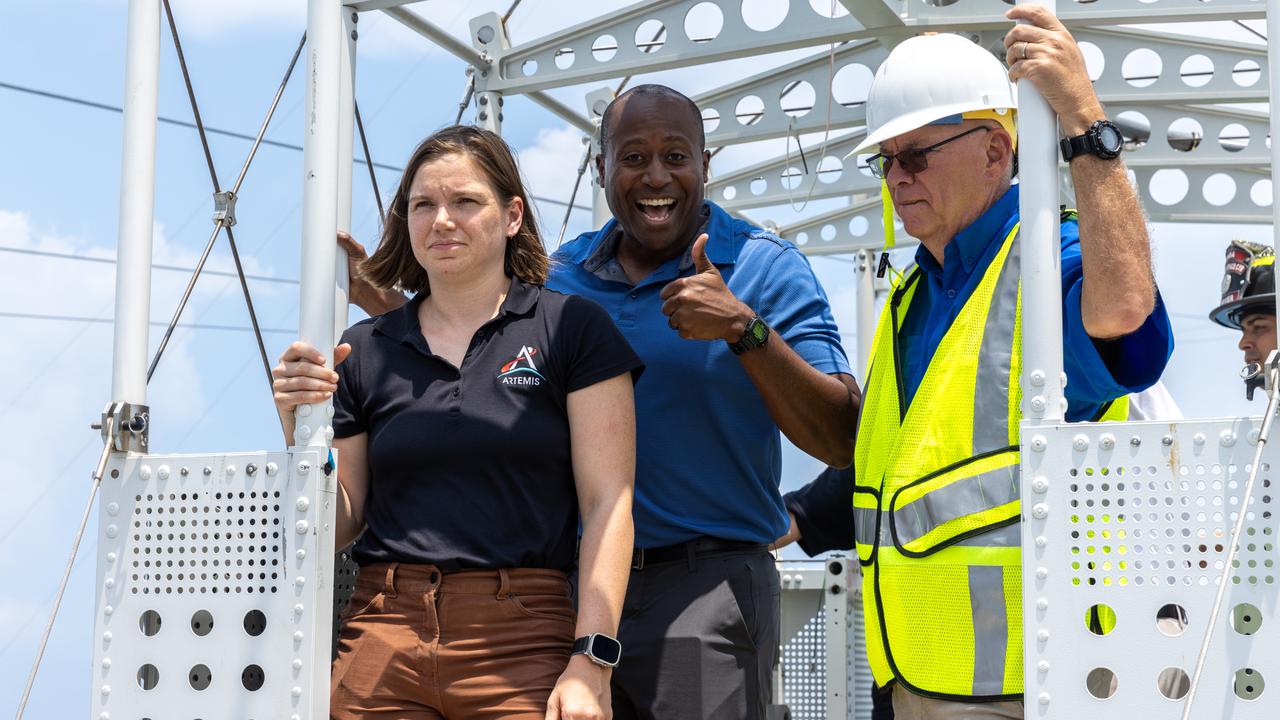
Artemis II backup crew members, CSA (Canadian Space Agency) astronaut Jenni Gibbons and NASA astronaut Andre Douglas participate in one of a series of integrated system verification and validation tests inside the emergency egress baskets at Launch Pad 39B at the agency’s Kennedy Space Center in Florida on Thursday, Aug. 8, 2024. The baskets, similar to gondolas on ski lifts, are used in the case of a pad abort emergency to enable astronauts and other pad personnel a way to quickly escape away from the mobile launcher to the base of the pad and where waiting emergency transport vehicles will then drive them away.
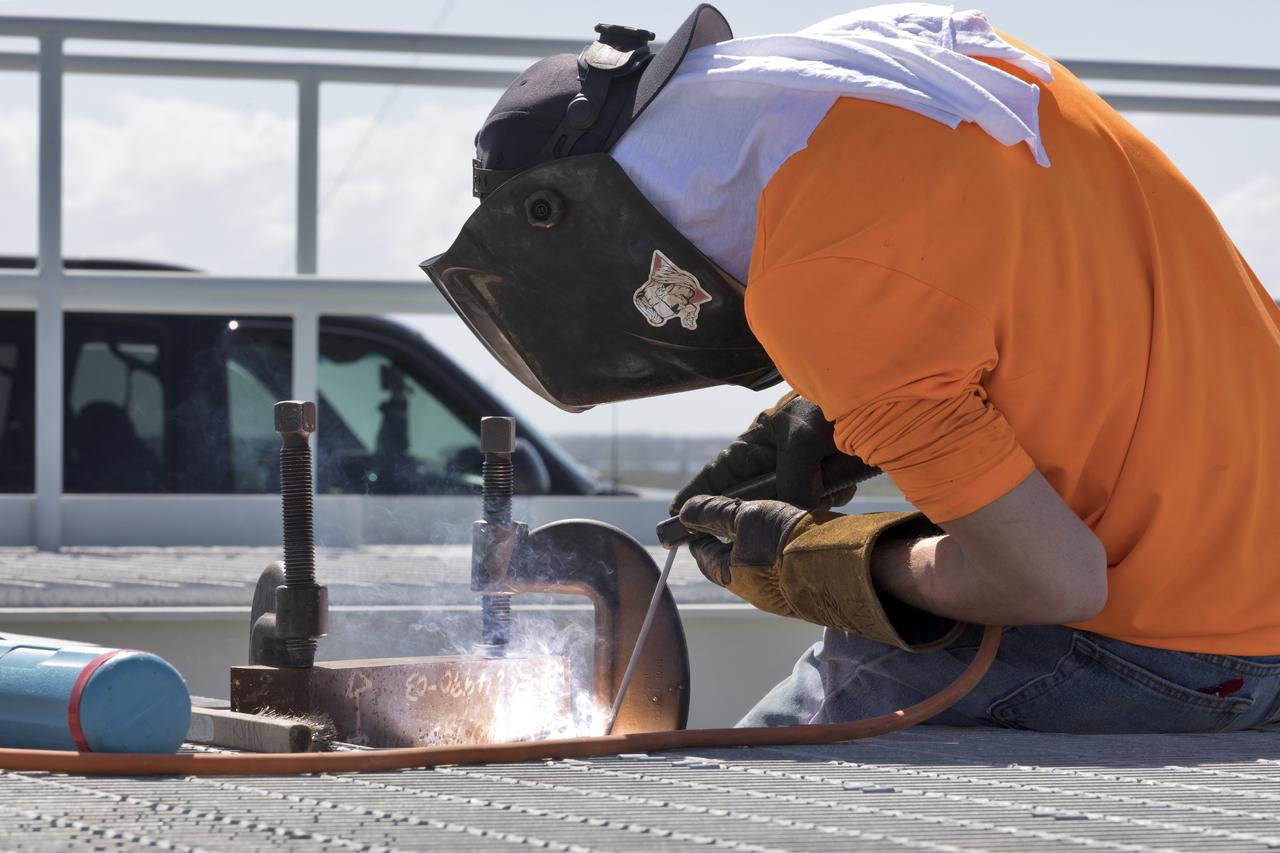
A construction worker welds a section of metal on the surface of Launch Pad 39B at NASA’s Kennedy Space Center in Florida on Feb. 22, 2019. The launch pad has undergone upgrades and modifications to accommodate NASA's Space Launch System and Orion spacecraft for Exploration Mission-1 and subsequent missions. Upgrades include new heat-resistant bricks on the walls of the flame trench and installation of a new flame deflector. All of the upgrades have been managed by Exploration Ground Systems.
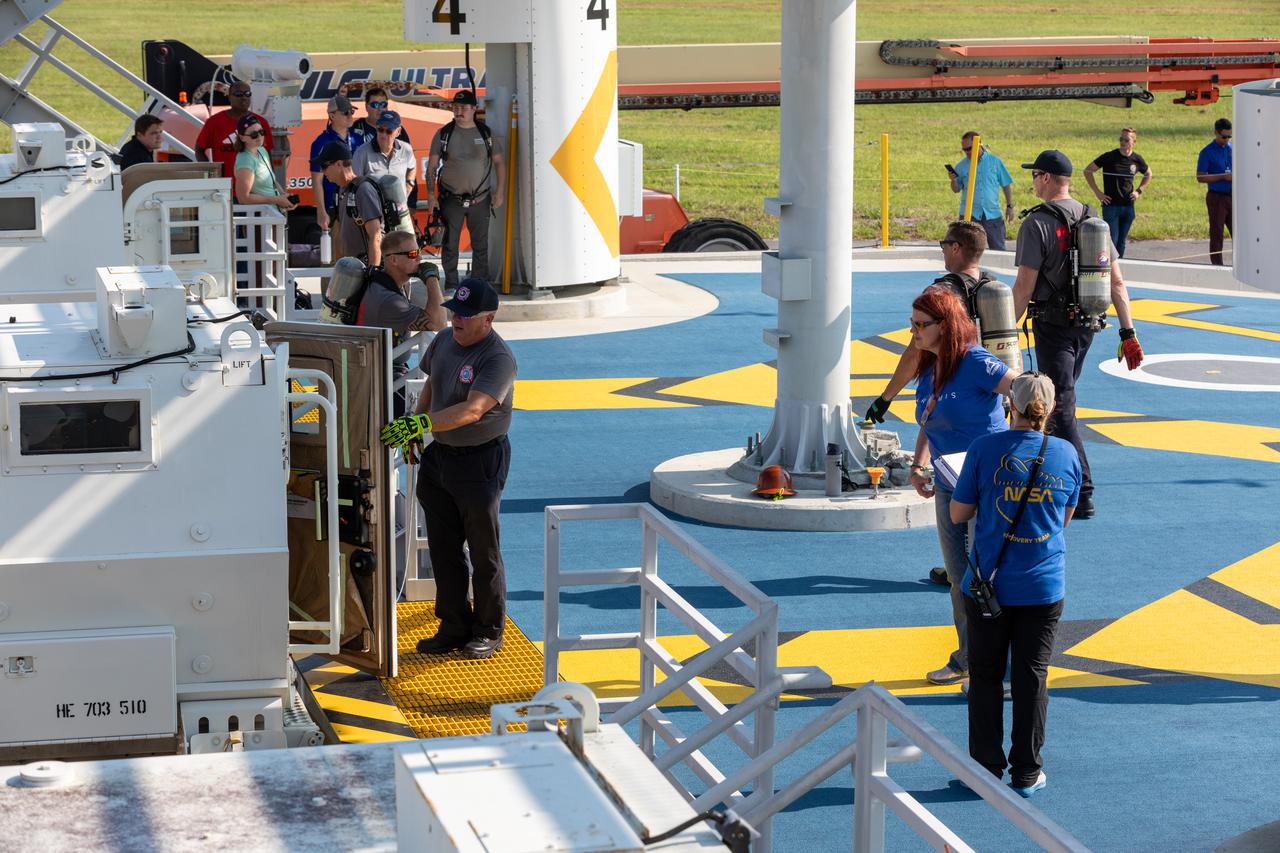
Teams at NASA’s Kennedy Space Center in Florida practice the Artemis mission emergency procedures during a series of integrated system verification and validation tests at Launch Pad 39B on Friday, Aug. 9, 2024. Members of the closeout crew, pad rescue team, and the Exploration Ground Systems Program practiced the process of getting inside and out of the emergency egress baskets. While the crew and other personnel will ride the emergency egress baskets to the terminus area in a real emergency, no one rode the baskets for this test. Instead, teams tested the baskets during separate occasions by using water tanks filled to different levels to replicate simulate the weight of passengers.
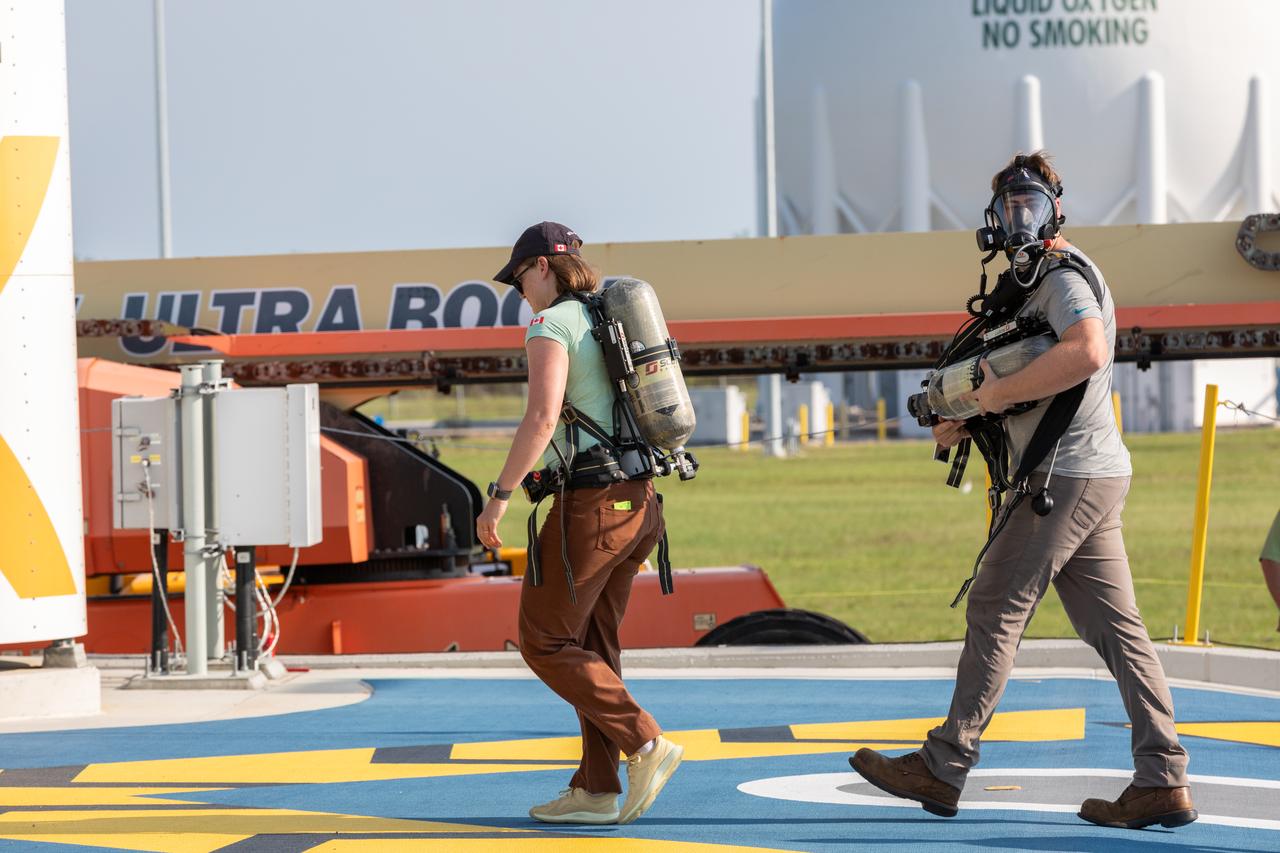
Teams at NASA’s Kennedy Space Center in Florida practice the Artemis mission emergency procedures during a series of integrated system verification and validation tests at Launch Pad 39B on Friday, Aug. 9, 2024. Members of the closeout crew, pad rescue team, and the Exploration Ground Systems Program practiced the process of getting inside and out of the emergency egress baskets. While the crew and other personnel will ride the emergency egress baskets to the terminus area in a real emergency, no one rode the baskets for this test. Instead, teams tested the baskets during separate occasions by using water tanks filled to different levels to replicate simulate the weight of passengers.
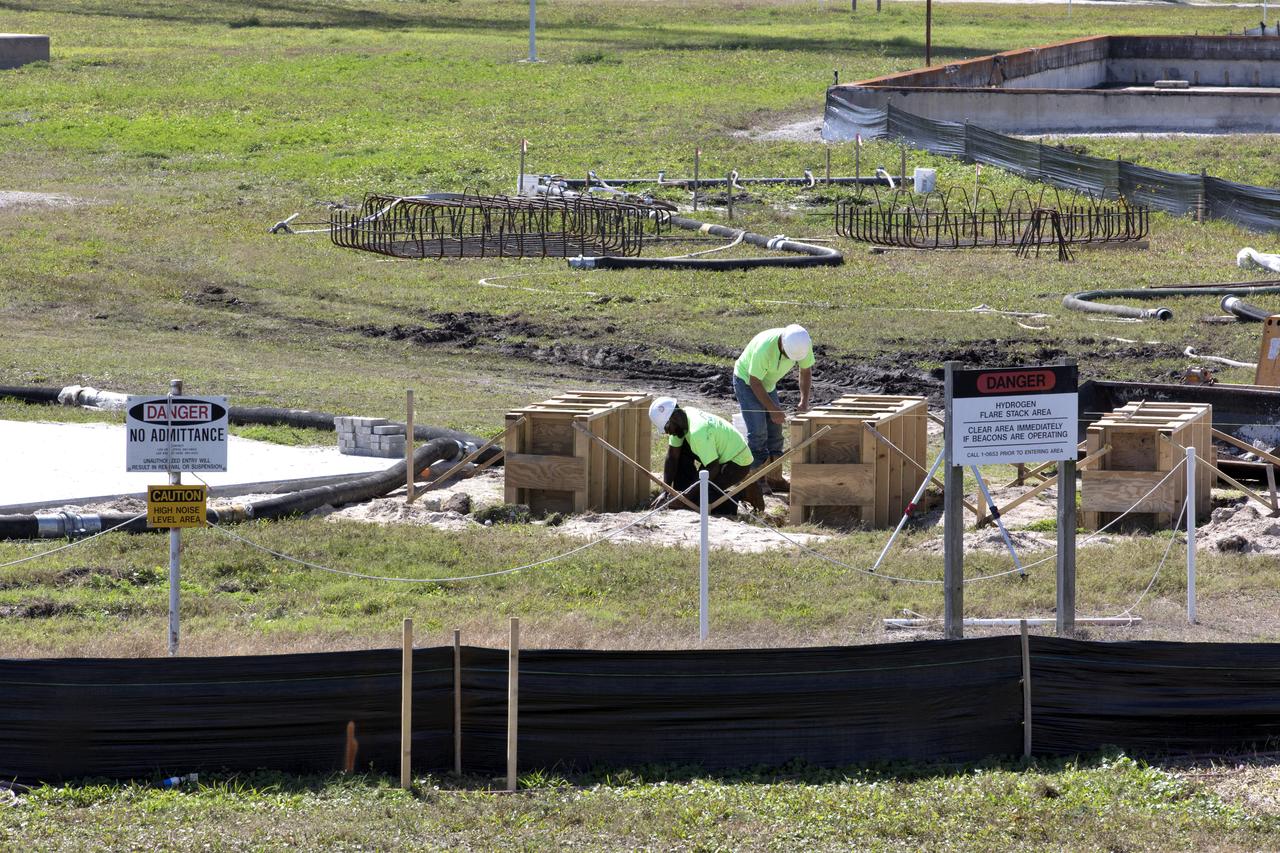
Construction workers stage parts and equipment nearby Launch Pad 39B at NASA’s Kennedy Space Center in Florida on Feb. 22, 2019. The launch pad has undergone upgrades and modifications to accommodate NASA's Space Launch System and Orion spacecraft for Exploration Mission-1 and subsequent missions. Upgrades include new heat-resistant bricks on the walls of the flame trench and installation of a new flame deflector. All of the upgrades have been managed by Exploration Ground Systems.
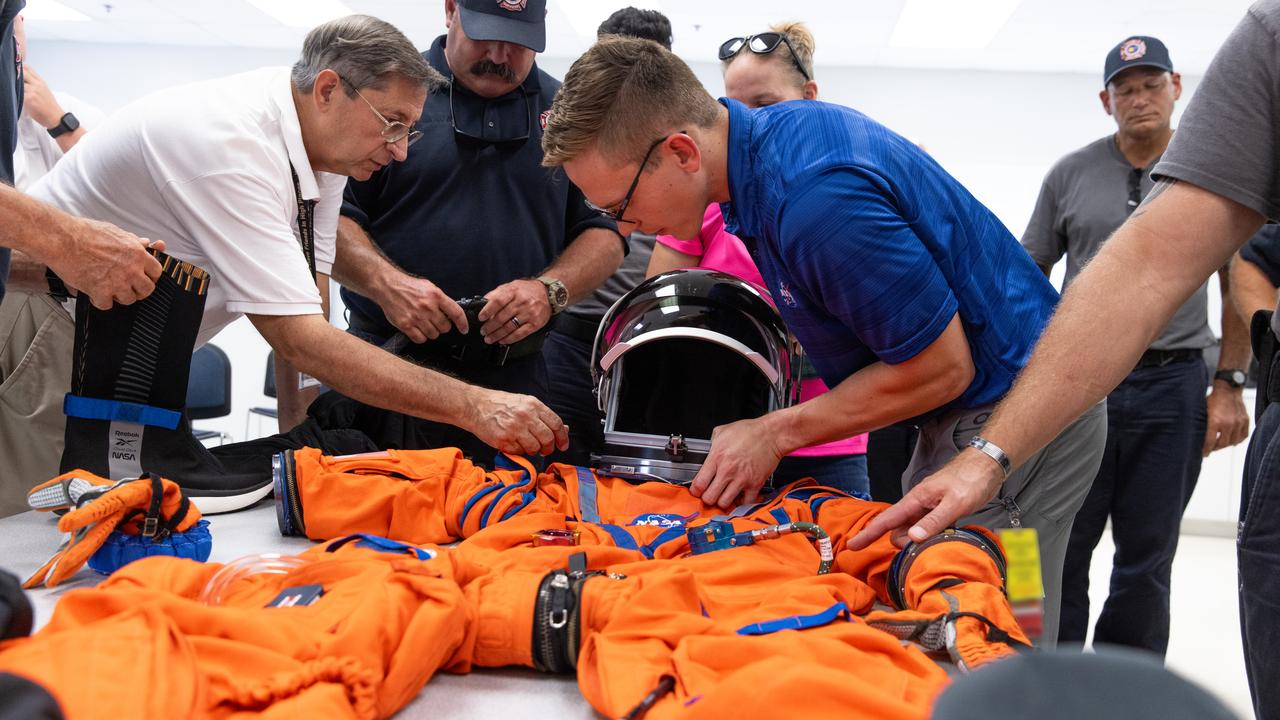
NASA’s pad rescue team learn about the Orion Crew Survival Suit ahead of the Artemis II emergency egress demonstration, which is one of the integrated system verification and validation tests taking place at Launch Pad 39B at the agency’s Kennedy Space Center in Florida on Thursday, Aug. 8, 2024. In the event of an emergency during launch countdown, the pad rescue team is there to help personnel leave the launch pad if needed.
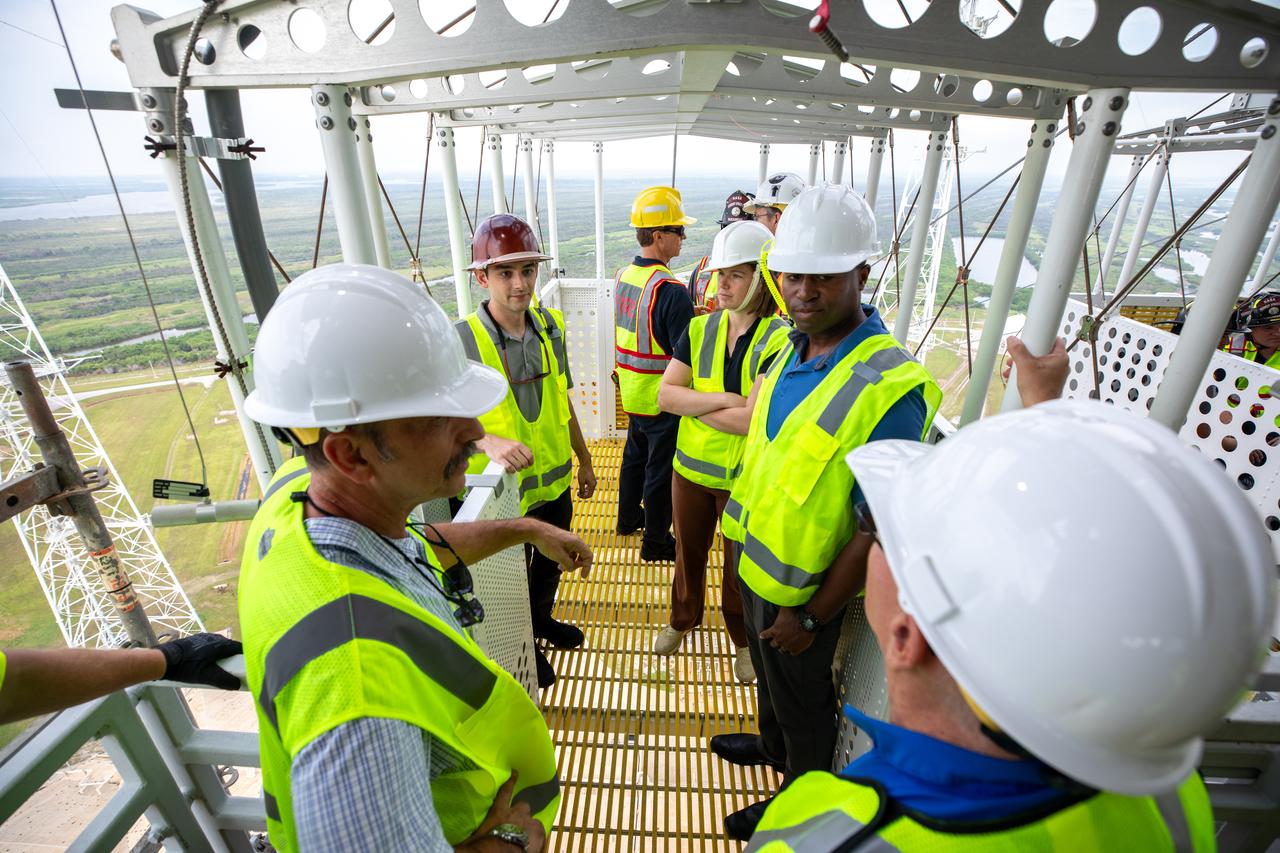
Teams with NASA’s Exploration Ground Systems Program, as well as NASA’s pad rescue team, conduct training inside the Artemis emergency egress baskets at Launch Pad 39B as part of the Artemis emergency egress demonstration training at the agency’s Kennedy Space Center in Florida on Thursday, Aug. 8, 2024. The baskets, similar to gondolas on ski lifts, are used in the case of a pad abort emergency to enable astronauts and other pad personnel a way to quickly escape away from the mobile launcher to the base of the pad and where waiting emergency transport vehicles will then drive them away.
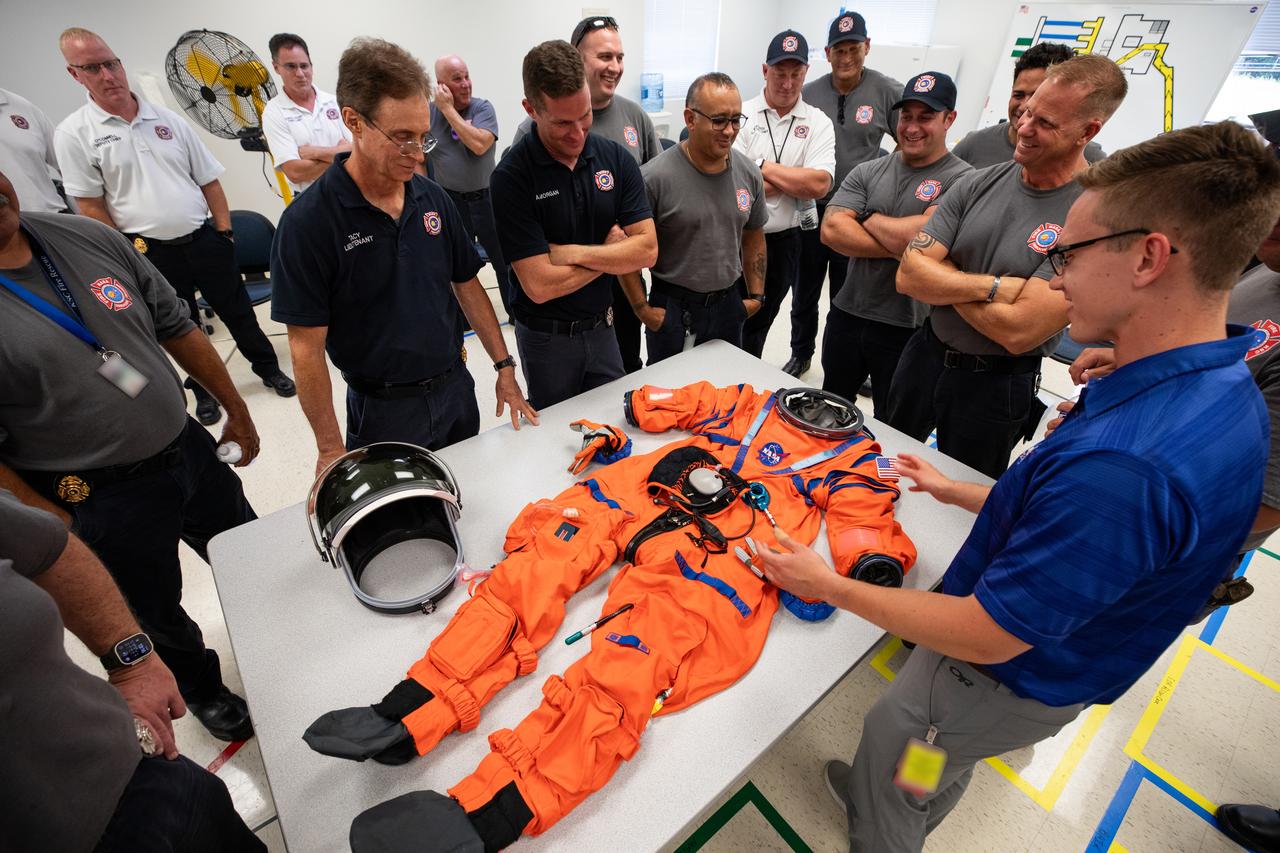
NASA’s pad rescue team learn about the Orion Crew Survival Suit ahead of the Artemis II emergency egress demonstration, which is one of the integrated system verification and validation tests taking place at Launch Pad 39B at the agency’s Kennedy Space Center in Florida on Thursday, Aug. 8, 2024. In the event of an emergency during launch countdown, the pad rescue team is there to help personnel leave the launch pad if needed.
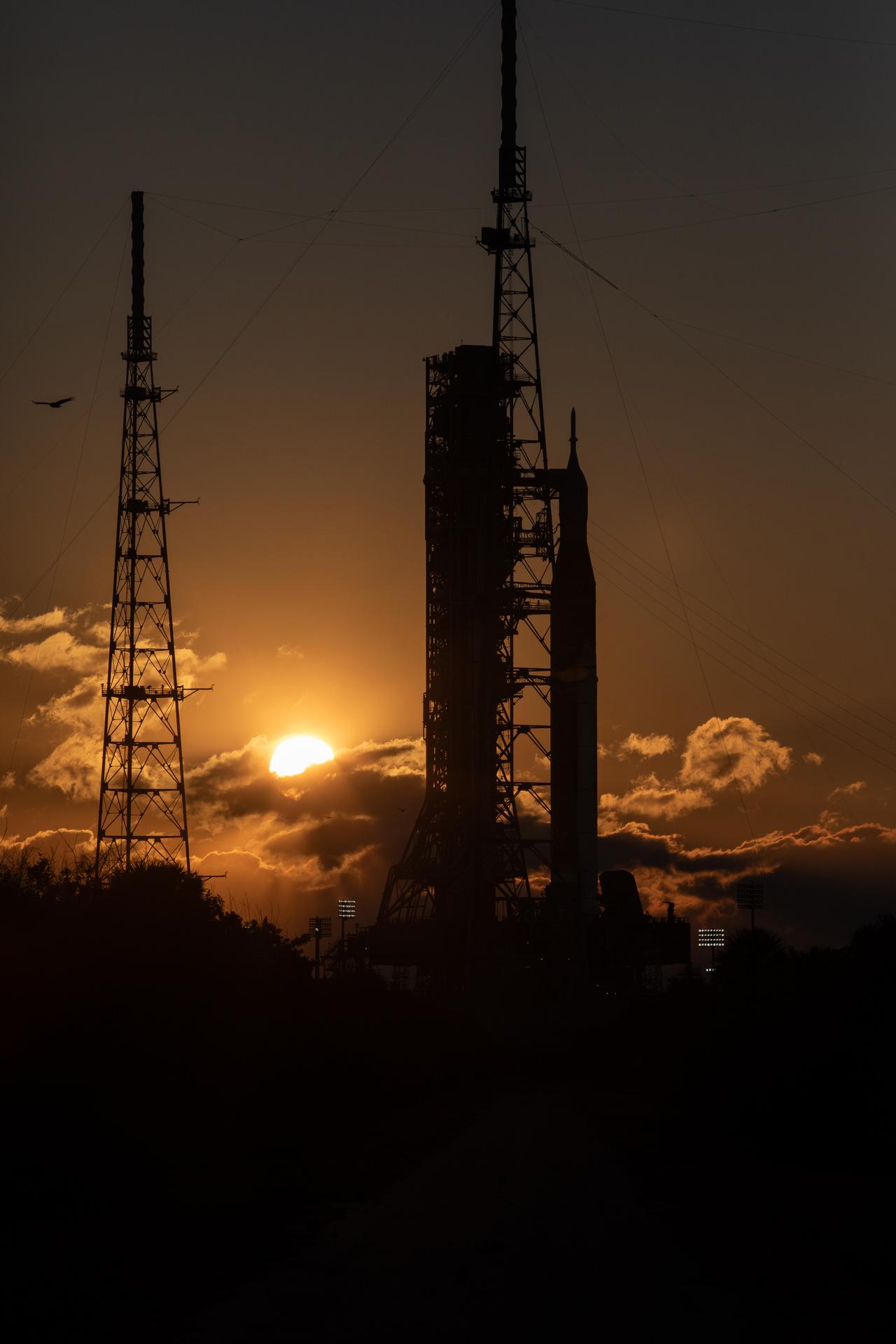
The Sun rises behind NASA’s Artemis II SLS (Space Launch System) rocket and Orion spacecraft atop a mobile launcher at Launch Complex 39B at NASA’s Kennedy Space Center in Florida on Sunday, Feb. 1, 2026. The Artemis II test flight will take Commander Reid Wiseman, Pilot Victor Glover, and Mission Specialist Christina Koch from NASA, and Mission Specialist Jeremy Hansen from the CSA (Canadian Space Agency), around the Moon and back to Earth.
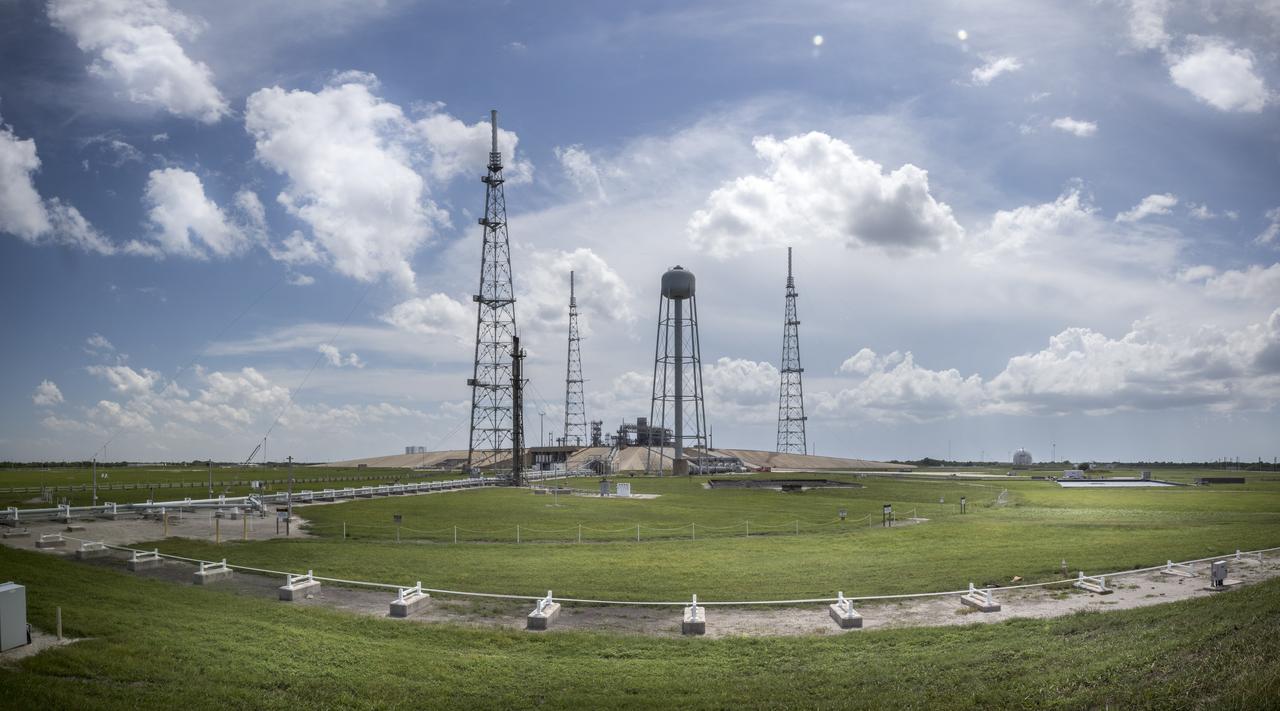
A full view of Launch Pad 39B at NASA's Kennedy Space Center in Florida on July 26, 2018. The launch pad has undergone upgrades and modifications to accommodate NASA's Space Launch System and Orion spacecraft for Exploration Mission-1 and other deep space missions. New heat-resistant bricks have been installed on the walls and a new flame deflector is in place. In view are the three lightning protection system towers and water tank. The clean pad concept is designed to support NASA and commercial launch providers at the multi-user spaceport.
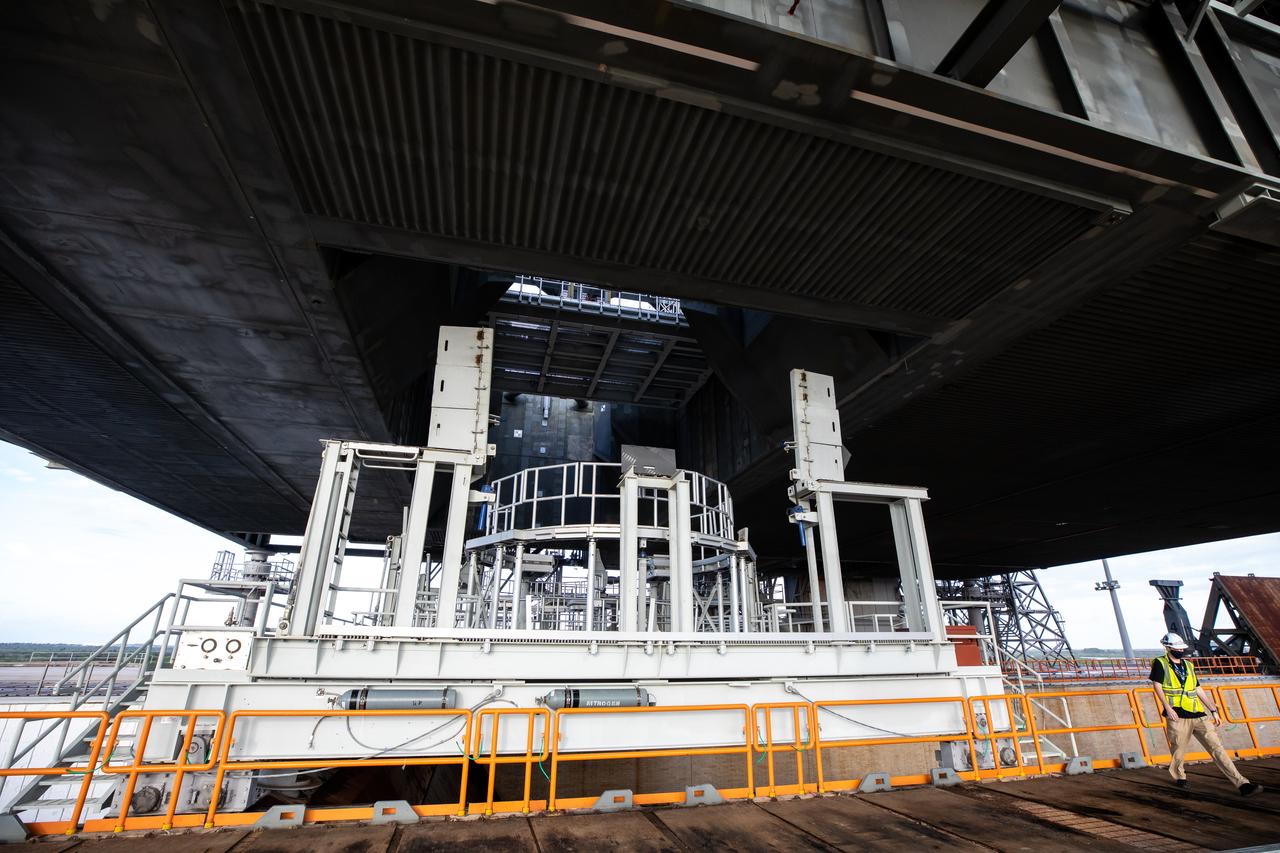
The engine service platform is moved into position beneath the mobile launcher for Artemis I at Launch Pad 39B on Oct. 23, 2020, at NASA’s Kennedy Space Center in Florida. The service platform allows access to the RS-25 engines on the Space Launch System core stage for routine work or inspections. The nearly 400-foot-tall mobile launcher will remain at the pad while engineers with Exploration Ground Systems and Jacobs complete several tasks, including a timing test to validate the launch team’s countdown timeline, and a thorough, top-to-bottom wash down of the mobile launcher to remove any debris remaining from construction and installation of the umbilical arms. Artemis I will test the Orion spacecraft and Space Launch System as an integrated system ahead of crewed flights to the Moon. Under the Artemis program, NASA will land the first woman and the next man on the Moon in 2024.

About 450,000 gallons of water flowed at high speed from a holding tank through new and modified piping and valves, the flame trench, flame deflector nozzles and mobile launcher interface risers during a wet flow test at Launch Pad 39B at NASA's Kennedy Space Center in Florida. At peak flow, the water reached about 100 feet in the air above the pad surface. The test was a milestone to confirm and baseline the performance of the Ignition Overpressure/Sound Suppression system. During launch of NASA's Space Launch System rocket and Orion spacecraft, the high-speed water flow will help protect the vehicle from the extreme acoustic and temperature environment during ignition and liftoff.
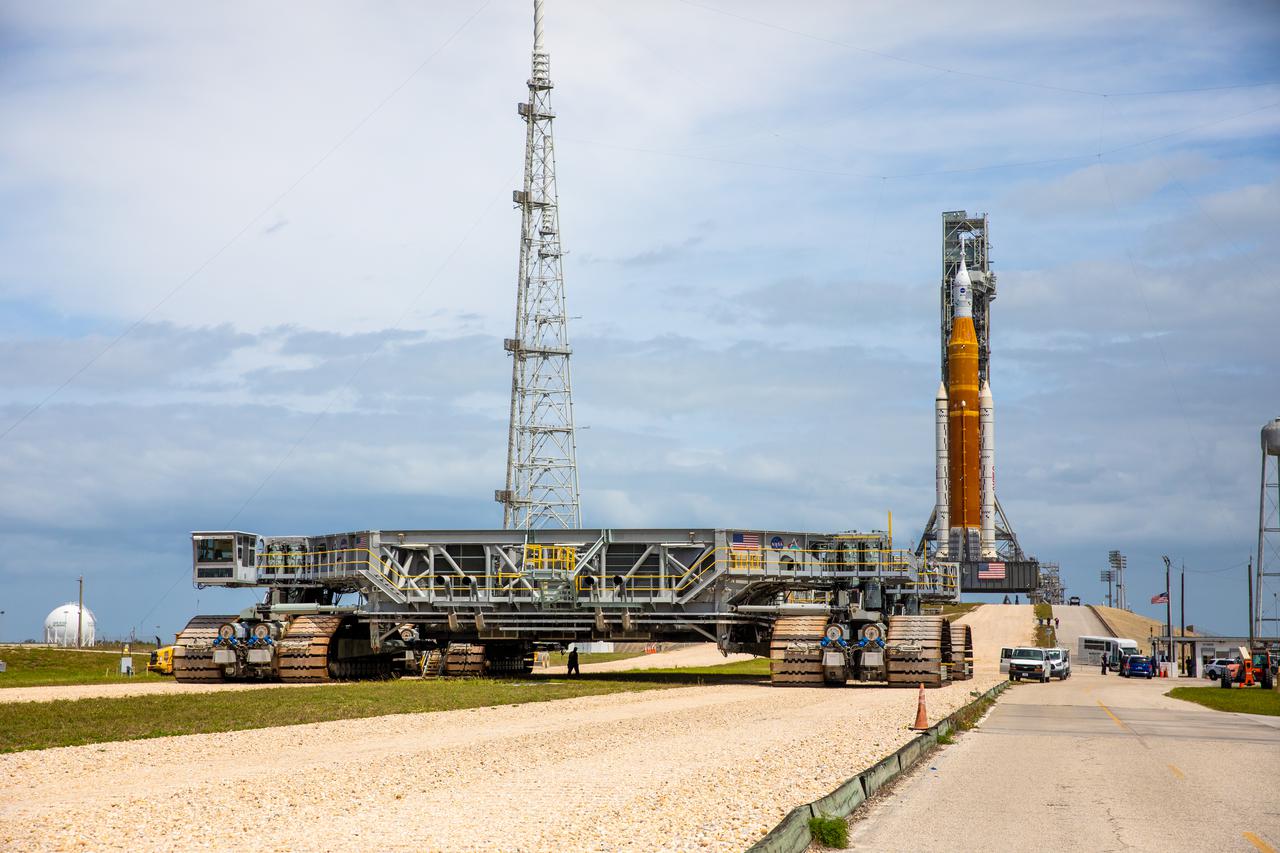
Crawler-transporter 2 (CT-2) makes its way along the crawlerway to Launch Complex 39B at NASA’s Kennedy Space Center in Florida on April 21, 2022. In view atop the mobile launcher on the pad are the Artemis I Space Launch System (SLS) and Orion spacecraft. The SLS and Orion atop the mobile launcher were transported to the pad on CT-2 for a prelaunch test called a wet dress rehearsal. Artemis I will be the first integrated test of the SLS and Orion spacecraft. In future Artemis missions, NASA will land the first woman and the first person of color on the surface of the Moon, paving the way for a long-term lunar presence and serving as a steppingstone on the way to Mars.
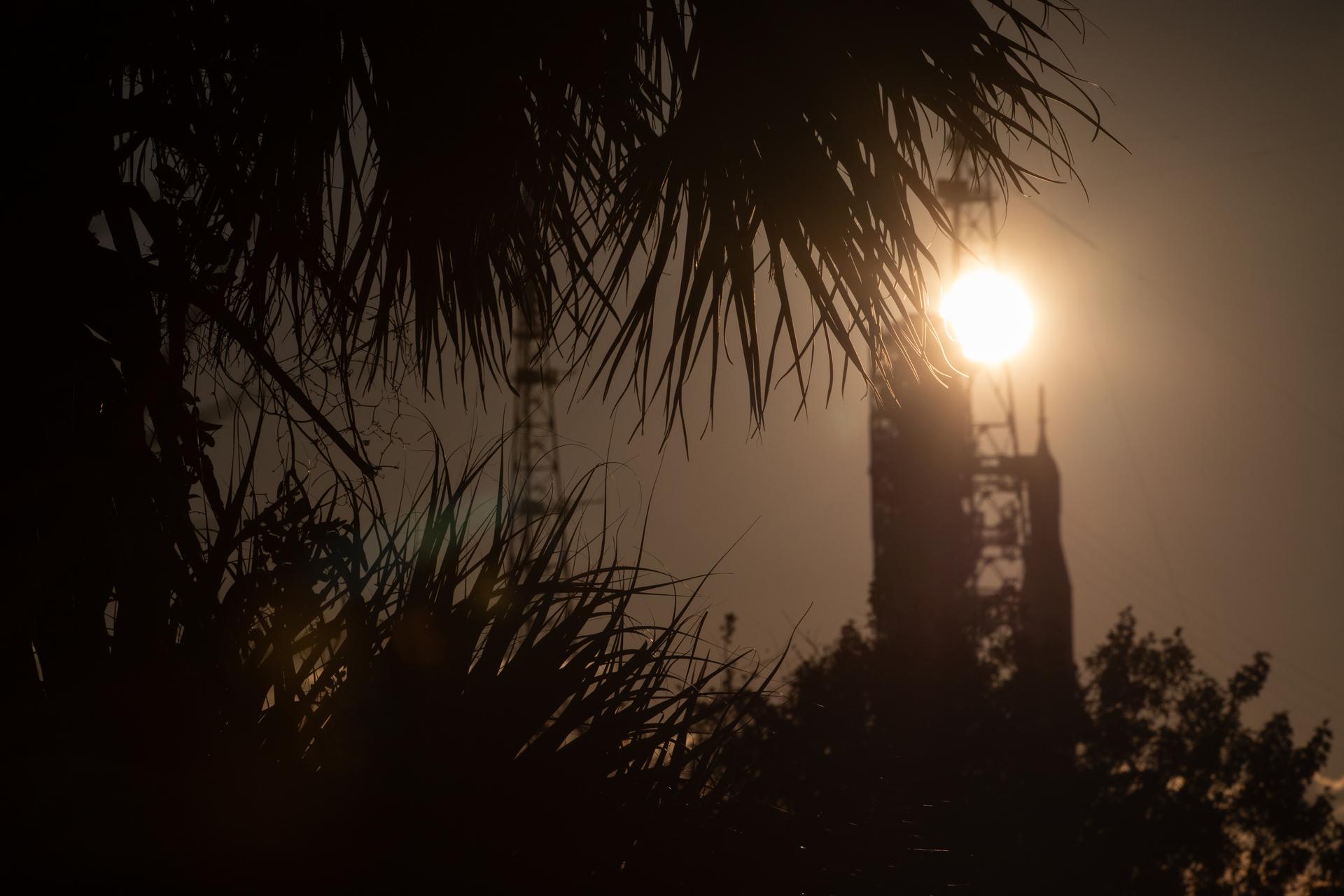
The Sun shines behind NASA’s Artemis II SLS (Space Launch System) rocket and Orion spacecraft atop a mobile launcher at Launch Complex 39B at NASA’s Kennedy Space Center in Florida on Sunday, Feb. 1, 2026. The Artemis II test flight will take Commander Reid Wiseman, Pilot Victor Glover, and Mission Specialist Christina Koch from NASA, and Mission Specialist Jeremy Hansen from the CSA (Canadian Space Agency), around the Moon and back to Earth.

The engine service platform has been lowered and removed from the mobile launcher for Artemis I at Launch Pad 39B at NASA’s Kennedy Space Center in Florida on Oct. 23, 2020. The platform is in view on a flatbed truck. The nearly 400-foot-tall mobile launcher is at the pad while engineers with Exploration Ground Systems and Jacobs complete several tasks, including a timing test to validate the launch team’s countdown timeline, and a thorough, top-to-bottom wash down of the mobile launcher to remove any debris remaining from construction and installation of the umbilical arms. Artemis I will test the Orion spacecraft and Space Launch System as an integrated system ahead of crewed flights to the Moon. Under the Artemis program, NASA will land the first woman and the next man on the Moon in 2024.
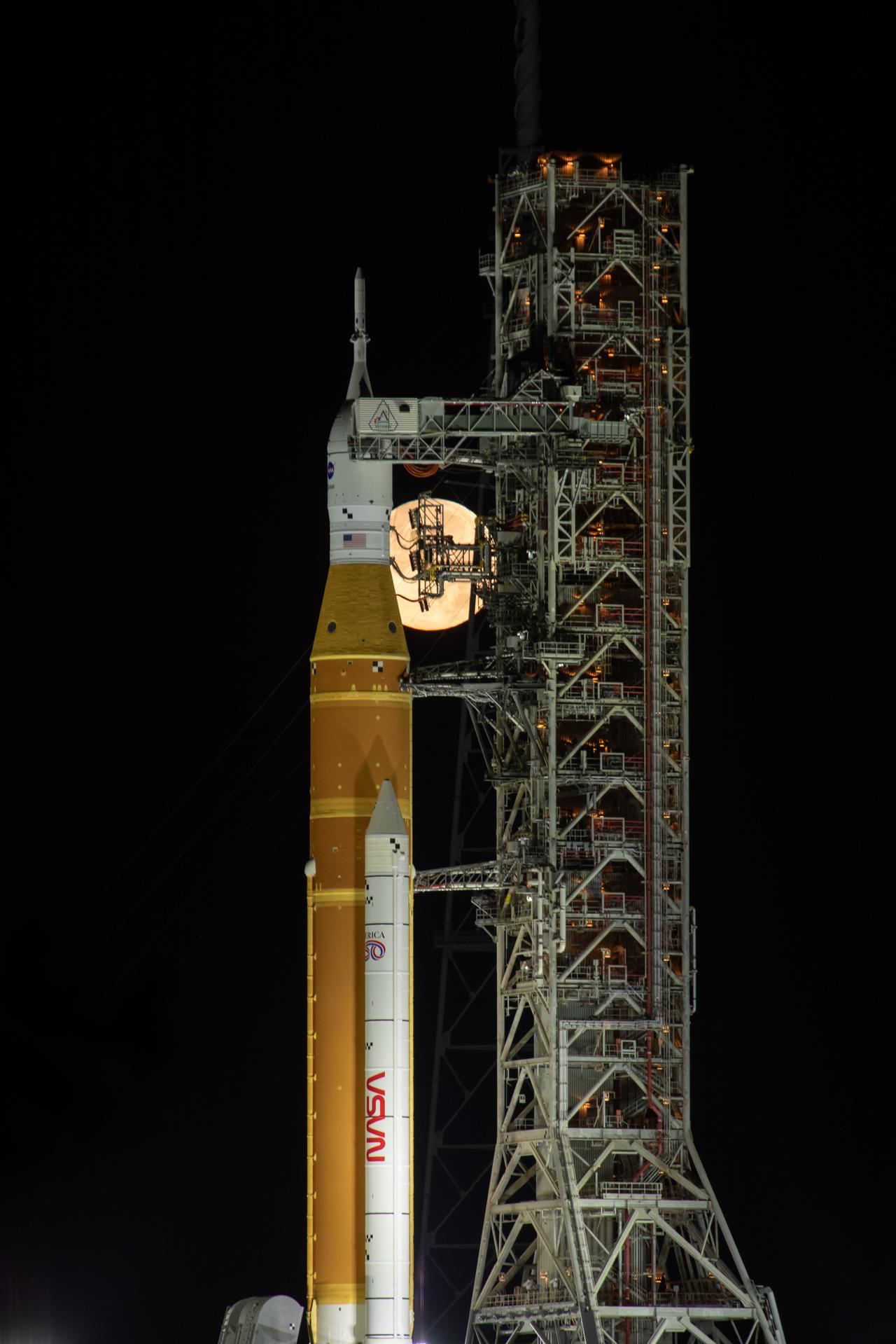
The Moon rises behind NASA’s Artemis II SLS (Space Launch System) rocket and Orion spacecraft atop a mobile launcher at Launch Complex 39B at NASA’s Kennedy Space Center in Florida on Sunday, Feb. 1,. 2026. The Artemis II test flight will take Commander Reid Wiseman, Pilot Victor Glover, and Mission Specialist Christina Koch from NASA, and Mission Specialist Jeremy Hansen from the CSA (Canadian Space Agency), around the Moon and back to Earth.
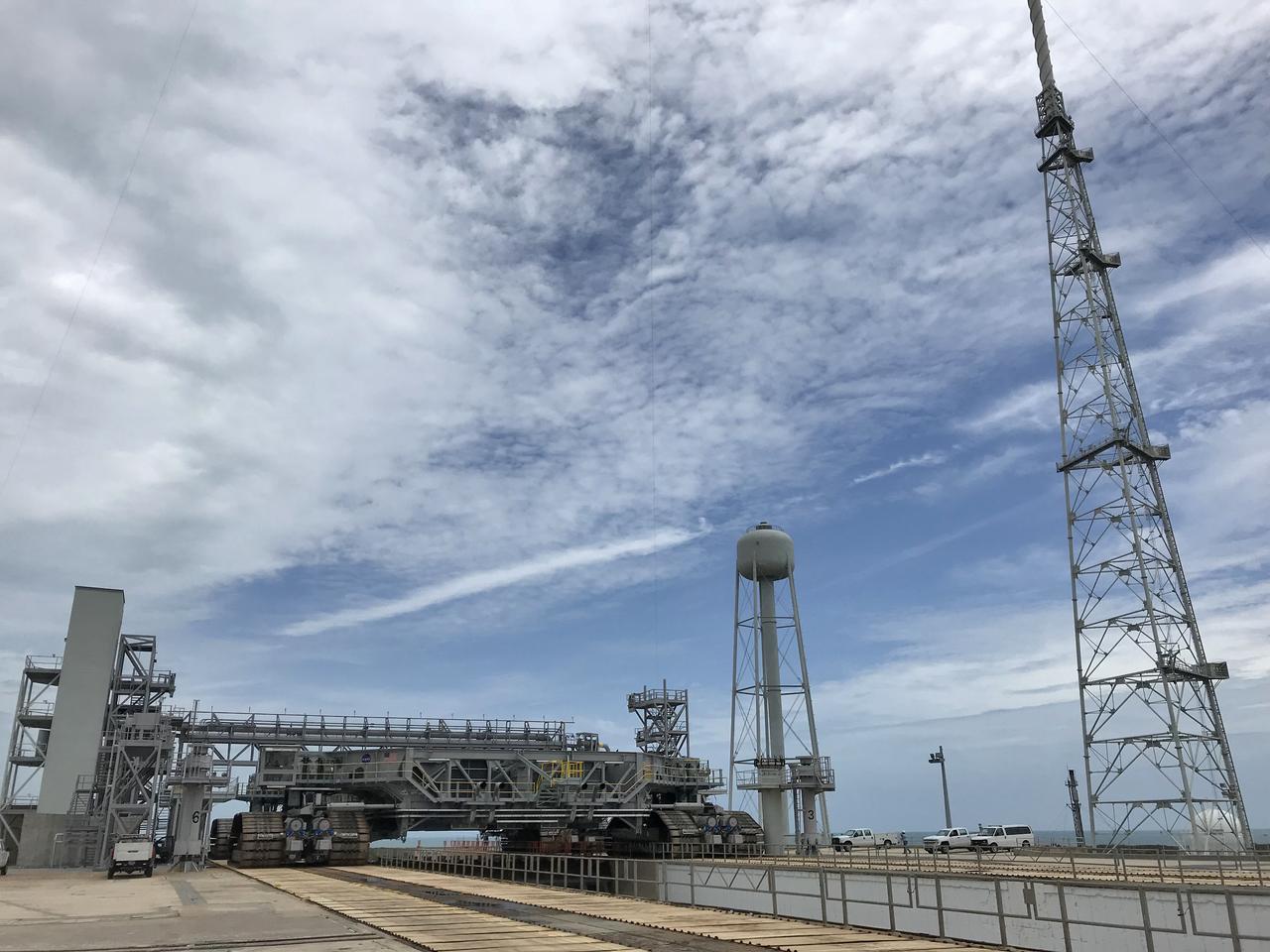
Crawler-transporter 2 (CT-2) arrives on the surface of Launch Pad 39B for a fit check on May 22, 2018, at NASA's Kennedy Space Center in Florida. The test drive to the pad confirms that all of the recent modifications to CT-2 and Pad 39B are operational to support the launch of the agency's Space Launch System rocket and Orion spacecraft on Exploration Mission-1. In view, at right, is one of three lightning protection towers positioned around Pad 39B. Exploration Ground Systems managed the modifications and upgrades to CT-2 and Pad 39B to prepare for EM-1 and deep space exploration missions.
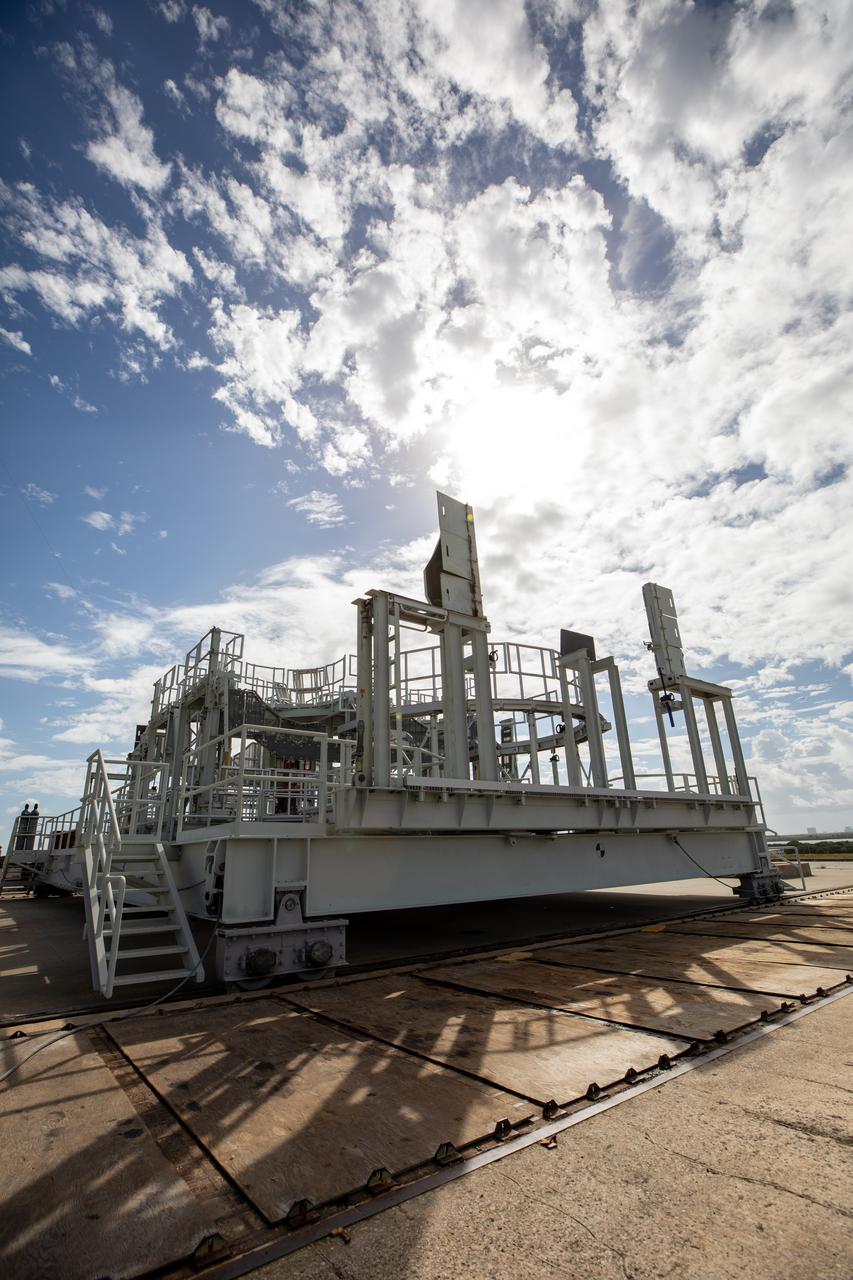
The engine service platform has been lowered and removed from the mobile launcher for Artemis I at Launch Pad 39B at NASA’s Kennedy Space Center in Florida on Oct. 23, 2020. It is staged on the top of the pad. The nearly 400-foot-tall mobile launcher is at the pad while engineers with Exploration Ground Systems and Jacobs complete several tasks, including a timing test to validate the launch team’s countdown timeline, and a thorough, top-to-bottom wash down of the mobile launcher to remove any debris remaining from construction and installation of the umbilical arms. Artemis I will test the Orion spacecraft and Space Launch System as an integrated system ahead of crewed flights to the Moon. Under the Artemis program, NASA will land the first woman and the next man on the Moon in 2024.
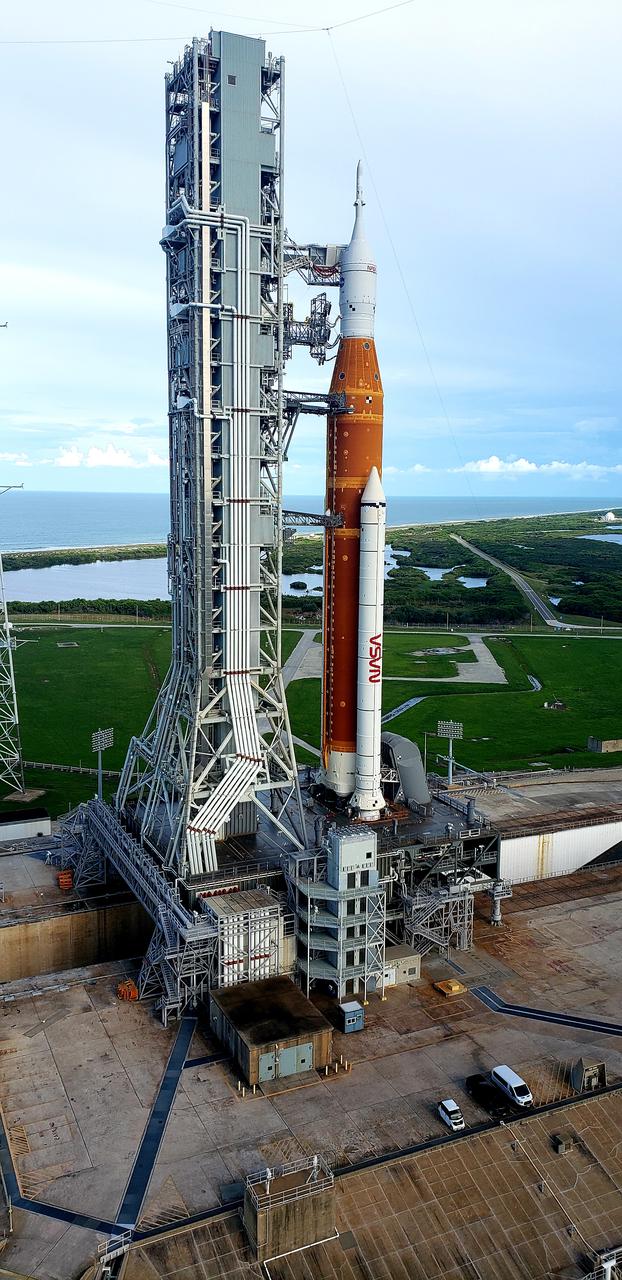
A close-up view of the Artemis I Space Launch System (SLS) and Orion spacecraft atop the mobile launcher on Launch Pad 39B at NASA’s Kennedy Space Center in Florida on Sept. 15, 2022. A portion of the umbilical connections are in view, as well as the crew access arm. Artemis I is the first integrated test of the SLS and Orion spacecraft. In future Artemis missions, NASA will land the first woman and the first person of color on the surface of the Moon, paving the way for a long-term lunar presence and serving as a steppingstone on the way to Mars.
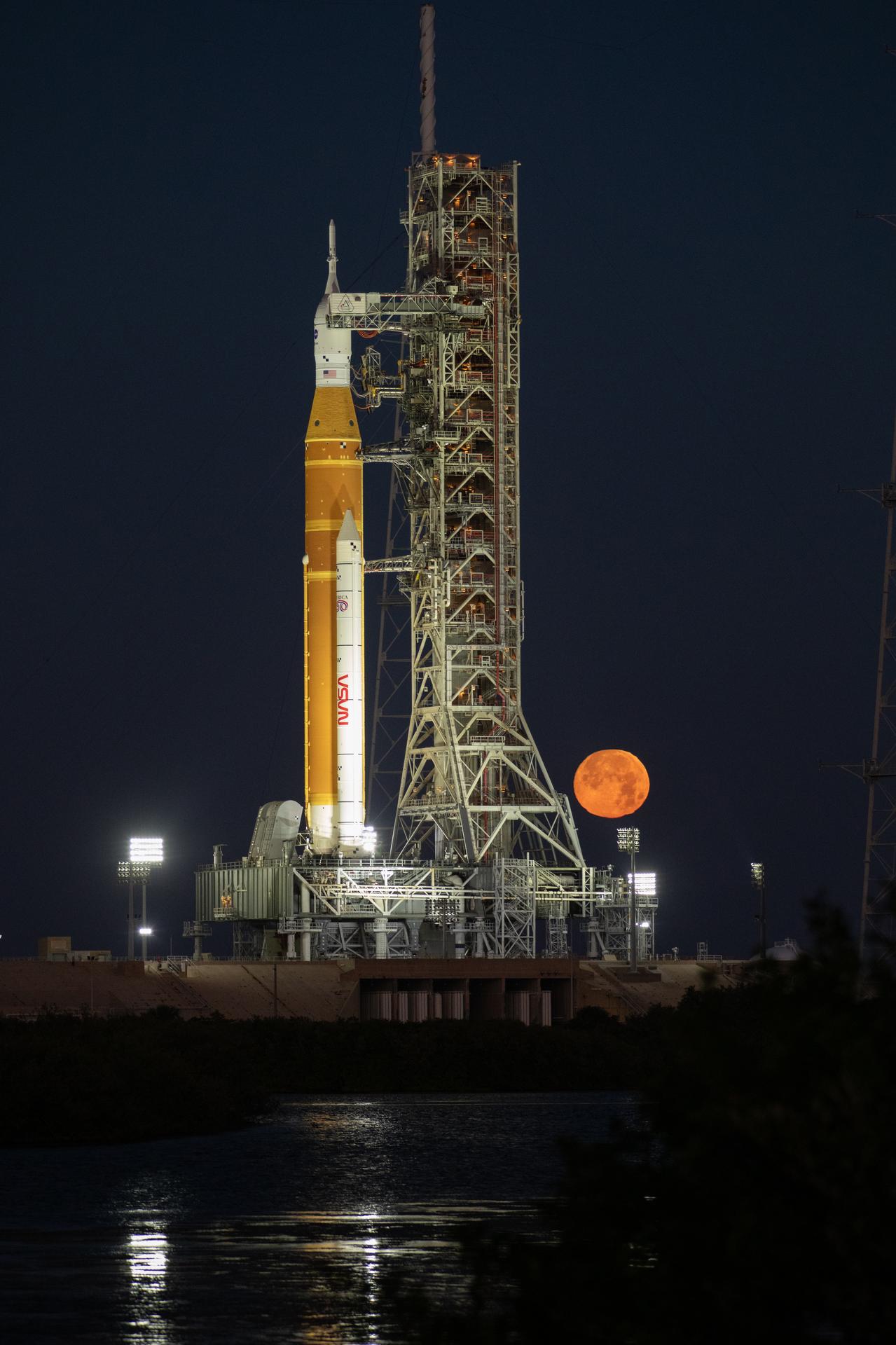
The Moon rises behind NASA’s Artemis II SLS (Space Launch System) rocket and Orion spacecraft atop a mobile launcher at Launch Complex 39B at NASA’s Kennedy Space Center in Florida on Sunday, Feb. 1,. 2026. The Artemis II test flight will take Commander Reid Wiseman, Pilot Victor Glover, and Mission Specialist Christina Koch from NASA, and Mission Specialist Jeremy Hansen from the CSA (Canadian Space Agency), around the Moon and back to Earth.
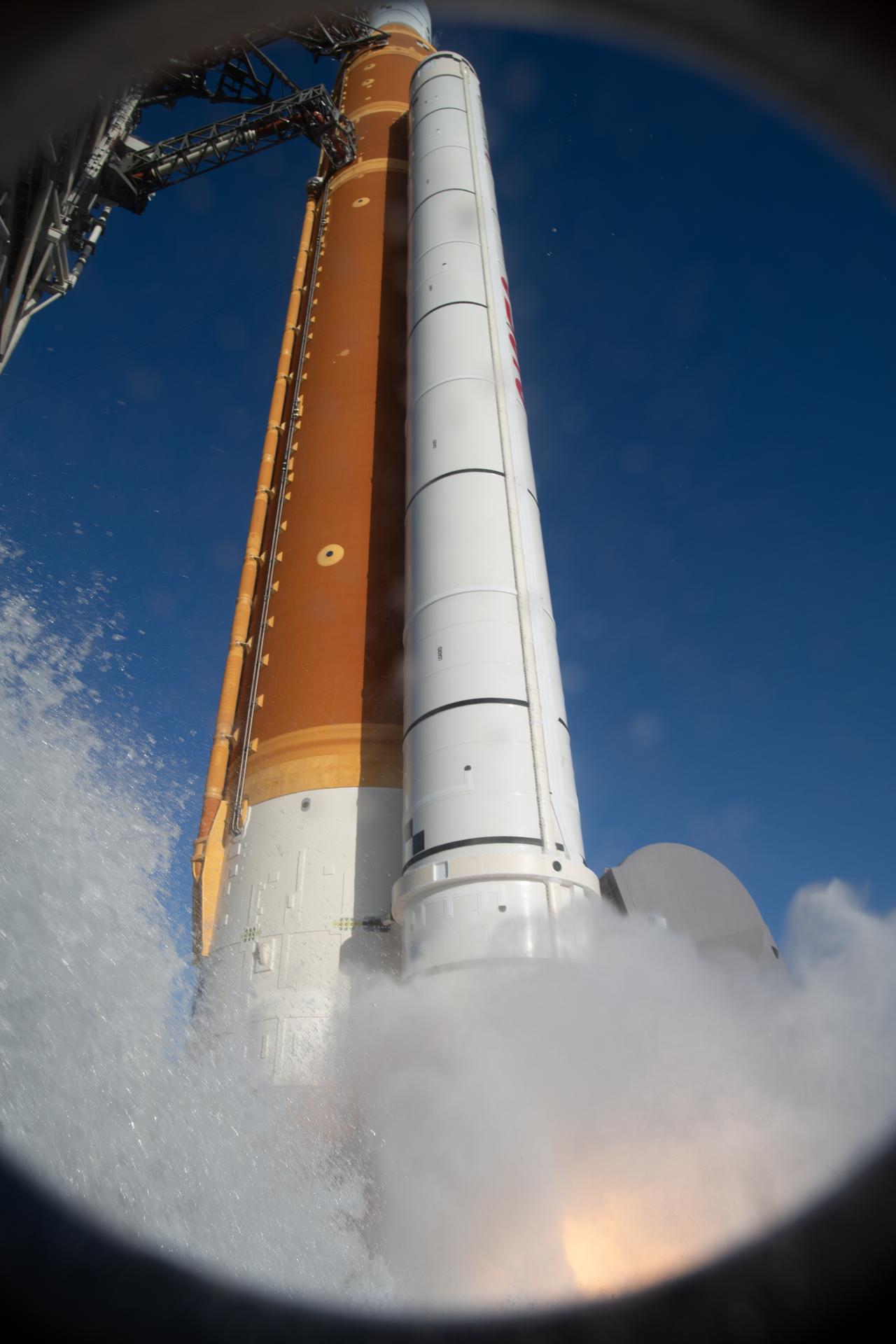
The Ignition Overpressure Protection and Sound Suppression water deluge system activates during launch of NASA’s Artemis II test flight at Launch Complex 39B at NASA’s Kennedy Space Center in Florida at 6:35 p.m. EDT on Wednesday, April 1, 2026. The water deluge system releases about 450,000 gallons of water across the mobile launcher and flame deflector to reduce the extreme heat and energy generated by the rocket during ignition and liftoff. Artemis II Commander Reid Wiseman, Pilot Victor Glover, and Mission Specialist Christina Koch from NASA, along with Mission Specialist Jeremy Hansen from the CSA (Canadian Space Agency), are on a 10-day journey around the Moon and back with splashdown in the Pacific Ocean off the coast of San Diego, California on Friday, April 10.
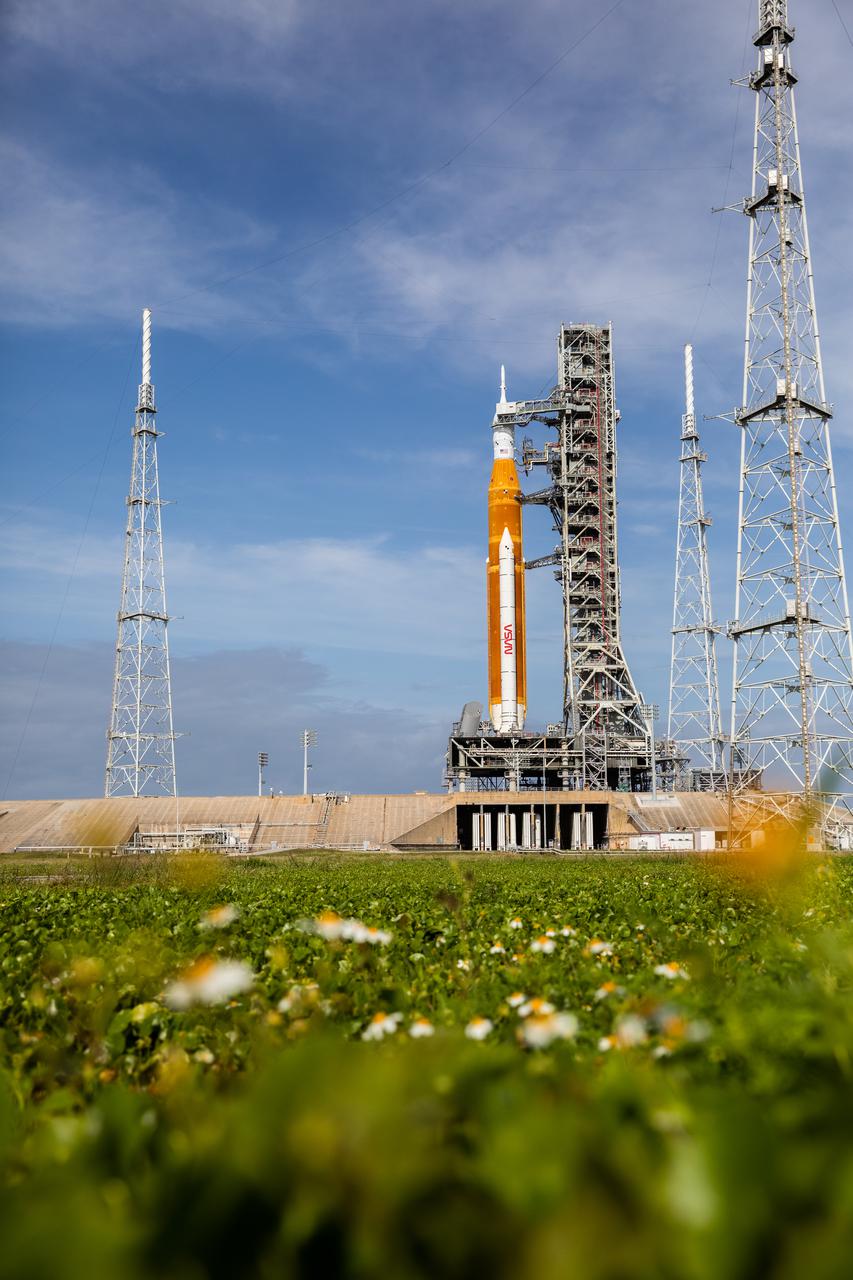
A view of the Artemis I Space Launch System (SLS) and Orion spacecraft atop the mobile launcher on Launch Pad 39B at NASA’s Kennedy Space Center in Florida on April 21, 2022. Also in view are the three lightning protection towers. The SLS and Orion atop the mobile launcher were transported to the pad on crawler-transporter 2 for a prelaunch test called a wet dress rehearsal. Artemis I will be the first integrated test of the SLS and Orion spacecraft. In future Artemis missions, NASA will land the first woman and the first person of color on the surface of the Moon, paving the way for a long-term lunar presence and serving as a steppingstone on the way to Mars.
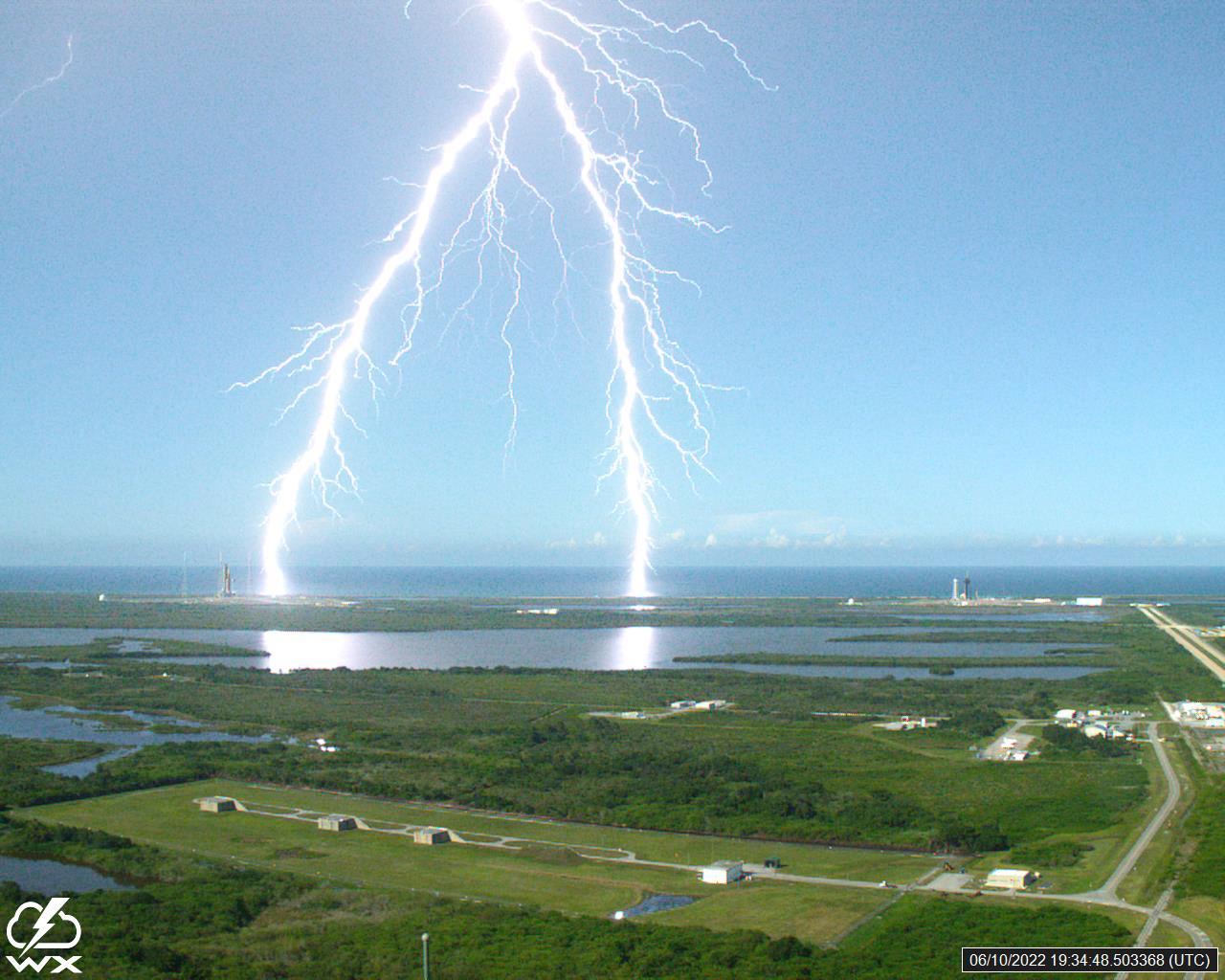
A lightning strike was recorded at Launch Complex 39B at NASA’s Kennedy Space Center in Florida on June 10, 2022. NASA’s Space Launch System (SLS) and Orion spacecraft atop the mobile launcher are on the launch pad in preparation for the Artemis I mission. The lightning strike was recorded by cameras stationed at the pad and mobile launcher using a special filter called a “clear day frame,” which provides an overlay of the raw frame on a reference image. Artemis I will be the first integrated test of the SLS and Orion spacecraft. In later missions, NASA will land the first woman and the first woman of color on the surface of the Moon, paving the way for a long-term lunar presence and serving as a steppingstone on the way to Mars.
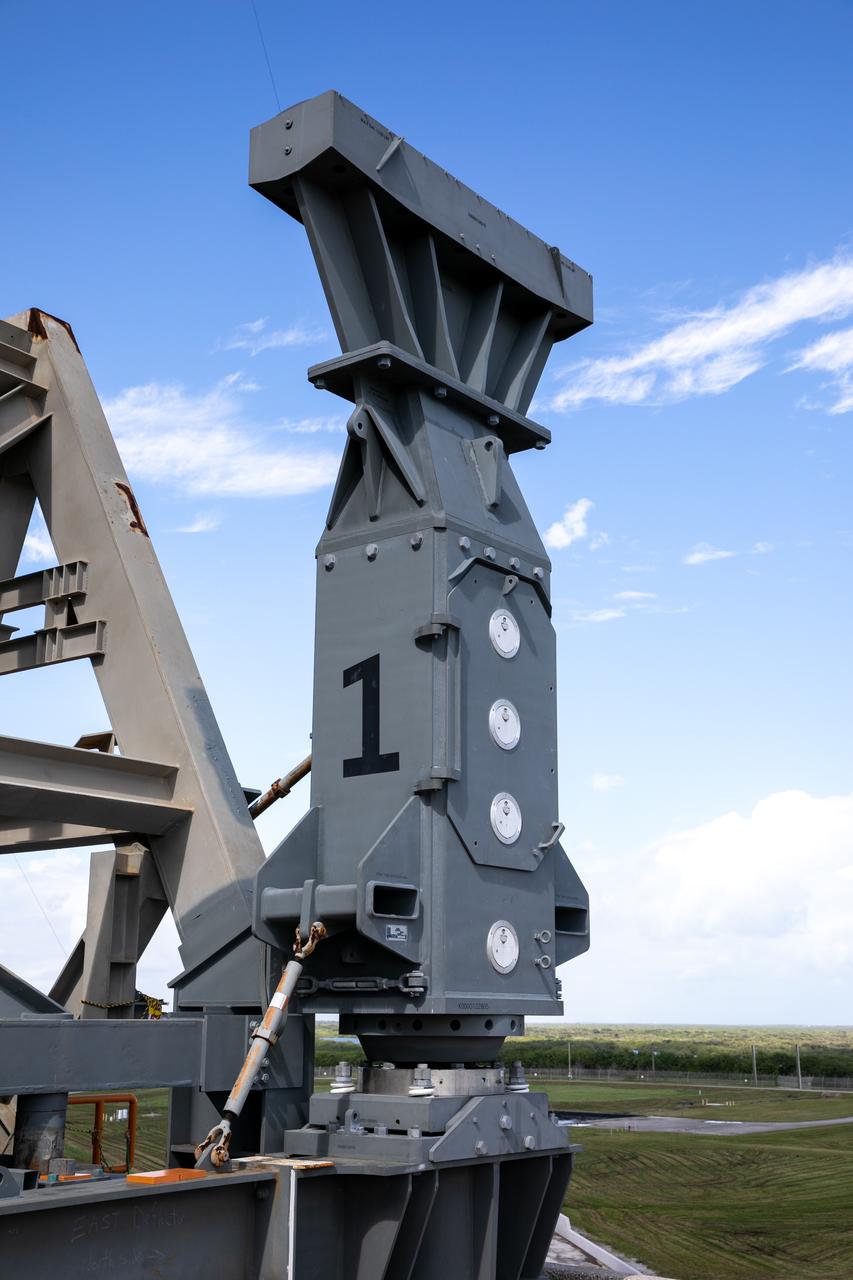
Special ground support equipment is used to move the side flame deflectors into place during a countdown demonstration test using the mobile launcher for the Artemis I mission at Launch Pad 39B at NASA’s Kennedy Space Center in Florida on Oct. 23, 2020. The nearly 400-foot-tall mobile launcher is at the pad while engineers with Exploration Ground Systems and Jacobs complete several tasks, including a timing test to validate the launch team’s countdown timeline, and a thorough, top-to-bottom wash down of the mobile launcher to remove any debris remaining from construction and installation of the umbilical arms. Artemis I will test the Orion spacecraft and Space Launch System as an integrated system ahead of crewed flights to the Moon. Under the Artemis program, NASA will land the first woman and the next man on the Moon in 2024.
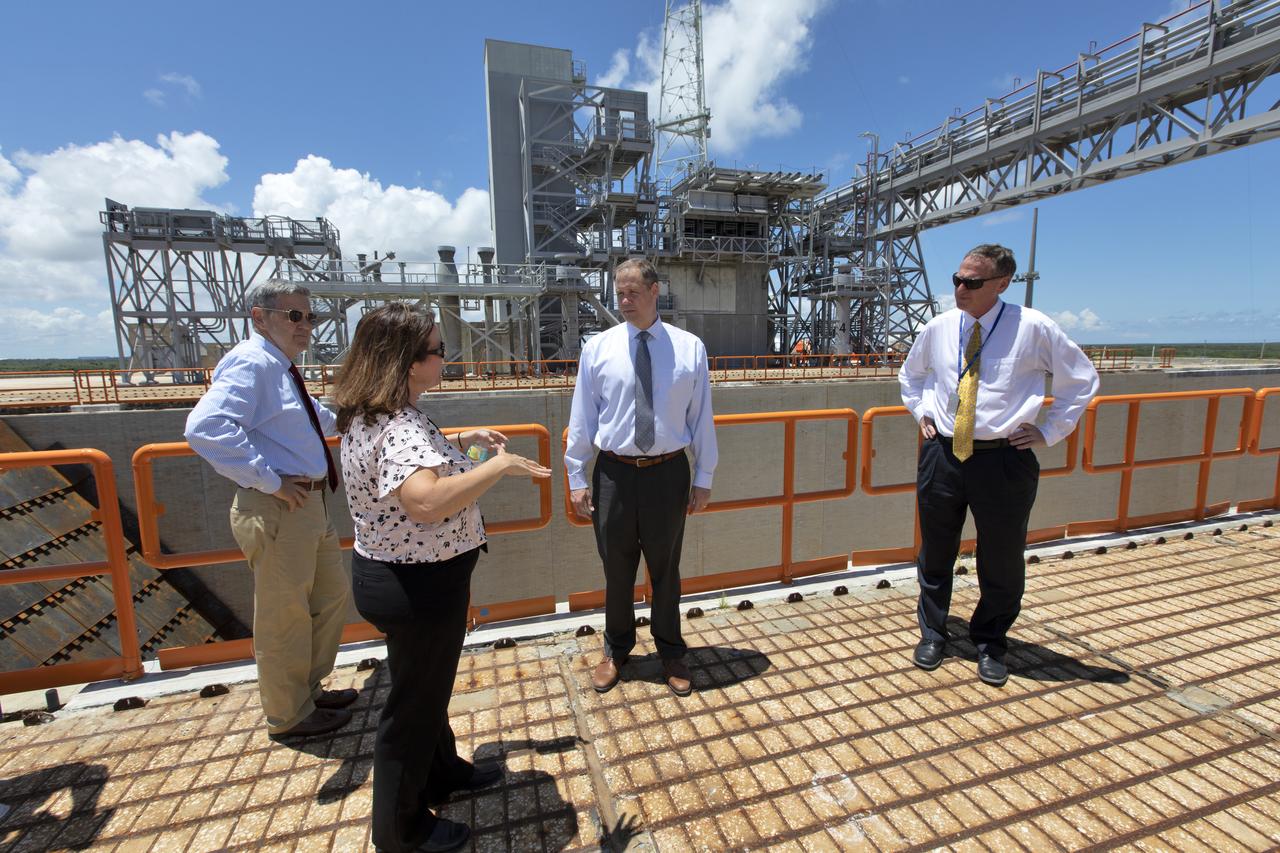
NASA Administrator Jim Bridenstine (second from the right) is briefed on work taking place at Launch Complex 39B by Center Director Bob Cabana (far left), and the facility's senior project manager, Regina Spellman (second from the left). This will be the site where NASA's Space Launch System rocket and Orion spacecraft will liftoff on trips to the Moon, Mars and deep space.. Bridenstine made his first official visit to the Florida spaceport on Aug. 6 and 7, 2018.
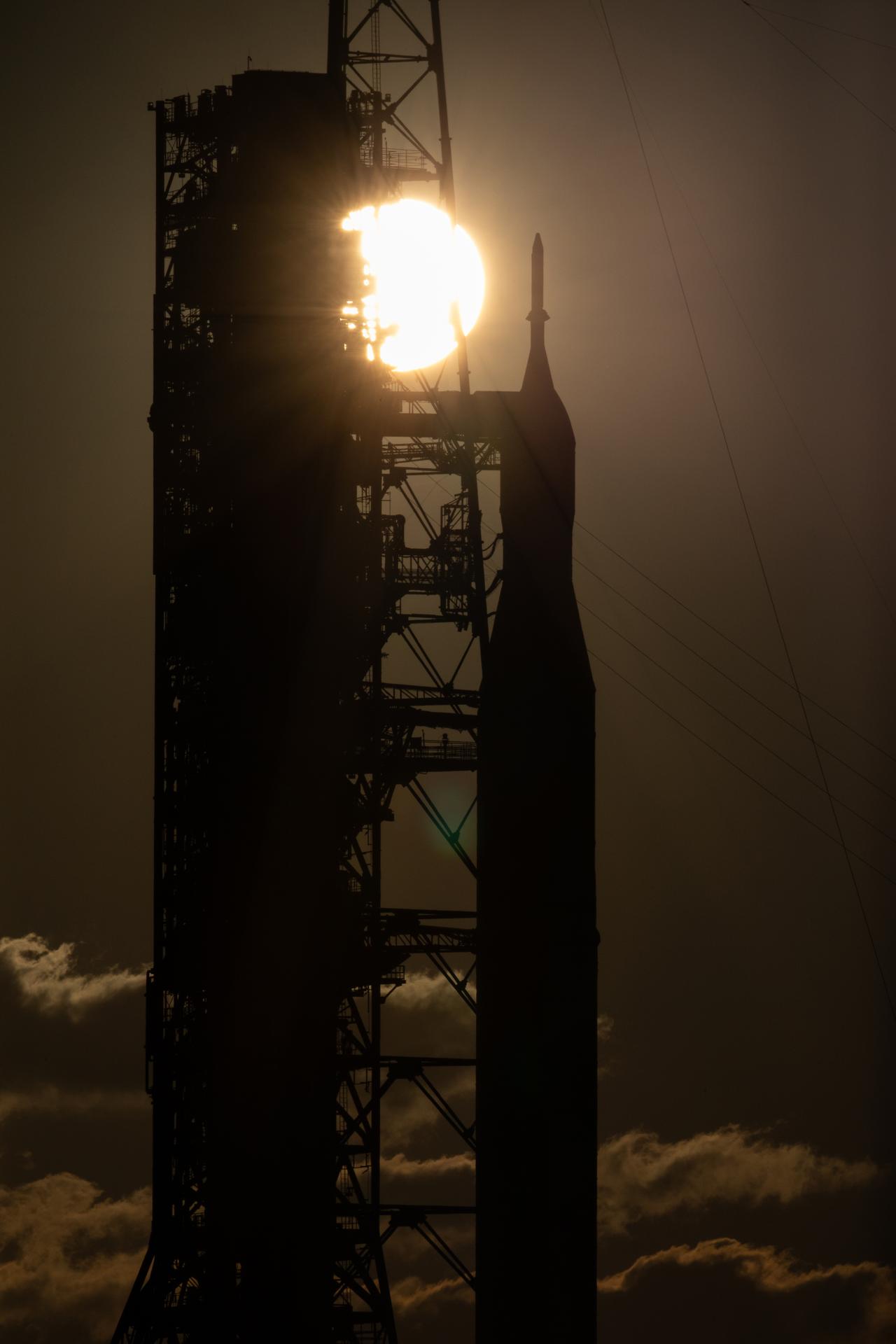
The Sun shines behind NASA’s Artemis II SLS (Space Launch System) rocket and Orion spacecraft atop a mobile launcher at Launch Complex 39B at NASA’s Kennedy Space Center in Florida on Sunday, Feb. 1, 2026. The Artemis II test flight will take Commander Reid Wiseman, Pilot Victor Glover, and Mission Specialist Christina Koch from NASA, and Mission Specialist Jeremy Hansen from the CSA (Canadian Space Agency), around the Moon and back to Earth.
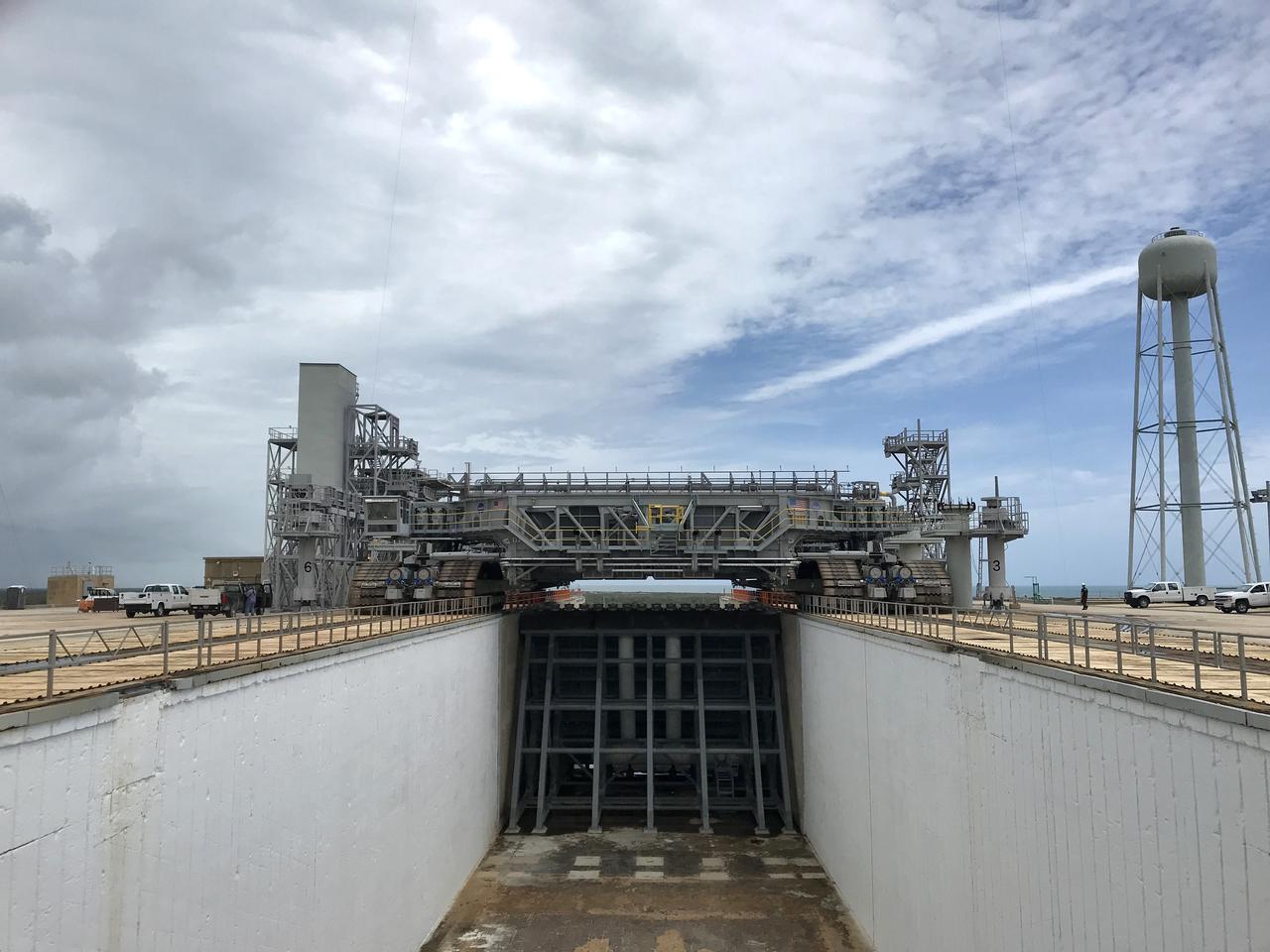
Crawler-transporter 2 (CT-2) arrives on the surface of Launch Pad 39B for a fit check on May 22, 2018, at NASA's Kennedy Space Center in Florida. The test drive to the pad confirms that all of the recent modifications to CT-2 and Pad 39B are operational to support the launch of the agency's Space Launch System rocket and Orion spacecraft on Exploration Mission-1. In view is the south side of the flame trench and the south side of the recently installed new main flame deflector. Exploration Ground Systems managed the modifications and upgrades to CT-2 and Pad 39B to prepare for EM-1 and deep space exploration missions.
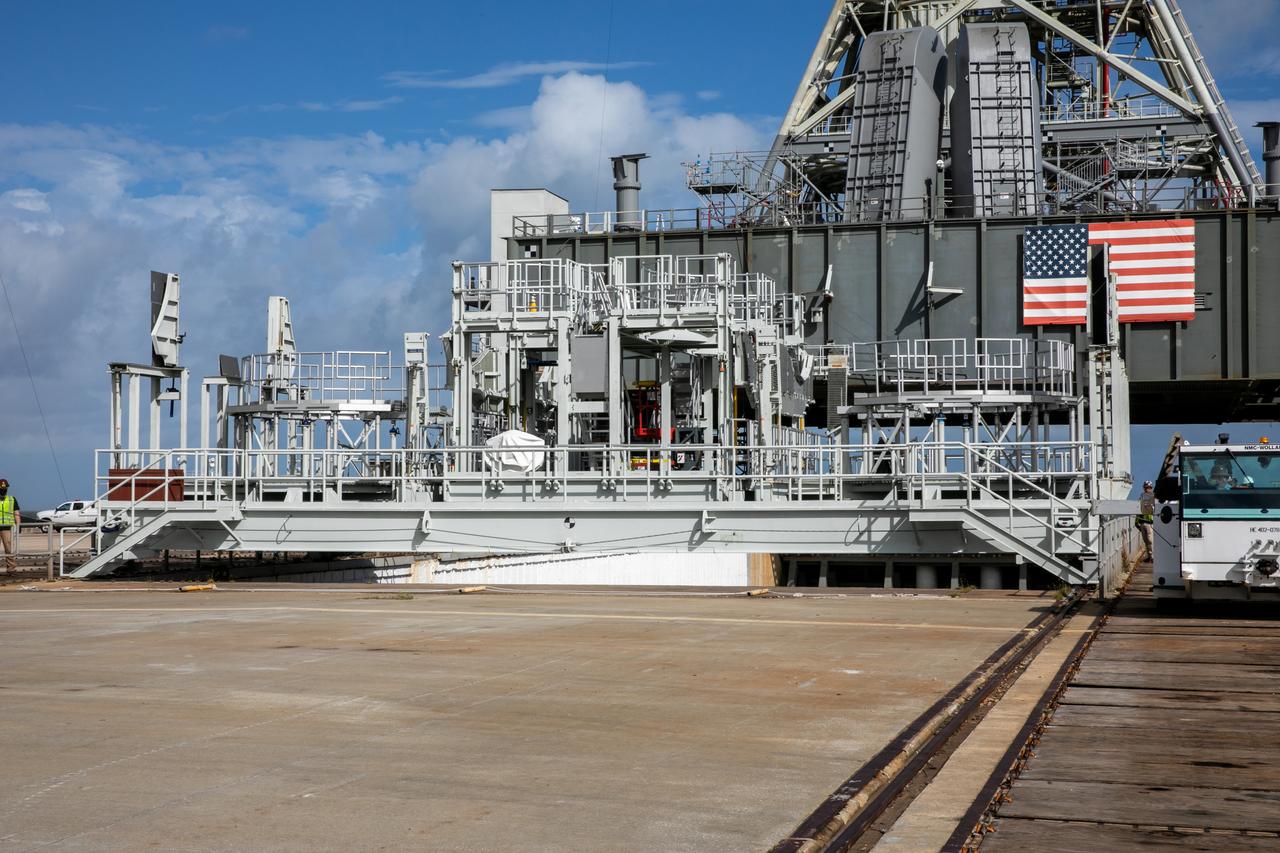
The engine service platform has been lowered and removed from underneath the mobile launcher for Artemis I at Launch Pad 39B at NASA’s Kennedy Space Center in Florida on Oct. 23, 2020. The nearly 400-foot-tall mobile launcher is at the pad while engineers with Exploration Ground Systems and Jacobs complete several tasks, including a timing test to validate the launch team’s countdown timeline, and a thorough, top-to-bottom wash down of the mobile launcher to remove any debris remaining from construction and installation of the umbilical arms. Artemis I will test the Orion spacecraft and Space Launch System as an integrated system ahead of crewed flights to the Moon. Under the Artemis program, NASA will land the first woman and the next man on the Moon in 2024.
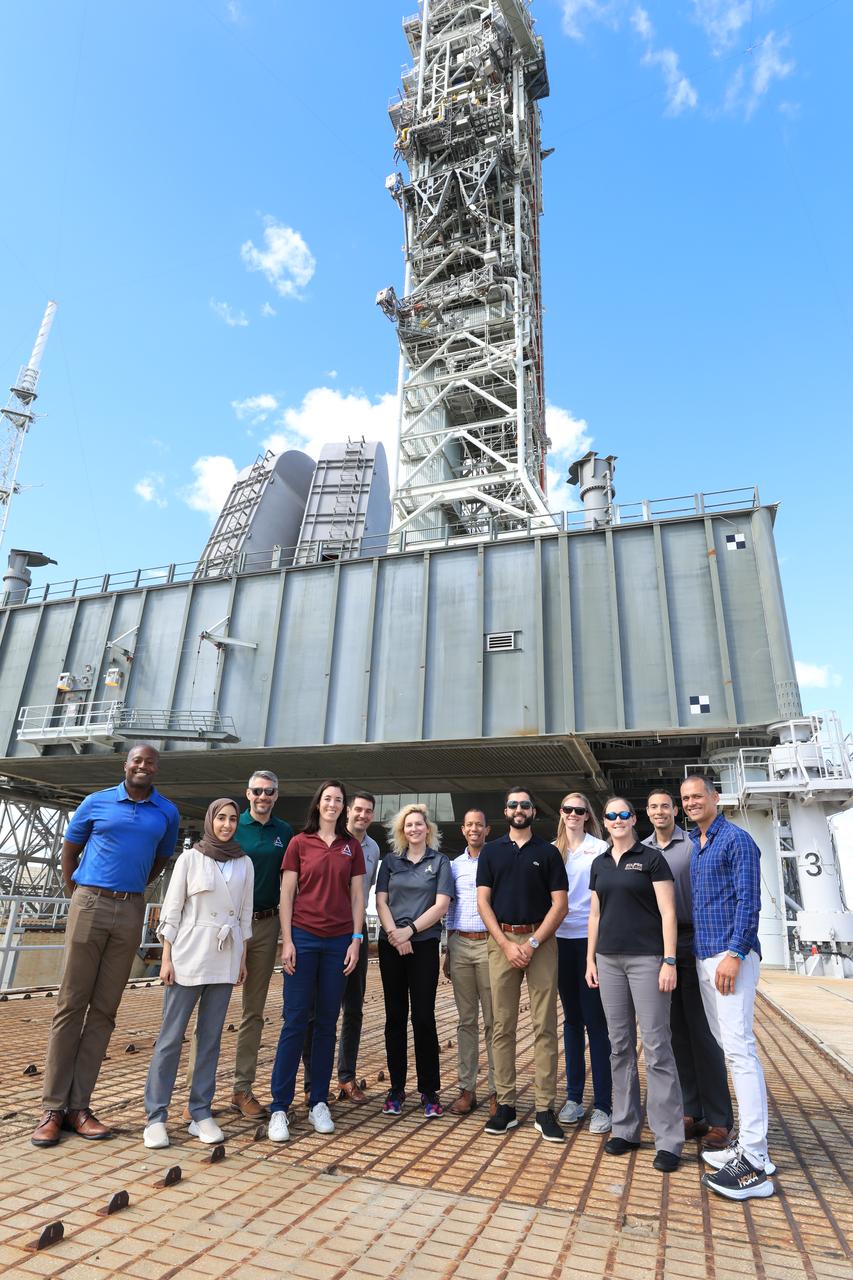
NASA’s 2021 class of astronaut candidates visit the mobile launcher at Launch Complex 39B during a familiarization tour of facilities on Monday, Oct. 16, 2023, at the agency’s Kennedy Space Center in Florida.
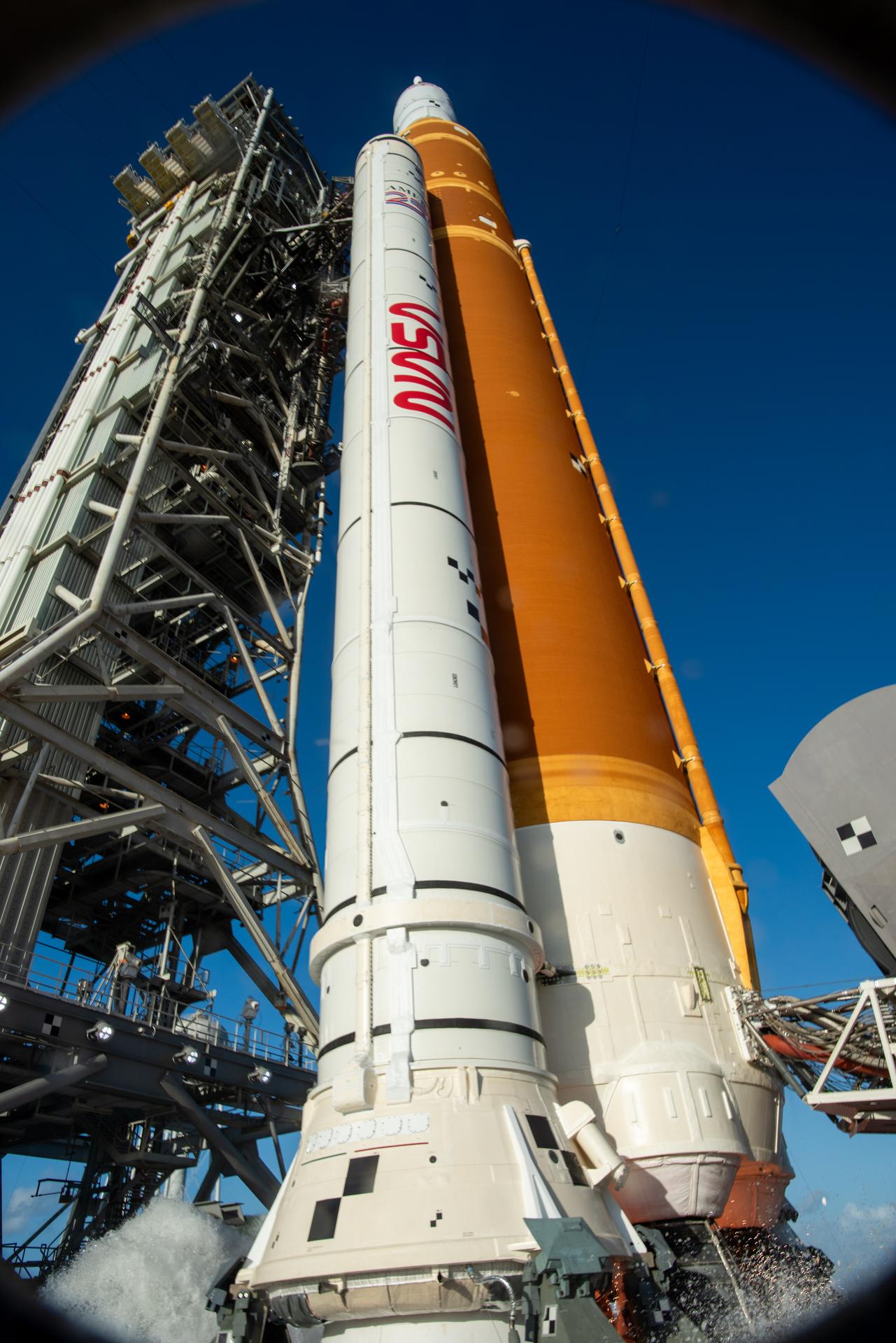
In this photograph looking up, NASA’s SLS (Space Launch System) rocket with the Orion spacecraft stands vertical at Launch Complex 39B at NASA’s Kennedy Space Center in Florida ahead of launch of the agency’s Artemis II test flight on Wednesday, April 1, 2026. Artemis II launched at 6:35 p.m. EDT April 1 at NASA Kennedy, sending Artemis II Commander Reid Wiseman, Pilot Victor Glover, and Mission Specialist Christina Koch from NASA, along with Mission Specialist Jeremy Hansen from the CSA (Canadian Space Agency), on a 10-day journey around the Moon and back with splashdown in the Pacific Ocean off the coast of San Diego, California on Friday, April 10.
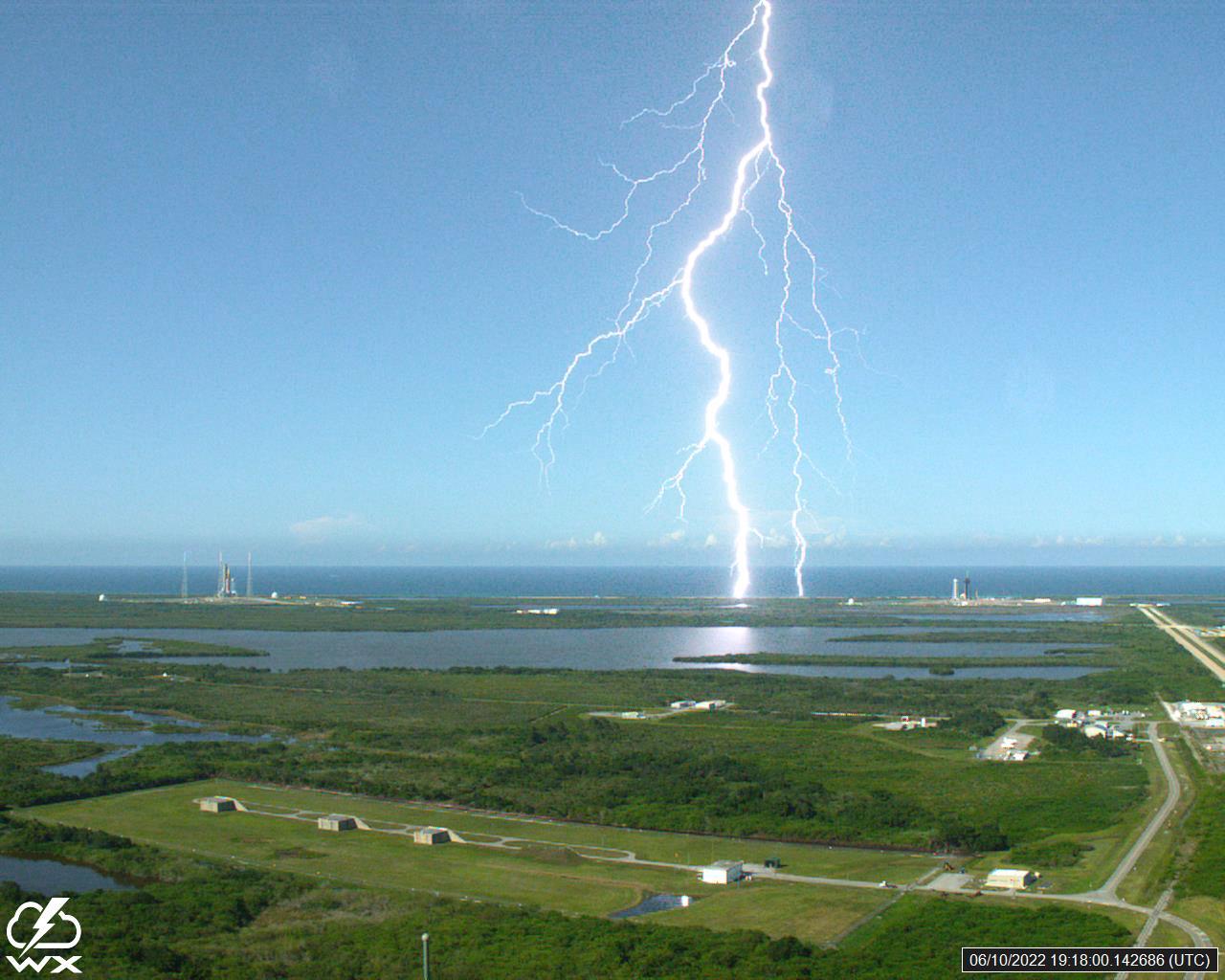
A lightning strike was recorded at Launch Complex 39B at NASA’s Kennedy Space Center in Florida on June 10, 2022. NASA’s Space Launch System (SLS) and Orion spacecraft atop the mobile launcher are on the launch pad in preparation for the Artemis I mission. The lightning strike was recorded by cameras stationed at the pad and mobile launcher using a special filter called a “clear day frame,” which provides an overlay of the raw frame on a reference image. Artemis I will be the first integrated test of the SLS and Orion spacecraft. In later missions, NASA will land the first woman and the first woman of color on the surface of the Moon, paving the way for a long-term lunar presence and serving as a steppingstone on the way to Mars.
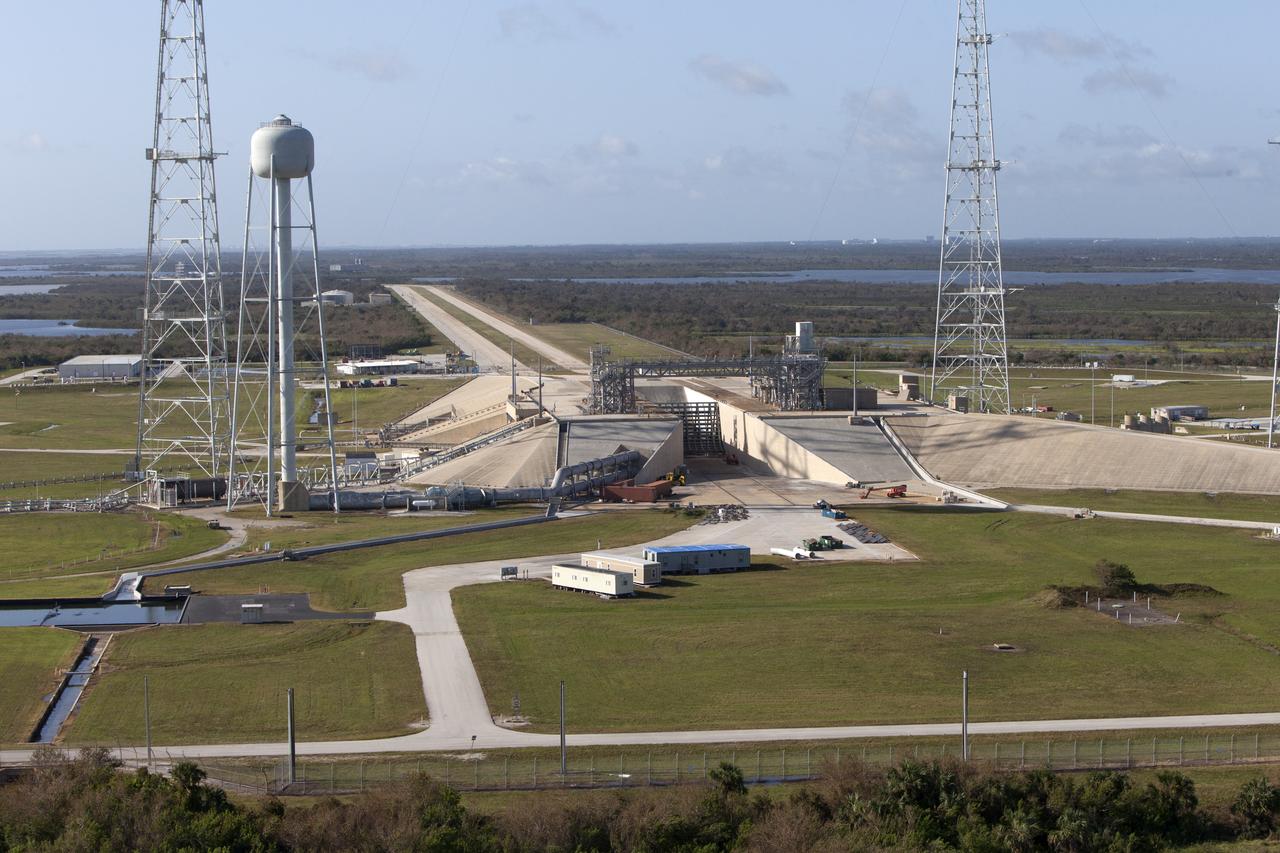
Launch Complex 39B is seen during an aerial survey of NASA's Kennedy Space Center in Florida on September 12, 2017. The survey was performed to identify structures and facilities that may have sustained damage from Hurricane Irma as the storm passed Kennedy on September 10, 2017. NASA closed the center ahead of the storm's onset and only a small team of specialists known as the Rideout Team was on the center as the storm approached and passed.
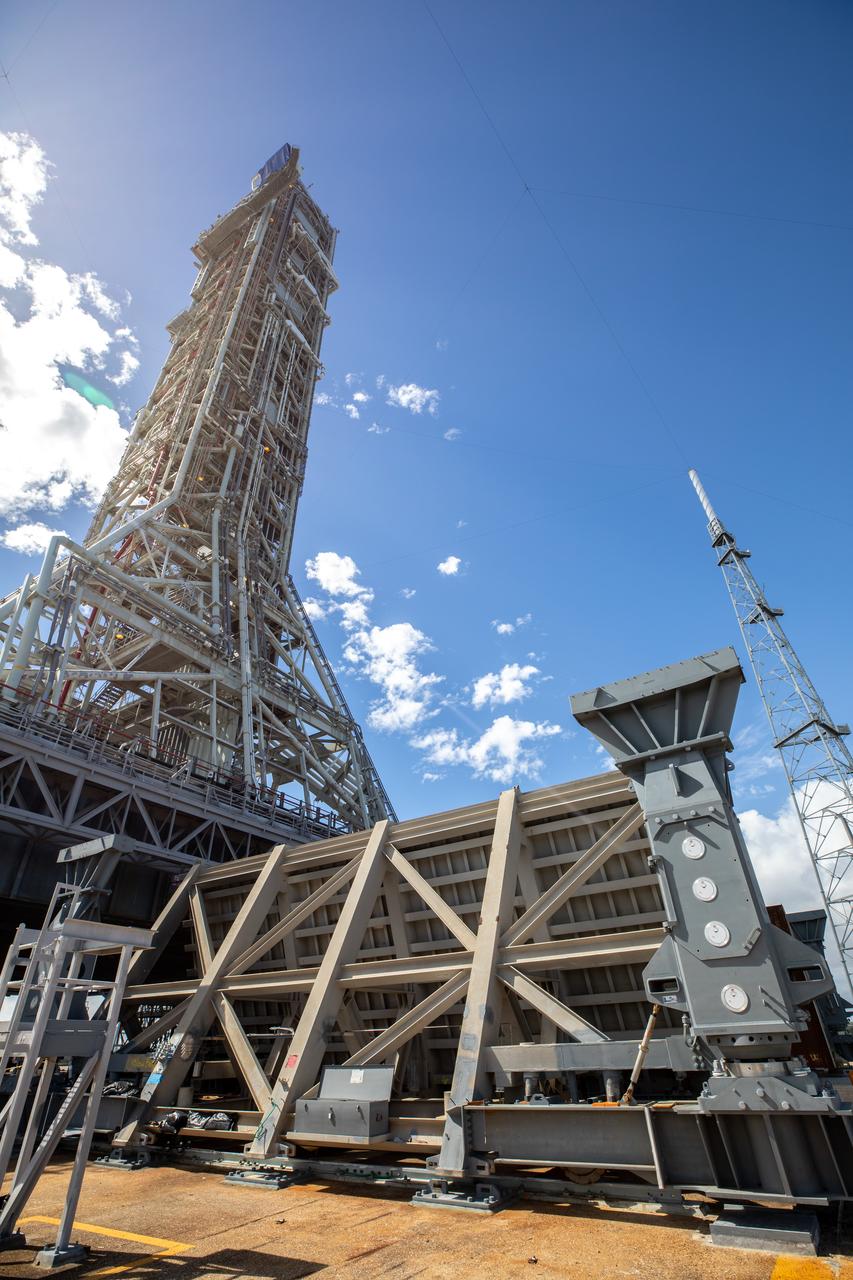
A view of the mobile launcher for the Artemis I mission at Launch Pad 39B at NASA’s Kennedy Space Center in Florida on Oct. 23, 2020. The nearly 400-foot-tall mobile launcher is at the pad while engineers with Exploration Ground Systems and Jacobs complete several tasks, including a timing test to validate the launch team’s countdown timeline, and a thorough, top-to-bottom wash down of the mobile launcher to remove any debris remaining from construction and installation of the umbilical arms. Artemis I will test the Orion spacecraft and Space Launch System as an integrated system ahead of crewed flights to the Moon. Under the Artemis program, NASA will land the first woman and the next man on the Moon in 2024.
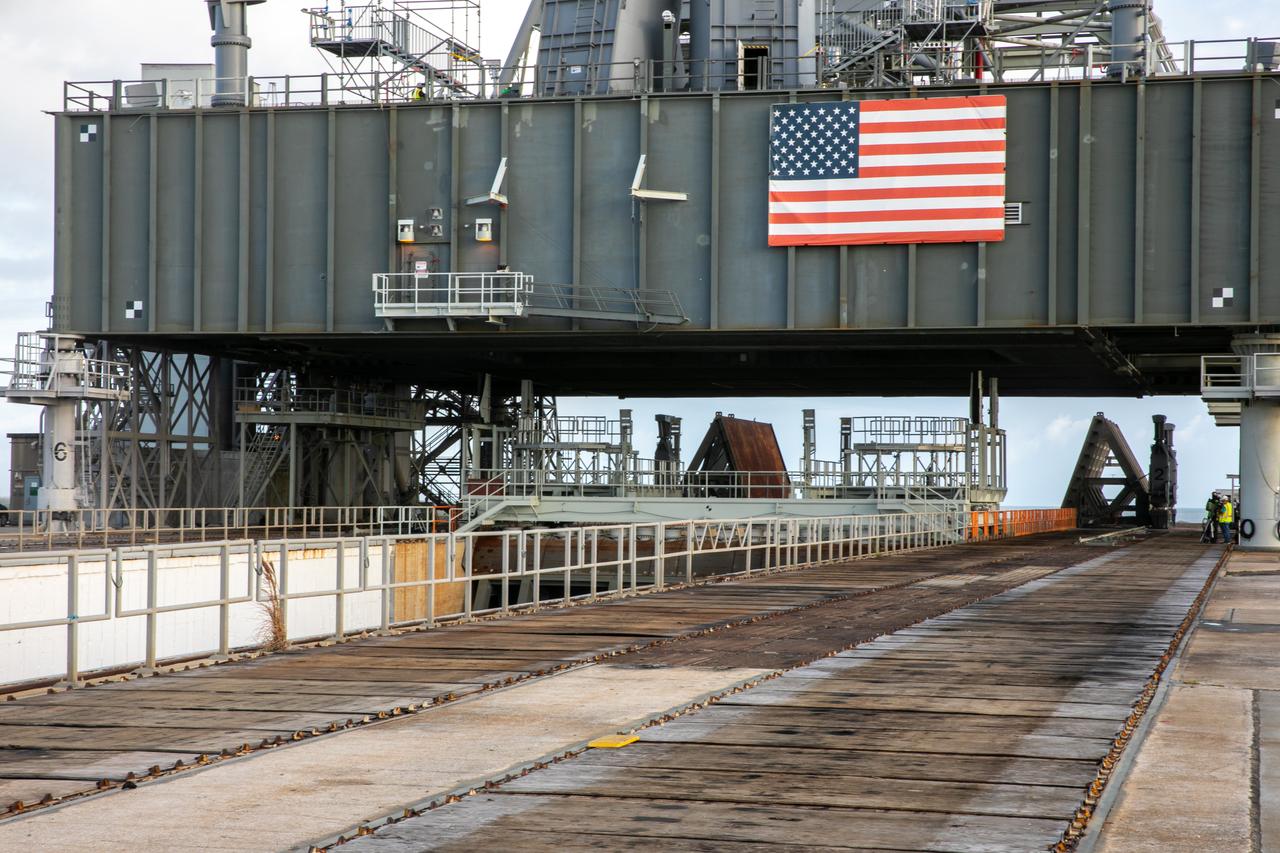
The base of the mobile launcher for Artemis I is in view on Launch Pad 3B at NASA’s Kennedy Space Center in Florida on Oct. 23, 2020. Workers on scaffolding are preparing for a launch countdown demonstration. The nearly 400-foot-tall mobile launcher will remain at the pad while engineers with Exploration Ground Systems and Jacobs complete several tasks, including a timing test to validate the launch team’s countdown timeline, and a thorough, top-to-bottom wash down of the mobile launcher to remove any debris remaining from construction and installation of the umbilical arms. Artemis I will test the Orion spacecraft and Space Launch System as an integrated system ahead of crewed flights to the Moon. Under the Artemis program, NASA will land the first woman and the next man on the Moon in 2024.
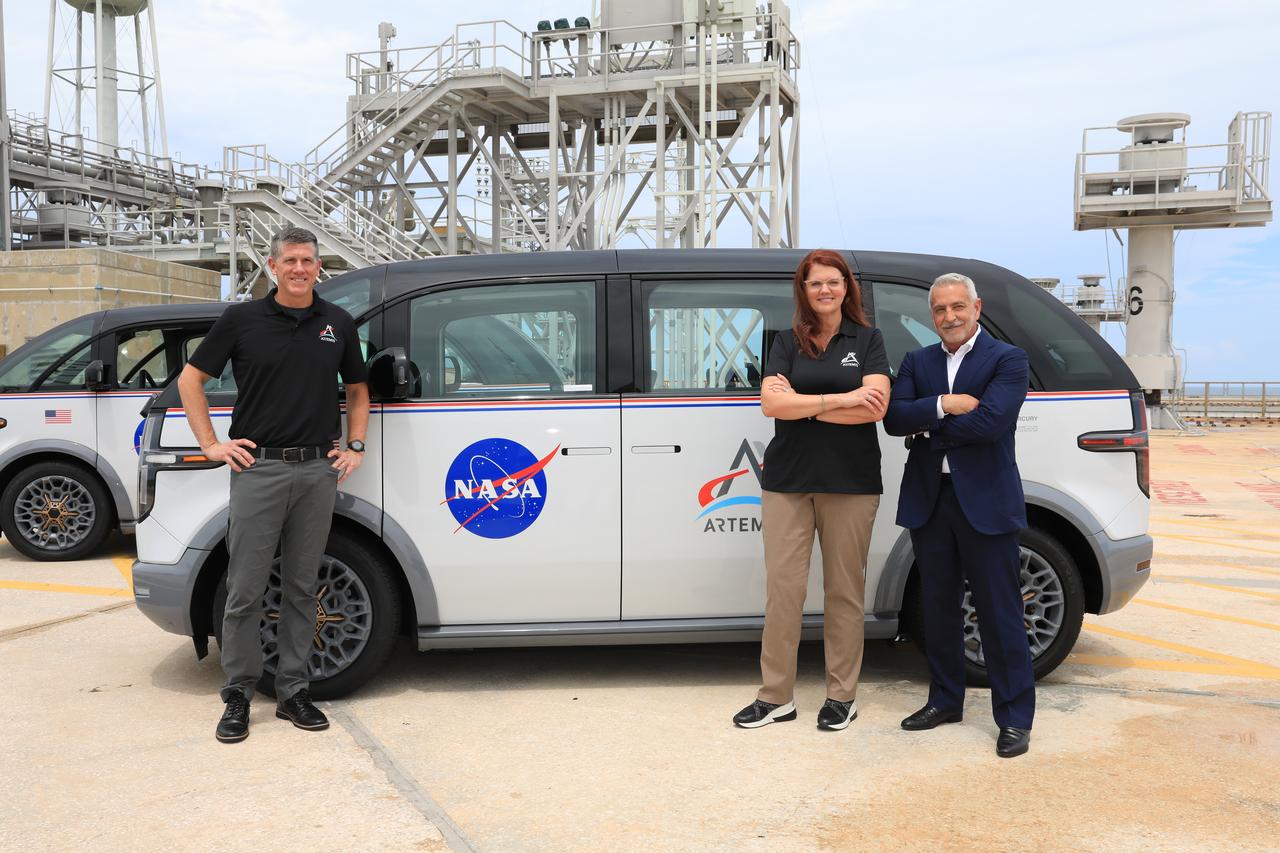
Three specially designed, fully electric, environmentally friendly crew transportation vehicles for Artemis missions arrived at NASA’s Kennedy Space Center in Florida on July 11, 2023. One of the zero-emission vehicles is shown here at Launch Pad 39B. From left are Jeremy Graeber, Artemis assistant launch director; Charlie Blackwell-Thompson, Artemis launch director; and Tony Aquila, chairman and CEO, Canoo Technologies Inc.. The fleet, which will carry astronauts to Launch Complex 39B for Artemis missions, was delivered by the manufacturer, Canoo Technologies Inc. of Torrance, California.
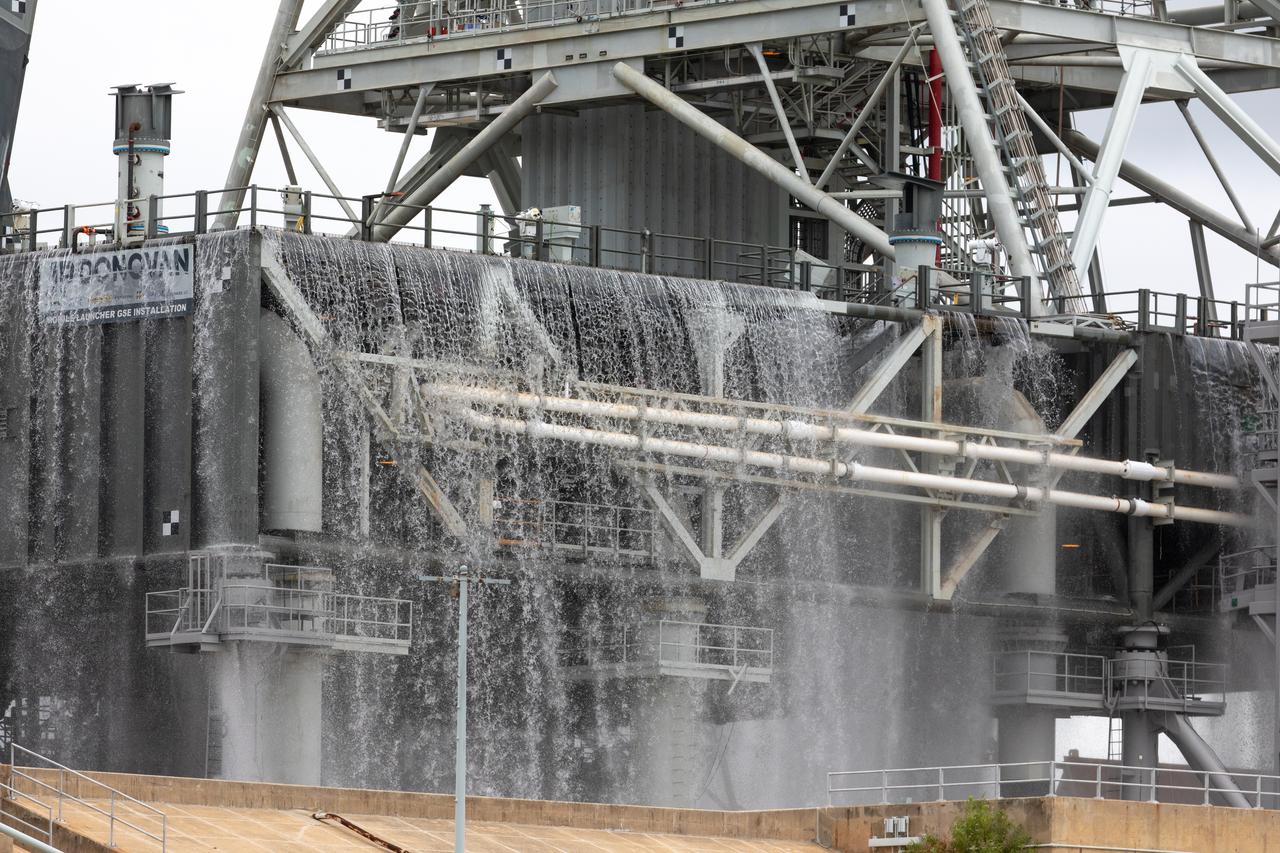
A flow test of the Ignition Overpressure Protection and Sound Suppression water deluge system is underway on the mobile launcher at Launch Pad 39B at NASA's Kennedy Space Center in Florida, on July 25, 2019. The testing is part of a series of tests that Exploration Ground System is doing to verify the system is ready for the new Space Launch System rocket. Modifications were made to the pad after a previous wet flow test, increasing the performance of the system. During the launch of Artemis 1 and subsequent missions, this water deluge system will release about 450,000 gallons of water across the mobile launcher and Flame Deflector to reduce the extreme heat and energy generated by the rocket during ignition and liftoff.
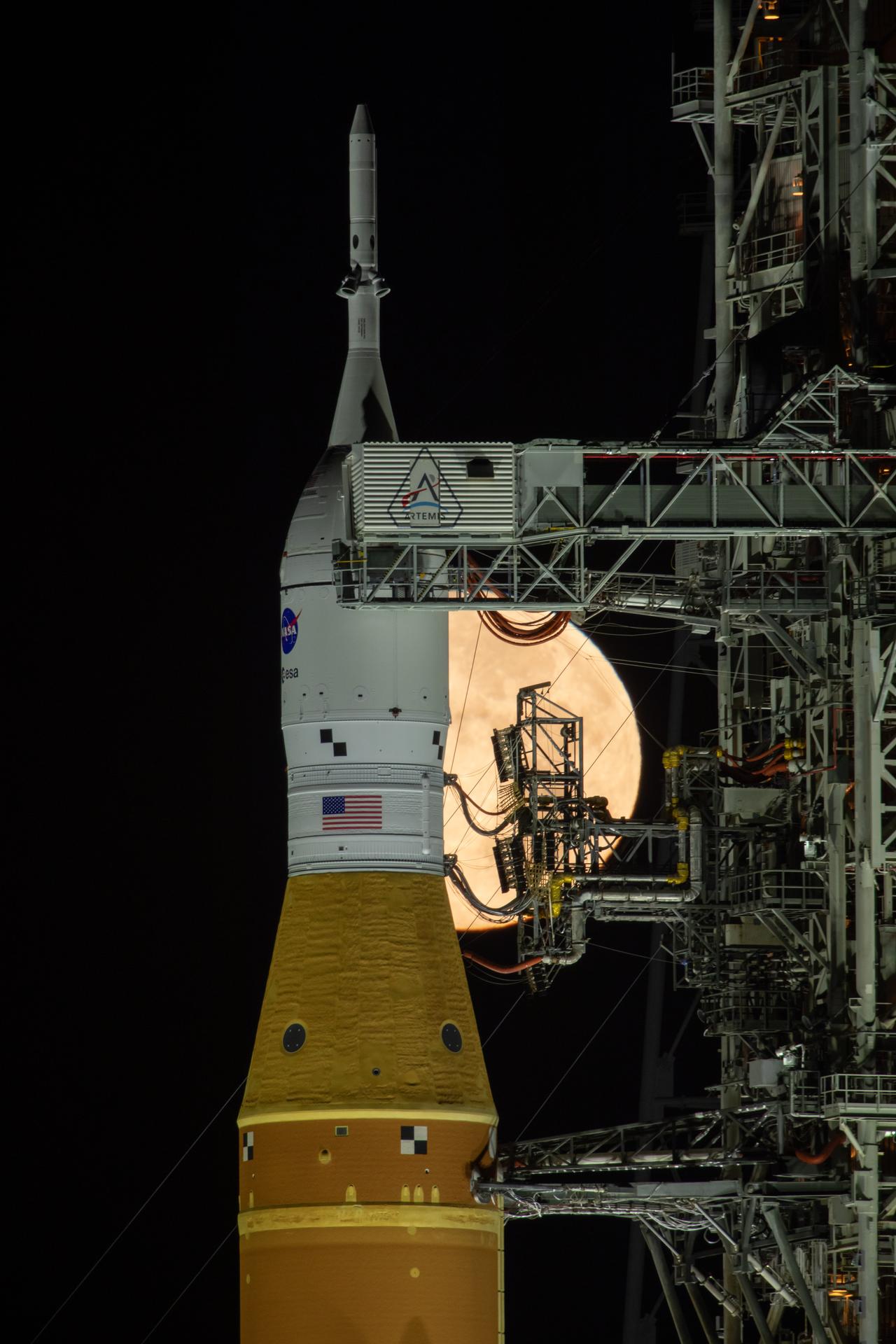
The Moon rises behind NASA’s Artemis II SLS (Space Launch System) rocket and Orion spacecraft atop a mobile launcher at Launch Complex 39B at NASA’s Kennedy Space Center in Florida on Sunday, Feb. 1,. 2026. The Artemis II test flight will take Commander Reid Wiseman, Pilot Victor Glover, and Mission Specialist Christina Koch from NASA, and Mission Specialist Jeremy Hansen from the CSA (Canadian Space Agency), around the Moon and back to Earth.
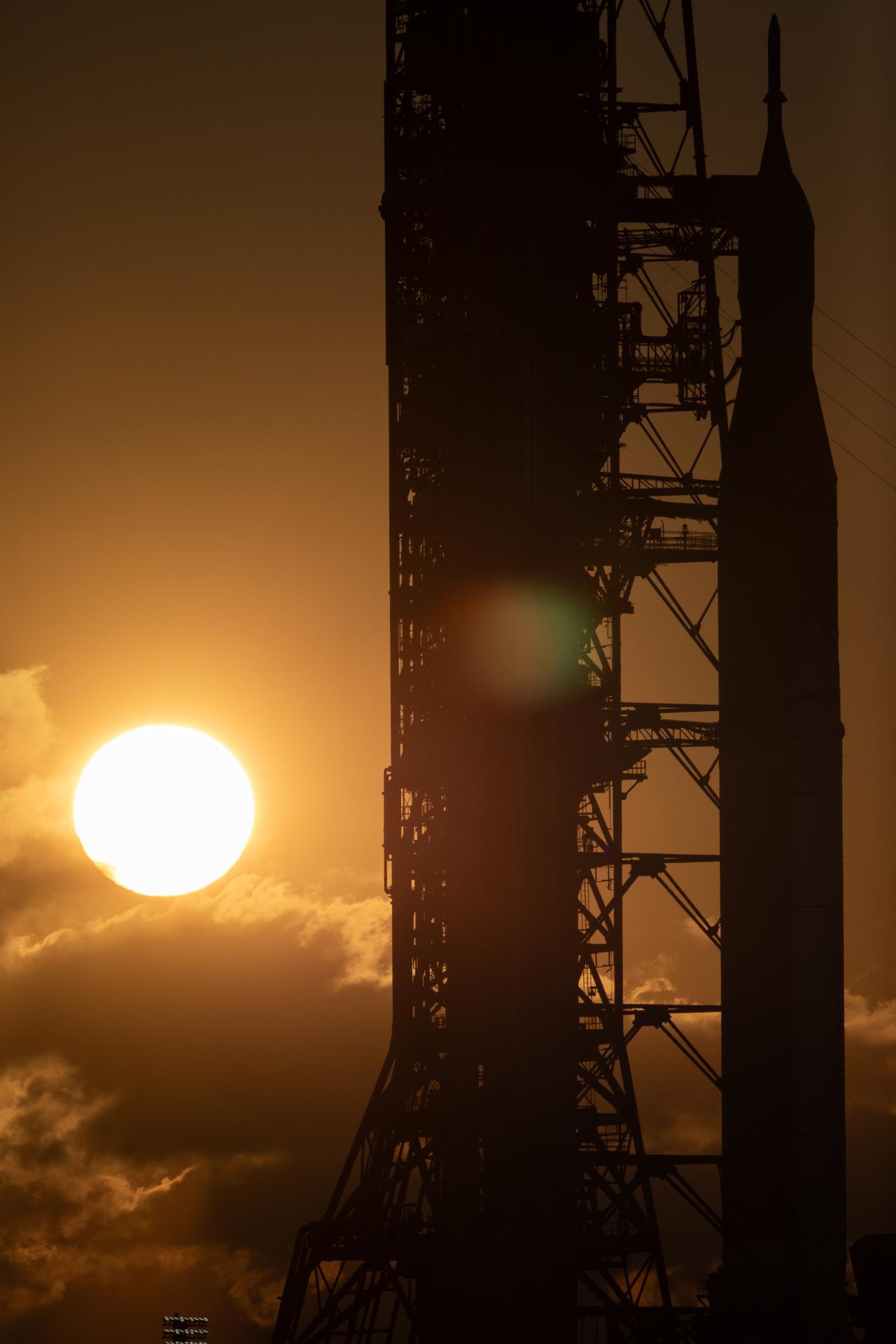
The Sun rises behind NASA’s Artemis II SLS (Space Launch System) rocket and Orion spacecraft atop a mobile launcher at Launch Complex 39B at NASA’s Kennedy Space Center in Florida on Sunday, Feb. 1, 2026. The Artemis II test flight will take Commander Reid Wiseman, Pilot Victor Glover, and Mission Specialist Christina Koch from NASA, and Mission Specialist Jeremy Hansen from the CSA (Canadian Space Agency), around the Moon and back to Earth.
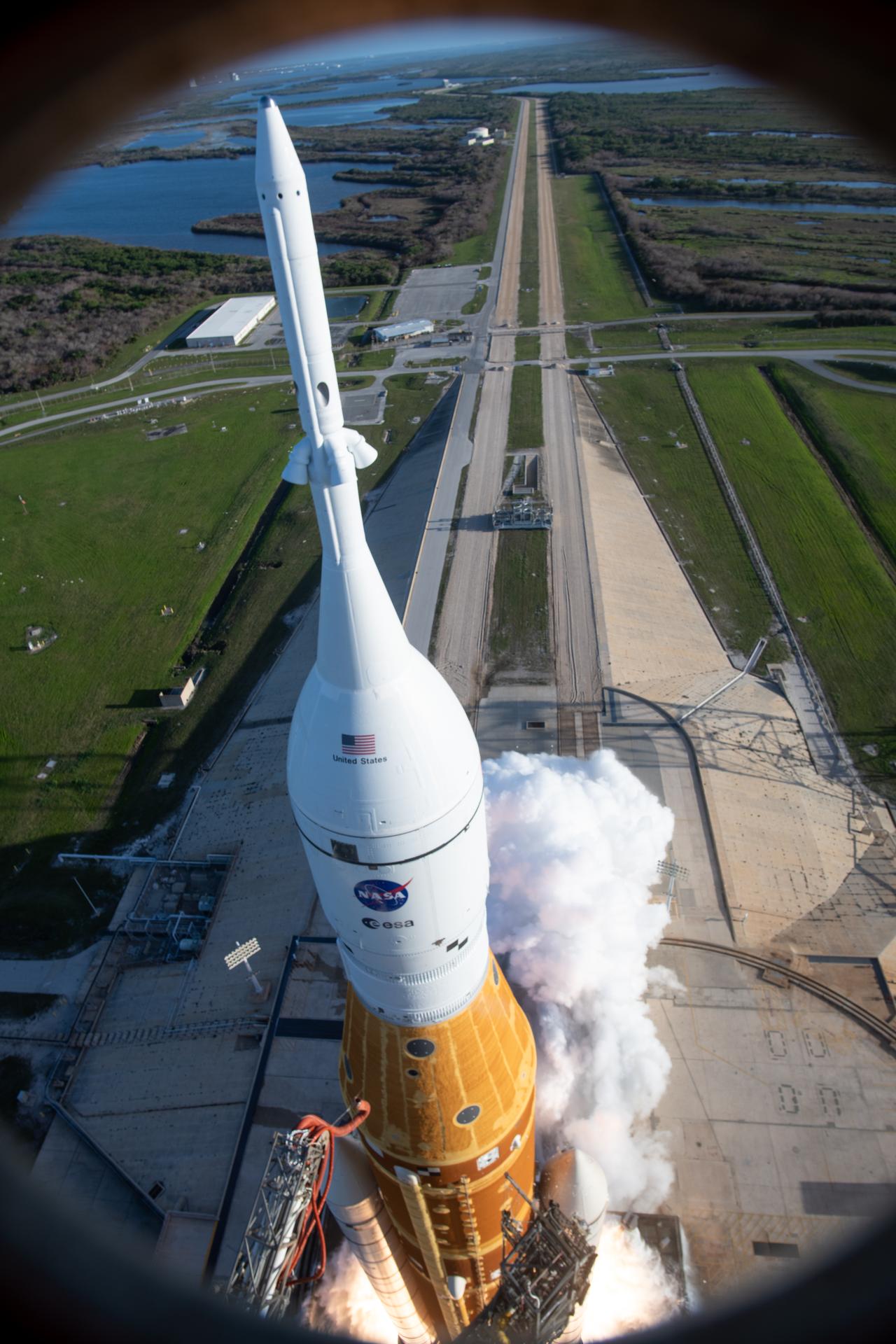
In this photograph looking down, NASA’s SLS (Space Launch System) rocket with the Orion spacecraft carrying Artemis II Commander Reid Wiseman, Pilot Victor Glover, and Mission Specialist Christina Koch from NASA, along with Mission Specialist Jeremy Hansen from the CSA (Canadian Space Agency), lifts off at 6:35 p.m. EDT on Wednesday, April 1, 2026, from Launch Complex 39B at NASA’s Kennedy Space Center I Florida. The Artemis II test flight will take the crew members on a 10-day journey around the Moon and back on Friday, April 10.
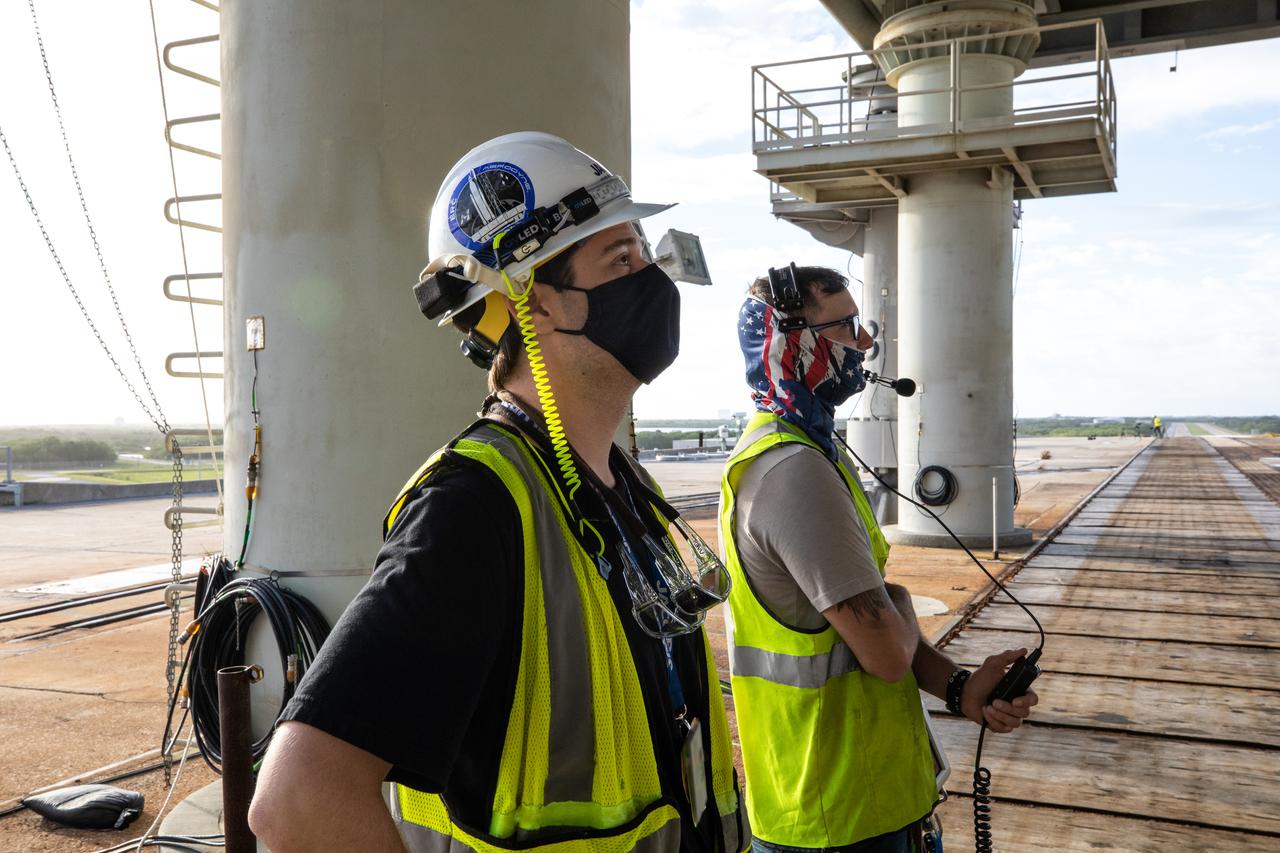
Workers stand on the surface of Launch Pad 39B at NASA’s Kennedy Space Center in Florida on Oct. 23, 2020. They are monitoring launch countdown timeline demonstration activities occurring on the mobile launcher for Artemis I. The nearly 400-foot-tall mobile launcher is at the pad while engineers with Exploration Ground Systems and Jacobs complete several tasks, including a timing test to validate the launch team’s countdown timeline, and a thorough, top-to-bottom wash down of the mobile launcher to remove any debris remaining from construction and installation of the umbilical arms. Artemis I will test the Orion spacecraft and Space Launch System as an integrated system ahead of crewed flights to the Moon. Under the Artemis program, NASA will land the first woman and the next man on the Moon in 2024.
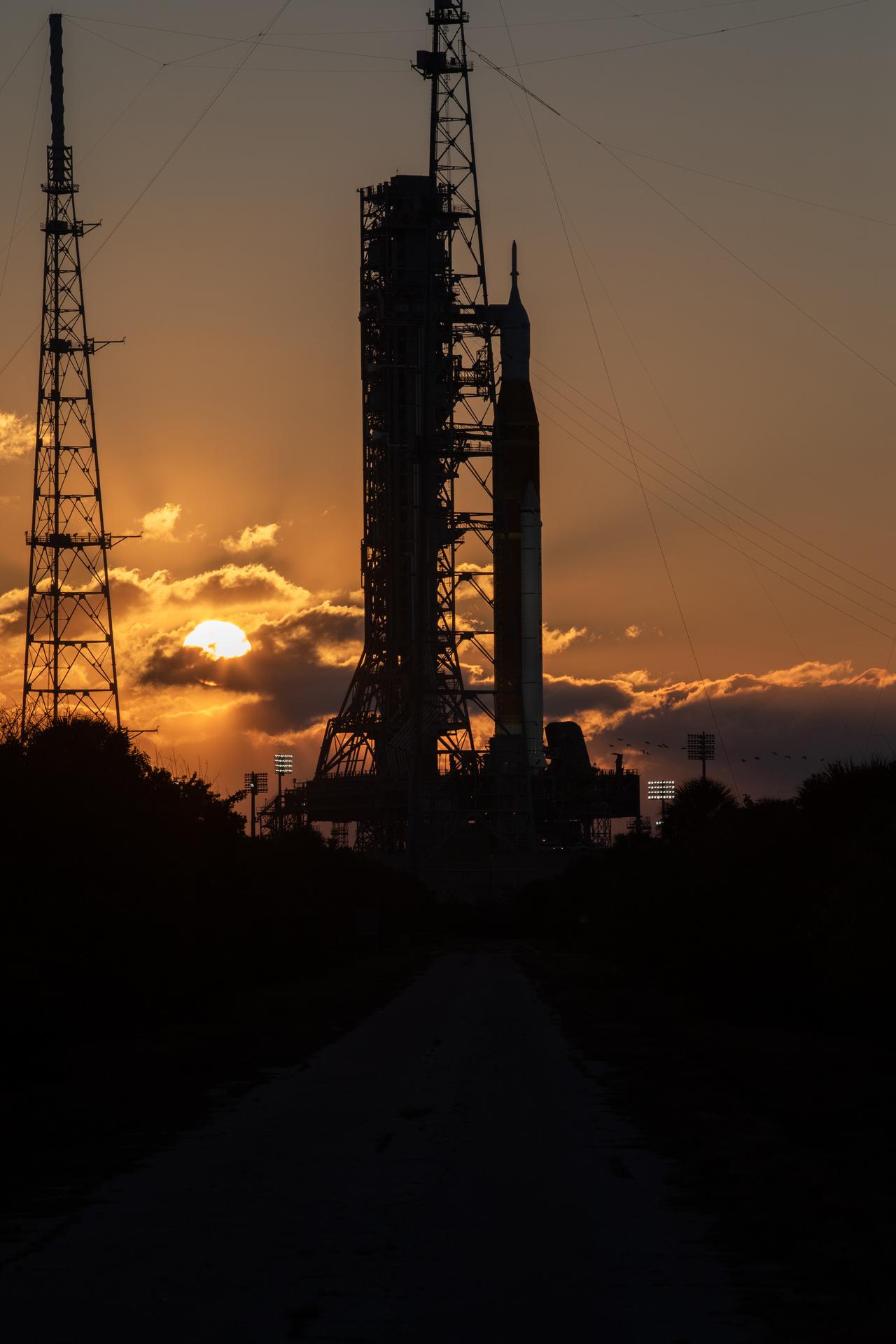
The Sun rises behind NASA’s Artemis II SLS (Space Launch System) rocket and Orion spacecraft atop a mobile launcher at Launch Complex 39B at NASA’s Kennedy Space Center in Florida on Sunday, Feb. 1, 2026. The Artemis II test flight will take Commander Reid Wiseman, Pilot Victor Glover, and Mission Specialist Christina Koch from NASA, and Mission Specialist Jeremy Hansen from the CSA (Canadian Space Agency), around the Moon and back to Earth.
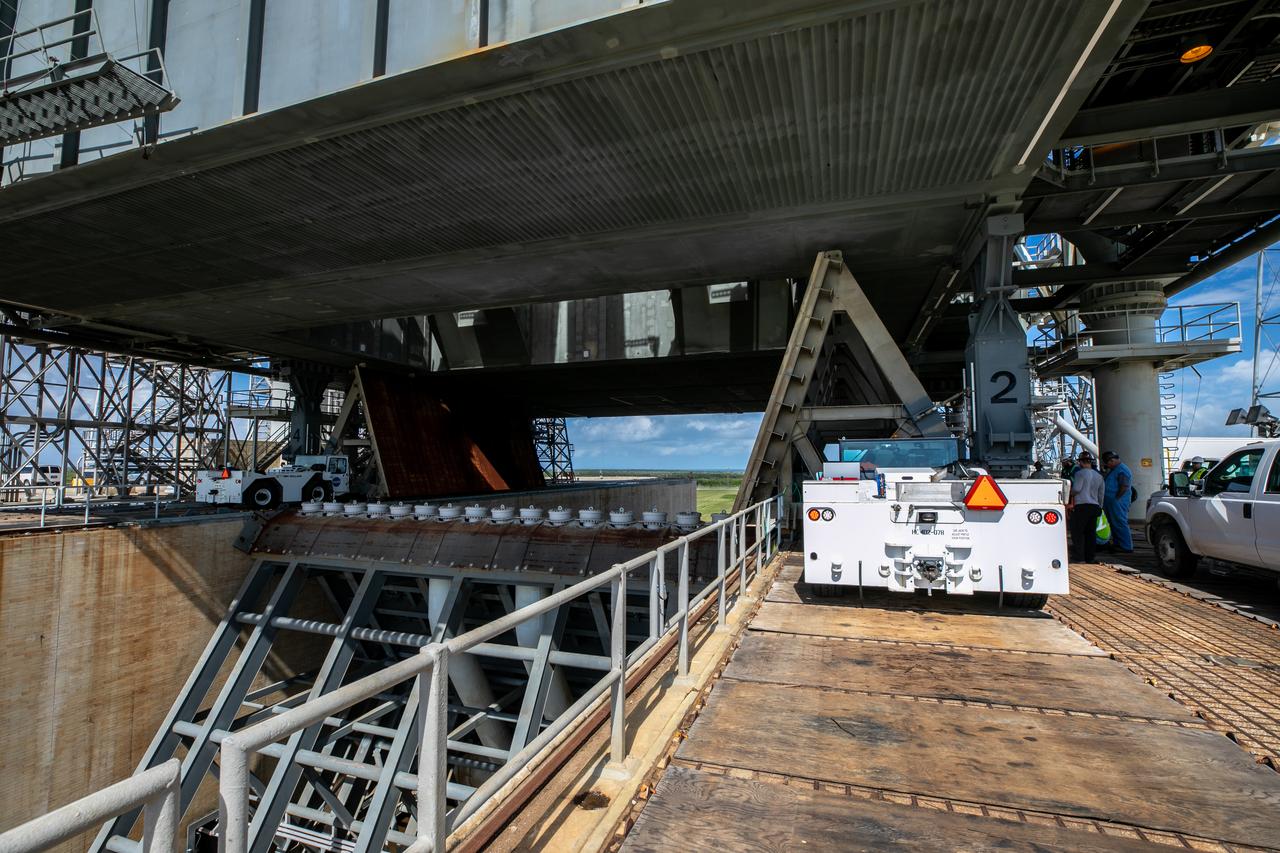
Special ground support equipment is used to move one of two side flame deflectors underneath the mobile launcher for Artemis I during a countdown demonstration test at Launch Pad 39B at NASA’s Kennedy Space Center in Florida on Oct. 23, 2020. The nearly 400-foot-tall mobile launcher is at the pad while engineers with Exploration Ground Systems and Jacobs complete several tasks, including a timing test to validate the launch team’s countdown timeline, and a thorough, top-to-bottom wash down of the mobile launcher to remove any debris remaining from construction and installation of the umbilical arms. Artemis I will test the Orion spacecraft and Space Launch System as an integrated system ahead of crewed flights to the Moon. Under the Artemis program, NASA will land the first woman and the next man on the Moon in 2024.

A lightning strike was recorded at Launch Complex 39B at NASA’s Kennedy Space Center in Florida on Sept. 14, 2022. NASA’s Space Launch System (SLS) and Orion spacecraft atop the mobile launcher are on the launch pad in preparation for the Artemis I mission. The lightning strike was recorded by cameras stationed at the pad and mobile launcher using a special filter called a “clear day frame,” which provides an overlay of the raw frame on a reference image. Artemis I will be the first integrated test of the SLS and Orion spacecraft. In later missions, NASA will land the first woman and the first woman of color on the surface of the Moon, paving the way for a long-term lunar presence and serving as a steppingstone on the way to Mars.
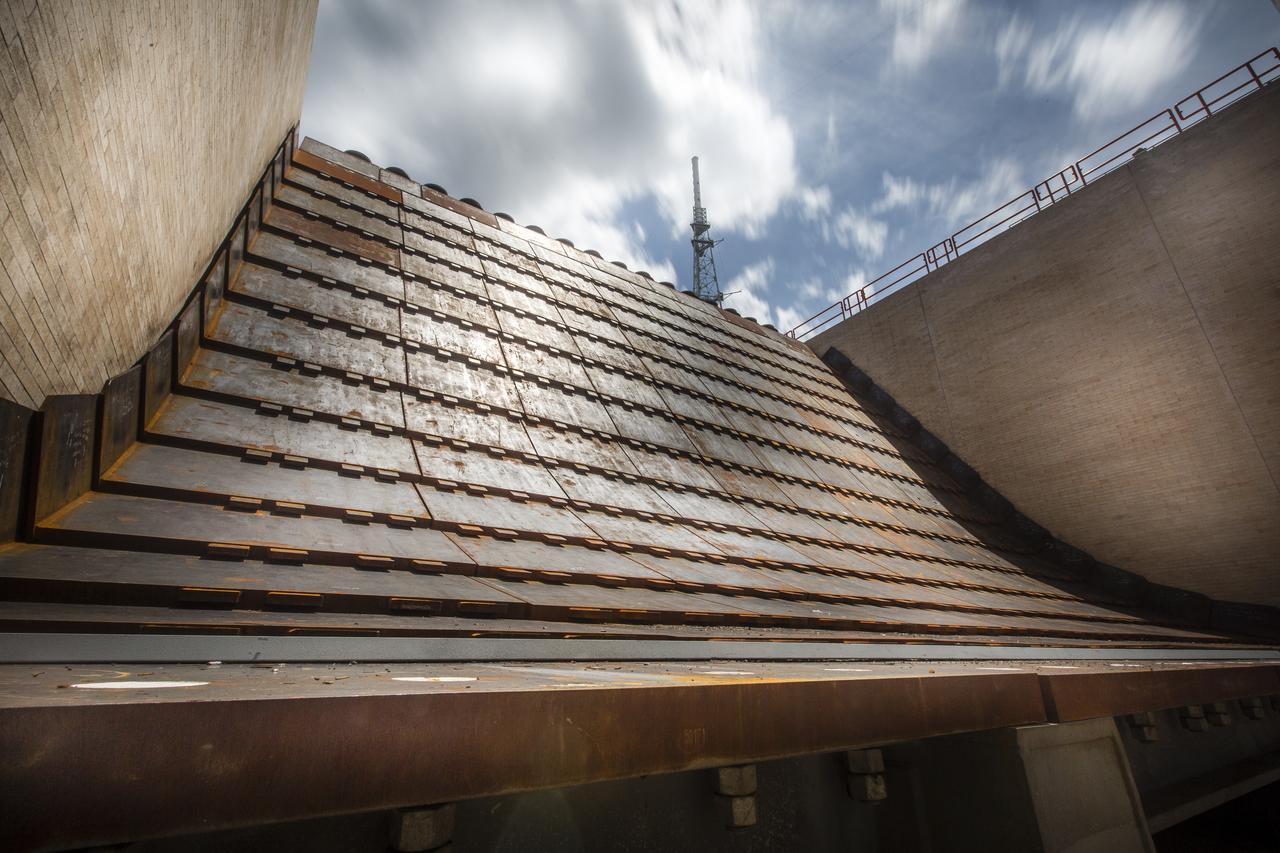
A close-up view of the flame trench and flame deflector at Launch Pad 39B at NASA's Kennedy Space Center in Florida on July 26, 2018. The launch pad has undergone upgrades and modifications to accommodate NASA's Space Launch System and Orion spacecraft for Exploration Mission-1 and other deep space missions. New heat-resistant bricks have been installed on the walls and a new flame deflector is in place. The clean pad concept is designed to support NASA and commercial launch providers at the multi-user spaceport.
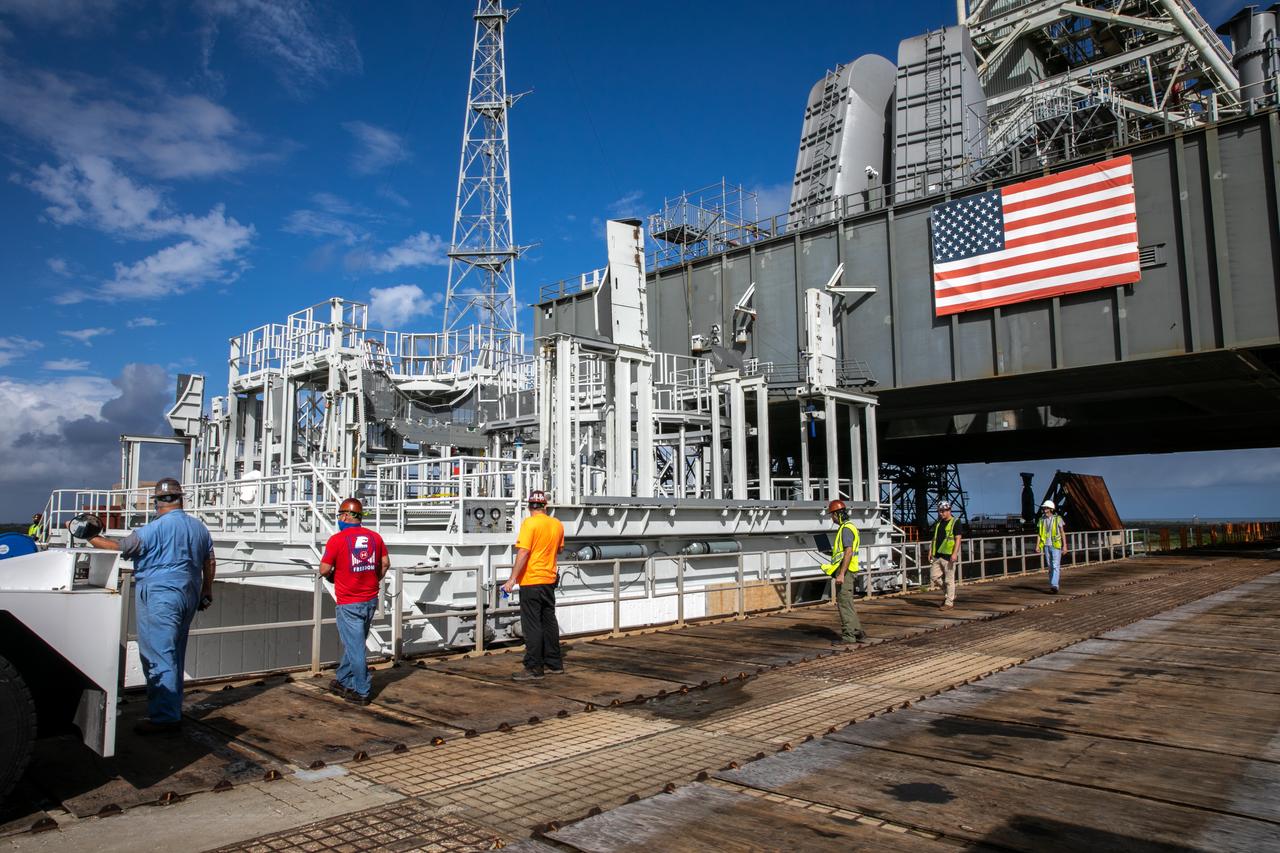
The engine service platform has been lowered and removed from the mobile launcher for Artemis I at Launch Pad 39B at NASA’s Kennedy Space Center in Florida on Oct. 23, 2020. The platform is in view on a flatbed truck. The nearly 400-foot-tall mobile launcher is at the pad while engineers with Exploration Ground Systems and Jacobs complete several tasks, including a timing test to validate the launch team’s countdown timeline, and a thorough, top-to-bottom wash down of the mobile launcher to remove any debris remaining from construction and installation of the umbilical arms. Artemis I will test the Orion spacecraft and Space Launch System as an integrated system ahead of crewed flights to the Moon. Under the Artemis program, NASA will land the first woman and the next man on the Moon in 2024.

An engineer with Exploration Ground Systems monitors countdown demonstration activities occurring on the mobile launcher for Artemis I on Oct. 23, 2020, at Launch Pad 39B at NASA’s Kennedy Space Center in Florida. The nearly 400-foot-tall mobile launcher is at the pad while engineers with Exploration Ground Systems and Jacobs complete several tasks, including a timing test to validate the launch team’s countdown timeline, and a thorough, top-to-bottom wash down of the mobile launcher to remove any debris remaining from construction and installation of the umbilical arms. Artemis I will test the Orion spacecraft and Space Launch System as an integrated system ahead of crewed flights to the Moon. Under the Artemis program, NASA will land the first woman and the next man on the Moon in 2024.
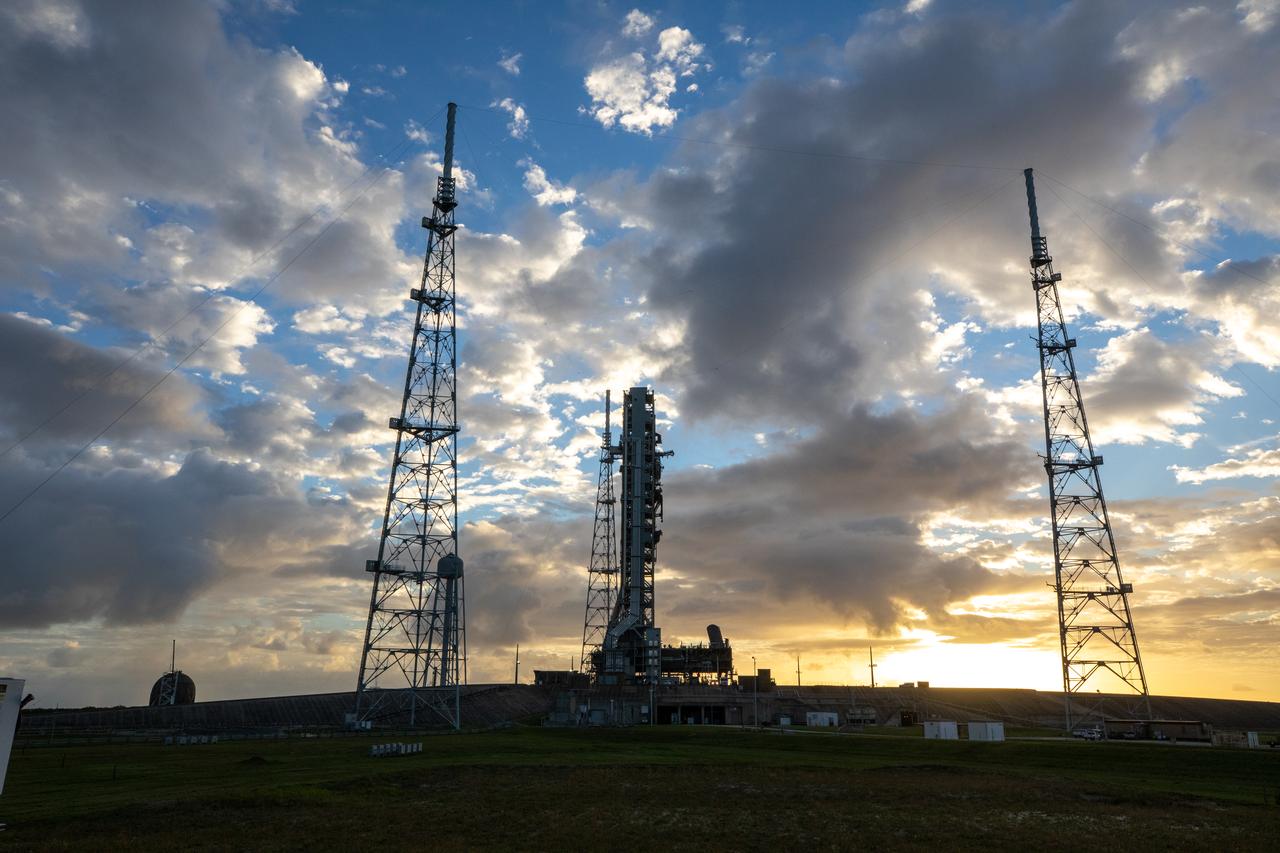
The mobile launcher for the Artemis I mission is in view on the top of Launch Pad 39B at NASA’s Kennedy Space Center in Florida on Oct. 23, 2020. The nearly 400-foot-tall mobile launcher is at the pad to allow engineers with Exploration Ground Systems and Jacobs to complete several tasks, including a timing test to validate the launch team’s countdown timeline, and a thorough, top-to-bottom wash down of the mobile launcher to remove any debris remaining from construction and installation of the umbilical arms. Artemis I will test the Orion spacecraft and Space Launch System as an integrated system ahead of crewed flights to the Moon. Under the Artemis program, NASA will land the first woman and the next man on the Moon in 2024.
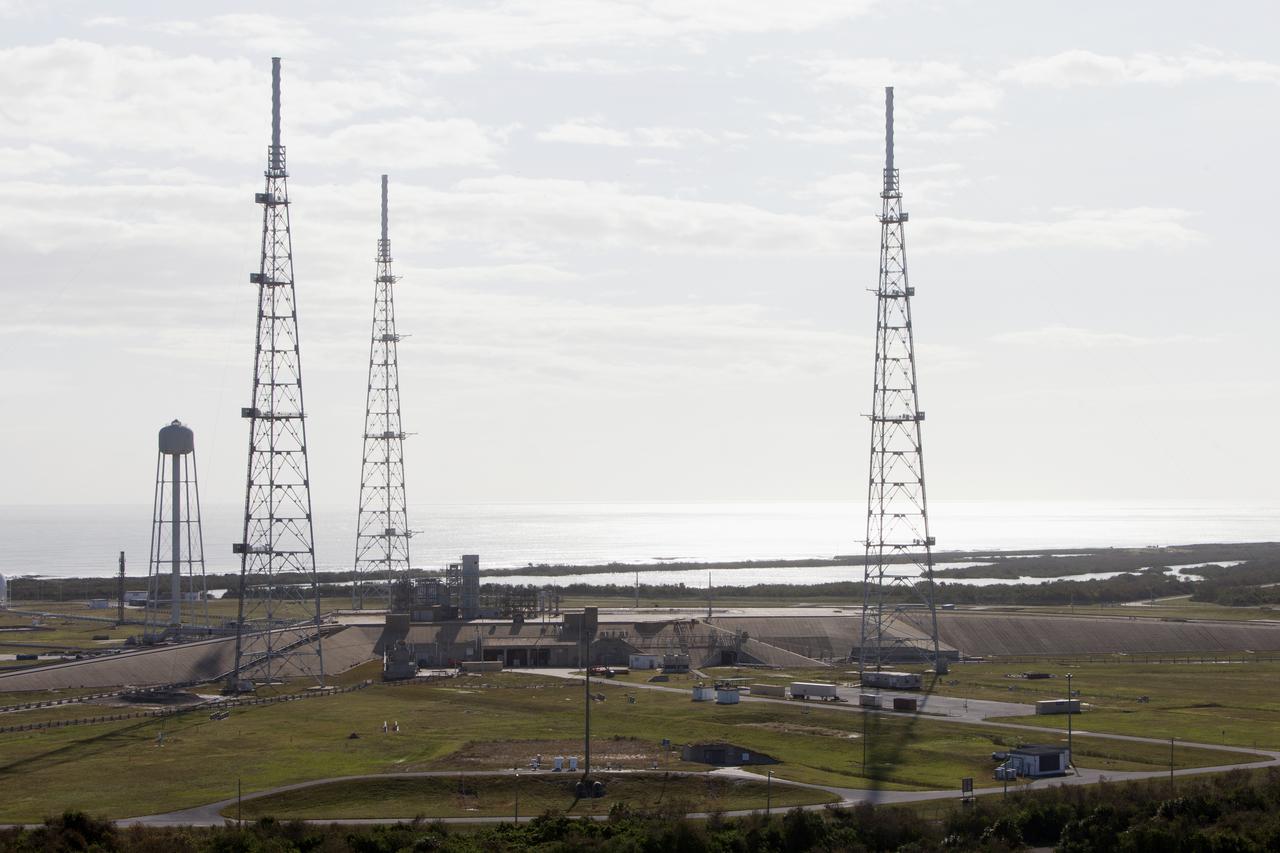
Launch Complex 39B is seen during an aerial survey of NASA's Kennedy Space Center in Florida on September 12, 2017. The survey was performed to identify structures and facilities that may have sustained damage from Hurricane Irma as the storm passed Kennedy on September 10, 2017. NASA closed the center ahead of the storm's onset and only a small team of specialists known as the Rideout Team was on the center as the storm approached and passed.
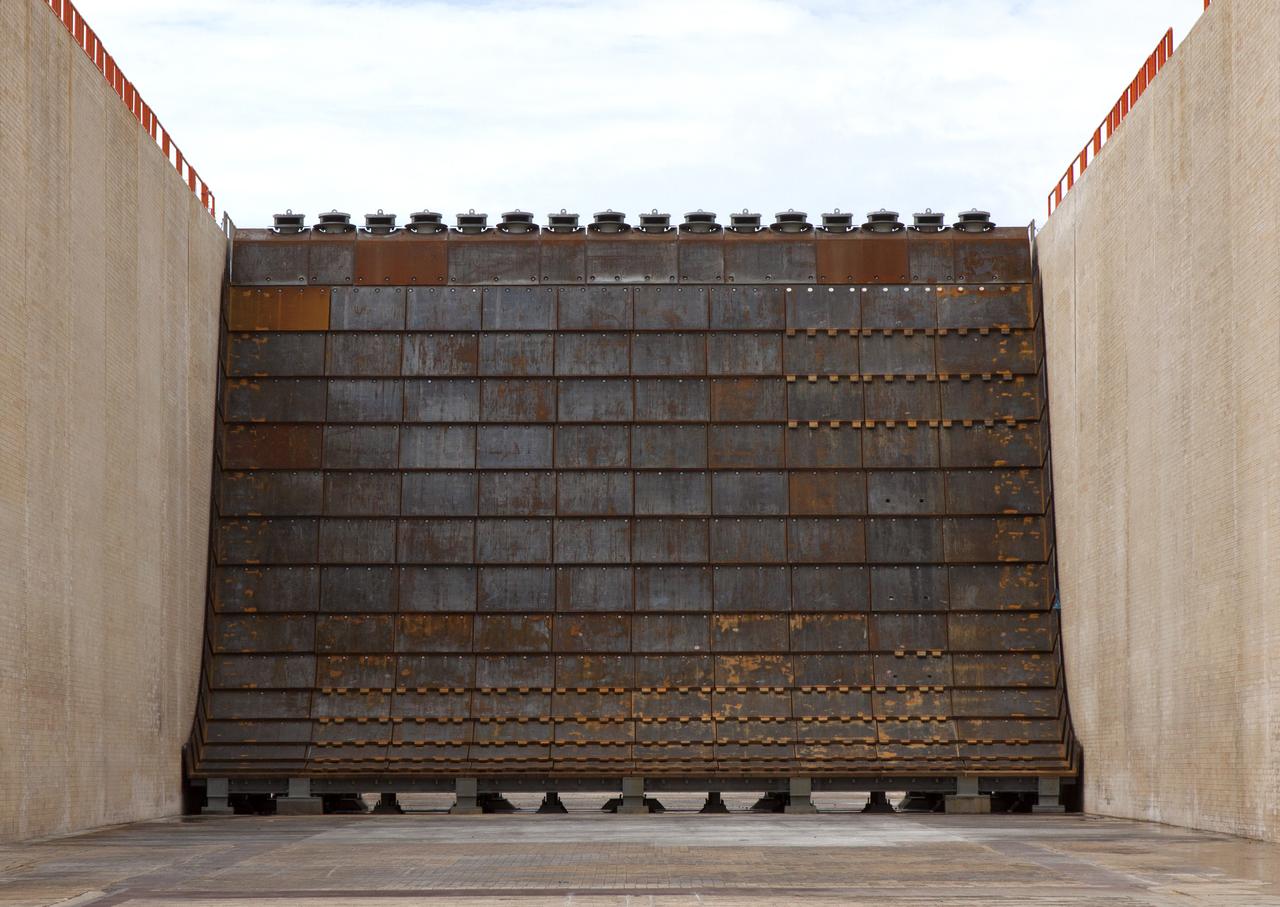
Construction is complete on the main flame deflector in the flame trench at Launch Complex 39B at NASA's Kennedy Space Center in Florida. The flame deflector will safely deflect the plume exhaust from NASA's Space Launch System rocket during launch. It will divert the rocket's exhaust, pressure and intense heat to the north at liftoff. The Exploration Ground Systems Program at Kennedy is refurbishing the pad to support the launch of the SLS rocket and Orion on Exploration Mission-1, and helping to transform the space center into a multi-user spaceport.
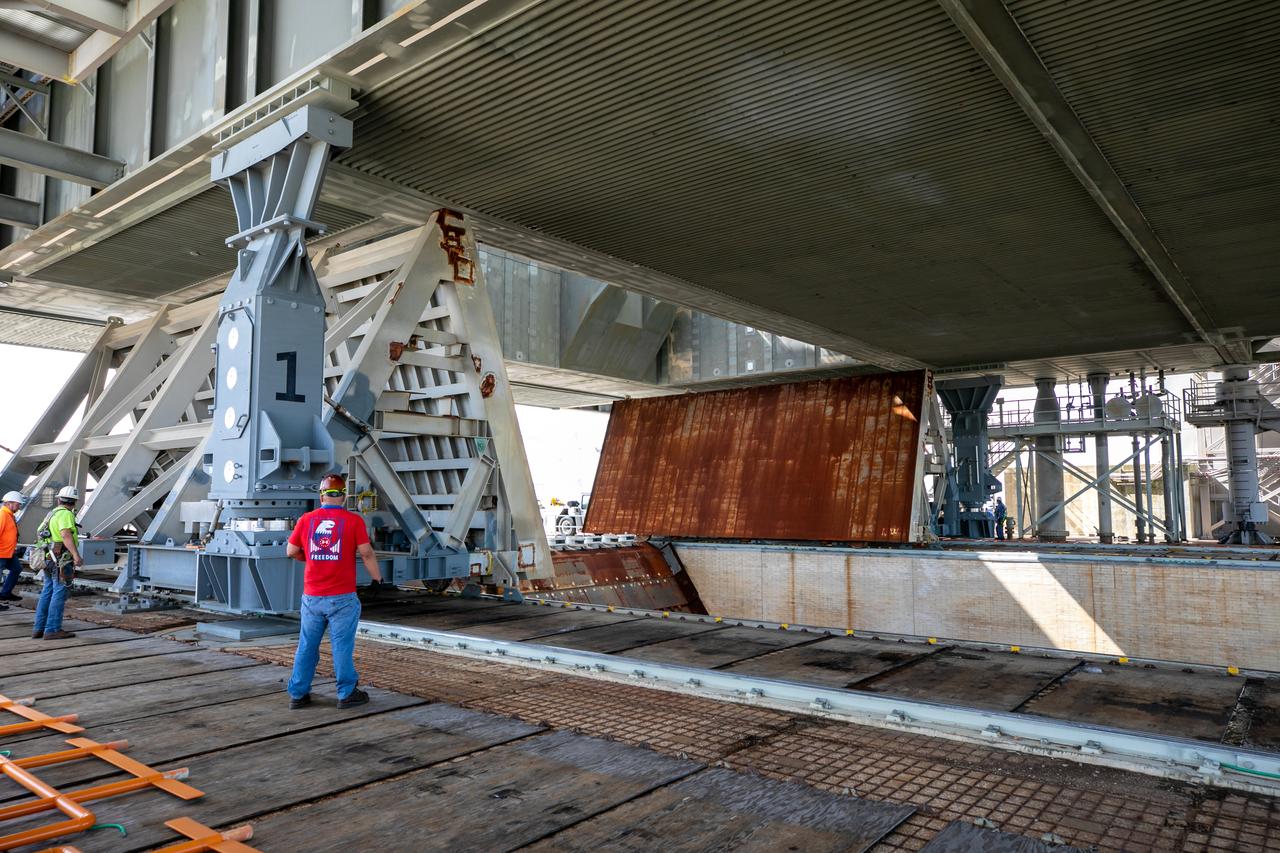
Special ground support equipment is used to position the two side flame deflectors underneath the mobile launcher for Artemis I during a countdown demonstration test at Launch Pad 39B at NASA’s Kennedy Space Center in Florida on Oct. 23, 2020. The nearly 400-foot-tall mobile launcher is at the pad while engineers with Exploration Ground Systems and Jacobs complete several tasks, including a timing test to validate the launch team’s countdown timeline, and a thorough, top-to-bottom wash down of the mobile launcher to remove any debris remaining from construction and installation of the umbilical arms. Artemis I will test the Orion spacecraft and Space Launch System as an integrated system ahead of crewed flights to the Moon. Under the Artemis program, NASA will land the first woman and the next man on the Moon in 2024.
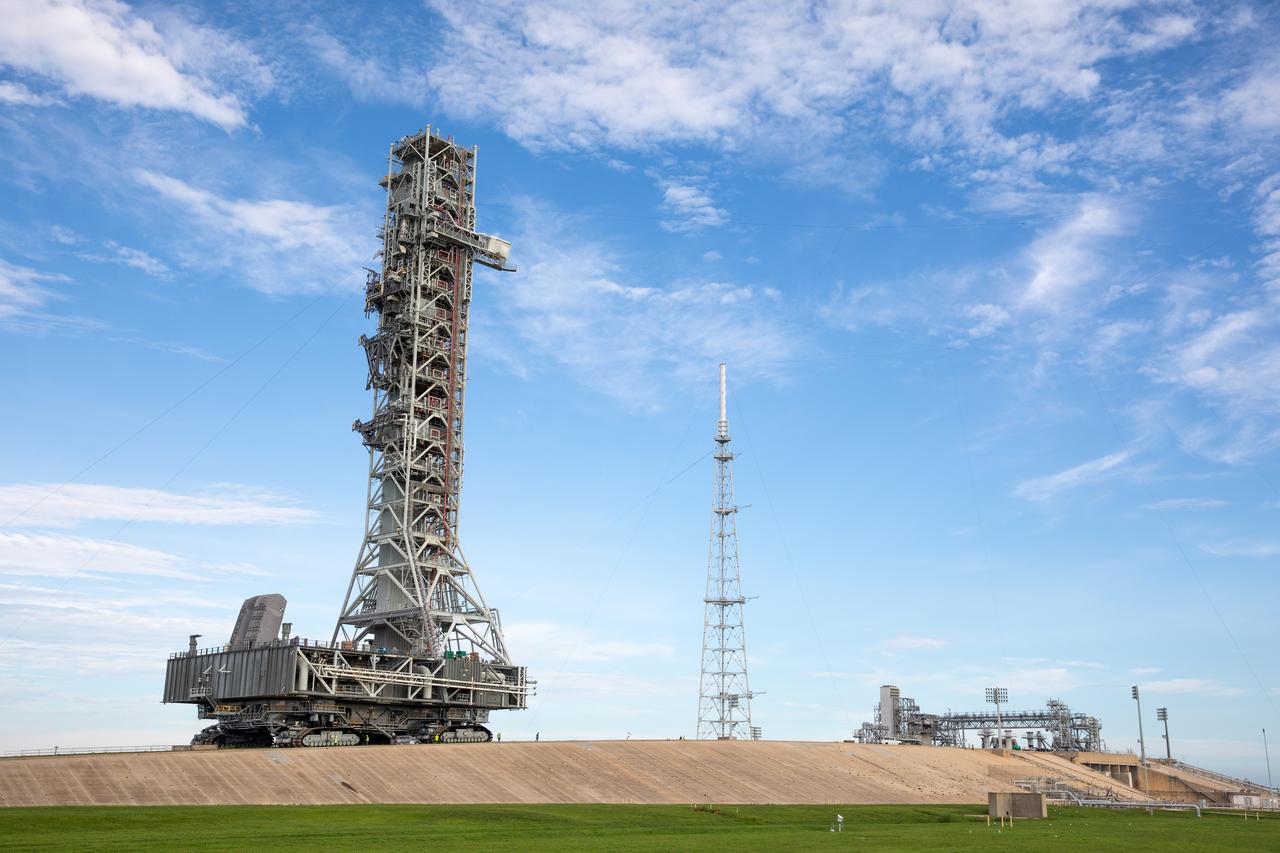
The mobile launcher, carried by the crawler-transporter 2, nears the pad at Launch Complex 39B at NASA’s Kennedy Space Center in Florida on Aug. 17, 2023. While at the pad, the mobile launcher will undergo testing for the agency’s Artemis II mission. Under Artemis, the mobile launcher will transport NASA’s Space Launch System rocket and Orion spacecraft to pad 39B for liftoff.
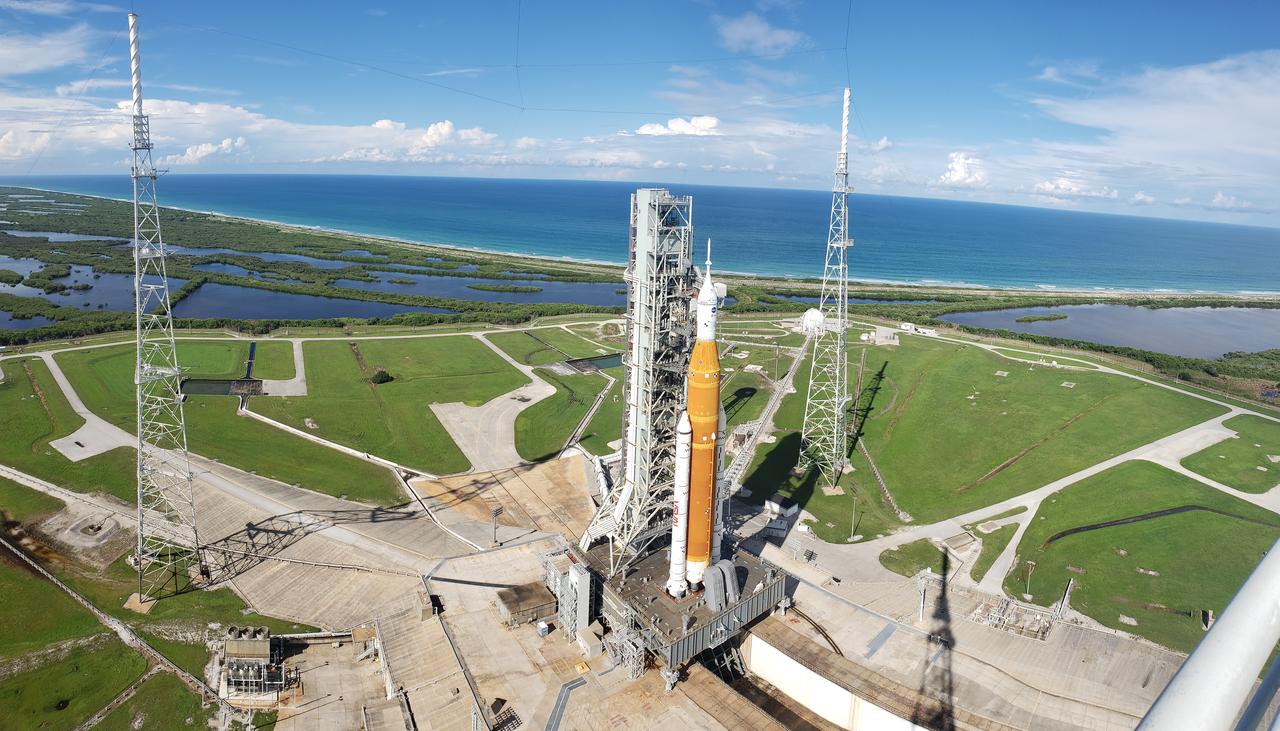
A view of the Artemis I Space Launch System (SLS) and Orion spacecraft atop the mobile launcher on Launch Pad 39B at NASA’s Kennedy Space Center in Florida on Sept. 15, 2022. Also in view are two of the three lightning towers that surround the pad and protect the SLS and Orion from lightning strikes. Artemis I is the first integrated test of the SLS and Orion spacecraft. In future Artemis missions, NASA will land the first woman and the first person of color on the surface of the Moon, paving the way for a long-term lunar presence and serving as a steppingstone on the way to Mars.
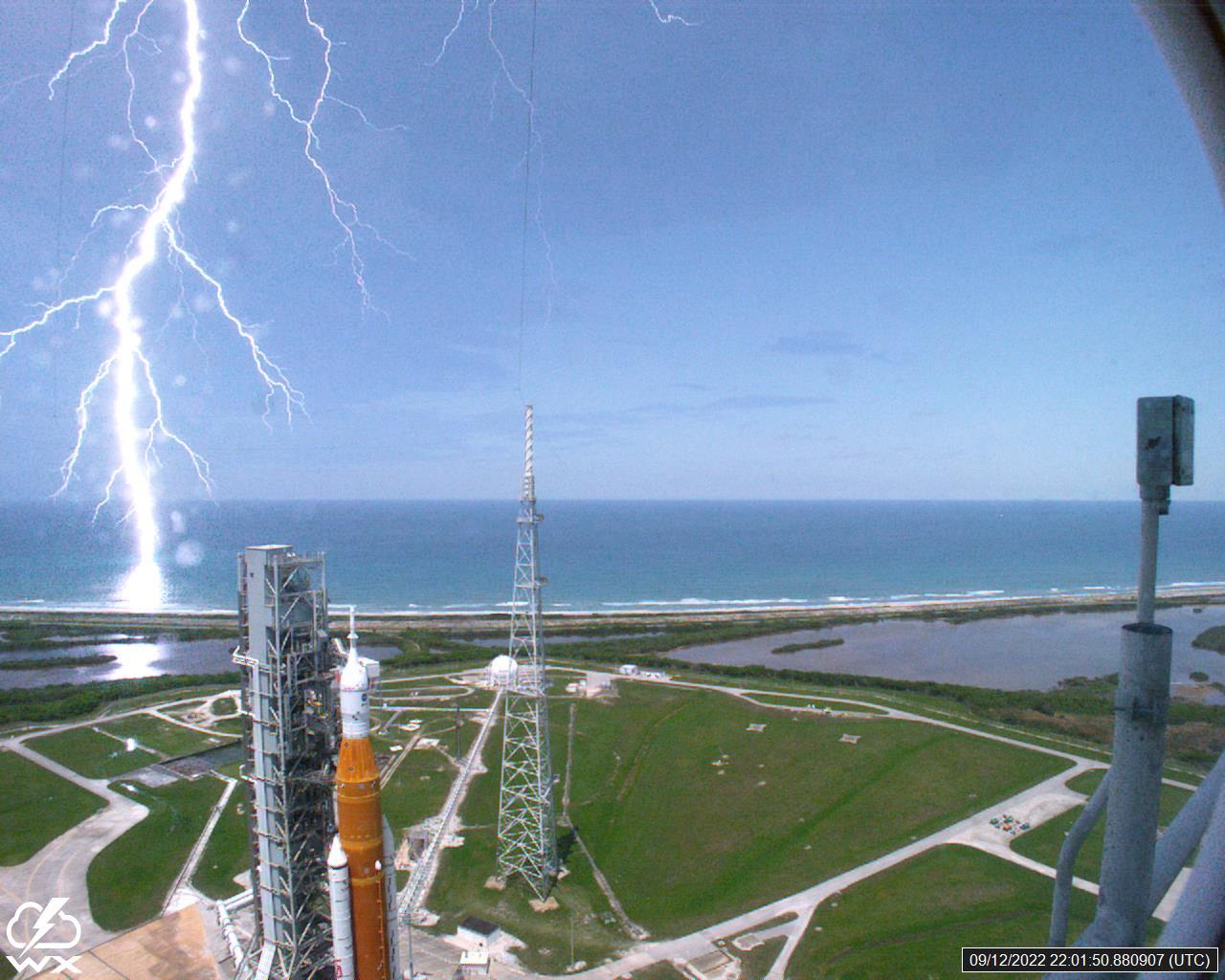
A lightning strike was recorded at Launch Complex 39B at NASA’s Kennedy Space Center in Florida on Sept. 12, 2022. NASA’s Space Launch System (SLS) and Orion spacecraft atop the mobile launcher are in view on the launch pad in preparation for the Artemis I mission. The lightning strike was recorded by cameras stationed at the pad and mobile launcher using a special filter called a “clear day frame,” which provides an overlay of the raw frame on a reference image. Artemis I will be the first integrated test of the SLS and Orion spacecraft. In later missions, NASA will land the first woman and the first woman of color on the surface of the Moon, paving the way for a long-term lunar presence and serving as a steppingstone on the way to Mars.
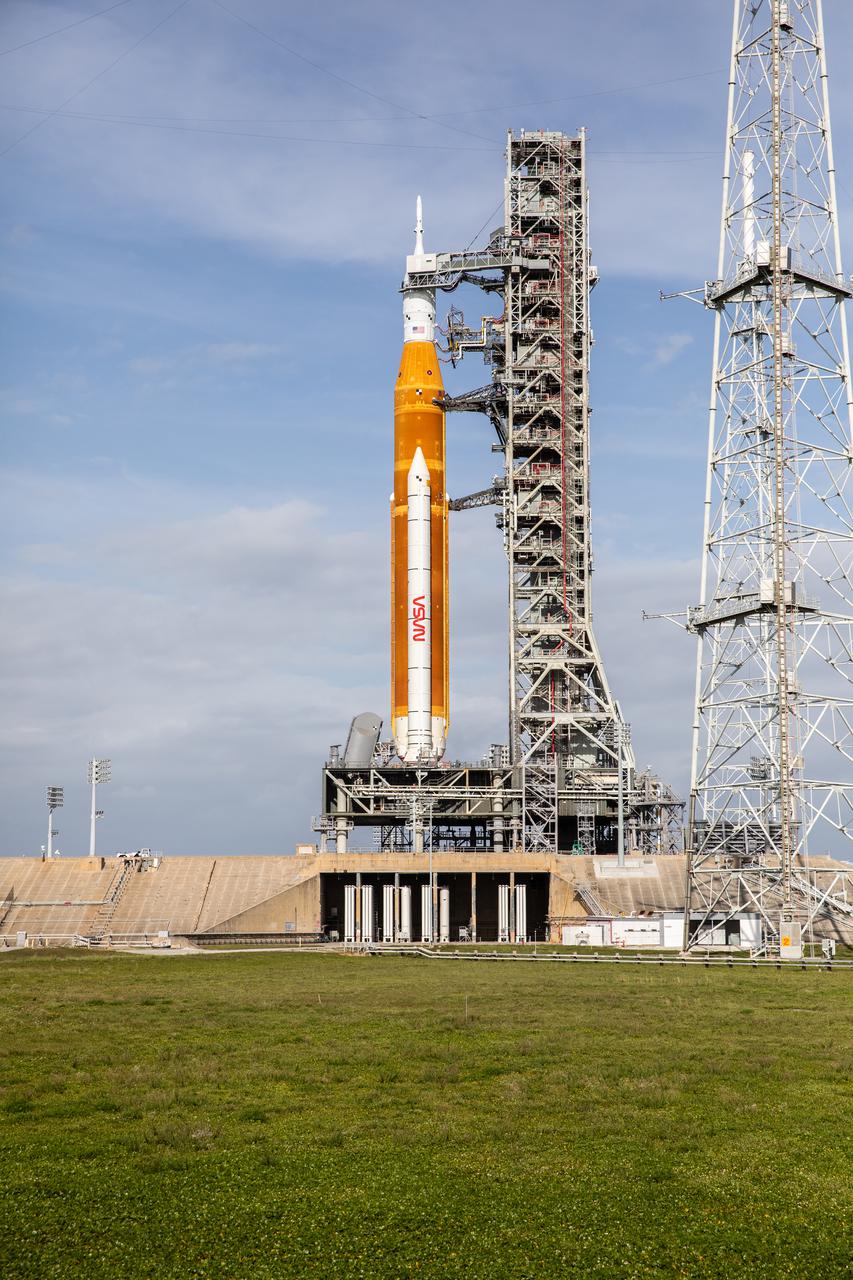
A view of the Artemis I Space Launch System (SLS) and Orion spacecraft on Launch Pad 39B at NASA’s Kennedy Space Center in Florida on April 21, 2022. Also in view is one of three lightning protection towers. The SLS and Orion atop the mobile launcher were transported to the pad on crawler-transporter 2 for a prelaunch test called a wet dress rehearsal. Artemis I will be the first integrated test of the SLS and Orion spacecraft. In future Artemis missions, NASA will land the first woman and the first person of color on the surface of the Moon, paving the way for a long-term lunar presence and serving as a steppingstone on the way to Mars.
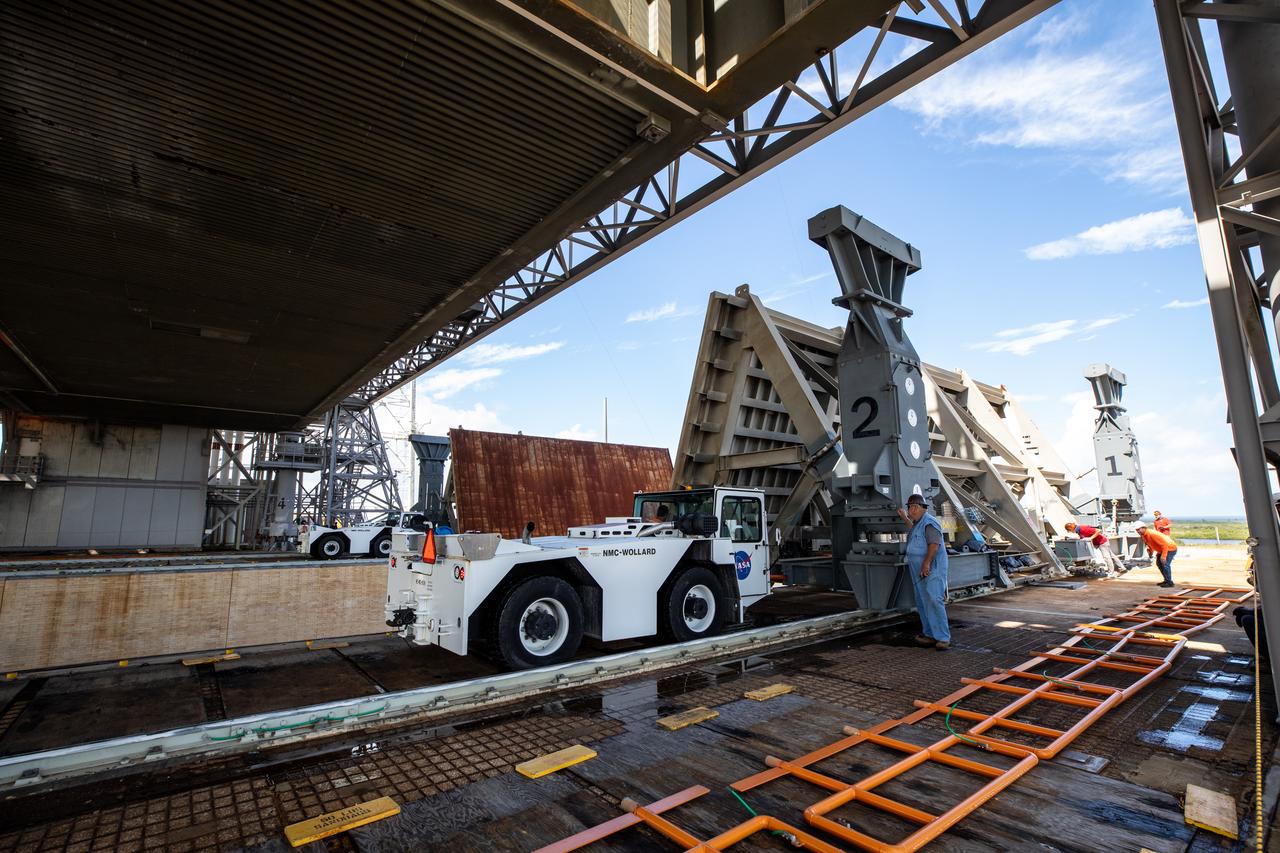
Special ground support equipment is used to move one of two side flame deflectors underneath the mobile launcher for Artemis I during a countdown demonstration test at Launch Pad 39B at NASA’s Kennedy Space Center in Florida on Oct. 23, 2020. The nearly 400-foot-tall mobile launcher is at the pad while engineers with Exploration Ground Systems and Jacobs complete several tasks, including a timing test to validate the launch team’s countdown timeline, and a thorough, top-to-bottom wash down of the mobile launcher to remove any debris remaining from construction and installation of the umbilical arms. Artemis I will test the Orion spacecraft and Space Launch System as an integrated system ahead of crewed flights to the Moon. Under the Artemis program, NASA will land the first woman and the next man on the Moon in 2024.
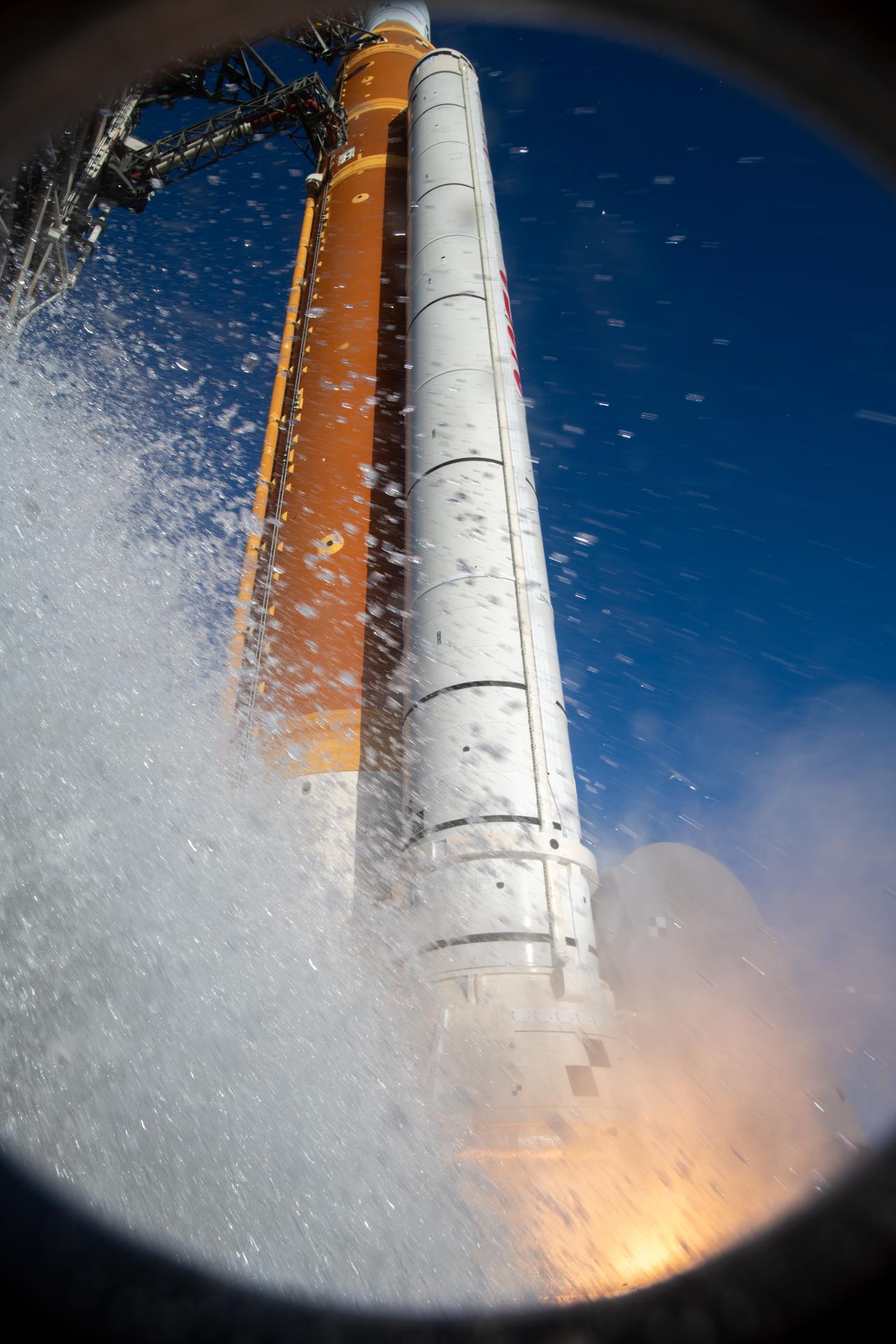
The Ignition Overpressure Protection and Sound Suppression water deluge system activates during launch of NASA’s Artemis II test flight at Launch Complex 39B at NASA’s Kennedy Space Center in Florida at 6:35 p.m. EDT on Wednesday, April 1, 2026. The water deluge system releases about 450,000 gallons of water across the mobile launcher and flame deflector to reduce the extreme heat and energy generated by the rocket during ignition and liftoff. Artemis II Commander Reid Wiseman, Pilot Victor Glover, and Mission Specialist Christina Koch from NASA, along with Mission Specialist Jeremy Hansen from the CSA (Canadian Space Agency), are on a 10-day journey around the Moon and back with splashdown in the Pacific Ocean off the coast of San Diego, California on Friday, April 10.
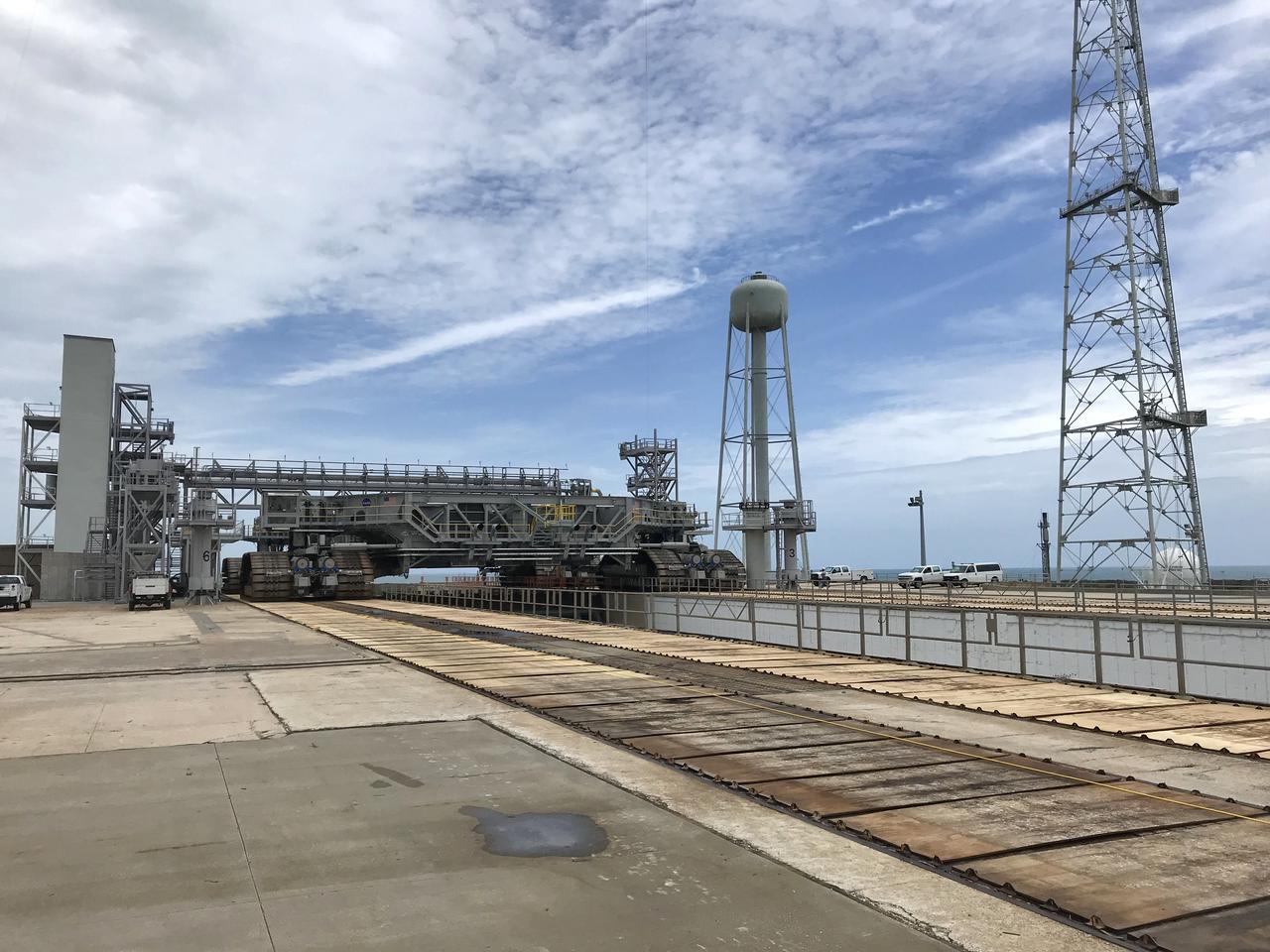
Crawler-transporter 2 (CT-2) arrives on the surface of Launch Pad 39B for a fit check on May 22, 2018, at NASA's Kennedy Space Center in Florida. The test drive to the pad confirms that all of the recent modifications to CT-2 and Pad 39B are operational to support the launch of the agency's Space Launch System rocket and Orion spacecraft on Exploration Mission-1. In view, at right, is one of three lightning protection towers positioned around Pad 39B. Exploration Ground Systems managed the modifications and upgrades to CT-2 and Pad 39B to prepare for EM-1 and deep space exploration missions.
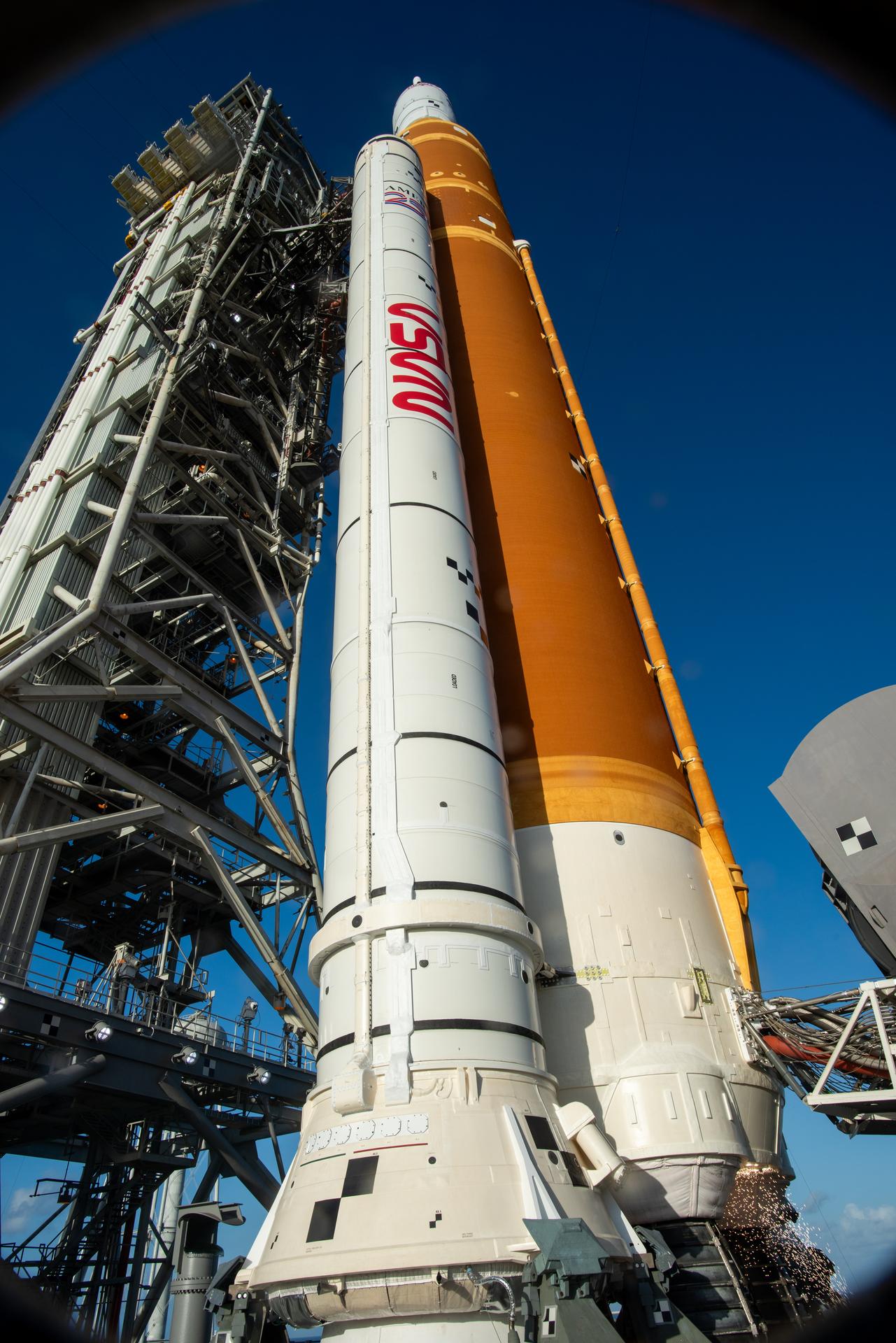
In this photograph looking up, NASA’s SLS (Space Launch System) rocket with the Orion spacecraft stands vertical at Launch Complex 39B at NASA’s Kennedy Space Center in Florida ahead of launch of the agency’s Artemis II test flight on Wednesday, April 1, 2026. Artemis II launched at 6:35 p.m. EDT April 1 at NASA Kennedy, sending Artemis II Commander Reid Wiseman, Pilot Victor Glover, and Mission Specialist Christina Koch from NASA, along with Mission Specialist Jeremy Hansen from the CSA (Canadian Space Agency), on a 10-day journey around the Moon and back with splashdown in the Pacific Ocean off the coast of San Diego, California on Friday, April 10.
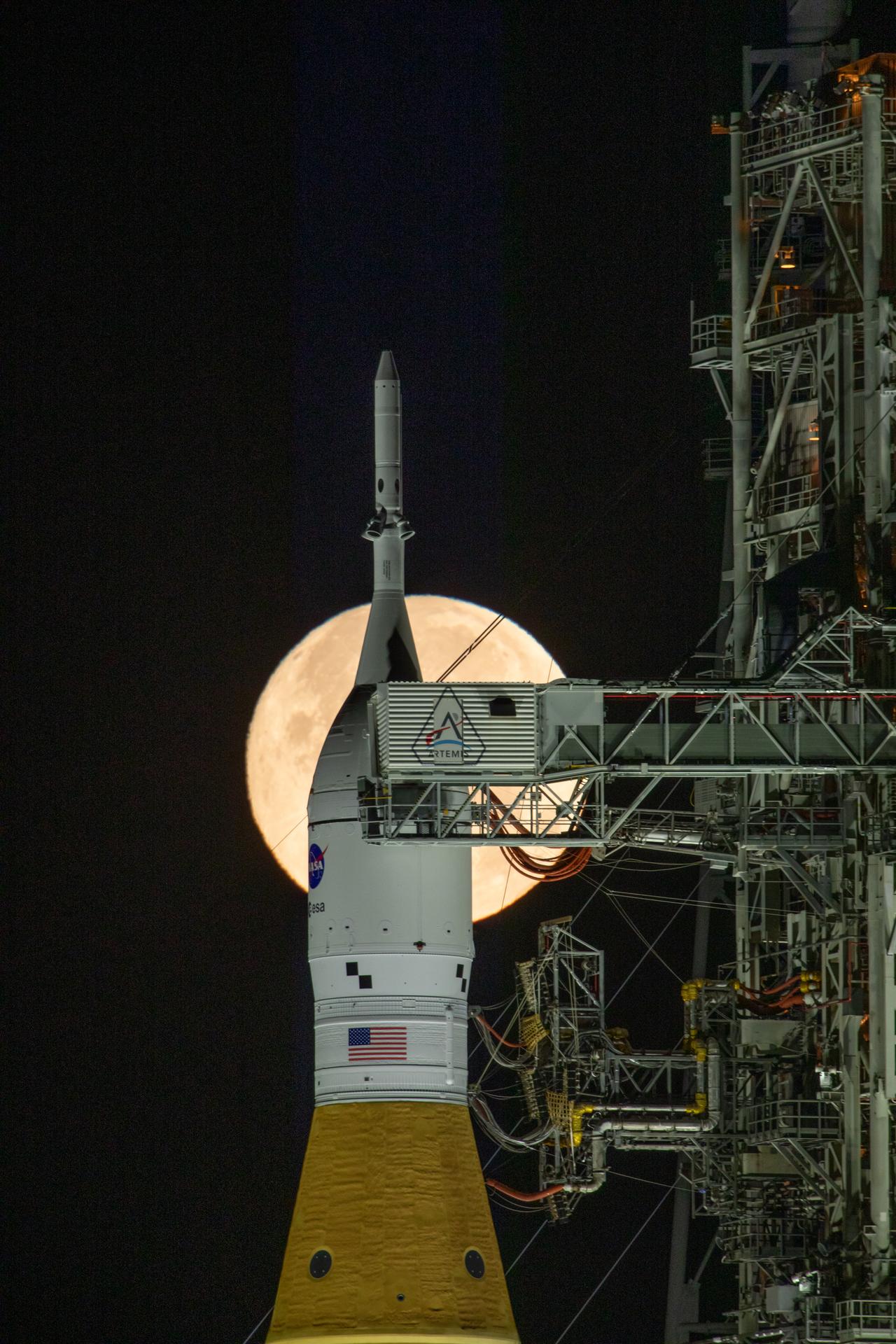
The Moon rises behind NASA’s Artemis II SLS (Space Launch System) rocket and Orion spacecraft atop a mobile launcher at Launch Complex 39B at NASA’s Kennedy Space Center in Florida on Sunday, Feb. 1,. 2026. The Artemis II test flight will take Commander Reid Wiseman, Pilot Victor Glover, and Mission Specialist Christina Koch from NASA, and Mission Specialist Jeremy Hansen from the CSA (Canadian Space Agency), around the Moon and back to Earth.
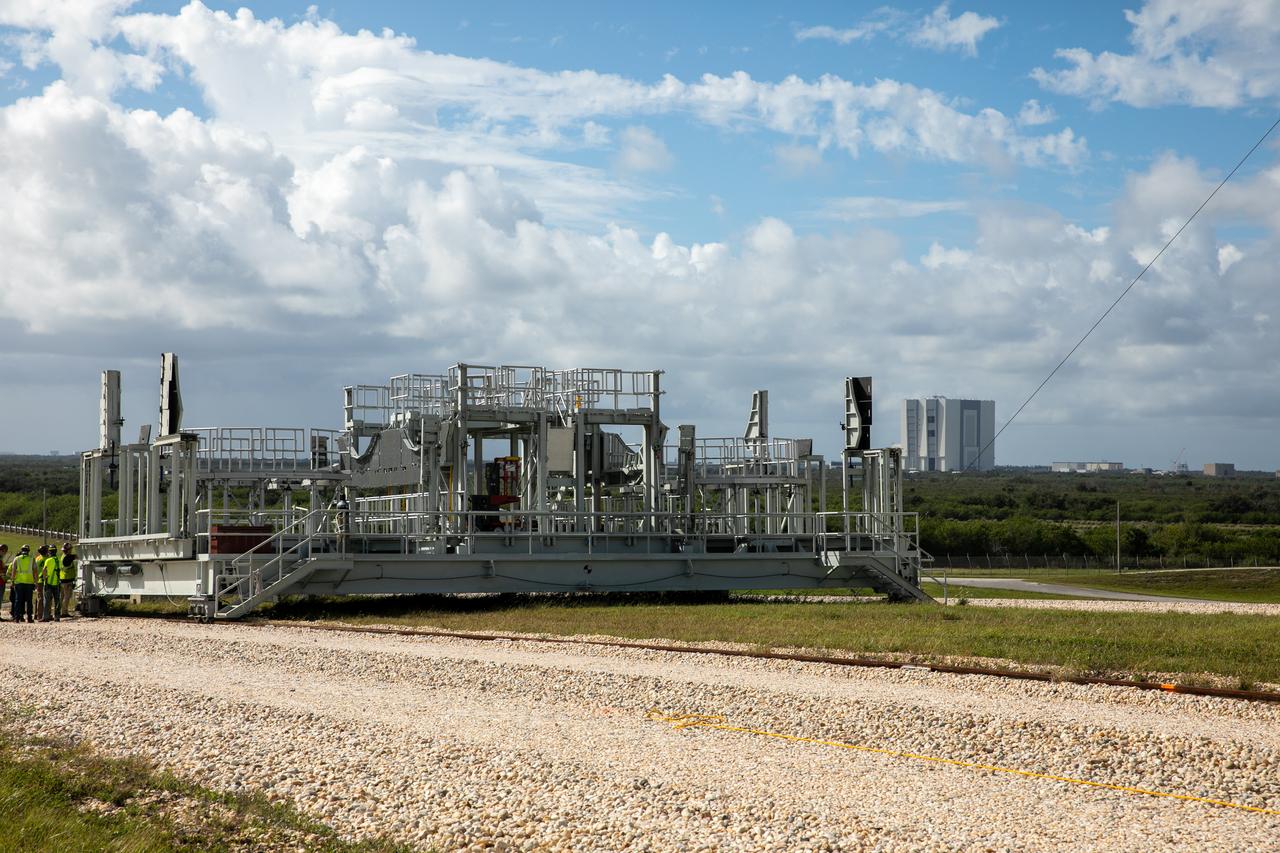
The engine service platform has been lowered and removed from the mobile launcher for Artemis I at Launch Pad 39B at NASA’s Kennedy Space Center in Florida on Oct. 23, 2020. It is being moved from the pad. The nearly 400-foot-tall mobile launcher is at the pad while engineers with Exploration Ground Systems and Jacobs complete several tasks, including a timing test to validate the launch team’s countdown timeline, and a thorough, top-to-bottom wash down of the mobile launcher to remove any debris remaining from construction and installation of the umbilical arms. Artemis I will test the Orion spacecraft and Space Launch System as an integrated system ahead of crewed flights to the Moon. Under the Artemis program, NASA will land the first woman and the next man on the Moon in 2024.
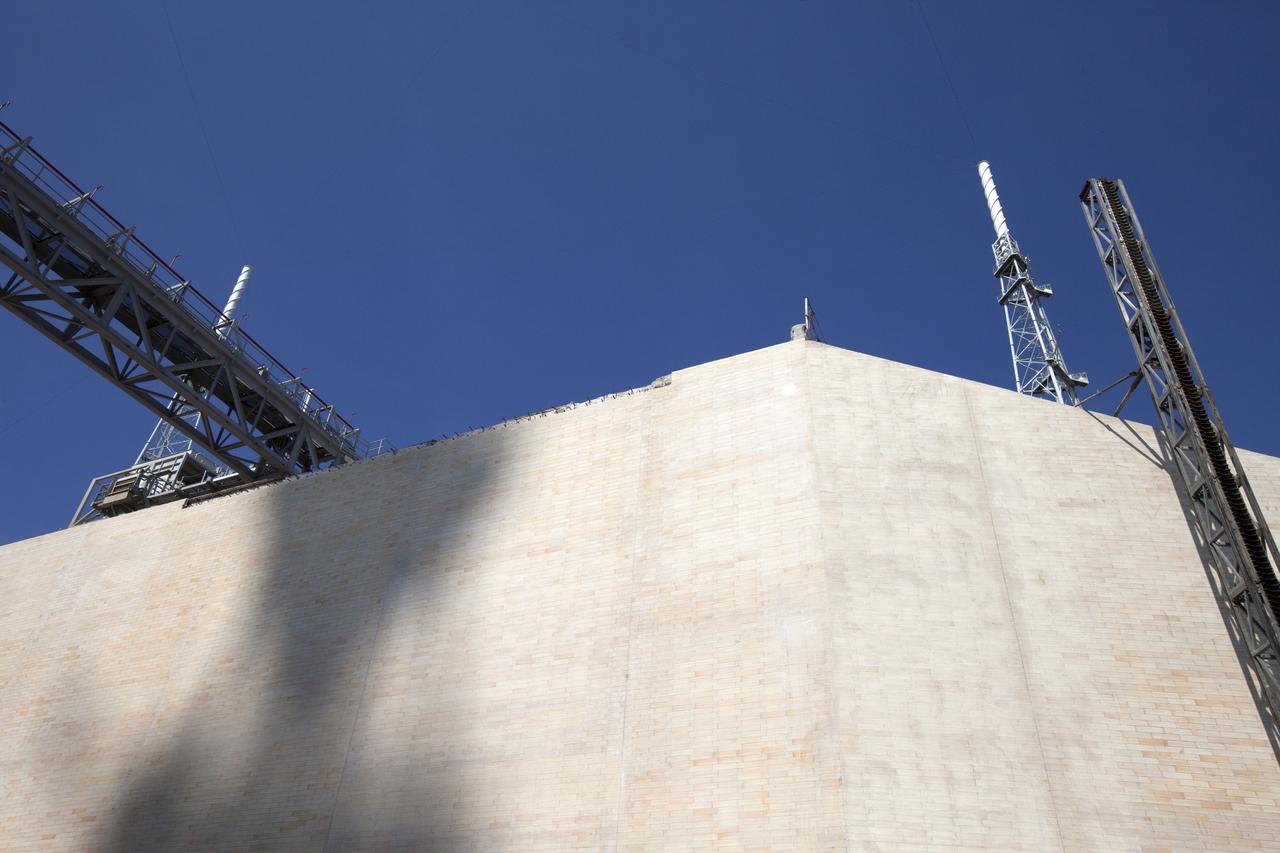
A view looking up from the north side of the flame trench beneath the pad at Launch Complex 39B at NASA's Kennedy Space Center in Florida. The walls of the flame trench are being upgraded to withstand the intense heat and fire at launch of NASA's Space Launch System rocket with Orion atop. About 96,000 heat-resistant bricks, in three different sizes, were secured to the walls using bonding mortar in combination with adhesive anchors. The Ground Systems Development and Operations Program is overseeing upgrades and modifications to Pad 39B to support the launch of the SLS and Orion spacecraft for Exploration Mission-1 and NASA’s journey to Mars.
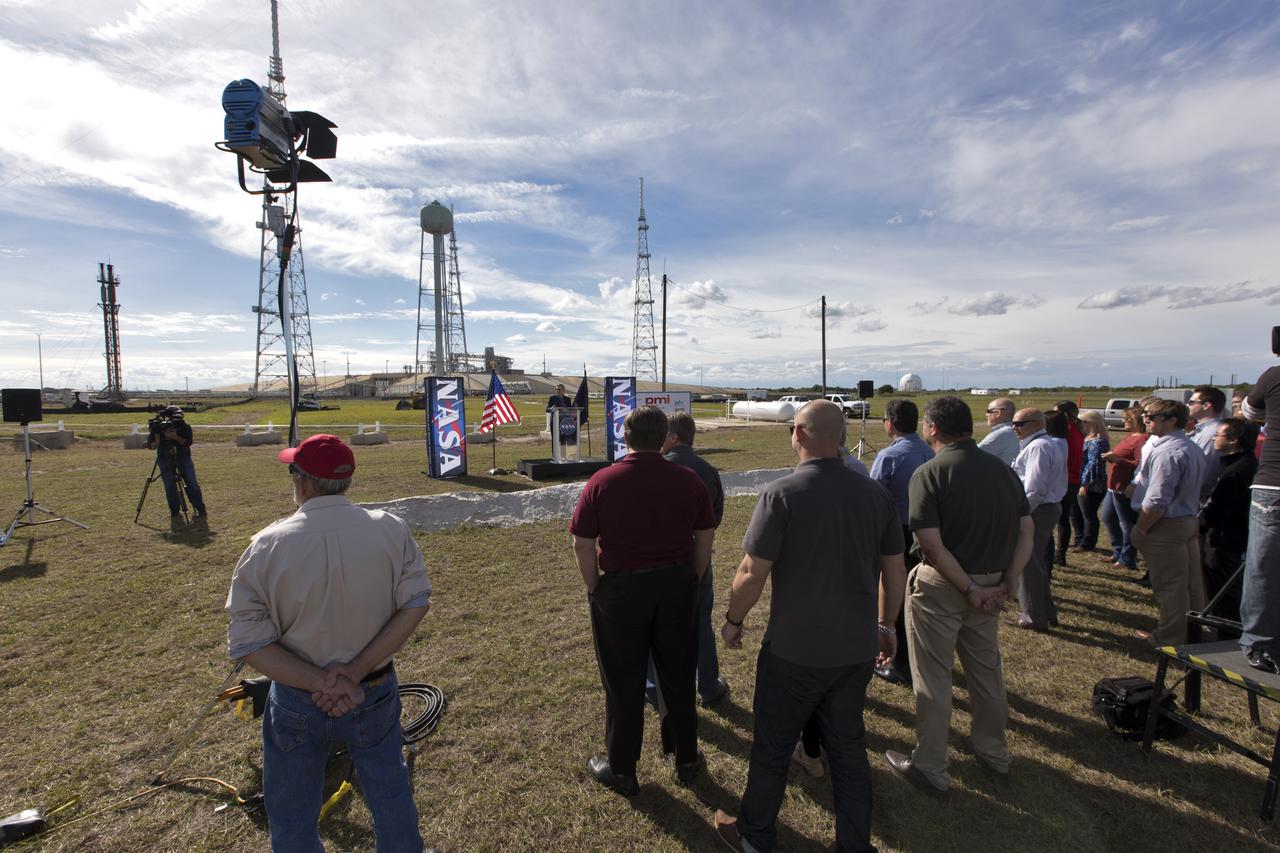
On Dec. 19, 2018, NASA and contractor managers gathered for a groundbreaking ceremony for a new liquid hydrogen tank for Launch Complex 39B at NASA's Kennedy Space Center. The storage facility will hold 1.25 million gallons of the propellant for NASA's Space Launch System rocket designed to boost the agency's Orion spacecraft, sending humans to distant destinations such as the Moon and Mars.
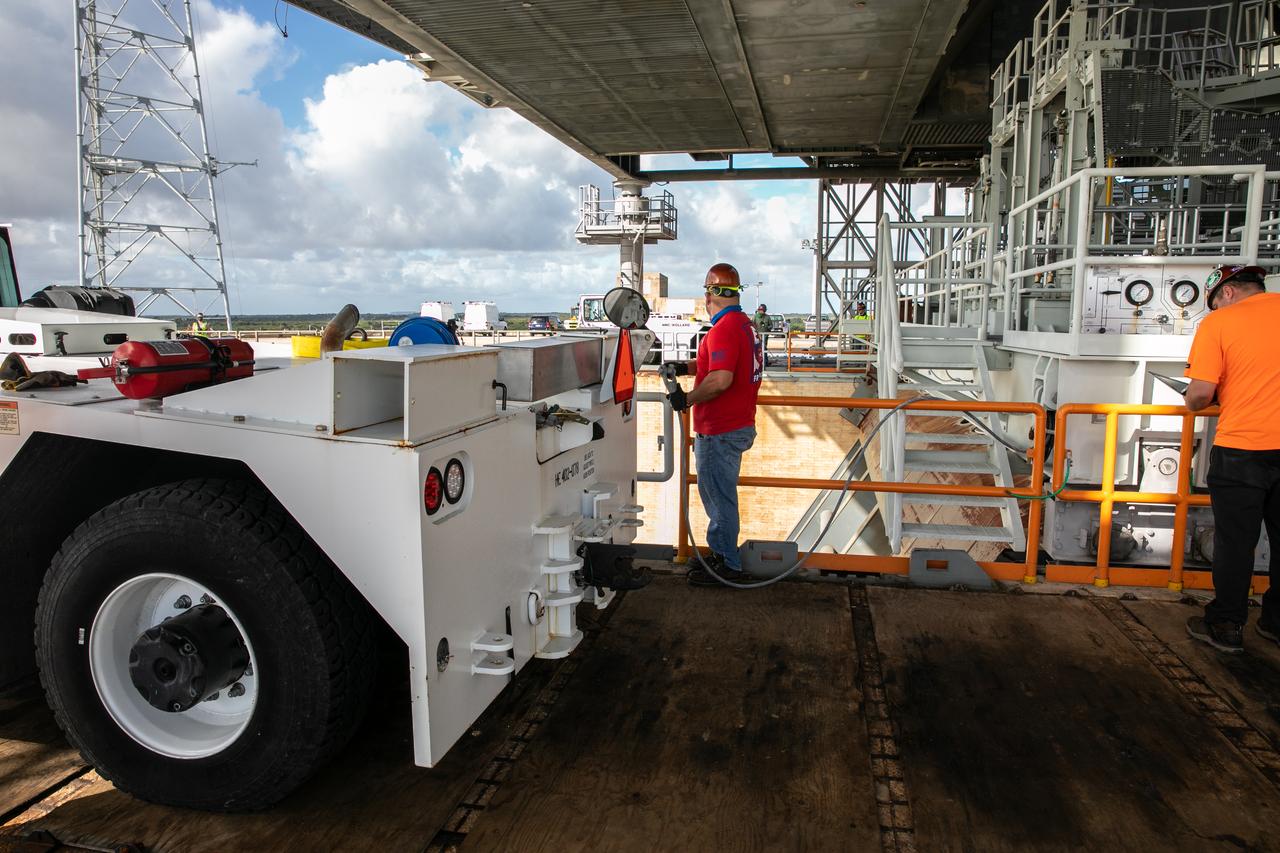
Engineers with Exploration Ground Systems and Jacobs assist with raising the engine service platform beneath the mobile launcher for Artemis I at Launch Pad 39B at NASA’s Kennedy Space Center in Florida on Oct. 23, 2020. The nearly 400-foot-tall mobile launcher is at the pad while engineers with Exploration Ground Systems and Jacobs complete several tasks, including a timing test to validate the launch team’s countdown timeline, and a thorough, top-to-bottom wash down of the mobile launcher to remove any debris remaining from construction and installation of the umbilical arms. Artemis I will test the Orion spacecraft and Space Launch System as an integrated system ahead of crewed flights to the Moon. Under the Artemis program, NASA will land the first woman and the next man on the Moon in 2024.
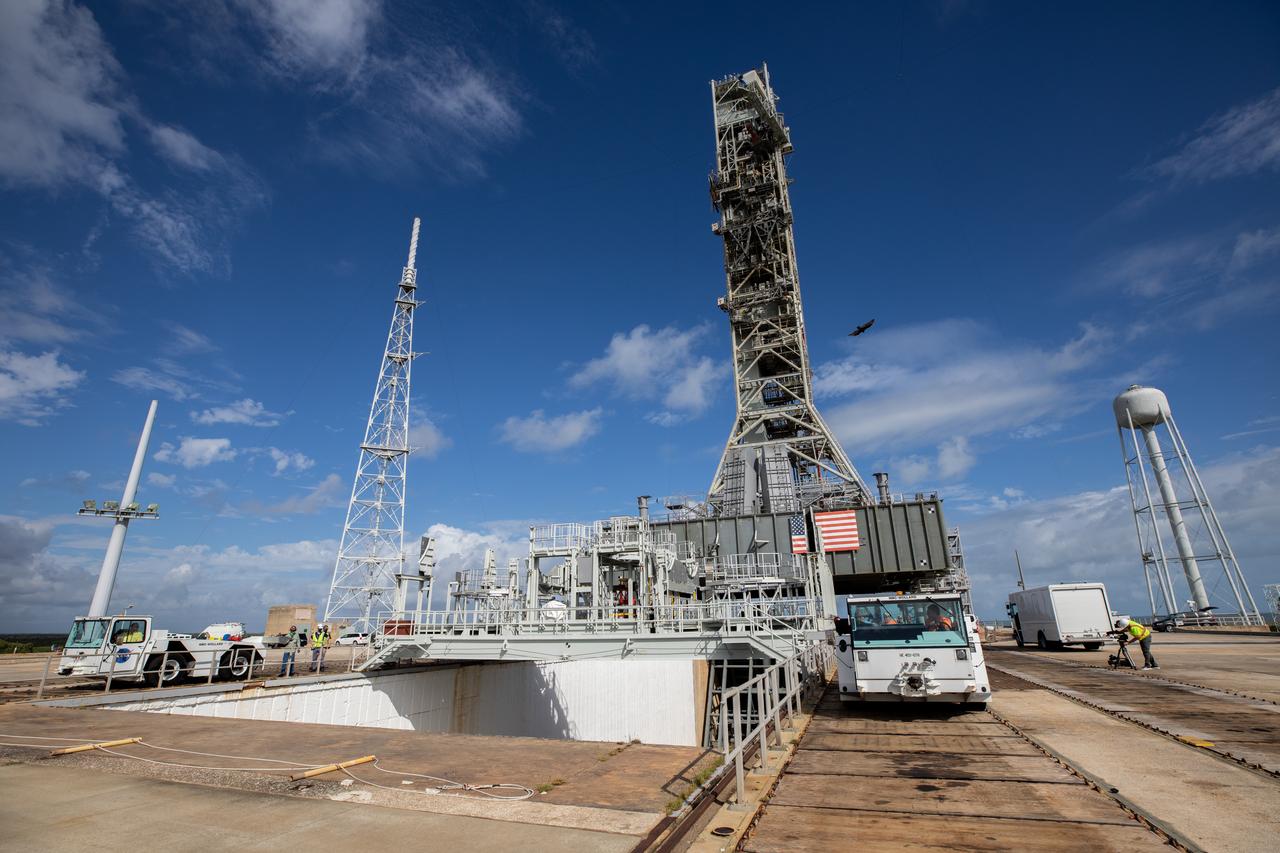
A view of the mobile launcher for the Artemis I mission at Launch Pad 39B at NASA’s Kennedy Space Center in Florida on Oct. 23, 2020. The nearly 400-foot-tall mobile launcher is at the pad while engineers with Exploration Ground Systems and Jacobs complete several tasks, including a timing test to validate the launch team’s countdown timeline, and a thorough, top-to-bottom wash down of the mobile launcher to remove any debris remaining from construction and installation of the umbilical arms. Artemis I will test the Orion spacecraft and Space Launch System as an integrated system ahead of crewed flights to the Moon. Under the Artemis program, NASA will land the first woman and the next man on the Moon in 2024.

A lightning strike was recorded at Launch Complex 39B at NASA’s Kennedy Space Center in Florida on June 10, 2022. NASA’s Space Launch System (SLS) and Orion spacecraft atop the mobile launcher are on the launch pad in preparation for the Artemis I mission. The lightning strike was recorded by cameras stationed at the pad and mobile launcher using a special filter called a “clear day frame,” which provides an overlay of the raw frame on a reference image. Artemis I will be the first integrated test of the SLS and Orion spacecraft. In later missions, NASA will land the first woman and the first woman of color on the surface of the Moon, paving the way for a long-term lunar presence and serving as a steppingstone on the way to Mars.
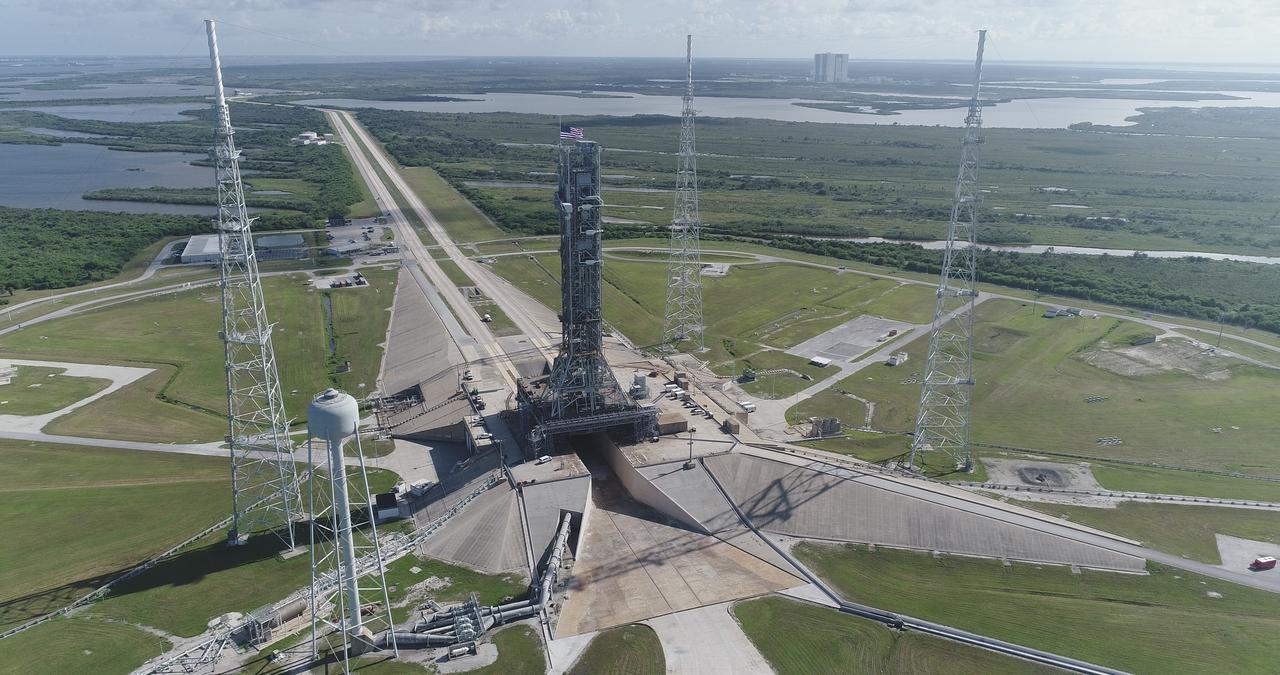
NASA's mobile launcher (ML) atop crawler-transporter 2 is at the top of Launch Pad 39B on Aug. 31, 2018, at the agency's Kennedy Space Center in Florida. The ML will undergo a fit check, followed by several days of systems testing. The 380-foot-tall mobile launcher is equipped with the crew access arm and several umbilicals that will provide power, environmental control, pneumatics, communication and electrical connections to NASA's Space Launch System (SLS) and Orion spacecraft. Exploration Ground Systems is preparing the ground systems necessary to launch SLS and Orion on Exploration Mission-1, missions to the Moon and on to Mars. Photo credit: NASA/Jamie Peer <b><a href="http://www.nasa.gov/audience/formedia/features/MP_Photo_Guidelines.html" rel="nofollow">NASA image use policy.</a></b>
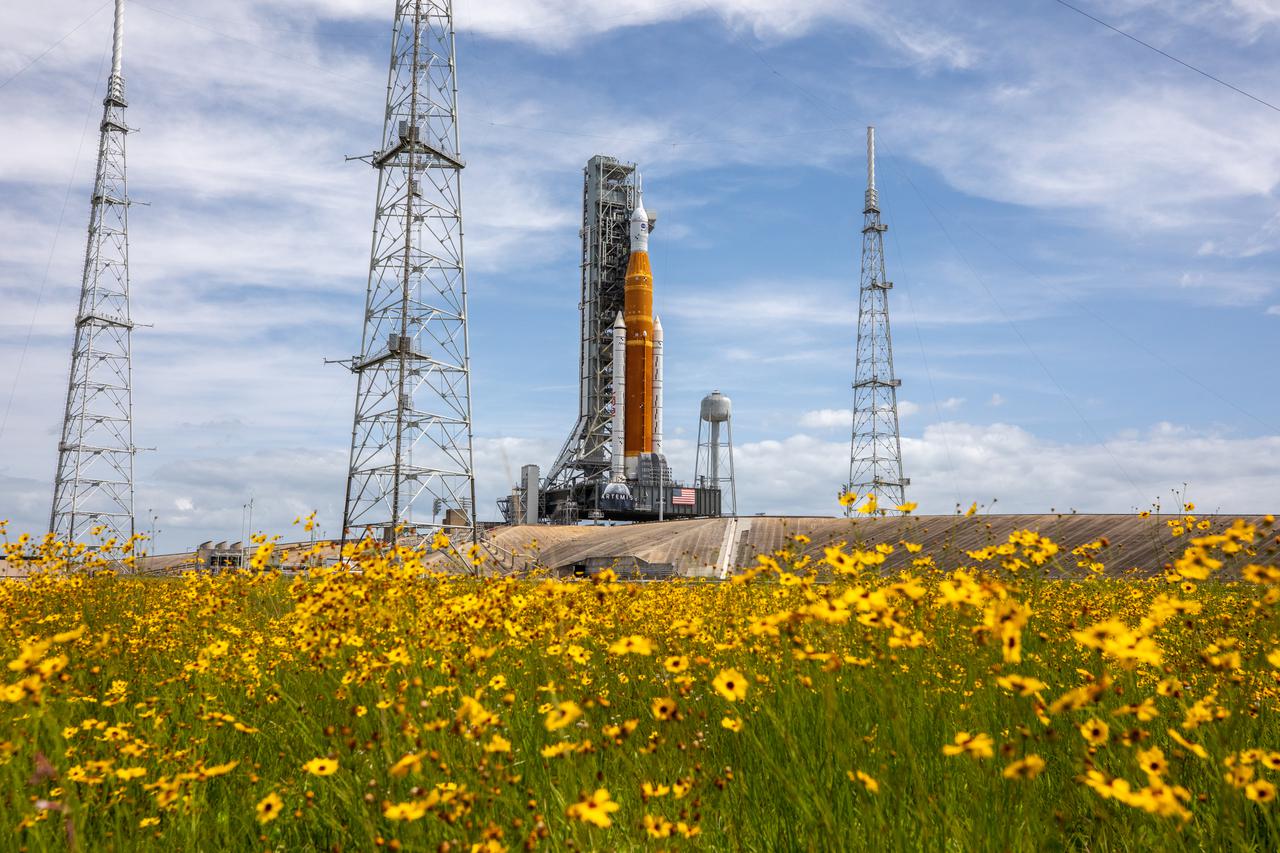
Wildflowers frame a view of the Artemis I Space Launch System (SLS) and Orion spacecraft on Launch Pad 39B at NASA’s Kennedy Space Center in Florida on April 21, 2022. Also in view are the three lightning protection towers and the water tower. The SLS and Orion atop the mobile launcher were transported to the pad on crawler-transporter 2 for a prelaunch test called a wet dress rehearsal. Artemis I will be the first integrated test of the SLS and Orion spacecraft. In future Artemis missions, NASA will land the first woman and the first person of color on the surface of the Moon, paving the way for a long-term lunar presence and serving as a steppingstone on the way to Mars.
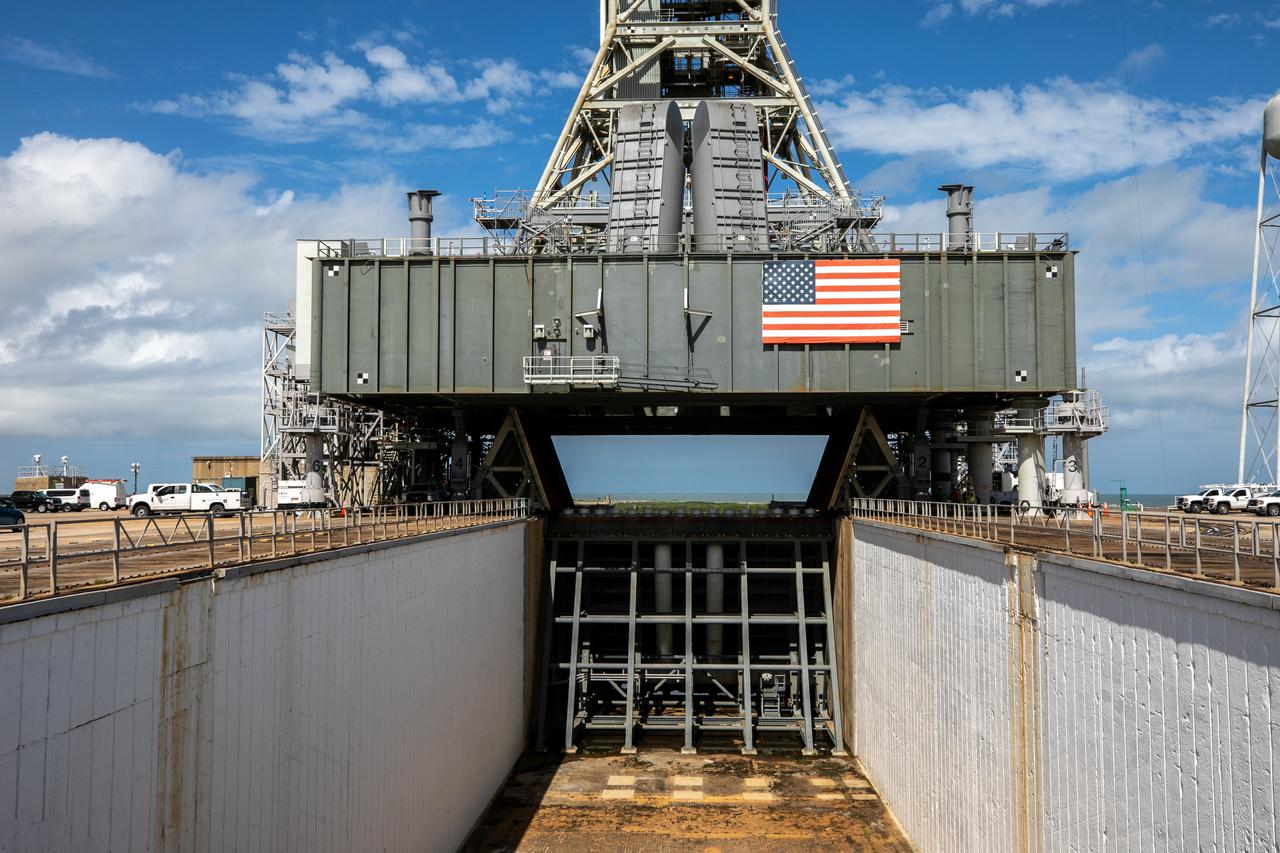
A close-up view of the mobile launcher for Artemis I with the two side flame deflectors positioned underneath during a countdown demonstration test at Launch Pad 39B at NASA’s Kennedy Space Center in Florida on Oct. 23, 2020. Also in view is the main flame deflector in the flame trench. The nearly 400-foot-tall mobile launcher is at the pad while engineers with Exploration Ground Systems and Jacobs complete several tasks, including a timing test to validate the launch team’s countdown timeline, and a thorough, top-to-bottom wash down of the mobile launcher to remove any debris remaining from construction and installation of the umbilical arms. Artemis I will test the Orion spacecraft and Space Launch System as an integrated system ahead of crewed flights to the Moon. Under the Artemis program, NASA will land the first woman and the next man on the Moon in 2024.
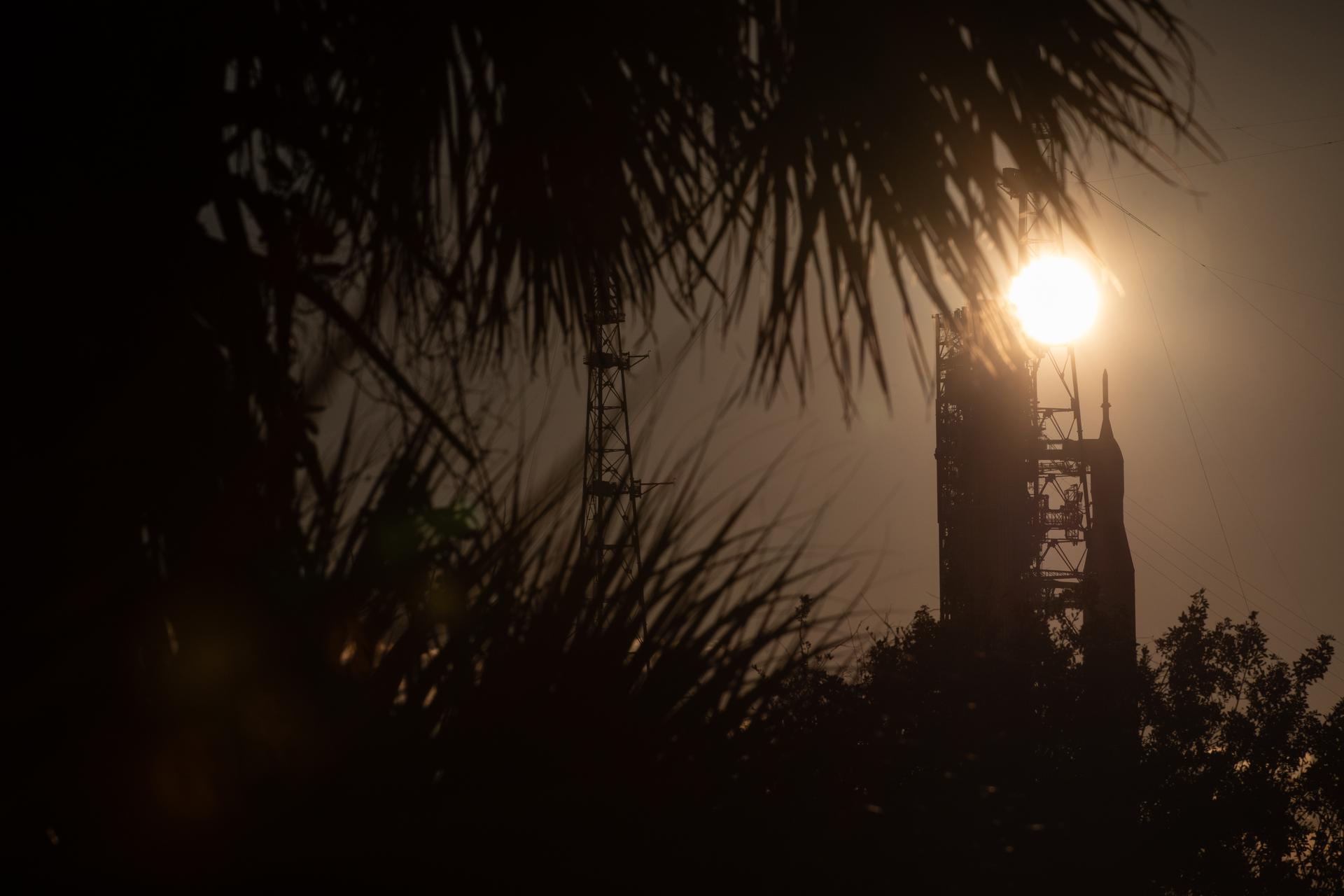
The Sun shines behind NASA’s Artemis II SLS (Space Launch System) rocket and Orion spacecraft atop a mobile launcher at Launch Complex 39B at NASA’s Kennedy Space Center in Florida on Sunday, Feb. 1, 2026. The Artemis II test flight will take Commander Reid Wiseman, Pilot Victor Glover, and Mission Specialist Christina Koch from NASA, and Mission Specialist Jeremy Hansen from the CSA (Canadian Space Agency), around the Moon and back to Earth.
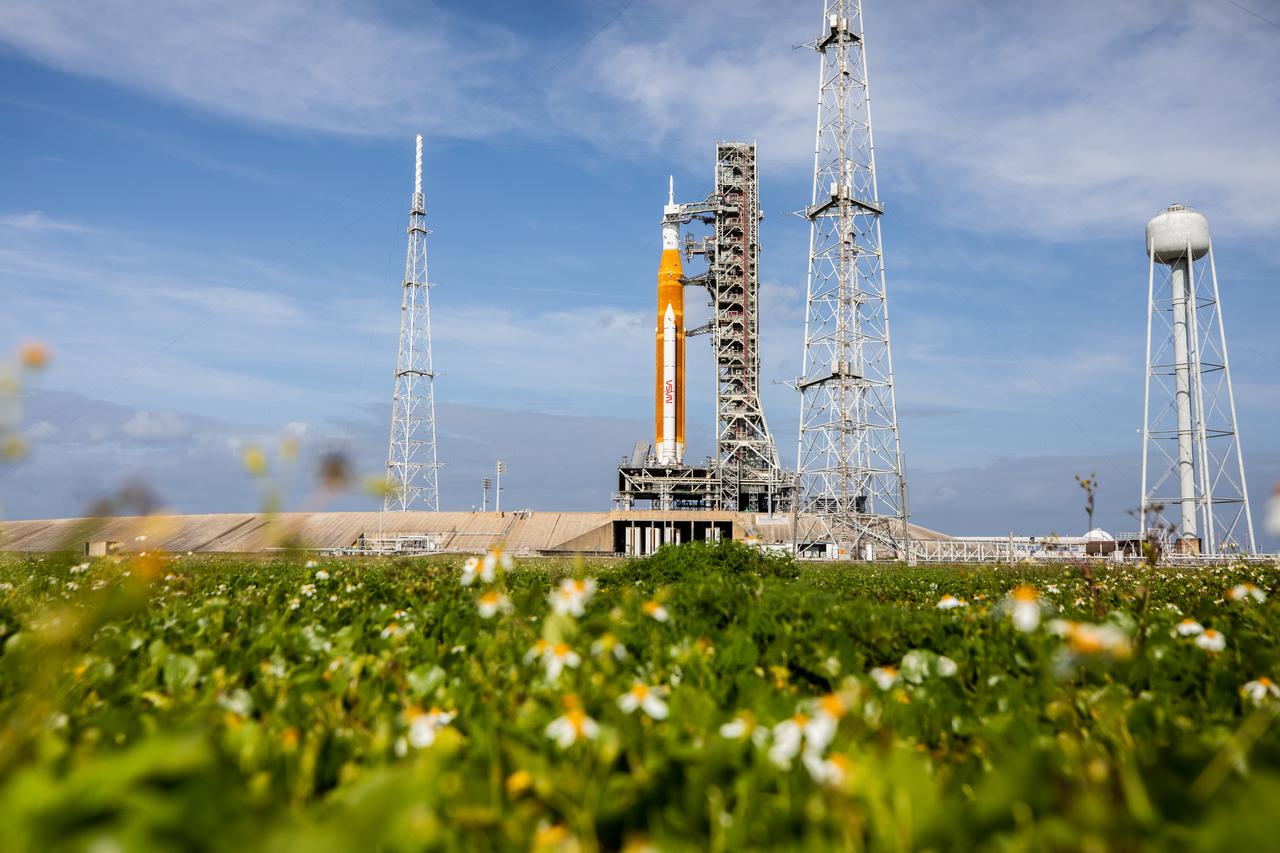
A view of the Artemis I Space Launch System (SLS) and Orion spacecraft on Launch Pad 39B at NASA’s Kennedy Space Center in Florida on April 21, 2022. The SLS and Orion atop the mobile launcher were transported to the pad on crawler-transporter 2 for a prelaunch test called a wet dress rehearsal. Artemis I will be the first integrated test of the SLS and Orion spacecraft. In future Artemis missions, NASA will land the first woman and the first person of color on the surface of the Moon, paving the way for a long-term lunar presence and serving as a steppingstone on the way to Mars.
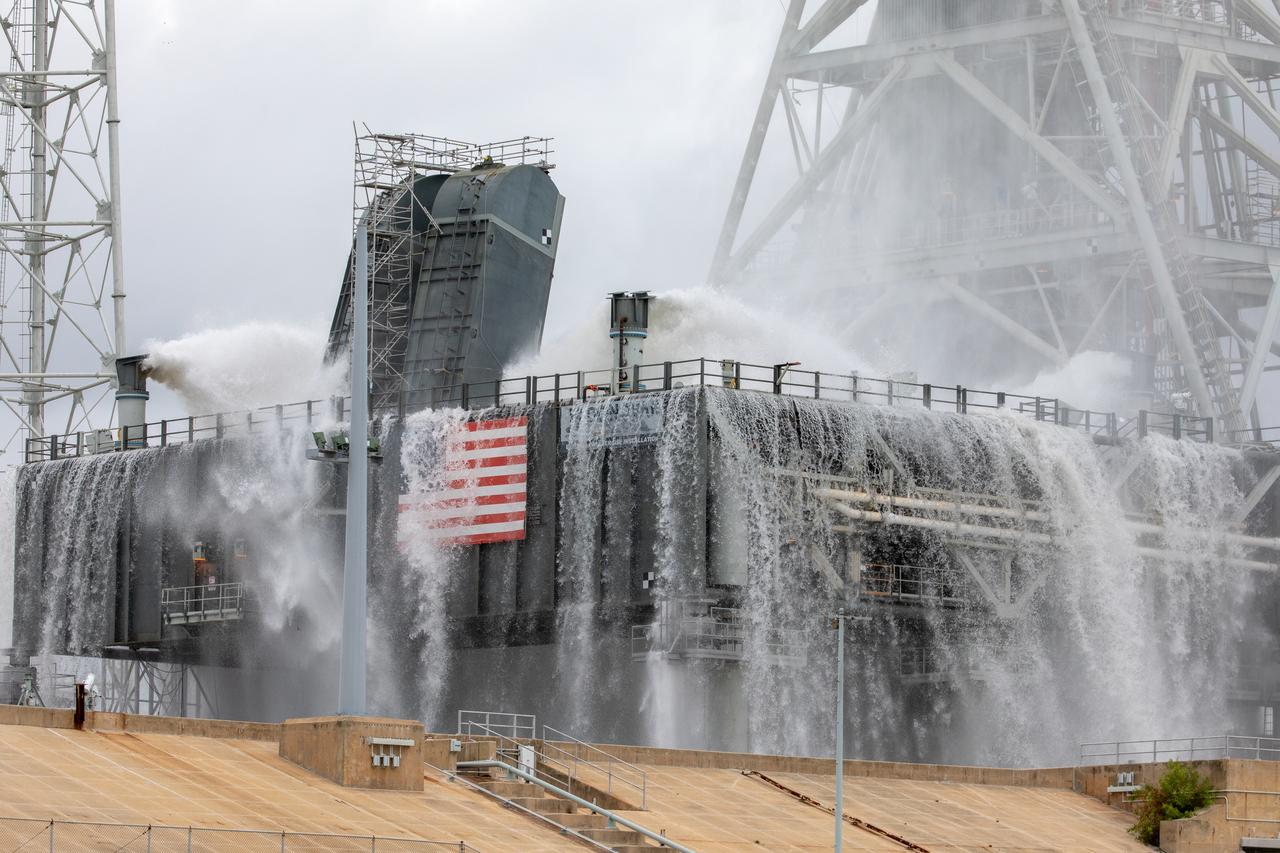
A flow test of the Ignition Overpressure Protection and Sound Suppression water deluge system is underway on the mobile launcher at Launch Pad 39B at NASA's Kennedy Space Center in Florida, on July 25, 2019. The testing is part of a series of tests that Exploration Ground System is doing to verify the system is ready for the new Space Launch System rocket. Modifications were made to the pad after a previous wet flow test, increasing the performance of the system. During the launch of Artemis 1 and subsequent missions, this water deluge system will release about 450,000 gallons of water across the mobile launcher and Flame Deflector to reduce the extreme heat and energy generated by the rocket during ignition and liftoff.
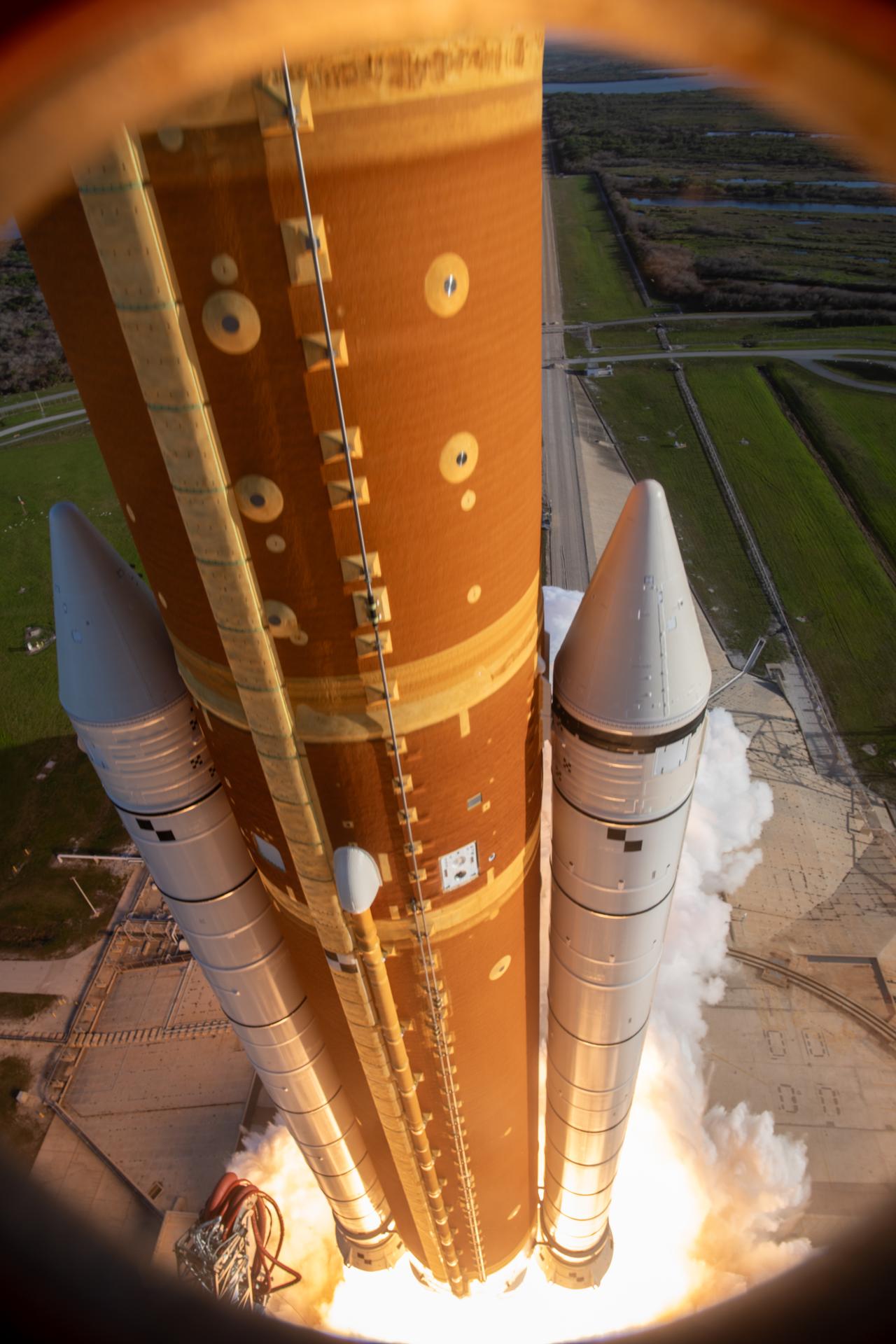
In this photograph looking down, NASA’s SLS (Space Launch System) rocket with the Orion spacecraft carrying Artemis II Commander Reid Wiseman, Pilot Victor Glover, and Mission Specialist Christina Koch from NASA, along with Mission Specialist Jeremy Hansen from the CSA (Canadian Space Agency), lifts off at 6:35 p.m. EDT on Wednesday, April 1, 2026, from Launch Complex 39B at NASA’s Kennedy Space Center I Florida. The Artemis II test flight will take the crew members on a 10-day journey around the Moon and back on Friday, April 10.
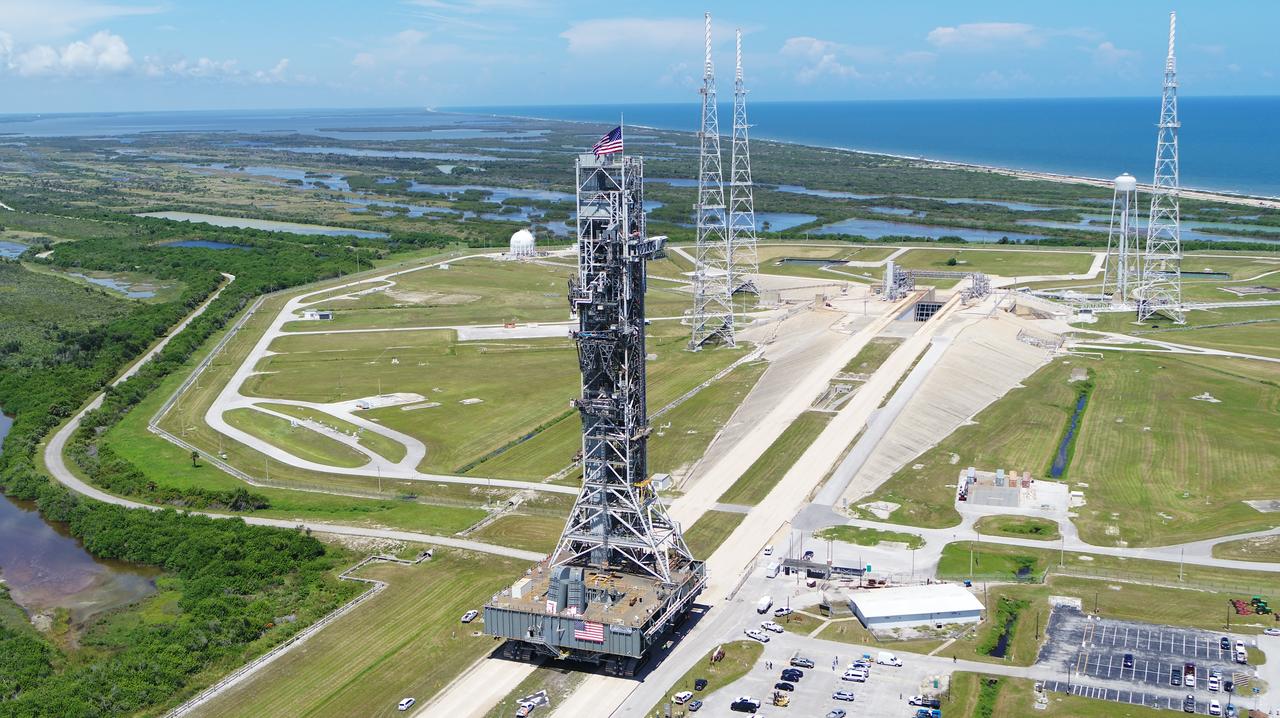
NASA's mobile launcher (ML) atop crawler-transporter 2 arrives at Launch Pad 39B on Aug. 31, 2018, at the agency's Kennedy Space Center in Florida. The ML will undergo a fit check, followed by several days of systems testing. The 380-foot-tall mobile launcher is equipped with the crew access arm and several umbilicals that will provide power, environmental control, pneumatics, communication and electrical connections to NASA's Space Launch System (SLS) and Orion spacecraft. Exploration Ground Systems is preparing the ground systems necessary to launch SLS and Orion on Exploration Mission-1, missions to the Moon and on to Mars.

On Dec. 19, 2018, Bill Hill, deputy associate administrator for Exploration Systems Development at NASA Headquarters in Washington, speaks during a groundbreaking ceremony for a new liquid hydrogen tank for Launch Complex 39B at the agency's Kennedy Space Center. The storage facility will hold 1.25 million gallons of the propellant for NASA's Space Launch System rocket designed to boost the agency's Orion spacecraft, sending humans to distant destinations such as the Moon and Mars.

A lightning strike was recorded at Launch Complex 39B at NASA’s Kennedy Space Center in Florida on June 10, 2022. NASA’s Space Launch System (SLS) and Orion spacecraft atop the mobile launcher are on the launch pad in preparation for the Artemis I mission. The lightning strike was recorded by cameras stationed at the pad and mobile launcher using a special filter called a “clear day frame,” which provides an overlay of the raw frame on a reference image. Artemis I will be the first integrated test of the SLS and Orion spacecraft. In later missions, NASA will land the first woman and the first woman of color on the surface of the Moon, paving the way for a long-term lunar presence and serving as a steppingstone on the way to Mars.
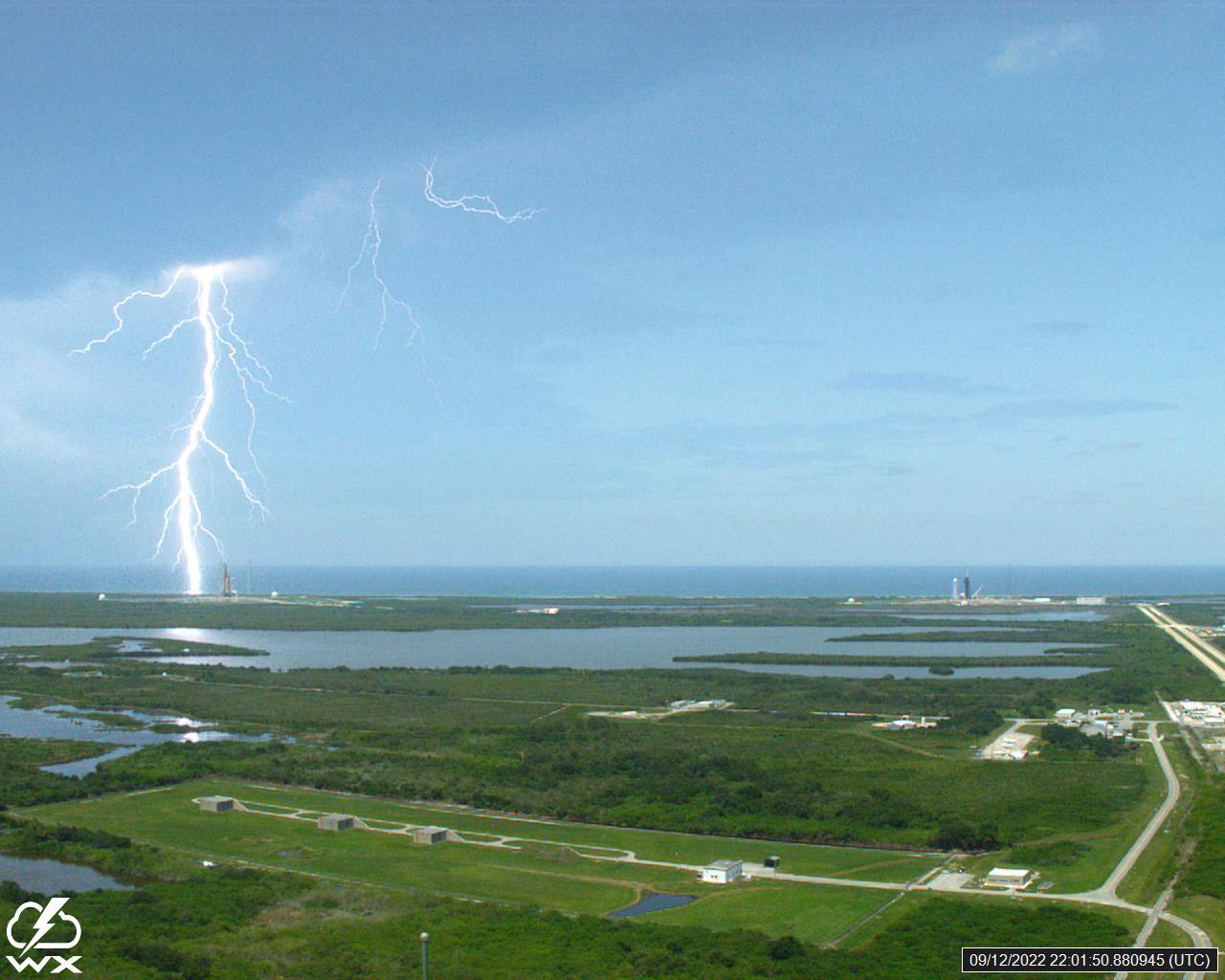
A lightning strike was recorded at Launch Complex 39B at NASA’s Kennedy Space Center in Florida on Sept. 12, 2022. NASA’s Space Launch System (SLS) and Orion spacecraft atop the mobile launcher are on the launch pad in preparation for the Artemis I mission. The lightning strike was recorded by cameras stationed at the pad and mobile launcher using a special filter called a “clear day frame,” which provides an overlay of the raw frame on a reference image. Artemis I will be the first integrated test of the SLS and Orion spacecraft. In later missions, NASA will land the first woman and the first woman of color on the surface of the Moon, paving the way for a long-term lunar presence and serving as a steppingstone on the way to Mars.
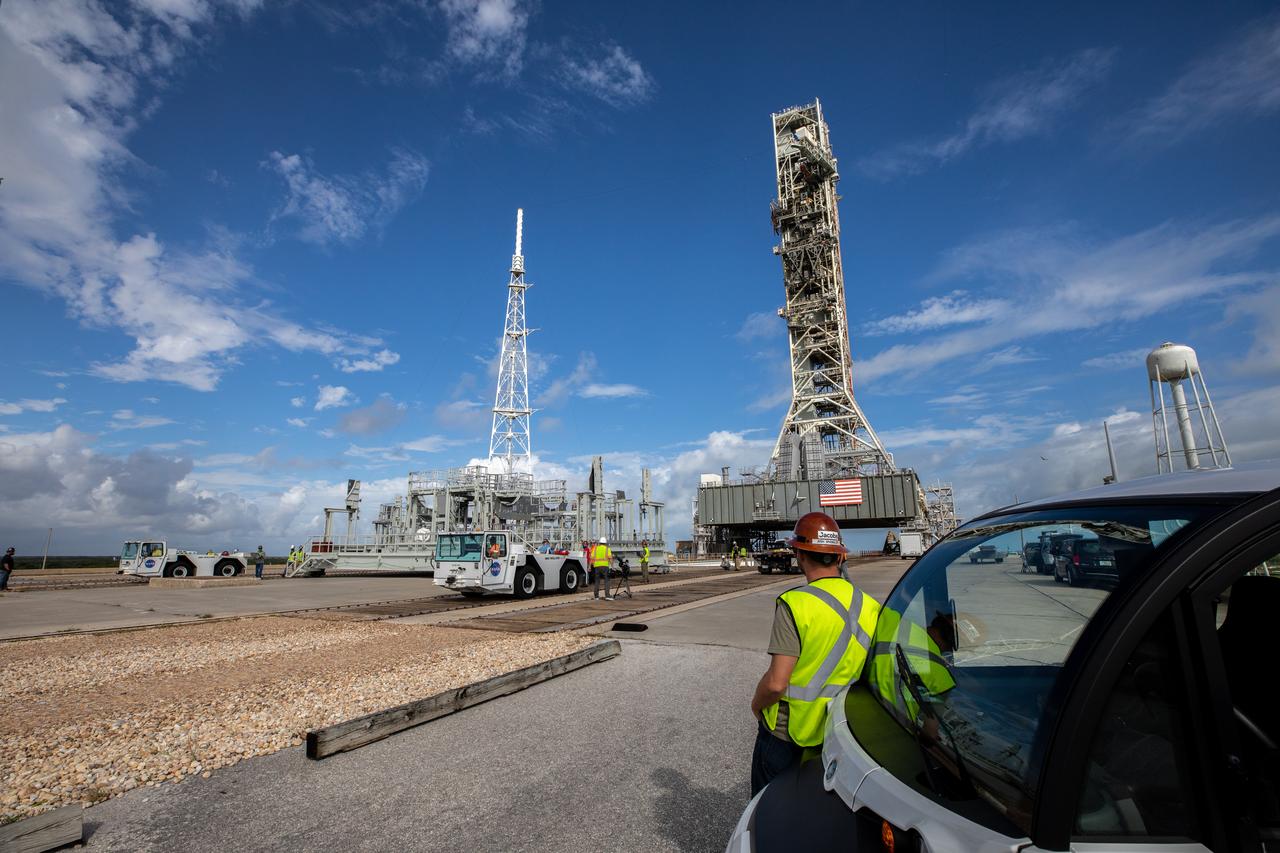
A view of the mobile launcher for Artemis I on Launch Pad 39B at NASA’s Kennedy Space Center in Florida on Oct. 23, 2020. The engine service platform has been lowered and removed from the mobile launcher and is in view on a flatbed carrier. The nearly 400-foot-tall mobile launcher is at the pad while engineers with Exploration Ground Systems and Jacobs complete several tasks, including a timing test to validate the launch team’s countdown timeline, and a thorough, top-to-bottom wash down of the mobile launcher to remove any debris remaining from construction and installation of the umbilical arms. Artemis I will test the Orion spacecraft and Space Launch System as an integrated system ahead of crewed flights to the Moon. Under the Artemis program, NASA will land the first woman and the next man on the Moon in 2024.
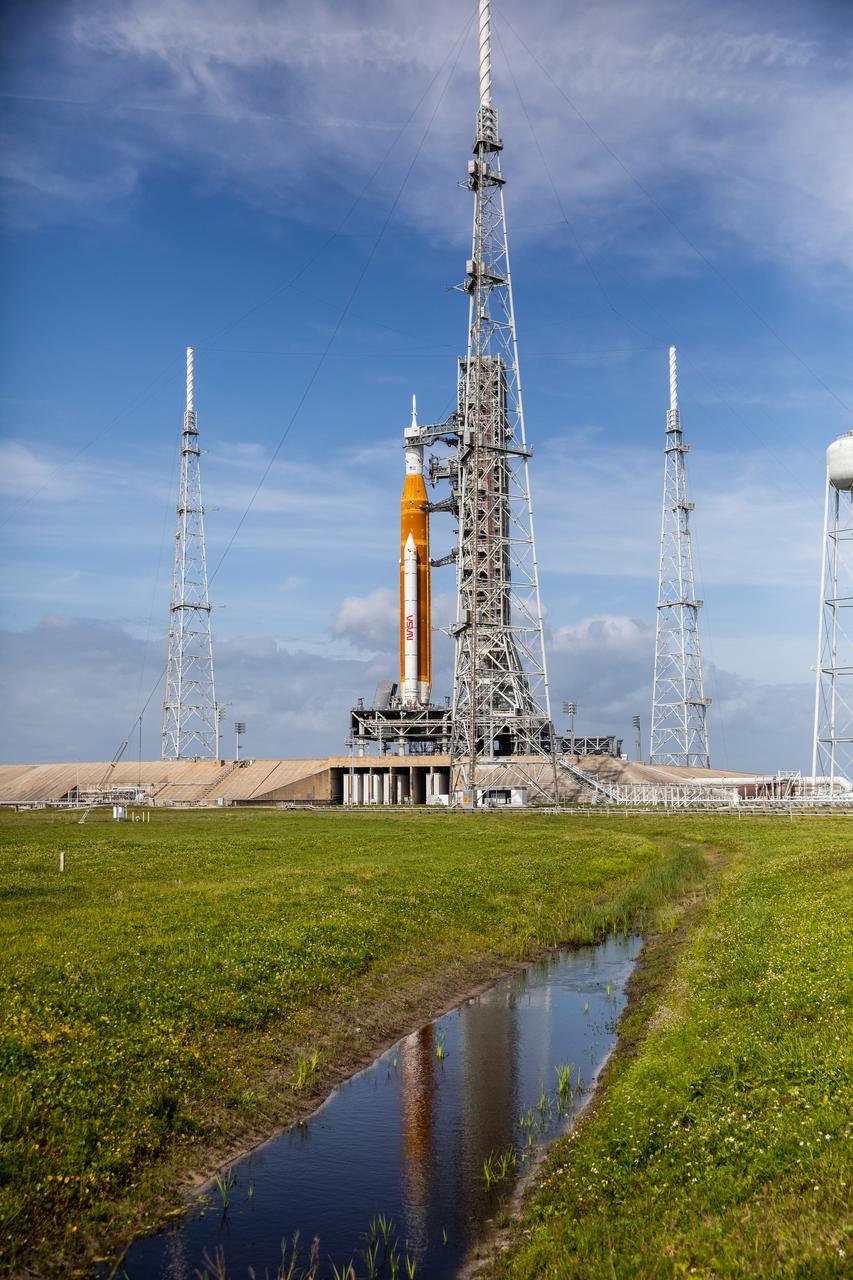
A view of the Artemis I Space Launch System (SLS) and Orion spacecraft atop the mobile launcher on Launch Pad 39B at NASA’s Kennedy Space Center in Florida on April 21, 2022. Also in view are the three lightning protection towers and water tower. The SLS and Orion atop the mobile launcher were transported to the pad on crawler-transporter 2 for a prelaunch test called a wet dress rehearsal. Artemis I will be the first integrated test of the SLS and Orion spacecraft. In future Artemis missions, NASA will land the first woman and the first person of color on the surface of the Moon, paving the way for a long-term lunar presence and serving as a steppingstone on the way to Mars.
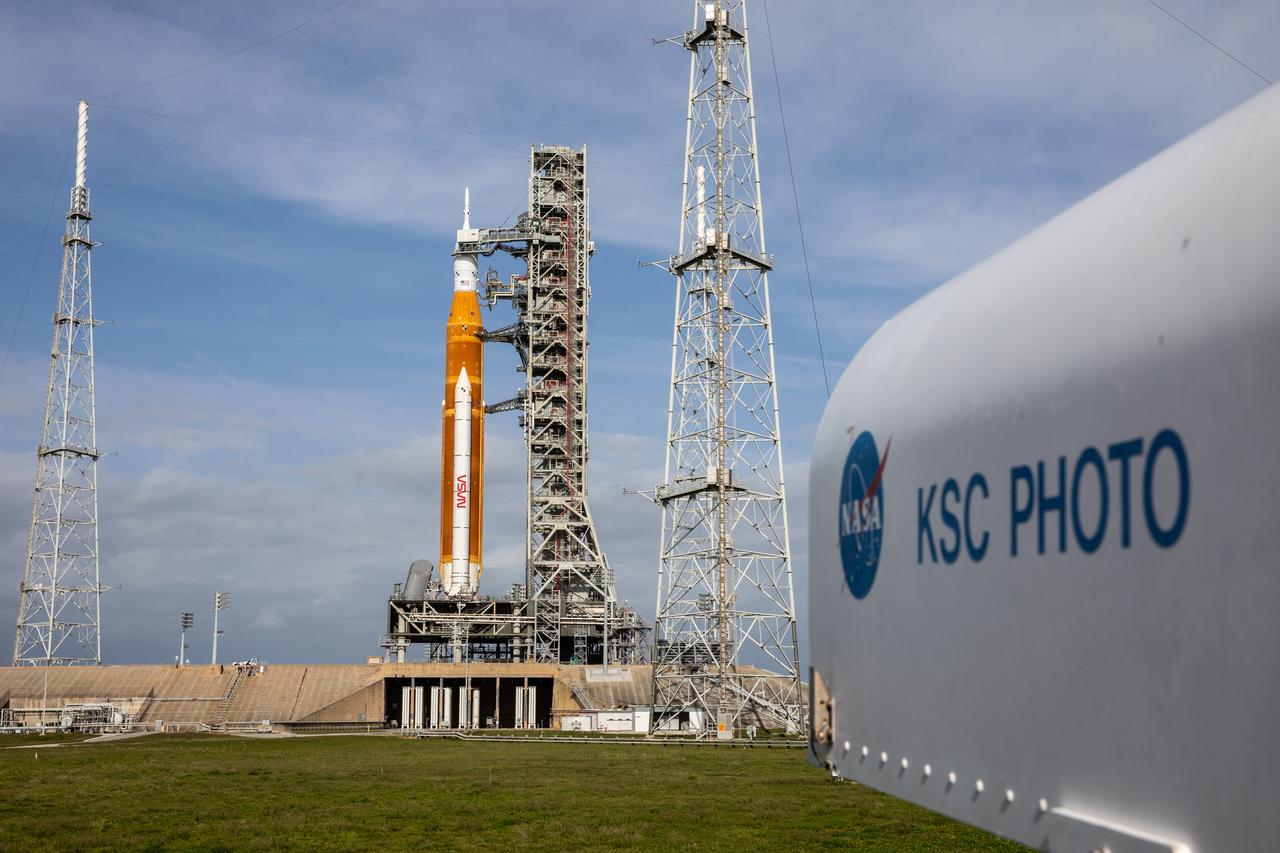
A view of the Artemis I Space Launch System (SLS) and Orion spacecraft on Launch Pad 39B at NASA’s Kennedy Space Center in Florida on April 21, 2022. Also in view are two of three lightning protection towers. The SLS and Orion atop the mobile launcher were transported to the pad on crawler-transporter 2 for a prelaunch test called a wet dress rehearsal. Artemis I will be the first integrated test of the SLS and Orion spacecraft. In future Artemis missions, NASA will land the first woman and the first person of color on the surface of the Moon, paving the way for a long-term lunar presence and serving as a steppingstone on the way to Mars.
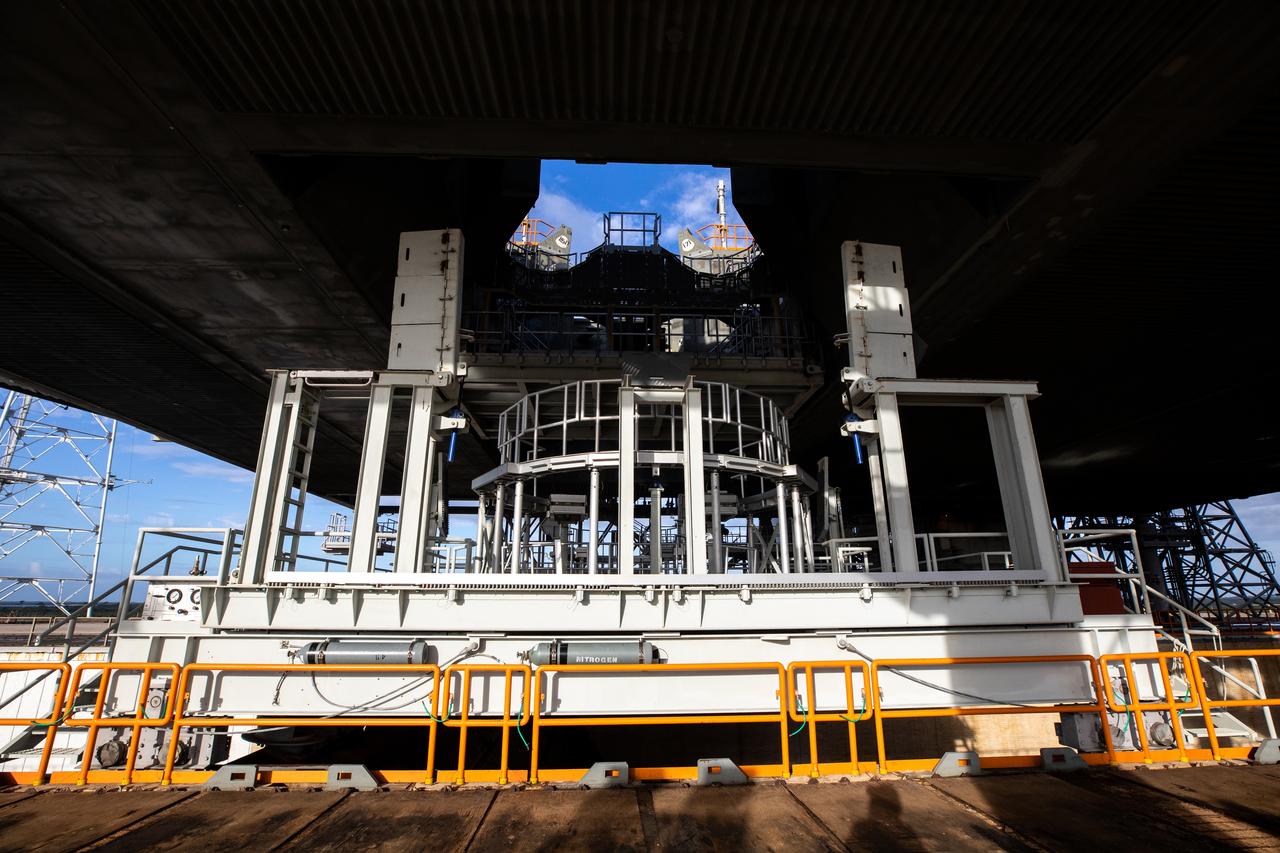
The engine service platform is moved into position beneath the mobile launcher for Artemis I at Launch Pad 39B on Oct. 23, 2020, at NASA’s Kennedy Space Center in Florida. The service platform allows access to the RS-25 engines on the Space Launch System core stage for routine work or inspections. The nearly 400-foot-tall mobile launcher will remain at the pad while engineers with Exploration Ground Systems and Jacobs will complete several tasks, including a timing test to validate the launch team’s countdown timeline, and a thorough, top-to-bottom wash down of the mobile launcher to remove any debris remaining from construction and installation of the umbilical arms. Artemis I will test the Orion spacecraft and Space Launch System as an integrated system ahead of crewed flights to the Moon. Under the Artemis program, NASA will land the first woman and the next man on the Moon in 2024.
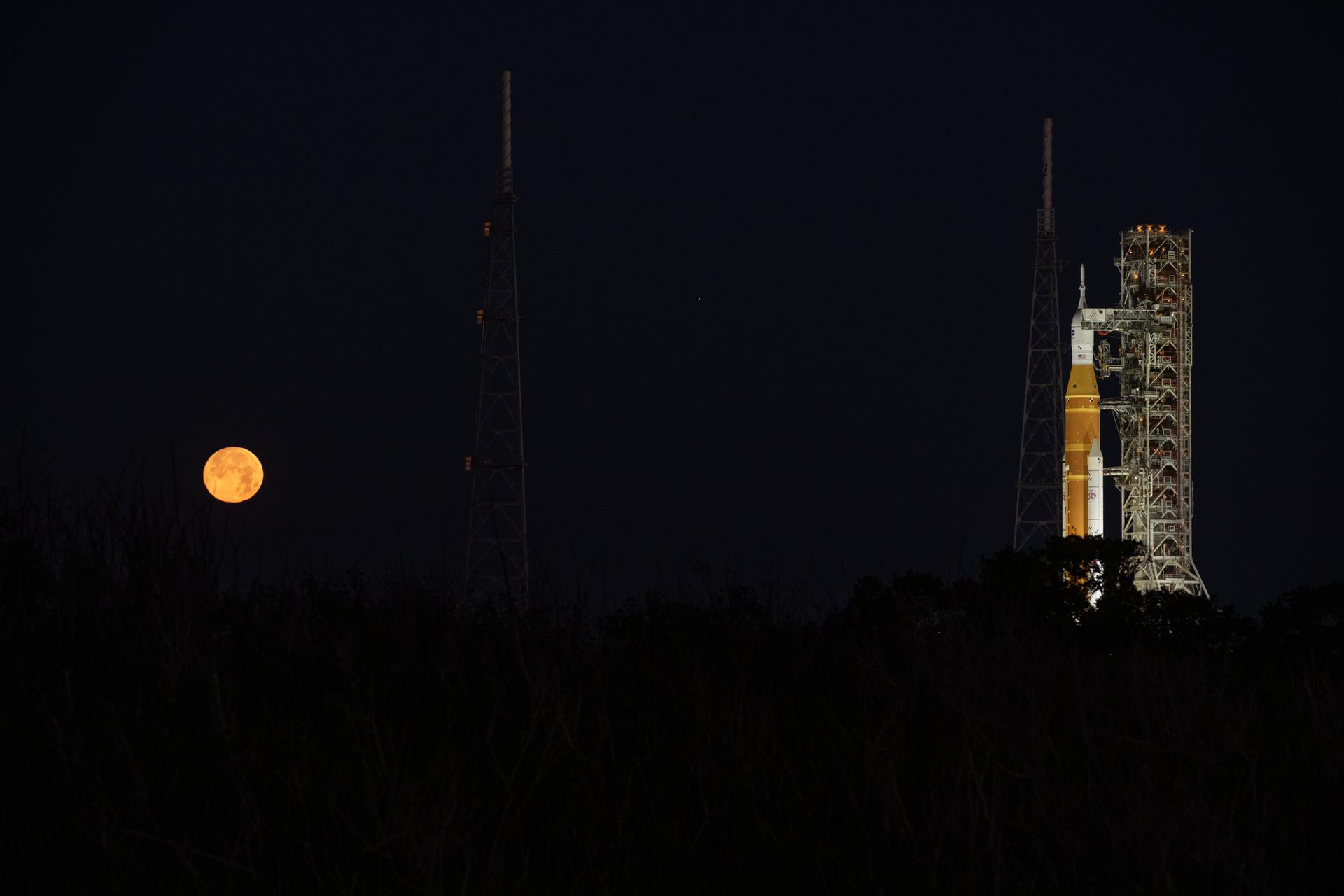
The Moon rises behind NASA’s Artemis II SLS (Space Launch System) rocket and Orion spacecraft atop a mobile launcher at Launch Complex 39B at NASA’s Kennedy Space Center in Florida on Sunday, Feb. 1,. 2026. The Artemis II test flight will take Commander Reid Wiseman, Pilot Victor Glover, and Mission Specialist Christina Koch from NASA, and Mission Specialist Jeremy Hansen from the CSA (Canadian Space Agency), around the Moon and back to Earth.