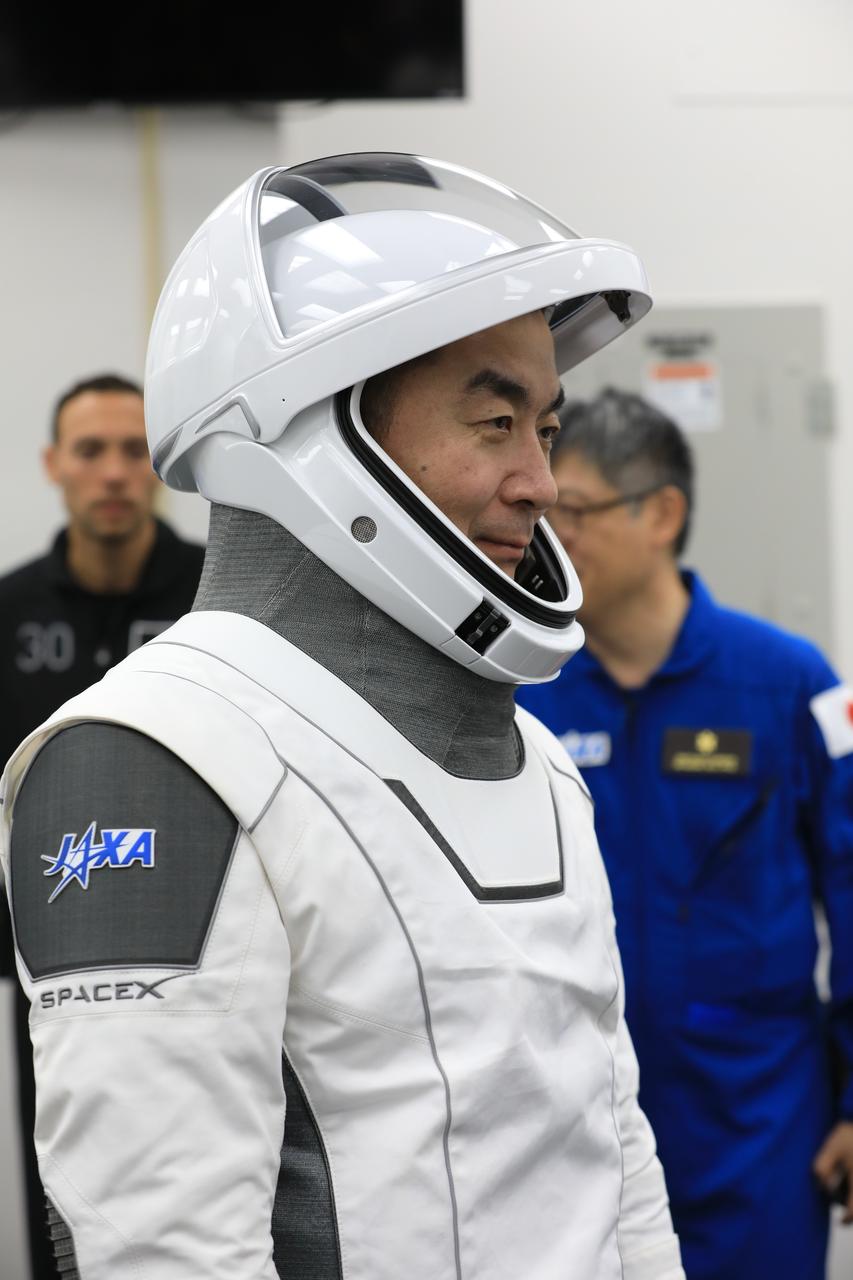
JAXA (Japan Aerospace Exploration Agency) astronaut Kimiya Yui conducts leak checks for his SpaceX spacesuit inside the crew suit-up room in the Neil A. Armstrong Operations and Checkout Building at the agency’s Kennedy Space Center in Florida on Thursday, July 31, 2025, during the first attempt of NASA’s SpaceX Crew-11 mission to the International Space Station. Yui, NASA astronauts Zena Cardman and Mike Fincke, along with Roscosmos cosmonaut Oleg Platonov, are scheduled to lift off aboard SpaceX’s Dragon spacecraft and Falcon 9 rocket for its second attempt at 11:43 a.m. EDT Friday, Aug. 1, 2025, from Launch Complex 39A at NASA Kennedy.
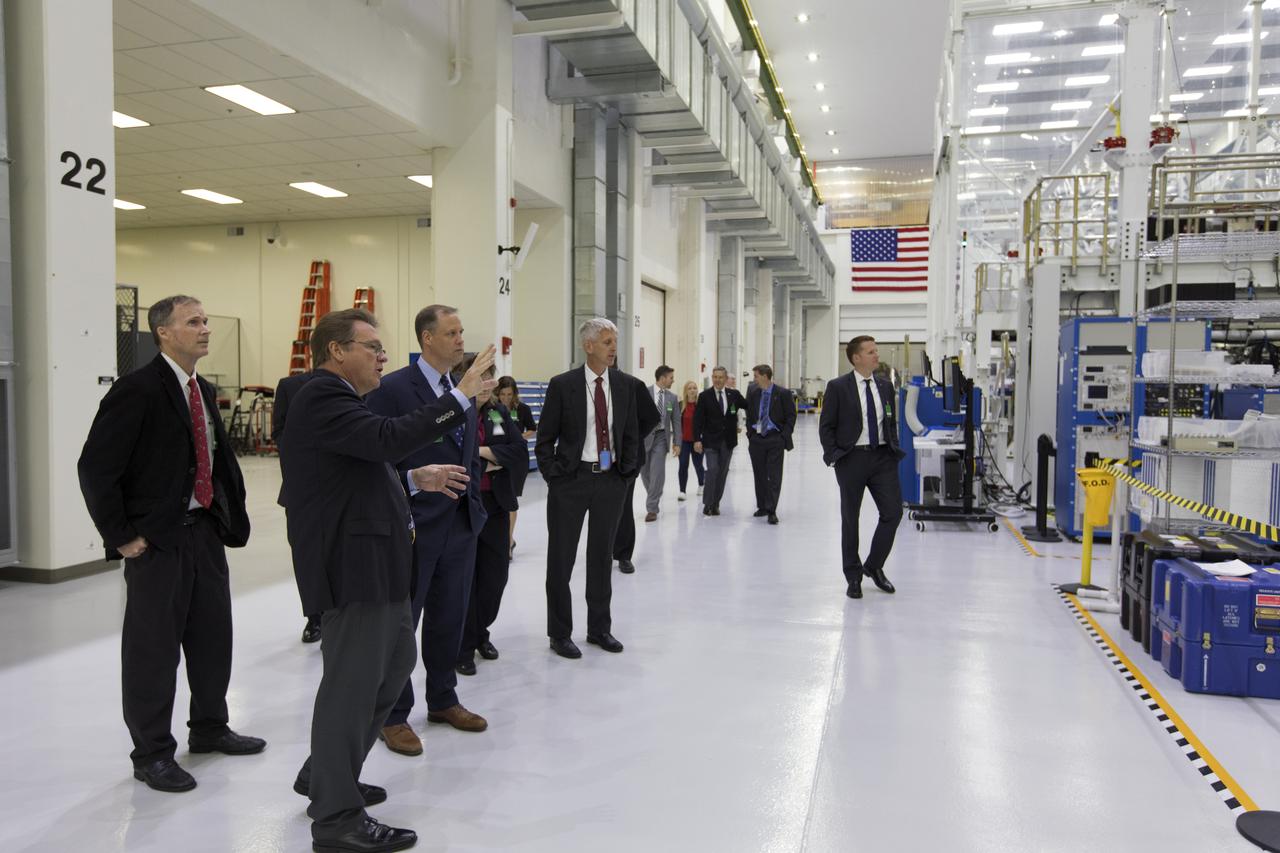
NASA Administrator Jim Bridenstine, third from left, is briefed by Jules Schneider, left, director of Orion operations for Lockheed Martin, during a tour of Kennedy Space Center’s Neil Armstrong Operations and Checkout Building on Tuesday, Aug. 7, 2018. It was Bridenstine’s first official visit to the Florida spaceport.
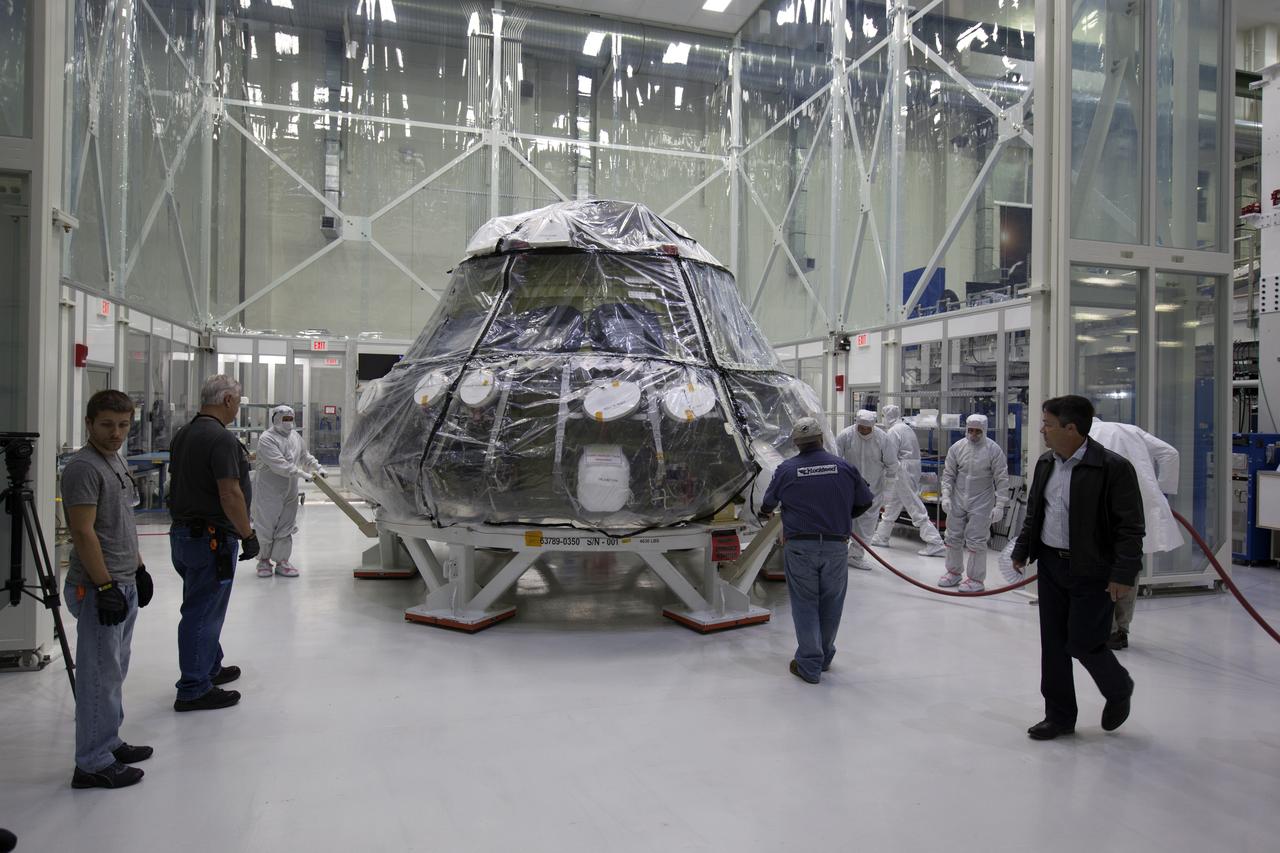
The Orion crew module pressure vessel for NASA’s Exploration Mission 1 (EM-1) is being moved from a clean room to a work station inside the Neil Armstrong Operations and Checkout Building high bay at NASA’s Kennedy Space Center in Florida. Orion will undergo additional processing to prepare it for launch in 2019. The spacecraft is being prepared for its first integrated flight atop the Space Launch System rocket on Exploration Mission-1.

A worker tries out a virtual reality experience during the 2017 Innovation Expo at NASA's Kennedy Space Center in Florida. The purpose of the annual two-day event is to help foster innovation and creativity among the Kennedy workforce. The event included several keynote speakers, training opportunities, an innovation showcase and the KSC Kickstart competition.
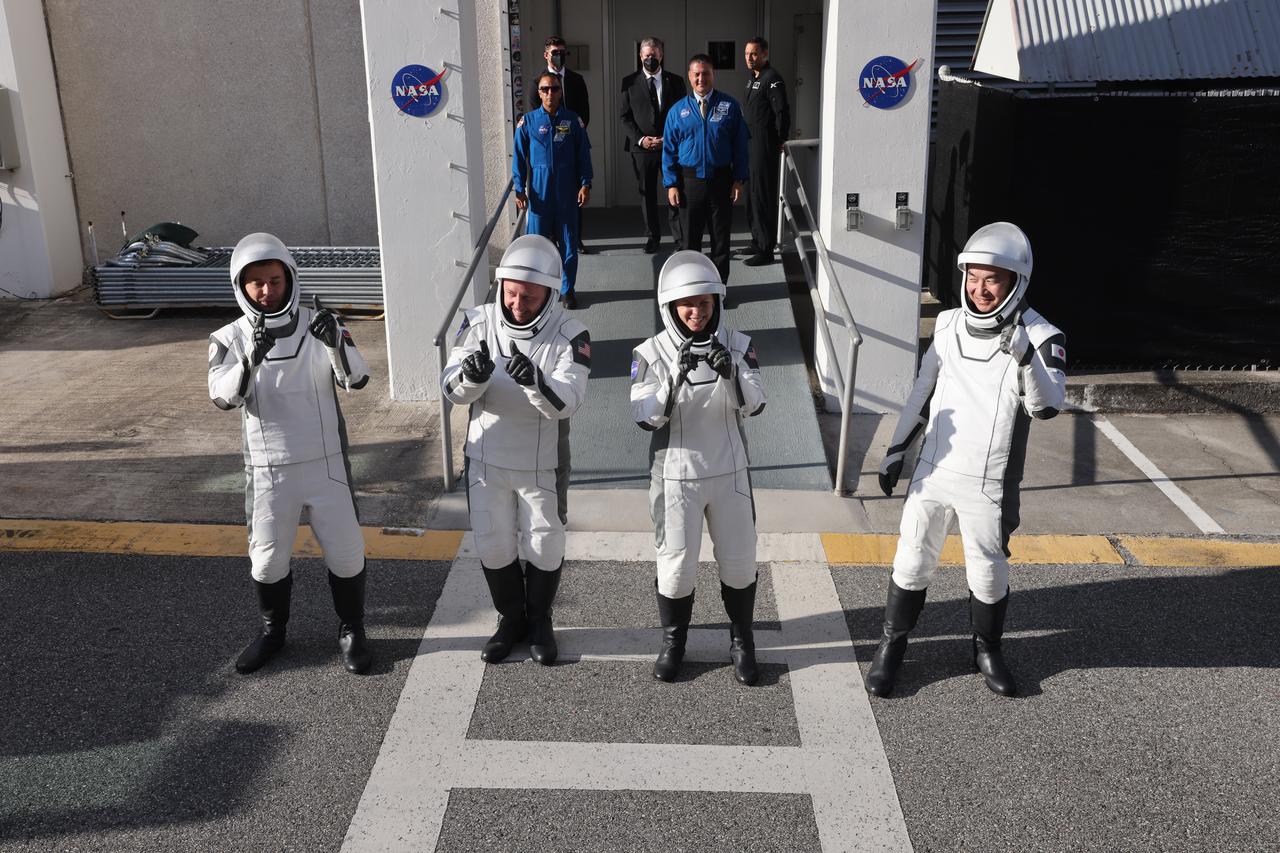
From right to left, JAXA (Japan Aerospace Exploration Agency) astronaut Kimiya Yui, NASA astronauts Zena Cardman and Mike Fincke, along with and Roscosmos cosmonaut Oleg Platonov wave to family and friends as they walk out of the Neil A. Armstrong Operations and Checkout Building at the agency’s Kennedy Space Center in Florida during the second launch attempt of NASA’s SpaceX Crew-11 mission to the International Space Station on Friday, Aug. 1, 2025. Crew-11 is scheduled to lift off aboard SpaceX’s Dragon spacecraft and Falcon 9 rocket at 11:43 a.m. EDT, from Launch Complex 39A at NASA Kennedy.
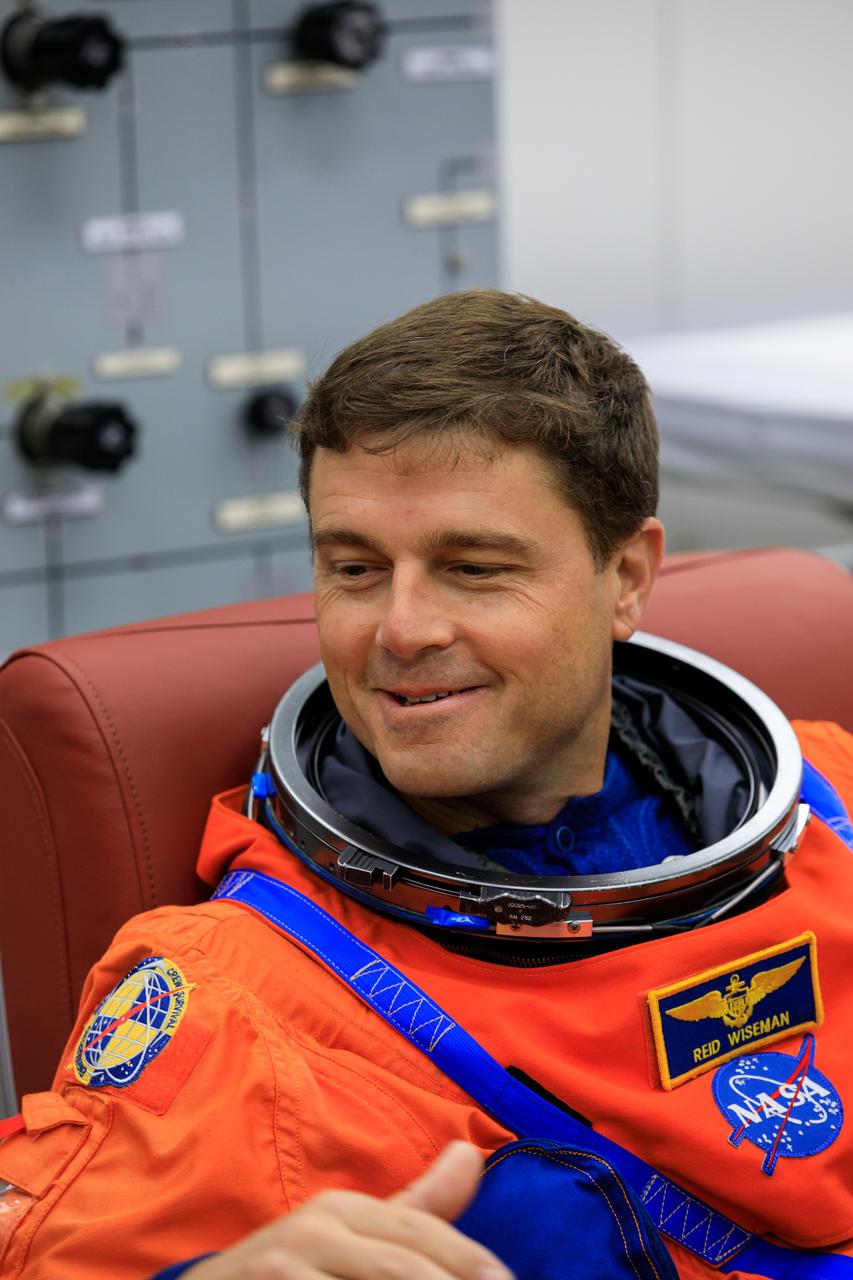
Inside the Astronaut Crew Quarters at the Neil Armstrong Operations and Checkout Building at NASA’s Kennedy Space Center in Florida, Artemis II crew member NASA astronaut Reid Wiseman is shown wearing a test version of the Orion crew survival system spacesuits the crew will wear on launch day as part of an integrated ground systems test on Wednesday, Sept. 20.
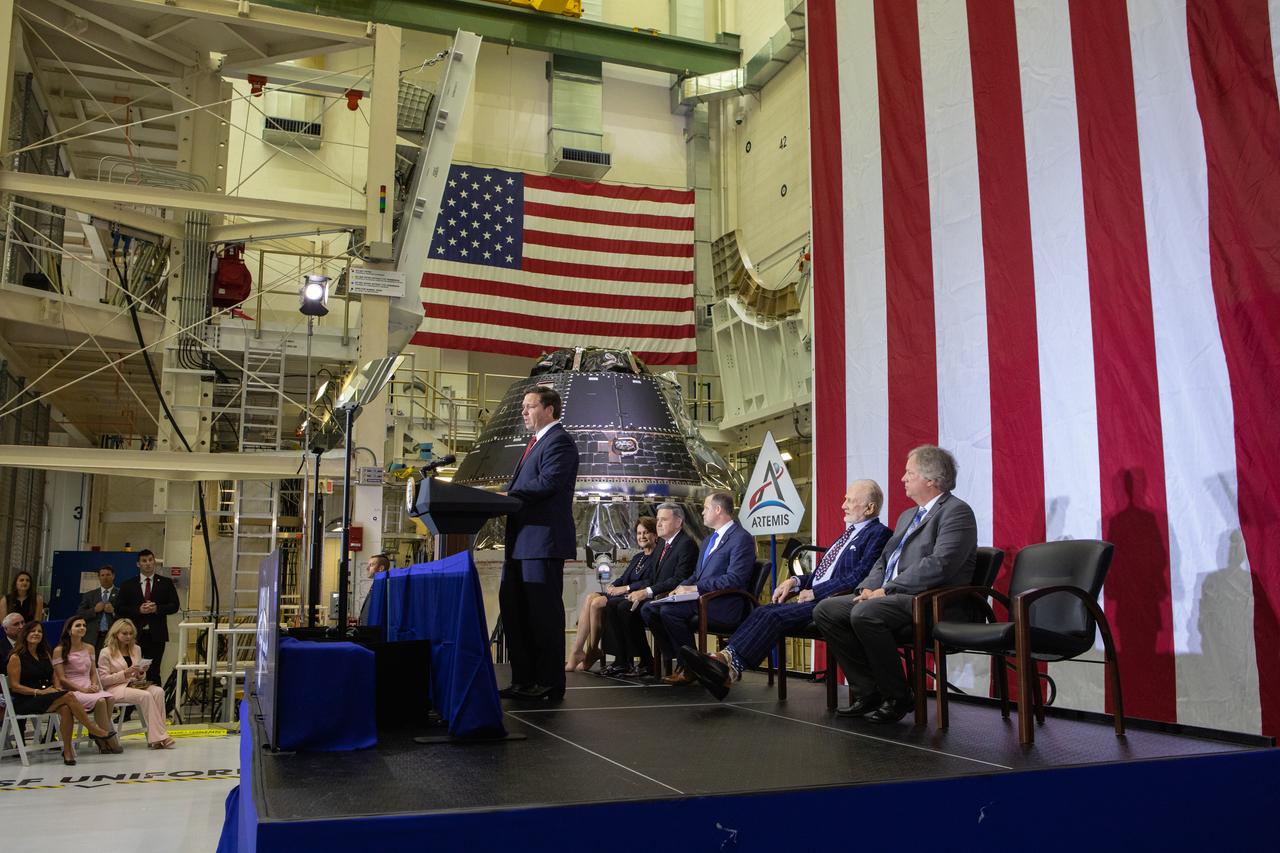
Florida Governor RonDeSantis addresses invited guests, elected officials and NASA, Lockheed Martin and other industry leaders at Kennedy Space Center’s Neil Armstrong Operations & Checkout Building on July 20, 2019. Vice President Pence visited the Florida spaceport in honor of the 50th anniversary of the Apollo 11 mission, and also spoke about NASA’s progress and future plans to return to the Moon and on to Mars.
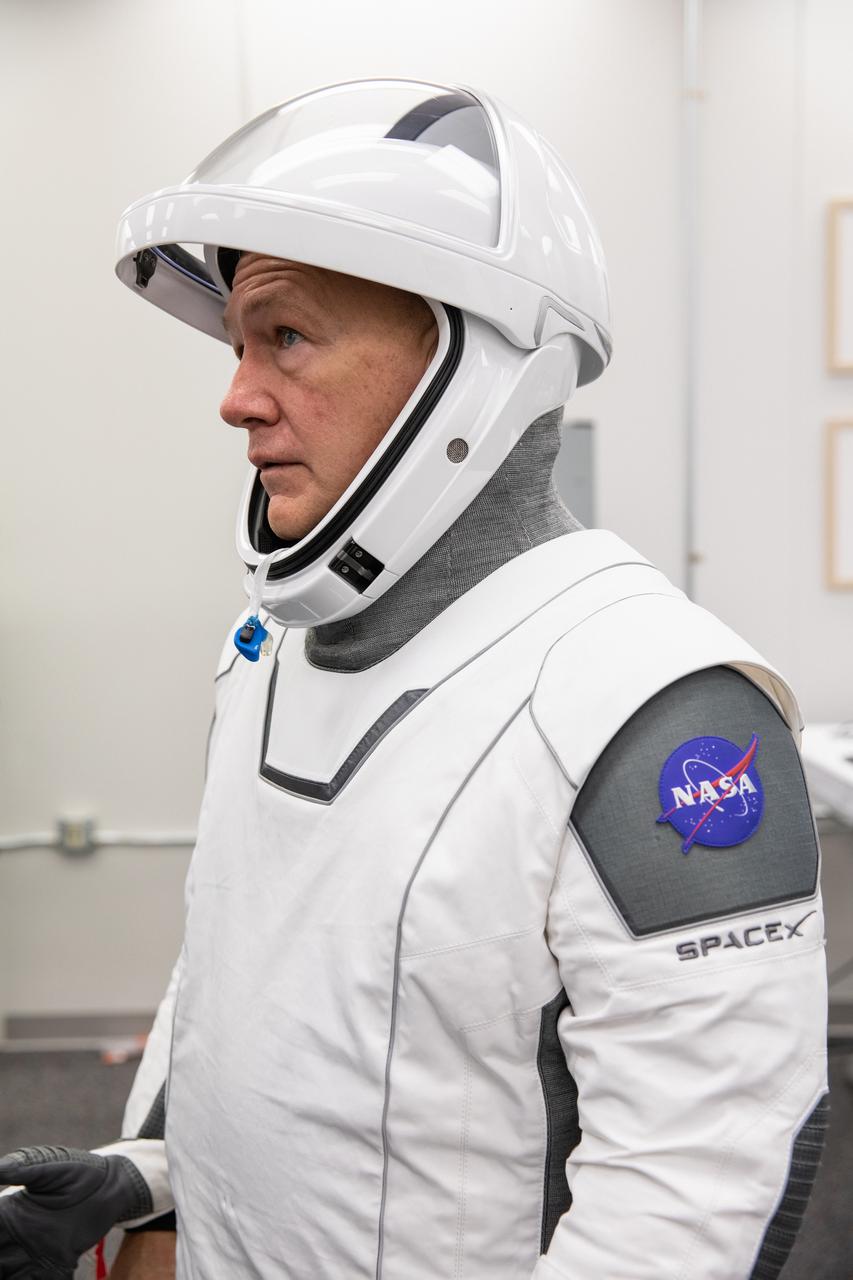
NASA astronaut Doug Hurley wears a SpaceX spacesuit in the Astronaut Crew Quarters at Kennedy Space Center in Florida on Jan. 17, 2020, during a dress rehearsal ahead of the company’s uncrewed In-Flight Abort Test. A SpaceX Falcon 9 rocket and Crew Dragon spacecraft will lift off from Launch Complex 39A on the flight test, which will demonstrate the spacecraft’s escape capabilities in preparation for crewed flights to the International Space Station as part of the agency’s Commercial Crew Program. Hurley and NASA astronaut Bob Behnken are slated to fly on the company’s first crewed mission, Demo-2.
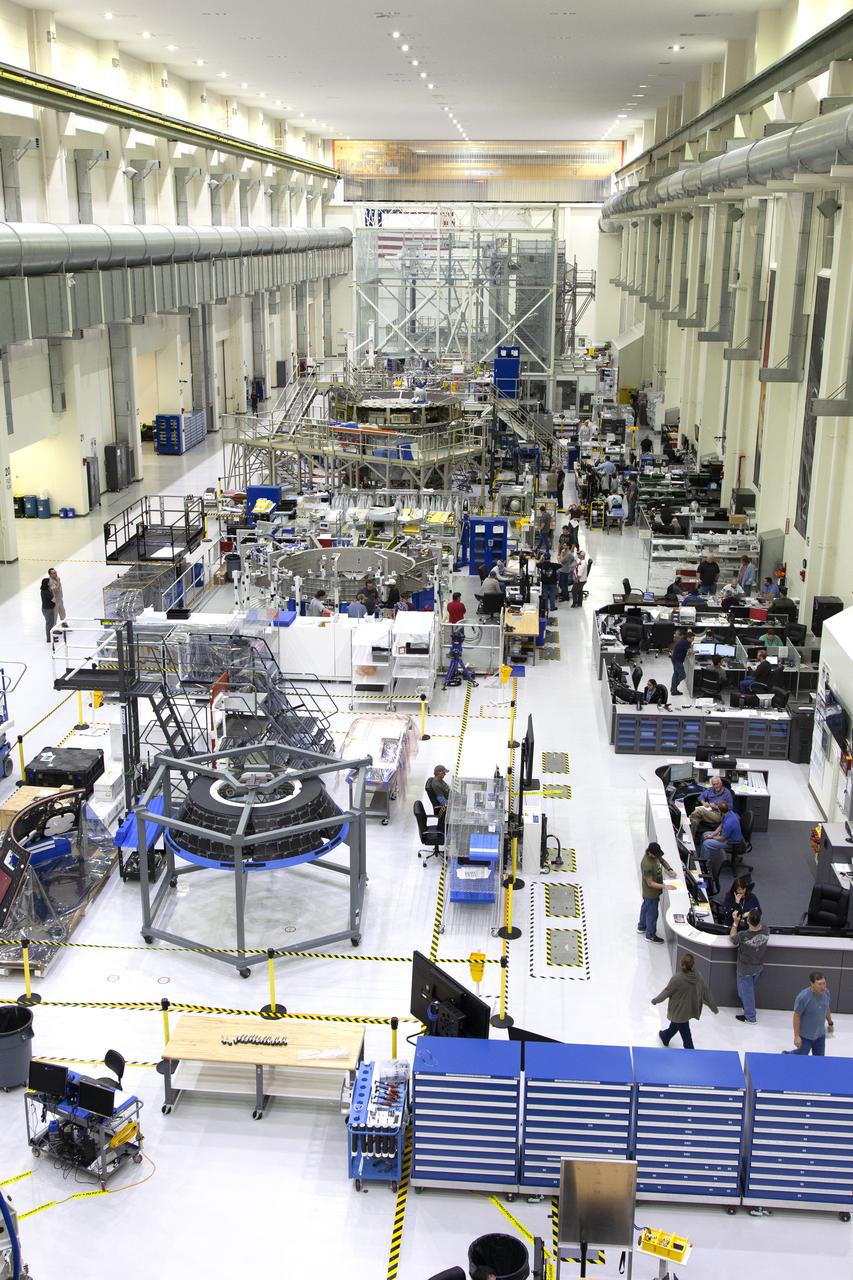
The Neil Armstrong Operations and Checkout Building high bay is filled with various pieces of flight hardware for Exploration Mission-1 (EM-1) and Exploration Mission-2 (EM-2) at NASA’s Kennedy Space Center in Florida. In this view taken on March 21, 2019, the forward bay cover for Orion (EM-1) is at far left in the foreground. Just to its right is the bay cover (EM-1). Behind these two pieces is the crew module adapter for EM-2. Further back, secured on a test stand is the European Service Module that will serve as the powerhouse for Orion. For EM-1, Orion will launch atop the Space Launch System rocket from Launch Pad 39B. The spacecraft will travel thousands of miles past the Moon on an approximately three-week test flight. Orion will return to Earth and splashdown in the Pacific Ocean off the coast of California, where it will be retrieved and returned to Kennedy.
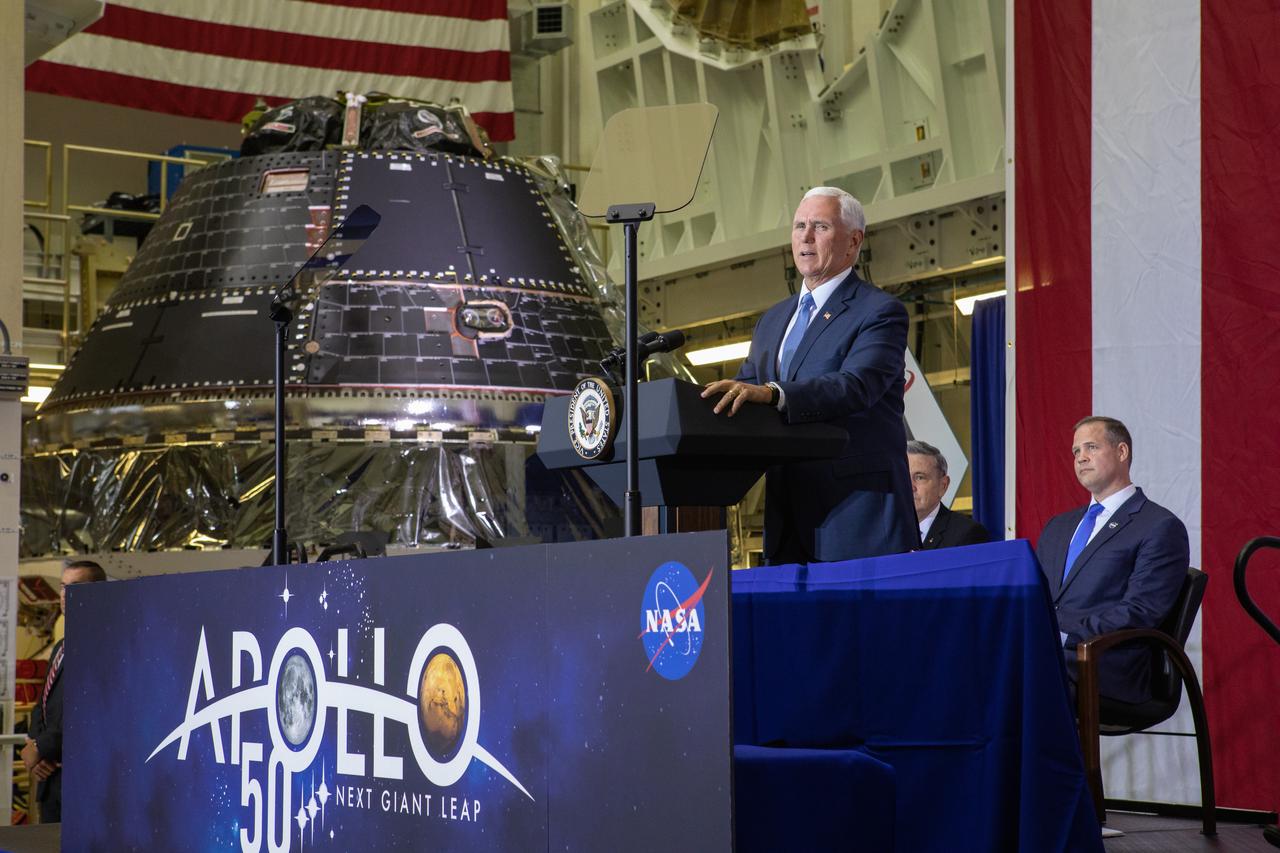
Vice President Mike Pence addresses invited guests, elected officials and NASA, Lockheed Martin and other industry leaders at Kennedy Space Center’s Neil Armstrong Operations & Checkout Building on July 20, 2019. Pence, who visited the Florida spaceport in honor of the 50th anniversary of the Apollo 11 mission, also spoke about NASA’s progress and future plans to return to the Moon and on to Mars.
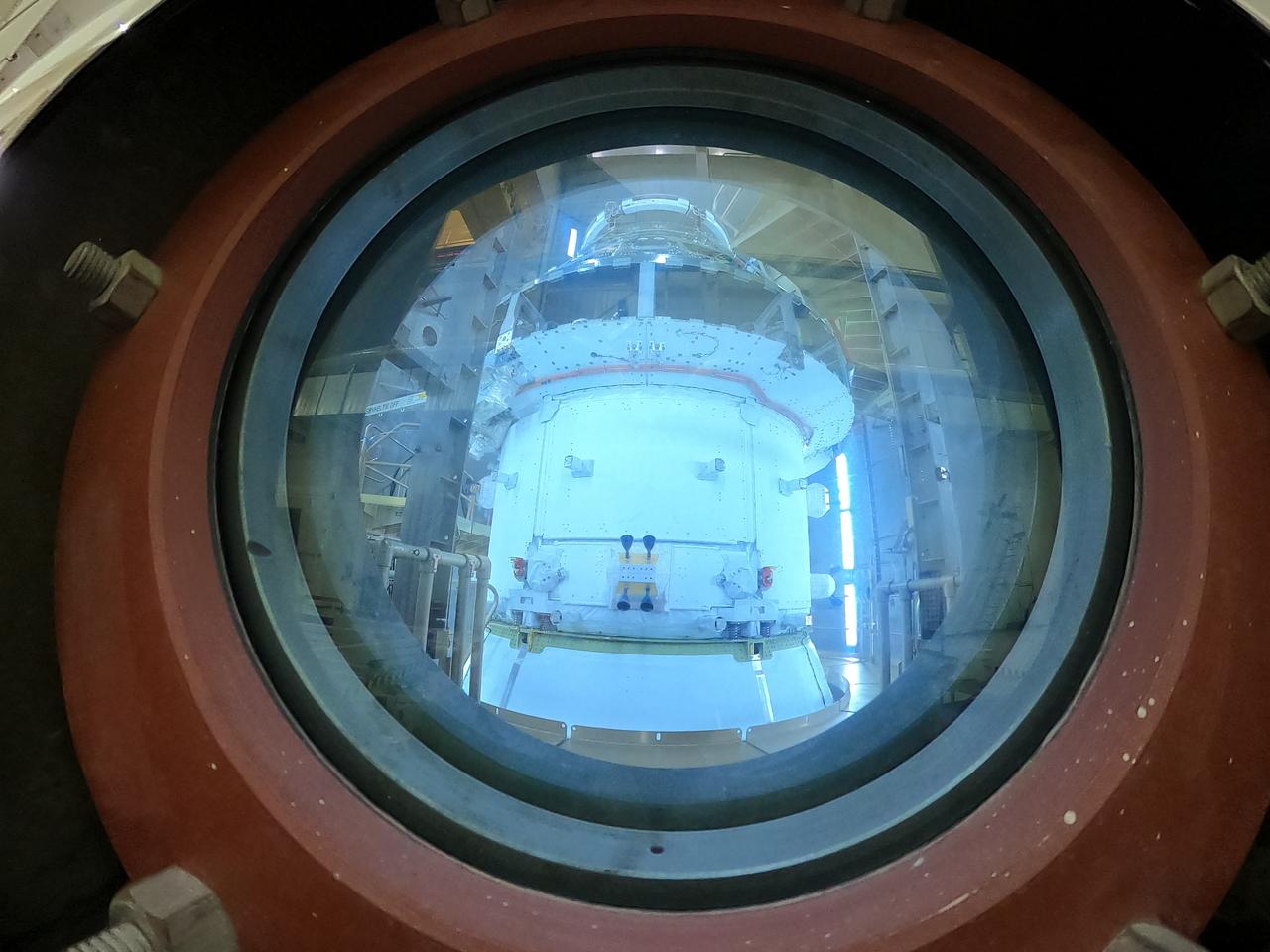
Technicians capture a photo of NASA’s Orion spacecraft inside the altitude chamber to complete further testing on Friday, Nov. 8, 2024, inside the Neil A. Armstrong Operations and Checkout building at NASA's Kennedy Space Center in Florida. The altitude chamber simulates deep space vacuum conditions, and the testing will provide additional data to augment data gained during testing earlier this summer. The Orion spacecraft will carry NASA astronauts Victor Glover, Christina Koch, and Reid Wiseman, as well as CSA (Canadian Space Agency) astronaut Jeremy Hansen, on a 10-day journey around the Moon and back for the Artemis II test flight.
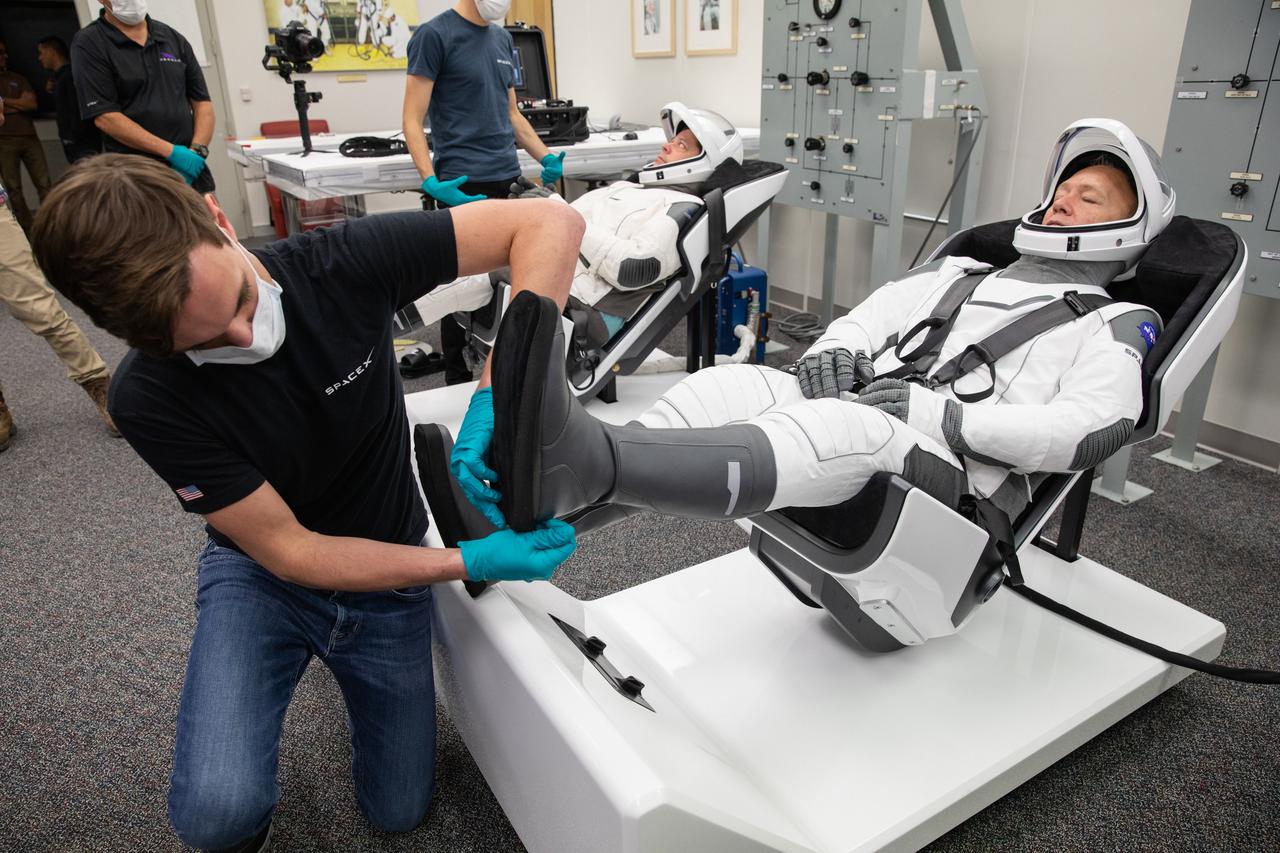
NASA astronauts Doug Hurley, foreground, and Bob Behnken don SpaceX spacesuits in the Astronaut Crew Quarters at Kennedy Space Center in Florida on Jan. 17, 2020, during a dress rehearsal ahead of the company’s uncrewed In-Flight Abort Test. A SpaceX Falcon 9 rocket and Crew Dragon spacecraft will lift off from Launch Complex 39A on the flight test, which will demonstrate the spacecraft’s escape capabilities in preparation for crewed flights to the International Space Station as part of the agency’s Commercial Crew Program. Hurley and Behnken are slated to fly on the company’s first crewed mission, Demo-2.
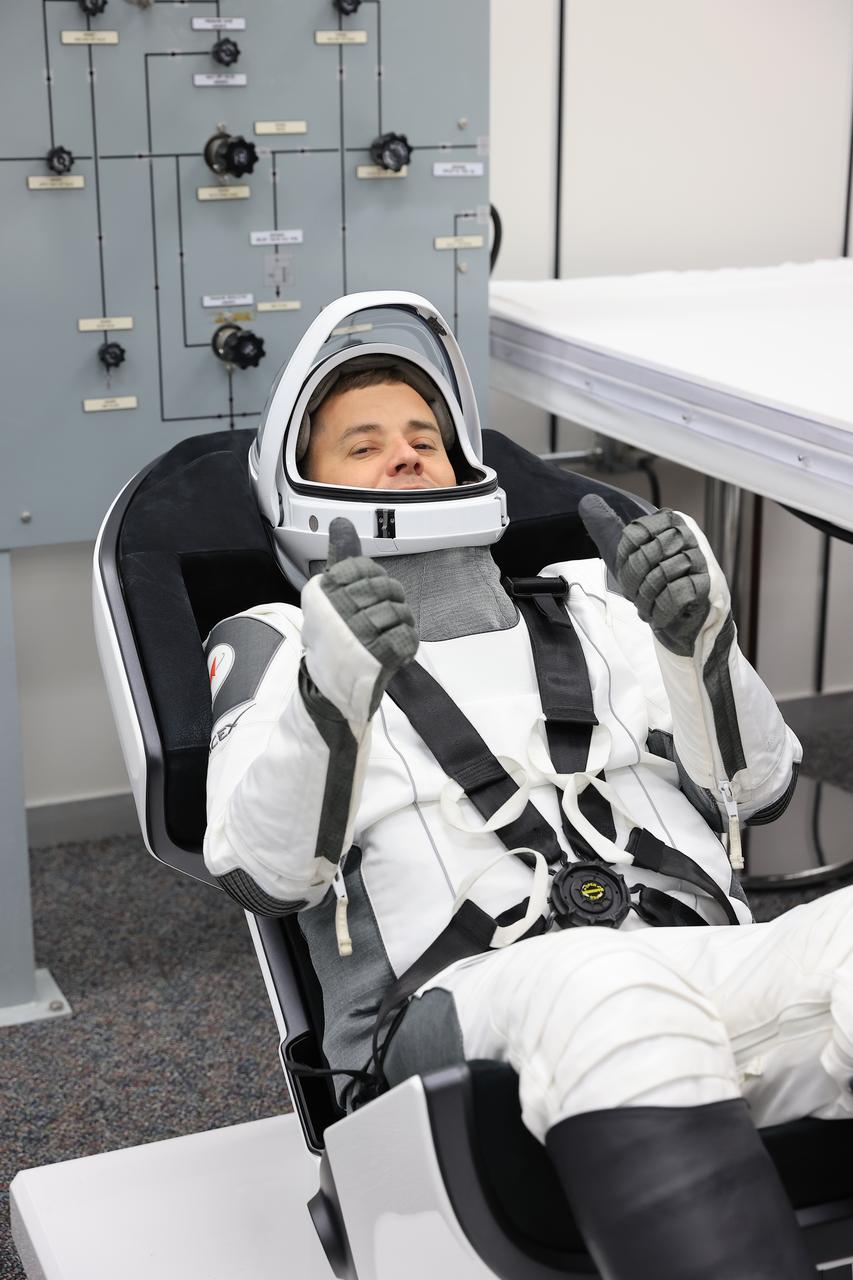
Roscosmos cosmonaut Oleg Platonov conducts leak checks for his SpaceX spacesuit inside the crew suit-up room in the Neil A. Armstrong Operations and Checkout Building at the agency’s Kennedy Space Center in Florida during the second launch attempt of NASA’s SpaceX Crew-11 mission to the International Space Station on Friday, Aug. 1, 2025. NASA astronauts Zena Cardman and Mike Fincke, along with JAXA (Japan Aerospace Exploration Agency) astronaut Kimiya Yui and Platonov, are scheduled to lift off aboard SpaceX’s Dragon spacecraft and Falcon 9 rocket at 11:43 a.m. EDT from Launch Complex 39A at NASA Kennedy.
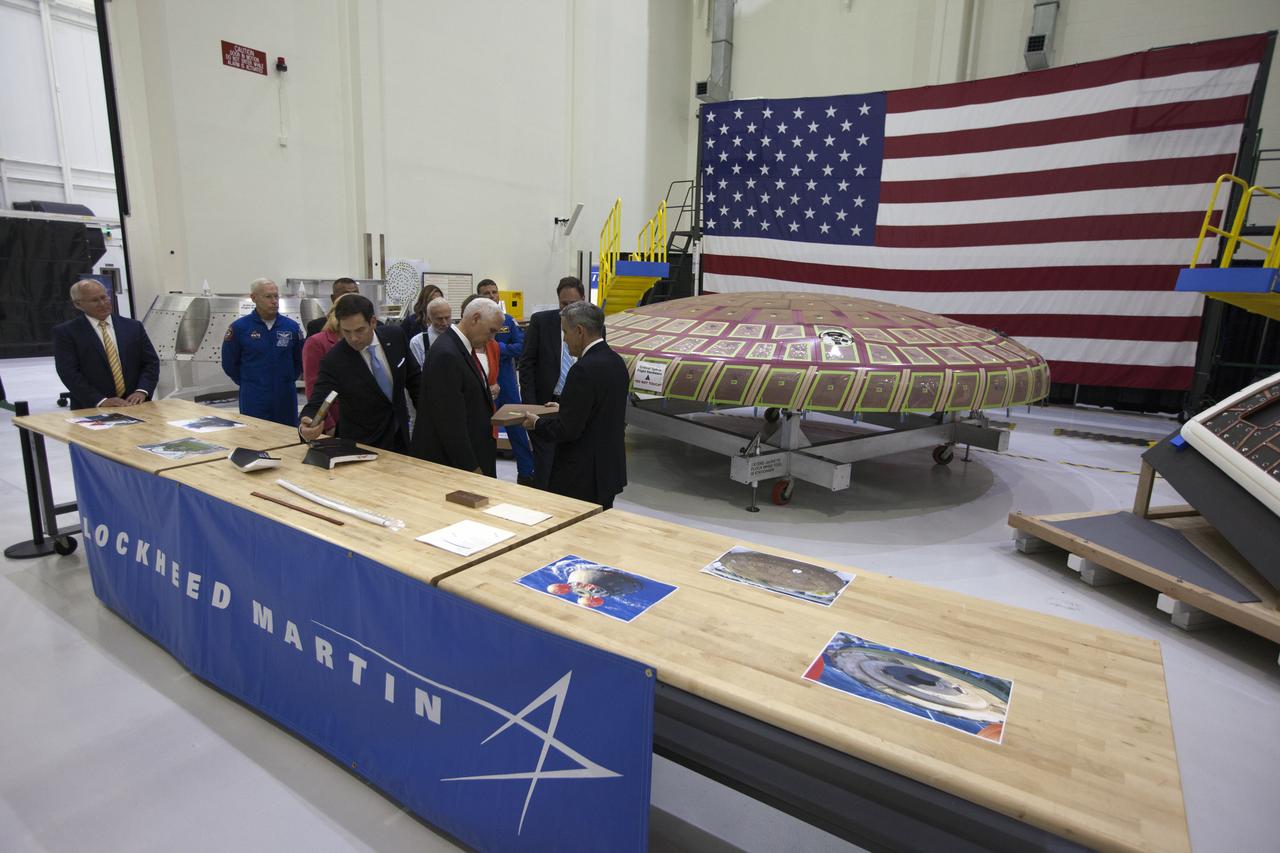
Vice President Mike Pence, center, and U.S. Senator Marco Rubio (R-FL), left, examine flight hardware during a tour of the Neil Armstrong Operations and Checkout Building at NASA's Kennedy Space Center in Florida, where the Orion spacecraft is being readied for a trip beyond the moon on its first integrated flight with the Space Launch System rocket. During his visit to Kennedy, Pence spoke inside the Vehicle Assembly Building, where he thanked employees for advancing American leadership in space. The Vice President also toured several facilities highlighting the public-private partnerships at Kennedy, as both NASA and commercial companies prepare to launch American astronauts from the multi-user spaceport.
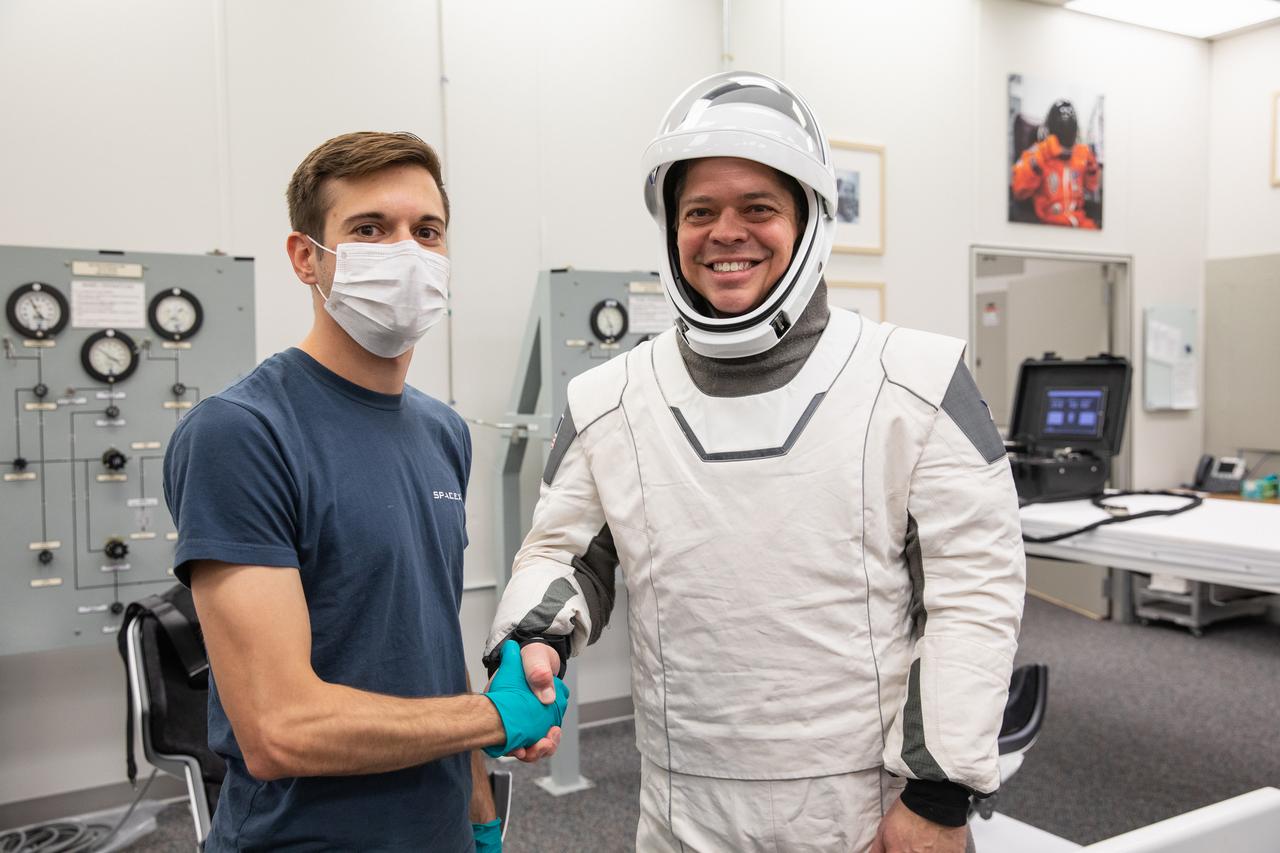
NASA astronauts Bob Behnken, right, wearing a SpaceX spacesuit, and a suit technician shake hands in the Astronaut Crew Quarters at Kennedy Space Center in Florida on Jan. 17, 2020, during a dress rehearsal ahead of the company’s uncrewed In-Flight Abort Test. A SpaceX Falcon 9 rocket and Crew Dragon spacecraft will lift off from Launch Complex 39A on the flight test, which will demonstrate the spacecraft’s escape capabilities in preparation for crewed flights to the International Space Station as part of the agency’s Commercial Crew Program. Behnken and NASA astronaut Doug Hurley are slated to fly on the company’s first crewed mission, Demo-2.
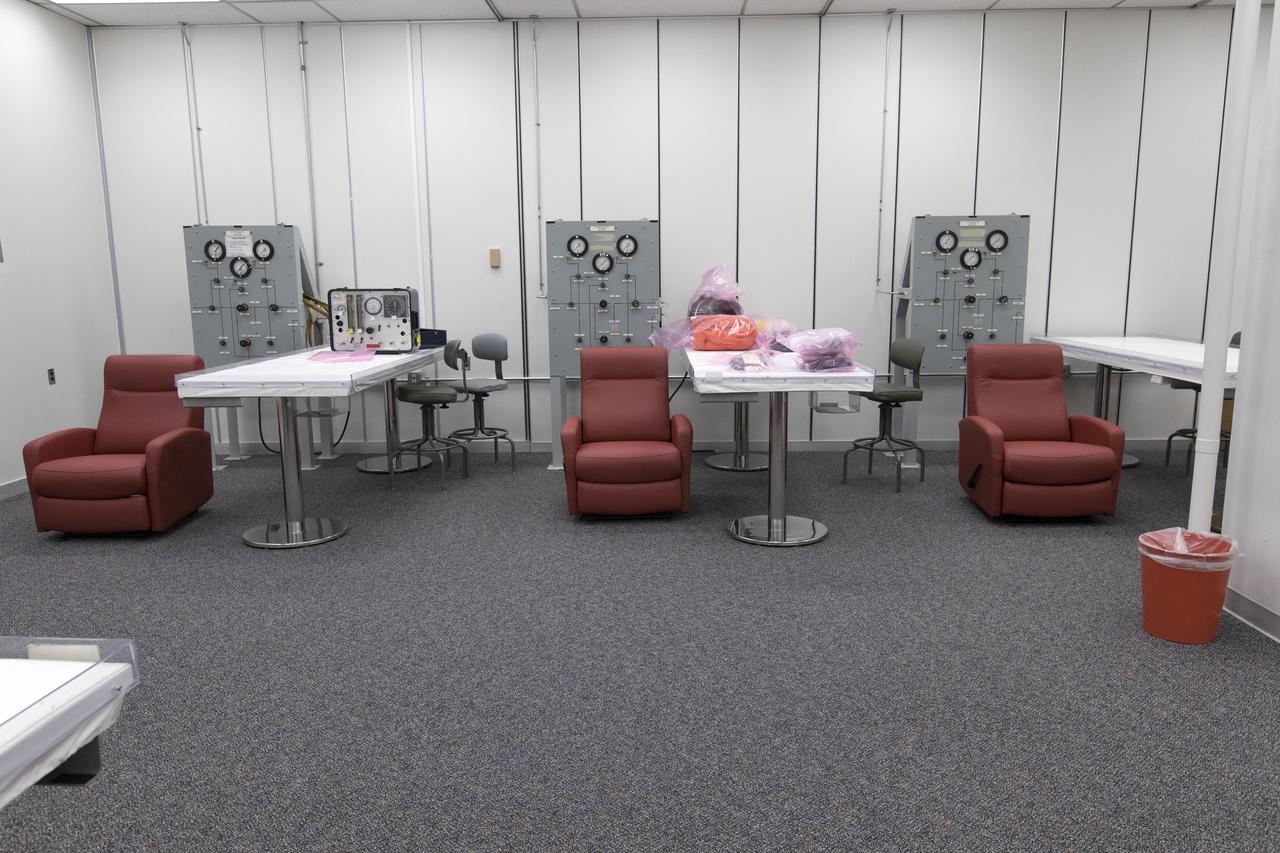
New carpeting, ceiling tiles, appliances and fresh paint are among the improvements that have been made to the astronaut crew quarters, located in the Neil Armstrong Operations and Checkout Building at Kennedy Space Center in Florida. Shown here is the suit room, where astronauts are helped into their pressure suits before leaving the crew quarters for a mission. This room now features three suit containment rooms — one each for Orion, Boeing and SpaceX.
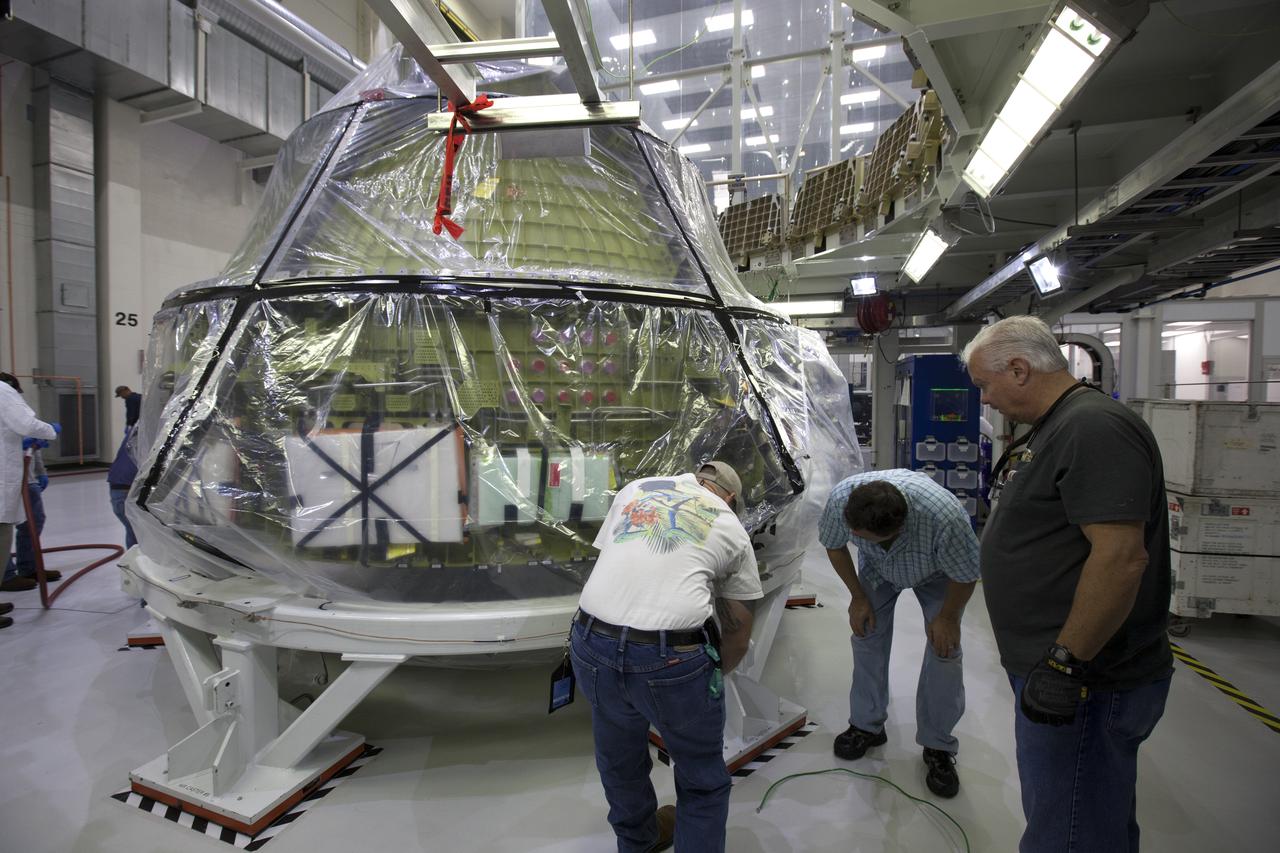
The Orion crew module for NASA’s Exploration Mission 1 (EM-1) is being secured in a work station in the Neil Armstrong Operations and Checkout Building high bay at NASA’s Kennedy Space Center in Florida. Orion will undergo additional processing to prepare it for launch in 2019. The spacecraft is being prepared for its first integrated flight atop the Space Launch System rocket on Exploration Mission-1.
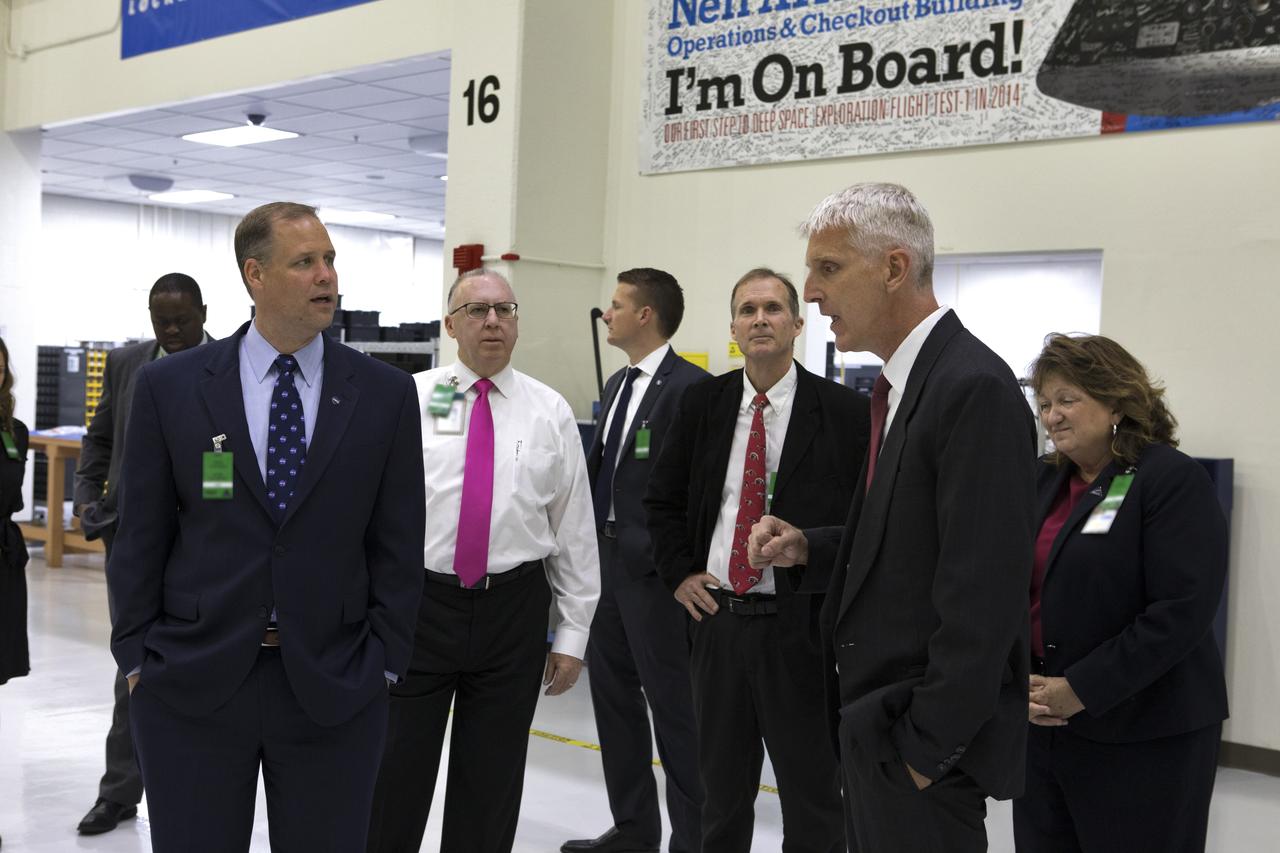
NASA Administrator Jim Bridenstine, left, talks with Scott Wilson, manager of production operations for the Orion Program, during a tour of the Neil Armstrong Operations and Checkout Building at NASA’s Kennedy Space Center on Tuesday, Aug. 7, 2018. Bridenstine made his first official visit to the Florida spaceport on Aug. 6 and 7.
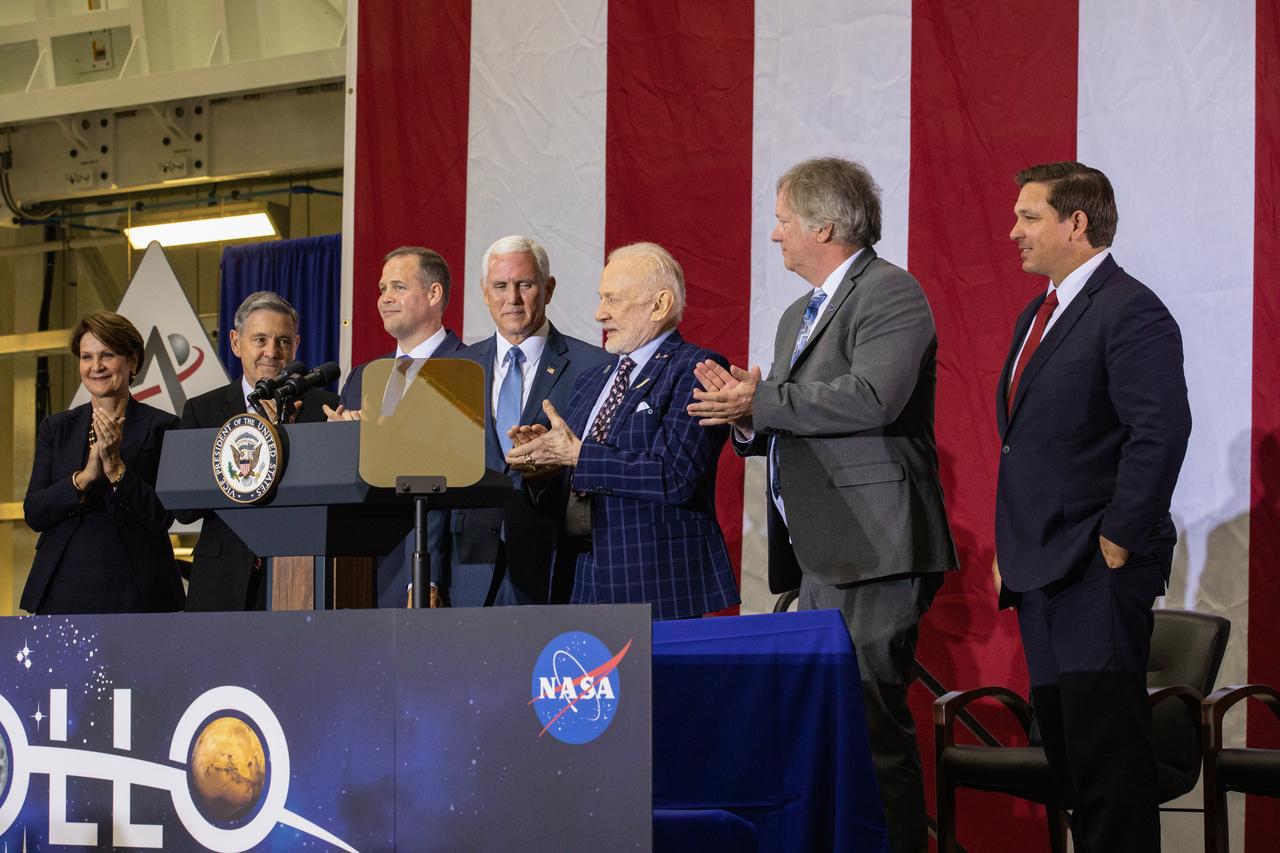
Vice President Mike Pence, fourth from left, addresses invited guests, elected officials and NASA, Lockheed Martin and other industry leaders at Kennedy Space Center’s Neil Armstrong Operations & Checkout Building on July 20, 2019. Pence, who visited the Florida spaceport in honor of the 50th anniversary of the Apollo 11 mission, also spoke about NASA’s progress and future plans to return to the Moon and on to Mars. Others with him are, from left, Lockheed Martin Chairwoman, President and CEO Marilyn Hewson; Bob Cabana, Kennedy Space Center director; NASA Administrator Jim Bridenstine; Apollo 11 Lunar Module Pilot Buzz Aldrin; Rick Armstrong, son of Apollo 11 Commander Neil Armstrong; and Florida Governor Ron DeSantis.
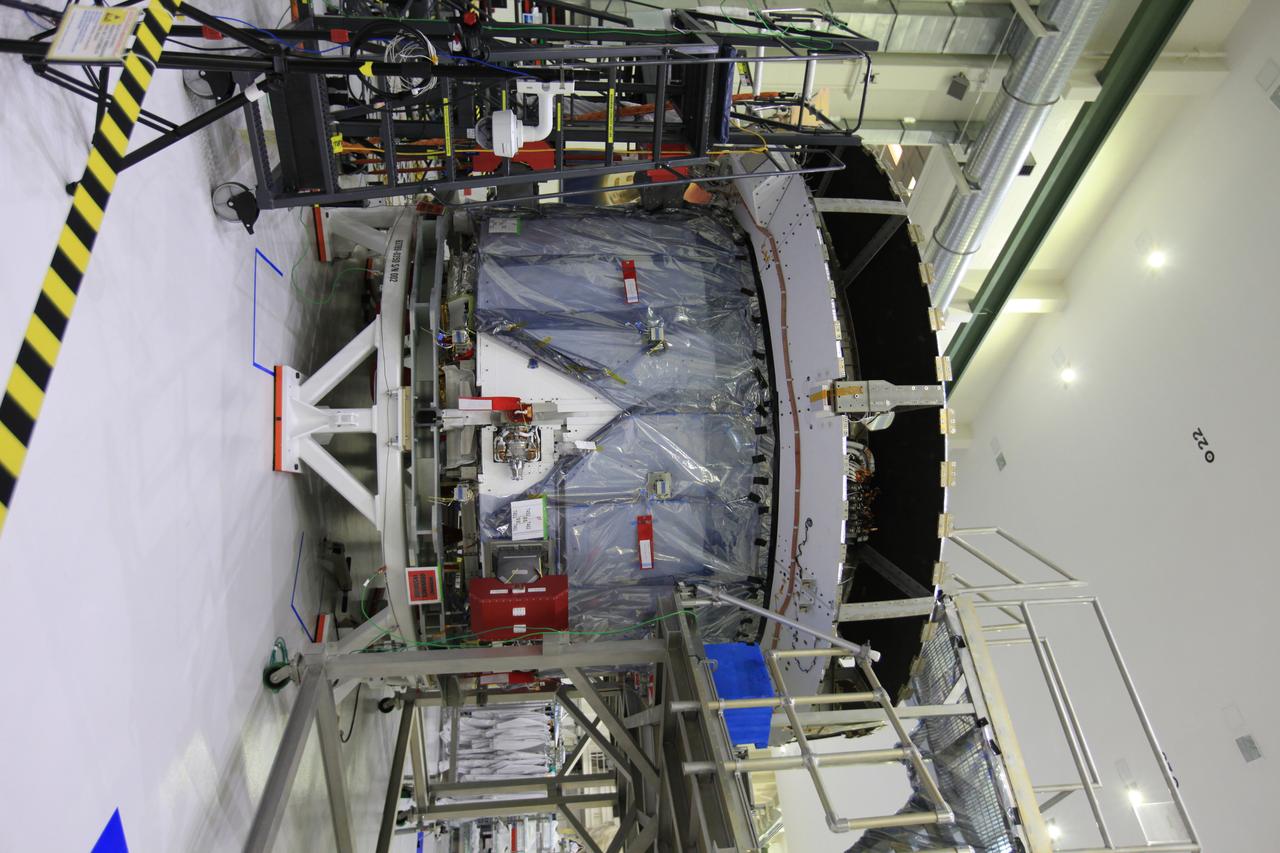
The European Service Module that will serve as the powerhouse for Orion on Exploration Mission-1 (EM-1), is in view on a work stand inside the Neil Armstrong Operations and Checkout Building high bay on March 21, 2019, at NASA’s Kennedy Space Center in Florida. For EM-1, Orion will launch atop the Space Launch System rocket from Launch Pad 39B. The spacecraft will travel thousands of miles past the Moon on an approximately three-week test flight. Orion will return to Earth and splashdown in the Pacific Ocean off the coast of California, where it will be retrieved and returned to Kennedy.
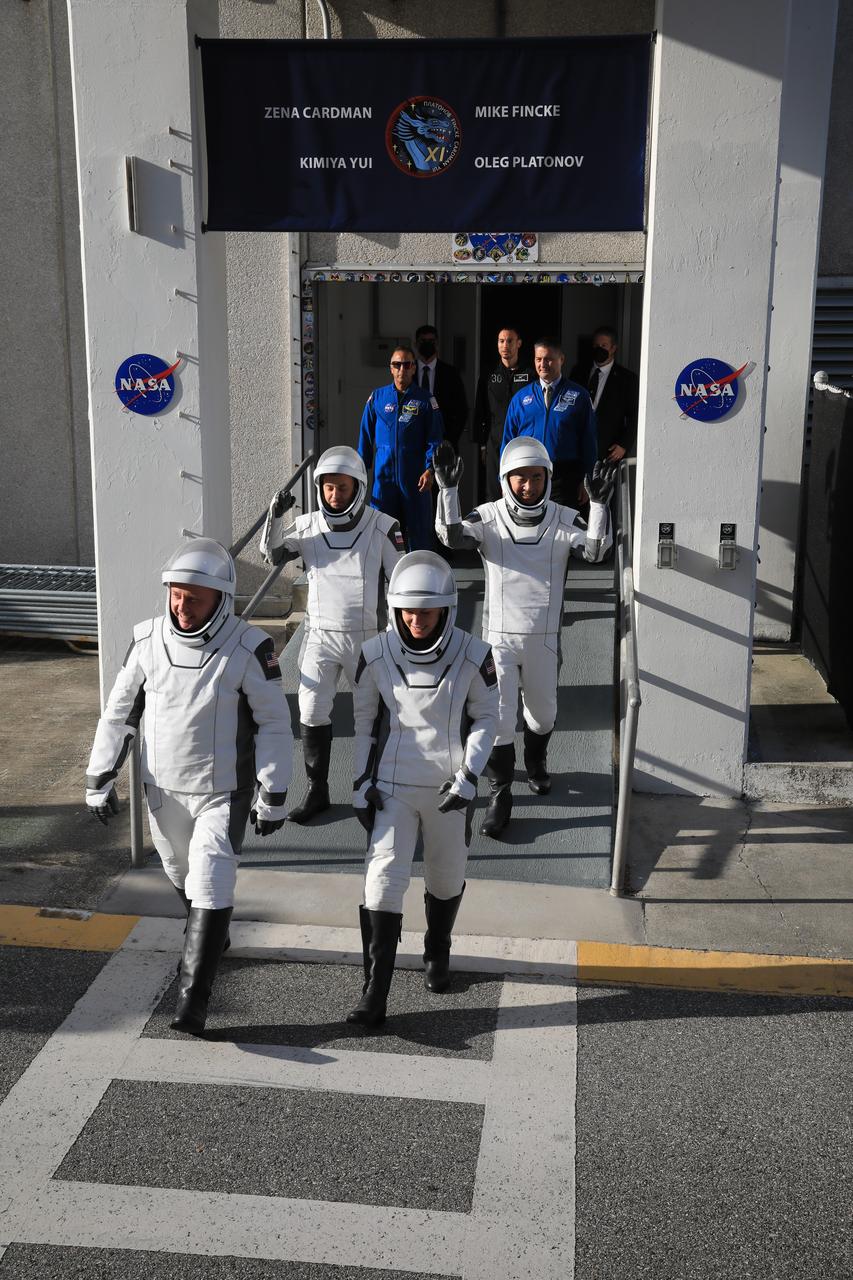
From front left NASA astronauts Mike Fincke and Zena Cardman, along with JAXA (Japan Aerospace Exploration Agency) astronaut Kimiya Yui and Roscosmos cosmonaut Oleg Platonov wave to family and friends as they walk out of the Neil A. Armstrong Operations and Checkout Building at the agency’s Kennedy Space Center in Florida during the second launch attempt of NASA’s SpaceX Crew-11 mission to the International Space Station on Friday, Aug. 1, 2025. Crew-11 is scheduled to lift off aboard SpaceX’s Dragon spacecraft and Falcon 9 rocket at 11:43 a.m. EDT, from Launch Complex 39A at NASA Kennedy.
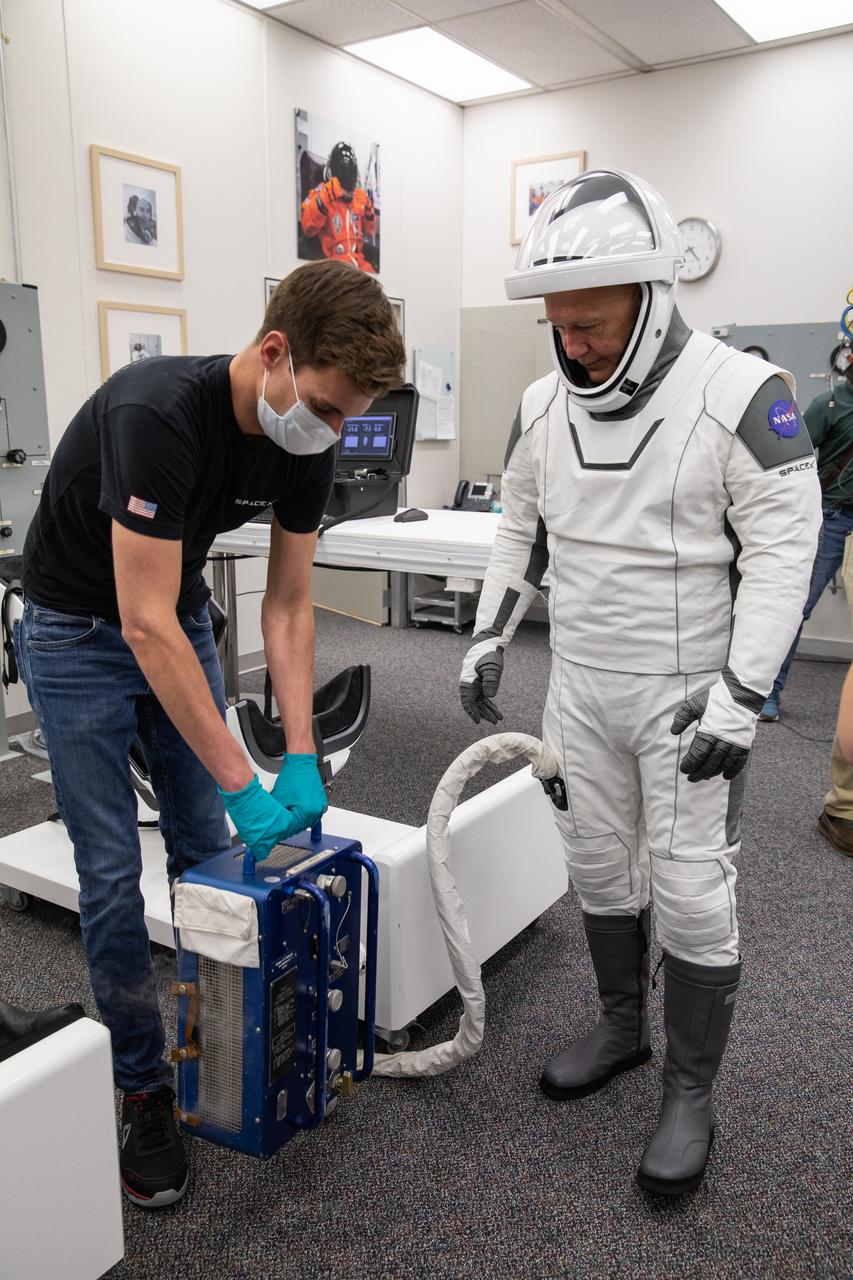
NASA astronaut Doug Hurley wears a SpaceX spacesuit in the Astronaut Crew Quarters at Kennedy Space Center in Florida on Jan. 17, 2020, during a dress rehearsal ahead of the company’s uncrewed In-Flight Abort Test. A SpaceX Falcon 9 rocket and Crew Dragon spacecraft will lift off from Launch Complex 39A on the flight test, which will demonstrate the spacecraft’s escape capabilities in preparation for crewed flights to the International Space Station as part of the agency’s Commercial Crew Program. Hurley and NASA astronaut Bob Behnken are slated to fly on the company’s first crewed mission, Demo-2.
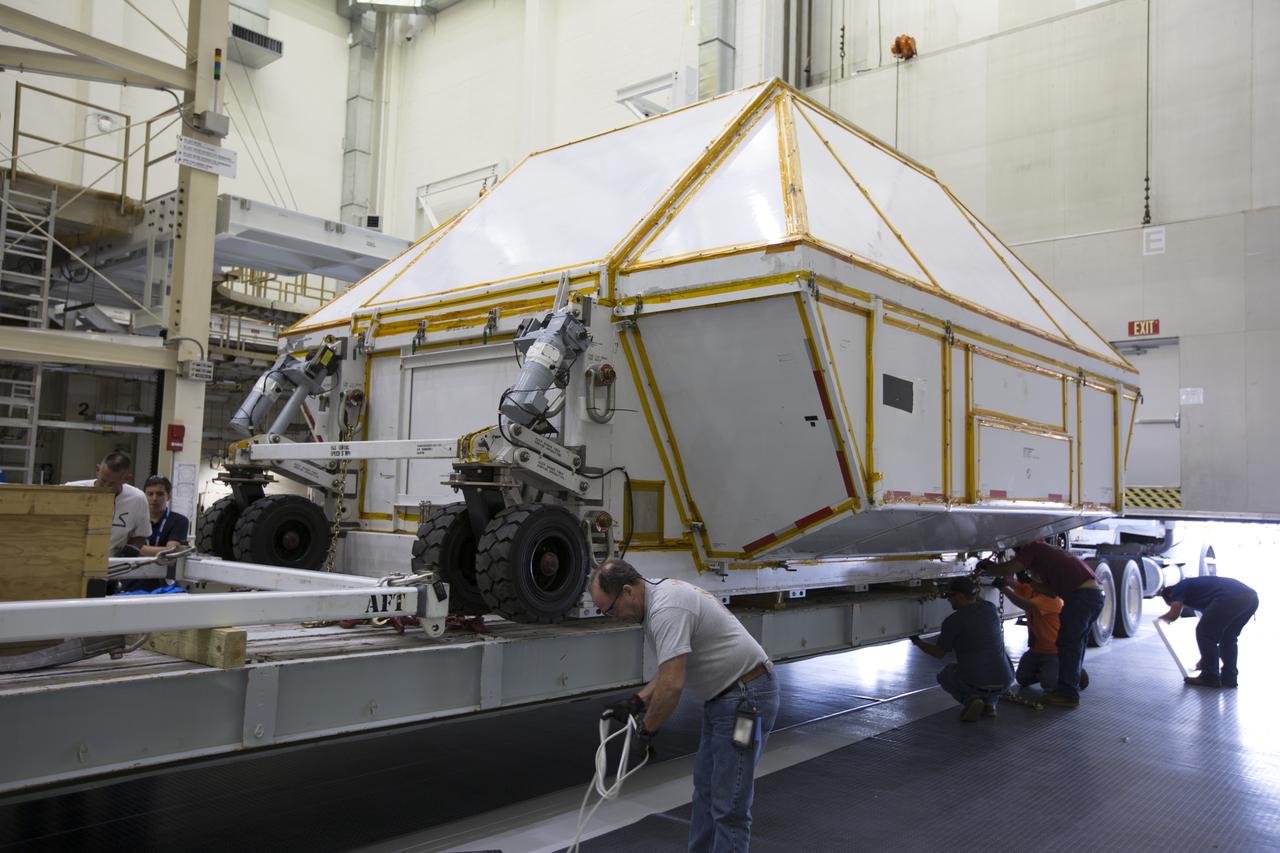
Inside the Neil Armstrong Operations and Checkout Building high bay at NASA's Kennedy Space Center in Florida, technicians secure the Orion Exploration Mission-1 (EM-1) structural test article in its transport container onto a transport vehicle for the move to the Shuttle Landing Facility. The test article will be loaded in NASA's Super Guppy airplane and transported to Lockheed Martin's Denver facility for testing. The Orion spacecraft will launch atop NASA’s Space Launch System rocket on EM-1, its first deep space mission.

Inside the high bay of the Neil Armstrong Operations and Checkout Building at NASA’s Kennedy Space Center in Florida, technicians assemble on the Optical Communications System for the Artemis II mission on June 2, 2023. Optical communications is the latest space communications technology that is able to provide data rates as much as a hundred times higher than current systems. This will allow astronauts to send and receive ultra-high-definition video from the surface of the Moon or other planets such as Mars. Artemis II will be the first Artemis mission flying crew aboard Orion.
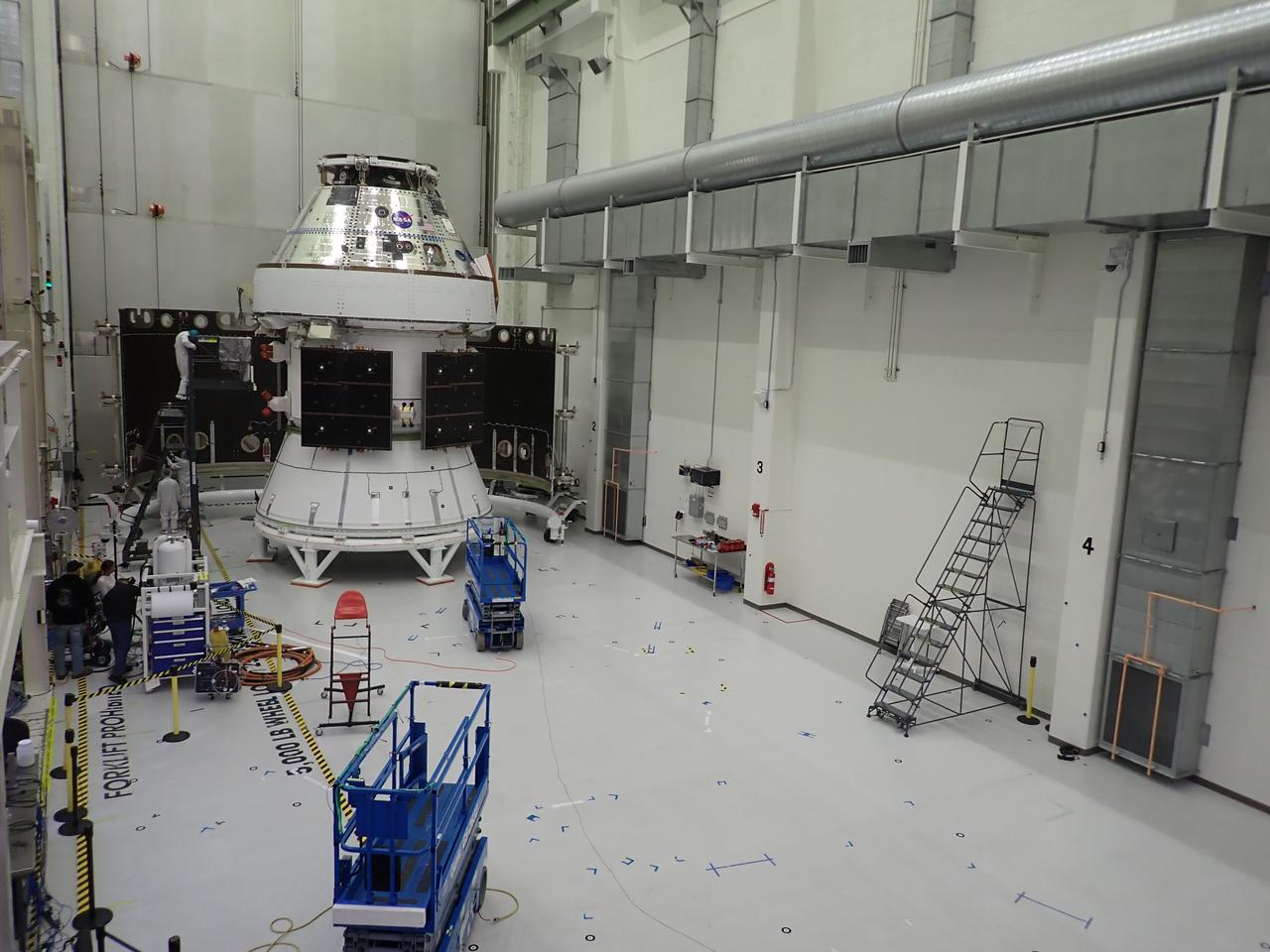
Technicians with Lockheed Martin prepare the Artemis II Orion spacecraft for the installation of three spacecraft adapter jettison fairings inside the Neil A. Armstrong Operations and Checkout Building at NASA’s Kennedy Space Center in Florida in on Tuesday, March 11, 2025. The fairings encapsulate the service module and protect the solar array wings, shielding them from the heat, wind, and acoustics of launch and ascent, plus help redistribute the load between Orion and the massive thrust of the SLS (Space Launch System) rocket during liftoff and ascent. Once the spacecraft is above the atmosphere, the three fairing panels will separate from the service module reducing the mass of the spacecraft.
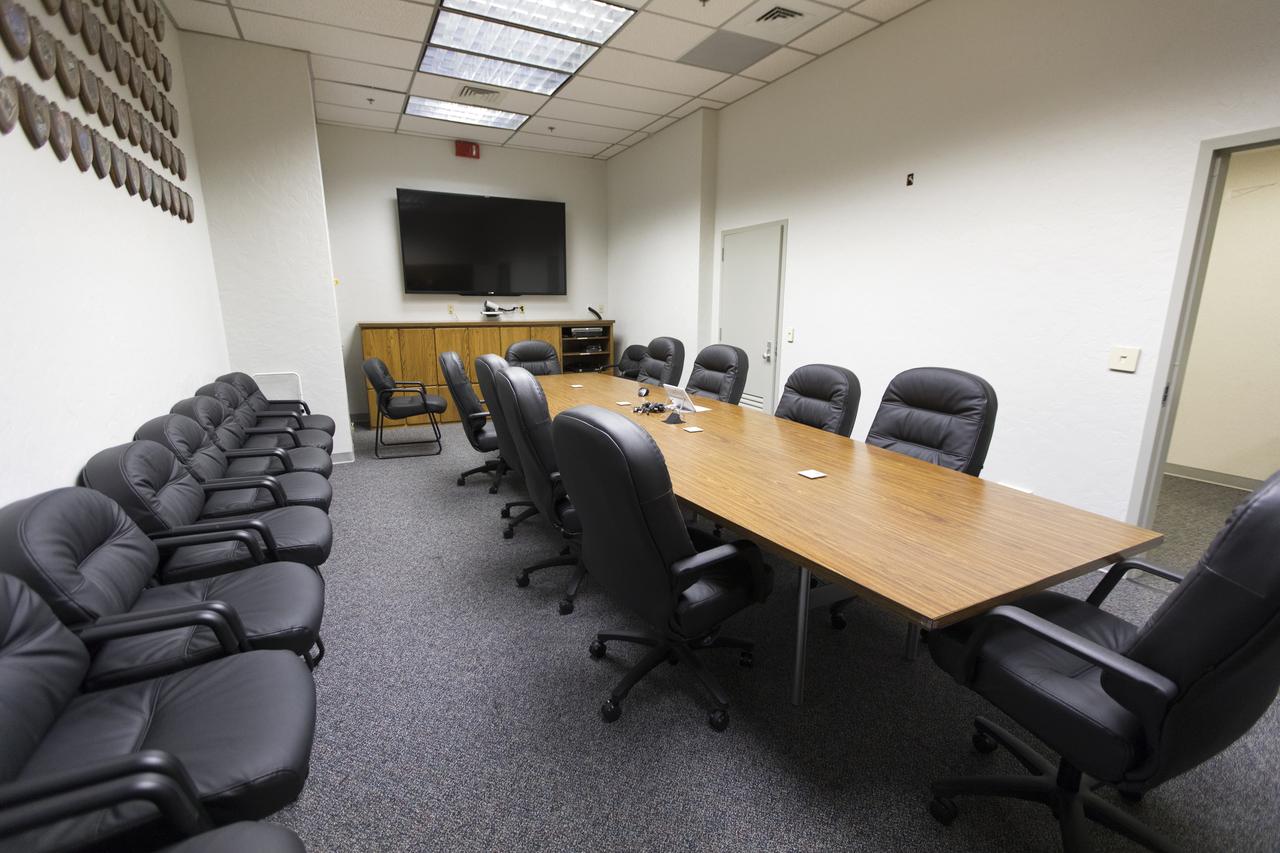
Several upgrades have been completed in the crew quarters at Kennedy Space Center in Florida. This includes new carpeting, paint, furniture and ceiling tiles. Located on the third floor of the Neil Armstrong Operations and Checkout Building, the crew quarters serves as the astronauts’ home as they prepare for missions. This will once again be the case as Kennedy moves closer to a return to human spaceflight. Pictured is a meeting room in the crew quarters.
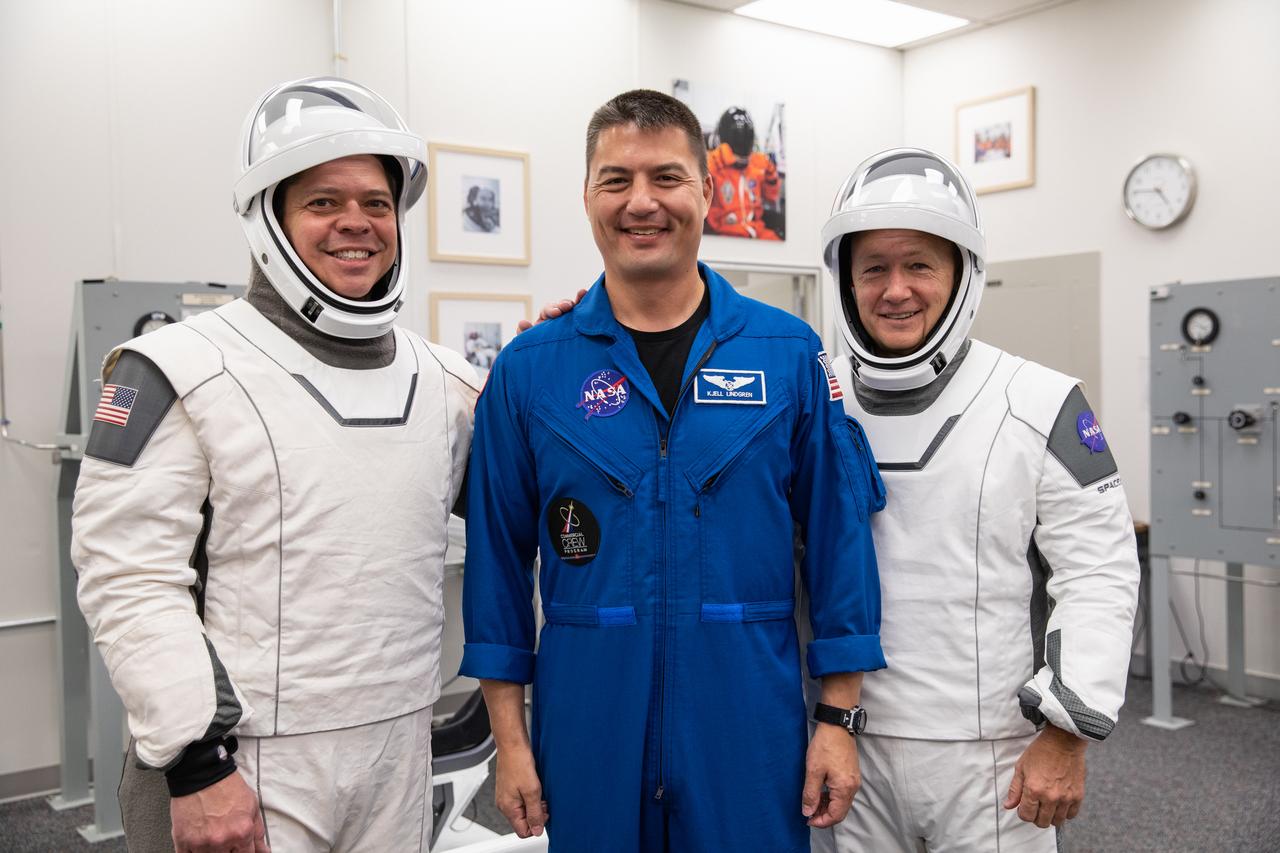
From left to right, NASA astronauts Bob Behnken, Kjell Lindgren and Doug Hurley pause for a photo in the Astronaut Crew Quarters at Kennedy Space Center in Florida on Jan. 17, 2020, during a dress rehearsal ahead of the SpaceX uncrewed In-Flight Abort Test. Behken and Hurley are wearing SpaceX spacesuits. A SpaceX Falcon 9 rocket and Crew Dragon spacecraft will lift off from Launch Complex 39A on the flight test, which will demonstrate the spacecraft’s escape capabilities in preparation for crewed flights to the International Space Station as part of the agency’s Commercial Crew Program. Behnken and Hurley are slated to fly on the company’s first crewed mission, Demo-2.
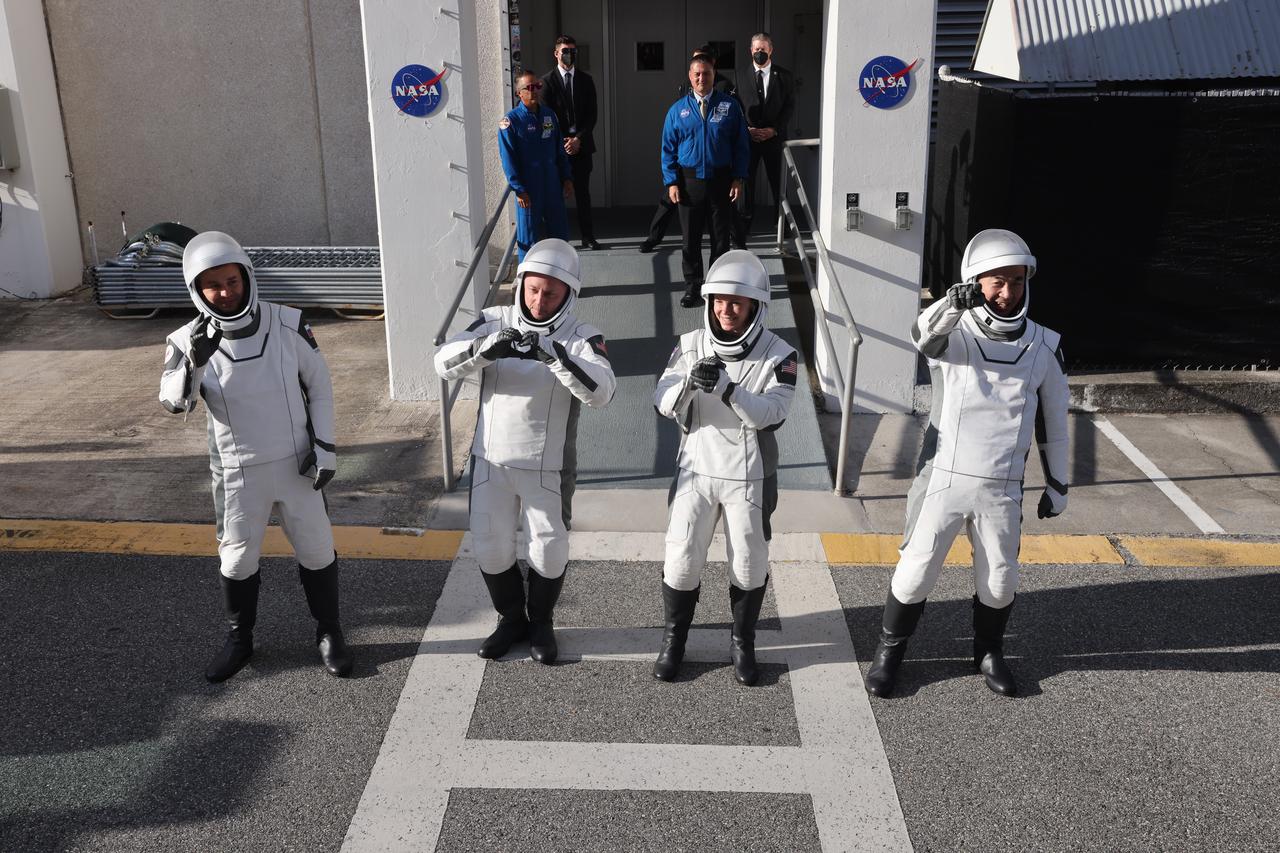
From right to left, JAXA (Japan Aerospace Exploration Agency) astronaut Kimiya Yui, NASA astronauts Zena Cardman and Mike Fincke, along with and Roscosmos cosmonaut Oleg Platonov wave to family and friends as they walk out of the Neil A. Armstrong Operations and Checkout Building at the agency’s Kennedy Space Center in Florida during the second launch attempt of NASA’s SpaceX Crew-11 mission to the International Space Station on Friday, Aug. 1, 2025. Crew-11 is scheduled to lift off aboard SpaceX’s Dragon spacecraft and Falcon 9 rocket at 11:43 a.m. EDT, from Launch Complex 39A at NASA Kennedy.
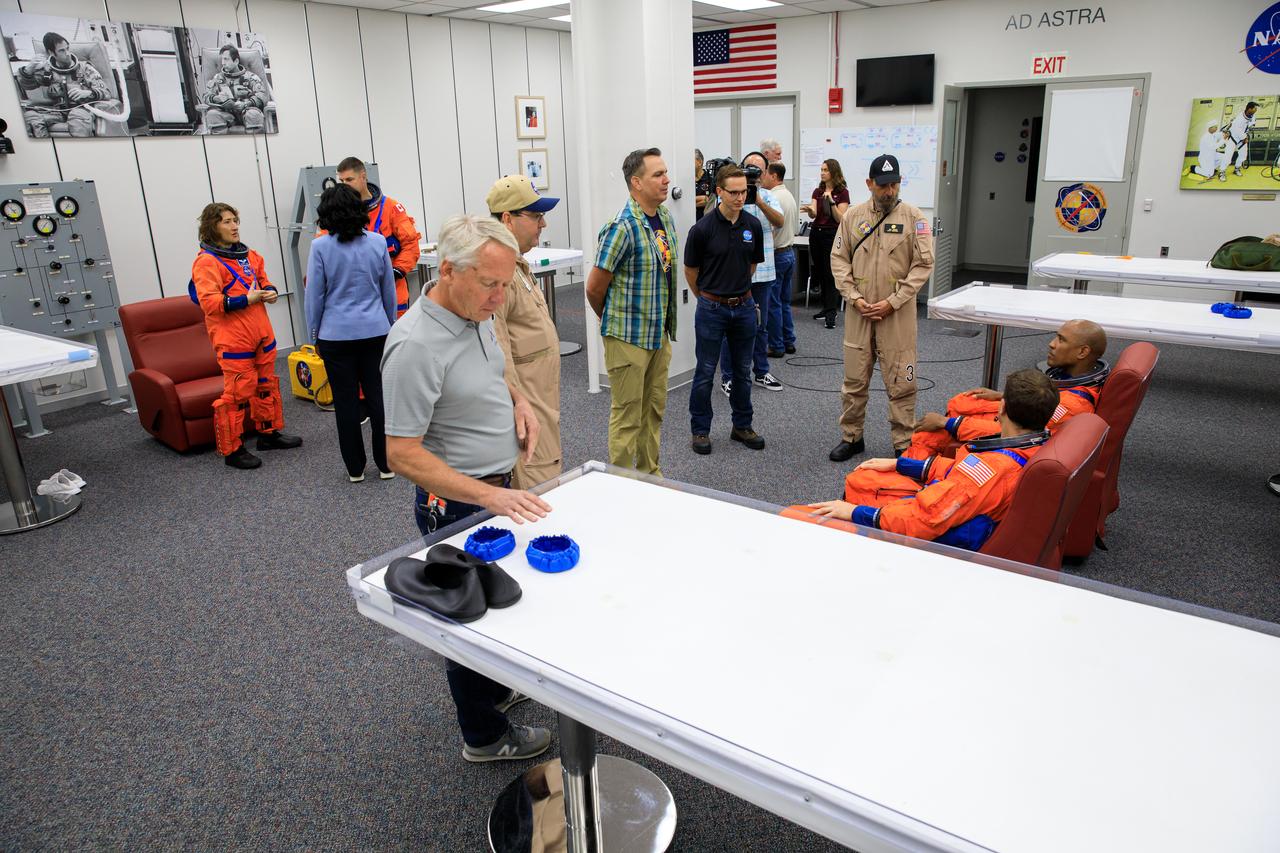
Inside the Astronaut Crew Quarters at the Neil Armstrong Operations and Checkout Building at NASA’s Kennedy Space Center in Florida, Artemis II crew members NASA astronauts Reid Wiseman, Victor Glover, and Christina Koch, and CSA (Canadian Space Agency) astronaut Jeremy Hansen are shown wearing test versions of the Orion crew survival system spacesuits they will wear on launch day as part of an integrated ground systems test on Wednesday, Sept. 20.
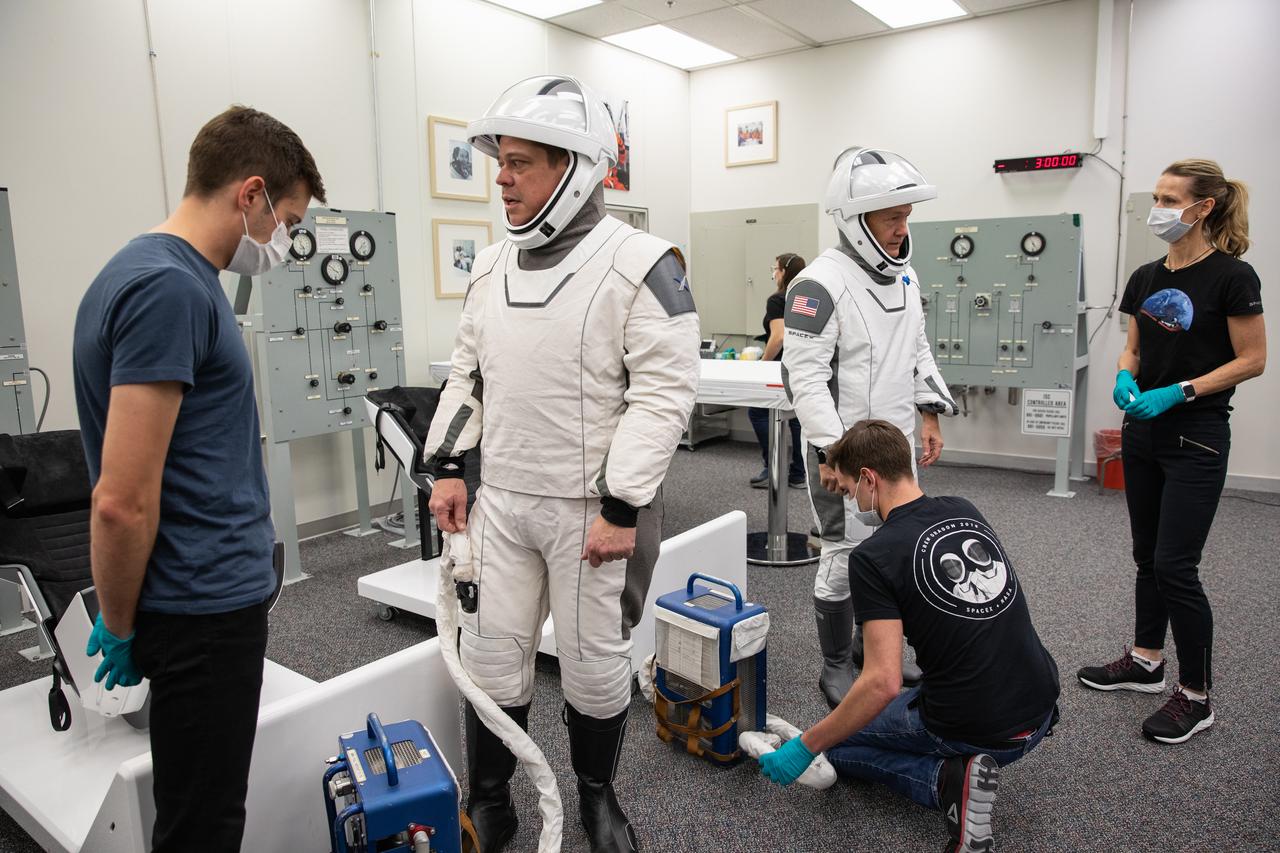
NASA astronauts Bob Behnken, foreground, and Doug Hurley don SpaceX spacesuits in the Astronaut Crew Quarters at Kennedy Space Center in Florida on Jan. 17, 2020, during a dress rehearsal ahead of the company’s uncrewed In-Flight Abort Test. A SpaceX Falcon 9 rocket and Crew Dragon spacecraft will lift off from Launch Complex 39A on the flight test, which will demonstrate the spacecraft’s escape capabilities in preparation for crewed flights to the International Space Station as part of the agency’s Commercial Crew Program. Behnken and Hurley are slated to fly on the company’s first crewed mission, Demo-2.
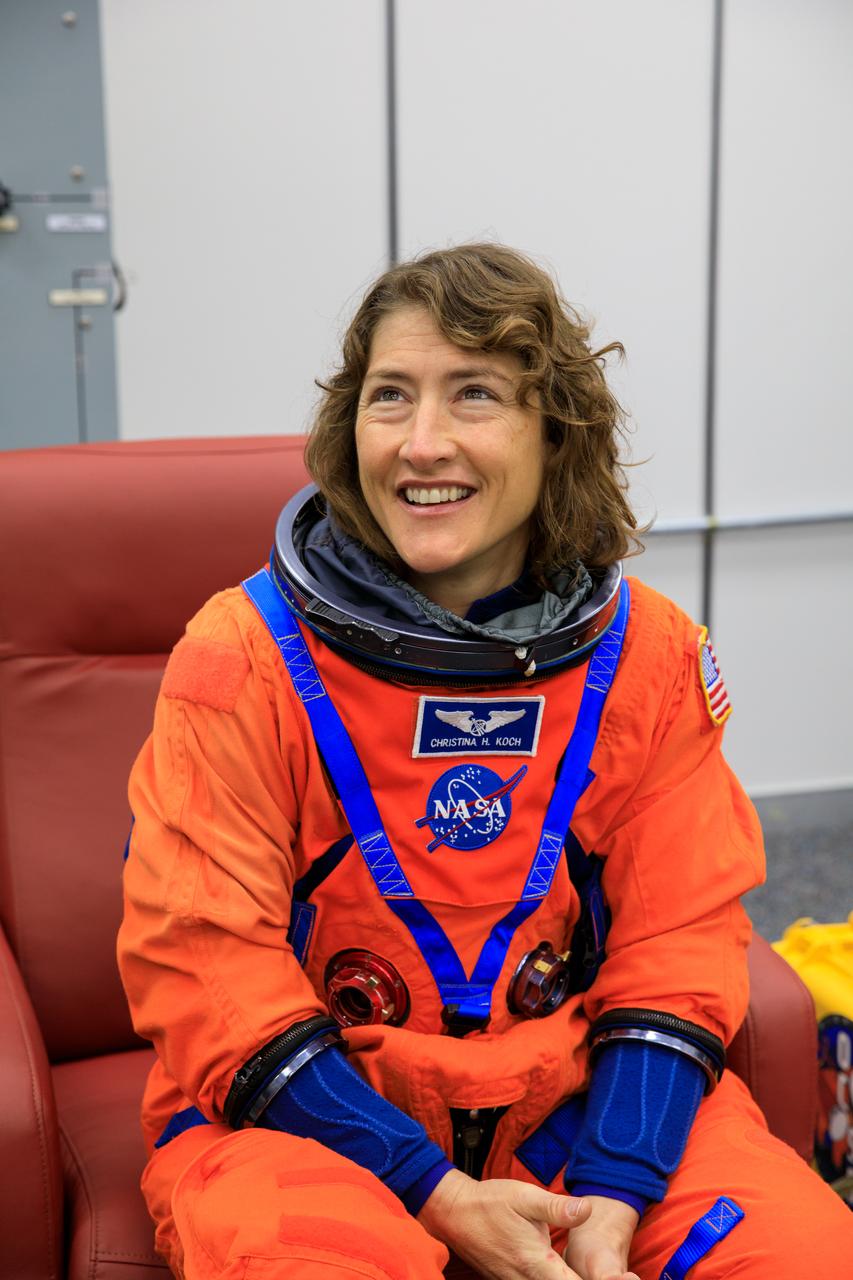
Inside the Astronaut Crew Quarters at the Neil Armstrong Operations and Checkout Building at NASA’s Kennedy Space Center in Florida, Artemis II crew member NASA astronaut Christina Koch is shown wearing a test version of the Orion crew survival system spacesuits the crew will wear on launch day as part of an integrated ground systems test on Wednesday, Sept. 20.
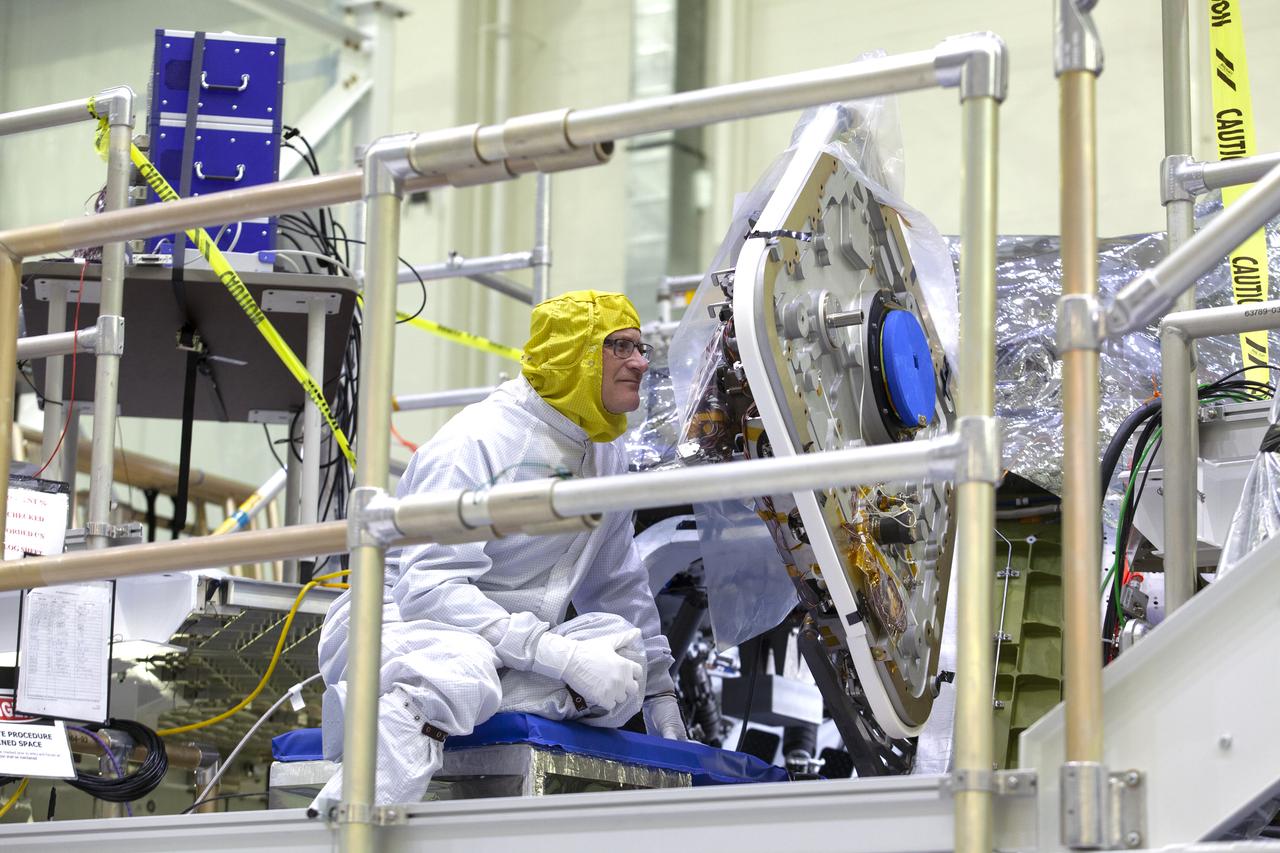
A Lockheed Martin specialist works on the hatch for the Orion crew module for Exploration Mission-1 (EM-1) on March 21, 2019, inside the Neil Armstrong Operations and Checkout Building high bay at NASA’s Kennedy Space Center in Florida. For EM-1, Orion will launch atop the Space Launch System rocket from Launch Pad 39B. The spacecraft will travel thousands of miles past the Moon on an approximately three-week test flight. Orion will return to Earth and splashdown in the Pacific Ocean off the coast of California, where it will be retrieved and returned to Kennedy.
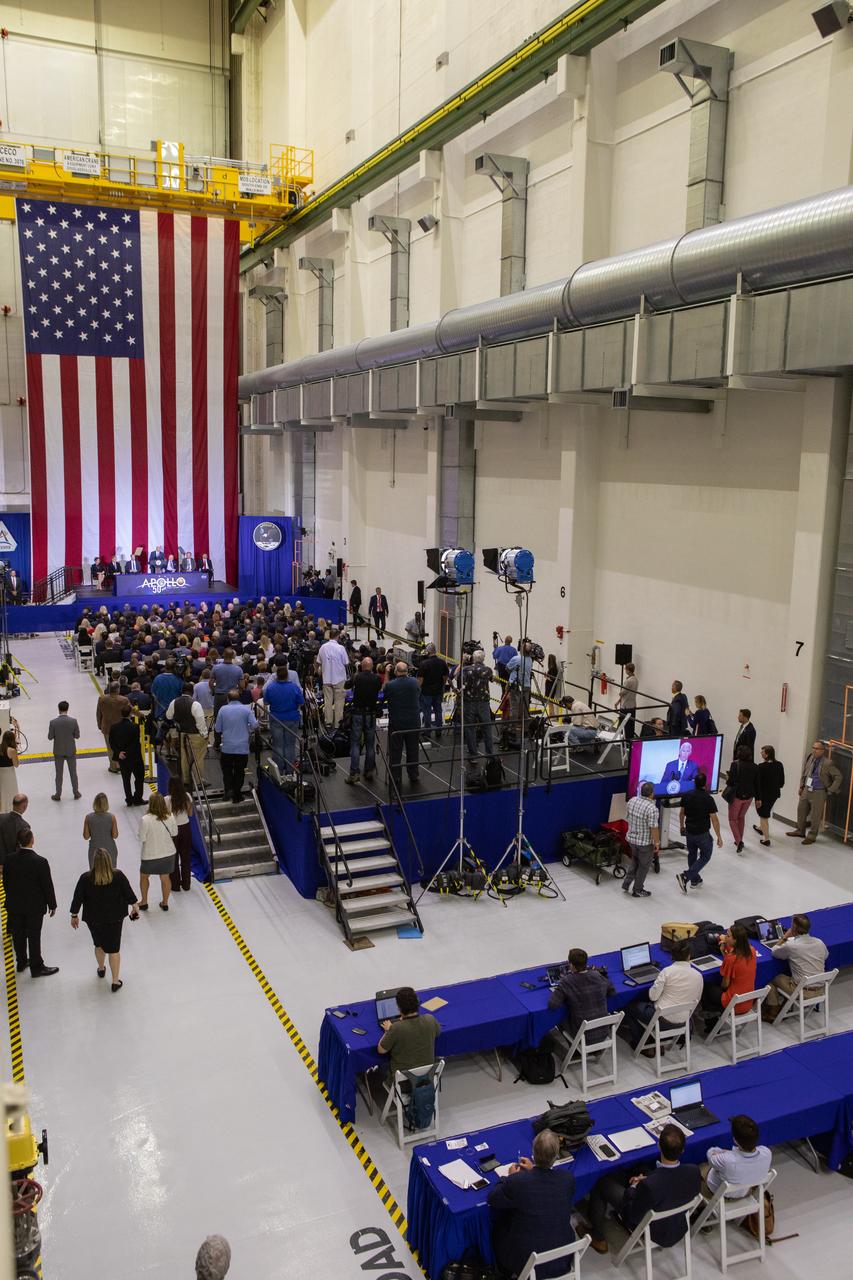
In this view photographed from above, Vice President Mike Pence addresses invited guests, elected officials and NASA, Lockheed Martin and other industry leaders at Kennedy Space Center’s Neil Armstrong Operations & Checkout Building on July 20, 2019. Pence, who visited the Florida spaceport in honor of the 50th anniversary of the Apollo 11 mission, also spoke about NASA’s progress and future plans to return to the Moon and on to Mars.
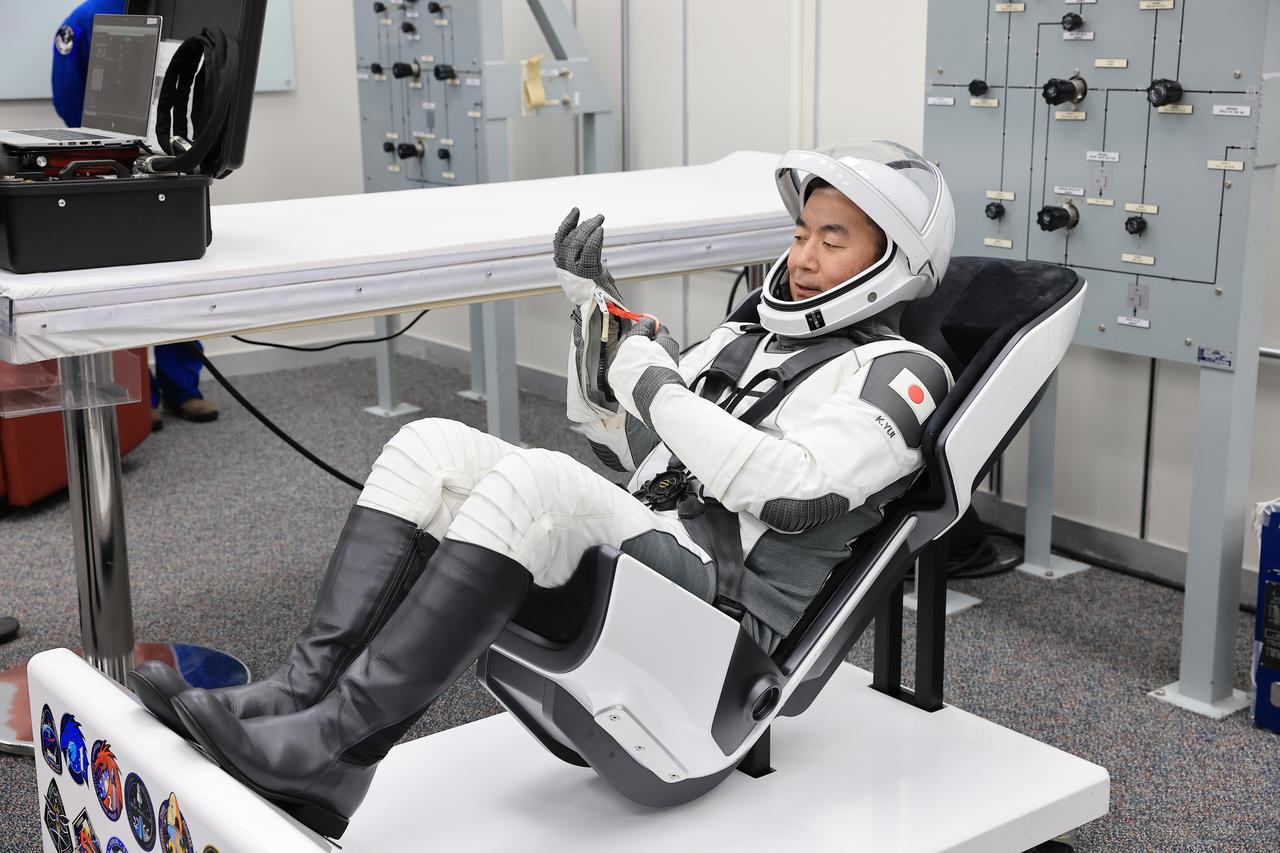
JAXA (Japan Aerospace Exploration Agency) astronaut Kimiya Yui conducts leak checks for his SpaceX spacesuit inside the crew suit-up room in the Neil A. Armstrong Operations and Checkout Building at the agency’s Kennedy Space Center in Florida on Thursday, July 31, 2025, during the first attempt of NASA’s SpaceX Crew-11 mission to the International Space Station. Yui, NASA astronauts Zena Cardman and Mike Fincke, along with Roscosmos cosmonaut Oleg Platonov, are scheduled to lift off aboard SpaceX’s Dragon spacecraft and Falcon 9 rocket for its second attempt at 11:43 a.m. EDT Friday, Aug. 1, 2025, from Launch Complex 39A at NASA Kennedy.
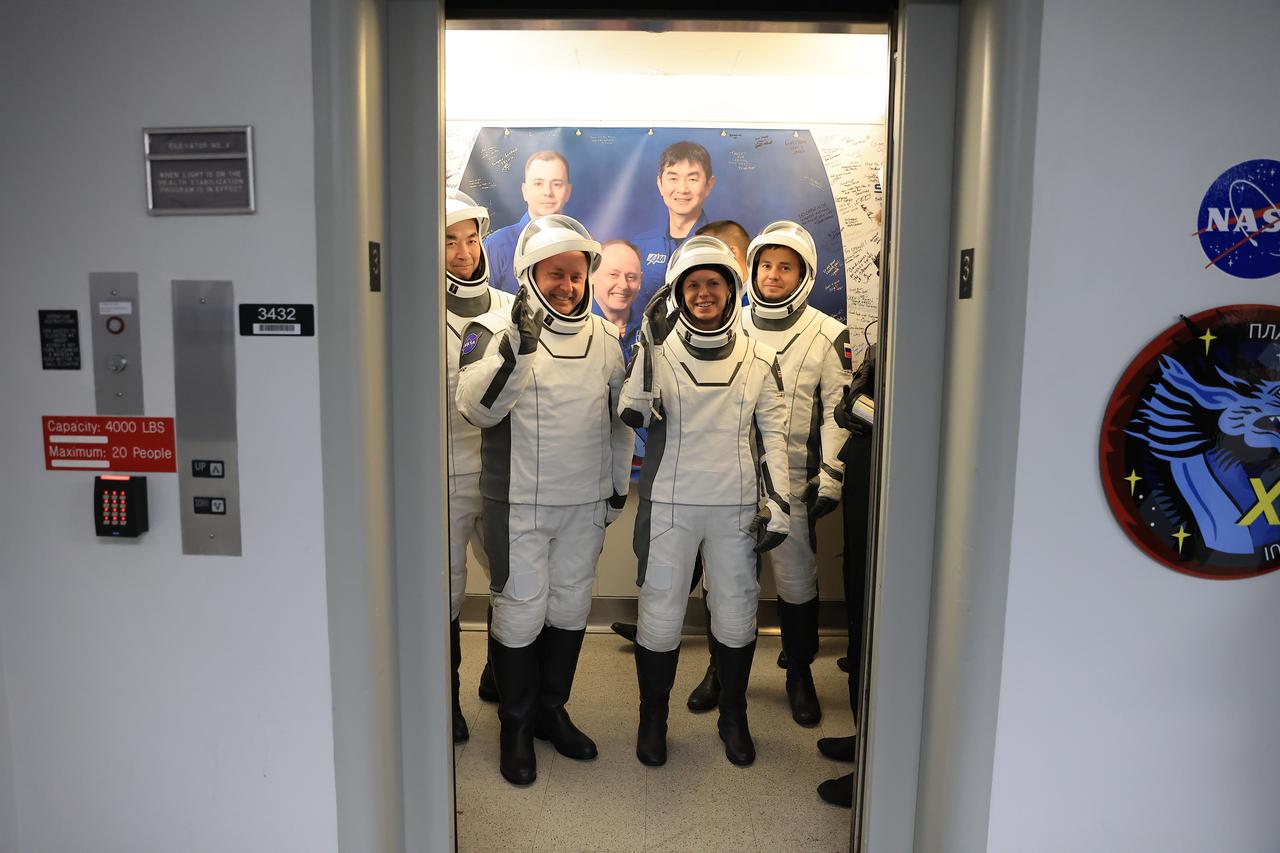
NASA’s SpaceX Crew-11 members pose for a photo in an elevator following suit-up operations in the Neil A. Armstrong Operations and Checkout Building at the agency’s Kennedy Space Center in Florida during the second launch attempt of NASA’s SpaceX Crew-11 mission to the International Space Station on Friday, Aug. 1, 2025. From top left, NASA astronauts Mike Fincke and Zena Cardman, along with JAXA (Japan Aerospace Exploration Agency) astronaut Kimiya Yui and Roscosmos cosmonaut Oleg Platonov, are scheduled to lift off aboard SpaceX’s Dragon spacecraft and Falcon 9 rocket at 11:43 a.m. EDT, from Launch Complex 39A at NASA Kennedy.
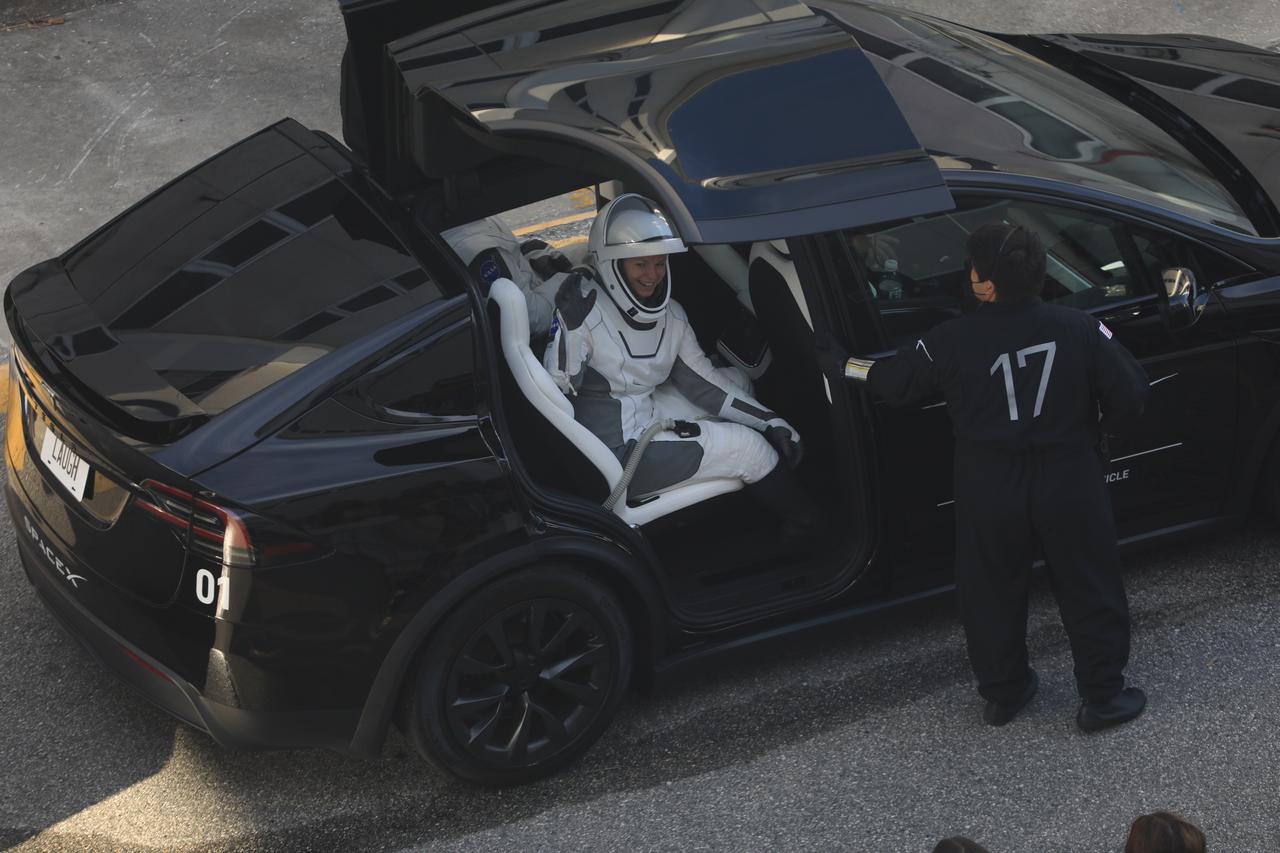
NASA astronaut Zena Cardman waves inside a customized electric vehicle to family and friend’s moments before she is taken to Launch Pad 39A at the agency’s Kennedy Space Center in Florida on Friday, Aug. 1, 2025, during the second launch attempt of NASA’s SpaceX Crew-11 mission to the International Space Station. Cardman and fellow NASA astronaut Mike Fincke, along with JAXA (Japan Aerospace Exploration Agency) astronaut Kimiya Yui and Roscosmos cosmonaut Oleg Platonov, are scheduled to lift off aboard SpaceX’s Dragon spacecraft and Falcon 9 rocket at 11:43 a.m. EDT, from Launch Complex 39A at NASA Kennedy.
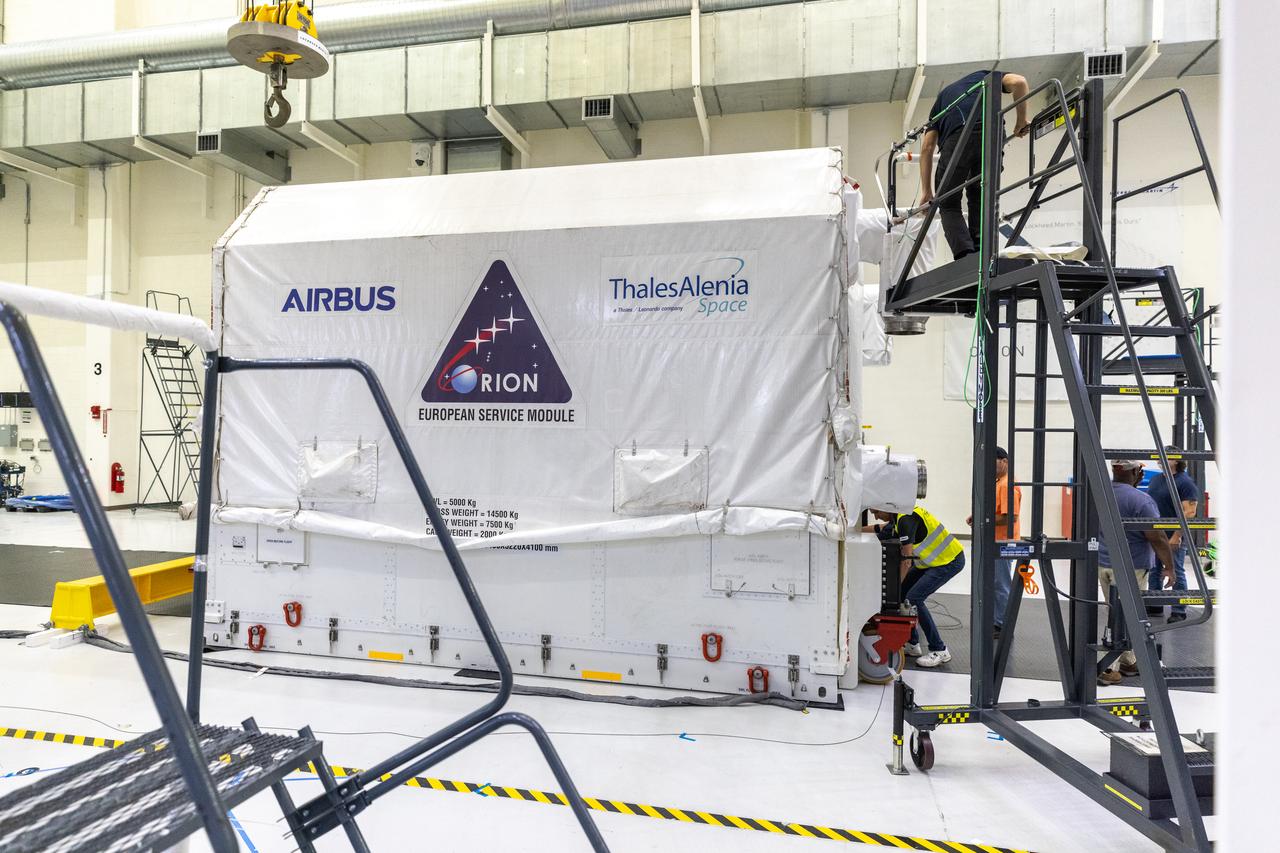
The transport carrier containing the European Service Module for NASA’s Artemis III mission arrives at the Neil A. Armstrong Operations and Checkout Building at NASA’s Kennedy Space Center in Florida on Tuesday, Sept. 3, 2024. The European Service Module, which is assembled by Airbus in Bremen, Germany, from parts made in 10 European countries and the United States, acts as the driving force behind Orion for deep space exploration, providing essential propulsion, thermal control, and electrical power.
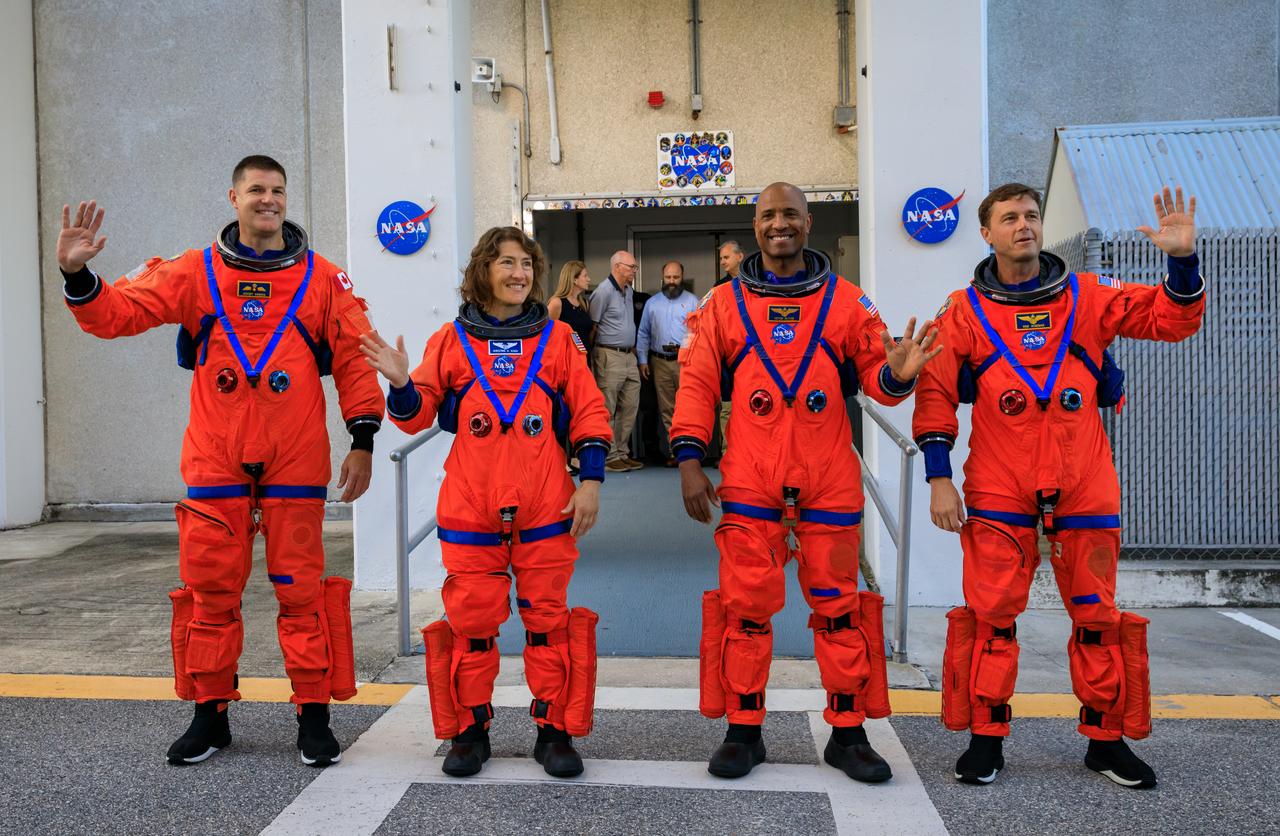
Artemis II crew members (from left) CSA (Canadian Space Agency) astronaut Jeremy Hansen, and NASA astronauts Christina Koch, Victor Glover, and Reid Wiseman walk out of Astronaut Crew Quarters inside the Neil Armstrong Operations and Checkout Building to the Artemis crew transportation vehicles prior to traveling to Launch Pad 39B as part of an integrated ground systems test at Kennedy Space Center in Florida on Wednesday, Sept. 20, to test the crew timeline for launch day.
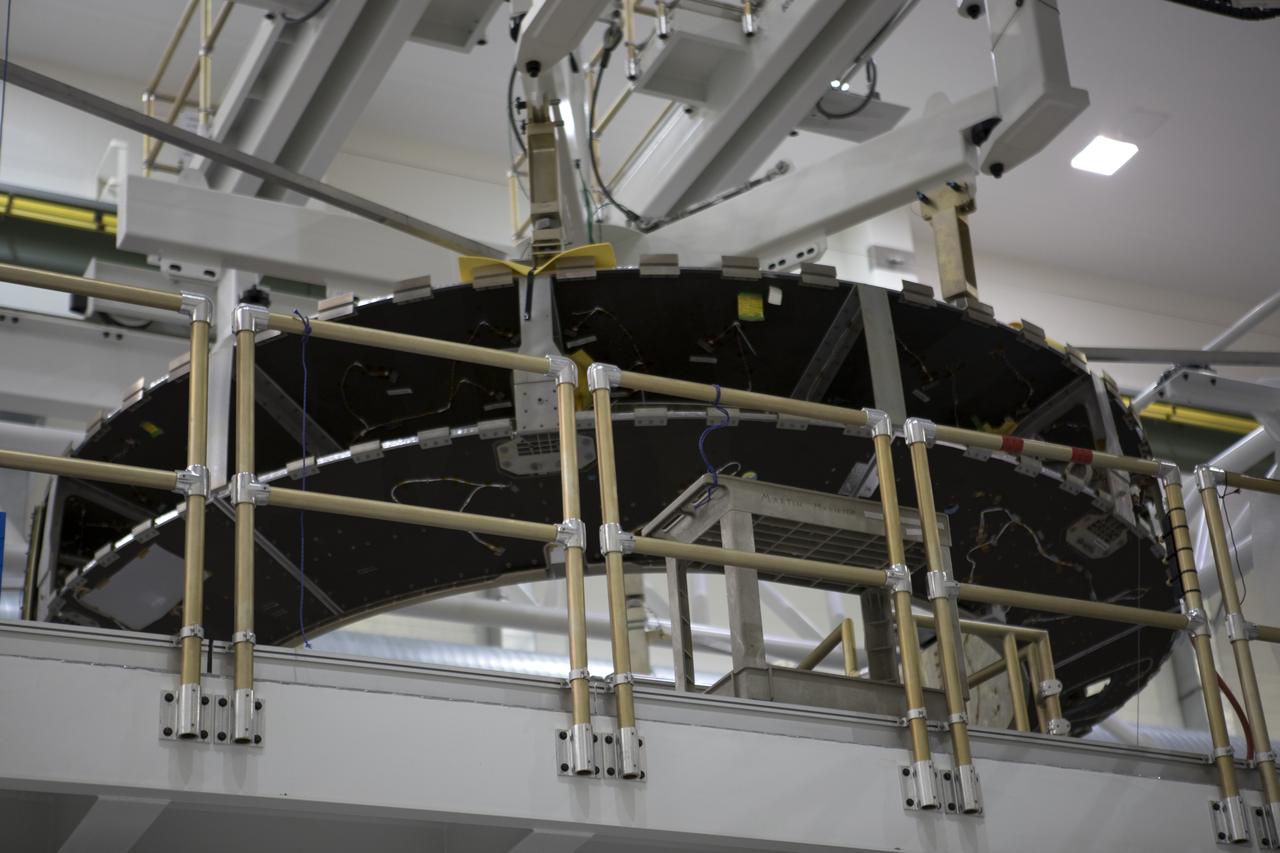
Inside the Neil Armstrong Operations and Checkout Building high bay at NASA's Kennedy Space Center in Florida, operations are underway to lower the Orion crew module adapter structural test article onto the European Space Agency's service module structural test article. After the hardware is attached, the structure will be packed and shipped to Lockheed Martin's Denver facility to undergo testing. The Orion spacecraft will launch atop the agency's Space Launch System rocket on Exploration Mission-1 in 2019.
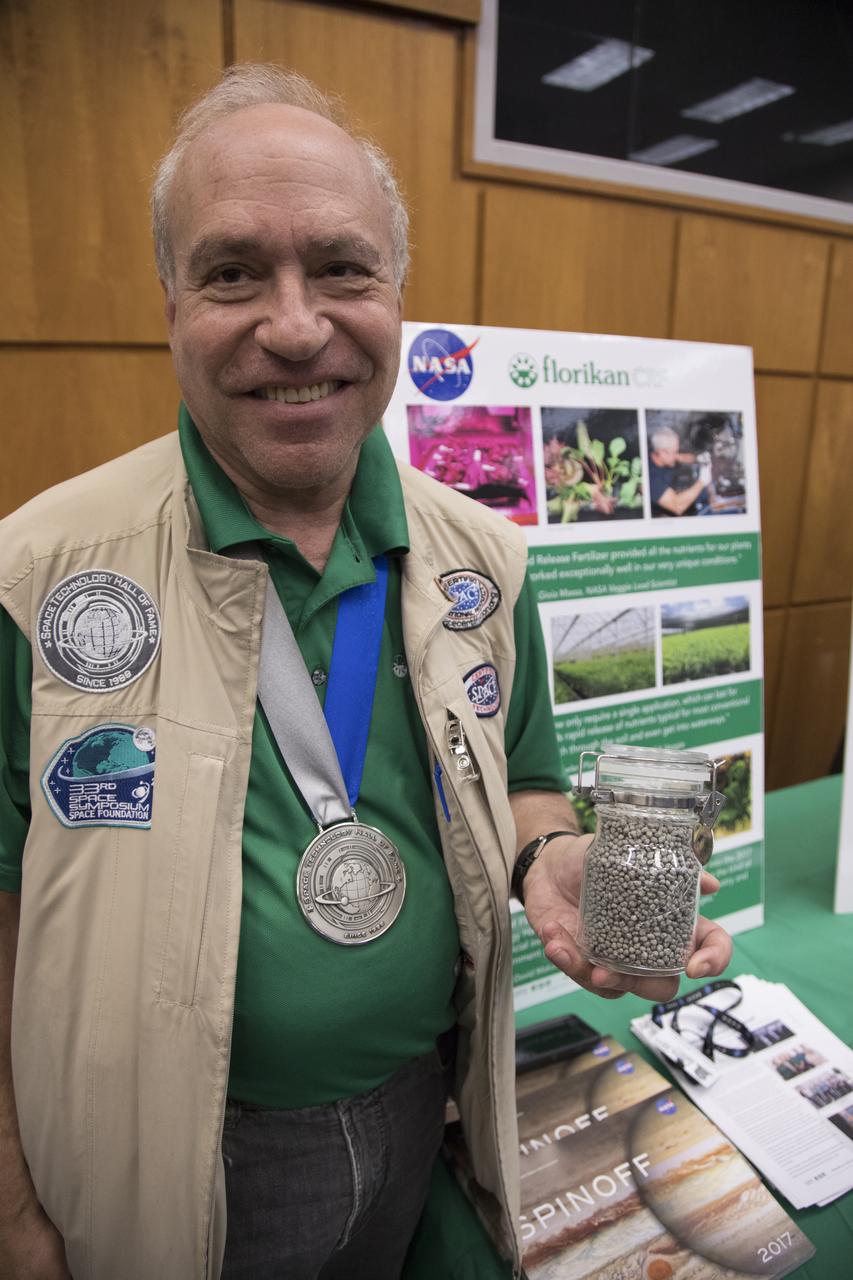
Ed Rosenthal, founder and chairman of Florikan controlled release fertilizers, displays his plant growth material during the 2017 Innovation Expo showcase at NASA's Kennedy Space Center in Florida. The controlled release fertilizer is used in NASA's Veggie plant growth system on the International Space Station and in the Veggie control unit in a laboratory in the Space Station Processing Facility. The purpose of the annual two-day event is to help foster innovation and creativity among the Kennedy workforce. The event included several keynote speakers, training opportunities, an innovation showcase and the KSC Kickstart competition.
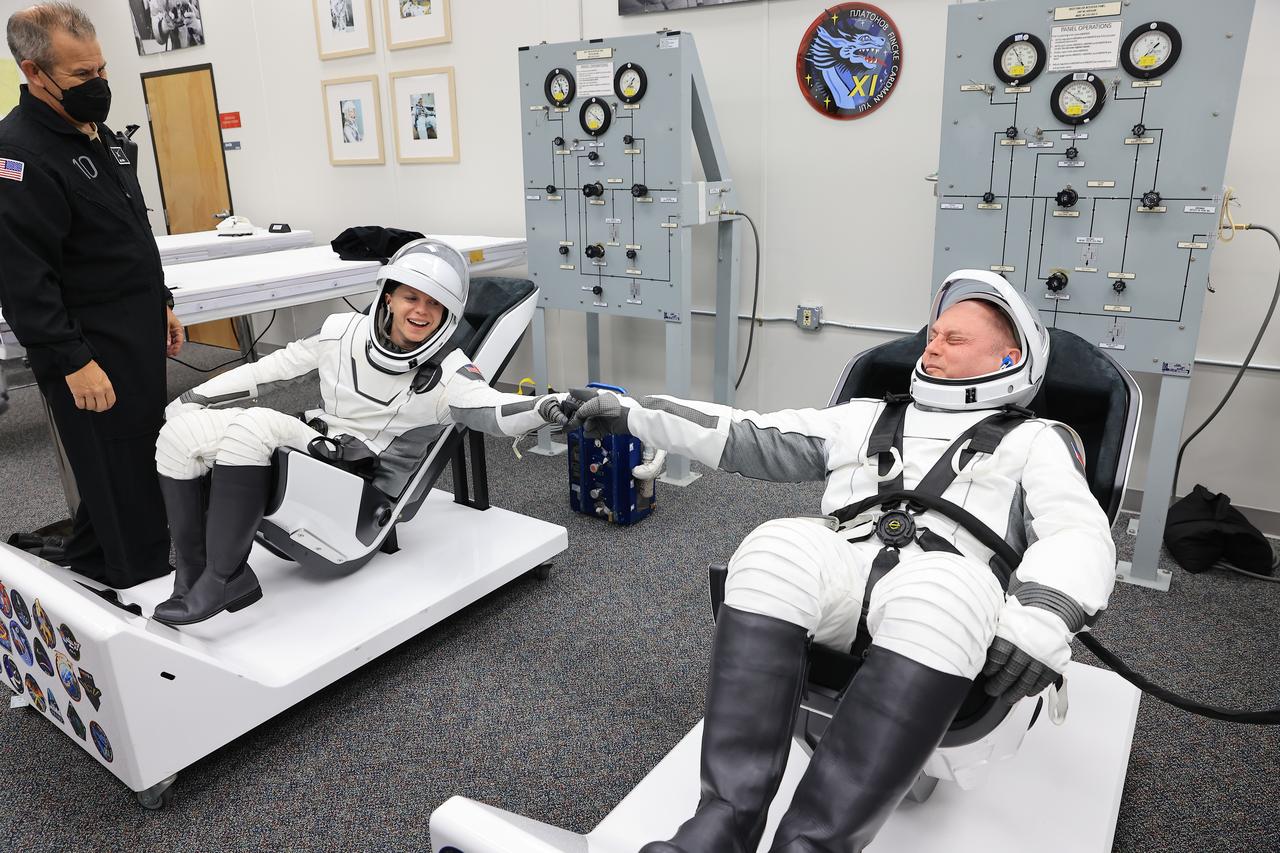
From left, NASA astronauts Zena Cardman and Mike Fincke give each other a “fist pump” during leak checks for their SpaceX spacesuit inside the crew suit-up room in the Neil A. Armstrong Operations and Checkout Building at the agency’s Kennedy Space Center in Florida during the second launch attempt of NASA’s SpaceX Crew-11 mission to the International Space Station on Friday, Aug. 1, 2025. Cardman and Fincke, along with JAXA (Japan Aerospace Exploration Agency) astronaut Kimiya Yui and Roscosmos cosmonaut Oleg Platonov, are scheduled to lift off aboard SpaceX’s Dragon spacecraft and Falcon 9 rocket at 11:43 a.m. EDT, from Launch Complex 39A at NASA Kennedy.
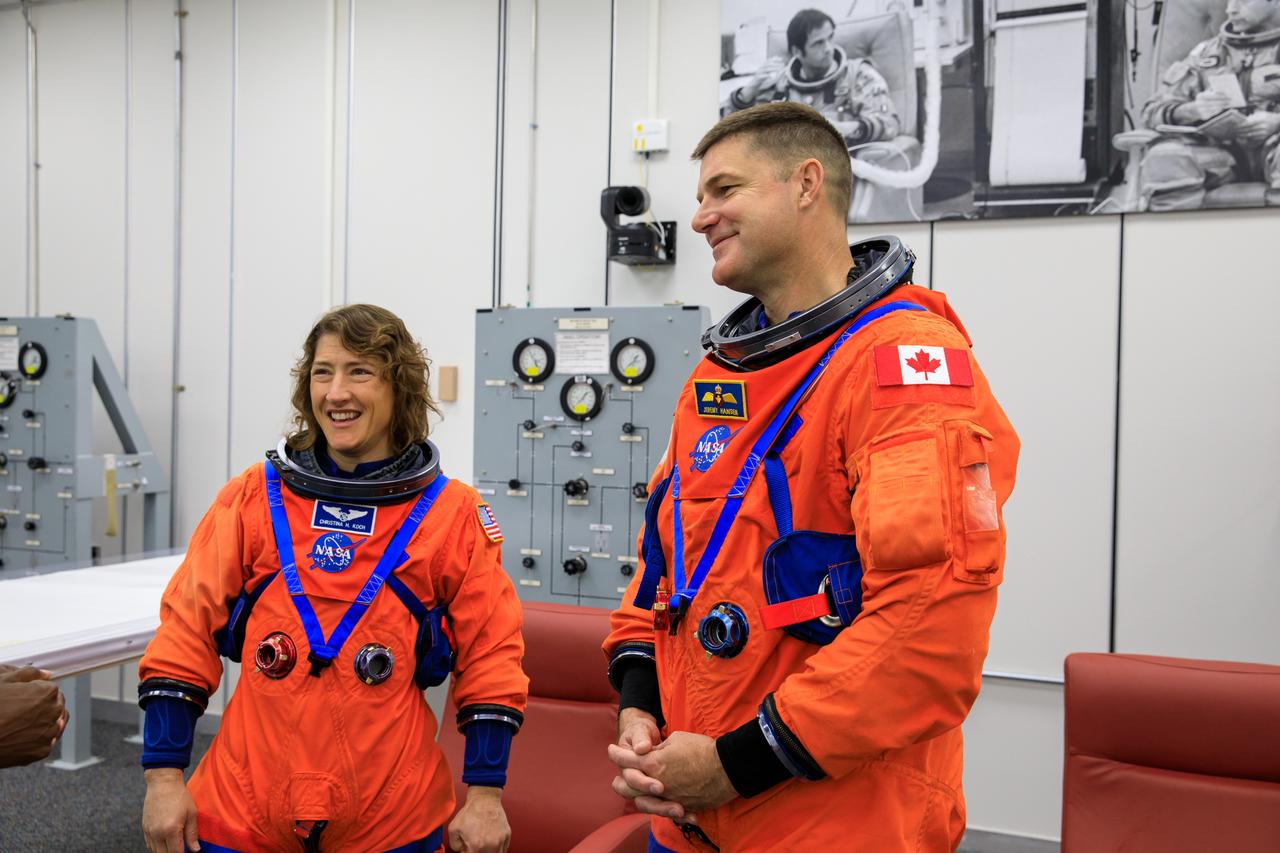
Inside the Astronaut Crew Quarters at the Neil Armstrong Operations and Checkout Building at NASA’s Kennedy Space Center in Florida, Artemis II crew members NASA astronaut Christina Koch (left) and CSA (Canadian Space Agency) astronaut Jeremy Hansen are shown wearing test versions of the Orion crew survival system spacesuits they will wear on launch day as part of an integrated ground systems test on Wednesday, Sept. 20.
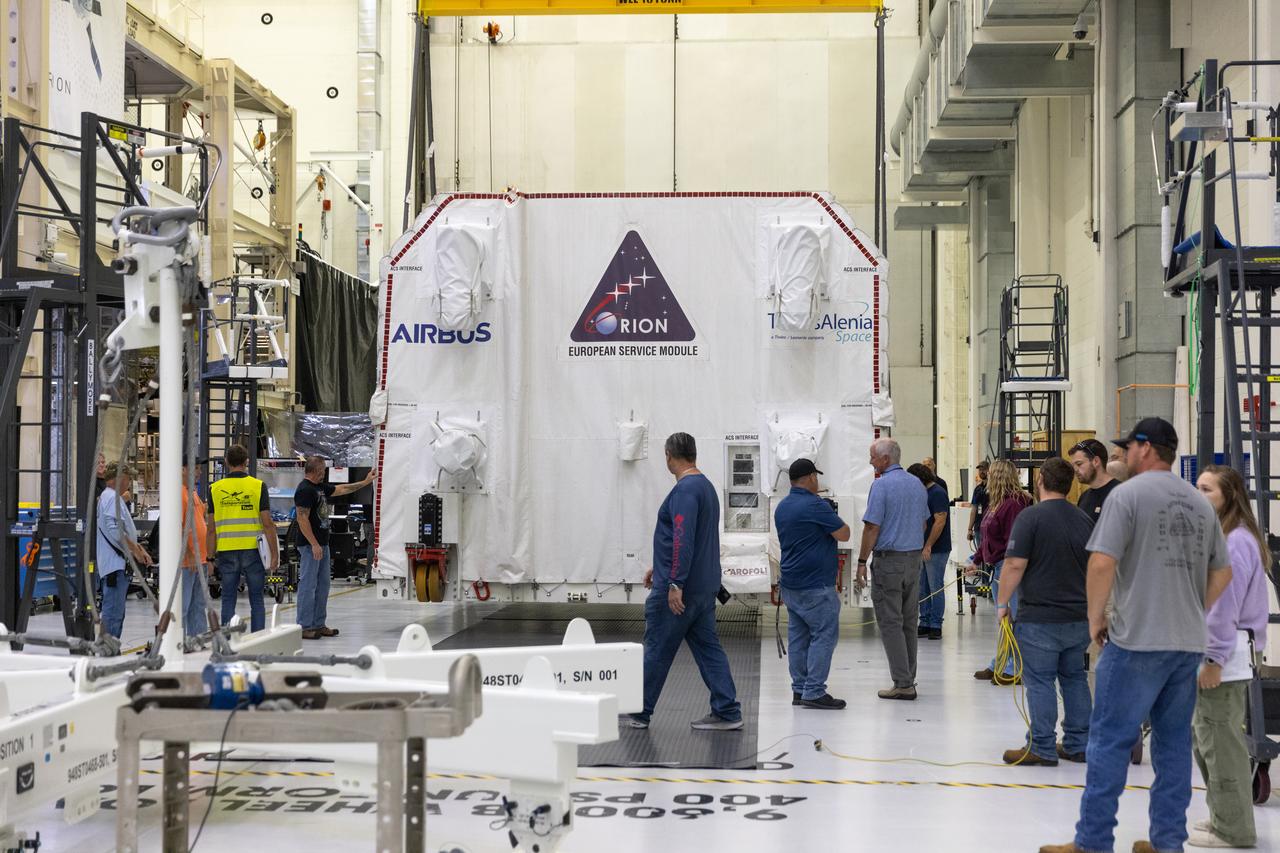
The transport carrier containing the European Service Module for NASA’s Artemis III mission arrives at the Neil A. Armstrong Operations and Checkout Building at NASA’s Kennedy Space Center in Florida on Tuesday, Sept. 3, 2024. The European Service Module, which is assembled by Airbus in Bremen, Germany, from parts made in 10 European countries and the United States, acts as the driving force behind Orion for deep space exploration, providing essential propulsion, thermal control, and electrical power.
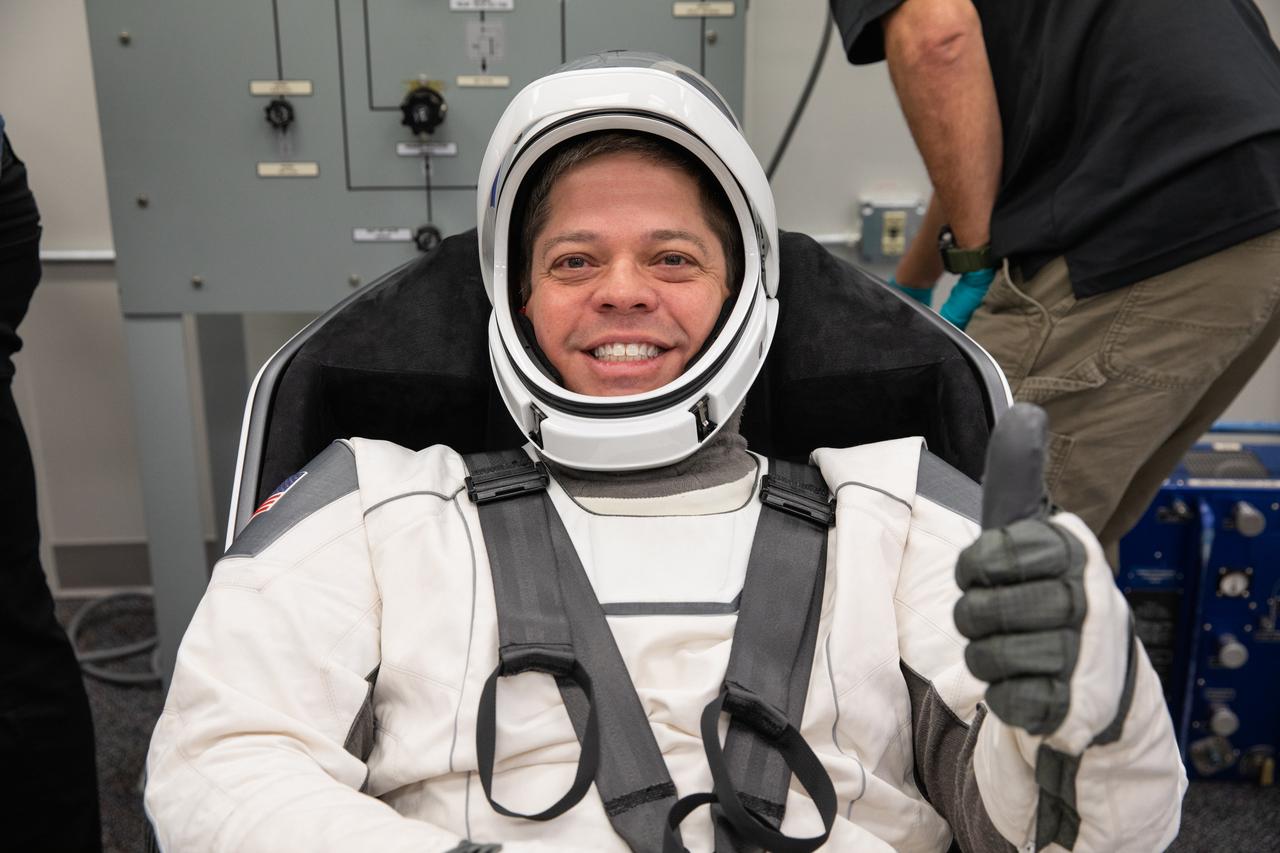
NASA astronaut Bob Behnken gives a thumbs-up as he dons a SpaceX spacesuit in the Astronaut Crew Quarters at Kennedy Space Center in Florida on Jan. 17, 2020, during a dress rehearsal ahead of the company’s uncrewed In-Flight Abort Test. A SpaceX Falcon 9 rocket and Crew Dragon spacecraft will lift off from Launch Complex 39A on the flight test, which will demonstrate the spacecraft’s escape capabilities in preparation for crewed flights to the International Space Station as part of the agency’s Commercial Crew Program. Behnken and NASA astronaut Doug Hurley are slated to fly on the company’s first crewed mission, Demo-2.
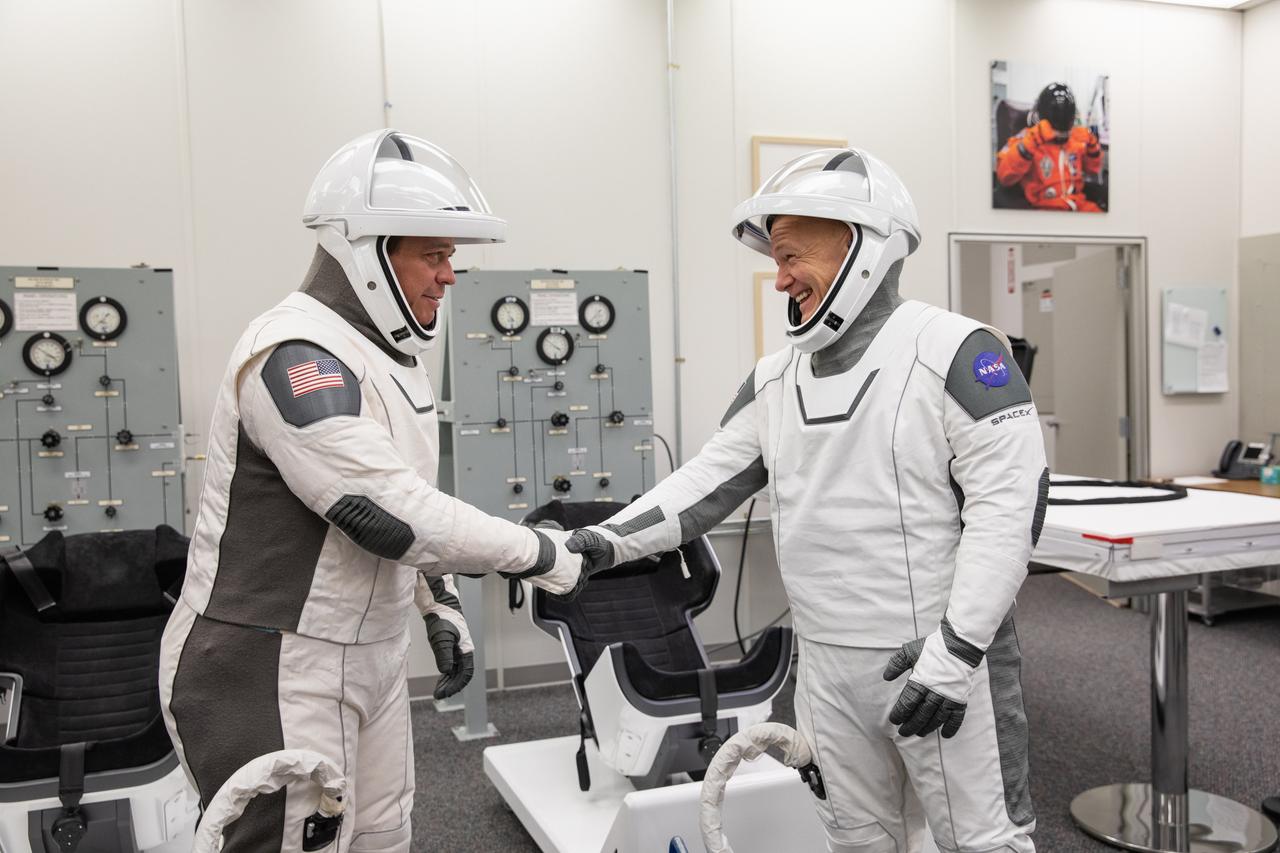
NASA astronauts Bob Behnken, left, and Doug Hurley shake hands after suiting up in SpaceX spacesuits in the Astronaut Crew Quarters at Kennedy Space Center in Florida on Jan. 17, 2020, during a dress rehearsal ahead of the company’s uncrewed In-Flight Abort Test. A SpaceX Falcon 9 rocket and Crew Dragon spacecraft will lift off from Launch Complex 39A on the flight test, which will demonstrate the spacecraft’s escape capabilities in preparation for crewed flights to the International Space Station as part of the agency’s Commercial Crew Program. Behnken and Hurley are slated to fly on the company’s first crewed mission, Demo-2.
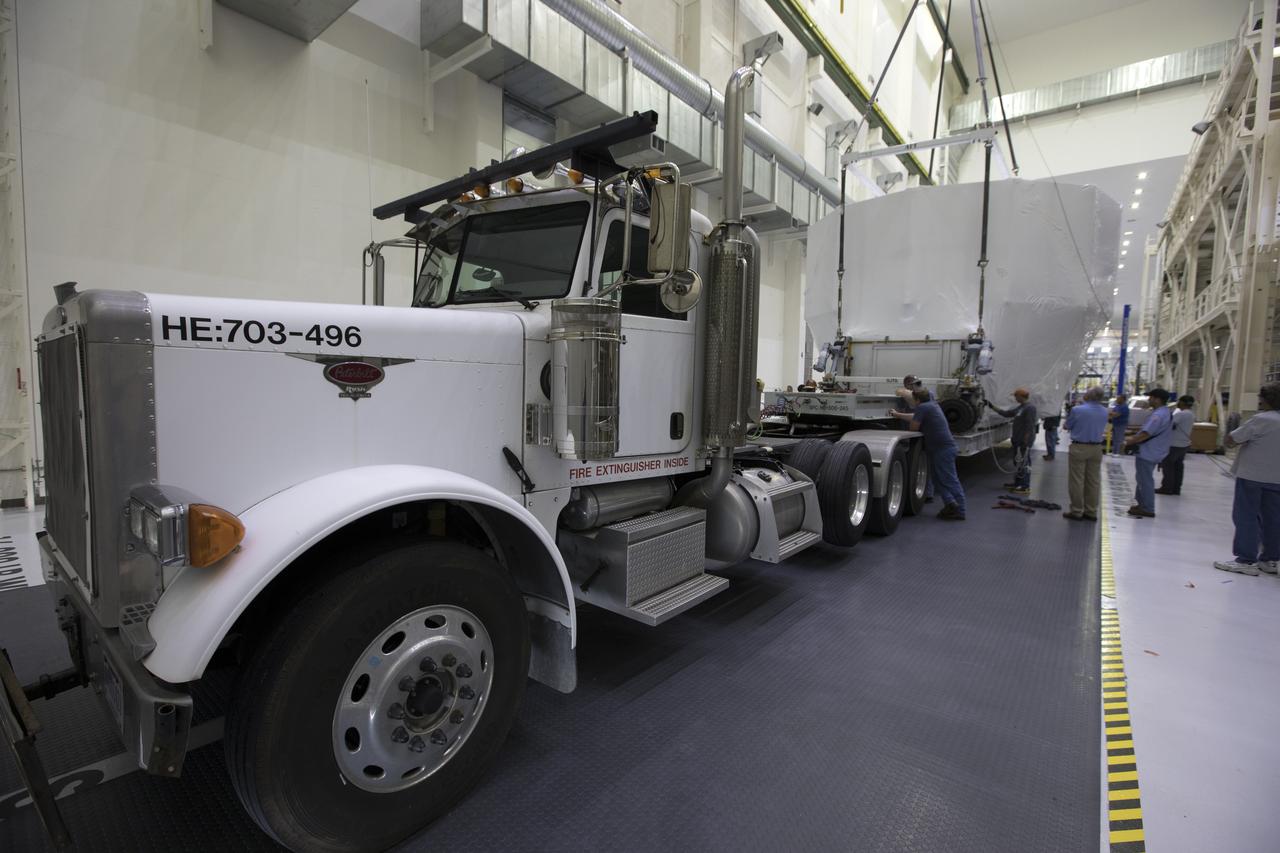
Inside the Neil Armstrong Operations and Checkout Building high bay, the Orion service module structural test article for Exploration Mission-1 (EM-1), built by the European Space Agency, is secured on the flatbed of a transport truck. The service module will be shipped to Lockheed Martin's Denver facility to undergo testing. The Orion spacecraft will launch atop the agency's Space Launch System rocket on EM-1 in 2019.
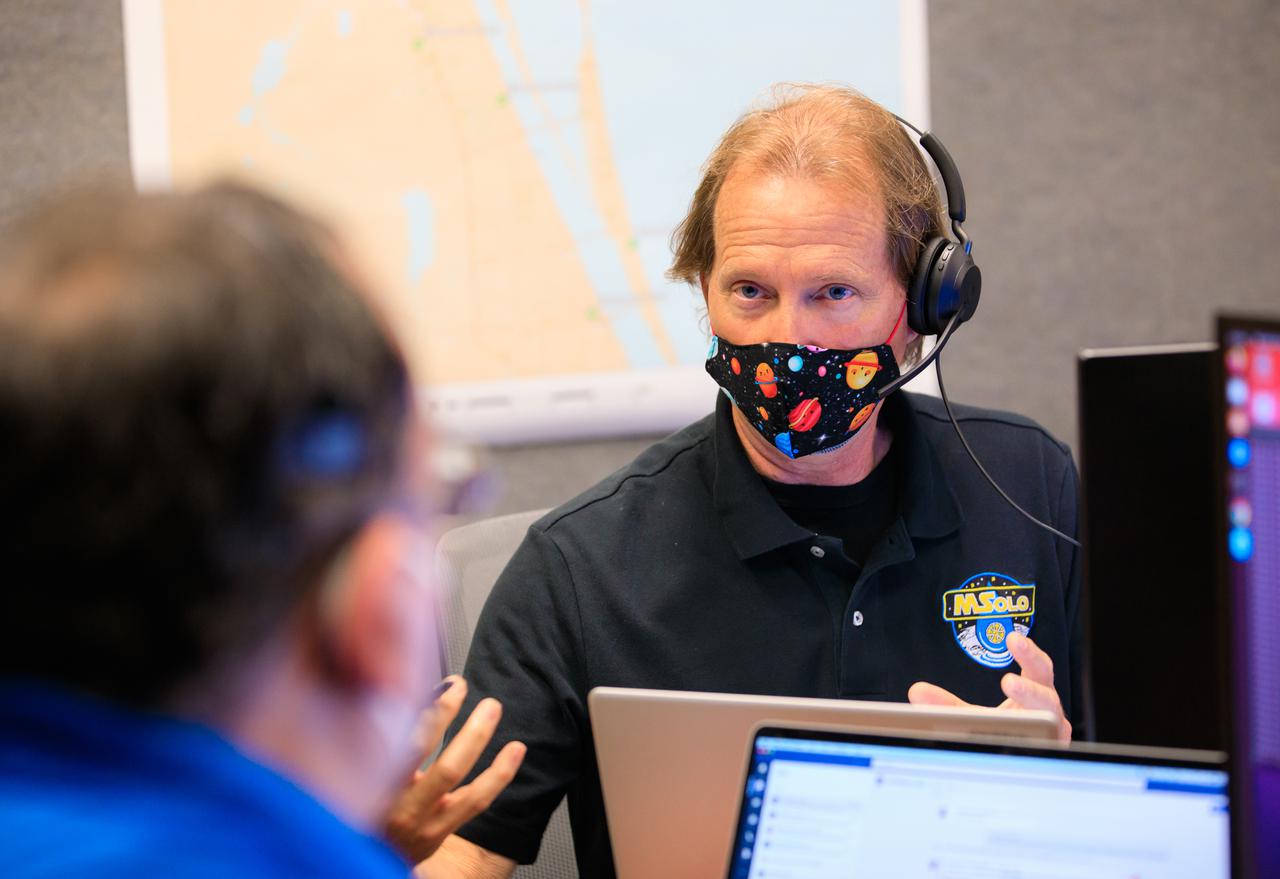
Kevin Smith, software team and science team liaison for NASA’s Mass Spectrometer observing lunar operations (MSolo), takes part in a joint simulation of the Peregrine One Mission on March 26, 2021, at NASA’s Kennedy Space Center in Florida, where MSolo connected from inside the Neil Armstrong Operations and Checkout Building to Astrobotic’s mission control facility in Pittsburgh, Pennsylvania. MSolo is a commercial off-the-shelf mass spectrometer modified to work in space and it will help analyze the chemical makeup of landing sites on the Moon, as well as study water on the lunar surface. This was the first mission round of simulations for Peregrine Mission One to develop and refine procedures between Astrobotic’s Peregrine Lander and MSolo. Later, there will be other simulations with multiple instruments. Peregrine Mission One will be one of NASA’s first Commercial Lunar Payload Delivery Service (CLPS) missions where under the Artemis program, commercial deliveries beginning in 2021 will perform science experiments, test technologies and demonstrate capabilities to help NASA explore the Moon and prepare for human missions.
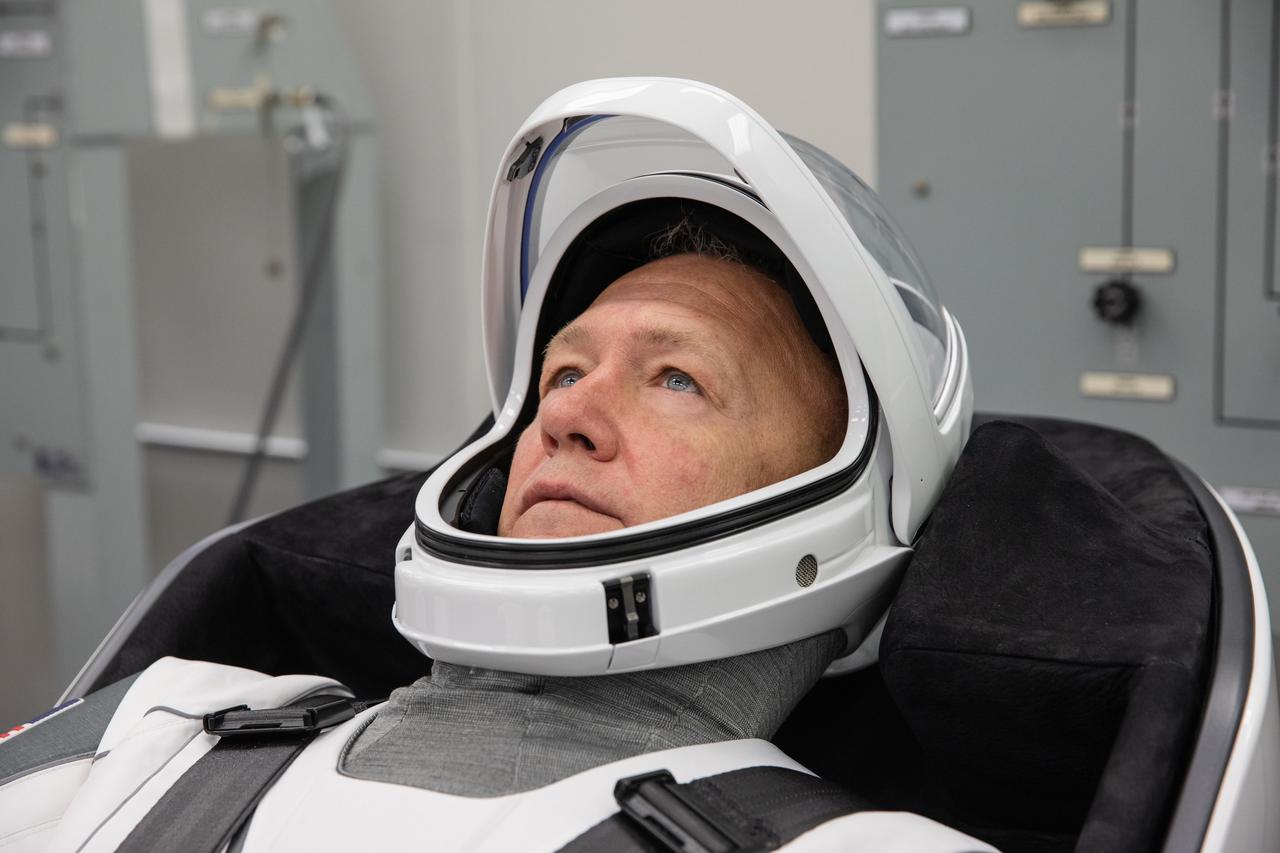
NASA astronaut Doug Hurley dons a SpaceX spacesuit in the Astronaut Crew Quarters at Kennedy Space Center in Florida on Jan. 17, 2020, during a dress rehearsal ahead of the company’s uncrewed In-Flight Abort Test. A SpaceX Falcon 9 rocket and Crew Dragon spacecraft will lift off from Launch Complex 39A on the flight test, which will demonstrate the spacecraft’s escape capabilities in preparation for crewed flights to the International Space Station as part of the agency’s Commercial Crew Program. Hurley and NASA astronaut Bob Behnken are slated to fly on the company’s first crewed mission, Demo-2.
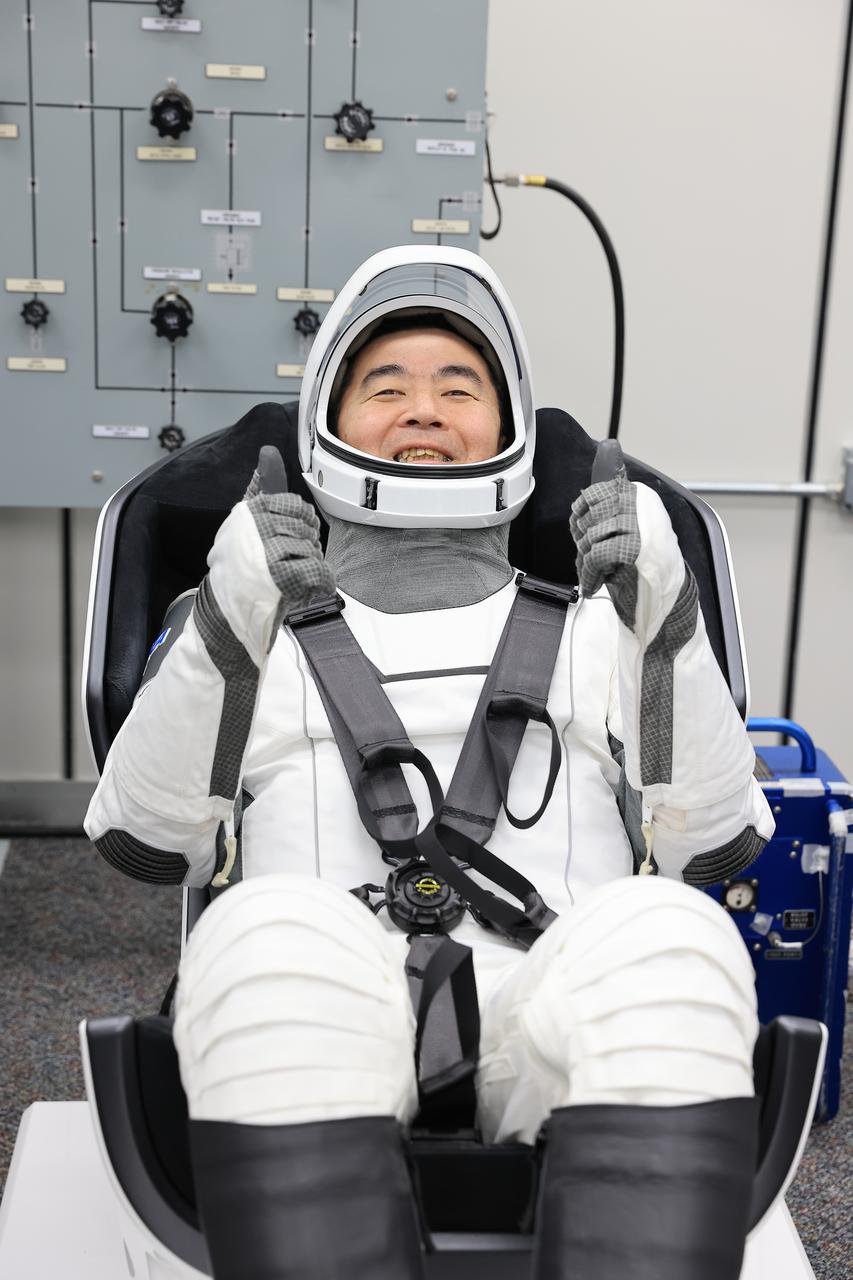
JAXA (Japan Aerospace Exploration Agency) astronaut Kimiya Yui conducts leak checks for his SpaceX spacesuit inside the crew suit-up room in the Neil A. Armstrong Operations and Checkout Building at the agency’s Kennedy Space Center in Florida during the second launch attempt NASA’s SpaceX Crew-11 mission to the International Space Station on Friday, Aug. 1, 2025. Yui, NASA astronauts Zena Cardman and Mike Fincke, along with Roscosmos cosmonaut Oleg Platonov, are scheduled to lift off aboard SpaceX’s Dragon spacecraft and Falcon 9 rocket at 11:43 a.m. EDT, from Launch Complex 39A at NASA Kennedy.
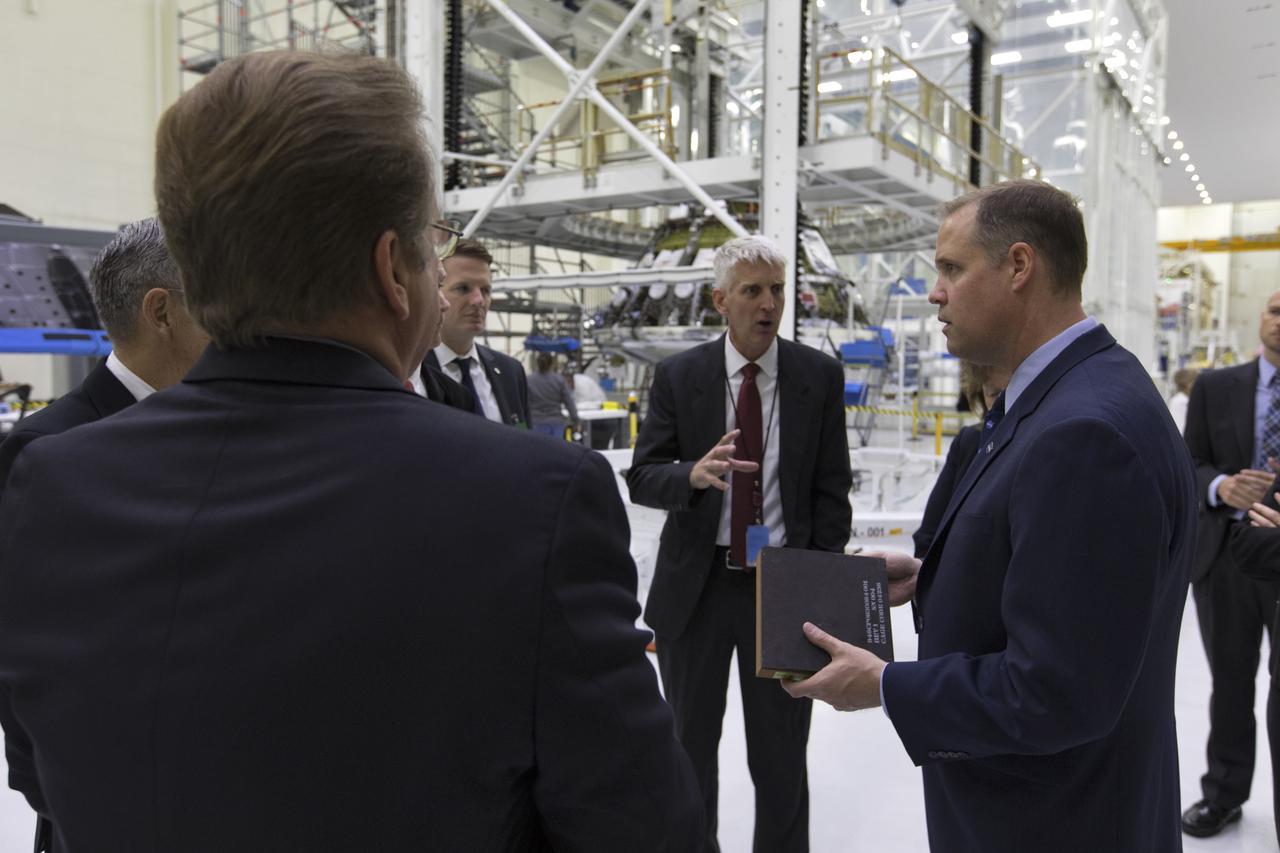
NASA Administrator Jim Bridenstine is briefed on work taking place on NASA’s Orion spacecraft during a tour of Kennedy Space Center’s Neil Armstrong Operations and Checkout Building on Tuesday, Aug. 7, 2018. It was Bridenstine’s first official visit to the Florida spaceport.
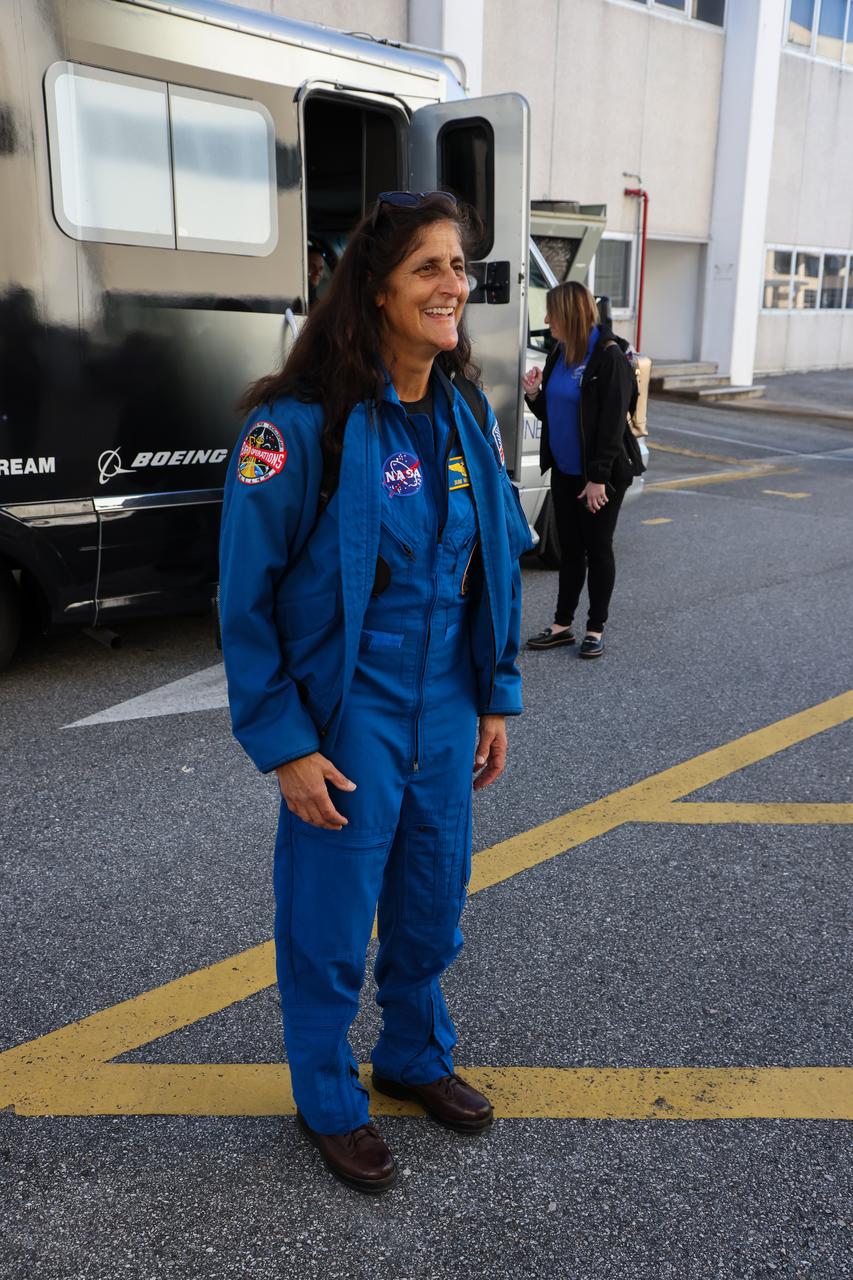
NASA astronaut Suni Williams emerges from the Neil Armstrong Operations and Checkout Building at the agency’s Kennedy Space Center in Florida on Wednesday, Jan. 31, 2024, as part of an integrated crew exercise simulation for NASA’s Boeing Crew Flight Test (CFT). Williams and fellow crew member Barry “Butch” Wilmore, along with NASA, Boeing, and United Launch Alliance (ULA), participated in the integrated exercise, which allowed teams to rehearse prelaunch operations beginning roughly four hours before a targeted liftoff. CFT will be the first flight with astronauts to the International Space Station for Boeing’s Starliner spacecraft as part of NASA’s Commercial Crew Program. Starliner is scheduled to launch atop ULA’s Atlas V rocket no earlier than mid-April 2024.
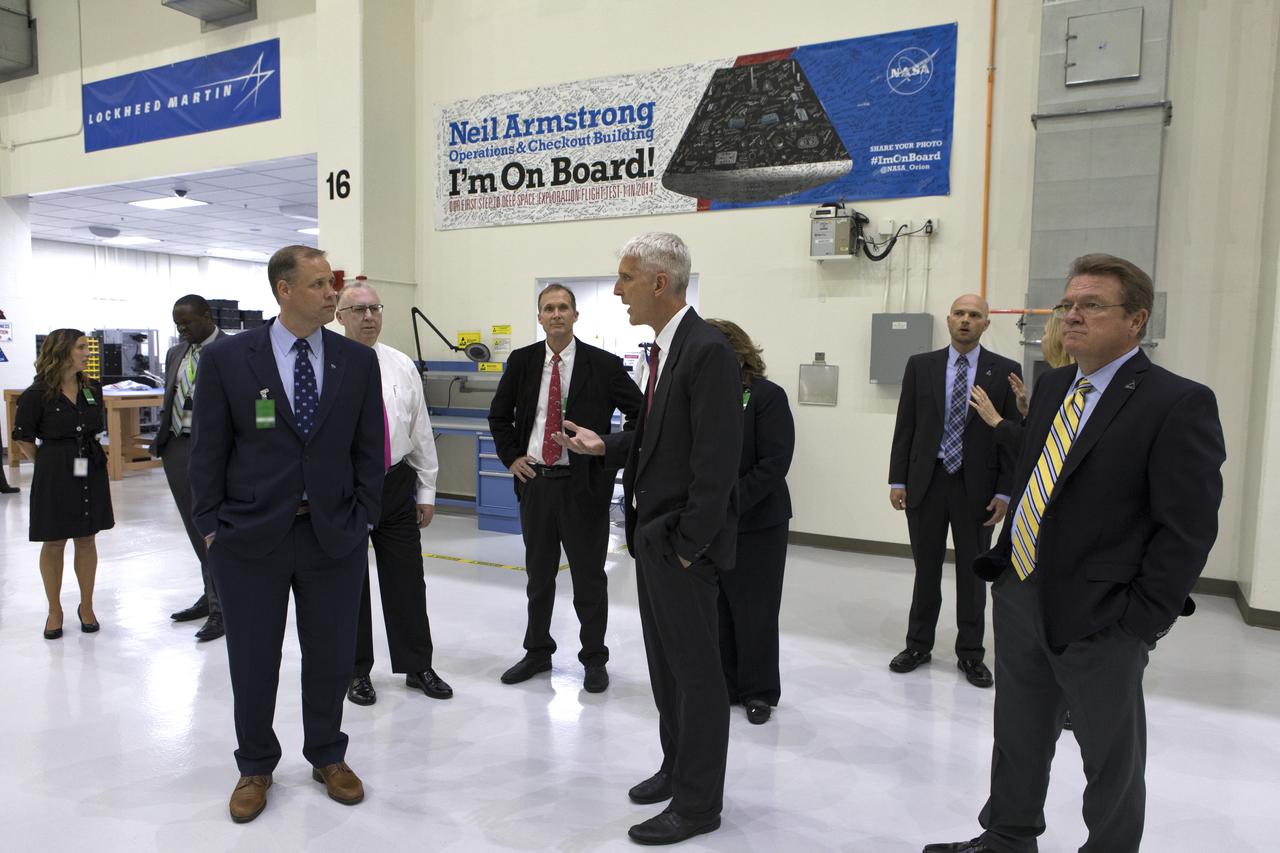
NASA Administrator Jim Bridenstine, left, talks with Scott Wilson, manager of production operations for the Orion Program, during a tour of the Neil Armstrong Operations and Checkout Building at NASA’s Kennedy Space Center on Tuesday, Aug. 7, 2018. Bridenstine made his first official visit to the Florida spaceport on Aug. 6 and 7.
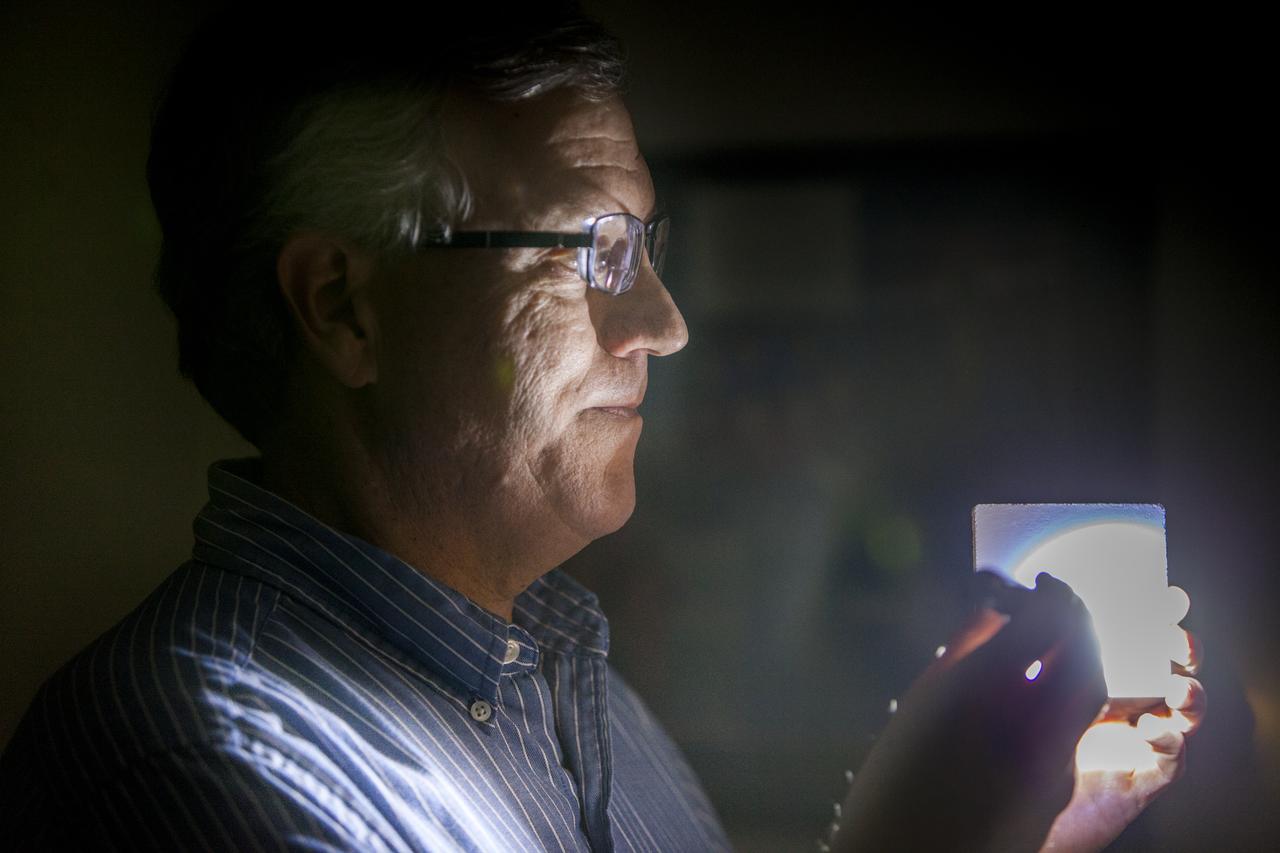
Robert Youngquist, Ph.D., tests a sample disk with a "Solar White" cryogenic selective surface coating with a flash light, demonstrating the coating’s reflective properties. The innovative coating is predicted to reflect more than 99.9 percent of the simulated solar infrared radiation. This technology could enable storing super-cold, or cryogenic, liquids and support systems that shield astronauts against radiation during the Journey to Mars.
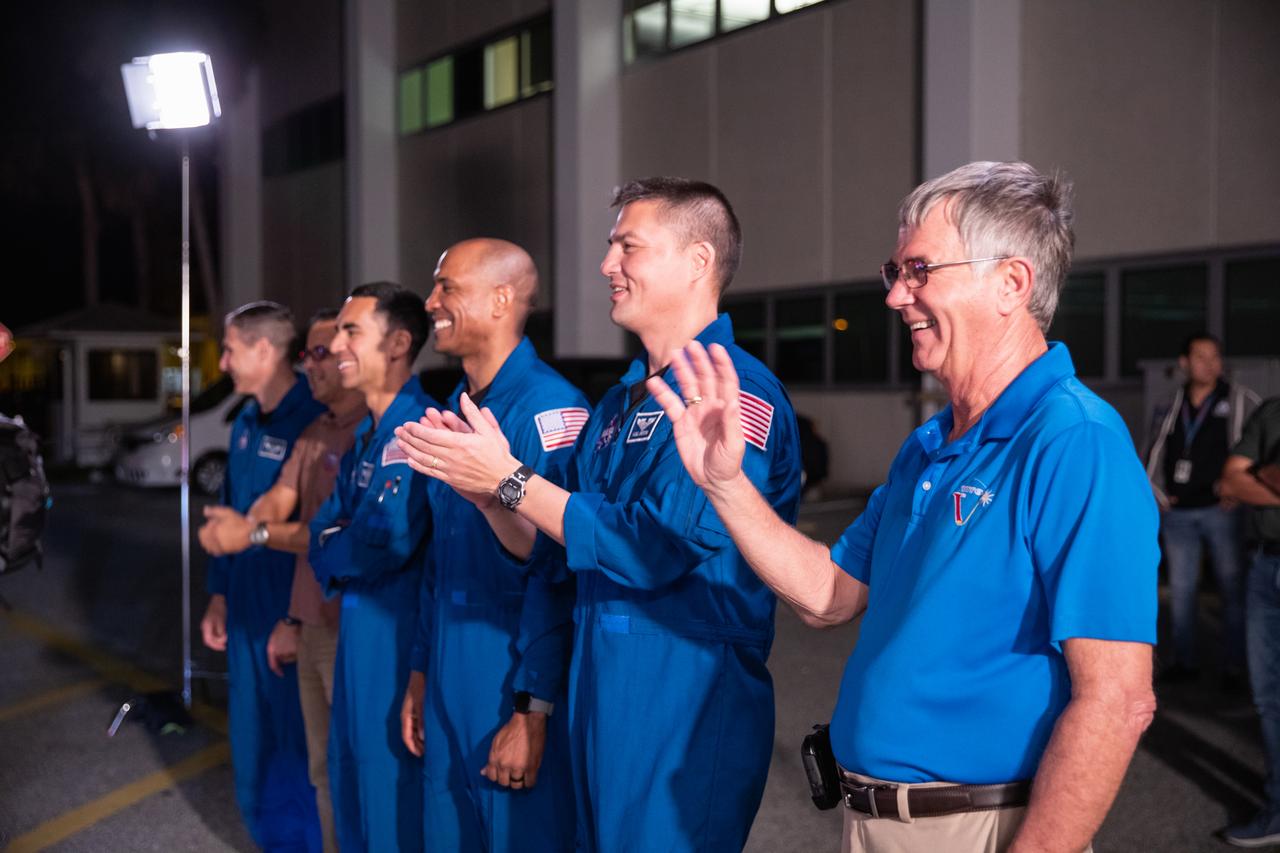
NASA astronauts cheer as fellow astronauts Bob Benhken and Doug Hurley walk out of the Neil A. Armstrong Operations and Checkout Building at Kennedy Space Center in Florida on Jan. 17, 2020, during a dress rehearsal ahead of the SpaceX uncrewed In-Flight Abort Test. From left to right are Mike Hopkins, Joe Acaba, Raja Chari, Victor Glover, Kjell Lindgren and Glen Davis with the Vehicle Integration Test Office at Kennedy. A SpaceX Falcon 9 rocket and Crew Dragon spacecraft will lift off from Launch Complex 39A on the flight test, which will demonstrate the spacecraft’s escape capabilities in preparation for crewed flights to the International Space Station as part of the agency’s Commercial Crew Program. Behnken and Hurley are slated to fly on the company’s first crewed mission, Demo-2.
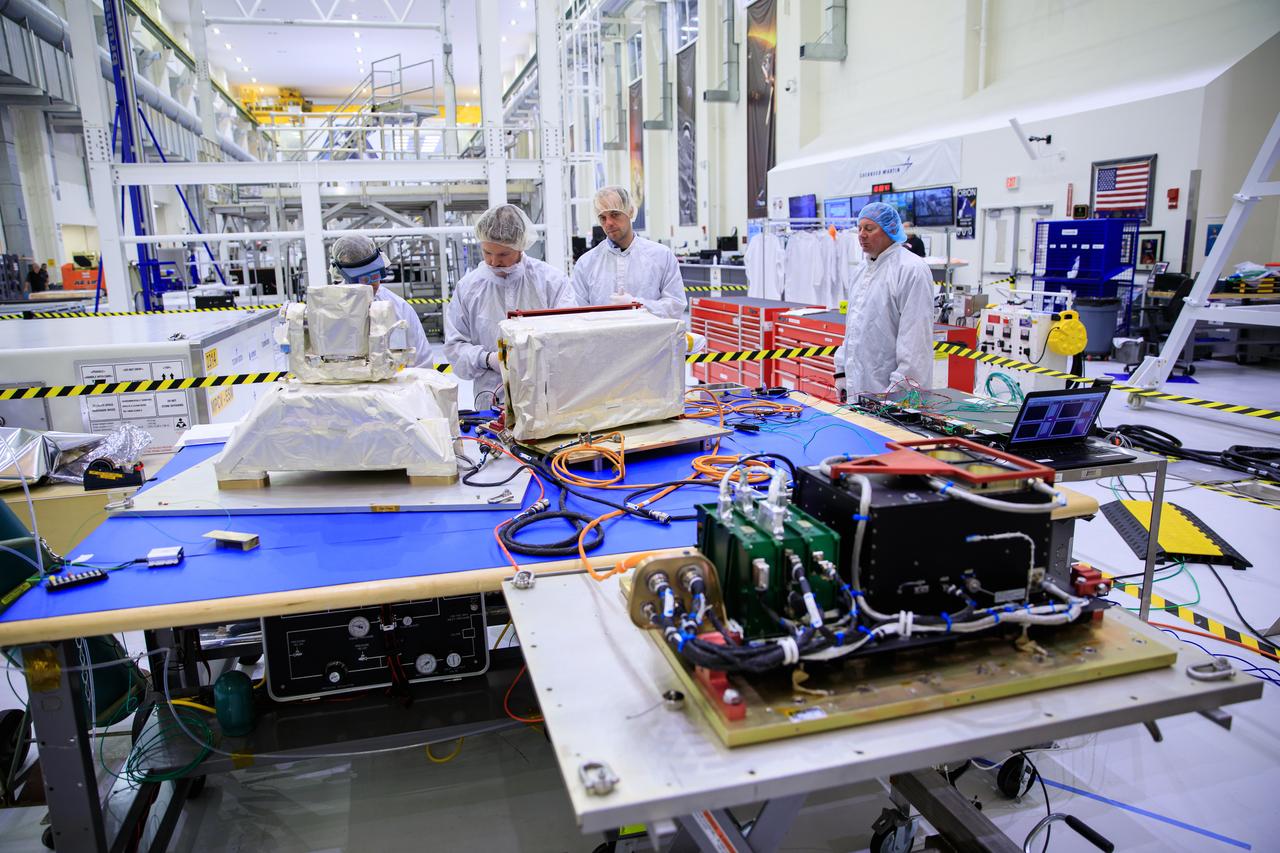
Inside the high bay of the Neil Armstrong Operations and Checkout Building at NASA’s Kennedy Space Center in Florida, technicians assemble on the Optical Communications System for the Artemis II mission on June 2, 2023. Optical communications is the latest space communications technology that is able to provide data rates as much as a hundred times higher than current systems. This will allow astronauts to send and receive ultra-high-definition video from the surface of the Moon or other planets such as Mars. Artemis II will be the first Artemis mission flying crew aboard Orion.
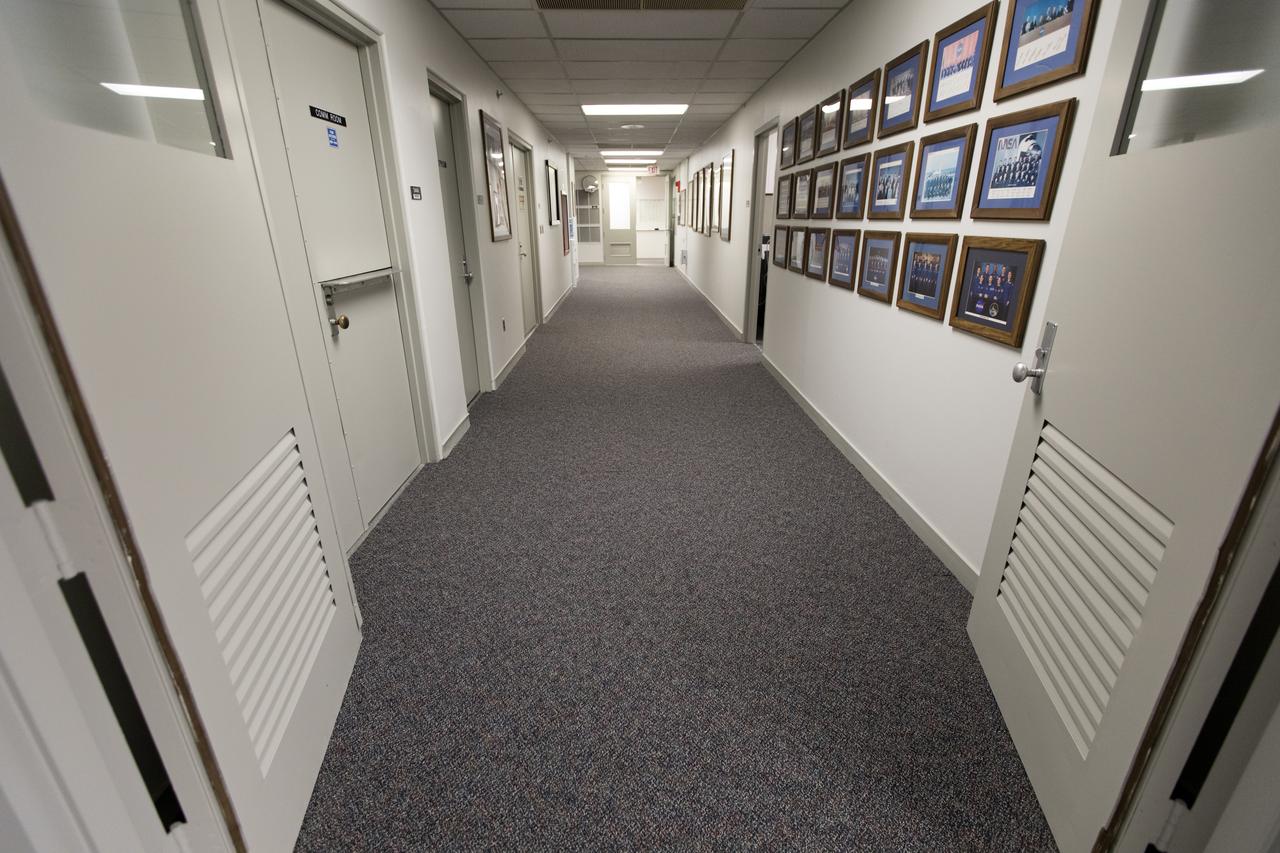
The hallway of the astronaut crew quarters at Kennedy Space Center in Florida reflects new carpeting and a fresh coat of paint. The crew quarters, located on the third floor of the Neil Armstrong Operations and Checkout Building, has been recently upgraded in preparation for Kennedy’s return to human spaceflight.
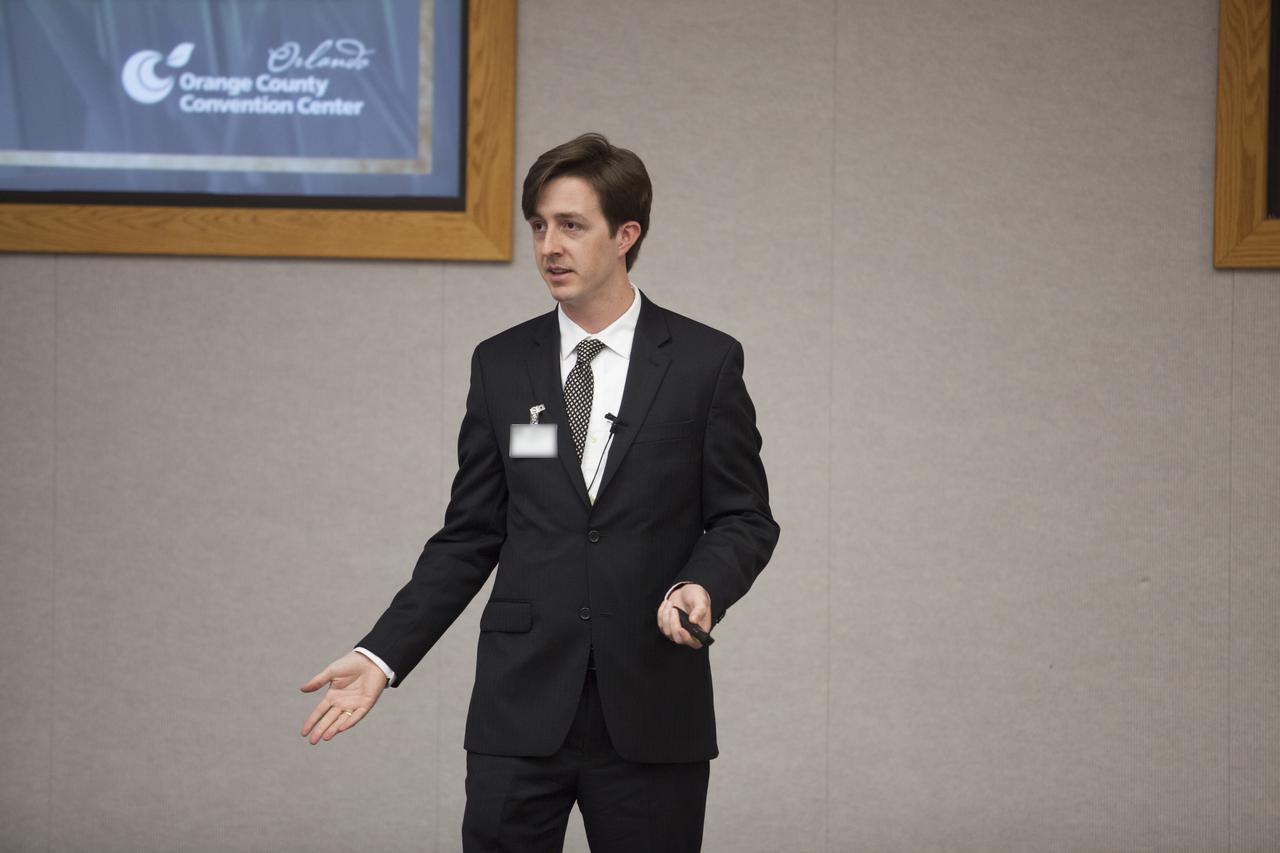
John Culver, Sustainability Program manager with the Orange County Convention Center in Orlando, was one of the featured speakers at the 2017 Innovation Expo at NASA's Kennedy Space Center in Florida. The purpose of the annual two-day event is to help foster innovation and creativity among the Kennedy workforce. The event included several keynote speakers, training opportunities, an innovation showcase and the KSC Kickstart competition.
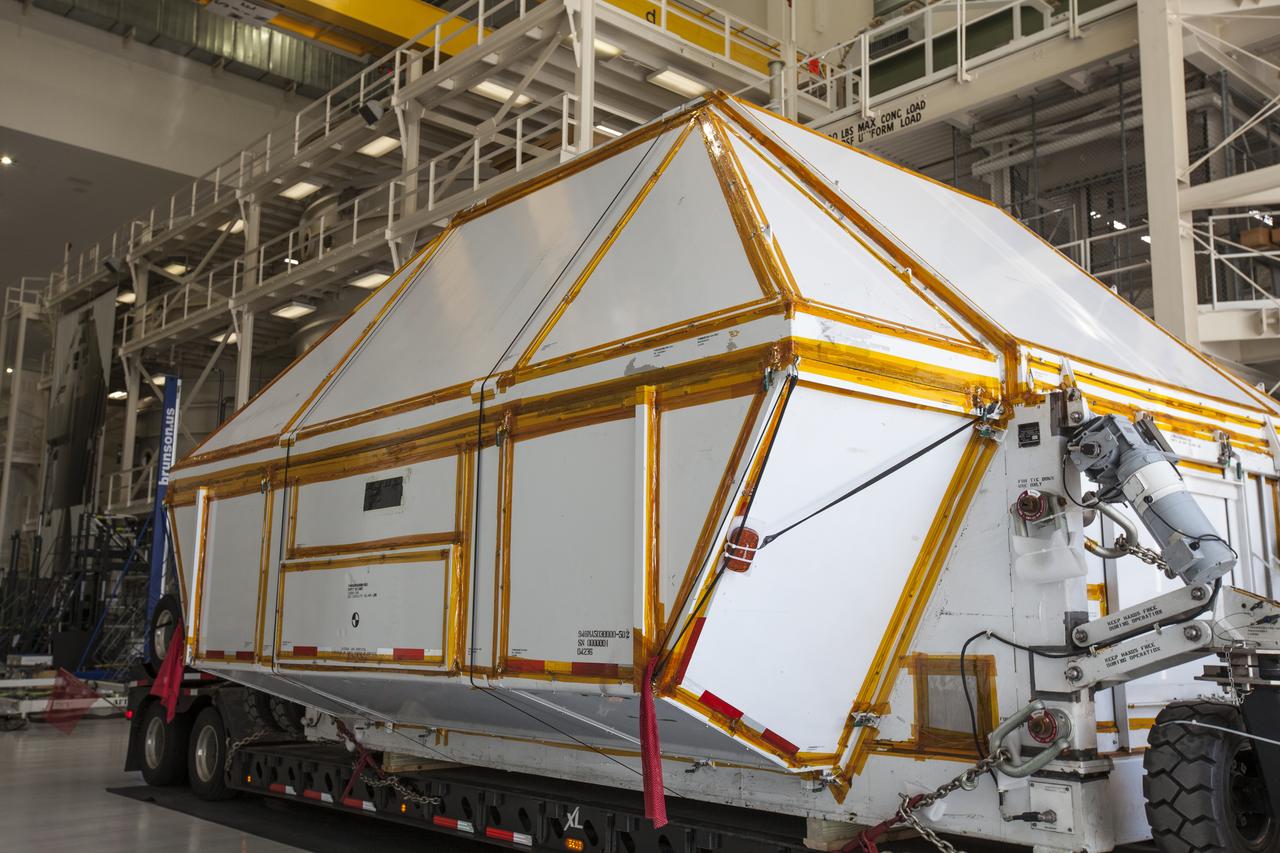
The Orion crew module pressure vessel for Exploration Mission-2 is backed into the high bay at the Neil Armstrong Operations and Checkout Building at NASA's Kennedy Space Center in Florida on Aug. 24, 2018. The pressure vessel was transported in its Crew Module Transportation Fixture by super-wide transport truck from Michoud Assembly Facility near New Orleans. The pressure vessel is Orion's primary structure that holds the pressurized atmosphere astronauts will breathe and work in while in the vacuum of deep space. Inside the facility's high bay, the pressure vessel will be secured on a precision alignment tool to begin preparing it for flight.
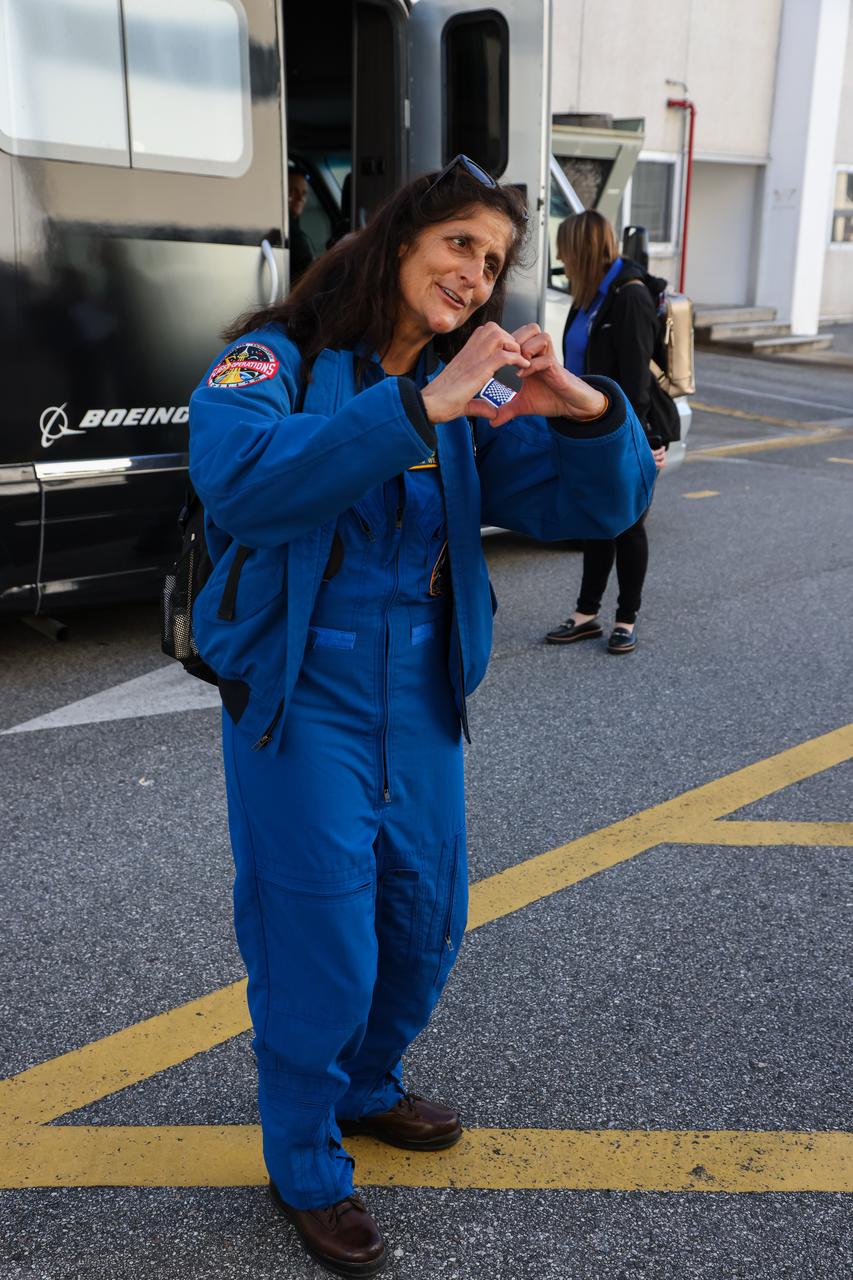
NASA astronaut Suni Williams emerges from the Neil Armstrong Operations and Checkout Building at the agency’s Kennedy Space Center in Florida on Wednesday, Jan. 31, 2024, as part of an integrated crew exercise simulation for NASA’s Boeing Crew Flight Test (CFT). Williams and fellow crew member Barry “Butch” Wilmore, along with NASA, Boeing, and United Launch Alliance (ULA), participated in the integrated exercise, which allowed teams to rehearse prelaunch operations beginning roughly four hours before a targeted liftoff. CFT will be the first flight with astronauts to the International Space Station for Boeing’s Starliner spacecraft as part of NASA’s Commercial Crew Program. Starliner is scheduled to launch atop ULA’s Atlas V rocket no earlier than mid-April 2024.
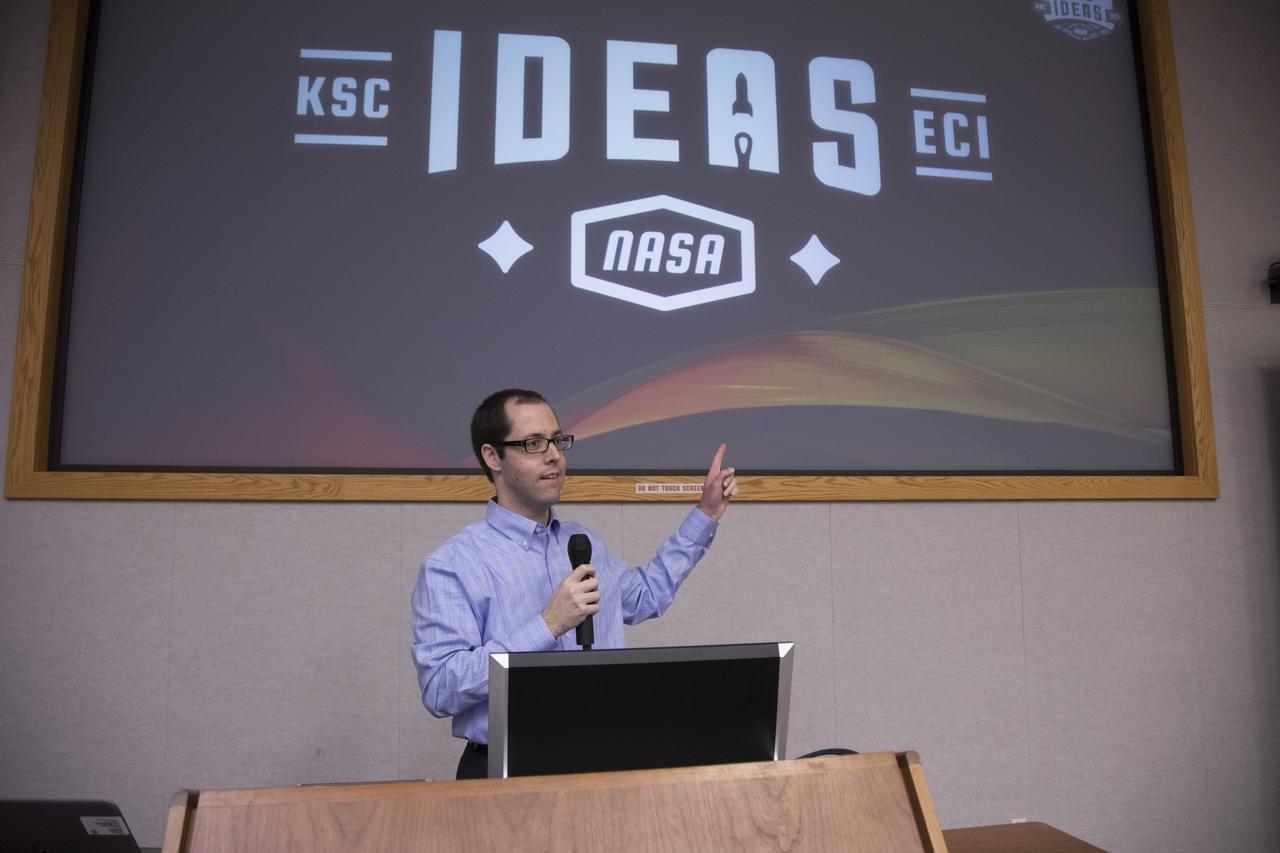
A guest speaker presents to the workforce during the 2017 Innovation Expo at NASA's Kennedy Space Center in Florida. The purpose of the annual two-day event is to help foster innovation and creativity among the Kennedy workforce. The event included several keynote speakers, training opportunities, an innovation showcase and the KSC Kickstart competition.
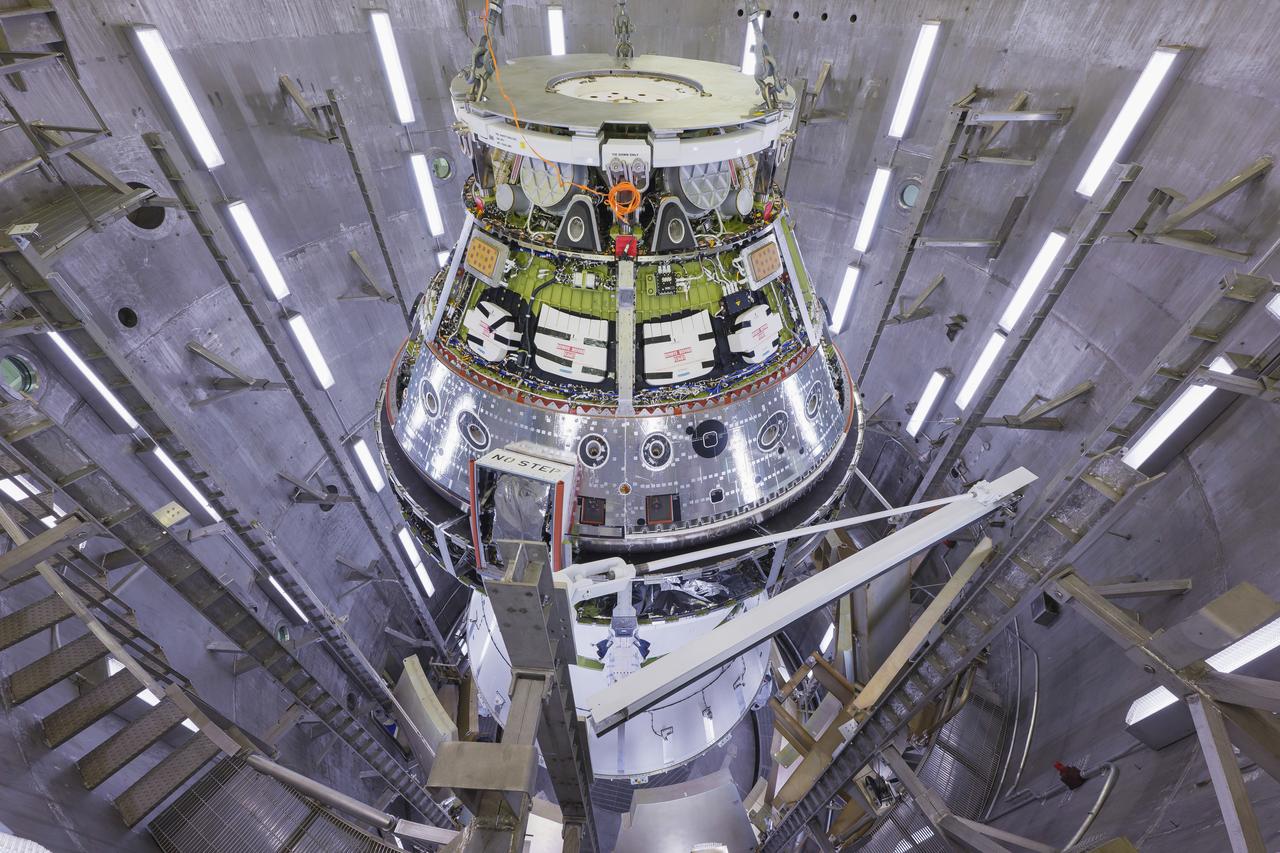
Technicians used a 30-ton crane to lift NASA’s Orion spacecraft on Friday, June 28, 2024, from the Final Assembly and System Testing (FAST) cell to the altitude chamber inside the Neil A. Armstrong Operations and Checkout building at NASA’s Kennedy Space Center in Florida. The spacecraft, which will be used for the Artemis II mission to orbit the Moon, underwent leak checks and end-to-end performance verification of the vehicle’s subsystems.
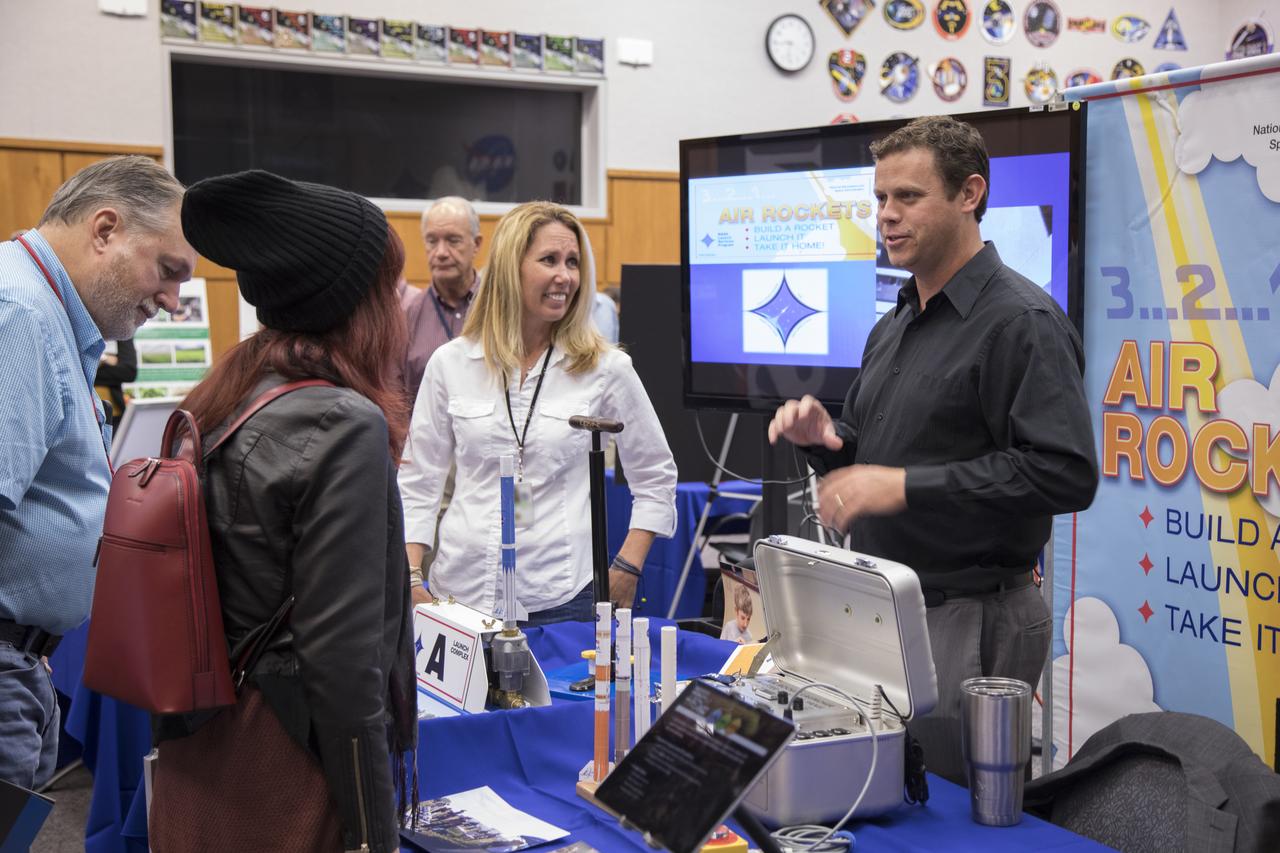
Shaun Daly, an integration engineer in the Launch Services Program, explains a new outreach activity for young students during the 2017 Innovation Expo showcase at NASA's Kennedy Space Center in Florida. The purpose of the annual two-day event is to help foster innovation and creativity among the Kennedy workforce. The event included several keynote speakers, training opportunities, an innovation showcase and the KSC Kickstart competition.
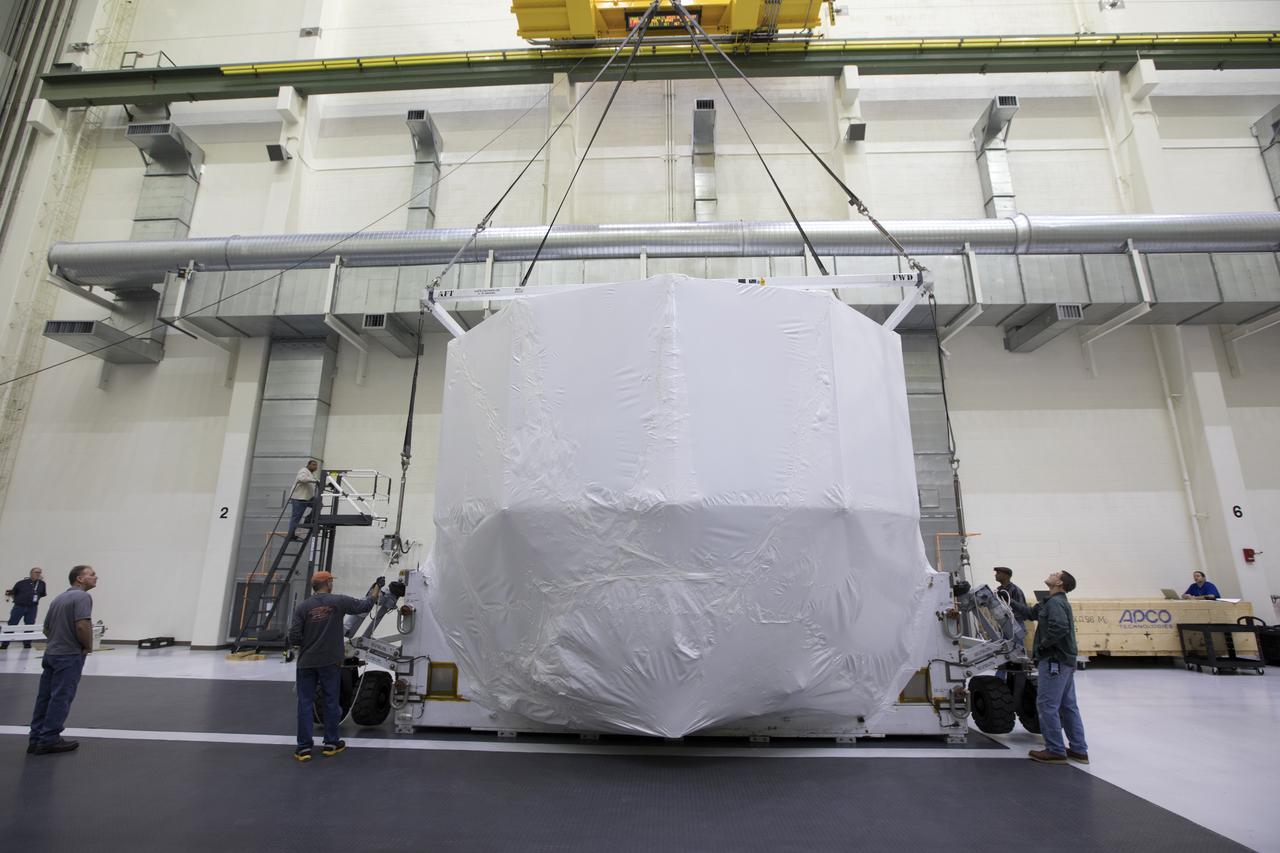
The Orion service module structural test article for Exploration Mission-1 (EM-1), built by the European Space Agency, is prepared for shipment to Lockheed Martin's Denver facility to undergo testing. Inside the Neil Armstrong Operations and Checkout Building high bay at NASA's Kennedy Space Center in Florida, workers secure the protective covering around the module and a crane is used to lower it onto a stand. The Orion spacecraft will launch atop the agency's Space Launch System rocket on EM-1 in 2019.
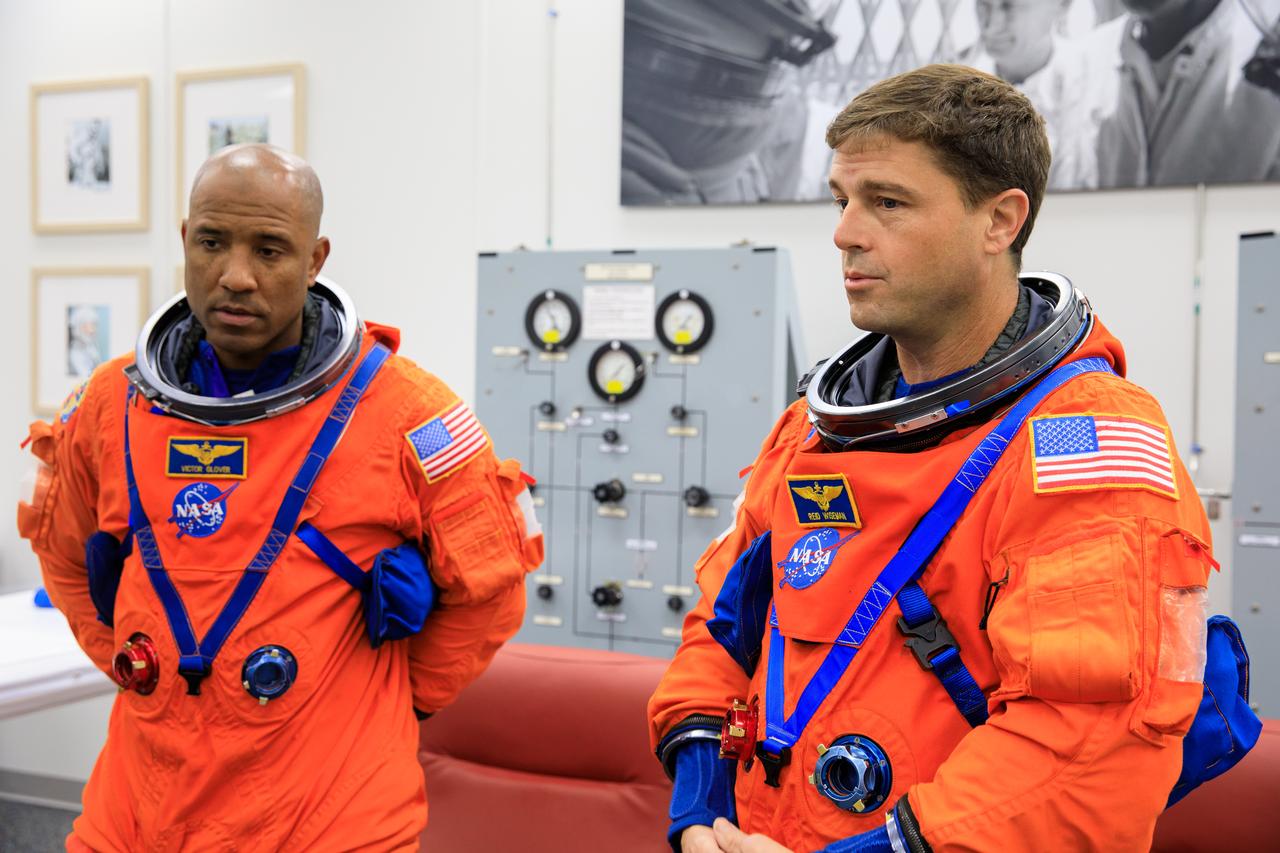
Inside the Astronaut Crew Quarters at the Neil Armstrong Operations and Checkout Building at NASA’s Kennedy Space Center in Florida, Artemis II crew members NASA astronauts Victor Glover (left) and Reid Wiseman are shown wearing test versions of the Orion crew survival system spacesuits they will wear on launch day as part of an integrated ground systems test on Wednesday, Sept. 20.
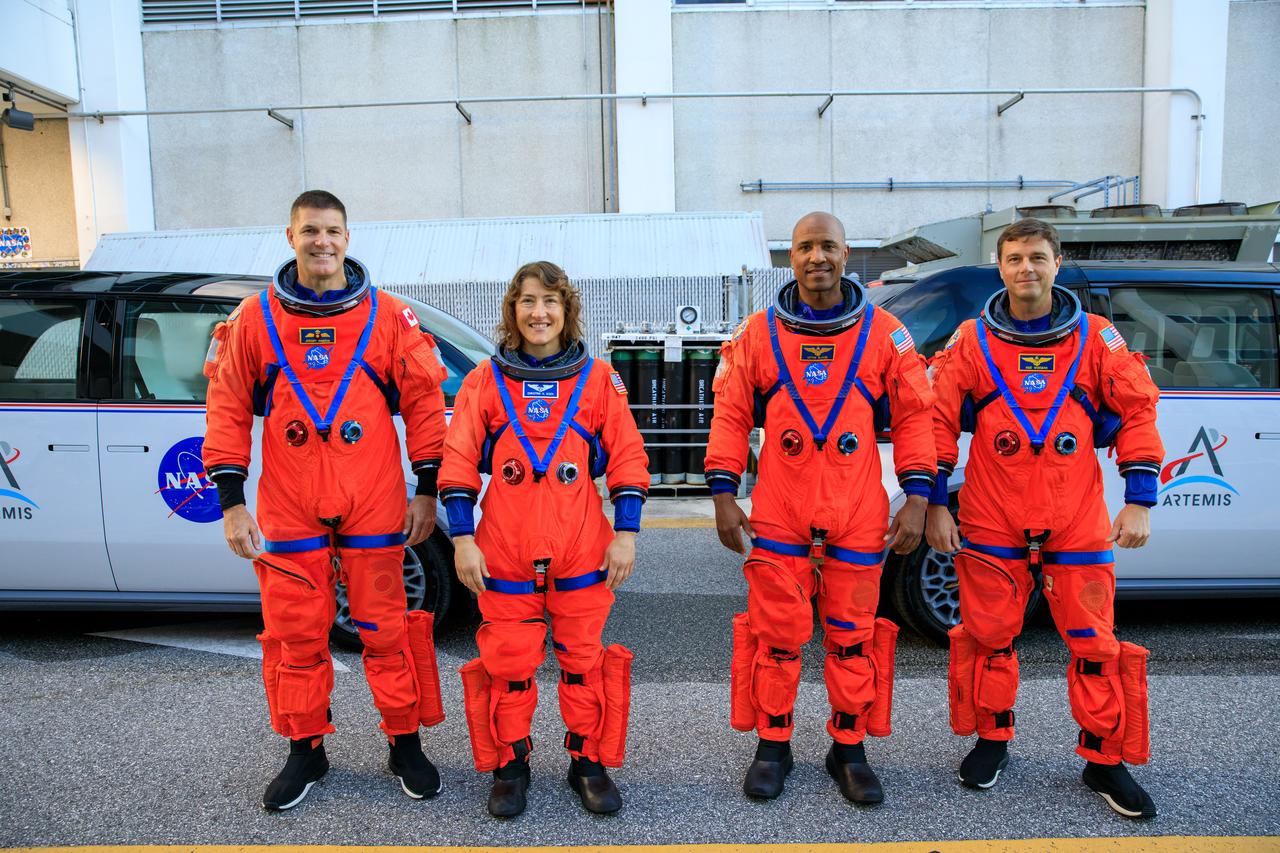
Artemis II crew members (from left) CSA (Canadian Space Agency) astronaut Jeremy Hansen, and NASA astronauts Christina Koch, Victor Glover, and Reid Wiseman walk out of Astronaut Crew Quarters inside the Neil Armstrong Operations and Checkout Building to the Artemis crew transportation vehicles prior to traveling to Launch Pad 39B as part of an integrated ground systems test at Kennedy Space Center in Florida on Wednesday, Sept. 20, to test the crew timeline for launch day.

Vice President Mike Pence tours the Neil Armstrong Operations and Checkout Building at NASA's Kennedy Space Center in Florida, where the Orion spacecraft is being readied for a trip beyond the moon on its first integrated flight with the Space Launch System rocket. Pictured from left to right are NASA Kennedy Space Center Deputy Director Janet Petro; Acting NASA Administrator Robert Lightfoot; NASA Astronaut Reid Wiseman; Pence; NASA Astronaut Pat Forrester; retired astronaut Buzz Aldrin; U.S. Senator Marco Rubio (R-FL); Lockheed Martin Chairman, President and CEO Marillyn Hewson; and NASA Kennedy Space Center Director Robert Cabana. During his visit to Kennedy, Pence spoke inside the Vehicle Assembly Building, where he thanked employees for advancing American leadership in space. The Vice President also toured several facilities highlighting the public-private partnerships at Kennedy, as both NASA and commercial companies prepare to launch American astronauts from the multi-user spaceport.
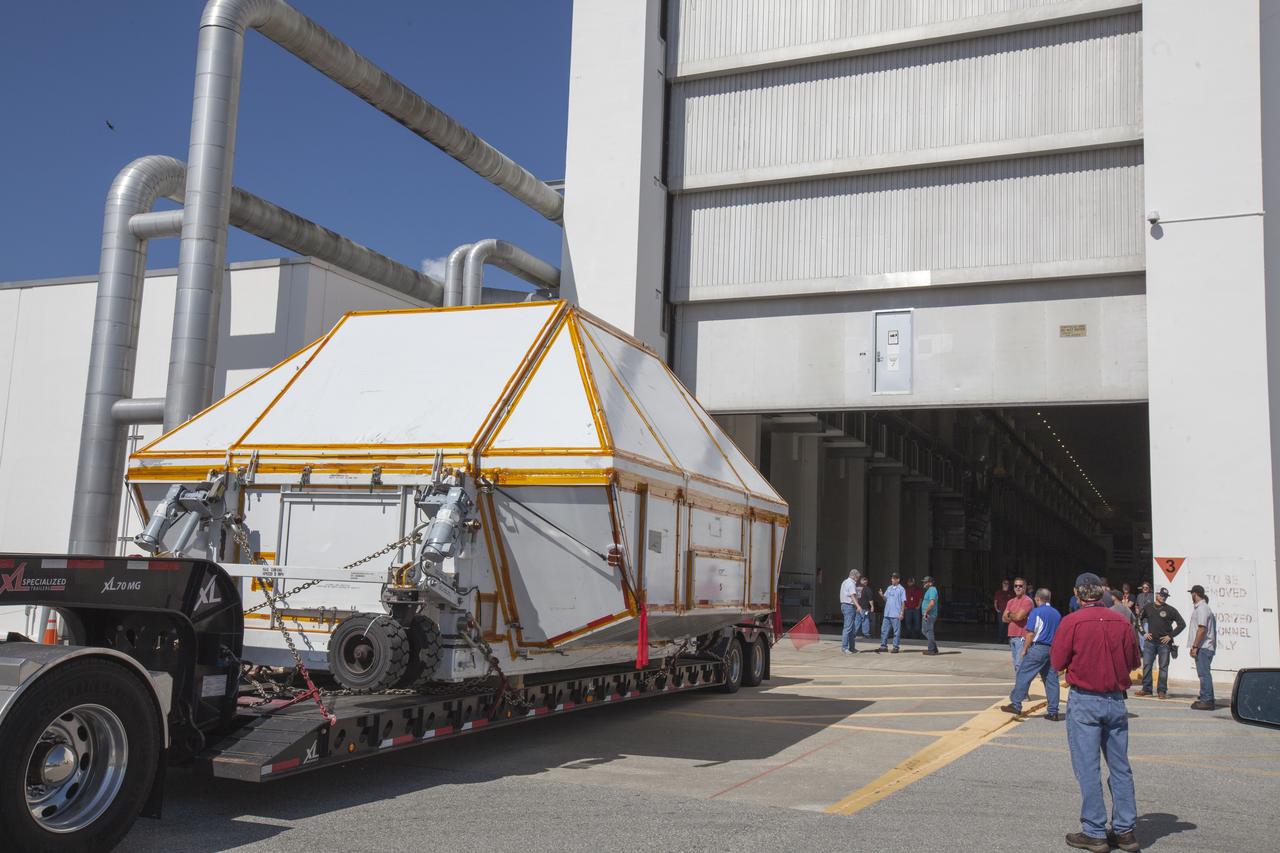
The Orion crew module pressure vessel for Exploration Mission-2 arrives at the Neil Armstrong Operations and Checkout Building at NASA's Kennedy Space Center in Florida on Aug. 24, 2018. The pressure vessel was transported in its Crew Module Transportation Fixture by super-wide transport truck from Michoud Assembly Facility near New Orleans. The pressure vessel is Orion's primary structure that holds the pressurized atmosphere astronauts will breathe and work in while in the vacuum of deep space. It will be moved into the facility's high bay, where it will be secured on a precision alignment tool to begin preparing it for flight.
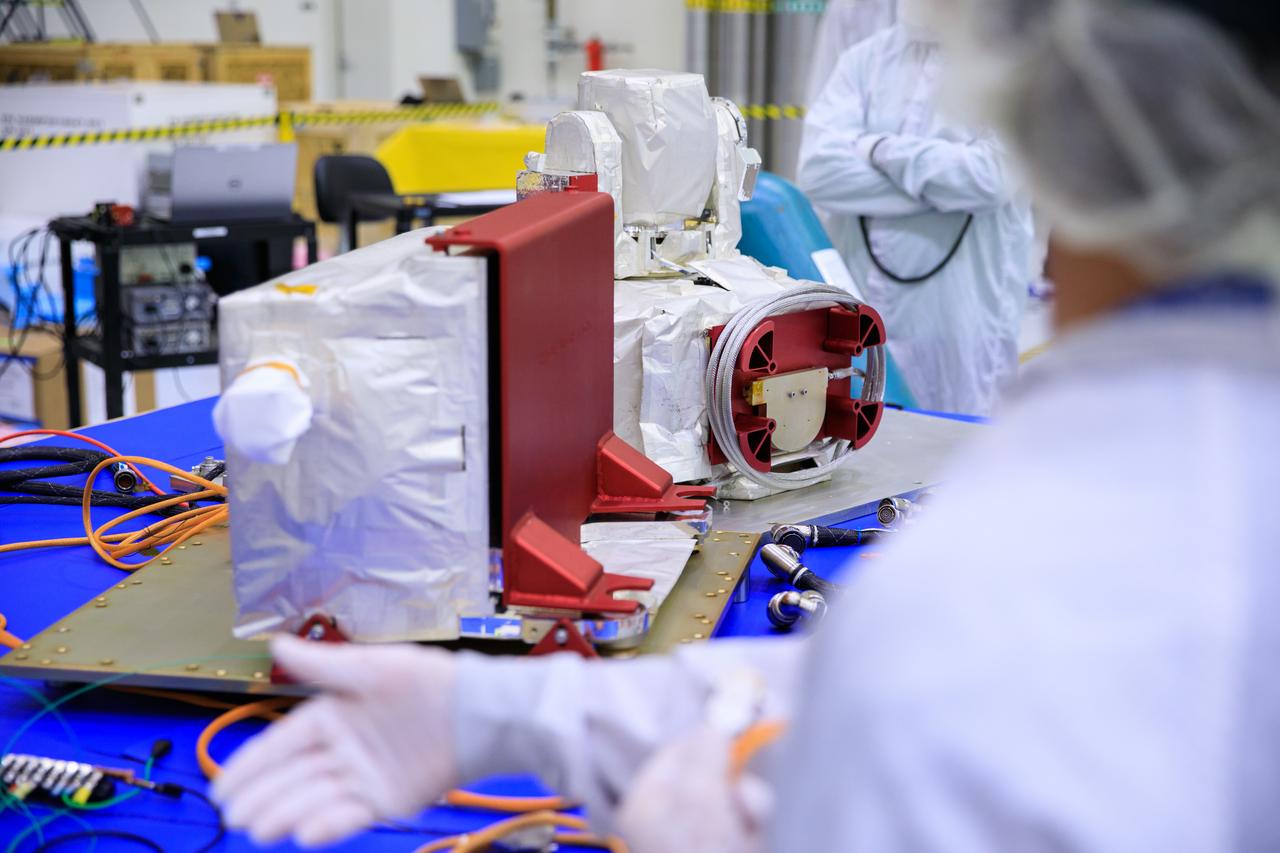
Inside the high bay of the Neil Armstrong Operations and Checkout Building at NASA’s Kennedy Space Center in Florida, technicians assemble on the Optical Communications System for the Artemis II mission on June 2, 2023. Optical communications is the latest space communications technology that is able to provide data rates as much as a hundred times higher than current systems. This will allow astronauts to send and receive ultra-high-definition video from the surface of the Moon or other planets such as Mars. Artemis II will be the first Artemis mission flying crew aboard Orion.
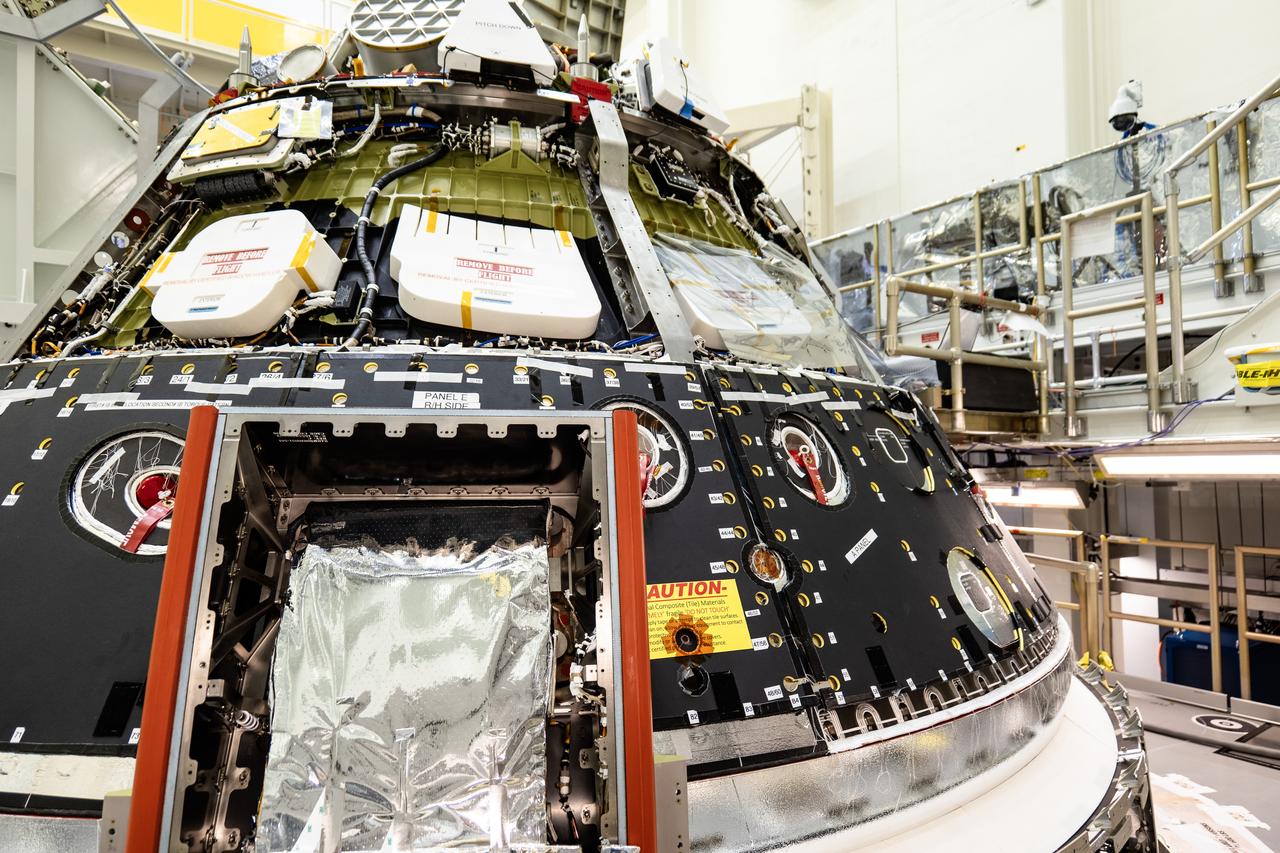
The Orion spacecraft for NASA’s Artemis II mission undergoes checkouts in the Final Assembly and System Testing (FAST) cell inside the high bay of the Neil A. Armstrong Operations and Checkout Building at NASA’s Kennedy Space Center in Florida on Monday, Dec. 15, 2024. The Orion spacecraft will carry NASA astronauts Victor Glover, Christina Koch, and Reid Wiseman, as well as CSA (Canadian Space Agency) astronaut Jeremy Hansen, on a 10-day journey around the Moon and back for the Artemis II test flight.
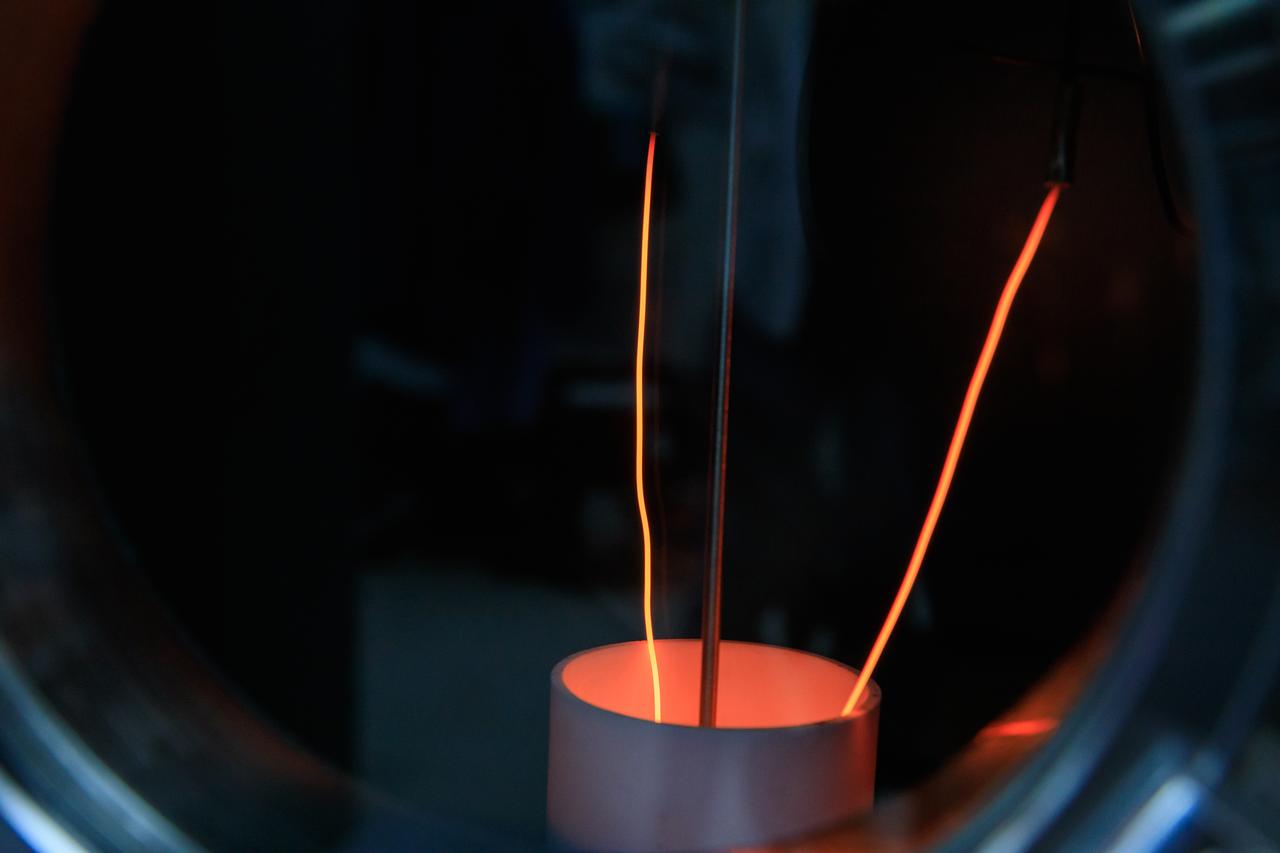
Inside a laboratory in the Neil Armstrong Operations and Checking Building at NASA’s Kennedy Space Center in Florida, testing is underway on the Molten Regolith Electrolysis (MRE) on Sept. 13, 2022. This is a high-temperature electrolytic process which aims to extract oxygen from the simulated lunar regolith. Extraction of oxygen on the lunar surface is critical to the agency’s Artemis program. Oxygen extracted from the Moon can be utilized for propellent to NASA’s lunar landers., breathable oxygen for astronauts, and a variety of other industrial and scientific applications for NASA’s future missions to the Moon.
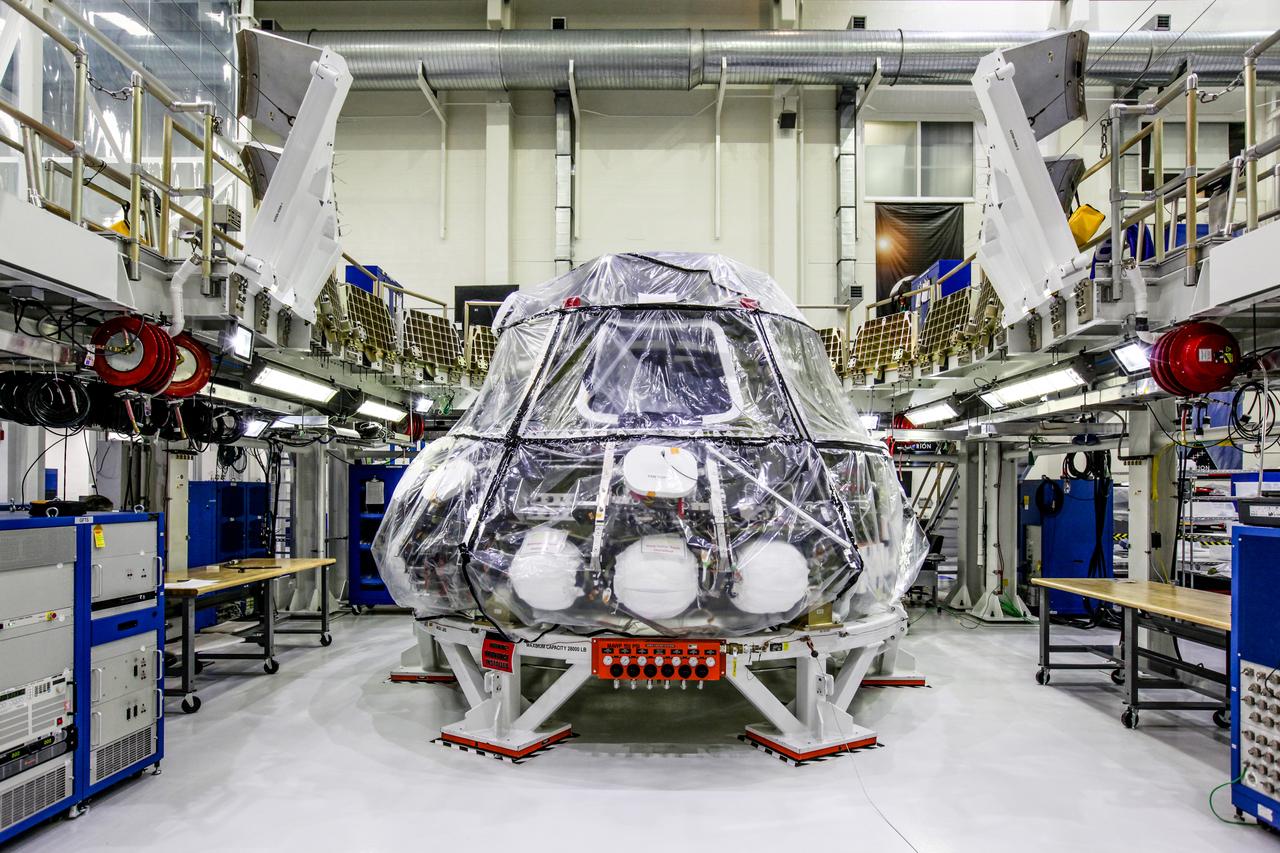
The Orion crew module for NASA’s Exploration Mission 1 (EM-1) is secured in a work station in the Neil Armstrong Operations and Checkout Building high bay at NASA’s Kennedy Space Center in Florida. Orion will undergo additional processing to prepare it for launch in 2019. The spacecraft is being prepared for its first integrated flight atop the Space Launch System rocket on Exploration Mission-1.
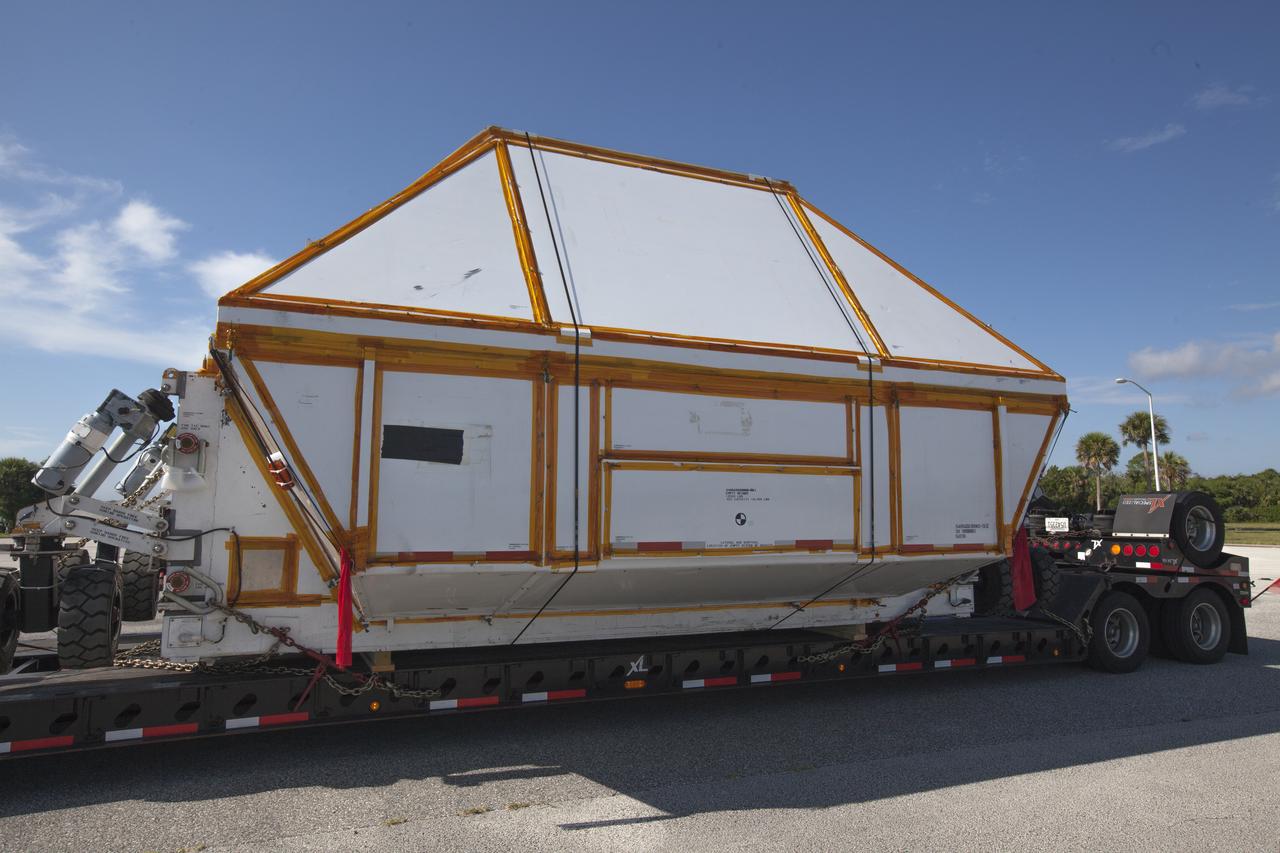
The Orion crew module pressure vessel for Exploration Mission-2 arrives at NASA's Kennedy Space Center in Florida on Aug. 24, 2018. The pressure vessel was transported in its Crew Module Transportation Fixture by super-wide transport truck from Michoud Assembly Facility near New Orleans. The pressure vessel is Orion's primary structure that holds the pressurized atmosphere astronauts will breathe and work in while in the vacuum of deep space. It will be moved into the Neil Armstrong Operations and Checkout Building high bay, where it will be secured on a precision alignment tool to begin preparing it for flight.
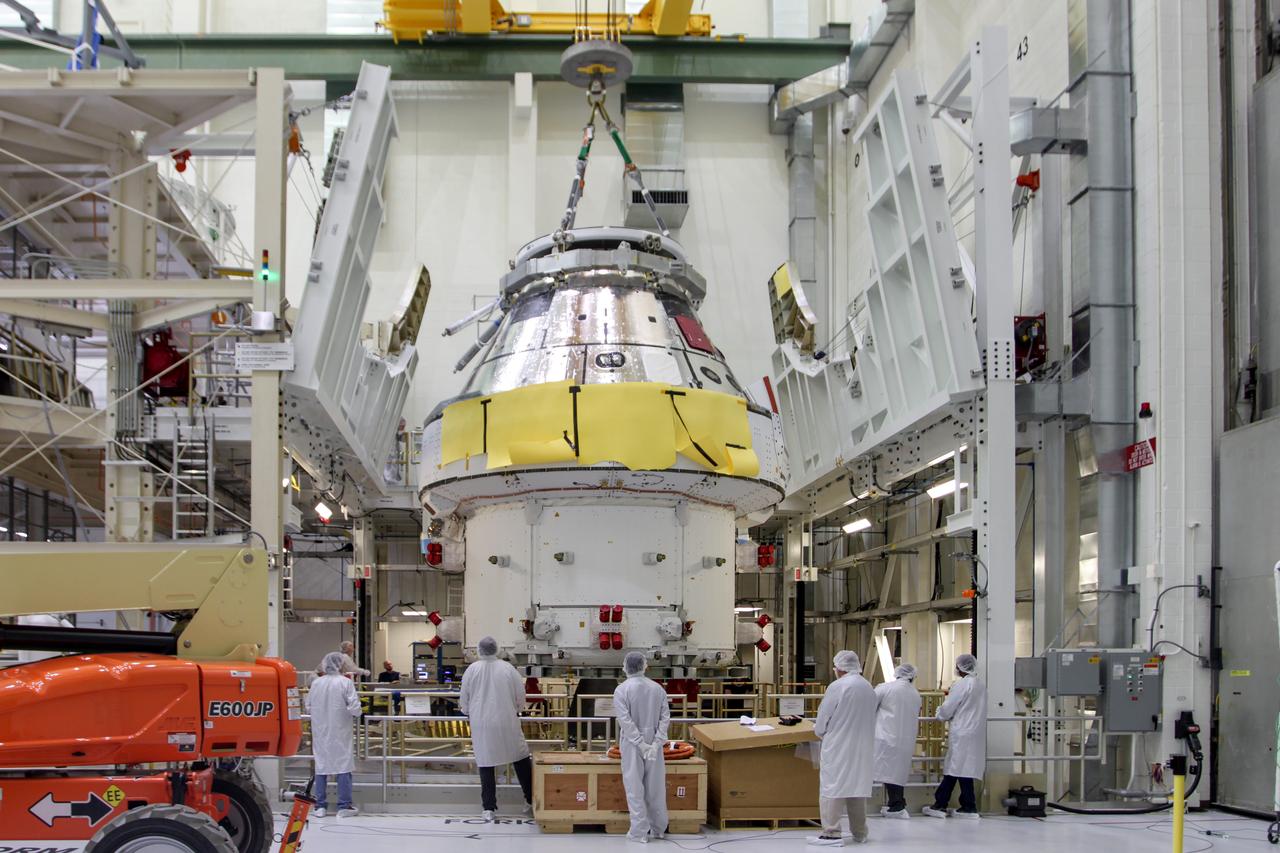
The Orion spacecraft is moved to the Final Assembly and Systems Test cell at Kennedy Space Center. The spacecraft returned from Ohio after a successful series of environmental test at Glenn Research Center's Plum Brook Station.

NASA’s SpaceX Crew-11 crew members wave to family and friends as they prepare to depart the Neil A. Armstrong Operations and Checkout Building at the agency’s Kennedy Space Center in Florida for nearby Launch Complex 39A for launch of Crew-11 on Thursday, July 31, 2025, during the first attempt of NASA’s SpaceX Crew-11 mission to the International Space Station. NASA astronauts Zena Cardman and Mike Fincke, along with JAXA (Japan Aerospace Exploration Agency) astronaut Kimiya Yui and Roscosmos cosmonaut Oleg Platonov, are scheduled to lift off aboard SpaceX’s Dragon spacecraft and Falcon 9 rocket for its second attempt at 11:43 a.m. EDT Friday, Aug. 1, 2025, from Launch Complex 39A at NASA Kennedy.
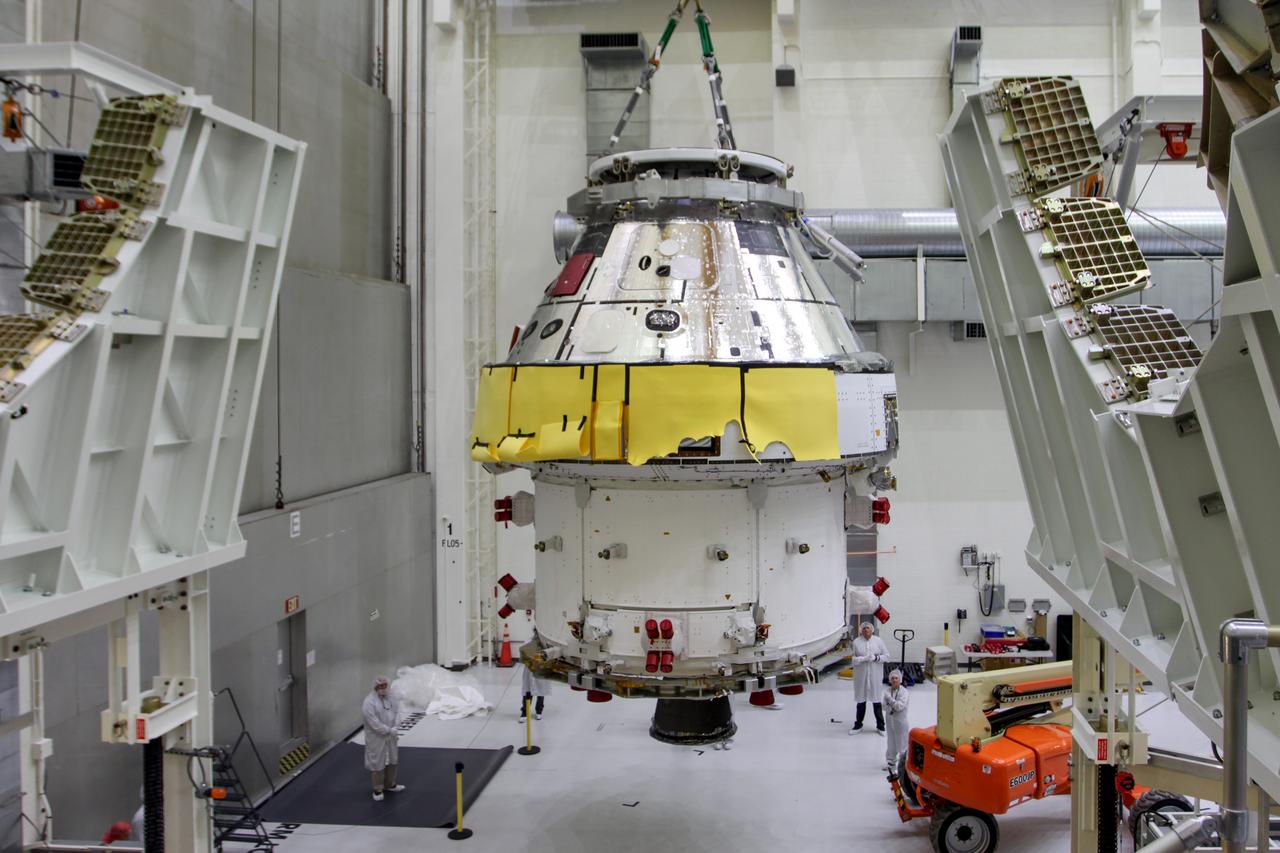
The Orion spacecraft is moved to the Final Assembly and Systems Test cell at Kennedy Space Center. The spacecraft returned from Ohio after a successful series of environmental test at Glenn Research Center's Plum Brook Station.
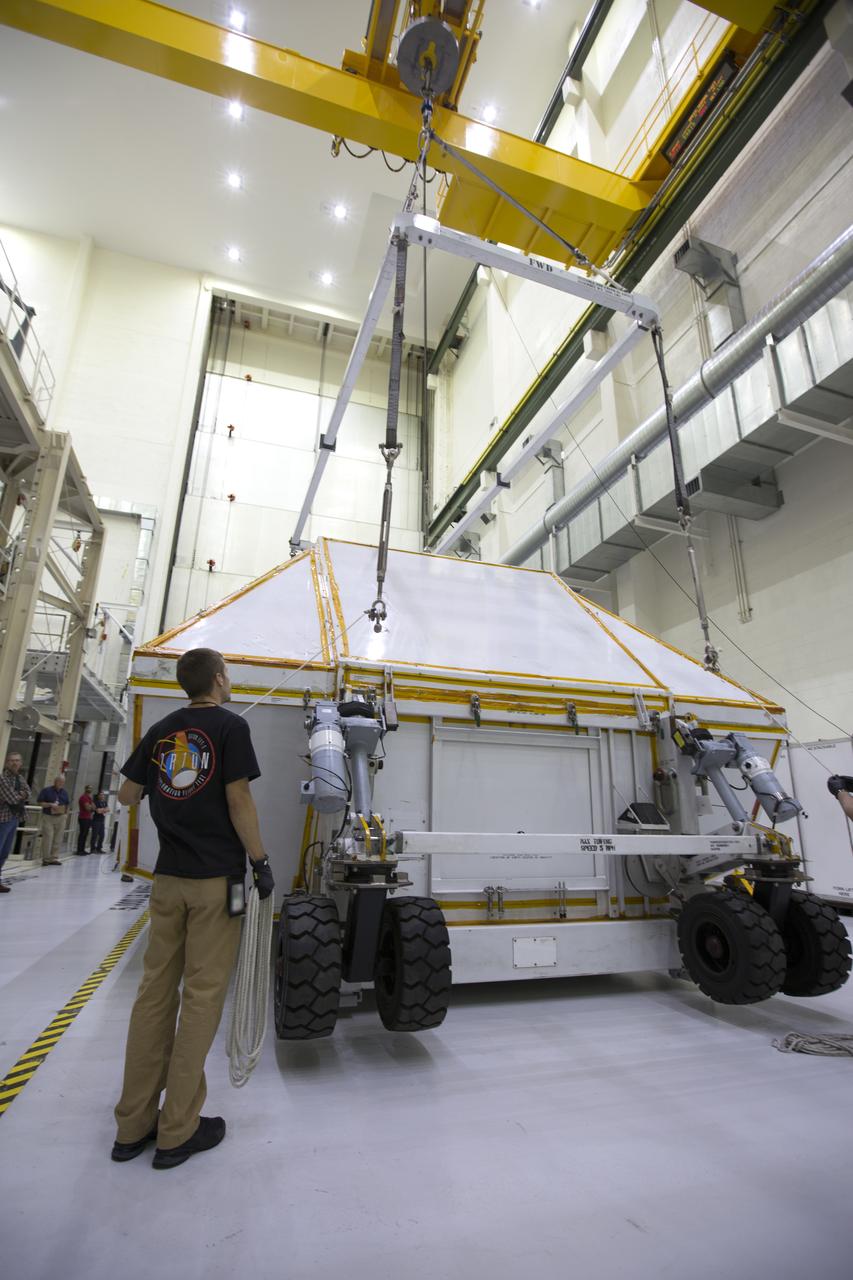
Inside the Neil Armstrong Operations and Checkout Building high bay at NASA's Kennedy Space Center in Florida, the Orion Exploration Mission-1 (EM-1) structural test article is secured inside its transport container. A crane is used to move the container toward a transport vehicle for the move to the Shuttle Landing Facility. The test article will be loaded in NASA's Super Guppy airplane and transported to Lockheed Martin's Denver facility for testing. The Orion spacecraft will launch atop NASA’s Space Launch System rocket on EM-1, its first deep space mission.
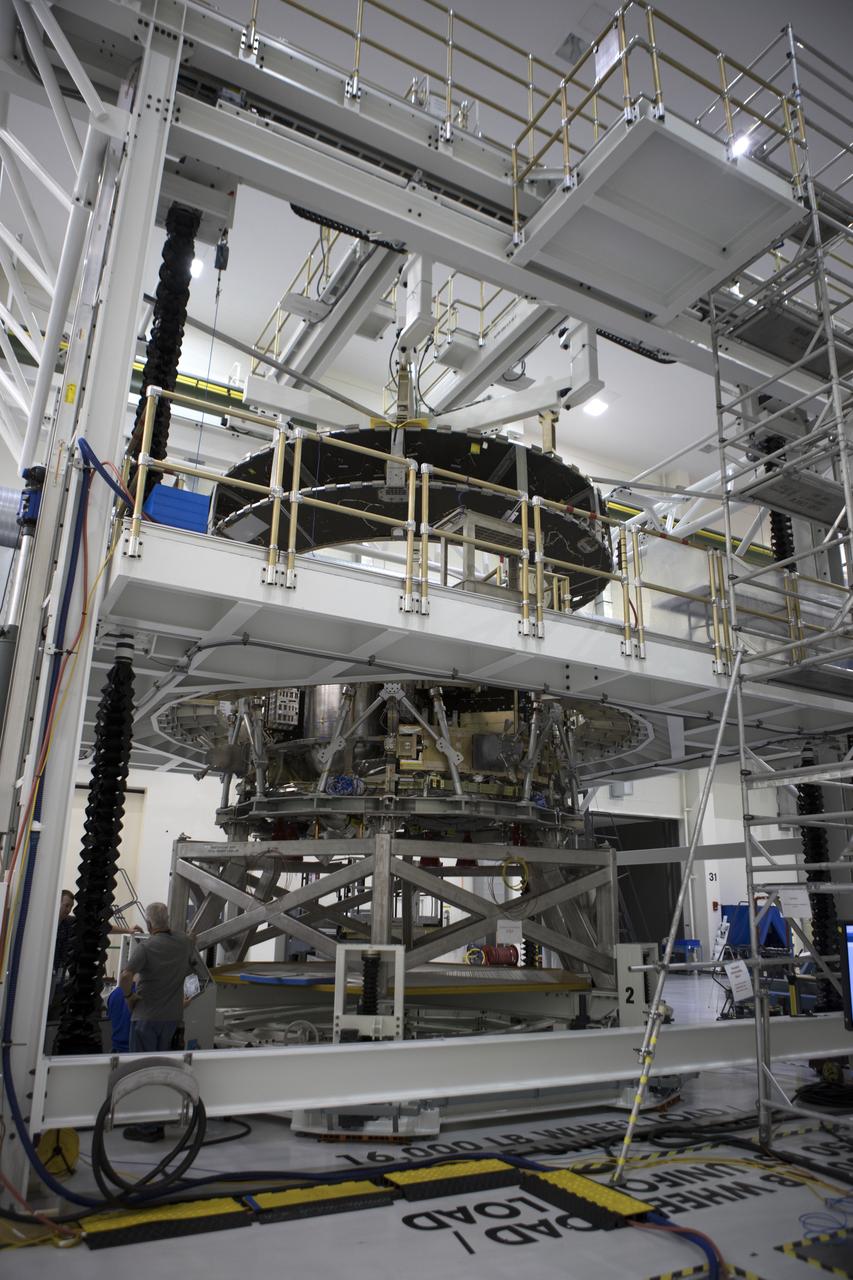
Inside the Neil Armstrong Operations and Checkout Building high bay at NASA's Kennedy Space Center in Florida, operations are underway to lower the Orion crew module adapter structural test article onto the European Space Agency's service module structural test article. After the hardware is attached, the structure will be packed and shipped to Lockheed Martin's Denver facility to undergo testing. The Orion spacecraft will launch atop the agency's Space Launch System rocket on Exploration Mission-1 in 2019.

Inside a laboratory in the Neil Armstrong Operations and Checking Building at NASA’s Kennedy Space Center in Florida, testing is underway on the Molten Regolith Electrolysis (MRE) on Sept. 13, 2022. This is a high-temperature electrolytic process which aims to extract oxygen from the simulated lunar regolith. Extraction of oxygen on the lunar surface is critical to the agency’s Artemis program. Oxygen extracted from the Moon can be utilized for propellent to NASA’s lunar landers., breathable oxygen for astronauts, and a variety of other industrial and scientific applications for NASA’s future missions to the Moon.
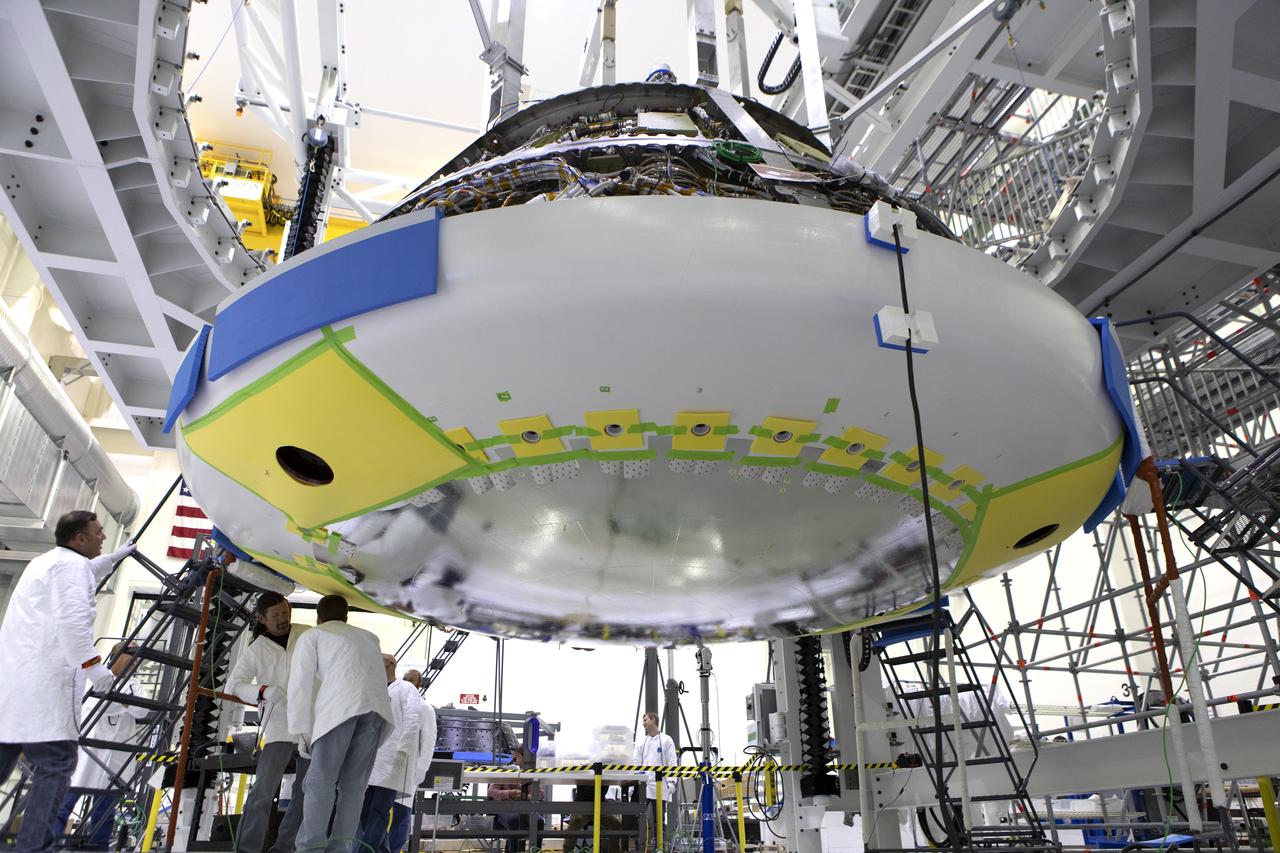
Lockheed Martin engineers and technicians are installing the heat shield to the Orion crew module July 25, 2018, inside the Neil Armstrong Operations and Checkout Building high bay at NASA's Kennedy Space Center in Florida. Orion is being prepared for Exploration Mission-1 (EM-1), the first unscrewed integrated flight test atop NASA's Space Launch System rocket. The heat shield will need to withstand temperatures of up to 5,000 degrees Fahrenheit during Orion's descent and re-entry through the Earth's atmosphere before it splashes down in the Pacific Ocean.
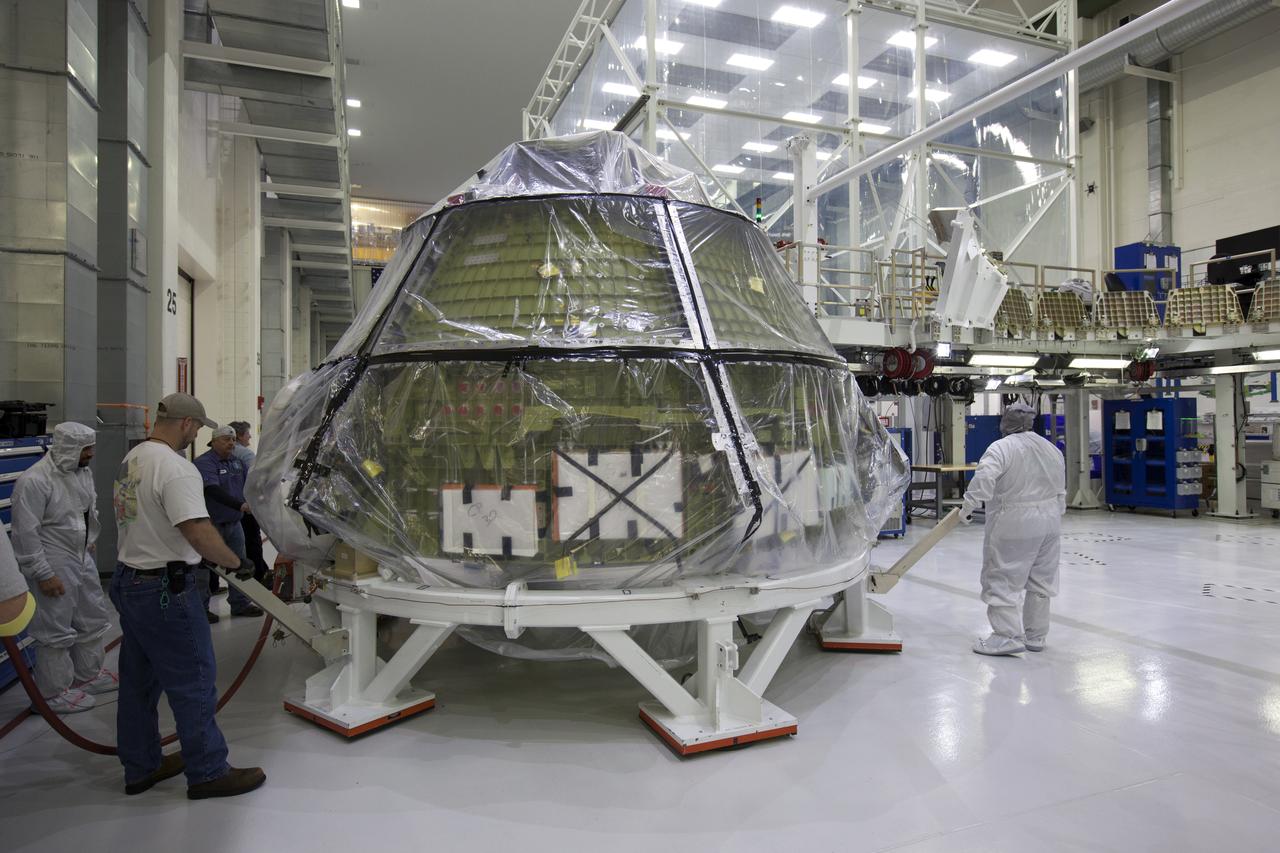
Workers have moved the Orion crew module pressure vessel for NASA’s Exploration Mission 1 (EM-1) out of a clean room inside the Neil Armstrong Operations and Checkout Building high bay at NASA’s Kennedy Space Center in Florida. The crew module will be moved to a work station where it will undergo additional processing to prepare it for launch in 2019. The spacecraft is being prepared for its first integrated flight atop the Space Launch System rocket on Exploration Mission-1.
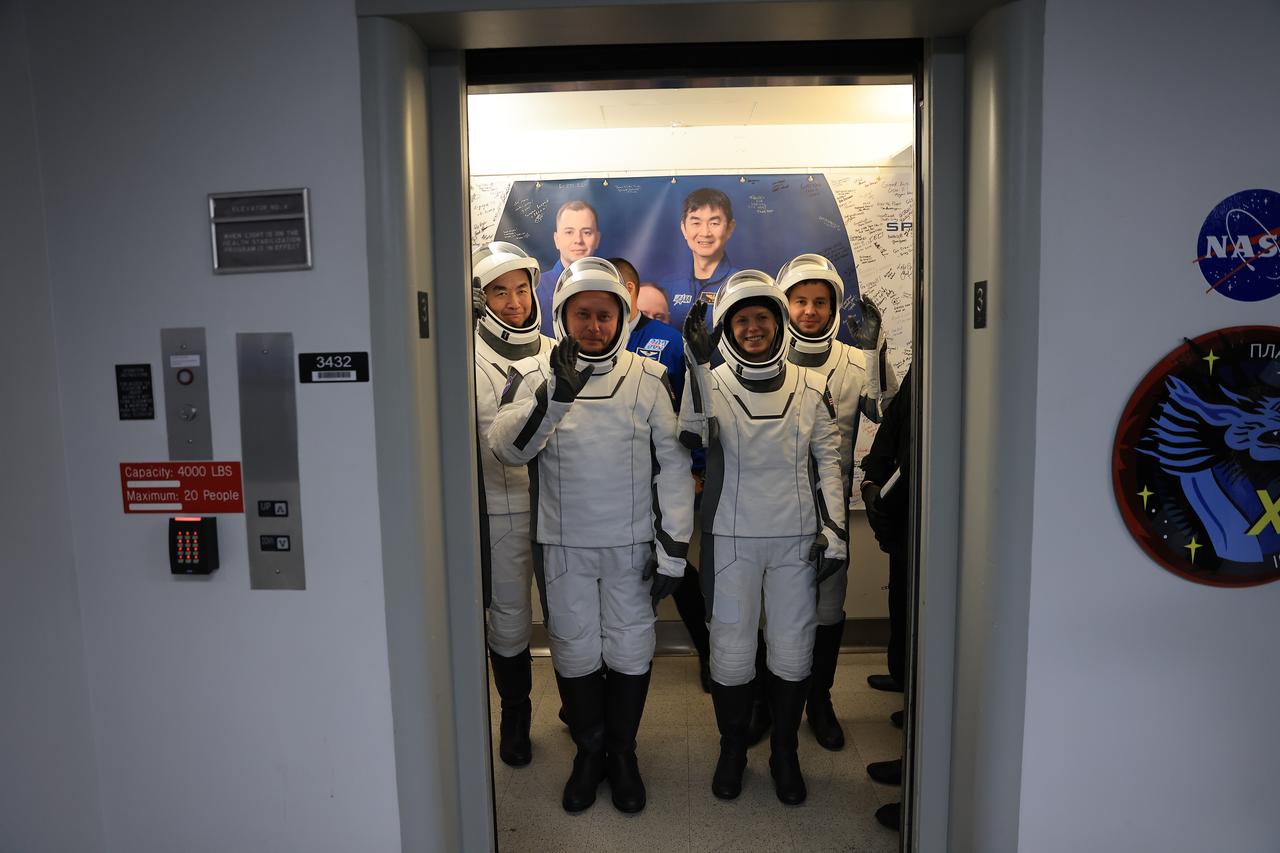
NASA’s SpaceX Crew-11 members pose for a photo in an elevator following suit up operations in the Neil A. Armstrong Operations and Checkout Building at the agency’s Kennedy Space Center in Florida on Thursday, July 31, 2025, during the first attempt of NASA’s SpaceX Crew-11 mission to the International Space Station. From top left, NASA astronauts Mike Fincke and Zena Cardman, along with JAXA (Japan Aerospace Exploration Agency) astronaut Kimiya Yui and Roscosmos cosmonaut Oleg Platonov, are scheduled to lift off aboard SpaceX’s Dragon spacecraft and Falcon 9 rocket for its second attempt at 11:43 a.m. EDT Friday, Aug. 1, 2025, from Launch Complex 39A at NASA Kennedy.
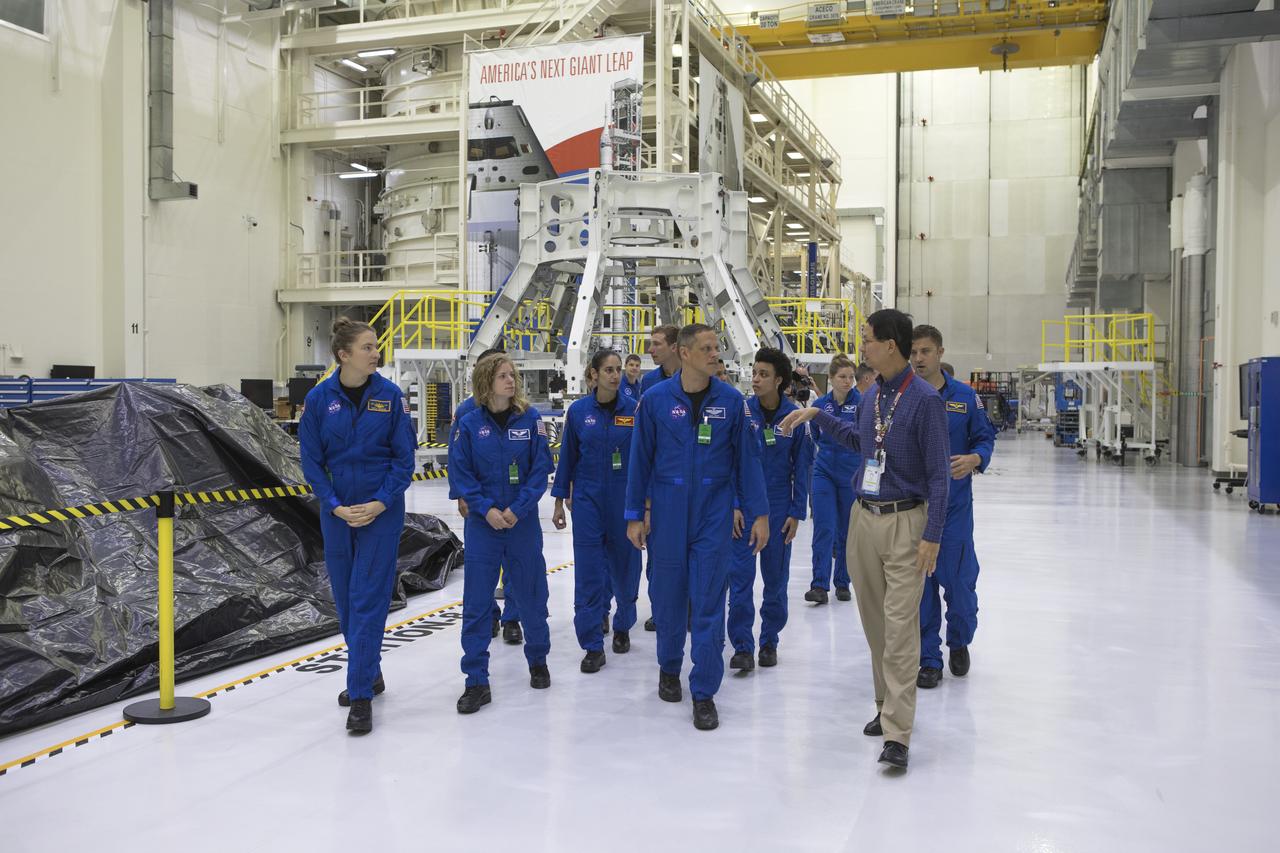
The 2017 class of astronaut candidates are inside the Neil Armstrong Operations and Checkout Building high bay during a familiarization tour of facilities at NASA's Kennedy Space Center in Florida. The candidates toured center facilities, including the Launch Control Center, Launch Pad 39B, the Vehicle Assembly Building and the Space Station Processing Facility. They also toured Boeing's Commercial Crew and Cargo Facility, United Launch Alliance's Space Launch Complex 41 at Cape Canaveral Air Force Station, and SpaceX's Launch Pad 39A at Kennedy. The candidates will spend about two years getting to know the space station systems and learning how to spacewalk, speak Russian, control the International Space Station's robotic arm and fly T-38s, before they're eligible to be assigned to a mission.
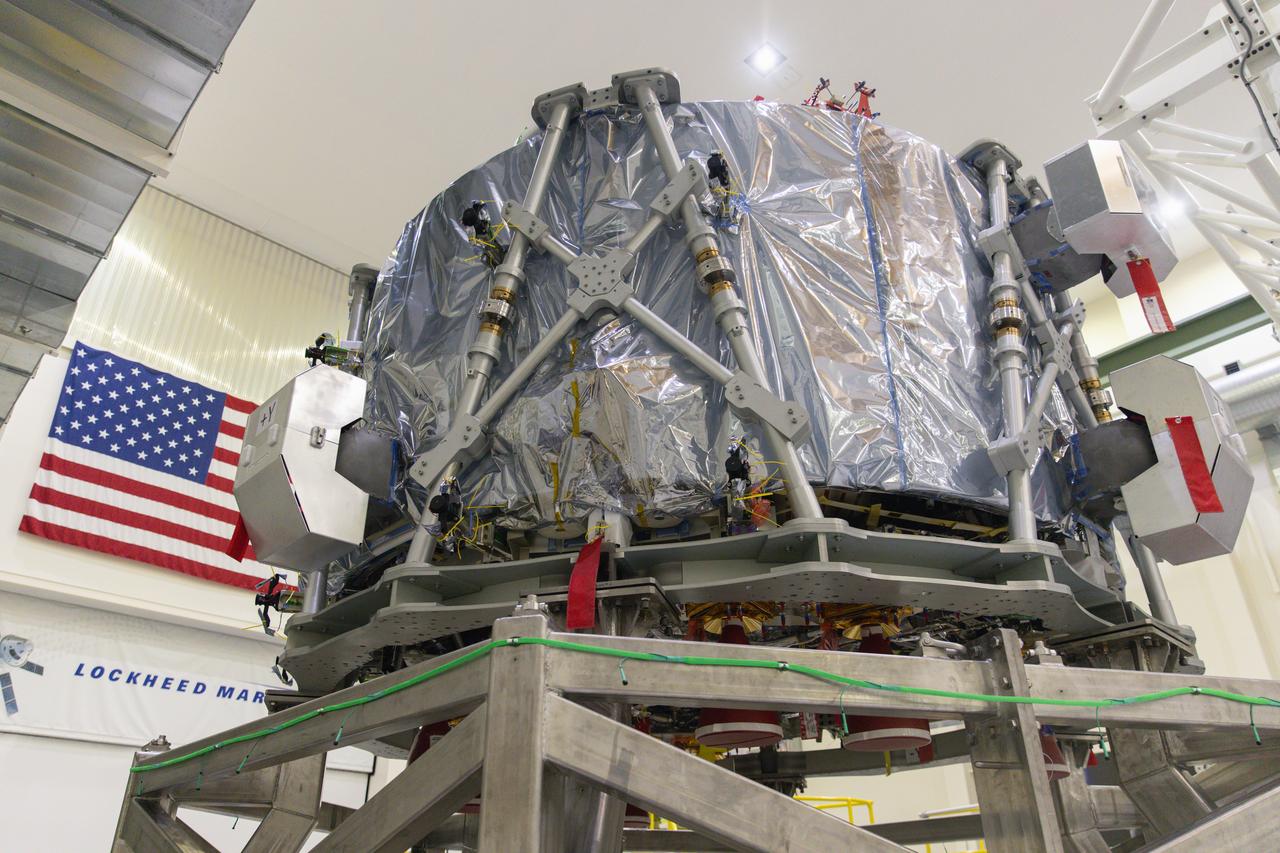
Teams from NASA, ESA (European Space Agency), and Airbus prepare to integrate European Service Module 3 to the crew module adapter on Tuesday, Sept. 17, 2024, inside the Neil A. Armstrong Operations and Checkout Building at NASA’s Kennedy Space Center in Florida. The integrated hardware provides propulsion, electrical power, and other important elements for the Orion spacecraft’s Artemis III campaign to the lunar South Pole region of the Moon.
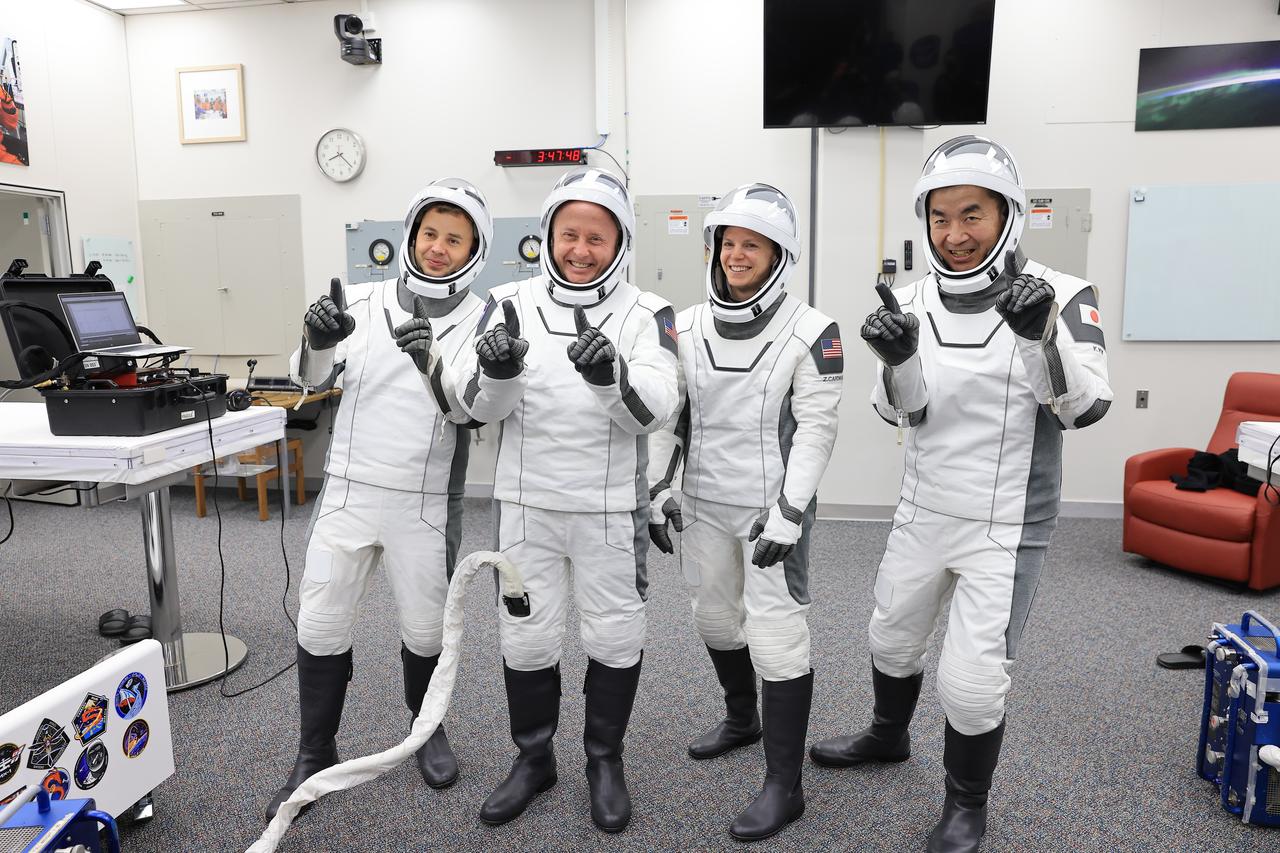
NASA’s SpaceX Crew-11 members suit up in the Neil A. Armstrong Operations and Checkout Building at the agency’s Kennedy Space Center in Florida on Thursday, July 31, 2025, during the first attempt of NASA’s SpaceX Crew-11 mission to the International Space Station. From right, JAXA (Japan Aerospace Exploration Agency) astronaut Kimiya Yui along with NASA astronauts Zena Cardman and Mike Fincke, and Roscosmos cosmonaut Oleg Platonov, are scheduled to lift off aboard SpaceX’s Dragon spacecraft and Falcon 9 rocket at for its second attempt 11:43 a.m. EDT Friday, Aug. 1, 2025, from Launch Complex 39A at NASA Kennedy.

Artemis II NASA astronauts Reid Wiseman, Victor Glover, and Christina Koch, and CSA (Canadian Space Agency) astronaut Jeremy Hansen ride from Astronaut Crew Quarters in the Neil Armstrong Operations and Checkout Building to Launch Pad 39B in the Artemis crew transportation vehicles as part of an integrated ground systems test at Kennedy Space Center in Florida on Wednesday, Sept. 20, to test the crew timeline for launch day.
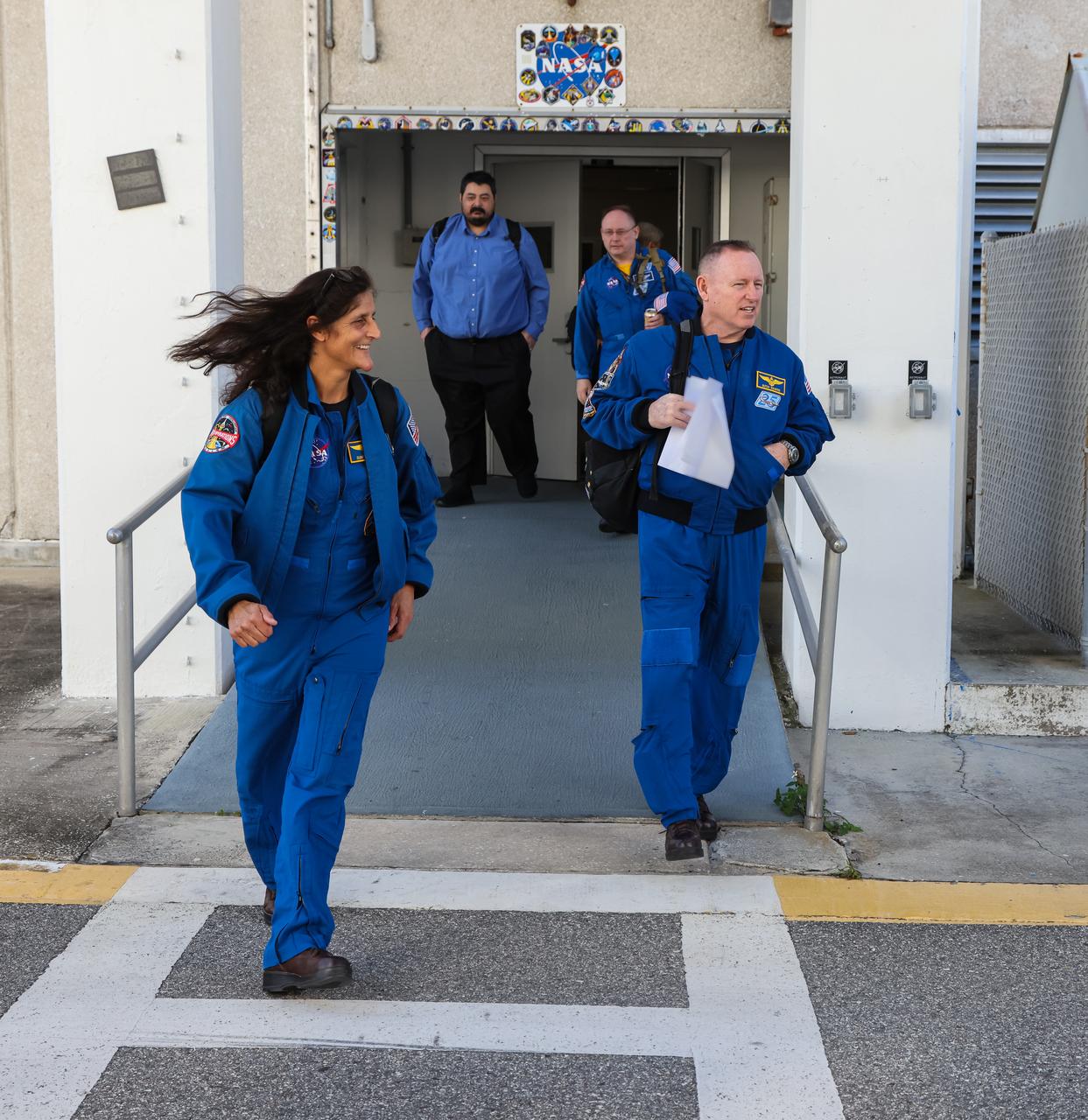
NASA astronauts Suni Williams and Barry “Butch” Wilmore emerge from the Neil Armstrong Operations and Checkout Building at the agency’s Kennedy Space Center in Florida on Wednesday, Jan. 31, 2024, as part of an integrated crew exercise simulation for NASA’s Boeing Crew Flight Test (CFT). The integrated exercise involved participation from the flight crew, NASA, Boeing, and United Launch Alliance (ULA), and allowed teams to rehearse prelaunch operations beginning roughly four hours before a targeted liftoff. CFT will be the first flight with astronauts to the International Space Station for Boeing’s Starliner spacecraft as part of NASA’s Commercial Crew Program. Starliner is scheduled to launch atop ULA’s Atlas V rocket no earlier than mid-April 2024.
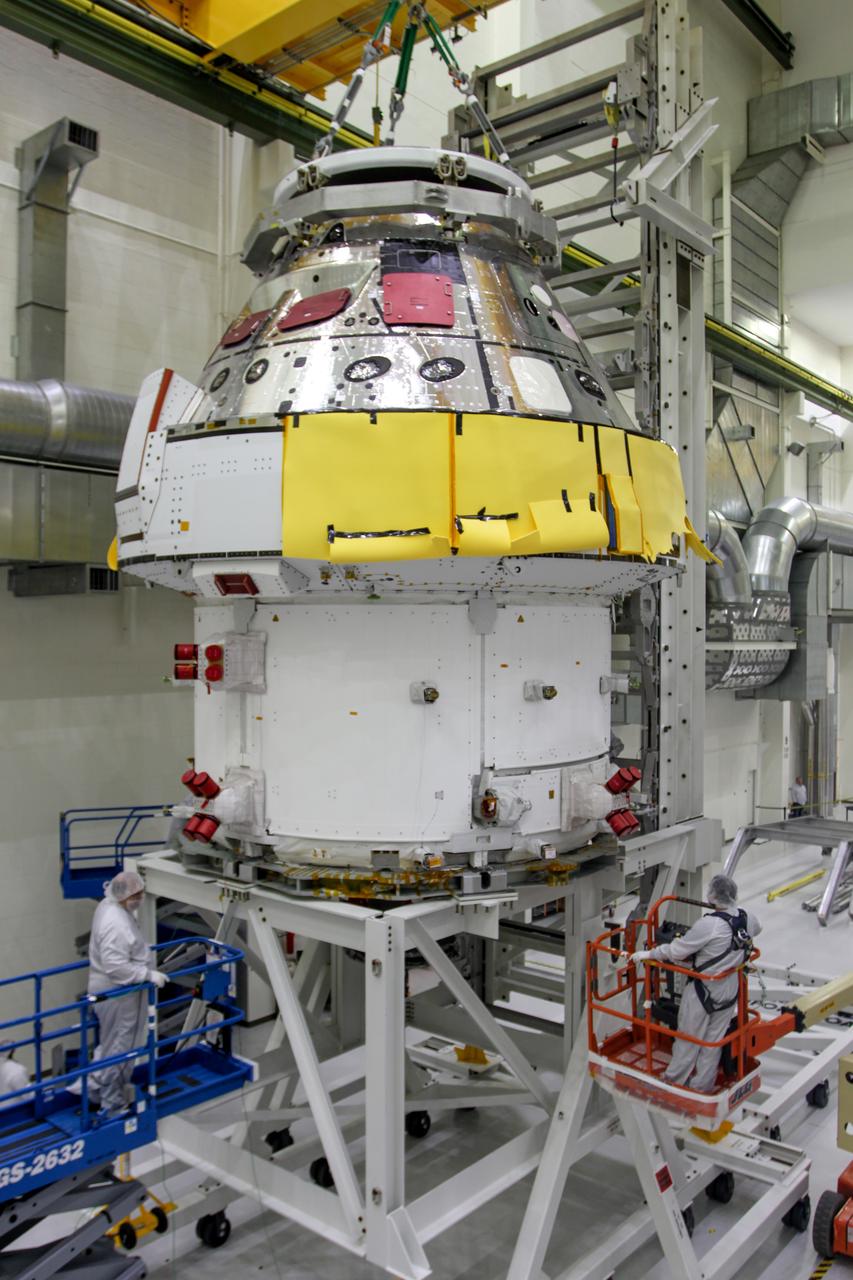
The Orion spacecraft is moved to the Final Assembly and Systems Test cell at Kennedy Space Center. The spacecraft returned from Ohio after a successful series of environmental test at Glenn Research Center's Plum Brook Station.
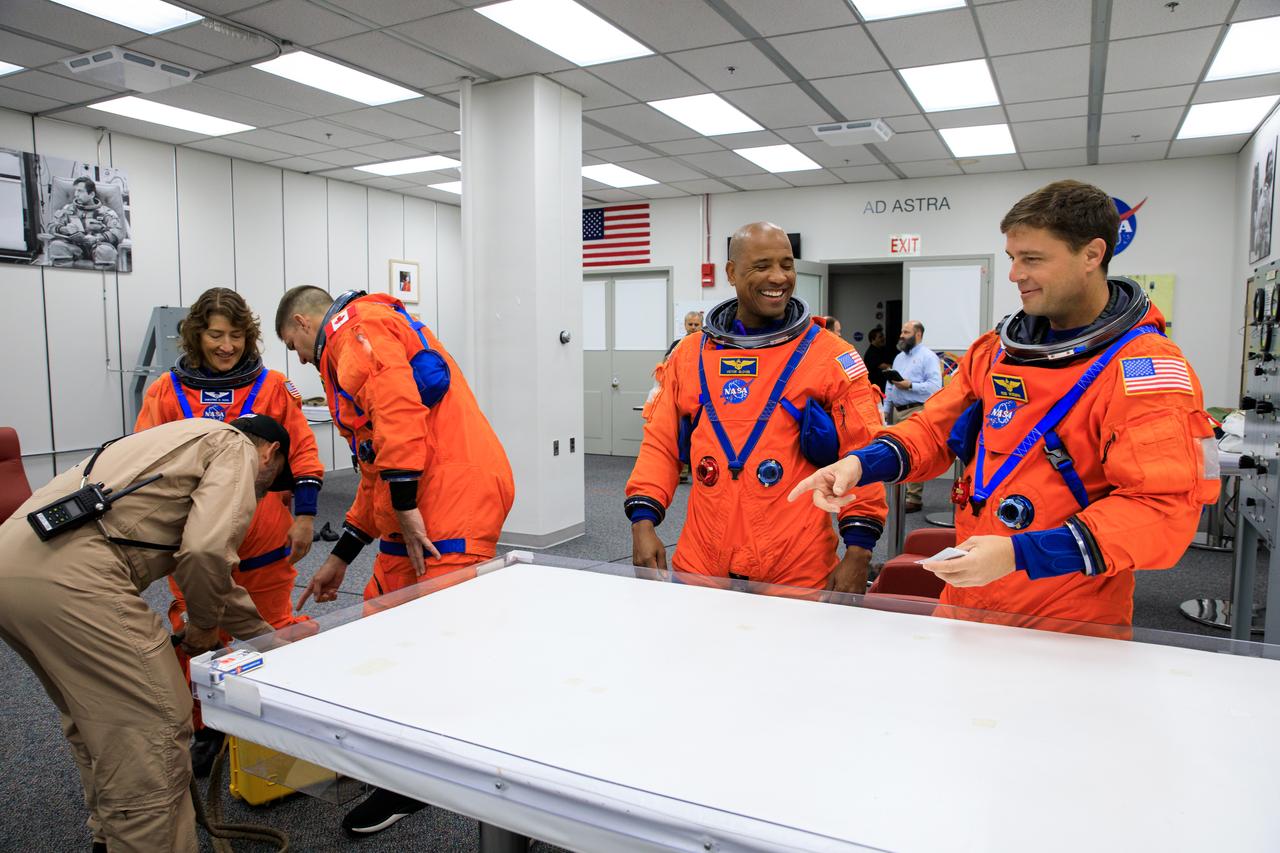
Inside the Astronaut Crew Quarters at the Neil Armstrong Operations and Checkout Building at NASA’s Kennedy Space Center in Florida, Artemis II crew members (from left) NASA astronaut Christina Koch, CSA (Canadian Space Agency) astronaut Jeremy Hansen, and NASA astronauts Reid Wiseman and Victor Glover are shown wearing test versions of the Orion crew survival system spacesuits they will wear on launch day as part of an integrated ground systems test on Wednesday, Sept. 20.
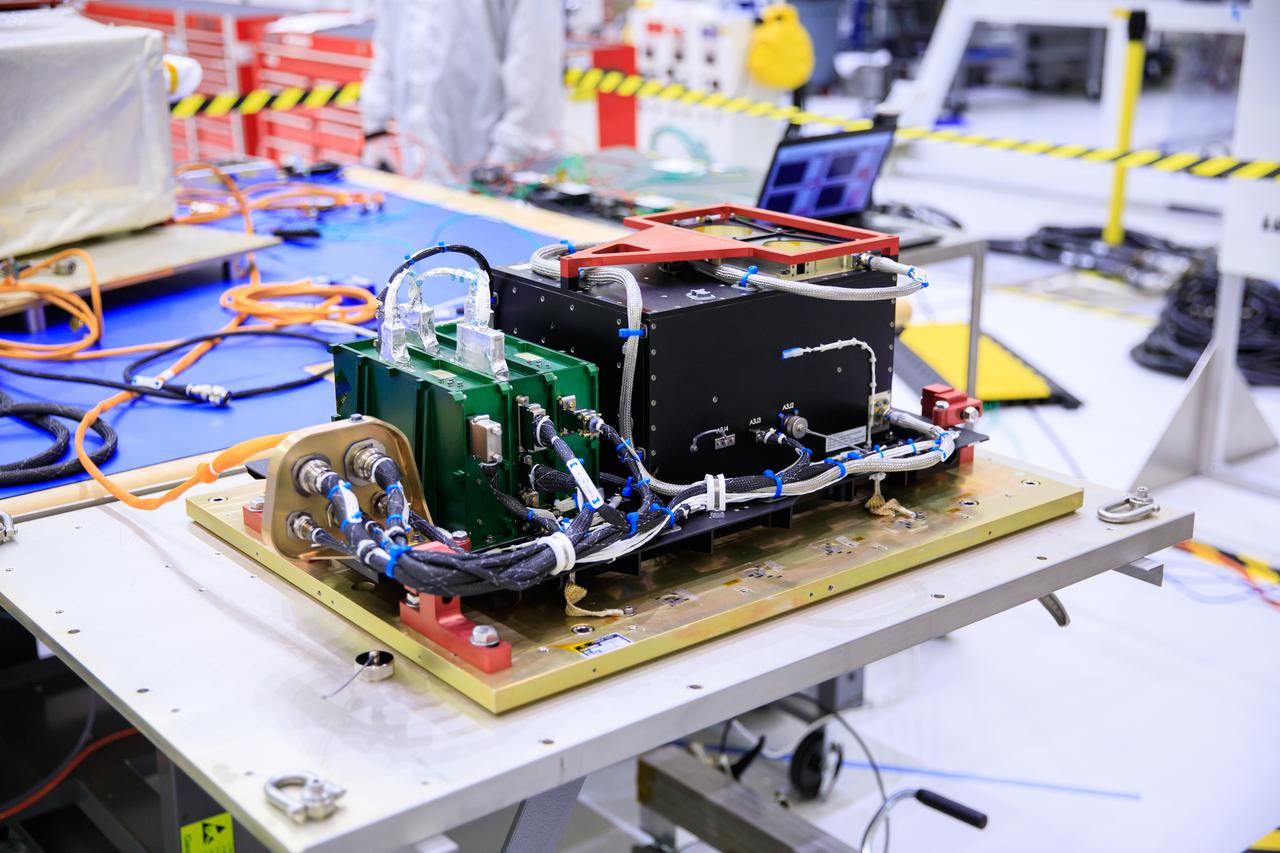
A close-up view of one of the parts of the Optical Communications System for the Artemis II mission inside the Neil Armstrong Operations and Checkout Building high bay on June 2, 2023. Optical communications is the latest space communications technology that is able to provide data rates as much as a hundred times higher than current systems. This will allow astronauts to send and receive ultra-high-definition video from the surface of the Moon or other planets such as Mars. Artemis II will be the first Artemis mission flying crew aboard Orion.
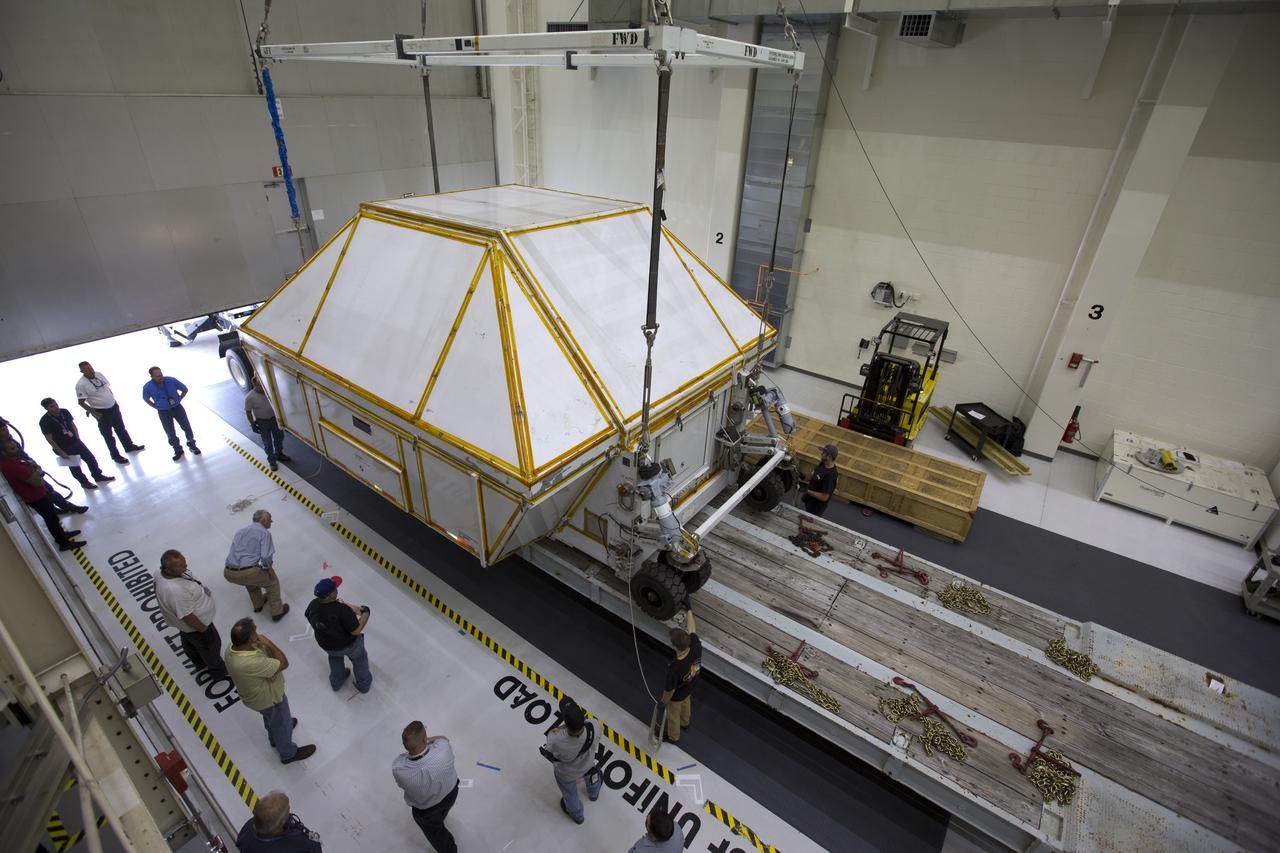
Inside the Neil Armstrong Operations and Checkout Building high bay at NASA's Kennedy Space Center in Florida, the Orion Exploration Mission-1 (EM-1) structural test article inside its transport container, is secured onto a transport vehicle for the move to the Shuttle Landing Facility. The test article will be loaded in NASA's Super Guppy airplane and transported to Lockheed Martin's Denver facility for testing. The Orion spacecraft will launch atop NASA’s Space Launch System rocket on EM-1, its first deep space mission.
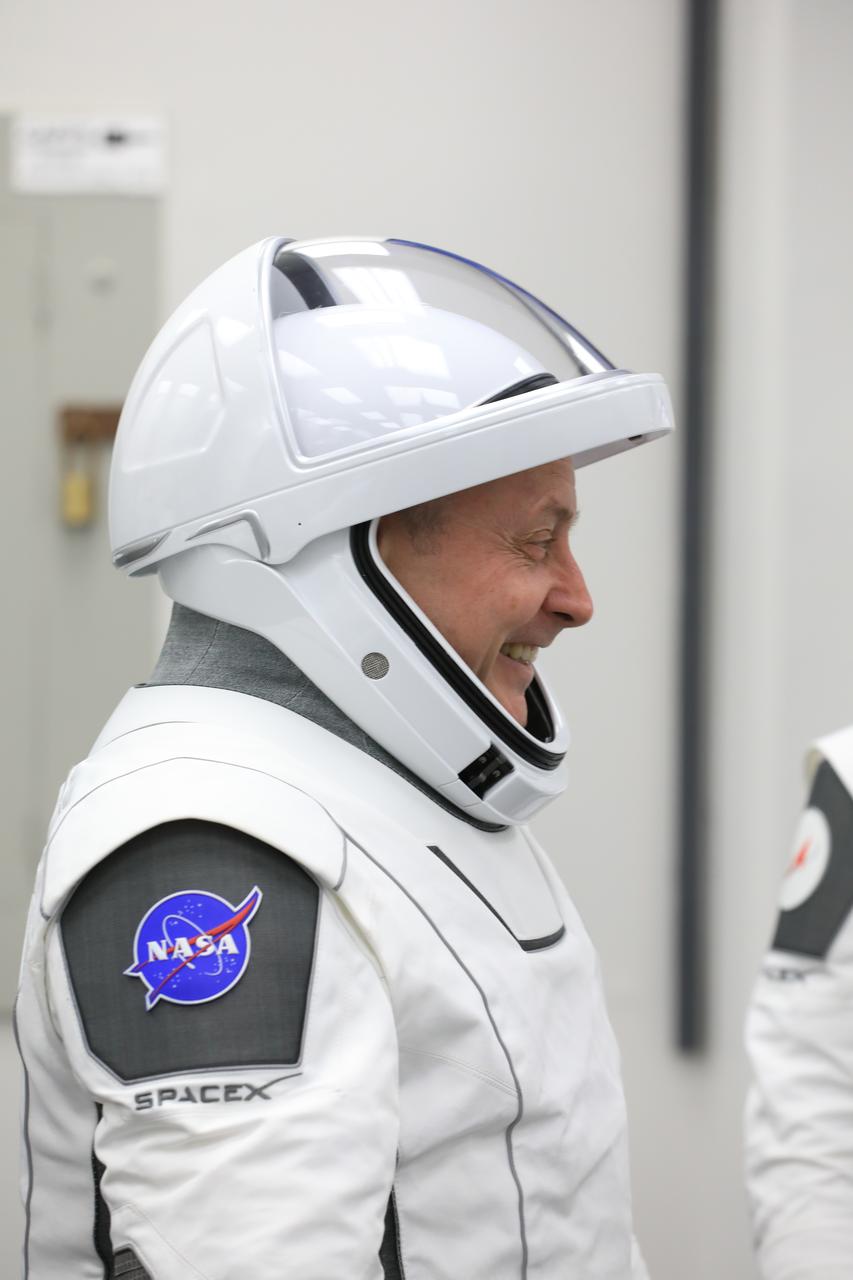
NASA astronaut Mike Fincke is all smiles during leak checks for his SpaceX spacesuit inside the crew suit-up room in the Neil A. Armstrong Operations and Checkout Building at the agency’s Kennedy Space Center in Florida during the second launch attempt NASA’s SpaceX Crew-11 mission to the International Space Station on Friday, Aug. 1, 2025. Fincke and fellow NASA astronaut Zena Cardman, along with JAXA (Japan Aerospace Exploration Agency) astronaut Kimiya Yui and Roscosmos cosmonaut Oleg Platonov, are scheduled to lift off aboard SpaceX’s Dragon spacecraft and Falcon 9 rocket at 11:45 a.m. EDT, from Launch Complex 39A at NASA Kennedy.
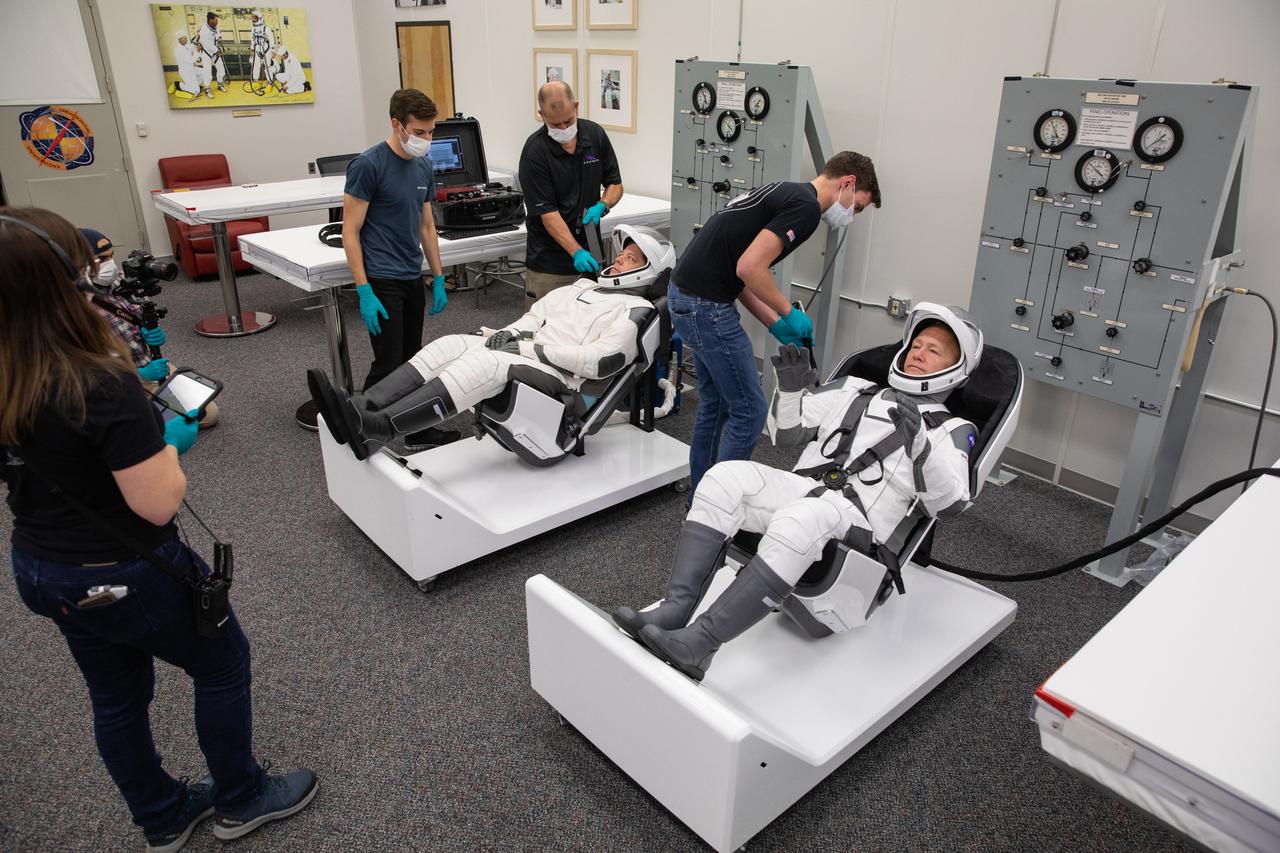
NASA astronauts Doug Hurley, foreground, and Bob Behnken don SpaceX spacesuits in the Astronaut Crew Quarters at Kennedy Space Center in Florida on Jan. 17, 2020, during a dress rehearsal ahead of the company’s uncrewed In-Flight Abort Test. A SpaceX Falcon 9 rocket and Crew Dragon spacecraft will lift off from Launch Complex 39A on the flight test, which will demonstrate the spacecraft’s escape capabilities in preparation for crewed flights to the International Space Station as part of the agency’s Commercial Crew Program. Hurley and Behnken are slated to fly on the company’s first crewed mission, Demo-2.
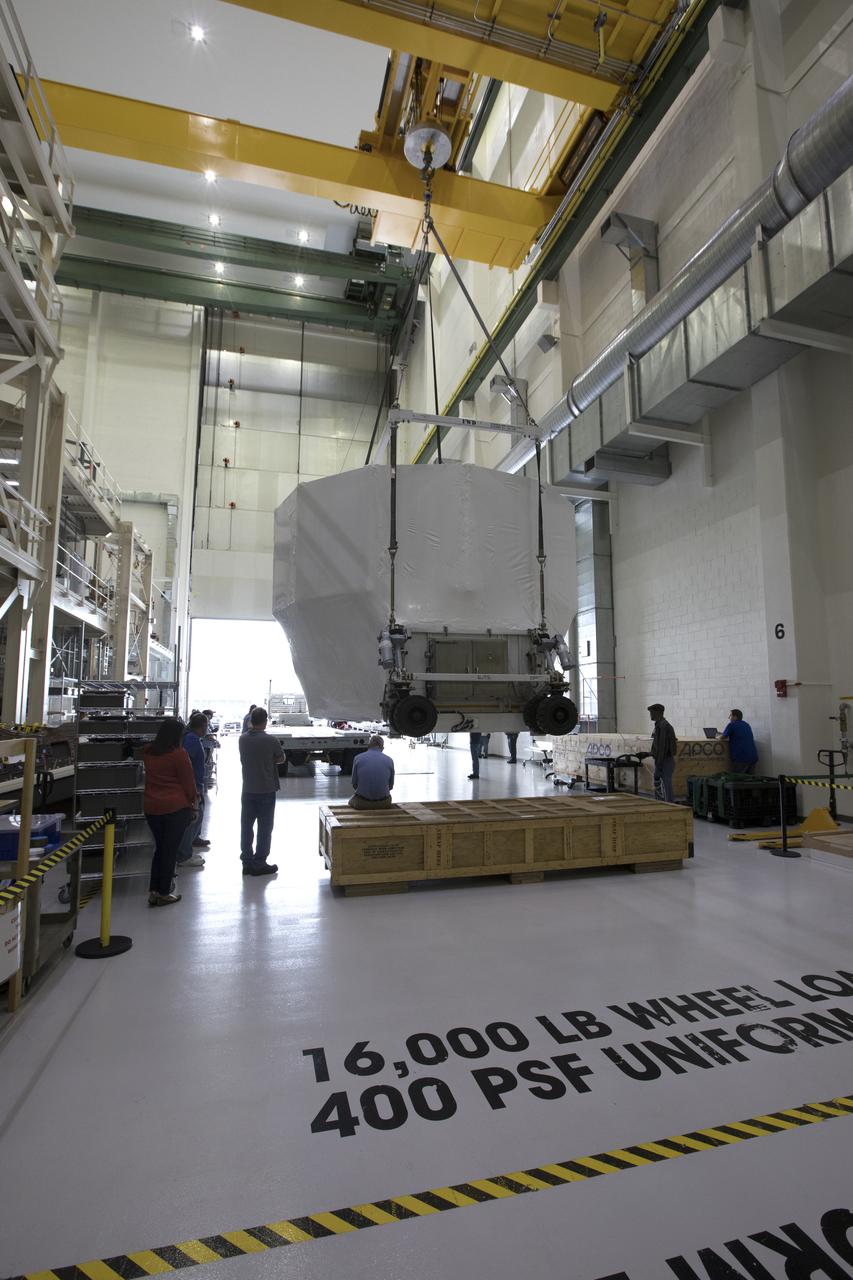
The Orion service module structural test article for Exploration Mission-1 (EM-1), built by the European Space Agency, is prepared for shipment to Lockheed Martin's Denver facility to undergo testing. Inside the Neil Armstrong Operations and Checkout Building high bay at NASA's Kennedy Space Center in Florida, a crane lifts the module, secured on a stand, for the move to the transport truck. The Orion spacecraft will launch atop the agency's Space Launch System rocket on EM-1 in 2019.
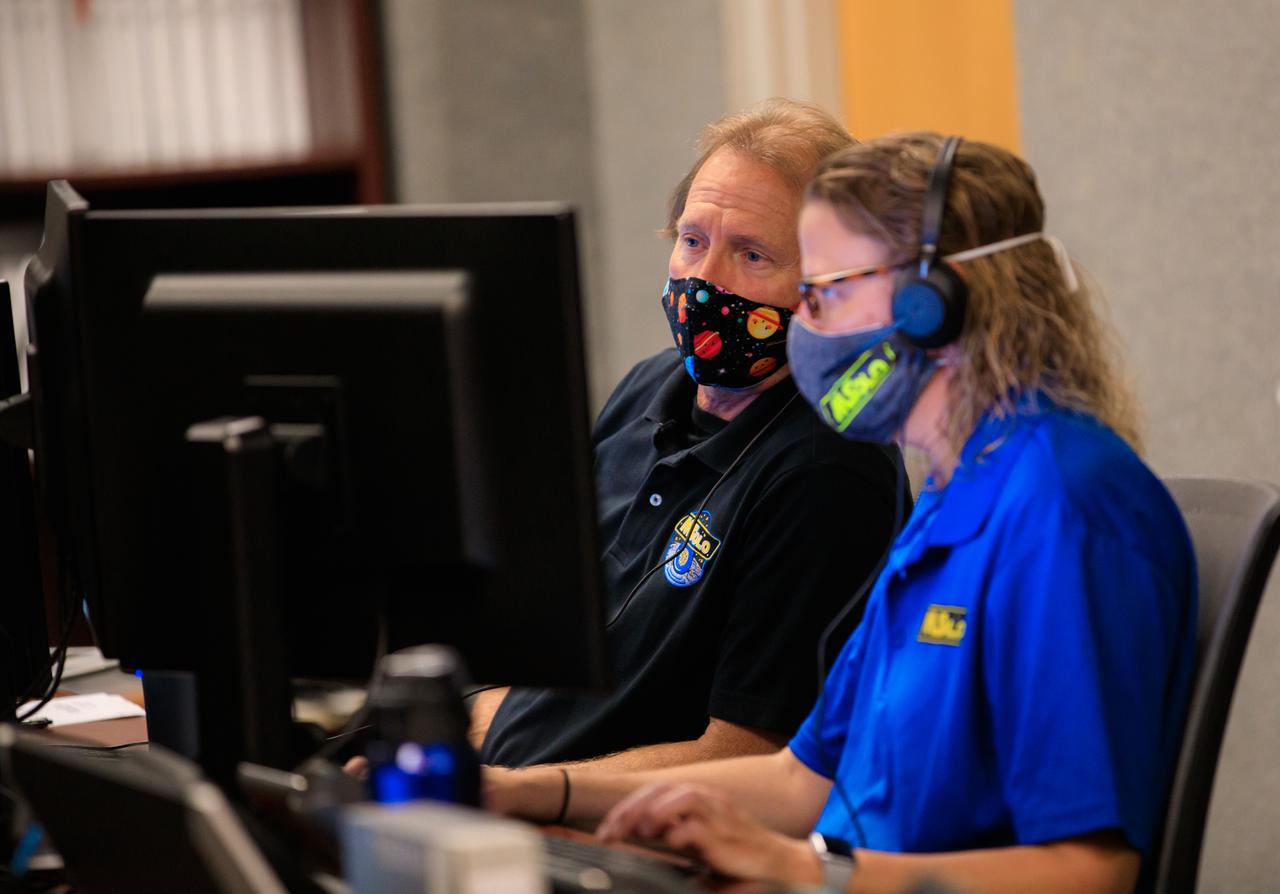
Janine Captain, at right, principal investigator for NASA’s Mass Spectrometer observing lunar operations (MSolo) and Kevin Smith, software team and science team liaison at NASA’s Kennedy Space Center in Florida, confer during a joint simulation of the Peregrine One Mission on March 26, 2021, where MSolo is connected from inside the Neil Armstrong Operations and Checkout Building to Astrobotic’s mission control facility in Pittsburgh, Pennsylvania. MSolo is a commercial off-the-shelf mass spectrometer modified to work in space and it will help analyze the chemical makeup of landing sites on the Moon, as well as study water on the lunar surface. This was the first mission round of simulations for Peregrine Mission One to develop and refine procedures between Astrobotic’s Peregrine Lander and MSolo. Later, there will be other simulations with multiple instruments. Peregrine Mission One will be one of NASA’s first Commercial Lunar Payload Delivery Service (CLPS) missions where under the Artemis program, commercial deliveries beginning in 2021 will perform science experiments, test technologies and demonstrate capabilities to help NASA explore the Moon and prepare for human missions.
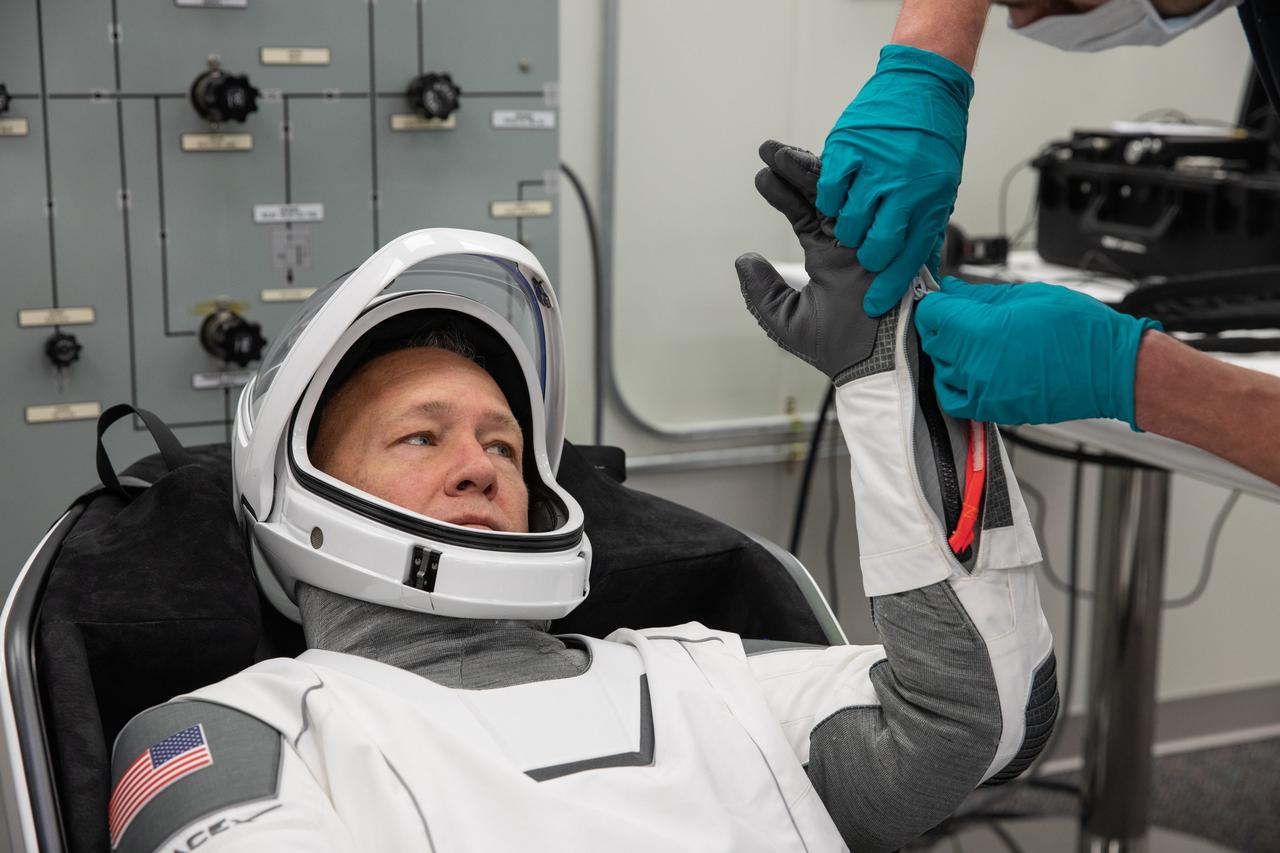
NASA astronaut Doug Hurley dons a SpaceX spacesuit in the Astronaut Crew Quarters at Kennedy Space Center in Florida on Jan. 17, 2020, during a dress rehearsal ahead of the company’s uncrewed In-Flight Abort Test. A SpaceX Falcon 9 rocket and Crew Dragon spacecraft will lift off from Launch Complex 39A on the flight test, which will demonstrate the spacecraft’s escape capabilities in preparation for crewed flights to the International Space Station as part of the agency’s Commercial Crew Program. Hurley and NASA astronaut Bob Behnken are slated to fly on the company’s first crewed mission, Demo-2.
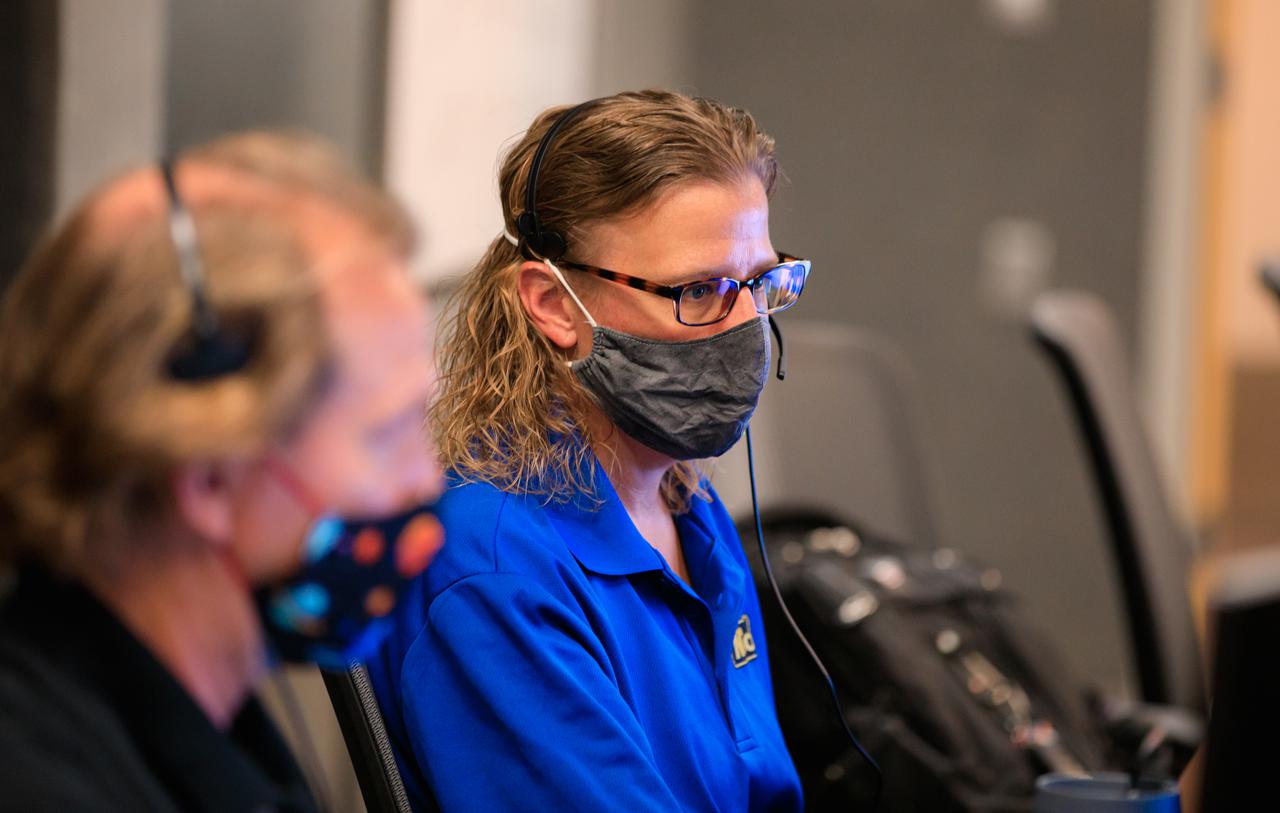
Janine Captain, at right, principal investigator for NASA’s Mass Spectrometer observing lunar operations (MSolo) takes part in a simulation of the Peregrine One Mission on March 26, 2021, where MSolo connected from inside the Neil Armstrong Operations and Checkout Building at NASA’s Kennedy Space Center in Florida to Astrobotic’s mission control facility in Pittsburgh, Pennsylvania. MSolo is a commercial off-the-shelf mass spectrometer modified to work in space and it will help analyze the chemical makeup of landing sites on the Moon, as well as study water on the lunar surface. This was the first mission round of simulations for Peregrine Mission One to develop and refine procedures between Astrobotic’s Peregrine Lander and MSolo. Later, there will be other simulations with multiple instruments. Peregrine Mission One will be one of NASA’s first Commercial Lunar Payload Delivery Service (CLPS) missions where under the Artemis program, commercial deliveries beginning in 2021 will perform science experiments, test technologies and demonstrate capabilities to help NASA explore the Moon and prepare for human missions.
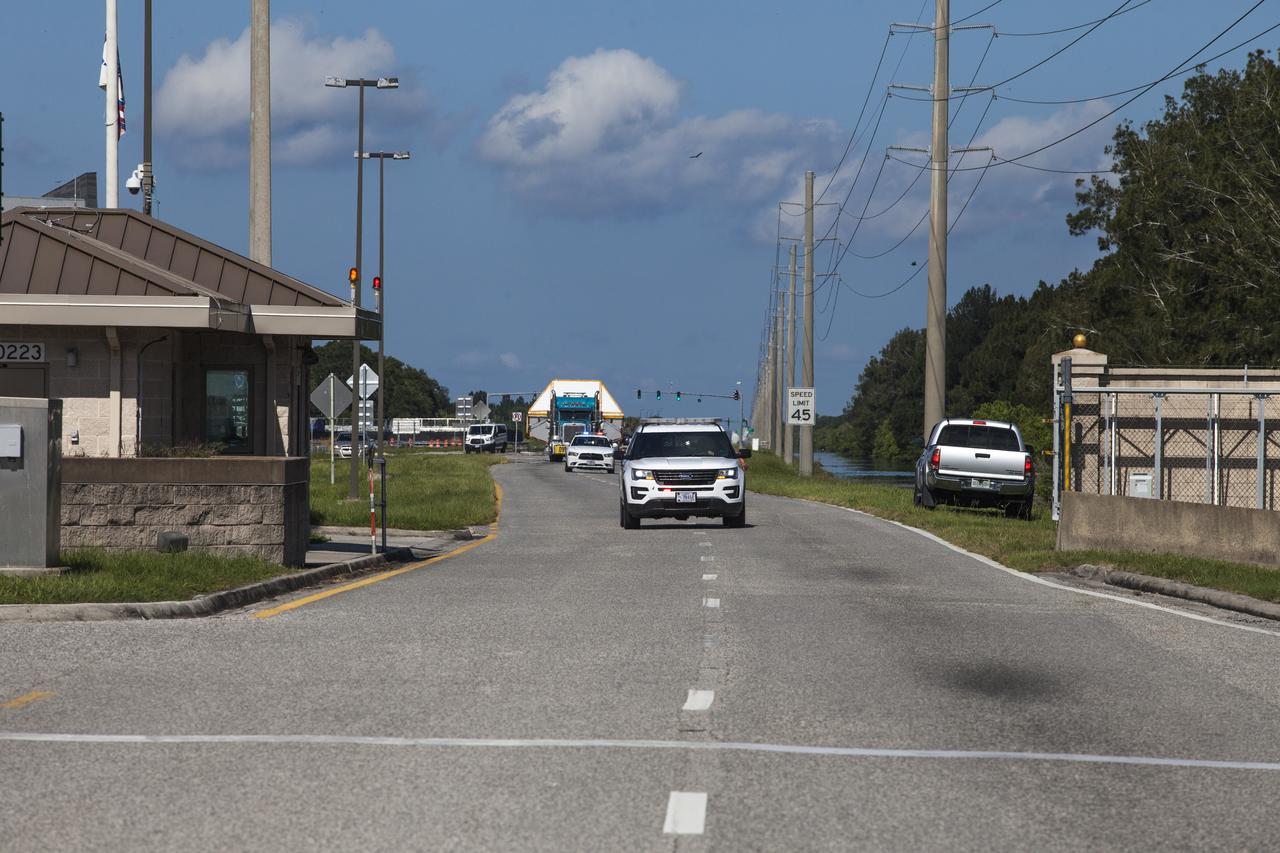
A super-wide truck carrying the Orion crew module pressure vessel for Exploration Mission-2 approaches the entrance gate at NASA's Kennedy Space Center in Florida on Aug. 24, 2018. The pressure vessel was transported in its Crew Module Transportation Fixture by truck from Michoud Assembly Facility near New Orleans. The pressure vessel is Orion's primary structure that holds the pressurized atmosphere astronauts will breathe and work in while in the vacuum of deep space. It will be moved into the Neil Armstrong Operations and Checkout Building high bay, where it will be secured on a precision alignment tool to begin preparing it for flight.
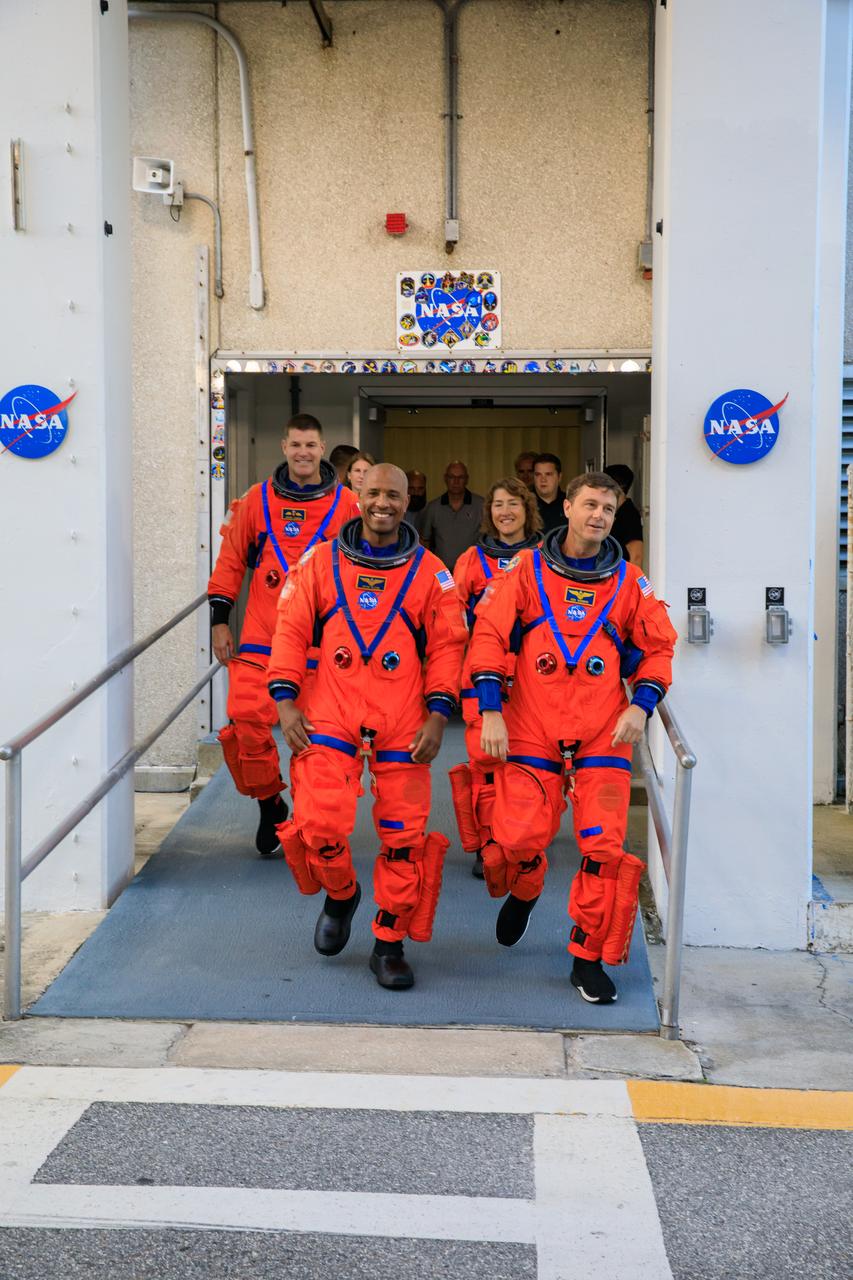
Artemis II NASA astronauts (front, from left) Victor Glover, Reid Wiseman, (back, from left) CSA (Canadian Space Agency) astronaut Jeremy Hansen, and NASA astronaut Christina Koch walk out of Astronaut Crew Quarters inside the Neil Armstrong Operations and Checkout Building to the Artemis crew transportation vehicles prior to traveling to Launch Pad 39B as part of an integrated ground systems test at Kennedy Space Center in Florida on Wednesday, Sept. 20, to test the crew timeline for launch day.
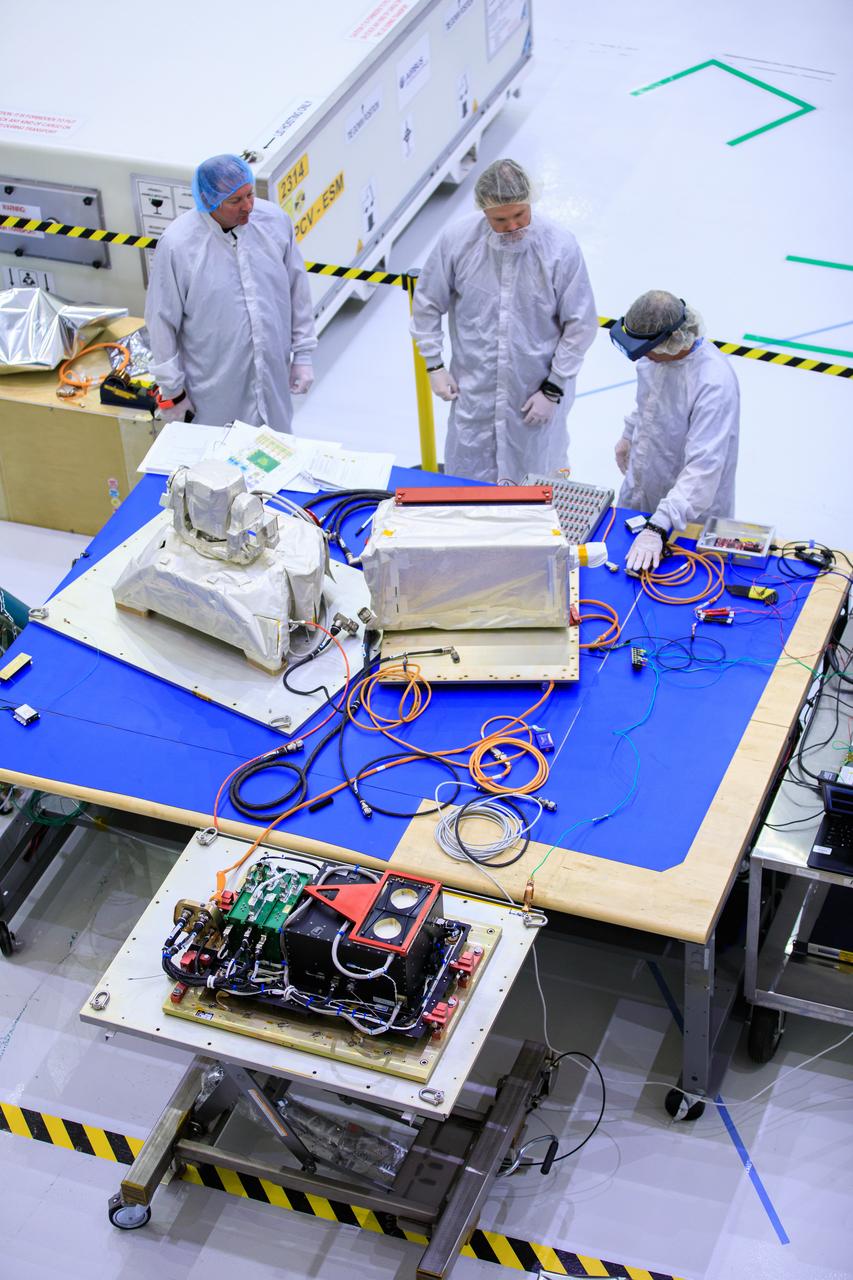
Inside the high bay of the Neil Armstrong Operations and Checkout Building at NASA’s Kennedy Space Center in Florida, technicians assemble on the Optical Communications System for the Artemis II mission on June 2, 2023. Optical communications is the latest space communications technology that is able to provide data rates as much as a hundred times higher than current systems. This will allow astronauts to send and receive ultra-high-definition video from the surface of the Moon or other planets such as Mars. Artemis II will be the first Artemis mission flying crew aboard Orion.
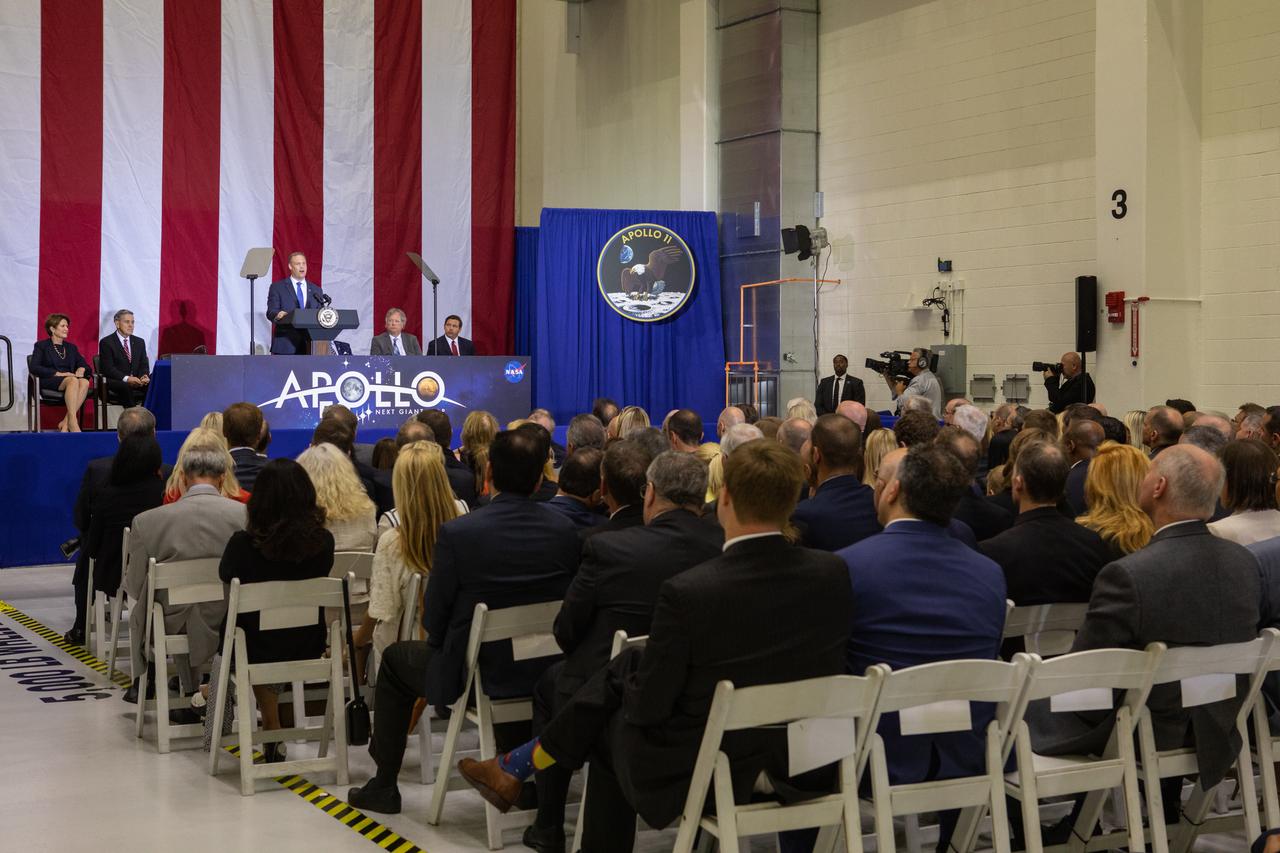
NASA Administrator Jim Bridenstine addresses invited guests, elected officials and NASA, Lockheed Martin and other industry leaders at Kennedy Space Center’s Neil Armstrong Operations & Checkout Building on July 20, 2019. He introduced Vice President Mike Pence. Pence, who visited the Florida spaceport in honor of the 50th anniversary of the Apollo 11 mission, also spoke about NASA’s progress and future plans to return to the Moon and on to Mars.