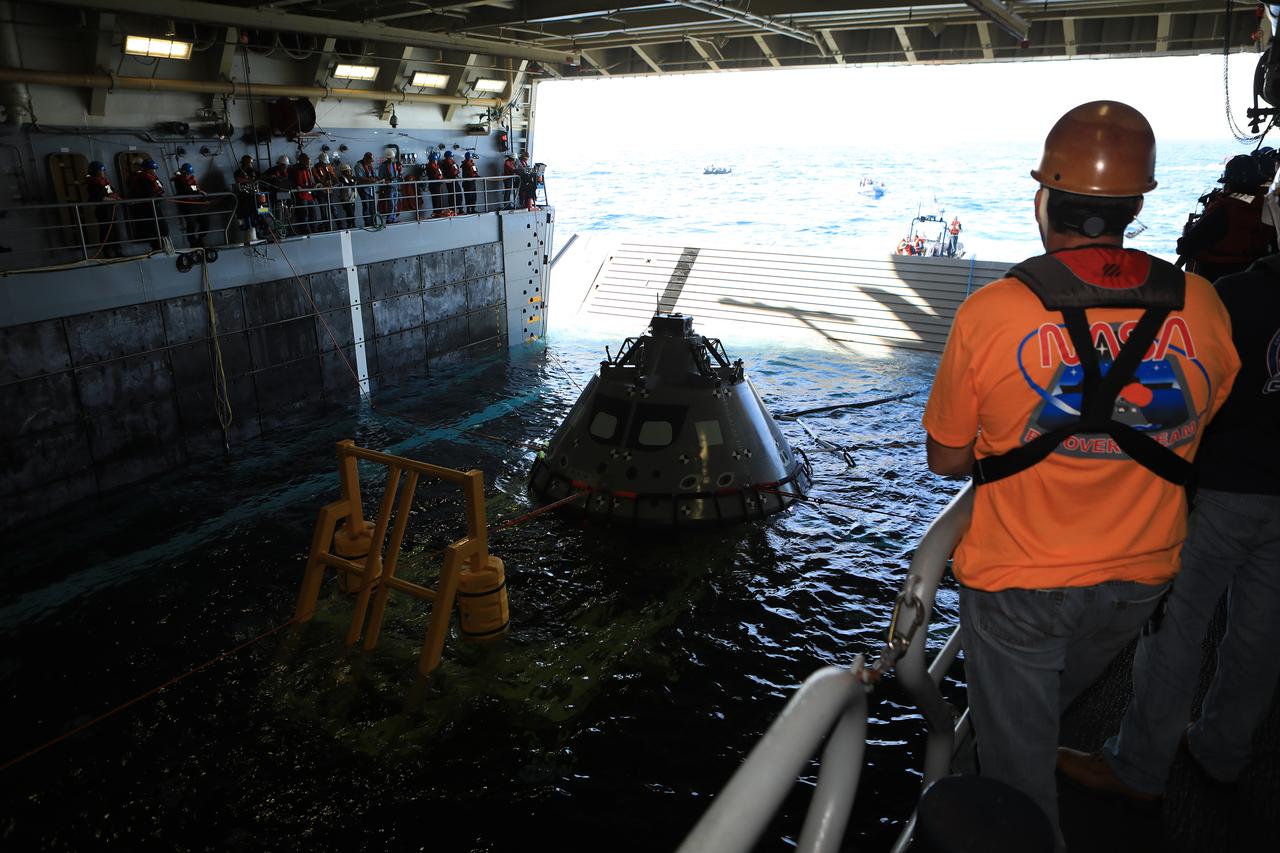
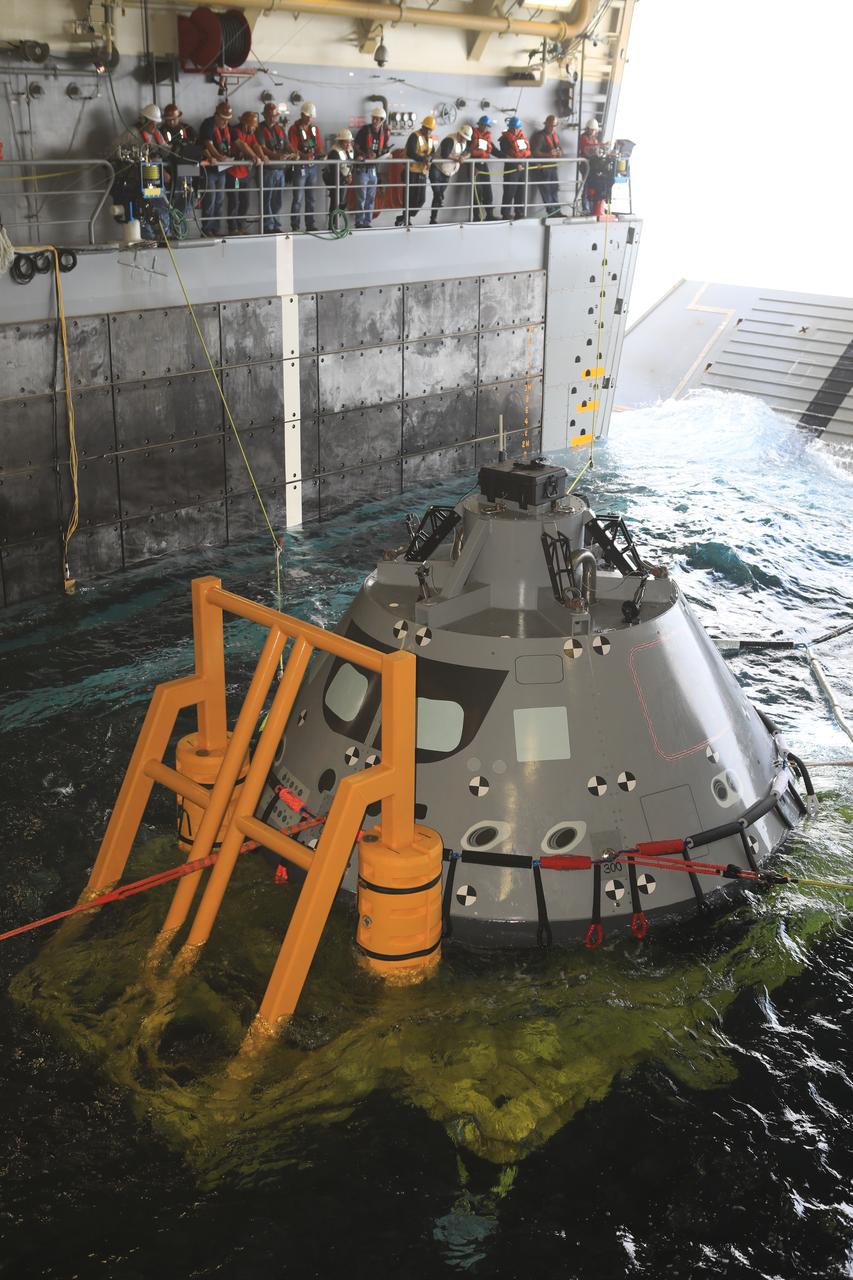
The Exploration Ground Systems Recovery Team, based out of Kennedy Space Center in Florida, practices bringing a test version of the Orion capsule inside the flooded well deck of the USS John P. Murtha and setting it in a cradle as part of Underway Recovery Test-7 (URT-7) on Oct. 31, 2018, in the Pacific Ocean. URT-7 is one in a series of tests to verify and validate procedures and hardware that will be used to recover the Orion spacecraft after it splashes down in the Pacific Ocean following deep space exploration missions. Orion will have emergency abort capability, sustain the crew during space travel and provide safe re-entry from deep space return velocities.
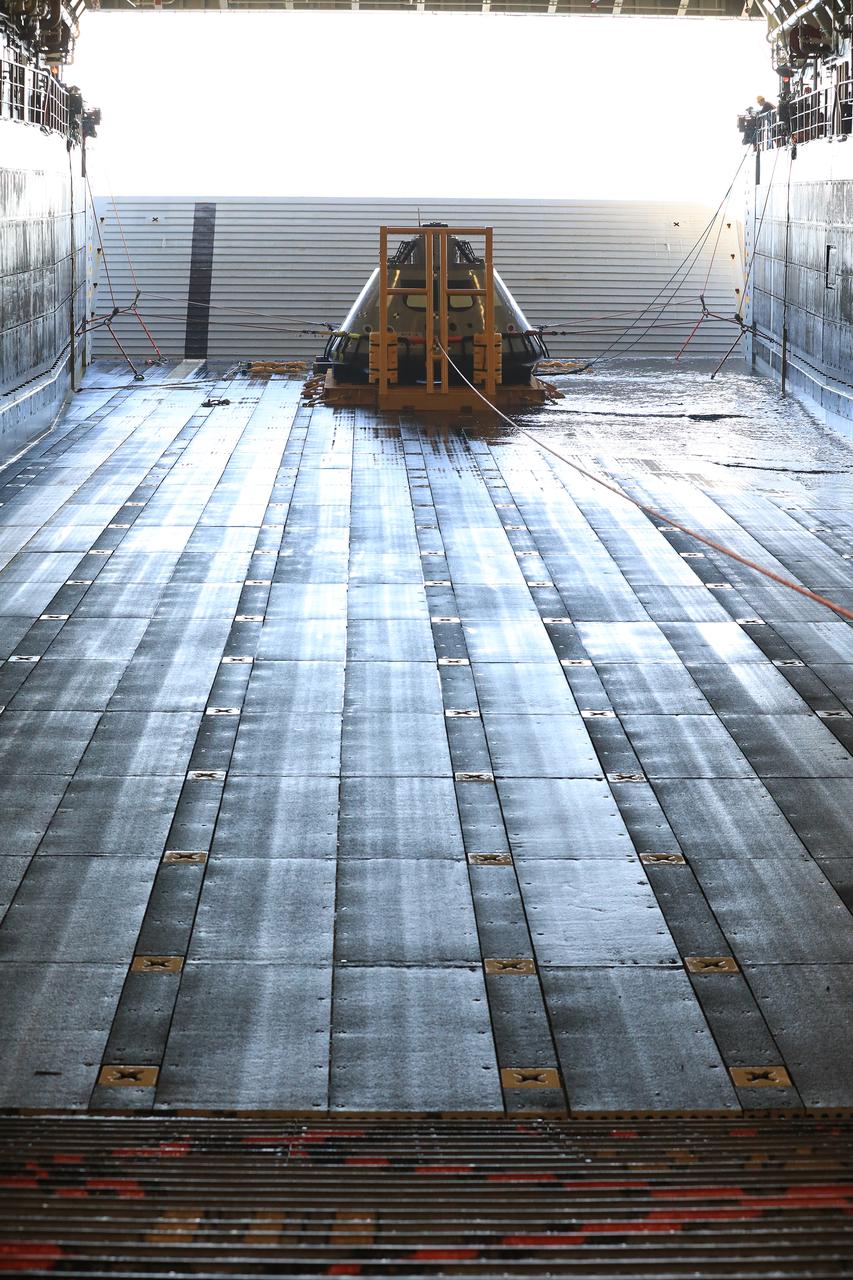
A test version of the Orion capsule sits in its cradle after being recovered from the Pacific Ocean during Underway Recovery Test-7 (URT) on Oct. 31, 2018, aboard the USS John P. Murtha. URT-7 is one in a series of tests to verify and validate procedures and hardware that will be used to recover the Orion spacecraft after it splashes down in the Pacific Ocean following deep space exploration missions. Orion will have emergency abort capability, sustain the crew during space travel and provide safe re-entry from deep space return velocities.
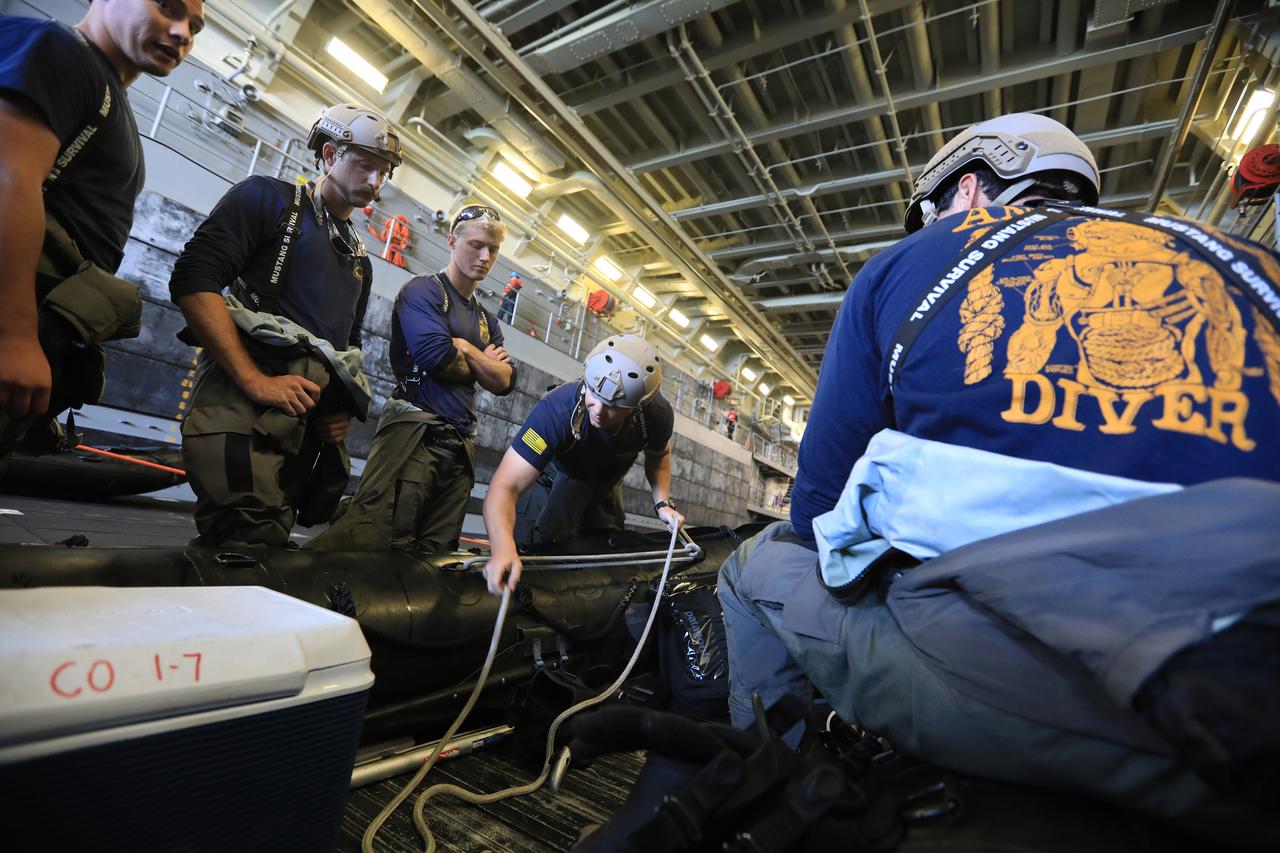
U.S. Navy divers from EOD Mobile Unit 11, MDS Company 11-7 prepare their small boat for launch in the well deck of the USS John P. Murtha, during Underway Recovery Test-7 (URT-7) on Oct. 31, 2018. The Exploration Ground Systems recovery team and the U.S. Navy are using a test version of the Orion crew module, several rigid hull inflatable boats and support equipment to verify and validate processes, procedures, hardware and personnel during recovery of Orion in open waters. The test is one in a series of tests to verify and validate procedures and hardware that will be used to recover the Orion spacecraft after it splashes down in the Pacific Ocean following deep space exploration missions. Orion will have emergency abort capability, sustain the crew during space travel and provide safe re-entry from deep space return velocities.
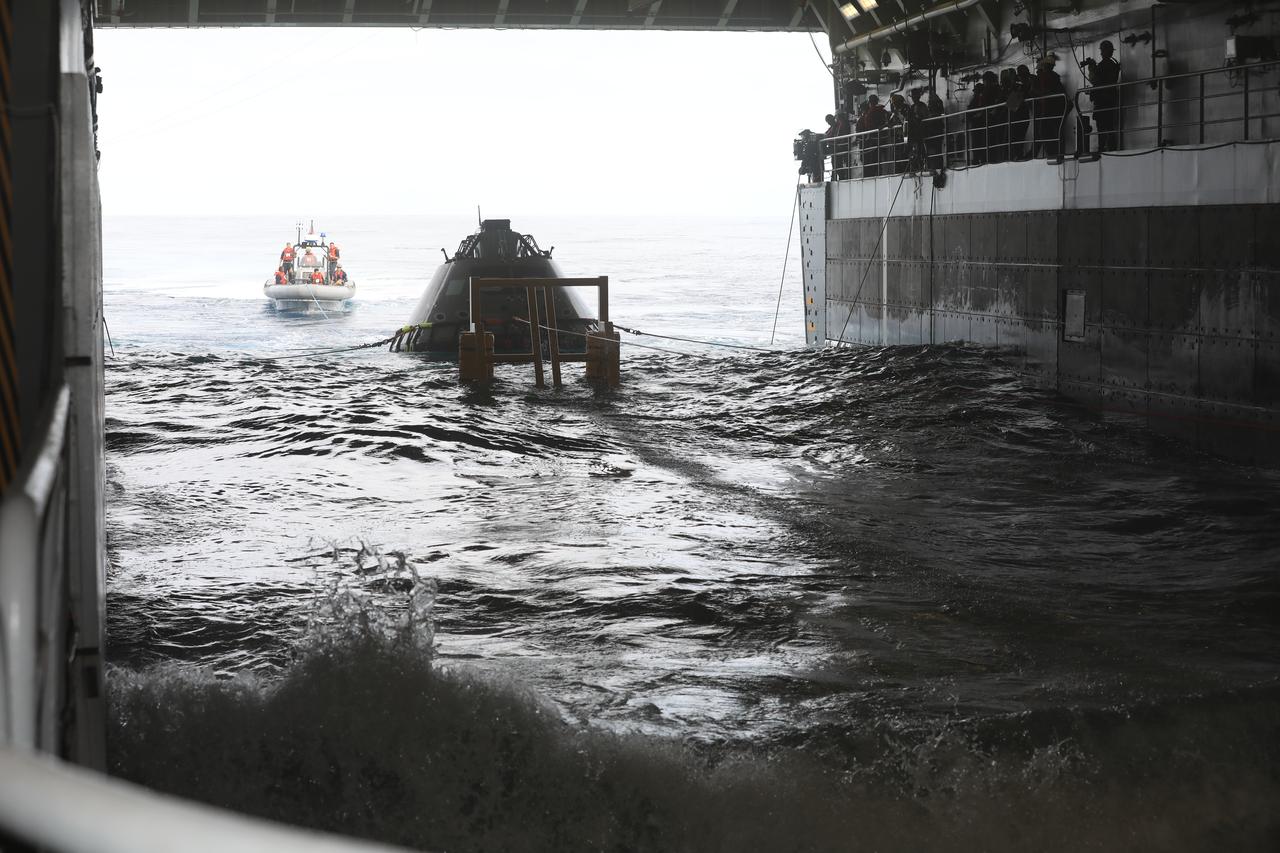
Waves crash inside the well deck of a U.S. Navy ship during Underway Recovery Test-7 (URT-7) on Oct. 30, 2018, in the Pacific Ocean. The Exploration Ground Systems (EGS) recovery team and the U.S. Navy will use a test version of the Orion crew module, several rigid hull inflatable boats and support equipment to verify and validate processes, procedures, hardware and personnel during recovery of Orion in open waters. The testing is one in a series of tests to verify and validate procedures and hardware that will be used to recover the Orion spacecraft after it splashes down in the Pacific Ocean following deep space exploration missions. Orion will have emergency abort capability, sustain the crew during space travel and provide safe re-entry from deep space return velocities.
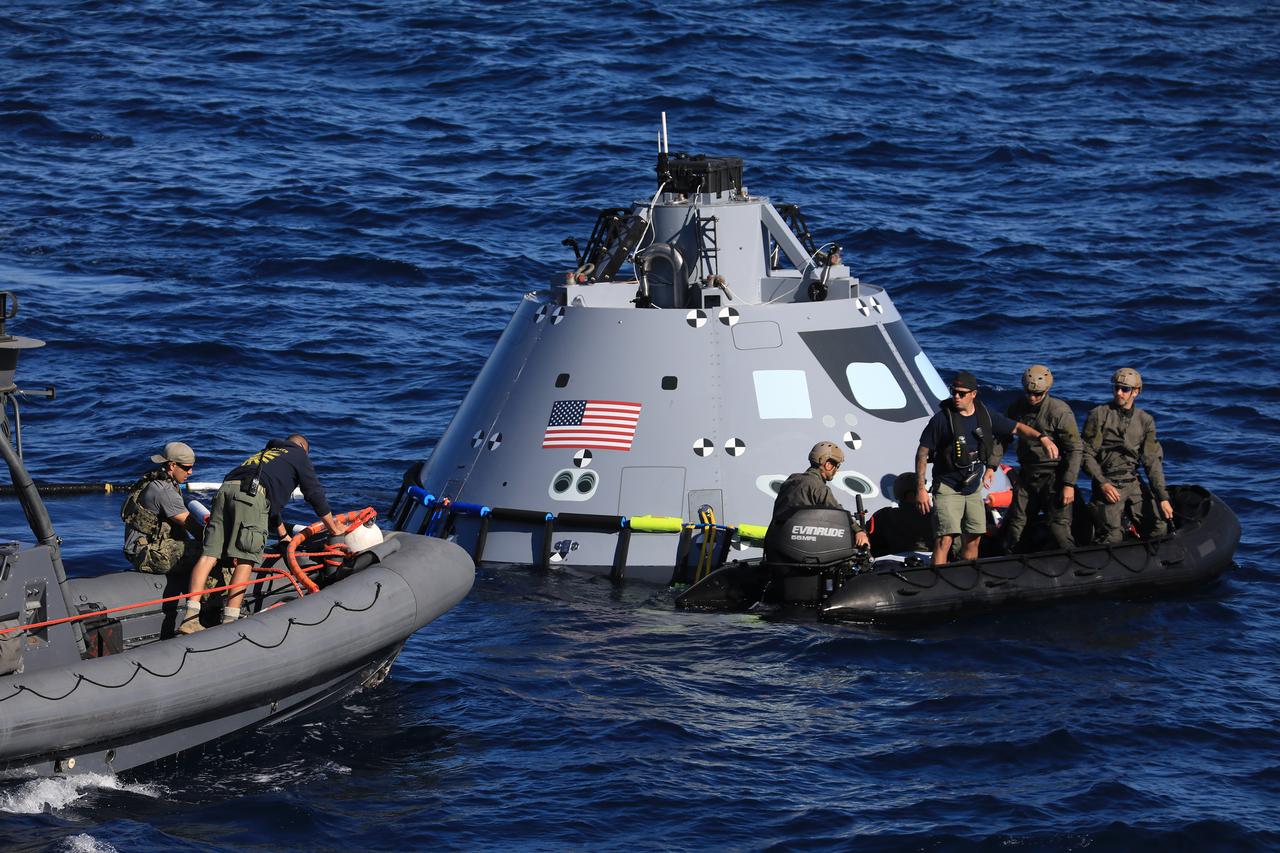
During Underway Recovery Test-7 (URT-7), U.S. Navy divers approach a test version of the Orion capsule to practice securing it for recovery into the well deck of an amphibious assault ship on Oct. 31, 2018 in the Pacific Ocean. The Exploration Ground Systems recovery team and the U.S. Navy work together to verify and validate procedures and hardware that will be used to recover the Orion spacecraft after it splashed down in the Pacific Ocean following deep space exploration missions. Orion will have emergency abort capability, sustain the crew during space travel and provide safe re-entry from deep space return velocities.
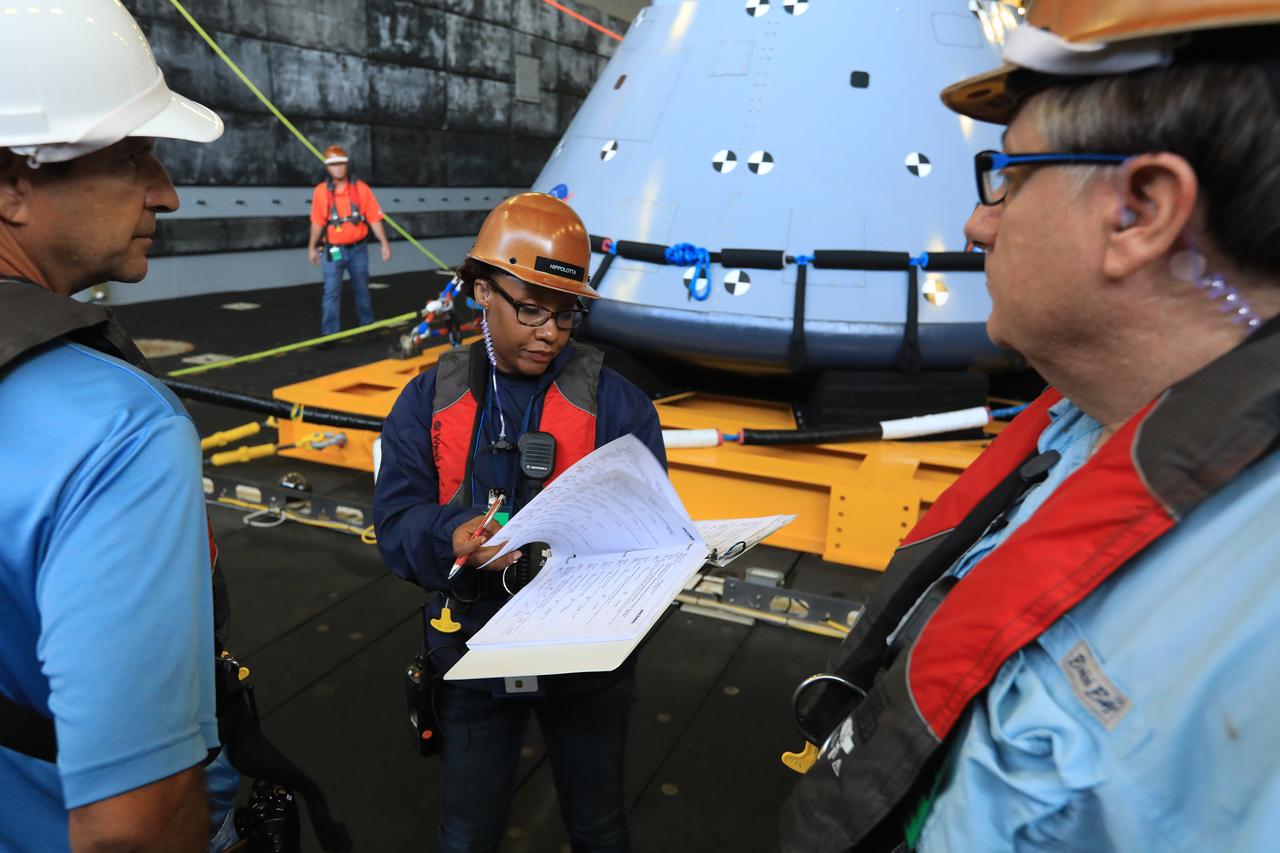
Tracy Parks, center, with Jacobs, serves as the Recovery Operations Integrator during Underway Recovery Test-7 (URT-7) aboard the USS John B. Murtha in the Pacific Ocean. On Oct. 31, 2018, during the second morning of URT-7, she reviews recovery operations with team members in the well deck of the ship. The Exploration Ground Systems recovery team and the U.S. Navy are using a test version of the Orion crew module, several rigid hull inflatable boats and support equipment to verify and validate processes, procedures, hardware and personnel during recovery of Orion in open waters. The test is one in a series of tests to verify and validate procedures and hardware that will be used to recover the Orion spacecraft after it splashes down in the Pacific Ocean following deep space exploration missions. Orion will have emergency abort capability, sustain the crew during space travel and provide safe re-entry from deep space return velocities.
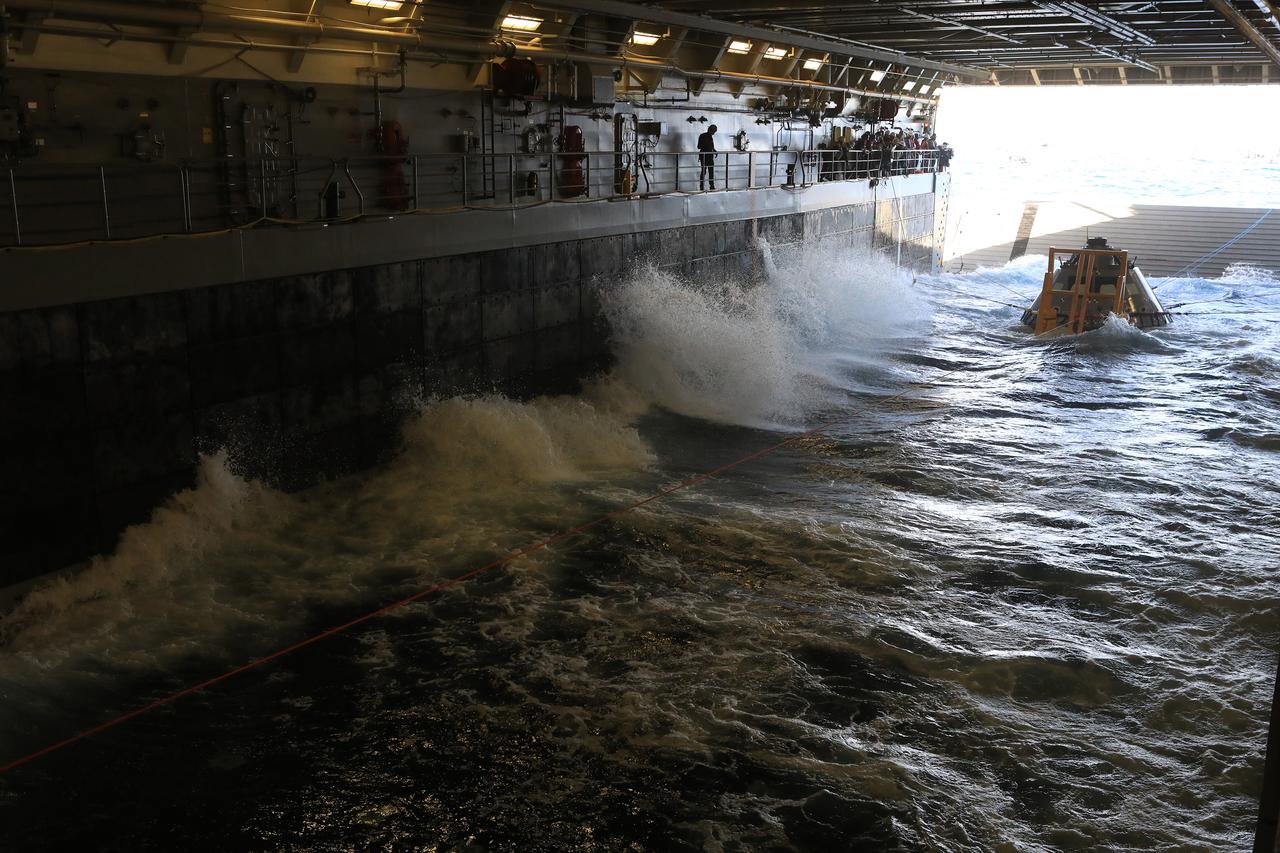
The Exploration Ground Systems Recovery Team, based out of Kennedy Space Center in Florida, practices bringing a test version of the Orion capsule inside the flooded well deck of the USS John P. Murtha and setting it in a cradle as part of Underway Recovery Test-7 (URT-7) on Oct. 31, 2018, in the Pacific Ocean. URT-7 is one in a series of tests to verify and validate procedures and hardware that will be used to recover the Orion spacecraft after it splashes down in the Pacific Ocean following deep space exploration missions. Orion will have emergency abort capability, sustain the crew during space travel and provide safe re-entry from deep space return velocities.
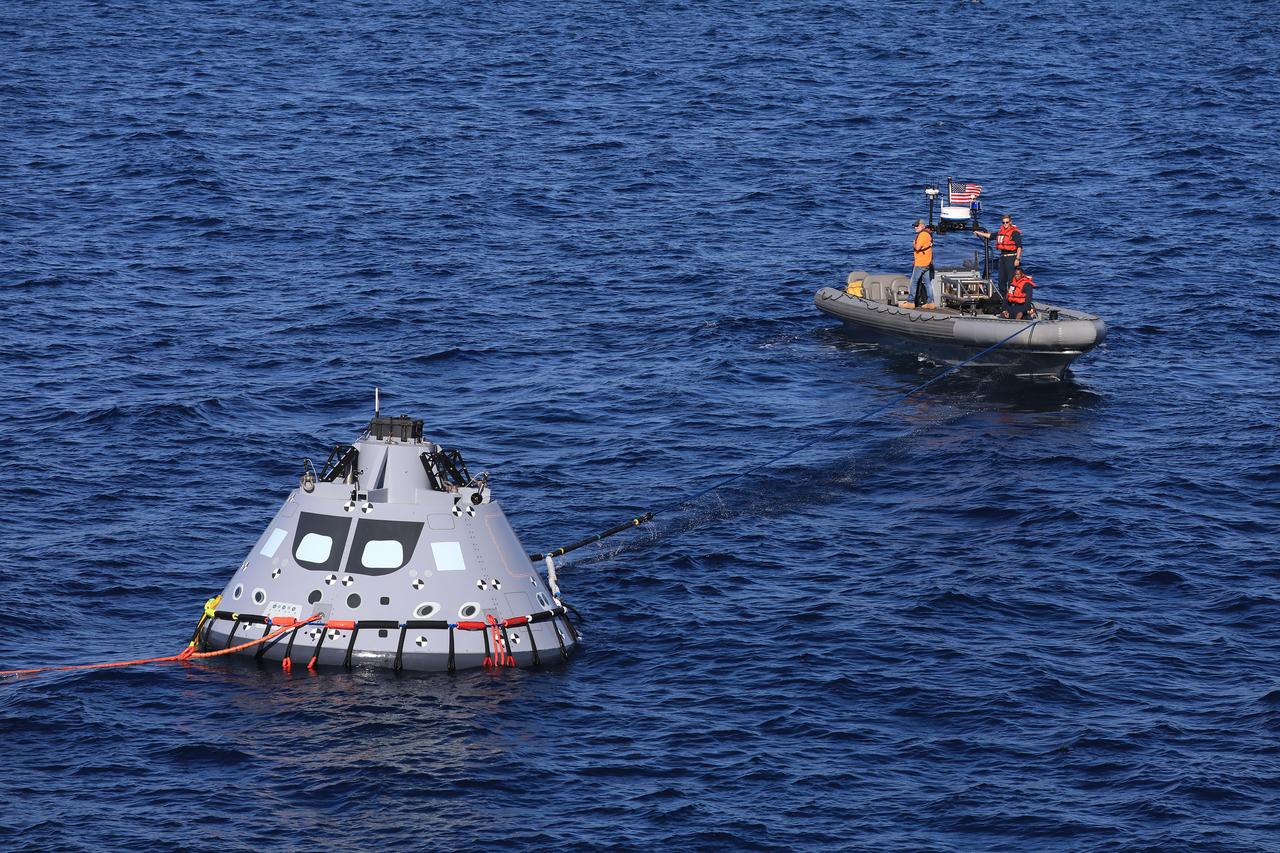
A U.S. Navy boat secures a tending line to a test version of the Orion capsule during Underway Recovery Test-7 (URT-7) on Oct. 31, 2018, in the Pacific Ocean. The Exploration Ground Systems recovery team and the U.S. Navy work together to verify and validate procedures and hardware that will be used to recover the Orion spacecraft after it splashes down in the Pacific Ocean following deep space exploration missions. Orion will have emergency abort capability, sustain the crew during space travel and provide safe re-entry from deep space return velocities.
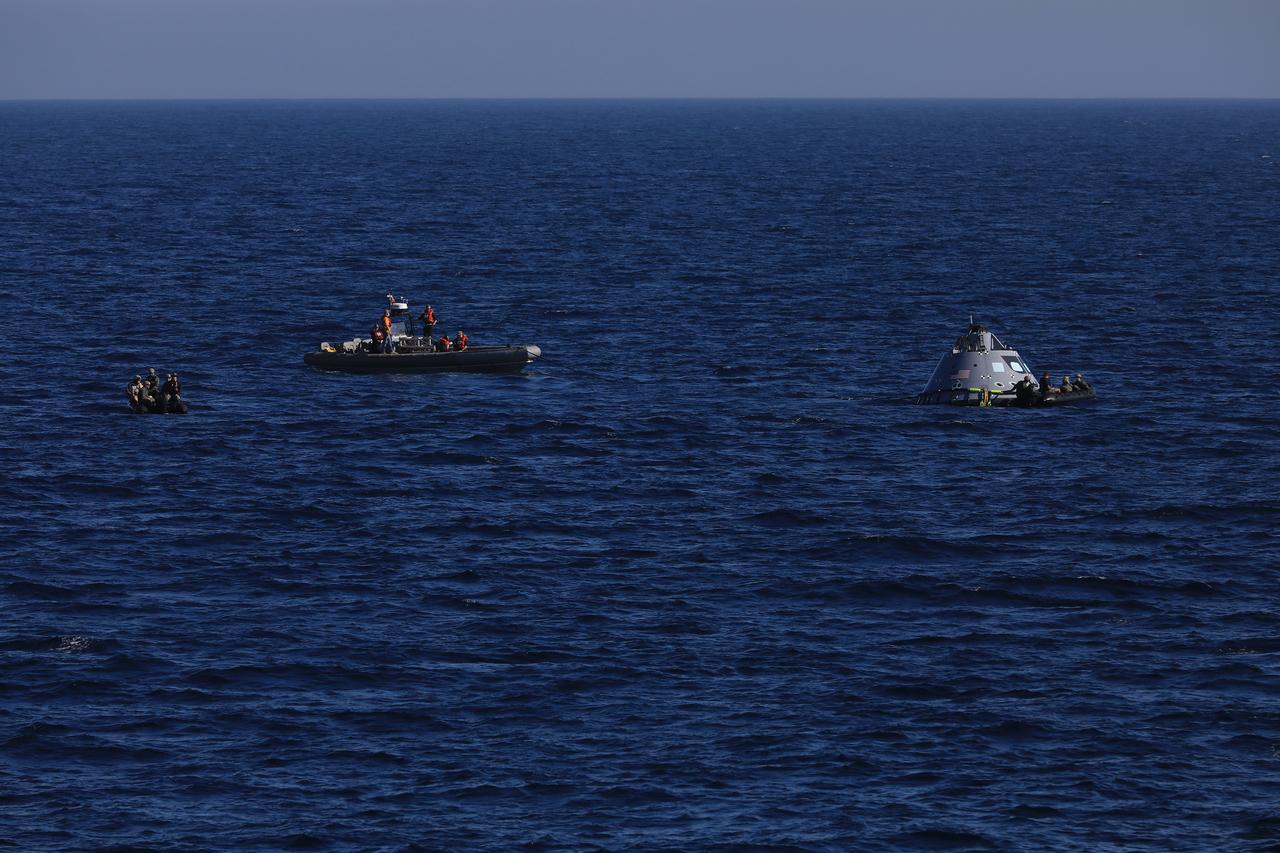
During Underway Recovery Test-7 (URT-7), U.S. Navy divers approach a test version of the Orion capsule to practice securing it for recovery into the well deck of an amphibious assault ship on Oct. 31, 2018 in the Pacific Ocean. The Exploration Ground Systems recovery team and the U.S. Navy work together to verify and validate procedures and hardware that will be used to recover the Orion spacecraft after it splashes down in the Pacific Ocean following deep space exploration missions. Orion will have emergency abort capability, sustain the crew during space travel and provide safe re-entry from deep space return velocities.
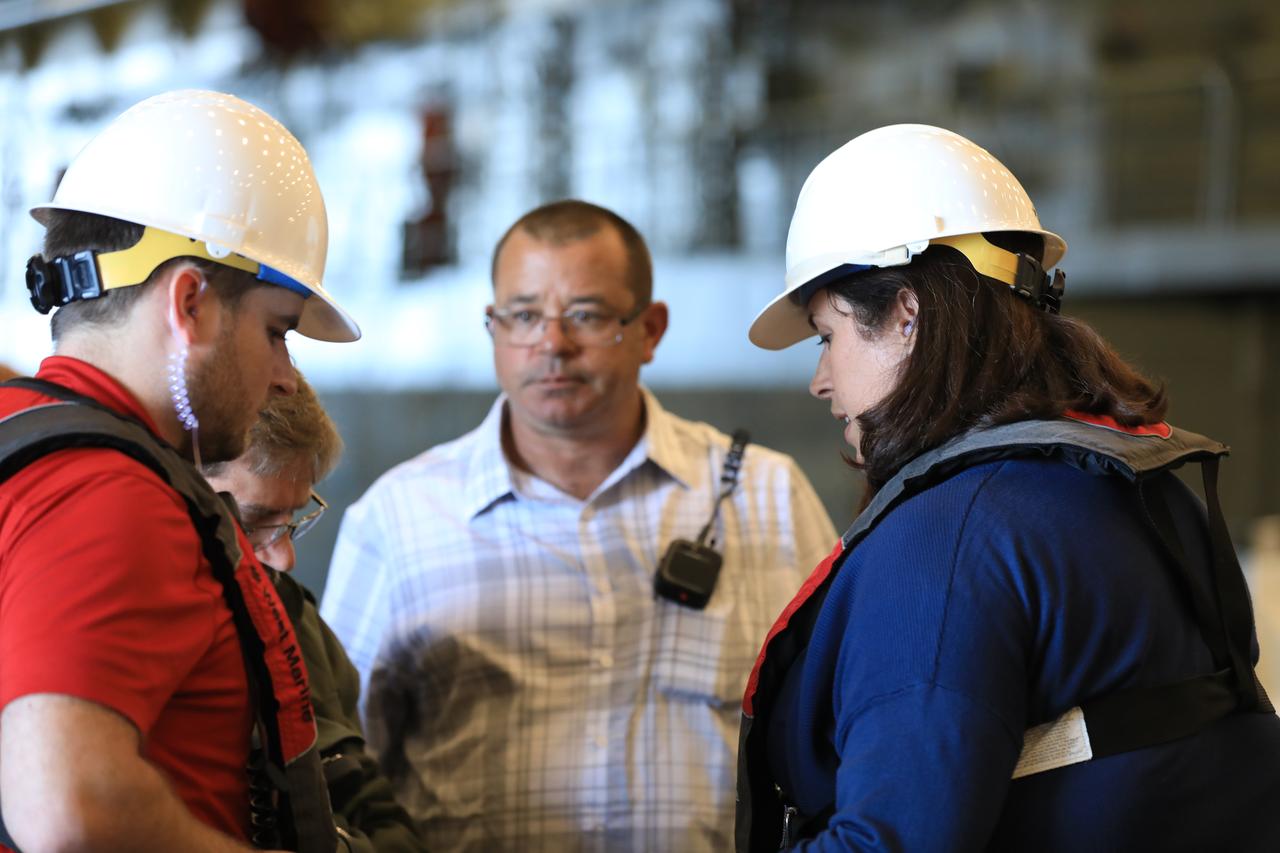
Inside a U.S. Navy ship, Exploration Ground Systems (EGS) Landing and Recovery Director Melissa Jones, at right, briefs her team on Oct. 30, 2018, before they begin Underway Recovery Test-7 (URT-7). EGS and the U.S. Navy will use a test version of the Orion crew module, several rigid hull inflatable boats and support equipment to verify and validate processes, procedures, hardware and personnel during recovery of Orion in open waters. URT-7 is one in a series of tests to verify and validate procedures and hardware that will be used to recover the Orion spacecraft after it splashes down in the Pacific Ocean following deep space exploration missions. Orion will have emergency abort capability, sustain the crew during space travel and provide safe re-entry from deep space return velocities.
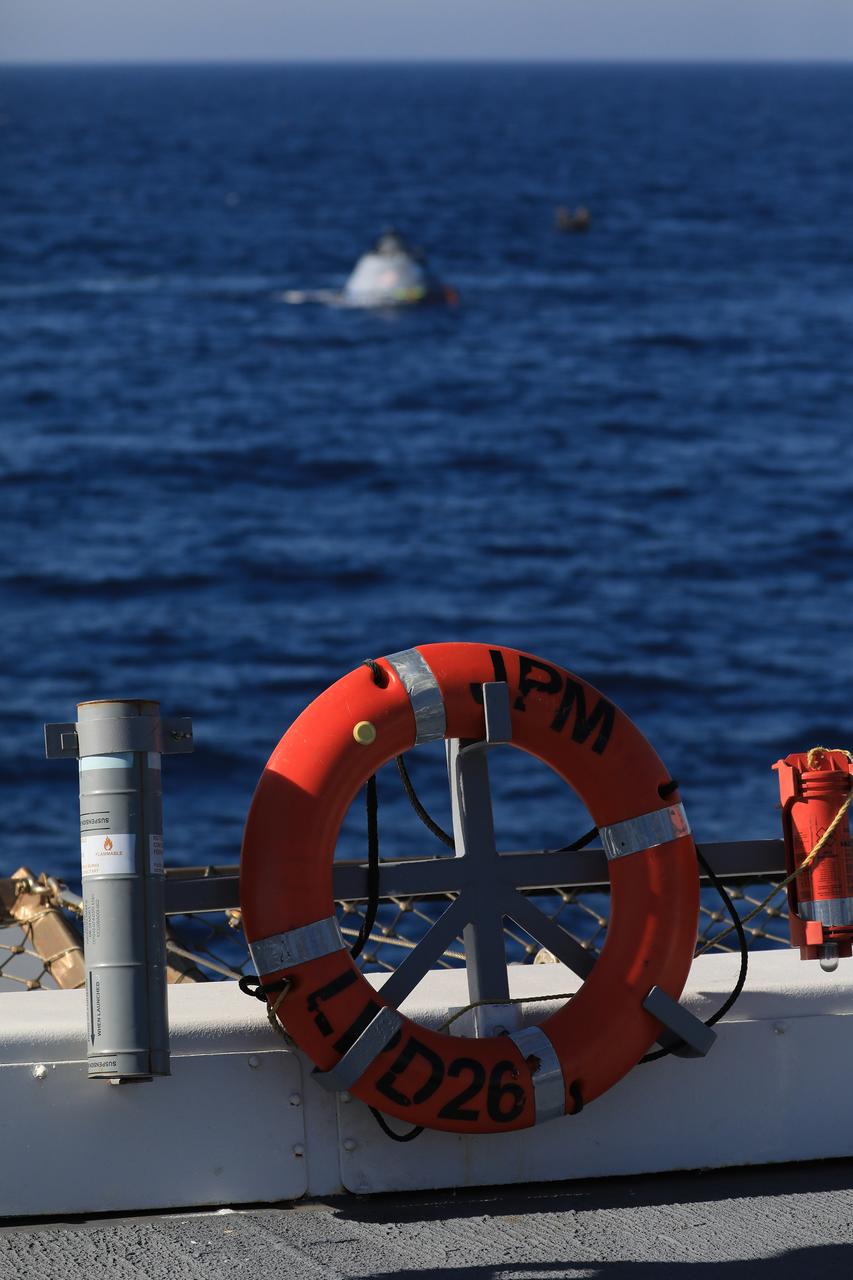
The Exploration Ground Systems recovery team, along with the U.S. Navy, practice recovering a test version of the Orion capsule during Underway Recovery Test-7 (URT-7) onboard the USS John P. Murtha, on Oct. 31, 2018, in the Pacific Ocean. URT-7 is one in a series of tests to verify and validate procedures and hardware that will be used to recover the Orion spacecraft after it splashes down in the Pacific Ocean following deep space exploration missions. Orion will have emergency abort capability, sustain the crew during space travel and provide safe re-entry from deep space return velocities.
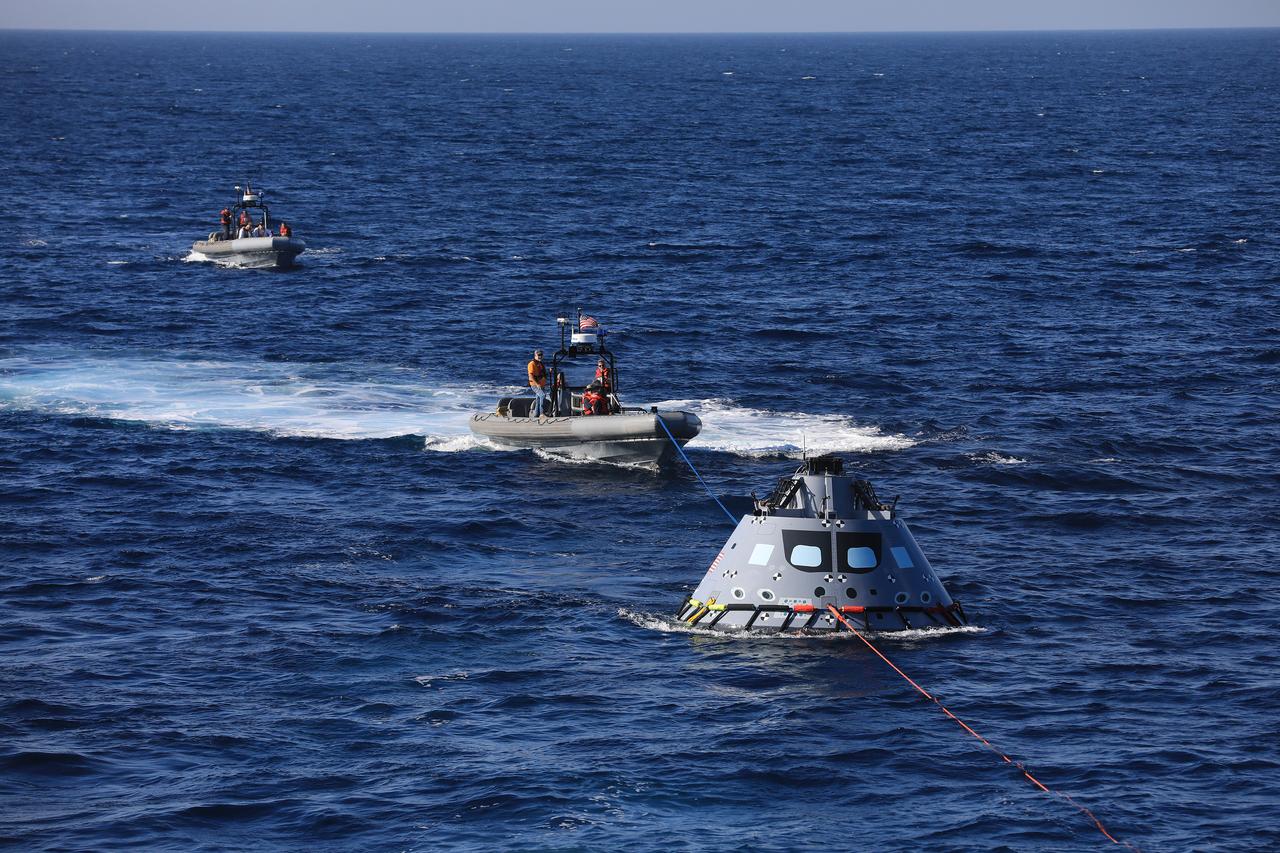
The Exploration Ground Systems recovery team, along with the U.S. Navy, practice recovering a test version of the Orion capsule and bringing it inside the well deck of the USS John P. Murtha during Underway Recovery Test-7 (URT-7) on Oct. 31, 2018, in the Pacific Ocean. URT-7 is one in a series of tests to verify and validate procedures and hardware that will be used to recover the Orion spacecraft after it splashes down in the Pacific Ocean following deep space exploration missions. Orion will have emergency abort capability, sustain the crew during space travel and provide safe re-entry from deep space return velocities.
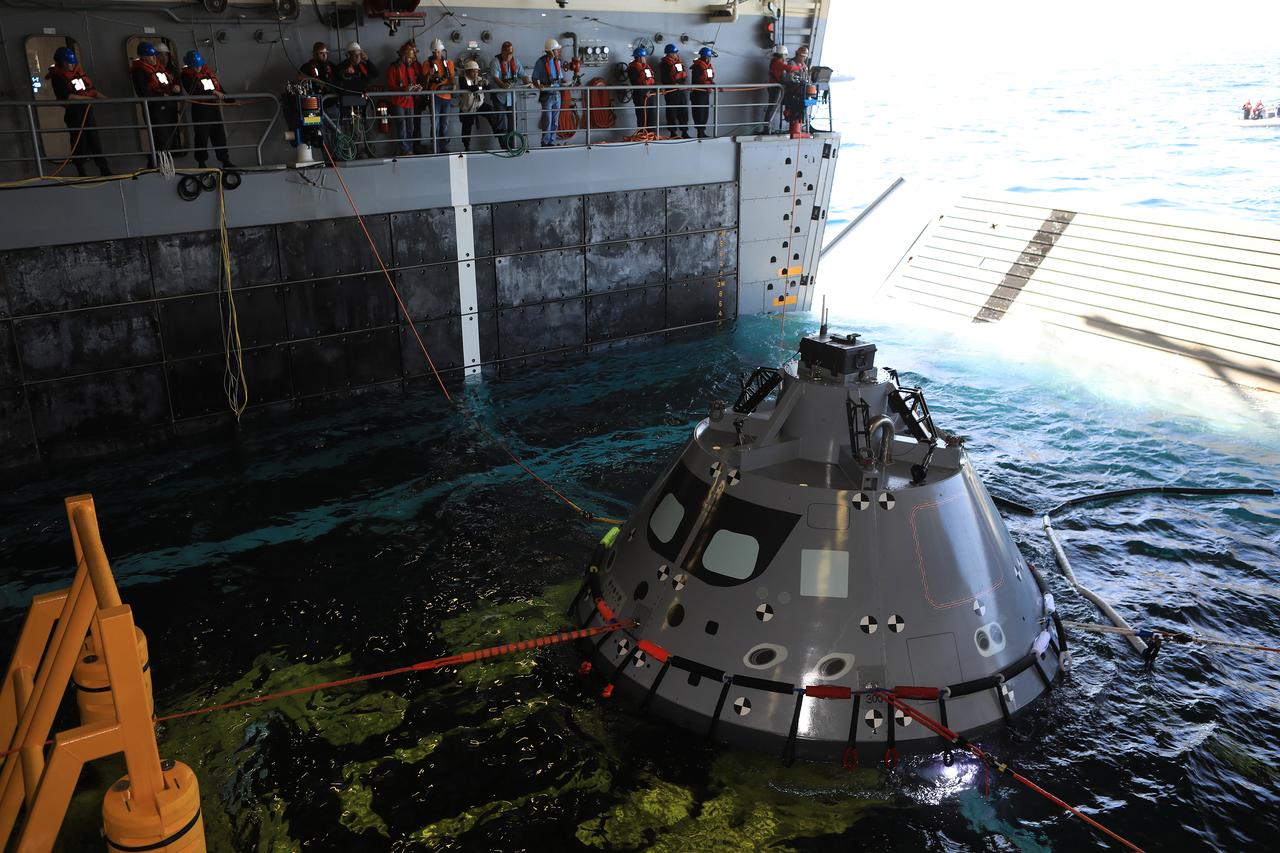
The Exploration Ground Systems (EGS) recovery team, along with the U.S. Navy, practice keeping an Orion test article under control in the well deck of a U.S. Navy ship as part of Underway Recovery Test-7 (URT-7) on Oct. 30, 2018, in the Pacific Ocean. EGS and the U.S. Navy will use a test version of the Orion crew module, several rigid hull inflatable boats and support equipment to verify and validate processes, procedures, hardware and personnel during recovery of Orion in open waters. The testing is one in a series of tests to verify and validate procedures and hardware that will be used to recover the Orion spacecraft after it splashes down in the Pacific Ocean following deep space exploration missions. Orion will have emergency abort capability, sustain the crew during space travel and provide safe re-entry from deep space return velocities.
The Exploration Ground Systems Recovery Team, based out of Kennedy Space Center in Florida, practices bringing a test version of the Orion capsule inside the flooded well deck of the USS John P. Murtha and set it in a cradle as part of Underway Recovery Test-7 (URT-7) on Oct. 31, 2018, in the Pacific Ocean. URT-7 is one in a series of tests to verify and validate procedures and hardware that will be used to recover the Orion spacecraft after it splashes down in the Pacific Ocean following deep space exploration missions. Orion will have emergency abort capability, sustain the crew during space travel and provide safe re-entry from deep space return velocities.
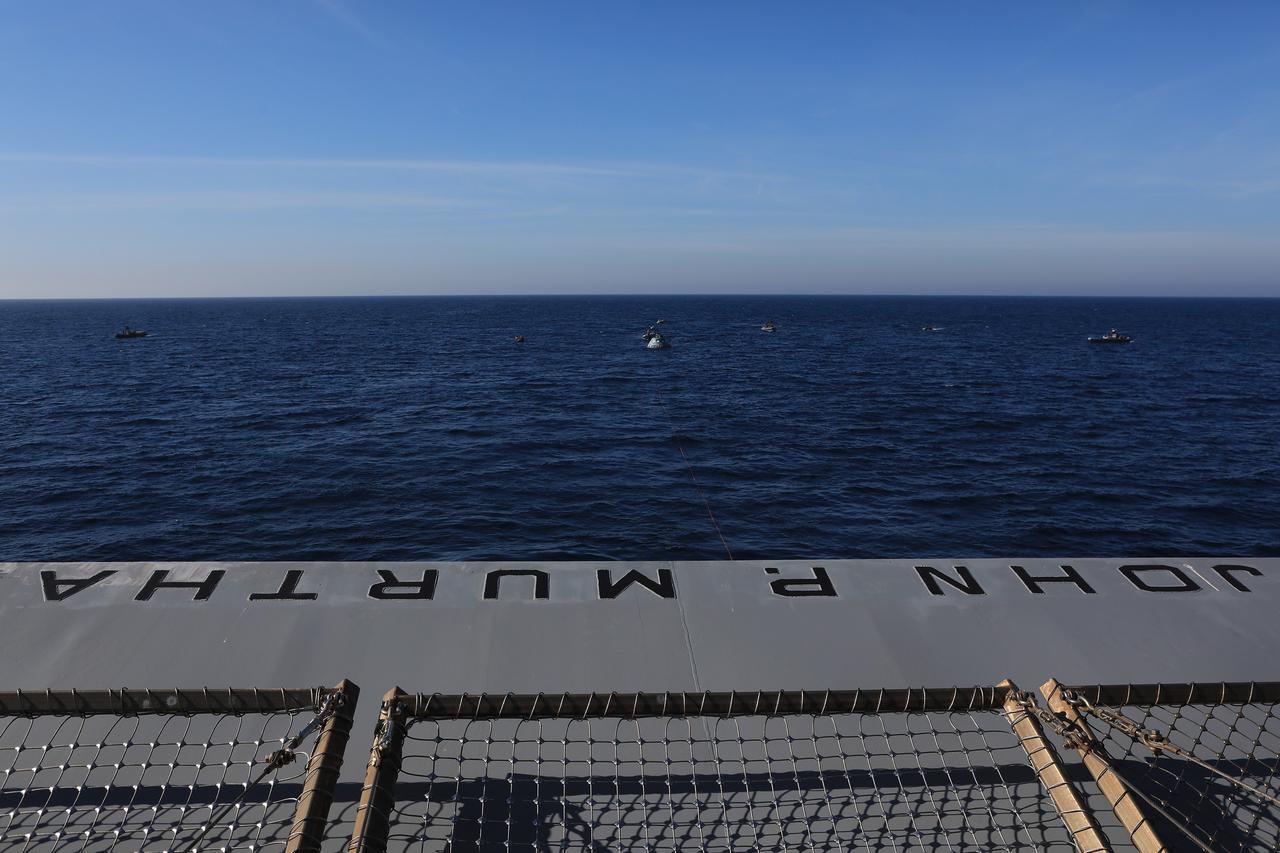
The Exploration Ground Systems Recovery Team, based out of Kennedy Space Center in Florida, is practicing recovering a test version of the Orion capsule during Underway Recovery Test-7 (URT-7), on Oct. 31, 2018, aboard the USS John P. Murtha, in the Pacific Ocean. URT-7 is one in a series of tests to verify and validate procedures and hardware that will be used to recover the Orion spacecraft after it splashes down in the Pacific Ocean following deep space exploration missions. Orion will have emergency abort capability, sustain the crew during space travel and provide safe re-entry from deep space return velocities.

Tracy Parks, with Jacobs, acts as the Recovery Operations Integrator for Underway Recovery Test-7 (URT-7) On Oct. 30, 2018, aboard a U.S. Navy ship in the Pacific Ocean. The Exploration Ground Systems (EGS) recovery team and the U.S. Navy will use a test version of the Orion crew module, several rigid hull inflatable boats and support equipment to verify and validate processes, procedures, hardware and personnel during recovery of Orion in open waters. The testing is one in a series of tests to verify and validate procedures and hardware that will be used to recover the Orion spacecraft after it splashes down in the Pacific Ocean following deep space exploration missions. Orion will have emergency abort capability, sustain the crew during space travel and provide safe re-entry from deep space return velocities.
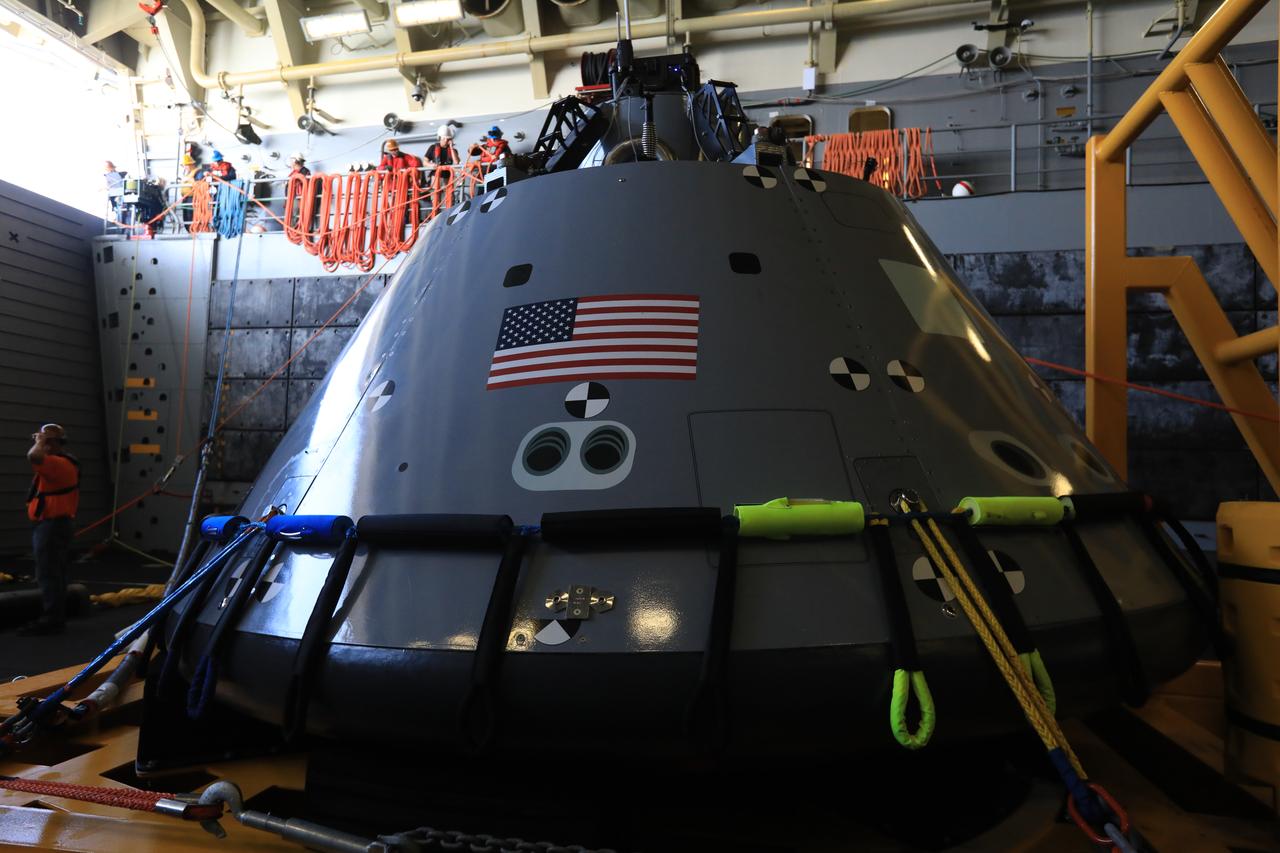
A test version of the Orion capsule sits in its cradle in the well deck of the USS John P. Murtha during Underway Recovery Test-7 (URT-7) on Oct. 31, 2018. The Exploration Ground Systems recovery team and the U.S. Navy are using a test version of the Orion crew module, several rigid hull inflatable boats and support equipment to verify and validate processes, procedures, hardware and personnel during recovery of Orion in open waters. The test is one in a series of tests to verify and validate procedures and hardware that will be used to recover the Orion spacecraft after it splashes down in the Pacific Ocean following deep space exploration missions. Orion will have emergency abort capability, sustain the crew during space travel and provide safe re-entry from deep space return velocities.

During Underway Recovery Test-7 (URT-7), U.S. Navy divers approach a test version of the Orion capsule to practice securing it for recovery into the well deck of an amphibious assault ship on Oct. 31, 2018 in the Pacific Ocean. The Exploration Ground Systems recovery team and the U.S. Navy work together to verify and validate procedures and hardware that will be used to recover the Orion spacecraft after it splashes down in the Pacific Ocean following deep space exploration missions. Orion will have emergency abort capability, sustain the crew during space travel and provide safe re-entry from deep space return velocities.
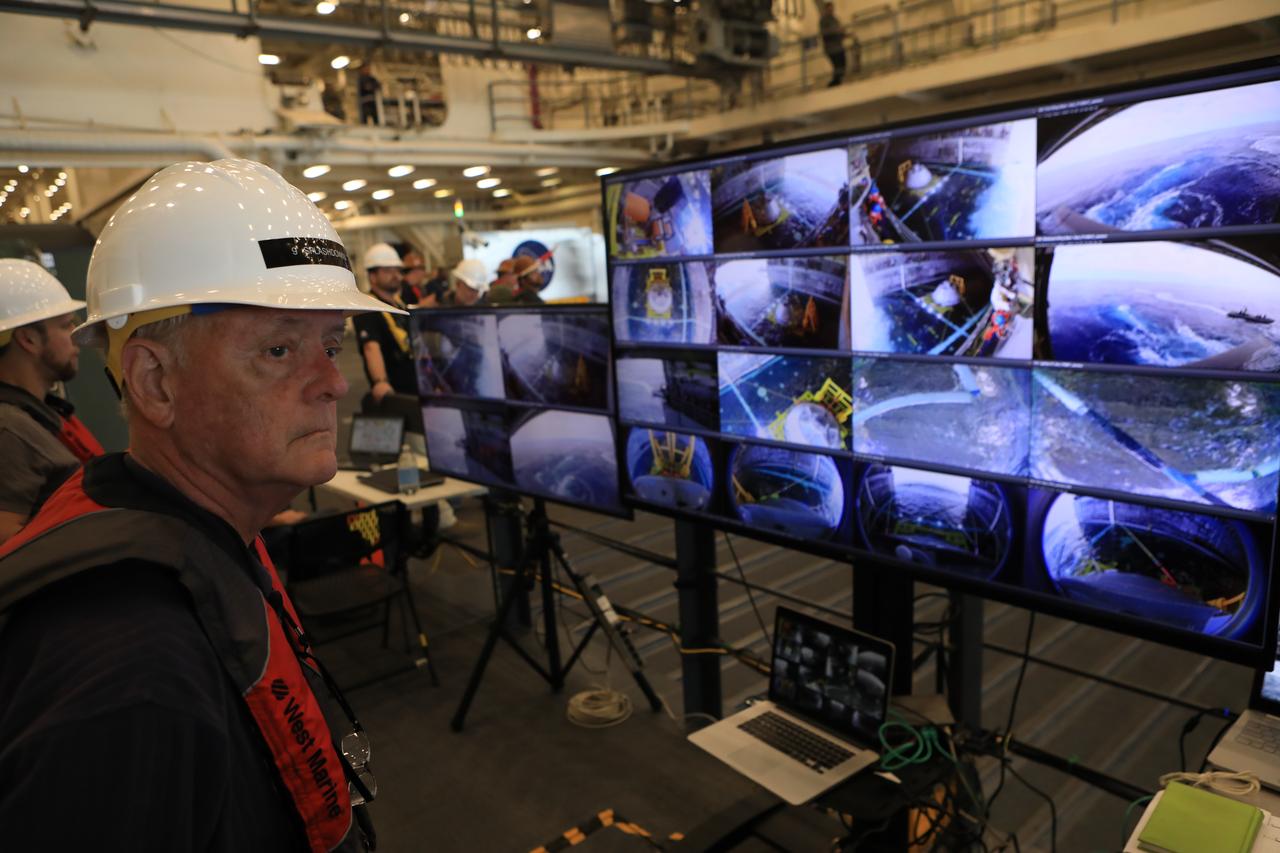
Apollo-era recovery engineer Milt Heflin observes the new ways in which the Orion crew capsule will be recovered after splashdown during Underway Recovery Test-7 on Oct. 30, 2018. The Exploration Ground Systems recovery team and the U.S. Navy will use a test version of the Orion crew module, several rigid hull inflatable boats and support equipment to verify and validate processes, procedures, hardware and personnel during recovery of Orion in open waters. The test is one in a series of tests to verify and validate procedures and hardware that will be used to recover the Orion spacecraft after it splashes down in the Pacific Ocean following deep space exploration missions. Orion will have emergency abort capability, sustain the crew during space travel and provide safe re-entry from deep space return velocities.
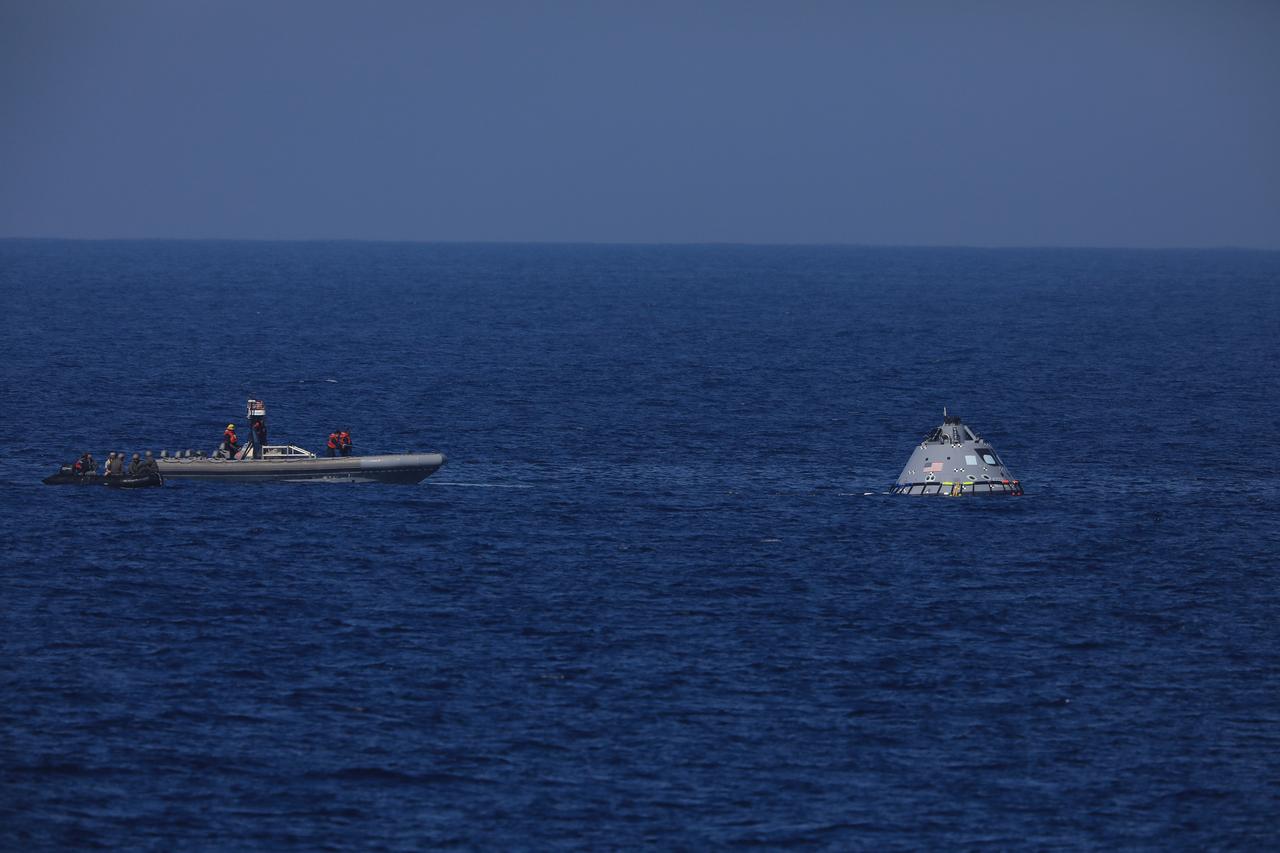
During Underway Recovery Test-7 (URT-7), U.S. Navy divers approach a test version of the Orion capsule to practice securing it for recovery into the well deck of an amphibious assault ship on Oct. 31, 2018 in the Pacific Ocean. The Exploration Ground Systems recovery team and the U.S. Navy work together to verify and validate procedures and hardware that will be used to recover the Orion spacecraft after it splashes down in the Pacific Ocean following deep space exploration missions. Orion will have emergency abort capability, sustain the crew during space travel and provide safe re-entry from deep space return velocities.
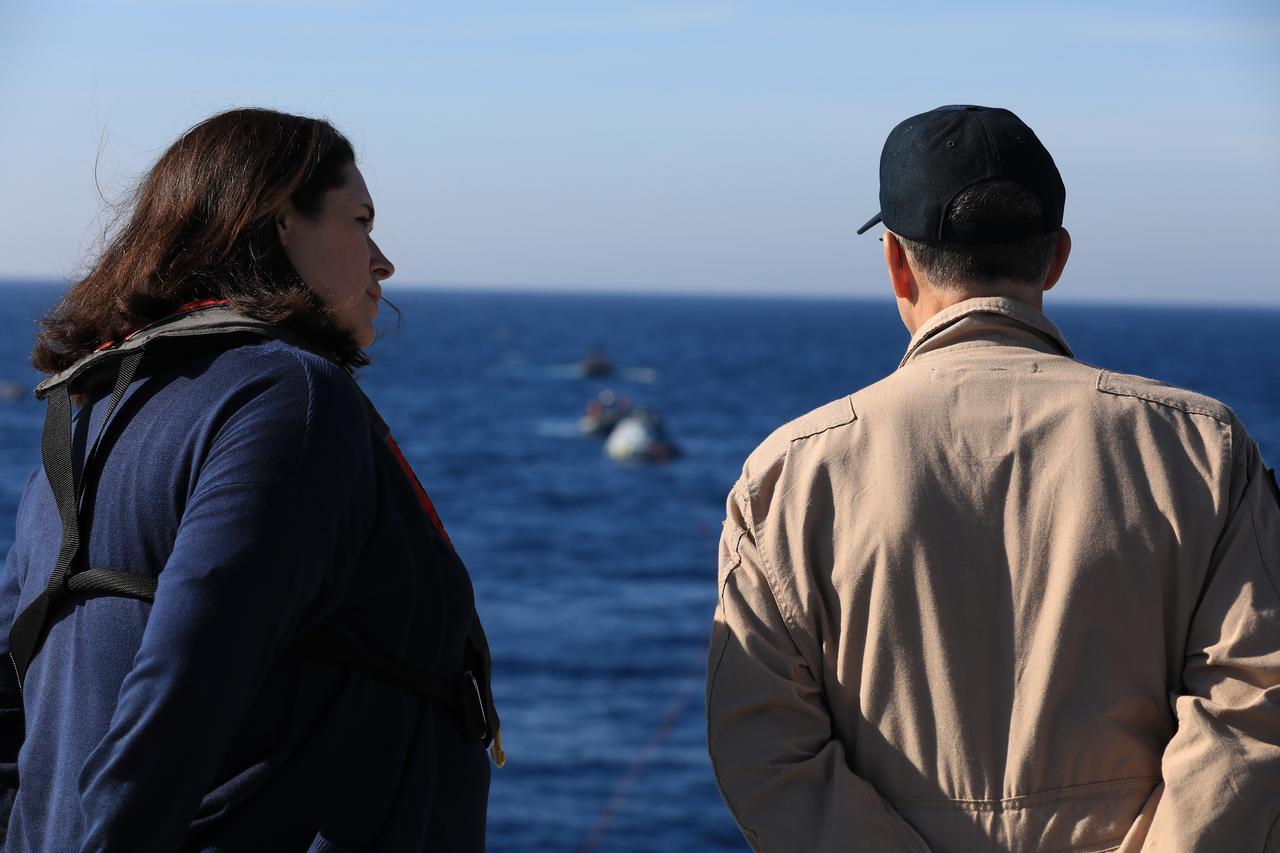
NASA's Landing and Recovery Director Melissa Jones and astronaut Don Pettit observe recovery of a test version of the Orion capsule during Underway Recovery Test-7 (URT-7) on Oct. 31, 2018, onboard the ULL John P. Murtha, in the Pacific Ocean. URT-7 is one in a series of tests to verify and validate procedures and hardware that will be used to recover the Orion spacecraft after it splashes down in the Pacific Ocean following deep space exploration missions. Orion will have emergency abort capability, sustain the crew during space travel and provide safe re-entry from deep space return velocities.
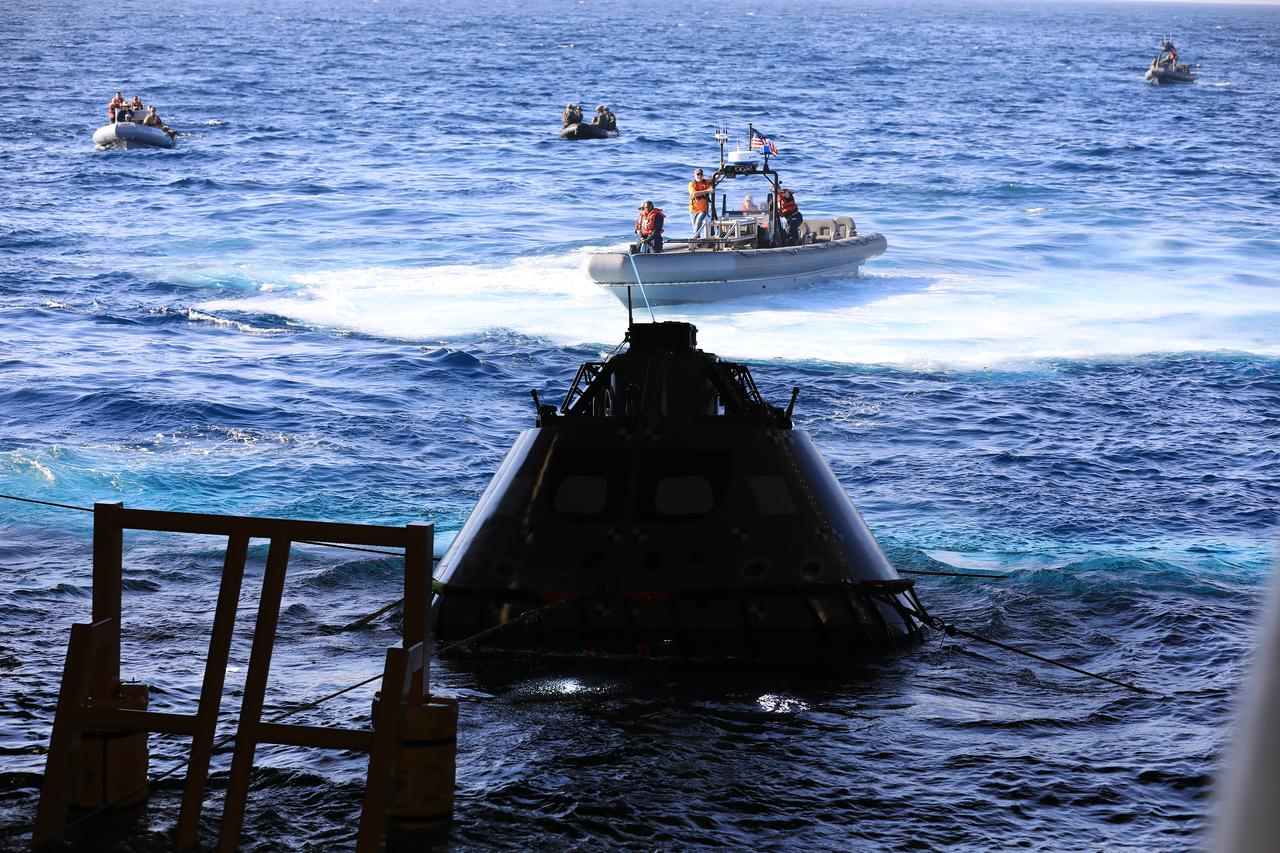
The Exploration Ground Systems Recovery Team, along with the U.S. Navy, practice recovering a test version of the Orion capsule and bringing it inside the well deck of the USS John P. Murtha during Underway Recovery Test-7 (URT-7) on Oct. 31, 2018, in the Pacific Ocean. URT-7 is one in a series of tests to verify and validate procedures and hardware that will be used to recover the Orion spacecraft after it splashes down in the Pacific Ocean following deep space exploration missions. Orion will have emergency abort capability, sustain the crew during space travel and provide safe re-entry from deep space return velocities.
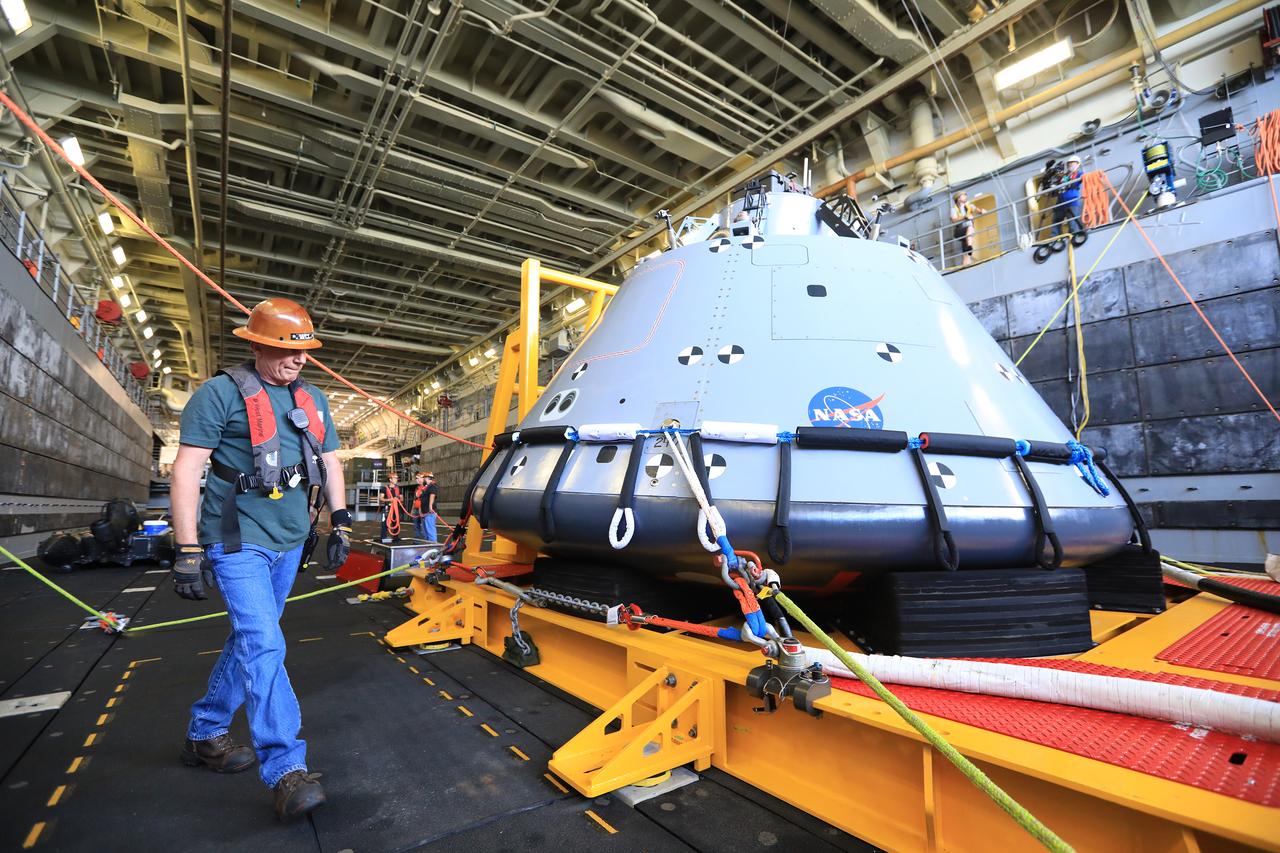
Travis Methany, with Jacobs, prepares the test version of the Orion capsule for release in the well deck of the USS John P. Murtha, during Underway Recovery Test-7 (URT-7) on Oct. 31, 2018, in the Pacific Ocean. Exploration Ground Systems and the U.S. Navy are using the mock Orion to verify and validate processes, procedures, hardware and personnel during recovery of Orion in open waters. URTs are a series of tests to verify and validate procedures and hardware that will be used to recover the Orion spacecraft after it splashed down in the Pacific Ocean following deep space exploration missions. Orion will have emergency abort capability, sustain the crew during space travel and provide safe re-entry from deep space return velocities.

NASA's Landing and Recovery Director Melissa Jones and astronaut Don Pettit observe recovery of a test version of the Orion capsule during Underway Recovery Test-7 (URT-7) on Oct. 31, 2018, onboard the ULL John P. Murtha, in the Pacific Ocean. URT-7 is one in a series of tests to verify and validate procedures and hardware that will be used to recover the Orion spacecraft after it splashes down in the Pacific Ocean following deep space exploration missions. Orion will have emergency abort capability, sustain the crew during space travel and provide safe re-entry from deep space return velocities.
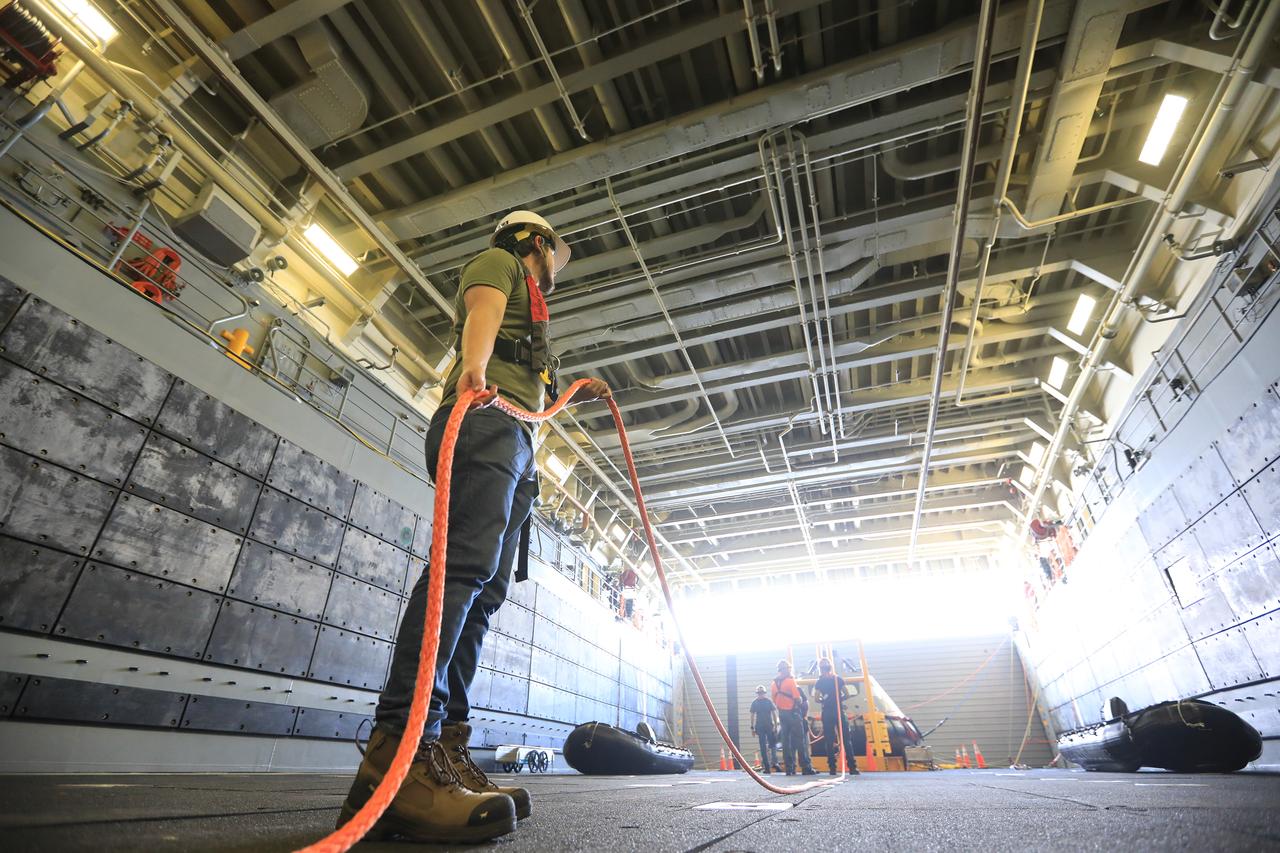
Jose Martinez, an instrumentation engineer with Jacobs, runs the winch line out to the test version of the Orion capsule in the well deck of the USS John P. Murtha, during Underway Recovery Test-7 (URT-7) on Oct. 31, 2018, in the Pacific Ocean. Exploration Ground Systems and the U.S. Navy are using the mock Orion to verify and validate processes, procedures, hardware and personnel during recovery of Orion in open waters. URTs are a series of tests to verify and validate procedures and hardware that will be used to recover the Orion spacecraft after it splashed down in the Pacific Ocean following deep space exploration missions. Orion will have emergency abort capability, sustain the crew during space travel and provide safe re-entry from deep space return velocities.

During Underway Recovery Test-7 (URT-7), U.S. Navy divers approach a test version of the Orion capsule to practice securing it for recovery into the well deck of an amphibious assault ship on Oct. 31, 2018 in the Pacific Ocean. The Exploration Ground Systems recovery team and the U.S. Navy work together to verify and validate procedures and hardware that will be used to recover the Orion spacecraft after it splashes down in the Pacific Ocean following deep space exploration missions. Orion will have emergency abort capability, sustain the crew during space travel and provide safe re-entry from deep space return velocities.
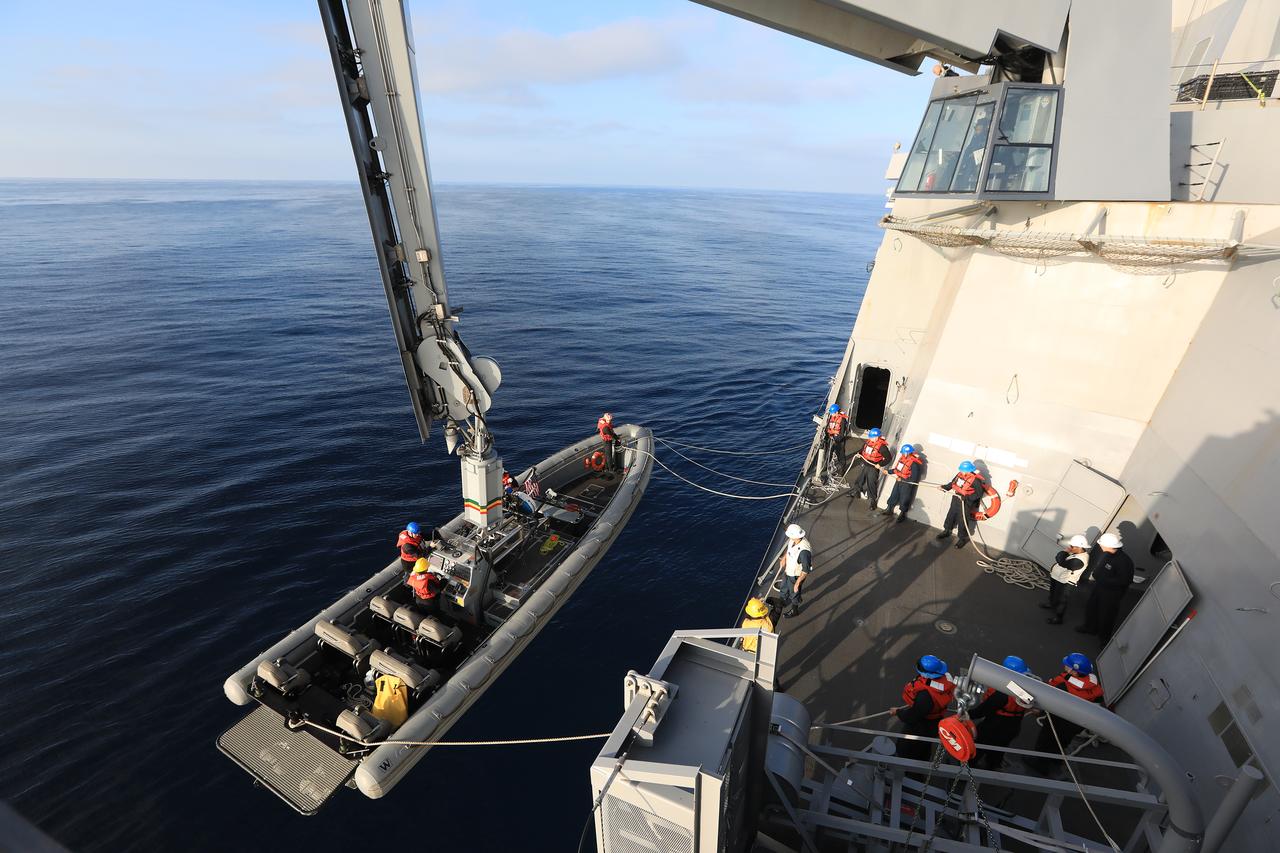
Small boats used by U.S. Navy divers are lowered into the water in preparation for the dive teams to race out to a test version of the Orion capsule during Underway Recovery Test-7 (URT-7), on Oct. 31, 2018, aboard the USS John P. Murtha in the Pacific Ocean. The Exploration Ground Systems (EGS) Landing and Recovery team and the U.S. Navy are using the mock Orion, several rigid hull inflatable boats and support equipment to verify and validate processes, procedures, hardware and personnel during recovery of Orion in open waters. URT-7 is one in a series of tests to verify and validate procedures and hardware that will be used to recover the Orion spacecraft after it splashes down in the Pacific Ocean following deep space exploration missions. Orion will have emergency abort capability, sustain the crew during space travel and provide safe re-entry from deep space return velocities.
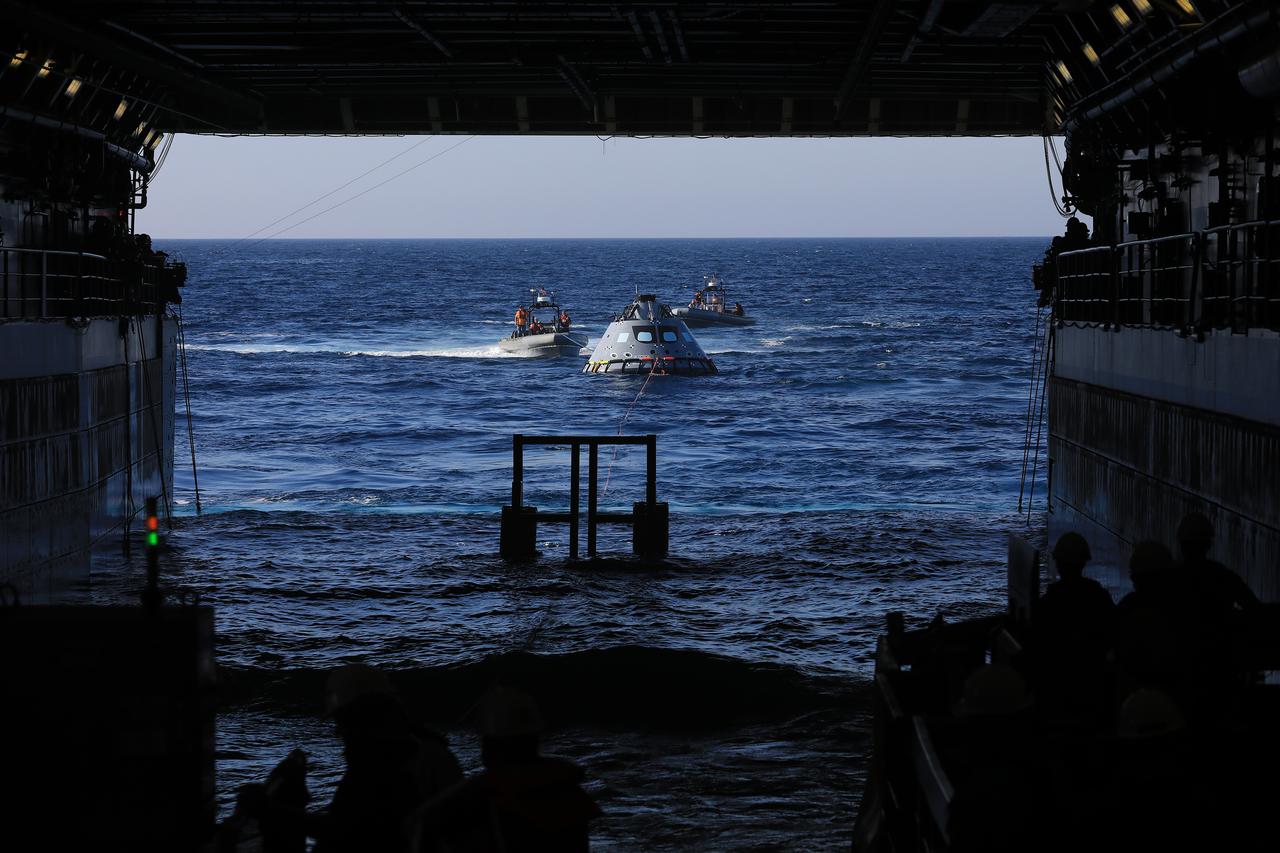
The Exploration Ground Systems recovery team, along with the U.S. Navy, practice recovering a test version of the Orion capsule and bringing it inside the well deck of the USS John P. Murtha during Underway Recovery Test-7 (URT-7) on Oct. 31, 2018, in the Pacific Ocean. URT-7 is one in a series of tests to verify and validate procedures and hardware that will be used to recover the Orion spacecraft after it splashes down in the Pacific Ocean following deep space exploration missions. Orion will have emergency abort capability, sustain the crew during space travel and provide safe re-entry from deep space return velocities.
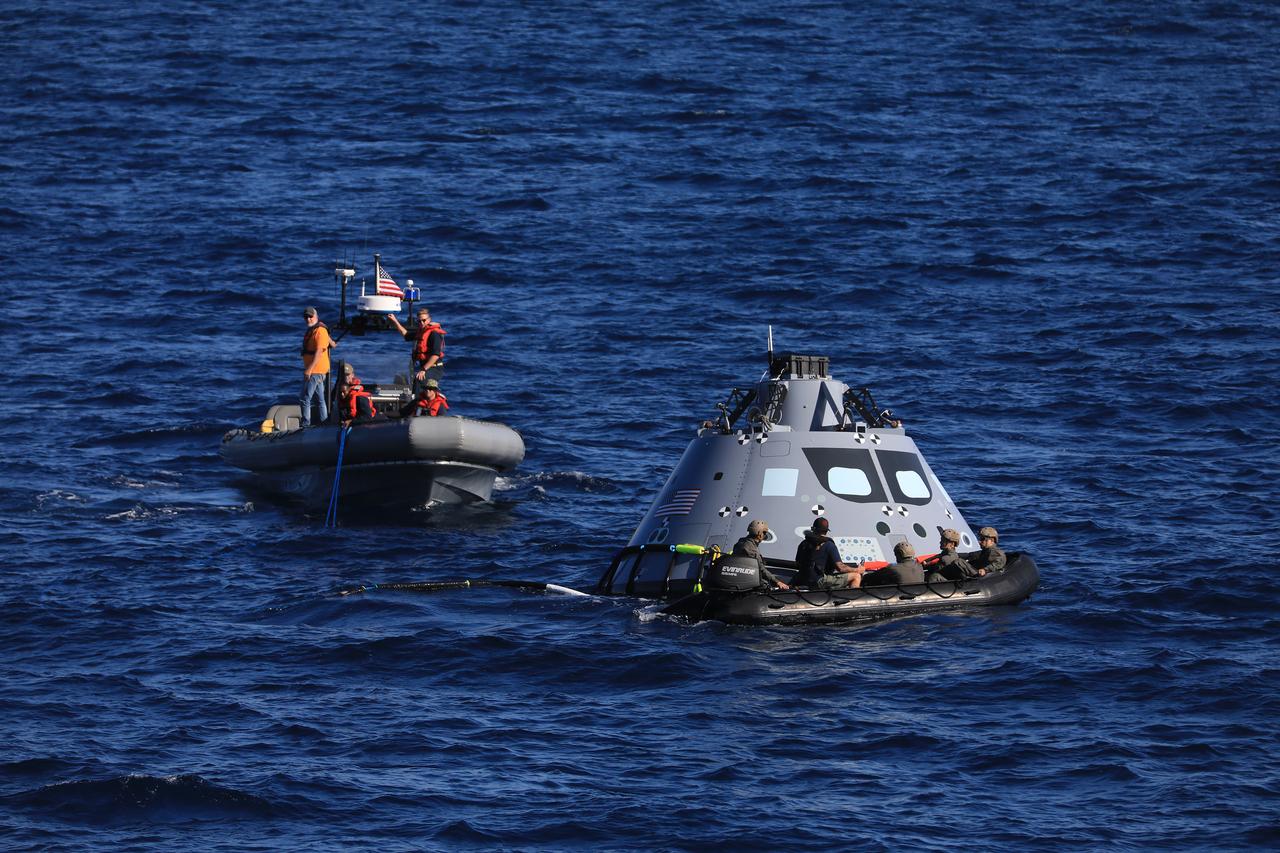
During Underway Recovery Test-7 (URT-7), U.S. Navy divers approach a test version of the Orion capsule to practice securing it for recovery into the well deck of an amphibious assault ship on Oct. 31, 2018 in the Pacific Ocean. The Exploration Ground Systems recovery team and the U.S. Navy work together to verify and validate procedures and hardware that will be used to recover the Orion spacecraft after it splashes down in the Pacific Ocean following deep space exploration missions. Orion will have emergency abort capability, sustain the crew during space travel and provide safe re-entry from deep space return velocities.
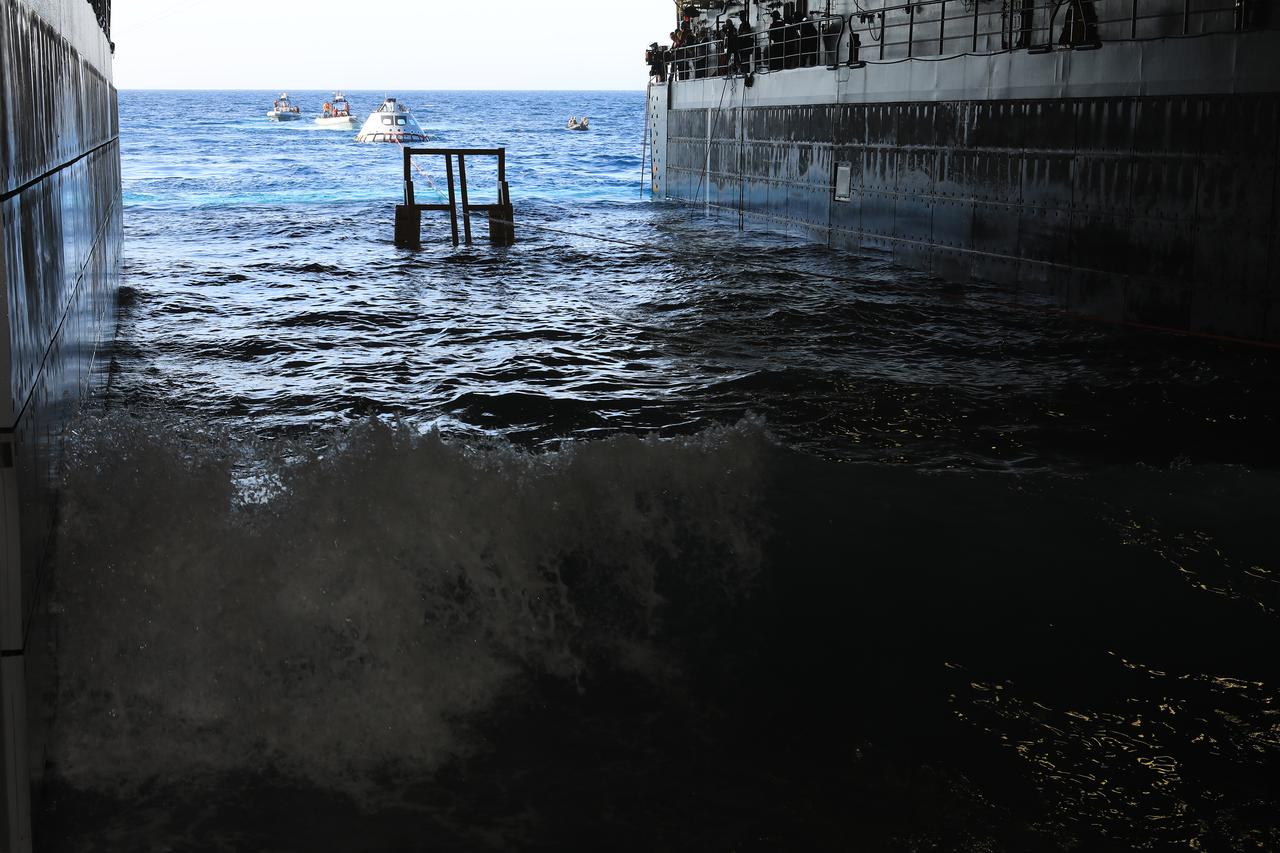
The Exploration Ground Systems Recovery Team, based out of Kennedy Space Center in Florida, along with the U.S. Navy, prepare to pull a test version of the Orion capsule inside the well deck of the USS John P. Murtha during Underway Recovery Test-7 (URT-7) on Oct. 31, 2018, in the Pacific Ocean. URT-7 is one in a series of tests to verify and validate procedures and hardware that will be used to recover the Orion spacecraft after it splashes down in the Pacific Ocean following deep space exploration missions. Orion will have emergency abort capability, sustain the crew during space travel and provide safe re-entry from deep space return velocities.
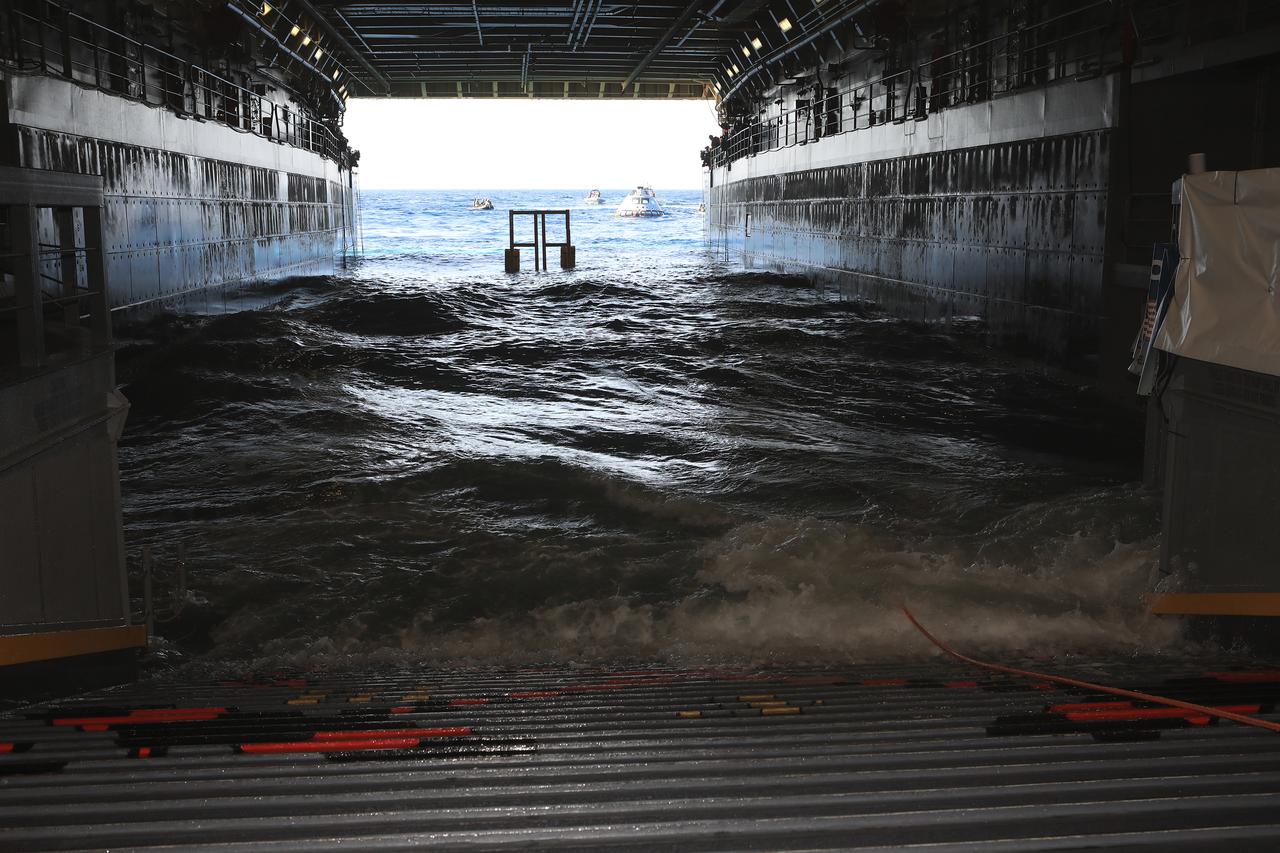
The Exploration Ground Systems Recovery Team, based out of Kennedy Space Center in Florida, along with the U.S. Navy, prepare to pull a test version of the Orion capsule inside the well deck of the USS John P. Murtha during Underway Recovery Test-7 (URT-7) on Oct. 31, 2018, in the Pacific Ocean. URT-7 is one in a series of tests to verify and validate procedures and hardware that will be used to recover the Orion spacecraft after it splashes down in the Pacific Ocean following deep space exploration missions. Orion will have emergency abort capability, sustain the crew during space travel and provide safe re-entry from deep space return velocities.
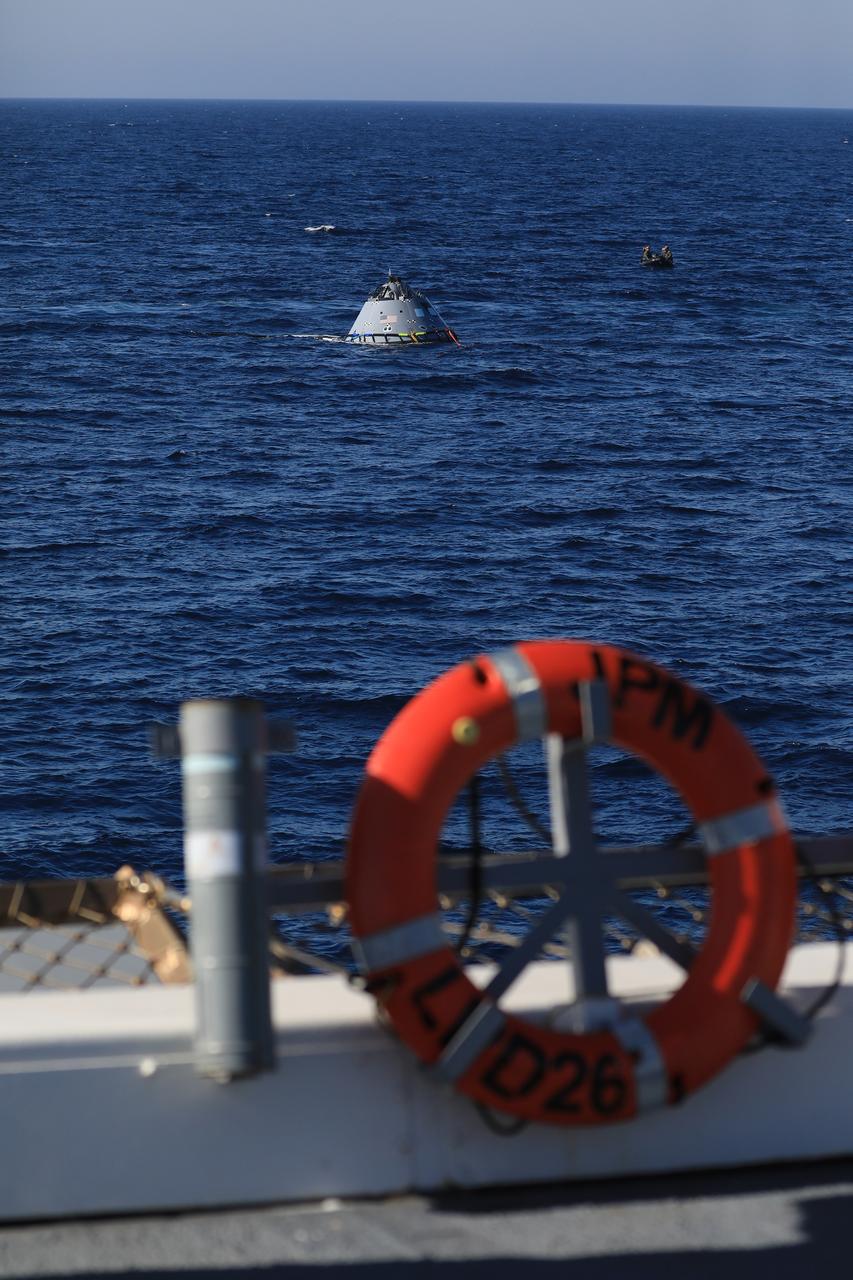
The Exploration Ground Systems recovery team, along with the U.S. Navy, practice recovering a test version of the Orion capsule during Underway Recovery Test-7 (URT-7) onboard the USS John P. Murtha, on Oct. 31, 2018, in the Pacific Ocean. URT-7 is one in a series of tests to verify and validate procedures and hardware that will be used to recover the Orion spacecraft after it splashes down in the Pacific Ocean following deep space exploration missions. Orion will have emergency abort capability, sustain the crew during space travel and provide safe re-entry from deep space return velocities.
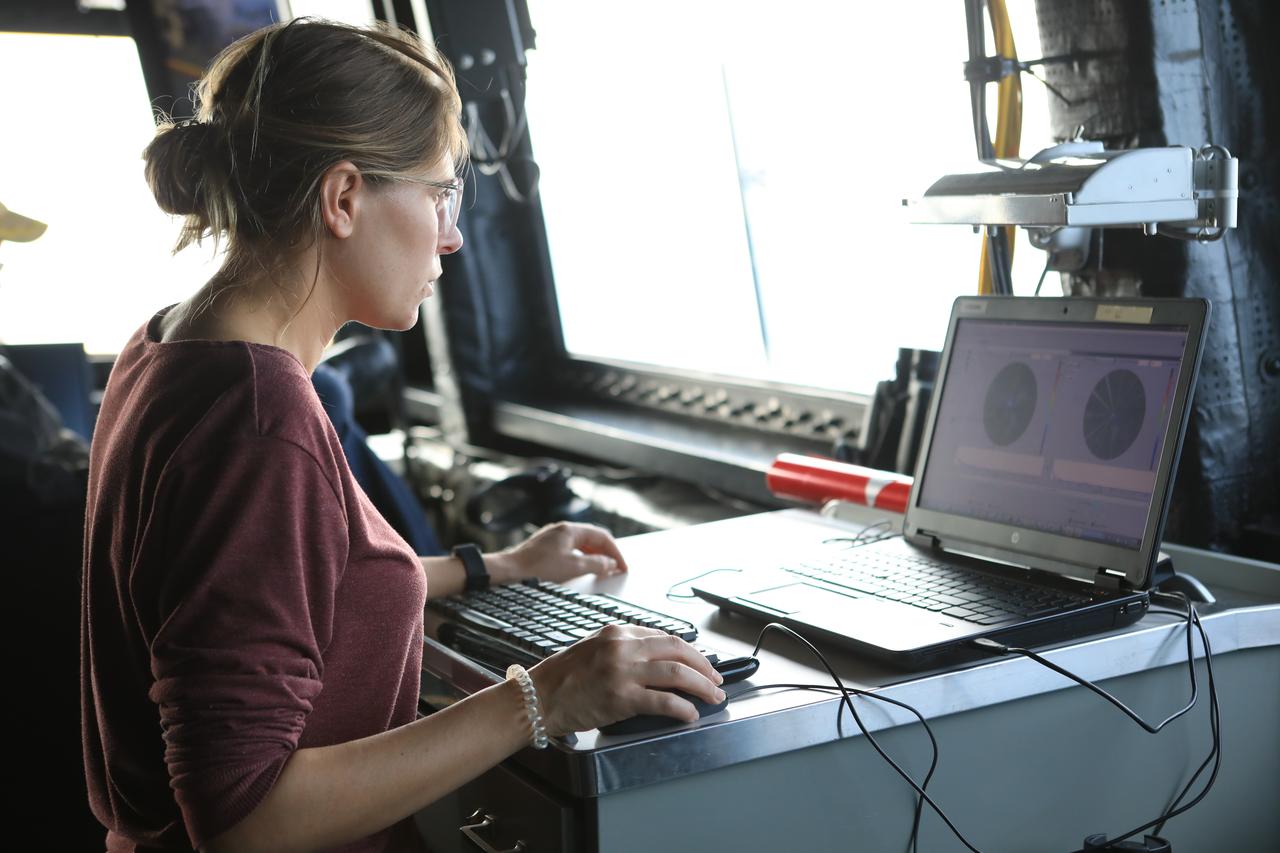
Valerie Vinciullo, a senior engineer with Applied Physical Sciences, monitors wave movement from the bridge of a U.S. Navy ship during Underway Recovery Test-7 (URT-7) on Oct. 30, 2018, in the Pacific Ocean. Exploration Ground Systems and the U.S. Navy will use a test version of the Orion crew module, several rigid hull inflatable boats and support equipment to verify and validate processes, procedures, hardware and personnel during recovery of Orion in open waters. URTs are a series of tests to verify and validate procedures and hardware that will be used to recover the Orion spacecraft after it splashed down in the Pacific Ocean following deep space exploration missions. Orion will have emergency abort capability, sustain the crew during space travel and provide safe re-entry from deep space return velocities.
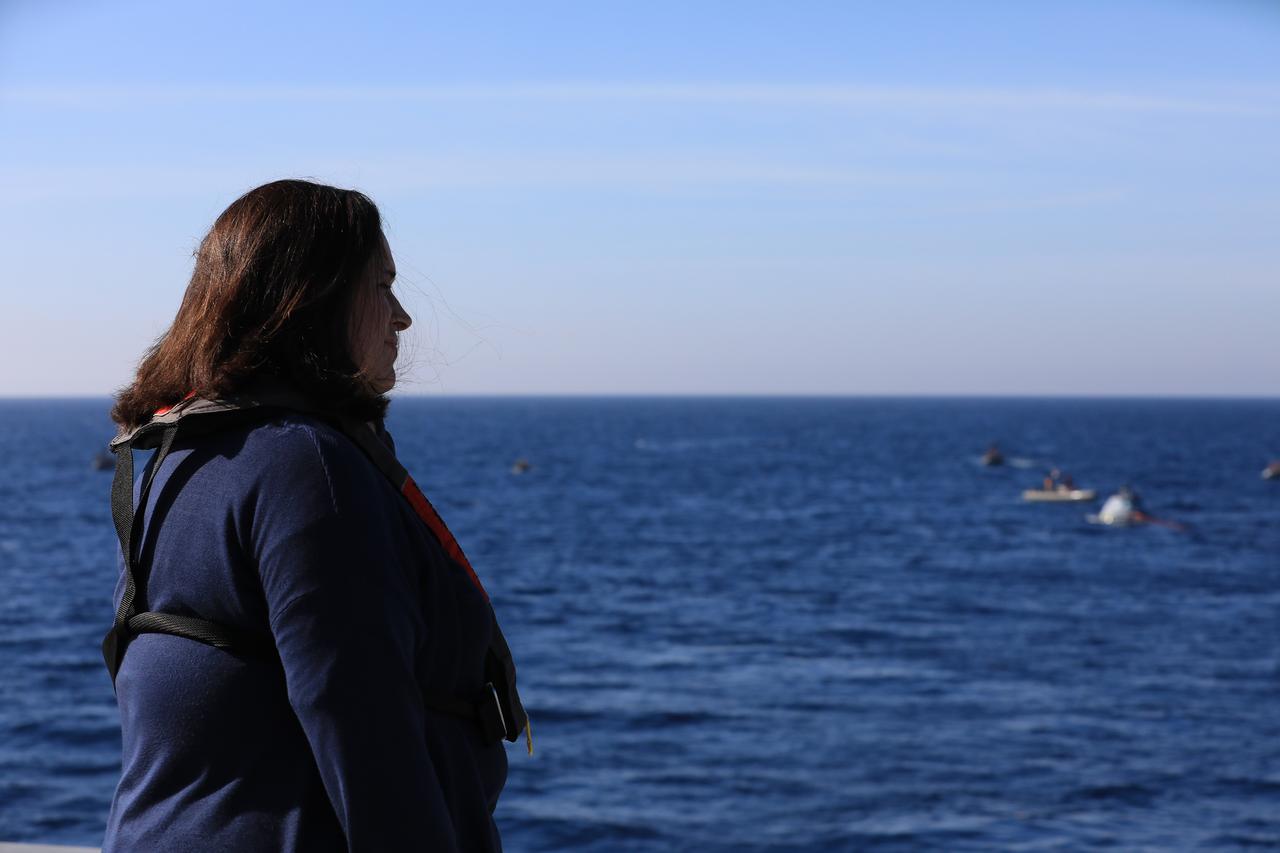
NASA's Landing and Recovery Director Melissa Jones observes recovery of a test version of the Orion capsule during Underway Recovery Test-7 (URT-7) on Oct. 31, 2018, onboard the ULL John P. Murtha, in the Pacific Ocean. URT-7 is one in a series of tests to verify and validate procedures and hardware that will be used to recover the Orion spacecraft after it splashes down in the Pacific Ocean following deep space exploration missions. Orion will have emergency abort capability, sustain the crew during space travel and provide safe re-entry from deep space return velocities.
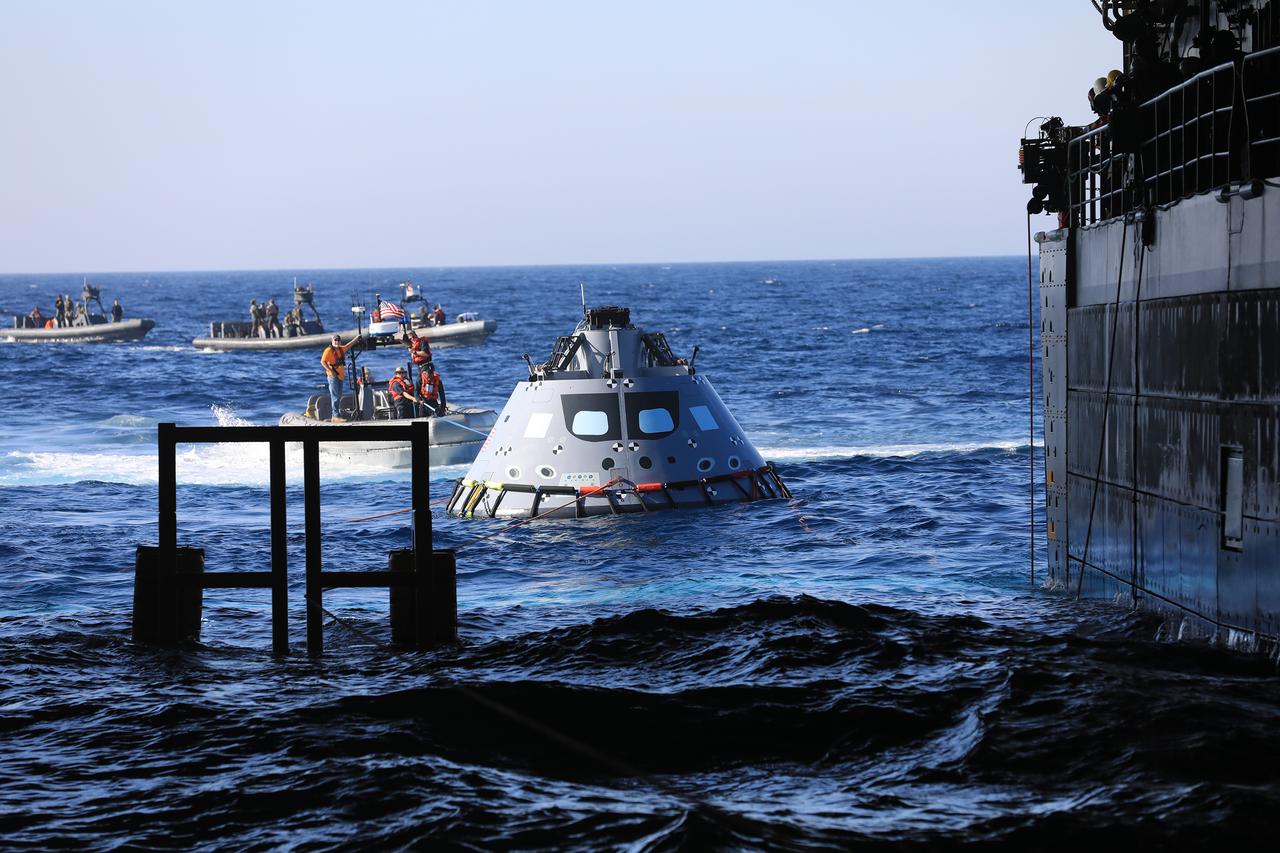
The Exploration Ground Systems Recovery Team, along with the U.S. Navy, practice recovering a test version of the Orion capsule and bringing it inside the well deck of the USS John P. Murtha during Underway Recovery Test-7 (URT-7) on Oct. 31, 2018, in the Pacific Ocean. URT-7 is one in a series of tests to verify and validate procedures and hardware that will be used to recover the Orion spacecraft after it splashes down in the Pacific Ocean following deep space exploration missions. Orion will have emergency abort capability, sustain the crew during space travel and provide safe re-entry from deep space return velocities.
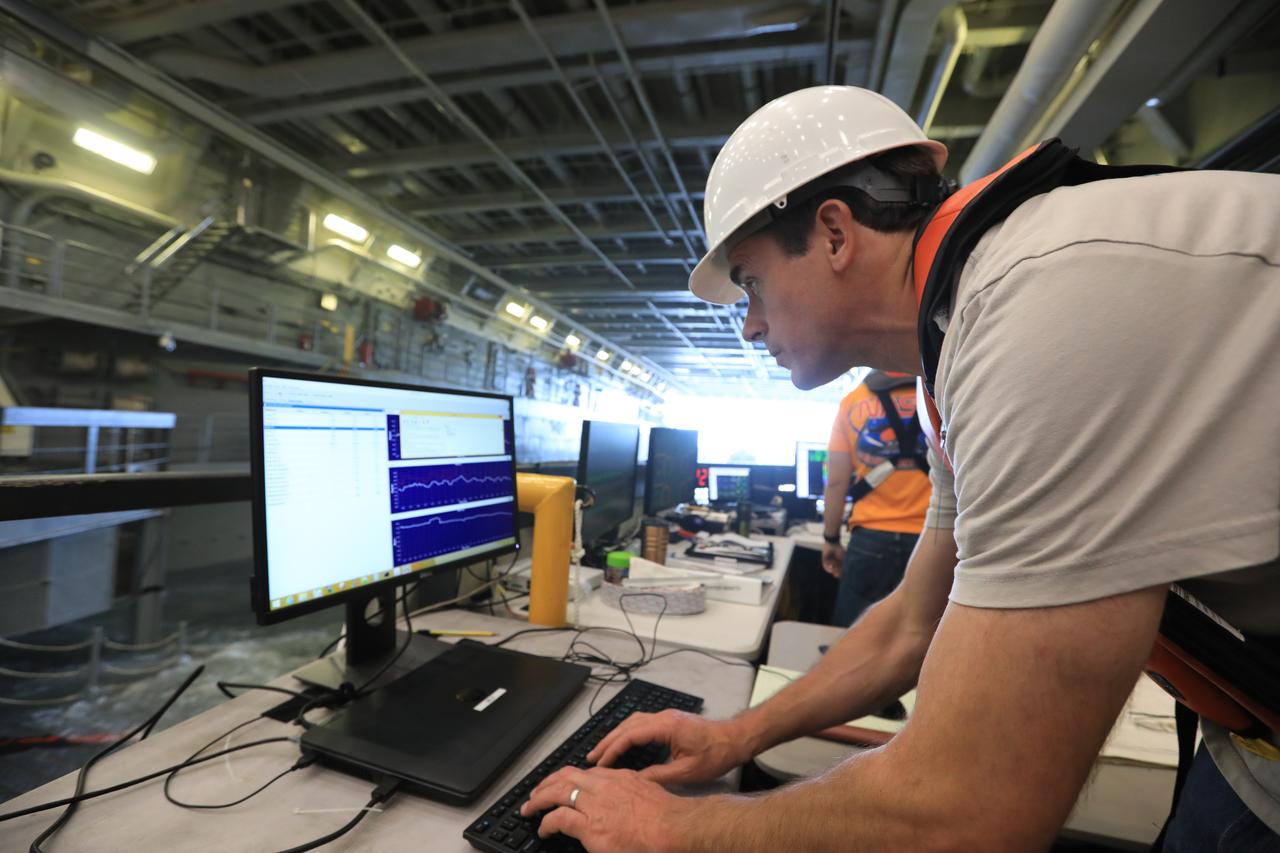
Benjamin Connell, a principal scientist with Applied Physical Sciences, monitors wave movement inside the well deck of a U.S. Navy ship during Underway Recovery Test-7 (URT-7) on Oct. 30, 2018. The Exploration Ground Systems (EGS) recovery team and the U.S. Navy will use a test version of the Orion crew module, several rigid hull inflatable boats and support equipment to verify and validate processes, procedures, hardware and personnel during recovery of Orion in open waters. The testing is one in a series of tests to verify and validate procedures and hardware that will be used to recover the Orion spacecraft after it splashes down in the Pacific Ocean following deep space exploration missions. Orion will have emergency abort capability, sustain the crew during space travel and provide safe re-entry from deep space return velocities.

Inside a U.S. Navy ship, Jose Martinez, with Jacobs, monitors the well deck's water depth during Underway Recovery Test-7 (URT-7) on Oct. 30, 2018, in the Pacific Ocean. During URT-7, the Exploration Ground Systems recovery team and the U.S. Navy will use a test version of the Orion crew module, several rigid hull inflatable boats and support equipment to verify and validate processes, procedures, hardware and personnel during recovery of Orion in open waters. The test is one in a series of tests to verify and validate procedures and hardware that will be used to recover the Orion spacecraft aft it splashes down in the Pacific Ocean following deep space exploration missions. Orion will have emergency abort capability, sustain the crew during space travel and provide safe re-entry from deep space return velocities.
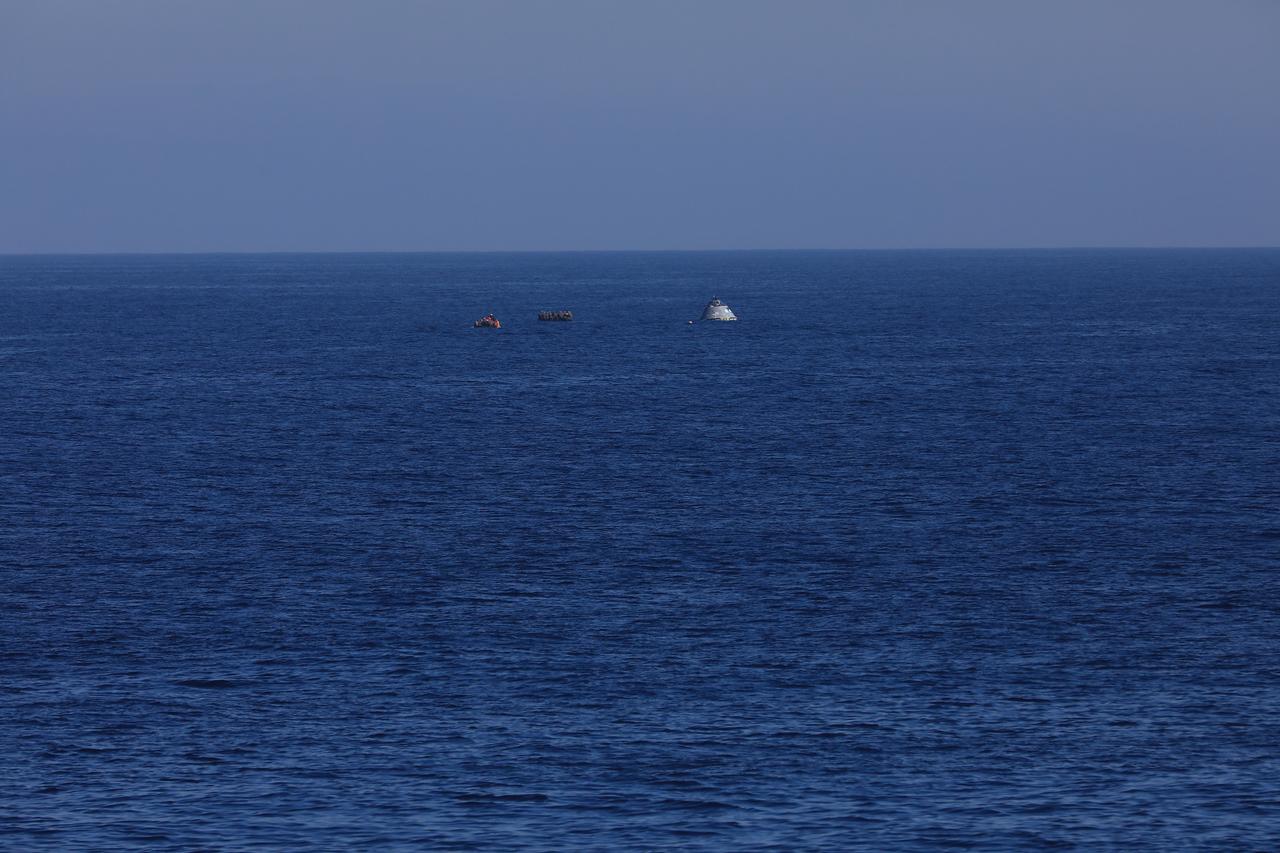
During Underway Recovery Test-7 (URT-7), U.S. Navy divers approach a test version of the Orion capsule to practice securing it for recovery into the well deck of an amphibious assault ship on Oct. 31, 2018 in the Pacific Ocean. The Exploration Ground Systems recovery team and the U.S. Navy work together to verify and validate procedures and hardware that will be used to recover the Orion spacecraft after it splashes down in the Pacific Ocean following deep space exploration missions. Orion will have emergency abort capability, sustain the crew during space travel and provide safe re-entry from deep space return velocities.
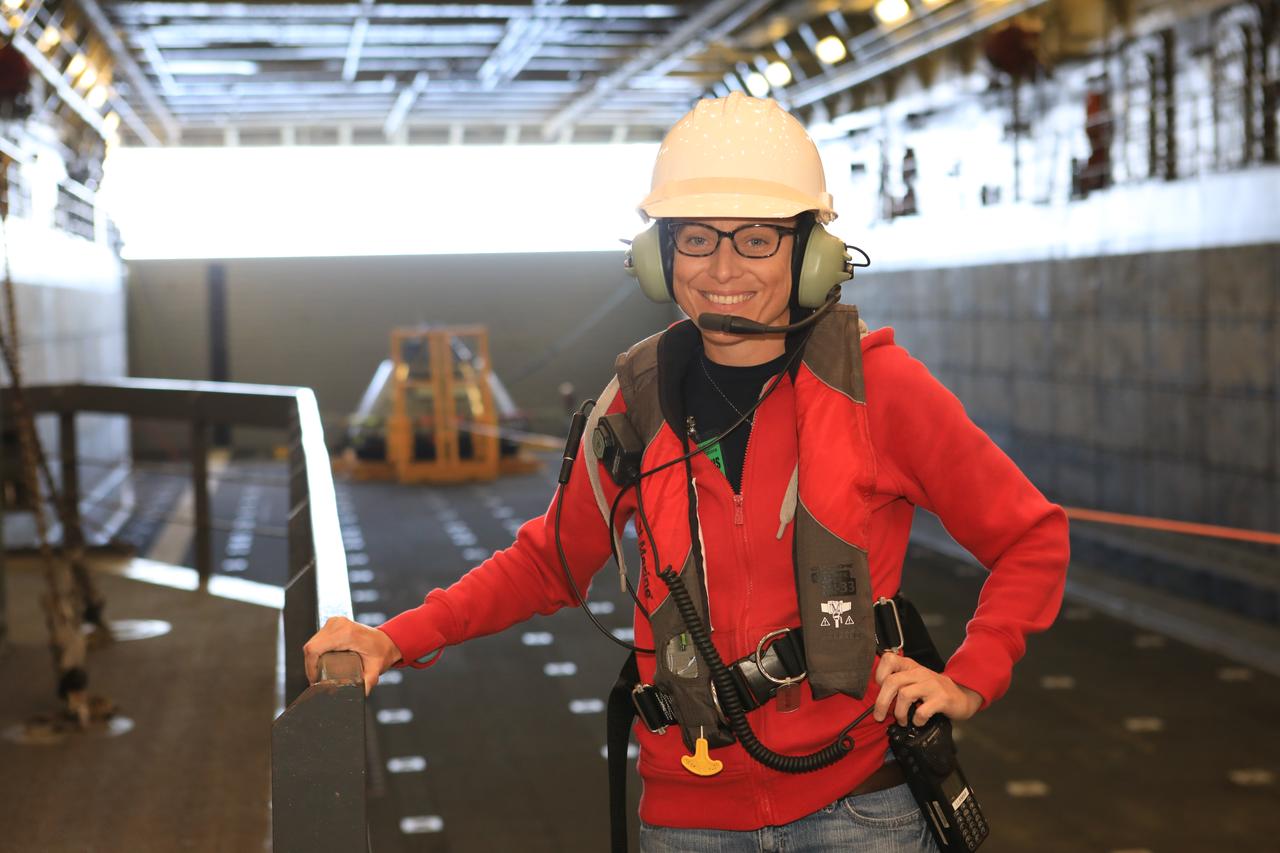
Exploration Ground Systems’ recovery team, along with the U.S. Navy, practice keeping an Orion test article under control as part of Underway Recovery Test-7. The testing is one in a series of tests to verify and validate procedures and hardware that will be used to recover the Orion spacecraft after it splashes down in the Pacific Ocean following deep space exploration missions.