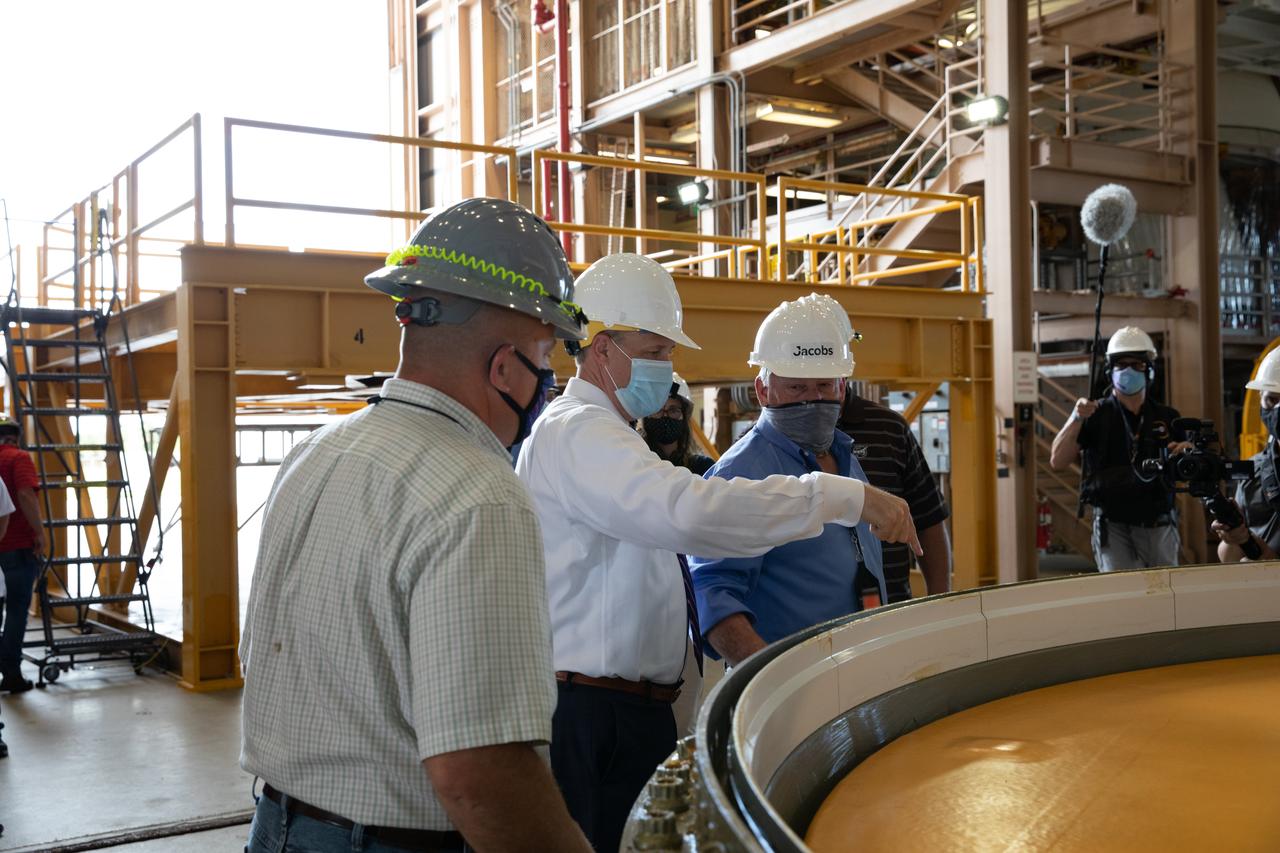
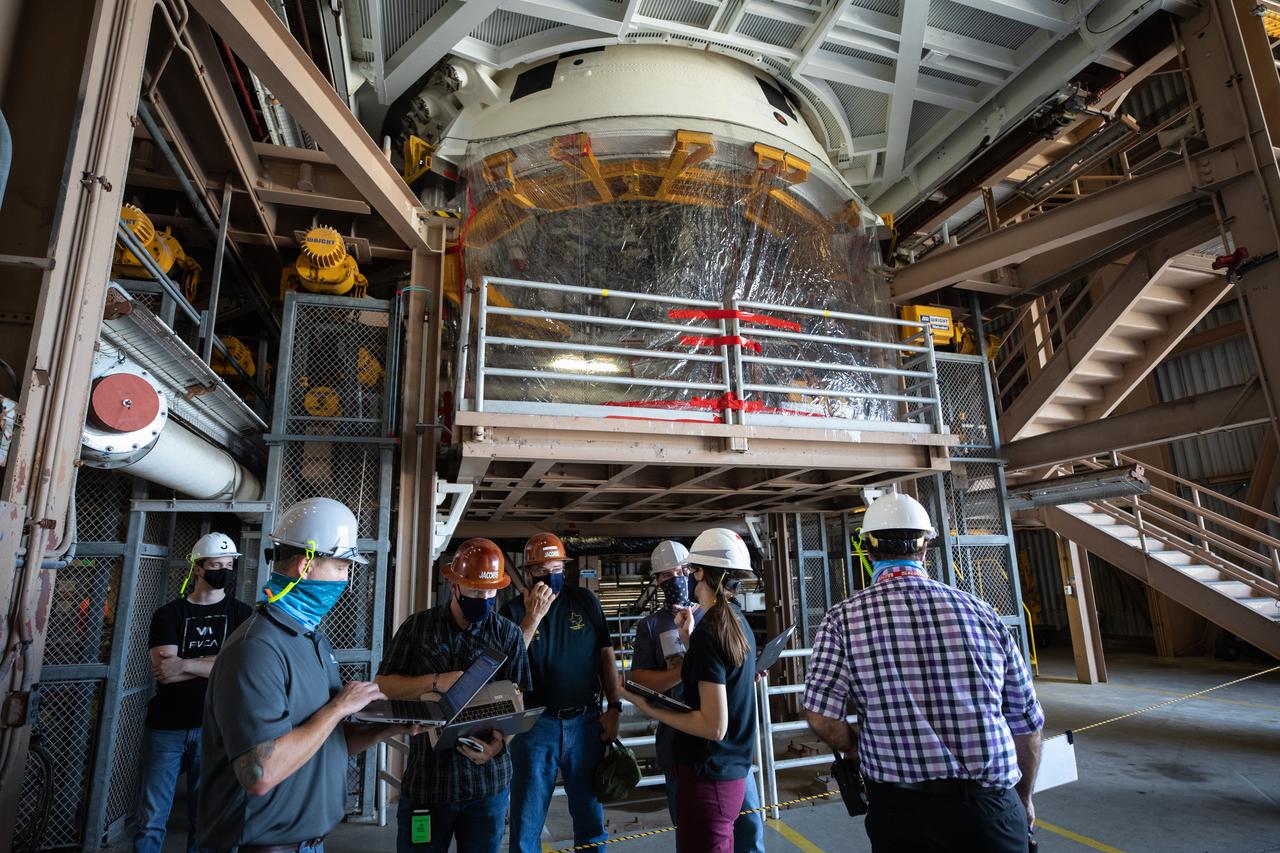
NASA Administrator Jim Bridenstine (center), accompanied by Jacobs employees, views Artemis I booster hardware inside the Rotation, Processing and Surge Facility at NASA’s Kennedy Space Center in Florida on July 27, 2020. Manufactured by Northrop Grumman in Utah, the boosters for the agency’s Space Launch System (SLS) rocket are now undergoing prelaunch processing at Kennedy. During launch, the twin boosters will provide more than 75 percent of the total SLS thrust. The first in a series of increasingly complex missions, Artemis I will test the Orion spacecraft and SLS as an integrated system ahead of crewed flights to the Moon.
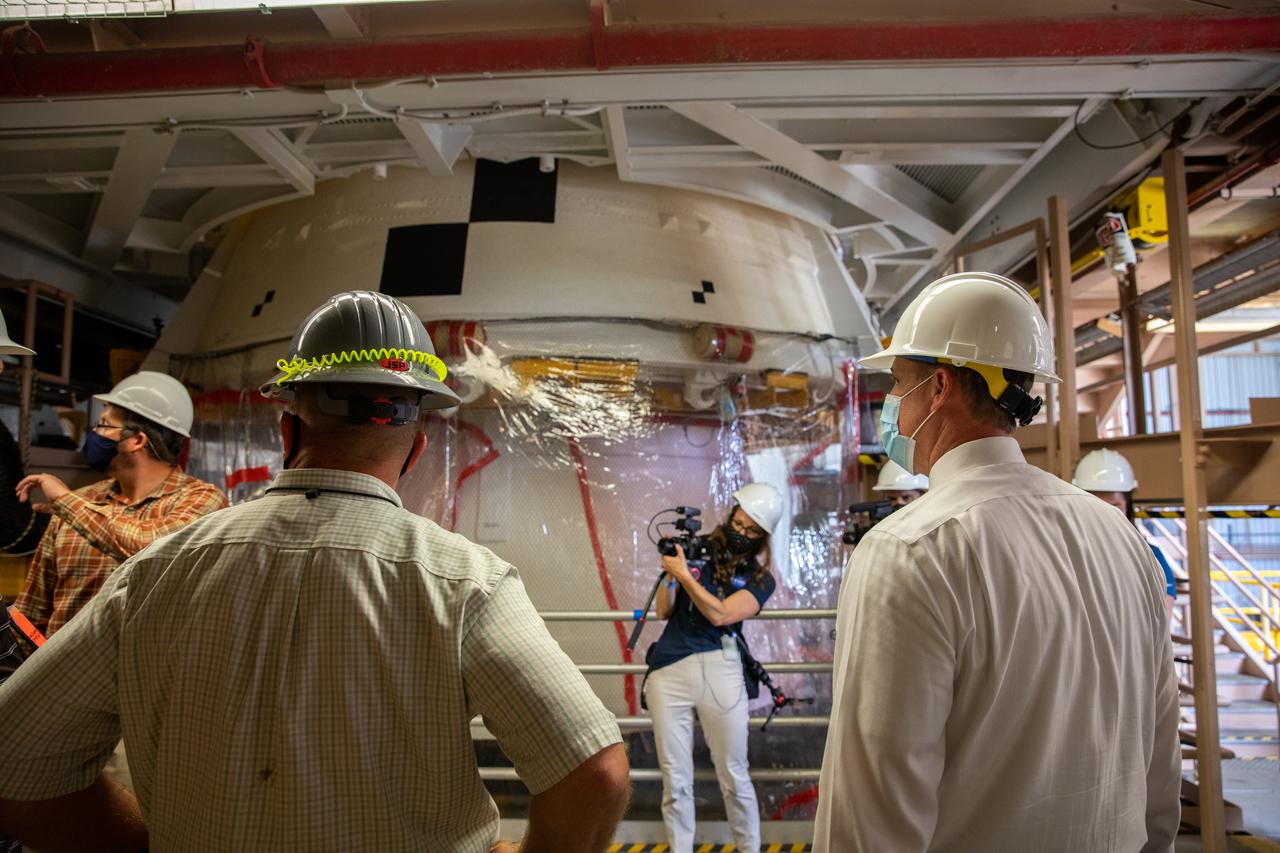
NASA Administrator Jim Bridenstine (right), accompanied by Jacobs employees, views Artemis I booster hardware inside the Rotation, Processing and Surge Facility at NASA’s Kennedy Space Center in Florida on July 27, 2020. Manufactured by Northrop Grumman in Utah, the boosters for the agency’s Space Launch System (SLS) rocket are now undergoing prelaunch processing at Kennedy. During launch, the twin boosters will provide more than 75 percent of the total SLS thrust. The first in a series of increasingly complex missions, Artemis I will test the Orion spacecraft and SLS as an integrated system ahead of crewed flights to the Moon.
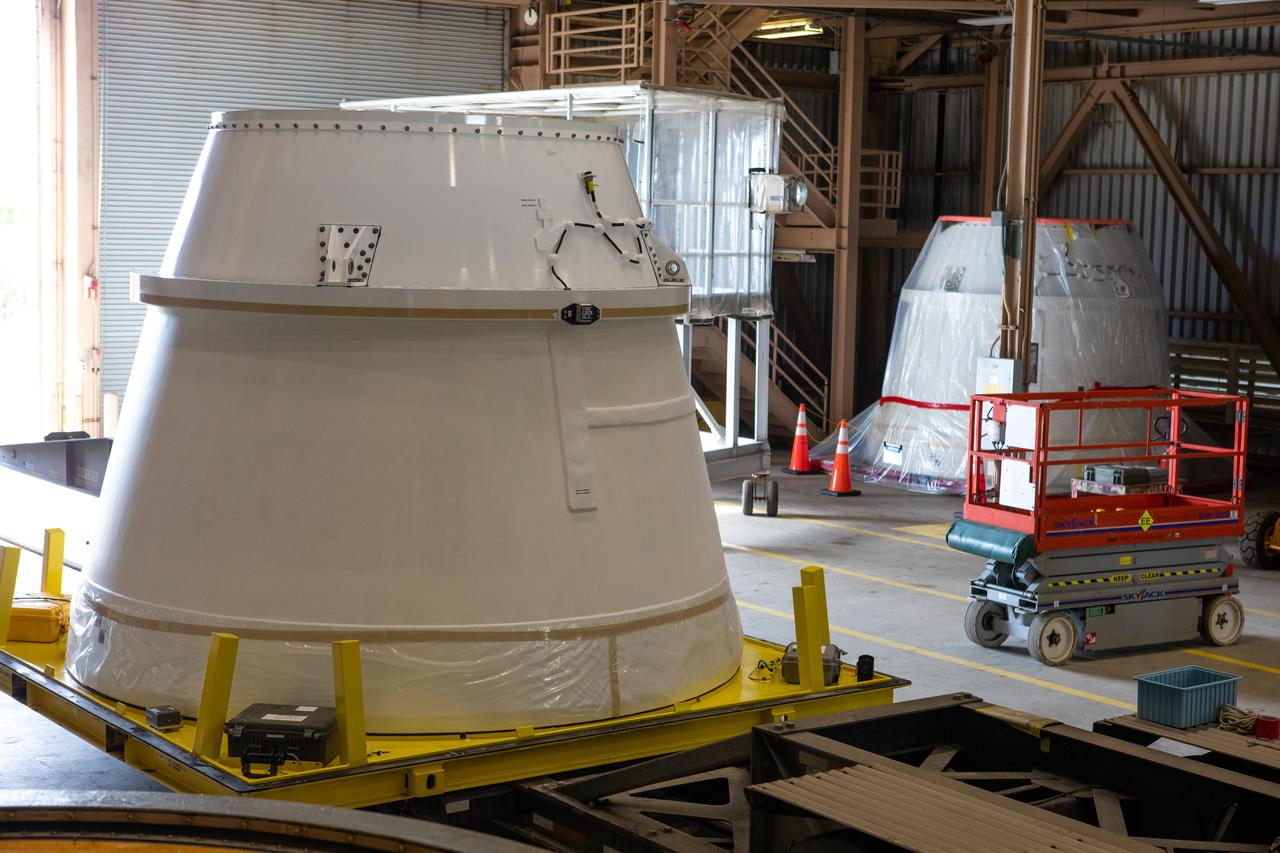
Both of the Northrop Grumman-manufactured aft exit cones for the Space Launch System’s solid rocket boosters are in view inside the Rotation, Processing and Surge Facility at NASA’s Kennedy Space Center in Florida on Dec. 9, 2019. Both arrived from Promontory, Utah. The right aft exit cone is in the foreground, and the left aft exit cone is in the background. They will be checked out and prepared for the Artemis I uncrewed test flight. The aft exit cones sit at the bottommost part of the twin boosters. The cones help provide added thrust for the boosters, while protecting the aft skirts from the thermal environment during launch.
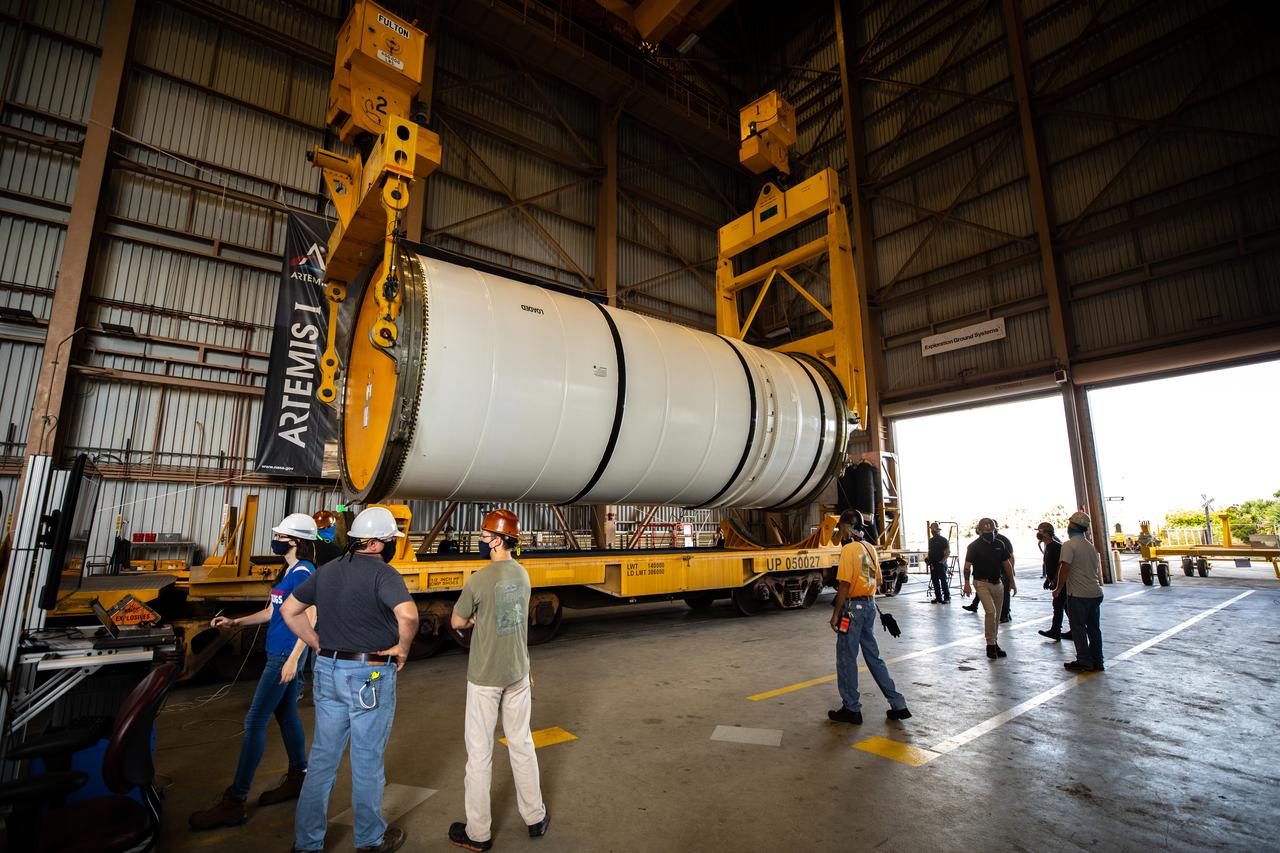
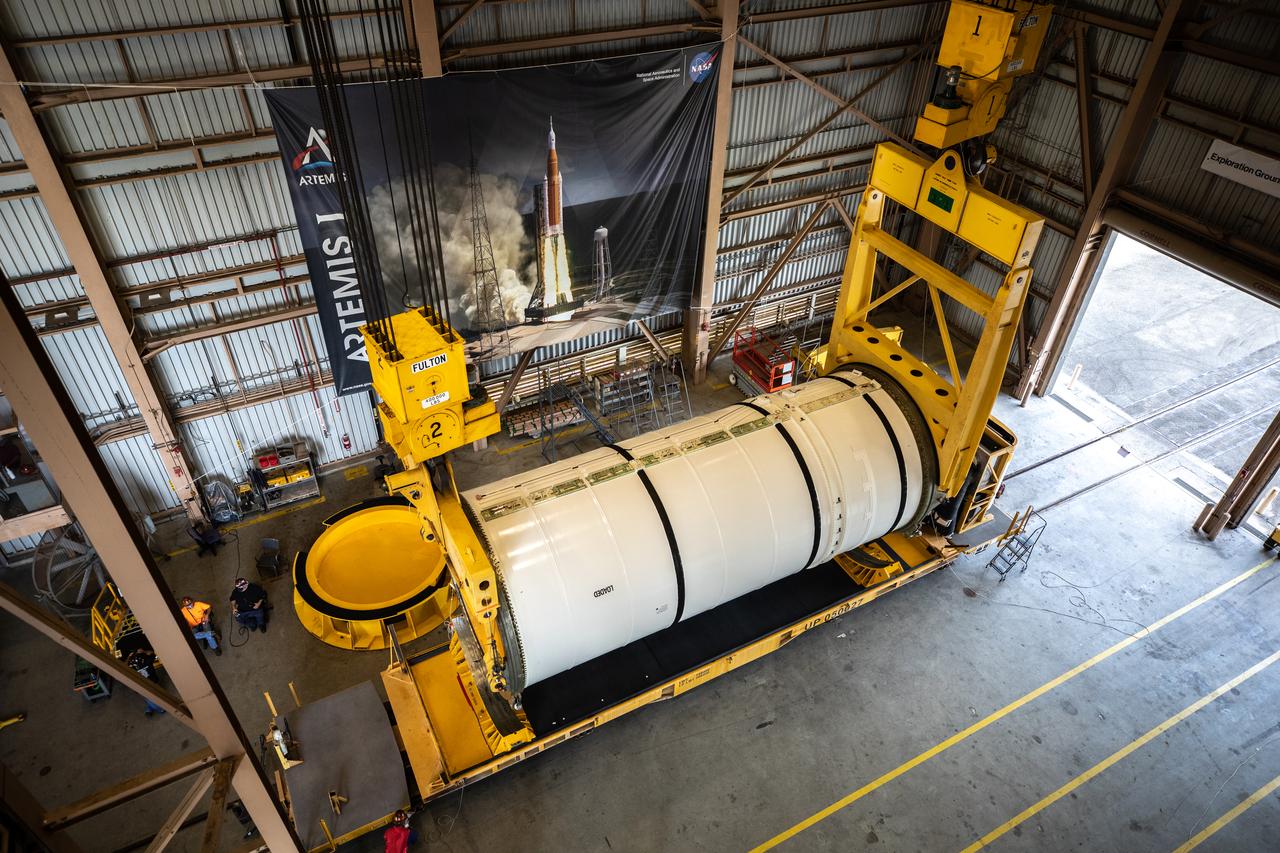
Technicians ready two NASA Space Launch System (SLS) solid rocket boosters for mating to the rocket’s two aft skirts on June 19, 2020, inside Kennedy Space Center’s Rotation, Processing and Surge Facility. Together, the twin boosters provide more than 75 percent of the total SLS thrust at launch. Manufactured by Northrop Grumman in Promontory, Utah, the boosters arrived at Kennedy via train. The cross-country journey was an important milestone for the agency’s Artemis I launch. The first in a series of increasingly complex missions, Artemis I will test the Orion spacecraft and SLS as an integrated system prior to crewed missions to the Moon. Once the boosters are mated with the aft skirts, they will be moved to the Vehicle Assembly Building for stacking on the mobile launcher.
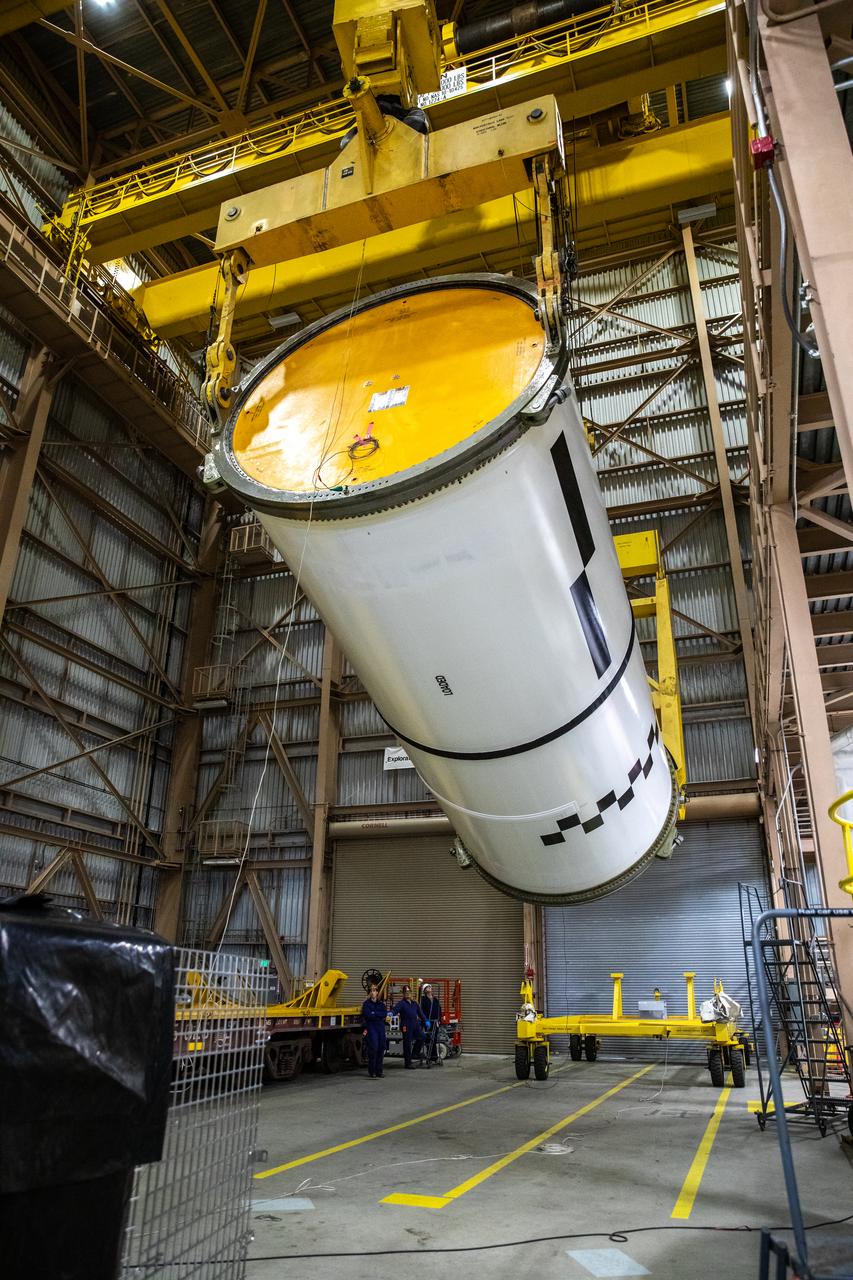
Engineers and technicians process the right forward center segment of the Space Launch System solid rocket boosters for the Artemis II mission inside the Rotation, Processing and Surge Facility (RPSF) at NASA’s Kennedy Space Center in Florida on Tuesday, Nov. 27, 2023. The team has been examining the 10 booster segments one-by-one then lifting them to make sure they are ready for integration and launch before moving them to the Vehicle Assembly Building for stacking atop the mobile launcher. Artemis II astronauts Reid Wiseman, Victor Glover, Christina Koch, and Jeremy Hansen will blast off from Kennedy and travel around the moon for the agency’s first crewed mission under Artemis that will test all of the Orion spacecraft’s systems.

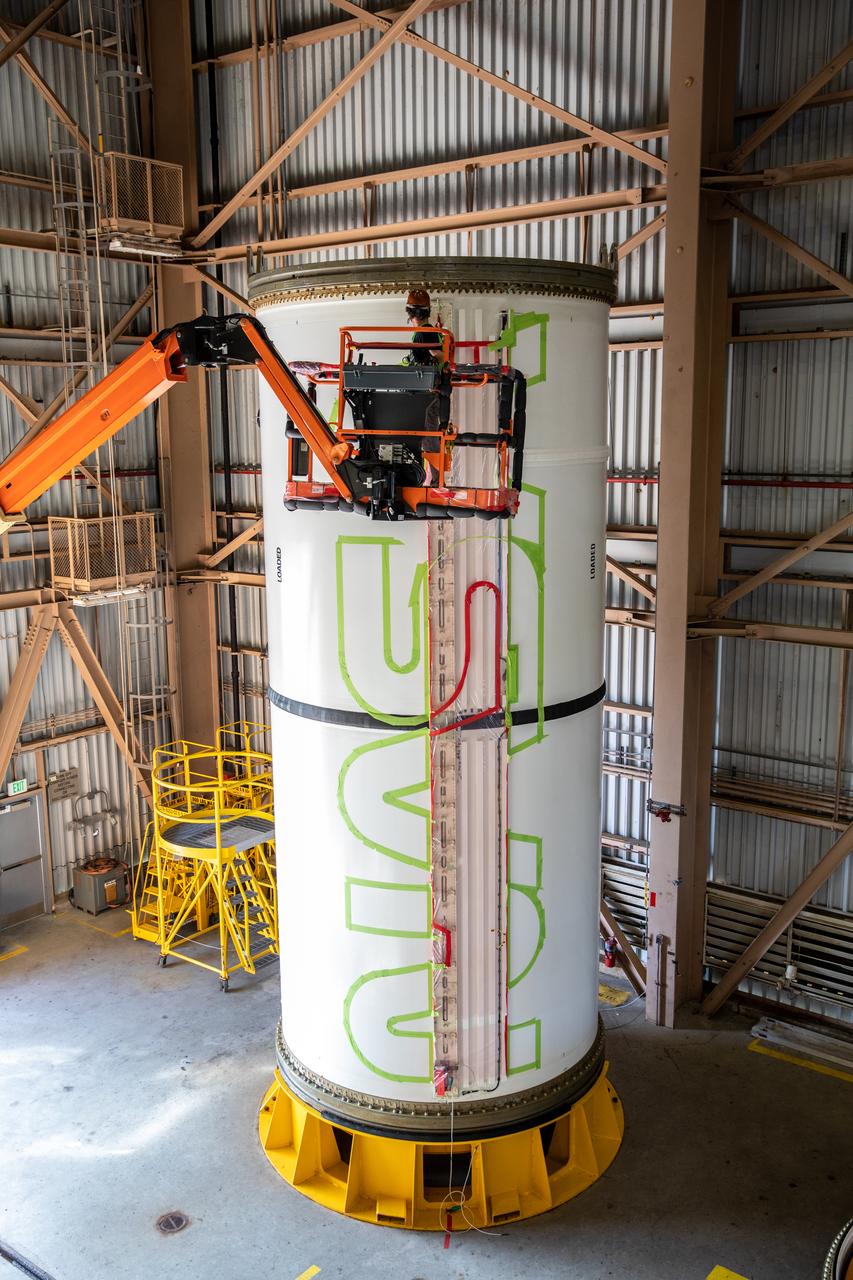
Workers with NASA’s Exploration Ground Systems (EGS) use a laser projector and green tape to mask off the shape of the agency’s “worm” logo on the side of an Artemis I solid rocket booster segment inside the Rotation, Processing and Surge Facility (RPSF) at Kennedy Space Center in Florida, Sept. 3, 2020. The booster segments will help propel the Space Launch System (SLS) rocket on Artemis I, a test of the Orion spacecraft and SLS as an integrated system ahead of crewed flights to the Moon. Northrop Grumman, which built the booster segments, is covering the cost of the painting.
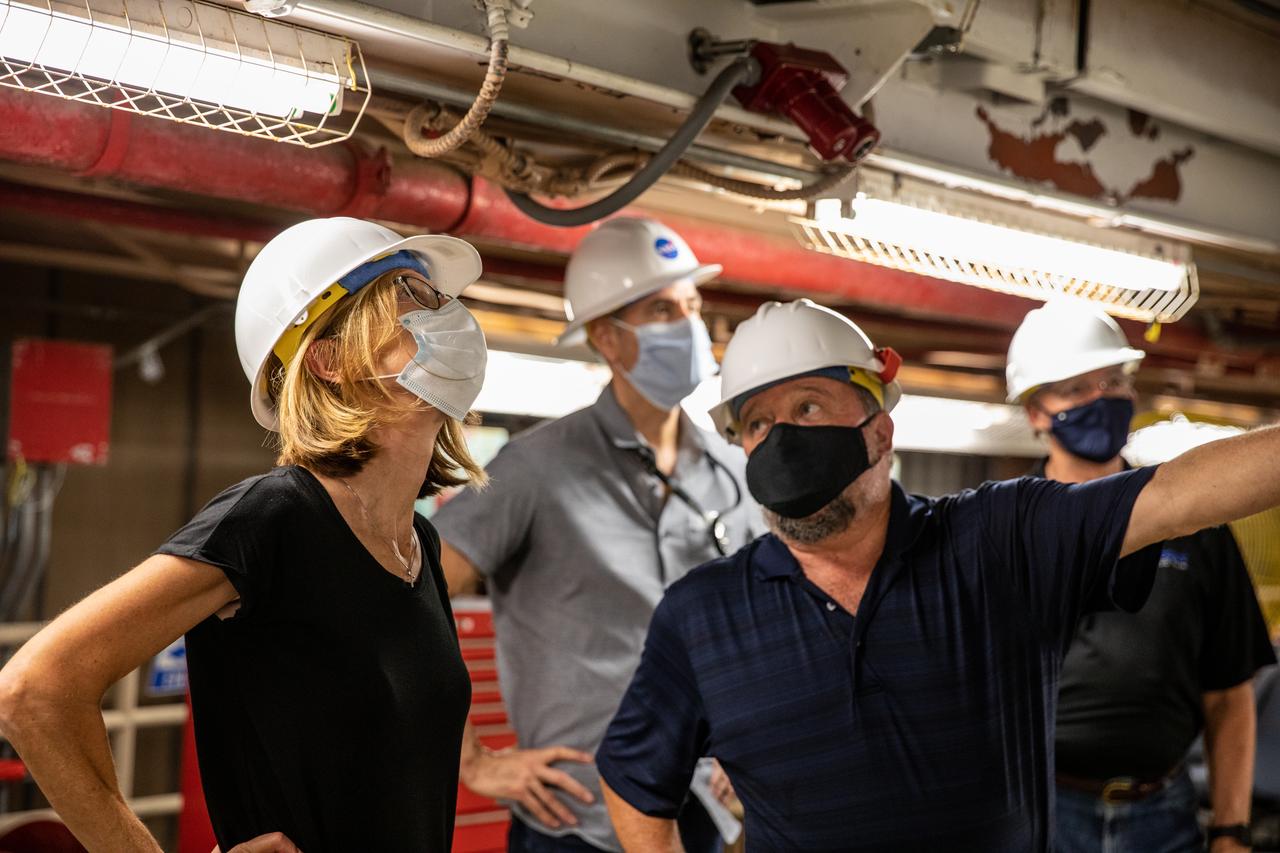
Kathy Lueders, at left, NASA’s associate administrator for Human Exploration and Operations, along with members of the Exploration Ground Systems and Jacobs Technology leadership view Artemis hardware inside the Rotation, Processing and Surge Facility (RPSF) at the agency’s Kennedy Space Center in Florida on June 25, 2020. Manufactured by Northrop Grumman in Utah, the solid rocket booster segments for the Space Launch System rocket are in view. The first in a series of increasingly complex missions, Artemis I will test the Orion spacecraft and SLS as an integrated system ahead of crewed flights to the Moon.

Kathy Lueders, NASA’s associate administrator for Human Exploration and Operations, views Artemis hardware inside the Rotation, Processing and Surge Facility (RPSF) at the agency’s Kennedy Space Center in Florida on June 25, 2020. Manufactured by Northrop Grumman in Utah, the solid rocket booster segments for the Space Launch System rocket are in view. The first in a series of increasingly complex missions, Artemis I will test the Orion spacecraft and SLS as an integrated system ahead of crewed flights to the Moon.
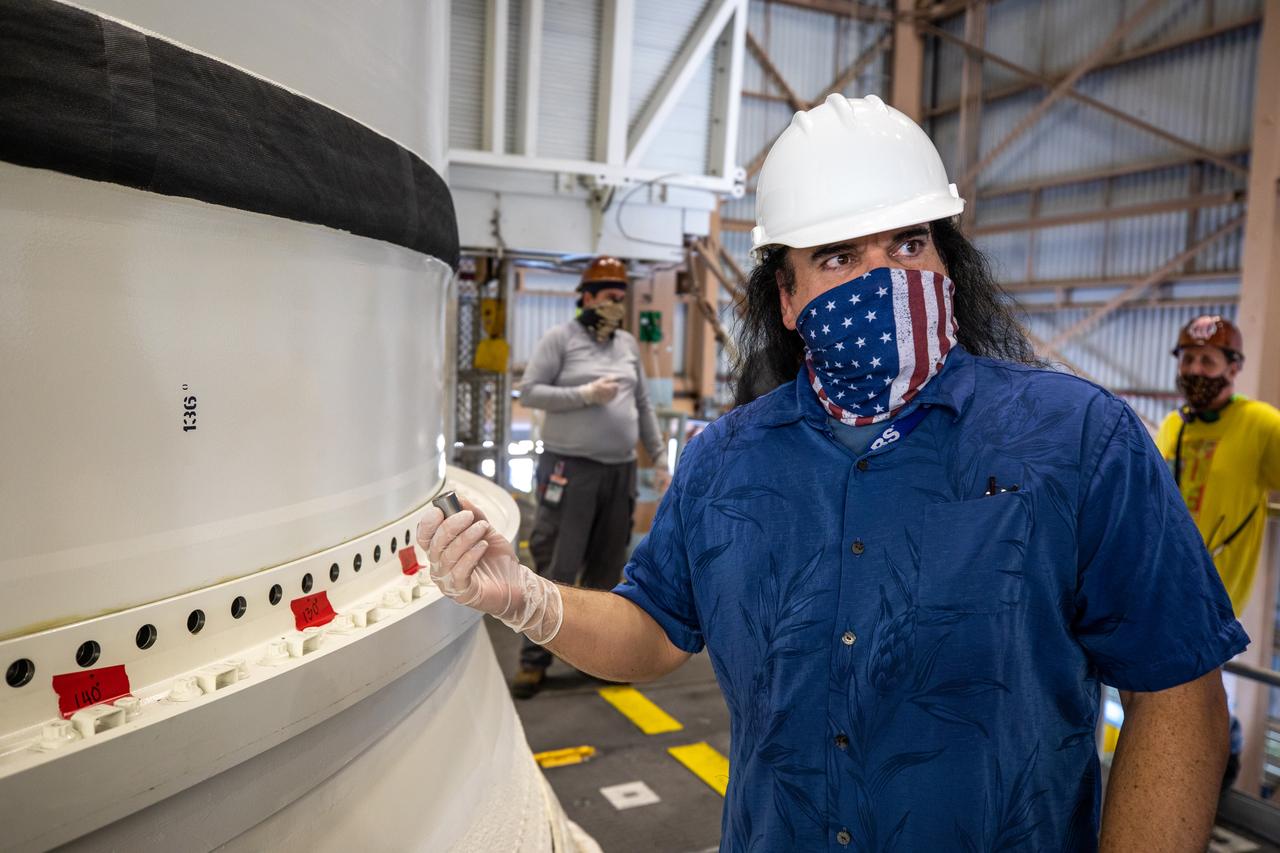
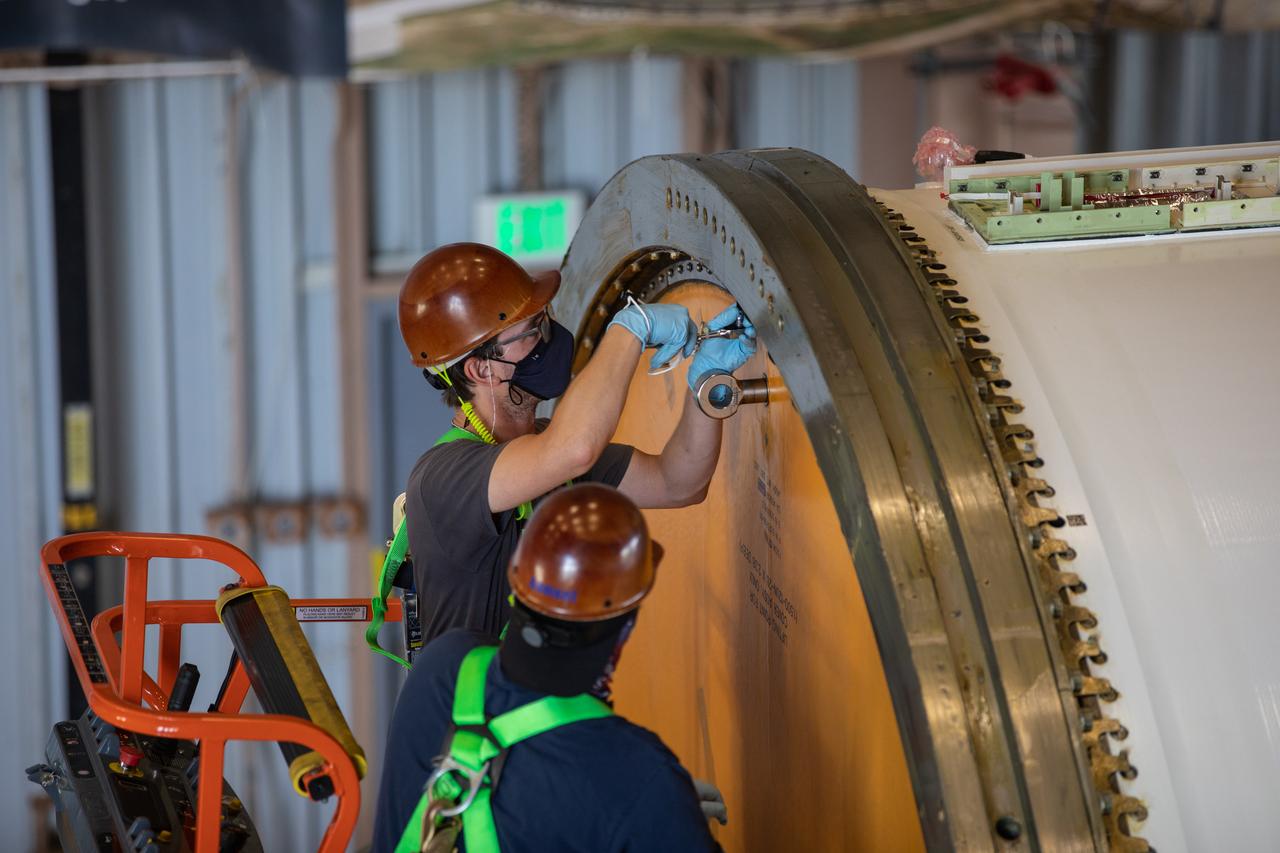
Inside the Rotation, Processing and Surge Facility at NASA’s Kennedy Space Center in Florida, Pablo Martinez, a handling, mechanical and structures engineer on the Jacobs Technology Inc. Test and Operations Support Contract, prepares to insert the first of many pins that will secure the Space Launch System’s (SLS) right-hand motor segment to the rocket’s right-hand aft skirt. The right-hand motor segment is one of five segments that makes up one of two solid rocket boosters. Once the aft segments are mated to the two aft skirts, they will be moved to the Vehicle Assembly Building for stacking on the mobile launcher. Manufactured by Northrop Grumman in Utah, the twin boosters provide more than 75 percent of the total SLS thrust at launch. Under the Artemis program, NASA will land the first woman and the next man on the Moon by 2024. The first in a series of increasingly complex missions, Artemis I will test the Orion spacecraft and SLS as an integrated system ahead of crewed flights to the Moon.
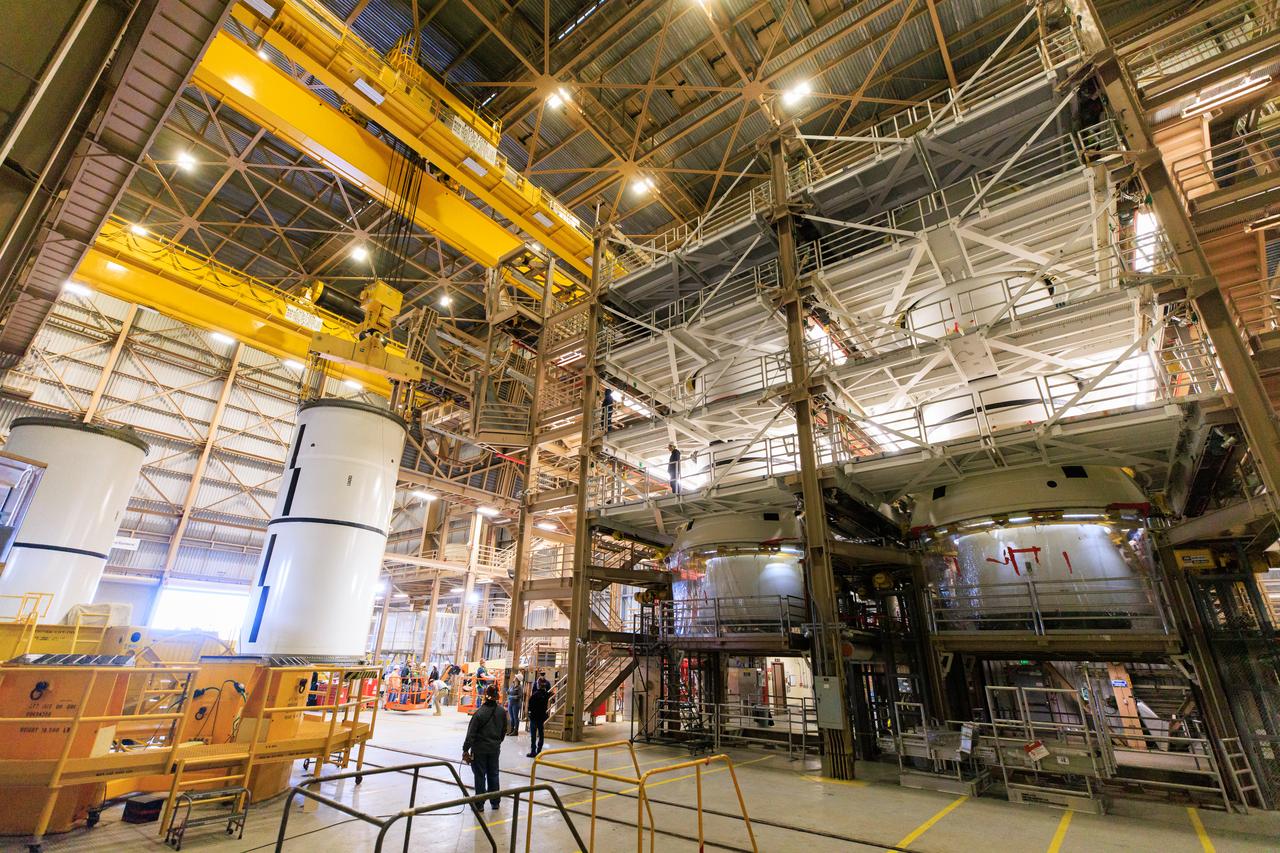
Following the successful propellant grain inspection of two segments of the solid rocket boosters for NASA’s Space Launch System inside the Rotation, Processing and Surge Facility at NASA’s Kennedy Space Center in Florida, crews on Thursday, Dec. 21, 2023, rotate and lift the segments from horizontal into a vertical position in preparation for the agency’s Artemis II launch campaign. The Artemis II mission will send four astronauts around the Moon as part of the agency’s effort to establish a long-term science and exploration presence at the Moon, and eventually Mars.
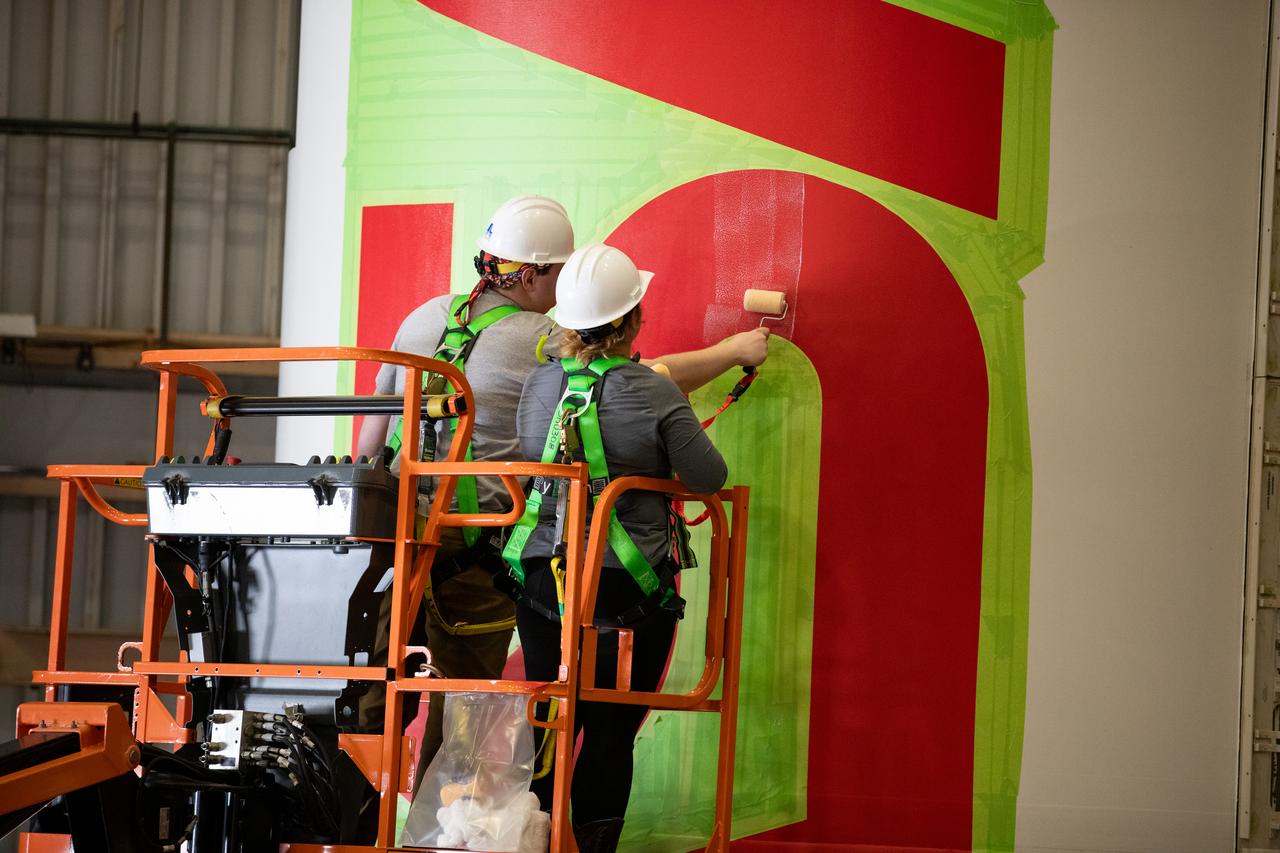
Workers with NASA’s Exploration Ground Systems (EGS) paint the bright red NASA “worm” logo on the side of an Artemis II solid rocket booster segment inside the Rotation, Processing and Surge Facility (RPSF) at Kennedy Space Center in Florida on Tuesday, Jan. 30, 2024. The EGS team used a laser projector to mask off the logo with tape, then painted the first coat of the iconic design. The booster segments will help propel the Space Launch System (SLS) rocket on the Artemis II mission to send four astronauts around the Moon as part of the agency’s effort to establish a long-term science and exploration presence at the Moon, and eventually Mars.
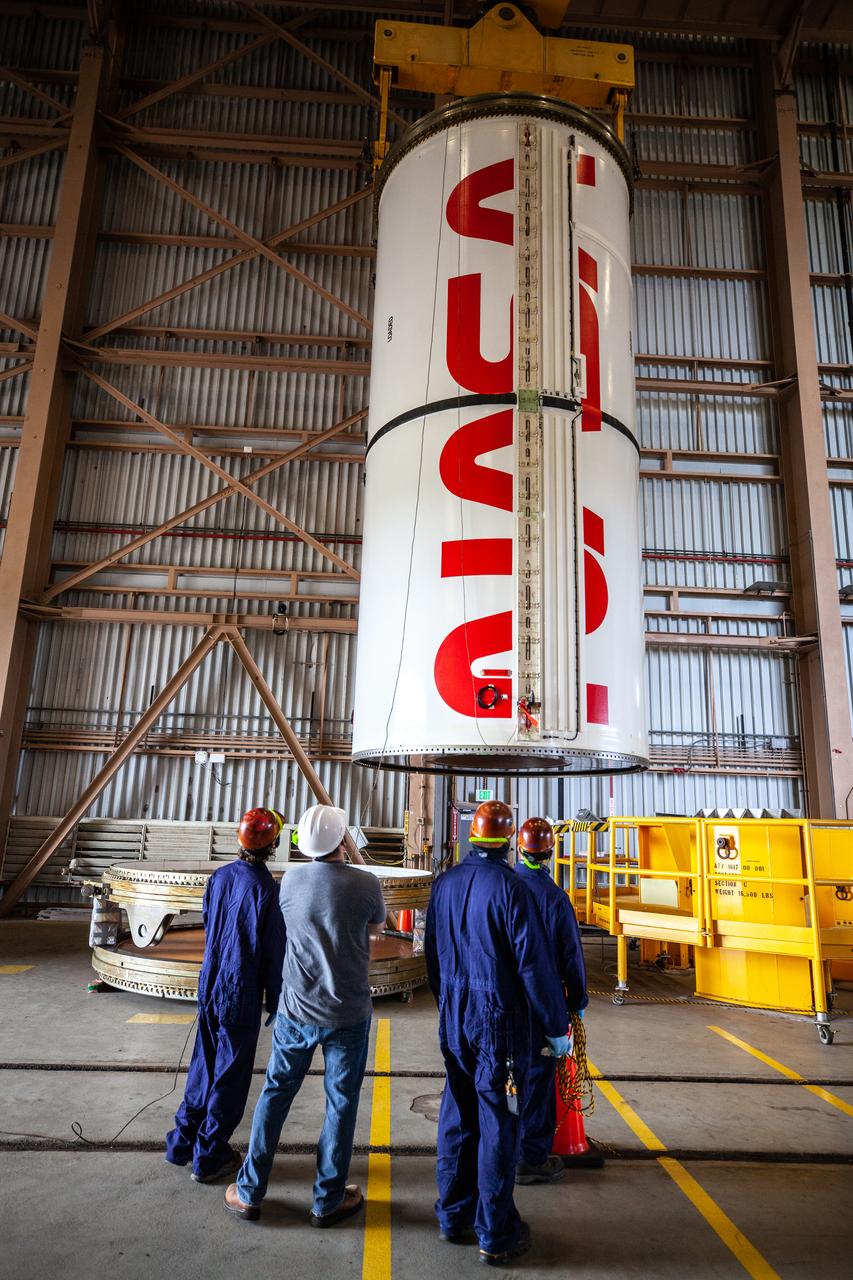
Inside the Rotation, Processing and Surge Facility at NASA’s Kennedy Space Center in Florida, Exploration Ground Systems and Jacobs TOSC workers completed painting of NASA’s iconic “worm” logo on the Artemis I Space Launch System twin solid rocket boosters on Sept. 23, 2020. Originally created by the firm of Danne & Blackburn, the iconic “worm” logo’s bold, sleek design was officially introduced in 1975 and was incorporated into many of the agency’s next-generation programs. It was retired in 1992, but has made a comeback in 2020 as the agency ushers in a new, modern era of human spaceflight. The first in a series of increasingly complex missions, Artemis I will test the Orion spacecraft and Space Launch System as an integrated system ahead of crewed flights to the Moon. Under the Artemis program, NASA will land the first woman and the next man on the Moon by 2024.
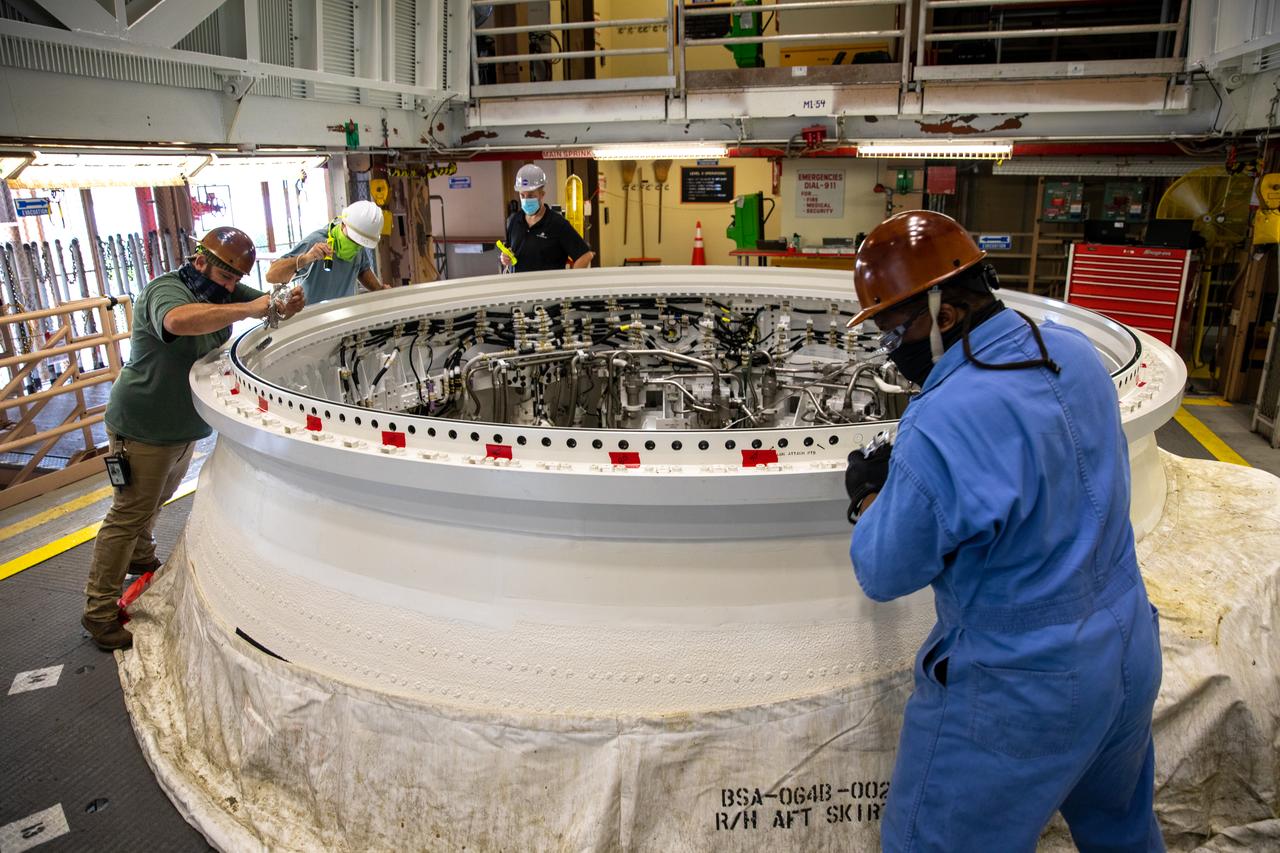
Inside the Rotation, Processing and Surge Facility at NASA’s Kennedy Space Center in Florida, technicians inspect the Space Launch System’s (SLS) right-hand aft skirt prior to mating it with the rocket’s right-hand motor segment – one of five segments that make up one of two solid rocket boosters – on June 24, 2020. Once the two aft skirts are mated to the aft segments, they will be moved to the Vehicle Assembly Building for stacking on the mobile launcher. Manufactured by Northrop Grumman in Utah, the twin boosters provide more than 75 percent of the total SLS thrust at launch. Under the Artemis program, NASA will land the first woman and the next man on the Moon by 2024. The first in a series of increasingly complex missions, Artemis I will test the Orion spacecraft and SLS as an integrated system ahead of crewed flights to the Moon.
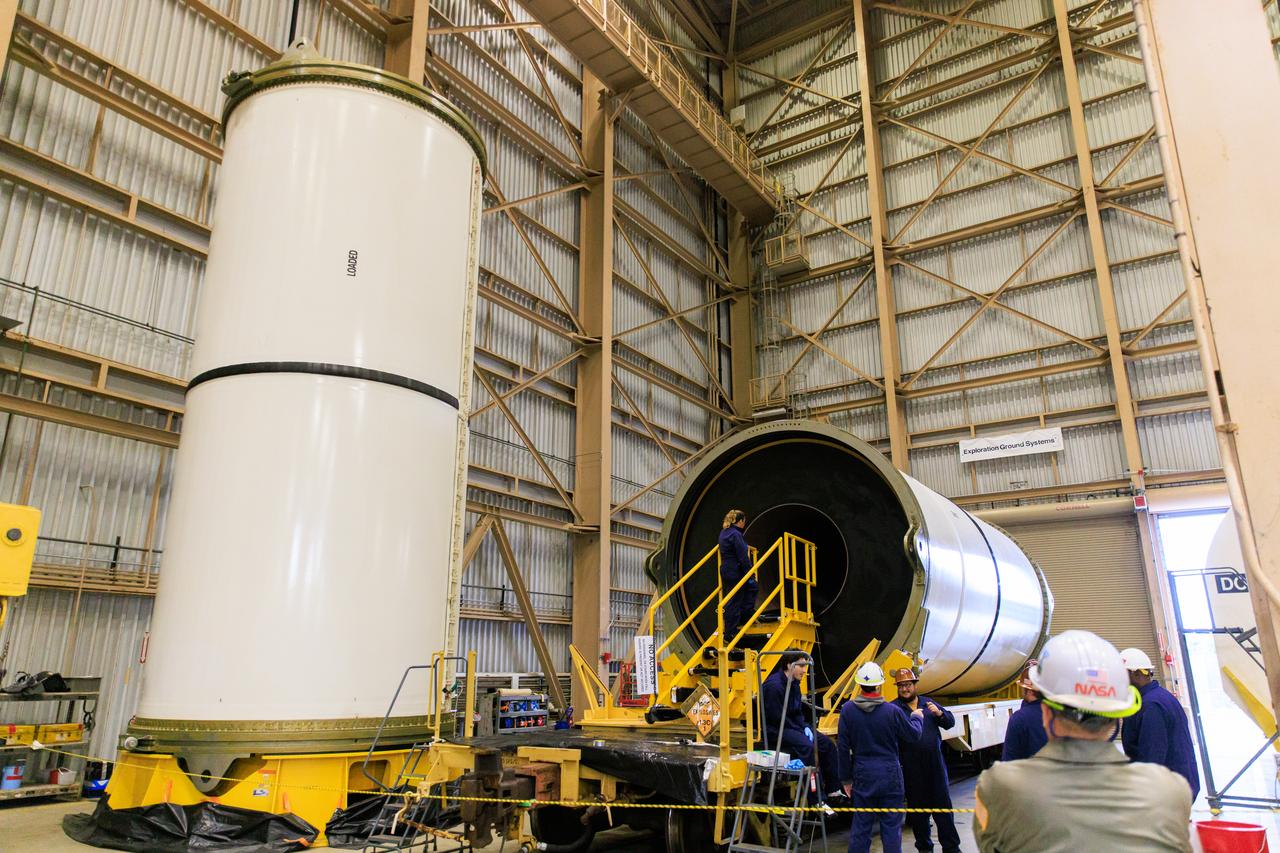
Technicians with Exploration Ground Systems, based at NASA’s Kennedy Space Center in Florida, perform propellant grain inspections on two of the agency’s Space Launch System solid rocket booster segments for the Artemis II campaign on Wednesday, Dec. 20, 2023, inside the Rotation, Processing and Surge Facility. The team is inspecting the propellant of all 10 booster segments before they are rotated vertically for processing. The Artemis II mission will send four astronauts around the Moon as part of the agency’s effort to establish a long-term science and exploration presence at the Moon, and eventually Mars.
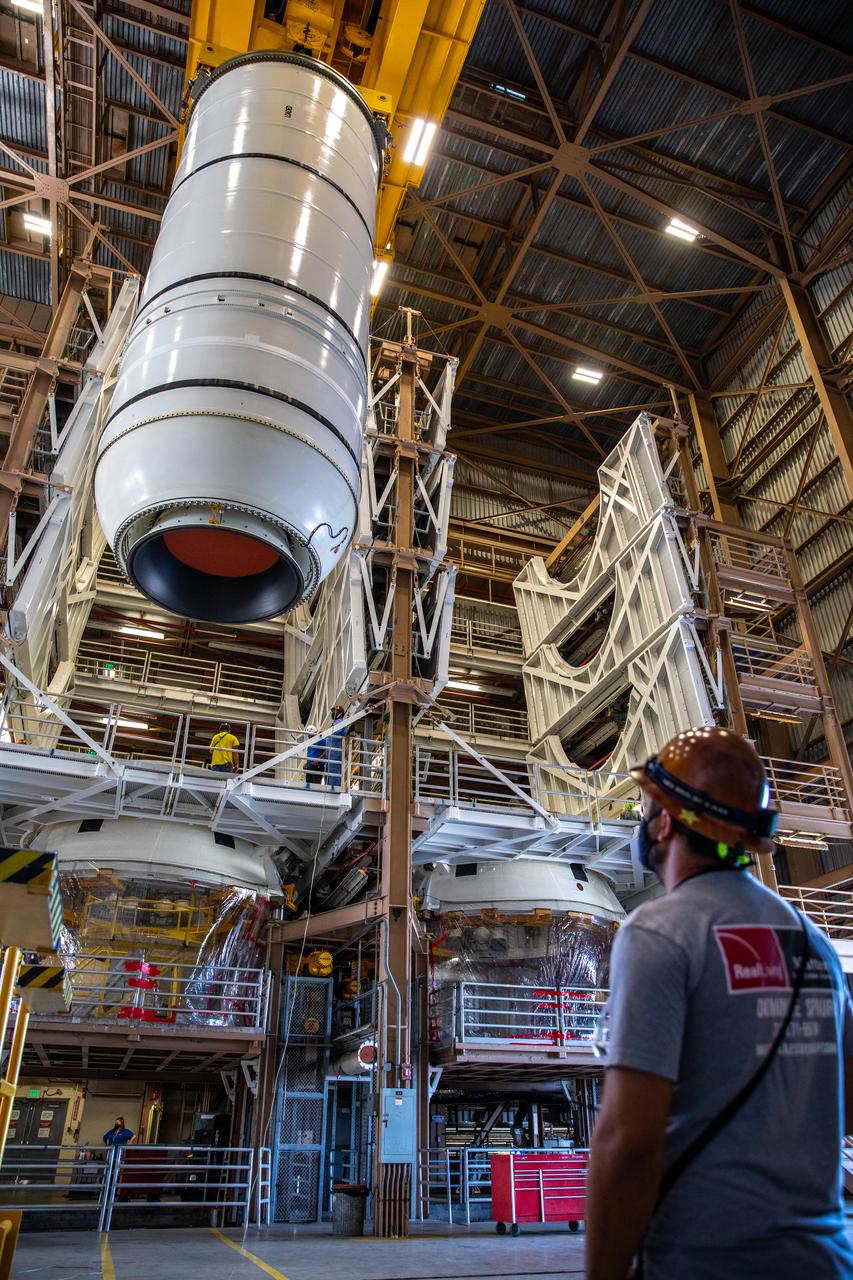
Inside the Rotation, Processing and Surge Facility at NASA’s Kennedy Space Center in Florida, technicians mate the right-hand motor segment – one of five segments that make up one of two solid rocket boosters for the agency’s Space Launch System (SLS) – to the rocket’s right-hand aft skirt on June 24, 2020. Once the aft segments are mated to the two aft skirts, they will be moved to the Vehicle Assembly Building for stacking on the mobile launcher. Manufactured by Northrop Grumman in Utah, the twin boosters provide more than 75 percent of the total SLS thrust at launch. Under the Artemis program, NASA will land the first woman and the next man on the Moon by 2024. The first in a series of increasingly complex missions, Artemis I will test the Orion spacecraft and SLS as an integrated system ahead of crewed flights to the Moon.
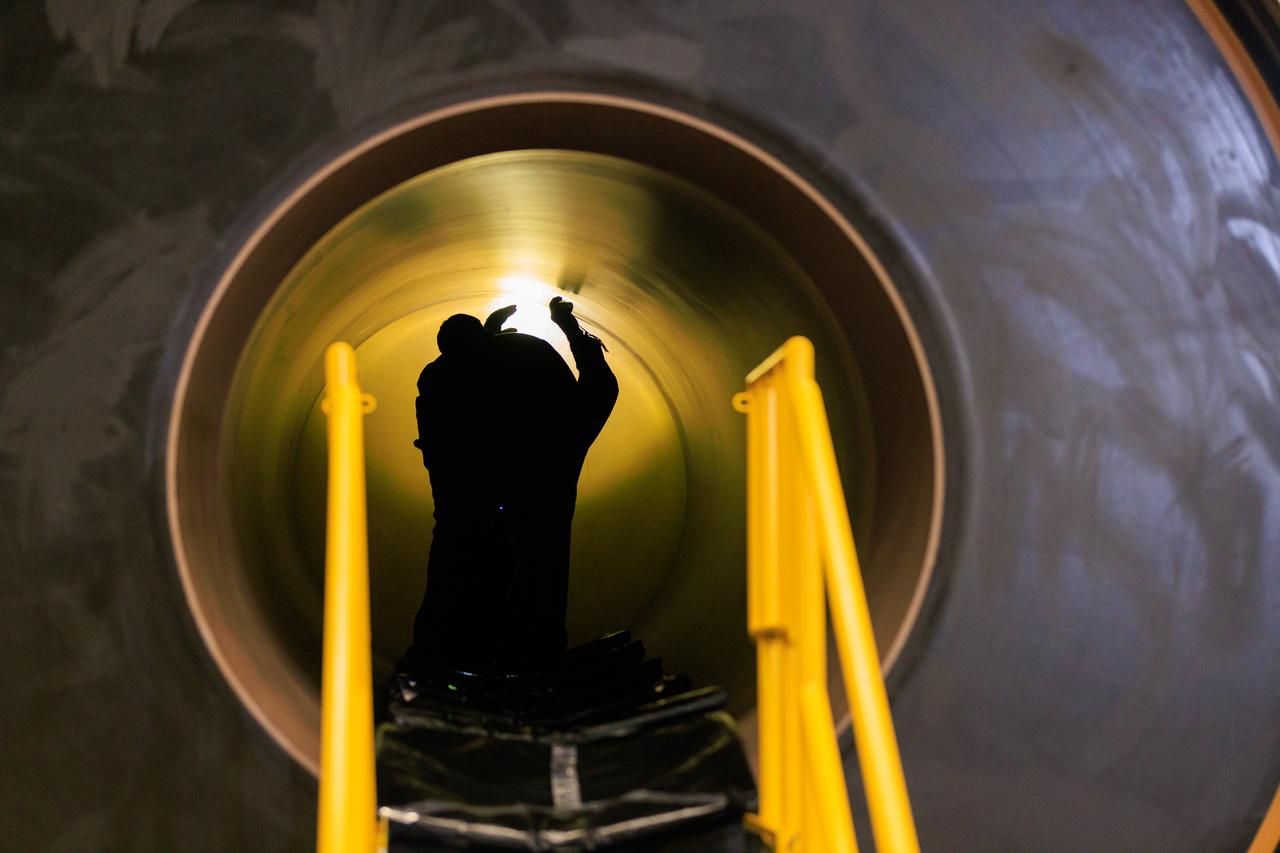
Technicians with Exploration Ground Systems, based at NASA’s Kennedy Space Center in Florida, perform propellant grain inspections on two of the agency’s Space Launch System solid rocket booster segments for the Artemis II campaign on Wednesday, Dec. 20, 2023, inside the Rotation, Processing and Surge Facility. The team is inspecting the propellant of all 10 booster segments before they are rotated vertically for processing. The Artemis II mission will send four astronauts around the Moon as part of the agency’s effort to establish a long-term science and exploration presence at the Moon, and eventually Mars.
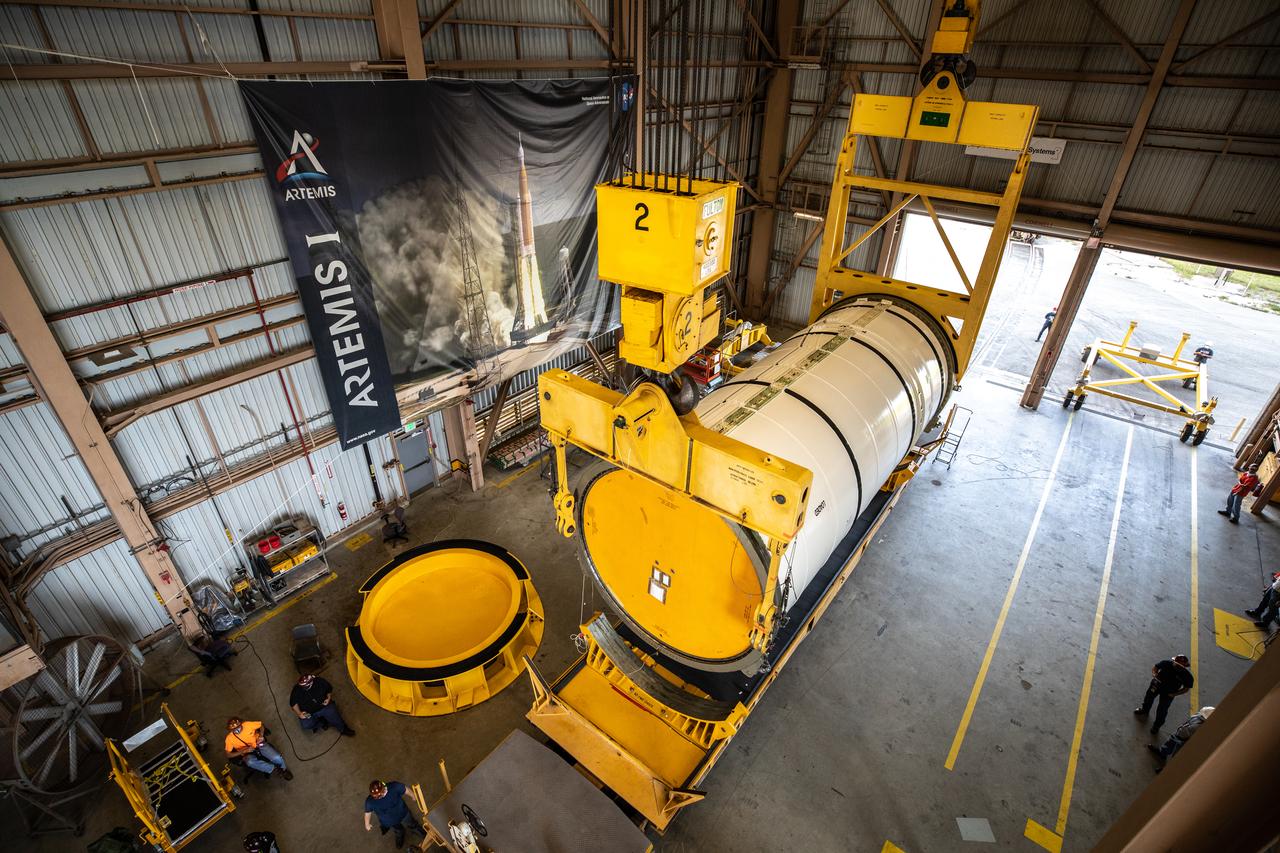
Technicians ready two NASA Space Launch System (SLS) solid rocket boosters for mating to the rocket’s two aft skirts on June 19, 2020, inside Kennedy Space Center’s Rotation, Processing and Surge Facility. Together, the twin boosters provide more than 75 percent of the total SLS thrust at launch. Manufactured by Northrop Grumman in Promontory, Utah, the boosters arrived at Kennedy via train. The cross-country journey was an important milestone for the agency’s Artemis I launch. The first in a series of increasingly complex missions, Artemis I will test the Orion spacecraft and SLS as an integrated system prior to crewed missions to the Moon. Once the boosters are mated with the aft skirts, they will be moved to the Vehicle Assembly Building for stacking on the mobile launcher.
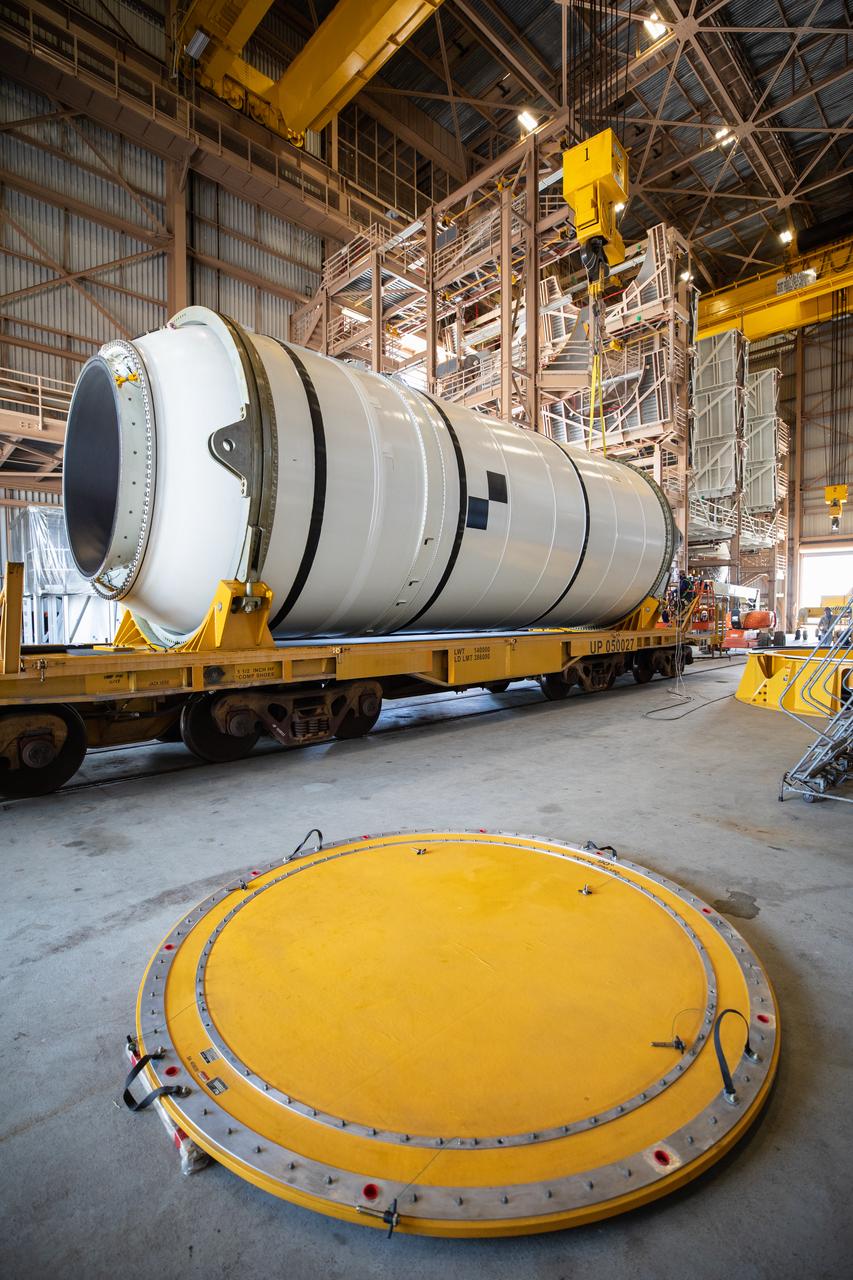
Two NASA Space Launch System (SLS) solid rocket boosters are readied for mating to the rocket’s two aft skirts on June 16, 2020, inside Kennedy Space Center’s Rotation, Processing and Surge Facility. Together, the twin boosters provide more than 75 percent of the total SLS thrust at launch. Manufactured by Northrop Grumman in Promontory, Utah, the boosters arrived at Kennedy via train. The cross-country journey was an important milestone for the agency’s Artemis I launch. The first in a series of increasingly complex missions, Artemis I will test the Orion spacecraft and SLS as an integrated system prior to crewed missions to the Moon. Once the boosters are mated with the aft skirts, they will be moved to the Vehicle Assembly Building for stacking on the mobile launcher.
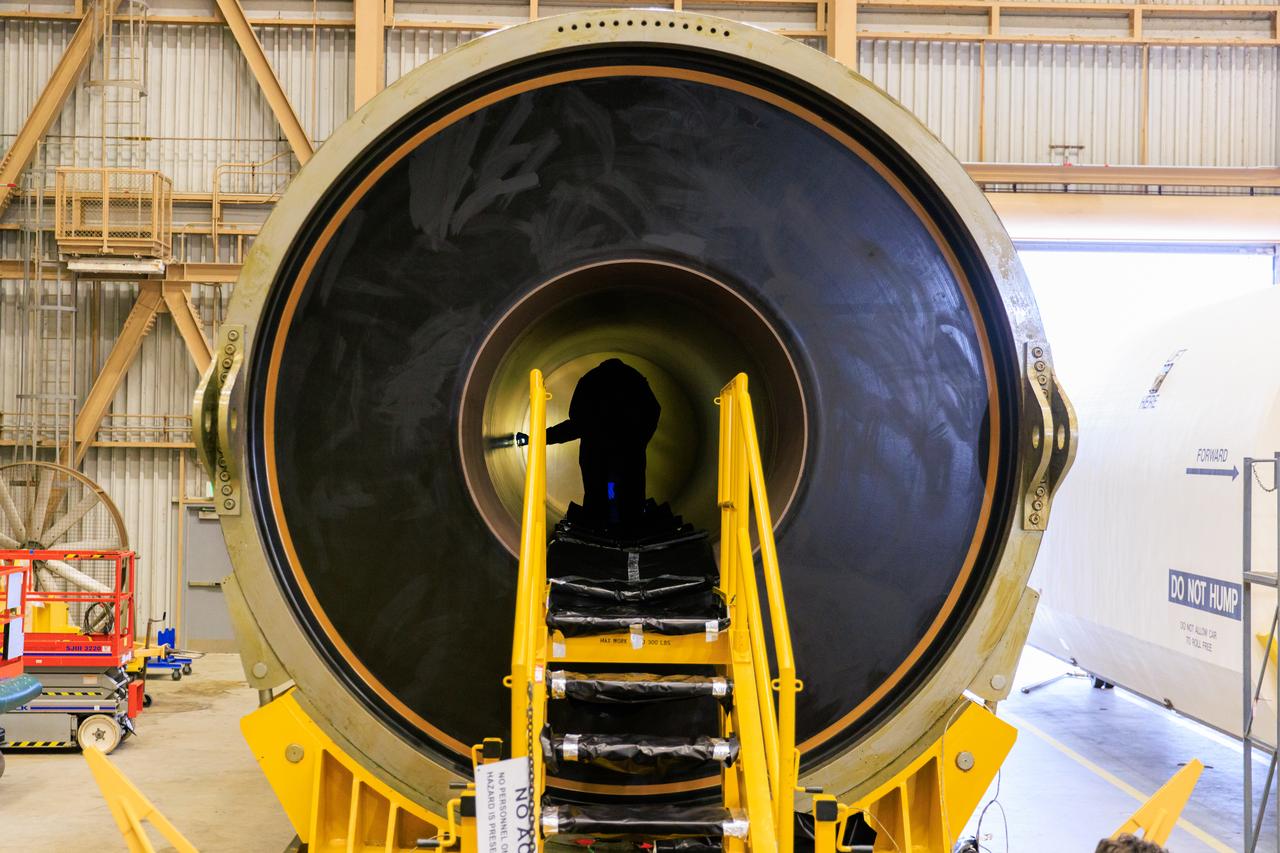
Technicians with Exploration Ground Systems, based at NASA’s Kennedy Space Center in Florida, perform propellant grain inspections on two of the agency’s Space Launch System solid rocket booster segments for the Artemis II campaign on Wednesday, Dec. 20, 2023, inside the Rotation, Processing and Surge Facility. The team is inspecting the propellant of all 10 booster segments before they are rotated vertically for processing. The Artemis II mission will send four astronauts around the Moon as part of the agency’s effort to establish a long-term science and exploration presence at the Moon, and eventually Mars.
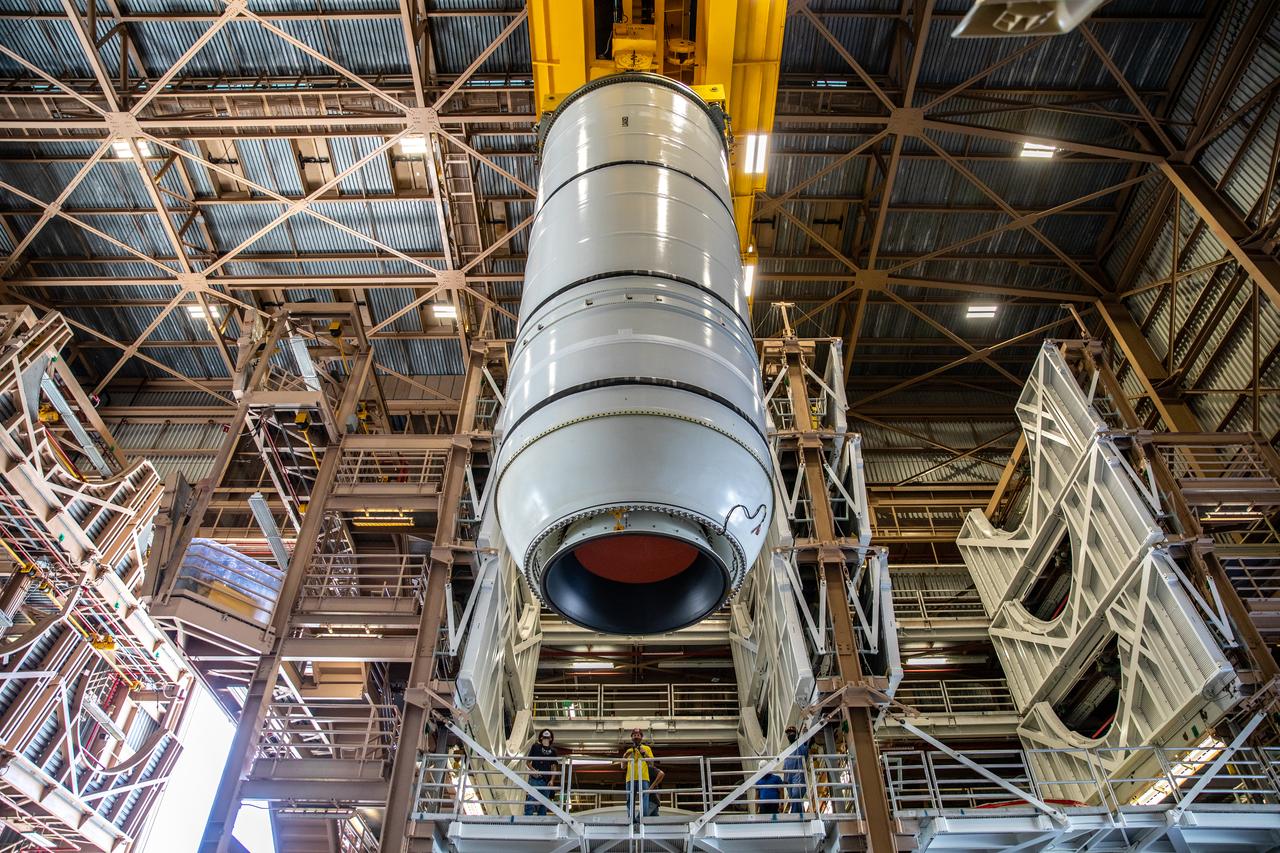
Inside the Rotation, Processing and Surge Facility at NASA’s Kennedy Space Center in Florida, technicians mate the right-hand motor segment – one of five segments that make up one of two solid rocket boosters for the agency’s Space Launch System (SLS) – to the rocket’s right-hand aft skirt on June 24, 2020. Once the aft segments are mated to the two aft skirts, they will be moved to the Vehicle Assembly Building for stacking on the mobile launcher. Manufactured by Northrop Grumman in Utah, the twin boosters provide more than 75 percent of the total SLS thrust at launch. Under the Artemis program, NASA will land the first woman and the next man on the Moon by 2024. The first in a series of increasingly complex missions, Artemis I will test the Orion spacecraft and SLS as an integrated system ahead of crewed flights to the Moon.
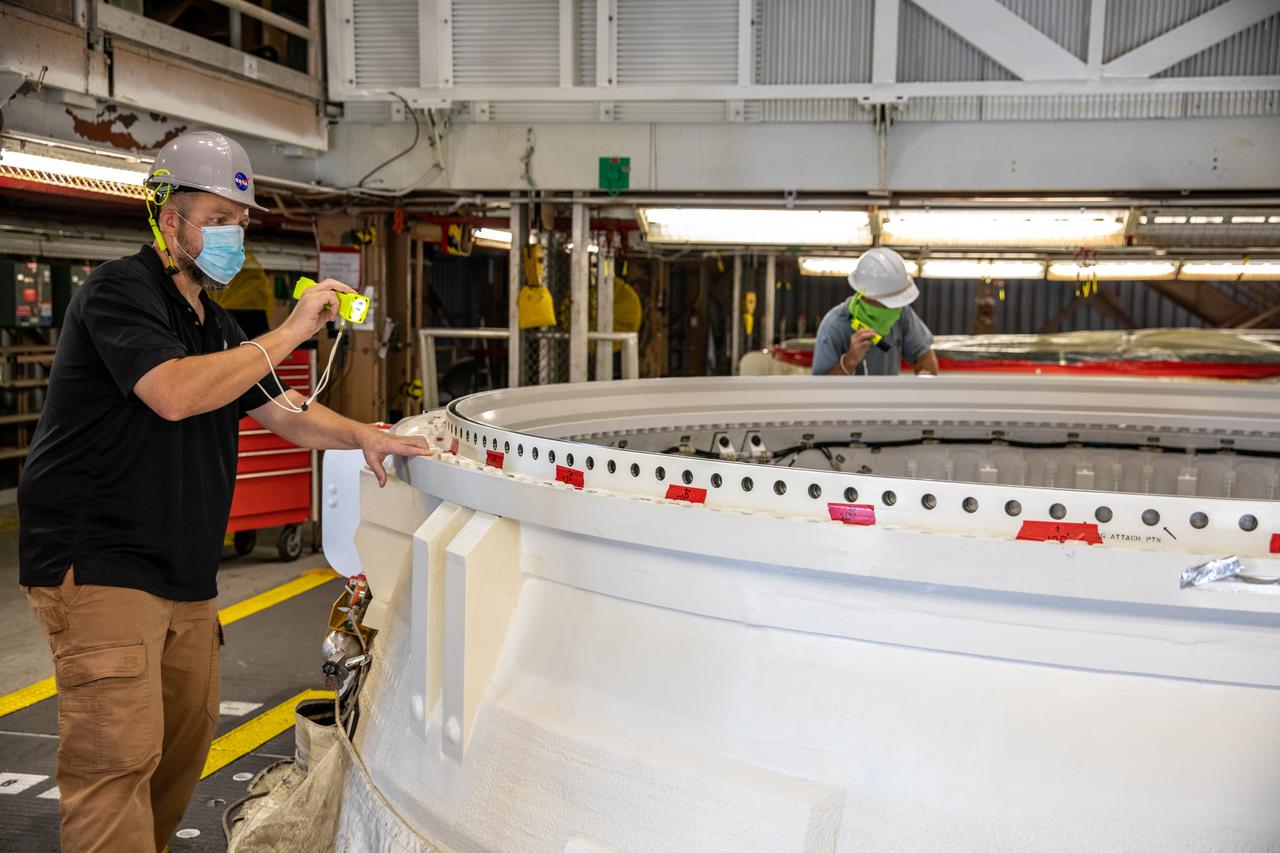
Brendan Deuble, a handling, mechanical and structures engineer on the Jacobs Technology Inc. Test and Operations Support Contract, inspects the Space Launch System’s (SLS) right-hand aft skirt inside the Rotation, Processing and Surge Facility (RPSF) at NASA’s Kennedy Space Center in Florida on June 24, 2020. While in the RPSF, the aft skirt will be mated with the rocket’s right-hand motor segment – one of five segments that make up one of two solid rocket boosters. Once the two aft skirts are mated with the aft segments, they will be moved to the Vehicle Assembly Building for stacking on the mobile launcher. Manufactured by Northrop Grumman in Utah, the twin boosters provide more than 75 percent of the total SLS thrust at launch. Under the Artemis program, NASA will land the first woman and the next man on the Moon by 2024. The first in a series of increasingly complex missions, Artemis I will test the Orion spacecraft and SLS as an integrated system ahead of crewed flights to the Moon.
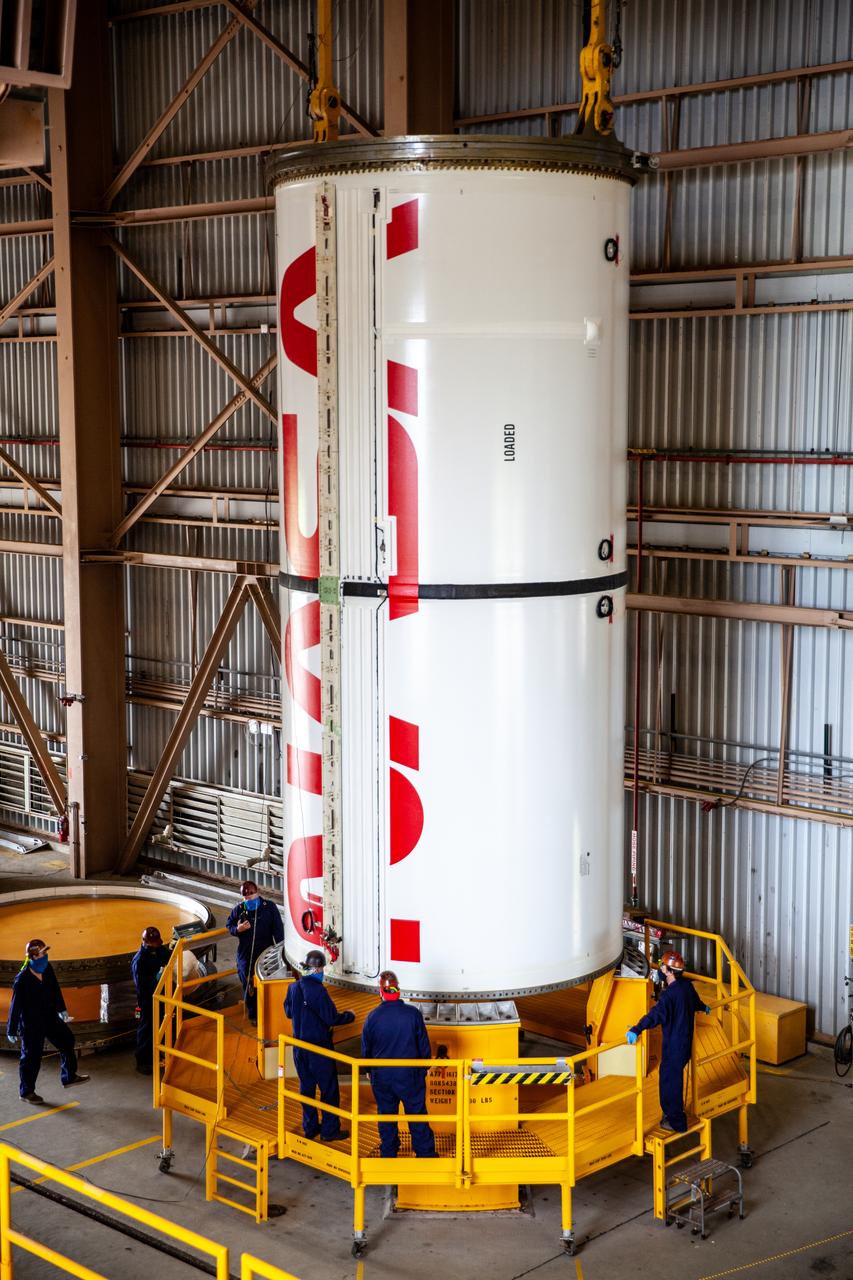
Inside the Rotation, Processing and Surge Facility at NASA’s Kennedy Space Center in Florida, Exploration Ground Systems and Jacobs TOSC workers completed painting of NASA’s iconic “worm” logo on the Artemis I Space Launch System twin solid rocket boosters on Sept. 23, 2020. Originally created by the firm of Danne & Blackburn, the iconic “worm” logo’s bold, sleek design was officially introduced in 1975 and was incorporated into many of the agency’s next-generation programs. It was retired in 1992, but has made a comeback in 2020 as the agency ushers in a new, modern era of human spaceflight. The first in a series of increasingly complex missions, Artemis I will test the Orion spacecraft and Space Launch System as an integrated system ahead of crewed flights to the Moon. Under the Artemis program, NASA will land the first woman and the next man on the Moon by 2024.
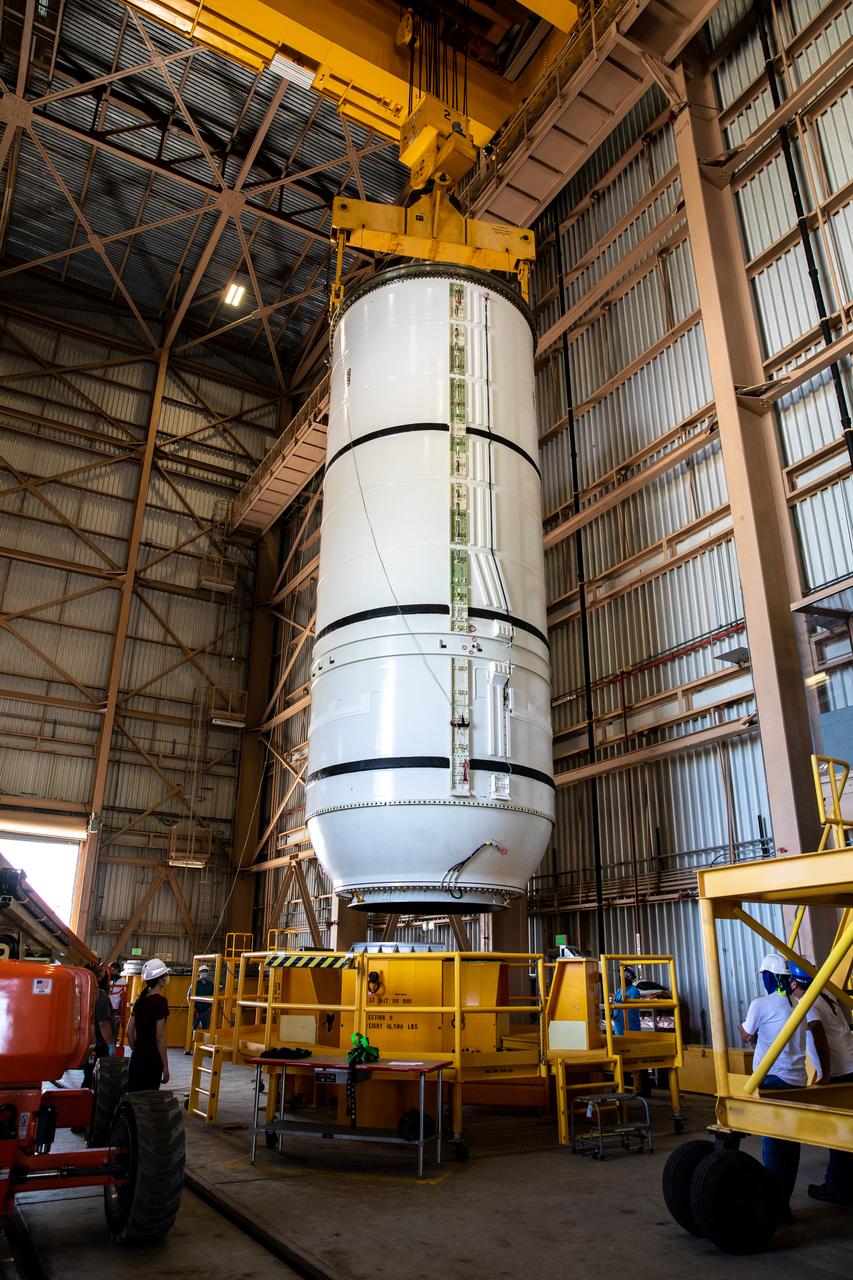
Inside the Rotation, Processing and Surge Facility at NASA’s Kennedy Space Center in Florida, technicians prepare to mate the right-hand motor segment – one of five segments that make up one of two solid rocket boosters for the agency’s Space Launch System (SLS) – to the rocket’s right-hand aft skirt on June 24, 2020. Once the booster aft segments are mated to the two aft skirts, they will be moved to the Vehicle Assembly Building for stacking on the mobile launcher. Manufactured by Northrop Grumman in Utah, the twin boosters provide more than 75 percent of the total SLS thrust at launch. Under the Artemis program, NASA will land the first woman and the next man on the Moon by 2024. The first in a series of increasingly complex missions, Artemis I will test the Orion spacecraft and SLS as an integrated system ahead of crewed flights to the Moon.
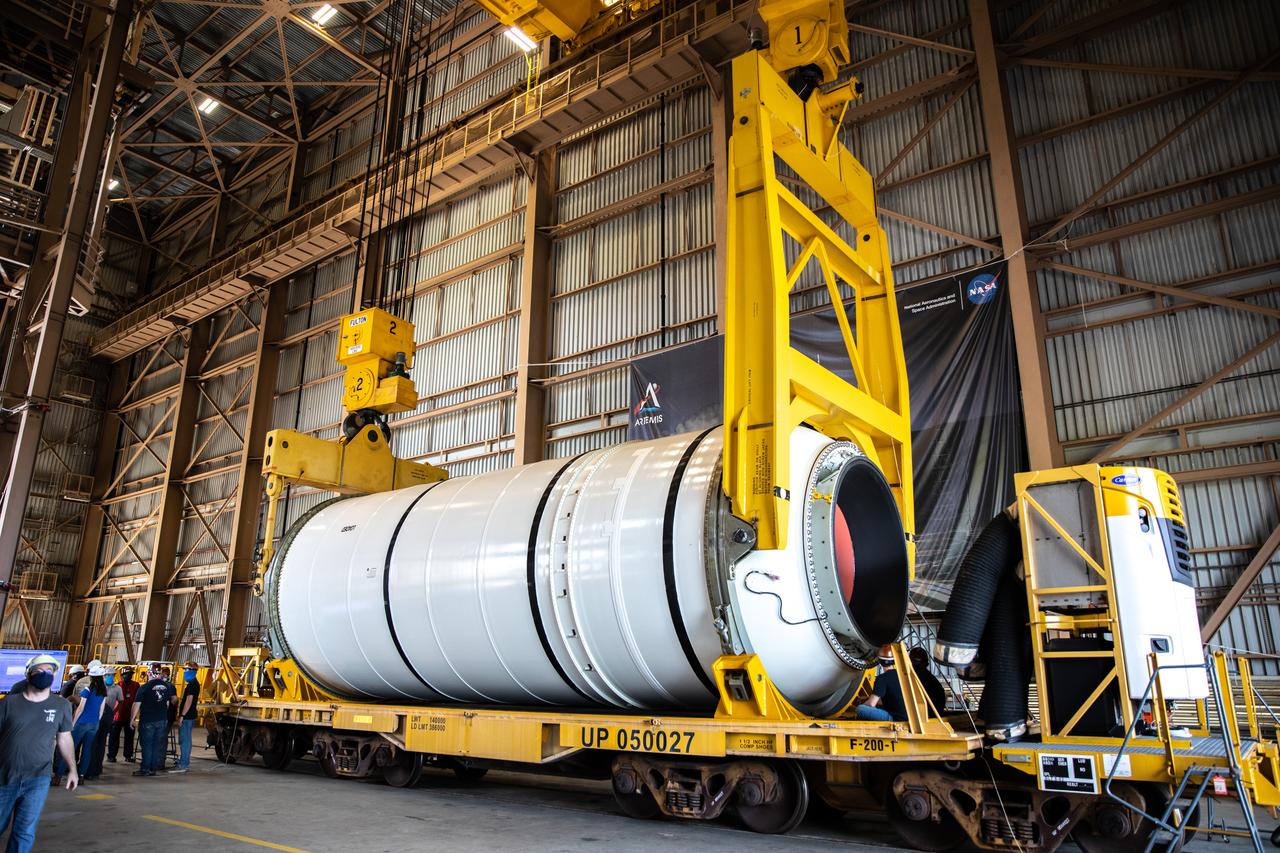
Technicians ready two NASA Space Launch System (SLS) solid rocket boosters for mating to the rocket’s two aft skirts on June 19, 2020, inside Kennedy Space Center’s Rotation, Processing and Surge Facility. Together, the twin boosters provide more than 75 percent of the total SLS thrust at launch. Manufactured by Northrop Grumman in Promontory, Utah, the boosters arrived at Kennedy via train. The cross-country journey was an important milestone for the agency’s Artemis I launch. The first in a series of increasingly complex missions, Artemis I will test the Orion spacecraft and SLS as an integrated system prior to crewed missions to the Moon. Once the boosters are mated with the aft skirts, they will be moved to the Vehicle Assembly Building for stacking on the mobile launcher.
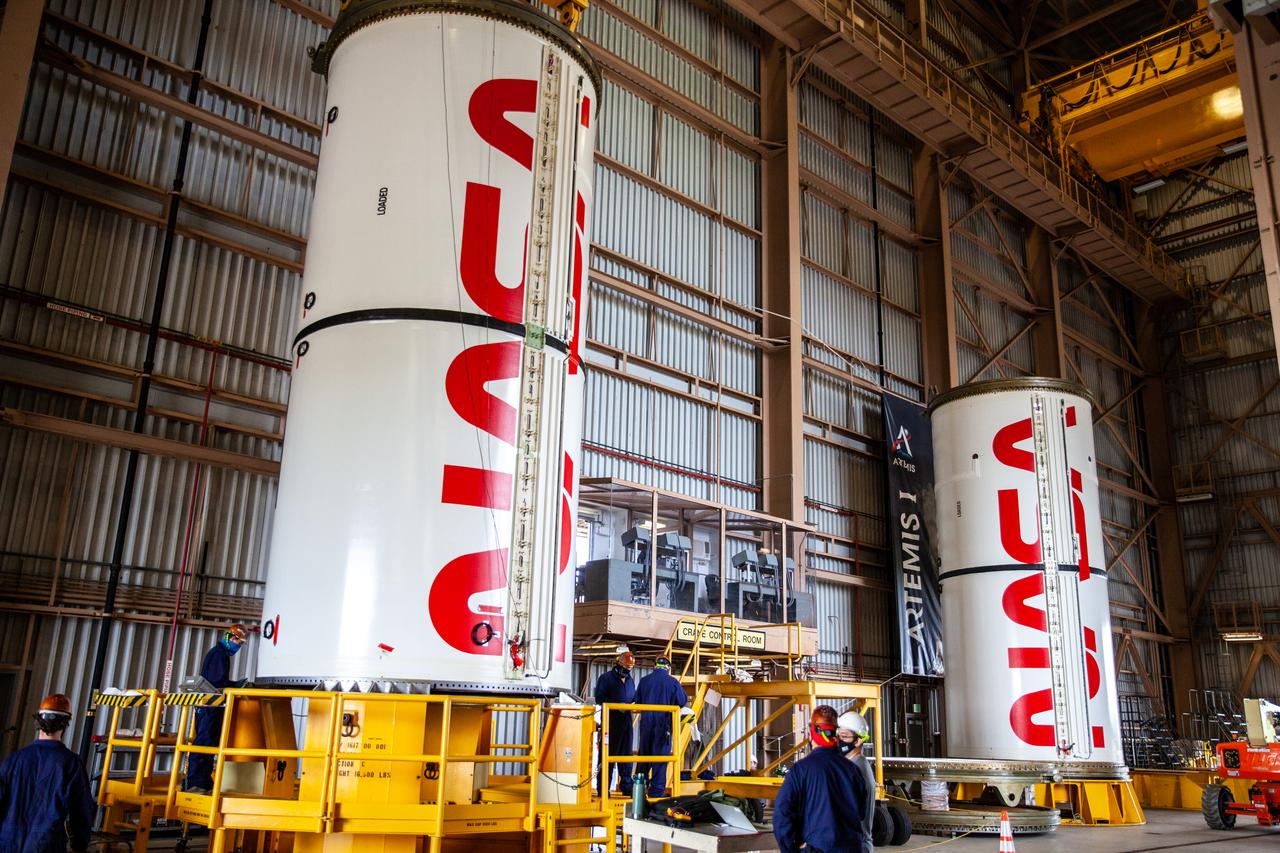
Inside the Rotation, Processing and Surge Facility at NASA’s Kennedy Space Center in Florida, Exploration Ground Systems and Jacobs TOSC workers completed painting of NASA’s iconic “worm” logo on the Artemis I Space Launch System twin solid rocket boosters on Sept. 23, 2020. Originally created by the firm of Danne & Blackburn, the iconic “worm” logo’s bold, sleek design was officially introduced in 1975 and was incorporated into many of the agency’s next-generation programs. It was retired in 1992, but has made a comeback in 2020 as the agency ushers in a new, modern era of human spaceflight. The first in a series of increasingly complex missions, Artemis I will test the Orion spacecraft and Space Launch System as an integrated system ahead of crewed flights to the Moon. Under the Artemis program, NASA will land the first woman and the next man on the Moon by 2024.
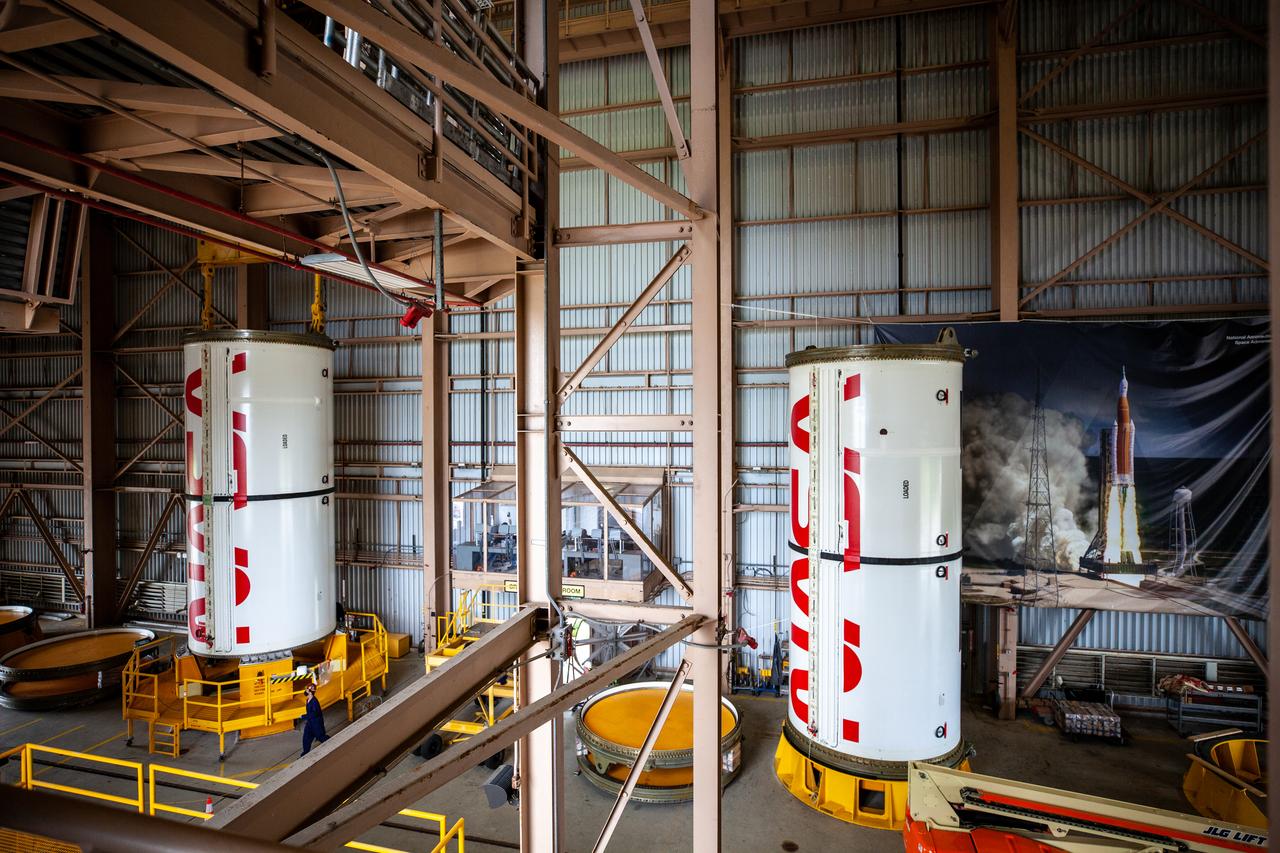
Inside the Rotation, Processing and Surge Facility at NASA’s Kennedy Space Center in Florida, Exploration Ground Systems and Jacobs TOSC workers completed painting of NASA’s iconic “worm” logo on the Artemis I Space Launch System twin solid rocket boosters on Sept. 23, 2020. Originally created by the firm of Danne & Blackburn, the iconic “worm” logo’s bold, sleek design was officially introduced in 1975 and was incorporated into many of the agency’s next-generation programs. It was retired in 1992, but has made a comeback in 2020 as the agency ushers in a new, modern era of human spaceflight. The first in a series of increasingly complex missions, Artemis I will test the Orion spacecraft and Space Launch System as an integrated system ahead of crewed flights to the Moon. Under the Artemis program, NASA will land the first woman and the next man on the Moon by 2024.
Technicians ready two NASA Space Launch System (SLS) solid rocket boosters for mating to the rocket’s two aft skirts on June 19, 2020, inside Kennedy Space Center’s Rotation, Processing and Surge Facility. Together, the twin boosters provide more than 75 percent of the total SLS thrust at launch. Manufactured by Northrop Grumman in Promontory, Utah, the boosters arrived at Kennedy via train. The cross-country journey was an important milestone for the agency’s Artemis I launch. The first in a series of increasingly complex missions, Artemis I will test the Orion spacecraft and SLS as an integrated system prior to crewed missions to the Moon. Once the boosters are mated with the aft skirts, they will be moved to the Vehicle Assembly Building for stacking on the mobile launcher.
Technicians ready two NASA Space Launch System (SLS) solid rocket boosters for mating to the rocket’s two aft skirts on June 19, 2020, inside Kennedy Space Center’s Rotation, Processing and Surge Facility. Together, the twin boosters provide more than 75 percent of the total SLS thrust at launch. Manufactured by Northrop Grumman in Promontory, Utah, the boosters arrived at Kennedy via train. The cross-country journey was an important milestone for the agency’s Artemis I launch. The first in a series of increasingly complex missions, Artemis I will test the Orion spacecraft and SLS as an integrated system prior to crewed missions to the Moon. Once the boosters are mated with the aft skirts, they will be moved to the Vehicle Assembly Building for stacking on the mobile launcher.

Inside the Rotation, Processing and Surge Facility at NASA’s Kennedy Space Center in Florida, the right-hand motor segment – one of five segments that make up one of two solid rocket boosters for the agency’s Space Launch System (SLS) – is mated to the rocket’s right-hand aft skirt on June 24, 2020. Once the aft segments are mated to the two aft skirts, they will be moved to the Vehicle Assembly Building for stacking on the mobile launcher. Manufactured by Northrop Grumman in Utah, the twin boosters provide more than 75 percent of the total SLS thrust at launch. Under the Artemis program, NASA will land the first woman and the next man on the Moon by 2024. The first in a series of increasingly complex missions, Artemis I will test the Orion spacecraft and SLS as an integrated system ahead of crewed flights to the Moon.
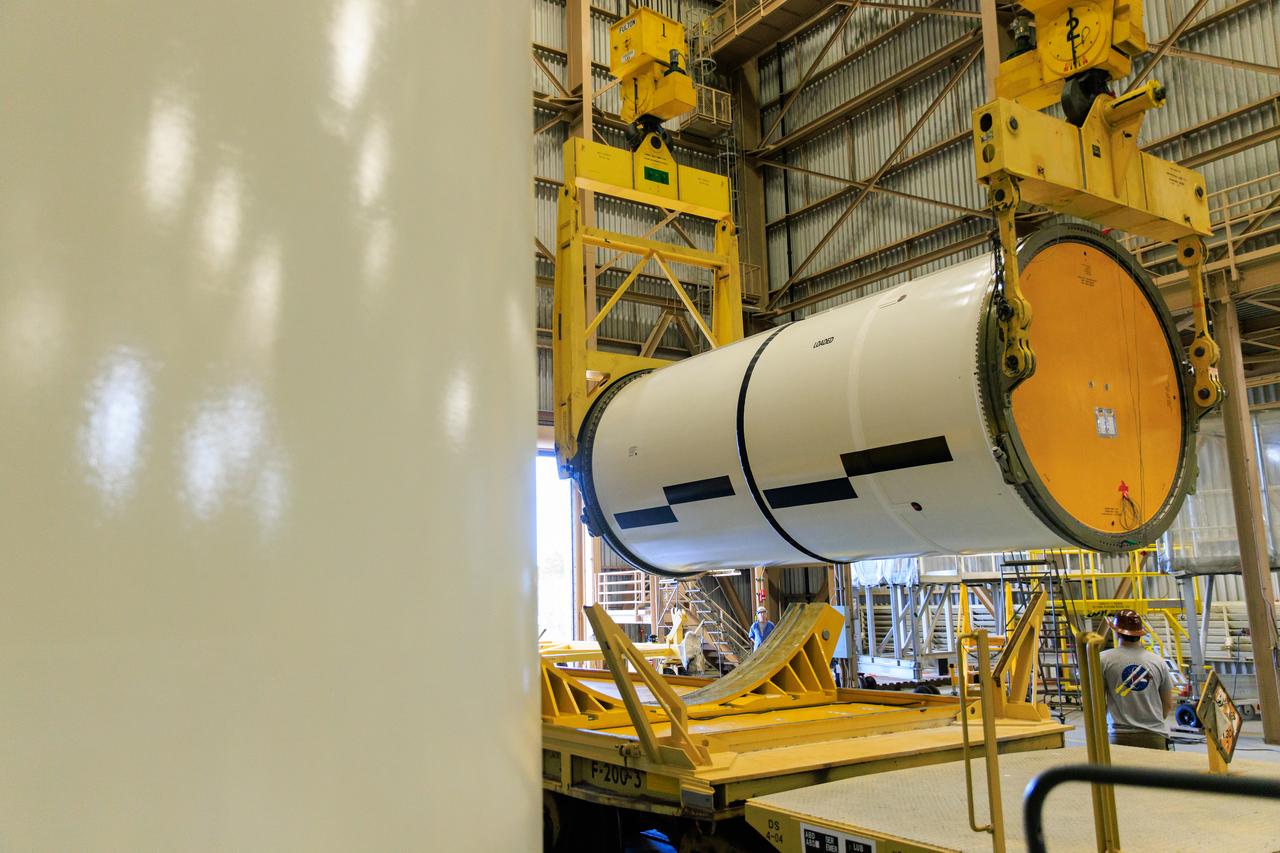
Following the successful propellant grain inspection of two segments of the solid rocket boosters for NASA’s Space Launch System inside the Rotation, Processing and Surge Facility at NASA’s Kennedy Space Center in Florida, crews on Thursday, Dec. 21, 2023, rotate and lift the segments from horizontal into a vertical position in preparation for the agency’s Artemis II launch campaign. The Artemis II mission will send four astronauts around the Moon as part of the agency’s effort to establish a long-term science and exploration presence at the Moon, and eventually Mars.
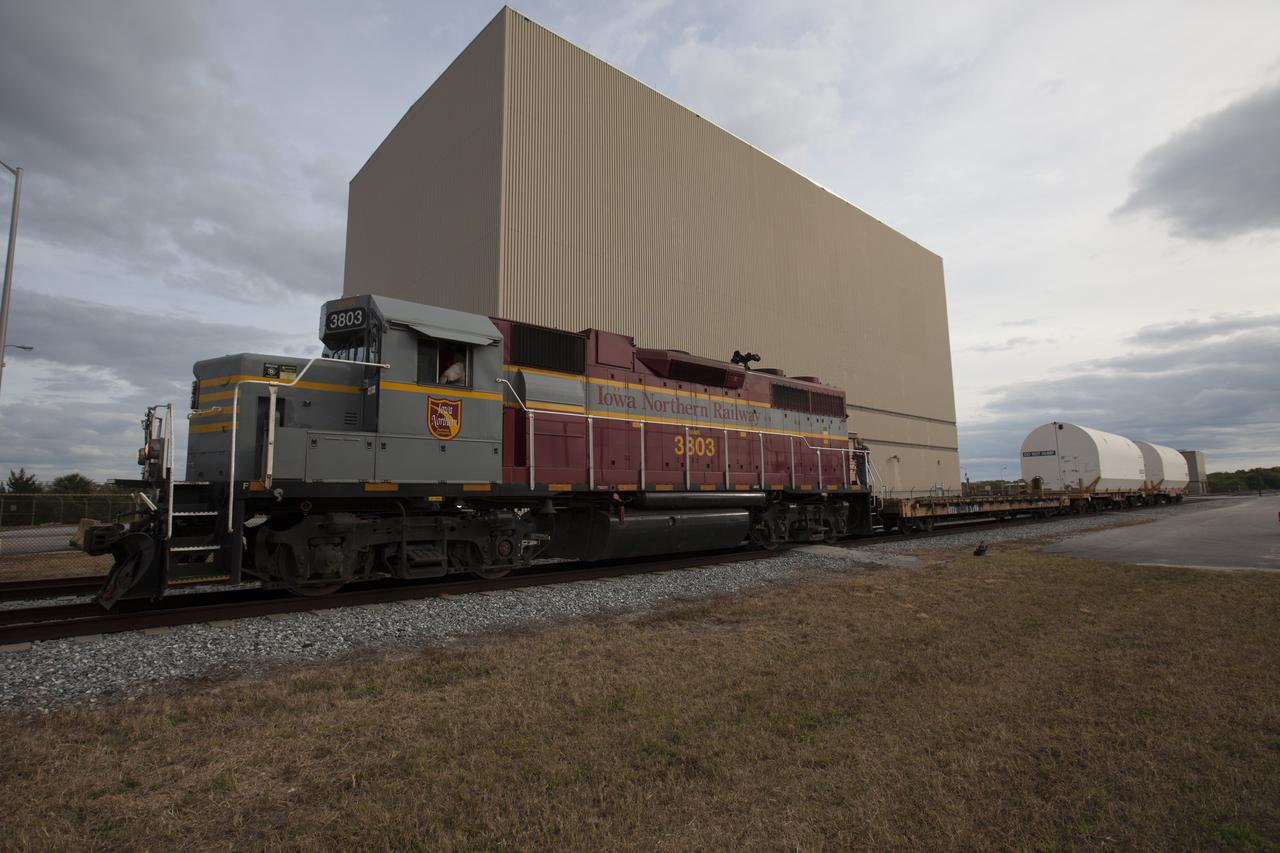
An Iowa Northern locomotive, contracted by Goodloe Transportation of Chicago, departs from the Rotation, Processing and Surge Facility (RPSF) at NASA’s Kennedy Space Center in Florida, with two containers on railcars for transport to the NASA Jay Jay railroad yard. The containers held two pathfinders, or test versions, of solid rocket booster segments for NASA’s Space Launch System rocket that were delivered to the RPSF. Inside the RPSF, the Ground Systems Development and Operations Program and Jacobs Engineering, on the Test and Operations Support Contract, will conduct a series of lifts, moves and stacking operations using the booster segments, which are inert, to prepare for Exploration Mission-1, deep-space missions and the journey to Mars. The pathfinder booster segments are from Orbital ATK in Utah.
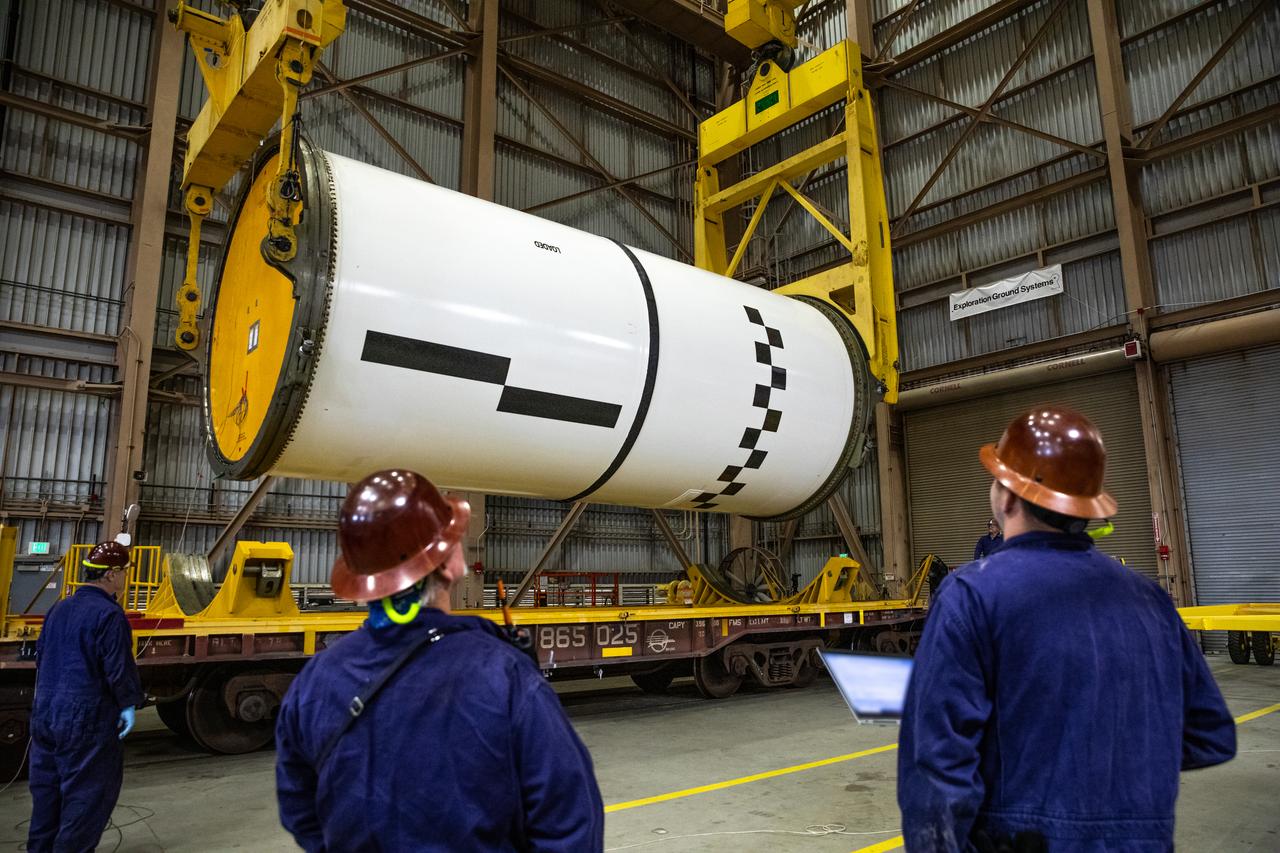
Engineers and technicians process the right forward center segment of the Space Launch System solid rocket boosters for the Artemis II mission inside the Rotation, Processing and Surge Facility (RPSF) at NASA’s Kennedy Space Center in Florida on Tuesday, Nov. 27, 2023. The team has been examining the 10 booster segments one-by-one then lifting them to make sure they are ready for integration and launch before moving them to the Vehicle Assembly Building for stacking atop the mobile launcher. Artemis II astronauts Reid Wiseman, Victor Glover, Christina Koch, and Jeremy Hansen will blast off from Kennedy and travel around the moon for the agency’s first crewed mission under Artemis that will test all of the Orion spacecraft’s systems.
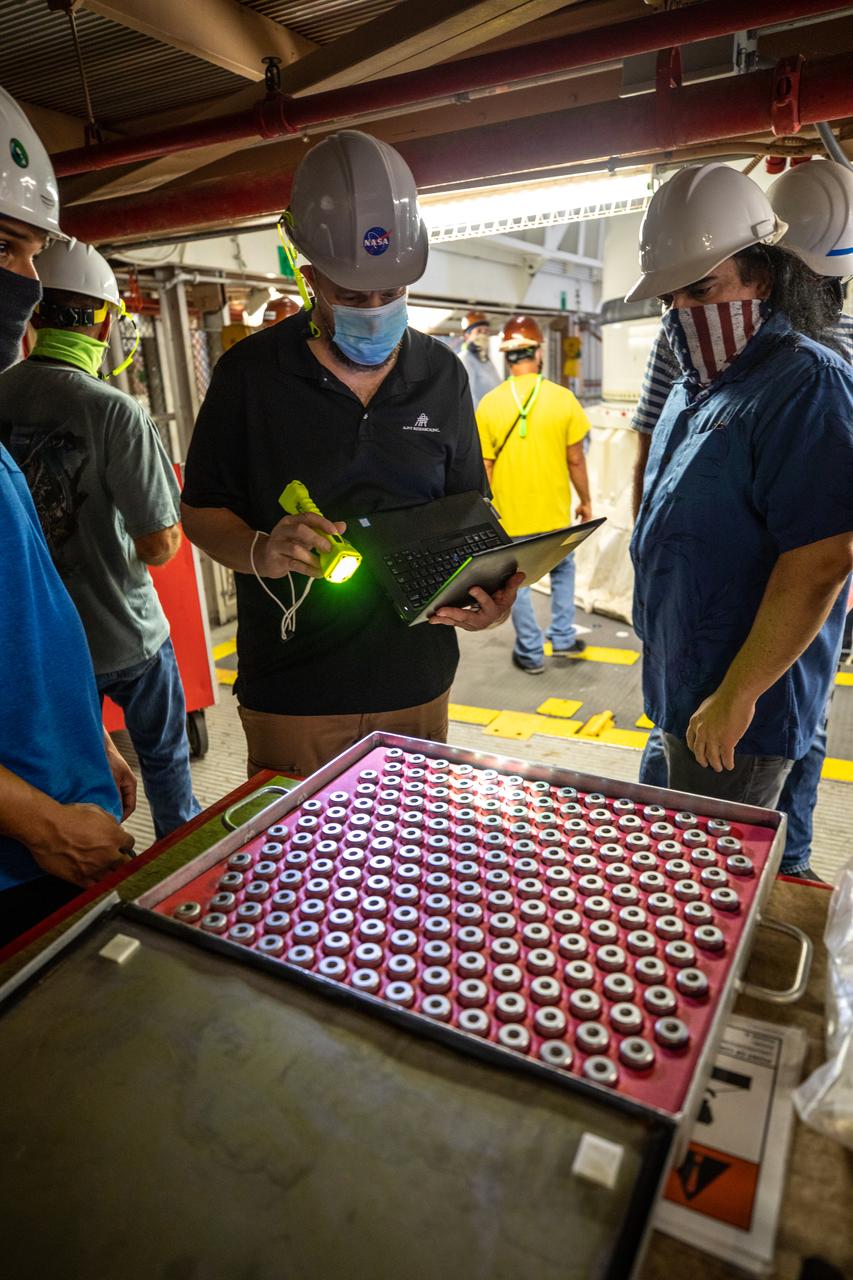
Inside the Rotation, Processing and Surge Facility at NASA’s Kennedy Space Center in Florida, technicians inspect the pins that will be used to secure the right-hand motor segment – one of five segments that make up one of two solid rocket boosters for the agency’s Space Launch System (SLS) – to the right-hand aft skirt on June 24, 2020. Once the aft segments are mated to the two aft skirts, they will be moved to the Vehicle Assembly Building for stacking on the mobile launcher. Manufactured by Northrop Grumman in Utah, the twin boosters provide more than 75 percent of the total SLS thrust at launch. Under the Artemis program, NASA will land the first woman and the next man on the Moon by 2024. The first in a series of increasingly complex missions, Artemis I will test the Orion spacecraft and SLS as an integrated system ahead of crewed flights to the Moon.
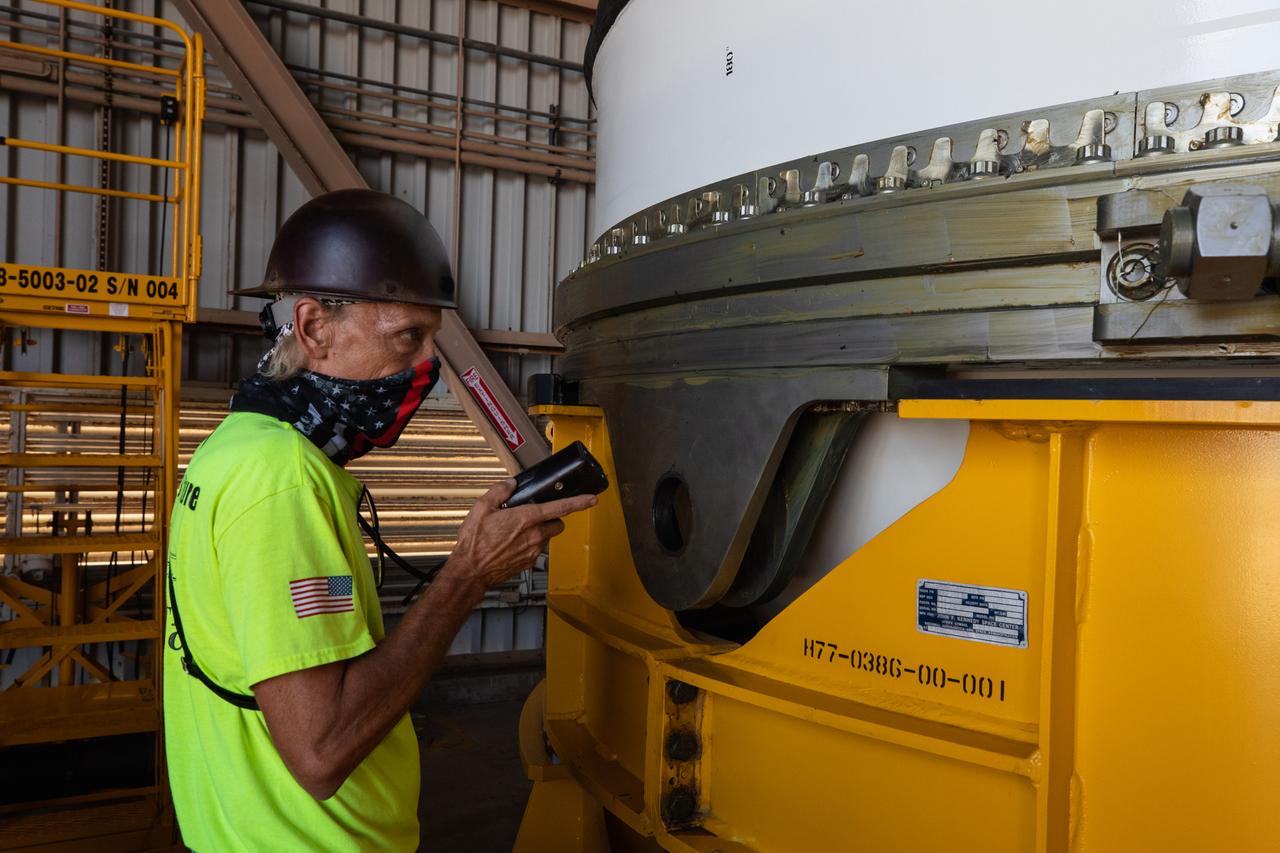
Inside the Rotation, Processing and Surge Facility (RPSF) at NASA’s Kennedy Space Center in Florida, technicians lift the right aft motor segment – one of five segments that make up one of two solid rocket boosters for the agency’s Space Launch System (SLS) – onto an inspection stand on June 23, 2020. While in the RPSF, the boosters will be mated to the rocket’s two aft skirts before they are moved to the Vehicle Assembly Building for stacking on the mobile launcher. The boosters, manufactured by Northrop Grumman in Utah, recently arrived at Kennedy for processing ahead of the Artemis I launch. Together, the twin boosters provide more than 75 percent of the total SLS thrust at launch. The first in a series of increasingly complex missions, Artemis I will test the Orion spacecraft and SLS as an integrated system ahead of crewed flights to the Moon.
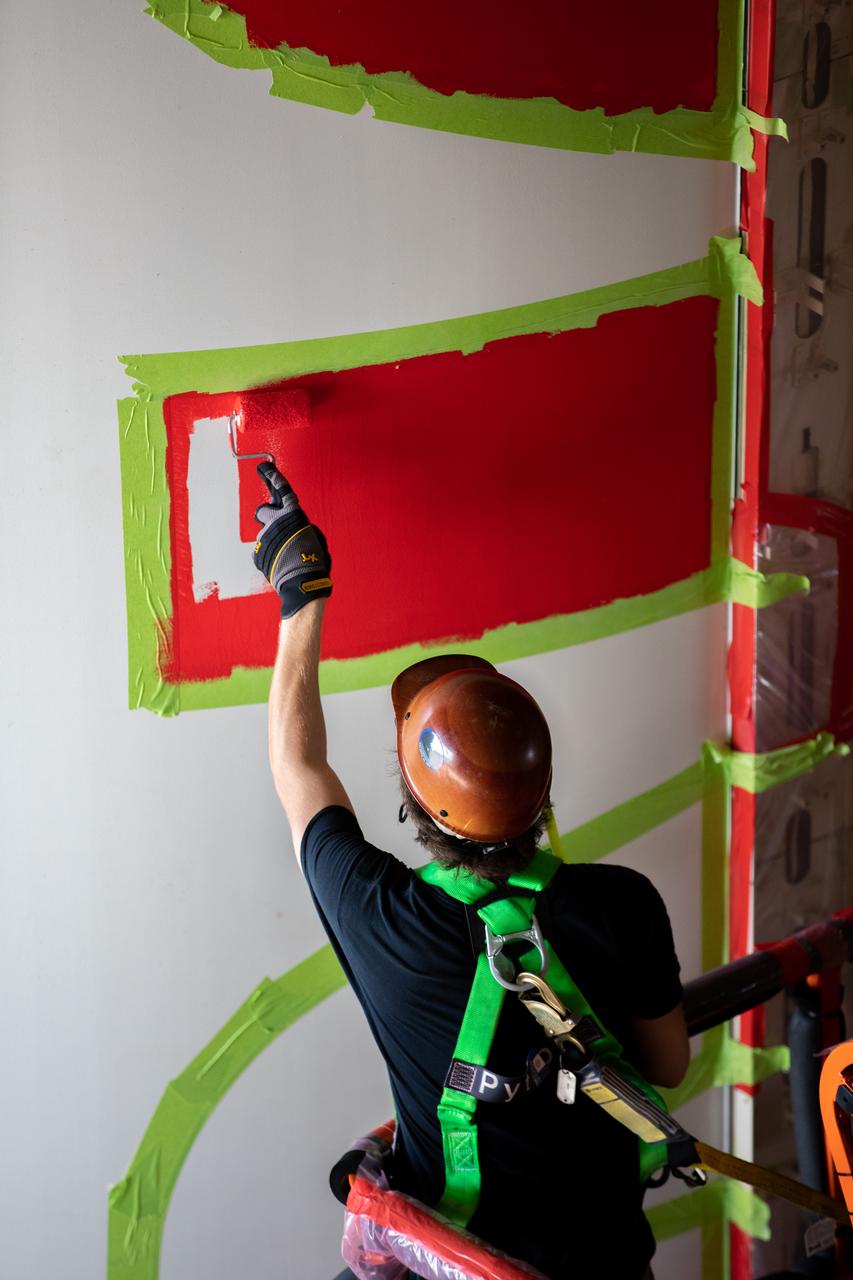
A worker with NASA’s Exploration Ground Systems (EGS) applies bright red paint to the agency’s “worm” logo taking shape on the side of an Artemis I solid rocket booster segment inside the Rotation, Processing and Surge Facility (RPSF) at Kennedy Space Center in Florida. The EGS team used a laser projector to mask off the logo with tape, then painted the first coat of the iconic design. The booster segments will help propel the Space Launch System (SLS) rocket on Artemis I, a test of the Orion spacecraft and SLS as an integrated system ahead of crewed flights to the Moon. Northrop Grumman, which built the booster segments, is covering the cost of the painting.
Inside the Rotation, Processing and Surge Facility (RPSF) at NASA’s Kennedy Space Center in Florida, technicians lift the right aft motor segment – one of five segments that make up one of two solid rocket boosters for the agency’s Space Launch System (SLS) – onto an inspection stand on June 23, 2020. While in the RPSF, the boosters will be mated to the rocket’s two aft skirts before they are moved to the Vehicle Assembly Building for stacking on the mobile launcher. The boosters, manufactured by Northrop Grumman in Utah, recently arrived at Kennedy for processing ahead of the Artemis I launch. Together, the twin boosters provide more than 75 percent of the total SLS thrust at launch. The first in a series of increasingly complex missions, Artemis I will test the Orion spacecraft and SLS as an integrated system ahead of crewed flights to the Moon.
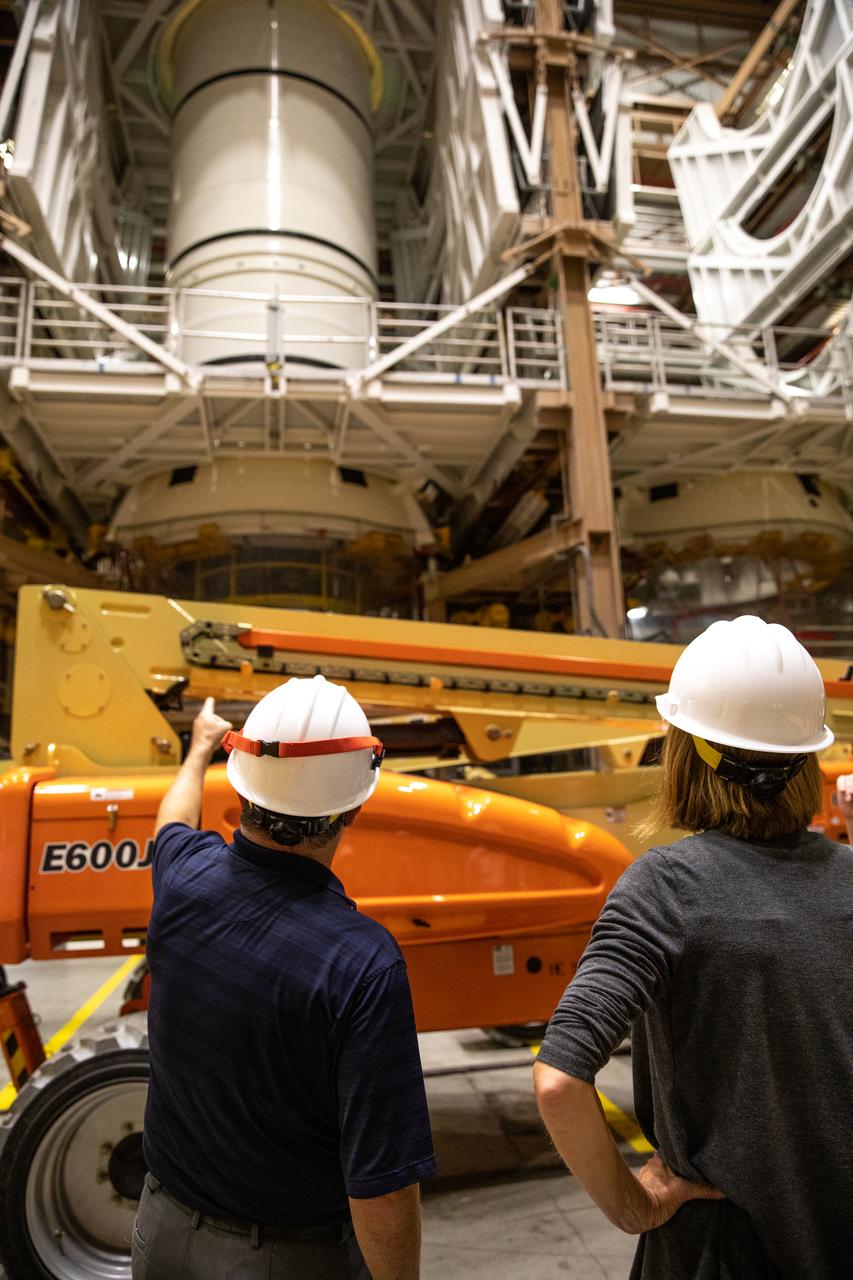
NASA Administrator Jim Bridenstine (second from right), accompanied by Jacobs and Exploration Ground Systems employees, views Artemis I booster hardware inside the Rotation, Processing and Surge Facility at NASA’s Kennedy Space Center in Florida on July 27, 2020. Manufactured by Northrop Grumman in Utah, the boosters for the agency’s Space Launch System (SLS) rocket are now undergoing prelaunch processing at Kennedy. During launch, the twin boosters will provide more than 75 percent of the total SLS thrust. The first in a series of increasingly complex missions, Artemis I will test the Orion spacecraft and SLS as an integrated system ahead of crewed flights to the Moon.
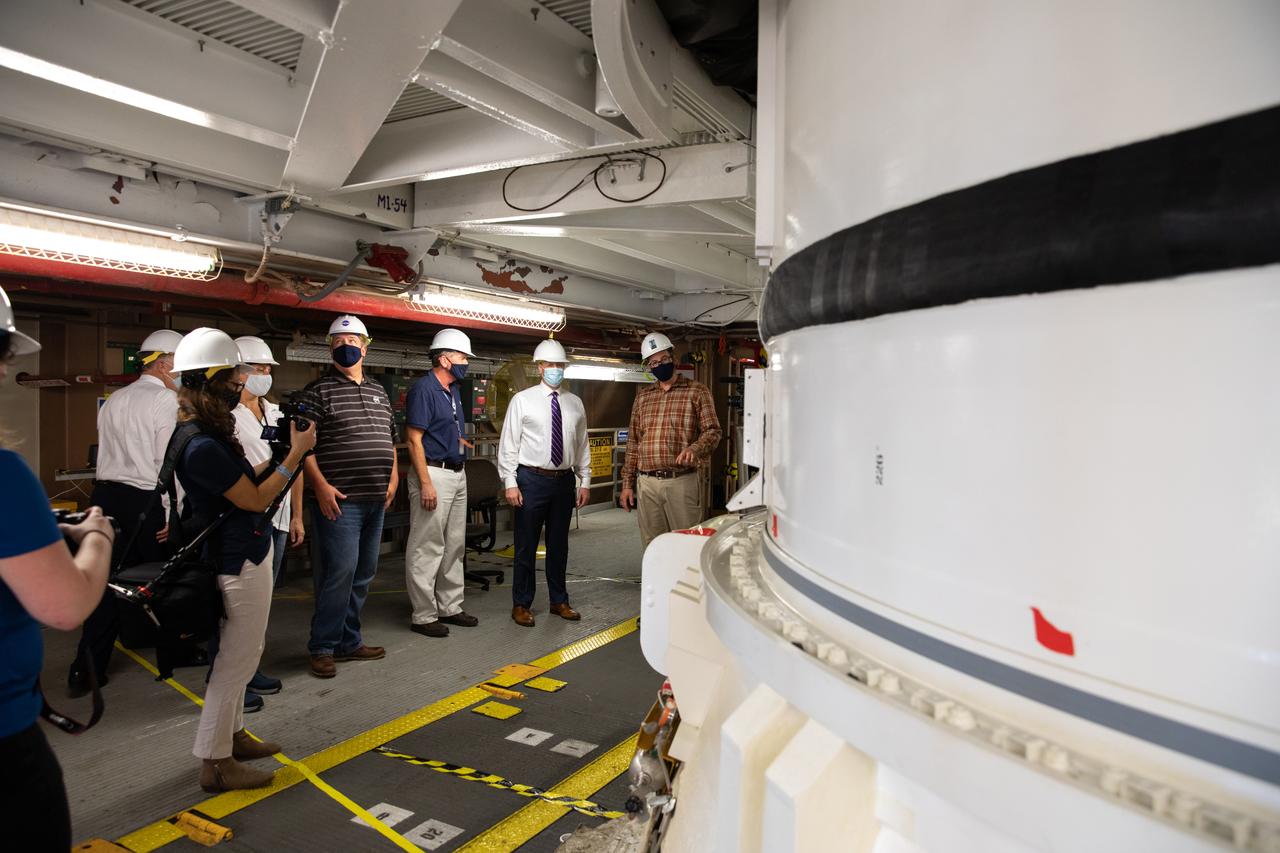
Kathy Lueders, at right, NASA’s associate administrator for Human Exploration and Operations along with members of the Exploration Ground Systems and Jacobs Technology leadership view Artemis hardware inside the Rotation, Processing and Surge Facility (RPSF) at the agency’s Kennedy Space Center in Florida on June 25, 2020. Manufactured by Northrop Grumman in Utah, the solid rocket booster segments for the Space Launch System rocket are in view. The first in a series of increasingly complex missions, Artemis I will test the Orion spacecraft and SLS as an integrated system ahead of crewed flights to the Moon.
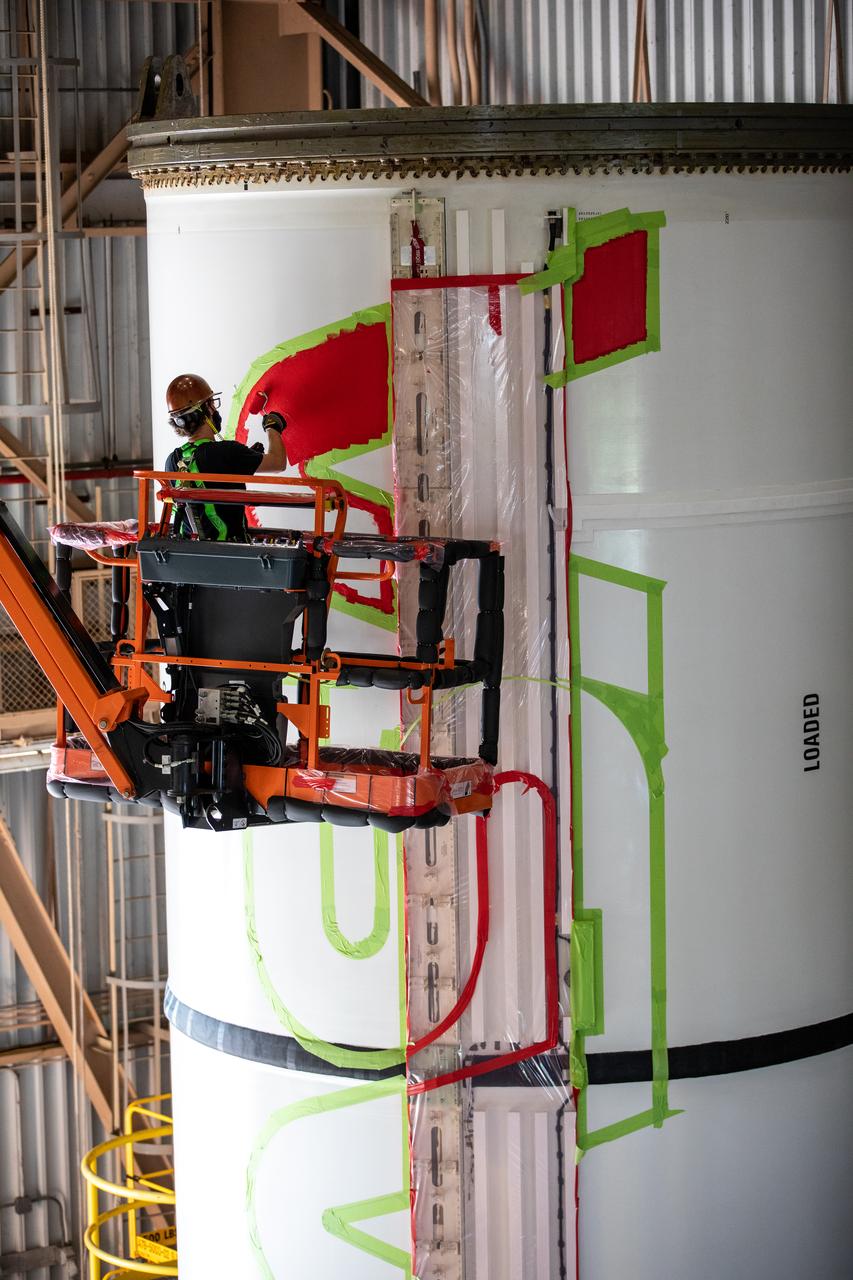
A worker with NASA’s Exploration Ground Systems (EGS) applies bright red paint to the agency’s “worm” logo taking shape on the side of an Artemis I solid rocket booster segment inside the Rotation, Processing and Surge Facility (RPSF) at Kennedy Space Center in Florida. The EGS team used a laser projector to mask off the logo with tape, then painted the first coat of the iconic design. The booster segments will help propel the Space Launch System (SLS) rocket on Artemis I, a test of the Orion spacecraft and SLS as an integrated system ahead of crewed flights to the Moon. Northrop Grumman, which built the booster segments, is covering the cost of the painting.
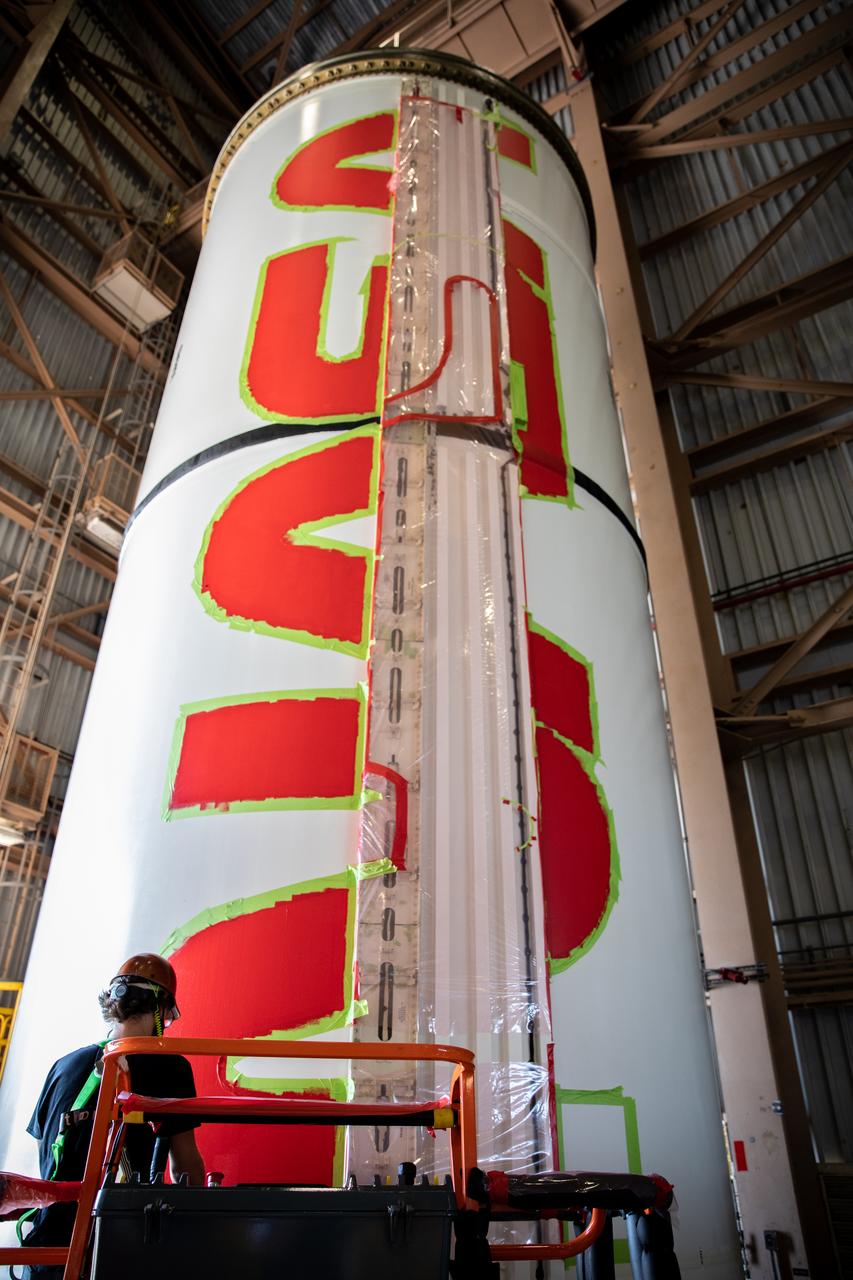
A worker with NASA’s Exploration Ground Systems (EGS) finishes the first coat of the bright red “worm” logo taking shape on the side of an Artemis I solid rocket booster segment inside the Rotation, Processing and Surge Facility (RPSF) at Kennedy Space Center in Florida. The EGS team used a laser projector to mask off the logo with tape, then painted the first coat of the iconic design. The booster segments will help propel the Space Launch System (SLS) rocket on Artemis I, a test of the Orion spacecraft and SLS as an integrated system ahead of crewed flights to the Moon. Northrop Grumman, which built the booster segments, is covering the cost of the painting.
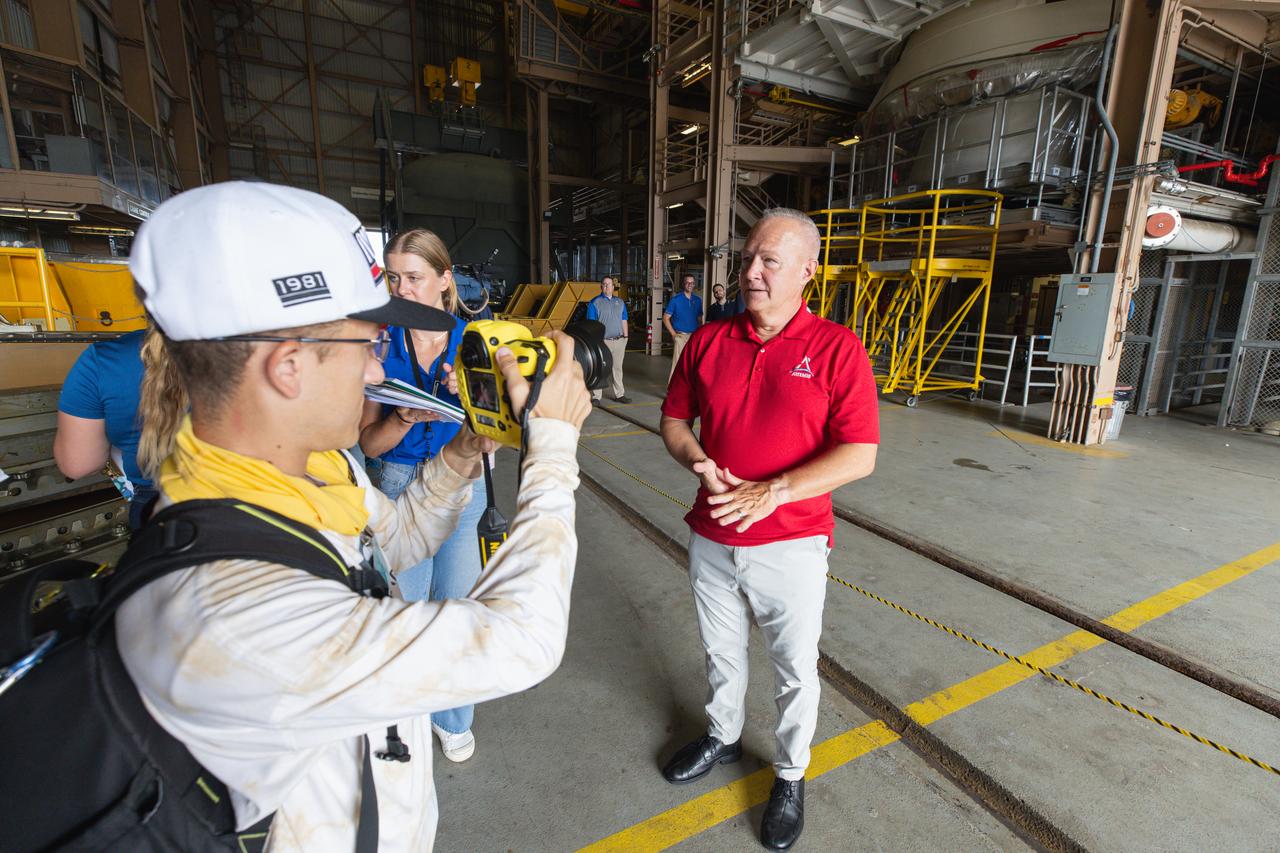
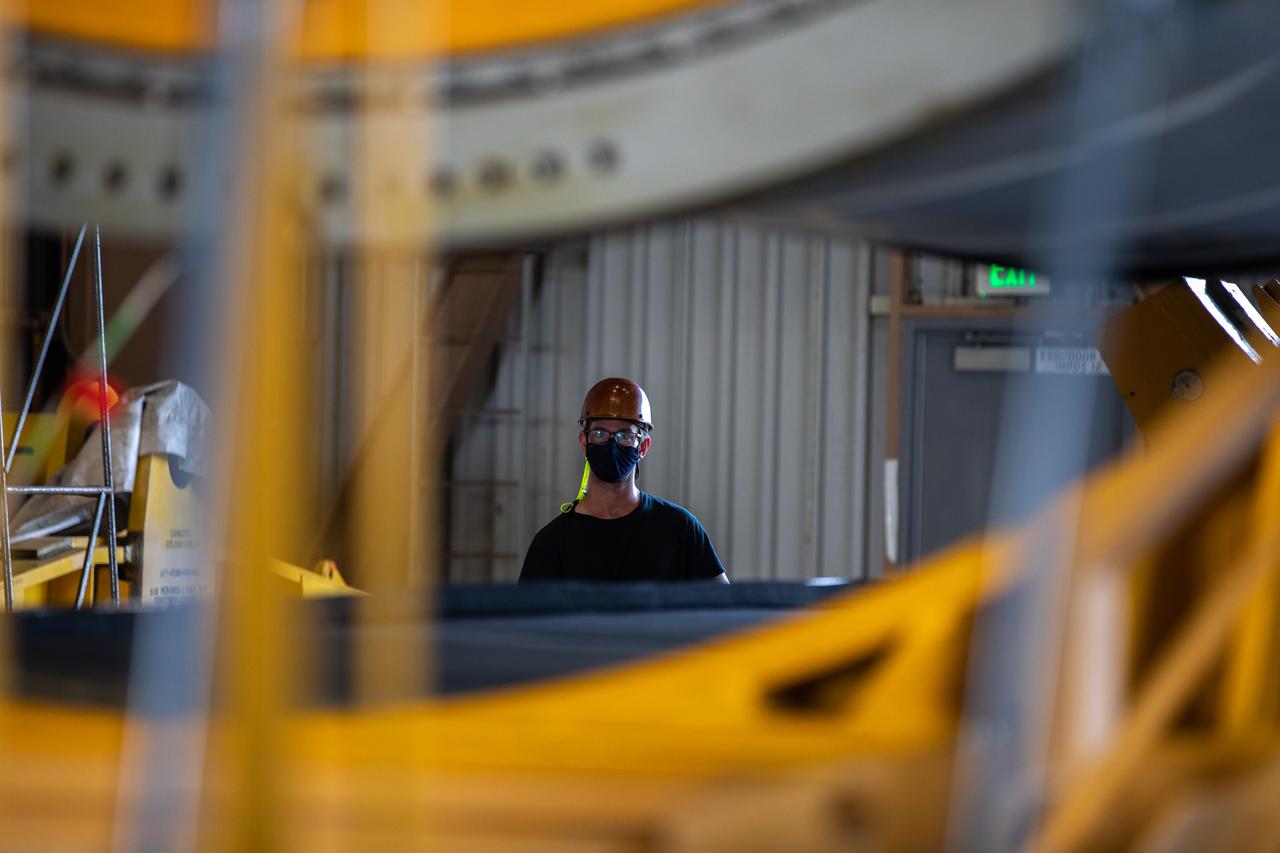
Doug Hurley, senior director at Northrop Grumman and former NASA astronaut, speaks to the media near one of the aft skirts of the solid rocket booster segments inside the Rotation, Processing and Surge Facility (RPSF) at Kennedy Space Center in Florida on Tuesday, July 23, 2024. The booster segments will help propel the SLS (Space Launch System) rocket on the Artemis II mission to send four astronauts around the Moon as part of the agency’s effort to establish a long-term science and exploration presence at the Moon, and eventually Mars.
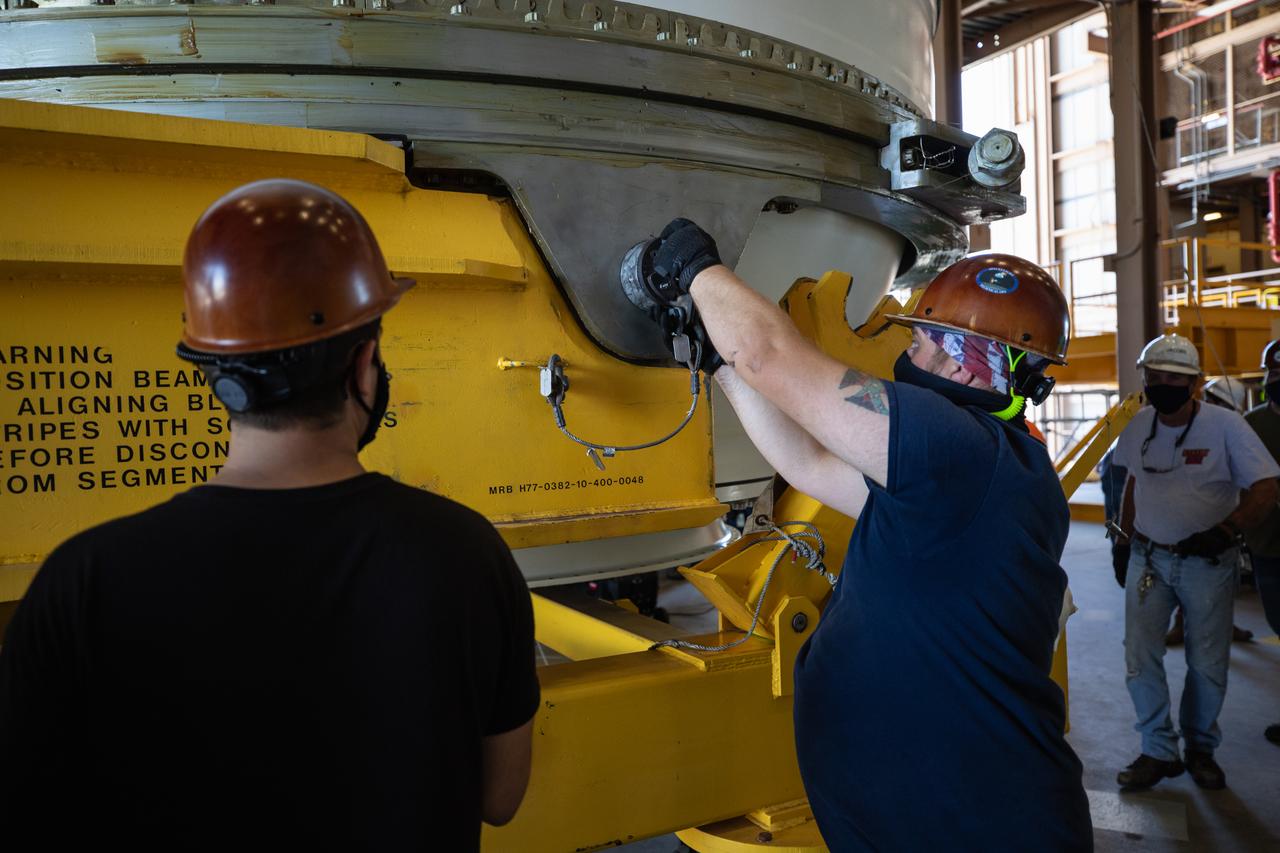
Inside the Rotation, Processing and Surge Facility (RPSF) at NASA’s Kennedy Space Center in Florida, technicians lift the right aft motor segment – one of five segments that make up one of two solid rocket boosters for the agency’s Space Launch System (SLS) – onto an inspection stand on June 23, 2020. While in the RPSF, the boosters will be mated to the rocket’s two aft skirts before they are moved to the Vehicle Assembly Building for stacking on the mobile launcher. The boosters, manufactured by Northrop Grumman in Utah, recently arrived at Kennedy for processing ahead of the Artemis I launch. Together, the twin boosters provide more than 75 percent of the total SLS thrust at launch. The first in a series of increasingly complex missions, Artemis I will test the Orion spacecraft and SLS as an integrated system ahead of crewed flights to the Moon.
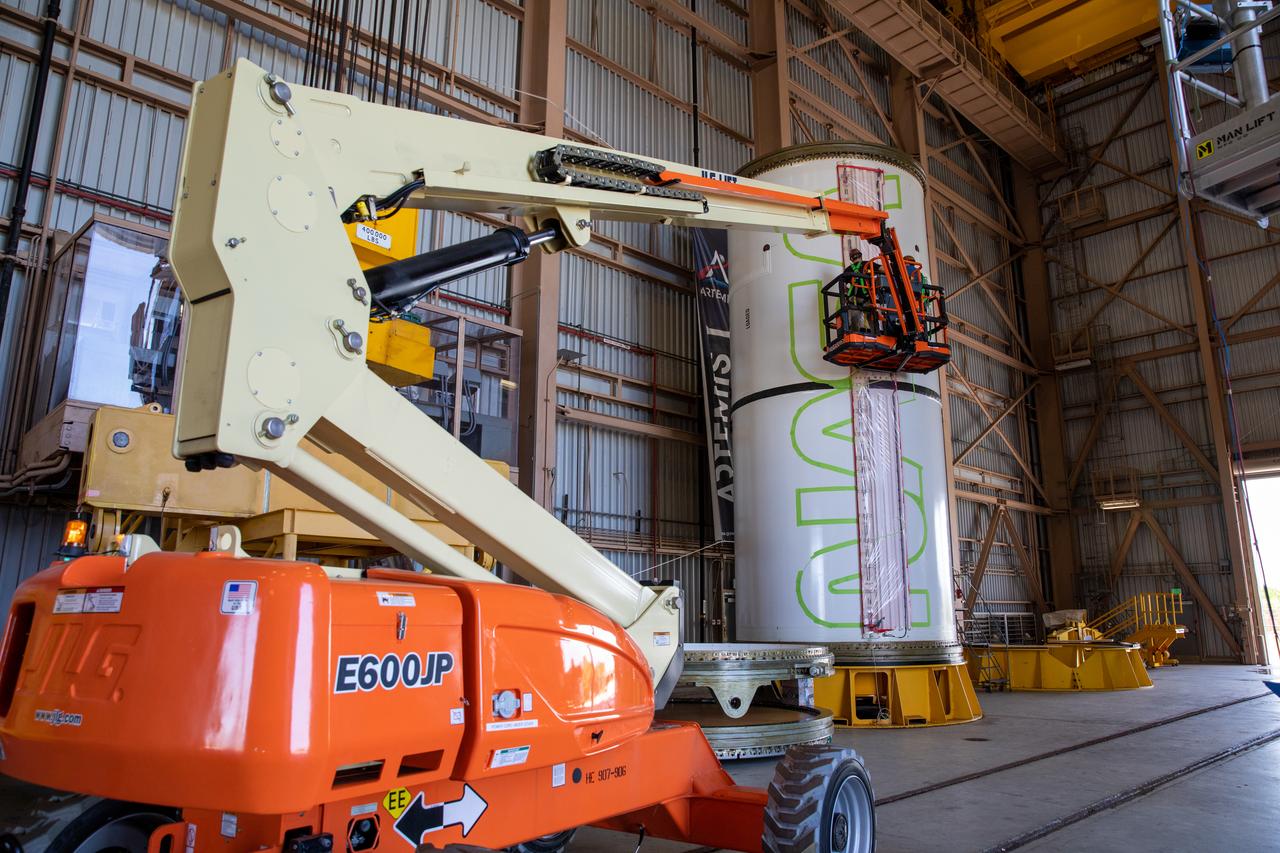
Workers with NASA’s Exploration Ground Systems (EGS) use a laser projector and green tape to mask off the shape of the agency’s “worm” logo on the side of an Artemis I solid rocket booster segment inside the Rotation, Processing and Surge Facility (RPSF) at Kennedy Space Center in Florida, Sept. 3, 2020. The booster segments will help propel the Space Launch System (SLS) rocket on Artemis I, a test of the Orion spacecraft and SLS as an integrated system ahead of crewed flights to the Moon. Northrop Grumman, which built the booster segments, is covering the cost of the painting.
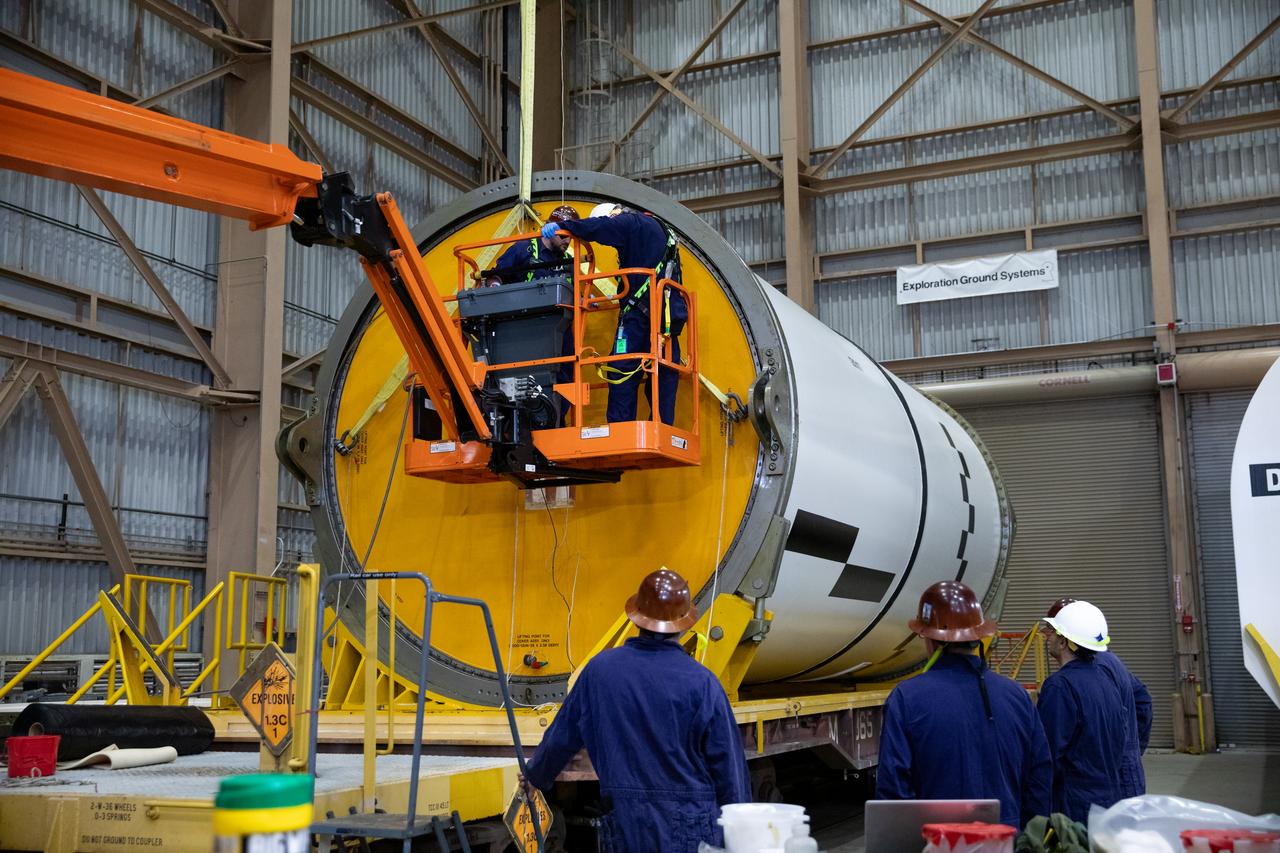
Engineers and technicians process the right forward center segment of the Space Launch System solid rocket boosters for the Artemis II mission inside the Rotation, Processing and Surge Facility (RPSF) at NASA’s Kennedy Space Center in Florida by removing the yellow cap and inspecting propellant on Monday, Nov. 27, 2023. Since arriving via rail in September, the team has been examining each segment one-by-one to make sure they are ready for integration and launch before being moved to the Vehicle Assembly Building for stacking atop the mobile launcher. Artemis II astronauts Reid Wiseman, Victor Glover, Christina Koch, and Jeremy Hansen will blast off from Kennedy and travel around the moon for the agency’s first crewed mission under Artemis that will test all of the Orion spacecraft’s systems.
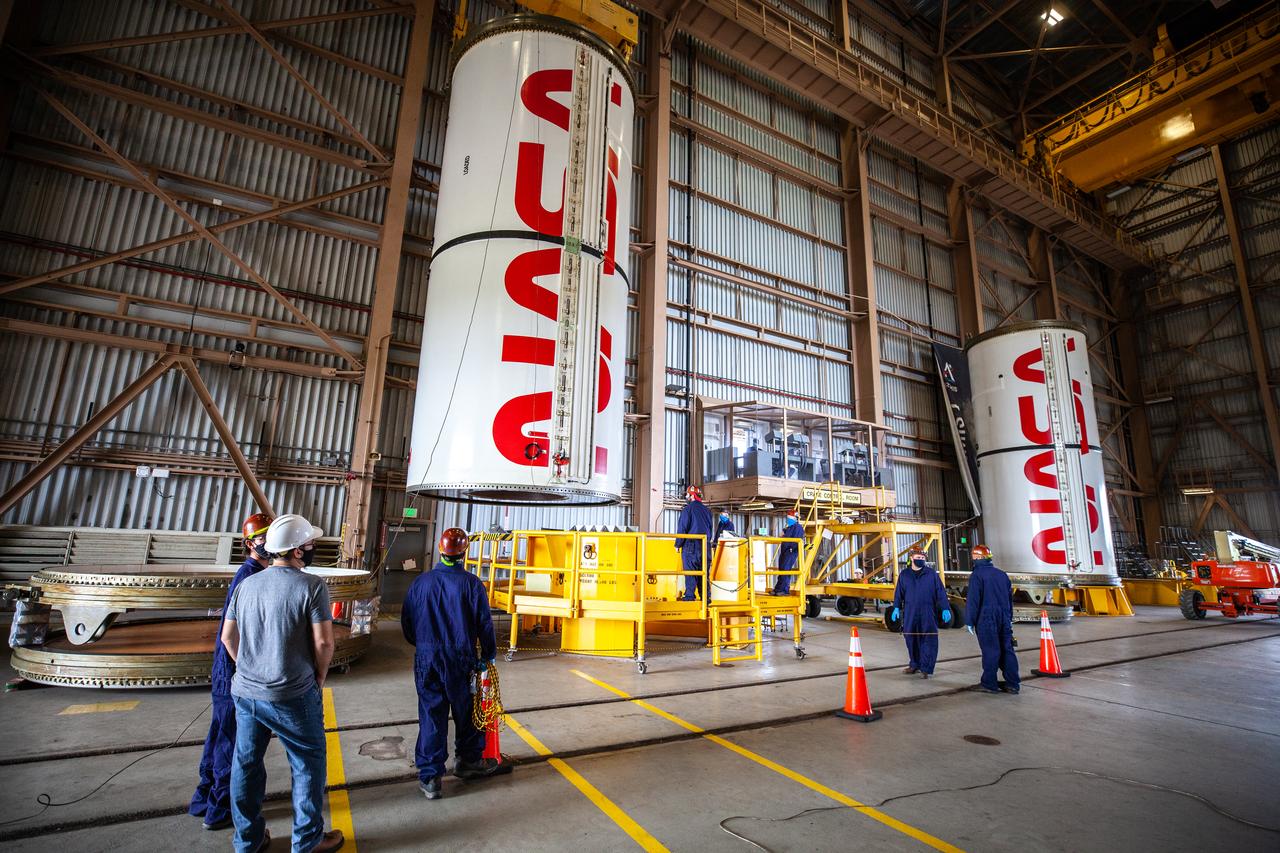
Inside the Rotation, Processing and Surge Facility at NASA’s Kennedy Space Center in Florida, Exploration Ground Systems and Jacobs TOSC workers completed painting of NASA’s iconic “worm” logo on the Artemis I Space Launch System twin solid rocket boosters on Sept. 23, 2020. Originally created by the firm of Danne & Blackburn, the iconic “worm” logo’s bold, sleek design was officially introduced in 1975 and was incorporated into many of the agency’s next-generation programs. It was retired in 1992, but has made a comeback in 2020 as the agency ushers in a new, modern era of human spaceflight. The first in a series of increasingly complex missions, Artemis I will test the Orion spacecraft and Space Launch System as an integrated system ahead of crewed flights to the Moon. Under the Artemis program, NASA will land the first woman and the next man on the Moon by 2024.
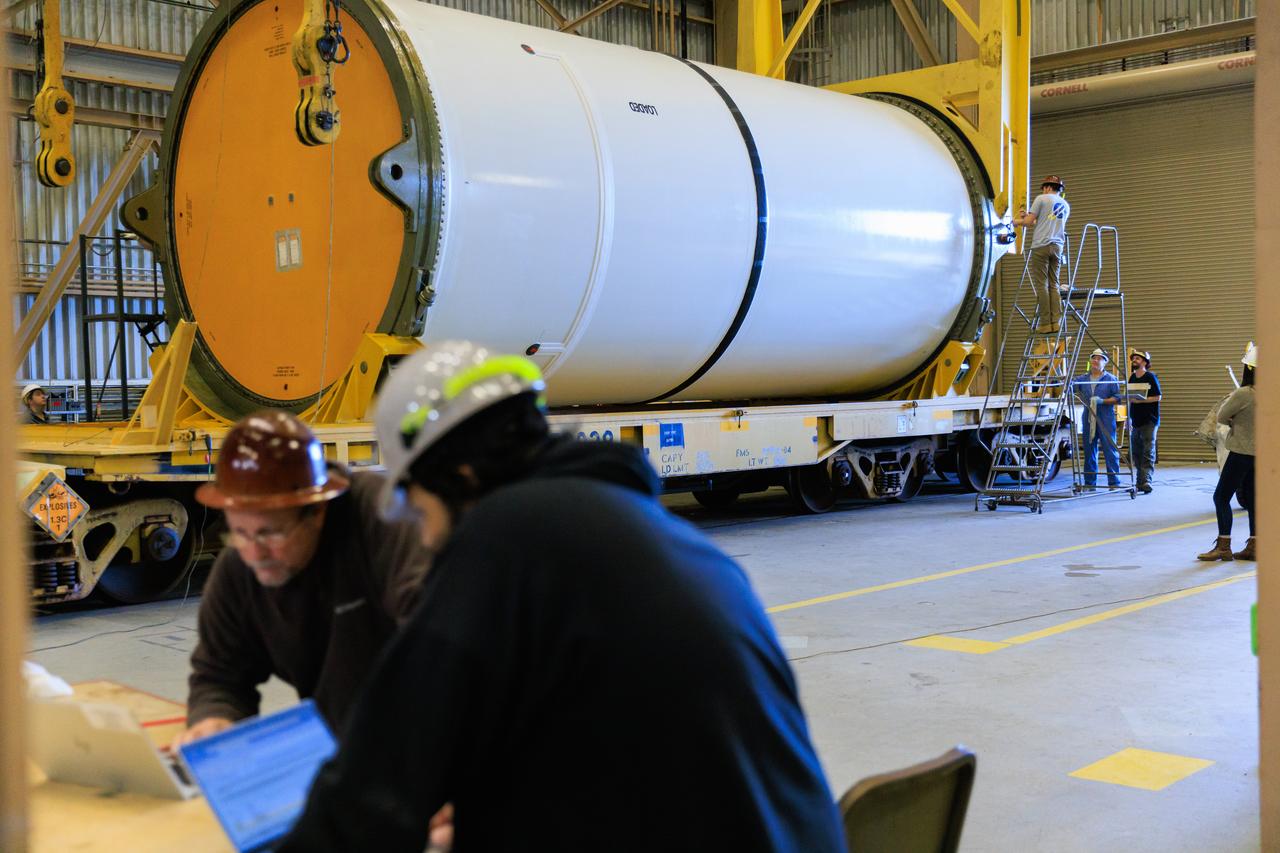
Following the successful propellant grain inspection of two segments of the solid rocket boosters for NASA’s Space Launch System inside the Rotation, Processing and Surge Facility at NASA’s Kennedy Space Center in Florida, crews on Thursday, Dec. 21, 2023, rotate and lift the segments from horizontal into a vertical position in preparation for the agency’s Artemis II launch campaign. The Artemis II mission will send four astronauts around the Moon as part of the agency’s effort to establish a long-term science and exploration presence at the Moon, and eventually Mars.
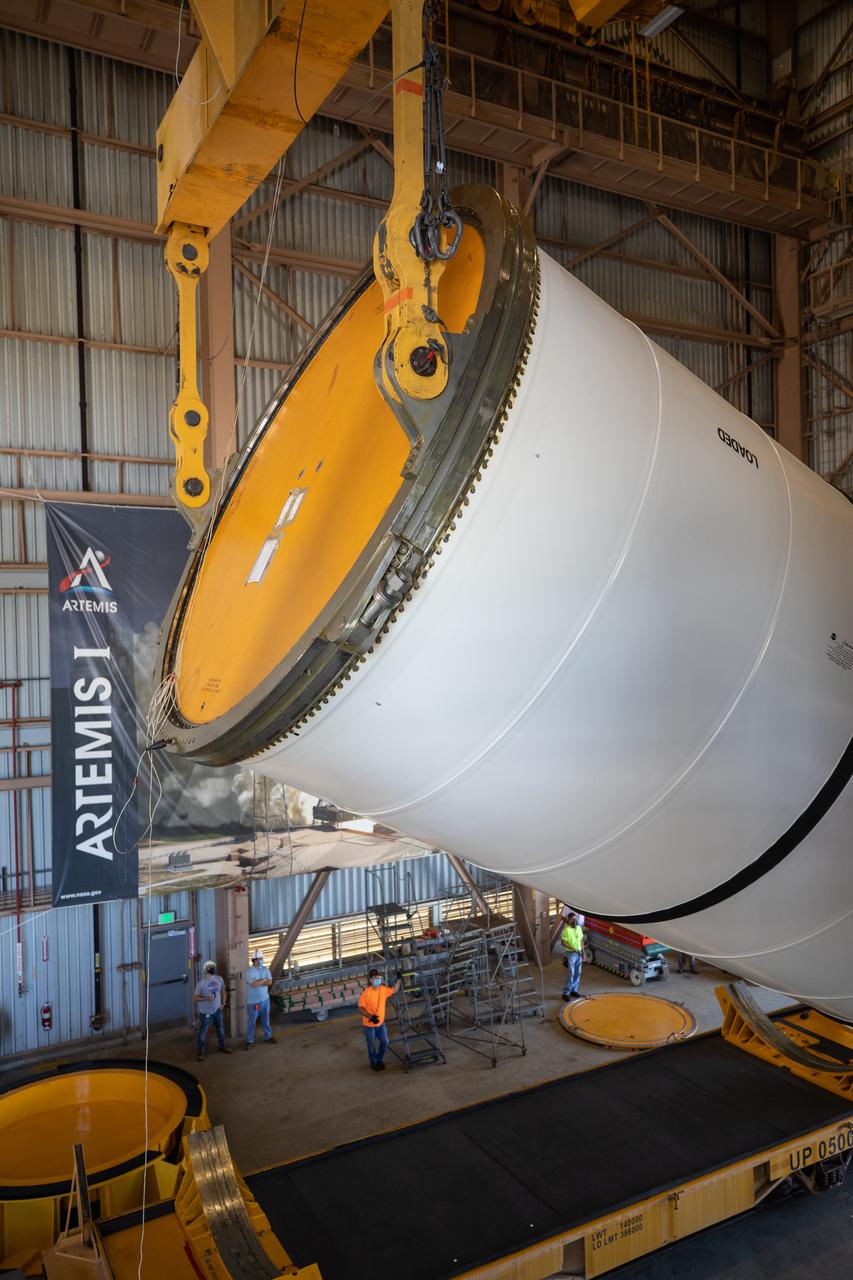
Inside the Rotation, Processing and Surge Facility (RPSF) at NASA’s Kennedy Space Center in Florida, technicians lift the right aft motor segment – one of five segments that make up one of two solid rocket boosters for the agency’s Space Launch System (SLS) – onto an inspection stand on June 23, 2020. While in the RPSF, the boosters will be mated to the rocket’s two aft skirts before they are moved to the Vehicle Assembly Building for stacking on the mobile launcher. The boosters, manufactured by Northrop Grumman in Utah, recently arrived at Kennedy for processing ahead of the Artemis I launch. Together, the twin boosters provide more than 75 percent of the total SLS thrust at launch. The first in a series of increasingly complex missions, Artemis I will test the Orion spacecraft and SLS as an integrated system ahead of crewed flights to the Moon.
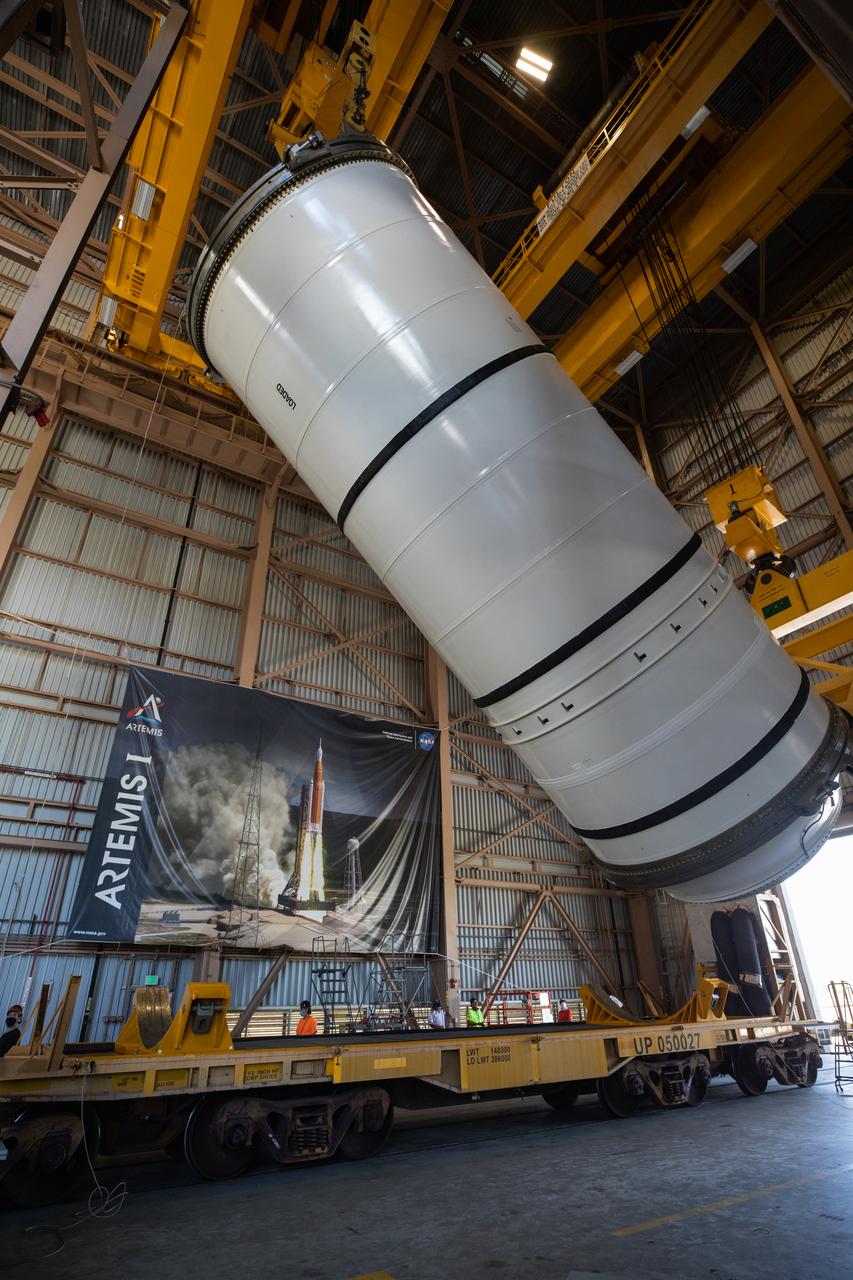
Inside the Rotation, Processing and Surge Facility (RPSF) at NASA’s Kennedy Space Center in Florida, technicians lift the right aft motor segment – one of five segments that make up one of two solid rocket boosters for the agency’s Space Launch System (SLS) – onto an inspection stand on June 23, 2020. While in the RPSF, the boosters will be mated to the rocket’s two aft skirts before they are moved to the Vehicle Assembly Building for stacking on the mobile launcher. The boosters, manufactured by Northrop Grumman in Utah, recently arrived at Kennedy for processing ahead of the Artemis I launch. Together, the twin boosters provide more than 75 percent of the total SLS thrust at launch. The first in a series of increasingly complex missions, Artemis I will test the Orion spacecraft and SLS as an integrated system ahead of crewed flights to the Moon.
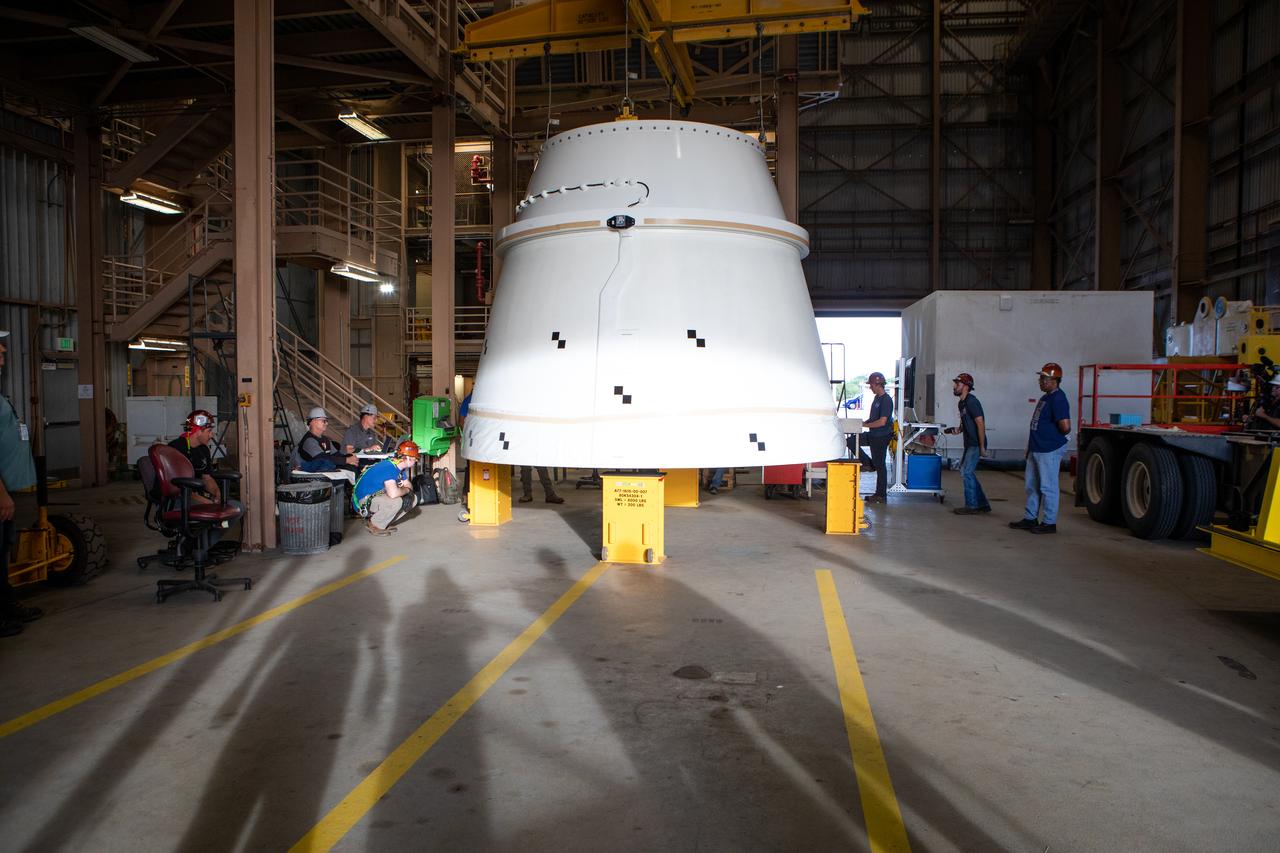
The Northrop Grumman-manufactured right aft exit cone, the second of two for the Space Launch System’s solid rocket boosters, is in view inside the Rotation, Processing and Surge Facility at NASA’s Kennedy Space Center in Florida on Dec. 9, 2019. The aft exit cone was shipped from Promontory, Utah. It will be checked out and prepared for the Artemis I uncrewed test flight. The aft exit cones sit at the bottommost part of the twin boosters. The cones help provide added thrust for the boosters, while protecting the aft skirts from the thermal environment during launch.

Workers with NASA’s Exploration Ground Systems and primary contractor, Jacobs, complete the painting of the agency’s iconic “worm” logo along the side of the twin Artemis II solid rocket booster motor segments inside the Rotation, Processing and Surge Facility at Kennedy Space Center in Florida on Friday, Feb. 16, 2024. Using a laser projector, the logo was mapped out with tape by workers with Jacobs, for the spaceport, before using two coats of red paint, plus several coats of clear primer to complete the logo that stretches 25 feet long. The booster segments will help propel the SLS (Space Launch System) rocket on the Artemis II mission to send four astronauts around the Moon as part of the agency’s effort to establish a long-term science and exploration presence at the Moon, and eventually Mars.
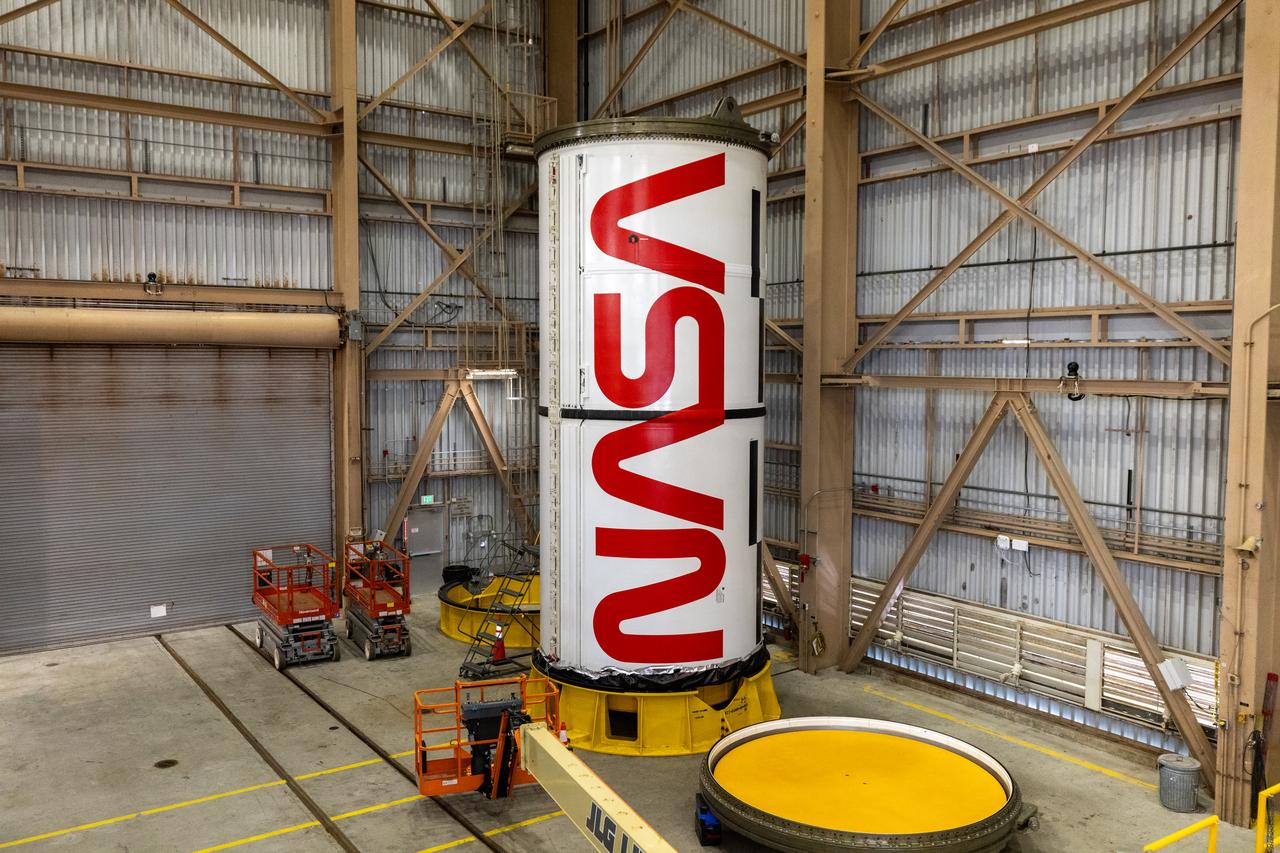
Workers with NASA’s Exploration Ground Systems and primary contractor, Jacobs, complete the painting of the agency’s iconic “worm” logo along the side of the twin Artemis II solid rocket booster motor segments inside the Rotation, Processing and Surge Facility at Kennedy Space Center in Florida on Friday, Feb. 16, 2024. Using a laser projector, the logo was mapped out with tape by workers with Jacobs, for the spaceport, before using two coats of red paint, plus several coats of clear primer to complete the logo that stretches 25 feet long. The booster segments will help propel the SLS (Space Launch System) rocket on the Artemis II mission to send four astronauts around the Moon as part of the agency’s effort to establish a long-term science and exploration presence at the Moon, and eventually Mars.
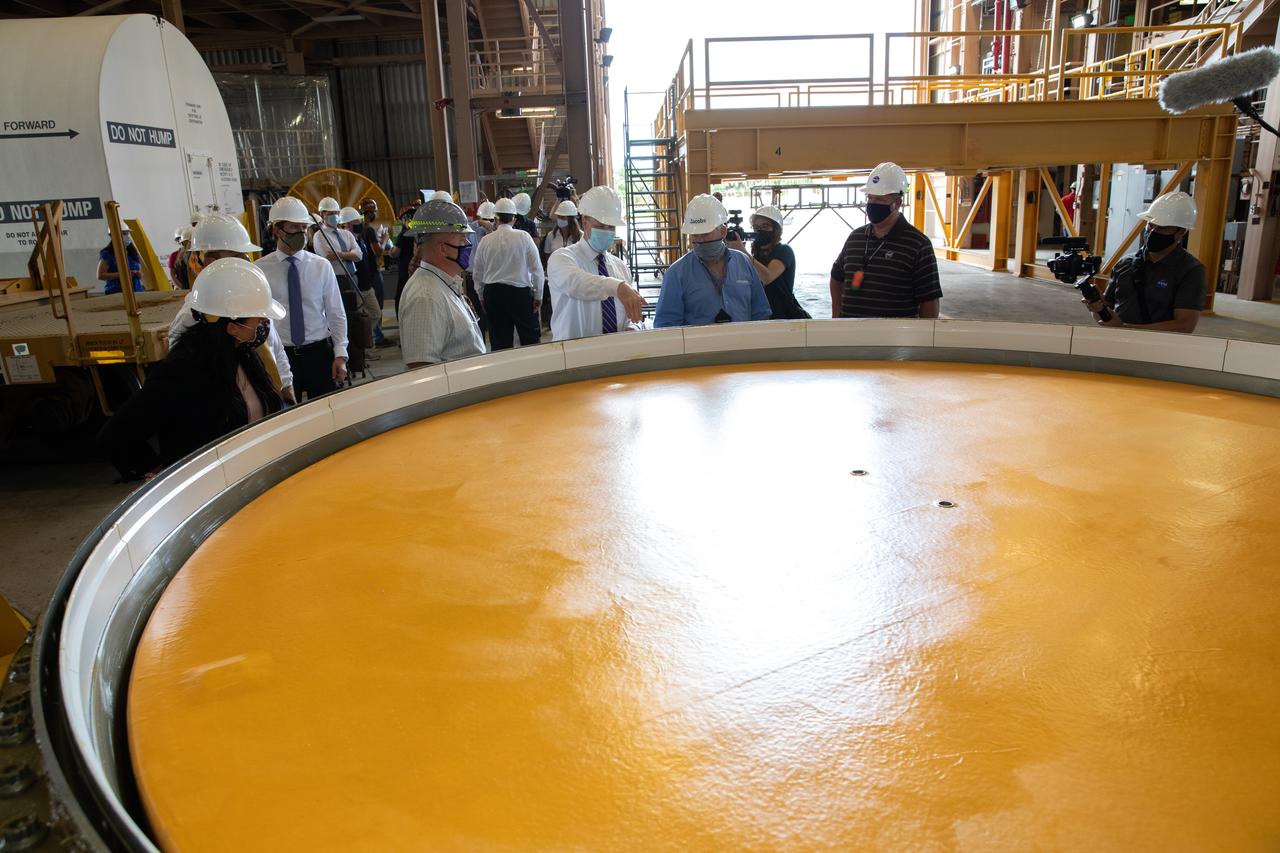
NASA Administrator Jim Bridenstine (center), accompanied by Jacobs and Exploration Ground Systems employees, views Artemis I booster hardware inside the Rotation, Processing and Surge Facility at NASA’s Kennedy Space Center in Florida on July 27, 2020. Manufactured by Northrop Grumman in Utah, the boosters for the agency’s Space Launch System (SLS) rocket are now undergoing prelaunch processing at Kennedy. During launch, the twin boosters will provide more than 75 percent of the total SLS thrust. The first in a series of increasingly complex missions, Artemis I will test the Orion spacecraft and SLS as an integrated system ahead of crewed flights to the Moon.

Inside the Rotation, Processing and Surge Facility at NASA’s Kennedy Space Center in Florida, the right-hand motor segment – one of five segments that make up one of two solid rocket boosters for the agency’s Space Launch System (SLS) – is mated to the rocket’s right-hand aft skirt on June 24, 2020. Once the aft segments are mated to the two aft skirts, they will be moved to the Vehicle Assembly Building for stacking on the mobile launcher. Manufactured by Northrop Grumman in Utah, the twin boosters provide more than 75 percent of the total SLS thrust at launch. Under the Artemis program, NASA will land the first woman and the next man on the Moon by 2024. The first in a series of increasingly complex missions, Artemis I will test the Orion spacecraft and SLS as an integrated system ahead of crewed flights to the Moon.
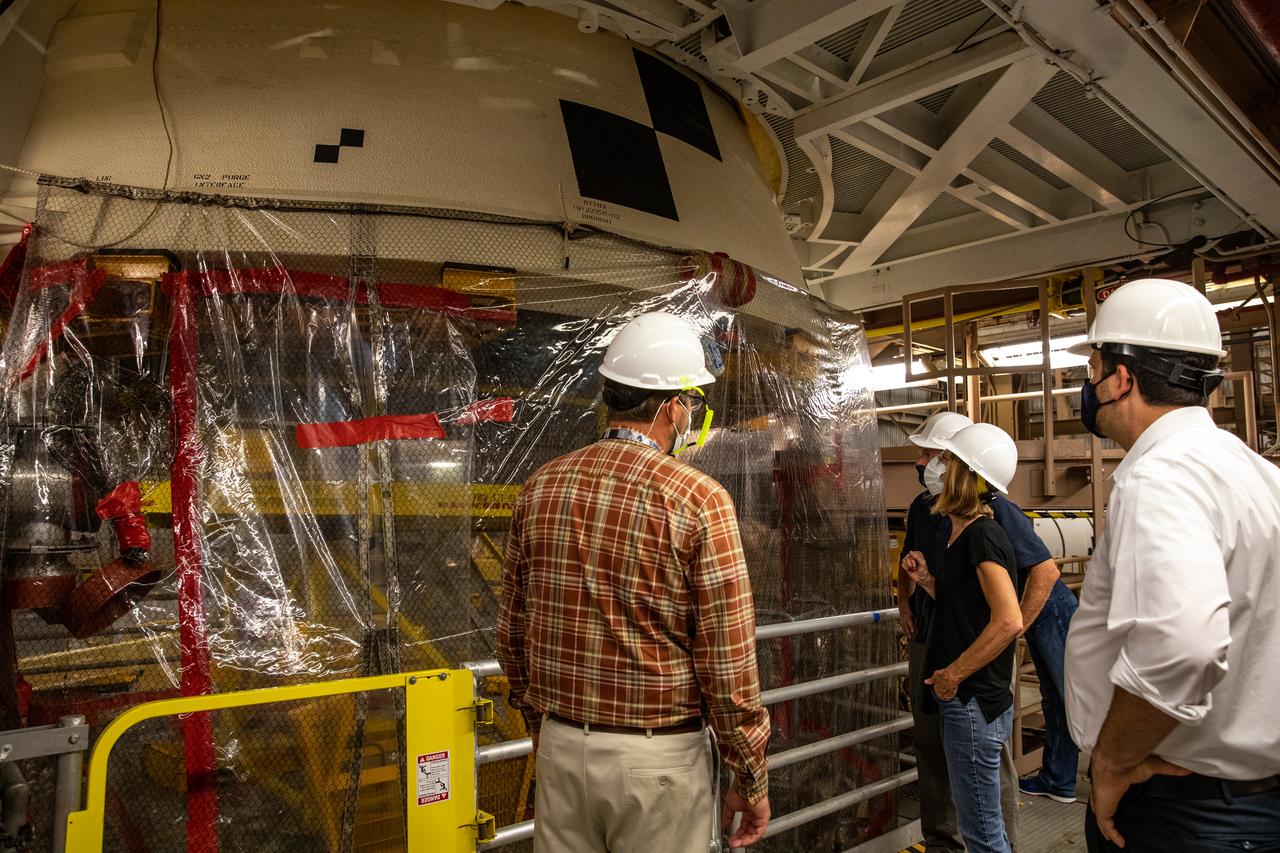
Kathy Lueders, second from right, NASA’s associate administrator for Human Exploration and Operations, along with members of the Exploration Ground Systems and Jacobs Technology leadership view Artemis hardware inside the Rotation, Processing and Surge Facility (RPSF) at the agency’s Kennedy Space Center in Florida on June 25, 2020. Manufactured by Northrop Grumman in Utah, the solid rocket booster segments for the Space Launch System rocket are in view. The first in a series of increasingly complex missions, Artemis I will test the Orion spacecraft and SLS as an integrated system ahead of crewed flights to the Moon.
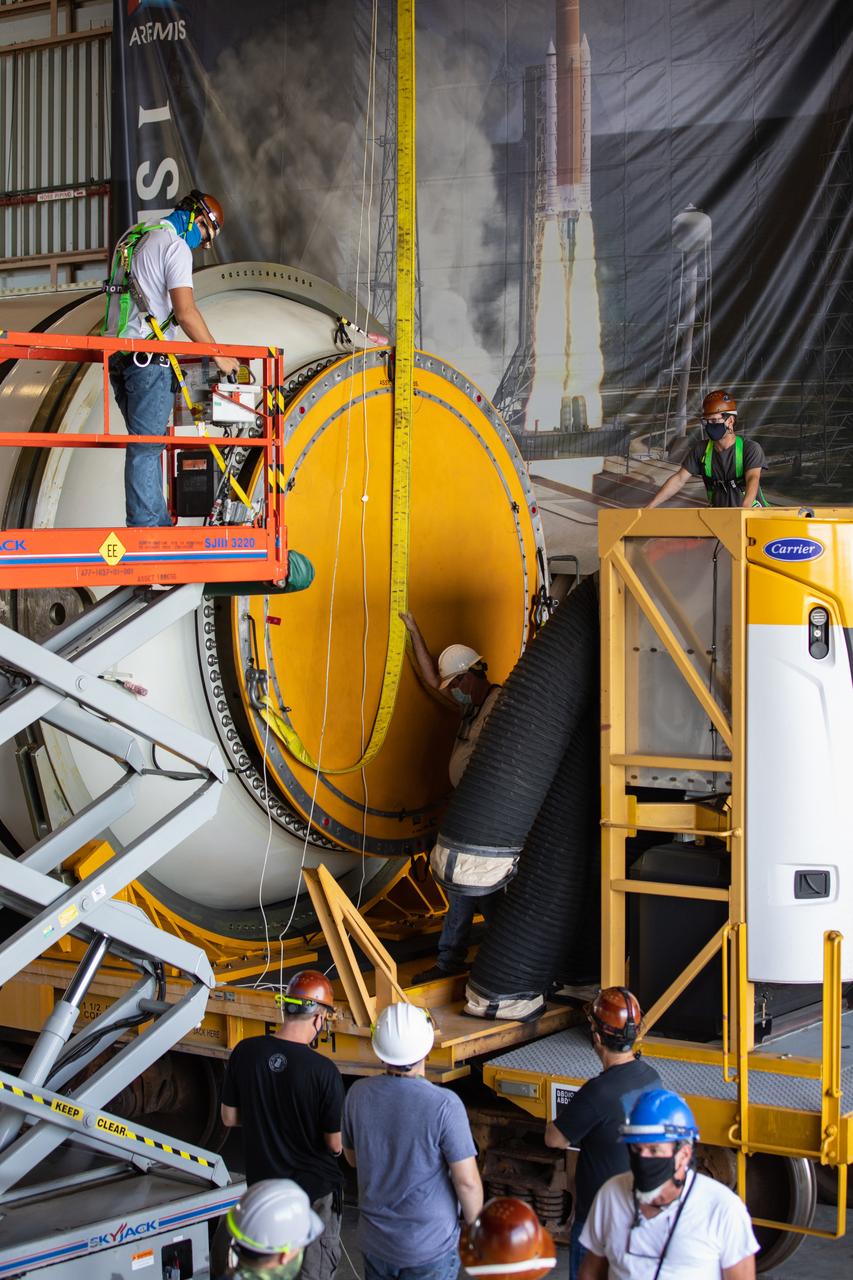
Technicians ready two NASA Space Launch System (SLS) solid rocket boosters for mating to the rocket’s two aft skirts on June 16, 2020, inside Kennedy Space Center’s Rotation, Processing and Surge Facility. Together, the twin boosters provide more than 75 percent of the total SLS thrust at launch. Manufactured by Northrop Grumman in Promontory, Utah, the boosters arrived at Kennedy via train. The cross-country journey was an important milestone for the agency’s Artemis I launch. The first in a series of increasingly complex missions, Artemis I will test the Orion spacecraft and SLS as an integrated system prior to crewed missions to the Moon. Once the boosters are mated with the aft skirts, they will be moved to the Vehicle Assembly Building for stacking on the mobile launcher.
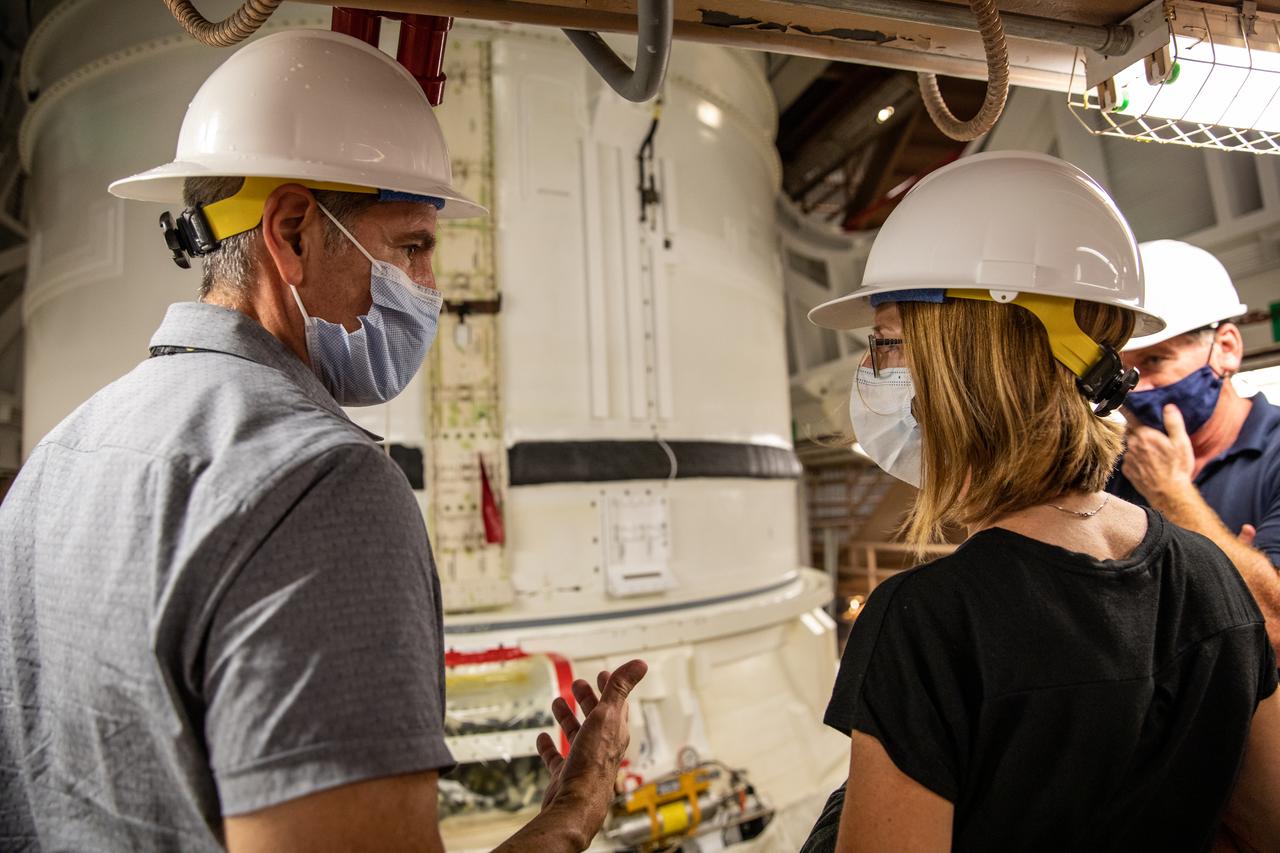
Kathy Lueders, at right, NASA’s associate administrator for Human Exploration and Operations, along with members of the Exploration Ground Systems and Jacobs Technology leadership view Artemis hardware inside the Rotation, Processing and Surge Facility (RPSF) at the agency’s Kennedy Space Center in Florida on June 25, 2020. Manufactured by Northrop Grumman in Utah, the solid rocket booster segments for the Space Launch System rocket are in view. The first in a series of increasingly complex missions, Artemis I will test the Orion spacecraft and SLS as an integrated system ahead of crewed flights to the Moon.
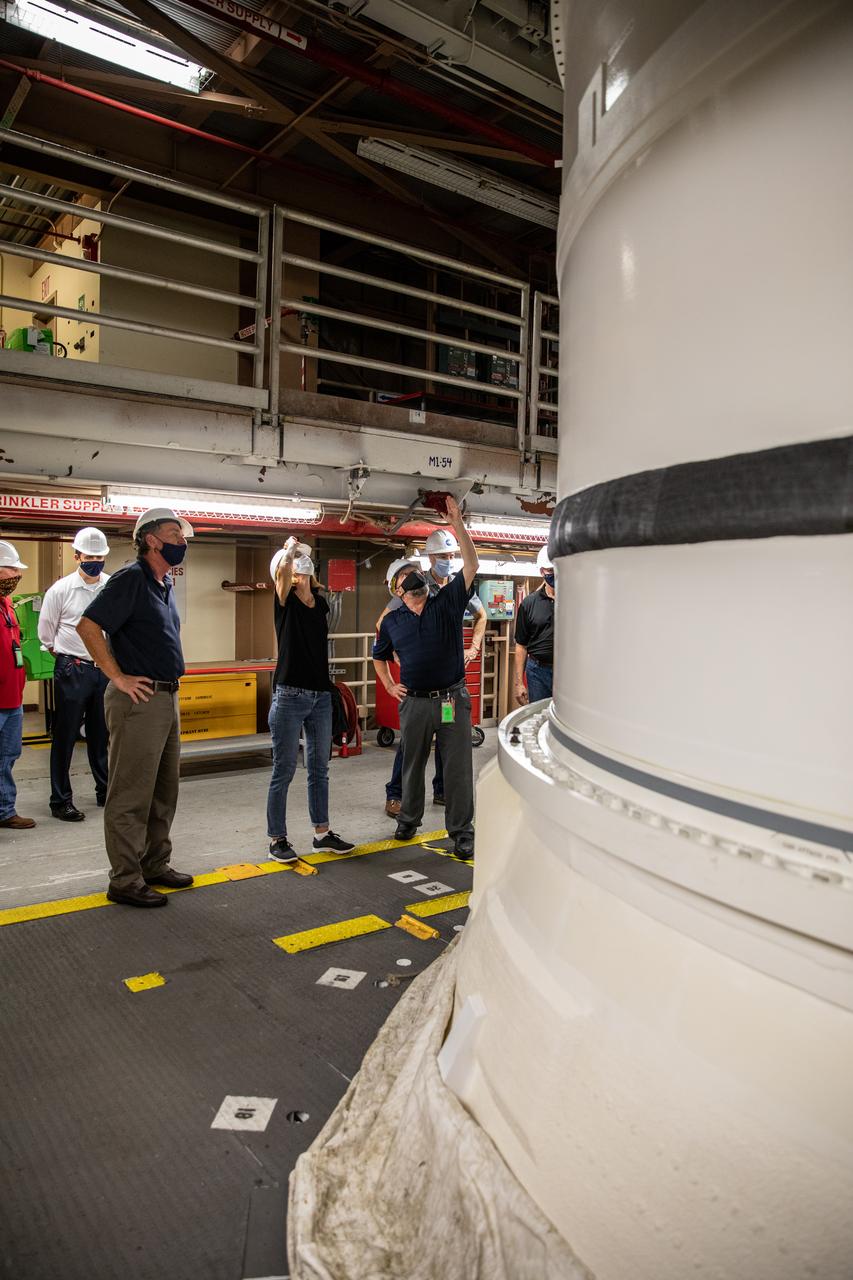
Kathy Lueders, second from right, NASA’s associate administrator for Human Exploration and Operations, along with members of the Exploration Ground Systems and Jacobs Technology leadership view Artemis hardware inside the Rotation, Processing and Surge Facility (RPSF) at the agency’s Kennedy Space Center in Florida on June 25, 2020. Manufactured by Northrop Grumman in Utah, the solid rocket booster segments for the Space Launch System rocket are in view. The first in a series of increasingly complex missions, Artemis I will test the Orion spacecraft and SLS as an integrated system ahead of crewed flights to the Moon.
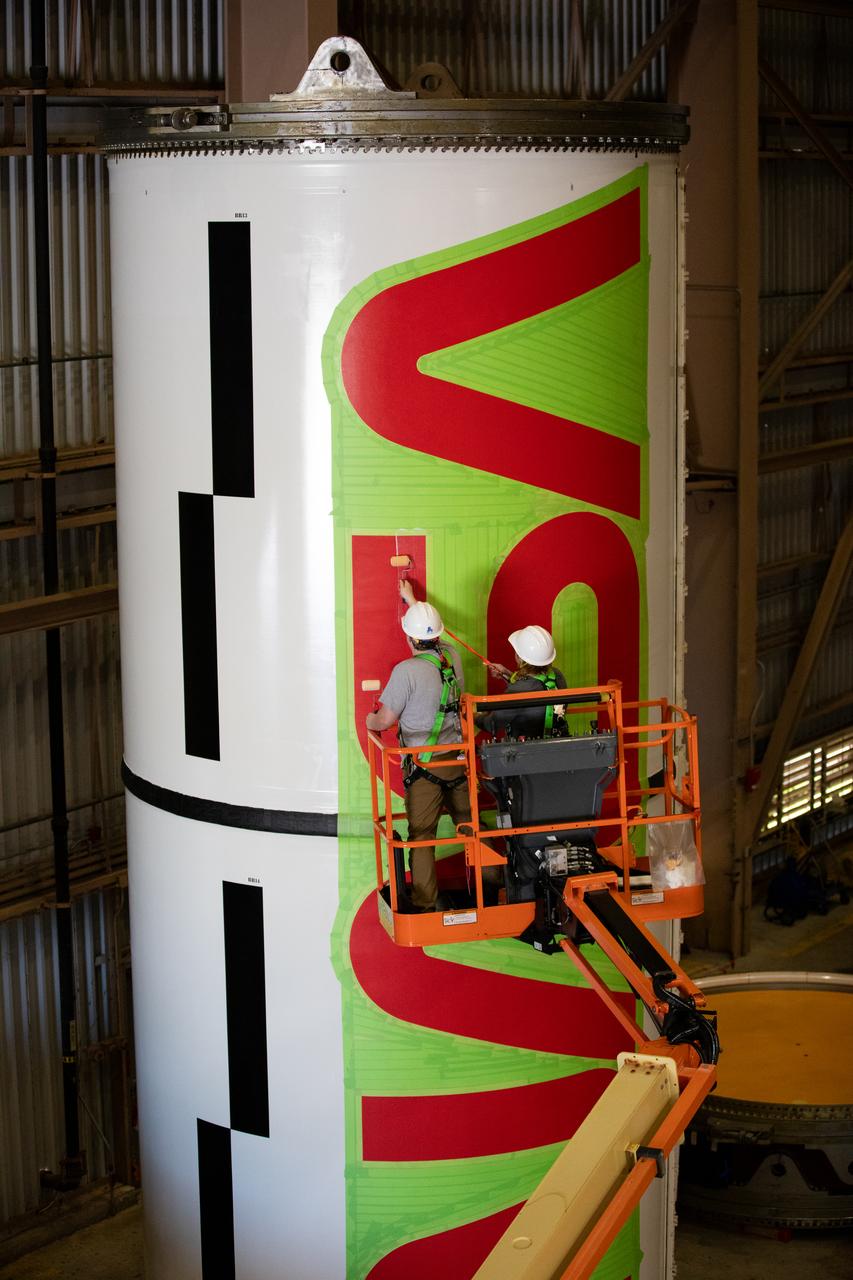
Workers with NASA’s Exploration Ground Systems (EGS) paint the bright red NASA “worm” logo on the side of an Artemis II solid rocket booster segment inside the Rotation, Processing and Surge Facility (RPSF) at Kennedy Space Center in Florida on Tuesday, Jan. 30, 2024. The EGS team used a laser projector to mask off the logo with tape, then painted the first coat of the iconic design. The booster segments will help propel the Space Launch System (SLS) rocket on the Artemis II mission to send four astronauts around the Moon as part of the agency’s effort to establish a long-term science and exploration presence at the Moon, and eventually Mars.
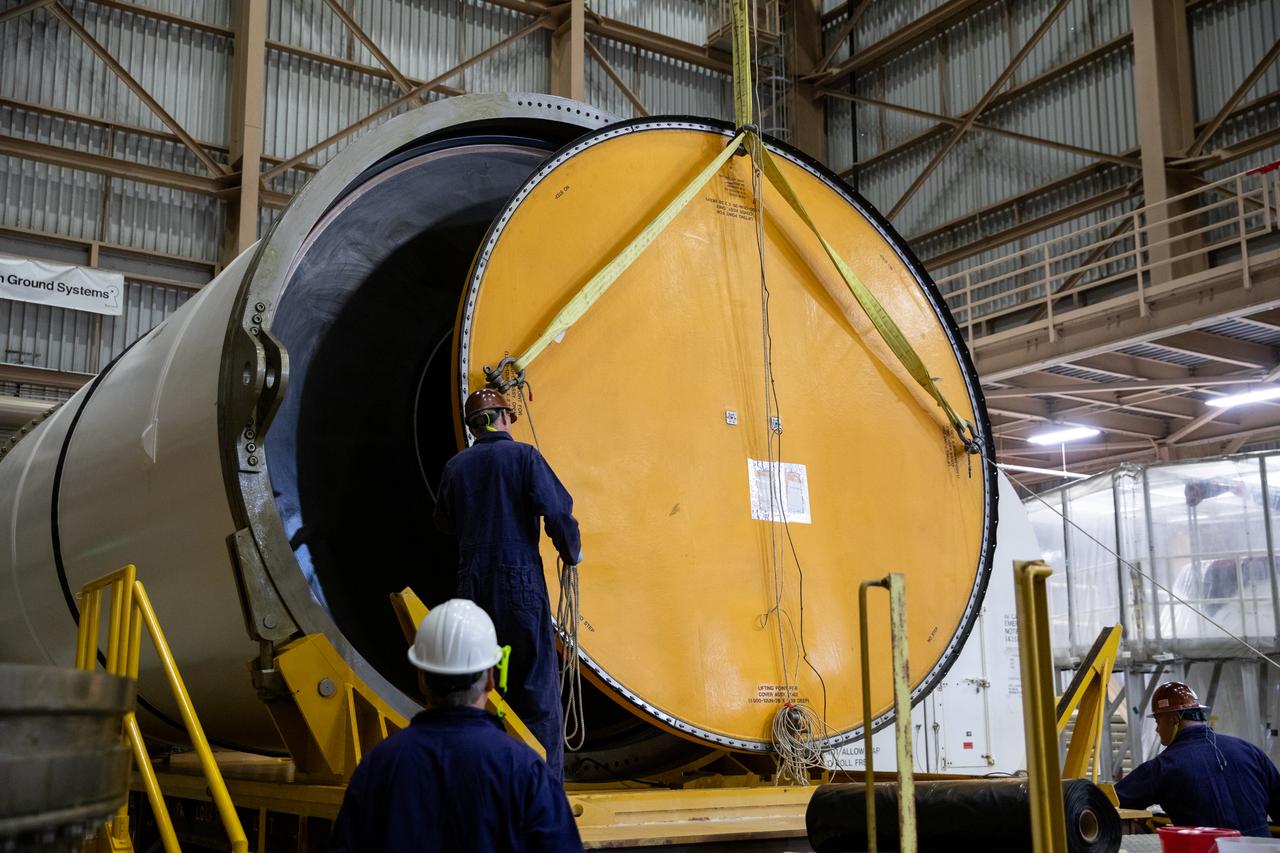
Engineers and technicians process the right forward center segment of the Space Launch System solid rocket boosters for the Artemis II mission inside the Rotation, Processing and Surge Facility (RPSF) at NASA’s Kennedy Space Center in Florida by removing the yellow cap and inspecting propellant on Monday, Nov. 27, 2023. Since arriving via rail in September, the team has been examining each segment one-by-one to make sure they are ready for integration and launch before being moved to the Vehicle Assembly Building for stacking atop the mobile launcher. Artemis II astronauts Reid Wiseman, Victor Glover, Christina Koch, and Jeremy Hansen will blast off from Kennedy and travel around the moon for the agency’s first crewed mission under Artemis that will test all of the Orion spacecraft’s systems.

Inside the Rotation, Processing and Surge Facility (RPSF) at NASA’s Kennedy Space Center in Florida, technicians lift the right aft motor segment – one of five segments that make up one of two solid rocket boosters for the agency’s Space Launch System (SLS) – onto an inspection stand on June 23, 2020. While in the RPSF, the boosters will be mated to the rocket’s two aft skirts before they are moved to the Vehicle Assembly Building for stacking on the mobile launcher. The boosters, manufactured by Northrop Grumman in Utah, recently arrived at Kennedy for processing ahead of the Artemis I launch. Together, the twin boosters provide more than 75 percent of the total SLS thrust at launch. The first in a series of increasingly complex missions, Artemis I will test the Orion spacecraft and SLS as an integrated system ahead of crewed flights to the Moon.
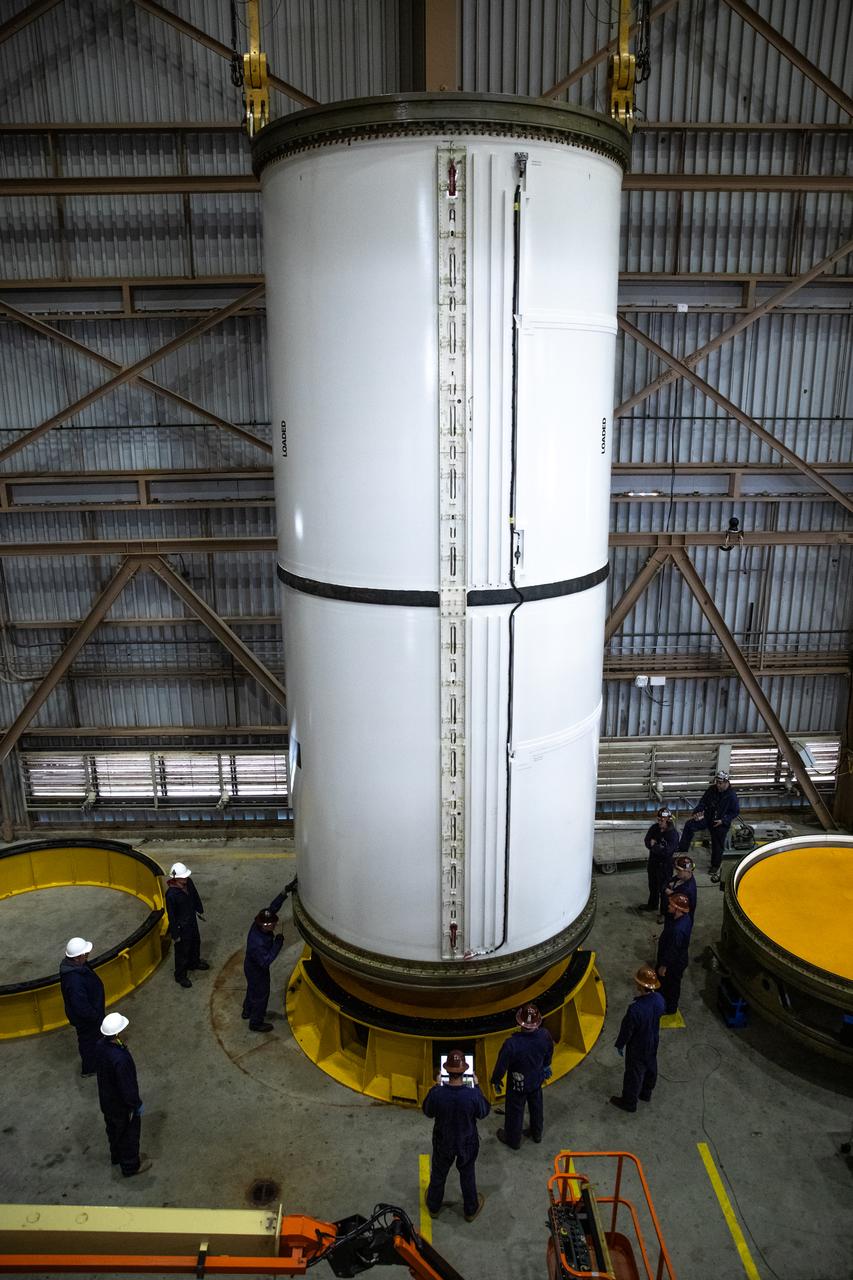
Engineers and technicians process the right forward center segment of the Space Launch System solid rocket boosters for the Artemis II mission inside the Rotation, Processing and Surge Facility (RPSF) at NASA’s Kennedy Space Center in Florida on Tuesday, Nov. 27, 2023. The team has been examining the 10 booster segments one-by-one then lifting them to make sure they are ready for integration and launch before moving them to the Vehicle Assembly Building for stacking atop the mobile launcher. Artemis II astronauts Reid Wiseman, Victor Glover, Christina Koch, and Jeremy Hansen will blast off from Kennedy and travel around the moon for the agency’s first crewed mission under Artemis that will test all of the Orion spacecraft’s systems.

Inside the Rotation, Processing and Surge Facility at NASA’s Kennedy Space Center in Florida, the right-hand motor segment – one of five segments that make up one of two solid rocket boosters for the agency’s Space Launch System (SLS) – is mated to the rocket’s right-hand aft skirt on June 24, 2020. Once the aft segments are mated to the two aft skirts, they will be moved to the Vehicle Assembly Building for stacking on the mobile launcher. Manufactured by Northrop Grumman in Utah, the twin boosters provide more than 75 percent of the total SLS thrust at launch. Under the Artemis program, NASA will land the first woman and the next man on the Moon by 2024. The first in a series of increasingly complex missions, Artemis I will test the Orion spacecraft and SLS as an integrated system ahead of crewed flights to the Moon.
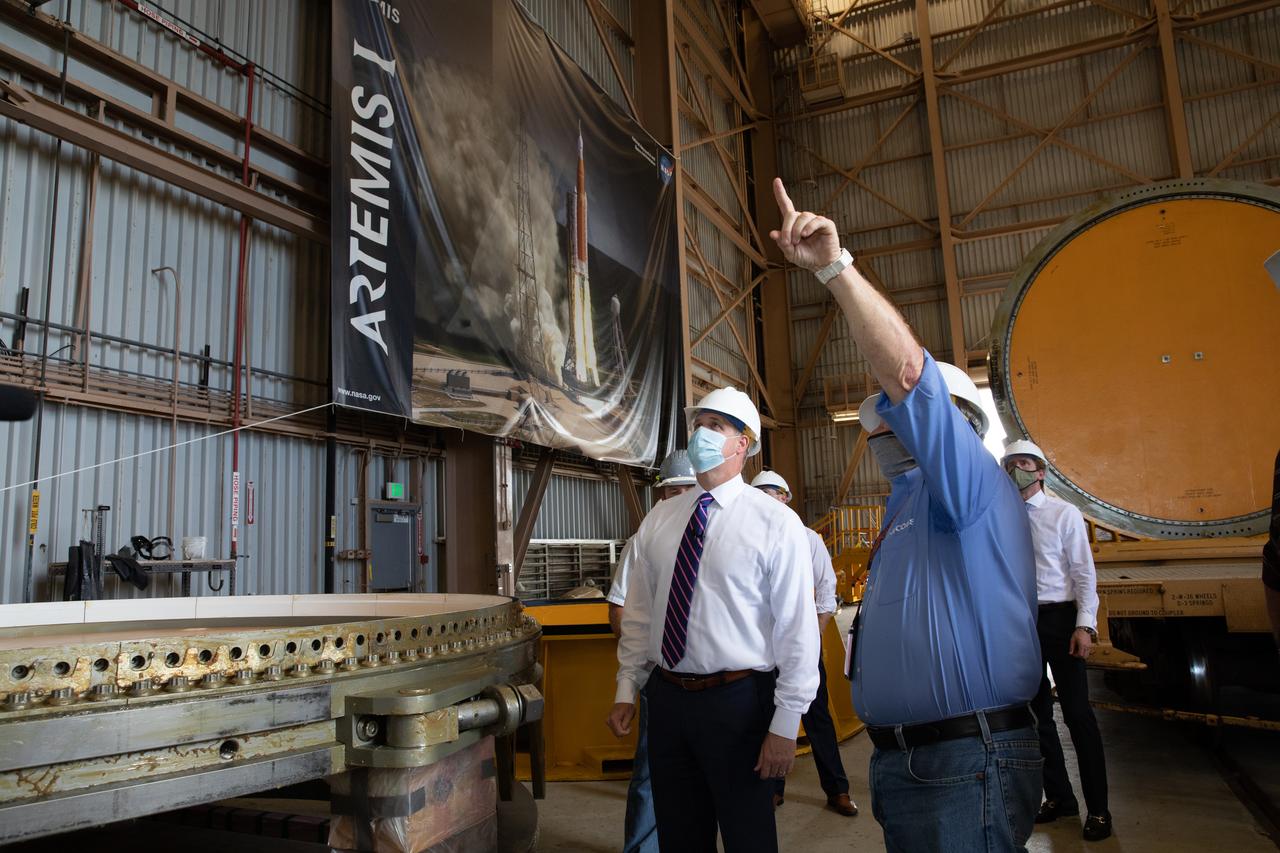
NASA Administrator Jim Bridenstine (left), accompanied by Jacobs employees, views Artemis I booster hardware inside the Rotation, Processing and Surge Facility at NASA’s Kennedy Space Center in Florida on July 27, 2020. Manufactured by Northrop Grumman in Utah, the boosters for the agency’s Space Launch System (SLS) rocket are now undergoing prelaunch processing at Kennedy. During launch, the twin boosters will provide more than 75 percent of the total SLS thrust. The first in a series of increasingly complex missions, Artemis I will test the Orion spacecraft and SLS as an integrated system ahead of crewed flights to the Moon.
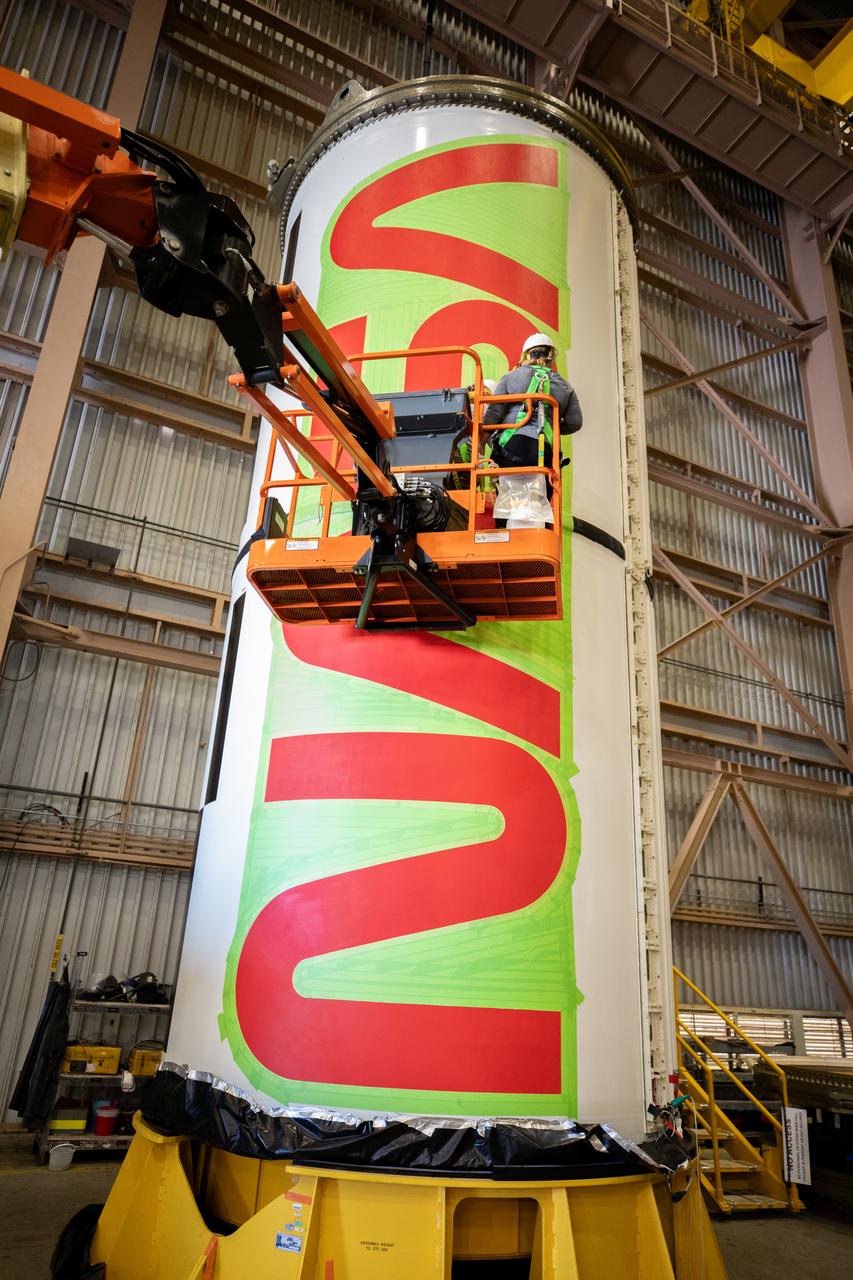
Workers with NASA’s Exploration Ground Systems (EGS) paint the bright red NASA “worm” logo on the side of an Artemis II solid rocket booster segment inside the Rotation, Processing and Surge Facility (RPSF) at Kennedy Space Center in Florida on Tuesday, Jan. 30, 2024. The EGS team used a laser projector to mask off the logo with tape, then painted the first coat of the iconic design. The booster segments will help propel the Space Launch System (SLS) rocket on the Artemis II mission to send four astronauts around the Moon as part of the agency’s effort to establish a long-term science and exploration presence at the Moon, and eventually Mars.
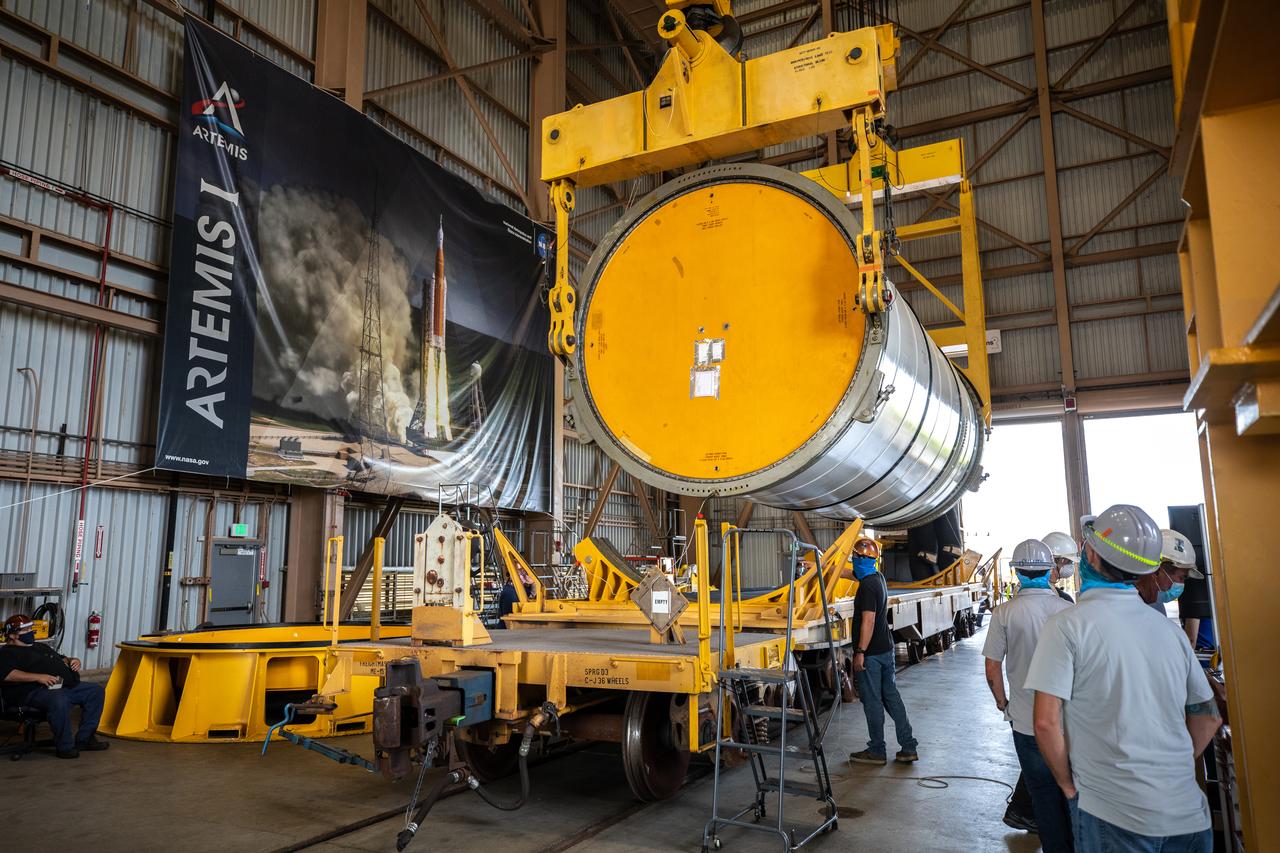
Technicians ready two NASA Space Launch System (SLS) solid rocket boosters for mating to the rocket’s two aft skirts on June 19, 2020, inside Kennedy Space Center’s Rotation, Processing and Surge Facility. Together, the twin boosters provide more than 75 percent of the total SLS thrust at launch. Manufactured by Northrop Grumman in Promontory, Utah, the boosters arrived at Kennedy via train. The cross-country journey was an important milestone for the agency’s Artemis I launch. The first in a series of increasingly complex missions, Artemis I will test the Orion spacecraft and SLS as an integrated system prior to crewed missions to the Moon. Once the boosters are mated with the aft skirts, they will be moved to the Vehicle Assembly Building for stacking on the mobile launcher.
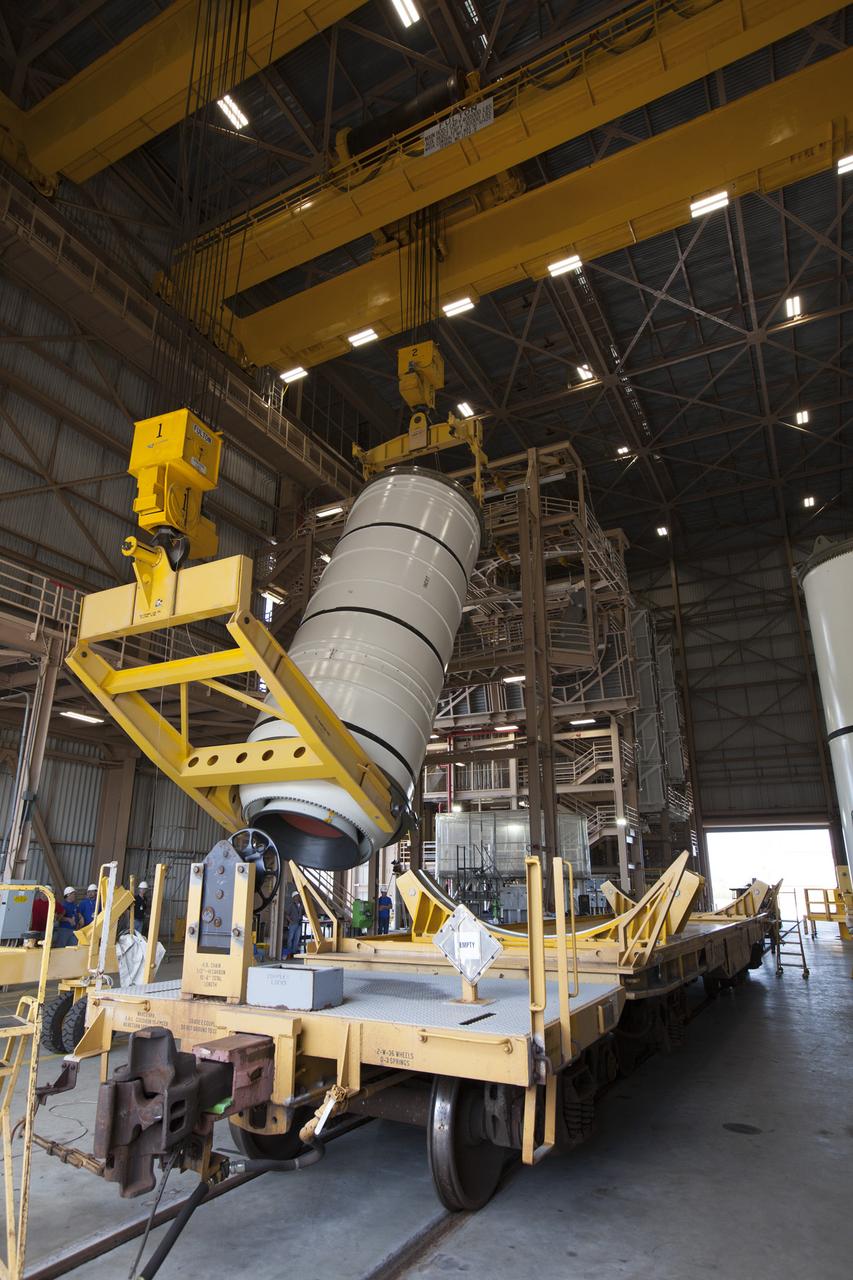
During a media tour of the Rotation, Processing and Surge Facility (RPSF) at NASA’s Kennedy Space Center in Florida, two cranes are used to lift one of two pathfinders, or test versions, of solid rocket booster segments for NASA’s Space Launch System rocket into the vertical position. The pathfinder booster segment will be moved to the other end of the RPSF and secured on a test stand. The Ground Systems Development and Operations Program and Jacobs Engineering, on the Test and Operations Support Contract, will prepare the booster segments, which are inert, for a series of lifts, moves and stacking operations to prepare for Exploration Mission-1, deep-space missions and the journey to Mars.
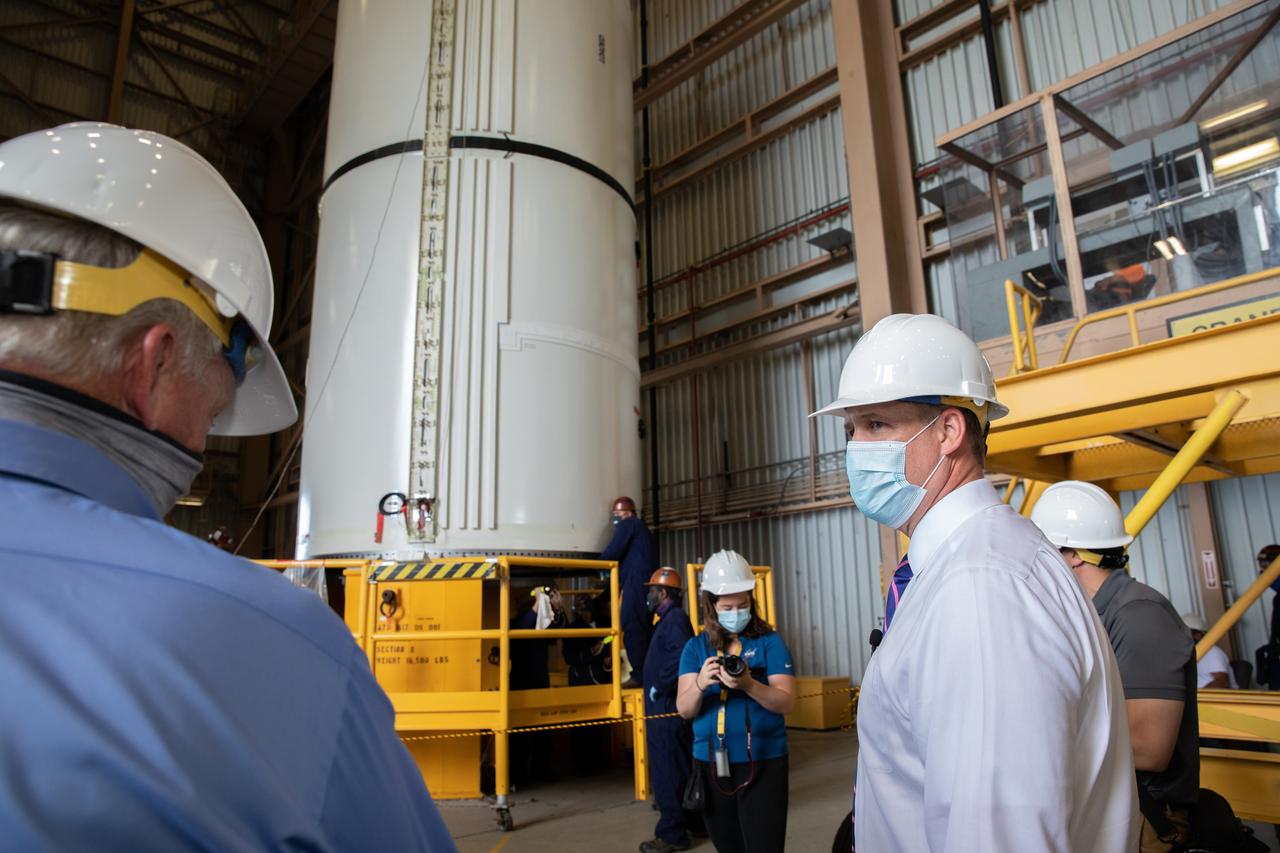
NASA Administrator Jim Bridenstine (right), accompanied by Jacobs employees, views Artemis I booster hardware inside the Rotation, Processing and Surge Facility at NASA’s Kennedy Space Center in Florida on July 27, 2020. Manufactured by Northrop Grumman in Utah, the boosters for the agency’s Space Launch System (SLS) rocket are now undergoing prelaunch processing at Kennedy. During launch, the twin boosters will provide more than 75 percent of the total SLS thrust. The first in a series of increasingly complex missions, Artemis I will test the Orion spacecraft and SLS as an integrated system ahead of crewed flights to the Moon.
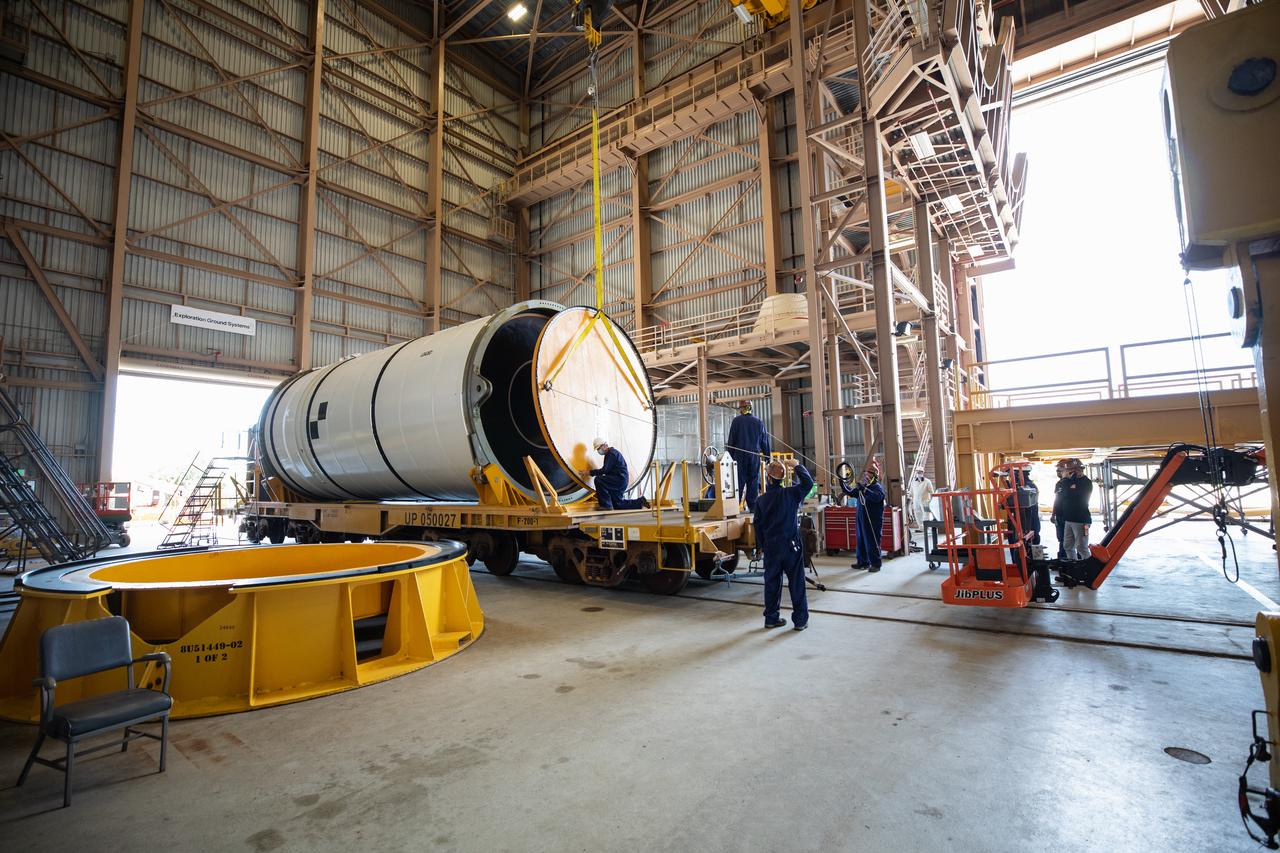
Technicians ready two NASA Space Launch System (SLS) solid rocket boosters for mating to the rocket’s two aft skirts on June 16, 2020, inside Kennedy Space Center’s Rotation, Processing and Surge Facility. Together, the twin boosters provide more than 75 percent of the total SLS thrust at launch. Manufactured by Northrop Grumman in Promontory, Utah, the boosters arrived at Kennedy via train. The cross-country journey was an important milestone for the agency’s Artemis I launch. The first in a series of increasingly complex missions, Artemis I will test the Orion spacecraft and SLS as an integrated system prior to crewed missions to the Moon. Once the boosters are mated with the aft skirts, they will be moved to the Vehicle Assembly Building for stacking on the mobile launcher.
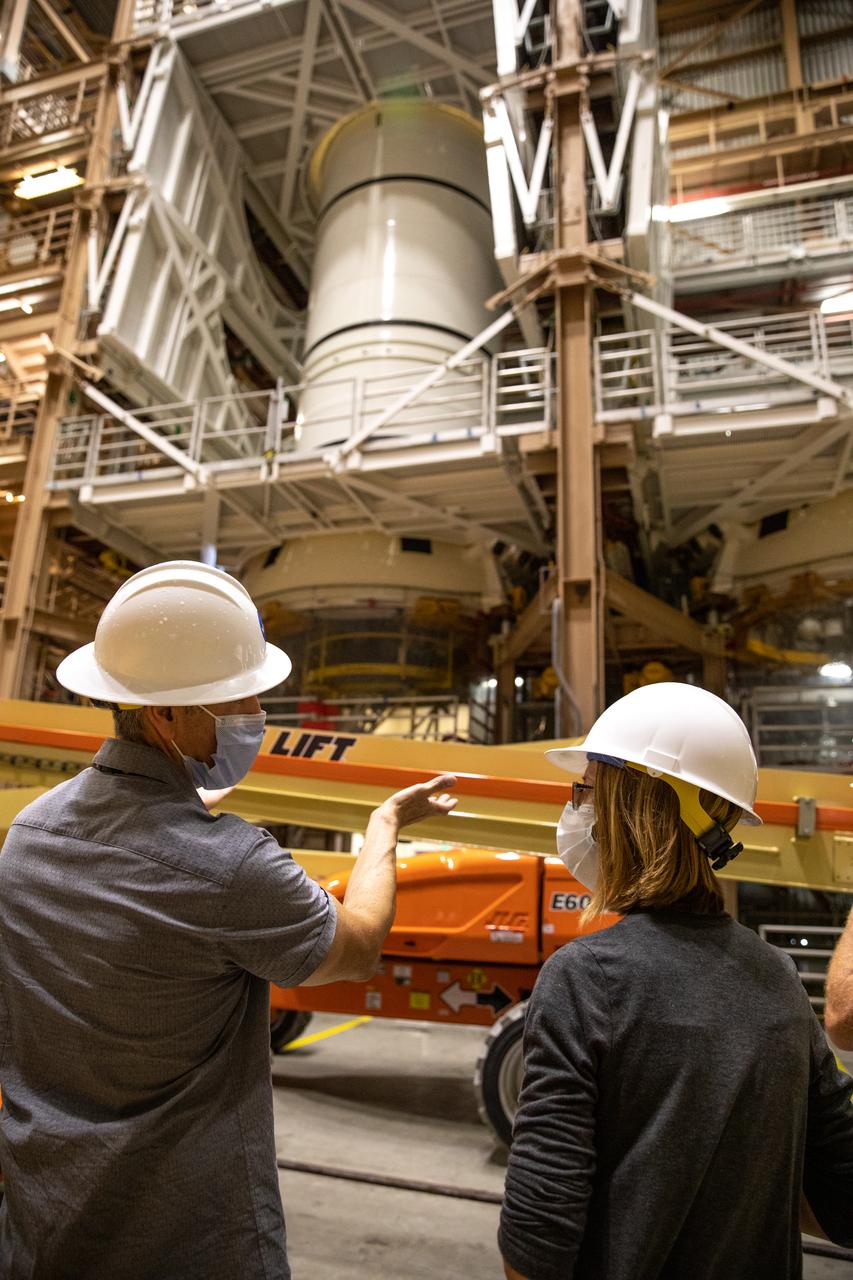
Kathy Lueders, at right, NASA’s associate administrator for Human Exploration and Operations, along with Exploration Ground Systems leadership view Artemis hardware inside the Rotation, Processing and Surge Facility (RPSF) at the agency’s Kennedy Space Center in Florida on June 25, 2020. Manufactured by Northrop Grumman in Utah, the solid rocket booster segments for the Space Launch System rocket are in view. The first in a series of increasingly complex missions, Artemis I will test the Orion spacecraft and SLS as an integrated system ahead of crewed flights to the Moon.
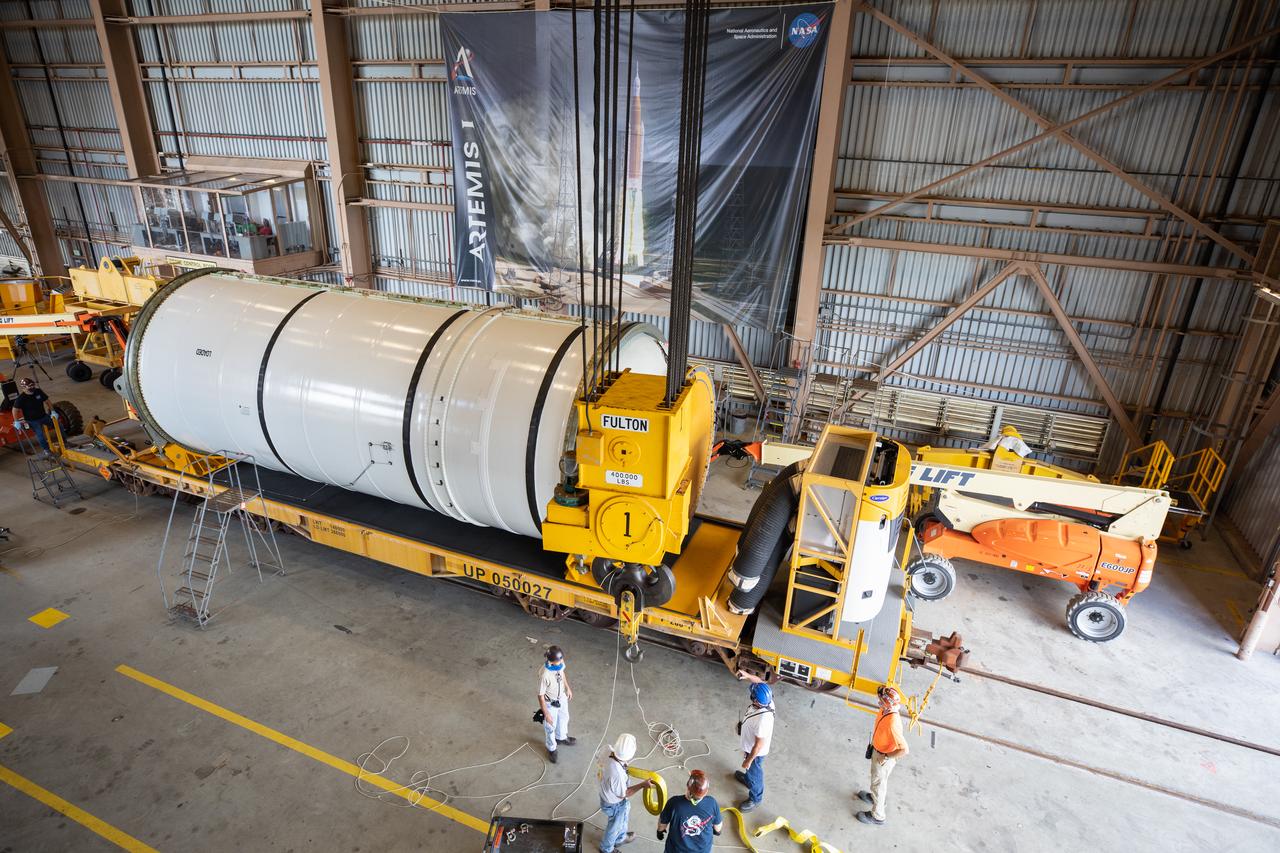
Technicians ready two NASA Space Launch System (SLS) solid rocket boosters for mating to the rocket’s two aft skirts on June 16, 2020, inside Kennedy Space Center’s Rotation, Processing and Surge Facility. Together, the twin boosters provide more than 75 percent of the total SLS thrust at launch. Manufactured by Northrop Grumman in Promontory, Utah, the boosters arrived at Kennedy via train. The cross-country journey was an important milestone for the agency’s Artemis I launch. The first in a series of increasingly complex missions, Artemis I will test the Orion spacecraft and SLS as an integrated system prior to crewed missions to the Moon. Once the boosters are mated with the aft skirts, they will be moved to the Vehicle Assembly Building for stacking on the mobile launcher.
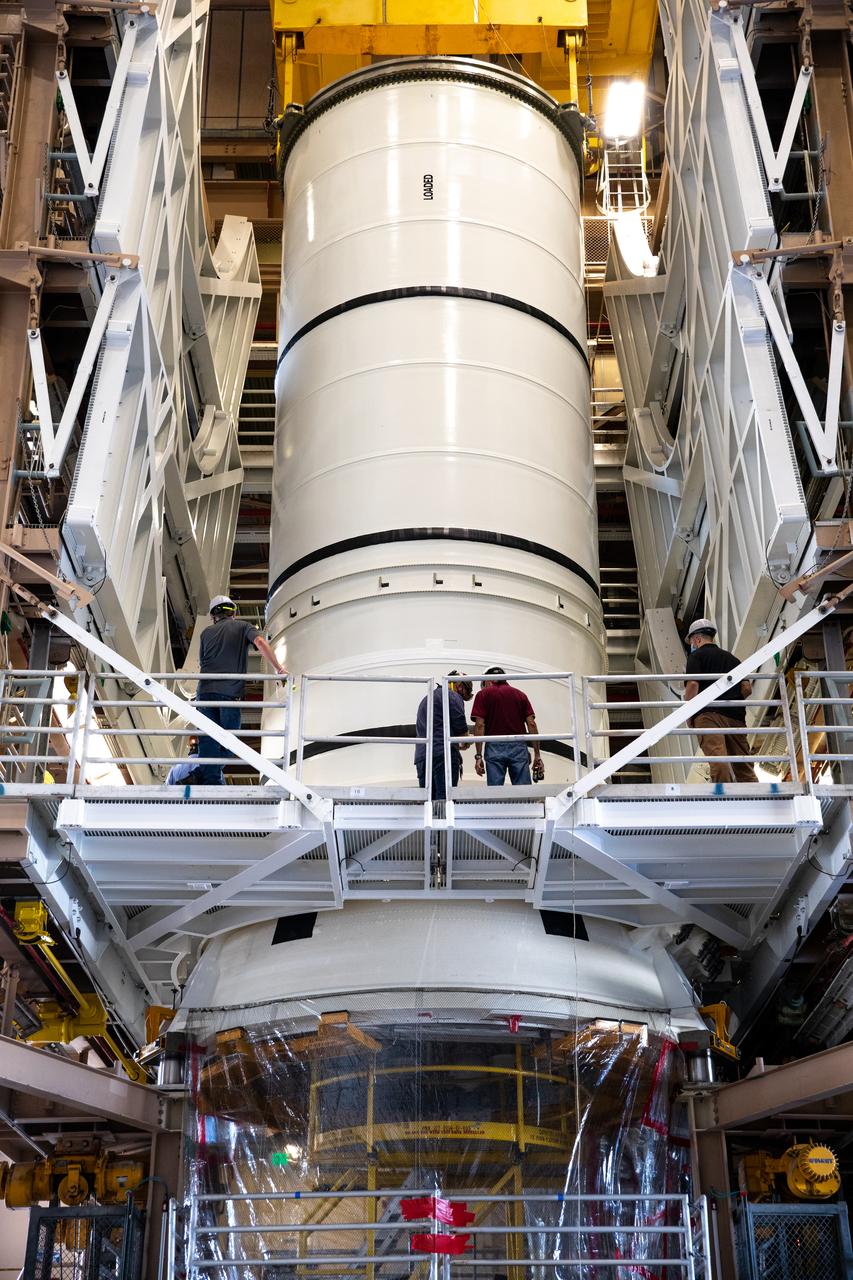
Inside the Rotation, Processing and Surge Facility at NASA’s Kennedy Space Center in Florida, the right-hand motor segment – one of five segments that make up one of two solid rocket boosters for the agency’s Space Launch System (SLS) – is mated to the rocket’s right-hand aft skirt on June 24, 2020. Once the aft segments are mated to the two aft skirts, they will be moved to the Vehicle Assembly Building for stacking on the mobile launcher. Manufactured by Northrop Grumman in Utah, the twin boosters provide more than 75 percent of the total SLS thrust at launch. Under the Artemis program, NASA will land the first woman and the next man on the Moon by 2024. The first in a series of increasingly complex missions, Artemis I will test the Orion spacecraft and SLS as an integrated system ahead of crewed flights to the Moon.
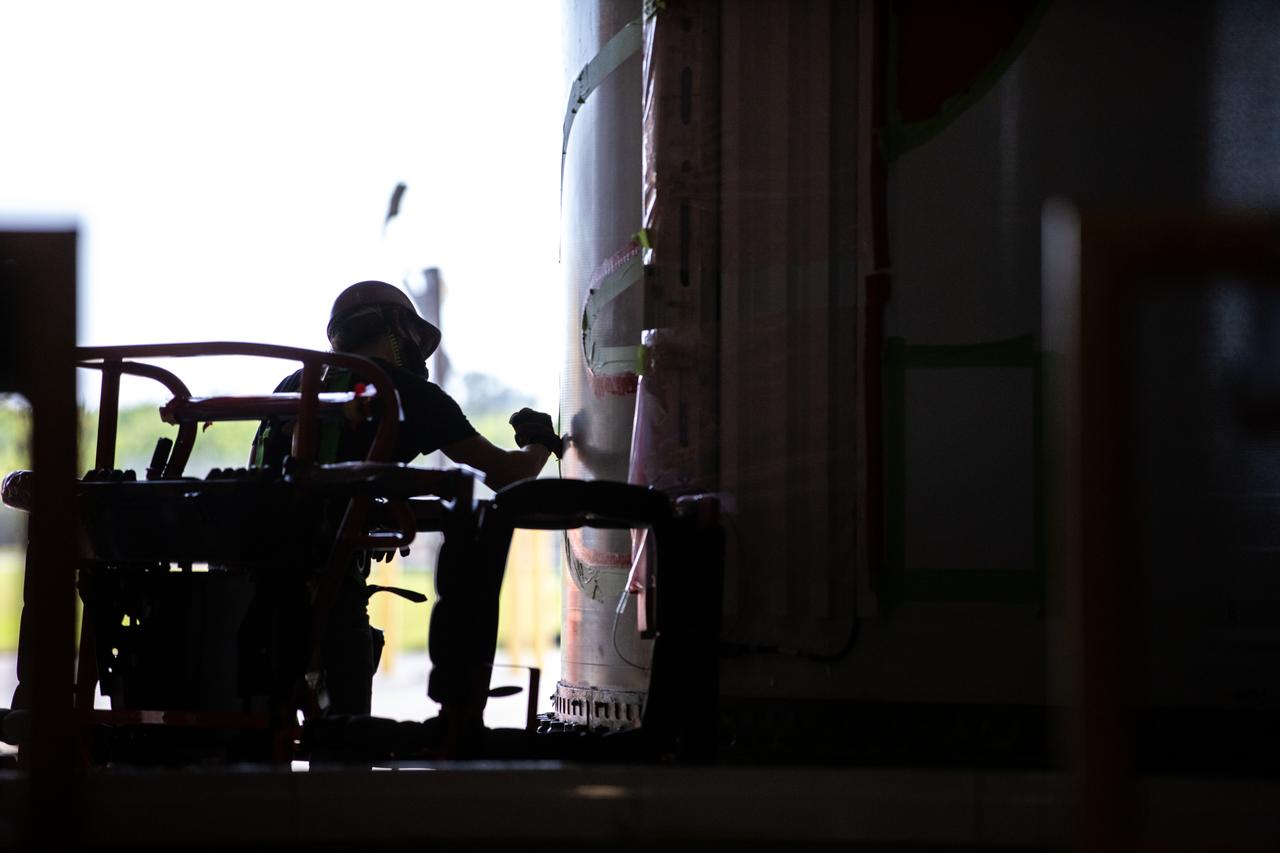
Silhouetted against the bright Florida sunlight outside, a worker with NASA’s Exploration Ground Systems (EGS) applies bright red paint to the agency’s “worm” logo taking shape on the side of an Artemis I solid rocket booster segment inside the Rotation, Processing and Surge Facility (RPSF) at Kennedy Space Center. The EGS team used a laser projector to mask off the logo with tape, then painted the first coat of the iconic design. The booster segments will help propel the Space Launch System (SLS) rocket on Artemis I, a test of the Orion spacecraft and SLS as an integrated system ahead of crewed flights to the Moon. Northrop Grumman, which built the booster segments, is covering the cost of the painting.
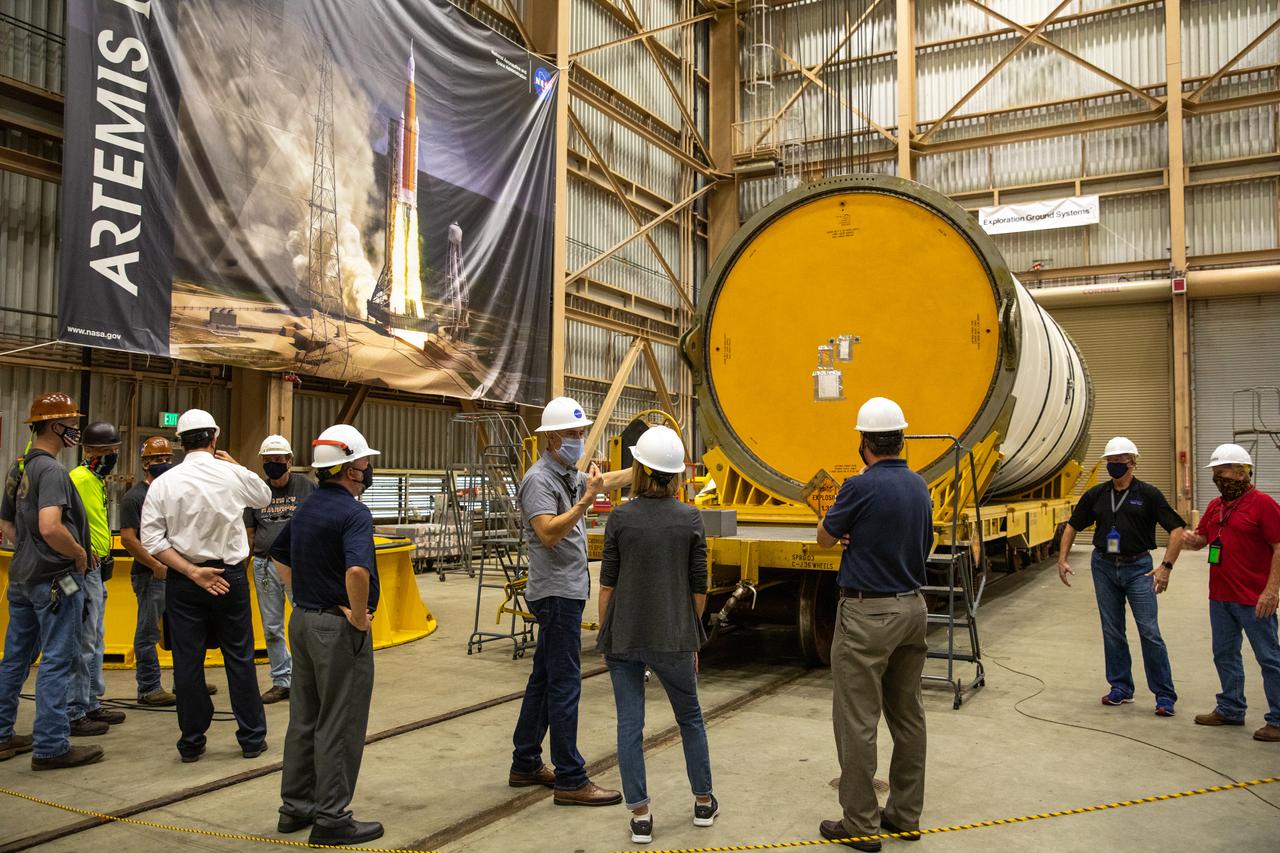
Kathy Lueders, in the center at right, NASA’s associate administrator for Human Exploration and Operations, along with members of the Exploration Ground Systems and Jacobs Technology leadership view Artemis hardware inside the Rotation, Processing and Surge Facility (RPSF) at the agency’s Kennedy Space Center in Florida on June 25, 2020. Manufactured by Northrop Grumman in Utah, the solid rocket booster segments for the Space Launch System rocket are in view. The first in a series of increasingly complex missions, Artemis I will test the Orion spacecraft and SLS as an integrated system ahead of crewed flights to the Moon.
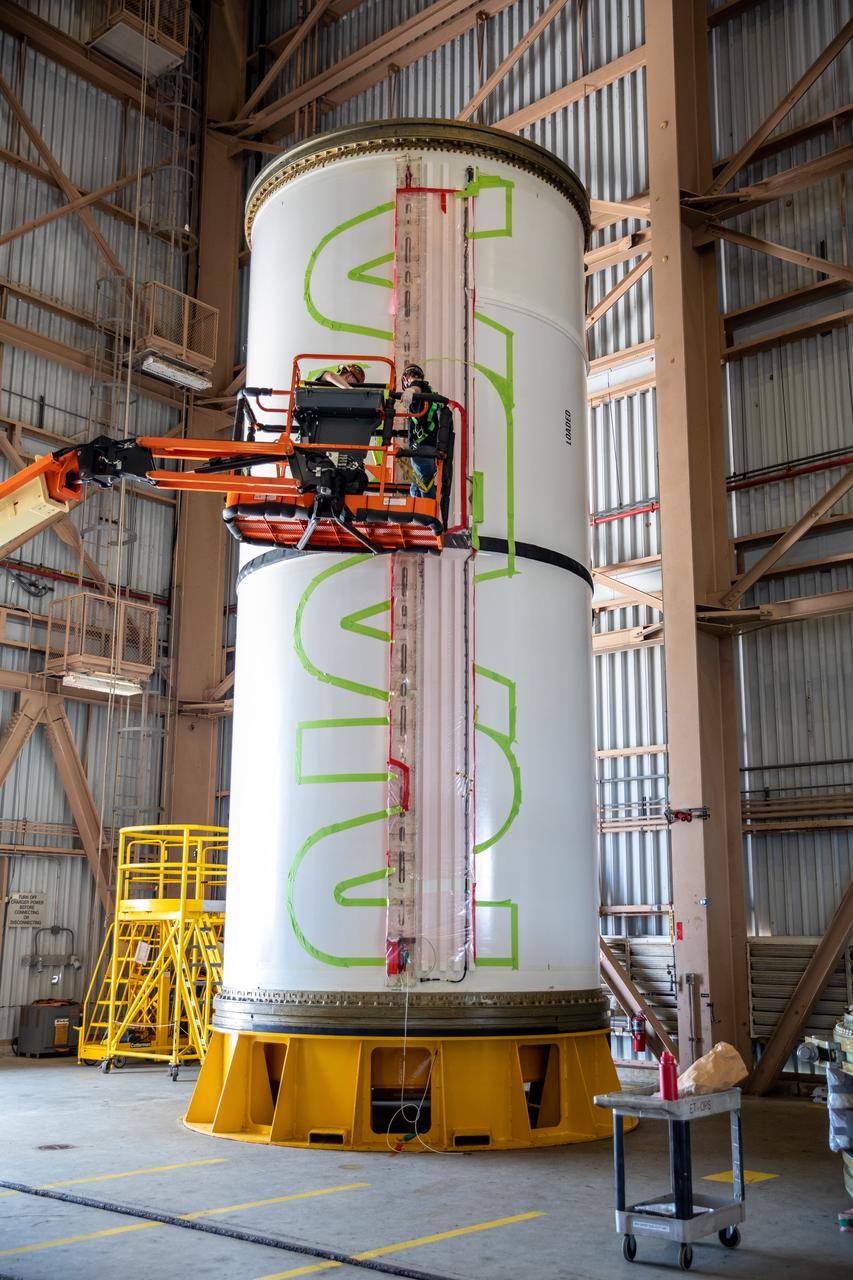
Workers with NASA’s Exploration Ground Systems (EGS) use a laser projector and green tape to mask off the shape of the agency’s “worm” logo on the side of an Artemis I solid rocket booster segment inside the Rotation, Processing and Surge Facility (RPSF) at Kennedy Space Center in Florida, Sept. 3, 2020. The booster segments will help propel the Space Launch System (SLS) rocket on Artemis I, a test of the Orion spacecraft and SLS as an integrated system ahead of crewed flights to the Moon. Northrop Grumman, which built the booster segments, is covering the cost of the painting.
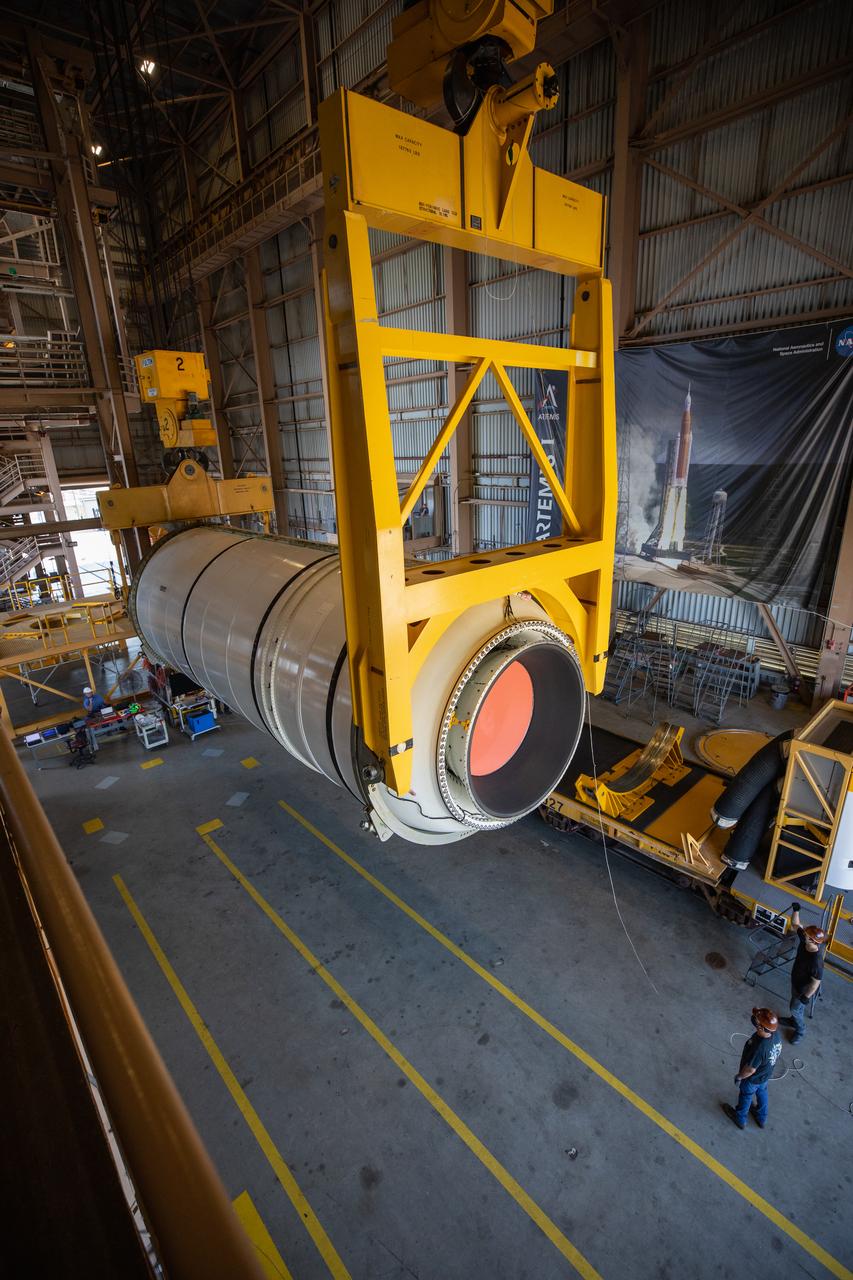
Inside the Rotation, Processing and Surge Facility (RPSF) at NASA’s Kennedy Space Center in Florida, technicians lift the right aft motor segment – one of five segments that make up one of two solid rocket boosters for the agency’s Space Launch System (SLS) – onto an inspection stand on June 23, 2020. While in the RPSF, the boosters will be mated to the rocket’s two aft skirts before they are moved to the Vehicle Assembly Building for stacking on the mobile launcher. The boosters, manufactured by Northrop Grumman in Utah, recently arrived at Kennedy for processing ahead of the Artemis I launch. Together, the twin boosters provide more than 75 percent of the total SLS thrust at launch. The first in a series of increasingly complex missions, Artemis I will test the Orion spacecraft and SLS as an integrated system ahead of crewed flights to the Moon.
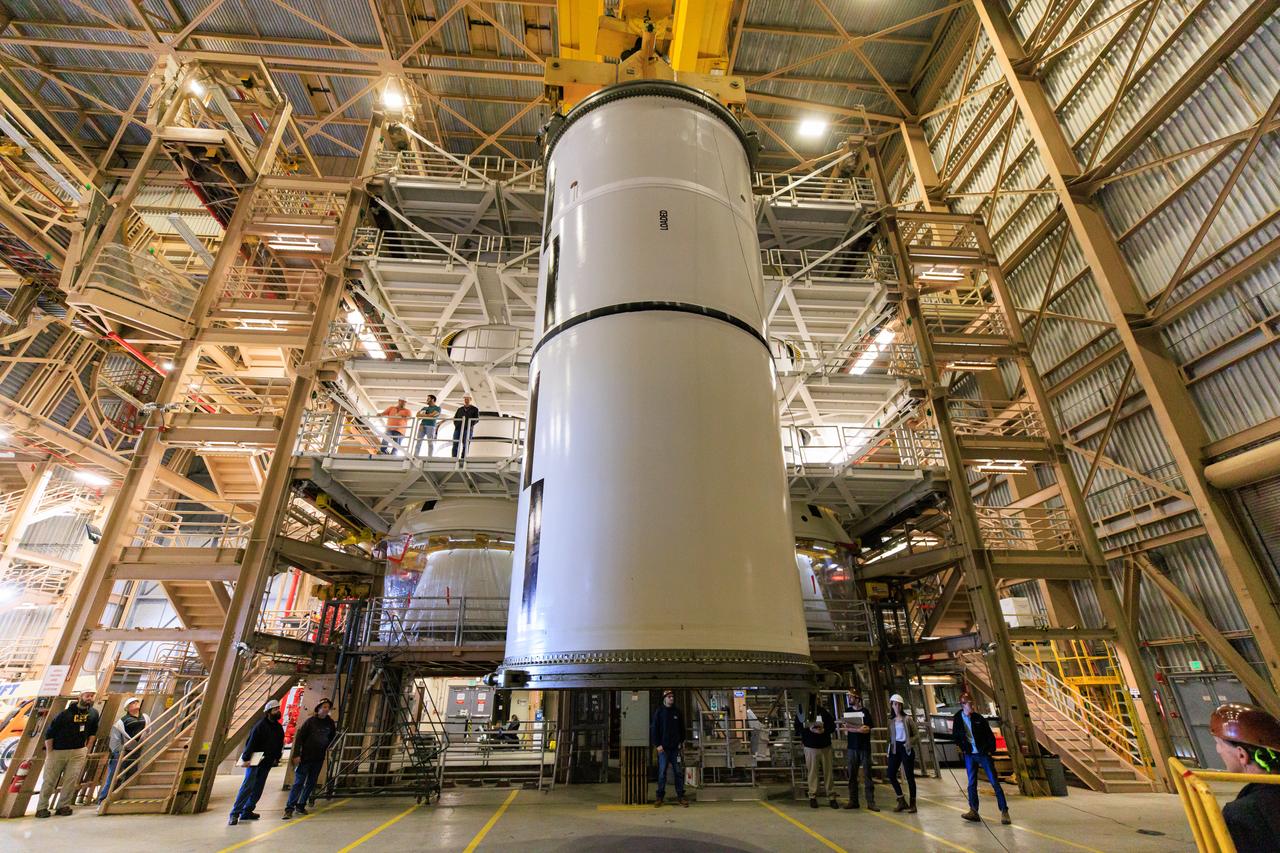
Following the successful propellant grain inspection of two segments of the solid rocket boosters for NASA’s Space Launch System inside the Rotation, Processing and Surge Facility at NASA’s Kennedy Space Center in Florida, crews on Thursday, Dec. 21, 2023, rotate and lift the segments from horizontal into a vertical position in preparation for the agency’s Artemis II launch campaign. The Artemis II mission will send four astronauts around the Moon as part of the agency’s effort to establish a long-term science and exploration presence at the Moon, and eventually Mars.
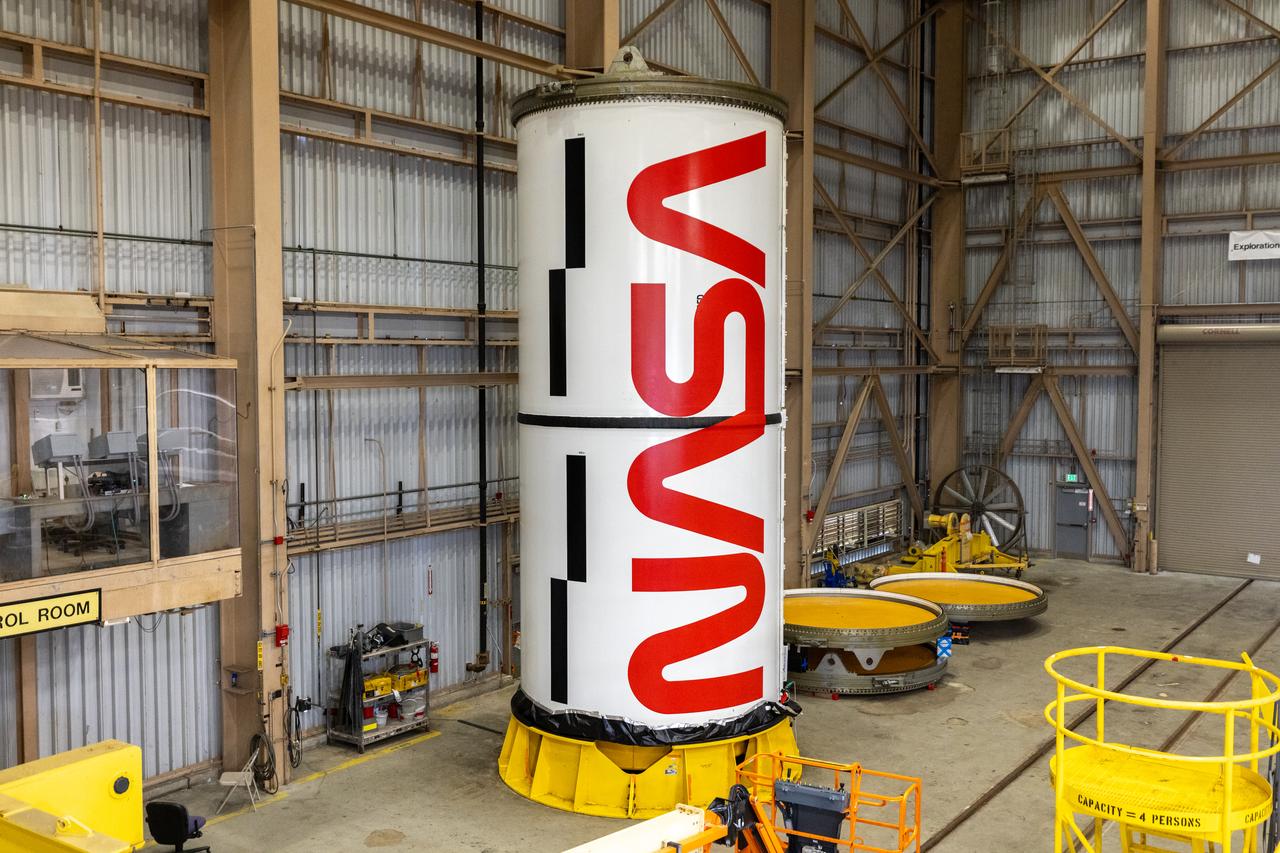
Workers with NASA’s Exploration Ground Systems and primary contractor, Jacobs, complete the painting of the agency’s iconic “worm” logo along the side of the twin Artemis II solid rocket booster motor segments inside the Rotation, Processing and Surge Facility at Kennedy Space Center in Florida on Friday, Feb. 16, 2024. Using a laser projector, the logo was mapped out with tape by workers with Jacobs, for the spaceport, before using two coats of red paint, plus several coats of clear primer to complete the logo that stretches 25 feet long. The booster segments will help propel the SLS (Space Launch System) rocket on the Artemis II mission to send four astronauts around the Moon as part of the agency’s effort to establish a long-term science and exploration presence at the Moon, and eventually Mars.

Inside the Rotation, Processing and Surge Facility at NASA’s Kennedy Space Center in Florida, technicians mate the right-hand motor segment – one of five segments that make up one of two solid rocket boosters for the agency’s Space Launch System (SLS) – to the rocket’s right-hand aft skirt on June 24, 2020. Once the aft segments are mated to the two aft skirts, they will be moved to the Vehicle Assembly Building for stacking on the mobile launcher. Manufactured by Northrop Grumman in Utah, the twin boosters provide more than 75 percent of the total SLS thrust at launch. Under the Artemis program, NASA will land the first woman and the next man on the Moon by 2024. The first in a series of increasingly complex missions, Artemis I will test the Orion spacecraft and SLS as an integrated system ahead of crewed flights to the Moon.
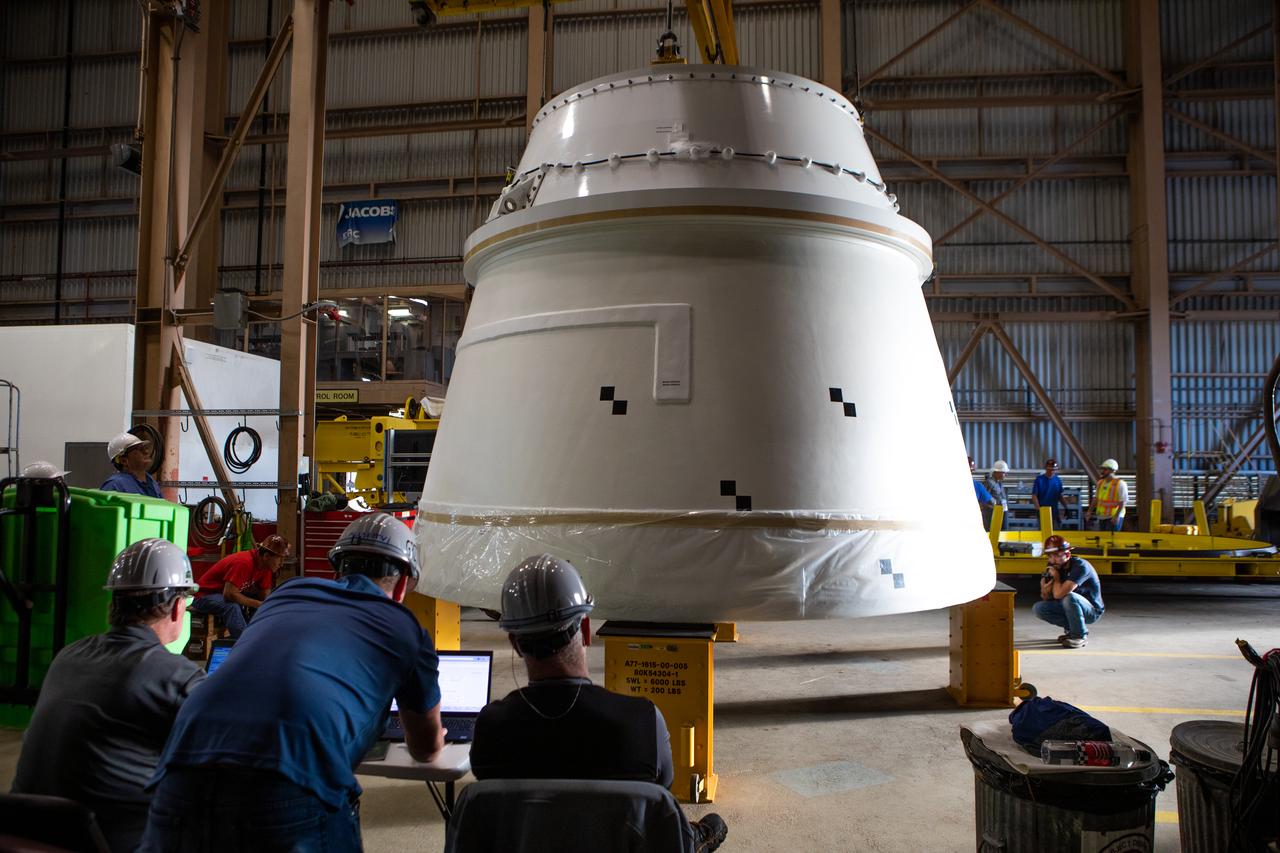
The Northrop Grumman-manufactured right aft exit cone, the second of two for the Space Launch System’s solid rocket boosters, is in view inside the Rotation, Processing and Surge Facility at NASA’s Kennedy Space Center in Florida on Dec. 9, 2019. Both aft exit cones were shipped from Promontory, Utah. They will be checked out and prepared for the Artemis I uncrewed test flight. The aft exit cones sit at the bottommost part of the twin boosters. The cones help provide added thrust for the boosters, while protecting the aft skirts from the thermal environment during launch.
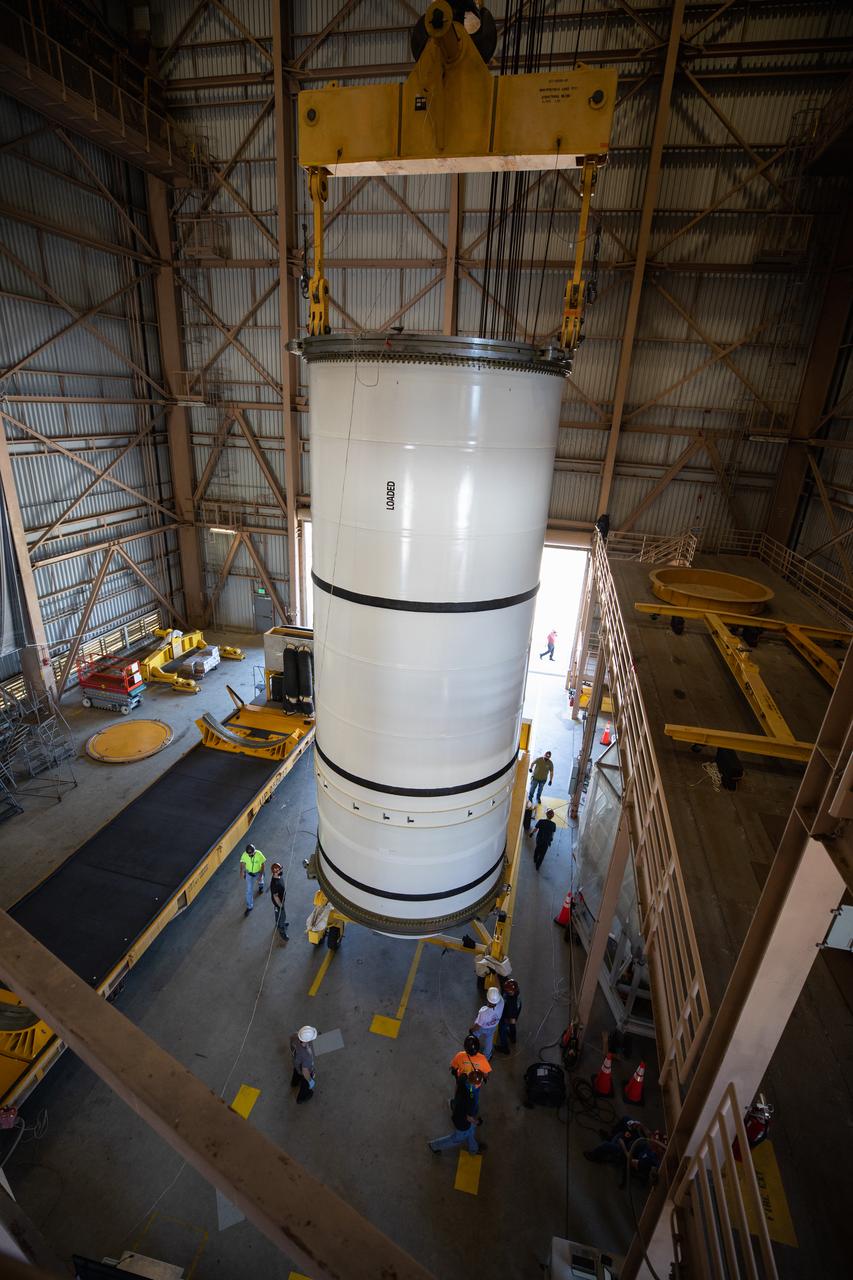
Inside the Rotation, Processing and Surge Facility (RPSF) at NASA’s Kennedy Space Center in Florida, technicians lift the right aft motor segment – one of five segments that make up one of two solid rocket boosters for the agency’s Space Launch System (SLS) – onto an inspection stand on June 23, 2020. While in the RPSF, the boosters will be mated to the rocket’s two aft skirts before they are moved to the Vehicle Assembly Building for stacking on the mobile launcher. The boosters, manufactured by Northrop Grumman in Utah, recently arrived at Kennedy for processing ahead of the Artemis I launch. Together, the twin boosters provide more than 75 percent of the total SLS thrust at launch. The first in a series of increasingly complex missions, Artemis I will test the Orion spacecraft and SLS as an integrated system ahead of crewed flights to the Moon.
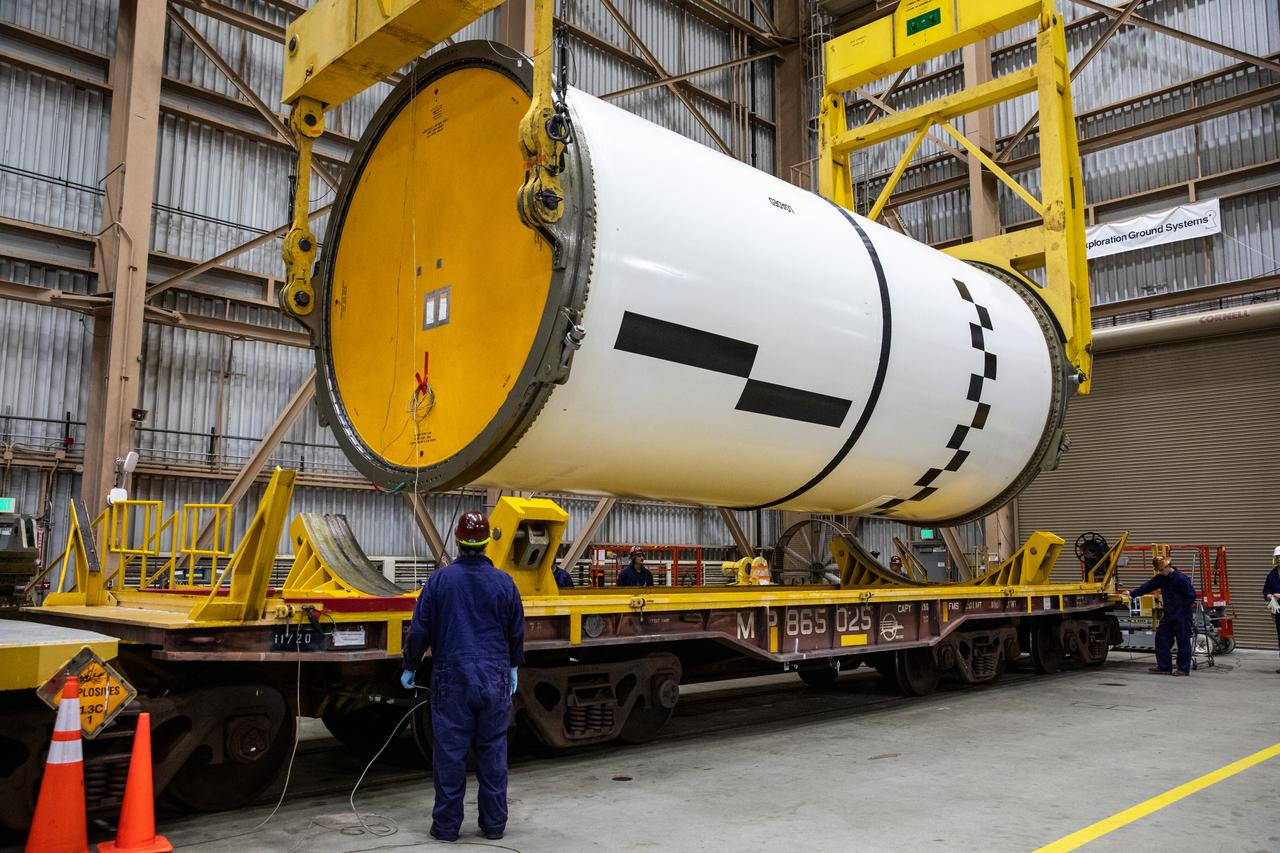
Engineers and technicians process the right forward center segment of the Space Launch System solid rocket boosters for the Artemis II mission inside the Rotation, Processing and Surge Facility (RPSF) at NASA’s Kennedy Space Center in Florida on Tuesday, Nov. 27, 2023. The team has been examining the 10 booster segments one-by-one then lifting them to make sure they are ready for integration and launch before moving them to the Vehicle Assembly Building for stacking atop the mobile launcher. Artemis II astronauts Reid Wiseman, Victor Glover, Christina Koch, and Jeremy Hansen will blast off from Kennedy and travel around the moon for the agency’s first crewed mission under Artemis that will test all of the Orion spacecraft’s systems.
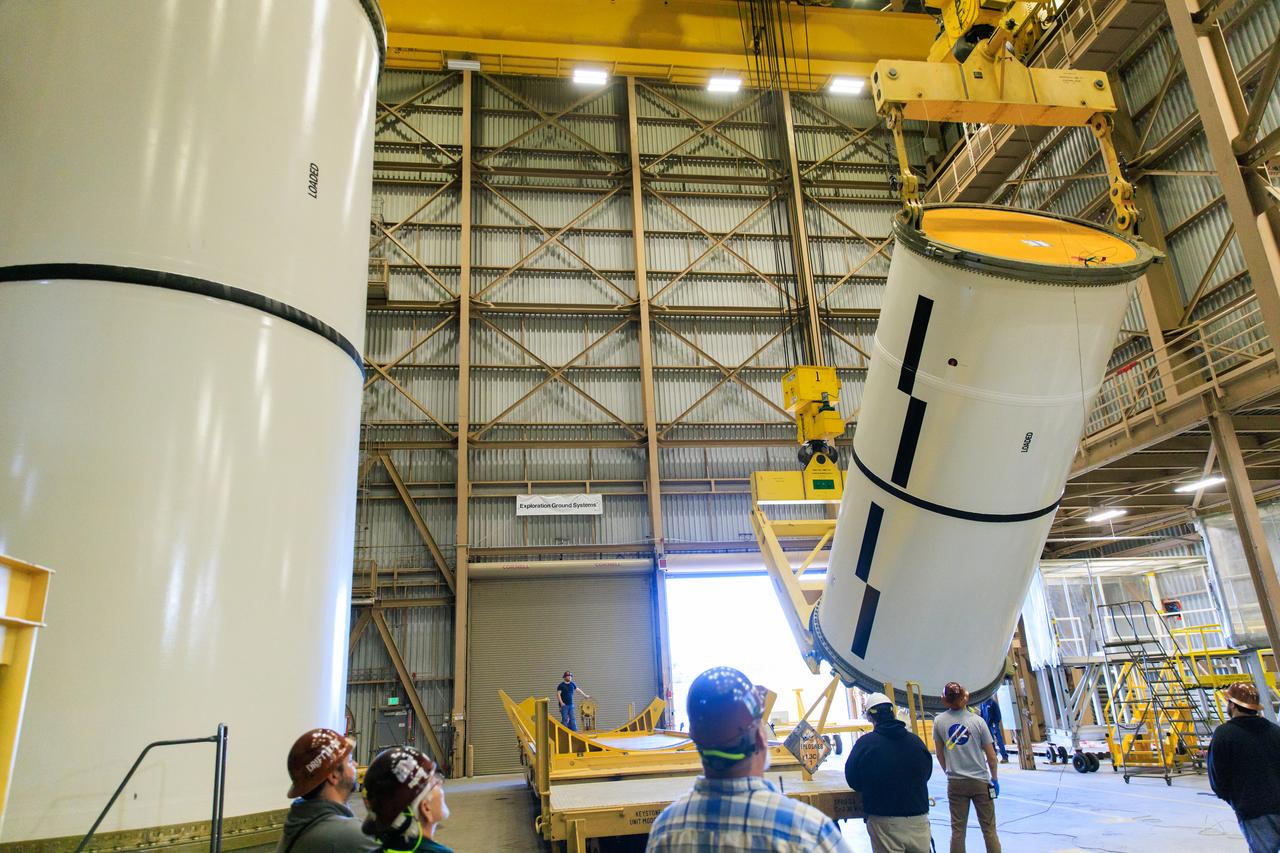
Following the successful propellant grain inspection of two segments of the solid rocket boosters for NASA’s Space Launch System inside the Rotation, Processing and Surge Facility at NASA’s Kennedy Space Center in Florida, crews on Thursday, Dec. 21, 2023, rotate and lift the segments from horizontal into a vertical position in preparation for the agency’s Artemis II launch campaign. The Artemis II mission will send four astronauts around the Moon as part of the agency’s effort to establish a long-term science and exploration presence at the Moon, and eventually Mars.
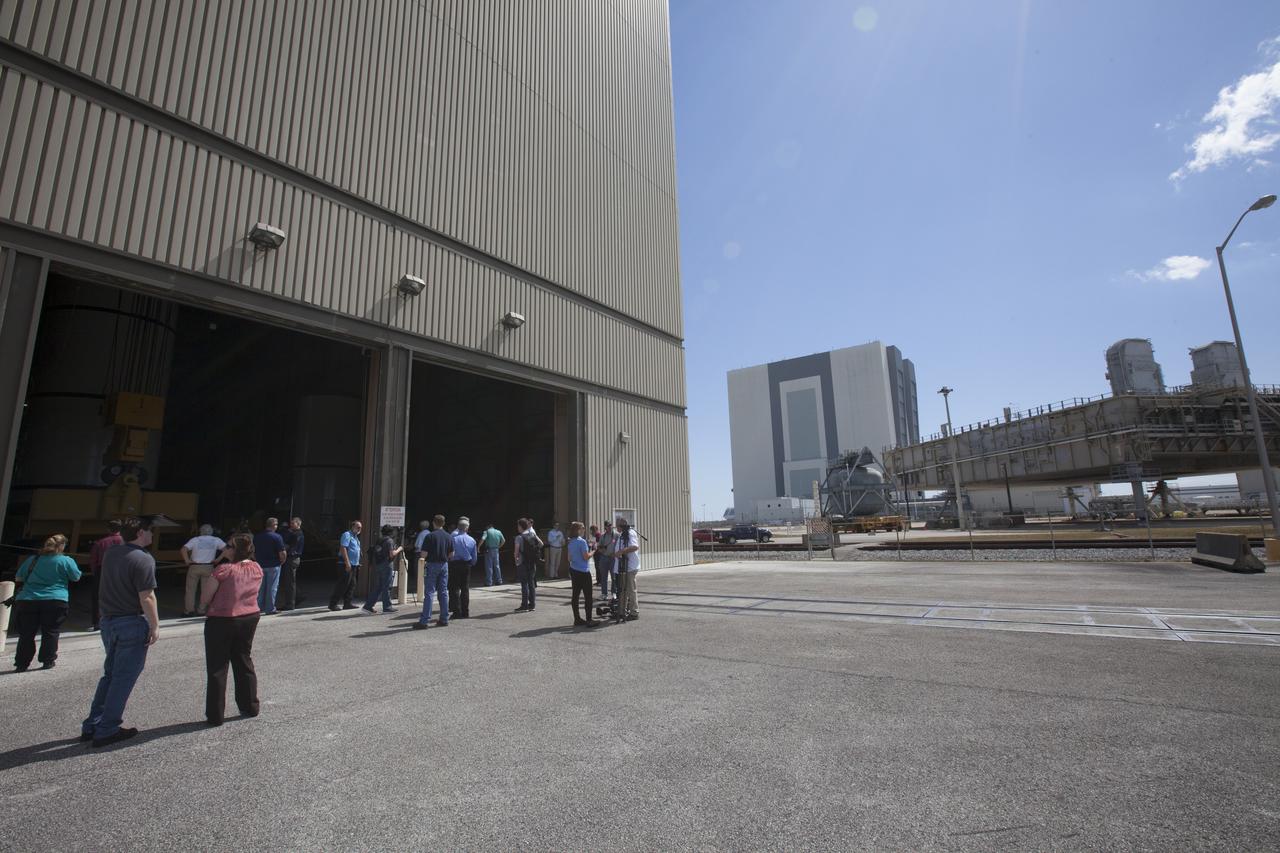
Members of the news media watch as a crane is used to move one of two pathfinders, or test versions, of solid rocket booster segments for NASA’s Space Launch System rocket to a test stand in the Rotation, Processing and Surge Facility at NASA’s Kennedy Space Center in Florida. Inside the RPSF, the Ground Systems Development and Operations Program and Jacobs Engineering, on the Test and Operations Support Contract, will prepare the booster segments, which are inert, for a series of lifts, moves and stacking operations to prepare for Exploration Mission-1, deep-space missions and the journey to Mars.
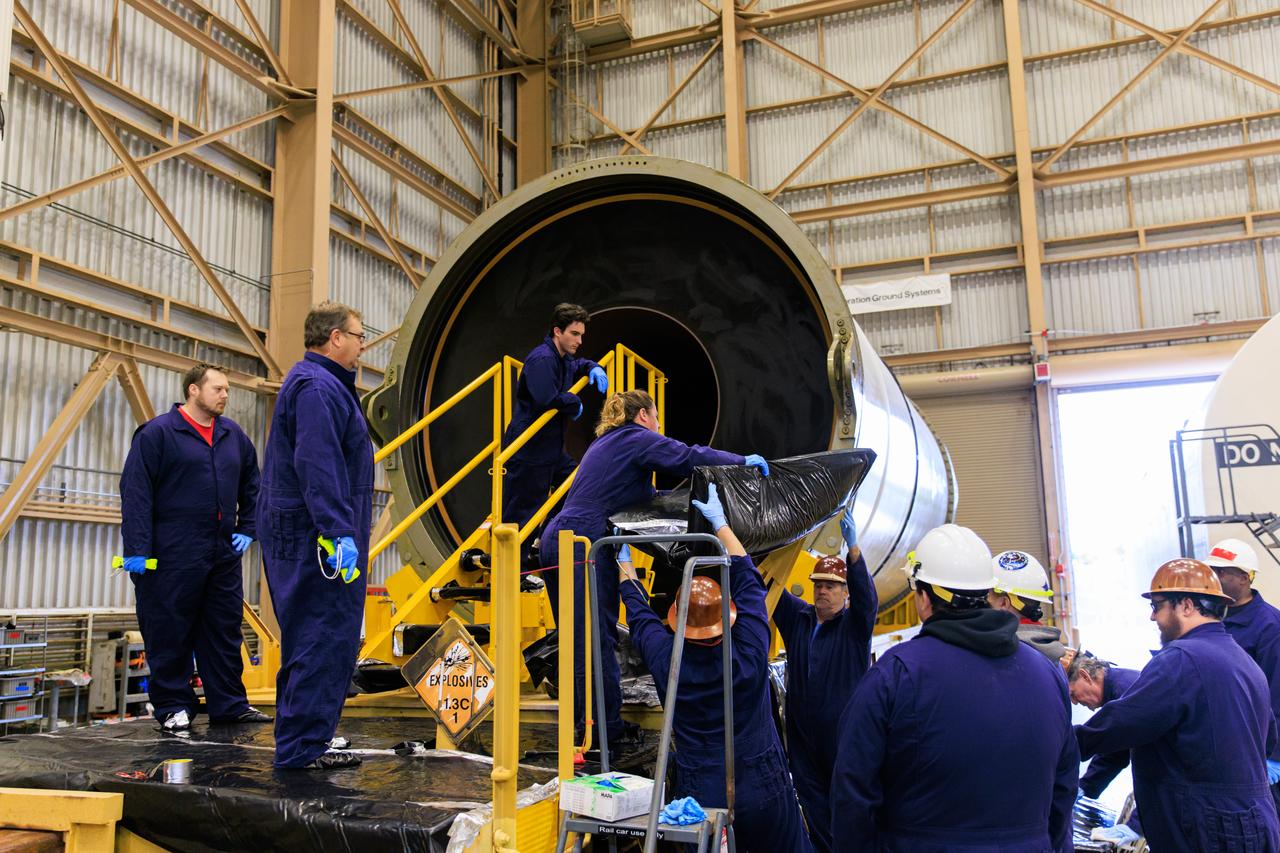
Technicians with Exploration Ground Systems, based at NASA’s Kennedy Space Center in Florida, perform propellant grain inspections on two of the agency’s Space Launch System solid rocket booster segments for the Artemis II campaign on Wednesday, Dec. 20, 2023, inside the Rotation, Processing and Surge Facility. The team is inspecting the propellant of all 10 booster segments before they are rotated vertically for processing. The Artemis II mission will send four astronauts around the Moon as part of the agency’s effort to establish a long-term science and exploration presence at the Moon, and eventually Mars.
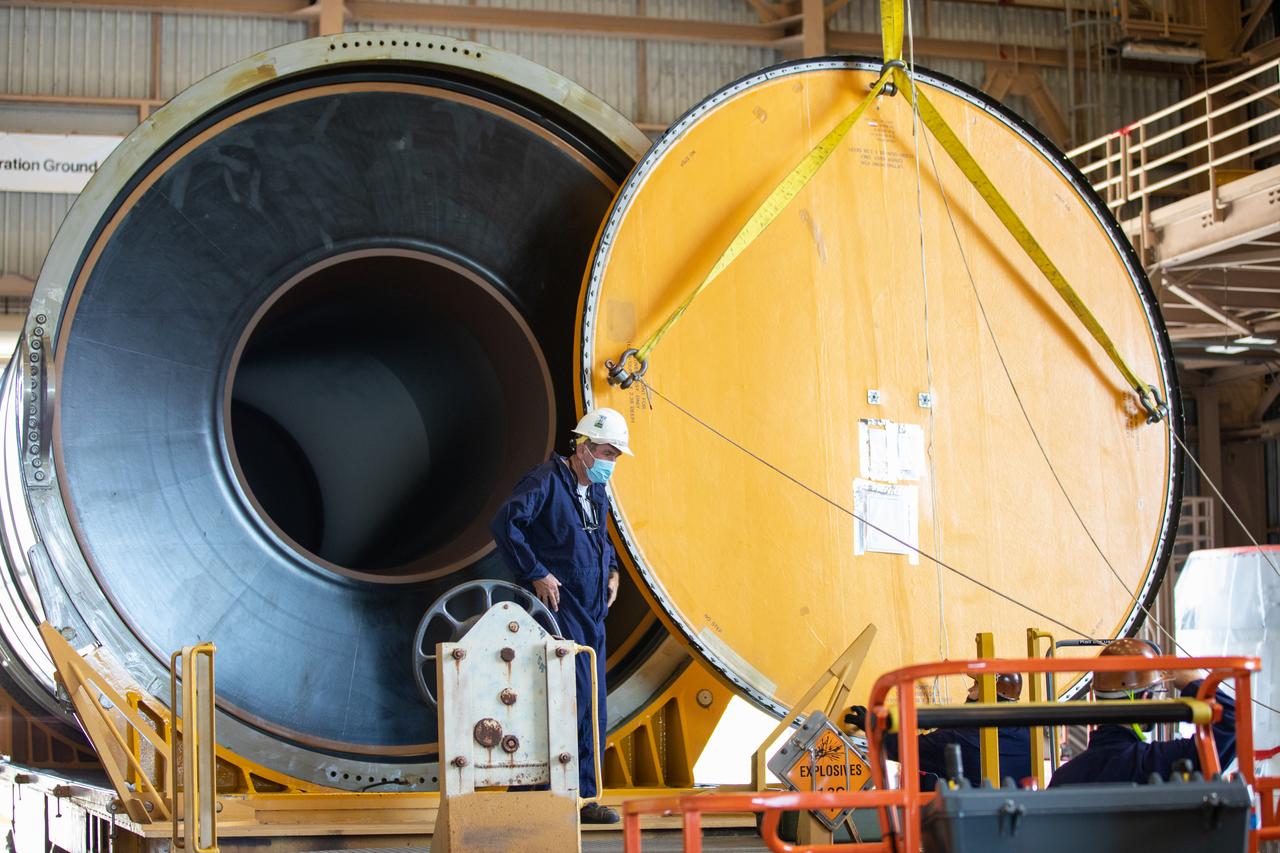
Technicians ready two NASA Space Launch System (SLS) solid rocket boosters for mating to the rocket’s two aft skirts on June 16, 2020, inside Kennedy Space Center’s Rotation, Processing and Surge Facility. Together, the twin boosters provide more than 75 percent of the total SLS thrust at launch. Manufactured by Northrop Grumman in Promontory, Utah, the boosters arrived at Kennedy via train. The cross-country journey was an important milestone for the agency’s Artemis I launch. The first in a series of increasingly complex missions, Artemis I will test the Orion spacecraft and SLS as an integrated system prior to crewed missions to the Moon. Once the boosters are mated with the aft skirts, they will be moved to the Vehicle Assembly Building for stacking on the mobile launcher.
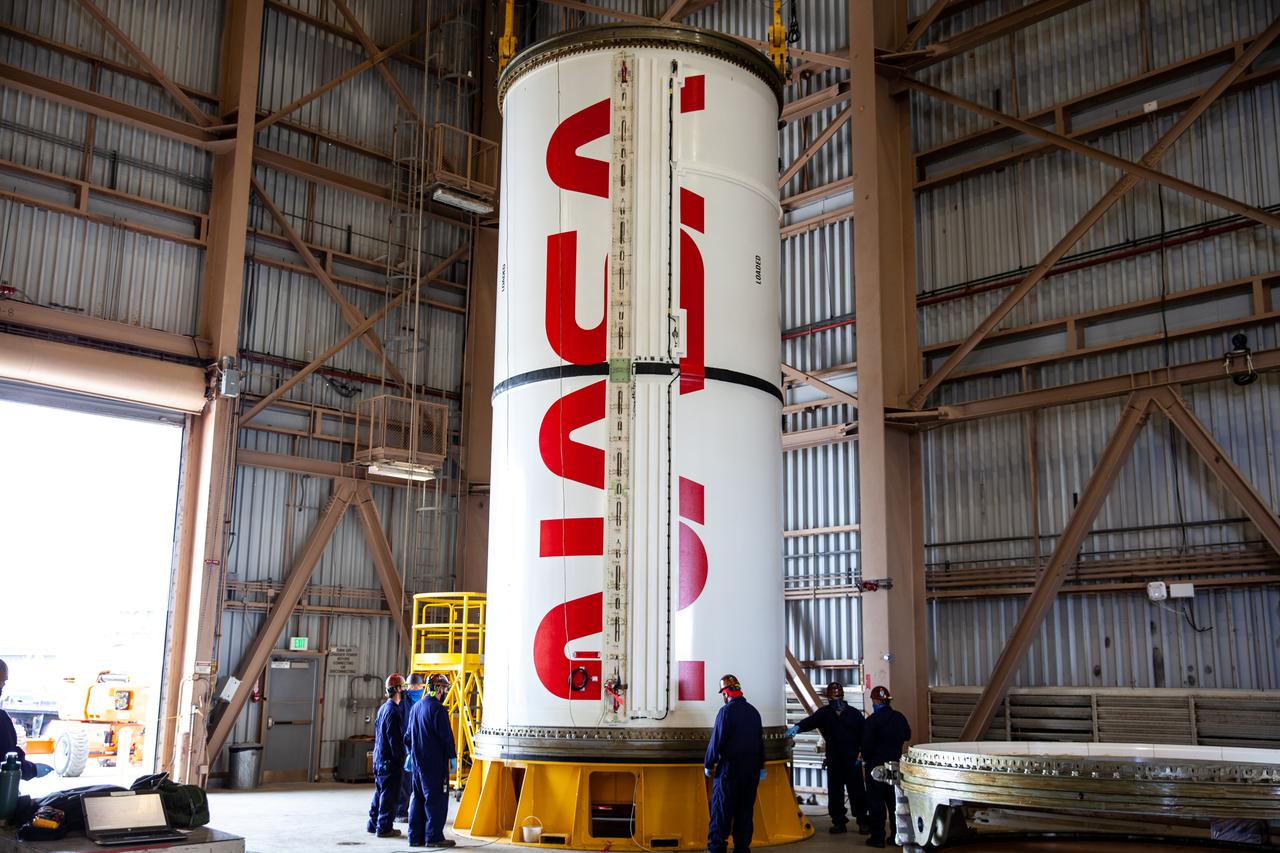
Inside the Rotation, Processing and Surge Facility at NASA’s Kennedy Space Center in Florida, Exploration Ground Systems and Jacobs TOSC workers completed painting of NASA’s iconic “worm” logo on the Artemis I Space Launch System twin solid rocket boosters on Sept. 23, 2020. Originally created by the firm of Danne & Blackburn, the iconic “worm” logo’s bold, sleek design was officially introduced in 1975 and was incorporated into many of the agency’s next-generation programs. It was retired in 1992, but has made a comeback in 2020 as the agency ushers in a new, modern era of human spaceflight. The first in a series of increasingly complex missions, Artemis I will test the Orion spacecraft and Space Launch System as an integrated system ahead of crewed flights to the Moon. Under the Artemis program, NASA will land the first woman and the next man on the Moon by 2024.
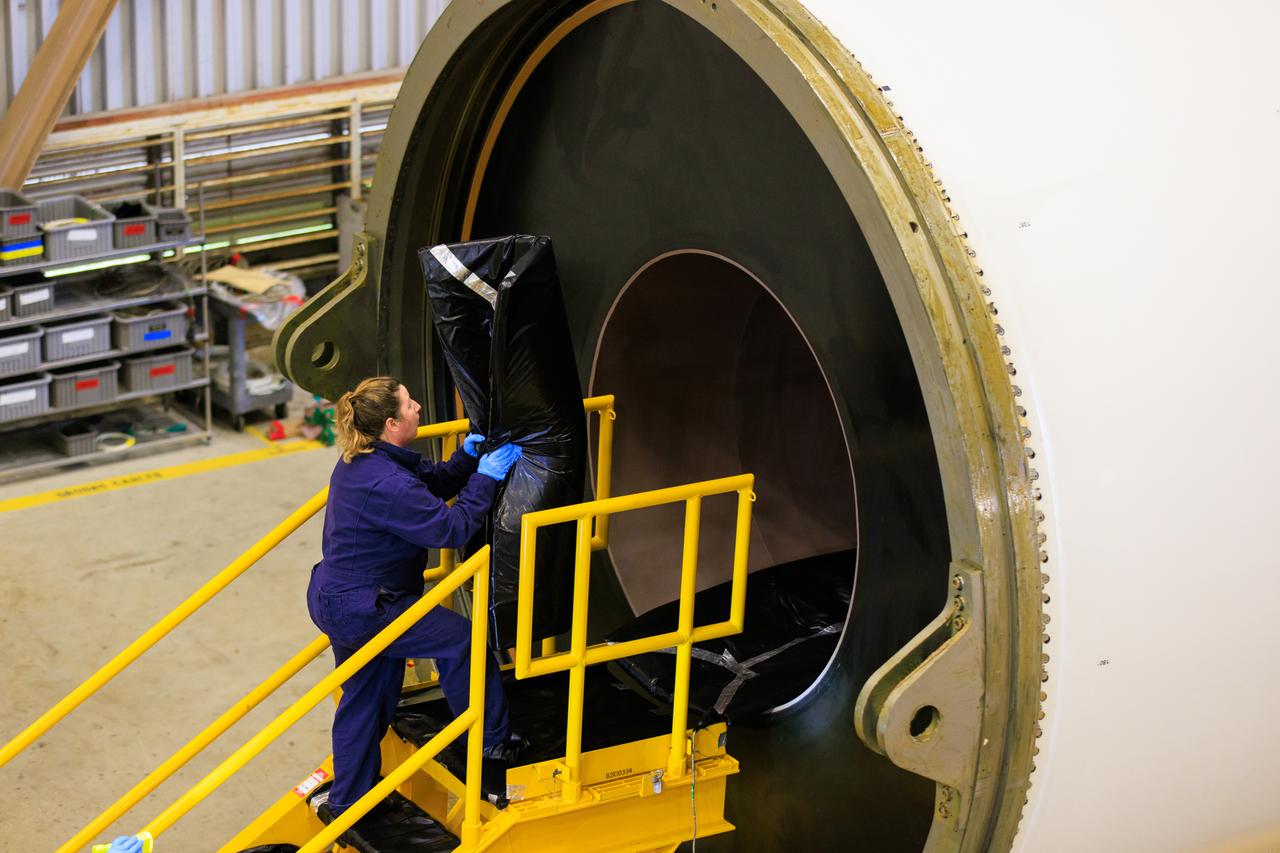
Technicians with Exploration Ground Systems, based at NASA’s Kennedy Space Center in Florida, perform propellant grain inspections on two of the agency’s Space Launch System solid rocket booster segments for the Artemis II campaign on Wednesday, Dec. 20, 2023, inside the Rotation, Processing and Surge Facility. The team is inspecting the propellant of all 10 booster segments before they are rotated vertically for processing. The Artemis II mission will send four astronauts around the Moon as part of the agency’s effort to establish a long-term science and exploration presence at the Moon, and eventually Mars.
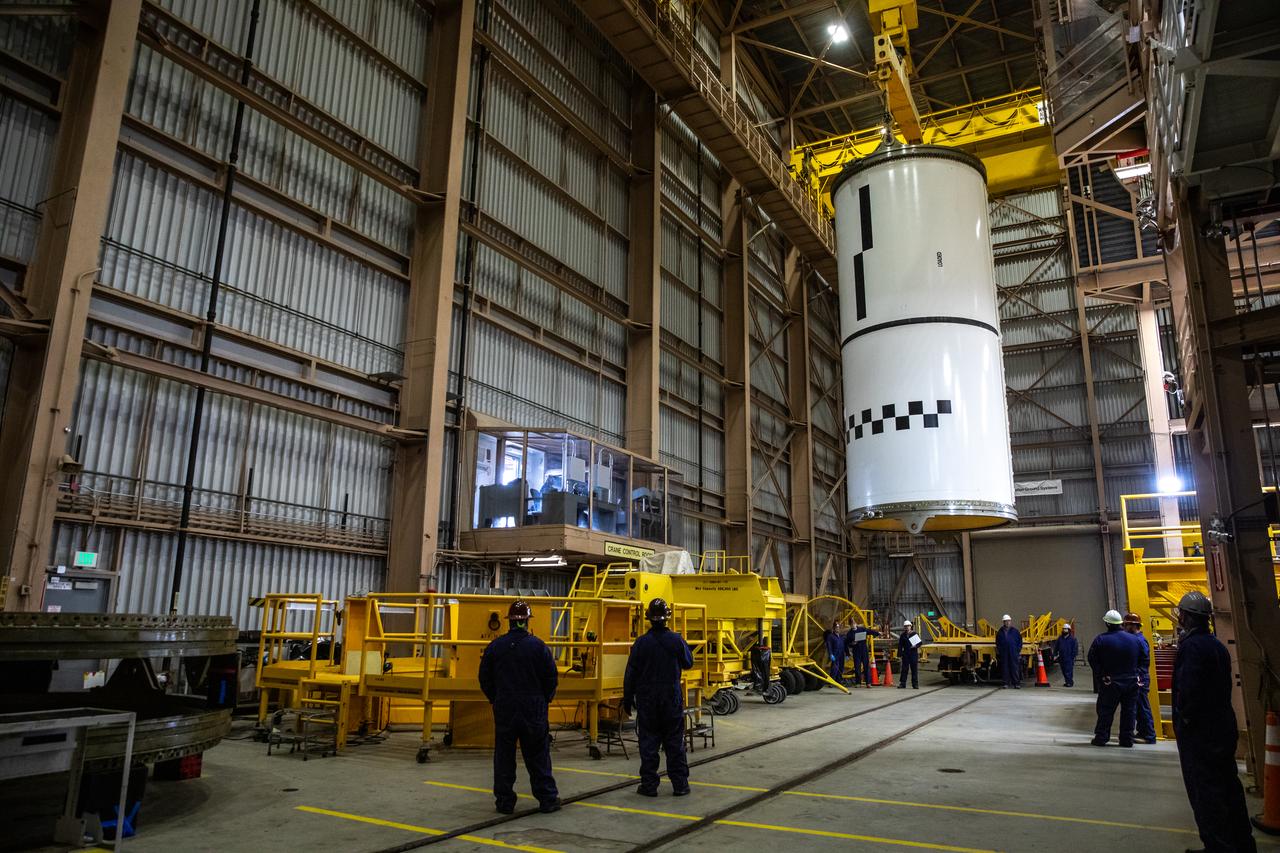
Engineers and technicians process the right forward center segment of the Space Launch System solid rocket boosters for the Artemis II mission inside the Rotation, Processing and Surge Facility (RPSF) at NASA’s Kennedy Space Center in Florida on Tuesday, Nov. 27, 2023. The team has been examining the 10 booster segments one-by-one then lifting them to make sure they are ready for integration and launch before moving them to the Vehicle Assembly Building for stacking atop the mobile launcher. Artemis II astronauts Reid Wiseman, Victor Glover, Christina Koch, and Jeremy Hansen will blast off from Kennedy and travel around the moon for the agency’s first crewed mission under Artemis that will test all of the Orion spacecraft’s systems.
A worker with NASA’s Exploration Ground Systems (EGS) applies bright red paint to the agency’s “worm” logo taking shape on the side of an Artemis I solid rocket booster segment inside the Rotation, Processing and Surge Facility (RPSF) at Kennedy Space Center in Florida. The EGS team used a laser projector to mask off the logo with tape, then painted the first coat of the iconic design. The booster segments will help propel the Space Launch System (SLS) rocket on Artemis I, a test of the Orion spacecraft and SLS as an integrated system ahead of crewed flights to the Moon. Northrop Grumman, which built the booster segments, is covering the cost of the painting.

Inside the Rotation, Processing and Surge Facility (RPSF) at NASA’s Kennedy Space Center in Florida, technicians lift the right aft motor segment – one of five segments that make up one of two solid rocket boosters for the agency’s Space Launch System (SLS) – onto an inspection stand on June 23, 2020. While in the RPSF, the boosters will be mated to the rocket’s two aft skirts before they are moved to the Vehicle Assembly Building for stacking on the mobile launcher. The boosters, manufactured by Northrop Grumman in Utah, recently arrived at Kennedy for processing ahead of the Artemis I launch. Together, the twin boosters provide more than 75 percent of the total SLS thrust at launch. The first in a series of increasingly complex missions, Artemis I will test the Orion spacecraft and SLS as an integrated system ahead of crewed flights to the Moon.
Technicians ready two NASA Space Launch System (SLS) solid rocket boosters for mating to the rocket’s two aft skirts on June 16, 2020, inside Kennedy Space Center’s Rotation, Processing and Surge Facility. Together, the twin boosters provide more than 75 percent of the total SLS thrust at launch. Manufactured by Northrop Grumman in Promontory, Utah, the boosters arrived at Kennedy via train. The cross-country journey was an important milestone for the agency’s Artemis I launch. The first in a series of increasingly complex missions, Artemis I will test the Orion spacecraft and SLS as an integrated system prior to crewed missions to the Moon. Once the boosters are mated with the aft skirts, they will be moved to the Vehicle Assembly Building for stacking on the mobile launcher.
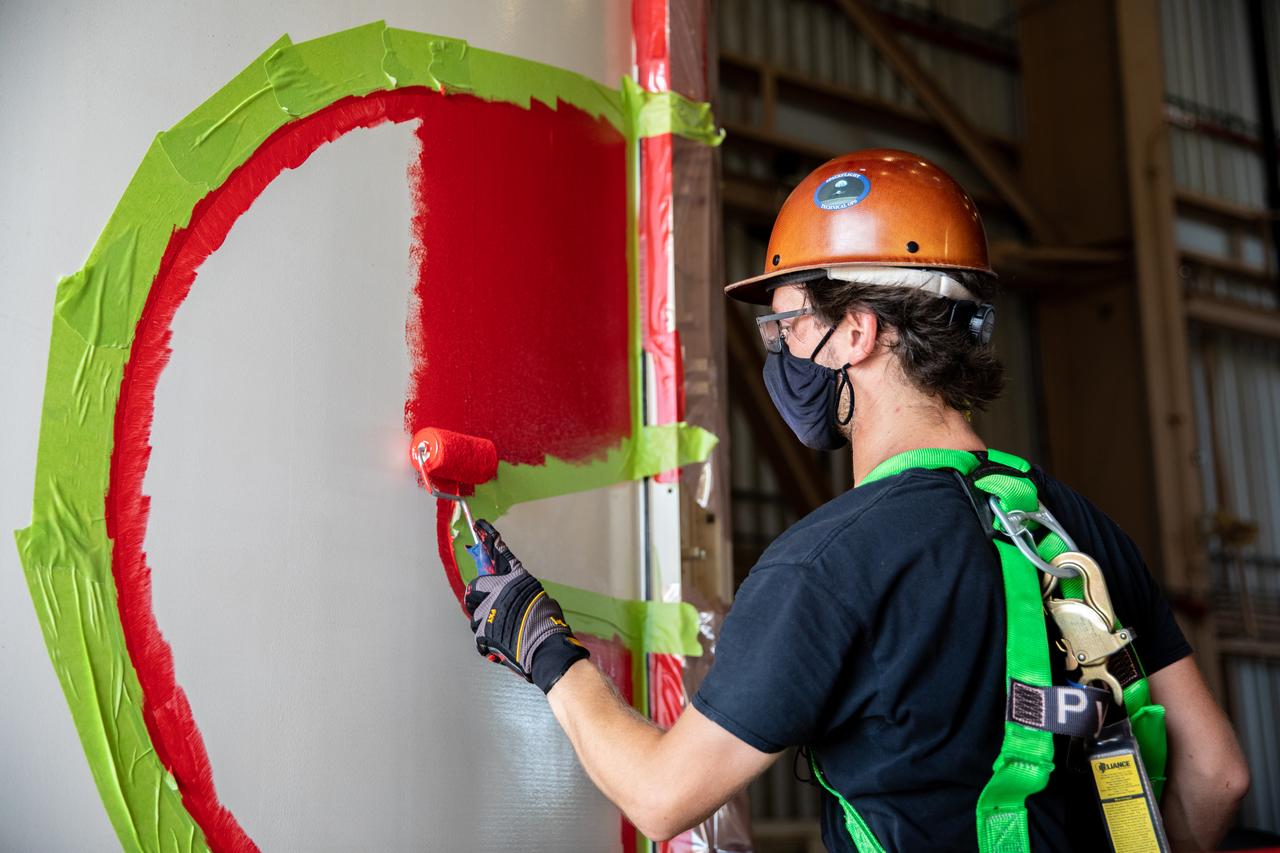
A worker with NASA’s Exploration Ground Systems (EGS) finishes the first coat of the bright red “worm” logo taking shape on the side of an Artemis I solid rocket booster segment inside the Rotation, Processing and Surge Facility (RPSF) at Kennedy Space Center in Florida. The EGS team used a laser projector to mask off the logo with tape, then painted the first coat of the iconic design. The booster segments will help propel the Space Launch System (SLS) rocket on Artemis I, a test of the Orion spacecraft and SLS as an integrated system ahead of crewed flights to the Moon. Northrop Grumman, which built the booster segments, is covering the cost of the painting.
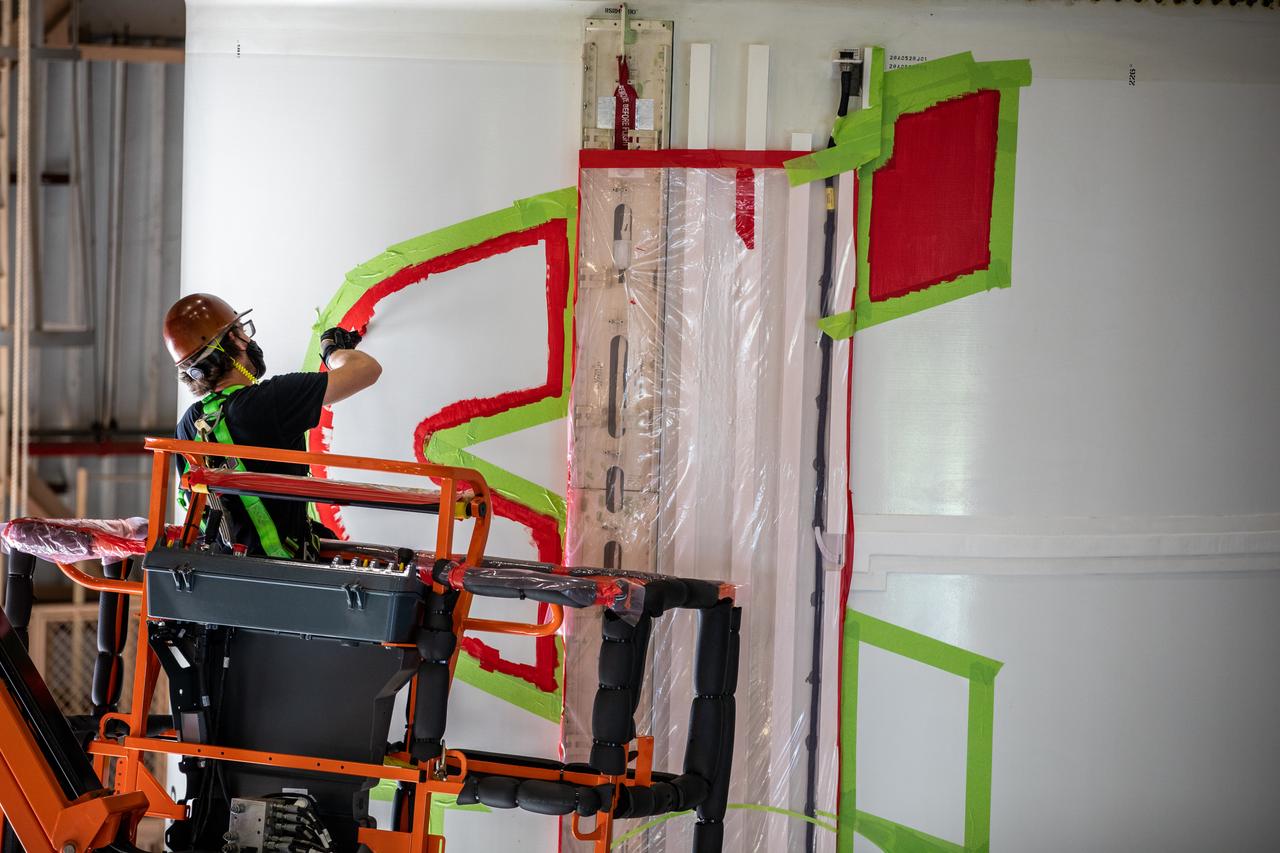
A worker with NASA’s Exploration Ground Systems (EGS) applies bright red paint to the agency’s “worm” logo taking shape on the side of an Artemis I solid rocket booster segment inside the Rotation, Processing and Surge Facility (RPSF) at Kennedy Space Center in Florida. The EGS team used a laser projector to mask off the logo with tape, then painted the first coat of the iconic design. The booster segments will help propel the Space Launch System (SLS) rocket on Artemis I, a test of the Orion spacecraft and SLS as an integrated system ahead of crewed flights to the Moon. Northrop Grumman, which built the booster segments, is covering the cost of the painting.
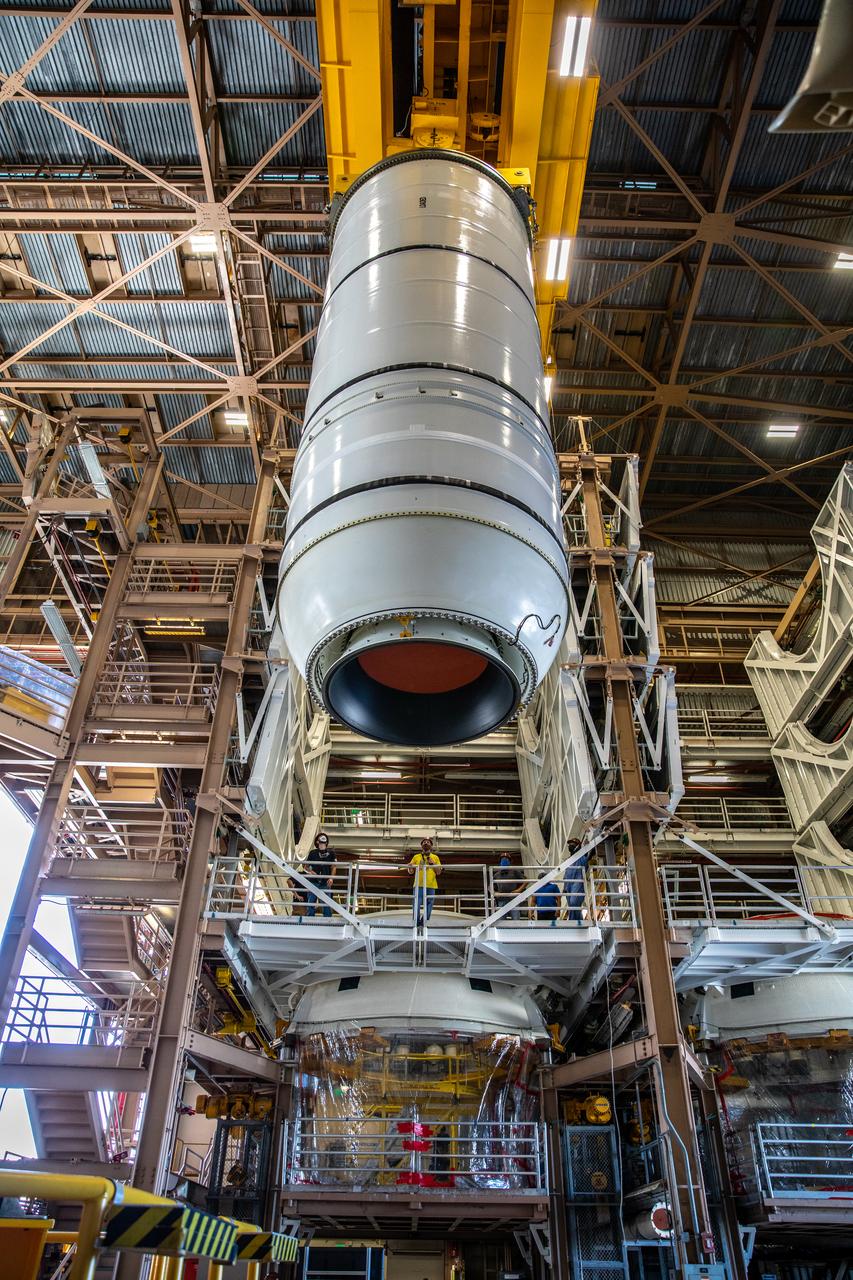
Inside the Rotation, Processing and Surge Facility at NASA’s Kennedy Space Center in Florida, technicians begin to mate the right-hand motor segment – one of five segments that make up one of two solid rocket boosters for the agency’s Space Launch System (SLS) – to the rocket’s right-hand aft skirt on June 24, 2020. Once the aft segments are mated to the two aft skirts, they will be moved to the Vehicle Assembly Building for stacking on the mobile launcher. Manufactured by Northrop Grumman in Utah, the twin boosters provide more than 75 percent of the total SLS thrust at launch. Under the Artemis program, NASA will land the first woman and the next man on the Moon by 2024. The first in a series of increasingly complex missions, Artemis I will test the Orion spacecraft and SLS as an integrated system ahead of crewed flights to the Moon.
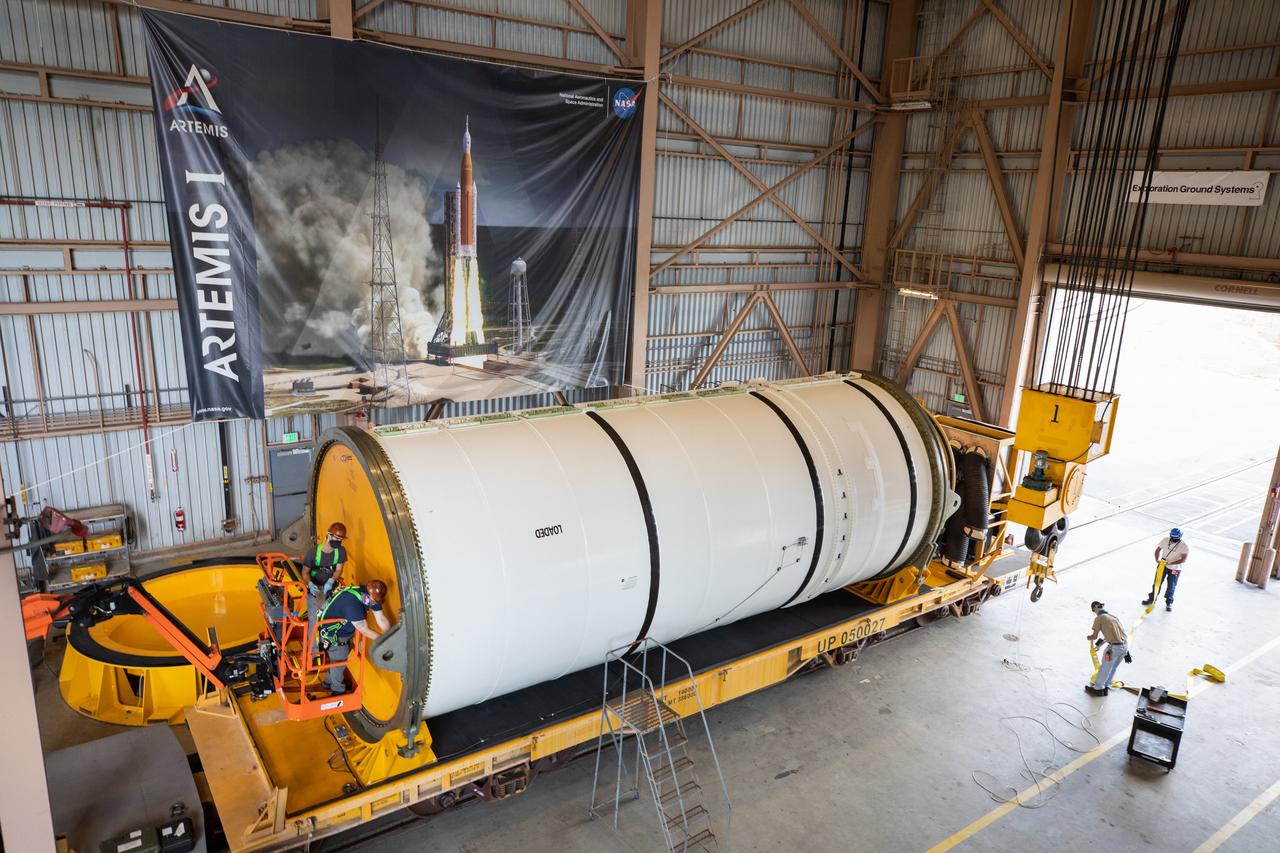
Technicians ready two NASA Space Launch System (SLS) solid rocket boosters for mating to the rocket’s two aft skirts on June 16, 2020, inside Kennedy Space Center’s Rotation, Processing and Surge Facility. Together, the twin boosters provide more than 75 percent of the total SLS thrust at launch. Manufactured by Northrop Grumman in Promontory, Utah, the boosters arrived at Kennedy via train. The cross-country journey was an important milestone for the agency’s Artemis I launch. The first in a series of increasingly complex missions, Artemis I will test the Orion spacecraft and SLS as an integrated system prior to crewed missions to the Moon. Once the boosters are mated with the aft skirts, they will be moved to the Vehicle Assembly Building for stacking on the mobile launcher.
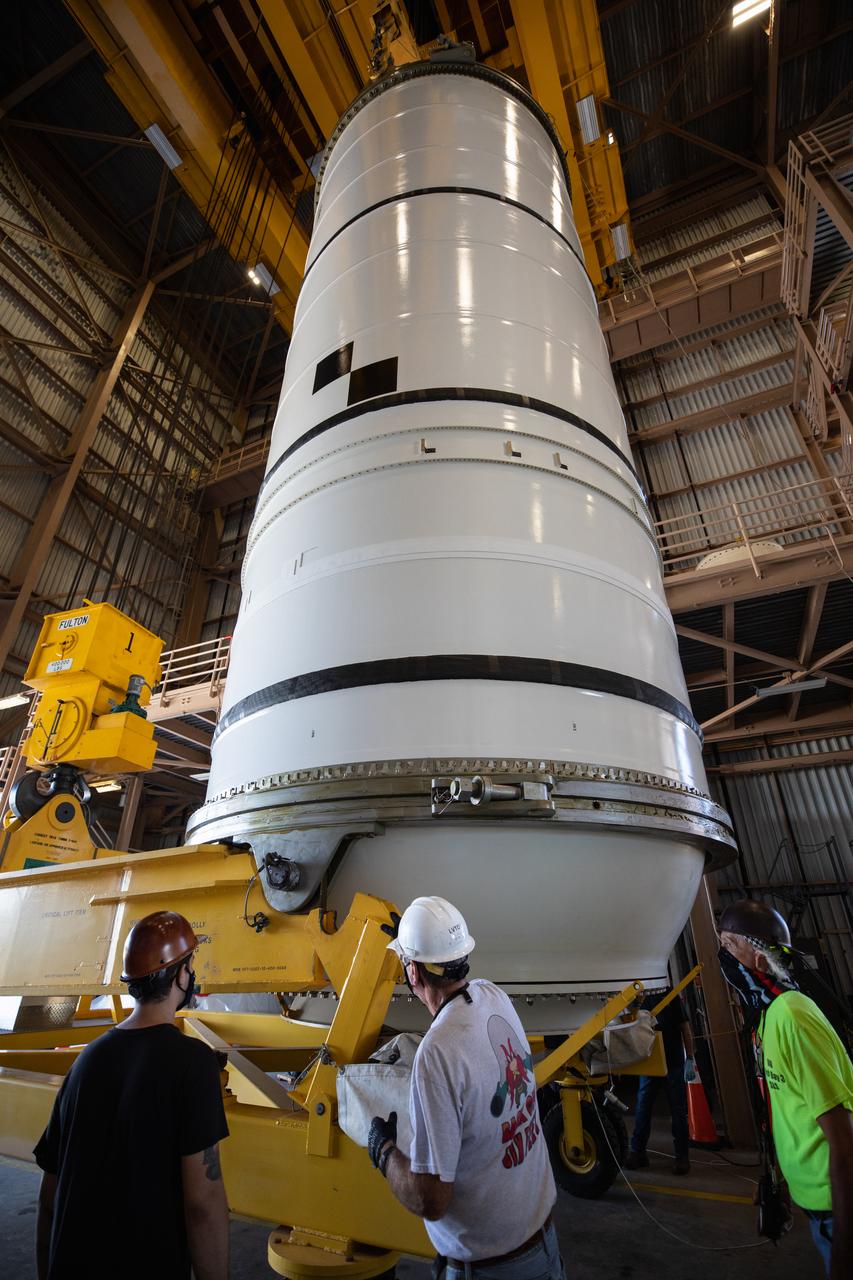
Inside the Rotation, Processing and Surge Facility (RPSF) at NASA’s Kennedy Space Center in Florida, technicians lift the right aft motor segment – one of five segments that make up one of two solid rocket boosters for the agency’s Space Launch System (SLS) – onto an inspection stand on June 23, 2020. While in the RPSF, the boosters will be mated to the rocket’s two aft skirts before they are moved to the Vehicle Assembly Building for stacking on the mobile launcher. The boosters, manufactured by Northrop Grumman in Utah, recently arrived at Kennedy for processing ahead of the Artemis I launch. Together, the twin boosters provide more than 75 percent of the total SLS thrust at launch. The first in a series of increasingly complex missions, Artemis I will test the Orion spacecraft and SLS as an integrated system ahead of crewed flights to the Moon.
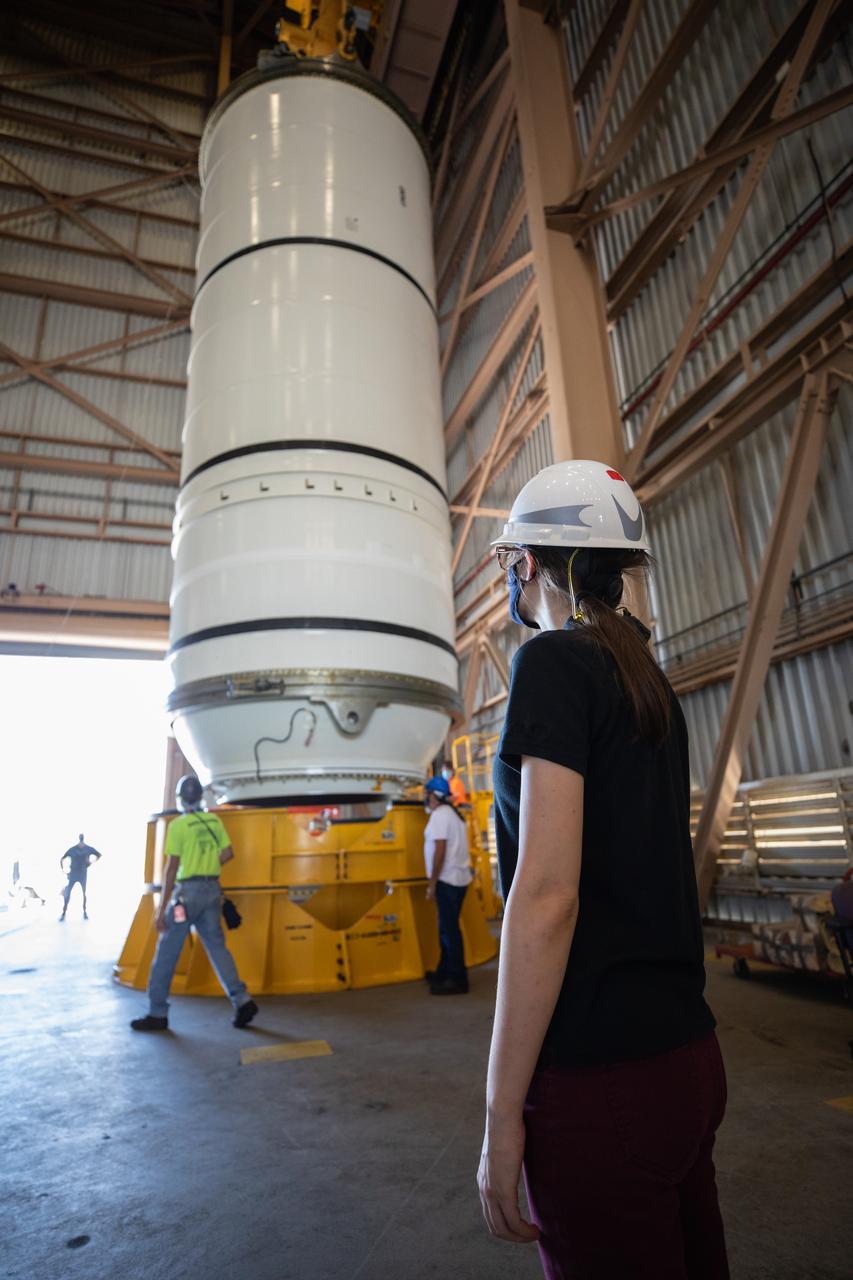
Inside the Rotation, Processing and Surge Facility (RPSF) at NASA’s Kennedy Space Center in Florida, technicians lift the right aft motor segment – one of five segments that make up one of two solid rocket boosters for the agency’s Space Launch System (SLS) – onto an inspection stand on June 23, 2020. While in the RPSF, the boosters will be mated to the rocket’s two aft skirts before they are moved to the Vehicle Assembly Building for stacking on the mobile launcher. The boosters, manufactured by Northrop Grumman in Utah, recently arrived at Kennedy for processing ahead of the Artemis I launch. Together, the twin boosters provide more than 75 percent of the total SLS thrust at launch. The first in a series of increasingly complex missions, Artemis I will test the Orion spacecraft and SLS as an integrated system ahead of crewed flights to the Moon.
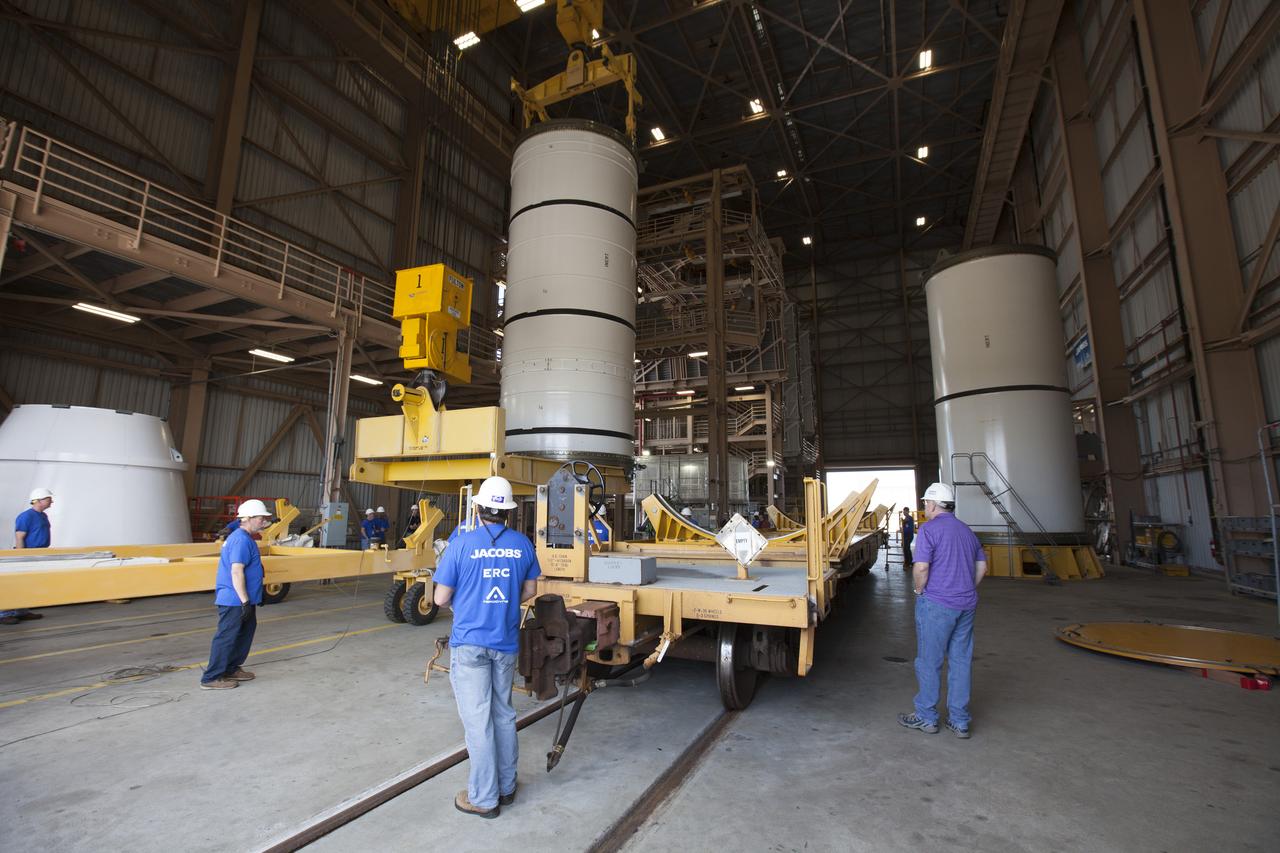
Engineers and technicians with Jacobs Engineering on the Test and Operations Contract monitor the progress as a crane is used to move one of two pathfinders, or test versions, of solid rocket booster segments for NASA’s Space Launch System (SLS) rocket. At far right, the first pathfinder booster segment has been secured in the vertical position on a test stand. Inside the RPSF, the Ground Systems Development and Operations Program and Jacobs will prepare the booster segments, which are inert, for a series of lifts, moves and stacking operations to prepare for Exploration Mission-1, deep-space missions and the journey to Mars.
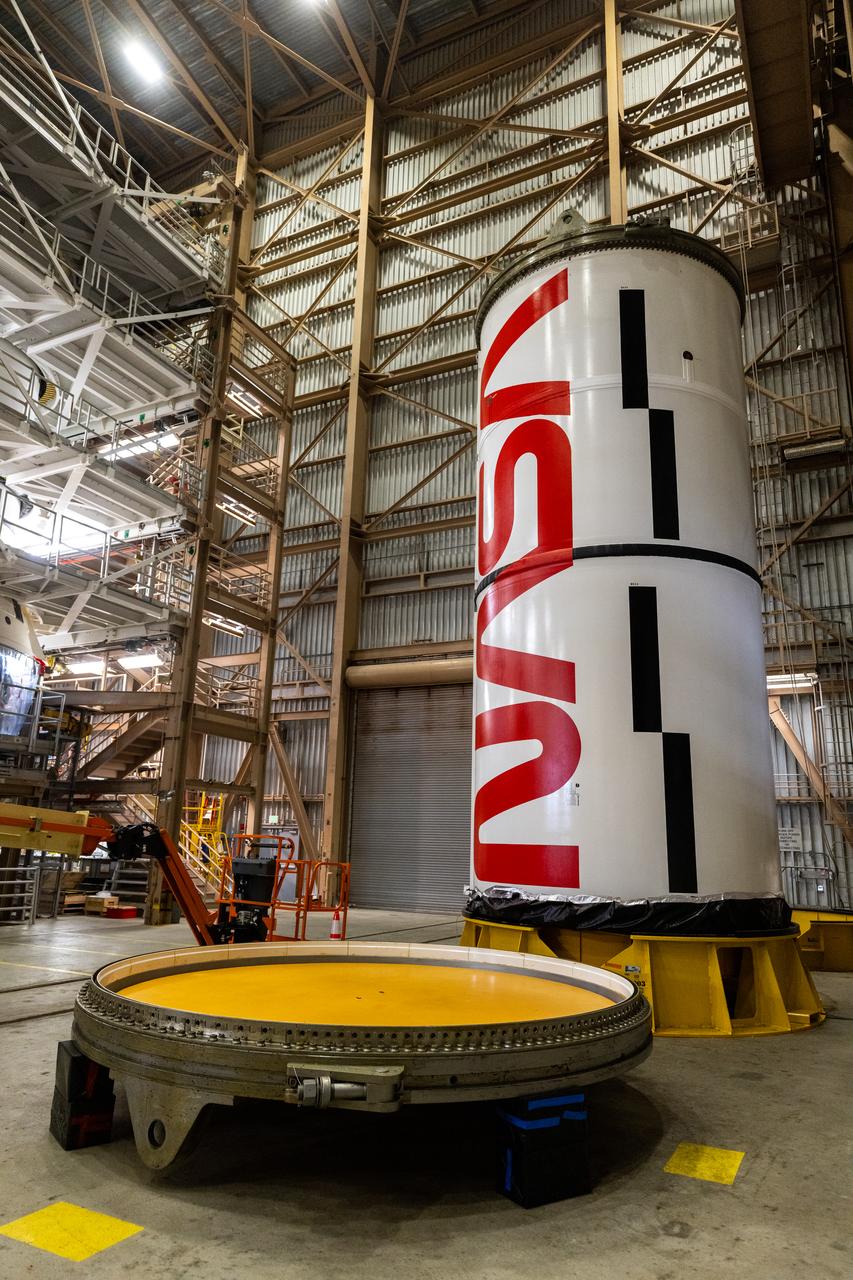
Workers with NASA’s Exploration Ground Systems and primary contractor, Jacobs, complete the painting of the agency’s iconic “worm” logo along the side of the twin Artemis II solid rocket booster motor segments inside the Rotation, Processing and Surge Facility at Kennedy Space Center in Florida on Friday, Feb. 16, 2024. Using a laser projector, the logo was mapped out with tape by workers with Jacobs, for the spaceport, before using two coats of red paint, plus several coats of clear primer to complete the logo that stretches 25 feet long. The booster segments will help propel the SLS (Space Launch System) rocket on the Artemis II mission to send four astronauts around the Moon as part of the agency’s effort to establish a long-term science and exploration presence at the Moon, and eventually Mars.
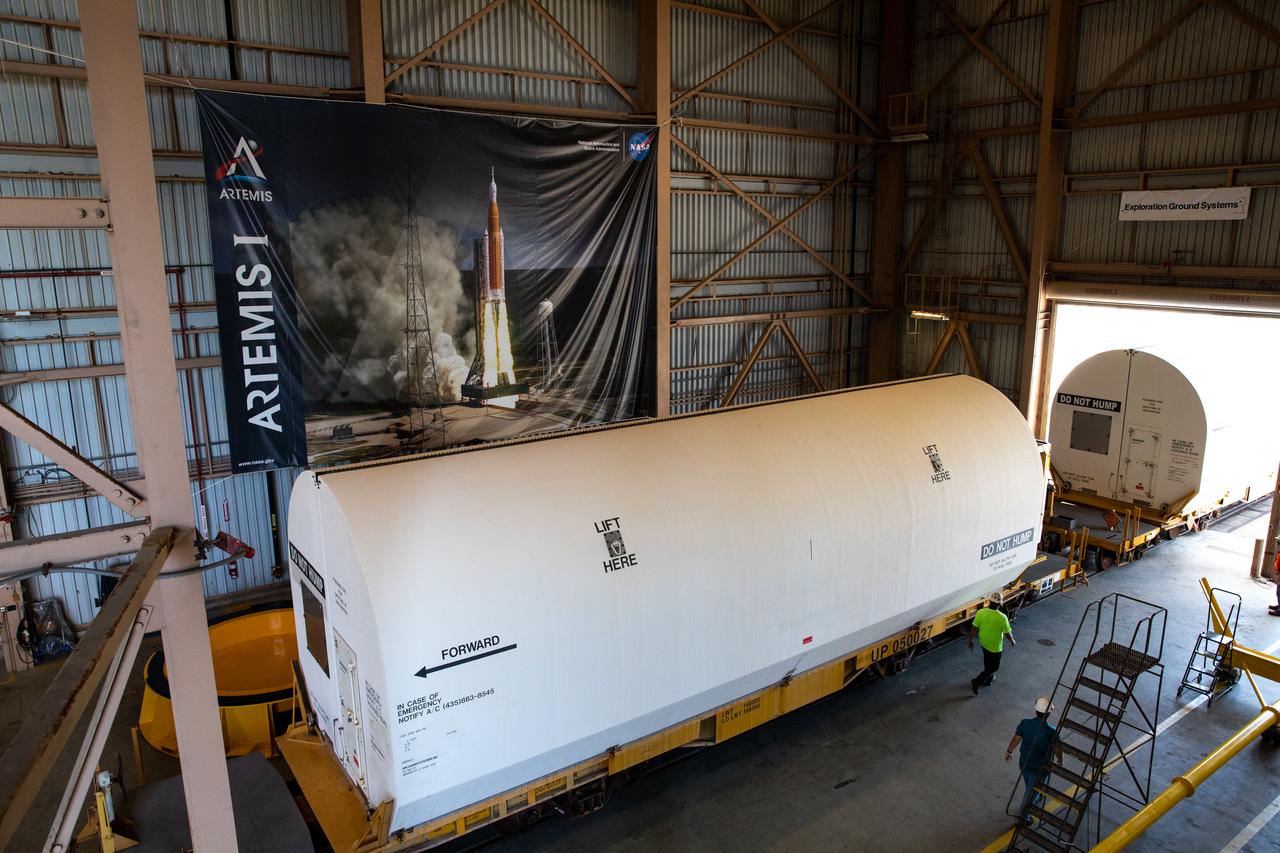
The shipping container that held the right-hand motor segment – one of five segments that make up one of two solid rocket boosters for the agency’s Space Launch System (SLS) – is photographed inside the Rotation, Processing and Surge Facility (RPSF) at NASA’s Kennedy Space Center in Florida on June 24, 2020. The boosters, manufactured by Northrop Grumman in Utah, recently arrived at Kennedy for processing ahead of the Artemis I launch. While in the RPSF, the booster aft segments will be mated to the rocket’s two aft skirts before they are moved to the Vehicle Assembly Building for stacking on the mobile launcher. Together, the twin boosters provide more than 75 percent of the total SLS thrust at launch. The first in a series of increasingly complex missions, Artemis I will test the Orion spacecraft and SLS as an integrated system ahead of crewed flights to the Moon.