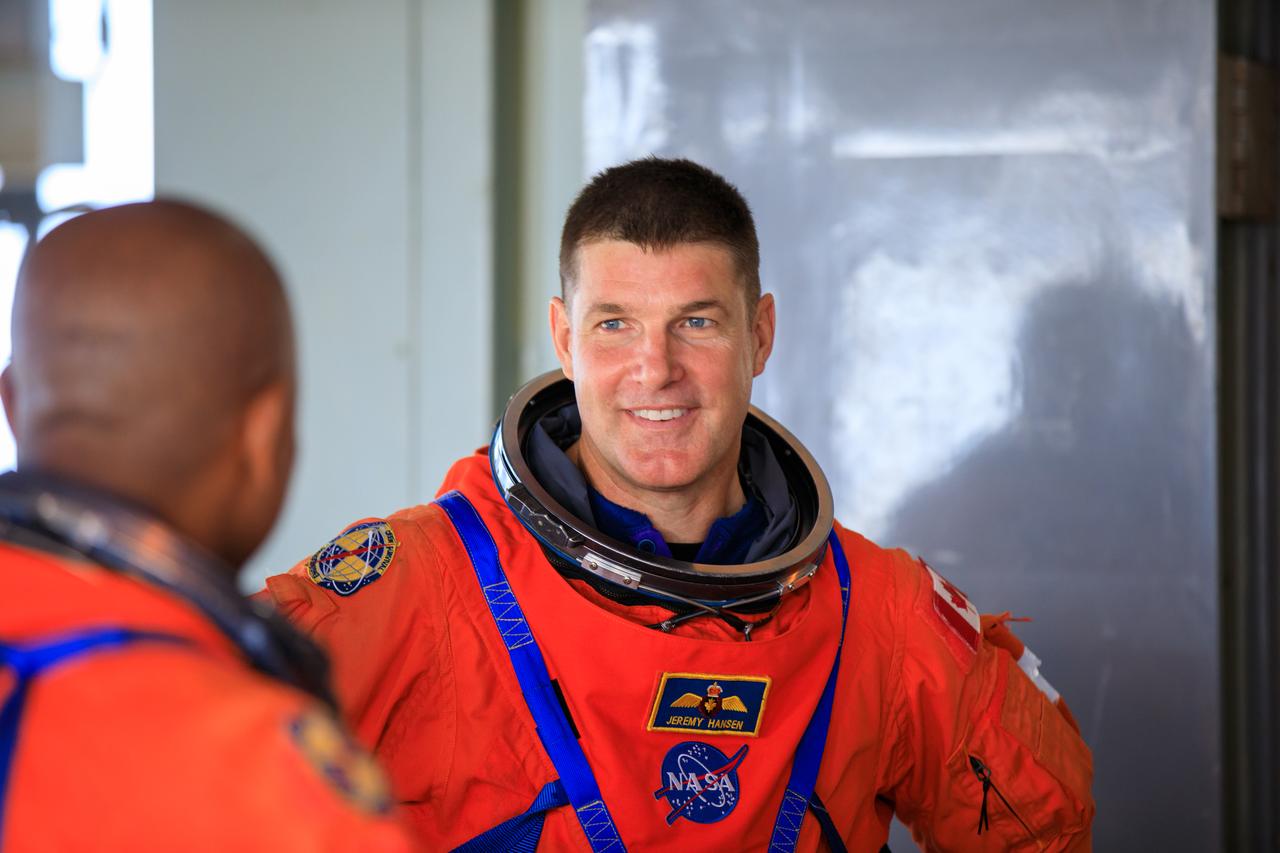
Artemis II CSA (Canadian Space Agency) astronaut Jeremy Hansen stands on the mobile launcher at Launch Pad 39B as part of an integrated ground systems test at Kennedy Space Center in Florida on Wednesday, Sept. 20, 2023. The test ensures the ground systems team is ready to support the crew timeline on launch day.
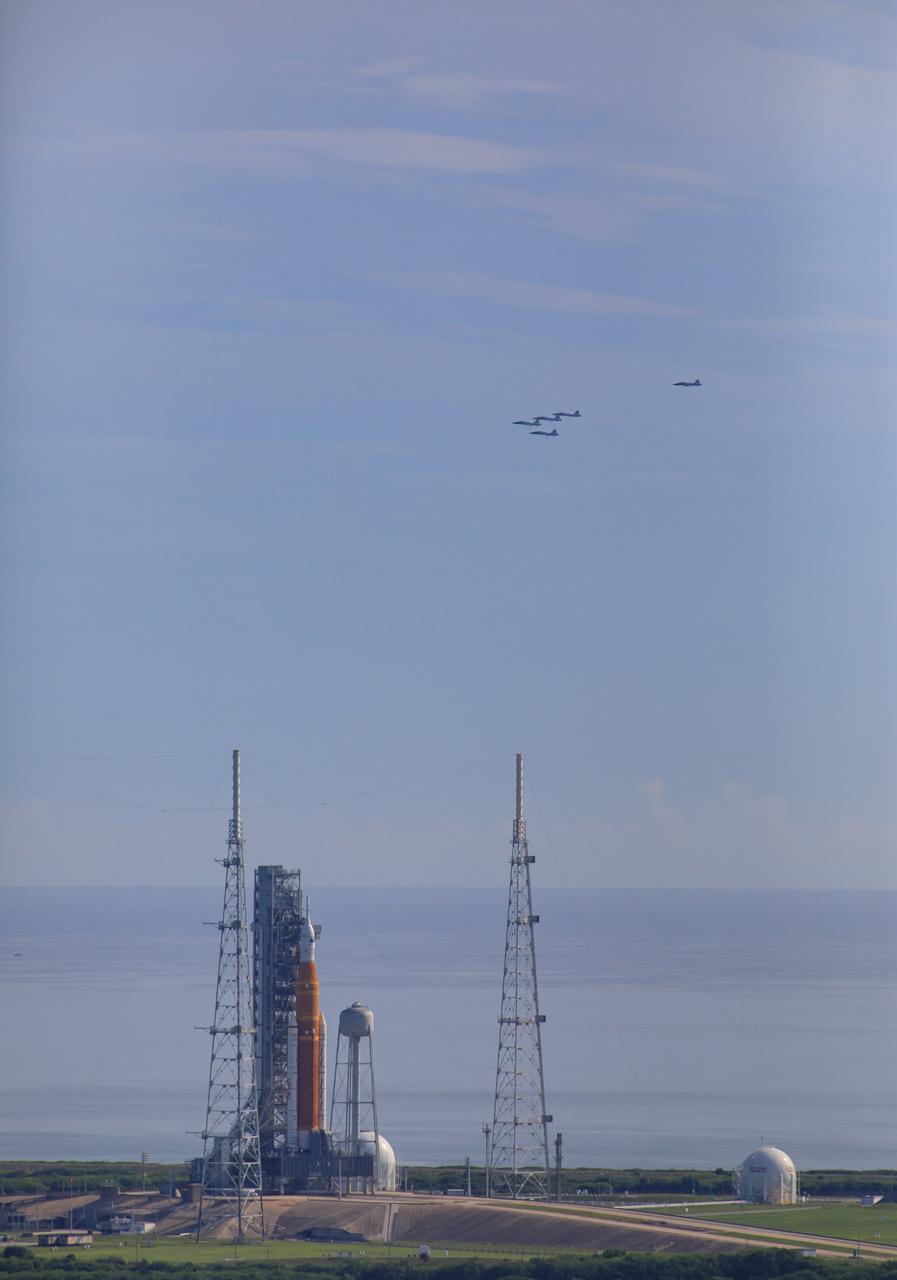
Ahead of NASA’s Artemis I launch, a flight of T-38 supersonic trainer aircraft from the Johnson Space Center Aircraft Operations Division flies in formation over the agency’s Space Launch System and Orion spacecraft on the pad at Launch Complex 39B at Kennedy Space Center in Florida, on Aug. 23, 2022. Pilots and passengers of the five aircraft include NASA Research Pilot Chris Condon and NASA Astronaut Zena Cardman in the lead plane, followed by NASA astronaut candidate Nicole Ayers and NASA astronaut Christina Koch in the second plane, Canadian Space Agency astronaut Jeremy Hansen and NASA astronaut Drew Morgan in the third plane, NASA astronaut Reid Wiseman and NASA astronaut Joe Acaba in the fourth plane, and NASA astronaut candidate Jack Hathaway and Josh Valcarcel, NASA photographer, in the chase plane. Artemis I is scheduled to launch at 8:33 a.m. EDT on Aug. 29, 2022. The first in a series of increasingly complex missions, Artemis I will provide a foundation for human deep space exploration and demonstrate our commitment and capability to extend human presence to the Moon and beyond. The primary goal of Artemis I is to thoroughly test the integrated systems before crewed missions by operating the spacecraft in a deep space environment, testing Orion’s heat shield, and recovering the crew module after reentry, descent, and splashdown.
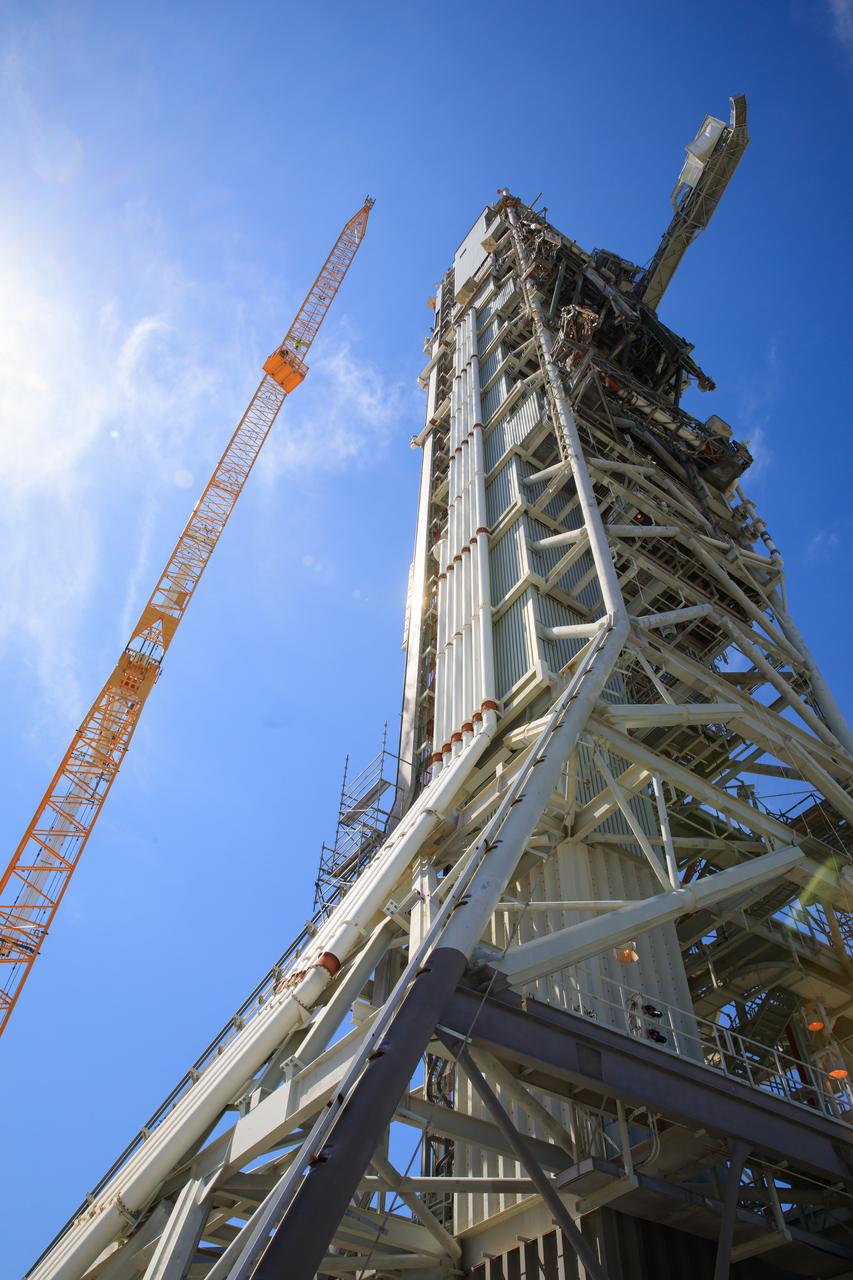
Teams with Exploration Ground Systems at NASA’s Kennedy Space Center in Florida continue to work the upgrades and repairs on mobile launcher 1 and Launch Pad 39B on June 13, 2023, ahead of the first critical ground testing for Artemis II. The crew access arm (CAA) has been extended in this view of the mobile launcher. The CAA is the entry and exit point astronauts will use for access to the Orion spacecraft. Tests will be conducted to ensure the arm and supporting mobile launcher systems are certified to support crewed missions. Artemis II will be the first Artemis mission flying crew aboard Orion.

Teams with Exploration Ground Systems at NASA’s Kennedy Space Center in Florida continue to work the upgrades and repairs on mobile launcher 1 and Launch Pad 39B on June 13, 2023, ahead of the first critical ground testing for Artemis II. New pavement markings indicate the direction of the emergency egress system terminus from Launch Complex 39B. The team has nearly completed the terminus area, where the emergency egress baskets carrying the astronauts and flight crew will arrive following their safe exit from the mobile launcher. Artemis II will be the first Artemis mission flying crew aboard Orion.
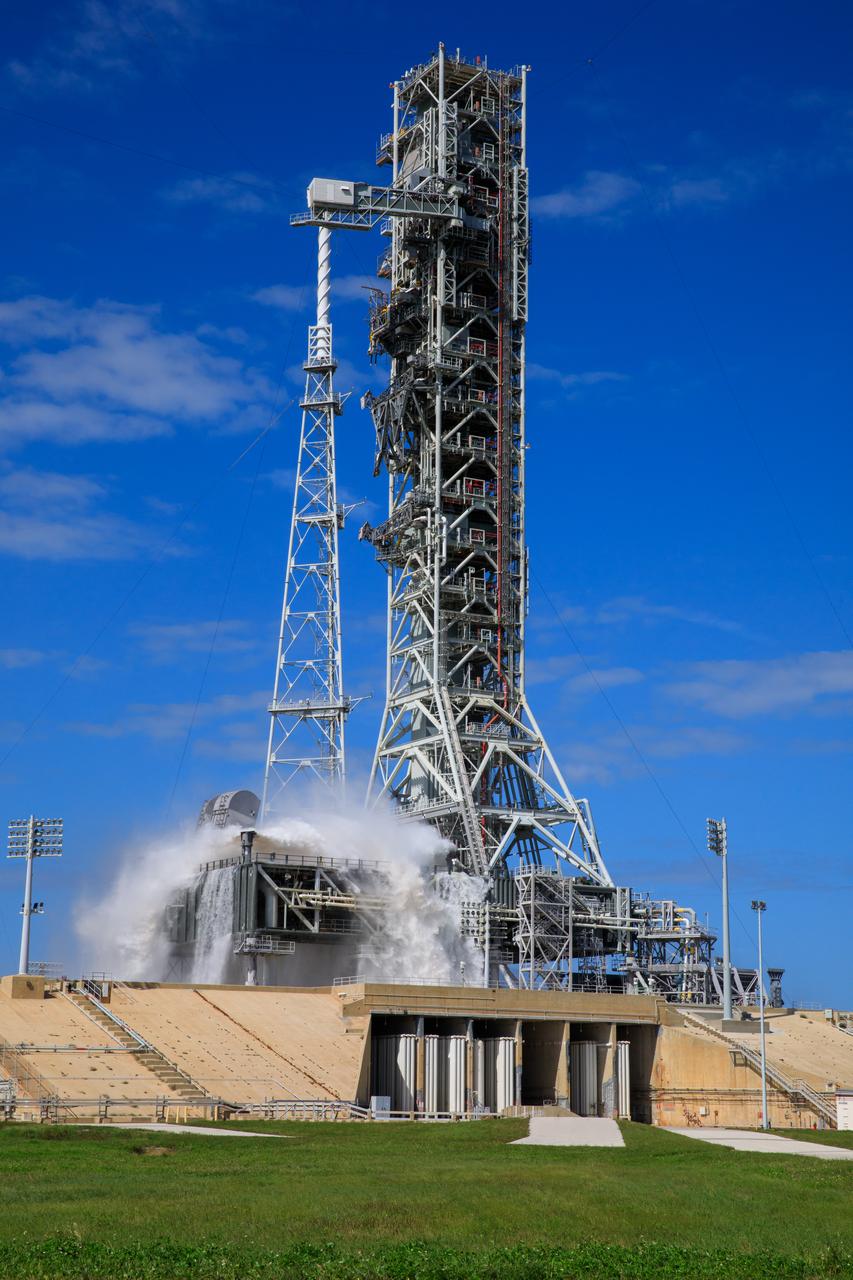
NASA’s Exploration Ground Systems conducts a water flow test with the mobile launcher at Kennedy Space Center’s Launch Complex 39B in Florida on Oct. 24, 2023. It is the third in a series of tests to verify the overpressure protection and sound suppression system is ready for launch of the Artemis II mission. During liftoff, 400,000 gallons of water will rush onto the pad to help protect NASA’s SLS (Space Launch System) rocket, Orion spacecraft, mobile launcher, and launch pad from any over pressurization and extreme sound produced during ignition and liftoff.
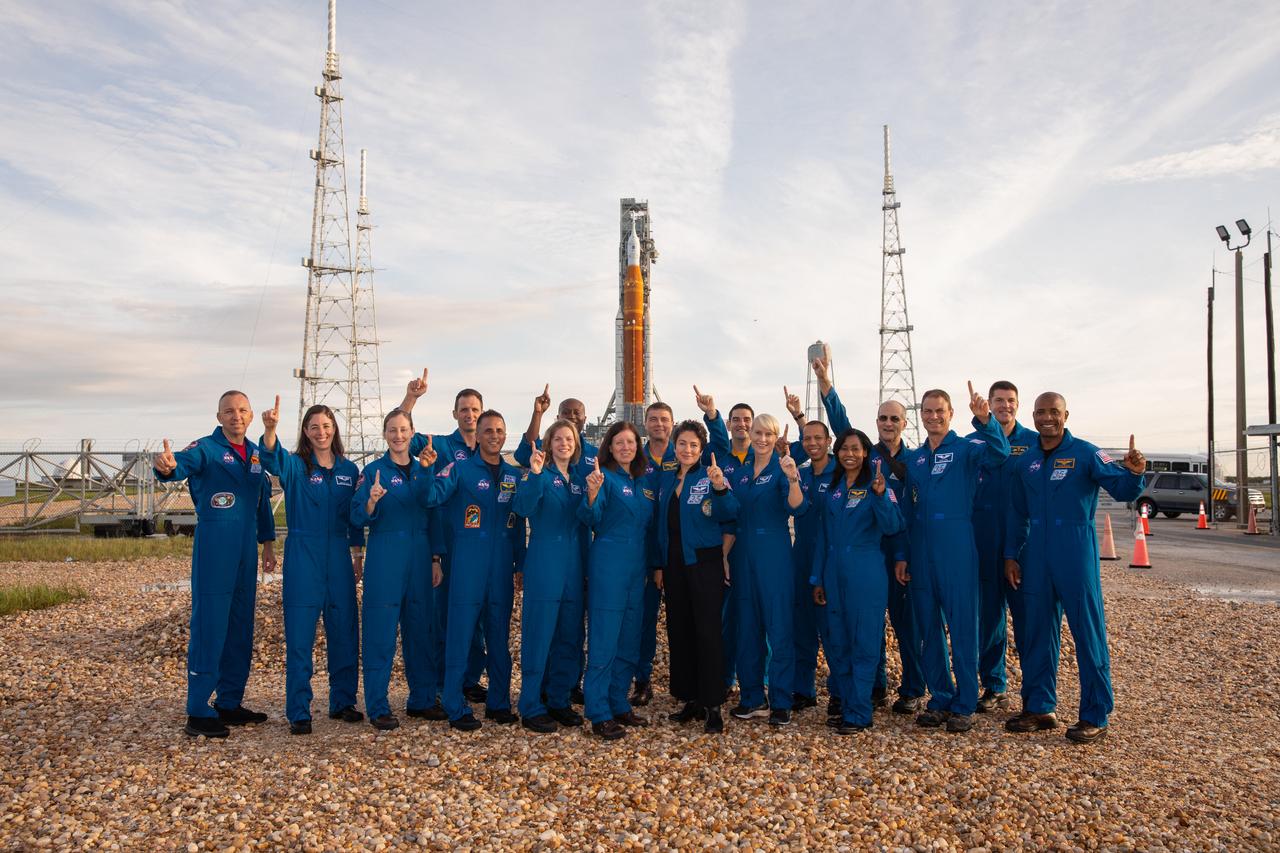
Astronauts and astronaut candidates from NASA and the Canadian Space Agency pose for a photograph in front of NASA’s Artemis I Space Launch System and Orion spacecraft atop the mobile launcher on the pad at Launch Complex 39B on Aug. 28, 2022. The astronauts are, from left to right: Randy Bresnik, NASA astronaut; Christina Birch, NASA astronaut candidate; Jessica Wittner, NASA astronaut candidate; Joshua Kutryk, Canadian Space Agency astronaut; Joe Acaba, NASA astronaut; Zena Cardman, NASA astronaut; Andre Douglas, NASA astronaut candidate; Shannon Walker, NASA astronaut; Reid Wiseman, NASA astronaut; Jessica Meir, NASA astronaut; Jack Hathaway, NASA astronaut candidate; Kate Rubins, NASA astronaut; Chris Williams, NASA astronaut candidate; Stephanie Wilson, NASA astronaut; Don Pettit, NASA astronaut; Stan Love, NASA astronaut; Jeremy Hansen, Canadian Space Agency astronaut; Victor Glover, NASA astronaut. Artemis I is scheduled to launch Aug. 29, at 8:33 a.m. EDT. The first in a series of increasingly complex missions, Artemis I will provide a foundation for human deep space exploration and demonstrate our commitment and capability to extend human presence to the Moon and beyond. The primary goal of Artemis I is to thoroughly test the integrated systems before crewed missions by operating the spacecraft in a deep space environment, testing Orion’s heat shield, and recovering the crew module after reentry, descent, and splashdown.
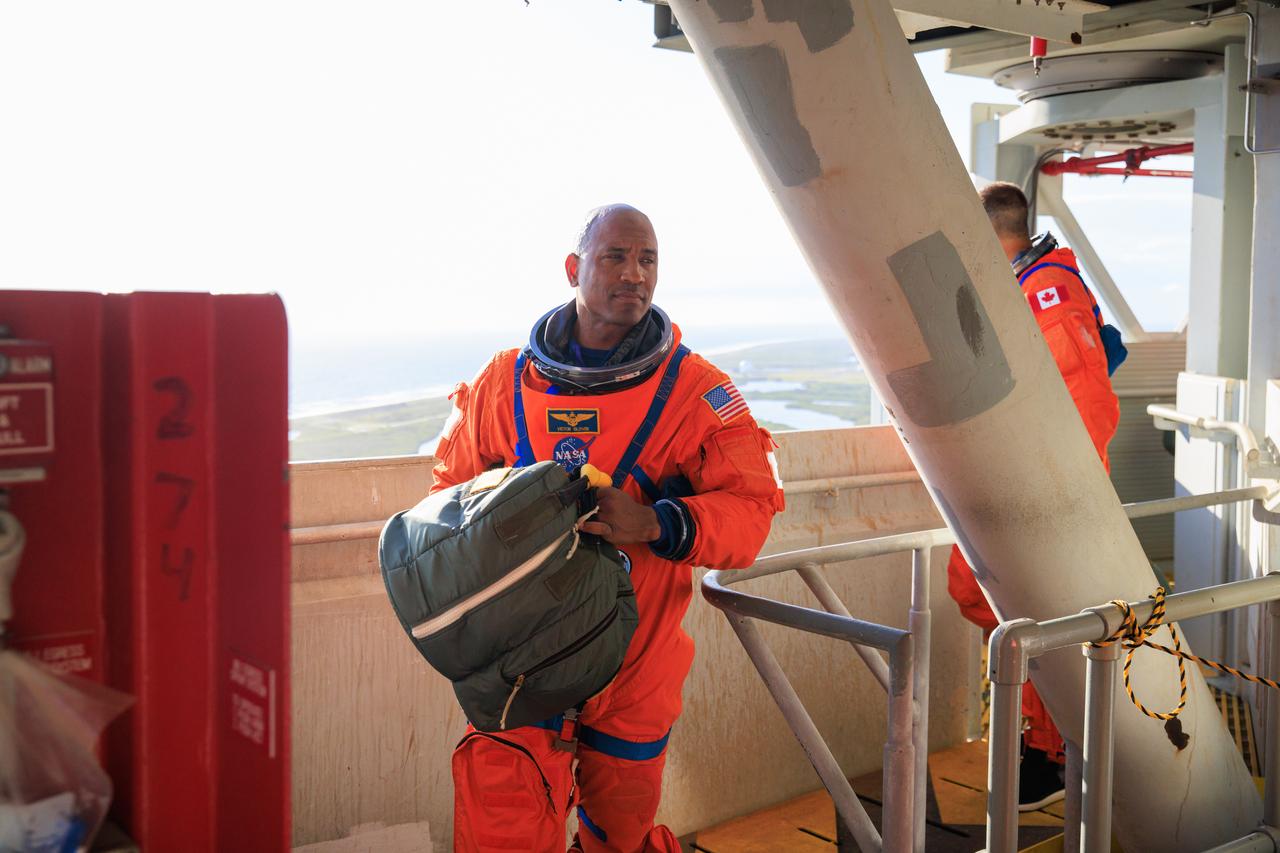
Artemis II NASA astronaut Victor Glover stands on the crew access arm of the mobile launcher at Launch Pad 39B as part of an integrated ground systems test at Kennedy Space Center in Florida on Wednesday, Sept. 20, 2023. The test ensures the ground systems team is ready to support the crew timeline on launch day.
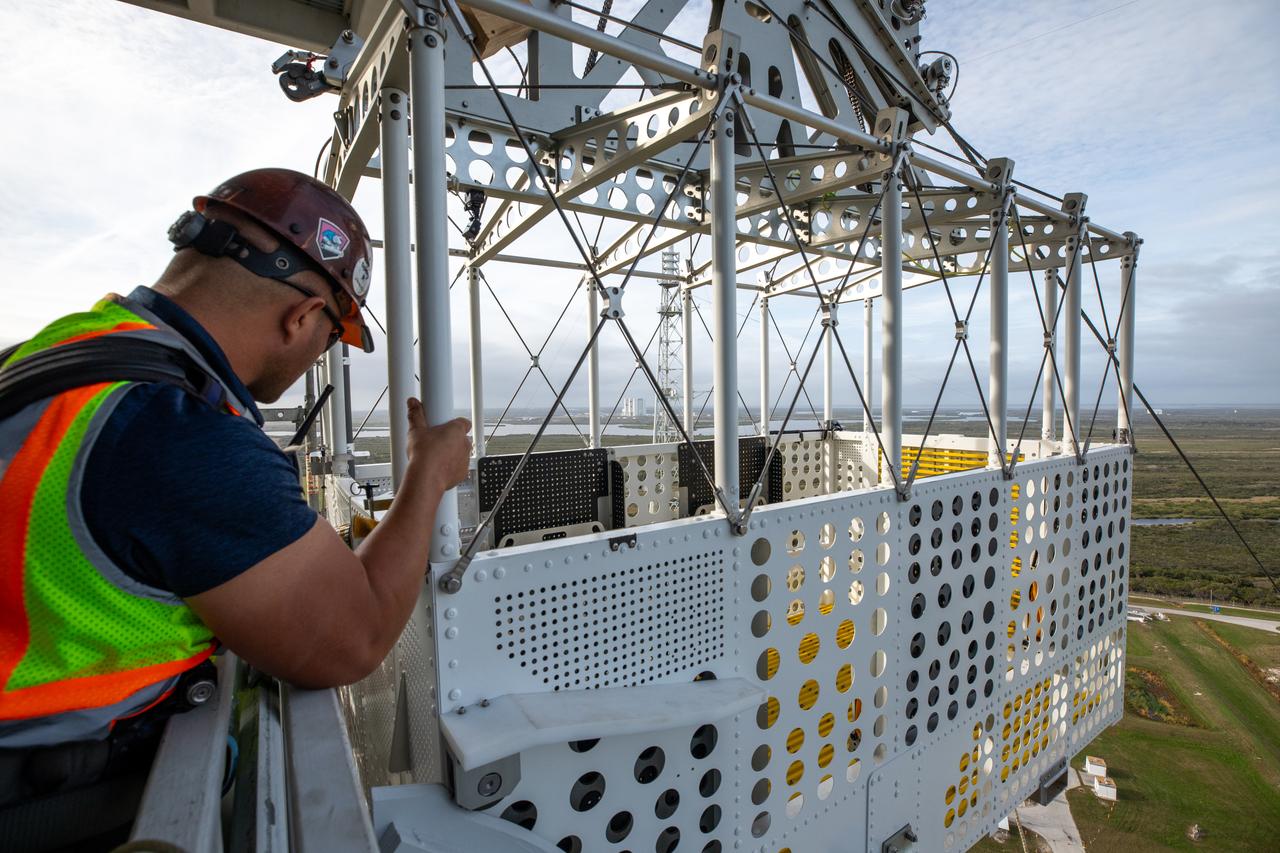
Teams with NASA’s Exploration Ground Systems Program, in preparation for the agency’s Artemis II crewed mission to the Moon, begin installing the first of four emergency egress baskets on the mobile launcher at Launch Complex 39B at the agency’s Kennedy Space Center in Florida on Wednesday, Jan. 24, 2024. The baskets, similar to gondolas on ski lifts, are used in the case of a pad abort emergency to enable astronauts and other pad personnel a way to quickly escape away from the mobile launcher to the base of the pad and where waiting emergency transport vehicles will then drive them away.
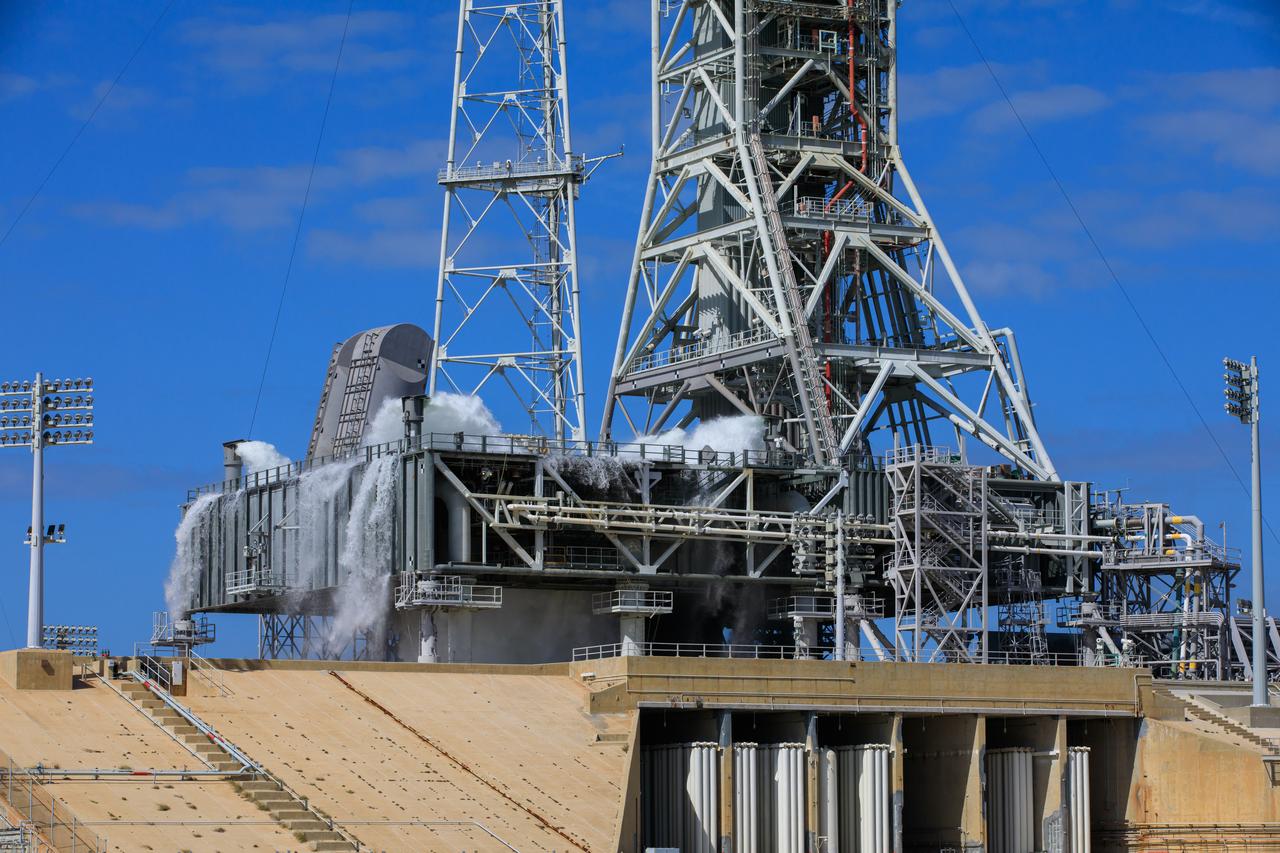
NASA’s Exploration Ground Systems conducts a water flow test with the mobile launcher at Kennedy Space Center’s Launch Complex 39B in Florida on Oct. 24, 2023. It is the third in a series of tests to verify the overpressure protection and sound suppression system is ready for launch of the Artemis II mission. During liftoff, 400,000 gallons of water will rush onto the pad to help protect NASA’s SLS (Space Launch System) rocket, Orion spacecraft, mobile launcher, and launch pad from any over pressurization and extreme sound produced during ignition and liftoff.
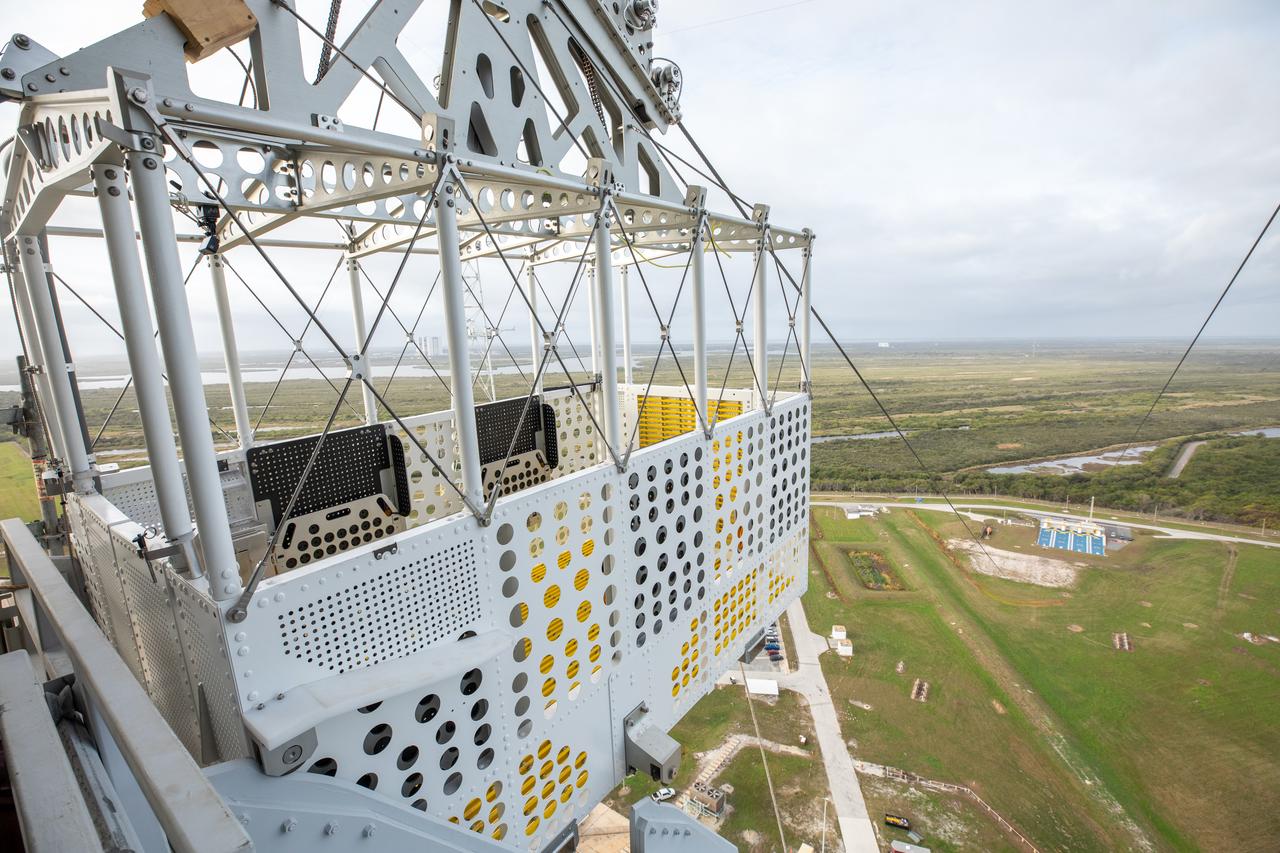
Teams with NASA’s Exploration Ground Systems Program, in preparation for the agency’s Artemis II crewed mission to the Moon, begin installing the first of four emergency egress baskets on the mobile launcher at Launch Complex 39B at the agency’s Kennedy Space Center in Florida on Wednesday, Jan. 24, 2024. The baskets, similar to gondolas on ski lifts, are used in the case of a pad abort emergency to enable astronauts and other pad personnel a way to quickly escape away from the mobile launcher to the base of the pad and where waiting emergency transport vehicles will then drive them away.
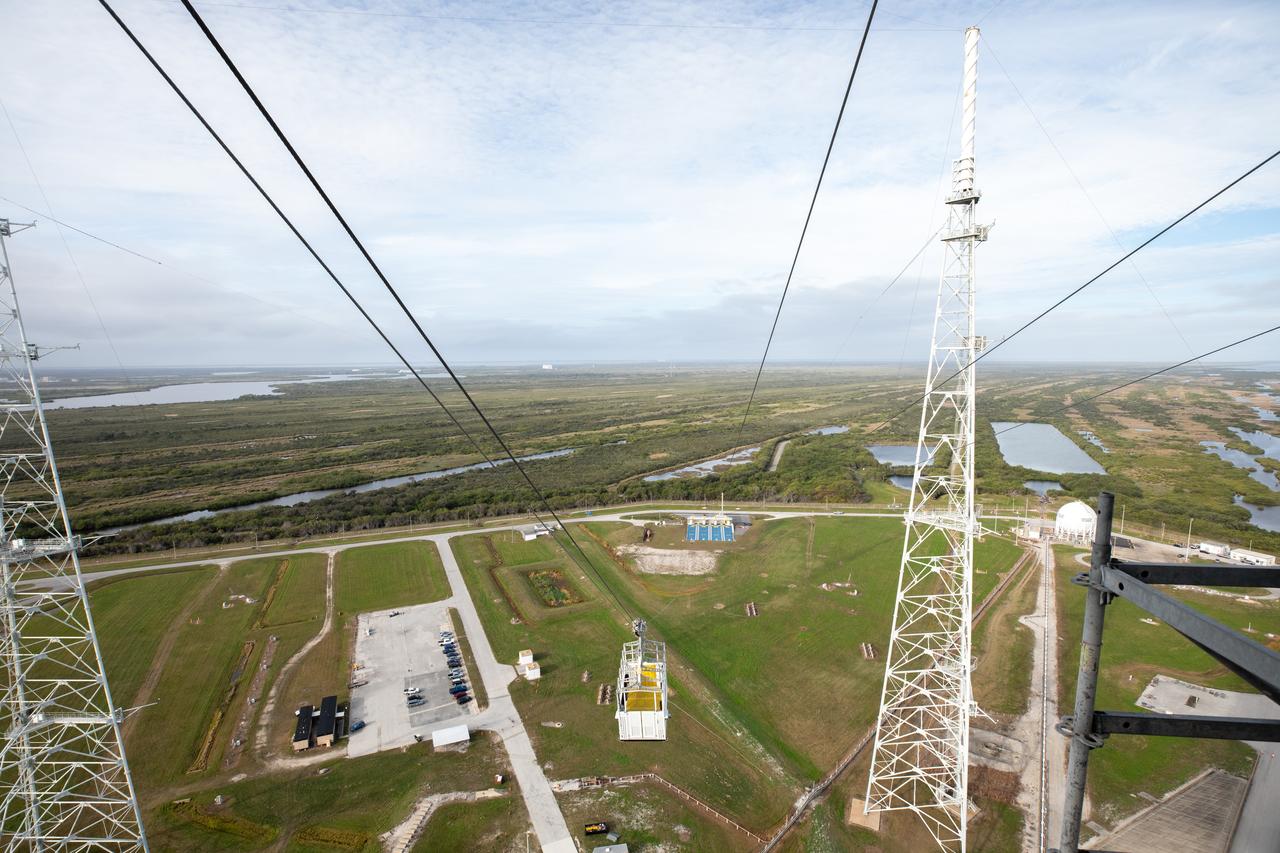
Teams with NASA’s Exploration Ground Systems Program, in preparation for the agency’s Artemis II crewed mission to the Moon, begin installing the first of four emergency egress baskets on the mobile launcher at Launch Complex 39B at the agency’s Kennedy Space Center in Florida on Wednesday, Jan. 24, 2024. The baskets, similar to gondolas on ski lifts, are used in the case of a pad abort emergency to enable astronauts and other pad personnel a way to quickly escape away from the mobile launcher to the base of the pad and where waiting emergency transport vehicles will then drive them away.
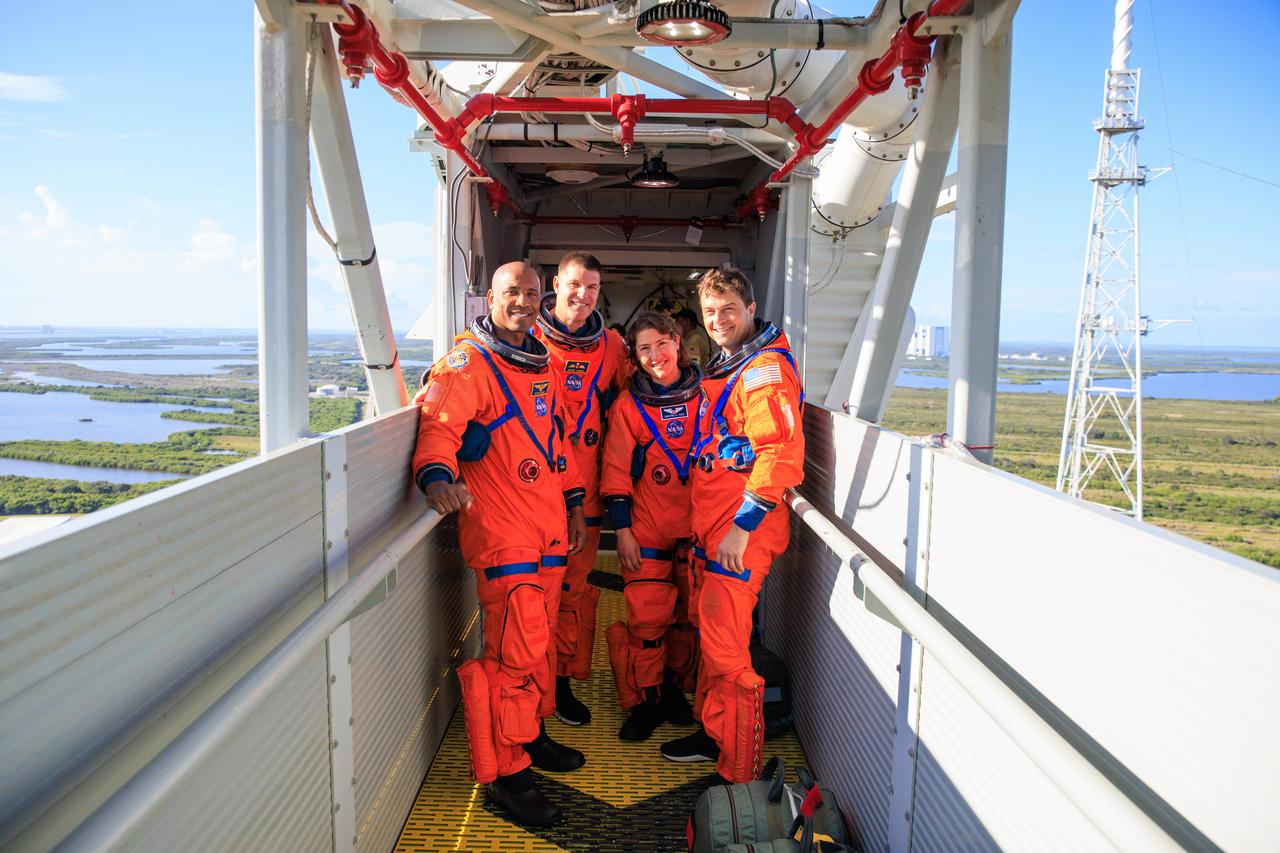
Artemis II astronauts, from left, NASA astronaut Victor Glover (left), CSA (Canadian Space Agency) astronaut Jeremy Hansen, NASA astronauts Christina Koch and Reid Wiseman stand on the crew access arm of the mobile launcher at Launch Pad 39B as part of an integrated ground systems test at Kennedy Space Center in Florida on Wednesday, Sept. 20. The test ensures the ground systems team is ready to support the crew timeline on launch day.
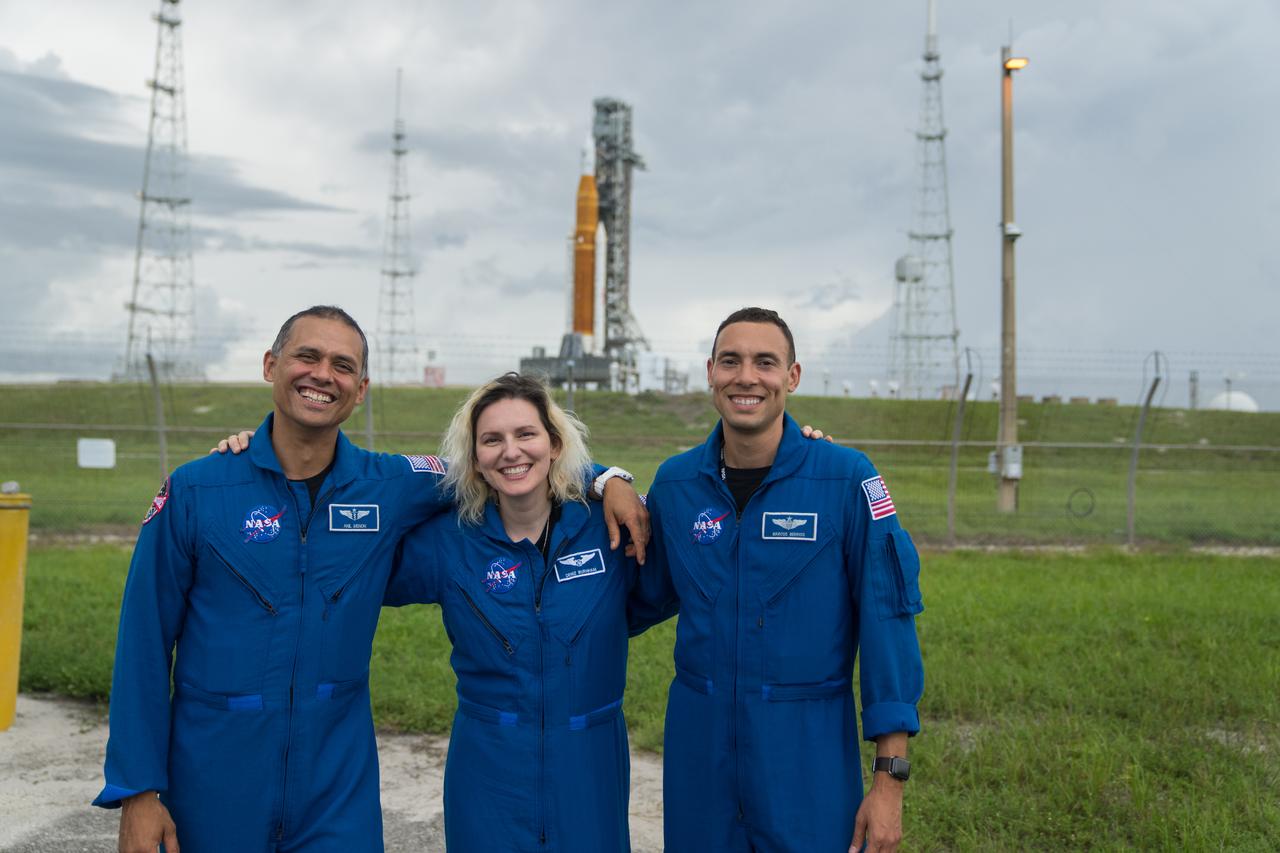
From left to right, NASA astronaut candidates Anil Menon, Deniz Burnham, and Marcos Berrios pose for a photograph in front of NASA’s Artemis I Space Launch System and Orion spacecraft atop the mobile launcher on the pad at Launch Complex 39B at the agency’s Kennedy Space Center in Florida on Sept. 2, 2022. The first in a series of increasingly complex missions, Artemis I will provide a foundation for human deep space exploration and demonstrate our commitment and capability to extend human presence to the Moon and beyond. The primary goal of Artemis I is to thoroughly test the integrated systems before crewed missions by operating the spacecraft in a deep space environment, testing Orion’s heat shield, and recovering the crew module after reentry, descent, and splashdown. In later missions, NASA will land the first woman and the first person of color on the surface of the Moon, paving the way for a long-term lunar presence and serving as a steppingstone on the way to Mars.
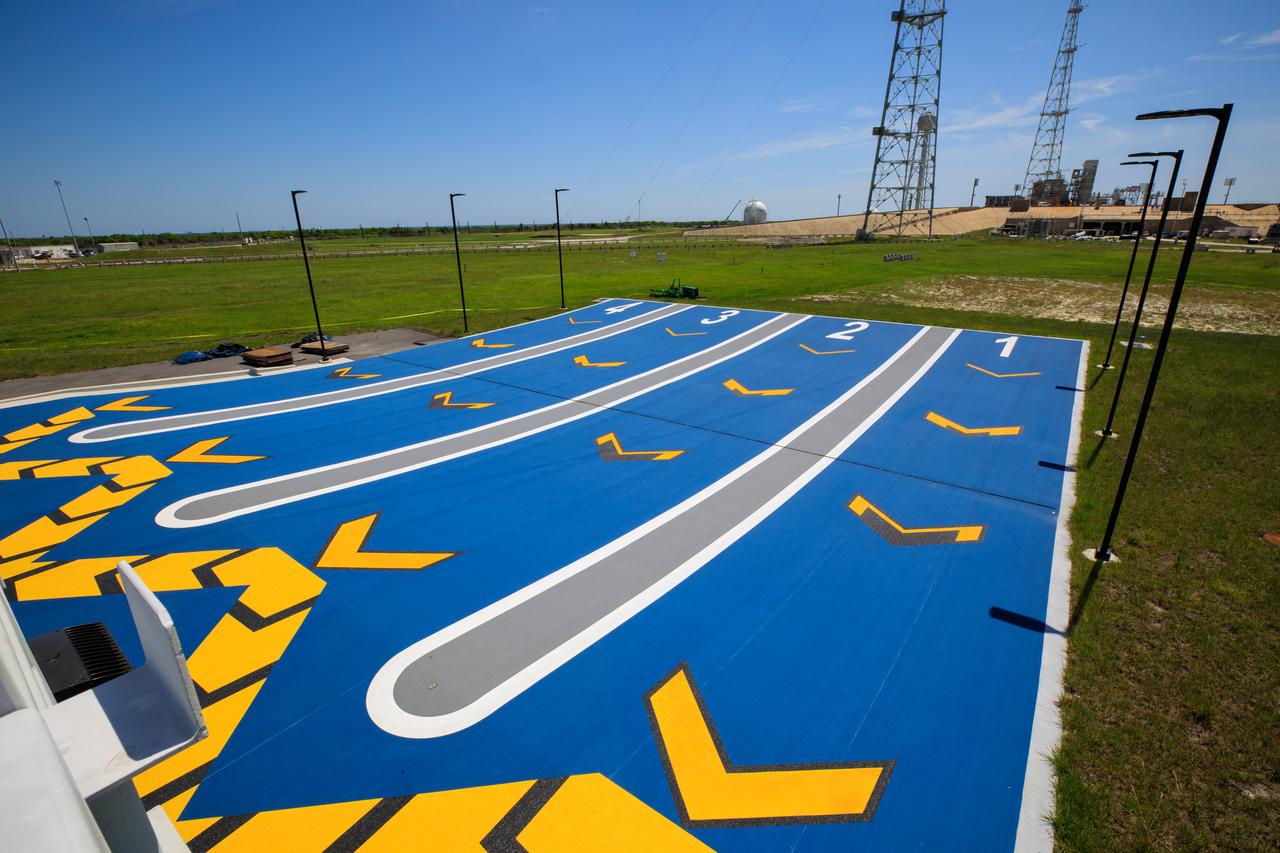
Teams with Exploration Ground Systems at NASA’s Kennedy Space Center in Florida continue to work the upgrades and repairs on mobile launcher 1 and Launch Pad 39B on June 13, 2023, ahead of the first critical ground testing for Artemis II. New pavement markings indicate the direction of the emergency egress system terminus from Launch Complex 39B. The team has nearly completed the terminus area, where the emergency egress baskets carrying the astronauts and flight crew will arrive following their safe exit from the mobile launcher. Artemis II will be the first Artemis mission flying crew aboard Orion.
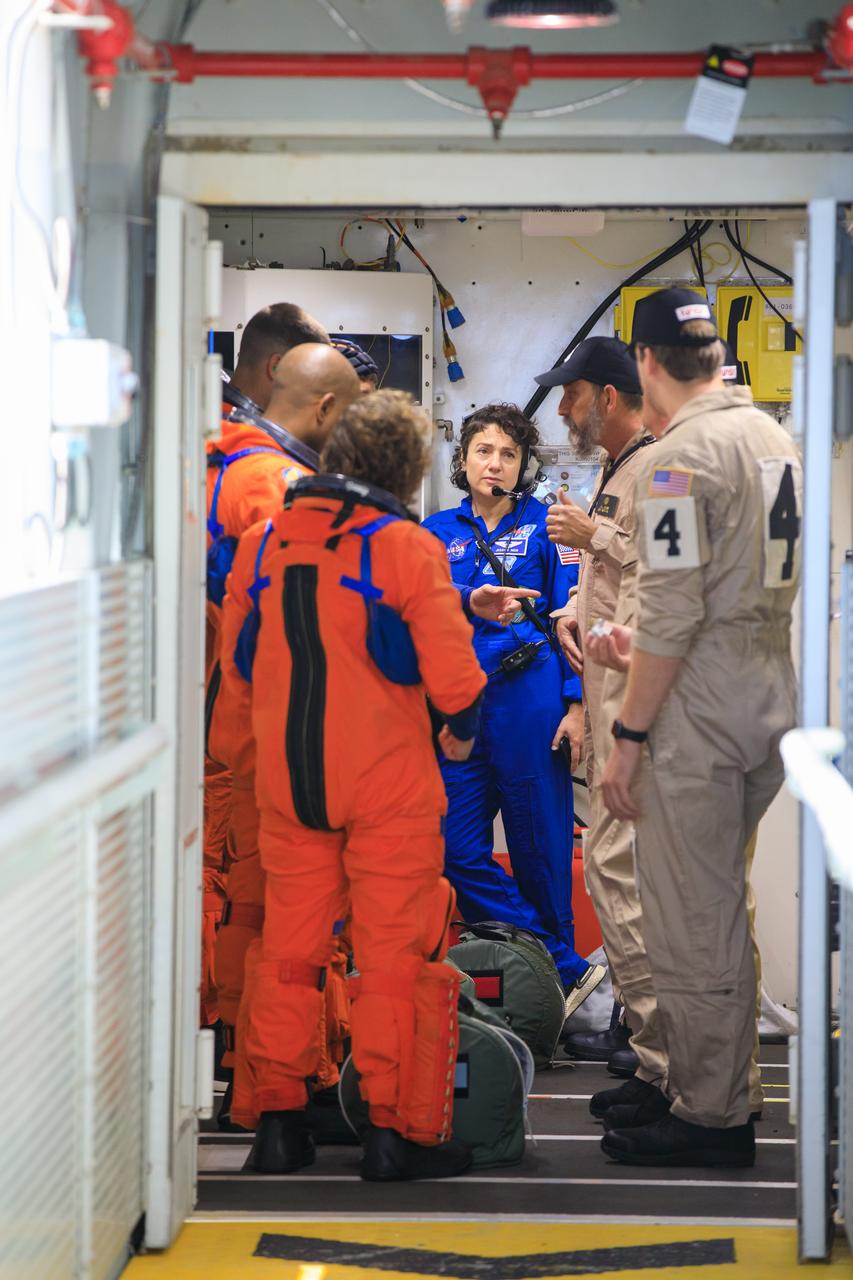
Artemis II NASA astronauts Reid Wiseman, Victor Glover, and Christina Koch, and CSA (Canadian Space Agency) astronaut Jeremy Hansen stand in the white room with fellow NASA astronaut Jessica Meir and closeout team members on the crew access arm of the mobile launcher at Launch Pad 39B as part of an integrated ground systems test at Kennedy Space Center in Florida on Wednesday, Sept. 20, 2023. The test ensures the ground systems team is ready to support the crew timeline on launch day.
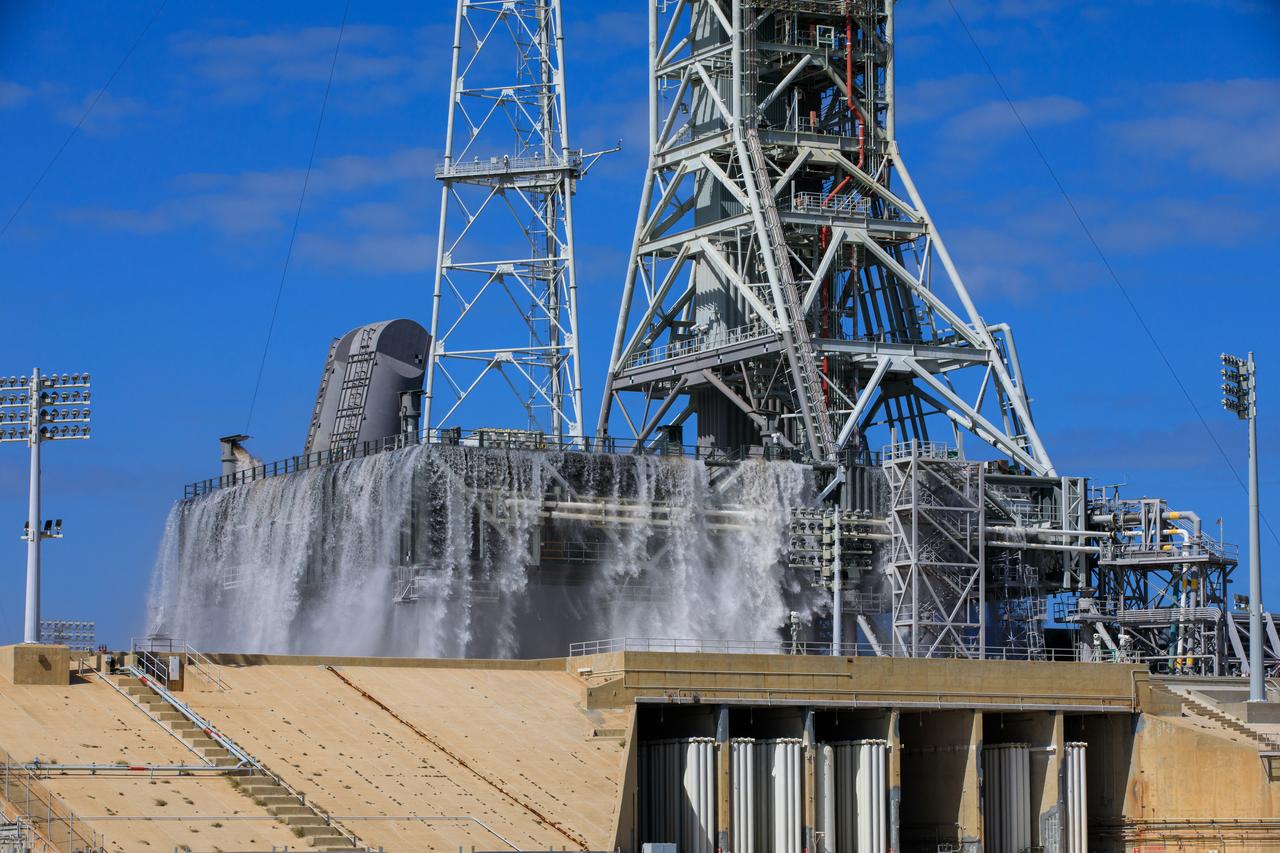
NASA’s Exploration Ground Systems conducts a water flow test with the mobile launcher at Kennedy Space Center’s Launch Complex 39B in Florida on Oct. 24, 2023. It is the third in a series of tests to verify the overpressure protection and sound suppression system is ready for launch of the Artemis II mission. During liftoff, 400,000 gallons of water will rush onto the pad to help protect NASA’s SLS (Space Launch System) rocket, Orion spacecraft, mobile launcher, and launch pad from any over pressurization and extreme sound produced during ignition and liftoff.
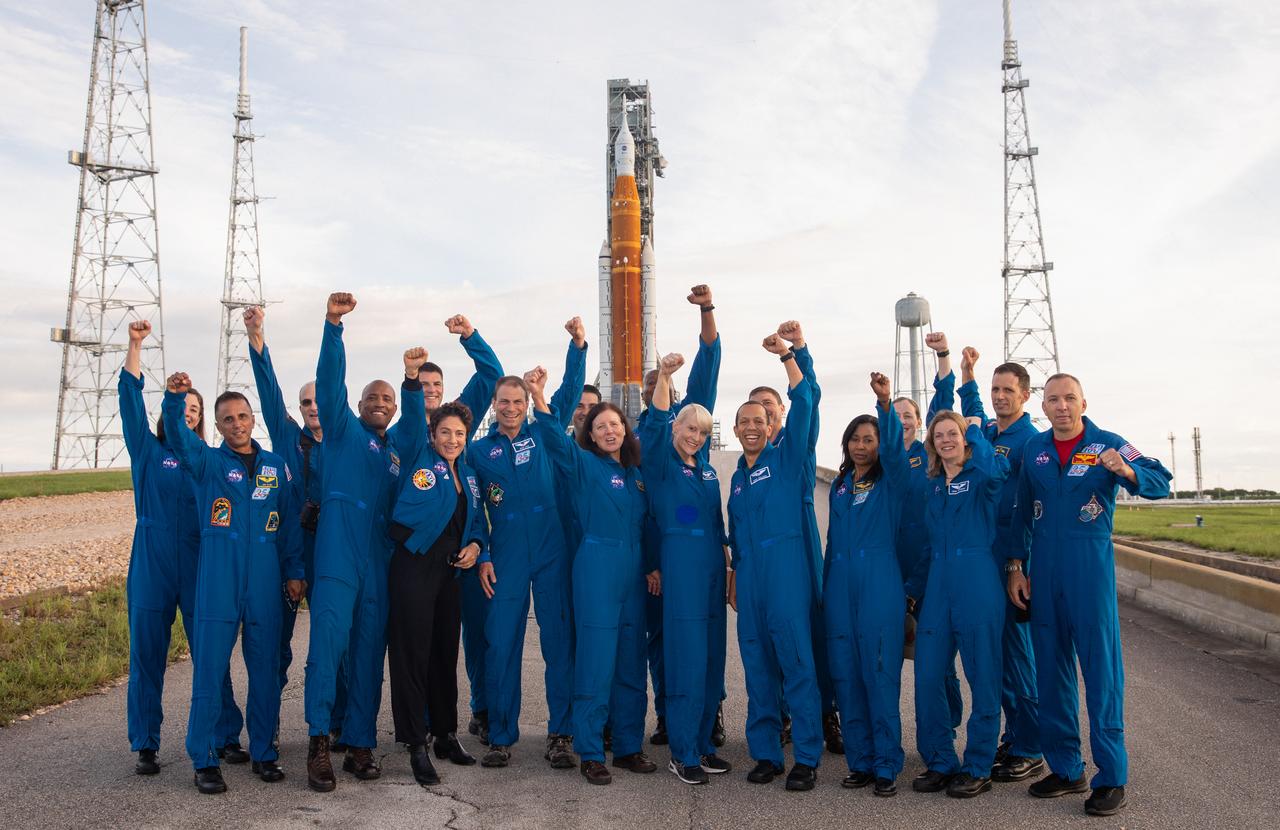
Astronauts and astronaut candidates from NASA and the Canadian Space Agency pose for a photograph in front of NASA’s Artemis I Space Launch System and Orion spacecraft atop the mobile launcher on the pad at Launch Complex 39B on Aug. 28, 2022. The astronauts are, from left to right: Christina Birch, NASA astronaut candidate; Joe Acaba, NASA astronaut; Don Pettit, NASA astronaut; Victor Glover, NASA astronaut; Jeremy Hansen, Canadian Space Agency astronaut; Jessica Meir, NASA astronaut; Stan Love, NASA astronaut; Jack Hathaway, NASA astronaut candidate; Shannon Walker, NASA astronaut; Andre Douglas, NASA astronaut candidate; Kate Rubins, NASA astronaut; Chris Williams, NASA astronaut candidate; Reid Wiseman, NASA astronaut; Stephanie Wilson, NASA astronaut; Jessica Wittner, NASA astronaut candidate; Zena Cardman, NASA astronaut; Joshua Kutryk, Canadian Space Agency astronaut; Randy Bresnik, NASA astronaut. Artemis I is scheduled to launch Aug. 29, at 8:33 a.m. EDT. The first in a series of increasingly complex missions, Artemis I will provide a foundation for human deep space exploration and demonstrate our commitment and capability to extend human presence to the Moon and beyond. The primary goal of Artemis I is to thoroughly test the integrated systems before crewed missions by operating the spacecraft in a deep space environment, testing Orion’s heat shield, and recovering the crew module after reentry, descent, and splashdown.
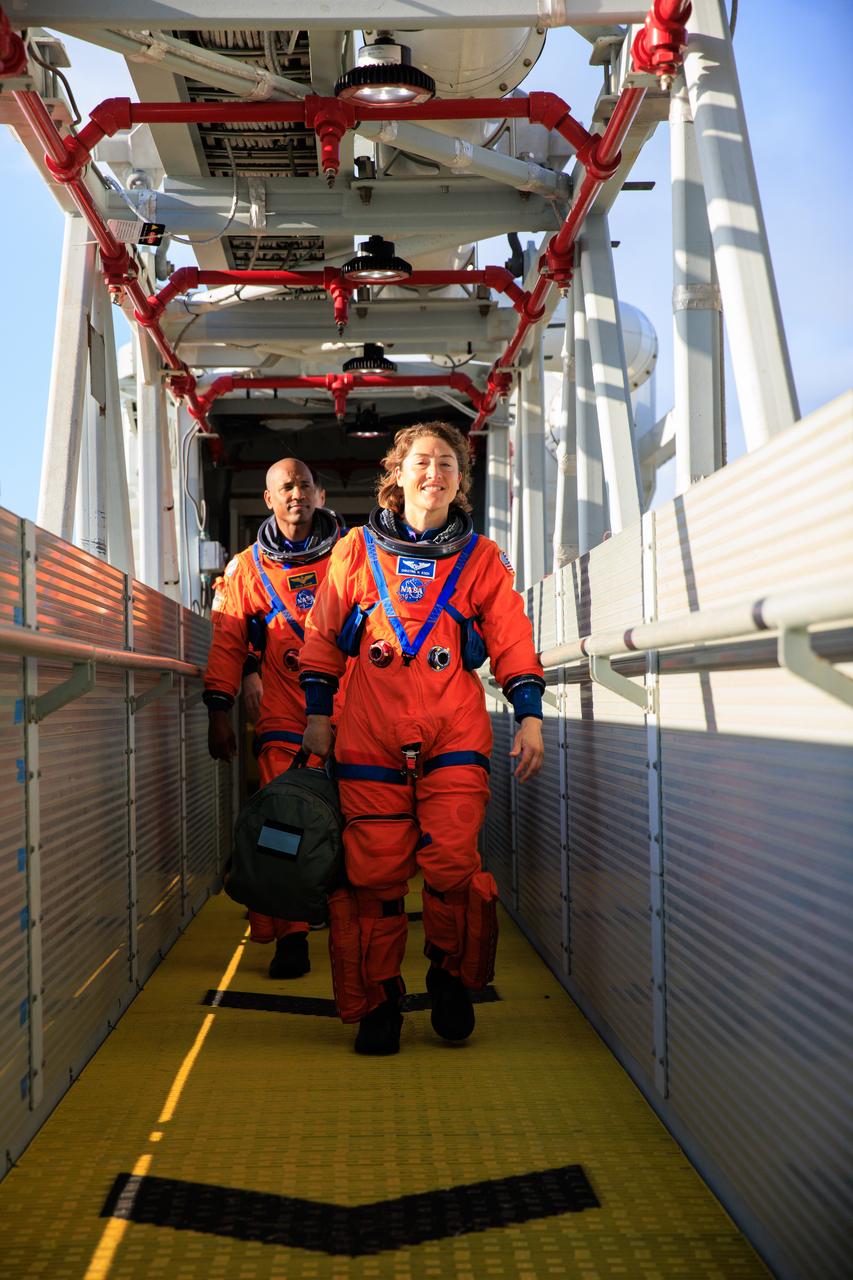
Artemis II NASA astronauts Reid Wiseman, Victor Glover, and Christina Koch, and CSA (Canadian Space Agency) astronaut Jeremy Hansen walk down the crew access arm of the mobile launcher at Launch Pad 39B as part of an integrated ground systems test at Kennedy Space Center in Florida on Wednesday, Sept. 20, 2023. The test ensures the ground systems team is ready to support the crew timeline on launch day.
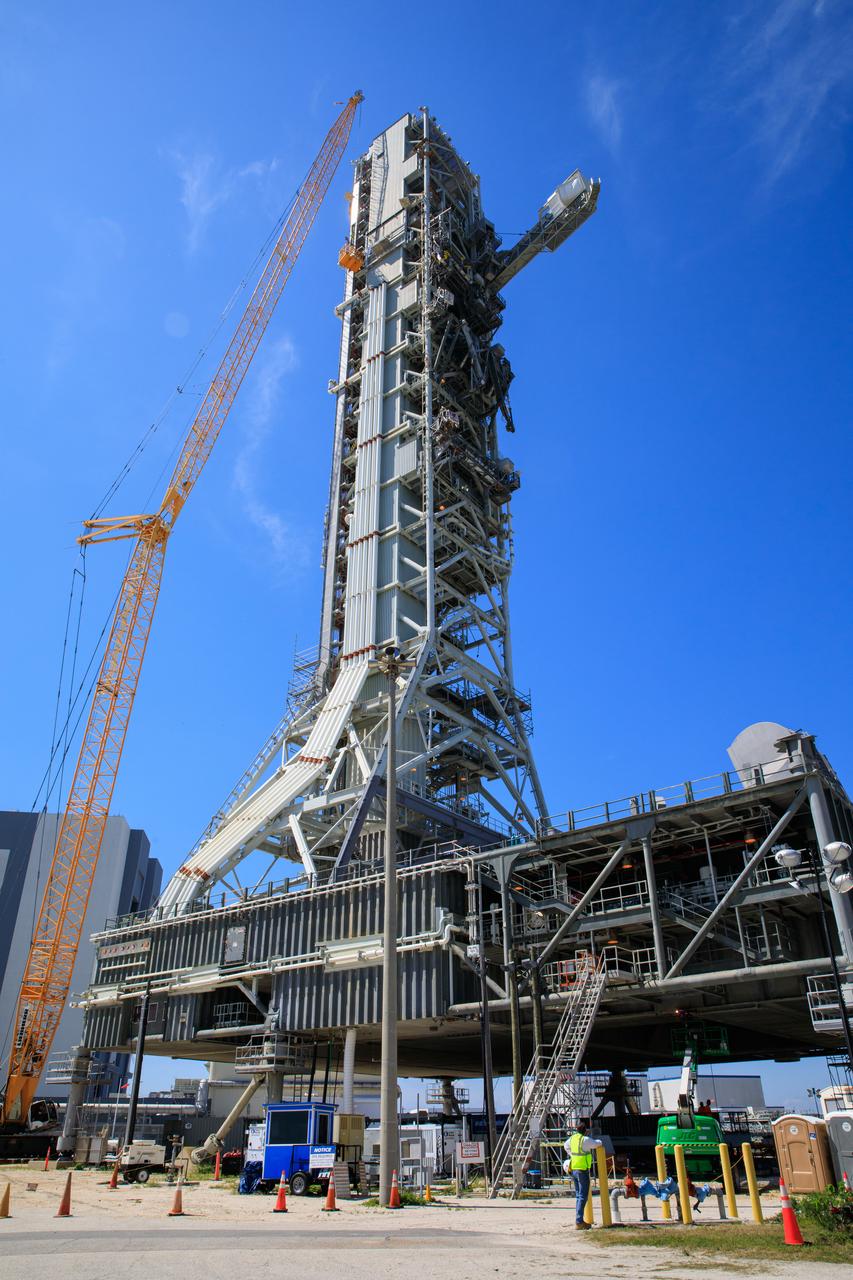
Teams with Exploration Ground Systems at NASA’s Kennedy Space Center in Florida continue to work the upgrades and repairs on mobile launcher 1 and Launch Pad 39B on June 13, 2023, ahead of the first critical ground testing for Artemis II. The crew access arm (CAA) has been extended in this view of the mobile launcher. The CAA is the entry and exit point astronauts will use for access to the Orion spacecraft. Tests will be conducted to ensure the arm and supporting mobile launcher systems are certified to support crewed missions. Artemis II will be the first Artemis mission flying crew aboard Orion.
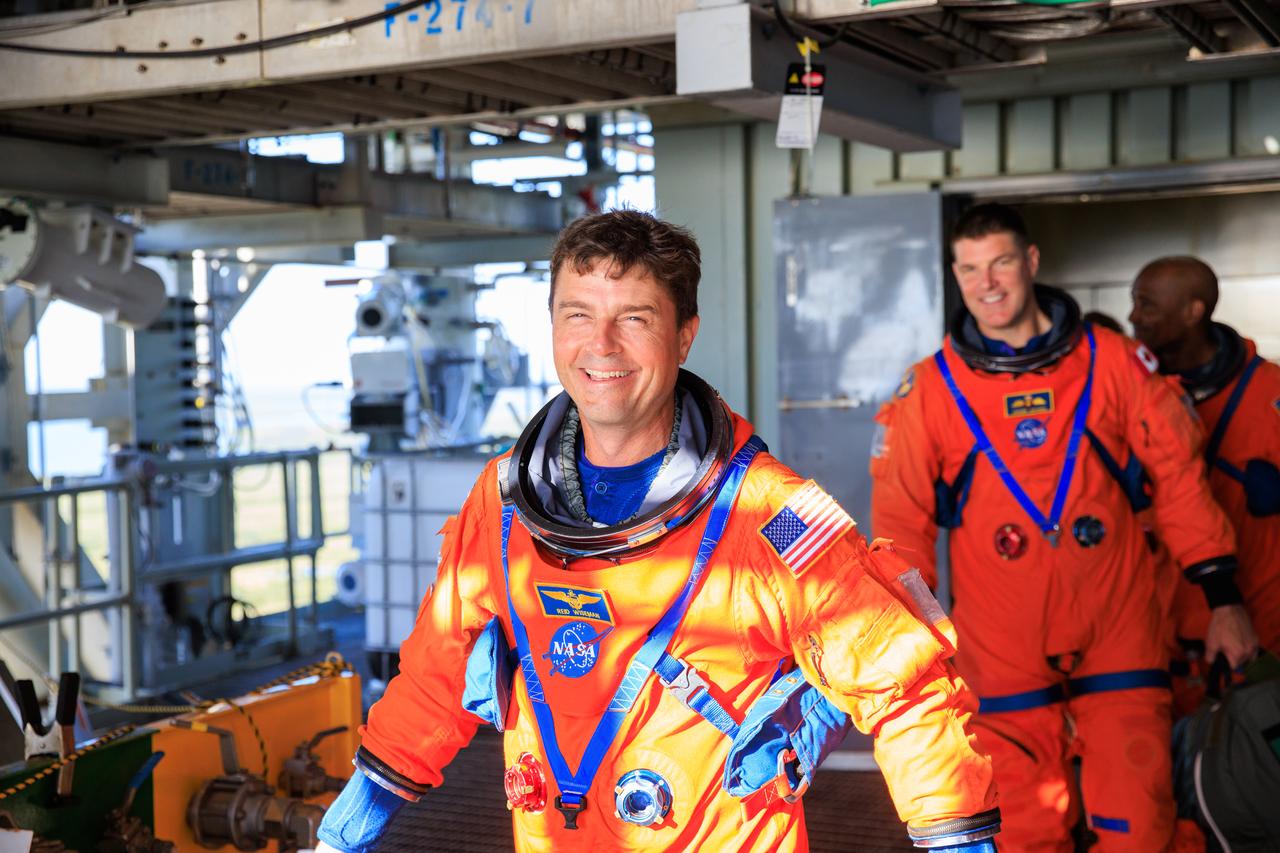
Artemis II astronauts (front to back) NASA astronaut Reid Wiseman, CSA (Canadian Space Agency) astronaut Jeremy Hansen, and NASA astronaut Victor Glover stand on the mobile launcher at Launch Pad 39B as part of an integrated ground systems test at Kennedy Space Center in Florida on Wednesday, Sept. 20. The test ensures the ground systems team is ready to support the crew timeline on launch day.
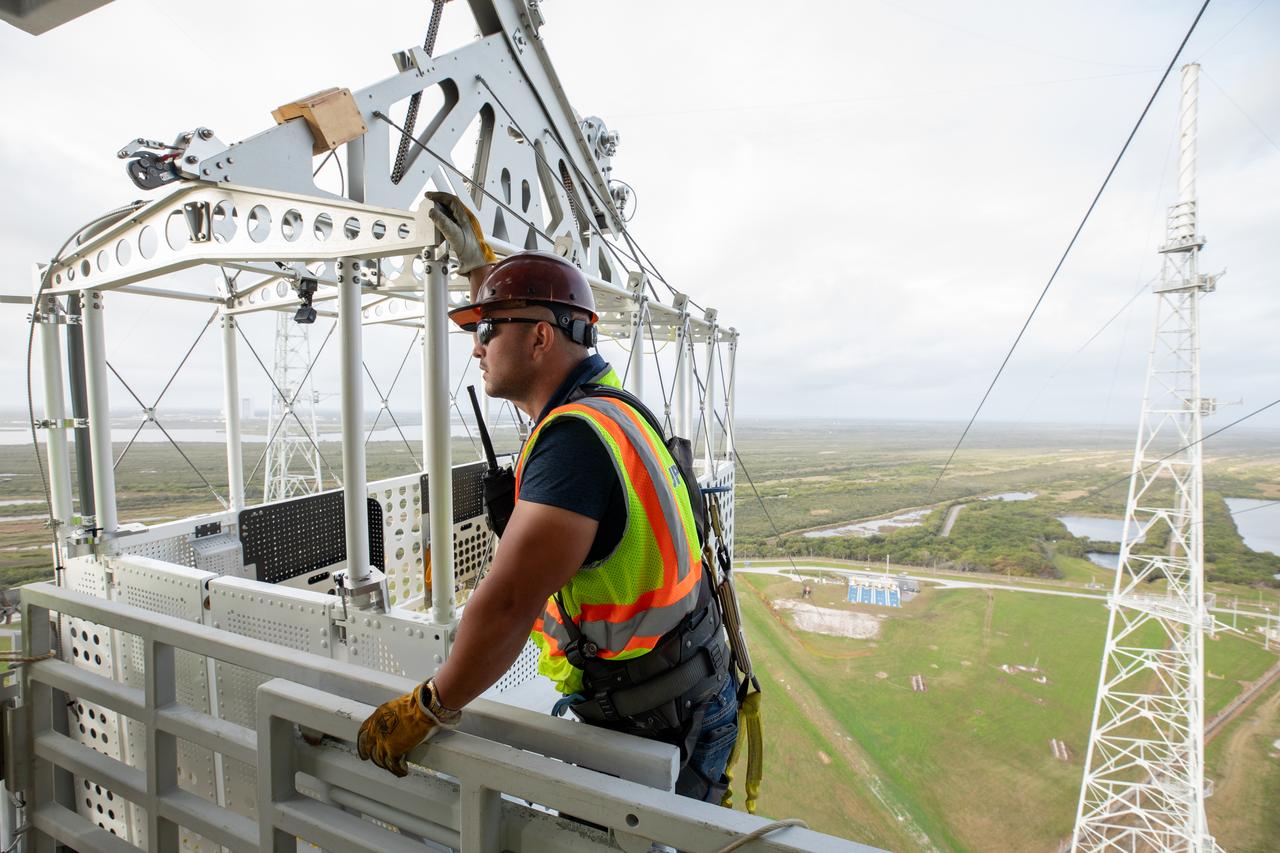
Teams with NASA’s Exploration Ground Systems Program, in preparation for the agency’s Artemis II crewed mission to the Moon, begin installing the first of four emergency egress baskets on the mobile launcher at Launch Complex 39B at the agency’s Kennedy Space Center in Florida on Wednesday, Jan. 24, 2024. The baskets, similar to gondolas on ski lifts, are used in the case of a pad abort emergency to enable astronauts and other pad personnel a way to quickly escape away from the mobile launcher to the base of the pad and where waiting emergency transport vehicles will then drive them away.
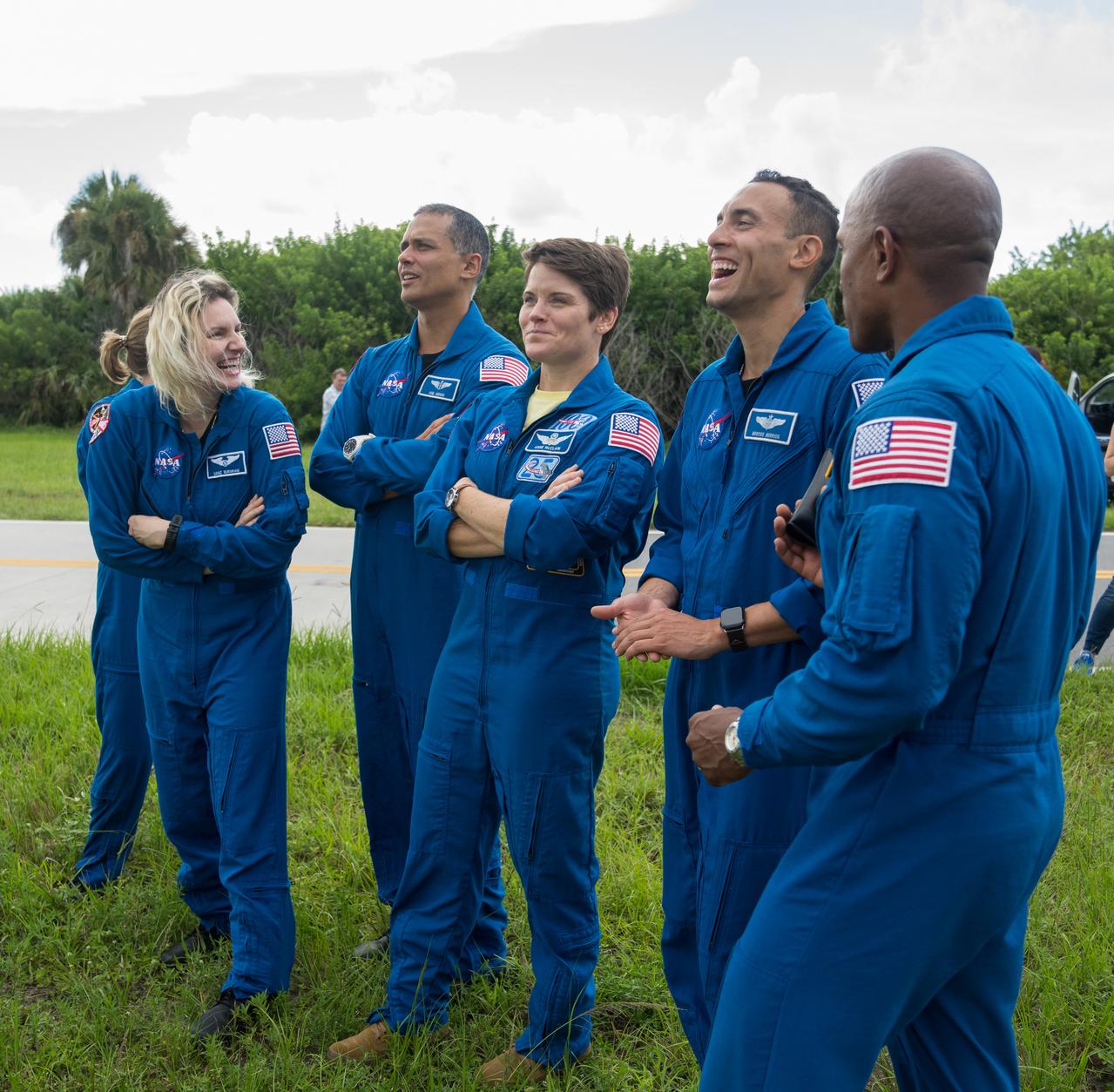
NASA astronauts and astronaut candidates view NASA’s Artemis I Space Launch System and Orion spacecraft atop the mobile launcher on the pad at Launch Complex 39B at the agency’s Kennedy Space Center in Florida on Sept. 2, 2022. The astronauts are, from left to right: Zena Cardman (partially obscured), NASA astronaut; Deniz Burnham and Anil Menon, NASA astronaut candidates; Anne McClain, NASA astronaut; Marcos Berrios, NASA astronaut candidate; and Victor Glover, NASA astronaut. The first in a series of increasingly complex missions, Artemis I will provide a foundation for human deep space exploration and demonstrate our commitment and capability to extend human presence to the Moon and beyond. The primary goal of Artemis I is to thoroughly test the integrated systems before crewed missions by operating the spacecraft in a deep space environment, testing Orion’s heat shield, and recovering the crew module after reentry, descent, and splashdown. In later missions, NASA will land the first woman and the first person of color on the surface of the Moon, paving the way for a long-term lunar presence and serving as a steppingstone on the way to Mars.

Artemis II astronauts, from left, NASA astronaut Victor Glover (left), CSA (Canadian Space Agency) astronaut Jeremy Hansen, NASA astronauts Christina Koch and Reid Wiseman stand on the crew access arm of the mobile launcher at Launch Pad 39B as part of an integrated ground systems test at Kennedy Space Center in Florida on Wednesday, Sept. 20. The test ensures the ground systems team is ready to support the crew timeline on launch day.
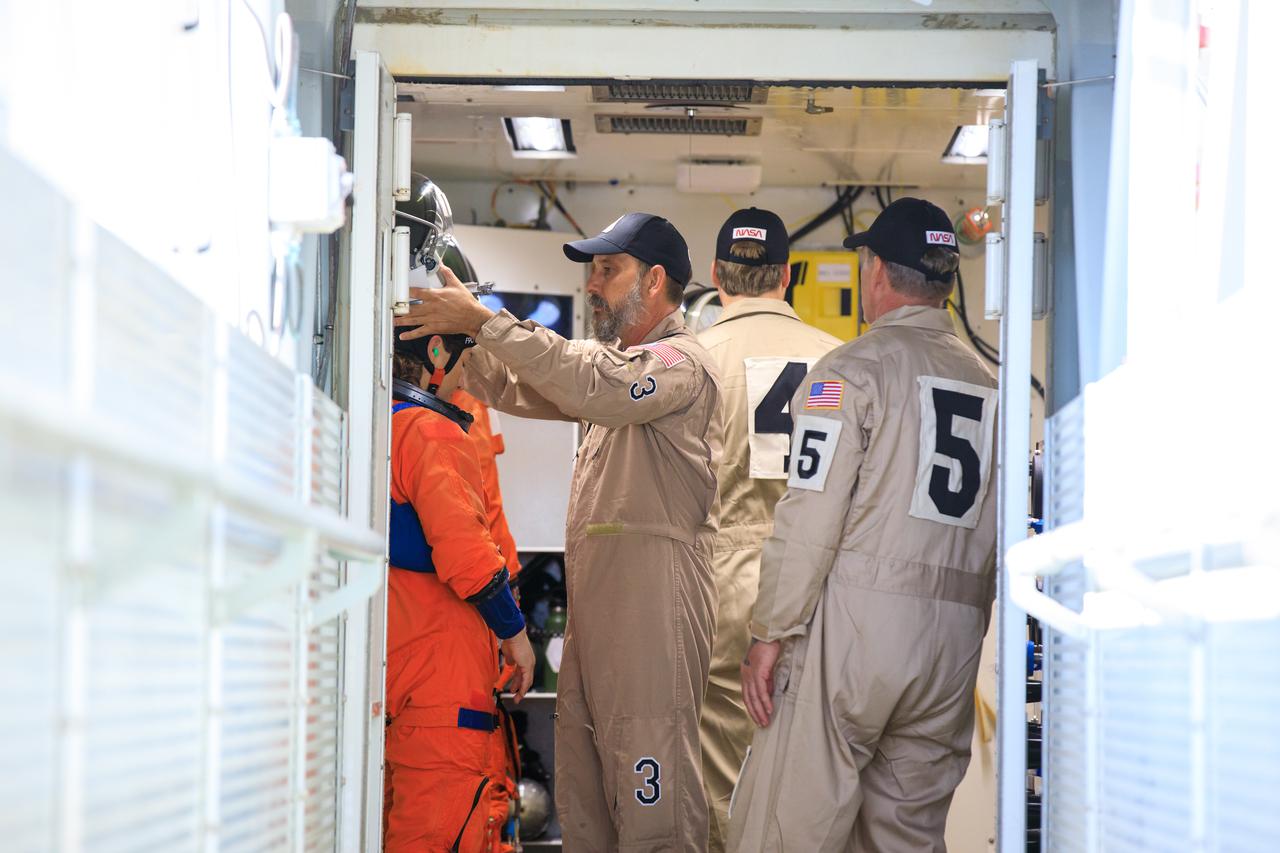
Artemis II NASA astronauts Reid Wiseman, Victor Glover, and Christina Koch, and CSA (Canadian Space Agency) astronaut Jeremy Hansen stand in the white room on the crew access arm of the mobile launcher at Launch Pad 39B as part of an integrated ground systems test at Kennedy Space Center in Florida on Wednesday, Sept. 20, 2023. The test ensures the ground systems team is ready to support the crew timeline on launch day.
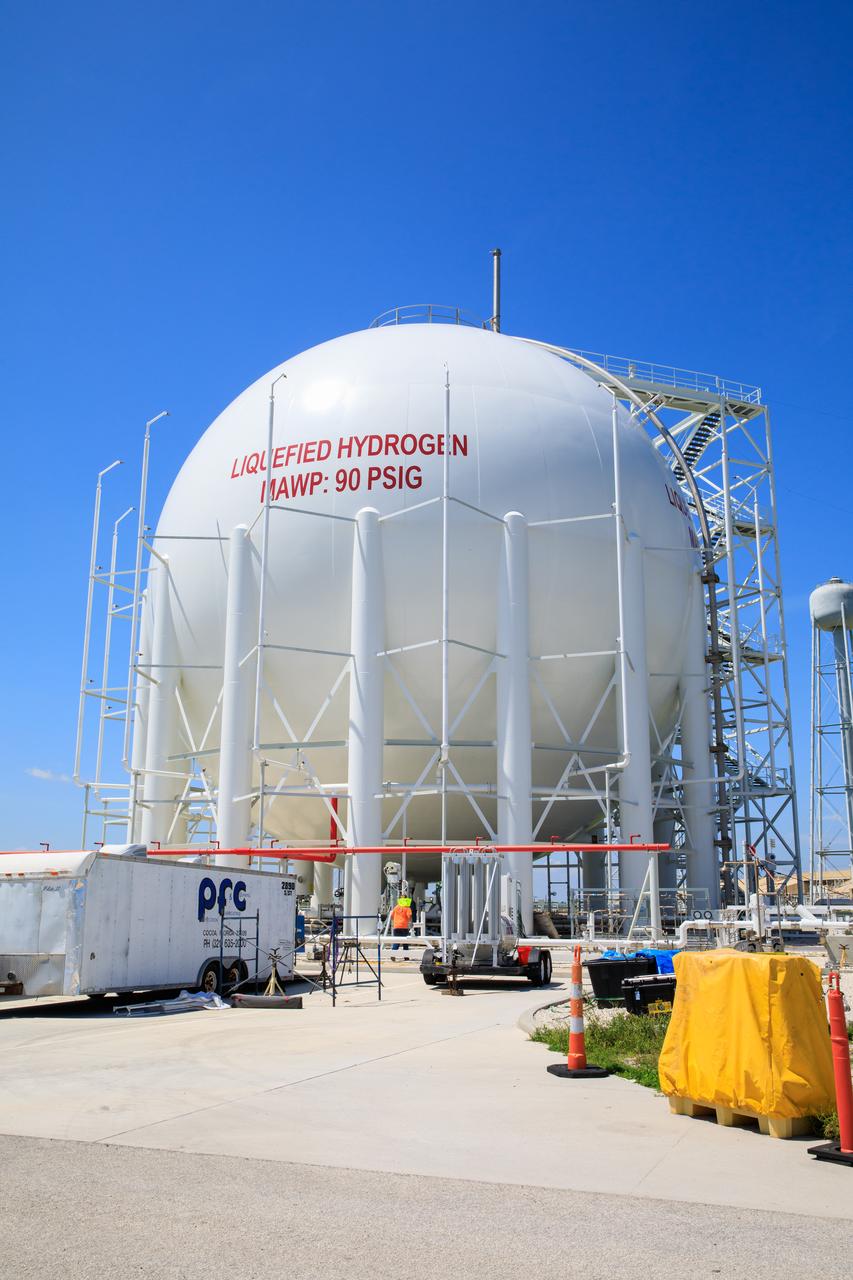
Teams with Exploration Ground Systems at NASA’s Kennedy Space Center in Florida continue to work the upgrades and repairs on mobile launcher 1 and Launch Pad 39B on June 13, 2023, ahead of the first critical ground testing for Artemis II. Construction is nearly complete on the additional 1.4-million-gallon liquid hydrogen sphere used for propellant loading. Having two liquid hydrogen spheres at the pad allows teams to minimize time between launch attempts for resupplying liquid hydrogen. When completed, workers will test the new tank as part of the verification and validation testing. Artemis II will be the first Artemis mission flying crew aboard Orion.
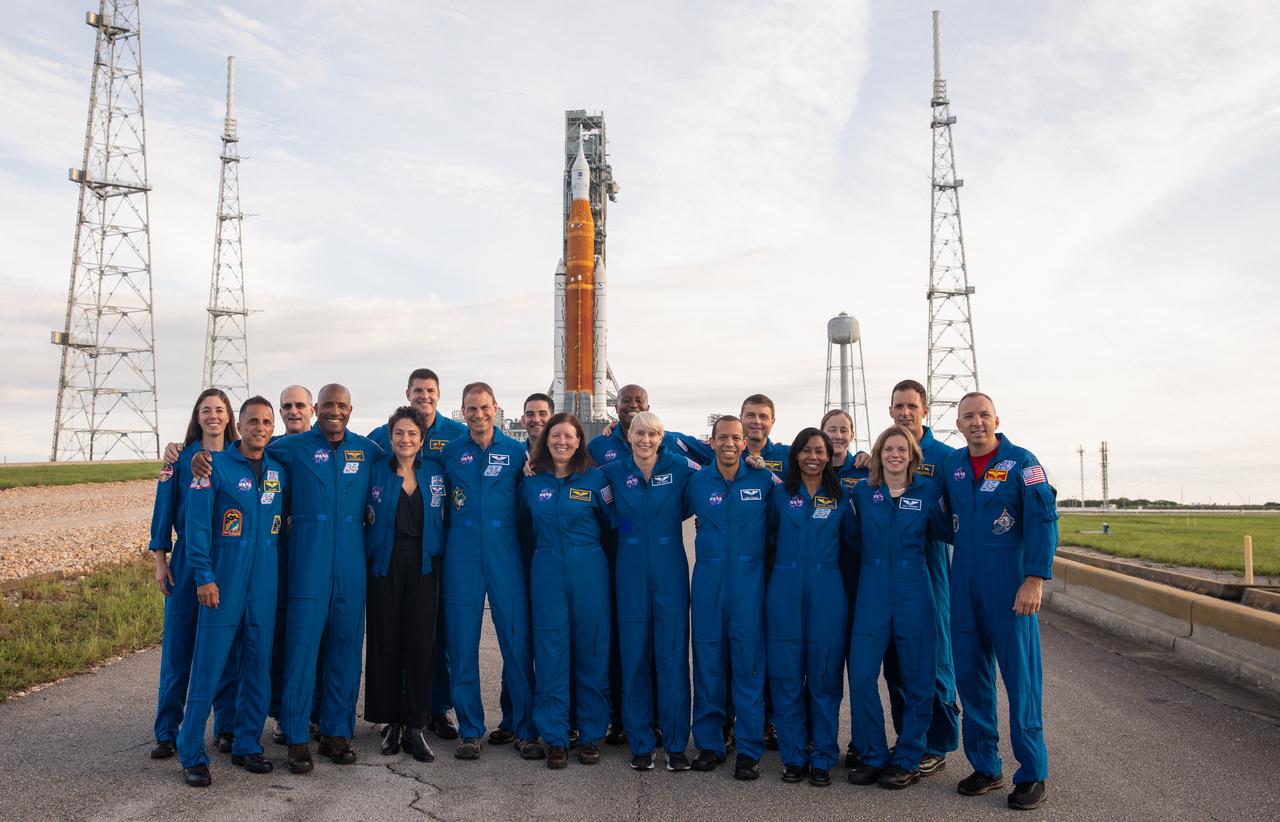
Astronauts and astronaut candidates from NASA and the Canadian Space Agency pose for a photograph in front of NASA’s Artemis I Space Launch System and Orion spacecraft atop the mobile launcher on the pad at Launch Complex 39B on Aug. 28, 2022. The astronauts are, from left to right: Christina Birch, NASA astronaut candidate; Joe Acaba, NASA astronaut; Don Pettit, NASA astronaut; Victor Glover, NASA astronaut; Jessica Meir, NASA astronaut; Jeremy Hansen, Canadian Space Agency astronaut; Stan Love, NASA astronaut; Jack Hathaway, NASA astronaut candidate; Shannon Walker, NASA astronaut; Andre Douglas, NASA astronaut candidate; Kate Rubins, NASA astronaut; Chris Williams, NASA astronaut candidate; Reid Wiseman, NASA astronaut; Stephanie Wilson, NASA astronaut; Jessica Wittner, NASA astronaut candidate; Zena Cardman, NASA astronaut; Joshua Kutryk, Canadian Space Agency astronaut; Randy Bresnik, NASA astronaut. Artemis I is scheduled to launch Aug. 29, at 8:33 a.m. EDT. The first in a series of increasingly complex missions, Artemis I will provide a foundation for human deep space exploration and demonstrate our commitment and capability to extend human presence to the Moon and beyond. The primary goal of Artemis I is to thoroughly test the integrated systems before crewed missions by operating the spacecraft in a deep space environment, testing Orion’s heat shield, and recovering the crew module after reentry, descent, and splashdown.
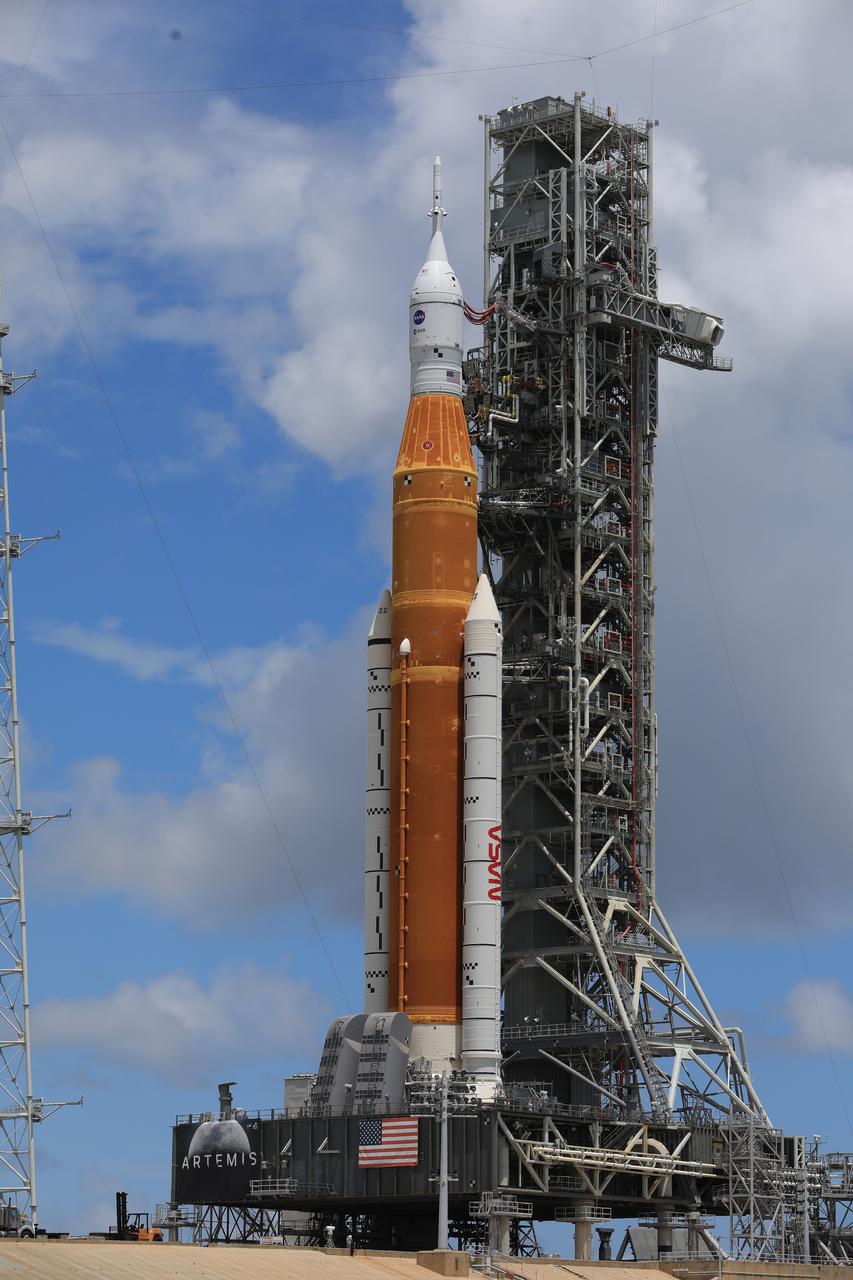
A view of the Artemis I Space Launch System (SLS) and Orion spacecraft atop the mobile launcher at Launch Pad 39B at NASA’s Kennedy Space Center in Florida on June 30, 2022. The SLS and Orion were transported to the pad on crawler-transporter 2 for a prelaunch test called a wet dress rehearsal. Artemis I will be the first integrated test of the SLS and Orion spacecraft. In later missions, NASA will land the first woman and the first person of color on the surface of the Moon, paving the way for a long-term lunar presence and serving as a steppingstone on the way to Mars.
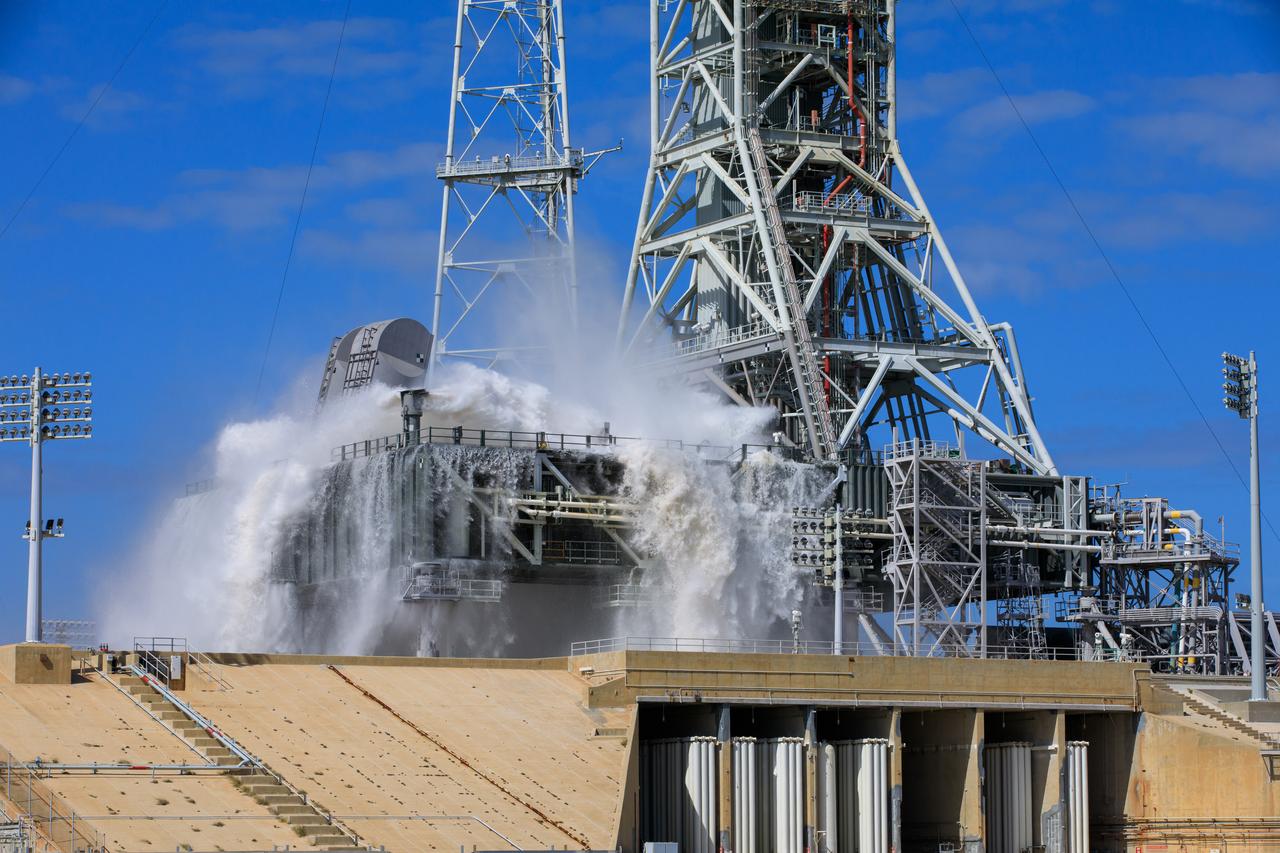
NASA’s Exploration Ground Systems conducts a water flow test with the mobile launcher at Kennedy Space Center’s Launch Complex 39B in Florida on Oct. 24, 2023. It is the third in a series of tests to verify the overpressure protection and sound suppression system is ready for launch of the Artemis II mission. During liftoff, 400,000 gallons of water will rush onto the pad to help protect NASA’s SLS (Space Launch System) rocket, Orion spacecraft, mobile launcher, and launch pad from any over pressurization and extreme sound produced during ignition and liftoff.
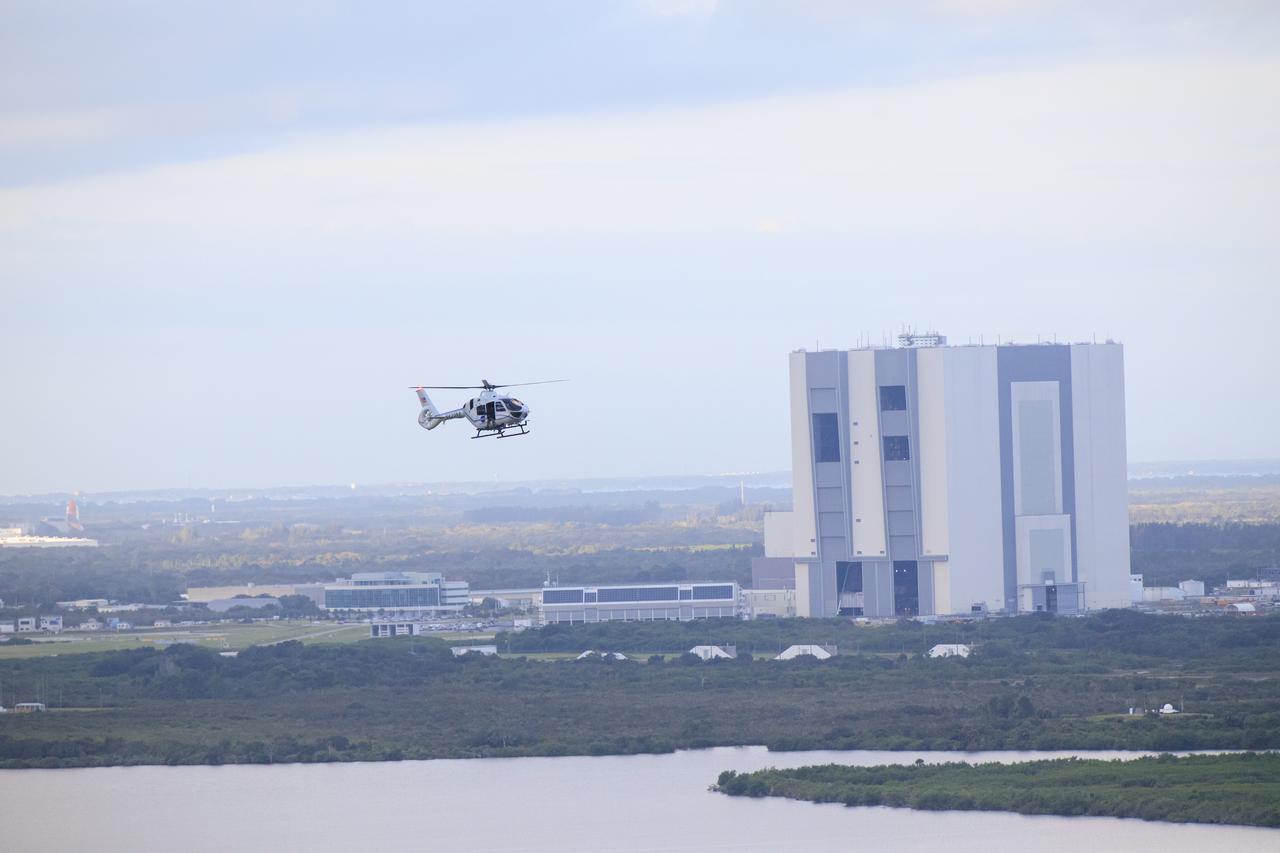
A NASA helicopter follows the convoy carrying Artemis II NASA astronauts Reid Wiseman, Victor Glover, and Christina Koch, and CSA (Canadian Space Agency) astronaut Jeremy Hansen, as they ride from Astronaut Crew Quarters in the Neil Armstrong Operations and Checkout Building to Launch Pad 39B in the Artemis crew transportation vehicles as part of an integrated ground systems test at Kennedy Space Center in Florida on Wednesday, Sept. 20, to test the crew timeline for launch day.
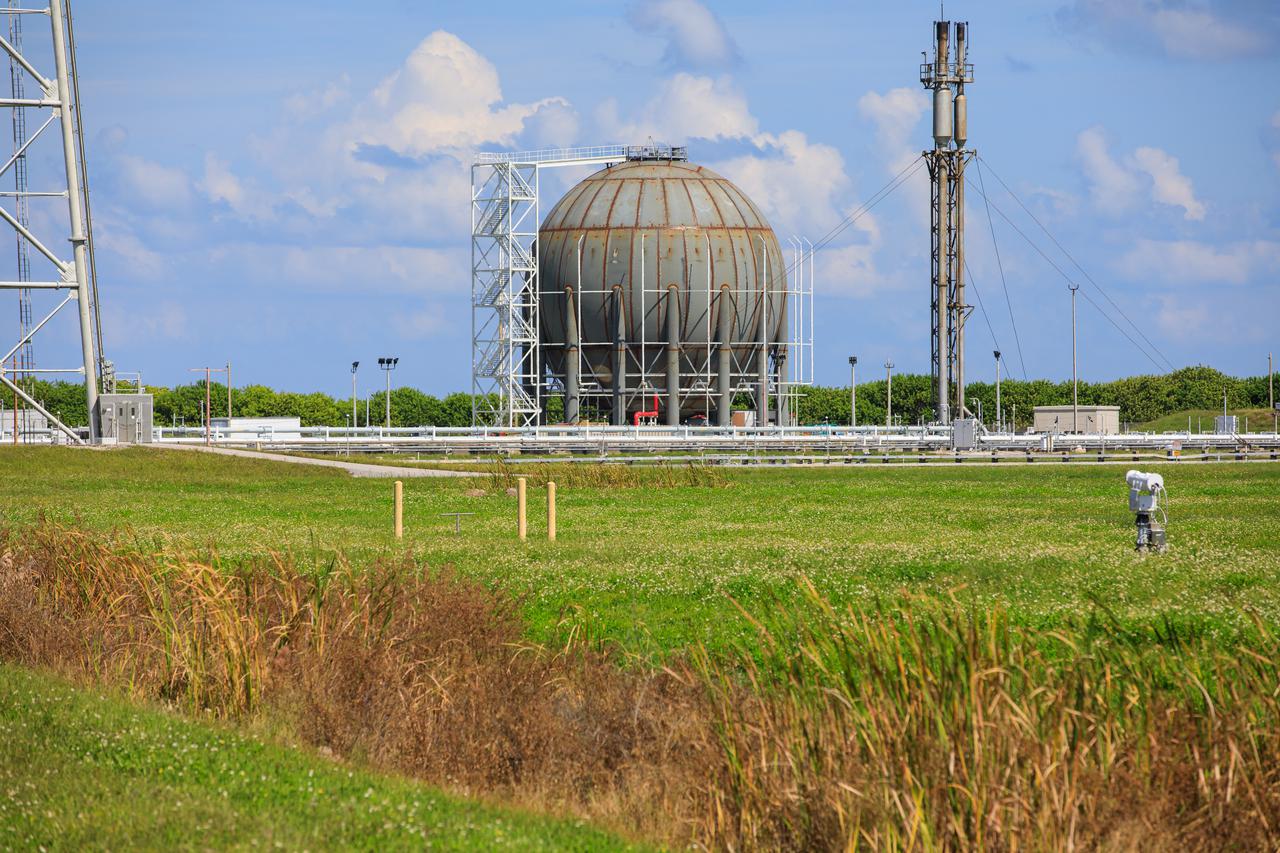
Seen here is a newly constructed liquid hydrogen (LH2) storage tank at Launch Pad 39B at NASA’s Kennedy Space Center in Florida on Oct. 1, 2021. With construction now complete, teams will focus on painting the tank next. The storage tank, capable of holding 1.25 million gallons of LH2, will be used to support future Artemis missions to the Moon and, eventually, Mars. Through Artemis, NASA will land the first woman and first person of color on the Moon, paving the way for a long-term presence in lunar orbit.
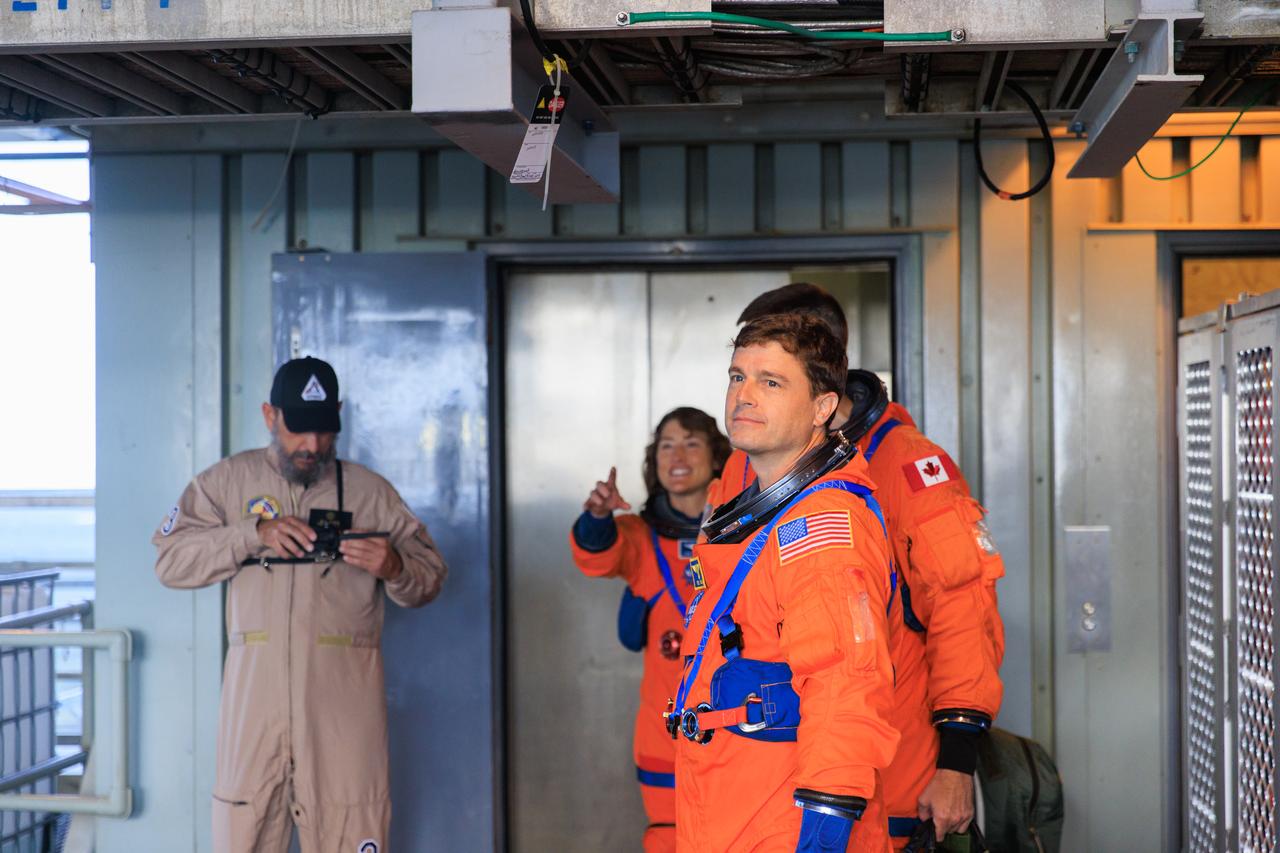
Artemis II NASA astronauts Reid Wiseman, Victor Glover, and Christina Koch, and CSA (Canadian Space Agency) astronaut Jeremy Hansen arrive to Launch Pad 39B and prepare to enter the mobile launcher and proceed to the crew access arm as part of an integrated ground systems test at Kennedy Space Center in Florida on Wednesday, Sept. 20, to test the crew timeline for launch day.
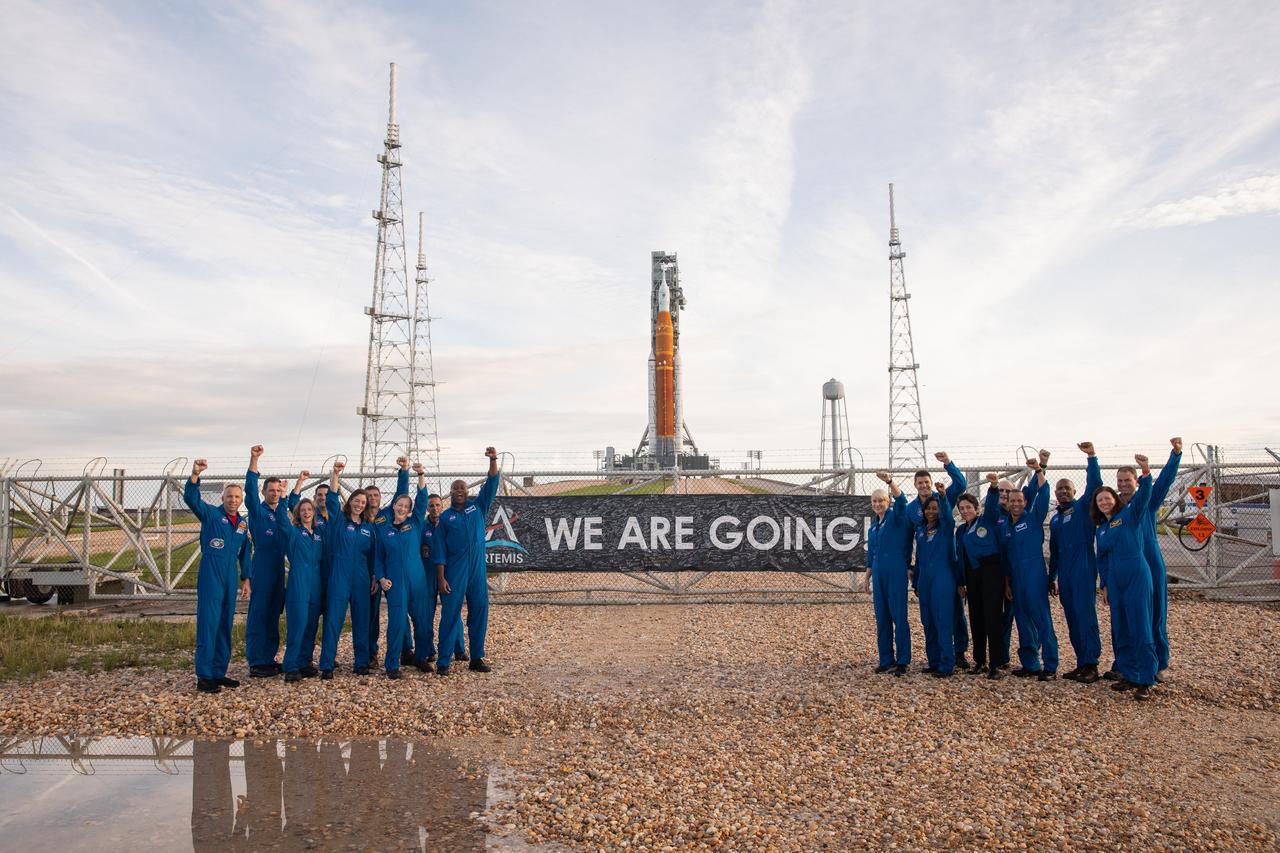
Astronauts and astronaut candidates from NASA and the Canadian Space Agency pose for a photograph in front of NASA’s Artemis I Space Launch System and Orion spacecraft atop the mobile launcher on the pad at Launch Complex 39B on Aug. 28, 2022. The astronauts are, from left to right: Randy Bresnik, NASA astronaut; Joshua Kutryk, Canadian Space Agency astronaut; Zena Cardman, NASA astronaut; Jack Hathaway, NASA astronaut candidate; Christina Birch, NASA astronaut candidate; Reid Wiseman, NASA astronaut; Jessica Wittner, NASA astronaut candidate; Joe Acaba, NASA astronaut; Andre Douglas, NASA astronaut candidate; Kate Rubins, NASA astronaut; Jeremy Hansen, Canadian Space Agency astronaut; Stephanie Wilson, NASA astronaut; Jessica Meir, NASA astronaut; Don Pettit, NASA astronaut; Chris Williams, NASA astronaut candidate; Victor Glover, NASA astronaut; Shannon Walker, NASA astronaut; Stan Love, NASA astronaut. Artemis I is scheduled to launch Aug. 29, at 8:33 a.m. EDT. The first in a series of increasingly complex missions, Artemis I will provide a foundation for human deep space exploration and demonstrate our commitment and capability to extend human presence to the Moon and beyond. The primary goal of Artemis I is to thoroughly test the integrated systems before crewed missions by operating the spacecraft in a deep space environment, testing Orion’s heat shield, and recovering the crew module after reentry, descent, and splashdown.
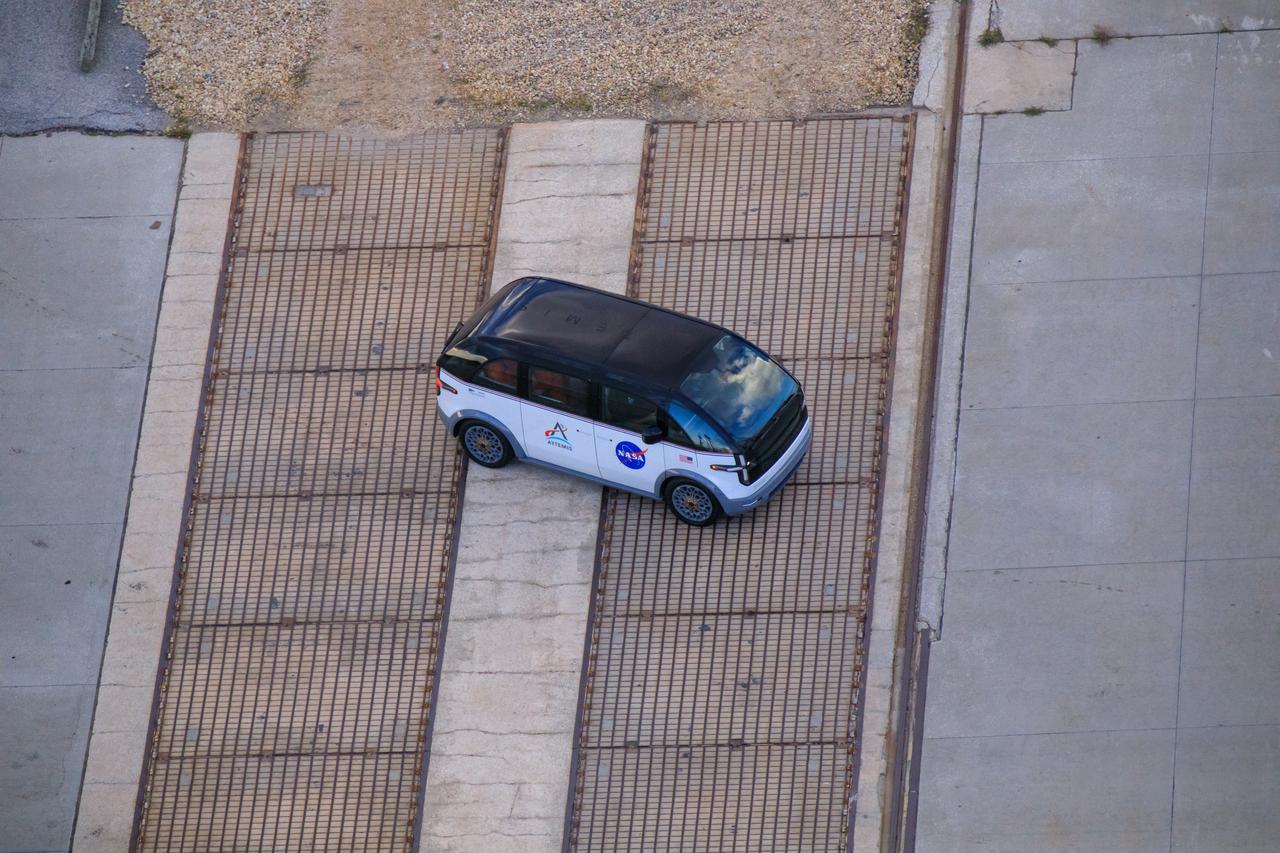
Artemis II NASA astronauts Reid Wiseman, Victor Glover, and Christina Koch, and CSA (Canadian Space Agency) astronaut Jeremy Hansen ride from Astronaut Crew Quarters in the Neil Armstrong Operations and Checkout Building to Launch Pad 39B in the Artemis crew transportation vehicles as part of an integrated ground systems test at Kennedy Space Center in Florida on Wednesday, Sept. 20, to test the crew timeline for launch day.
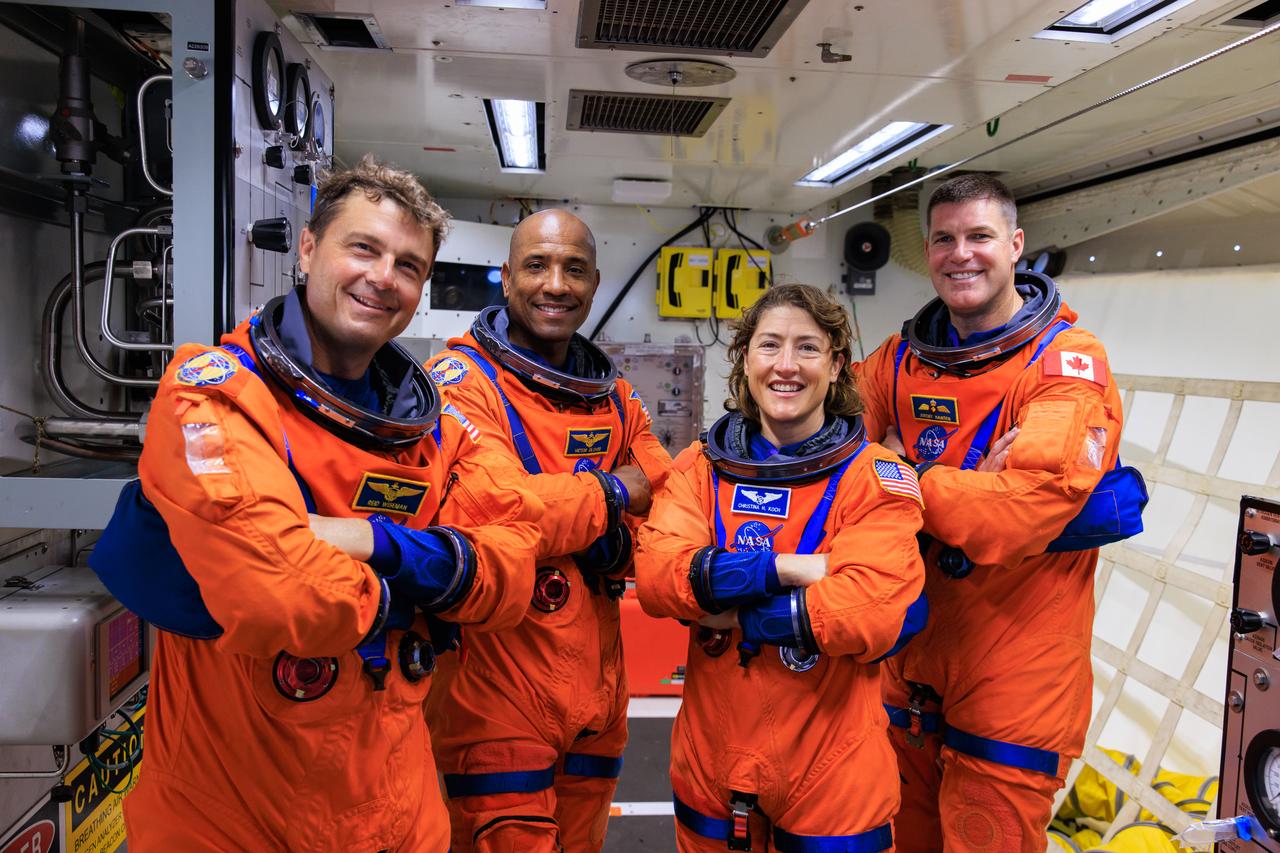
Artemis II NASA astronauts (left to right) Reid Wiseman, Victor Glover, and Christina Koch, and CSA (Canadian Space Agency) astronaut Jeremy Hansen stand in the white room on the crew access arm of the mobile launcher at Launch Pad 39B as part of an integrated ground systems test at Kennedy Space Center in Florida on Wednesday, Sept. 20, 2023. The test ensures the ground systems team is ready to support the crew timeline on launch day.
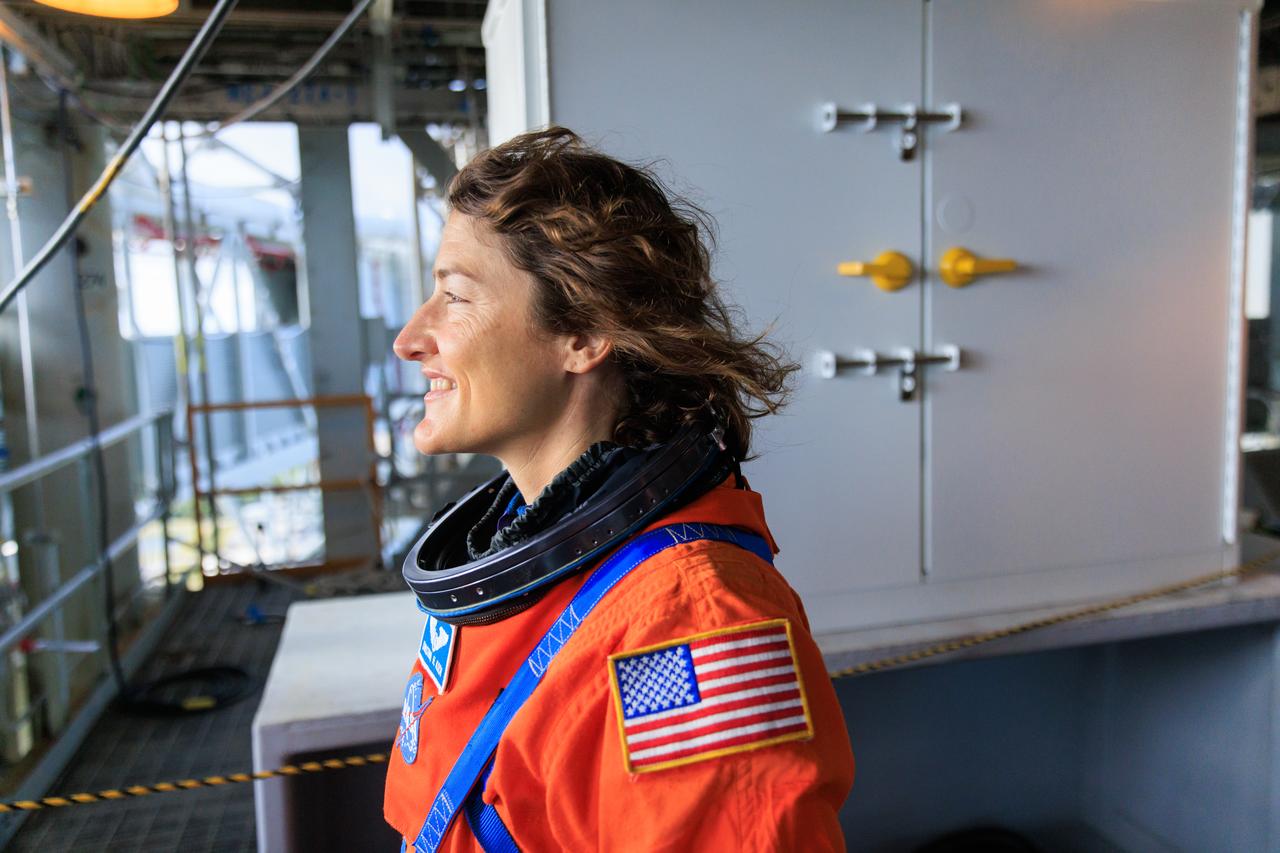
Artemis II NASA astronaut Christina Koch stands on the mobile launcher at Launch Pad 39B as part of an integrated ground systems test at Kennedy Space Center in Florida on Wednesday, Sept. 20, to test the crew timeline for launch day.
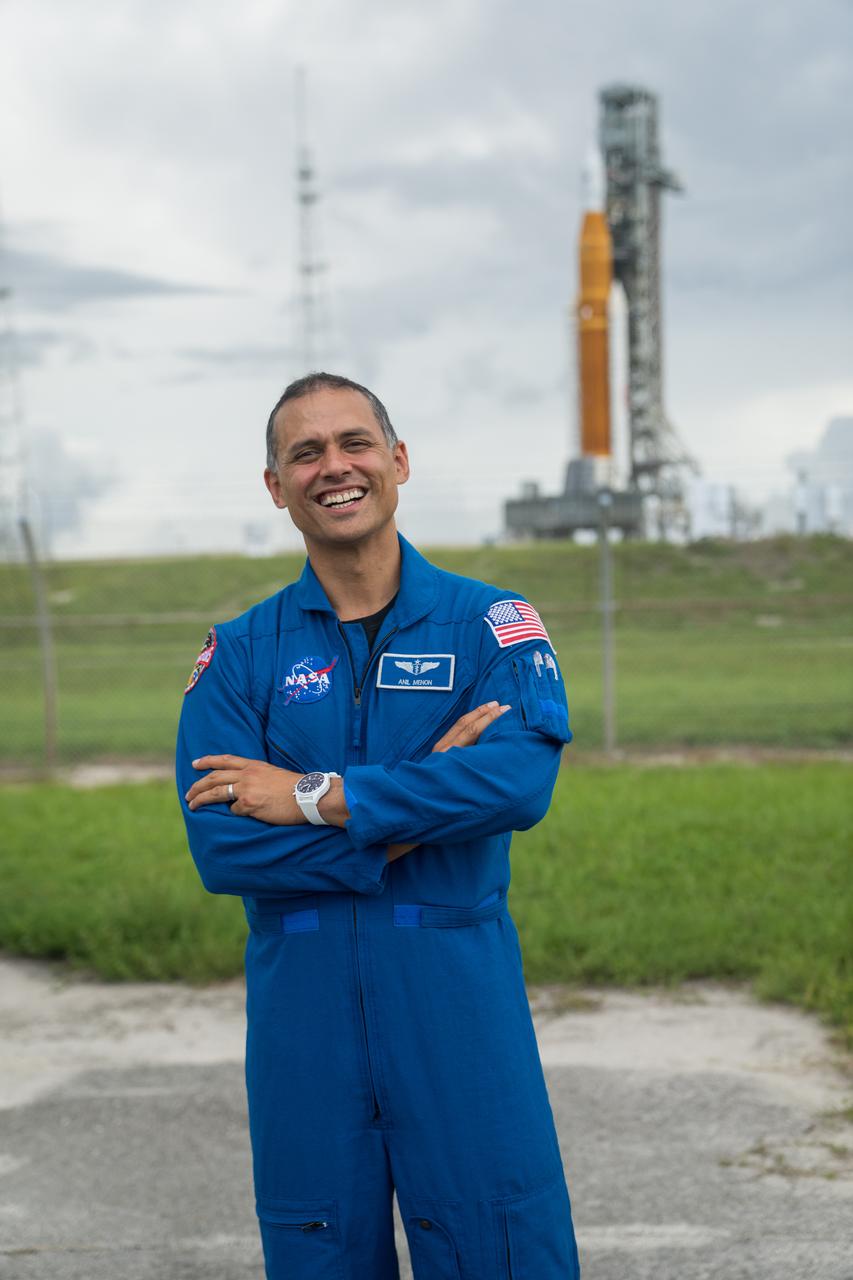
NASA astronaut candidate Anil Menon poses for a photograph in front of NASA’s Artemis I Space Launch System and Orion spacecraft atop the mobile launcher on the pad at Launch Complex 39B at the agency’s Kennedy Space Center in Florida on Sept. 2, 2022. The first in a series of increasingly complex missions, Artemis I will provide a foundation for human deep space exploration and demonstrate our commitment and capability to extend human presence to the Moon and beyond. The primary goal of Artemis I is to thoroughly test the integrated systems before crewed missions by operating the spacecraft in a deep space environment, testing Orion’s heat shield, and recovering the crew module after reentry, descent, and splashdown. In later missions, NASA will land the first woman and the first person of color on the surface of the Moon, paving the way for a long-term lunar presence and serving as a steppingstone on the way to Mars.
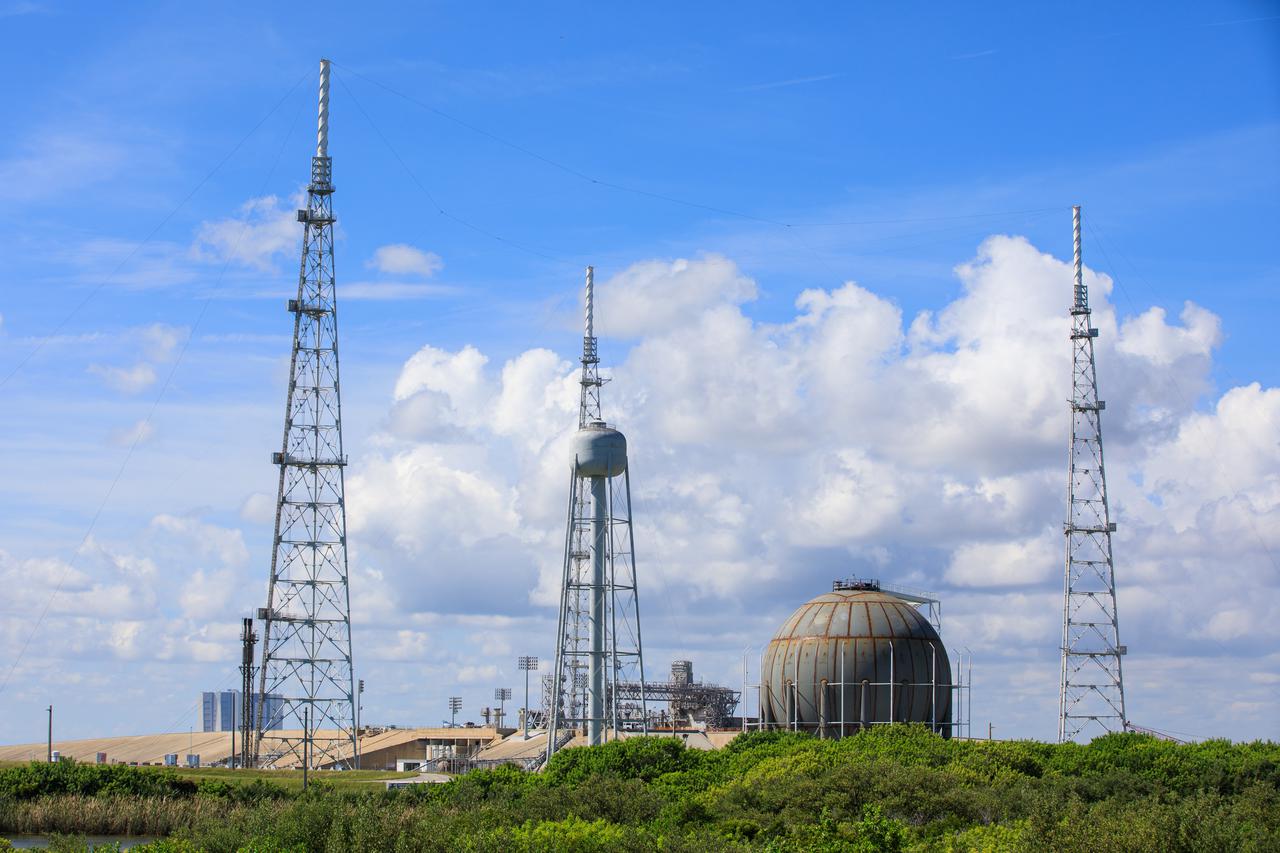
Seen here is a newly constructed liquid hydrogen (LH2) storage tank at Launch Pad 39B at NASA’s Kennedy Space Center in Florida on Oct. 1, 2021. With construction now complete, teams will focus on painting the tank next. The storage tank, capable of holding 1.25 million gallons of LH2, will be used to support future Artemis missions to the Moon and, eventually, Mars. Through Artemis, NASA will land the first woman and first person of color on the Moon, paving the way for a long-term presence in lunar orbit.
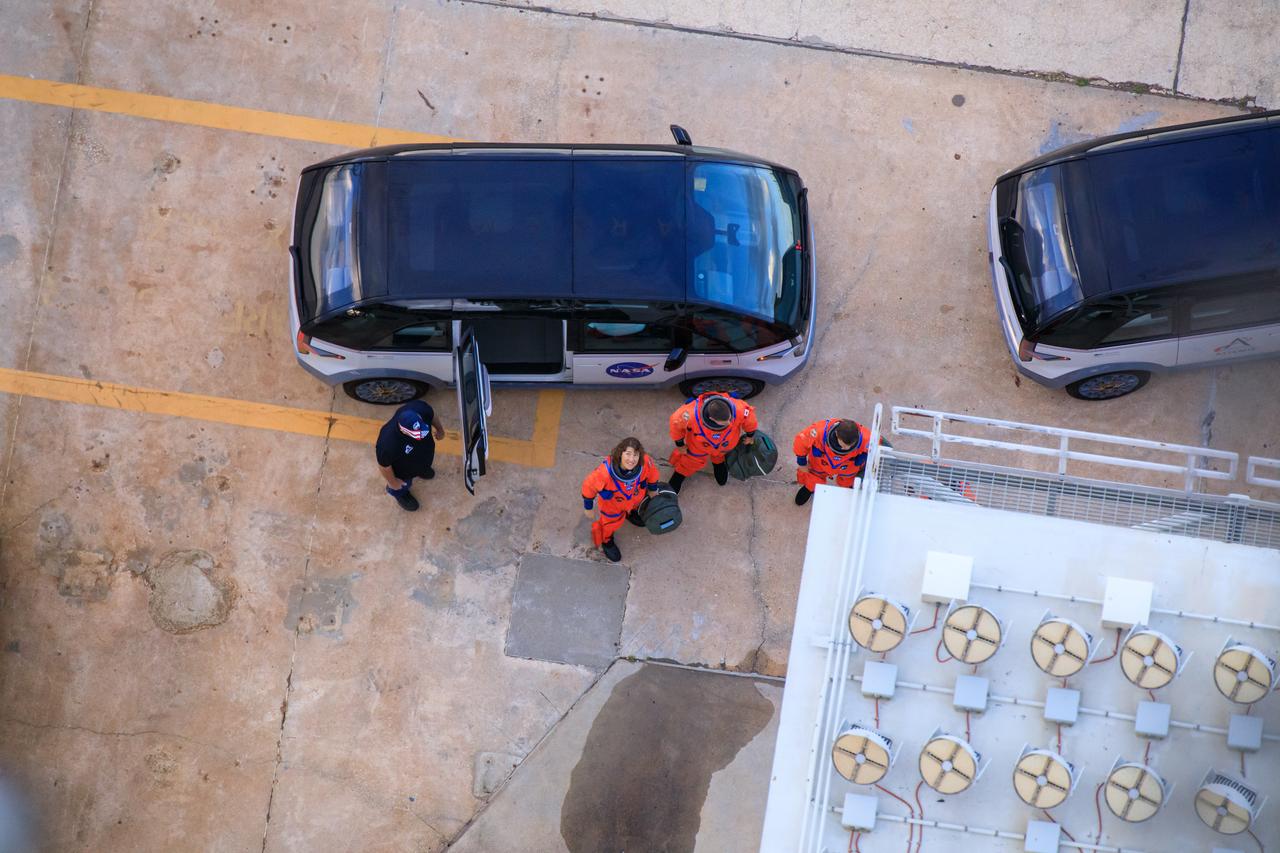
Artemis II NASA astronauts Reid Wiseman, Victor Glover, and Christina Koch, and CSA (Canadian Space Agency) astronaut Jeremy Hansen arrive to Launch Pad 39B and prepare to enter the mobile launcher and proceed to the crew access arm as part of an integrated ground systems test at Kennedy Space Center in Florida on Wednesday, Sept. 20, to test the crew timeline for launch day.
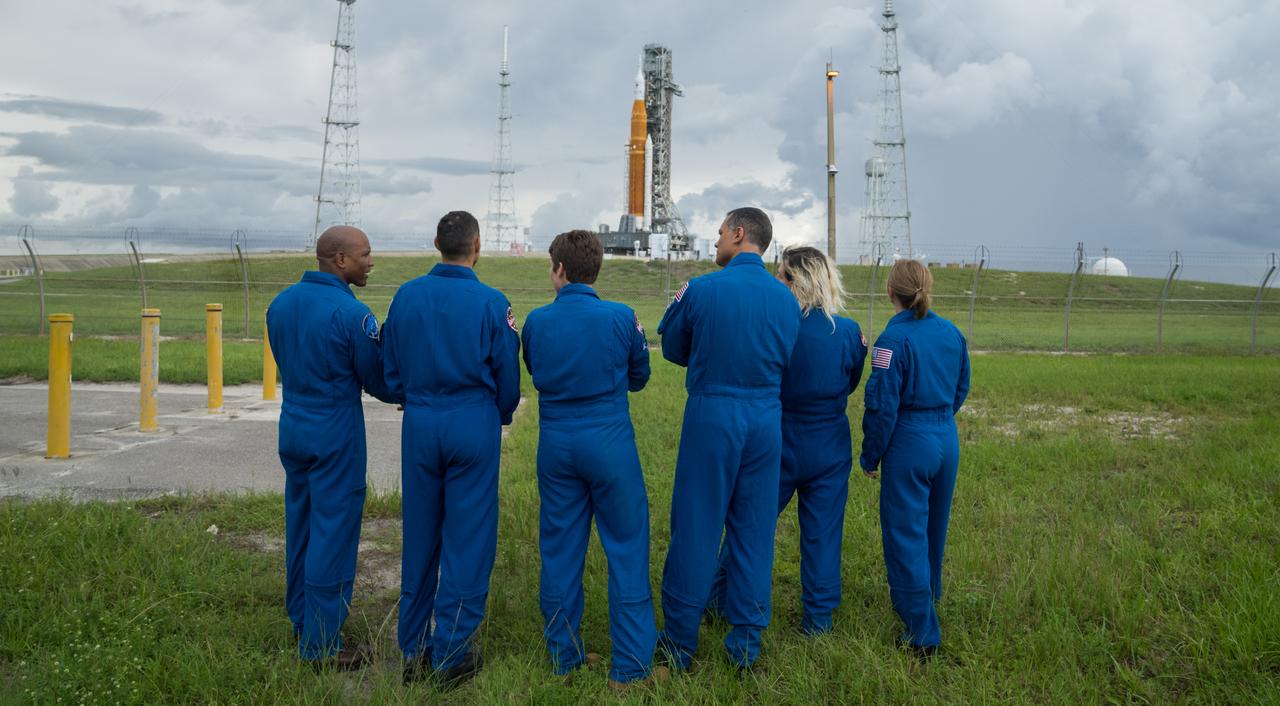
NASA astronauts and astronaut candidates view NASA’s Artemis I Space Launch System and Orion spacecraft atop the mobile launcher on the pad at Launch Complex 39B at the agency’s Kennedy Space Center in Florida on Sept. 2, 2022. The astronauts are, from left to right: Victor Glover, NASA astronaut; Marcos Berrios, NASA astronaut candidate; Anne McClain, NASA astronaut; Anil Menon and Deniz Burnham, NASA astronaut candidates; and Zena Cardman, NASA astronaut. The first in a series of increasingly complex missions, Artemis I will provide a foundation for human deep space exploration and demonstrate our commitment and capability to extend human presence to the Moon and beyond. The primary goal of Artemis I is to thoroughly test the integrated systems before crewed missions by operating the spacecraft in a deep space environment, testing Orion’s heat shield, and recovering the crew module after reentry, descent, and splashdown. In later missions, NASA will land the first woman and the first person of color on the surface of the Moon, paving the way for a long-term lunar presence and serving as a steppingstone on the way to Mars.
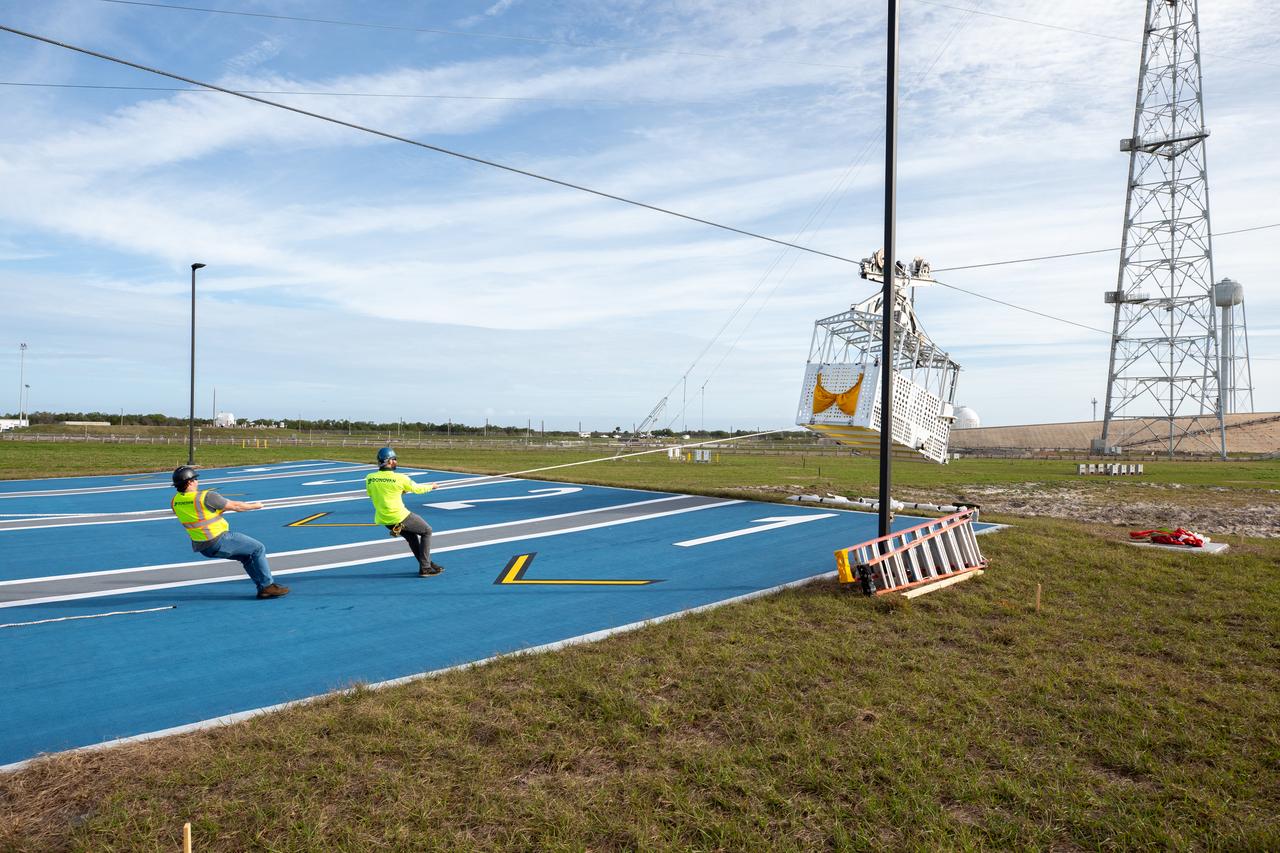
Teams with NASA’s Exploration Ground Systems Program, in preparation for the agency’s Artemis II crewed mission to the Moon, begin installing the first of four emergency egress baskets on the mobile launcher at Launch Complex 39B at the agency’s Kennedy Space Center in Florida on Wednesday, Jan. 24, 2024. The baskets, similar to gondolas on ski lifts, are used in the case of a pad abort emergency to enable astronauts and other pad personnel a way to quickly escape away from the mobile launcher to the base of the pad and where waiting emergency transport vehicles will then drive them away.
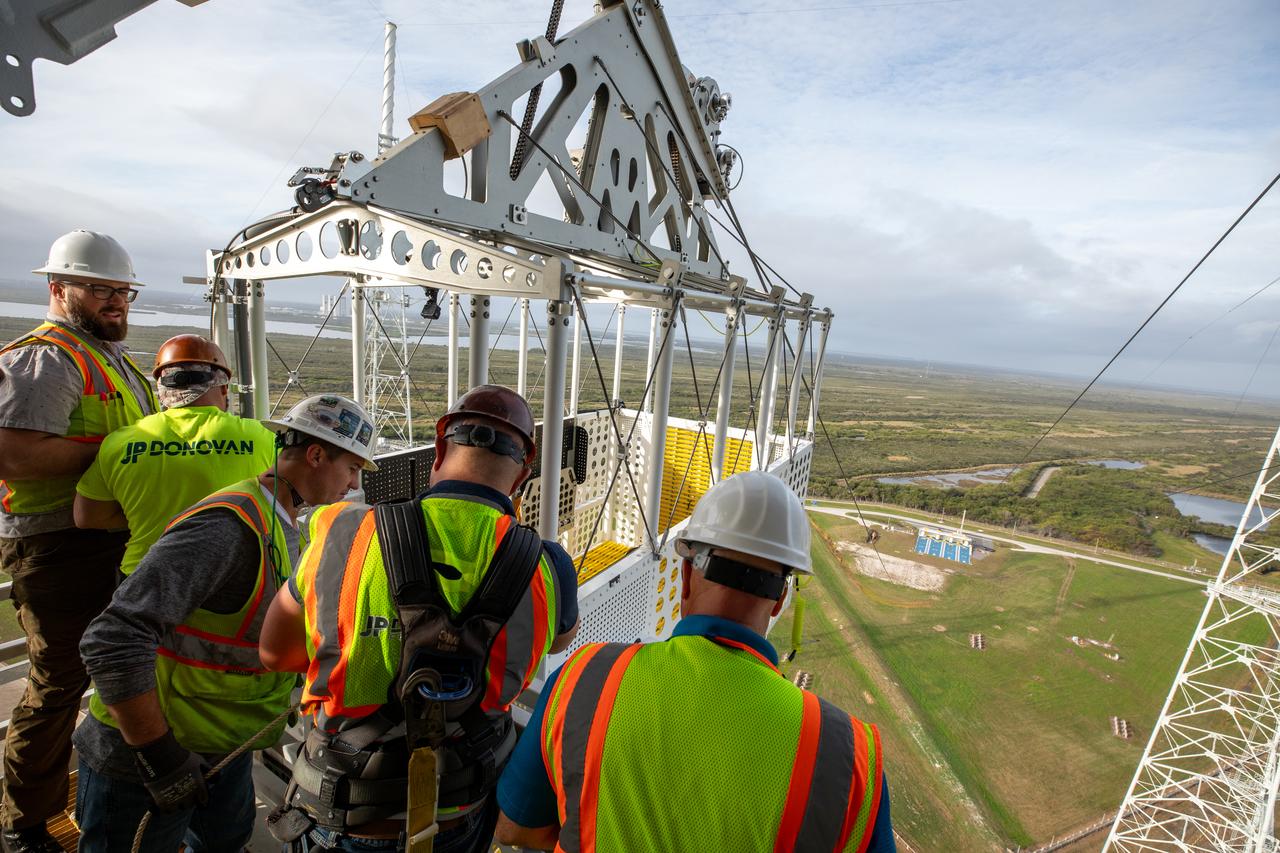
Teams with NASA’s Exploration Ground Systems Program, in preparation for the agency’s Artemis II crewed mission to the Moon, begin installing the first of four emergency egress baskets on the mobile launcher at Launch Complex 39B at the agency’s Kennedy Space Center in Florida on Wednesday, Jan. 24, 2024. The baskets, similar to gondolas on ski lifts, are used in the case of a pad abort emergency to enable astronauts and other pad personnel a way to quickly escape away from the mobile launcher to the base of the pad and where waiting emergency transport vehicles will then drive them away.

Teams with NASA’s Exploration Ground Systems Program, in preparation for the agency’s Artemis II crewed mission to the Moon, begin installing the first of four emergency egress baskets on the mobile launcher at Launch Complex 39B at the agency’s Kennedy Space Center in Florida on Wednesday, Jan. 24, 2024. The baskets, similar to gondolas on ski lifts, are used in the case of a pad abort emergency to enable astronauts and other pad personnel a way to quickly escape away from the mobile launcher to the base of the pad and where waiting emergency transport vehicles will then drive them away.
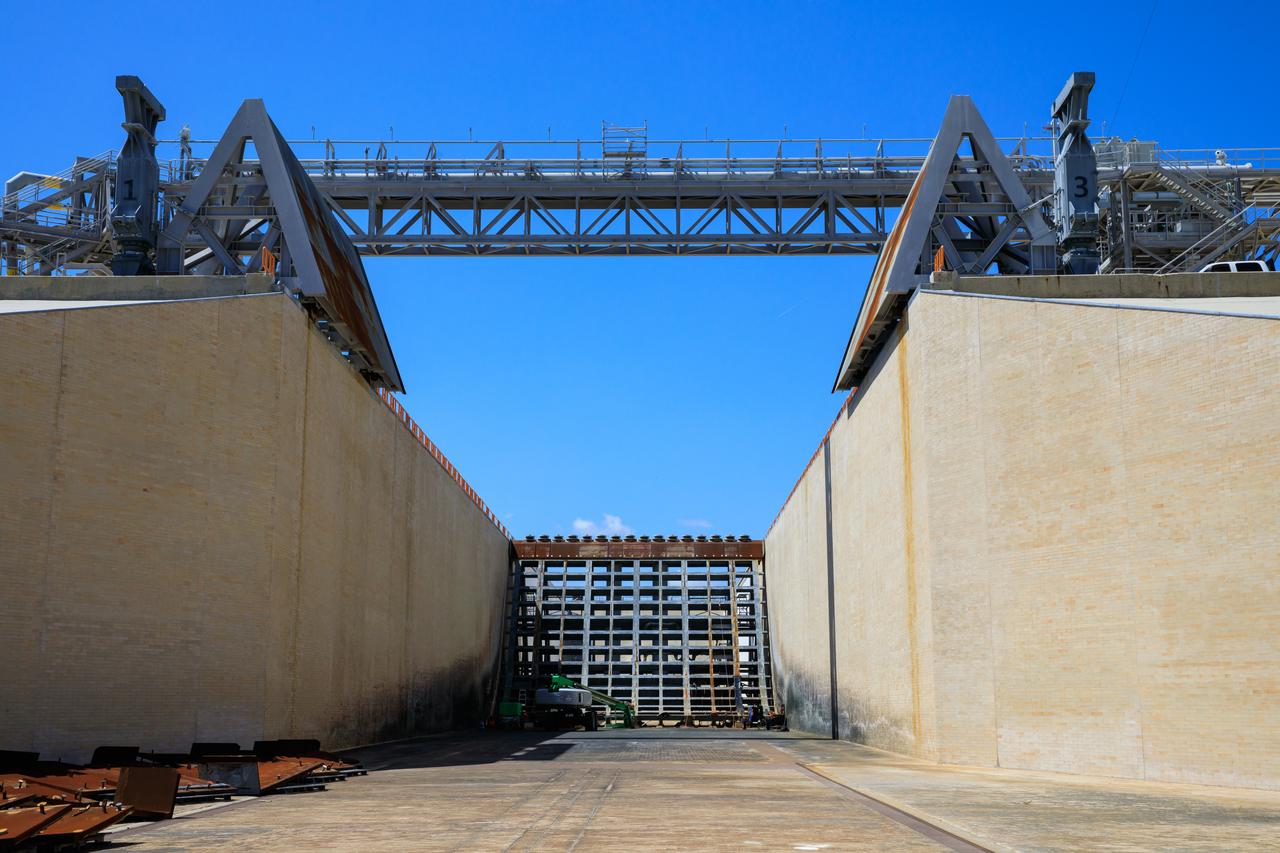
Teams with Exploration Ground Systems at NASA’s Kennedy Space Center in Florida continue to work the upgrades and repairs on mobile launcher 1 and Launch Pad 39B on June 13, 2023, ahead of the first critical ground testing for Artemis II. Teams are re-designing the panels on the flame deflector in the flame trench that withstood damage observed after launch of Artemis I. Artemis II will be the first Artemis mission flying crew aboard Orion.
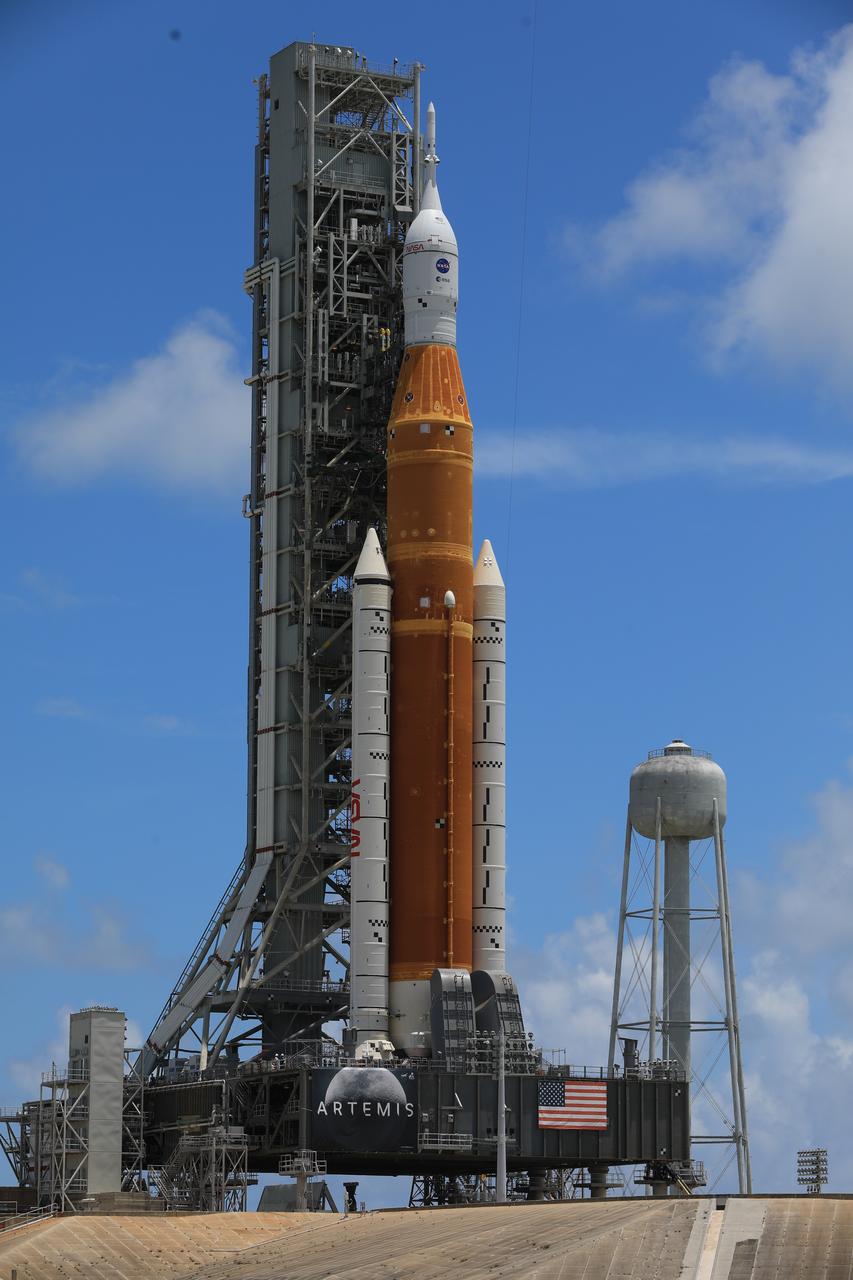
A close-up view of the Artemis I Space Launch System (SLS) and Orion spacecraft atop the mobile launcher at Launch Pad 39B at NASA’s Kennedy Space Center in Florida on June 30, 2022. The SLS and Orion were transported to the pad on crawler-transporter 2 for a prelaunch test called a wet dress rehearsal. Artemis I will be the first integrated test of the SLS and Orion spacecraft. In later missions, NASA will land the first woman and the first person of color on the surface of the Moon, paving the way for a long-term lunar presence and serving as a steppingstone on the way to Mars.
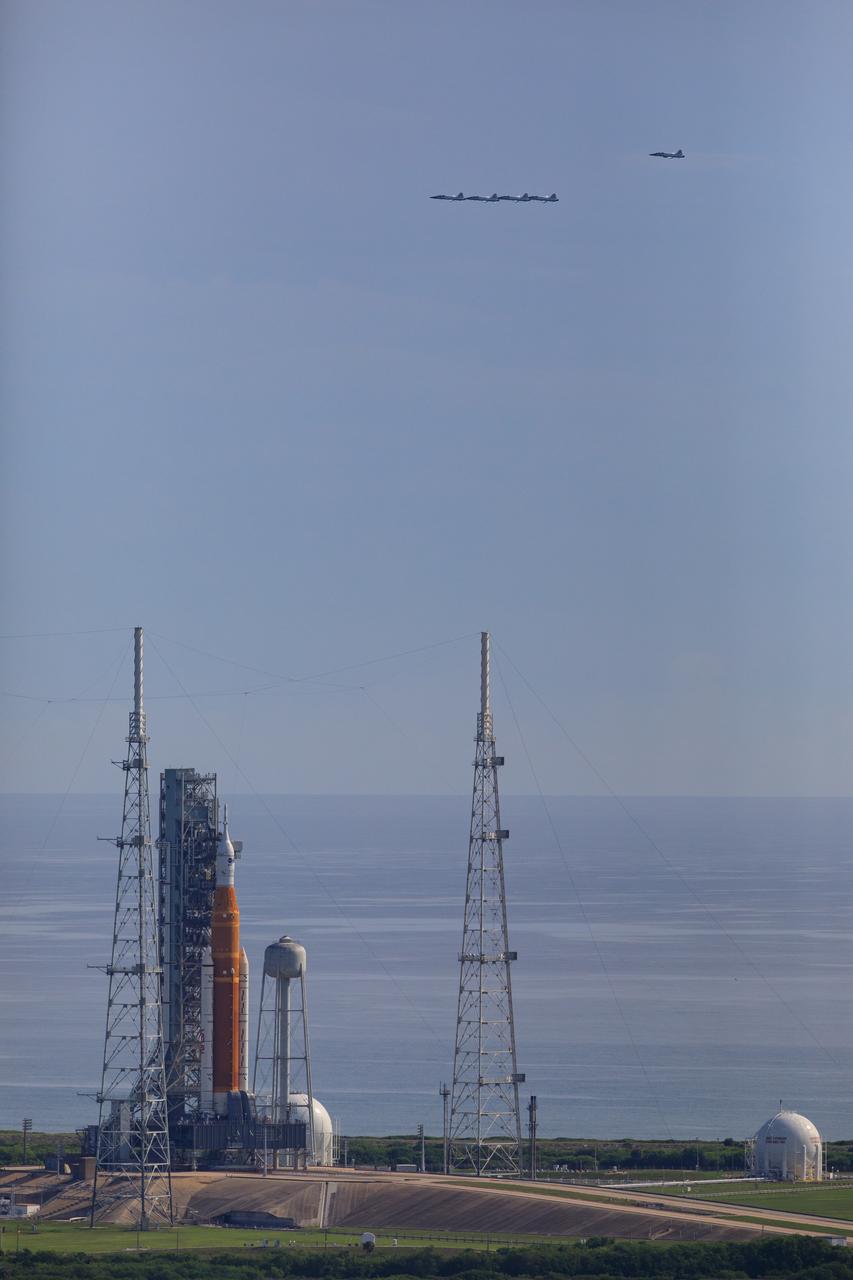
Ahead of NASA’s Artemis I launch, a flight of T-38 supersonic trainer aircraft from the Johnson Space Center Aircraft Operations Division flies in formation over the agency’s Space Launch System and Orion spacecraft on the pad at Launch Complex 39B at Kennedy Space Center in Florida, on Aug. 23, 2022. Pilots and passengers of the five aircraft include NASA Research Pilot Chris Condon and NASA Astronaut Zena Cardman in the lead plane, followed by NASA astronaut candidate Nicole Ayers and NASA astronaut Christina Koch in the second plane, Canadian Space Agency astronaut Jeremy Hansen and NASA astronaut Drew Morgan in the third plane, NASA astronaut Reid Wiseman and NASA astronaut Joe Acaba in the fourth plane, and NASA astronaut candidate Jack Hathaway and Josh Valcarcel, NASA photographer, in the chase plane. Artemis I is scheduled to launch at 8:33 a.m. EDT on Aug. 29, 2022. The first in a series of increasingly complex missions, Artemis I will provide a foundation for human deep space exploration and demonstrate our commitment and capability to extend human presence to the Moon and beyond. The primary goal of Artemis I is to thoroughly test the integrated systems before crewed missions by operating the spacecraft in a deep space environment, testing Orion’s heat shield, and recovering the crew module after reentry, descent, and splashdown.
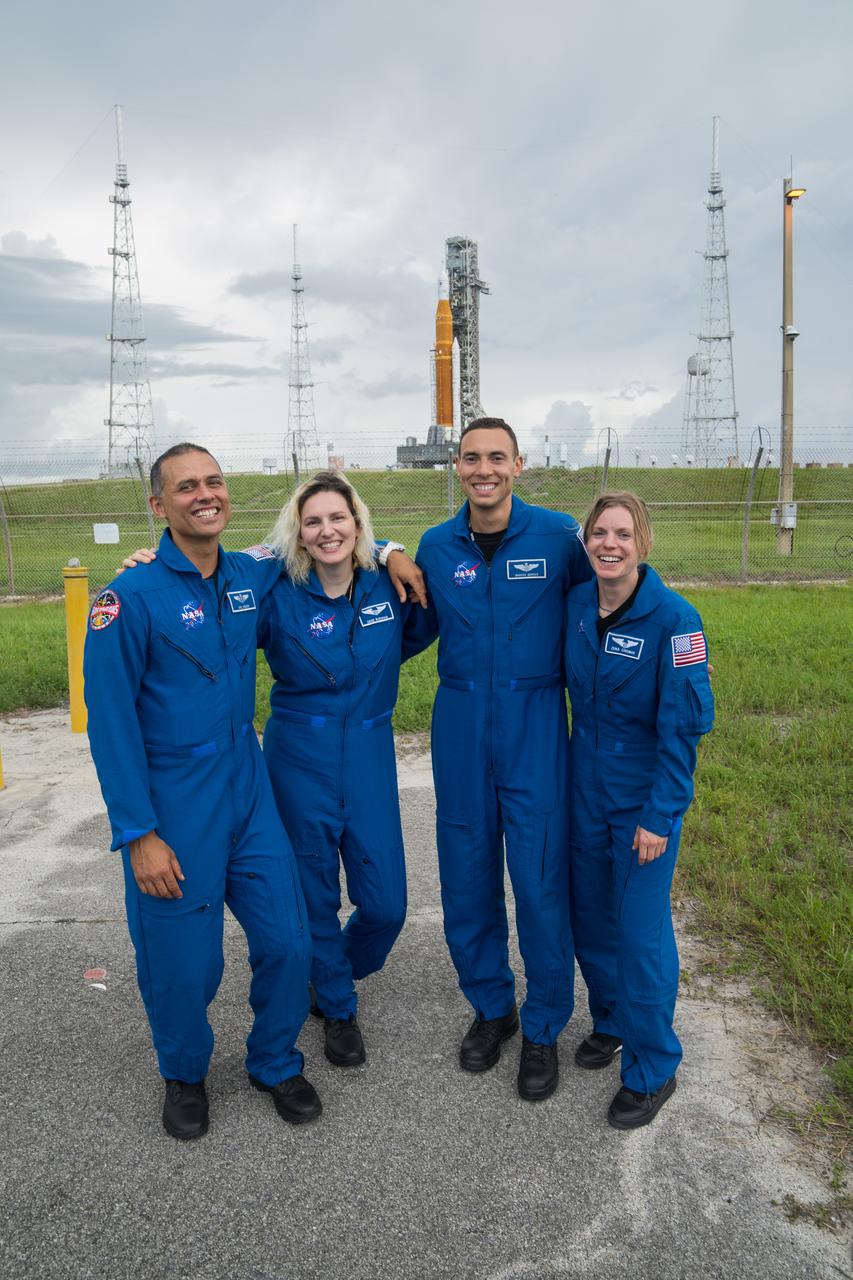
From left to right, NASA astronaut candidates Anil Menon, Deniz Burnham, and Marcos Berrios, and NASA astronaut Zena Cardman pose for a photograph in front of NASA’s Artemis I Space Launch System and Orion spacecraft atop the mobile launcher on the pad at Launch Complex 39B at the agency’s Kennedy Space Center in Florida on Sept. 2, 2022. The first in a series of increasingly complex missions, Artemis I will provide a foundation for human deep space exploration and demonstrate our commitment and capability to extend human presence to the Moon and beyond. The primary goal of Artemis I is to thoroughly test the integrated systems before crewed missions by operating the spacecraft in a deep space environment, testing Orion’s heat shield, and recovering the crew module after reentry, descent, and splashdown. In later missions, NASA will land the first woman and the first person of color on the surface of the Moon, paving the way for a long-term lunar presence and serving as a steppingstone on the way to Mars.
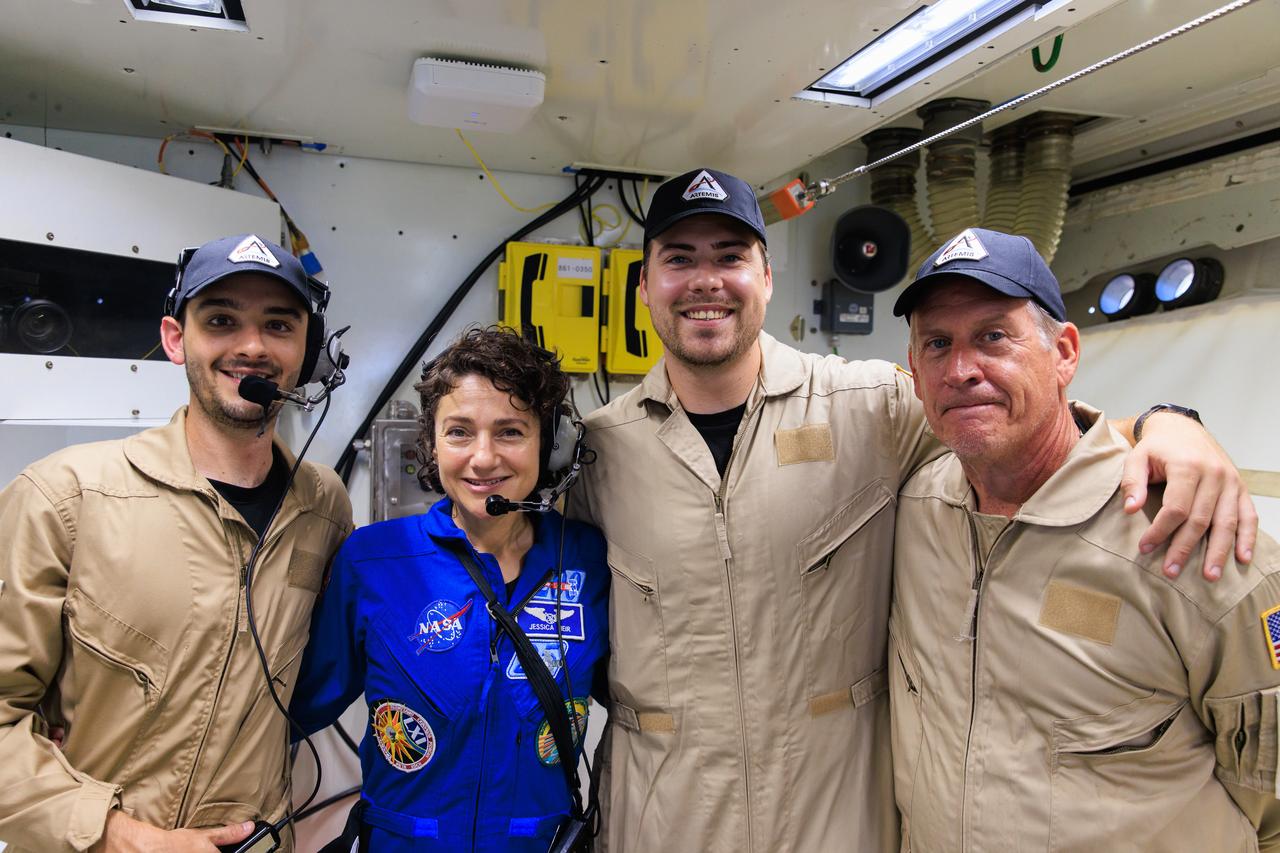
NASA astronaut Jessica Meir poses with members of the closeout team during in the white room on the crew access arm of the mobile launcher at Launch Pad 39B as part of an Artemis II integrated ground systems test at Kennedy Space Center in Florida on Wednesday, Sept. 20, 2023. The test ensures the ground systems team is ready to support the crew timeline on launch day.
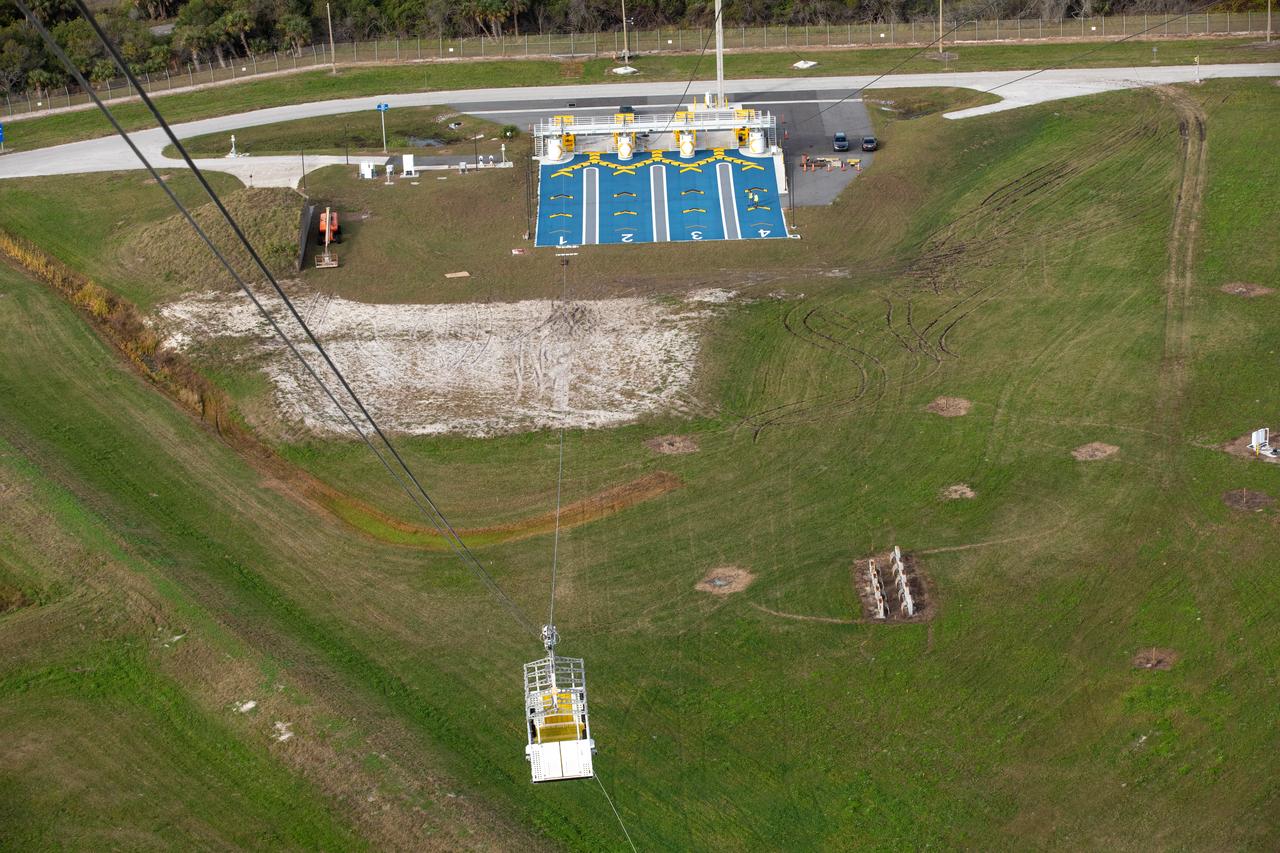
Teams with NASA’s Exploration Ground Systems Program, in preparation for the agency’s Artemis II crewed mission to the Moon, begin installing the first of four emergency egress baskets on the mobile launcher at Launch Complex 39B at the agency’s Kennedy Space Center in Florida on Wednesday, Jan. 24, 2024. The baskets, similar to gondolas on ski lifts, are used in the case of a pad abort emergency to enable astronauts and other pad personnel a way to quickly escape away from the mobile launcher to the base of the pad and where waiting emergency transport vehicles will then drive them away.
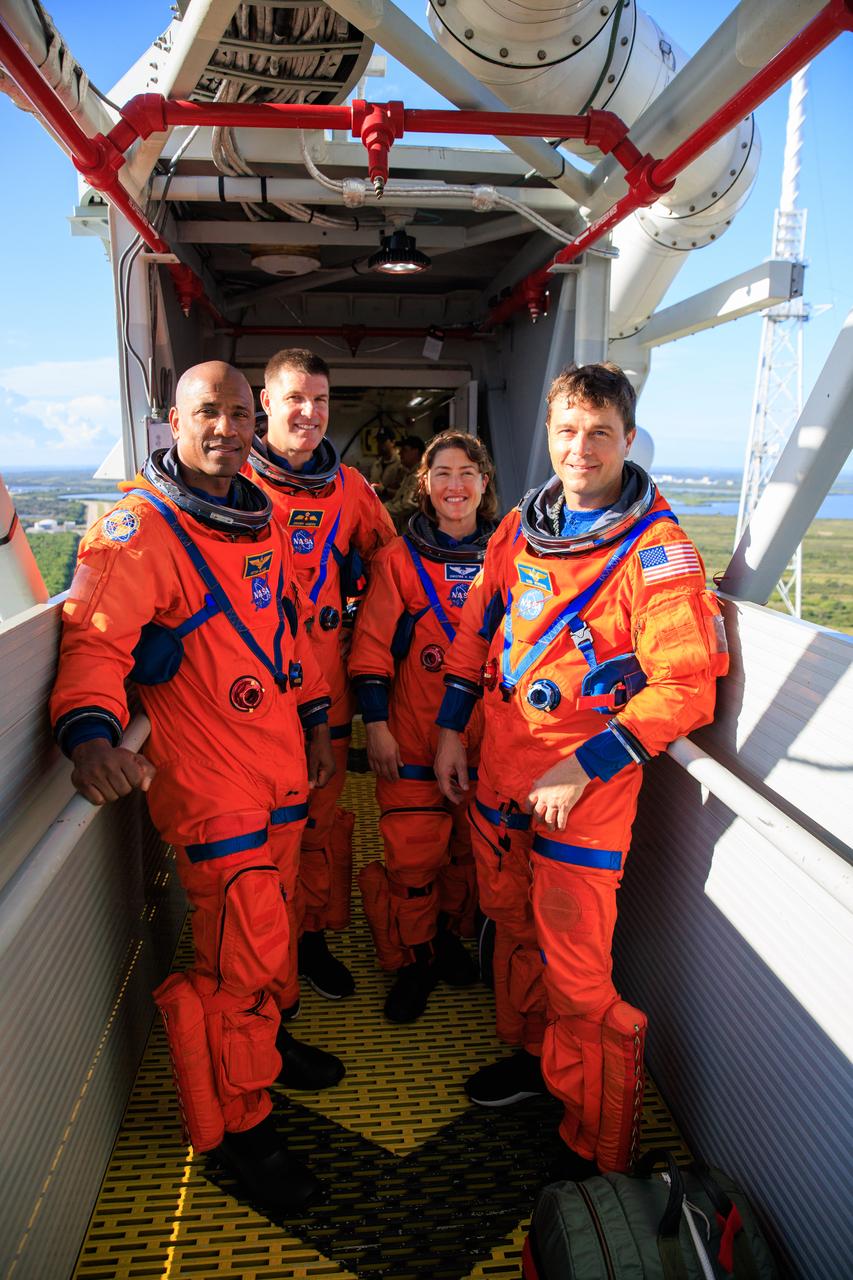
Artemis II astronauts, from left, NASA astronaut Victor Glover (left), CSA (Canadian Space Agency) astronaut Jeremy Hansen, NASA astronauts Christina Koch and Reid Wiseman stand on the crew access arm of the mobile launcher at Launch Pad 39B as part of an integrated ground systems test at Kennedy Space Center in Florida on Wednesday, Sept. 20. The test ensures the ground systems team is ready to support the crew timeline on launch day.
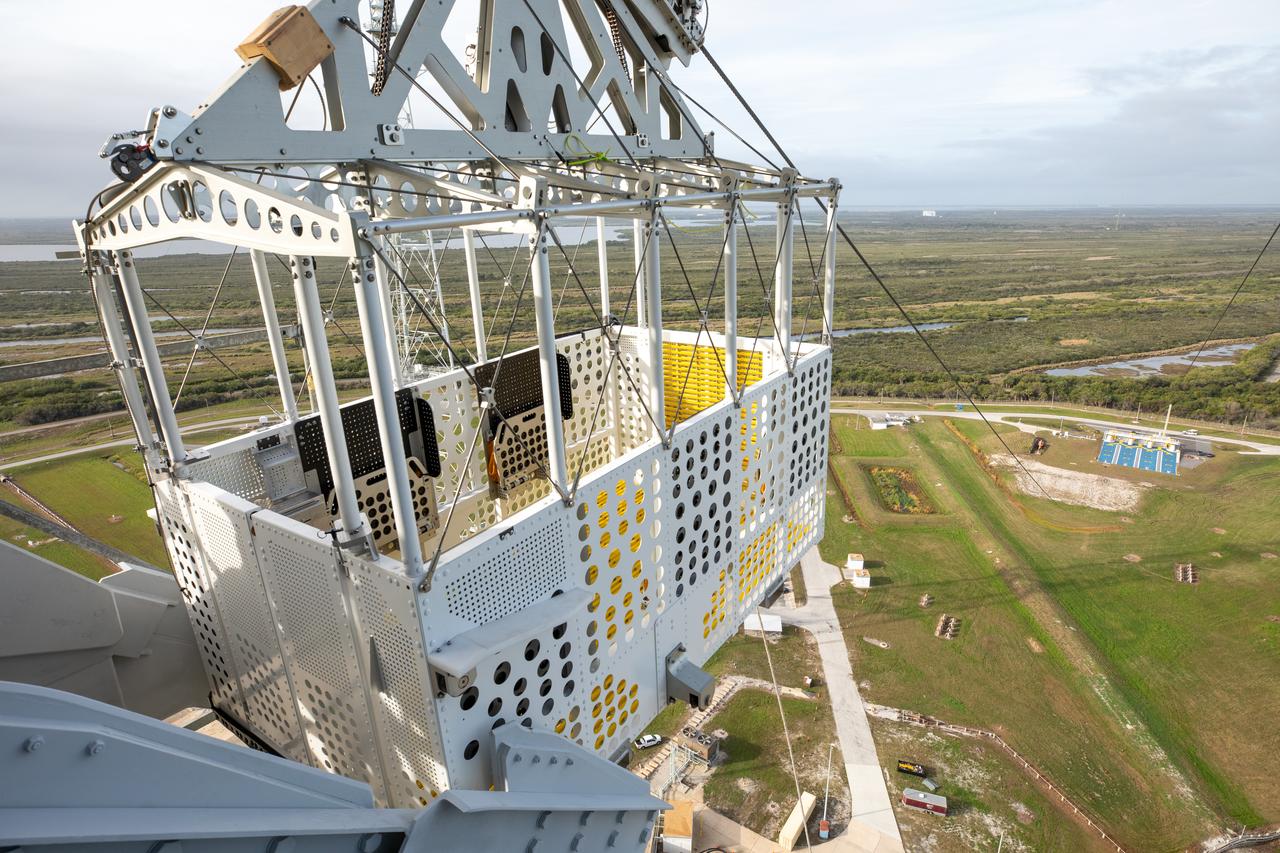
Teams with NASA’s Exploration Ground Systems Program, in preparation for the agency’s Artemis II crewed mission to the Moon, begin installing the first of four emergency egress baskets on the mobile launcher at Launch Complex 39B at the agency’s Kennedy Space Center in Florida on Wednesday, Jan. 24, 2024. The baskets, similar to gondolas on ski lifts, are used in the case of a pad abort emergency to enable astronauts and other pad personnel a way to quickly escape away from the mobile launcher to the base of the pad and where waiting emergency transport vehicles will then drive them away.
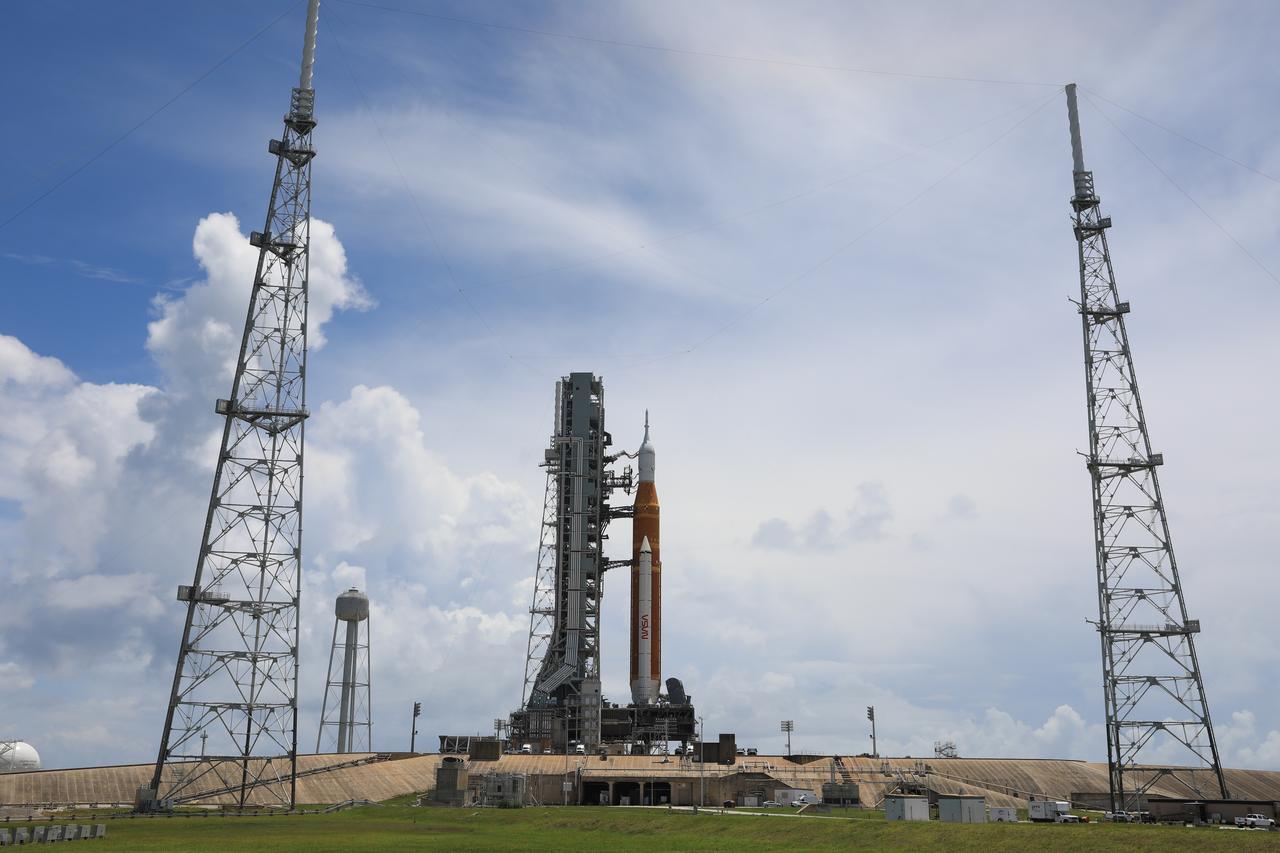
Blue sky and white clouds serve as a backdrop for the Artemis I Space Launch System (SLS) and Orion spacecraft atop the mobile launcher at Launch Pad 39B at NASA’s Kennedy Space Center in Florida on June 30, 2022. The SLS and Orion were transported to the pad on crawler-transporter 2 for a prelaunch test called a wet dress rehearsal. Artemis I will be the first integrated test of the SLS and Orion spacecraft. In later missions, NASA will land the first woman and the first person of color on the surface of the Moon, paving the way for a long-term lunar presence and serving as a steppingstone on the way to Mars.
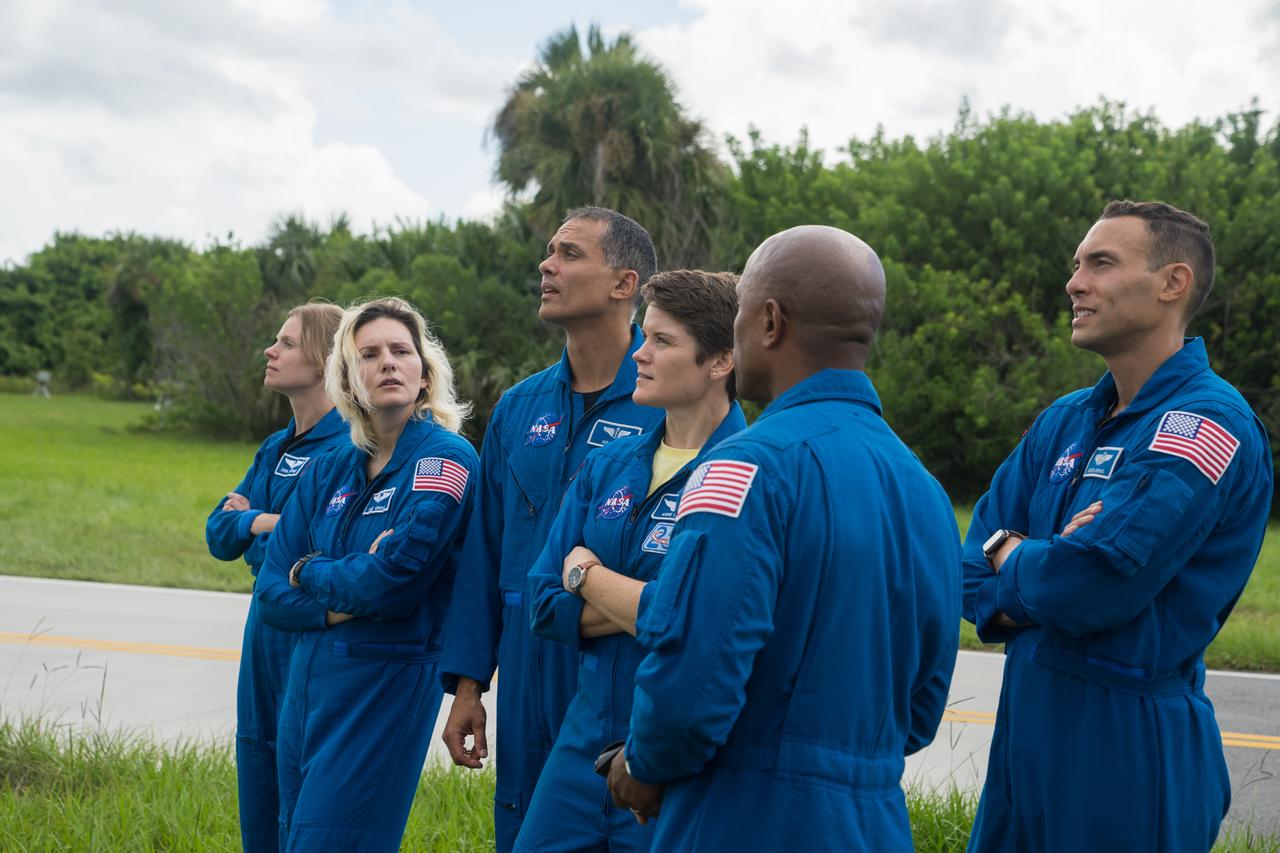
NASA astronauts and astronaut candidates view NASA’s Artemis I Space Launch System and Orion spacecraft atop the mobile launcher on the pad at Launch Complex 39B at the agency’s Kennedy Space Center in Florida on Sept. 2, 2022. The astronauts are, from left to right: Zena Cardman, NASA astronaut; Deniz Burnham and Anil Menon, NASA astronaut candidates; Anne McClain, NASA astronaut; Marcos Berrios, NASA astronaut candidate; and Victor Glover, NASA astronaut. The first in a series of increasingly complex missions, Artemis I will provide a foundation for human deep space exploration and demonstrate our commitment and capability to extend human presence to the Moon and beyond. The primary goal of Artemis I is to thoroughly test the integrated systems before crewed missions by operating the spacecraft in a deep space environment, testing Orion’s heat shield, and recovering the crew module after reentry, descent, and splashdown. In later missions, NASA will land the first woman and the first person of color on the surface of the Moon, paving the way for a long-term lunar presence and serving as a steppingstone on the way to Mars.

Teams with Exploration Ground Systems at NASA’s Kennedy Space Center in Florida continue to work the upgrades and repairs on mobile launcher 1 and Launch Pad 39B on June 13, 2023, ahead of the first critical ground testing for Artemis II. New pavement markings indicate the direction of the emergency egress system terminus from Launch Complex 39B. The team has nearly completed the terminus area, where the emergency egress baskets carrying the astronauts and flight crew will arrive following their safe exit from the mobile launcher. Artemis II will be the first Artemis mission flying crew aboard Orion.
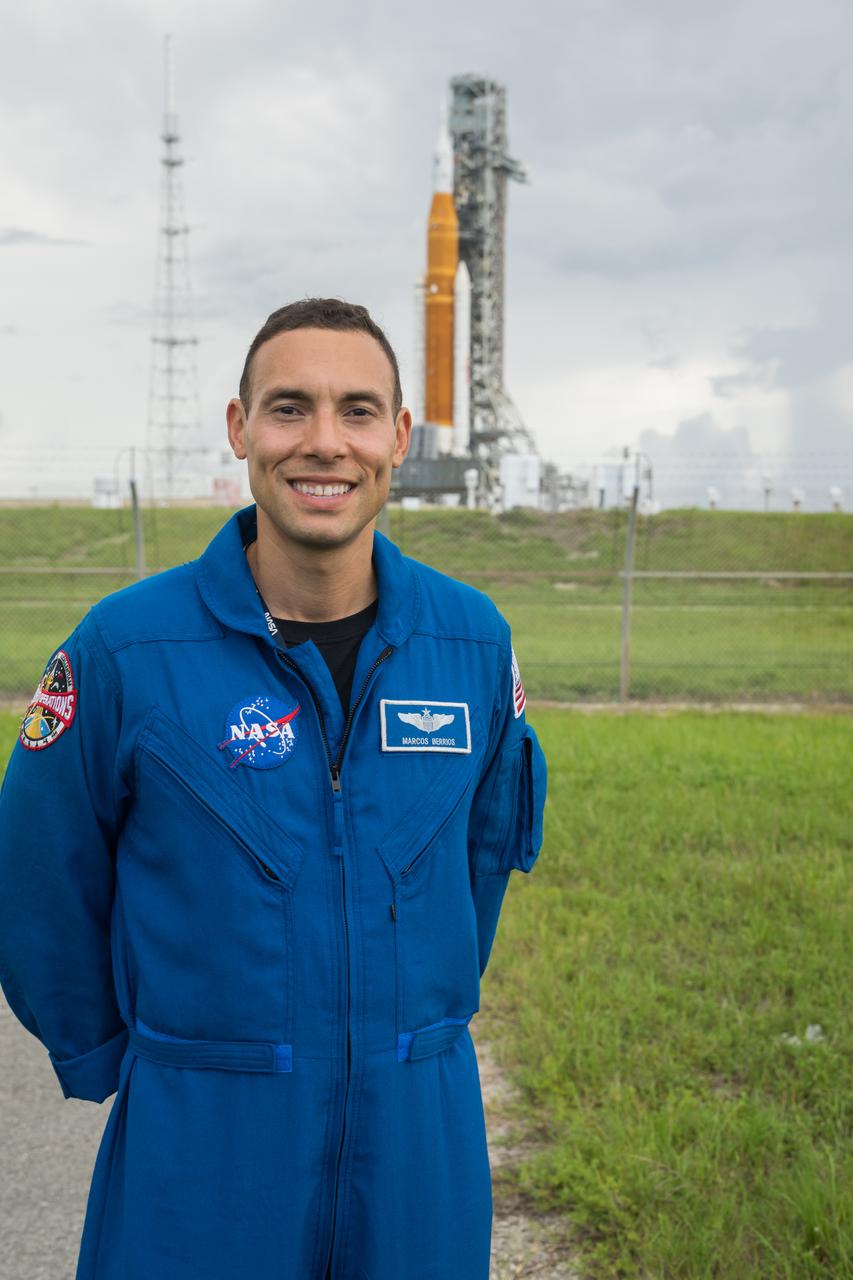
NASA astronaut candidate Marcos Berrios poses for a photograph in front of NASA’s Artemis I Space Launch System and Orion spacecraft atop the mobile launcher on the pad at Launch Complex 39B at the agency’s Kennedy Space Center in Florida on Sept. 2, 2022. The first in a series of increasingly complex missions, Artemis I will provide a foundation for human deep space exploration and demonstrate our commitment and capability to extend human presence to the Moon and beyond. The primary goal of Artemis I is to thoroughly test the integrated systems before crewed missions by operating the spacecraft in a deep space environment, testing Orion’s heat shield, and recovering the crew module after reentry, descent, and splashdown. In later missions, NASA will land the first woman and the first person of color on the surface of the Moon, paving the way for a long-term lunar presence and serving as a steppingstone on the way to Mars.
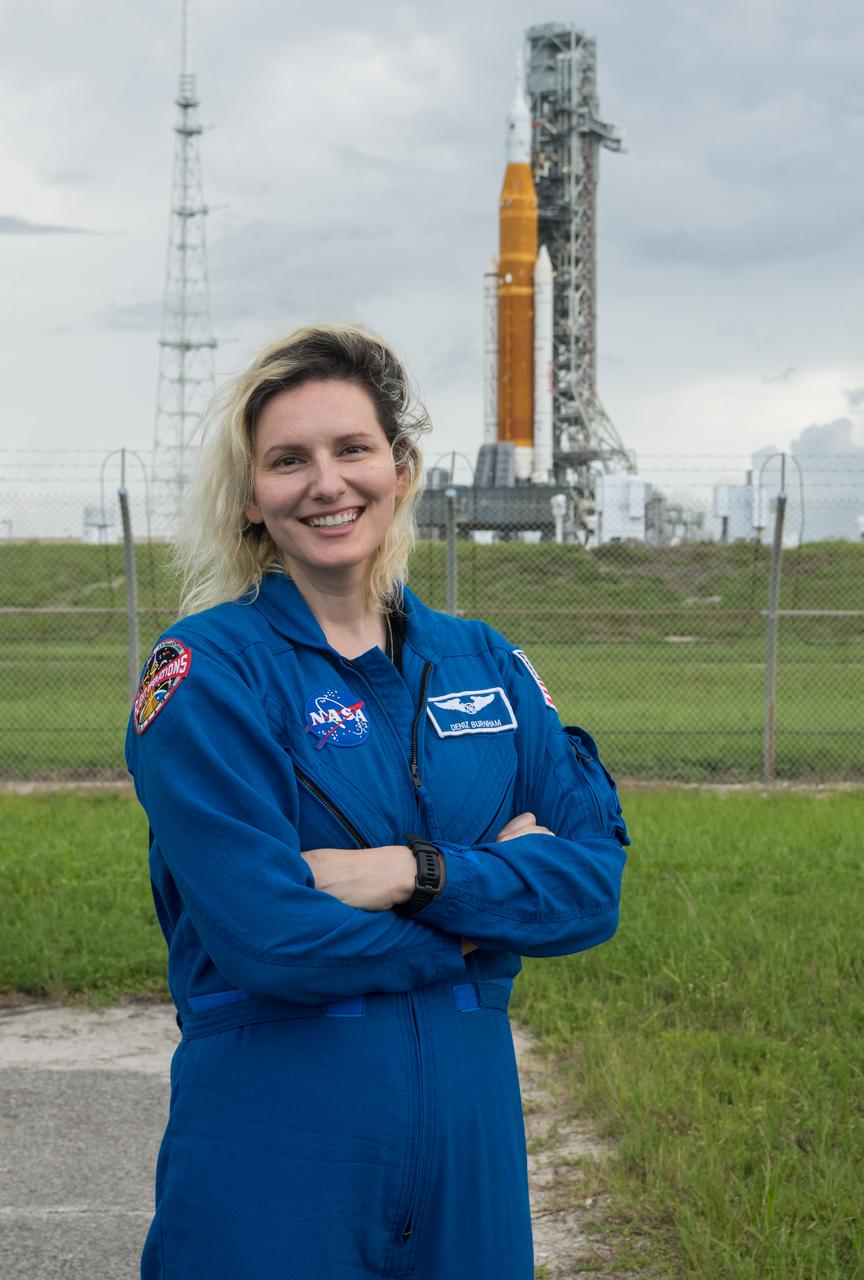
NASA astronaut candidate Deniz Burnham poses for a photograph in front of NASA’s Artemis I Space Launch System and Orion spacecraft atop the mobile launcher on the pad at Launch Complex 39B at the agency’s Kennedy Space Center in Florida on Sept. 2, 2022. The first in a series of increasingly complex missions, Artemis I will provide a foundation for human deep space exploration and demonstrate our commitment and capability to extend human presence to the Moon and beyond. The primary goal of Artemis I is to thoroughly test the integrated systems before crewed missions by operating the spacecraft in a deep space environment, testing Orion’s heat shield, and recovering the crew module after reentry, descent, and splashdown. In later missions, NASA will land the first woman and the first person of color on the surface of the Moon, paving the way for a long-term lunar presence and serving as a steppingstone on the way to Mars.
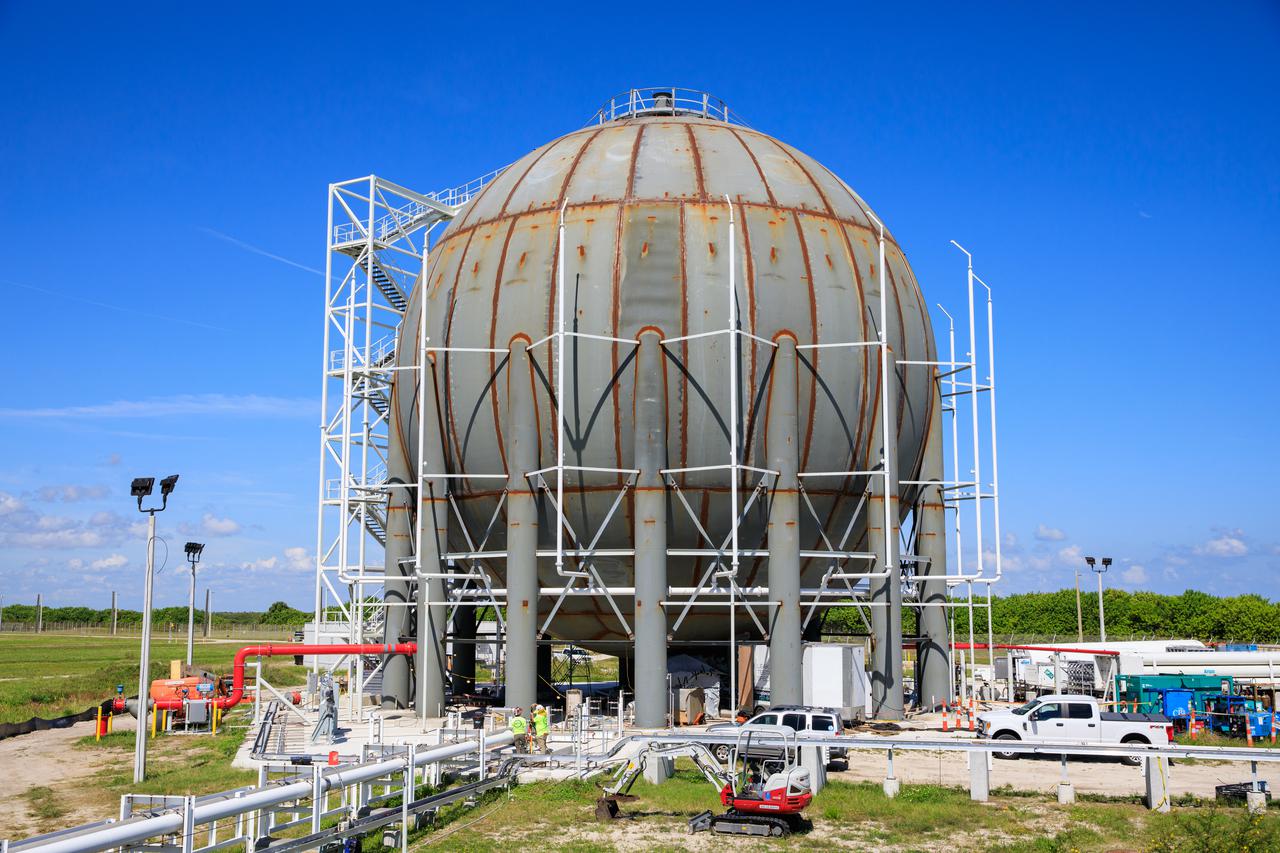
Seen here is a newly constructed liquid hydrogen (LH2) storage tank at Launch Pad 39B at NASA’s Kennedy Space Center in Florida on Oct. 1, 2021. With construction now complete, teams will focus on painting the tank next. The storage tank, capable of holding 1.25 million gallons of LH2, will be used to support future Artemis missions to the Moon and, eventually, Mars. Through Artemis, NASA will land the first woman and first person of color on the Moon, paving the way for a long-term presence in lunar orbit.
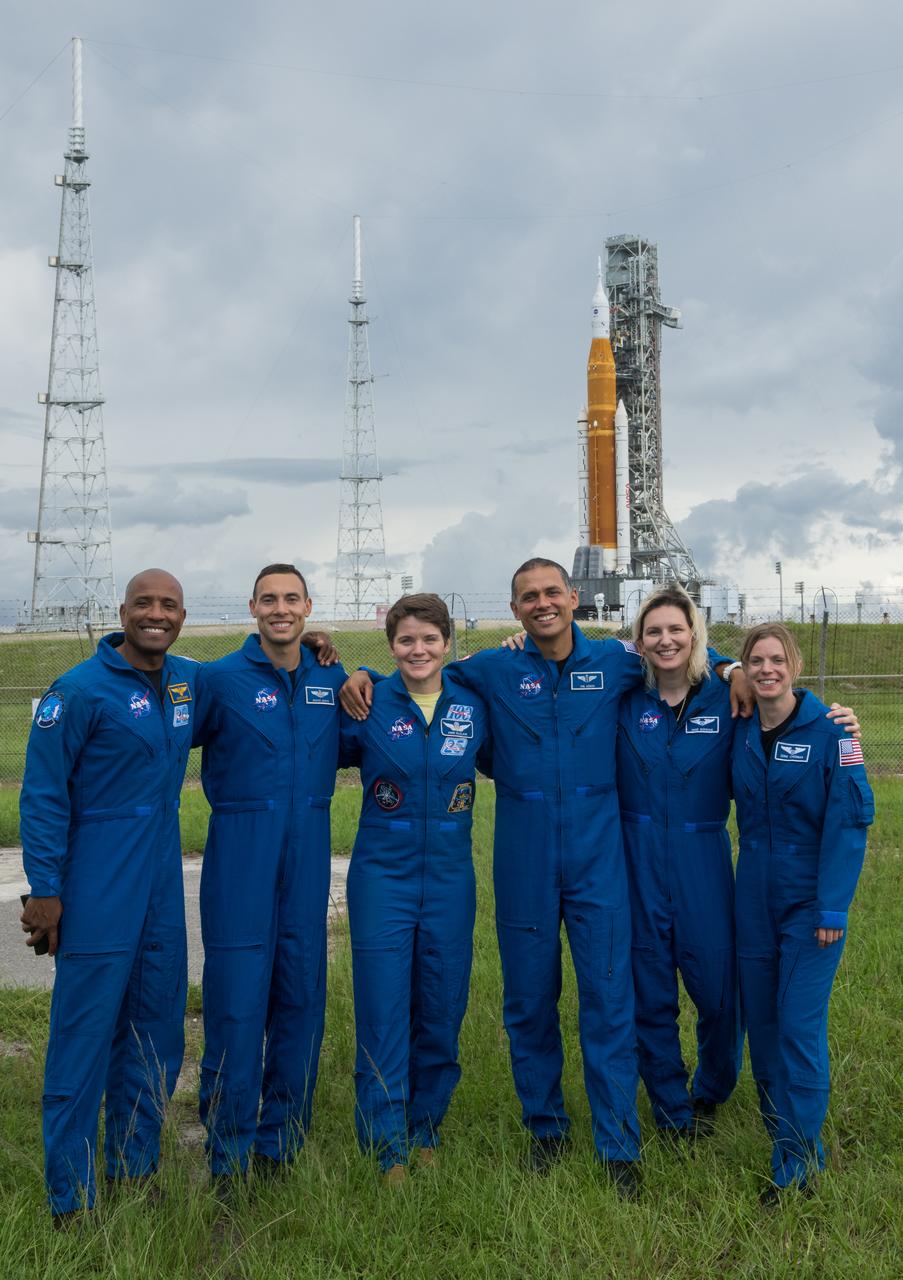
NASA astronauts and astronaut candidates pose for a photograph in front of NASA’s Artemis I Space Launch System and Orion spacecraft atop the mobile launcher on the pad at Launch Complex 39B at the agency’s Kennedy Space Center in Florida on Sept. 2, 2022. The astronauts are, from left to right: Victor Glover, NASA astronaut; Marcos Berrios, NASA astronaut candidate; Anne McClain, NASA astronaut; Anil Menon and Deniz Burnham, NASA astronaut candidates; and Zena Cardman, NASA astronaut. The first in a series of increasingly complex missions, Artemis I will provide a foundation for human deep space exploration and demonstrate our commitment and capability to extend human presence to the Moon and beyond. The primary goal of Artemis I is to thoroughly test the integrated systems before crewed missions by operating the spacecraft in a deep space environment, testing Orion’s heat shield, and recovering the crew module after reentry, descent, and splashdown. In later missions, NASA will land the first woman and the first person of color on the surface of the Moon, paving the way for a long-term lunar presence and serving as a steppingstone on the way to Mars.

NASA’s Exploration Ground Systems conducts a water flow test with the mobile launcher at Kennedy Space Center’s Launch Complex 39B in Florida on Oct. 24, 2023. It is the third in a series of tests to verify the overpressure protection and sound suppression system is ready for launch of the Artemis II mission. During liftoff, 400,000 gallons of water will rush onto the pad to help protect NASA’s SLS (Space Launch System) rocket, Orion spacecraft, mobile launcher, and launch pad from any over pressurization and extreme sound produced during ignition and liftoff.
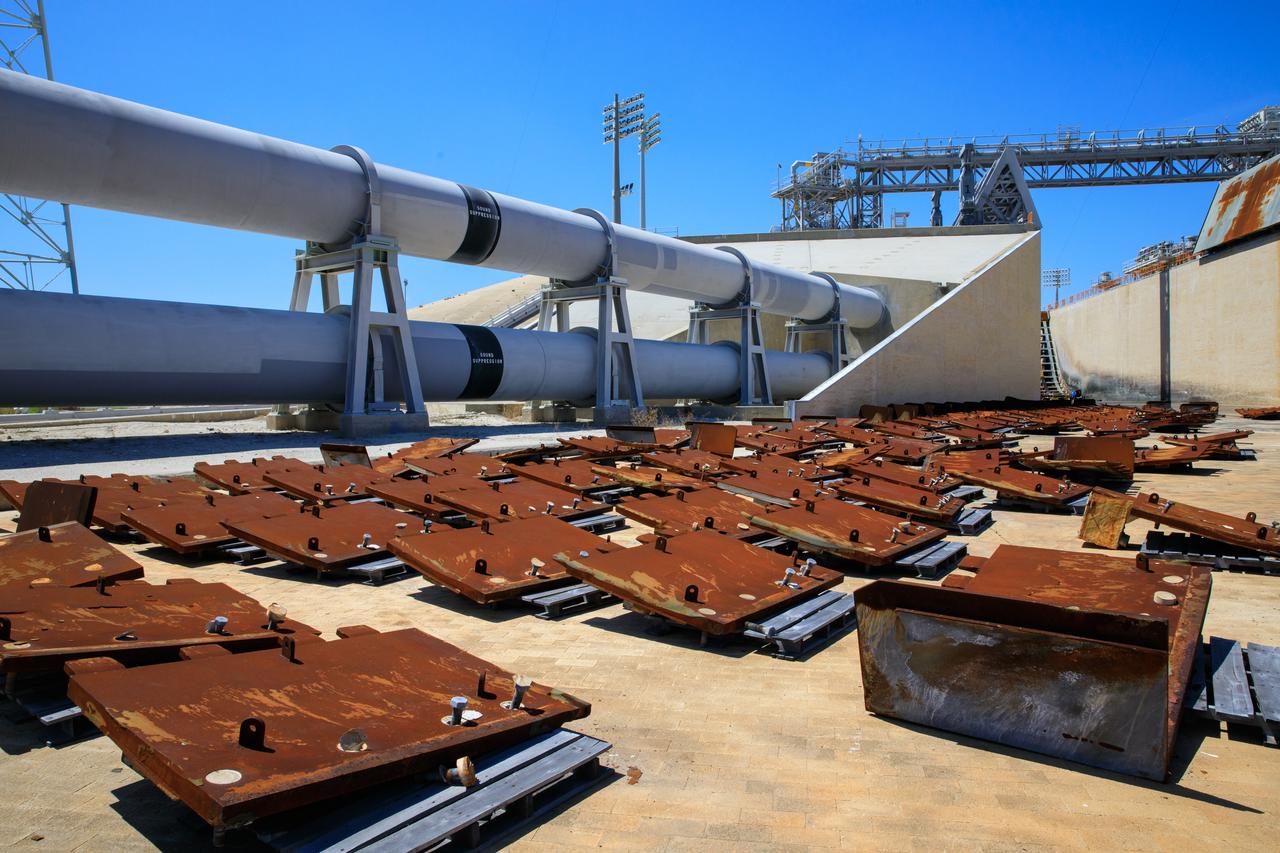
Teams with Exploration Ground Systems at NASA’s Kennedy Space Center in Florida continue to work the upgrades and repairs on mobile launcher 1 and Launch Pad 39B on June 13, 2023, ahead of the first critical ground testing for Artemis II. Teams are re-designing the panels on the flame deflector in the flame trench that withstood damage observed after launch of Artemis I. Artemis II will be the first Artemis mission flying crew aboard Orion.
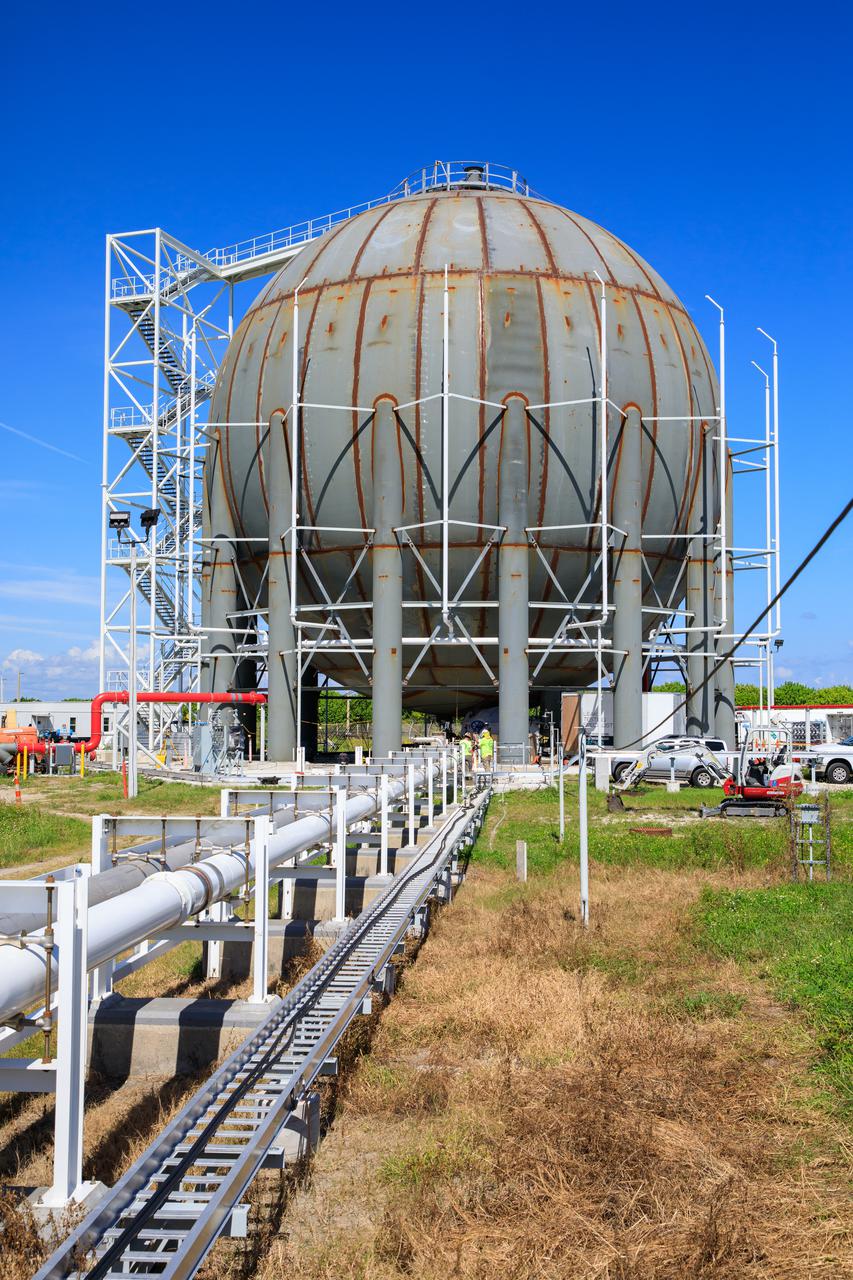
Seen here is a newly constructed liquid hydrogen (LH2) storage tank at Launch Pad 39B at NASA’s Kennedy Space Center in Florida on Oct. 1, 2021. With construction now complete, teams will focus on painting the tank next. The storage tank, capable of holding 1.25 million gallons of LH2, will be used to support future Artemis missions to the Moon and, eventually, Mars. Through Artemis, NASA will land the first woman and first person of color on the Moon, paving the way for a long-term presence in lunar orbit.
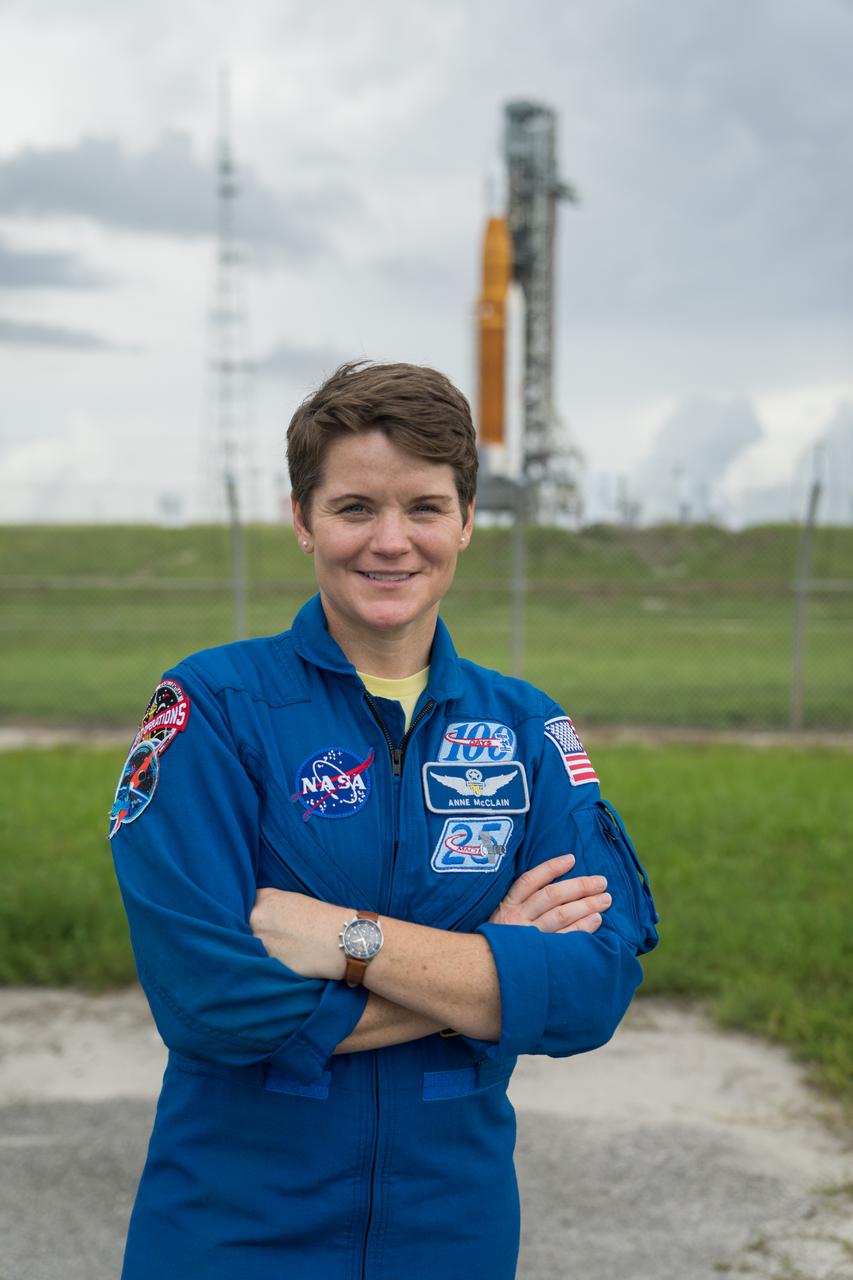
NASA astronaut Anne McClain poses for a photograph in front of NASA’s Artemis I Space Launch System and Orion spacecraft atop the mobile launcher on the pad at Launch Complex 39B at the agency’s Kennedy Space Center in Florida on Sept. 2, 2022. The first in a series of increasingly complex missions, Artemis I will provide a foundation for human deep space exploration and demonstrate our commitment and capability to extend human presence to the Moon and beyond. The primary goal of Artemis I is to thoroughly test the integrated systems before crewed missions by operating the spacecraft in a deep space environment, testing Orion’s heat shield, and recovering the crew module after reentry, descent, and splashdown. In later missions, NASA will land the first woman and the first person of color on the surface of the Moon, paving the way for a long-term lunar presence and serving as a steppingstone on the way to Mars.
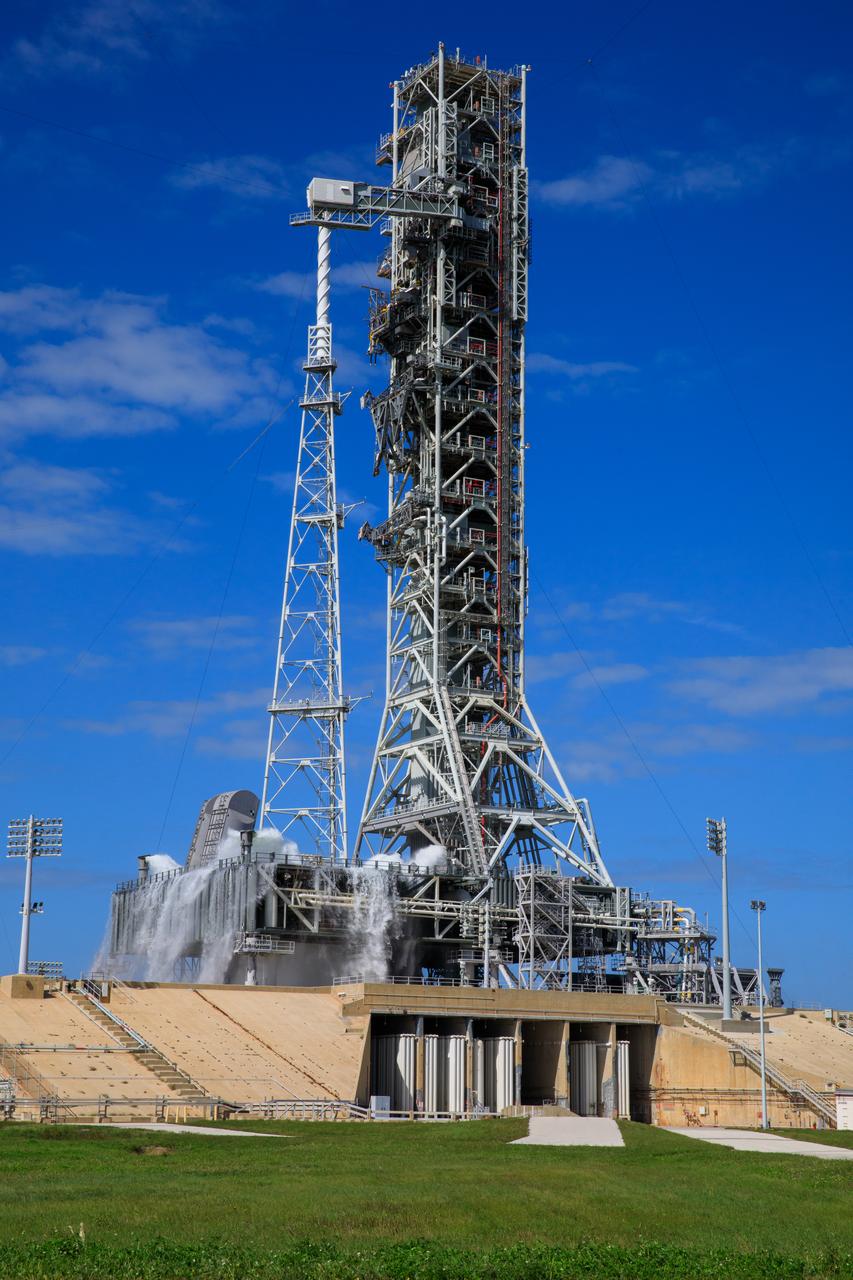
NASA’s Exploration Ground Systems conducts a water flow test with the mobile launcher at Kennedy Space Center’s Launch Complex 39B in Florida on Oct. 24, 2023. It is the third in a series of tests to verify the overpressure protection and sound suppression system is ready for launch of the Artemis II mission. During liftoff, 400,000 gallons of water will rush onto the pad to help protect NASA’s SLS (Space Launch System) rocket, Orion spacecraft, mobile launcher, and launch pad from any over pressurization and extreme sound produced during ignition and liftoff.
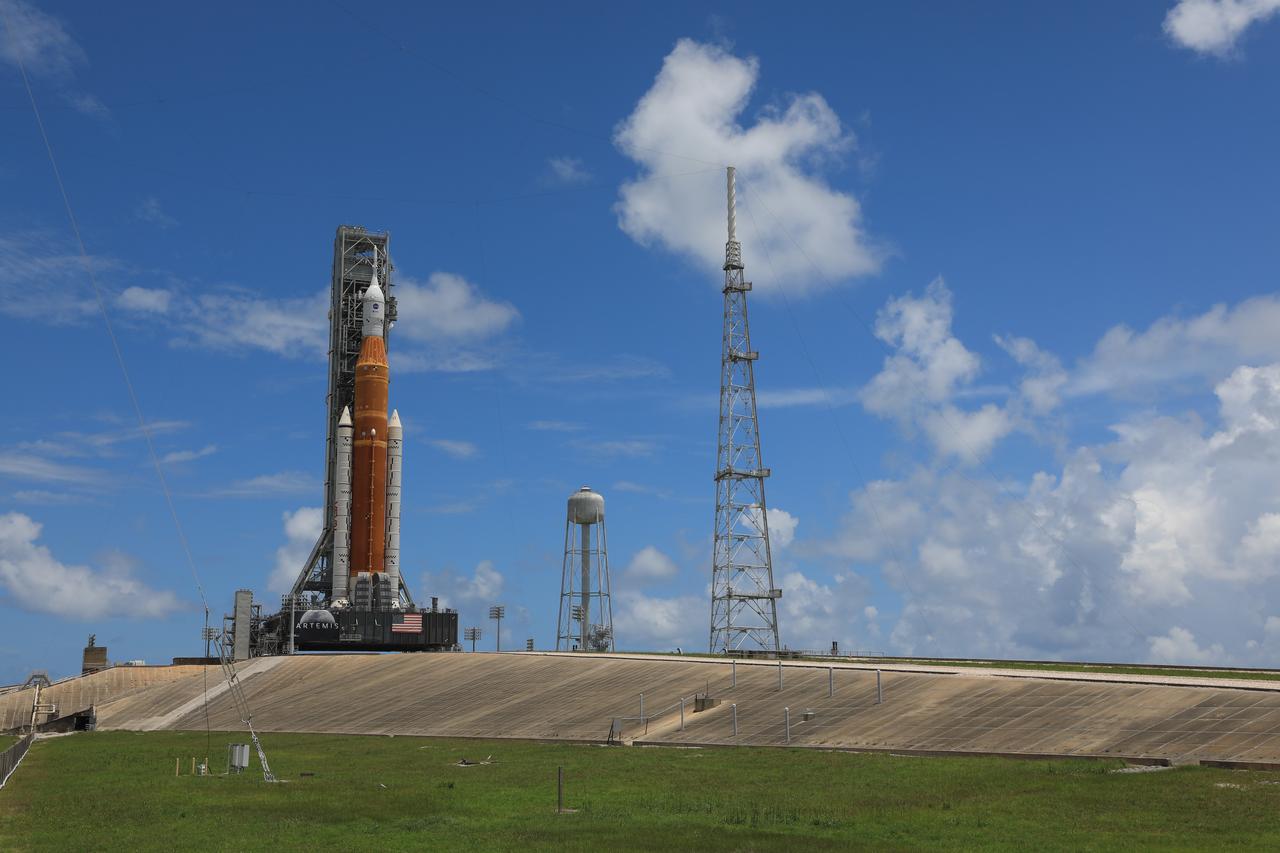
A brilliant blue sky serves as a backdrop for the Artemis I Space Launch System (SLS) and Orion spacecraft atop the mobile launcher at Launch Pad 39B at NASA’s Kennedy Space Center in Florida on June 30, 2022. The SLS and Orion were transported to the pad on crawler-transporter 2 for a prelaunch test called a wet dress rehearsal. Artemis I will be the first integrated test of the SLS and Orion spacecraft. In later missions, NASA will land the first woman and the first person of color on the surface of the Moon, paving the way for a long-term lunar presence and serving as a steppingstone on the way to Mars.
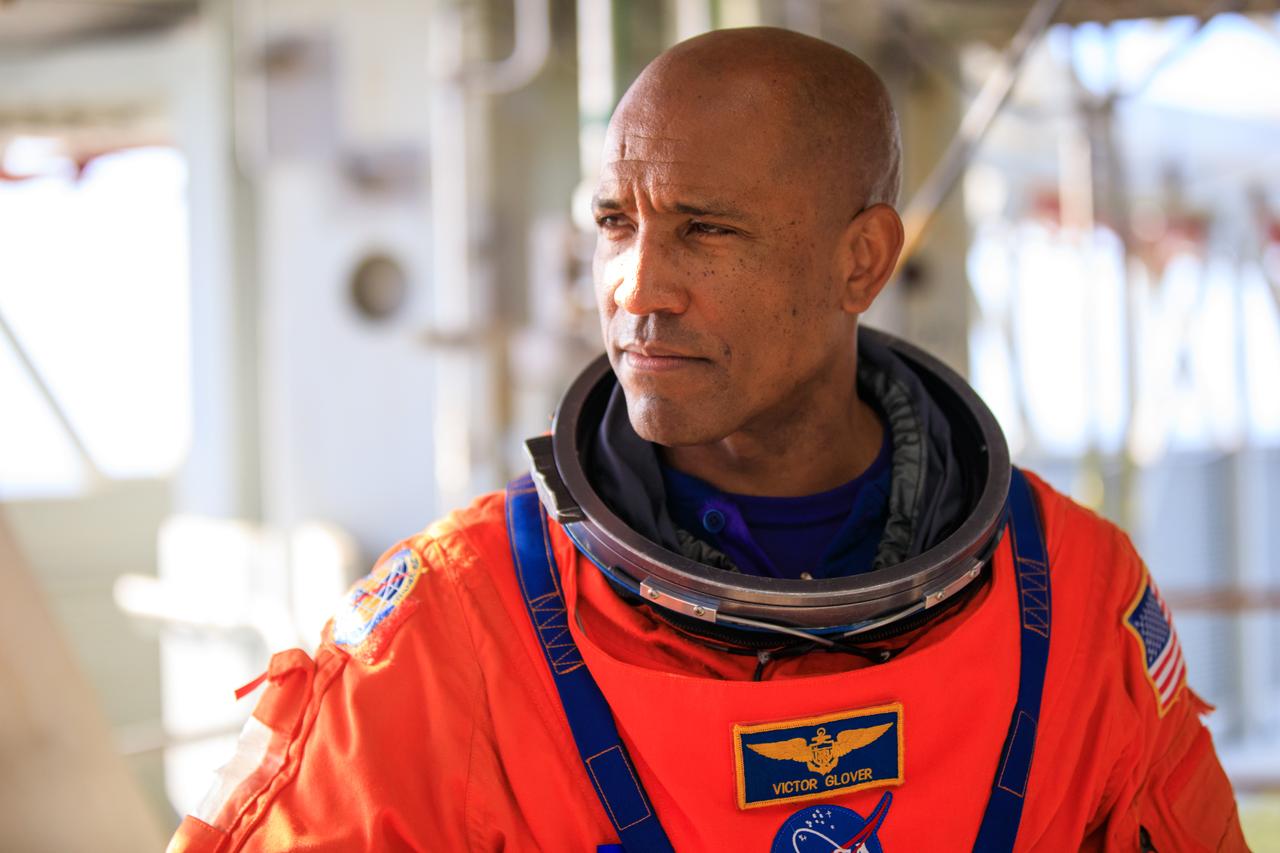
Artemis II NASA astronaut Victor Glover stands on the mobile launcher at Launch Pad 39B as part of an integrated ground systems test at Kennedy Space Center in Florida on Wednesday, Sept. 20, 2023. The test ensures the ground systems team is ready to support the crew timeline on launch day.
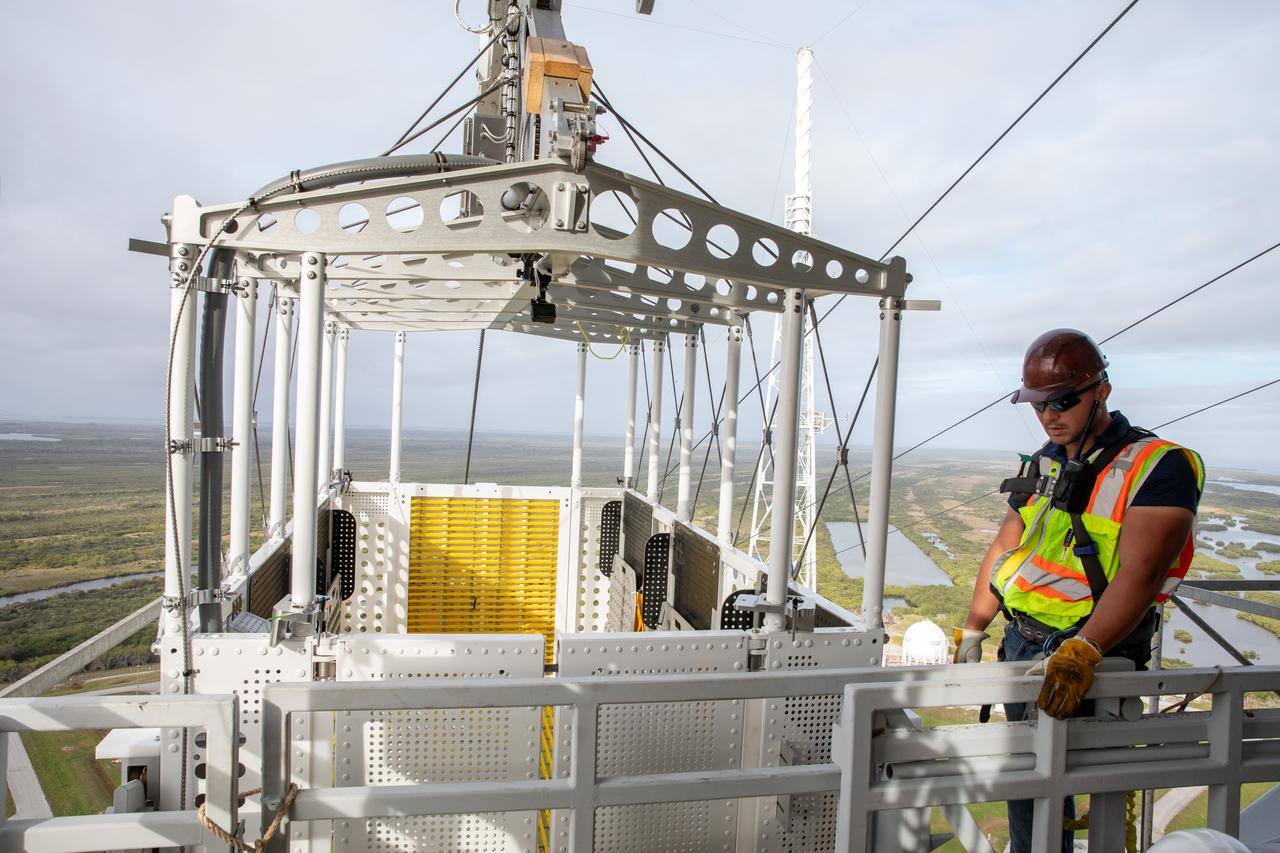
Teams with NASA’s Exploration Ground Systems Program, in preparation for the agency’s Artemis II crewed mission to the Moon, begin installing the first of four emergency egress baskets on the mobile launcher at Launch Complex 39B at the agency’s Kennedy Space Center in Florida on Wednesday, Jan. 24, 2024. The baskets, similar to gondolas on ski lifts, are used in the case of a pad abort emergency to enable astronauts and other pad personnel a way to quickly escape away from the mobile launcher to the base of the pad and where waiting emergency transport vehicles will then drive them away.

Artemis II NASA astronauts (left to right) Reid Wiseman, Victor Glover, and Christina Koch, and CSA (Canadian Space Agency) astronaut Jeremy Hansen stand in the white room on the crew access arm of the mobile launcher at Launch Pad 39B as part of an integrated ground systems test at Kennedy Space Center in Florida on Wednesday, Sept. 20, 2023. The test ensures the ground systems team is ready to support the crew timeline on launch day.
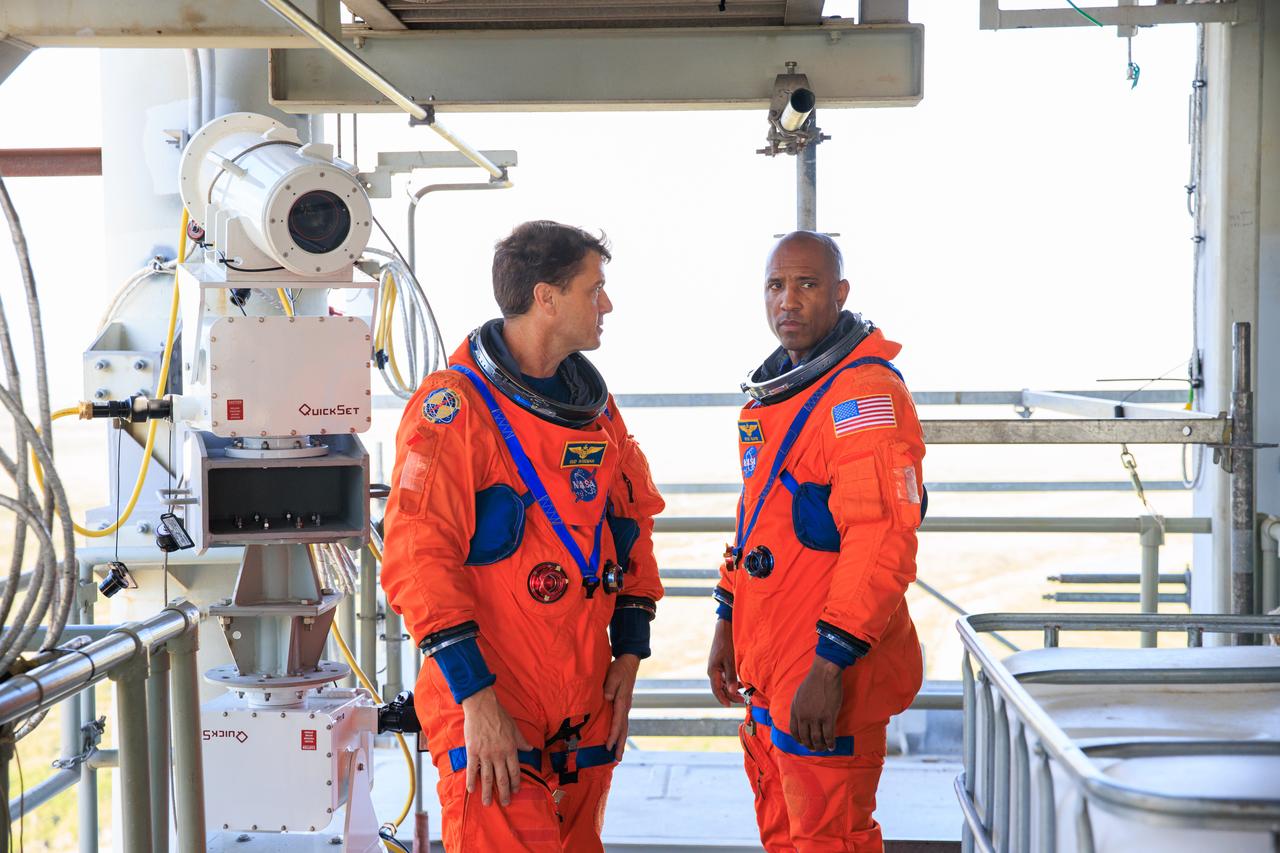
Artemis II astronauts, from left, NASA astronauts Reid Wiseman (left) and Victor Glover stand on the mobile launcher at Launch Pad 39B as part of an integrated ground systems test at Kennedy Space Center in Florida on Wednesday, Sept. 20. The test ensures the ground systems team is ready to support the crew timeline on launch day.
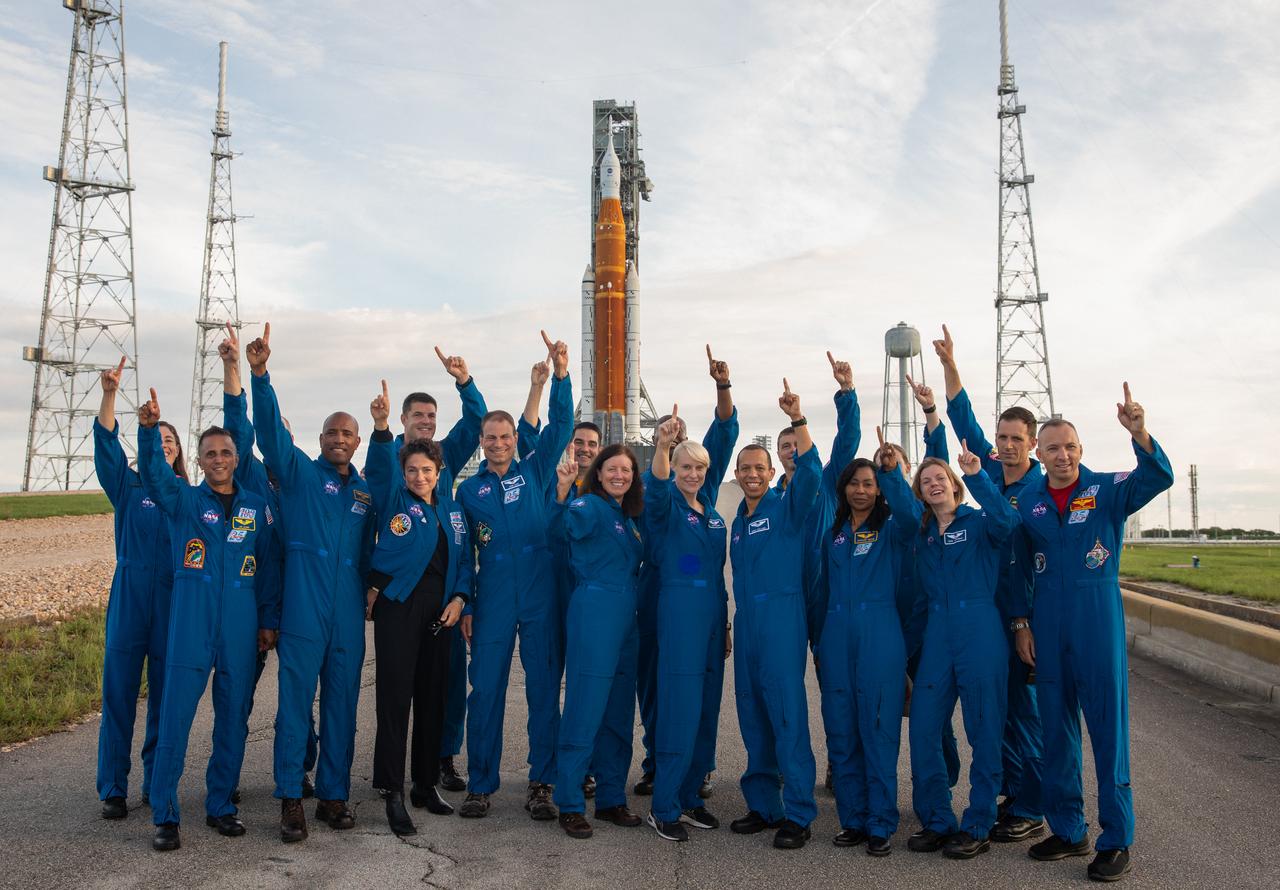
Astronauts and astronaut candidates from NASA and the Canadian Space Agency pose for a photograph in front of NASA’s Artemis I Space Launch System and Orion spacecraft atop the mobile launcher on the pad at Launch Complex 39B on Aug. 28, 2022. The astronauts are, from left to right: Christina Birch, NASA astronaut candidate; Joe Acaba, NASA astronaut; Don Pettit, NASA astronaut; Victor Glover, NASA astronaut; Jeremy Hansen, Canadian Space Agency astronaut; Jessica Meir, NASA astronaut; Stan Love, NASA astronaut; Jack Hathaway, NASA astronaut candidate; Shannon Walker, NASA astronaut; Andre Douglas, NASA astronaut candidate; Kate Rubins, NASA astronaut; Chris Williams, NASA astronaut candidate; Reid Wiseman, NASA astronaut; Stephanie Wilson, NASA astronaut; Jessica Wittner, NASA astronaut candidate; Zena Cardman, NASA astronaut; Joshua Kutryk, Canadian Space Agency astronaut; Randy Bresnik, NASA astronaut. Artemis I is scheduled to launch Aug. 29, at 8:33 a.m. EDT. The first in a series of increasingly complex missions, Artemis I will provide a foundation for human deep space exploration and demonstrate our commitment and capability to extend human presence to the Moon and beyond. The primary goal of Artemis I is to thoroughly test the integrated systems before crewed missions by operating the spacecraft in a deep space environment, testing Orion’s heat shield, and recovering the crew module after reentry, descent, and splashdown.
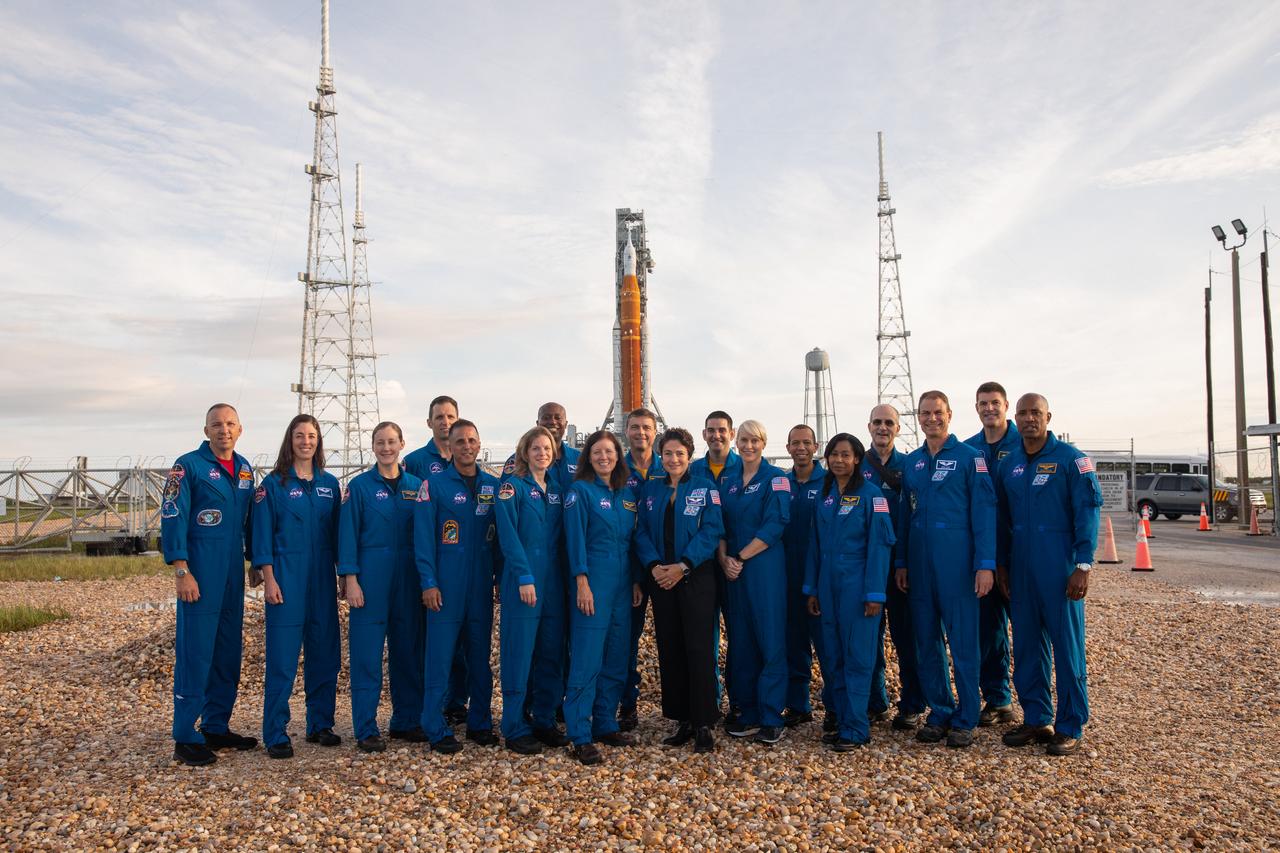
Astronauts and astronaut candidates from NASA and the Canadian Space Agency pose for a photograph in front of NASA’s Artemis I Space Launch System and Orion spacecraft atop the mobile launcher on the pad at Launch Complex 39B on Aug. 28, 2022. The astronauts are, from left to right: Randy Bresnik, NASA astronaut; Christina Birch, NASA astronaut candidate; Jessica Wittner, NASA astronaut candidate; Joshua Kutryk, Canadian Space Agency astronaut; Joe Acaba, NASA astronaut; Zena Cardman, NASA astronaut; Andre Douglas, NASA astronaut candidate; Shannon Walker, NASA astronaut; Reid Wiseman, NASA astronaut; Jessica Meir, NASA astronaut; Jack Hathaway, NASA astronaut candidate; Kate Rubins, NASA astronaut; Chris Williams, NASA astronaut candidate; Stephanie Wilson, NASA astronaut; Don Pettit, NASA astronaut; Stan Love, NASA astronaut; Jeremy Hansen, Canadian Space Agency astronaut; Victor Glover, NASA astronaut. Artemis I is scheduled to launch Aug. 29, at 8:33 a.m. EDT. The first in a series of increasingly complex missions, Artemis I will provide a foundation for human deep space exploration and demonstrate our commitment and capability to extend human presence to the Moon and beyond. The primary goal of Artemis I is to thoroughly test the integrated systems before crewed missions by operating the spacecraft in a deep space environment, testing Orion’s heat shield, and recovering the crew module after reentry, descent, and splashdown.
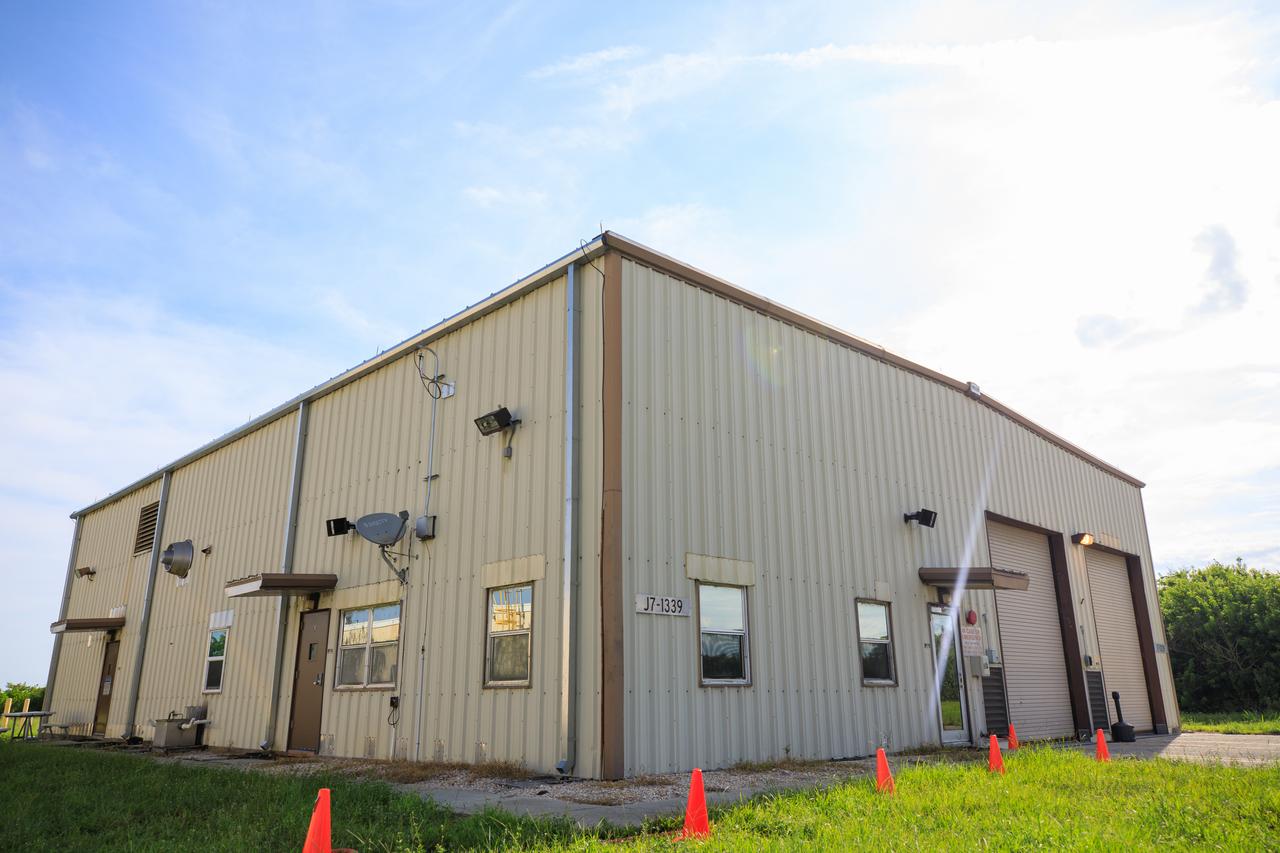
An exterior view of Fire Station 3 at Launch Complex 39B at NASA’s Kennedy Space Center in Florida on Sept. 8, 2022.
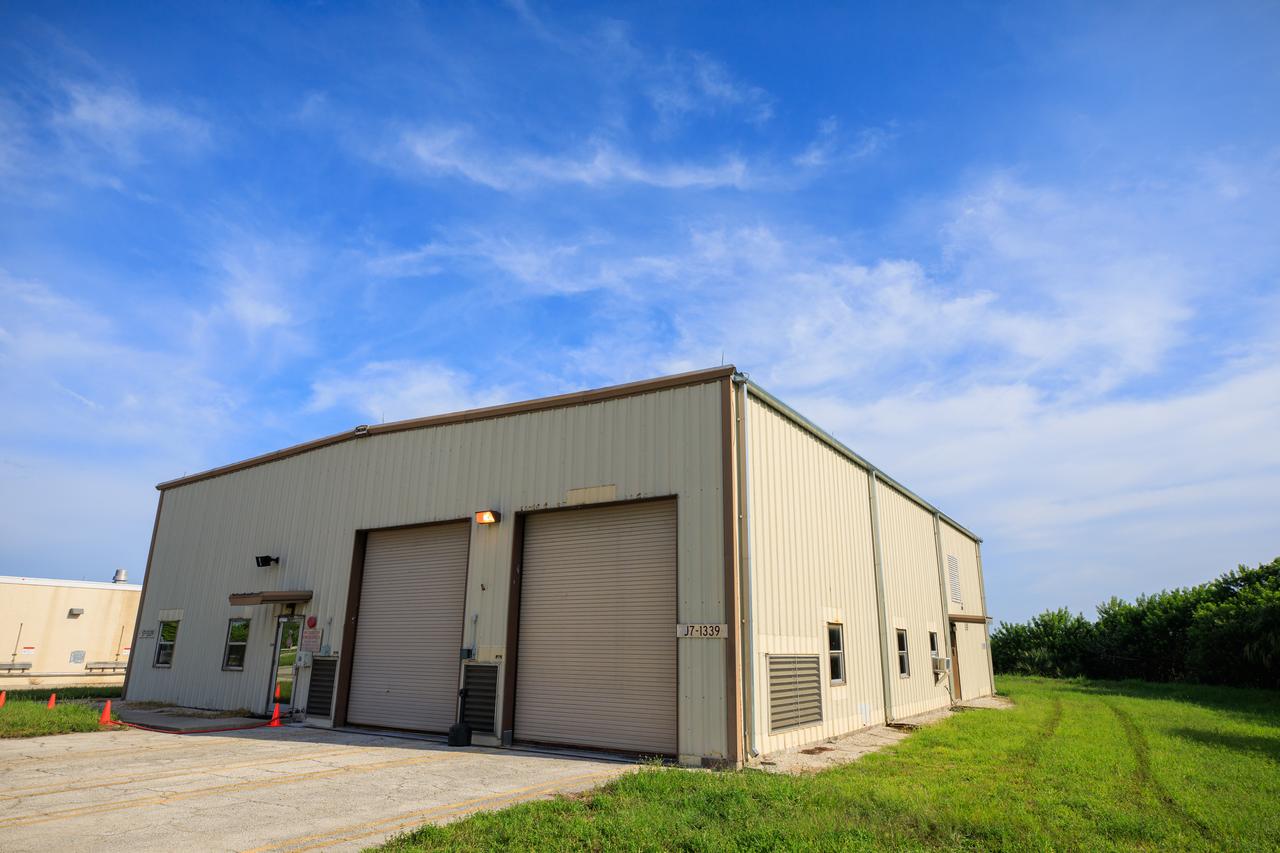
An exterior view of Fire Station 3 at Launch Complex 39B at NASA’s Kennedy Space Center in Florida on Sept. 8, 2022.
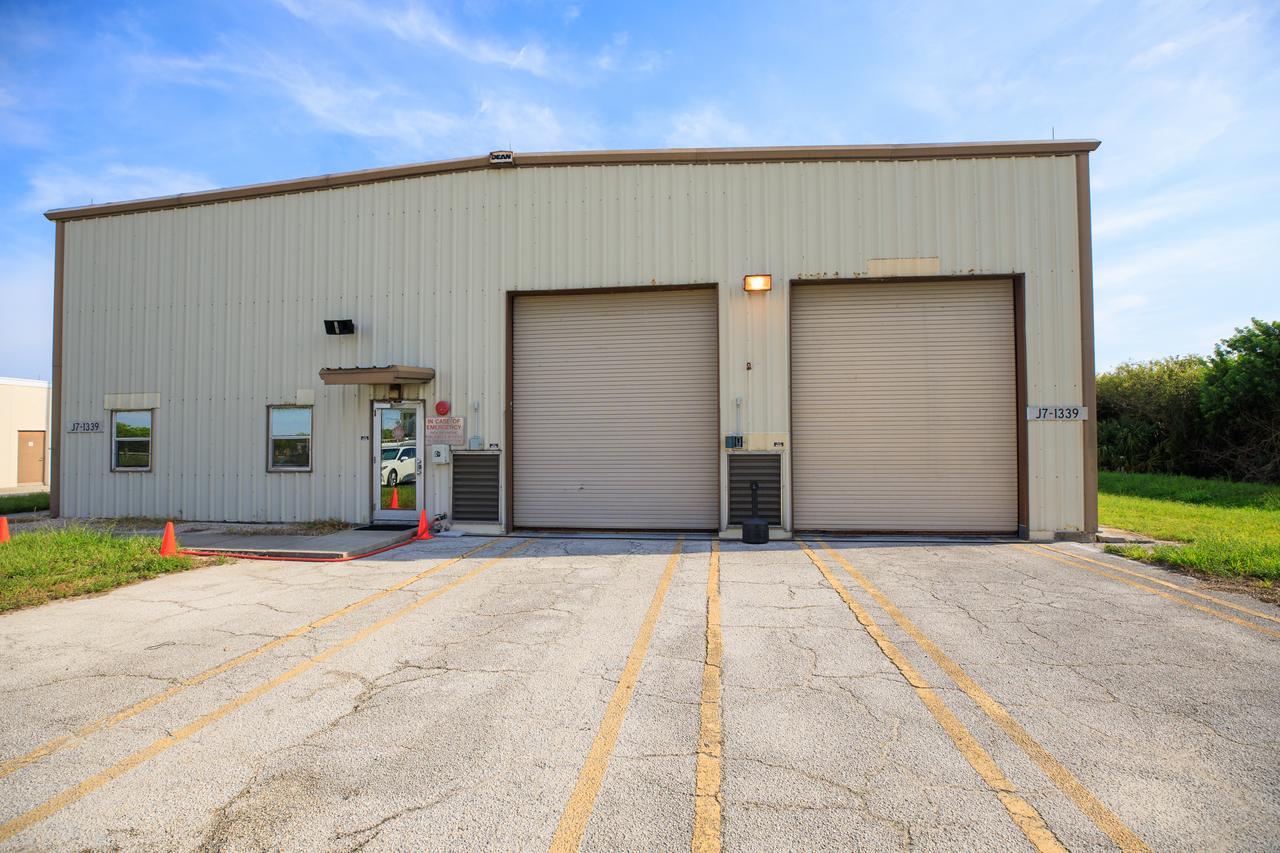
An exterior view of Fire Station 3 at Launch Complex 39B at NASA’s Kennedy Space Center in Florida on Sept. 8, 2022.