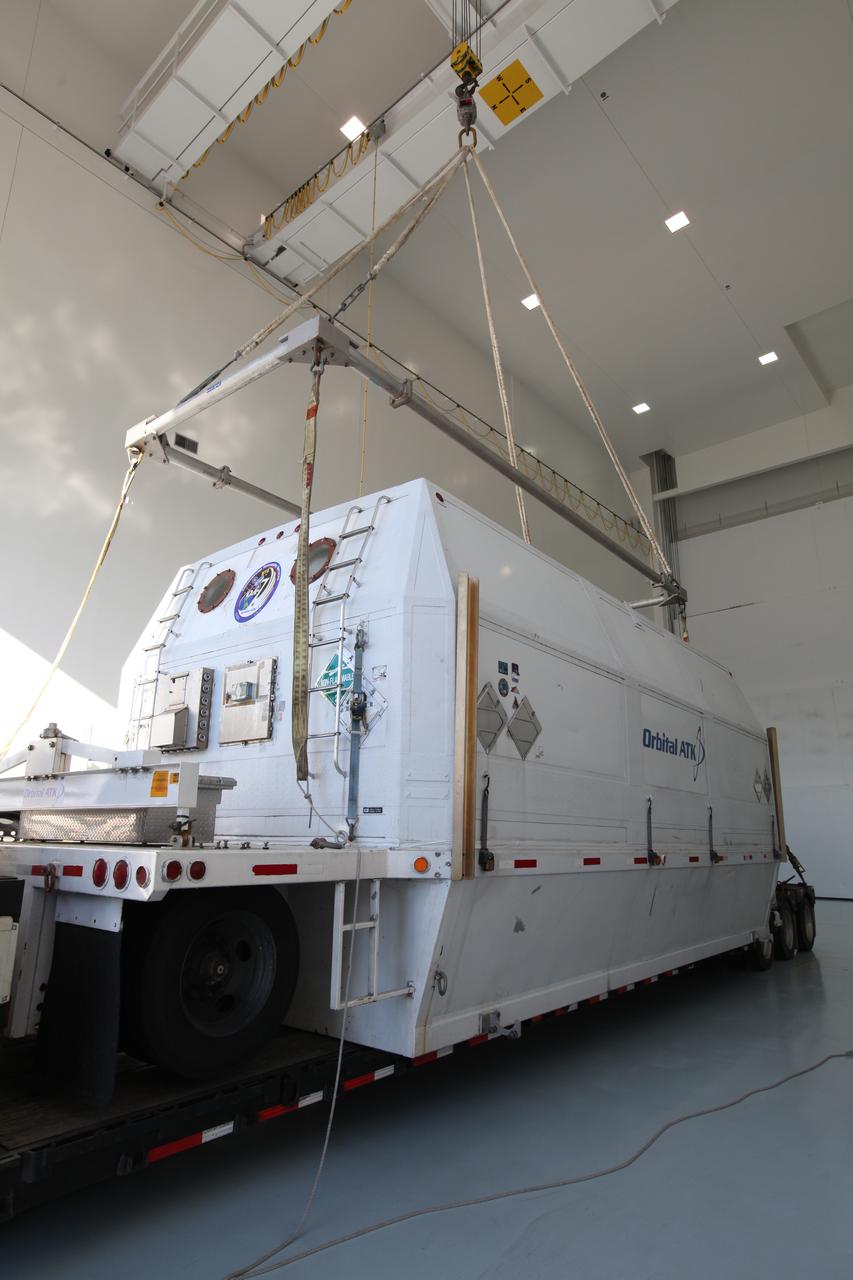
A crane is used to lift the Orbital ATK OA-7 Cygnus spacecraft's service module off a flatbed truck after arrival at the Space Station Processing Facility of NASA's Kennedy Space Center in Florida. The service module is sealed in an environmentally controlled shipping container. Scheduled to launch on March 19, 2017, the Orbital ATK OA-7 mission will lift off atop a United Launch Alliance Atlas V rocket from Space launch Complex 41 at Cape Canaveral Air Force Station. The commercial resupply services mission to the International Space Station will deliver thousands of pounds of supplies, equipment and scientific research materials that improve life on Earth and drive progress toward future space exploration.
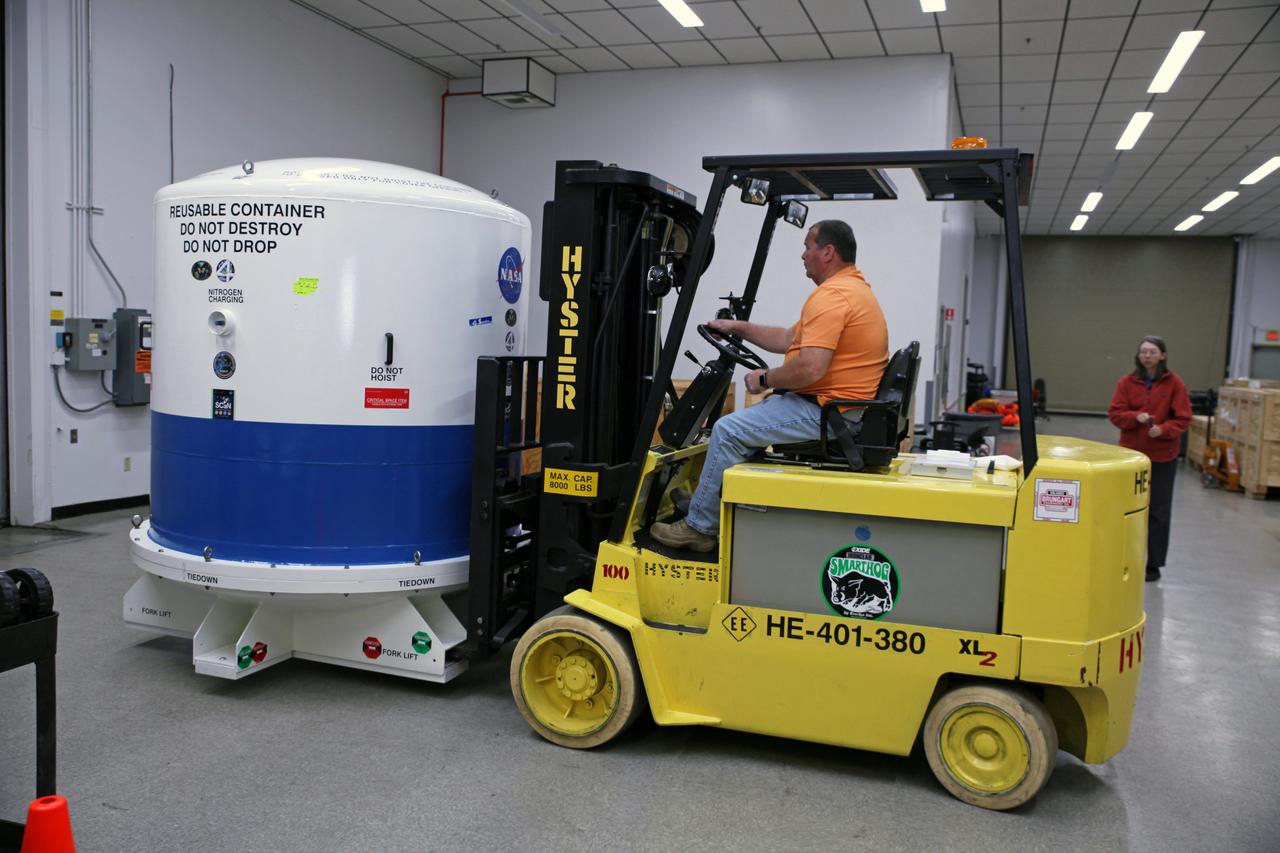
Inside the Space Station Processing Facility high bay at NASA's Kennedy Space Center in Florida, the Neutron star Interior Composition Explorer, or NICER, payload is secured inside a protective container. A technician uses a Hyster forklift to pick up the container and move it outside of the high bay. NICER will be delivered to the International Space Station aboard the SpaceX Dragon cargo carrier on the company’s 11th commercial resupply services mission to the space station. NICER will study neutron stars through soft X-ray timing. NICER will enable rotation-resolved spectroscopy of the thermal and non-thermal emissions of neutron stars in the soft X-ray band with unprecedented sensitivity, probing interior structure, the origins of dynamic phenomena and the mechanisms that underlie the most powerful cosmic particle accelerators known.
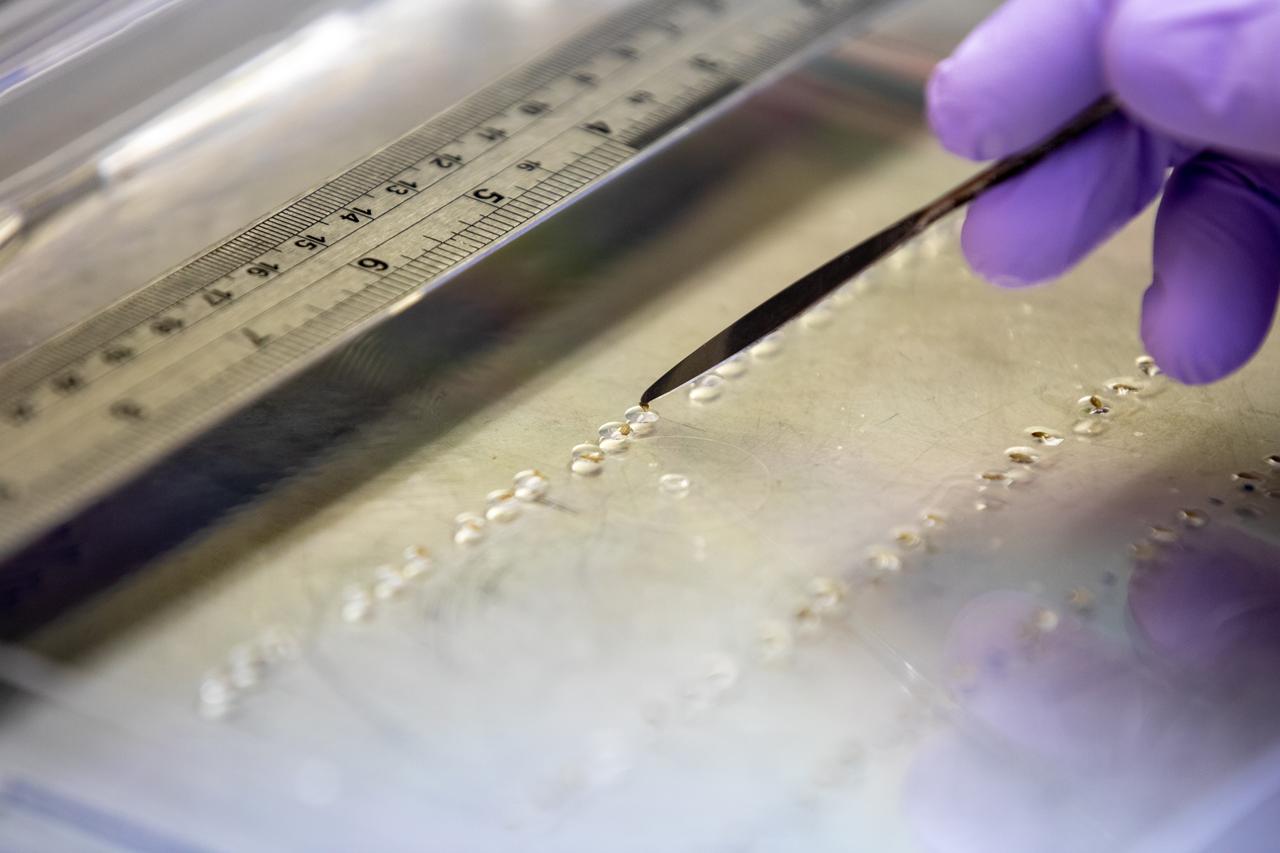
Inside the Space Station Processing Facility at NASA’s Kennedy Space Center in Florida, red romaine lettuce seeds are affixed to seed film – a new seed handling material – on Jan. 15, 2020. The seed film is being prepared for the VEG-03 J experiment that will fly to the International Space Station on Northrop Grumman’s 13th resupply services (NG-13) mission. This seed film experiment involves crew aboard the orbiting laboratory planting the seeds into plant pillows – a common method used to grow plants in space – themselves for the first time ever. The water-soluble, dissolving film addresses the challenge of handling seeds in a microgravity environment and also can be used to deliver fertilizers and other beneficial substances that help plants grow. NG-13 is scheduled to launch from the agency’s Wallops Flight Facility in Virginia on Feb. 9, 2020, at 5:39 p.m. EST.
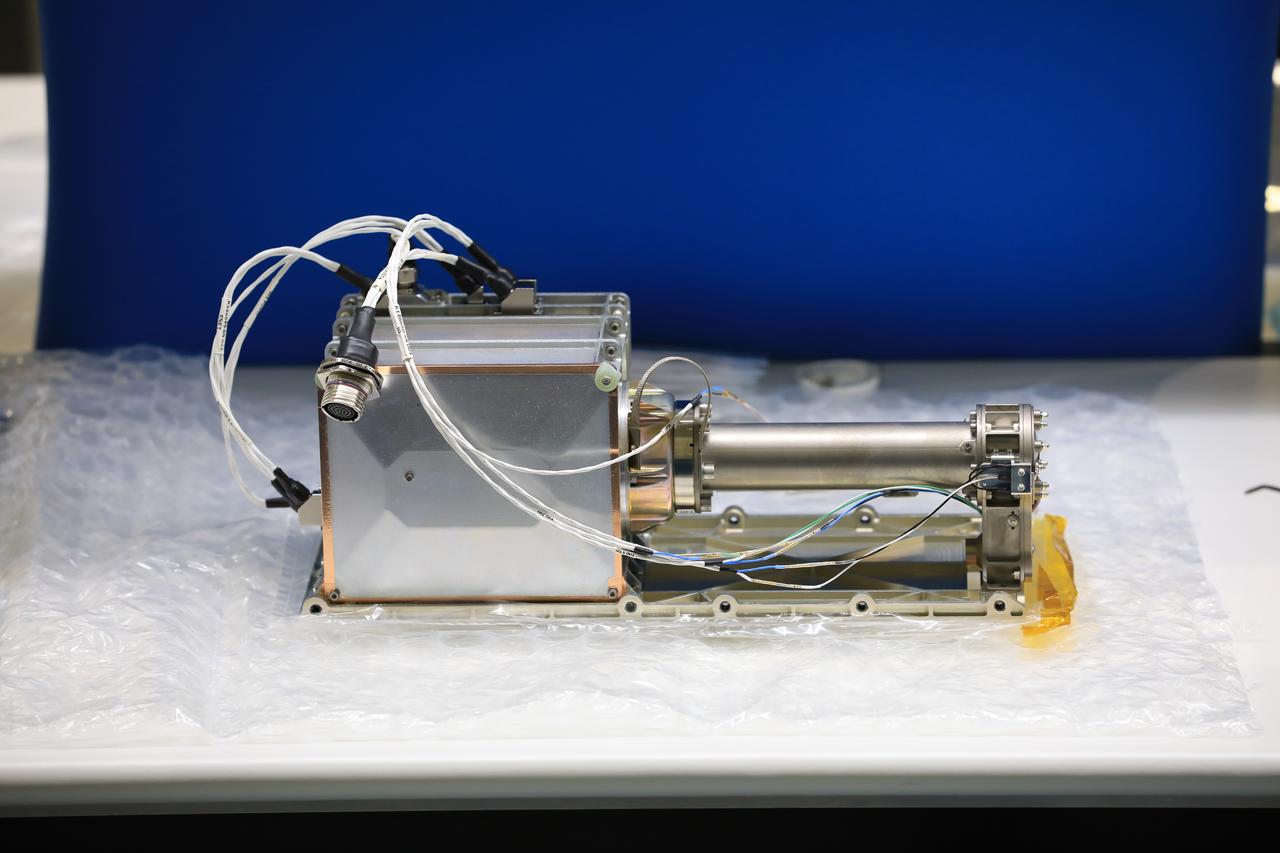
The Mass Spectrometer Observing Lunar Operations (MSolo) instrument is photographed inside the Space Station Processing Facility at NASA’s Kennedy Space Center in Florida following installation of its radiator on Sept. 25, 2020. MSolo will help analyze the chemical makeup of landing sites on the Moon, as well as study water on the lunar surface. The radiator will help keep the instrument’s temperature stable in the extreme heat and cold it will encounter. MSolo instruments are scheduled to launch on multiple robotic missions as part of NASA’s Commercial Lunar Payload Services (CLPS), with the first of these missions exploring Lacus Mortis, a large crater on the near side of the Moon, beginning in 2021. MSolo also will be one of three instruments on the agency’s water-hunting Volatiles Investigating Polar Exploration Rover, VIPER, scheduled to launch to the Moon’s South Pole in late 2023.
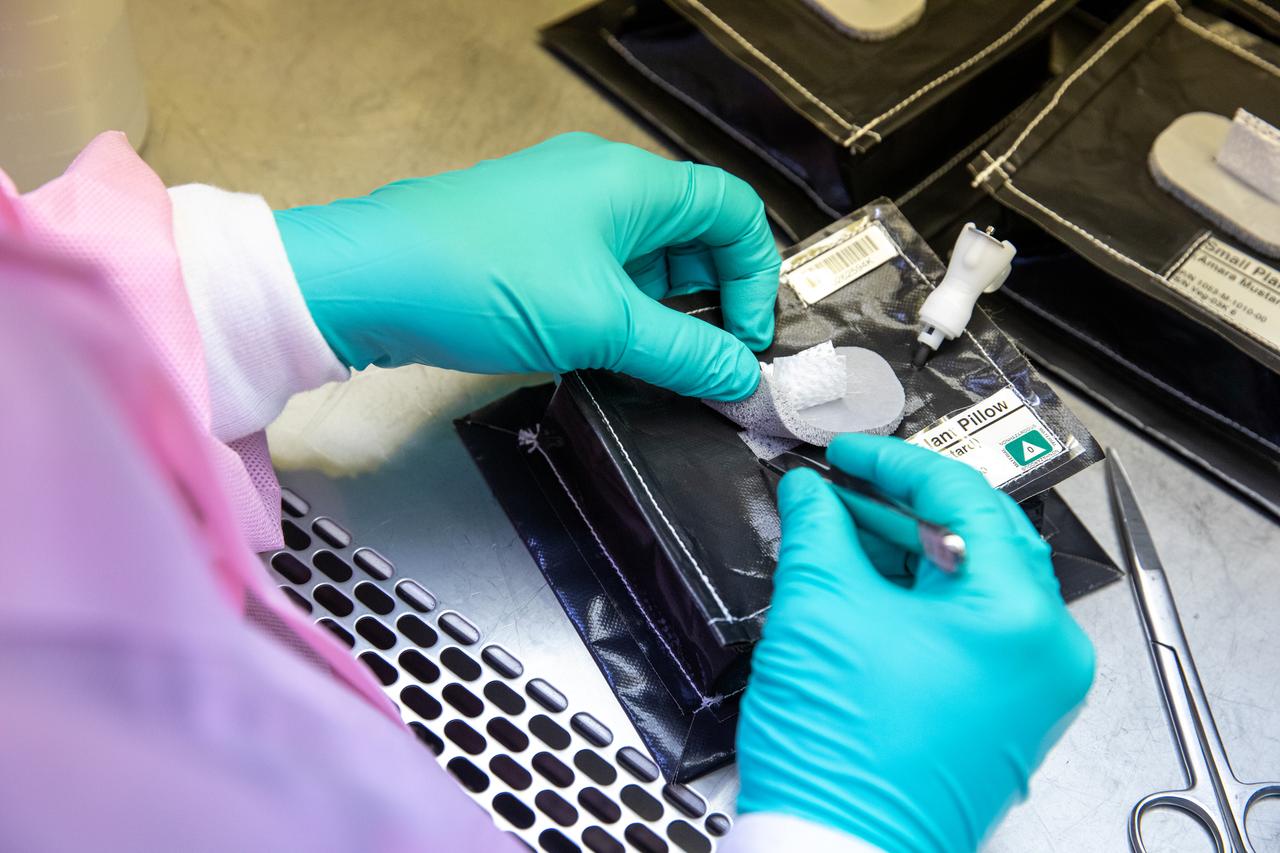
On Jan. 21, 2020, inside the Space Station Processing Facility at NASA’s Kennedy Space Center in Florida, intern Emily Kennebeck prepares plant pillows for their flight to the International Space Station. The pillows, which are a common method used to grow plants in space, are being sent to the orbiting laboratory on Northrop Grumman’s 13th resupply services (NG-13) mission for a series of VEG-03 experiments that will study the growth of three types of leafy greens in a microgravity environment. Once the pillows are assembled and packaged for flight, they will be transported to the agency’s Wallops Flight Facility in Virginia, where liftoff will occur. NG-13 is scheduled to launch on Feb. 9, 2020, at 5:39 p.m. EST.
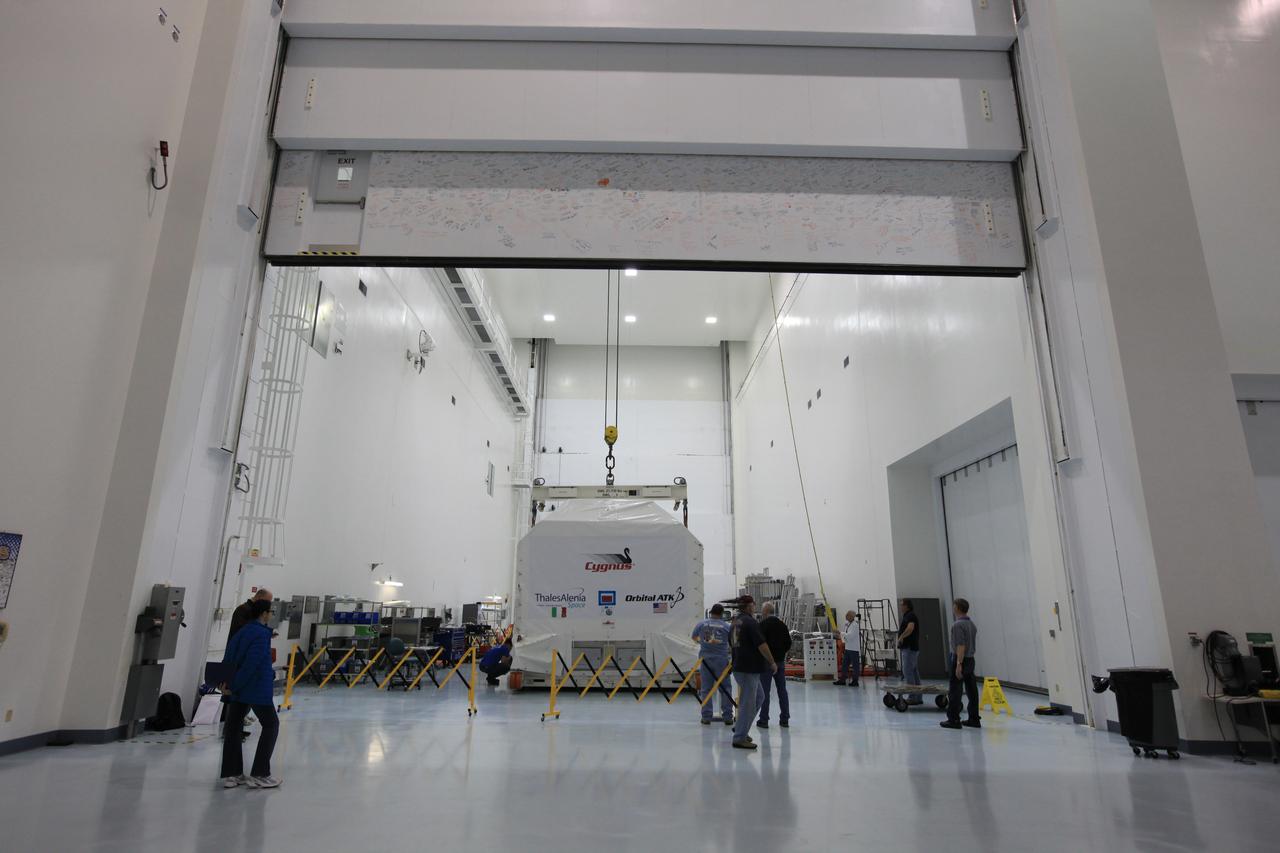
Inside an environmentally controlled shipping container the Orbital ATK OA-7 Cygnus spacecraft's pressurized cargo module (PCM) moves from an airlock to the high bay of the Space Station Processing Facility of NASA's Kennedy Space Center in Florida. Scheduled to launch on March 19, 2017, the Orbital ATK OA-7 mission will lift off atop a United Launch Alliance Atlas V rocket from Space launch Complex 41 at Cape Canaveral Air Force Station. The commercial resupply services mission to the International Space Station will deliver thousands of pounds of supplies, equipment and scientific research materials that improve life on Earth and drive progress toward future space exploration.
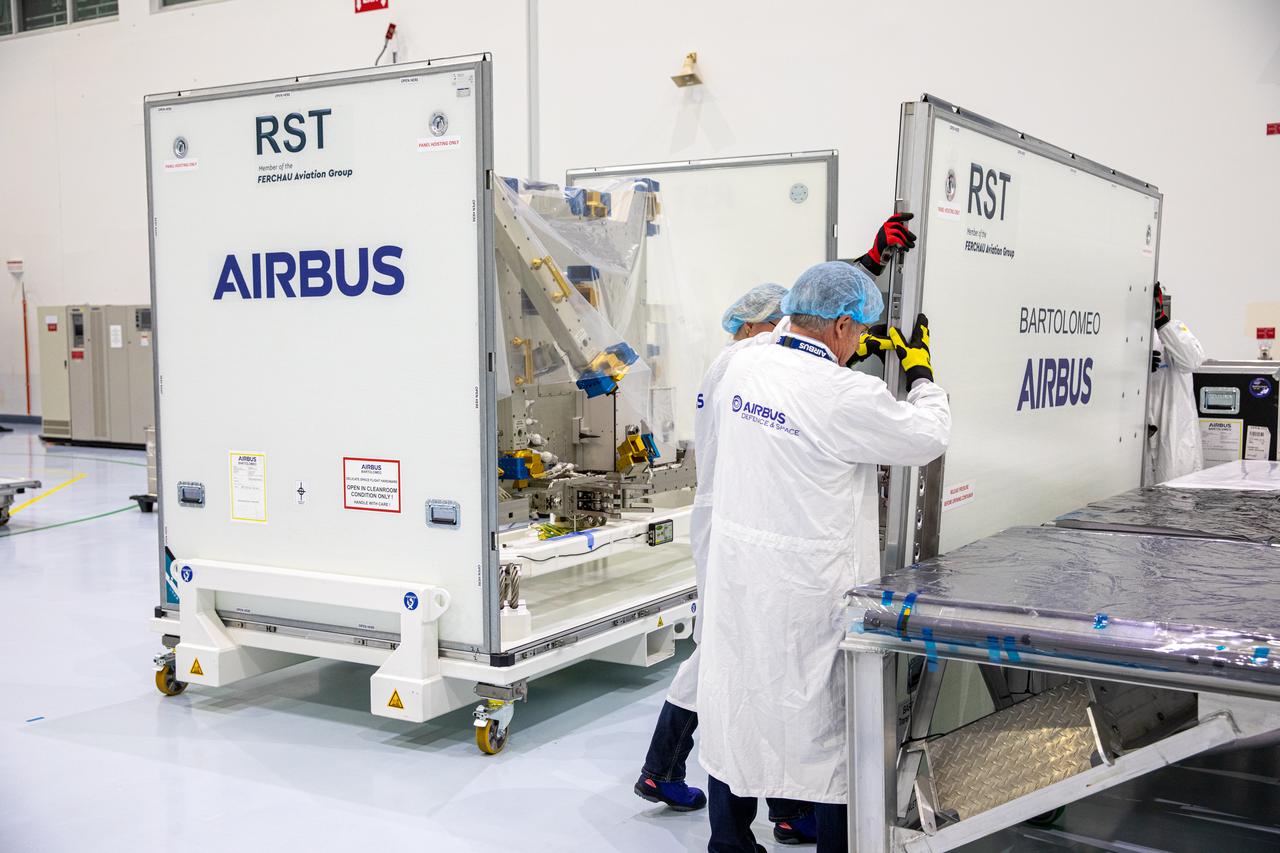
Airbus workers unpack the Bartolomeo platform in the Space Station Processing Facility high bay at NASA’s Kennedy Space Center in Florida on Jan. 30, 2020. Bartolomeo was manufactured by Airbus Defence and Space. The platform will be delivered to the International Space Station aboard SpaceX’s 20th Commercial Resupply Services (CRS-20) mission for the agency. The platform will attach to the exterior of the space station’s European Columbus Module. Named for the younger brother of Christopher Columbus, the platform has the capability to host external payloads in low-Earth orbit on the station. CRS-20 is scheduled to launch aboard SpaceX’s Dragon cargo spacecraft atop the company’s Falcon 9 rocket in March 2020.
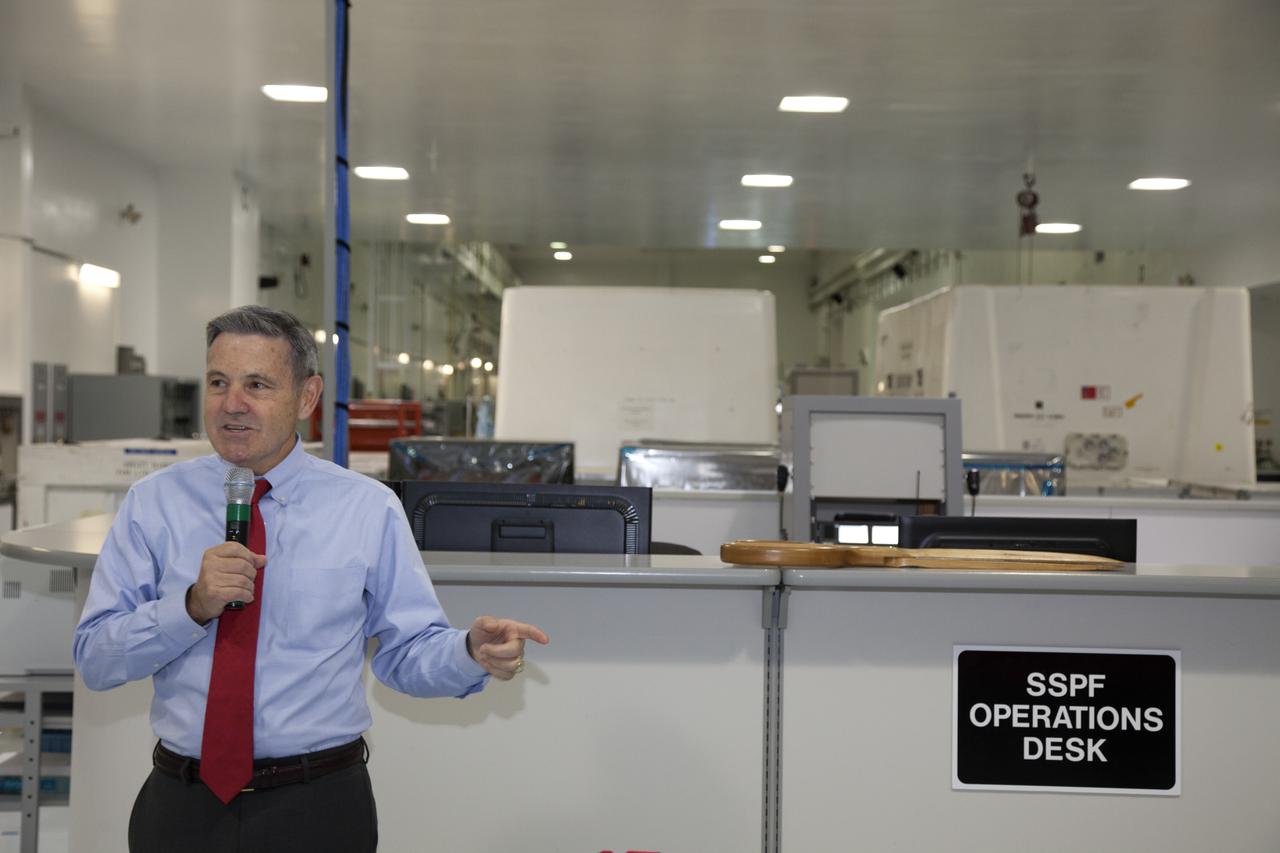
Kennedy Space Center Director Bob Cabana speaks to guests during a ribbon cutting ceremony in the high bay of the Space Station Processing Facility at the Florida spaceport. The event celebrated completion of facility modifications to improve processing and free up zones tailored to a variety of needs supporting a robust assortment of space-bound hardware including NASA programs and commercial space companies.

Inside a laboratory in the Space Station Processing Facility at NASA's Kennedy Space Center in Florida, quality technicians check the hardware for the Advanced Plant Habitat flight unit. The flight unit is an exact replica of the APH that was delivered to the International Space Station. Validation tests and post-delivery checkout was performed to prepare for space station in-orbit APH activities. The flight unit will be moved to the International Space Station Environmental Simulator to begin an experiment verification test for the science that will fly on the first mission, PH-01. Developed by NASA and ORBITEC of Madison, Wisconsin, the APH is the largest plant chamber built for the agency. It is a fully automated plant growth facility that will be used to conduct bioscience research on the space station.
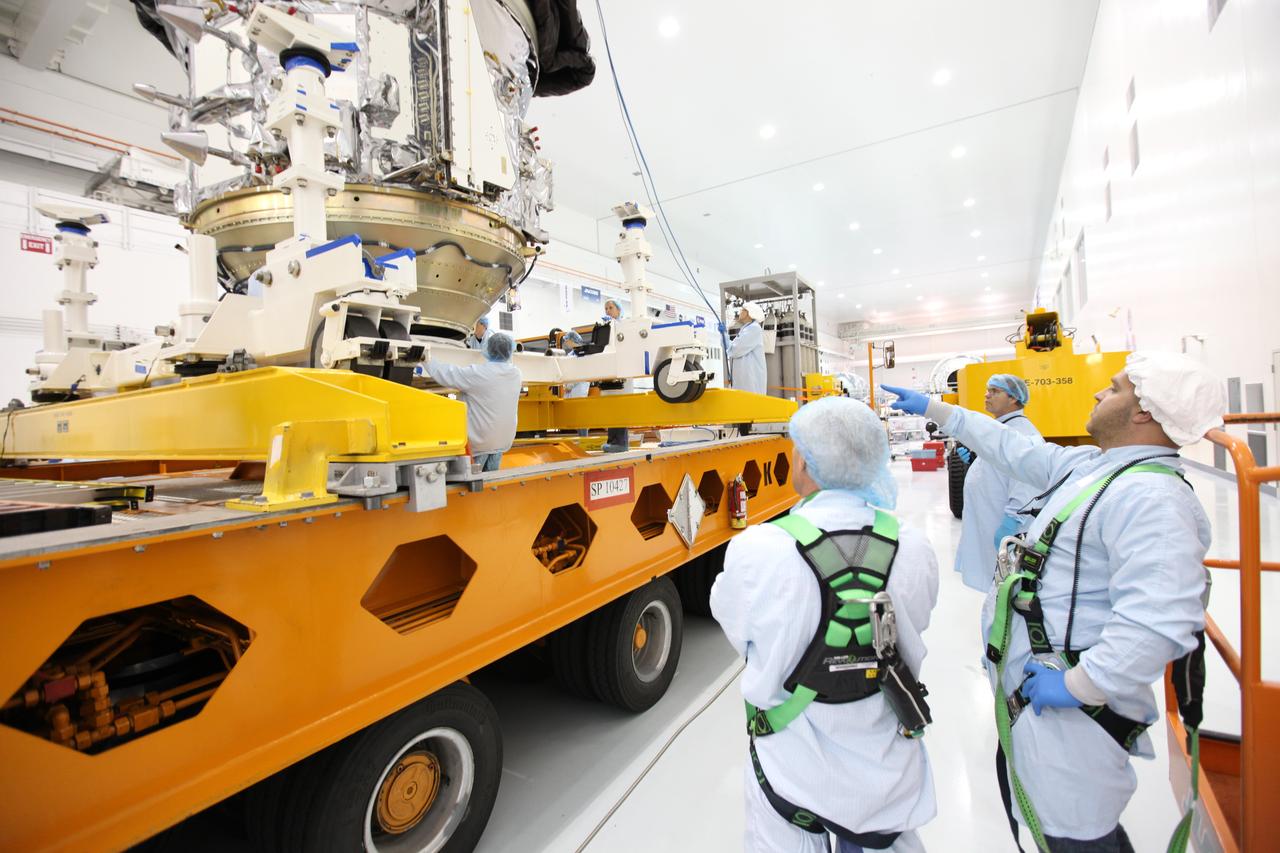
In the Space Station Processing Facility high bay at NASA's Kennedy Space Center in Florida, technicians assist as the Orbital ATK CYGNUS pressurized cargo module is secured on the KAMAG transporter. The module will be transported to the Payload Hazardous Servicing Facility. The Orbital ATK CRS-7 commercial resupply services mission to the International Space Station is scheduled to launch atop a United Launch Alliance Atlas V rocket from Space Launch Complex 41 at Cape Canaveral Air Force Station on March 19, 2017. CYGNUS will deliver thousands of pounds of supplies, equipment and scientific research materials to the space station.
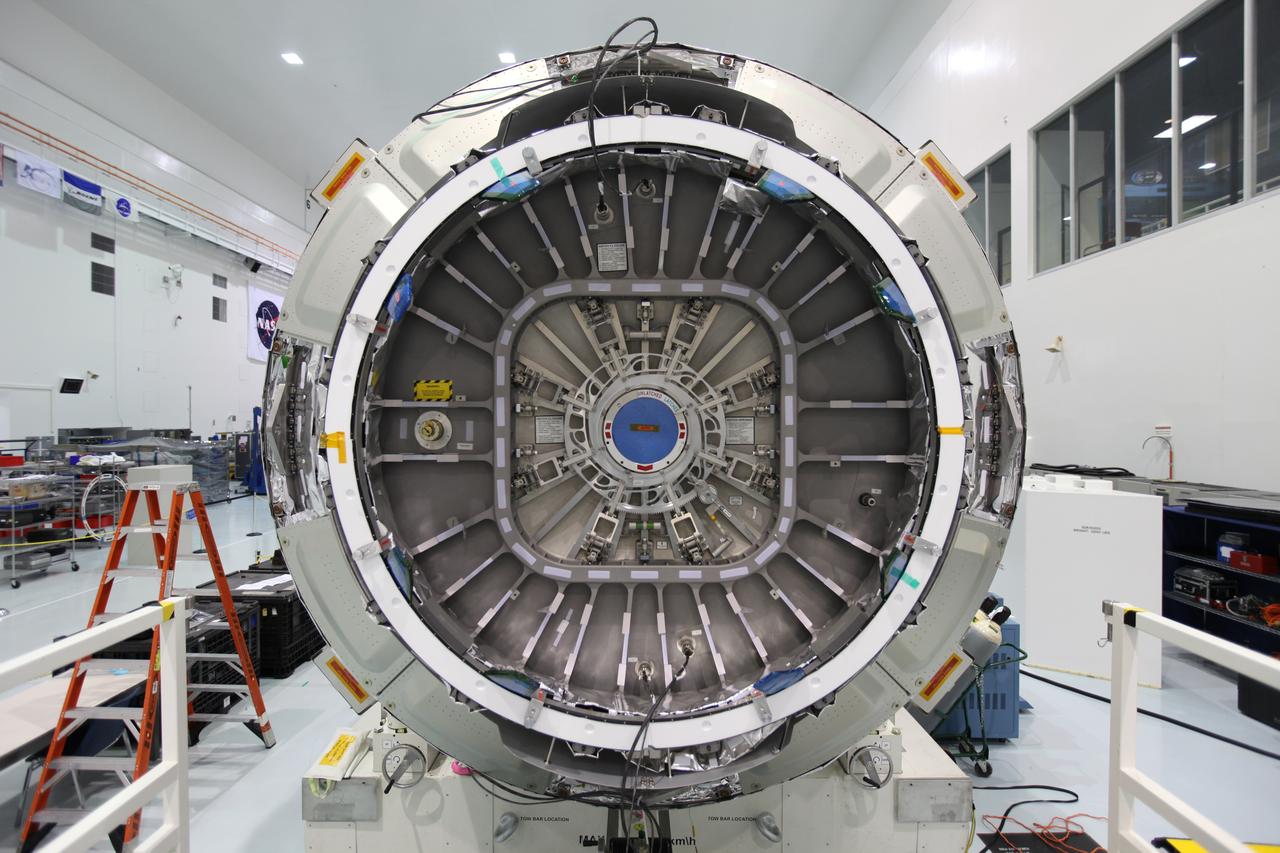
In the Space Station Processing Facility at NASA's Kennedy Space Center in Florida, the hatch has been closed on the Cygnus spacecraft's pressurized cargo module (PCM) for the Orbital ATK CRS-7 mission to the International Space Station. The module will be rotated to vertical for mating to the service module. Scheduled to launch on March 19, 2017, the commercial resupply services mission will lift off atop a United Launch Alliance Atlas V rocket from Space launch Complex 41 at Cape Canaveral Air Force Station.

Inside the Space Station Processing Facility high bay at NASA's Kennedy Space Center in Florida, technicians prepare the Neutron star Interior Composition Explorer, or NICER, payload for final packaging. NICER will be delivered to the International Space Station aboard the SpaceX Dragon cargo carrier on the company’s 11th commercial resupply services mission to the space station. NICER will study neutron stars through soft X-ray timing. NICER will enable rotation-resolved spectroscopy of the thermal and non-thermal emissions of neutron stars in the soft X-ray band with unprecedented sensitivity, probing interior structure, the origins of dynamic phenomena and the mechanisms that underlie the most powerful cosmic particle accelerators known.
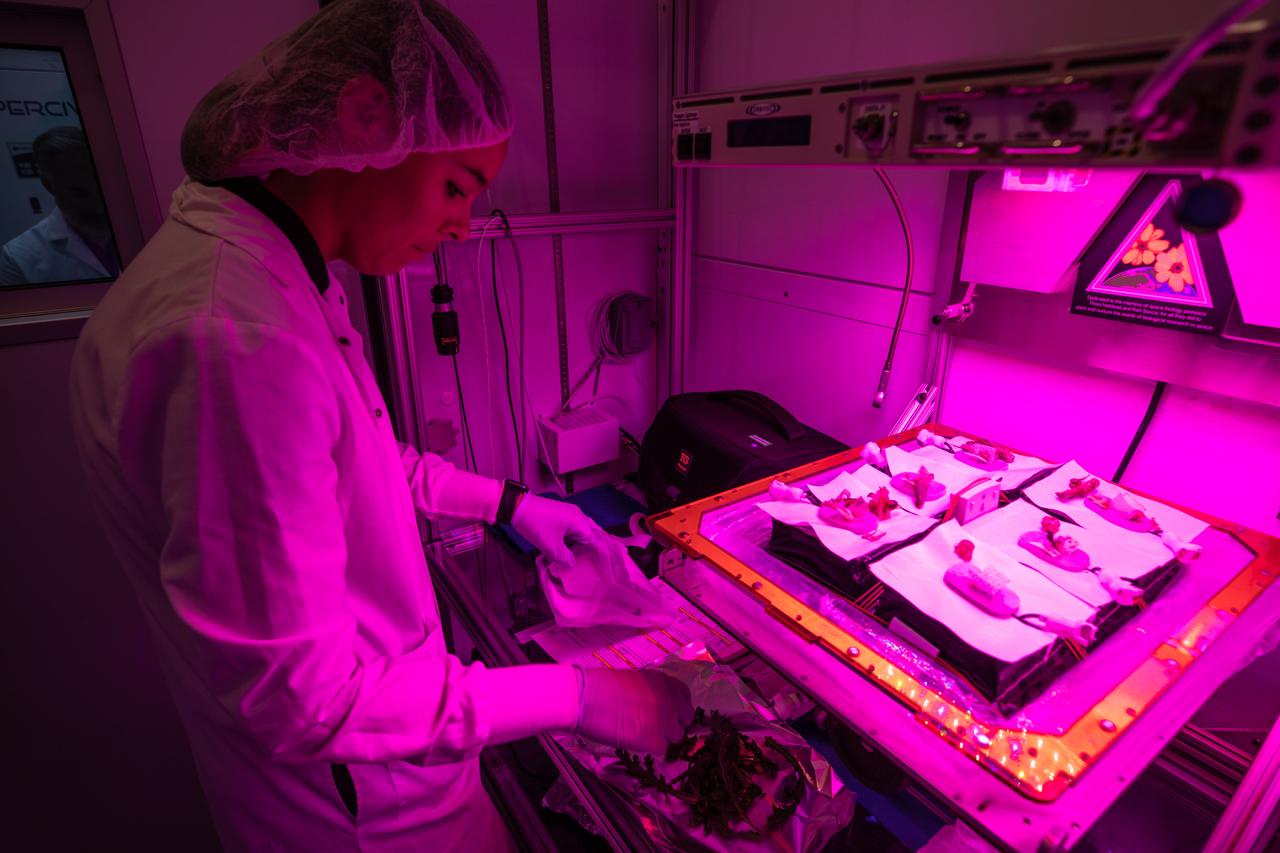
Kennedy Space Center employee Anna Maria Ruby harvests plant cultivars inside the Veggie growth chamber in the Space Station Processing Facility on Sept. 30, 2019, for a science verification test (SVT). This SVT will study the potential of three plants – amara mustard, ‘outredgeous’ red romaine lettuce and shungiku, an Asian green comparable to an edible chrysanthemum – to grow in space. All three lettuce plants were grown from seed film, making this the first SVT with this new plant growth material. Earlier this year, the amara mustard and shungiku plants were grown for the first time using seed bags – referred to as pillows – during the Sustained Veggie project, a study funded by the Human Research Program.
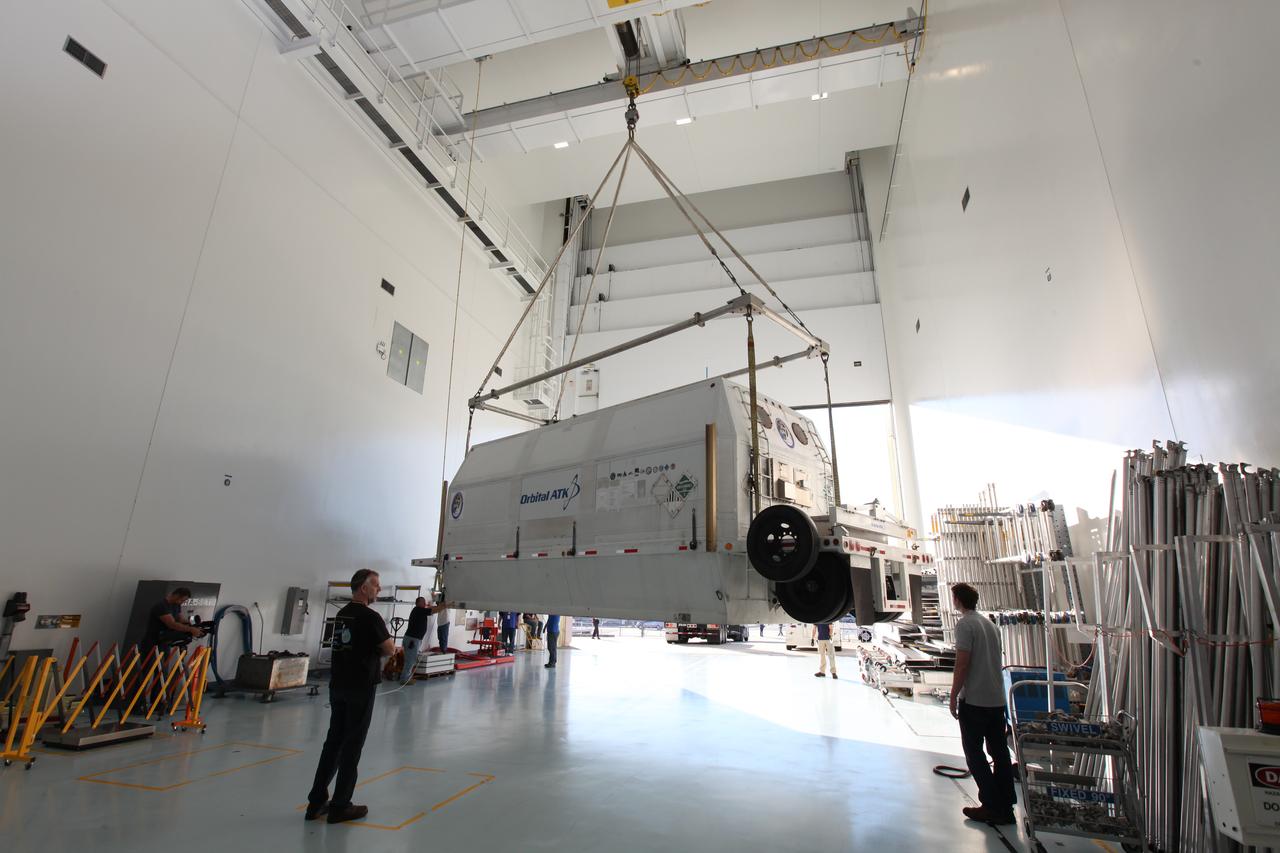
A crane is used to lift the Orbital ATK OA-7 Cygnus spacecraft's service module off a flatbed truck after arrival at the Space Station Processing Facility of NASA's Kennedy Space Center in Florida. The service module is sealed in an environmentally controlled shipping container. Scheduled to launch on March 19, 2017, the Orbital ATK OA-7 mission will lift off atop a United Launch Alliance Atlas V rocket from Space launch Complex 41 at Cape Canaveral Air Force Station. The commercial resupply services mission to the International Space Station will deliver thousands of pounds of supplies, equipment and scientific research materials that improve life on Earth and drive progress toward future space exploration.
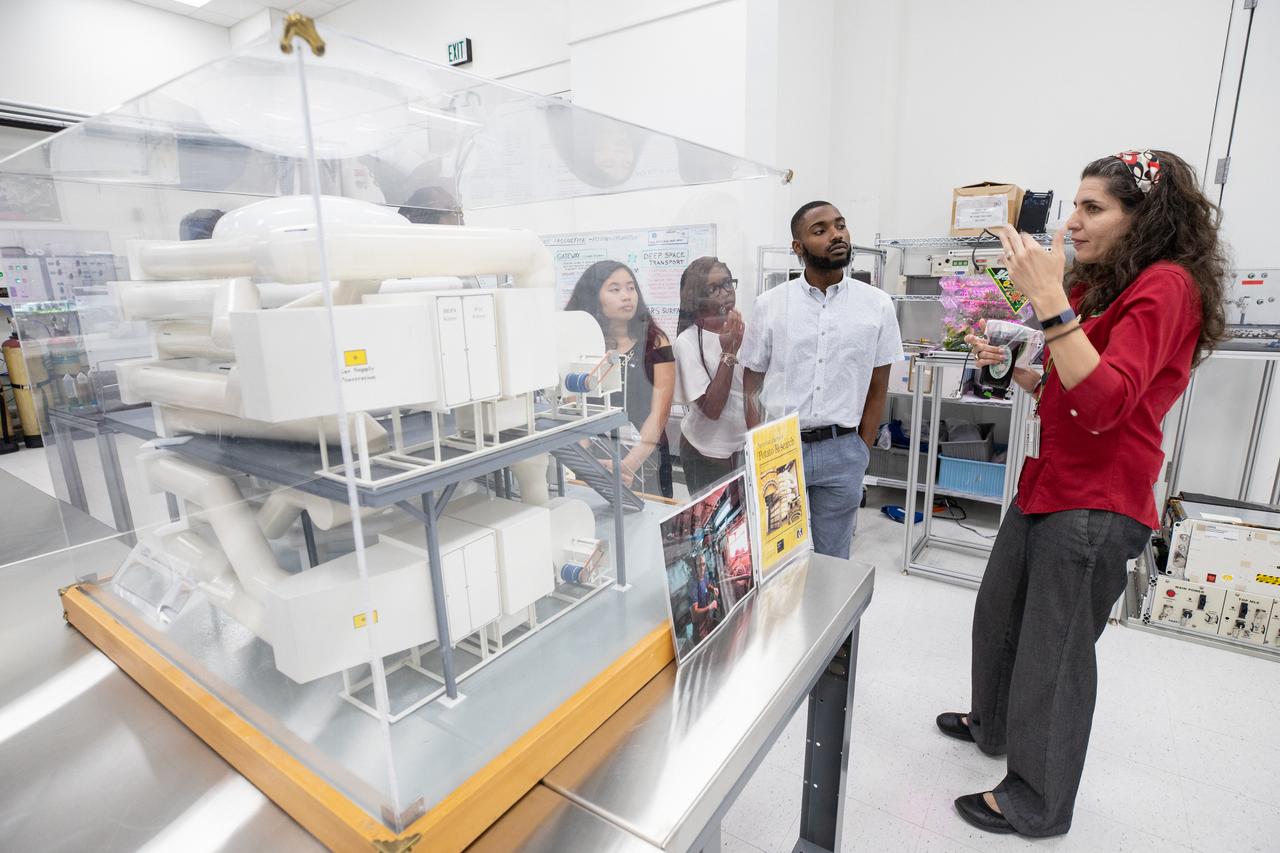
Dr. Gioia Massa, NASA Veggie project lead, addresses Langston University students inside a Space Station Processing Facility lab at Kennedy Space Center on Sept. 18, 2019. The tour of the Florida spaceport was organized by NASA’s Office of Education and Byron Quinn, Ph.D., Langston University director of the Science Research Institute. Students visited SwampWorks, the Neil Armstrong Operations and Checkout Building, the Vehicle Assembly Building, the visitor complex and the Center for Space Education.
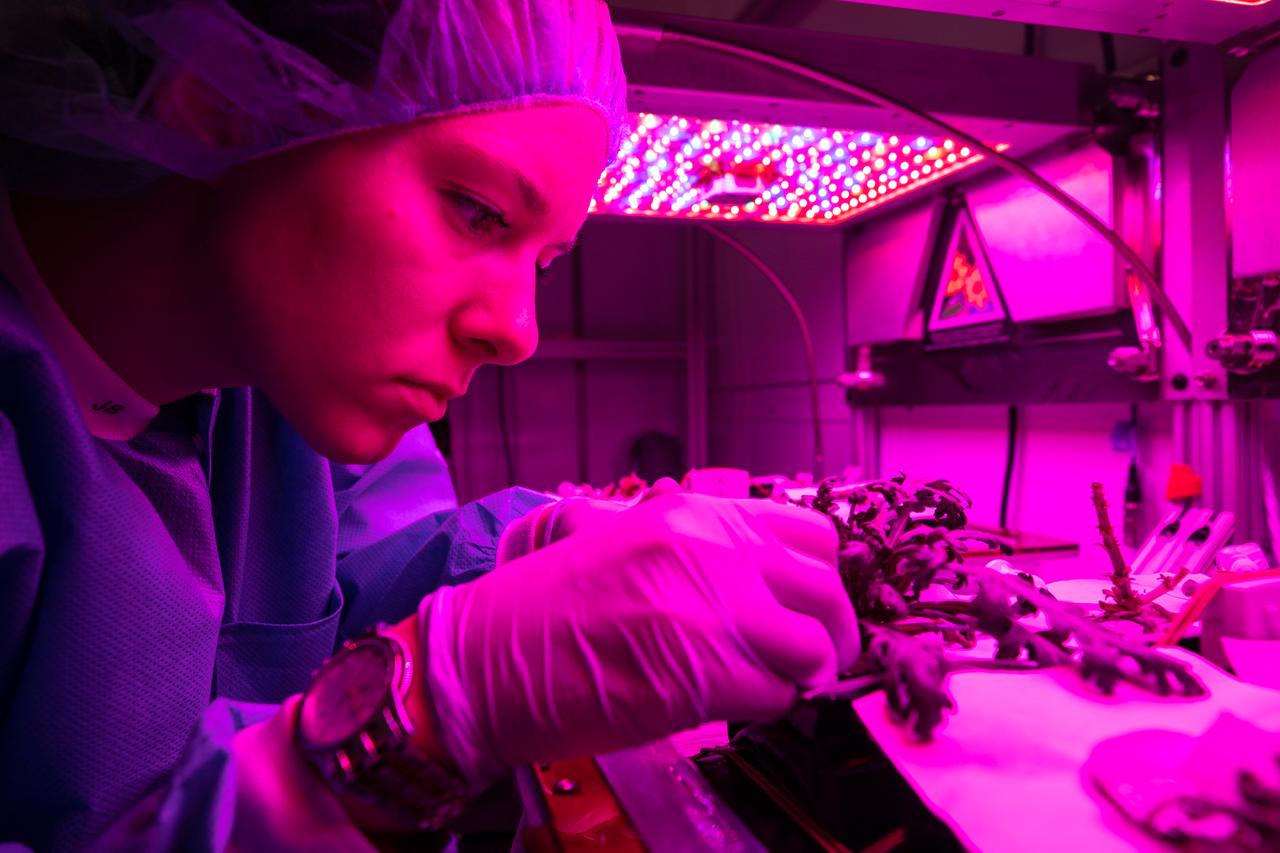
Jess Bunchek, an associate scientist at NASA’s Kennedy Space Center in Florida, harvests plant cultivars inside the Veggie growth chamber in the Space Station Processing Facility on Sept. 30, 2019, for a science verification test (SVT). This SVT will study the potential of three plants – amara mustard, ‘outredgeous’ red romaine lettuce and shungiku, an Asian green comparable to an edible chrysanthemum – to grow in space. All three lettuce plants were grown from seed film, making this the first SVT with this new plant growth material. Earlier this year, the amara mustard and shungiku plants were grown for the first time using seed bags – referred to as pillows – during the Sustained Veggie project, a study funded by the Human Research Program.
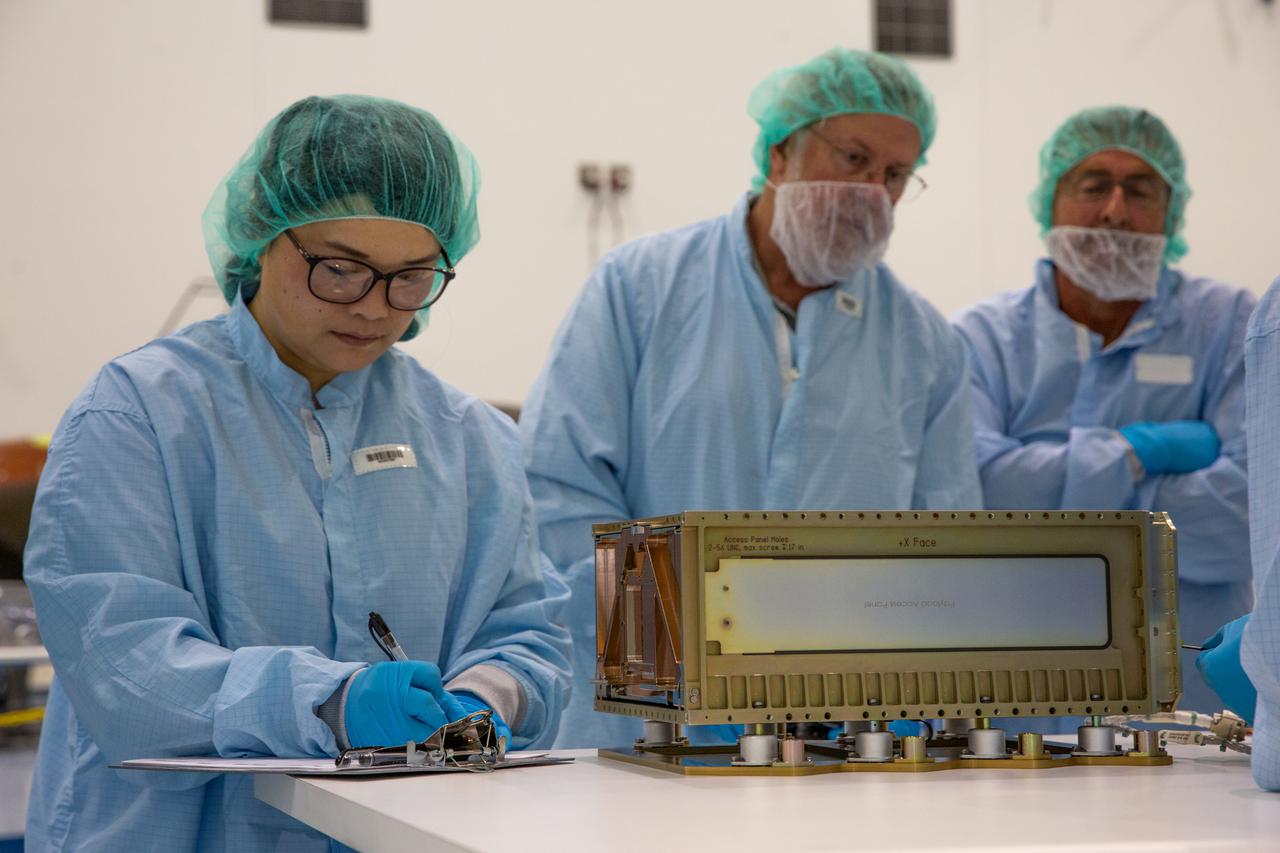
Teams worked on the final processing of their payloads that will fly aboard Artemis I. Housed within the Orion stage adapter, the satellites – called CubeSats – are roughly the size of a large shoe box and weigh no more than 30 pounds. Despite their small size, they enable science and technology experiments that may enhance our understanding of the deep space environment, expand our knowledge of the Moon, and demonstrate new technologies that could be used on future missions.
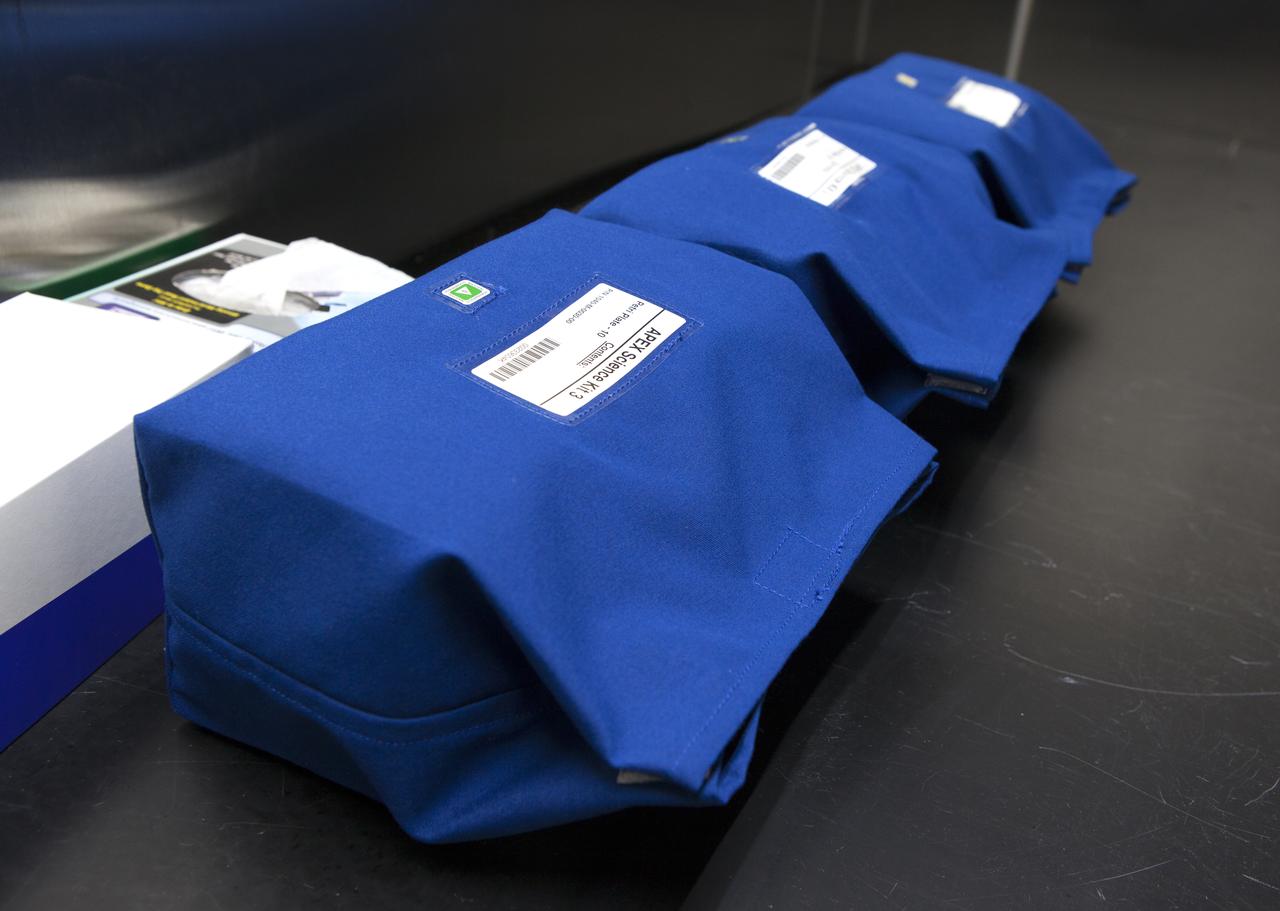
APEX-04, or Advanced Plant EXperiments-04, is being prepared in a cold room in the Kennedy Space Center Processing Facility for SpaceX-10. The 30 petri plates are bundled into groups of 10 and placed into one of three science kits. The science kits allow easy handling when the crew removes the plates from cold stowage on station. Dr. Anna Lisa Paul of the University of Florida is the principal investigator for APEX-04. Apex-04 is an experiment involving Arabidopsis in petri plates inside the Veggie facility aboard the International Space Station. Since Arabidopsis is the genetic model of the plant world, it is a perfect sample organism for performing genetic studies in spaceflight. The experiment is the result of a grant from NASA’s Space Life and Physical Sciences division.
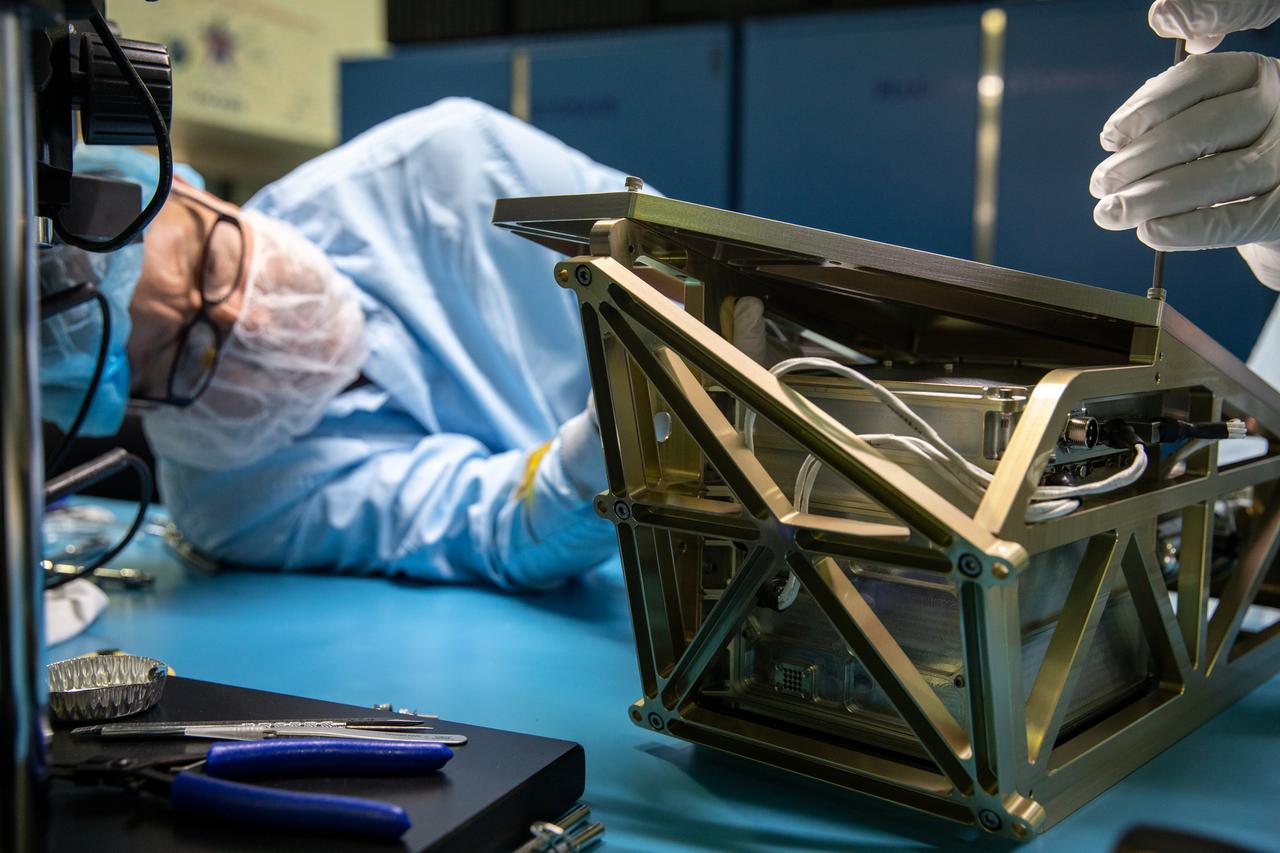
Inside the Space Station Processing Facility at NASA’s Kennedy Space Center in Florida, an engineer installs the Mass Spectrometer observing lunar operations (MSolo) onto its radiator bracket on June 14, 2022. Having successfully completed its thermal vacuum testing, the unit will undergo vibration testing later this month. This spectrometer is part of the PRIME-1 (Polar Resources Ice Mining Experiment-1) payload suite, slated to launch to the Moon in 2023 with Intuitive Machines. MSolo is a commercial off-the-shelf mass spectrometer modified to work in space and it will help analyze the chemical makeup of landing sites on the Moon, as well as study water on the lunar surface. MSolo is manifested to fly on four of the agency’s Commercial Lunar Payload Delivery Service missions where under Artemis, commercial deliveries beginning in 2023 will perform science experiments, test technologies, and demonstrate capabilities to help NASA explore the Moon and prepare for human missions.
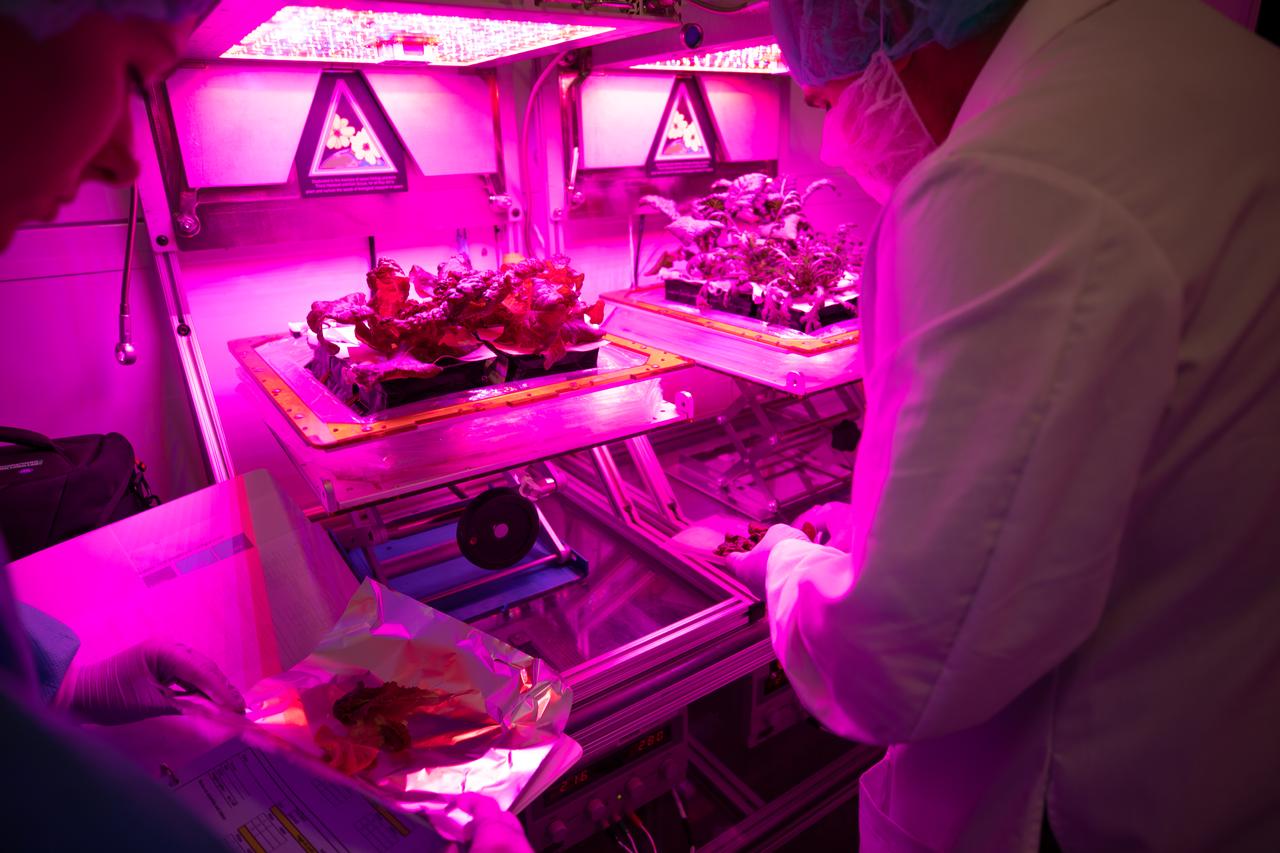
Kennedy Space Center Veggie Project Manager Trent Smith harvests test crops inside the Veggie growth chamber in the Florida spaceport’s Space Station Processing Facility on Sept. 30, 2019, for a science verification test (SVT) to study their potential to grown in space. The harvest included ‘outredgeous’ red romaine lettuce, which has been grown in space before, and two new plant cultivars – amara mustard and shungiku, an Asian green comparable to an edible chrysanthemum. All three lettuce plants were grown from seed film, making this the first SVT with this new plant growth material. Earlier this year, the amara mustard and shungiku plants were grown for the first time using seed bags – referred to as pillows – during the Sustained Veggie project, a study funded by the Human Research Program.

Inside the Space Station Processing Facility at NASA’s Kennedy Space Center in Florida, a research scientist glues red romaine lettuce seeds to a sheet of seed film – a new seed handling material – on Jan. 15, 2020. The seed film is being prepared for the VEG-03 J experiment that will fly to the International Space Station on Northrop Grumman’s 13th resupply services (NG-13) mission. This seed film experiment involves crew aboard the orbiting laboratory planting the seeds into plant pillows – a common method used to grow plants in space – themselves for the first time ever. The water-soluble, dissolving film addresses the challenge of handling seeds in a microgravity environment and also can be used to deliver fertilizers and other beneficial substances that help plants grow. NG-13 is scheduled to launch from the agency’s Wallops Flight Facility in Virginia on Feb. 9, 2020, at 5:39 p.m. EST.
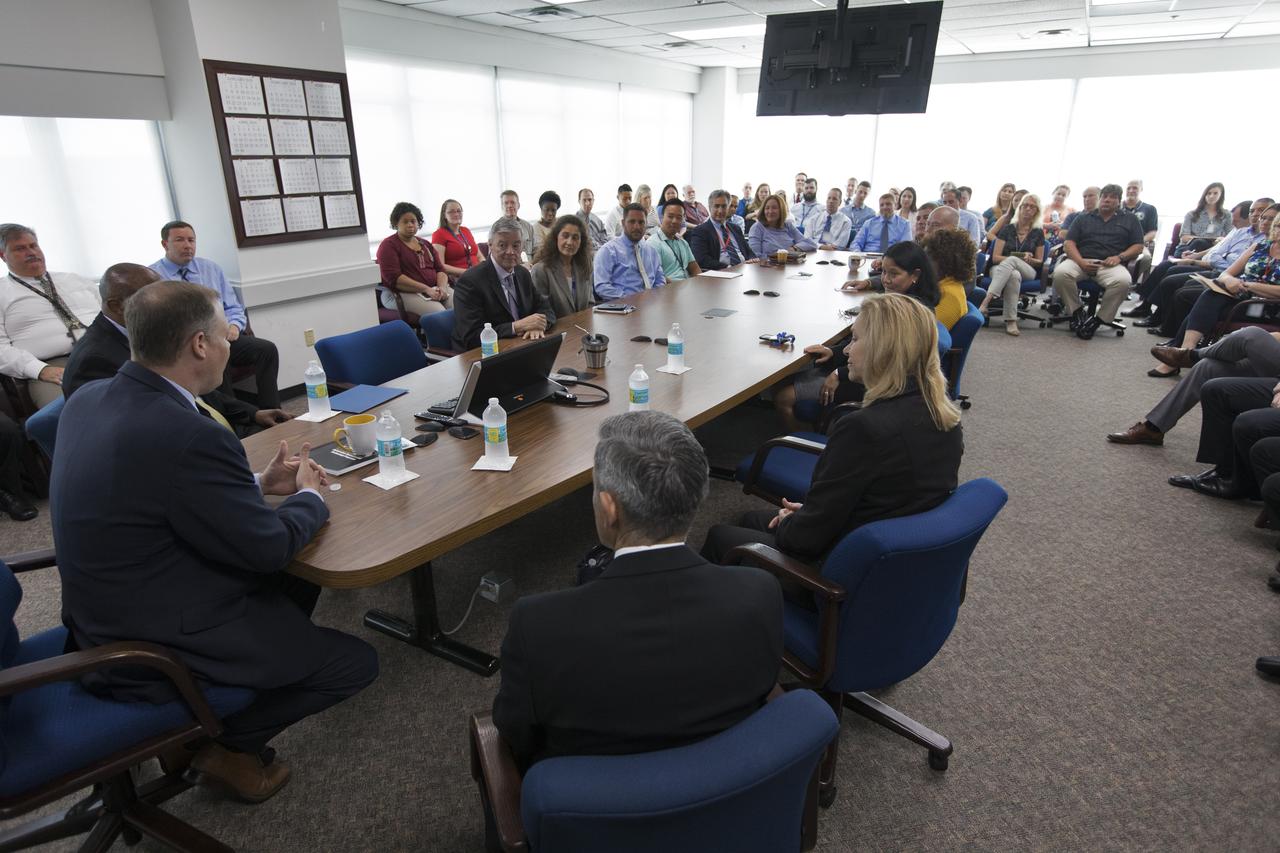
NASA Administrator Jim Bridenstine, seated at left, talks with workers in the Exploration Research and Technology directorate inside the Space Station Processing Facility at NASA's Kennedy Space Center in Florida, on Aug. 7, 2018. Seated to his right are Kennedy Center Director Bob Cabana, Deputy Center Director Janet Petro, and Josie Burnett, director of Exploration Research and Technology.
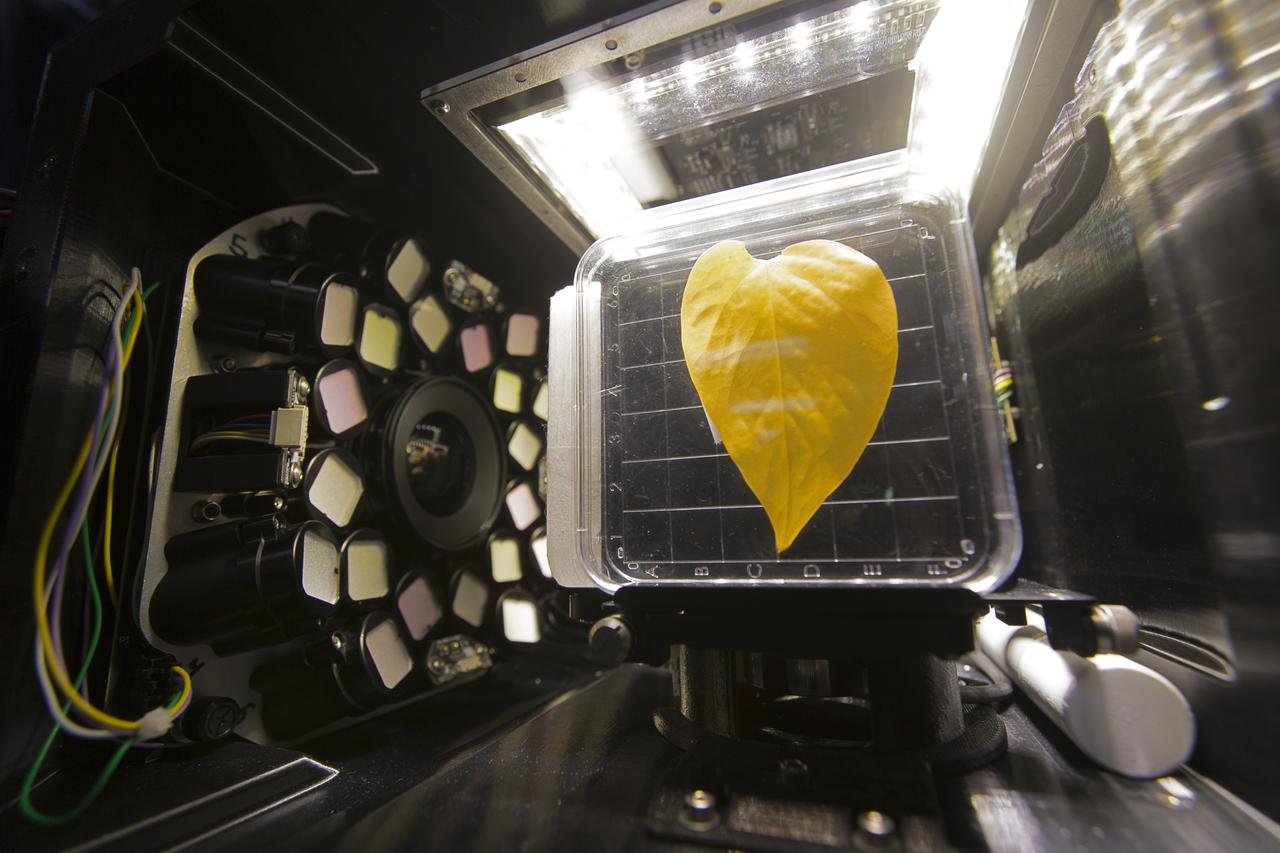
Inside the Spectrum prototype unit, organisms in a Petri plate are exposed to different colors of lighting. The device works by exposing organisms to different colors of fluorescent light while a camera records what's happening with time-lapse photography. Results from the Spectrum project will shed light on which living things are best suited for long-duration flights into deep space.
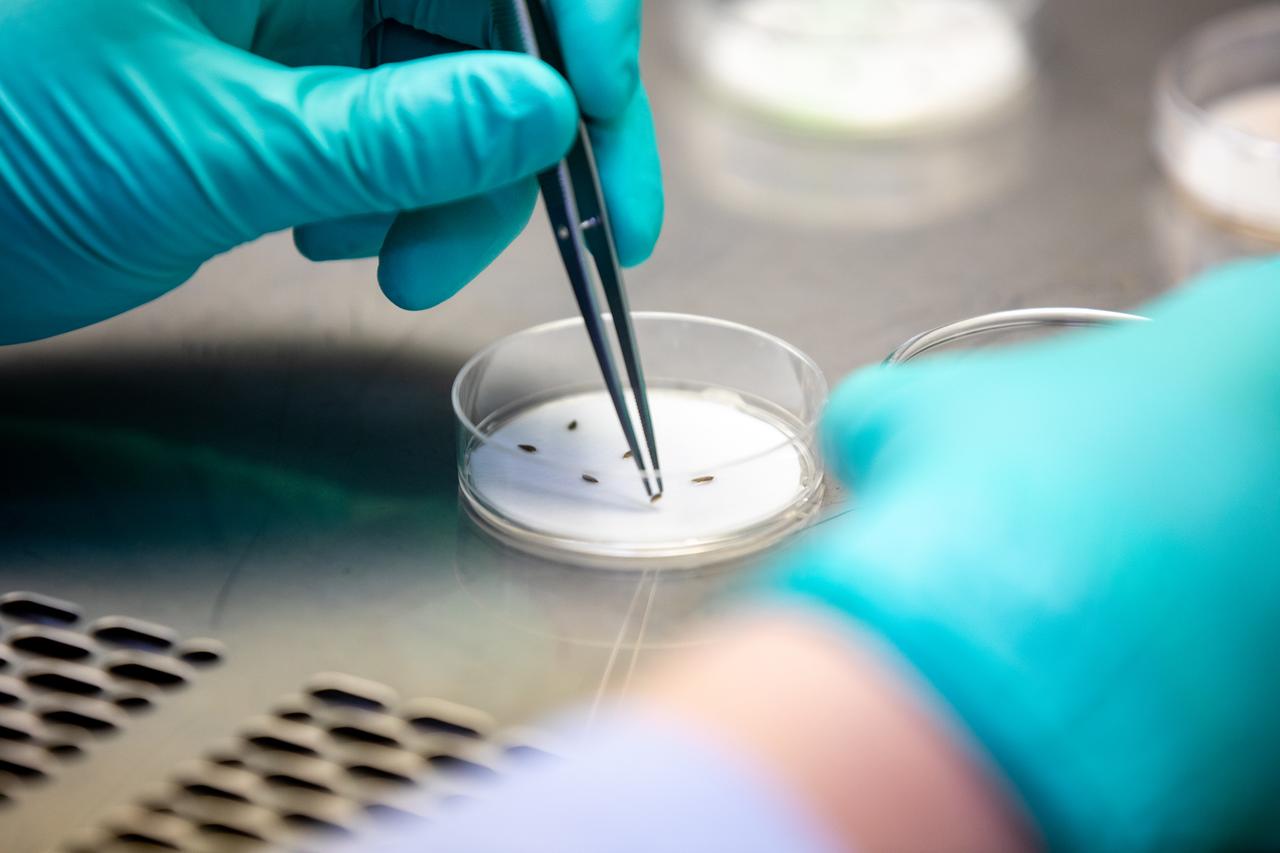
Inside the Space Station Processing Facility at NASA’s Kennedy Space Center in Florida on Jan. 15, 2020, red romaine lettuce seeds are being prepared for a germination test. The test will verify that the seeds can successfully grow from seed film – a new seed handling material – here on Earth before it’s sent to the International Space Station for testing in a microgravity environment as part of the VEG-03 series of experiments. The seed film experiment involves crew aboard the orbiting laboratory planting the seeds into plant pillows – a common method used to grow plants in space – themselves for the first time ever. The water-soluble, dissolving film addresses the challenge of handling seeds in a microgravity environment and also can be used to deliver fertilizers and other beneficial substances that help plants grow. The experiment will launch aboard a Northrop Grumman Antares rocket and Cygnus spacecraft on the company’s 13th resupply services mission to the space station. Liftoff is scheduled for Feb. 9, 2020, at 5:39 p.m. EST from the agency’s Wallops Flight Facility in Virginia.
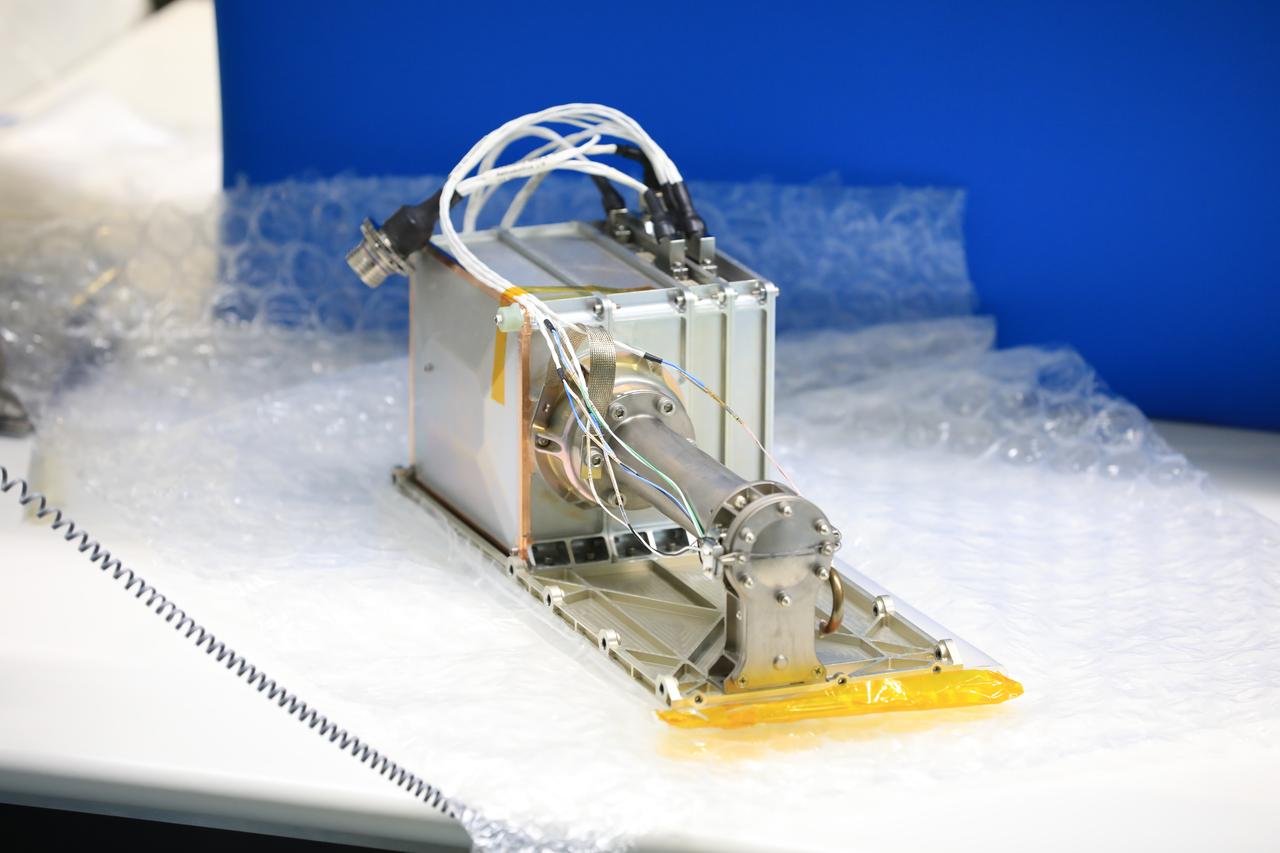
The Mass Spectrometer Observing Lunar Operations (MSolo) instrument is photographed inside the Space Station Processing Facility at NASA’s Kennedy Space Center in Florida following installation of its radiator on Sept. 25, 2020. MSolo will help analyze the chemical makeup of landing sites on the Moon, as well as study water on the lunar surface. The radiator will help keep the instrument’s temperature stable in the extreme heat and cold it will encounter. MSolo instruments are scheduled to launch on multiple robotic missions as part of NASA’s Commercial Lunar Payload Services (CLPS), with the first of these missions exploring Lacus Mortis, a large crater on the near side of the Moon, beginning in 2021. MSolo also will be one of three instruments on the agency’s water-hunting Volatiles Investigating Polar Exploration Rover, VIPER, scheduled to launch to the Moon’s South Pole in late 2023.
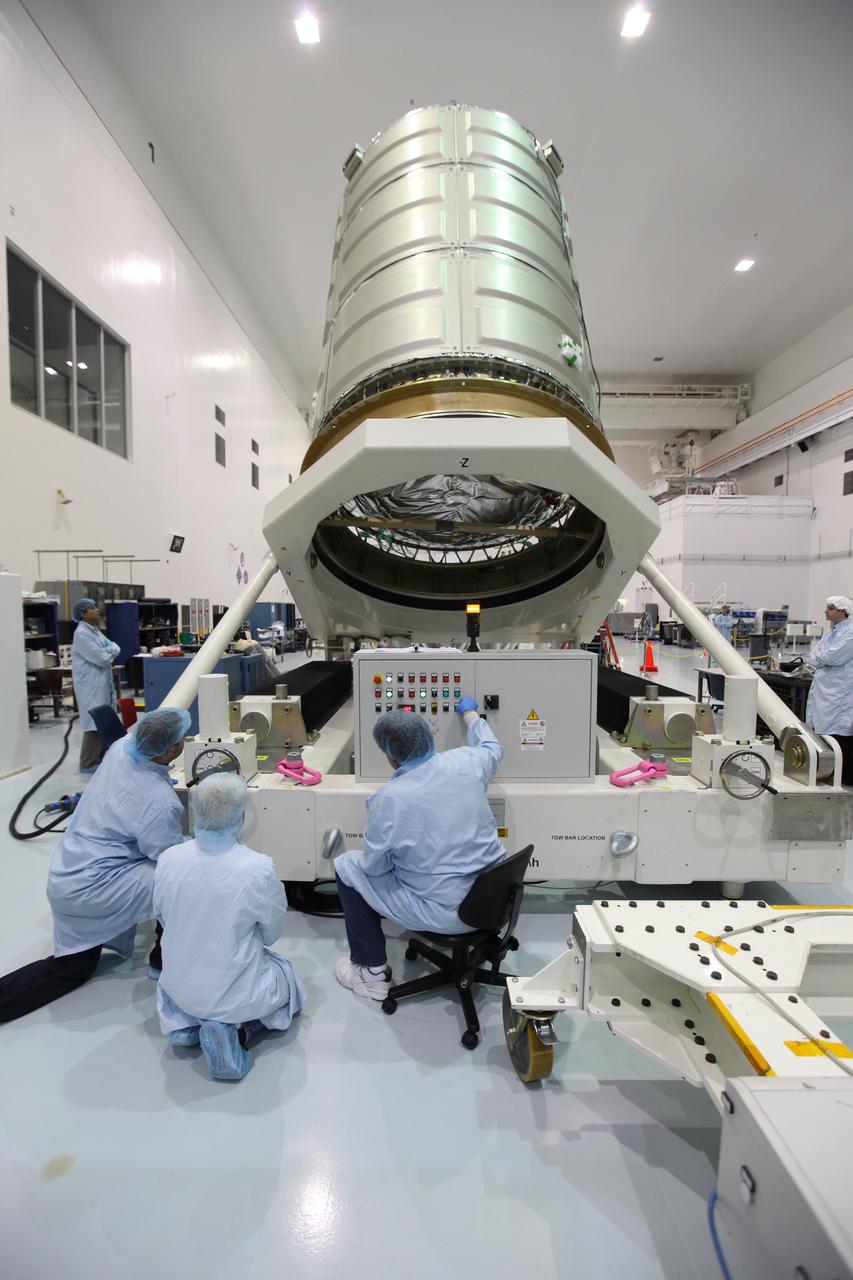
In the Space Station Processing Facility at NASA's Kennedy Space Center in Florida, technicians monitor the progress as the Cygnus spacecraft's pressurized cargo module (PCM) for the Orbital ATK CRS-7 mission to the International Space Station is rotated to vertical for mating to the service module. Scheduled to launch on March 19, 2017, the commercial resupply services mission will lift off atop a United Launch Alliance Atlas V rocket from Space launch Complex 41 at Cape Canaveral Air Force Station.
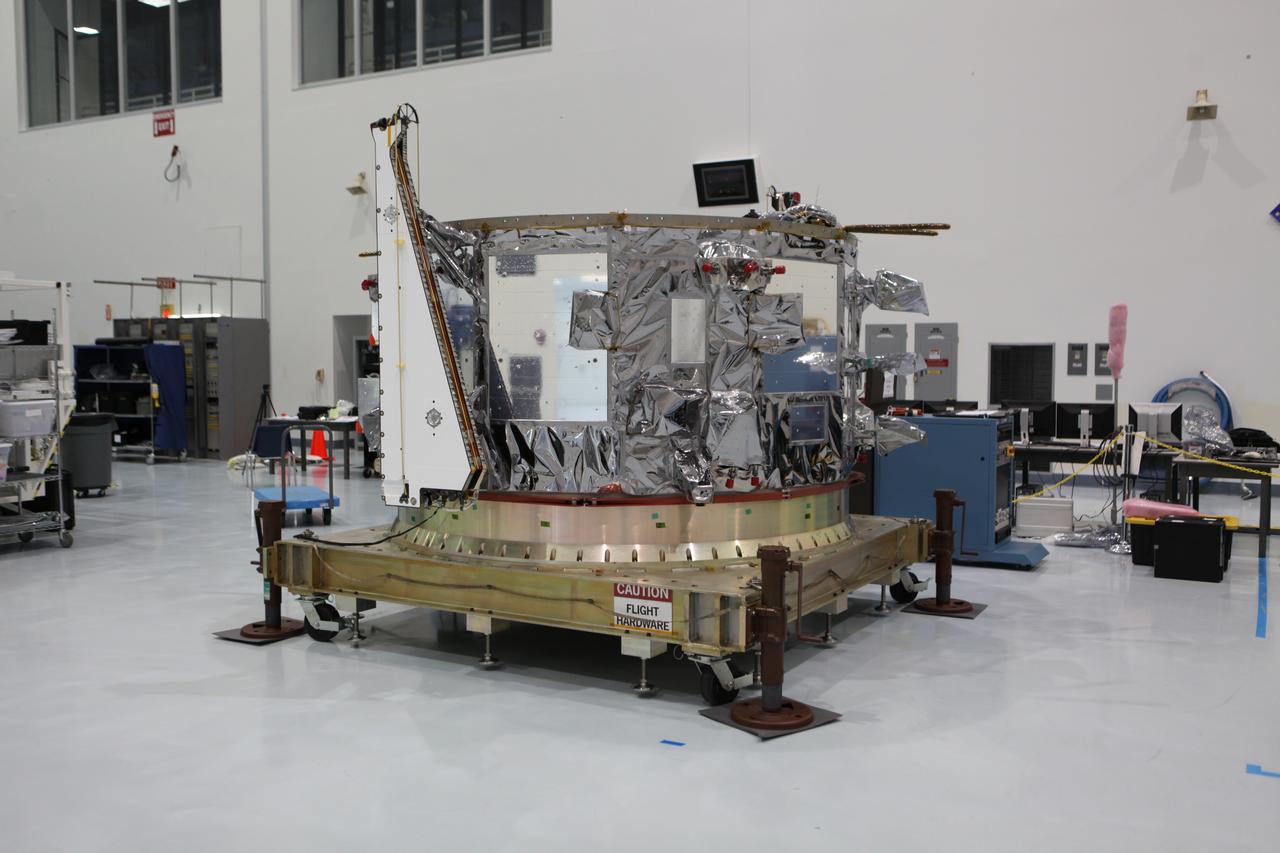
Inside the Space Station Processing Facility at NASA's Kennedy Space Center in Florida, engineers and technicians placed the Orbital ATK OA-7 Cygnus spacecraft's service module on a test stand. Scheduled to launch on March 19, 2017, the Orbital ATK OA-7 mission will lift off atop a United Launch Alliance Atlas V rocket from Space launch Complex 41 at Cape Canaveral Air Force Station. The commercial resupply services mission to the International Space Station will deliver thousands of pounds of supplies, equipment and scientific research materials that improve life on Earth and drive progress toward future space exploration.
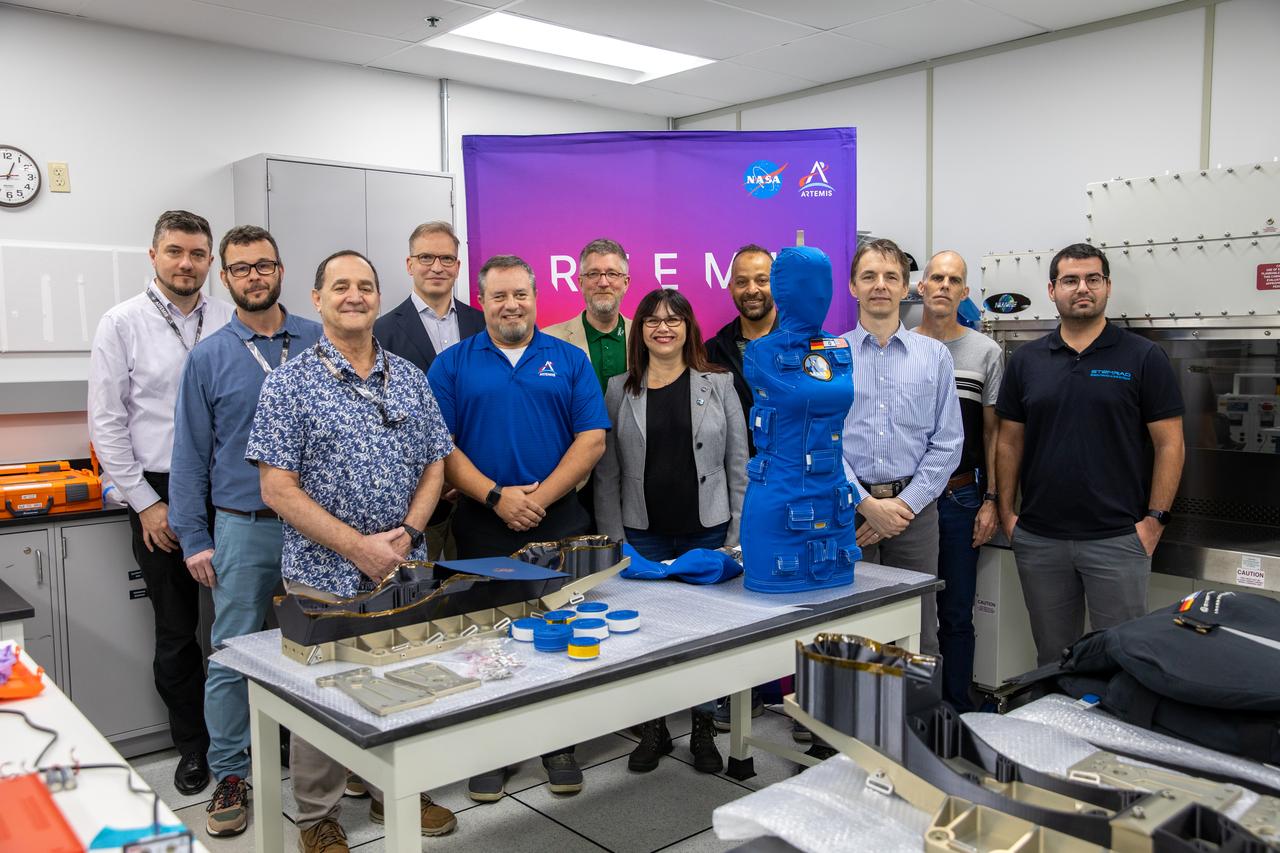
After a 25-day flight beyond the Moon and back inside the Artemis I Orion crew module, two manikins undergo post-flight payload inspections by teams from NASA, Lockheed Martin, AstroRad and the German Space Agency inside the Space Station Processing Facility at Kennedy Space Center in Florida on Jan. 17, 2023. As part of the Matroshka AstroRad Radiation Experiment (MARE) investigation, the two female manikins – Helga and Zohar – were equipped with radiation detectors. Zohar also wore a radiation protection vest, to determine the radiation risk during the Artemis I mission and potentially reduce exposure during future missions with astronauts. Artemis I Orion launched atop the Space Launch System (SLS) rocket from Kennedy’s Launch Complex 39B on Nov. 16, 2022, at 1:47 a.m. EST. During the flight, Orion flew farther than any spacecraft built for humans has ever flown, paving the way for human deep space exploration and demonstrating NASA’s commitment and capability to extend human presence to the Moon and beyond. The primary goal of Artemis I was to thoroughly test the SLS and Orion spacecraft’s integrated systems before crewed missions. Under Artemis, NASA aims to land the first woman and first person of color on the Moon and establish sustainable lunar exploration.
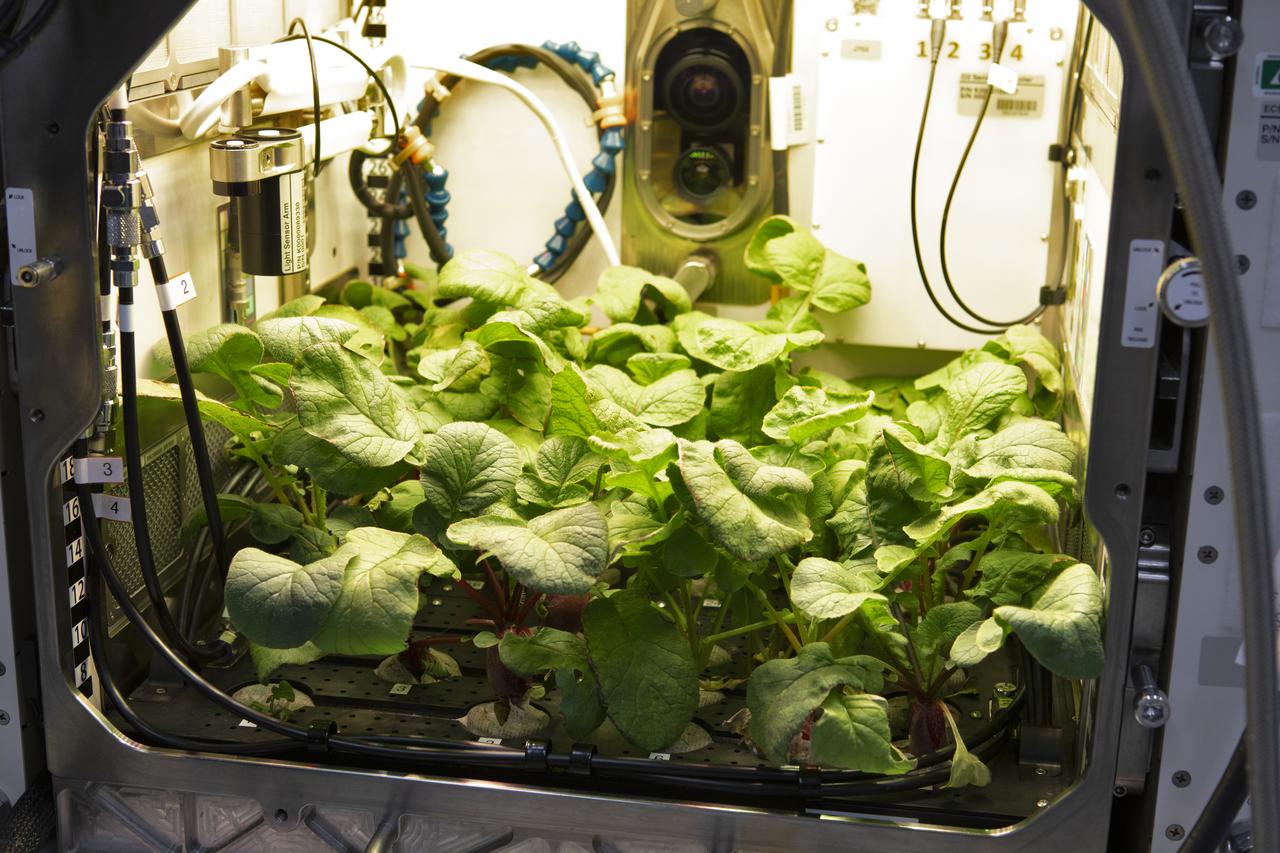
Radish plants are growing inside the Advanced Plant Habitat (APH) ground unit inside a laboratory in the Space Station Processing Facility at NASA's Kennedy Space Center in Florida on June 13, 2019. The plants are being grown as part of a science verification test for PH-02, a Space Life and Physical Sciences Research and Applications-funded experiment which seeks to determine the effects of spaceflight on radishes. The APH is a highly automated plant growth chamber with 180 sensors and is able to closely regulate variables related to plant growth.
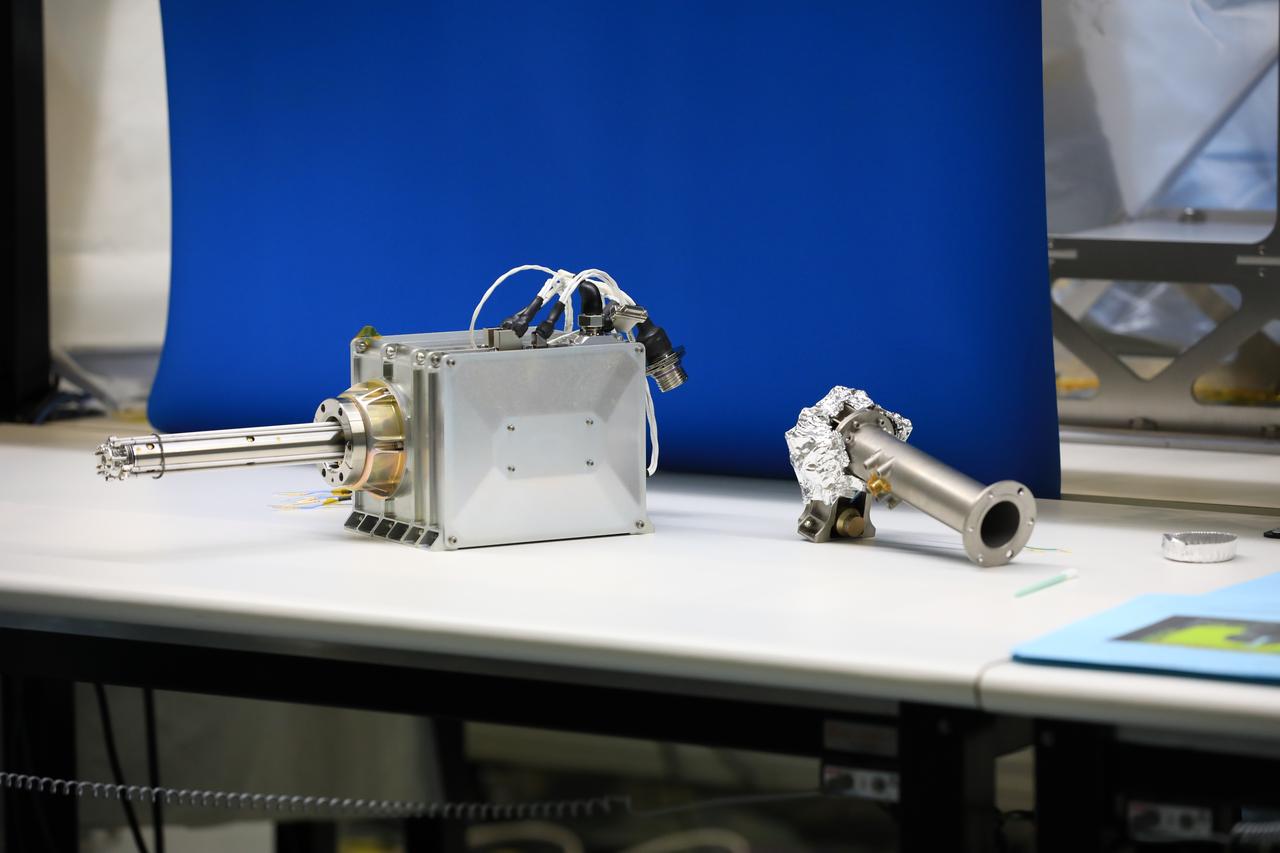
Instruments for the Mass Spectrometer observing lunar operations (MSolo) are in view inside the Space Station Processing Facility at NASA’s Kennedy Space Center in Florida on Sept. 25, 2020. MSolo is a commercial off-the-shelf mass spectrometer modified to work in space and it will help analyze the chemical makeup of landing sites on the Moon, as well as study water on the lunar surface. This work is preparing MSolo hardware for a robotic mission as part of the Commercial Lunar Payload Services (CLPS) launching to exploring Lacus Mortis, a large crater on the near side of the Moon in 2021. A future mission will send a mobile robot named the Volatiles Investigating Polar Exploration Rover (VIPER) to the Moon to prospect for water. VIPER will have several instruments that will allow it to detect and sample water including MSolo, the Neutron Spectrometer System, the Near Infrared Volatiles Spectrometer System and The Regolith and Ice Drill for Exploring New Terrain (TRIDENT).
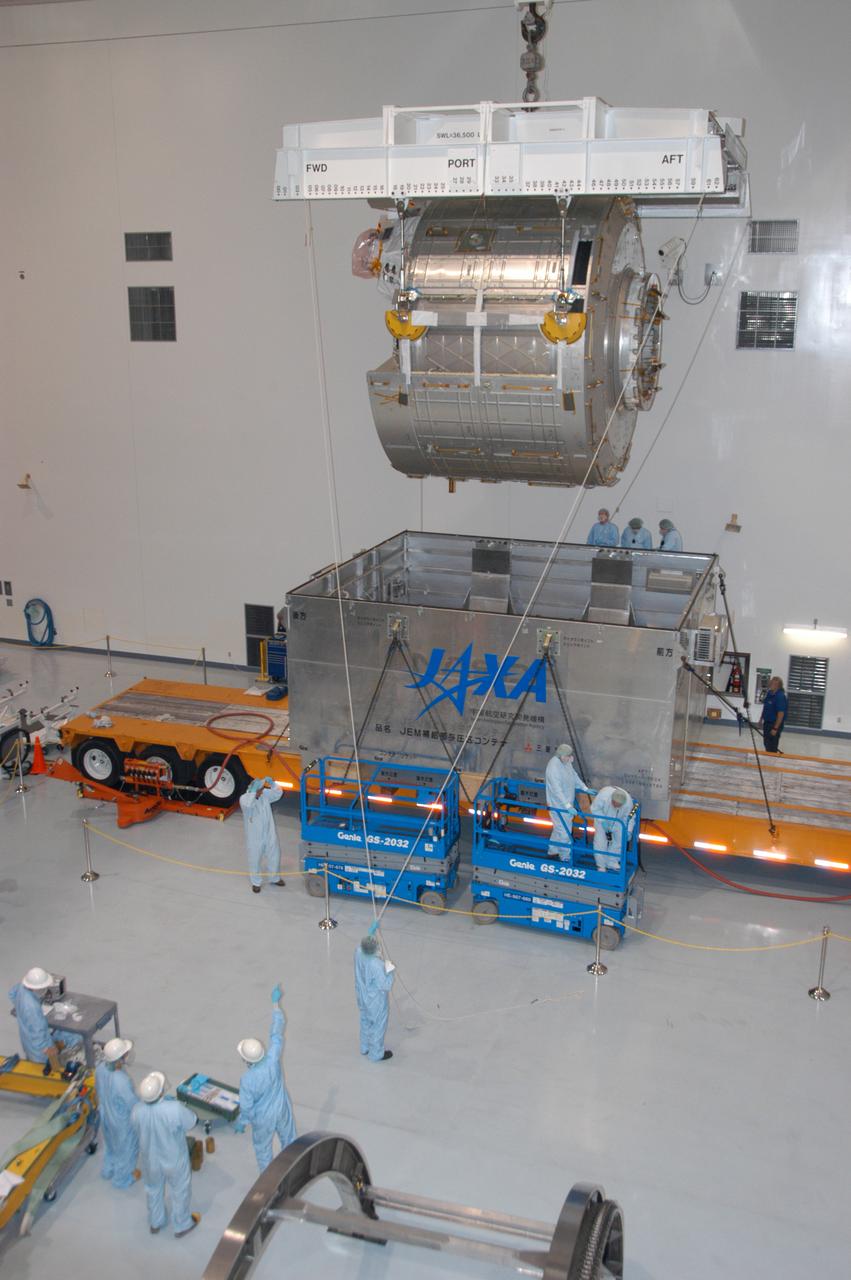
The JEM Experiment Logistics Module Pressurized Section is lifted from its shipping crate in the Space Station Processing Facility. The module will be moved to a scale for weight and center-of-gravity measurements and then to a work stand. The logistics module is one of the components of the Japanese Experiment Module or JEM, also known as Kibo, which means "hope" in Japanese. Kibo comprises six components: two research facilities -- the Pressurized Module and Exposed Facility; a Logistics Module attached to each of them; a Remote Manipulator System; and an Inter-Orbit Communication System unit. Kibo also has a scientific airlock through which experiments are transferred and exposed to the external environment of space. Kibo is Japan's first human space facility and its primary contribution to the station. Kibo will enhance the unique research capabilities of the orbiting complex by providing an additional environment in which astronauts can conduct science experiments. The various components of JEM will be assembled in space over the course of three Space Shuttle missions. The first of those three missions, STS-123, will carry the Experiment Logistics Module Pressurized Section aboard the Space Shuttle Endeavour, targeted for launch in 2007.
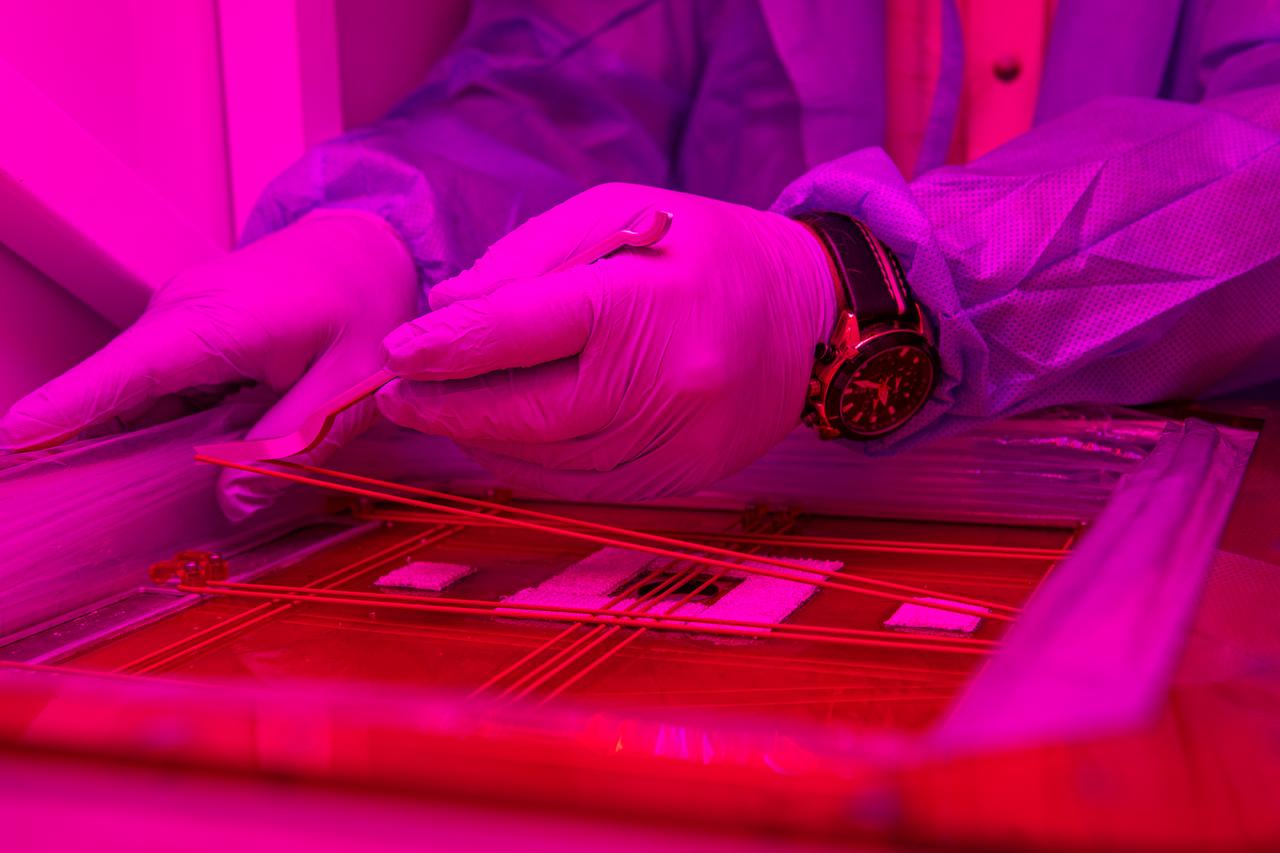
Matthew English is the Exploration Research and Technology facility manager for the Space Station Processing Facility (SSPF) at NASA’s Kennedy Space Center in Florida. In this photo, he is demonstrating how astronauts use a bungee tool to manipulate bungee cords that help secure vital parts of plant experiments in the Veggie growth chamber while they are aboard the International Space Station. This allows them to make efficient use of their time as they conduct scientific research in a microgravity environment. English’s primary responsibilities include ensuring that the space station teams inside the SSPF have the facilities, tools and capabilities they need to support their launch customers, thus providing the support necessary to enable further research and design discoveries within NASA.
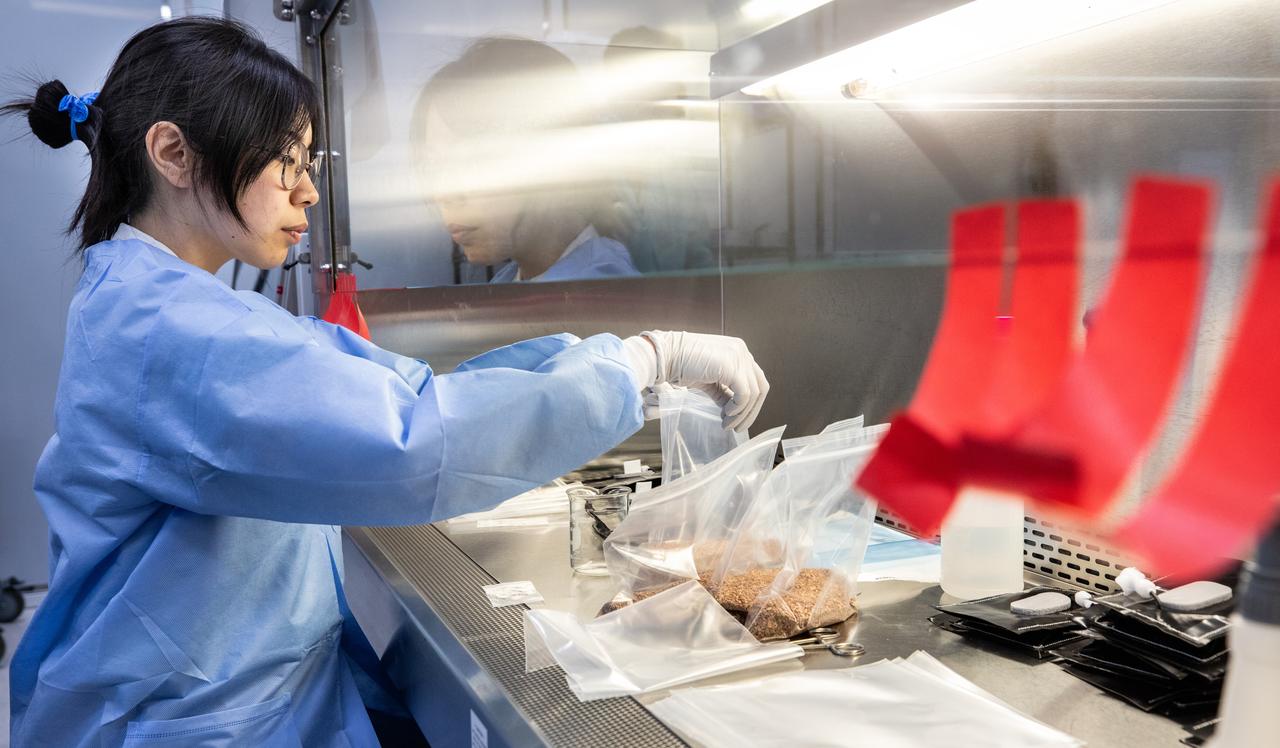
A member of the space crop production team pours substrate and controlled release fertilizer into a Veggie plant pillow on Thursday, May 29, 2025, inside the Space Systems Processing Facility at NASA’s Kennedy Space Center in Florida. The plant pillows, along with Veg-03 MNO seed films, which will carry seeds of Red Russian kale, Wasabi mustard greens, and Dragoon lettuce, are set to fly aboard NASA’s SpaceX Crew-11 mission to the International Space Station to grow in the space environment to study how microgravity impacts crop development compared to ground-grown plants. Seed films enable seed handling and planting of seeds into plant pillows allowing for astronaut choice of crops to grow. Plants can provide whole food nutrition, improve menu variety, and positively impact behavioral health of astronauts on long duration missions to the Moon and Mars and space crop research aboard the orbiting laboratory is enabled by NASA’s Biological and Physical Sciences Division and the International Space Station Program.
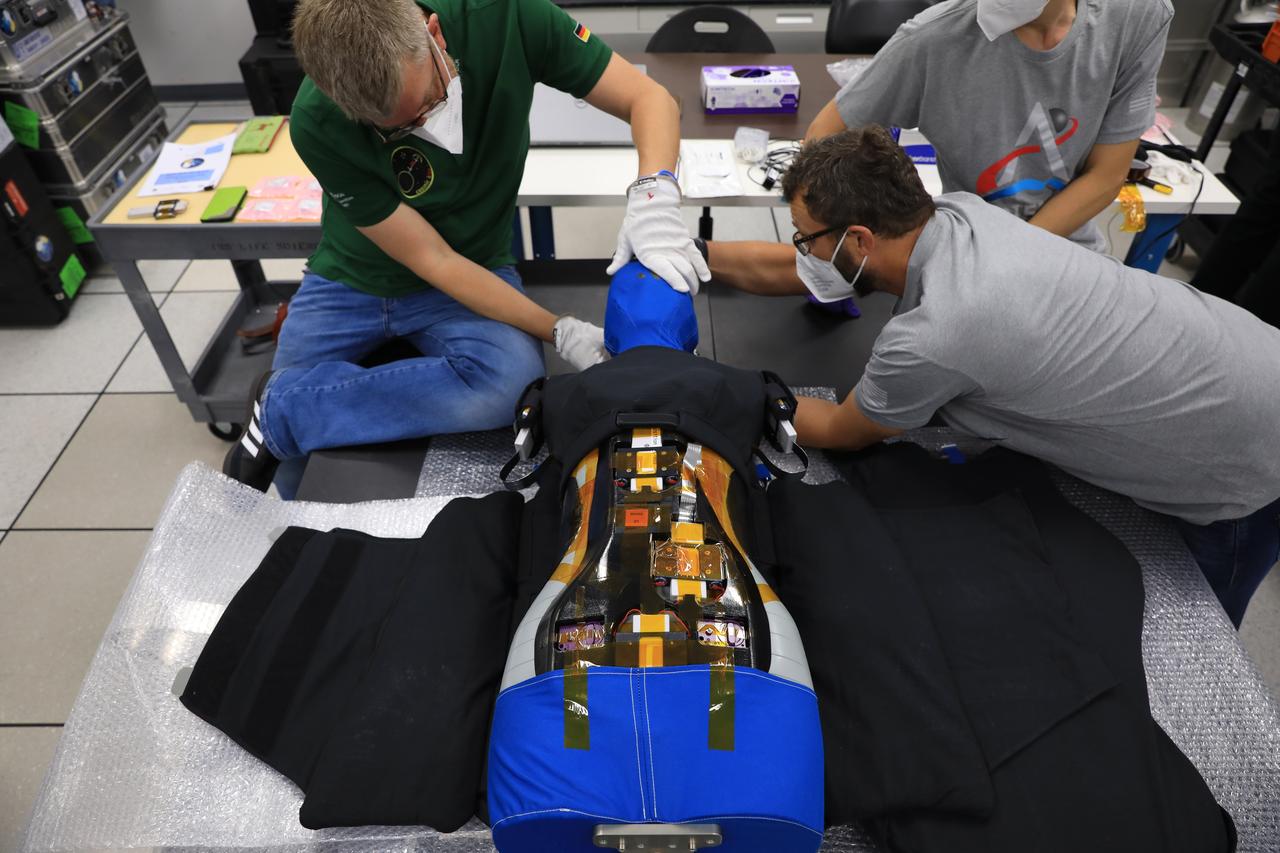
In preparation for the Artemis I flight test, teams at NASA’s Kennedy Space Center in Florida prepare the Matroshka AstroRad Radiation Experiment (MARE) investigation on Aug. 5, 2022. MARE will fly on Artemis I and features two manikins, called phantoms – Helga and Zohar – equipped with radiation detectors to determine the radiation risk on its way to the Moon. The phantoms will be seated as passengers in the Orion crew module, with Zohar also wearing the experimental AstroRad radiation protection vest. The MARE experiment is part of an agreement between NASA, the Israel Space Agency, and the German Aerospace Center. Artemis I will provide a foundation for human deep space exploration and demonstrate NASA’s capability to extend human presence to the Moon and beyond. The primary goal of Artemis I is to thoroughly test the Space Launch System rocket and Orion spacecraft’s integrated systems before crewed missions. Under Artemis, NASA aims to land the first woman and first person of color on the Moon and establish sustainable lunar exploration.
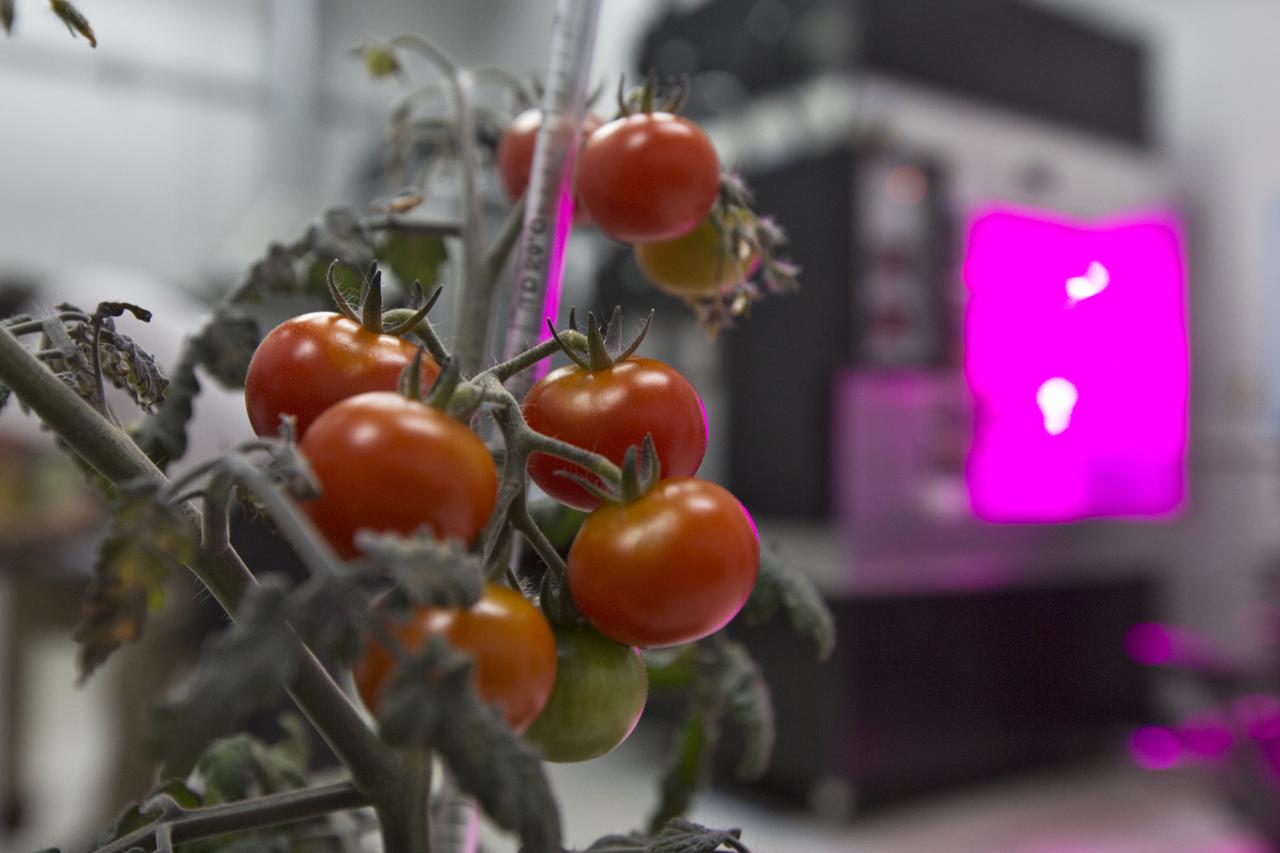
Tomato plants are growing inside a laboratory at the Space Station Processing Facility at NASA’s Kennedy Space Center in Florida. The plant growth is being tested in the Veggie Passive Orbital Nutrient Delivery System (PONDS). Veggie PONDS is a direct follow-on to the Veg-01 and Veg-03 hardware and plant growth validation tests. The primary goal of this newly developed plant growing system, Veggie PONDS, is to demonstrate uniform plant growth. PONDS units have features that are designed to mitigate microgravity effects on water distribution, increase oxygen exchange and provide sufficient room for root zone growth. PONDS is planned for use during Veg-04 and Veg-05 on the International Space Station after the Veggie PONDS Validation flights on SpaceX-14 and OA-9.
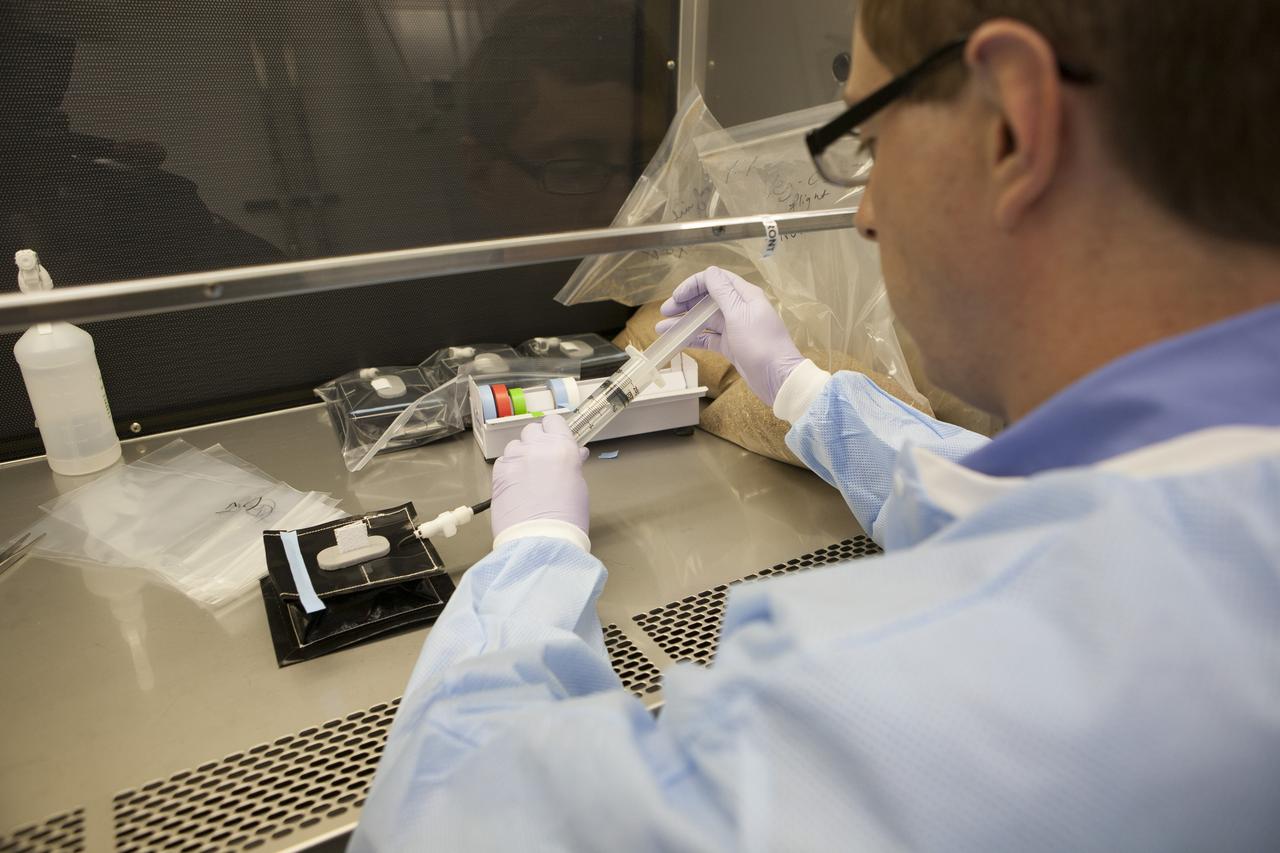
Inside a laboratory in the Space Station Processing Facility at NASA’s Kennedy Space Center in Florida, research scientists prepare the plant pillows for the Veg-03 experiment that will be delivered to the International Space Station aboard the eighth SpaceX Dragon commercial resupply mission. Dr. Mathew Mickens, a post-doctoral researcher, inserts a bonding agent into one of the Veg-03 plant pillows. The Veg-03 plant pillows will contain ‘Tokyo Bekana’ cabbage seeds and lettuce seeds for NASA’s third Veggie plant growth system experiment. The experiment will continue NASA’s deep space plant growth research to benefit the Earth and the agency’s journey to Mars.

Vice President Mike Pence addresses a meeting of the National Space Council in the high bay of the Space Station Processing Facility at NASA's Kennedy Space Center in Florida, on Feb. 21, 2018. Chaired by the Vice President, the council's role is to advise the president regarding national space policy and strategy, and review the nation's long-range goals for space activities.

From left, CSA (Canadian Space Agency) astronaut Joshua Kutryk and NASA astronaut Jessica Watkins taste microgreens at the Plant Processing Area inside the Space Systems Processing Facility at NASA’s Kennedy Space Center in Florida on Tuesday, May 12, 2026. Watkins and Kutryk, along with NASA astronaut Luke Delaney and Roscosmos cosmonaut Sergey Teteryatnikov (not pictured), are part of NASA's SpaceX Crew-13 mission to the International Space Station and will explore the possibility of growing crops outside of the station’s Veggie chamber – one of two enclosed areas currently used to grow crops on the orbiting laboratory.
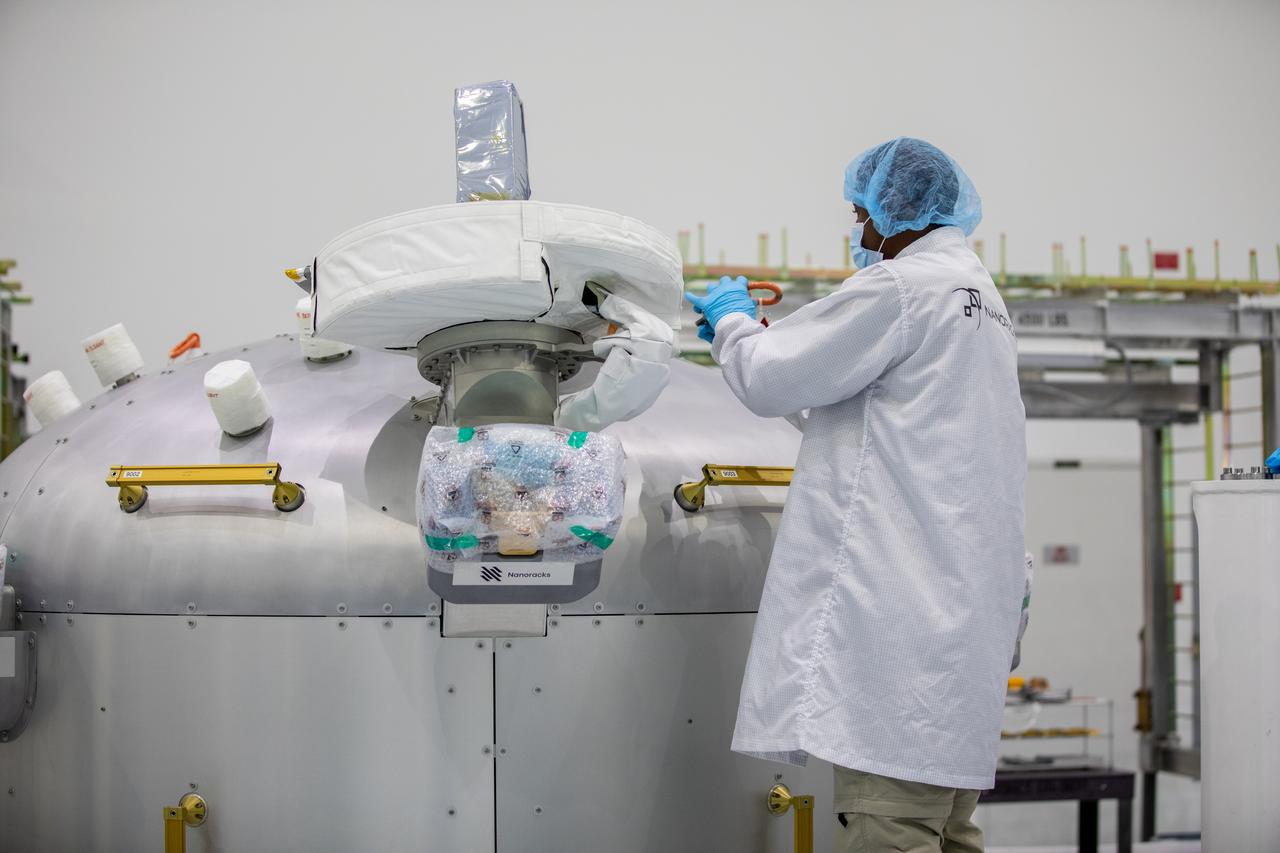
A Nanoracks technician works on the Nanoracks Bishop Airlock inside the Space Station Processing Facility at NASA's Kennedy Space Center in Florida on Sept. 29, 2020. The next-generation Nanoracks payload facility is being prepared for its flight to the International Space Station on SpaceX’s 21st commercial resupply services mission (CRS-21) to the International Space Station. The Bishop Airlock is the first commercially funded airlock for the space station. It will provide payload hosting, robotics testing, satellite deployment, and serve as an outside toolbox for station crew spacewalks, and more. CRS-21 is scheduled to launch on a SpaceX Falcon 9 rocket no earlier than November from Launch Complex 39A at Kennedy Space Center.
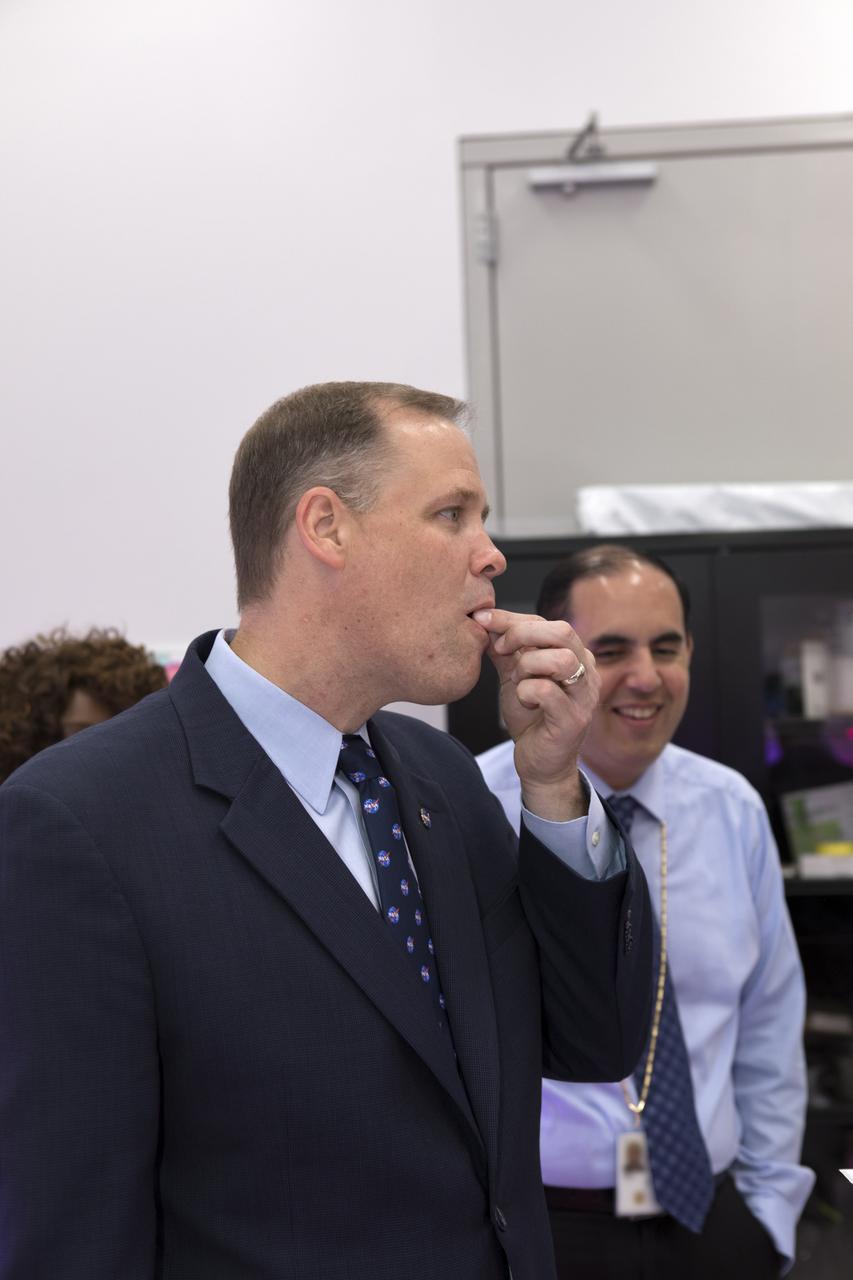
NASA Administrator Jim Bridenstine, left, tours a plant research laboratory and samples a microgreen inside the Space Station Processing Facility (SSPF) at NASA's Kennedy Space Center in Florida, on Aug. 7, 2018. Behind Bridenstine is Bryan Onate, Advanced Plant Habitat project manager. Bridenstine received updates on research and technology accomplishments during his visit to the SSPF.
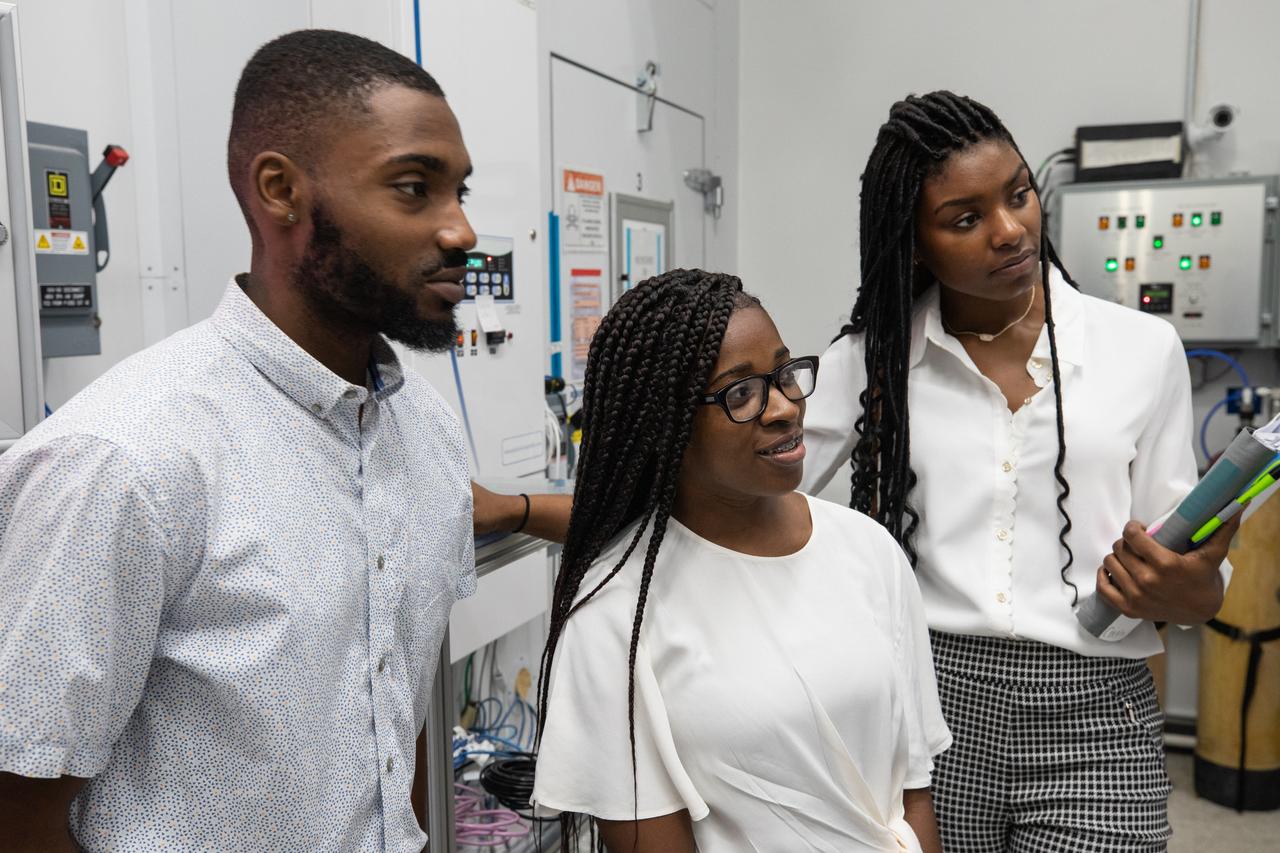
Langston University students, from left, Sherman Cravens, Makyah Farris and Courtney Miller listen to a presentation inside a Space Station Processing Facility lab at Kennedy Space Center on Sept. 18, 2019. The students were part of a tour of the Florida spaceport organized by NASA’s Office of Education and Byron Quinn, Ph.D., Langston University director of the Science Research Institute. The visit included stops at SwampWorks, the Neil Armstrong Operations and Checkout Building, the Vehicle Assembly Building, the visitor complex and the Center for Space Education.
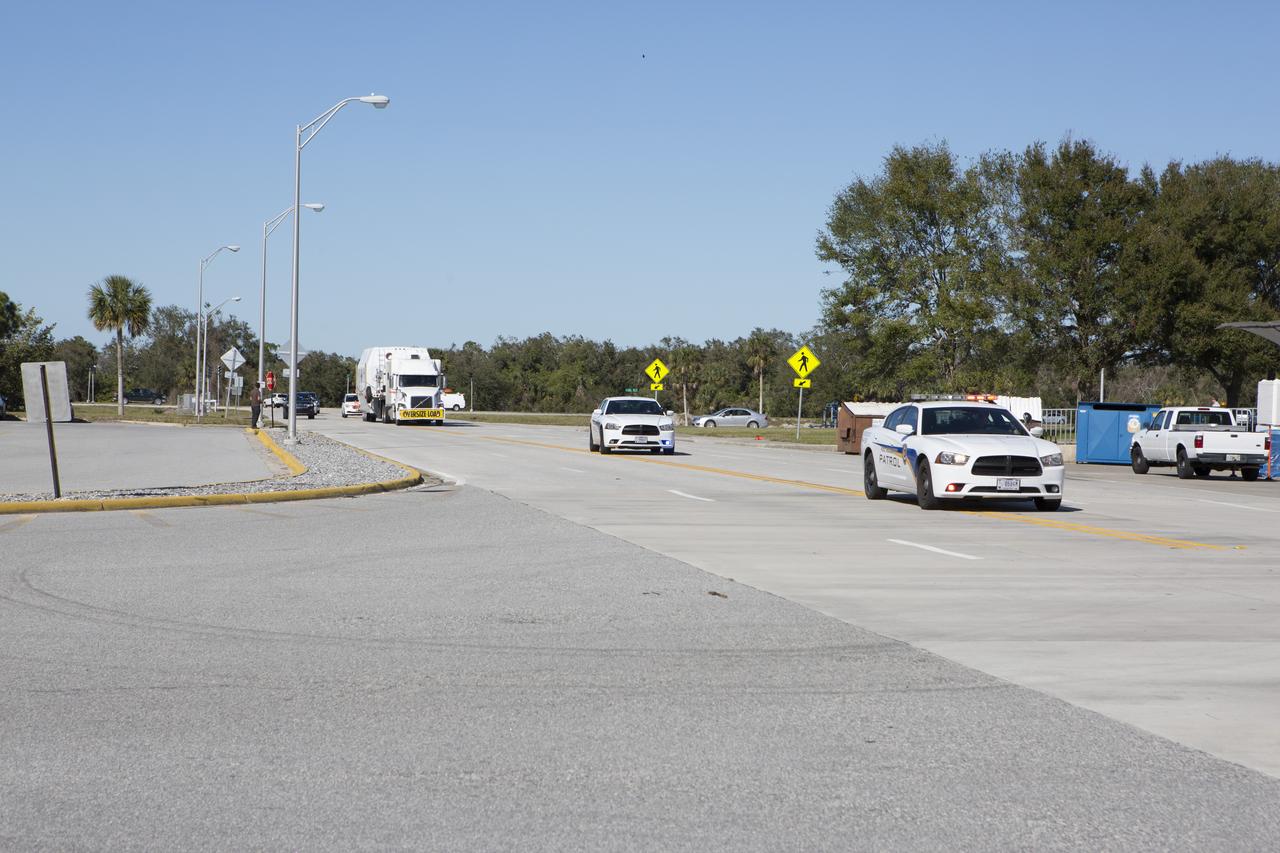
The Orbital ATK OA-7 Cygnus spacecraft's service module arrives inside the Space Station Processing Facility of NASA's Kennedy Space Center in Florida. The service module is sealed in an environmentally controlled shipping container, pulled in by truck on a low-boy flatbed trailer. Scheduled to launch on March 19, 2017, the Orbital ATK OA-7 mission will lift off atop a United Launch Alliance Atlas V rocket from Space launch Complex 41 at Cape Canaveral Air Force Station. The commercial resupply services mission to the International Space Station will deliver thousands of pounds of supplies, equipment and scientific research materials that improve life on Earth and drive progress toward future space exploration.
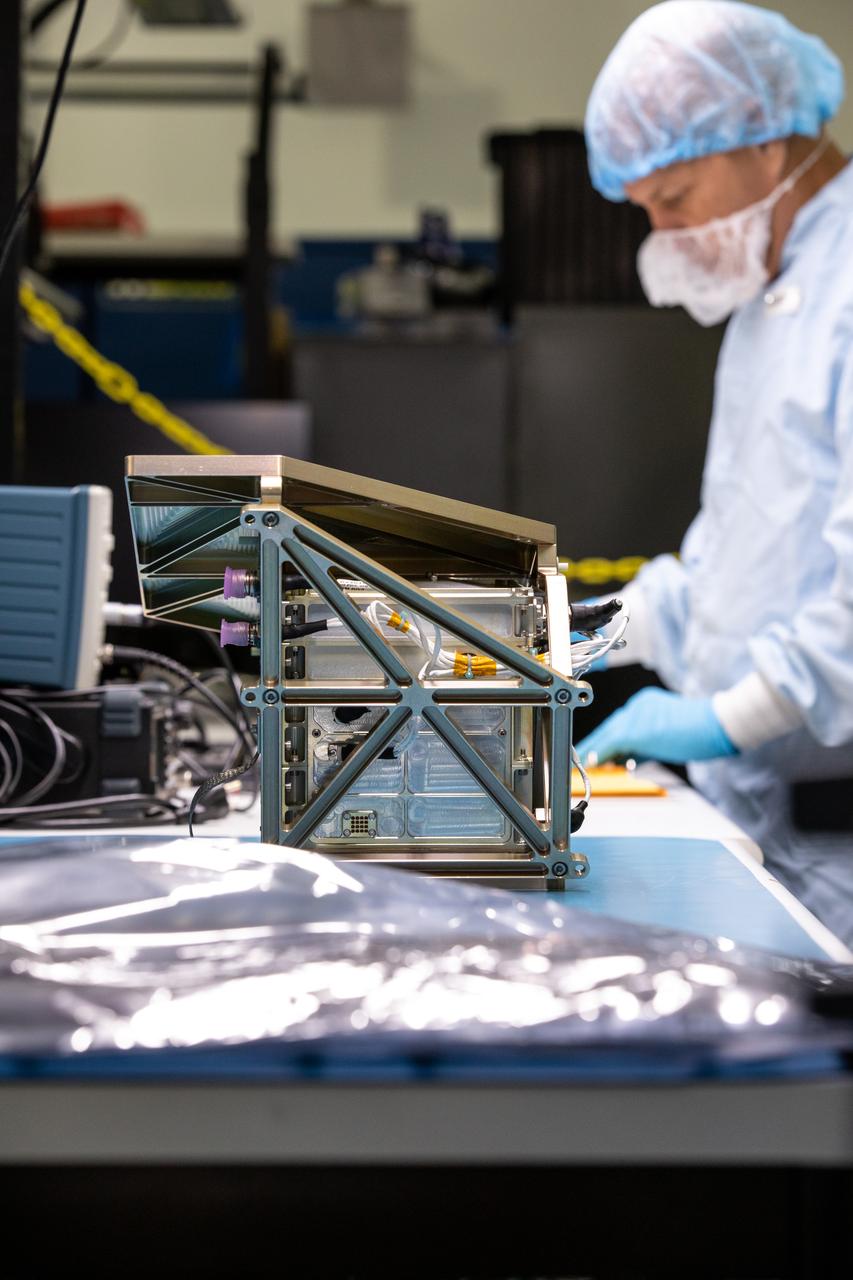
Engineers prepare the Mass Spectrometer Observing Lunar Operations (MSolo) instrument for the multilayer insulation installation inside Kennedy Space Center’s Space Station Processing Facility on Oct. 19, 2022. The activity is in preparation for the Polar Resources Ice Mining Experiment-1 (PRIME-1) mission, which will be the first in-situ resource utilization demonstration on the Moon. MSolo is a commercial off-the-shelf mass spectrometer modified to work in space and will help analyze the chemical makeup of landing sites on the Moon, as well as study water on the lunar surface. Researchers and engineers are preparing MSolo instruments to launch on four robotic missions as part of NASA’s Commercial Lunar Payload Services – commercial deliveries beginning in 2023 that will perform science experiments, test technologies, and demonstrate capabilities to help NASA explore the Moon and prepare for crewed missions to the lunar surface.
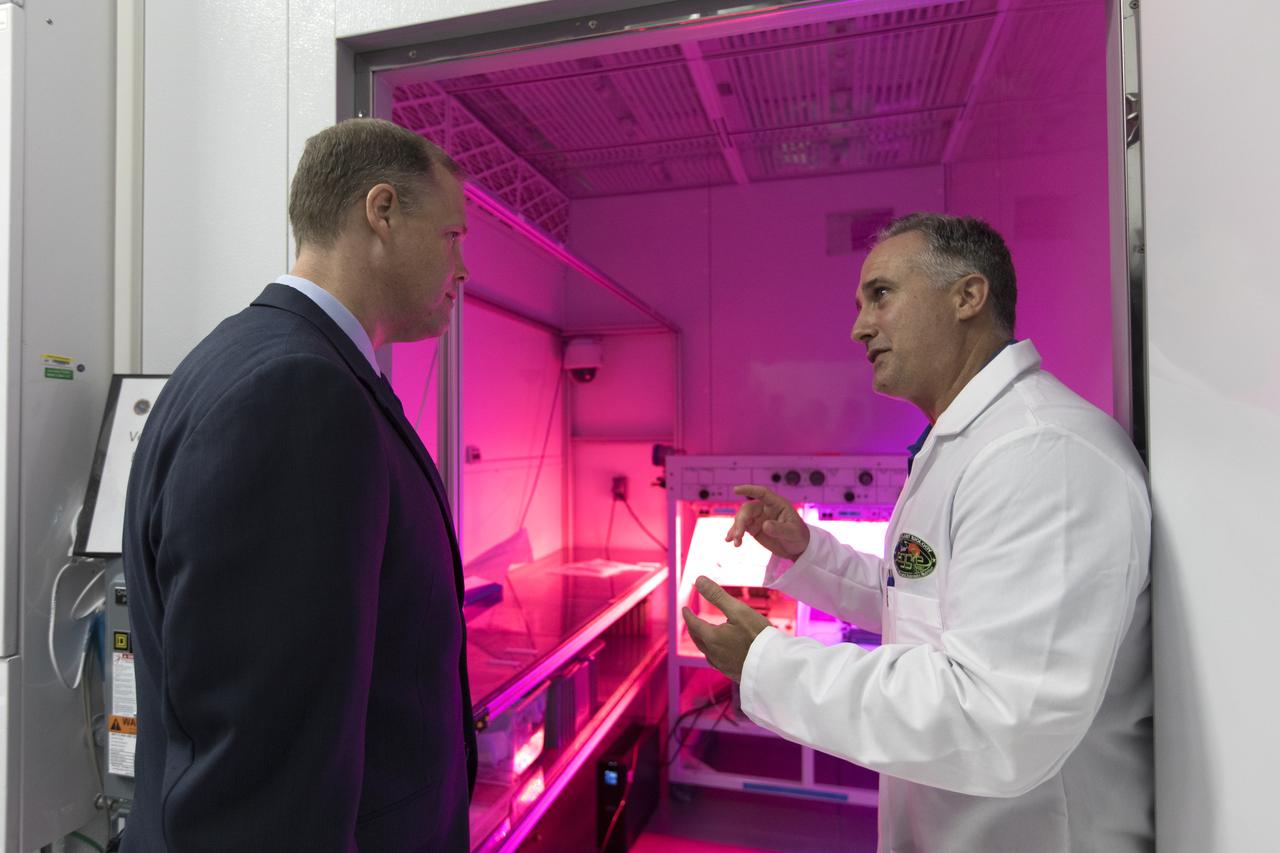
NASA Administrator Jim Bridenstine, at left, tours the Space Station Processing Facility at NASA's Kennedy Space Center in Florida, on Aug. 7, 2018. At right, Trent Smith, Veggie project manager, provides an update on the Veggie plant growth system on the International Space Station, and the control system in the laboratory. Bridenstine also received updates on research and technology accomplishments.

Inside a laboratory in the Space Station Processing Facility at NASA's Kennedy Space Center in Florida, research scientists prepare the science carrier, or base, of the Advanced Plant Habitat (APH) for planting of Arabidopsis seeds, commonly known as thale cress, on Wednesday, May 9. The APH base will be delivered to the International Space Station aboard Orbital ATK's Cygnus spacecraft on the company's ninth Commercial Resupply Services mission for NASA. The APH is the largest plant chamber built for the agency. It is a fully automated plant growth facility that is being used to conduct bioscience research on the space station. Cygnus will launch on Orbital ATK's Antares rocket from Wallops Flight Facility in Wallops Island, Virginia. Launch is targeted for May 20, 2018.
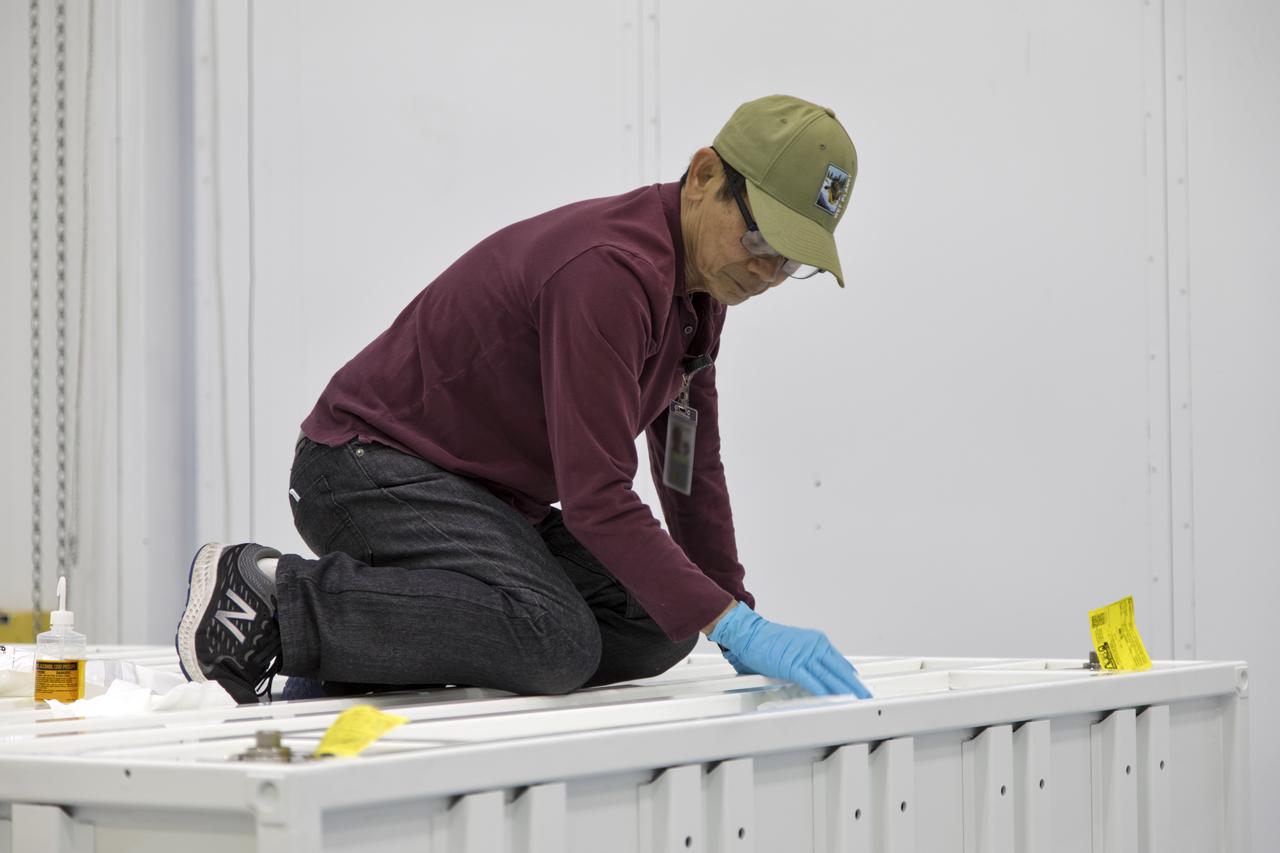
In the Space Station Processing Facility at NASA's Kennedy Space Center in Florida, the ECOsystem Spaceborne Thermal Radiometer Experiment on Space Station (ECOSTRESS) has arrived in its shipping container. The container is being inspected and thoroughly cleaned prior to opening. ECOSTRESS is designed to monitor one of the most basic processes in living plants: the loss of water through the tiny pores in leaves. ECOSTRESS will launch to the International Space Station aboard a Dragon spacecraft launched by a Falcon 9 rocket on the SpaceX CRS-15 mission in June 2018.
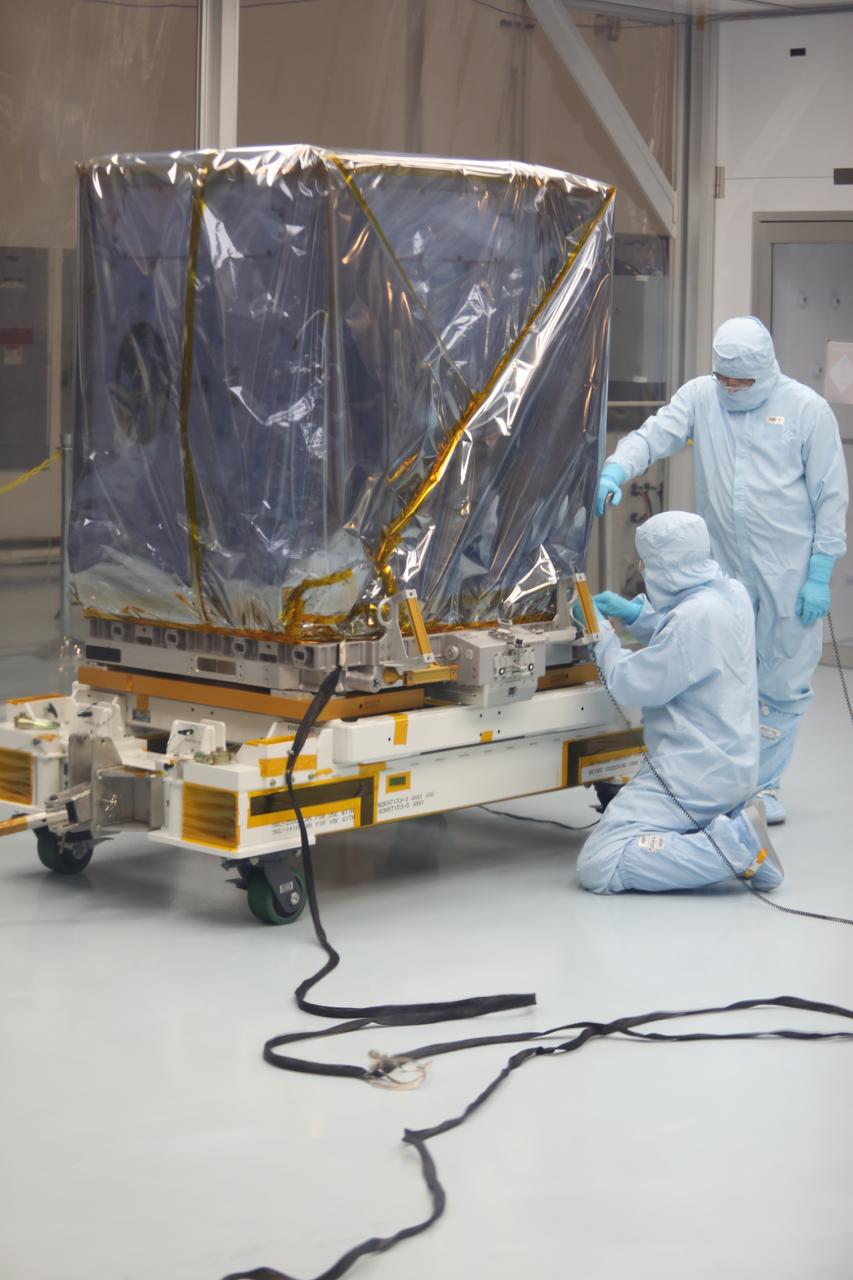
Inside the Space Station Processing Facility high bay at NASA's Kennedy Space Center in Florida, technicians prepare the Neutron star Interior Composition Explorer, or NICER, payload for final packaging. NICER will be delivered to the International Space Station aboard the SpaceX Dragon cargo carrier on the company’s 11th commercial resupply services mission to the space station. NICER will study neutron stars through soft X-ray timing. NICER will enable rotation-resolved spectroscopy of the thermal and non-thermal emissions of neutron stars in the soft X-ray band with unprecedented sensitivity, probing interior structure, the origins of dynamic phenomena and the mechanisms that underlie the most powerful cosmic particle accelerators known.
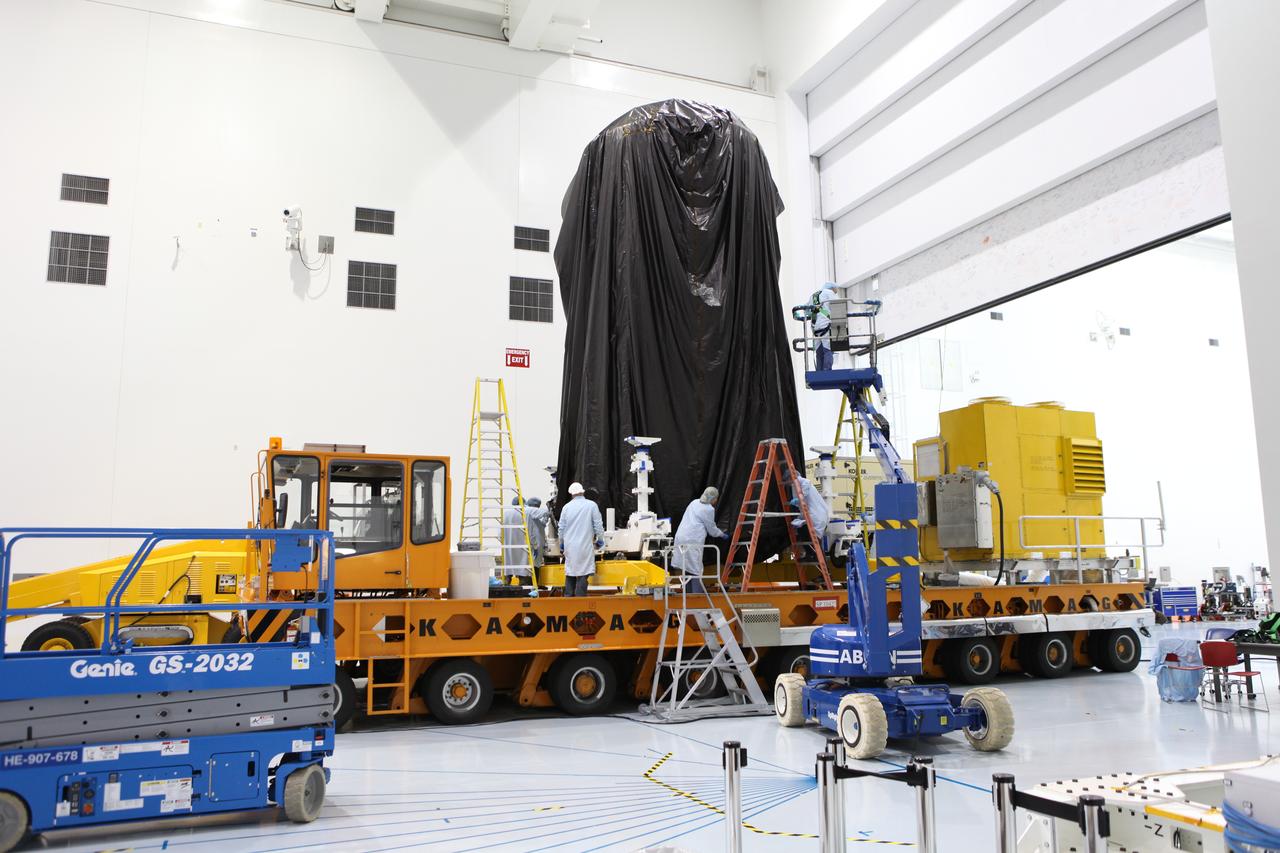
In the Space Station Processing Facility high bay at NASA's Kennedy Space Center in Florida, the Orbital ATK CYGNUS pressurized cargo module is secured the KAMAG transporter and the crane has been removed. Technicians have secured the protective covering around CYGNUS. The module will be transported to the Payload Hazardous Servicing Facility. The Orbital ATK CRS-7 commercial resupply services mission to the International Space Station is scheduled to launch atop a United Launch Alliance Atlas V rocket from Space Launch Complex 41 at Cape Canaveral Air Force Station on March 19, 2017. CYGNUS will deliver thousands of pounds of supplies, equipment and scientific research materials to the space station.
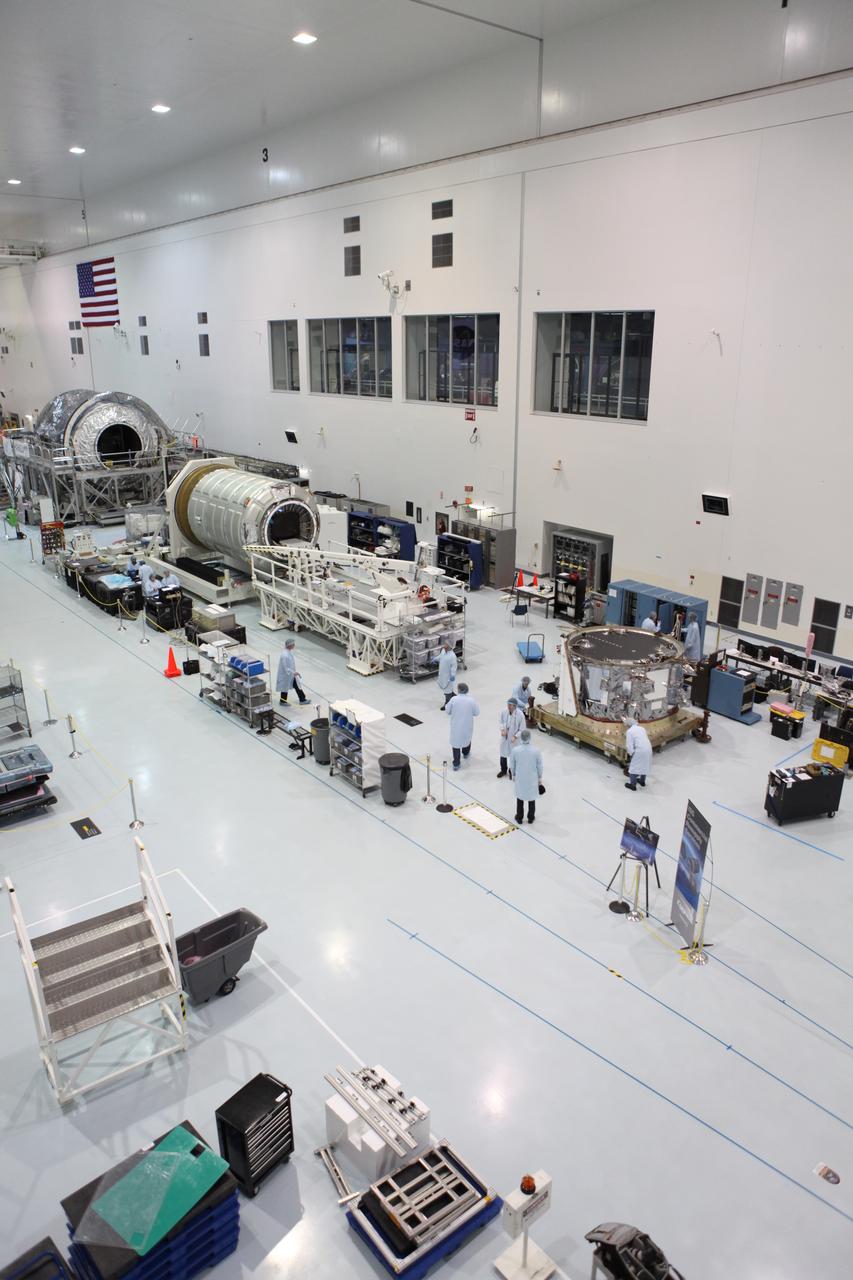
Inside the Space Station Processing Facility at NASA's Kennedy Space Center in Florida, engineers and technicians use a crane to place the Orbital ATK OA-7 Cygnus spacecraft's service module on a test stand. Scheduled to launch on March 19, 2017, the Orbital ATK OA-7 mission will lift off atop a United Launch Alliance Atlas V rocket from Space launch Complex 41 at Cape Canaveral Air Force Station. The commercial resupply services mission to the International Space Station will deliver thousands of pounds of supplies, equipment and scientific research materials that improve life on Earth and drive progress toward future space exploration.
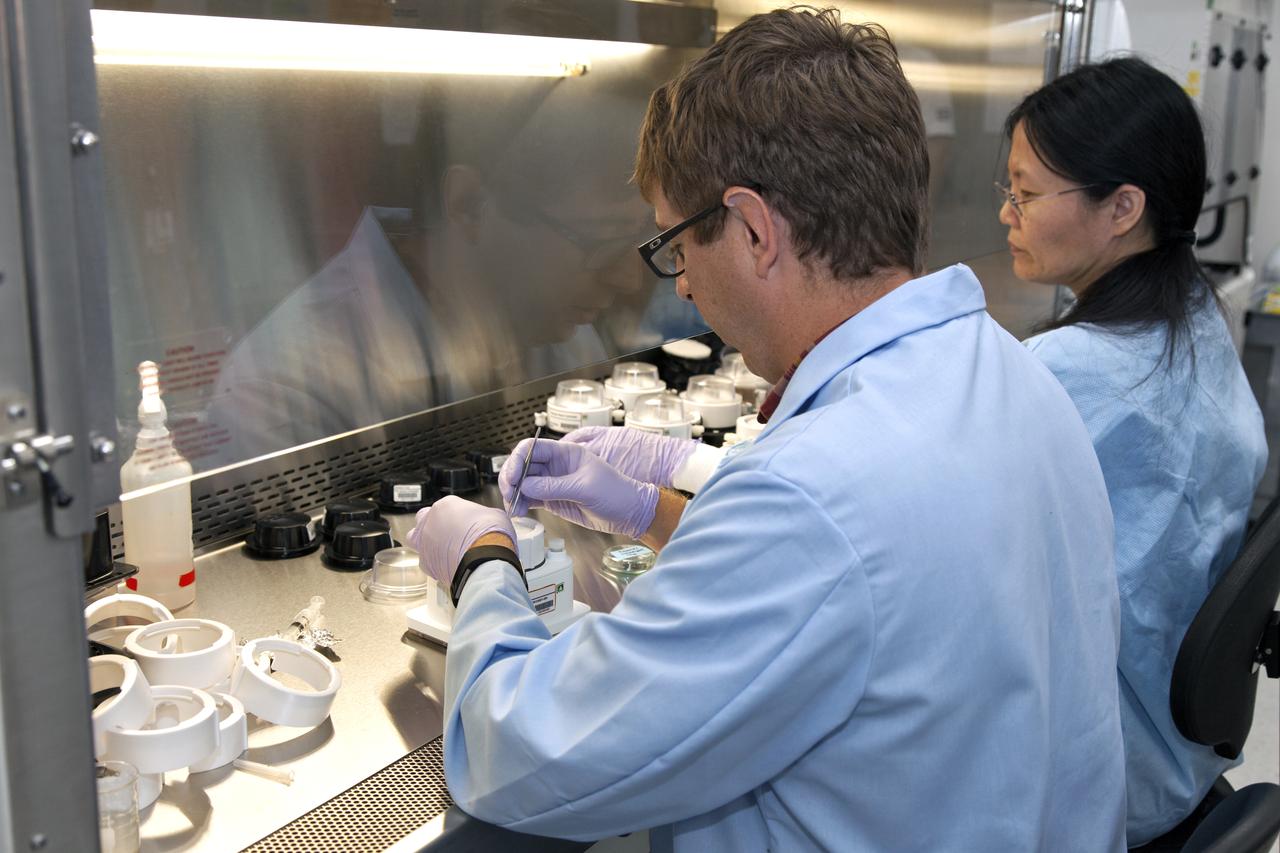
From left, Matthew Romeyn and Dr. Ye Zhang, project scientists, place seeds in Veggie Passive Orbital Nutrient Delivery System (PONDS) units inside a laboratory at the Space Station Processing Facility at NASA’s Kennedy Space Center in Florida. Veggie PONDS is a direct follow-on to the Veg-01 and Veg-03 hardware and plant growth validation tests. The primary goal of this newly developed plant growing system, Veggie PONDS, is to demonstrate uniform plant growth. PONDS units have features that are designed to mitigate microgravity effects on water distribution, increase oxygen exchange and provide sufficient room for root zone growth. PONDS is planned for use during Veg-04 and Veg-05 on the International Space Station after the Veggie PONDS Validation flights on SpaceX-14 and OA-9.
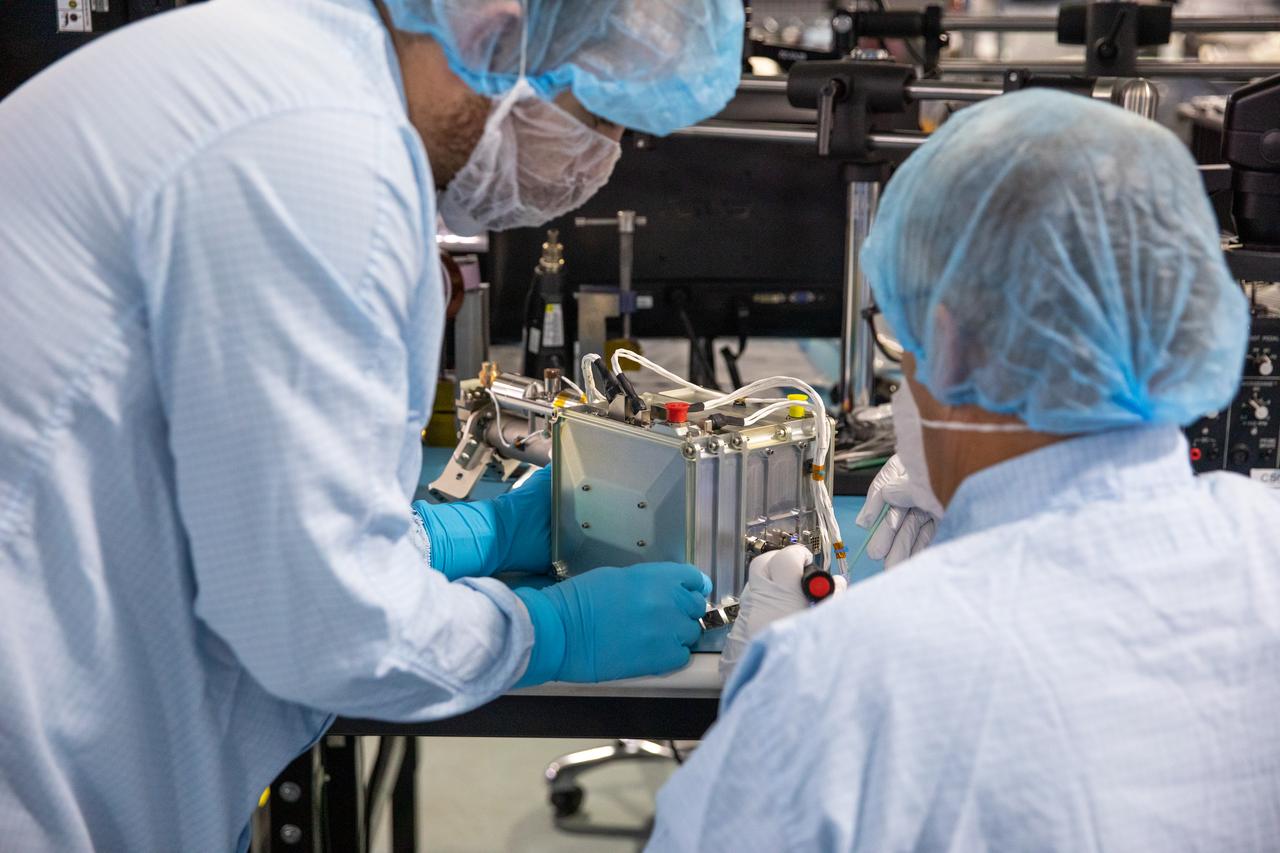
Technicians prepare the Mass Spectrometer Observing Lunar Operations (MSolo) for NASA’s Volatile Investigating Polar Exploration Rover (VIPER) mission for packing inside a laboratory in the Space Station Processing Facility at NASA’s Kennedy Space Center in Florida on Feb. 21, 2023. MSolo will be shipped to Johnson Space Center in Houston for integration into VIPER. MSolo is a commercial off-the-shelf mass spectrometer modified to work in space and it will help analyze the chemical makeup of landing sites on the Moon, as well as study water on the lunar surface. MSolo will be part of NASA’s first Commercial Lunar Payload Delivery Service (CLPS) mission where under the Artemis program, commercial deliveries will be used to perform science experiments, test technologies, and demonstrate capabilities to help NASA explore the Moon and prepare for human missions. VIPER is scheduled to be delivered to the Moon’s South Pole in late 2024 by Astrobotic’s Griffin lander as part of the CLPS initiative.
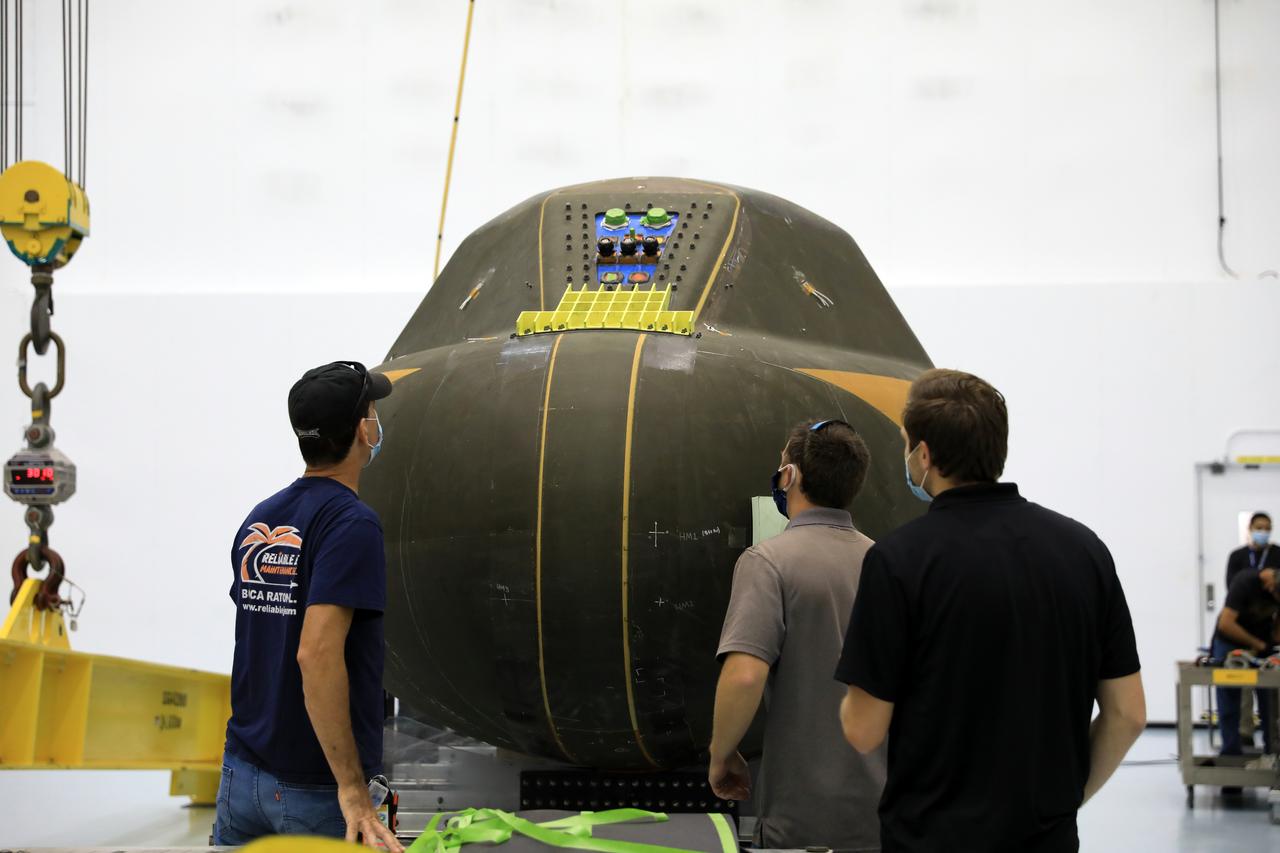
Inside the low bay of the Space Station Processing Facility at NASA’s Kennedy Space Center in Florida, workers monitor the progress as Sierra Nevada Corporation’s (SNC) Dream Chaser pressure test article on its support structure is lowered by crane away from the flatbed truck on June 3, 2020, for its move into the high bay. The test article was shipped from Louisville, Colorado. It is similar to the actual pressurized cabin being used in the Dream Chaser spaceplane for Commercial Resupply Services-2 (CRS-2) missions. NASA selected Dream Chaser to provide cargo delivery, return and disposal service for the International Space Station under the CRS-2 contract. The test article will remain at Kennedy while SNC engineers use it to develop and verify refurbishment operations that will be used on Dream Chaser between flights.
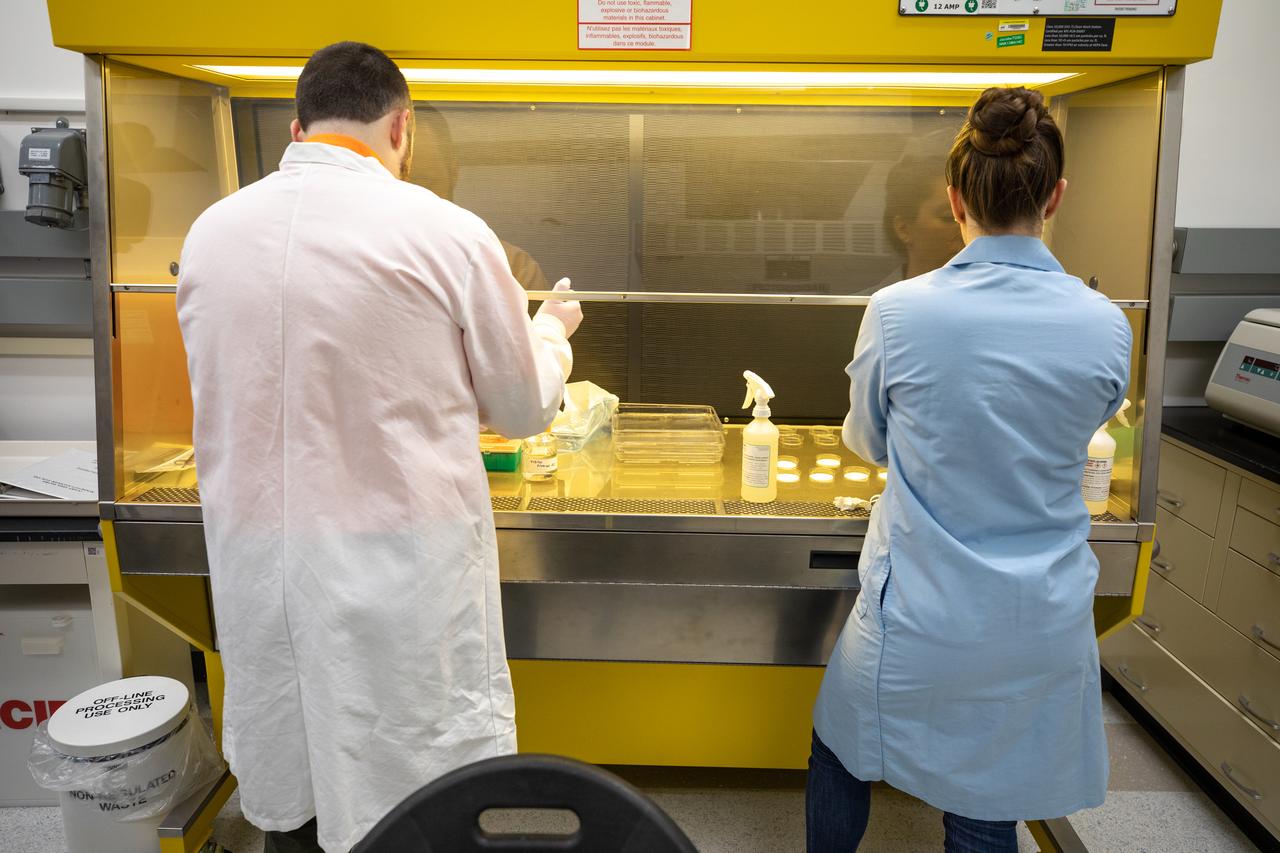
Aaron Curry, left, a research scientist with the Laboratory Support Services and Operations (LASSO) contract, and Jess Bunchek, a pseudonaut and associate scientist at NASA’s Kennedy Space Center in Florida, are preparing a new seed handling material for testing inside the Space Station Processing Facility on Jan. 15, 2020. The new material, called seed film, and similar in appearance to a breath freshener strip, is a water-soluble, dissolving film that addresses the challenge of handling seeds in a microgravity environment. The seed film experiment, titled VEG-03 J, involves sending seed film containing red romaine lettuce seeds to the International Space Station and monitoring the plant’s growth in space. As part of the experiment, crew onboard the orbiting laboratory will plant the seeds into plant pillows – a common method used to grow plants in the space station – themselves for the first time ever. VEG-03 J will launch aboard a Northrop Grumman Antares rocket and Cygnus spacecraft on the company’s 13th resupply services mission. Liftoff is scheduled for Feb. 9, 2020, at 5:39 p.m. EST from the agency’s Wallops Flight Facility in Virginia.
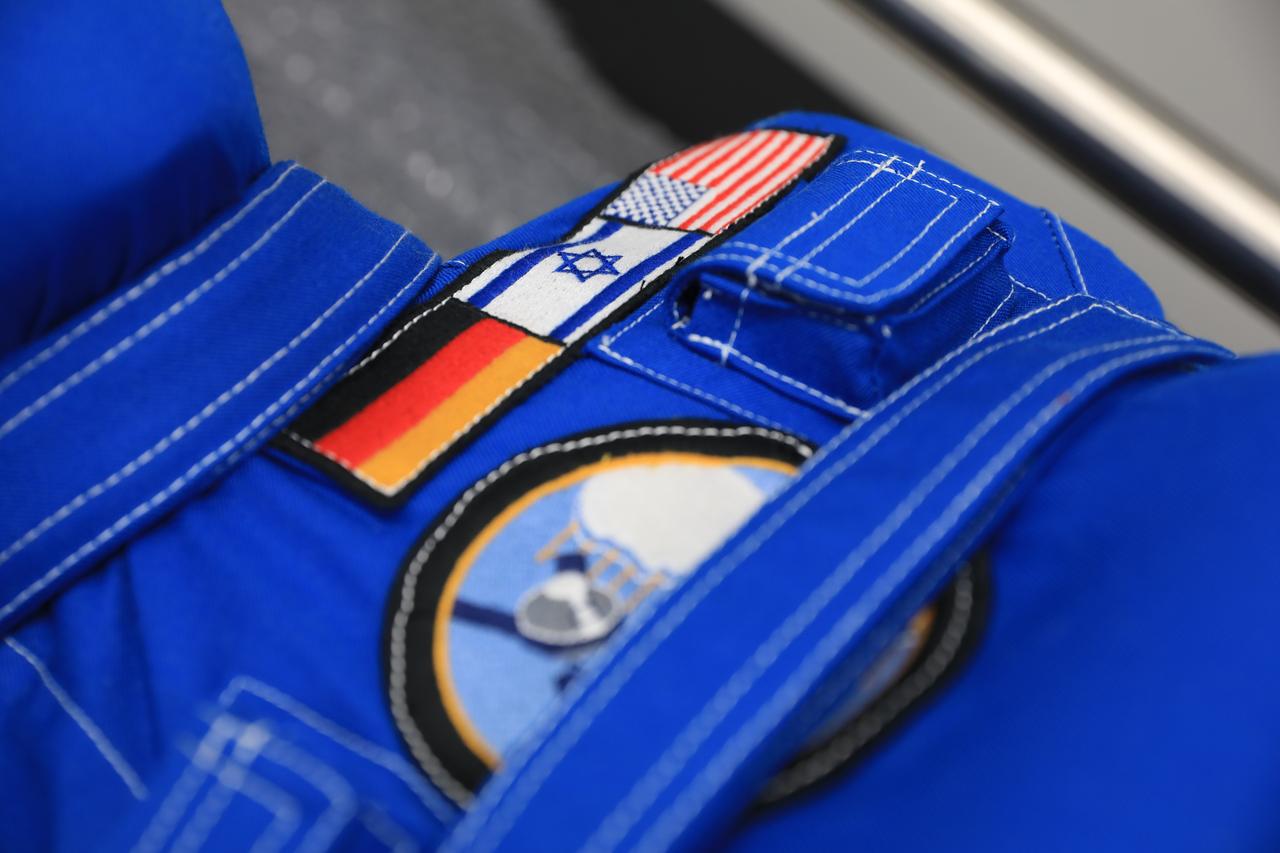
In preparation for the Artemis I flight test, teams at NASA’s Kennedy Space Center in Florida prepare two manikins, called phantoms, as part of the Matroshka AstroRad Radiation Experiment (MARE) investigation on Aug. 4, 2022. The two female phantoms – Helga and Zohar – will fly aboard the Orion crew module during Artemis I. Each will be equipped with radiation detectors, with Zohar also wearing a radiation protection vest, to determine the radiation risk on its way to the Moon. The MARE experiment is part of an agreement between NASA, the Israel Space Agency, and the German Aerospace Center. Artemis I will provide a foundation for human deep space exploration and demonstrate NASA’s capability to extend human presence to the Moon and beyond. The primary goal of Artemis I is to thoroughly test the Space Launch System rocket and Orion spacecraft’s integrated systems before crewed missions. Under Artemis, NASA aims to land the first woman and first person of color on the Moon and establish sustainable lunar exploration.
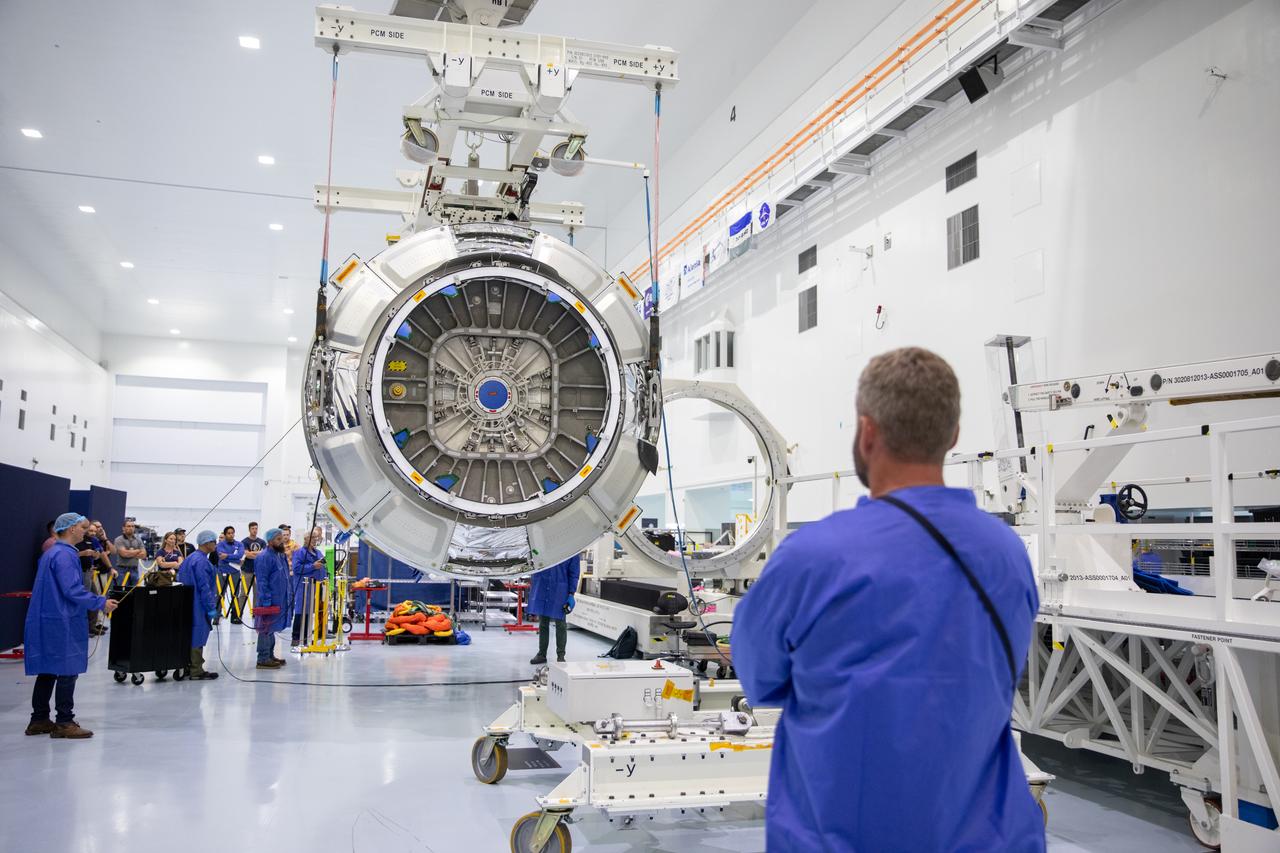
The Northrop Grumman Cygnus spacecraft’s pressurized cargo module (PCM) for the company’s 20th commercial resupply mission is lifted and moved by crane inside the high bay in the Space Station Processing Facility at NASA’s Kennedy Space Center in Florida on Monday, Sept. 18, 2023. The next step is vehicle processing for the mission to the International Space Station. Liftoff, aboard a SpaceX Falcon 9 rocket, will be from Cape Canaveral Space Force Station’s Space Launch Complex 40.
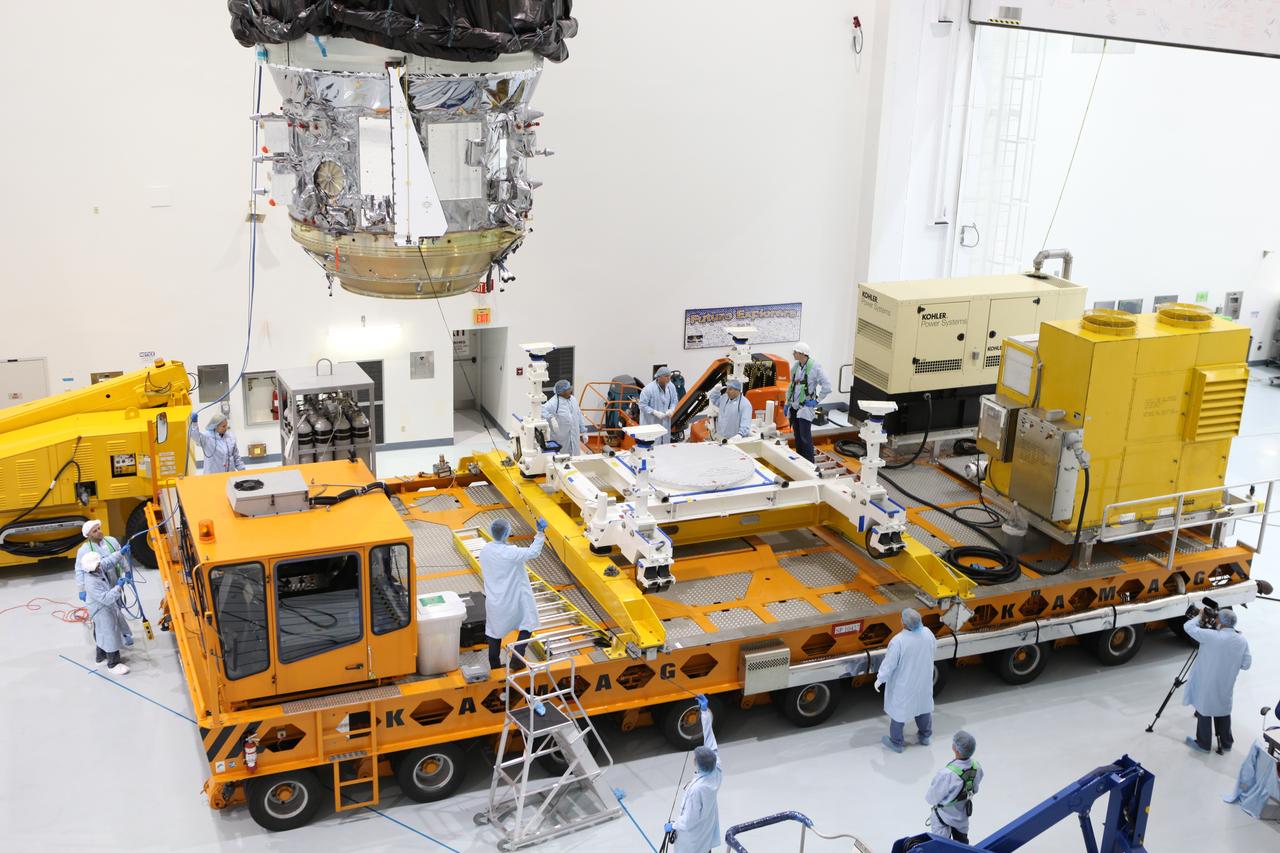
In the Space Station Processing Facility high bay at NASA's Kennedy Space Center in Florida, technicians monitor the progress as a crane moves the Orbital ATK CYGNUS pressurized cargo module closer to the KAMAG transporter. The module will be secured on the transporter and moved to the Payload Hazardous Servicing Facility. The Orbital ATK CRS-7 commercial resupply services mission to the International Space Station is scheduled to launch atop a United Launch Alliance Atlas V rocket from Space Launch Complex 41 at Cape Canaveral Air Force Station on March 19, 2017. CYGNUS will deliver thousands of pounds of supplies, equipment and scientific research materials to the space station.
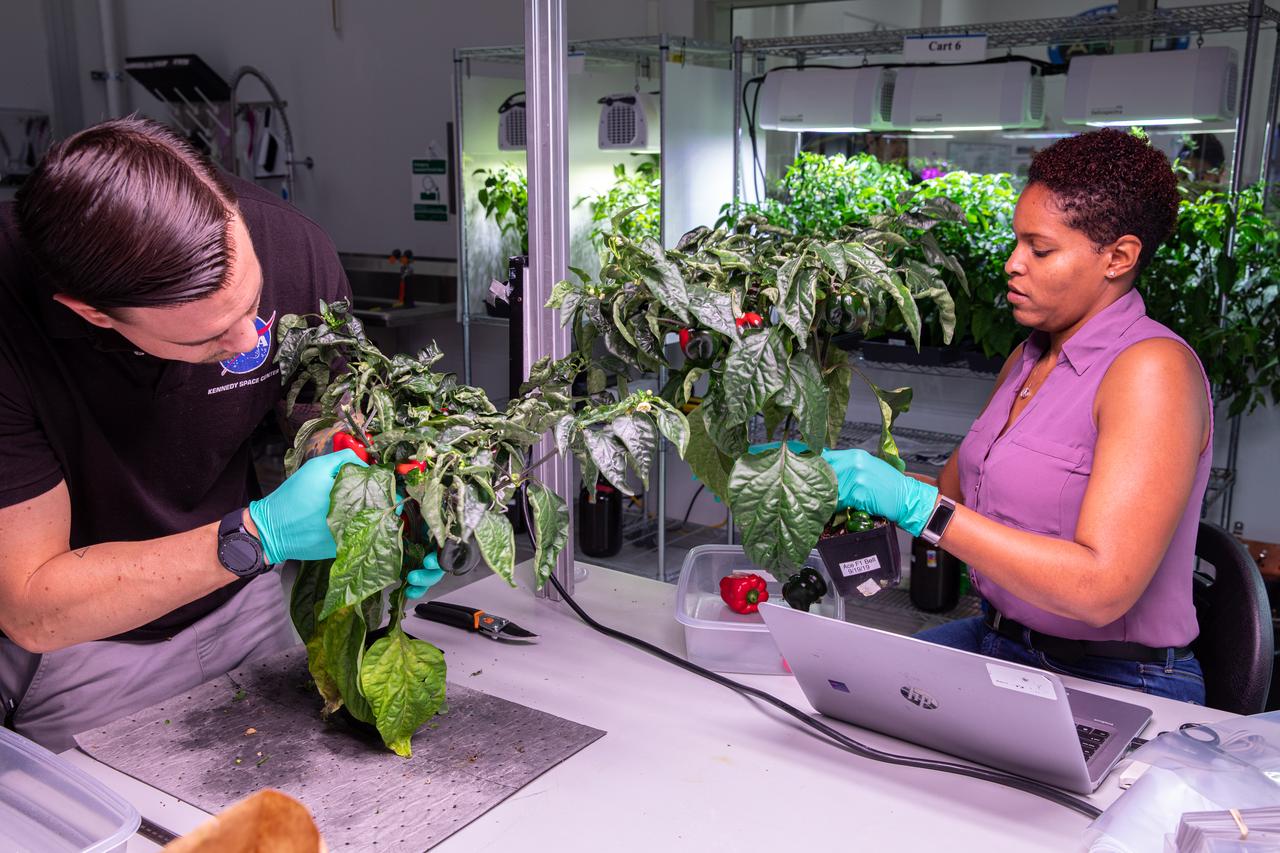
Jason Fischer (left), a research scientist, and Lashelle Spencer, a plant scientist, with the Laboratory Support Services and Operations contract at NASA’s Kennedy Space Center in Florida, harvest peppers from pepper plants on Jan. 15, 2020, that were grown in the Space Station Processing Facility for a growth assessment test in preparation for sending them to space. As NASA prepares to send humans beyond low-Earth orbit, the ability for astronauts to grow a variety of fresh fruits and vegetables in space will be critical. Fresh produce will be an essential supplement to the crew’s pre-packaged diet during long-duration space exploration when they are away from Earth for extended periods of time.
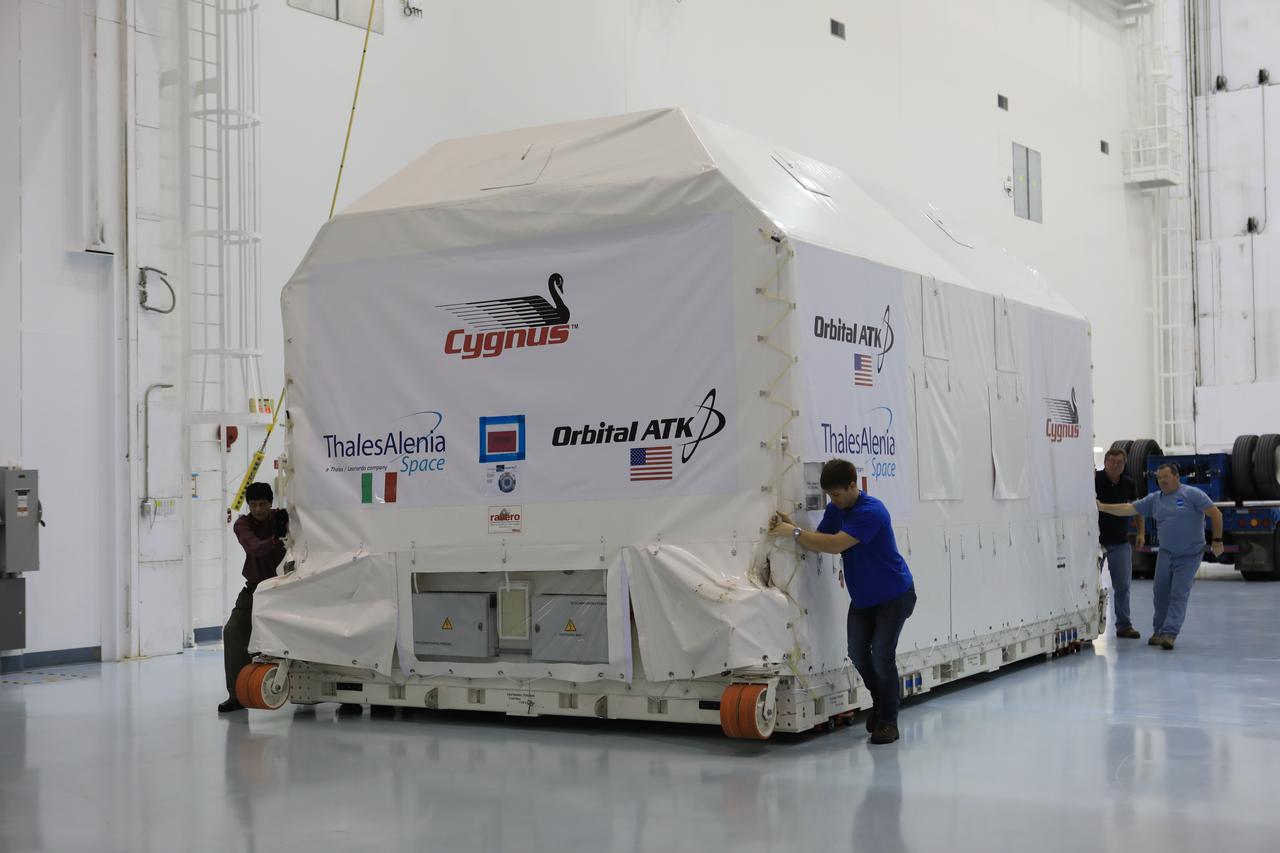
Inside an environmentally controlled shipping container the Orbital ATK OA-7 Cygnus spacecraft's pressurized cargo module (PCM) moves from an airlock to the high bay of the Space Station Processing Facility of NASA's Kennedy Space Center in Florida. Scheduled to launch on March 19, 2017, the Orbital ATK OA-7 mission will lift off atop a United Launch Alliance Atlas V rocket from Space launch Complex 41 at Cape Canaveral Air Force Station. The commercial resupply services mission to the International Space Station will deliver thousands of pounds of supplies, equipment and scientific research materials that improve life on Earth and drive progress toward future space exploration.
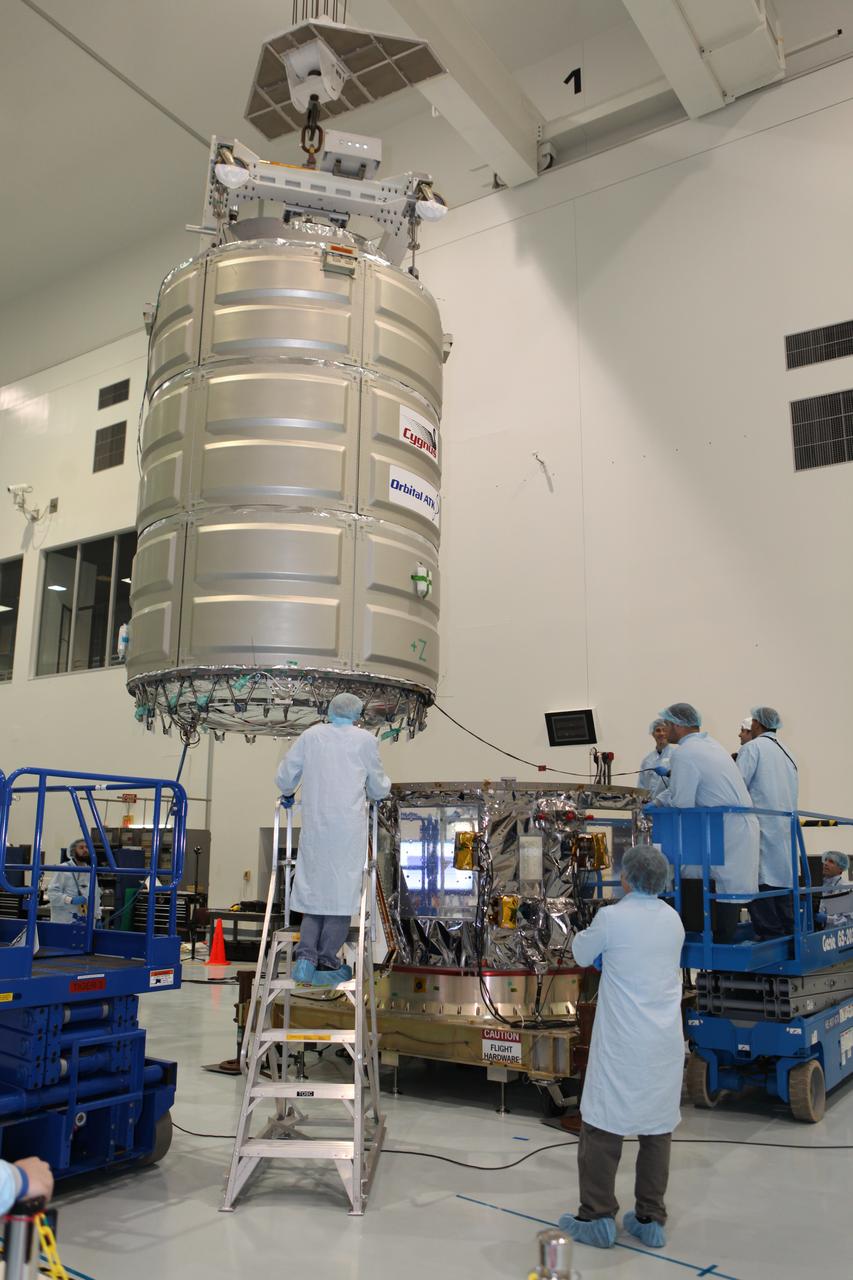
In the Space Station Processing Facility at NASA's Kennedy Space Center in Florida, technicians and engineers use a crane to move a Cygnus spacecraft's pressurized cargo module for mating to its service module. Cygnus is being prepared to deliver thousands of pounds of supplies, equipment and scientific research materials on the Orbital ATK CRS-7 mission to the International Space Station. Scheduled to launch on March 19, 2017, the commercial resupply services mission will lift off atop a United Launch Alliance Atlas V rocket from Space launch Complex 41 at Cape Canaveral Air Force Station.
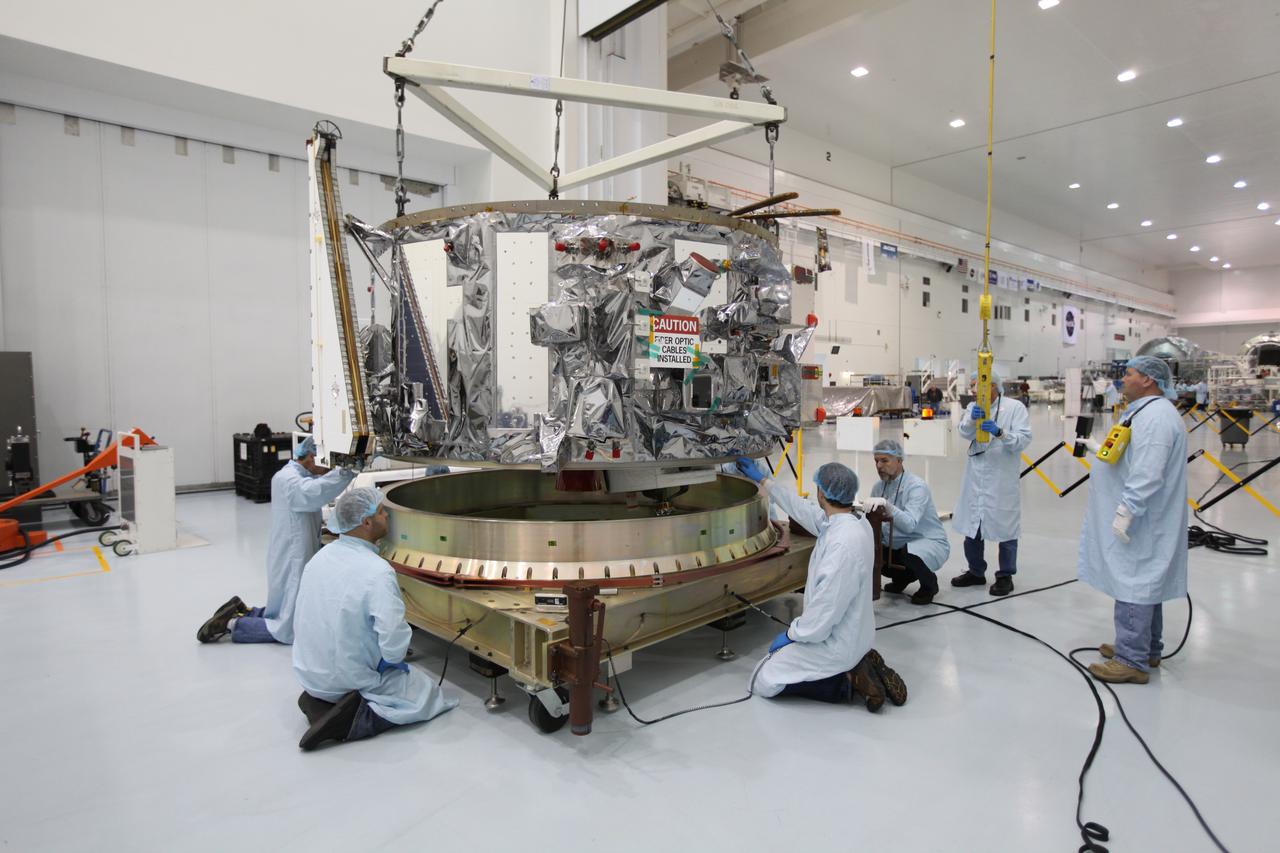
Inside the Space Station Processing Facility at NASA's Kennedy Space Center in Florida, engineers and technicians use a crane to place the Orbital ATK OA-7 Cygnus spacecraft's service module on a test stand. Scheduled to launch on March 19, 2017, the Orbital ATK OA-7 mission will lift off atop a United Launch Alliance Atlas V rocket from Space launch Complex 41 at Cape Canaveral Air Force Station. The commercial resupply services mission to the International Space Station will deliver thousands of pounds of supplies, equipment and scientific research materials that improve life on Earth and drive progress toward future space exploration.
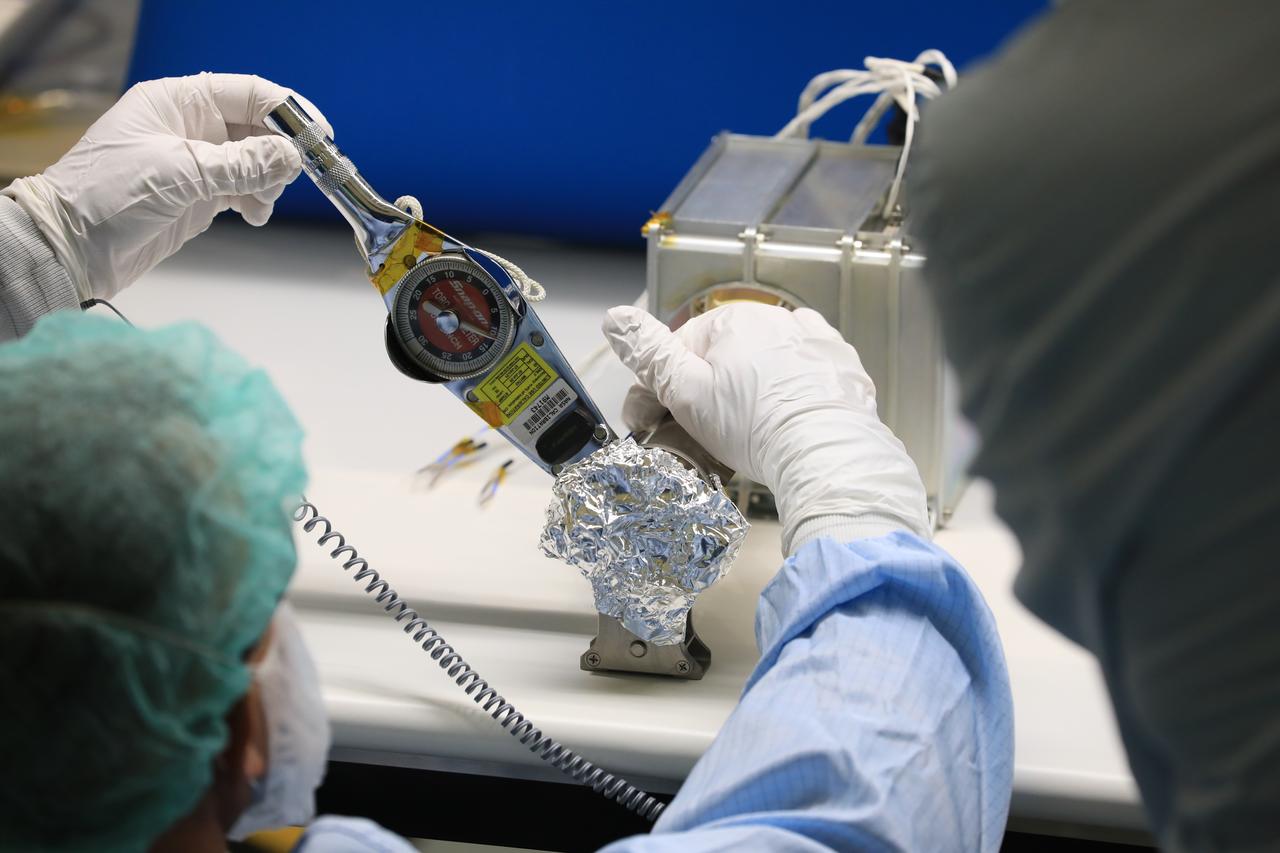
Engineers and technicians at NASA’s Kennedy Space Center in Florida work with instruments for Mass Spectrometer observing lunar operations (MSolo) inside the Space Station Processing on Sept. 25, 2020. MSolo is a commercial off-the-shelf mass spectrometer modified to work in space and it will help analyze the chemical makeup of landing sites on the Moon, as well as study water on the lunar surface. This work is preparing MSolo hardware for a robotic mission as part of the Commercial Lunar Payload Services (CLPS) launching to exploring Lacus Mortis, a large crater on the near side of the Moon in 2021. A future mission will send a mobile robot named the Volatiles Investigating Polar Exploration Rover (VIPER) to the Moon to prospect for water. VIPER will have several instruments that will allow it to detect and sample water including MSolo, the Neutron Spectrometer System, the Near Infrared Volatiles Spectrometer System and The Regolith and Ice Drill for Exploring New Terrain (TRIDENT).
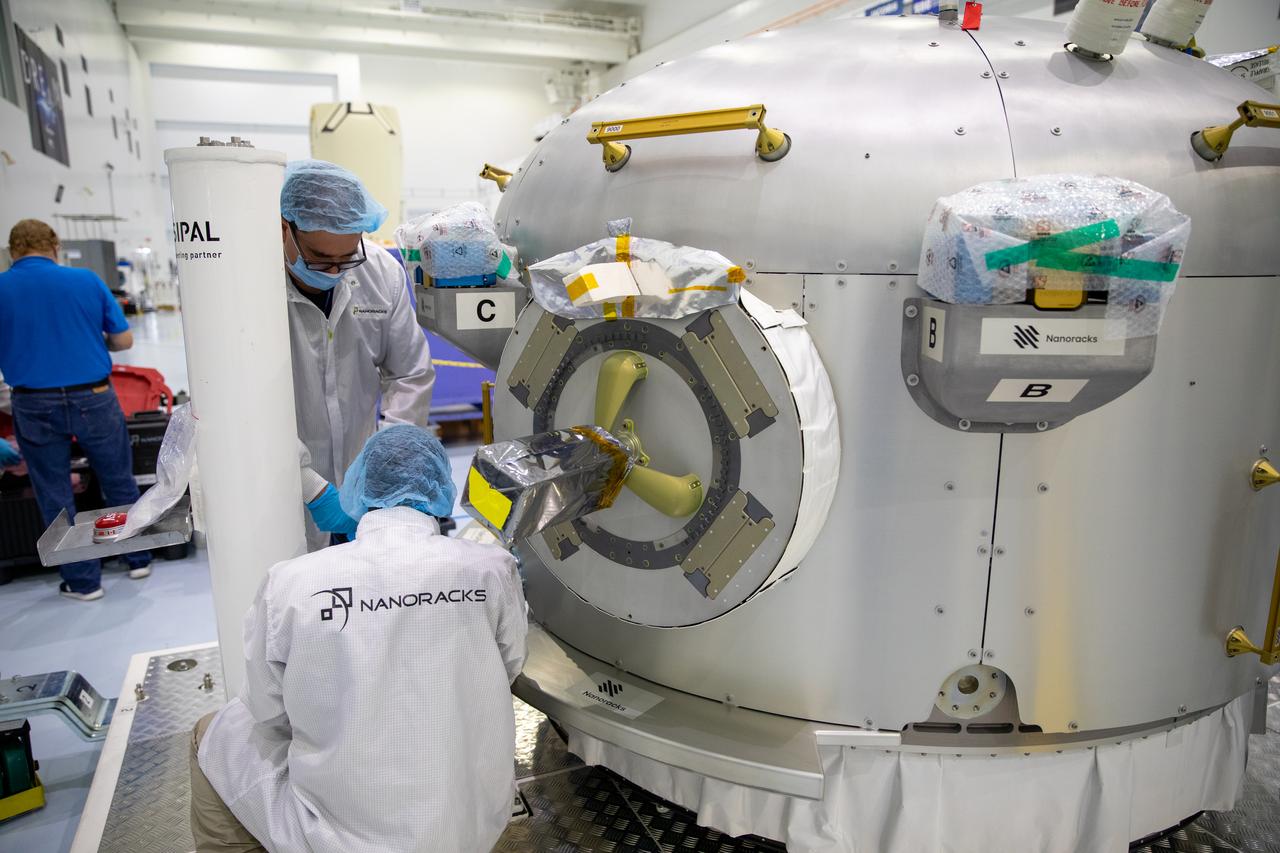
Nanoracks technicians work on the NanoRacks Bishop Airlock inside the Space Station Processing Facility at NASA's Kennedy Space Center in Florida on Sept. 29, 2020. The next-generation Nanoracks payload facility is being prepared for its flight to the International Space Station on SpaceX’s 21st commercial resupply services mission (CRS-21) to the International Space Station. The Bishop Airlock is the first commercially funded airlock for the space station. It will provide payload hosting, robotics testing, satellite deployment, serve as an outside toolbox for station crew spacewalks, and more. CRS-21 is scheduled to launch on a SpaceX Falcon 9 rocket no earlier than November from Launch Complex 39A at Kennedy Space Center.

Jeffrey Richards, a project science coordinator with URS Federal Services, uses a fixative to secure Arabidopsis seeds, commonly known as thale cress, in the science carrier, or base, of the Advanced Plant Habitat (APH) inside a laboratory in the Space Station Processing Facility at NASA's Kennedy Space Center in Florida on Wednesday, May 9. The APH base will be delivered to the International Space Station aboard Orbital ATK's Cygnus spacecraft on the company's ninth Commercial Resupply Services mission for NASA. The APH is the largest plant chamber built for the agency. It is a fully automated plant growth facility that is being used to conduct bioscience research on the space station. Cygnus will launch on Orbital ATK's Antares rocket from Wallops Flight Facility in Wallops Island, Virginia. Launch is targeted for May 20, 2018.
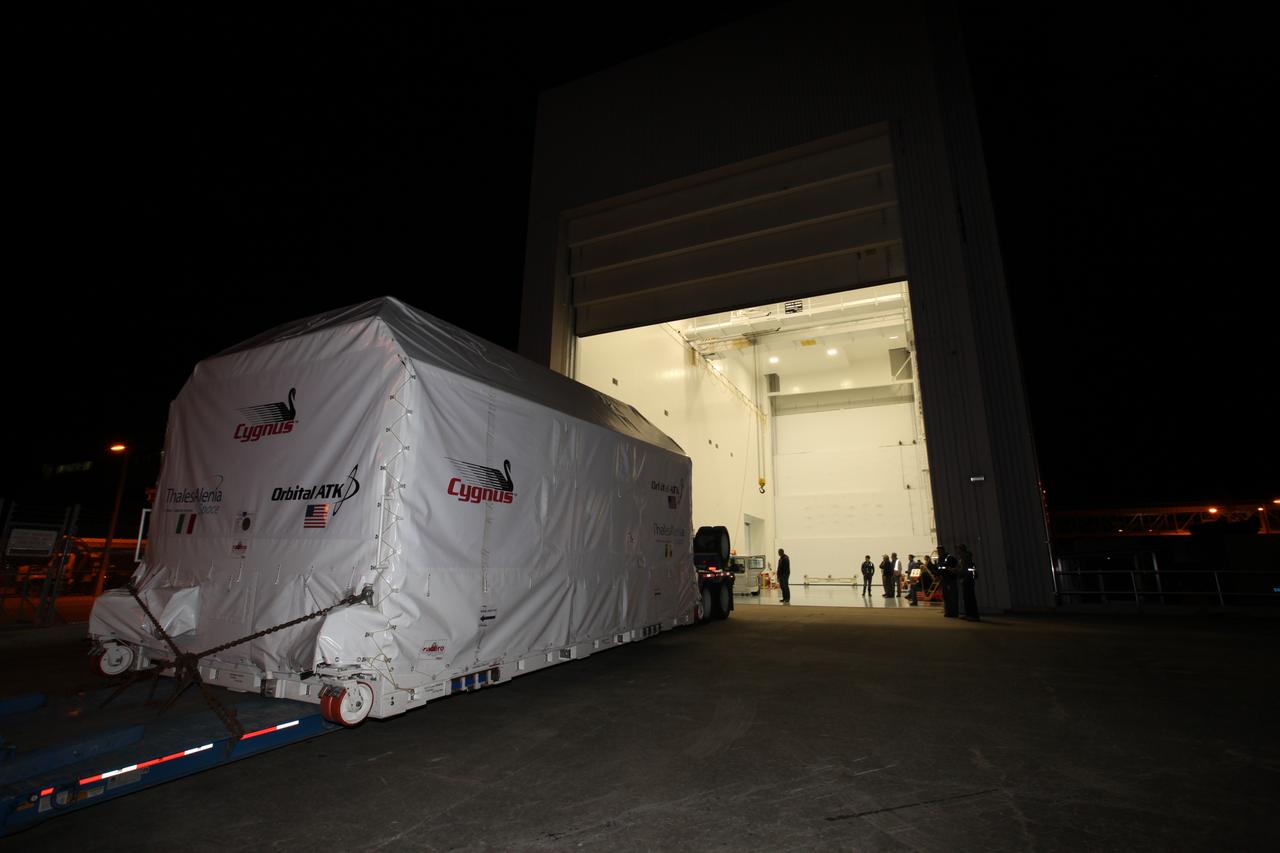
The Orbital ATK OA-7 Cygnus spacecraft's pressurized cargo module (PCM) arrives at the Space Station Processing Facility of NASA's Kennedy Space Center in Florida. The PCM is sealed in an environmentally controlled shipping container, pulled in by truck on a low-boy flatbed trailer. Scheduled to launch in March 2017, the Orbital ATK OA-7 mission will lift off atop a United Launch Alliance Atlas V rocket from Space launch Complex 41 at Cape Canaveral Air Force Station. The commercial resupply services mission to the International Space Station will deliver thousands of pounds of supplies, equipment and scientific research materials that improve life on Earth and drive progress toward future space exploration.
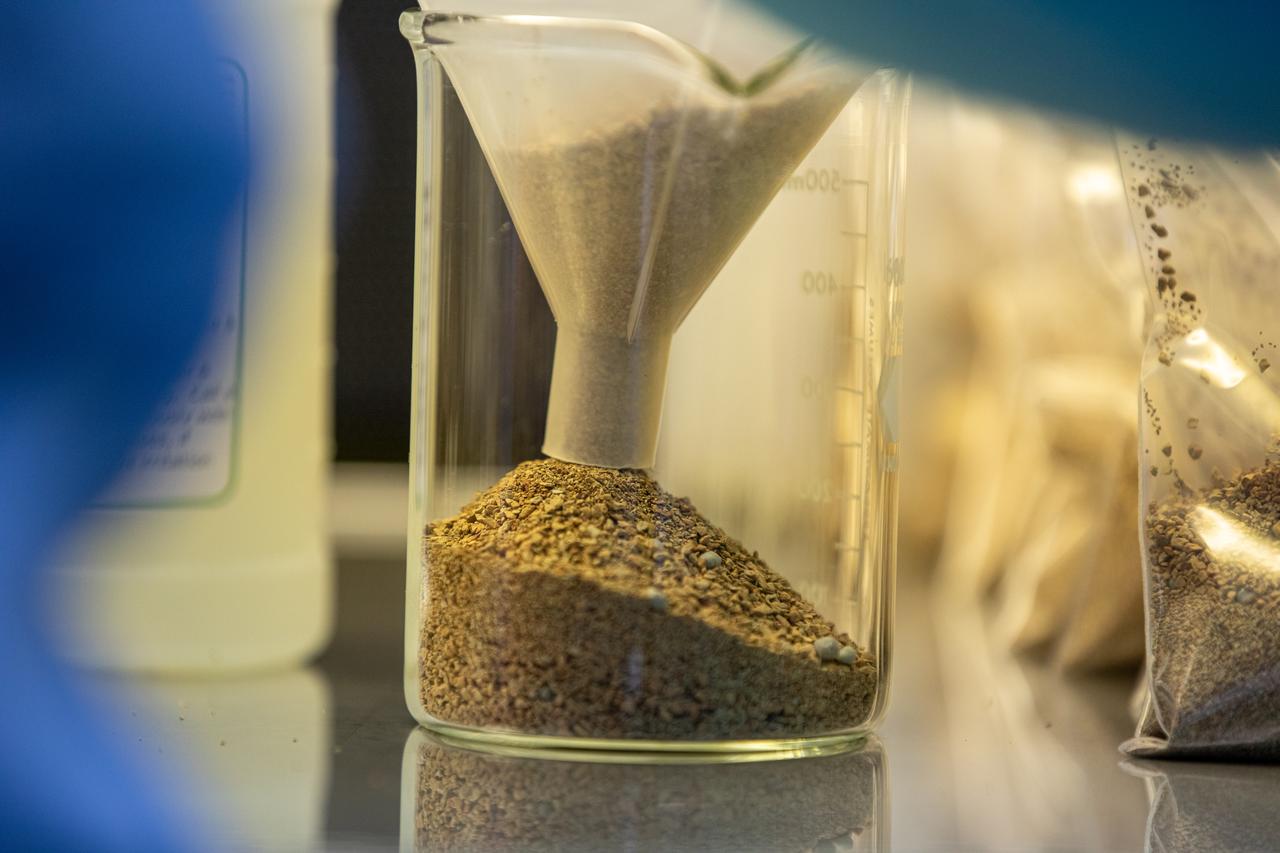
Inside the Space Station Processing Facility at NASA’s Kennedy Space Center in Florida, a researcher measures out the calcined clay that will be used to assemble plant pillows on Jan. 16, 2019. Often used to condition baseball infields, the clay’s size and roughness traps air and absorbs water to provide both to plant roots in microgravity. The pillows are small containers used to grow plants in space aboard the International Space Station. These pillows are for a series of plant experiments called VEG-03 J/K/L that will monitor the growth of three types of leafy greens and test a new way of handling seeds. The experiments will be launched to the orbiting laboratory aboard a Northrop Grumman Antares rocket and Cygnus spacecraft on the company’s 13th resupply services mission. Liftoff is scheduled for Feb. 9, 2020, at 5:39 p.m. EST from the agency’s Wallops Flight Facility in Virginia.
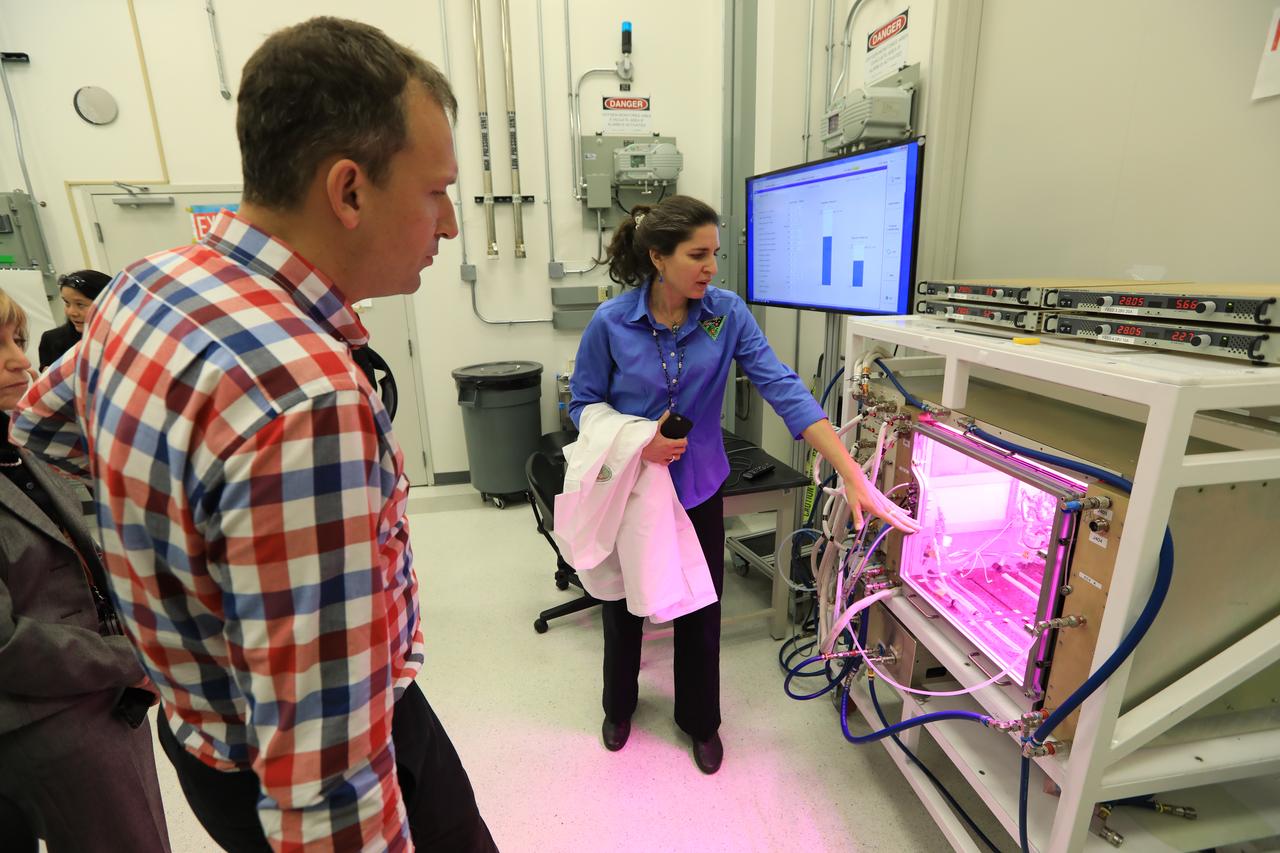
While touring the Space Station Processing Facility at NASA's Kennedy Space Center in Florida, Thomas Zurbuchen, in plaid shirt, NASA's associate administrator for the Science Mission Directorate, learns about the advanced plant habitat used to grow plants in space.
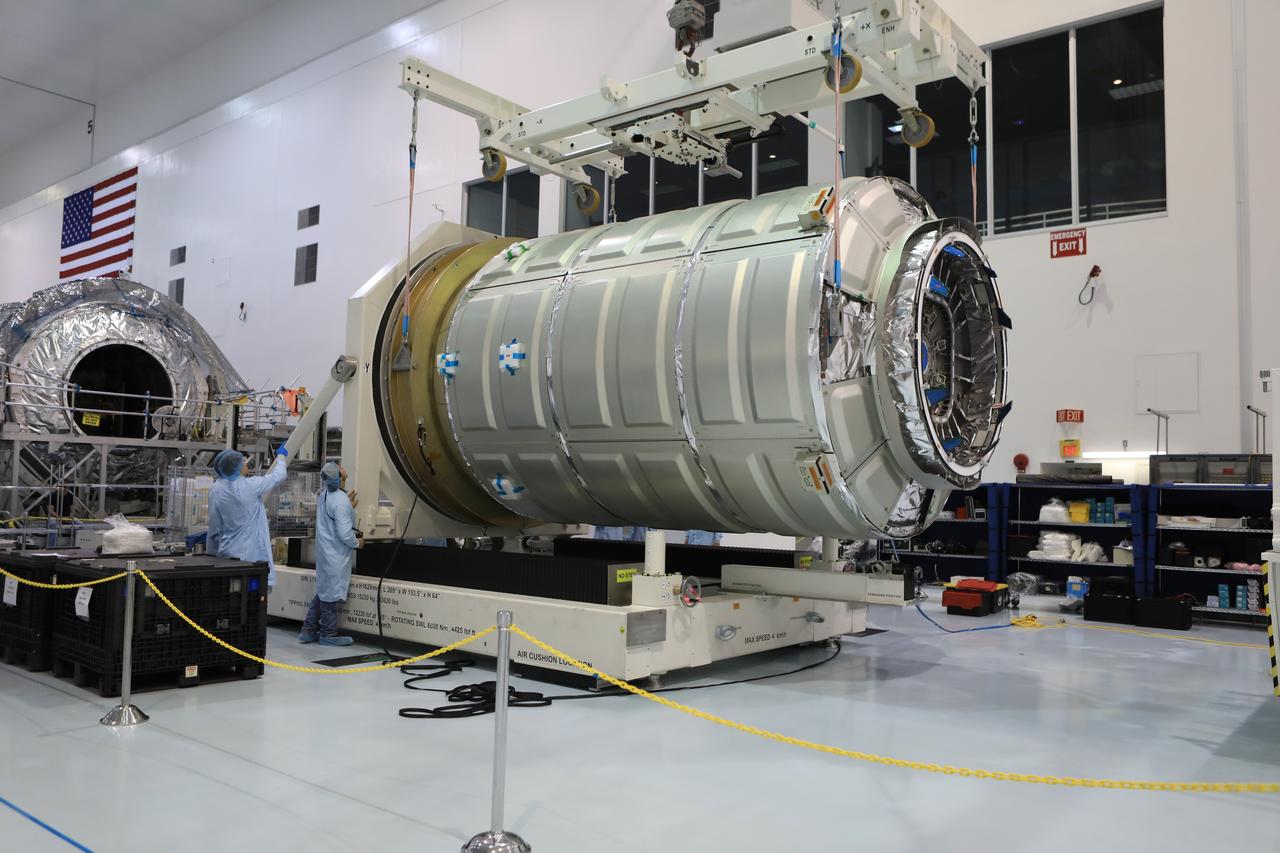
Engineers and technicians at NASA's Kennedy Space Center in Florida move the Orbital ATK OA-7 Cygnus spacecraft's pressurized cargo module (PCM) to a test stand inside the high bay of the Space Station Processing Facility. Scheduled to launch on March 19, 2017, the Orbital ATK OA-7 mission will lift off atop a United Launch Alliance Atlas V rocket from Space launch Complex 41 at Cape Canaveral Air Force Station. The commercial resupply services mission to the International Space Station will deliver thousands of pounds of supplies, equipment and scientific research materials that improve life on Earth and drive progress toward future space exploration.
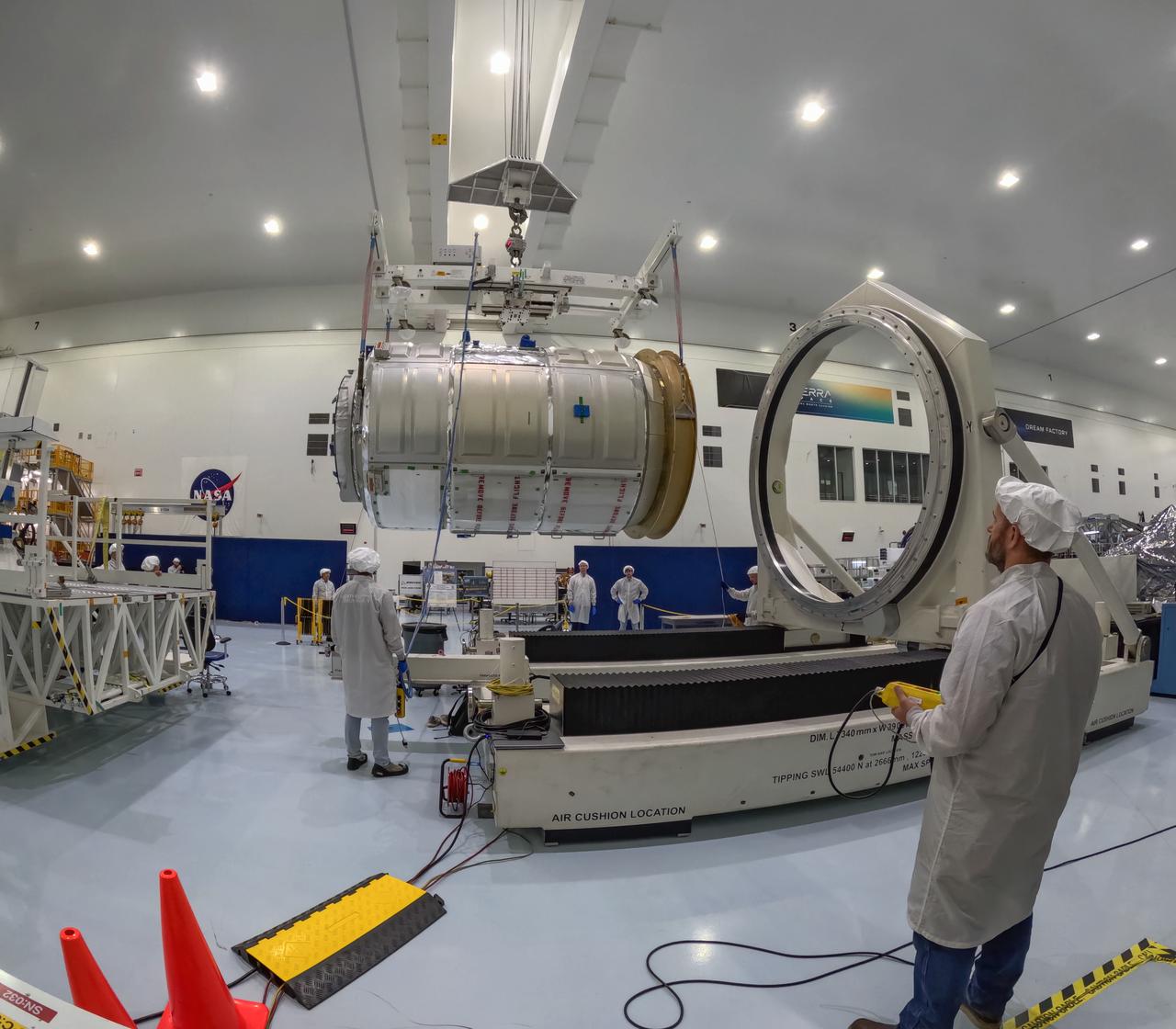
The Northrop Grumman Cygnus spacecraft’s pressurized cargo module for the company’s 21st commercial resupply mission is lifted and moved by a crane inside the Space Systems Processing Facility at NASA’s Kennedy Space Center in Florida on Saturday, June 1, 2024, as prelaunch processing operations continue. The Cygnus spacecraft will launch to the International Space Station aboard a SpaceX Falcon 9 rocket from Space Launch Complex 40 at Cape Canaveral Space Force Station.
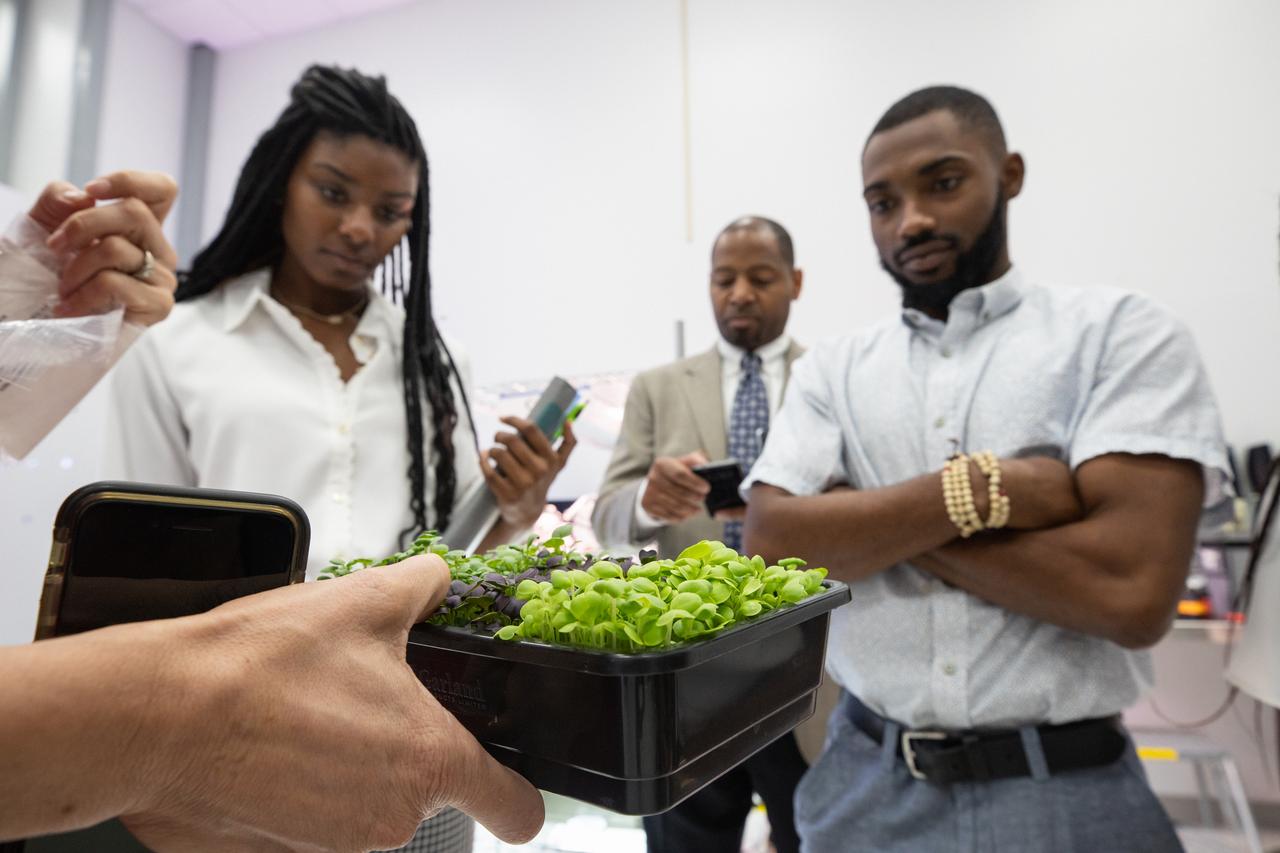
Langston University students Courtney Miller, left, and Sherman Cravens participate in a hands-on experience inside a Space Station Processing Facility lab at Kennedy Space Center on Sept. 18, 2019. Miller and Cravens were part of a tour of the Florida spaceport organized by Byron Quinn (background), Ph.D., Langston University director of the Science Research Institute, and NASA’s Office of Education. The Kennedy visit included stops at SwampWorks, the Neil Armstrong Operations and Checkout Building, the Vehicle Assembly Building, the visitor complex and the Center for Space Education.
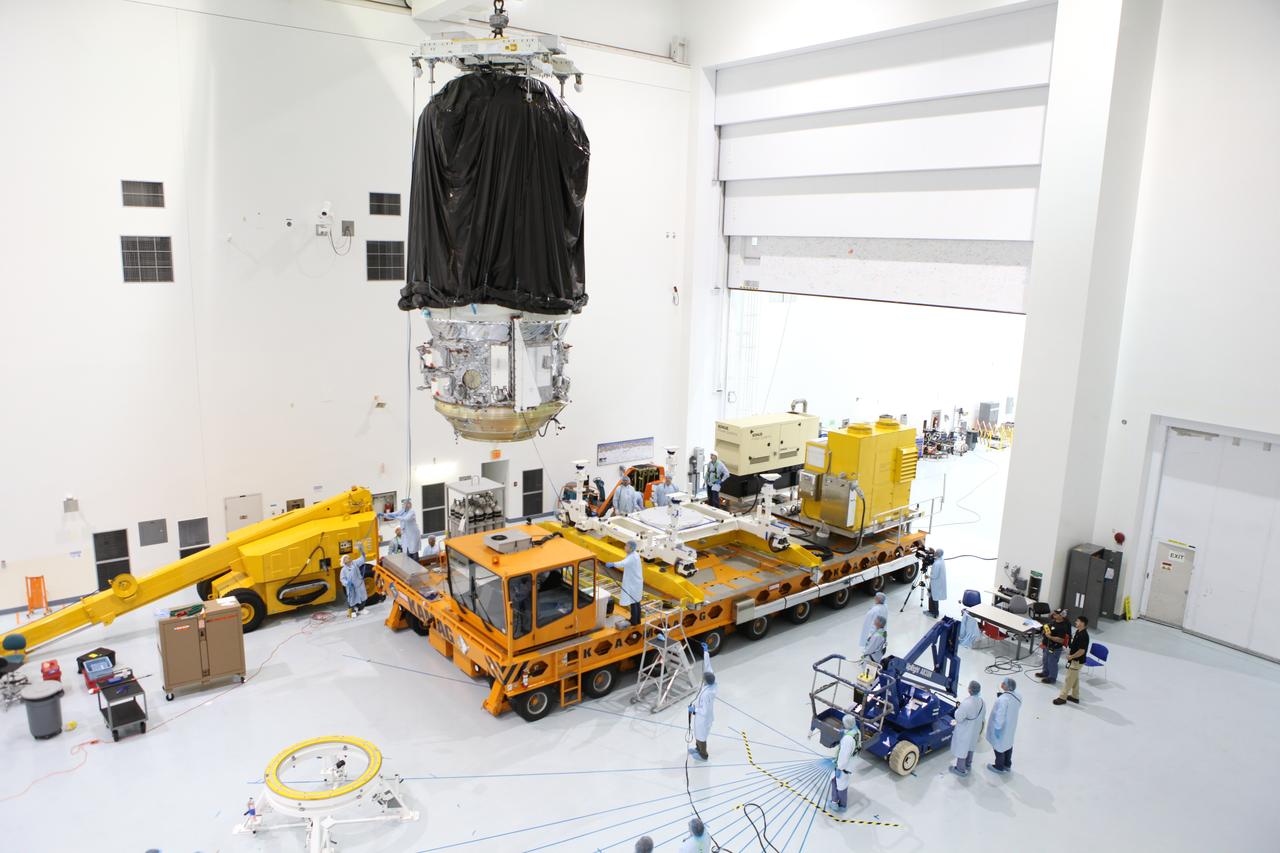
In the Space Station Processing Facility at NASA's Kennedy Space Center in Florida, a crane moves the Orbital ATK CYGNUS pressurized cargo module to the KAMAG transporter. The module will be secured on the transporter and moved to the Payload Hazardous Servicing Facility. The Orbital ATK CRS-7 commercial resupply services mission to the International Space Station is scheduled to launch atop a United Launch Alliance Atlas V rocket from Space Launch Complex 41 at Cape Canaveral Air Force Station on March 19, 2017. CYGNUS will deliver thousands of pounds of supplies, equipment and scientific research materials to the space station.
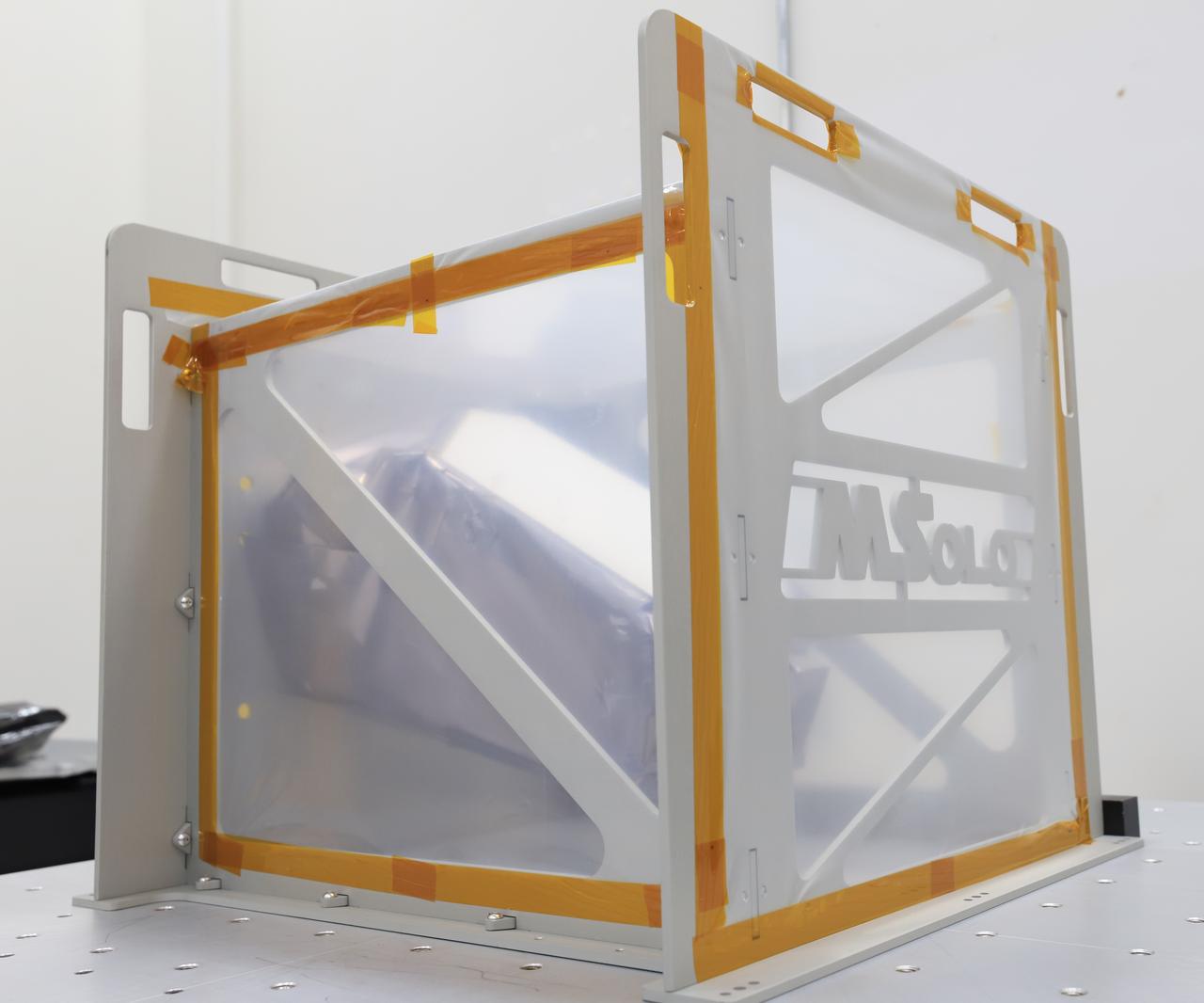
Engineers conduct a mass properties test on the Mass Spectrometer Observing Lunar Operations (MSolo) instrument inside Kennedy Space Center’s Space Station Processing Facility in Florida on Nov. 22, 2022. Mass properties determines the mass and center of gravity of the flight unit. The lander uses this information, from all payloads, to improve stability and performance of the lander – and to a lesser degree, the stability and performance of the rocket. This marks the end of testing at Kennedy for the Polar Resources Ice Mining Experiment-1 (PRIME-1) MSolo instrument. It will soon be shipped to Intuitive Machines in Houston for integration on the NOVA-C landing platform. Launching in 2023, the PRIME-1 mission will be the first in-situ resource utilization demonstration on the Moon.
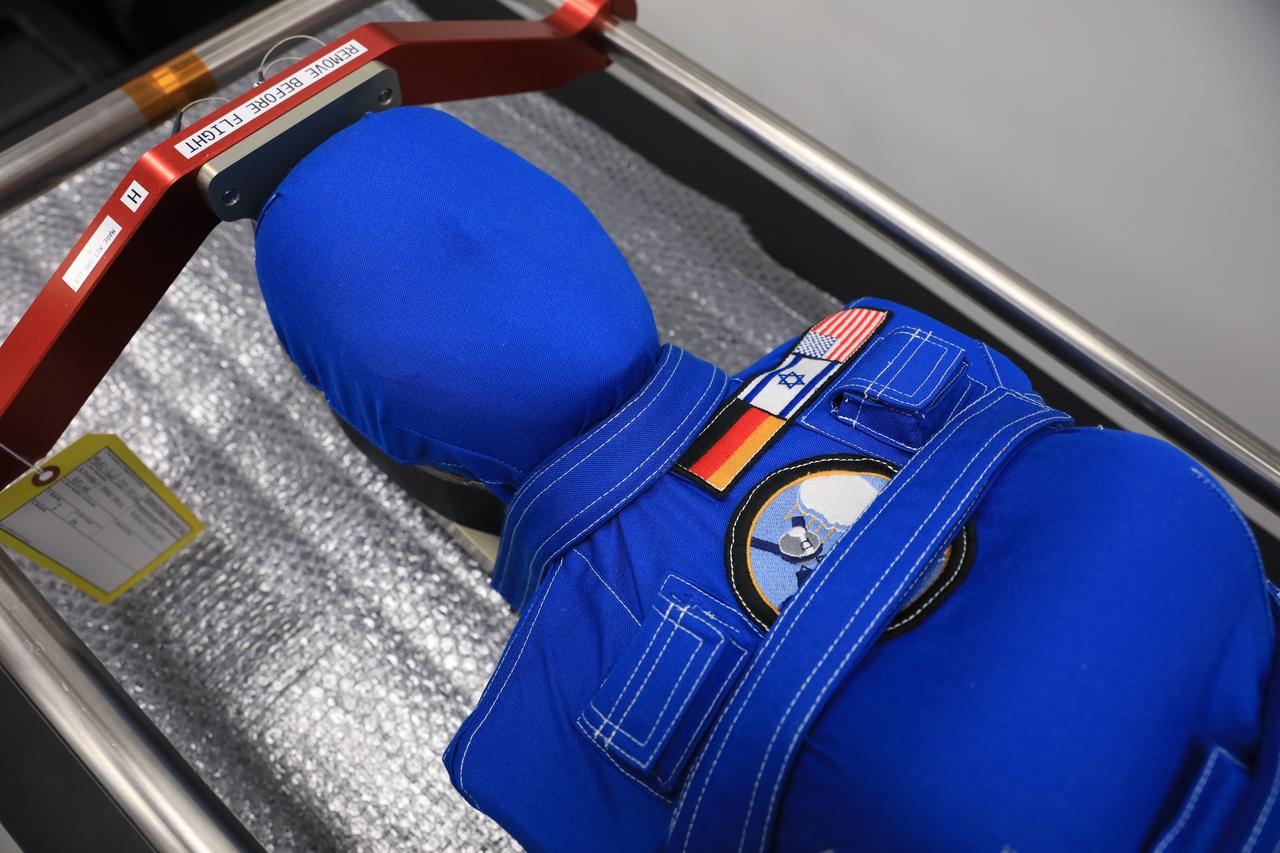
In preparation for the Artemis I flight test, teams at NASA’s Kennedy Space Center in Florida prepare two manikins, called phantoms, as part of the Matroshka AstroRad Radiation Experiment (MARE) investigation on Aug. 4, 2022. The two female phantoms – Helga and Zohar – will fly aboard the Orion crew module during Artemis I. Each will be equipped with radiation detectors, with Zohar also wearing a radiation protection vest, to determine the radiation risk on its way to the Moon. The MARE experiment is part of an agreement between NASA, the Israel Space Agency, and the German Aerospace Center. Artemis I will provide a foundation for human deep space exploration and demonstrate NASA’s capability to extend human presence to the Moon and beyond. The primary goal of Artemis I is to thoroughly test the Space Launch System rocket and Orion spacecraft’s integrated systems before crewed missions. Under Artemis, NASA aims to land the first woman and first person of color on the Moon and establish sustainable lunar exploration.
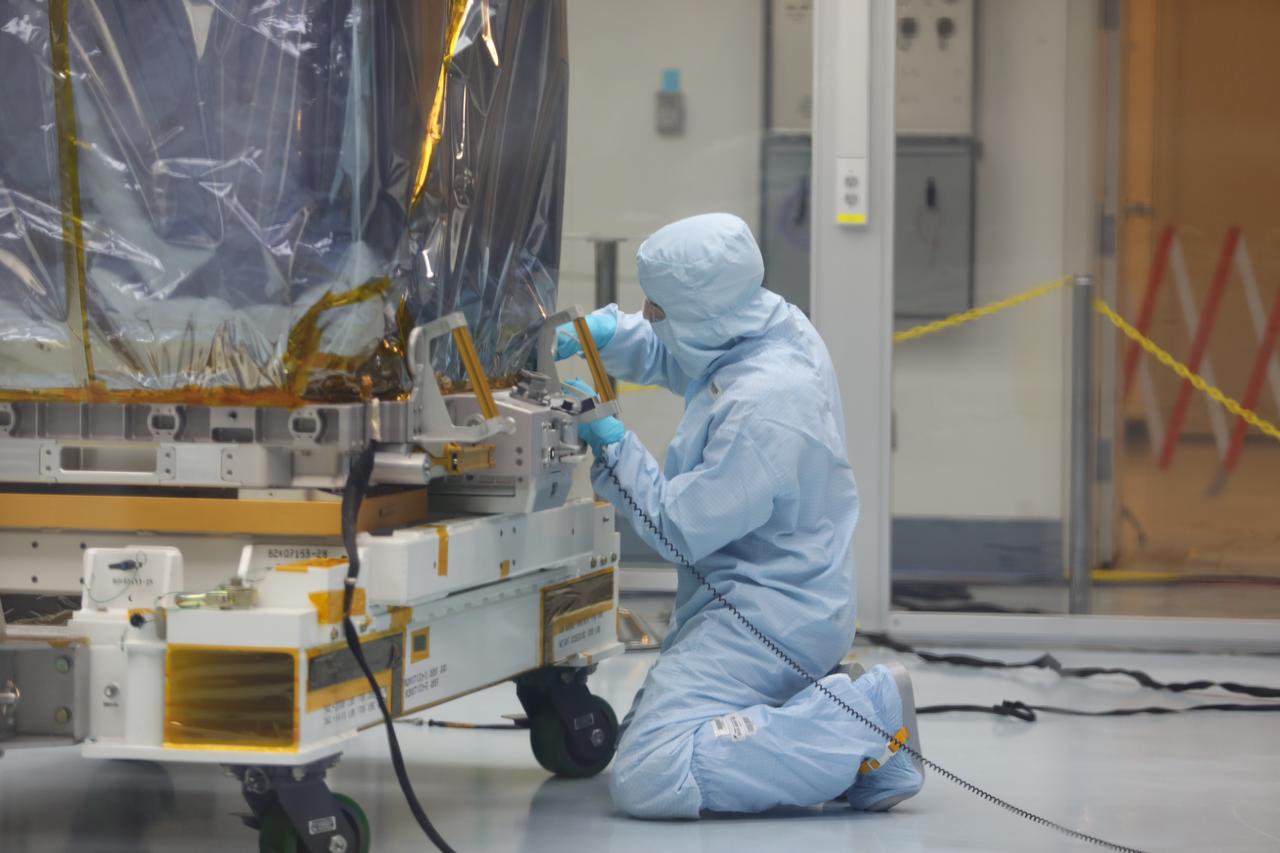
Inside the Space Station Processing Facility high bay at NASA's Kennedy Space Center in Florida, a technician prepares the Neutron star Interior Composition Explorer, or NICER, payload for final packaging. NICER will be delivered to the International Space Station aboard the SpaceX Dragon cargo carrier on the company’s 11th commercial resupply services mission to the space station. NICER will study neutron stars through soft X-ray timing. NICER will enable rotation-resolved spectroscopy of the thermal and non-thermal emissions of neutron stars in the soft X-ray band with unprecedented sensitivity, probing interior structure, the origins of dynamic phenomena and the mechanisms that underlie the most powerful cosmic particle accelerators known.

NASA’s CLARREO Pathfinder (Calibration Absolute Radiance and Refractivity Observatory Pathfinder) undergoes prelaunch processing while secured on a test stand inside the Space Systems Processing Facility at the agency’s Kennedy Space Center in Florida on Thursday, Feb. 26, 2026. CLARREO Pathfinder will launch to the International Space Station aboard SpaceX's 34th commercial resupply services mission for NASA, where it will demonstrate an ability to take highly accurate measurements of sunlight reflected by Earth and the Moon.
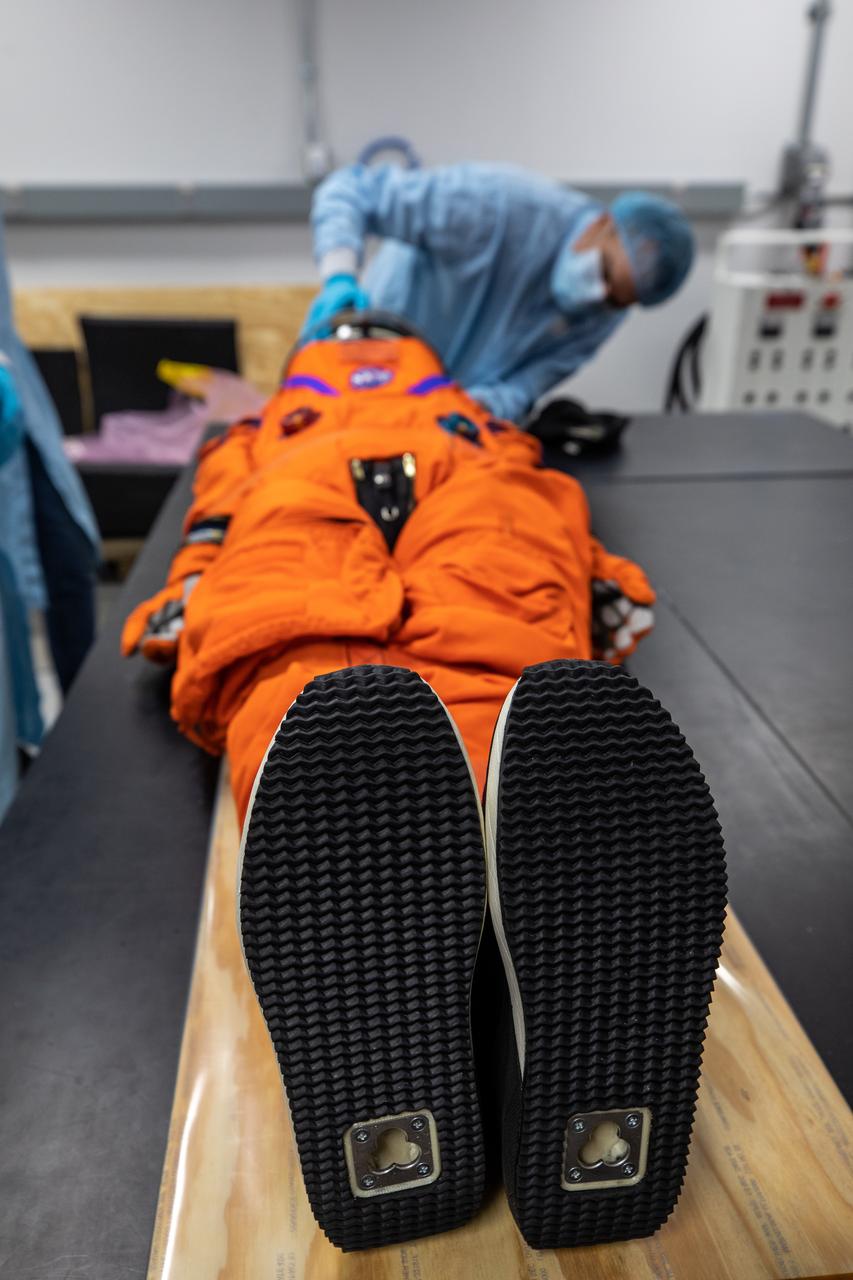
Inside the Space Station Processing Facility at NASA’s Kennedy Space Center in Florida, teams from Johnson Space Center, Exploration Ground Systems, and Jacobs TOSC conduct final inspections of Moonikin “Campos” on Nov. 9, 2021, prior to installation into the Orion crew module. Technicians checked connectivity and performed fit checks on his flight suit to ensure he is ready for flight aboard the Artemis flight test. Artemis I will be an uncrewed test flight of the Orion spacecraft and Space Launch System rocket as an integrated system ahead of crewed flights to the Moon. Under Artemis, NASA aims to land the first woman and first person of color on the Moon and establish sustainable lunar exploration.
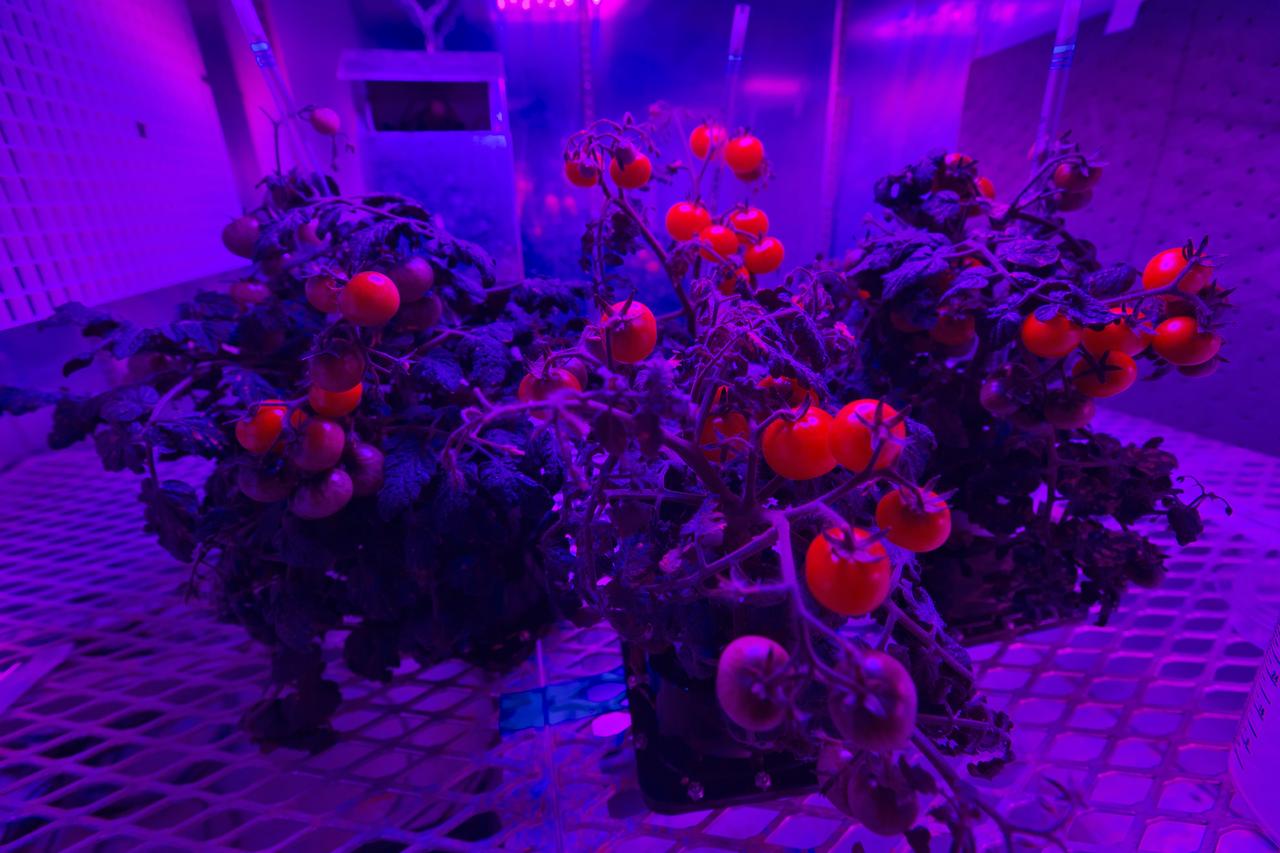
Tomato plants are growing under red and blue LED lights in a growth chamber inside a laboratory at the Space Station Processing Facility at NASA’s Kennedy Space Center in Florida. The plant growth is being tested in the Veggie Passive Orbital Nutrient Delivery System (PONDS). Veggie PONDS is a direct follow-on to the Veg-01 and Veg-03 hardware and plant growth validation tests. The primary goal of this newly developed plant growing system, Veggie PONDS, is to demonstrate uniform plant growth. PONDS units have features that are designed to mitigate microgravity effects on water distribution, increase oxygen exchange and provide sufficient room for root zone growth. PONDS is planned for use during Veg-04 and Veg-05 on the International Space Station after the Veggie PONDS Validation flights on SpaceX-14 and OA-9.
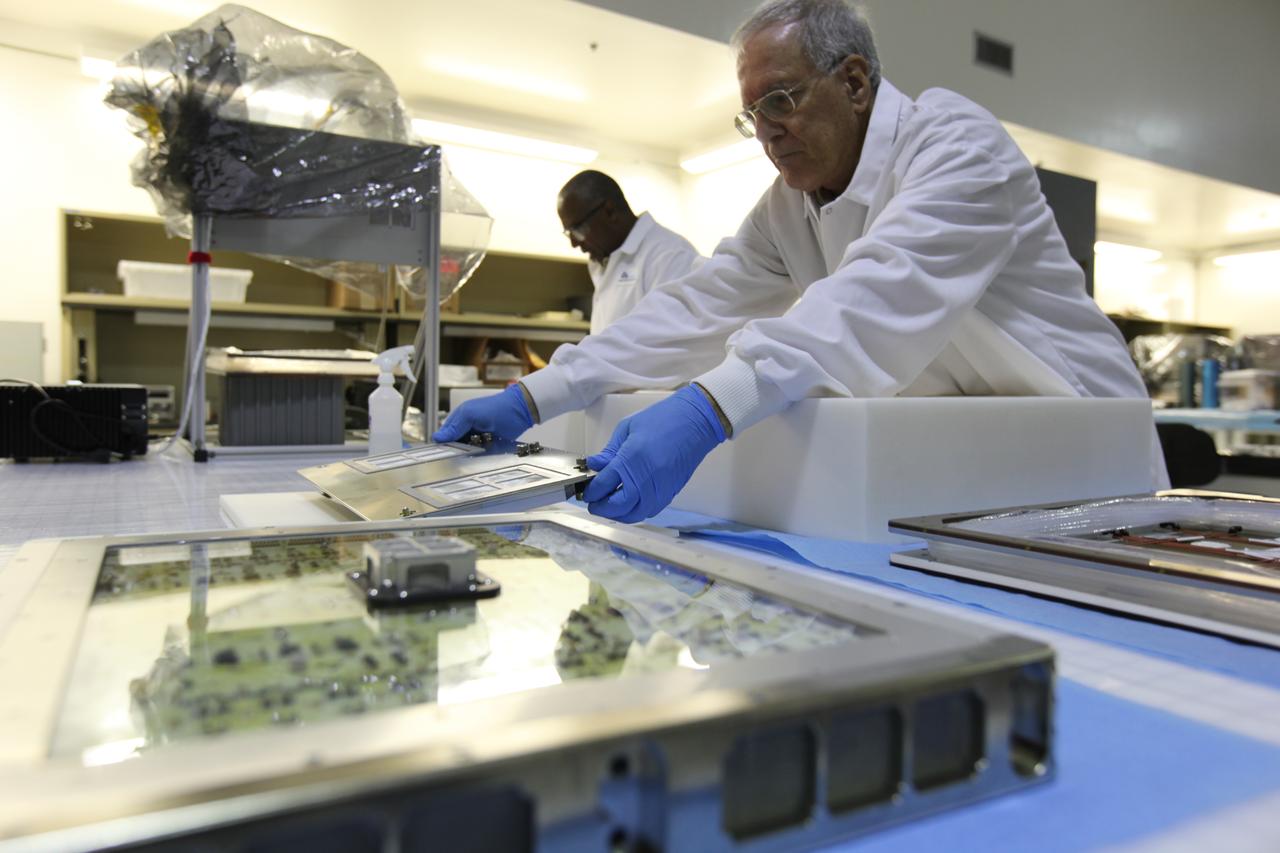
Charles Spern, at right, project manager on the Engineering Services Contract (ESC), and Glenn Washington, ESC quality assurance specialist, perform final inspections of the Veggie Series 1 plant experiment inside a laboratory in the Space Station Processing Facility at NASA's Kennedy Space Center in Florida. The Series 1 experiment is being readied for flight aboard Orbital ATK's Cygnus module on its seventh (OA-7) Commercial Resupply Services mission to the International Space Station. The Veggie system is on the space station.
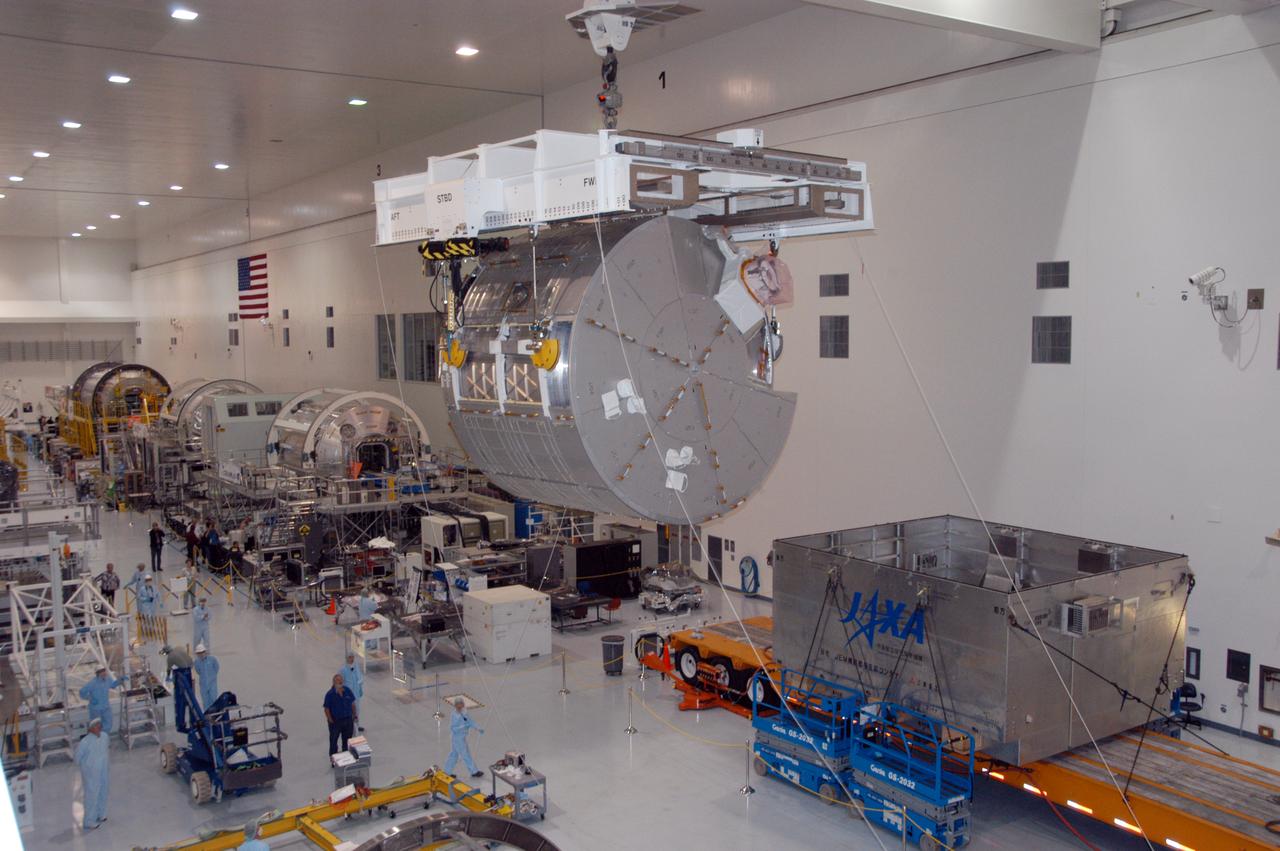
An overhead crane moves the JEM Experiment Logistics Module Pressurized Section above the floor of the Space Station Processing Facility to a scale for weight and center-of-gravity measurements. The module will then be moved to a work stand. The logistics module is one of the components of the Japanese Experiment Module or JEM, also known as Kibo, which means "hope" in Japanese. Kibo comprises six components: two research facilities -- the Pressurized Module and Exposed Facility; a Logistics Module attached to each of them; a Remote Manipulator System; and an Inter-Orbit Communication System unit. Kibo also has a scientific airlock through which experiments are transferred and exposed to the external environment of space. Kibo is Japan's first human space facility and its primary contribution to the station. Kibo will enhance the unique research capabilities of the orbiting complex by providing an additional environment in which astronauts can conduct science experiments. The various components of JEM will be assembled in space over the course of three Space Shuttle missions. The first of those three missions, STS-123, will carry the Experiment Logistics Module Pressurized Section aboard the Space Shuttle Endeavour, targeted for launch in 2007.
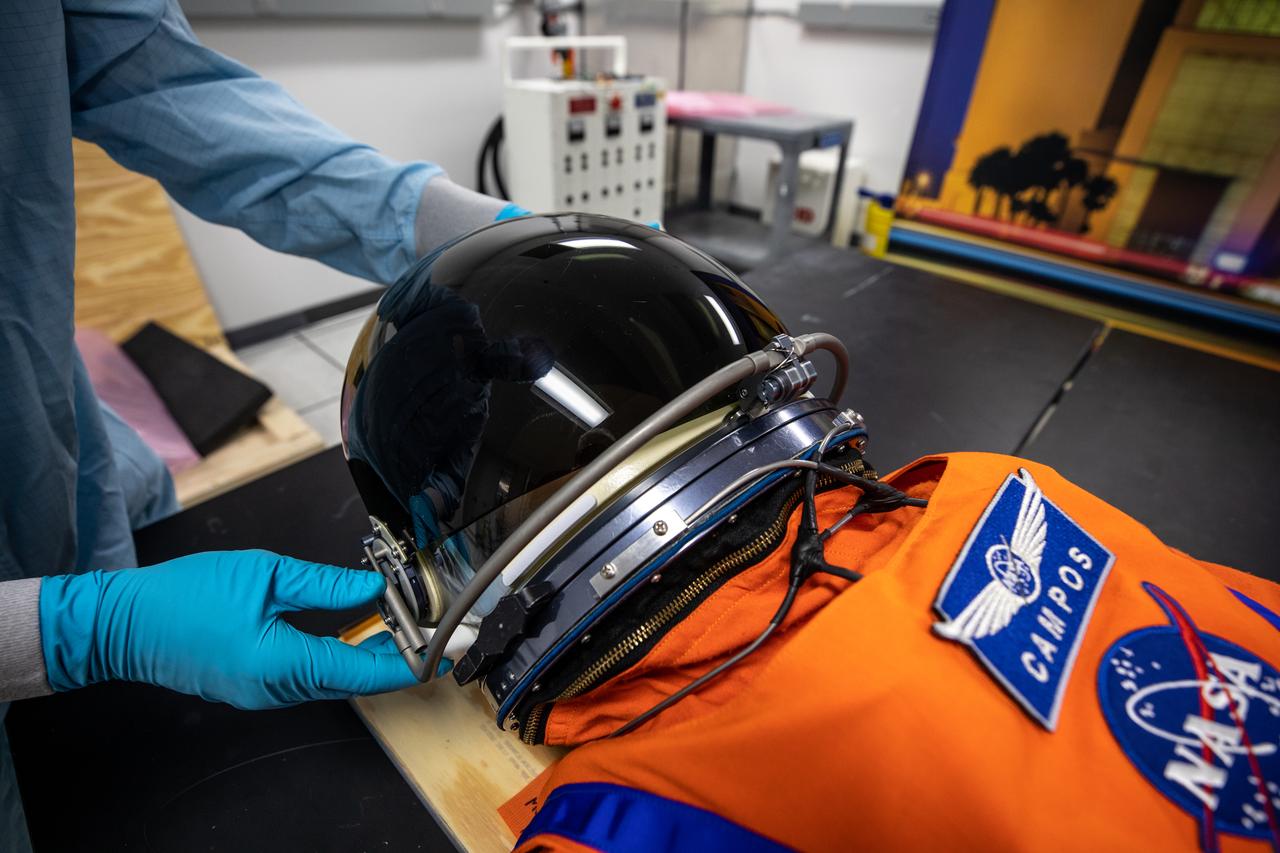
Teams from Johnson Space Center, Exploration Ground Systems, and Jacobs TOSC conduct final inspections of Moonikin “Campos” on Nov. 9, 2021, inside the Space Station Processing Facility at NASA’s Kennedy Space Center in Florida. Moonikin “Campos” will be installed into the Orion crew module. Technicians checked connectivity and performed fit checks on his flight suit to ensure he is ready for flight aboard the Artemis flight test. Artemis I will be an uncrewed test flight of the Orion spacecraft and Space Launch System rocket as an integrated system ahead of crewed flights to the Moon. Under Artemis, NASA aims to land the first woman and first person of color on the Moon and establish sustainable lunar exploration.
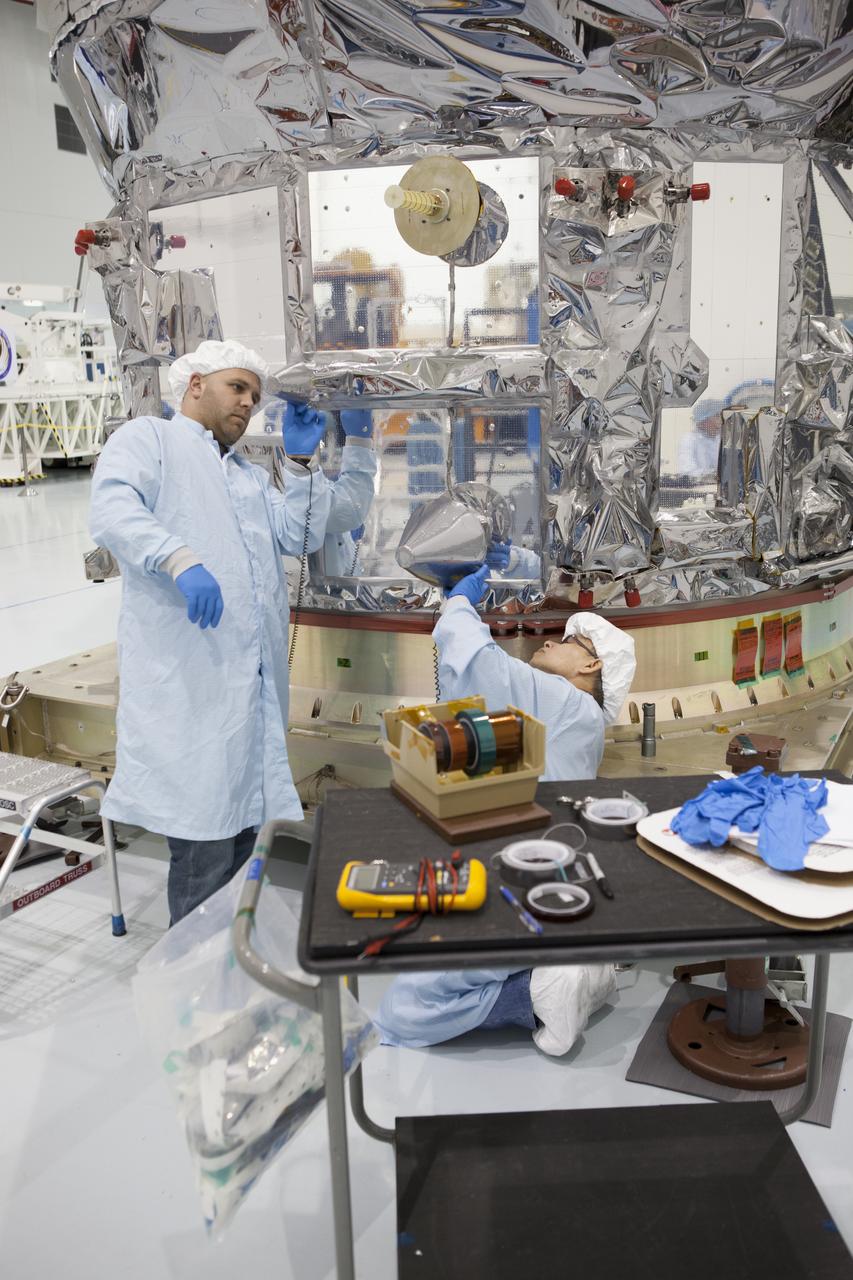
In the Space Station Processing Facility high bay at NASA's Kennedy Space Center in Florida, technicians are preparing Orbital ATK's CYGNUS pressurized cargo module for bagging. The Orbital ATK CRS-7 commercial resupply services mission to the International Space Station is scheduled to launch atop a United Launch Alliance Atlas V rocket from Space Launch Complex 41 at Cape Canaveral Air Force Station on March 19, 2017. CYGNUS will deliver thousands of pounds of supplies, equipment and scientific research materials to the space station.
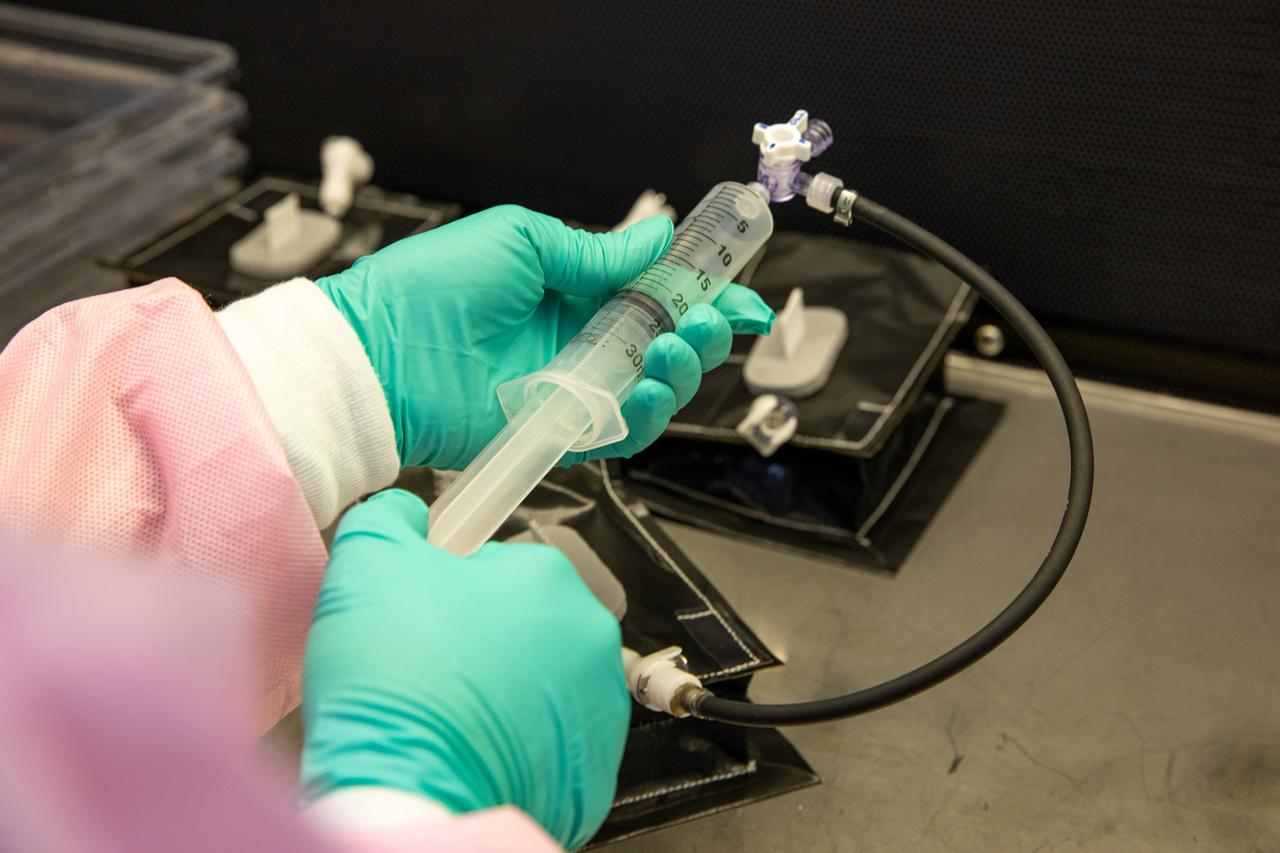
An intern at NASA’s Kennedy Space Center in Florida assembles plant pillows inside the Space Station Processing Facility on Jan. 16, 2020. The pillows, which are a common method used to grow plants in space, are being sent to the International Space Station for a series of VEG-03 experiments that will study the growth of three types of leafy greens and a new seed handling material in a microgravity environment. The experiments will be launched to the orbiting laboratory aboard a Northrop Grumman Antares rocket and Cygnus spacecraft on the company’s 13th resupply services mission. Liftoff is scheduled for Feb. 9, 2020, at 5:39 p.m. EST from the agency’s Wallops Flight Facility in Virginia.
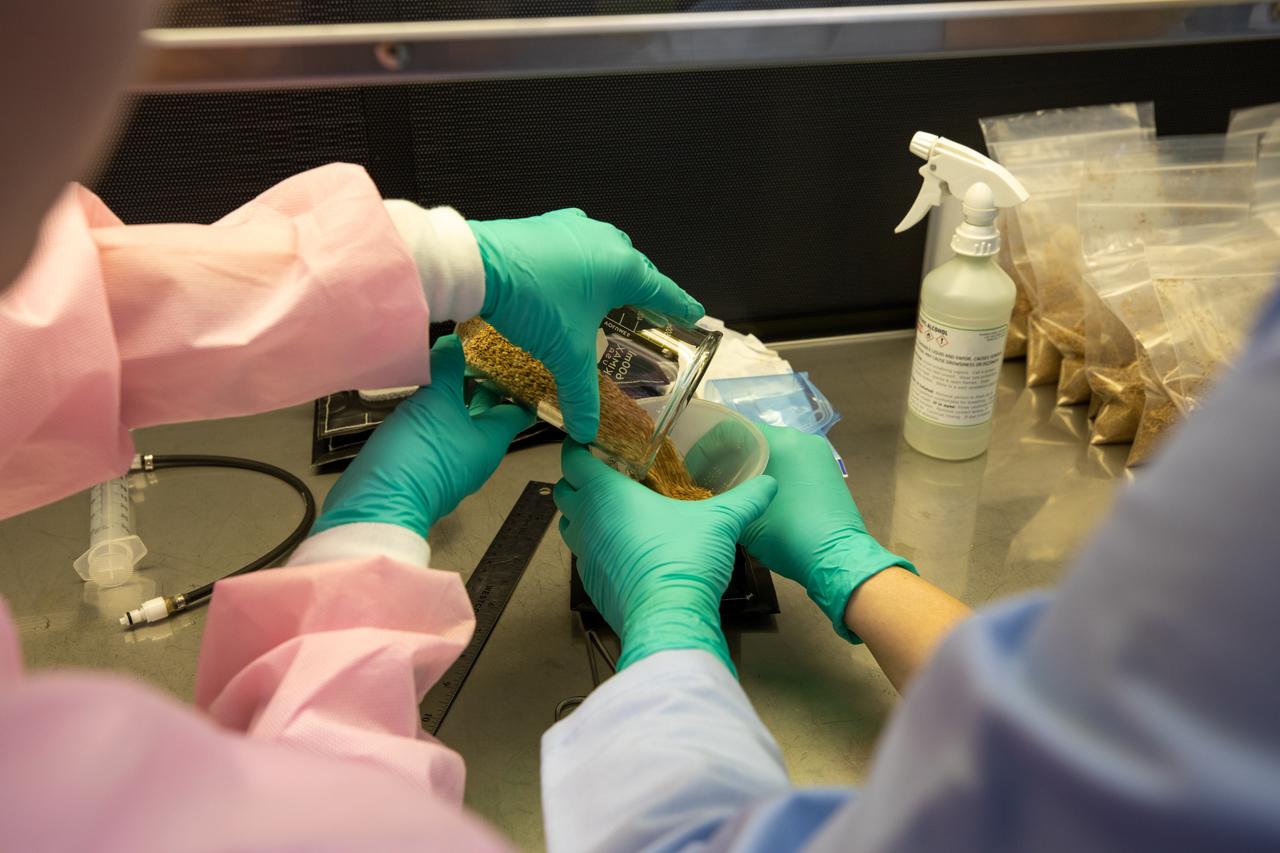
Inside the Space Station Processing Facility at NASA’s Kennedy Space Center in Florida, a researcher measures out the calcined clay that will be used to assemble plant pillows on Jan. 16, 2019. Often used to condition baseball infields, the clay’s size and roughness traps air and absorbs water to provide both to plant roots in microgravity. The pillows are small containers used to grow plants in space aboard the International Space Station. The pillows are for a series of plant experiments called VEG-03 J/K/L that will monitor the growth of three types of leafy greens and test a new way of handling seeds. The experiments will be launched to the orbiting laboratory aboard a Northrop Grumman Antares rocket and Cygnus spacecraft on the company’s 13th resupply services mission. Liftoff is scheduled for Feb. 9, 2020, at 5:39 p.m. EST from the agency’s Wallops Flight Facility in Virginia.
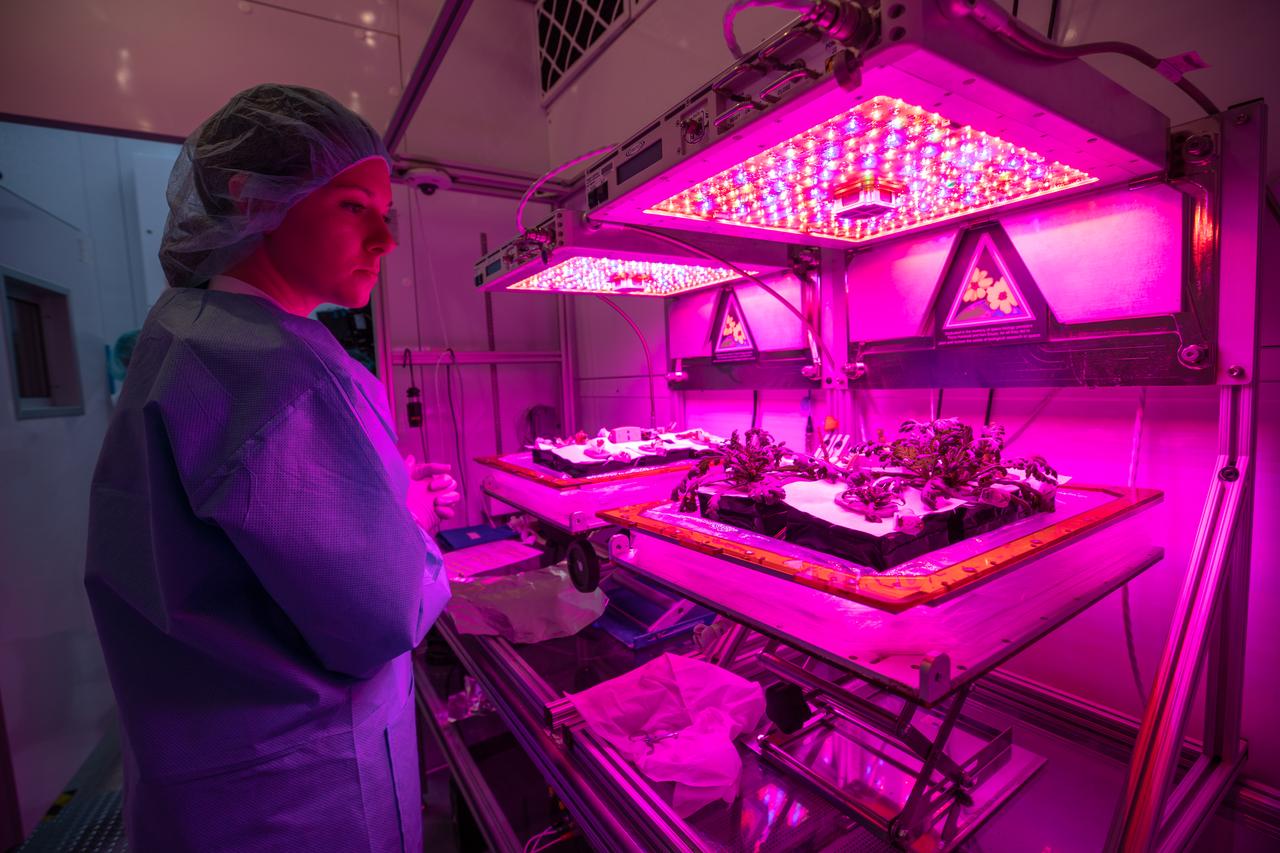
Jess Bunchek, an associate scientist at NASA’s Kennedy Space Center in Florida, observes plant cultivars inside the Veggie growth chamber in the Space Station Processing Facility prior to harvesting them on Sept. 30, 2019, for a science verification test (SVT). This SVT will study the potential of three plants – amara mustard, ‘outredgeous’ red romaine lettuce and shungiku, an Asian green comparable to an edible chrysanthemum – to grow in space. All three lettuce plants were grown from seed film, making this the first SVT with this new plant growth material. Earlier this year, the amara mustard and shungiku plants were grown for the first time using seed bags – referred to as pillows – during the Sustained Veggie project, a study funded by the Human Research Program.
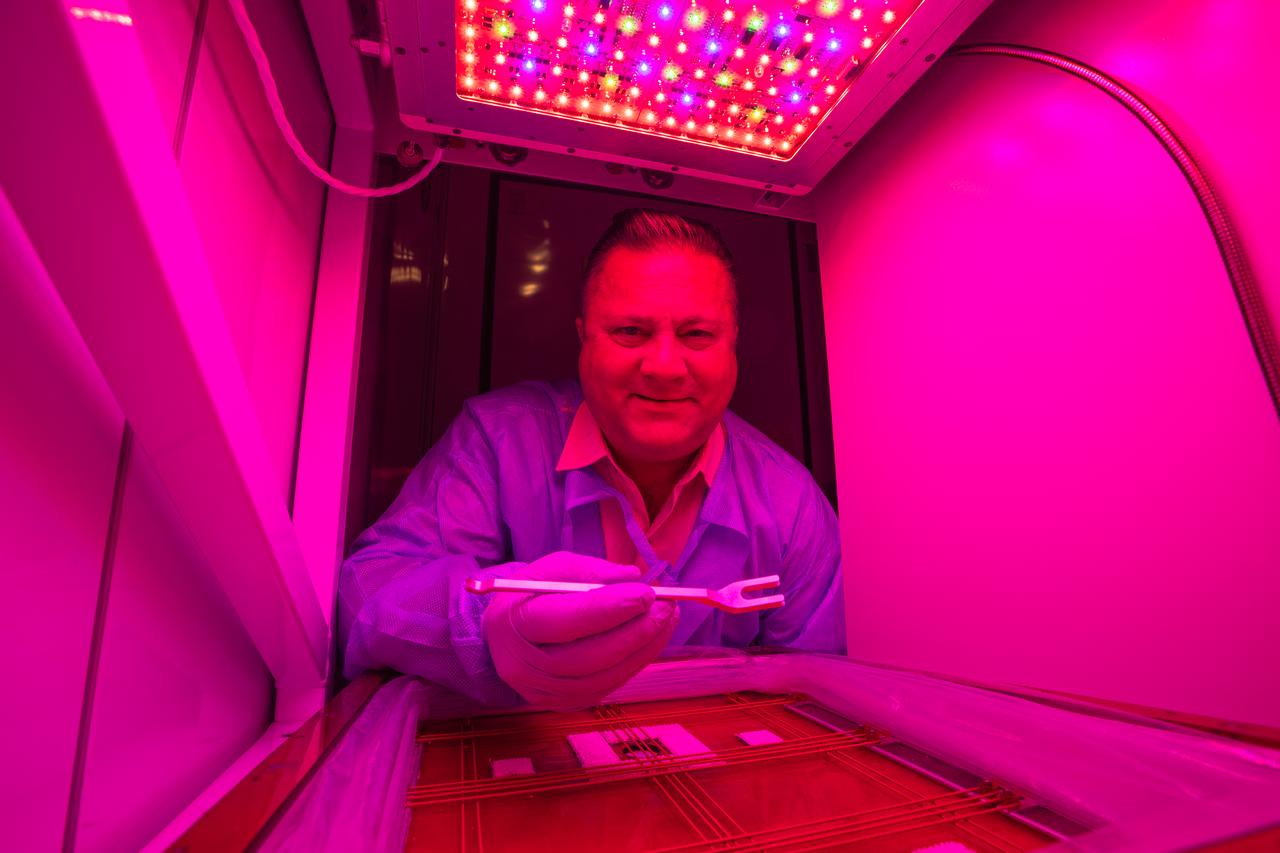
Matthew English is the Exploration Research and Technology facility manager for the Space Station Processing Facility (SSPF) at NASA’s Kennedy Space Center in Florida. English’s responsibilities include ensuring that the International Space Station teams inside the SSPF have the facilities, tools and capabilities they need to support their launch customers, thus providing the support necessary to enable further research and design discoveries within NASA.
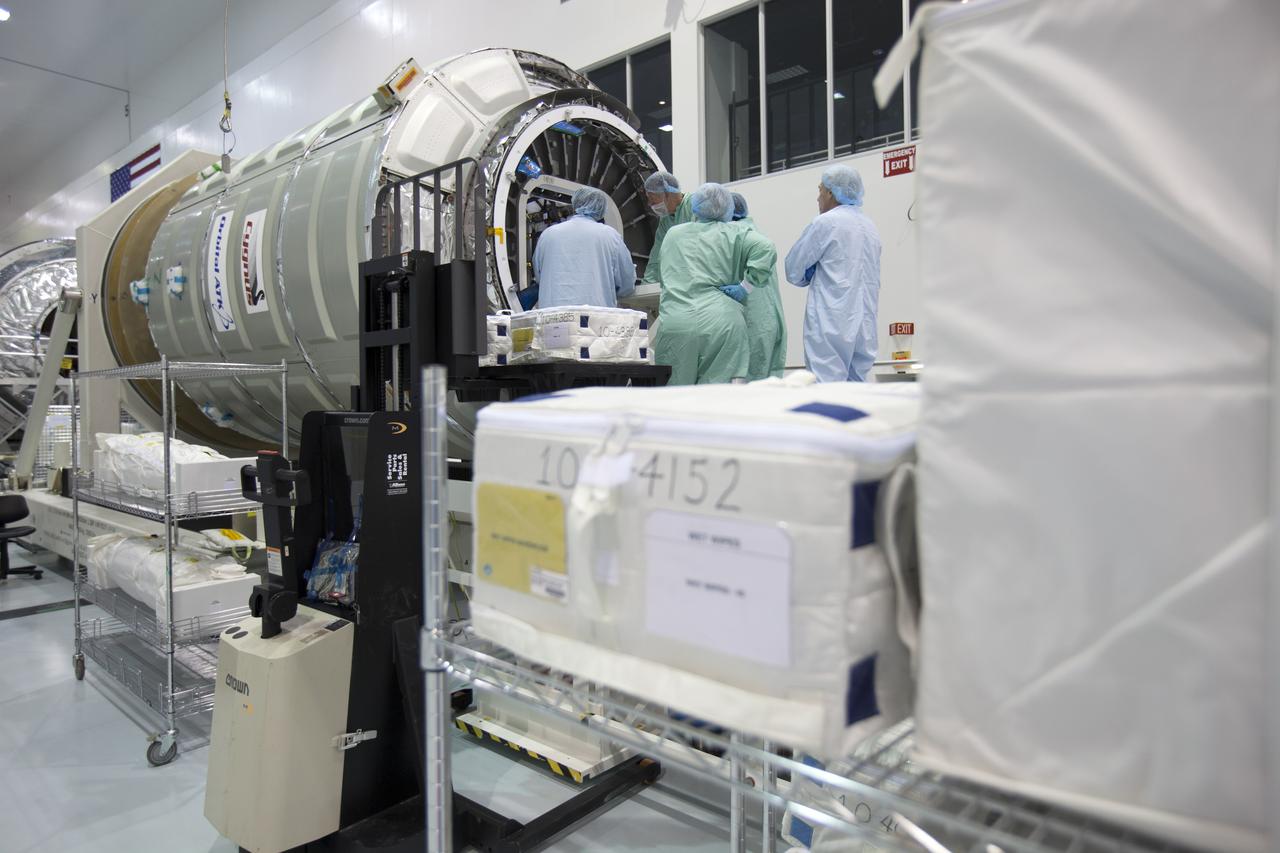
OA-7 Cargo Module In the Space Station Processing Facility at NASA's Kennedy Space Center in Florida, technicians and engineers load thousands of pounds of supplies, equipment and scientific research materials aboard a Cygnus spacecraft's pressurized cargo module (PCM) for the Orbital ATK CRS-7 mission to the International Space Station. Scheduled to launch on March 19, 2017, the commercial resupply services mission will lift off atop a United Launch Alliance Atlas V rocket from Space launch Complex 41 at Cape Canaveral Air Force Stationbeing loaded inside the SSPF building, located at Kennedy Space Center.
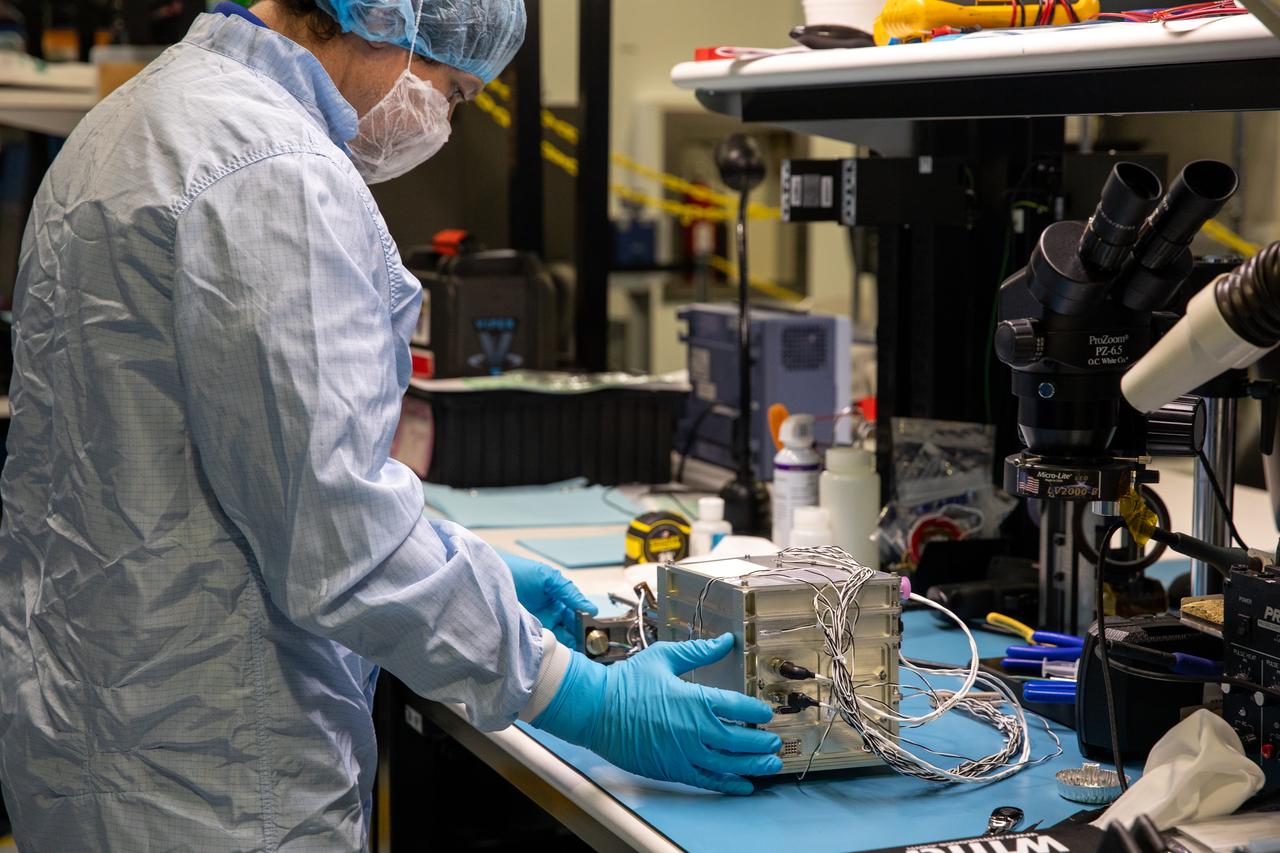
A team of engineers and technicians finished the final assembly step for the MSOLO-2 (Mass Spectrometer Observing Lunar Operations) flight instrument by installing the Calibration Gas System inside of the Space Station Processing Facility at NASA’s Kennedy Space Center in Florida on June 21, 2023. MSOLO is a commercial off-the-shelf mass spectrometer modified to work in space and it will help analyze the chemical makeup of landing sites on the Moon, as well as study water on the lunar surface.
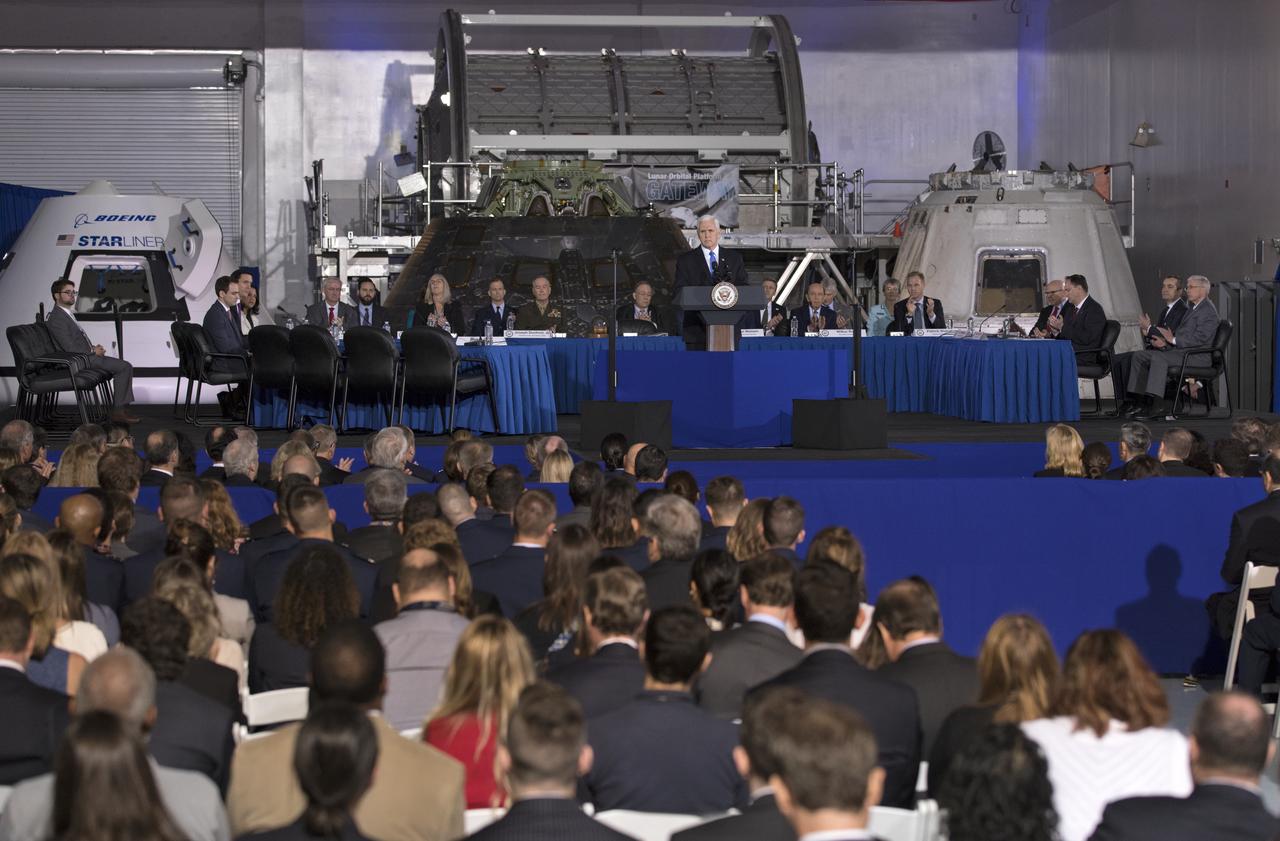
Vice President Mike Pence chairs a meeting of the National Space Council in the high bay of the Space Station Processing Facility at NASA's Kennedy Space Center in Florida, on Feb. 21, 2018. The council's role is to advise the president regarding national space policy and strategy, and review the nation's long-range goals for space activities.

Project Scientist Natasha Haveman (right) shows NASA astronauts Jessica Watkins and Stan Love microgreens grown in the Plant Processing Area inside the Space Systems Processing Facility at NASA’s Kennedy Space Center in Florida during a tour on Tuesday, May 12, 2026. Watkins and NASA astronaut Luke Delaney, along with CSA (Canadian Space Agency) astronaut Joshua Kutryk, and Roscosmos cosmonaut Sergey Teteryatnikov (not pictured), are part of NASA's SpaceX Crew-13 mission to the International Space Station and will explore the possibility of growing crops outside of the station’s Veggie chamber – one of two enclosed areas currently used to grow crops on the orbiting laboratory.
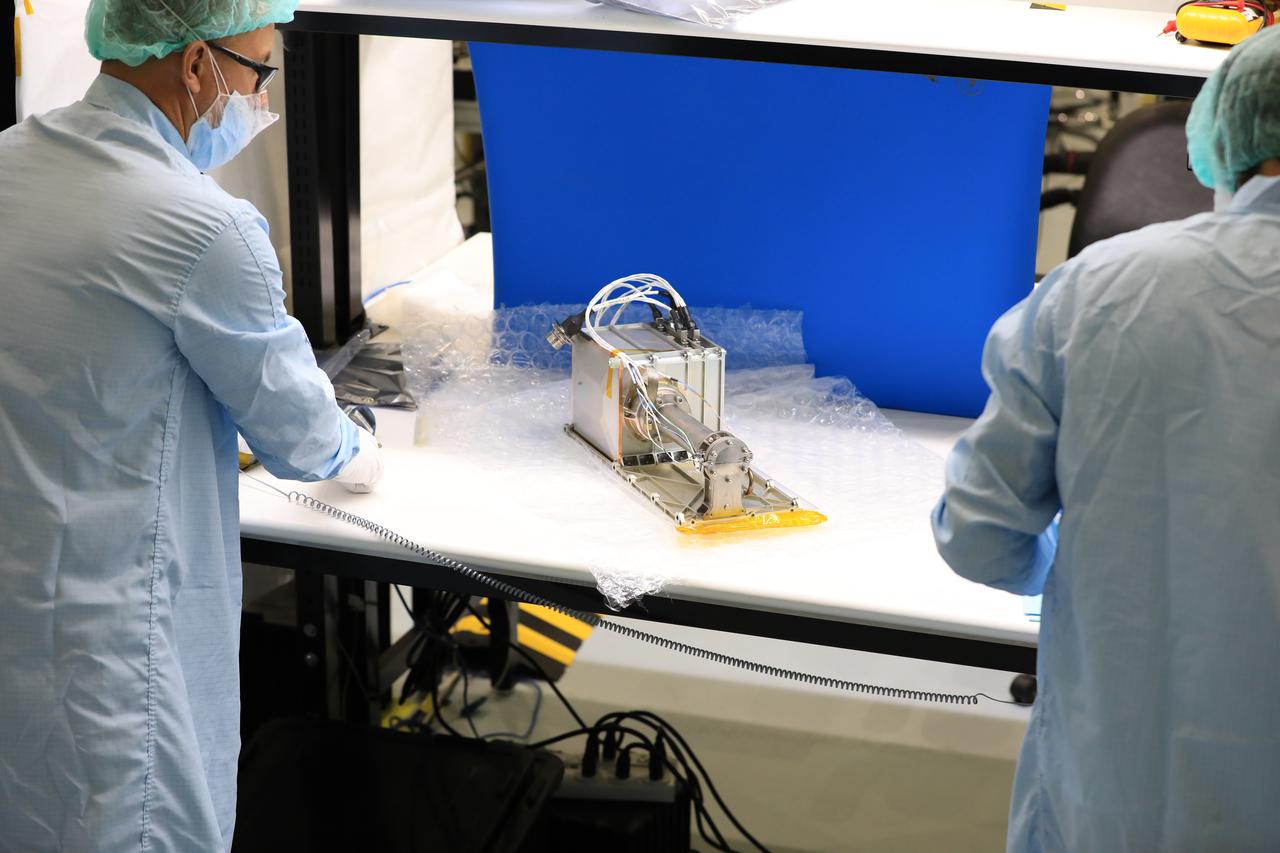
Engineers and technicians at NASA’s Kennedy Space Center in Florida install the radiator for the Mass Spectrometer Observing Lunar Operations (MSolo) instrument inside the Space Station Processing Facility on Sept. 25, 2020. MSolo will help analyze the chemical makeup of landing sites on the Moon, as well as study water on the lunar surface. The radiator will help keep the instrument’s temperature stable in the extreme heat and cold it will encounter. MSolo instruments are scheduled to launch on multiple robotic missions as part of NASA’s Commercial Lunar Payload Services (CLPS), with the first of these missions exploring Lacus Mortis, a large crater on the near side of the Moon, beginning in 2021. MSolo also will be one of three instruments on the agency’s water-hunting Volatiles Investigating Polar Exploration Rover, VIPER, scheduled to launch to the Moon’s South Pole in late 2023.

Engineers at NASA’s Kennedy Space Center in Florida remove the vibration fixture on the Mass Spectrometer observing lunar operations (MSolo) instrument on Aug. 4, 2022. The activity followed a vibration test in preparation for the Polar Resources Ice Mining Experiment-1 (PRIME-1) mission, which will be the first in-situ resource utilization demonstration on the Moon. MSolo is a commercial off-the-shelf mass spectrometer modified to work in space and will help analyze the chemical makeup of landing sites on the Moon, as well as study water on the lunar surface. Researchers and engineers are preparing MSolo instruments to launch on four robotic missions as part of NASA’s Commercial Lunar Payload Services – commercial deliveries beginning in 2023 that will perform science experiments, test technologies, and demonstrate capabilities to help NASA explore the Moon and prepare for crewed missions to the lunar surface.
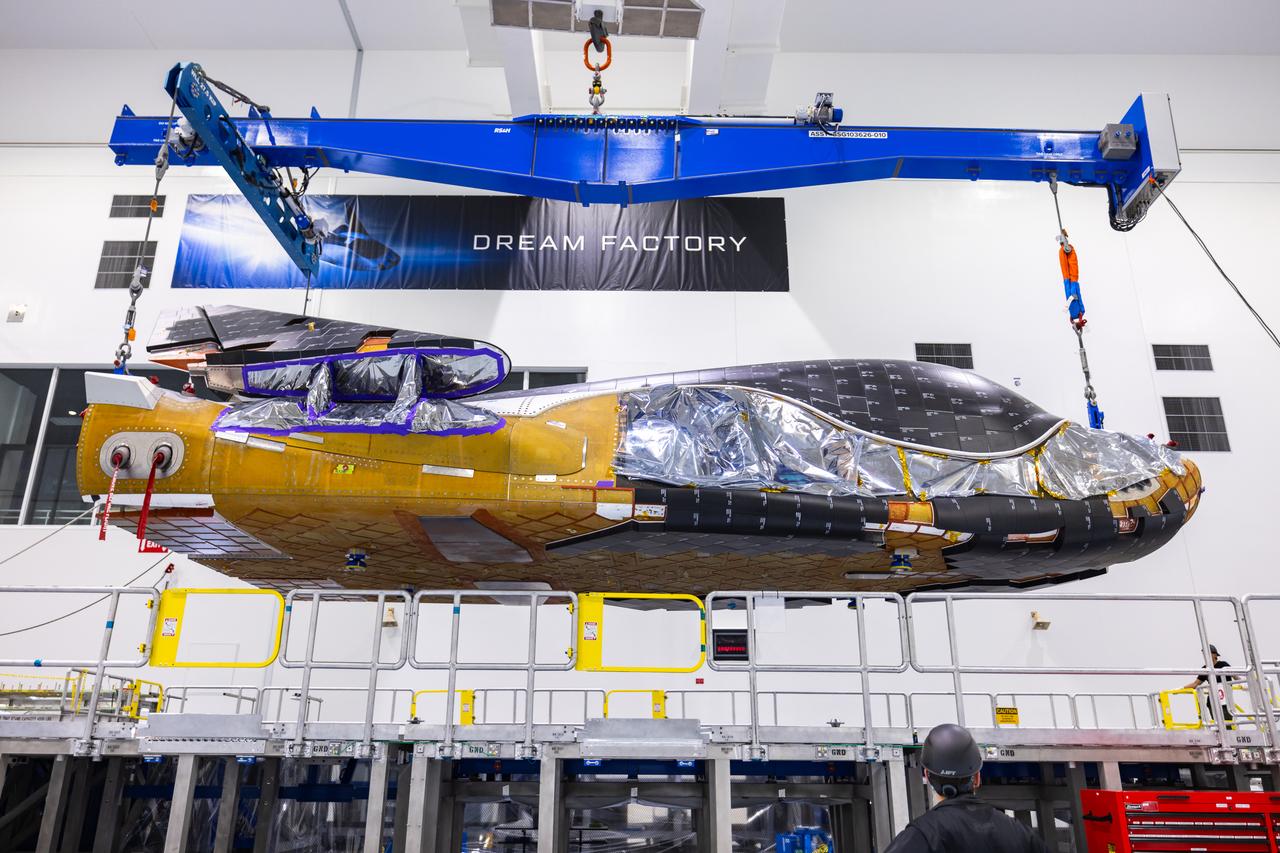
Dream Chaser Tenacity, Sierra Space's uncrewed cargo spaceplane is lifted and moved by crane inside the Space Systems Processing Facility (SSPF) at NASA’s Kennedy Space Center in Florida on Monday, May 20, 2024. Dream Chaser Tenacity will undergo final testing and prelaunch processing inside the high bay of the SSPF ahead of its inaugural launch atop a ULA (United Launch Alliance) Vulcan rocket from nearby Cape Canaveral Space Force Station. The reusable transportation system is contracted to perform a minimum of seven cargo missions to the International Space Station as part of the agency’s efforts to expand commercial resupply services to low Earth orbit.
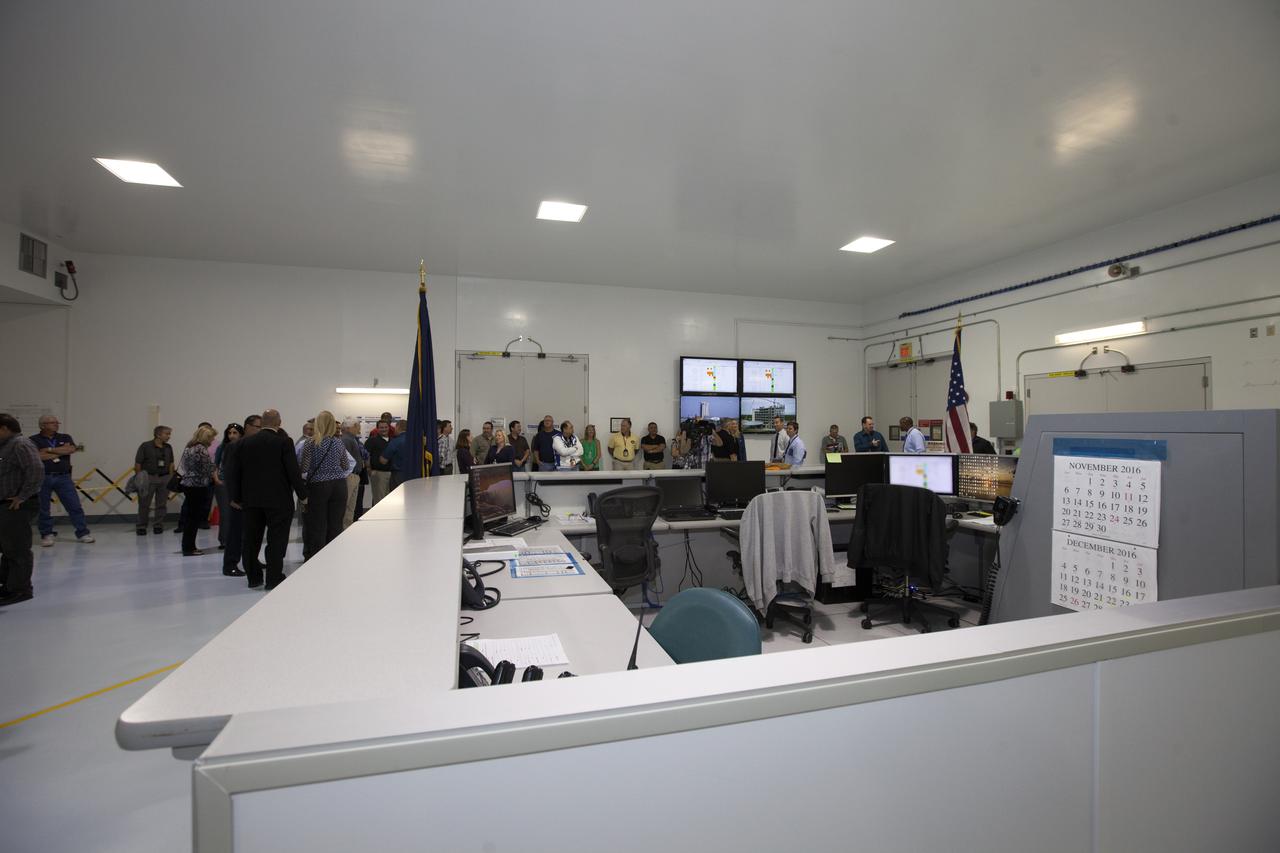
A crowd gathers for a ribbon cutting ceremony in the high bay of the Space Station Processing Facility at NASA's Kennedy Space Center in Florida. The event celebrated completion of facility modifications to improve processing and free up zones tailored to a variety of needs supporting a robust assortment of space-bound hardware including NASA programs and commercial space companies.
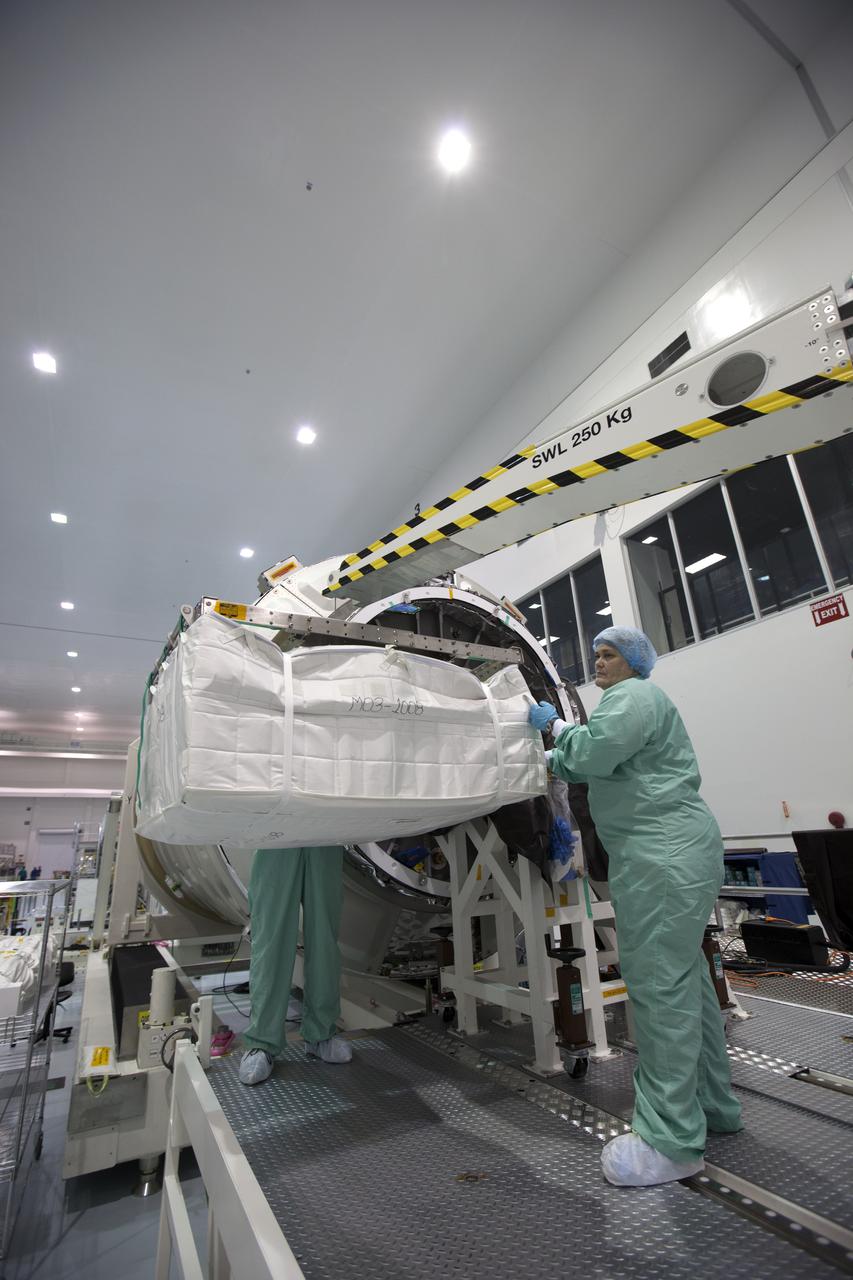
In the Space Station Processing Facility at NASA's Kennedy Space Center in Florida, technicians and engineers load thousands of pounds of supplies, equipment and scientific research materials aboard a Cygnus spacecraft's pressurized cargo module (PCM) for the Orbital ATK CRS-7 mission to the International Space Station. Scheduled to launch on March 19, 2017, the commercial resupply services mission will lift off atop a United Launch Alliance Atlas V rocket from Space launch Complex 41 at Cape Canaveral Air Force Station.

Inside a laboratory at the Space Station Processing Facility at NASA's Kennedy Space Center in Florida, scientists prepare Apogee wheat seeds for the science carrier, or base, of the Advanced Plant Habitat (APH). A growing substrate called arcillite was packed down in the base and coverings were secured on top of the base. Developed by NASA and ORBITEC of Madison, Wisconsin, the APH is the largest plant chamber built for the agency. It is a fully automated plant growth facility that will be used to conduct bioscience research on the International Space Station. The APH will be delivered to the space station aboard future Commercial Resupply Services missions.
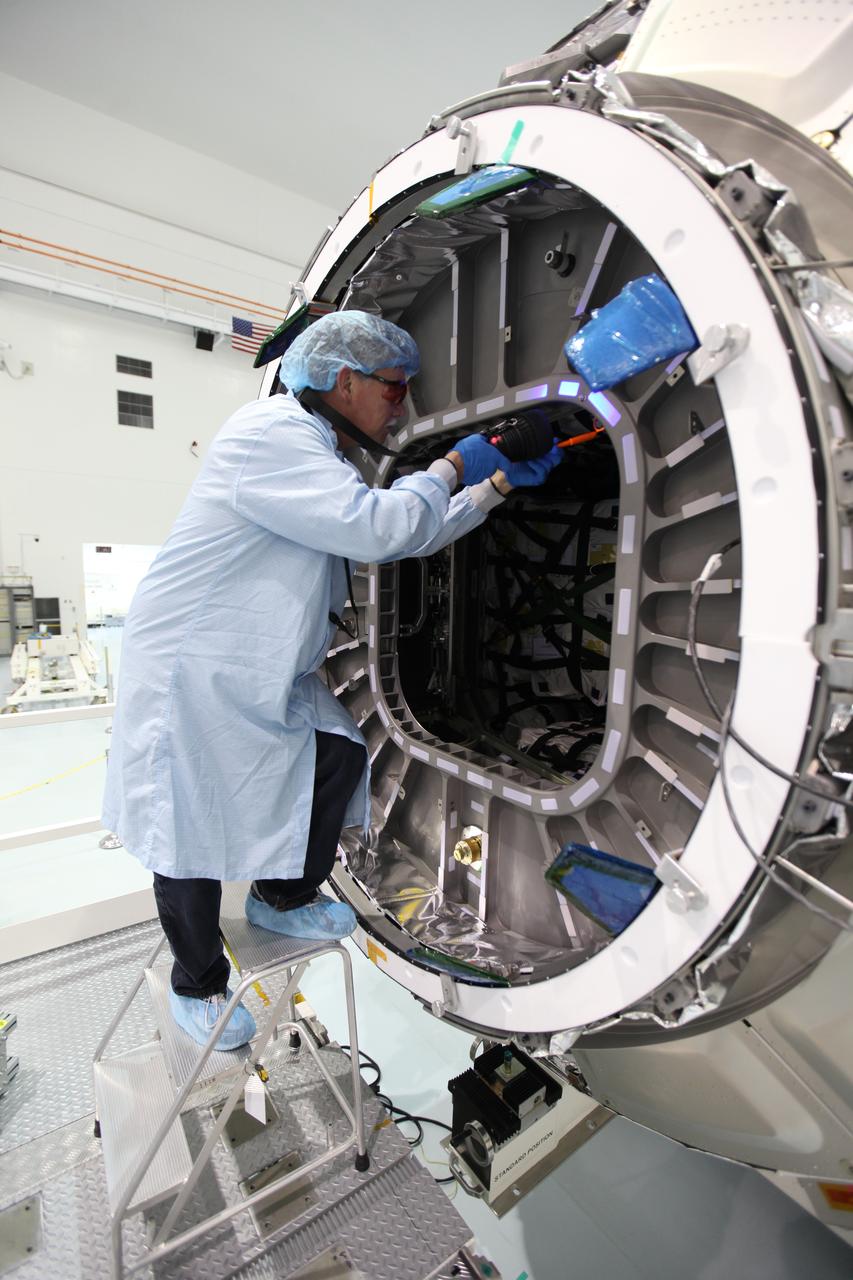
In the Space Station Processing Facility at NASA's Kennedy Space Center in Florida, preparations are underway to close the hatch of the Cygnus spacecraft's pressurized cargo module (PCM) for the Orbital ATK CRS-7 mission to the International Space Station. Scheduled to launch on March 19, 2017, the commercial resupply services mission will lift off atop a United Launch Alliance Atlas V rocket from Space launch Complex 41 at Cape Canaveral Air Force Station.
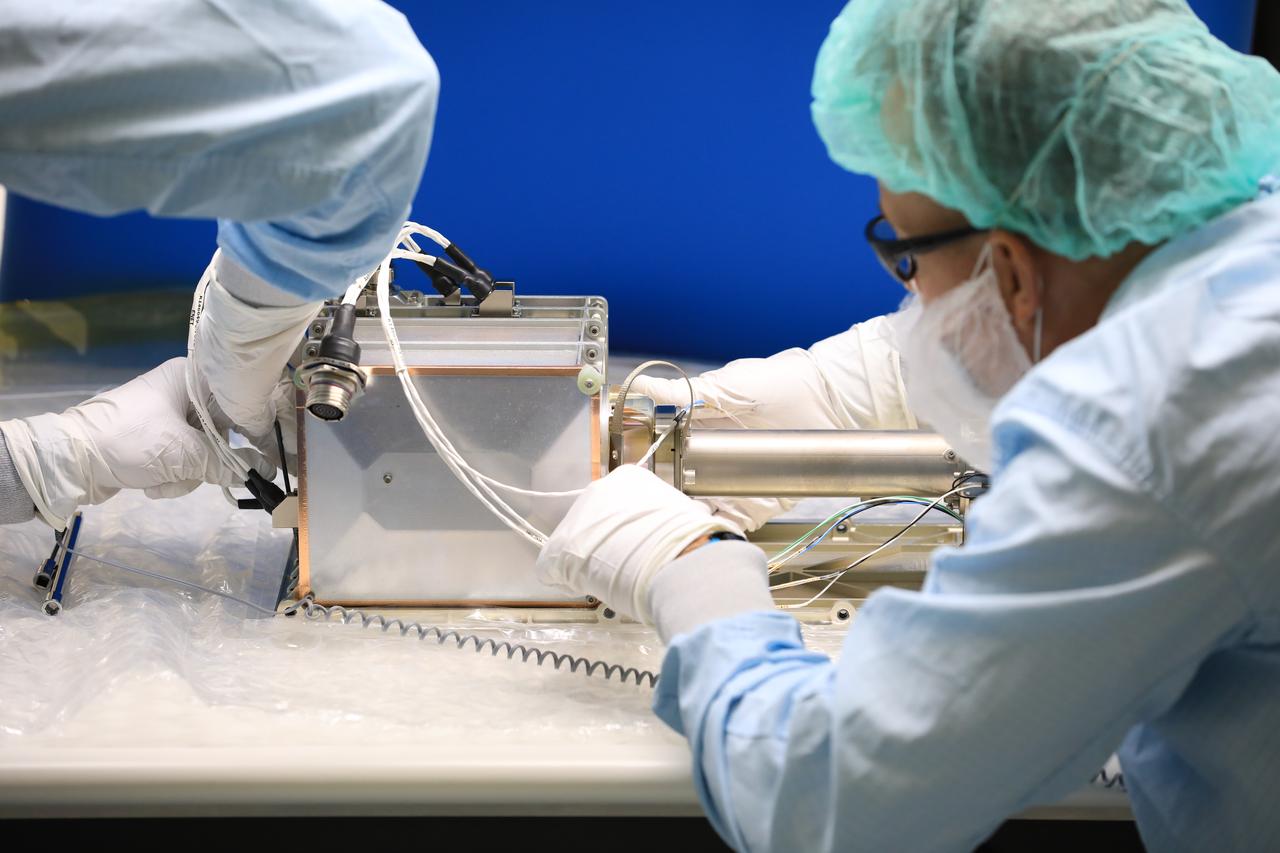
Engineers and technicians at NASA’s Kennedy Space Center in Florida install the radiator for the Mass Spectrometer Observing Lunar Operations (MSolo) instrument inside the Space Station Processing Facility on Sept. 25, 2020. MSolo will help analyze the chemical makeup of landing sites on the Moon, as well as study water on the lunar surface. The radiator will help keep the instrument’s temperature stable in the extreme heat and cold it will encounter. MSolo instruments are scheduled to launch on multiple robotic missions as part of NASA’s Commercial Lunar Payload Services (CLPS), with the first of these missions exploring Lacus Mortis, a large crater on the near side of the Moon, beginning in 2021. MSolo also will be one of three instruments on the agency’s water-hunting Volatiles Investigating Polar Exploration Rover, VIPER, scheduled to launch to the Moon’s South Pole in late 2023.
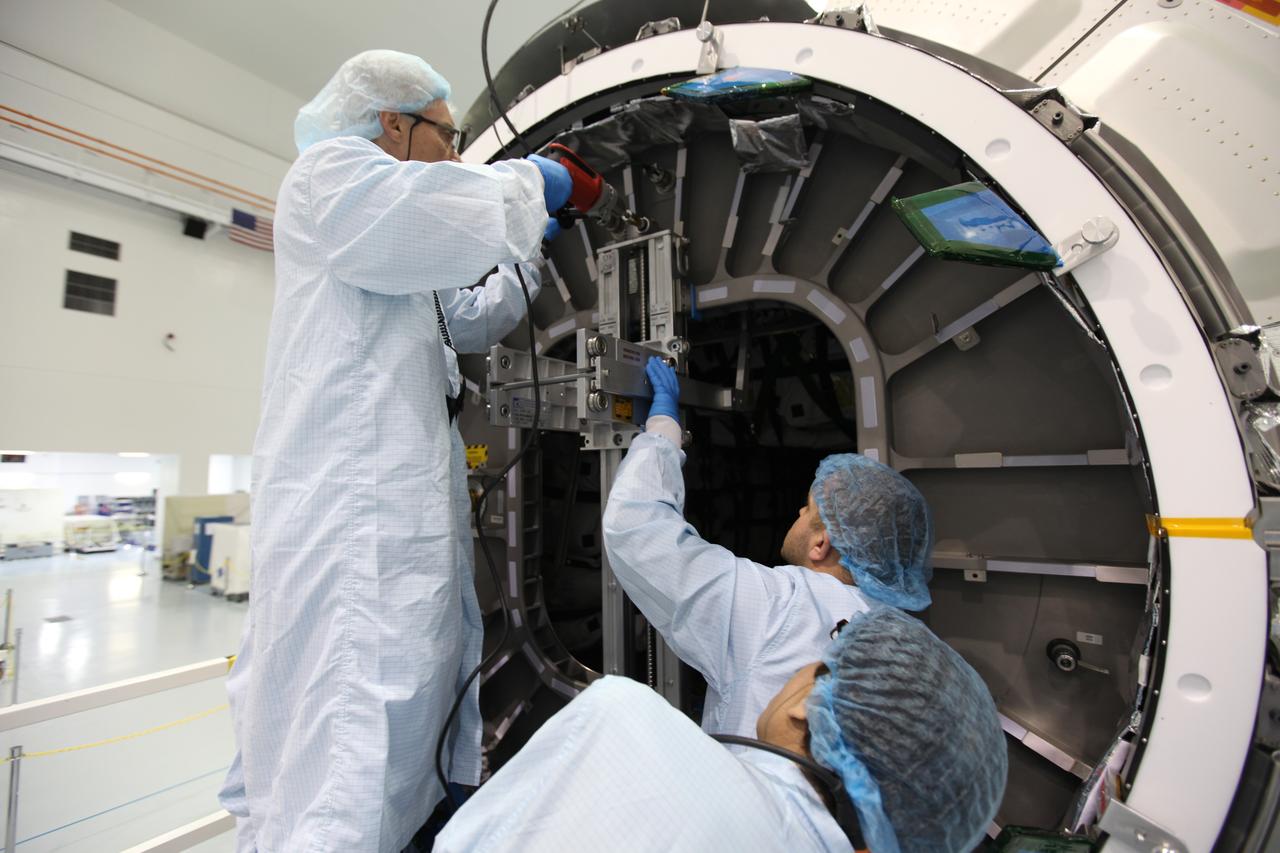
In the Space Station Processing Facility at NASA's Kennedy Space Center in Florida, technicians help secure the hatch for closure on the Cygnus spacecraft's pressurized cargo module (PCM) for the Orbital ATK CRS-7 mission to the International Space Station. Scheduled to launch on March 19, 2017, the commercial resupply services mission will lift off atop a United Launch Alliance Atlas V rocket from Space launch Complex 41 at Cape Canaveral Air Force Station.
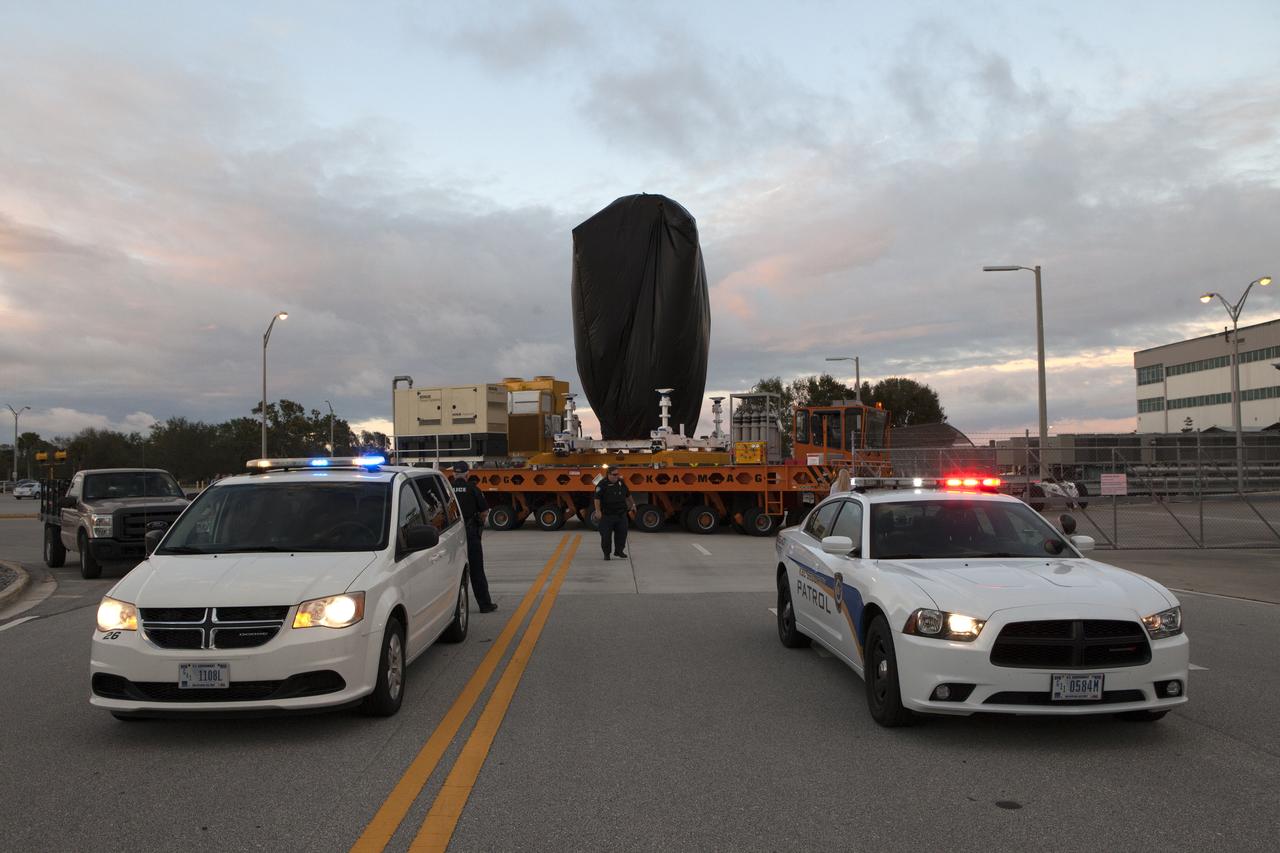
A KAMAG transporter with Orbital ATK's CYGNUS pressurized cargo module secured on top departs the Space Station Processing Facility at NASA's Kennedy Space Center in Florida. CYGNUS will be transported to the Payload Hazardous Servicing Facility for final propellant loading and late cargo stowage. The Orbital ATK CRS-7 commercial resupply services mission to the International Space Station is scheduled to launch atop a United Launch Alliance Atlas V rocket from Space Launch Complex 41 at Cape Canaveral Air Force Station on March 19, 2017. CYGNUS will deliver thousands of pounds of supplies, equipment and scientific research materials to the space station.
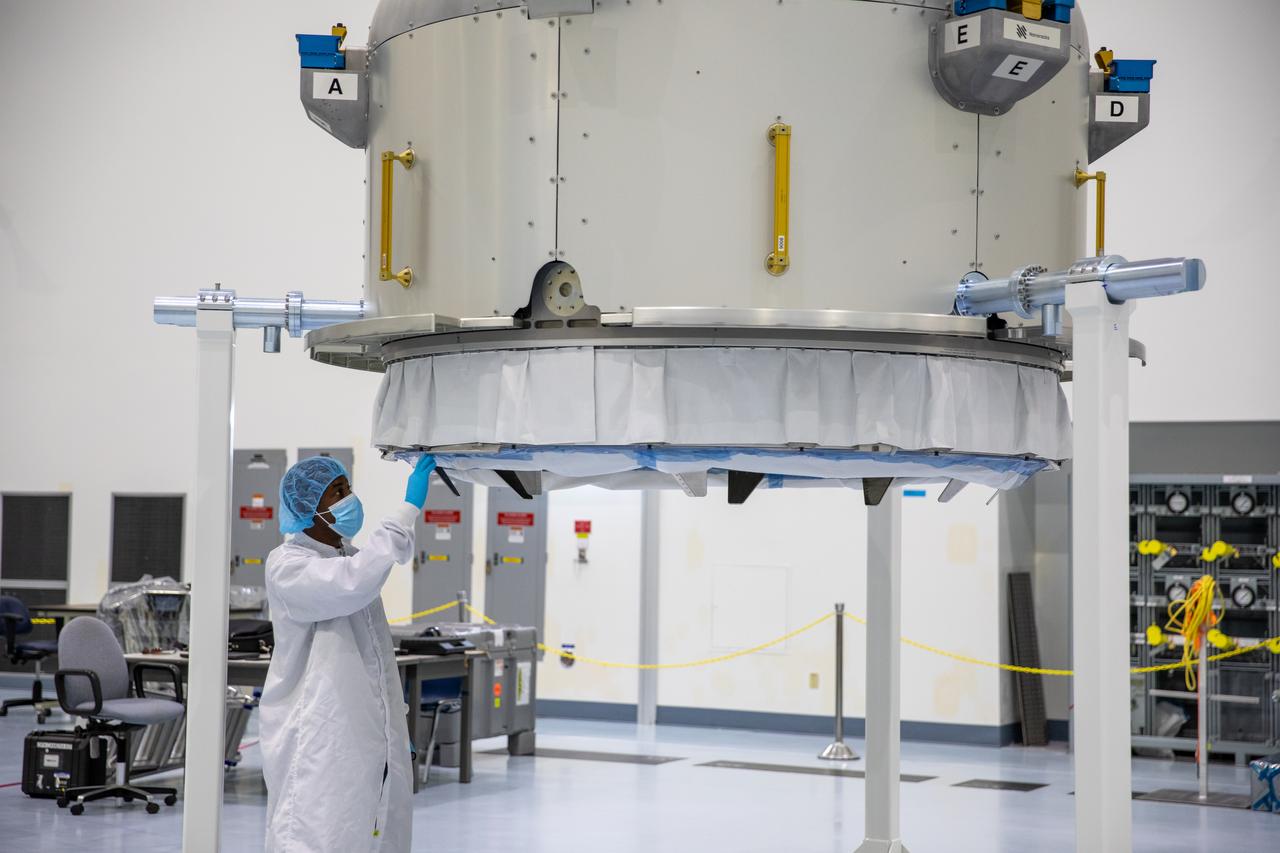
A Nanoracks technician works on the Nanoracks Bishop Airlock inside the Space Station Processing Facility at NASA's Kennedy Space Center in Florida on Oct. 7, 2020. The next-generation Nanoracks payload facility is being prepared for its flight to the International Space Station on SpaceX’s 21st commercial resupply services mission (CRS-21) to the International Space Station. The Bishop Airlock is the first commercially funded airlock for the space station. It will provide payload hosting, robotics testing, satellite deployment, and serve as an outside toolbox for station crew spacewalks, and more. CRS-21 is scheduled to launch on a SpaceX Falcon 9 from Kennedy’s Launch Complex 39A.
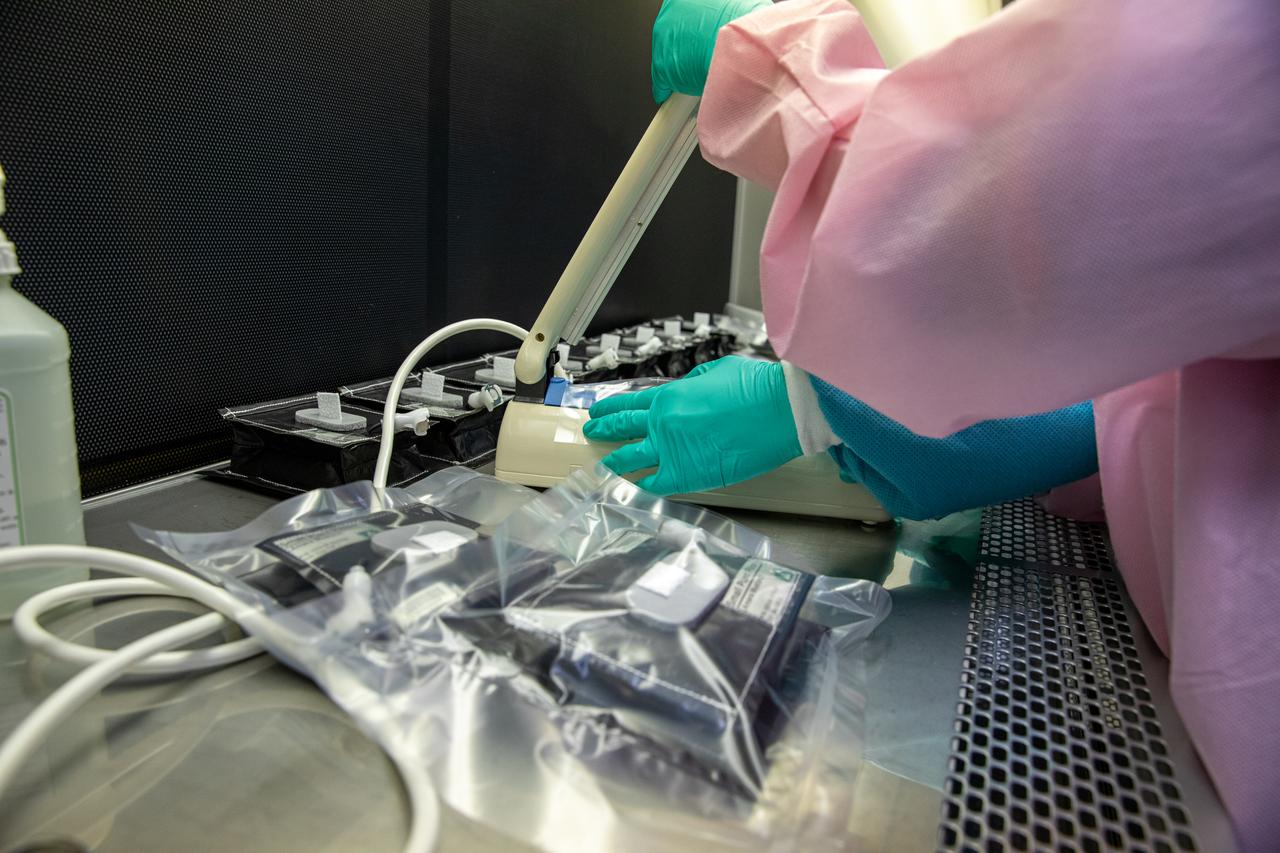
On Jan. 21, 2020, inside the Space Station Processing Facility at NASA’s Kennedy Space Center in Florida, intern Emily Kennebeck prepares plant pillows for their upcoming flight to the International Space Station. The pillows, which are a common method used to grow plants in space, are being sent to the orbiting laboratory on Northrop Grumman’s 13th resupply services (NG-13) mission for a series of VEG-03 experiments that will study the growth of three types of leafy greens in a microgravity environment. Once the pillows are assembled and packaged for flight, they will be transported to the agency’s Wallops Flight Facility in Virginia, where liftoff will occur. NG-13 is scheduled to launch on Feb. 9, 2020, at 5:39 p.m. EST.