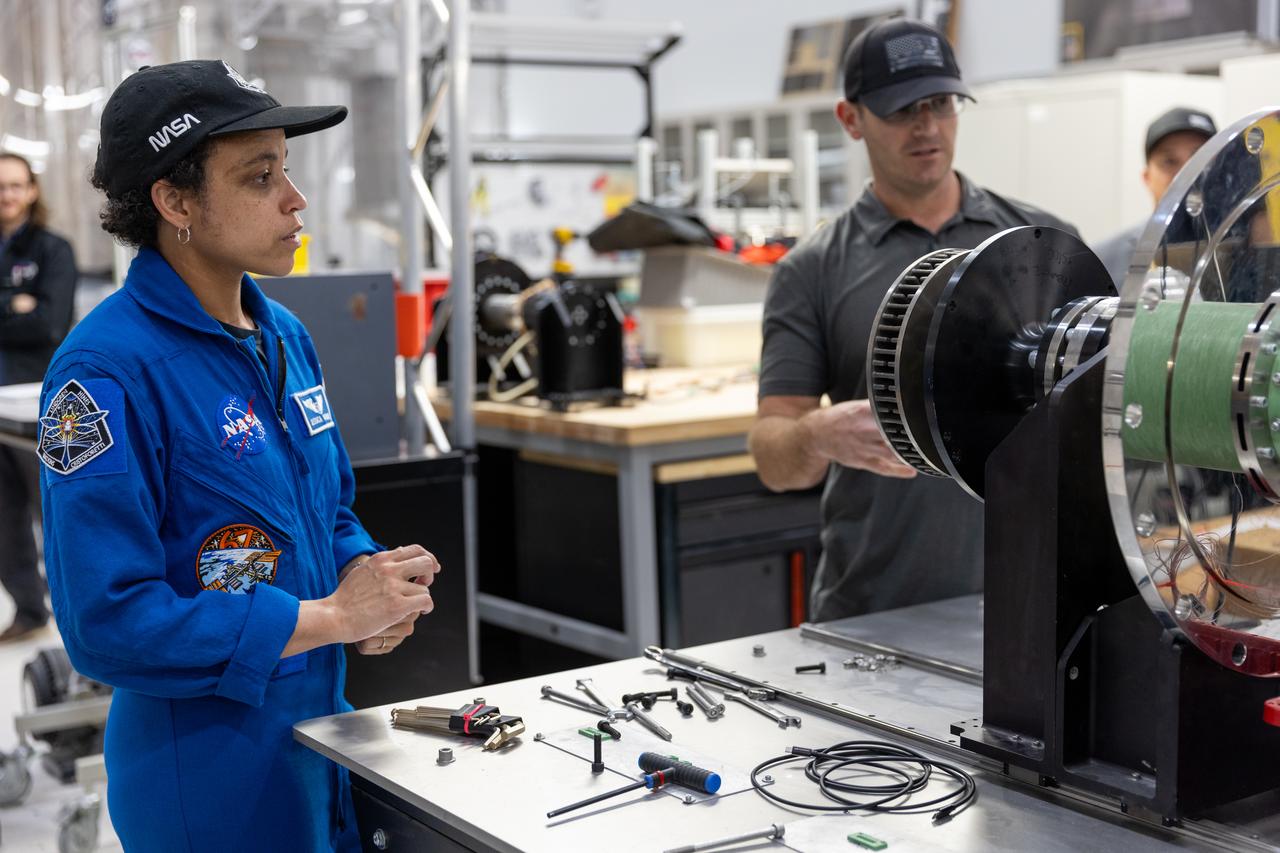
NASA astronaut Jessica Watkins visits the Granular Mechanics and Regolith Operations Laboratory inside Swamp Works at Kennedy Space Center in Florida on Wednesday, Aug. 27, 2025, to view some of the evolving technologies in development that astronauts may use to explore the Moon’s surface, prepare it for sustainable outposts, and to handle the dust that is collected during moonwalks.
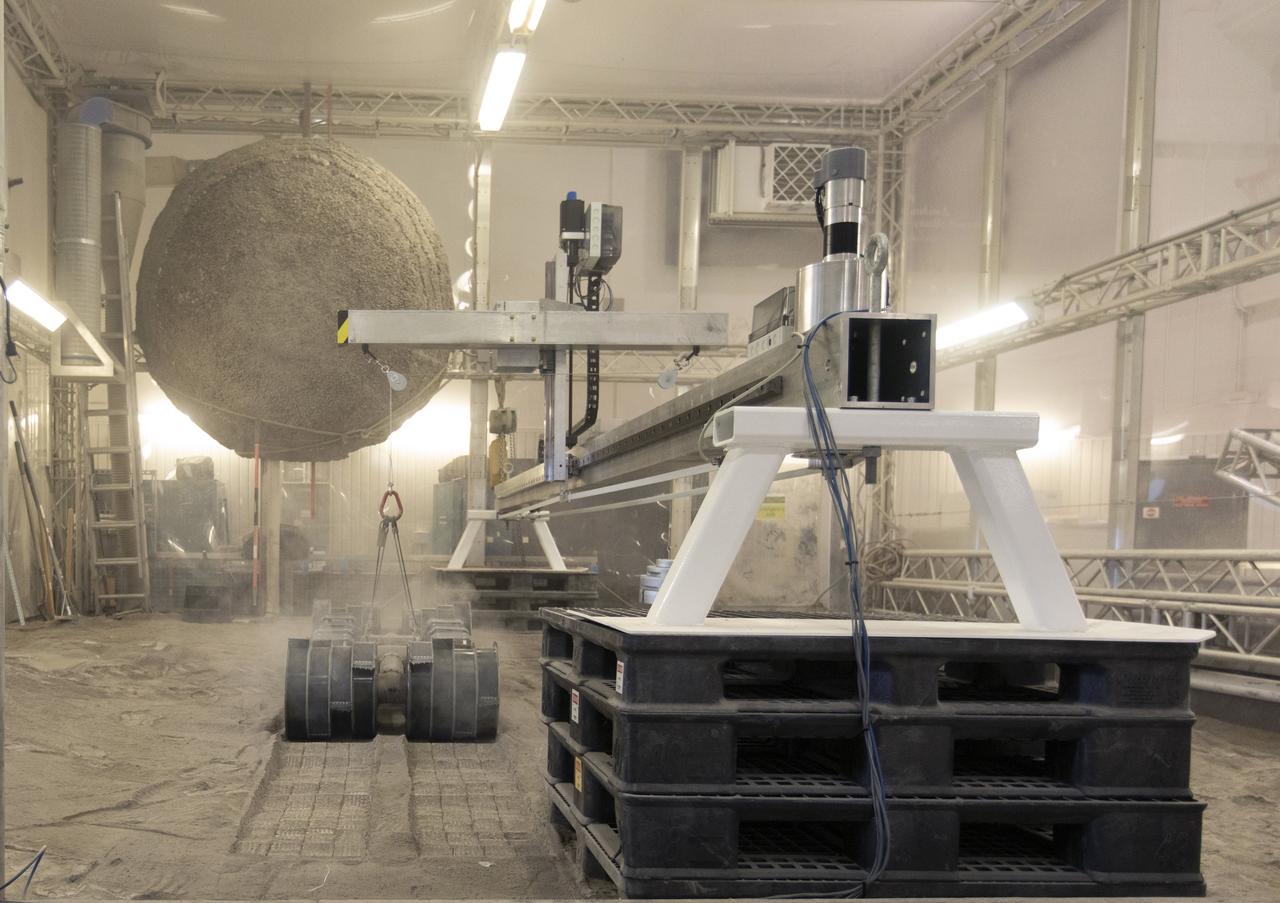
A team from the Granular Mechanics and Regolith Operations Lab tests the Regolith Advanced Surface Systems Operations Robot (RASSOR) in the regolith bin inside Swamp Works at NASA’s Kennedy Space Center in Florida on June 5, 2019. Tests use a gravity assist offload system to simulate reduced gravity conditions found on the Moon. On the surface of the Moon, mining robots like RASSOR will excavate the regolith and take the material to a processing plant where usable elements such as hydrogen, oxygen and water can be extracted for life support systems. RASSOR can scoop up icy regolith which can be used to make operations on the Moon sustainable.

A lightweight simulator version of NASA's Resource Prospector undergoes a mobility test in a regolith bin at the agency's Kennedy Space center in Florida. The Resource Prospector mission aims to be the first mining expedition on another world. Operating on the moon’s poles, the robot is designed to use instruments to locate elements at a lunar polar regions, then excavate and sample resources such as hydrogen, oxygen and water. These resources could support human explores on their way to destinations such as farther into the solar system.
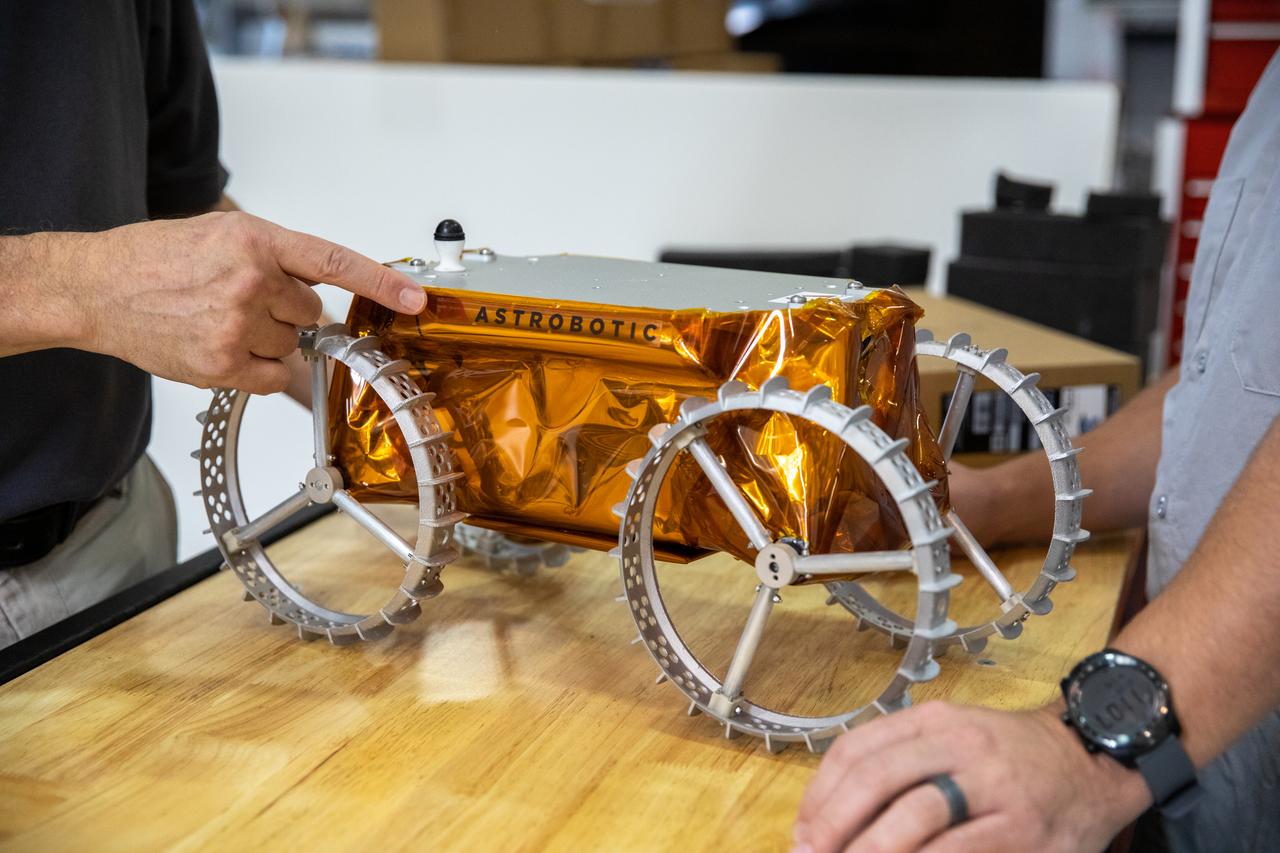
Jim Mantovani, left, and A.J. Nick, with Kennedy Space Center’s Exploration and Research and Technology programs, unbox a CubeRover at the Florida spaceport on Oct. 9, 2020. The rover was delivered by Pittsburgh-based space robotics company Astrobotic, as part of a Small Business Innovative Research (SBIR) award from NASA. Nick will lead CubeRover testing in the coming months in the Granular Mechanics and Regolith Operations (GMRO) Laboratory’s regolith bin, which holds approximately 120 tons of lunar regolith simulant at Kennedy’s Swamp Works. In 2019, NASA announced a $2 million Tipping Point award to develop more mature CubeRover’s payload interfaces and increase its capabilities.
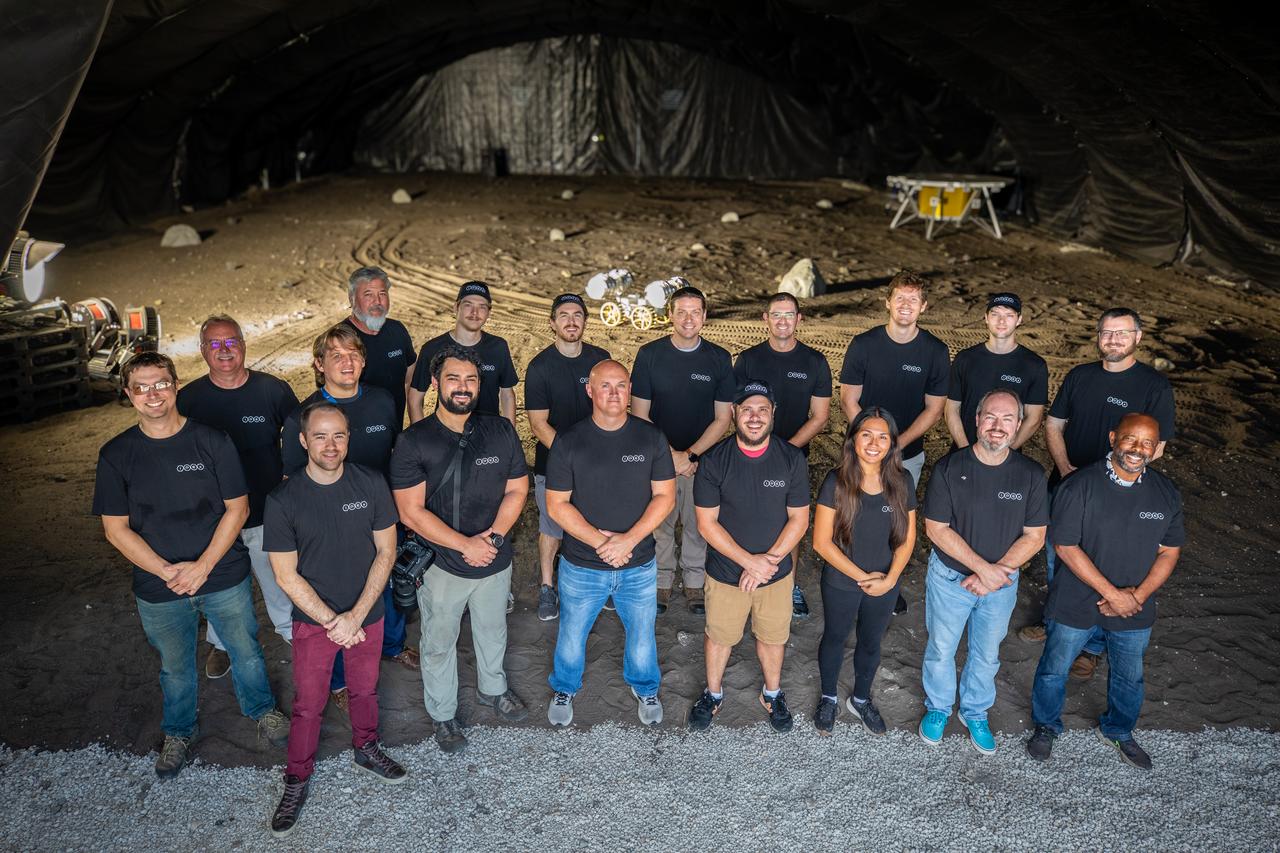
A team from the Granular Mechanics and Regolith Operations lab who developed and tested NASA’s ISRU Pilot Excavator (IPEx) pose for a photo on Friday, Aug. 30, 2024, in a testbed located at NASA’s Kennedy Space Center in Florida. IPEx functions as both an excavator and a dump truck to mine and transport lunar regolith, the loose rocky material on the Moon’s surface, which is crucial for future lunar missions and In-Situ Resource Utilization (ISRU) processes. This dual capability makes IPEx an indispensable tool for sustainable lunar exploration.
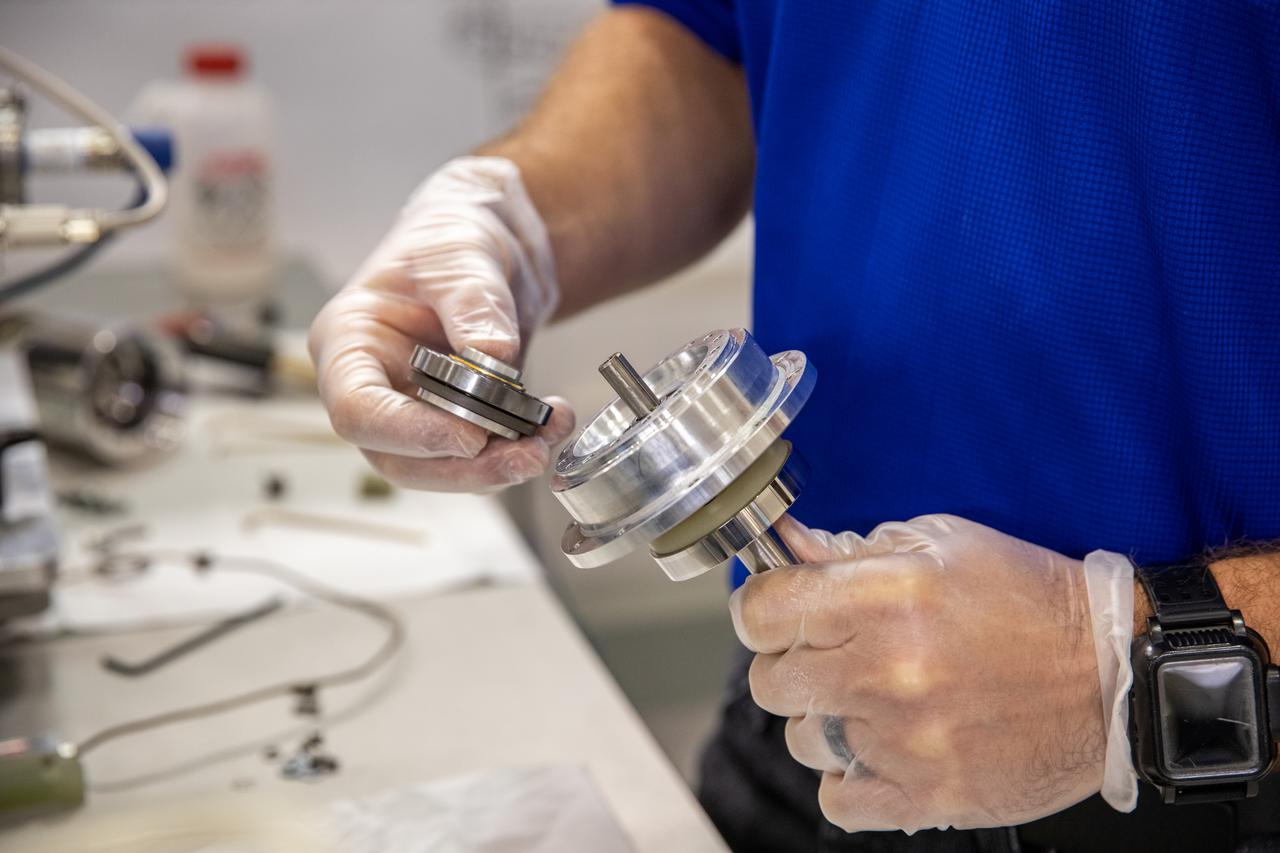
Drew Smith, a robotics engineer and lab manager with the Exploration Research and Technology programs at NASA's Kennedy Space Center, prepares a Bulk Metallic Glass Gear (BMGG) for ambient temperature tests in a vacuum inside a cryogenic cooler at Kennedy's Granular Mechanics and Regolith Operations lab on June 17, 2021. Made from a custom bulk metallic glass alloy, BMGGs could be used in heater-free gearboxes at extremely low temperatures in locations such as the Moon, Mars, and Europa, one of Jupiter’s moons. NASA’s Jet Propulsion Laboratory is working with commercial partners to create the gears.
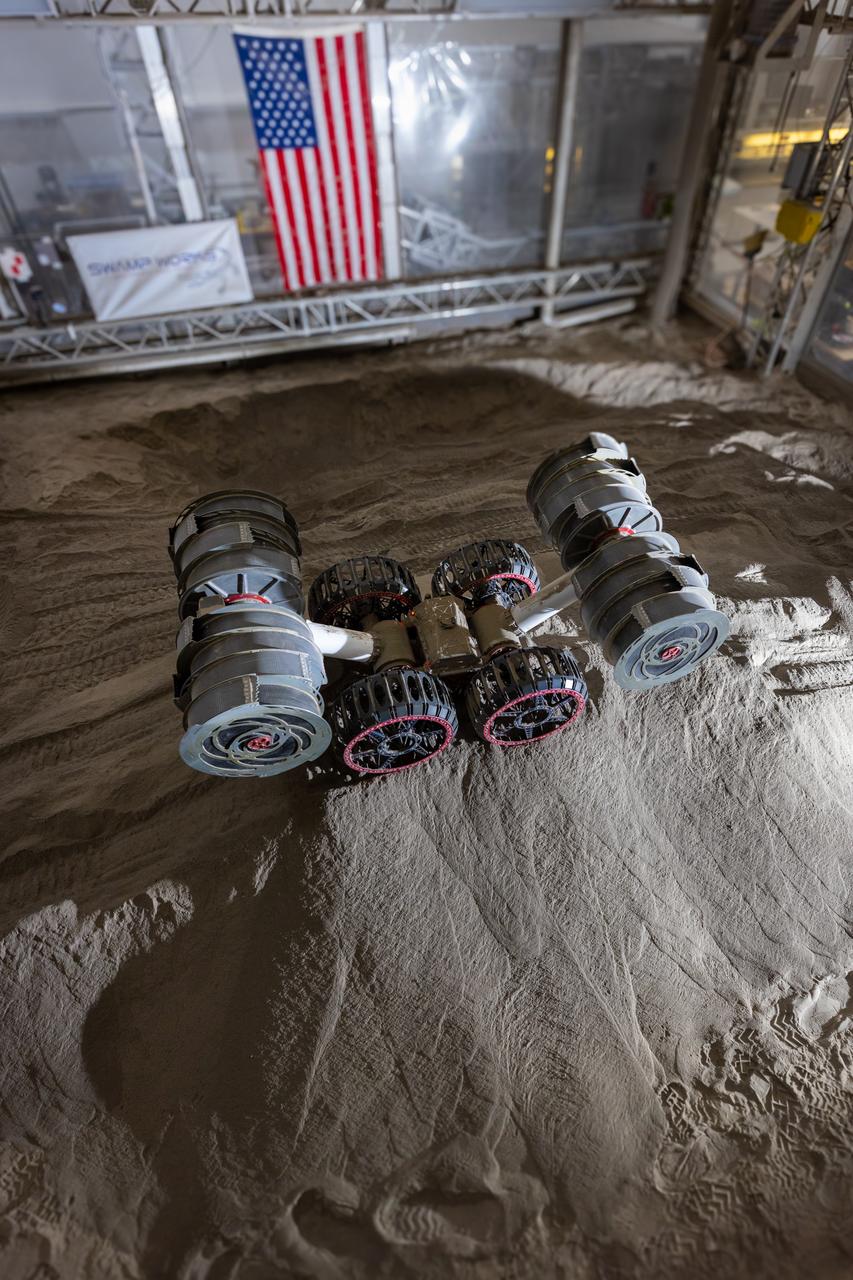
NASA’s RASSOR (Regolith Advanced Surface Systems Operations Robot) manipulates simulated regolith, or lunar dust found on the Moon’s surface, to create a three-foot berm during a site preparation test inside of the Granular Mechanics and Regolith Operations Lab at the agency’s Kennedy Space Center in Florida on Tuesday, June 3, 2025. The opposing motion of the bucket drums helps RASSOR grip the surface in low-gravity environments like the Moon or Mars. With this unique capability, RASSOR can traverse the rough surface to dig, load, haul, and dump regolith that could be used in construction or broken down into hydrogen, oxygen, or water, resources critical for sustaining human presence. RASSOR represents an earlier generation technology that informed the development of NASA’s IPEx (In-Situ Resource Utilization Pilot Excavator), serving as a precursor and foundational platform for the advanced excavation systems and autonomous capabilities now being demonstrated by this Moon-mining robot.
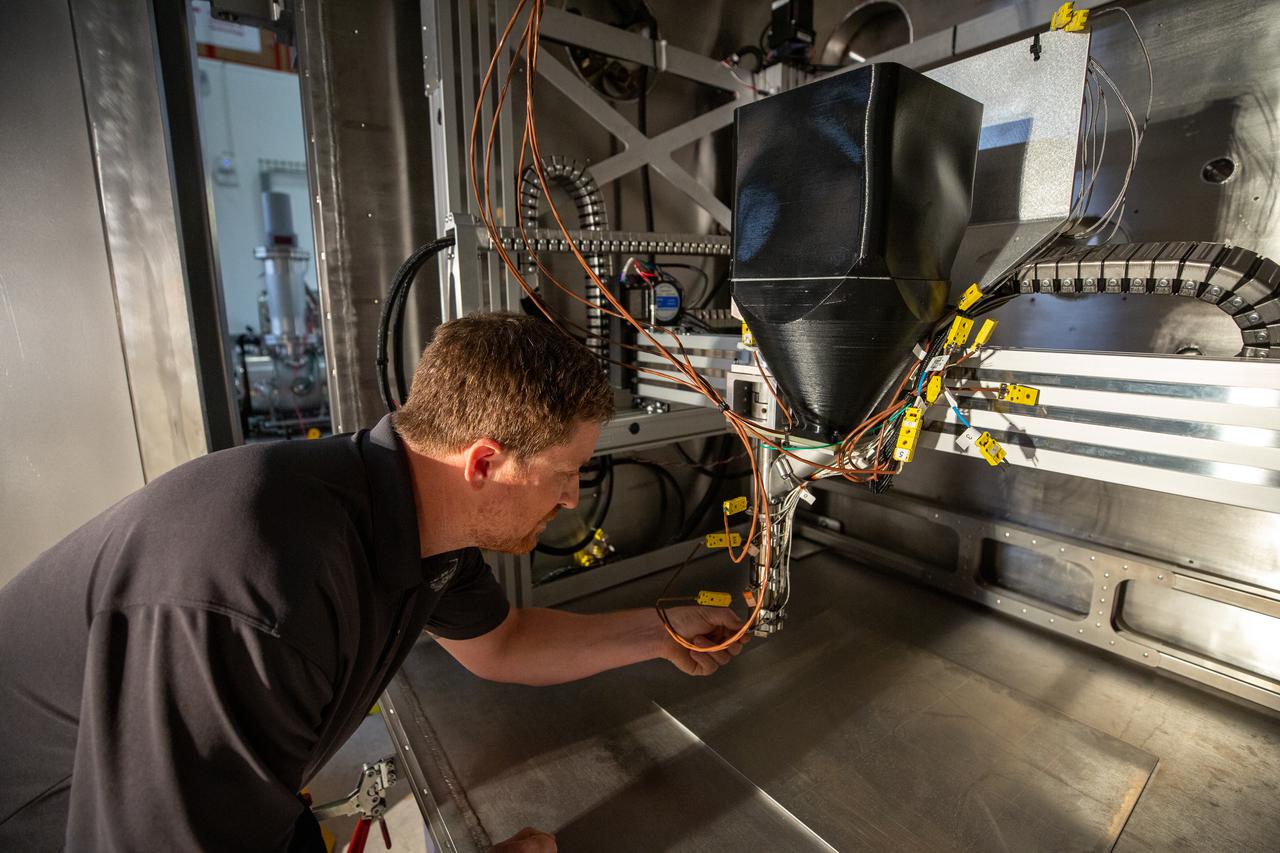
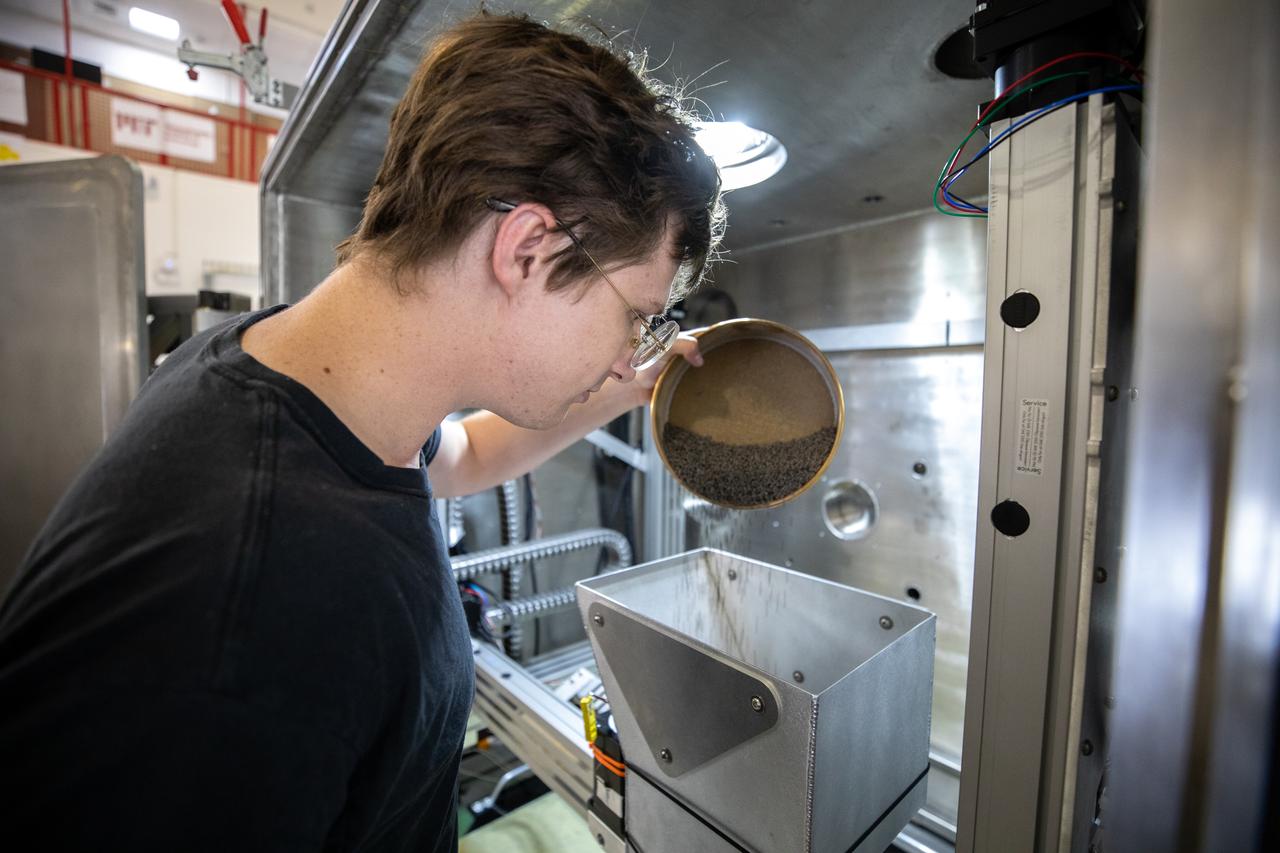
Nathan Gelino, a principal investigator with the Exploration Research and Technology programs at Kennedy Space Center in Florida, prepares a vacuum chamber for testing 3D printing inside the Granular Mechanics and Regolith Operations (GMRO) lab at Kennedy’s Swamp Works on April 5, 2022. The testing is part of the Relevant Environment Additive Construction Technology (REACT) project, which derives from NASA’s 2020 Announcement of Collaboration Opportunity, with AI SpaceFactory – an architectural and construction technology company and winner of NASA’s 3D Printed Habitat Challenge – collaborating with Kennedy teams to build 3D-printed test structures using a composite made from polymers and a regolith simulant in a vacuum chamber that mimics environmental conditions on the Moon.
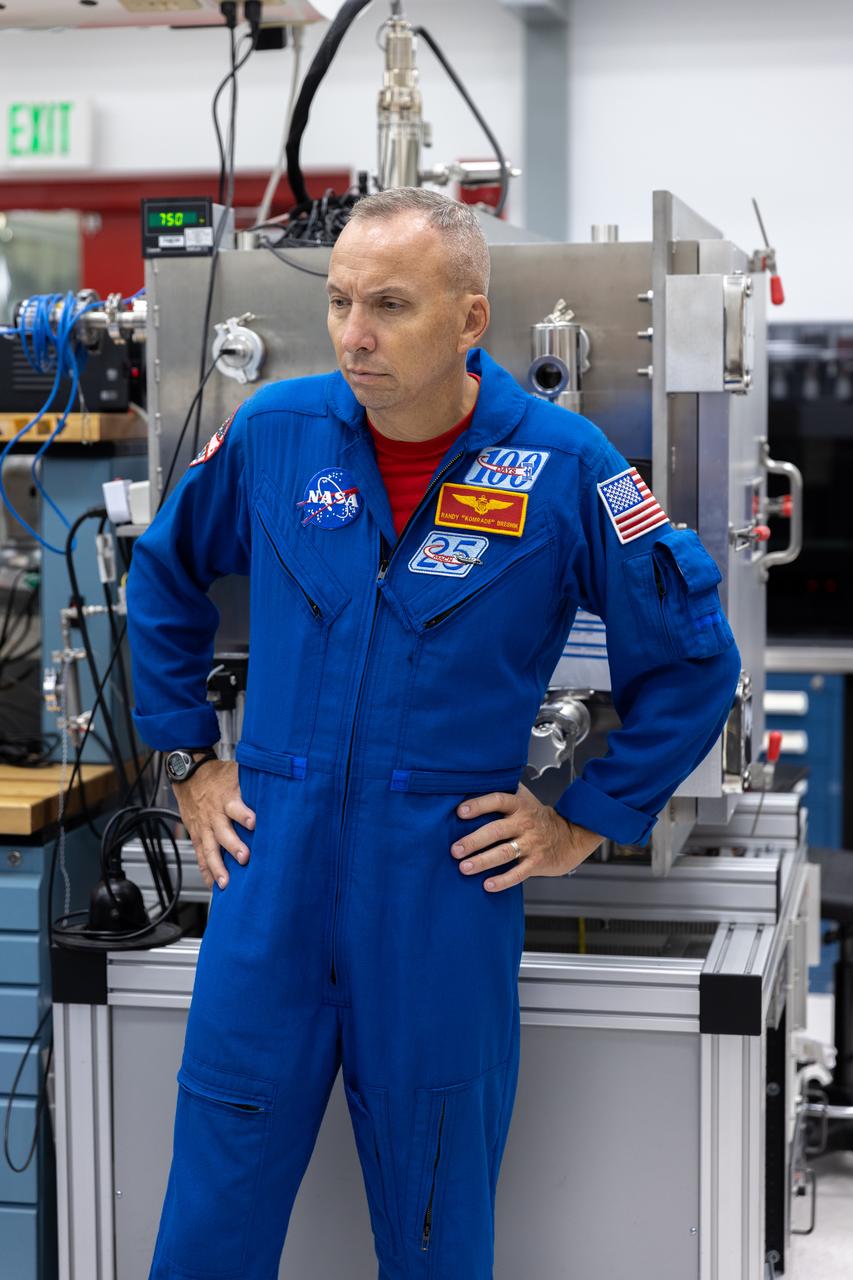
NASA astronaut Randy Bresnik visits the Granular Mechanics and Regolith Operations Laboratory inside Swamp Works at Kennedy Space Center in Florida on Wednesday, Aug. 27, 2025, to view some of the evolving technologies in development that astronauts may use to explore the Moon’s surface, prepare it for sustainable outposts, and to handle the dust that is collected during moonwalks.
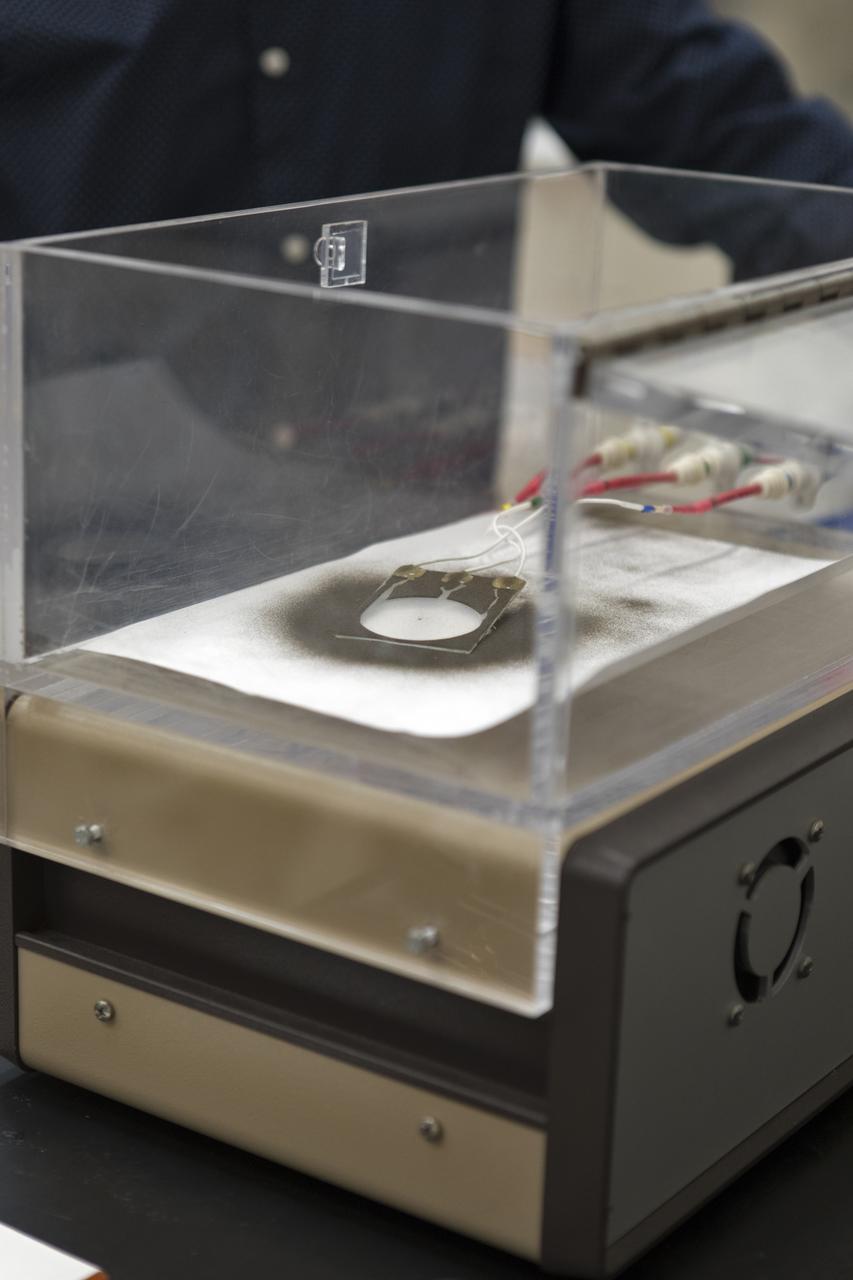
In the Electrostatics and Surface Physics Laboratory at NASA's Kennedy Space Center in Florida on Thursday, July 19, 2018, an experiment is underway in which an Electrostatic Dust Shield was been covered with dust similar to that which may be encountered by astronauts exploring the Moon or Mars. After activation, the device shook off the dust. Scientists are developing the dust shield to help mitigate the problem of dust on equipment, astronauts' space suits and helmet visors. The device is slated for analysis aboard International Space Station in the spring of 2019 to verify the effects of the space environment.
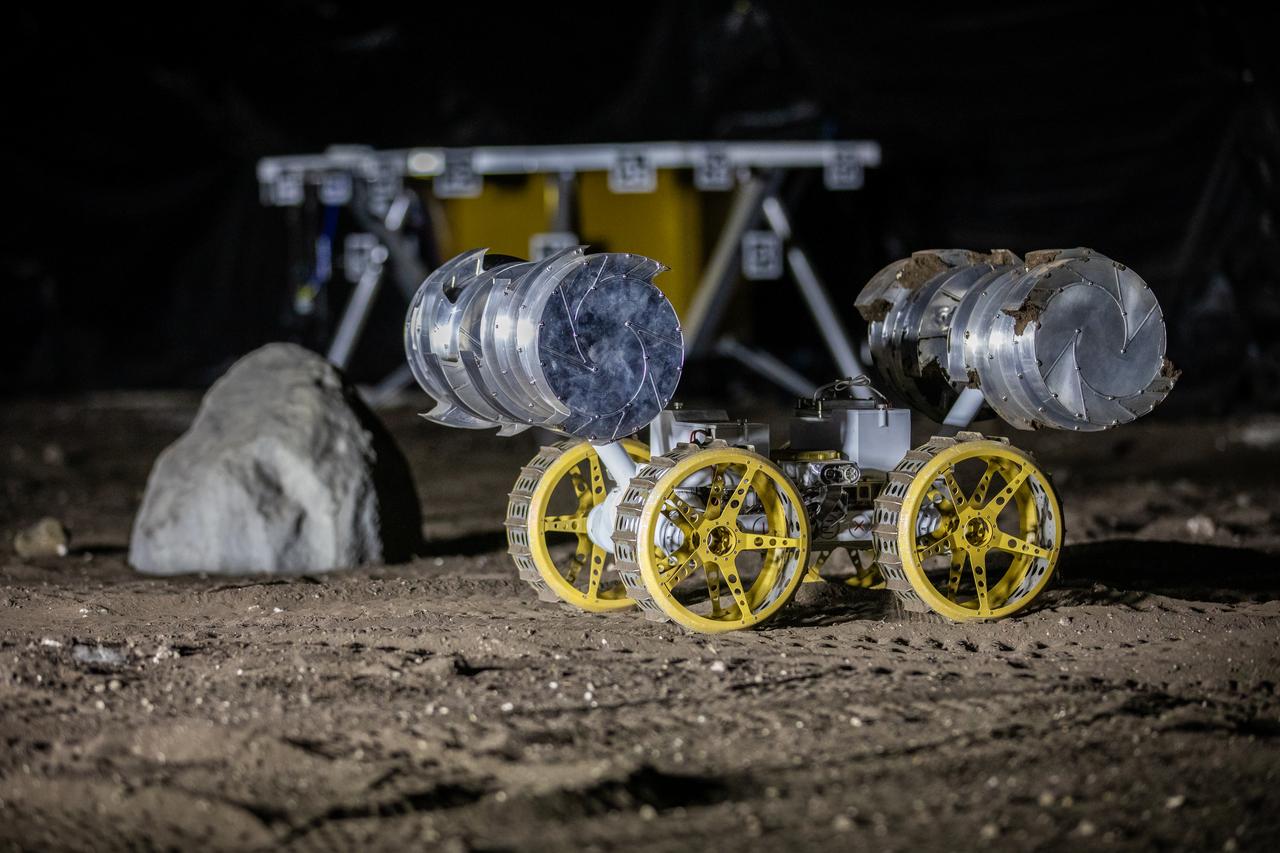
NASA’s ISRU Pilot Excavator (IPEx) performs a simulated lunar mission in a testbed at the agency’s Kennedy Space Center on Friday, Aug. 30, 2024. IPEx functions as both an excavator and a dump truck to mine and transport lunar regolith, the loose rocky material on the Moon’s surface, which is crucial for future lunar missions and In-Situ Resource Utilization (ISRU) processes. This dual capability makes IPEx an indispensable tool for sustainable lunar exploration.
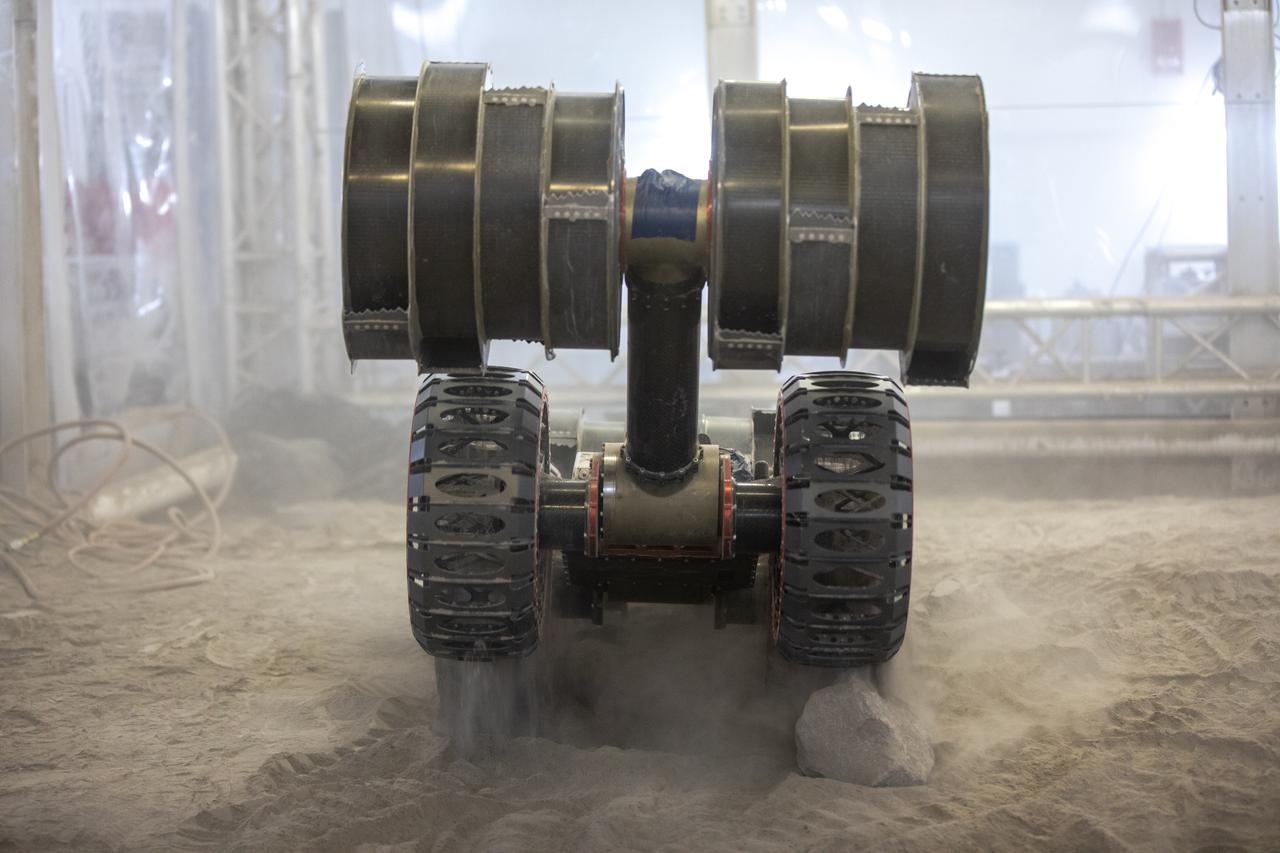
The ISRU Pilot Excavator is tested in the regolith bin inside Swamp Works at NASA’s Kennedy Space Center in Florida on July 28, 2022. Tests use a gravity assist offload system to simulate reduced gravity conditions found on the Moon. On the surface of the Moon, mining robots like the Pilot Excavator will excavate the regolith and take the material to a processing plant where usable elements such as hydrogen, oxygen and water can be extracted for life support systems. The Pilot Excavator can scoop up icy regolith which can be used to make operations on the Moon sustainable.
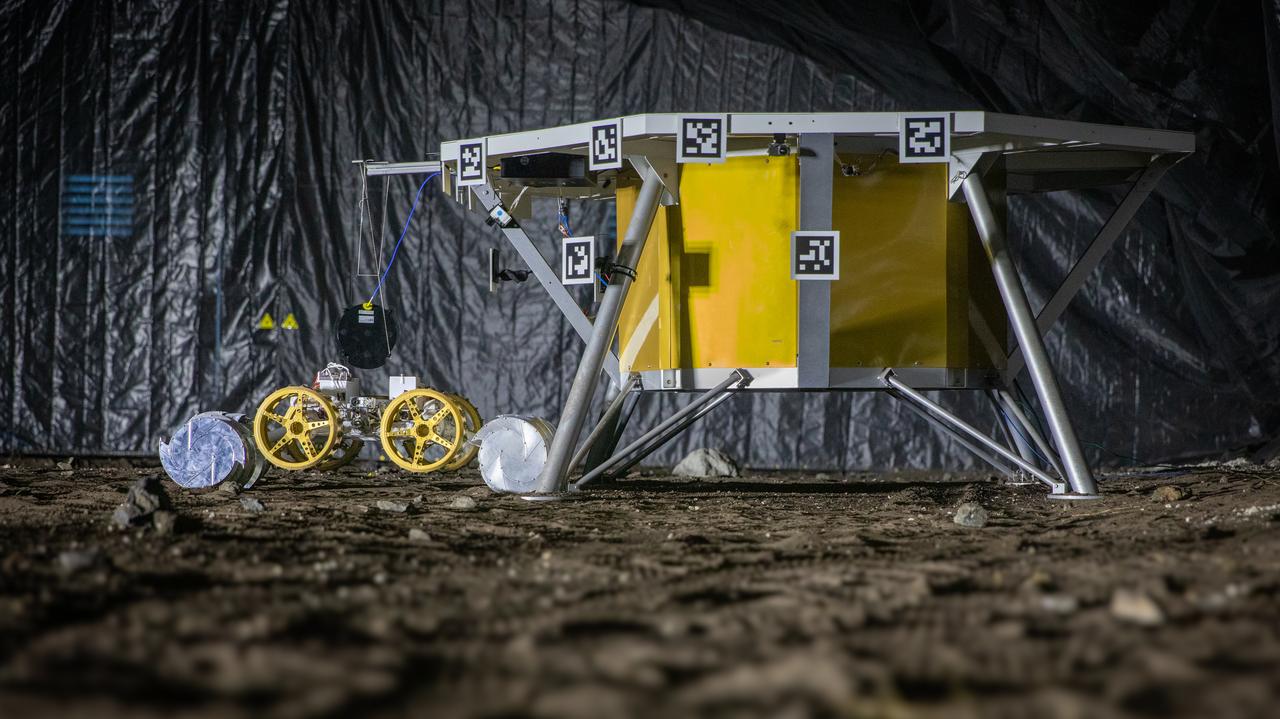
NASA’s ISRU Pilot Excavator (IPEx) performs a simulated lunar mission in a testbed at the agency’s Kennedy Space Center on Friday, Aug. 30, 2024. IPEx functions as both an excavator and a dump truck to mine and transport lunar regolith, the loose rocky material on the Moon’s surface, which is crucial for future lunar missions and In-Situ Resource Utilization (ISRU) processes. This dual capability makes IPEx an indispensable tool for sustainable lunar exploration.
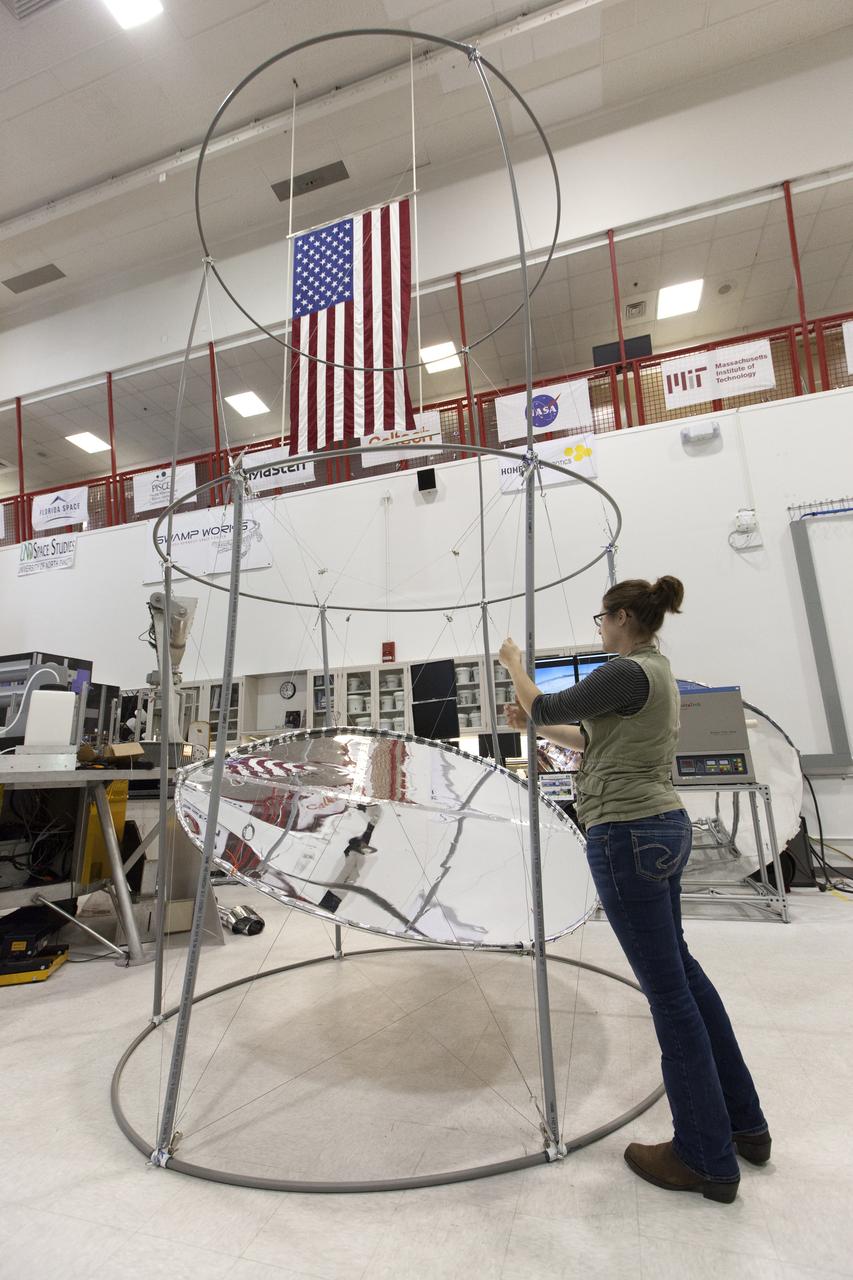
In the Swamp Works laboratory at NASA's Kennedy Space Center in Florida, student interns such as Maddy Olson are joining agency scientists, contributing in the area of Exploration Research and Technology. Olson is majoring in mechanical engineering at the University of North Dakota. The agency attracts its future workforce through the NASA Internship, Fellowships and Scholarships, or NIFS, Program.
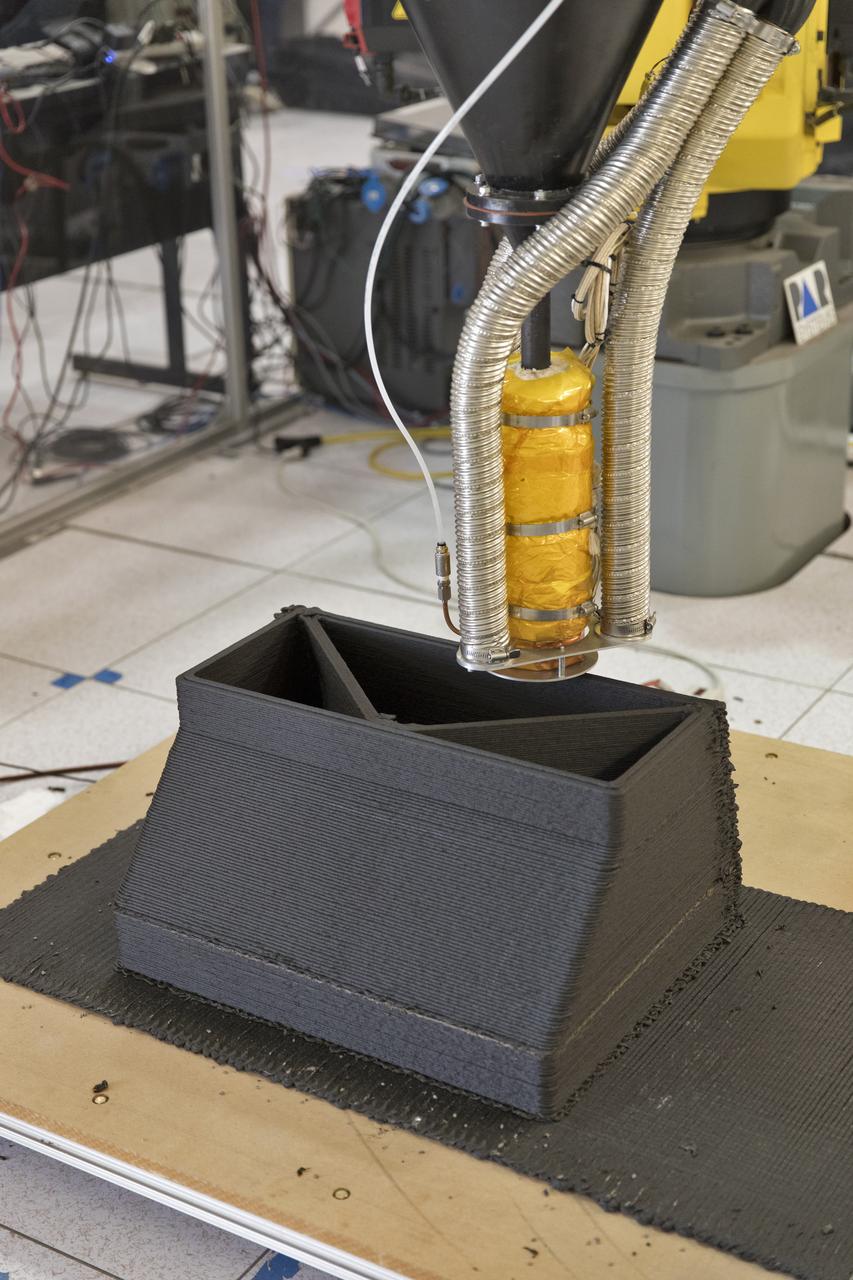
A Zero Launch Mass 3-D printer is being tested at the Swamp Works at NASA's Kennedy Space Center in Florida. The printer can be used for construction projects on the Moon and Mars. Zero launch mass refers to the fact that the printer uses pellets made from simulated lunar regolith, or dirt, and polymers. This will prove that space explorers can use resources at their destination instead of taking everything with them, saving them launch mass and money. The Kennedy team is working with Marshall Space Flight Center in Huntsville, Alabama, and the U.S. Army Corps of Engineers to develop a system that can 3-D print barracks in remote locations on Earth, using the resources they have where they are.
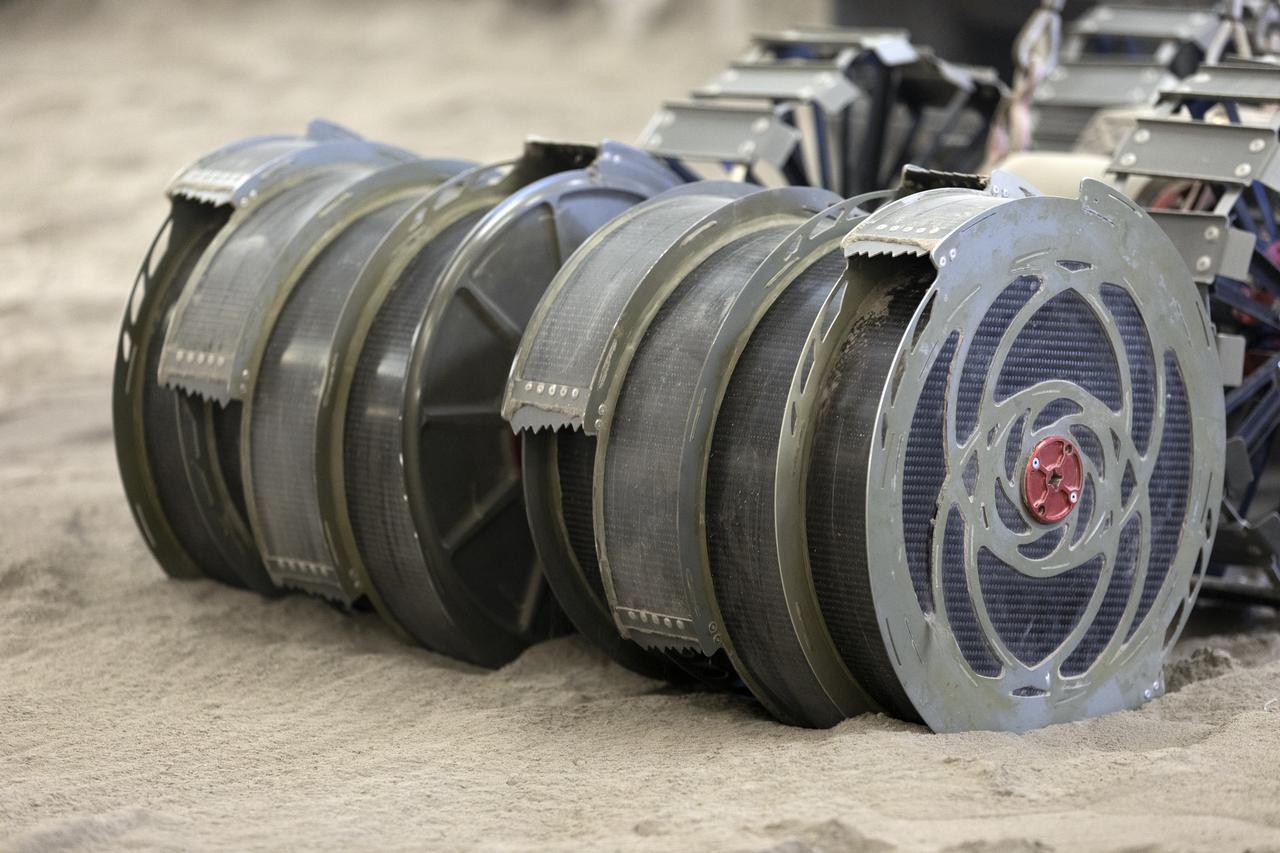
A team from the Granular Mechanics and Regolith Operations Lab tests the Regolith Advanced Surface Systems Operations Robot (RASSOR) in the regolith bin inside Swamp Works at NASA’s Kennedy Space Center in Florida on June 5, 2019. Tests use a gravity assist offload system to simulate reduced gravity conditions found on the Moon. On the surface of the Moon, mining robots like RASSOR will excavate the regolith and take the material to a processing plant where usable elements such as hydrogen, oxygen and water can be extracted for life support systems. RASSOR can scoop up icy regolith which can be used to make operations on the Moon sustainable.
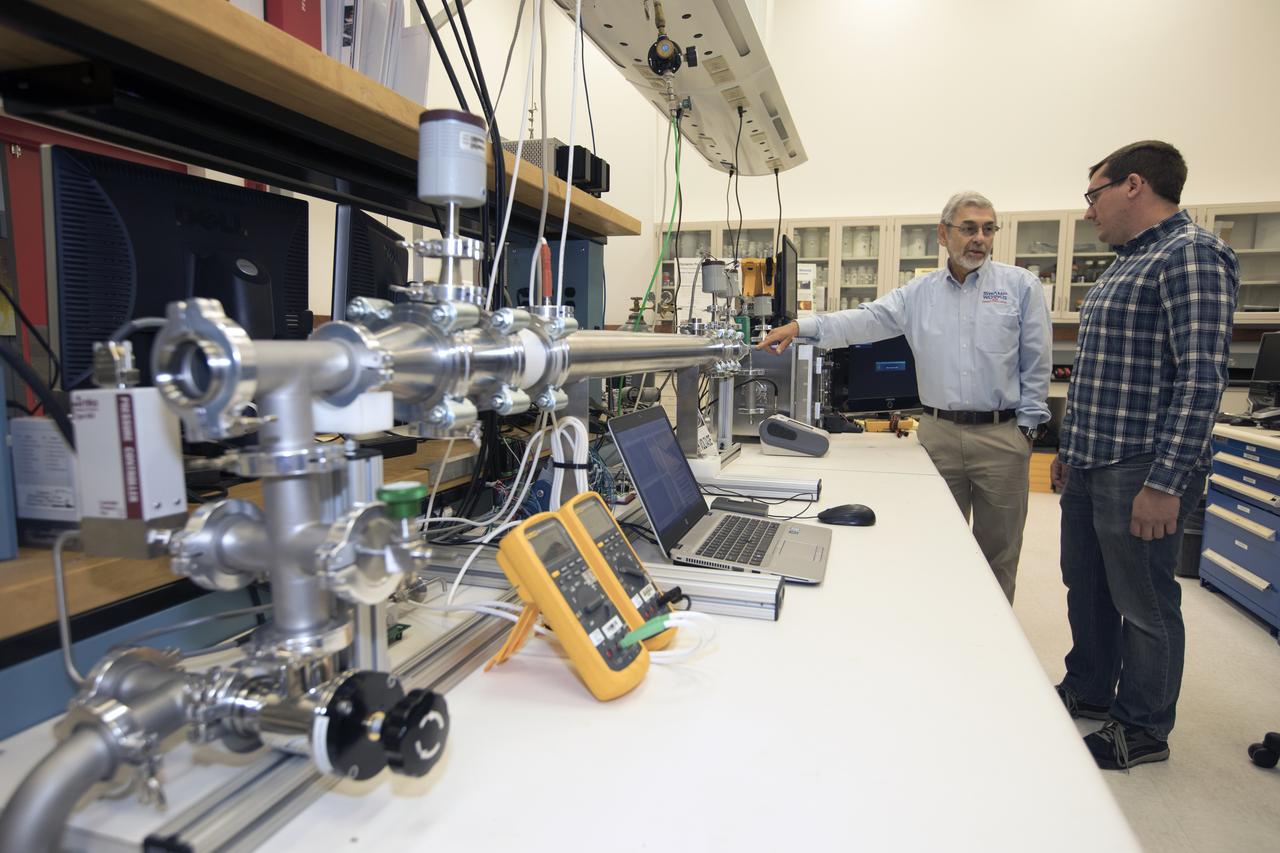
Dr. Carlos Calle, lead scientist in the Kennedy Space Center's Electrostatics and Surface Physics Laboratory, left, and Jay Phillips, a research physicist, are modifying an electrostatic precipitator to help remove dust from a simulated Martian atmosphere. NASA's Journey to Mars requires cutting-edge technologies to solve the problems explorers will face on the Red Planet. Scientists are developing some of the needed solutions by adapting a device to remove the ever-present dust from valuable elements in the Martian atmosphere. Those commodities include oxygen, water and methane.
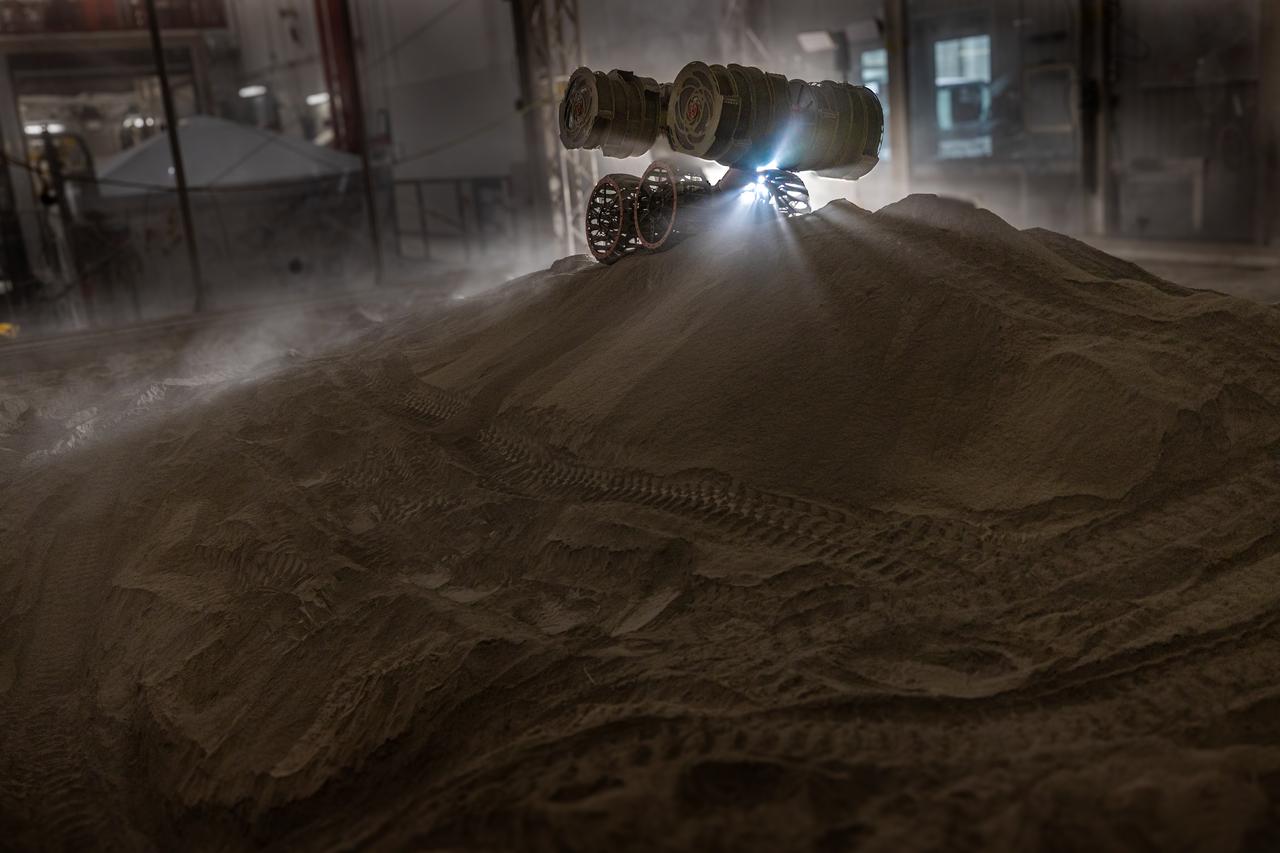
NASA’s RASSOR (Regolith Advanced Surface Systems Operations Robot) manipulates simulated regolith, or lunar dust found on the Moon’s surface, to create a three-foot berm during a site preparation test inside of the Granular Mechanics and Regolith Operations Lab at the agency’s Kennedy Space Center in Florida on Tuesday, June 3, 2025. The opposing motion of the bucket drums helps RASSOR grip the surface in low-gravity environments like the Moon or Mars. With this unique capability, RASSOR can traverse the rough surface to dig, load, haul, and dump regolith that could be used in construction or broken down into hydrogen, oxygen, or water, resources critical for sustaining human presence. RASSOR represents an earlier generation technology that informed the development of NASA’s IPEx (In-Situ Resource Utilization Pilot Excavator), serving as a precursor and foundational platform for the advanced excavation systems and autonomous capabilities now being demonstrated by this Moon-mining robot.

NASA astronauts Randy Bresnik (left) and Jessica Watkins (center) visit the Granular Mechanics and Regolith Operations Laboratory inside Swamp Works at Kennedy Space Center in Florida on Wednesday, Aug. 27, 2025, to view some of the evolving technologies in development that astronauts may use to explore the Moon’s surface, prepare it for sustainable outposts, and to handle the dust that is collected during moonwalks.
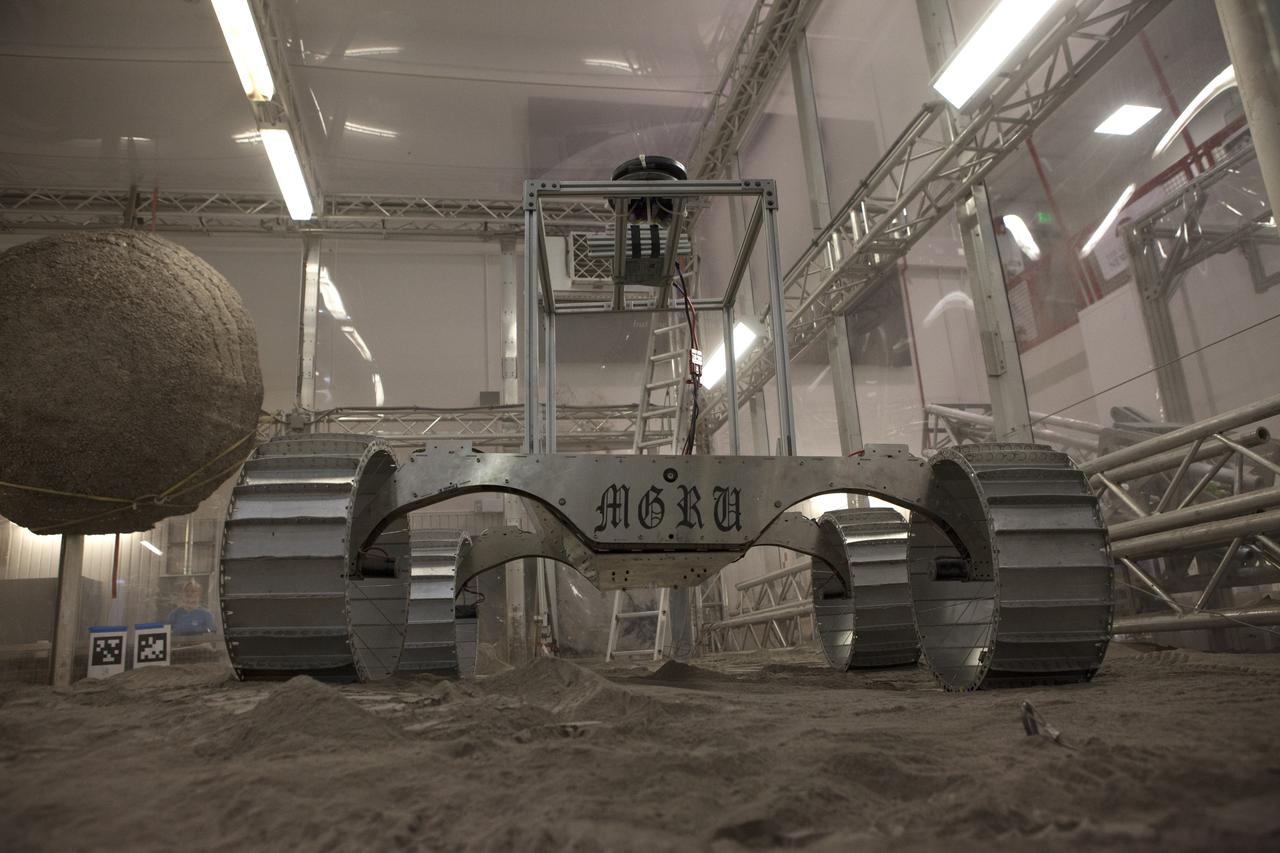
A lightweight simulator version of NASA's Resource Prospector undergoes a mobility test in a regolith bin at the agency's Kennedy Space center in Florida. The Resource Prospector mission aims to be the first mining expedition on another world. Operating on the moon’s poles, the robot is designed to use instruments to locate elements at a lunar polar regions, then excavate and sample resources such as hydrogen, oxygen and water. These resources could support human explores on their way to destinations such as farther into the solar system.
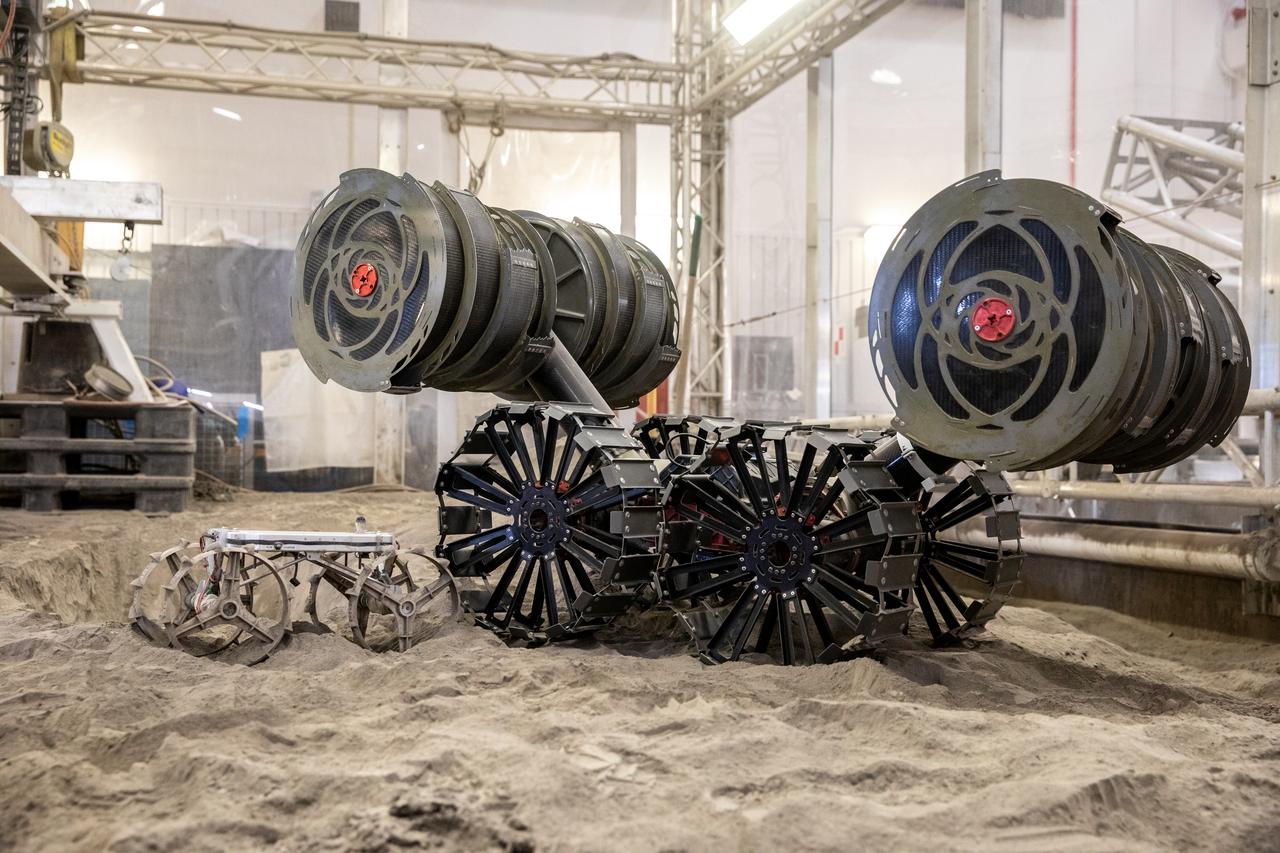
The Astrobotic CubeRover traverses the terrain in the Granular Mechanics and Regolith Operations Lab regolith bin at NASA’s Kennedy Space Center in Florida on Dec. 10, 2020. The regolith bin simulates the mechanical properties of the Moon’s surface. NASA and Astrobotic employees put the CubeRover through a series of more than 150 mobility tests over several days to evaluate and improve wheel design. Also in the bin is NASA’s Regolith Advanced Surface Systems Operations Robot (RASSOR), a robotic platform designed to dig on the Moon. The regolith bin simulates the Moon’s surface.
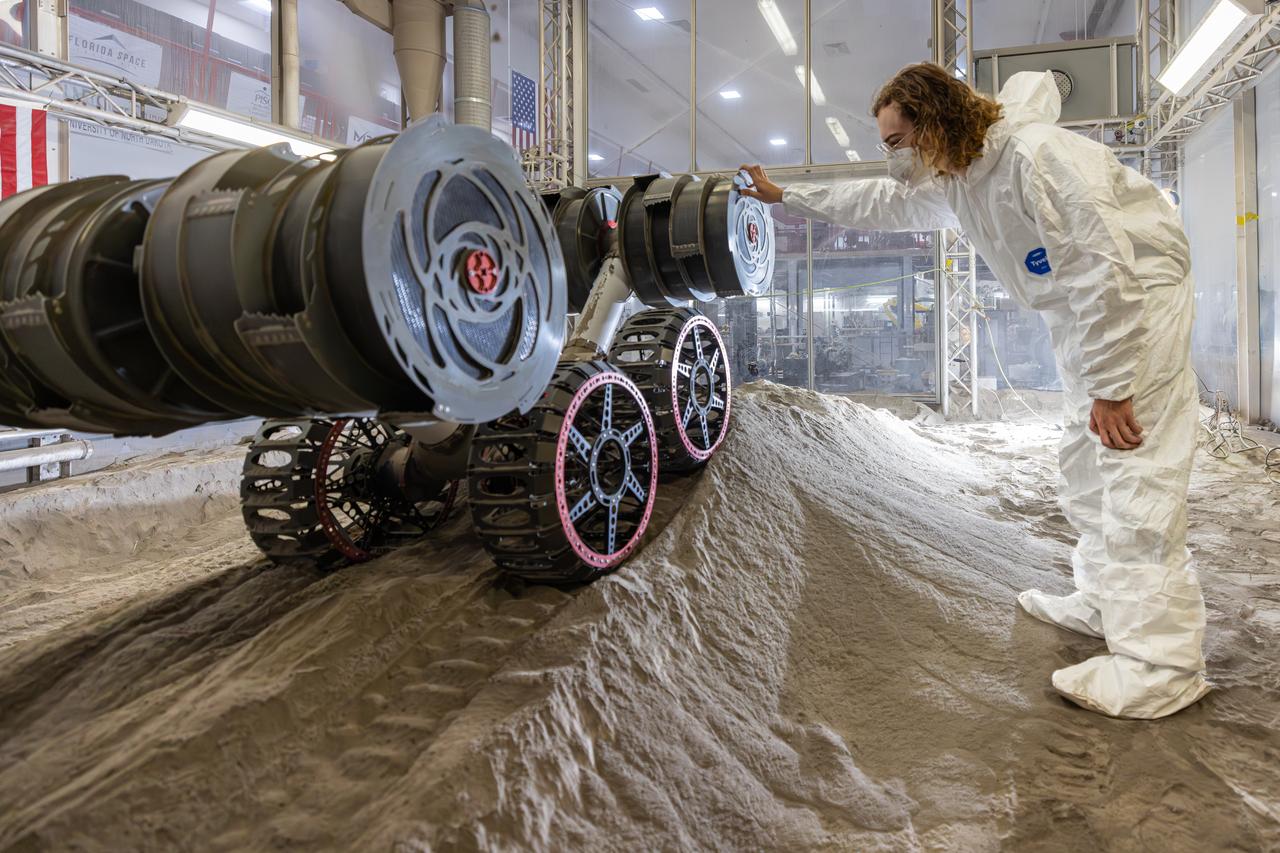
Ben Burdess, mechanical engineer, observes NASA’s RASSOR (Regolith Advanced Surface Systems Operations Robot) excavation testing of simulated regolith, or lunar dust found on the Moon’s surface, inside of the Granular Mechanics and Regolith Operations Lab at the agency’s Kennedy Space Center in Florida on Tuesday, May 27, 2025. RASSOR is designed to work in low-gravity situations, using counter rotating bucket drums on each arm to collect and dump regolith for the extraction of hydrogen, oxygen, or water, resources critical for sustaining a habitable presence.
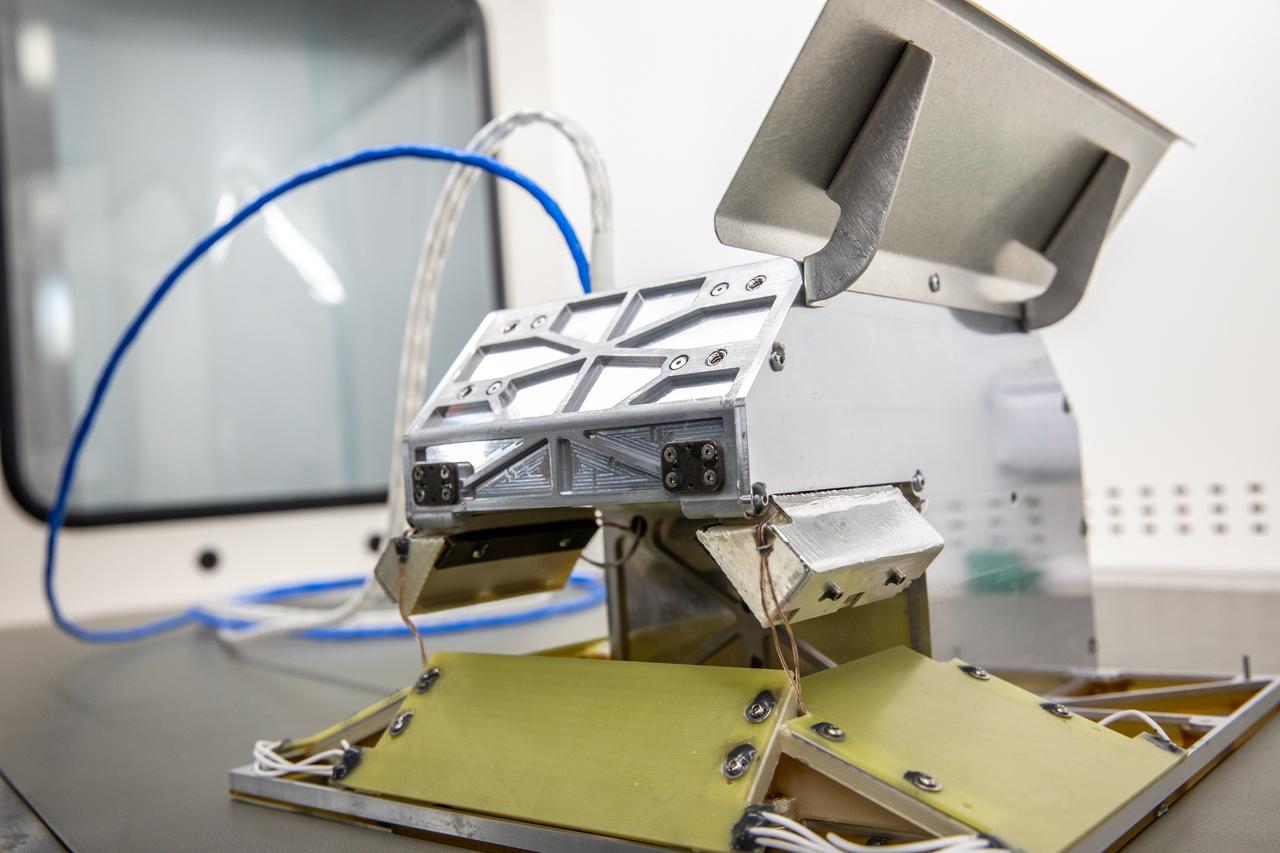
Inside of the Electrostatics and Surface Physics Laboratory at NASA’s Kennedy Space Center in Florida, an electrodynamic dust shield (EDS) is in view on Jan. 18, 2023. The dust shield is one of the payloads that will fly aboard Firefly Aerospace’s Blue Ghost lunar lander as part of NASA’s Commercial Lunar Payload Services (CLPS) initiative. During the mission, EDS will generate a non-uniform electric field using varying high voltage on multiple electrodes. This traveling field, in turn, carries away the particles and has potential applications in thermal radiators, spacesuit fabrics, visors, camera lenses, solar panels, and many other technologies. The CLPS initiative is a key part of NASA’s Artemis lunar exploration efforts. The science and technology payloads sent to the Moon’s surface as part of the initiative will help lay the foundation for human missions and a sustainable human presence on the lunar surface.

Drew Smith, a robotics engineer and lab manager with the Exploration Research and Technology programs at NASA's Kennedy Space Center, prepares a Bulk Metallic Glass Gear (BMGG) for ambient temperature tests in a vacuum inside a cryogenic cooler at Kennedy's Granular Mechanics and Regolith Operations lab on June 17, 2021. Made from a custom bulk metallic glass alloy, BMGGs could be used in heater-free gearboxes at extremely low temperatures in locations such as the Moon, Mars, and Europa, one of Jupiter’s moons. NASA’s Jet Propulsion Laboratory is working with commercial partners to create the gears.
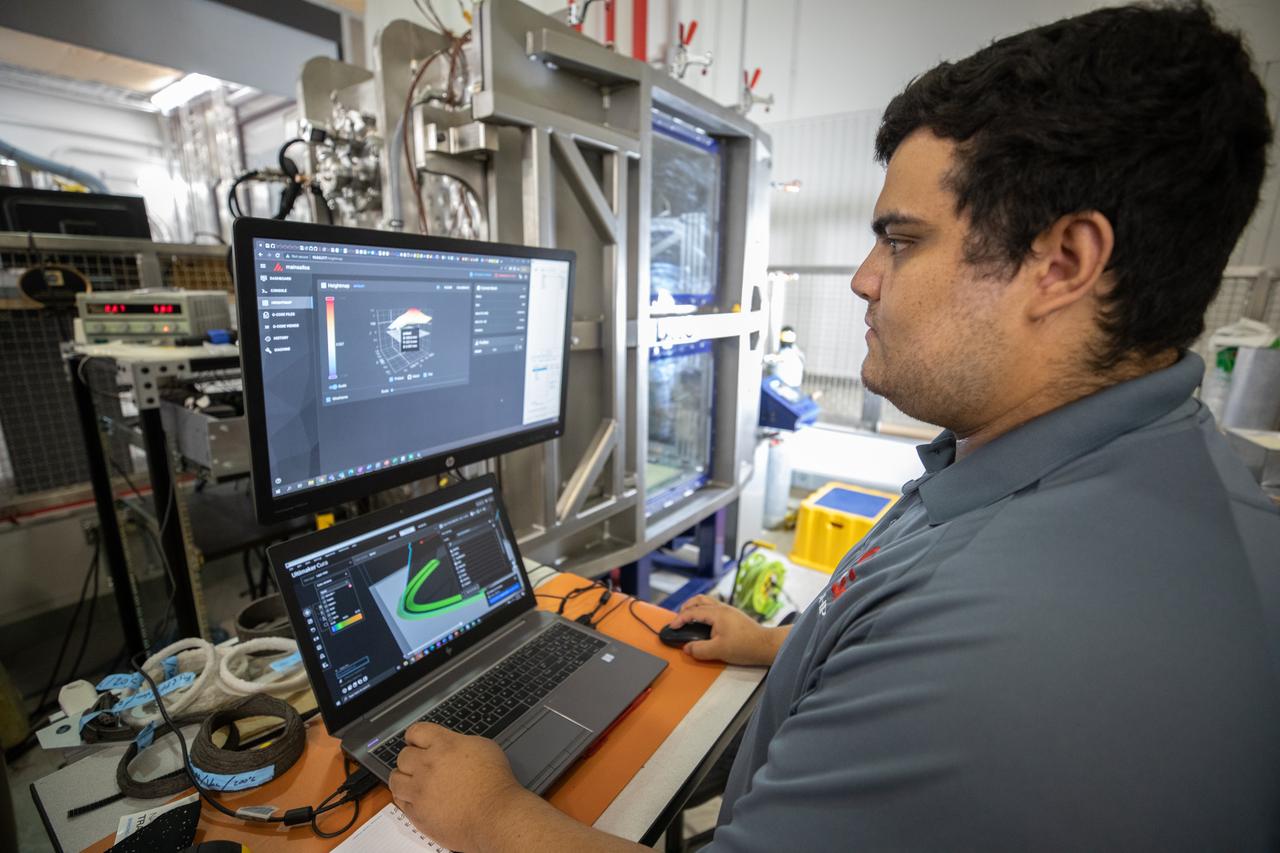
NASA Internships, Fellowships, and Scholarships (NIFS) intern Leonel Herrera tests a 3D printer on July 28, 2022, at Swamp Works at NASA’s Kennedy Space Center in Florida, as part of the Relevant Environment Additive Construction Technology (REACT) project. Among the key objectives of the project is developing an architectural and structural design for a shelter that provides protection to habitable assets on the lunar surface. Testing REACT derives from NASA’s 2020 Announcement of Collaboration Opportunity with AI SpaceFactory – an architectural and construction technology company and winner of NASA’s 3D Printed Habitat Challenge.
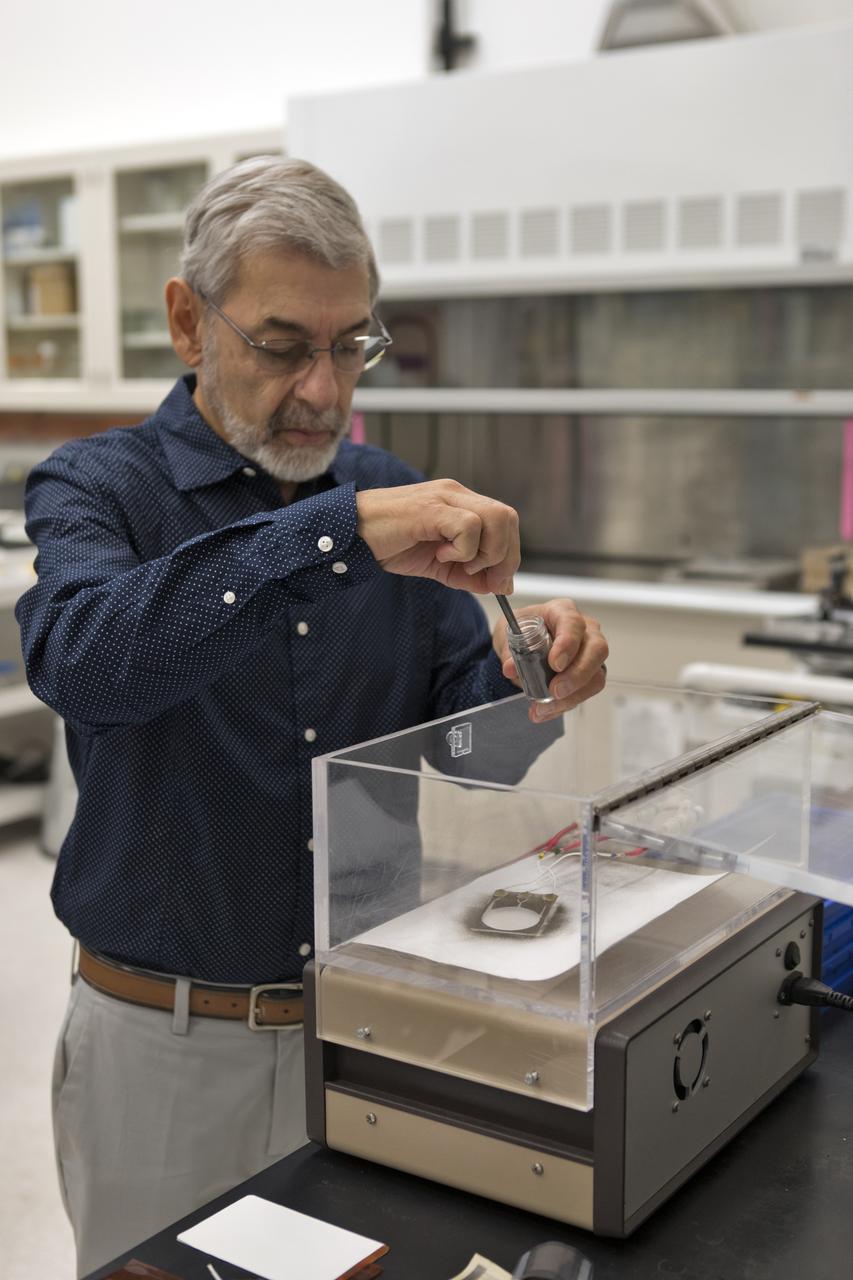
Dr. Carlos Calle, lead scientist in the Electrostatics and Surface Physics Laboratory at NASA's Kennedy Space Center in Florida, prepares an Electrostatic Dust Shield for testing on Thursday, July 19, 2018. Scientists are developing the Electrostatic Dust Shield to help mitigate the problem of dust on equipment, astronauts' space suits and helmet visors of astronauts exploring the Moon or Mars. The device is slated for analysis aboard International Space Station in the spring of 2019 to verify the effects of the space environment.
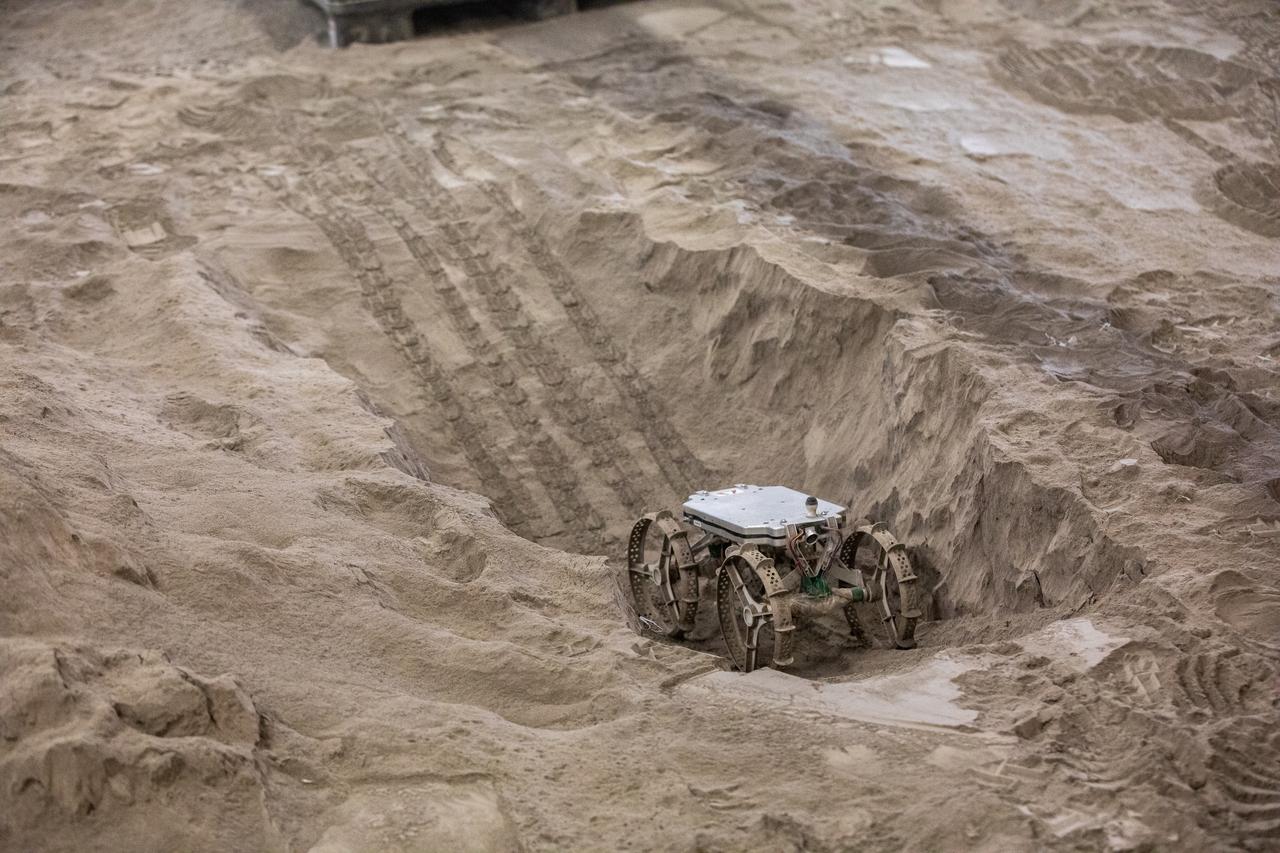
The Astrobotic CubeRover traverses a trench in the Granular Mechanics and Regolith Operations Laboratory regolith bin at NASA’s Kennedy Space Center in Florida on Dec. 10, 2020. The regolith bin simulates the mechanical properties of the Moon’s surface. NASA and Astrobotic employees put the CubeRover through a series of more than 150 mobility tests over several days to evaluate and improve wheel design.
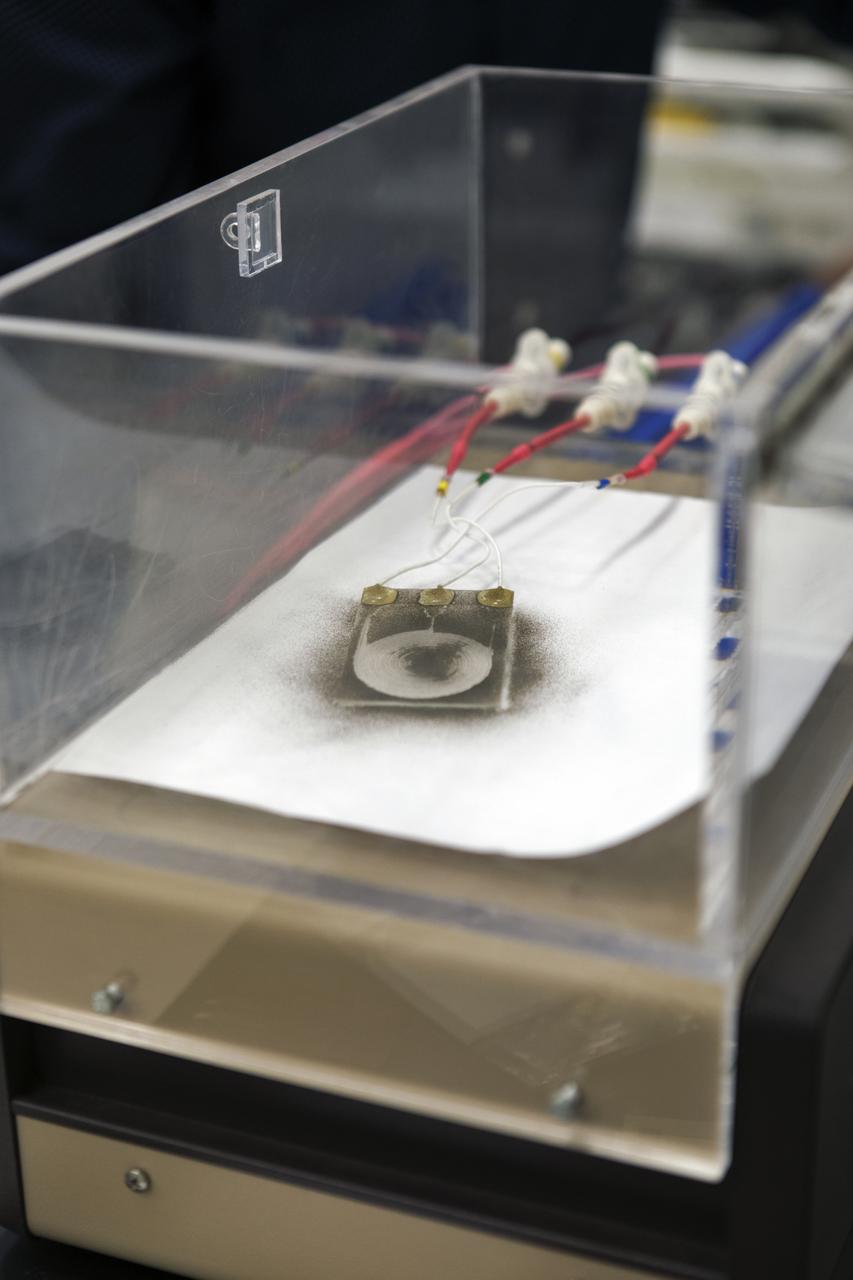
In the Electrostatics and Surface Physics Laboratory at NASA's Kennedy Space Center in Florida on Thursday, July 19, 2018, an experiment is underway in which an Electrostatic Dust Shield has been covered with dust similar to that which may be encountered by astronauts exploring the Moon or Mars. When activated, the device shakes off the dust. Scientists are developing the dust shield to help mitigate the problem of dust on equipment, astronauts' space suits and helmet visors. The device is slated for analysis aboard International Space Station in the spring of 2019 to verify the effects of the space environment.
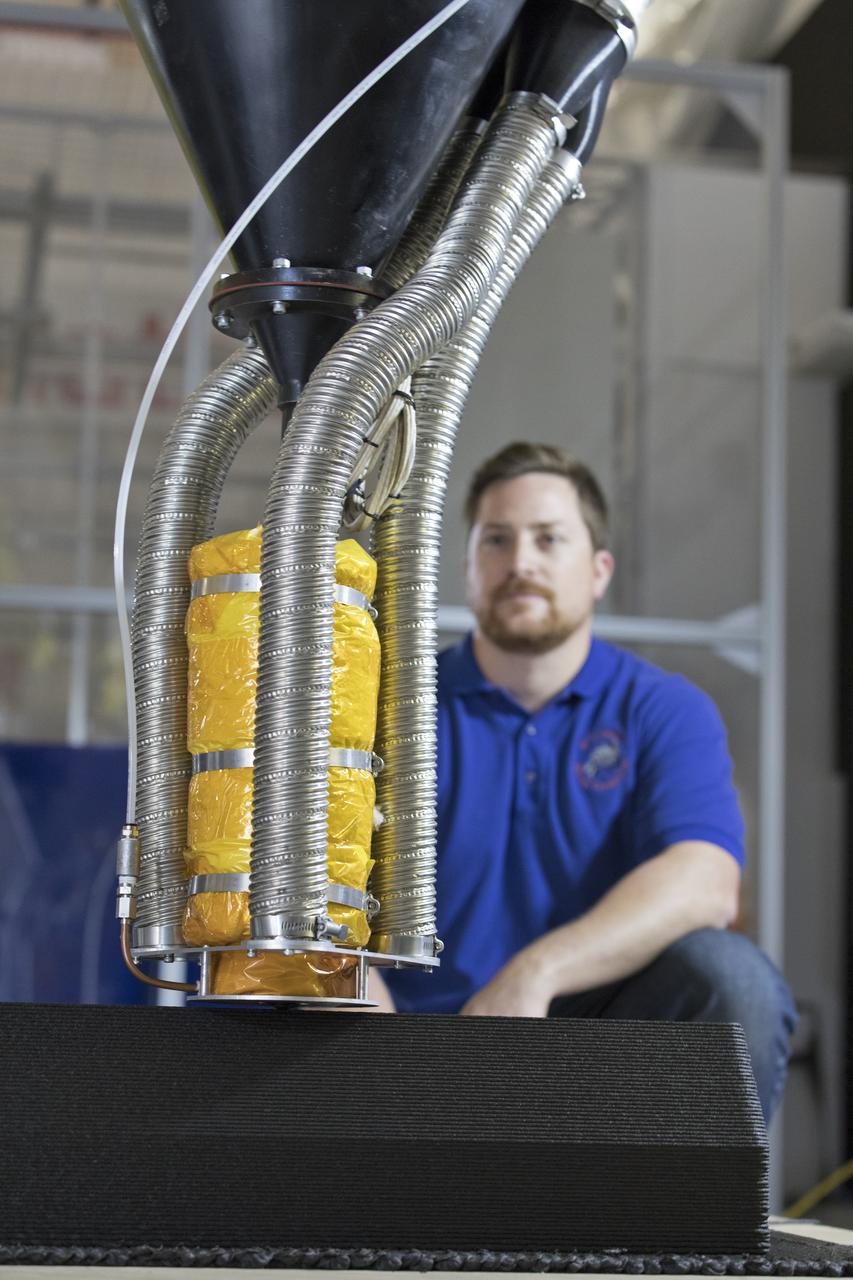
Nathan Gelino, a NASA research engineer at Kennedy Space Center in Florida, is working on a Zero Launch Mass 3-D printer in the center's Swamp Works that can be used for construction projects on the Moon and Mars, and even for troops in remote locations here on Earth. Zero launch mass refers to the fact that the printer uses pellets made from simulated lunar regolith, or dirt, and polymers to prove that space explorers can use resources at their destination instead of taking everything with them, saving them launch mass and money. Gelino and his team are working with Marshall Space Flight Center in Huntsville, Alabama, and the U.S. Army Corps of Engineers to develop a system that can 3-D print barracks in remote locations on Earth, using the resources they have where they are.
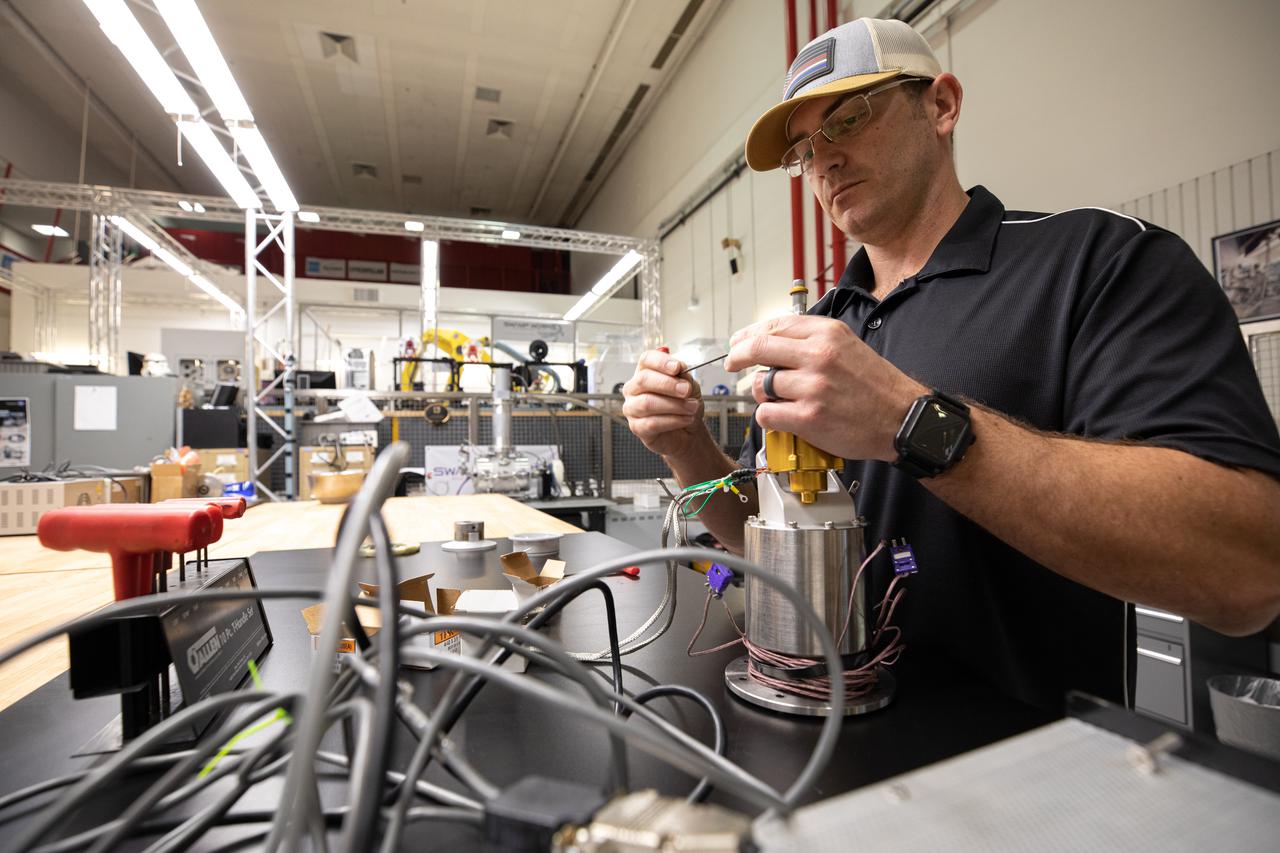
Researchers at NASA's Kennedy Space Center are testing the various types of seals for electric motors that drive the Volatiels Investigating Polar Exploration Rover, or VIPER, wheels at Swamp Works.
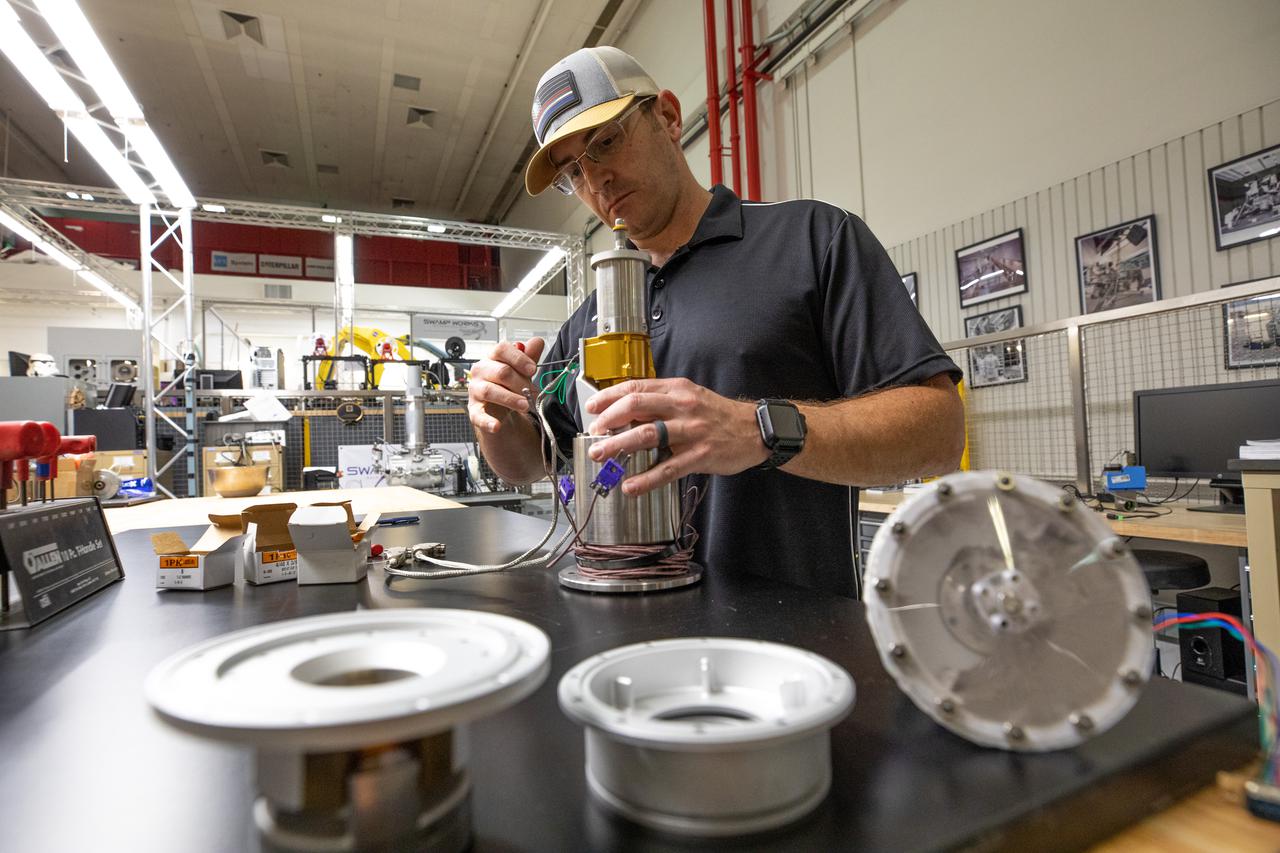
Researchers at NASA's Kennedy Space Center are testing the various types of seals for electric motors that drive the Volatiels Investigating Polar Exploration Rover, or VIPER, wheels at Swamp Works.
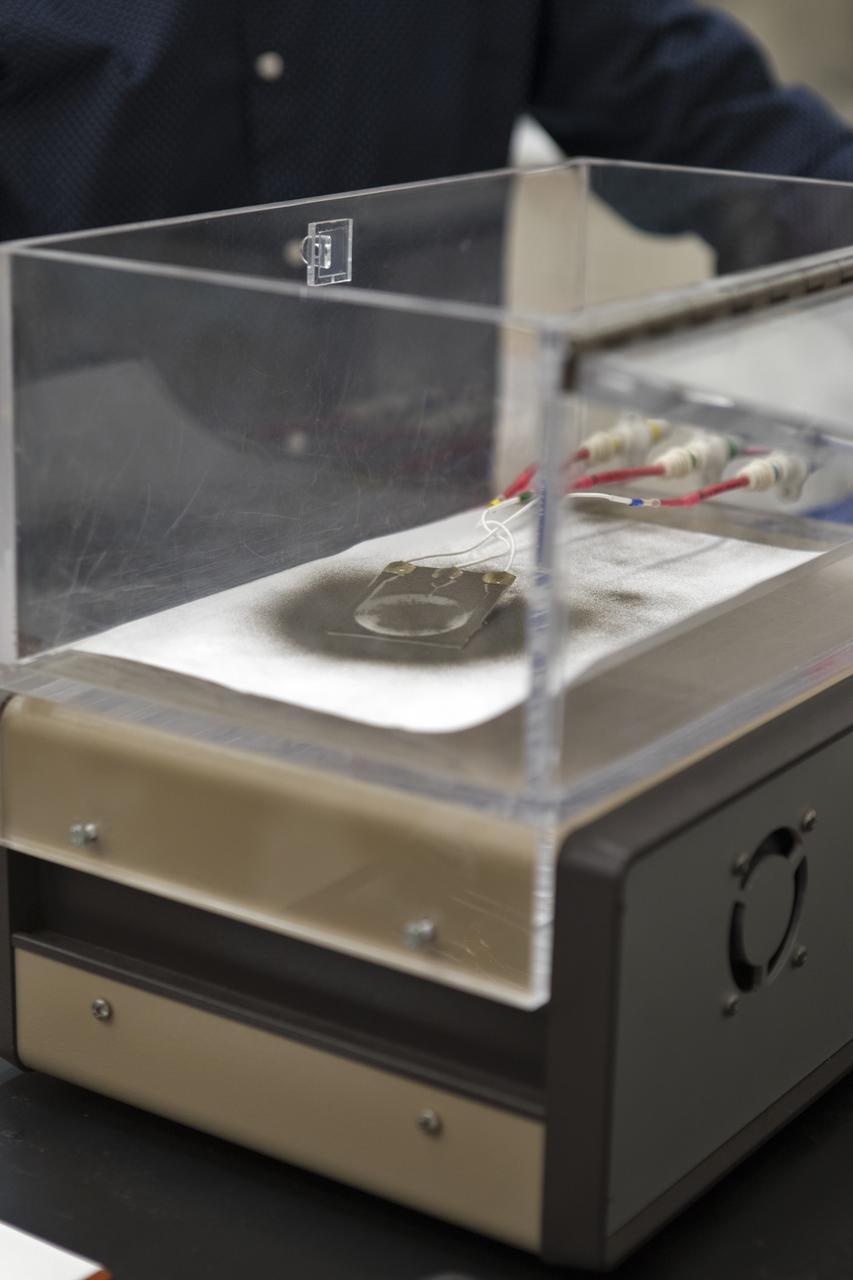
In the Electrostatics and Surface Physics Laboratory at NASA's Kennedy Space Center in Florida on Thursday, July 19, 2018, an experiment is underway in which an Electrostatic Dust Shield was been covered with dust similar to that which may be encountered by astronauts exploring the Moon or Mars. When activated, the device shook off the dust. Scientists are developing the dust shield to help mitigate the problem of dust on equipment, astronauts' space suits and helmet visors. The device is slated for analysis aboard International Space Station in the spring of 2019 to verify the effects of the space environment.
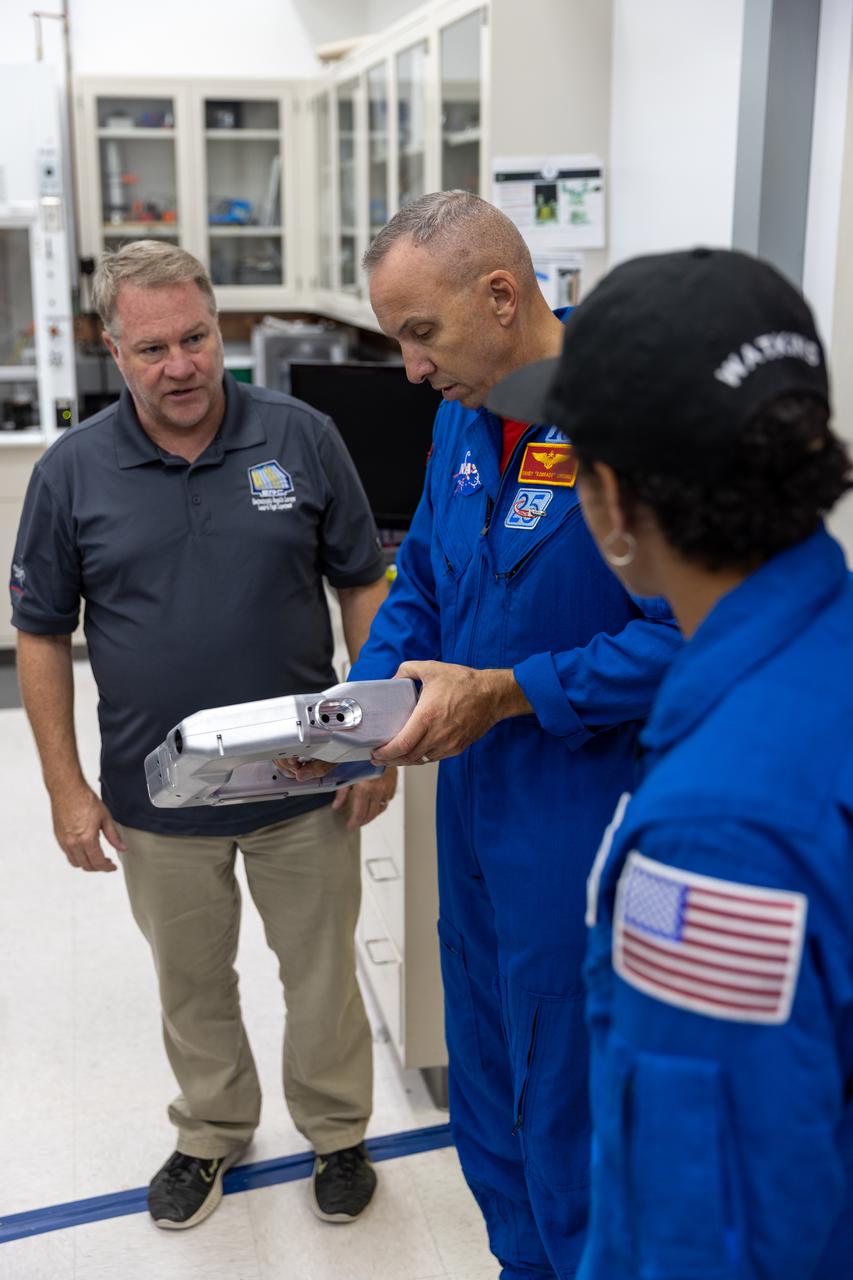
NASA astronauts Randy Bresnik (center) and Jessica Watkins (right) visit the Granular Mechanics and Regolith Operations Laboratory inside Swamp Works at Kennedy Space Center in Florida on Wednesday, Aug. 27, 2025, to view some of the evolving technologies in development that astronauts may use to explore the Moon’s surface, prepare it for sustainable outposts, and to handle the dust that is collected during moonwalks. Bresnick holds an instrument designed to help astronauts electromagnetically remove accumulated lunar dust.
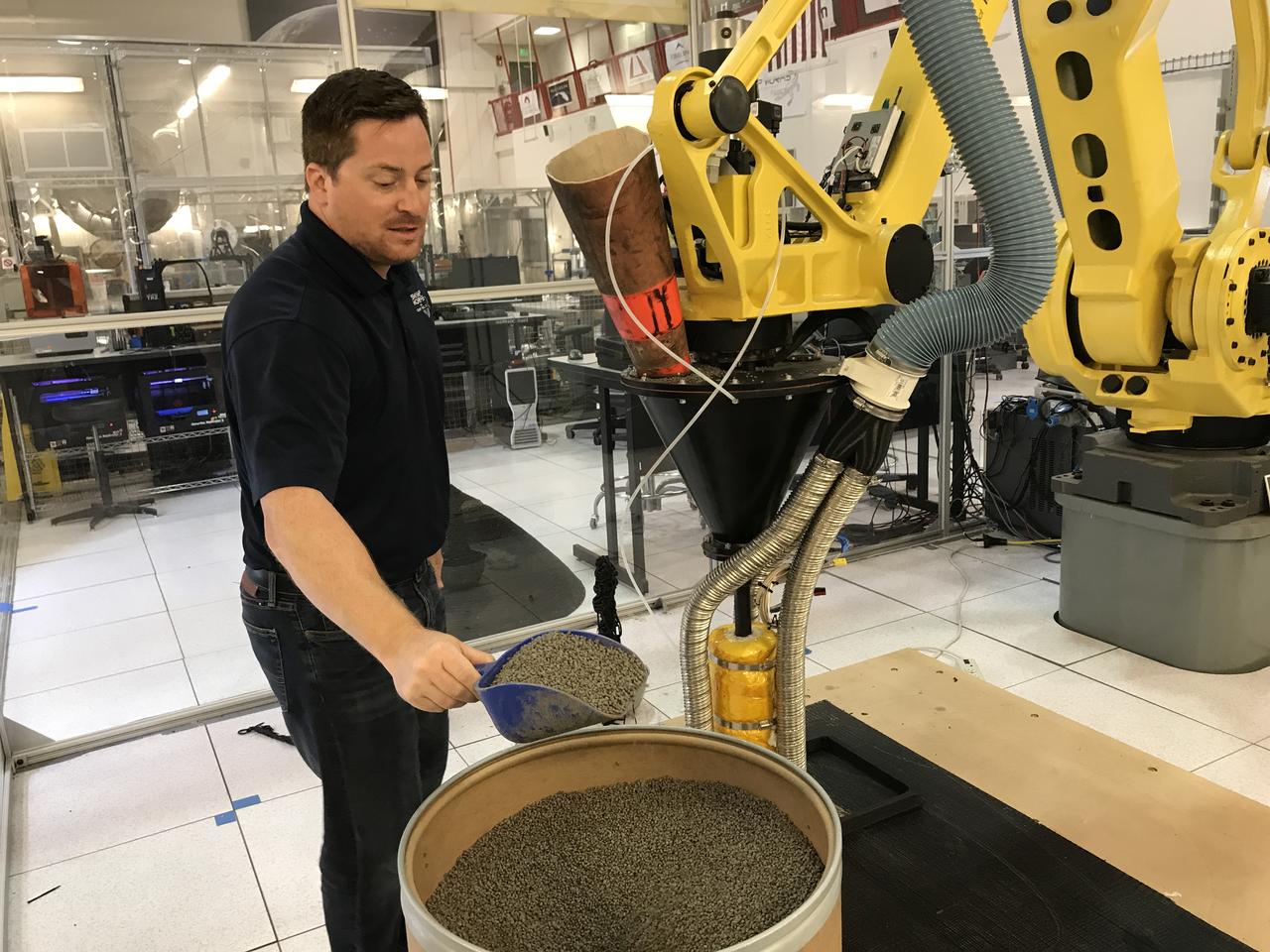
Nathan Gelino, a research engineer, manually loads materials into the Zero Launch Mass 3-D Printer at Kennedy Space Center’s Swamp Works Tuesday. The 3-D printer heated the pellets to about 600 degrees F and extruded them to produce specimens for material strength properties testing. Automated pellet delivery system will be added to the printer soon.
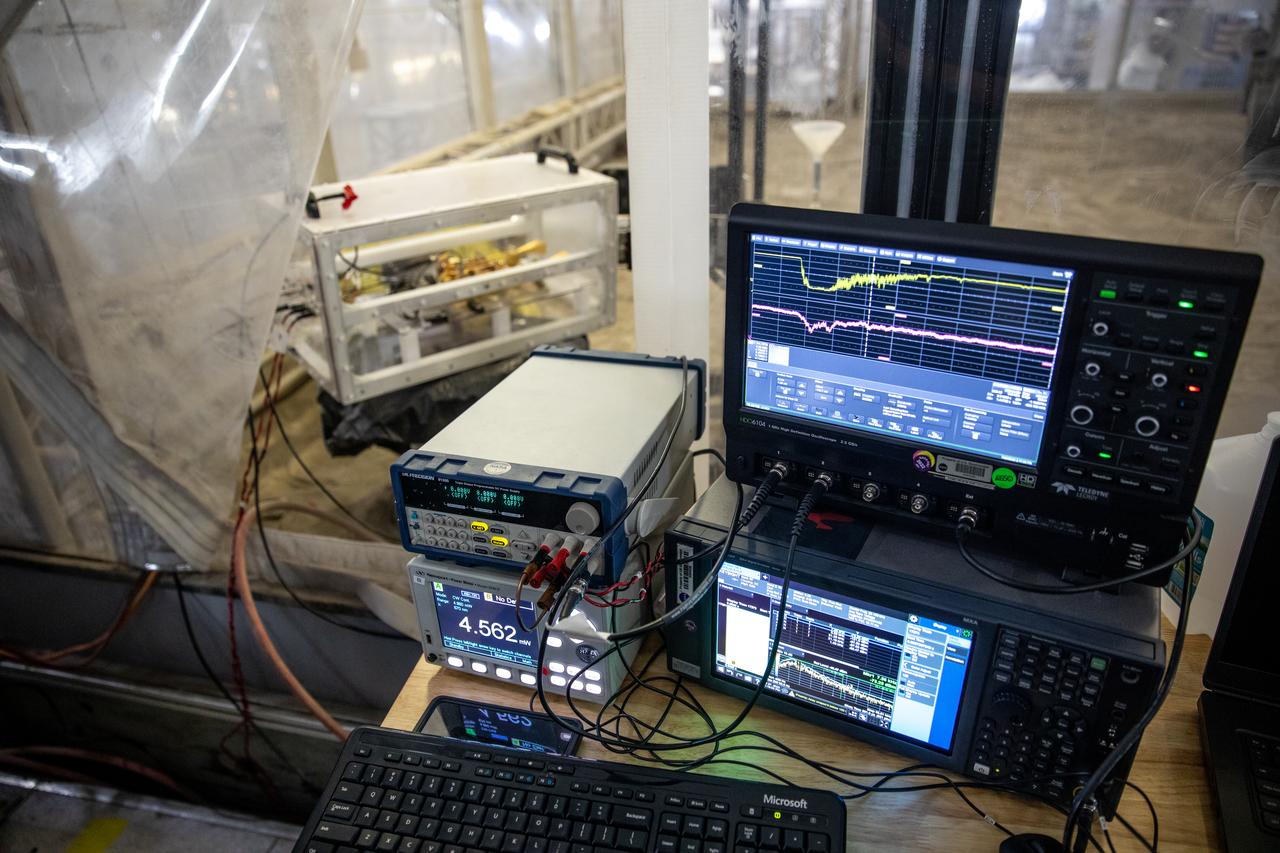
The Dust Concentration Monitor and the Millimeter Wave Doppler Radar undergo testing inside a regolith bin at the Granular Mechanics and Regolith Operations (GMRO) lab at the Kennedy Space Center’s Swamp Works on July 28, 2022, as part of Plume Surface Interaction (PSI) Instrumentation testing. The PSI Project is advancing both modeling and testing capabilities to understand exactly how rocket exhaust plumes affect a planetary landing site. This advanced modeling will help engineers evaluate the risks of various plumes on planetary surfaces, which will help them more accurately design landers for particular locations.
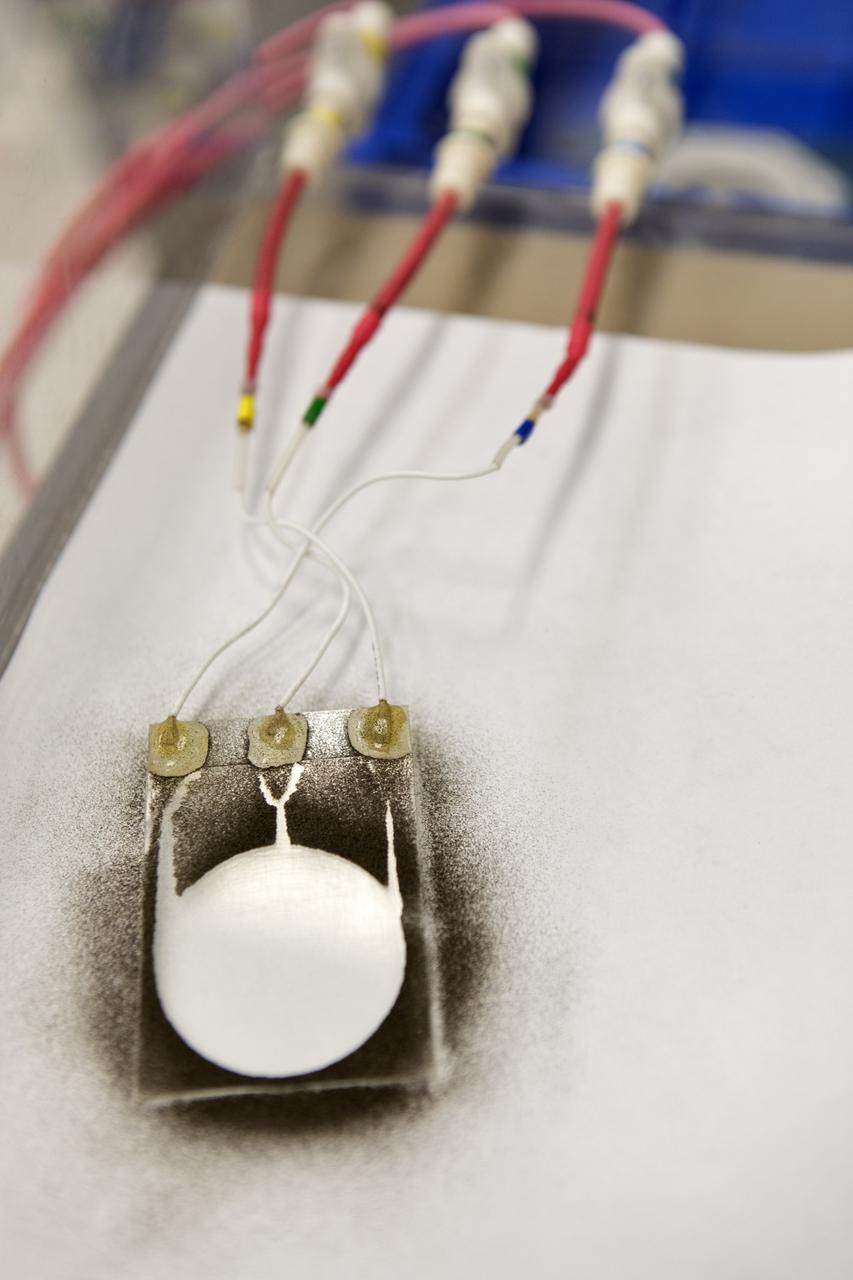
In the Electrostatics and Surface Physics Laboratory at NASA's Kennedy Space Center in Florida on Thursday, July 19, 2018, an experiment is underway in which an Electrostatic Dust Shield was been covered with dust similar to that which may be encountered by astronauts exploring the Moon or Mars. When activated, the device shook off the dust. Scientists are developing the dust shield to help mitigate the problem of dust on equipment, astronauts' space suits and helmet visors. The device is slated for analysis aboard International Space Station in the spring of 2019 to verify the effects of the space environment.
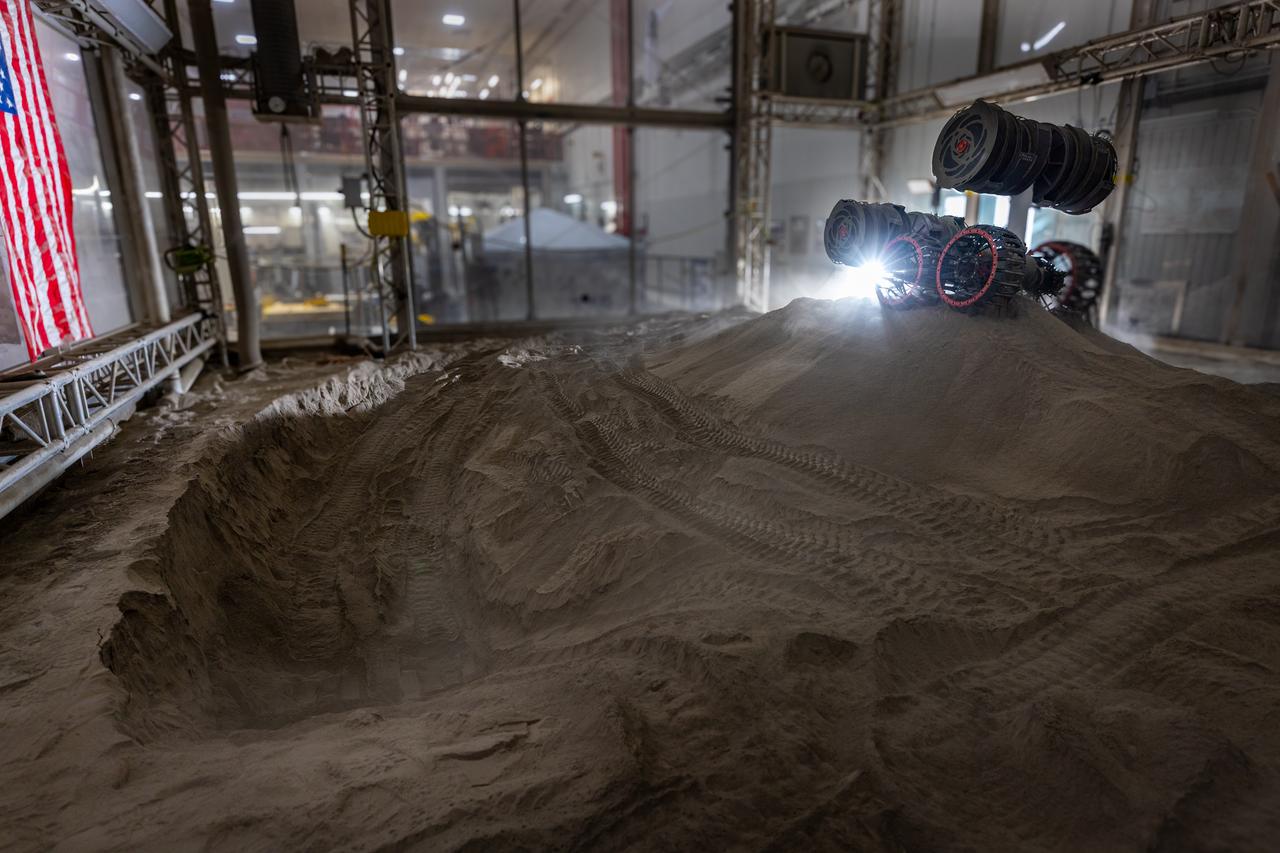
NASA’s RASSOR (Regolith Advanced Surface Systems Operations Robot) manipulates simulated regolith, or lunar dust found on the Moon’s surface, to create a three-foot berm during a site preparation test inside of the Granular Mechanics and Regolith Operations Lab at the agency’s Kennedy Space Center in Florida on Tuesday, June 3, 2025. The opposing motion of the bucket drums helps RASSOR grip the surface in low-gravity environments like the Moon or Mars. With this unique capability, RASSOR can traverse the rough surface to dig, load, haul, and dump regolith that could be used in construction or broken down into hydrogen, oxygen, or water, resources critical for sustaining human presence. RASSOR represents an earlier generation technology that informed the development of NASA’s IPEx (In-Situ Resource Utilization Pilot Excavator), serving as a precursor and foundational platform for the advanced excavation systems and autonomous capabilities now being demonstrated by this Moon-mining robot.
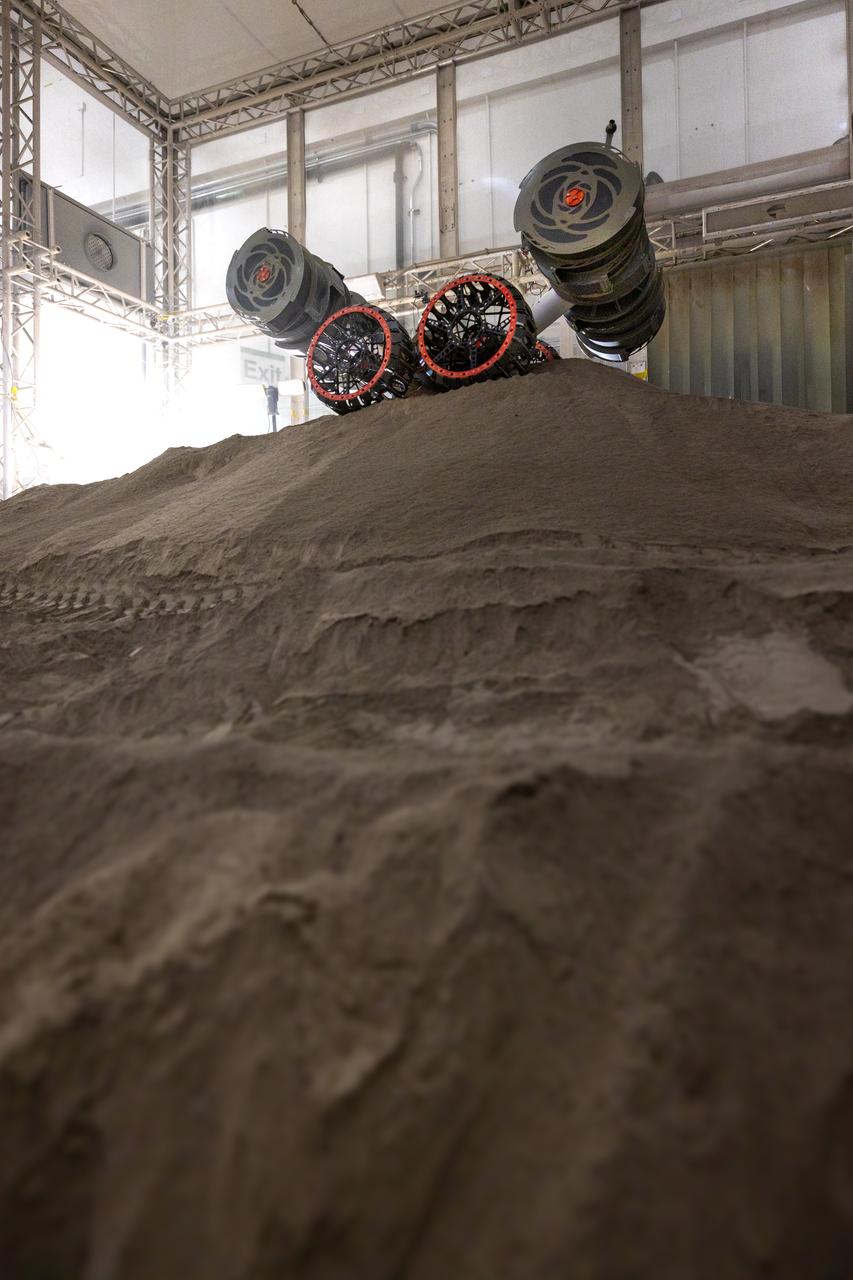
NASA’s RASSOR (Regolith Advanced Surface Systems Operations Robot) manipulates simulated regolith, or lunar dust found on the Moon’s surface, to create a three-foot berm during a site preparation test inside of the Granular Mechanics and Regolith Operations Lab at the agency’s Kennedy Space Center in Florida on Tuesday, June 3, 2025. The opposing motion of the bucket drums helps RASSOR grip the surface in low-gravity environments like the Moon or Mars. With this unique capability, RASSOR can traverse the rough surface to dig, load, haul, and dump regolith that could be used in construction or broken down into hydrogen, oxygen, or water, resources critical for sustaining human presence. RASSOR represents an earlier generation technology that informed the development of NASA’s IPEx (In-Situ Resource Utilization Pilot Excavator), serving as a precursor and foundational platform for the advanced excavation systems and autonomous capabilities now being demonstrated by this Moon-mining robot.
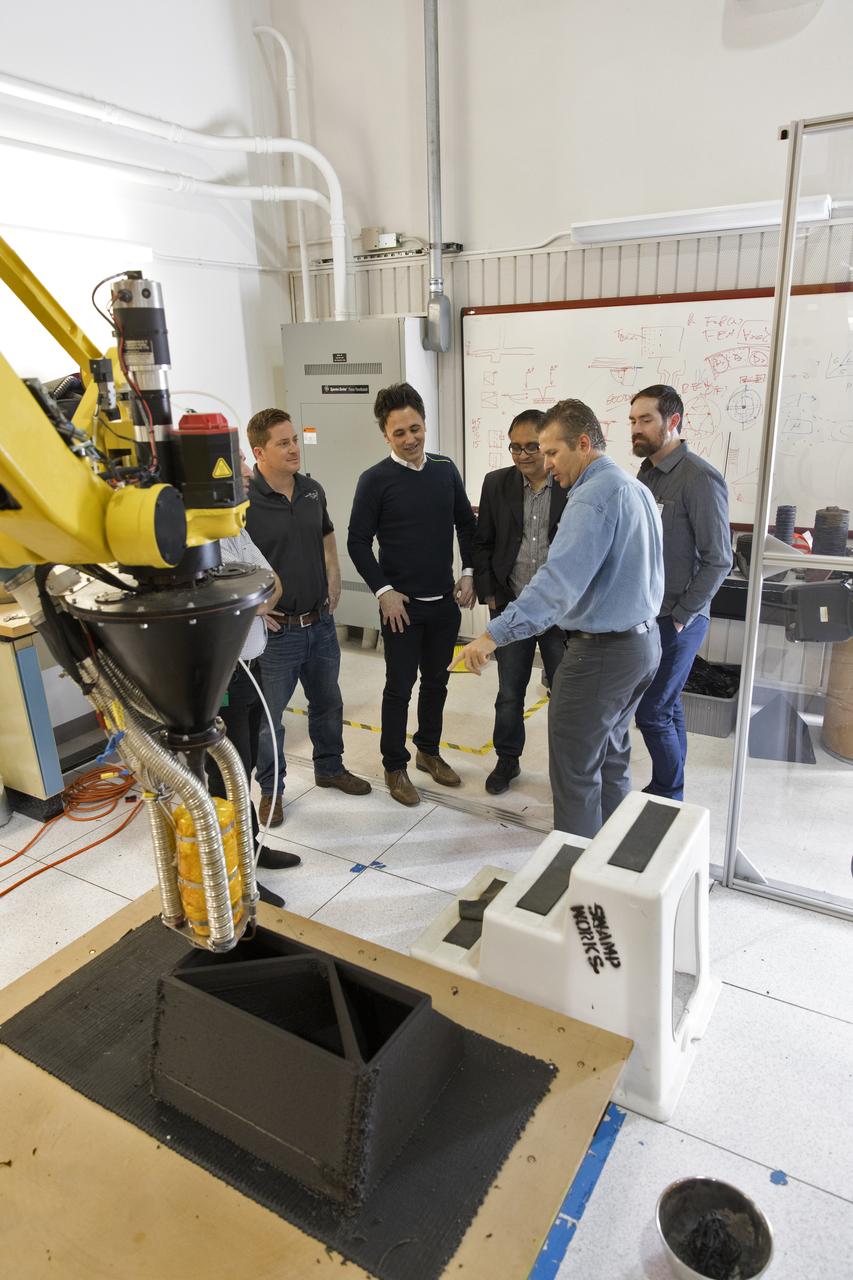
Researchers at NASA's Kennedy Space Center in Florida are developing a Zero Launch Mass 3-D printer at the center's Swamp Works. The printer can be used for construction projects on the Moon and Mars. Zero launch mass refers to the fact that the printer uses pellets made from simulated lunar regolith, or dirt, and polymers. This will prove that space explorers can use resources at their destination instead of taking everything with them, saving them launch mass and money. The Kennedy team is working with Marshall Space Flight Center in Huntsville, Alabama, and the U.S. Army Corps of Engineers to develop a system that can 3-D print barracks in remote locations on Earth, using the resources they have where they are.
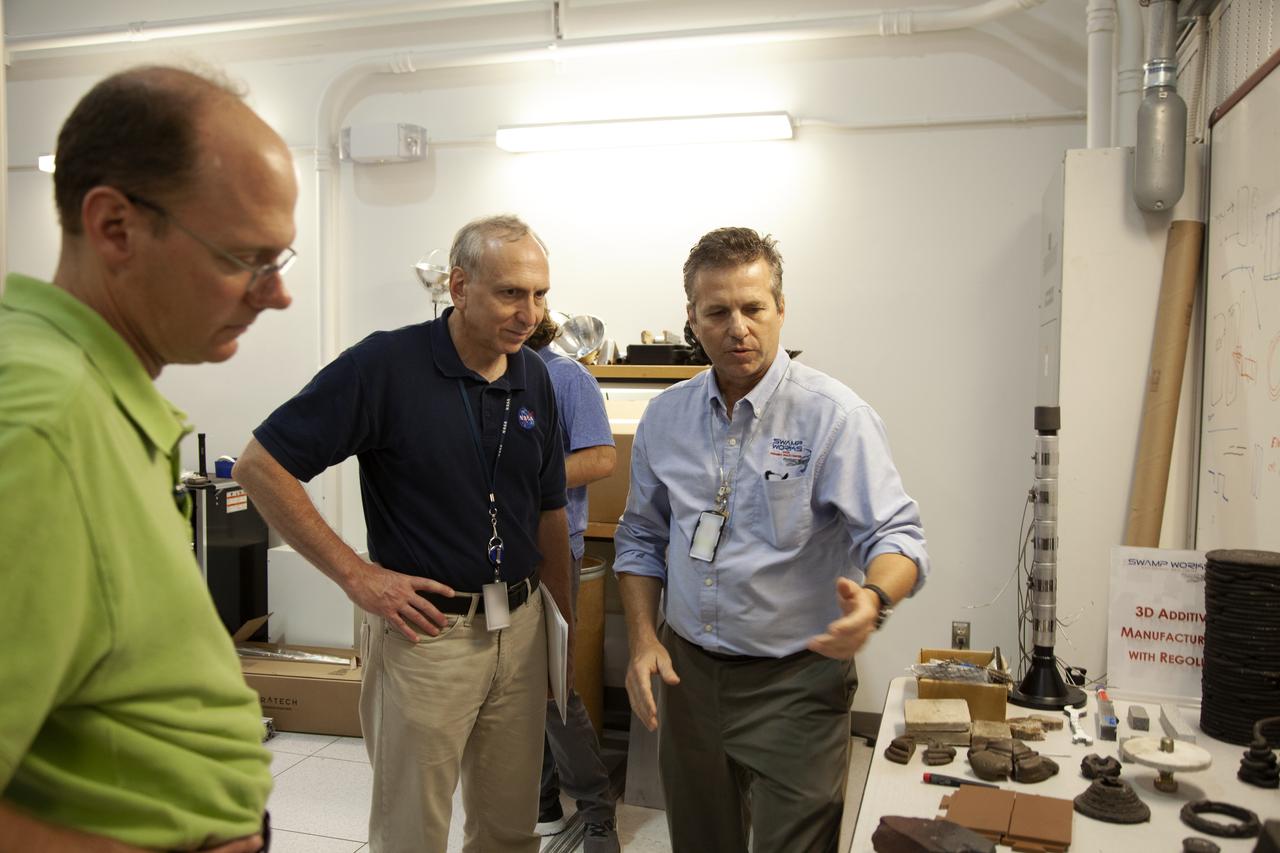
Steve Jurczyk, Acting Administrator of STMD, Visits Swamp Works at NASA's Kennedy Space Center
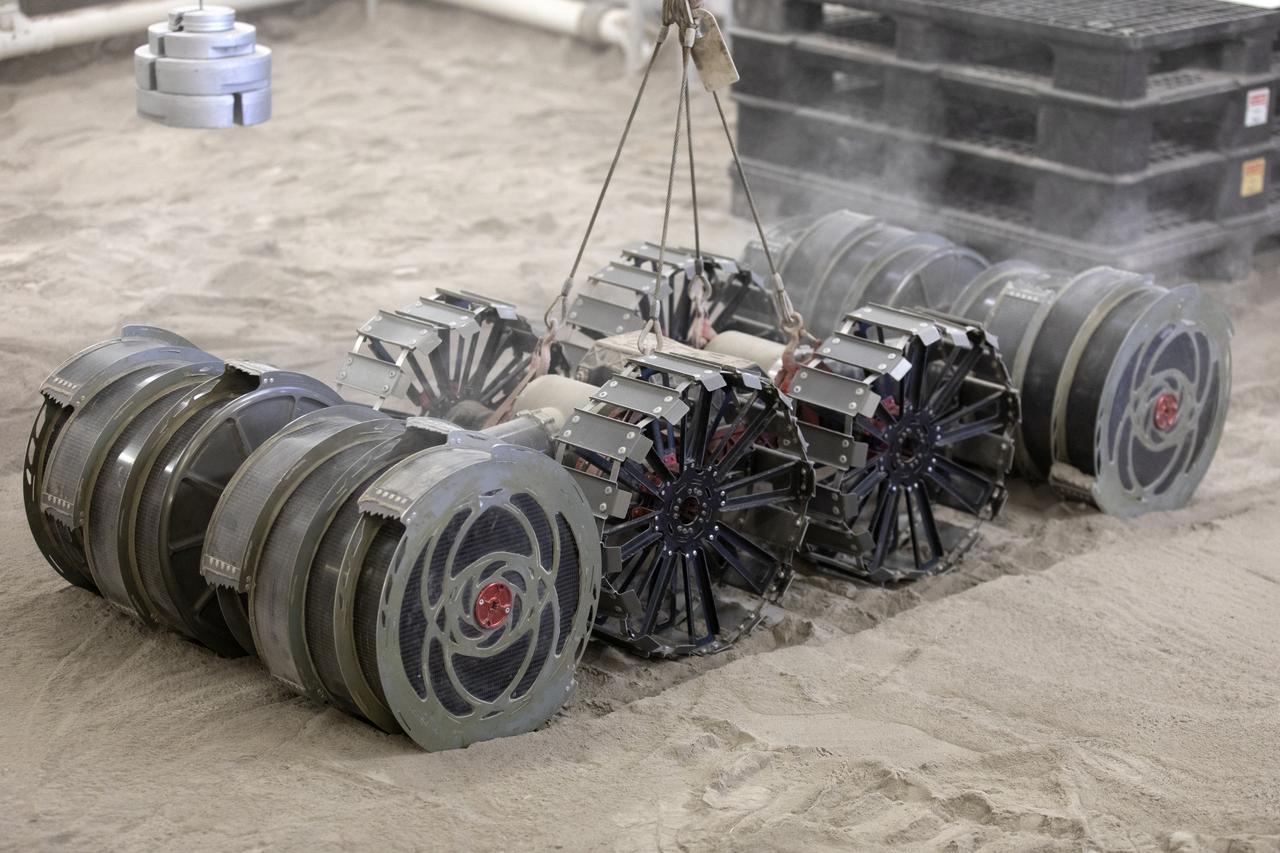
A team from the Granular Mechanics and Regolith Operations Lab tests the Regolith Advanced Surface Systems Operations Robot (RASSOR) in the regolith bin inside Swamp Works at NASA’s Kennedy Space Center in Florida on June 5, 2019. Tests use a gravity assist offload system to simulate reduced gravity conditions found on the Moon. On the surface of the Moon, mining robots like RASSOR will excavate the regolith and take the material to a processing plant where usable elements such as hydrogen, oxygen and water can be extracted for life support systems. RASSOR can scoop up icy regolith which can be used to make operations on the Moon sustainable.
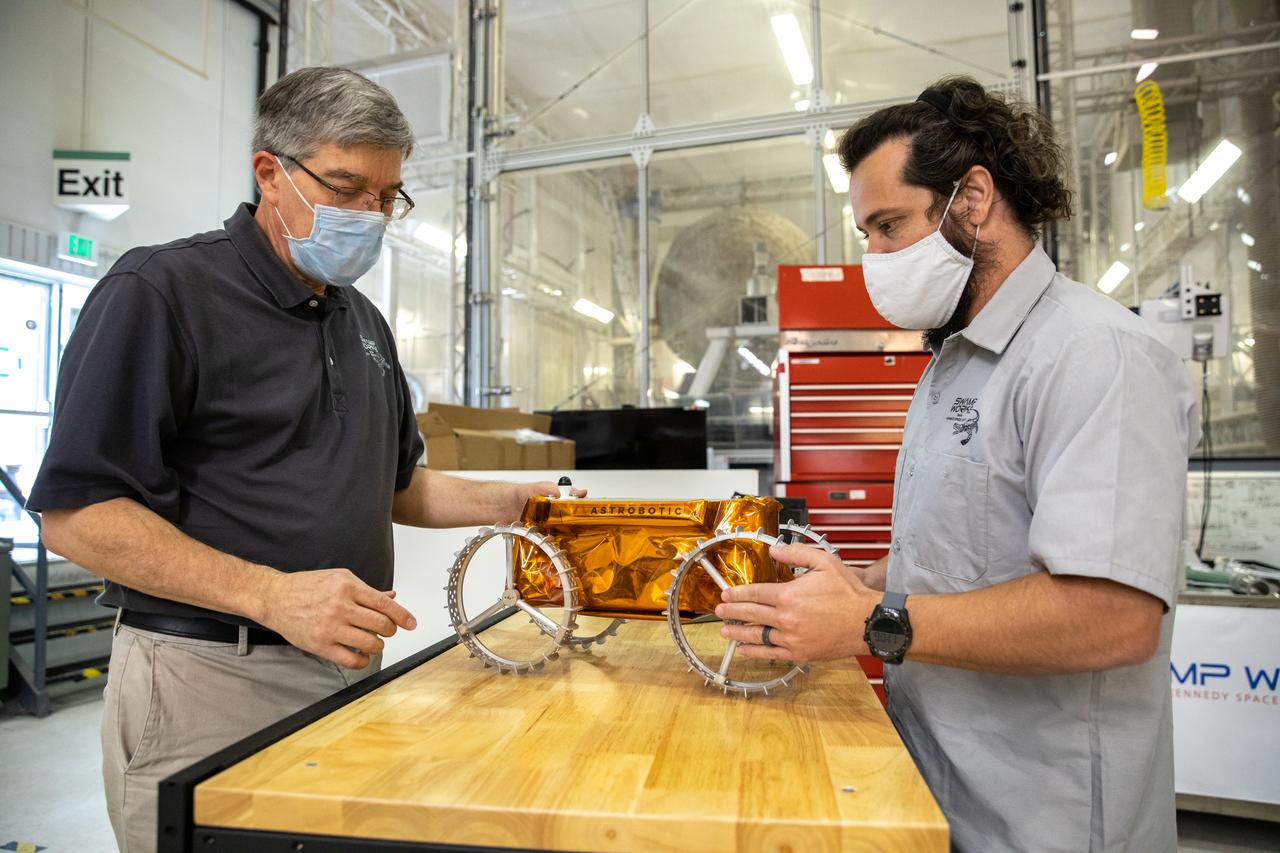
Jim Mantovani, left, and A.J. Nick, with Kennedy Space Center’s Exploration and Research and Technology programs, unbox a CubeRover at the Florida spaceport on Oct. 9, 2020. The rover was delivered by Pittsburgh-based space robotics company Astrobotic, as part of a Small Business Innovative Research (SBIR) award from NASA. Nick will lead CubeRover testing in the coming months in the Granular Mechanics and Regolith Operations (GMRO) Laboratory’s regolith bin, which holds approximately 120 tons of lunar regolith simulant at Kennedy’s Swamp Works. In 2019, NASA announced a $2 million Tipping Point award to develop more mature CubeRover’s payload interfaces and increase its capabilities.
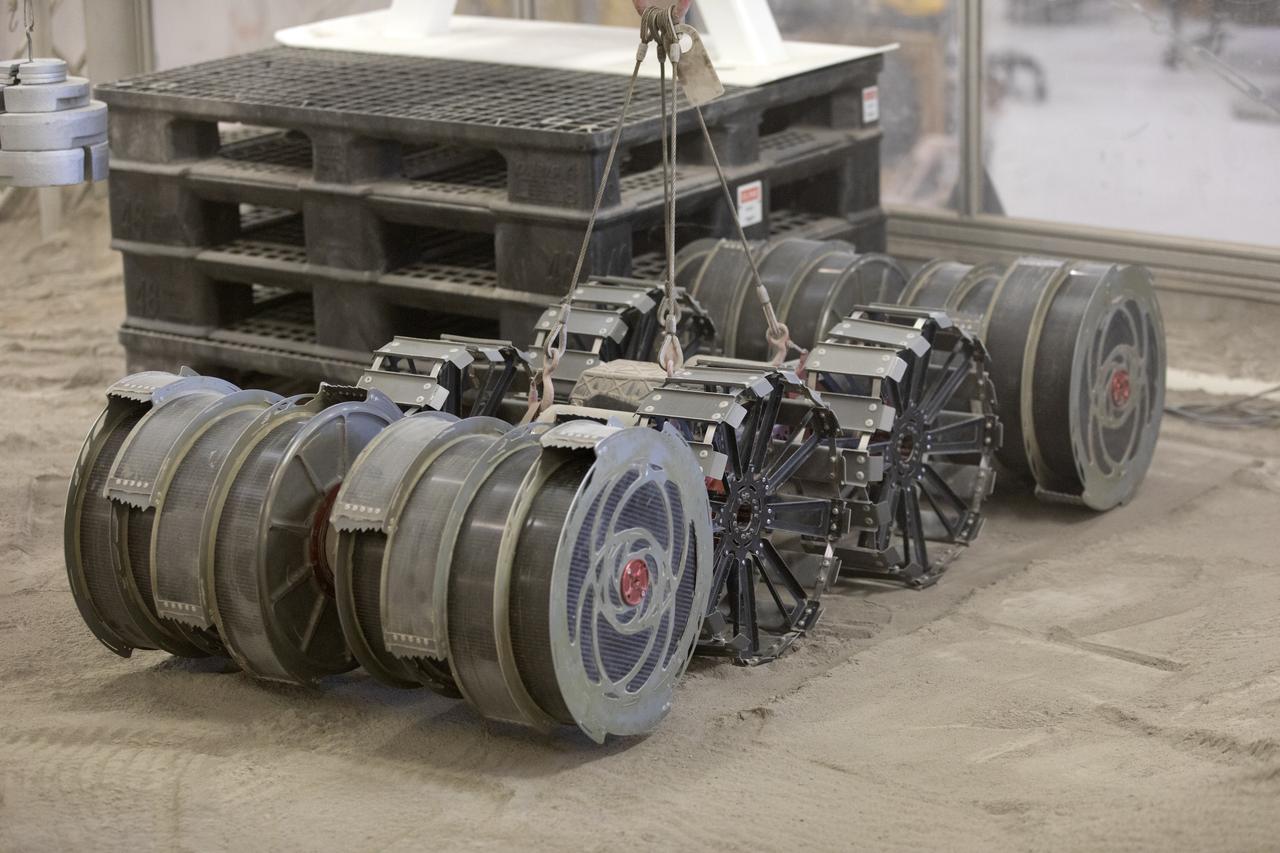
A team from the Granular Mechanics and Regolith Operations Lab tests the Regolith Advanced Surface Systems Operations Robot (RASSOR) in the regolith bin inside Swamp Works at NASA’s Kennedy Space Center in Florida on June 5, 2019. Tests use a gravity assist offload system to simulate reduced gravity conditions found on the Moon. On the surface of the Moon, mining robots like RASSOR will excavate the regolith and take the material to a processing plant where usable elements such as hydrogen, oxygen and water can be extracted for life support systems. RASSOR can scoop up icy regolith which can be used to make operations on the Moon sustainable.
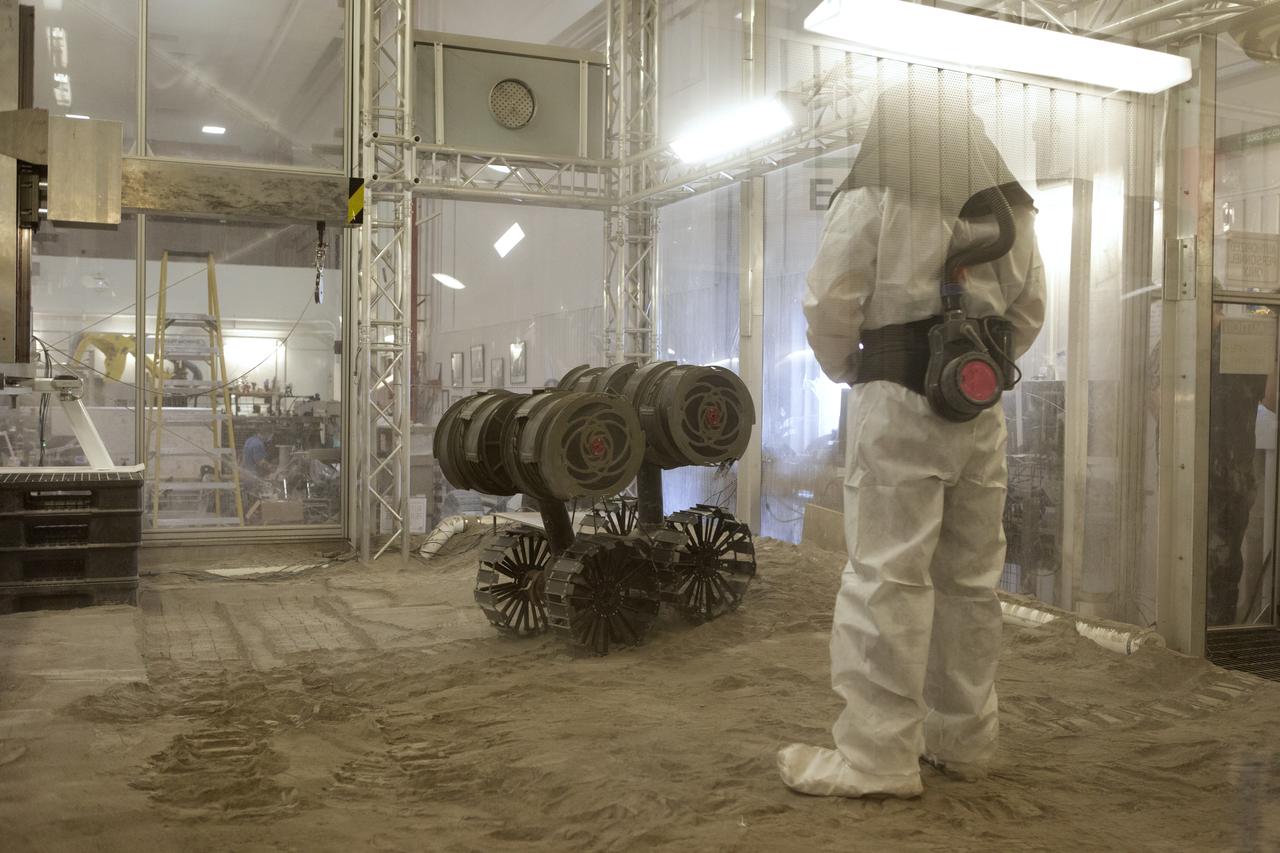
Drew Smith, a robotics engineer, makes adjustments to the Regolith Advanced Surface Systems Operations Robot (RASSOR) during testing in the regolith bin inside Swamp Works at NASA’s Kennedy Space Center in Florida on June 5, 2019. Smith and other members of the Granular Mechanics and Regolith Operations Lab run tests, which simulates the Moon’s reduced gravity using the gravity assist offload system to see how RASSOR excavates regolith. On the surface of the Moon, mining robots like RASSOR will excavate the regolith and take the material to a processing plant where usable elements such as hydrogen, oxygen and water can be extracted for life support systems. RASSOR can scoop up icy regolith which can be used to make operations on the Moon sustainable.
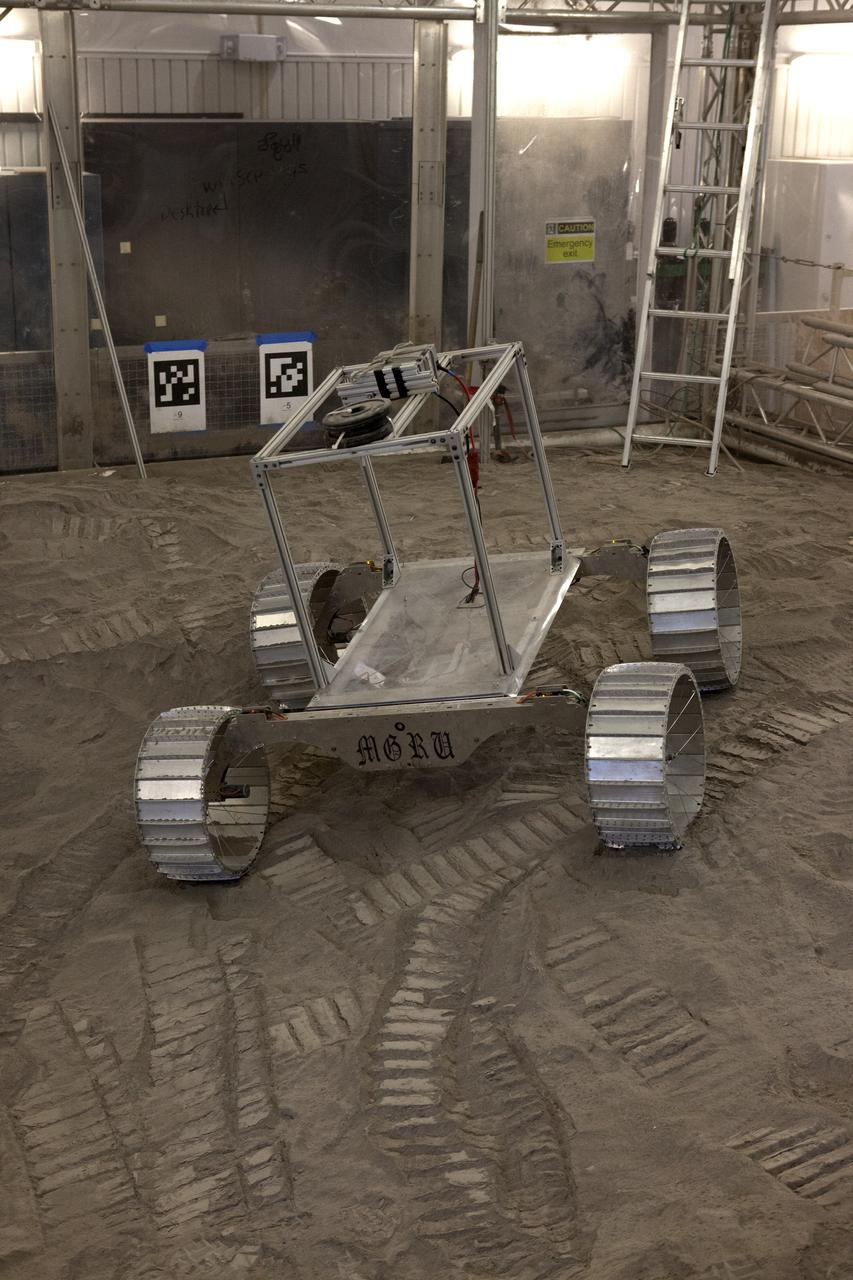
A lightweight simulator version of NASA's Resource Prospector undergoes a mobility test in a regolith bin at the agency's Kennedy Space center in Florida. The Resource Prospector mission aims to be the first mining expedition on another world. Operating on the moon’s poles, the robot is designed to use instruments to locate elements at a lunar polar regions, then excavate and sample resources such as hydrogen, oxygen and water. These resources could support human explores on their way to destinations such as farther into the solar system.
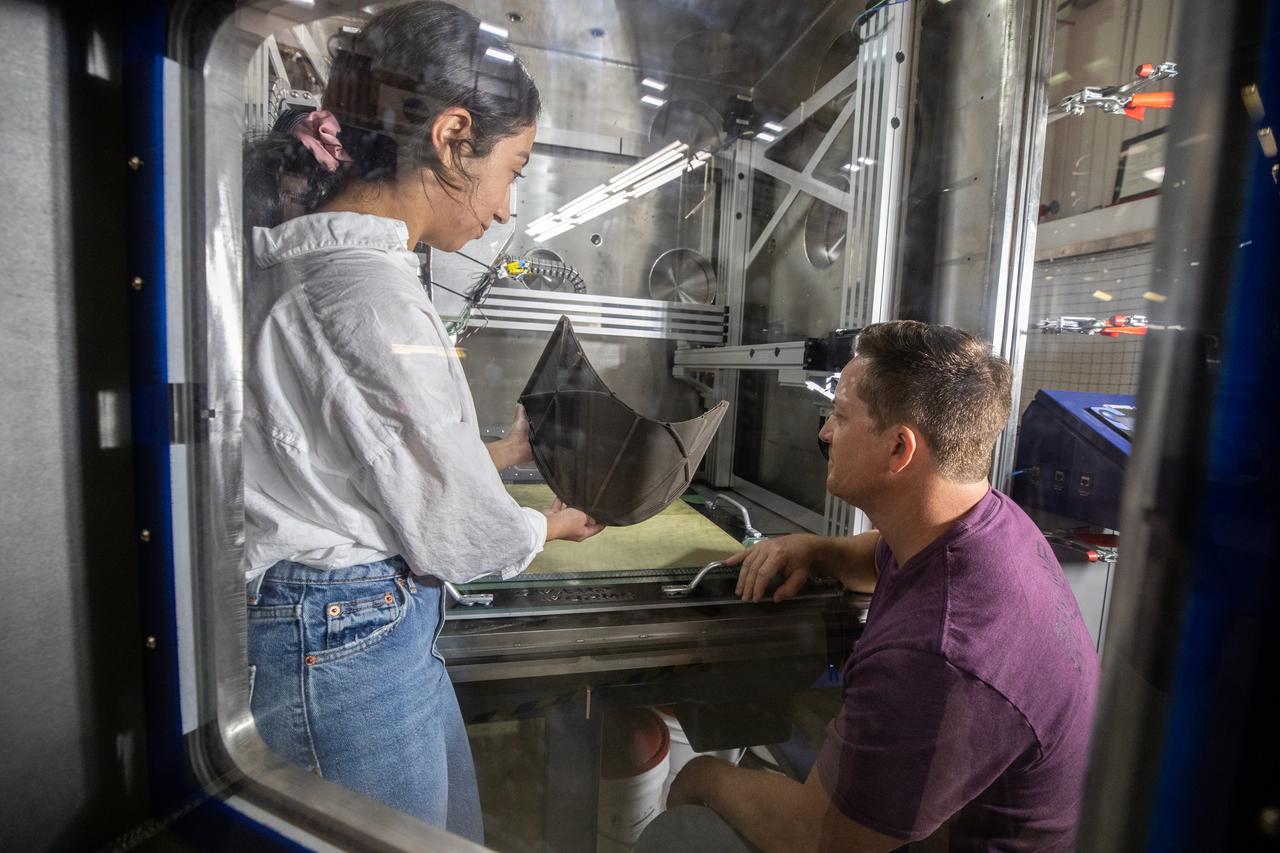
Chemist Nilab Azim, left, and Nathan Gelino, principal investigator with NASA’s Exploration Research and Technology programs, test a 3D printer on July 28, 2022, at Swamp Works at the agency’s Kennedy Space Center in Florida, as part of the Relevant Environment Additive Construction Technology (REACT) project. Among the key objectives of the project is developing an architectural and structural design for a shelter that provides protection to habitable assets on the lunar surface. Testing REACT derives from NASA’s 2020 Announcement of Collaboration Opportunity with AI SpaceFactory – an architectural and construction technology company and winner of NASA’s 3D Printed Habitat Challenge.
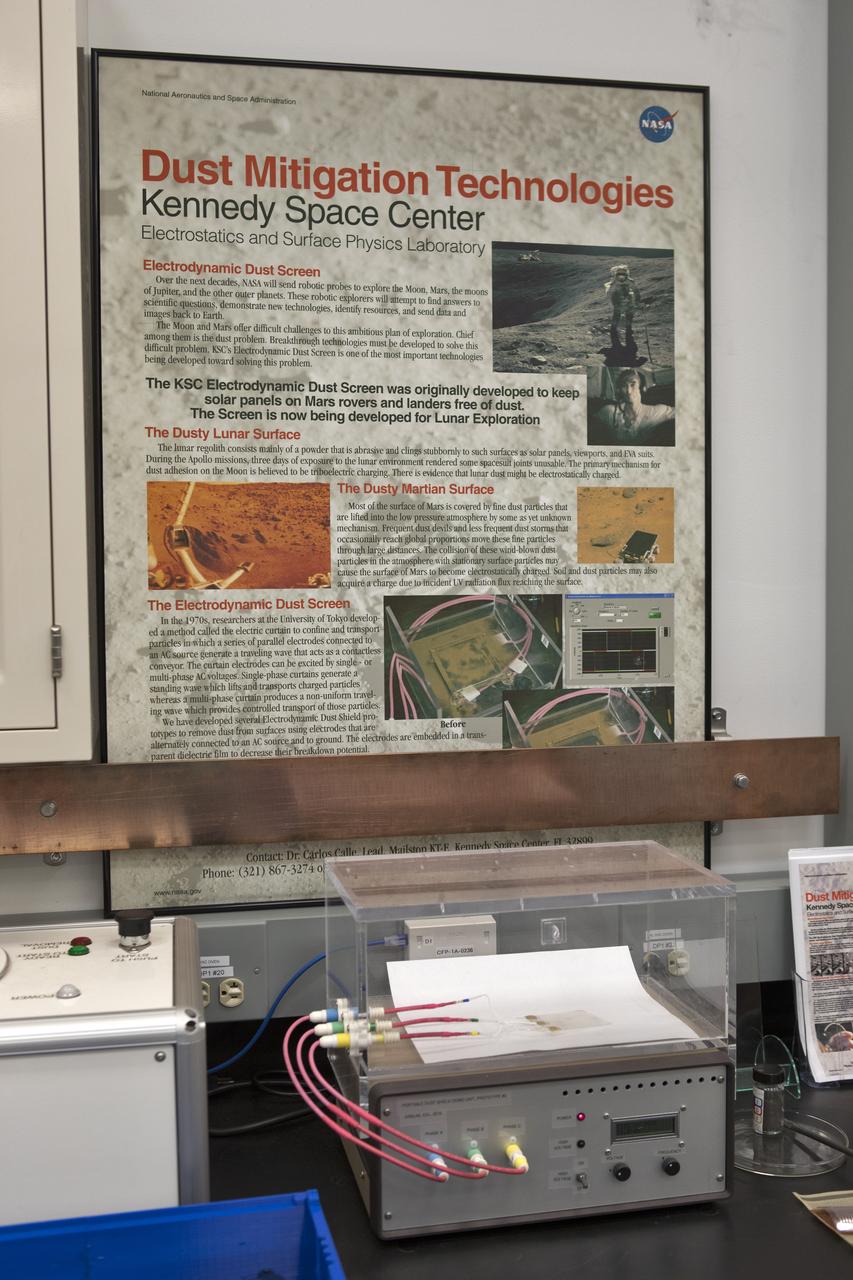
In the Electrostatics and Surface Physics Laboratory at NASA's Kennedy Space Center in Florida, an Electrostatic Dust Shield is prepared for testing on Thursday, July 19, 2018. Scientists are developing the Electrostatic Dust Shield to help mitigate the problem of dust on equipment, space suits and helmet visors of astronauts exploring the Moon or Mars. The device is being prepared for analysis aboard International Space Station in the spring of 2019 to verify the effects of the space environment.
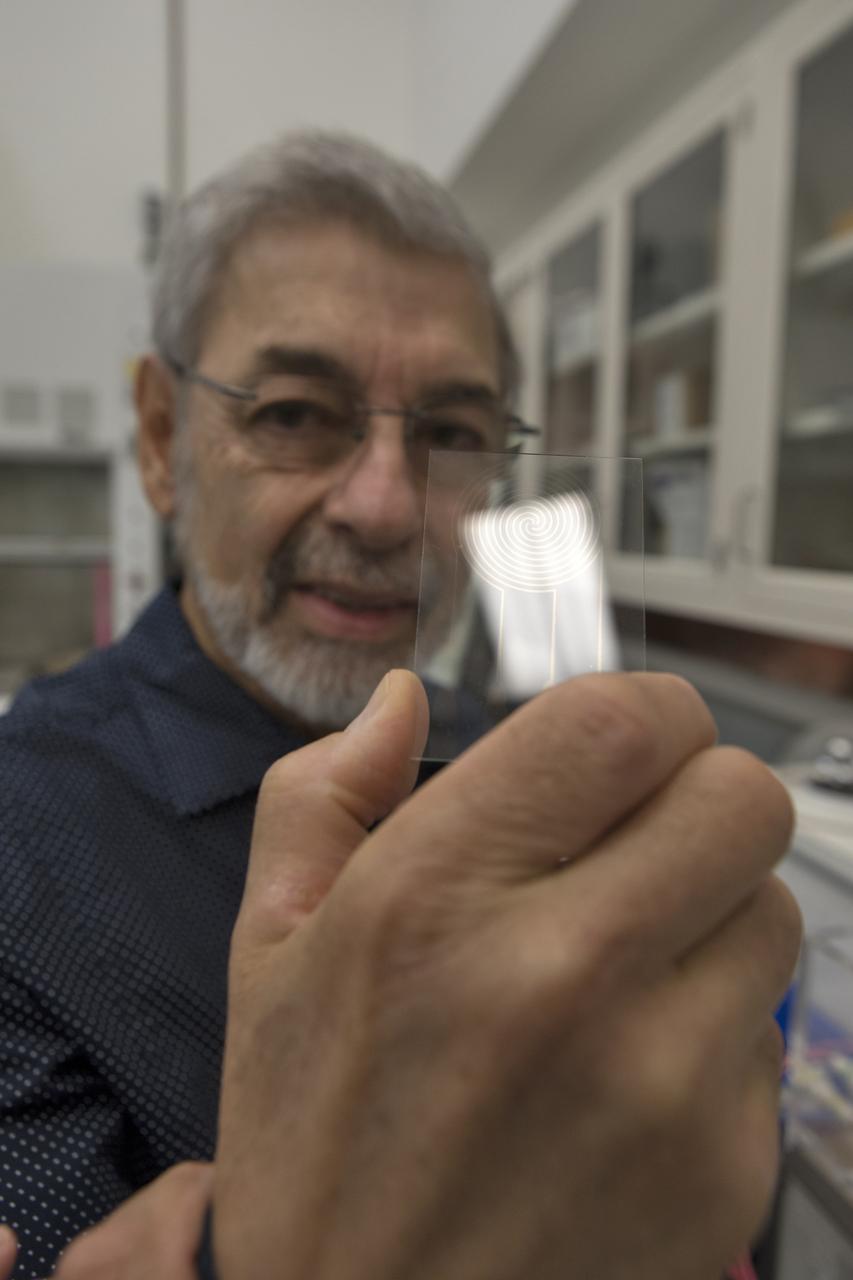
On Thursday, July 19, 2018, Dr. Carlos Calle, lead scientist in the Electrostatics and Surface Physics Laboratory at NASA's Kennedy Space Center in Florida, shows an Electrostatic Dust Shield that had been covered with dust similar to that which may be encountered by astronauts exploring the Moon or Mars. When activated, the device shook off the dust. Scientists are developing the dust shield to help mitigate the problem of dust on equipment, astronauts' space suits and helmet visors. The device is slated for analysis aboard International Space Station in the spring of 2019 to verify the effects of the space environment.
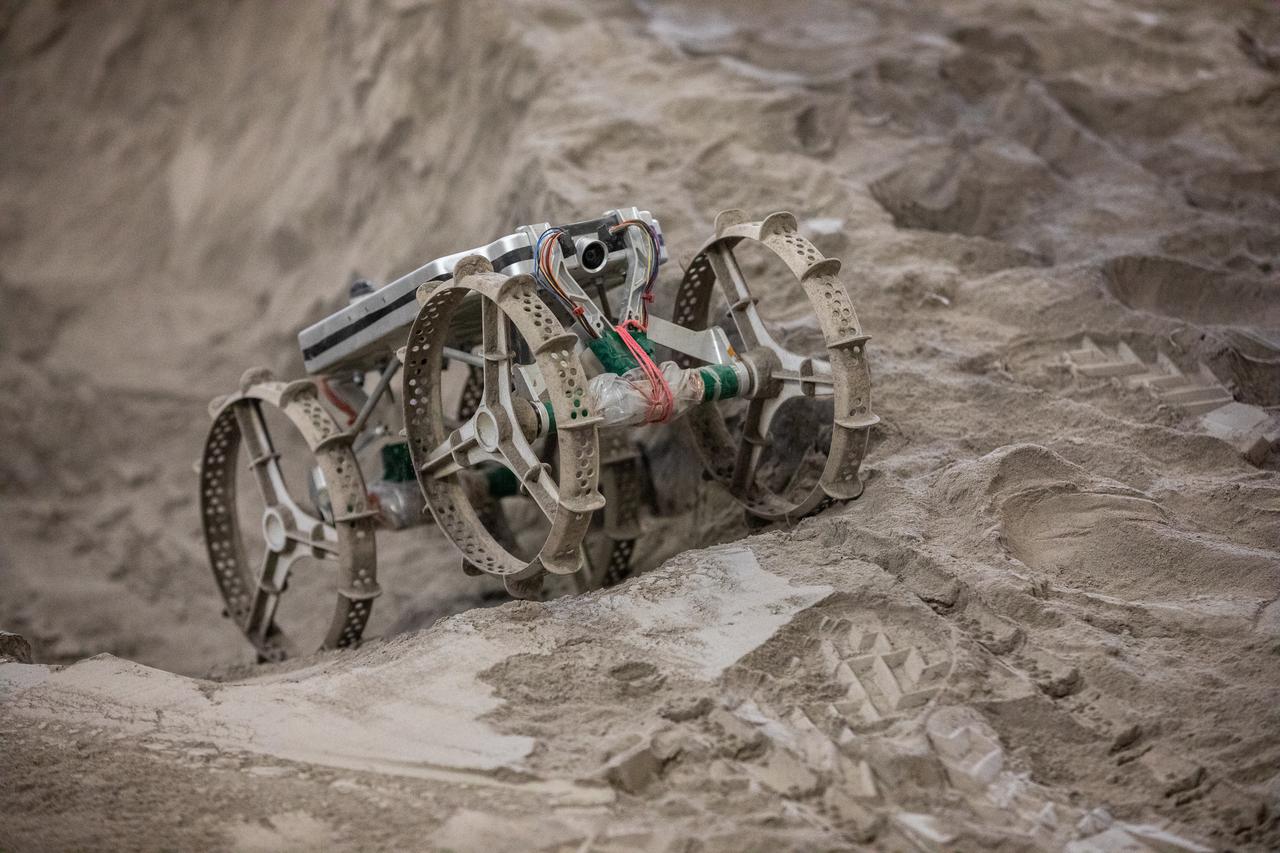
The Astrobotic CubeRover traverses the terrain in the Granular Mechanics and Regolith Operations Laboratory regolith bin at NASA’s Kennedy Space Center in Florida on Dec. 10, 2020. The regolith bin simulates the mechanical properties of the Moon’s surface. NASA and Astrobotic employees put the CubeRover through a series of more than 150 mobility tests over several days to evaluate and improve wheel design.
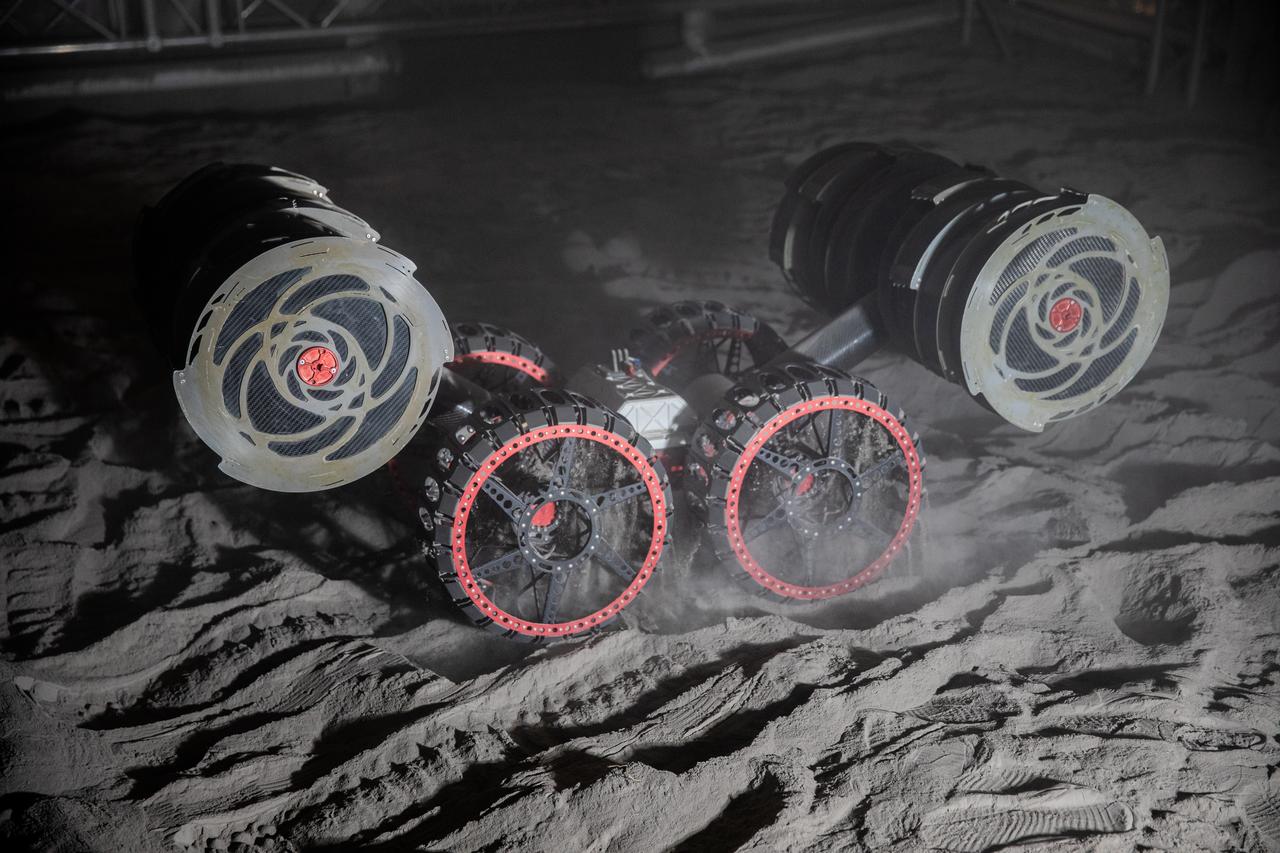
With the lights out, the ISRU Pilot Excavator digs in regolith bin during testing inside Swamp Works at NASA’s Kennedy Space Center in Florida on July 28, 2022. Tests use a gravity assist offload system to simulate reduced gravity conditions found on the Moon. On the surface of the Moon, mining robots like the Pilot Excavator will excavate the regolith and take the material to a processing plant where usable elements such as hydrogen, oxygen and water can be extracted for life support systems. The Pilot Excavator can scoop up icy regolith which can be used to make operations on the Moon sustainable.
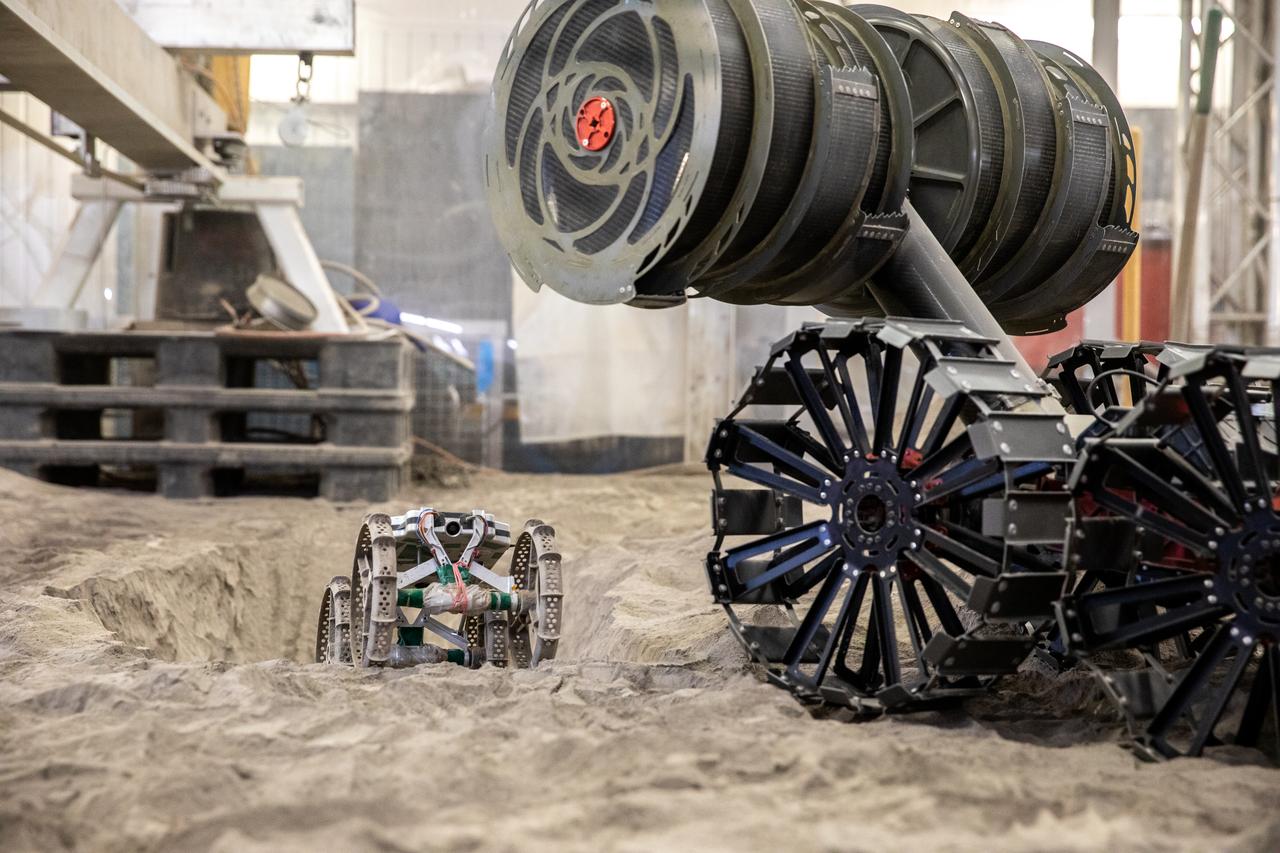
The Astrobotic CubeRover traverses the terrain in the Granular Mechanics and Regolith Operations Lab regolith bin at NASA’s Kennedy Space Center in Florida on Dec. 10, 2020. The regolith bin simulates the mechanical properties of the Moon’s surface. NASA and Astrobotic employees put the CubeRover through a series of more than 150 mobility tests over several days to evaluate and improve wheel design. Also in the bin is NASA’s Regolith Advanced Surface Systems Operations Robot (RASSOR), a robotic platform designed to dig on the Moon. The regolith bin simulates the Moon’s surface.
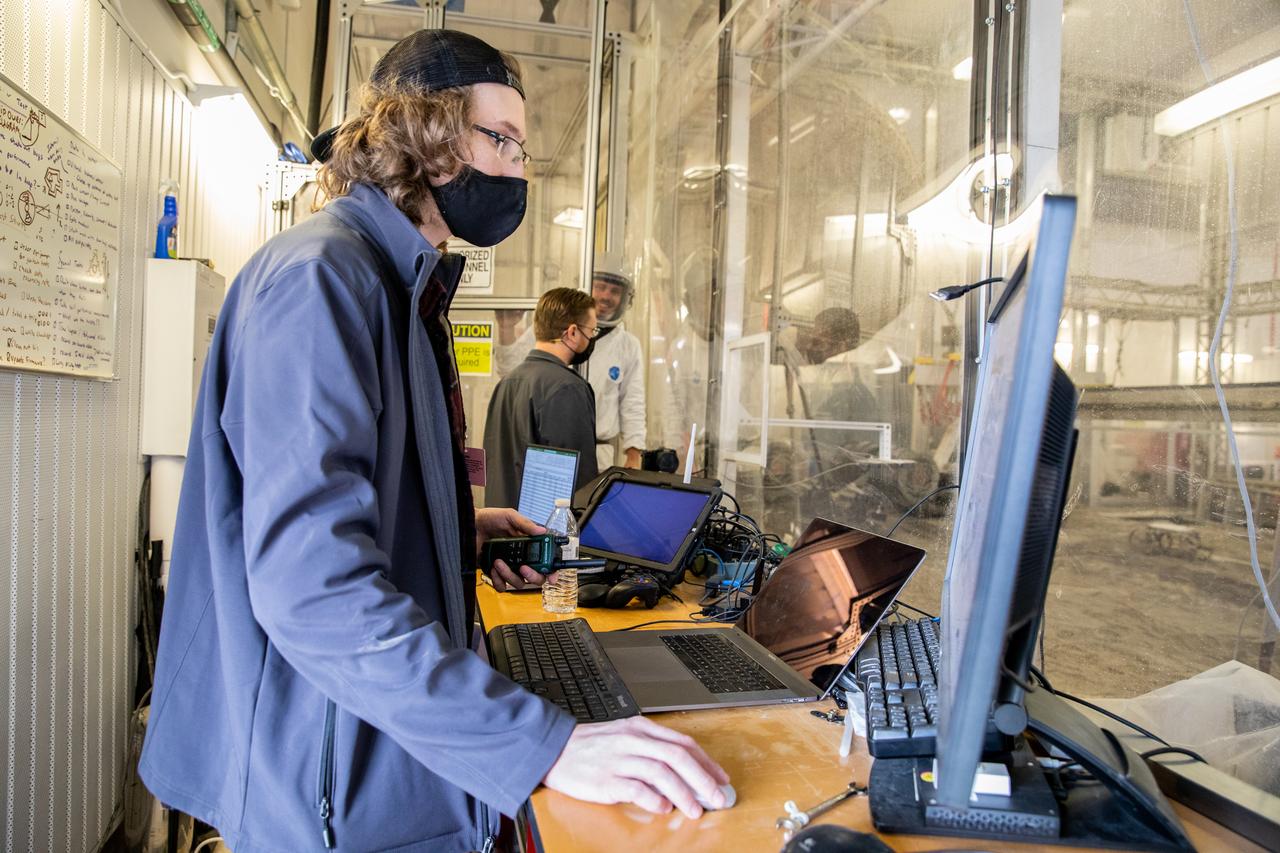
Taylor Whitaker, flight software engineer, monitors the progress of the Astrobotic CubeRover during its test run in the Granular Mechanics and Regolith Operations Lab regolith bin at NASA’s Kennedy Space Center in Florida on Dec. 10, 2020. The regolith bin simulates the mechanical properties of the Moon’s surface. NASA and Astrobotic employees put the CubeRover through a series of more than 150 mobility tests over several days to evaluate and improve wheel design.
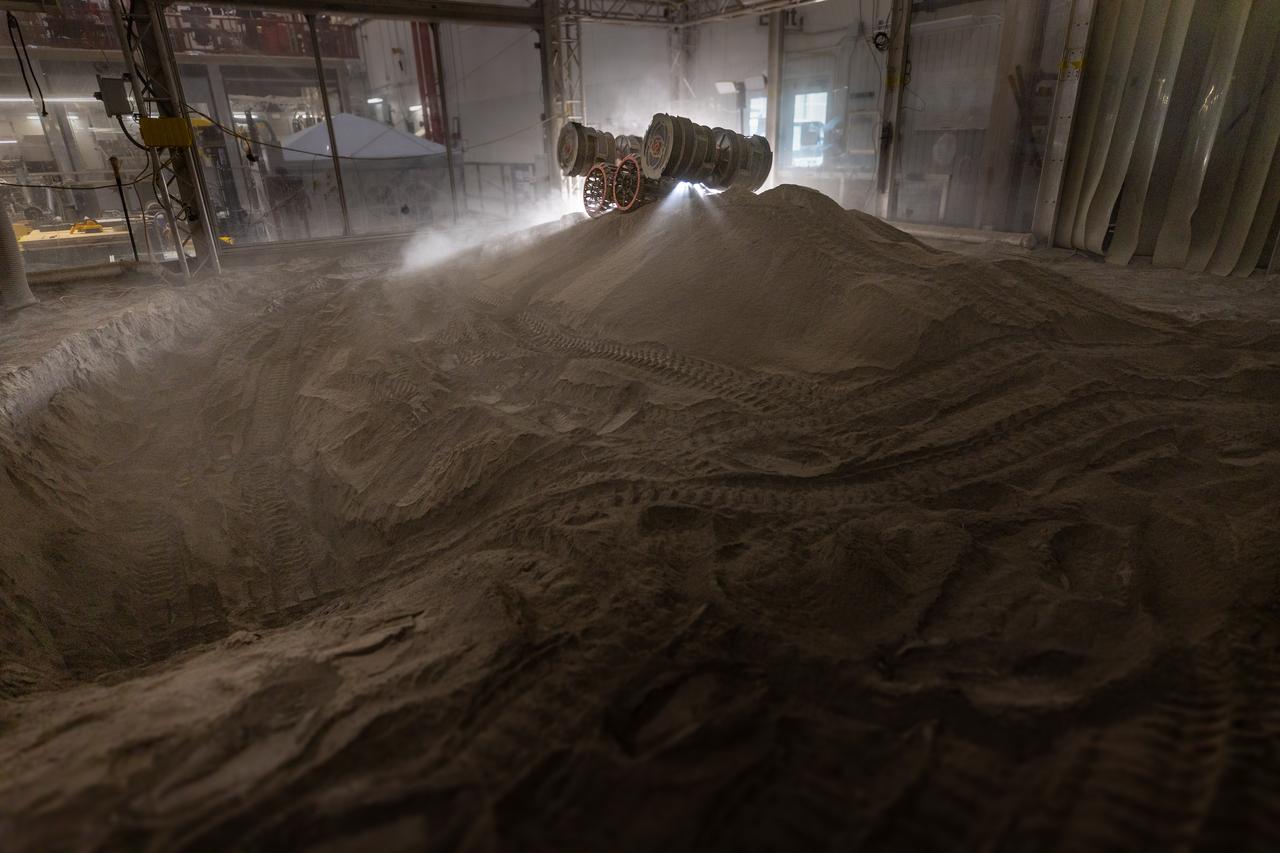
NASA’s RASSOR (Regolith Advanced Surface Systems Operations Robot) manipulates simulated regolith, or lunar dust found on the Moon’s surface, to create a three-foot berm during a site preparation test inside of the Granular Mechanics and Regolith Operations Lab at the agency’s Kennedy Space Center in Florida on Tuesday, June 3, 2025. The opposing motion of the bucket drums helps RASSOR grip the surface in low-gravity environments like the Moon or Mars. With this unique capability, RASSOR can traverse the rough surface to dig, load, haul, and dump regolith that could be used in construction or broken down into hydrogen, oxygen, or water, resources critical for sustaining human presence. RASSOR represents an earlier generation technology that informed the development of NASA’s IPEx (In-Situ Resource Utilization Pilot Excavator), serving as a precursor and foundational platform for the advanced excavation systems and autonomous capabilities now being demonstrated by this Moon-mining robot.
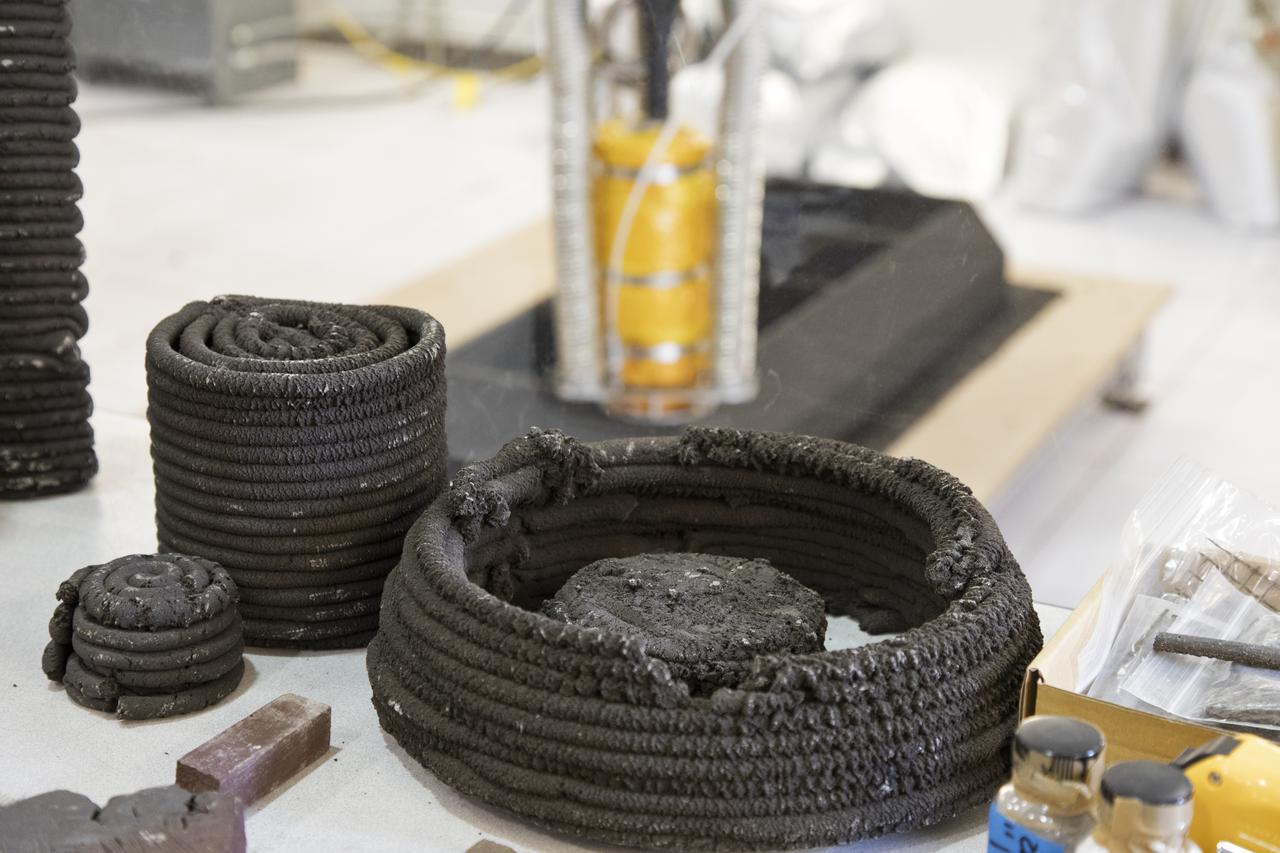
Pellets made from simulated lunar regolith, or dirt, and polymers are being used to test a Zero Launch Mass 3-D printer in the Swamp Works at NASA's Kennedy Space Center in Florida. The printer can be used for construction projects on the Moon and Mars, and even for troops in remote locations on Earth. Zero launch mass refers to the fact that the printer uses these pellets to prove that space explorers can use resources at their destination instead of taking everything with them, saving them launch mass and money. The group is working with Marshall Space Flight Center in Huntsville, Alabama, and the U.S. Army Corps of Engineers to develop a system that can 3-D print barracks in remote locations on Earth, using the resources they have where they are.
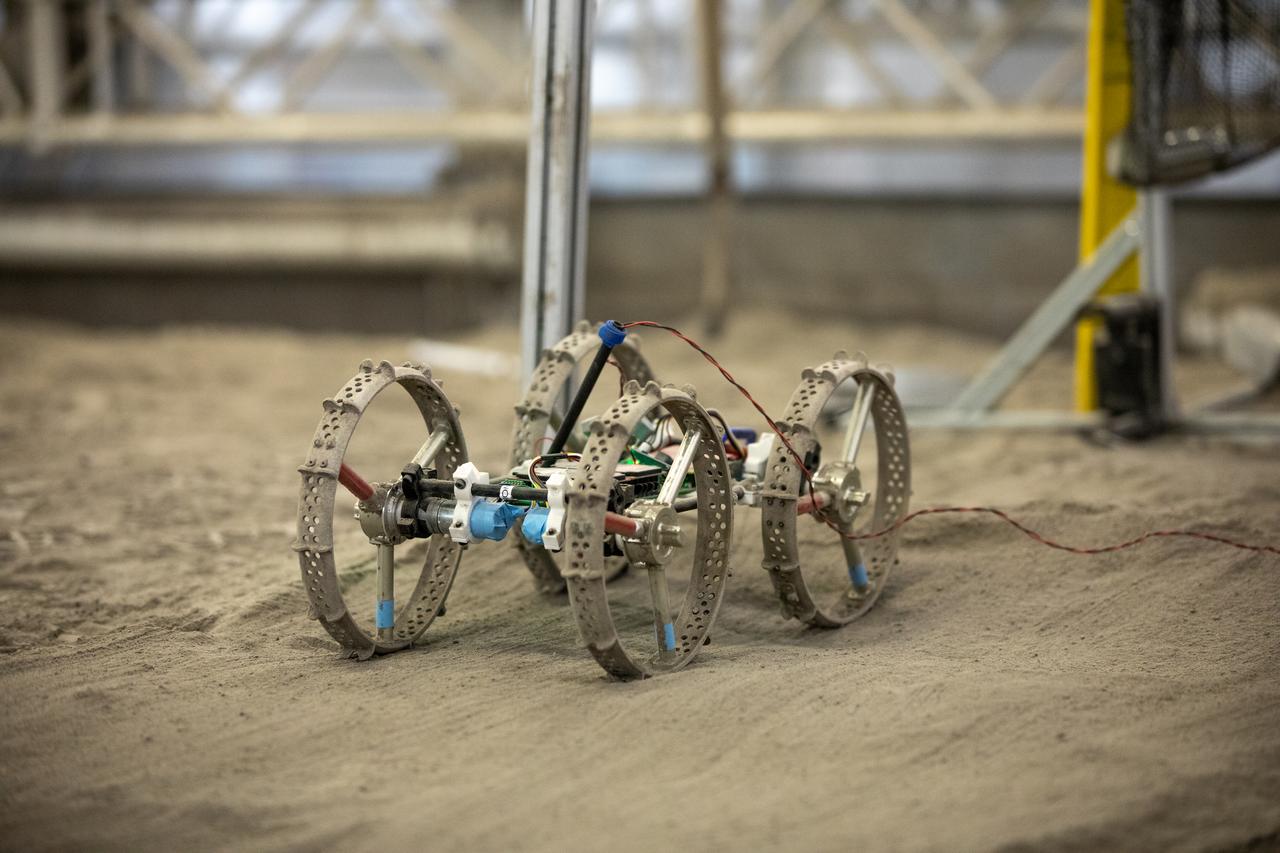
A mass-offloaded version of Astrobotic’s CubeRover – a lightweight, modular planetary rover – is used to simulate mobility in low lunar gravity inside the Granular Mechanics and Regolith Operations (GMRO) Laboratory’s regolith pit at NASA Kennedy Space Center’s Swamp Works facility on June 30, 2022. Astrobotic – a Pittsburgh-based space robotics company – is using the GMRO lab’s regolith bin, which holds approximately 120 tons of lunar regolith simulant, to depict how the company’s CubeRover would perform on the Moon. NASA’s Small Business Innovation Research program provided the funding for initial development, and a $2 million Tipping Point award from the agency has provided additional funding for continued development into a more mature rover.
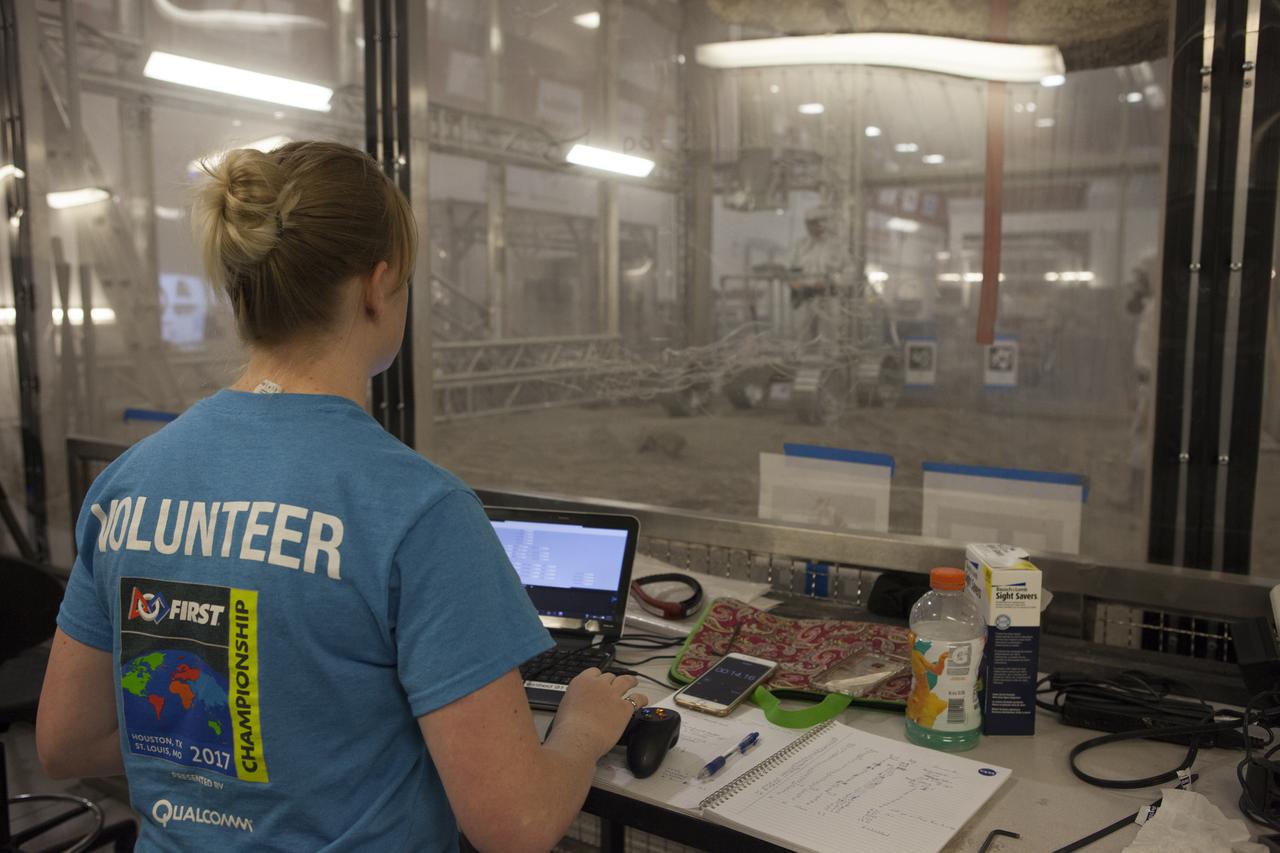
Outside a regolith bin at the agency's Kennedy Space center in Florida, an engineer operates controls for a lightweight simulator version of NASA's Resource Prospector during a mobility test. The Resource Prospector mission aims to be the first mining expedition on another world. Operating on the moon’s poles, the robot is designed to use instruments to locate elements at a lunar polar regions, then excavate and sample resources such as hydrogen, oxygen and water. These resources could support human explores on their way to destinations such as farther into the solar system.
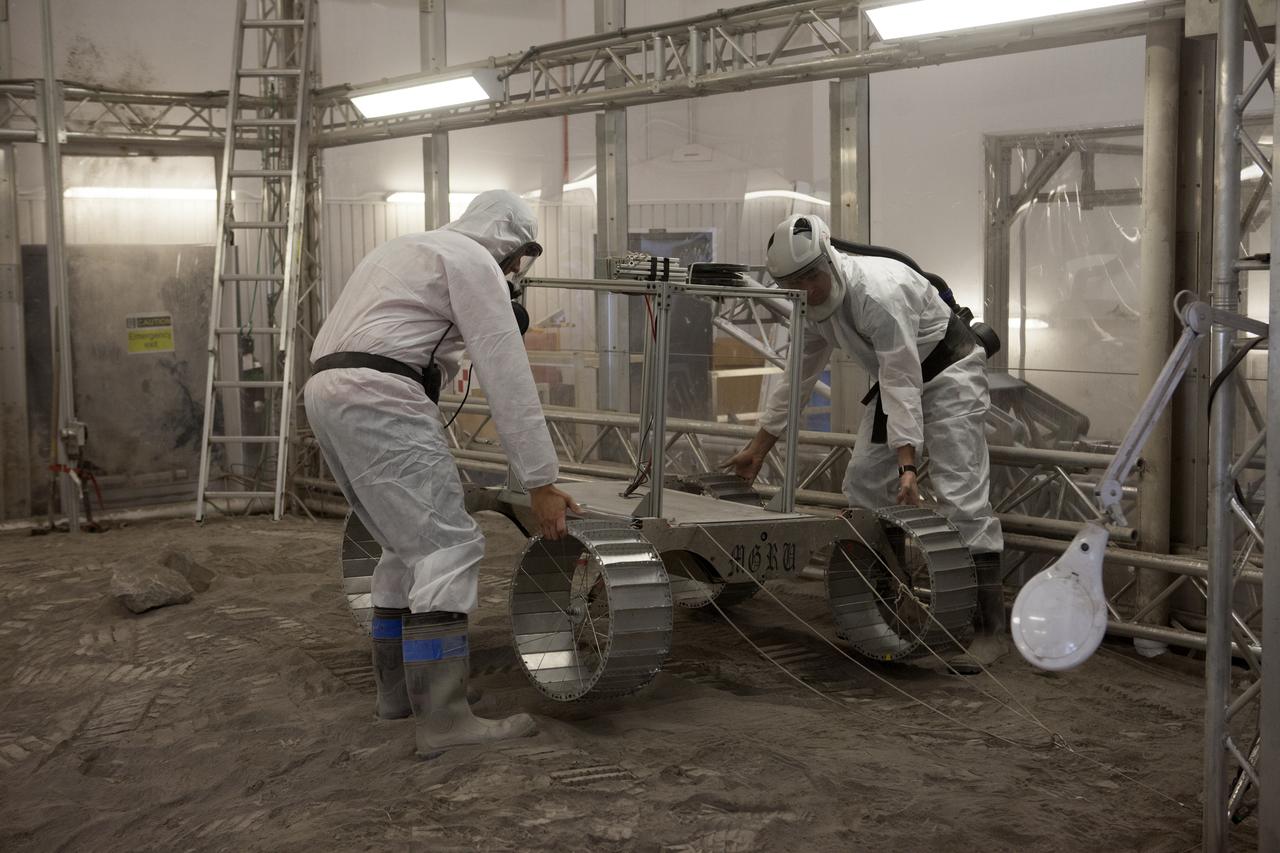
Engineers wearing protecting garb, make adjustments to a lightweight simulator version of NASA's Resource Prospector undergoes a mobility test in a regolith bin at the agency's Kennedy Space center in Florida. The Resource Prospector mission aims to be the first mining expedition on another world. Operating on the moon’s poles, the robot is designed to use instruments to locate elements at a lunar polar regions, then excavate and sample resources such as hydrogen, oxygen and water. These resources could support human explores on their way to destinations such as farther into the solar system.
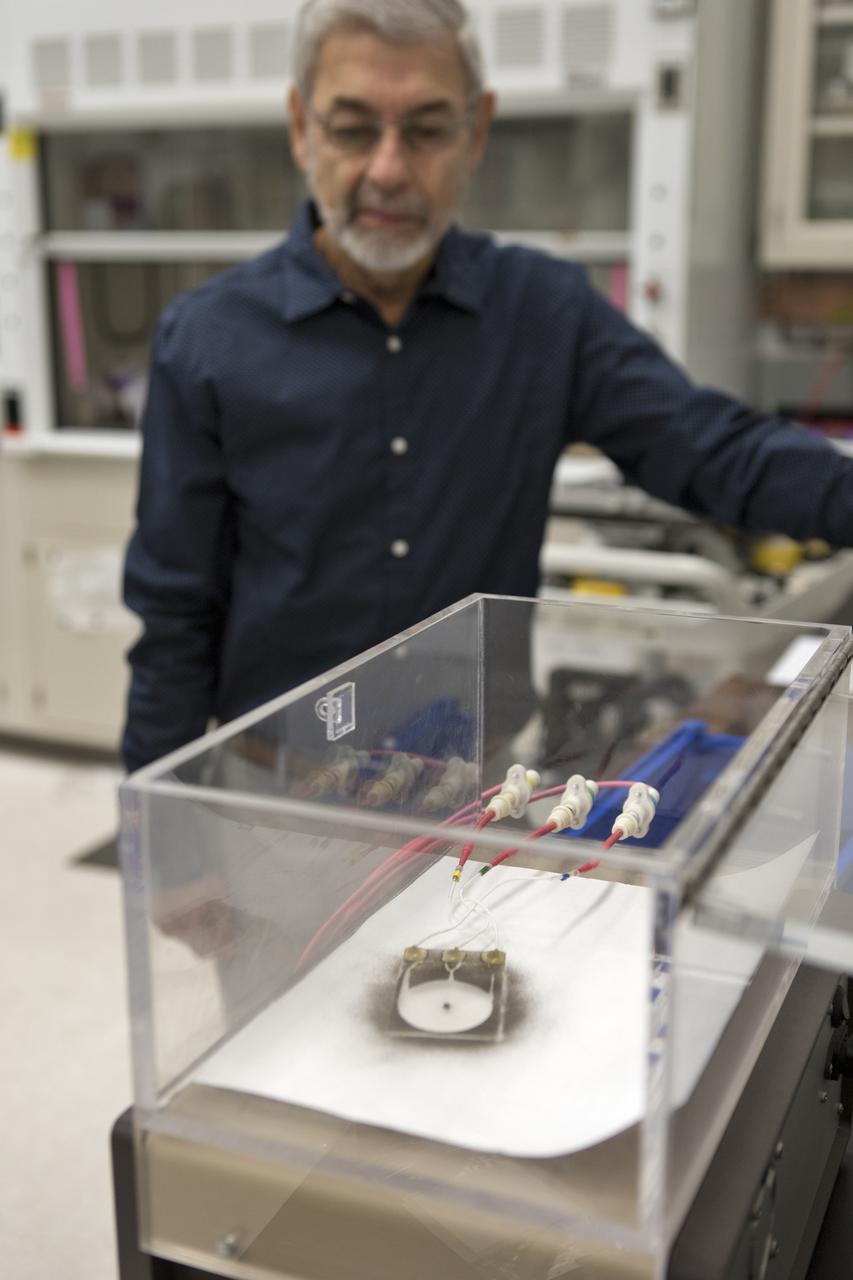
On Thursday, July 19, 2018, Dr. Carlos Calle, lead scientist in the Electrostatics and Surface Physics Laboratory at NASA's Kennedy Space Center in Florida, activates an experiment in which an Electrostatic Dust Shield has been covered with dust similar to that which may be encountered by astronauts exploring the Moon or Mars. When activated, the device shakes off the dust. Scientists are developing the dust shield to help mitigate the problem of dust on equipment, astronauts' space suits and helmet visors. The device is slated for analysis aboard International Space Station in the spring of 2019 to verify the effects of the space environment.
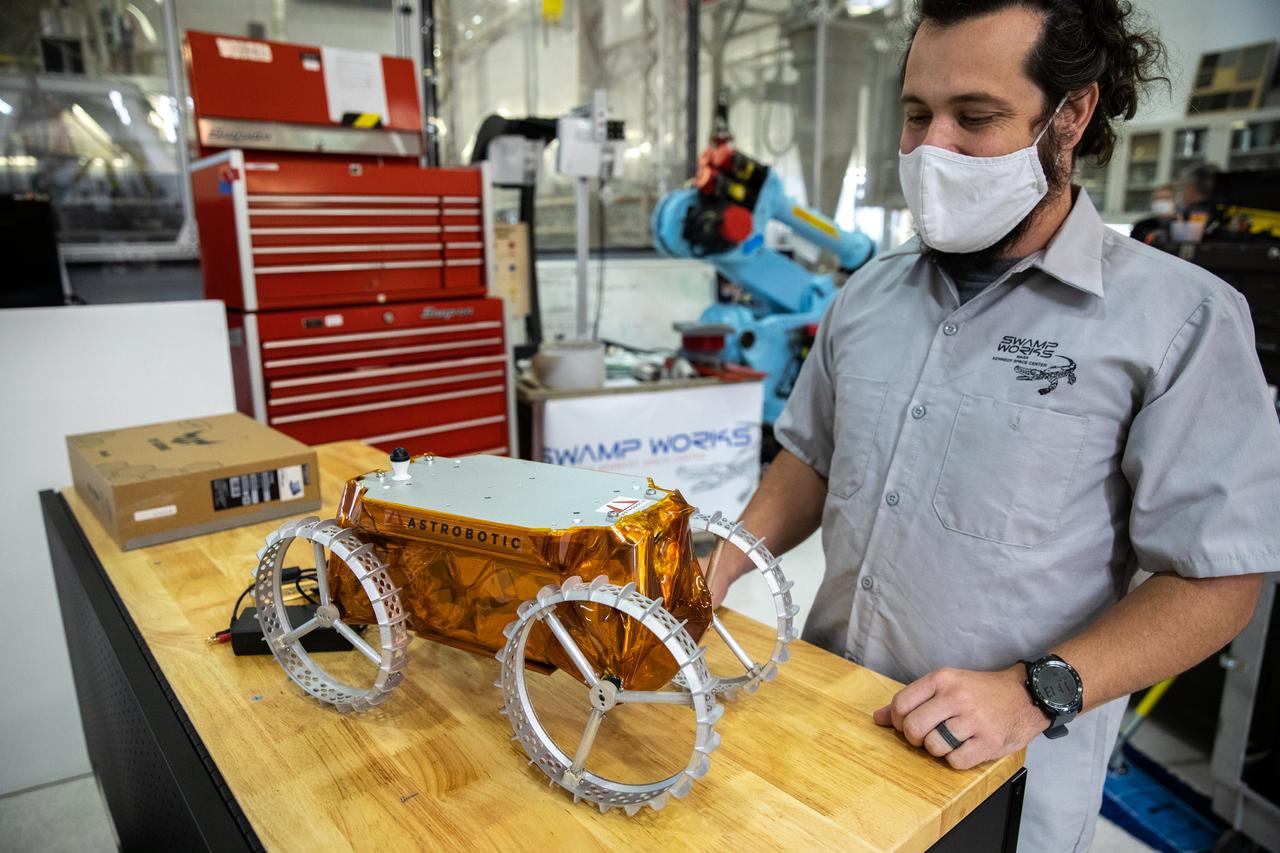
A.J. Nick, with Kennedy Space Center’s Exploration and Research and Technology programs, unboxes a CubeRover at the Florida spaceport on Oct. 9, 2020. The rover was delivered by Pittsburgh-based space robotics company Astrobotic, as part of a Small Business Innovative Research (SBIR) award from NASA. Nick will lead CubeRover testing in the coming months in the Granular Mechanics and Regolith Operations (GMRO) Laboratory’s regolith bin, which holds approximately 120 tons of lunar regolith simulant at Kennedy’s Swamp Works. In 2019, NASA announced a $2 million Tipping Point award to develop more mature CubeRover’s payload interfaces and increase its capabilities.
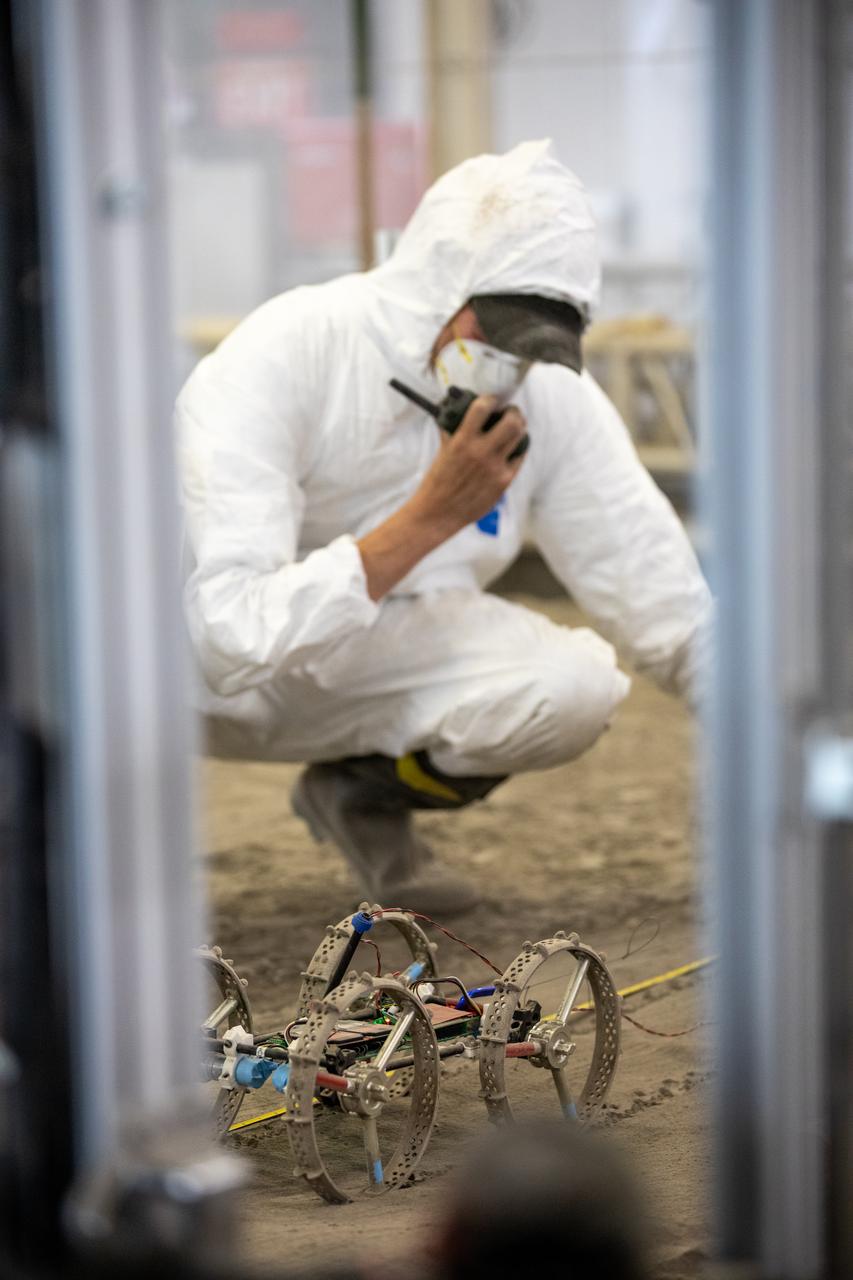
Senior Software Engineer Taylor Whitaker reports the results of a drawbar pull run to Astrobotic staff outside of the Granular Mechanics and Regolith Operations (GMRO) Laboratory’s regolith pit at NASA Kennedy Space Center’s Swamp Works facility on June 30, 2022. Astrobotic – a Pittsburgh-based space robotics company – is using the GMRO lab’s regolith bin, which holds approximately 120 tons of lunar regolith simulant, to depict how the company’s CubeRover would perform on the Moon. NASA’s Small Business Innovation Research program provided the funding for initial development, and a $2 million Tipping Point award from the agency has provided additional funding for continued development into a more mature rover.
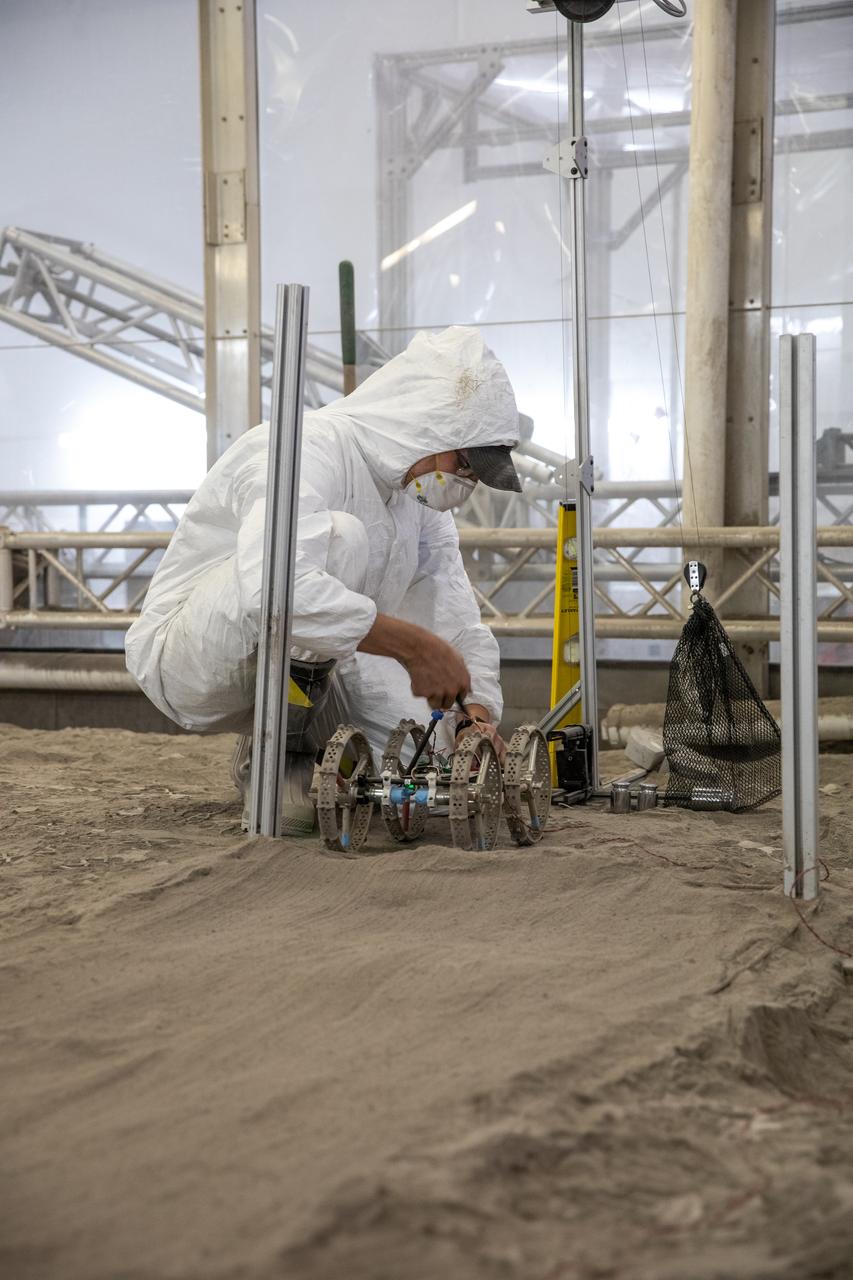
Senior Software Engineer Taylor Whitaker stages Astrobotic’s mass-offloaded CubeRover – a lightweight, modular planetary rover – for a drawbar pull test inside the Granular Mechanics and Regolith Operations (GMRO) Laboratory’s regolith pit at NASA Kennedy Space Center’s Swamp Works facility on June 30, 2022. Astrobotic – a Pittsburgh-based space robotics company – is using the GMRO lab’s regolith bin, which holds approximately 120 tons of lunar regolith simulant, to depict how the company’s CubeRover would perform on the Moon. NASA’s Small Business Innovation Research program provided the funding for initial development, and a $2 million Tipping Point award from the agency has provided additional funding for continued development into a more mature rover.
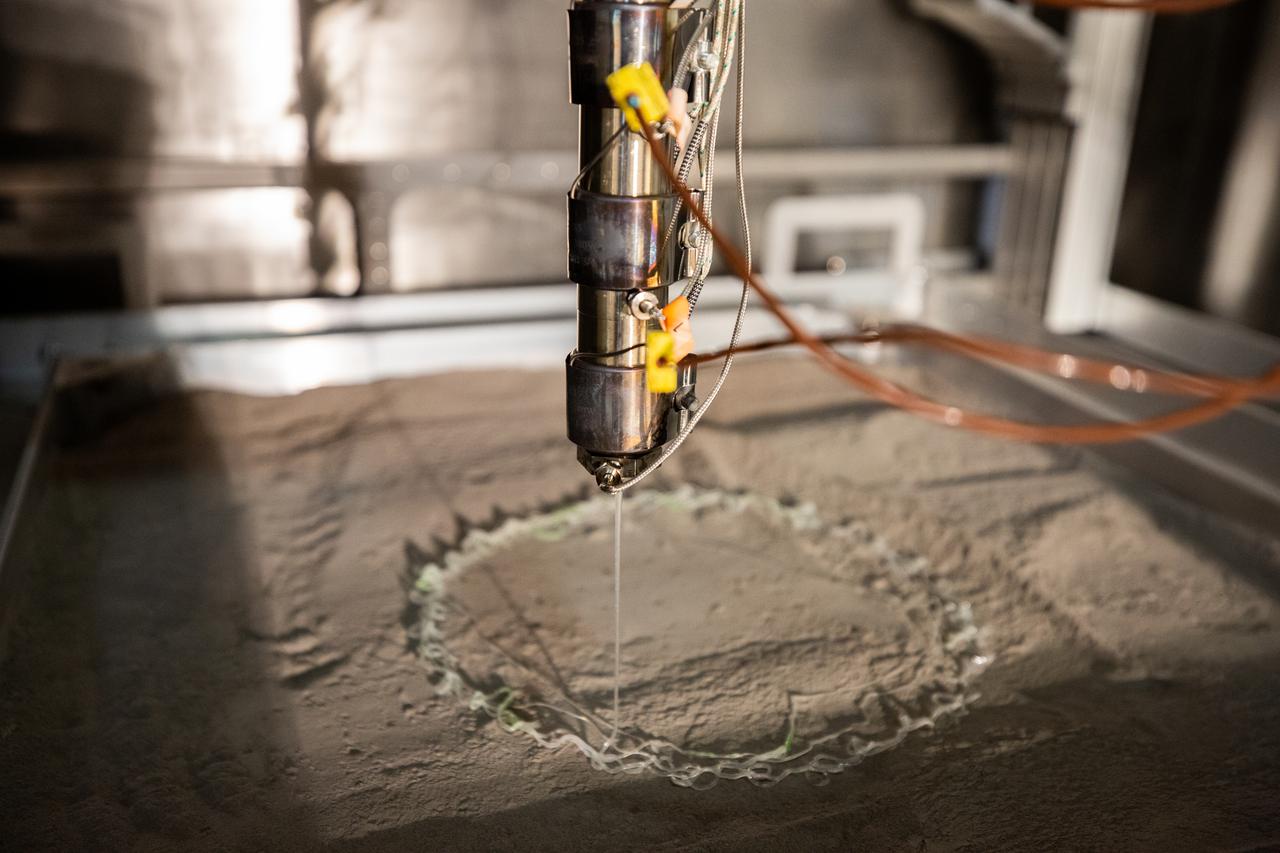
A team at NASA’s Kennedy Space Center in Florida test a 3D printer inside a vacuum chamber at the Granular Mechanics and Regolith Operations (GMRO) lab inside the spaceport’s Swamp Works, as part of the Relevant Environment Additive Construction Technology (REACT) project on April 5, 2022. Testing REACT derives from NASA’s 2020 Announcement of Collaboration Opportunity, with AI SpaceFactory – an architectural and construction technology company and winner of NASA’s 3D Printed Habitat Challenge – collaborating with Kennedy teams to build 3D-printed test structures using a composite made from polymers and a regolith simulant in a vacuum chamber that mimics environmental conditions on the Moon.
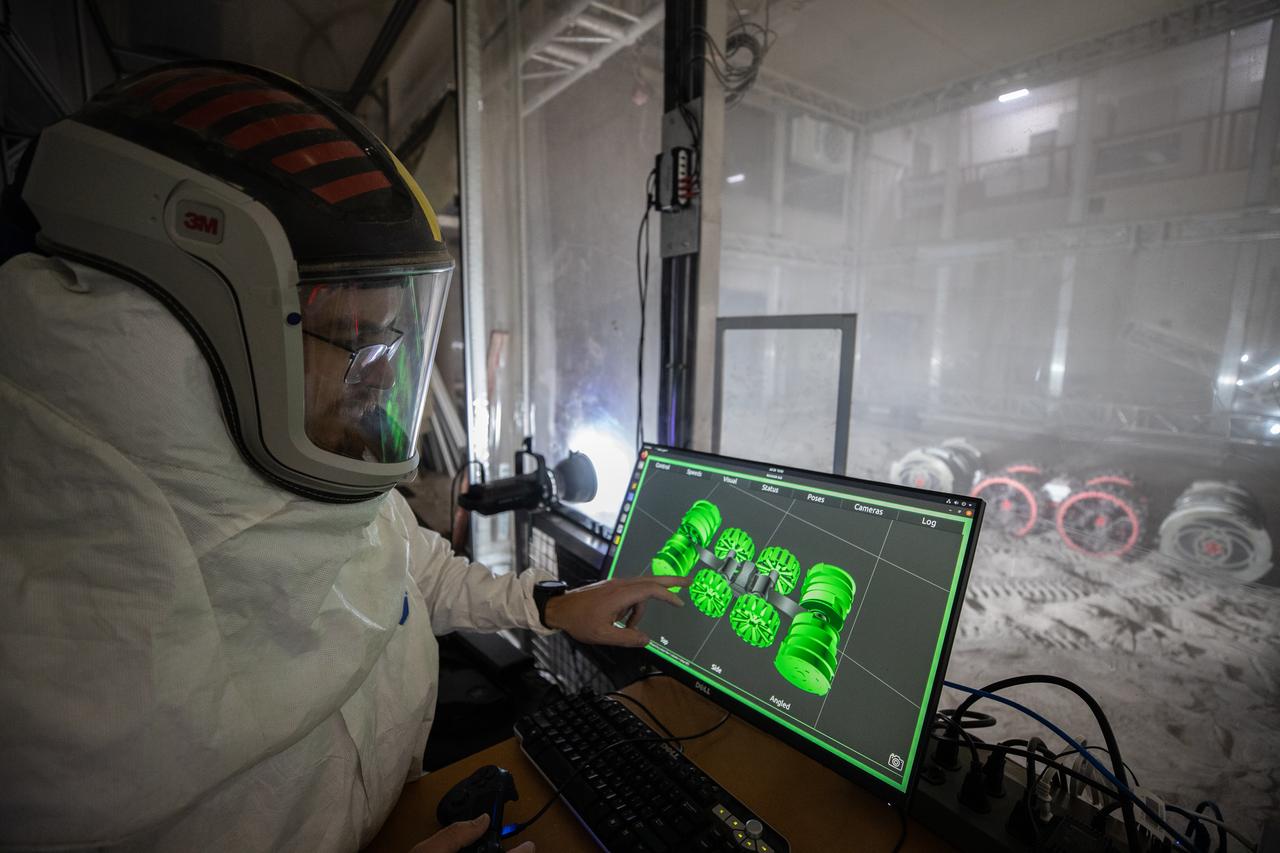
A team from the Granular Mechanics and Regolith Operations Lab operates a test of the ISRU Pilot Excavator in regolith bin inside Swamp Works at NASA’s Kennedy Space Center in Florida on July 28, 2022. Tests use a gravity assist offload system to simulate reduced gravity conditions found on the Moon. On the surface of the Moon, mining robots like the Pilot Excavator will excavate the regolith and take the material to a processing plant where usable elements such as hydrogen, oxygen and water can be extracted for life support systems. The Pilot Excavator can scoop up icy regolith which can be used to make operations on the Moon sustainable.
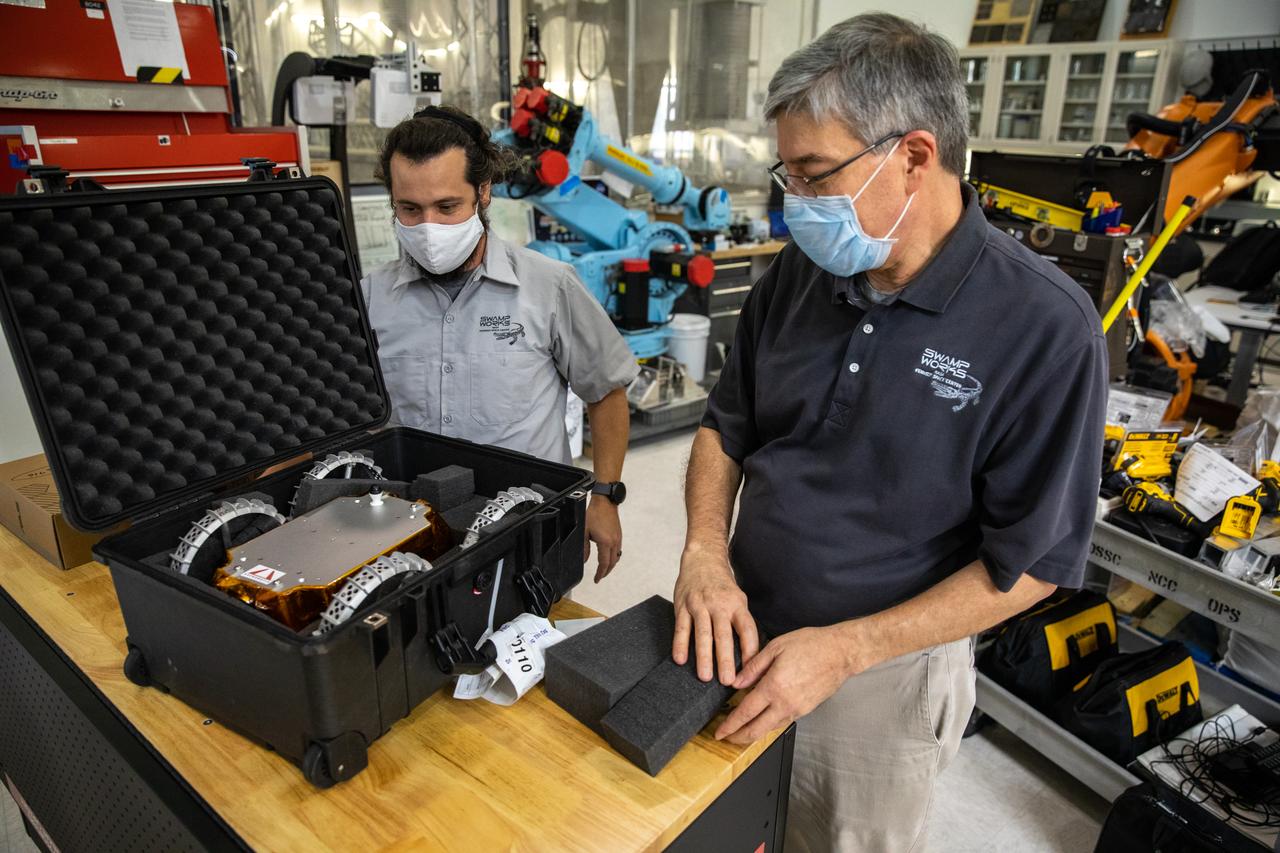
A.J. Nick, left, and Jim Mantovani, with Kennedy Space Center’s Exploration and Research and Technology programs, unbox a CubeRover at the Florida spaceport on Oct. 9, 2020. The rover was delivered by Pittsburgh-based space robotics company Astrobotic, as part of a Small Business Innovative Research (SBIR) award from NASA. Nick will lead CubeRover testing in the coming months in the Granular Mechanics and Regolith Operations (GMRO) Laboratory’s regolith bin, which holds approximately 120 tons of lunar regolith simulant at Kennedy’s Swamp Works. In 2019, NASA announced a $2 million Tipping Point award to develop more mature CubeRover’s payload interfaces and increase its capabilities.
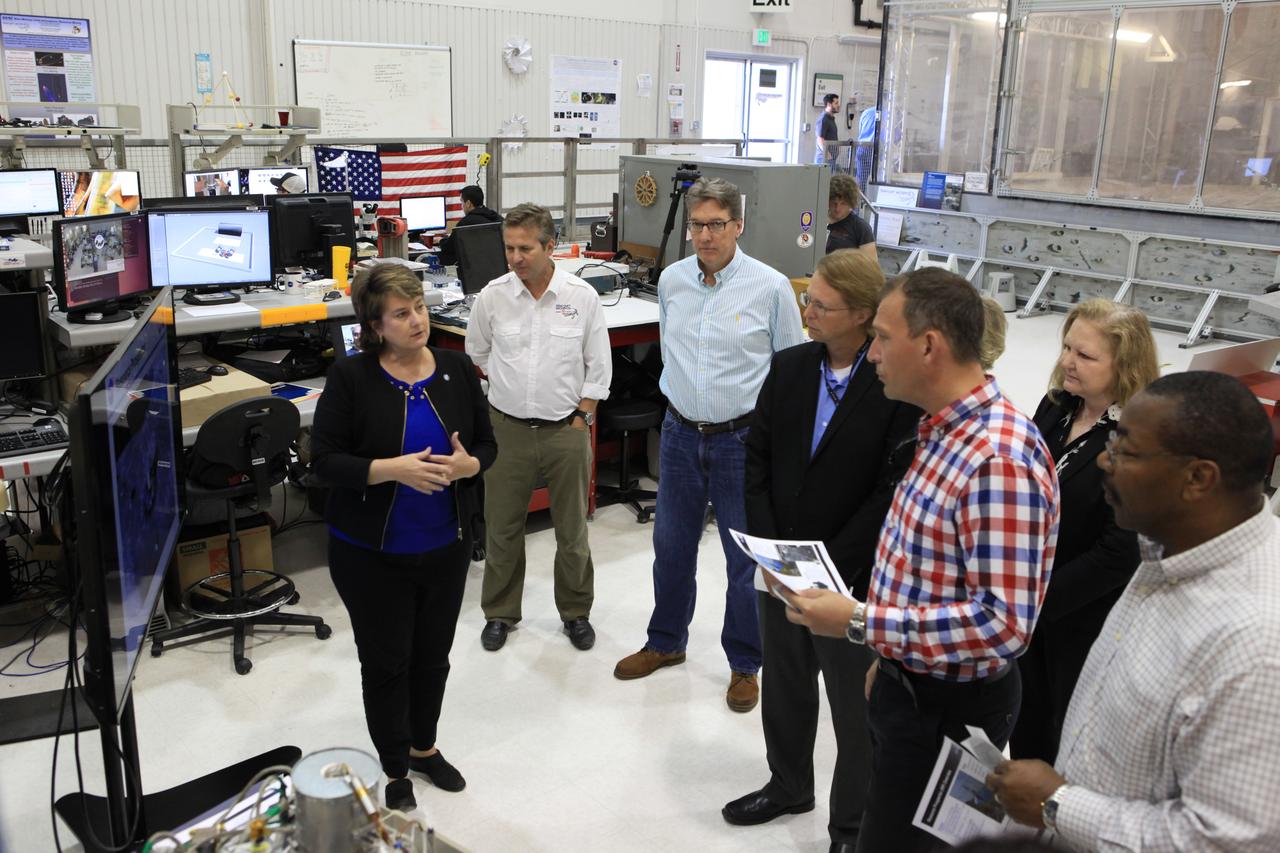
Thomas Zurbuchen, in plaid shirt, NASA's associate administrator for the Science Mission Directorate, listens to a presentation at the Swamp Works facility at NASA's Kennedy Space Center in Florida.
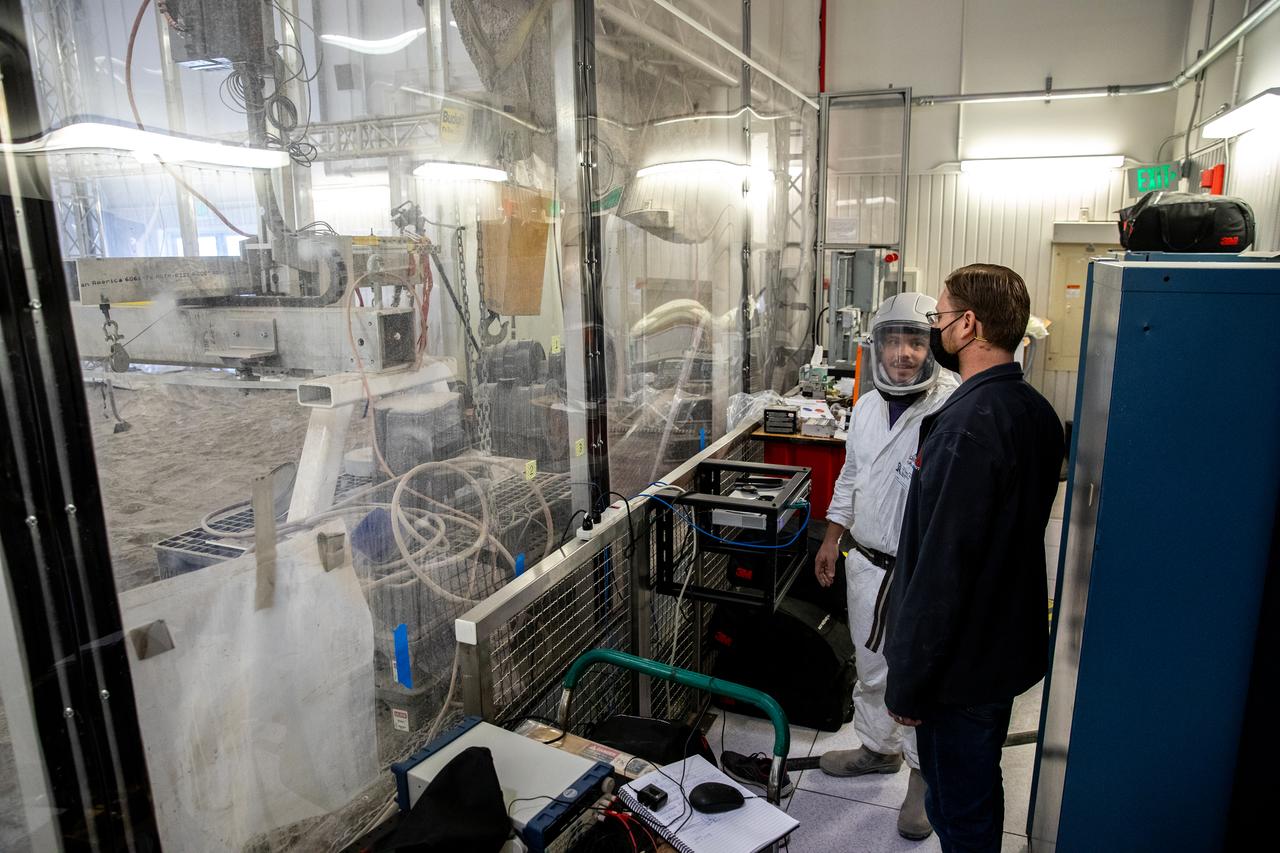
Astrobotic employee Troy Arbuckle, at right, Planetary Mobility lead mechanical engineer, and NASA employee A.J. Nick, with Kennedy Space Center’s Exploration and Research and Technology programs, observe the Astrobotic CubeRover during its test run in the Granular Mechanics and Regolith Operations Lab regolith bin at NASA’s Kennedy Space Center in Florida on Dec. 10, 2020. The regolith bin simulates the mechanical properties of the Moon’s surface. NASA and Astrobotic employees put the CubeRover through a series of more than 150 mobility tests over several days to evaluate and improve wheel design.
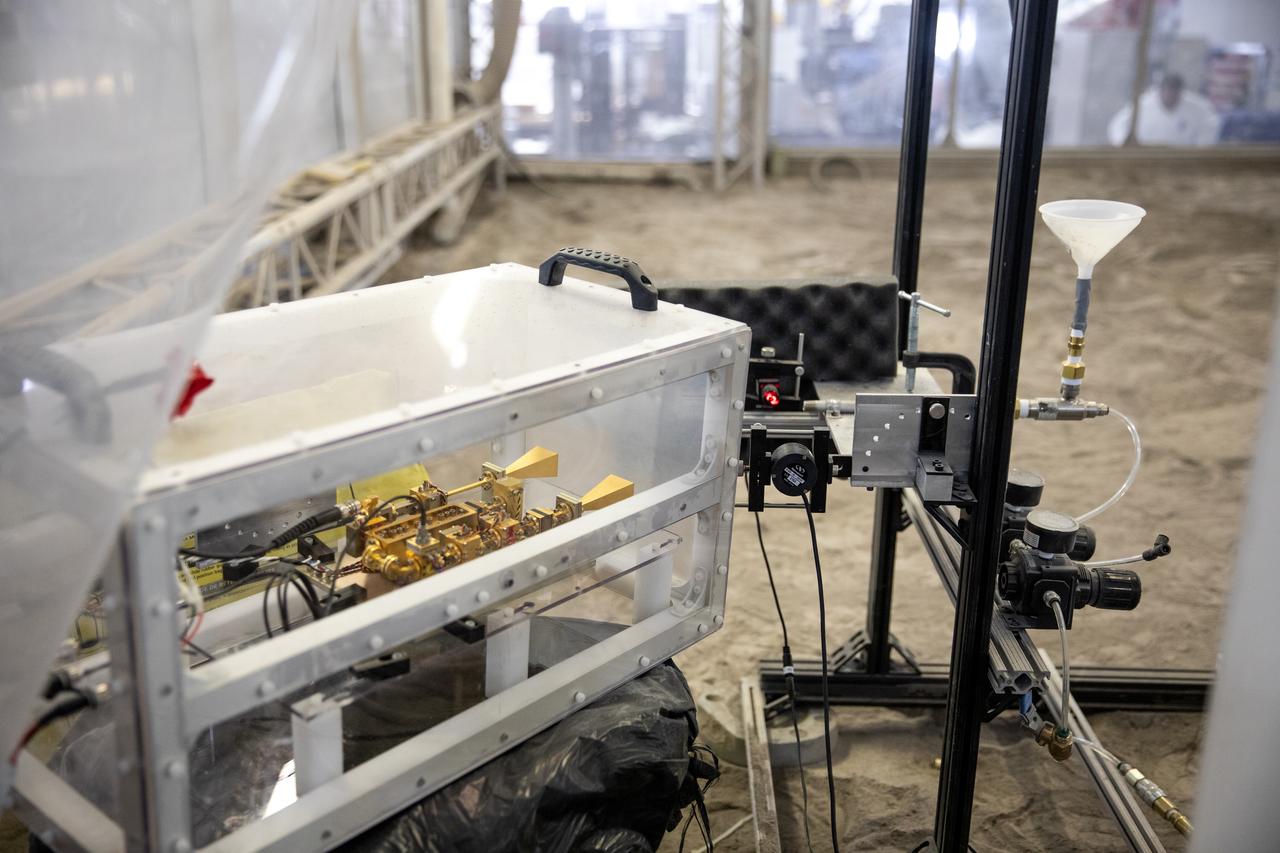
A team at NASA’s Kennedy Space Center in Florida assesses the Dust Concentration Monitor and the Millimeter Wave Doppler Radar inside a regolith bin at the Granular Mechanics and Regolith Operations (GMRO) lab at the spaceport’s Swamp Works on July 28, 2022, as part of Plume Surface Interaction (PSI) Instrumentation testing. The PSI Project is advancing both modeling and testing capabilities to understand exactly how rocket exhaust plumes affect a planetary landing site. This advanced modeling will help engineers evaluate the risks of various plumes on planetary surfaces, which will help them more accurately design landers for particular locations.
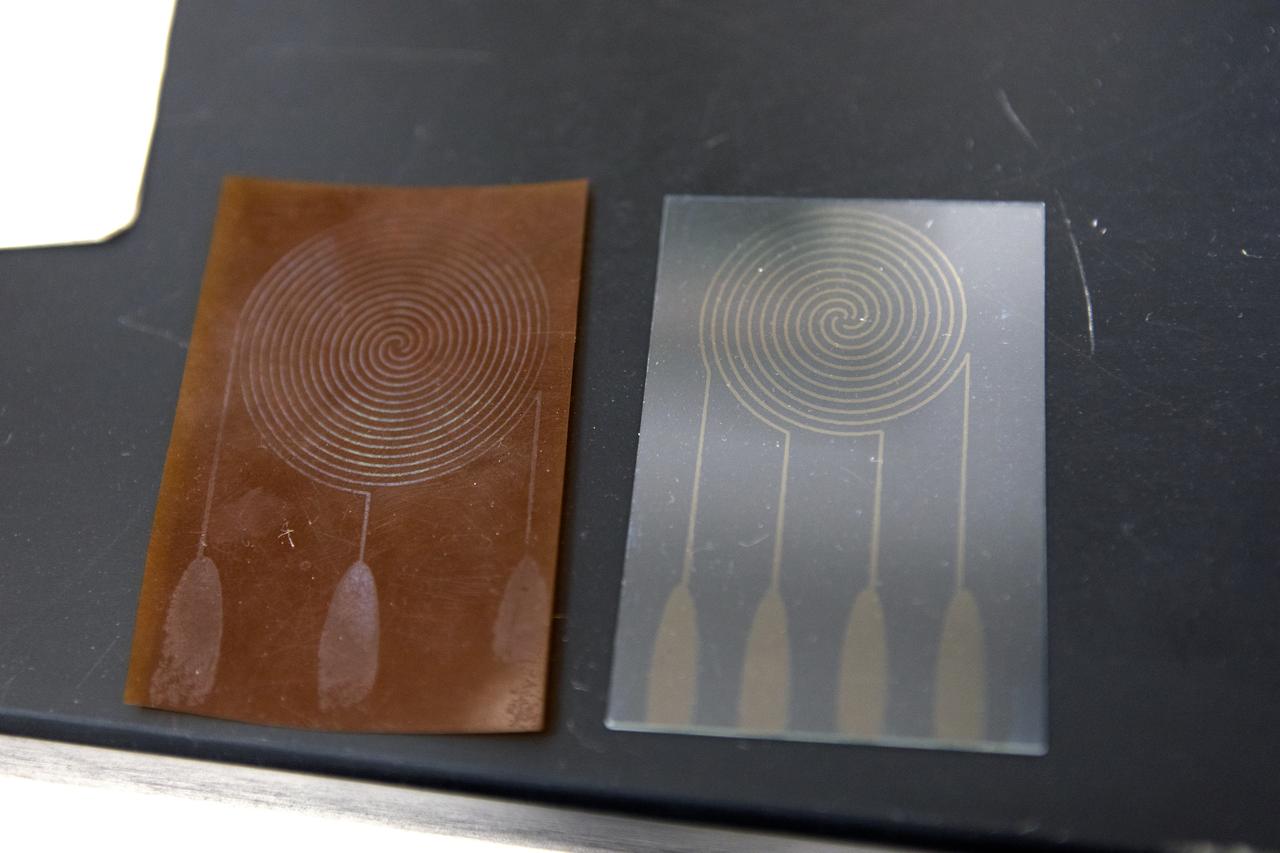
In the Electrostatics and Surface Physics Laboratory at NASA's Kennedy Space Center in Florida, an Electrostatic Dust Shield is seen prior to testing on Thursday, July 19, 2018. Scientists are developing the Electrostatic Dust Shield to help mitigate the problem of dust on equipment, space suits and helmet visors of astronauts exploring the Moon or Mars. The device is slated for analysis aboard International Space Station in the spring of 2019 to verify the effects of the space environment.
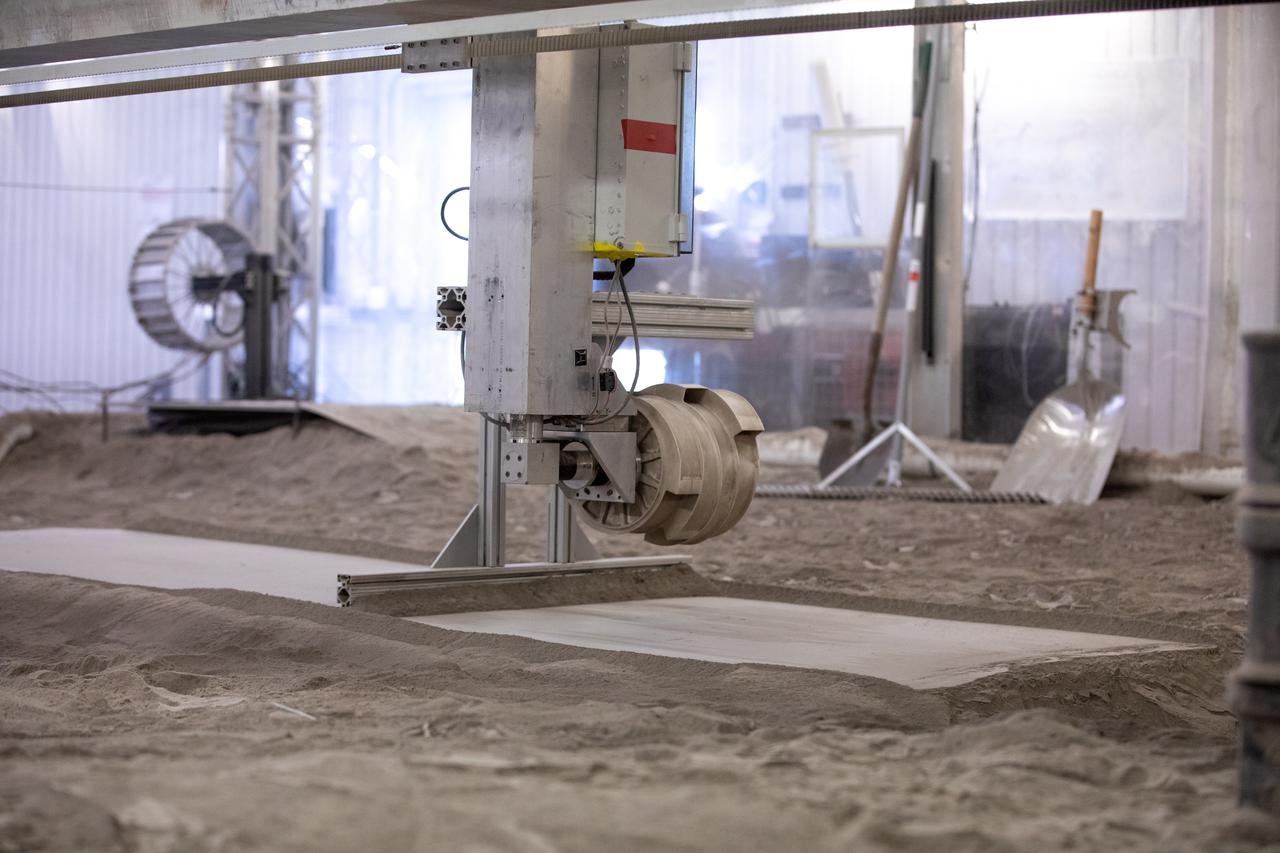
A team at NASA’s Kennedy Space Center in Florida tests small- and medium-sized bucket drums July 16, 2021, in the Granular Mechanics and Regolith Operations Lab’s “big bin” during prototype development for the pilot excavator, a robotic mission designed for lunar operations. The bucket drum excavated lunar regolith simulant. The Swamp Works team leveled and compacted the simulant before excavation as well as measured penetration during the excavator testing. Robotics engineers Jason Schuler and Austin Langton worked inside the bin, teaming up with software engineer Kurt Leucht, who worked just outside of it.
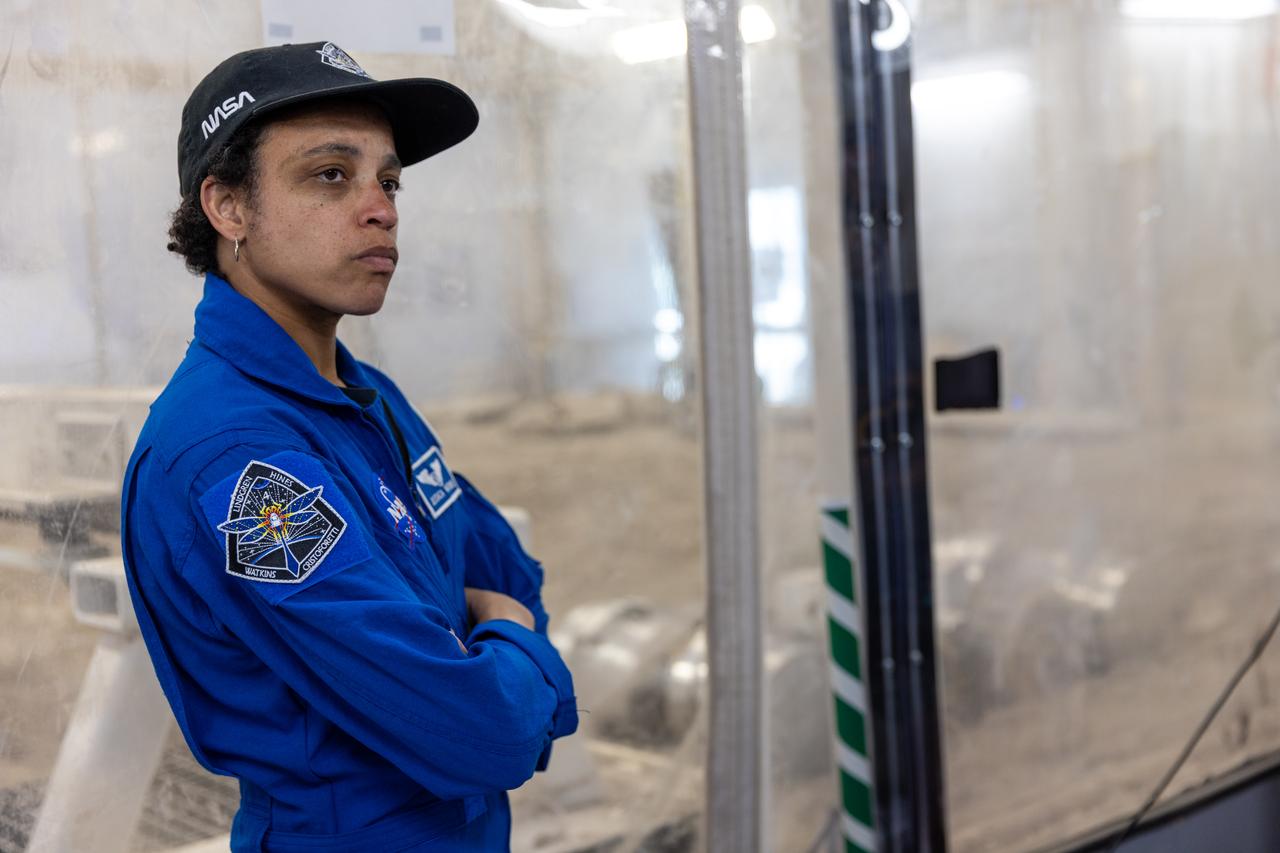
NASA astronaut Jessica Watkins visits the Granular Mechanics and Regolith Operations Laboratory inside Swamp Works at Kennedy Space Center in Florida on Wednesday, Aug. 27, 2025, to view some of the evolving technologies in development that astronauts may use to explore the Moon’s surface, prepare it for sustainable outposts, and to handle the dust that is collected during moonwalks.
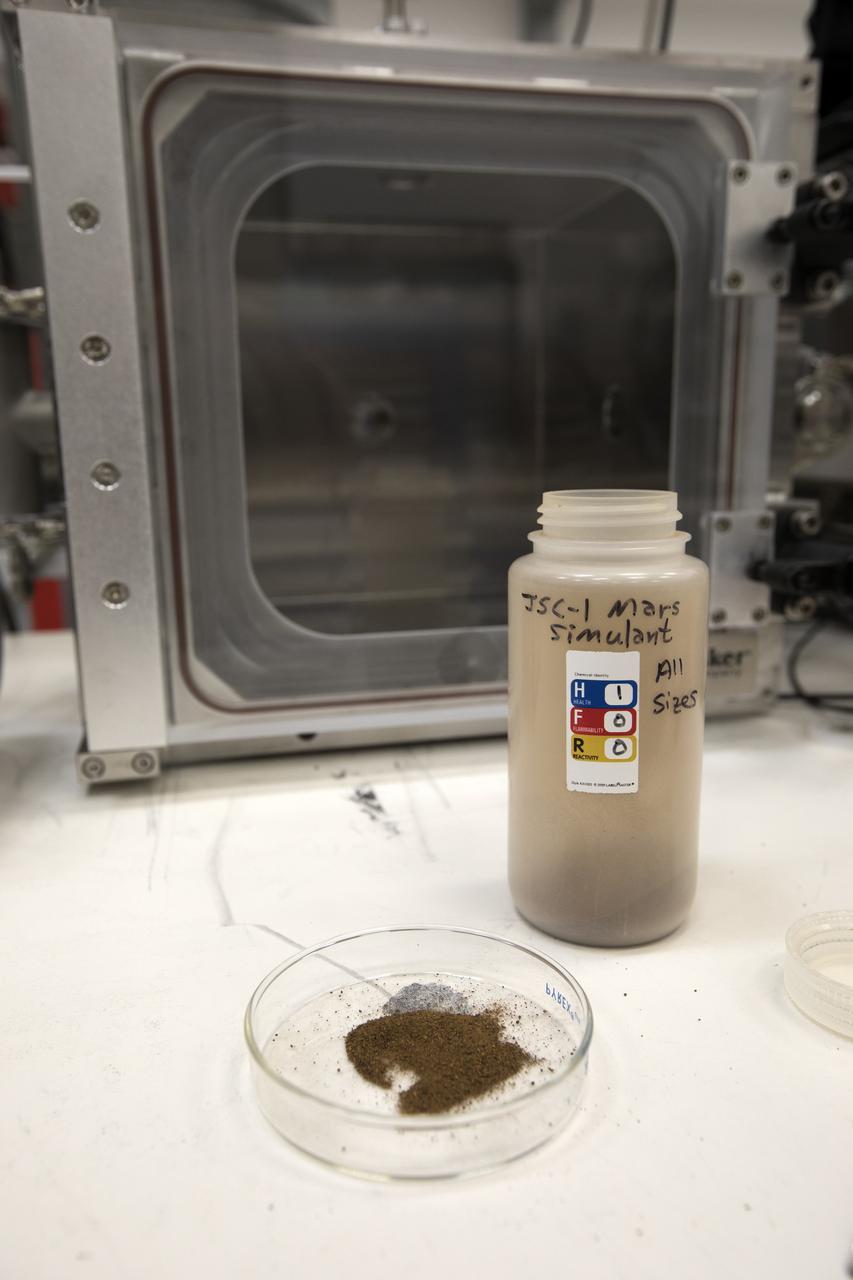
In their Swamp Works laboratory at NASA's Kennedy Space Center, Dr. Carlos Calle and Jay Phillips are testing an electrostatic precipitator using dust that closely approximates the make-up of that on Mars. They upgraded their electrostatic precipitator to fully simulate Martian atmosphere by designing and constructing a dust aerosolization pre-chamber. The agency's Journey to Mars requires cutting-edge technologies to solve the problems explorers will face on the Red Planet. Scientists are developing some of the needed solutions by adapting a device to remove the ever-present dust from valuable elements in the Martian atmosphere. Those commodities include oxygen, water and methane.
Materials engineer Thomas Lipscomb tests a 3D printer on July 28, 2022, at Swamp Works at NASA’s Kennedy Space Center in Florida, as part of the Relevant Environment Additive Construction Technology (REACT) project. Among the key objectives of the project is developing an architectural and structural design for a shelter that provides protection to habitable assets on the lunar surface. Testing REACT derives from NASA’s 2020 Announcement of Collaboration Opportunity with AI SpaceFactory – an architectural and construction technology company and winner of NASA’s 3D Printed Habitat Challenge.
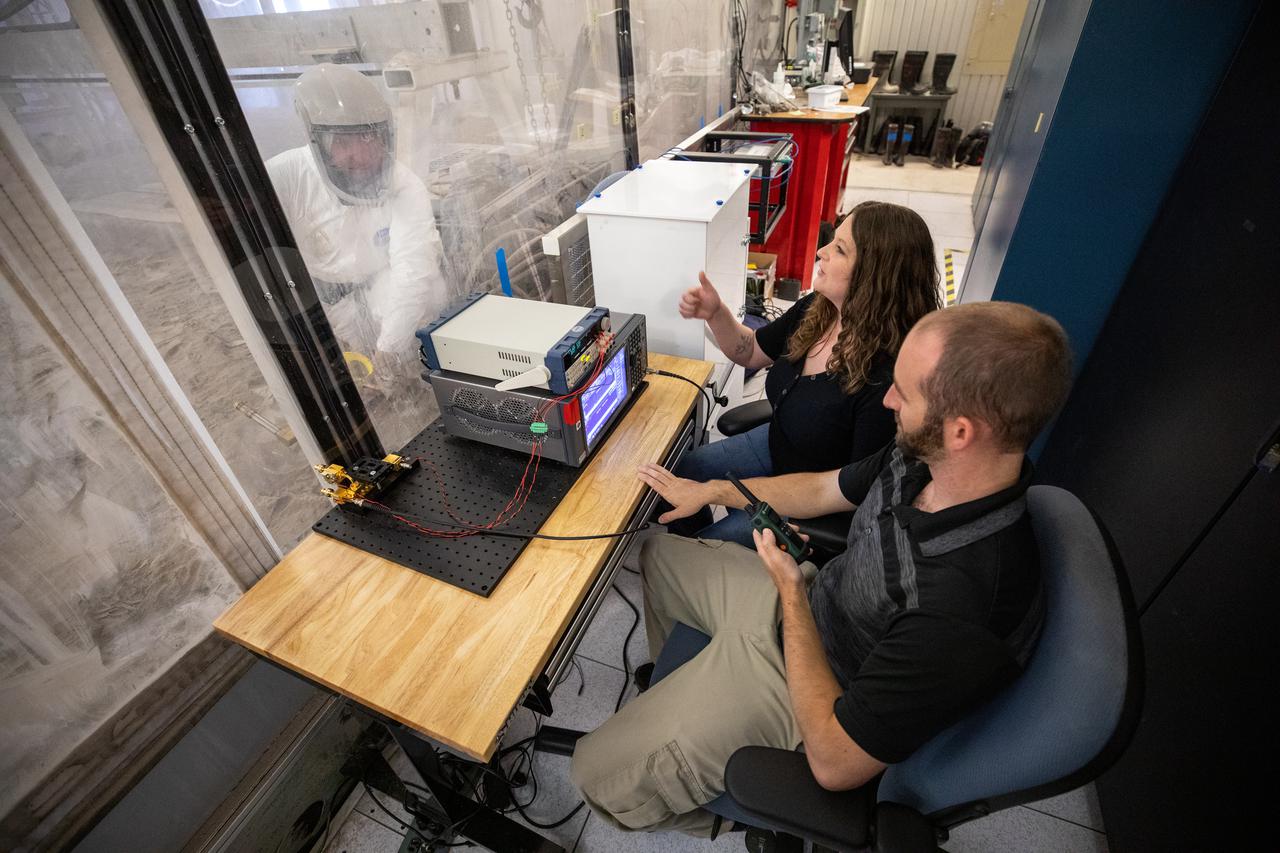
Beverly Kemmerer and Austin Adkins, right, and Austin Langton, perform testing with a Millimeter Wave Doppler Radar at NASA’s Kennedy Space Center’s Granular Mechanics and Regolith Operations Lab on July 16, 2021. The testing at the Florida spaceport is part of a project to identify a suite of instrumentation capable of acquiring a comprehensive set of flight data from a lunar lander. Researchers at NASA will use that data to validate computational models being developed to predict plume surface interaction effects on the Moon.
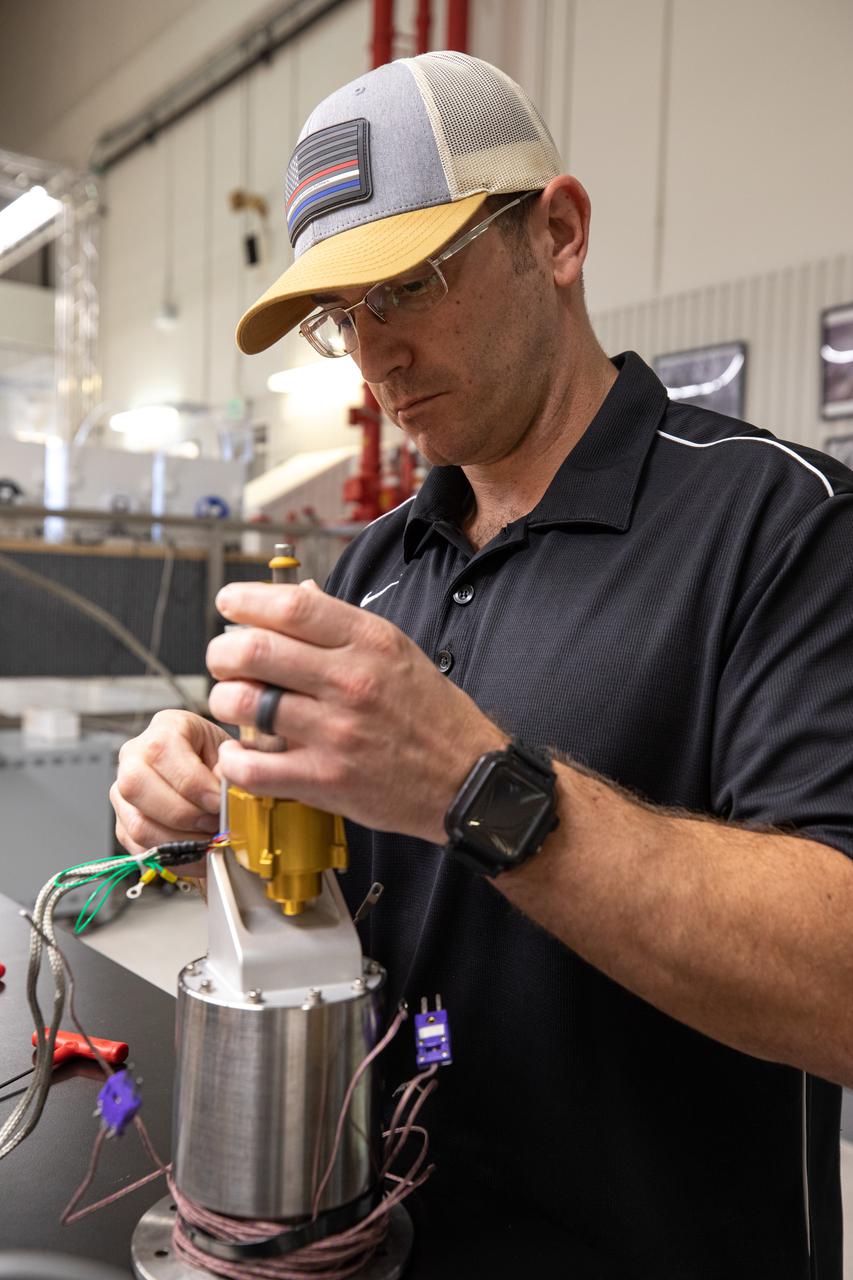
Researchers at NASA's Kennedy Space Center are testing the various types of seals for electric motors that drive the Volatiels Investigating Polar Exploration Rover, or VIPER, wheels at Swamp Works.
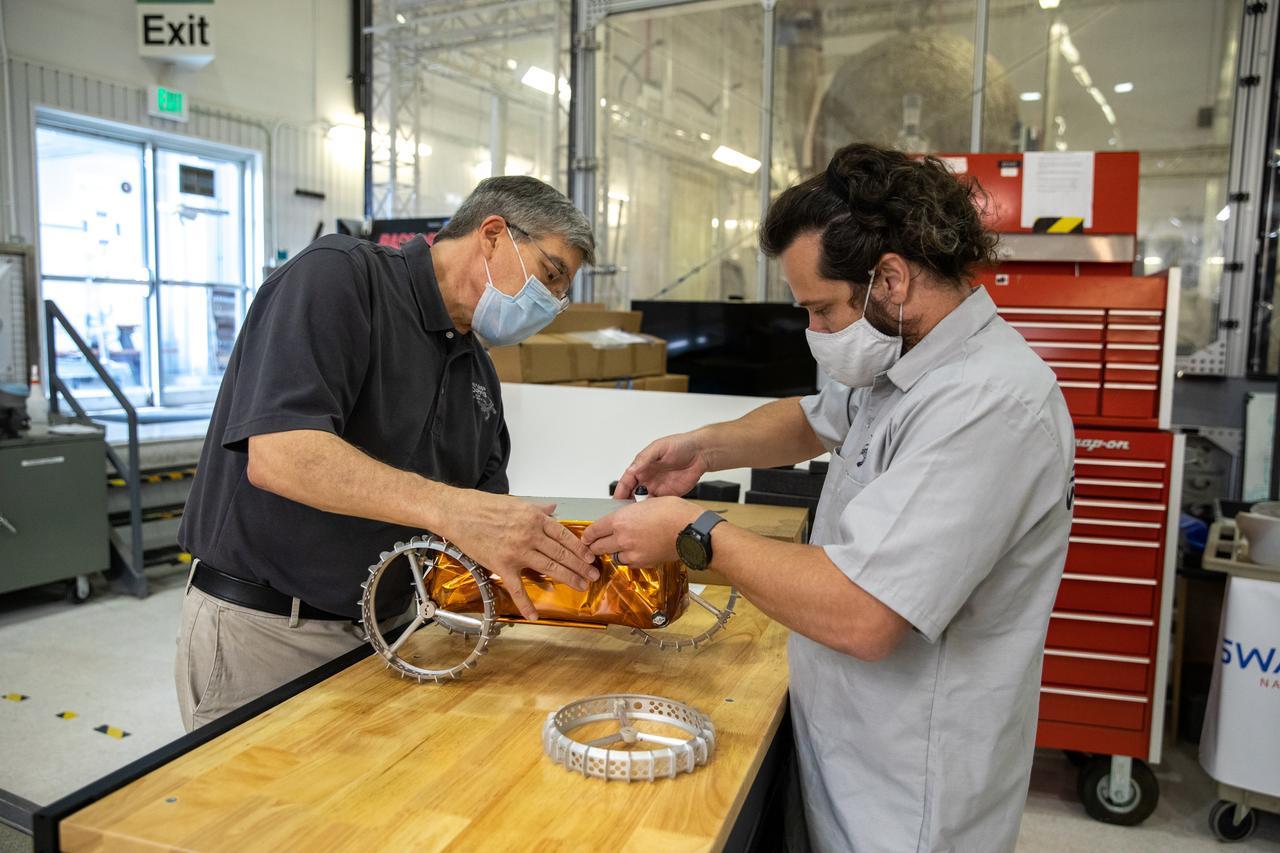
Jim Mantovani, left, and A.J. Nick, with Kennedy Space Center’s Exploration and Research and Technology programs, unbox a CubeRover at the Florida spaceport on Oct. 9, 2020. The rover was delivered by Pittsburgh-based space robotics company Astrobotic, as part of a Small Business Innovative Research (SBIR) award from NASA. Nick will lead CubeRover testing in the coming months in the Granular Mechanics and Regolith Operations (GMRO) Laboratory’s regolith bin, which holds approximately 120 tons of lunar regolith simulant at Kennedy’s Swamp Works. In 2019, NASA announced a $2 million Tipping Point award to develop more mature CubeRover’s payload interfaces and increase its capabilities.
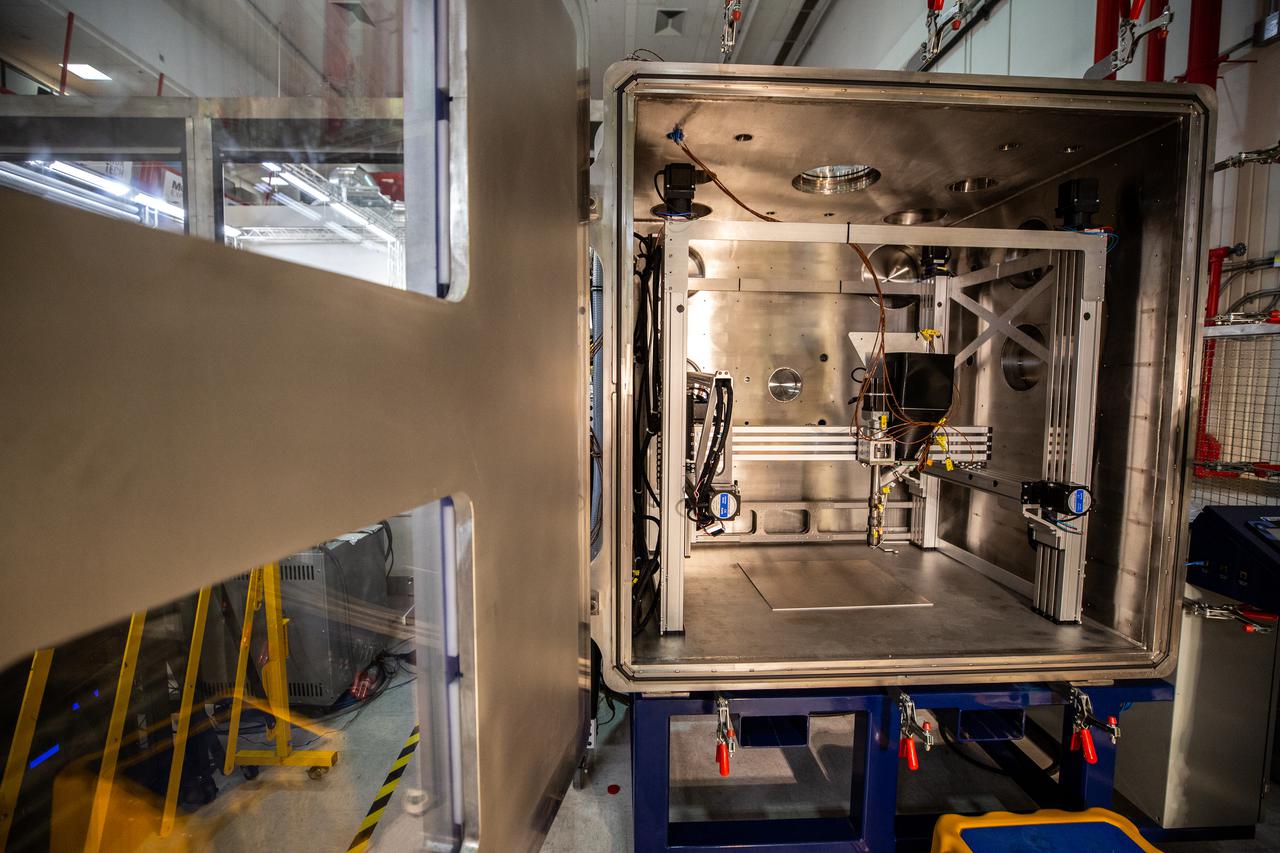
A team of engineers and researchers prepares a vacuum chamber in the Granular Mechanics and Regolith Operations (GMRO) lab inside NASA Kennedy Space Center’s Swamp Works for testing 3D printing, as part of the Relevant Environment Additive Construction Technology (REACT) project at the Florida spaceport on April 5, 2022. The project derives from NASA’s 2020 Announcement of Collaboration Opportunity, with AI SpaceFactory – an architectural and construction technology company and winner of NASA’s 3D Printed Habitat Challenge – collaborating with Kennedy teams to build 3D-printed test structures using a composite made from polymers and a regolith simulant in a vacuum chamber that mimics environmental conditions on the Moon.
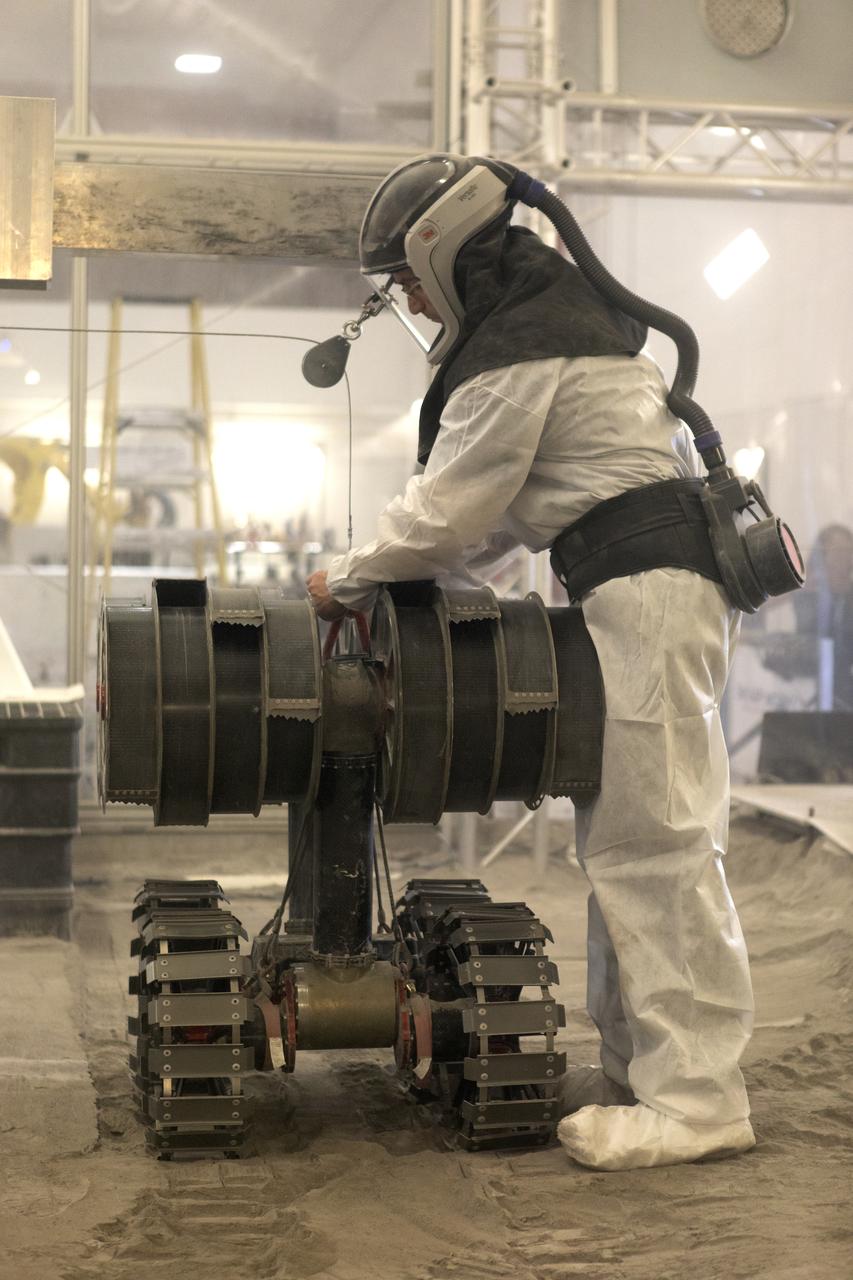
Drew Smith, a robotics engineer, makes adjustments to the Regolith Advanced Surface Systems Operations Robot (RASSOR) during testing in the regolith bin inside Swamp Works at NASA’s Kennedy Space Center in Florida on June 5, 2019. Smith and other members of the Granular Mechanics and Regolith Operations Lab run tests, which simulates the Moon’s reduced gravity using the gravity assist offload system to see how RASSOR excavates regolith. On the surface of the Moon, mining robots like RASSOR will excavate the regolith and take the material to a processing plant where usable elements such as hydrogen, oxygen and water can be extracted for life support systems. RASSOR can scoop up icy regolith which can be used to make operations on the Moon sustainable.
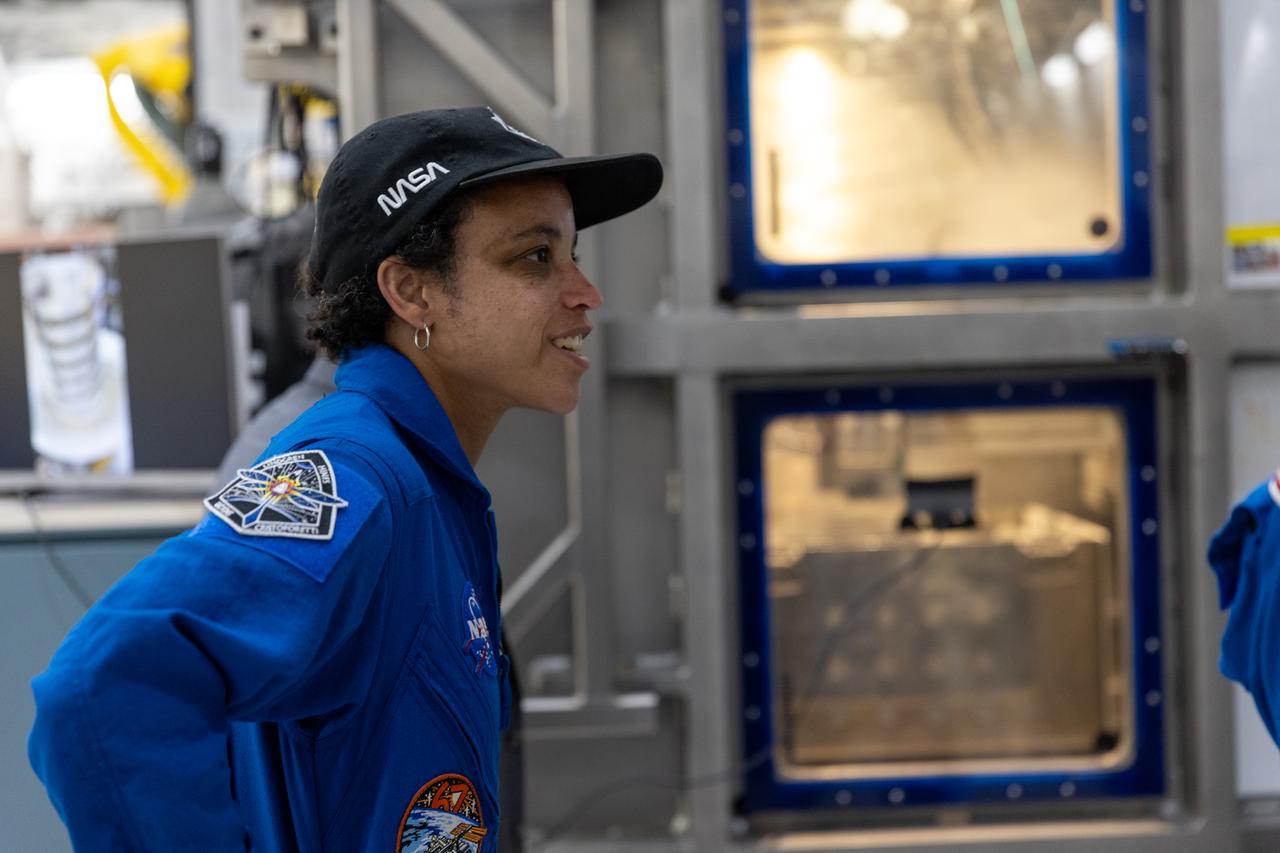
NASA astronaut Jessica Watkins visits the Granular Mechanics and Regolith Operations Laboratory inside Swamp Works at Kennedy Space Center in Florida on Wednesday, Aug. 27, 2025, to view some of the evolving technologies in development that astronauts may use to explore the Moon’s surface, prepare it for sustainable outposts, and to handle the dust that is collected during moonwalks.
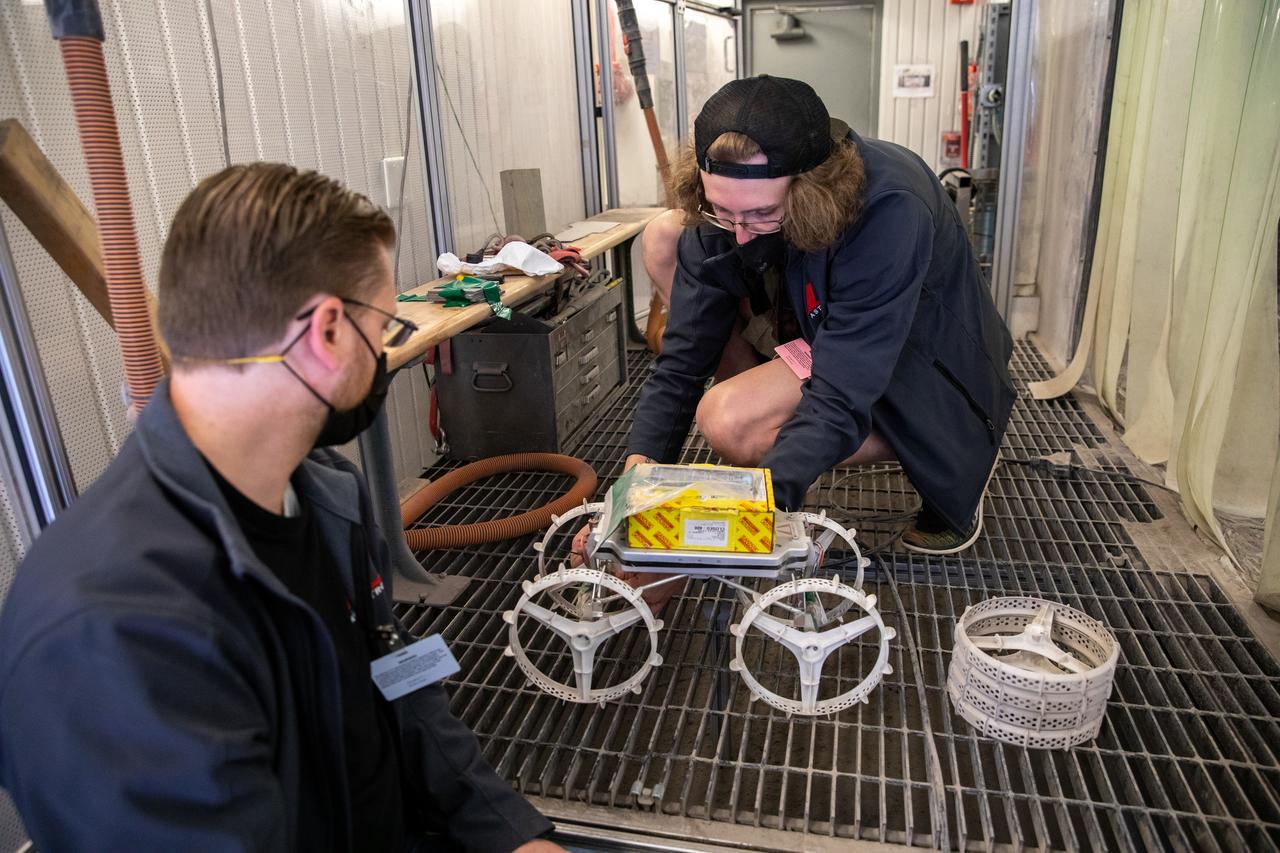
Astrobotic employees Troy Arbuckle, at left, Planetary Mobility lead mechanical engineer, and Taylor Whitaker, flight software engineer, prepare the Astrobotic CubeRover for its test run in the Granular Mechanics and Regolith Operations Laboratory regolith bin at NASA’s Kennedy Space Center in Florida on Dec. 10, 2020. The regolith bin simulates the mechanical properties of the Moon’s surface. NASA and Astrobotic employees put the CubeRover through a series of more than 150 mobility tests over several days to evaluate and improve wheel design.
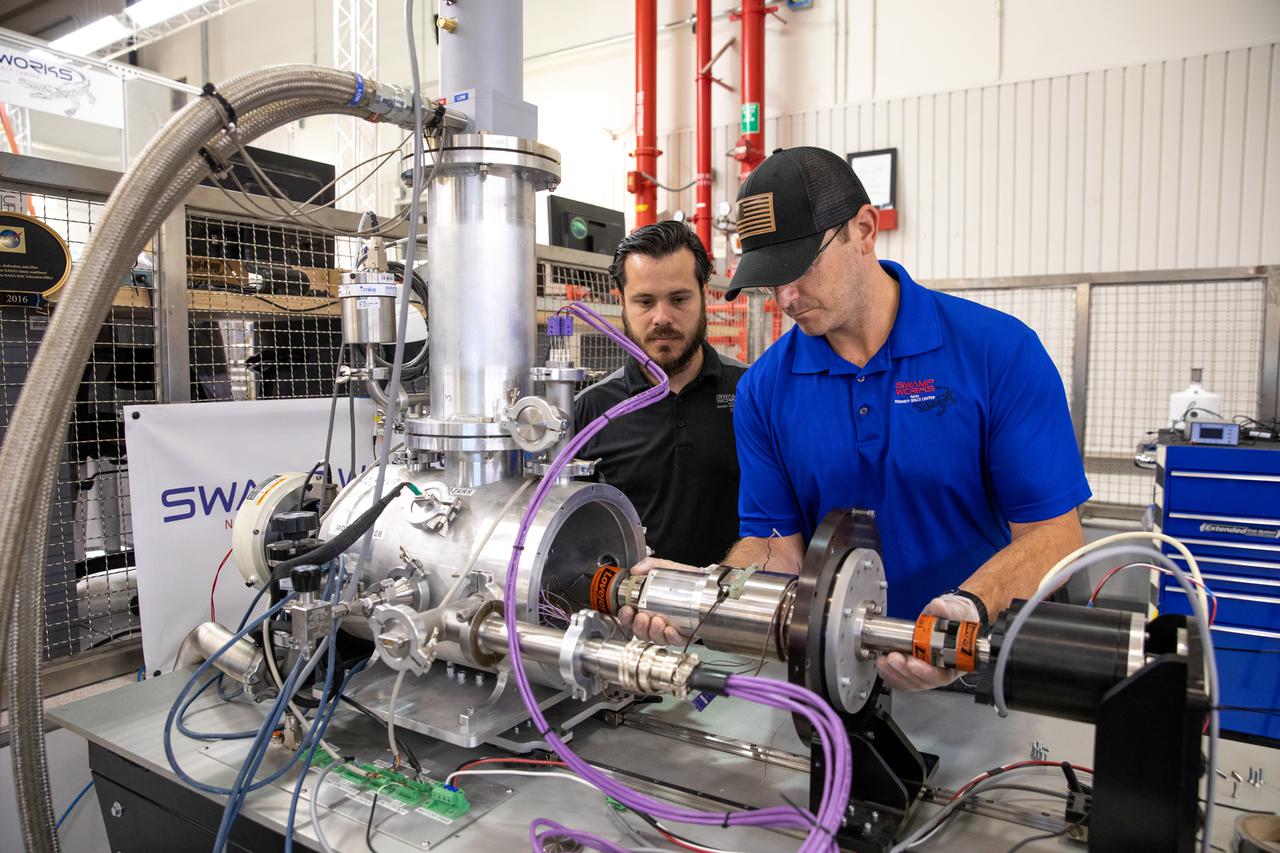
A.J. Nick, left, and Drew Smith, robotics engineers with the Exploration Research and Technology programs at NASA's Kennedy Space Center, test Bulk Metallic Glass Gears (BMGGs) in a vacuum inside a cryogenic cooler at Kennedy's Granular Mechanics and Regolith Operations lab on June 17, 2021. Made from a custom bulk metallic glass alloy, BMGGs could be used in heater-free gearboxes at extremely low temperatures in locations such as the Moon, Mars, and Europa, one of Jupiter’s moons. NASA’s Jet Propulsion Laboratory is working with commercial partners to create the gears.
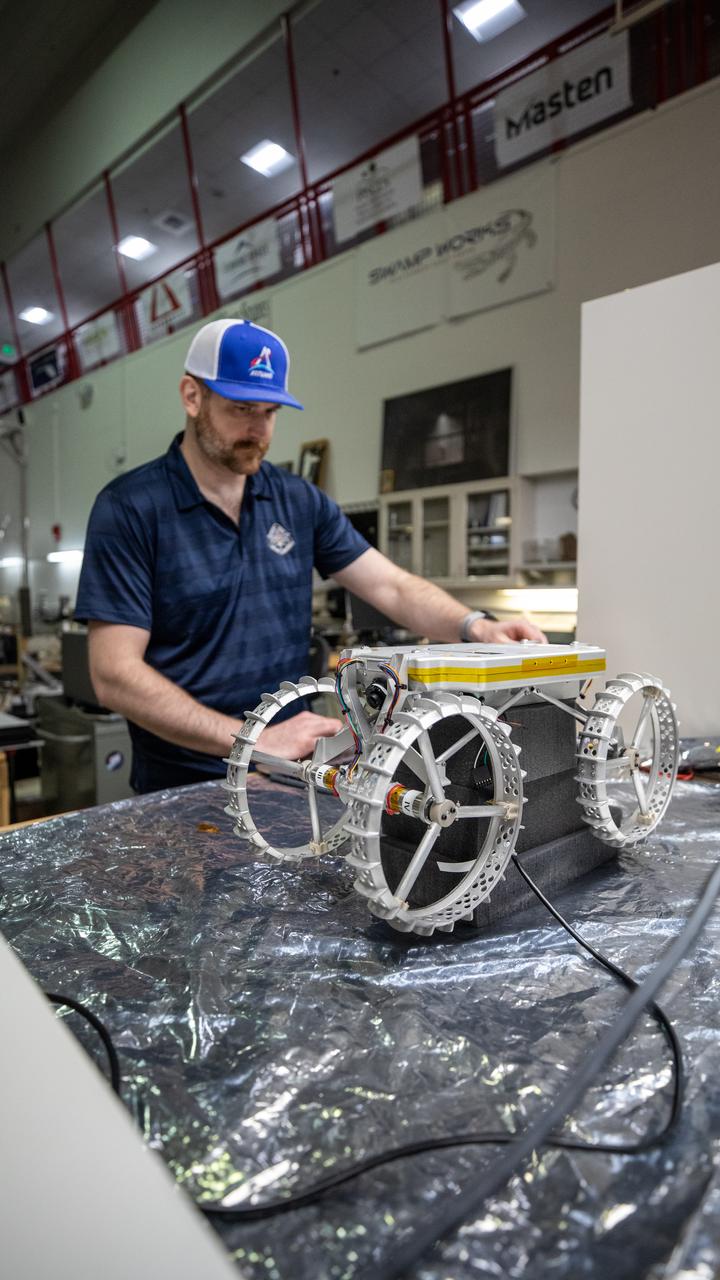
Robotics Software Engineer II Chris Rampolla runs benchtop verifications on Astrobotic’s CubeRover – a lightweight, modular planetary rover – before delivery to Swamp Works at NASA’s Kennedy Space Center in Florida on June 30, 2022. Astrobotic – a Pittsburgh-based space robotics company – is planning to use Swamp Work’s Granular Mechanics and Regolith Operations Laboratory’s regolith bin, which holds approximately 120 tons of lunar regolith simulant, to depict how the company’s CubeRover would perform on the Moon. NASA’s Small Business Innovation Research program provided the funding for initial development, and a $2 million Tipping Point award from the agency has provided additional funding for continued development into a more mature rover.
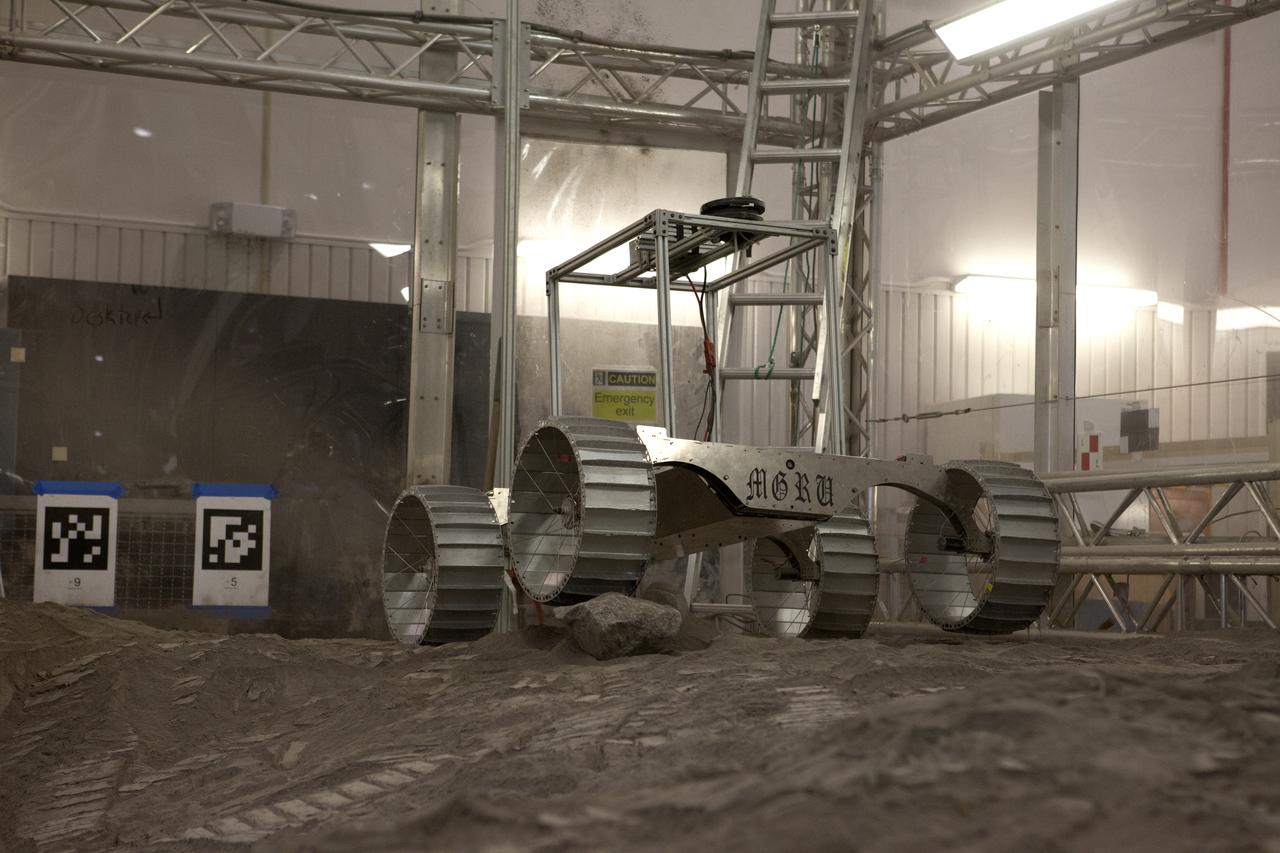
A lightweight simulator version of NASA's Resource Prospector undergoes a mobility test in a regolith bin at the agency's Kennedy Space center in Florida. The Resource Prospector mission aims to be the first mining expedition on another world. Operating on the moon’s poles, the robot is designed to use instruments to locate elements at a lunar polar regions, then excavate and sample resources such as hydrogen, oxygen and water. These resources could support human explores on their way to destinations such as farther into the solar system.
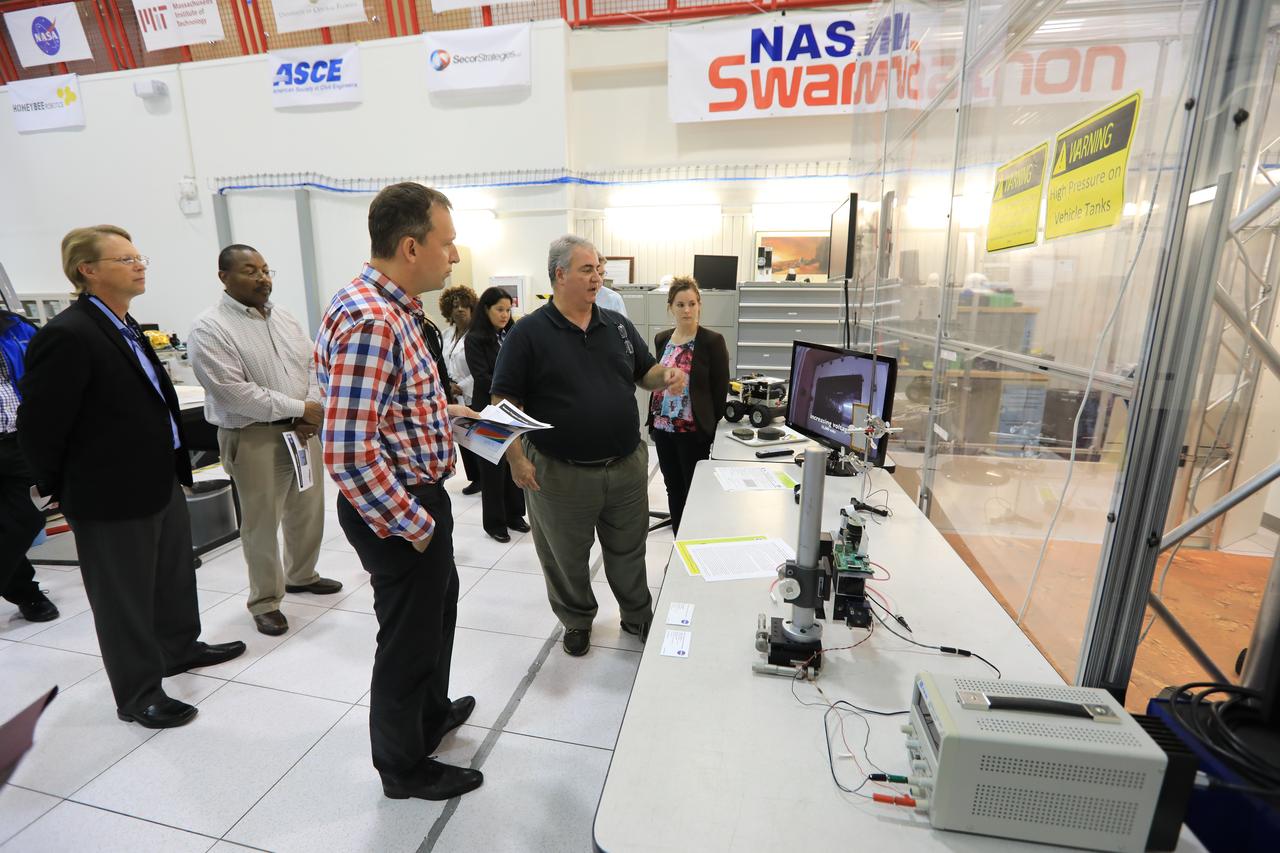
Thomas Zurbuchen, in plaid shirt, NASA's associate administrator for the Science Mission Directorate, listens to a presentation at the Swamp Works facility at NASA's Kennedy Space Center in Florida. In the foreground is a prototype robotic exploration vehicle.
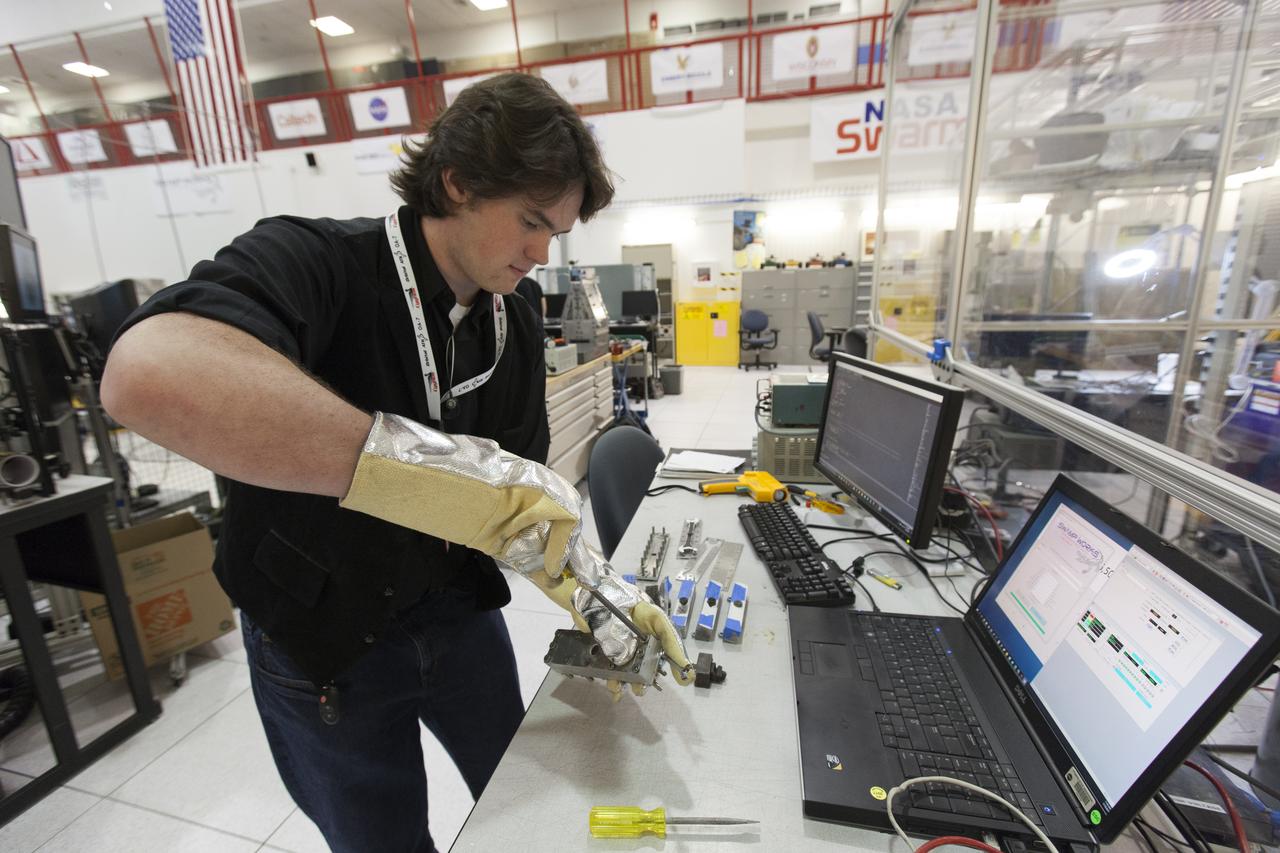
In the Swamp Works laboratory at NASA's Kennedy Space Center in Florida, student interns such as Kevin Murphy are joining agency scientists, contributing in the area of Exploration Research and Technology. Murphy is majoring in mechanical engineering at the University of Illinois at Urbana-Champaign. The agency attracts its future workforce through the NASA Internship, Fellowships and Scholarships, or NIFS, Program.
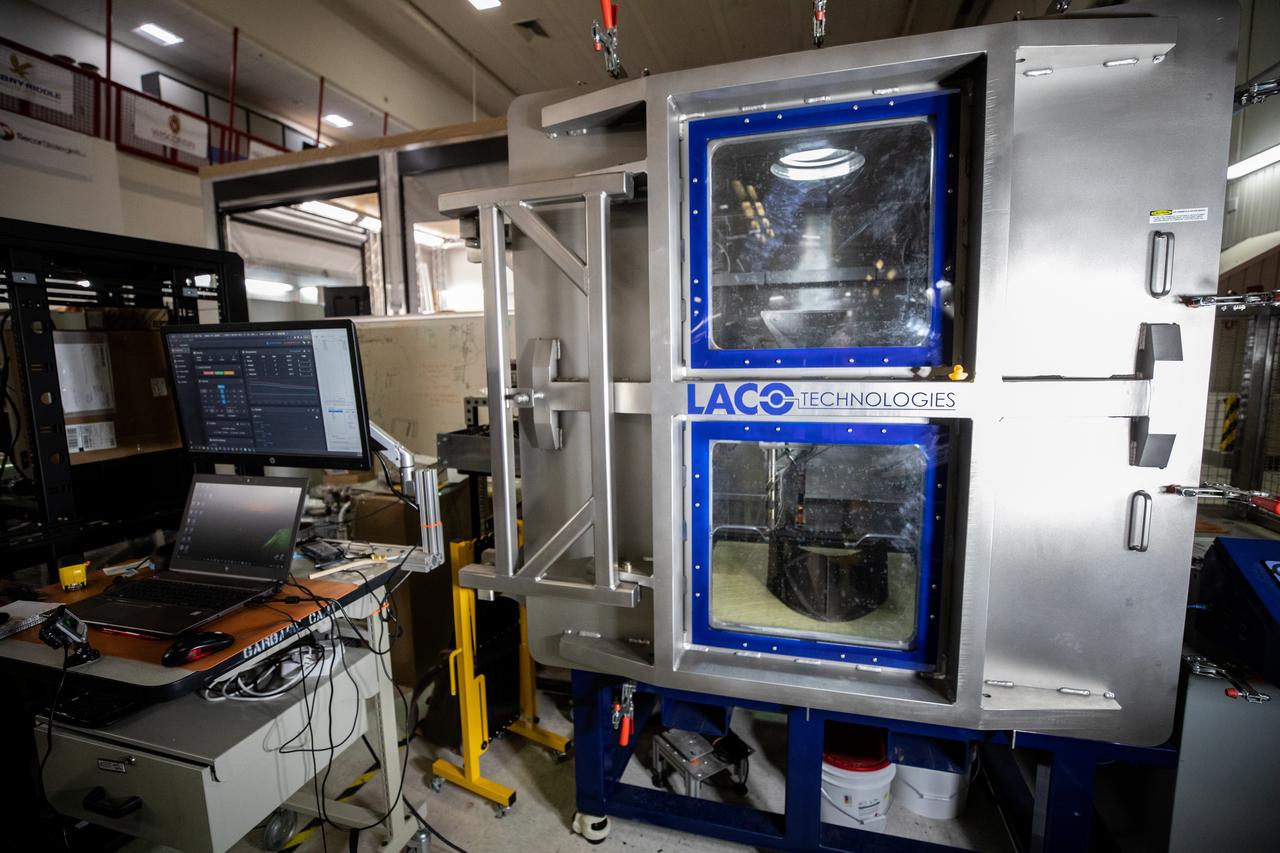
A team at NASA’s Kennedy Space Center in Florida tests a 3D printer on July 28, 2022, at the Florida spaceport’s Swamp Works, as part of the Relevant Environment Additive Construction Technology (REACT) project. Among the key objectives of the project is developing an architectural and structural design for a shelter that provides protection to habitable assets on the lunar surface. Testing REACT derives from NASA’s 2020 Announcement of Collaboration Opportunity with AI SpaceFactory – an architectural and construction technology company and winner of NASA’s 3D Printed Habitat Challenge.

Jay Phillips, a research physicist in the Kennedy Space Center's Electrostatics and Surface Physics Laboratory, left, and Dr. Carlos Calle, lead scientist in the lab, are modifying an electrostatic precipitator to help remove dust from simulated Martian atmosphere. NASA's Journey to Mars requires cutting-edge technologies to solve the problems explorers will face on the Red Planet. Scientists are developing some of the needed solutions by adapting a device to remove the ever-present dust from valuable elements in the Martian atmosphere. Those commodities include oxygen, water and methane.
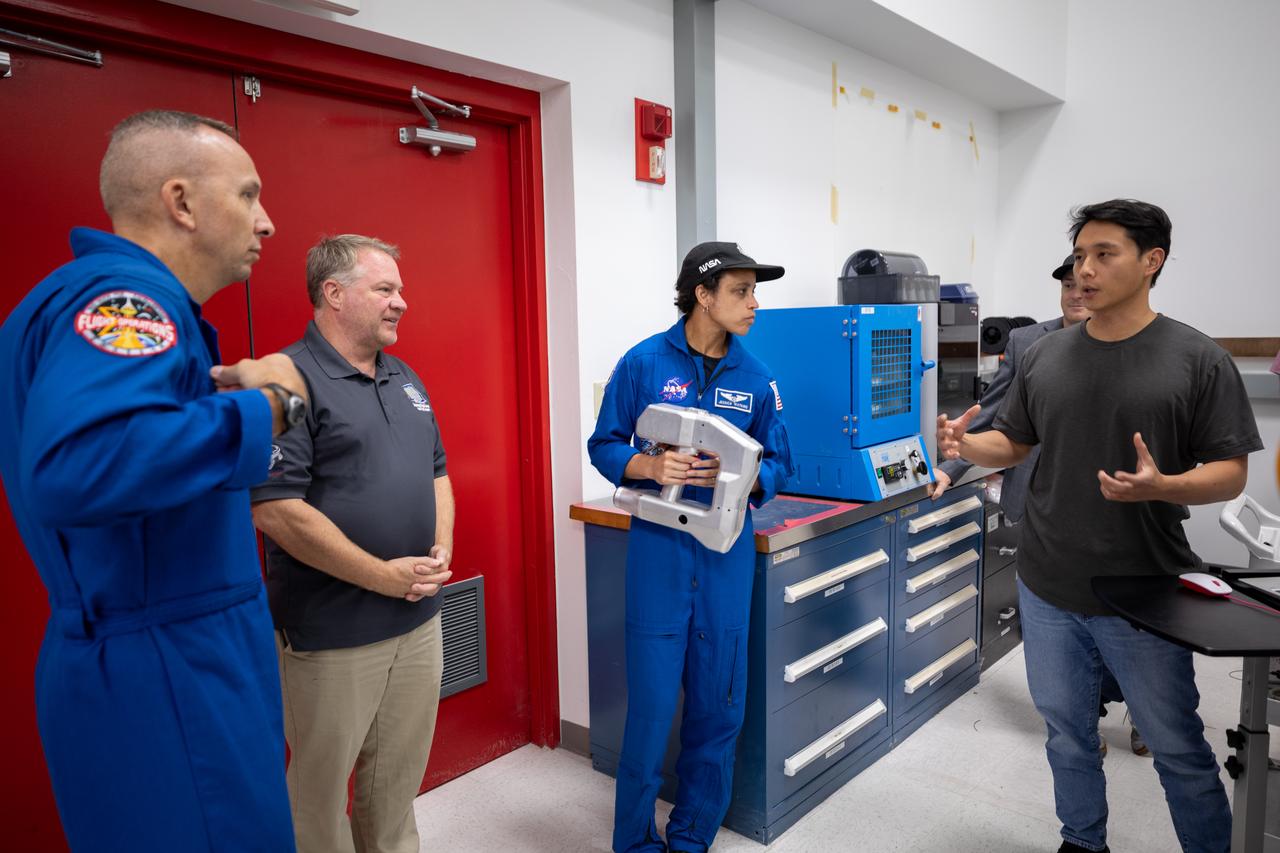
NASA astronauts Randy Bresnik (far left) and Jessica Watkins (center) visit the Granular Mechanics and Regolith Operations Laboratory inside Swamp Works at Kennedy Space Center in Florida on Wednesday, Aug. 27, 2025, to view some of the evolving technologies in development that NASA astronauts may use to explore the Moon’s surface, prepare it for sustainable outposts, and to handle the dust that is collected during moonwalks. Watkins holds an instrument designed to help astronauts electromagnetically remove accumulated lunar dust.
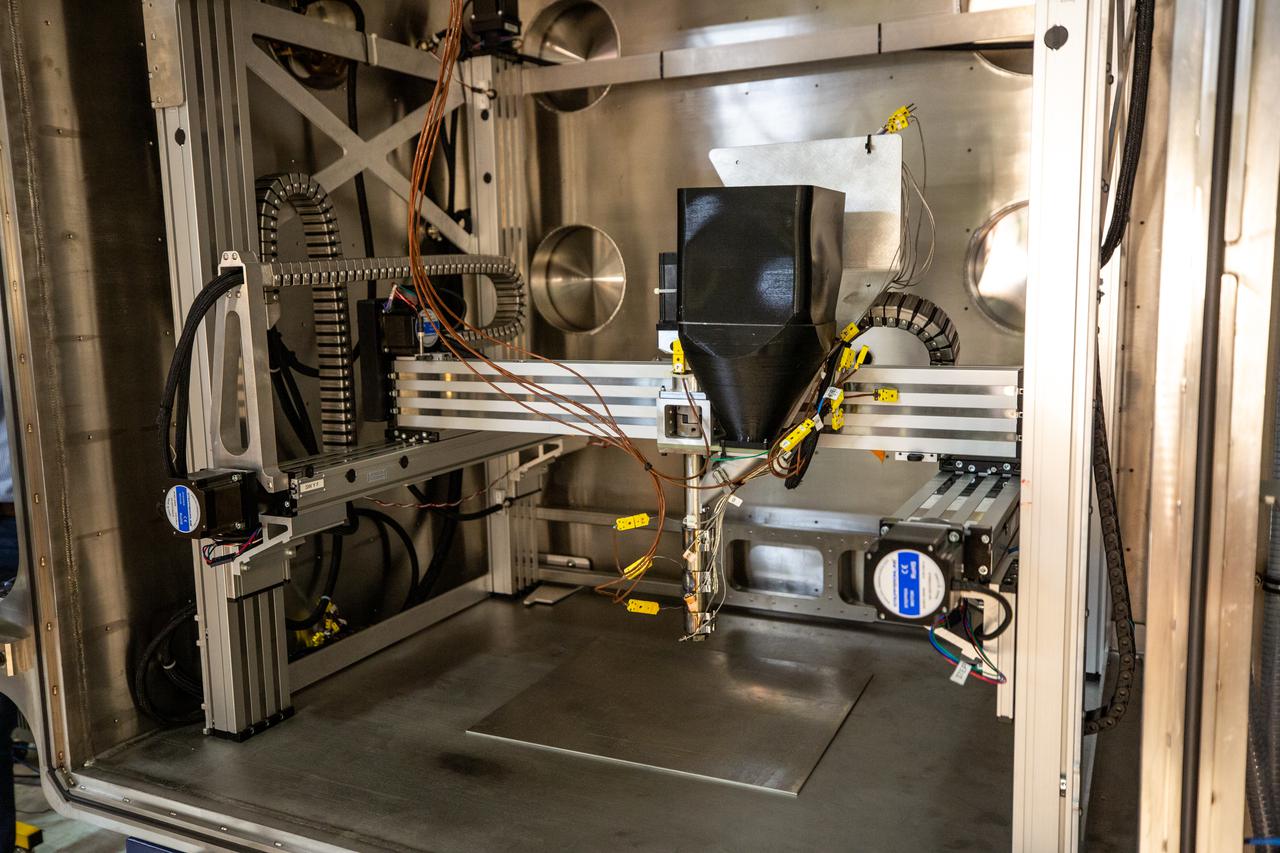
A team of engineers and researchers prepares a vacuum chamber in the Granular Mechanics and Regolith Operations (GMRO) lab inside NASA Kennedy Space Center’s Swamp Works for testing 3D printing, as part of the Relevant Environment Additive Construction Technology (REACT) project at the Florida spaceport on April 5, 2022. The project derives from NASA’s 2020 Announcement of Collaboration Opportunity, with AI SpaceFactory – an architectural and construction technology company and winner of NASA’s 3D Printed Habitat Challenge – collaborating with Kennedy teams to build 3D-printed test structures using a composite made from polymers and a regolith simulant in a vacuum chamber that mimics environmental conditions on the Moon.
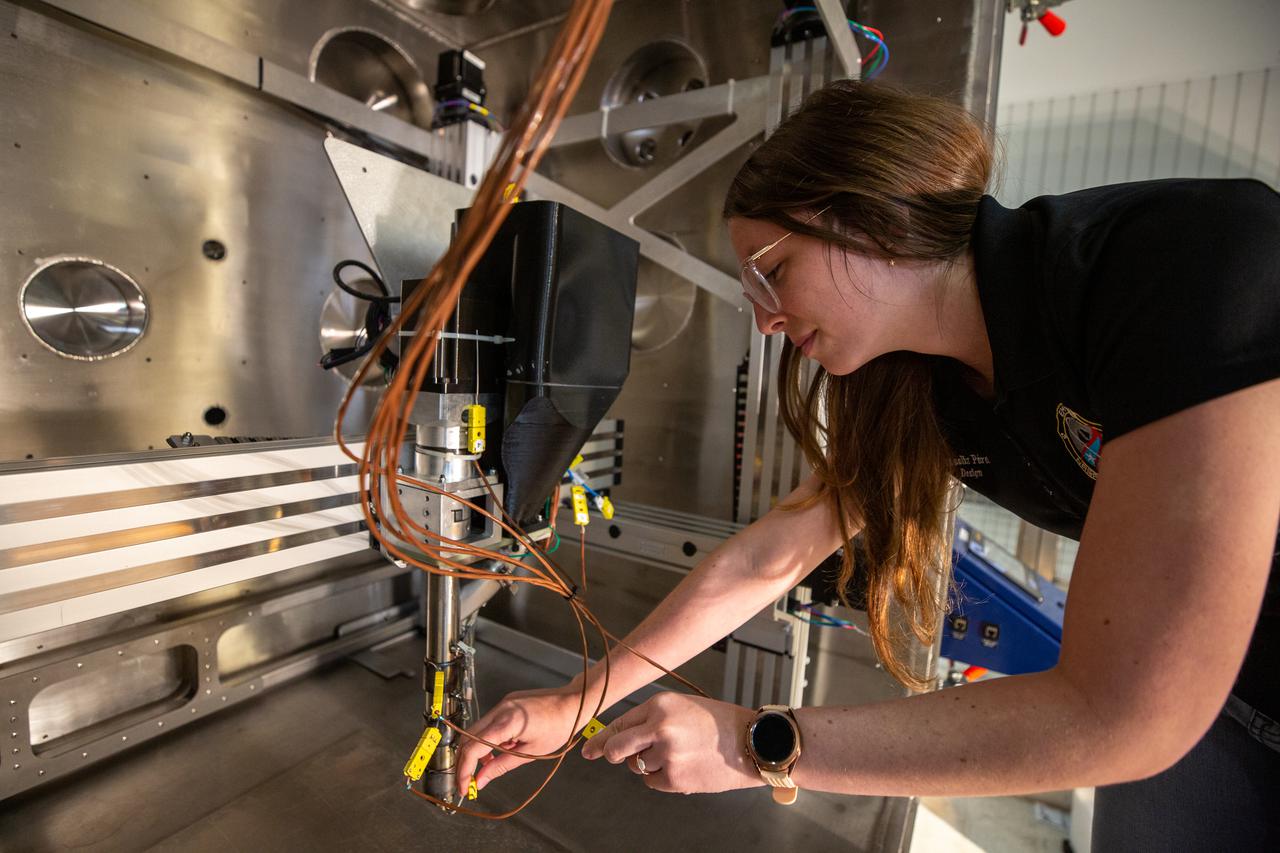
Joseliz Perez, a NASA intern at Kennedy Space Center in Florida, prepares a vacuum chamber for testing 3D printing inside the Granular Mechanics and Regolith Operations (GMRO) lab at the spaceport’s Swamp Works on April 5, 2022. The testing is part of the Relevant Environment Additive Construction Technology (REACT) project, which derives from NASA’s 2020 Announcement of Collaboration Opportunity, with AI SpaceFactory – an architectural and construction technology company and winner of NASA’s 3D Printed Habitat Challenge – collaborating with Kennedy teams to build 3D-printed test structures using a composite made from polymers and a regolith simulant in a vacuum chamber that mimics environmental conditions on the Moon.
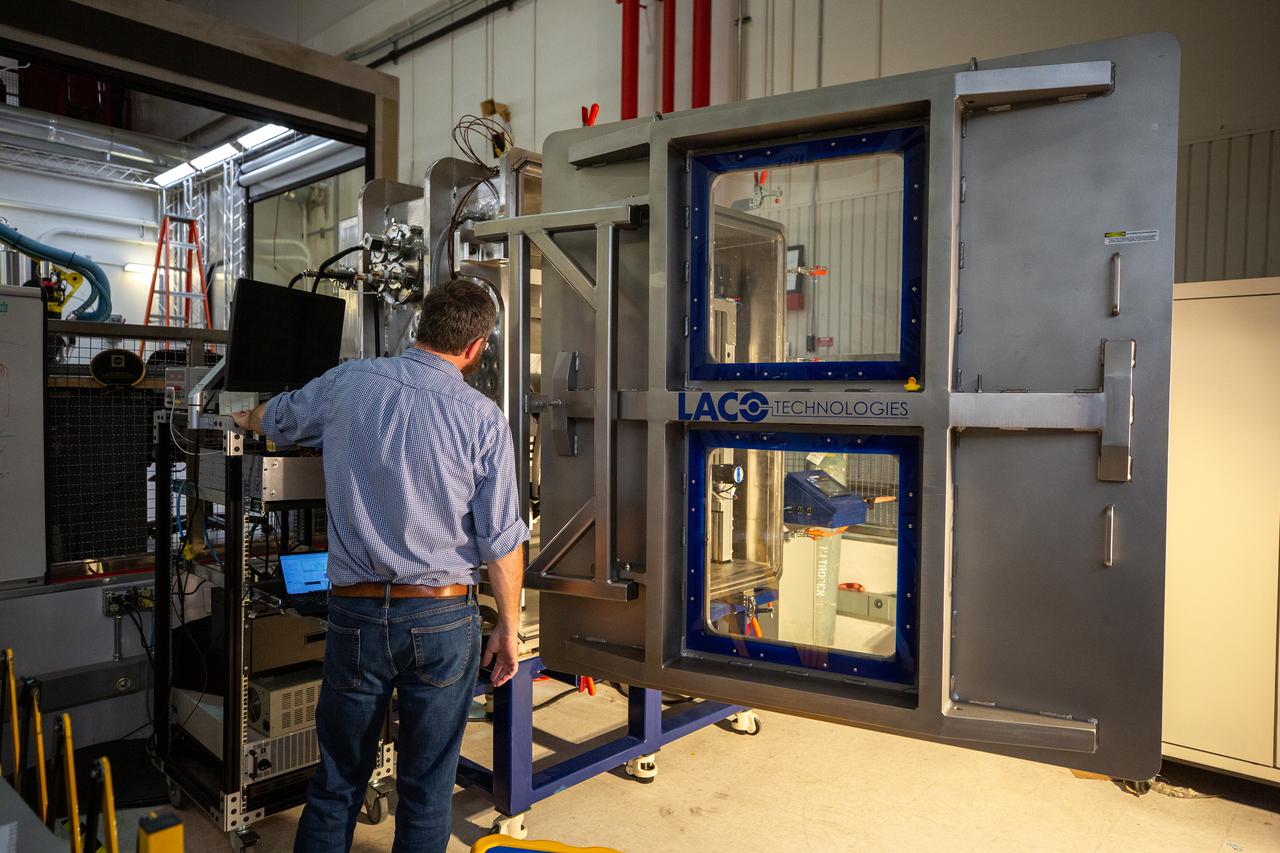
Engineer Matt Nugent prepares a vacuum chamber for testing 3D printing inside the Granular Mechanics and Regolith Operations (GMRO) lab at NASA Kennedy Space Center’s Swamp Works in Florida on April 5, 2022. The testing is part of the Relevant Environment Additive Construction Technology (REACT) project, which derives from NASA’s 2020 Announcement of Collaboration Opportunity, with AI SpaceFactory – an architectural and construction technology company and winner of NASA’s 3D Printed Habitat Challenge – collaborating with Kennedy teams to build 3D-printed test structures using a composite made from polymers and a regolith simulant in a vacuum chamber that mimics environmental conditions on the Moon.
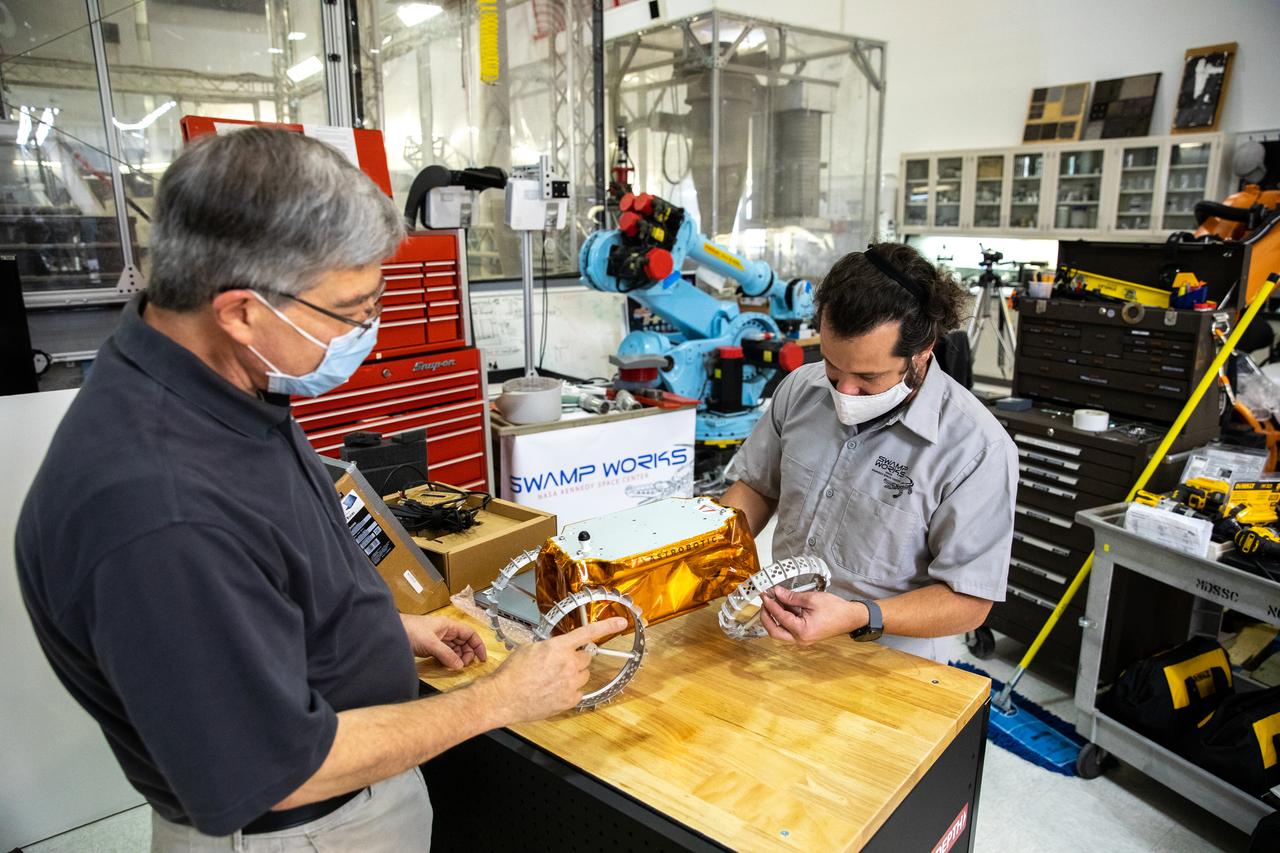
Jim Mantovani, left, and A.J. Nick, with Kennedy Space Center’s Exploration and Research and Technology programs, unbox a CubeRover at the Florida spaceport on Oct. 9, 2020. The rover was delivered by Pittsburgh-based space robotics company Astrobotic, as part of a Small Business Innovative Research (SBIR) award from NASA. Nick will lead CubeRover testing in the coming months in the Granular Mechanics and Regolith Operations (GMRO) Laboratory’s regolith bin, which holds approximately 120 tons of lunar regolith simulant at Kennedy’s Swamp Works. In 2019, NASA announced a $2 million Tipping Point award to develop more mature CubeRover’s payload interfaces and increase its capabilities.
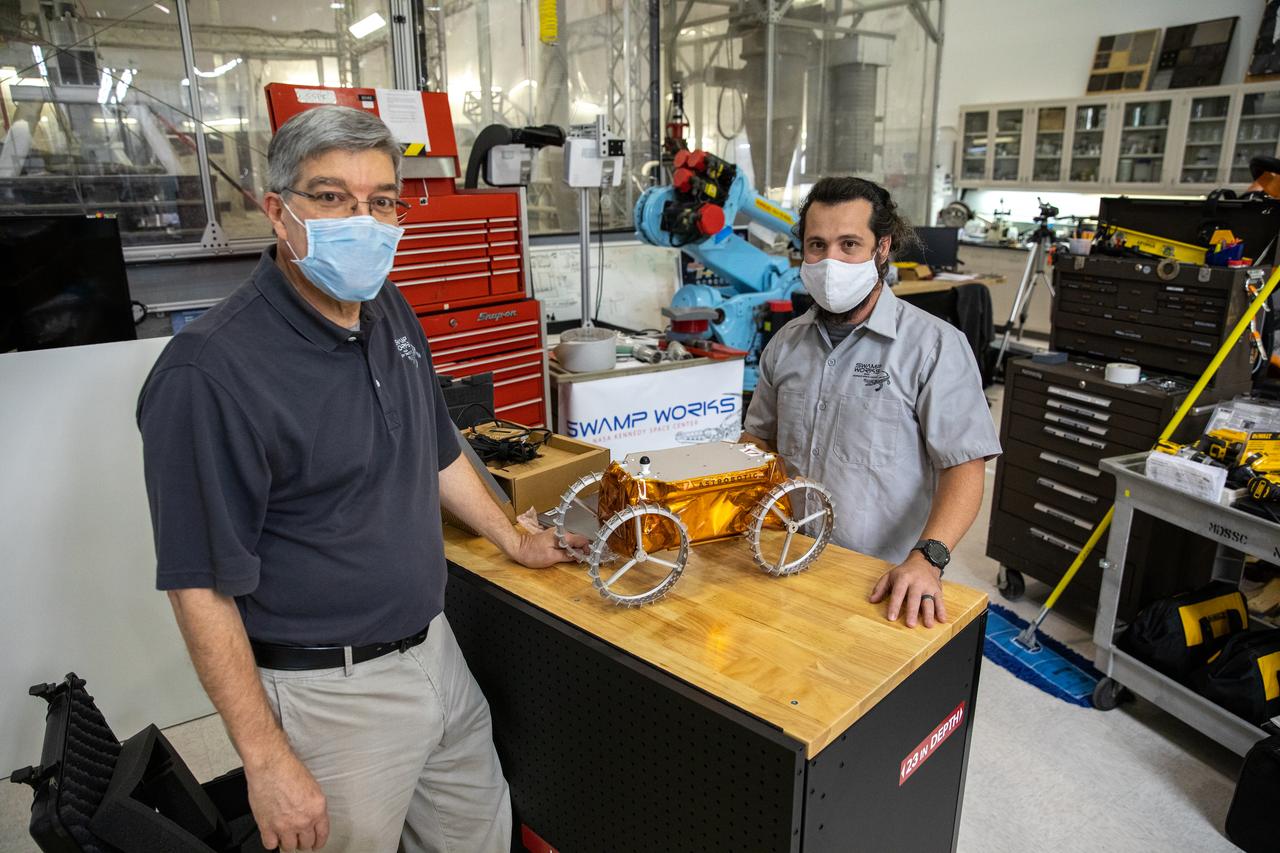
Jim Mantovani, left, and A.J. Nick, with Kennedy Space Center’s Exploration and Research and Technology programs, unbox a CubeRover at the Florida spaceport on Oct. 9, 2020. The rover was delivered by Pittsburgh-based space robotics company Astrobotic, as part of a Small Business Innovative Research (SBIR) award from NASA. Nick will lead CubeRover testing in the coming months in the Granular Mechanics and Regolith Operations (GMRO) Laboratory’s regolith bin, which holds approximately 120 tons of lunar regolith simulant at Kennedy’s Swamp Works. In 2019, NASA announced a $2 million Tipping Point award to develop more mature CubeRover’s payload interfaces and increase its capabilities.
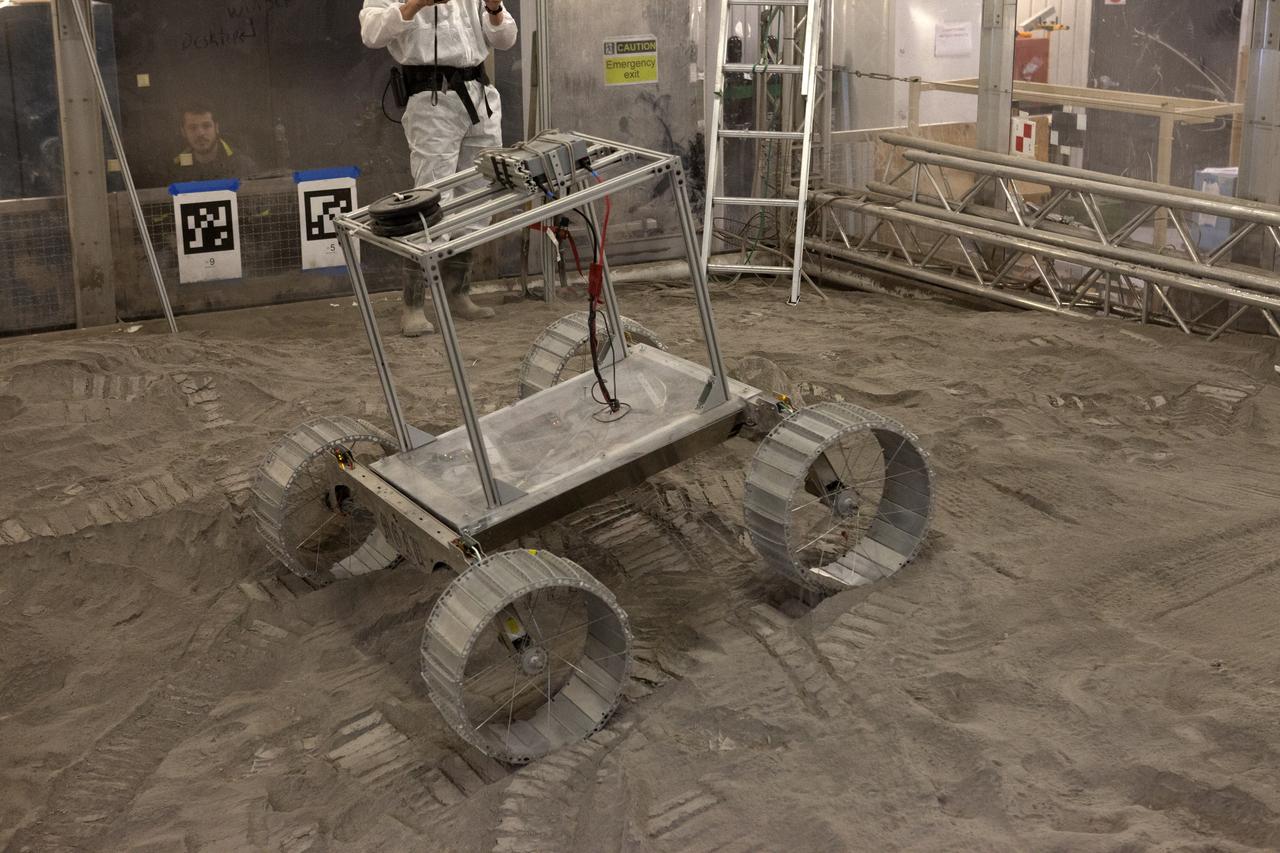
A lightweight simulator version of NASA's Resource Prospector undergoes a mobility test in a regolith bin at the agency's Kennedy Space center in Florida. The Resource Prospector mission aims to be the first mining expedition on another world. Operating on the moon’s poles, the robot is designed to use instruments to locate elements at a lunar polar regions, then excavate and sample resources such as hydrogen, oxygen and water. These resources could support human explores on their way to destinations such as farther into the solar system.
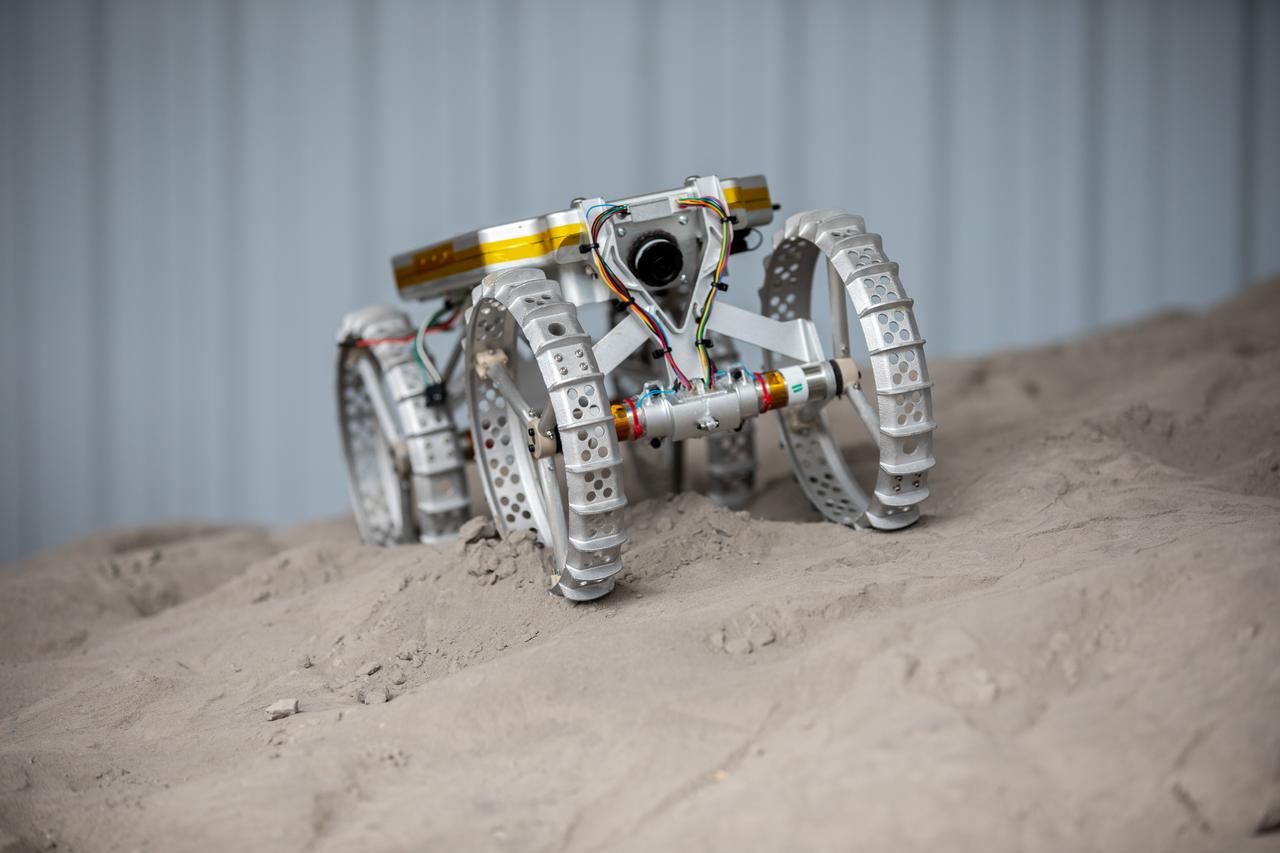
Astrobotic’s CubeRover – a lightweight, modular planetary rover – undergoes mobility testing inside the Granular Mechanics and Regolith Operations (GMRO) Laboratory’s regolith pit at NASA Kennedy Space Center’s Swamp Works facility on June 30, 2022. Astrobotic – a Pittsburgh-based space robotics company – is using the GMRO lab’s regolith bin, which holds approximately 120 tons of lunar regolith simulant, to depict how the company’s CubeRover would perform on the Moon. NASA’s Small Business Innovation Research program provided the funding for initial development, and a $2 million Tipping Point award from the agency has provided additional funding for continued development into a more mature rover.
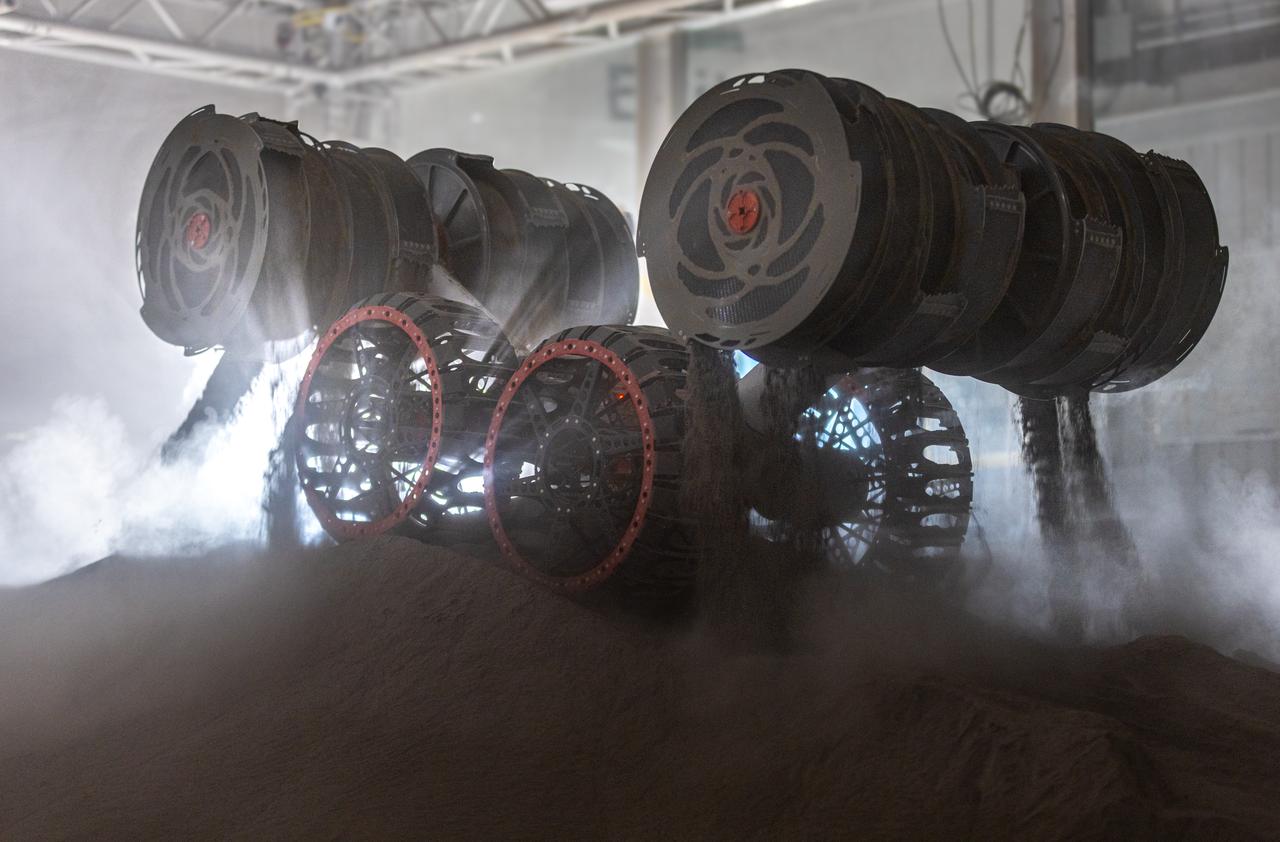
NASA’s RASSOR (Regolith Advanced Surface Systems Operations Robot) conducts excavation testing of simulated regolith, or lunar dust found on the Moon’s surface, inside of the Granular Mechanics and Regolith Operations Lab at the agency’s Kennedy Space Center in Florida on Tuesday, May 27, 2025. RASSOR is designed to work in low-gravity situations, using counter rotating bucket drums on each arm to collect and dump regolith for the extraction of hydrogen, oxygen, or water, resources critical for sustaining a habitable presence.
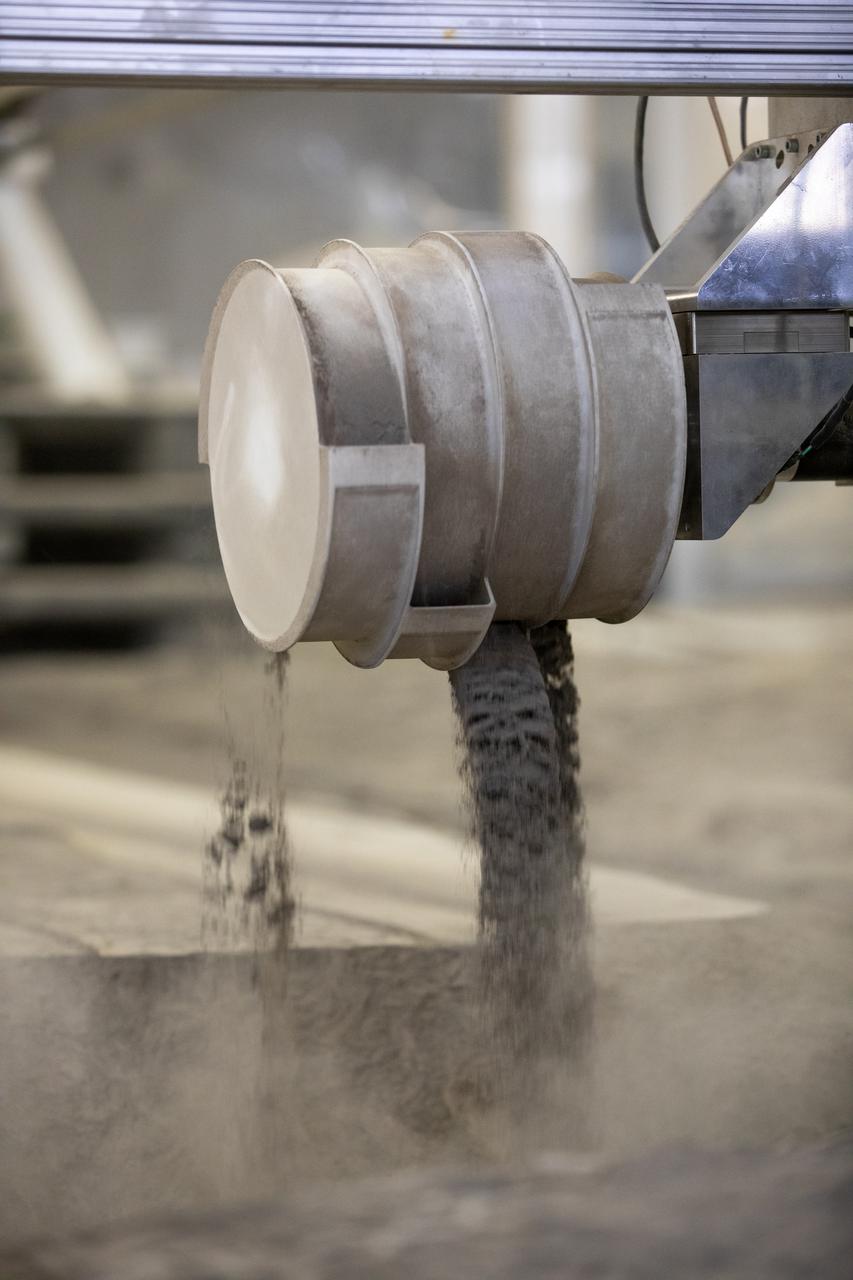
A team at NASA’s Kennedy Space Center in Florida tests small- and medium-sized bucket drums July 16, 2021, in the Granular Mechanics and Regolith Operations Lab’s “big bin” during prototype development for the pilot excavator, a robotic mission designed for lunar operations. The bucket drum excavated lunar regolith simulant. The Swamp Works team leveled and compacted the simulant before excavation as well as measured penetration during the excavator testing. Robotics engineers Jason Schuler and Austin Langton worked inside the bin, teaming up with software engineer Kurt Leucht, who worked just outside of it.
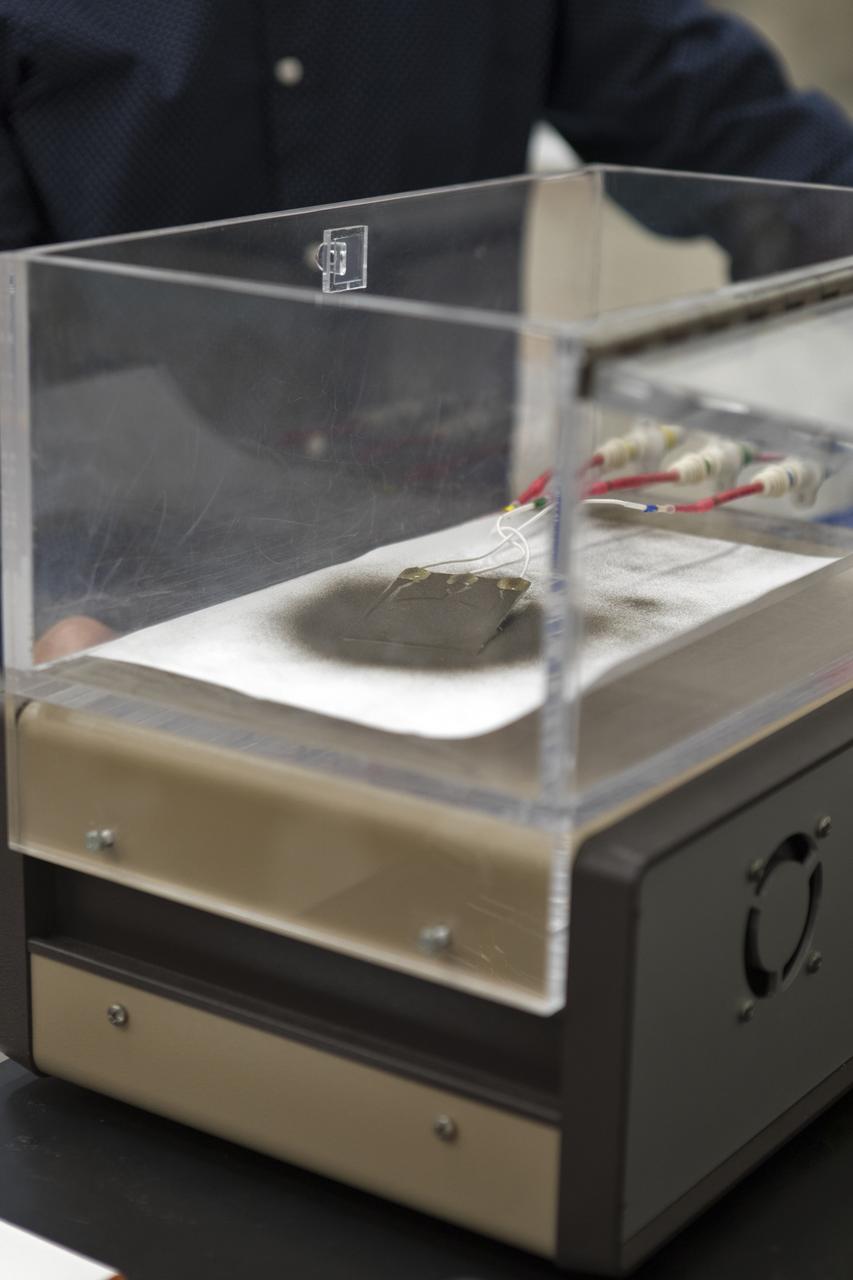
In the Electrostatics and Surface Physics Laboratory at NASA's Kennedy Space Center in Florida on Thursday, July 19, 2018, an experiment is underway in which an Electrostatic Dust Shield was been covered with dust similar to that which may be encountered by astronauts exploring the Moon or Mars. When activated, the device shook off the dust. Scientists are developing the dust shield to help mitigate the problem of dust on equipment, astronauts' space suits and helmet visors. The device is slated for analysis aboard International Space Station in the spring of 2019 to verify the effects of the space environment.
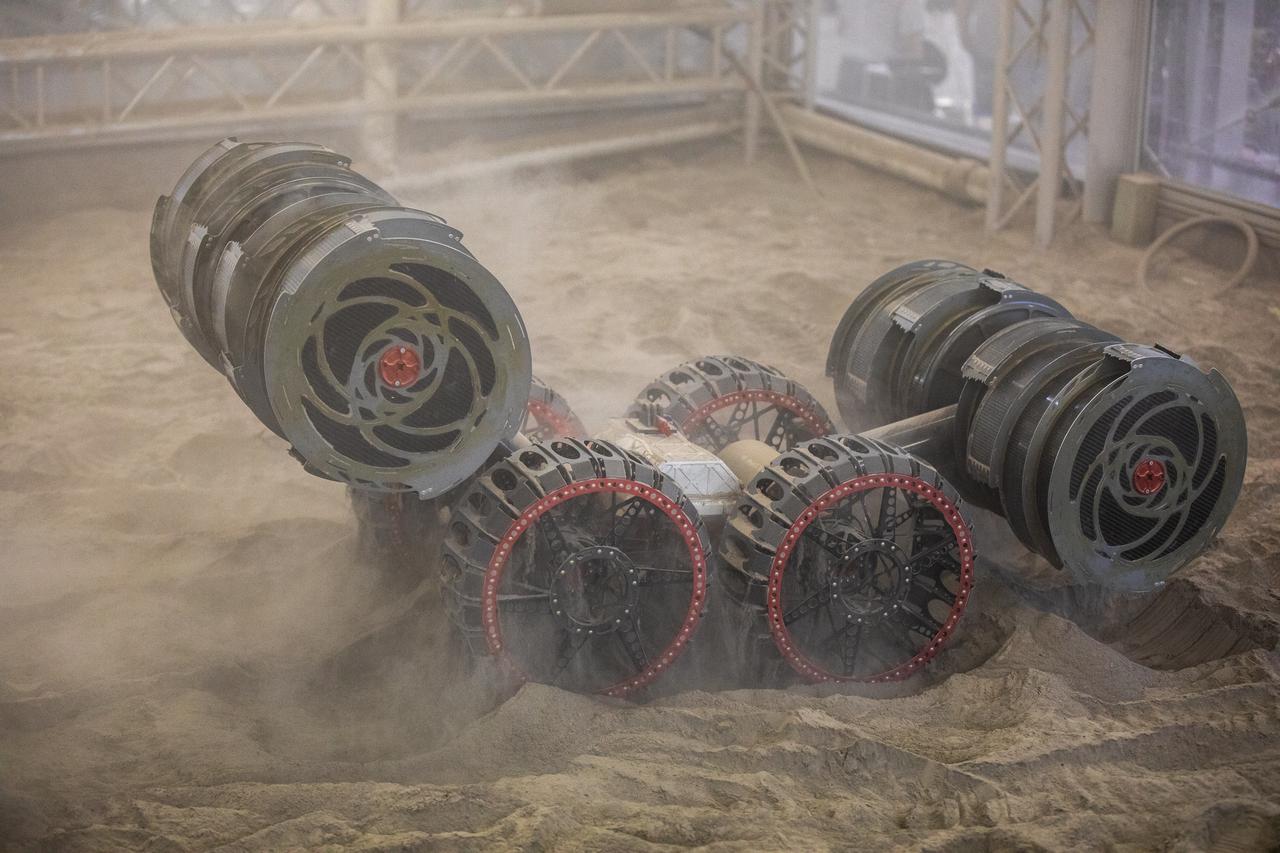
The ISRU Pilot Excavator digs in the regolith bin during testing inside Swamp Works at NASA’s Kennedy Space Center in Florida on July 28, 2022. Tests use a gravity assist offload system to simulate reduced gravity conditions found on the Moon. On the surface of the Moon, mining robots like the Pilot Excavator will excavate the regolith and take the material to a processing plant where usable elements such as hydrogen, oxygen and water can be extracted for life support systems. The Pilot Excavator can scoop up icy regolith which can be used to make operations on the Moon sustainable.
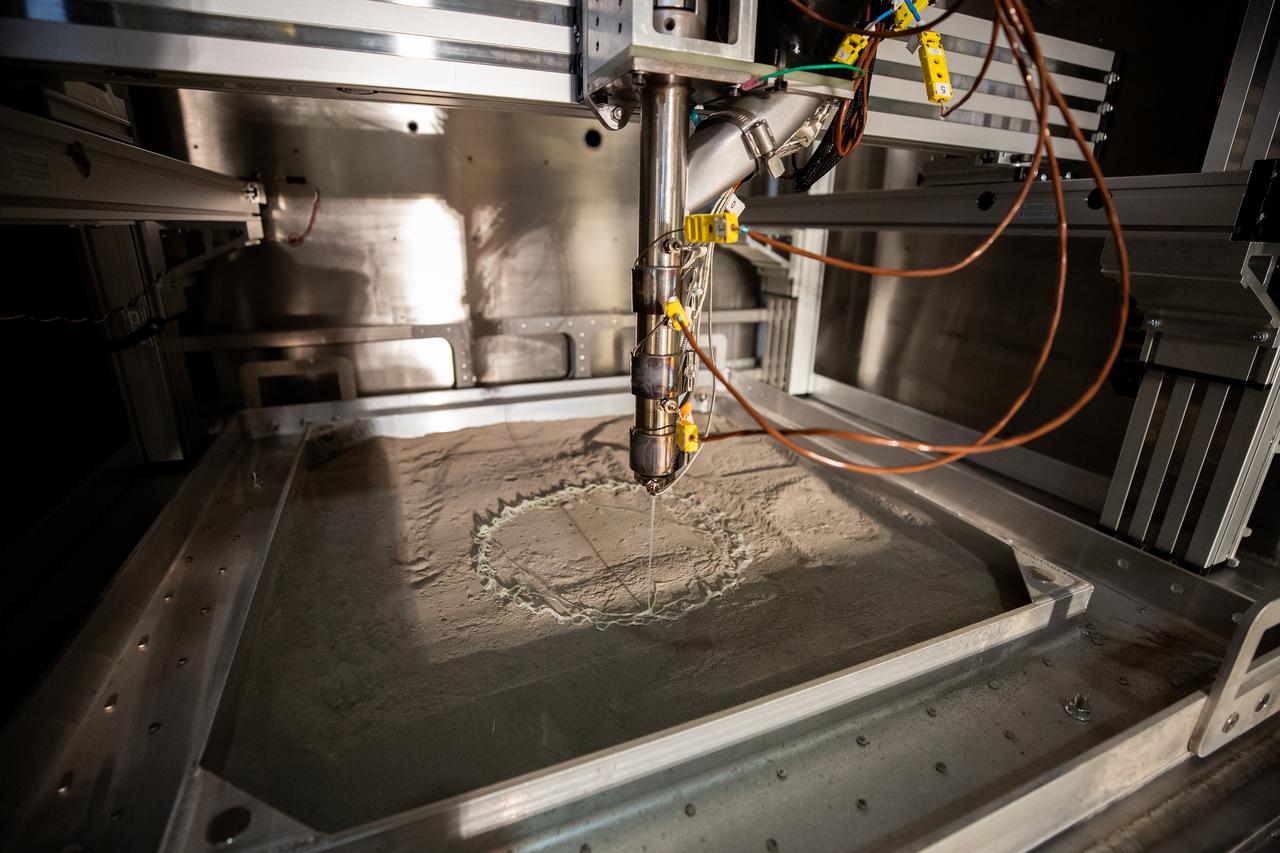
A team at NASA’s Kennedy Space Center in Florida test a 3D printer inside a vacuum chamber at the Granular Mechanics and Regolith Operations (GMRO) lab inside the spaceport’s Swamp Works, as part of the Relevant Environment Additive Construction Technology (REACT) project on April 5, 2022. Testing REACT derives from NASA’s 2020 Announcement of Collaboration Opportunity, with AI SpaceFactory – an architectural and construction technology company and winner of NASA’s 3D Printed Habitat Challenge – collaborating with Kennedy teams to build 3D-printed test structures using a composite made from polymers and a regolith simulant in a vacuum chamber that mimics environmental conditions on the Moon.

Chemist Tesia Irwin tests a 3D printer on July 28, 2022, at Swamp Works at NASA’s Kennedy Space Center in Florida, as part of the Relevant Environment Additive Construction Technology (REACT) project. Among the key objectives of the project is developing an architectural and structural design for a shelter that provides protection to habitable assets on the lunar surface. Testing REACT derives from NASA’s 2020 Announcement of Collaboration Opportunity with AI SpaceFactory – an architectural and construction technology company and winner of NASA’s 3D Printed Habitat Challenge.