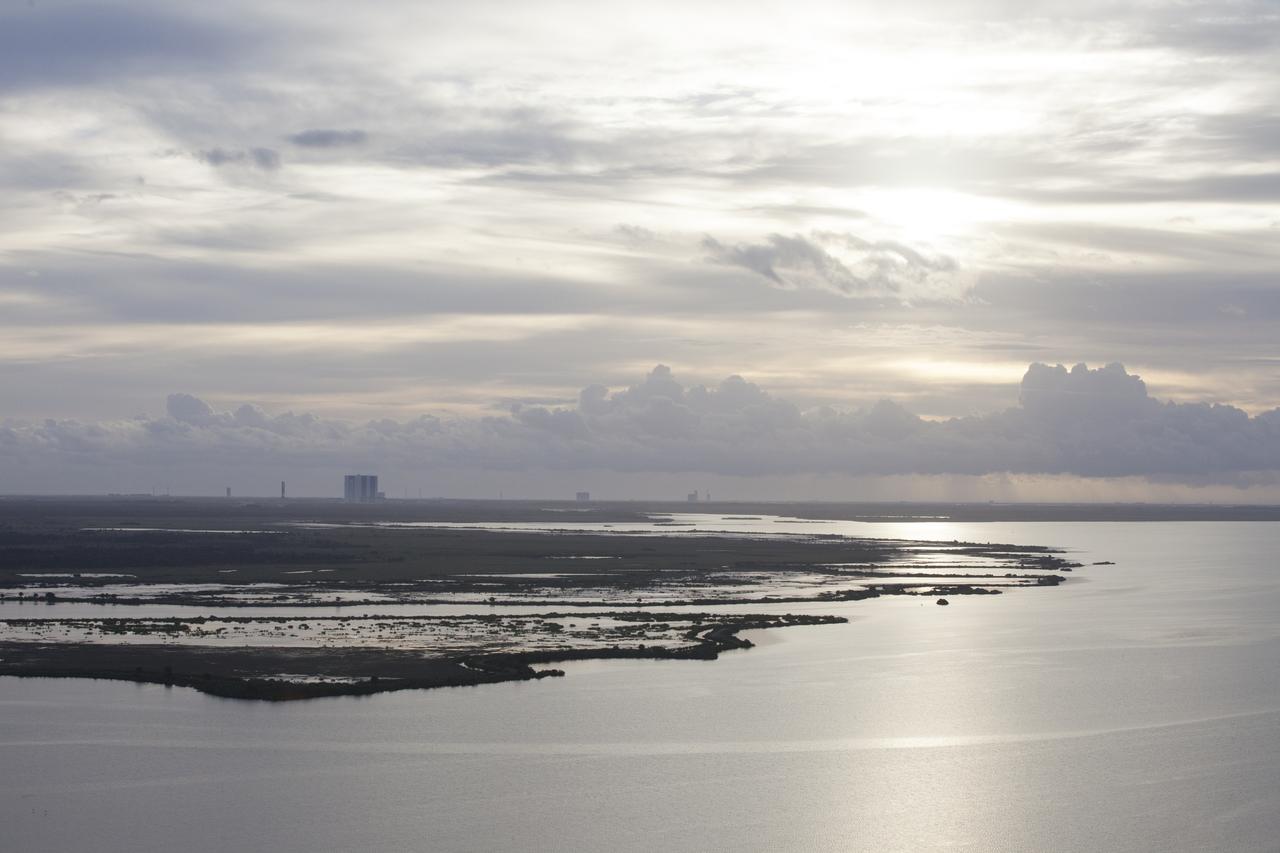
A spectacular sunrise at NASA's Kennedy Space Center in Florida heralds the arrival of a new era in exploration as the countdown continues for the launch of a United Launch Alliance Delta IV Heavy topped by the agency's Orion spacecraft for its first flight test.
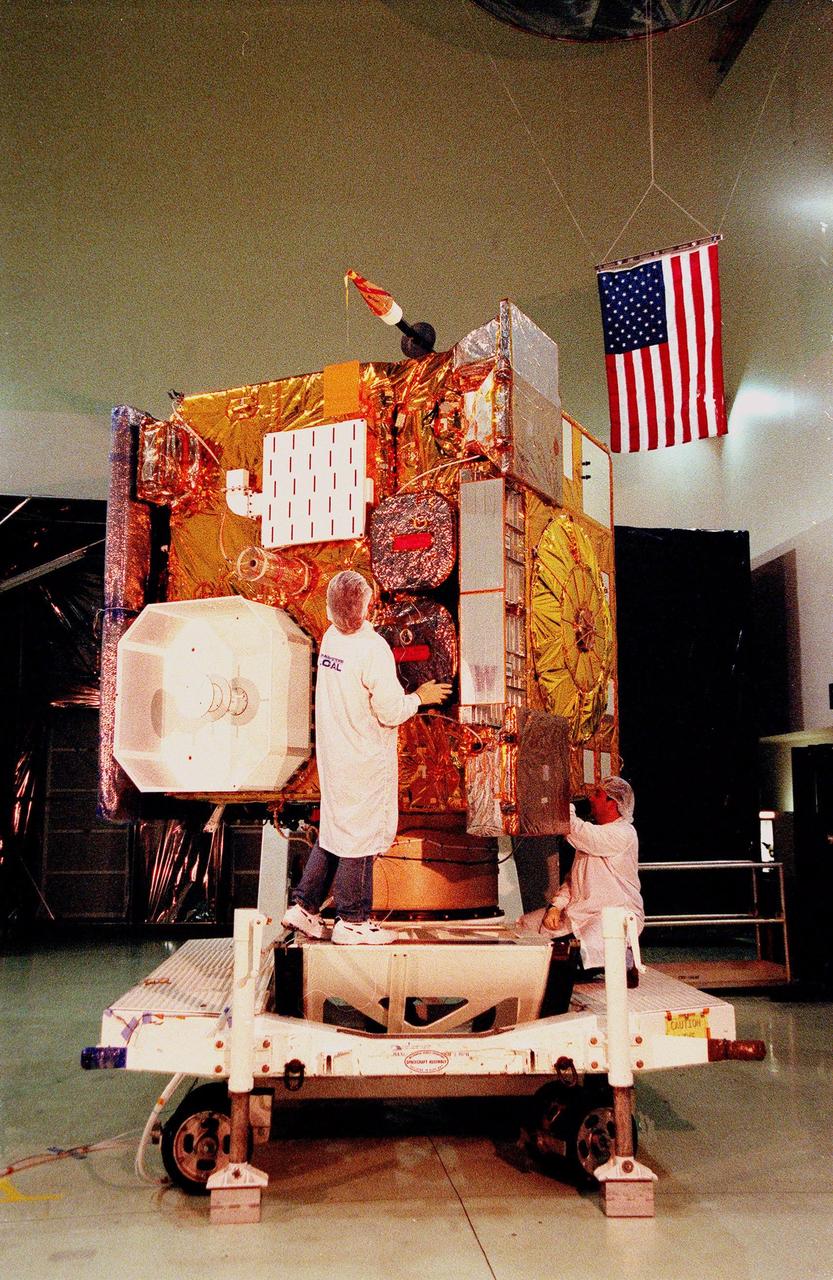
Workers at Astrotech, in Titusville, Fla., prepare the GOES-L satellite for a media showing. The GOES-L is due to be launched May 15 from Launch Pad 36A aboard an Atlas IIA rocket. Once in orbit, the satellite will become GOES-11, joining GOES-8, GOES-9 and GOES-10 in space. The fourth of a new advanced series of geostationary weather satellites for the National Oceanic and Atmospheric Administration (NOAA), GOES-L is a three-axis inertially stabilized spacecraft that will provide pictures and perform atmospheric sounding at the same time. Once launched, the satellite will undergo checkout and then provide backup capabilities for the existing, aging operational satellites
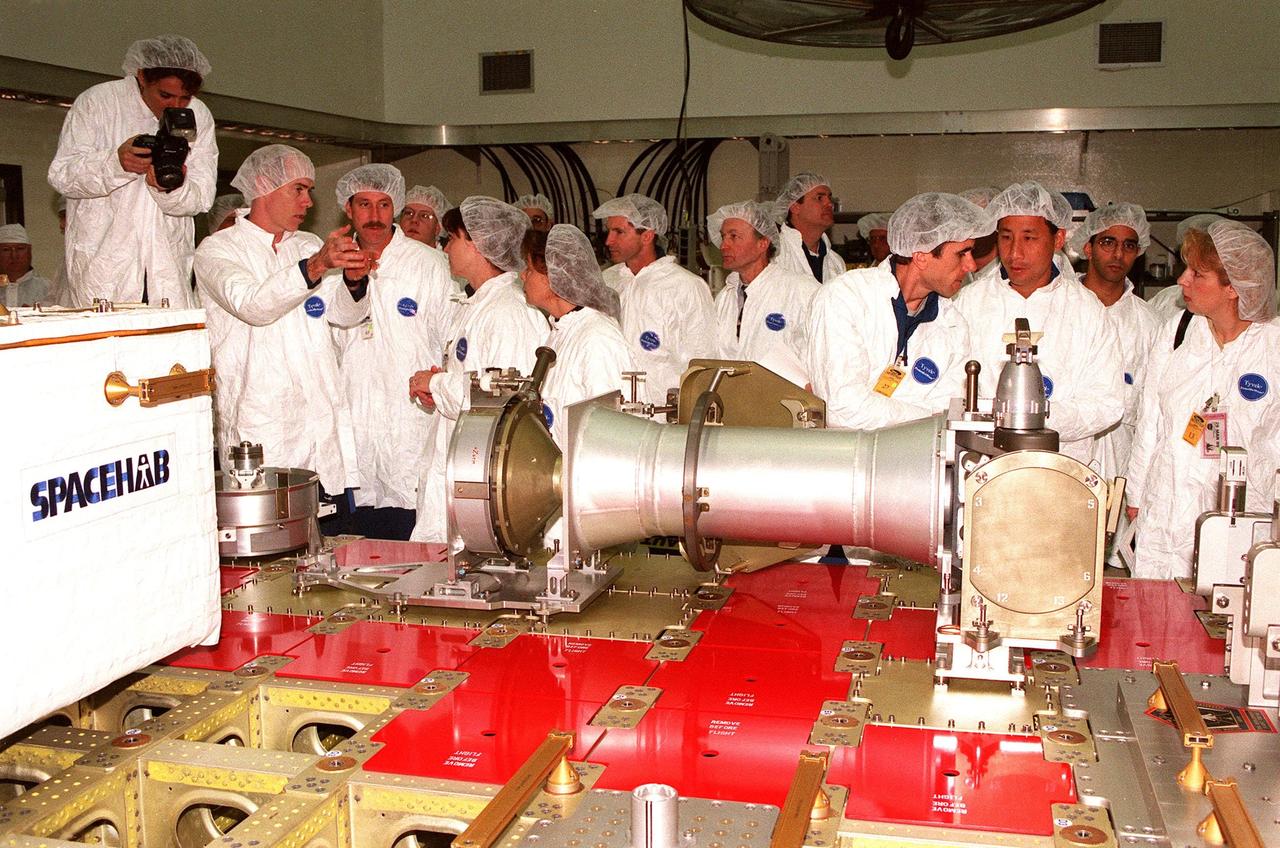
At Astrotech in Titusville, Fla., members of two Shuttle crews look at components of a Russian cargo crane, the Strela, to be mounted to the exterior of the Russian station segment on the International Space Station (ISS). From left are STS-96 Mission Specialist Julie Payette and Daniel T. Barry, Commander Kent V. Rominger and Mission Specialist Tamara E. Jernigan; three technicians from DaimlerChrysler Aerospace; (in the background, facing right) STS-101 Commander James Donald Halsell Jr.; STS-101 Mission Specialists Yuri Ivanovich Malenchenko, with the Russian Space Agency, and Edward Tsang Lu; and two more technicians from DaimlerChrysler. Both missions include the SPACEHAB Double Module, carrying internal and resupply cargo for Station outfitting. For the first time, STS-96 will include an Integrated Cargo Carrier (ICC) that will carry the Strela; the SPACEHAB Oceaneering Space System Box (SHOSS), which is a logistics items carrier; and a U.S.-built crane (ORU Transfer Device, or OTD) that will be stowed on the station for use during future ISS assembly missions. The ICC can carry up to 6,000 lb of unpressurized payload. It was built for SPACEHAB by DaimlerChrysler and RSC Energia of Korolev, Russia. STS-96 is targeted for launch on May 24 from Launch Pad 39B. STS-101 is scheduled to launch in early December 1999
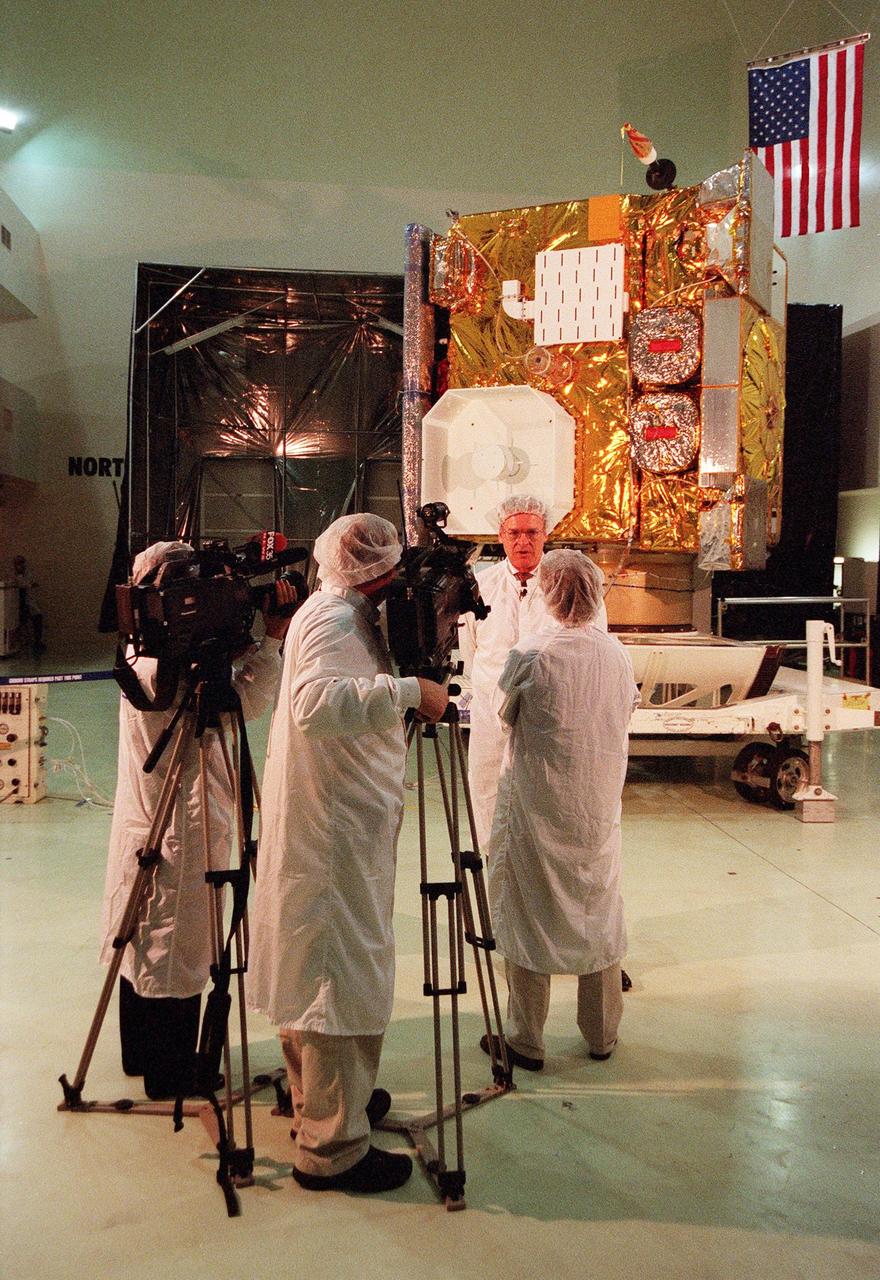
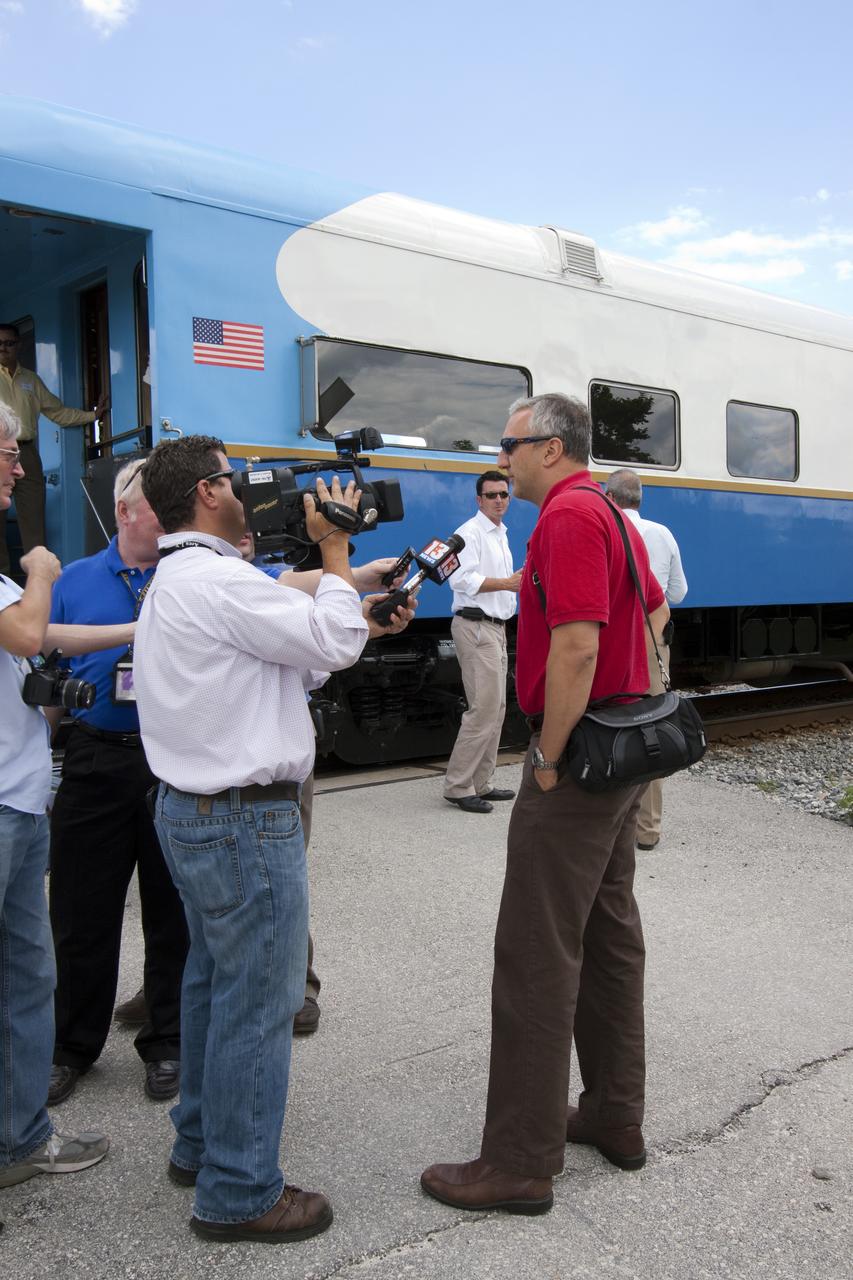
At Astrotech, in Titusville, Fla., GOES-L Program Manager Gerald Dittberner, with the National Oceanic and Atmospheric Administration (NOAA) talks with a journalist during a media showing of the GOES-L satellite in the background. The GOES-L is due to be launched May 15 from Launch Pad 36A aboard an Atlas IIA rocket. Once in orbit, the satellite will become GOES-11, joining GOES-8, GOES-9 and GOES-10 in space. The fourth of a new advanced series of geostationary weather satellites for the National Oceanic and Atmospheric Administration (NOAA), GOES-L is a three-axis inertially stabilized spacecraft that will provide pictures and perform atmospheric sounding at the same time. Once launched, the satellite will undergo checkout and then provide backup capabilities for the existing, aging operational satellites
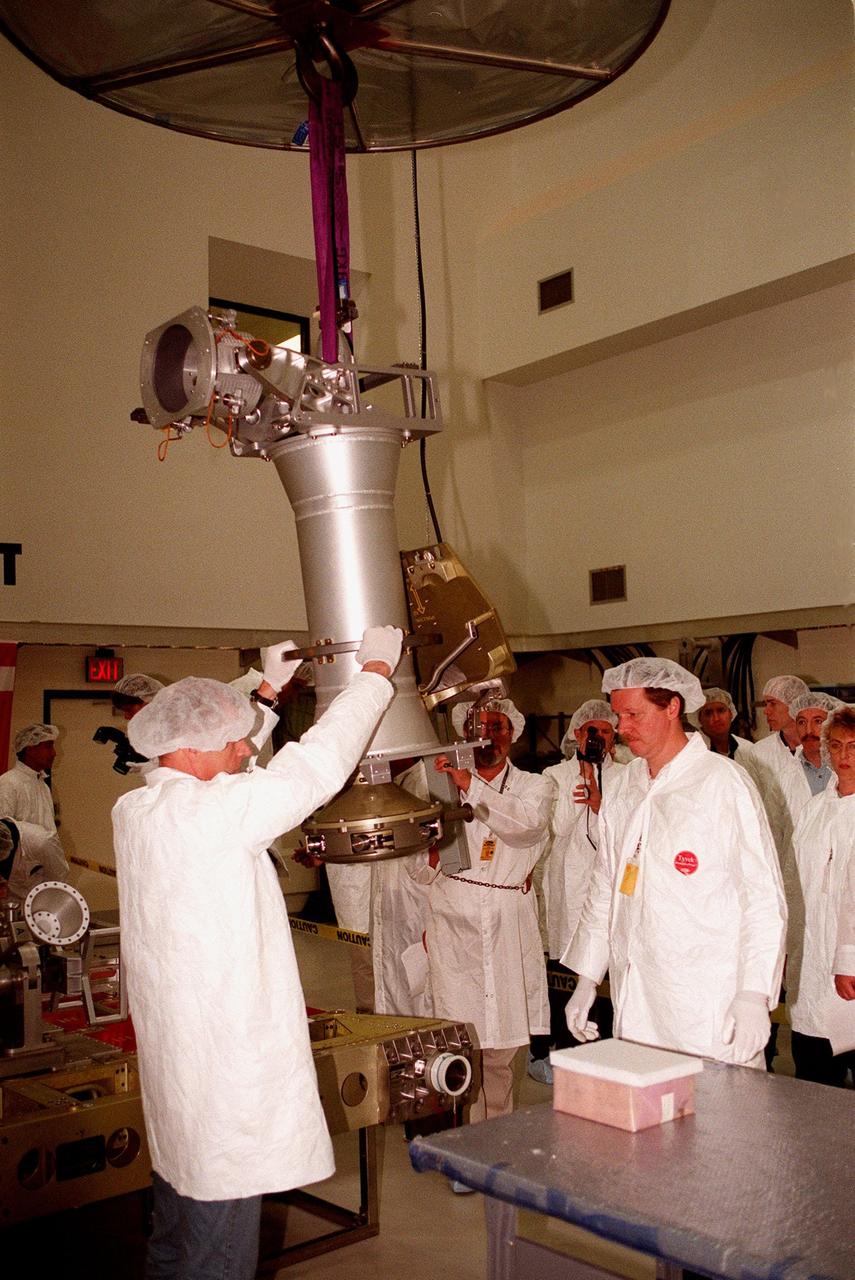
At Astrotech in Titusville, Fla., technicians with DaimlerChrysler Aerospace and RSC Energia of Korolev, Russia, maneuver a Russian cargo crane, the Strela, which is to be mounted to the exterior of the Russian station segment on the International Space Station (ISS). The Strehla has been the focus for two Shuttle crews, STS-96 who are at KSC for a Crew Equipment Interface Test, and STS-101, for payload familiarization. For the first time, STS-96 will include an Integrated Cargo Carrier (ICC) that will carry the Russian cargo crane; the SPACEHAB Oceaneering Space System Box (SHOSS), which is a logistics items carrier; and a U.S.-built crane (ORU Transfer Device, or OTD) that will be stowed on the station for use during future ISS assembly missions. The ICC can carry up to 6,000 lb of unpressurized payload. It was built for SPACEHAB by DaimlerChrysler Aerospace and RSC Energia. STS-96 is targeted for launch on May 24 from Launch Pad 39B. STS-101 is scheduled to launch in early December 1999
STS-335 LAUNCH ON NEED - SRB DELIVERY AT JJ YARD
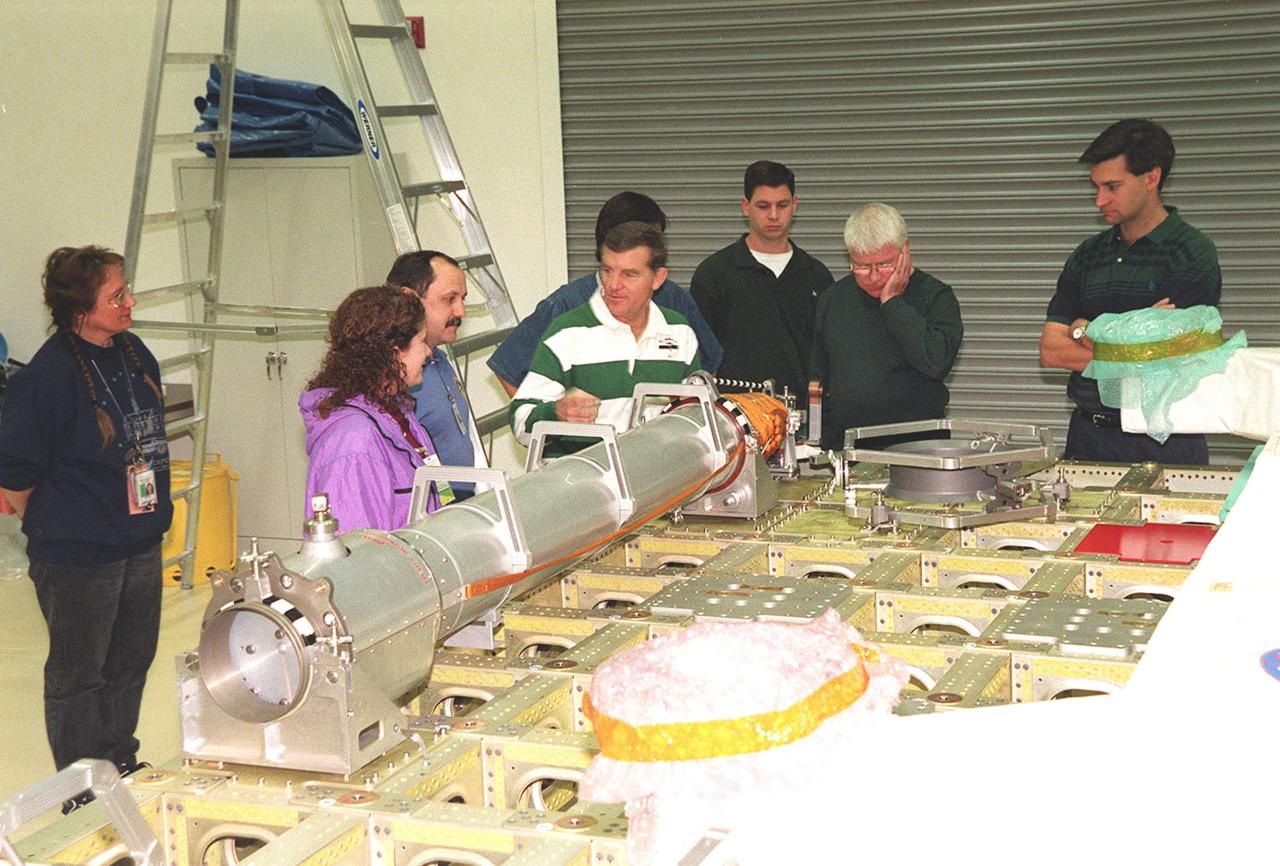
At SPACEHAB, in Titusville, Fla., members of the STS-102 crew look over the Integrated Cargo Carrier and the Russian crane Strela as part of familiarization activities. Starting second to left are Mission Specialists Susan Helms, cosmonaut Yuri Usachev, who is with the Russian Space Agency (RSA), and James Voss. STS-102 is a resupply mission to the International Space Station, transporting the Leonardo Multi-Purpose Logistics Module (MPLM) with equipment to assist in outfitting the U.S. Lab, which will already be in place. It is also transporting Voss, Helms and Usachev as the second resident crew (designated Expedition crew 2) to the station. The mission will also return to Earth the first expedition crew on ISS: William Shepherd, Sergei Krikalev (RSA) and Yuri Gidzenko (RSA). STS-102 is scheduled to launch no earlier than Oct. 19, 2000
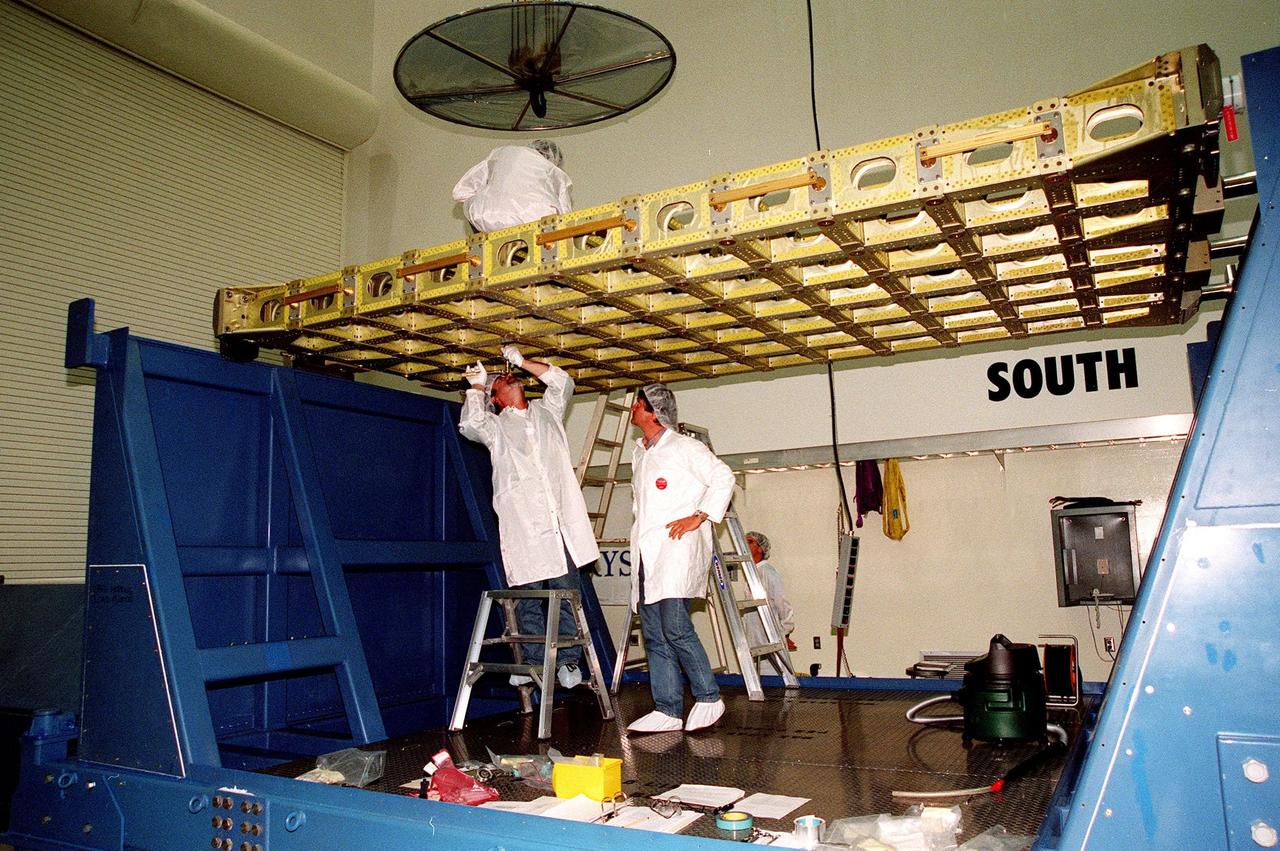
At Astrotech, Titusville, Fla., Harald Schnier and Manfred Nordhoff, with Daimler-Chrysler Aerospace (DASA), look over the International Cargo Carrier that will be used during future International Space Station (ISS) assembly missions. On top is Robert Wilkes, with Lockheed Martin. Behind the ladder in the background is Ben Greene, with Lockheed Martin. The nonpressurized ICC fits inside the payload bay of the orbiter. The ICC will carry the SPACEHAB Oceaneering Space System Box (SHOSS), a logistics items carrier. SHOSS can hold a maximum of 400 pounds of equipment and will carry items to be used during STS-96 and future ISS assembly flights. Also aboard the ICC will be the ORU Transfer Device (OTD), a U.S.-built crane that will be stowed on Unity for use during future ISS assembly missions. The ICC will fly on mission STS-96, targeted for launch on May 20
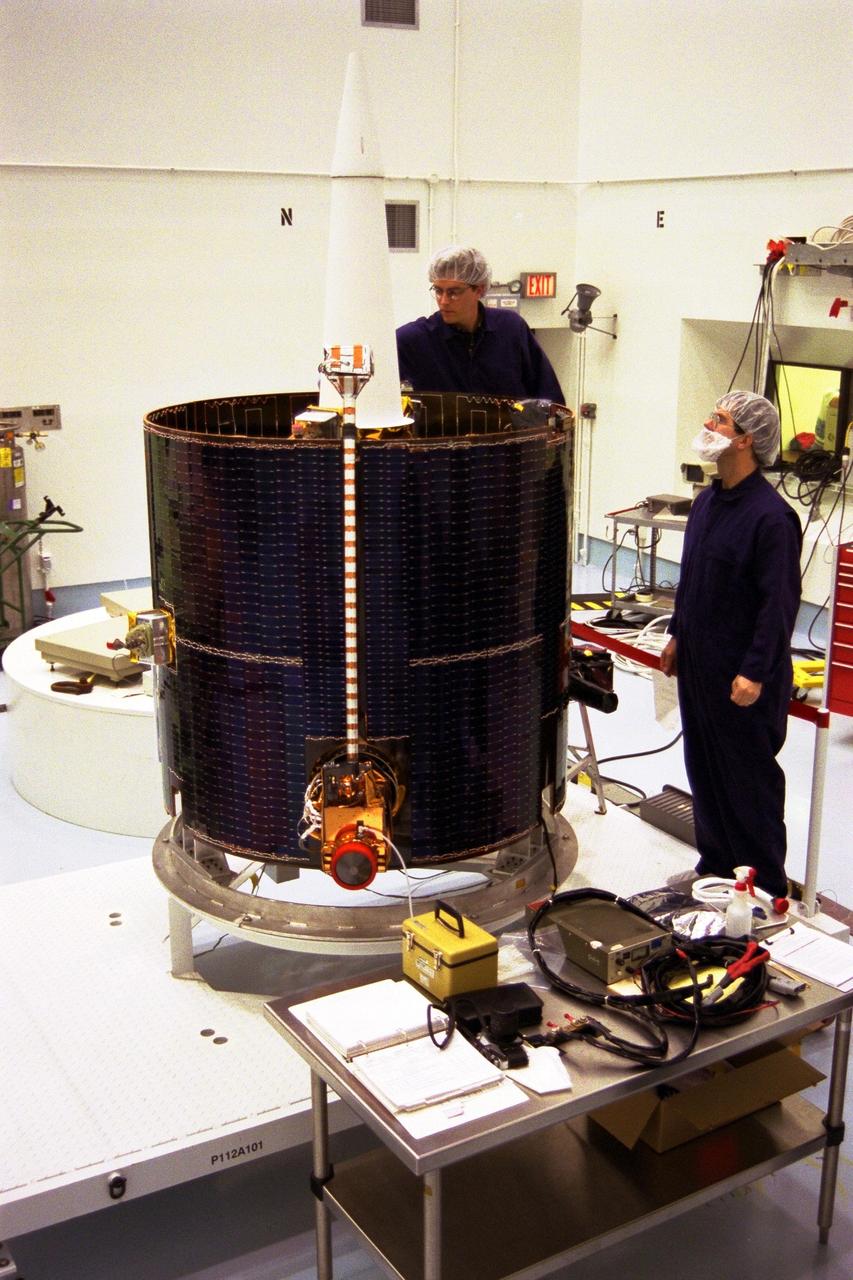
Lockheed Martin Missile Systems technicians prepare NASA’s Lunar Prospector spacecraft for mating to the Trans Lunar Injection Module of the spacecraft at Astrotech, a commercial payload processing facility, in Titusville, Fla. The small robotic spacecraft, to be launched for NASA on an Athena II launch vehicle by Lockheed Martin, is designed to provide the first global maps of the Moon’s surface compositional elements and its gravitational and magnetic fields. The launch of Lunar Prospector is scheduled for Jan. 5, 1998 at 8:31 p.m
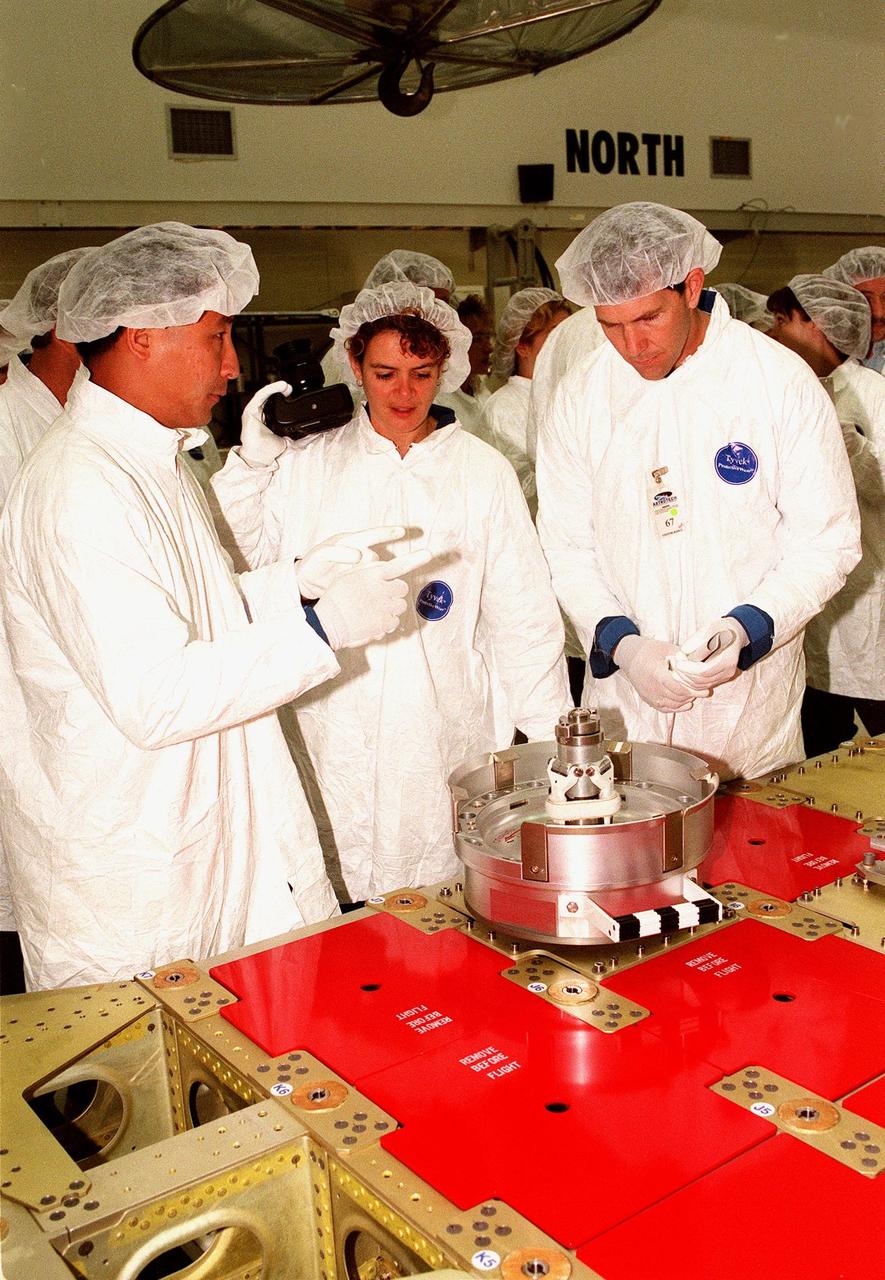
At Astrotech in Titusville, Fla., members of two Shuttle crews take a close look at a component of a Russian cargo crane, the Strela, to be mounted to the exterior of the Russian station segment on the International Space Station (ISS). From left, they are STS-101 Mission Specialist Edward Tsang Lu, plus STS-96 Mission Specialist Julie Payette and Pilot Rick Douglas Husband. Payette represents the Canadian Space Agency. Both missions include the SPACEHAB Double Module, carrying internal and resupply cargo for Station outfitting. For the first time, STS-96 will include an Integrated Cargo Carrier (ICC) that will carry the Strela; the SPACEHAB Oceaneering Space System Box (SHOSS), which is a logistics items carrier; and a U.S.-built crane (ORU Transfer Device, or OTD) that will be stowed on the station for use during future ISS assembly missions. The ICC can carry up to 6,000 lb of unpressurized payload. It was built for SPACEHAB by DaimlerChrysler and RSC Energia of Korolev, Russia. STS-96 is targeted for launch on May 24 from Launch Pad 39B. STS-101 is scheduled to launch in early December 1999
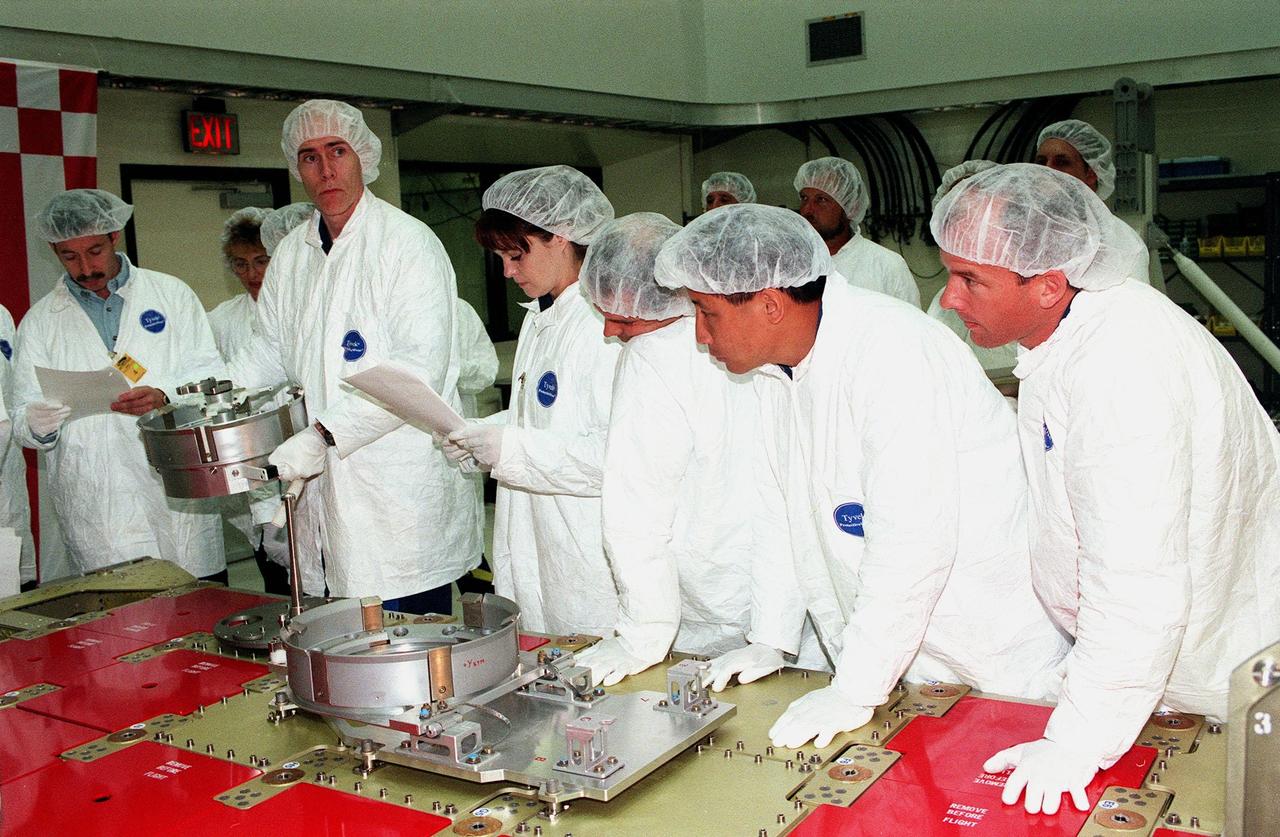
Two Shuttle crews take part in familiarization activities at Astrotech in Titusville, Fla. From left are STS-96 Mission Specialists Daniel T. Barry and Tamara E. Jernigan, and Pilot Rick Douglas Husband; plus STS-101 Mission Specialists Edward Tsang Lu and Jeffrey N. Williams. They are looking at components of a Russian cargo crane, the Strela, to be mounted to the exterior of the Russian station segment on the International Space Station (ISS). Both missions include the SPACEHAB Double Module, carrying internal and resupply cargo for Station outfitting. For the first time, STS-96 will include an Integrated Cargo Carrier (ICC) that will carry the Strela; the SPACEHAB Oceaneering Space System Box (SHOSS), which is a logistics items carrier; and a U.S.-built crane (ORU Transfer Device, or OTD) that will be stowed on the station for use during future ISS assembly missions. The ICC can carry up to 6,000 lb of unpressurized payload. It was built for SPACEHAB by DaimlerChrysler Aerospace of Bremen and RSC Energia of Korolev, Russia. STS-96 is targeted for launch on May 24 from Launch Pad 39B. STS-101 is scheduled to launch in early December 1999

In this aerial view, crews with Orion Marine Construction work to complete the westbound span of the Indian River Bridge while daily traffic moves along the upgraded eastbound lanes of the bridge leading to NASA’s Kennedy Space Center in Florida on Monday, Nov. 27, 2023. The bridge crosses the Indian River Lagoon and connects Kennedy and the Cape Canaveral Space Force Station to the mainland via State Road 405/NASA Causeway in nearby Titusville. The new high-rise bridge serves as the primary entrance and exit to the space center for employees and visitors. The new bridge spans replace a pair of two-lane drawbridges built in the mid-1960s to support NASA’s Apollo program. The first of the two new spans opened to the public ahead of schedule on June 9, 2023. In development for well over a decade, the load capacity, width, and grade of the bridge were designed to support the largest future payloads and vehicles at the spaceport while simultaneously supporting increased public traffic to and from Kennedy.
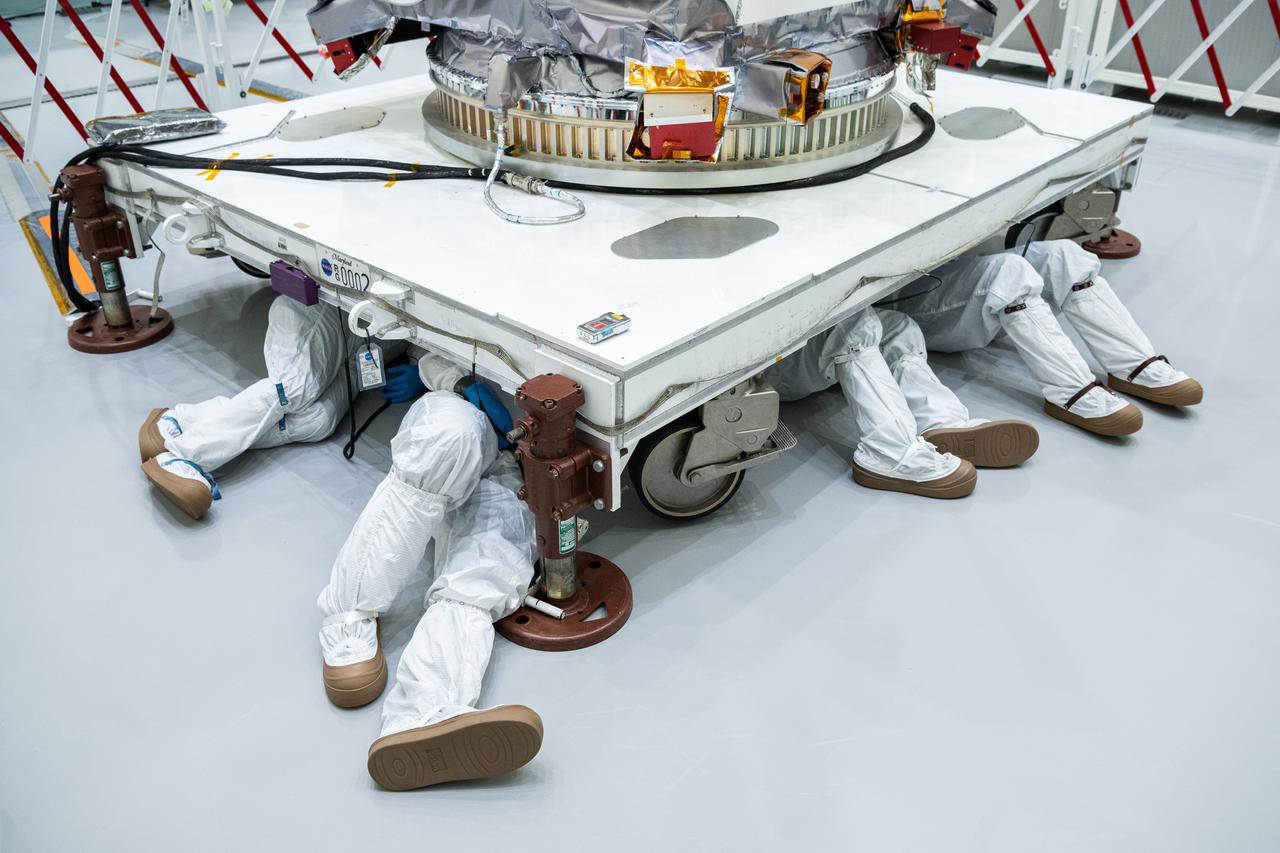
Engineers and Technicians from NASA’s Goddard Space Flight Center crawl under the PACE (Plankton, Aerosol, Cloud, ocean Ecosystem) spacecraft to inspect the +X side during payload processing at Astrotech Space Operations in Titusville, FL on January 27th, 2024.
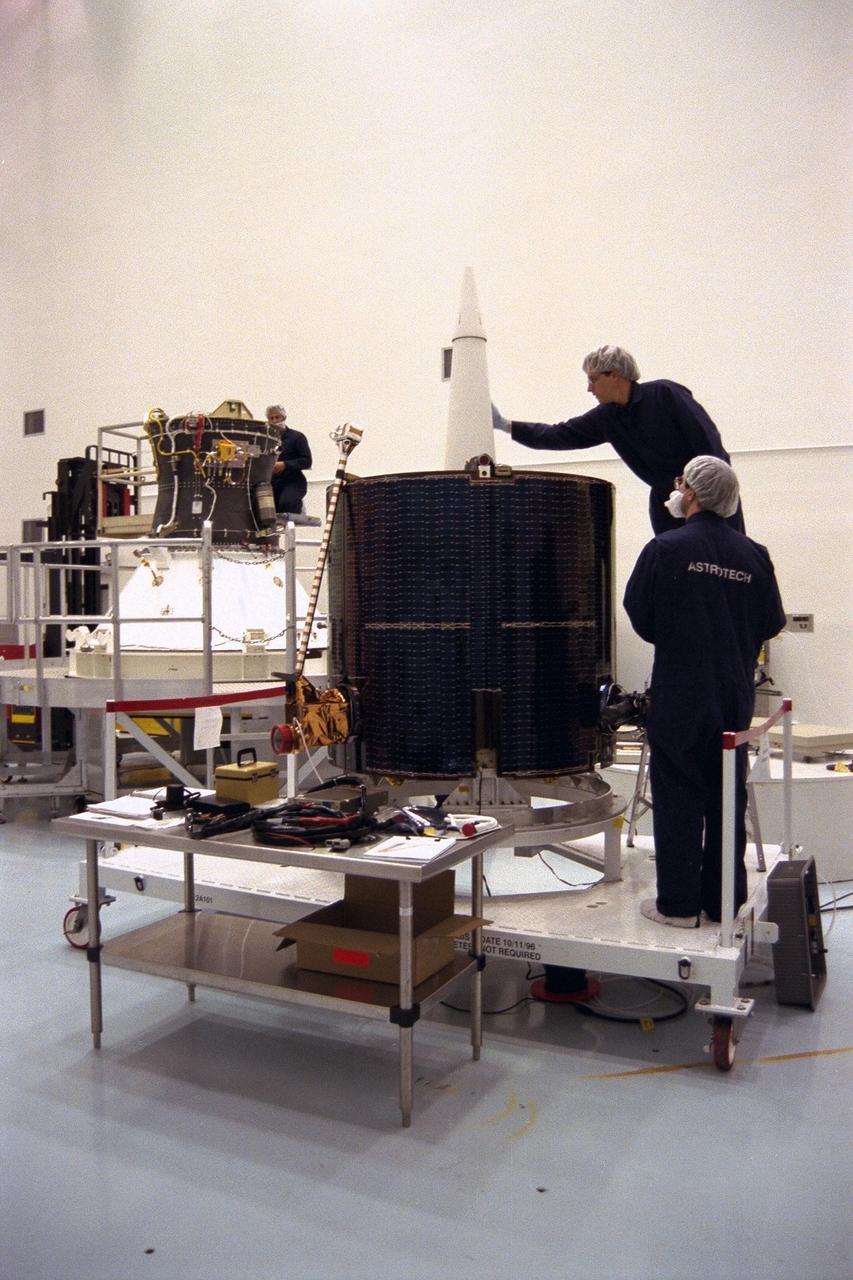
NASA’s Lunar Prospector is prepared for mating to the Trans Lunar Injection Module of the spacecraft, seen in the background, at Astrotech, a commercial payload processing facility, in Titusville, Fla. The small robotic spacecraft, to be launched for NASA on an Athena II launch vehicle by Lockheed Martin, is designed to provide the first global maps of the Moon’s surface compositional elements and its gravitational and magnetic fields. The launch of Lunar Prospector is scheduled for Jan. 5, 1998 at 8:31 p.m
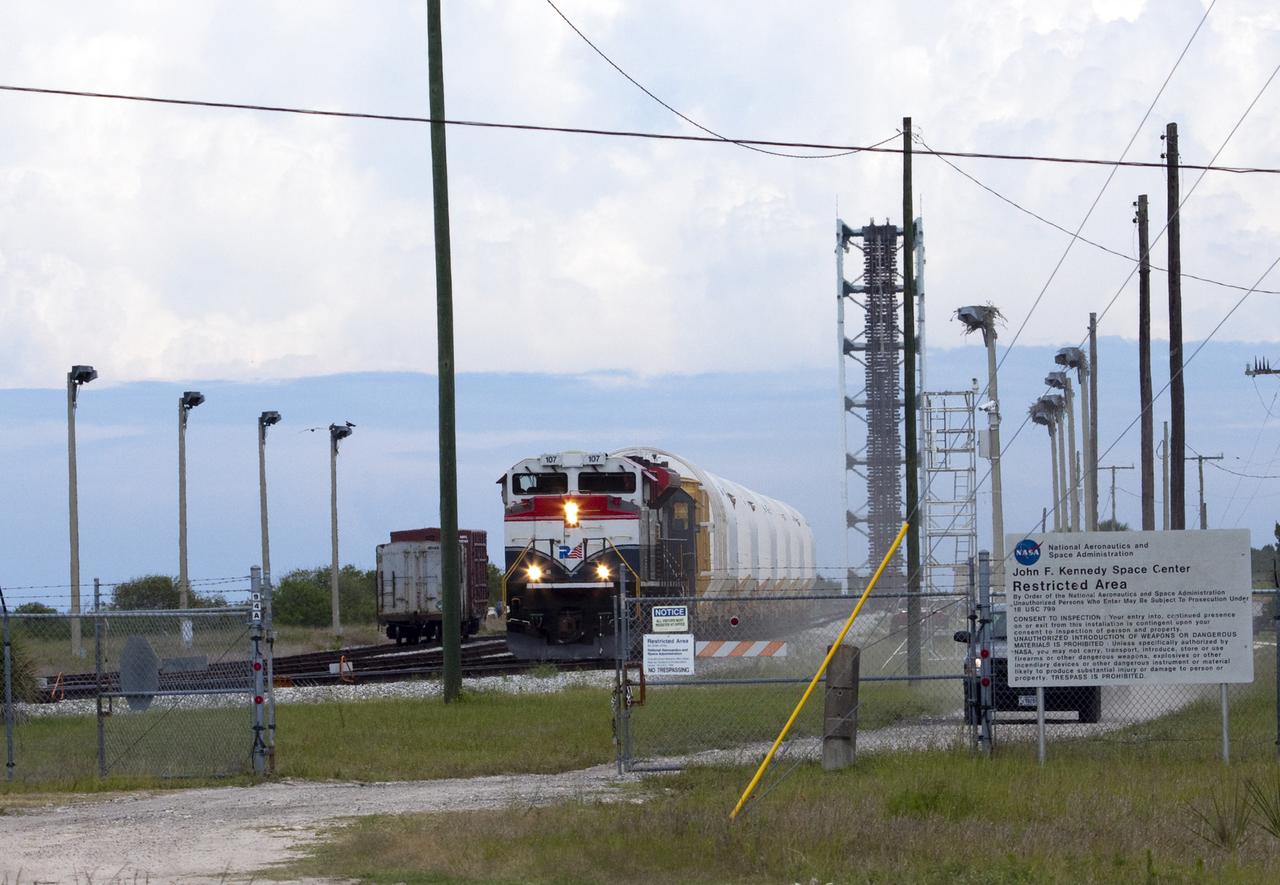
STS-335 LAUNCH ON NEED - SRB DELIVERY AT JJ YARD
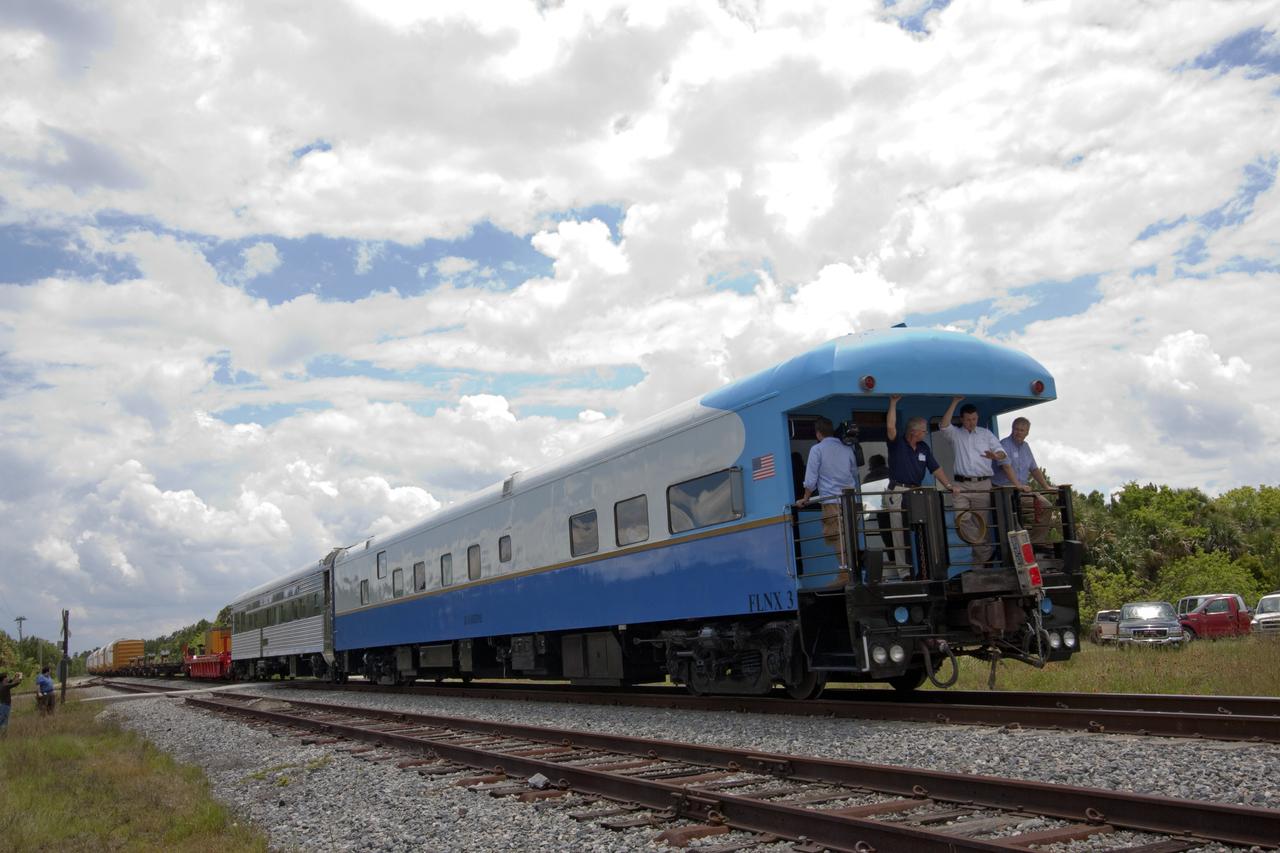
STS-335 LAUNCH ON NEED - SRB DELIVERY AT JJ YARD
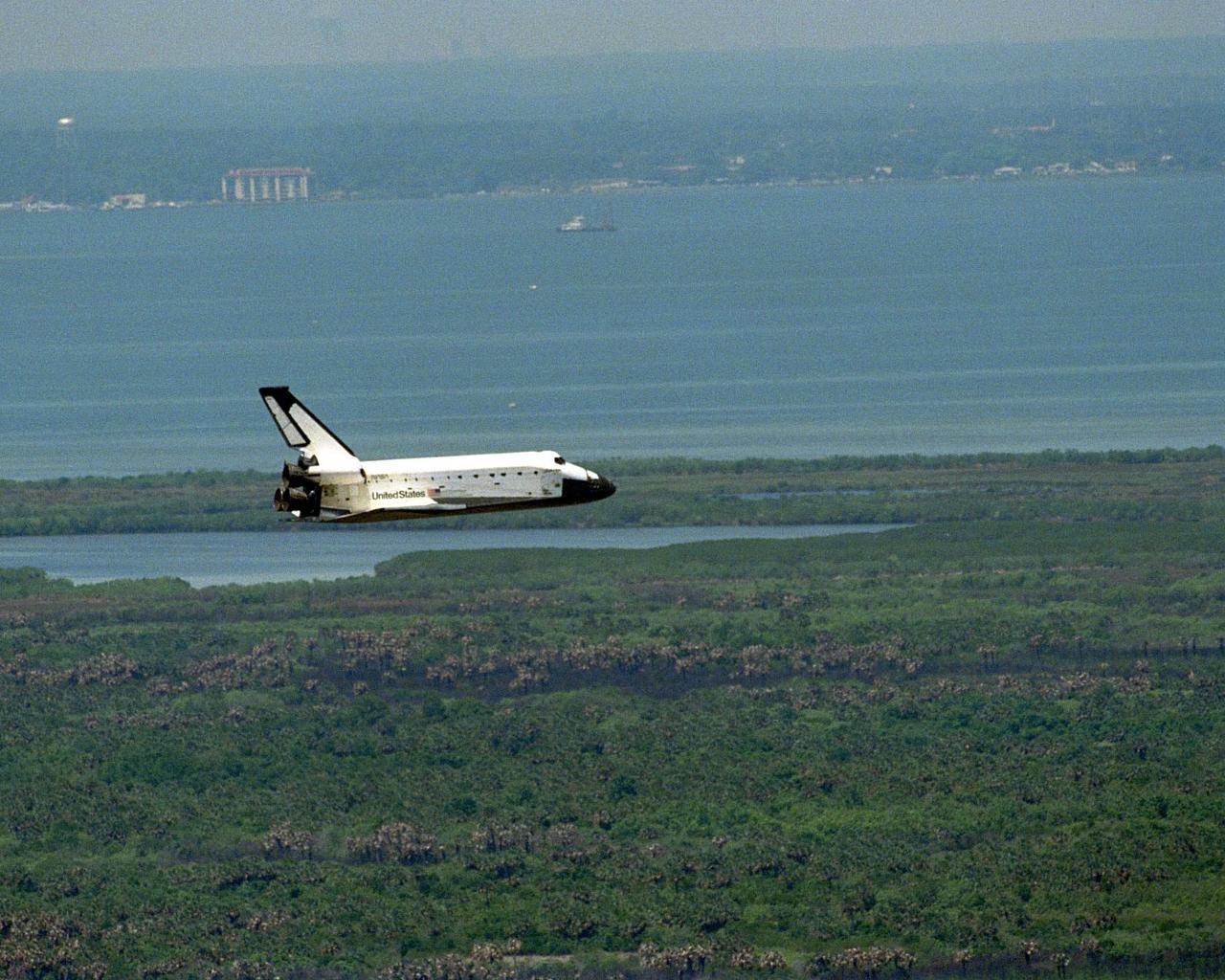
Flying along the Indian River toward KSC's Shuttle Landing Facility is the orbiter Columbia as it nears touchdown on Runway 33 to complete the nearly 16-day STS-90 mission. This unique view with Titusville and the Indian River in the background was taken from the roof of the 525-foot-high Vehicle Assembly Building. Main gear touchdown was at 12:08:59 p.m. EDT on May 3, 1998, landing on orbit 256 of the mission. The wheels stopped at 12:09:58 EDT, completing a total mission time of 15 days, 21 hours, 50 minutes and 58 seconds. The 90th Shuttle mission was Columbia's 13th landing at the space center and the 43rd KSC landing in the history of the Space Shuttle program. During the mission, the crew conducted research to contribute to a better understanding of the human nervous system. The crew of the STS-90 Neurolab mission include Commander Richard Searfoss; Pilot Scott Altman; Mission Specialists Richard Linnehan, D.V.M., Dafydd (Dave) Williams, M.D., with the Canadian Space Agency, and Kathryn (Kay) Hire; and Payload Specialists Jay Buckey, M.D., and James Pawelczyk, Ph.D

In this aerial view, crews with Orion Marine Construction work to complete the westbound span of the Indian River Bridge while daily traffic moves along the upgraded eastbound lanes of the bridge leading to NASA’s Kennedy Space Center in Florida on Monday, Nov. 27, 2023. The bridge crosses the Indian River Lagoon and connects Kennedy and the Cape Canaveral Space Force Station to the mainland via State Road 405/NASA Causeway in nearby Titusville. The new high-rise bridge serves as the primary entrance and exit to the space center for employees and visitors. The new bridge spans replace a pair of two-lane drawbridges built in the mid-1960s to support NASA’s Apollo program. The first of the two new spans opened to the public ahead of schedule on June 9, 2023. In development for well over a decade, the load capacity, width, and grade of the bridge were designed to support the largest future payloads and vehicles at the spaceport while simultaneously supporting increased public traffic to and from Kennedy.
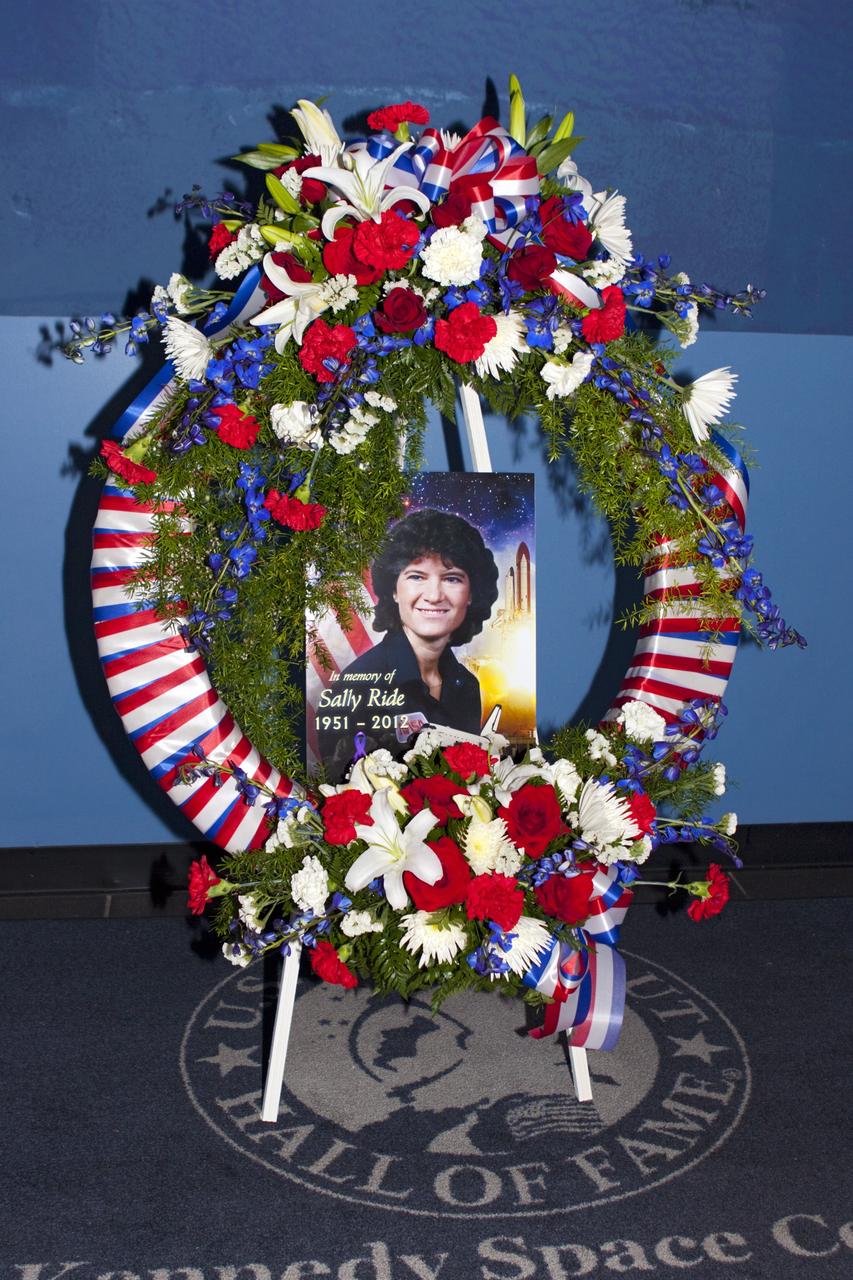
TITUSVILLE, Fla. - A wreath was laid at the U. S. Astronaut Hall of Fame honoring Sally K. Ride, who became America's first woman in space in 1983. Following her death on July 23, 2012, Ride is being remembered for her service to NASA and for her efforts to encourage children to study math, science and technology. A California-born physicist, she broke the gender barrier 29 years ago when she rode to orbit aboard space shuttle Challenger on STS-7. Ride subsequently served, again as a mission specialist, on STS-41G in 1984. Following her career with NASA, in 2001 Ride founded her own company, Sally Ride Science, to pursue her long-time passion of motivating youth -- especially girls and young women -- to pursue careers in technical fields. Photo credit: NASA/Jim Grossmann
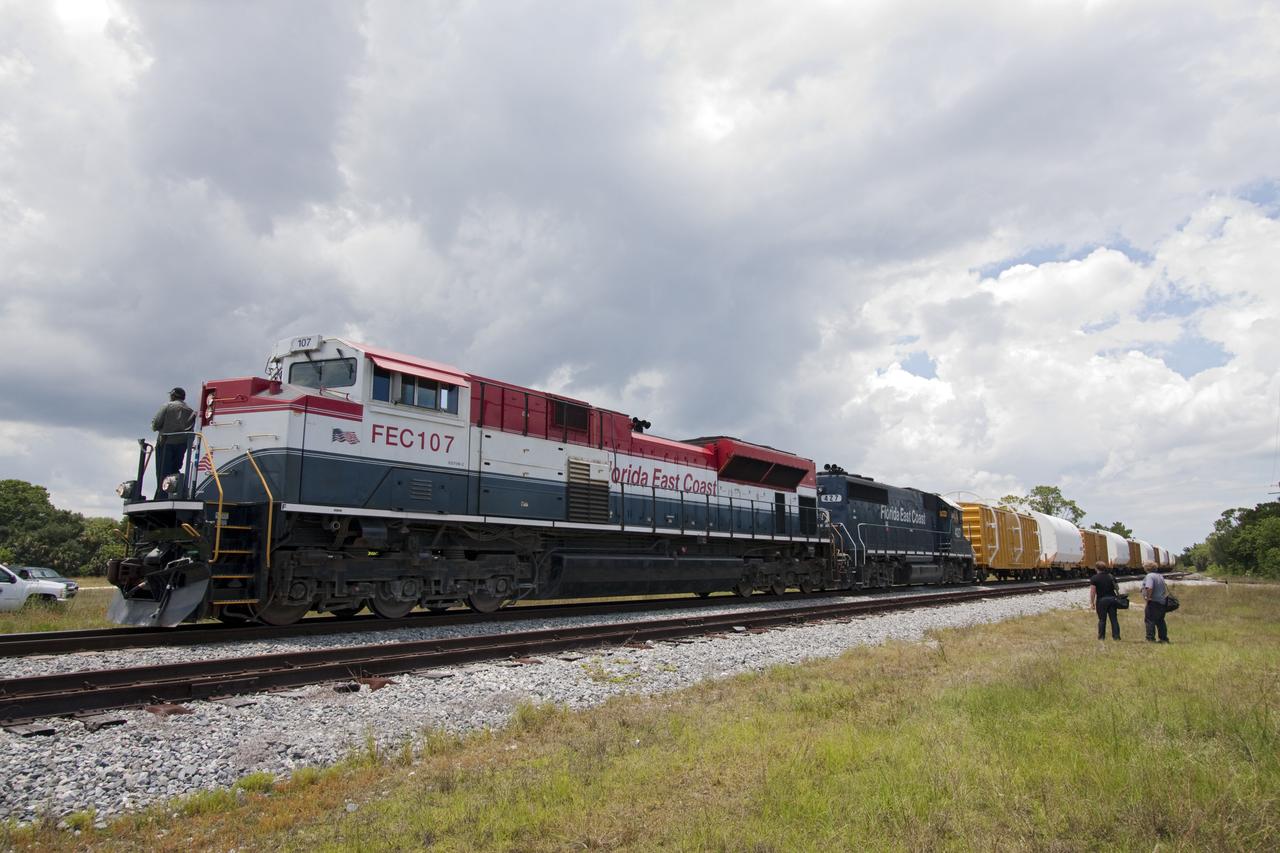
STS-335 LAUNCH ON NEED - SRB DELIVERY AT JJ YARD
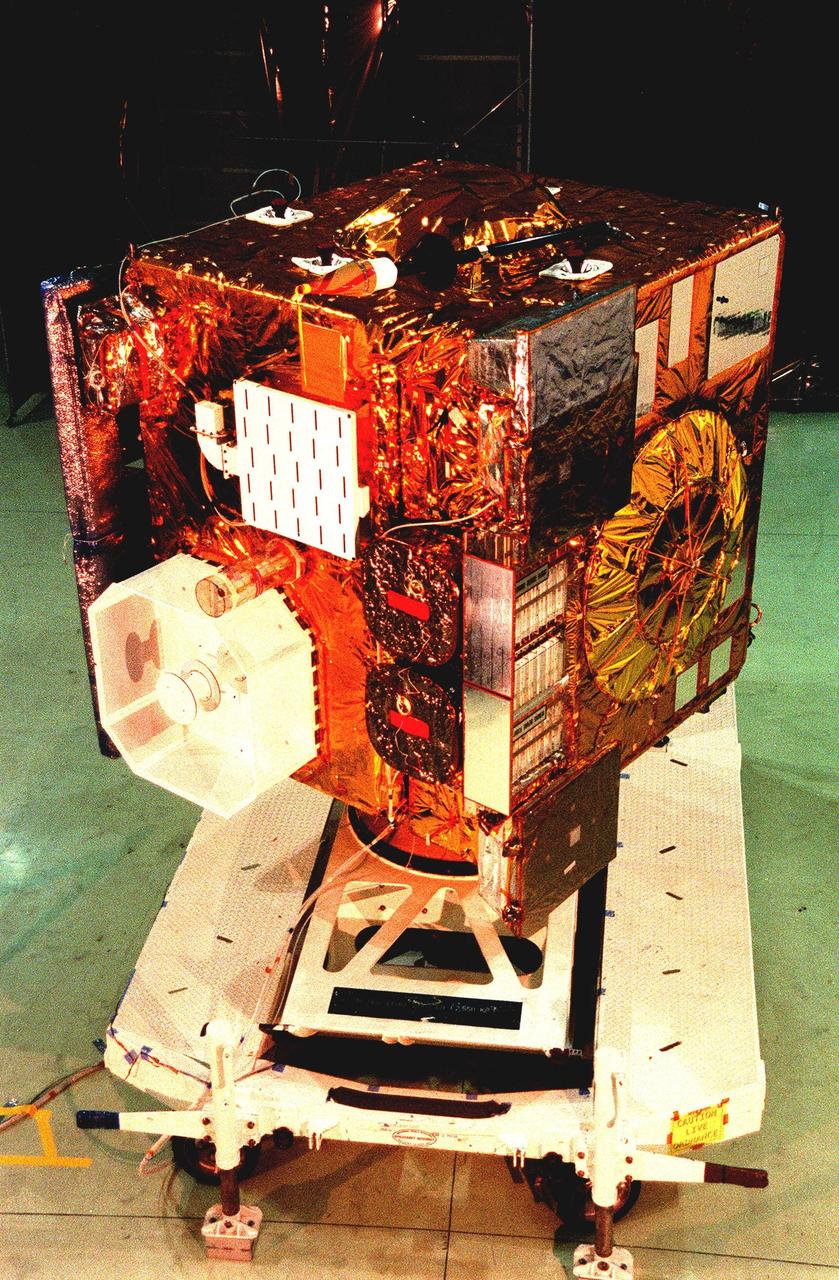
At Astrotech, in Titusville, Fla., the GOES-L satellite sits ready for a media showing. The GOES-L is due to be launched May 15 from Launch Pad 36A aboard an Atlas IIA rocket. Once in orbit, the satellite will become GOES-11, joining GOES-8, GOES-9 and GOES-10 in space. The fourth of a new advanced series of geostationary weather satellites for the National Oceanic and Atmospheric Administration (NOAA), GOES-L is a three-axis inertially stabilized spacecraft that will provide pictures and perform atmospheric sounding at the same time. Once launched, the satellite will undergo checkout and then provide backup capabilities for the existing, aging operational satellites
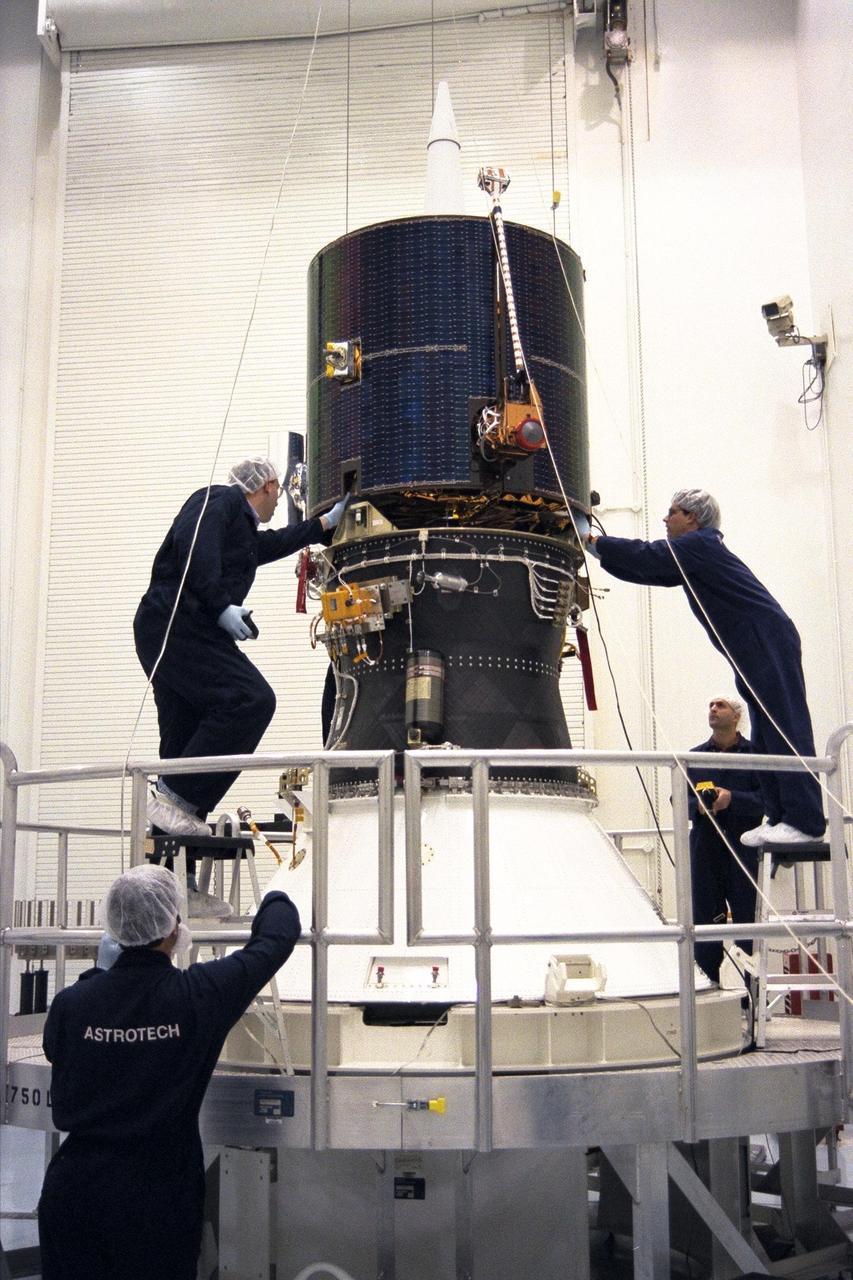
Lockheed Martin Missile Systems integration and test staff join NASA’s Lunar Prospector spacecraft to the Trans Lunar Injection Module of the spacecraft at Astrotech, a commercial payload processing facility, in Titusville, Fla. The small robotic spacecraft, to be launched on an Athena II launch vehicle by Lockheed Martin, is designed to provide the first global maps of the Moon’s surface compositional elements and its gravitational and magnetic fields. The launch of Lunar Prospector is scheduled for Jan. 5, 1998 at 8:31 p.m
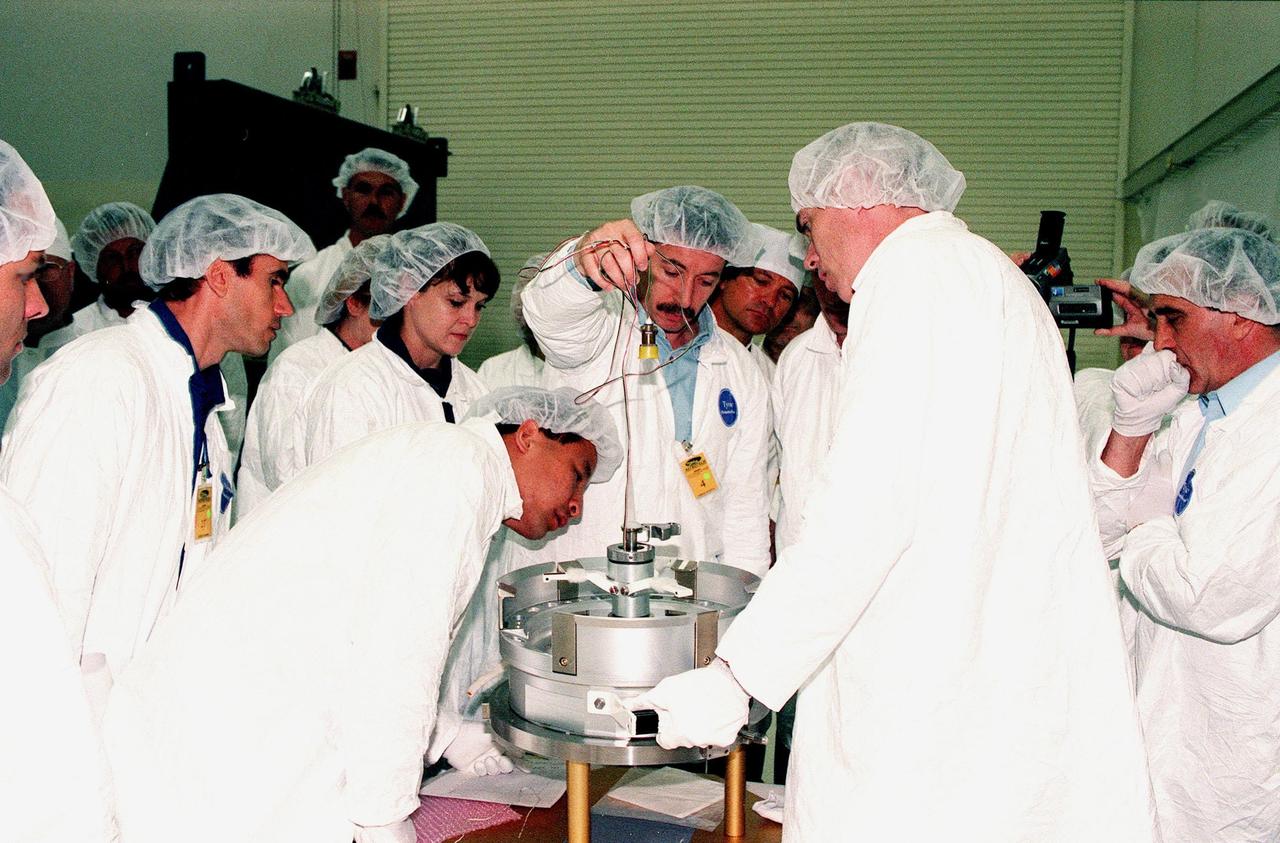
Two Shuttle crews take part in familiarization activities at Astrotech in Titusville, Fla. From left are STS-101 Mission Specialist Jeffrey N. Williams and Yuri Ivanovich Malenchenko, with the Russian Space Agency; STS-96 Mission Specialist Tamara E. Jernigan; STS-101 Mission Specialist Edward Tsang Lu (leaning over); a technician with RSC Energia of Korolev, Russia; Manfred Nordhoff, with DaimlerChrysler Aerospace; STS-96 Mission Specialist Daniel T. Barry; and another technician with RSC Energia. They are looking at components of the Russian cargo crane, Strela, to be mounted to the exterior of the Russian station segment on the International Space Station (ISS). Both missions include the SPACEHAB Double Module, carrying internal and resupply cargo for Station outfitting. For the first time, STS-96 will include an Integrated Cargo Carrier (ICC) that will carry the Strela; the SPACEHAB Oceaneering Space System Box (SHOSS), which is a logistics items carrier; and a U.S.-built crane (ORU Transfer Device, or OTD) that will be stowed on the station for use during future ISS assembly missions. The ICC can carry up to 6,000 lb of unpressurized payload. It was built for SPACEHAB by DaimlerChrysler Aerospace of Bremen and RSC Energia of Korolev, Russia. STS-96 is targeted for launch on May 24 from Launch Pad 39B. STS-101 is scheduled to launch in early December 1999
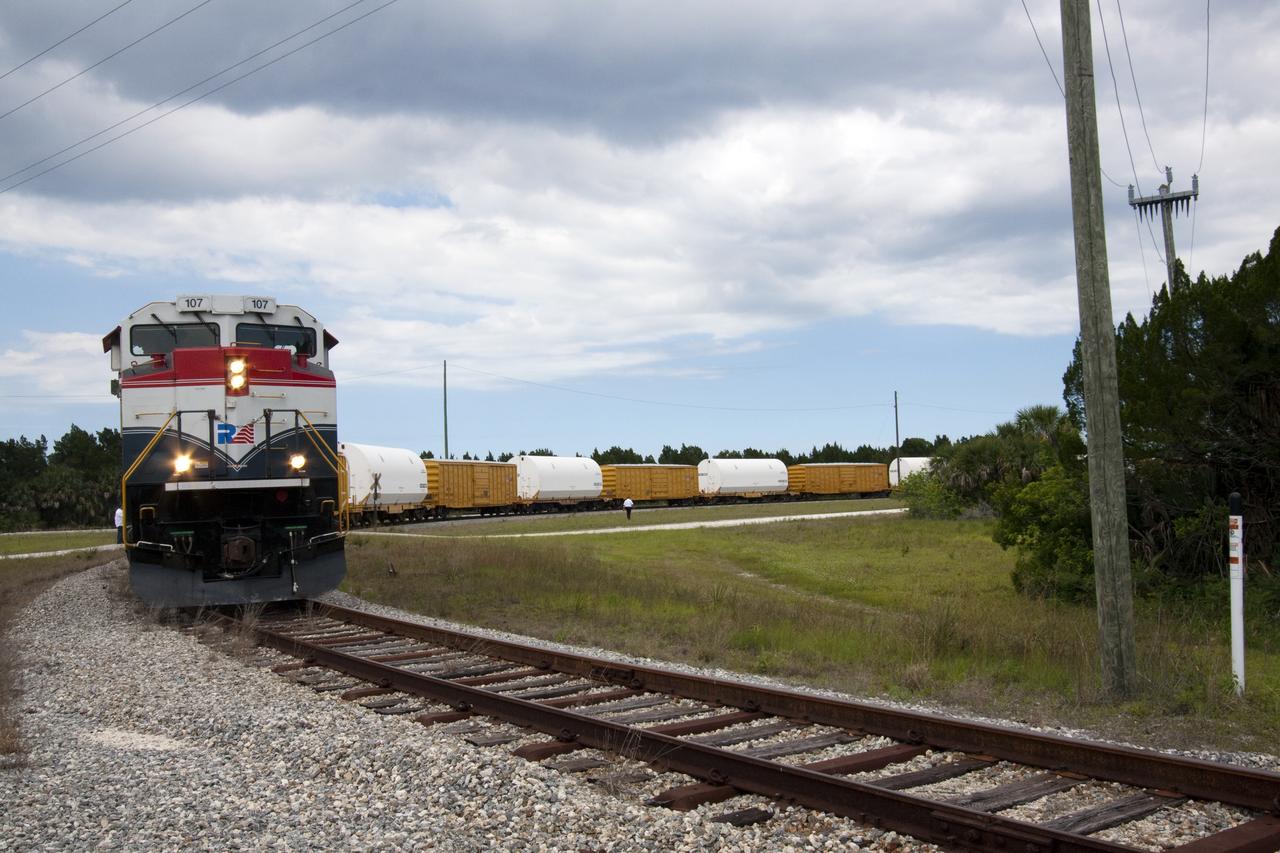
STS-335 LAUNCH ON NEED - SRB DELIVERY AT JJ YARD
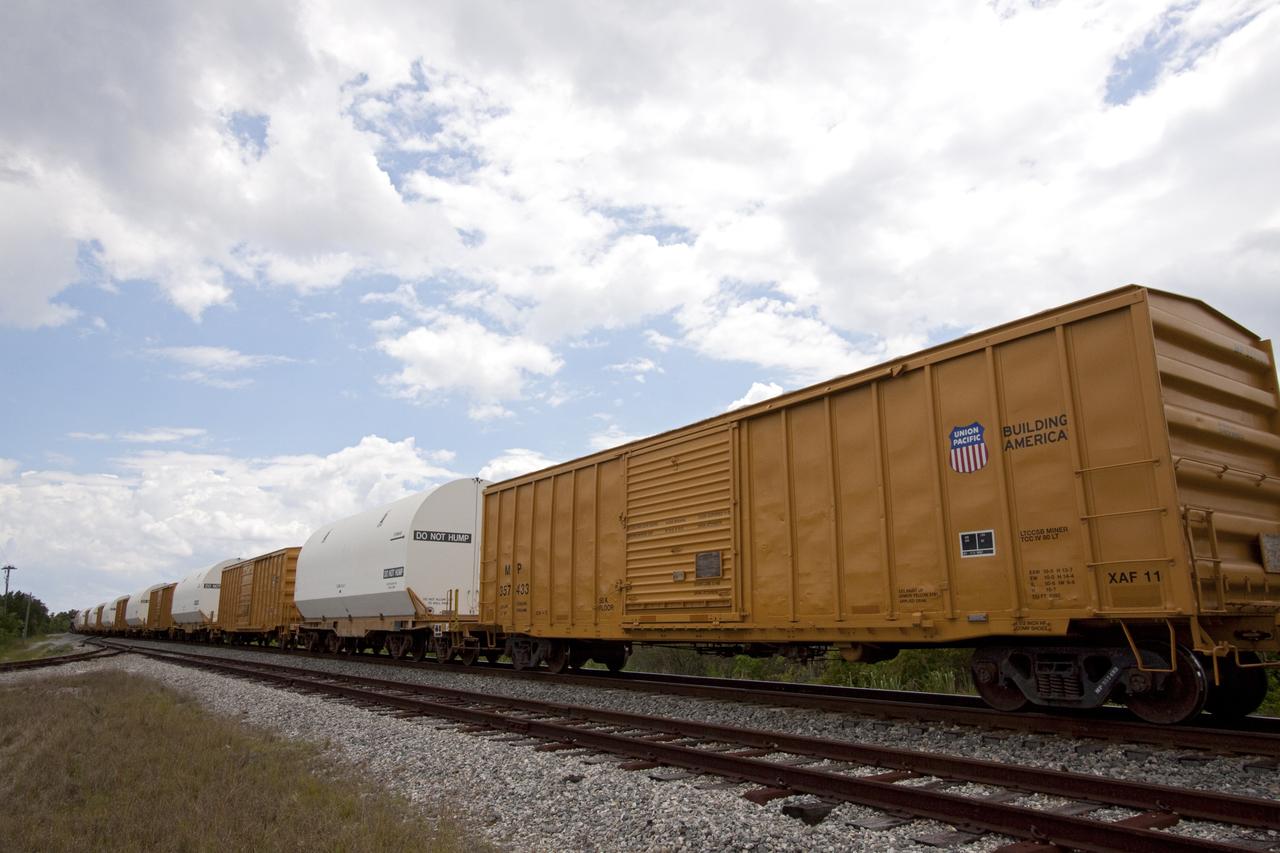
STS-335 LAUNCH ON NEED - SRB DELIVERY AT JJ YARD
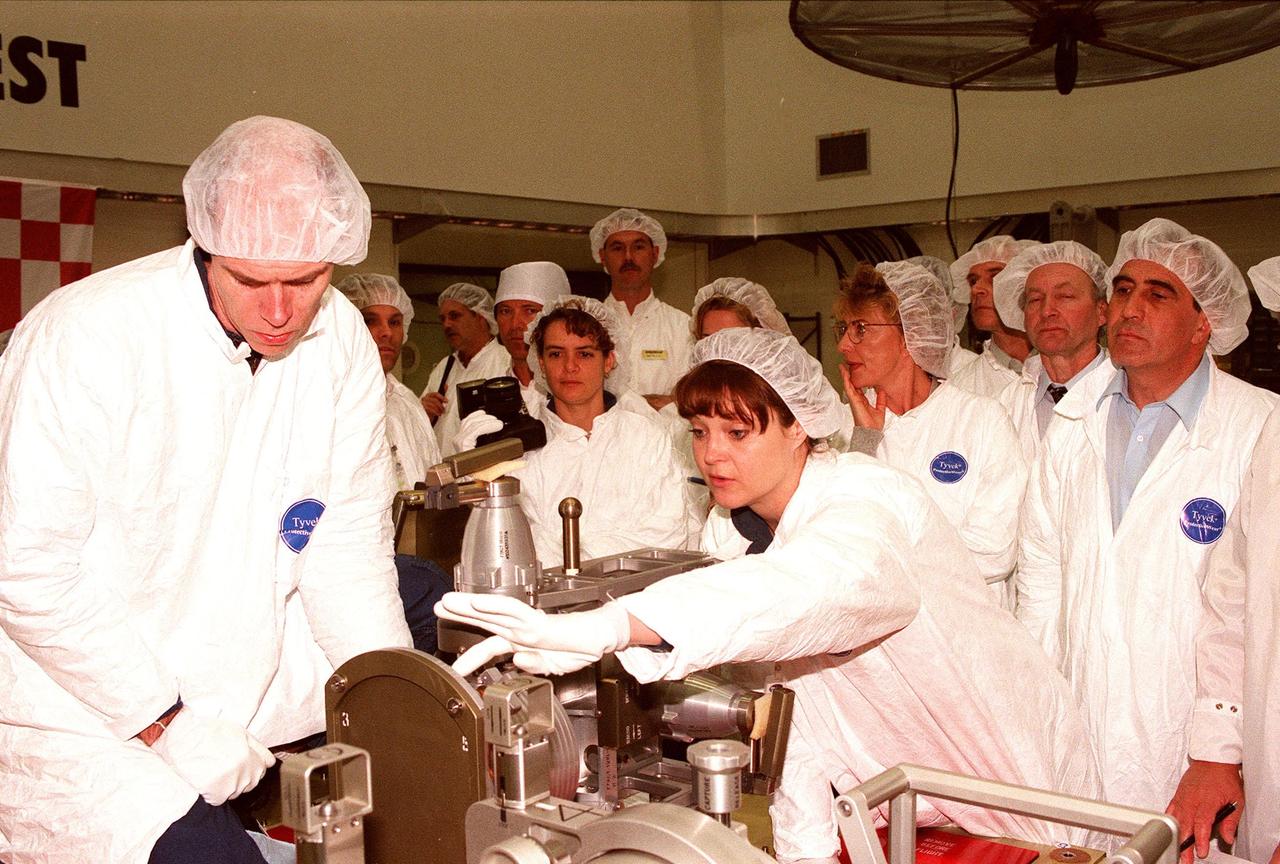
At Astrotech in Titusville, Fla., STS-96 Mission Speciaists Daniel T. Barry (left), Julie Payette (center, with camera), and Tamara E. Jernigan (right, pointing) get a close look at one of the payloads on their upcoming mission. Other crew members are Commander Kent V. Rominger, and Mission Specialists Ellen Ochoa and Valery Ivanovich Tokarev, with the Russian Space Agency. Payette is with the Canadian Space Agency. For the first time, STS-96 will include an Integrated Cargo Carrier (ICC) that will carry a Russian cargo crane, the Strela, to be mounted to the exterior of the Russian station segment on the International Space Station (ISS); the SPACEHAB Oceaneering Space System Box (SHOSS), which is a logistics items carrier; and a U.S.-built crane (ORU Transfer Device, or OTD) that will be stowed on the station for use during future ISS assembly missions. The ICC can carry up to 6,000 lb of unpressurized payload. It was built for SPACEHAB by DaimlerChrysler and RSC Energia of Korolev, Russia. STS-96 is targeted for launch on May 24 from Launch Pad 39B. STS-101 is scheduled to launch in early December 1999
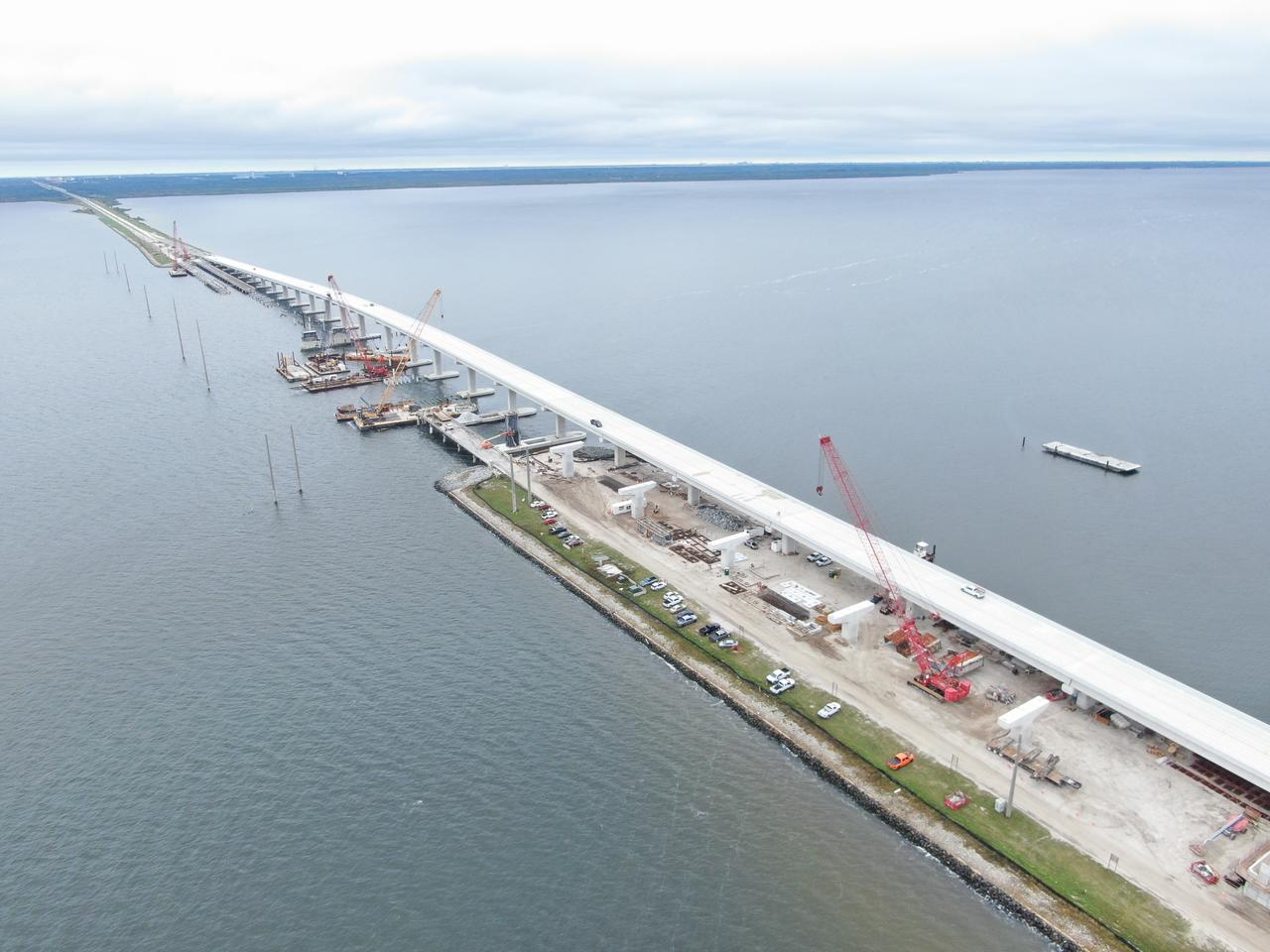
In this aerial view, crews with Orion Marine Construction work to complete the westbound span of the Indian River Bridge while daily traffic moves along the upgraded eastbound lanes of the bridge leading to NASA’s Kennedy Space Center in Florida on Monday, Nov. 27, 2023. The bridge crosses the Indian River Lagoon and connects Kennedy and the Cape Canaveral Space Force Station to the mainland via State Road 405/NASA Causeway in nearby Titusville. The new high-rise bridge serves as the primary entrance and exit to the space center for employees and visitors. The new bridge spans replace a pair of two-lane drawbridges built in the mid-1960s to support NASA’s Apollo program. The first of the two new spans opened to the public ahead of schedule on June 9, 2023. In development for well over a decade, the load capacity, width, and grade of the bridge were designed to support the largest future payloads and vehicles at the spaceport while simultaneously supporting increased public traffic to and from Kennedy.
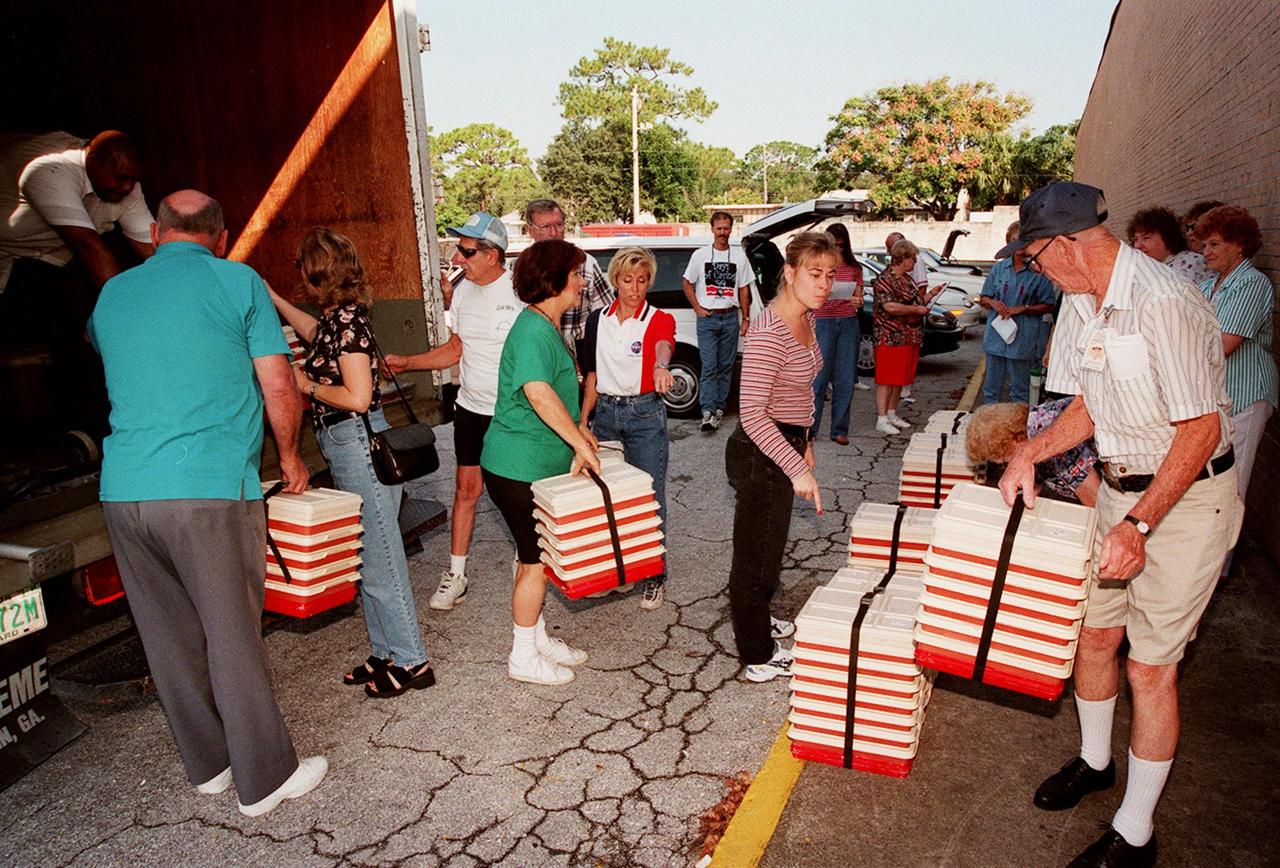
KSC volunteers at Miracle City Mall, Titusville, help unload containers for Meals on Wheels delivery as part of their '99 Days of Caring participation. The volunteers will also help deliver the meals. Coordinated by the KSC Community Relations Council, Days of Caring provides an opportunity for employees to volunteer their services in projects such as painting, planting flowers, reading to school children, and more. Organizations accepting volunteers include The Embers, Yellow Umbrella, Serene Harbor, Domestic Violence Program, the YMCA of Brevard County, and others
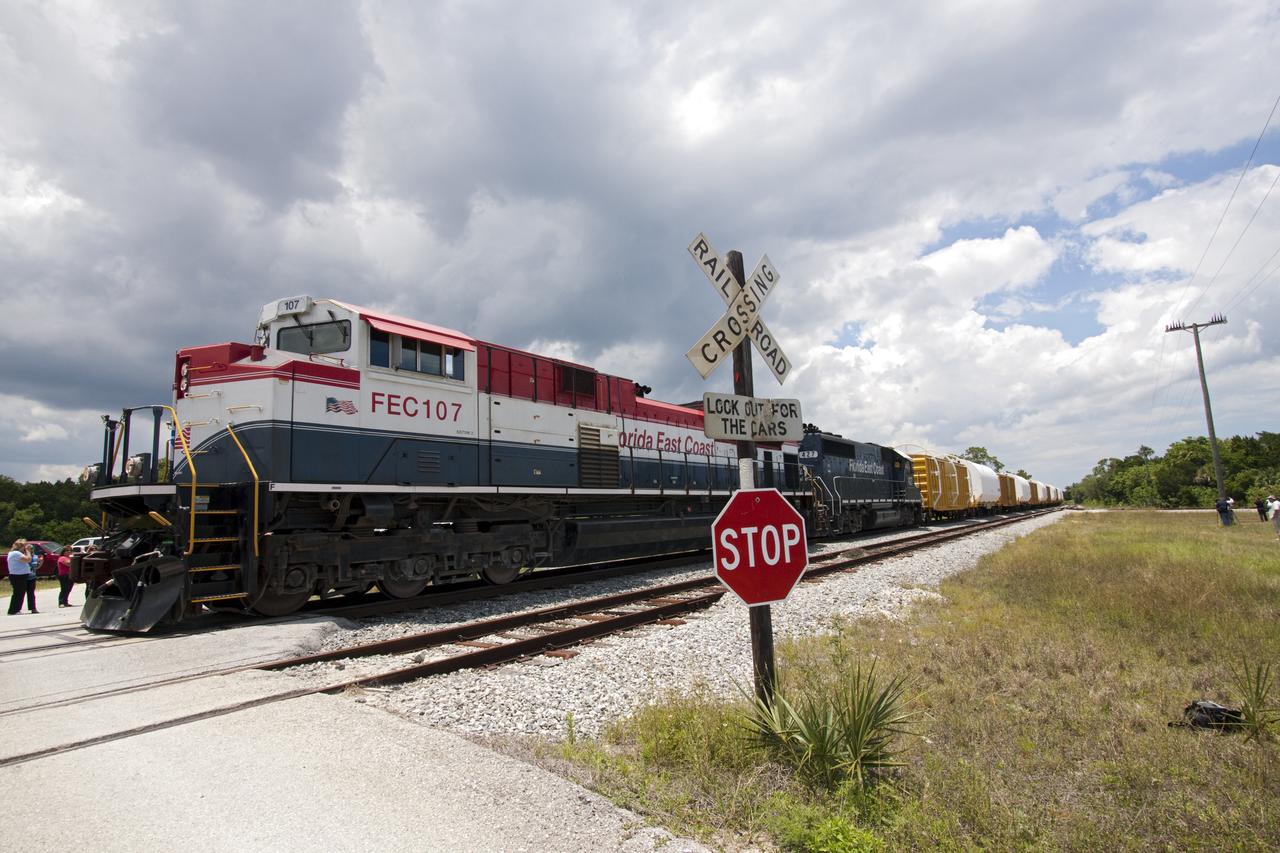
STS-335 LAUNCH ON NEED - SRB DELIVERY AT JJ YARD
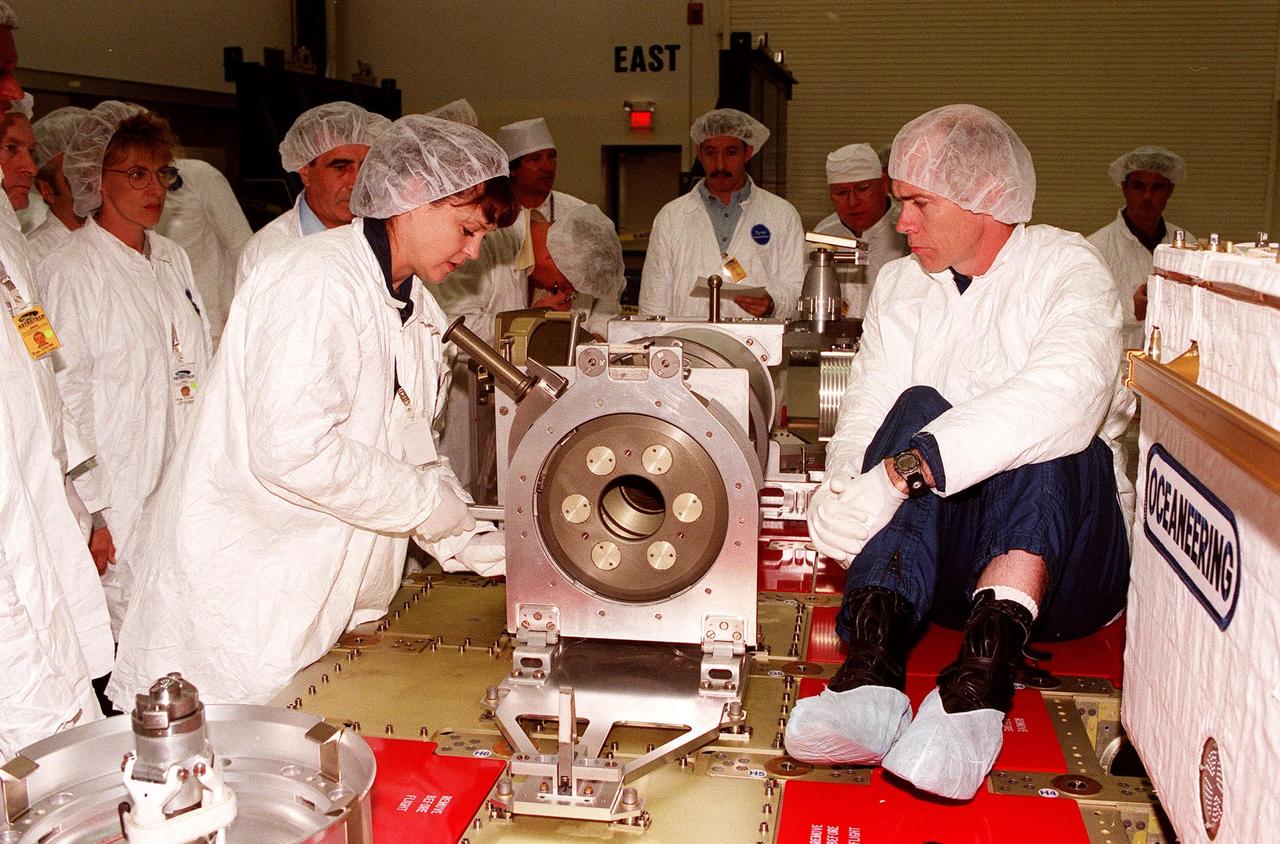
At Astrotech in Titusville, Fla., STS-96 Mission Specialists Tamara E. Jernigan and Daniel T. Barry take turns working with a Russian cargo crane, the Strela, which is to be mounted to the exterior of the Russian station segment on the International Space Station (ISS). Technicians around the table observe. The STS-96 crew is taking part in a Crew Equipment Interface Test. Other members participating are Commander Kent V. Rominger, Pilot Rick Douglas Husband, and Mission Specialists Julie Payette, with the Canadian Space Agency, and Valery Ivanovich Tokarev, with the Russian Space Agency. For the first time, STS-96 will include an Integrated Cargo Carrier (ICC) that will carry the Russian cargo crane; the SPACEHAB Oceaneering Space System Box (SHOSS), which is a logistics items carrier; and a U.S.-built crane (ORU Transfer Device, or OTD) that will be stowed on the station for use during future ISS assembly missions. The ICC can carry up to 6,000 lb of unpressurized payload. It was built for SPACEHAB by DaimlerChrysler Aerospace and RSC Energia of Korolev, Russia. STS-96 is targeted for launch on May 24 from Launch Pad 39B. STS-101 is scheduled to launch in early December 1999
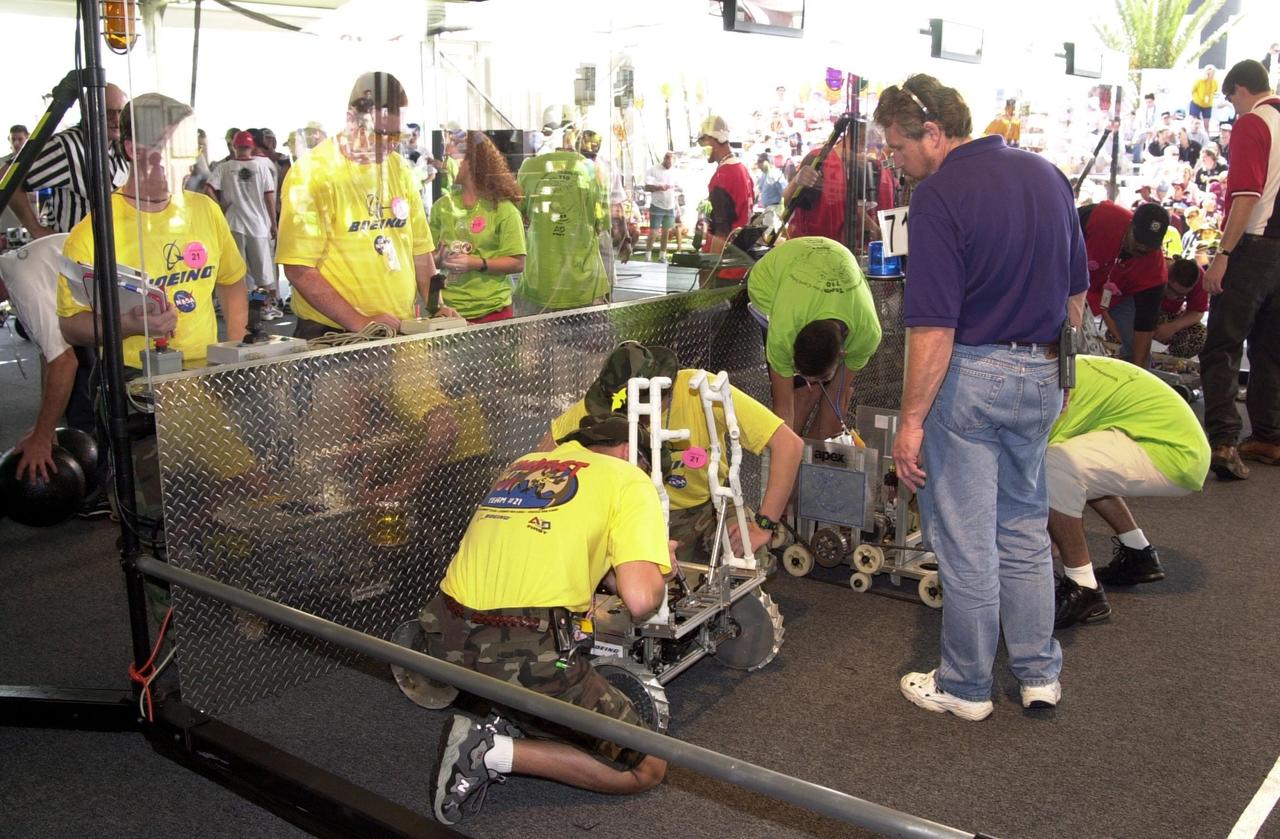
Student teams adjust their robots before competing on the playing field field during the NASA/KSC FIRST Southeastern Regional event held March 1-3, 2001. At left is the ComBBAT 2001 team from Astronaut and Titusville High Schools, Florida. It is a KSC joint-sponsored team. At right is the PC Panthers, no. 710, from Pine Crest School, Fort Lauderdale, Fla. FIRST (For Inspiration and Recognition of Science and Technology) events are held nationwide, pitting robots against each other and the clock on a playing field. Many teams are sponsored by corporations and academic institutions. There are 27 teams throughout the State of Florida who are competing. KSC, which sponsors nine teams, has held the regional event for two years
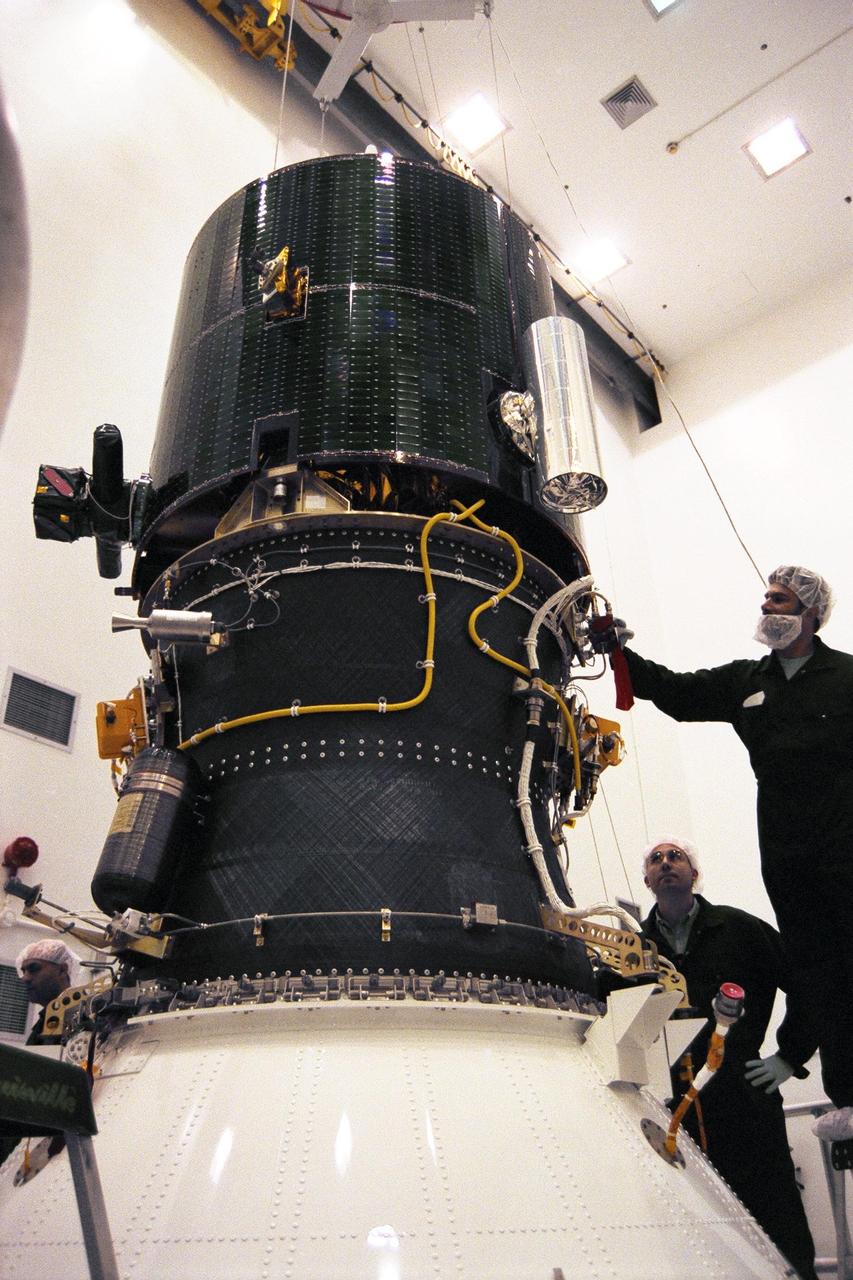
Lockheed Martin Missile Systems integration and test staff join NASA’s Lunar Prospector spacecraft atop the Trans Lunar Injection Module of the spacecraft at Astrotech, a commercial payload processing facility, in Titusville, Fla. The small robotic spacecraft, to be launched on an Athena II launch vehicle by Lockheed Martin, is designed to provide the first global maps of the Moon’s surface compositional elements and its gravitational and magnetic fields. The launch of Lunar Prospector is scheduled for Jan. 5, 1998 at 8:31 p.m
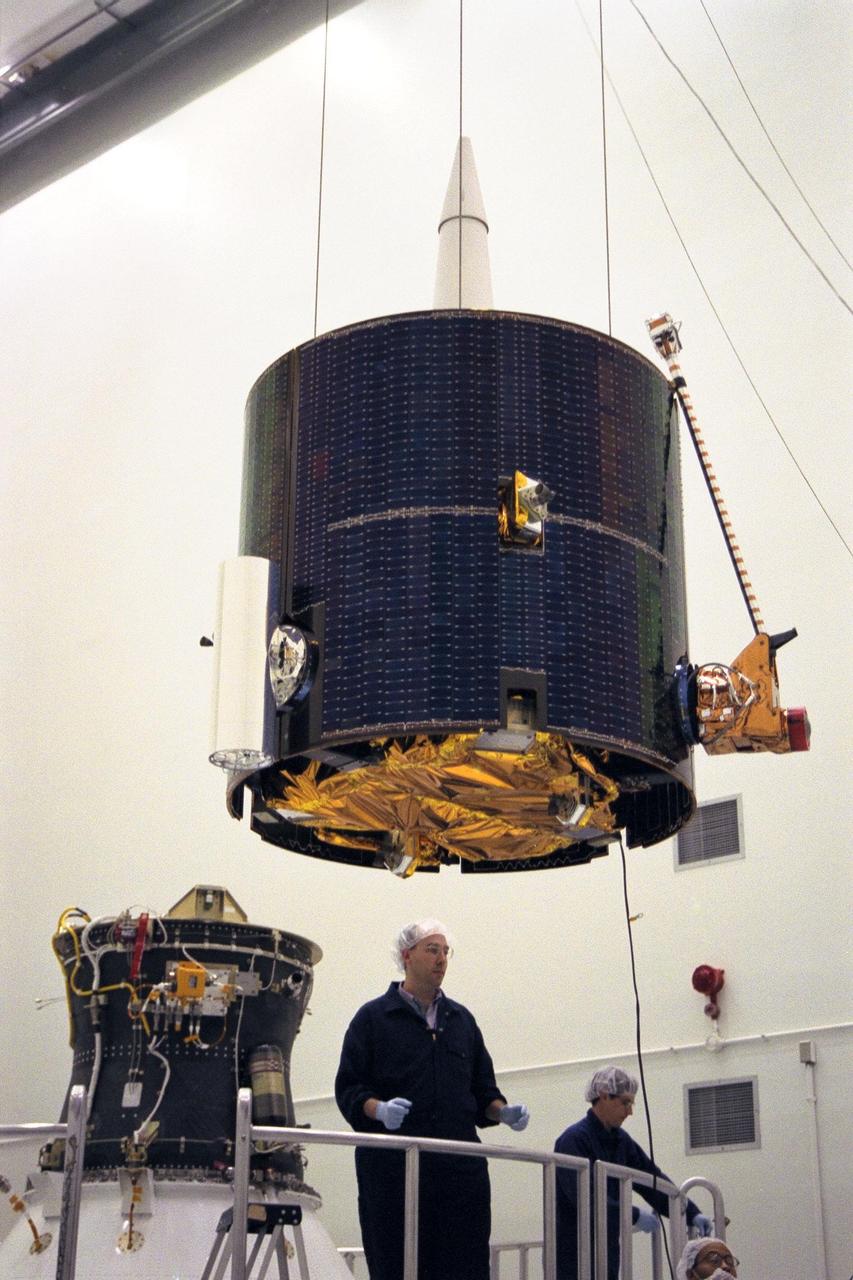
Lockheed Martin Missile Systems integration and test staff prepare NASA’s Lunar Prospector spacecraft for mating to the Trans Lunar Injection Module of the spacecraft at Astrotech, a commercial payload processing facility, in Titusville, Fla. The small robotic spacecraft, to be launched for NASA on an Athena II launch vehicle by Lockheed Martin, is designed to provide the first global maps of the Moon’s surface compositional elements and its gravitational and magnetic fields. The launch of Lunar Prospector is scheduled for Jan. 5, 1998 at 8:31 p.m
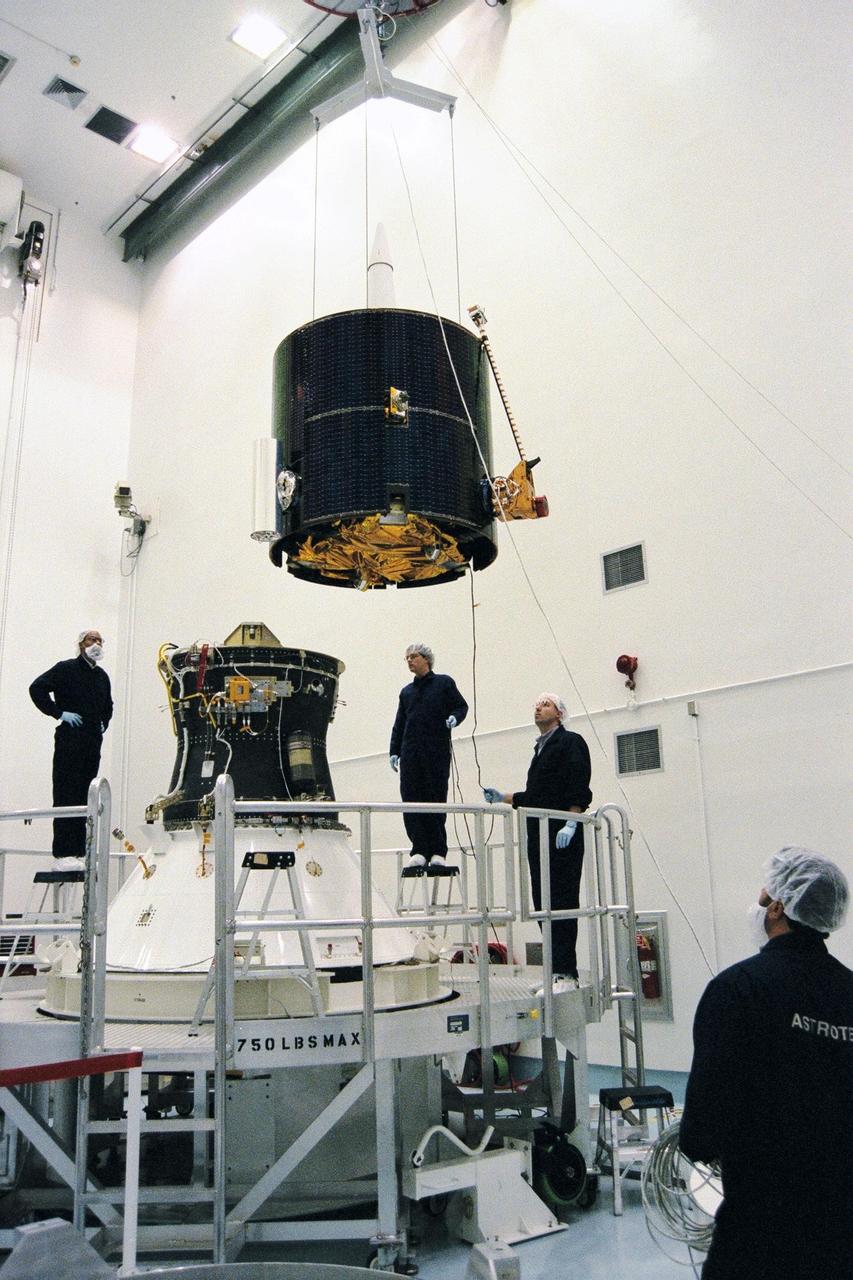
Lockheed Martin Missile Systems integration and test staff move NASA’s Lunar Prospector spacecraft over the Trans Lunar Injection Module of the spacecraft at Astrotech, a commercial payload processing facility, in Titusville, Fla. The small robotic spacecraft, to be launched on an Athena II launch vehicle by Lockheed Martin, is designed to provide the first global maps of the Moon’s surface compositional elements and its gravitational and magnetic fields. The launch of Lunar Prospector is scheduled for Jan. 5, 1998 at 8:31 p.m
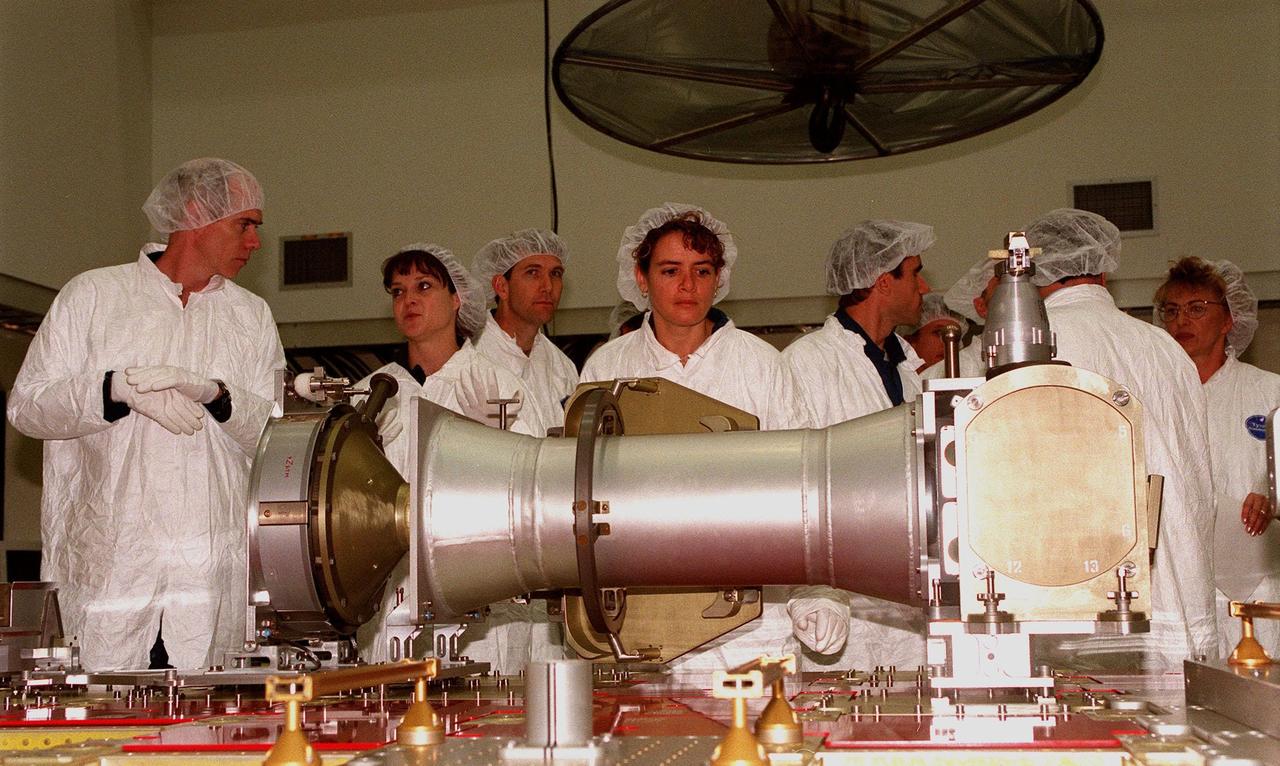
At Astrotech in Titusville, Fla., members of two Shuttle crews take a close look at components of a Russian cargo crane, the Strela, to be mounted to the exterior of the Russian station segment on the International Space Station (ISS). From left are STS-96 Mission Specialists Daniel T. Barry and Tamara E. Jernigan, Pilot Rick Douglas Husband, and Mission Specialist Julie Payette; next to them is STS-101 Mission Specialist Yuri Ivanovich Malenchenko, with the Russian Space Agency. Both missions include the SPACEHAB Double Module, carrying internal and resupply cargo for Station outfitting. For the first time, STS-96 will include an Integrated Cargo Carrier (ICC) that will carry the Strela; the SPACEHAB Oceaneering Space System Box (SHOSS), which is a logistics items carrier; and a U.S.-built crane (ORU Transfer Device, or OTD) that will be stowed on the station for use during future ISS assembly missions. The ICC can carry up to 6,000 lb of unpressurized payload. It was built for SPACEHAB by DaimlerChrysler and RSC Energia of Korolev, Russia. STS-96 is targeted for launch on May 24 from Launch Pad 39B. STS-101 is scheduled to launch in early December 1999
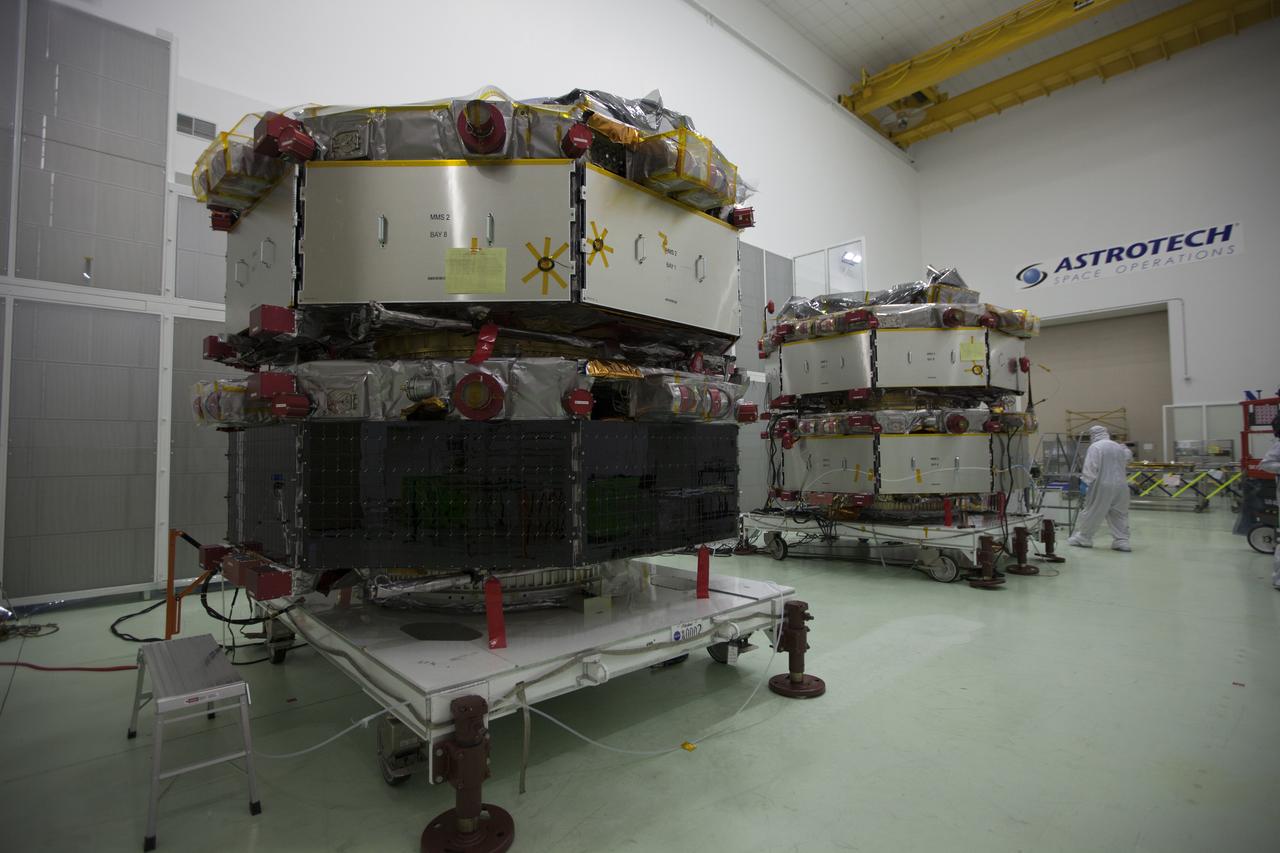
The solar arrays on the Magnetospheric Multiscale, or MMS, observatories are uncovered for an inspection in the Building 1 D high bay of the Astrotech payload processing facility in Titusville, Florida, near Kennedy Space Center. The two MMS spacecraft comprising the upper deck arrived Nov. 12; the two comprising the lower stack arrived Oct. 29. MMS, led by a team from NASA's Goddard Space Flight Center, is a Solar Terrestrial Probes mission consisting of four identically instrumented spacecraft that will use Earth’s magnetosphere as a laboratory to study the microphysics of three fundamental plasma processes: magnetic reconnection, energetic particle acceleration and turbulence. Launch aboard a United Launch Alliance Atlas V rocket from Space Launch Complex 41 on Cape Canaveral Air Force Station is targeted for March 12, 2015.
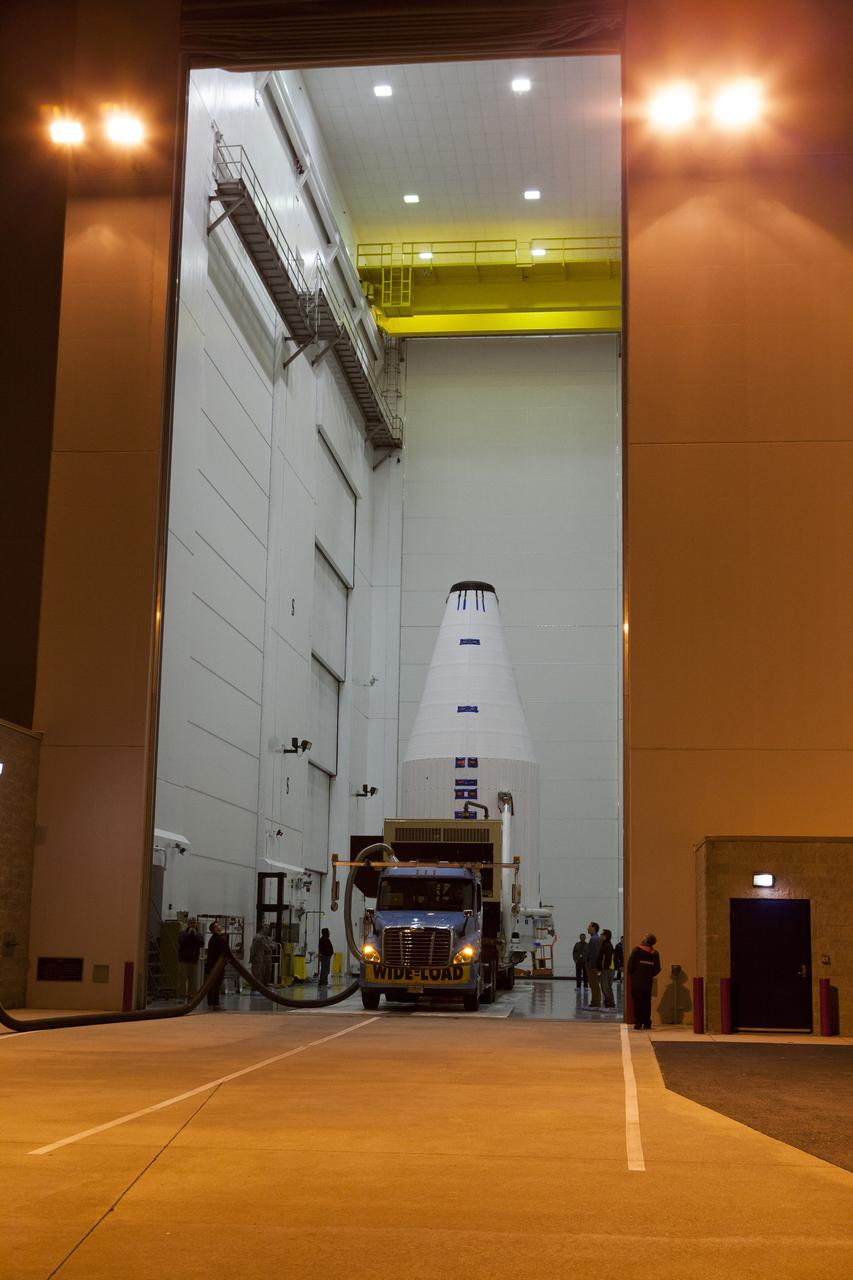
TITUSVILLE, Fla. – Encapsulated in its payload fairing, NASA's Tracking and Data Relay Satellite, or TDRS-L, spacecraft has been mounted on a transporter for its trip from the Astrotech payload processing facility in Titusville to Launch Complex 41 at Cape Canaveral Air Force Station. The TDRS-L satellite will be a part of the second of three next-generation spacecraft designed to ensure vital operational continuity for the NASA Space Network. It is scheduled to launch from Cape Canaveral's Space Launch Complex 41 atop a United Launch Alliance Atlas V rocket on January 23, 2014. The current Tracking and Data Relay Satellite system consists of eight in-orbit satellites distributed to provide near continuous information relay contact with orbiting spacecraft ranging from the International Space Station and Hubble Space Telescope to the array of scientific observatories. For more information, visit: http://www.nasa.gov/mission_pages/tdrs/home/index.html Photo credit: NASA/Dimitri Gerondidakis
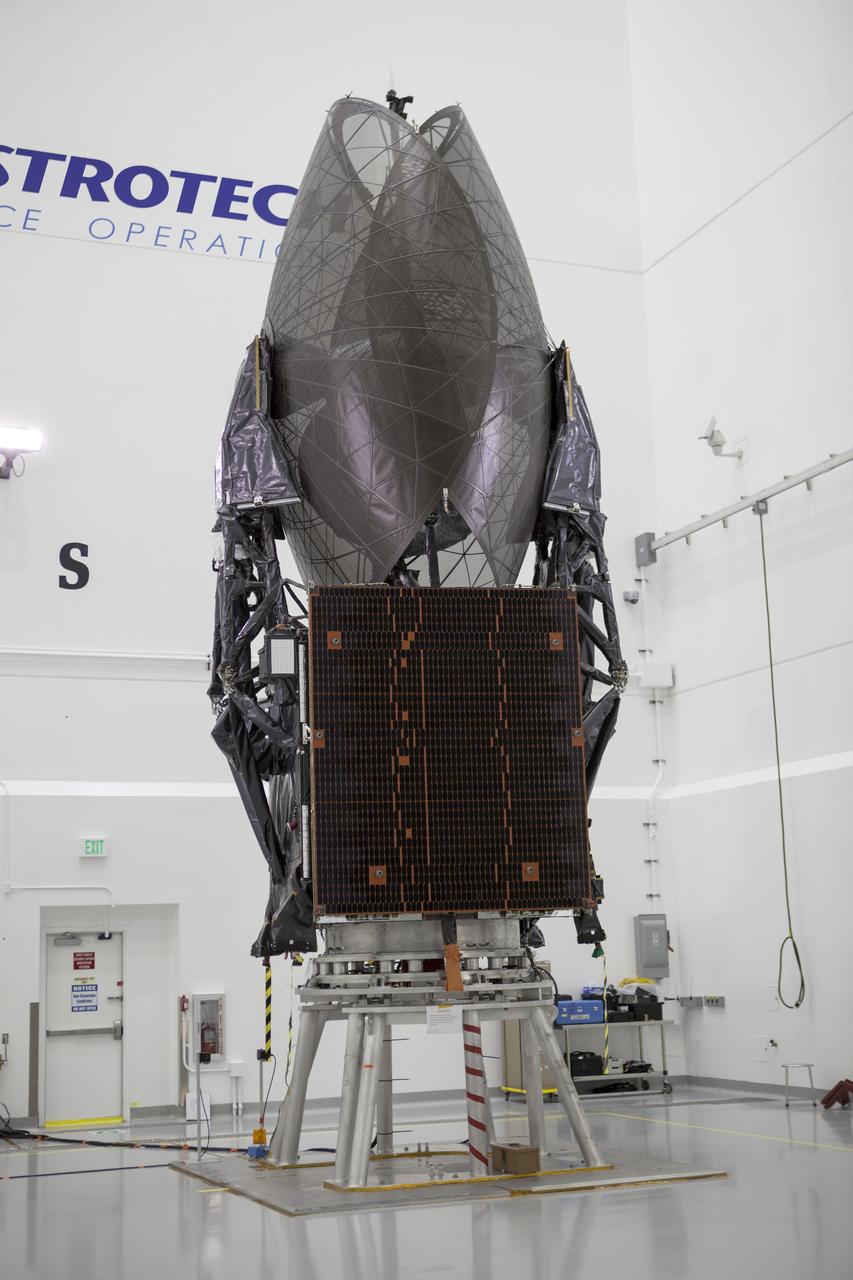
TITUSVILLE, Fla. – Members of the news media are given an opportunity for an up-close look at the Tracking and Data Relay Satellite, or TDRS-L, spacecraft undergoing preflight processing inside the Astrotech payload processing facility in Titusville. TDRS-L is being prepared for encapsulation inside its payload fairing prior to being transported to Launch Complex 41 at Cape Canaveral Air Force Station. Journalists visited Astrotech as part of TDRS-L Media Day to conduct interviews and photograph the satellite that will be a part of the second of three next-generation spacecraft designed to ensure vital operational continuity for the NASA Space Network. It is scheduled to launch from Cape Canaveral's Space Launch Complex 41 atop an Atlas V rocket in January 2014. The current Tracking and Data Relay Satellite system consists of eight in-orbit satellites distributed to provide near continuous information relay contact with orbiting spacecraft ranging from the International Space Station and Hubble Space Telescope to the array of scientific observatories. For more information, visit: http://www.nasa.gov/mission_pages/tdrs/home/index.html
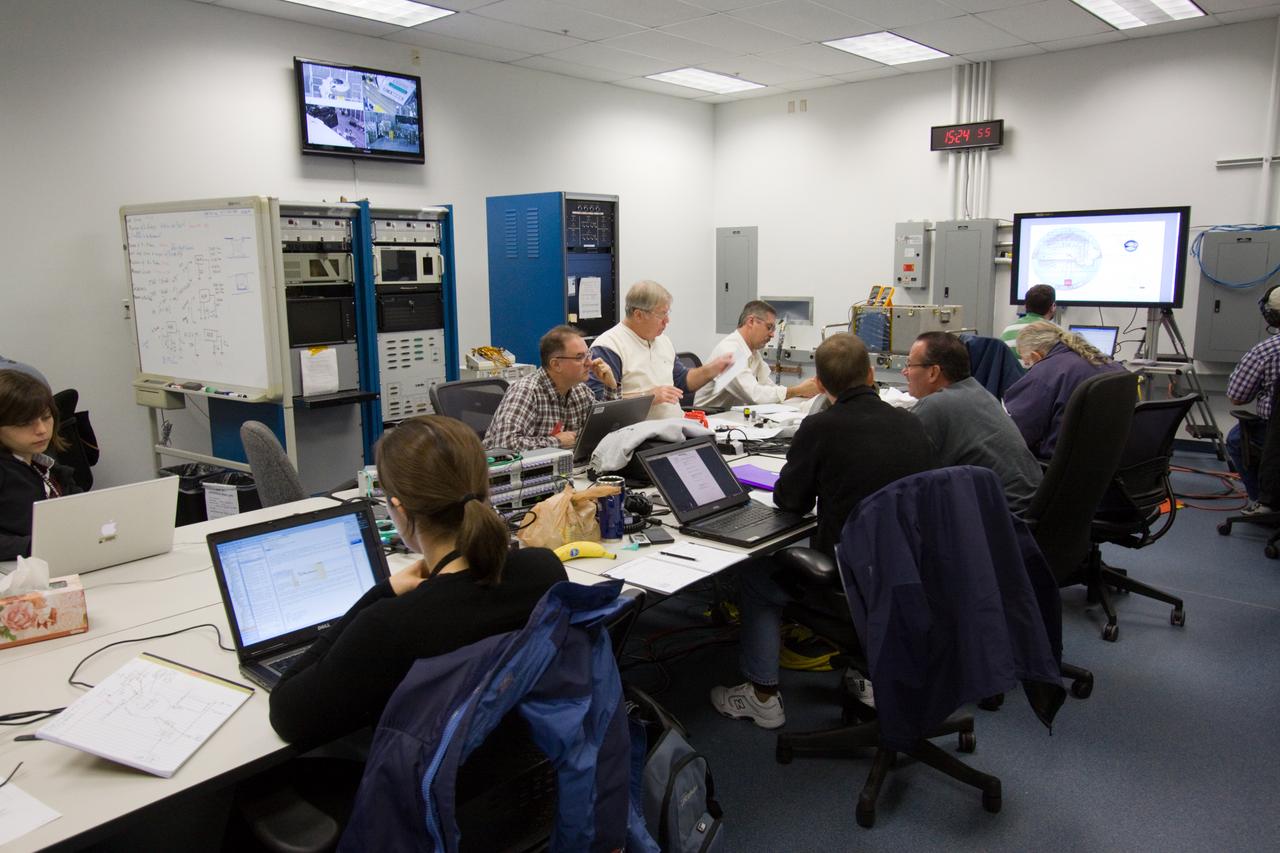
SDO FUELING PREPS FOR SATELLITE W/CREW
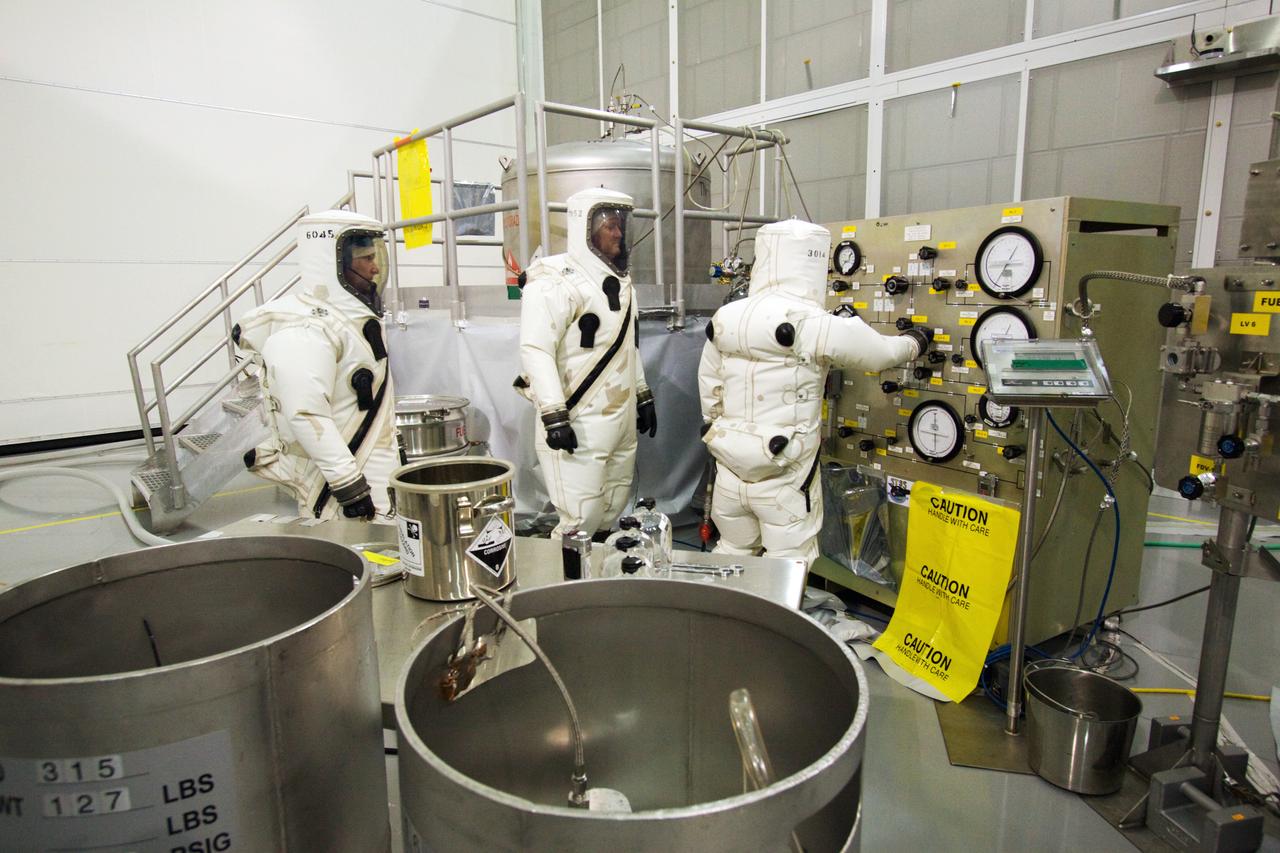
SDO FUELING PREPS FOR SATELLITE W/CREW
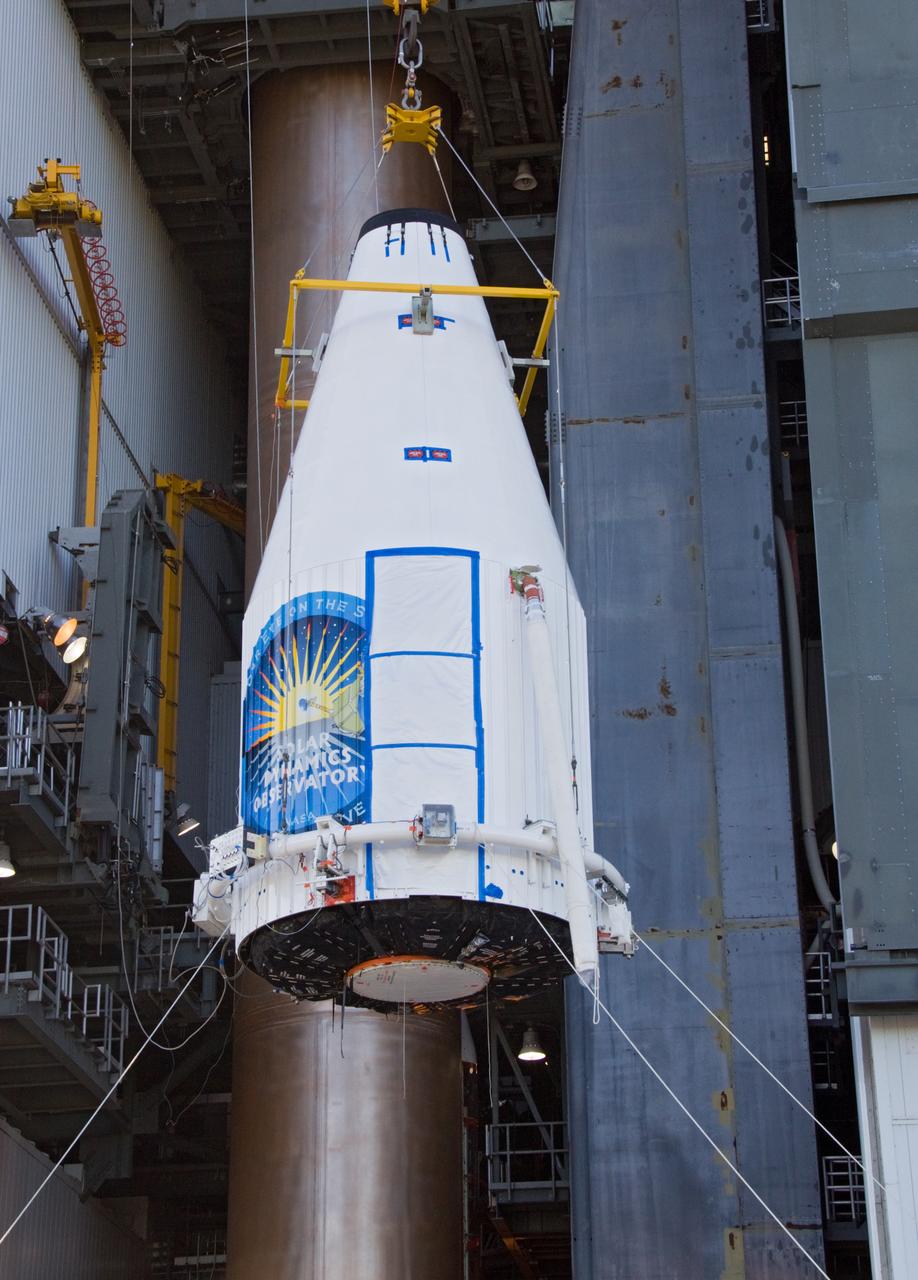
SDO MOVE FROM ASTROTECH TO PAD 41 - LIFT & MATE
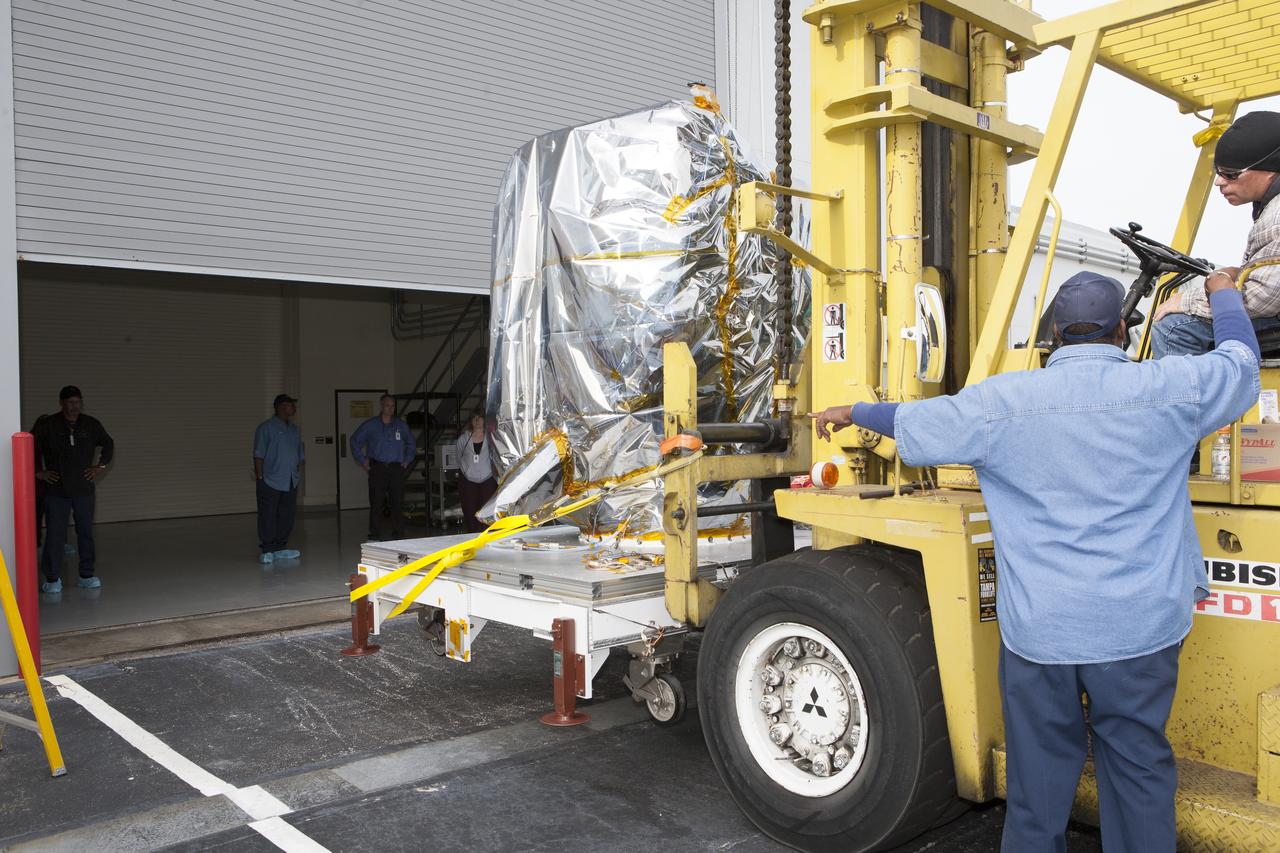
NOAA’s newly arrived Deep Space Climate Observatory spacecraft, or DSCOVR, wrapped in plastic and secured onto a portable work stand, is delivered to the high bay of Building 1 at the Astrotech payload processing facility in Titusville, Florida, near Kennedy Space Center. DSCOVR is a partnership between NOAA, NASA and the U.S. Air Force. DSCOVR will maintain the nation's real-time solar wind monitoring capabilities which are critical to the accuracy and lead time of NOAA's space weather alerts and forecasts. Launch is currently scheduled for January 2015 aboard a SpaceX Falcon 9 v 1.1 launch vehicle from Cape Canaveral Air Force Station, Florida.

In Astrotech's Payload Processing Facility, technicians help secure the Dawn spacecraft onto a moveable stand. Dawn will be moved into clean room C for unbagging and further processing. Dawn's mission is to explore two of the asteroid belt's most intriguing and dissimilar occupants: asteroid Vesta and the dwarf planet Ceres. The Dawn mission is managed by JPL, a division of the California Institute of Technology in Pasadena, for NASA's Science Mission Directorate in Washington, D.C.
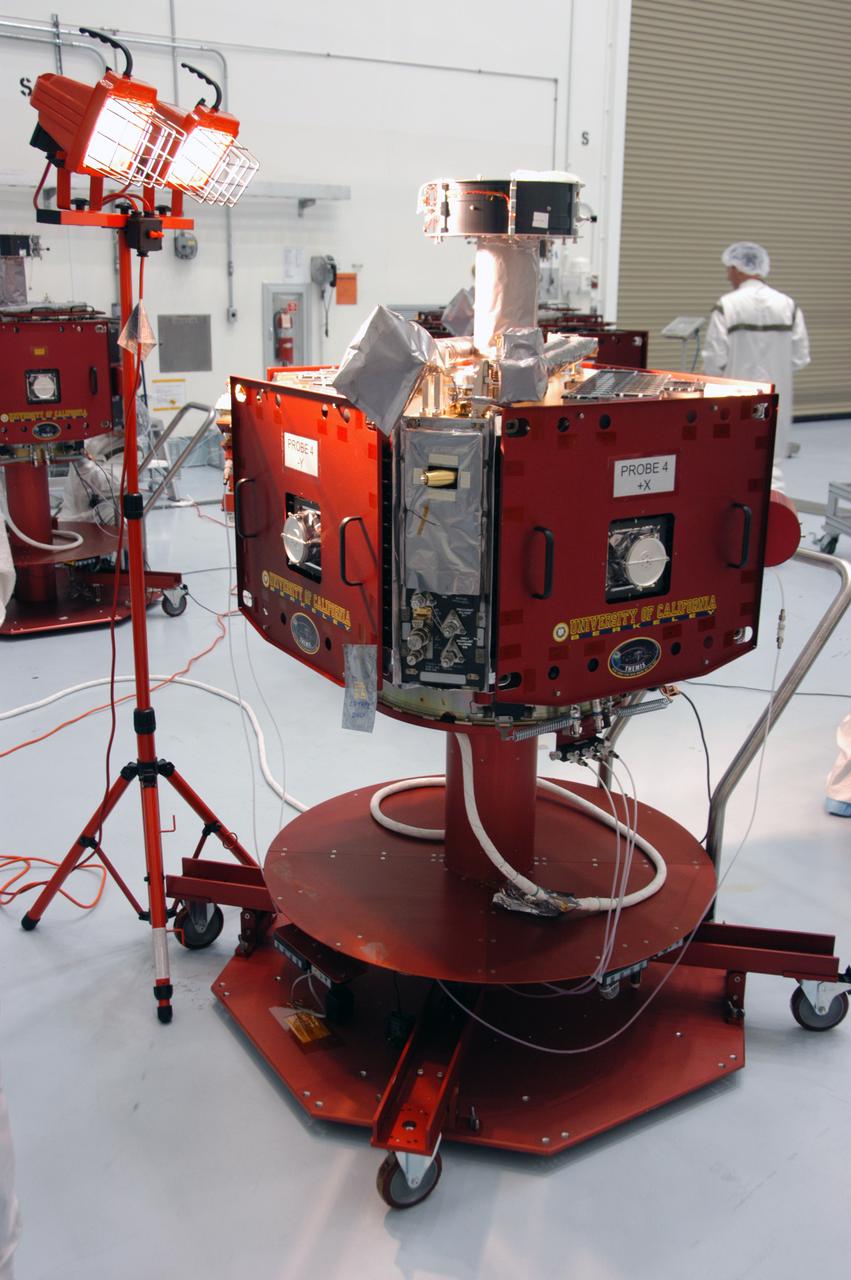
In the Hazardous Processing Facility at Astrotech Space Operations, one of the THEMIS probes undergoes solar array illumination telemetry testing. THEMIS consists of five identical probes, the largest number of scientific satellites ever launched into orbit aboard a single rocket. This unique constellation of satellites will resolve the tantalizing mystery of what causes the spectacular sudden brightening of the aurora borealis and aurora australis - the fiery skies over the Earth's northern and southern polar regions. THEMIS is scheduled to launch aboard the Delta II at 6:07 p.m. EST on Feb. 15.
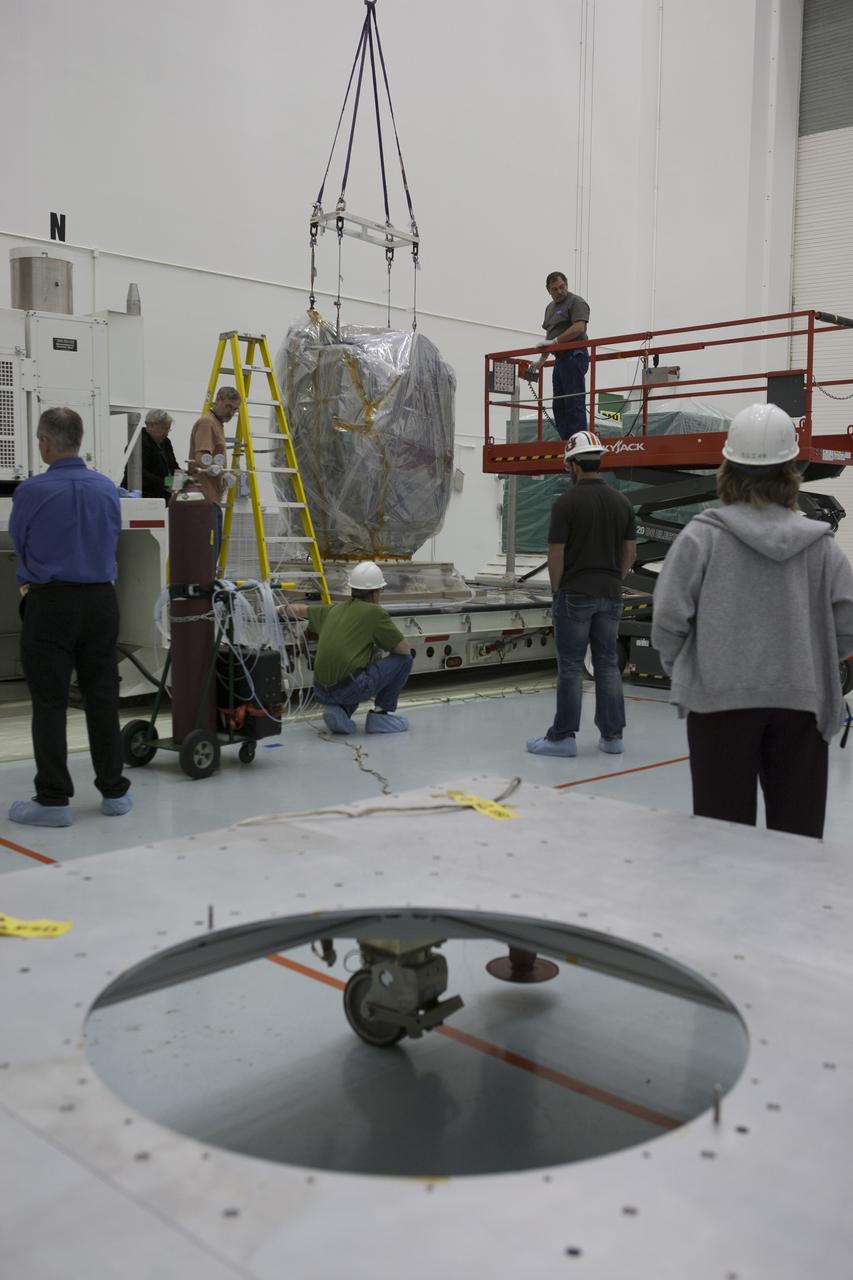
A lifting device is attached to NOAA’s Deep Space Climate Observatory spacecraft, or DSCOVR, wrapped in plastic, to remove it from its transportation pallet at the Astrotech payload processing facility in Titusville, Florida, near Kennedy Space Center. DSCOVR is a partnership between NOAA, NASA and the U.S. Air Force. DSCOVR will maintain the nation's real-time solar wind monitoring capabilities which are critical to the accuracy and lead time of NOAA's space weather alerts and forecasts. Launch is currently scheduled for January 2015 aboard a SpaceX Falcon 9 v 1.1 launch vehicle from Cape Canaveral Air Force Station, Florida.
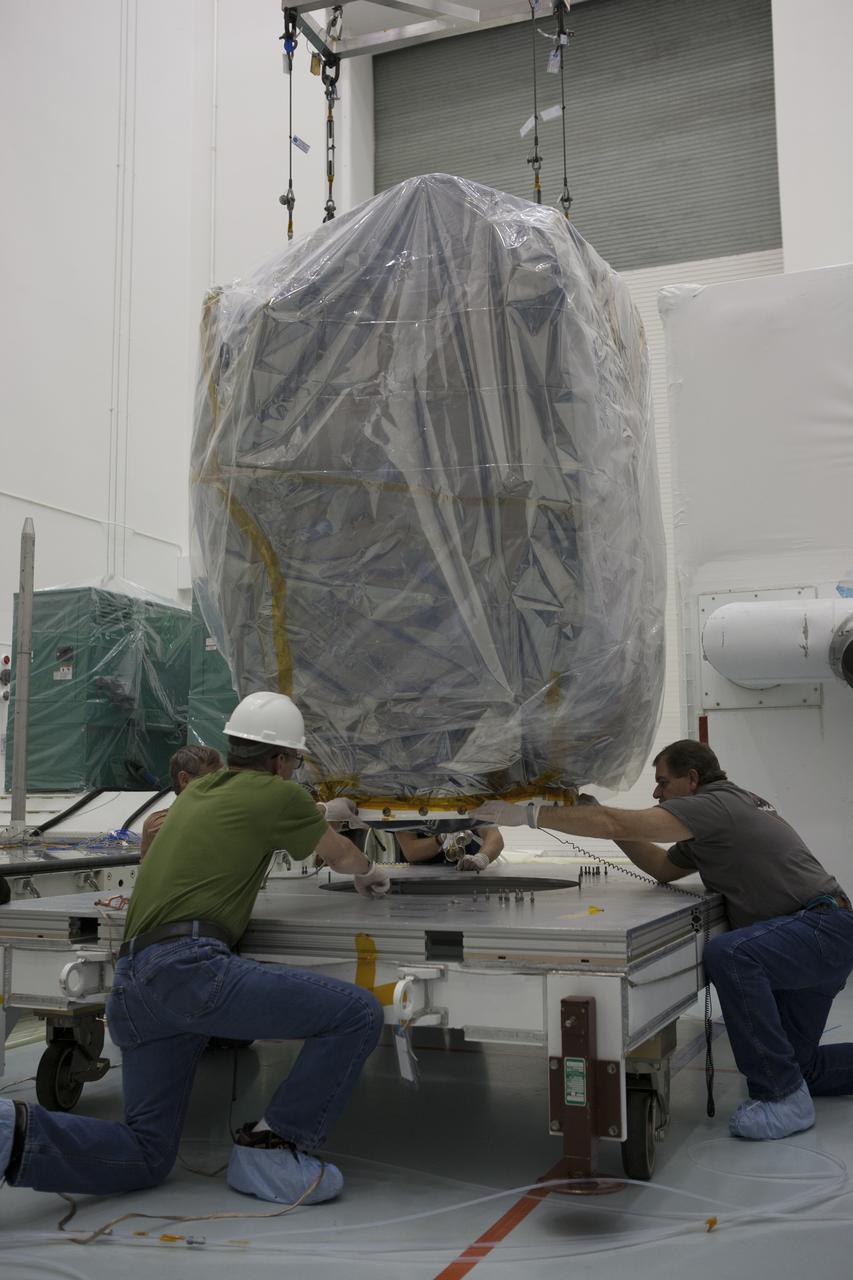
Workers align NOAA’s Deep Space Climate Observatory spacecraft, or DSCOVR, wrapped in plastic, onto a portable work stand at the Astrotech payload processing facility in Titusville, Florida, near Kennedy Space Center. DSCOVR is a partnership between NOAA, NASA and the U.S. Air Force. DSCOVR will maintain the nation's real-time solar wind monitoring capabilities which are critical to the accuracy and lead time of NOAA's space weather alerts and forecasts. Launch is currently scheduled for January 2015 aboard a SpaceX Falcon 9 v 1.1 launch vehicle from Cape Canaveral Air Force Station, Florida.
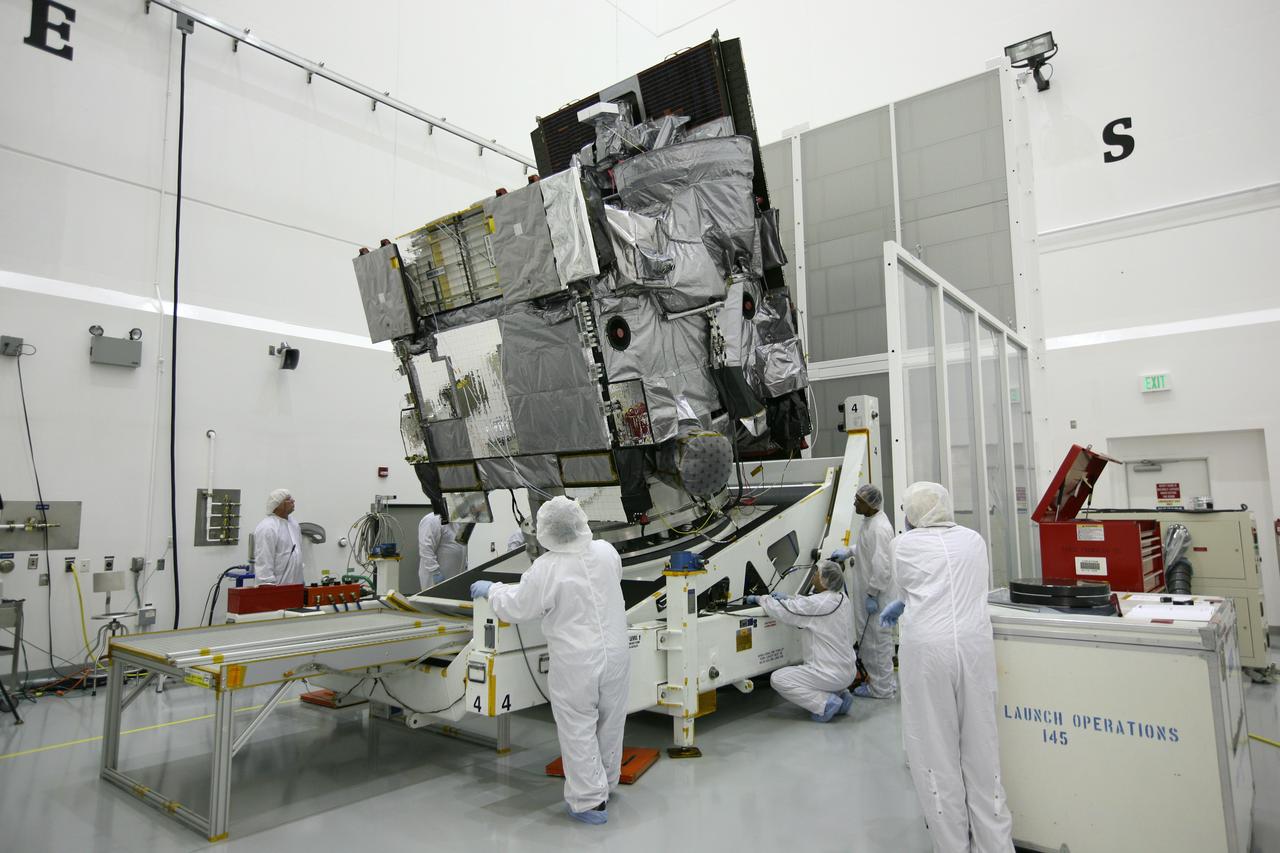
GOES-P UNBAGGING & ROTATION
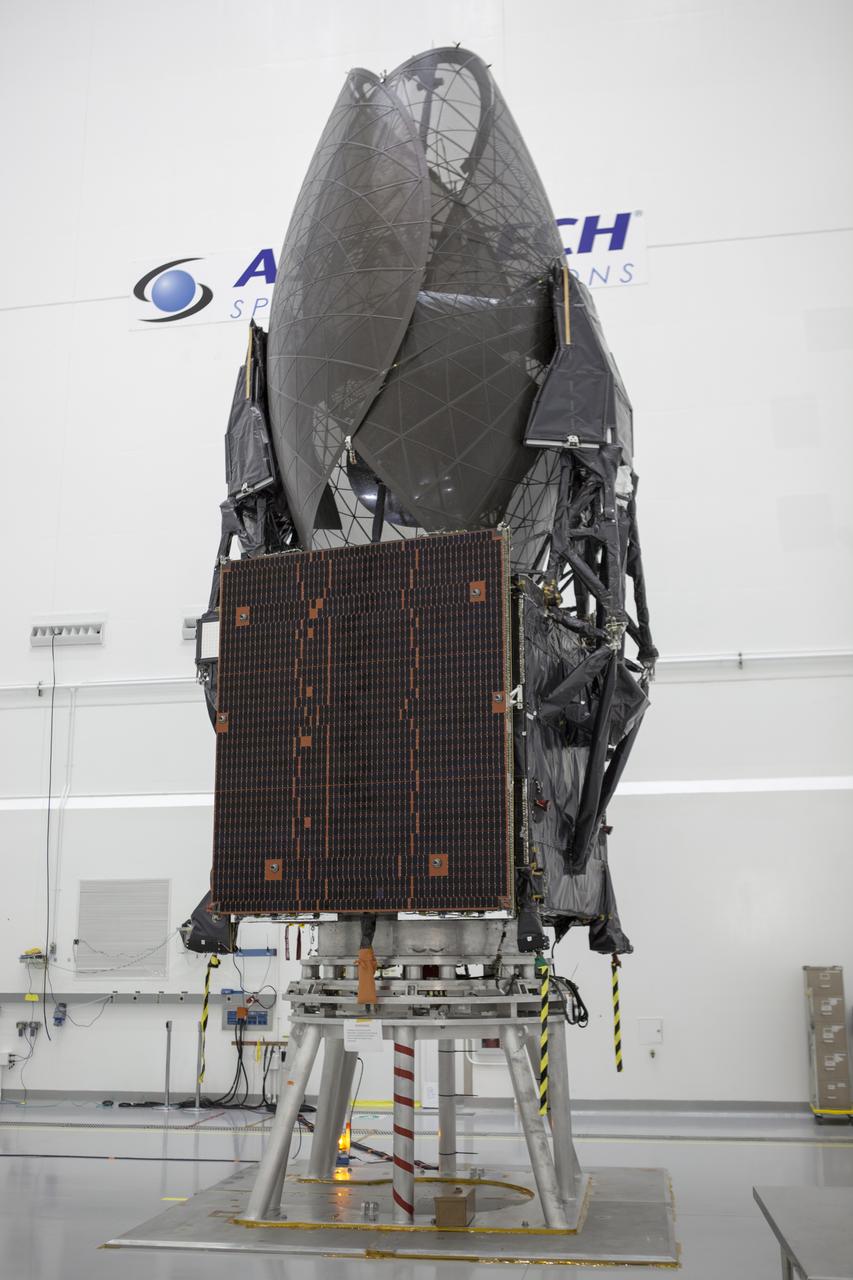
Inside the Astrotech payload processing facility in Titusville, NASA's Tracking and Data Relay Satellite, or TDRS-L, spacecraft is undergoing preflight processing.
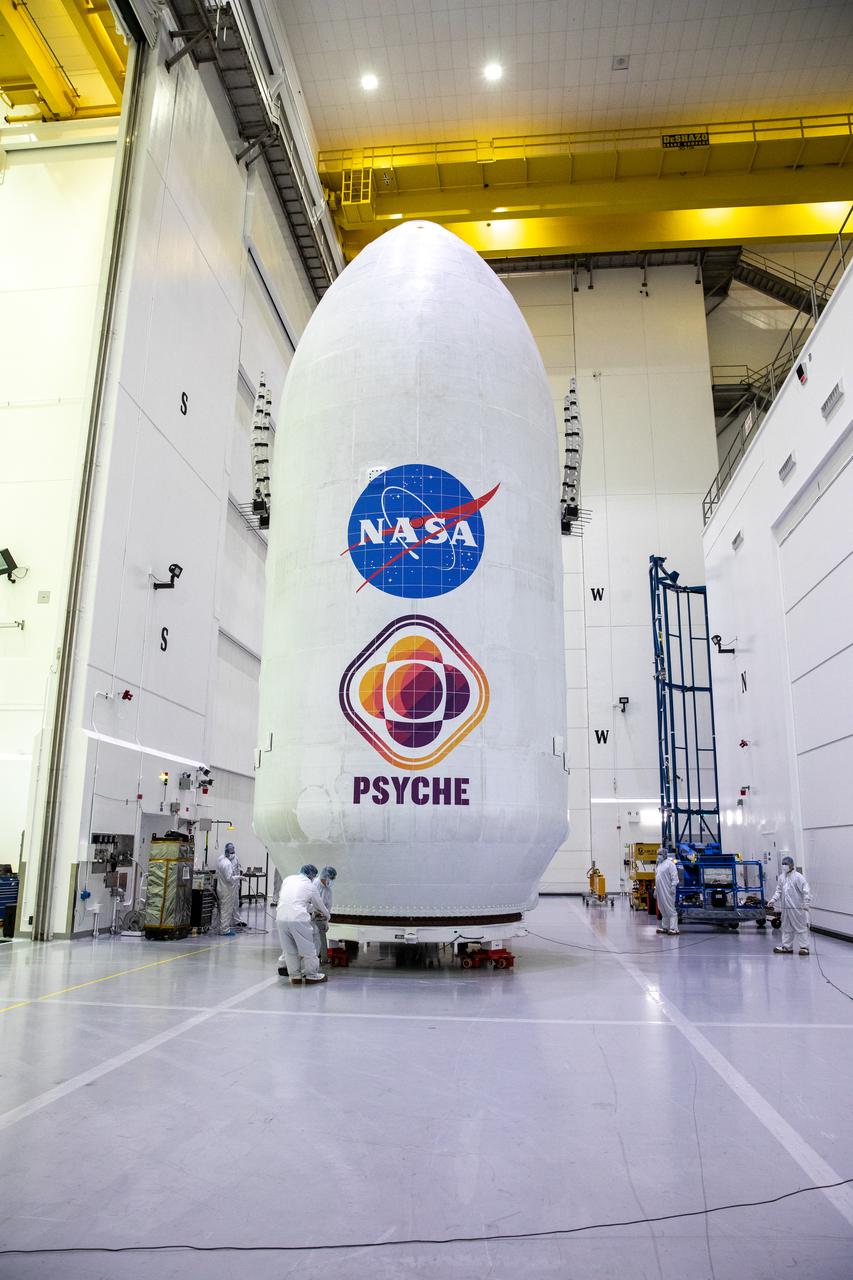
Teams transport NASA's encapsulated Psyche spacecraft from the Astrotech Space Operations Facility in Titusville to Launch Pad 39A at Kennedy Space Center in Florida on Friday, Oct. 6, 2023. Psyche will launch atop a SpaceX Falcon Heavy rocket. Liftoff is targeted for 10:16 a.m. EDT Thursday, Oct. 12. Riding with Psyche is a pioneering technology demonstration, NASA's Deep Space Optical Communications (DSOC) experiment.
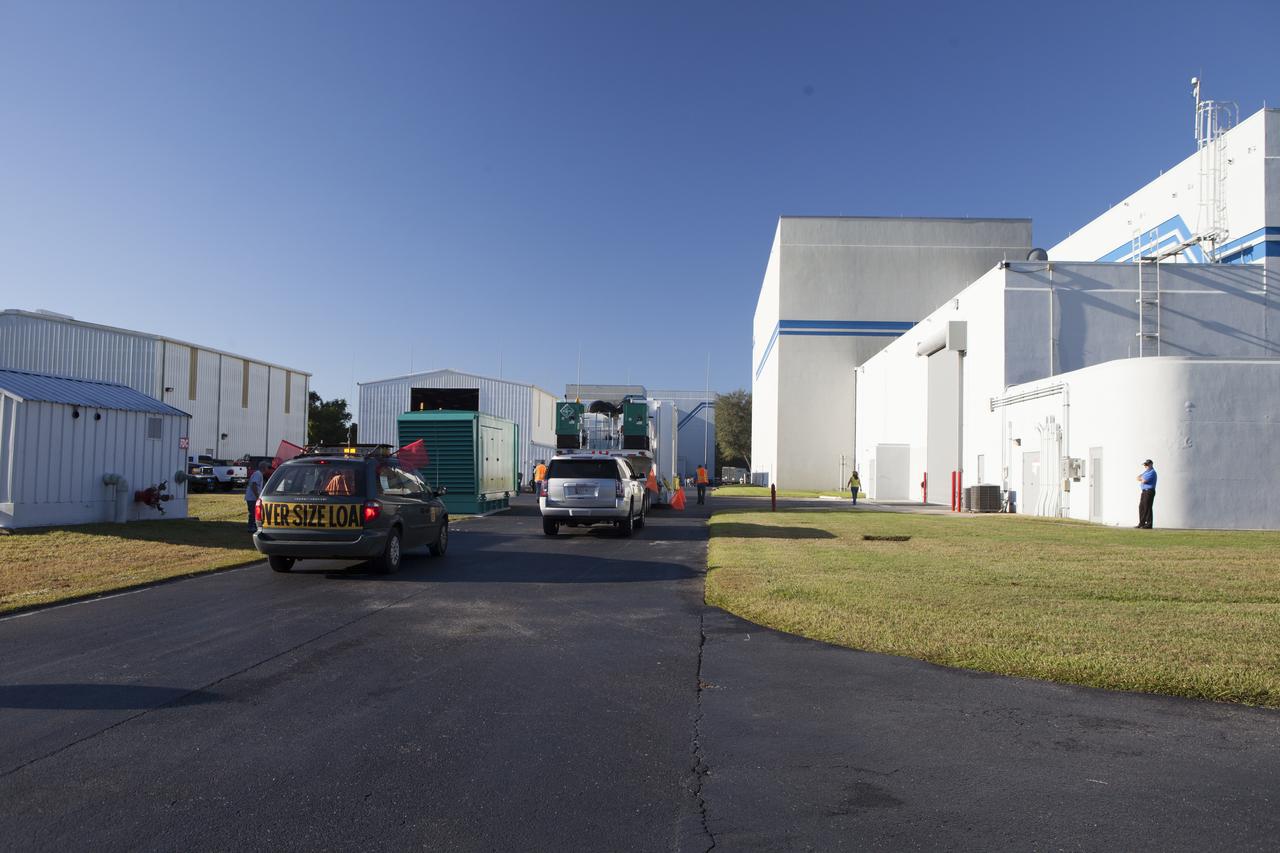
The Magnetospheric Multiscale spacecraft, enclosed in a protective shipping container, arrive at Building 2 of the Astrotech payload processing facility in Titusville, Florida, near Kennedy Space Center. MMS is a Solar Terrestrial Probes mission comprising four identically instrumented spacecraft that will use Earth’s magnetosphere as a laboratory to study the microphysics of three fundamental plasma processes: magnetic reconnection, energetic particle acceleration and turbulence. Launch aboard a United Launch Alliance Atlas V rocket from Space Launch Complex 41 on Cape Canaveral Air Force Station is targeted for March 12, 2015.

TITUSVILLE, Fla. – Members of the news media are given an up-close look at the Tracking and Data Relay Satellite, or TDRS-L, spacecraft undergoing preflight processing inside the Astrotech payload processing facility in Titusville. TDRS-L is being prepared for encapsulation inside its payload fairing prior to being transported to Launch Complex 41 at Cape Canaveral Air Force Station. Journalists visited Astrotech as part of TDRS-L Media Day to conduct interviews and photograph the satellite that will be a part of the second of three next-generation spacecraft designed to ensure vital operational continuity for the NASA Space Network. It is scheduled to launch from Cape Canaveral's Space Launch Complex 41 atop an Atlas V rocket in January 2014. The current Tracking and Data Relay Satellite system consists of eight in-orbit satellites distributed to provide near continuous information relay contact with orbiting spacecraft ranging from the International Space Station and Hubble Space Telescope to the array of scientific observatories. For more information, visit: http://www.nasa.gov/mission_pages/tdrs/home/index.html

TITUSVILLE, Fla. – Under the watchful eyes of engineers and technicians at the Astrotech payload processing facility in Titusville, NASA's Tracking and Data Relay Satellite, or TDRS-L, spacecraft is being encapsulated in its payload fairing. It is being prepared for its trip to Launch Complex 41 at Cape Canaveral Air Force Station. The TDRS-L satellite will be a part of the second of three next-generation spacecraft designed to ensure vital operational continuity for the NASA Space Network. It is scheduled to launch from Cape Canaveral's Space Launch Complex 41 atop a United Launch Alliance Atlas V rocket on January 23, 2014. The current Tracking and Data Relay Satellite system consists of eight in-orbit satellites distributed to provide near continuous information relay contact with orbiting spacecraft ranging from the International Space Station and Hubble Space Telescope to the array of scientific observatories. For more information, visit: http://www.nasa.gov/mission_pages/tdrs/home/index.html Photo credit: NASA/Kim Shiflett
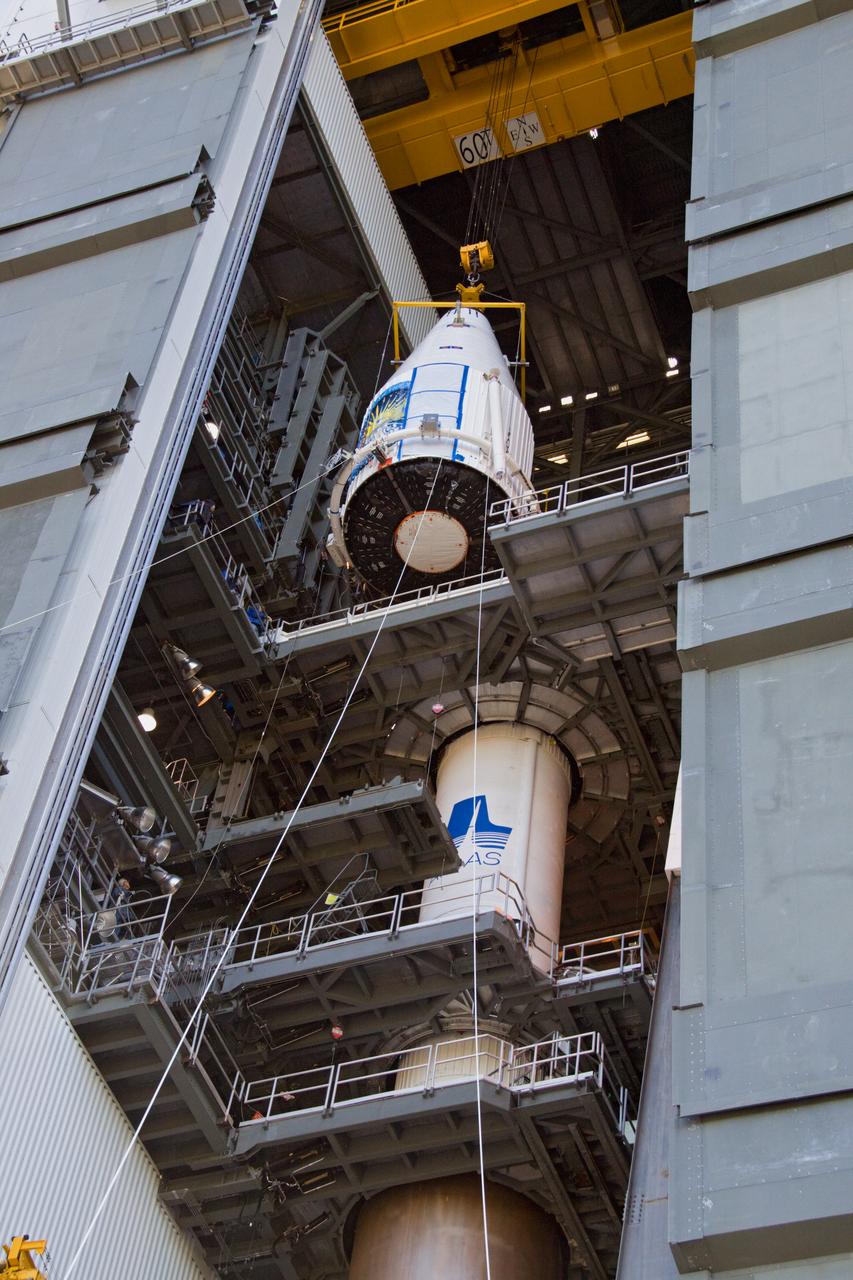
SDO MOVE FROM ASTROTECH TO PAD 41 - LIFT & MATE
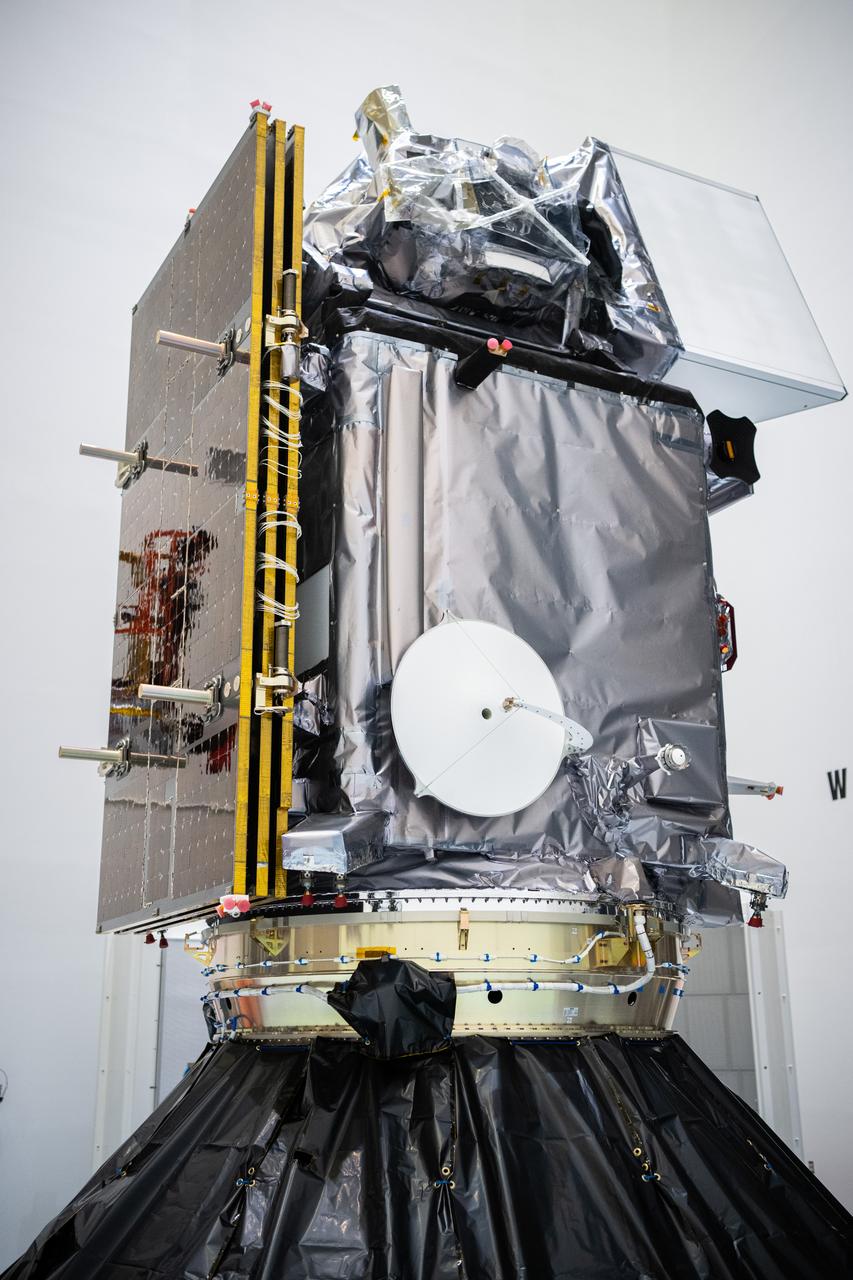
NASA and SpaceX technicians connect NASA’s PACE (Plankton, Aerosol, Cloud, ocean Ecosystem) spacecraft to the payload adapter on Friday, Jan. 26, 2024, at the Astrotech Space Operations Facility near the agency’s Kennedy Space Center in Florida. PACE is NASA’s newest earth-observing satellite that will help increase our understanding of Earth’s oceans, atmosphere, and climate by delivering hyperspectral observations of microscopic marine organisms called phytoplankton as well new data on clouds and aerosols. PACE is set to launch from Space Launch Complex 40 at Cape Canaveral Space Force Station in Florida at 1:33 a.m. EST on Tuesday, Feb. 6.
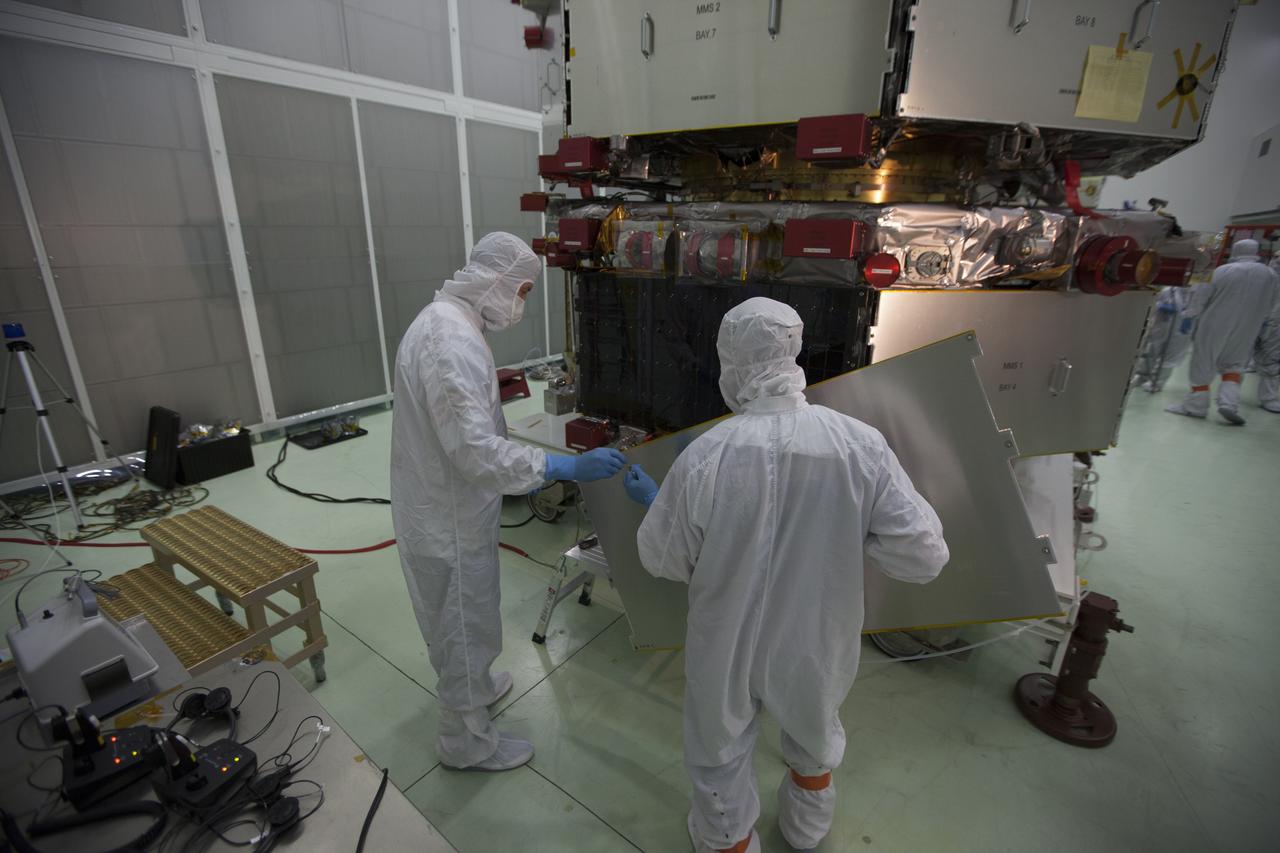
Workers inspect the solar arrays on the Magnetospheric Multiscale, or MMS, observatories in the Building 1 D high bay of the Astrotech payload processing facility in Titusville, Florida, near Kennedy Space Center. The two MMS spacecraft comprising the upper deck arrived Nov. 12; the two comprising the lower stack arrived Oct. 29. MMS, led by a team from NASA's Goddard Space Flight Center, is a Solar Terrestrial Probes mission consisting of four identically instrumented spacecraft that will use Earth’s magnetosphere as a laboratory to study the microphysics of three fundamental plasma processes: magnetic reconnection, energetic particle acceleration and turbulence. Launch aboard a United Launch Alliance Atlas V rocket from Space Launch Complex 41 on Cape Canaveral Air Force Station is targeted for March 12, 2015.

In clean room C of Astrotech's Payload Processing Facility, a worker wears a "bunny suit," or clean-room attire, next to the Dawn spacecraft, which will be unbagged and undergo further processing. Dawn's mission is to explore two of the asteroid belt's most intriguing and dissimilar occupants: asteroid Vesta and the dwarf planet Ceres. The Dawn mission is managed by JPL, a division of the California Institute of Technology in Pasadena, for NASA's Science Mission Directorate in Washington, D.C.

GOES-P MOVE TO FUELING STAND & MEDIA DAY
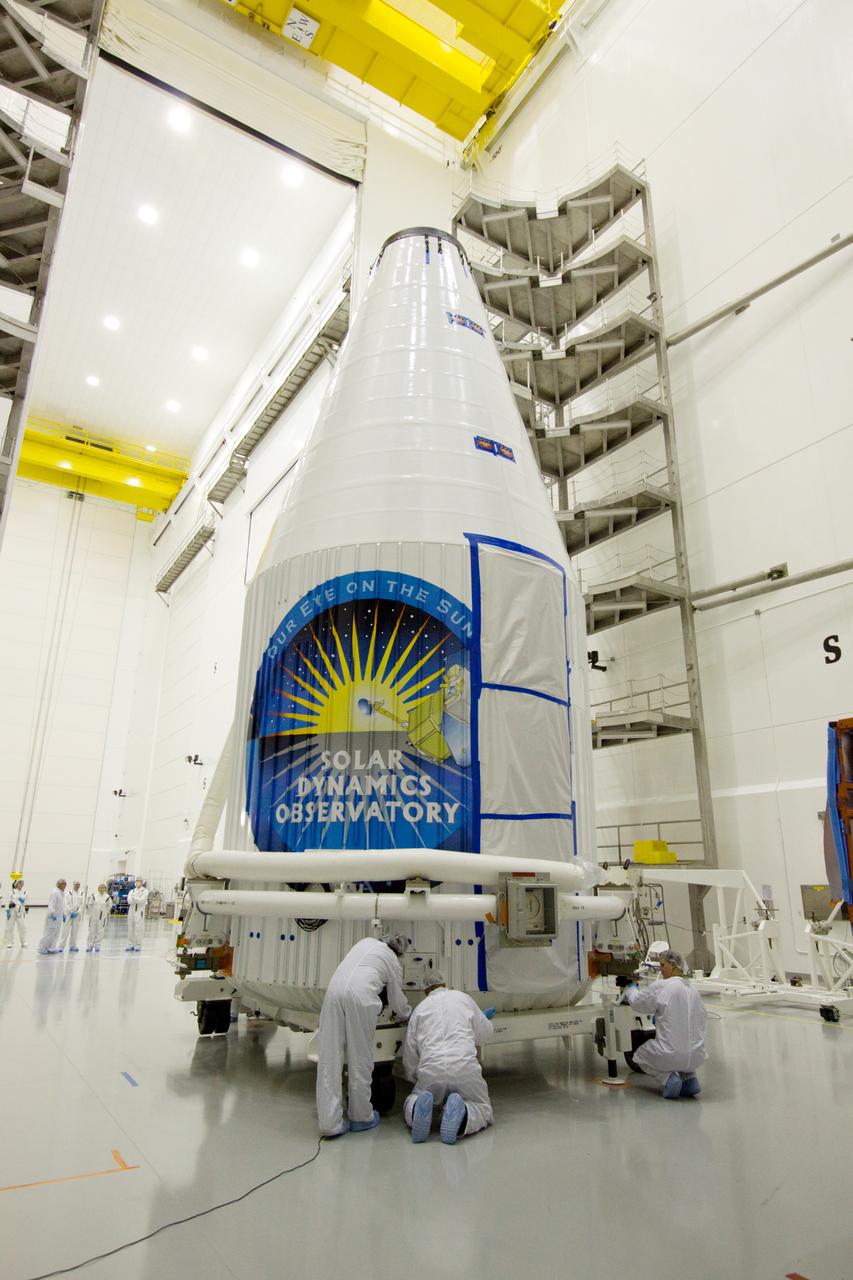
SDO MOVE TO TRANSPORTER
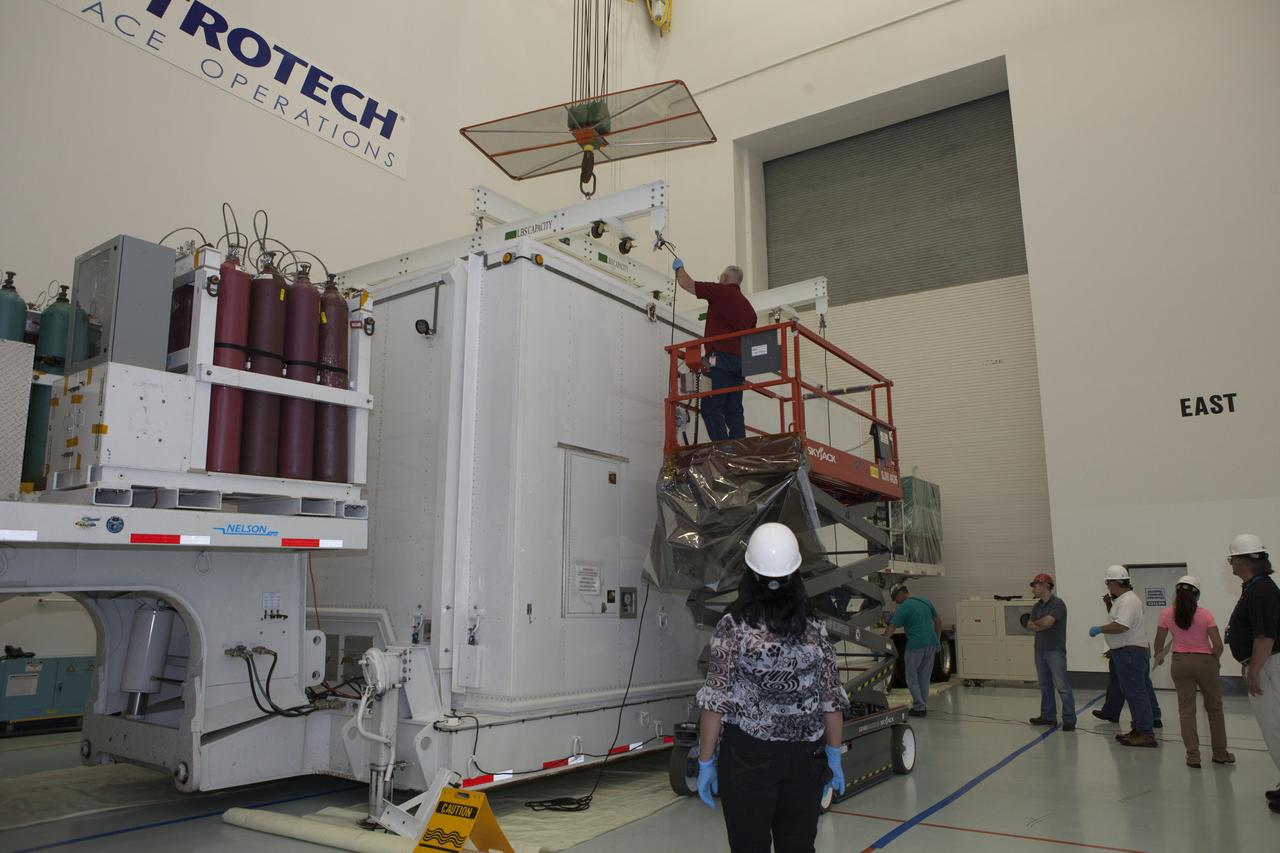
Workers attach a crane to the protective shipping container to prepare to uncover the lower stack, mini-stack number 1, two of the observatories for NASA's Magnetospheric Multiscale Observatory, or MMS. They were delivered to the Building 2 south encapsulation bay at the Astrotech payload processing facility in Titusville, Florida, near Kennedy Space Center. The MMS upper stack, mini-stack number 2, is scheduled to arrive in about two weeks. MMS is a Solar Terrestrial Probes mission comprising four identically instrumented spacecraft that will use Earth’s magnetosphere as a laboratory to study the microphysics of three fundamental plasma processes: magnetic reconnection, energetic particle acceleration and turbulence. Launch aboard a United Launch Alliance Atlas V rocket from Space Launch Complex 41 on Cape Canaveral Air Force Station is targeted for March 12, 2015.
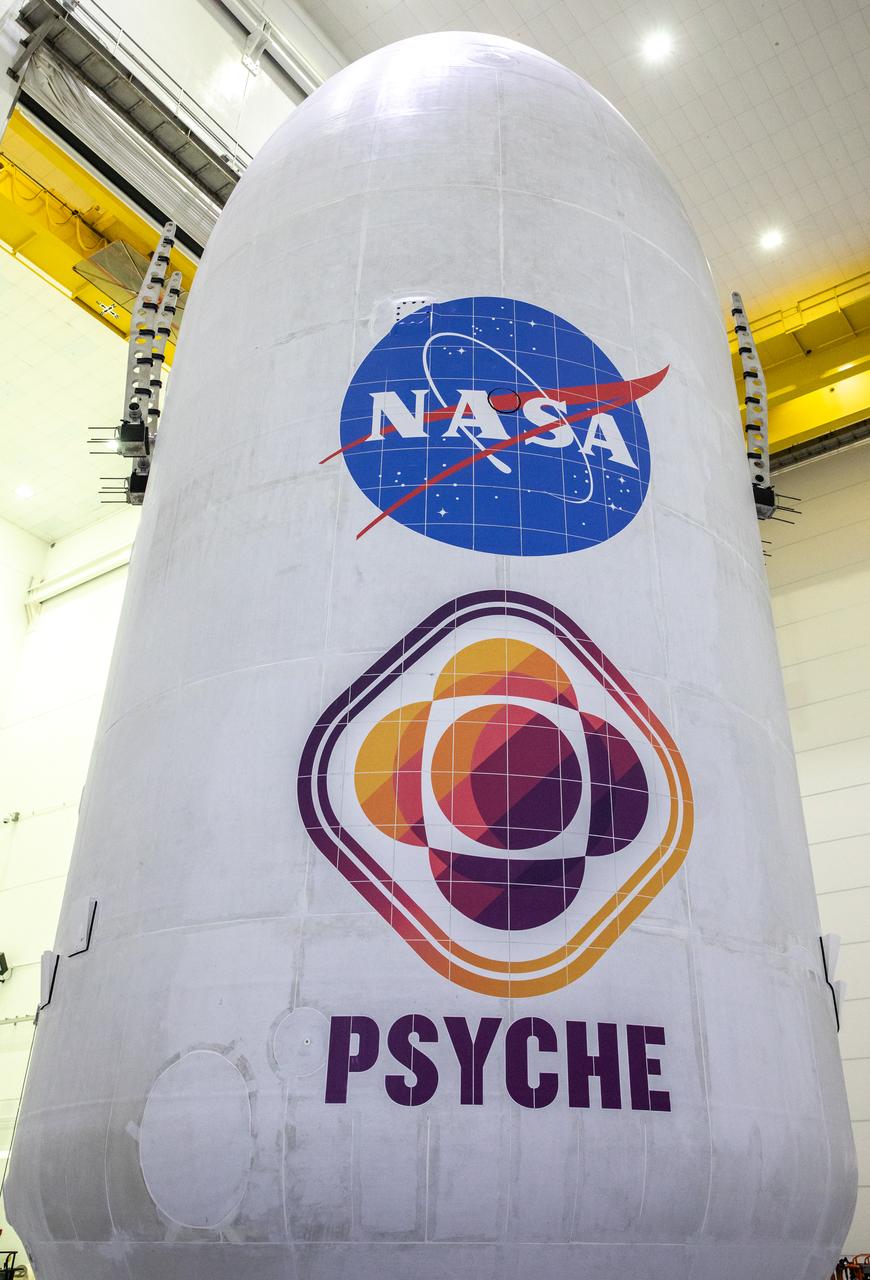
Teams transport NASA's encapsulated Psyche spacecraft from the Astrotech Space Operations Facility in Titusville to Launch Pad 39A at Kennedy Space Center in Florida on Friday, Oct. 6, 2023. Psyche will launch atop a SpaceX Falcon Heavy rocket. Liftoff is targeted for 10:16 a.m. EDT Thursday, Oct. 12. Riding with Psyche is a pioneering technology demonstration, NASA's Deep Space Optical Communications (DSOC) experiment.
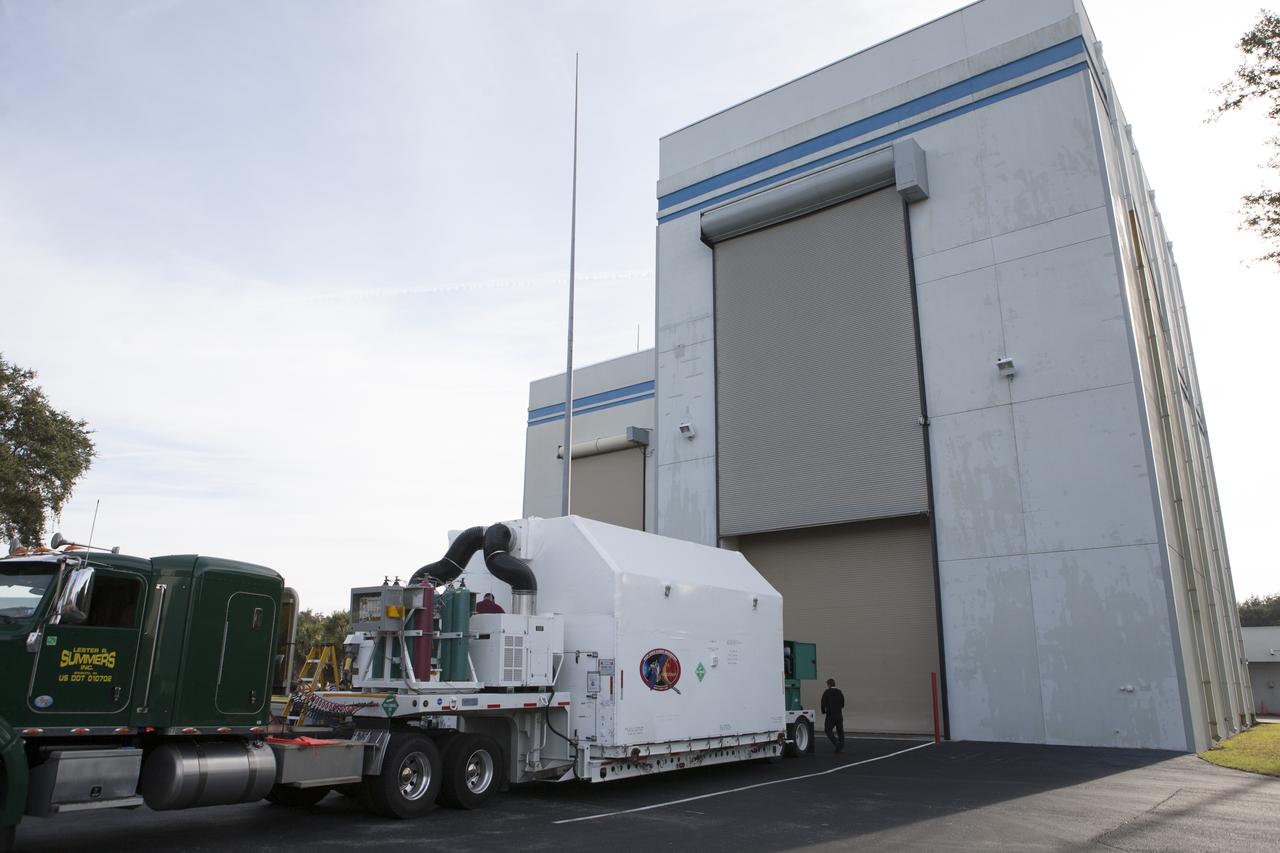
The truck delivering NOAA’s Deep Space Climate Observatory spacecraft, or DSCOVR, enclosed in a protective shipping container, backs up to the door of the airlock of Building 2 at the Astrotech payload processing facility in Titusville, Florida, near Kennedy Space Center. DSCOVR is a partnership between NOAA, NASA and the U.S. Air Force. DSCOVR will maintain the nation's real-time solar wind monitoring capabilities which are critical to the accuracy and lead time of NOAA's space weather alerts and forecasts. Launch is currently scheduled for January 2015 aboard a SpaceX Falcon 9 v 1.1 launch vehicle from Cape Canaveral Air Force Station, Florida.
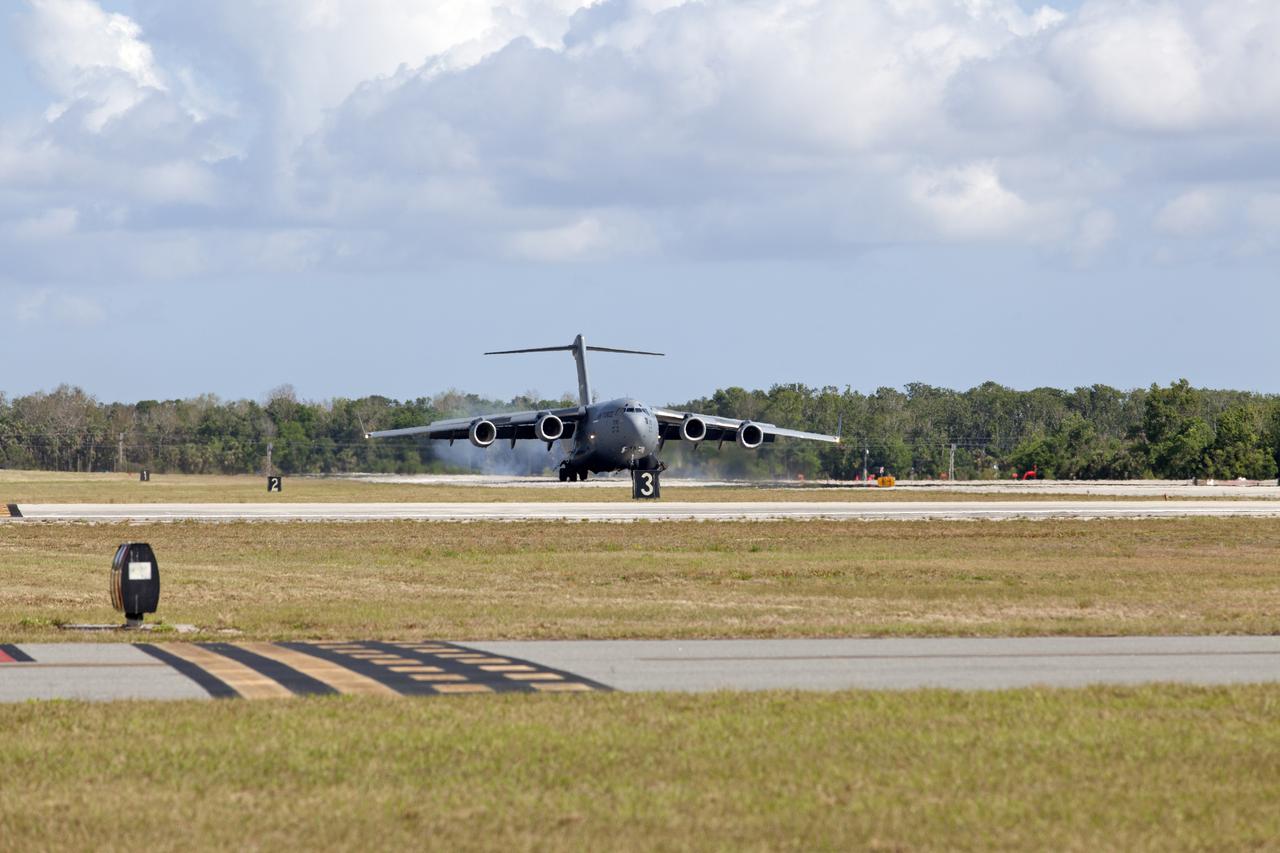
A U.S. Air Force C-5 transport aircraft touches down at Space Coast Regional Airport in Titusville, Florida, with NASA's Parker Solar Probe spacecraft aboard. The spacecraft will be offloaded and transported to the Astrotech processing facility near the agency's Kennedy Space Center. The Parker Solar Probe will launch on a United Launch Alliance Delta IV Heavy rocket from Space Launch Complex 37 at Cape Canaveral Air Force Station in Florida in July 2018. The mission will perform the closest-ever observations of a star when it travels through the Sun's atmosphere, called the corona. The probe will rely on measurements and imaging to revolutionize our understanding of the corona and the Sun-Earth connection.
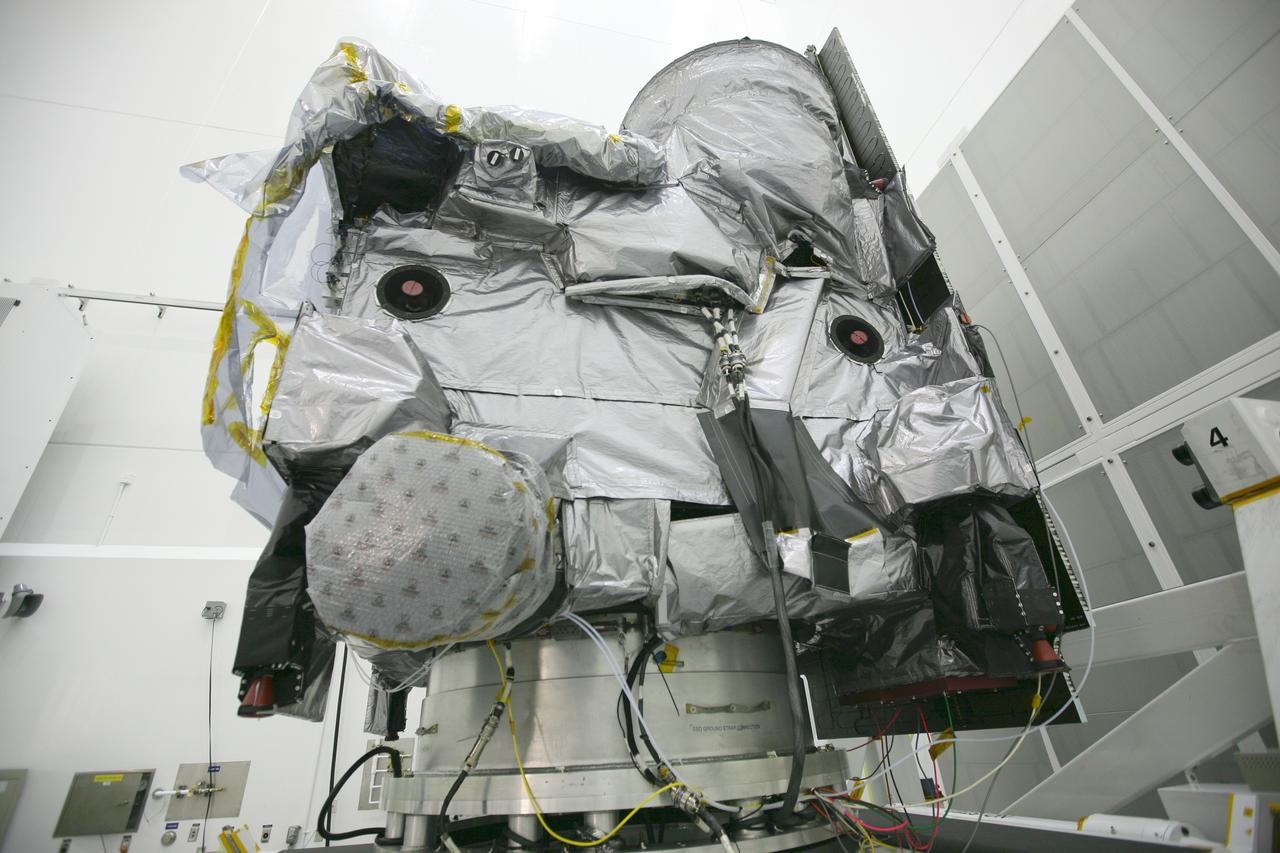
GOES-P UNBAGGING & ROTATION
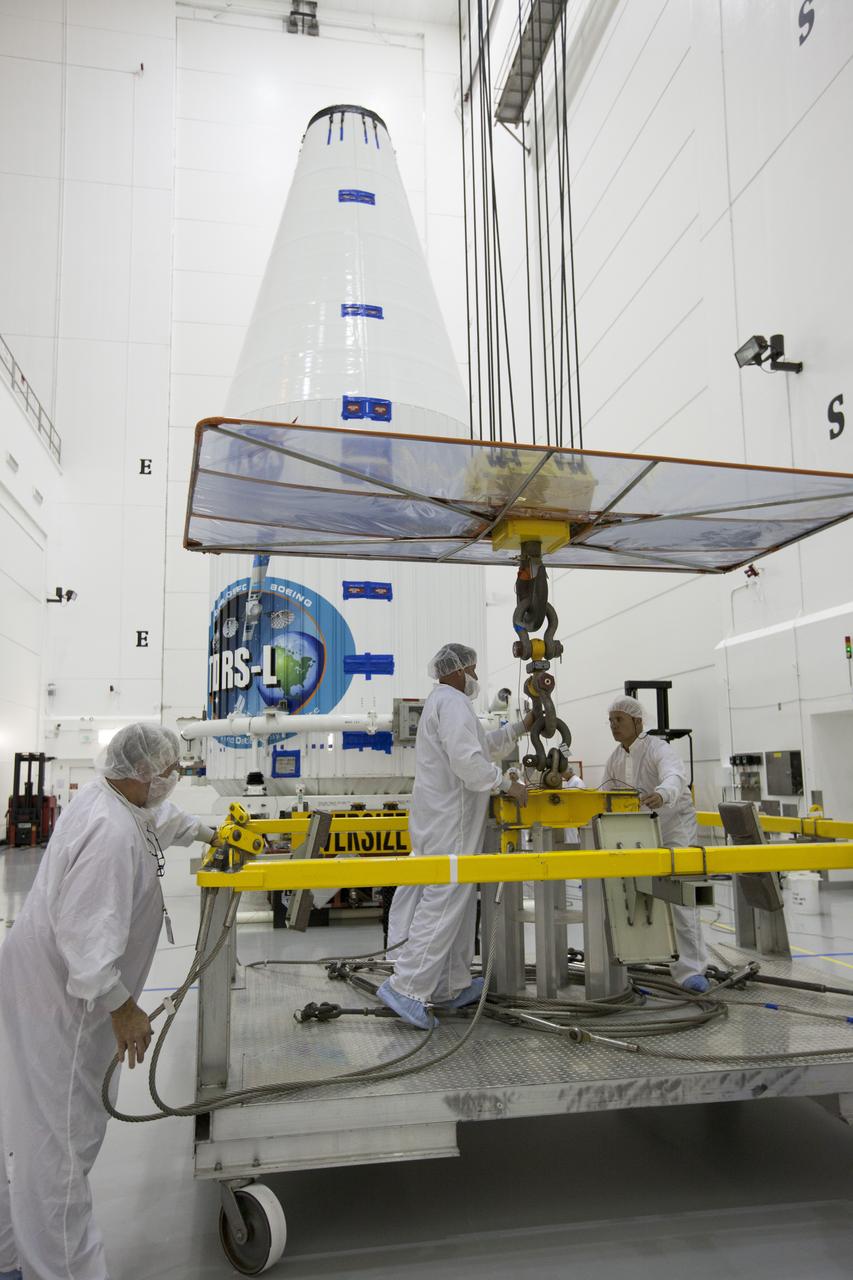
TITUSVILLE, Fla. – Inside the Astrotech payload processing facility in Titusville, a crane is disengaged from ground support equipment used to mount NASA's Tracking and Data Relay Satellite, or TDRS-L, spacecraft on a transporter for its trip to Launch Complex 41 at Cape Canaveral Air Force Station. The TDRS-L satellite will be a part of the second of three next-generation spacecraft designed to ensure vital operational continuity for the NASA Space Network. It is scheduled to launch from Cape Canaveral's Space Launch Complex 41 atop a United Launch Alliance Atlas V rocket on January 23, 2014. The current Tracking and Data Relay Satellite system consists of eight in-orbit satellites distributed to provide near continuous information relay contact with orbiting spacecraft ranging from the International Space Station and Hubble Space Telescope to the array of scientific observatories. For more information, visit: http://www.nasa.gov/mission_pages/tdrs/home/index.html Photo credit: NASA/Kim Shiflett
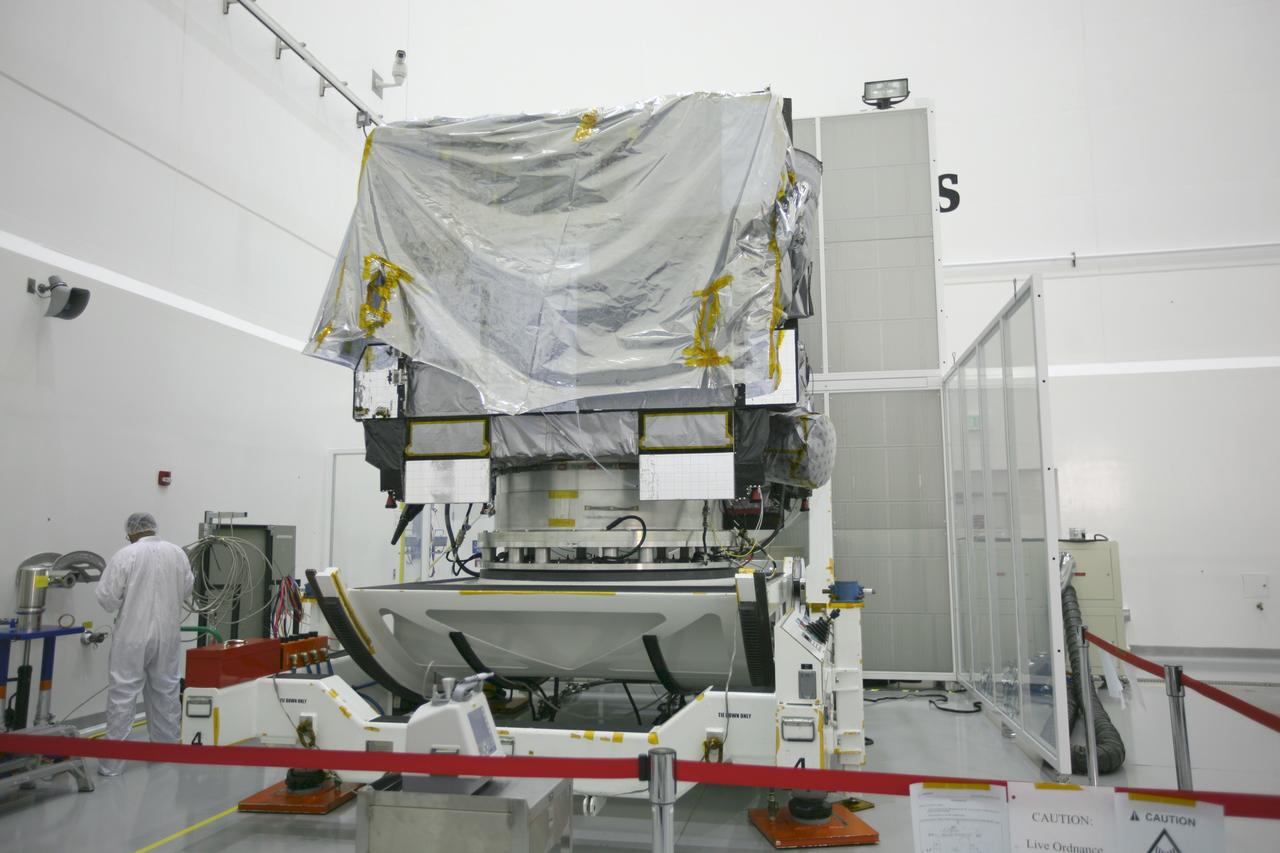
GOES-P UNBAGGING & ROTATION
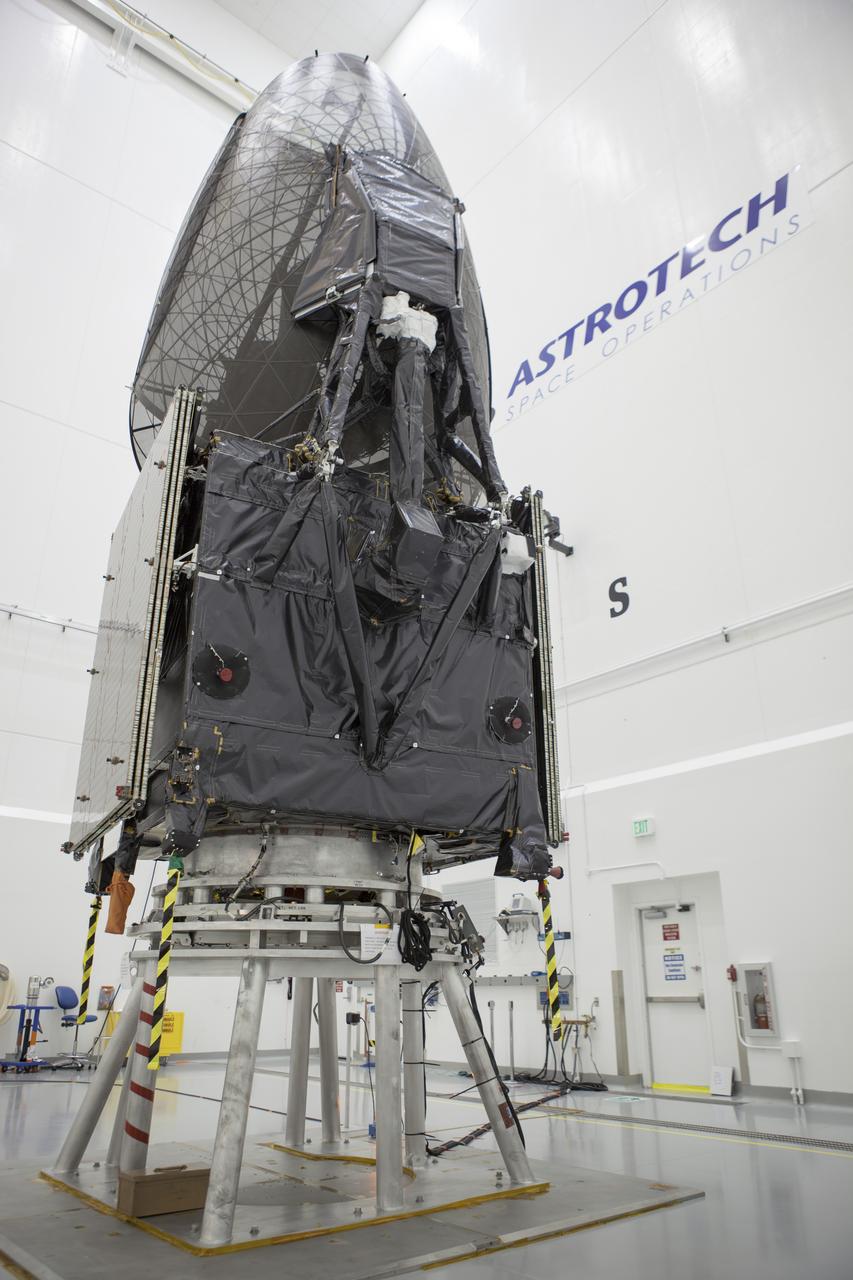
CAPE CANAVERAL, Fla. – – Inside the Astrotech payload processing facility in Titusville, NASA's Tracking and Data Relay Satellite, or TDRS-L, spacecraft is undergoing preflight processing. TDRS-L is being prepared for encapsulation inside its payload fairing prior to being transported to Launch Complex 41 at Cape Canaveral Air Force Station. The TDRS-L satellite will be a part of the second of three next-generation spacecraft designed to ensure vital operational continuity for the NASA Space Network. It is scheduled to launch from Cape Canaveral's Space Launch Complex 41 atop a United Launch Alliance Atlas V rocket on Jan. 23, 2014. The current Tracking and Data Relay Satellite system consists of eight in-orbit satellites distributed to provide near continuous information relay contact with orbiting spacecraft ranging from the International Space Station and Hubble Space Telescope to the array of scientific observatories. For more information, visit: http://www.nasa.gov/mission_pages/tdrs/home/index.html Photo credit: NASA/Dimitri Gerondidakis
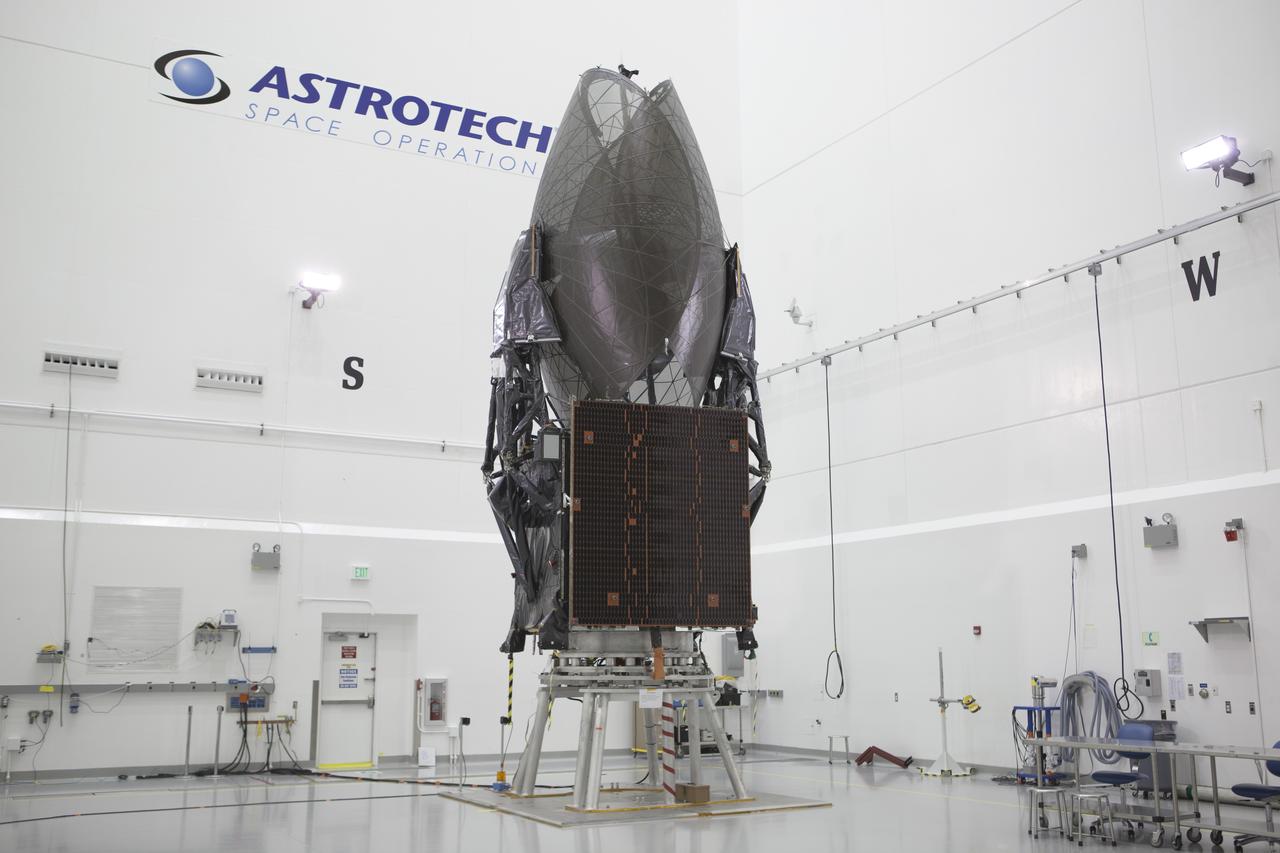
TITUSVILLE, Fla. – Members of the news media are given an opportunity for an up-close look at the Tracking and Data Relay Satellite, or TDRS-L, spacecraft undergoing preflight processing inside the Astrotech payload processing facility in Titusville. TDRS-L is being prepared for encapsulation inside its payload fairing prior to being transported to Launch Complex 41 at Cape Canaveral Air Force Station. Journalists visited Astrotech as part of TDRS-L Media Day to conduct interviews and photograph the satellite that will be a part of the second of three next-generation spacecraft designed to ensure vital operational continuity for the NASA Space Network. It is scheduled to launch from Cape Canaveral's Space Launch Complex 41 atop an Atlas V rocket in January 2014. The current Tracking and Data Relay Satellite system consists of eight in-orbit satellites distributed to provide near continuous information relay contact with orbiting spacecraft ranging from the International Space Station and Hubble Space Telescope to the array of scientific observatories. For more information, visit: http://www.nasa.gov/mission_pages/tdrs/home/index.html
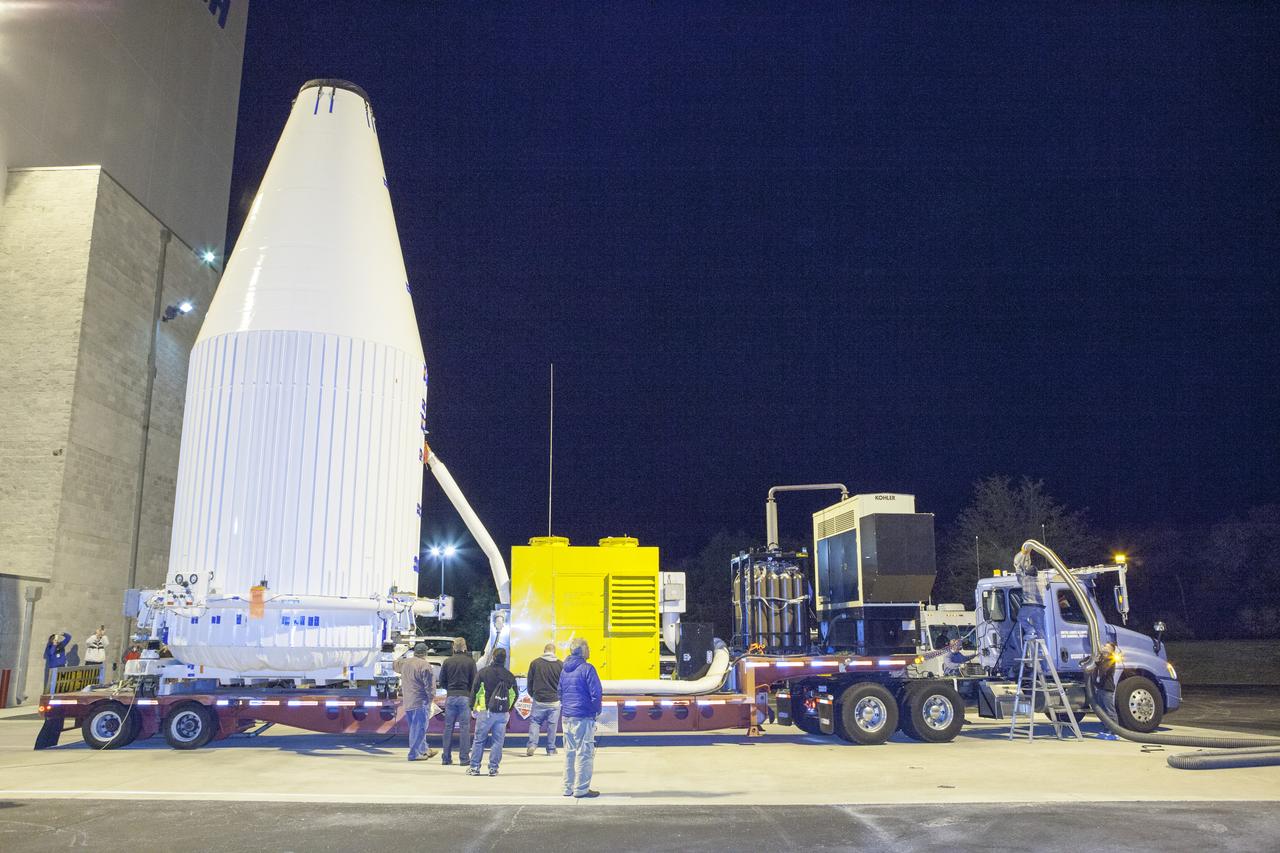
TITUSVILLE, Fla. – Encapsulated in its payload fairing, NASA's Tracking and Data Relay Satellite, or TDRS-L, spacecraft begins it trip from the Astrotech payload processing facility in Titusville to Launch Complex 41 at Cape Canaveral Air Force Station. The TDRS-L satellite will be a part of the second of three next-generation spacecraft designed to ensure vital operational continuity for the NASA Space Network. It is scheduled to launch from Cape Canaveral's Space Launch Complex 41 atop a United Launch Alliance Atlas V rocket on January 23, 2014. The current Tracking and Data Relay Satellite system consists of eight in-orbit satellites distributed to provide near continuous information relay contact with orbiting spacecraft ranging from the International Space Station and Hubble Space Telescope to the array of scientific observatories. For more information, visit: http://www.nasa.gov/mission_pages/tdrs/home/index.html Photo credit: NASA/Dimitri Gerondidakis

SDO MOVE TO TRANSPORTER
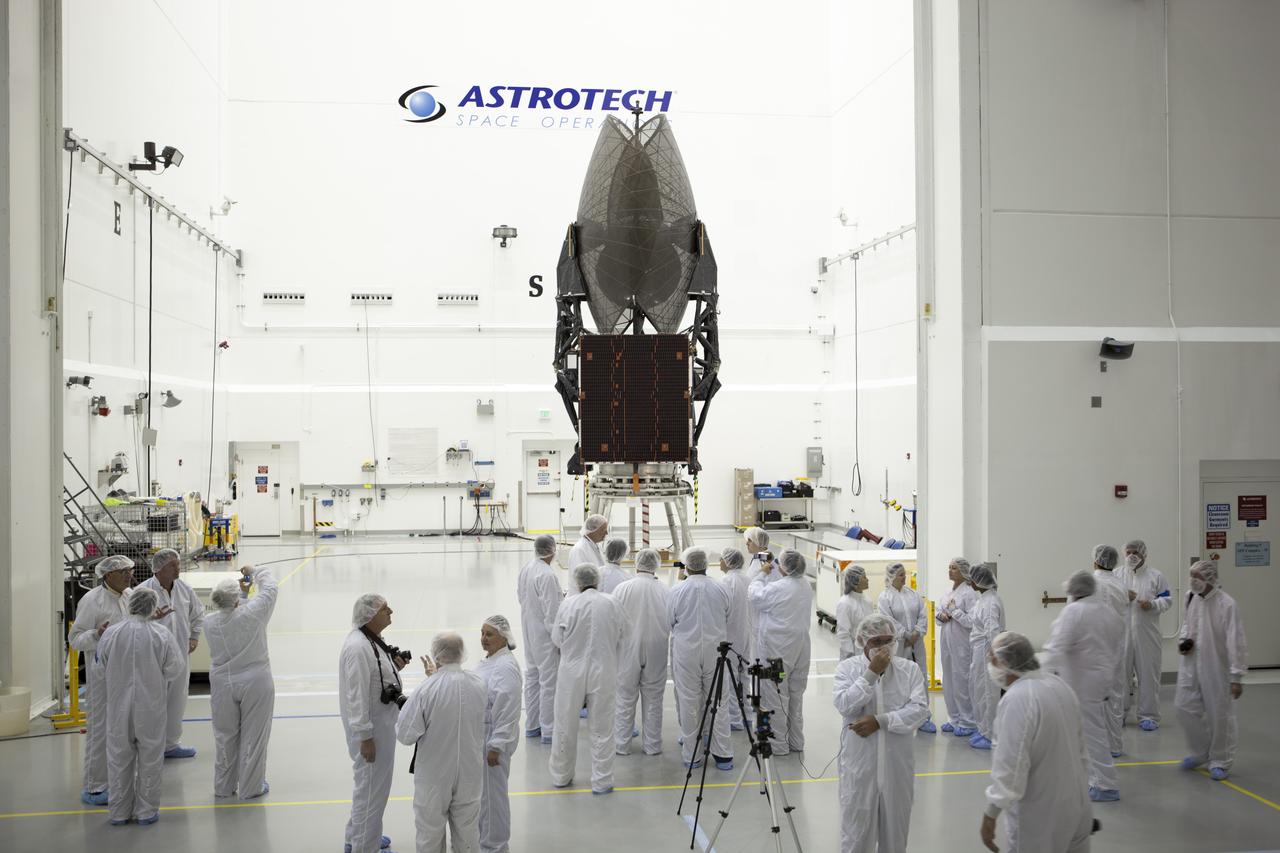
TITUSVILLE, Fla. – Members of the news media are given an up-close look at the Tracking and Data Relay Satellite, or TDRS-L, spacecraft undergoing preflight processing inside the Astrotech payload processing facility in Titusville. TDRS-L is being prepared for encapsulation inside its payload fairing prior to being transported to Launch Complex 41 at Cape Canaveral Air Force Station. Journalists visited Astrotech as part of TDRS-L Media Day to conduct interviews and photograph the satellite that will be a part of the second of three next-generation spacecraft designed to ensure vital operational continuity for the NASA Space Network. It is scheduled to launch from Cape Canaveral's Space Launch Complex 41 atop an Atlas V rocket in January 2014. The current Tracking and Data Relay Satellite system consists of eight in-orbit satellites distributed to provide near continuous information relay contact with orbiting spacecraft ranging from the International Space Station and Hubble Space Telescope to the array of scientific observatories. For more information, visit: http://www.nasa.gov/mission_pages/tdrs/home/index.html
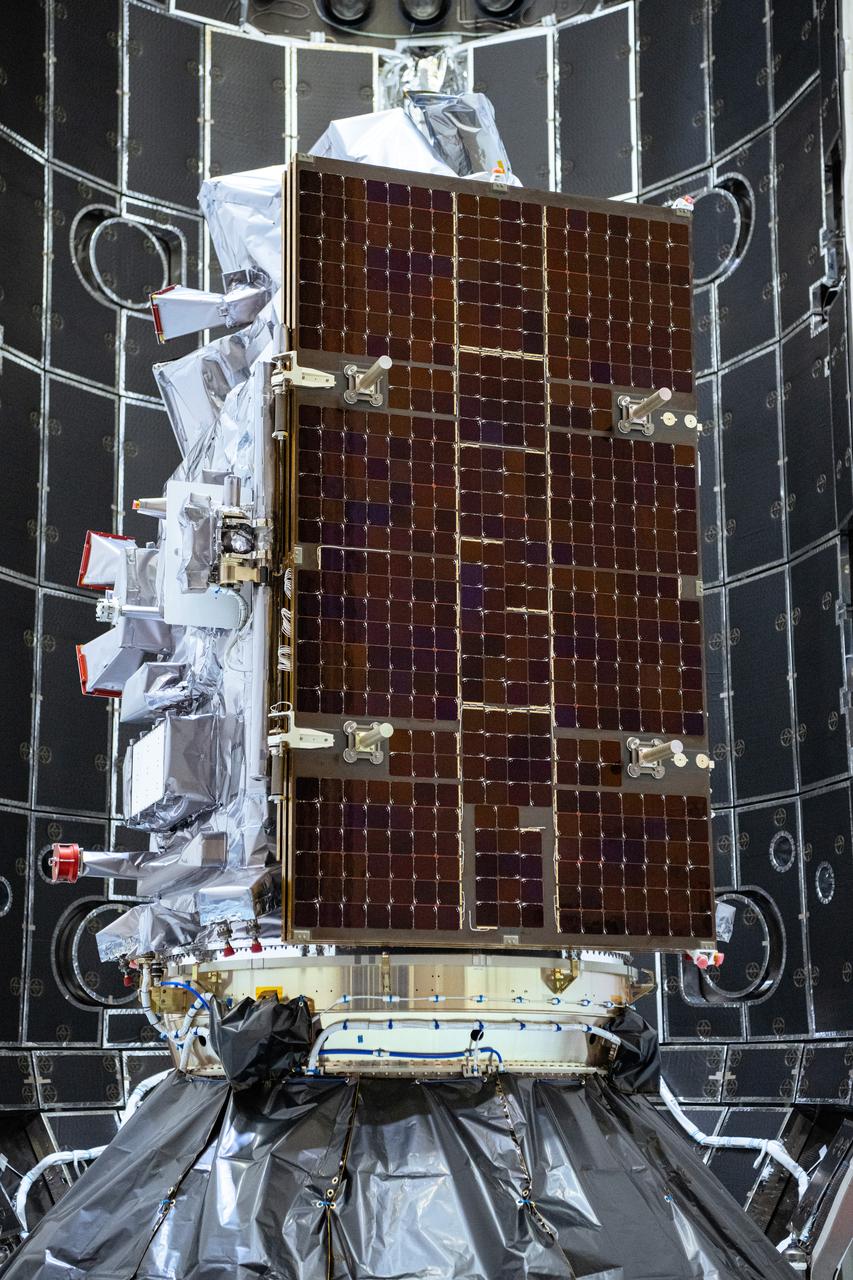
NASA and SpaceX technicians connect NASA’s PACE (Plankton, Aerosol, Cloud, ocean Ecosystem) spacecraft to the payload adapter on Friday, Jan. 26, 2024, at the Astrotech Space Operations Facility near the agency’s Kennedy Space Center in Florida. PACE is NASA’s newest earth-observing satellite that will help increase our understanding of Earth’s oceans, atmosphere, and climate by delivering hyperspectral observations of microscopic marine organisms called phytoplankton as well new data on clouds and aerosols. PACE is set to launch from Space Launch Complex 40 at Cape Canaveral Space Force Station in Florida at 1:33 a.m. EST on Tuesday, Feb. 6.
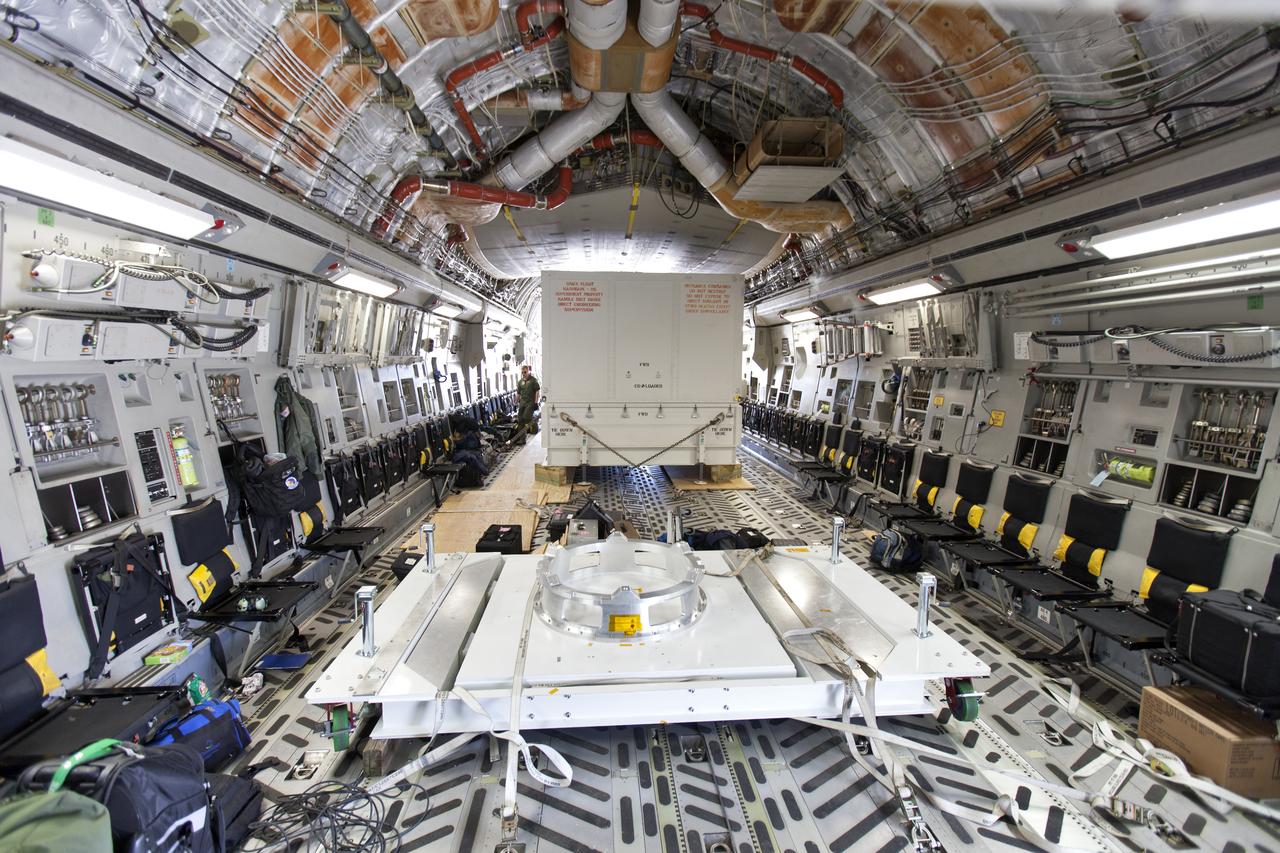
NASA's Parker Solar Probe, secured in its shipping container, arrives aboard a U.S. Air Force C-5 transport aircraft at Space Coast Regional Airport in Titusville, Florida. The spacecraft will be offloaded and transported to the Astrotech processing facility near the agency's Kennedy Space Center. The Parker Solar Probe will launch on a United Launch Alliance Delta IV Heavy rocket from Space Launch Complex 37 at Cape Canaveral Air Force Station in Florida in July 2018. The mission will perform the closest-ever observations of a star when it travels through the Sun's atmosphere, called the corona. The probe will rely on measurements and imaging to revolutionize our understanding of the corona and the Sun-Earth connection.
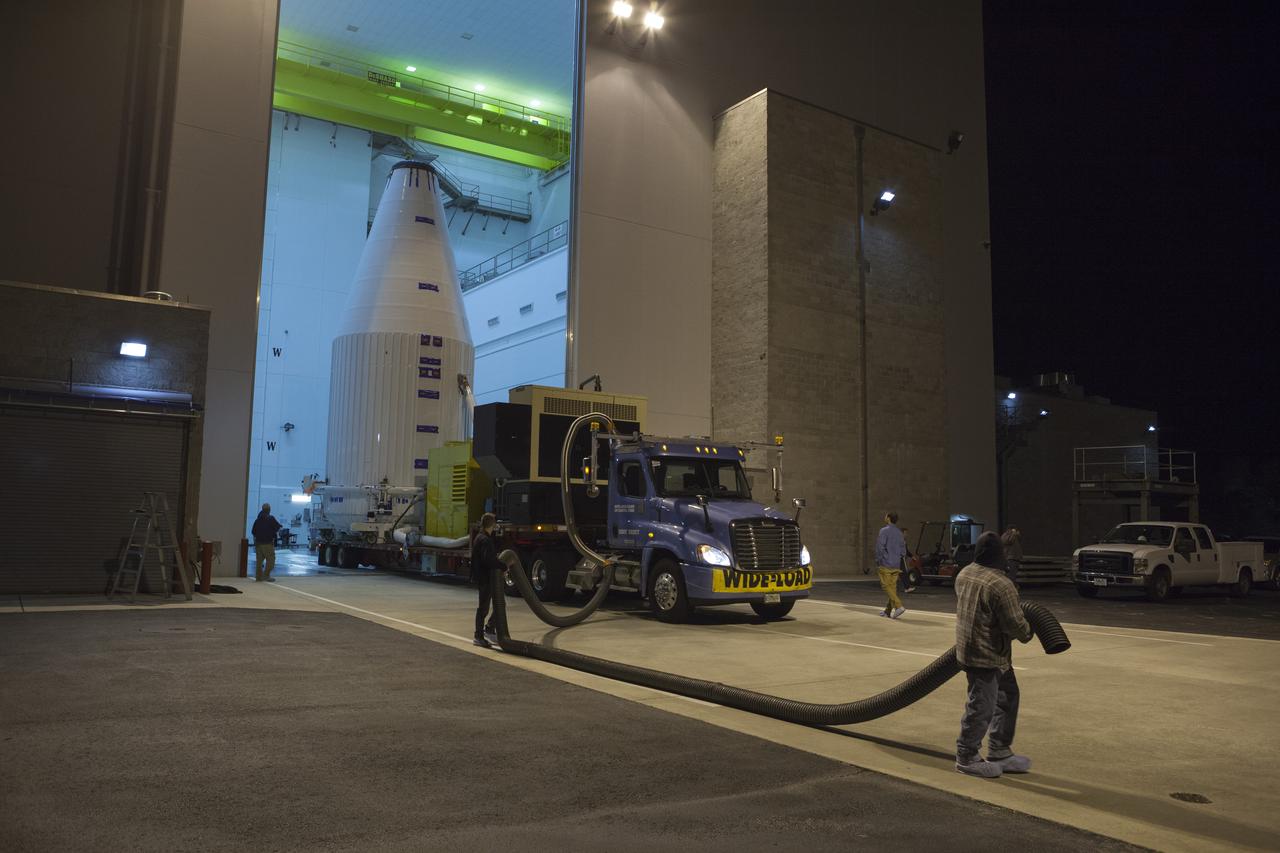
TITUSVILLE, Fla. – Encapsulated in its payload fairing, NASA's Tracking and Data Relay Satellite, or TDRS-L, spacecraft begins it trip from the Astrotech payload processing facility in Titusville to Launch Complex 41 at Cape Canaveral Air Force Station. The TDRS-L satellite will be a part of the second of three next-generation spacecraft designed to ensure vital operational continuity for the NASA Space Network. It is scheduled to launch from Cape Canaveral's Space Launch Complex 41 atop a United Launch Alliance Atlas V rocket on January 23, 2014. The current Tracking and Data Relay Satellite system consists of eight in-orbit satellites distributed to provide near continuous information relay contact with orbiting spacecraft ranging from the International Space Station and Hubble Space Telescope to the array of scientific observatories. For more information, visit: http://www.nasa.gov/mission_pages/tdrs/home/index.html Photo credit: NASA/Dimitri Gerondidakis
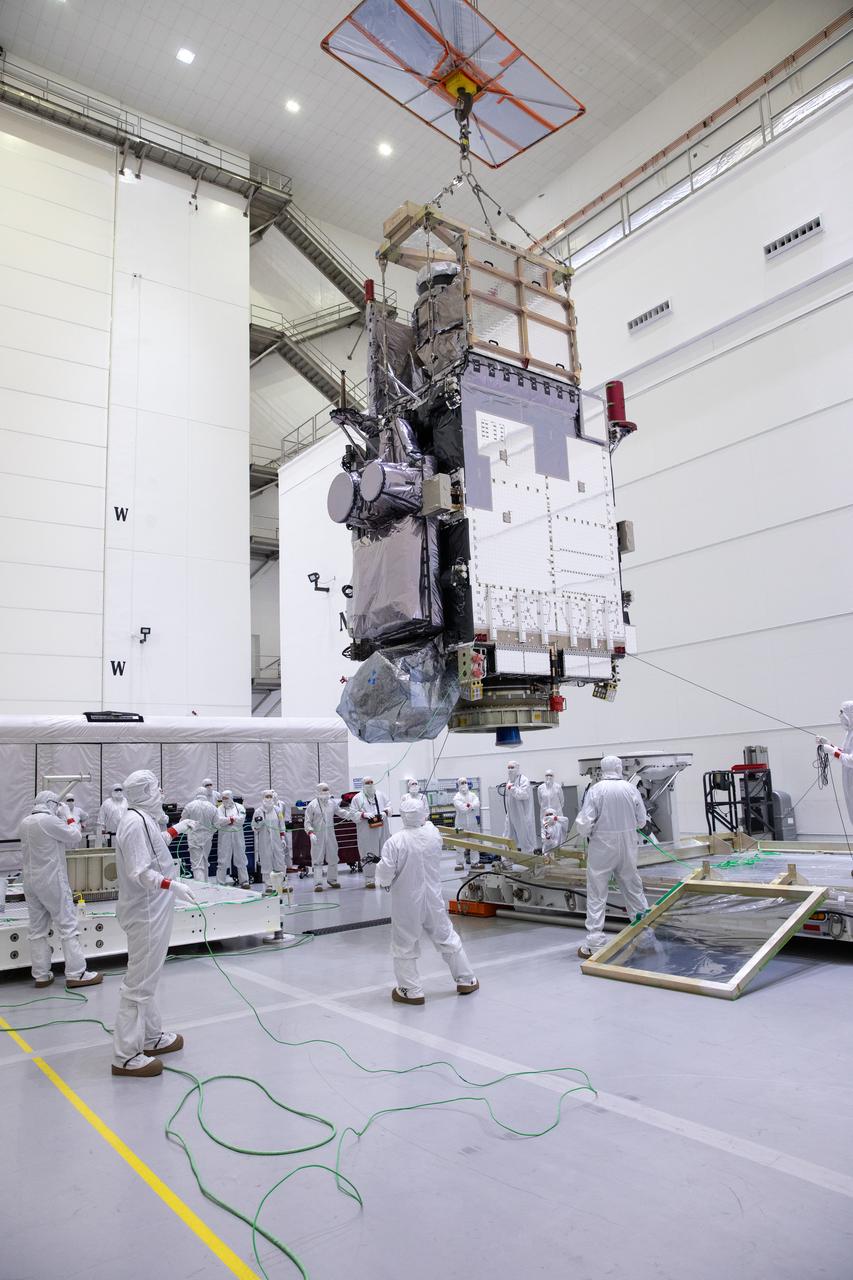
Technicians monitor movement as a crane hoists NOAA’s Geostationary Operational Environmental Satellite-U (GOES-U) after being uncrated and rotated into a vertical position on Wednesday, Jan. 24, 2024, at the Astrotech Space Operations Facility near the agency’s Kennedy Space Center in Florida. Part of a collaborative NOAA and NASA program, GOES-U is the fourth in a series of four advanced geostationary weather satellites. Data from the GOES satellite constellation – consisting of the GOES-R, GOES-S, GOES-T and GOES-U spacecraft – enables forecasters to predict, observe, and track local weather events that affect public safety like thunderstorms, hurricanes, and wildfires.
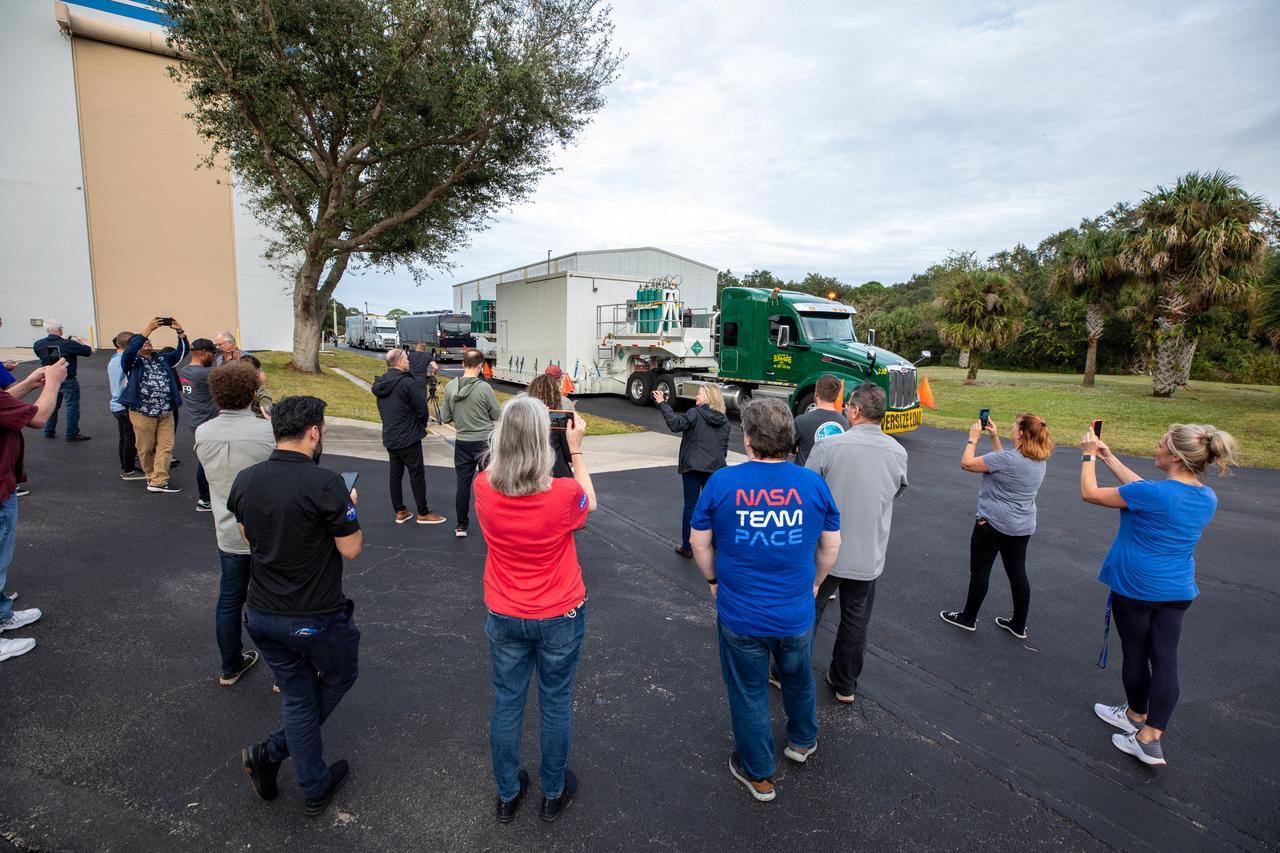
The transport carrier containing NASA’s Plankton, Aerosol, Cloud, ocean Ecosystem (PACE) observatory spacecraft arrives at the Astrotech Space Operations Facility near the agency’s Kennedy Space Center in Florida on Tuesday, Nov. 14, 2023. PACE was shipped from the agency’s Goddard Space Flight Center in Greenbelt, Maryland, and is targeted to launch on January 30, 2024, on a SpaceX Falcon 9 rocket lifting off from Space Launch Complex 40 at Cape Canaveral Space Force Station. The PACE observatory will help us better understand how the ocean and atmosphere exchange carbon dioxide, measure key atmospheric variables associated with air quality and Earth's climate, and monitor ocean health, in part by studying phytoplankton, tiny plants and algae that sustain the marine food web.

At Astrotech Space Operations, workers look over the integrated THEMIS spacecraft before spin-balance testing. THEMIS consists of five identical probes, the largest number of scientific satellites ever launched into orbit aboard a single rocket. This unique constellation of satellites will resolve the tantalizing mystery of what causes the spectacular sudden brightening of the aurora borealis and aurora australis - the fiery skies over the Earth's northern and southern polar regions. THEMIS is scheduled to launch Feb. 15 from Cape Canaveral Air Force Station.

Workers deploy the solar arrays on NOAA’s Deep Space Climate Observatory spacecraft, or DSCOVR, in the Building 1 high bay at the Astrotech payload processing facility in Titusville, Florida, near Kennedy Space Center. DSCOVR is a partnership between NOAA, NASA and the U.S. Air Force. DSCOVR will maintain the nation's real-time solar wind monitoring capabilities which are critical to the accuracy and lead time of NOAA's space weather alerts and forecasts. Launch is targeted for early 2015 aboard a SpaceX Falcon 9 v 1.1 launch vehicle from Cape Canaveral Air Force Station, Florida.
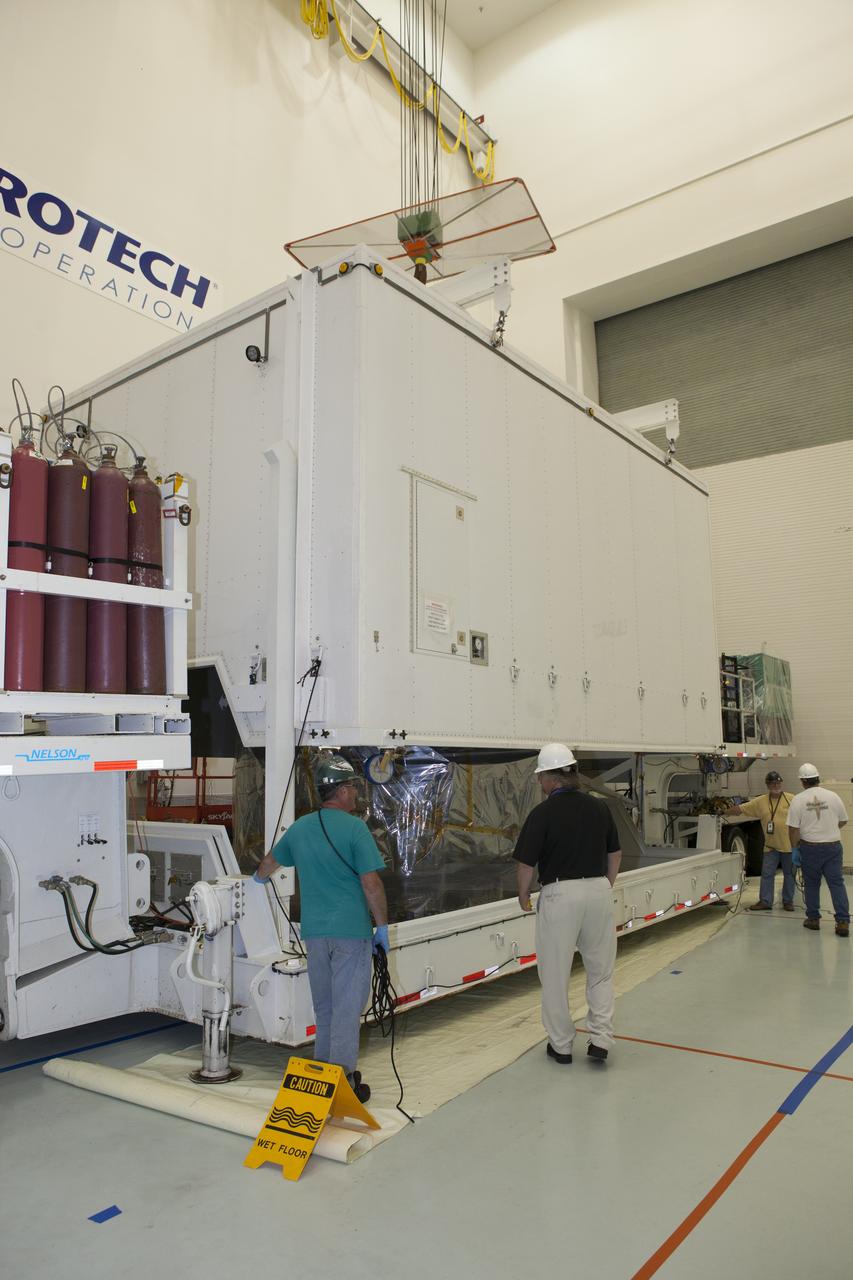
The protective shipping container is lifted from the lower stack, mini-stack number 1, two of the observatories for NASA's Magnetospheric Multiscale Observatory, or MMS, in the Building 2 south encapsulation bay at the Astrotech payload processing facility in Titusville, Florida, near Kennedy Space Center. The MMS upper stack, mini-stack number 2, is scheduled to arrive in about two weeks. MMS is a Solar Terrestrial Probes mission comprising four identically instrumented spacecraft that will use Earth’s magnetosphere as a laboratory to study the microphysics of three fundamental plasma processes: magnetic reconnection, energetic particle acceleration and turbulence. Launch aboard a United Launch Alliance Atlas V rocket from Space Launch Complex 41 on Cape Canaveral Air Force Station is targeted for March 12, 2015.
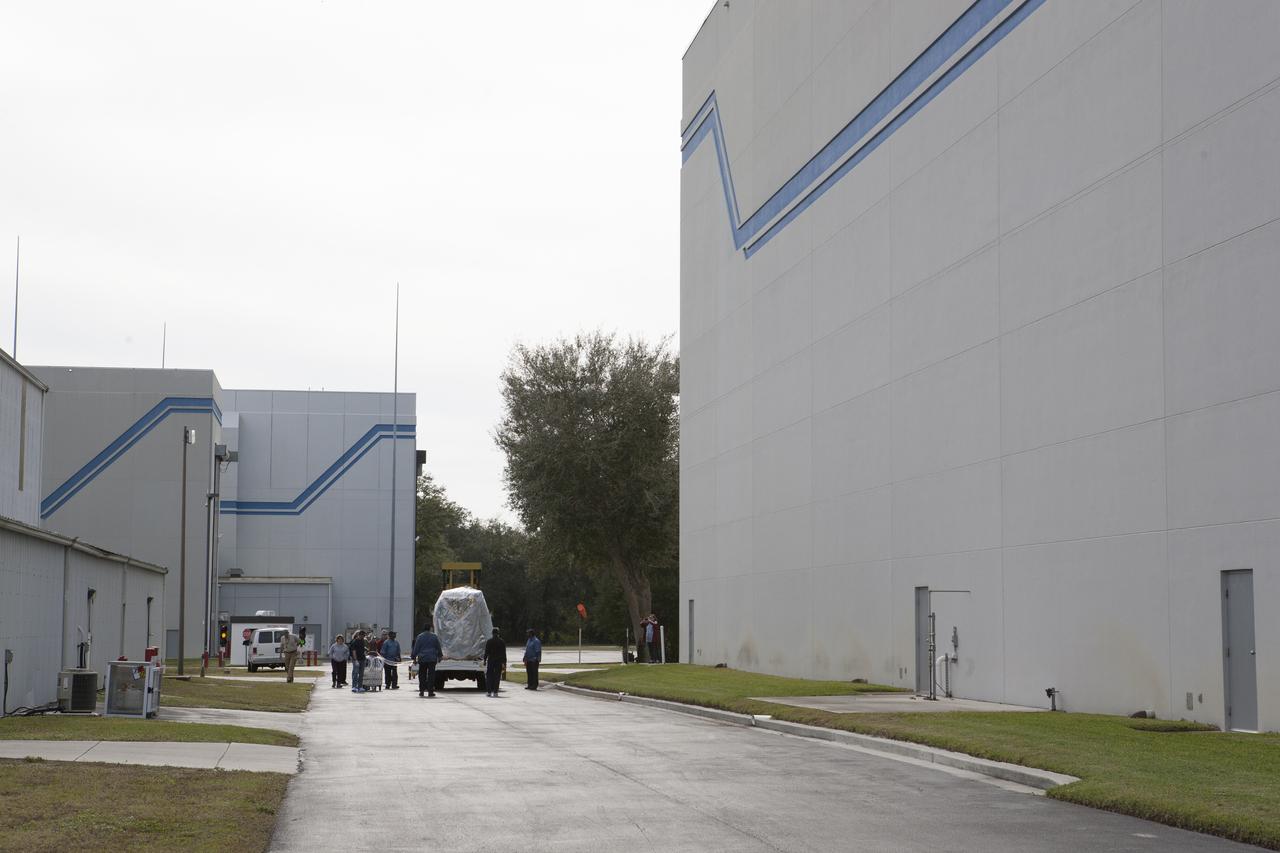
Workers monitor NOAA’s Deep Space Climate Observatory spacecraft, or DSCOVR, wrapped in plastic and secured onto a portable work stand, as it travels between the airlock of Building 2 to the high bay of Building 1 at the Astrotech payload processing facility in Titusville, Florida, near Kennedy Space Center. DSCOVR is a partnership between NOAA, NASA and the U.S. Air Force. DSCOVR will maintain the nation's real-time solar wind monitoring capabilities which are critical to the accuracy and lead time of NOAA's space weather alerts and forecasts. Launch is currently scheduled for January 2015 aboard a SpaceX Falcon 9 v 1.1 launch vehicle from Cape Canaveral Air Force Station, Florida.
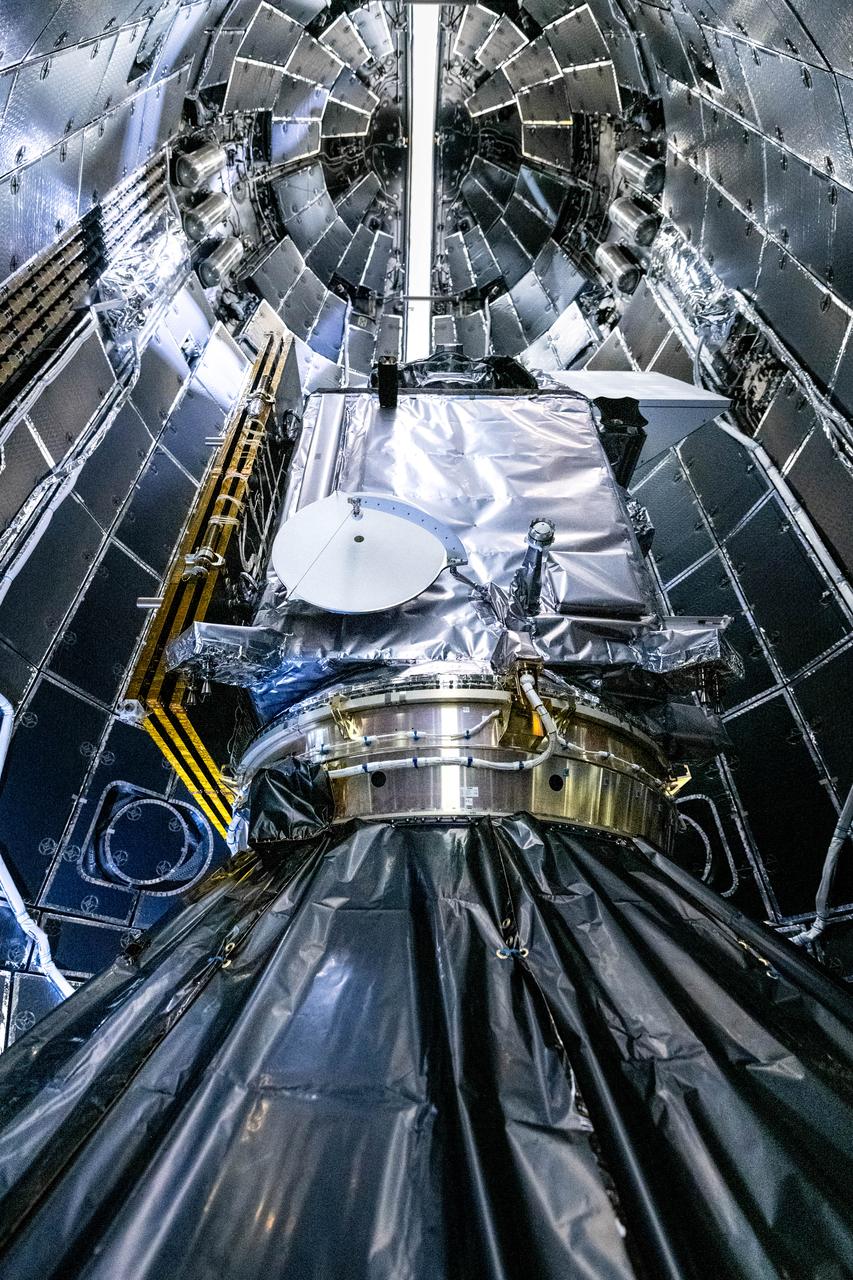
NASA and SpaceX technicians safely encapsulate NASA’s PACE (Plankton, Aerosol, Cloud, ocean Ecosystem) spacecraft in SpaceX’s Falcon 9 payload fairings on Tuesday, Jan. 30, 2024, at the Astrotech Space Operations Facility near the agency’s Kennedy Space Center in Florida. The fairing halves protect the spacecraft from aerodynamic pressure and heating during the ascent phase of launch. PACE is set to launch from Space Launch Complex 40 at Cape Canaveral Space Force Station in Florida no earlier than 1:33 a.m. EST on Tuesday, Feb. 6, 2024.
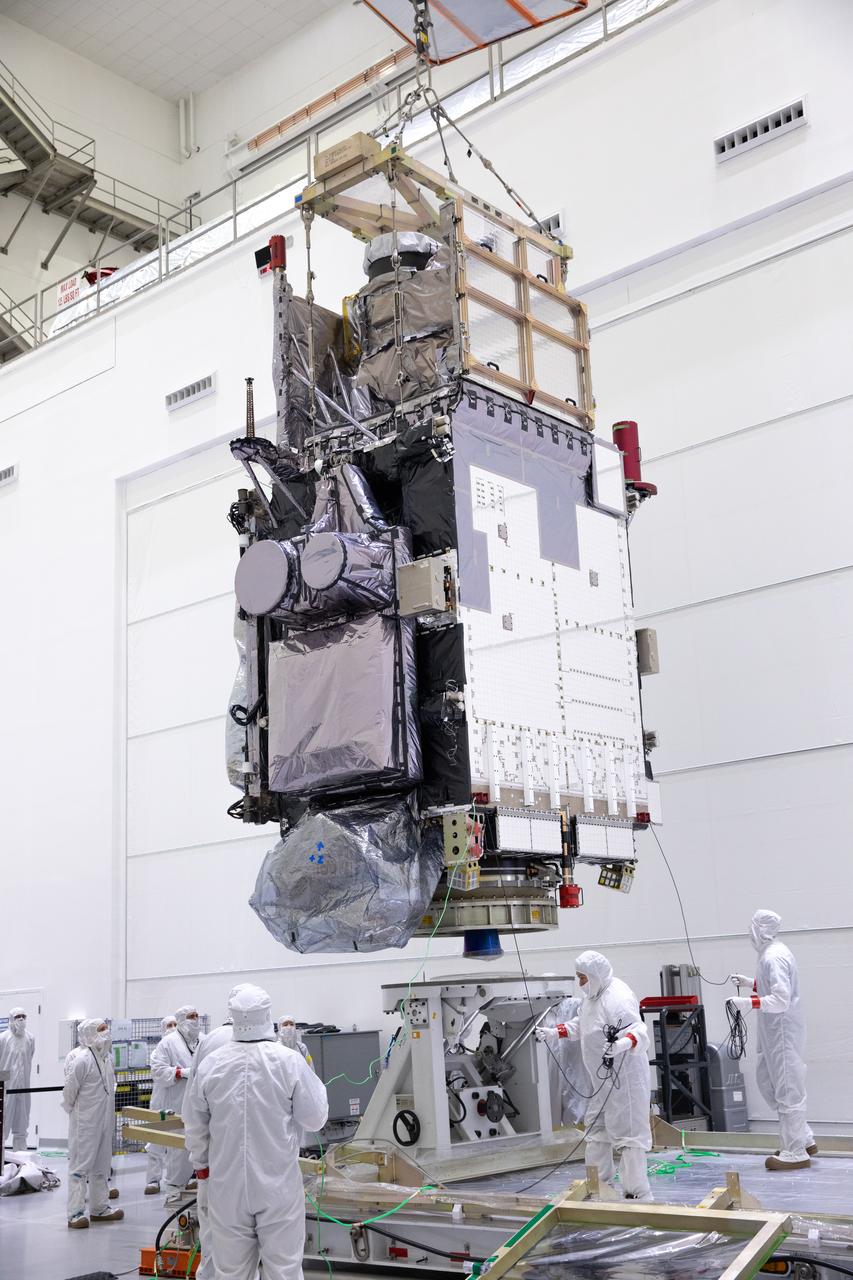
Technicians monitor movement as a crane hoists NOAA’s Geostationary Operational Environmental Satellite-U (GOES-U) after being uncrated and rotated into a vertical position on Wednesday, Jan. 24, 2024, at the Astrotech Space Operations Facility near the agency’s Kennedy Space Center in Florida. Part of a collaborative NOAA and NASA program, GOES-U is the fourth in a series of four advanced geostationary weather satellites. Data from the GOES satellite constellation – consisting of the GOES-R, GOES-S, GOES-T and GOES-U spacecraft – enables forecasters to predict, observe, and track local weather events that affect public safety like thunderstorms, hurricanes, and wildfires.

CAPE CANAVERAL, Fla. – – Inside the Astrotech payload processing facility in Titusville, NASA's Tracking and Data Relay Satellite, or TDRS-L, spacecraft is undergoing preflight processing. TDRS-L is being prepared for encapsulation inside its payload fairing prior to being transported to Launch Complex 41 at Cape Canaveral Air Force Station. The TDRS-L satellite will be a part of the second of three next-generation spacecraft designed to ensure vital operational continuity for the NASA Space Network. It is scheduled to launch from Cape Canaveral's Space Launch Complex 41 atop a United Launch Alliance Atlas V rocket on Jan. 23, 2014. The current Tracking and Data Relay Satellite system consists of eight in-orbit satellites distributed to provide near continuous information relay contact with orbiting spacecraft ranging from the International Space Station and Hubble Space Telescope to the array of scientific observatories. For more information, visit: http://www.nasa.gov/mission_pages/tdrs/home/index.html Photo credit: NASA/Dimitri Gerondidakis
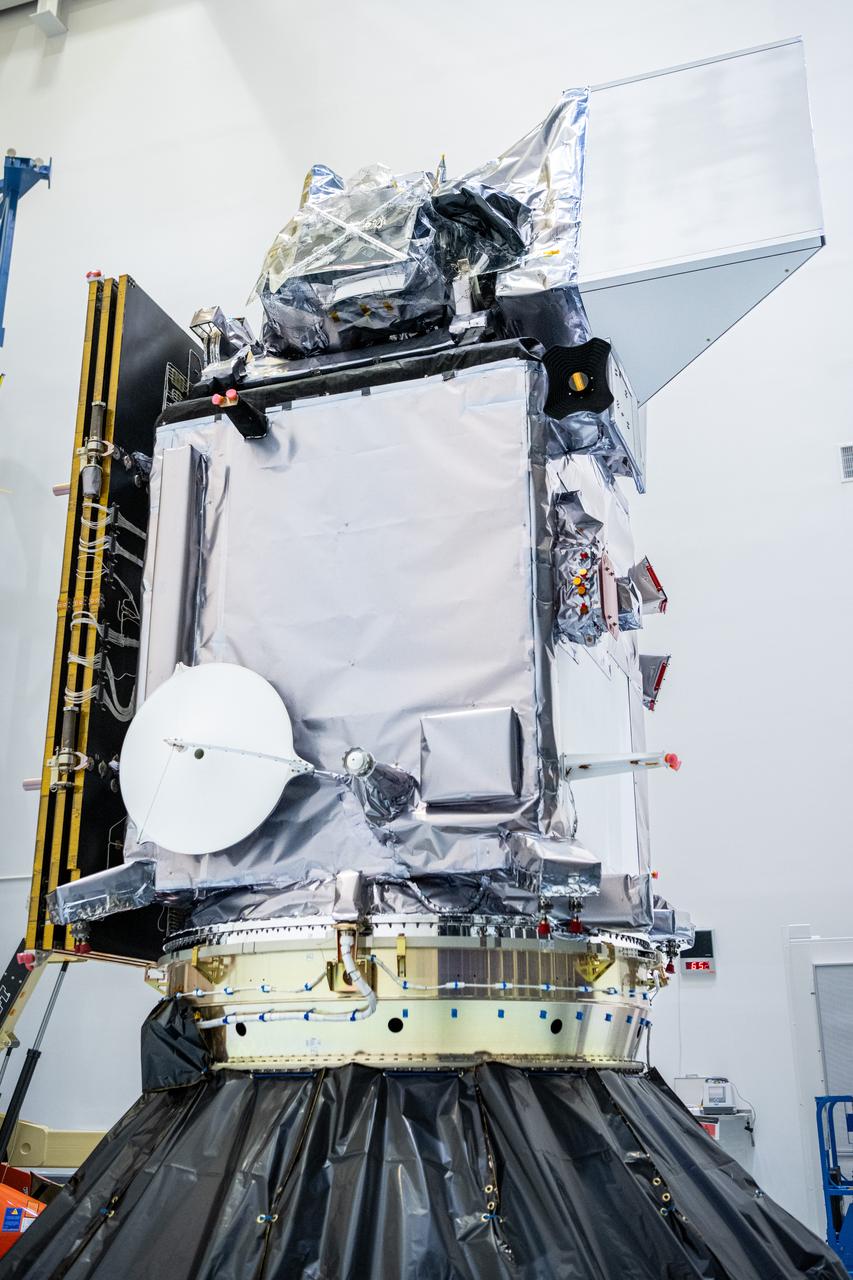
NASA and SpaceX technicians connect NASA’s PACE (Plankton, Aerosol, Cloud, ocean Ecosystem) spacecraft to the payload adapter on Friday, Jan. 26, 2024, at the Astrotech Space Operations Facility near the agency’s Kennedy Space Center in Florida. PACE is NASA’s newest earth-observing satellite that will help increase our understanding of Earth’s oceans, atmosphere, and climate by delivering hyperspectral observations of microscopic marine organisms called phytoplankton as well new data on clouds and aerosols. PACE is set to launch from Space Launch Complex 40 at Cape Canaveral Space Force Station in Florida at 1:33 a.m. EST on Tuesday, Feb. 6.
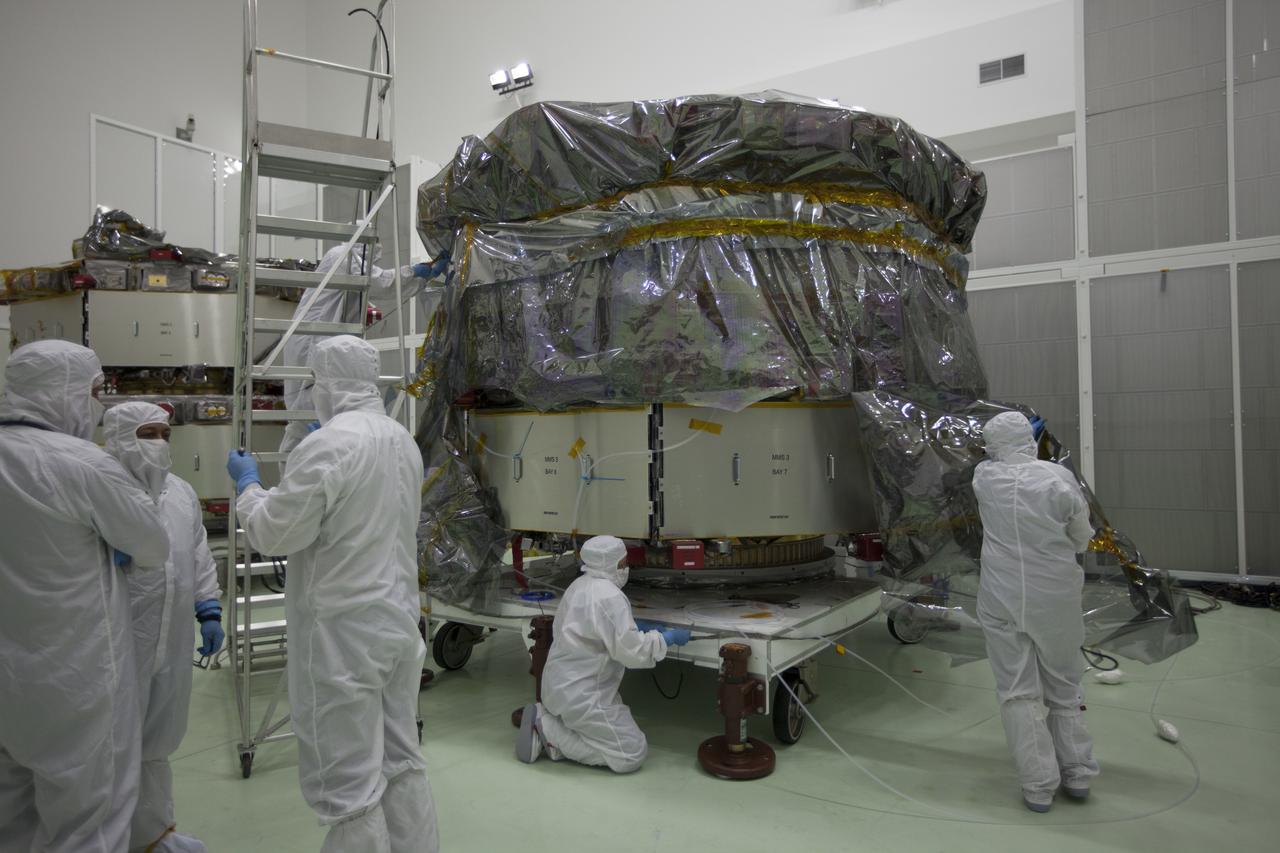
The protective covering is removed from the two Magnetospheric Multiscale, or MMS, spacecraft comprising the mission’s upper stack in the Building 1 high bay of the Astrotech payload processing facility in Titusville, Florida, near Kennedy Space Center. The two MMS spacecraft comprising the lower stack arrived at Astrotech on Oct. 29. The Magnetospheric Multiscale mission is a Solar Terrestrial Probes mission comprising four identically instrumented spacecraft that will use Earth’s magnetosphere as a laboratory to study the microphysics of three fundamental plasma processes: magnetic reconnection, energetic particle acceleration and turbulence. Launch aboard a United Launch Alliance Atlas V rocket from Space Launch Complex 41 on Cape Canaveral Air Force Station is targeted for March 12, 2015.

NOAA’s Deep Space Climate Observatory spacecraft, or DSCOVR, wrapped in plastic, is transferred from its transportation pallet to a portable work stand at the Astrotech payload processing facility in Titusville, Florida, near Kennedy Space Center. DSCOVR is a partnership between NOAA, NASA and the U.S. Air Force. DSCOVR will maintain the nation's real-time solar wind monitoring capabilities which are critical to the accuracy and lead time of NOAA's space weather alerts and forecasts. Launch is currently scheduled for January 2015 aboard a SpaceX Falcon 9 v 1.1 launch vehicle from Cape Canaveral Air Force Station, Florida.
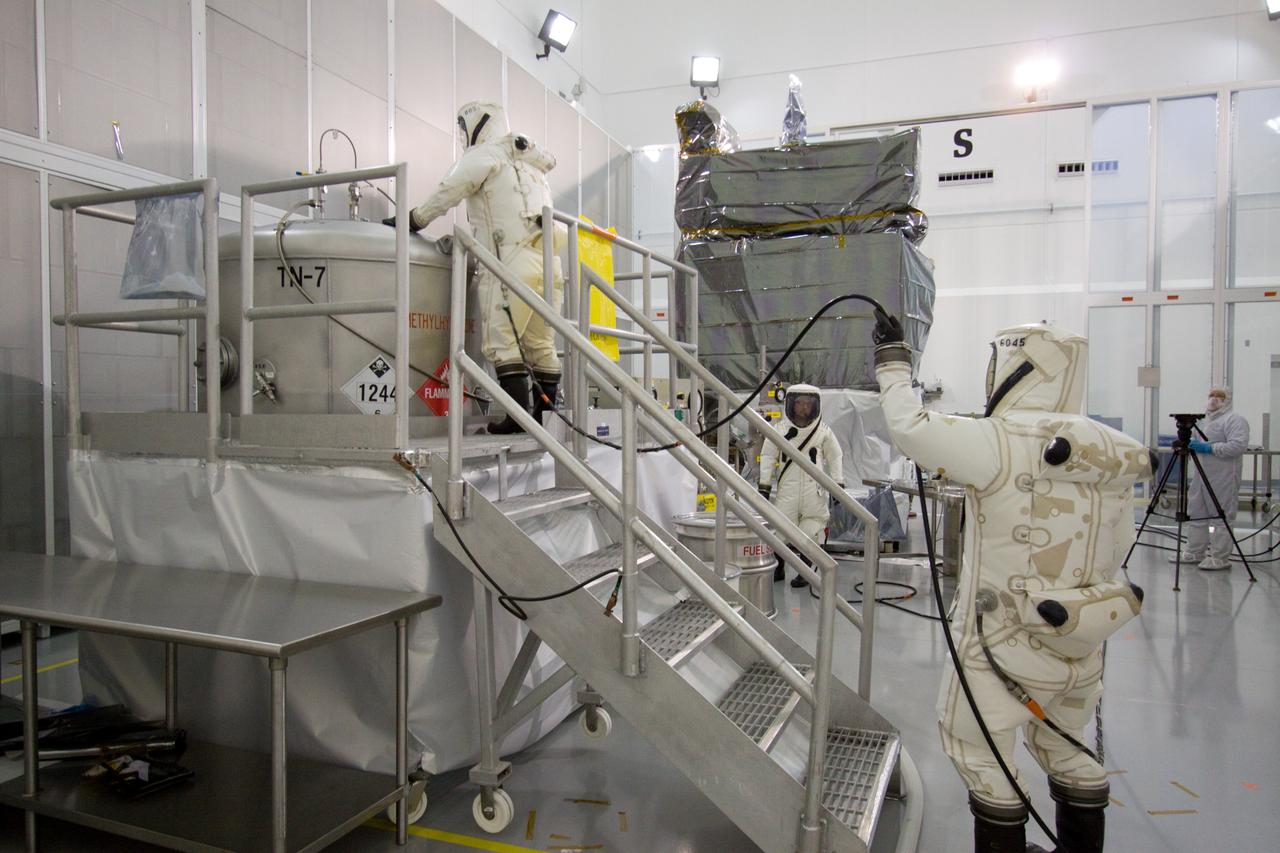
SDO FUELING PREPS FOR SATELLITE W/CREW
SDO FUELING PREPS FOR SATELLITE W/CREW
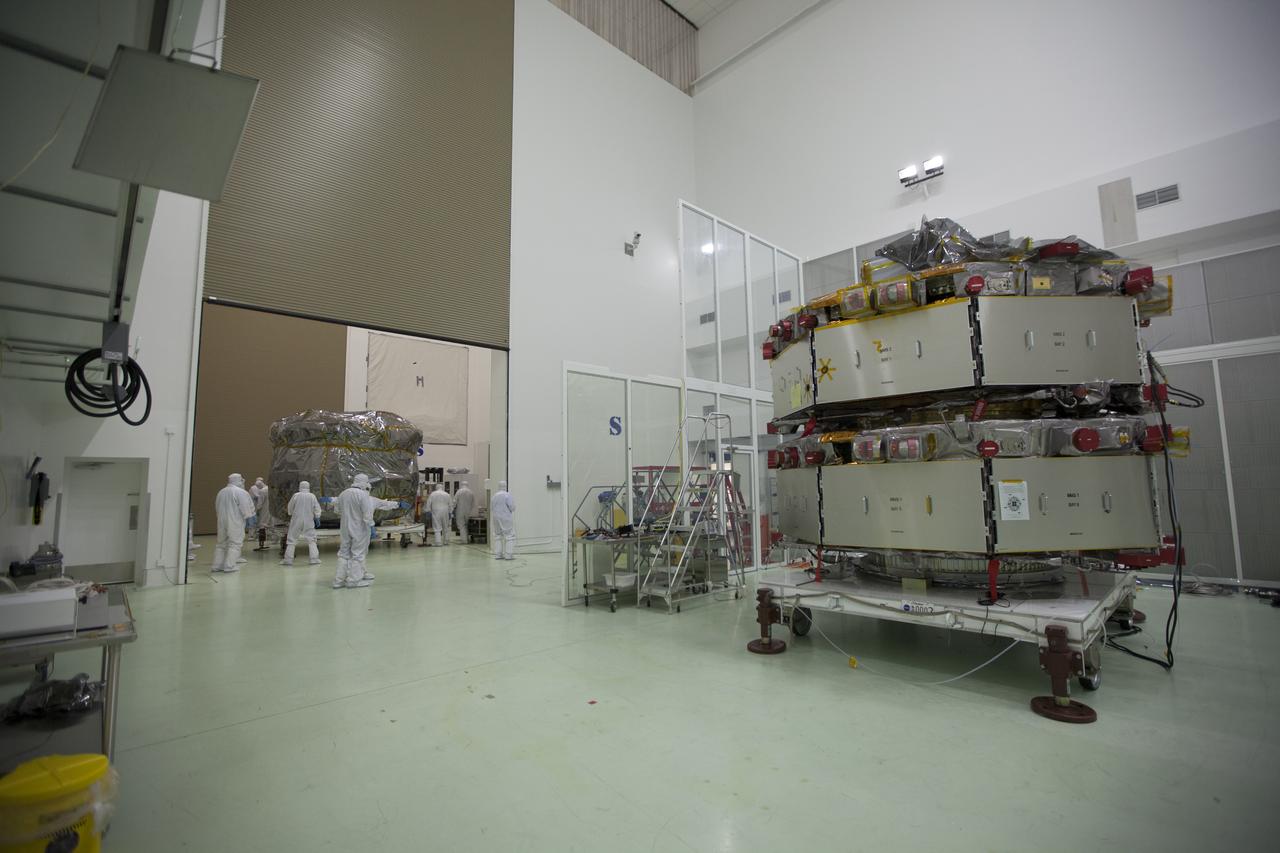
Two Magnetospheric Multiscale, or MMS, spacecraft comprising the mission’s upper stack arrive in the Building 1 airlock of the Astrotech payload processing facility in Titusville, Florida, near Kennedy Space Center. The two MMS spacecraft comprising the lower stack, in the high bay uat right, arrived at Astrotech on Oct. 29. The Magnetospheric Multiscale mission is a Solar Terrestrial Probes mission comprising four identically instrumented spacecraft that will use Earth’s magnetosphere as a laboratory to study the microphysics of three fundamental plasma processes: magnetic reconnection, energetic particle acceleration and turbulence. Launch aboard a United Launch Alliance Atlas V rocket from Space Launch Complex 41 on Cape Canaveral Air Force Station is targeted for March 12, 2015.
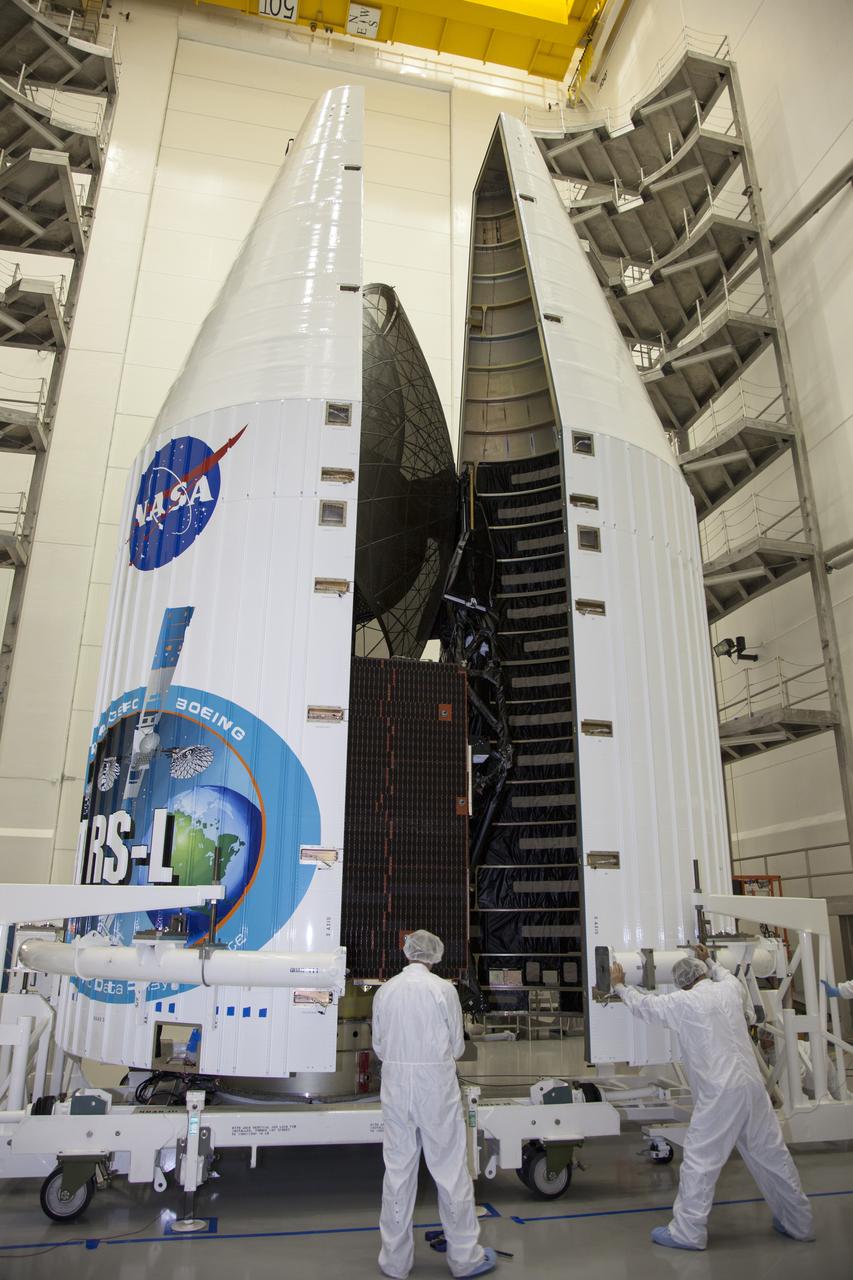
TITUSVILLE, Fla. – Inside the Astrotech payload processing facility in Titusville, United Launch Alliance engineers and technicians encapsulate the Tracking and Data Relay Satellite, or TDRS-L, spacecraft in its payload fairing. TDRS-L will then be transported to Launch Complex 41 at Cape Canaveral Air Force Station. The TDRS-L satellite will be a part of the second of three next-generation spacecraft designed to ensure vital operational continuity for the NASA Space Network. It is scheduled to launch from Cape Canaveral's Space Launch Complex 41 atop a United Launch Alliance Atlas V rocket on January 23, 2014. The current Tracking and Data Relay Satellite system consists of eight in-orbit satellites distributed to provide near continuous information relay contact with orbiting spacecraft ranging from the International Space Station and Hubble Space Telescope to the array of scientific observatories. For more information, visit: http://www.nasa.gov/mission_pages/tdrs/home/index.html
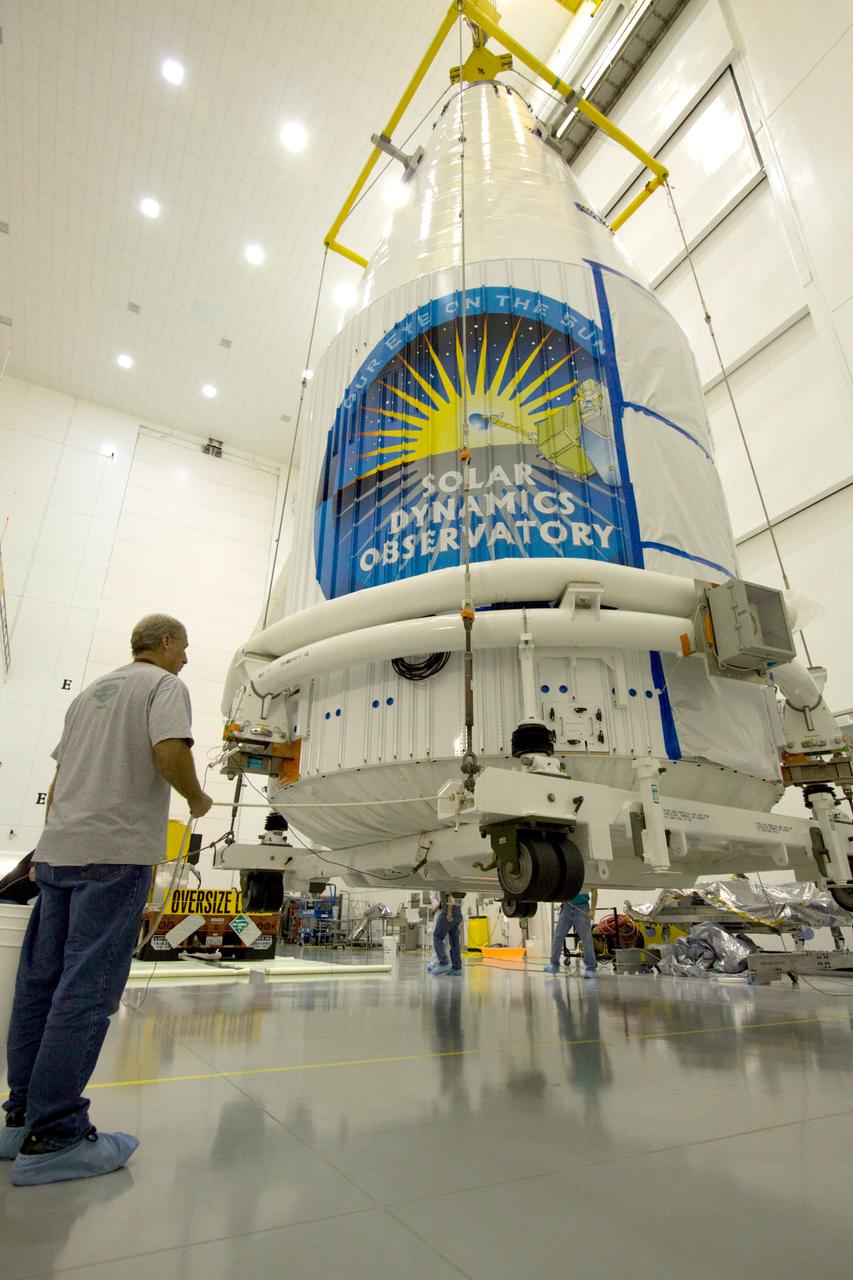
SDO MOVE TO TRANSPORTER
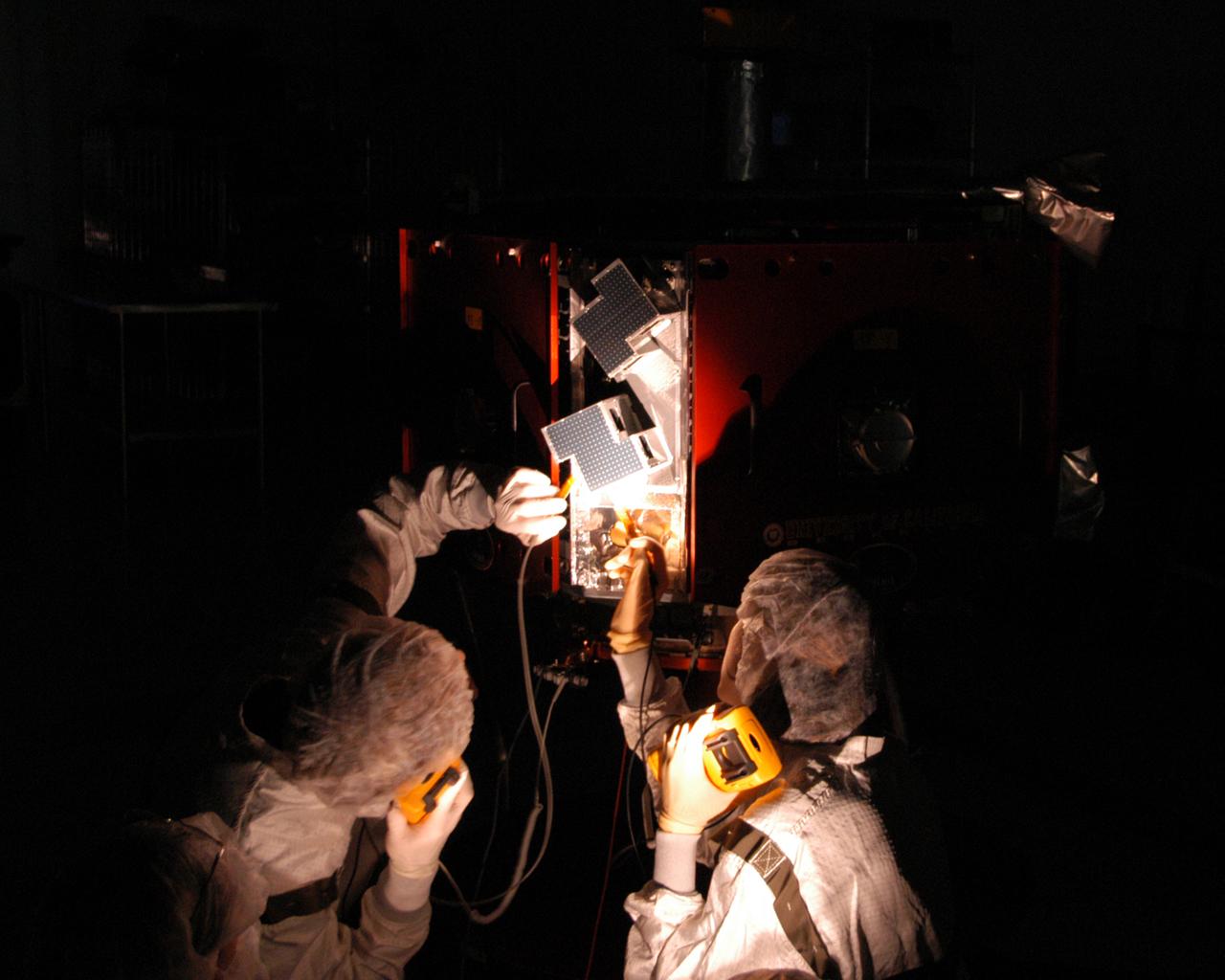
At Astrotech Space Operations, technicians conduct white light inspection of the THEMIS probes. They will also undergo black light inspection. White light inspection assures the telemetry is operating. Black light inspection uses UVA fluorescence to detect possible particulate microcontamination, minute cracks or fluid leaks. THEMIS consists of five identical probes, the largest number of scientific satellites ever launched into orbit aboard a single rocket. This unique constellation of satellites will resolve the tantalizing mystery of what causes the spectacular sudden brightening of the aurora borealis and aurora australis - the fiery skies over the Earth's northern and southern polar regions. THEMIS is scheduled to launch Feb. 15 from Cape Canaveral Air Force Station.
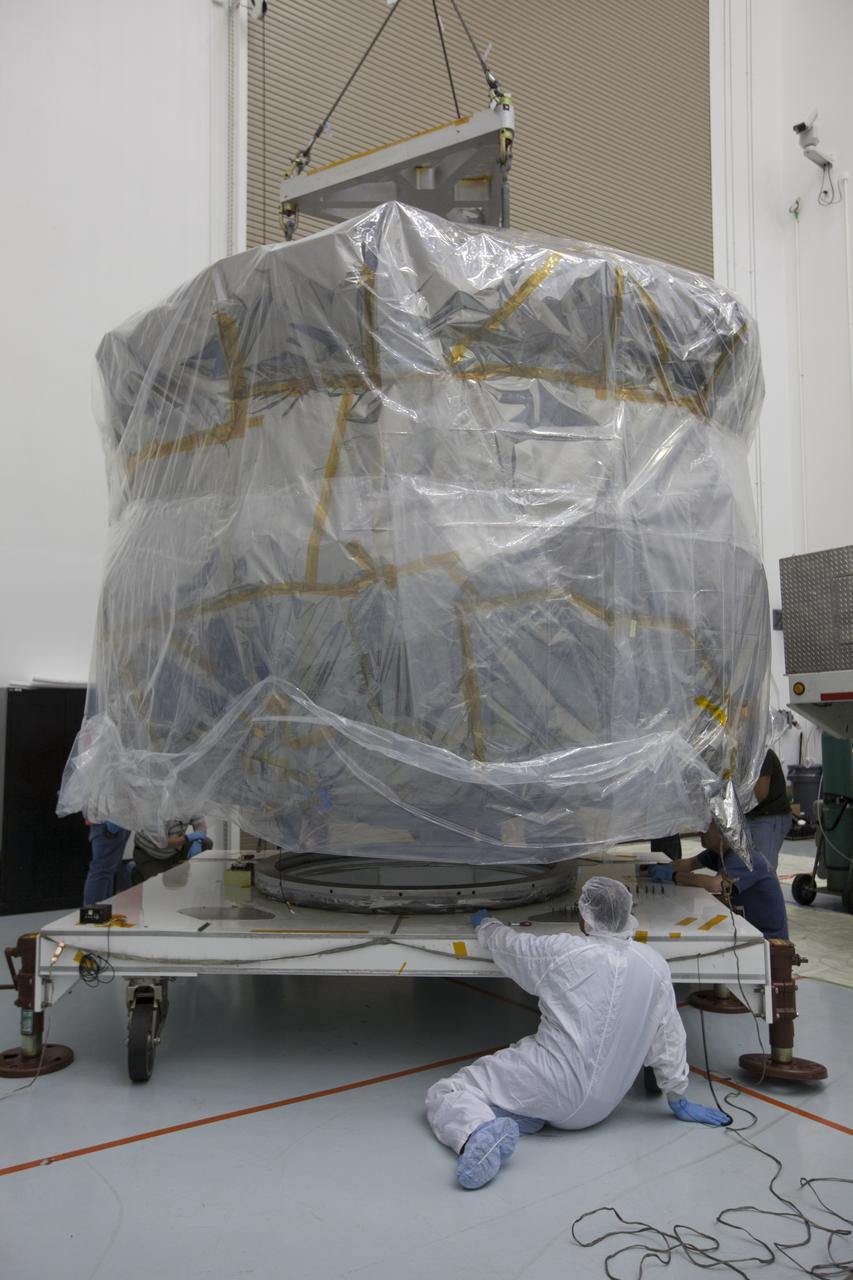
Two Magnetospheric Multiscale , or MMS, spacecraft comprising the mission’s upper stack are lowered onto a payload dolly in Building 2 of the Astrotech payload processing facility in Titusville, Florida, near Kennedy Space Center. The two MMS spacecraft comprising the lower stack arrived at Astrotech on Oct. 29. The Magnetospheric Multiscale mission is a Solar Terrestrial Probes mission comprising four identically instrumented spacecraft that will use Earth’s magnetosphere as a laboratory to study the microphysics of three fundamental plasma processes: magnetic reconnection, energetic particle acceleration and turbulence. Launch aboard a United Launch Alliance Atlas V rocket from Space Launch Complex 41 on Cape Canaveral Air Force Station is targeted for March 12, 2015.
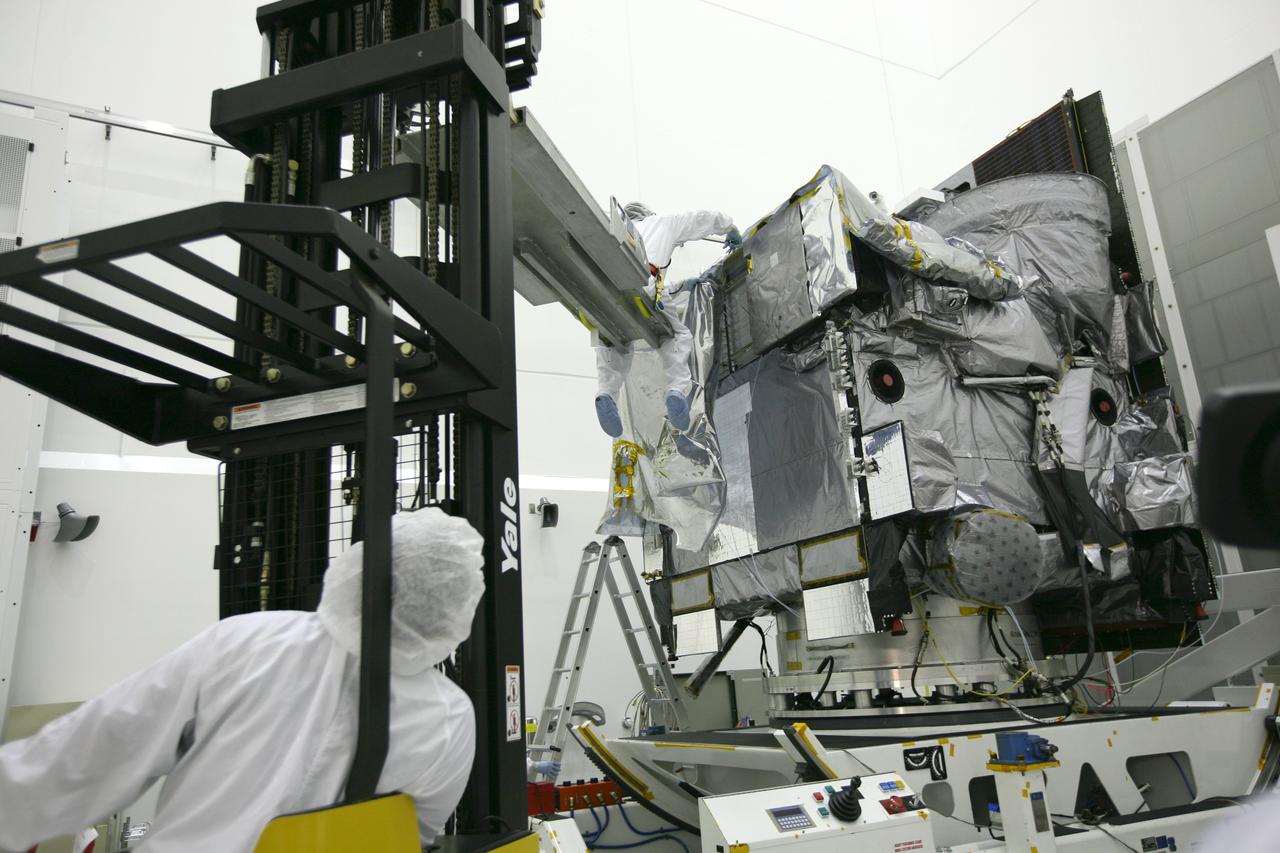
GOES-P UNBAGGING & ROTATION

Technicians prepare to remove the protective covering from the lower stack, mini-stack number 1, two of the observatories for NASA's Magnetospheric Multiscale Observatory, or MMS, in Building 1 D high bay at the Astrotech payload processing facility in Titusville, Florida, near Kennedy Space Center. The MMS upper stack, mini-stack number 2, is scheduled to arrive in about two weeks. MMS is a Solar Terrestrial Probes mission comprising four identically instrumented spacecraft that will use Earth’s magnetosphere as a laboratory to study the microphysics of three fundamental plasma processes: magnetic reconnection, energetic particle acceleration and turbulence. Launch aboard a United Launch Alliance Atlas V rocket from Space Launch Complex 41 on Cape Canaveral Air Force Station is targeted for March 12, 2015.
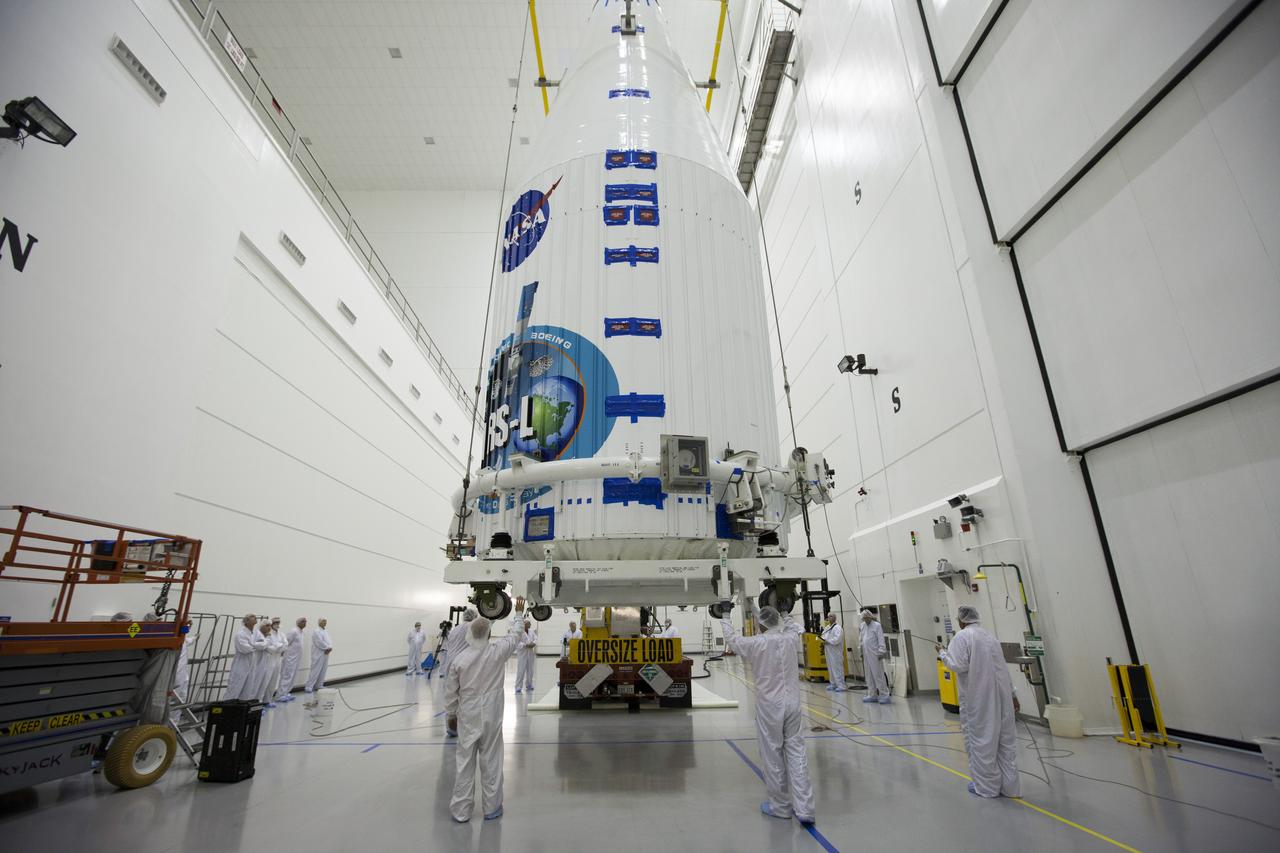
TITUSVILLE, Fla. – Inside the Astrotech payload processing facility in Titusville, NASA's Tracking and Data Relay Satellite, or TDRS-L, spacecraft has been encapsulated in its payload fairing. It is being lifted by crane for mounting on a transporter for its trip to Launch Complex 41 at Cape Canaveral Air Force Station. The TDRS-L satellite will be a part of the second of three next-generation spacecraft designed to ensure vital operational continuity for the NASA Space Network. It is scheduled to launch from Cape Canaveral's Space Launch Complex 41 atop a United Launch Alliance Atlas V rocket on January 23, 2014. The current Tracking and Data Relay Satellite system consists of eight in-orbit satellites distributed to provide near continuous information relay contact with orbiting spacecraft ranging from the International Space Station and Hubble Space Telescope to the array of scientific observatories. For more information, visit: http://www.nasa.gov/mission_pages/tdrs/home/index.html Photo credit: NASA/Kim Shiflett
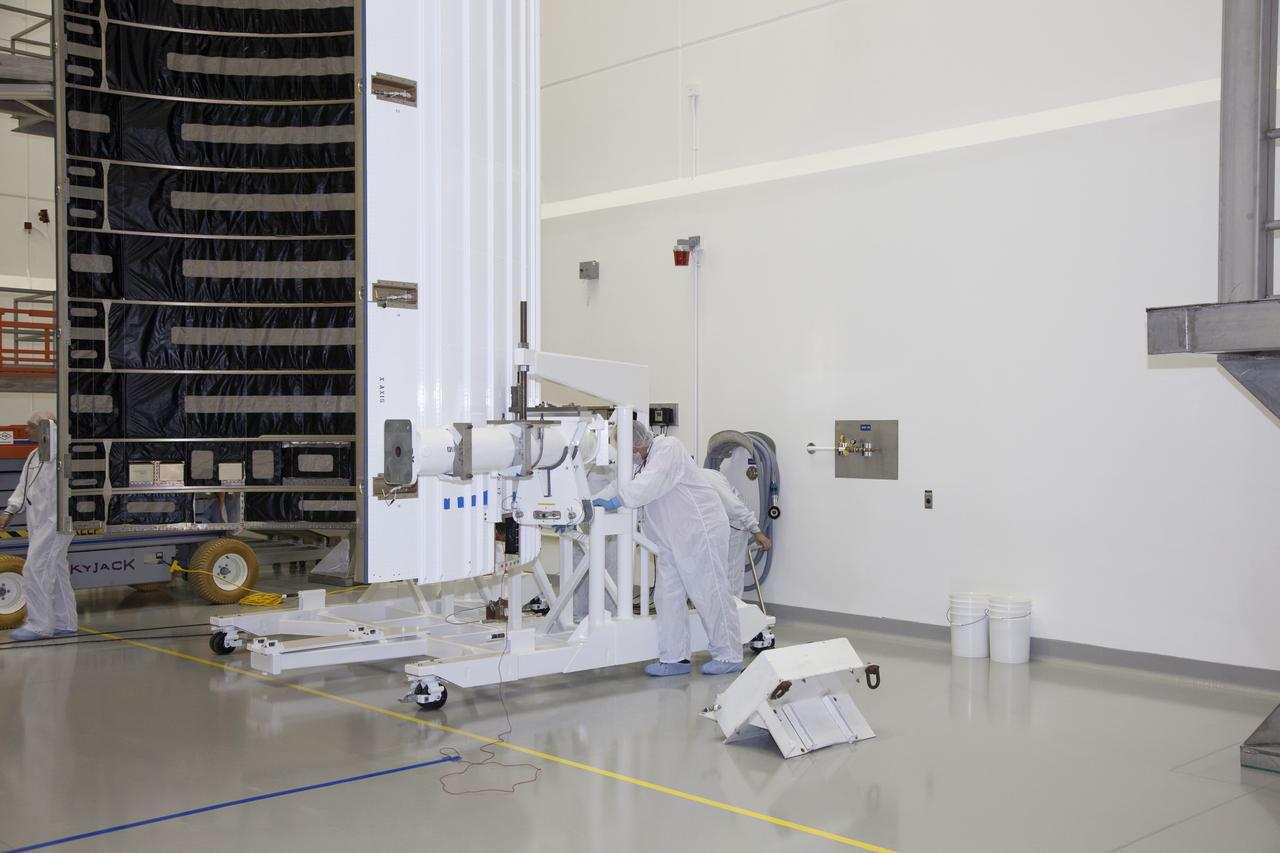
TITUSVILLE, Fla. – Inside the Astrotech payload processing facility in Titusville NASA's Tracking and Data Relay Satellite, or TDRS-L, spacecraft is being encapsulated in its payload fairing prior to being transported to Launch Complex 41 at Cape Canaveral Air Force Station. The TDRS-L satellite will be a part of the second of three next-generation spacecraft designed to ensure vital operational continuity for the NASA Space Network. It is scheduled to launch from Cape Canaveral's Space Launch Complex 41 atop a United Launch Alliance Atlas V rocket on January 23, 2014. The current Tracking and Data Relay Satellite system consists of eight in-orbit satellites distributed to provide near continuous information relay contact with orbiting spacecraft ranging from the International Space Station and Hubble Space Telescope to the array of scientific observatories. For more information, visit: http://www.nasa.gov/mission_pages/tdrs/home/index.html

In the Hazardous Processing Facility at Astrotech Space Operations, a technician observes one of the THEMIS probes as it undergoes solar array illumination telemetry testing. THEMIS consists of five identical probes, the largest number of scientific satellites ever launched into orbit aboard a single rocket. This unique constellation of satellites will resolve the tantalizing mystery of what causes the spectacular sudden brightening of the aurora borealis and aurora australis - the fiery skies over the Earth's northern and southern polar regions. THEMIS is scheduled to launch aboard the Delta II at 6:07 p.m. EST on Feb. 15.
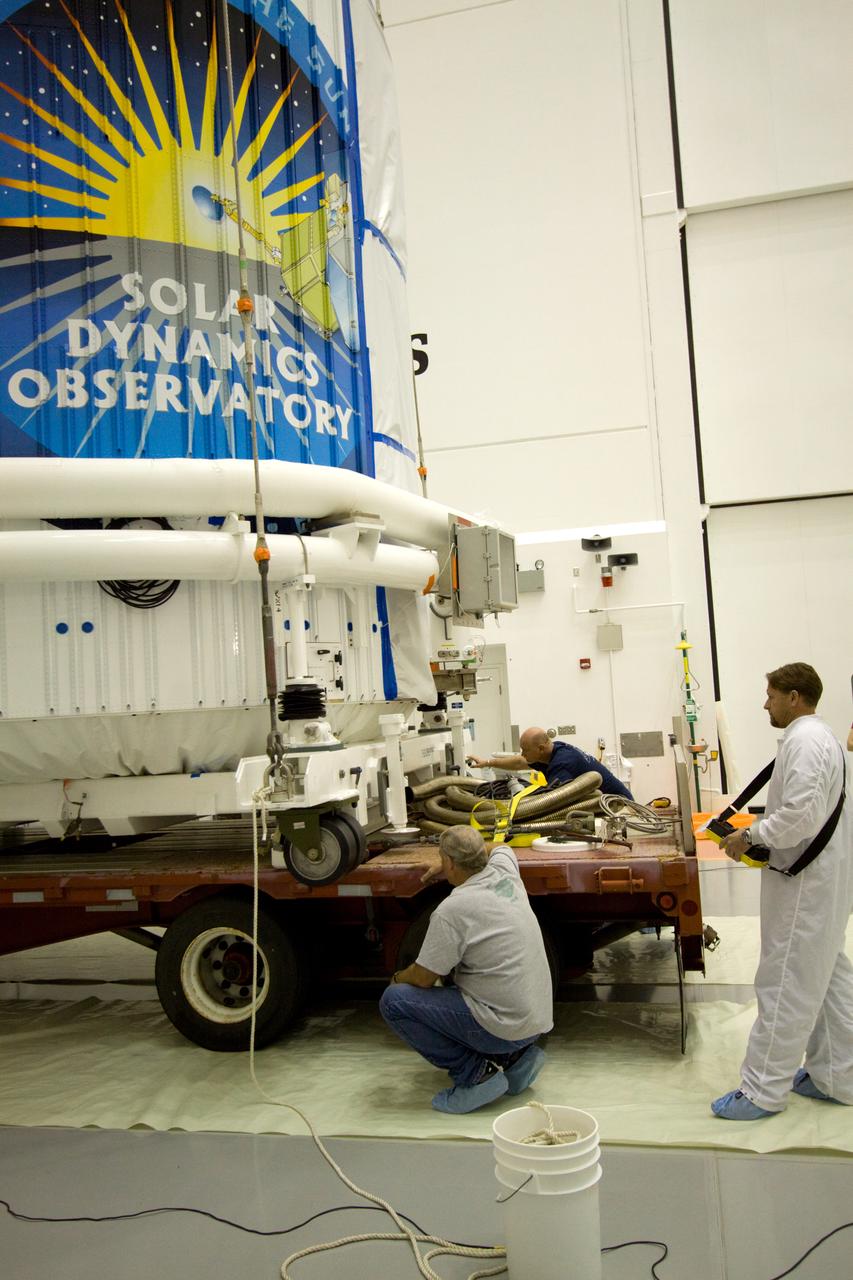
SDO MOVE TO TRANSPORTER
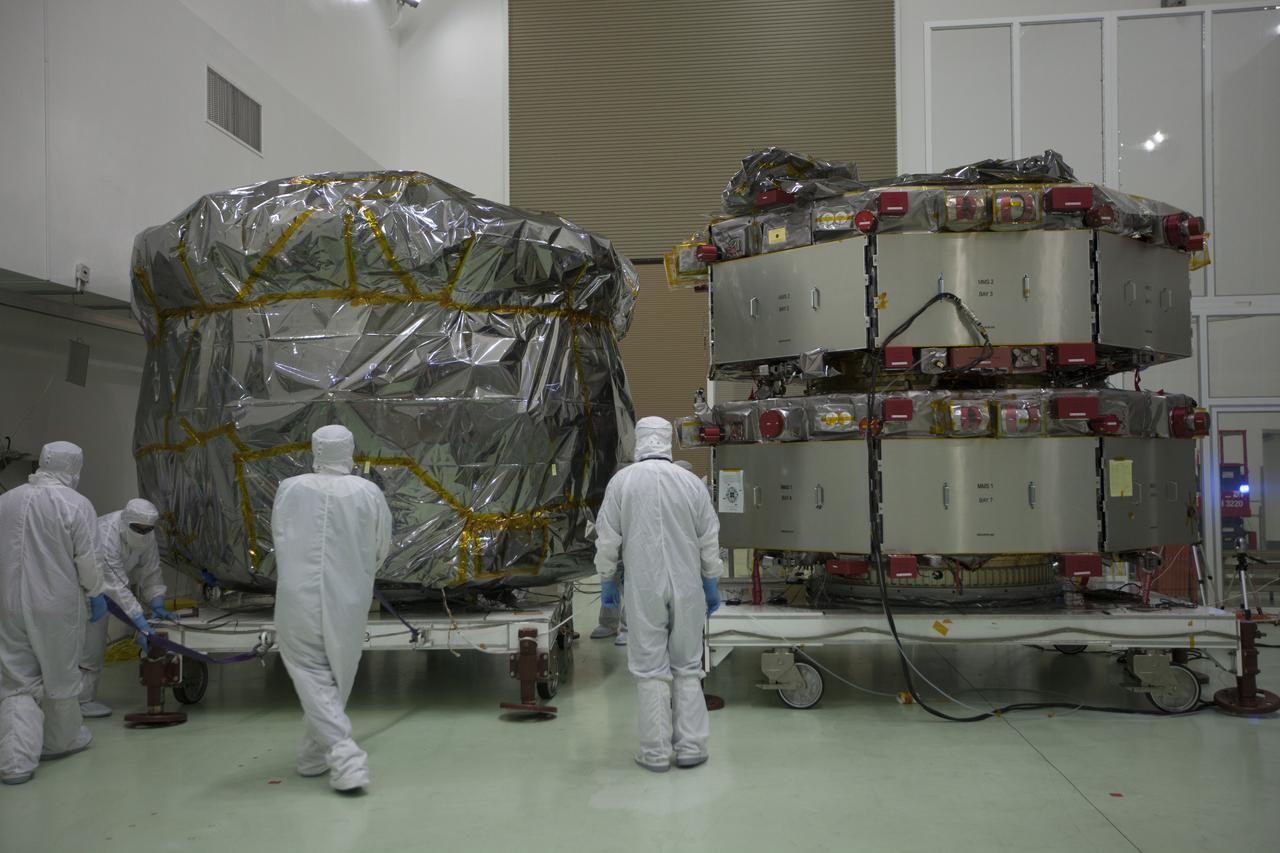
Two Magnetospheric Multiscale, or MMS, spacecraft comprising the mission’s upper stack, at left, arrive in the Building 1 high bay of the Astrotech payload processing facility in Titusville, Florida, near Kennedy Space Center. The two MMS spacecraft comprising the lower stack, at right, arrived at Astrotech on Oct. 29. The Magnetospheric Multiscale mission is a Solar Terrestrial Probes mission comprising four identically instrumented spacecraft that will use Earth’s magnetosphere as a laboratory to study the microphysics of three fundamental plasma processes: magnetic reconnection, energetic particle acceleration and turbulence. Launch aboard a United Launch Alliance Atlas V rocket from Space Launch Complex 41 on Cape Canaveral Air Force Station is targeted for March 12, 2015.

SDO MOVE TO TRANSPORTER