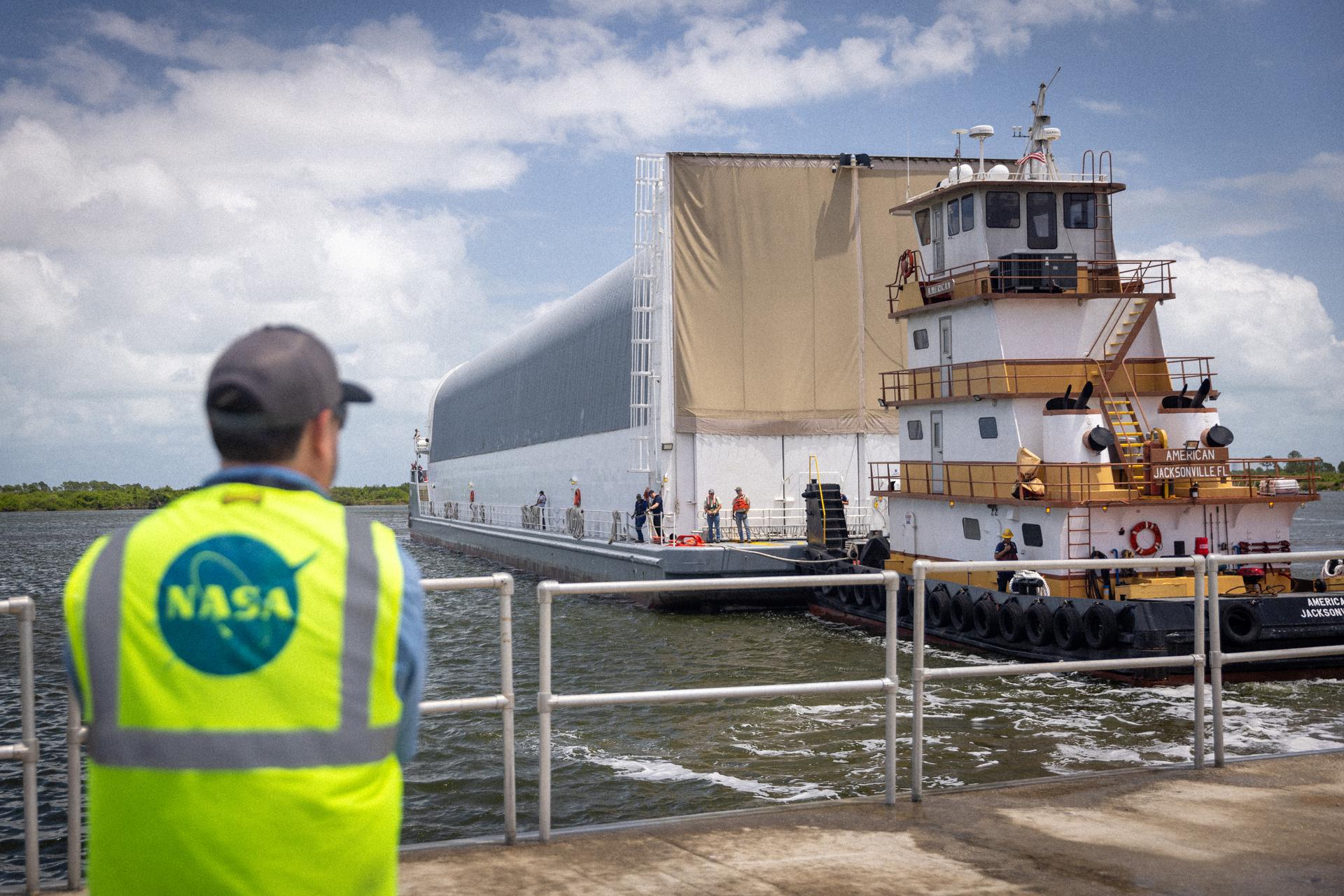
NASA’s Pegasus barge, carrying the top four-fifths of the agency’s SLS (Space Launch System) core stage for the Artemis III mission, arrives at NASA’s Kennedy Space Center Complex 39 turn basin wharf in Florida on Monday, April 27, 2026. Artemis III will launch astronauts to Earth’s orbit aboard the Orion spacecraft on top of SLS to test rendezvous and docking capabilities between Orion and commercial spacecraft needed to land Artemis IV astronauts on the Moon in 2028.
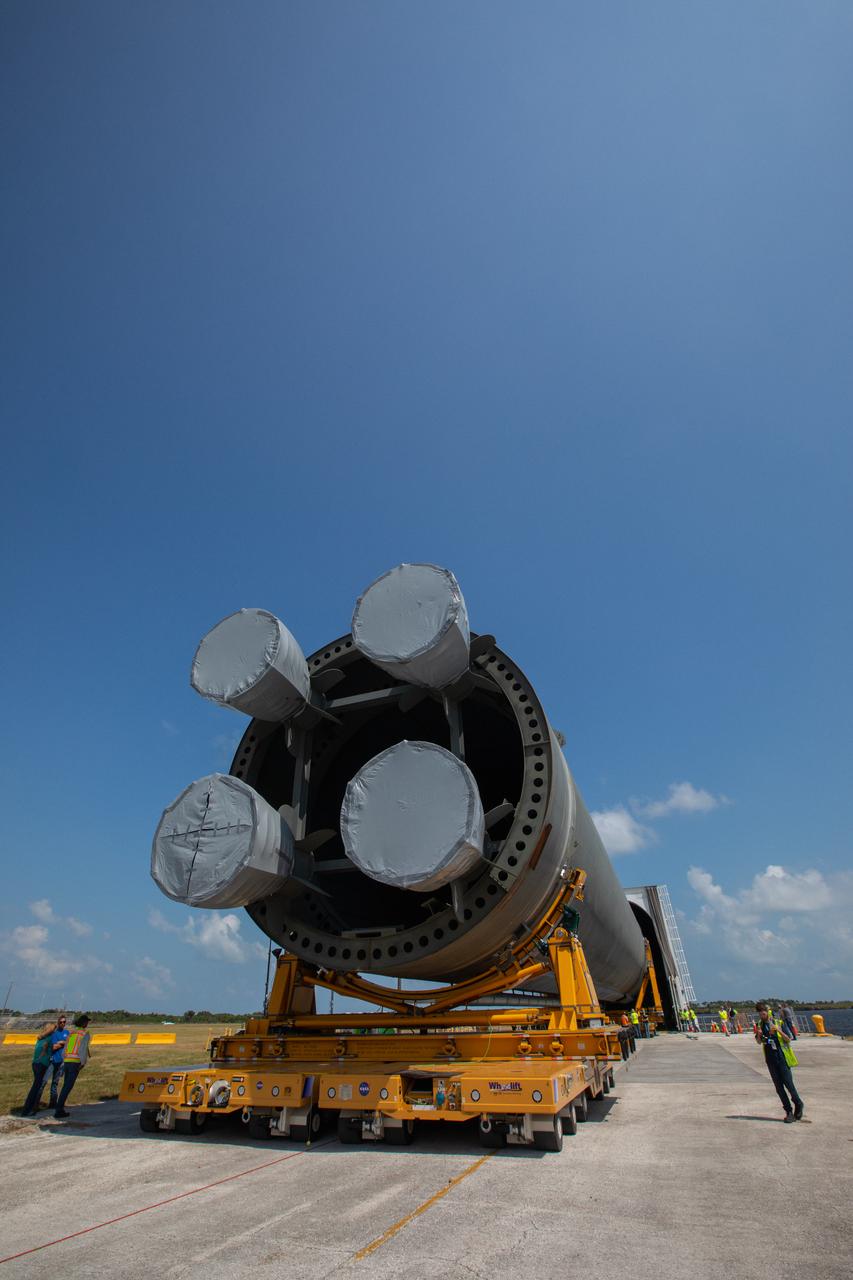
The 212-foot-long Space Launch System (SLS) rocket core stage pathfinder has been offloaded from NASA’s Pegasus Barge at Kennedy Space Center’s Launch Complex 39 turn basin wharf on Sept. 30, 2019. The Pegasus Barge made its first delivery to Kennedy in support of the agency's Artemis missions. The upgraded 310-foot-long barge arrived Sept. 27, 2019, ferrying the SLS core stage pathfinder, a full-scale mock-up of the rocket's core stage. It will be used by the Exploration Ground Systems Program and their contractor, Jacobs, to practice offloading, moving and stacking maneuvers, using important ground support equipment to train employees and certify all the equipment works properly. The pathfinder will stay at Kennedy for approximately one month before trekking back to NASA's Michoud Assembly Facility in Louisiana.
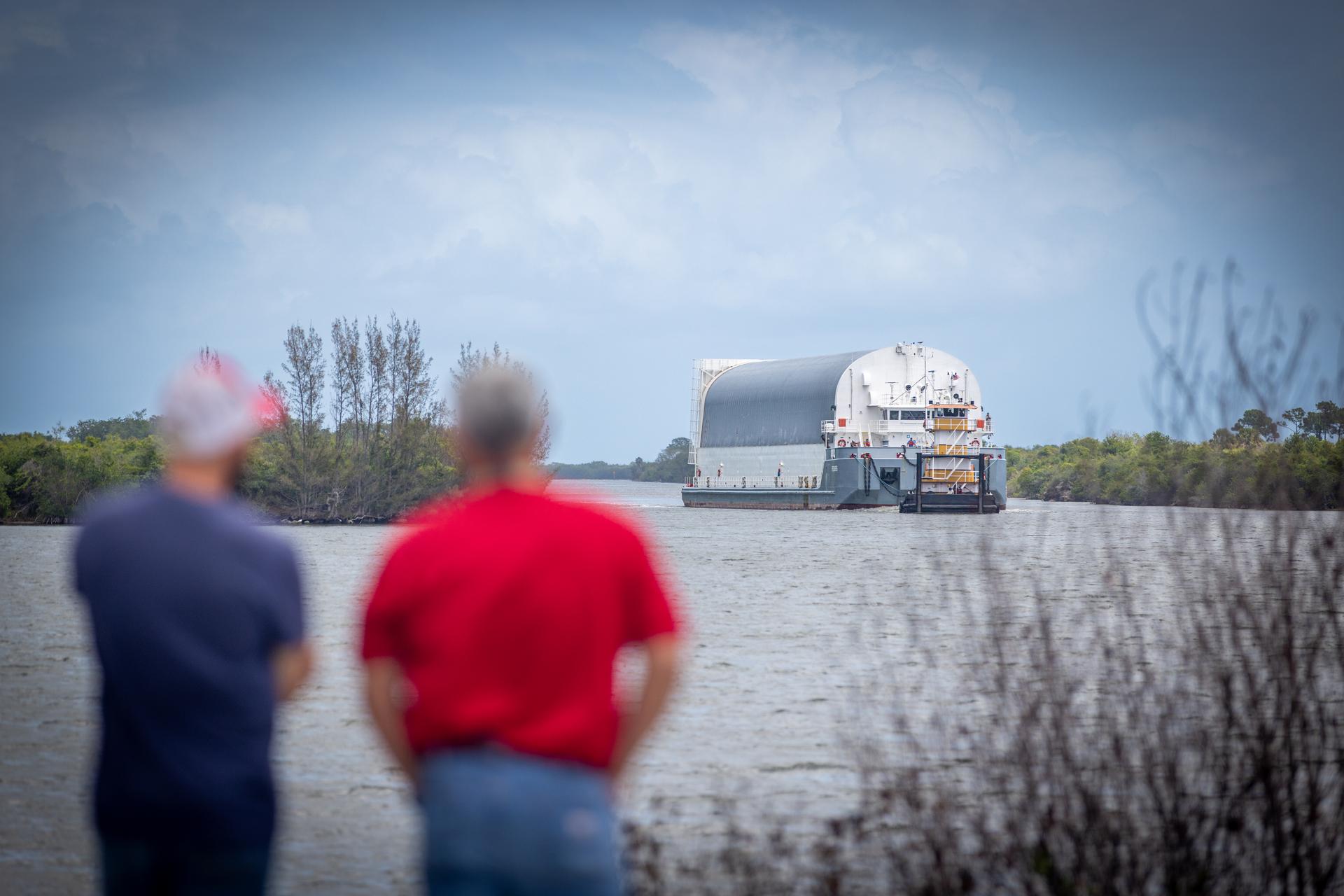
NASA’s Pegasus barge, carrying the top four-fifths of the agency’s SLS (Space Launch System) core stage for the Artemis III mission, arrives at NASA’s Kennedy Space Center Complex 39 turn basin wharf in Florida on Monday, April 27, 2026. Artemis III will launch astronauts to Earth’s orbit aboard the Orion spacecraft on top of SLS to test rendezvous and docking capabilities between Orion and commercial spacecraft needed to land Artemis IV astronauts on the Moon in 2028.
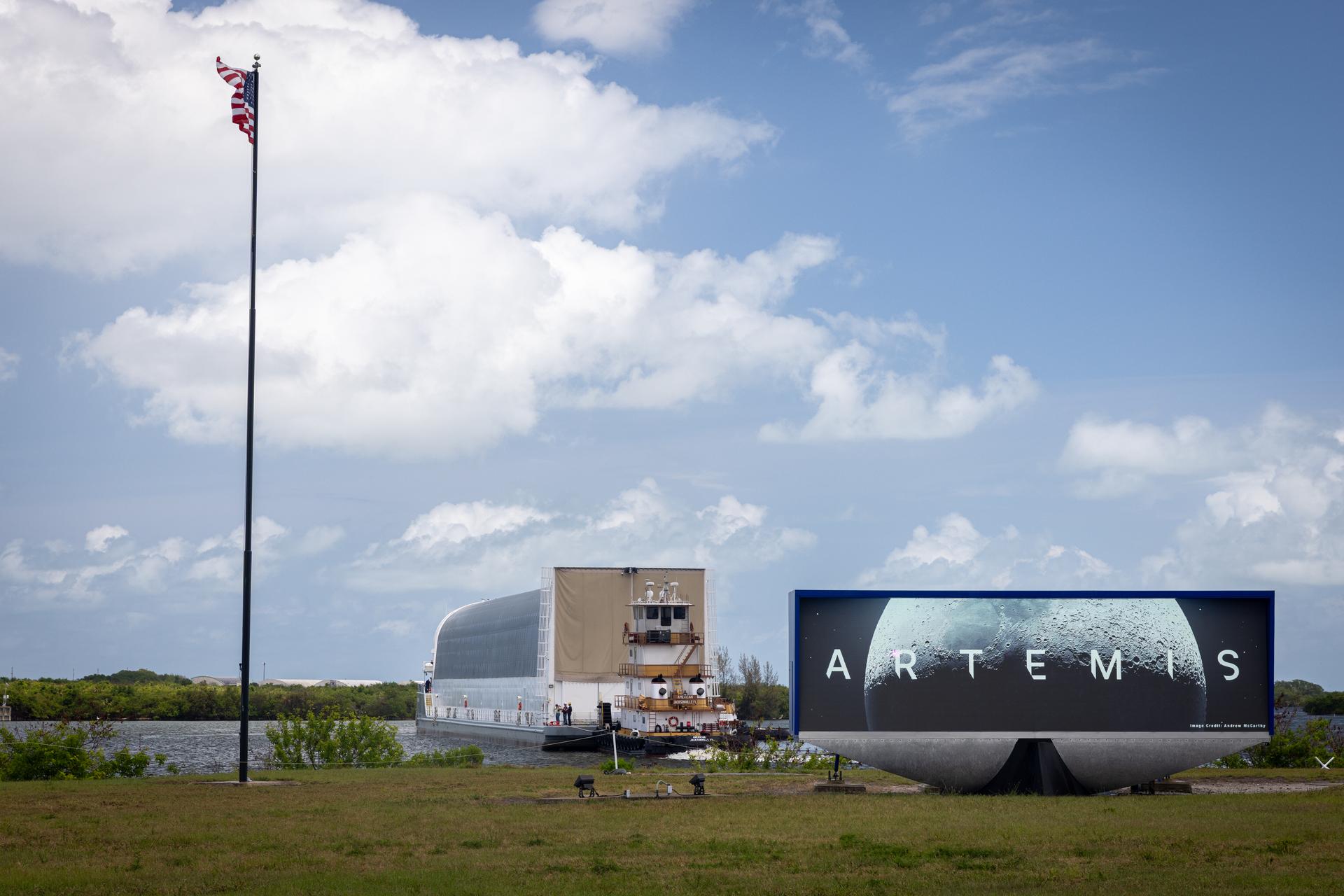
NASA’s Pegasus barge, carrying the top four-fifths of the agency’s SLS (Space Launch System) core stage for the Artemis III mission, arrives at NASA’s Kennedy Space Center Complex 39 turn basin wharf in Florida on Monday, April 27, 2026. Artemis III will launch astronauts to Earth’s orbit aboard the Orion spacecraft on top of SLS to test rendezvous and docking capabilities between Orion and commercial spacecraft needed to land Artemis IV astronauts on the Moon in 2028.
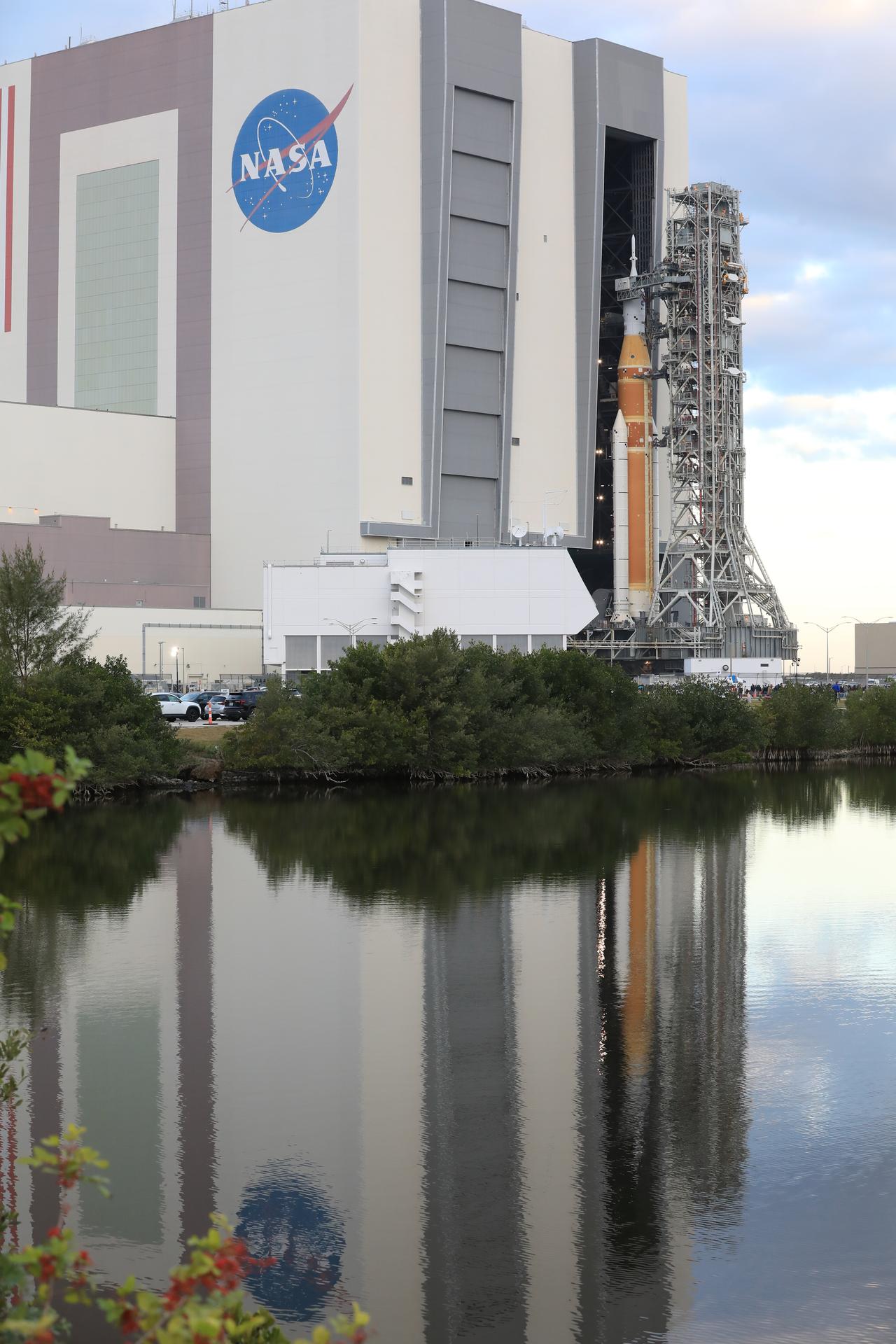
NASA’s crawler-transporter 2 carrying the agency’s Artemis II SLS (Space Launch System) rocket and Orion spacecraft, secured to the mobile launcher, begins rolling out from High Bay 3 inside the Vehicle Assembly Building to Launch Complex 39B at NASA’s Kennedy Space Center in Florida on Saturday, Jan. 17, 2026. The Artemis II test flight will take Commander Reid Wiseman, Pilot Victor Glover, and Mission Specialist Christina Koch from NASA and Mission Specialist Jeremy Hansen from the CSA (Canadian Space Agency), around the Moon and back to Earth no later than April 2026.
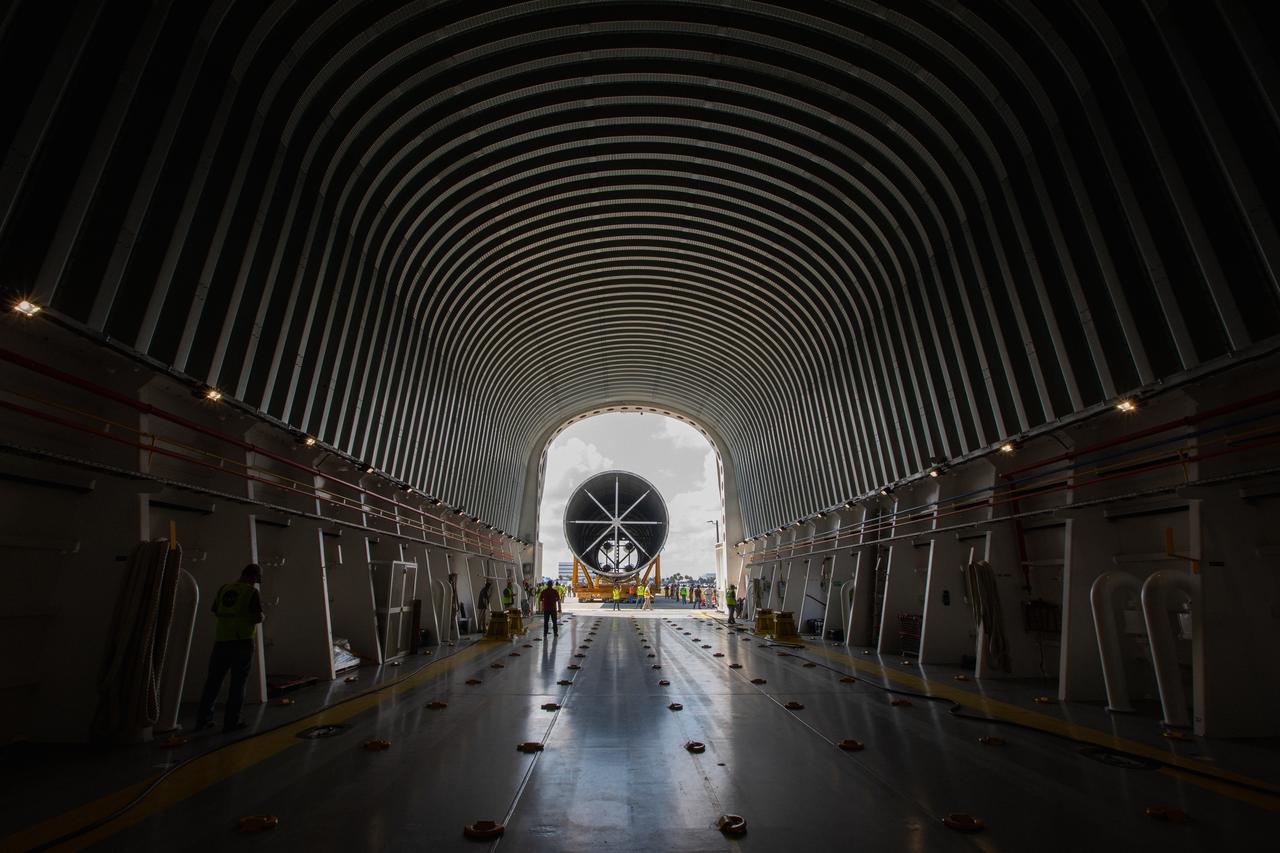
In this view from inside NASA’s Pegasus Barge, the 212-foot-long Space Launch System (SLS) rocket core stage pathfinder is being offloaded from the barge at Kennedy Space Center’s Launch Complex 39 turn basin wharf on Sept. 30, 2019. The Pegasus Barge made its first delivery to Kennedy in support of the agency's Artemis missions. The upgraded 310-foot-long barge arrived Sept. 27, 2019, ferrying the SLS core stage pathfinder, a full-scale mock-up of the rocket's core stage. It will be used by the Exploration Ground Systems Program and their contractor, Jacobs, to practice offloading, moving and stacking maneuvers, using important ground support equipment to train employees and certify all the equipment works properly. The pathfinder will stay at Kennedy for approximately one month before trekking back to NASA's Michoud Assembly Facility in Louisiana.
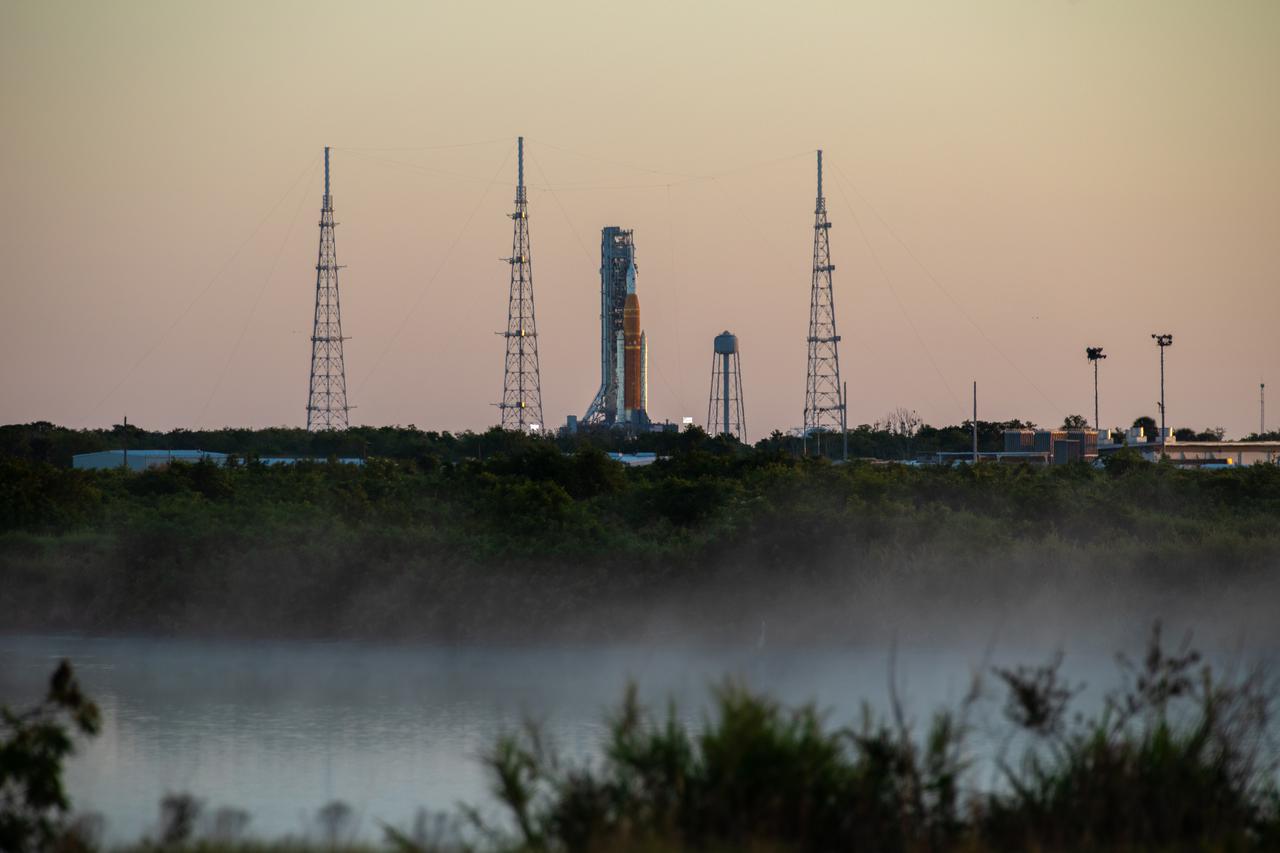
A sunrise view of the Artemis I Space Launch System (SLS) and Orion spacecraft at Launch Pad 39B at NASA’s Kennedy Space Center in Florida on April 11, 2022. Mist rises from a nearby waterway. The SLS and Orion atop the mobile launcher were transported to the pad on crawler-transporter 2 for a prelaunch test called a wet dress rehearsal. Artemis I will be the first integrated test of the SLS and Orion spacecraft. In later missions, NASA will land the first woman and the first person of color on the surface of the Moon, paving the way for a long-term lunar presence and serving as a steppingstone on the way to Mars.

NASA’s Pegasus barge, carrying several pieces of the agency’s Artemis campaign hardware, including Artemis II’s launch vehicle stage adapter, Artemis III’s core stage boat tail, and Artemis IV’s core stage engine section arrives at NASA’s Kennedy Space Center Complex 39 turn basin wharf in Florida on Thursday, Sept. 5, 2024.
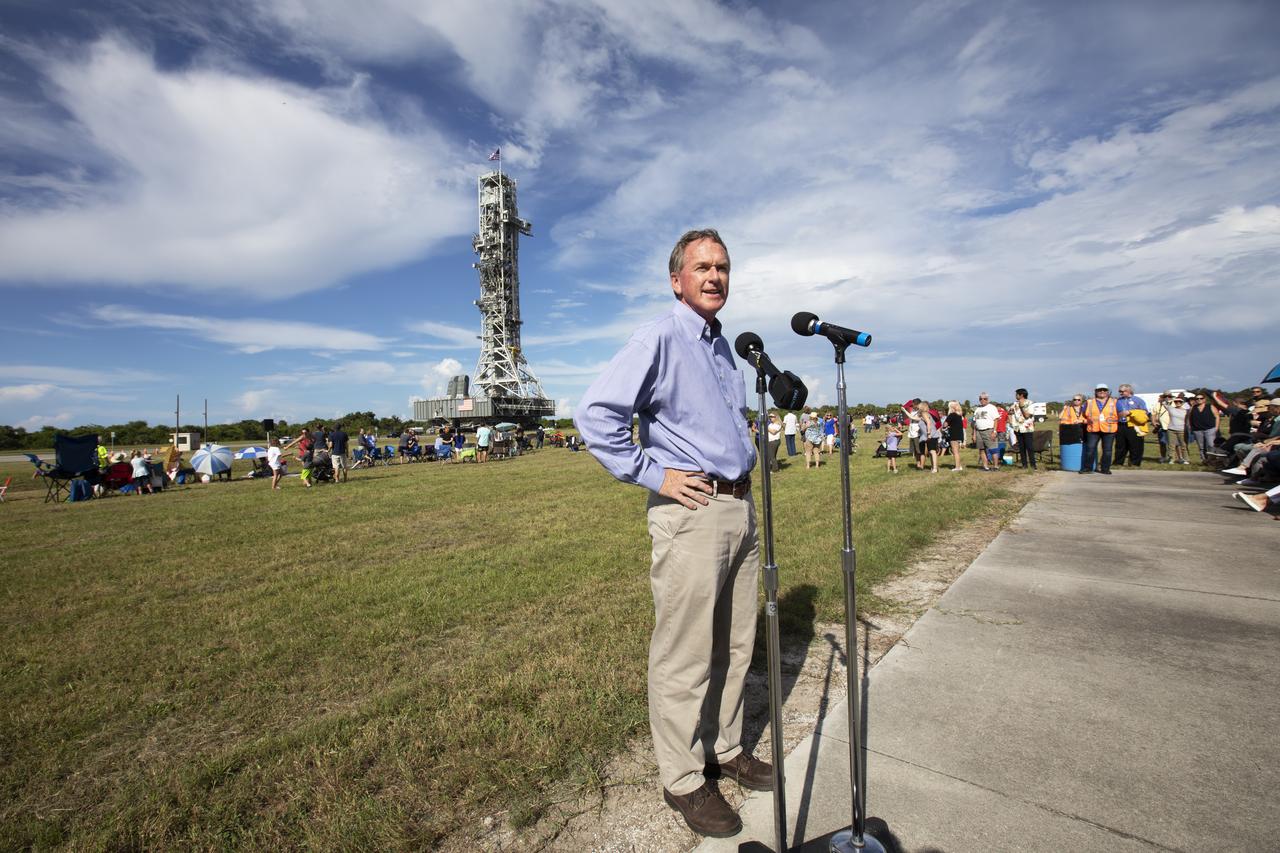
Mike Bolger, program manager of Exploration Ground Systems, speaks to workers and guests during an employee event for the mobile launcher move to the Vehicle Assembly Building (VAB) on Sept. 7, 2018, at NASA's Kennedy Space Center in Florida. The mobile launcher, atop crawler-transporter 2, began its trek from Launch Pad 39B along the crawlerway after undergoing a fit check and several days of systems testing with the pad. This is the first time that the modified mobile launcher made the trip to the pad. The 380-foot-tall mobile launcher is equipped with the crew access arm and several umbilicals that will provide power, environmental control, pneumatics, communication and electrical connections to the agency's Space Launch System and Orion spacecraft. The mobile launcher will spend seven months in the VAB undergoing testing. Exploration Ground Systems is preparing the ground systems necessary to launch SLS and Orion on Exploration Mission-1, missions to the Moon and on to Mars.
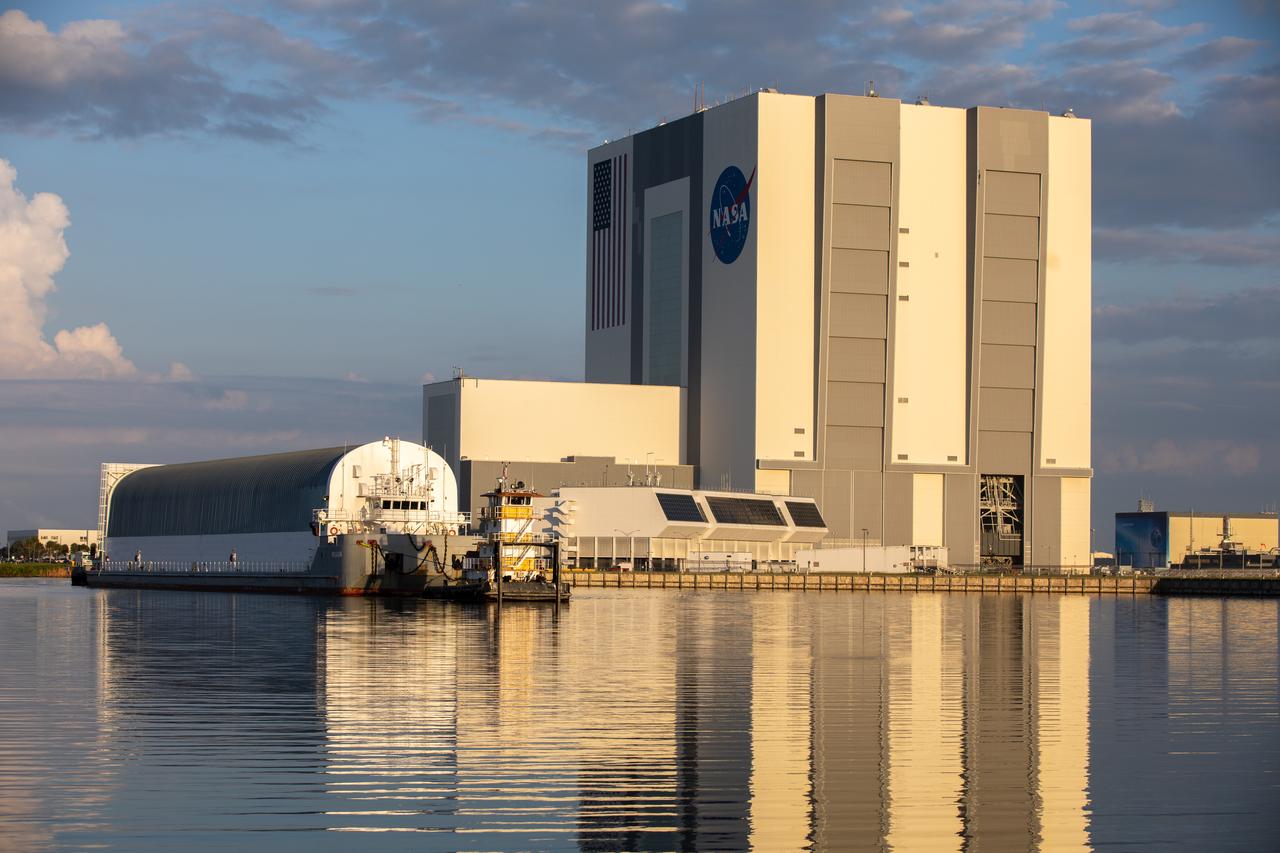
NASA’s Pegasus barge departs from the agency’s Kennedy Space Center in Florida on Aug. 4, 2020, for its trip to NASA’s Michoud Assembly Facility in Louisiana. The Pegasus barge arrived at Kennedy on July 29, delivering the launch vehicle stage adapter (LVSA) for the agency’s Space Launch System (SLS) rocket – the most powerful rocket NASA has ever built, providing the muscle necessary to get to the Moon and eventually to Mars. In the background is the Vehicle Assembly Building, where the LVSA – hardware that will connect the core stage of the rocket to the upper stage – is now undergoing processing. The next time the Pegasus barge returns to Kennedy, it will be carrying the SLS core stage – the final piece of the rocket that needs to be delivered ahead of the Artemis I launch.
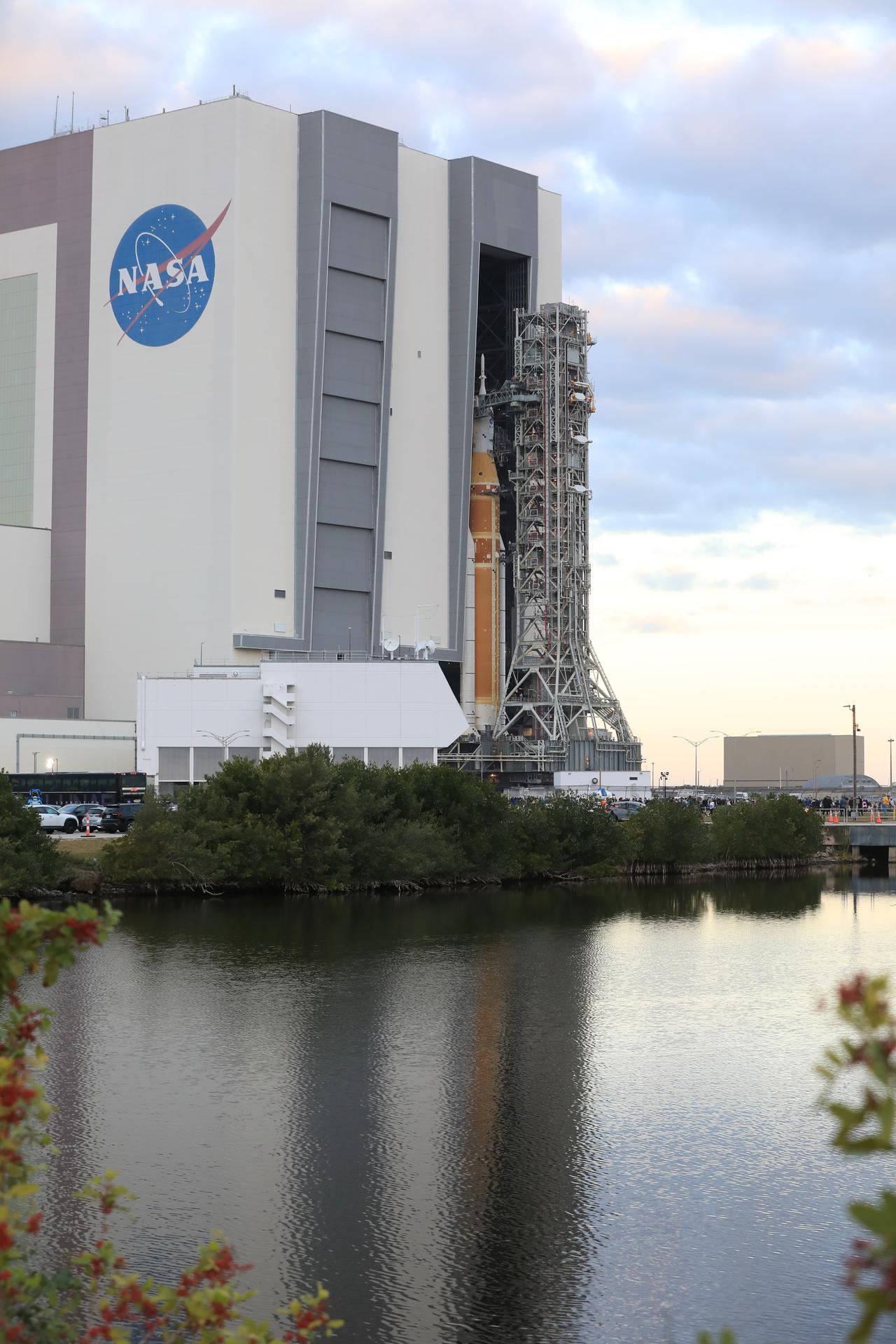
NASA’s crawler-transporter 2 carrying the agency’s Artemis II SLS (Space Launch System) rocket and Orion spacecraft, secured to the mobile launcher, begins rolling out from High Bay 3 inside the Vehicle Assembly Building to Launch Complex 39B at NASA’s Kennedy Space Center in Florida on Saturday, Jan. 17, 2026. The Artemis II test flight will take Commander Reid Wiseman, Pilot Victor Glover, and Mission Specialist Christina Koch from NASA and Mission Specialist Jeremy Hansen from the CSA (Canadian Space Agency), around the Moon and back to Earth no later than April 2026.
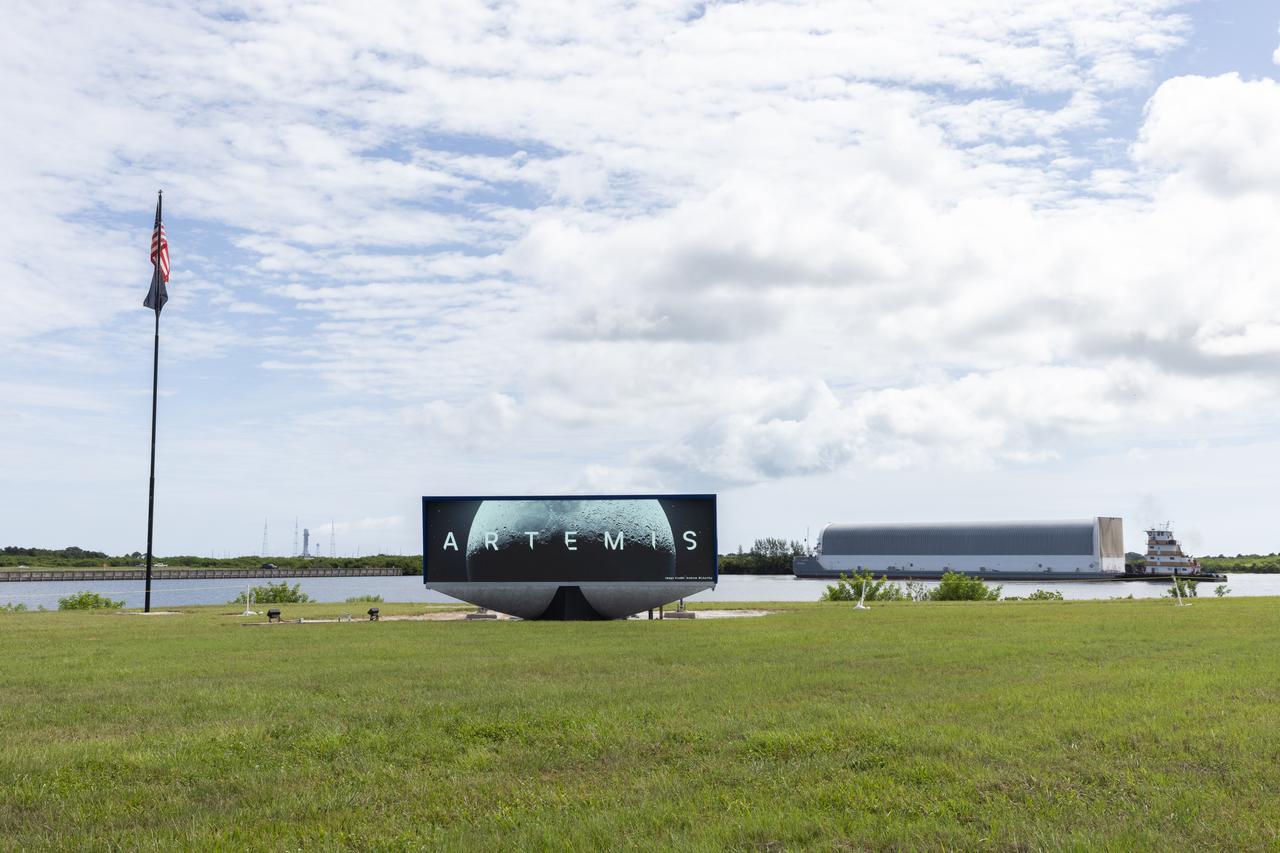
Behind the iconic countdown clock at NASA’s Kennedy Space Center in Florida, the agency’s Pegasus barge completes its 900-mile journey from NASA’s Michoud Assembly Facility in New Orleans carrying the powerful SLS (Space Launch System) core stage on Tuesday, July 23, 2024. Teams with Exploration Ground Systems (EGS) will offload the rocket stage and transfer it to the spaceport’s Vehicle Assembly Building to prepare it for integration atop the mobile launcher ahead of the Artemis II launch.
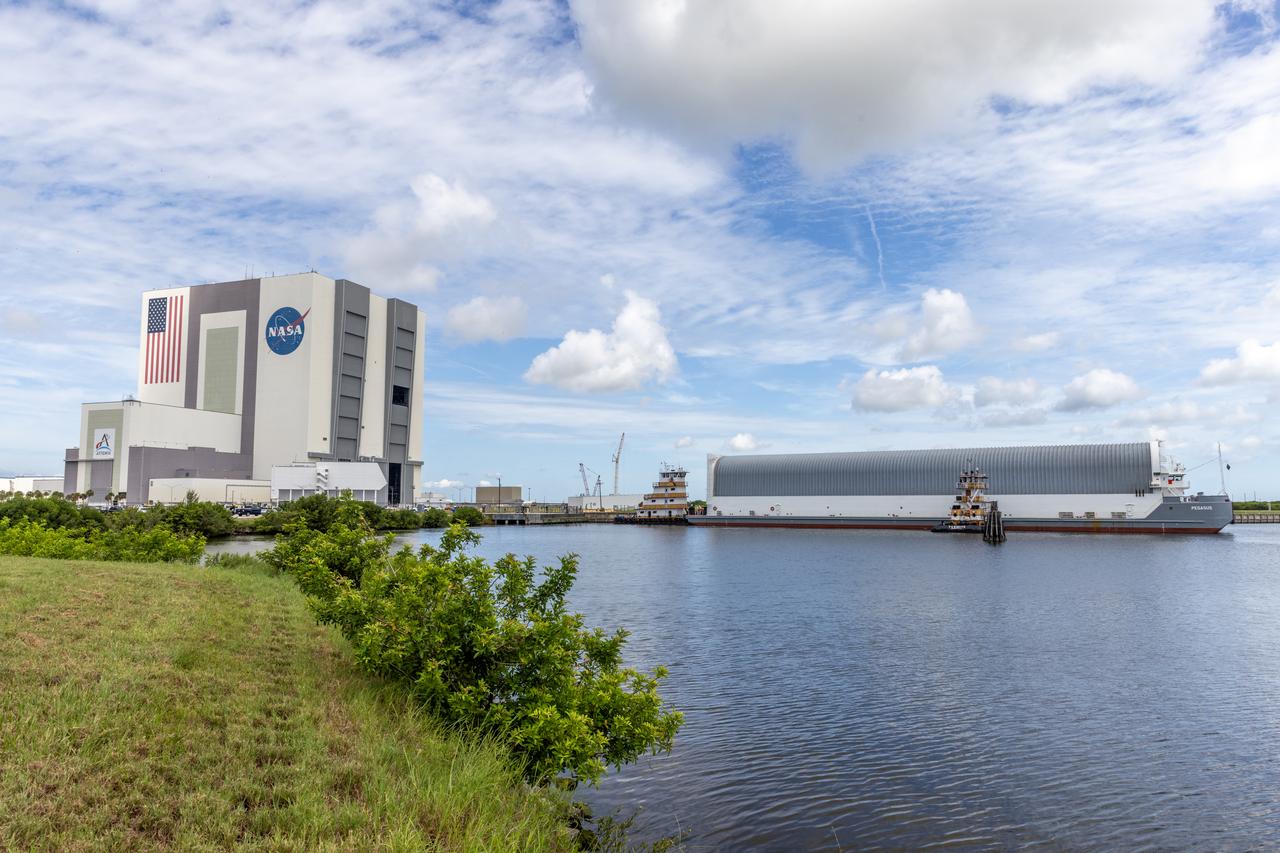
NASA’s Pegasus barge, carrying the agency’s massive SLS (Space Launch System) core stage, arrives at NASA’s Kennedy Space Center Complex 39 turn basin wharf in Florida on Tuesday, July 23, 2024, after journeying from the agency’s Michoud Assembly Facility in New Orleans. The core stage is the next piece of Artemis hardware to arrive at the spaceport and will be offloaded and moved to NASA Kennedy’s Vehicle Assembly Building, where it will be prepared for integration ahead of the Artemis II launch.
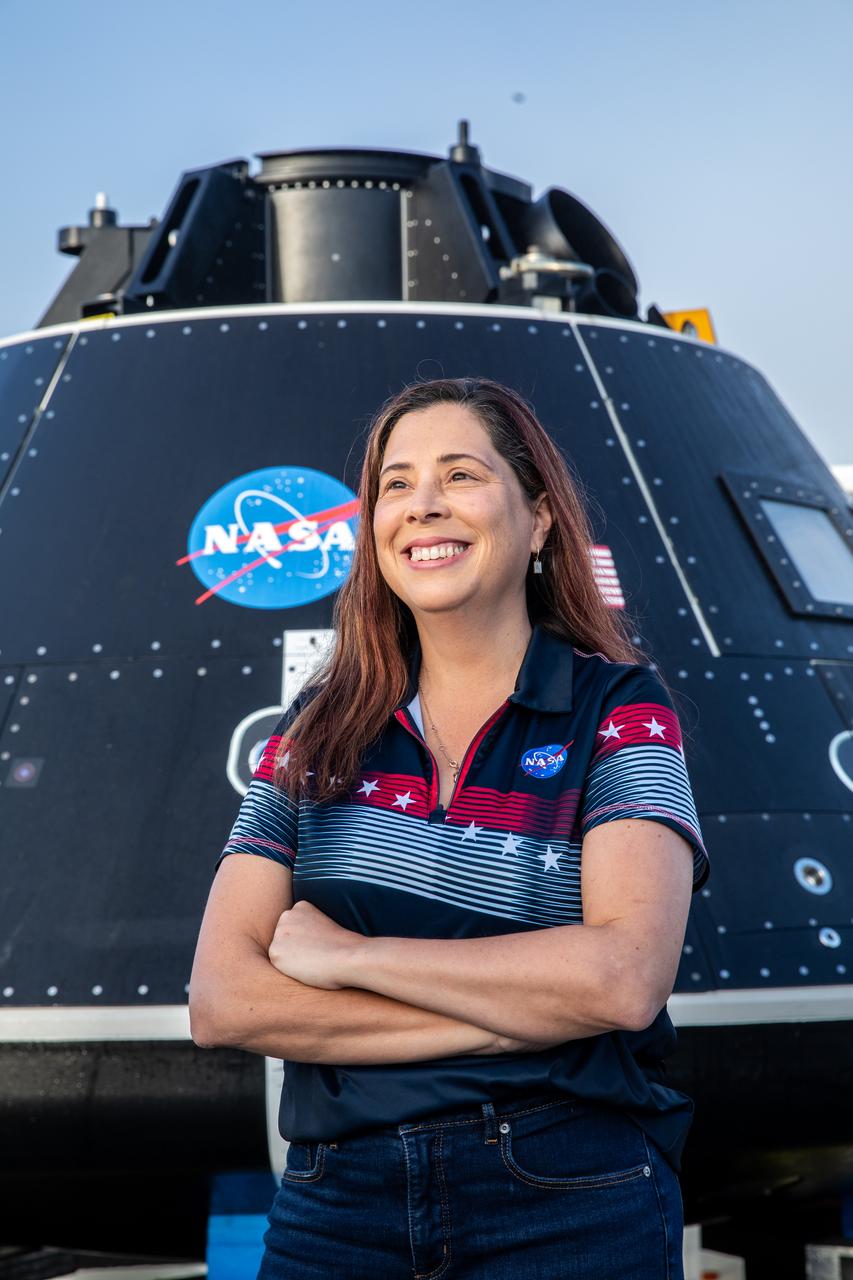
Liliana Villarreal, Artemis landing and recovery director with Exploration Ground Systems (EGS), stands in front of the Crew Module Test Article (CMTA) at the turn basin in the Launch Complex 39 area at NASA’s Kennedy Space Center in Florida on Feb. 1, 2023. The CMTA is being used to practice recovery after splashdown of the Orion spacecraft to prepare for the Artemis II crewed mission. EGS leads recovery efforts.
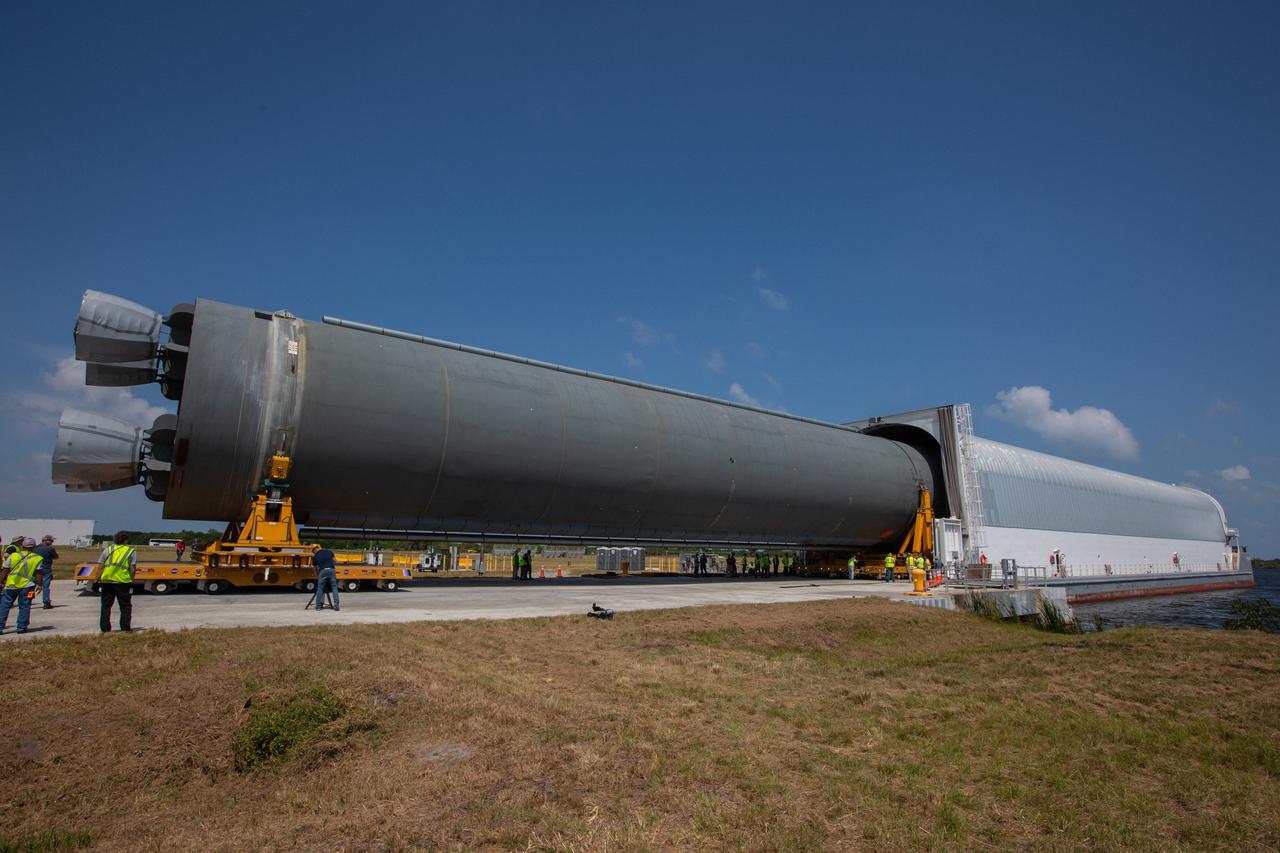
The 212-foot-long Space Launch System (SLS) rocket core stage pathfinder has been offloaded from NASA’s Pegasus Barge at Kennedy Space Center’s Launch Complex 39 turn basin wharf on Sept. 30, 2019. The Pegasus Barge made its first delivery to Kennedy in support of the agency's Artemis missions. The upgraded 310-foot-long barge arrived Sept. 27, 2019, ferrying the SLS core stage pathfinder, a full-scale mock-up of the rocket's core stage. It will be used by the Exploration Ground Systems Program and their contractor, Jacobs, to practice offloading, moving and stacking maneuvers, using important ground support equipment to train employees and certify all the equipment works properly. The pathfinder will stay at Kennedy for approximately one month before trekking back to NASA's Michoud Assembly Facility in Louisiana.
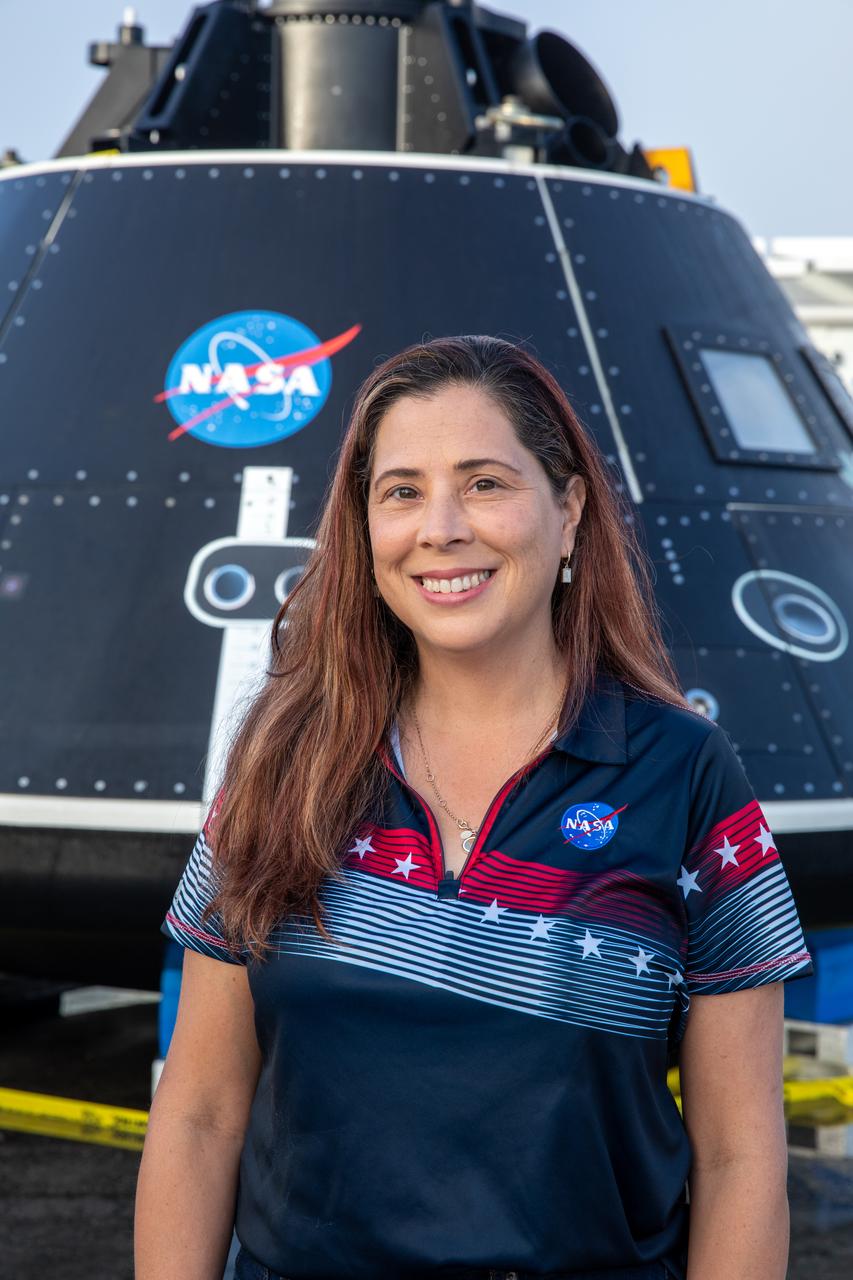
Liliana Villarreal, Artemis landing and recovery director with Exploration Ground Systems (EGS), stands in front of the Crew Module Test Article (CMTA) at the turn basin in the Launch Complex 39 area at NASA’s Kennedy Space Center in Florida on Feb. 1, 2023. The CMTA is being used to practice recovery after splashdown of the Orion spacecraft to prepare for the Artemis II crewed mission. EGS leads recovery efforts.
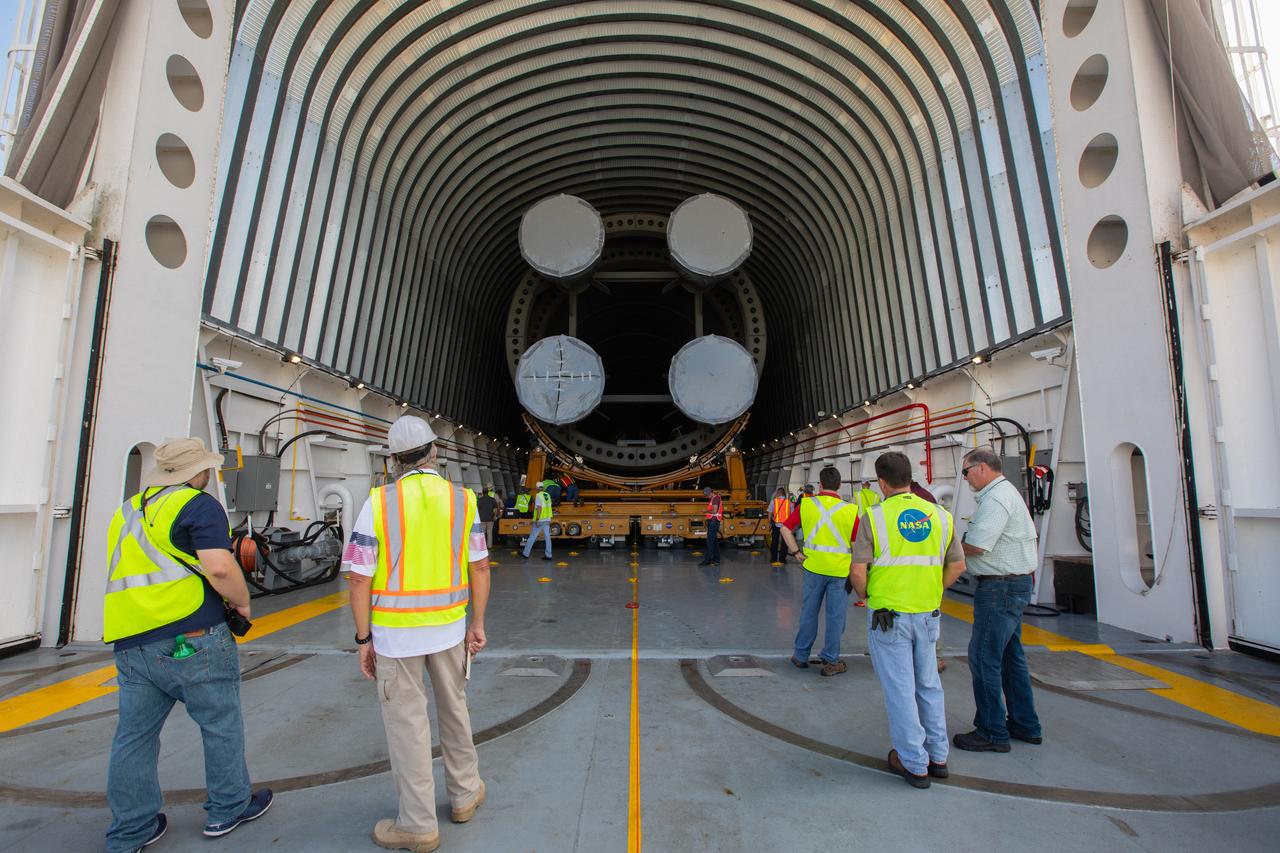
Preparations are underway to offload the 212-foot-long Space Launch System (SLS) rocket core stage pathfinder from NASA's Pegasus Barge at Kennedy Space Center’s Launch Complex 39 turn basin wharf on Sept. 30, 2019. The Pegasus Barge made its first delivery to Kennedy in support of the agency's Artemis missions. The upgraded 310-foot-long barge arrived Sept. 27, 2019, ferrying the SLS core stage pathfinder, a full-scale mock-up of the rocket's core stage. It will be used by the Exploration Ground Systems Program and their contractor, Jacobs, to practice offloading, moving and stacking maneuvers, using important ground support equipment to train employees and certify all the equipment works properly. The pathfinder will stay at Kennedy for approximately one month before trekking back to NASA's Michoud Assembly Facility in Louisiana.
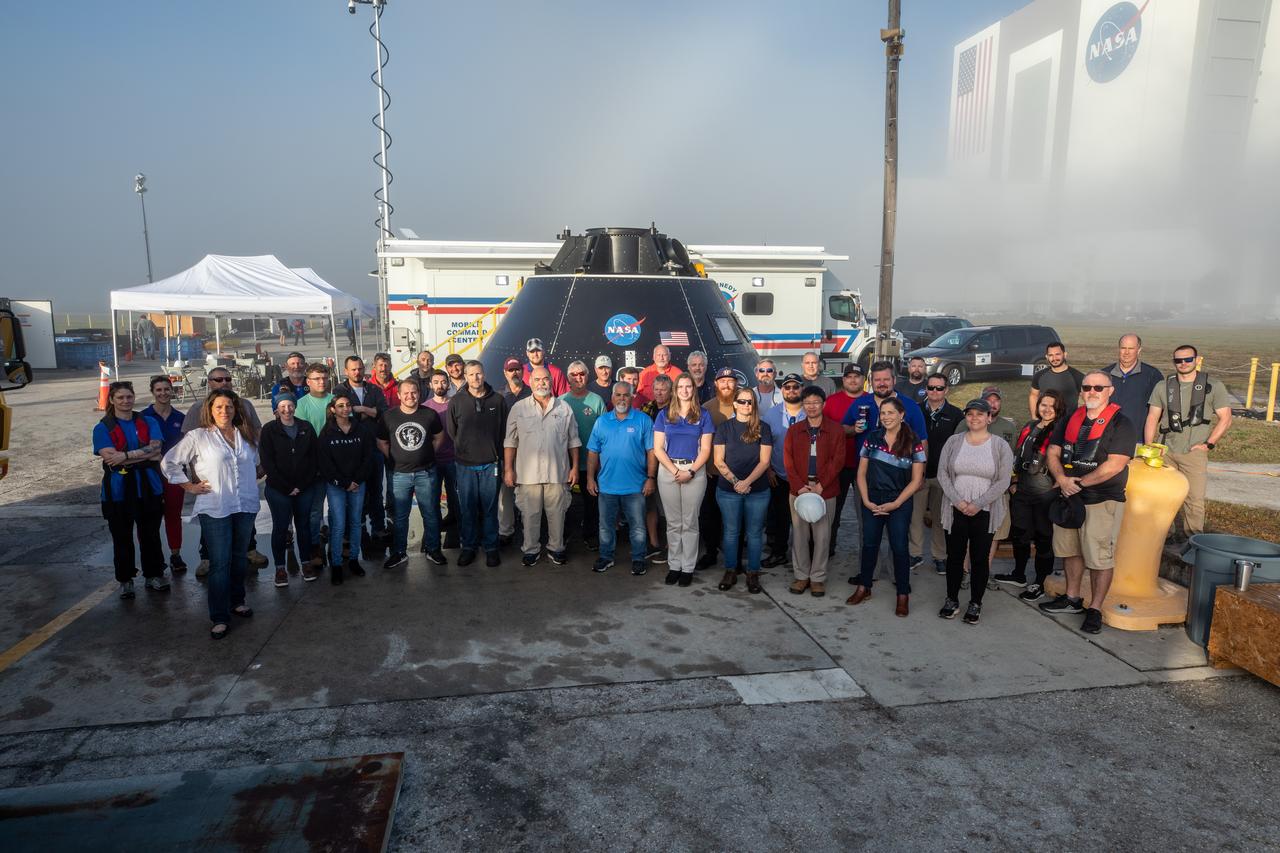
Members of the Exploration Ground Systems (EGS) landing and recovery team gather for a group photograph in front of the Crew Module Test Article (CMTA) at the turn basin in the Launch Complex 39 area at NASA’s Kennedy Space Center in Florida on Feb. 1, 2023. The CMTA is being used to practice recovery after splashdown of the Orion spacecraft to prepare for the Artemis II crewed mission. EGS leads recovery efforts.
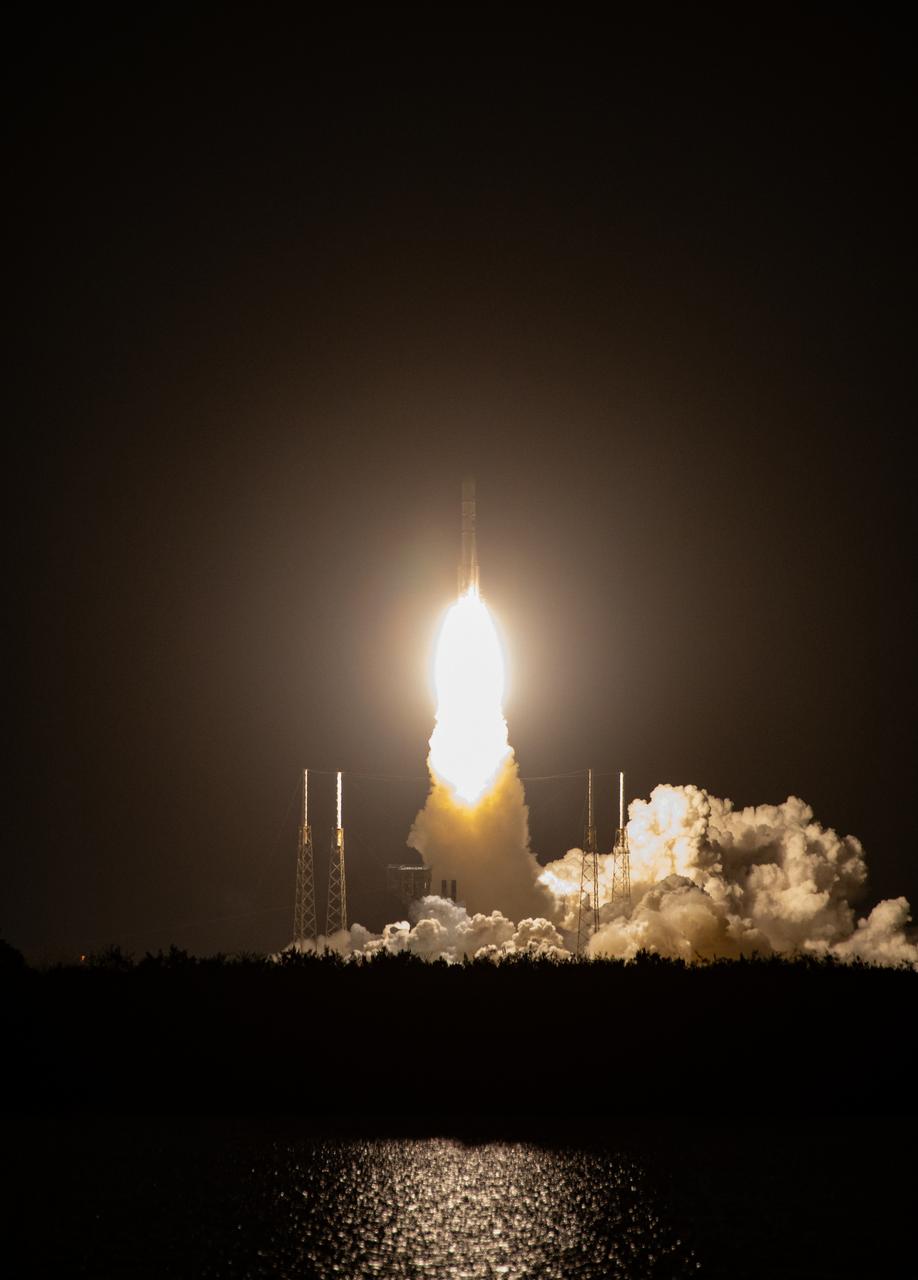
On the first flight of NASA’s CLPS (Commercial Lunar Payload Services) initiative and Artemis program, a United Launch Alliance Vulcan rocket carrying Astrobotic’s Peregrine lunar lander lifts off at 2:18 a.m. EST from Space Launch Complex 41 at Cape Canaveral Space Force Station in Florida on Monday, Jan. 8, 2024. Astrobotic’s Peregrine Mission One will carry NASA and commercial payloads to the Moon to study the lunar exosphere, thermal properties, and hydrogen abundance of the lunar regolith, magnetic fields, and the radiation environment of the lunar surface.
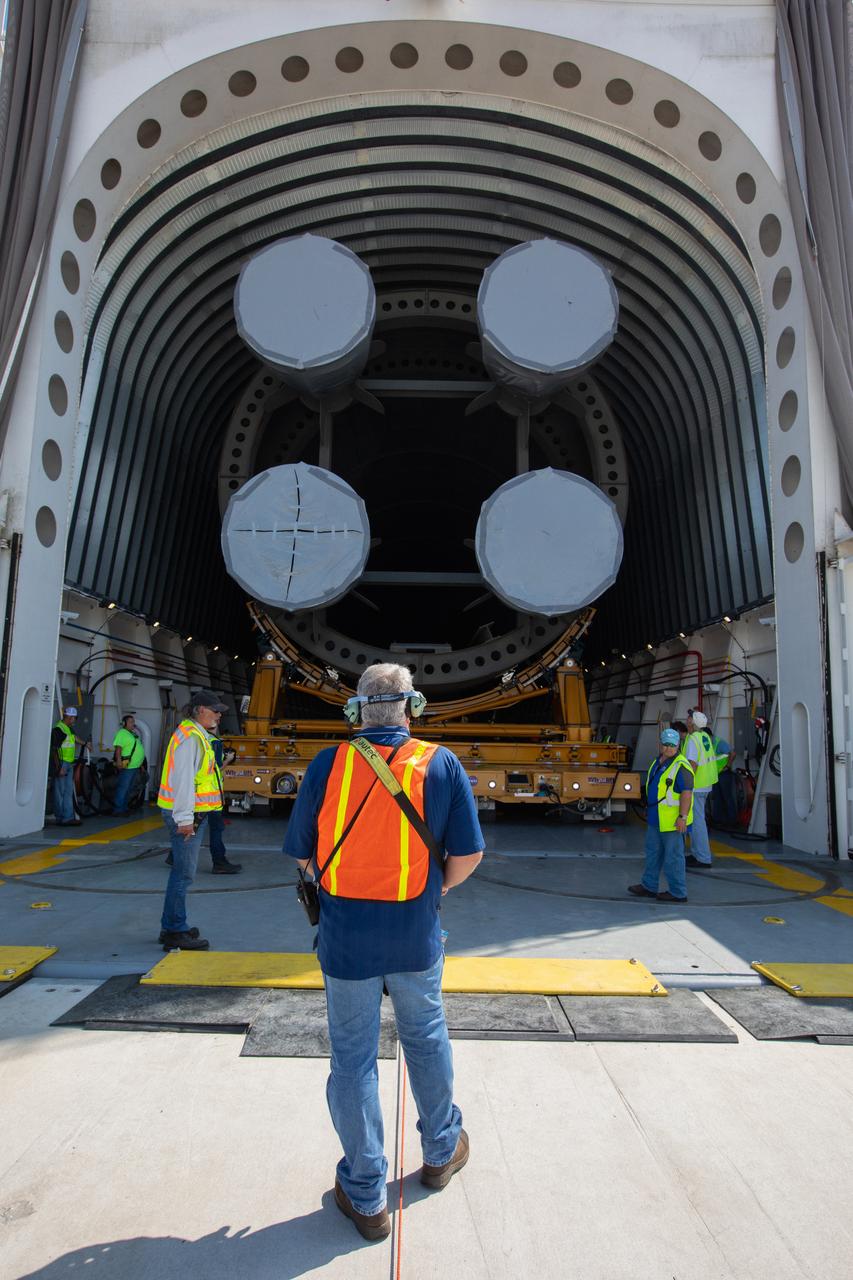
NASA and Jacobs technicians and engineers have begun offloading the 212-foot-long Space Launch System (SLS) rocket core stage pathfinder from NASA's Pegasus Barge at Kennedy Space Center’s Launch Complex 39 turn basin wharf on Sept. 30, 2019. The Pegasus Barge made its first delivery to Kennedy in support of the agency's Artemis missions. The upgraded 310-foot-long barge arrived Sept. 27, 2019, ferrying the SLS core stage pathfinder, a full-scale mock-up of the rocket's core stage. It will be used by the Exploration Ground Systems Program and their contractor, Jacobs, to practice offloading, moving and stacking maneuvers, using important ground support equipment to train employees and certify all the equipment works properly. The pathfinder will stay at Kennedy for approximately one month before trekking back to NASA's Michoud Assembly Facility in Louisiana.
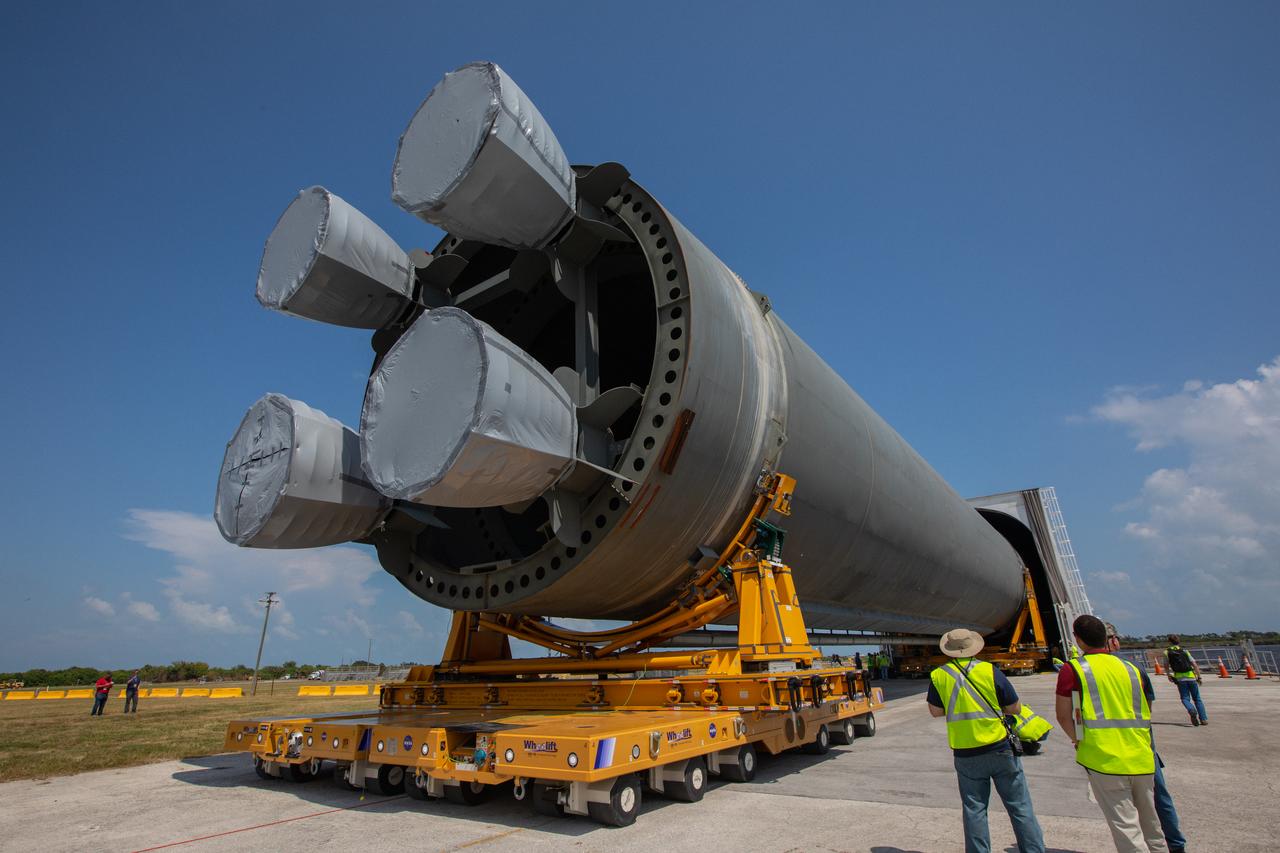
The 212-foot-long Space Launch System (SLS) rocket core stage pathfinder has been offloaded from NASA’s Pegasus Barge at Kennedy Space Center’s Launch Complex 39 turn basin wharf on Sept. 30, 2019. The Pegasus Barge made its first delivery to Kennedy in support of the agency's Artemis missions. The upgraded 310-foot-long barge arrived Sept. 27, 2019, ferrying the SLS core stage pathfinder, a full-scale mock-up of the rocket's core stage. It will be used by the Exploration Ground Systems Program and their contractor, Jacobs, to practice offloading, moving and stacking maneuvers, using important ground support equipment to train employees and certify all the equipment works properly. The pathfinder will stay at Kennedy for approximately one month before trekking back to NASA's Michoud Assembly Facility in Louisiana.
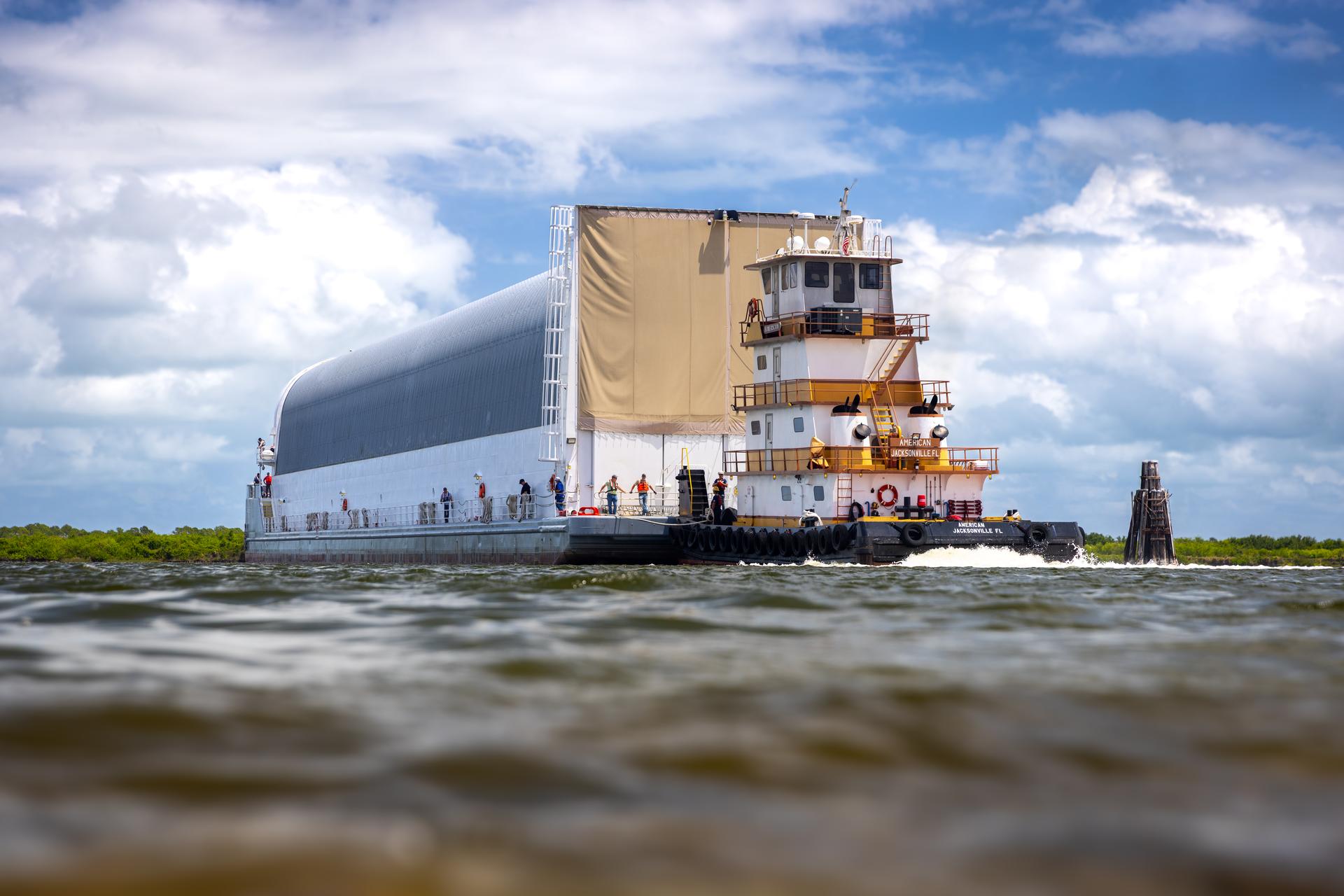
NASA’s Pegasus barge, carrying the top four-fifths of the agency’s SLS (Space Launch System) core stage for the Artemis III mission, arrives at NASA’s Kennedy Space Center Complex 39 turn basin wharf in Florida on Monday, April 27, 2026. Artemis III will launch astronauts to Earth’s orbit aboard the Orion spacecraft on top of SLS to test rendezvous and docking capabilities between Orion and commercial spacecraft needed to land Artemis IV astronauts on the Moon in 2028.
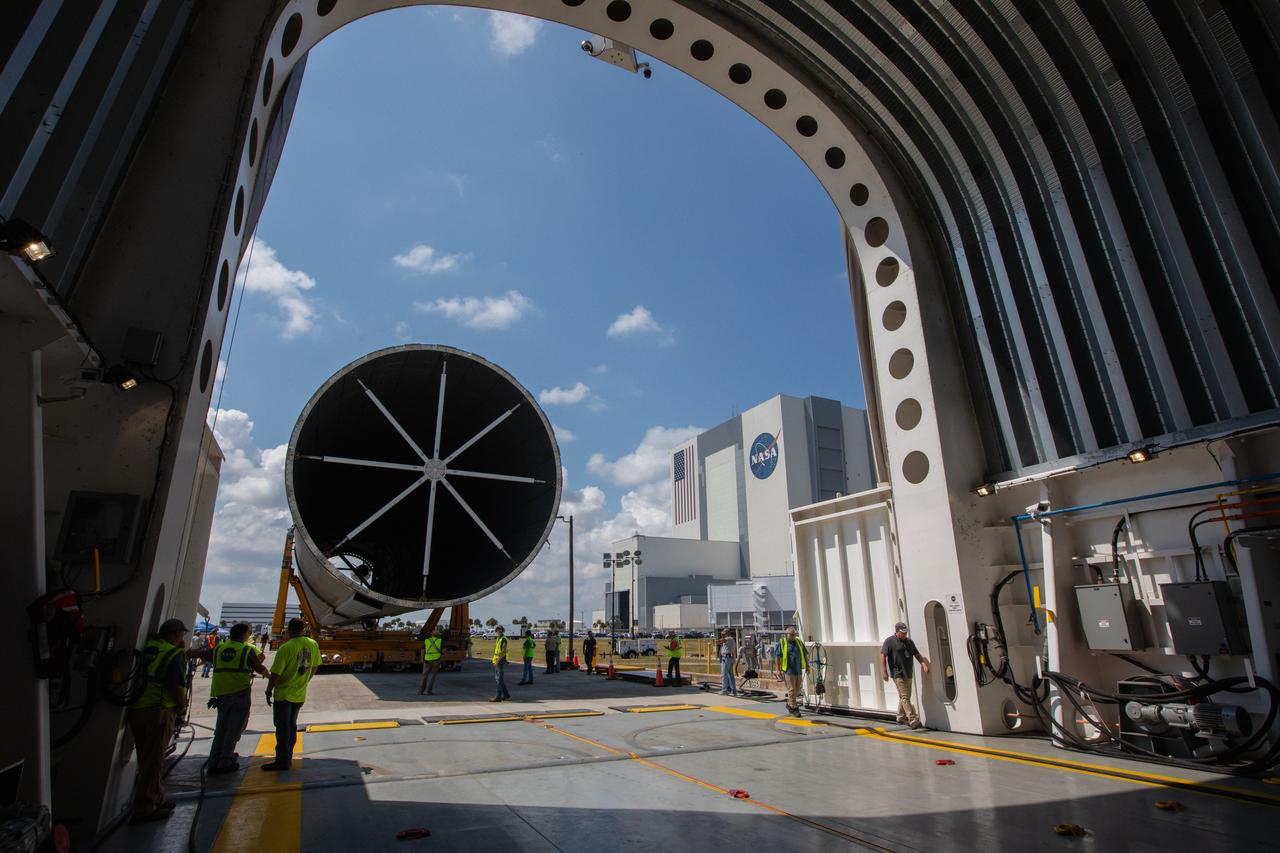
The 212-foot-long Space Launch System (SLS) rocket core stage pathfinder has been offloaded from NASA’s Pegasus Barge at Kennedy Space Center’s Launch Complex 39 turn basin wharf on Sept. 30, 2019. The Pegasus Barge made its first delivery to Kennedy in support of the agency's Artemis missions. The upgraded 310-foot-long barge arrived Sept. 27, 2019, ferrying the SLS core stage pathfinder, a full-scale mock-up of the rocket's core stage. It will be used by the Exploration Ground Systems Program and their contractor, Jacobs, to practice offloading, moving and stacking maneuvers, using important ground support equipment to train employees and certify all the equipment works properly. The pathfinder will stay at Kennedy for approximately one month before trekking back to NASA's Michoud Assembly Facility in Louisiana.
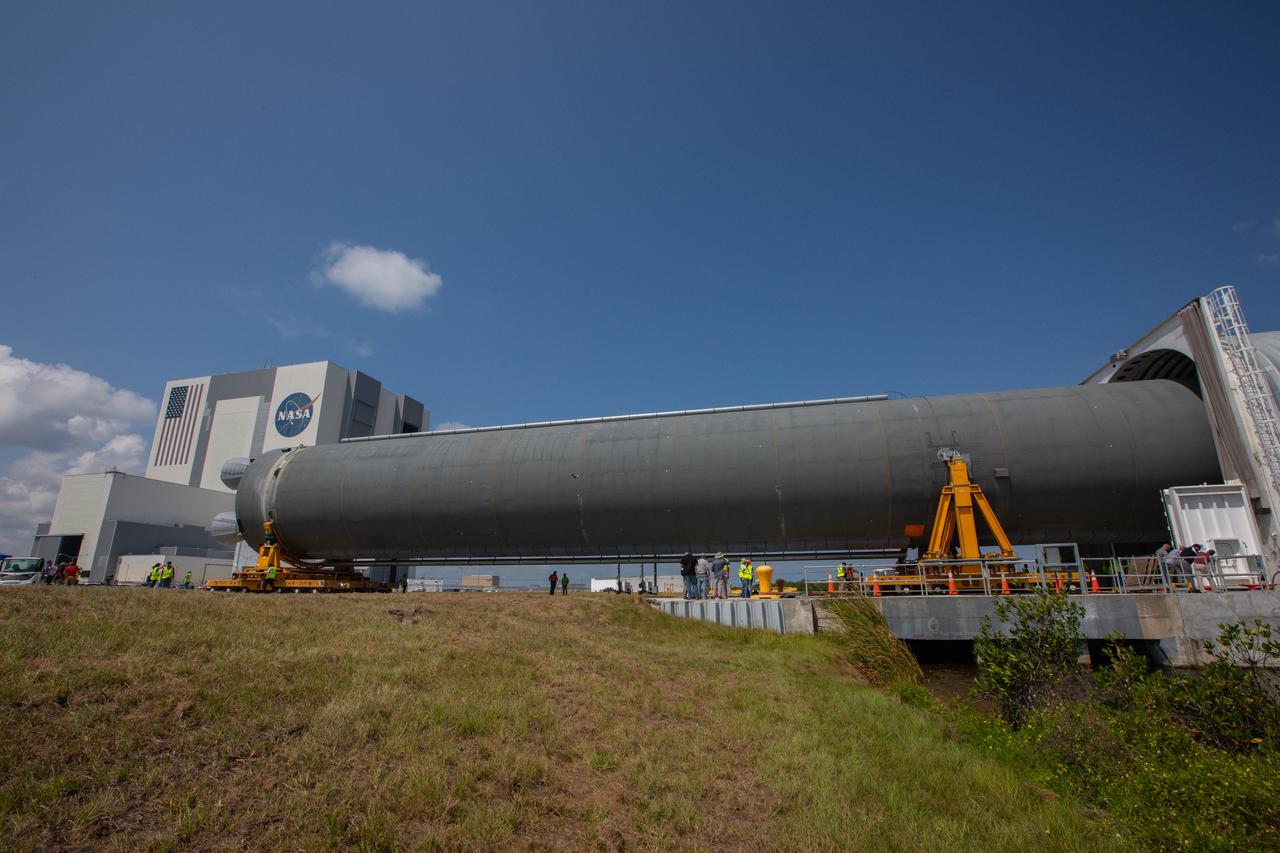
The 212-foot-long Space Launch System (SLS) rocket core stage pathfinder has been offloaded from NASA’s Pegasus Barge at Kennedy Space Center’s Launch Complex 39 turn basin wharf on Sept. 30, 2019. The Pegasus Barge made its first delivery to Kennedy in support of the agency's Artemis missions. The upgraded 310-foot-long barge arrived Sept. 27, 2019, ferrying the SLS core stage pathfinder, a full-scale mock-up of the rocket's core stage. It will be used by the Exploration Ground Systems Program and their contractor, Jacobs, to practice offloading, moving and stacking maneuvers, using important ground support equipment to train employees and certify all the equipment works properly. The pathfinder will stay at Kennedy for approximately one month before trekking back to NASA's Michoud Assembly Facility in Louisiana.

NASA’s Pegasus barge, carrying the agency’s massive SLS (Space Launch System) core stage, arrives at NASA’s Kennedy Space Center Complex 39 turn basin wharf in Florida on Tuesday, July 23, 2024, after journeying from the agency’s Michoud Assembly Facility in New Orleans. The core stage is the next piece of Artemis hardware to arrive at the spaceport and will be offloaded and moved to NASA Kennedy’s Vehicle Assembly Building, where it will be prepared for integration ahead of the Artemis II launch.
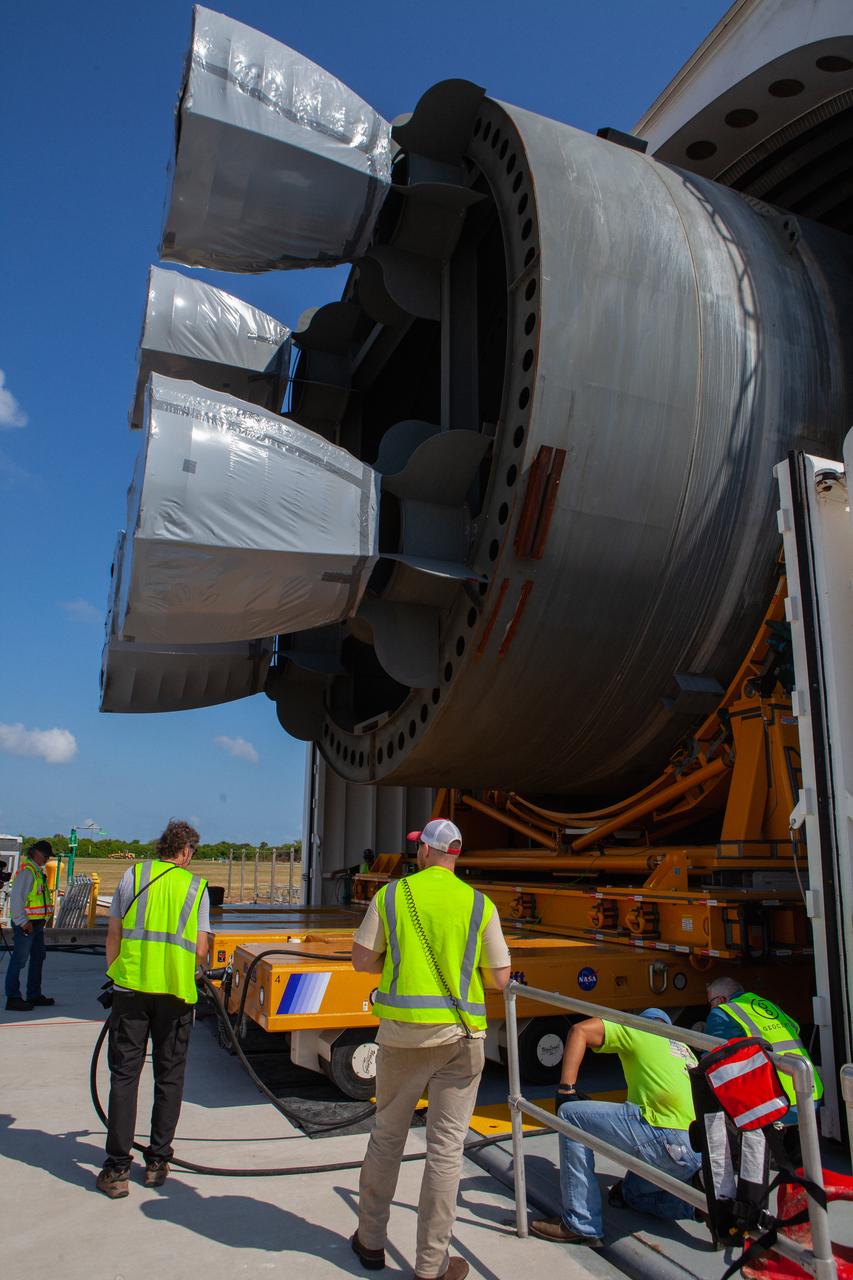
NASA and Jacobs technicians and engineers have begun offloading the 212-foot-long Space Launch System (SLS) rocket core stage pathfinder from NASA's Pegasus Barge at Kennedy Space Center’s Launch Complex 39 turn basin wharf on Sept. 30, 2019. The Pegasus Barge made its first delivery to Kennedy in support of the agency's Artemis missions. The upgraded 310-foot-long barge arrived Sept. 27, 2019, ferrying the SLS core stage pathfinder, a full-scale mock-up of the rocket's core stage. It will be used by the Exploration Ground Systems Program and their contractor, Jacobs, to practice offloading, moving and stacking maneuvers, using important ground support equipment to train employees and certify all the equipment works properly. The pathfinder will stay at Kennedy for approximately one month before trekking back to NASA's Michoud Assembly Facility in Louisiana.
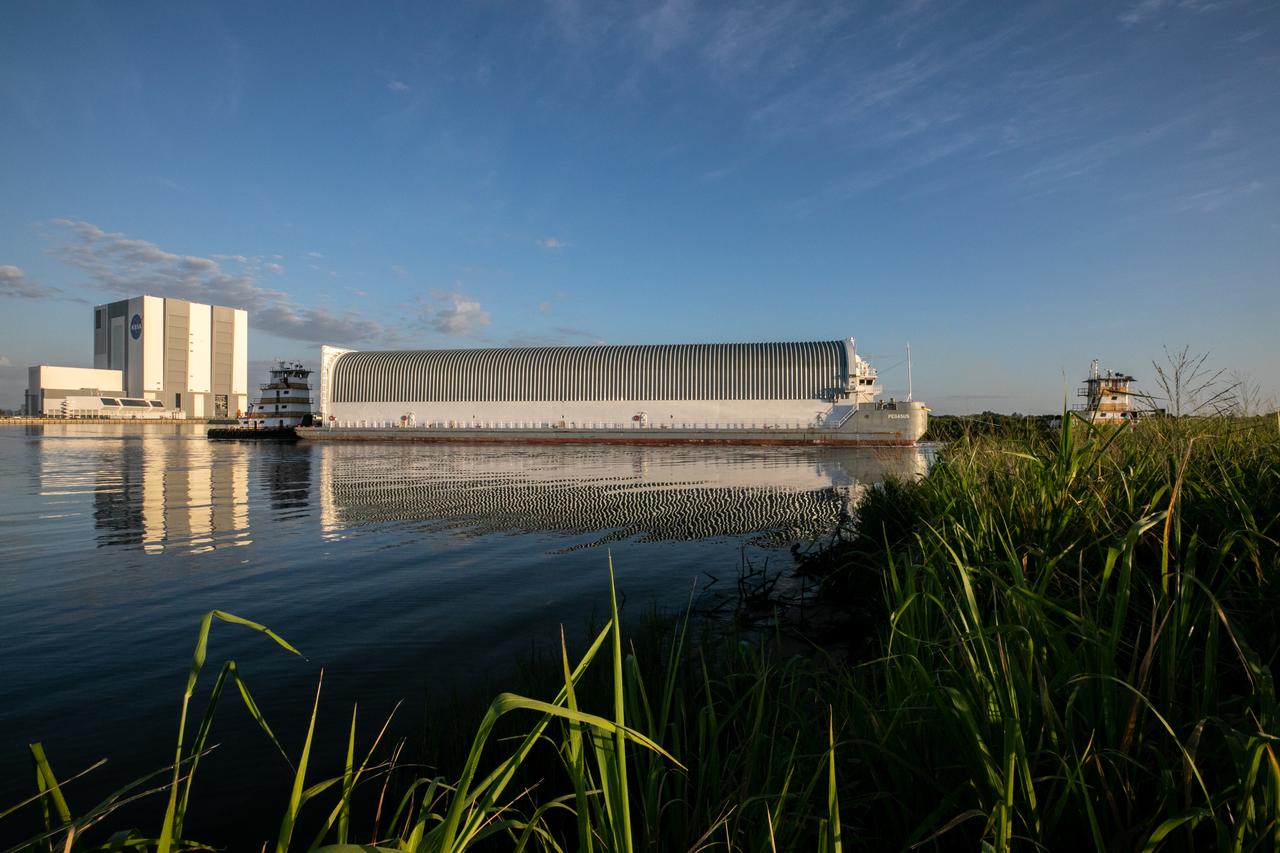
NASA’s Pegasus barge departs from the agency’s Kennedy Space Center in Florida on Aug. 4, 2020, for its trip to NASA’s Michoud Assembly Facility in Louisiana. The Pegasus barge arrived at Kennedy on July 29, delivering the launch vehicle stage adapter (LVSA) for the agency’s Space Launch System (SLS) rocket – the most powerful rocket NASA has ever built, providing the muscle necessary to get to the Moon and eventually to Mars. In the background is the Vehicle Assembly Building, where the LVSA – hardware that will connect the core stage of the rocket to the upper stage – is now undergoing processing. The next time the Pegasus barge returns to Kennedy, it will be carrying the SLS core stage – the final piece of the rocket that needs to be delivered ahead of the Artemis I launch.
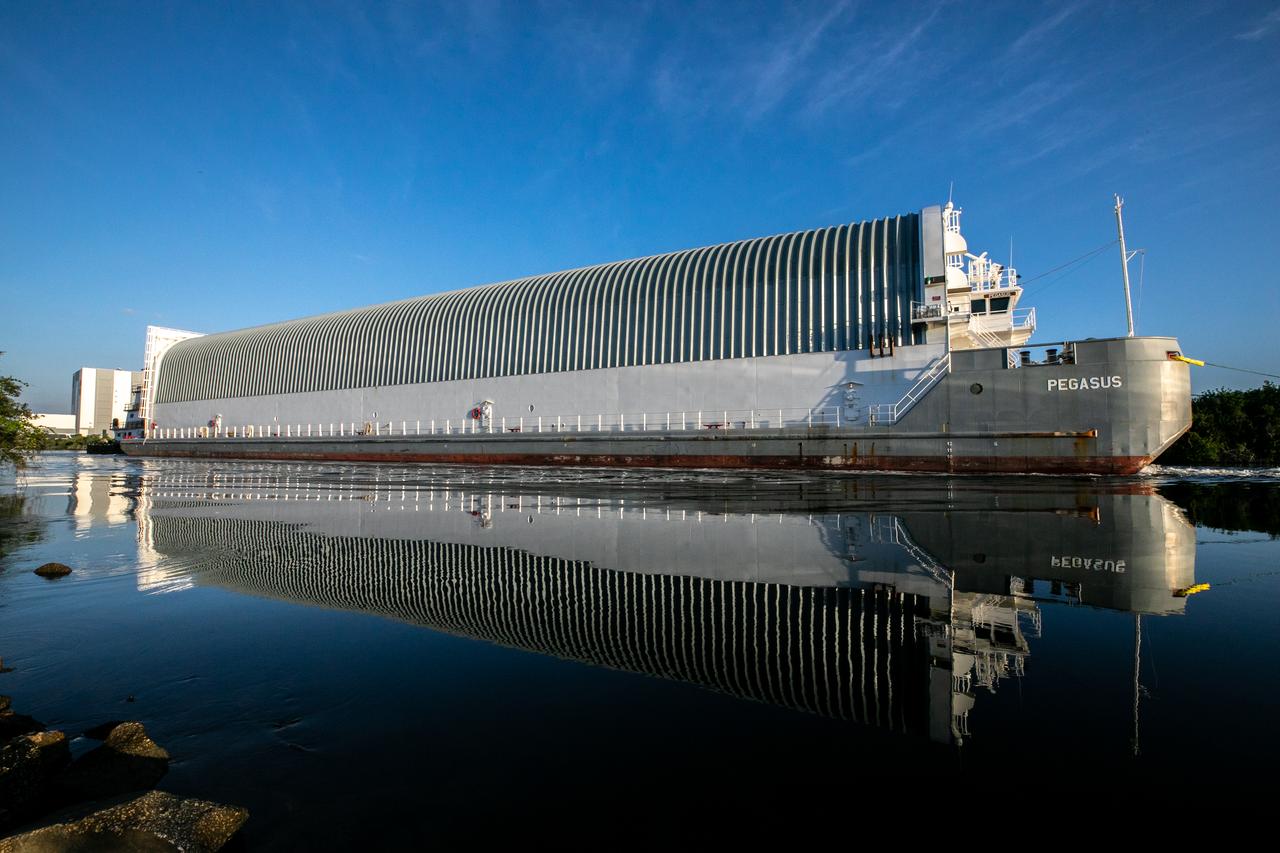
NASA’s Pegasus barge departs from the agency’s Kennedy Space Center in Florida on Aug. 4, 2020, for its trip to NASA’s Michoud Assembly Facility in Louisiana. The Pegasus barge arrived at Kennedy on July 29, delivering the launch vehicle stage adapter (LVSA) for the agency’s Space Launch System (SLS) rocket – the most powerful rocket NASA has ever built, providing the muscle necessary to get to the Moon and eventually to Mars. In the background is the Vehicle Assembly Building, where the LVSA – hardware that will connect the core stage of the rocket to the upper stage – is now undergoing processing. The next time the Pegasus barge returns to Kennedy, it will be carrying the SLS core stage – the final piece of the rocket that needs to be delivered ahead of the Artemis I launch.
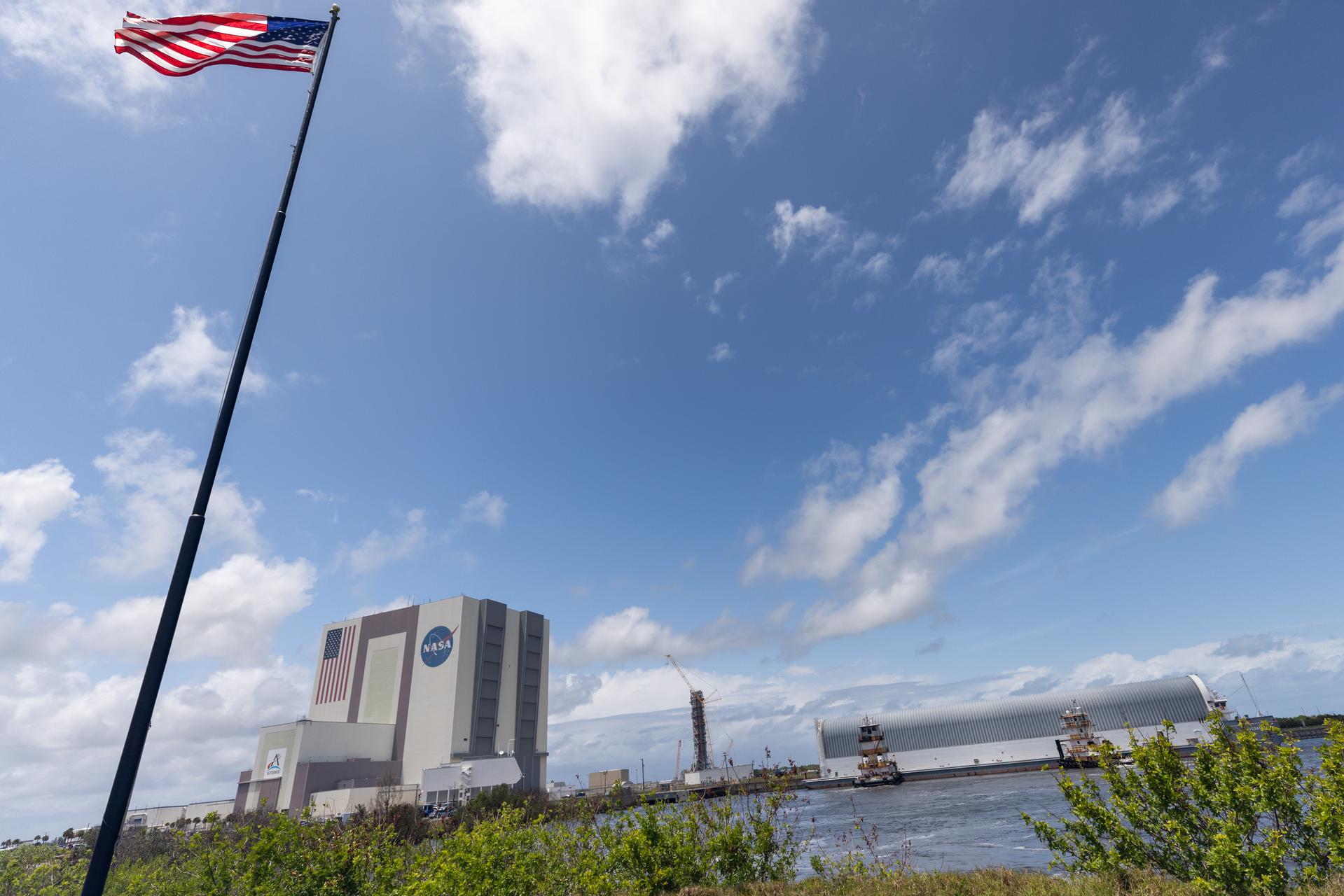
NASA’s Pegasus barge, carrying the top four-fifths of the agency’s SLS (Space Launch System) core stage for the Artemis III mission, arrives at NASA’s Kennedy Space Center Complex 39 turn basin wharf in Florida on Monday, April 27, 2026. Artemis III will launch astronauts to Earth’s orbit aboard the Orion spacecraft on top of SLS to test rendezvous and docking capabilities between Orion and commercial spacecraft needed to land Artemis IV astronauts on the Moon in 2028.
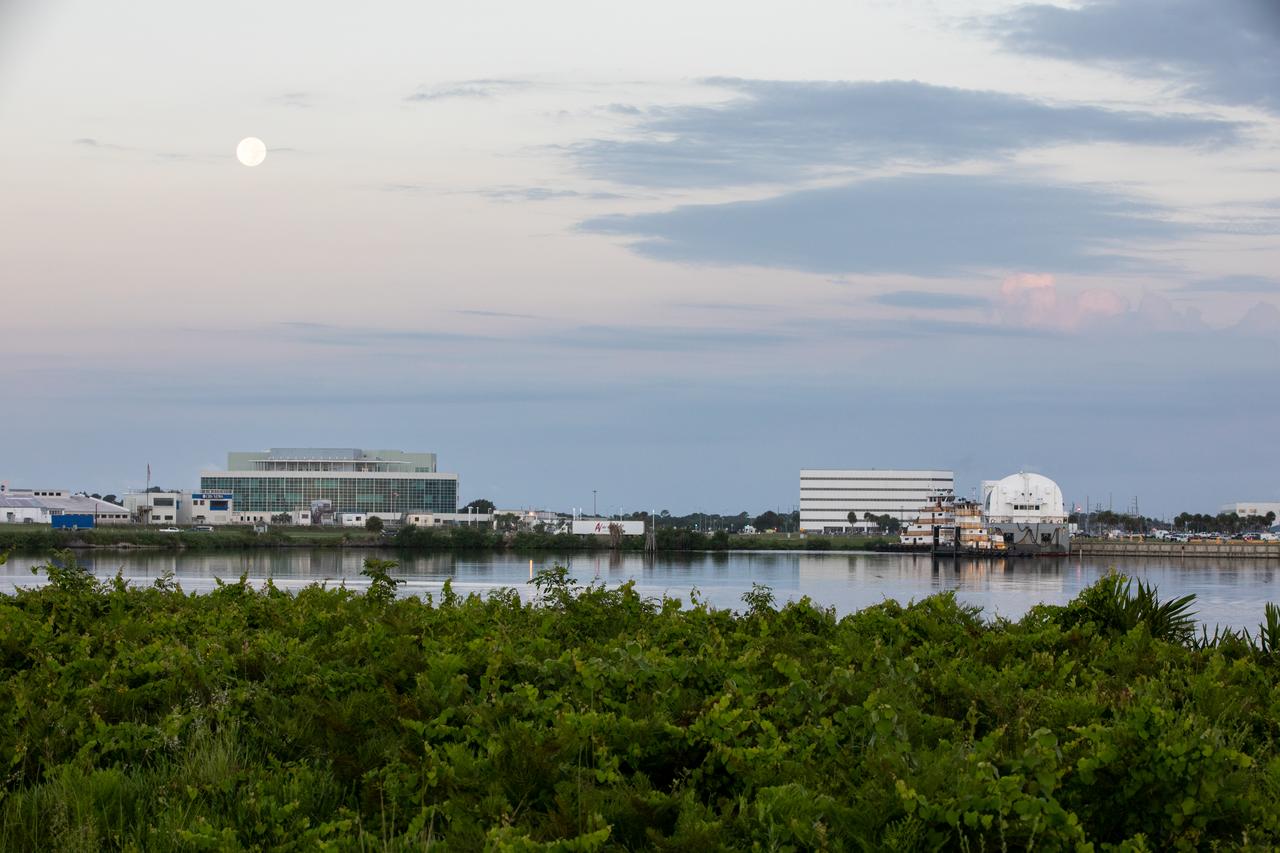
NASA’s Pegasus barge, seen off toward the right, prepares to depart from the agency’s Kennedy Space Center in Florida on Aug. 4, 2020, for its trip to NASA’s Michoud Assembly Facility in Louisiana. The Pegasus barge arrived at Kennedy on July 29, delivering the launch vehicle stage adapter (LVSA) for the agency’s Space Launch System (SLS) rocket – the most powerful rocket NASA has ever built, providing the muscle necessary to get to the Moon and eventually to Mars. The LVSA – now undergoing processing inside the Vehicle Assembly Building – will connect the core stage of the rocket to the upper stage. The next time the Pegasus barge returns to Kennedy, it will be carrying the SLS core stage – the final piece of the rocket that needs to be delivered ahead of the Artemis I launch.
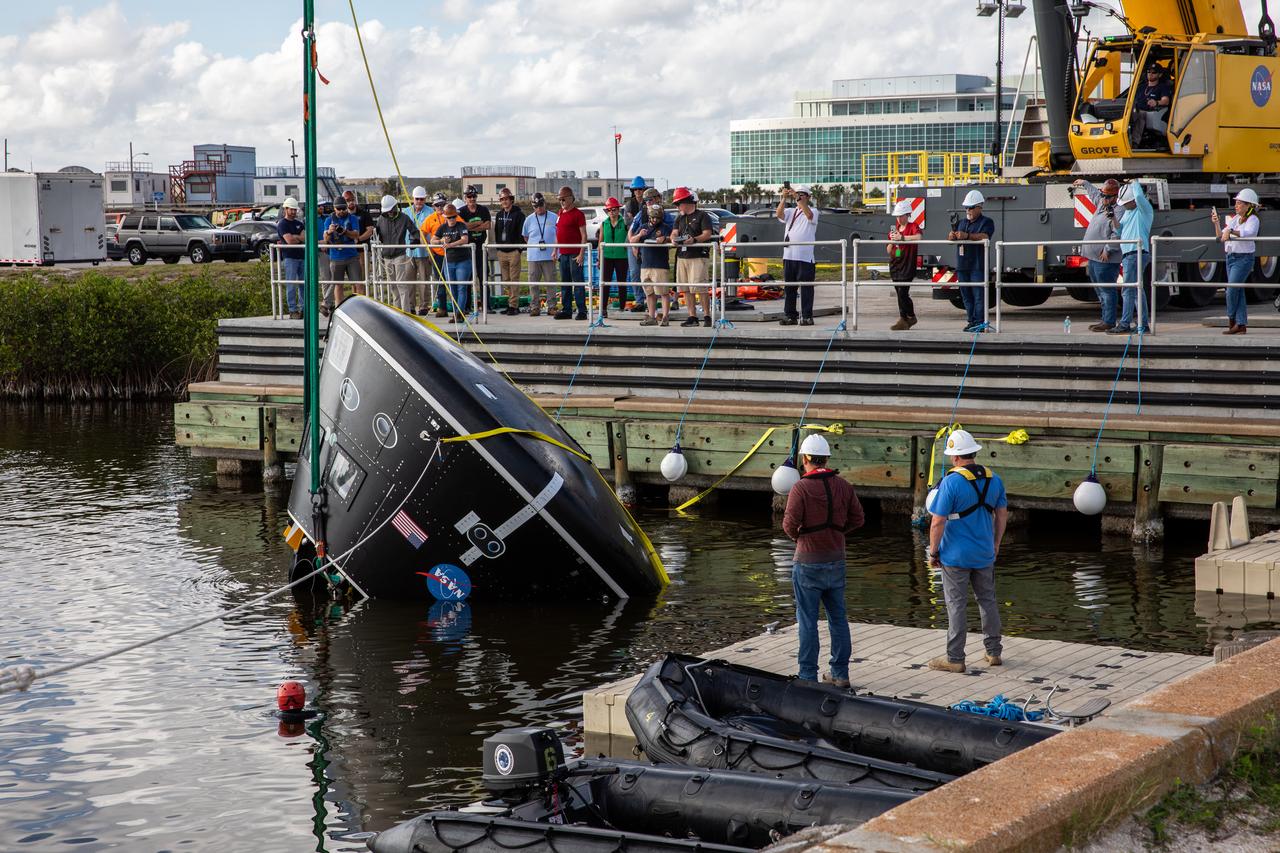
A crane is used to rotate the Crew Module Test Article (CMTA) in the water at the turn basin in the Launch Complex 39 area at NASA’s Kennedy Space Center in Florida on Jan. 31, 2023. The CMTA is being certified for use to practice recovery after splashdown of the Orion spacecraft to prepare for the Artemis II crewed mission. Exploration Ground Systems leads recovery efforts.
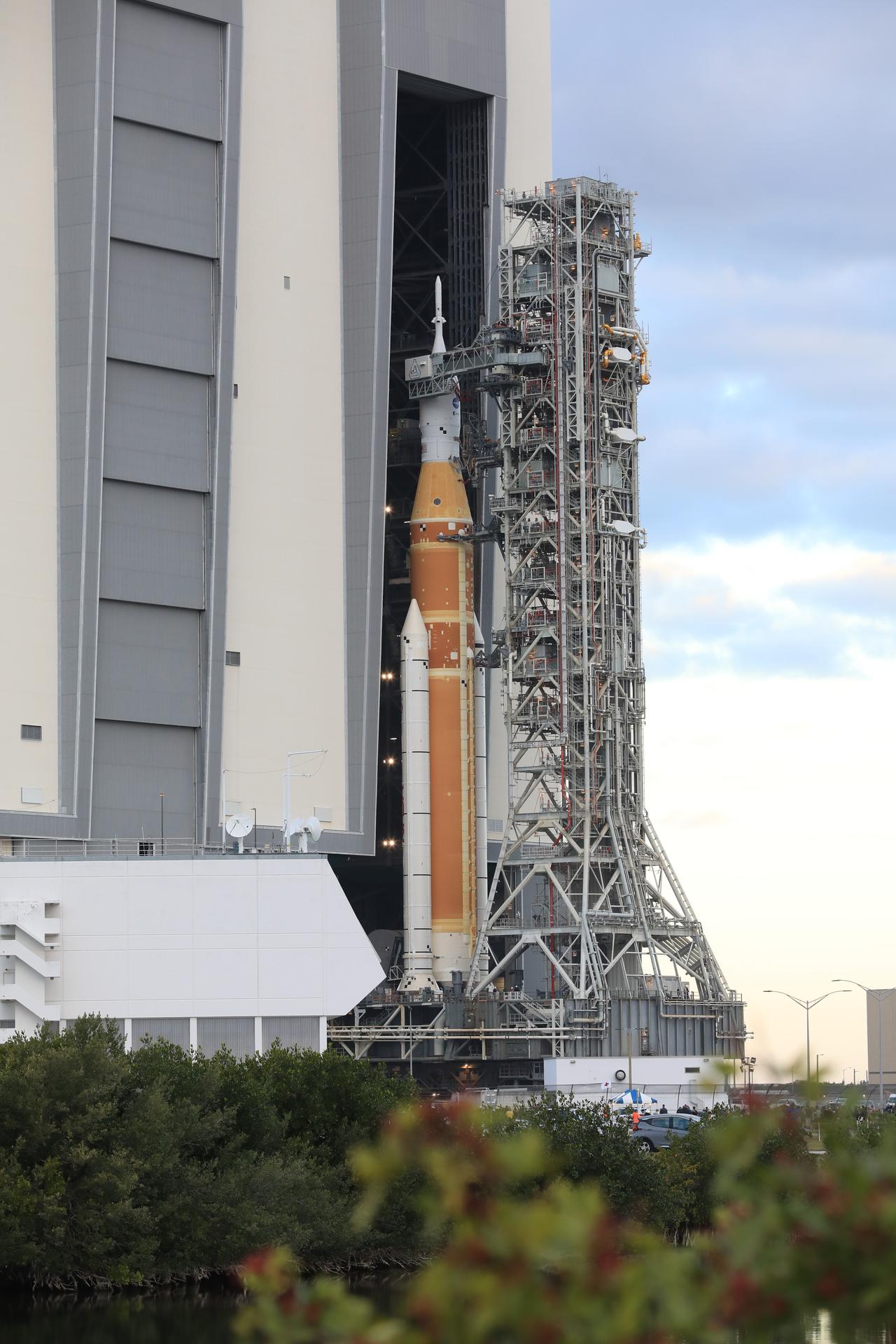
NASA’s crawler-transporter 2 carrying the agency’s Artemis II SLS (Space Launch System) rocket and Orion spacecraft, secured to the mobile launcher, begins rolling out from High Bay 3 inside the Vehicle Assembly Building to Launch Complex 39B at NASA’s Kennedy Space Center in Florida on Saturday, Jan. 17, 2026. The Artemis II test flight will take Commander Reid Wiseman, Pilot Victor Glover, and Mission Specialist Christina Koch from NASA and Mission Specialist Jeremy Hansen from the CSA (Canadian Space Agency), around the Moon and back to Earth no later than April 2026.
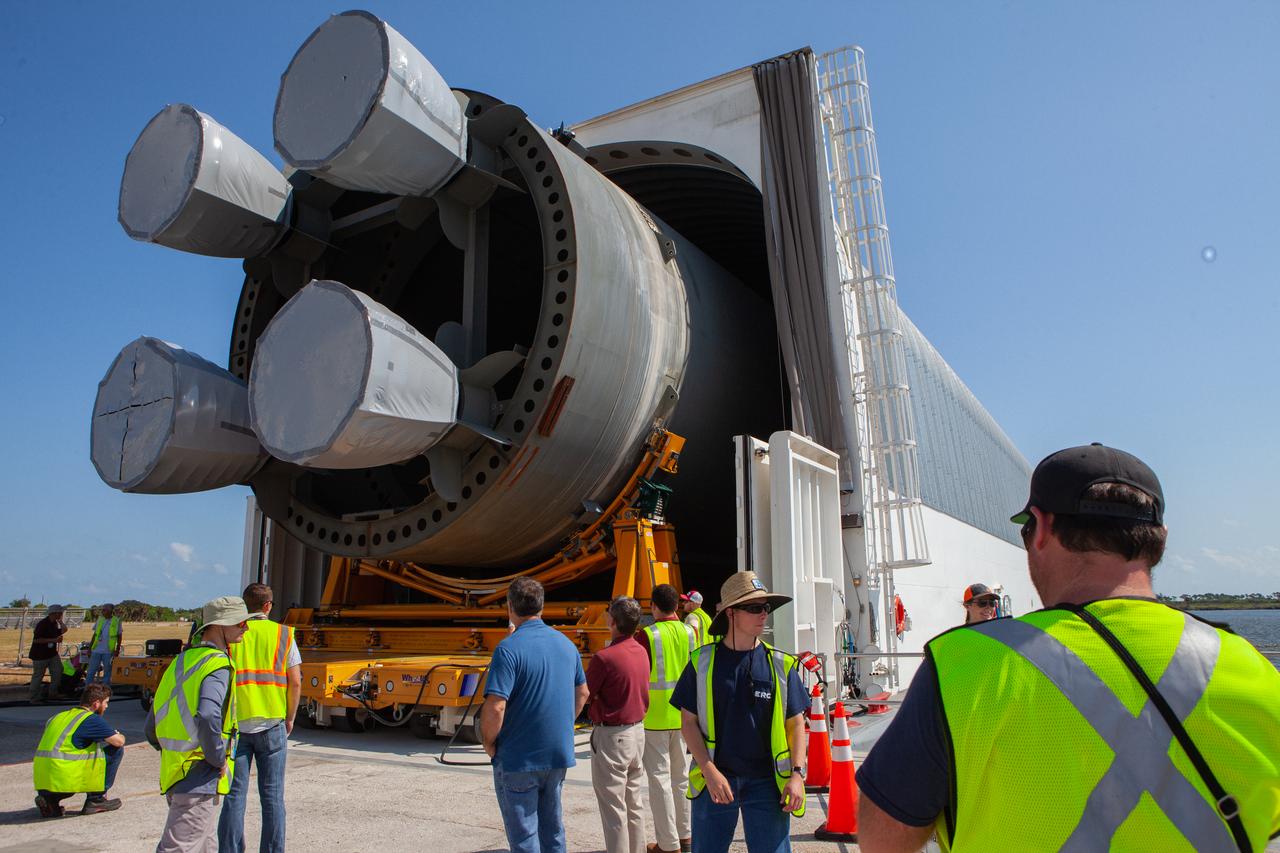
NASA and Jacobs technicians and engineers have begun offloading the 212-foot-long Space Launch System (SLS) rocket core stage pathfinder from NASA's Pegasus Barge at Kennedy Space Center’s Launch Complex 39 turn basin wharf on Sept. 30, 2019. The Pegasus Barge made its first delivery to Kennedy in support of the agency's Artemis missions. The upgraded 310-foot-long barge arrived Sept. 27, 2019, ferrying the SLS core stage pathfinder, a full-scale mock-up of the rocket's core stage. It will be used by the Exploration Ground Systems Program and their contractor, Jacobs, to practice offloading, moving and stacking maneuvers, using important ground support equipment to train employees and certify all the equipment works properly. The pathfinder will stay at Kennedy for approximately one month before trekking back to NASA's Michoud Assembly Facility in Louisiana.
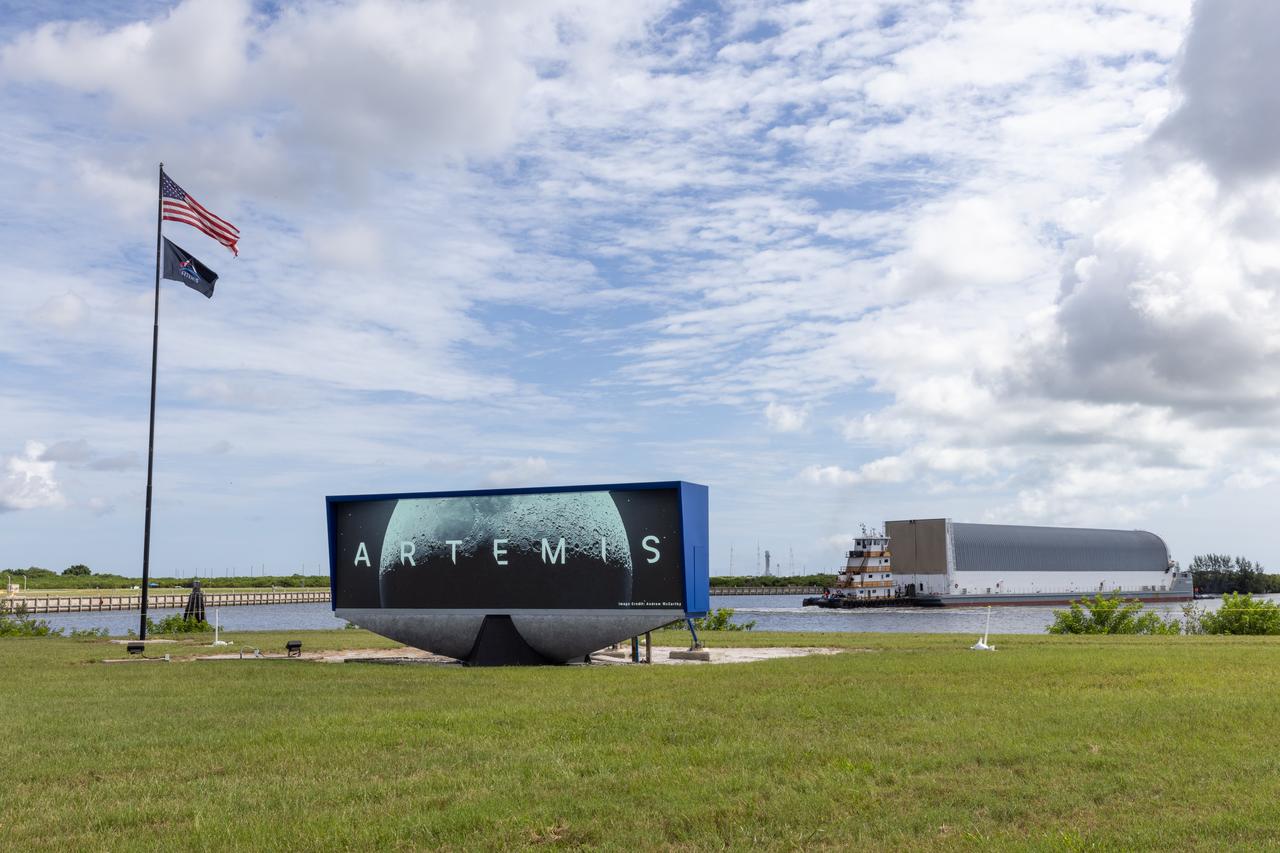
Behind the iconic countdown clock at NASA’s Kennedy Space Center in Florida, the agency’s Pegasus barge completes its 900-mile journey from NASA’s Michoud Assembly Facility in New Orleans carrying the powerful SLS (Space Launch System) core stage on Tuesday, July 23, 2024. Teams with Exploration Ground Systems (EGS) will offload the rocket stage and transfer it to the spaceport’s Vehicle Assembly Building to prepare it for integration atop the mobile launcher ahead of the Artemis II launch.
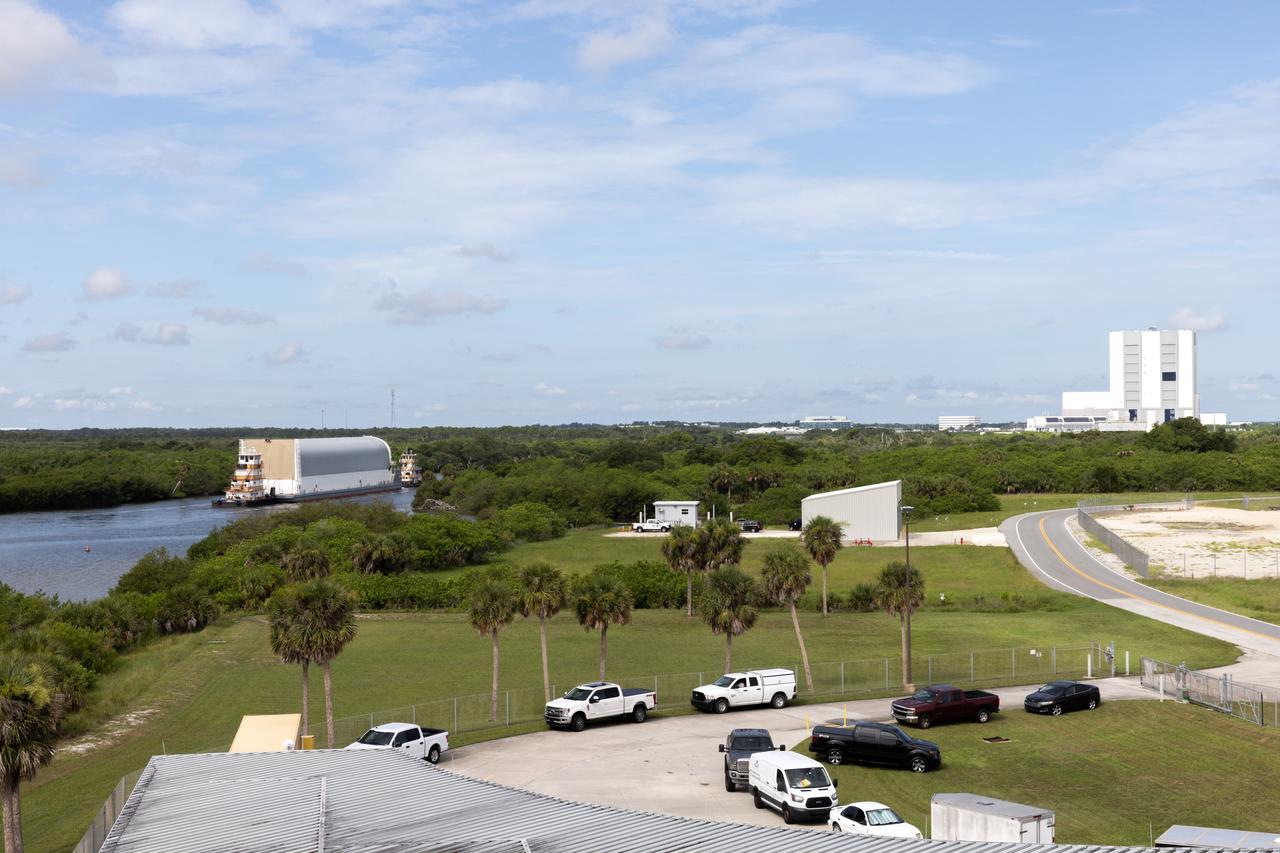
NASA’s Pegasus barge, carrying the agency’s massive SLS (Space Launch System) core stage, arrives at NASA’s Kennedy Space Center Complex 39 turn basin wharf in Florida on Tuesday, July 23, 2024, after journeying from the agency’s Michoud Assembly Facility in New Orleans. The core stage is the next piece of Artemis hardware to arrive at the spaceport and will be offloaded and moved to NASA Kennedy’s Vehicle Assembly Building, where it will be prepared for integration ahead of the Artemis II launch.
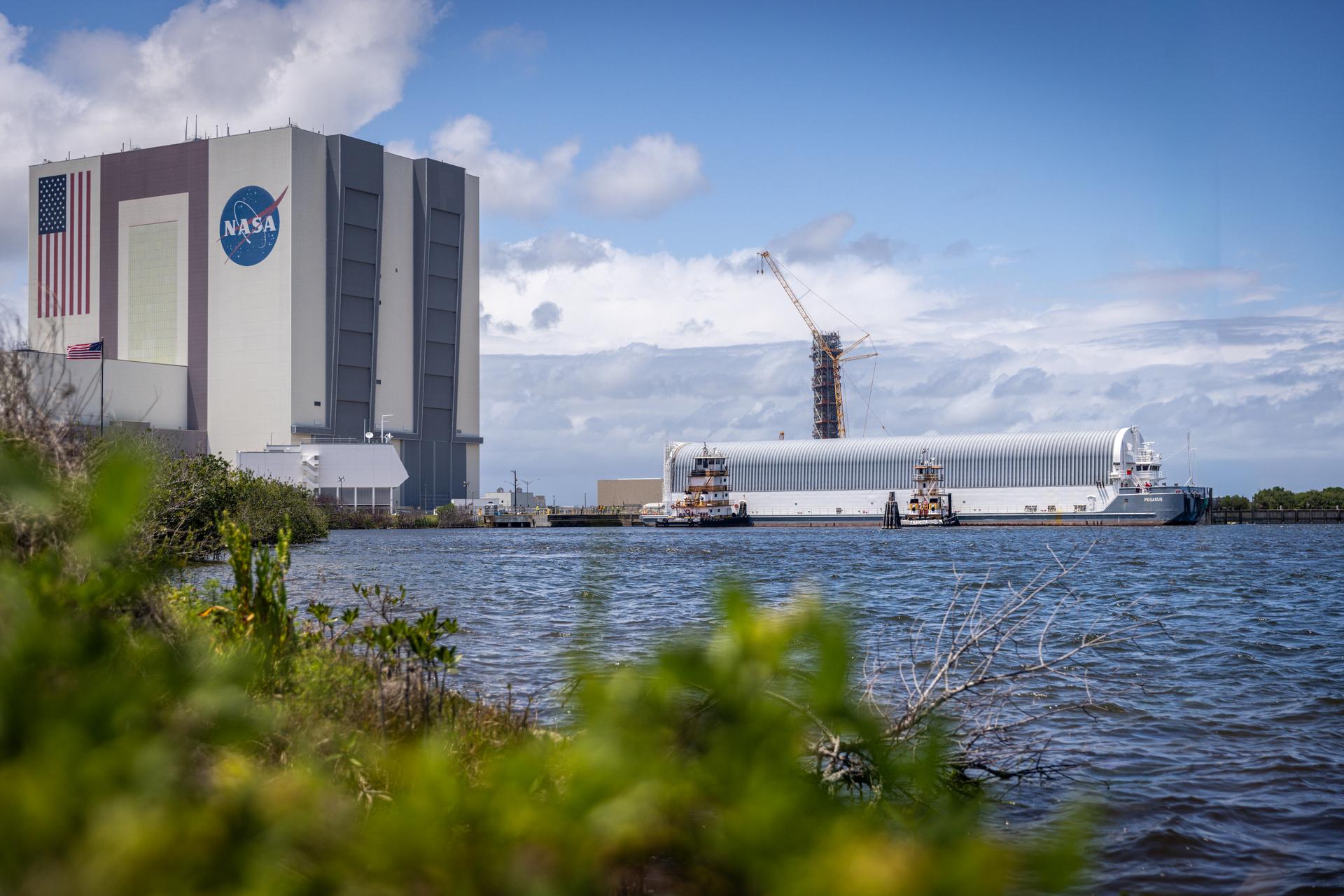
NASA’s Pegasus barge, carrying the top four-fifths of the agency’s SLS (Space Launch System) core stage for the Artemis III mission, arrives at NASA’s Kennedy Space Center Complex 39 turn basin wharf in Florida on Monday, April 27, 2026. Artemis III will launch astronauts to Earth’s orbit aboard the Orion spacecraft on top of SLS to test rendezvous and docking capabilities between Orion and commercial spacecraft needed to land Artemis IV astronauts on the Moon in 2028.
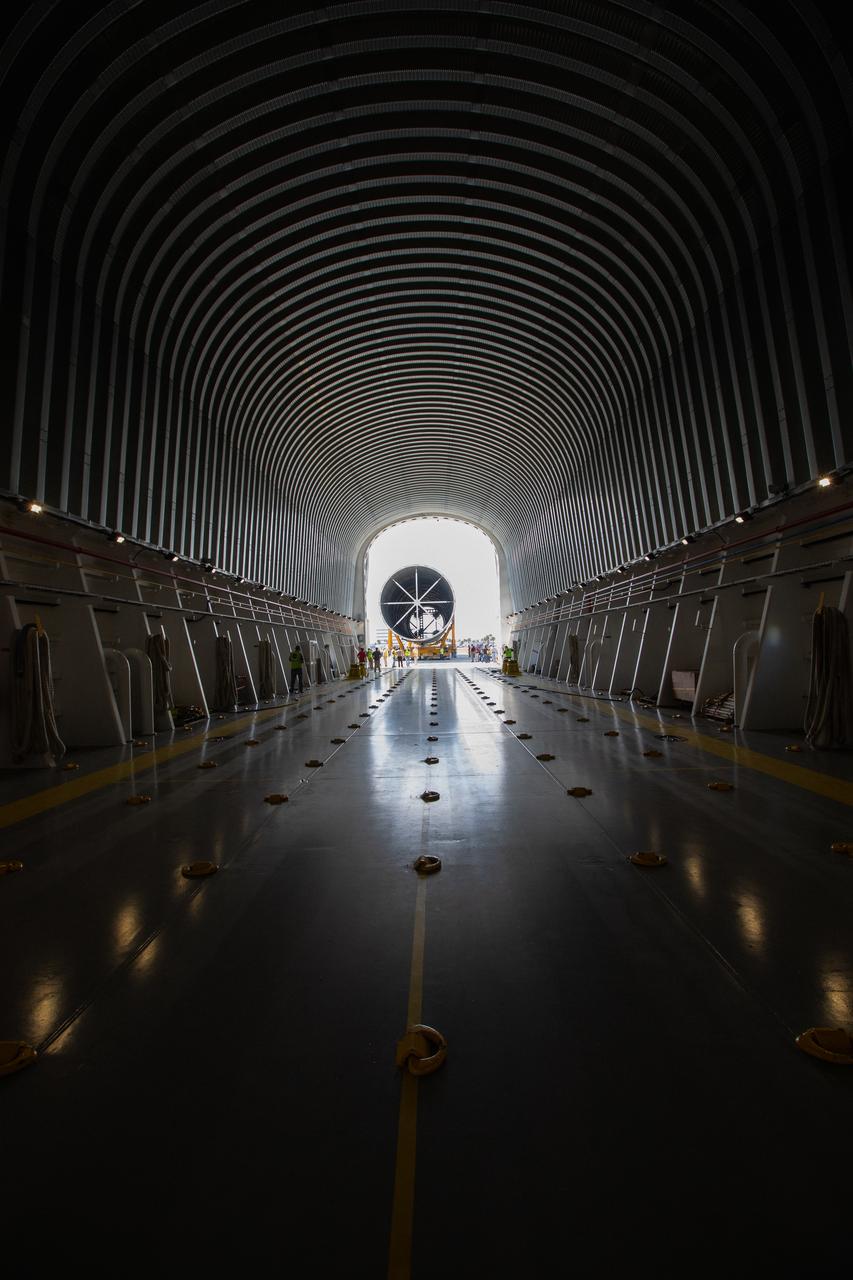
In this view from inside NASA’s Pegasus Barge, the 212-foot-long Space Launch System (SLS) rocket core stage pathfinder is being offloaded from the barge at Kennedy Space Center’s Launch Complex 39 turn basin wharf on Sept. 30, 2019. The Pegasus Barge made its first delivery to Kennedy in support of the agency's Artemis missions. The upgraded 310-foot-long barge arrived Sept. 27, 2019, ferrying the SLS core stage pathfinder, a full-scale mock-up of the rocket's core stage. It will be used by the Exploration Ground Systems Program and their contractor, Jacobs, to practice offloading, moving and stacking maneuvers, using important ground support equipment to train employees and certify all the equipment works properly. The pathfinder will stay at Kennedy for approximately one month before trekking back to NASA's Michoud Assembly Facility in Louisiana.
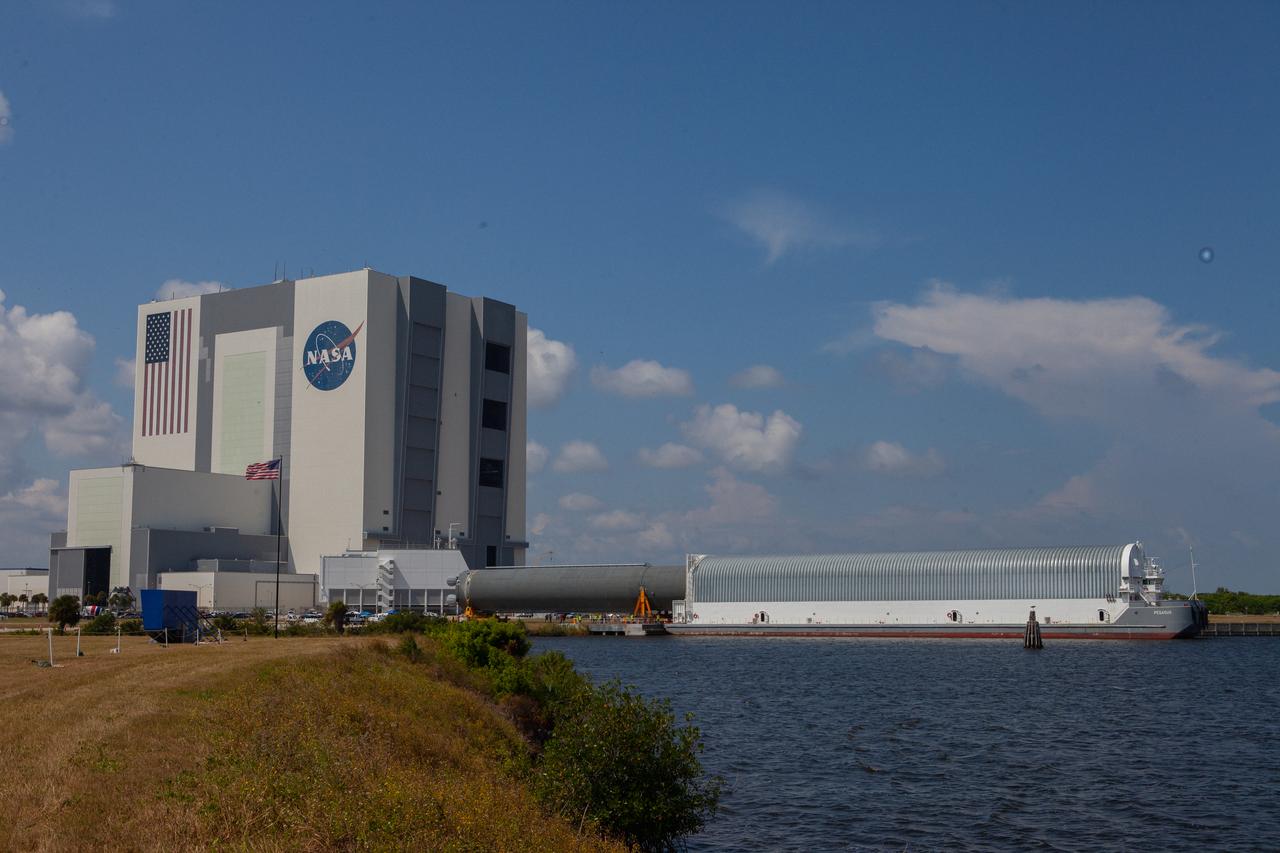
The 212-foot-long Space Launch System (SLS) rocket core stage pathfinder has been offloaded from NASA’s Pegasus Barge at Kennedy Space Center’s Launch Complex 39 turn basin wharf on Sept. 30, 2019. The Pegasus Barge made its first delivery to Kennedy in support of the agency's Artemis missions. The upgraded 310-foot-long barge arrived Sept. 27, 2019, ferrying the SLS core stage pathfinder, a full-scale mock-up of the rocket's core stage. It will be used by the Exploration Ground Systems Program and their contractor, Jacobs, to practice offloading, moving and stacking maneuvers, using important ground support equipment to train employees and certify all the equipment works properly. The pathfinder will stay at Kennedy for approximately one month before trekking back to NASA's Michoud Assembly Facility in Louisiana.

On the first flight of NASA’s CLPS (Commercial Lunar Payload Services) initiative and Artemis program, a United Launch Alliance Vulcan rocket carrying Astrobotic’s Peregrine lunar lander lifts off at 2:18 a.m. EST from Space Launch Complex 41 at Cape Canaveral Space Force Station in Florida on Monday, Jan. 8, 2024. Astrobotic’s Peregrine Mission One will carry NASA and commercial payloads to the Moon to study the lunar exosphere, thermal properties, and hydrogen abundance of the lunar regolith, magnetic fields, and the radiation environment of the lunar surface.
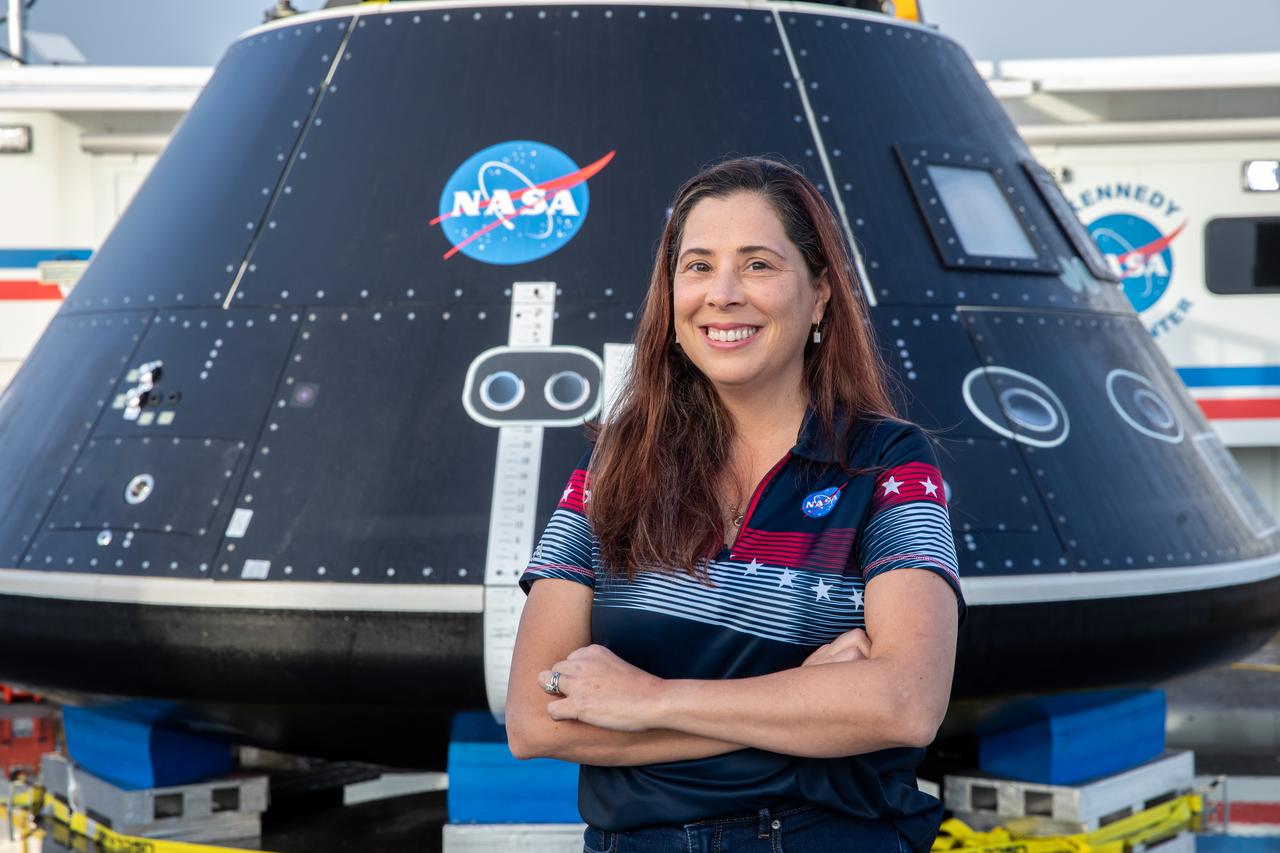
Liliana Villarreal, Artemis landing and recovery director with Exploration Ground Systems (EGS), stands in front of the Crew Module Test Article (CMTA) at the turn basin in the Launch Complex 39 area at NASA’s Kennedy Space Center in Florida on Feb. 1, 2023. The CMTA is being used to practice recovery after splashdown of the Orion spacecraft to prepare for the Artemis II crewed mission. EGS leads recovery efforts.
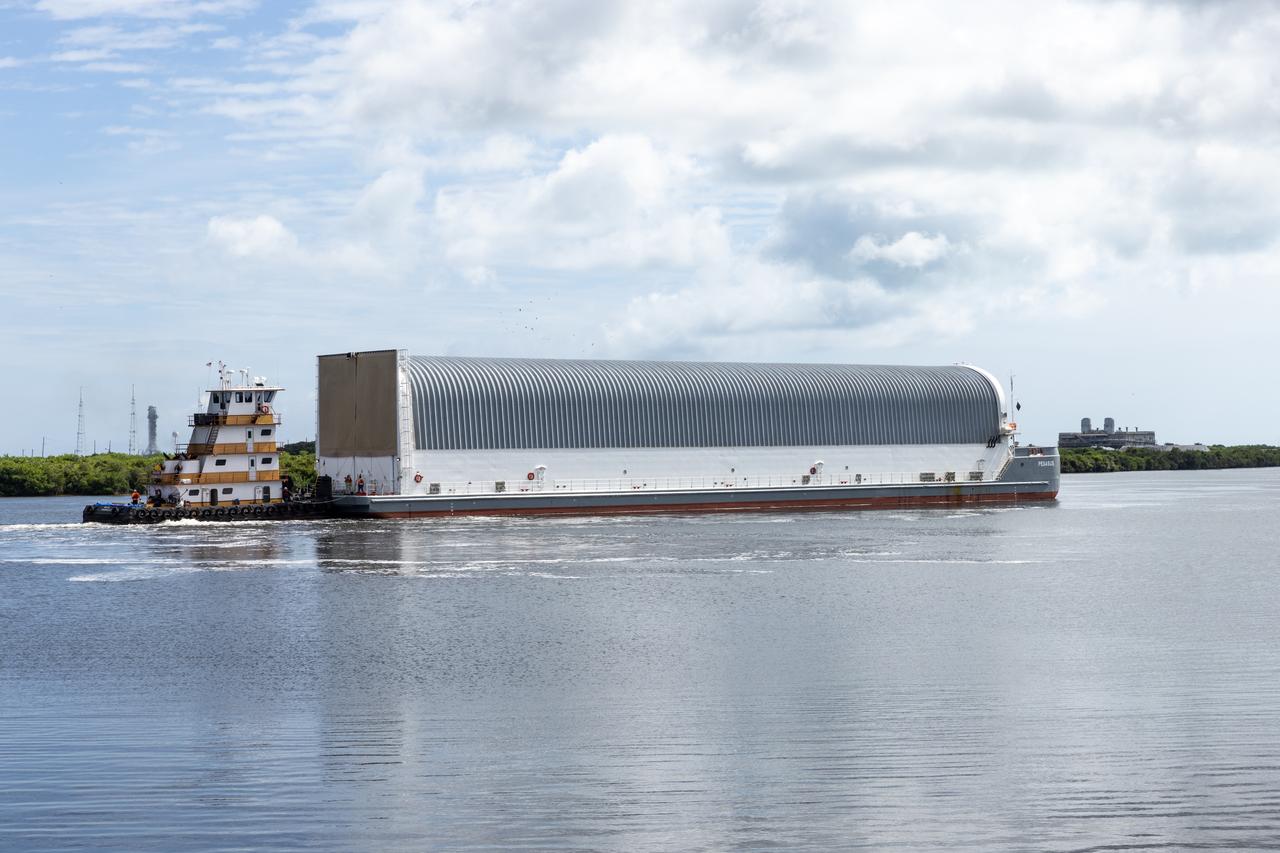
NASA’s Pegasus barge, carrying the agency’s massive SLS (Space Launch System) core stage, arrives at NASA’s Kennedy Space Center Complex 39 turn basin wharf in Florida on Tuesday, July 23, 2024, after journeying from the agency’s Michoud Assembly Facility in New Orleans. The core stage is the next piece of Artemis hardware to arrive at the spaceport and will be offloaded and moved to NASA Kennedy’s Vehicle Assembly Building, where it will be prepared for integration ahead of the Artemis II launch.
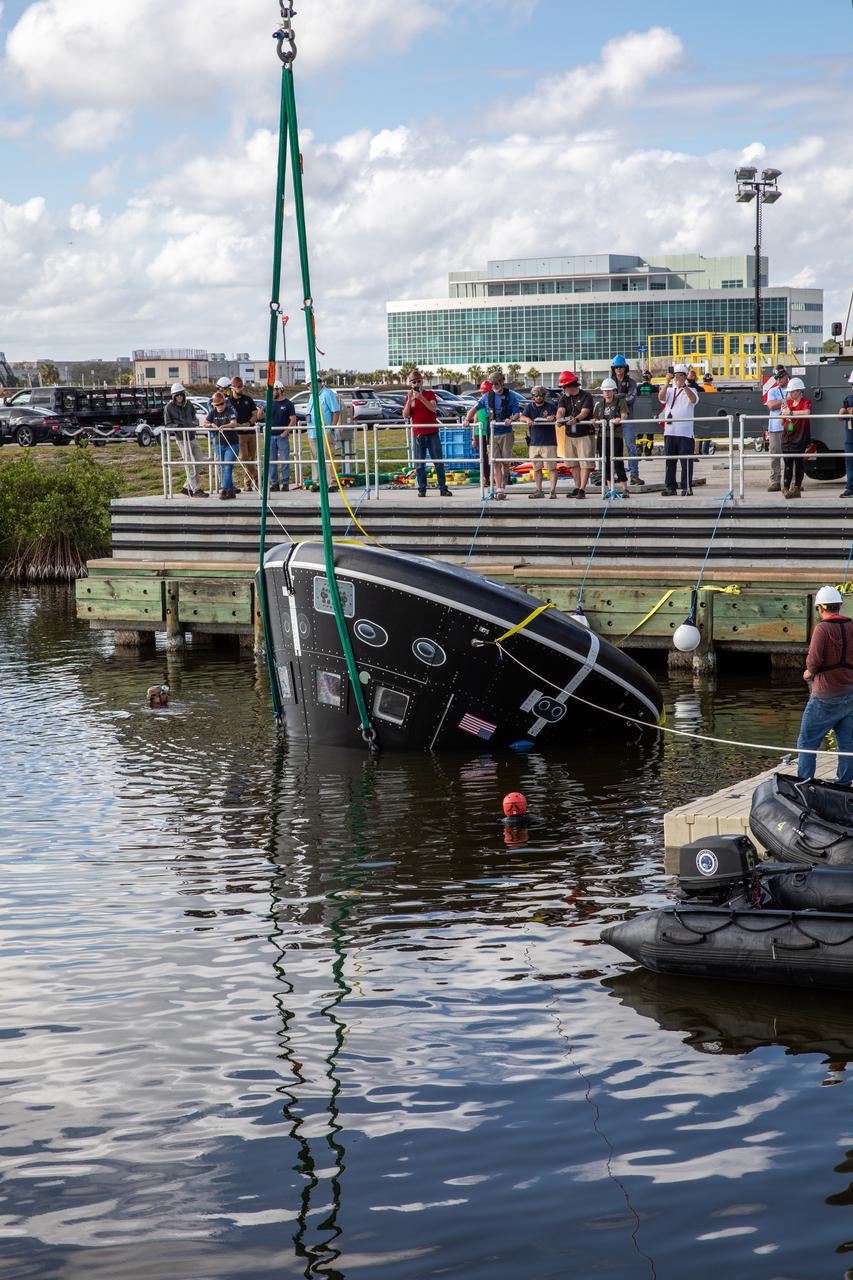
A crane is used to turn the Crew Module Test Article (CMTA) upside down in the water at the turn basin in the Launch Complex 39 area at NASA’s Kennedy Space Center in Florida on Jan. 31, 2023. The CMTA is being certified for use to practice recovery after splashdown of the Orion spacecraft to prepare for the Artemis II crewed mission. Exploration Ground Systems leads recovery efforts.
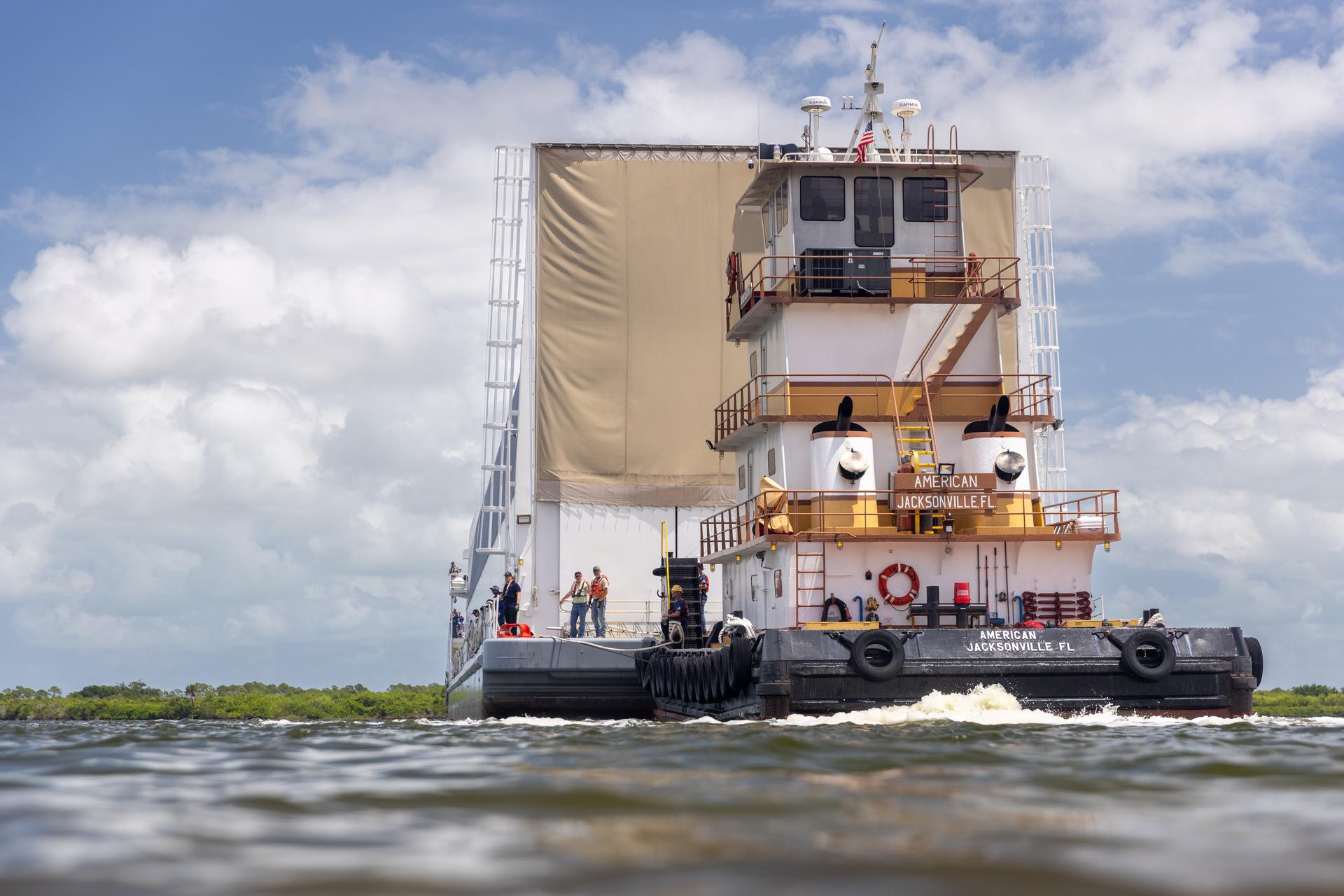
NASA’s Pegasus barge, carrying the top four-fifths of the agency’s SLS (Space Launch System) core stage for the Artemis III mission, arrives at NASA’s Kennedy Space Center Complex 39 turn basin wharf in Florida on Monday, April 27, 2026. Artemis III will launch astronauts to Earth’s orbit aboard the Orion spacecraft on top of SLS to test rendezvous and docking capabilities between Orion and commercial spacecraft needed to land Artemis IV astronauts on the Moon in 2028.
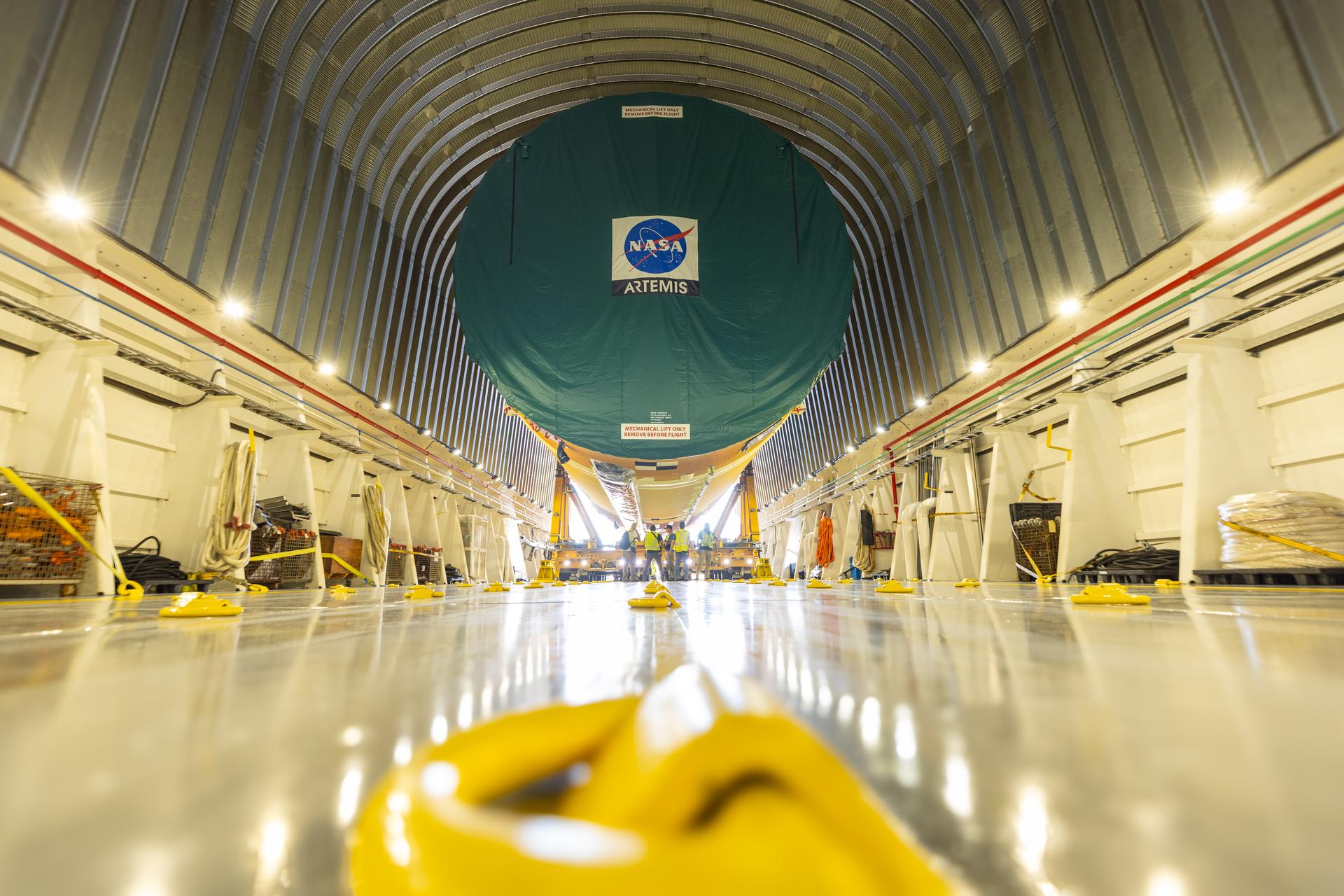
NASA’s top four-fifths of the SLS (Space Launch System) core stage for the Artemis III mission is offloaded from the agency’s Pegasus barge on Tuesday, April 28, 2026, after arriving at the Kennedy Space Center in Florida the prior day. The four-fifths contains the liquid hydrogen tank, liquid oxygen tank, intertank, and forward skirt of the SLS rocket and will be joined with the remaining core stage segments at Kennedy’s Vehicle Assembly Building High Bay 2 prior to rocket stacking operations. Artemis III will launch astronauts to Earth’s orbit aboard the Orion spacecraft on top of SLS to test rendezvous and docking capabilities between Orion and commercial spacecraft needed to land Artemis IV astronauts on the Moon in 2028.

NASA’s top four-fifths of the SLS (Space Launch System) core stage for the Artemis III mission arrives in the transfer aisle of the Vehicle Assembly Building at the agency’s Kennedy Space Center in Florida where teams with Boeing will finish integrating it with the remaining core stage segments prior to rocket stacking operations. Artemis III will launch astronauts to Earth’s orbit aboard the Orion spacecraft on top of SLS to test rendezvous and docking capabilities between Orion and commercial spacecraft needed to land Artemis IV astronauts on the Moon in 2028.
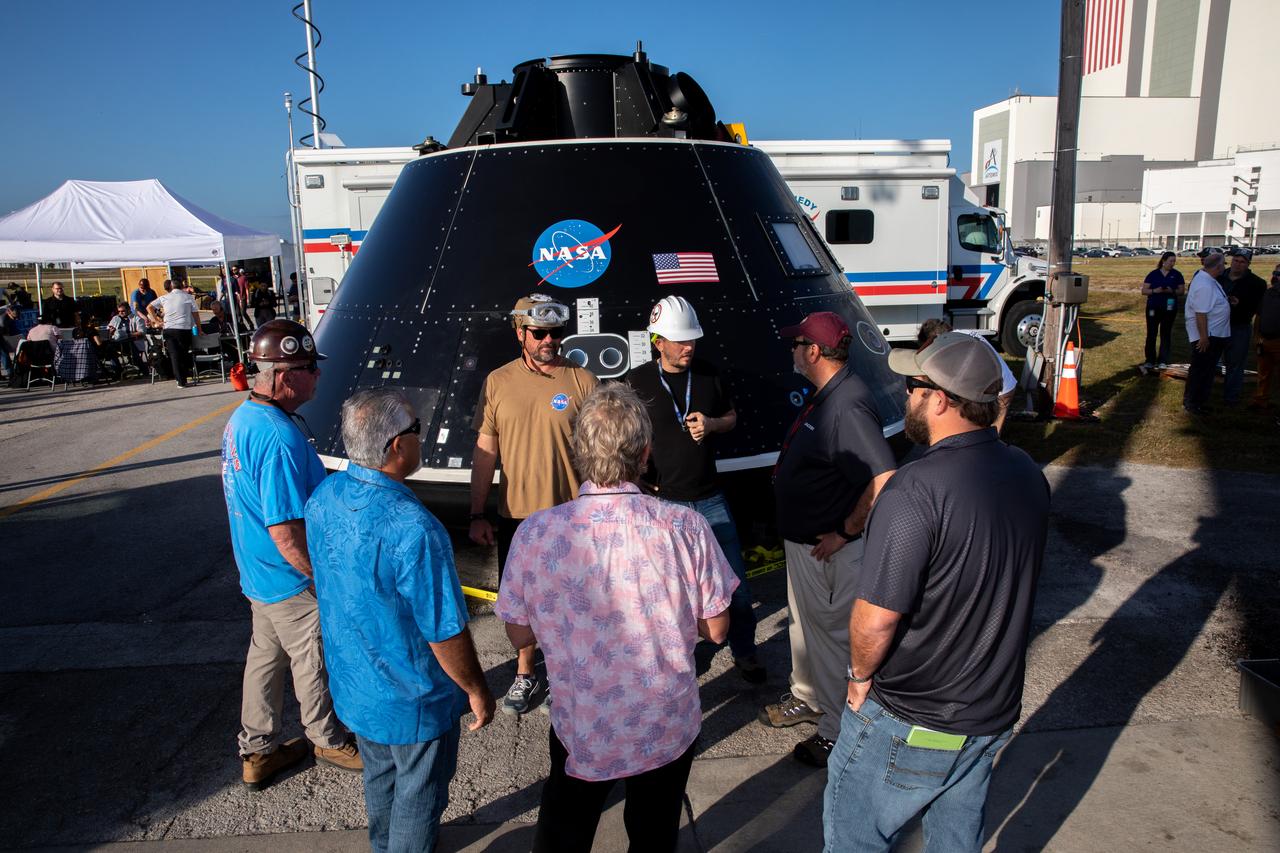
Landing and recovery team members review procedures before they begin using the Crew Module Test Article (CMTA) at the turn basin in the Launch Complex 39 area at NASA’s Kennedy Space Center in Florida on Jan. 30, 2023. The CMTA is being used to practice recovery after splashdown of the Orion spacecraft to prepare for the Artemis II crewed mission. Exploration Ground Systems leads recovery efforts.
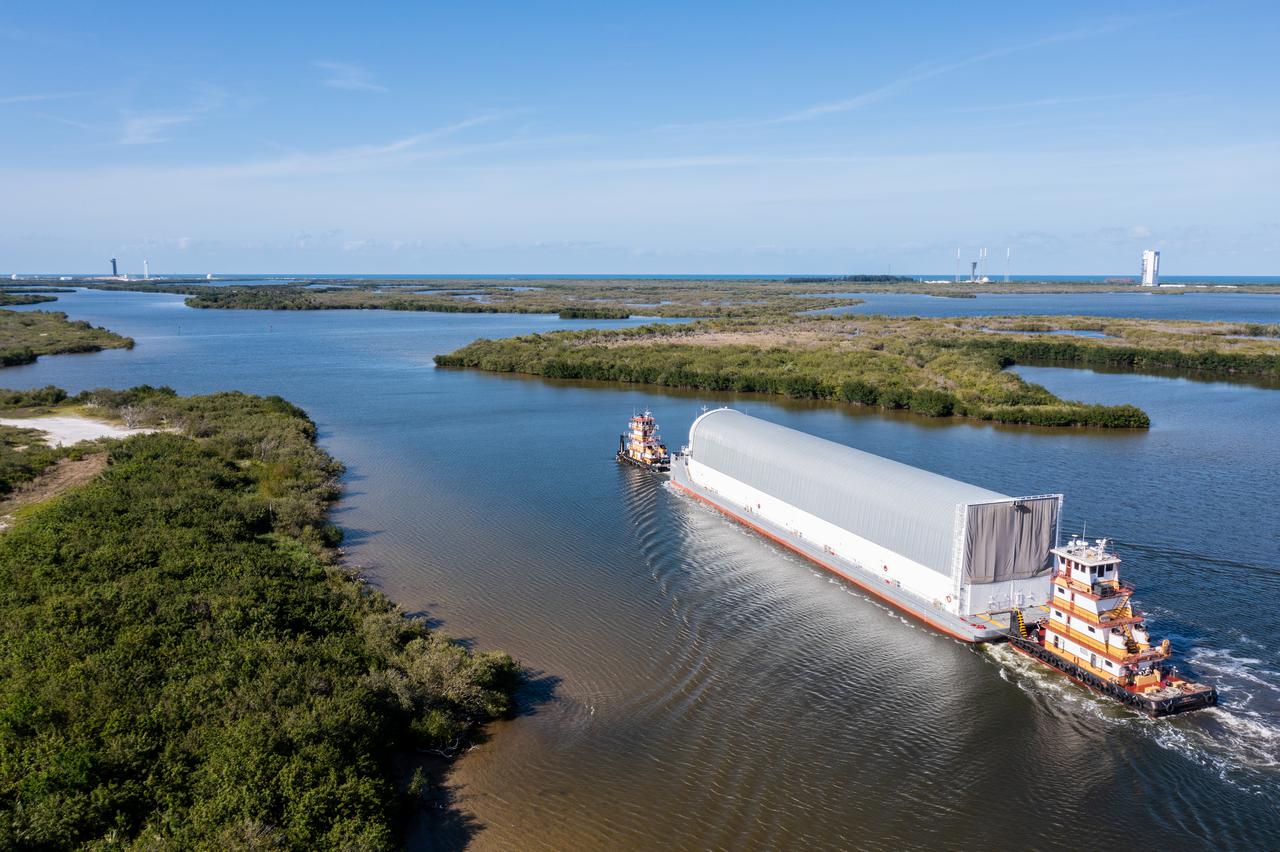
The Pegasus barge, carrying the mighty Space Launch System (SLS) core stage, arrives at NASA’s Kennedy Space Center in Florida on April 27, 2021, after journeying from the agency’s Stennis Space Center in Mississippi. The core stage is the final piece of Artemis hardware to arrive at the spaceport and will be offloaded and moved to Kennedy’s Vehicle Assembly Building, where it will be prepared for integration atop the mobile launcher with the completed stack of solid rocket boosters ahead of the Artemis I launch. The first in a series of increasingly complex missions, Artemis I will test SLS and Orion as an integrated system prior to crewed flights to the Moon.
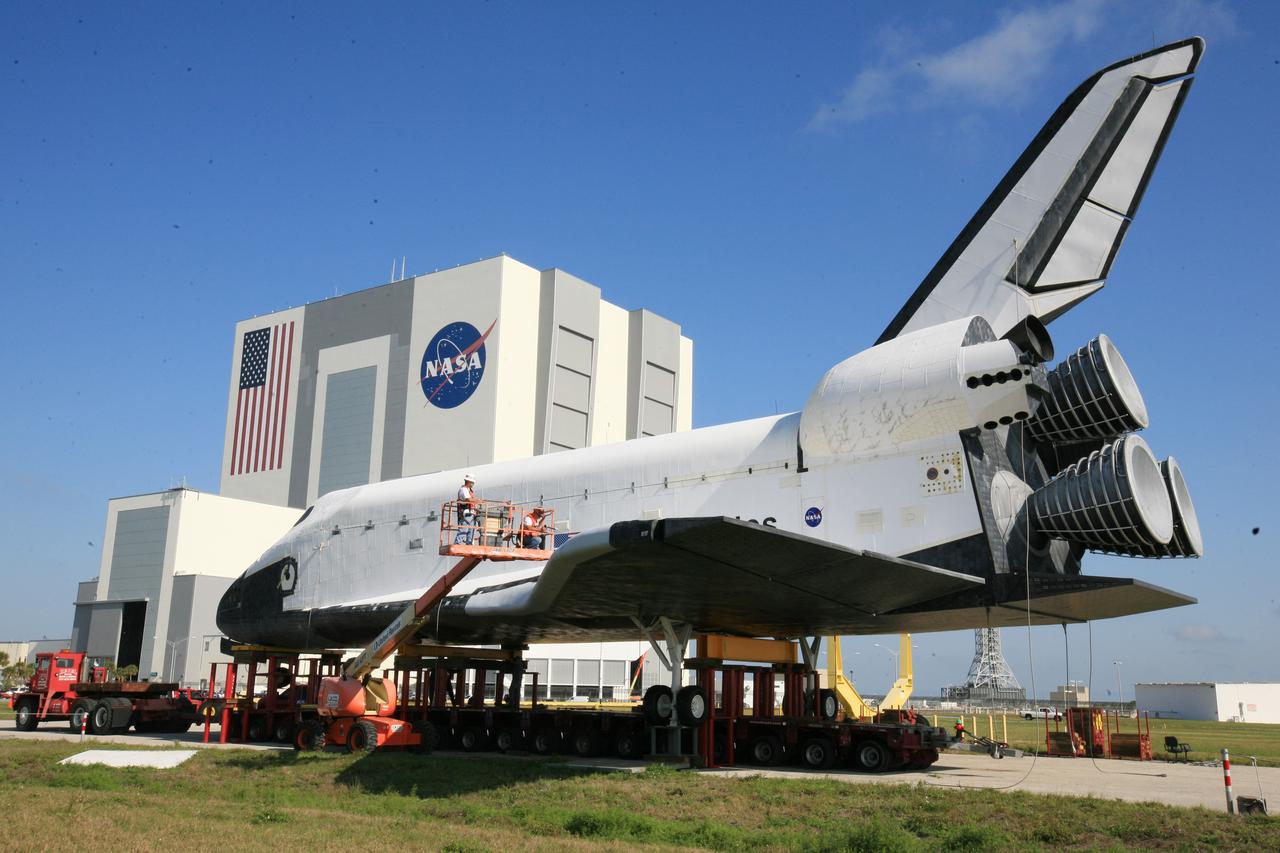
T&R - Work on Shuttle Replica to Prepare for transport to JSC
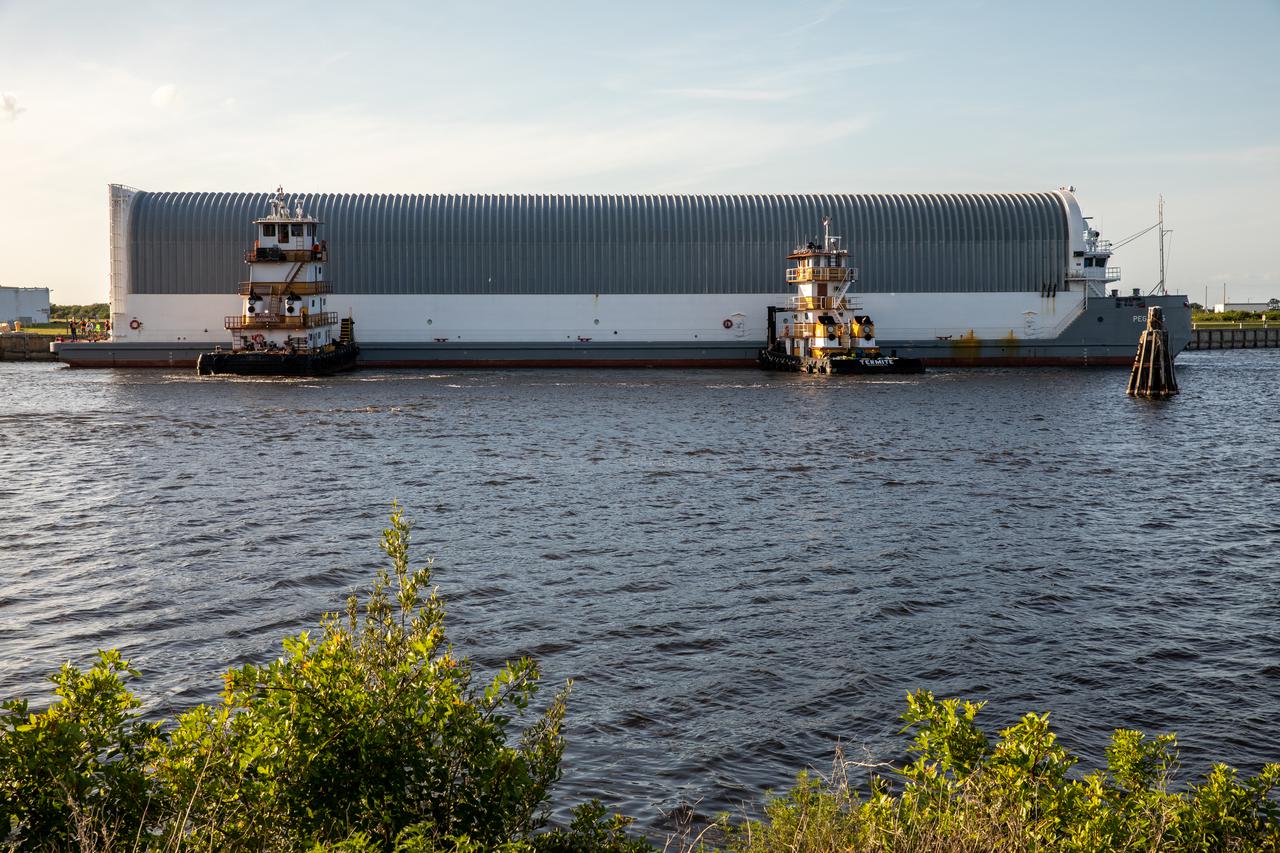
The Pegasus barge, carrying the mighty Space Launch System (SLS) core stage, arrives at NASA’s Kennedy Space Center in Florida on April 27, 2021, after journeying from the agency’s Stennis Space Center in Mississippi. The core stage is the final piece of Artemis hardware to arrive at the spaceport and will be offloaded and moved to Kennedy’s Vehicle Assembly Building, where it will be prepared for integration atop the mobile launcher with the completed stack of solid rocket boosters ahead of the Artemis I launch. The first in a series of increasingly complex missions, Artemis I will test SLS and Orion as an integrated system prior to crewed flights to the Moon.
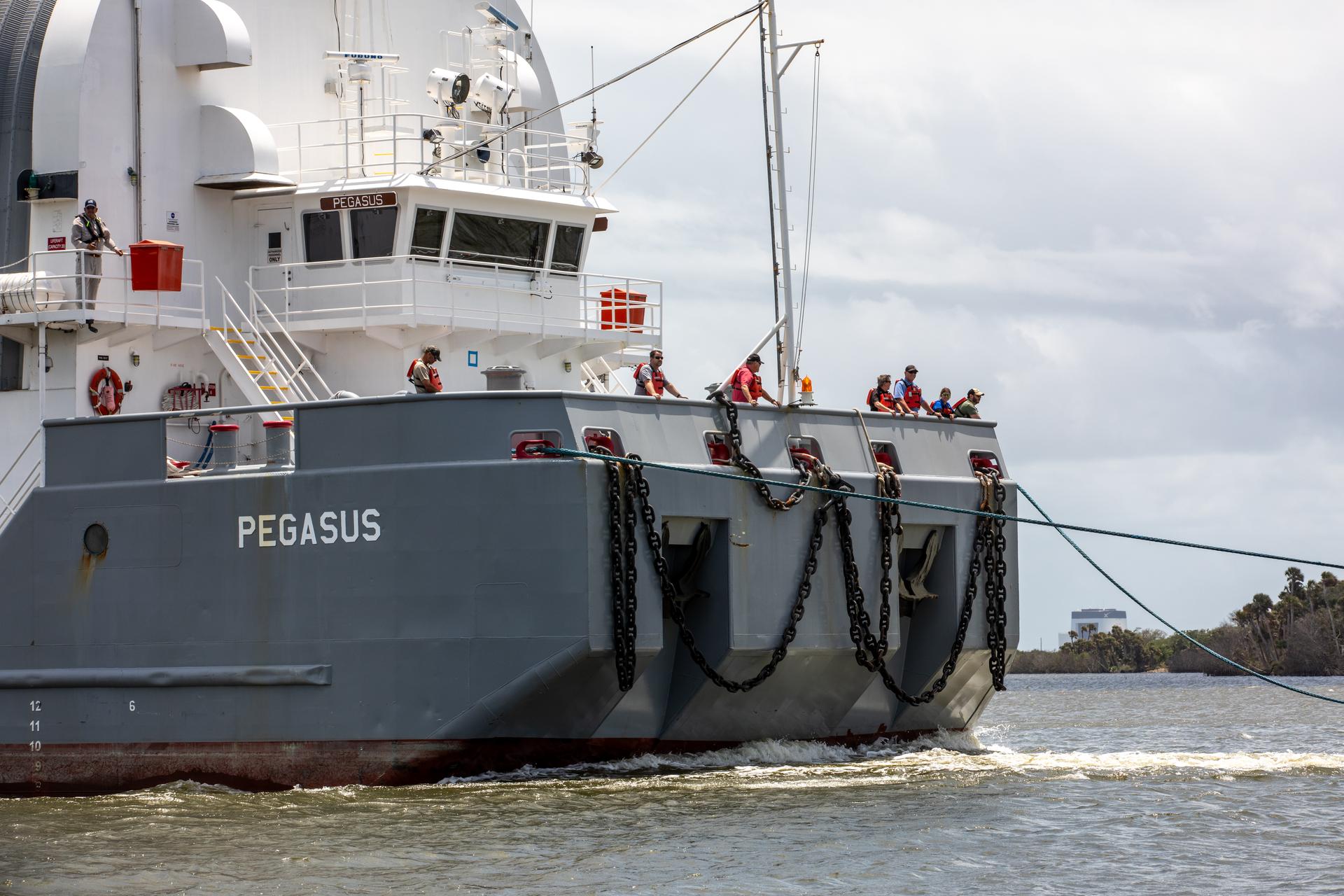
NASA’s Pegasus barge, carrying the top four-fifths of the agency’s SLS (Space Launch System) core stage for the Artemis III mission, arrives at NASA’s Kennedy Space Center Complex 39 turn basin wharf in Florida on Monday, April 27, 2026. Artemis III will launch astronauts to Earth’s orbit aboard the Orion spacecraft on top of SLS to test rendezvous and docking capabilities between Orion and commercial spacecraft needed to land Artemis IV astronauts on the Moon in 2028.
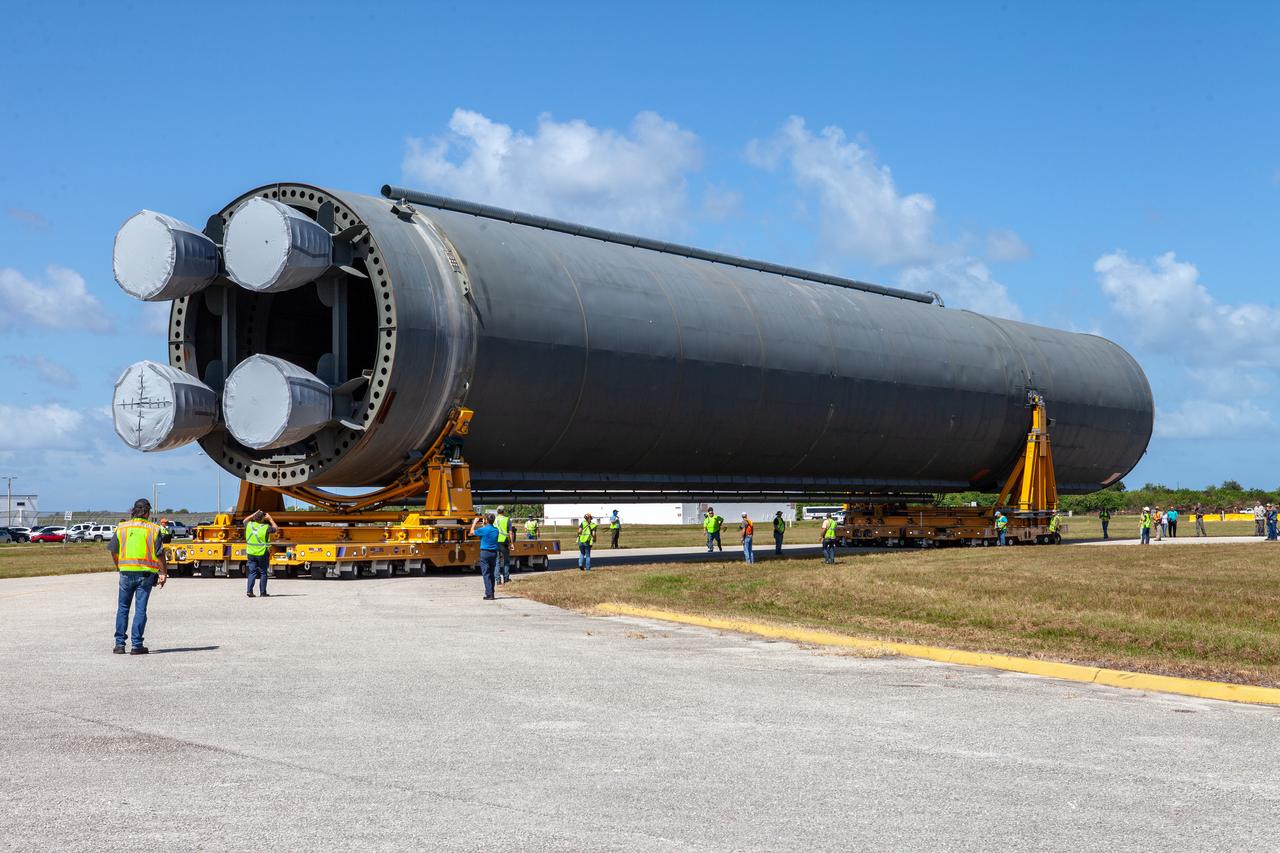
The 212-foot-long Space Launch System (SLS) rocket core stage pathfinder has been offloaded from NASA’s Pegasus Barge at Kennedy Space Center’s Launch Complex 39 turn basin wharf on Oct. 1, 2019. The Pegasus Barge made its first delivery to Kennedy in support of the agency's Artemis missions. The upgraded 310-foot-long barge arrived Sept. 27, 2019, ferrying the SLS core stage pathfinder, a full-scale mock-up of the rocket's core stage. It will be used by Exploration Ground Systems and its contractor, Jacobs, to practice offloading, moving and stacking maneuvers, using important ground support equipment to train employees and certify all the equipment works properly. The pathfinder will stay at Kennedy for approximately one month before trekking back to NASA's Michoud Assembly Facility in Louisiana.

Earlier this year, the Florida Panthers won their first NHL championship and brought victory to the state of Florida. As part of its championship tour, the Stanley Cup made a visit to NASA’s Kennedy Space Center. Pictured here is the shining silver Stanley Cup in the foreground with a large-scale mockup of the Hubble Space Telescope in the background at the Kennedy Space Center Visitor’s Complex on Tuesday Sept. 17, 2024.
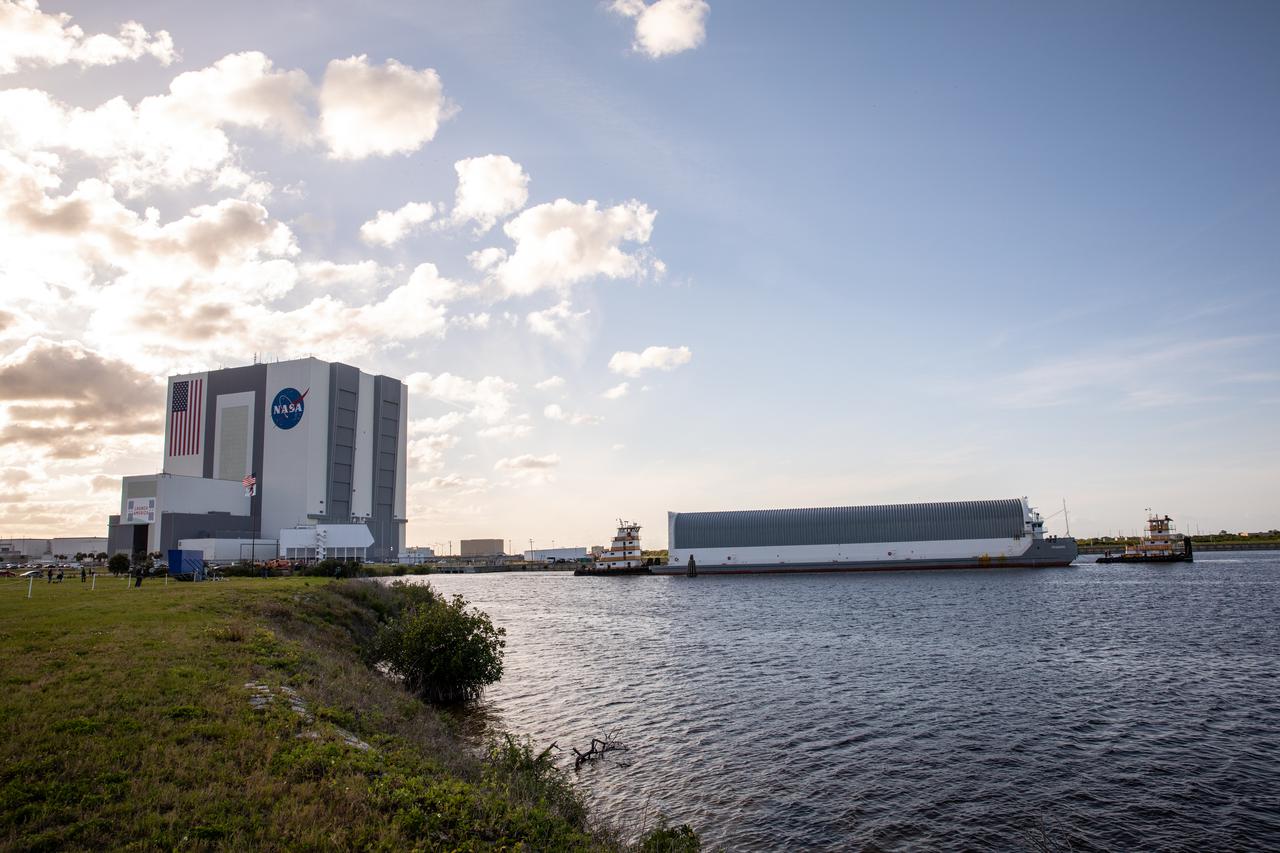
After its journey from NASA’s Stennis Space Center in Mississippi aboard the Pegasus barge, the mighty Space Launch System (SLS) core stage arrives at the agency’s Kennedy Space Center in Florida on April 27, 2021. The core stage is the final piece of Artemis hardware to arrive at the spaceport and will be offloaded and moved to Kennedy’s Vehicle Assembly Building, where it will be prepared for integration atop the mobile launcher with the completed stack of solid rocket boosters ahead of the Artemis I launch. The first in a series of increasingly complex missions, Artemis I will test SLS and Orion as an integrated system prior to crewed flights to the Moon.
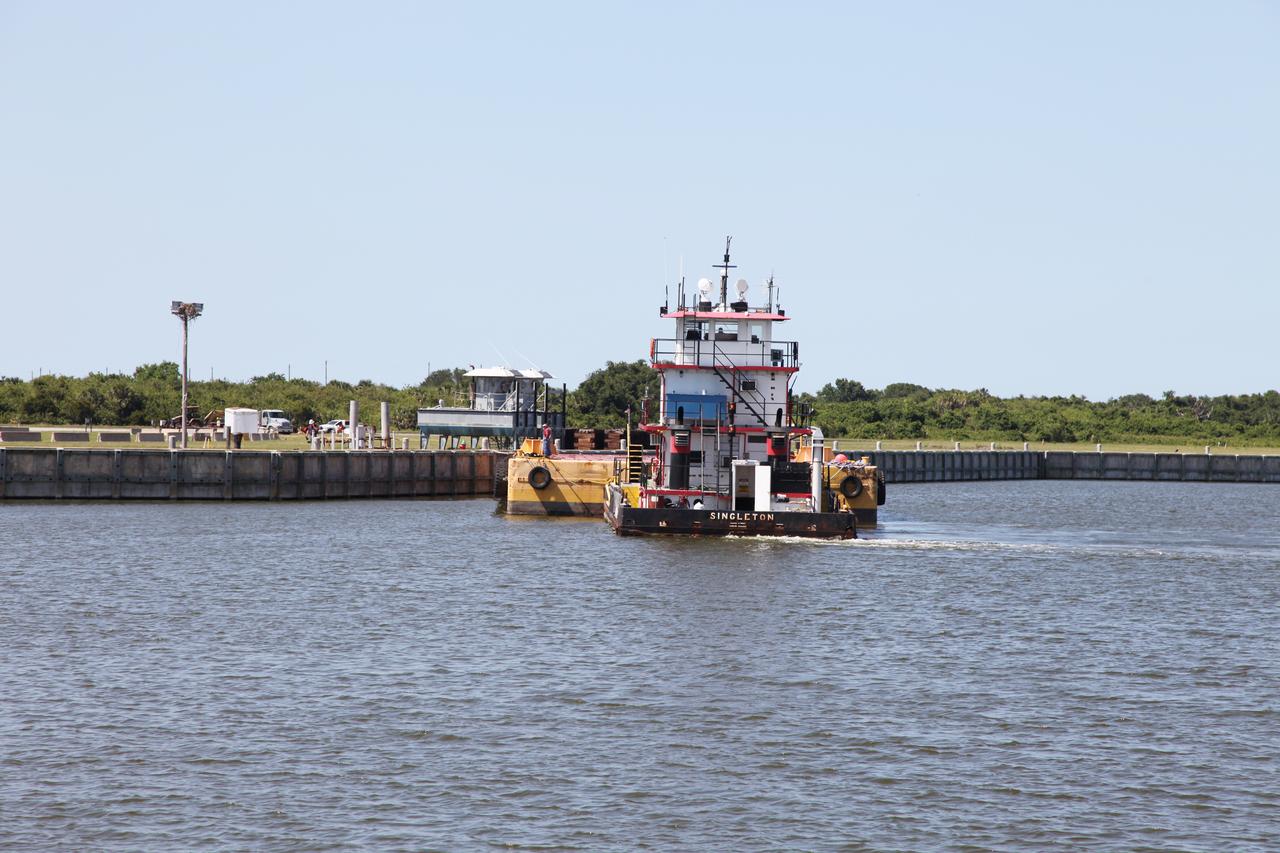
Barge Arrives that will take the Shuttle Mockup to JSC
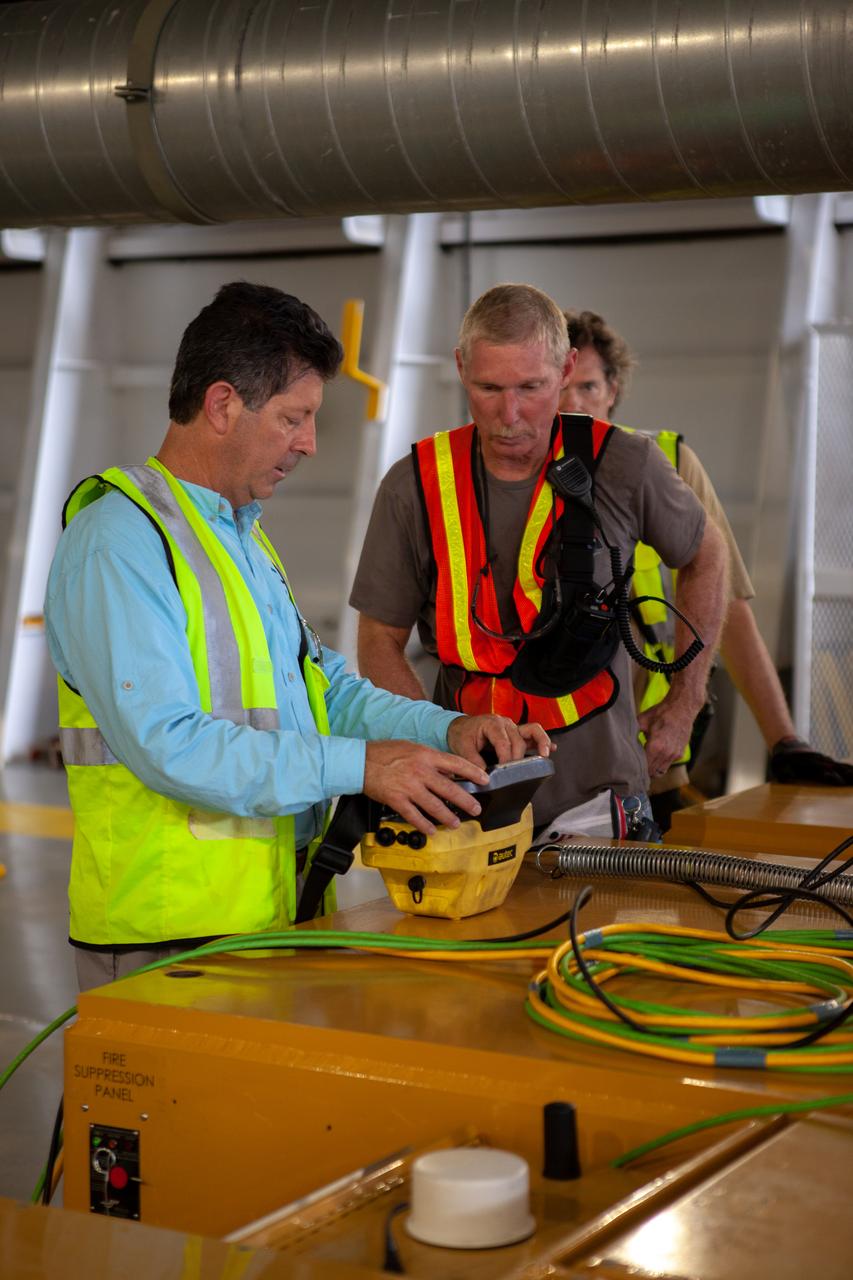
Jacobs TOSC Launch Vehicle Technical Operations technicians review procedures before the start of offloading the 212-foot-long Space Launch System (SLS) rocket core stage pathfinder from NASA's Pegasus Barge at Kennedy Space Center’s Launch Complex 39 turn basin wharf on Oct. 1, 2019. From left, are Dave Goetz, operator, John Stirling and Jack Gardner, both observers. The Pegasus Barge made its first delivery to Kennedy in support of the agency's Artemis missions. The upgraded 310-foot-long barge arrived Sept. 27, 2019, ferrying the SLS core stage pathfinder, a full-scale mock-up of the rocket's core stage. It will be used by Exploration Ground Systems and its contractor, Jacobs, to practice offloading, moving and stacking maneuvers, using important ground support equipment to train employees and certify all the equipment works properly. The pathfinder will stay at Kennedy for approximately one month before trekking back to NASA's Michoud Assembly Facility in Louisiana.

NASA’s top four-fifths of the SLS (Space Launch System) core stage for the Artemis III mission arrives at the Vehicle Assembly Building at the agency’s Kennedy Space Center in Florida where teams with Boeing will finish integrating it with the remaining core stage segments prior to rocket stacking operations. Artemis III will launch astronauts to Earth’s orbit aboard the Orion spacecraft on top of SLS to test rendezvous and docking capabilities between Orion and commercial spacecraft needed to land Artemis IV astronauts on the Moon in 2028.
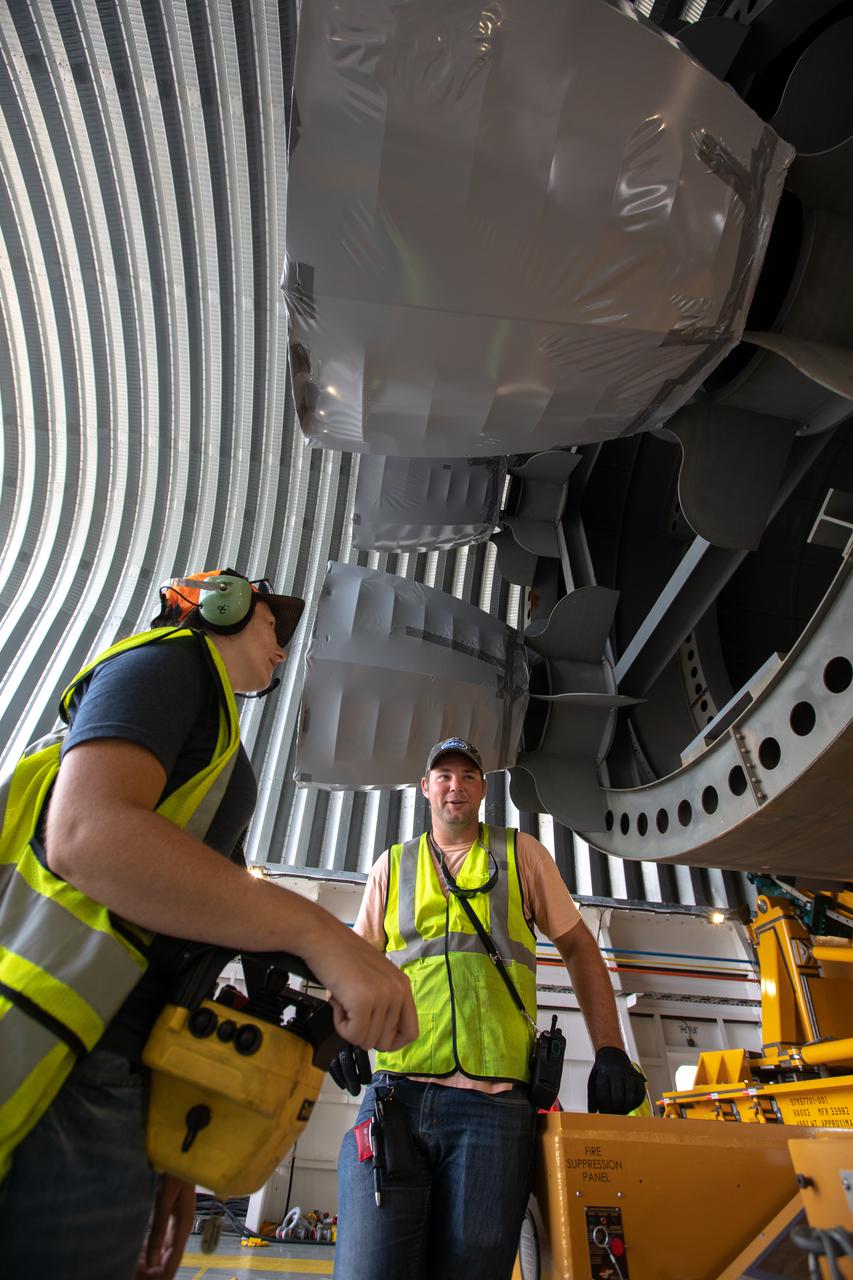
Preparations are underway to offload the 212-foot-long Space Launch System (SLS) rocket core stage pathfinder from NASA's Pegasus Barge at Kennedy Space Center’s Launch Complex 39 turn basin wharf on Oct. 1, 2019. From left, are Katherine River, operator, and James Erdman, observer, both are Launch Vehicle Technical Operations technicians with Jacobs TOSC. The Pegasus Barge made its first delivery to Kennedy in support of the agency's Artemis missions. The upgraded 310-foot-long barge arrived Sept. 27, 2019, ferrying the SLS core stage pathfinder, a full-scale mock-up of the rocket's core stage. It will be used by Exploration Ground Systems and its contractor, Jacobs, to practice offloading, moving and stacking maneuvers, using important ground support equipment to train employees and certify all the equipment works properly. The pathfinder will stay at Kennedy for approximately one month before trekking back to NASA's Michoud Assembly Facility in Louisiana.
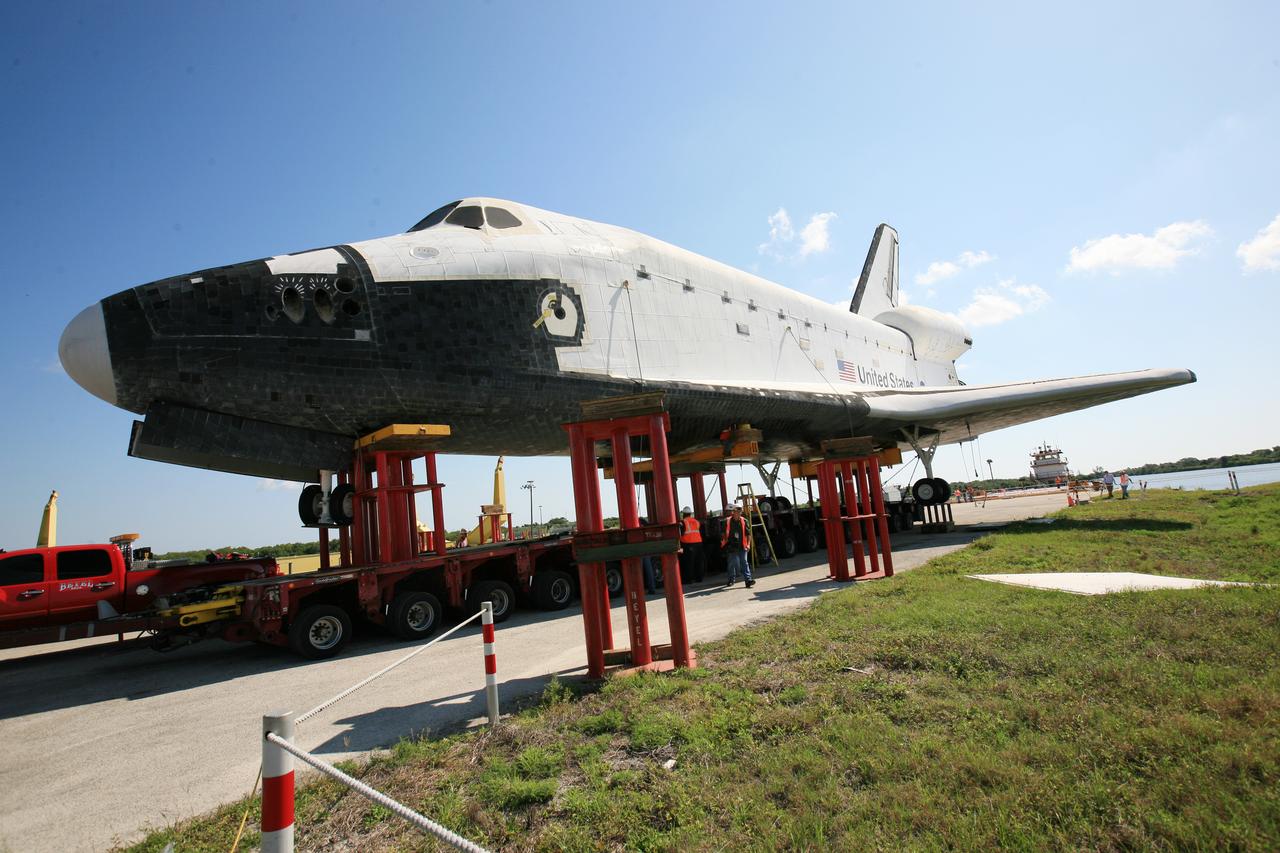
T&R - Work on Shuttle Replica to Prepare for transport to JSC
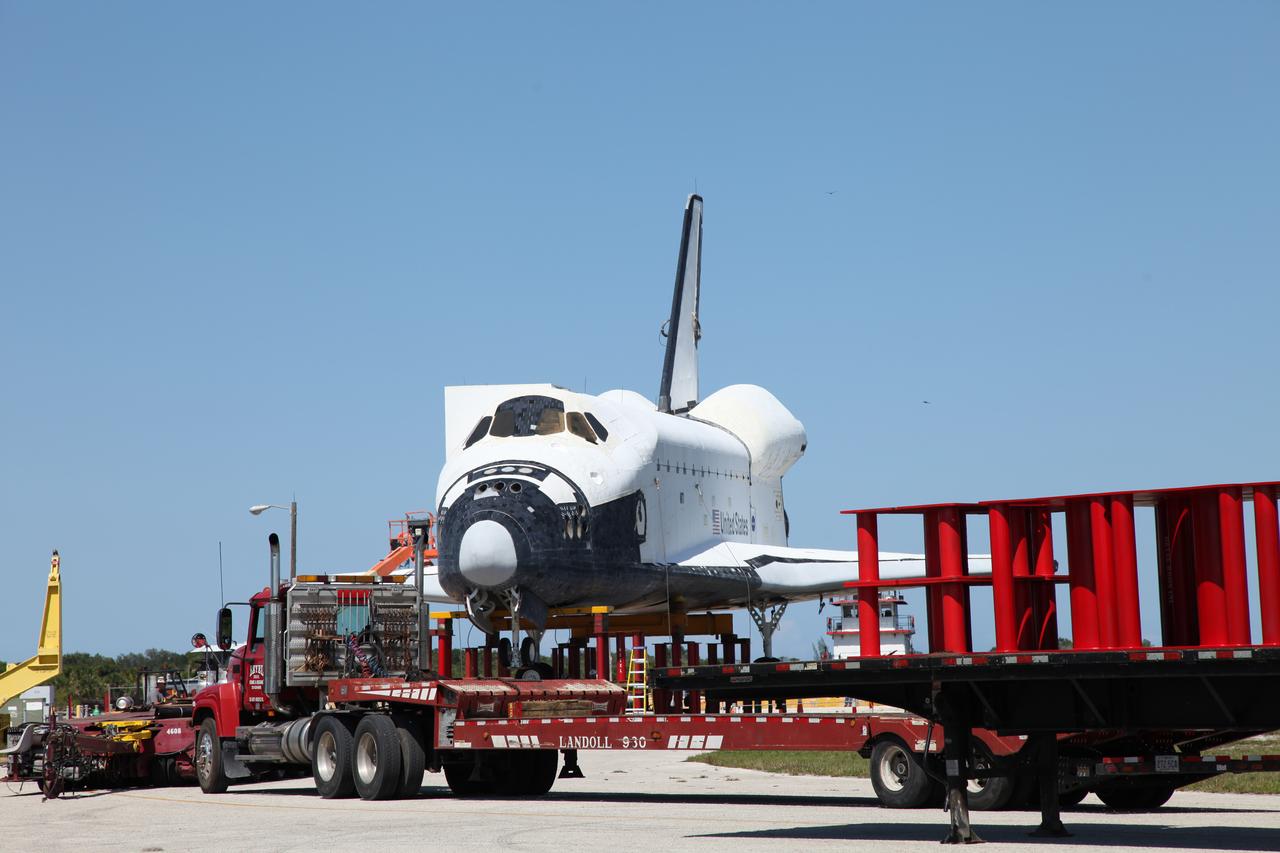
Barge Arrives that will take the Shuttle Mockup to JSC
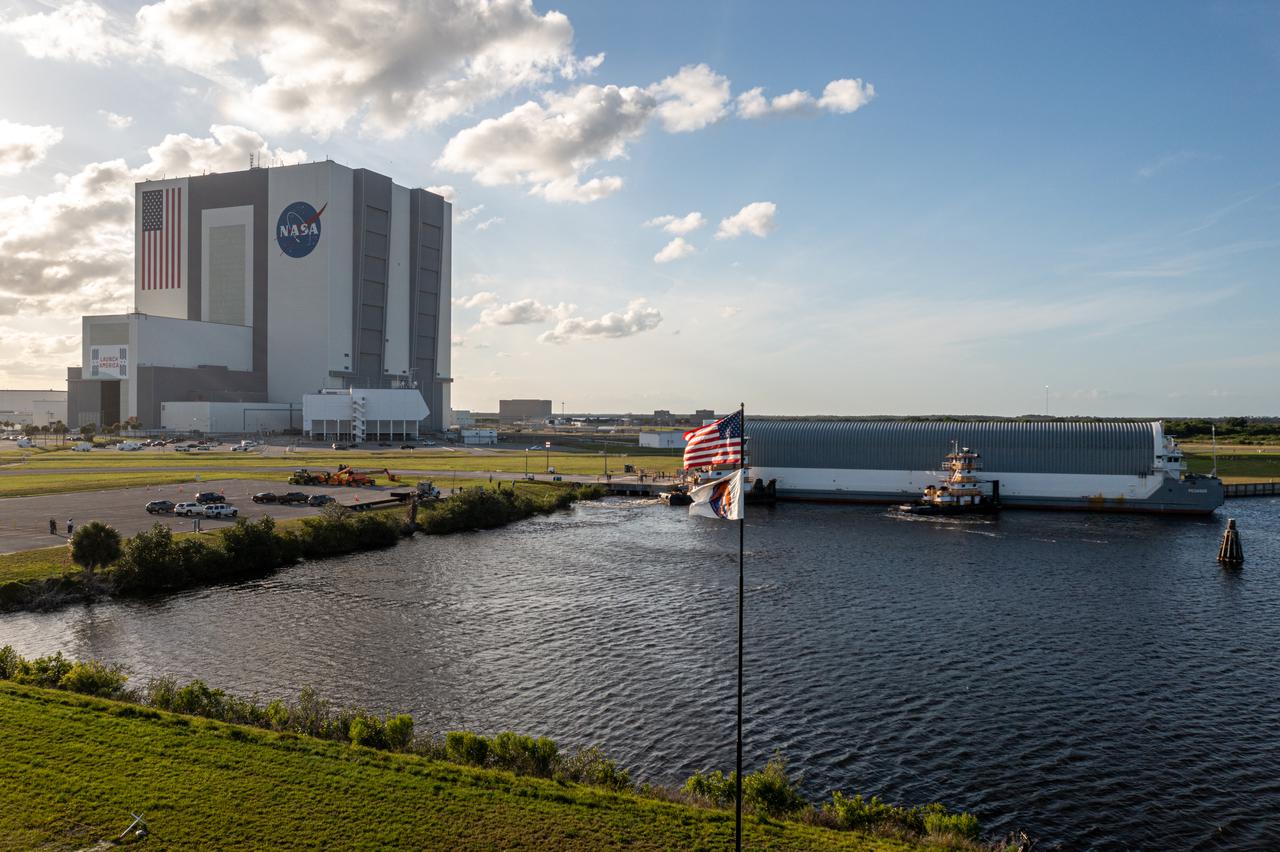
After its journey from NASA’s Stennis Space Center in Mississippi aboard the Pegasus barge, the mighty Space Launch System (SLS) core stage arrives at the agency’s Kennedy Space Center in Florida on April 27, 2021. The core stage is the final piece of Artemis hardware to arrive at the spaceport and will be offloaded and moved to Kennedy’s Vehicle Assembly Building, where it will be prepared for integration atop the mobile launcher with the completed stack of solid rocket boosters ahead of the Artemis I launch. The first in a series of increasingly complex missions, Artemis I will test SLS and Orion as an integrated system prior to crewed flights to the Moon.
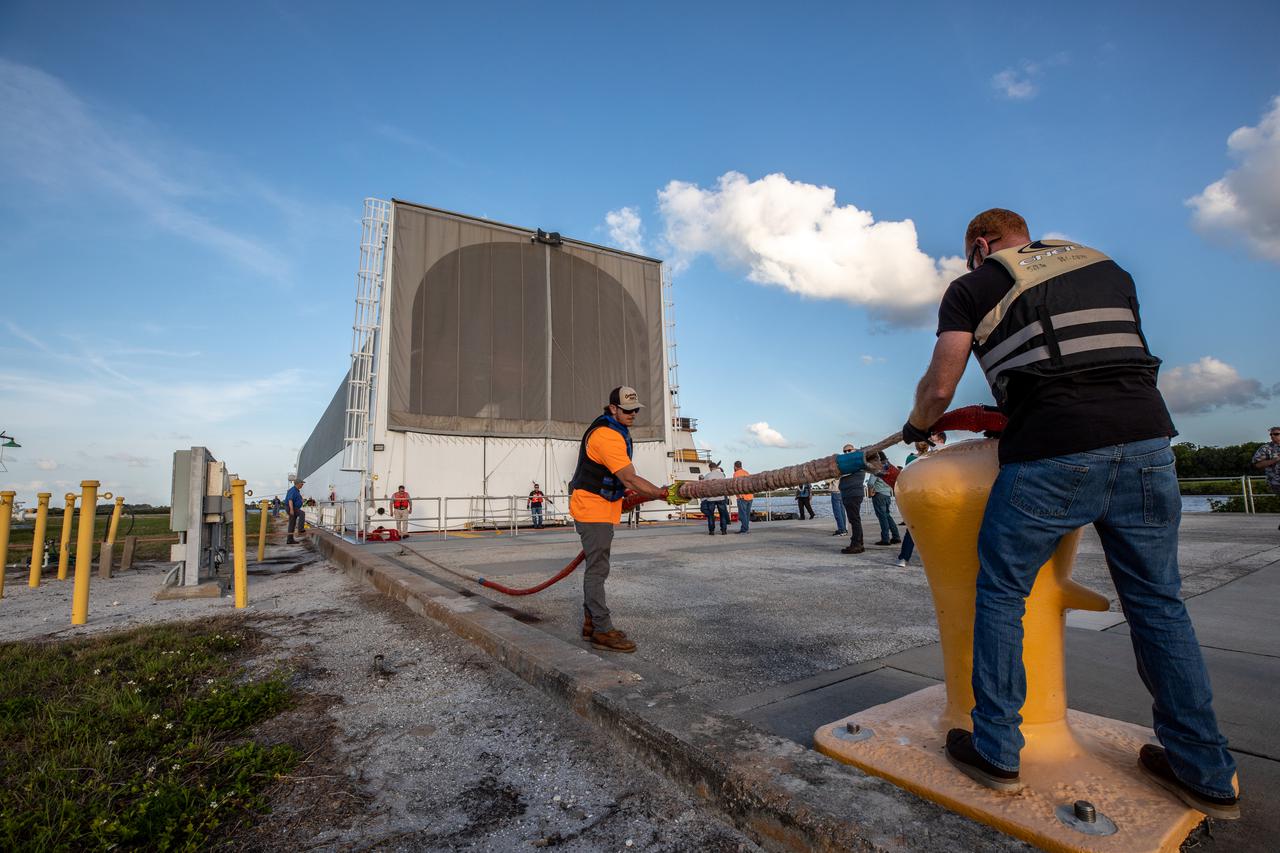
After its journey from NASA’s Stennis Space Center in Mississippi aboard the Pegasus barge, the mighty Space Launch System (SLS) core stage arrives at the agency’s Kennedy Space Center in Florida on April 27, 2021. In view is the iconic countdown clock at the NASA News Center, commonly referred to as the Press Site. The core stage is the final piece of Artemis hardware to arrive at the spaceport and will be offloaded and moved to Kennedy’s Vehicle Assembly Building, where it will be prepared for integration atop the mobile launcher with the completed stack of solid rocket boosters ahead of the Artemis I launch. The first in a series of increasingly complex missions, Artemis I will test SLS and Orion as an integrated system prior to crewed flights to the Moon.
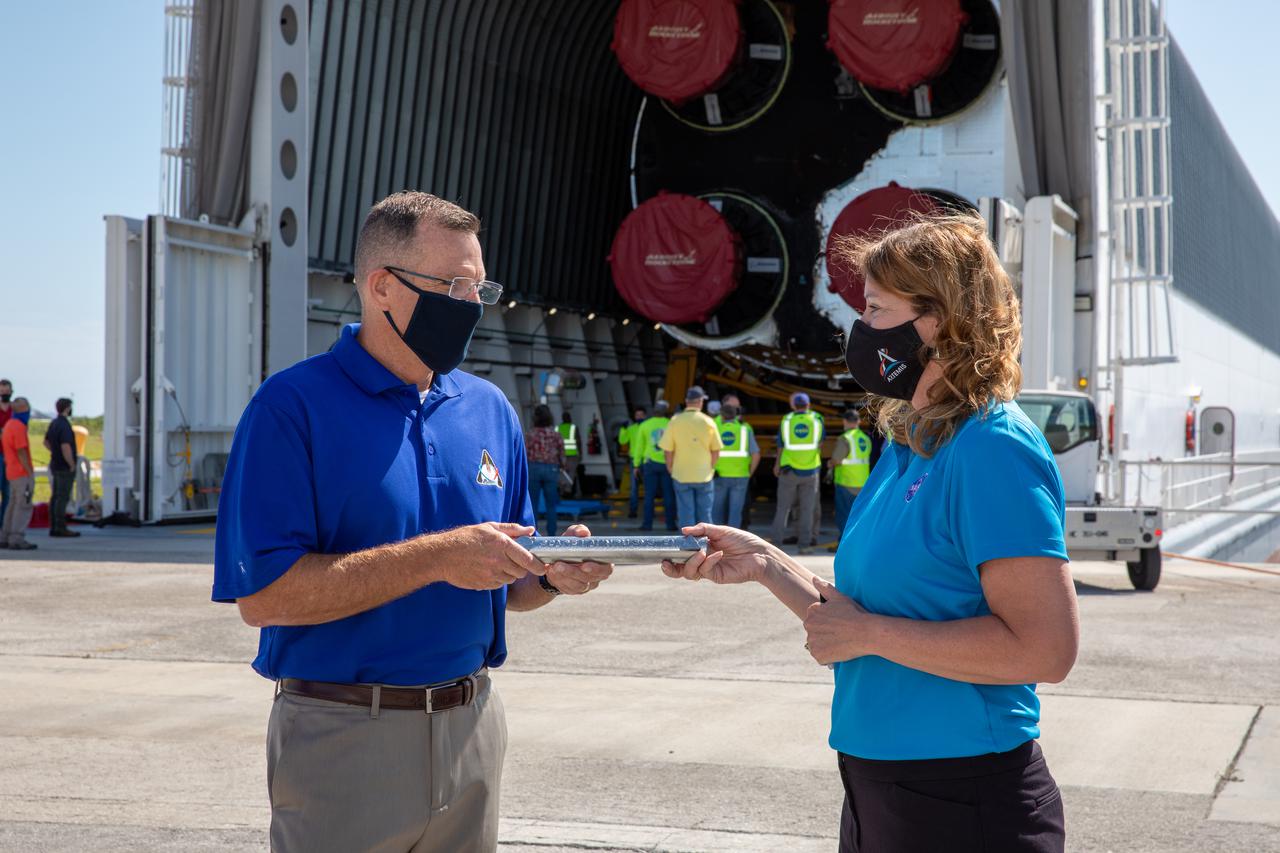
Space Launch System (SLS) Stages Manager Julie Bassler, right, celebrates the arrival of the SLS core stage by symbolically “passing the baton” to Exploration Ground Systems’ (EGS) Senior Vehicle Operations Manager Cliff Lanham on April 28, 2021, at NASA’s Kennedy Space Center in Florida. Journeying from the agency’s Stennis Space Center in Mississippi aboard the Pegasus barge, the core stage arrived at the Florida spaceport on April 27 to be processed for flight by EGS. It is the final piece of Artemis hardware to arrive at Kennedy and will be offloaded and moved to the Vehicle Assembly Building, where it will be prepared for integration atop the mobile launcher with the completed stack of solid rocket boosters ahead of the Artemis I launch. The first in a series of increasingly complex missions, Artemis I will test SLS and Orion as an integrated system prior to crewed flights to the Moon.
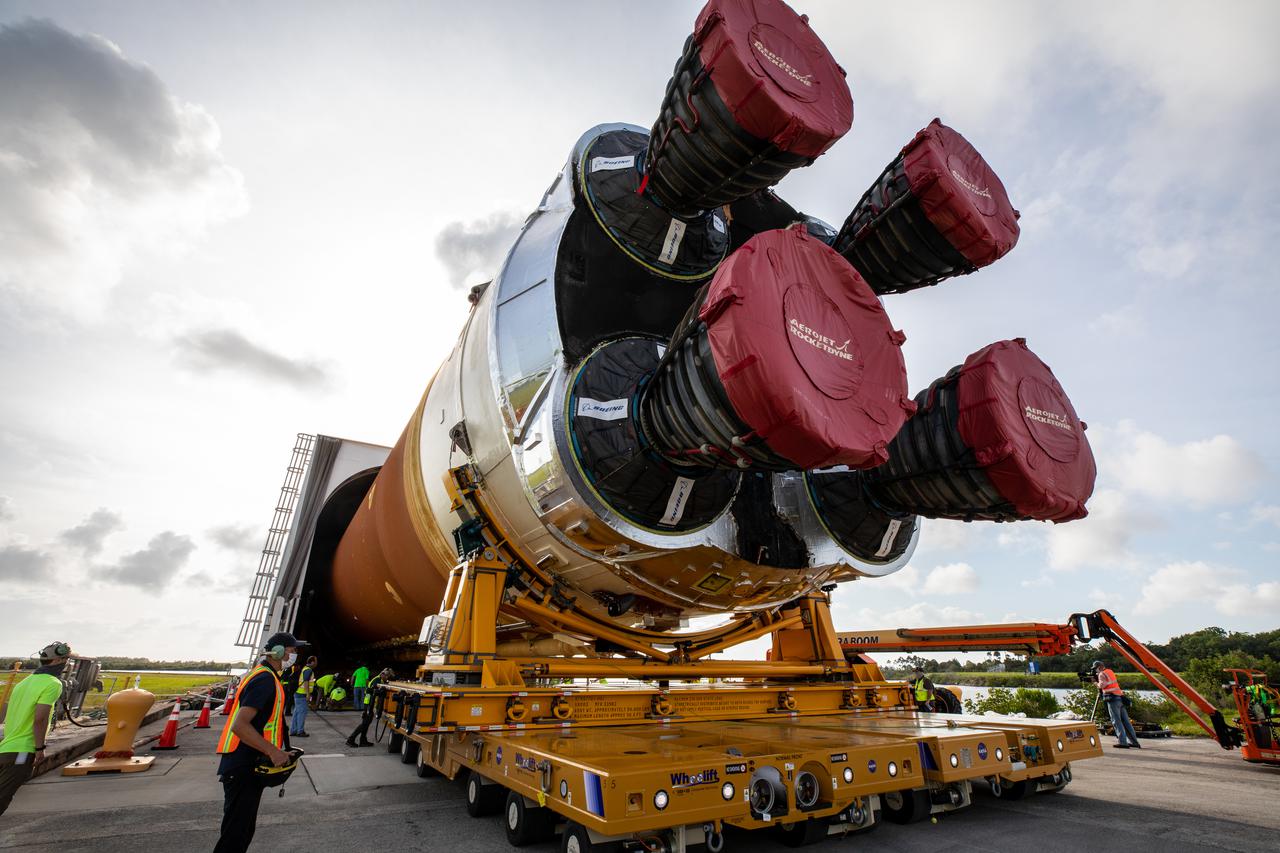
The massive 212-foot long Space Launch System (SLS) core stage is shown being offloaded from the Pegasus Barge on April 29, 2021, after arriving at NASA’s Kennedy Space Center in Florida. Teams with Exploration Ground Systems (EGS) and lead contractor Jacobs will transfer the rocket stage to the center’s Vehicle Assembly Building to prepare it for integration with the completed stack of solid rocket boosters atop the mobile launcher ahead of the Artemis I launch. The first in a series of increasingly complex missions, Artemis I will test SLS and Orion as an integrated system prior to crewed flights to the Moon.
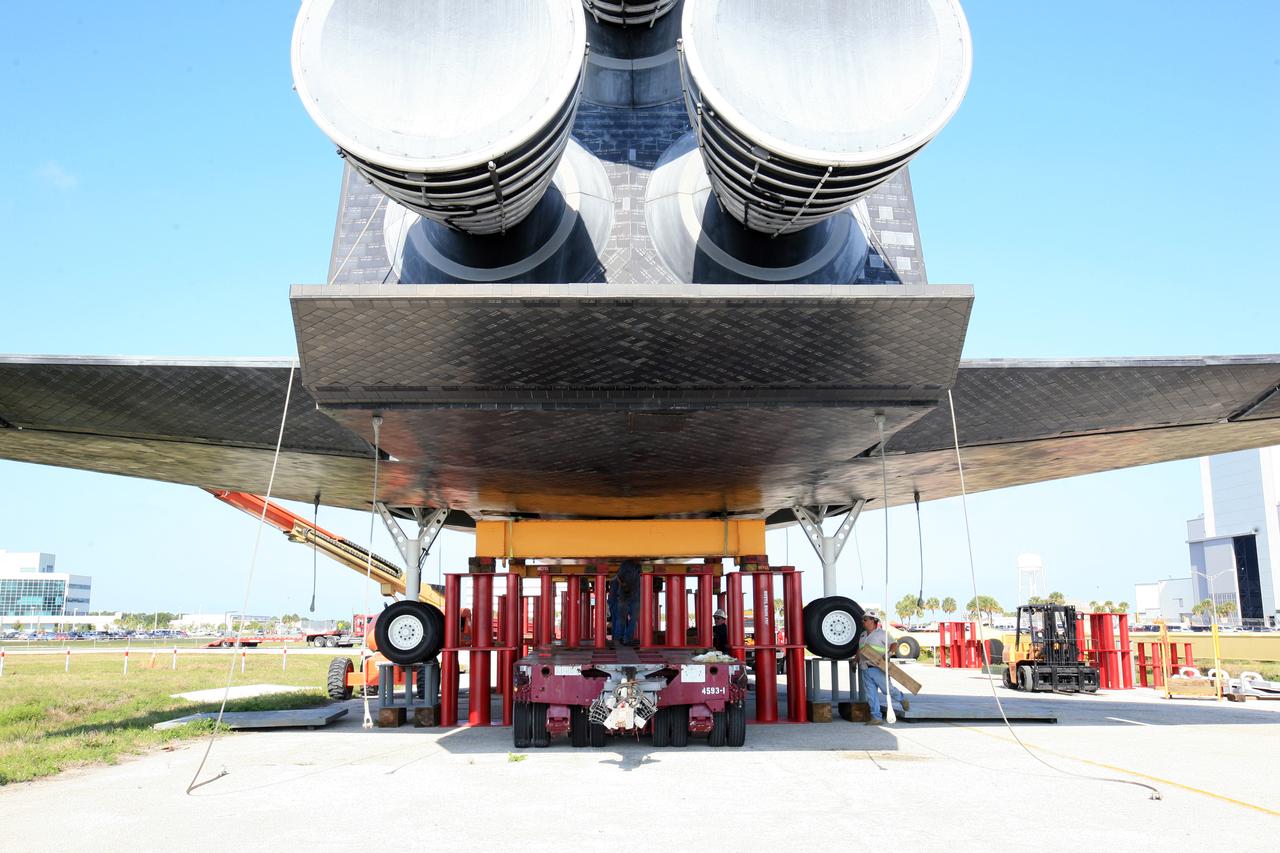
T&R - Work on Shuttle Replica to Prepare for transport to JSC
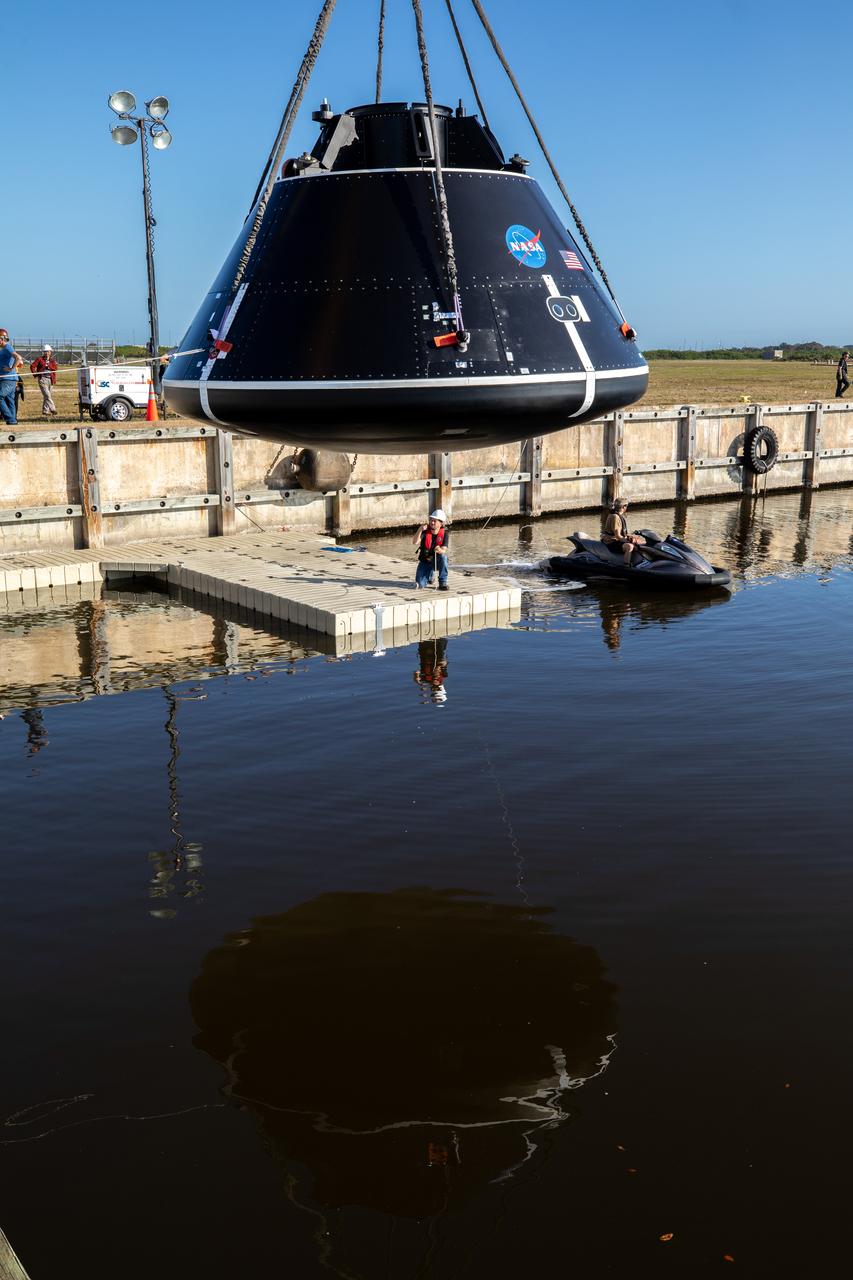
A crane is used to hold the Crew Module Test Article (CMTA) above the water at the turn basin in the Launch Complex 39 area at NASA’s Kennedy Space Center in Florida on Jan. 30, 2023. The CMTA is being used to practice recovery after splashdown of the Orion spacecraft to prepare for the Artemis II crewed mission. Exploration Ground Systems leads recovery efforts.
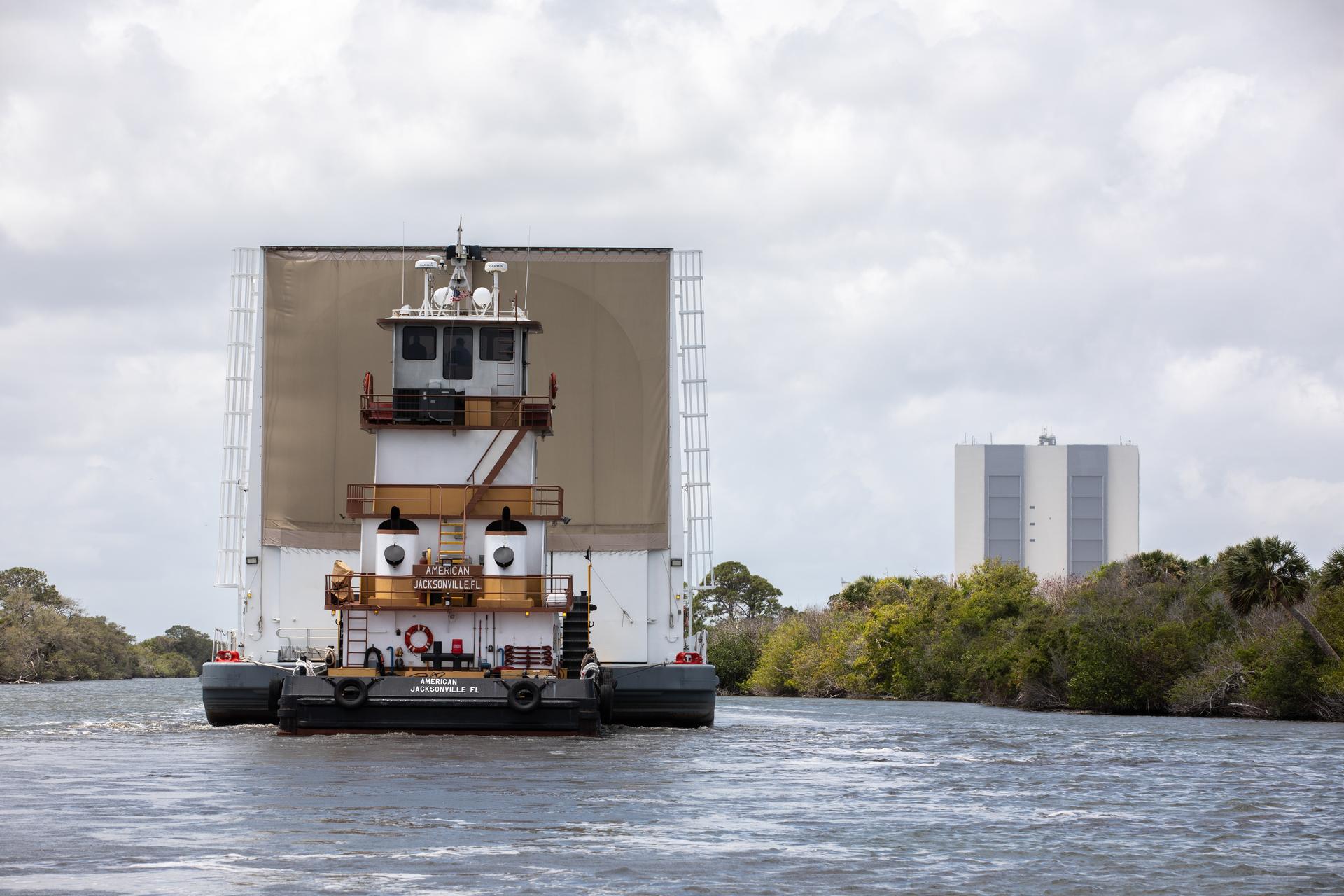
NASA’s Pegasus barge, carrying the top four-fifths of the agency’s SLS (Space Launch System) core stage for the Artemis III mission, arrives at NASA’s Kennedy Space Center Complex 39 turn basin wharf in Florida on Monday, April 27, 2026. Artemis III will launch astronauts to Earth’s orbit aboard the Orion spacecraft on top of SLS to test rendezvous and docking capabilities between Orion and commercial spacecraft needed to land Artemis IV astronauts on the Moon in 2028.

Space Launch System (SLS) Stages Manager Julie Bassler, right, celebrates the arrival of the SLS core stage by symbolically “passing the baton” to Exploration Ground Systems’ (EGS) Senior Vehicle Operations Manager Cliff Lanham on April 28, 2021, at NASA’s Kennedy Space Center in Florida. Journeying from the agency’s Stennis Space Center in Mississippi aboard the Pegasus barge, the core stage arrived at the Florida spaceport on April 27 to be processed for flight by EGS. It is the final piece of Artemis hardware to arrive at Kennedy and will be offloaded and moved to the Vehicle Assembly Building, where it will be prepared for integration atop the mobile launcher with the completed stack of solid rocket boosters ahead of the Artemis I launch. The first in a series of increasingly complex missions, Artemis I will test SLS and Orion as an integrated system prior to crewed flights to the Moon.

NASA’s top four-fifths of the SLS (Space Launch System) core stage for the Artemis III mission arrives at the Vehicle Assembly Building at the agency’s Kennedy Space Center in Florida where teams with Boeing will finish integrating it with the remaining core stage segments prior to rocket stacking operations. Artemis III will launch astronauts to Earth’s orbit aboard the Orion spacecraft on top of SLS to test rendezvous and docking capabilities between Orion and commercial spacecraft needed to land Artemis IV astronauts on the Moon in 2028.

Liliana Villarreal, Artemis landing and recovery director with Exploration Ground Systems (EGS), stands in front of the Crew Module Test Article (CMTA) at the turn basin in the Launch Complex 39 area at NASA’s Kennedy Space Center in Florida on Feb. 1, 2023. The CMTA is being used to practice recovery after splashdown of the Orion spacecraft to prepare for the Artemis II crewed mission. EGS leads recovery efforts.
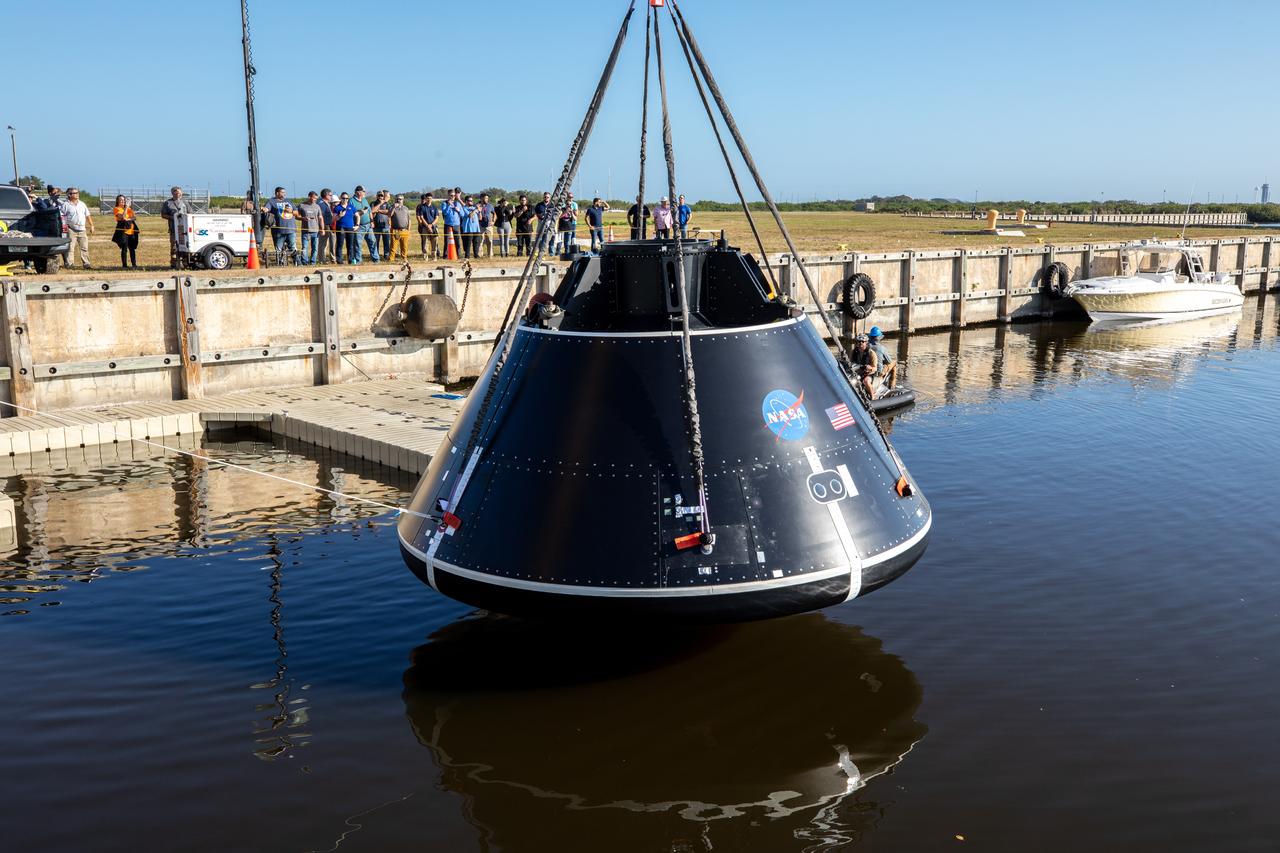
A crane lowers the Crew Module Test Article (CMTA) into water at the turn basin in the Launch Complex 39 area at NASA’s Kennedy Space Center in Florida on Jan. 30, 2023. The CMTA is being used to practice recovery after splashdown of the Orion spacecraft to prepare for the Artemis II crewed mission. Exploration Ground Systems leads recovery efforts.

NASA’s top four-fifths of the SLS (Space Launch System) core stage for the Artemis III mission is offloaded from the agency’s Pegasus barge on Tuesday, April 28, 2026, after arriving at the Kennedy Space Center in Florida the prior day. The four-fifths contains the liquid hydrogen tank, liquid oxygen tank, intertank, and forward skirt of the SLS rocket and will be joined with the remaining core stage segments at Kennedy’s Vehicle Assembly Building High Bay 2 prior to rocket stacking operations. Artemis III will launch astronauts to Earth’s orbit aboard the Orion spacecraft on top of SLS to test rendezvous and docking capabilities between Orion and commercial spacecraft needed to land Artemis IV astronauts on the Moon in 2028.
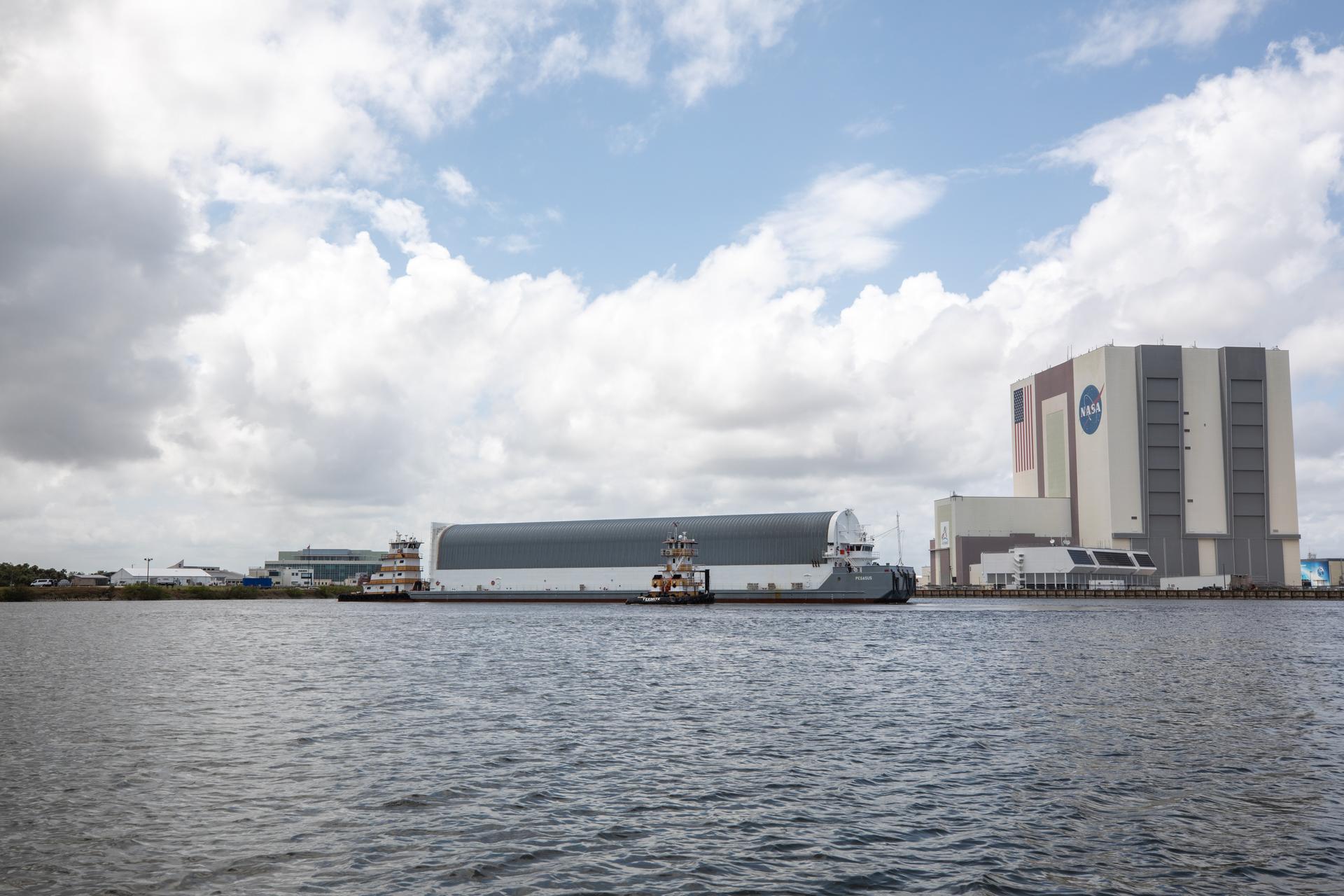
NASA’s Pegasus barge, carrying the top four-fifths of the agency’s SLS (Space Launch System) core stage for the Artemis III mission, arrives at NASA’s Kennedy Space Center Complex 39 turn basin wharf in Florida on Monday, April 27, 2026. Artemis III will launch astronauts to Earth’s orbit aboard the Orion spacecraft on top of SLS to test rendezvous and docking capabilities between Orion and commercial spacecraft needed to land Artemis IV astronauts on the Moon in 2028.

A long exposure image captures the launch of NASA’s SpaceX Crew-11 mission SpaceX Falcon 9 rocket with a Dragon spacecraft at 11:43 a.m. EDT Friday, Aug. 1, 2025, from Launch Complex 39A at Kennedy Space Center in Florida. Crew-11, carrying NASA astronauts Zena Cardman and Mike Fincke, along with JAXA (Japan Aerospace Exploration Agency) astronaut Kimiya Yui and Roscosmos cosmonaut Oleg Platonov, are on their way to the International Space Station for a long duration mission.
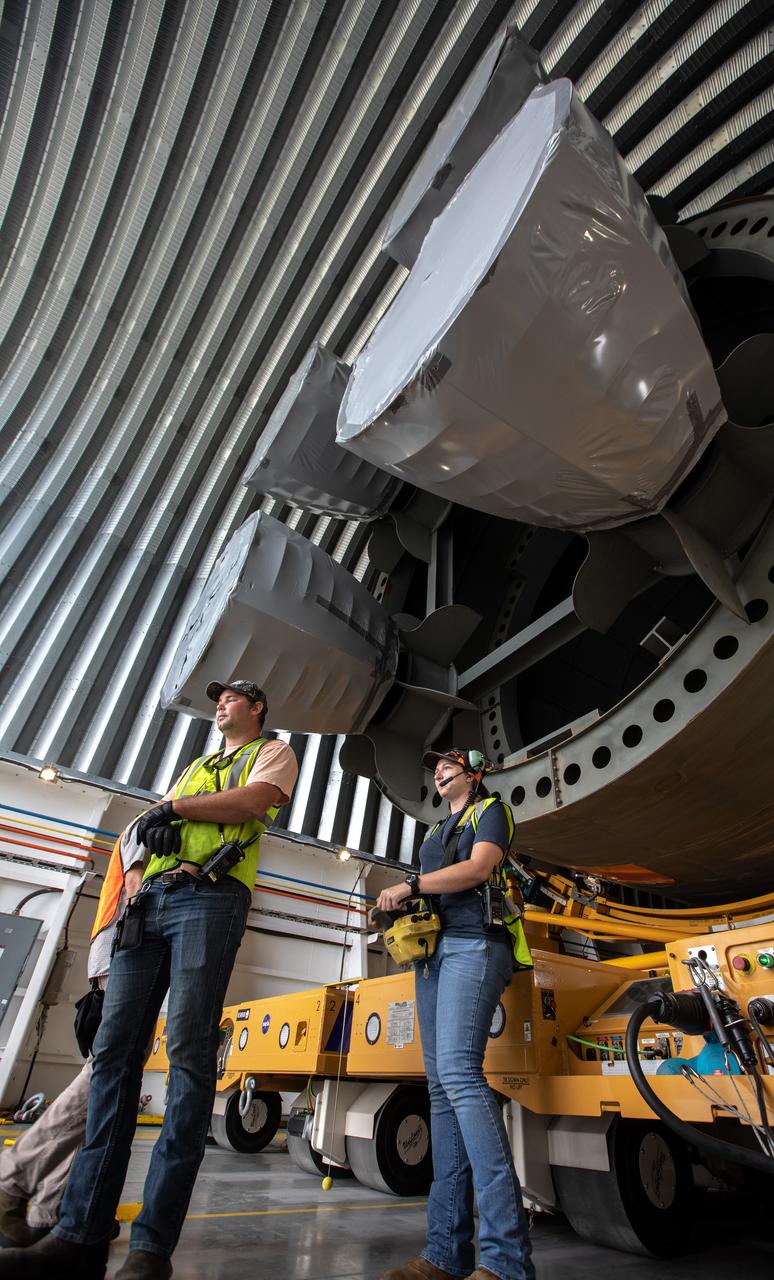
Jacobs TOSC Launch Vehicle Technical Operations technicians begin offloading of the 212-foot-long Space Launch System (SLS) rocket core stage pathfinder from NASA's Pegasus Barge at Kennedy Space Center’s Launch Complex 39 turn basin wharf on Oct. 1, 2019. From left, are James Erdman, observer, and Katherine River, operator. The Pegasus Barge made its first delivery to Kennedy in support of the agency's Artemis missions. The upgraded 310-foot-long barge arrived Sept. 27, 2019, ferrying the SLS core stage pathfinder, a full-scale mock-up of the rocket's core stage. It will be used by Exploration Ground Systems and its contractor, Jacobs, to practice offloading, moving and stacking maneuvers, using important ground support equipment to train employees and certify all the equipment works properly. The pathfinder will stay at Kennedy for approximately one month before trekking back to NASA's Michoud Assembly Facility in Louisiana.

NASA’s Pegasus barge, carrying the top four-fifths of the agency’s SLS (Space Launch System) core stage for the Artemis III mission, arrives at NASA’s Kennedy Space Center Complex 39 turn basin wharf in Florida on Monday, April 27, 2026. Artemis III will launch astronauts to Earth’s orbit aboard the Orion spacecraft on top of SLS to test rendezvous and docking capabilities between Orion and commercial spacecraft needed to land Artemis IV astronauts on the Moon in 2028.
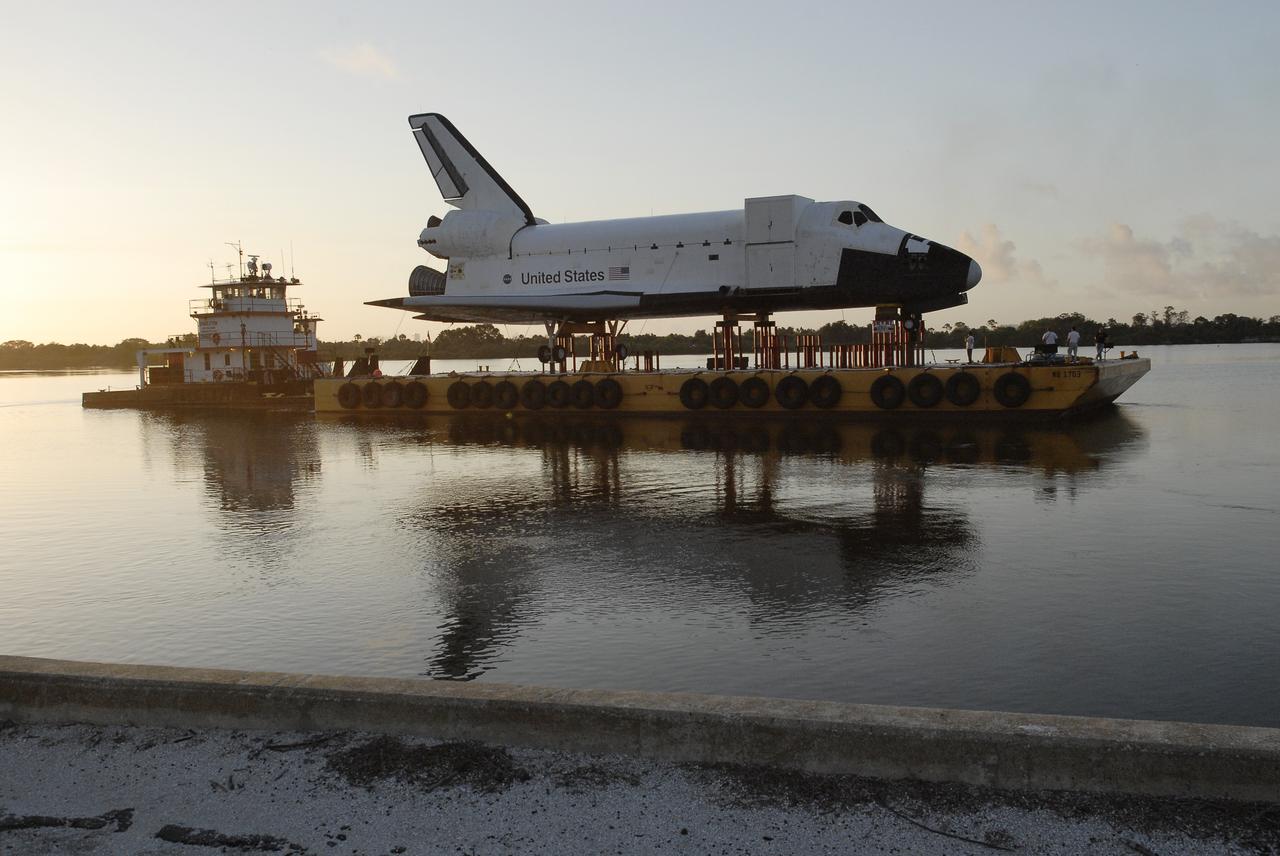
Shuttle Replica Preparations for Barge Departure

NASA’s top four-fifths of the SLS (Space Launch System) core stage for the Artemis III mission is offloaded from the agency’s Pegasus barge on Tuesday, April 28, 2026, after arriving at the Kennedy Space Center in Florida the prior day. The four-fifths contains the liquid hydrogen tank, liquid oxygen tank, intertank, and forward skirt of the SLS rocket and will be joined with the remaining core stage segments at Kennedy’s Vehicle Assembly Building High Bay 2 prior to rocket stacking operations. Artemis III will launch astronauts to Earth’s orbit aboard the Orion spacecraft on top of SLS to test rendezvous and docking capabilities between Orion and commercial spacecraft needed to land Artemis IV astronauts on the Moon in 2028.
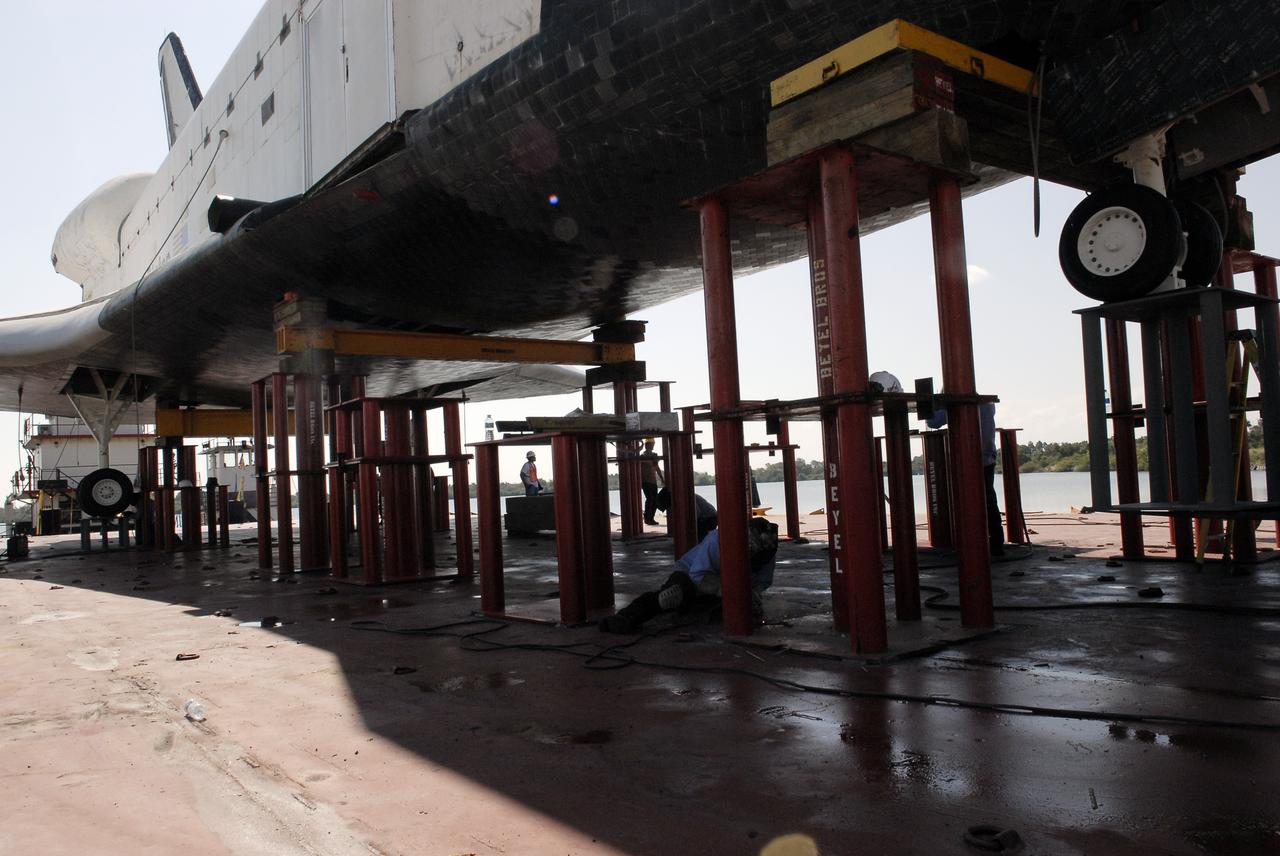
Shuttle Replica Preparations for Barge Departure
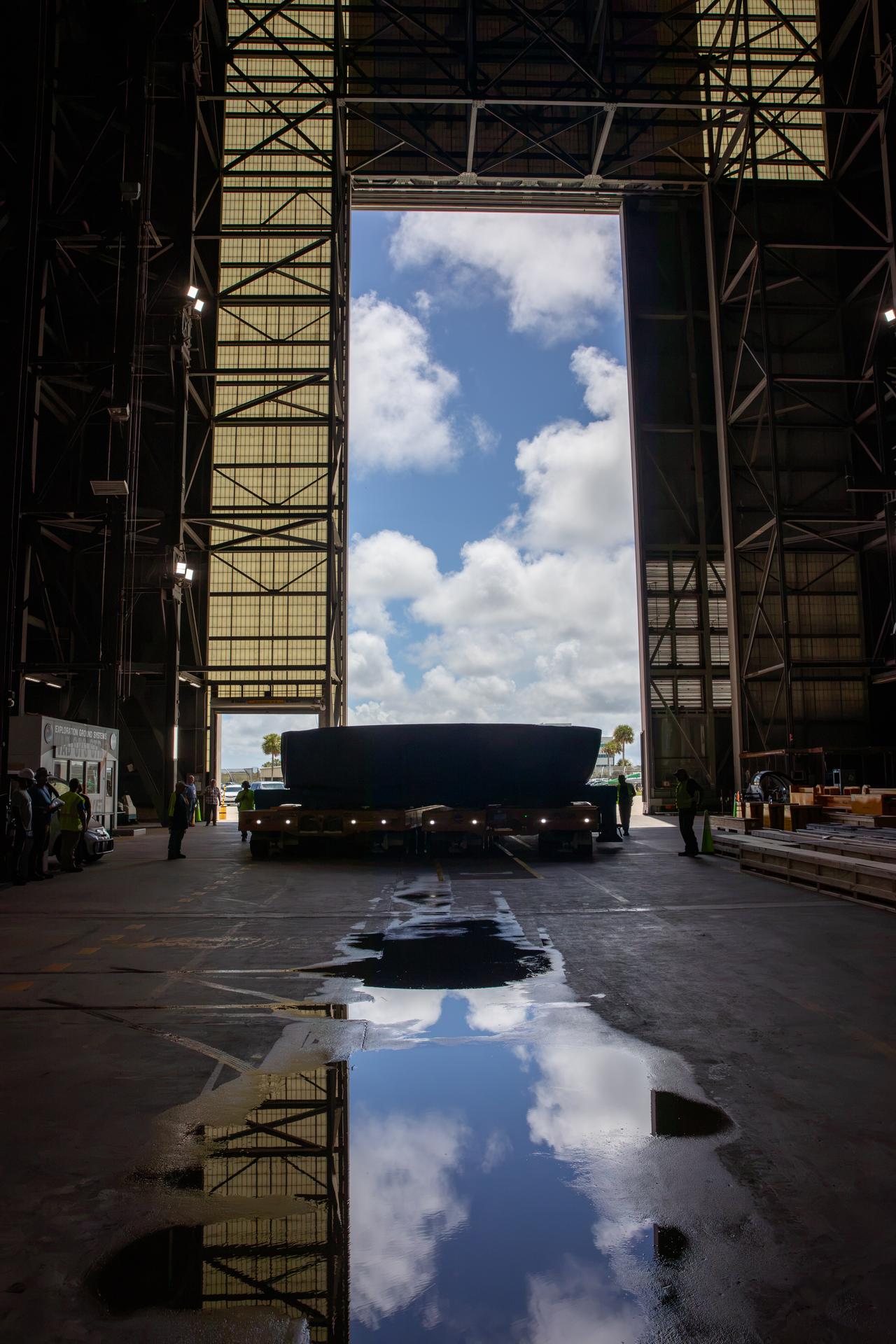
NASA’s Artemis IV SLS (Space Launch System) core stage boat-tail, covered in a protective blue tarp, arrives inside the NASA’s Vehicle Assembly Building at Kennedy Space Center in Florida on Monday, Aug. 31, 2026. Manufactured at NASA’s Michoud Assembly Facility in New Orleans, Louisiana, the boat-tail is a fairing-like structure that protects the bottom end of the SLS (Space Launch System) rocket core stage and RS-25 engines.
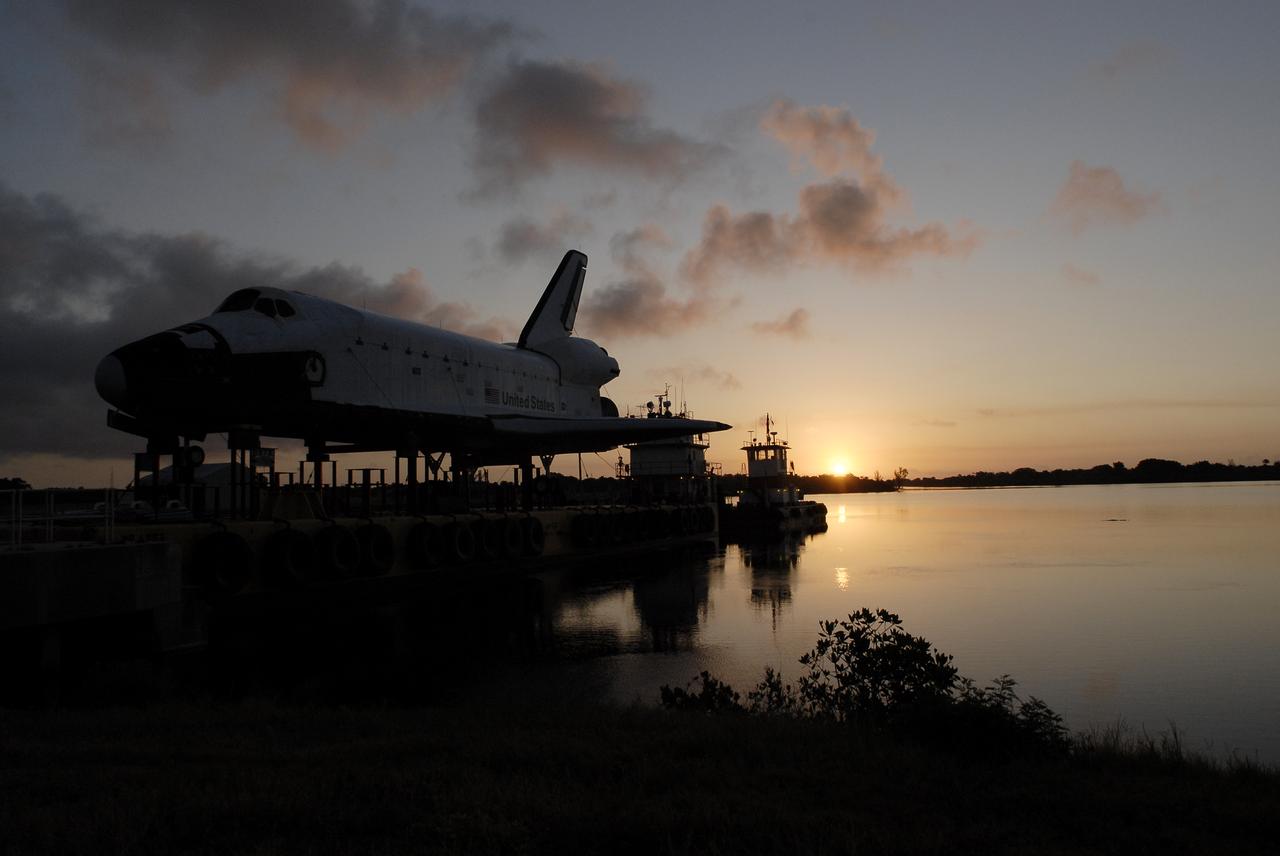
Shuttle Replica Preparations for Barge Departure
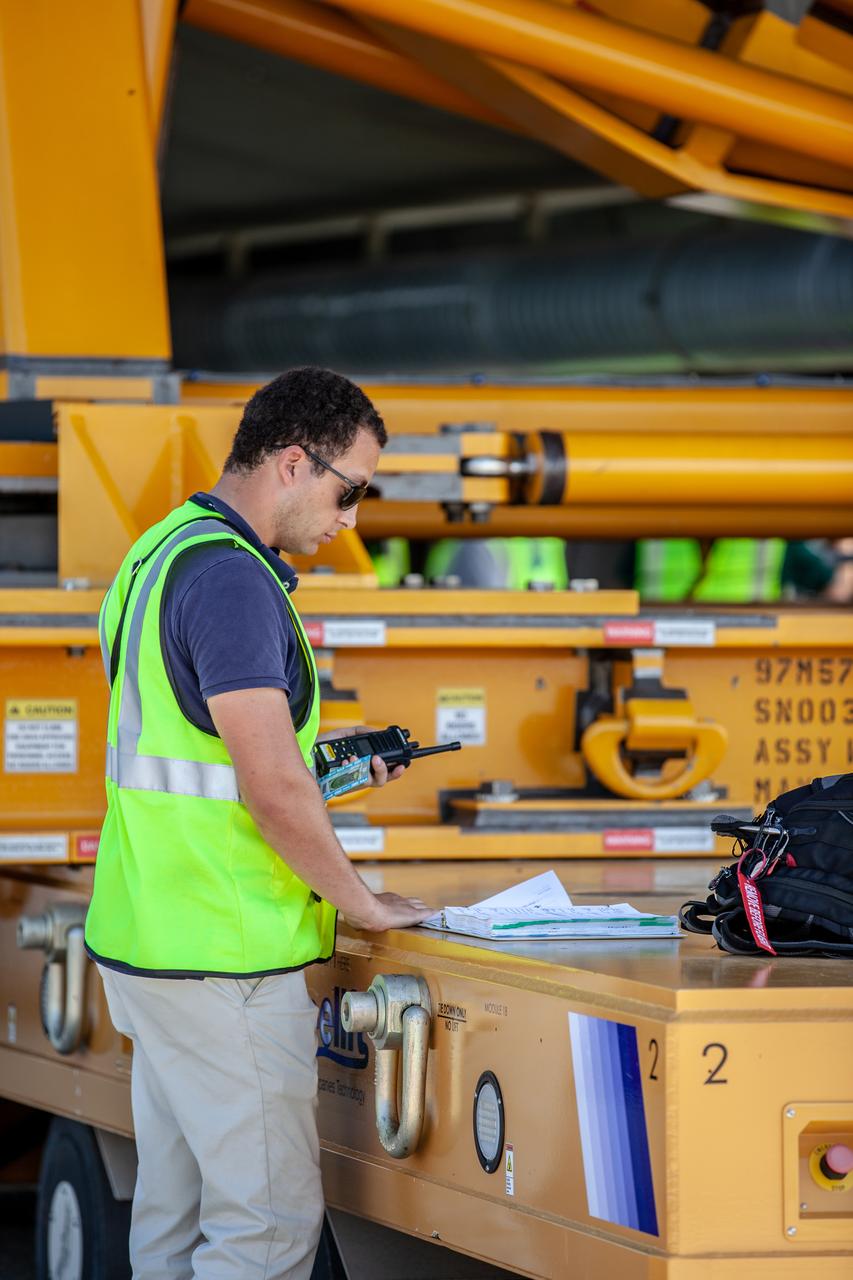
Chris Di Taranto, a mechanical and structures engineer with Jacobs TOSC, prepares for offloading of the 212-foot-long Space Launch System (SLS) rocket core stage pathfinder from NASA’s Pegasus Barge at Kennedy Space Center’s Launch Complex 39 turn basin wharf on Oct. 1, 2019. The Pegasus Barge made its first delivery to Kennedy in support of the agency's Artemis missions. The upgraded 310-foot-long barge arrived Sept. 27, 2019, ferrying the SLS core stage pathfinder, a full-scale mock-up of the rocket's core stage. It will be used by Exploration Ground Systems and its contractor, Jacobs, to practice offloading, moving and stacking maneuvers, using important ground support equipment to train employees and certify all the equipment works properly. The pathfinder will stay at Kennedy for approximately one month before trekking back to NASA's Michoud Assembly Facility in Louisiana.
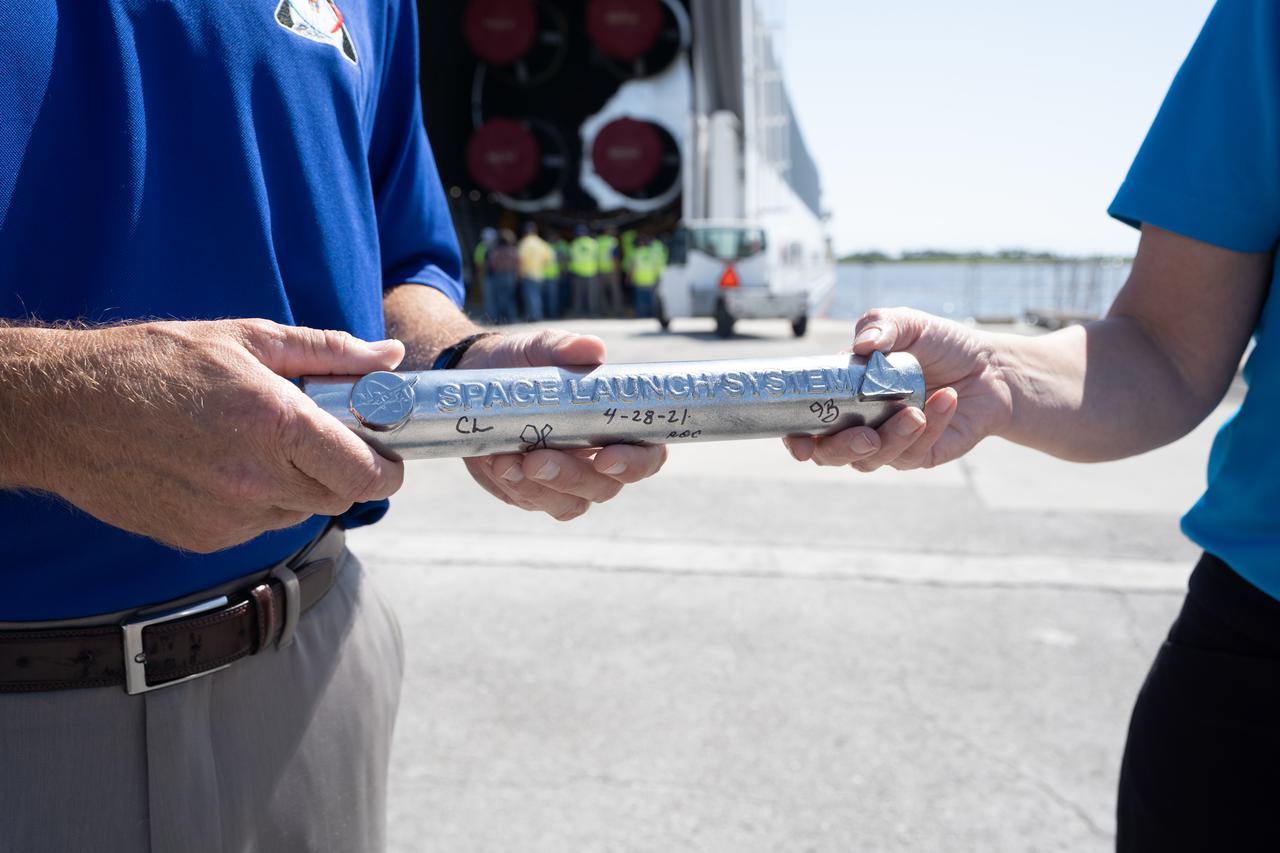
The Space Launch System (SLS) program heralds the arrival of the SLS core stage with a symbolic “passing of the baton” to NASA’s Exploration Ground Systems (EGS) on April 28, 2021, at the agency’s Kennedy Space Center in Florida, marking the transition into final preparations for flight. Journeying from NASA’s Stennis Space Center in Mississippi aboard the Pegasus barge, the core stage arrived at the Florida spaceport on April 27. It is the final piece of Artemis hardware to arrive at Kennedy and will be offloaded and moved to the Vehicle Assembly Building, where it will be prepared for integration atop the mobile launcher with the completed stack of solid rocket boosters ahead of the Artemis I launch. The first in a series of increasingly complex missions, Artemis I will test SLS and Orion as an integrated system prior to crewed flights to the Moon.
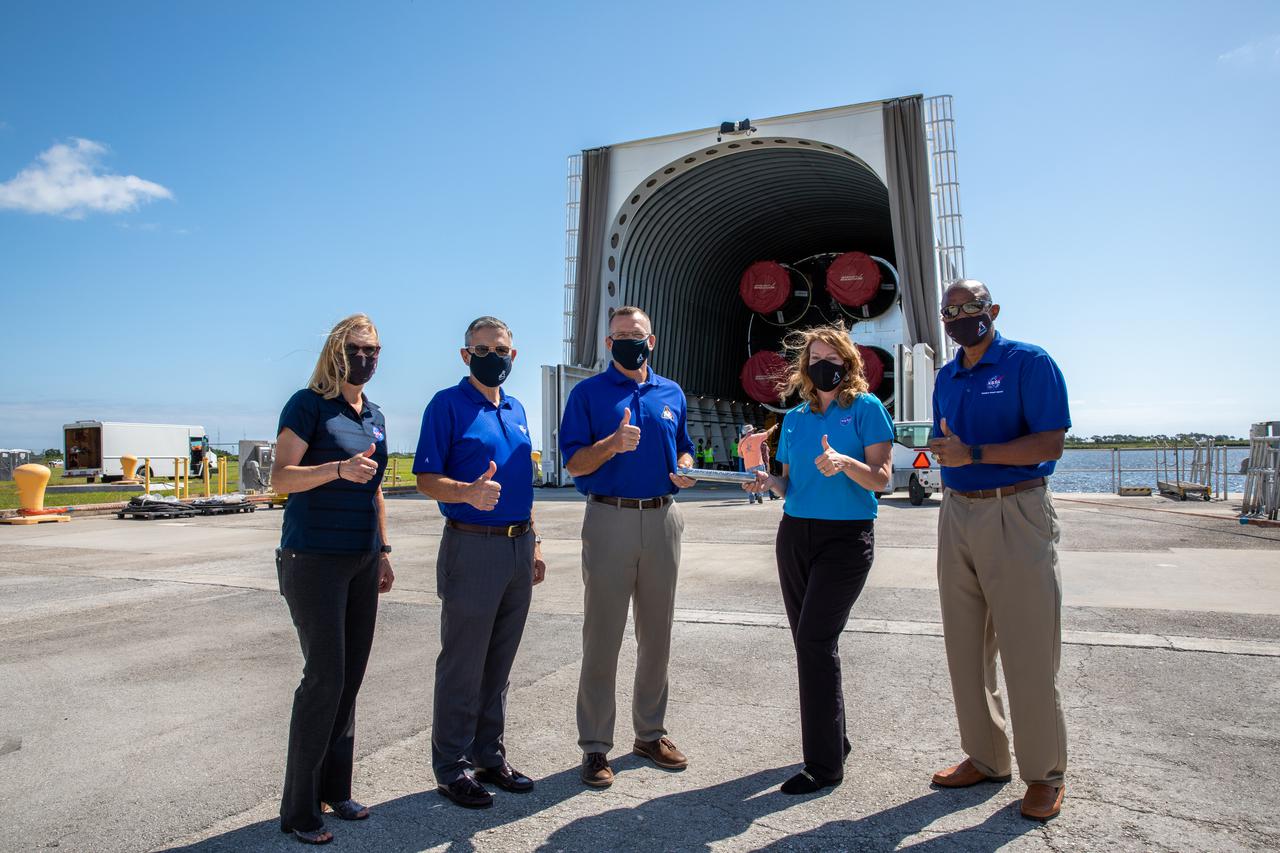
From left, Kennedy Space Center Deputy Director Janet Petro, Director Bob Cabana, Exploration Ground Systems’ (EGS) Senior Vehicle Operations Manager Cliff Lanham, Space Launch System (SLS) Stages Manager Julie Bassler, and Associate Director, Technical, Kelvin Manning celebrate the arrival of the SLS core stage on April 28, 2021, with a symbolic “passing of the baton” from the SLS program to EGS. Journeying from NASA’s Stennis Space Center in Mississippi aboard the Pegasus barge, the core stage arrived at the Florida spaceport on April 27 to be processed for flight by EGS. It is the final piece of Artemis hardware to arrive at Kennedy and will be offloaded and moved to the Vehicle Assembly Building, where it will be prepared for integration atop the mobile launcher with the completed stack of solid rocket boosters ahead of the Artemis I launch. The first in a series of increasingly complex missions, Artemis I will test SLS and Orion as an integrated system prior to crewed flights to the Moon.
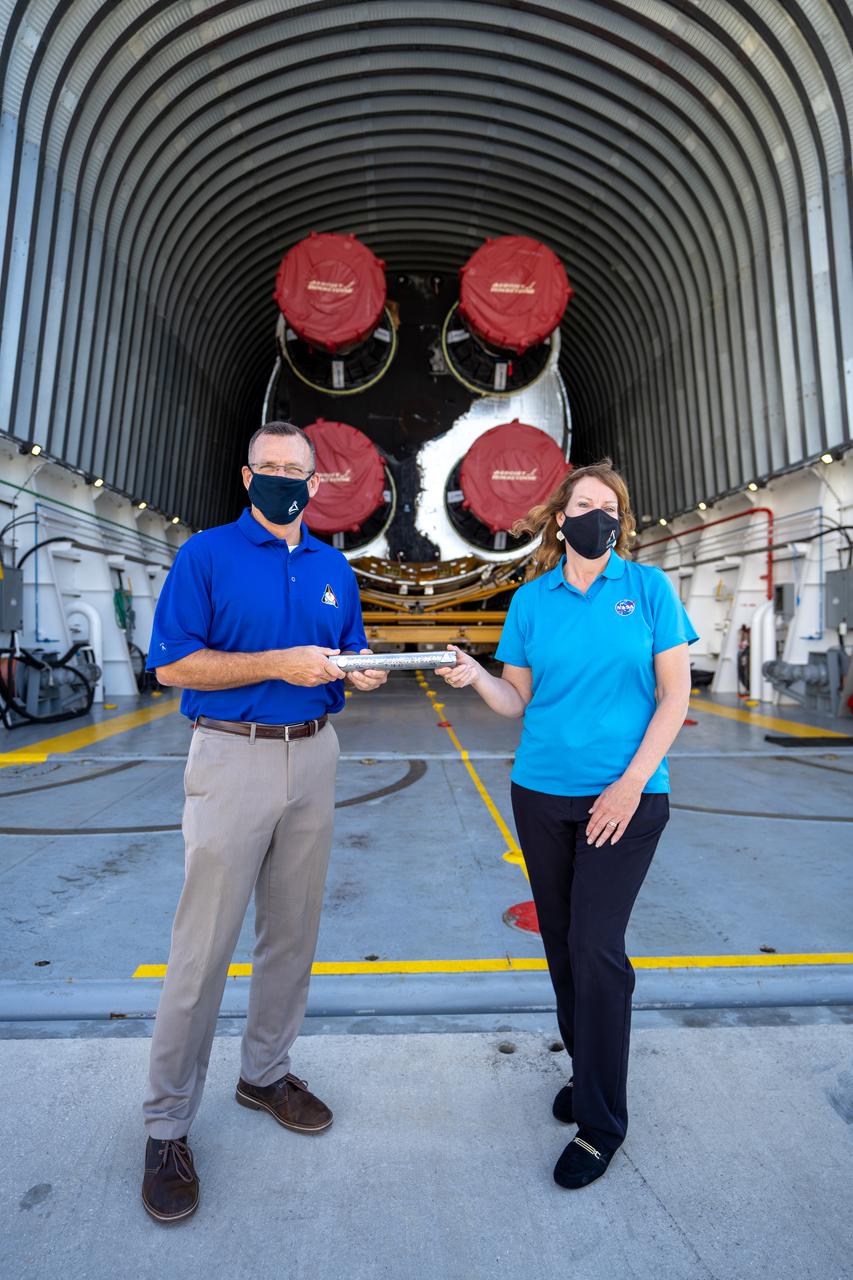
Space Launch System (SLS) Stages Manager Julie Bassler, right, celebrates the arrival of the SLS core stage by symbolically “passing the baton” to Exploration Ground Systems’ (EGS) Senior Vehicle Operations Manager Cliff Lanham on April 28, 2021, at NASA’s Kennedy Space Center in Florida. Journeying from the agency’s Stennis Space Center in Mississippi aboard the Pegasus barge, the core stage arrived at the Florida spaceport on April 27 to be processed for flight by EGS. It is the final piece of Artemis hardware to arrive at Kennedy and will be offloaded and moved to the Vehicle Assembly Building, where it will be prepared for integration atop the mobile launcher with the completed stack of solid rocket boosters ahead of the Artemis I launch. The first in a series of increasingly complex missions, Artemis I will test SLS and Orion as an integrated system prior to crewed flights to the Moon.
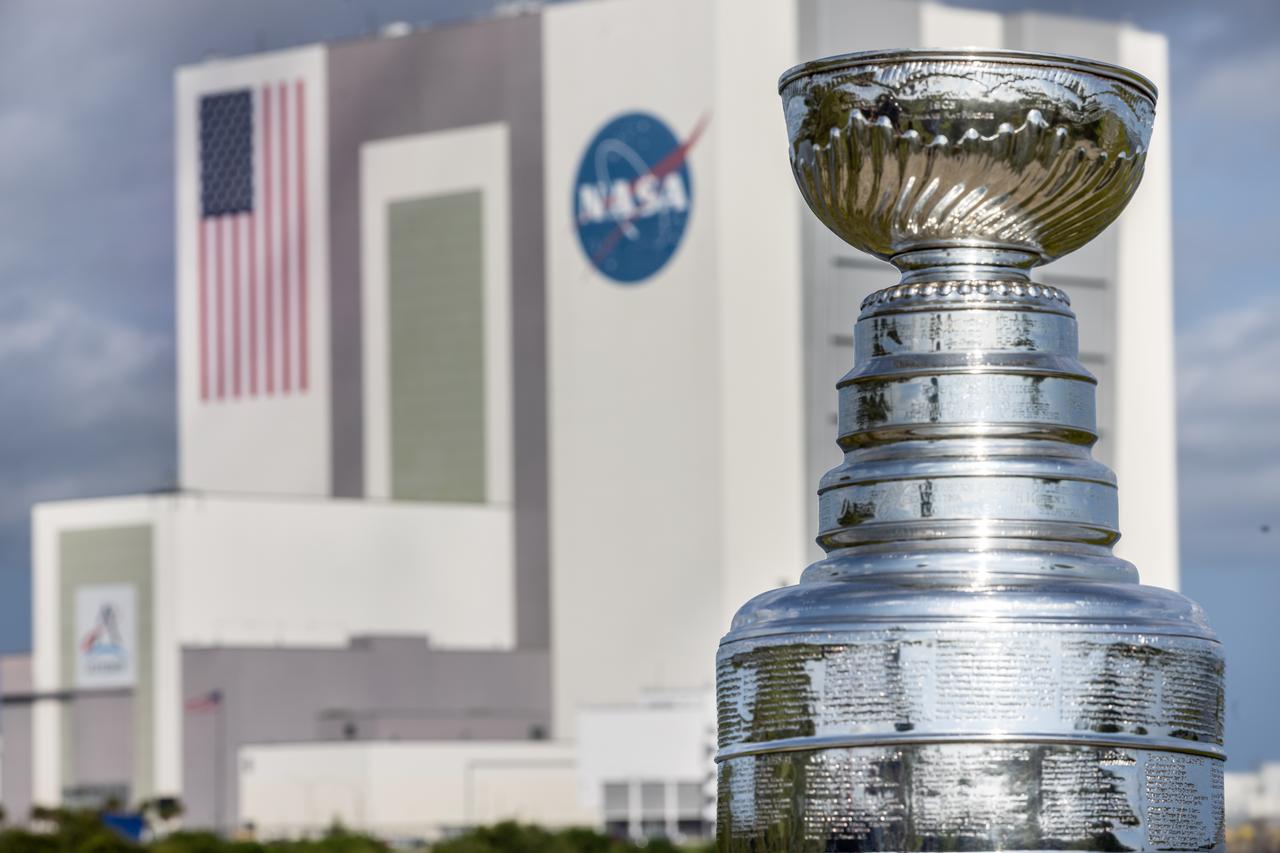
Earlier this year, the Florida Panthers won their first NHL championship and brought victory to the state of Florida. As part of its championship tour, the Stanley Cup made a visit to NASA’s Kennedy Space Center. Pictured here is the silver Stanley Cup with NASA’s iconic Vehicle Assembly Building, which currently houses components of the agency’s Artemis II mission, shown in the background at the Kennedy Space Center on Tuesday Sept. 17, 2024.
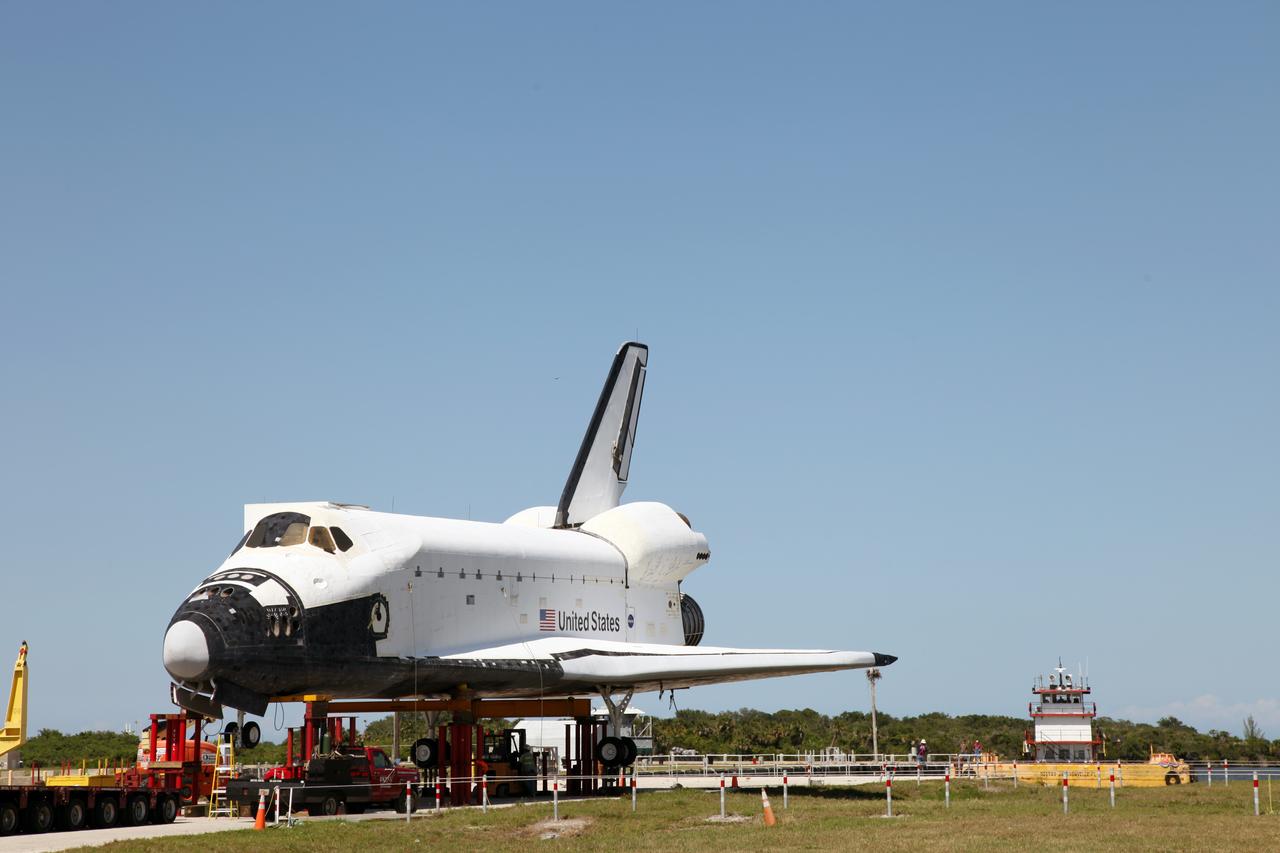
Barge Arrives that will take the Shuttle Mockup to JSC
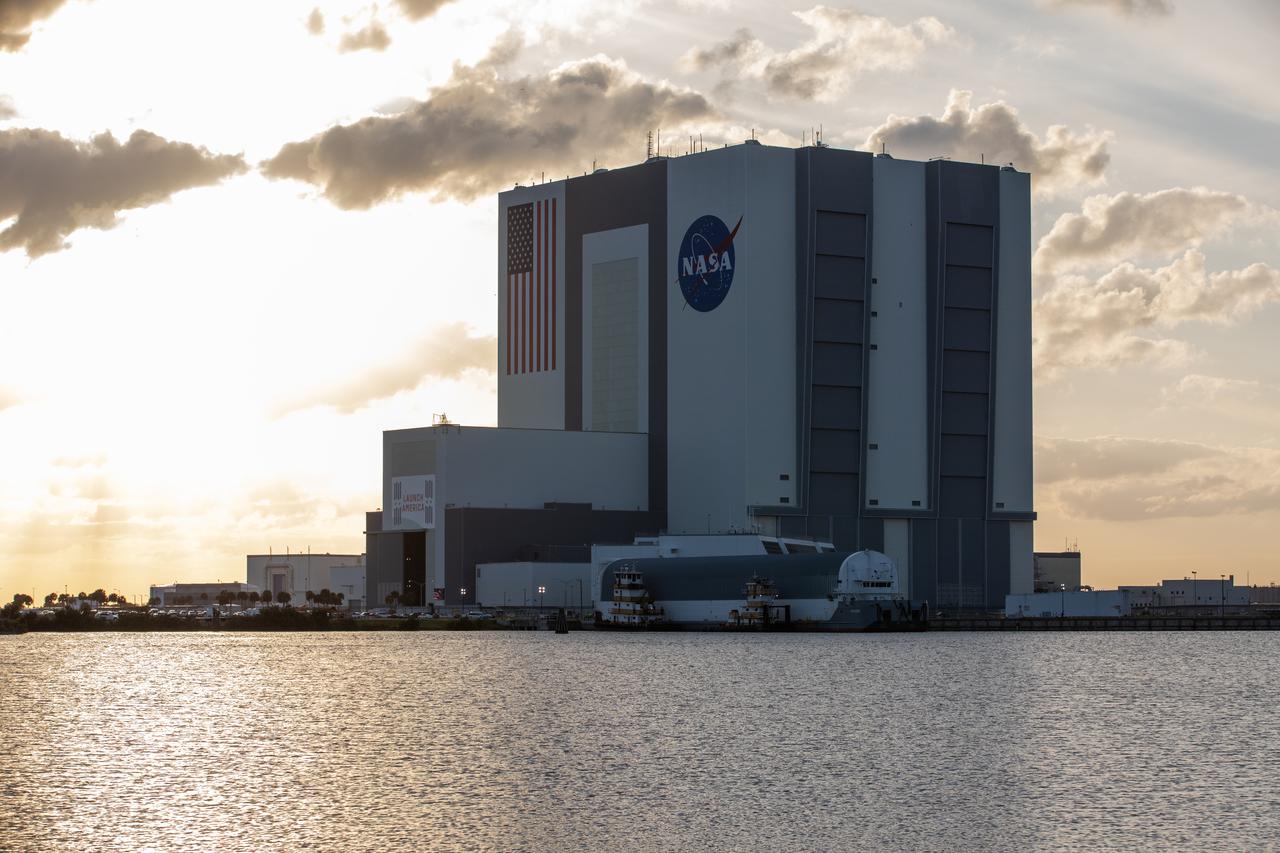
After its journey from NASA’s Stennis Space Center in Mississippi aboard the Pegasus barge, the mighty Space Launch System (SLS) core stage arrives at the agency’s Kennedy Space Center in Florida on April 27, 2021. In view is the iconic countdown clock at the NASA News Center, commonly referred to as the Press Site. The core stage is the final piece of Artemis hardware to arrive at the spaceport and will be offloaded and moved to Kennedy’s Vehicle Assembly Building, where it will be prepared for integration atop the mobile launcher with the completed stack of solid rocket boosters ahead of the Artemis I launch. The first in a series of increasingly complex missions, Artemis I will test SLS and Orion as an integrated system prior to crewed flights to the Moon.
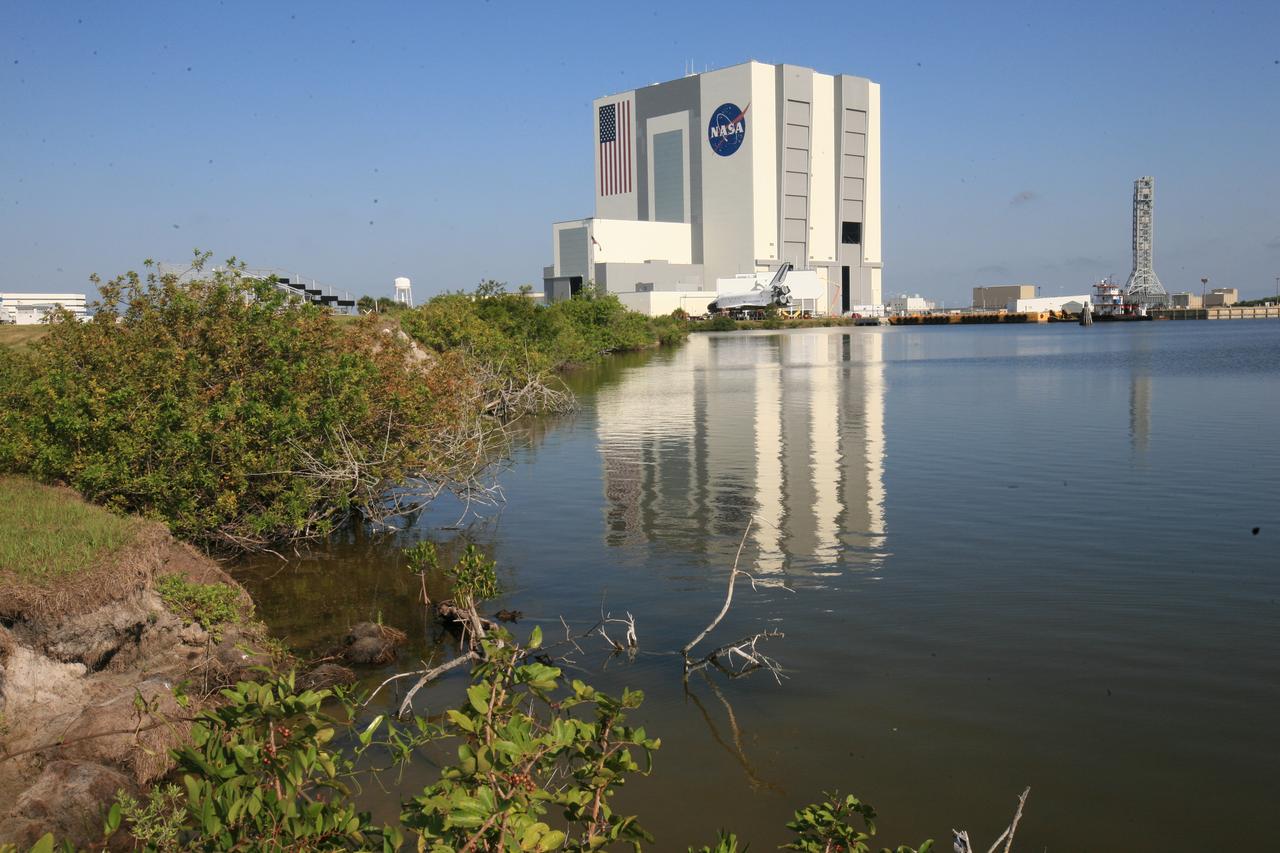
T&R - Work on Shuttle Replica to Prepare for transport to JSC
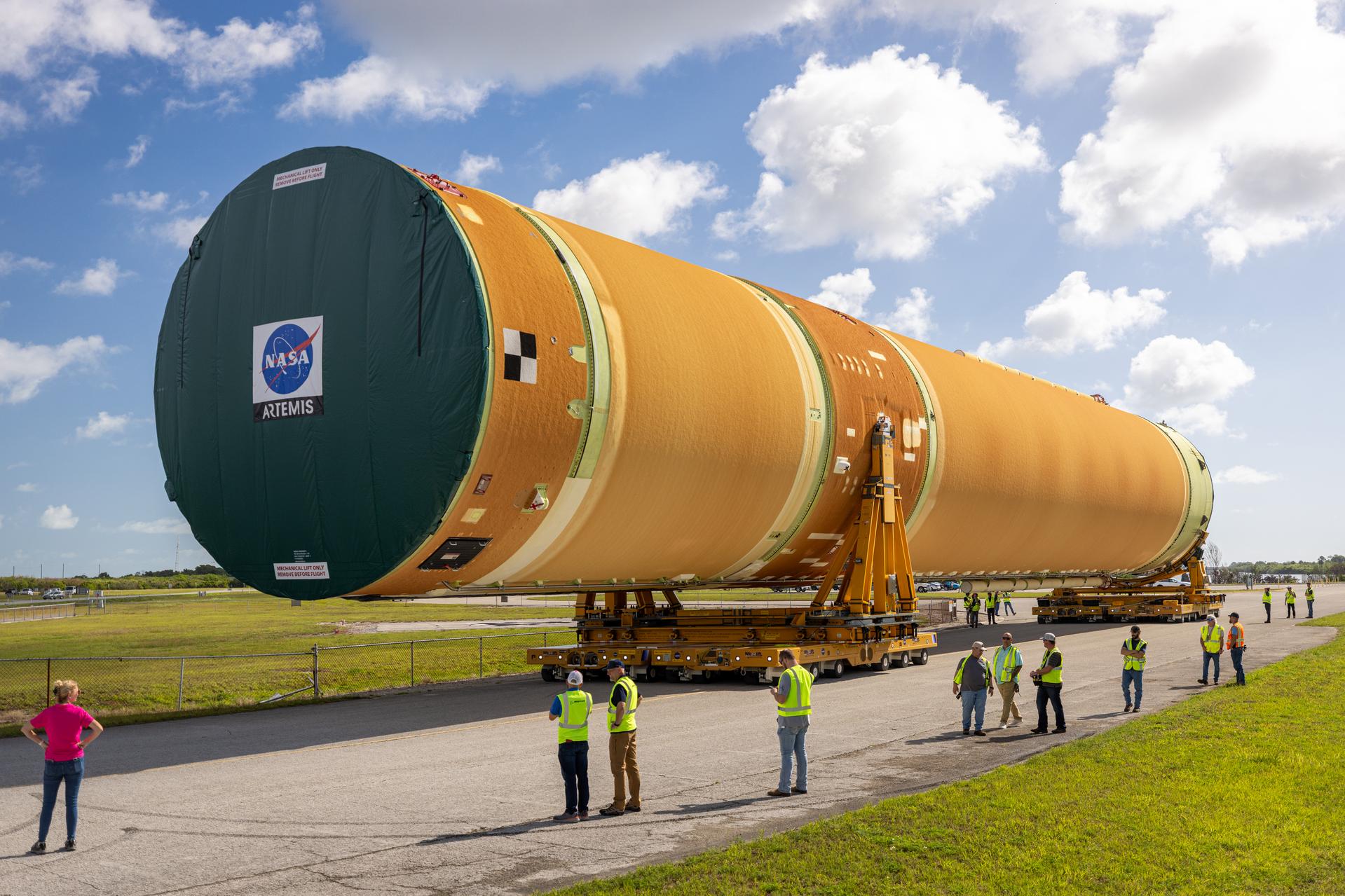
NASA’s top four-fifths of the SLS (Space Launch System) core stage for the Artemis III mission is offloaded from the agency’s Pegasus barge on Tuesday, April 28, 2026, after arriving at the Kennedy Space Center in Florida the prior day. The four-fifths contains the liquid hydrogen tank, liquid oxygen tank, intertank, and forward skirt of the SLS rocket and will be joined with the remaining core stage segments at Kennedy’s Vehicle Assembly Building High Bay 2 prior to rocket stacking operations. Artemis III will launch astronauts to Earth’s orbit aboard the Orion spacecraft on top of SLS to test rendezvous and docking capabilities between Orion and commercial spacecraft needed to land Artemis IV astronauts on the Moon in 2028.
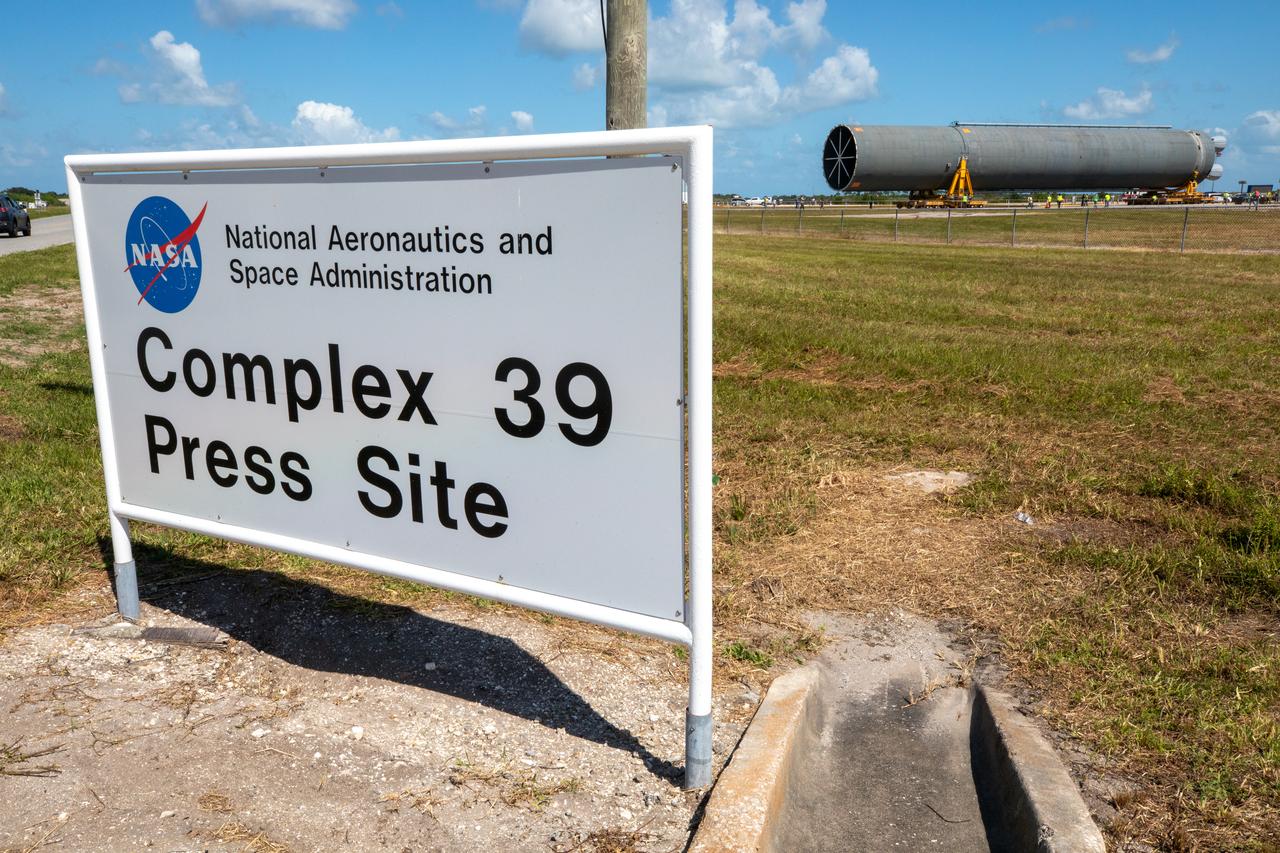
The 212-foot-long Space Launch System (SLS) rocket core stage pathfinder is being transported to the Vehicle Assembly Building at NASA's Kennedy Space Center on Oct. 1, 2019. The Pegasus Barge made its first delivery to Kennedy in support of the agency's Artemis missions. The upgraded 310-foot-long barge arrived Sept. 27, 2019, ferrying the SLS core stage pathfinder, a full-scale mock-up of the rocket's core stage. It will be used by the Exploration Ground Systems Program and their contractor, Jacobs, to practice offloading, moving and stacking maneuvers, using important ground support equipment to train employees and certify all the equipment works properly. The pathfinder will stay at Kennedy for approximately one month before trekking back to NASA's Michoud Assembly Facility in Louisiana.
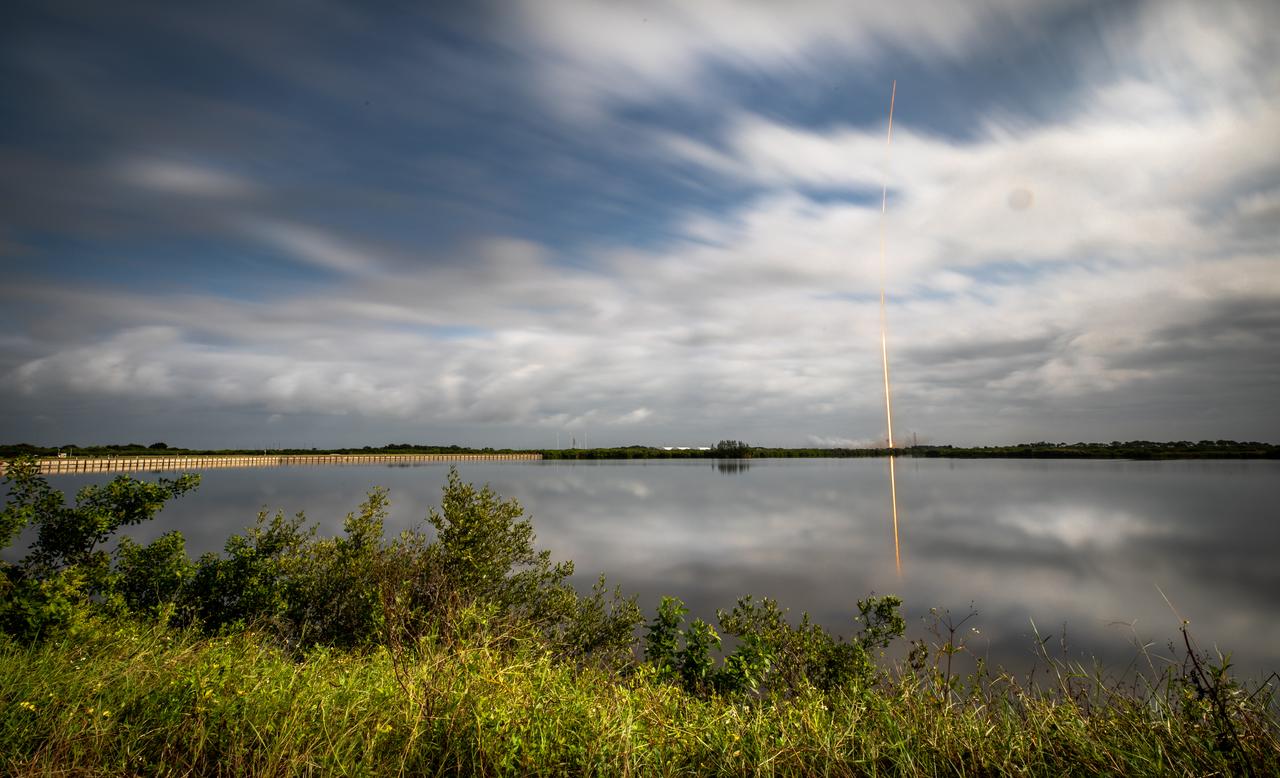
NASA’s Psyche spacecraft, atop a SpaceX Falcon Heavy rocket, soars into the sky after lifting off from Kennedy Space Center’s historic Launch Complex 39A in Florida at 10:19 a.m. EDT on Friday, Oct. 13, 2023. This daytime long exposure photo was taken from Kennedy’s Press Site near the historic countdown clock. The Psyche mission will study a metal-rich asteroid with the same name, located in the main asteroid belt between Mars and Jupiter. This is NASA’s first mission to study an asteroid that has more metal than rock or ice. Riding with Psyche is a pioneering technology demonstration – NASA’s Deep Space Optical Communications (DSOC) experiment – which will be the first test of laser communications beyond the Moon.
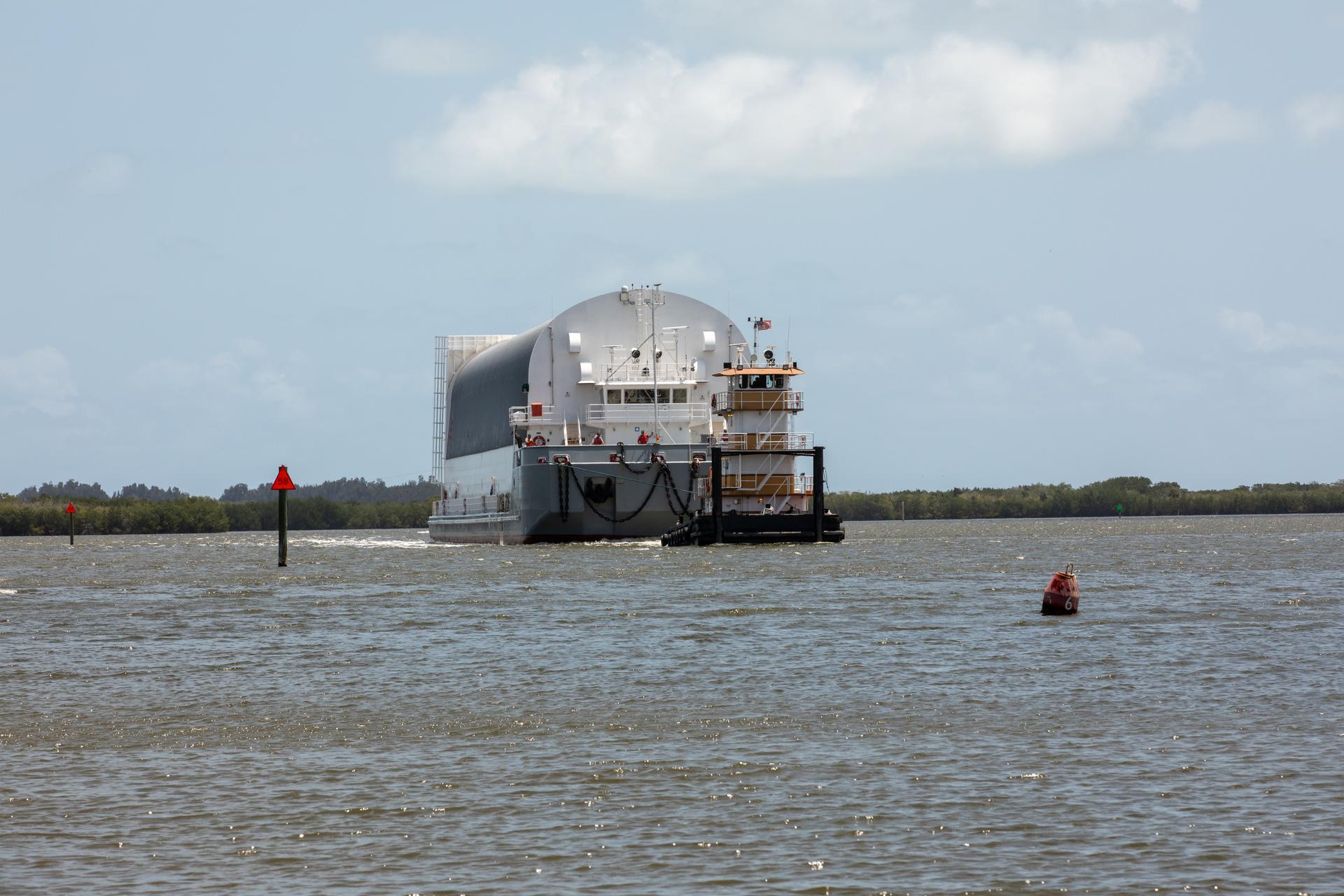
NASA’s Pegasus barge, carrying the top four-fifths of the agency’s SLS (Space Launch System) core stage for the Artemis III mission, arrives at NASA’s Kennedy Space Center Complex 39 turn basin wharf in Florida on Monday, April 27, 2026. Artemis III will launch astronauts to Earth’s orbit aboard the Orion spacecraft on top of SLS to test rendezvous and docking capabilities between Orion and commercial spacecraft needed to land Artemis IV astronauts on the Moon in 2028.
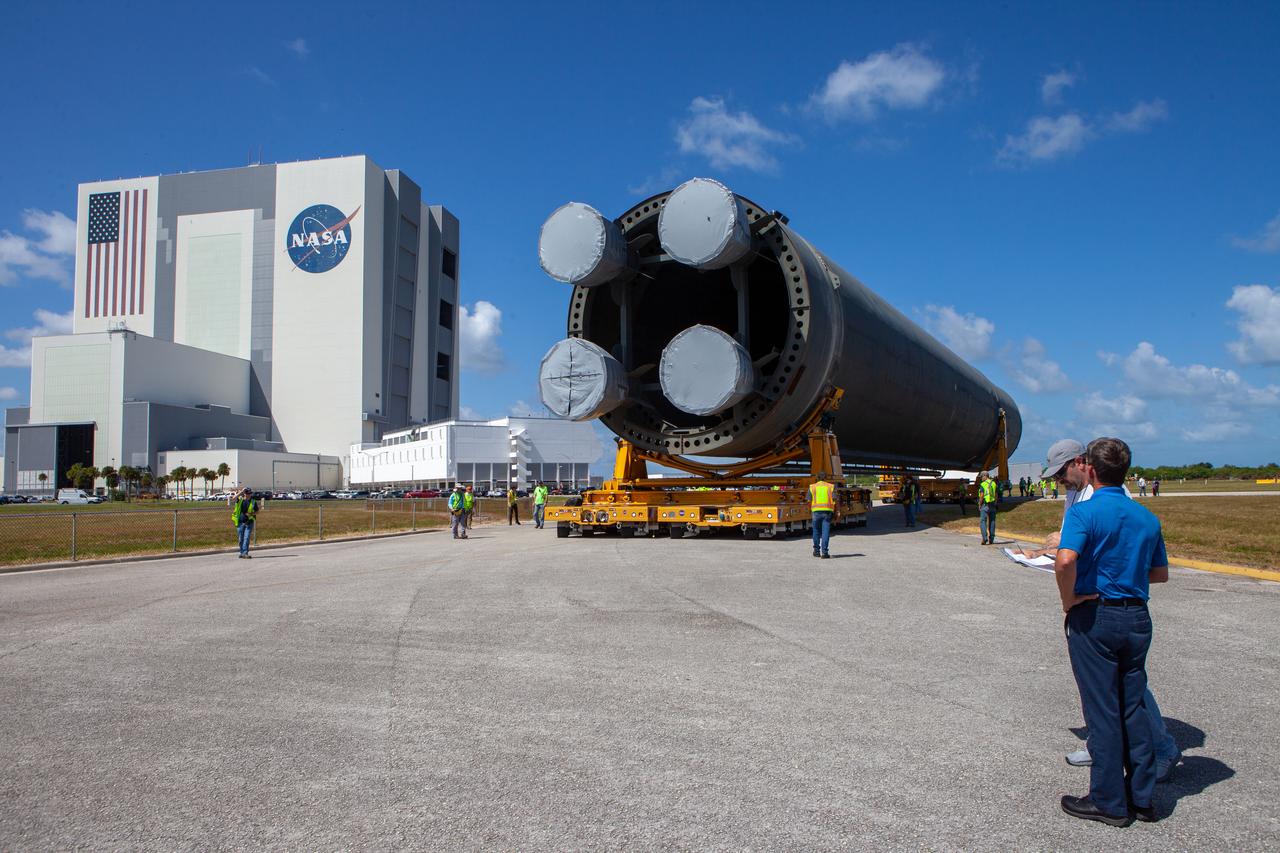
The 212-foot-long Space Launch System (SLS) rocket core stage pathfinder has been offloaded from NASA’s Pegasus Barge at Kennedy Space Center’s Launch Complex 39 turn basin wharf on Oct. 1, 2019. It is slowly being backed up so that it is in the correct configuration for the move forward to the Vehicle Assembly Building. The Pegasus Barge made its first delivery to Kennedy in support of the agency's Artemis missions. The upgraded 310-foot-long barge arrived Sept. 27, 2019, ferrying the SLS core stage pathfinder, a full-scale mock-up of the rocket's core stage. It will be used by Exploration Ground Systems and its contractor, Jacobs, to practice offloading, moving and stacking maneuvers, using important ground support equipment to train employees and certify all the equipment works properly. The pathfinder will stay at Kennedy for approximately one month before trekking back to NASA's Michoud Assembly Facility in Louisiana.
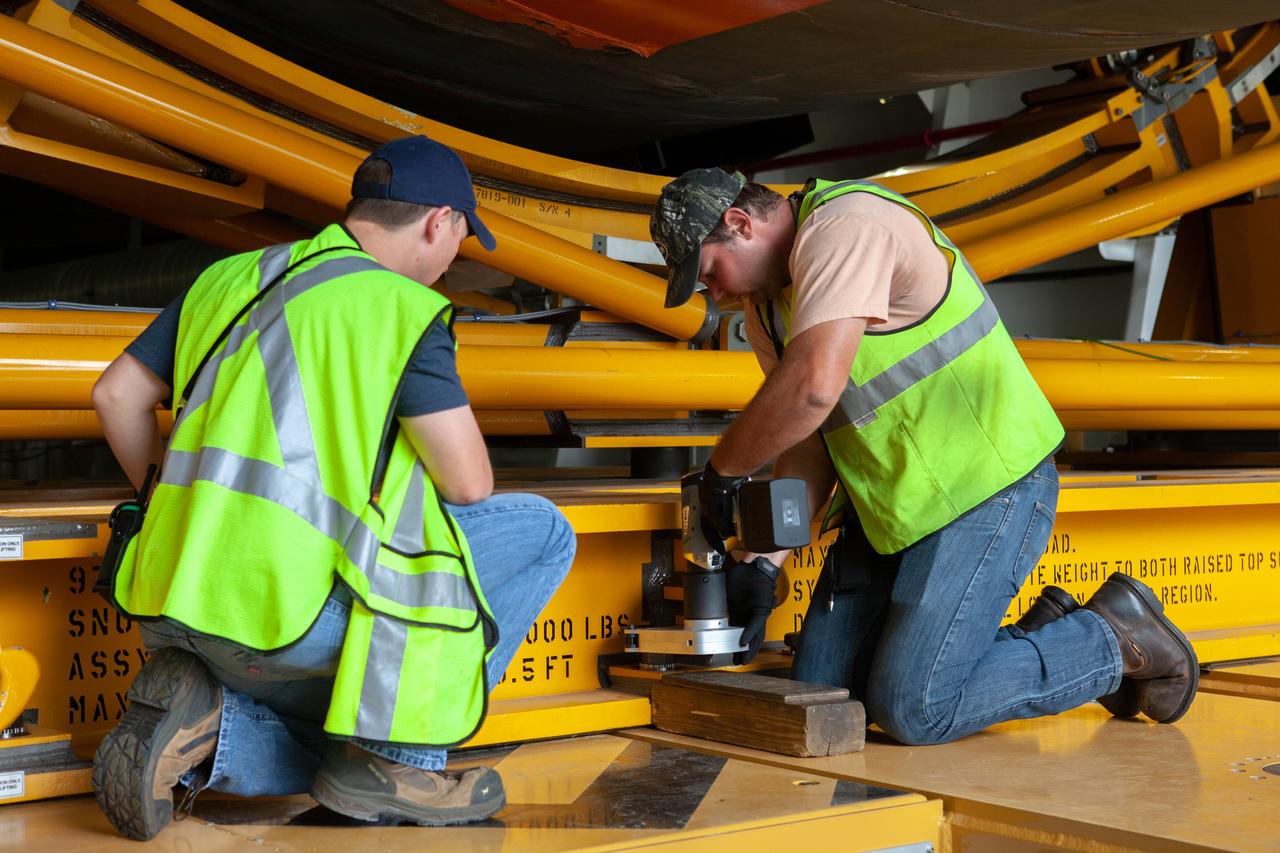
Jacobs TOSC Launch Vehicle Technical Operations technicians James Erdman, operator, and Nick Hall, observer prepare the transporter to begin offloading the 212-foot-long Space Launch System (SLS) rocket core stage pathfinder from NASA's Pegasus Barge at Kennedy Space Center’s Launch Complex 39 turn basin wharf on Oct. 1, 2019. The Pegasus Barge made its first delivery to Kennedy in support of the agency's Artemis missions. The upgraded 310-foot-long barge arrived Sept. 27, 2019, ferrying the SLS core stage pathfinder, a full-scale mock-up of the rocket's core stage. It will be used by Exploration Ground Systems and its contractor, Jacobs, to practice offloading, moving and stacking maneuvers, using important ground support equipment to train employees and certify all the equipment works properly. The pathfinder will stay at Kennedy for approximately one month before trekking back to NASA's Michoud Assembly Facility in Louisiana.
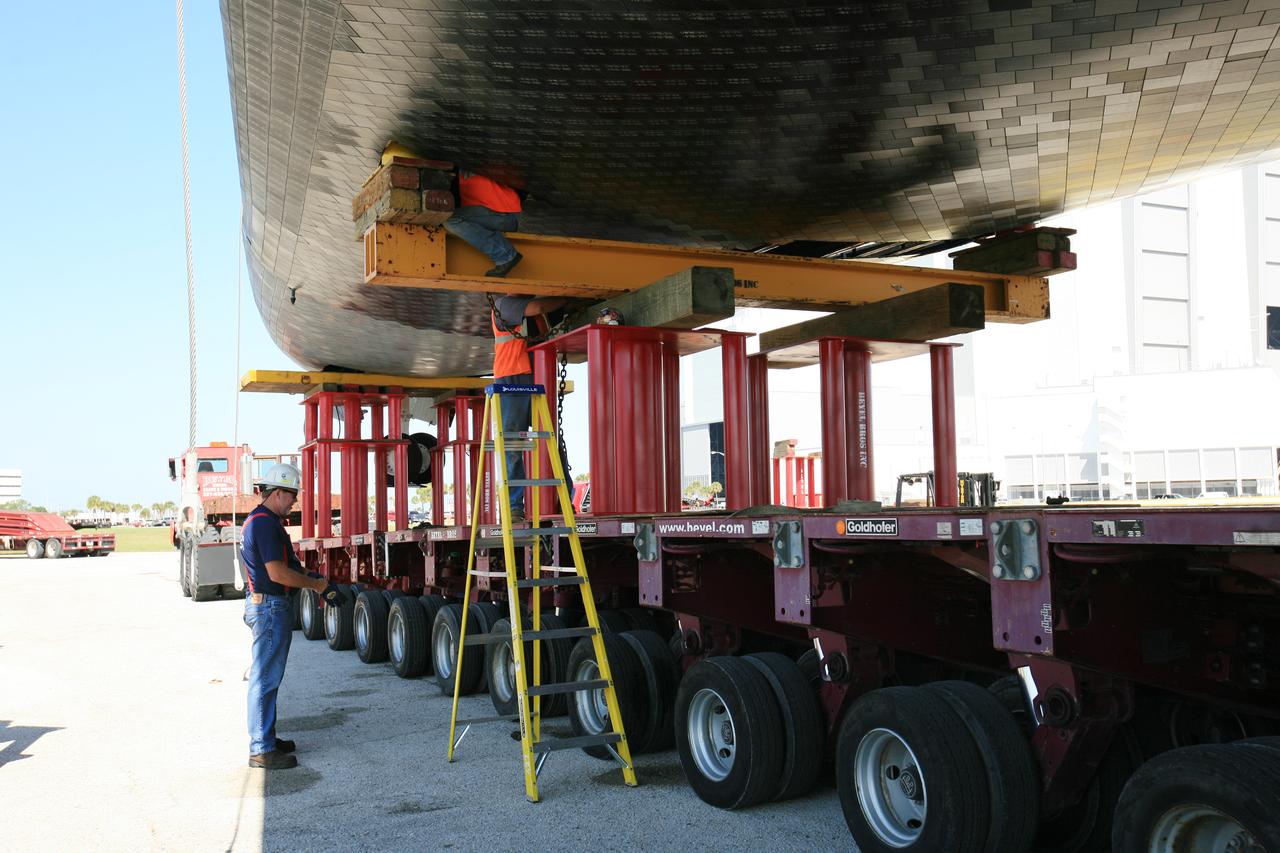
T&R - Work on Shuttle Replica to Prepare for transport to JSC
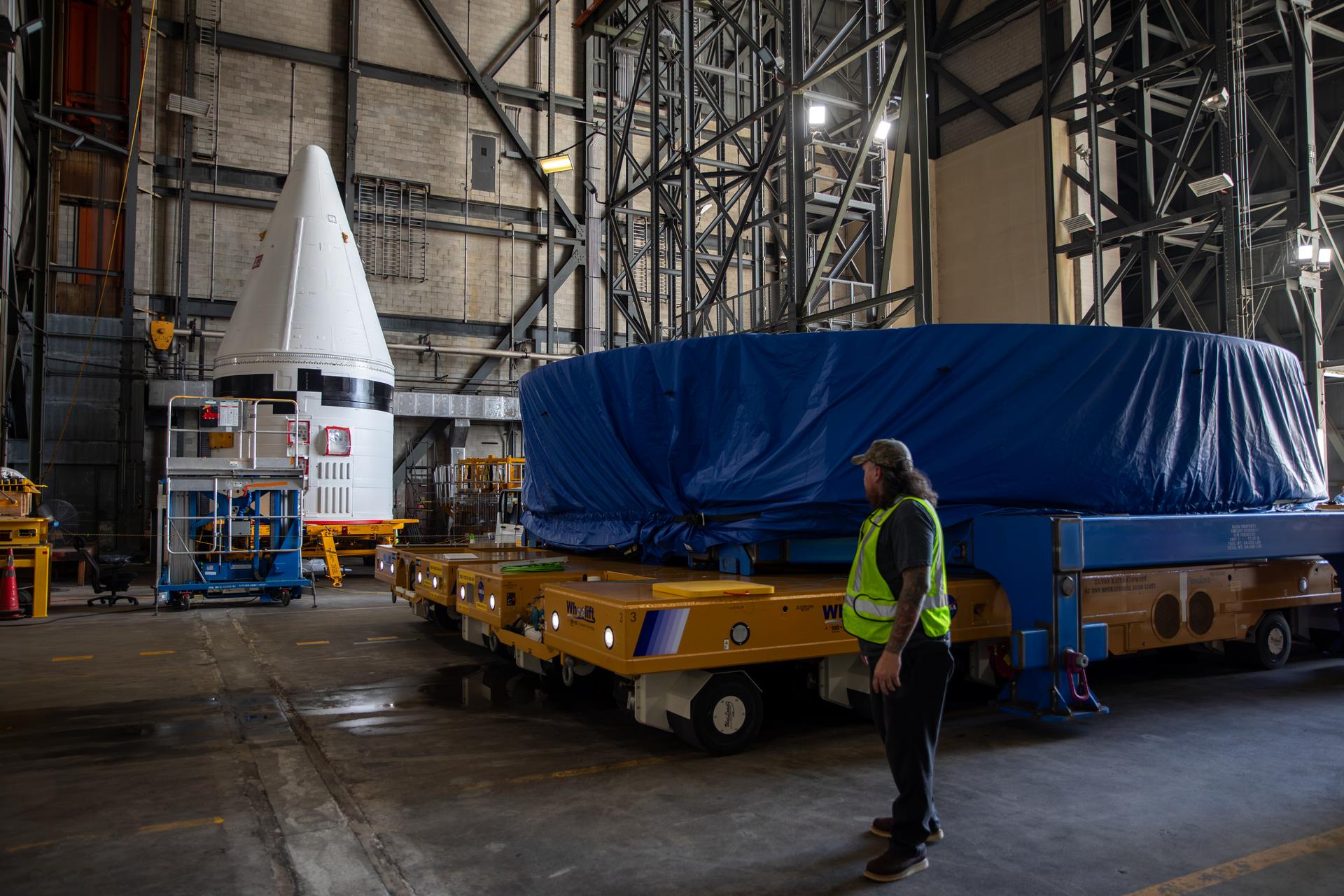
NASA’s Artemis IV SLS (Space Launch System) core stage boat-tail, covered in a protective blue tarp, arrives inside the NASA’s Vehicle Assembly Building at Kennedy Space Center in Florida on Monday, Aug. 31, 2026. Manufactured at NASA’s Michoud Assembly Facility in New Orleans, Louisiana, the boat-tail is a fairing-like structure that protects the bottom end of the SLS (Space Launch System) rocket core stage and RS-25 engines.
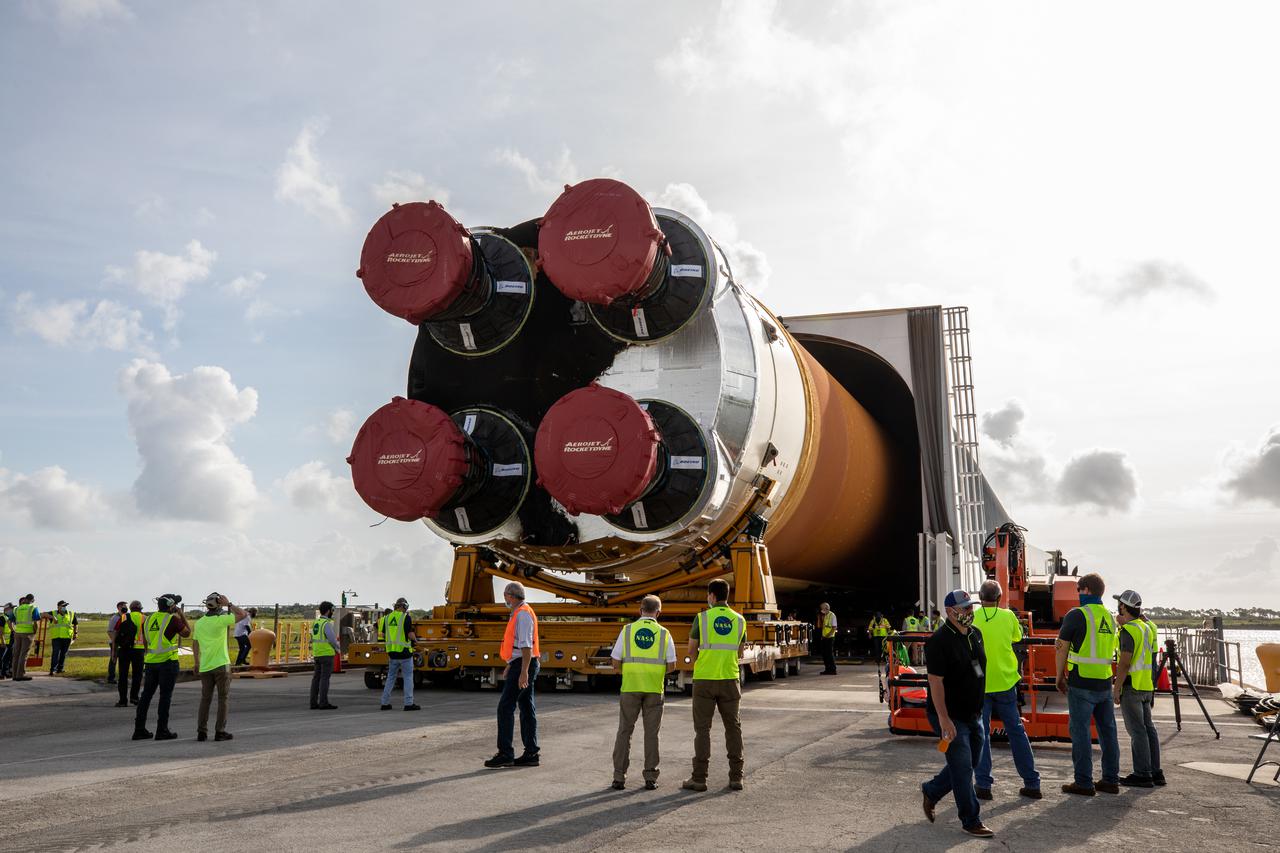
The massive 212-foot long Space Launch System (SLS) core stage is shown being offloaded from the Pegasus Barge on April 29, 2021, after arriving at NASA’s Kennedy Space Center in Florida. Teams with Exploration Ground Systems (EGS) and lead contractor Jacobs will transfer the rocket stage to the center’s Vehicle Assembly Building to prepare it for integration with the completed stack of solid rocket boosters atop the mobile launcher ahead of the Artemis I launch. The first in a series of increasingly complex missions, Artemis I will test SLS and Orion as an integrated system prior to crewed flights to the Moon.

NASA’s top four-fifths of the SLS (Space Launch System) core stage for the Artemis III mission arrives in the transfer aisle of the Vehicle Assembly Building at the agency’s Kennedy Space Center in Florida where teams with Boeing will finish integrating it with the remaining core stage segments prior to rocket stacking operations. Artemis III will launch astronauts to Earth’s orbit aboard the Orion spacecraft on top of SLS to test rendezvous and docking capabilities between Orion and commercial spacecraft needed to land Artemis IV astronauts on the Moon in 2028.
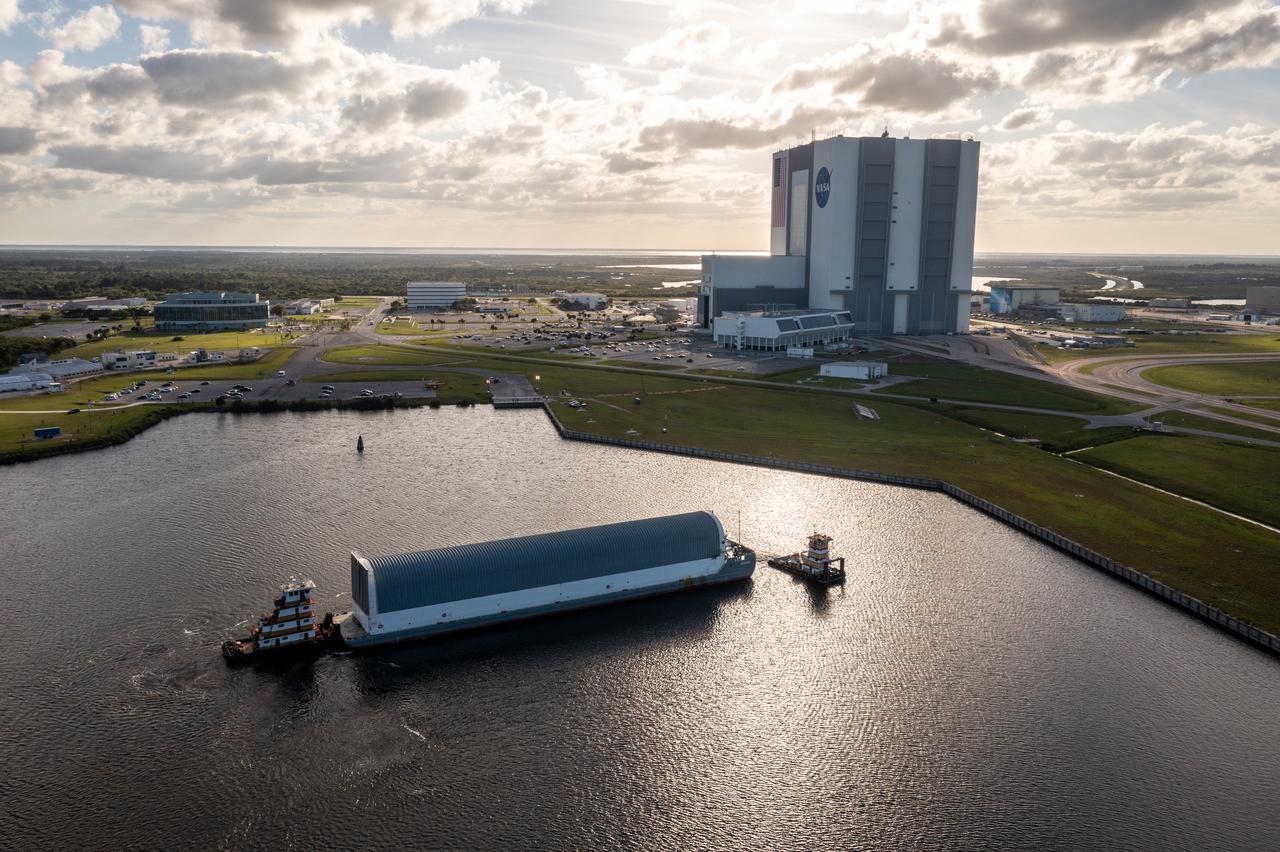
The Pegasus barge, carrying the mighty Space Launch System (SLS) core stage, arrives at NASA’s Kennedy Space Center in Florida on April 27, 2021, after journeying from the agency’s Stennis Space Center in Mississippi. The core stage is the final piece of Artemis hardware to arrive at the spaceport and will be offloaded and moved to Kennedy’s Vehicle Assembly Building, where it will be prepared for integration atop the mobile launcher with the completed stack of solid rocket boosters ahead of the Artemis I launch. The first in a series of increasingly complex missions, Artemis I will test SLS and Orion as an integrated system prior to crewed flights to the Moon.
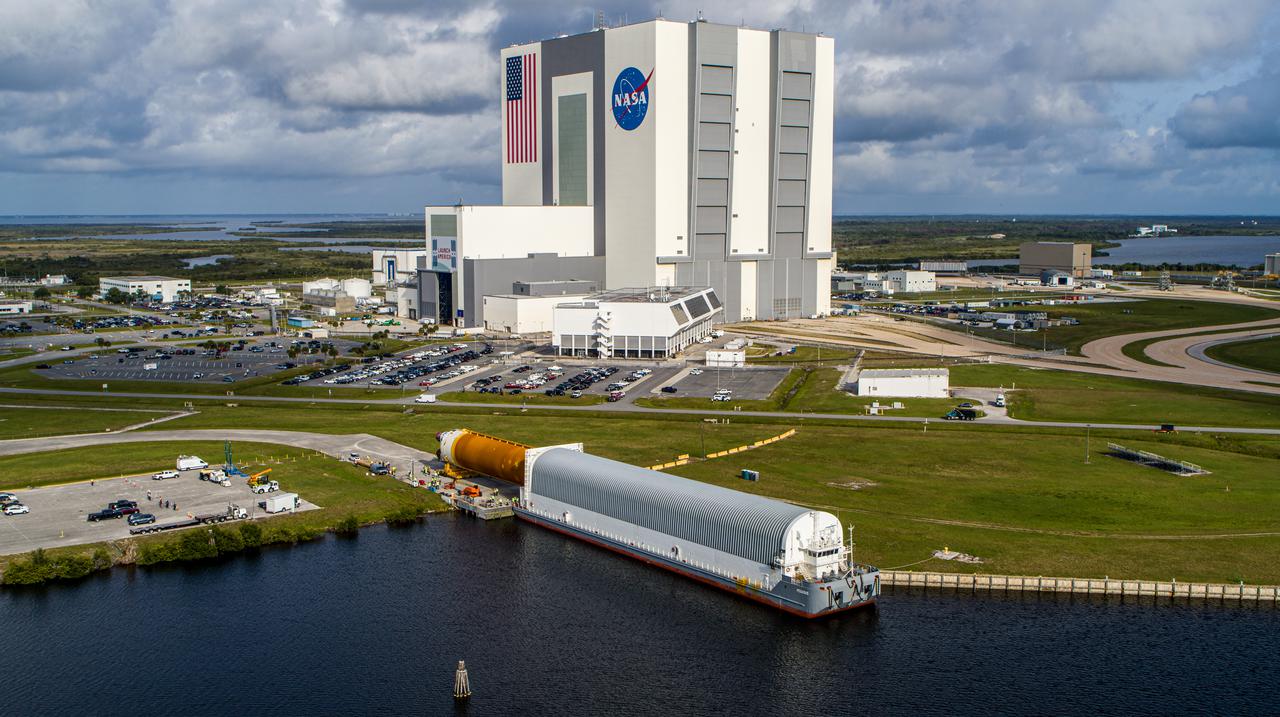
In this aerial view, the massive 212-foot long Space Launch System (SLS) core stage is shown being offloaded from the Pegasus Barge on April 29, 2021, after arriving at NASA’s Kennedy Space Center in Florida. Teams with Exploration Ground Systems (EGS) and lead contractor Jacobs will transfer the rocket stage to the center’s Vehicle Assembly Building to prepare it for integration with the completed stack of solid rocket boosters atop the mobile launcher ahead of the Artemis I launch. The first in a series of increasingly complex missions, Artemis I will test SLS and Orion as an integrated system prior to crewed flights to the Moon.