NASA is going to the Moon and on to Mars, in a measured, sustainable way. Working with U.S. companies and international partners, NASA will push the boundaries of human exploration forward to the Moon.

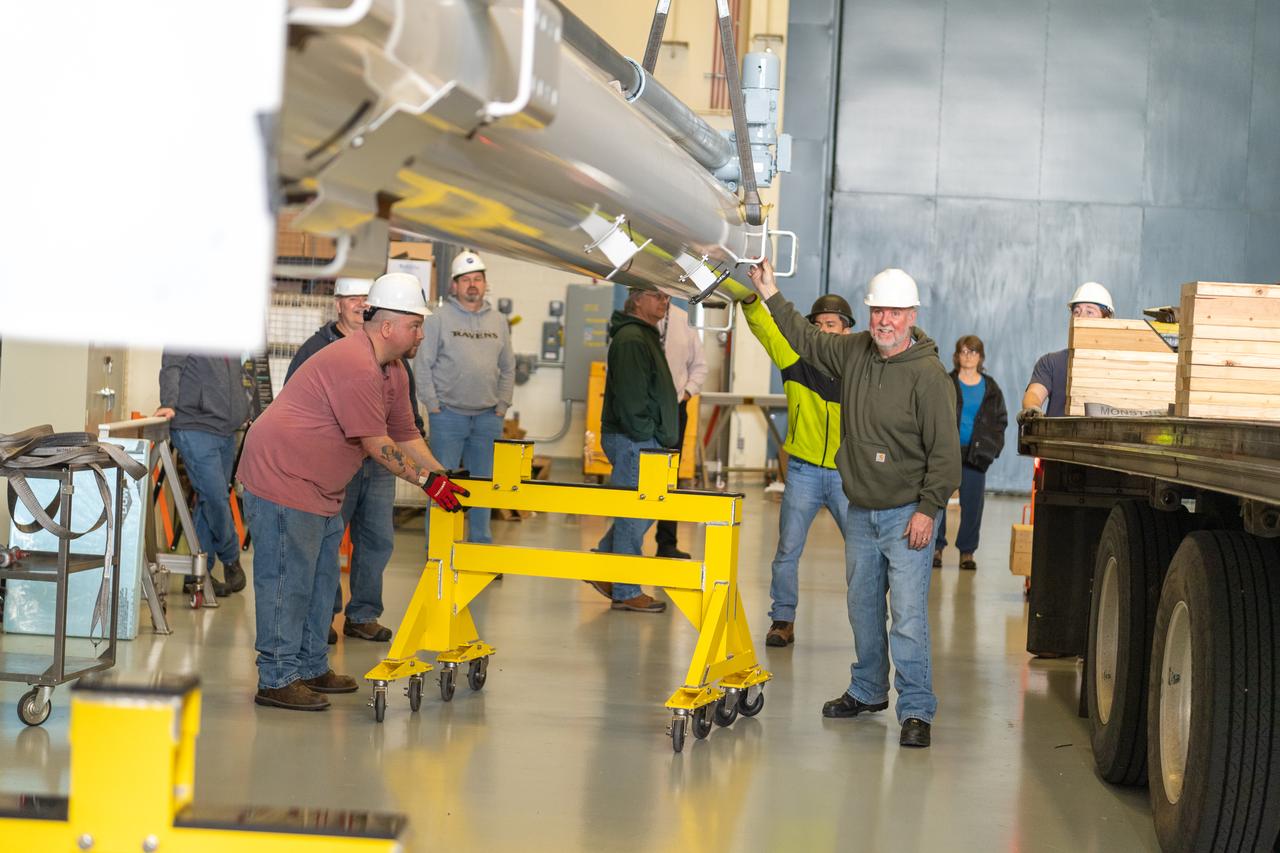
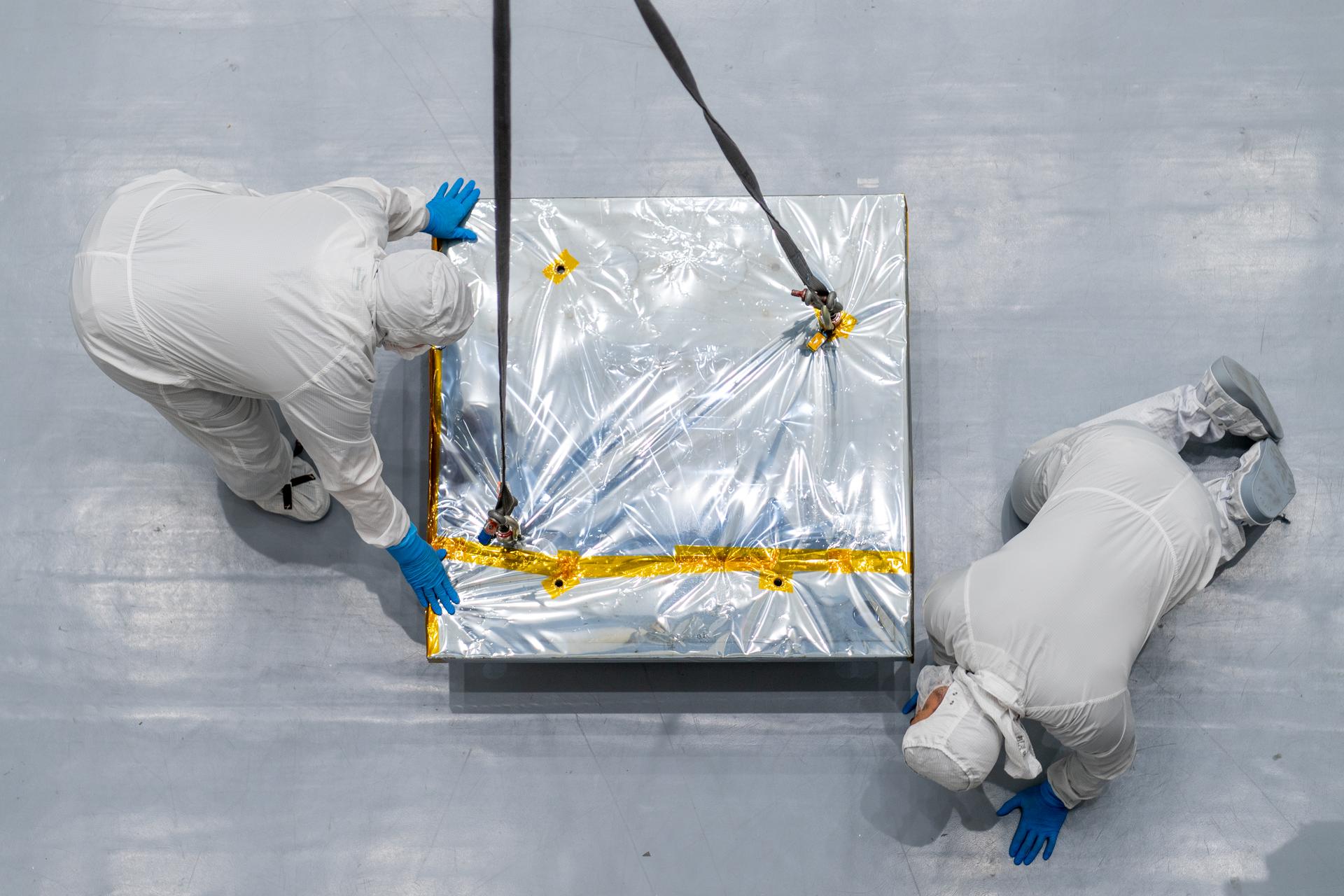
OSAM-1 and Maxar team members remove protective bagging from the spacecraft bus at Goddard Space Flight Center, Greenbelt Md., Sept 25, 2023. This photo has been reviewed by OSAM1 project management, Maxar public release authority, and the Export Control Office and is released for public view. NASA/Mike Guinto
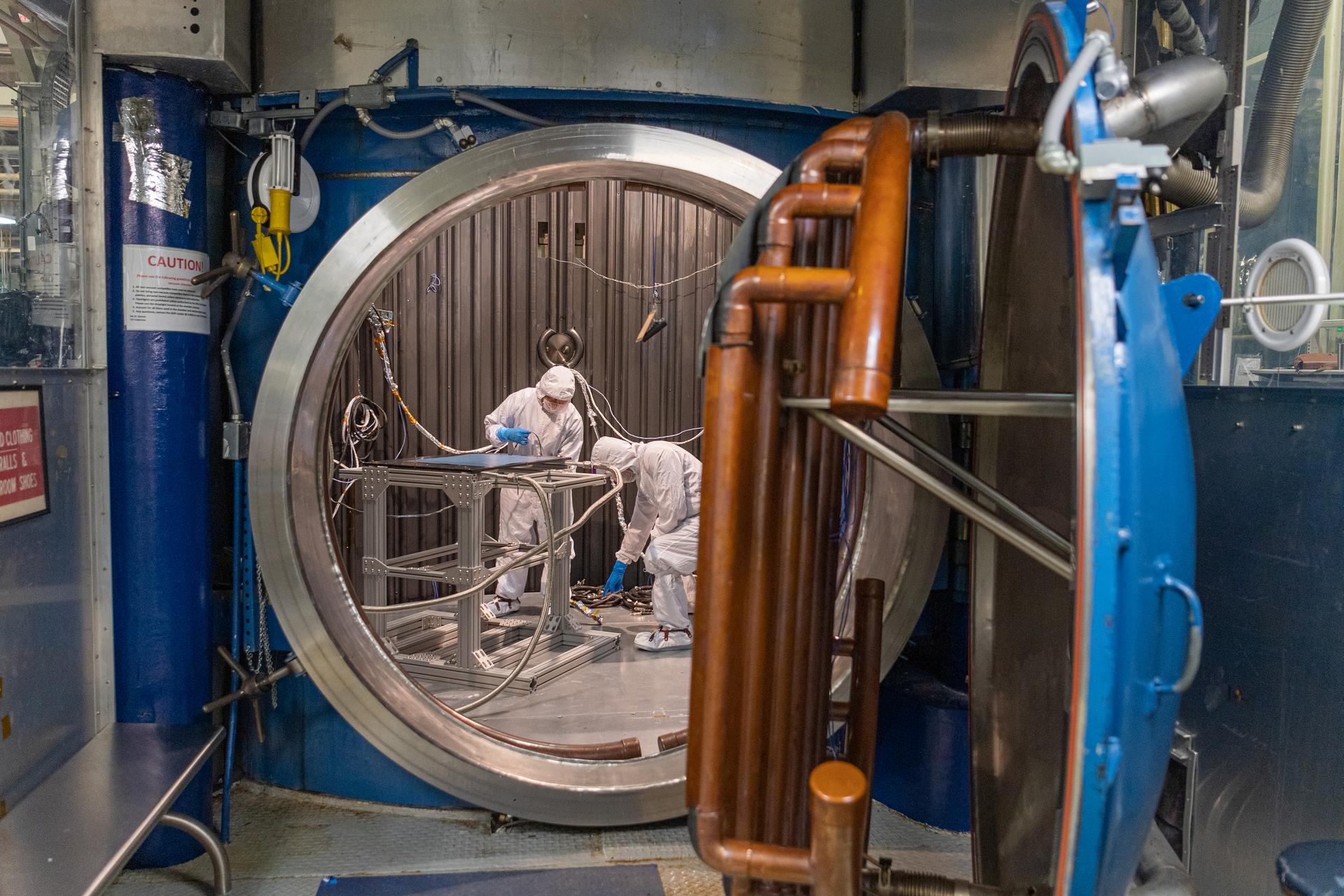
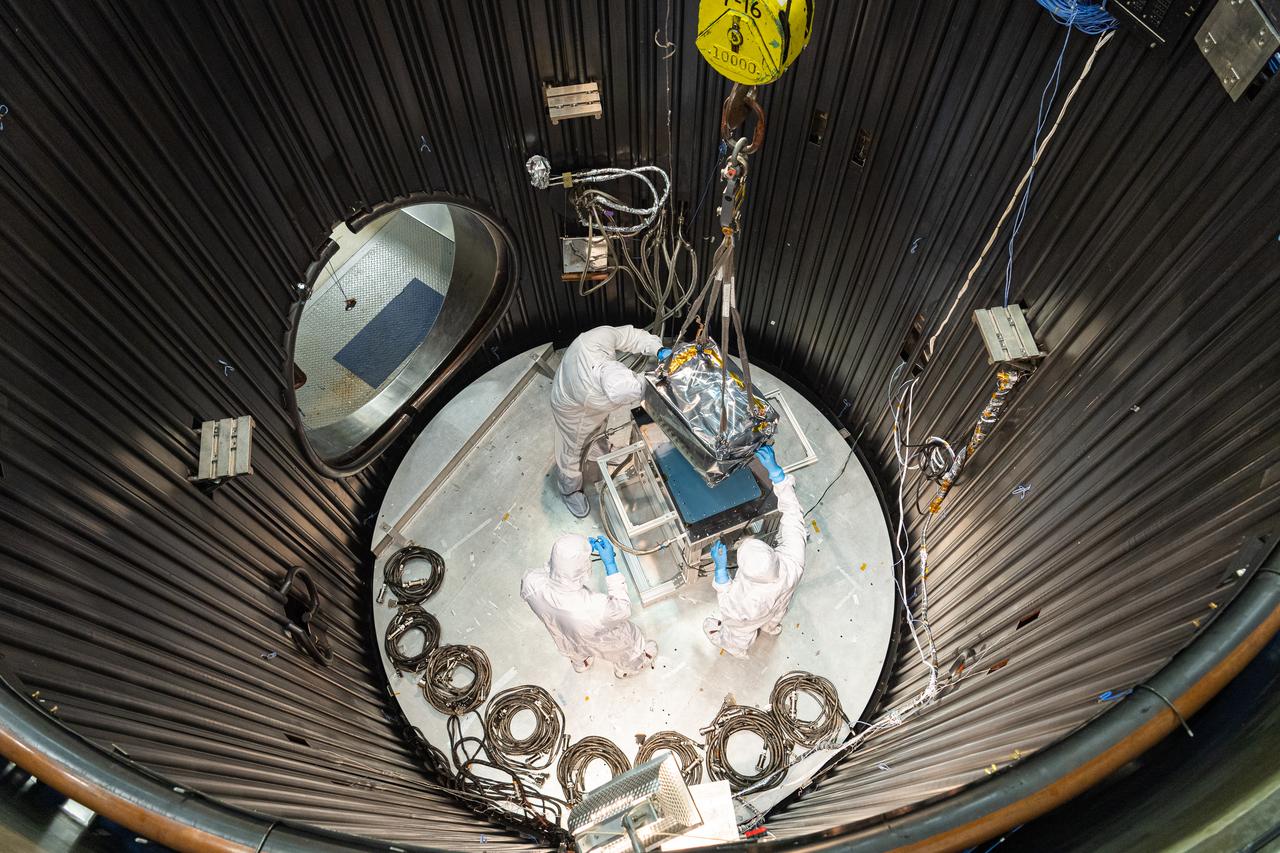
Members of the OSAM-1 power supply unit (PSU) team make preparations inside a thermal vacuum chamber for the PSU electronics box to be lowered in at Goddard Space Flight Center, Greenbelt Md., Mar 16, 2023. This photo has been reviewed by OSAM1 project management and the Export Control Office and is released for public view. NASA/Mike Guinto
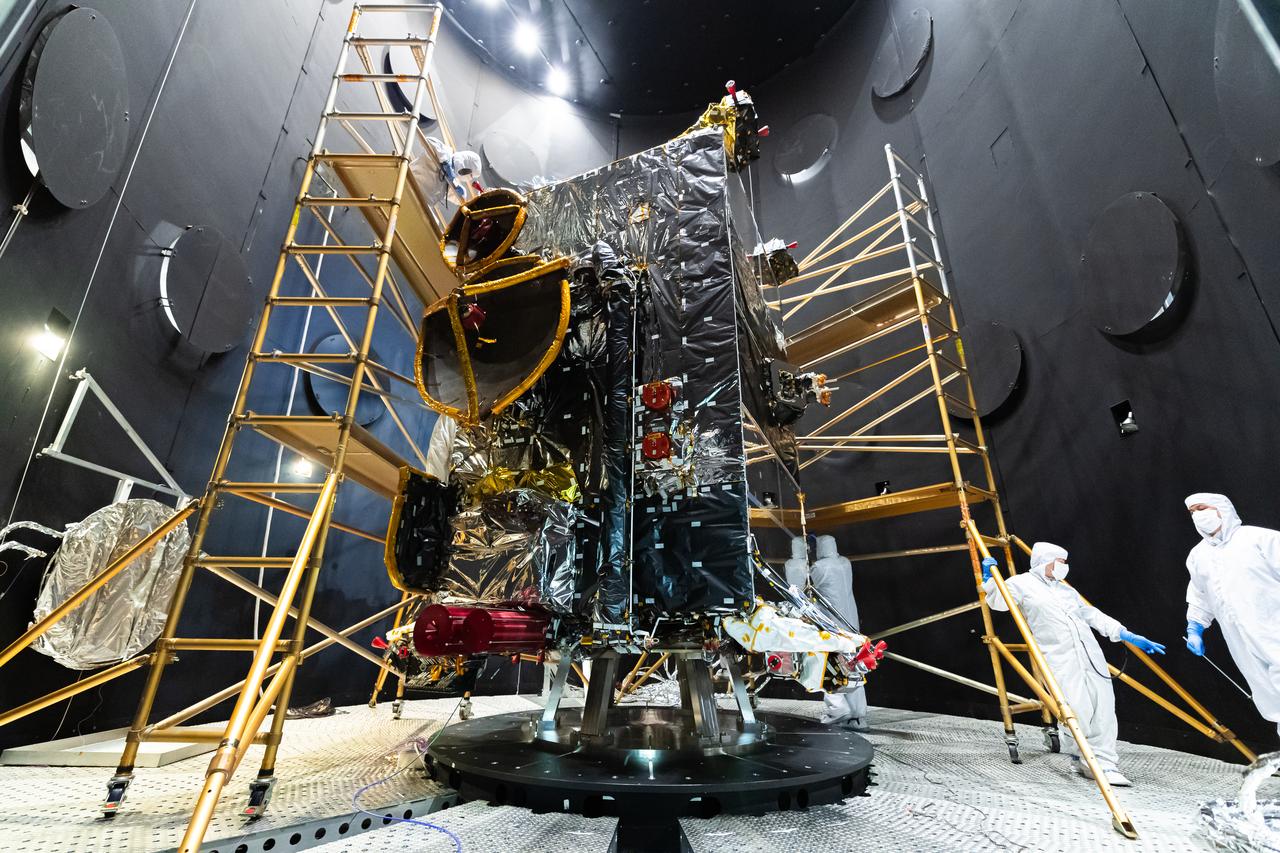
A view of the OSAM-1 spacecraft bus inside the thermal vacuum chamber at Goddard Space Flight Center, Greenbelt Md., Dec 1, 2023. This photo has been reviewed by Maxar, OSAM1 project management, and the Export Control Office and is released for public view. NASA/Mike Guinto
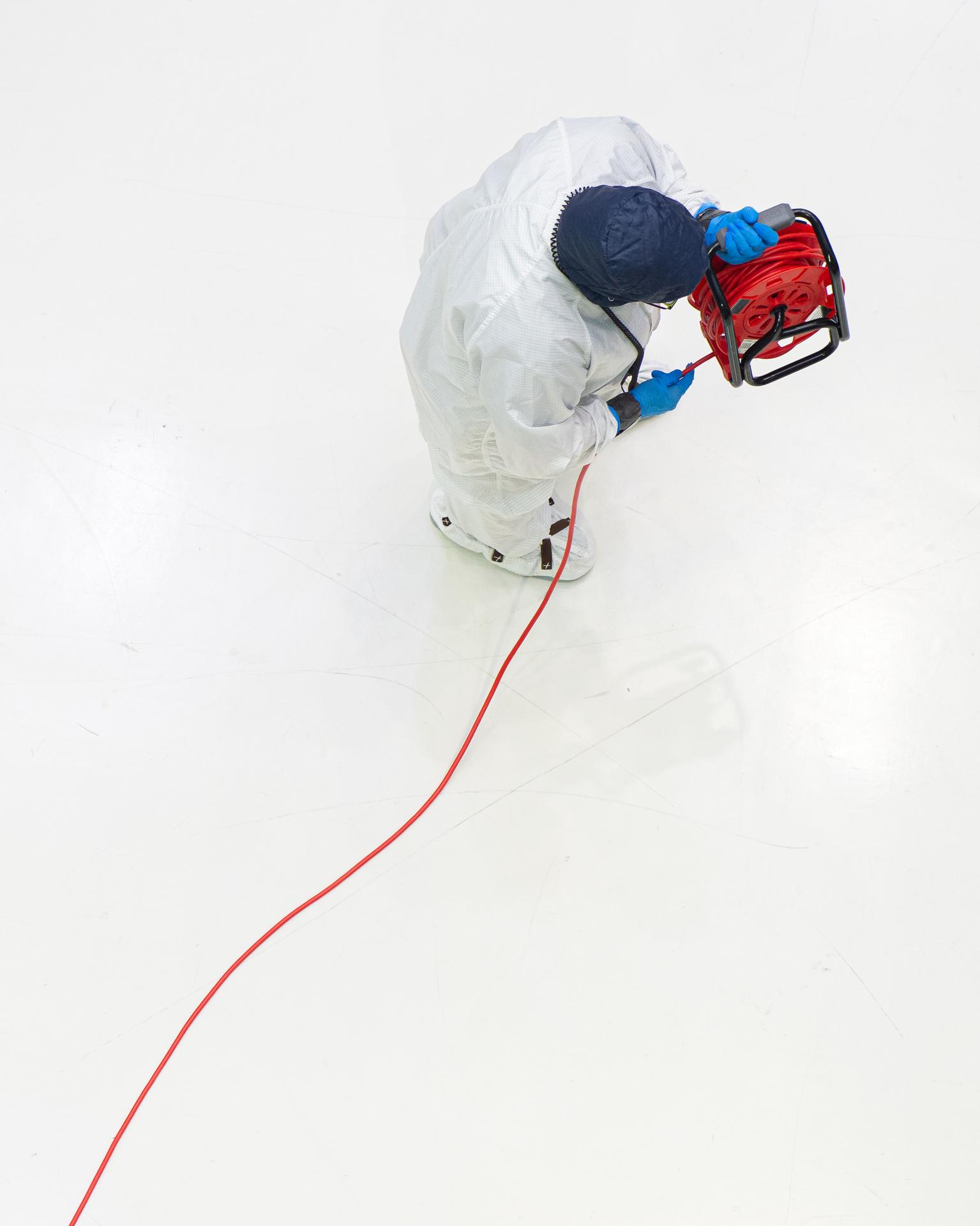
Quality Assurance engineer Lucinda Taylor unreels a power cord across the cleanroom floor at Goddard Space Flight Center, Greenbelt Md., April 21, 2025. This photo has been reviewed by export control and is approved for public release. NASA/Mike Guinto
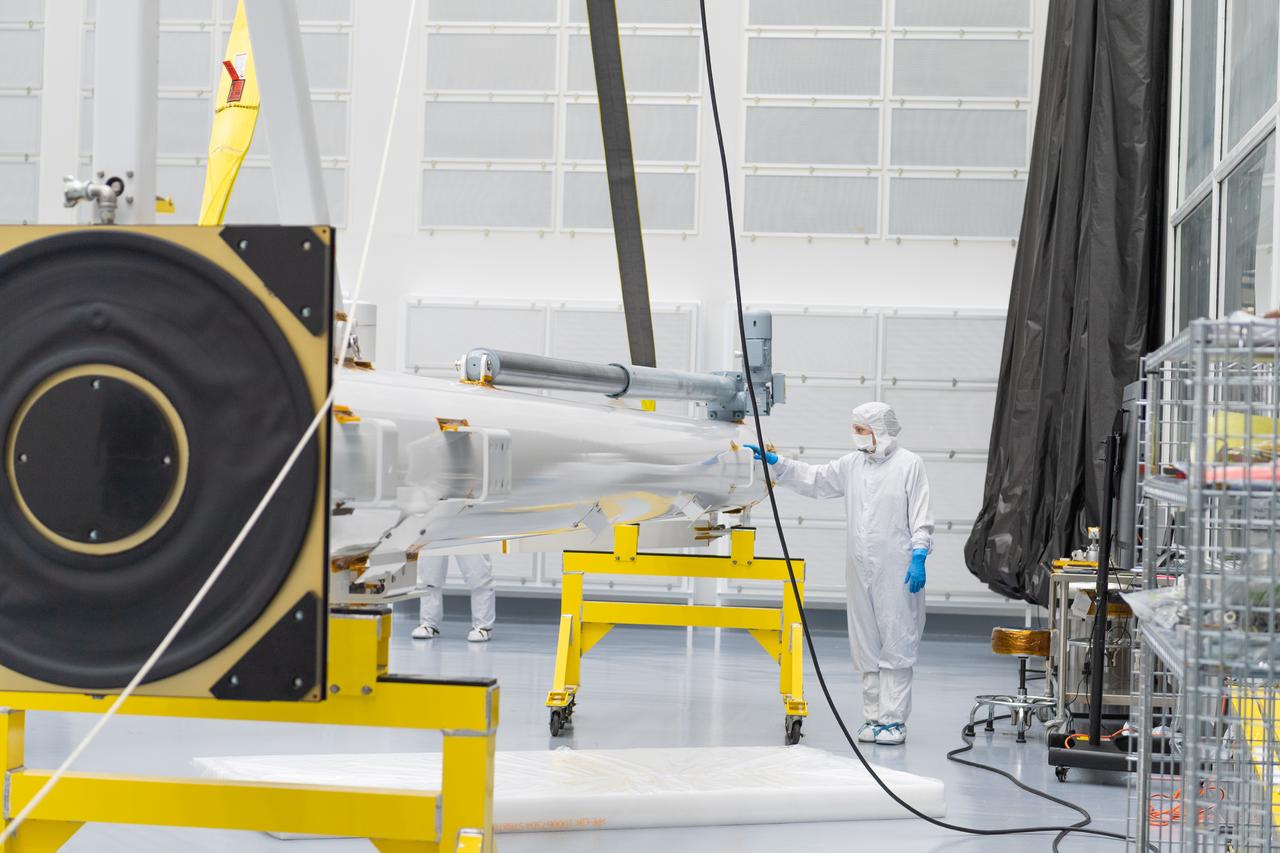
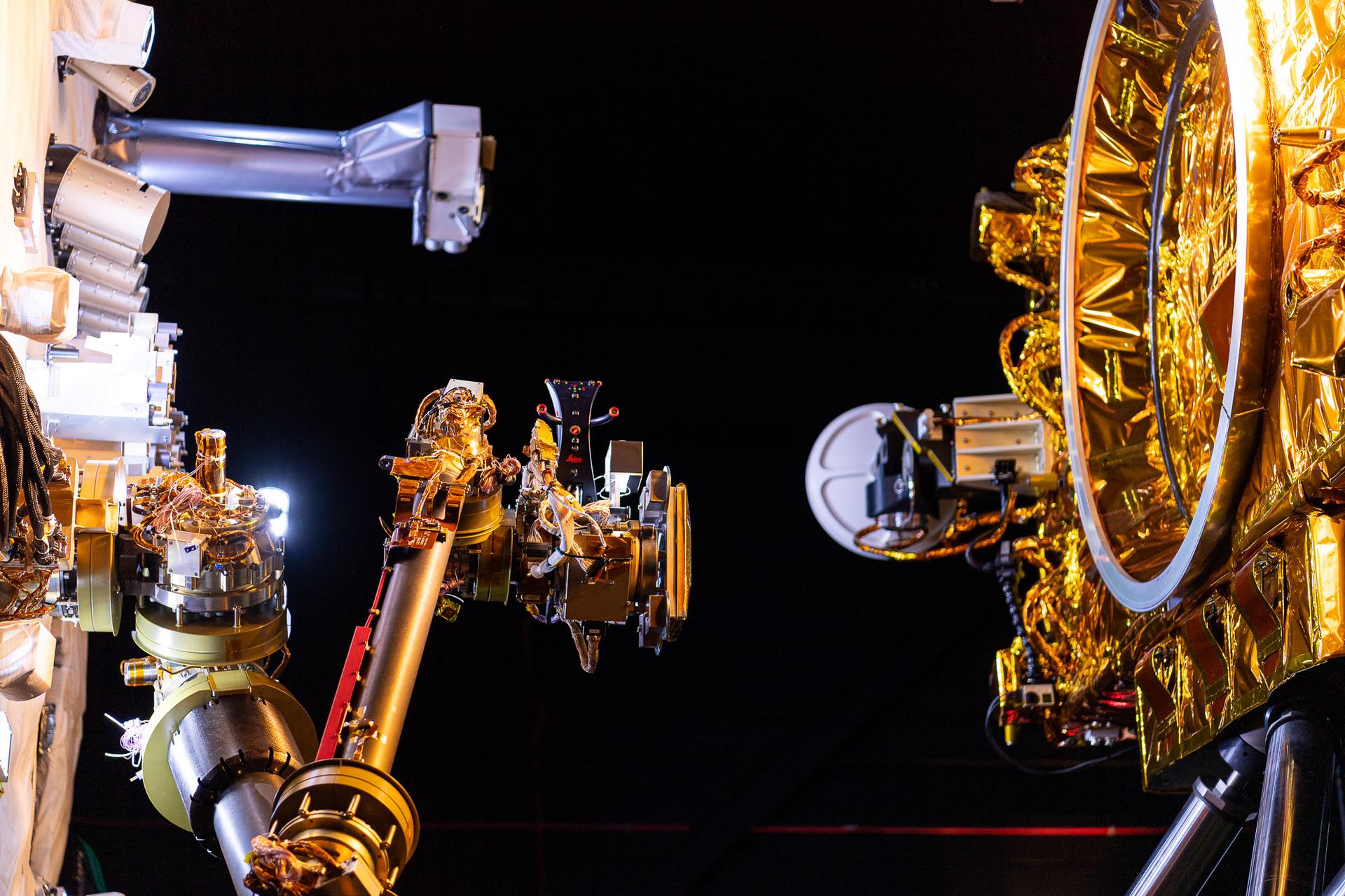
One of the OSAM-1 Robot Arms is seen, mounted onto ground support equipment used for testing inside the cleanroom at Goddard Space Flight Center, Greenbelt Md., Apr 17, 2024. This photo has been reviewed by Maxar, OSAM1 project management, and the Export Control Office and is released for public view. NASA/Mike Guinto
OSAM-1 team members prepare a weight to be crane lifted onto the SPIKA work platform as part of its commissioning workmanship test inside the cleanroom at Goddard Space Flight Center, Greenbelt Md., Mar 20, 2023. This photo has been reviewed by OSAM1 project management and the Export Control Office and is released for public view. NASA/Mike Guinto
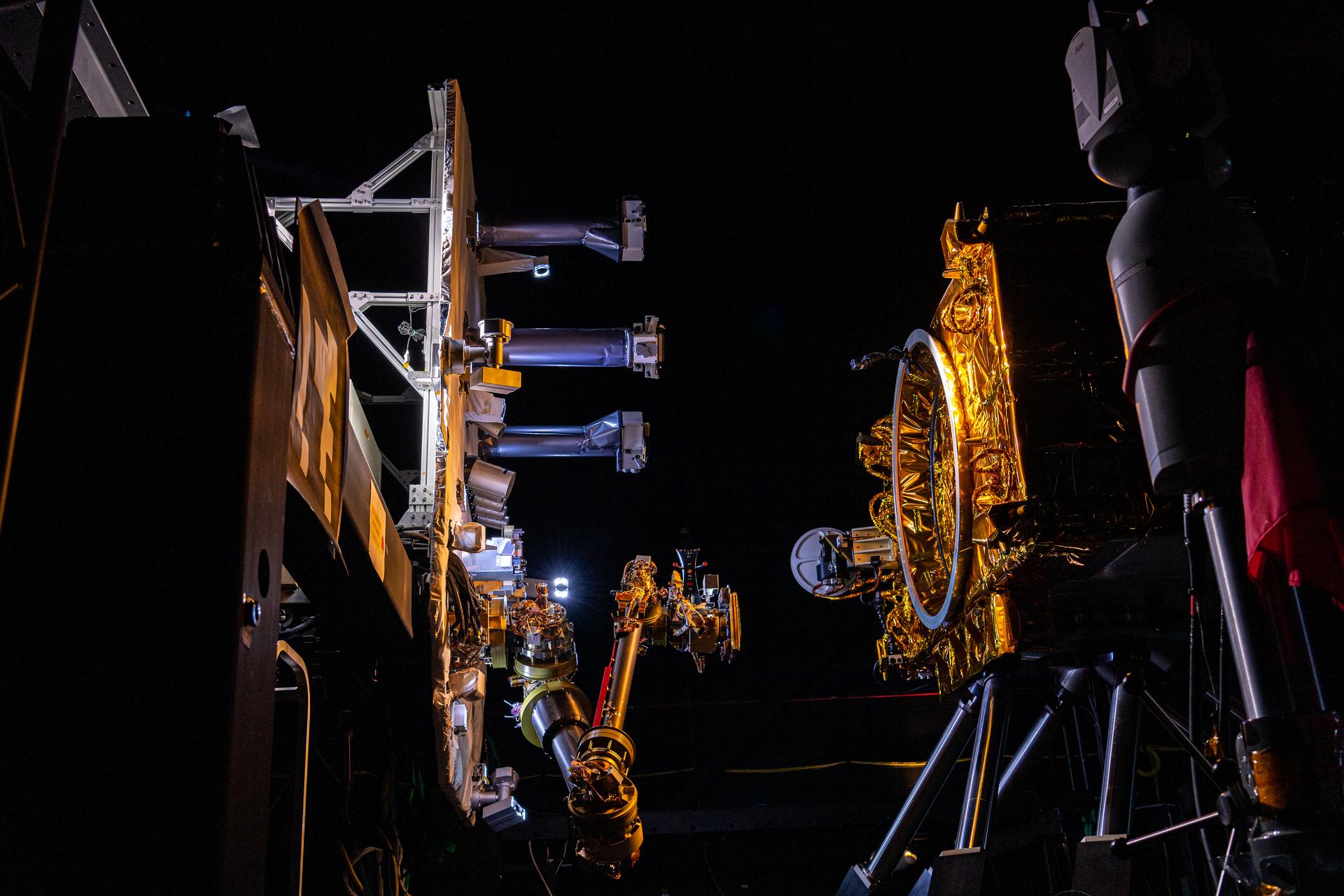
Detail shot of the OSAM-1 auto-capture test bed performing a test of the robot arm inside the robotics operations center at Goddard Space Flight Center, Greenbelt Md., Feb 23, 2023. This photo has been approved for public release. NASA/Mike Guinto
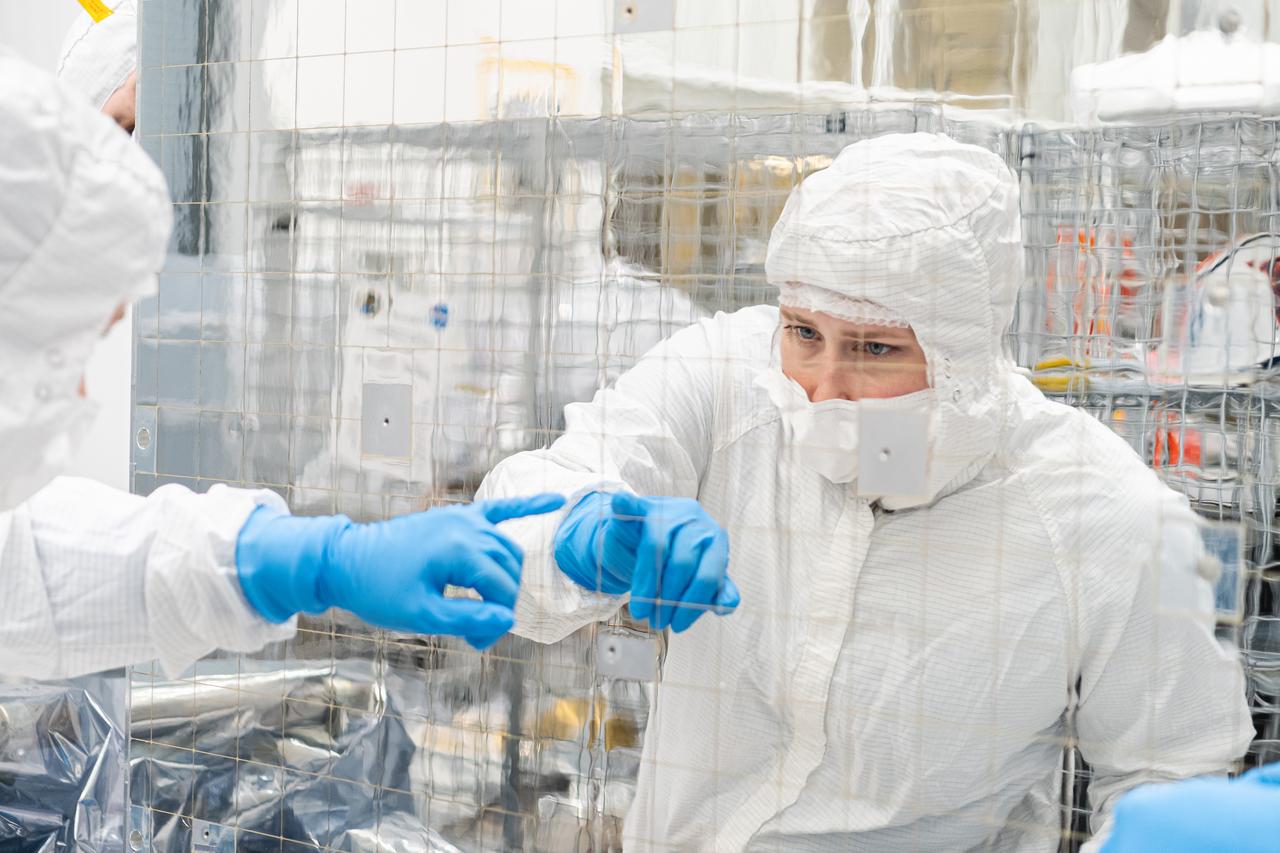
Contamination control technician Sydnie Heiman inspects one of OSAM-1's radiator panels inside the cleanroom at Goddard Space Flight Center, Greenbelt Md., July 10, 2023. This photo has been reviewed by OSAM1 project management and the Export Control Office and is released for public view. NASA/Mike Guinto
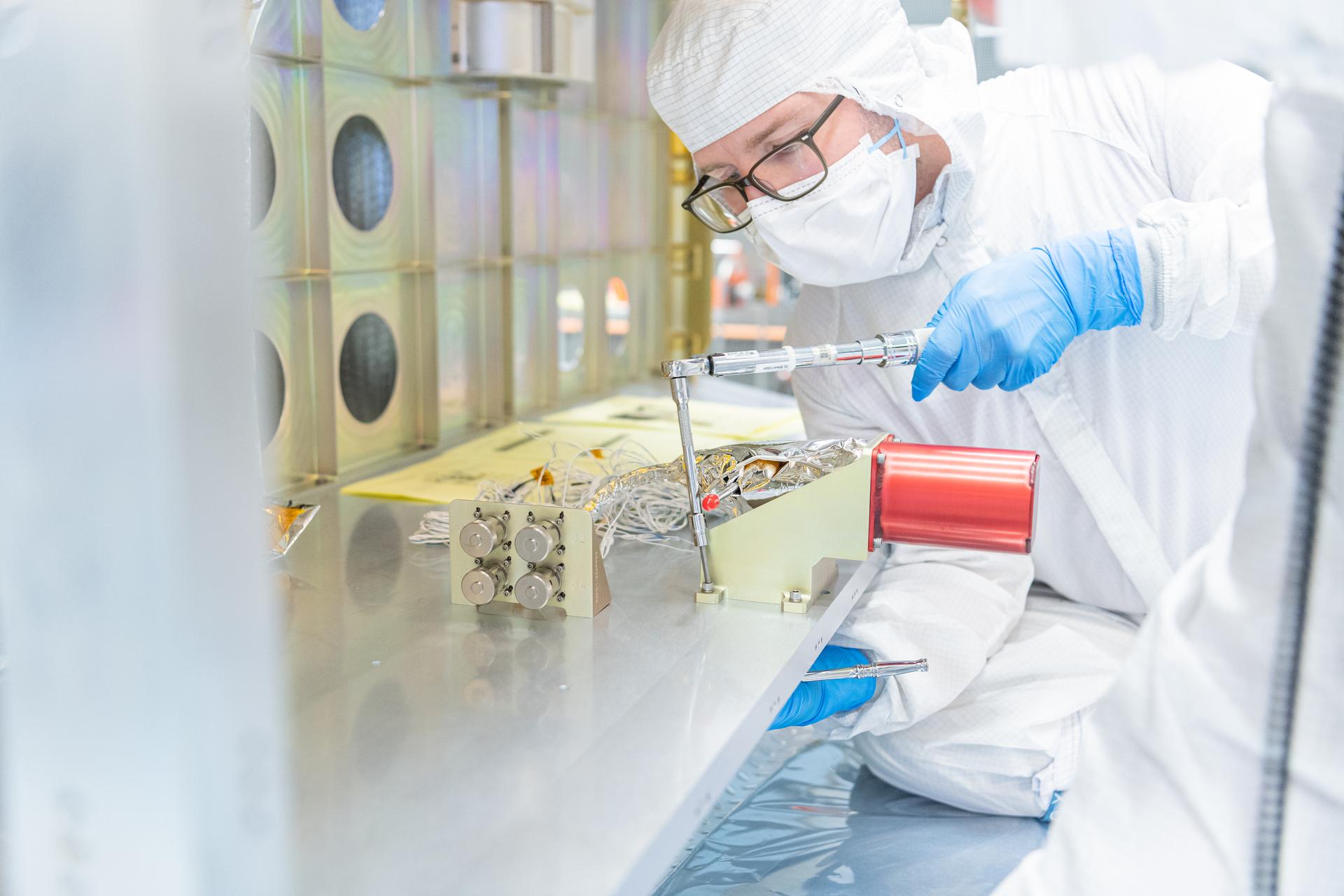
Seth Aulton, a mechanical engineering and integration technician, installs part of the Propellant Transfer System onto the servicing payload of OSAM-1 inside a cleanroom at Goddard Space Flight Center, Greenbelt, Md., Feb 14, 2023. This photo has been reviewed by OSAM-1 project management and the Export Control Office and is released for public view. NASA/Mike Guinto
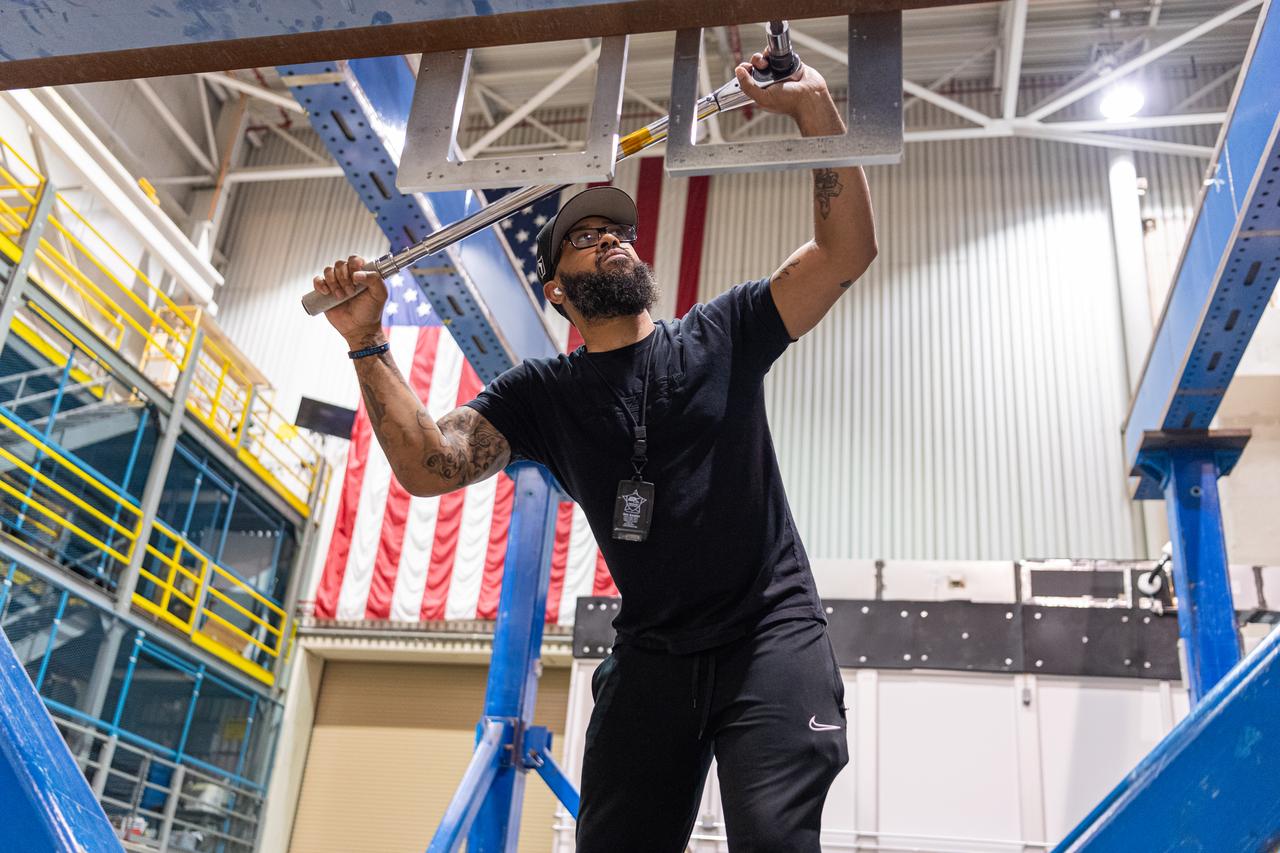
Mechanical engineering and integration technician Ivan Pratt installs brackets onto the static load testing platform in preparation of an OSAM-1 ground support equipment proof test at Goddard Space Flight Center, Greenbelt Md., July 19, 2023. This photo has been reviewed by OSAM1 project management and the Export Control Office and is released for public view. NASA/Mike Guinto
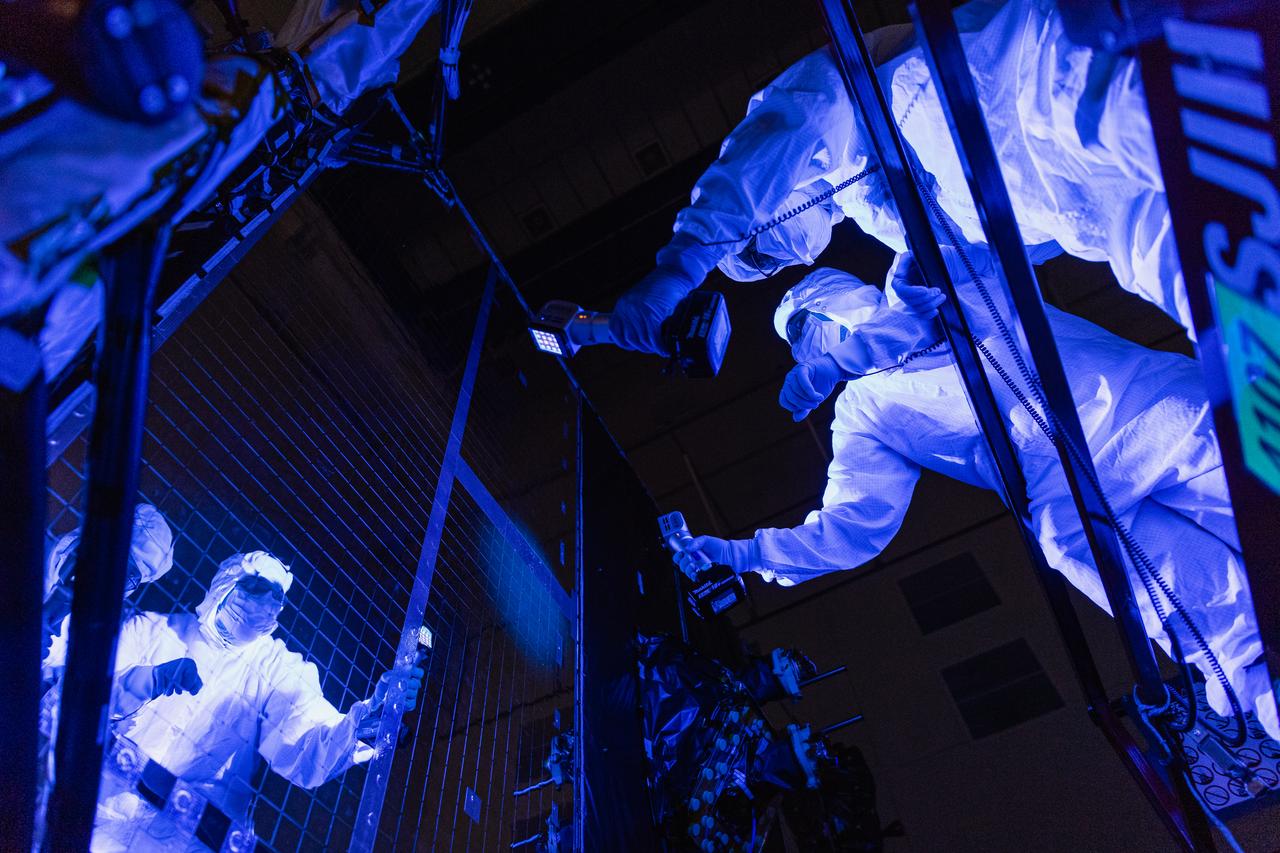
NASA Contamination control engineers perform a blacklight inspection on the OSAM-1 Spacecraft Bus at Goddard Space Flight Center, Greenbelt Md., Sept 30, 2023. This photo has been reviewed by OSAM1 project management, Maxar public release authority, and the Export Control Office and is released for public view. NASA/Mike Guinto
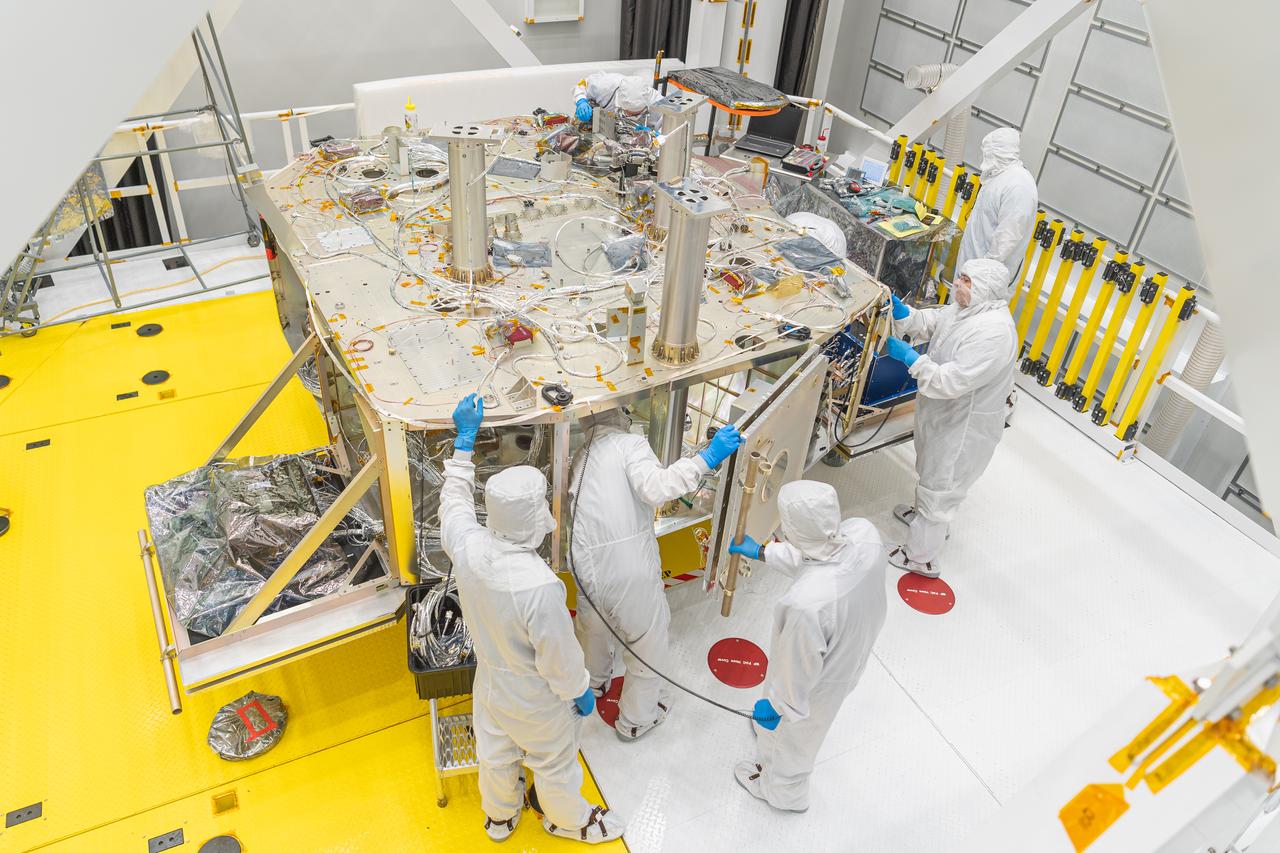
The OSAM-1 integration and testing team deploys and stows the radiator panels on the OSAM-1 servicing payload at Goddard Space Flight Center, Greenbelt Md., Sept 14, 2023. This photo has been reviewed by OSAM1 project management and the Export Control Office and is released for public view. NASA/Mike Guinto
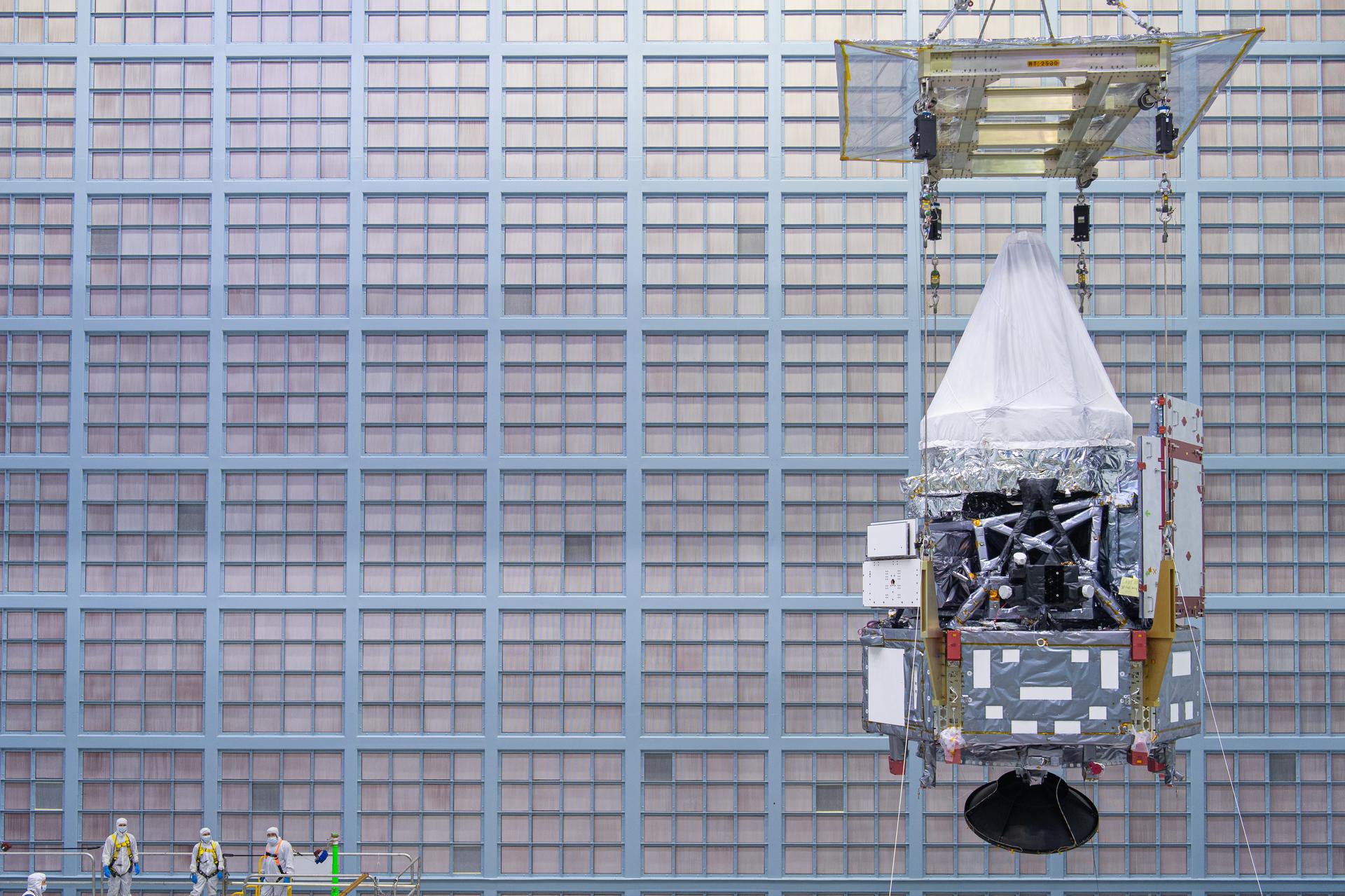
The Roman Space Telescope's Spacecraft Bus and Integrated Payload Assembly is crane lifted inside the cleanroom at Goddard Space Flight Center, Greenbelt Md., June 12, 2025. This photo has been approved for public release. NASA/Mike Guinto
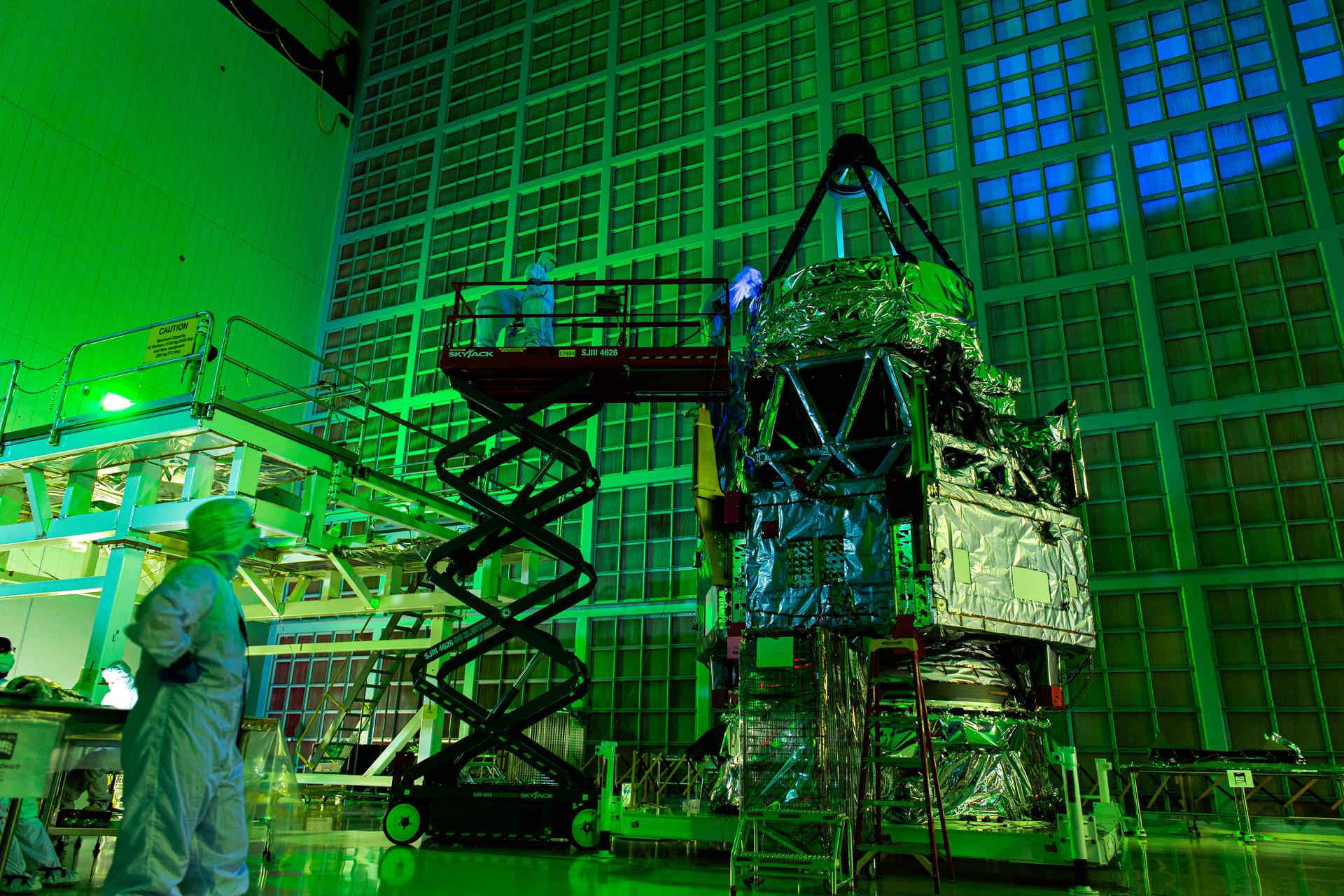
Roman Space Telescope team members inspect the primary mirror in the dark using flashlights and UV lights to help them see any contamination, inside the cleanroom at Goddard Space Flight Center, Greenbelt Md., July 2, 2025. The green glow of the room is due to a long exposure time, the green comes from a light on the left wall which indicates optimal airflow through the room. This photo has been approved for public release. NASA/Mike Guinto

Mechanical engineering and integration technician, Lucas Keim, stands inside the Acoustics chamber at Goddard Space Flight Center, Greenbelt Md., Aug 24, 2023. This photo has been reviewed by OSAM1 project management and the Export Control Office and is released for public view. NASA/Mike Guinto
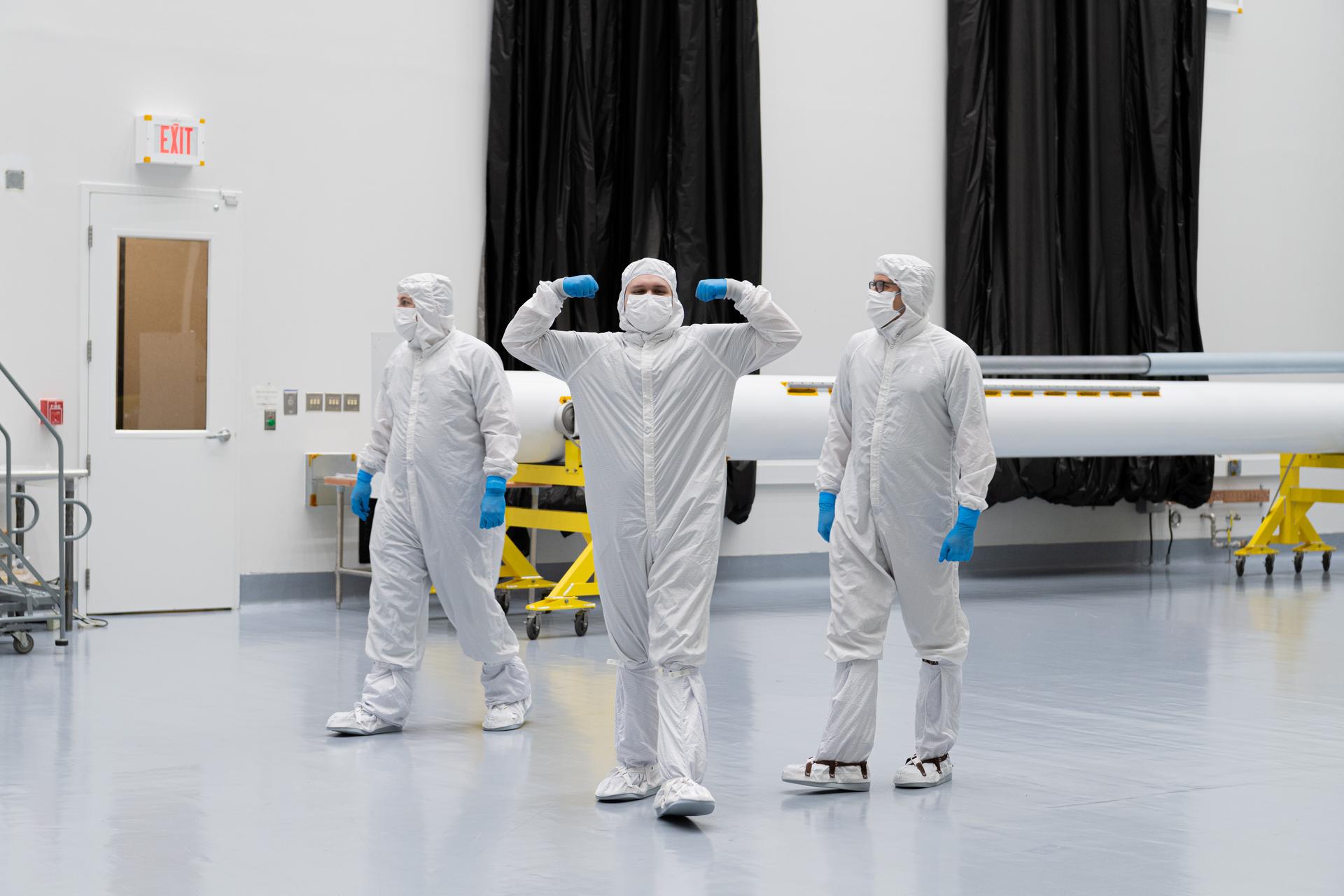
Lucas Keim, a mechanical engineering and integration technician, flexes after helping move ground support equipment into a cleanroom at Goddard Space Flight Center, Greenbelt, Md., Feb 20, 2023.

“I was born in India soon after we got independence from the British. So we were just beginning to get access to education. My mother was very keen that her daughters get an education. She was a big motivating force behind my interest in science. Since I was really little, she would say, ‘This daughter of mine is going to be a scientist.’ “And I loved nature. In those days, the monsoon would make India come to life with flowers and creepy-crawlies and all kinds of little creatures. I would just go out, eagerly looking for new forms of life. I was always curious. And I remember the night sky — just trying to count all the stars. We didn’t have electricity so it was very dark. You could see the Milky Way, it was so clear. “When Sputnik was launched, it came out in the newspaper that you would be able to see it pass overhead at 5 in the morning. And my grandmother woke up everyone — the entire household — to see it. There was a big crowd in the backyard to watch Sputnik go by. "Then, Yuri Gagarin made a tour of India. He came to our city — Lucknow — and there was a reception for him. My mother got invitations for all of us to see the cosmonaut. We were just little kids. We ran right to the stage — there was no security then — and said hello to him. He gave us little booklets and autographs. It was a big inspiration for me. I remember just staring at that booklet he gave me. I kept it for years.” NASA Program Scientist, Dr. Hashima Hasan, poses for a portrait in her backyard, while working from home during the COVID-19 pandemic, Monday, July 6, 2020 in Maryland. Hasan currently works at NASA Headquarters as a program scientist on the agency’s Nuclear Spectroscopic Telescope Array (NuSTAR) spacecraft, the Keck Observatory, and the NASA Astrophysics Archives, and is the deputy program scientist for NASA’s James Webb Space Telescope. Photo Credit: (NASA/Aubrey Gemignani)
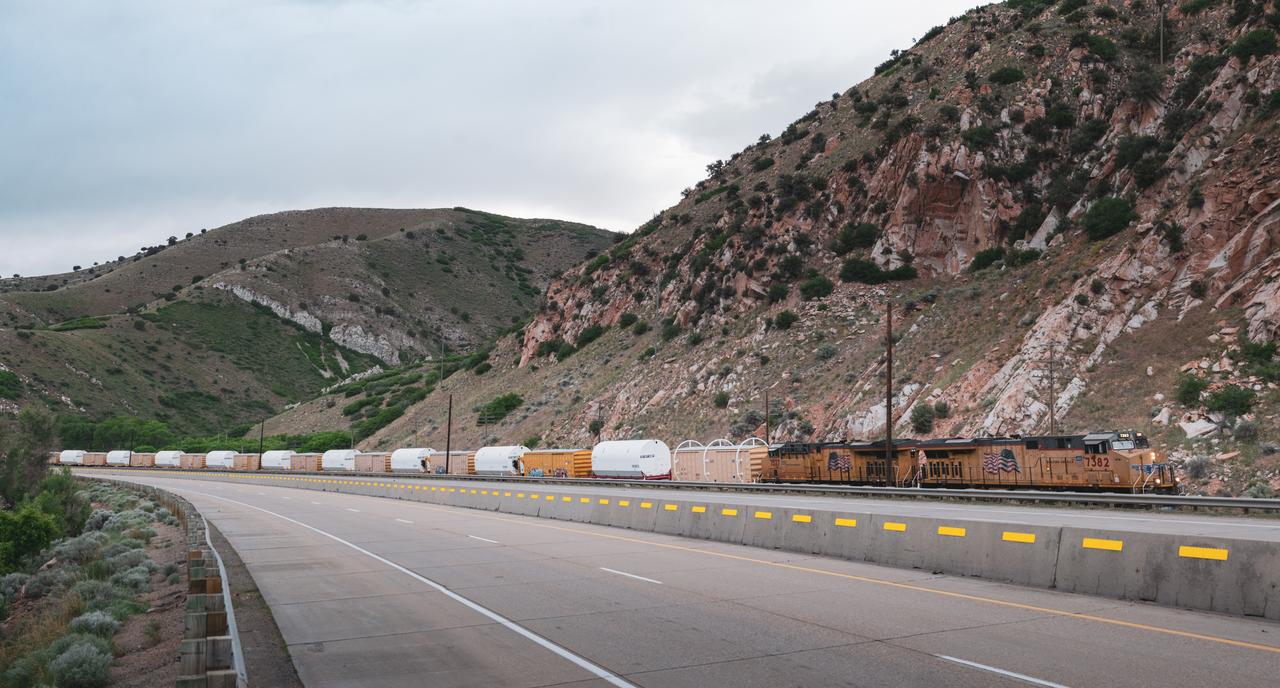
The two solid rocket boosters that will power NASA’s Space Launch System (SLS) for Artemis missions to the Moon are on their way to the agency’s Kennedy Space Center in Florida after departing from a Northrop Grumman manufacturing facility in Promontory, Utah, on June 5, 2020. The boosters – each comprised of five motor segments – are scheduled to arrive at Kennedy’s Rotation, Processing and Surge Facility, where teams with NASA’s Exploration Ground Systems will process the segments before moving them to the Vehicle Assembly Building for stacking on the mobile launcher. Under the Artemis program, NASA will land the first woman and the next man on the Moon by 2024. The first in a series of increasingly complex missions, Artemis I will test the Orion spacecraft and SLS as an integrated system ahead of crewed flights to the Moon.

The two solid rocket boosters that will power NASA’s Space Launch System (SLS) for Artemis missions to the Moon are on their way to the agency’s Kennedy Space Center in Florida after departing from a Northrop Grumman manufacturing facility in Promontory, Utah, on June 5, 2020. The boosters – each comprised of five motor segments – are scheduled to arrive at Kennedy’s Rotation, Processing and Surge Facility, where teams with NASA’s Exploration Ground Systems will process the segments before moving them to the Vehicle Assembly Building for stacking on the mobile launcher. Under the Artemis program, NASA will land the first woman and the next man on the Moon by 2024. The first in a series of increasingly complex missions, Artemis I will test the Orion spacecraft and SLS as an integrated system ahead of crewed flights to the Moon.
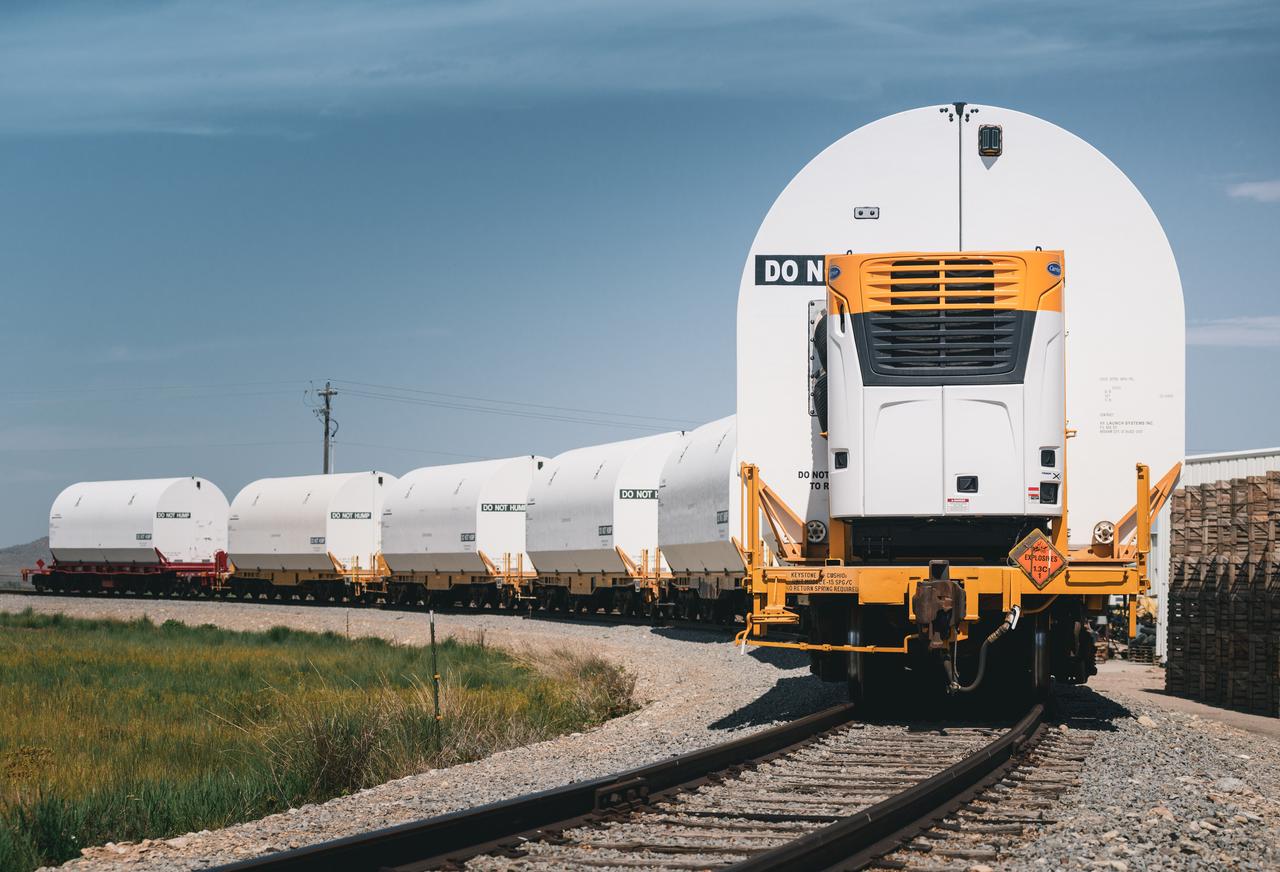
The two solid rocket boosters that will power NASA’s Space Launch System (SLS) for Artemis missions to the Moon are on their way to the agency’s Kennedy Space Center in Florida after departing from a Northrop Grumman manufacturing facility in Promontory, Utah, on June 5, 2020. The boosters – each comprised of five motor segments – are scheduled to arrive at Kennedy’s Rotation, Processing and Surge Facility, where teams with NASA’s Exploration Ground Systems will process the segments before moving them to the Vehicle Assembly Building for stacking on the mobile launcher. Under the Artemis program, NASA will land the first woman and the next man on the Moon by 2024. The first in a series of increasingly complex missions, Artemis I will test the Orion spacecraft and SLS as an integrated system ahead of crewed flights to the Moon.
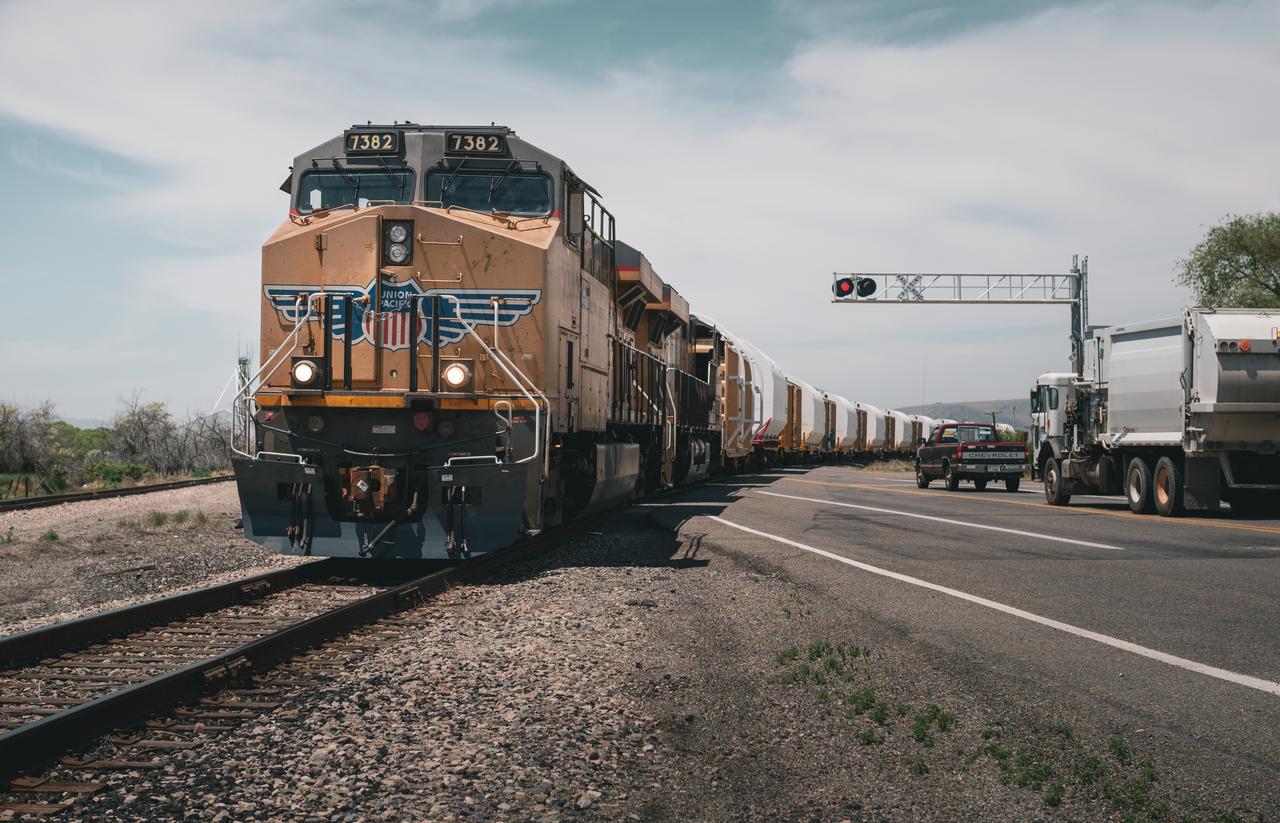
The two solid rocket boosters that will power NASA’s Space Launch System (SLS) for Artemis missions to the Moon are on their way to the agency’s Kennedy Space Center in Florida after departing from a Northrop Grumman manufacturing facility in Promontory, Utah, on June 5, 2020. The boosters – each comprised of five motor segments – are scheduled to arrive at Kennedy’s Rotation, Processing and Surge Facility, where teams with NASA’s Exploration Ground Systems will process the segments before moving them to the Vehicle Assembly Building for stacking on the mobile launcher. Under the Artemis program, NASA will land the first woman and the next man on the Moon by 2024. The first in a series of increasingly complex missions, Artemis I will test the Orion spacecraft and SLS as an integrated system ahead of crewed flights to the Moon.
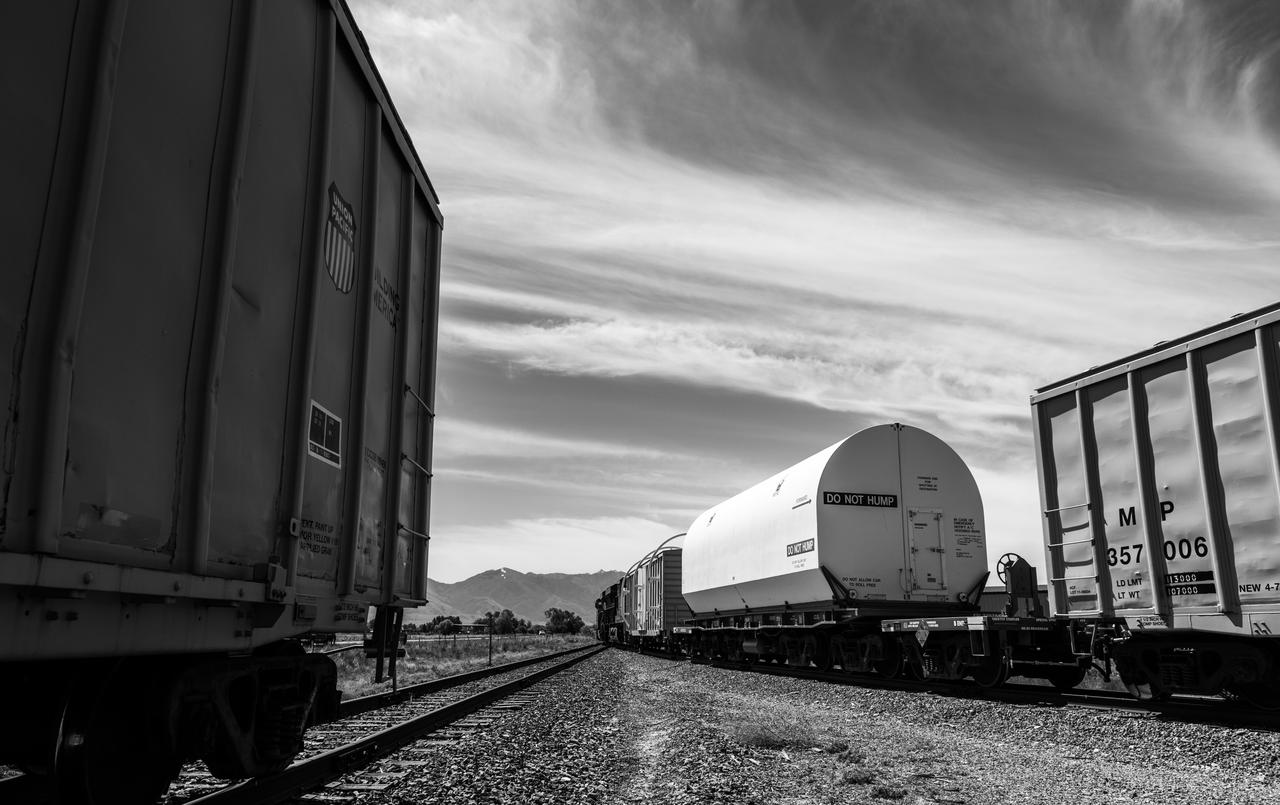
The two solid rocket boosters that will power NASA’s Space Launch System (SLS) for Artemis missions to the Moon are on their way to the agency’s Kennedy Space Center in Florida after departing from a Northrop Grumman manufacturing facility in Promontory, Utah, on June 5, 2020. The boosters – each comprised of five motor segments – are scheduled to arrive at Kennedy’s Rotation, Processing and Surge Facility, where teams with NASA’s Exploration Ground Systems will process the segments before moving them to the Vehicle Assembly Building for stacking on the mobile launcher. Under the Artemis program, NASA will land the first woman and the next man on the Moon by 2024. The first in a series of increasingly complex missions, Artemis I will test the Orion spacecraft and SLS as an integrated system ahead of crewed flights to the Moon.

“I grew up in Venezuela and studied in the military high school Gran Mariscal de Ayacucho. They would frequently bring in speakers, usually professional that were doing important work. Here comes Dr. Humberto Fernandez-Moran, a Venezuelan scientist working at NASA He was speaking to us about teamwork and he told an anecdote about this janitor that was mopping the floors in one of the NASA installations, when someone asked the man what he was doing. The janitor turned around and said “I’m sending people to the Moon.” In that moment I thought, “Wow, NASA is a really inclusive place to work because they value all the contributions of the people that work for them.” When I immigrated to the United States, I didn’t start my career at NASA. I worked in various positions in the private and public sector. When I saw this position open and applied, I was reminded of that story. Later on, I worked for NASA as part of the new employee orientation team for a little over a year I would share that story with the new hires to let them know that NASA was extremely inclusive and that their work would matter. Regardless of the scope of their contribution you were part of a team working toward the same goal. When someone asks me about my job? I respond with immense pride I am part of the Office of the General Counsel – International Law Practice Group and I send astronauts into space." NASA Legal Administrative Specialist, Linda Perozo, poses for a portrait outside her home in Maryland, Wednesday, Sept. 16, 2020. Photo Credit: (NASA/Aubrey Gemignani)
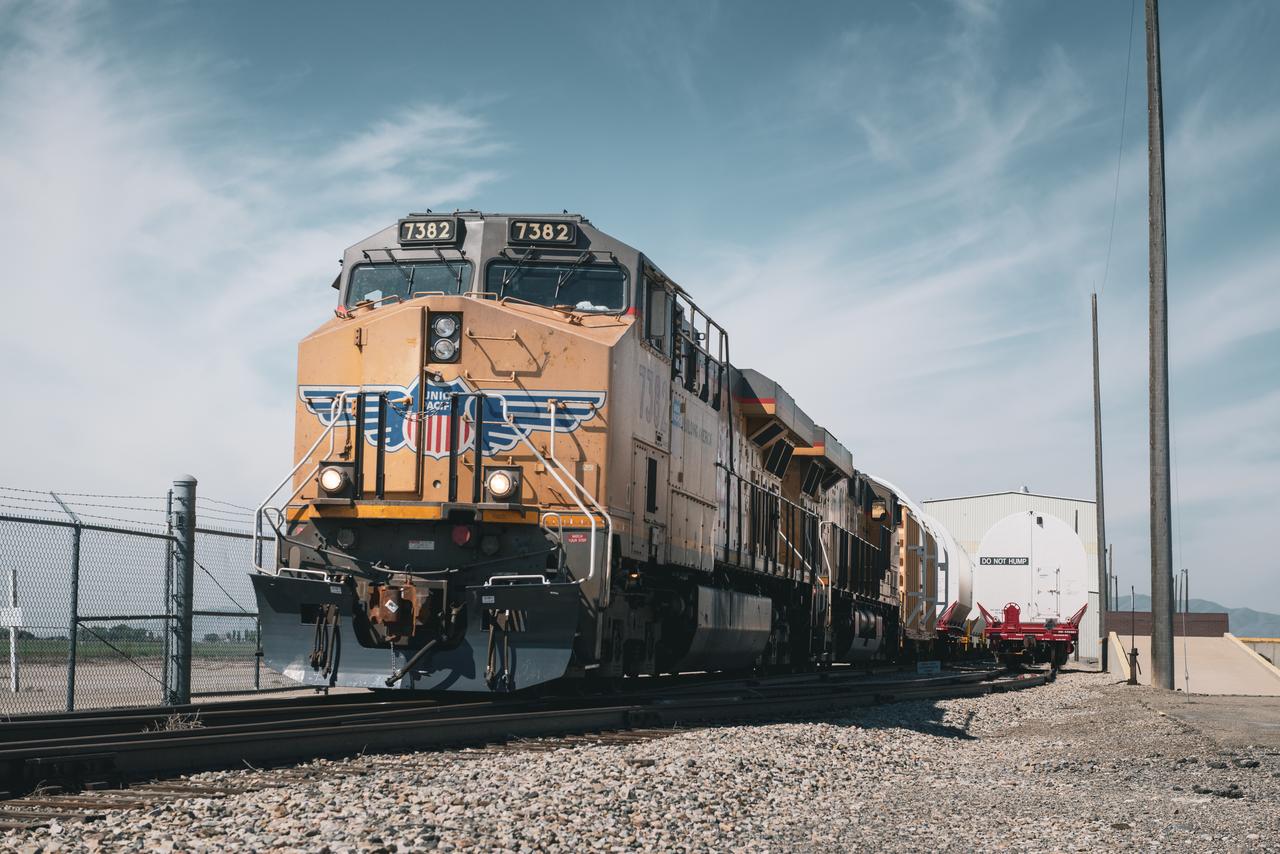
The two solid rocket boosters that will power NASA’s Space Launch System (SLS) for Artemis missions to the Moon are on their way to the agency’s Kennedy Space Center in Florida after departing from a Northrop Grumman manufacturing facility in Promontory, Utah, on June 5, 2020. The boosters – each comprised of five motor segments – are scheduled to arrive at Kennedy’s Rotation, Processing and Surge Facility, where teams with NASA’s Exploration Ground Systems will process the segments before moving them to the Vehicle Assembly Building for stacking on the mobile launcher. Under the Artemis program, NASA will land the first woman and the next man on the Moon by 2024. The first in a series of increasingly complex missions, Artemis I will test the Orion spacecraft and SLS as an integrated system ahead of crewed flights to the Moon.
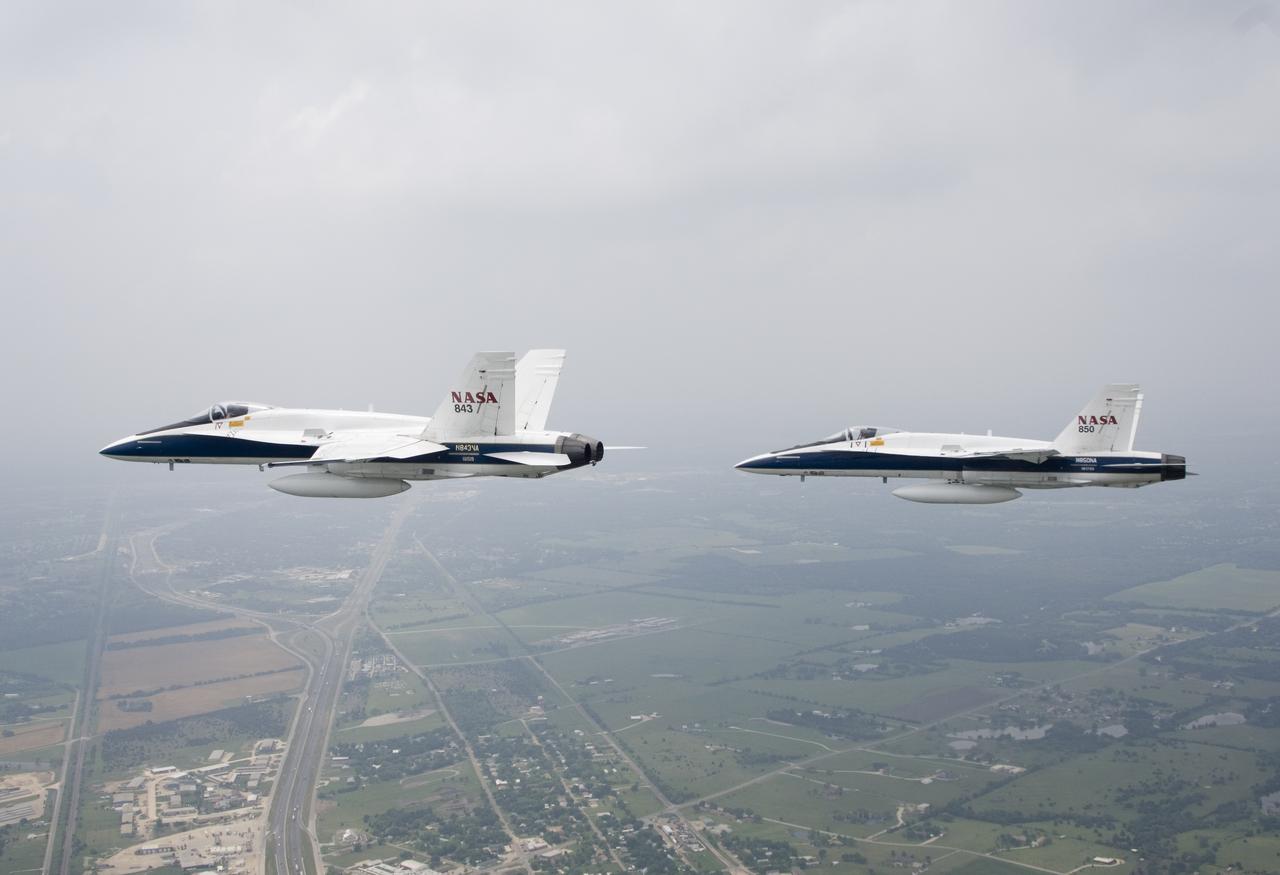
Two NASA F/A-18s flown by NASA Dryden research pilots Jim Smolka and Nils Larson cruise over the Texas landscape after supporting a SOFIA check flight in May 2007.
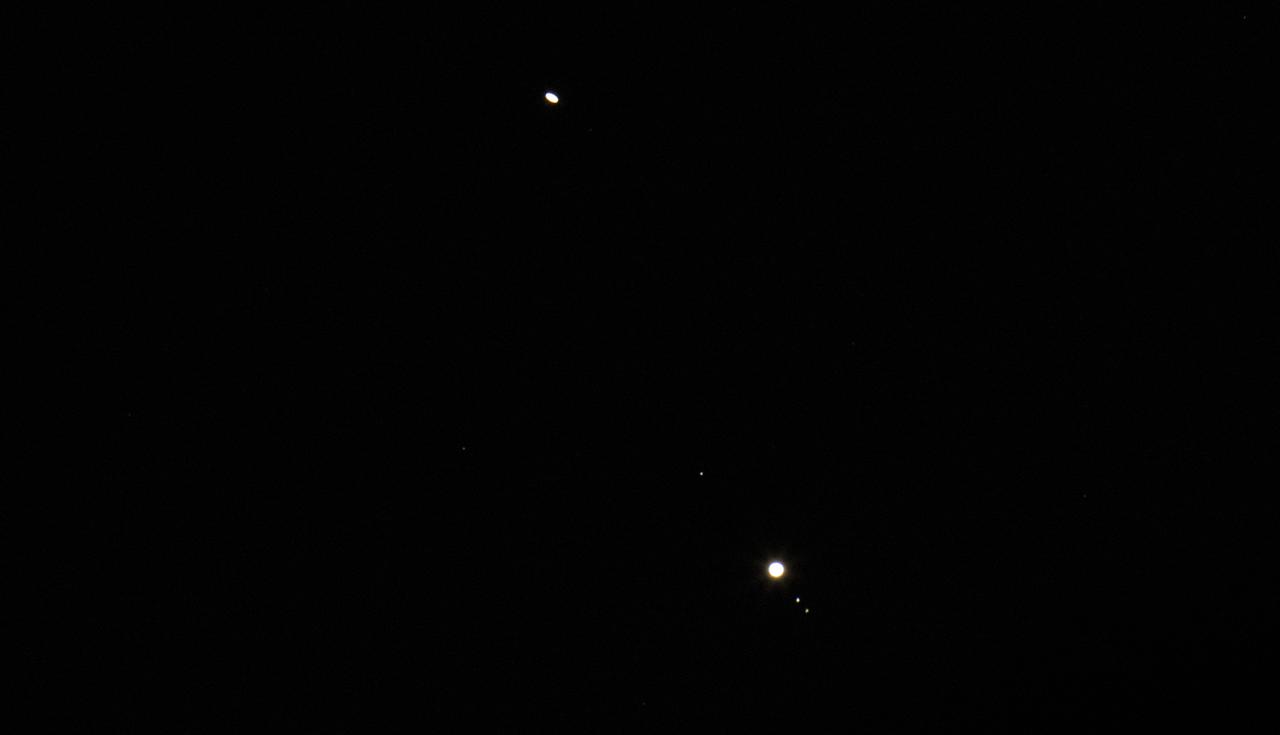
Saturn, top, and Jupiter, bottom, are seen after sunset from Alexandria, Va., Thursday, Dec. 17, 2020. The two planets are drawing closer to each other in the sky as they head towards a “great conjunction” on December 21, where the two giant planets will appear a tenth of a degree apart. Photo Credit: (NASA/Joel Kowsky)
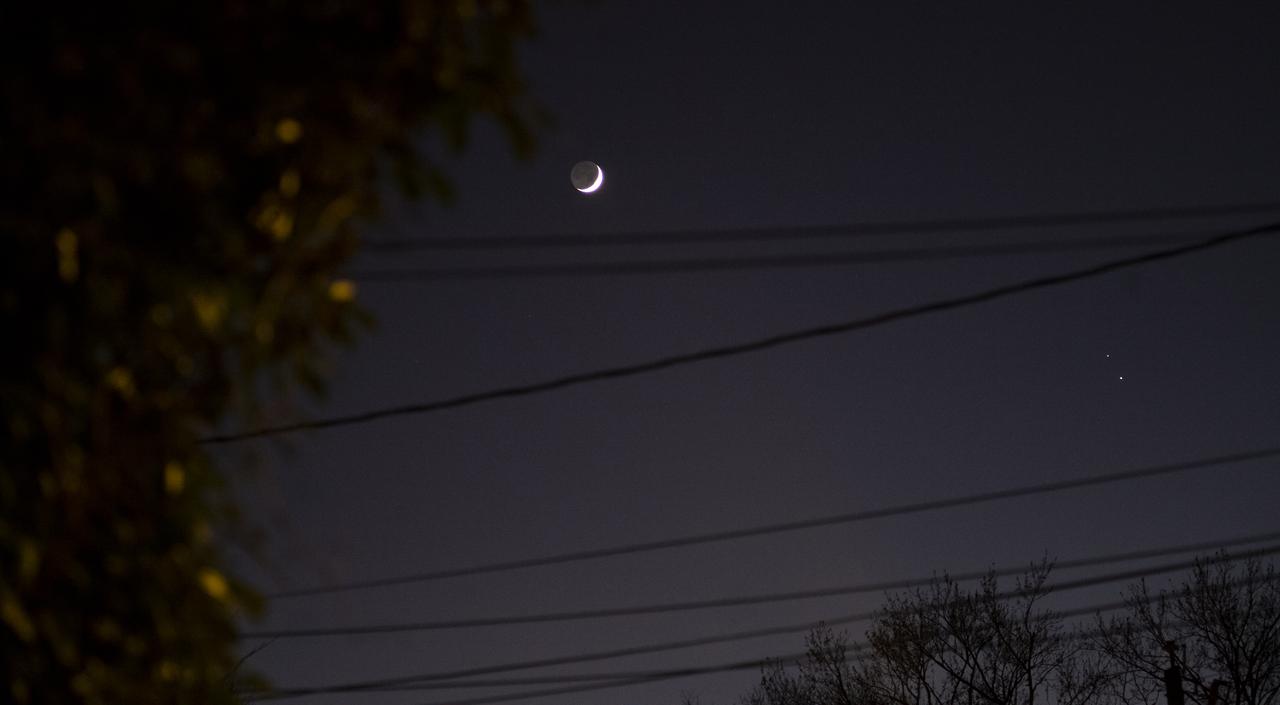
The Moon, left, Saturn, upper right, and Jupiter, lower right, are seen after sunset from Alexandria, Va., Thursday, Dec. 17, 2020. The two planets are drawing closer to each other in the sky as they head towards a “great conjunction” on December 21, where the two giant planets will appear a tenth of a degree apart. Photo Credit: (NASA/Joel Kowsky)
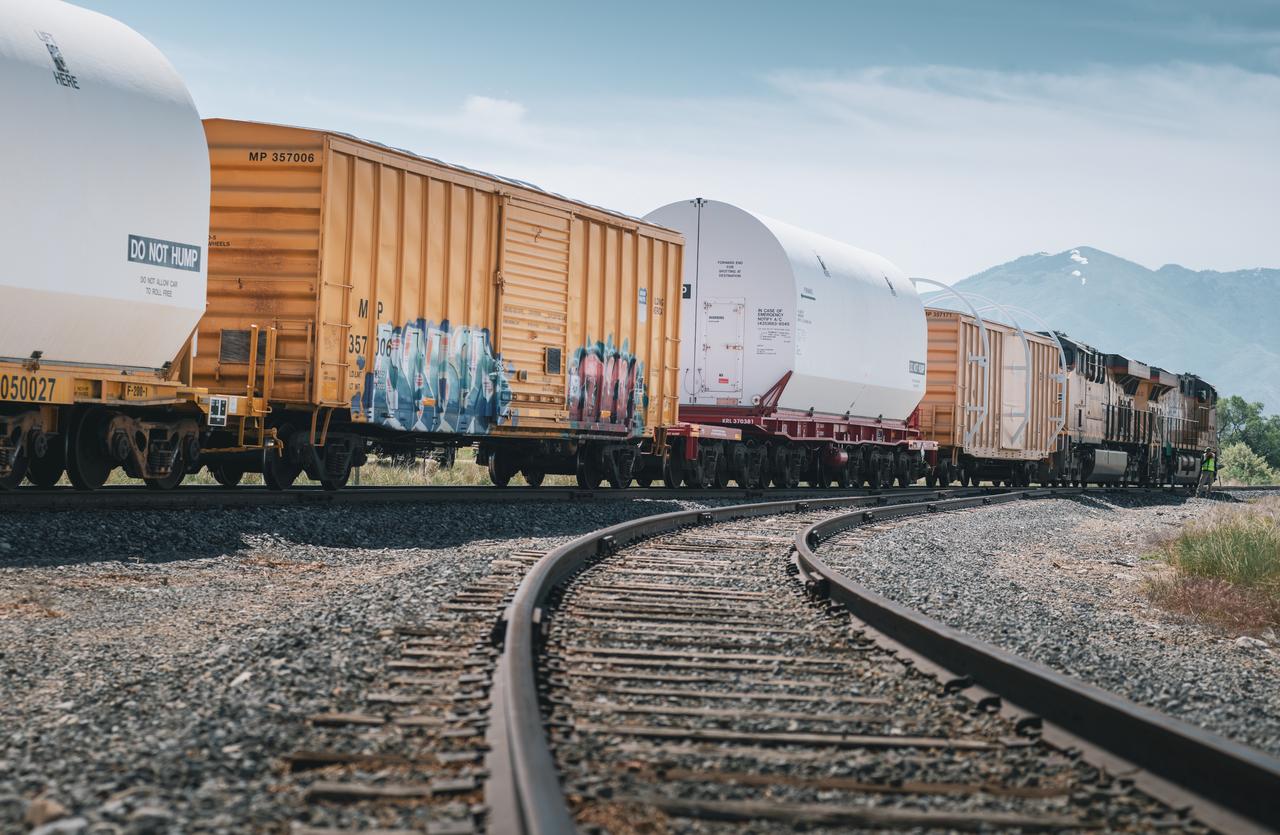
The two solid rocket boosters that will power NASA’s Space Launch System (SLS) for Artemis missions to the Moon are on their way to the agency’s Kennedy Space Center in Florida after departing from a Northrop Grumman manufacturing facility in Promontory, Utah, on June 5, 2020. The boosters – each comprised of five motor segments – are scheduled to arrive at Kennedy’s Rotation, Processing and Surge Facility, where teams with NASA’s Exploration Ground Systems will process the segments before moving them to the Vehicle Assembly Building for stacking on the mobile launcher. Under the Artemis program, NASA will land the first woman and the next man on the Moon by 2024. The first in a series of increasingly complex missions, Artemis I will test the Orion spacecraft and SLS as an integrated system ahead of crewed flights to the Moon.
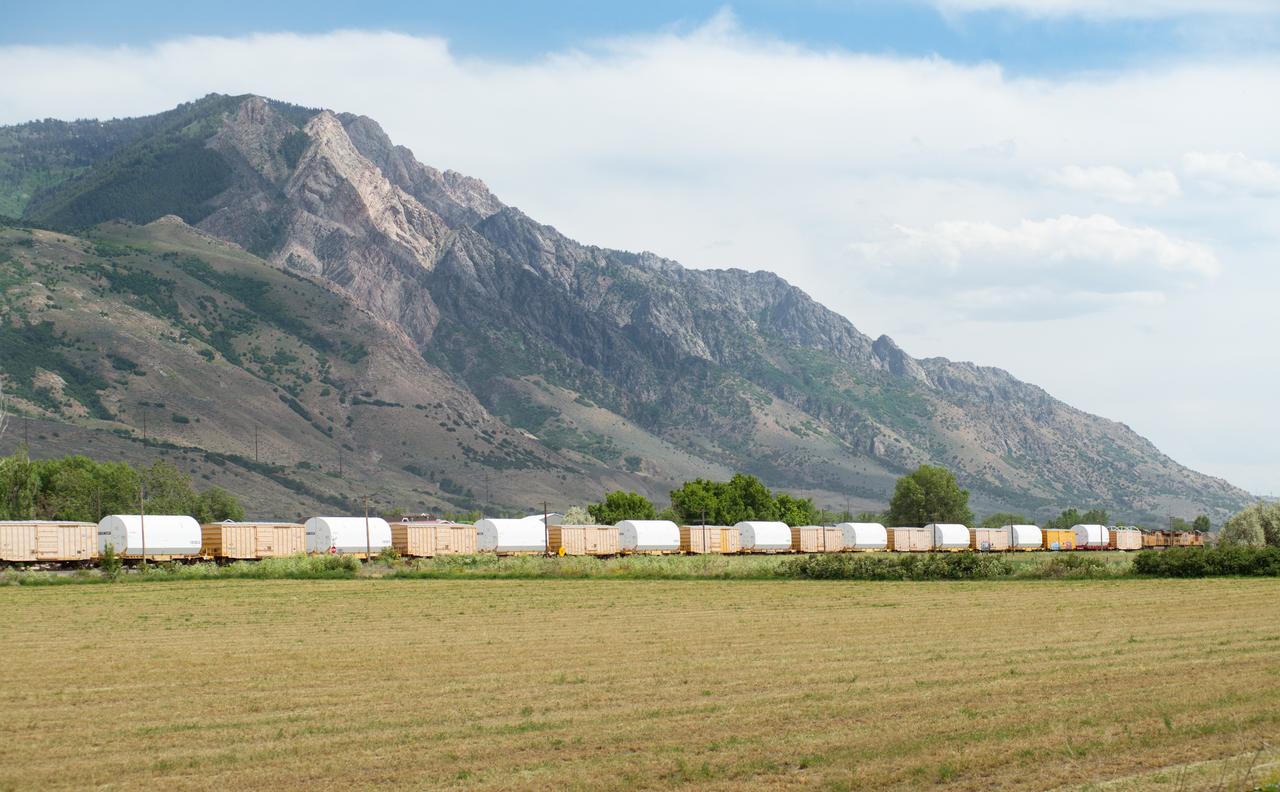
The two solid rocket boosters that will power NASA’s Space Launch System (SLS) for Artemis missions to the Moon are on their way to the agency’s Kennedy Space Center in Florida after departing from a Northrop Grumman manufacturing facility in Promontory, Utah, on June 5, 2020. The boosters – each comprised of five motor segments – are scheduled to arrive at Kennedy’s Rotation, Processing and Surge Facility, where teams with NASA’s Exploration Ground Systems will process the segments before moving them to the Vehicle Assembly Building for stacking on the mobile launcher. Under the Artemis program, NASA will land the first woman and the next man on the Moon by 2024. The first in a series of increasingly complex missions, Artemis I will test the Orion spacecraft and SLS as an integrated system ahead of crewed flights to the Moon.
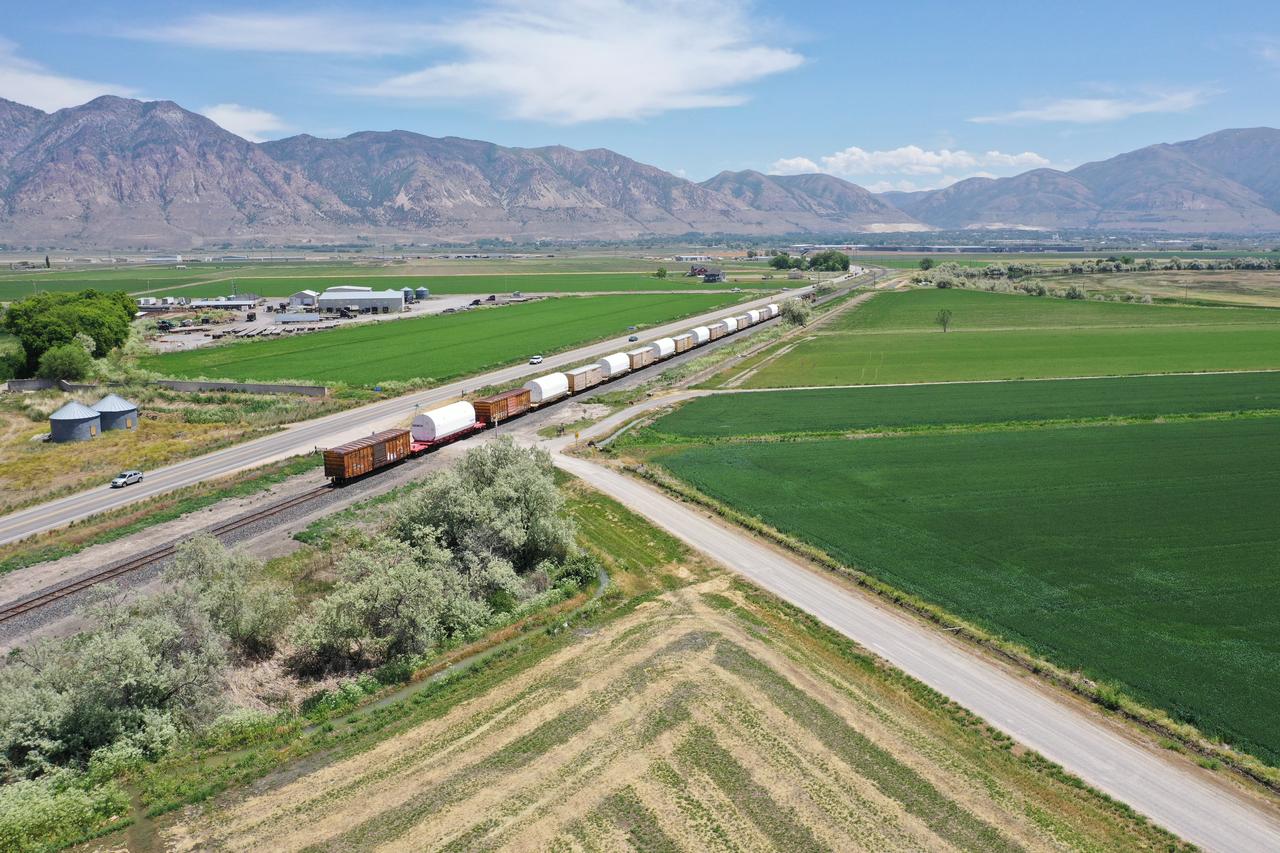
The two solid rocket boosters that will power NASA’s Space Launch System (SLS) for Artemis missions to the Moon are on their way to the agency’s Kennedy Space Center in Florida after departing from a Northrop Grumman manufacturing facility in Promontory, Utah, on June 5, 2020. The boosters – each comprised of five motor segments – are scheduled to arrive at Kennedy’s Rotation, Processing and Surge Facility, where teams with NASA’s Exploration Ground Systems will process the segments before moving them to the Vehicle Assembly Building for stacking on the mobile launcher. Under the Artemis program, NASA will land the first woman and the next man on the Moon by 2024. The first in a series of increasingly complex missions, Artemis I will test the Orion spacecraft and SLS as an integrated system ahead of crewed flights to the Moon.
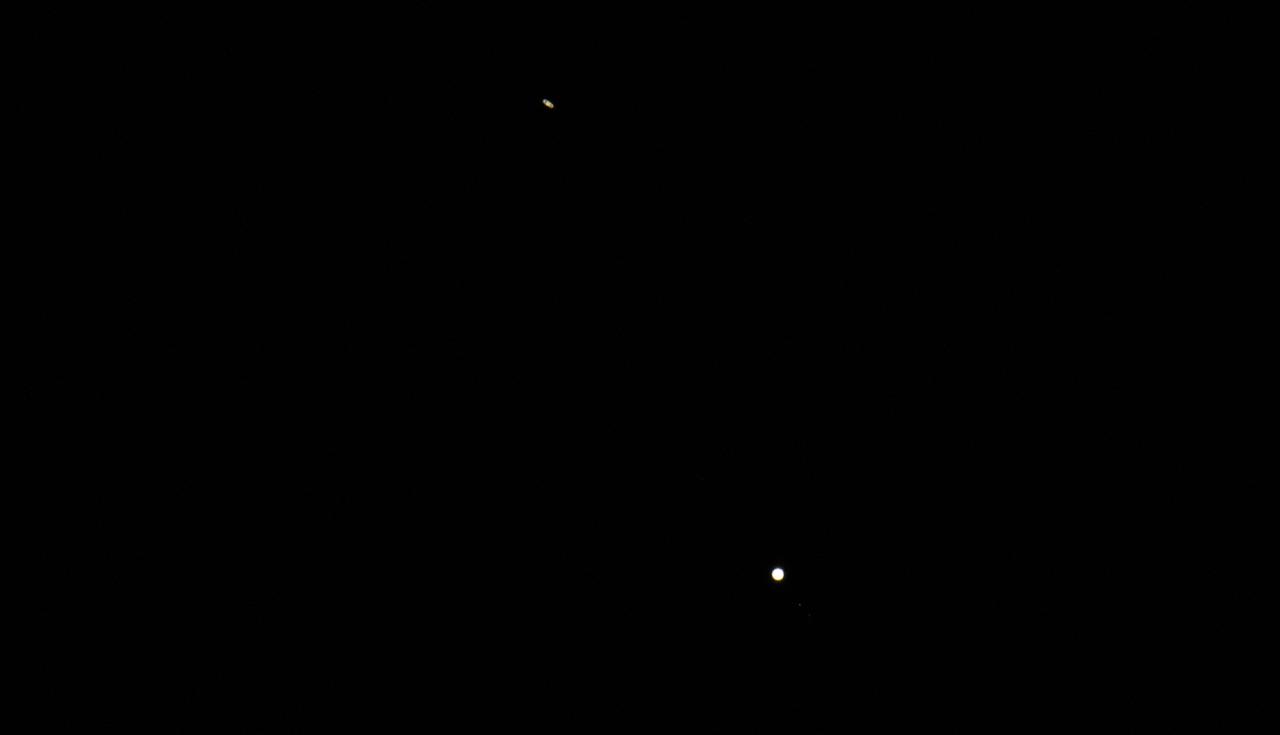
Saturn, top, and Jupiter, bottom, are seen after sunset from Alexandria, Va., Thursday, Dec. 17, 2020. The two planets are drawing closer to each other in the sky as they head towards a “great conjunction” on December 21, where the two giant planets will appear a tenth of a degree apart. Photo Credit: (NASA/Joel Kowsky)

The two solid rocket boosters that will power NASA’s Space Launch System (SLS) for Artemis missions to the Moon are on their way to the agency’s Kennedy Space Center in Florida after departing from a Northrop Grumman manufacturing facility in Promontory, Utah, on June 5, 2020. The boosters – each comprised of five motor segments – are scheduled to arrive at Kennedy’s Rotation, Processing and Surge Facility, where teams with NASA’s Exploration Ground Systems will process the segments before moving them to the Vehicle Assembly Building for stacking on the mobile launcher. Under the Artemis program, NASA will land the first woman and the next man on the Moon by 2024. The first in a series of increasingly complex missions, Artemis I will test the Orion spacecraft and SLS as an integrated system ahead of crewed flights to the Moon.
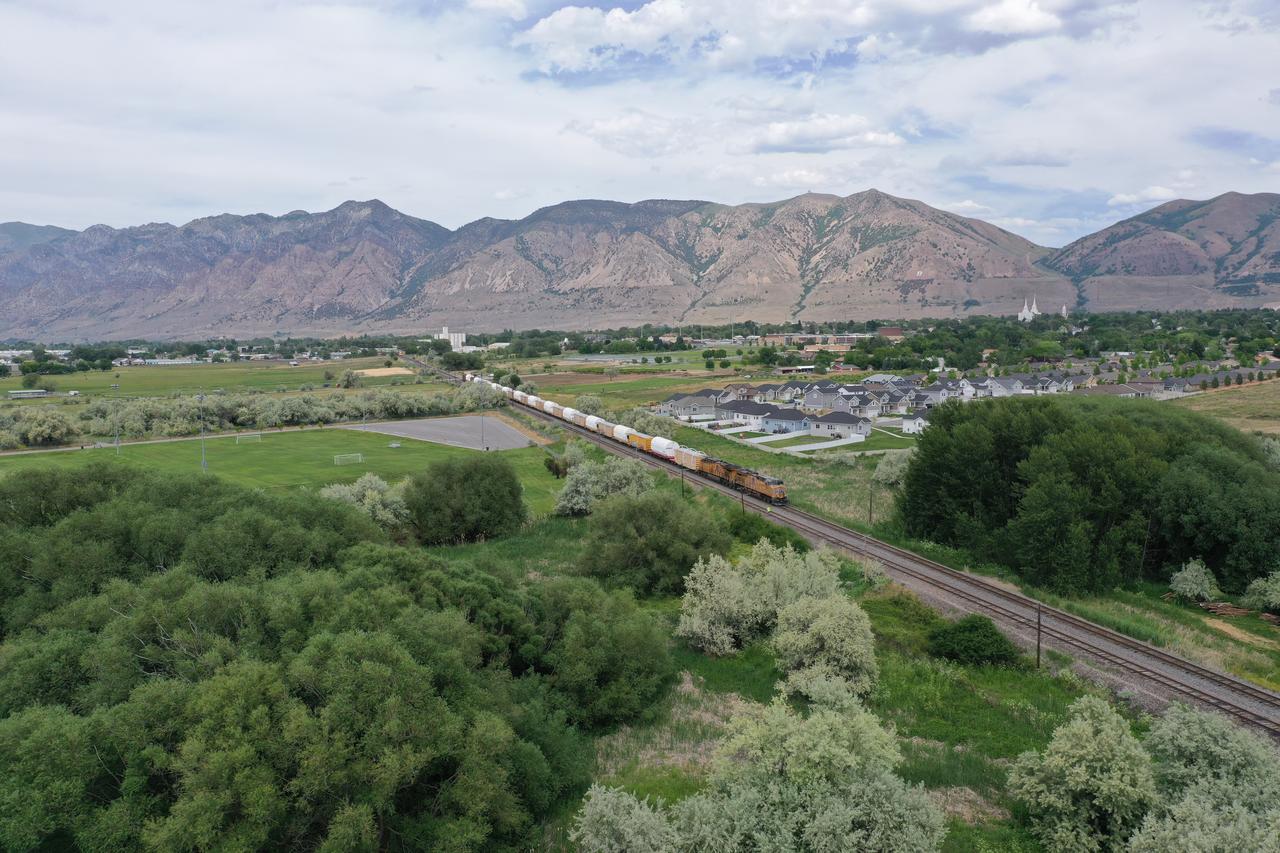
The two solid rocket boosters that will power NASA’s Space Launch System (SLS) for Artemis missions to the Moon are on their way to the agency’s Kennedy Space Center in Florida after departing from a Northrop Grumman manufacturing facility in Promontory, Utah, on June 5, 2020. The boosters – each comprised of five motor segments – are scheduled to arrive at Kennedy’s Rotation, Processing and Surge Facility, where teams with NASA’s Exploration Ground Systems will process the segments before moving them to the Vehicle Assembly Building for stacking on the mobile launcher. Under the Artemis program, NASA will land the first woman and the next man on the Moon by 2024. The first in a series of increasingly complex missions, Artemis I will test the Orion spacecraft and SLS as an integrated system ahead of crewed flights to the Moon.

Two solid rocket boosters that will power NASA’s Space Launch System (SLS) for Artemis missions to the Moon are being transported from a Northrop Grumman manufacturing facility in Promontory, Utah, to the agency’s Kennedy Space Center in Florida by railcar. Departing on June 5, 2020, the boosters – each comprised of five motor segments – are scheduled to arrive at Kennedy’s Rotation, Processing and Surge Facility, where teams with NASA’s Exploration Ground Systems will process the segments before moving them to the Vehicle Assembly Building for stacking on the mobile launcher. Under the Artemis program, NASA will land the first woman and the next man on the Moon by 2024. The first in a series of increasingly complex missions, Artemis I will test the Orion spacecraft and SLS as an integrated system ahead of crewed flights to the Moon.

"When I left college, I went to go work in investment banking on Wall Street. It was one of these experiences where people said, ‘that’s the most awesome job ever. How did you manage to do that?’ But once I was inside that world, I felt very disconnected from people. I felt like the world was passing me by while I was inside cars going to business meetings and dinners. And I really wasn’t interacting with people, or understanding the challenges they were going through. So I applied to a number of medical schools. Once I got my letters of acceptance, I just chose one and I went. Then I felt like I was really doing what I wanted to do. I had a tremendous experience in my training and my classes. I just felt like, ‘wow. This is what I’m meant to do.’ Everybody has their thing. Everybody has a place where they shine. And for me, it’s being a physician, helping people heal, solving medical problems. Helping people feel better in their own bodies, no matter what that looks like." NASA Headquarters Medical Director, Dr. Andrea Fore, poses for a portrait while working from home during the COVID-19 pandemic, Monday, July 13, 2020 in Maryland. Photo Credit: (NASA/Aubrey Gemignani)
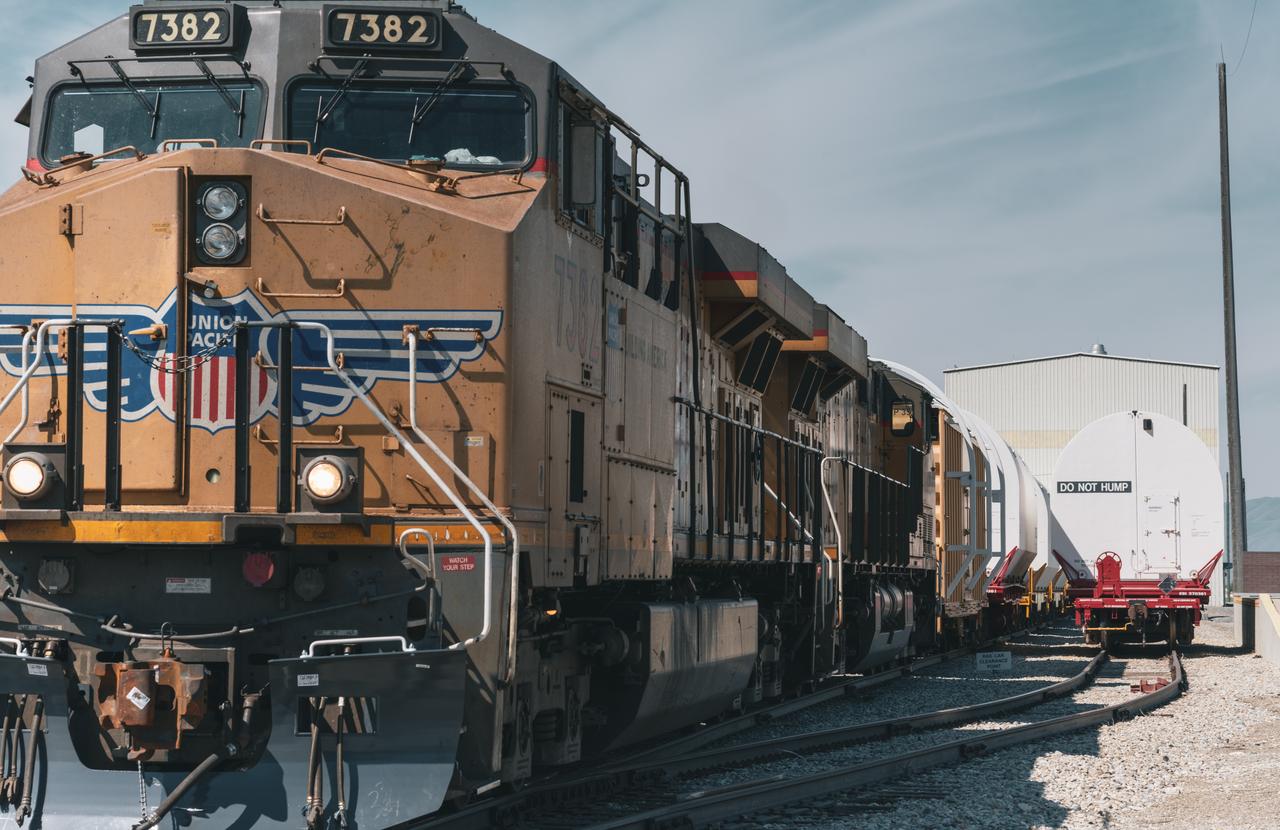
The two solid rocket boosters that will power NASA’s Space Launch System (SLS) for Artemis missions to the Moon are on their way to the agency’s Kennedy Space Center in Florida after departing from a Northrop Grumman manufacturing facility in Promontory, Utah, on June 5, 2020. The boosters – each comprised of five motor segments – are scheduled to arrive at Kennedy’s Rotation, Processing and Surge Facility, where teams with NASA’s Exploration Ground Systems will process the segments before moving them to the Vehicle Assembly Building for stacking on the mobile launcher. Under the Artemis program, NASA will land the first woman and the next man on the Moon by 2024. The first in a series of increasingly complex missions, Artemis I will test the Orion spacecraft and SLS as an integrated system ahead of crewed flights to the Moon.
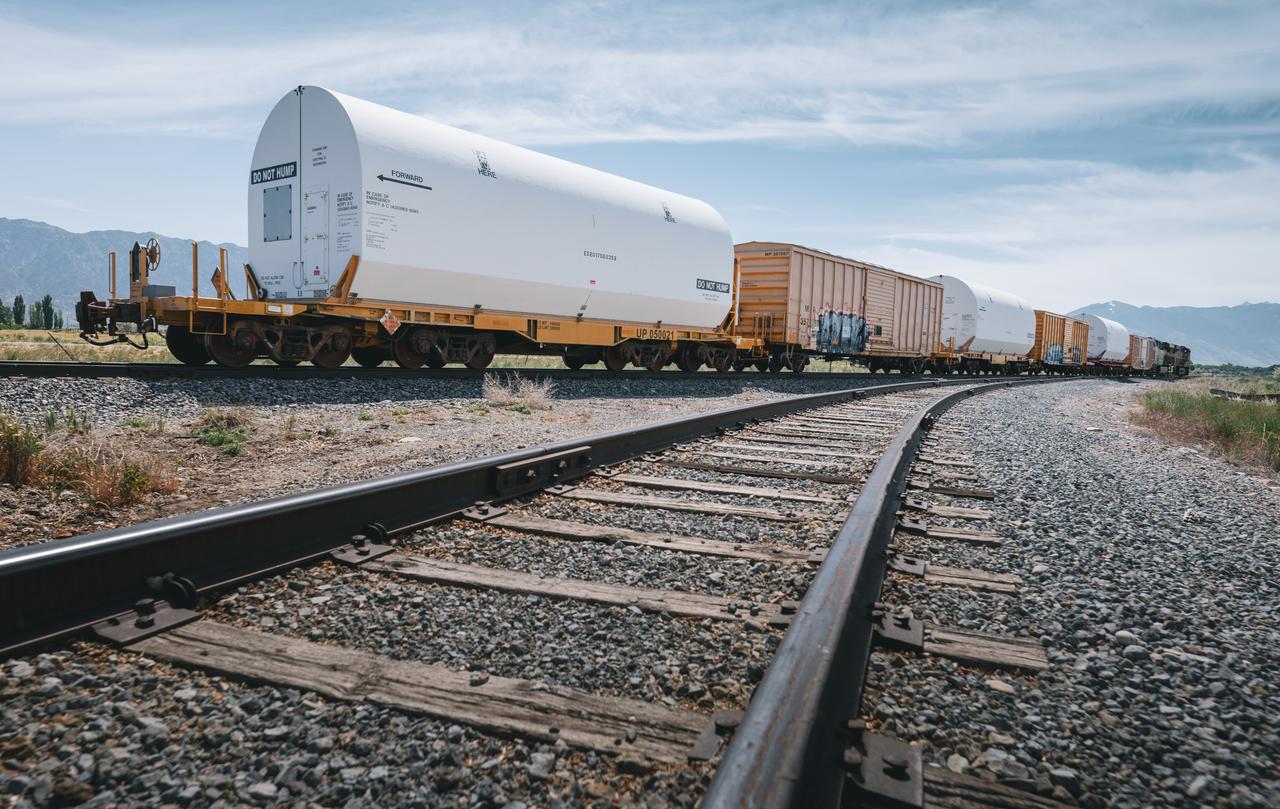
The two solid rocket boosters that will power NASA’s Space Launch System (SLS) for Artemis missions to the Moon are on their way to the agency’s Kennedy Space Center in Florida after departing from a Northrop Grumman manufacturing facility in Promontory, Utah, on June 5, 2020. The boosters – each comprised of five motor segments – are scheduled to arrive at Kennedy’s Rotation, Processing and Surge Facility, where teams with NASA’s Exploration Ground Systems will process the segments before moving them to the Vehicle Assembly Building for stacking on the mobile launcher. Under the Artemis program, NASA will land the first woman and the next man on the Moon by 2024. The first in a series of increasingly complex missions, Artemis I will test the Orion spacecraft and SLS as an integrated system ahead of crewed flights to the Moon.
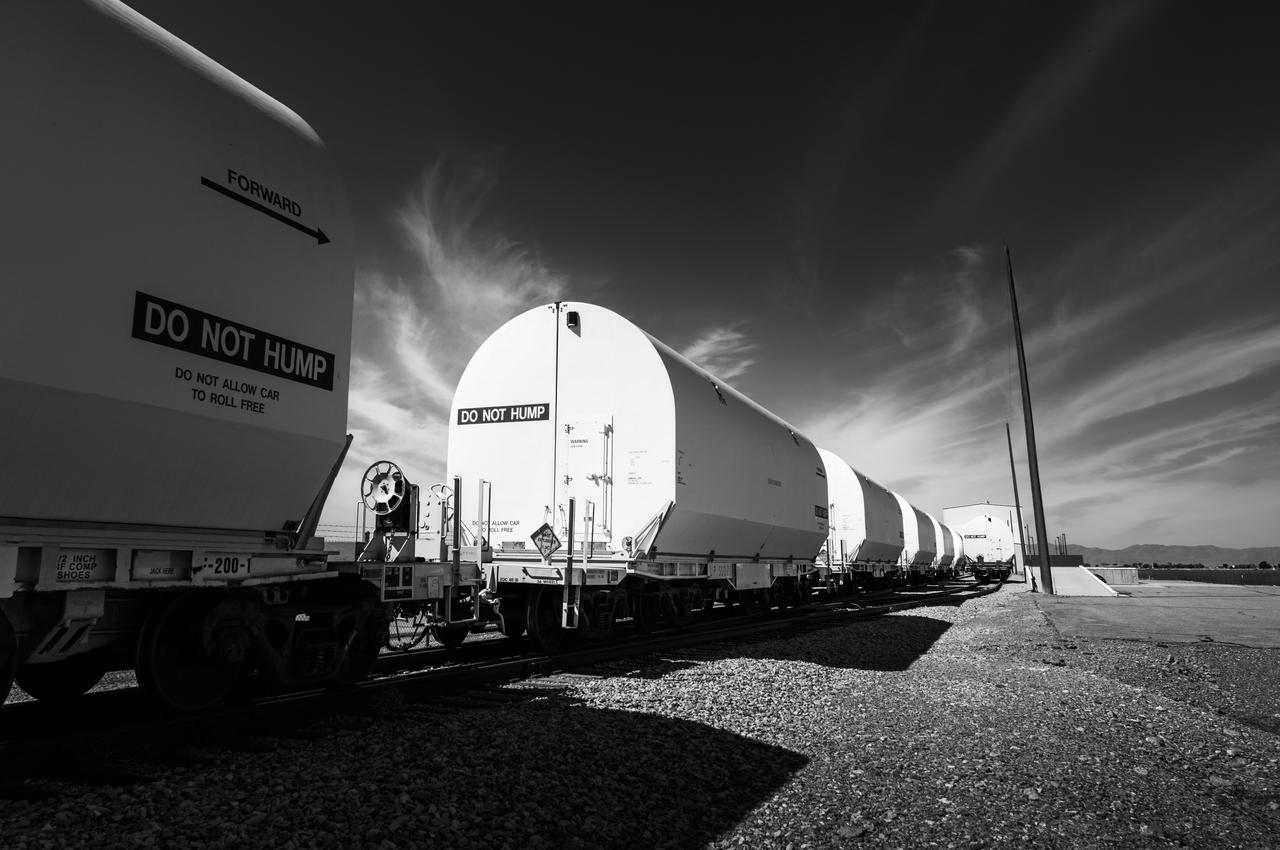
The two solid rocket boosters that will power NASA’s Space Launch System (SLS) for Artemis missions to the Moon are on their way to the agency’s Kennedy Space Center in Florida after departing from a Northrop Grumman manufacturing facility in Promontory, Utah, on June 5, 2020. The boosters – each comprised of five motor segments – are scheduled to arrive at Kennedy’s Rotation, Processing and Surge Facility, where teams with NASA’s Exploration Ground Systems will process the segments before moving them to the Vehicle Assembly Building for stacking on the mobile launcher. Under the Artemis program, NASA will land the first woman and the next man on the Moon by 2024. The first in a series of increasingly complex missions, Artemis I will test the Orion spacecraft and SLS as an integrated system ahead of crewed flights to the Moon.
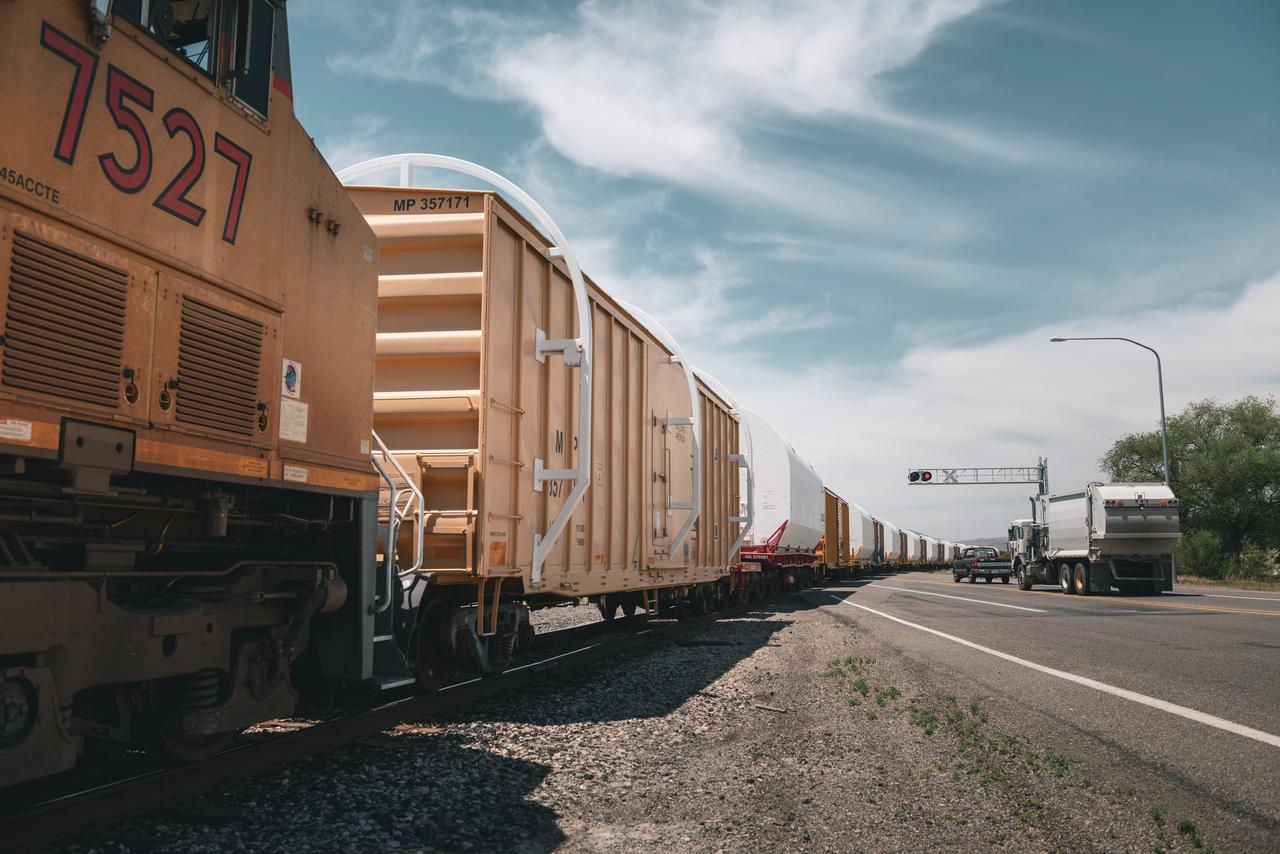
The two solid rocket boosters that will power NASA’s Space Launch System (SLS) for Artemis missions to the Moon are on their way to the agency’s Kennedy Space Center in Florida after departing from a Northrop Grumman manufacturing facility in Promontory, Utah, on June 5, 2020. The boosters – each comprised of five motor segments – are scheduled to arrive at Kennedy’s Rotation, Processing and Surge Facility, where teams with NASA’s Exploration Ground Systems will process the segments before moving them to the Vehicle Assembly Building for stacking on the mobile launcher. Under the Artemis program, NASA will land the first woman and the next man on the Moon by 2024. The first in a series of increasingly complex missions, Artemis I will test the Orion spacecraft and SLS as an integrated system ahead of crewed flights to the Moon.
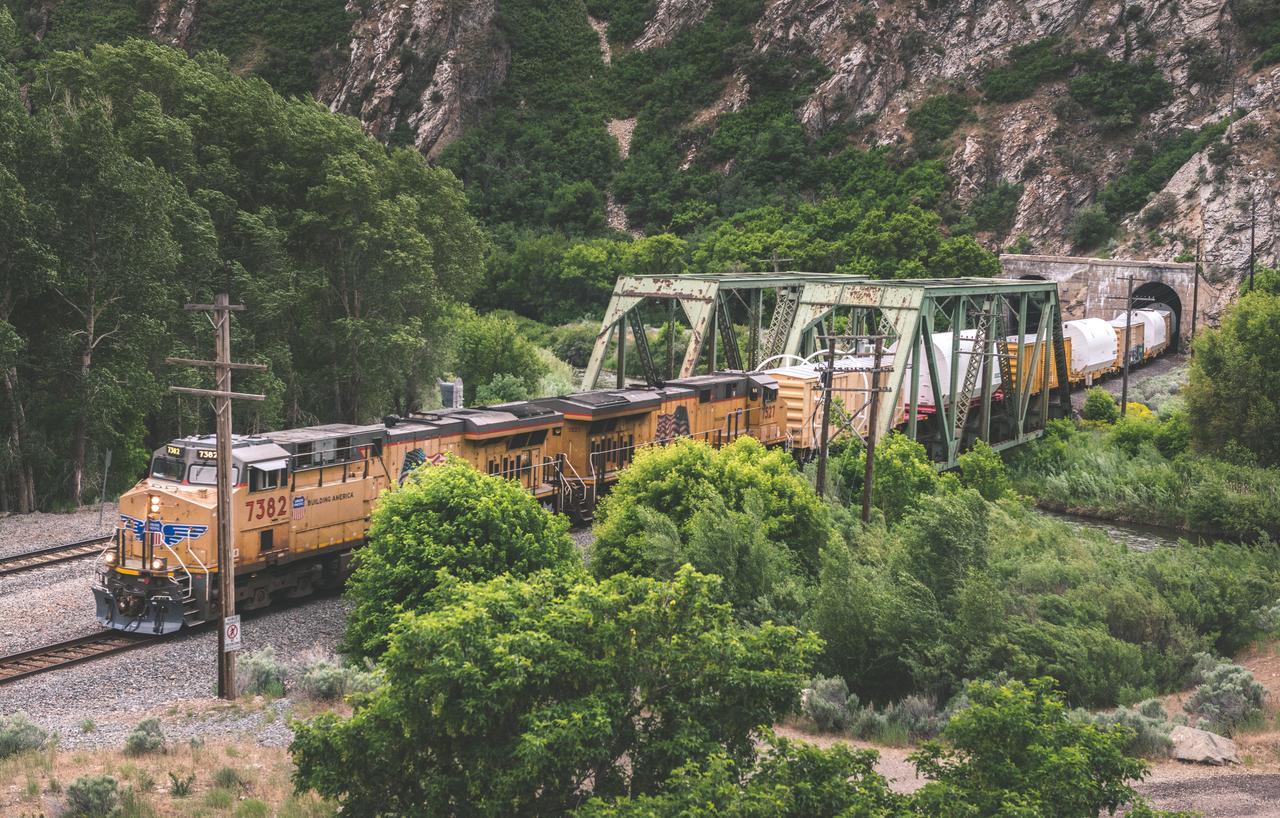
The two solid rocket boosters that will power NASA’s Space Launch System (SLS) for Artemis missions to the Moon are on their way to the agency’s Kennedy Space Center in Florida after departing from a Northrop Grumman manufacturing facility in Promontory, Utah, on June 5, 2020. The boosters – each comprised of five motor segments – are scheduled to arrive at Kennedy’s Rotation, Processing and Surge Facility, where teams with NASA’s Exploration Ground Systems will process the segments before moving them to the Vehicle Assembly Building for stacking on the mobile launcher. Under the Artemis program, NASA will land the first woman and the next man on the Moon by 2024. The first in a series of increasingly complex missions, Artemis I will test the Orion spacecraft and SLS as an integrated system ahead of crewed flights to the Moon.
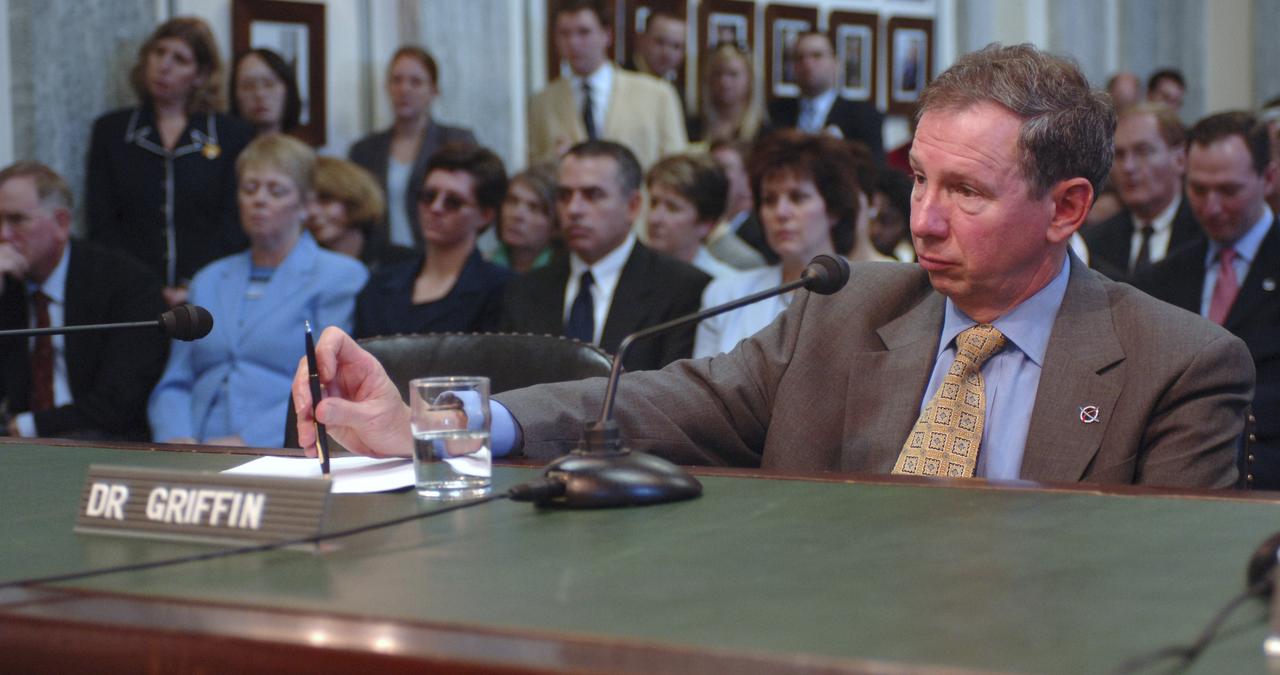
Dr. Michael Griffin testifies, Tuesday, April 12, 2005, during his confirmation hearing before the U.S. Senate Commerce Committee at the Russell Senate Office Building in Washington. If confirmed, Griffin, who currently heads the space department at the Johns Hopkins University Applied Physics Laboratory will become NASA's 11th administrator. Photo Credit (NASA/Renee Bouchard)
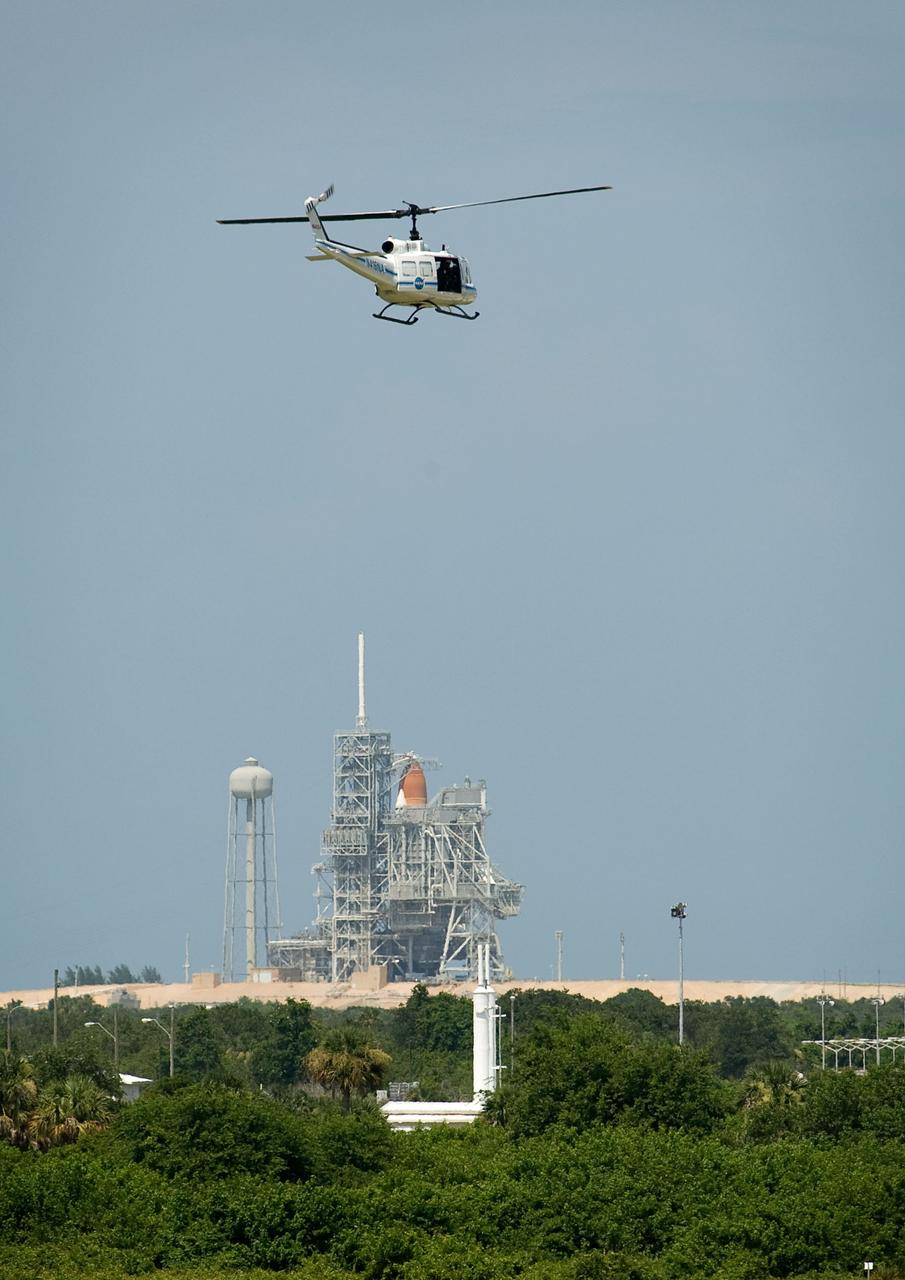
A NASA Security helicopter watches over the Astrovan as it takes the crew of STS-127 to the space shuttle Endeavour at pad 39a at NASA's Kennedy Space Center in Cape Canaveral, Florida, Saturday, July 12, 2009. Endeavour is set to launch at 7:13p.m. EDT with the crew of STS-127 and start a 16-day mission that will feature five spacewalks and complete construction of the Japan Aerospace Exploration Agency's Kibo laboratory. Photo Credit: (NASA/Bill Ingalls)
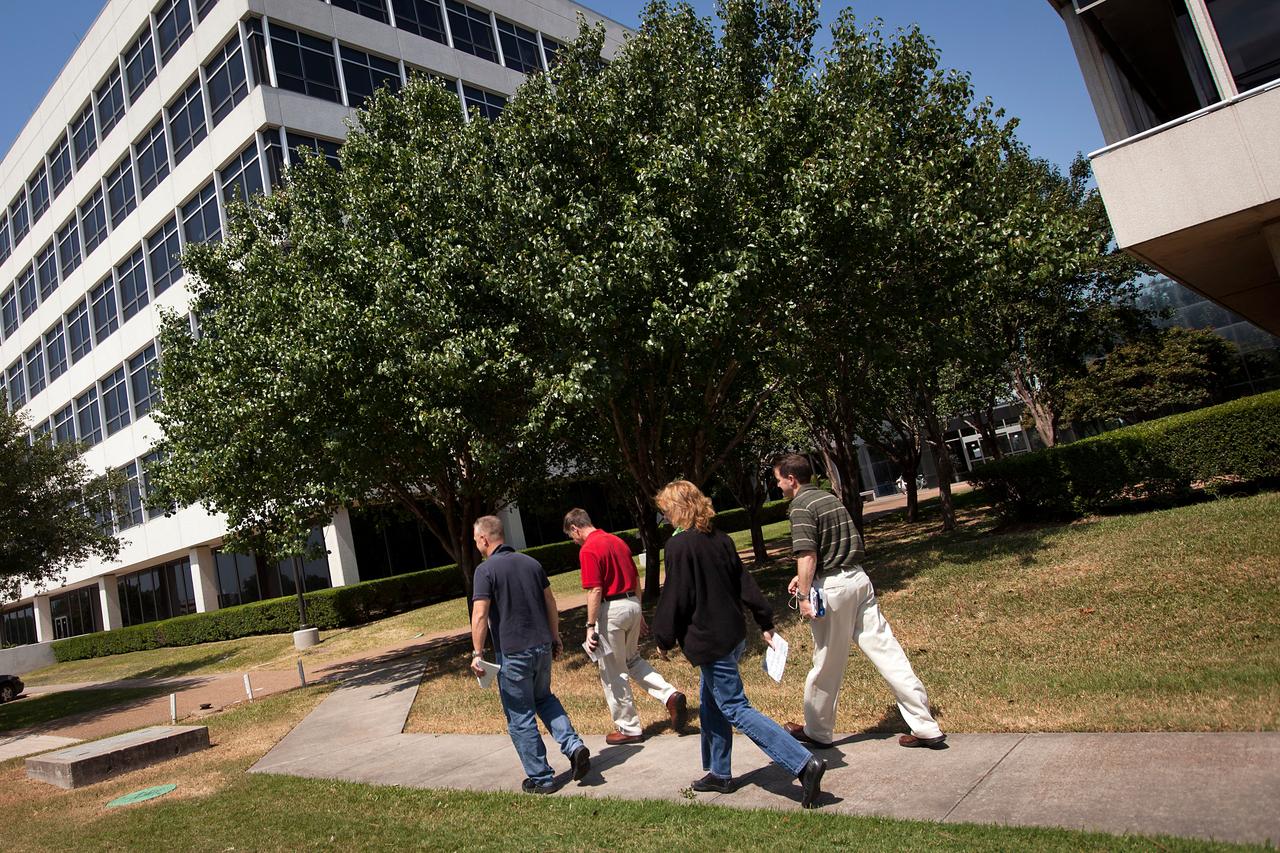
The crew of STS-135, from left, Doug Hurley, Chris Ferguson, Sandy Magnus and Rex Walheim walk between buildings at the Johnson Space Center after a simulation in the motion based simulator on Friday, May 6, 2011, in Houston. ( NASA Photo / Houston Chronicle, Smiley N. Pool ).

The Mars celebration Friday, May 31, 2019, in Mars, Pennsylvania. NASA is in the small town to celebrate Mars exploration and share the agency’s excitement about landing astronauts on the Moon in five years. The celebration includes a weekend of Science, Technology, Engineering, Arts and Mathematics (STEAM) activities. Photo Credit: (NASA/Bill Ingalls)

NASA Chief Technologist Douglas Terrier gives opening remarks during a Mars celebration Friday, May 31, 2019, in Mars, Pennsylvania. NASA is in the small town to celebrate Mars exploration and share the agency’s excitement about landing astronauts on the Moon in five years. The celebration includes a weekend of Science, Technology, Engineering, Arts and Mathematics (STEAM) activities. Photo Credit: (NASA/Bill Ingalls)
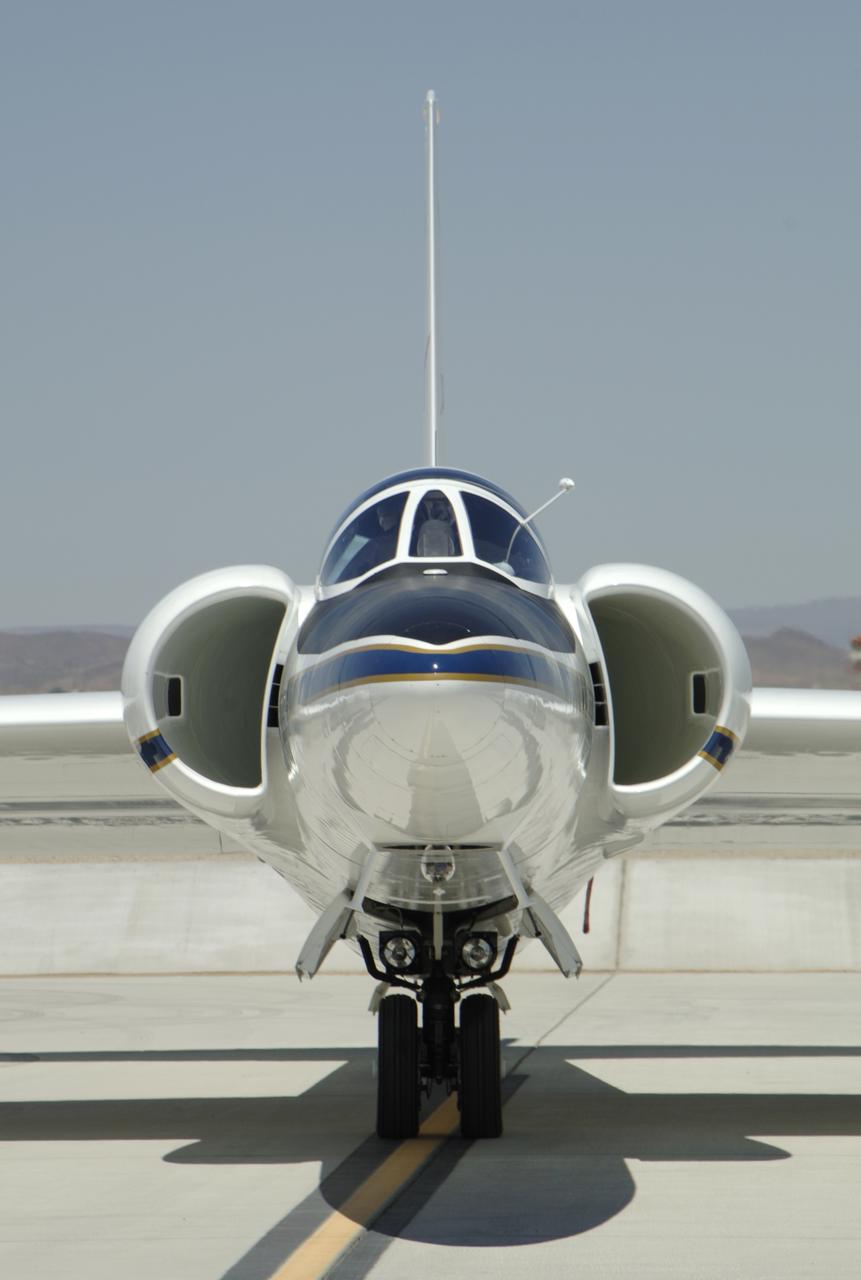
The large air intakes for its powerful engine are obvious as NASA's high-flying ER-2 #806 Earth resources aircraft taxies out for another science mission.

NOAA Administrator, Vice Admiral Conrad C. Lautenbacher, Jr., U.S. Navy (Ret.), is seen on a television monitor as he testifies before the House Committee on Science and Technology regarding the future of the National Polar-orbiting Operational Environmental Satellite System (NPOESS) and results of the Nunn-McCurdy review of NOAA’s weather satellite program, Thursday, June 8, 2006, at the Rayburn House Office Building in Washington. Photo Credit: (NASA/Bill Ingalls)
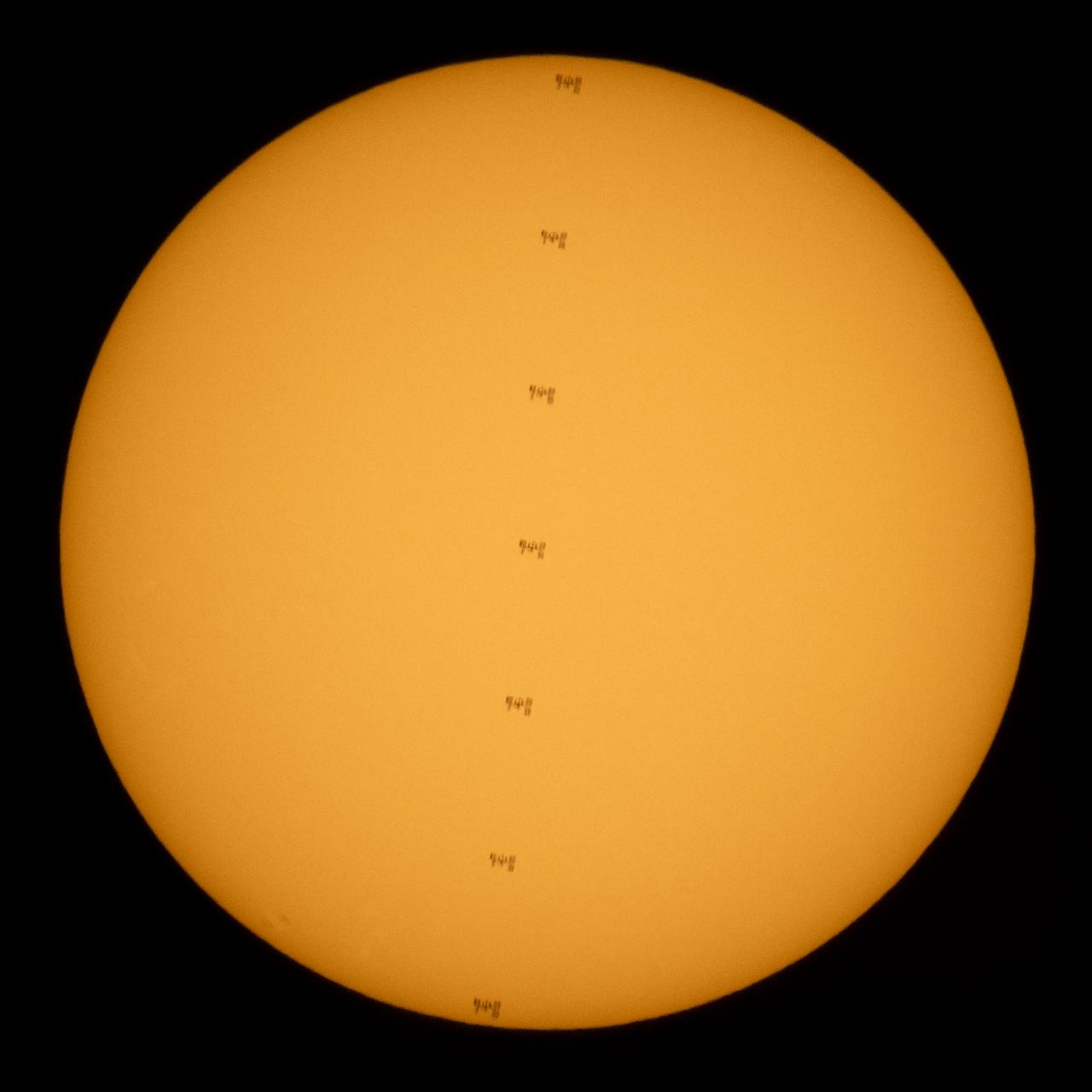
This composite image made from seven frames shows the International Space Station, with a crew of seven onboard, in silhouette as it transits the Sun at roughly five miles per second, Friday, June 25, 2021, from near Nellysford, Va. Onboard are Expedition 65 NASA astronauts Megan McArthur, Mark Vande Hei, Shane Kimbrough, ESA (European Space Agency) astronaut Thomas Pesquet, Japan Aerospace Exploration Agency (JAXA) astronaut Akihiko Hoshide, and Roscosmos cosmonauts Pyotr Dubrov and Oleg Novitskiy. At the time of the transit, Kimbrough and Pesquet were working outside on the station’s port 6 truss to install the second ISS Roll-Out Solar Array (iROSA) on the 4B power channel. Photo Credit: (NASA/Joel Kowsky)
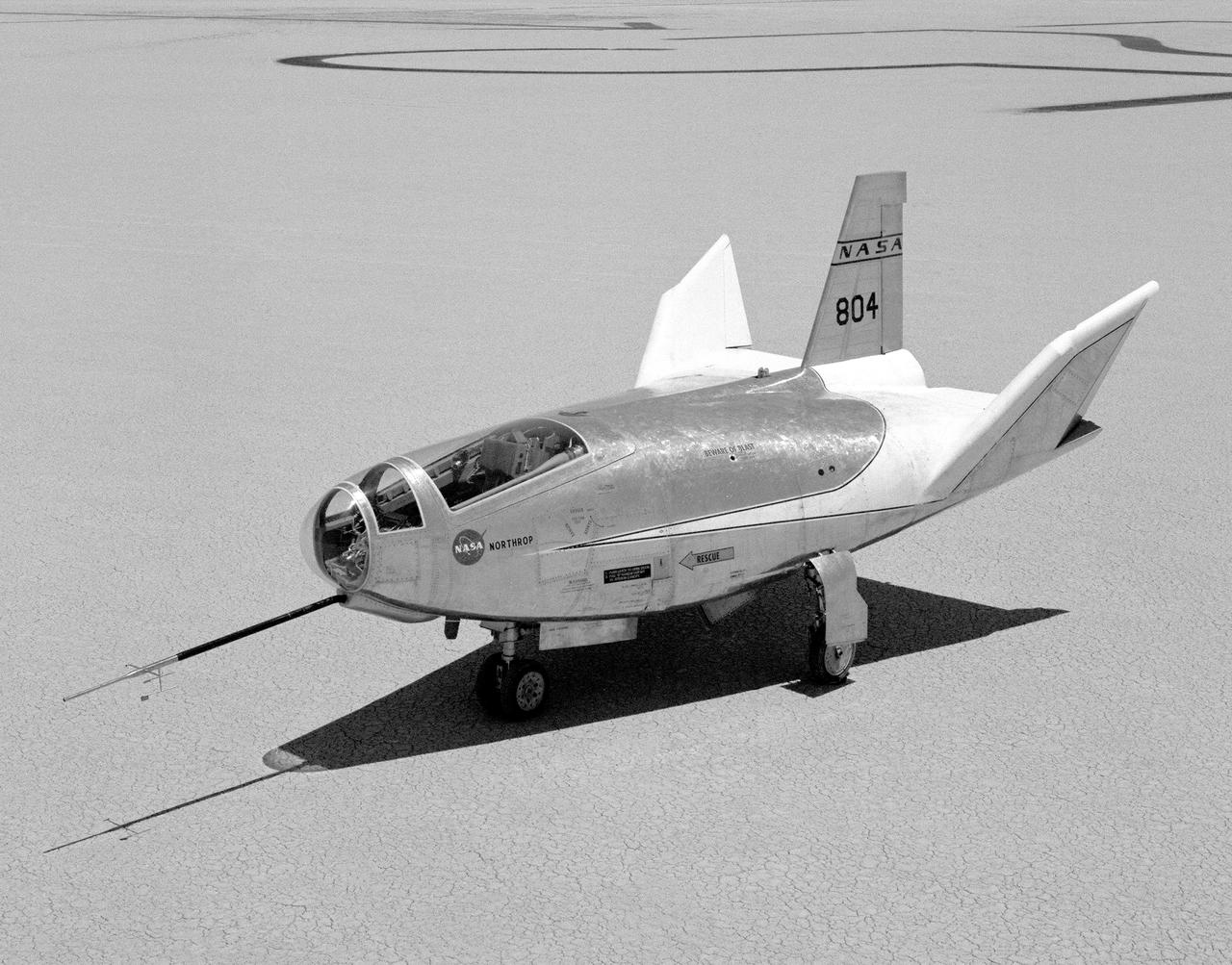
The HL-10 Lifting Body is seen here parked on Rogers Dry Lake, the unique location where it landed after research flights. This 1968 photo shows the vehicle after the fins were modified to remove instabilities encountered on the first flight. It involved a change to the shape of the leading edge of the fins to eliminate flow separation. It required extensive wind-tunnel testing at Langley Research Center, Hampton, Va. NASA Flight Research Center (FRC) engineer Bob Kempel than plotted thousands of data points by hand to come up with the modification, which involved a fiberglass glove backed with a metal structure on each fin's leading edge. This transformed the vehicle from a craft that was difficult to control into the best handling of the original group of lifting bodies at the FRC.
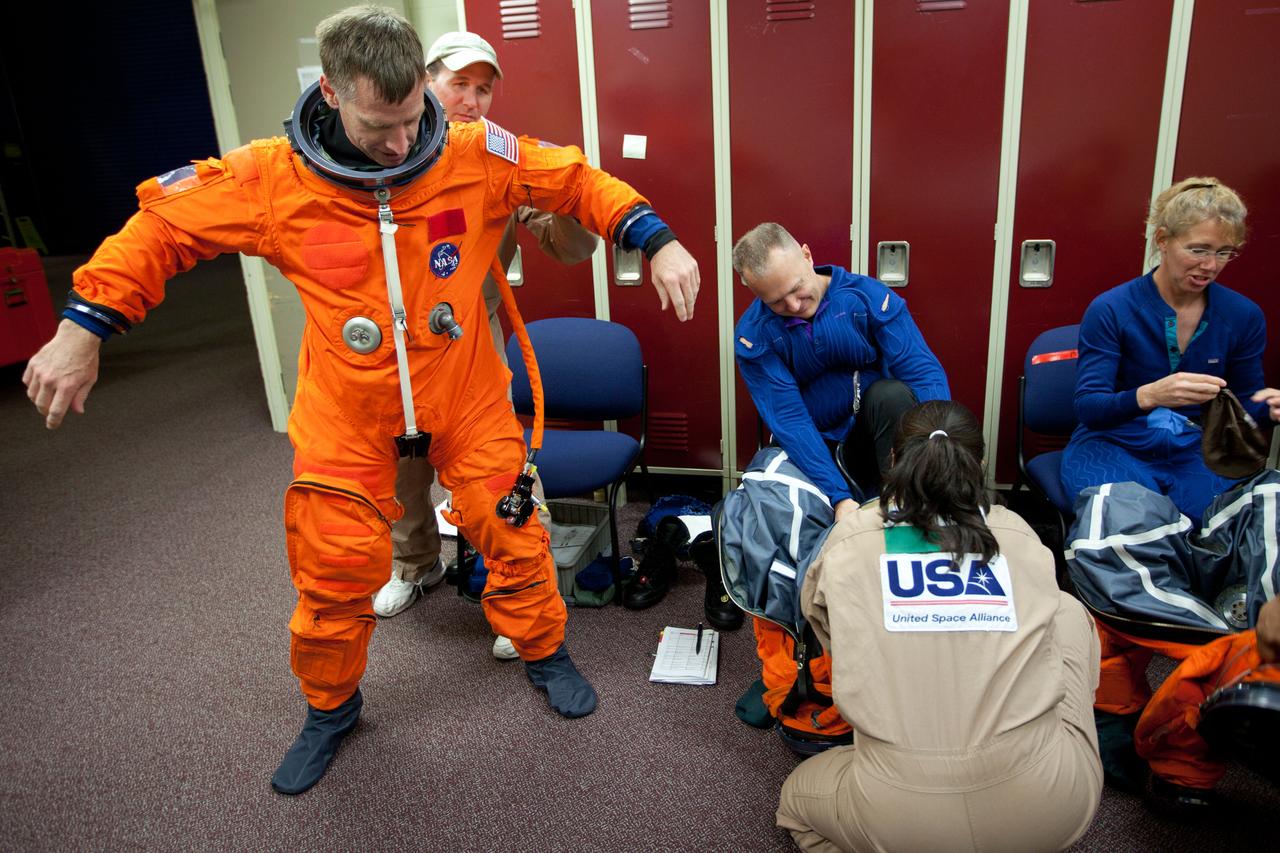
JSC2011-E-040270 (24 March 2011) --- NASA astronaut Chris Ferguson, left, STS-135 commander, dons his training version of a shuttle launch and entry suit before participating in a post-insertion training session with NASA astronauts Doug Hurley, pilot, and Sandy Magnus, mission specialist, March 24, 2011, in the Space Vehicle Mock-up Facility at NASA's Johnson Space Center in Houston. Hurley and Magnus are wearing their liquid-cooled undergarments for the orange suit. Photo credit: NASA Photo/Houston Chronicle, Smiley N. Pool
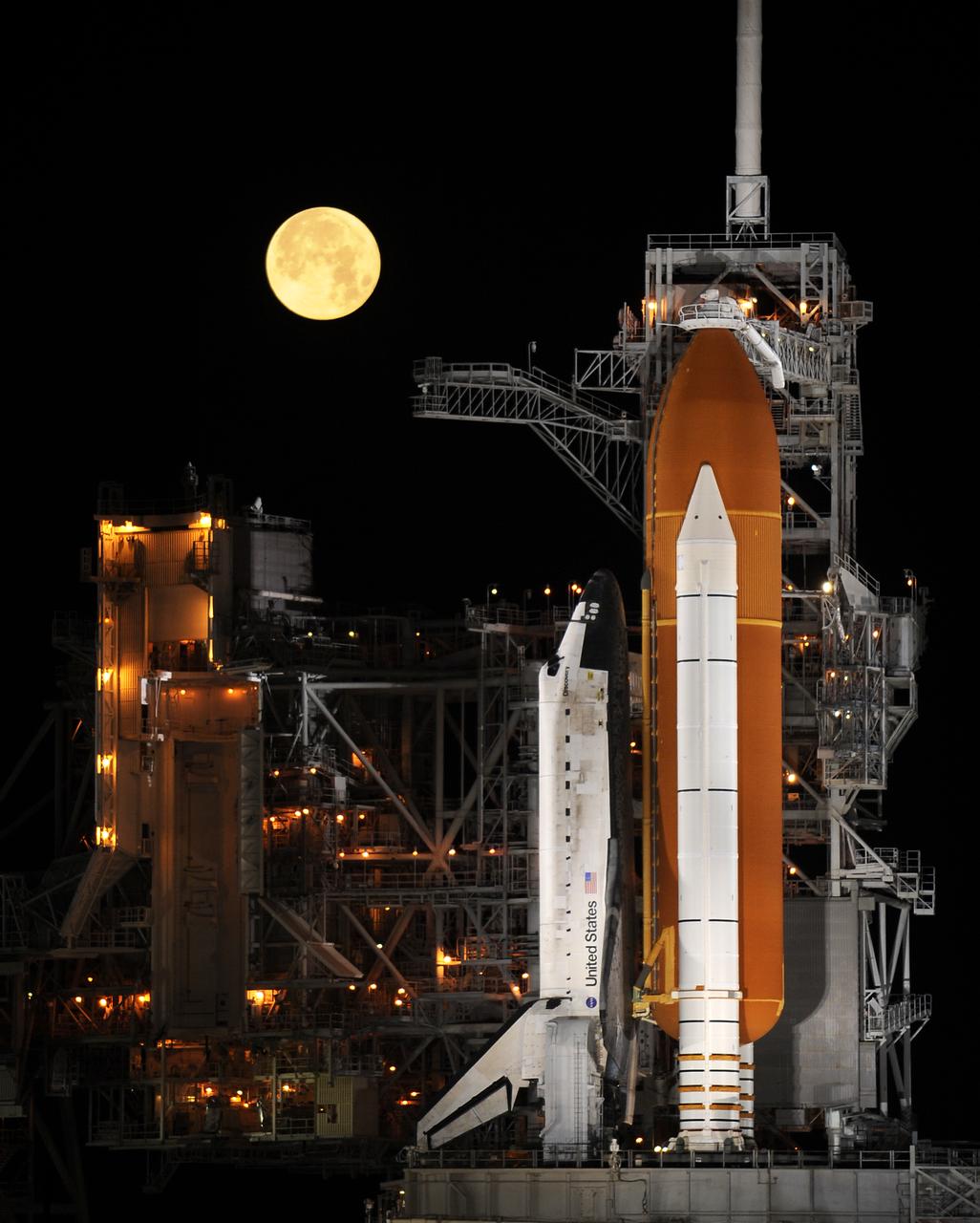
A nearly full Moon sets as the space shuttle Discovery sits atop Launch pad 39A at the Kennedy Space Center in Cape Canaveral, Florida, Wednesday, March 11, 2009. Photo Credit: (NASA/Bill Ingalls)

Dr. Michael Griffin testifies, Tuesday, April 12, 2005, during his confirmation hearing before the U.S. Senate Commerce Committee at the Russell Senate Office Building in Washington. If confirmed, Griffin, who currently heads the space department at the Johns Hopkins University Applied Physics Laboratory will become NASA's 11th administrator. Photo Credit (NASA/Renee Bouchard)
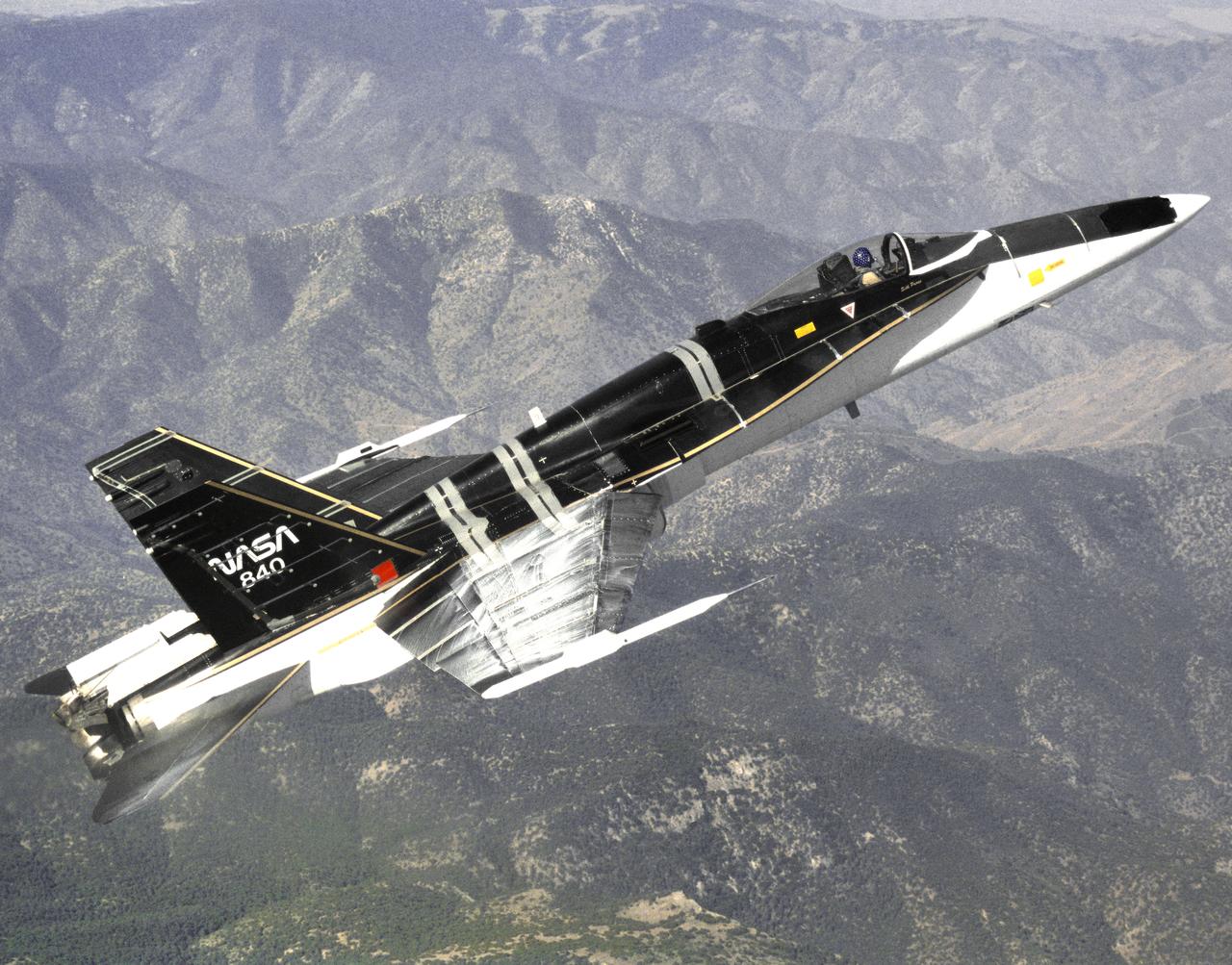
The modified F-18 High Alpha Research Vehicle (HARV) carries out air flow studies on a flight from the Dryden Flight Research Center, Edwards, California. Using oil, researchers were able to track the air flow across the wing at different speeds and angles of attack. A thrust vectoring system had been installed on the engines' exhaust nozzles for the high angle of attack research program. The thrust vectoring system, linked to the aircraft's flight control system, moves a set of three paddles on each engine to redirect thrust for directional control and increased maneuverability at angles of attack at up to 70 degrees.
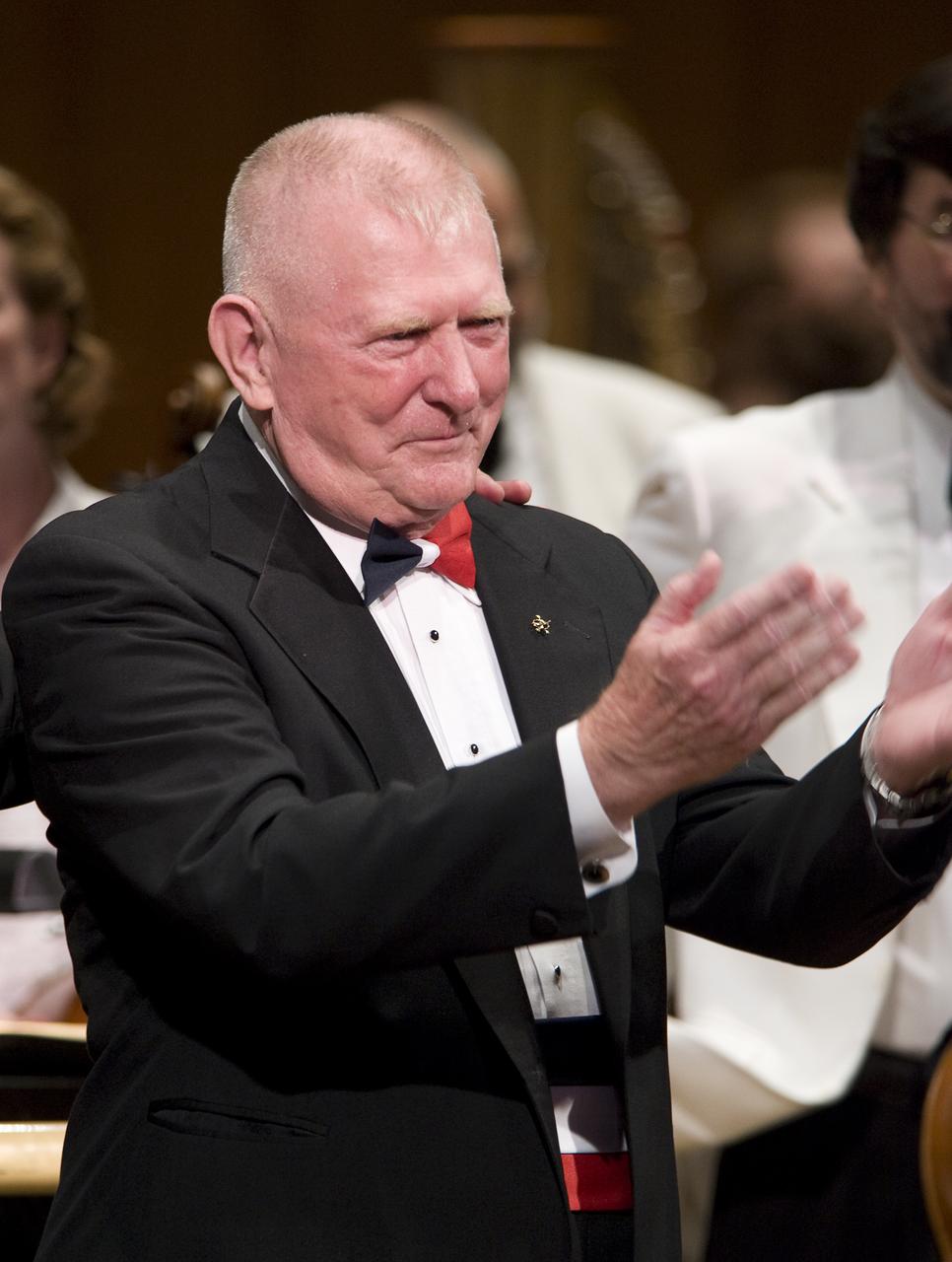
Gene Kranz, retired NASA Flight Director and manager, thanks the audience after having guest conducted of the National Symphony Orchestra during the "Salute to Apollo" ceremony at the Kennedy Center for the Performing Arts, Saturday, July 18, 2009 in Washington. The event was part of NASA's week long celebration of the Apollo 40th Anniversary. Photo Credit: (NASA/Bill Ingalls)
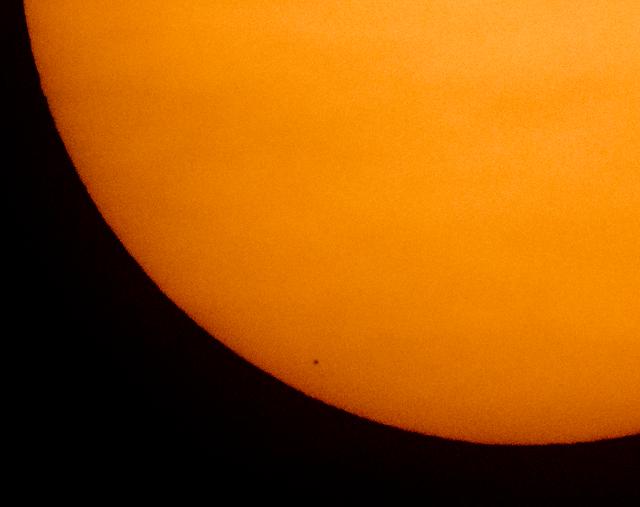
The planet Mercury is seen in silhouette, low center, as it transits across the face of the Sun Monday, Nov. 11, 2019, from Washington. Mercury’s last transit was in 2016. The next won’t happen again until 2032. Photo Credit: (NASA/Bill Ingalls)

NASA Dryden F-18 #843 in flight
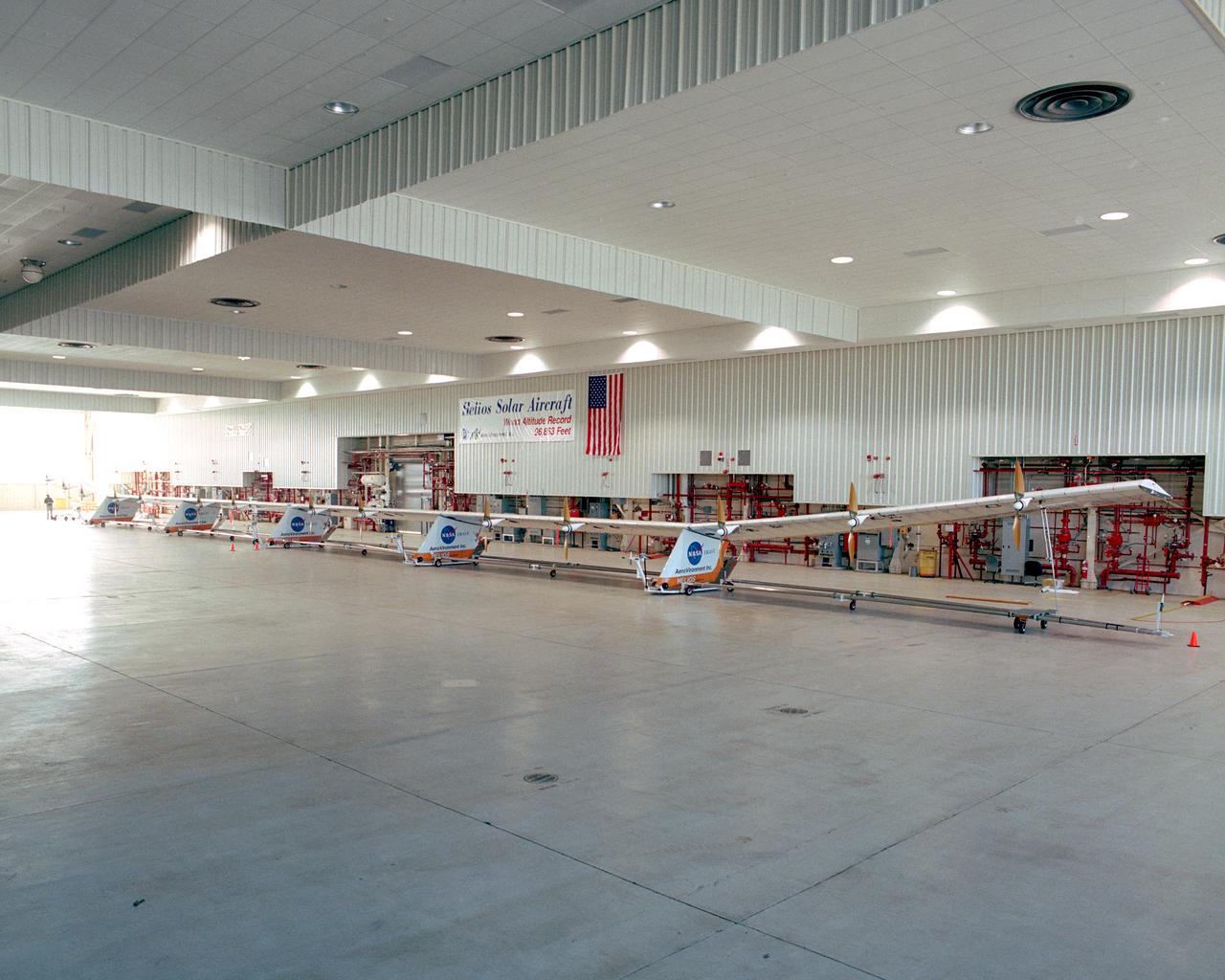
The Helios Prototype flying wing stretches almost the full length of the 300-foot-long hangar at NASA's Dryden Flight Research Center, Edwards, California. The 247-foot span solar-powered aircraft, resting on its ground maneuvering dolly, was on display for a visit of NASA Administrator Sean O'Keefe and other NASA officials on January 31, 2002. The unique solar-electric flying wing reached an altitude of 96,863 feet during an almost 17-hour flight near Hawaii on August 13, 2001, a world record for sustained horizontal flight by a non-rocket powered aircraft. Developed by AeroVironment, Inc., under NASA's Environmental Research Aircraft and Sensor Technology (ERAST) project, the Helios Prototype is the forerunner of a planned fleet of slow-flying, long duration, high-altitude uninhabited aerial vehicles (UAV) which can serve as "atmospheric satellites," performing Earth science missions or functioning as telecommunications relay platforms in the stratosphere.
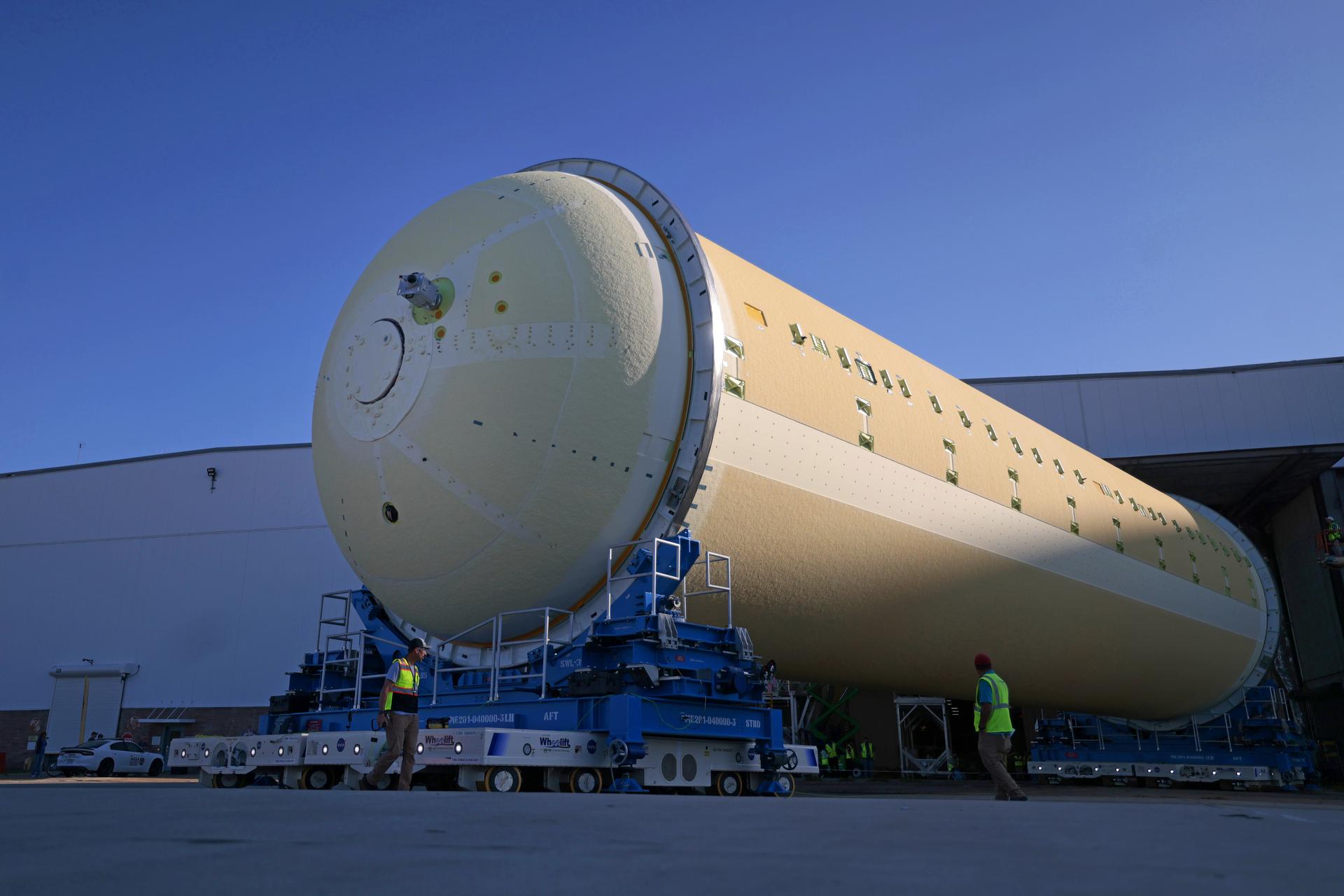
Teams at NASA’s Michoud Assembly Facility in New Orleans move a liquid hydrogen tank for the agency’s SLS (Space Launch System) rocket into the factory’s vertical assembly building on Sep. 26, 2025. The tank, which is designated for the agency’s Artemis III mission, is lifted and loaded into a production cell where it will be mated with the LH2 Transport Adapter Assembly for future transportation to NASA’s Kennedy Space Center. The engine section flight hardware structure was completed in 2022 and was shipped to Kennedy where teams continue to integrate vital systems. The propellant tank is one of five major elements that make up the 212-foot-tall rocket stage. The core stage, along with its four RS-25 engines, produce more than two million pounds of thrust to help launch NASA’s Orion spacecraft, astronauts, and supplies beyond Earth’s orbit and to the lunar surface for Artemis. Image credit: NASA/Michael DeMocker
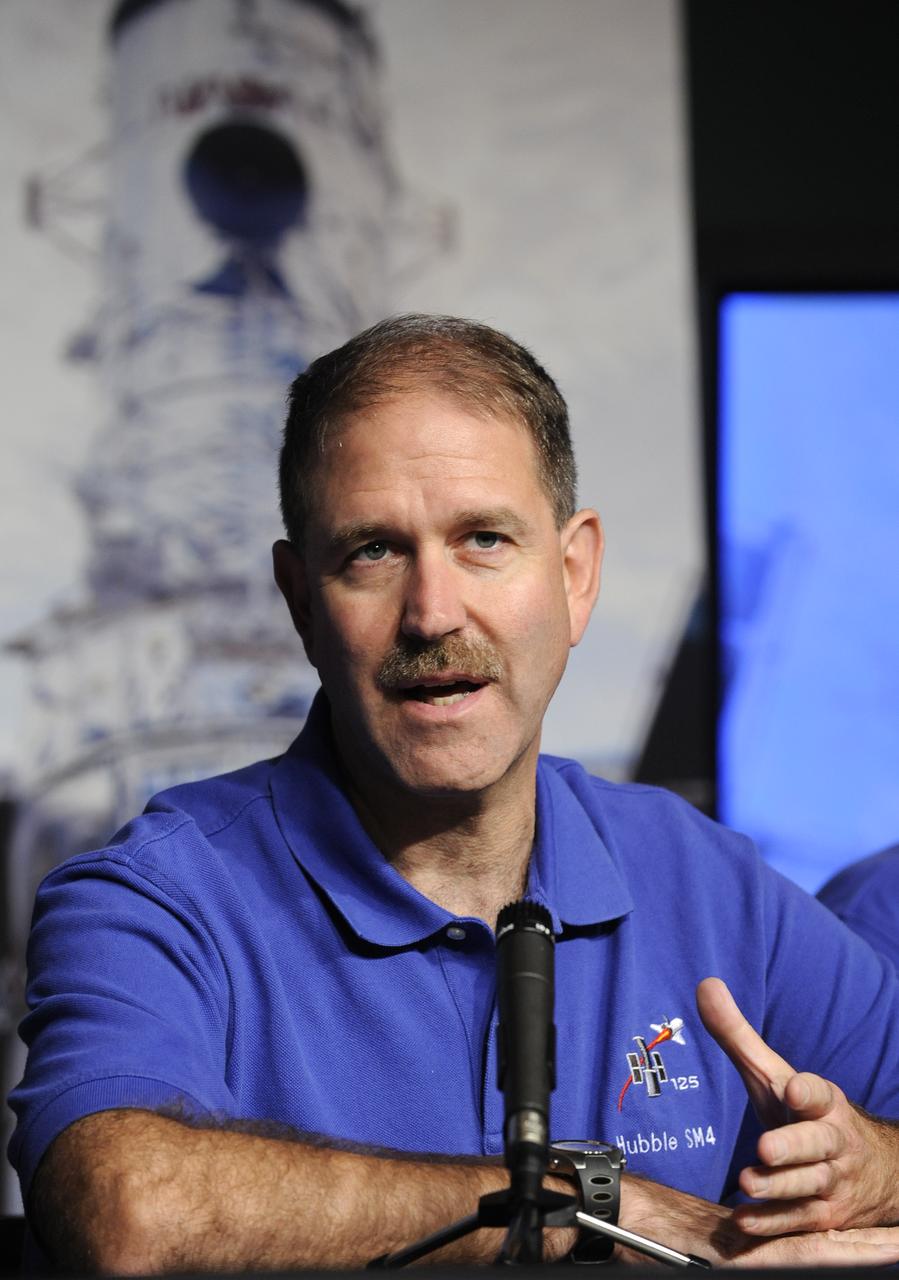
NASA Astronaut and STS-125 Mission Specialist John Grunsfeld answers a question during a presentation with fellow STS-125 shuttle mission crew members at the NASA Tweetup event held at NASA Headquarters, July 21, 2009 in Washington. Nearly 200 of NASA’s Twitter followers are in attendance. Photo Credit: (Carla Cioffi)
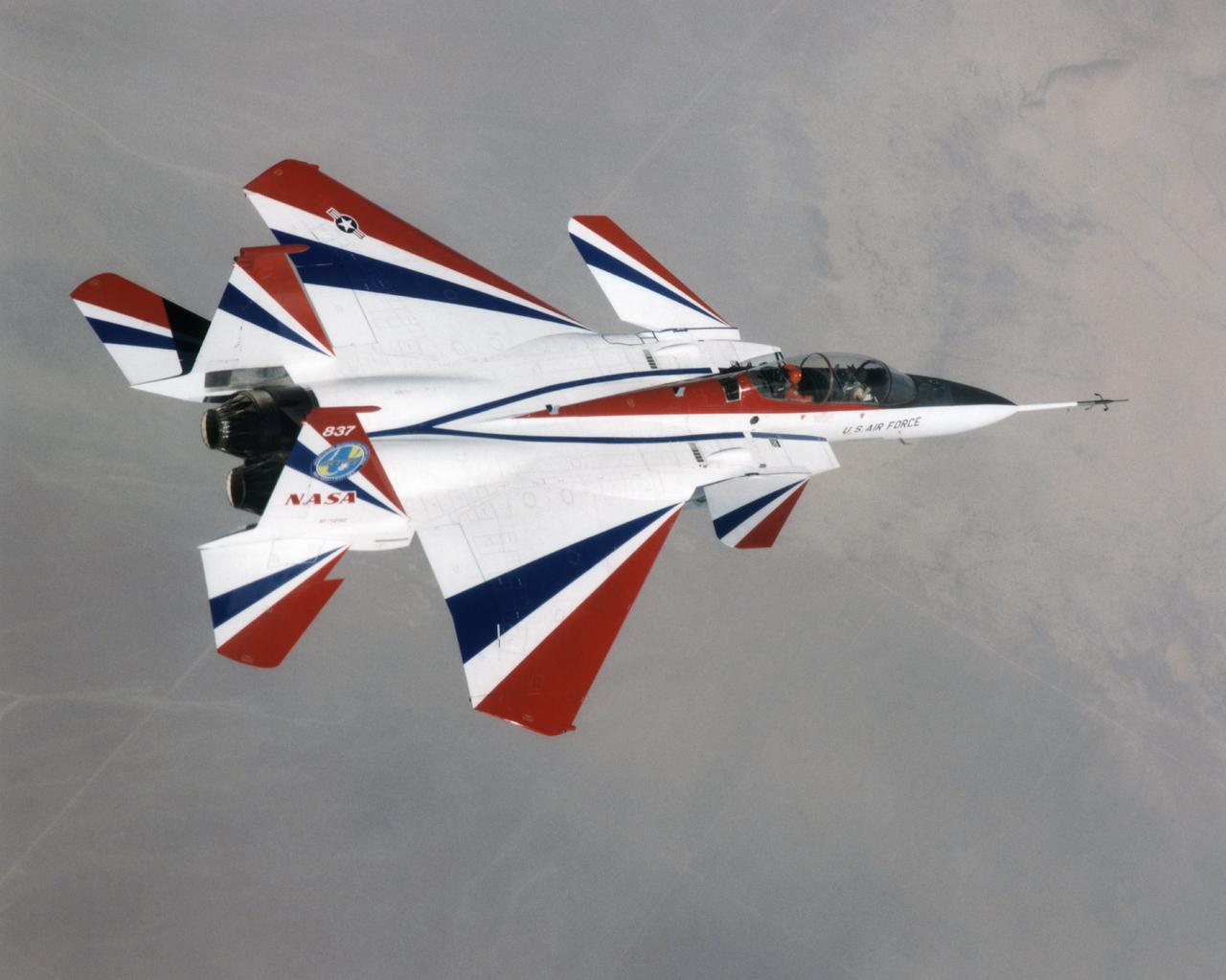
The F-15 ACTIVE in flight above the Mojave desert on April 14, 1998. The overhead shot shows the aircraft's striking red and while paint scheme/ The large forward canards are actually the tail surfaces from an F-18.
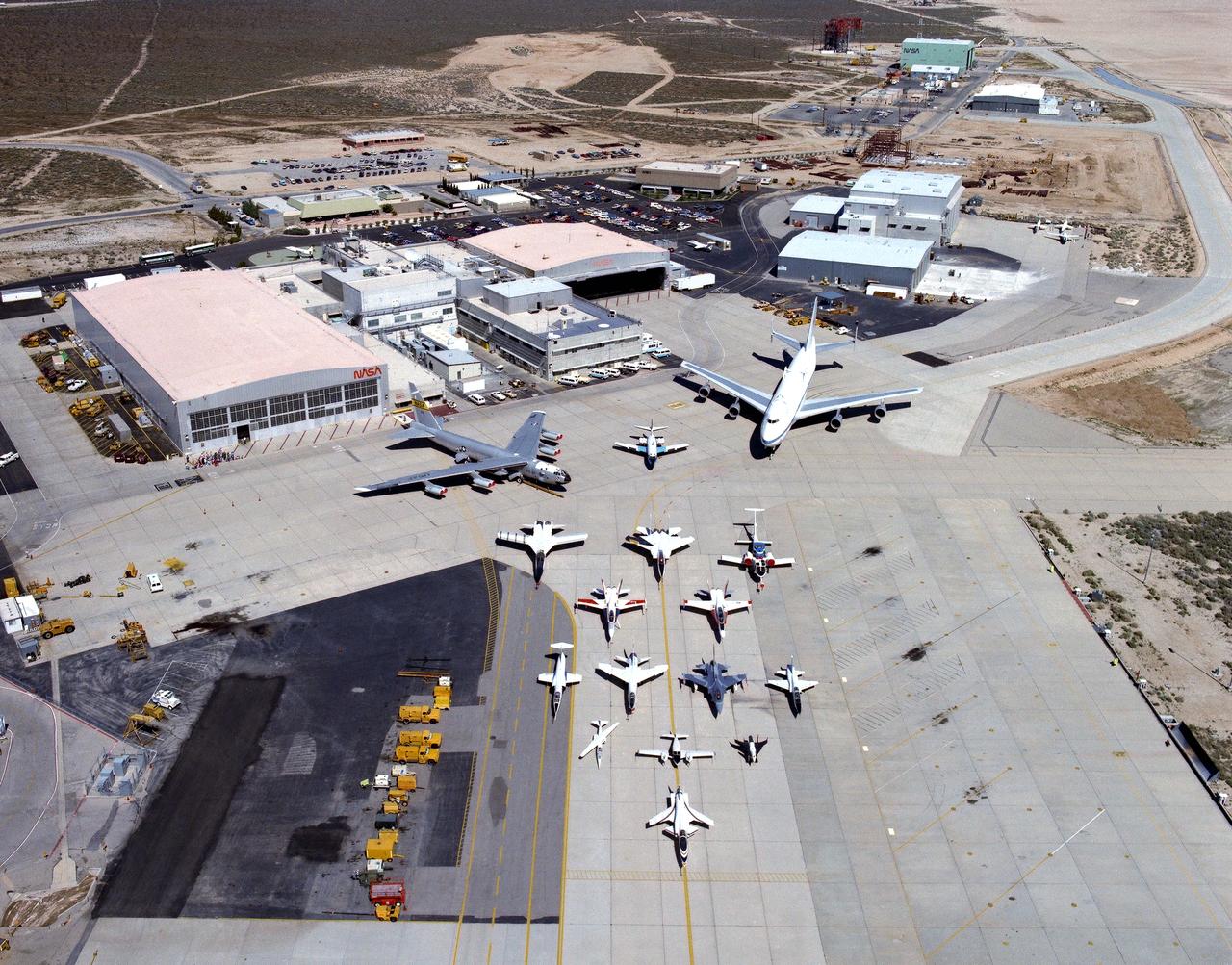
Dryden Aircraft Fleet on ramp and facility - 1988
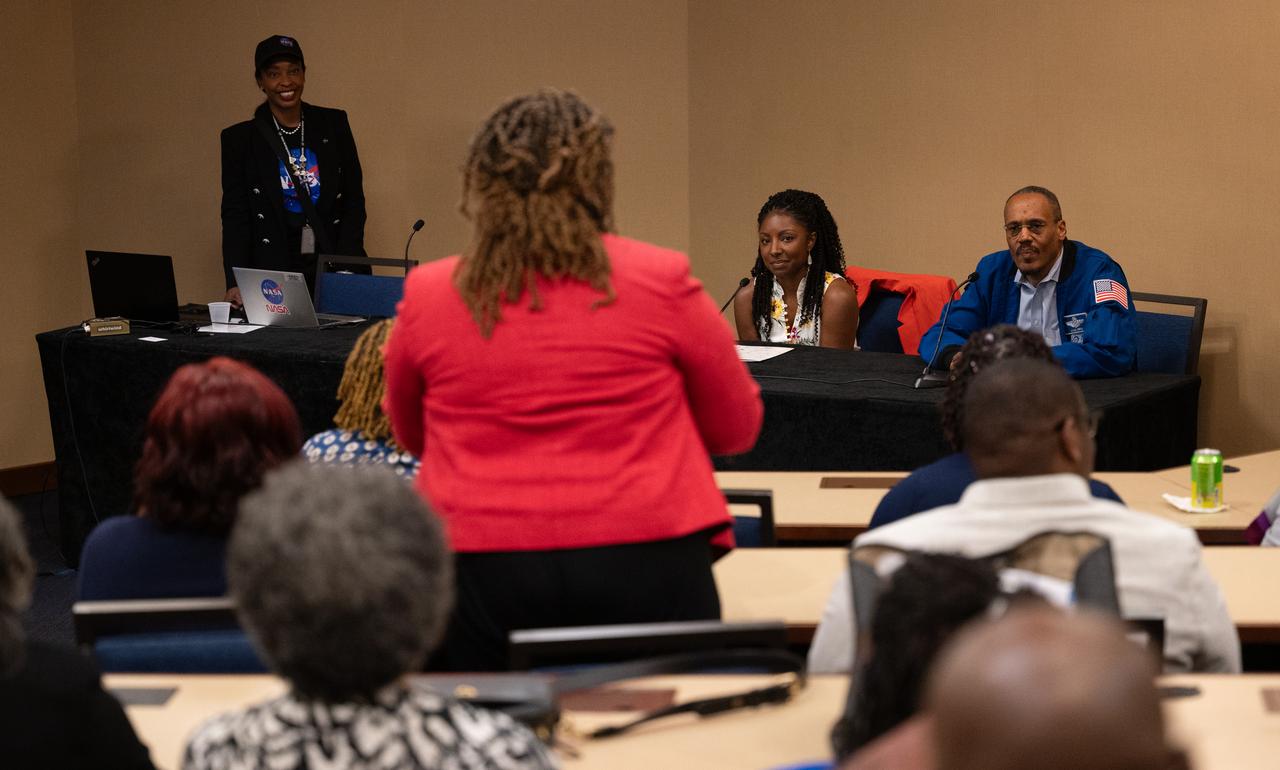
NASA TV producer of “The Color of Space” Jori Kates, left, and NASA astronaut Alvin Drew answer questions before a screening of “The Color of Space” as part of the Department of Education’s HBCU Week Conference, Monday, Sept. 25, 2023, at the Hyatt Regency in Arlington, Va. Photo Credit: (NASA/Joel Kowsky)
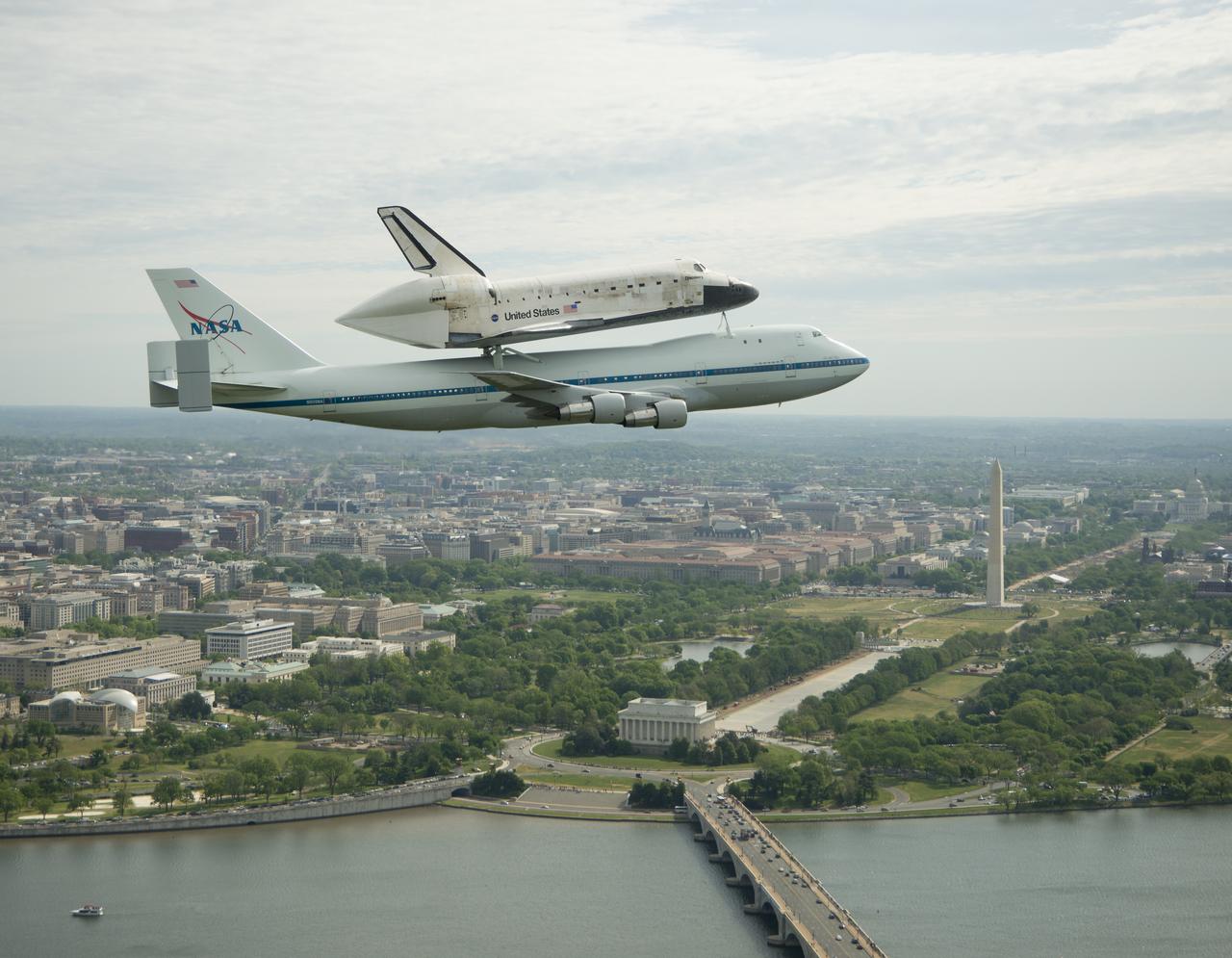
Space shuttle Discovery, mounted atop a NASA 747 Shuttle Carrier Aircraft (SCA), flies over the Washington skyline as seen from a NASA T-38 aircraft, Tuesday, April 17, 2012. Discovery, the first orbiter retired from NASA’s shuttle fleet, completed 39 missions, spent 365 days in space, orbited the Earth 5,830 times, and traveled 148,221,675 miles. NASA will transfer Discovery to the National Air and Space Museum to begin its new mission to commemorate past achievements in space and to educate and inspire future generations of explorers. Photo Credit: (NASA/Robert Markowitz)
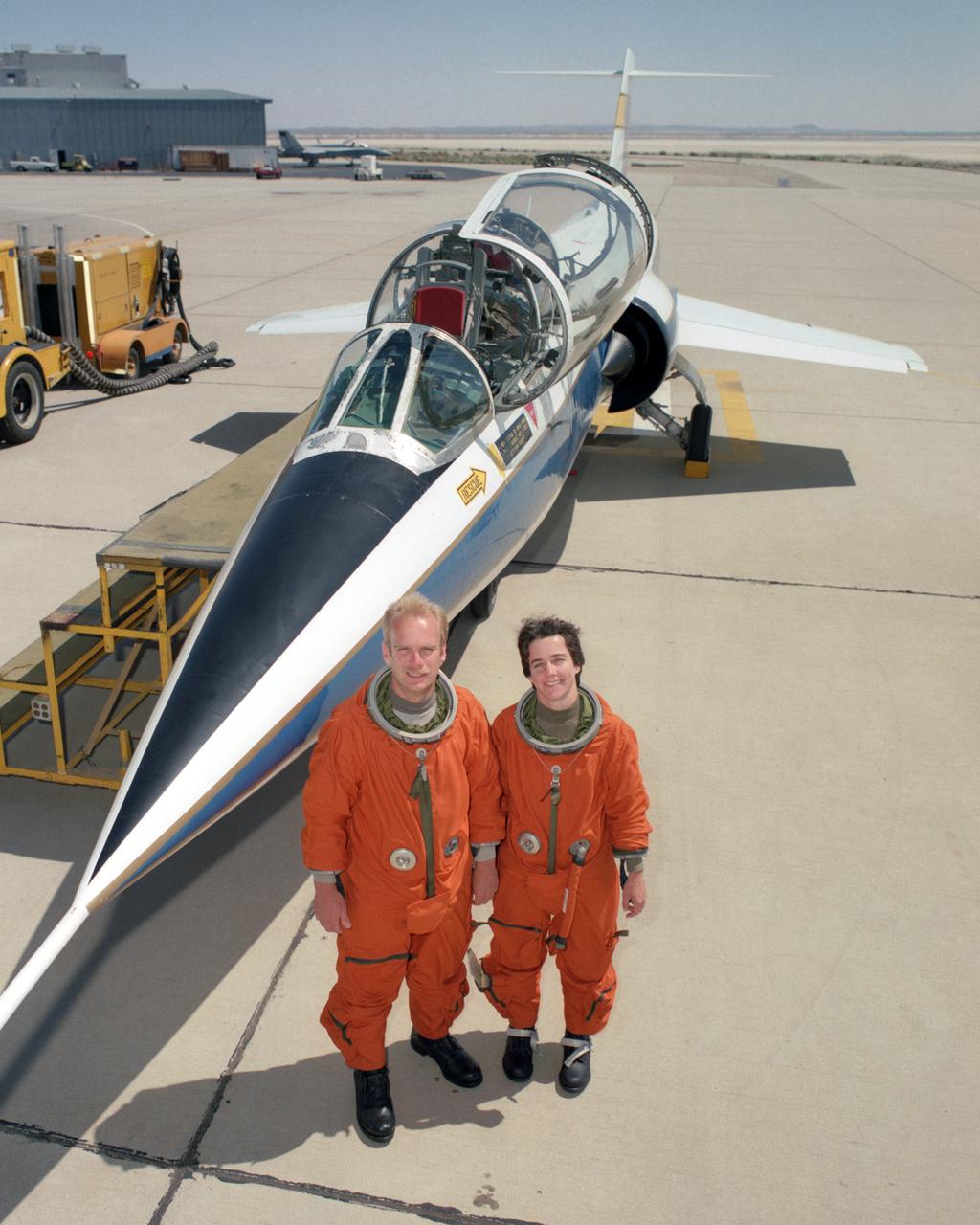
Flight test engineers Bob Meyer and Marta Bohn-Meyer had the distinction of being the only married couple to both serve on flight status on this two-seat F-104 at NASA Dryden.
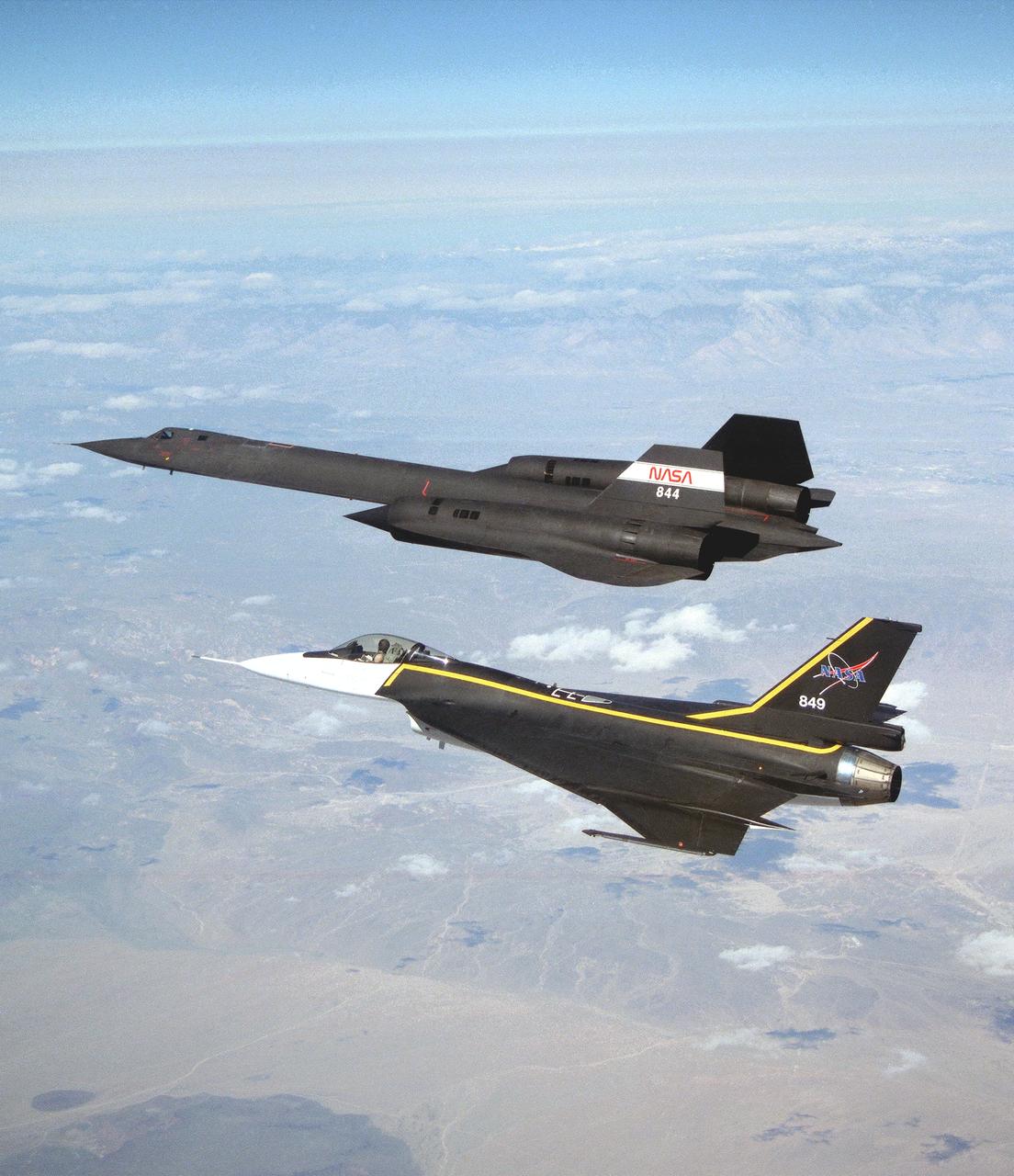
The single-seat F-16XL, NASA 849, joins up with an SR-71A, NASA 844, as crews set up for one of the flights in the recent sonic boom research program conducted by the Dryden Flight Research Center, Edwards, California. During the missions, the F-16XL probed the shockwaves generated by the SR-71, while at lower altitudes sensors on an F-18 and on a YO-3A, and also on the ground, recorded data from the same shockwave.

The Mars celebration Friday, May 31, 2019, in Mars, Pennsylvania. NASA is in the small town to celebrate Mars exploration and share the agency’s excitement about landing astronauts on the Moon in five years. The celebration includes a weekend of Science, Technology, Engineering, Arts and Mathematics (STEAM) activities. Photo Credit: (NASA/Bill Ingalls)

A participant of the Mars celebration launches a rocket, Saturday, June 1, 2019, in Mars, Pennsylvania. NASA is in the small town to celebrate Mars exploration and share the agency’s excitement about landing astronauts on the Moon in five years. The celebration includes a weekend of Science, Technology, Engineering, Arts and Mathematics (STEAM) activities. Photo Credit: (NASA/Bill Ingalls)
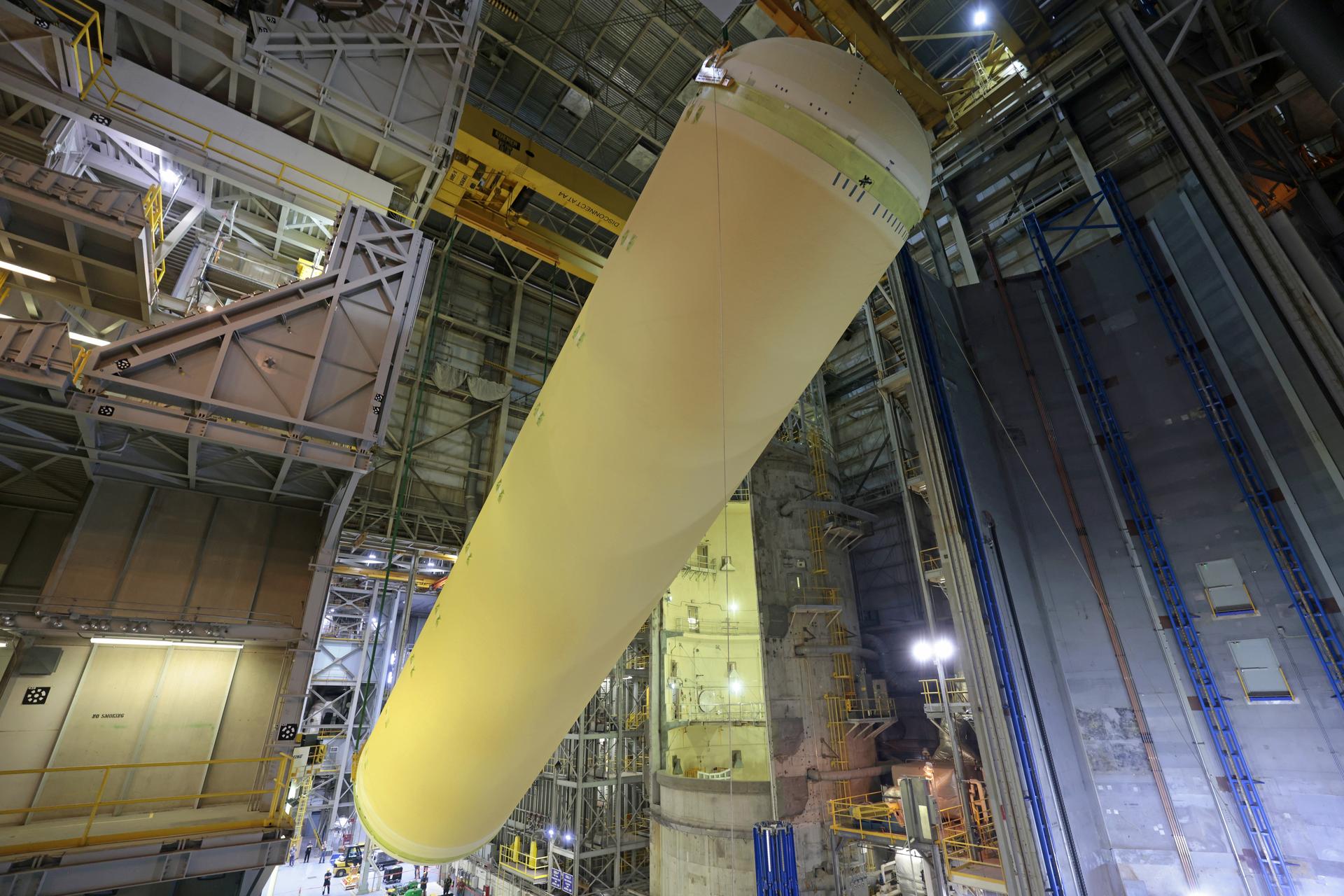
Teams at NASA’s Michoud Assembly Facility in New Orleans move a liquid hydrogen tank for the agency’s SLS (Space Launch System) rocket inside the factory’s vertical assembly building on Sep. 28, 2025. The tank, which is designated for the agency’s Artemis III mission, is being lifted and loaded into a production cell where it will be mated with the LH2 Transport Adapter Assembly for future transportation to NASA’s Kennedy Space Center. The engine section flight hardware structure was completed in 2022 and was shipped to Kennedy where teams continue to integrate vital systems. The propellant tank is one of five major elements that make up the 212-foot-tall rocket stage. The core stage, along with its four RS-25 engines, produce more than two million pounds of thrust to help launch NASA’s Orion spacecraft, astronauts, and supplies beyond Earth’s orbit and to the lunar surface for Artemis. Image credit: NASA/Michael DeMocker
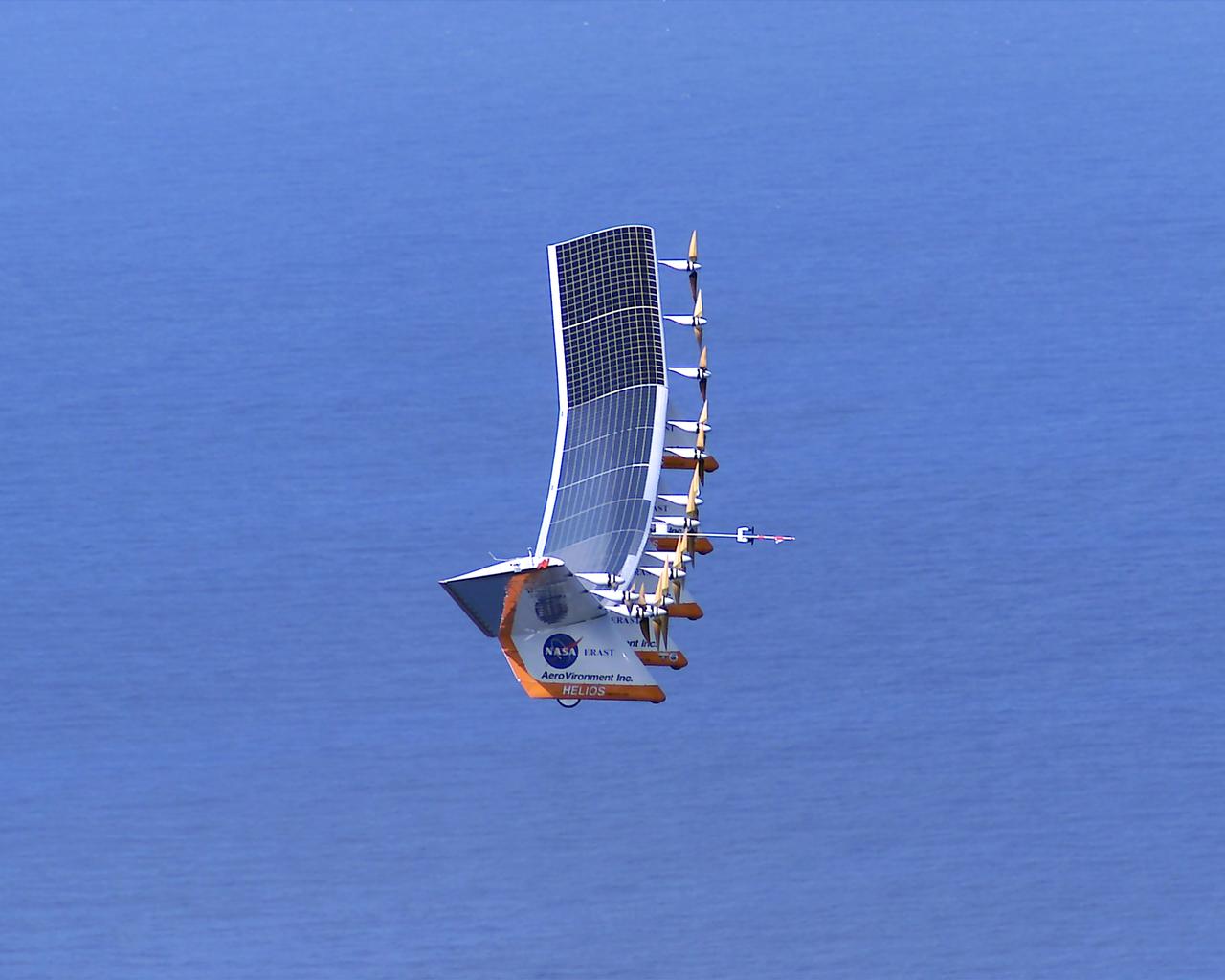
The Helios Prototype aircraft during initial climb-out to the west over the Pacific Ocean.
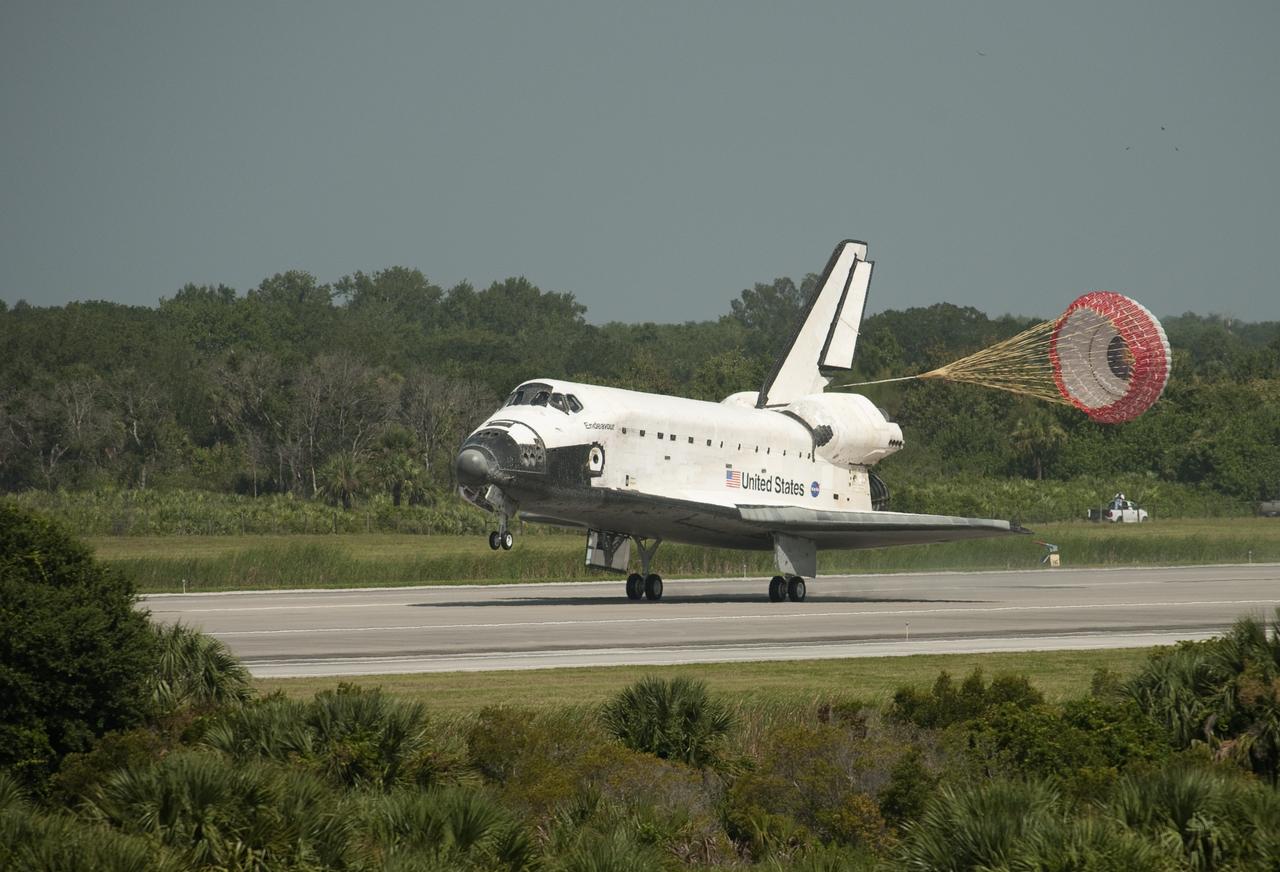
The space shuttle Endeavour and its crew land, Friday, July 31, 2009 at NASA's Kennedy Space Center in Cape Canaveral, Florida, completing a 16-day journey of more than 6.5 million miles. Endeavour delivered the final segment to the Japan Aerospace Exploration Agency's Kibo laboratory and a new crew member to the International Space Station. Photo Credit: (NASA/Bill Ingalls)
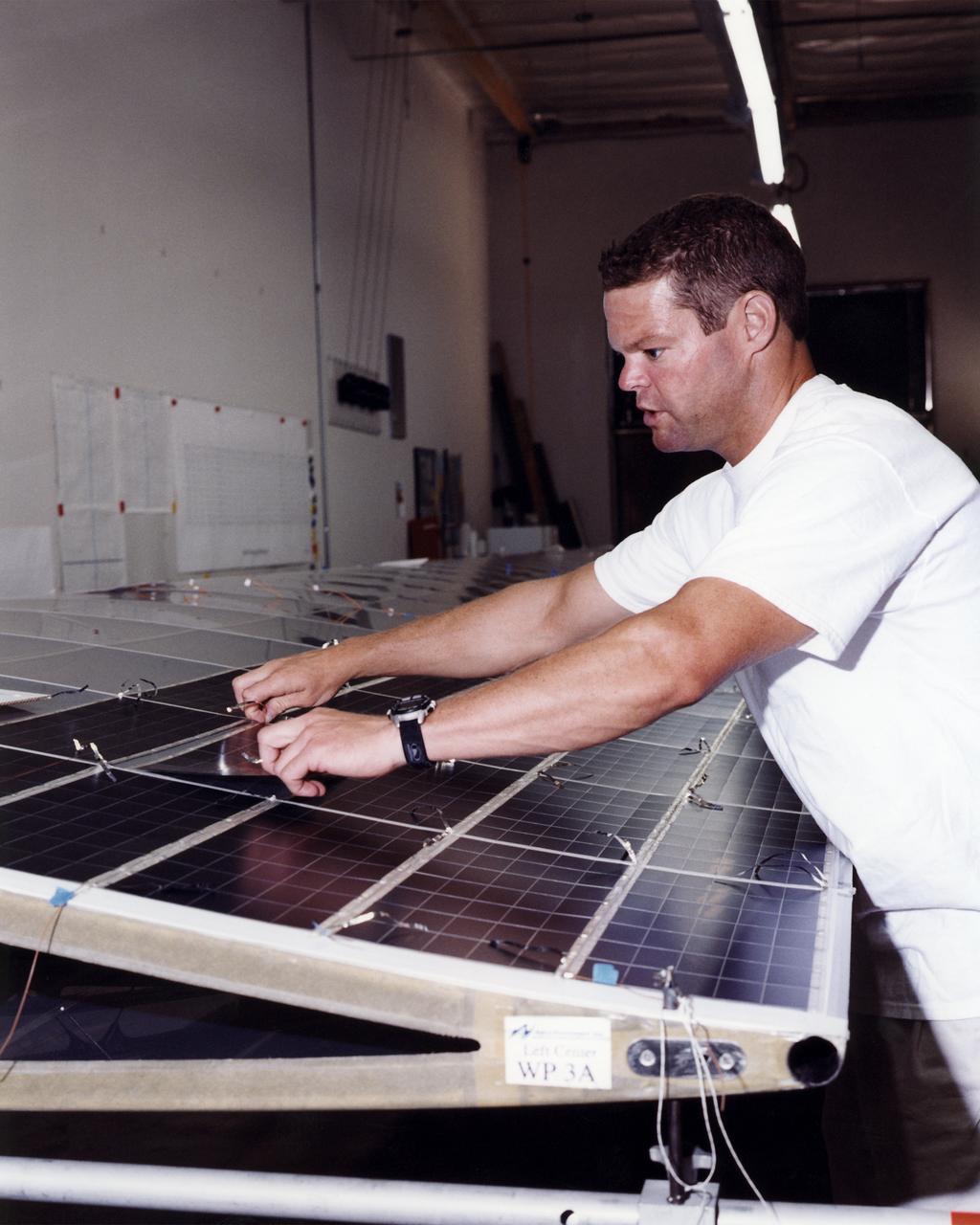
Technician Marshall MacCready carefully lays a panel of solar cells into place on a wing section of the Helios Prototype flying wing at AeroVironment's Design Development Center in Simi Valley, California. More than 1,800 panels containing some 64,000 bi-facial cells, fabricated by SunPower, Inc., of Sunnyvale, California, have been installed on the solar-powered aircraft to provide electricity to its 14 motors and operating systems.
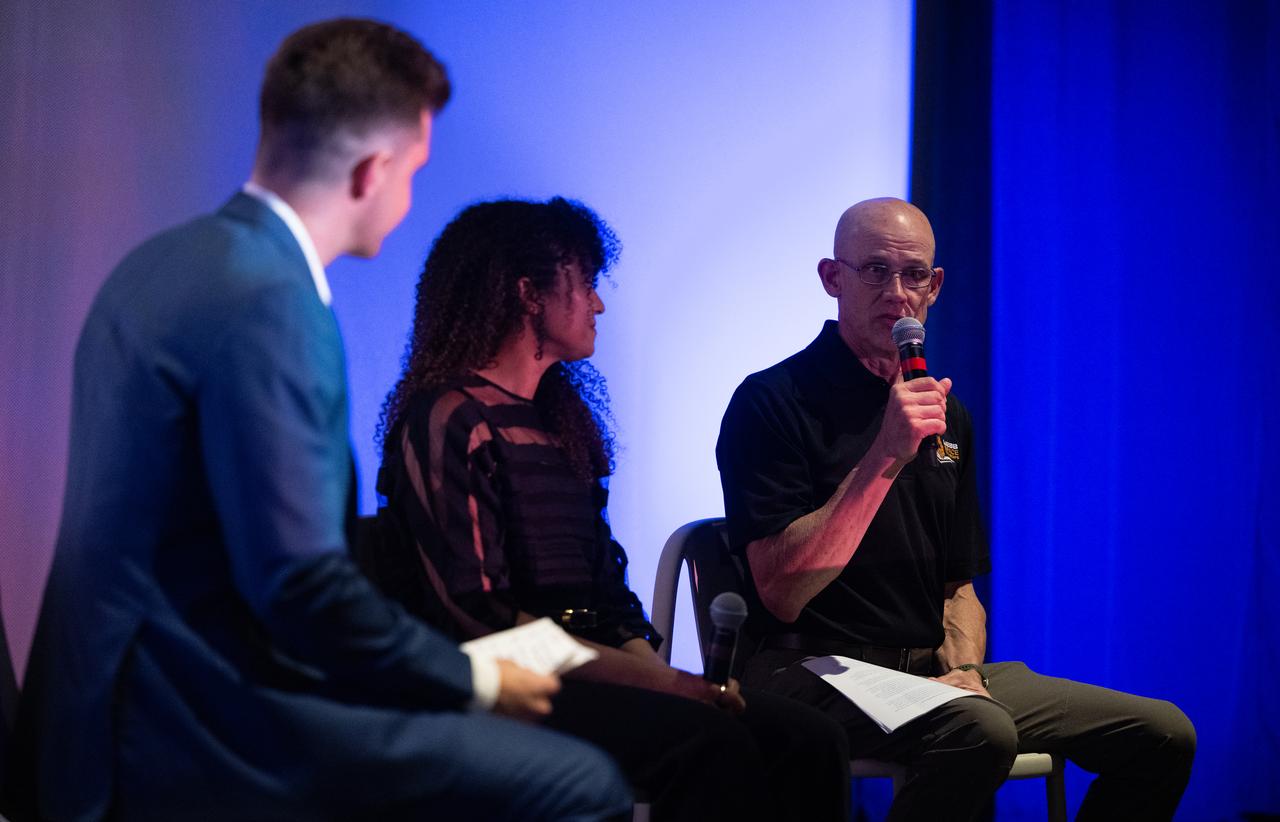
Paul Geithner, former deputy project manager for NASA’s James Webb Space Telescope, right, participates in a discussion alongside Sophia Roberts, a NASA video producer who documented the Webb project, and Jacob Pinter, host of NASA’s Curious Universe Podcast, following a screening of the new NASA+ documentary “Cosmic Dawn: The Untold Story of the James Webb Space Telescope,” Wednesday, June 11, 2025, at the Greenbelt Cinema in Greenbelt, Maryland. Featuring never-before-seen footage, Cosmic Dawn offers an unprecedented glimpse into the assembly, testing, and launch of NASA’s James Webb Space Telescope. Photo Credit: (NASA/Joel Kowsky)
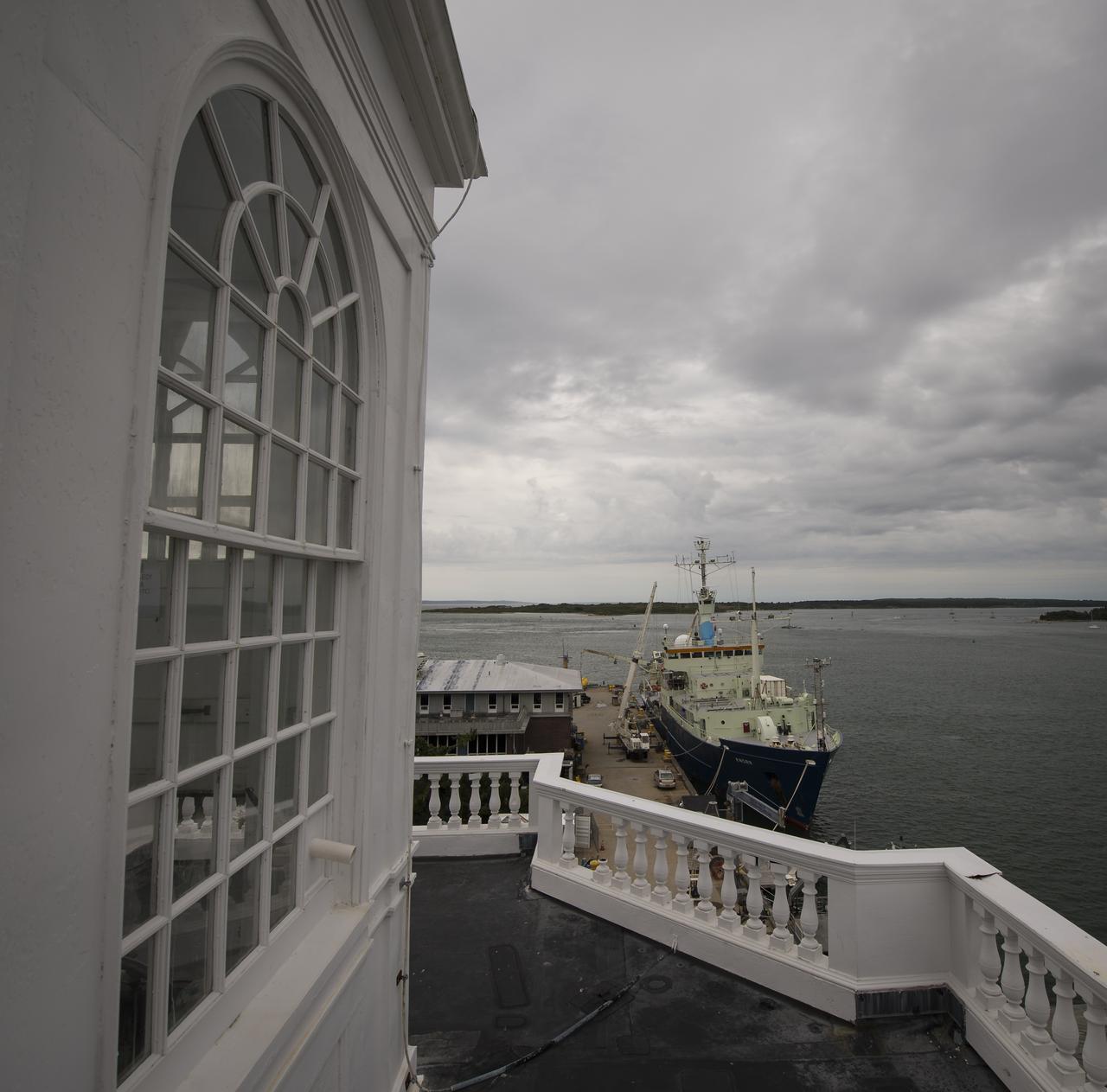
The Woods Hole Oceanographic Institution's research vessel Knorr is seen docked on Tuesday, Sept. 4, 2012, in Woods Hole, Mass. Knorr is scheduled to depart on Sept. 6 to take part in the Salinity Processes in the Upper Ocean Regional Study (SPURS). The NASA-sponsored expedition will sail to the North Atlantic's saltiest spot to get a detailed, 3-D picture of how salt content fluctuates in the ocean's upper layers and how these variations are related to shifts in rainfall patterns around the planet. Photo Credit: (NASA/Bill Ingalls)
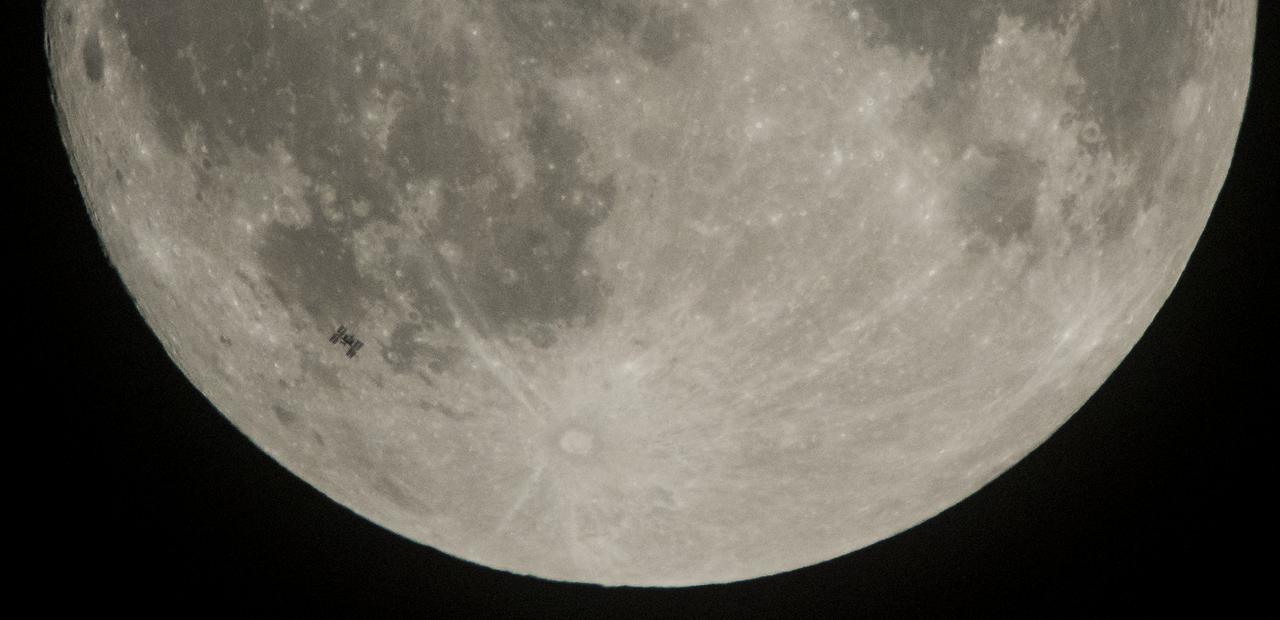
The International Space Station, with a crew of six onboard, is seen in silhouette as it transits the Moon at roughly five miles per second, Saturday, Dec. 2, 2017, in Manchester Township, York County, Pennsylvania. Onboard are NASA astronauts Joe Acaba, Mark Vande Hei, and Randy Bresnik; Russian cosmonauts Alexander Misurkin and Sergey Ryanzansky; and ESA astronaut Paolo Nespoli. Photo Credit: (NASA/Joel Kowsky)
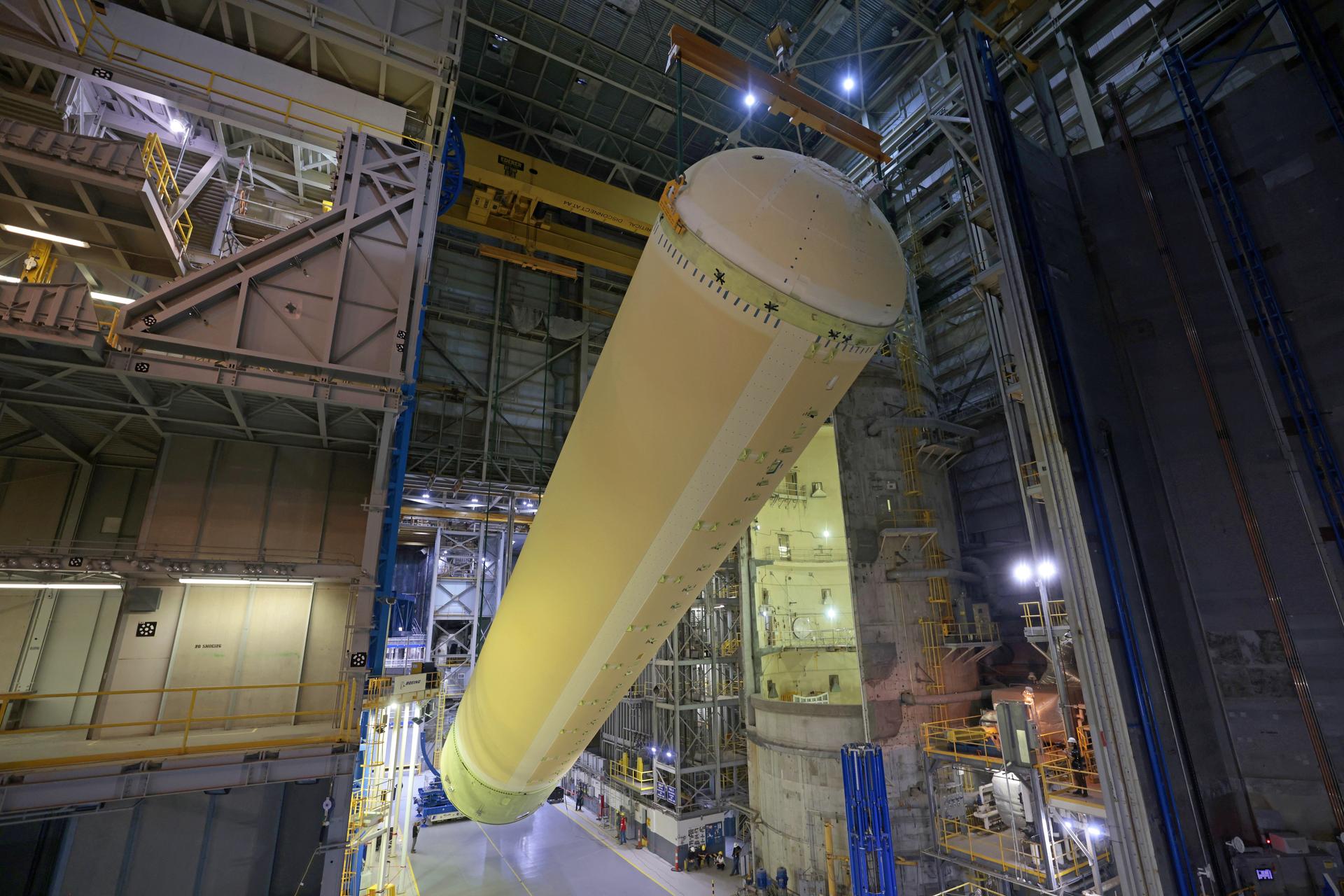
NASA’s Michoud Assembly move crews lift the liquid hydrogen tank for its Artemis III mission out of a production cell on Oct. 6, 2025. Teams with SLS (Space Launch System) prime contractor, Boeing, recently mated the tank to the LH2 Transport Adapter Assembly, which will allow the stage to be securely transported by barge to NASA’s Kennedy Space Center once it’s mated to the forward end of the core stage. The LH2 Transport Adapter Assembly serves as a temporary place holder for the engine section, which was previously shipped from Michoud to NASA’s Kennedy Space Center for further integration. The propellant tank is one of five major elements that make up the 212-foot-tall rocket stage. The core stage, along with its four RS-25 engines, produce more than two million pounds of thrust to help launch NASA’s Orion spacecraft, astronauts, and supplies beyond Earth’s orbit and to the lunar surface for Artemis. Image credit: NASA/Michael DeMocker

ER-2 tail number 809, is one of two Airborne Science ER-2s used as science platforms by Dryden. The aircraft are platforms for a variety of high-altitude science missions flown over various parts of the world. They are also used for earth science and atmospheric sensor research and development, satellite calibration and data validation. The ER-2s are capable of carrying a maximum payload of 2,600 pounds of experiments in a nose bay, the main equipment bay behind the cockpit, two wing-mounted superpods and small underbody and trailing edges. Most ER-2 missions last about six hours with ranges of about 2,200 nautical miles. The aircraft typically fly at altitudes above 65,000 feet. On November 19, 1998, the ER-2 set a world record for medium weight aircraft reaching an altitude of 68,700 feet. The aircraft is 63 feet long, with a wingspan of 104 feet. The top of the vertical tail is 16 feet above ground when the aircraft is on the bicycle-type landing gear. Cruising speeds are 410 knots, or 467 miles per hour, at altitude. A single General Electric F118 turbofan engine rated at 17,000 pounds thrust powers the ER-2.

Opera singer Denyce Graves sings during the "Salute to Apollo" ceremony at the Kennedy Center for the Performing Arts, Saturday, July 18, 2009 in Washington. The event was part of NASA's week long celebration of the Apollo 40th Anniversary. Photo Credit: (NASA/Bill Ingalls)
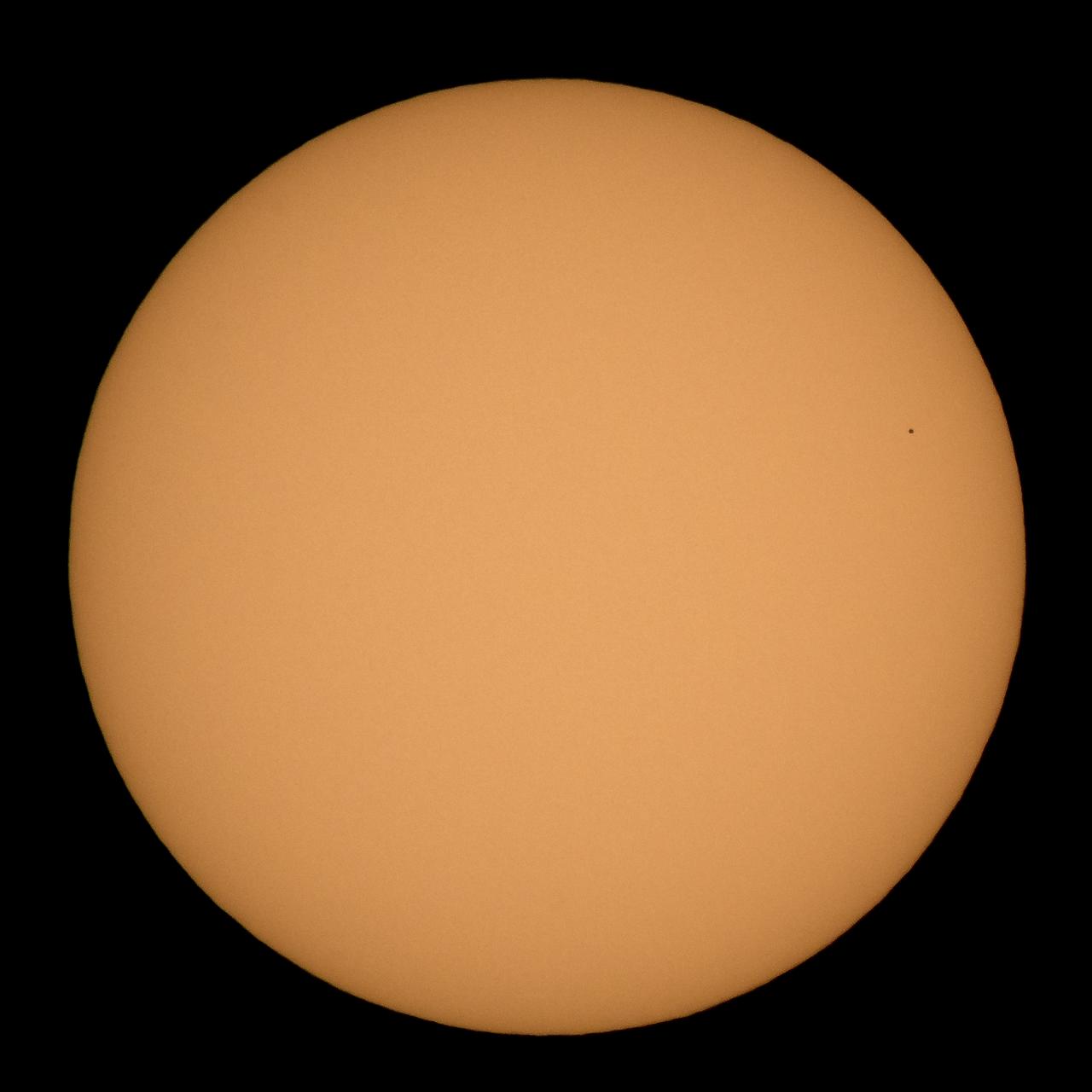
The planet Mercury is seen in silhouette as it nearly completes transiting across the face of the Sun, Monday, Nov. 11, 2019, in Arlington, Virginia. Mercury’s last transit was in 2016. the next won't happen again until 2032. Photo Credit: (NASA/Bill Ingalls)
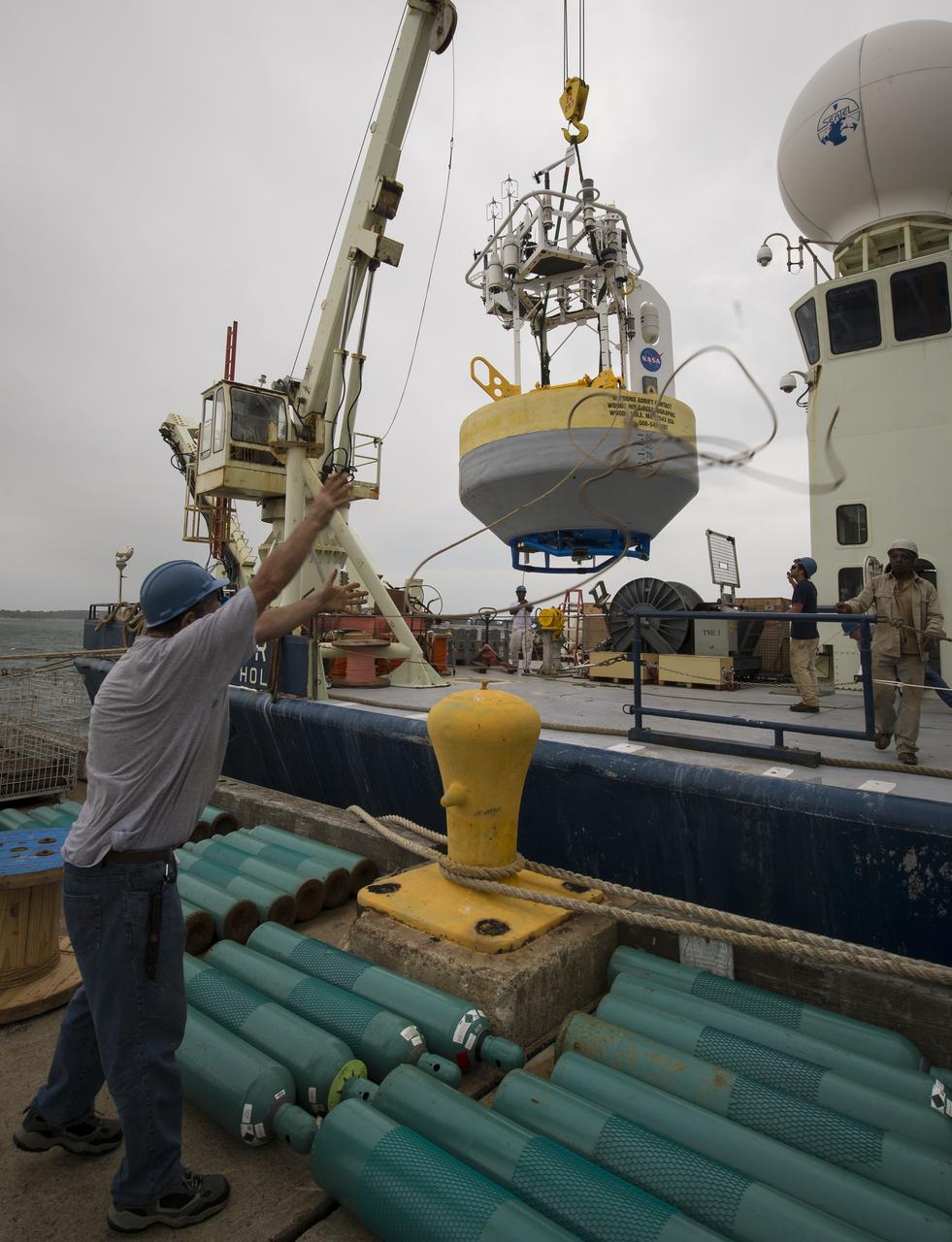
A sensor-laden buoy is lifted onboard the Woods Hole Oceanographic Institution's research vessel Knorr on wednesday, Sept. 5, 2012, in Woods Hole, Mass. The buoy will be deployed in the Atlantic Ocean as part of the Salinity Processes in the Upper Ocean Regional Study (SPURS) which is set to sail on Sept. 6. The NASA-sponsored expedition will sail to the North Atlantic's saltiest spot to get a detailed, 3-D picture of how salt content fluctuates in the ocean's upper layers and how these variations are related to shifts in rainfall patterns around the planet. Photo Credit: (NASA/Bill Ingalls)
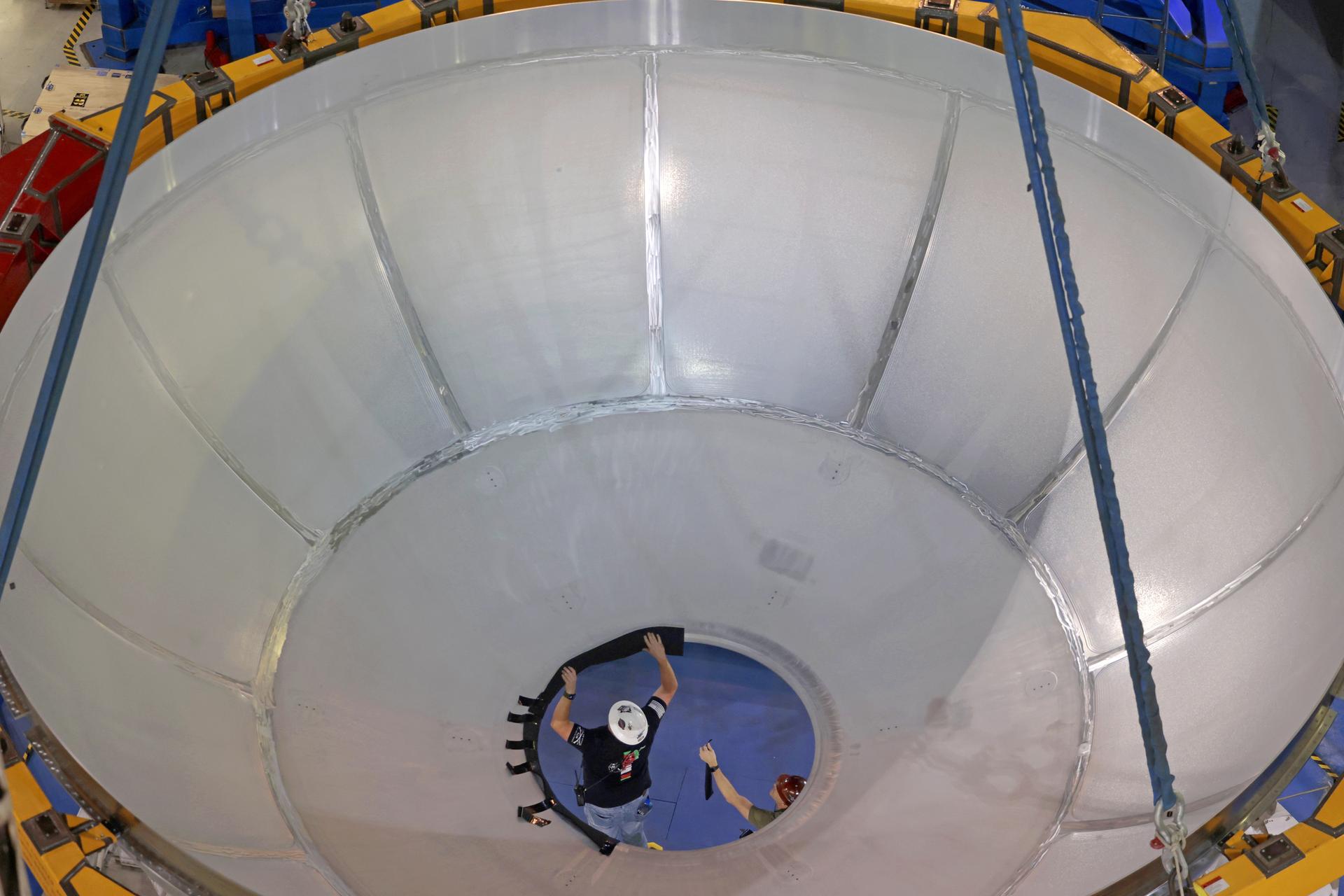
Move crews at NASA’s Michoud Assembly Facility in New Orleans lift the aft dome for the liquid hydrogen tank for the fourth core stage of NASA’s SLS (Space Launch System), into the in-feeder of the facility’s vertical assembly center. Once loaded into the production tool, teams with SLS prime contractor, Boeing, will circumferentially friction-stir weld the dome to the previously-welded forward dome and five barrels that make up the liquid hydrogen tank. The SLS core stage liquid hydrogen tank holds 537,000 gallons of super-cooled propellant and is one of five unique elements that make up the SLS core stage. Together with the forward skirt, liquid oxygen tank, intertank, and engine section, the liquid hydrogen tank will provide propellant to the four RS-25 engines to produce more than two million pounds of thrust to help launch NASA’s Orion spacecraft, astronauts, and supplies beyond Earth’s orbit to the Moon. Image credit: NASA/Michael DeMocker

Emil de Cou conducts the National Symphony Orchestra during the "Salute to Apollo" ceremony at the Kennedy Center for the Performing Arts, Saturday, July 18, 2009 in Washington. The event was part of NASA's week long celebration of the Apollo 40th Anniversary. Photo Credit: (NASA/Bill Ingalls)
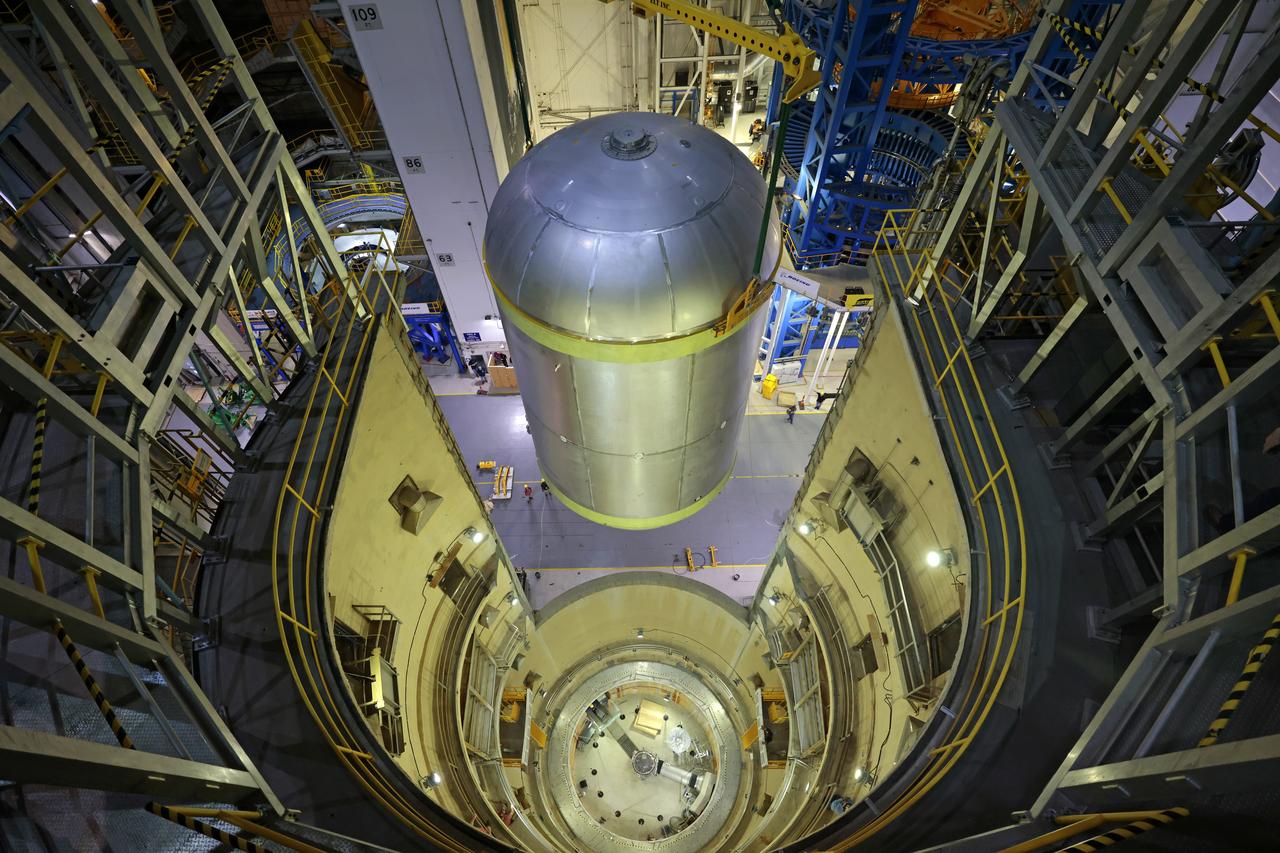
Teams at NASA’s Michoud Assembly Facility in New Orleans move a liquid oxygen tank for its SLS (Space Launch System) rocket to a cleaning cell inside the facility’s vertical assembly building on Oct. 11. The tank, which will be used on the core stage of the agency’s Artemis III mission, will undergo an internal cleaning before moving on to its next phase of production. Inside the cleaning cell, a solution is sprayed into the tank to remove particulates which may collect during the manufacturing process. Once a tank is cleaned, teams use mobile clean rooms for internal access to the tank to prevent external contaminates from entering the hardware. The propellant tank is one of five major elements that make up the 212-foot-tall rocket stage. The core stage, along with its four RS-25 engines, produce more than two million pounds of thrust to help launch NASA’s Orion spacecraft, astronauts, and supplies beyond Earth’s orbit and to the lunar surface for Artemis. Image credit: NASA/Michael DeMocker
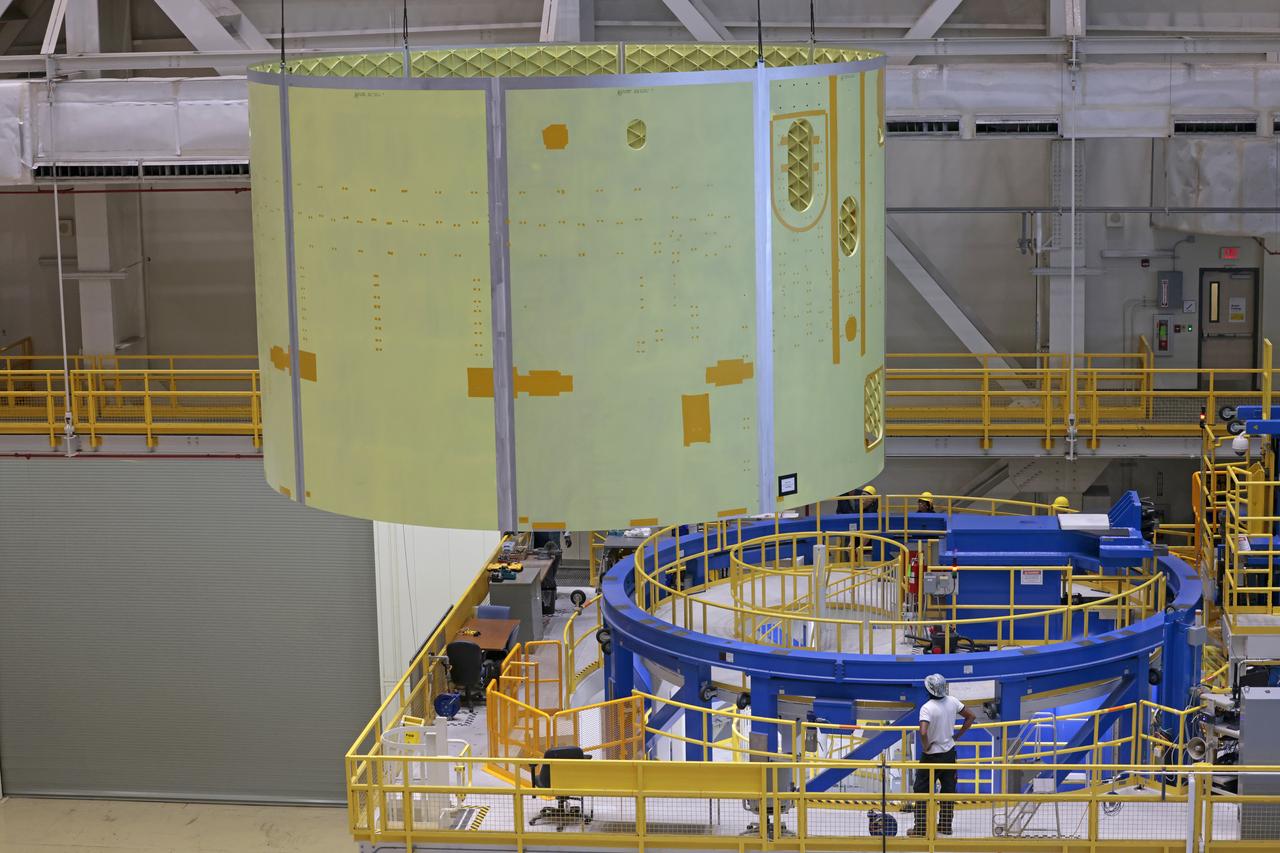
Technicians at NASA’s Michoud Assembly Facility move the engine section of NASA’s Space Launch System rocket for Artemis V on December 18, 2024, at NASA Michoud Assembly Facility in New Orleans, LA. Throughout 2024, new tooling was erected in bldg. 115 for the upcoming iterations of the Space Launch System (SLS), Exploration Upper Stage (EUS), and the test articles required to develop and assemble each efficiently and effectively. This barrel is the sixty-fourth produced for the Space Launch System program since its inception and is the first barrel weld completed for the core stage of the Artemis V mission. This engine section will be used on the evolved Block 1B configuration of the SLS (Space Launch System) rocket. It is one of the first components that will make up a portion of the core stage that will power NASA’s Artemis V mission. According to a Boeing engineer, as of this barrel, the VWC has now completed 515 production welds, with friction-stir welding a cumulative distance of 111,568 inches. Image credit: NASA/Michael DeMocker
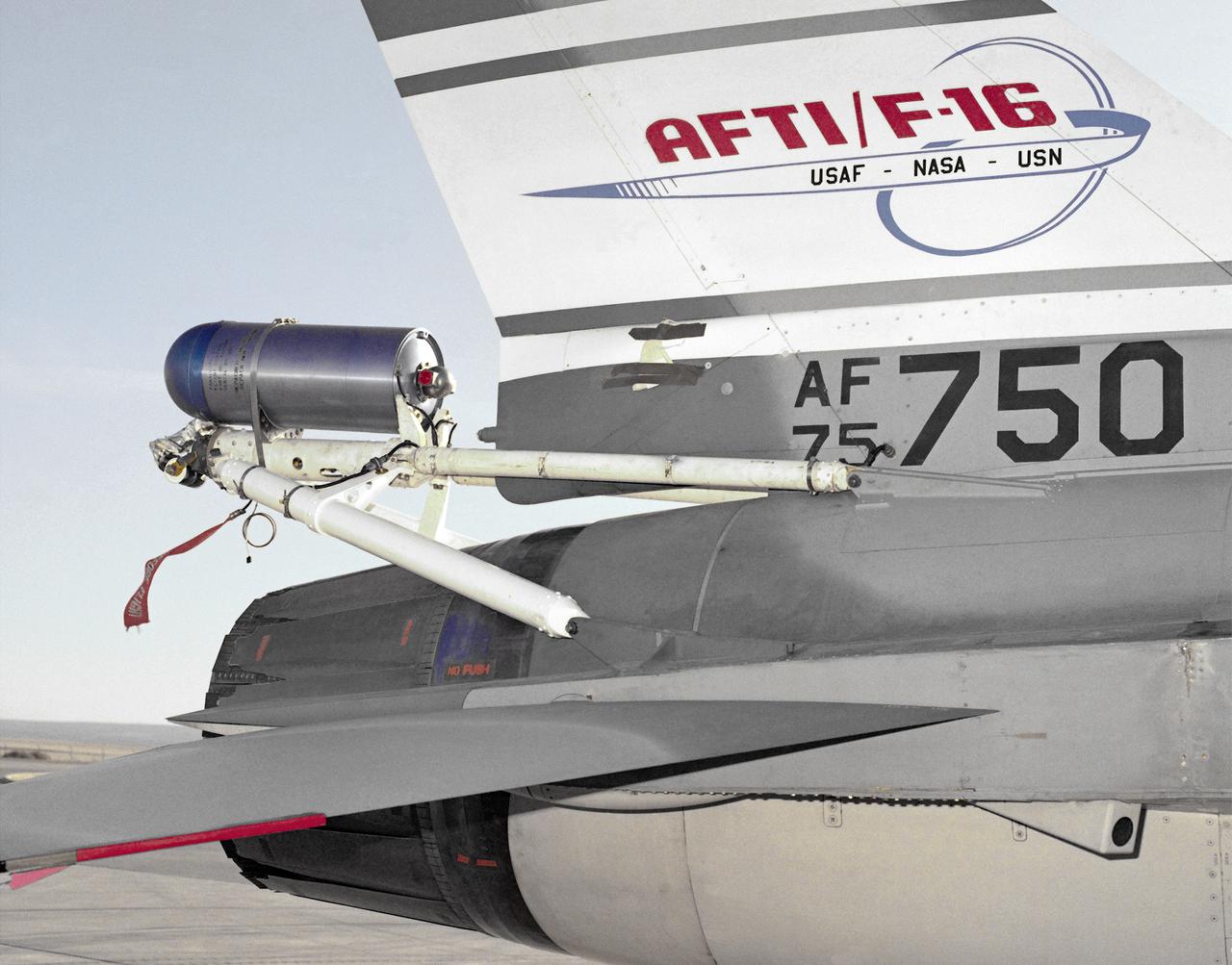
A close-up photo of the spin chute mounted on the rear fuselage of the AFTI F-16, a safety device designed to prevent the loss of aircraft in spin conditions. Under some circumstances, pilots cannot recover from spins using normal controls. It these instances, the spin chute is deployed, thus "breaking" the spin and enabling the pilot to recover. The spin chute is held in a metal cylinder attached to the AFTI F-16 by four tubes, a structure strong enough to withstand the shock of the spin chute opening. Unlike the air probe in the last photo, spin chutes are not standard equipment on research or prototype aircraft but are commonly attached expressly for actual spin tests.

F-15B ACTIVE in flight
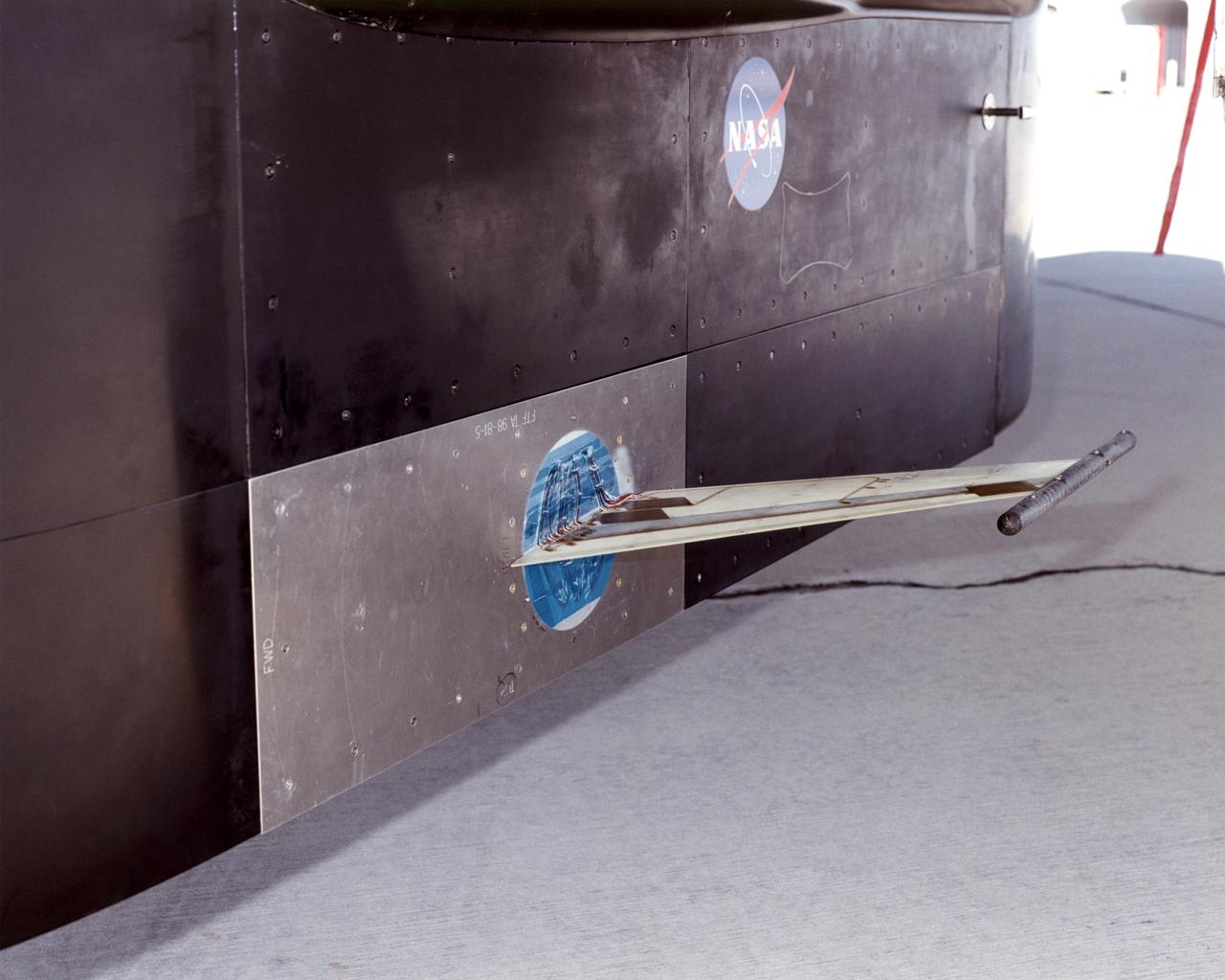
The Aerostructures Test Wing (ATW), which consisted of an 18-inch carbon fiber test wing with surface-mounted piezoelectric strain actuators, was mounted on a special ventral flight test fixture and flown on Dryden's F-15B Research Testbed aircraft

NASA Administrator, Michael Griffin watches the launch of the Space Shuttle Discovery (STS-124) from the Launch Control Center Saturday, May 31, 2008, at the Kennedy Space Center in Cape Canaveral, Fla. The Shuttle lifted off from launch pad 39A at 5:02 p.m. EDT. Photo Credit: (NASA/Bill Ingalls)
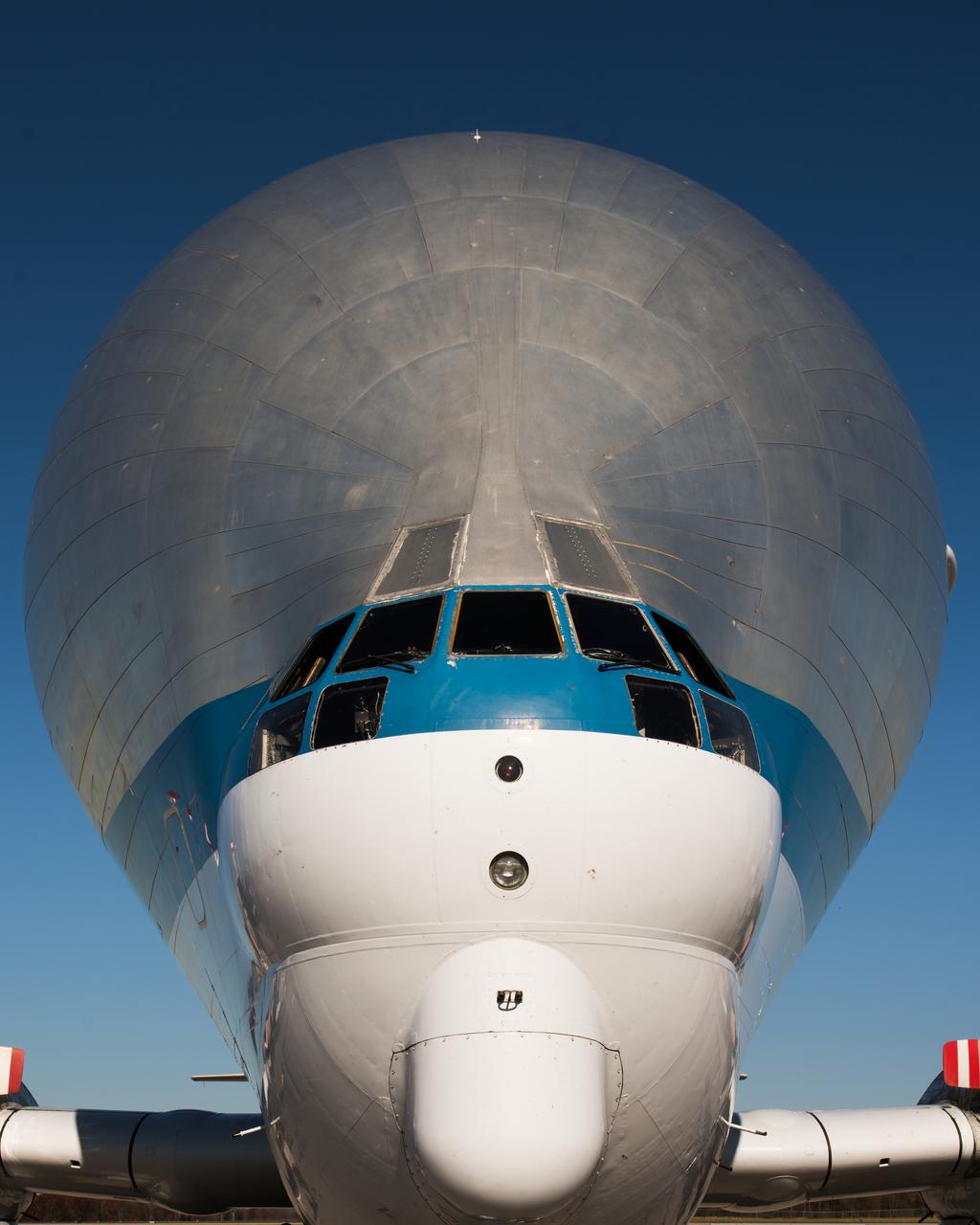
Front view of NASA’s Super Guppy aircraft after it touched down at Mansfield’s Lahm Airport in November, 2015. The crew delivered the crew module adaptor for Orion’s testing at NASA's Plum Brook Station next year.
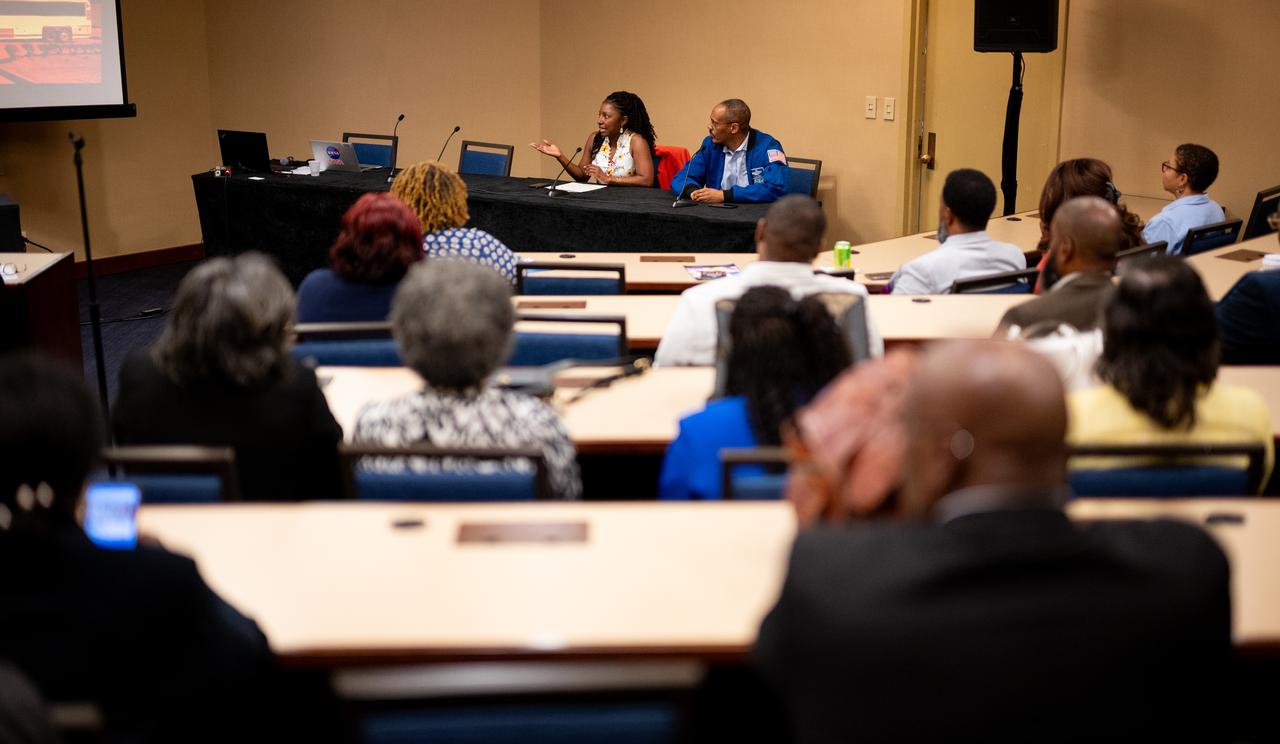
NASA TV producer of “The Color of Space” Jori Kates, left, and NASA astronaut Alvin Drew answer questions before a screening of “The Color of Space” as part of the Department of Education’s HBCU Week Conference, Monday, Sept. 25, 2023, at the Hyatt Regency in Arlington, Va. Photo Credit: (NASA/Joel Kowsky)
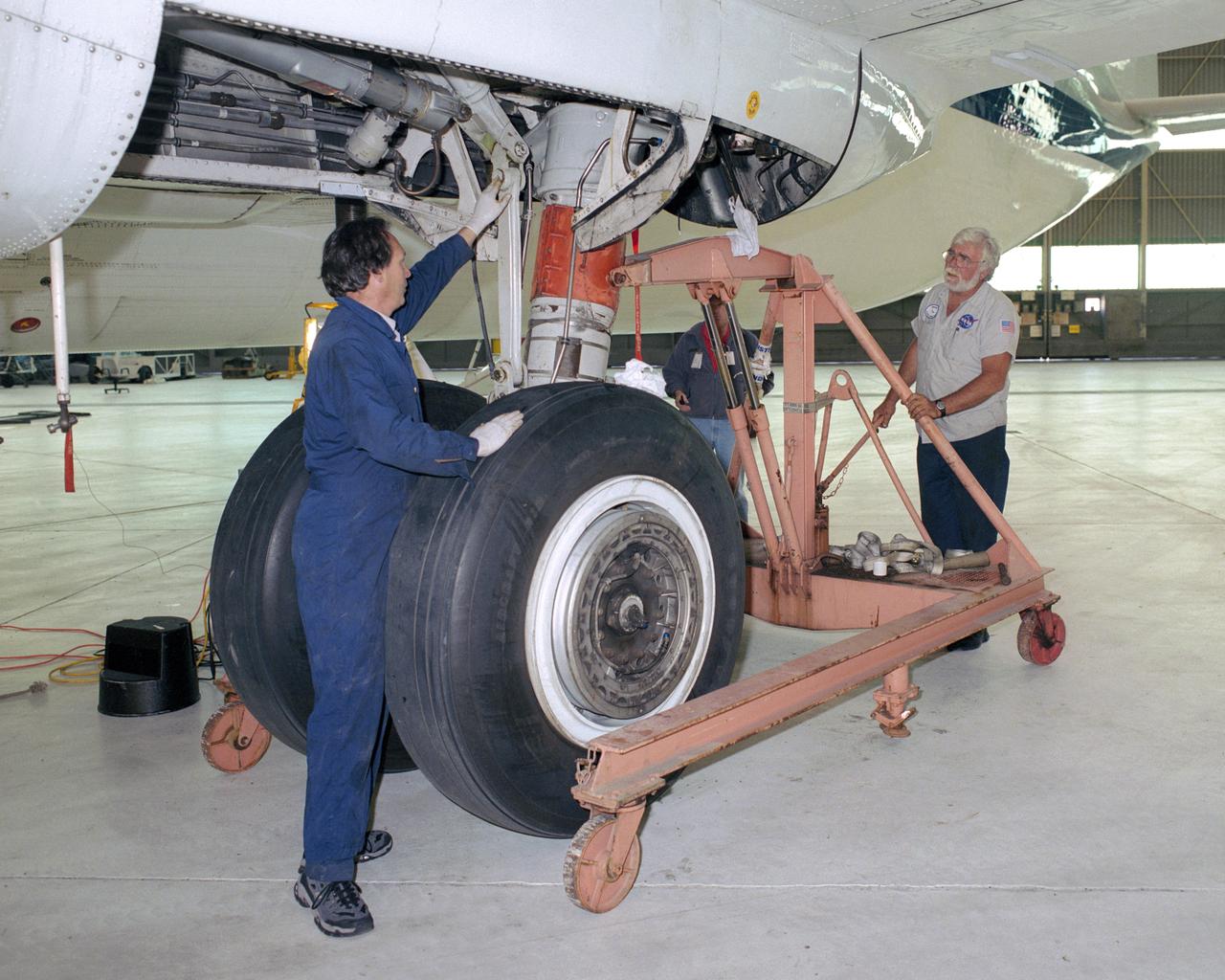
JSC technicians David Wyckoff and Tom Gordon carefully maneuver their equipment into place as they prepare to remove the Super Guppy's left main landing gear.
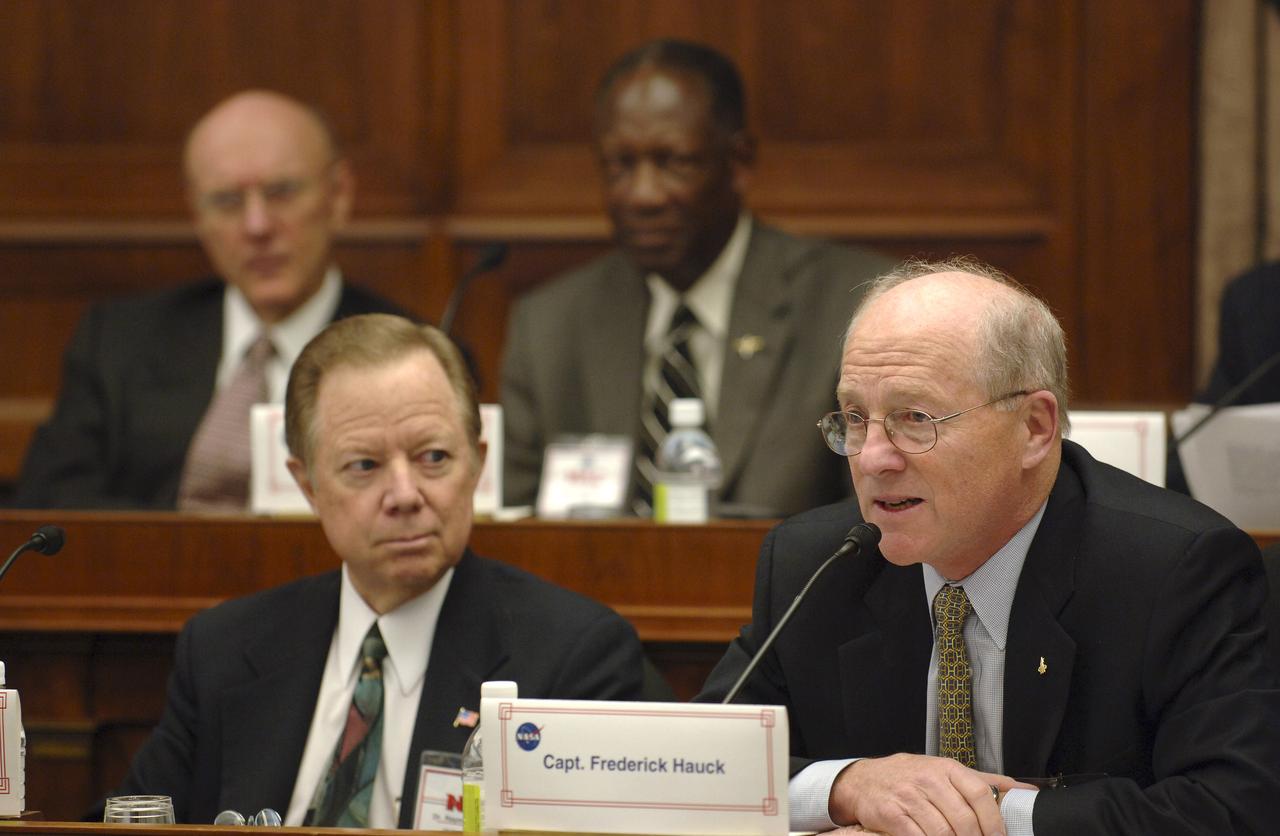
Capt. Frederick Hauck, USN (Ret.) talks during the NASA Advisory Council meeting held at the Rayburn House Office Building, Tuesday, Nov. 29, 2005, in Washington. Photo Credit: (NASA/Bill Ingalls)
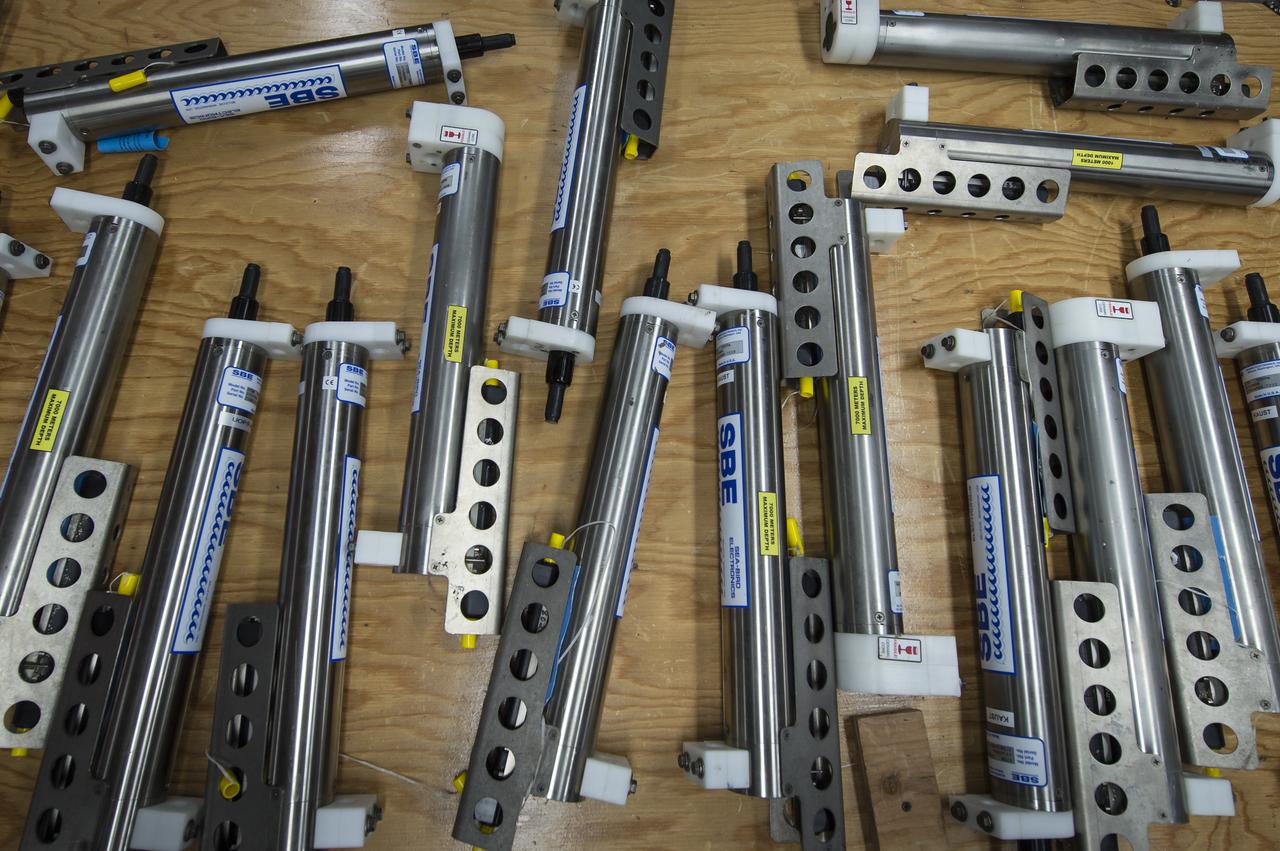
CTD instruments used to measure Conductivity, Temperature, and Depth, are seen onboard the Woods Hole Oceanographic Institution's research vessel Knorr on Tuesday, Sept. 4, 2012, in Woods Hole, Mass. The CTDs will be deployed in the Atlantic Ocean as part of the Salinity Processes in the Upper Ocean Regional Study (SPURS) which is set to sail on Sept. 6. The NASA-sponsored expedition will sail to the North Atlantic's saltiest spot to get a detailed, 3-D picture of how salt content fluctuates in the ocean's upper layers and how these variations are related to shifts in rainfall patterns around the planet. Photo Credit: (NASA/Bill Ingalls)
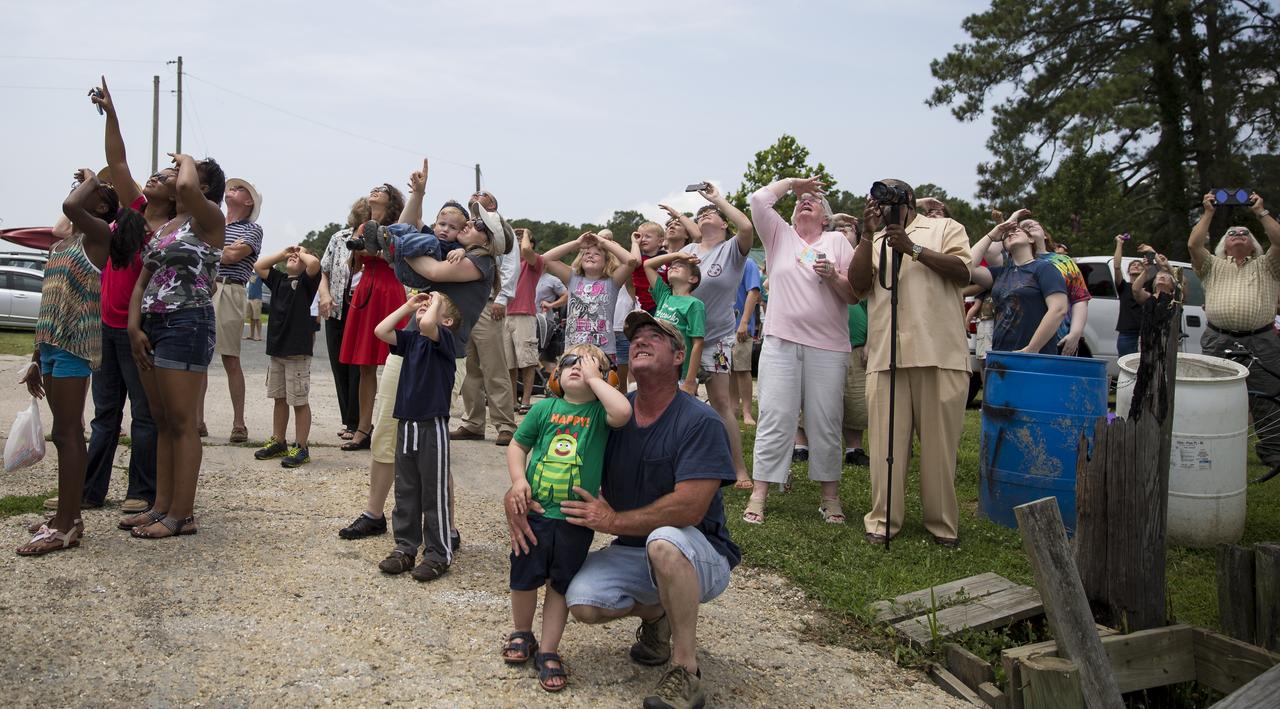
Spectators watch as the Orbital Sciences Corporation Antares rocket launches with the Cygnus spacecraft onboard from NASA's Wallops Flight Facility, Sunday, July 13, 2014, Atlantic, VA. The Cygnus spacecraft is filled with over 3,000 pounds of supplies for the International Space Station, including science experiments, experiment hardware, spare parts, and crew provisions. The Orbital-2 mission is Orbital Sciences' second contracted cargo delivery flight to the space station for NASA. Photo Credit: (NASA/Joel Kowsky)
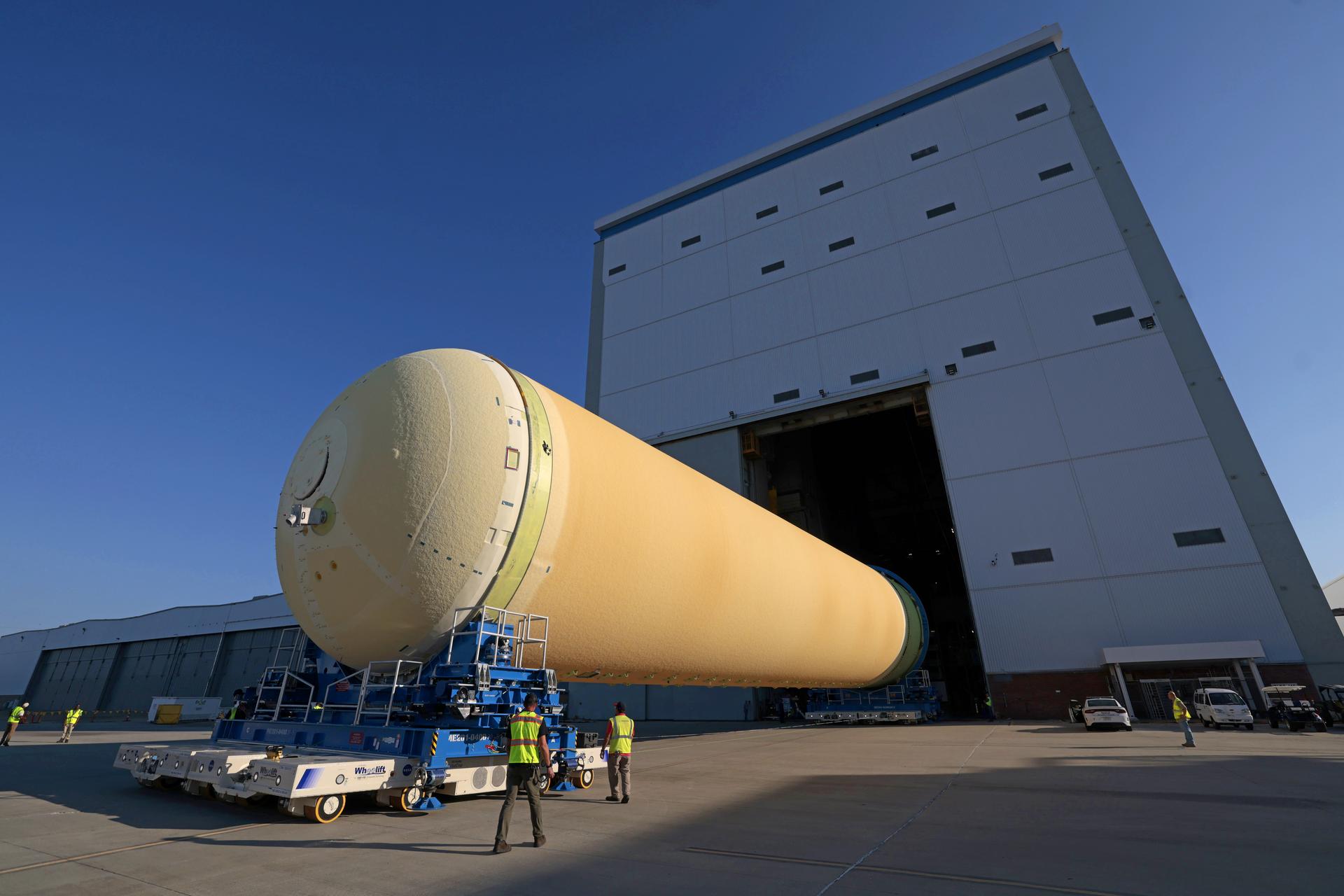
NASA’s Michoud Assembly move crews lift the liquid hydrogen tank for its Artemis III mission out of a production cell and move it into the final assembly manufacturing area on Oct. 10, 2025. Teams with SLS (Space Launch System) prime contractor, Boeing, recently mated the tank to the LH2 Transport Adapter Assembly, which will allow the stage to be securely transported by barge to NASA’s Kennedy Space Center once it’s mated to the forward end of the core stage. The LH2 Transport Adapter Assembly serves as a temporary place holder for the engine section, which was previously shipped from Michoud to NASA’s Kennedy Space Center for further integration. The propellant tank is one of five major elements that make up the 212-foot-tall rocket stage. The core stage, along with its four RS-25 engines, produce more than two million pounds of thrust to help launch NASA’s Orion spacecraft, astronauts, and supplies beyond Earth’s orbit and to the lunar surface for Artemis. Image credit: NASA/Michael DeMocker
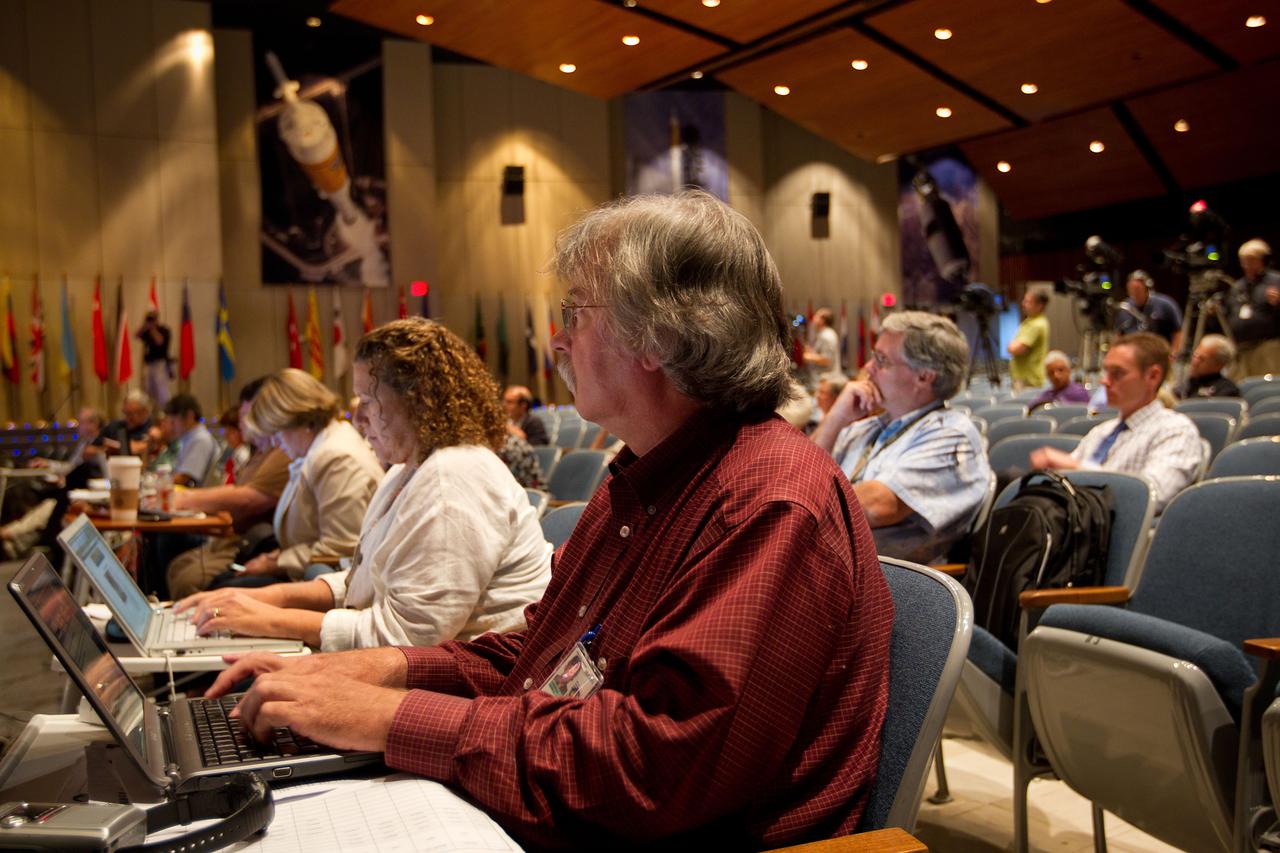
JSC2011-E-060796 (30 June 2011) --- Reporter Mark Carreau of Aviation Week takes notes during the STS-135 crew media briefing at NASA?s Johnson Space Center on June 30, 2011. The press conference provided the last scheduled opportunity for a large group of press to speak with the crew before the final launch on July 8. Photo credit: NASA Photo/Houston Chronicle, Smiley N. Pool
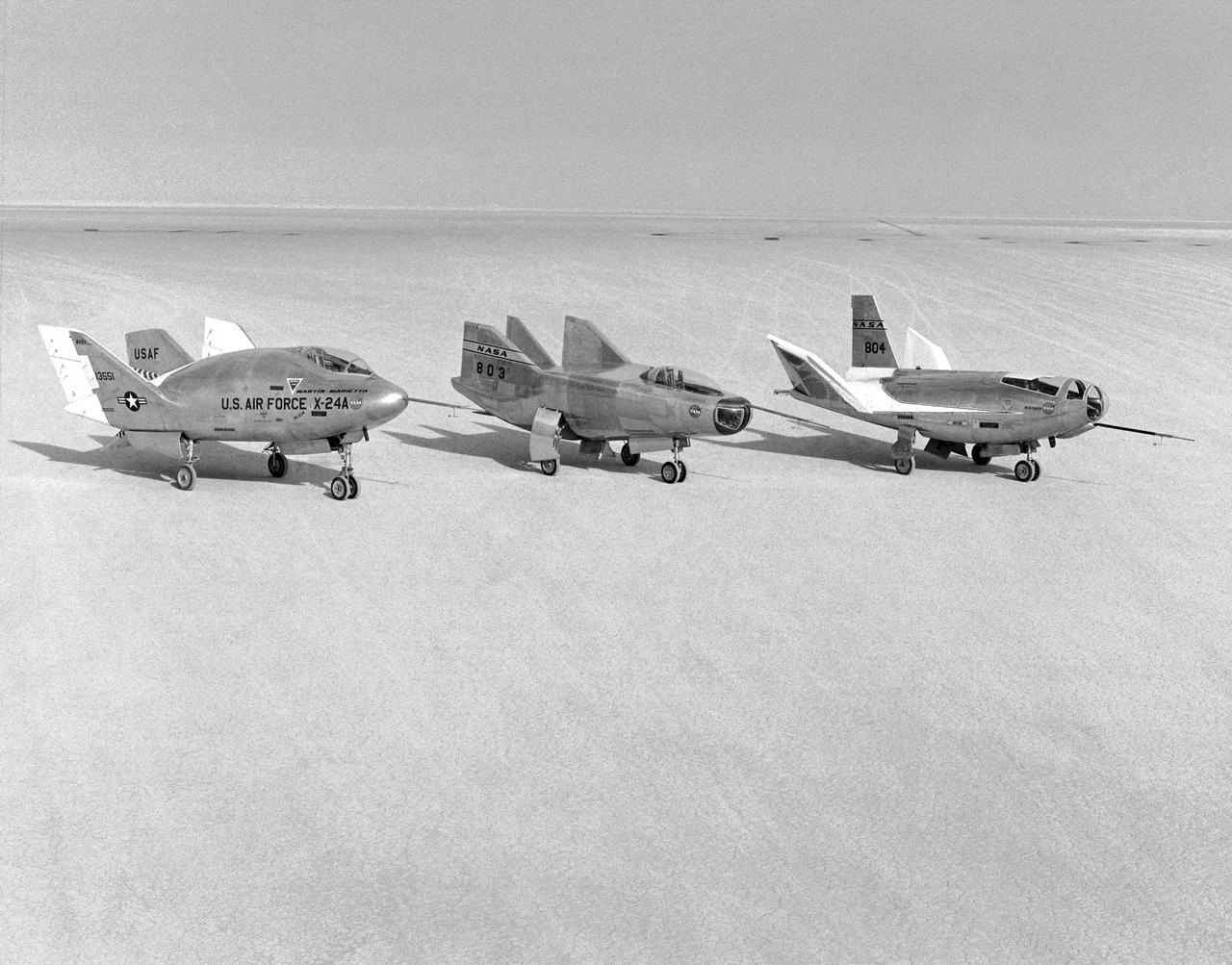
The wingless, lifting body aircraft sitting on Rogers Dry Lake at what is now NASA's Dryden Flight Research Center, Edwards, California, from left to right are the X-24A, M2-F3 and the HL-10. The lifting body aircraft studied the feasibility of maneuvering and landing an aerodynamic craft designed for reentry from space. These lifting bodies were air launched by a B-52 mother ship, then flew powered by their own rocket engines before making an unpowered approach and landing. They helped validate the concept that a space shuttle could make accurate landings without power. The X-24A flew from April 17, 1969 to June 4, 1971. The M2-F3 flew from June 2, 1970 until December 20, 1972. The HL-10 flew from December 22, 1966 until July 17, 1970 and logged the highest and fastest records in the lifting body program.