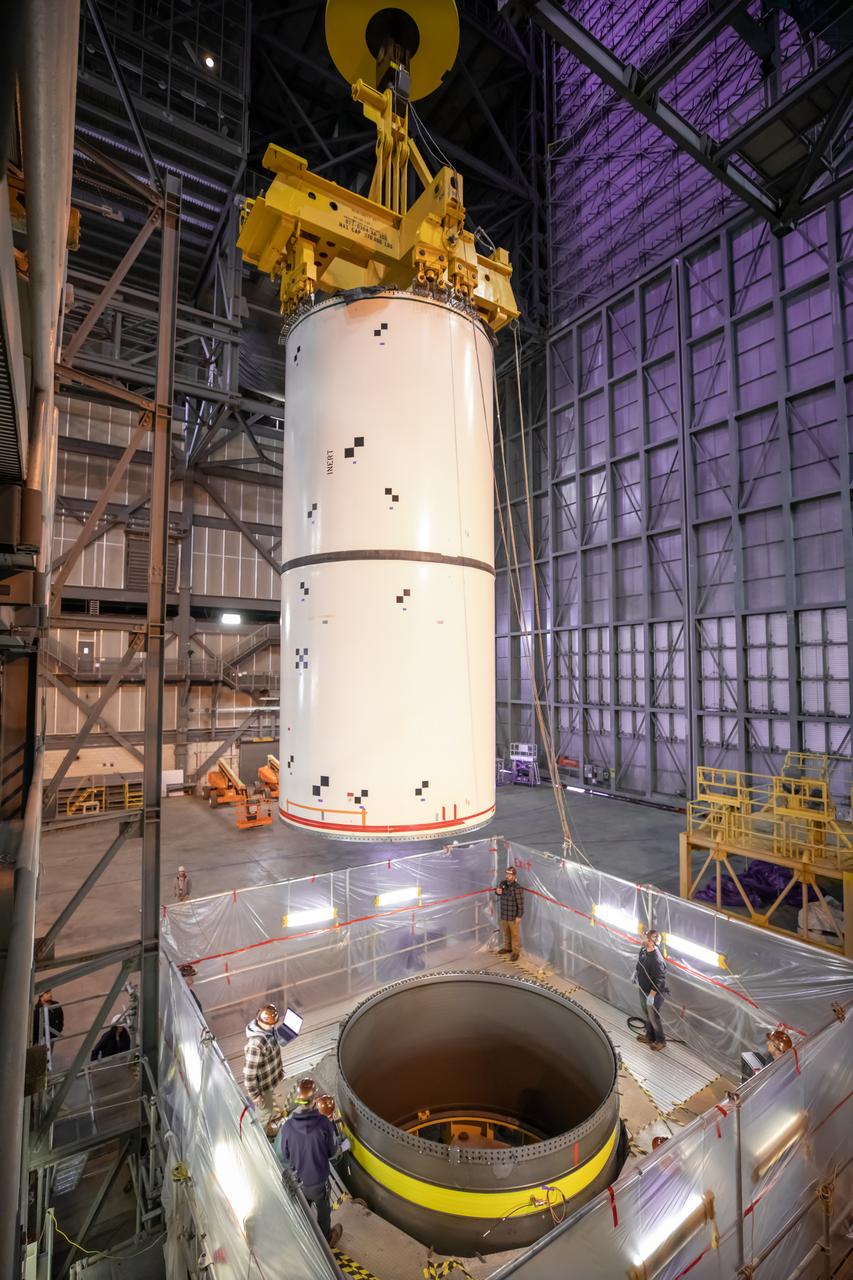
In High Bay 4 of the Vehicle Assembly Building at NASA’s Kennedy Space Center in Florida, pathfinders, or full-scale replicas of Space Launch System (SLS) solid rocket booster segments, are being stacked during a training exercise on Jan. 8, 2020. A team of engineers with Exploration Ground Systems and crane operators and technicians with contractor Jacobs are practicing lifting, moving and stacking maneuvers, using important ground support equipment to train employees and certify all the equipment works properly. The booster pathfinders are inert, full-scale replicas of the actual booster hardware that will be attached to the SLS rocket for Artemis missions. The five-segment, 17-story-tall twin boosters will provide 3.6 million pounds of thrust each at liftoff to help launch Orion on Artemis I, its first uncrewed mission beyond the Moon.
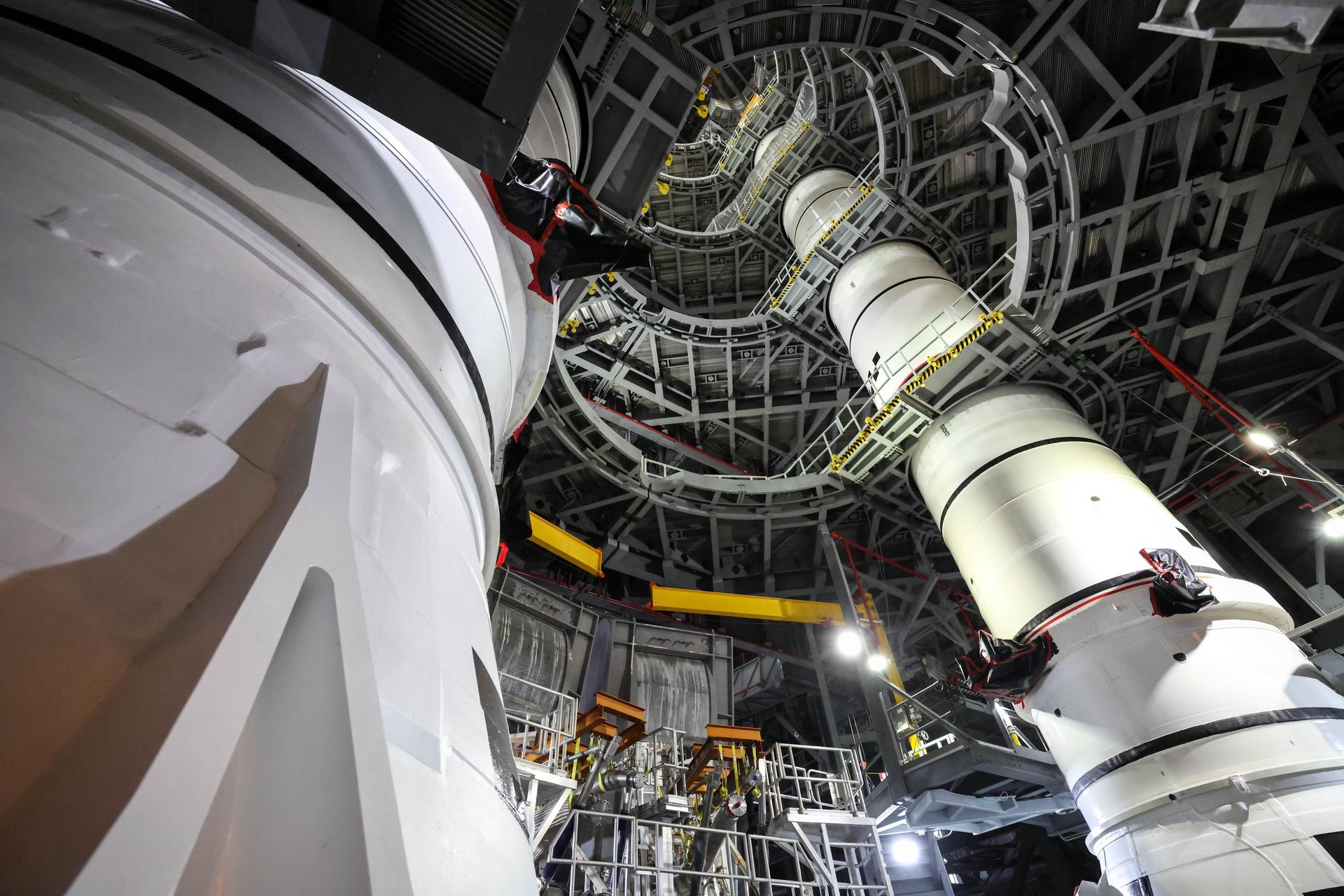
Technicians inside the Vehicle Assembly Building at NASA’s Kennedy Space Center in Florida complete integration of the left forward center solid rocket booster segment onto the left center center booster segment for the Artemis III SLS (Space Launch System) rocket on the mobile launcher inside High Bay 3 on Tuesday, Sept. 1, 2026. The twin boosters, comprising five segments each and manufactured by Northrop Grumman in Utah, provide more than 75 percent of the SLS rocket’s total thrust at liftoff. The Artemis III mission will launch crew in the Orion spacecraft on top of the SLS rocket to test rendezvous and docking capabilities between Orion and commercial spacecraft needed to land astronauts on the Moon.
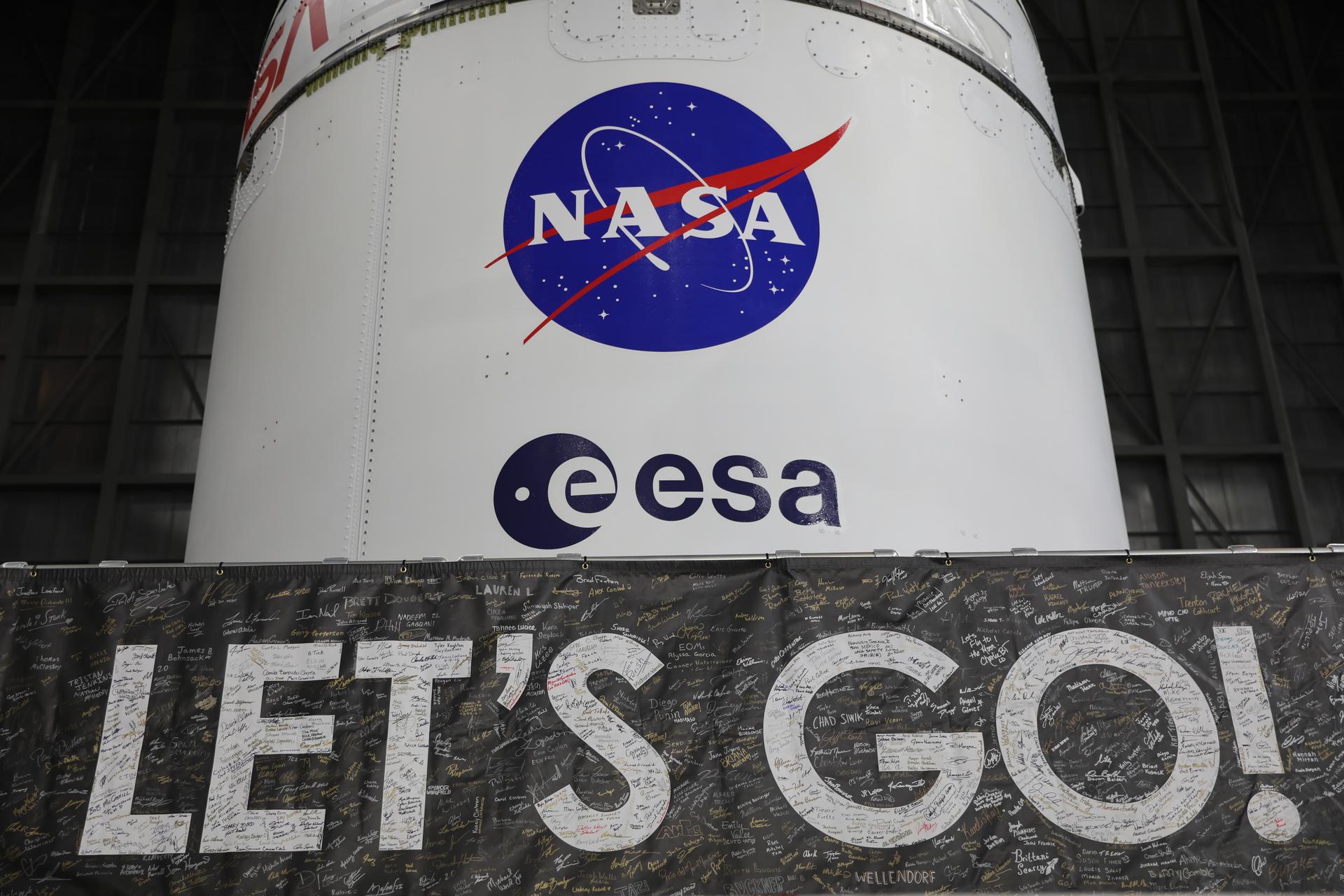
Technicians with NASA’s Exploration Ground Systems team prepare for integration to attach the agency’s Orion spacecraft on top of the SLS (Space Launch System) rocket in High Bay 3 of the Vehicle Assembly Building at NASA’s Kennedy Space Center in Florida on Friday, Oct. 17, 2025, for the agency’s Artemis II mission. Set to launch in 2026, the spacecraft will carry NASA astronauts Reid Wiseman, Victor Glover, Christina Koch, and CSA (Canadian Space Agency) astronaut Jeremy Hansen on a 10-day mission around the Moon and back. Once stacked, teams will begin conducting a series of verification tests ahead of rolling out to Launch Complex 39B for the wet dress rehearsal at NASA Kennedy.
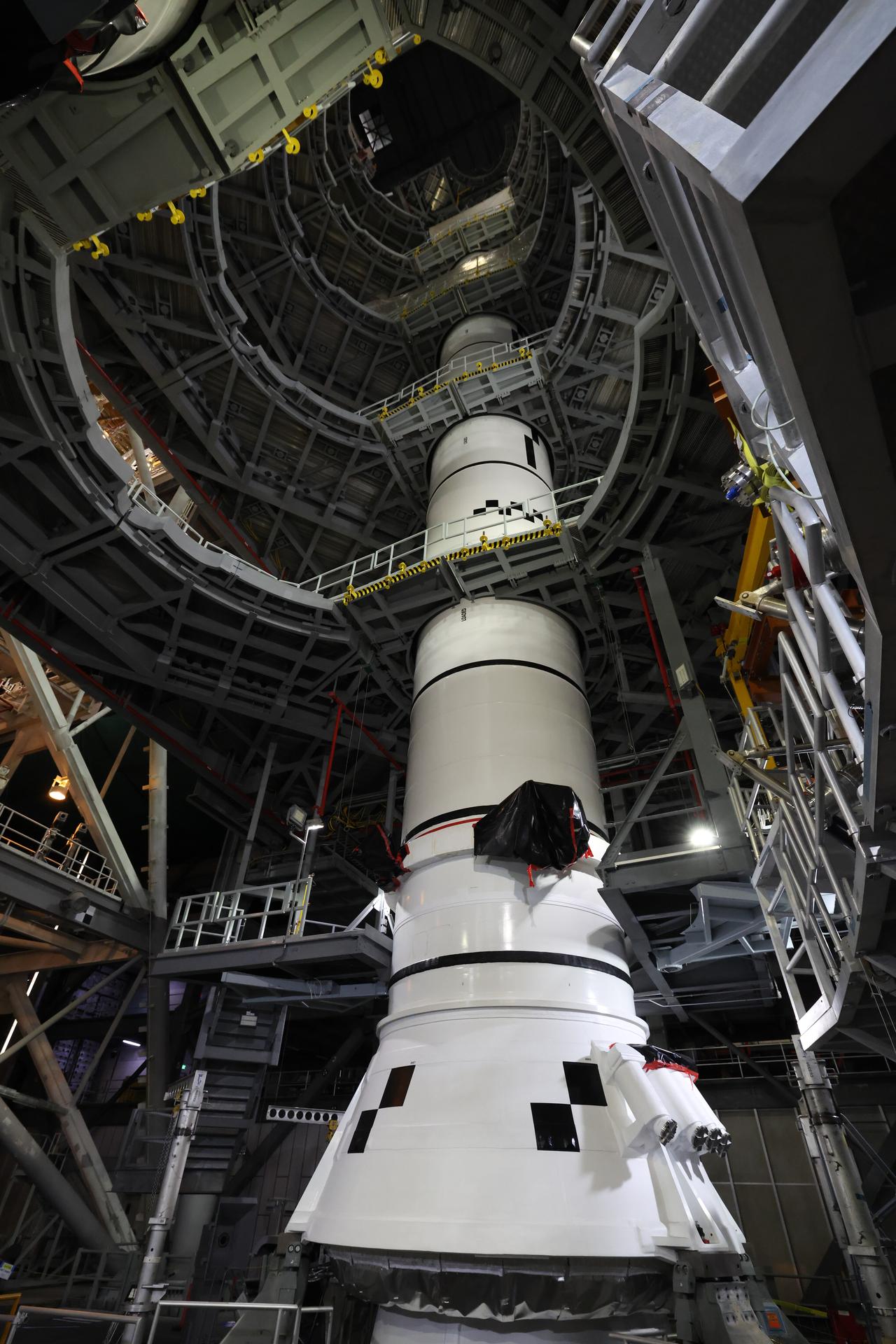
In High Bay 3 of the Vehicle Assembly Building at NASA’s Kennedy Space Center in Florida, the right forward center booster for Artemis III is integrated onto the right booster segments on the mobile launcher for the SLS (Space Launch System) rocket on Friday, Sept. 11, 2026. The twin boosters, comprising of five segments each manufactured by Northrop Grumman in Utah, will provide more than 75 percent of the SLS rocket’s total thrust at launch. The Artemis III mission will launch crew in the Orion spacecraft on top of the SLS rocket to test rendezvous and docking capabilities between Orion and commercial spacecraft needed to land astronauts on the Moon.
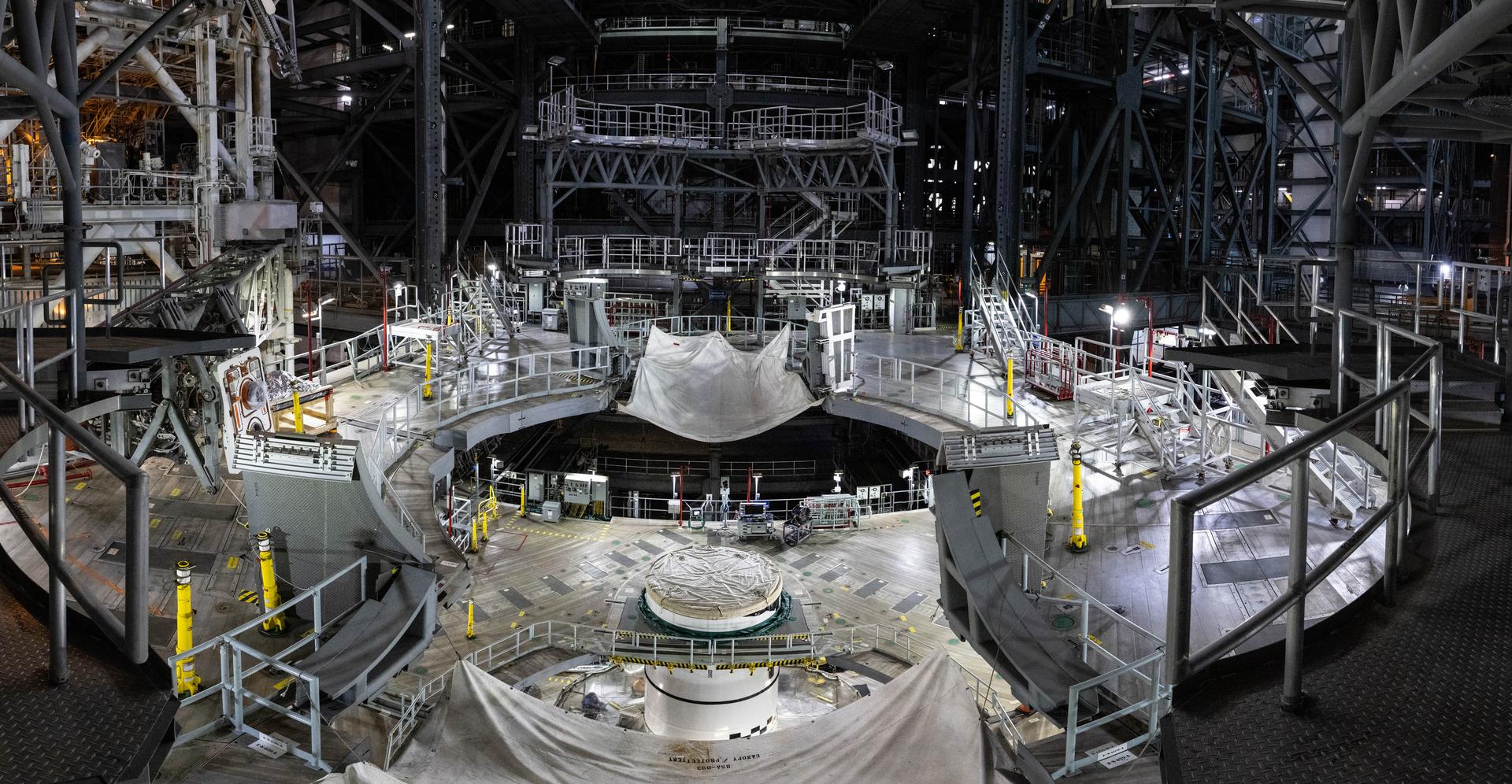
In High Bay 3 of the Vehicle Assembly Building at NASA’s Kennedy Space Center in Florida, the right forward center booster for Artemis III is integrated onto the right booster segments on the mobile launcher for the SLS (Space Launch System) rocket on Friday, Sept. 11, 2026. The twin boosters, comprising of five segments each manufactured by Northrop Grumman in Utah, will provide more than 75 percent of the SLS rocket’s total thrust at launch. The Artemis III mission will launch crew in the Orion spacecraft on top of the SLS rocket to test rendezvous and docking capabilities between Orion and commercial spacecraft needed to land astronauts on the Moon.
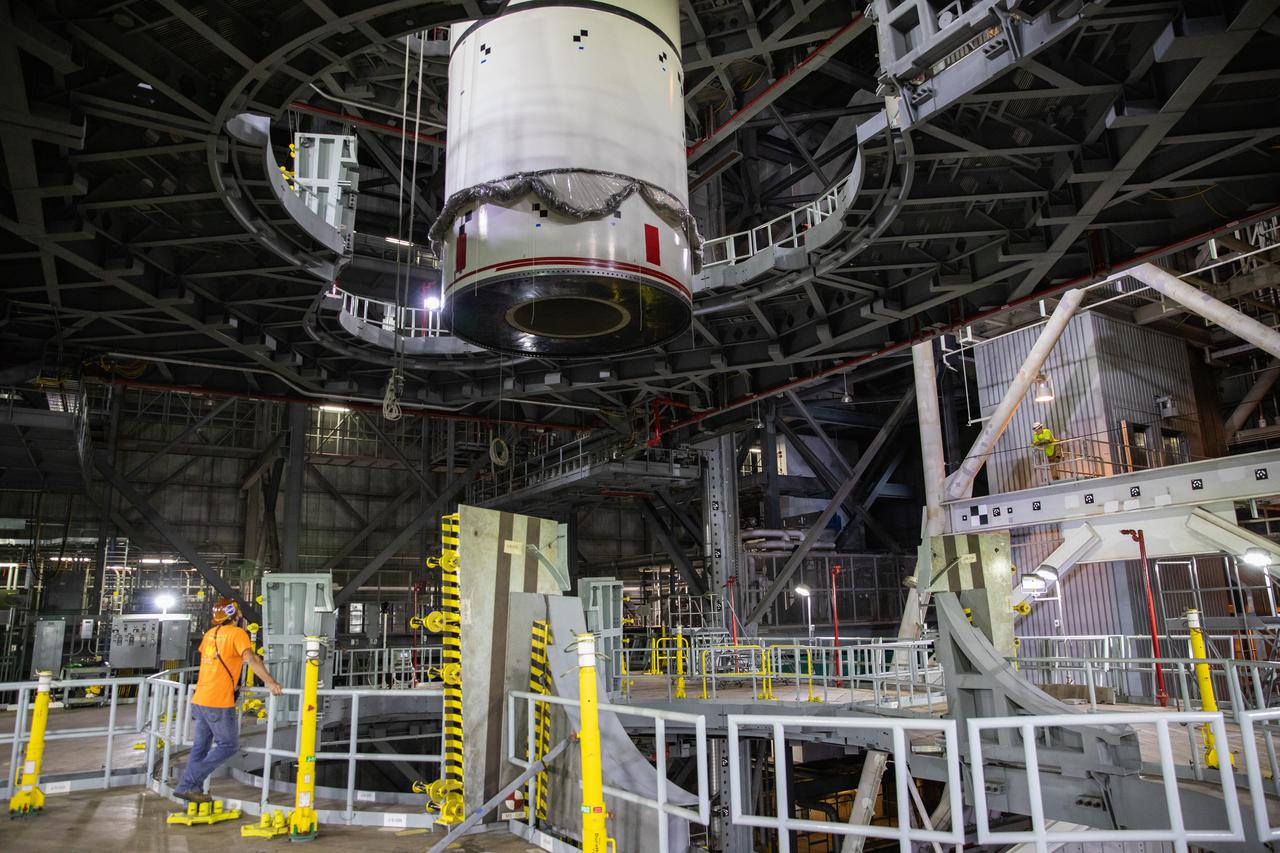
Technicians with NASA’s Exploration Ground Systems lower a mock-up, or pathfinder, of the Space Launch System’s (SLS) center booster segment onto an aft pathfinder segment inside the Vehicle Assembly Building (VAB) at the agency’s Kennedy Space Center in Florida on Sept. 14, 2020. Teams rehearsed stacking both pathfinder segments on top of the mobile launcher in High Bay 3 of the VAB in preparation for the Artemis I launch. Stacking of the actual SLS booster segments will occur later this year, when the rocket’s core stage arrives at Kennedy. Artemis I is the first in a series of increasingly complex missions that will test SLS and the Orion spacecraft as an integrated system prior to crewed flights to the Moon.
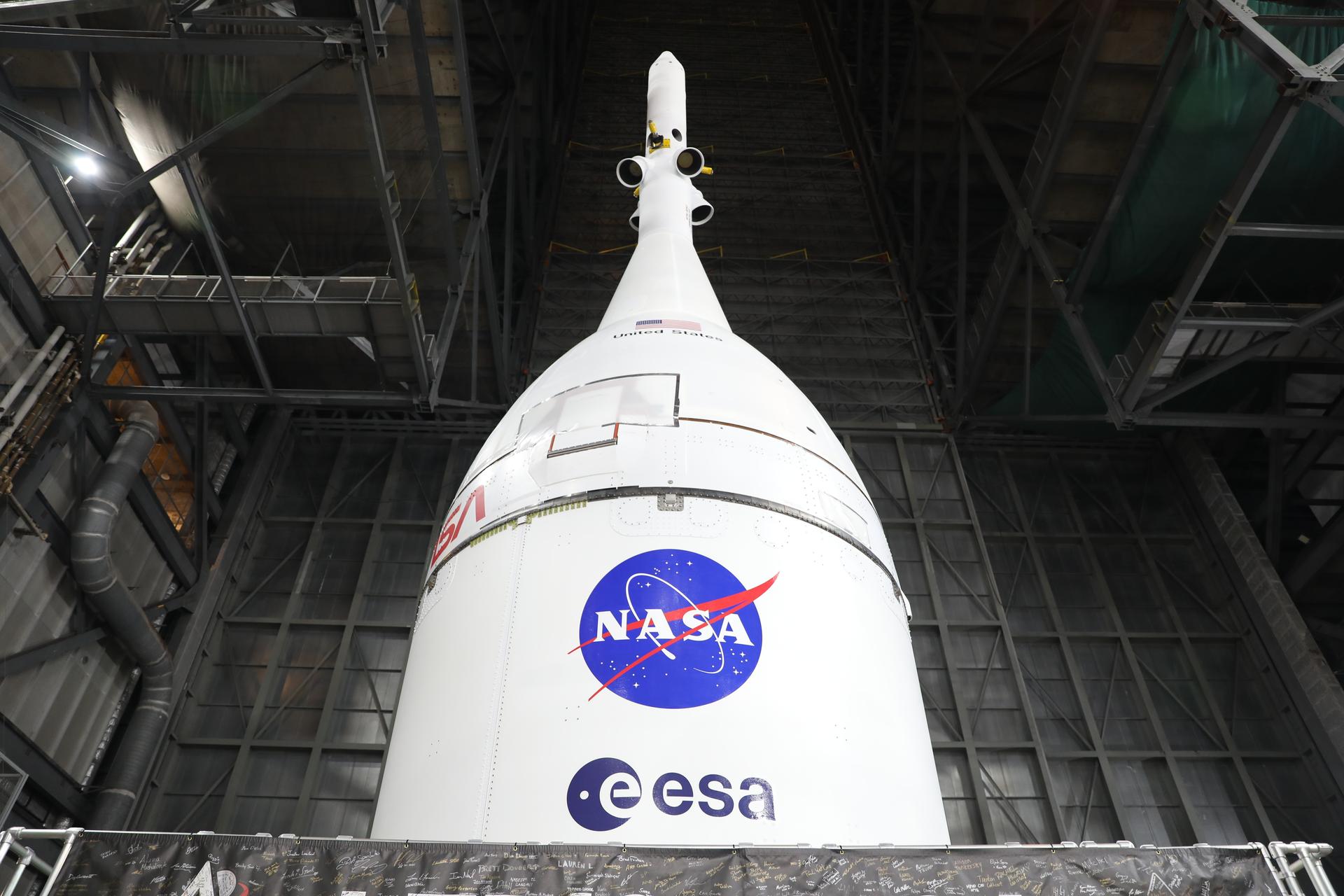
Technicians with NASA’s Exploration Ground Systems team prepare for integration to attach the agency’s Orion spacecraft on top of the SLS (Space Launch System) rocket in High Bay 3 of the Vehicle Assembly Building at NASA’s Kennedy Space Center in Florida on Friday, Oct. 17, 2025, for the agency’s Artemis II mission. Set to launch in 2026, the spacecraft will carry NASA astronauts Reid Wiseman, Victor Glover, Christina Koch, and CSA (Canadian Space Agency) astronaut Jeremy Hansen on a 10-day mission around the Moon and back. Once stacked, teams will begin conducting a series of verification tests ahead of rolling out to Launch Complex 39B for the wet dress rehearsal at NASA Kennedy.
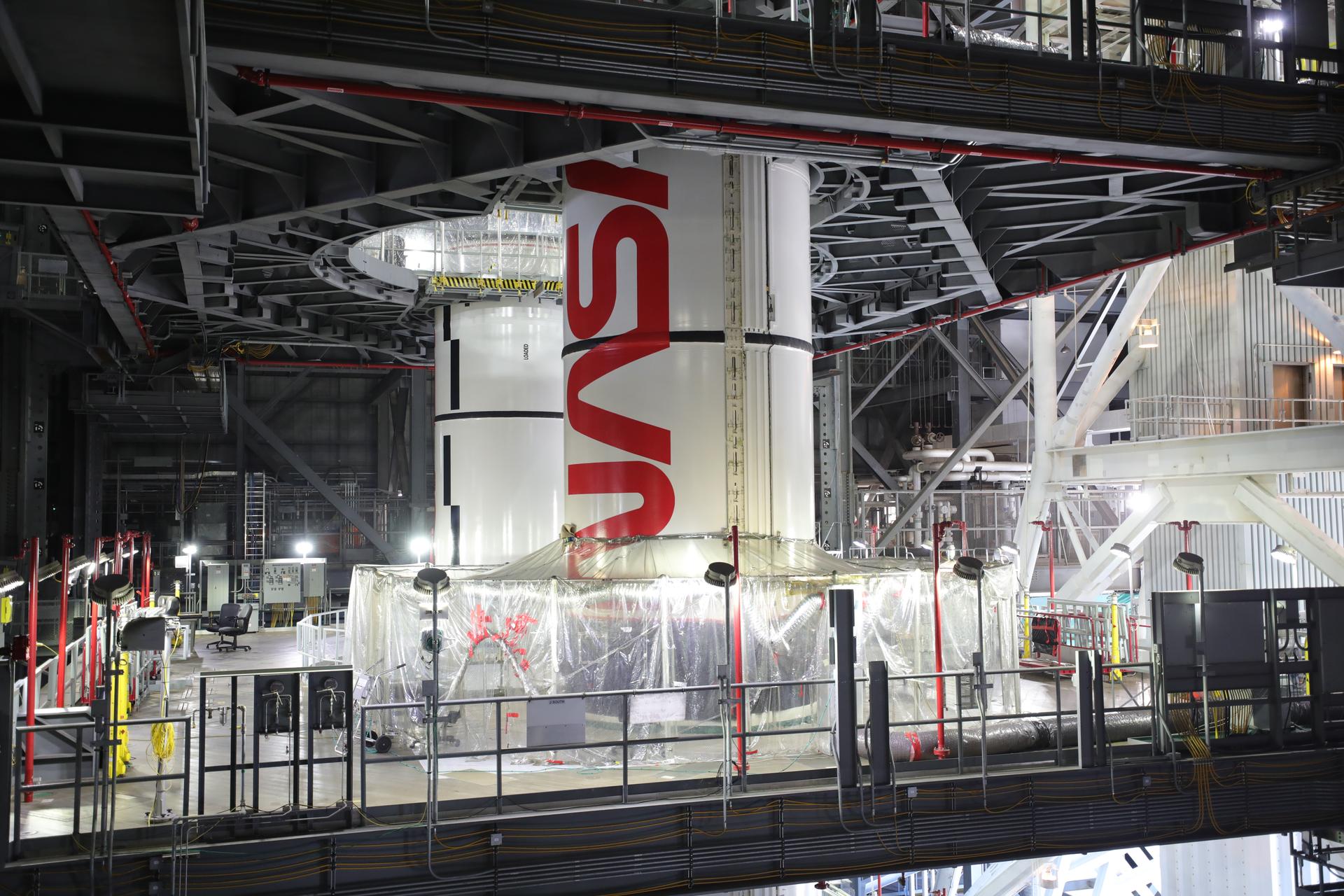
During integration operations inside the Vehicle Assembly Building at NASA’s Kennedy Space Center in Florida, the NASA “worm” is visible on the left and right center center solid rocket booster segments for the Artemis III SLS (Space Launch System) rocket on the mobile launcher inside High Bay 3 on Tuesday, Sept. 1, 2026. The twin boosters, comprising of five segments each manufactured by Northrop Grumman in Utah, will provide more than 75 percent of the SLS rocket’s total thrust at launch. The Artemis III mission will launch crew in the Orion spacecraft on top of the SLS rocket to test rendezvous and docking capabilities between Orion and commercial spacecraft needed to land astronauts on the Moon.
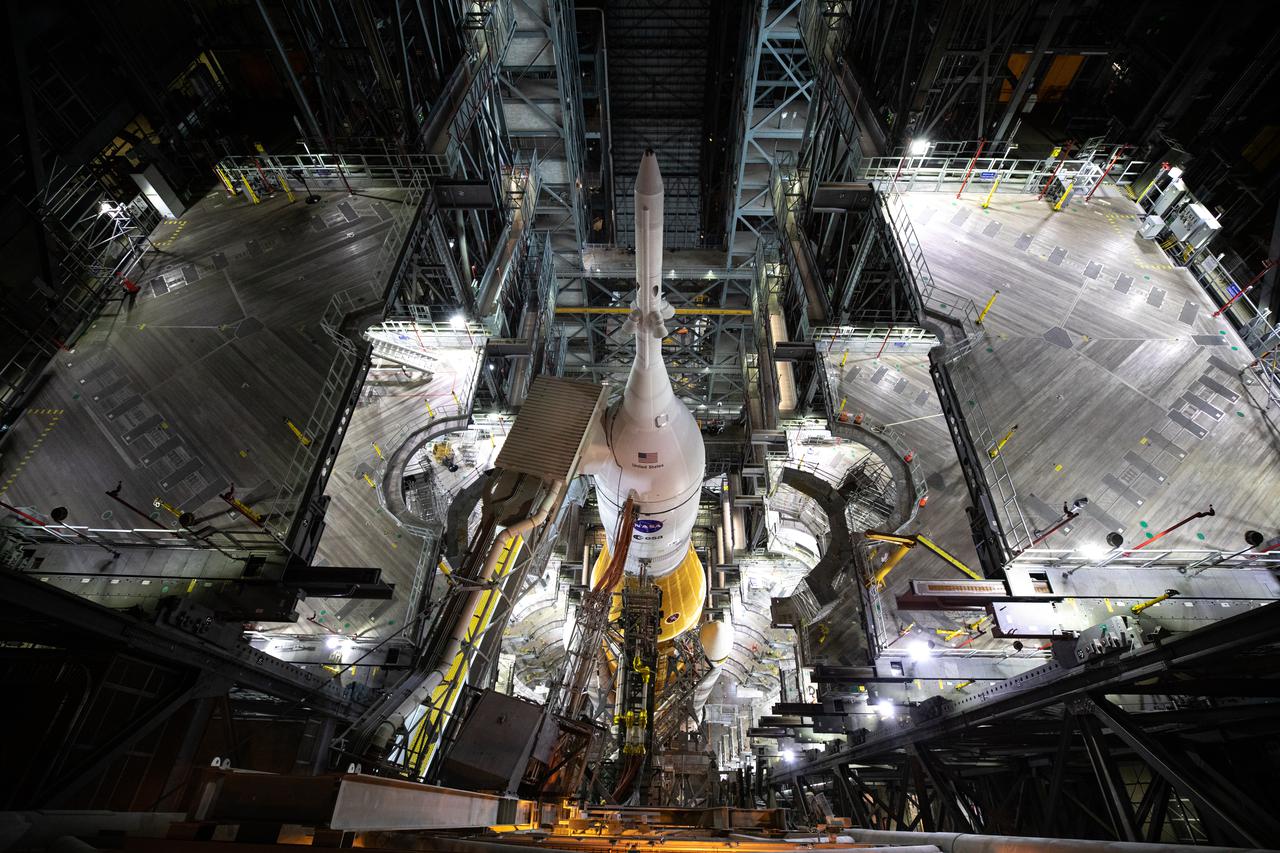
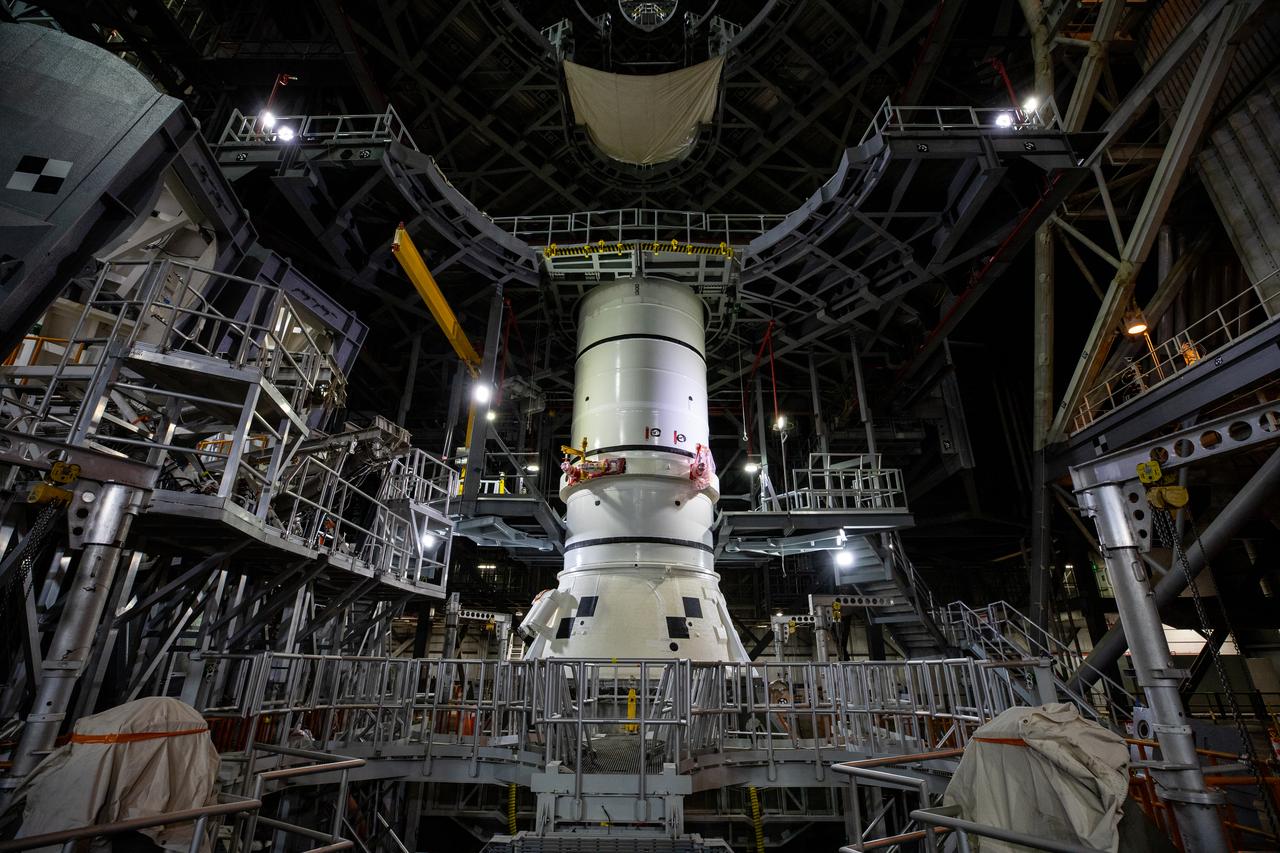
In this view looking down in High Bay 3 of the Vehicle Assembly Building at NASA’s Kennedy Space Center in Florida, the Artemis I Space Launch System (SLS) and Orion spacecraft can be seen without any work platforms surrounding them on March 17, 2022. The Artemis I stack atop the mobile launcher will roll out to Launch Complex 39B atop the crawler-transporter 2 for a wet dress rehearsal ahead of launch. Artemis I will be the first integrated test of the SLS and Orion spacecraft. In later missions, NASA will land the first woman the first person of color on the surface of the Moon, paving the way for a long-term lunar presence and serving as a steppingstone on the way to Mars.
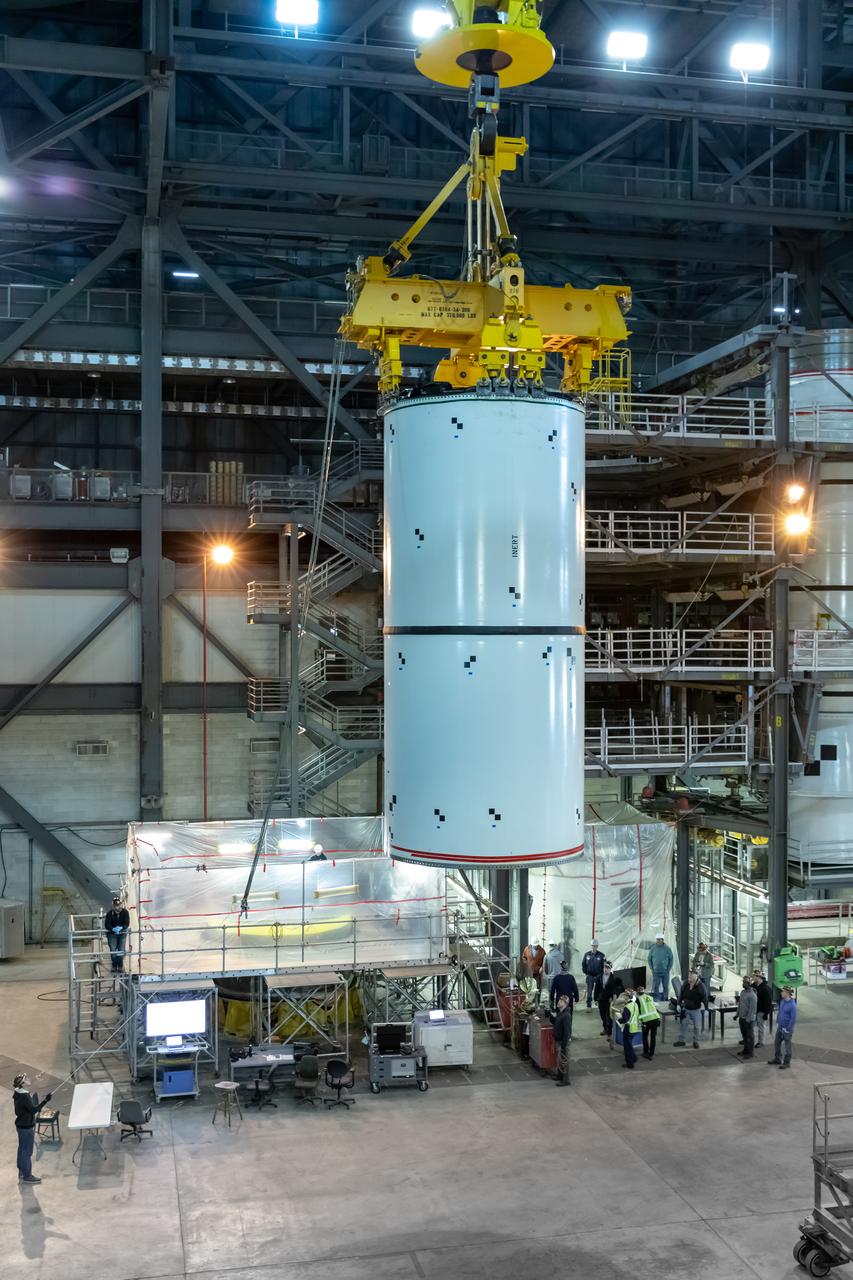
In High Bay 4 of the Vehicle Assembly Building at NASA’s Kennedy Space Center in Florida, a crane moves Space Launch System (SLS) solid rocket booster pathfinder segments toward a platform during a training exercise on Jan. 8, 2020. A team of engineers with Exploration Ground Systems and crane operators and technicians with contractor Jacobs are practicing lifting, moving and stacking maneuvers, using important ground support equipment to train employees and certify all the equipment works properly. The booster pathfinders are inert, full-scale replicas of the actual booster hardware that will be attached to the SLS rocket for Artemis missions. The five-segment, 17-story-tall twin boosters will provide 3.6 million pounds of thrust each at liftoff to help launch Orion on Artemis I, its first uncrewed mission beyond the Moon.
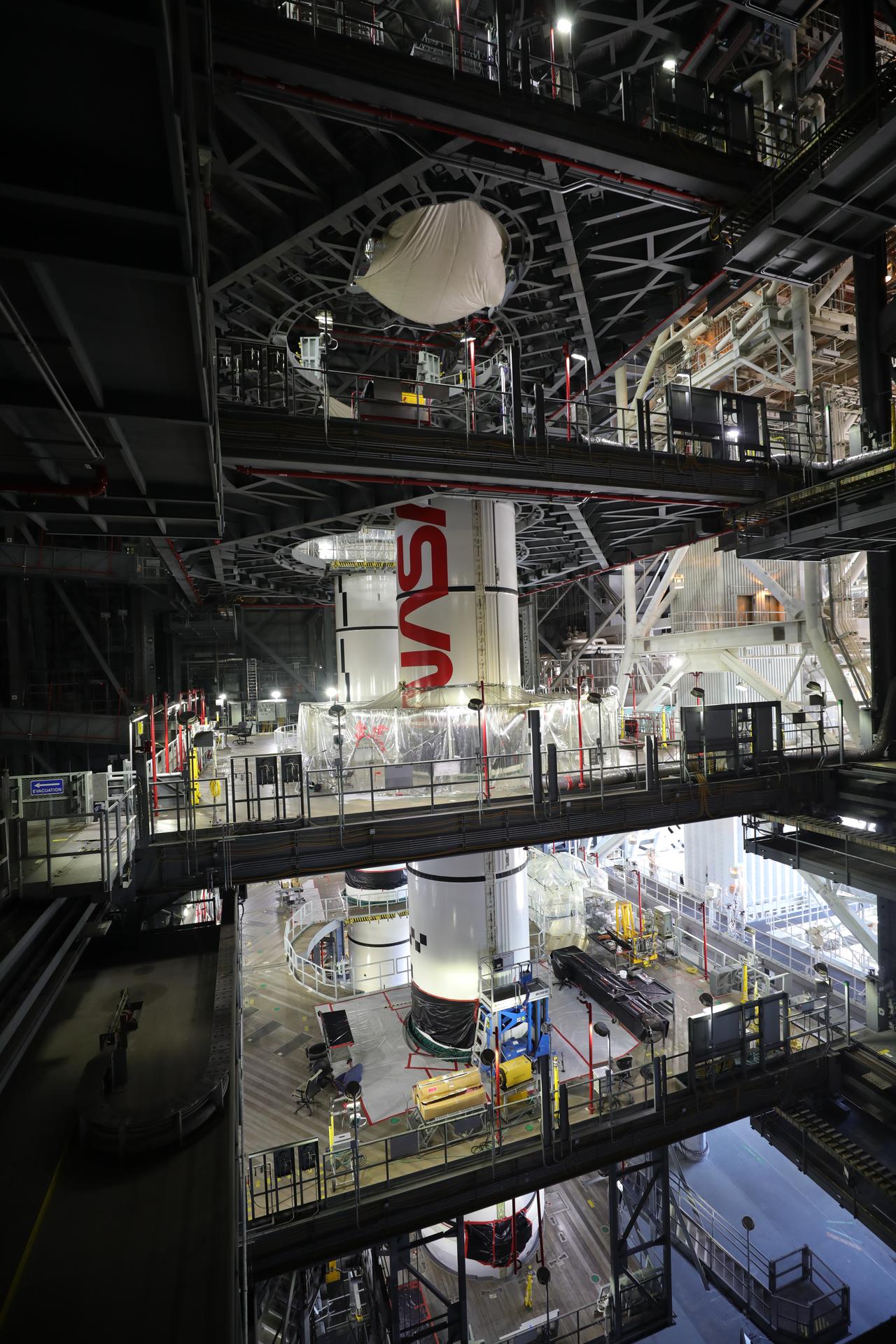
During integration operations inside the Vehicle Assembly Building at NASA’s Kennedy Space Center in Florida, the NASA “worm” is visible on the left and right center center solid rocket booster segments for the Artemis III SLS (Space Launch System) rocket on the mobile launcher inside High Bay 3 on Tuesday, Sept. 1, 2026. The twin boosters, comprising of five segments each manufactured by Northrop Grumman in Utah, will provide more than 75 percent of the SLS rocket’s total thrust at launch. The Artemis III mission will launch crew in the Orion spacecraft on top of the SLS rocket to test rendezvous and docking capabilities between Orion and commercial spacecraft needed to land astronauts on the Moon.
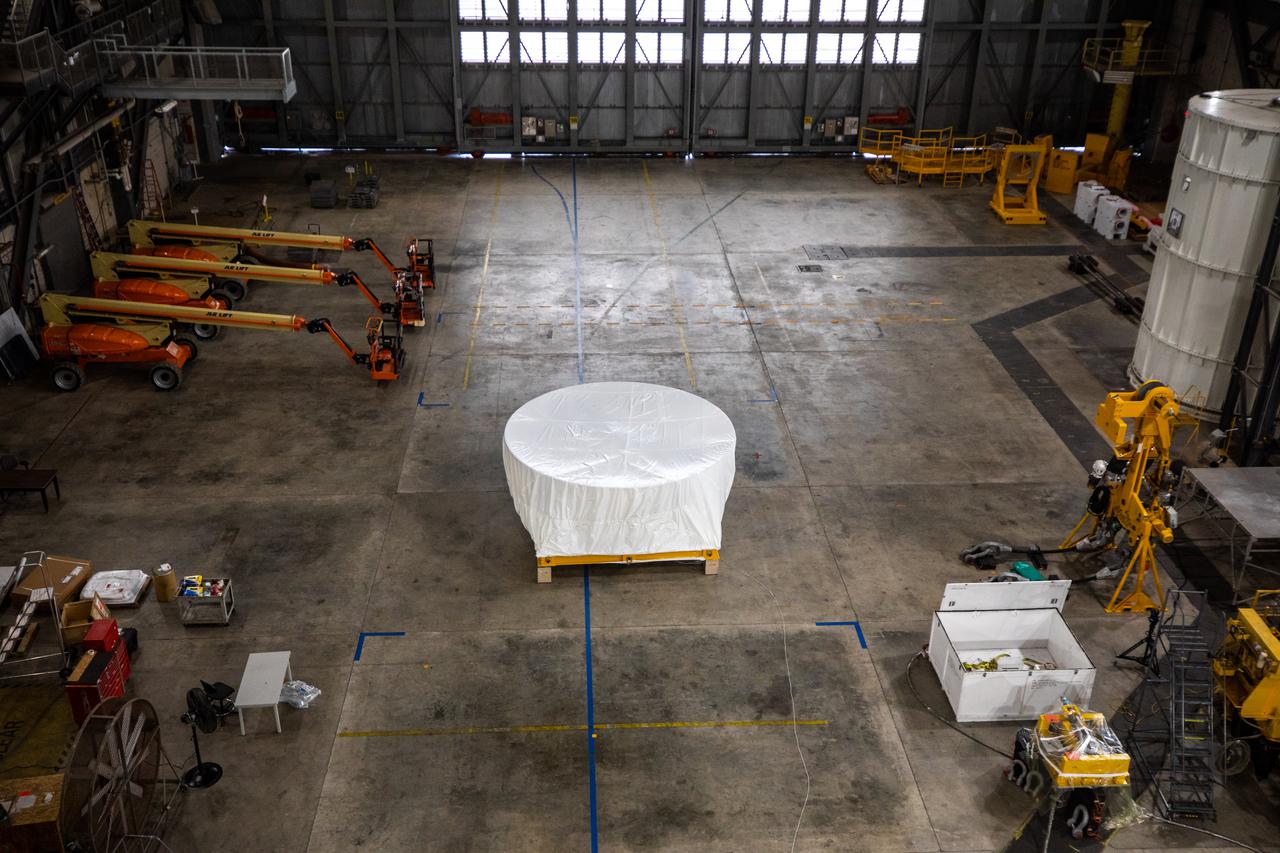
Under a protective cover, the Orion Stage Adapter (OSA) arrives in High Bay 4 of the Vehicle Assembly Building on Oct. 4, 2021, at NASA's Kennedy Space Center in Florida. Teams will lift the ring-shaped OSA, filled with shoebox-sized CubeSats, and connect it to the Interim Cryogenic Propulsion Stage (ICPS). The Orion spacecraft will be secured on top of the Space Launch System (SLS) rocket to complete the stack ahead of the Artemis I launch. This mission will be the first integrated flight test of the SLS and Orion spacecraft. In later missions, NASA will land the first woman and the first person of color on the surface of the Moon, paving the way for a long-term lunar presence and serving as a steppingstone on the way to Mars.
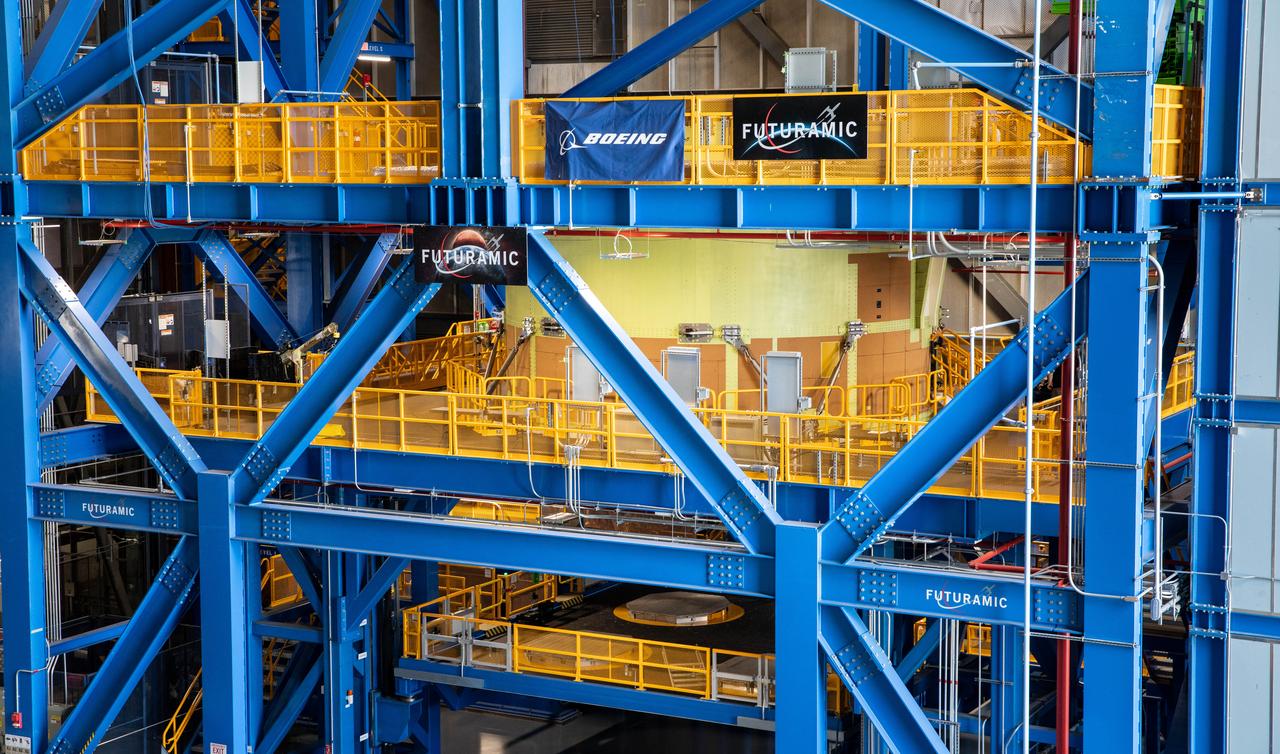
Teams from Kennedy lift NASA’s integrated Artemis III SLS (Space Launch System) core stage engine section with its boat-tail inside the center’s Vehicle Assembly Building at NASA’s Kennedy Space Center in Florida on Wednesday, Aug. 13, 2025. Shown inside the facility’s High Bay 2 for processing, the engine section is one the most complex and intricate parts of the rocket stage that will help power the Artemis missions to the Moon.
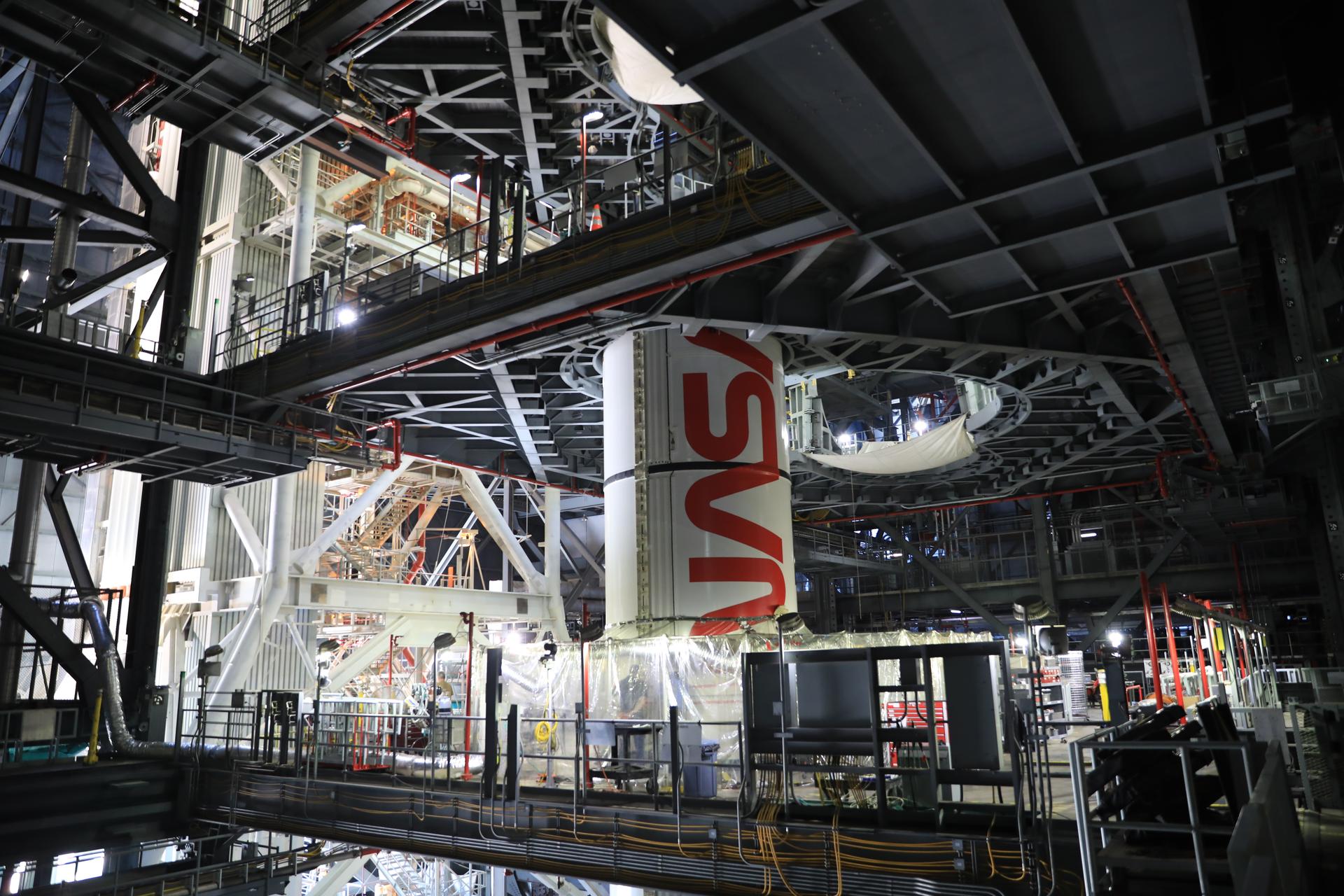
Technicians inside the Vehicle Assembly Building at NASA’s Kennedy Space Center in Florida complete integration of the left center center solid rocket booster segment onto the left aft center booster segment for the Artemis III SLS (Space Launch System) rocket on the mobile launcher inside High Bay 3 on Wednesday, Aug. 19, 2026. The twin boosters, comprising of five segments each manufactured by Northrop Grumman in Utah, will provide more than 75 percent of the SLS rocket’s total thrust at launch. The Artemis III mission will launch crew in the Orion spacecraft on top of the SLS rocket to test rendezvous and docking capabilities between Orion and commercial spacecraft needed to land astronauts on the Moon.
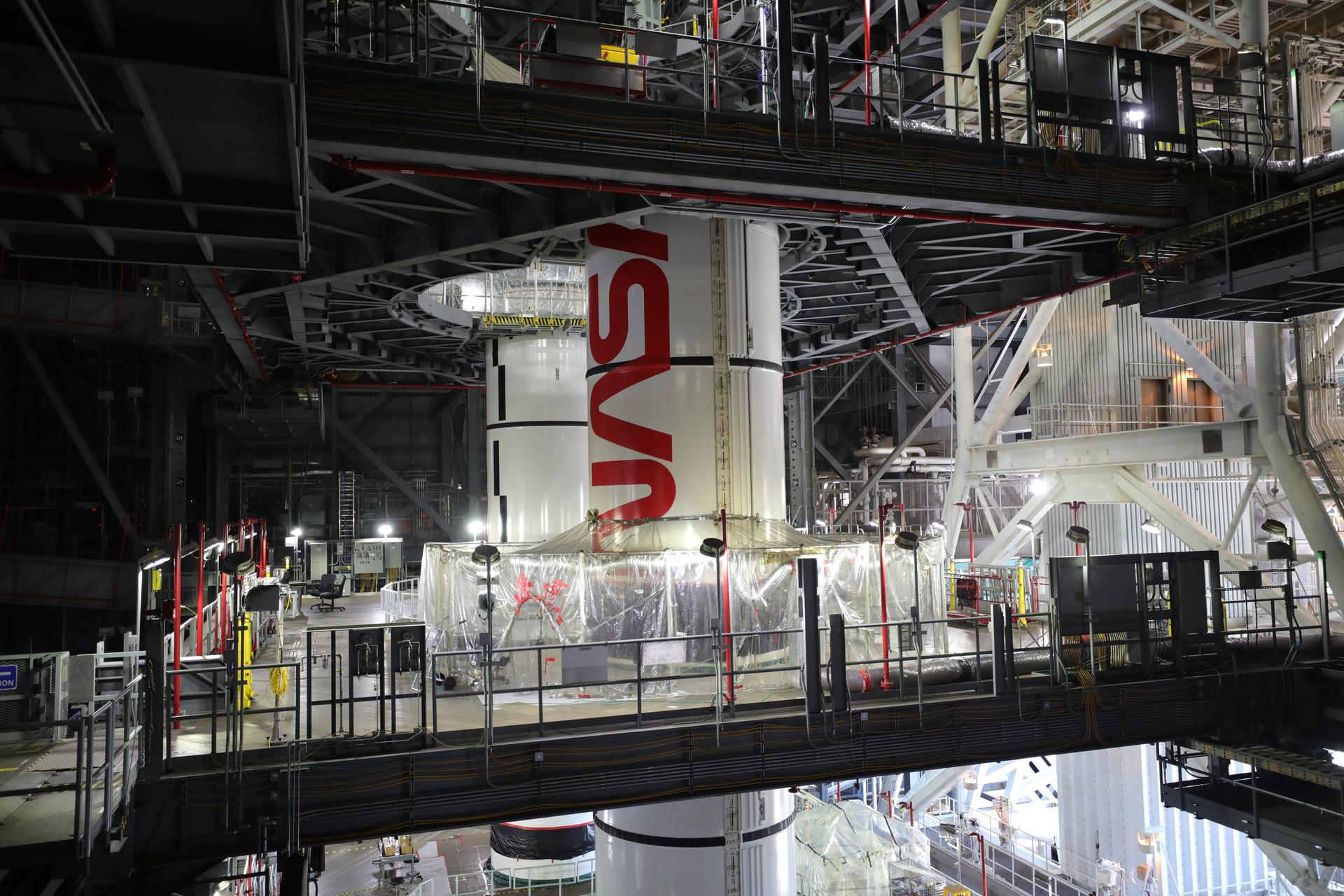
During integration operations inside the Vehicle Assembly Building at NASA’s Kennedy Space Center in Florida, the NASA “worm” is visible on the left and right center center solid rocket booster segments for the Artemis III SLS (Space Launch System) rocket on the mobile launcher inside High Bay 3 on Tuesday, Sept. 1, 2026. The twin boosters, comprising of five segments each manufactured by Northrop Grumman in Utah, will provide more than 75 percent of the SLS rocket’s total thrust at launch. The Artemis III mission will launch crew in the Orion spacecraft on top of the SLS rocket to test rendezvous and docking capabilities between Orion and commercial spacecraft needed to land astronauts on the Moon.
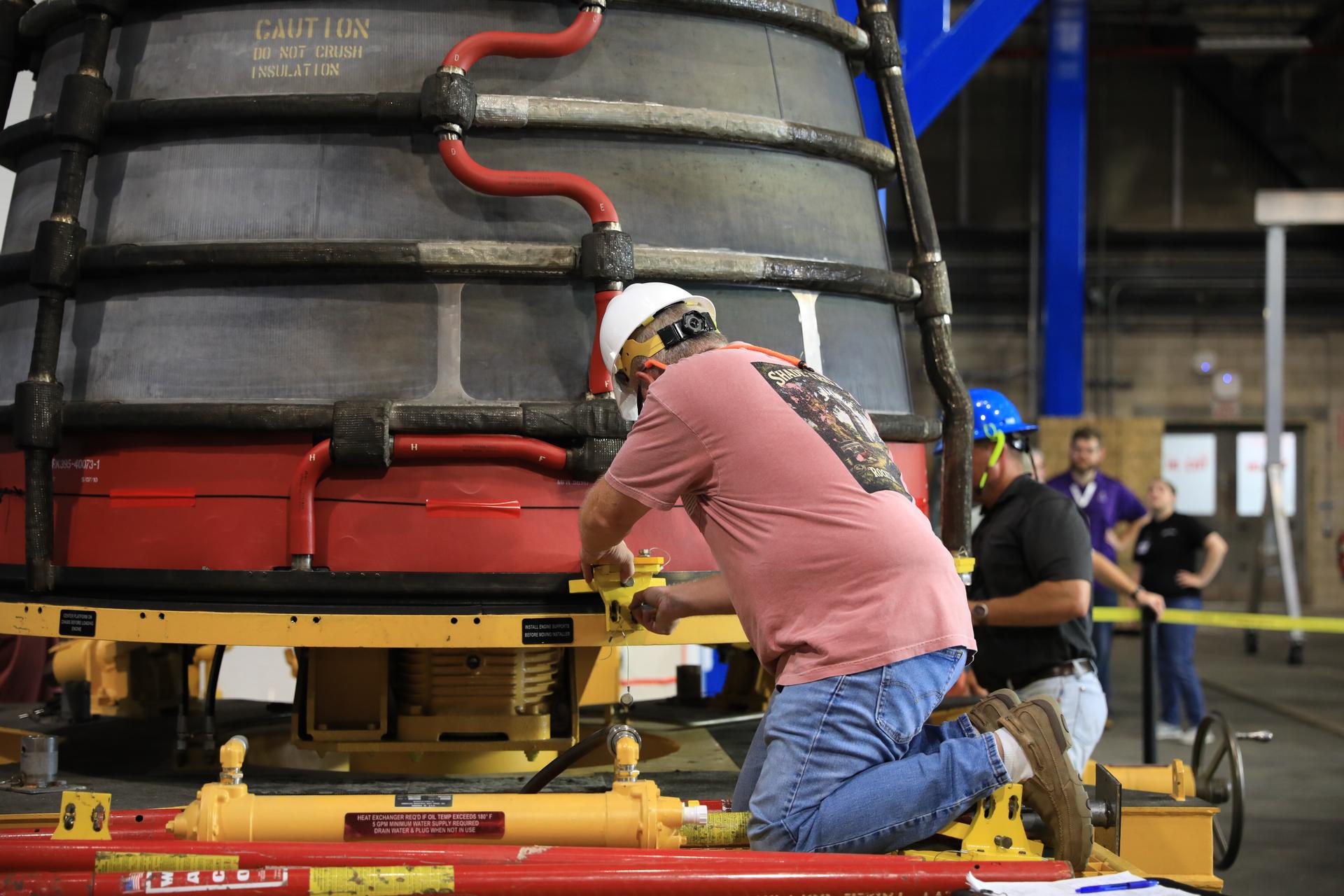
Technicians prepare the #2 RS-25 SLS (Space Launch System) rocket engine for transfer onto a work stand ahead of integration with the Artemis III core stage rocket on Tuesday, Aug. 25, 2026, inside the Vehicle Assembly Building at NASA’s Kennedy Space Center in Florida. During Artemis III, the four RS‑25 engines will launch the Orion spacecraft and its crew of four into low Earth orbit, generating more than two million pounds of thrust at liftoff.
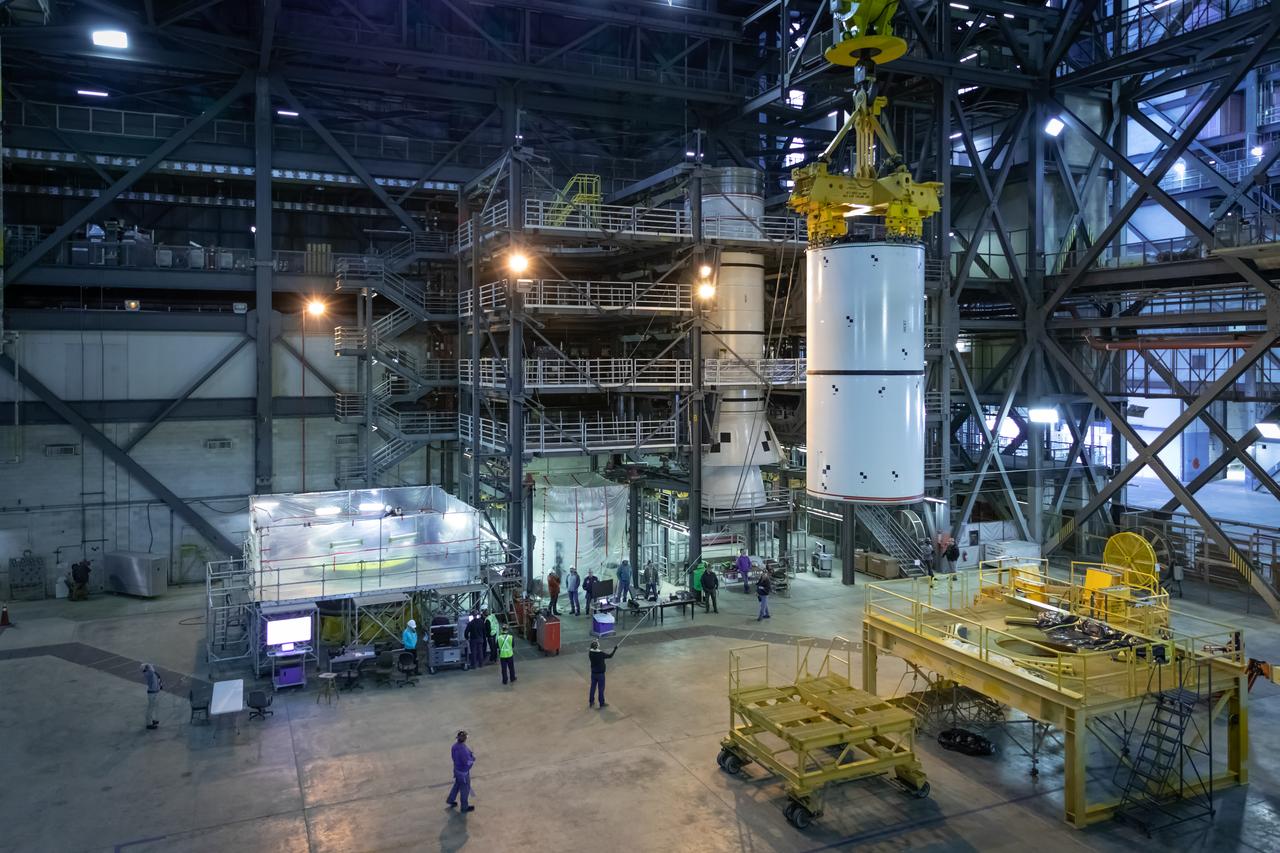
In High Bay 4 of the Vehicle Assembly Building at NASA’s Kennedy Space Center in Florida, a crane moves Space Launch System (SLS) solid rocket booster pathfinder segments to stack them atop other pathfinder segments during a training exercise on Jan. 8, 2020. A team of engineers with Exploration Ground Systems and crane operators and technicians with contractor Jacobs are practicing lifting, moving and stacking maneuvers, using important ground support equipment to train employees and certify all the equipment works properly. The booster pathfinders are inert, full-scale replicas of the actual booster hardware that will be attached to the SLS rocket for Artemis missions. The five-segment, 17-story-tall twin boosters will provide 3.6 million pounds of thrust each at liftoff to help launch Orion on Artemis I, its first uncrewed mission beyond the Moon.
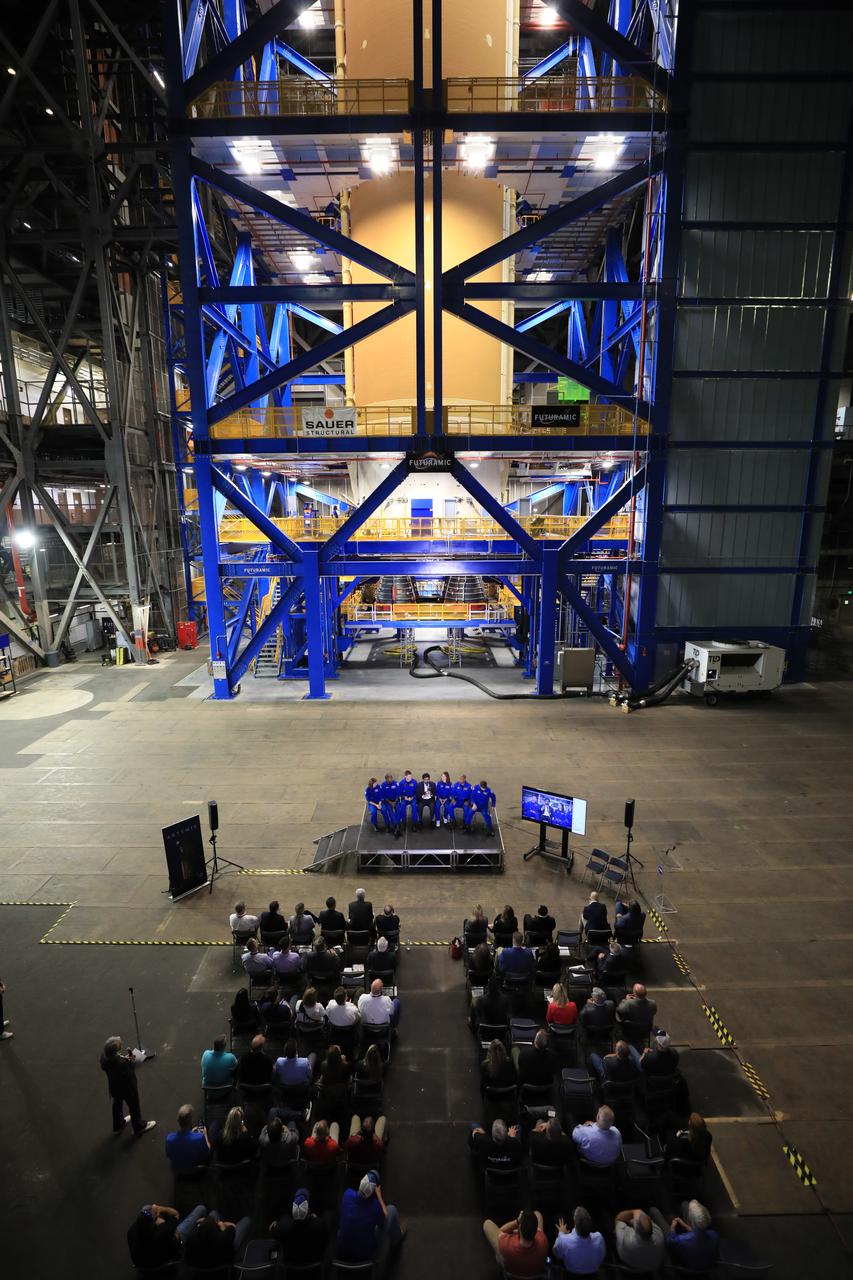
From left, CSA (Canadian Space Agency) astronaut Jenni Gibbons, NASA astronaut Andre Douglas, CSA astronaut Jeremy Hansen, NASA Moon to Mars Program Deputy Associate Administrator Amit Kshatriya, and NASA astronauts Christina Koch, Victor Glover, and Reid Wiseman participate in a media day event on Monday, Dec. 16, 2024, inside the Vehicle Assembly Building at the agency’s Kennedy Space Center in Florida. The Artemis II crew and backup crew participated in the event days after teams with NASA’s Exploration Ground Systems transport lifted the agency’s 212-foot-tall SLS (Space Launch System) core stage from the facility’s transfer aisle into High Bay 2 where it will remain while teams stack the two solid rocket boosters on top of mobile launcher 1.
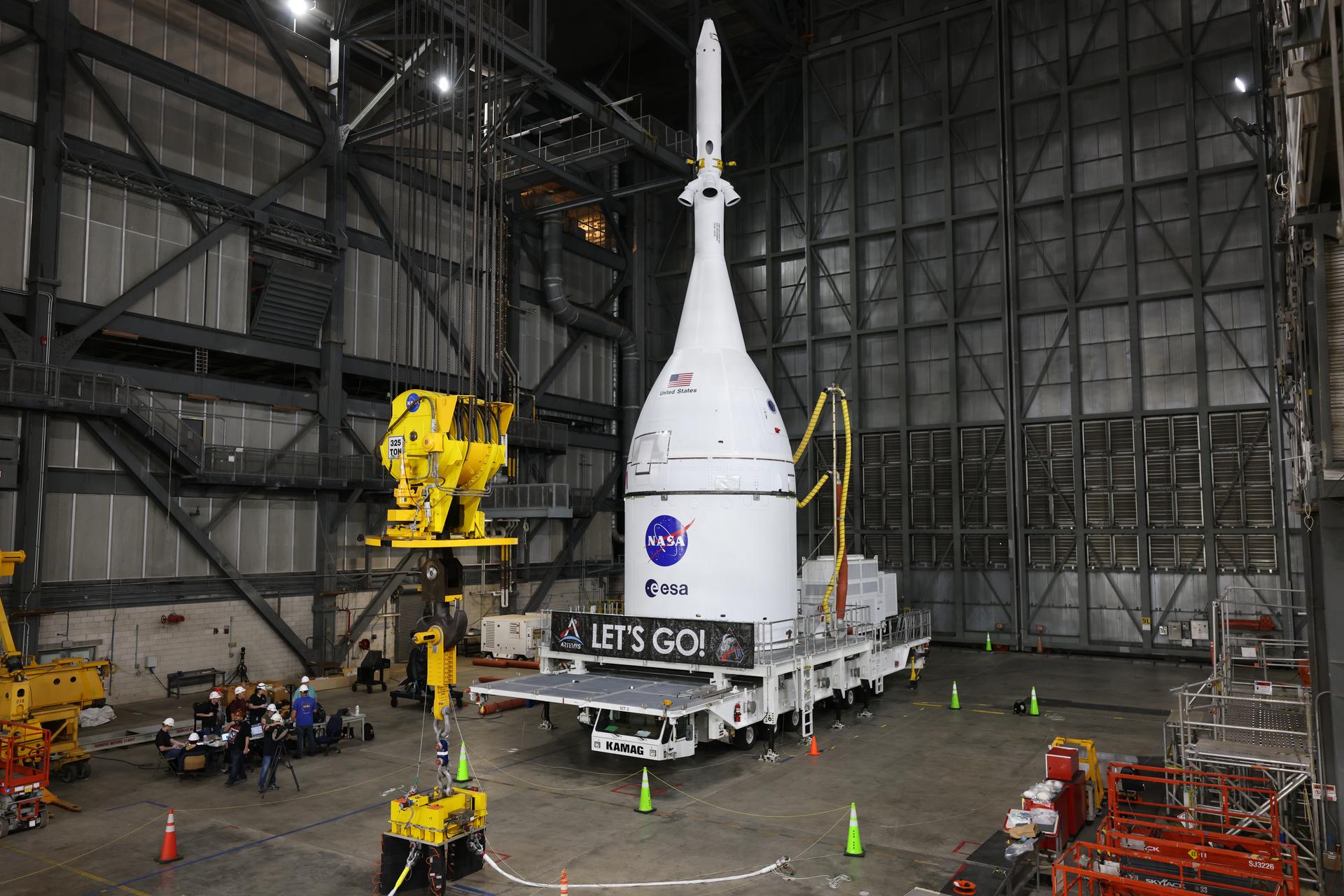
Technicians with NASA’s Exploration Ground Systems team prepare to attach a crane to lift and secure NASA’s Orion spacecraft on top of the SLS (Space Launch System) rocket in High Bay 3 of the Vehicle Assembly Building at NASA’s Kennedy Space Center in Florida on Friday, Oct. 17, 2025, for the agency’s Artemis II mission. Set to launch in 2026, the spacecraft will carry NASA astronauts Reid Wiseman, Victor Glover, Christina Koch, and CSA (Canadian Space Agency) astronaut Jeremy Hansen on a 10-day mission around the Moon and back. Once stacked, teams will begin conducting a series of verification tests ahead of rolling out to Launch Complex 39B for the wet dress rehearsal at NASA Kennedy.
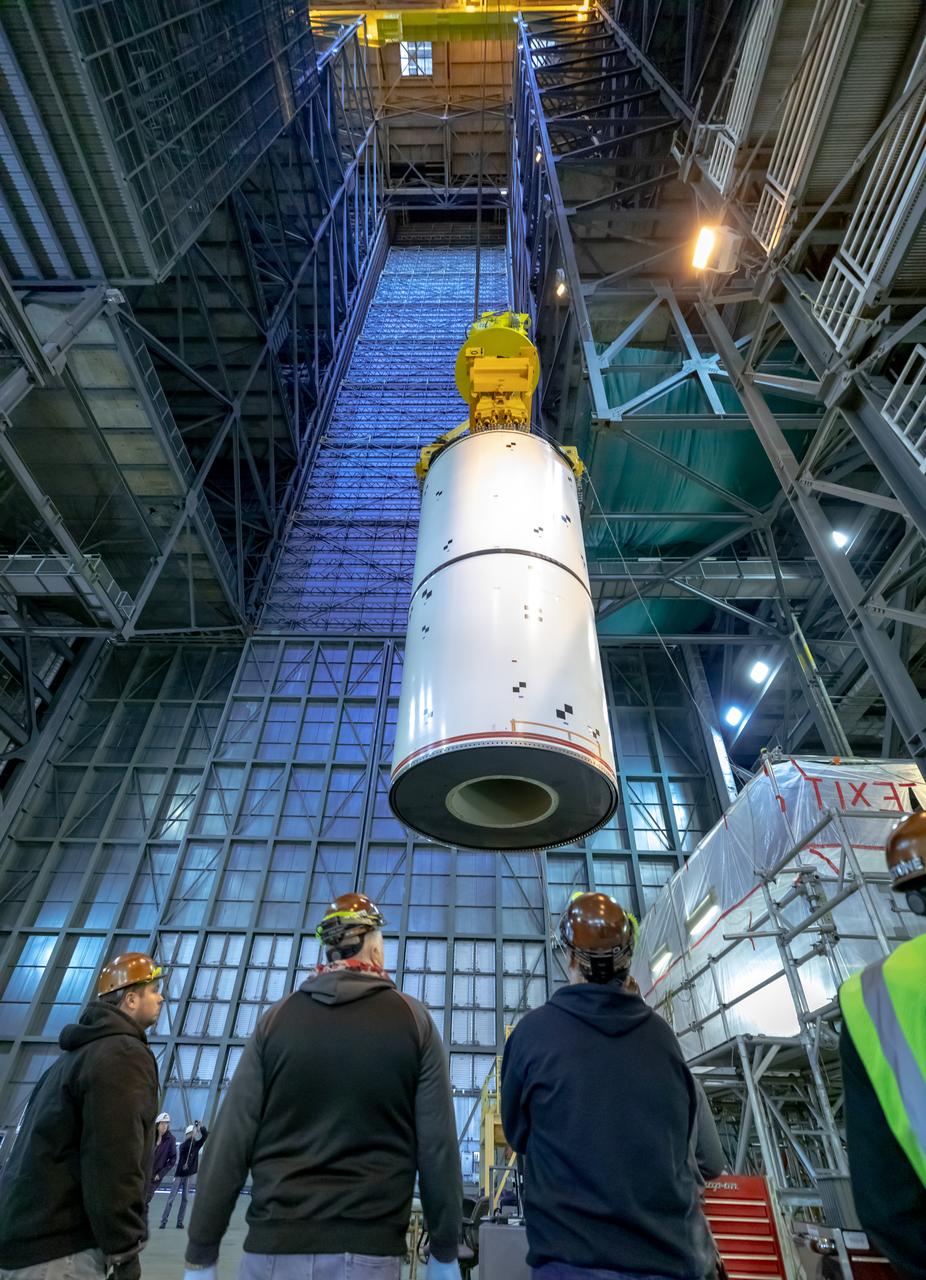
In High Bay 4 of the Vehicle Assembly Building at NASA’s Kennedy Space Center in Florida, a team of engineers with Exploration Ground Systems and contractor Jacobs participate in Space Launch System (SLS) solid rocket booster pathfinder stacking during a training exercise on Jan. 8, 2020. A crane is used to lift up two pathfinder segments and move them to a platform. The booster pathfinders are inert, full-scale replicas of the actual booster hardware that will be attached to the SLS rocket for Artemis missions. The team is practicing lifting, moving and stacking maneuvers, using important ground support equipment to train employees and certify all the equipment works properly. The five-segment, 17-story-tall twin boosters will provide 3.6 million pounds of thrust each at liftoff to help launch Orion on Artemis I, its first uncrewed mission beyond the Moon.
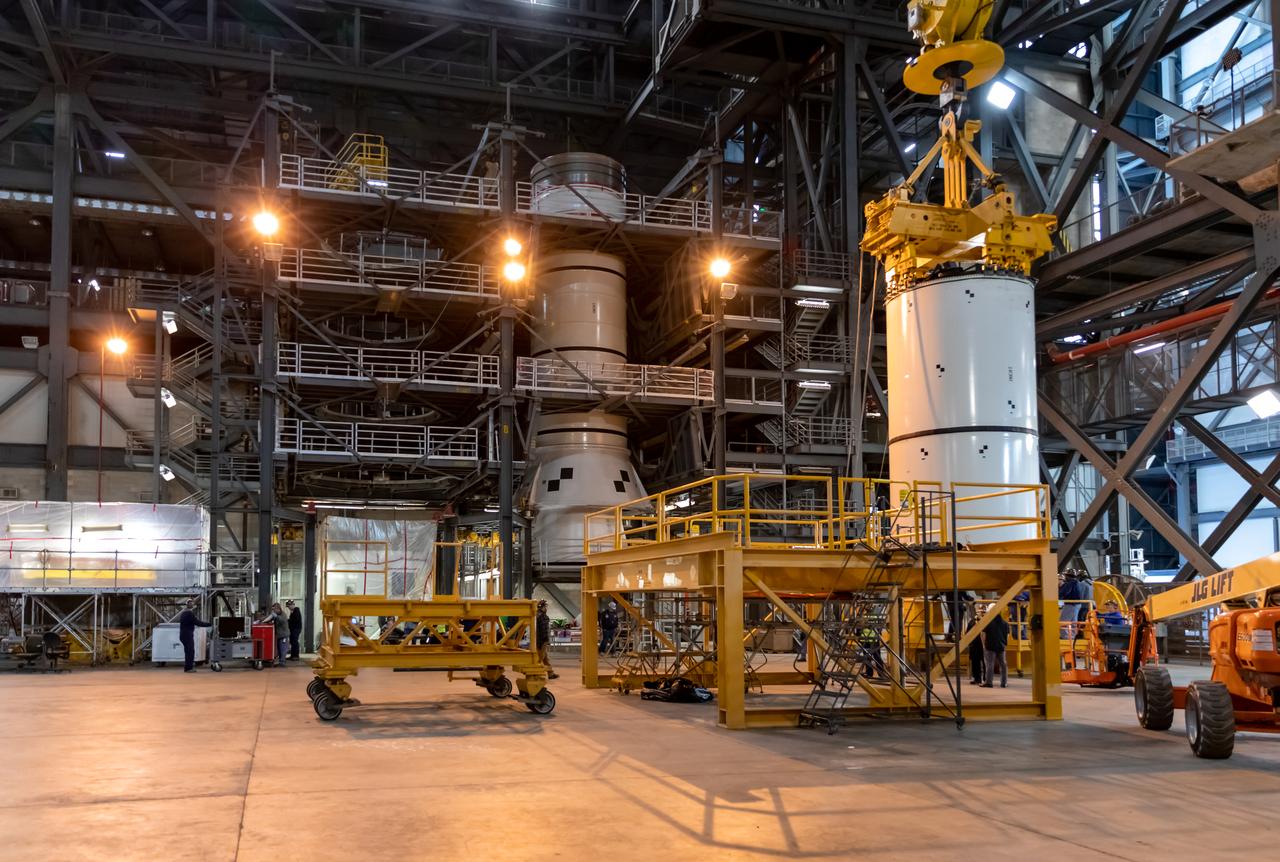
In High Bay 4 of the Vehicle Assembly Building at NASA’s Kennedy Space Center in Florida, a crane is used to lift Space Launch System (SLS) solid rocket booster pathfinder segments and move them to be added atop other booster pathfinder segments during a training exercise on Jan. 8, 2020. A team of engineers with Exploration Ground Systems and crane operators and technicians with contractor Jacobs are practicing lifting, moving and stacking maneuvers, using important ground support equipment to train employees and certify all the equipment works properly. The booster pathfinders are inert, full-scale replicas of the actual booster hardware that will be attached to the SLS rocket for Artemis missions. The five-segment, 17-story-tall twin boosters will provide 3.6 million pounds of thrust each at liftoff to help launch Orion on Artemis I, its first uncrewed mission beyond the Moon.
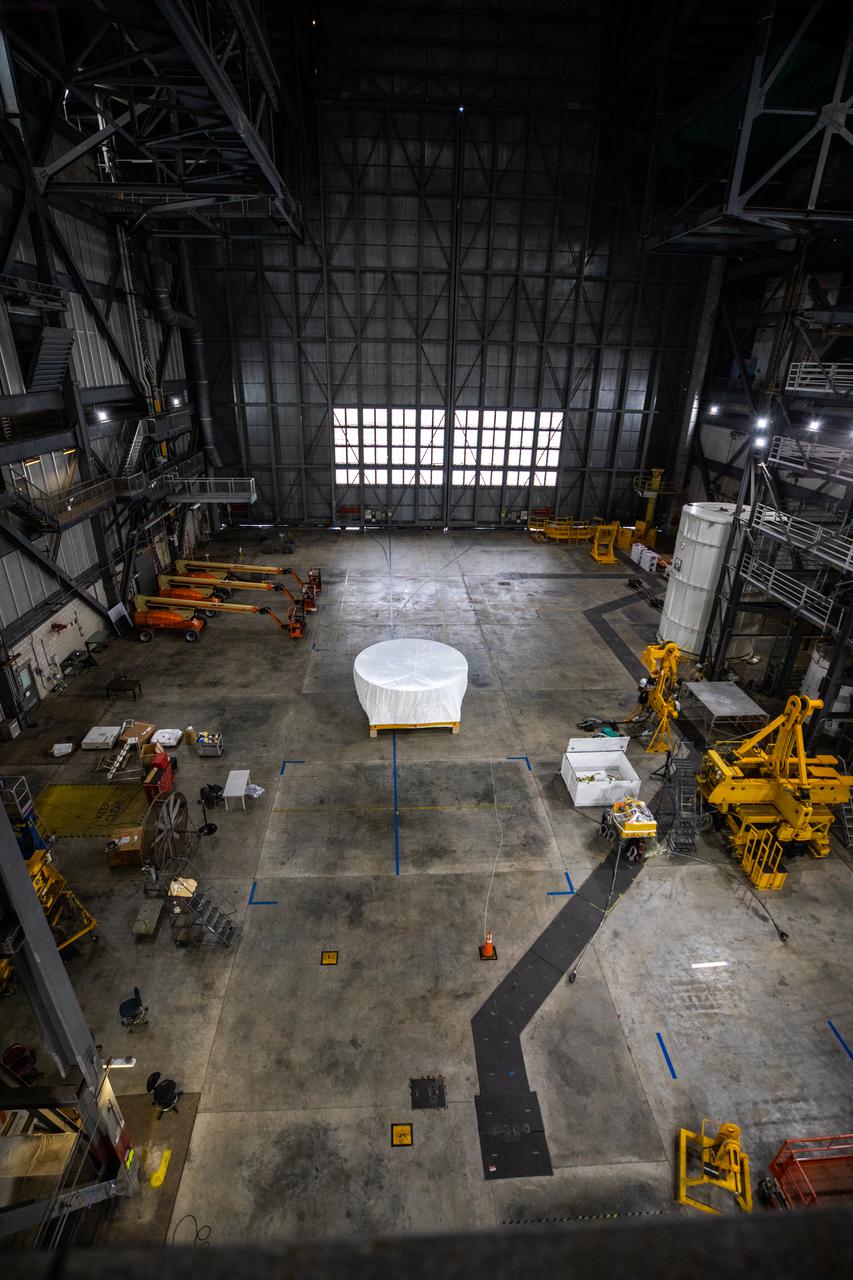
Under a protective cover, the Orion Stage Adapter (OSA) arrives in High Bay 4 of the Vehicle Assembly Building on Oct. 4, 2021, at NASA's Kennedy Space Center in Florida. Teams will lift the ring-shaped OSA, filled with shoebox-sized CubeSats, and connect it to the Interim Cryogenic Propulsion Stage (ICPS). The Orion spacecraft will be secured on top of the Space Launch System (SLS) rocket to complete the stack ahead of the Artemis I launch. This mission will be the first integrated flight test of the SLS and Orion spacecraft. In later missions, NASA will land the first woman and the first person of color on the surface of the Moon, paving the way for a long-term lunar presence and serving as a steppingstone on the way to Mars.
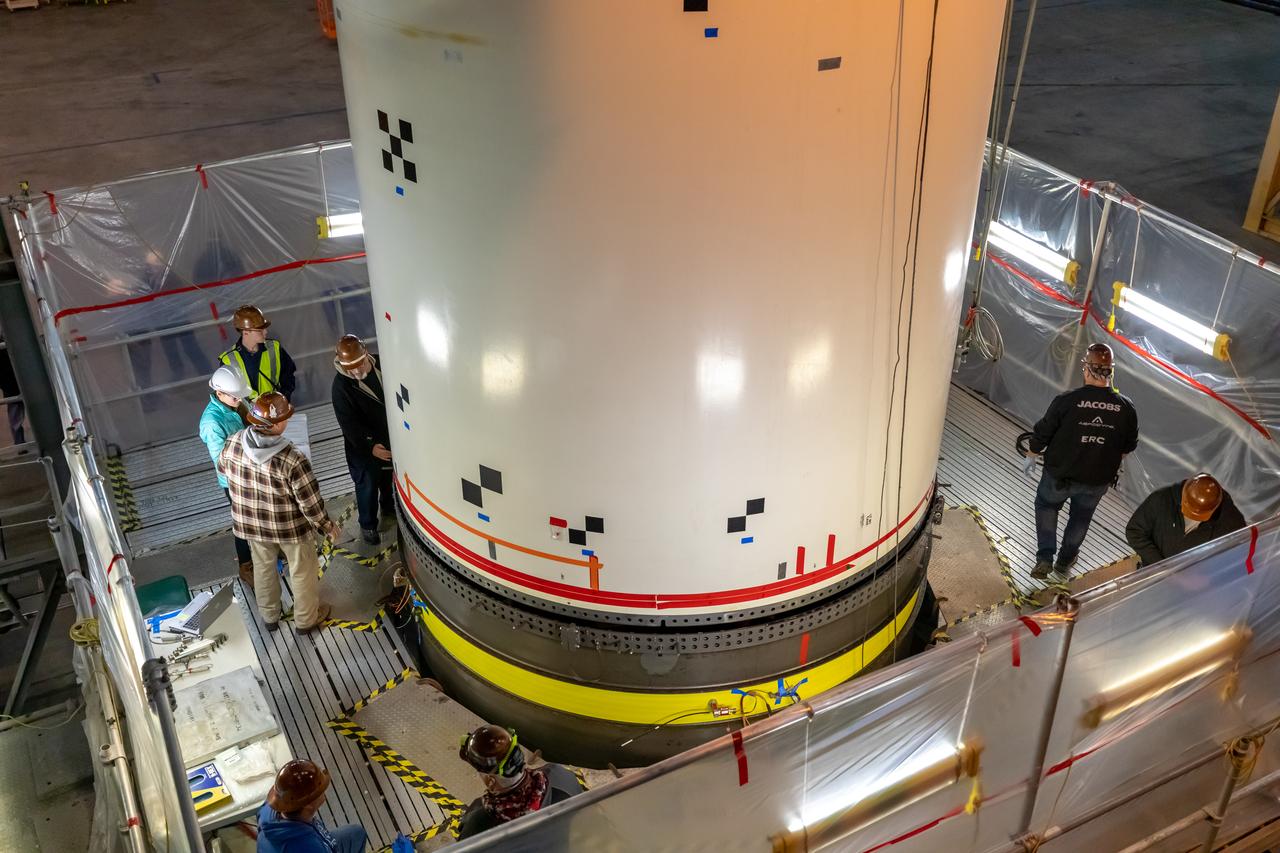
In High Bay 4 of the Vehicle Assembly Building at NASA’s Kennedy Space Center in Florida, a team of engineers with Exploration Ground Systems and contractor Jacobs participate in Space Launch System (SLS) solid rocket booster pathfinder stacking during a training exercise on Jan. 8, 2020. The booster pathfinders are inert, full-scale replicas of the actual booster hardware that will be attached to the SLS rocket for Artemis missions. The team is practicing lifting, moving and stacking maneuvers, using important ground support equipment to train employees and certify all the equipment works properly. The five-segment, 17-story-tall twin boosters will provide 3.6 million pounds of thrust each at liftoff to help launch Orion on Artemis I, its first uncrewed mission beyond the Moon.
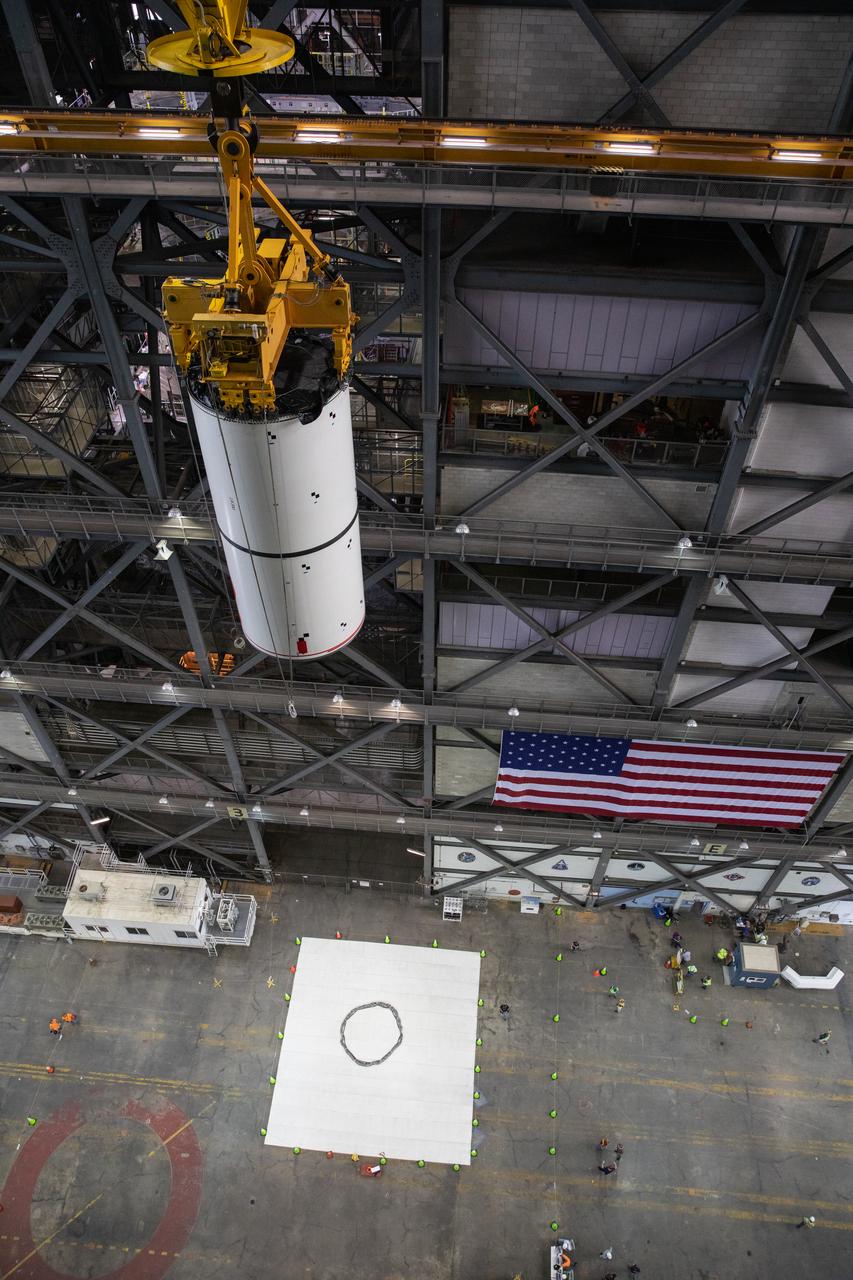
Technicians with NASA’s Exploration Ground Systems rehearse booster stacking operations inside the Vehicle Assembly Building (VAB) at the agency’s Kennedy Space Center in Florida on Sept. 14, 2020, in preparation for Artemis I. The exercise involved using booster segment mock-ups, referred to as pathfinders. During the rehearsal, an aft pathfinder segment was prepared in High Bay 4 of the VAB, after which a team of crane operators moved it over to High Bay 3, where it was placed on the mobile launcher. Careful measurements were then taken before the team added a center pathfinder to the stack. Stacking of the actual Space Launch System (SLS) booster segments will occur later this year, when the rocket’s core stage arrives at Kennedy. Artemis I is the first in a series of increasingly complex missions that will test SLS and the Orion spacecraft as an integrated system prior to crewed flights to the Moon.
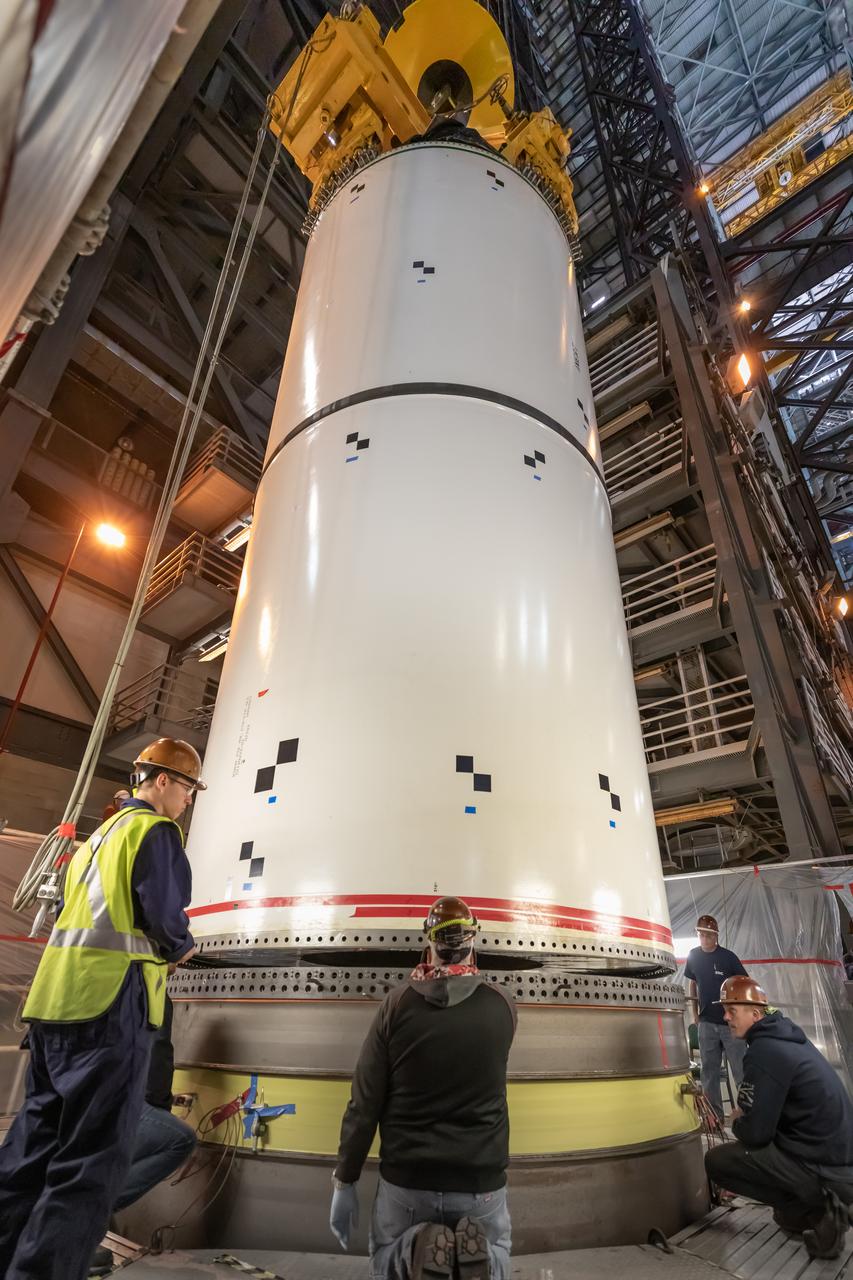
In High Bay 4 of the Vehicle Assembly Building at NASA’s Kennedy Space Center in Florida, a team of engineers with Exploration Ground Systems and contractor Jacobs participate in Space Launch System (SLS) solid rocket booster pathfinder stacking during a training exercise on Jan. 8, 2020. The booster pathfinders are inert, full-scale replicas of the actual booster hardware that will be attached to the SLS rocket for Artemis missions. The team is practicing lifting, moving and stacking maneuvers, using important ground support equipment to train employees and certify all the equipment works properly. The five-segment, 17-story-tall twin boosters will provide 3.6 million pounds of thrust each at liftoff to help launch Orion on Artemis I, its first uncrewed mission beyond the Moon.

Inside High Bay 3 of the Vehicle Assembly Building at NASA’s Kennedy Space Center in Florida, technicians with the agency’s Exploration Ground Systems integrate the left forward center booster segment for the NASA’s SLS (Space Launch System) rocket onto the left center center segment atop the mobile launcher on Thursday, Jan. 30, 2025. The NASA “worm” insignia can be seen on both the center center booster segments. The boosters will help support the remaining rocket components and the Orion spacecraft during final assembly of the Artemis II Moon rocket and provide more than 75 percent of the total SLS thrust during liftoff from NASA Kennedy’s Launch Pad 39B.
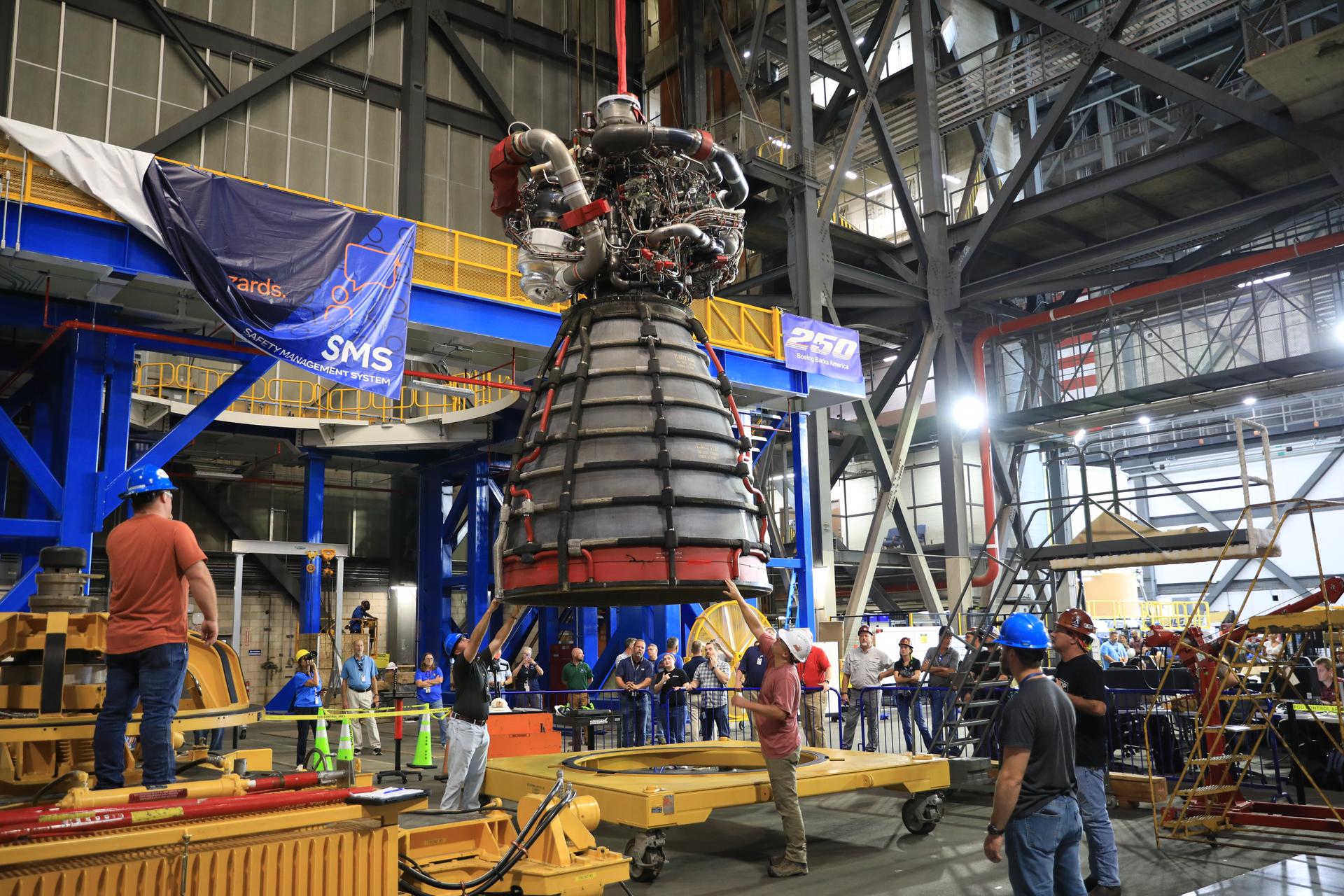
Technicians lift the #2 RS-25 SLS (Space Launch System) rocket engine to prepare to transfer the engine to the work stand to be integrated with the Artemis III core stage rocket on Tuesday, Aug. 25, 2026, inside the Vehicle Assembly Building at NASA’s Kennedy Space Center in Florida. During Artemis III four engines will propel the Orion spacecraft, carrying four astronauts, into low Earth orbit providing over two million pounds of thrust at liftoff. “During Artemis III, the four RS‑25 engines will launch the Orion spacecraft and its crew of four into low Earth orbit, generating more than two million pounds of thrust at liftoff.
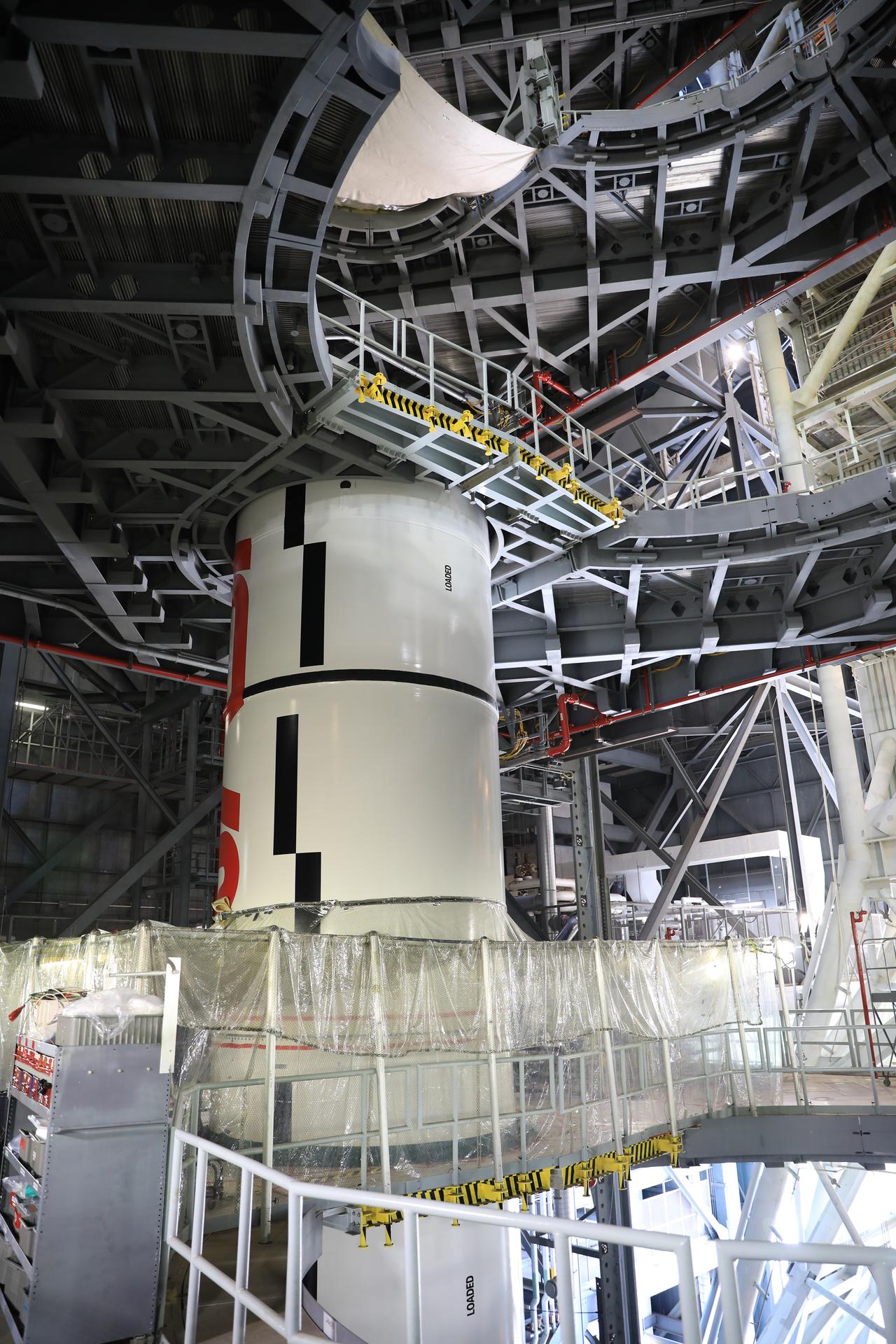
Technicians inside the Vehicle Assembly Building at NASA’s Kennedy Space Center in Florida complete integration of the left center center solid rocket booster segment onto the left aft center booster segment for the Artemis III SLS (Space Launch System) rocket on the mobile launcher inside High Bay 3 on Wednesday, Aug. 19, 2026. The twin boosters, comprising of five segments each manufactured by Northrop Grumman in Utah, will provide more than 75 percent of the SLS rocket’s total thrust at launch. The Artemis III mission will launch crew in the Orion spacecraft on top of the SLS rocket to test rendezvous and docking capabilities between Orion and commercial spacecraft needed to land astronauts on the Moon.
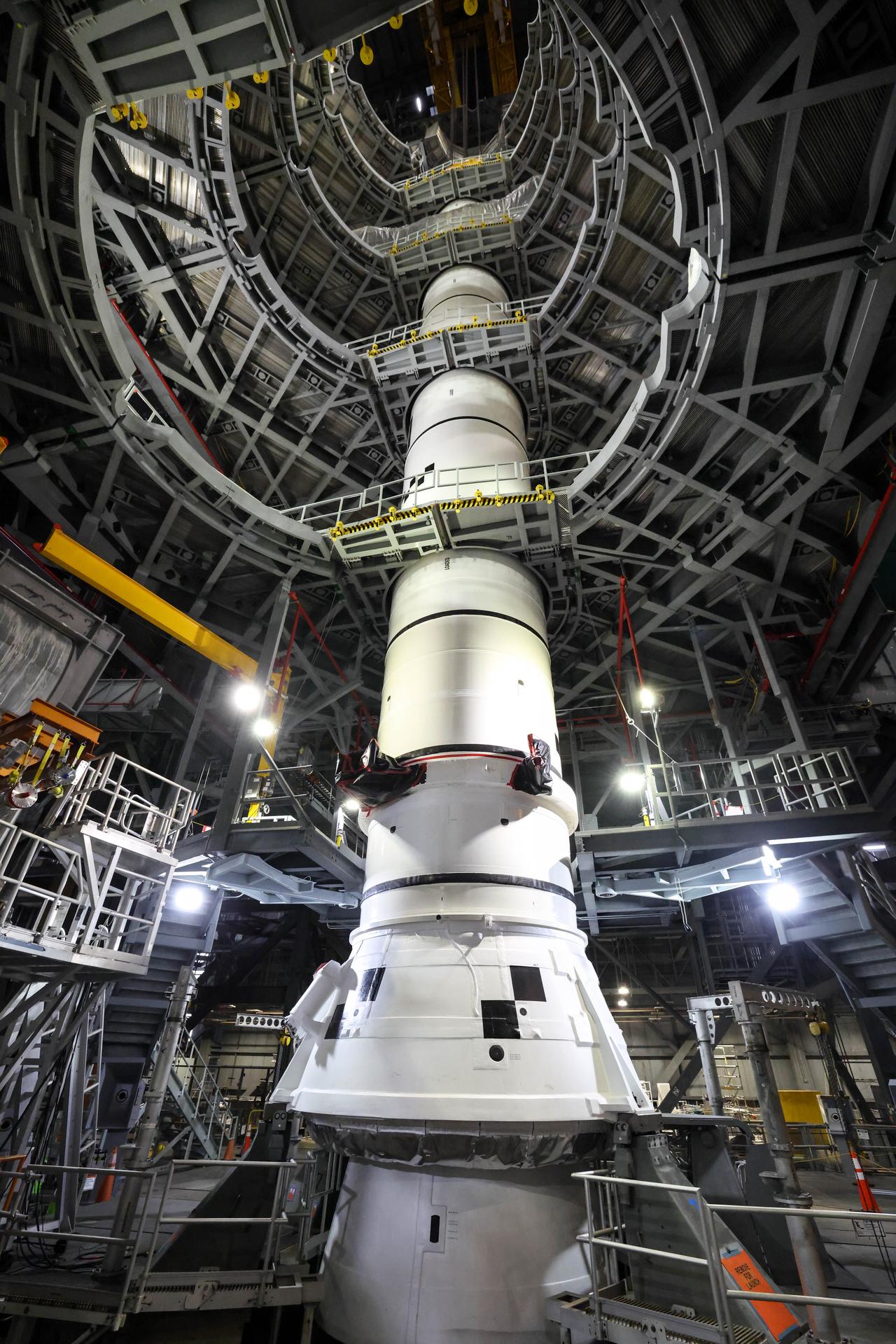
Technicians inside the Vehicle Assembly Building at NASA’s Kennedy Space Center in Florida complete integration of the left forward center solid rocket booster segment onto the left center center booster segment for the Artemis III SLS (Space Launch System) rocket on the mobile launcher inside High Bay 3 on Tuesday, Sept. 1, 2026. The twin boosters, comprising five segments each and manufactured by Northrop Grumman in Utah, provide more than 75 percent of the SLS rocket’s total thrust at liftoff. The Artemis III mission will launch crew in the Orion spacecraft on top of the SLS rocket to test rendezvous and docking capabilities between Orion and commercial spacecraft needed to land astronauts on the Moon.
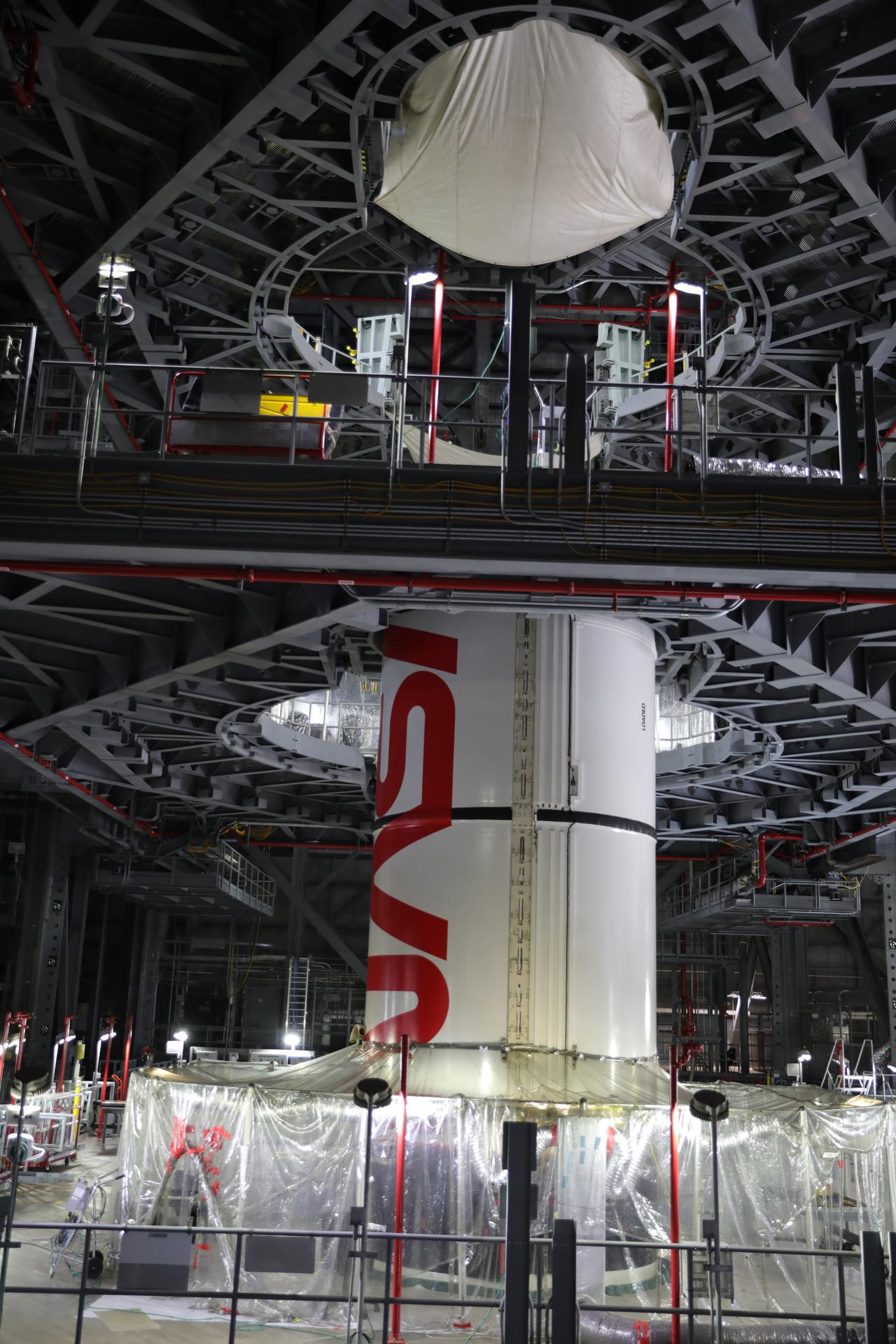
During integration operations inside the Vehicle Assembly Building at NASA’s Kennedy Space Center in Florida, the NASA “worm” is visible on the left and right center center solid rocket booster segments for the Artemis III SLS (Space Launch System) rocket on the mobile launcher inside High Bay 3 on Tuesday, Sept. 1, 2026. The twin boosters, comprising of five segments each manufactured by Northrop Grumman in Utah, will provide more than 75 percent of the SLS rocket’s total thrust at launch. The Artemis III mission will launch crew in the Orion spacecraft on top of the SLS rocket to test rendezvous and docking capabilities between Orion and commercial spacecraft needed to land astronauts on the Moon.
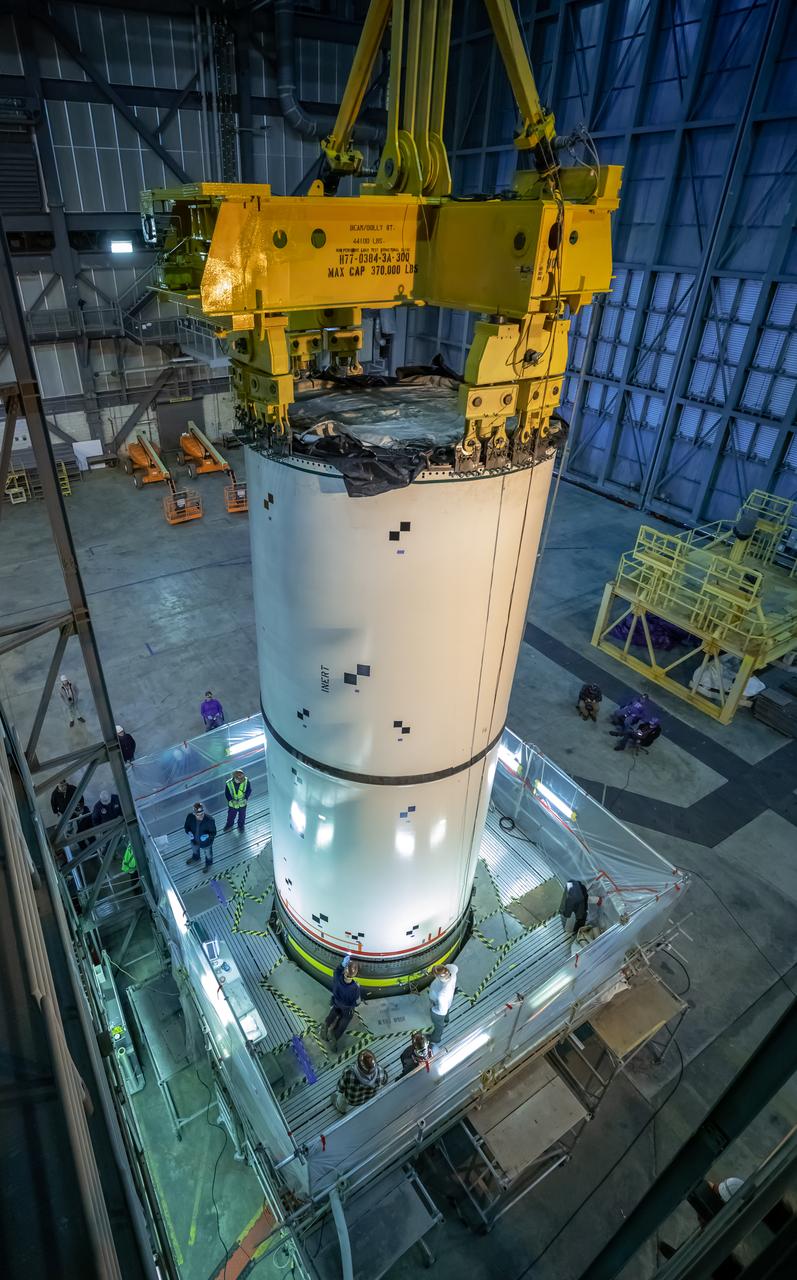
In High Bay 4 of the Vehicle Assembly Building at NASA’s Kennedy Space Center in Florida, a crane lowers Space Launch System (SLS) solid rocket booster pathfinder segments onto a platform during a training exercise on Jan. 8, 2020. A team of engineers with Exploration Ground Systems and crane operators and technicians with contractor Jacobs are practicing lifting, moving and stacking maneuvers, using important ground support equipment to train employees and certify all the equipment works properly. The booster pathfinders are inert, full-scale replicas of the actual booster hardware that will be attached to the SLS rocket for Artemis missions. The five-segment, 17-story-tall twin boosters will provide 3.6 million pounds of thrust each at liftoff to help launch Orion on Artemis I, its first uncrewed mission beyond the Moon.
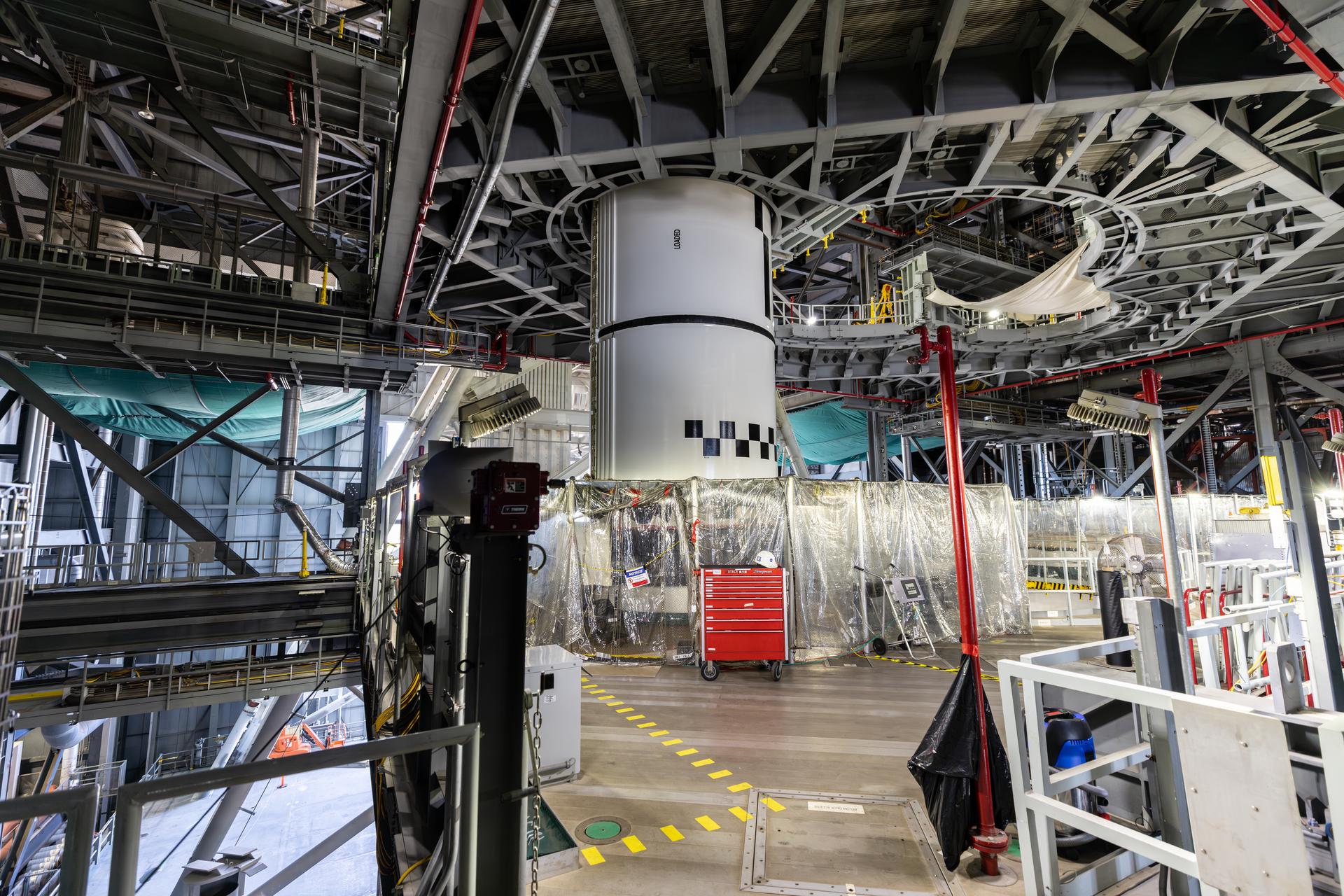
In High Bay 3 of the Vehicle Assembly Building at NASA’s Kennedy Space Center in Florida, the left aft center booster segment for Artemis III is integrated onto its aft assembly segment on the mobile launcher for the SLS (Space Launch System) rocket on Monday, Aug. 12, 2026. The twin boosters, comprising of five segments each manufactured by Northrop Grumman in Utah, will provide more than 75 percent of the SLS rocket’s total thrust at launch. The Artemis III mission will launch crew in the Orion spacecraft on top of the SLS rocket to test rendezvous and docking capabilities between Orion and commercial spacecraft needed to land astronauts on the Moon.
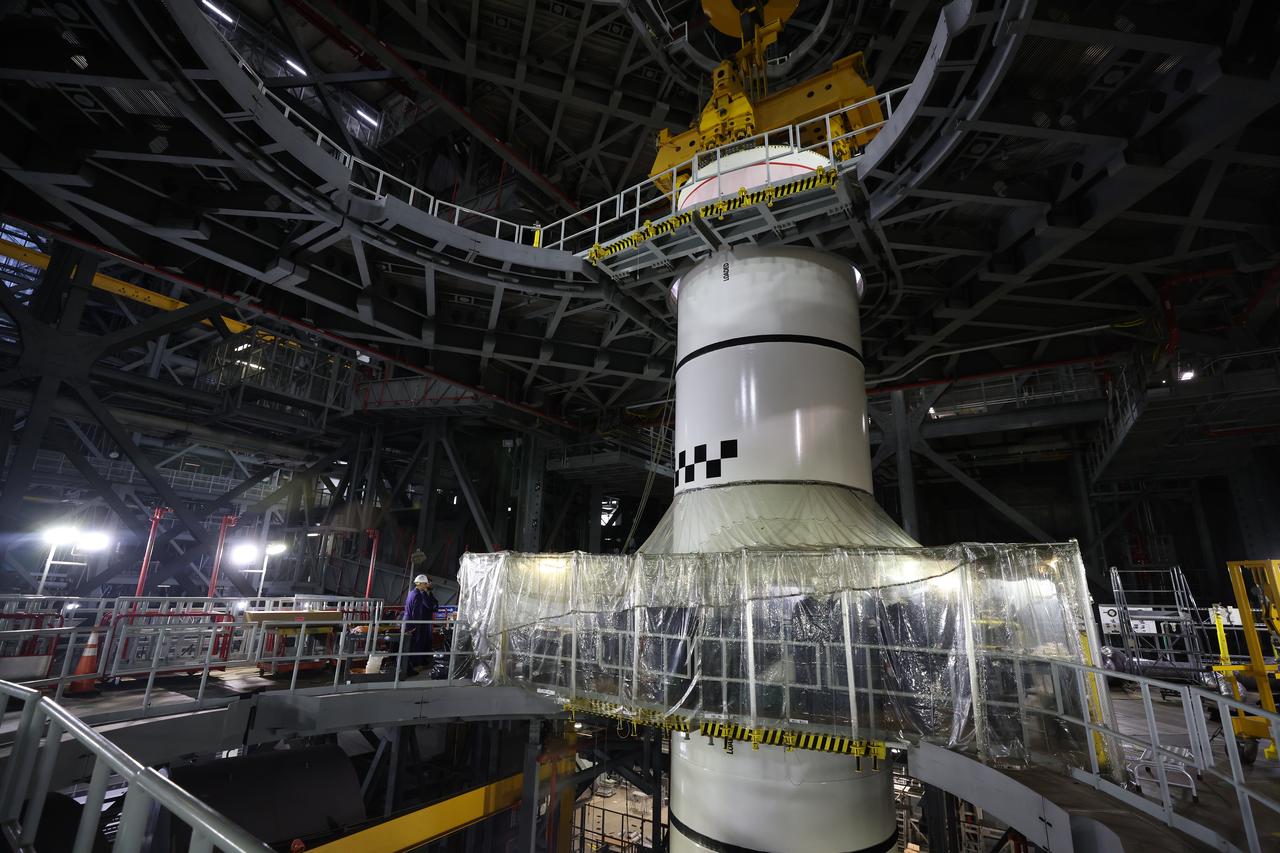
Engineers and technicians with the Exploration Ground Systems Program stack the next solid rocket booster segment, the left aft center, on the for the Artemis II SLS (Space Launch System) Moon rocket onto mobile launcher 1 inside the Vehicle Assembly Building’s High Bay 3 at NASA’s Kennedy Space Center on Thursday, Dec. 19, 2024. Once assembled, the boosters will help support the remaining rocket components and the Orion spacecraft during final assembly of the Artemis II Moon rocket and provide more than 75 percent of the total SLS thrust during liftoff from NASA Kennedy’s Launch Pad 39B.
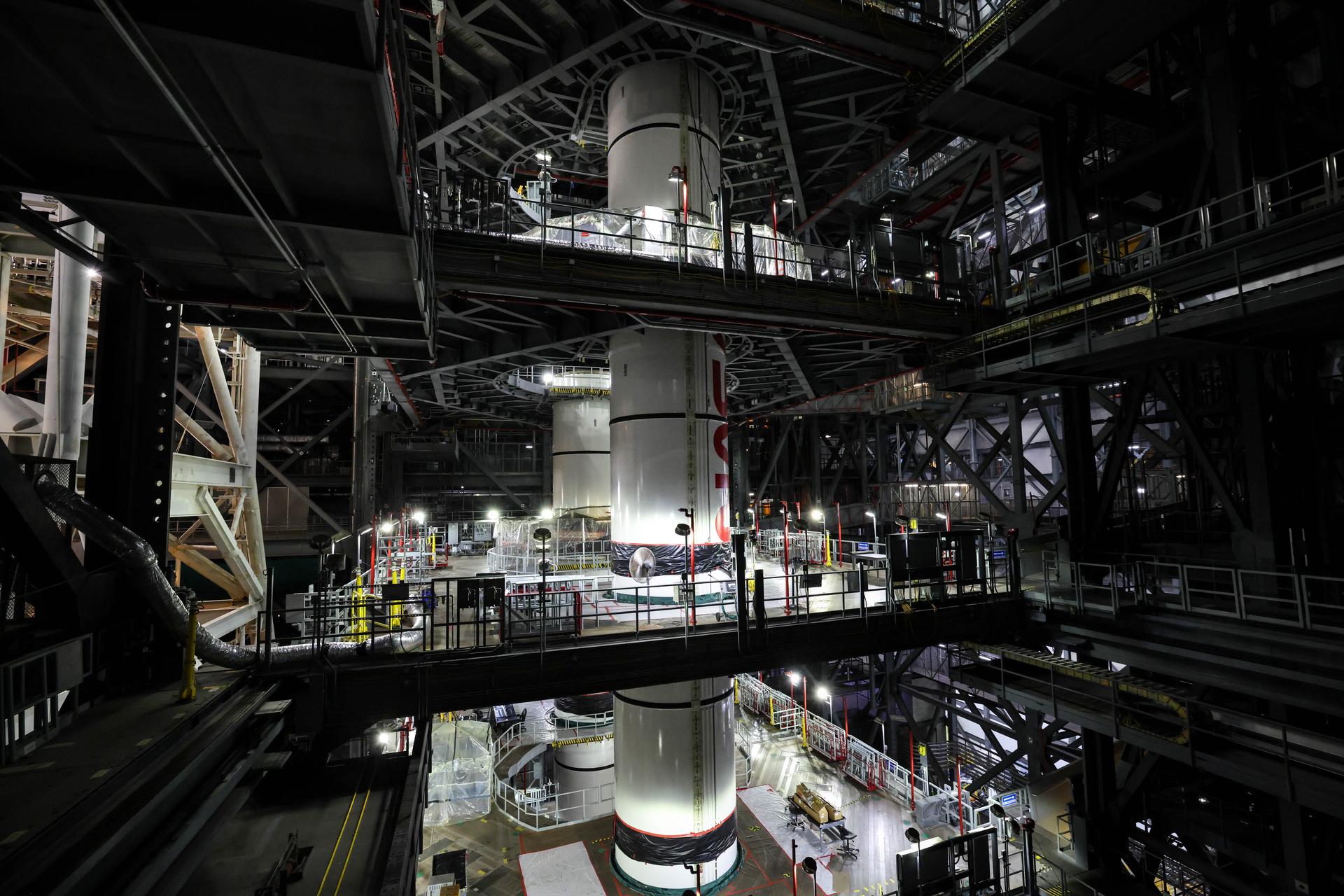
Technicians inside the Vehicle Assembly Building at NASA’s Kennedy Space Center in Florida complete integration of the left forward center solid rocket booster segment onto the left center center booster segment for the Artemis III SLS (Space Launch System) rocket on the mobile launcher inside High Bay 3 on Tuesday, Sept. 1, 2026. The twin boosters, comprising five segments each and manufactured by Northrop Grumman in Utah, provide more than 75 percent of the SLS rocket’s total thrust at liftoff. The Artemis III mission will launch crew in the Orion spacecraft on top of the SLS rocket to test rendezvous and docking capabilities between Orion and commercial spacecraft needed to land astronauts on the Moon.
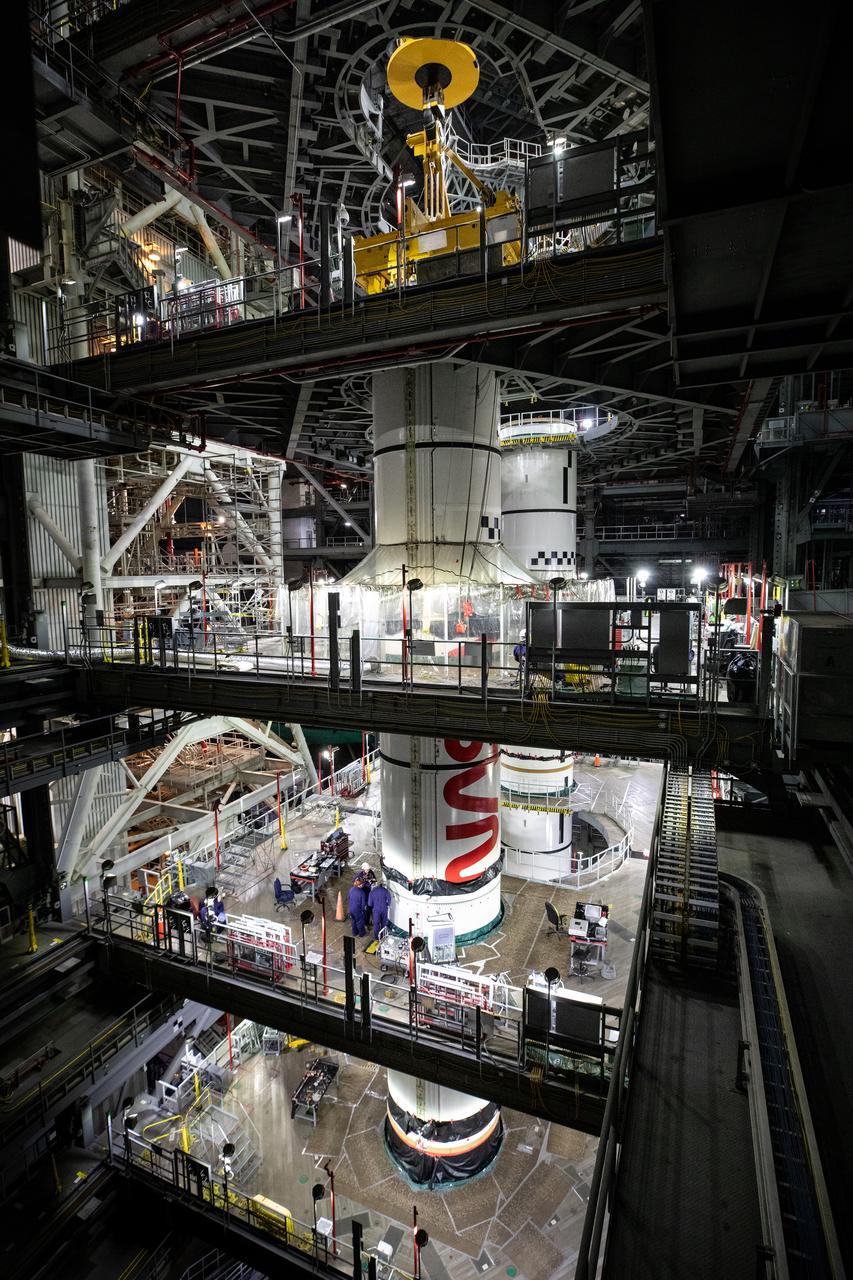
Inside High Bay 3 of the Vehicle Assembly Building at NASA’s Kennedy Space Center in Florida, technicians with the agency’s Exploration Ground Systems use a crane to lower the left forward center booster segment for the NASA’s SLS (Space Launch System) rocket onto the left center center segment atop the mobile launcher on Thursday, Jan. 30, 2025. The NASA “worm” insignia can be seen on both the center center booster segments. The boosters will help support the remaining rocket components and the Orion spacecraft during final assembly of the Artemis II Moon rocket and provide more than 75 percent of the total SLS thrust during liftoff from NASA Kennedy’s Launch Pad 39B.
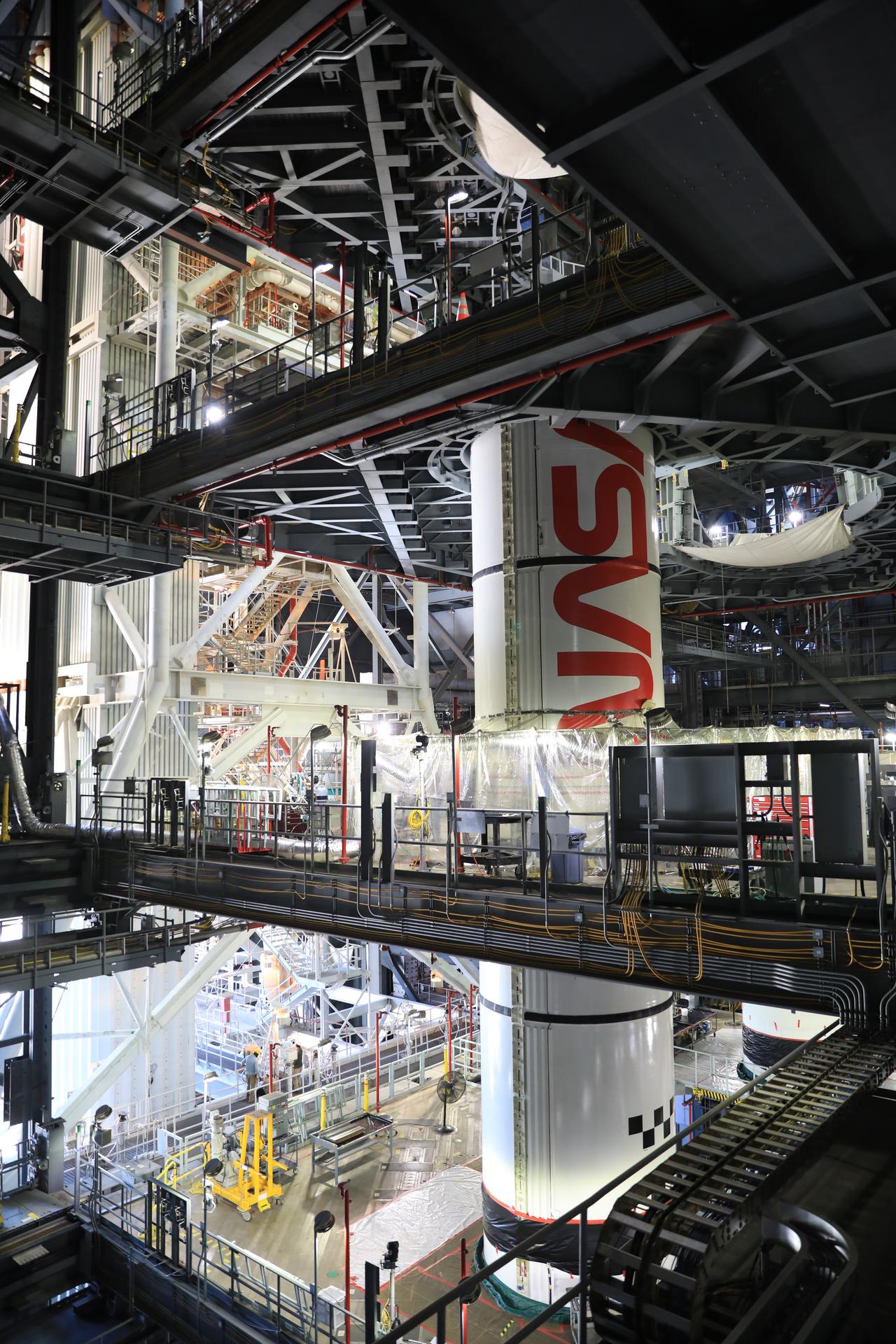
Technicians inside the Vehicle Assembly Building at NASA’s Kennedy Space Center in Florida complete integration of the left center center solid rocket booster segment onto the left aft center booster segment for the Artemis III SLS (Space Launch System) rocket on the mobile launcher inside High Bay 3 on Wednesday, Aug. 19, 2026. The twin boosters, comprising of five segments each manufactured by Northrop Grumman in Utah, will provide more than 75 percent of the SLS rocket’s total thrust at launch. The Artemis III mission will launch crew in the Orion spacecraft on top of the SLS rocket to test rendezvous and docking capabilities between Orion and commercial spacecraft needed to land astronauts on the Moon.
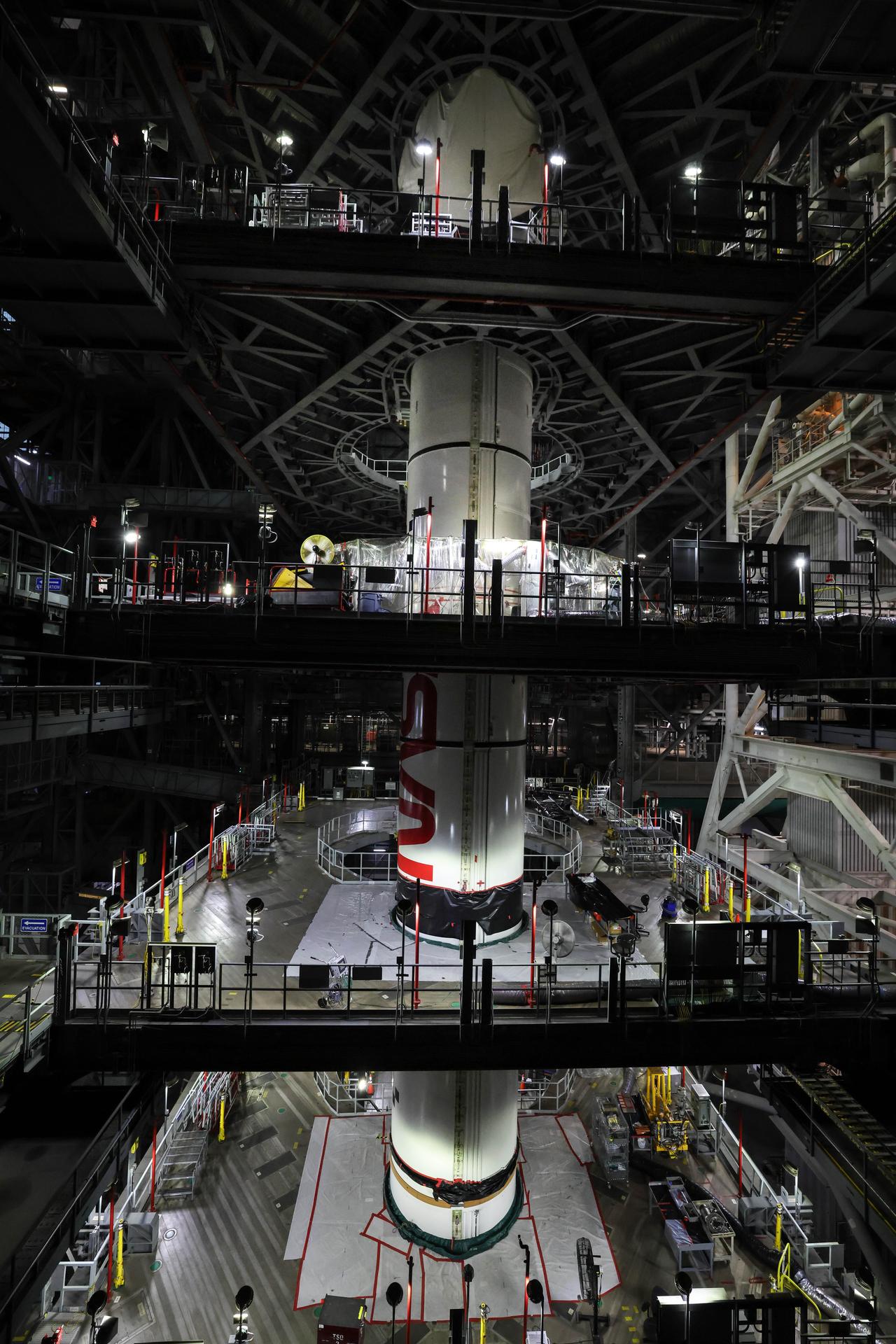
In High Bay 3 of the Vehicle Assembly Building at NASA’s Kennedy Space Center in Florida, the right forward center booster for Artemis III is integrated onto the right booster segments on the mobile launcher for the SLS (Space Launch System) rocket on Friday, Sept. 11, 2026. The twin boosters, comprising of five segments each manufactured by Northrop Grumman in Utah, will provide more than 75 percent of the SLS rocket’s total thrust at launch. The Artemis III mission will launch crew in the Orion spacecraft on top of the SLS rocket to test rendezvous and docking capabilities between Orion and commercial spacecraft needed to land astronauts on the Moon.
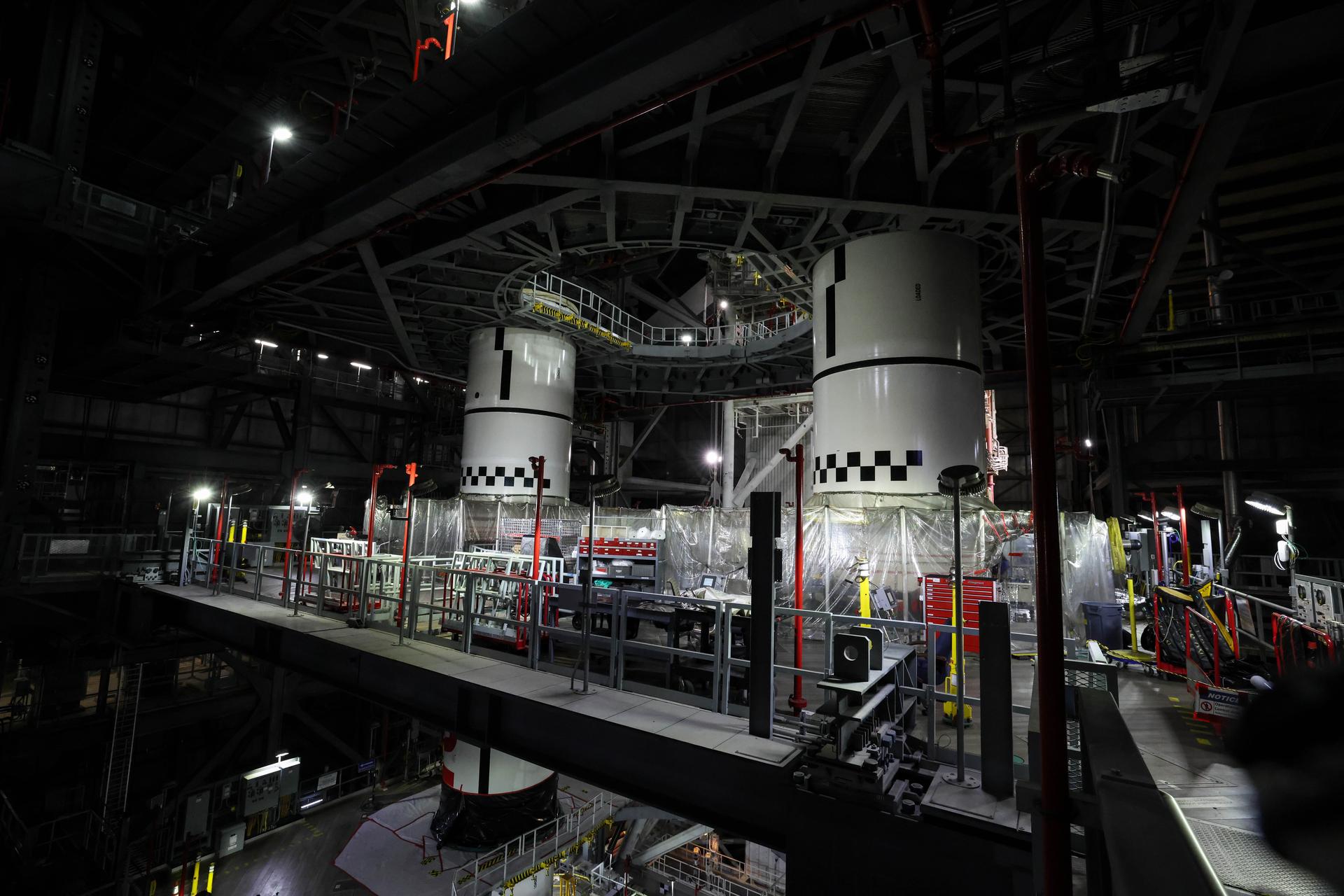
In High Bay 3 of the Vehicle Assembly Building at NASA’s Kennedy Space Center in Florida, the left and right forward center boosters for Artemis III are integrated onto the booster segments on the mobile launcher for the SLS (Space Launch System) rocket on Friday, Sept. 11, 2026. The twin boosters, comprising of five segments each manufactured by Northrop Grumman in Utah, will provide more than 75 percent of the SLS rocket’s total thrust at launch. The Artemis III mission will launch crew in the Orion spacecraft on top of the SLS rocket to test rendezvous and docking capabilities between Orion and commercial spacecraft needed to land astronauts on the Moon.
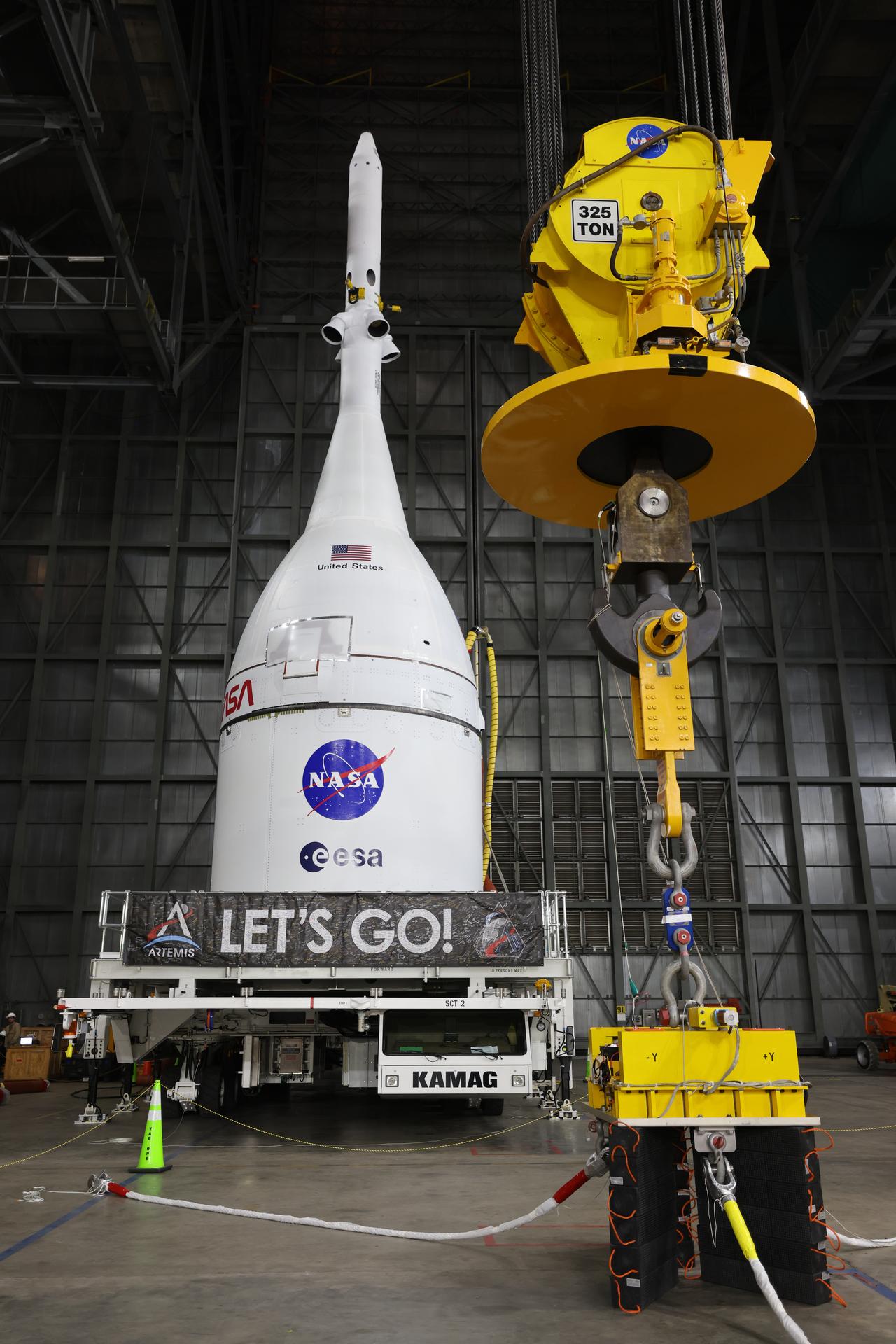
Technicians with NASA’s Exploration Ground Systems team prepare to attach a crane to lift and secure NASA’s Orion spacecraft on top of the SLS (Space Launch System) rocket in High Bay 3 of the Vehicle Assembly Building at NASA’s Kennedy Space Center in Florida on Friday, Oct. 17, 2025, for the agency’s Artemis II mission. Set to launch in 2026, the spacecraft will carry NASA astronauts Reid Wiseman, Victor Glover, Christina Koch, and CSA (Canadian Space Agency) astronaut Jeremy Hansen on a 10-day mission around the Moon and back. Once stacked, teams will begin conducting a series of verification tests ahead of rolling out to Launch Complex 39B for the wet dress rehearsal at NASA Kennedy.
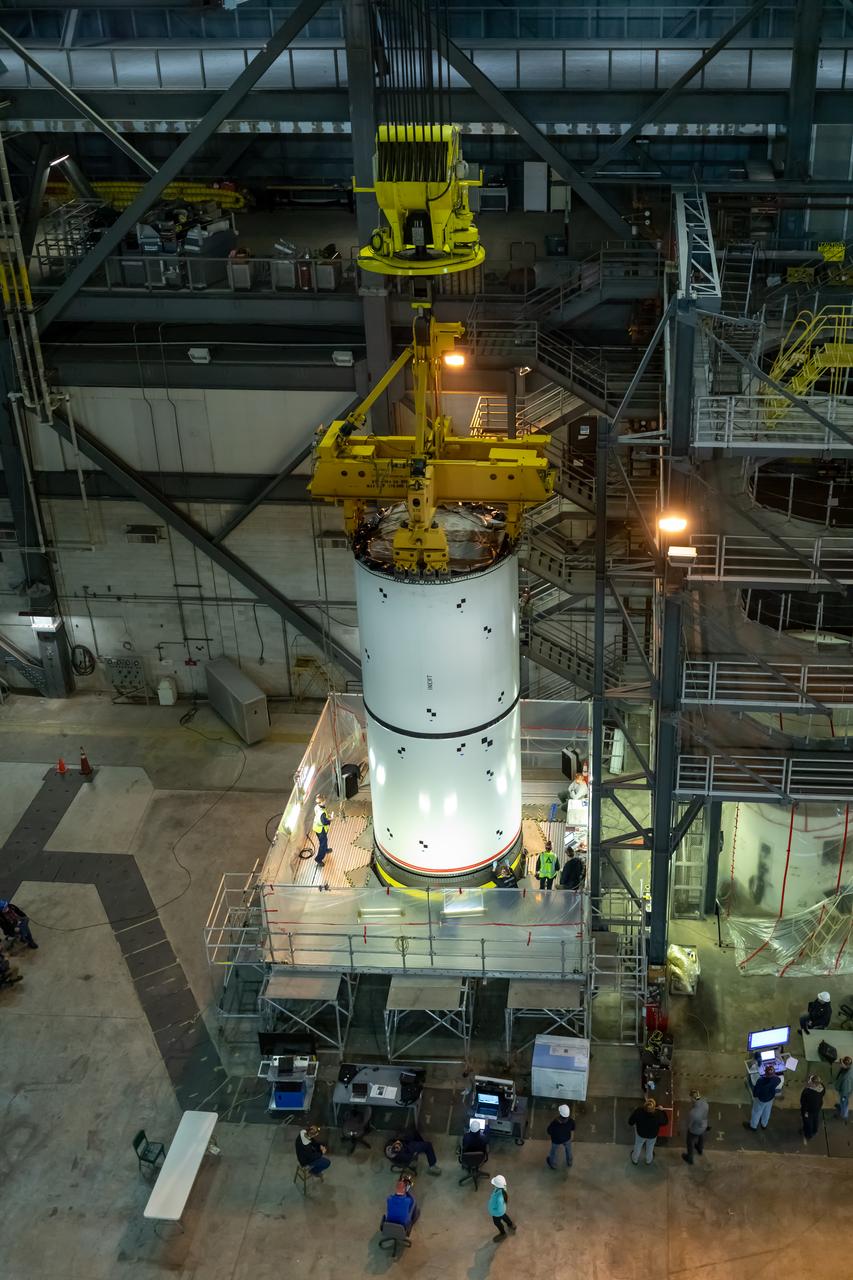
In High Bay 4 of the Vehicle Assembly Building at NASA’s Kennedy Space Center in Florida, a crane lowers one Space Launch System (SLS) solid rocket booster pathfinder segment onto another segment during a training exercise on Jan. 8, 2020. A team of engineers with Exploration Ground Systems and crane operators and technicians with contractor Jacobs are practicing lifting, moving and stacking maneuvers, using important ground support equipment to train employees and certify all the equipment works properly. The booster pathfinders are inert, full-scale replicas of the actual booster hardware that will be attached to the SLS rocket for Artemis missions. The five-segment, 17-story-tall twin boosters will provide 3.6 million pounds of thrust each at liftoff to help launch Orion on Artemis I, its first uncrewed mission beyond the Moon.
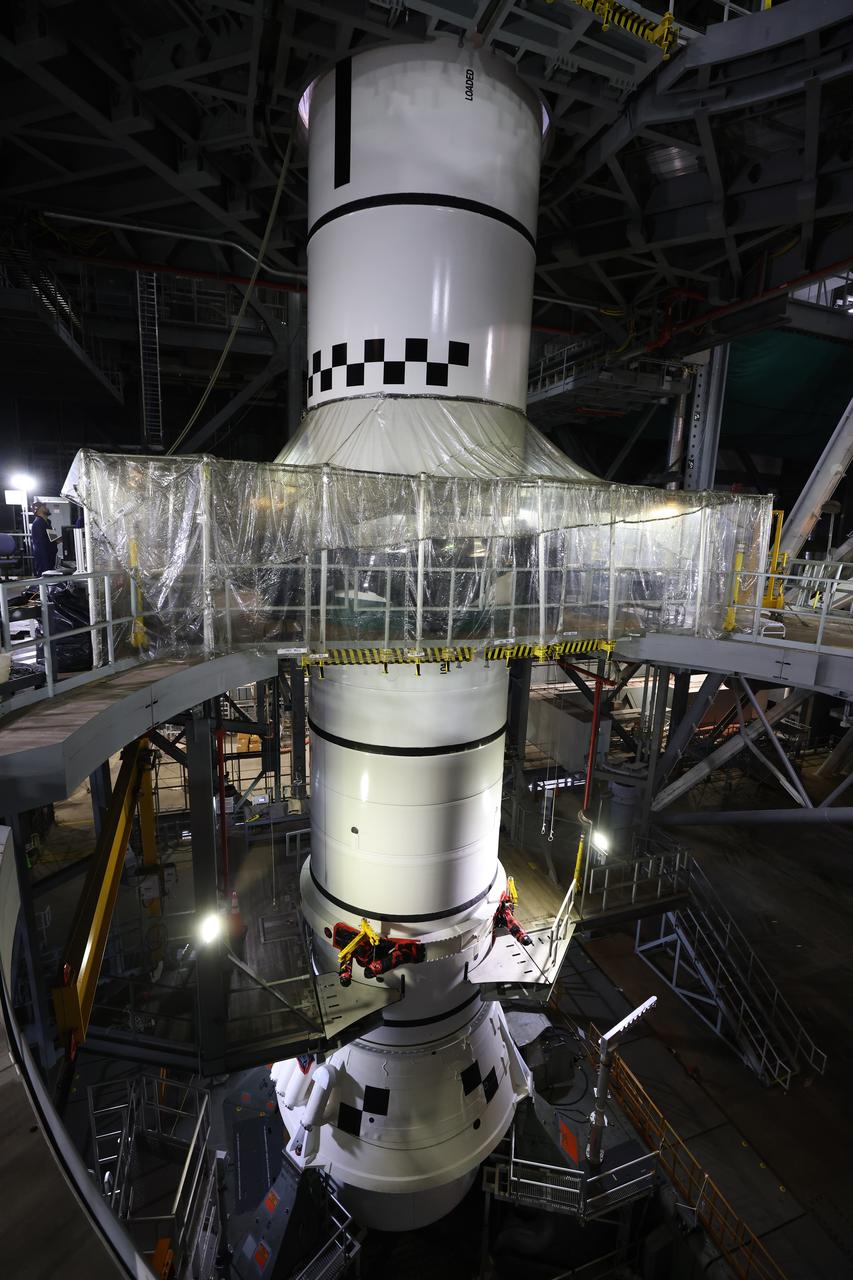
Engineers and technicians with the Exploration Ground Systems Program stack the next solid rocket booster segment, the left aft center, on the for the Artemis II SLS (Space Launch System) Moon rocket onto mobile launcher 1 inside the Vehicle Assembly Building’s High Bay 3 at NASA’s Kennedy Space Center on Thursday, Dec. 19, 2024. Once assembled, the boosters will help support the remaining rocket components and the Orion spacecraft during final assembly of the Artemis II Moon rocket and provide more than 75 percent of the total SLS thrust during liftoff from NASA Kennedy’s Launch Pad 39B.
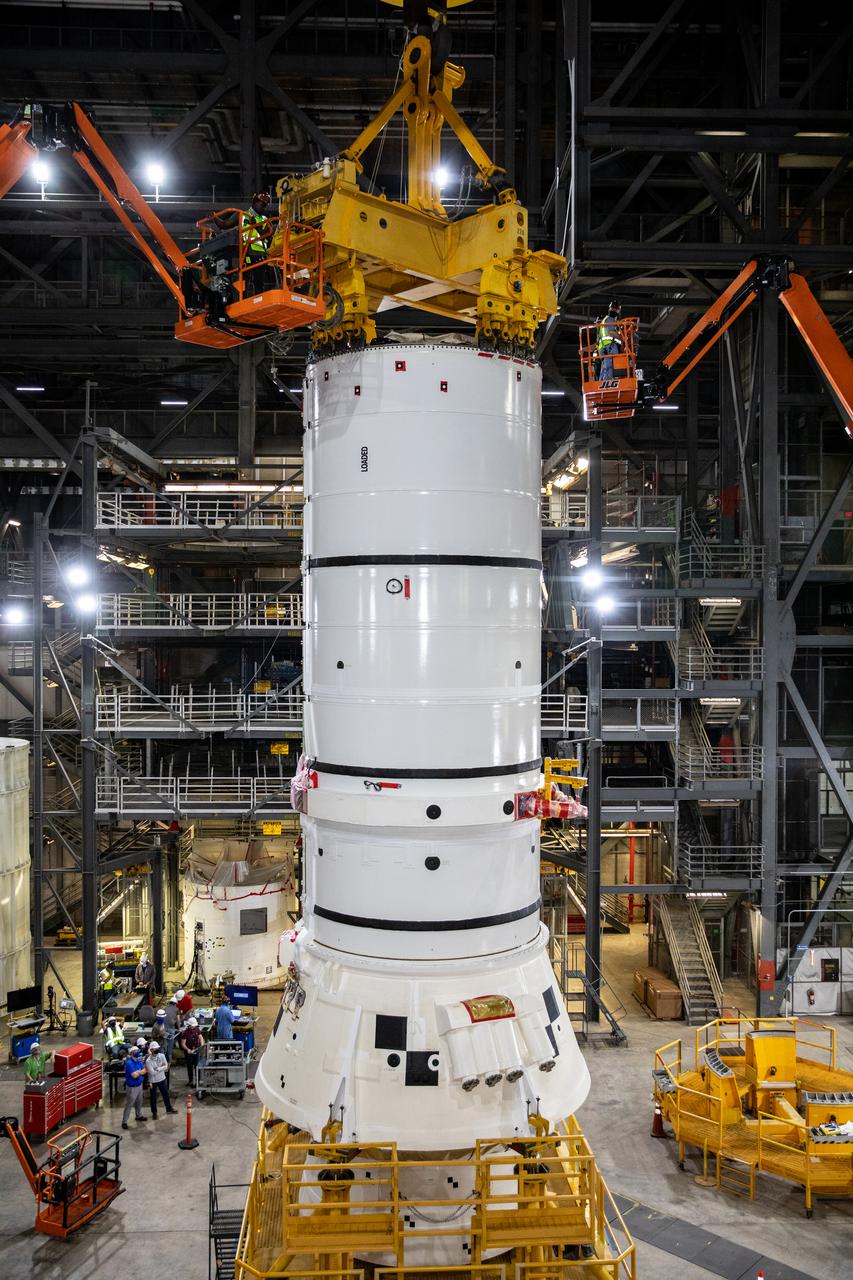
In High Bay 4 of the Vehicle Assembly Building (VAB) at NASA’s Kennedy Space Center in Florida, one of the Artemis I aft booster segments for the Space Launch System is being prepared for its lift up and lowering onto the mobile launcher in High Bay 3 for stacking operations on Nov. 20, 2020. Workers with Exploration Ground Systems and contractor Jacobs teams will stack the twin five-segment boosters on the mobile launcher in High Bay 3 over a number of weeks. When the core stage arrives, it will join the boosters on the mobile launcher, followed by the interim cryogenic propulsion stage and Orion spacecraft. Manufactured by Northrop Grumman in Utah, the twin boosters provide more than 75 percent of the total SLS thrust at launch. The SLS is managed by Marshall Space Flight Center in Huntsville, Alabama. Under the Artemis program, NASA will land the first woman and the next man on the Moon by 2024. The first in a series of increasingly complex missions, Artemis I will test the Orion spacecraft and SLS as an integrated system ahead of crewed flights to the Moon.
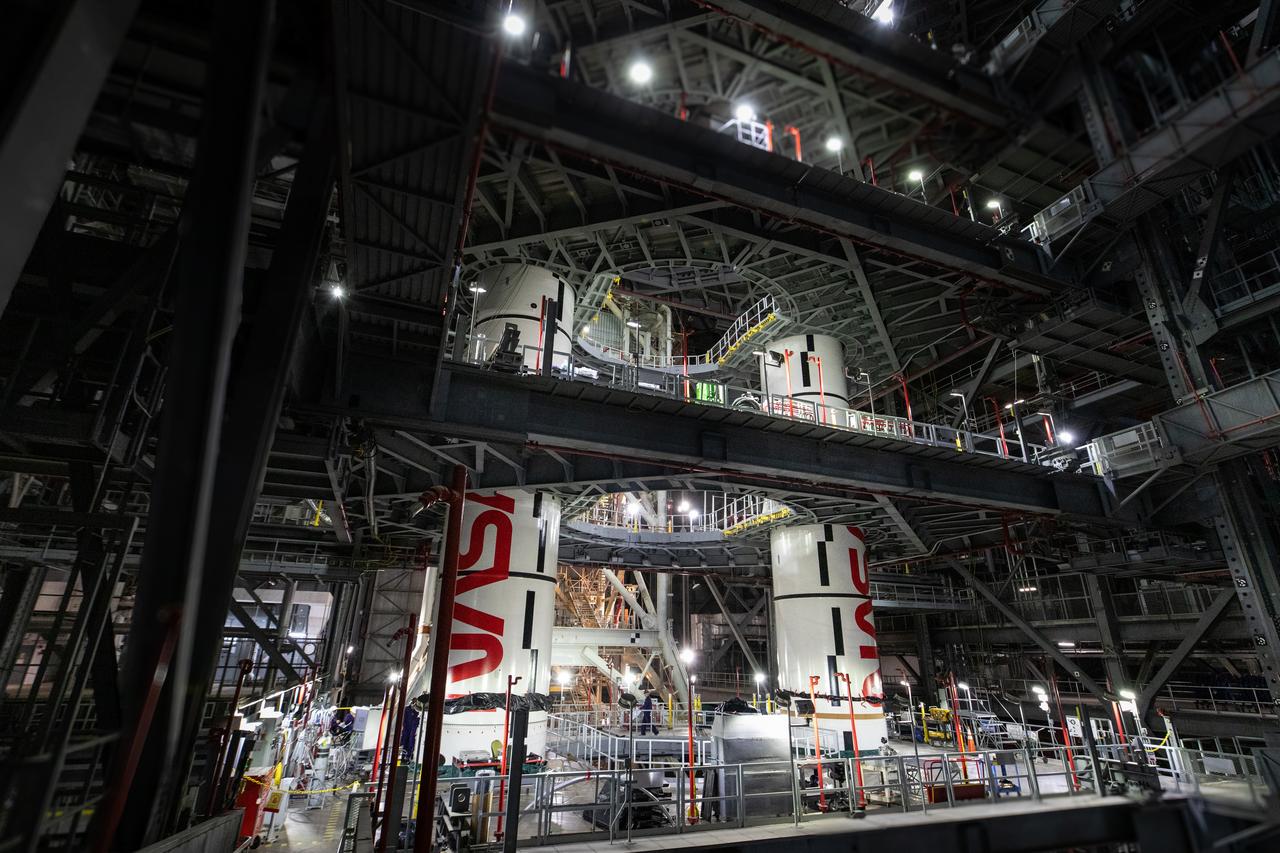
Inside High Bay 3 of the Vehicle Assembly Building at NASA’s Kennedy Space Center in Florida, technicians with the agency’s Exploration Ground Systems integrate the left forward center booster segment for the NASA’s SLS (Space Launch System) rocket onto the left center center segment atop the mobile launcher on Thursday, Jan. 30, 2025. The NASA “worm” insignia can be seen on both the center center booster segments. The boosters will help support the remaining rocket components and the Orion spacecraft during final assembly of the Artemis II Moon rocket and provide more than 75 percent of the total SLS thrust during liftoff from NASA Kennedy’s Launch Pad 39B.
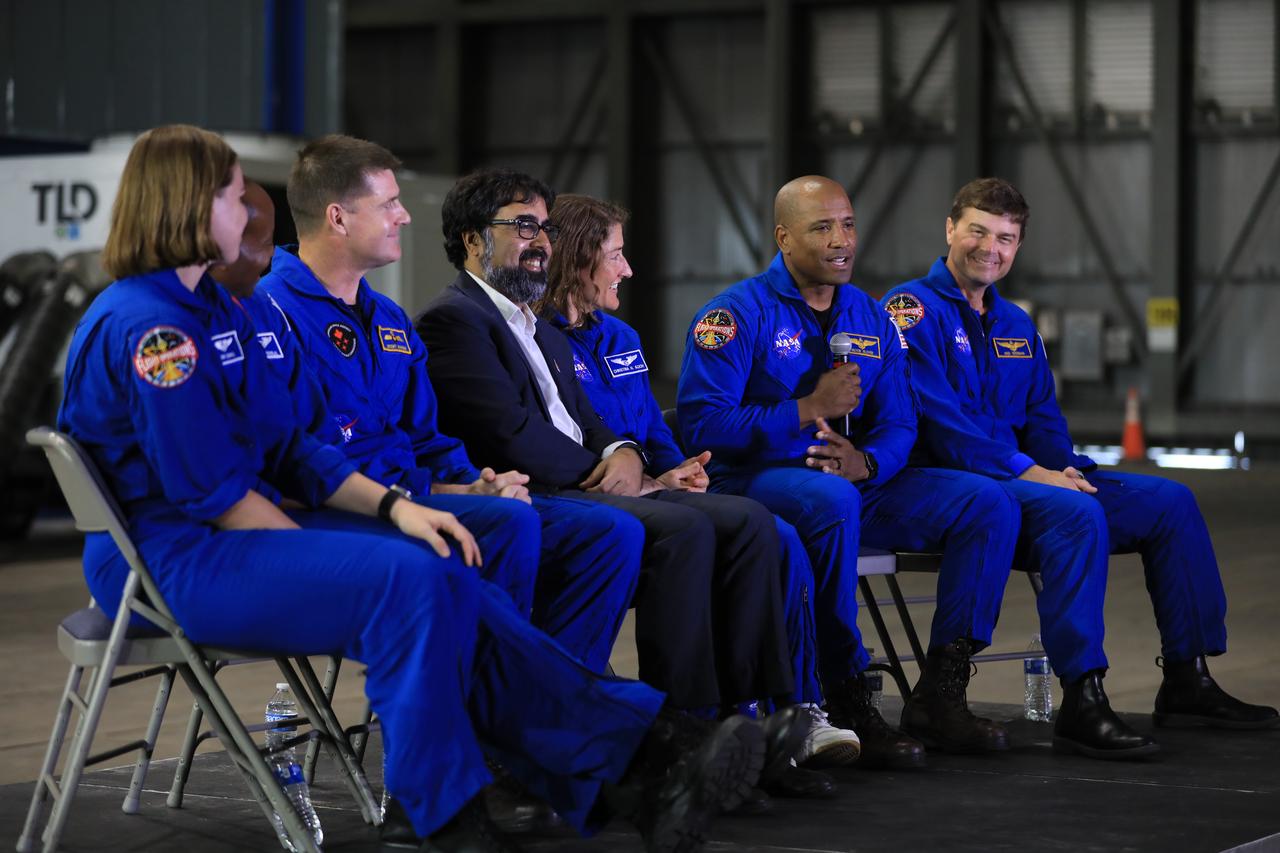
From left, CSA (Canadian Space Agency) astronaut Jenni Gibbons, NASA astronaut Andre Douglas, CSA astronaut Jeremy Hansen, NASA Moon to Mars Program Deputy Associate Administrator Amit Kshatriya, and NASA astronauts Christina Koch, Victor Glover, and Reid Wiseman participate in a media day event on Monday, Dec. 16, 2024, inside the Vehicle Assembly Building at the agency’s Kennedy Space Center in Florida. The Artemis II crew and backup crew participated in the event days after teams with NASA’s Exploration Ground Systems transport lifted the agency’s 212-foot-tall SLS (Space Launch System) core stage from the facility’s transfer aisle into High Bay 2 where it will remain while teams stack the two solid rocket boosters on top of mobile launcher 1.

Teams from Kennedy lift NASA’s integrated Artemis III SLS (Space Launch System) core stage engine section with its boat-tail inside the center’s Vehicle Assembly Building at NASA’s Kennedy Space Center in Florida on Wednesday, Aug. 13, 2025. Shown inside the facility’s High Bay 2 for processing, the engine section is one the most complex and intricate parts of the rocket stage that will help power the Artemis missions to the Moon.
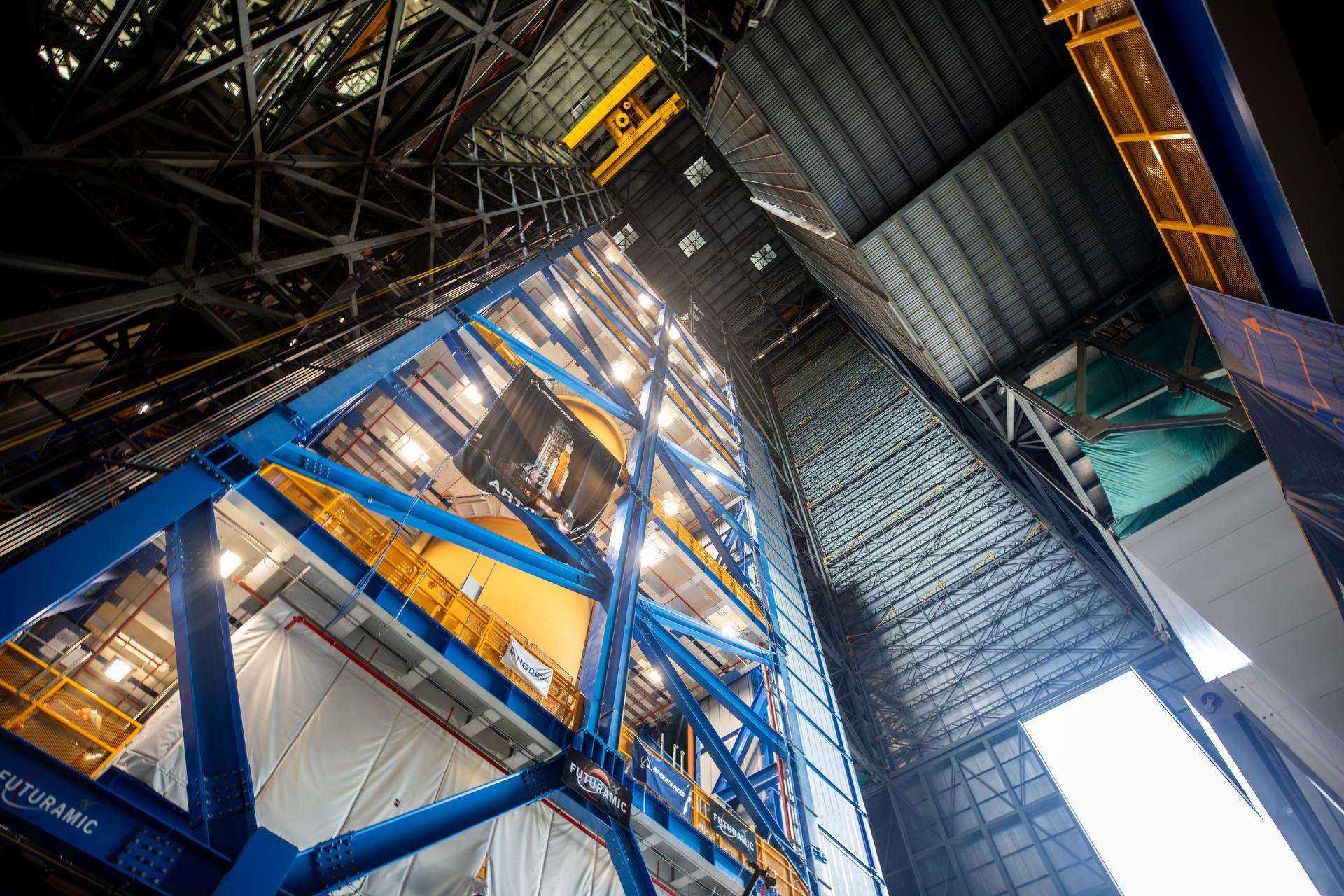
Inside High Bay 2 at NASA’s Vehicle Assembly Building at Kennedy’s Space Center in Florida, the SLS (Space Launch System) core stage rocket is secured in a vertical position as technicians prepare to install the last RS-25 engine to the SLS. During Artemis III, the four RS-25 engines will launch SLS, the Orion spacecraft and its crew of four into low Earth orbit, generating more than two million pounds of thrust at liftoff.
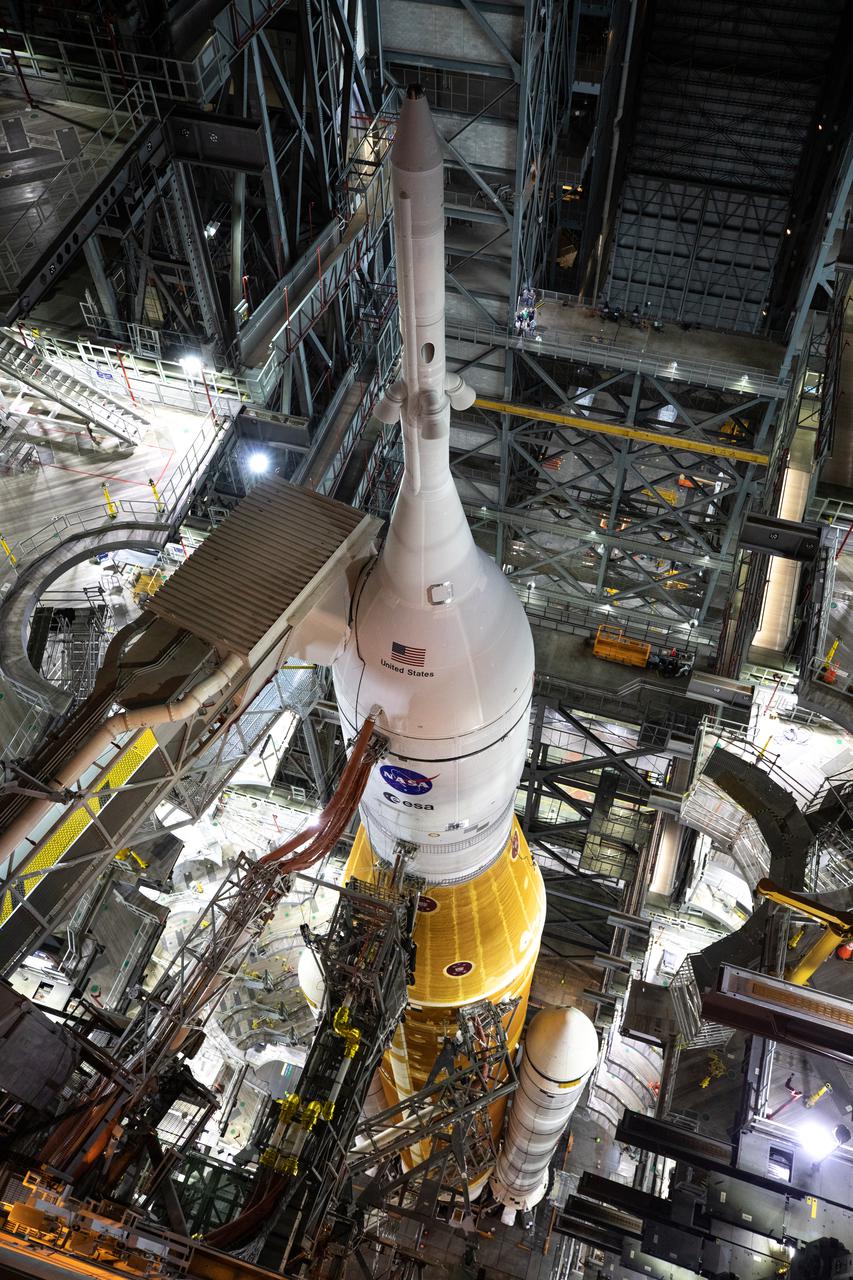
In this view looking down in High Bay 3 of the Vehicle Assembly Building at NASA’s Kennedy Space Center in Florida, the Artemis I Space Launch System (SLS) and Orion spacecraft can be seen without any work platforms surrounding them on March 17, 2022. The Artemis I stack atop the mobile launcher will roll out to Launch Complex 39B atop the crawler-transporter 2 for a wet dress rehearsal ahead of launch. Artemis I will be the first integrated test of the SLS and Orion spacecraft. In later missions, NASA will land the first woman the first person of color on the surface of the Moon, paving the way for a long-term lunar presence and serving as a steppingstone on the way to Mars.
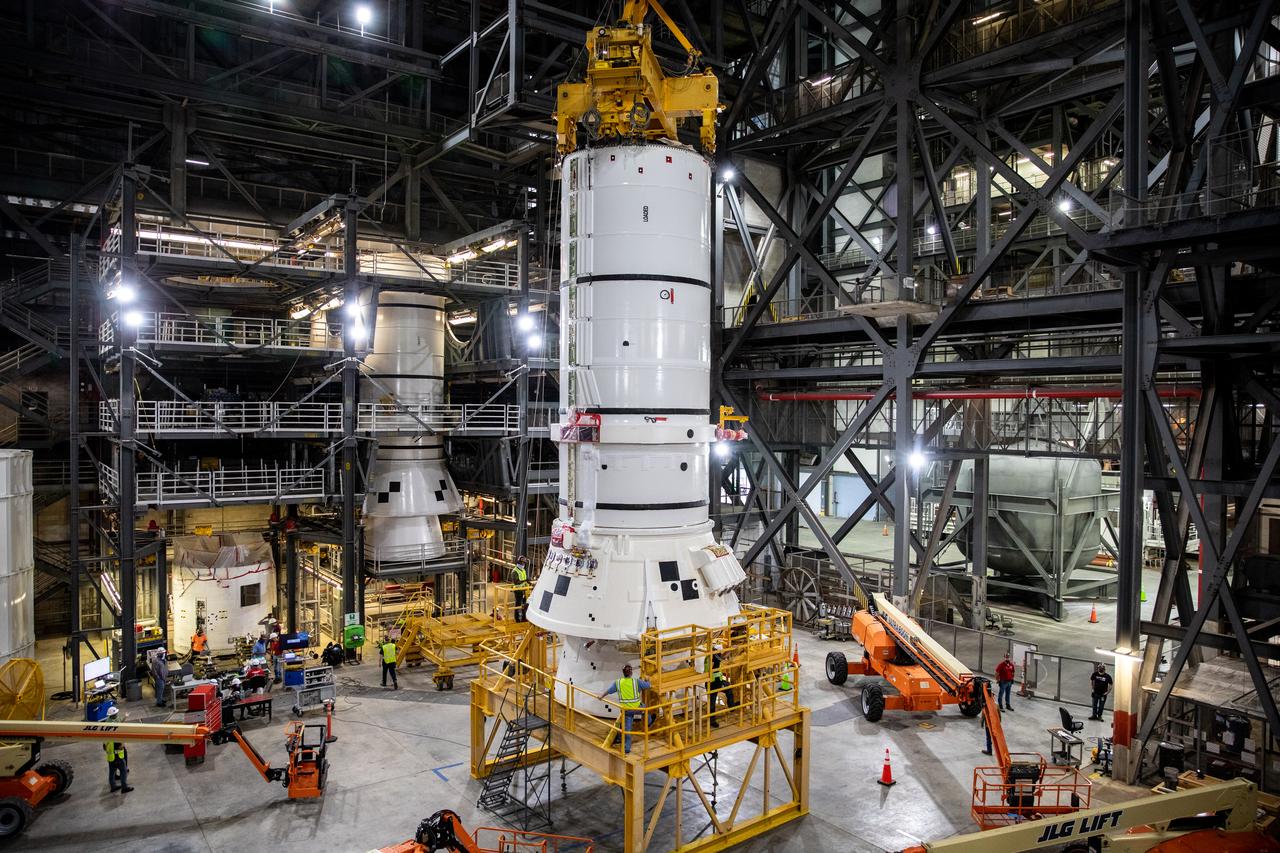
In High Bay 4 of the Vehicle Assembly Building (VAB) at NASA’s Kennedy Space Center in Florida, one of the Artemis I aft booster segments for the Space Launch System is being prepared for stacking operations on Nov. 20, 2020. Workers with Exploration Ground Systems and contractor Jacobs teams will stack the twin five-segment boosters on the mobile launcher in High Bay 3 over a number of weeks. When the core stage arrives, it will join the boosters on the mobile launcher, followed by the interim cryogenic propulsion stage and Orion spacecraft. Manufactured by Northrop Grumman in Utah, the twin boosters provide more than 75 percent of the total SLS thrust at launch. The SLS is managed by Marshall Space Flight Center in Huntsville, Alabama. Under the Artemis program, NASA will land the first woman and the next man on the Moon by 2024. The first in a series of increasingly complex missions, Artemis I will test the Orion spacecraft and SLS as an integrated system ahead of crewed flights to the Moon.
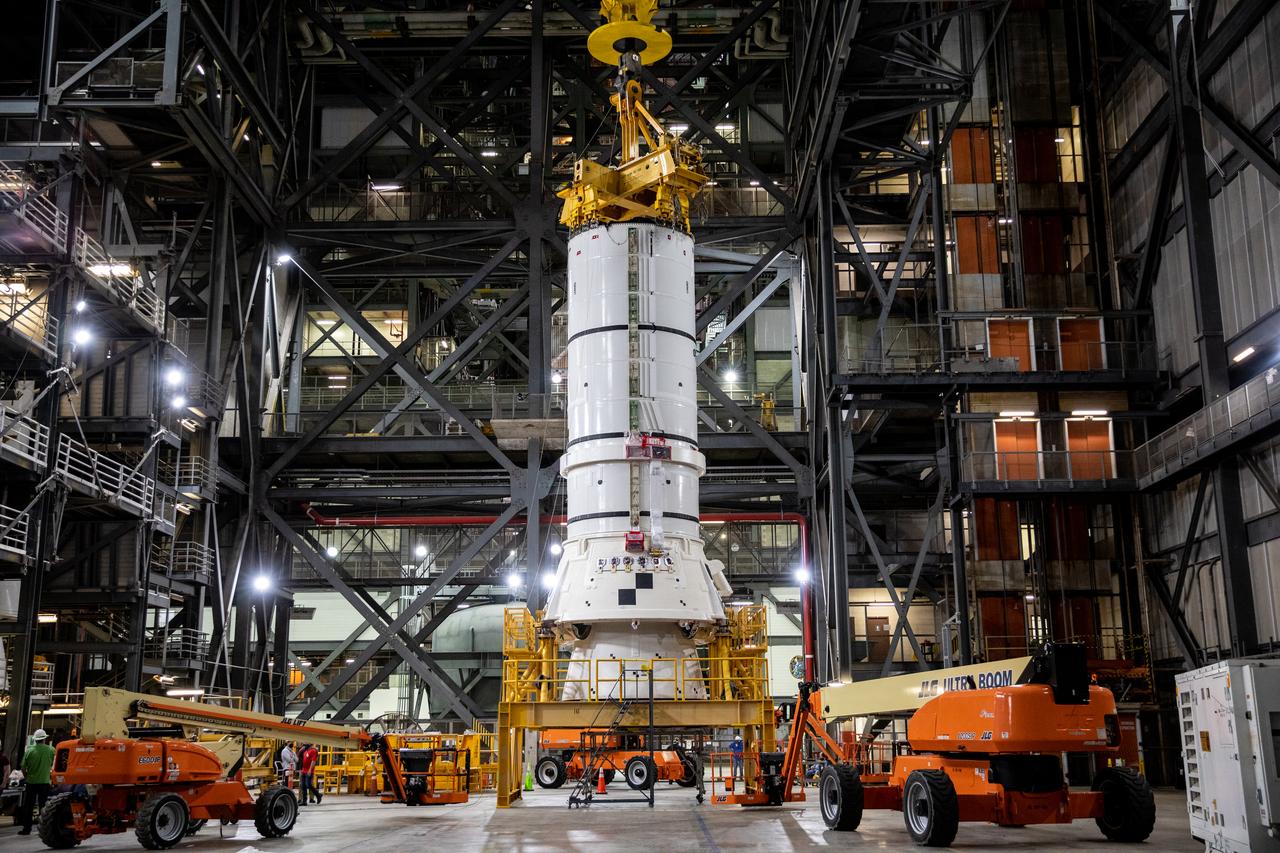
In High Bay 4 of the Vehicle Assembly Building (VAB) at NASA’s Kennedy Space Center in Florida, one of the Artemis I aft booster segments for the Space Launch System is being prepared for stacking operations on Nov. 20, 2020. Workers with Exploration Ground Systems and contractor Jacobs teams will stack the twin five-segment boosters on the mobile launcher in High Bay 3 over a number of weeks. When the core stage arrives, it will join the boosters on the mobile launcher, followed by the interim cryogenic propulsion stage and Orion spacecraft. Manufactured by Northrop Grumman in Utah, the twin boosters provide more than 75 percent of the total SLS thrust at launch. The SLS is managed by Marshall Space Flight Center in Huntsville, Alabama. Under the Artemis program, NASA will land the first woman and the next man on the Moon by 2024. The first in a series of increasingly complex missions, Artemis I will test the Orion spacecraft and SLS as an integrated system ahead of crewed flights to the Moon.
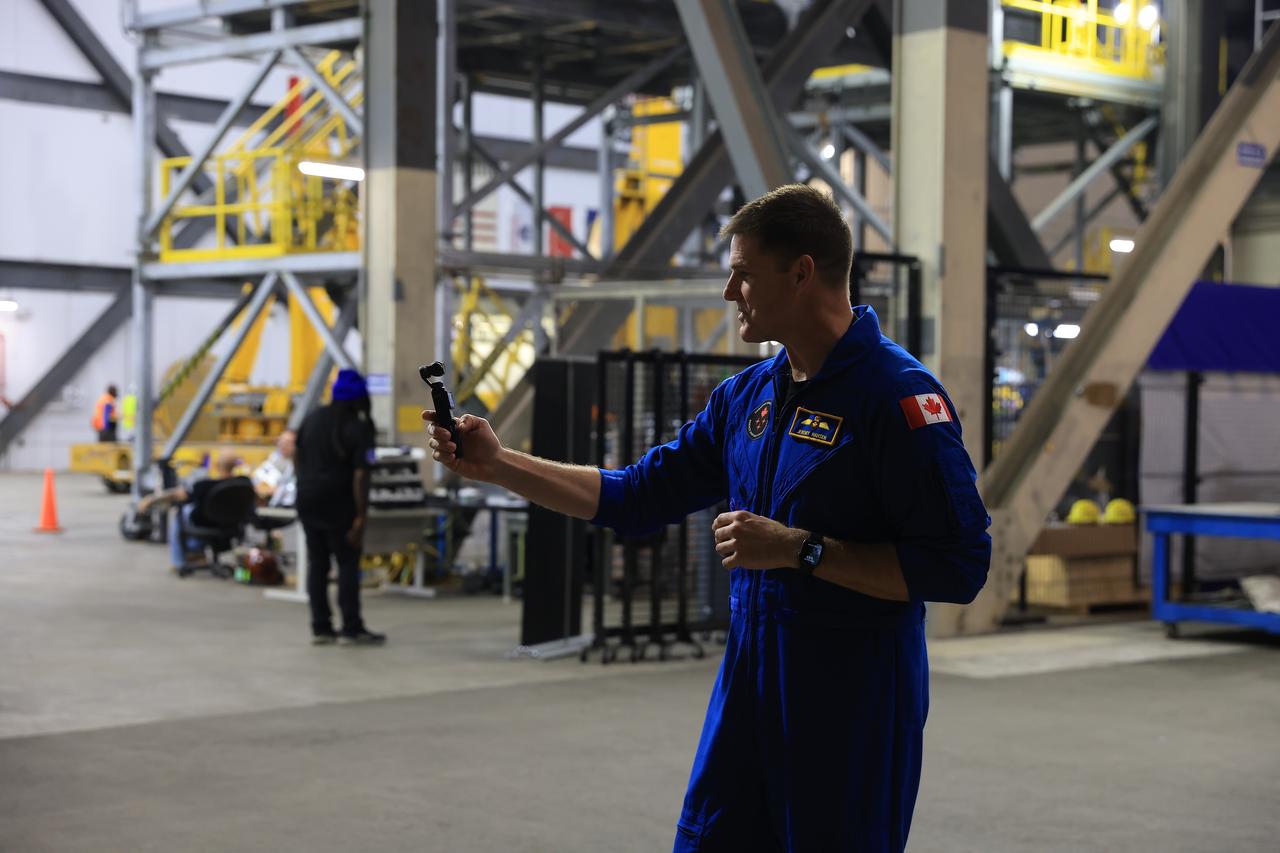
Artemis II crew member CSA (Canadian Space Agency) astronaut Jeremy Hansen participates in a media day event on Monday, Dec. 16, 2024, inside the Vehicle Assembly Building at the agency’s Kennedy Space Center in Florida. The Artemis II crew and backup crew participated in the event days after teams with NASA’s Exploration Ground Systems transport lifted the agency’s 212-foot-tall SLS (Space Launch System) core stage from the facility’s transfer aisle into High Bay 2 where it will remain while teams stack the two solid rocket boosters on top of mobile launcher 1.
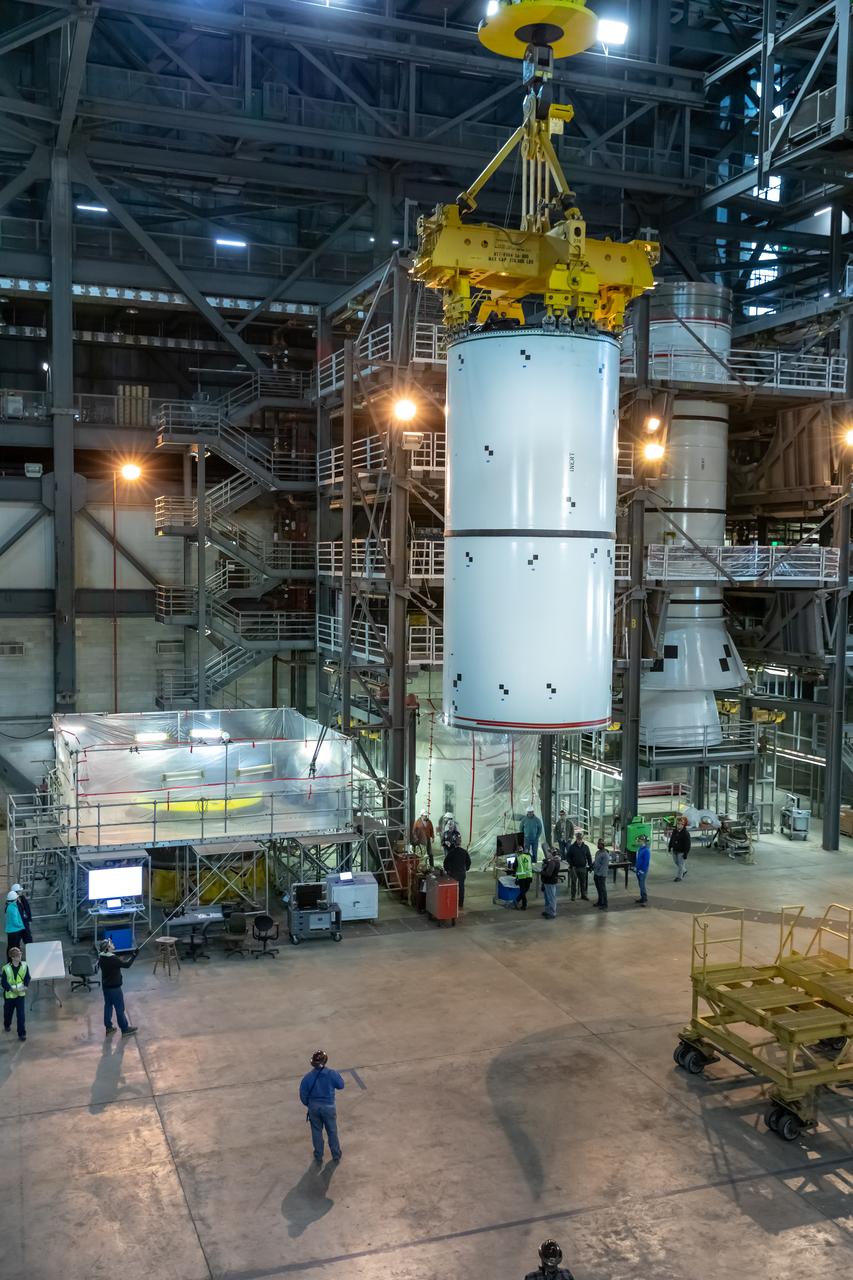
In High Bay 4 of the Vehicle Assembly Building at NASA’s Kennedy Space Center in Florida, a crane moves Space Launch System (SLS) solid rocket booster pathfinder segments toward a platform during a training exercise on Jan. 8, 2020. A team of engineers with Exploration Ground Systems and crane operators and technicians with contractor Jacobs are practicing lifting, moving and stacking maneuvers, using important ground support equipment to train employees and certify all the equipment works properly. The booster pathfinders are inert, full-scale replicas of the actual booster hardware that will be attached to the SLS rocket for Artemis missions. The five-segment, 17-story-tall twin boosters will provide 3.6 million pounds of thrust each at liftoff to help launch Orion on Artemis I, its first uncrewed mission beyond the Moon.
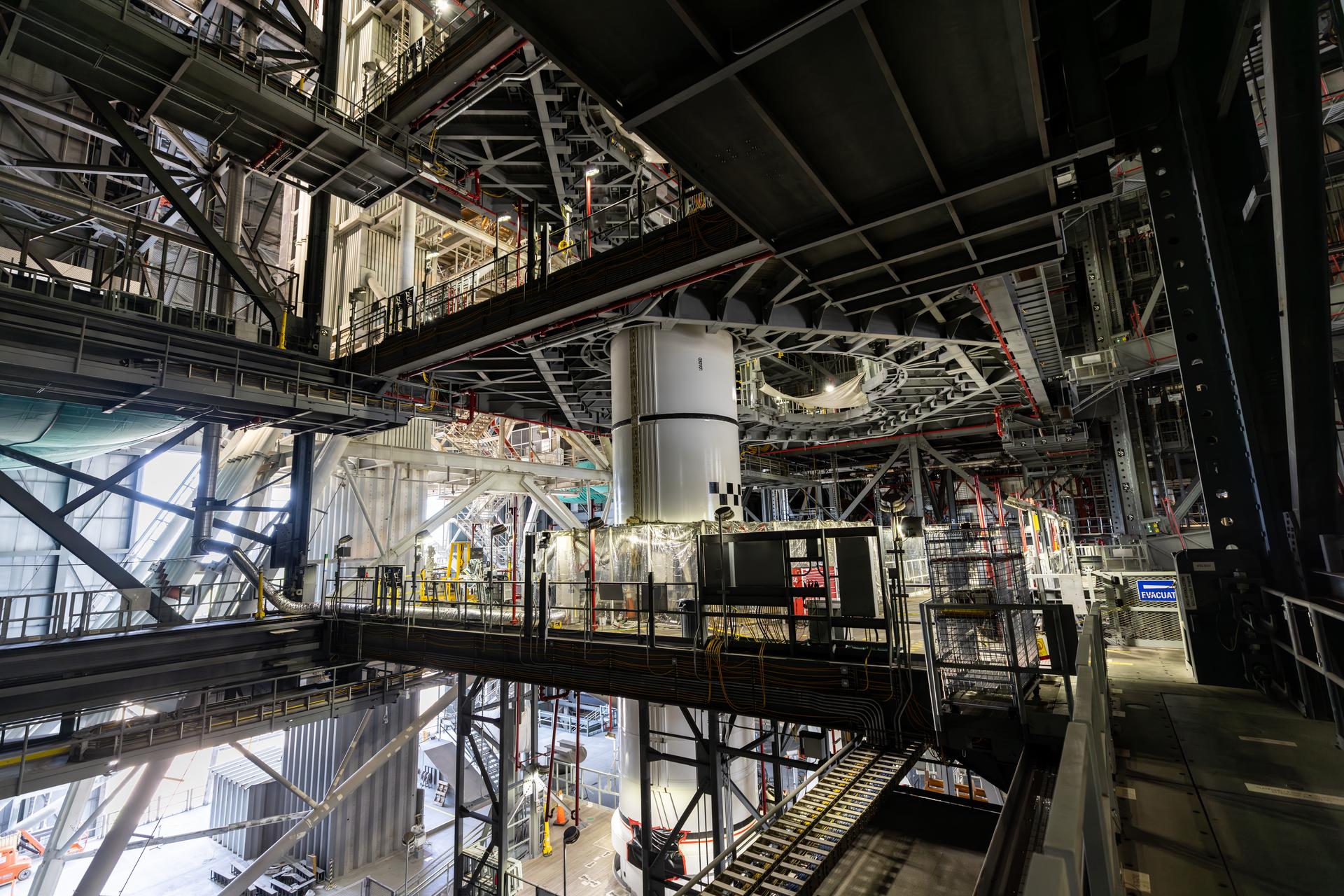
In High Bay 3 of the Vehicle Assembly Building at NASA’s Kennedy Space Center in Florida, the left aft center booster segment for Artemis III is integrated onto its aft assembly segment on the mobile launcher for the SLS (Space Launch System) rocket on Monday, Aug. 12, 2026. The twin boosters, comprising of five segments each manufactured by Northrop Grumman in Utah, will provide more than 75 percent of the SLS rocket’s total thrust at launch. The Artemis III mission will launch crew in the Orion spacecraft on top of the SLS rocket to test rendezvous and docking capabilities between Orion and commercial spacecraft needed to land astronauts on the Moon.
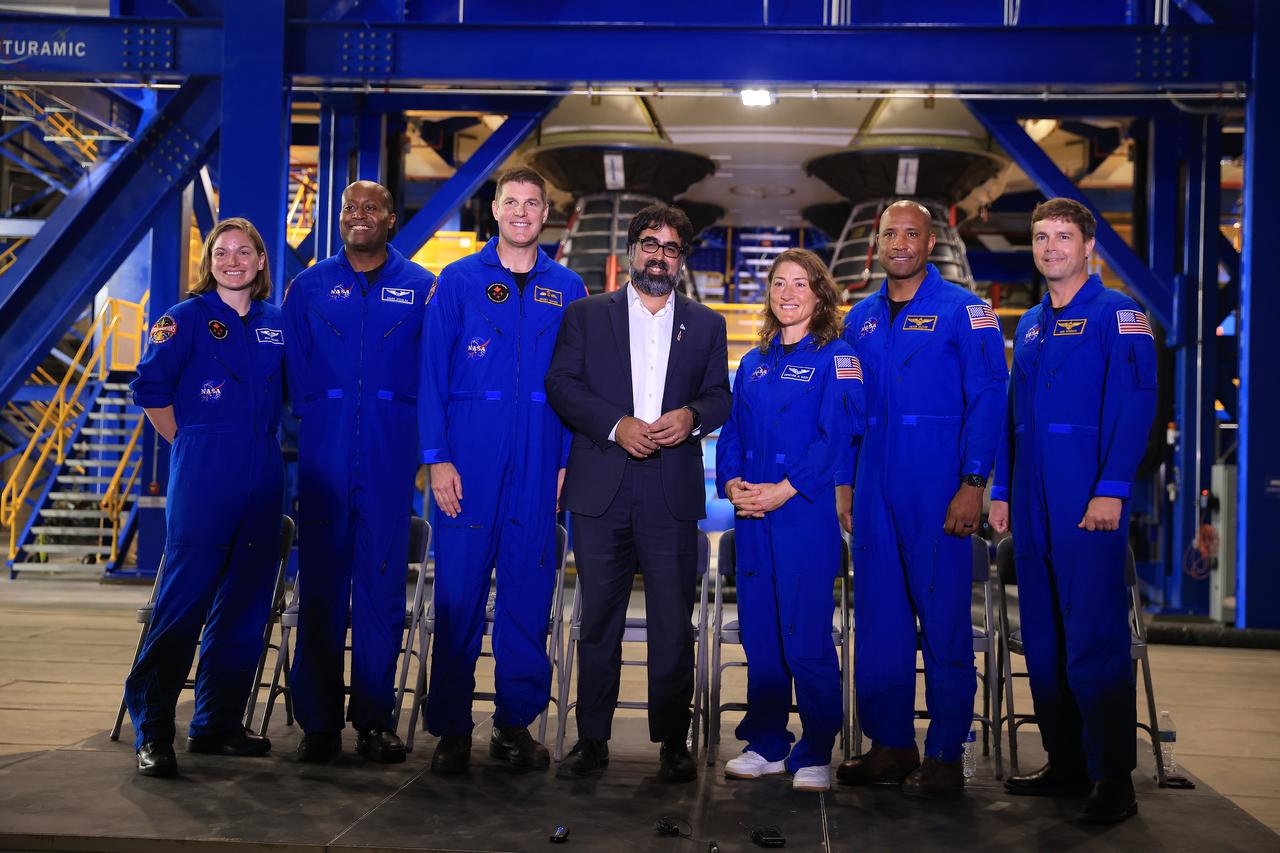
From left, CSA (Canadian Space Agency) astronaut Jenni Gibbons, NASA astronaut Andre Douglas, CSA astronaut Jeremy Hansen, NASA Moon to Mars Program Deputy Associate Administrator Amit Kshatriya, and NASA astronauts Christina Koch, Victor Glover, and Reid Wiseman participate in a media day event on Monday, Dec. 16, 2024, inside the Vehicle Assembly Building at the agency’s Kennedy Space Center in Florida. The Artemis II crew and backup crew participated in the event days after teams with NASA’s Exploration Ground Systems transport lifted the agency’s 212-foot-tall SLS (Space Launch System) core stage from the facility’s transfer aisle into High Bay 2 where it will remain while teams stack the two solid rocket boosters on top of mobile launcher 1.
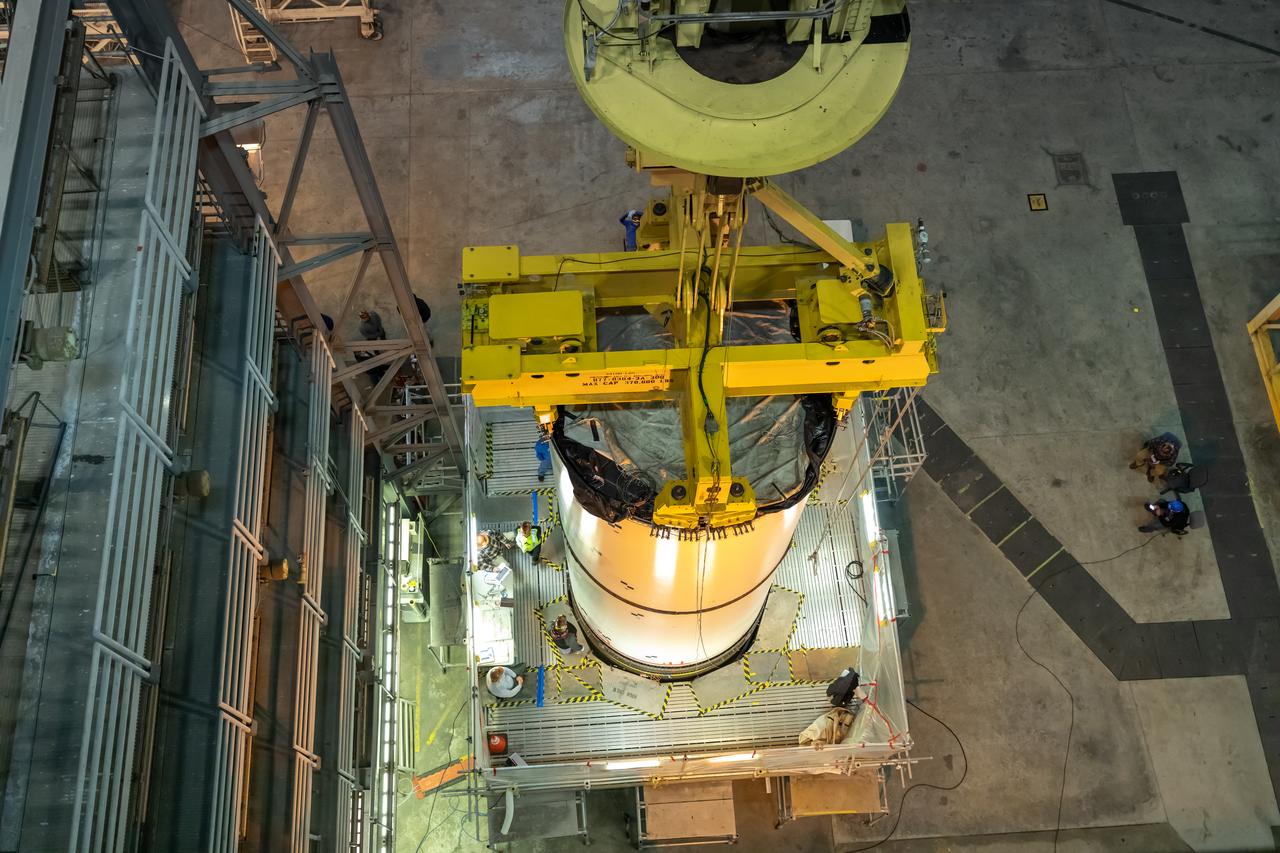
In High Bay 4 of the Vehicle Assembly Building at NASA’s Kennedy Space Center in Florida, a crane lowers one Space Launch System (SLS) solid rocket booster pathfinder segment onto another segment during a training exercise on Jan. 8, 2020. A team of engineers with Exploration Ground Systems and crane operators and technicians with contractor Jacobs are practicing lifting, moving and stacking maneuvers, using important ground support equipment to train employees and certify all the equipment works properly. The booster pathfinders are inert, full-scale replicas of the actual booster hardware that will be attached to the SLS rocket for Artemis missions. The five-segment, 17-story-tall twin boosters will provide 3.6 million pounds of thrust each at liftoff to help launch Orion on Artemis I, its first uncrewed mission beyond the Moon.
The first of two Artemis I aft booster segments for the Space Launch System is lowered onto the mobile launcher in High Bay 3 of the Vehicle Assembly Building (VAB) at NASA’s Kennedy Space Center in Florida on Nov. 23, 2020. Workers with Exploration Ground Systems and contractor Jacobs teams will stack the twin five-segment boosters on the mobile launcher in High Bay 3 over a number of weeks. When the core stage arrives, it will join the boosters on the mobile launcher, followed by the interim cryogenic propulsion stage and Orion spacecraft. Manufactured by Northrop Grumman in Utah, the twin boosters provide more than 75 percent of the total SLS thrust at launch. The SLS is managed by Marshall Space Flight Center in Huntsville, Alabama. Under the Artemis program, NASA will land the first woman and the next man on the Moon by 2024. The first in a series of increasingly complex missions, Artemis I will test the Orion spacecraft and SLS as an integrated system ahead of crewed flights to the Moon.
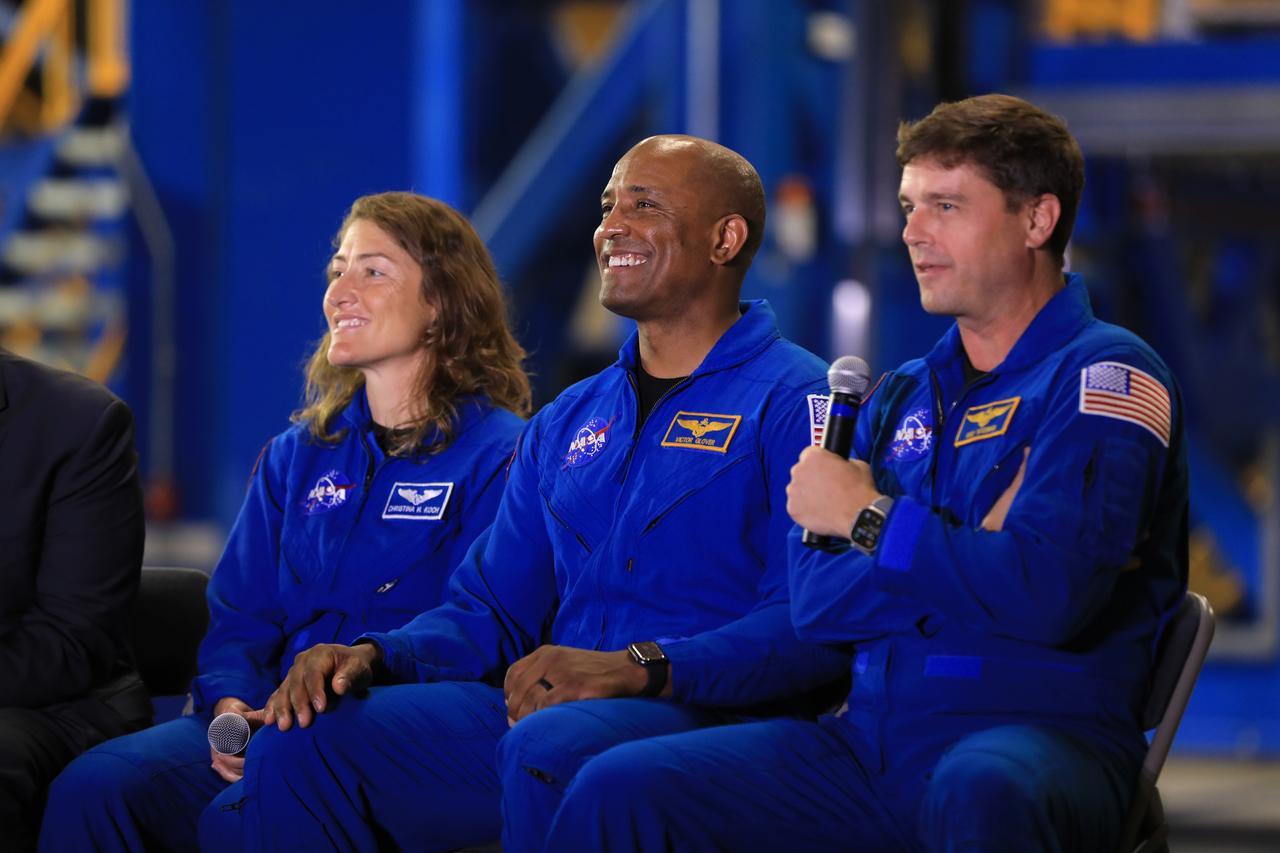
From left, Artemis II NASA astronauts Christina Koch, Victor Glover, and Reid Wiseman participate in a media day event on Monday, Dec. 16, 2024, inside the Vehicle Assembly Building at the agency’s Kennedy Space Center in Florida. The crew participated in the event days after teams with NASA’s Exploration Ground Systems transport lifted the agency’s 212-foot-tall SLS (Space Launch System) core stage from the facility’s transfer aisle into High Bay 2 where it will remain while teams stack the two solid rocket boosters on top of mobile launcher 1.
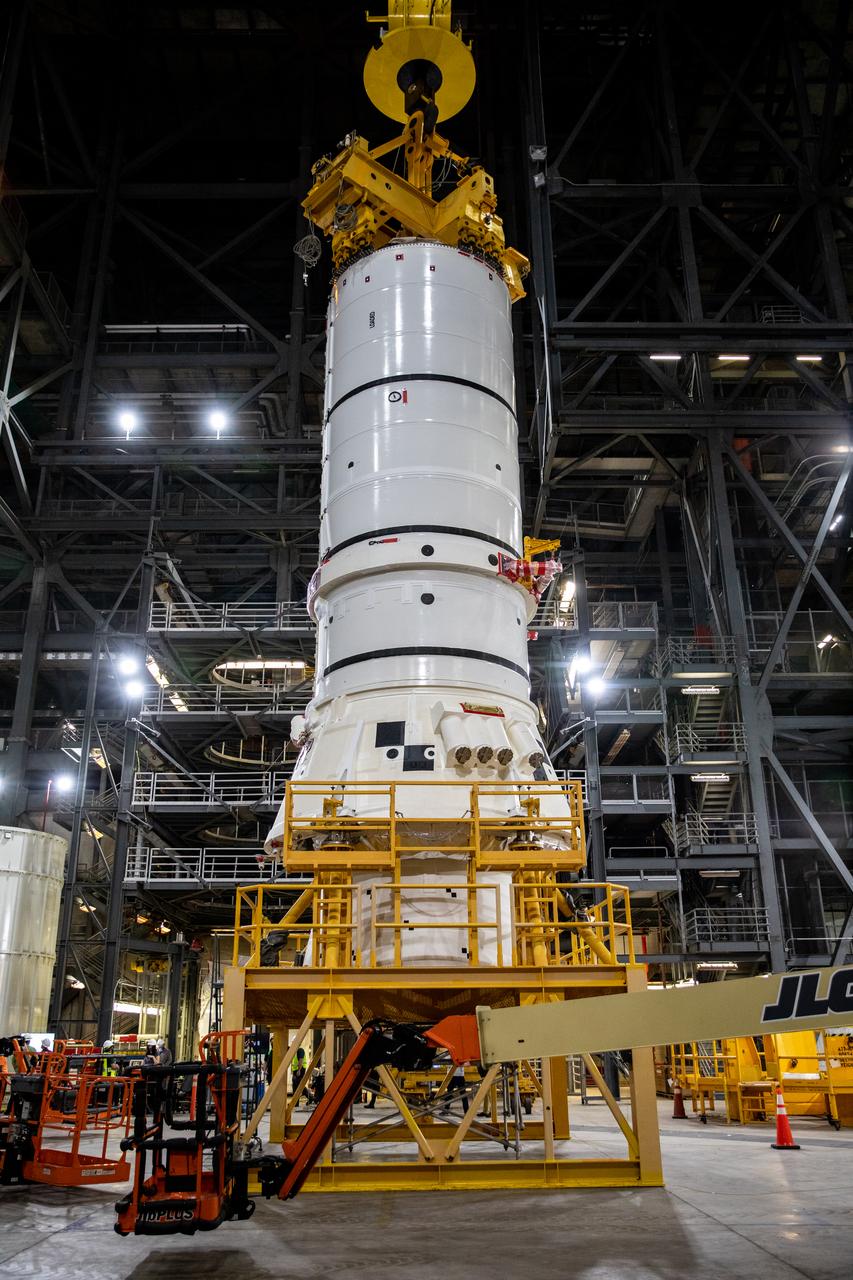
In High Bay 4 of the Vehicle Assembly Building (VAB) at NASA’s Kennedy Space Center in Florida, one of the Artemis I aft booster segments for the Space Launch System is being prepared for stacking operations on Nov. 20, 2020. Workers with Exploration Ground Systems and contractor Jacobs teams will stack the twin five-segment boosters on the mobile launcher in High Bay 3 over a number of weeks. When the core stage arrives, it will join the boosters on the mobile launcher, followed by the interim cryogenic propulsion stage and Orion spacecraft. Manufactured by Northrop Grumman in Utah, the twin boosters provide more than 75 percent of the total SLS thrust at launch. The SLS is managed by Marshall Space Flight Center in Huntsville, Alabama. Under the Artemis program, NASA will land the first woman and the next man on the Moon by 2024. The first in a series of increasingly complex missions, Artemis I will test the Orion spacecraft and SLS as an integrated system ahead of crewed flights to the Moon.
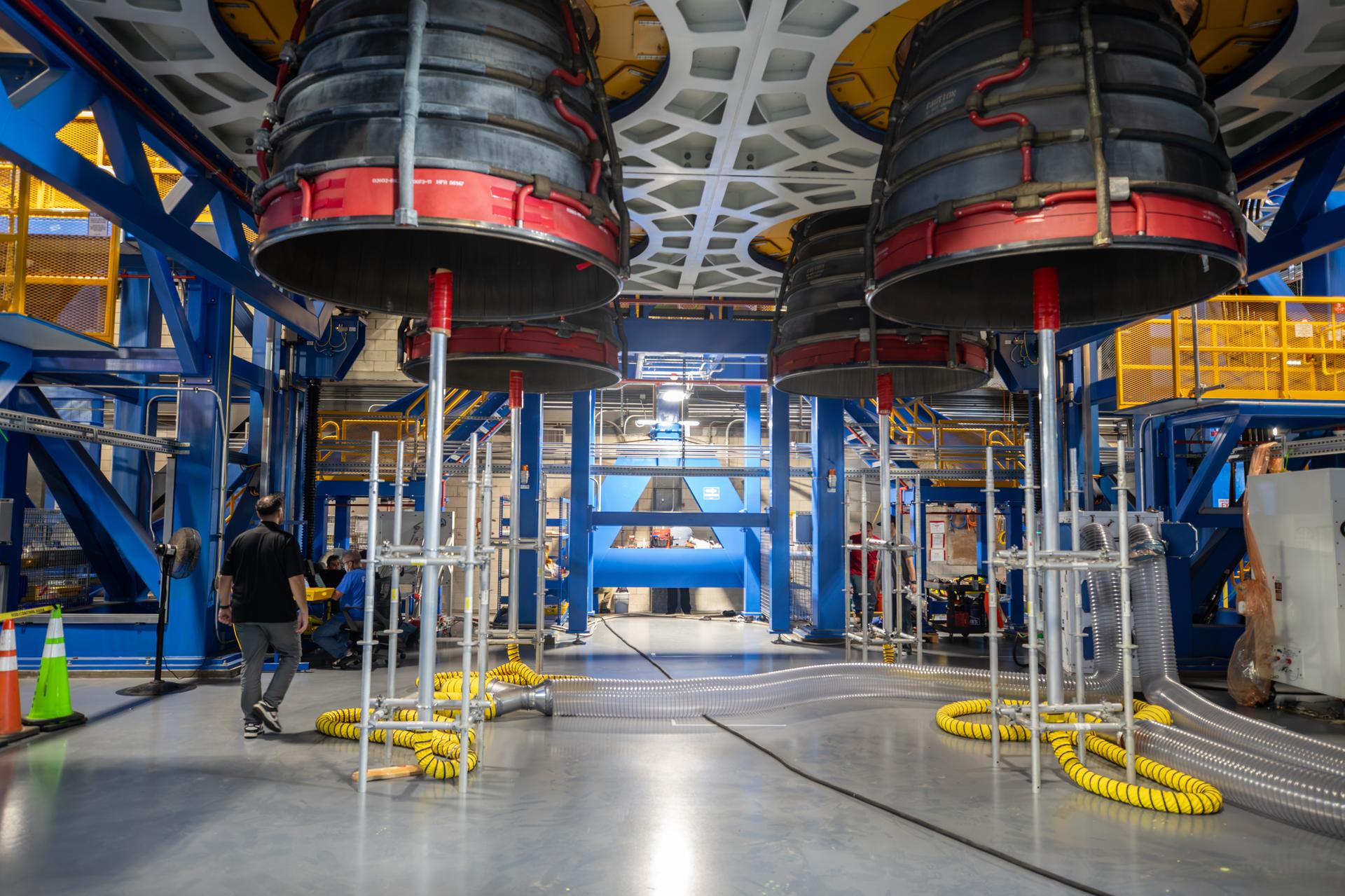
Technicians complete installation of all four RS-25 SLS (Space Launch System) rocket engines on the work stand for integration with the Artemis III core stage rocket on Tuesday, Sept. 1, 2026, inside the Vehicle Assembly Building at NASA’s Kennedy Space Center in Florida. During Artemis III, the four RS-25 engines will launch SLS, the Orion spacecraft and its crew of four into low Earth orbit, generating more than two million pounds of thrust at liftoff.
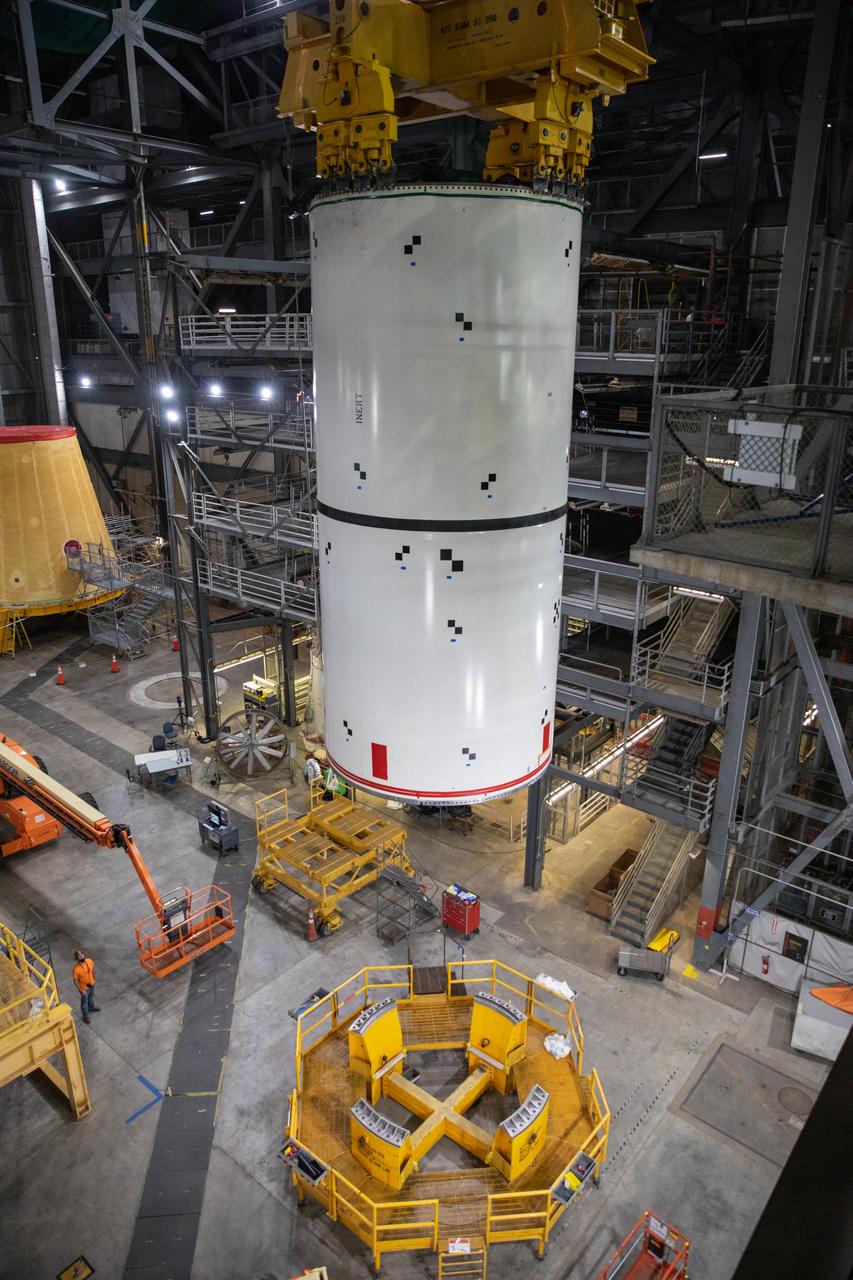
Technicians with NASA’s Exploration Ground Systems rehearse booster stacking operations inside the Vehicle Assembly Building (VAB) at the agency’s Kennedy Space Center in Florida on Sept. 14, 2020, in preparation for Artemis I. The exercise involved using booster segment mock-ups, referred to as pathfinders. During the rehearsal, an aft pathfinder segment was prepared in High Bay 4 of the VAB, after which a team of crane operators moved it over to High Bay 3, where it was placed on the mobile launcher. Careful measurements were then taken before the team added a center pathfinder to the stack. Stacking of the actual Space Launch System (SLS) booster segments will occur later this year, when the rocket’s core stage arrives at Kennedy. Artemis I is the first in a series of increasingly complex missions that will test SLS and the Orion spacecraft as an integrated system prior to crewed flights to the Moon.
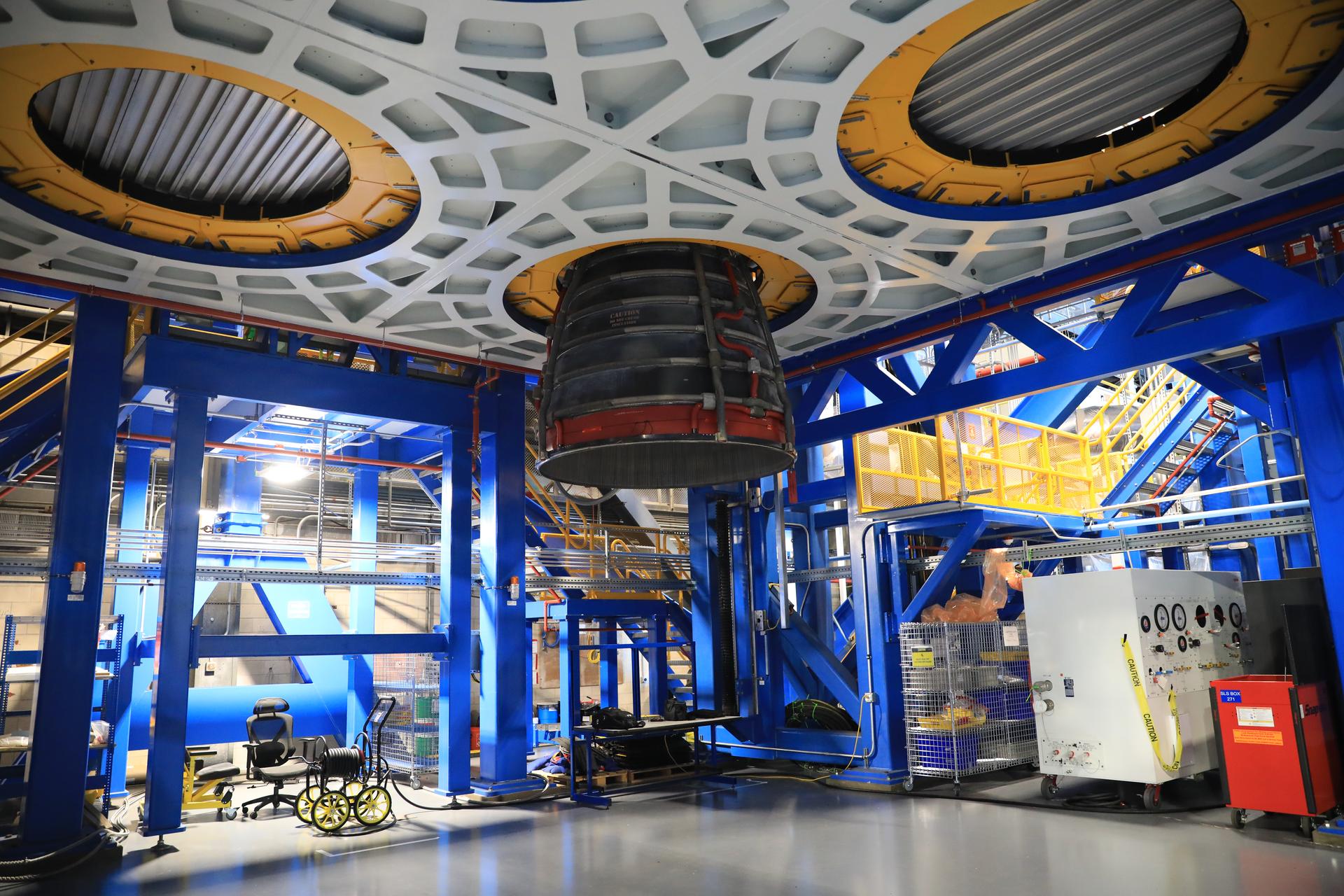
The first of four RS-25 SLS (Space Launch System) rocket engines, is installed on the work stand and integrated with the Artemis III core stage rocket on Tuesday, Aug. 25, 2026, inside the Vehicle Assembly Building at NASA’s Kennedy Space Center in Florida. During Artemis III, the four RS‑25 engines will launch the Orion spacecraft and its crew of four into low Earth orbit, generating more than two million pounds of thrust at liftoff.
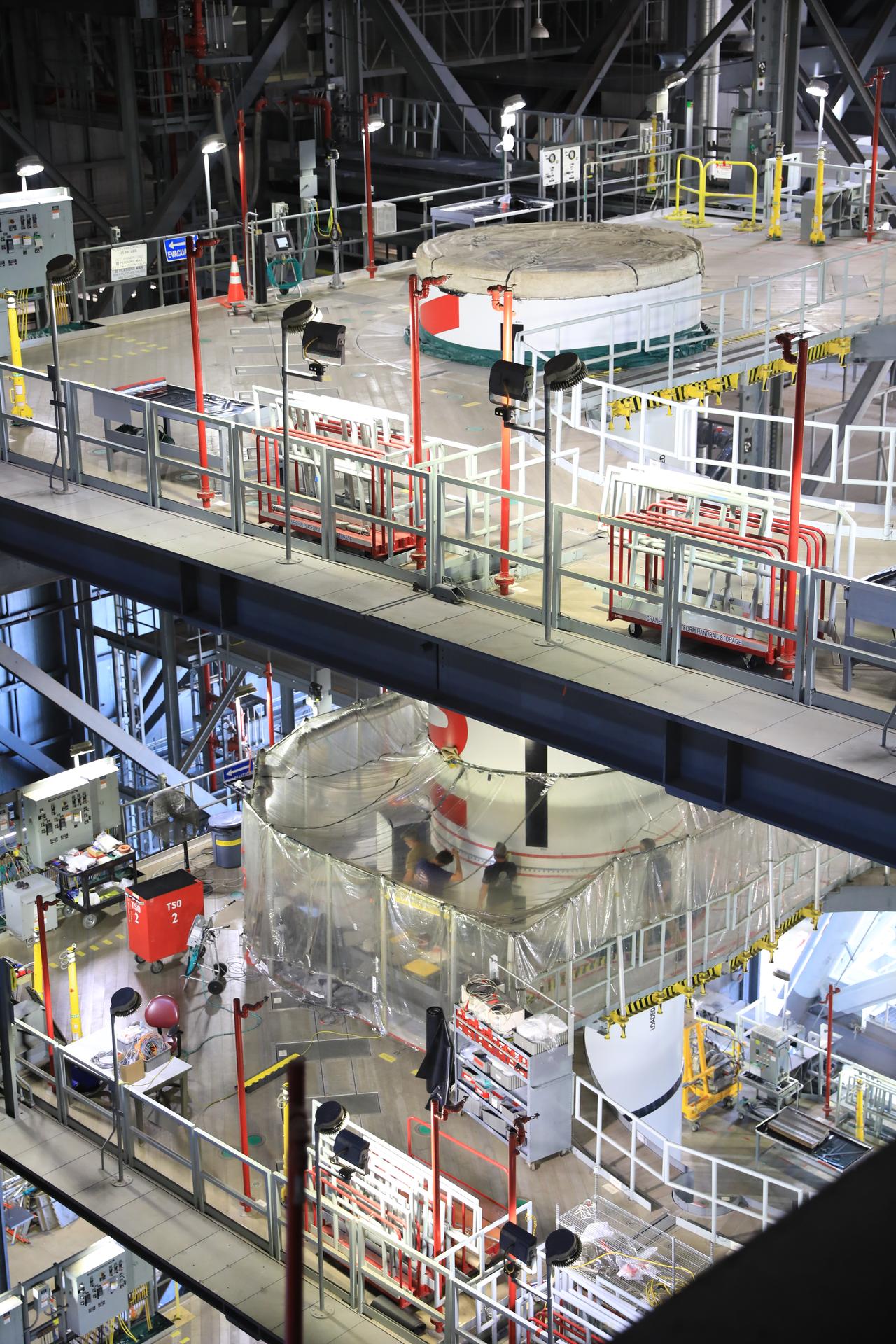
Technicians inside the Vehicle Assembly Building at NASA’s Kennedy Space Center in Florida complete integration of the left center center solid rocket booster segment onto the left aft center booster segment for the Artemis III SLS (Space Launch System) rocket on the mobile launcher inside High Bay 3 on Wednesday, Aug. 19, 2026. The twin boosters, comprising of five segments each manufactured by Northrop Grumman in Utah, will provide more than 75 percent of the SLS rocket’s total thrust at launch. The Artemis III mission will launch crew in the Orion spacecraft on top of the SLS rocket to test rendezvous and docking capabilities between Orion and commercial spacecraft needed to land astronauts on the Moon.
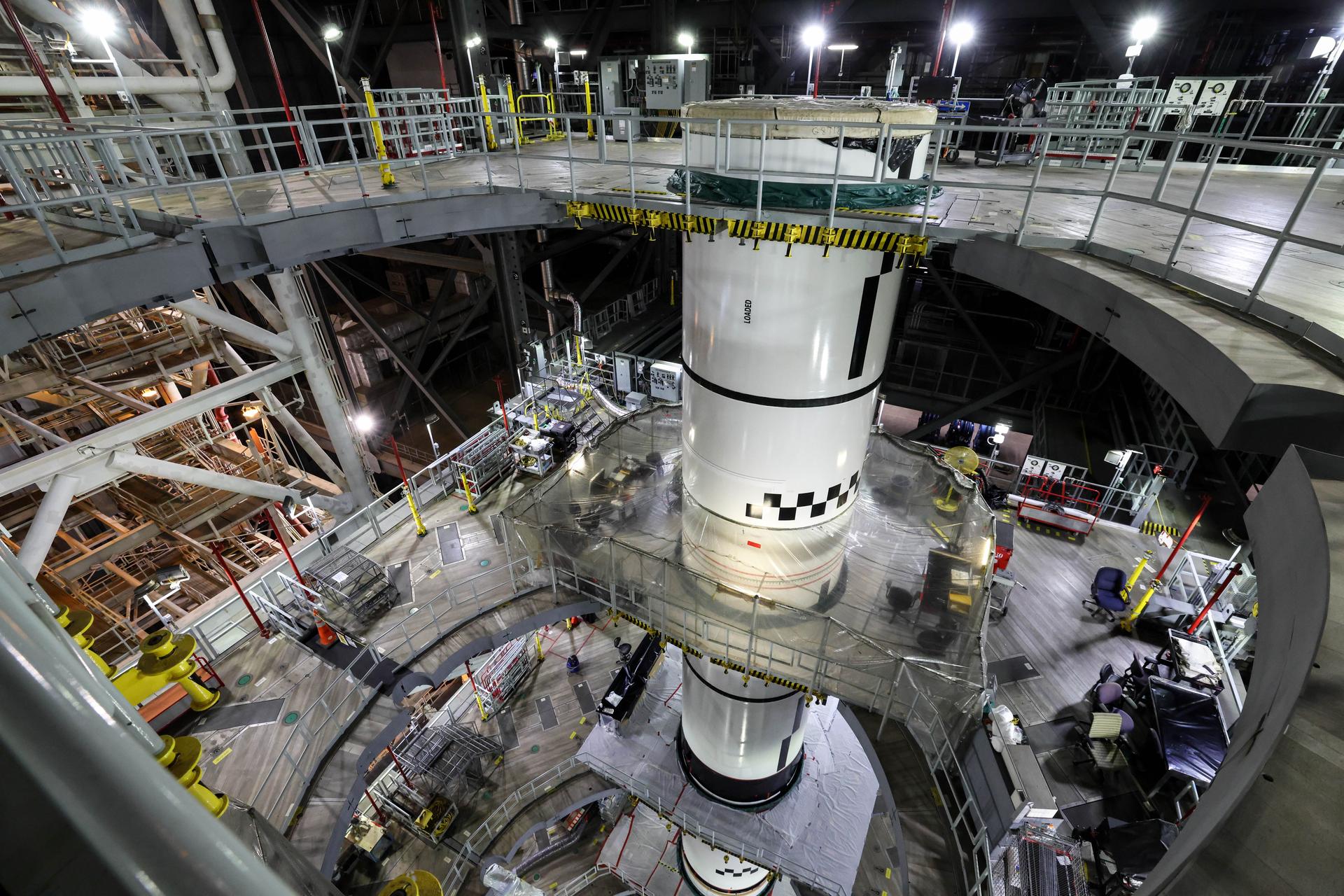
In High Bay 3 of the Vehicle Assembly Building at NASA’s Kennedy Space Center in Florida, the right forward center booster for Artemis III is integrated onto the right booster segments on the mobile launcher for the SLS (Space Launch System) rocket on Friday, Sept. 11, 2026. The twin boosters, comprising of five segments each manufactured by Northrop Grumman in Utah, will provide more than 75 percent of the SLS rocket’s total thrust at launch. The Artemis III mission will launch crew in the Orion spacecraft on top of the SLS rocket to test rendezvous and docking capabilities between Orion and commercial spacecraft needed to land astronauts on the Moon.
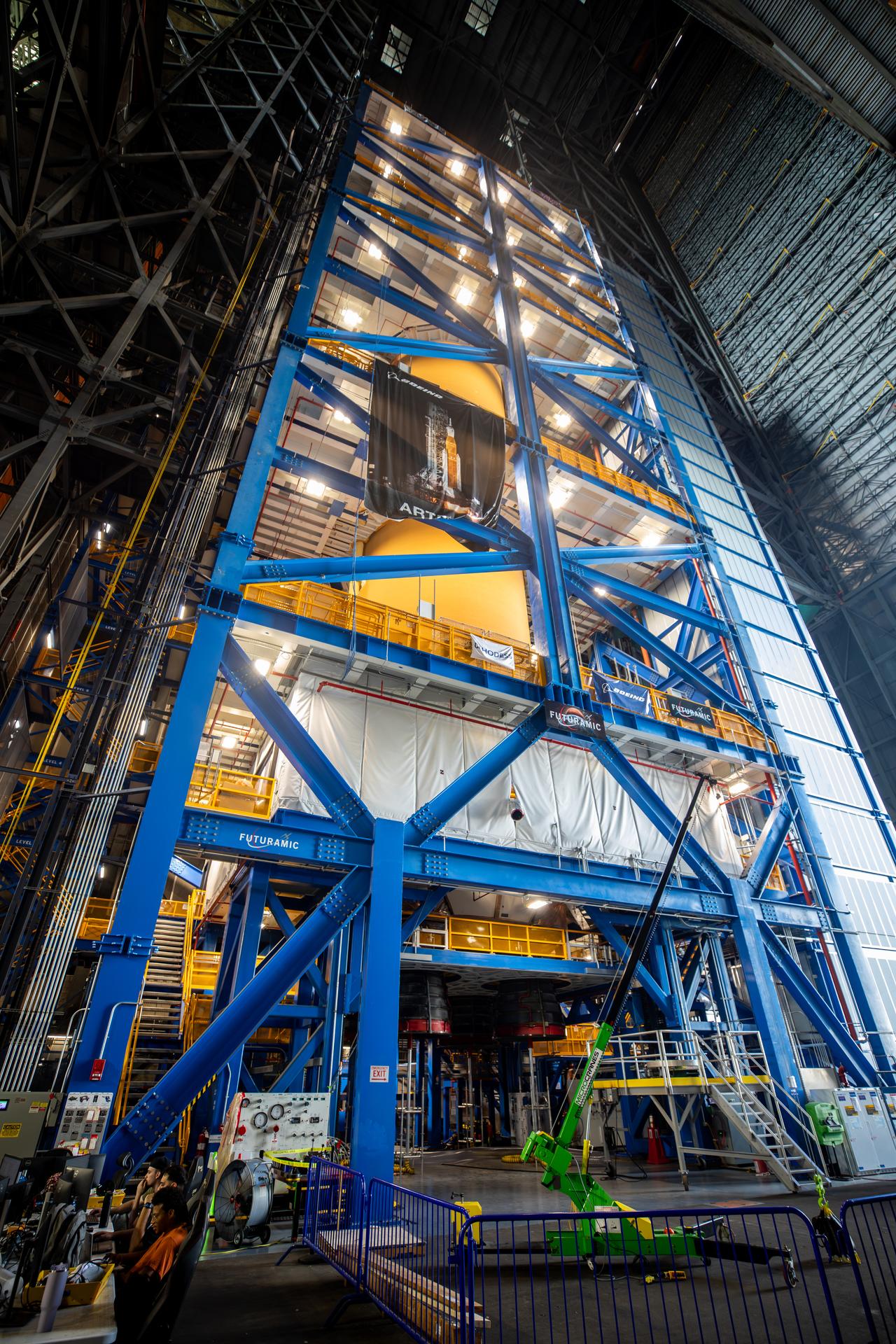
Technicians complete installation of all four RS-25 SLS (Space Launch System) rocket engines on the work stand for integration with the Artemis III core stage rocket on Tuesday, Sept. 1, 2026, inside the Vehicle Assembly Building at NASA’s Kennedy Space Center in Florida. During Artemis III, the four RS-25 engines will launch SLS, the Orion spacecraft and its crew of four into low Earth orbit, generating more than two million pounds of thrust at liftoff.
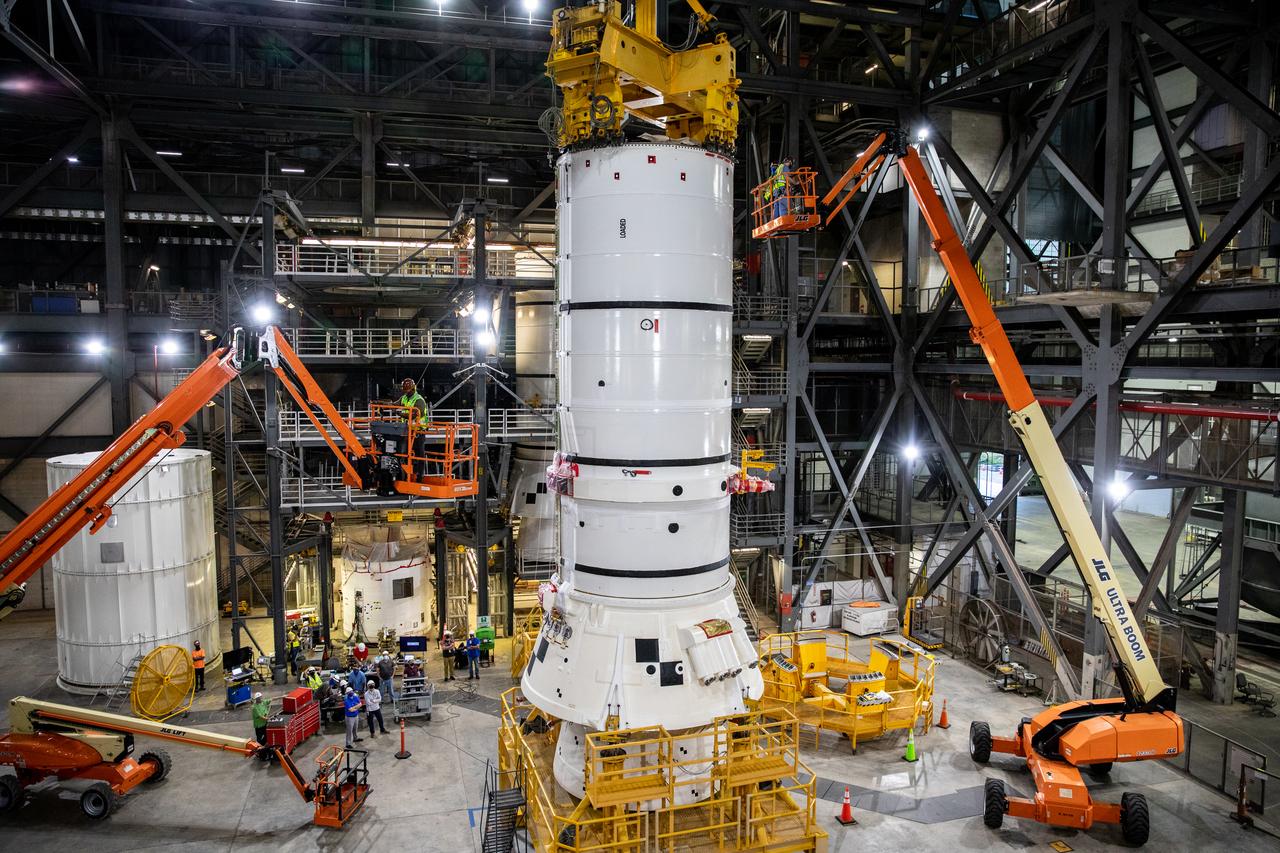
In High Bay 4 of the Vehicle Assembly Building (VAB) at NASA’s Kennedy Space Center in Florida, one of the Artemis I aft booster segments for the Space Launch System is being prepared for its lift up and lowering onto the mobile launcher in High Bay 3 for stacking operations on Nov. 20, 2020. Workers with Exploration Ground Systems and contractor Jacobs teams will stack the twin five-segment boosters on the mobile launcher in High Bay 3 over a number of weeks. When the core stage arrives, it will join the boosters on the mobile launcher, followed by the interim cryogenic propulsion stage and Orion spacecraft. Manufactured by Northrop Grumman in Utah, the twin boosters provide more than 75 percent of the total SLS thrust at launch. The SLS is managed by Marshall Space Flight Center in Huntsville, Alabama. Under the Artemis program, NASA will land the first woman and the next man on the Moon by 2024. The first in a series of increasingly complex missions, Artemis I will test the Orion spacecraft and SLS as an integrated system ahead of crewed flights to the Moon.
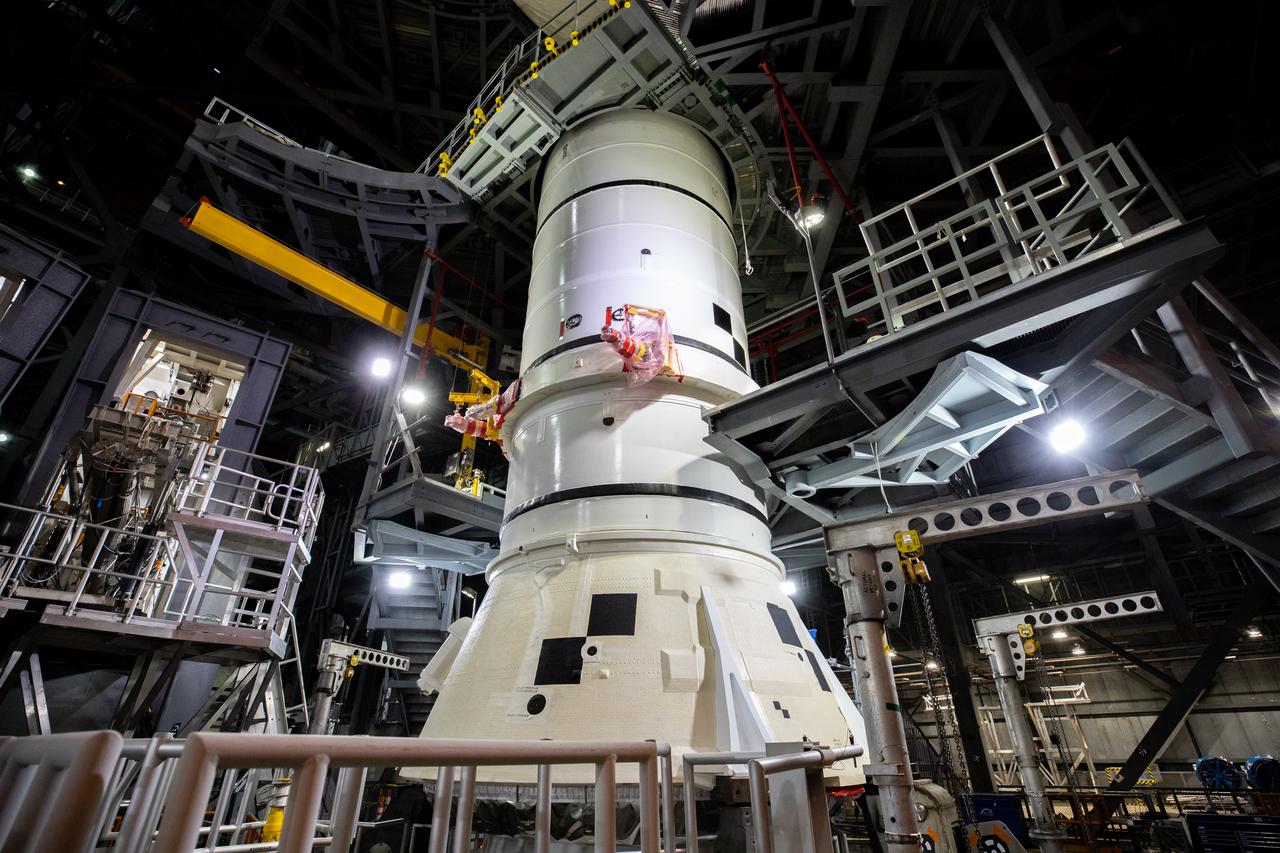
The first of two Artemis I aft booster segments for the Space Launch System is secured onto the mobile launcher in High Bay 3 of the Vehicle Assembly Building (VAB) at NASA’s Kennedy Space Center in Florida on Nov. 23, 2020. Workers with Exploration Ground Systems and contractor Jacobs teams will stack the twin five-segment boosters on the mobile launcher in High Bay 3 over a number of weeks. When the core stage arrives, it will join the boosters on the mobile launcher, followed by the interim cryogenic propulsion stage and Orion spacecraft. Manufactured by Northrop Grumman in Utah, the twin boosters provide more than 75 percent of the total SLS thrust at launch. The SLS is managed by Marshall Space Flight Center in Huntsville, Alabama. Under the Artemis program, NASA will land the first woman and the next man on the Moon by 2024. The first in a series of increasingly complex missions, Artemis I will test the Orion spacecraft and SLS as an integrated system ahead of crewed flights to the Moon.
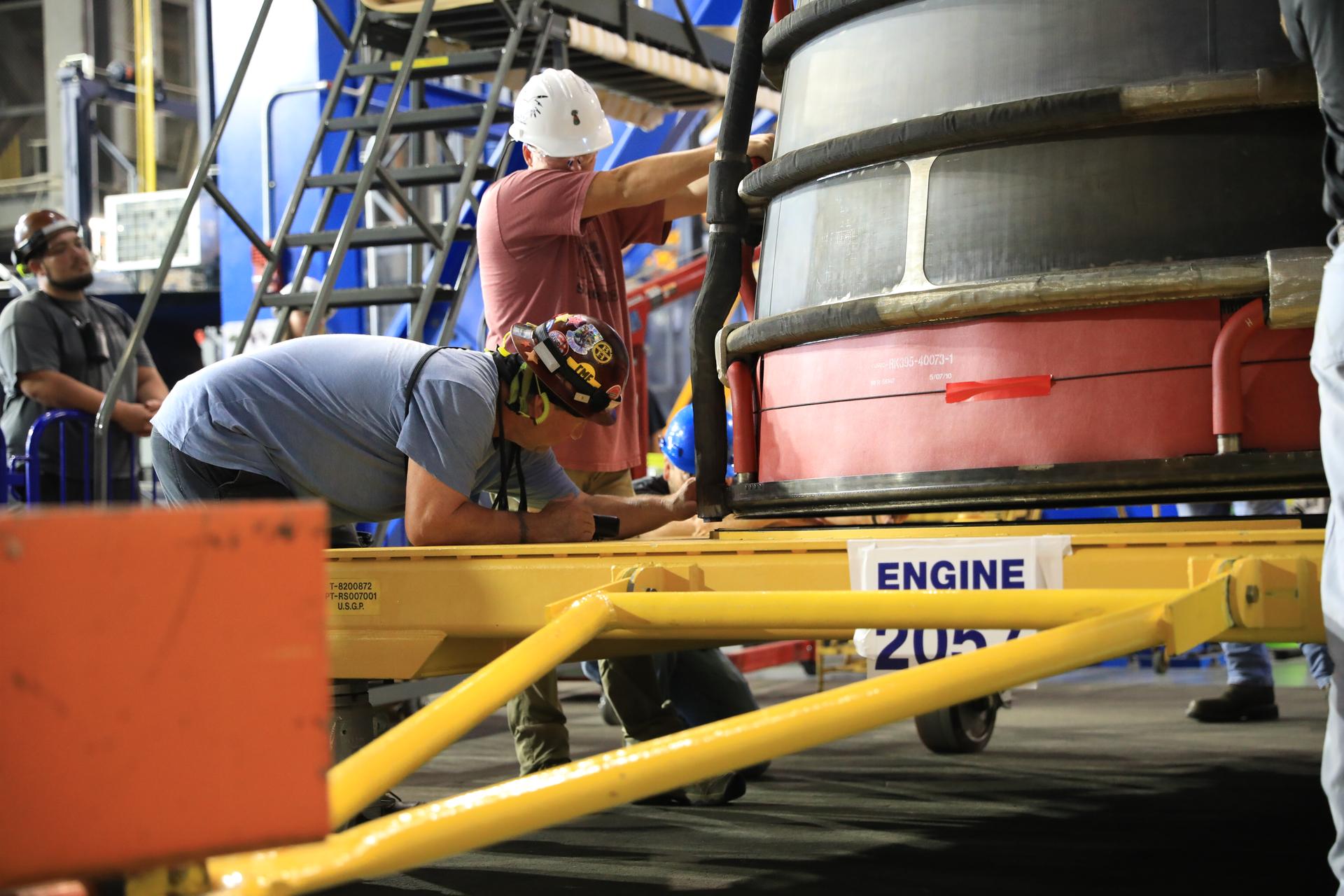
Technicians prepare the #2 RS-25 SLS (Space Launch System) rocket engine for transfer onto a work stand ahead of integration with the Artemis III core stage rocket on Tuesday, Aug. 25, 2026, inside the Vehicle Assembly Building at NASA’s Kennedy Space Center in Florida. During Artemis III, the four RS‑25 engines will launch the Orion spacecraft and its crew of four into low Earth orbit, generating more than two million pounds of thrust at liftoff.
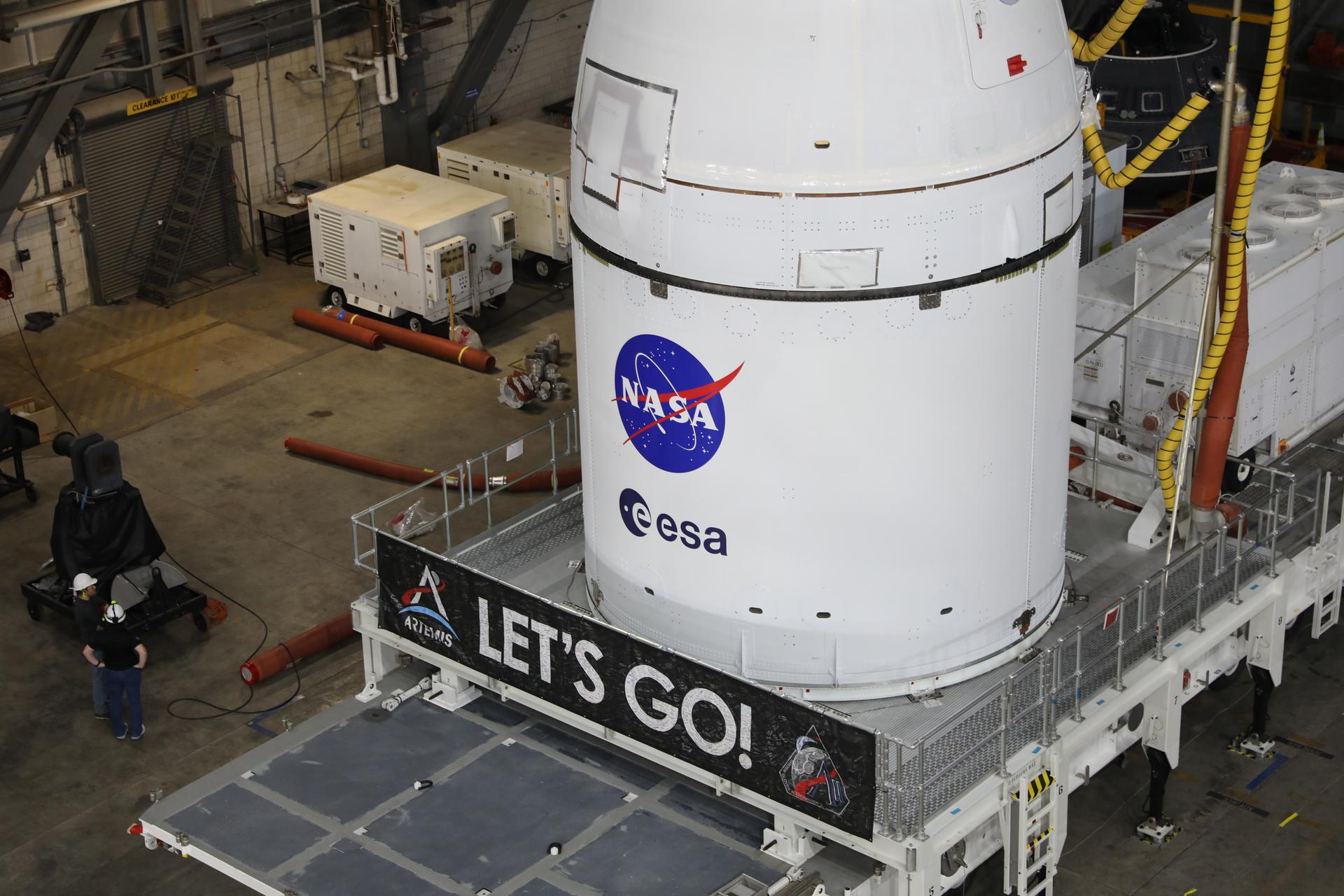
Technicians with NASA’s Exploration Ground Systems team prepare for integration to attach the agency’s Orion spacecraft on top of the SLS (Space Launch System) rocket in High Bay 3 of the Vehicle Assembly Building at NASA’s Kennedy Space Center in Florida on Friday, Oct. 17, 2025, for the agency’s Artemis II mission. Set to launch in 2026, the spacecraft will carry NASA astronauts Reid Wiseman, Victor Glover, Christina Koch, and CSA (Canadian Space Agency) astronaut Jeremy Hansen on a 10-day mission around the Moon and back. Once stacked, teams will begin conducting a series of verification tests ahead of rolling out to Launch Complex 39B for the wet dress rehearsal at NASA Kennedy.
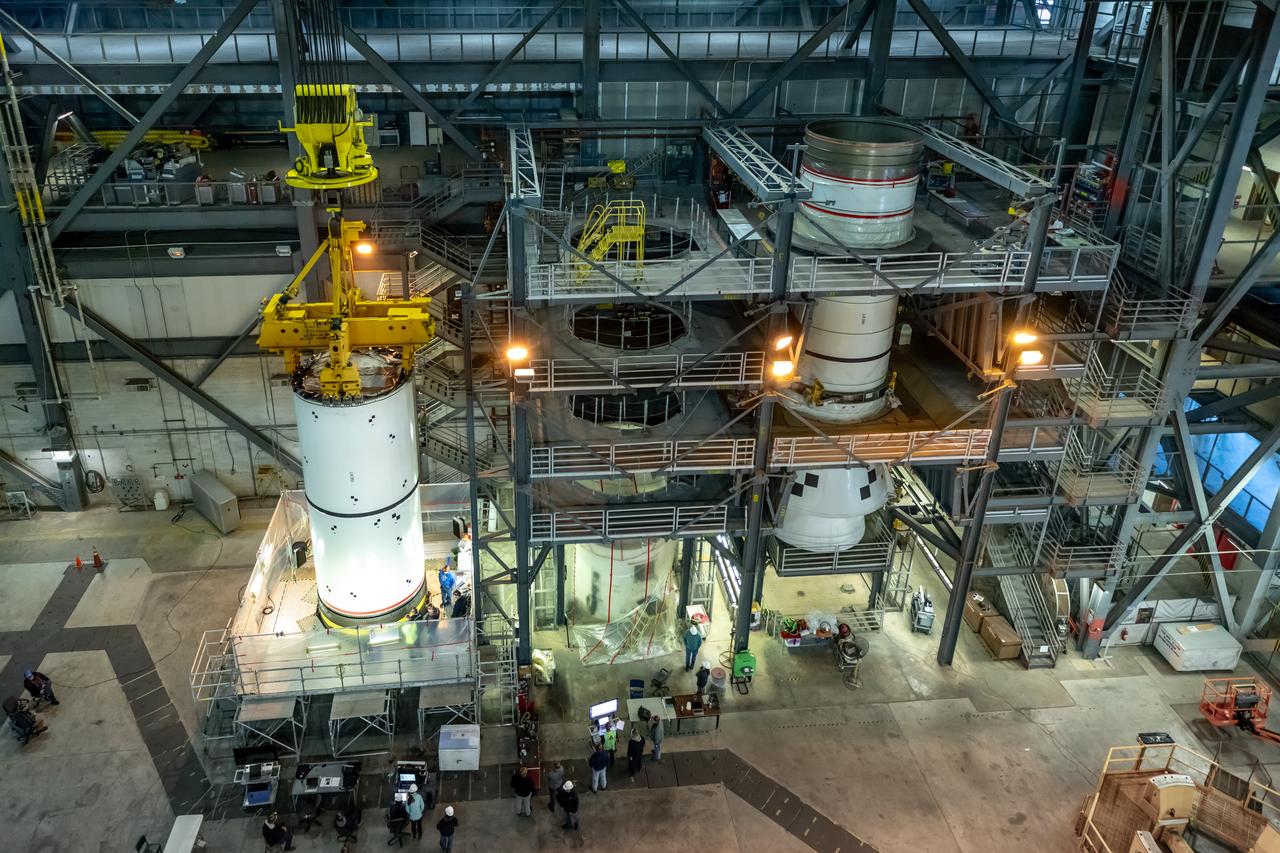
In High Bay 4 of the Vehicle Assembly Building at NASA’s Kennedy Space Center in Florida, pathfinders, or full-scale replicas of Space Launch System (SLS) solid rocket booster segments, are being stacked during a training exercise on Jan. 8, 2020. A team of engineers with Exploration Ground Systems and crane operators and technicians with contractor Jacobs are practicing lifting, moving and stacking maneuvers, using important ground support equipment to train employees and certify all the equipment works properly. The booster pathfinders are inert, full-scale replicas of the actual booster hardware that will be attached to the SLS rocket for Artemis missions. The five-segment, 17-story-tall twin boosters will provide 3.6 million pounds of thrust each at liftoff to help launch Orion on Artemis I, its first uncrewed mission beyond the Moon.
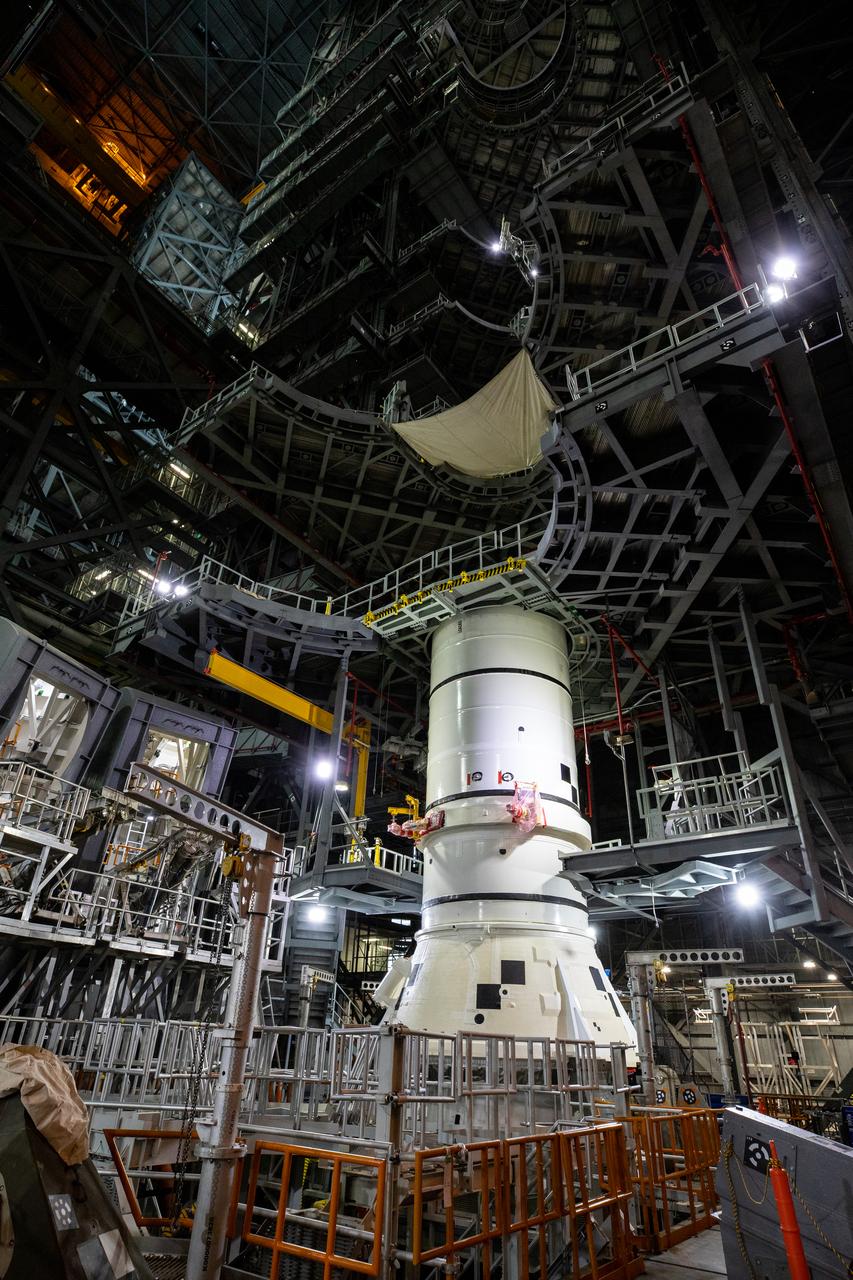
The first of two Artemis I aft booster segments for the Space Launch System is secured onto the mobile launcher in High Bay 3 of the Vehicle Assembly Building (VAB) at NASA’s Kennedy Space Center in Florida on Nov. 23, 2020. Workers with Exploration Ground Systems and contractor Jacobs teams will stack the twin five-segment boosters on the mobile launcher in High Bay 3 over a number of weeks. When the core stage arrives, it will join the boosters on the mobile launcher, followed by the interim cryogenic propulsion stage and Orion spacecraft. Manufactured by Northrop Grumman in Utah, the twin boosters provide more than 75 percent of the total SLS thrust at launch. The SLS is managed by Marshall Space Flight Center in Huntsville, Alabama. Under the Artemis program, NASA will land the first woman and the next man on the Moon by 2024. The first in a series of increasingly complex missions, Artemis I will test the Orion spacecraft and SLS as an integrated system ahead of crewed flights to the Moon.
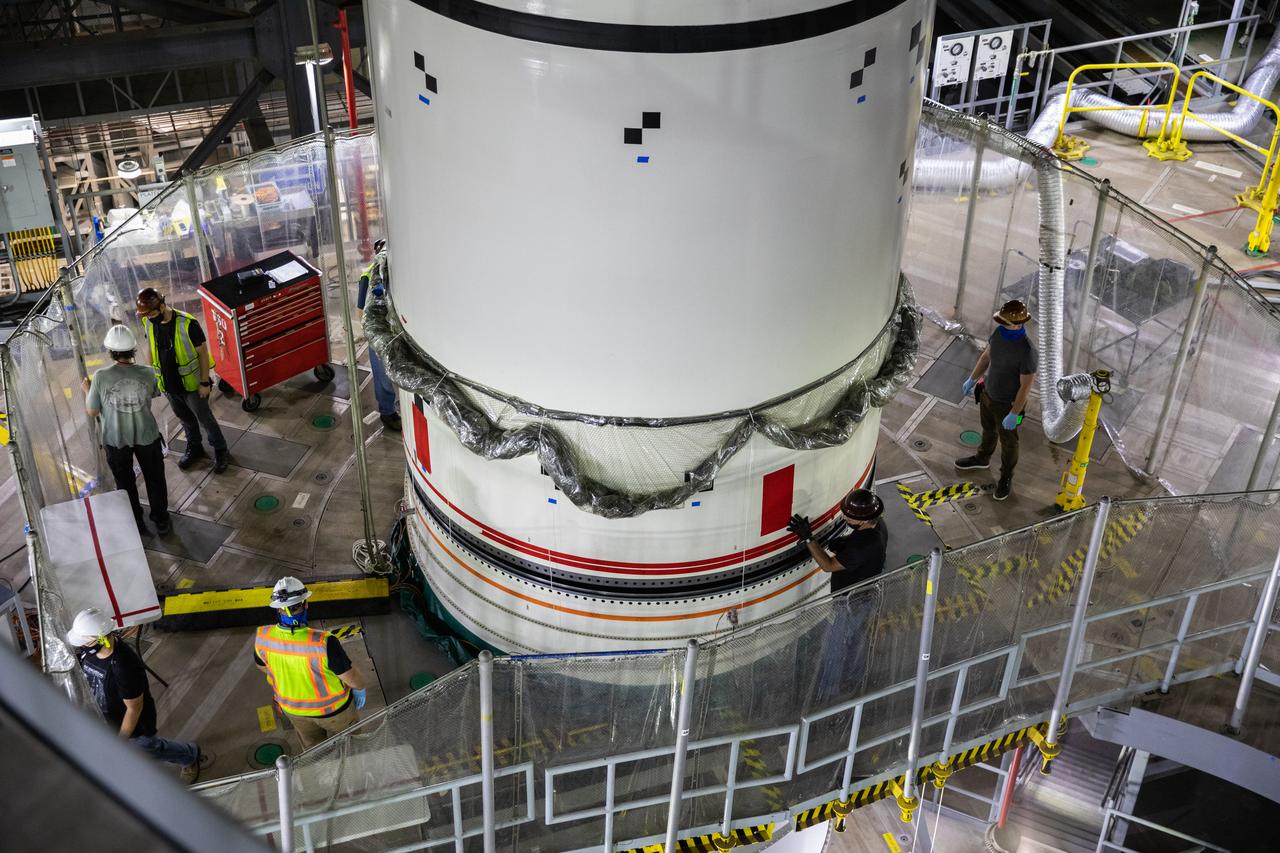
Technicians with NASA’s Exploration Ground Systems lower a mock-up, or pathfinder, of the Space Launch System’s (SLS) center booster segment onto an aft pathfinder segment inside the Vehicle Assembly Building (VAB) at the agency’s Kennedy Space Center in Florida on Sept. 14, 2020. Teams rehearsed stacking both pathfinder segments on top of the mobile launcher in High Bay 3 of the VAB in preparation for the Artemis I launch. Stacking of the actual SLS booster segments will occur later this year, when the rocket’s core stage arrives at Kennedy. Artemis I is the first in a series of increasingly complex missions that will test SLS and the Orion spacecraft as an integrated system prior to crewed flights to the Moon.
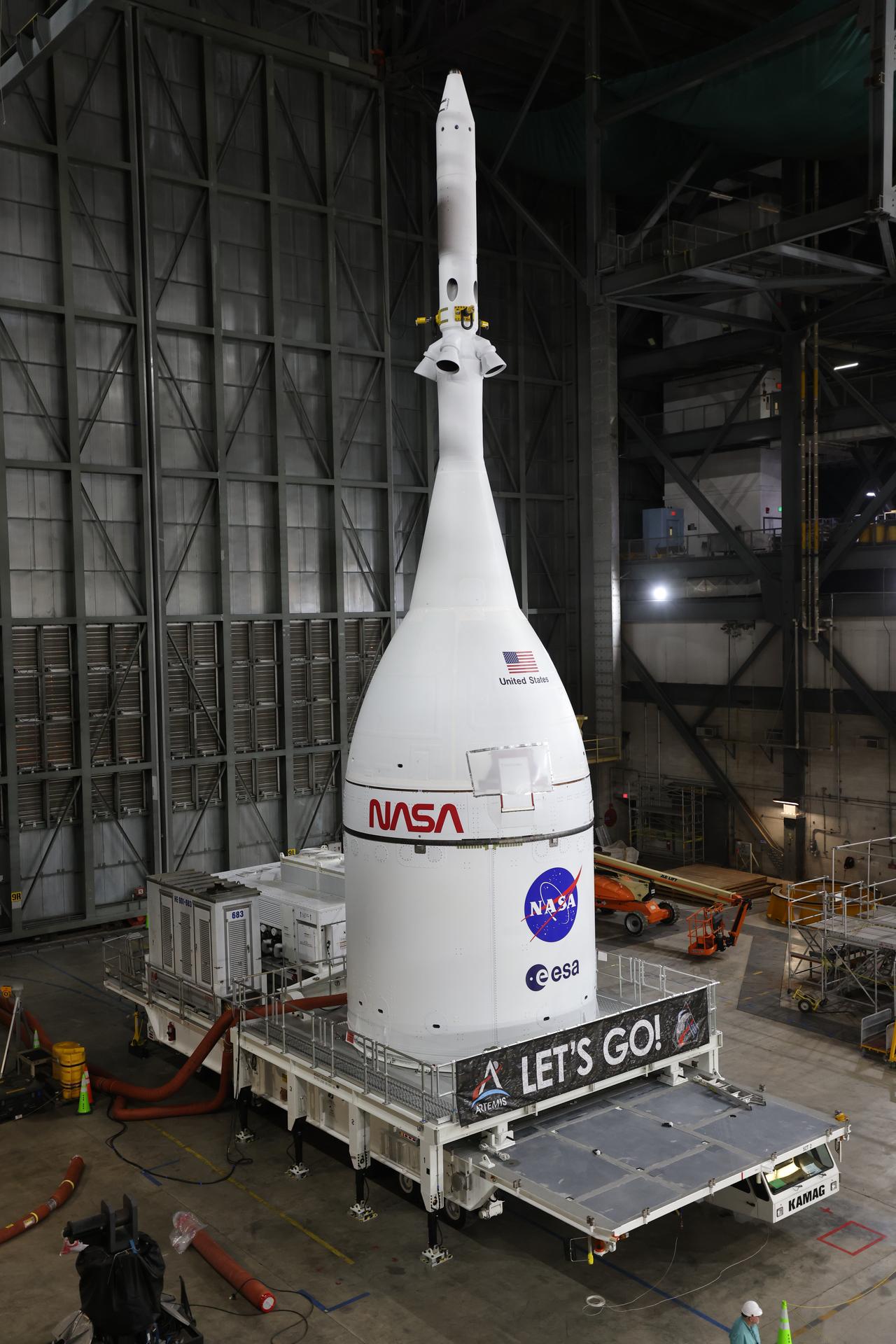
Technicians with NASA’s Exploration Ground Systems team prepare for integration to attach the agency’s Orion spacecraft on top of the SLS (Space Launch System) rocket in High Bay 3 of the Vehicle Assembly Building at NASA’s Kennedy Space Center in Florida on Friday, Oct. 17, 2025, for the agency’s Artemis II mission. Set to launch in 2026, the spacecraft will carry NASA astronauts Reid Wiseman, Victor Glover, Christina Koch, and CSA (Canadian Space Agency) astronaut Jeremy Hansen on a 10-day mission around the Moon and back. Once stacked, teams will begin conducting a series of verification tests ahead of rolling out to Launch Complex 39B for the wet dress rehearsal at NASA Kennedy.

Inside High Bay 3 of the Vehicle Assembly Building at NASA’s Kennedy Space Center in Florida, technicians with the agency’s Exploration Ground Systems integrate the left forward center booster segment for the NASA’s SLS (Space Launch System) rocket onto the left center center segment atop the mobile launcher on Thursday, Jan. 30, 2025. The NASA “worm” insignia can be seen on both the center center booster segments. The boosters will help support the remaining rocket components and the Orion spacecraft during final assembly of the Artemis II Moon rocket and provide more than 75 percent of the total SLS thrust during liftoff from NASA Kennedy’s Launch Pad 39B.
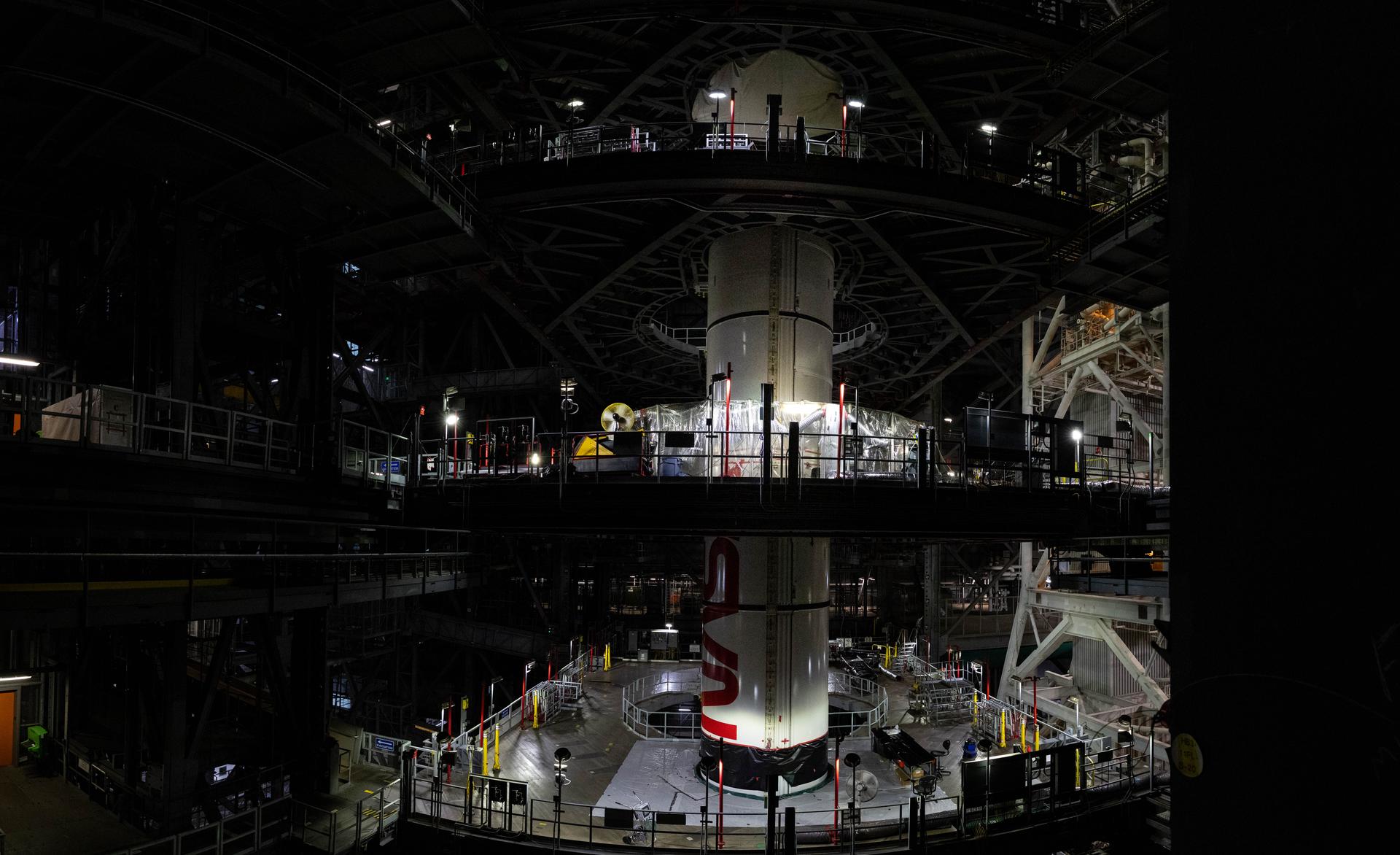
In High Bay 3 of the Vehicle Assembly Building at NASA’s Kennedy Space Center in Florida, the right forward center booster for Artemis III is integrated onto the right booster segments on the mobile launcher for the SLS (Space Launch System) rocket on Friday, Sept. 11, 2026. The twin boosters, comprising of five segments each manufactured by Northrop Grumman in Utah, will provide more than 75 percent of the SLS rocket’s total thrust at launch. The Artemis III mission will launch crew in the Orion spacecraft on top of the SLS rocket to test rendezvous and docking capabilities between Orion and commercial spacecraft needed to land astronauts on the Moon.
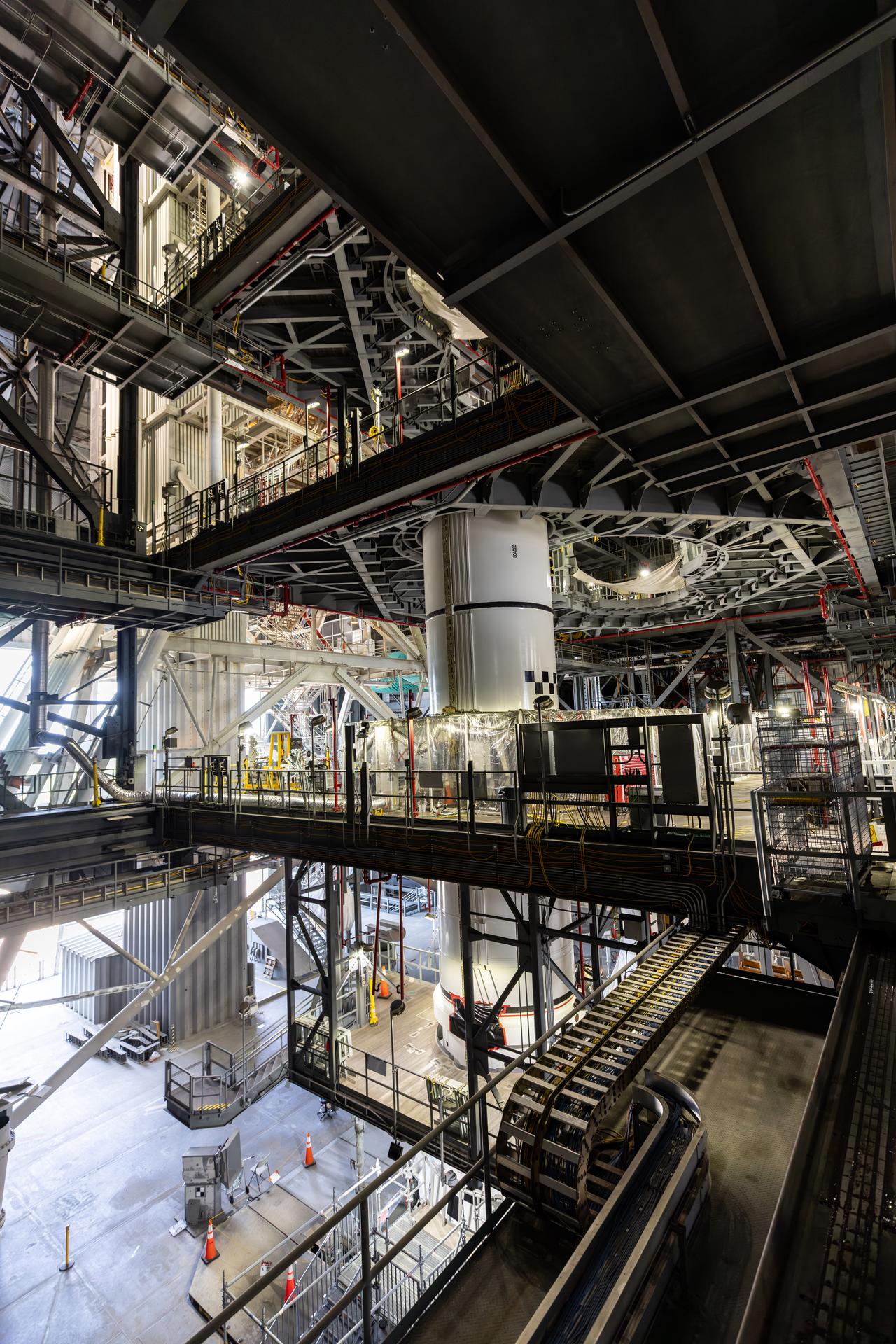
In High Bay 3 of the Vehicle Assembly Building at NASA’s Kennedy Space Center in Florida, the left aft center booster segment for Artemis III is integrated onto its aft assembly segment on the mobile launcher for the SLS (Space Launch System) rocket on Monday, Aug. 12, 2026. The twin boosters, comprising of five segments each manufactured by Northrop Grumman in Utah, will provide more than 75 percent of the SLS rocket’s total thrust at launch. The Artemis III mission will launch crew in the Orion spacecraft on top of the SLS rocket to test rendezvous and docking capabilities between Orion and commercial spacecraft needed to land astronauts on the Moon.
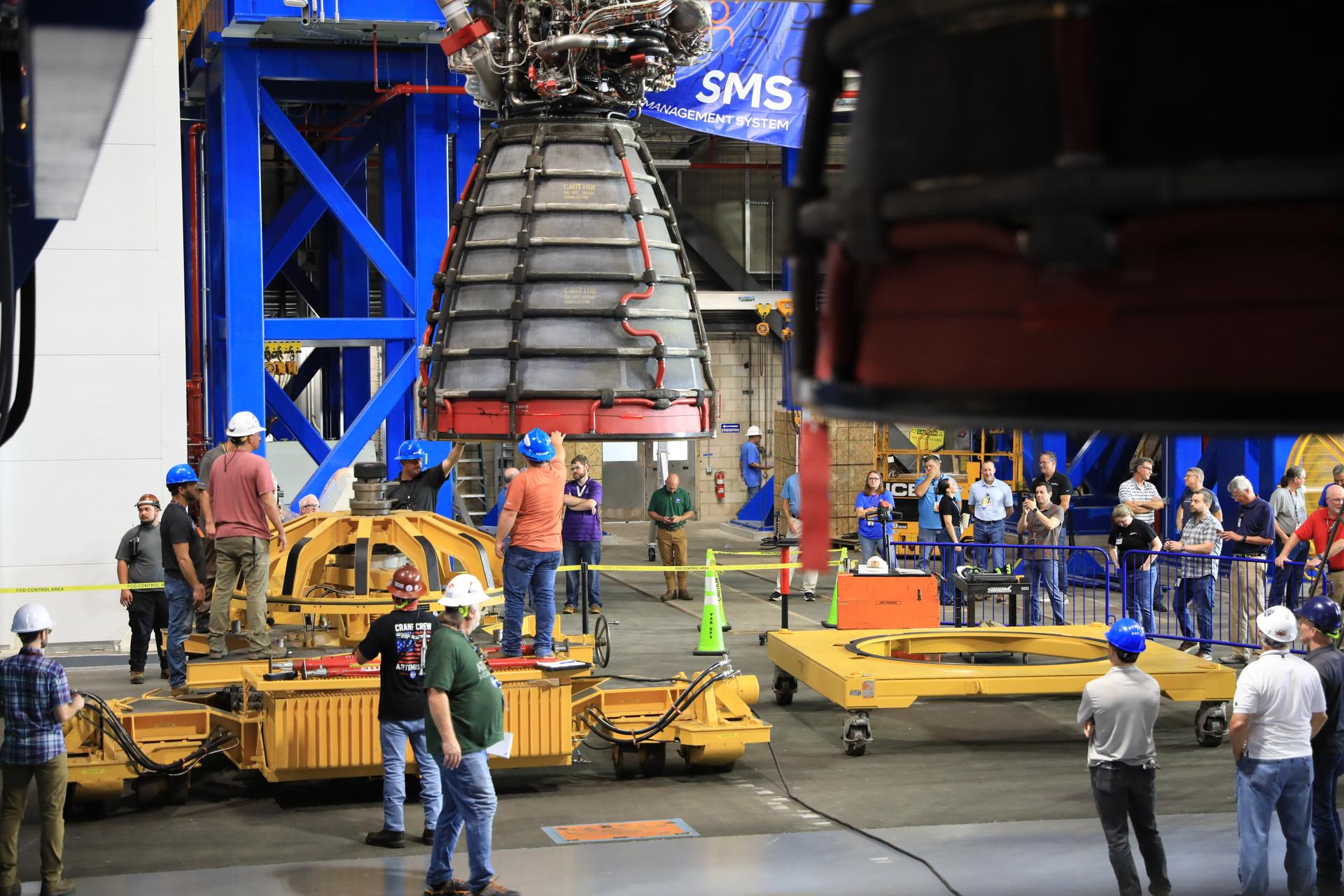
Technicians lift and transfer the #2 RS-25 SLS (Space Launch System) rocket engine (back) to the work stand. Visible in the foreground is the #3 engine already integrated with the Artemis III core stage rocket on Tuesday, Aug. 25, 2026, inside the Vehicle Assembly Building at NASA’s Kennedy Space Center in Florida. During Artemis III, the four RS‑25 engines will launch the Orion spacecraft and its crew of four into low Earth orbit, generating more than two million pounds of thrust at liftoff.
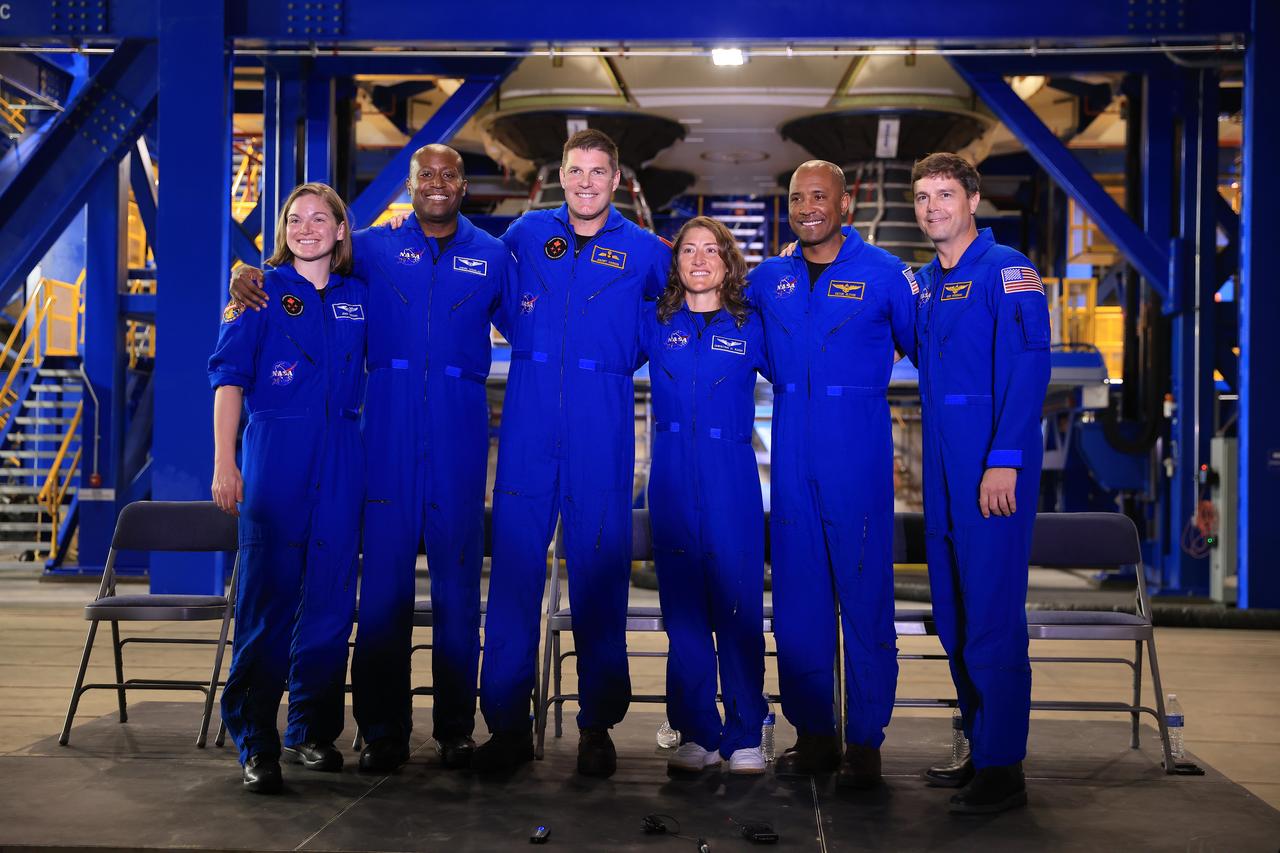
From left, CSA (Canadian Space Agency) astronaut Jenni Gibbons, NASA astronaut Andre Douglas, CSA astronaut Jeremy Hansen, and NASA astronauts Christina Koch, Victor Glover, and Reid Wiseman participate in a media day event on Monday, Dec. 16, 2024, inside the Vehicle Assembly Building at the agency’s Kennedy Space Center in Florida. The Artemis II crew and backup crew participated in the event days after teams with NASA’s Exploration Ground Systems transport lifted the agency’s 212-foot-tall SLS (Space Launch System) core stage from the facility’s transfer aisle into High Bay 2 where it will remain while teams stack the two solid rocket boosters on top of mobile launcher 1.
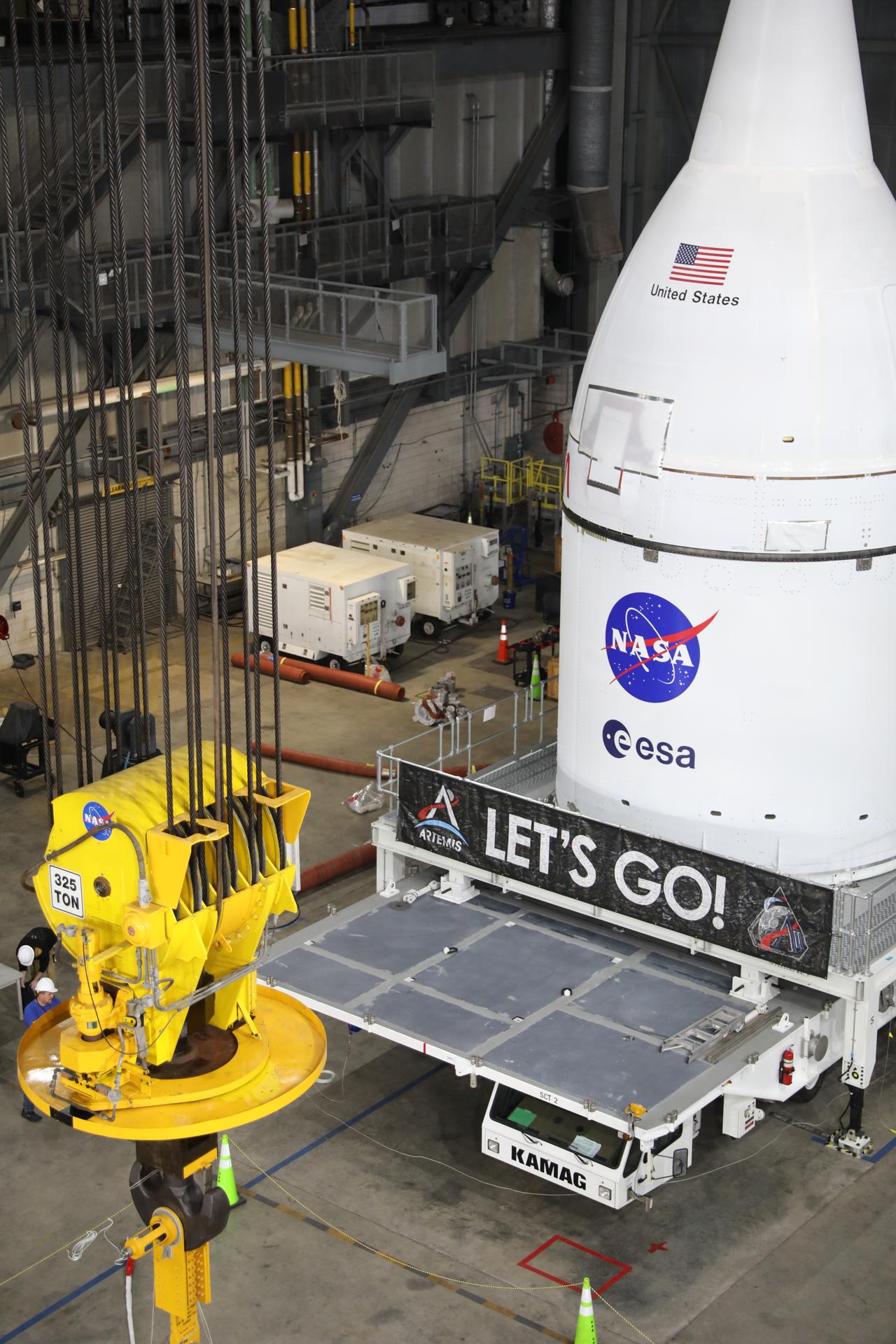
Technicians with NASA’s Exploration Ground Systems team prepare to attach a crane to lift and secure NASA’s Orion spacecraft on top of the SLS (Space Launch System) rocket in High Bay 3 of the Vehicle Assembly Building at NASA’s Kennedy Space Center in Florida on Friday, Oct. 17, 2025, for the agency’s Artemis II mission. Set to launch in 2026, the spacecraft will carry NASA astronauts Reid Wiseman, Victor Glover, Christina Koch, and CSA (Canadian Space Agency) astronaut Jeremy Hansen on a 10-day mission around the Moon and back. Once stacked, teams will begin conducting a series of verification tests ahead of rolling out to Launch Complex 39B for the wet dress rehearsal at NASA Kennedy.
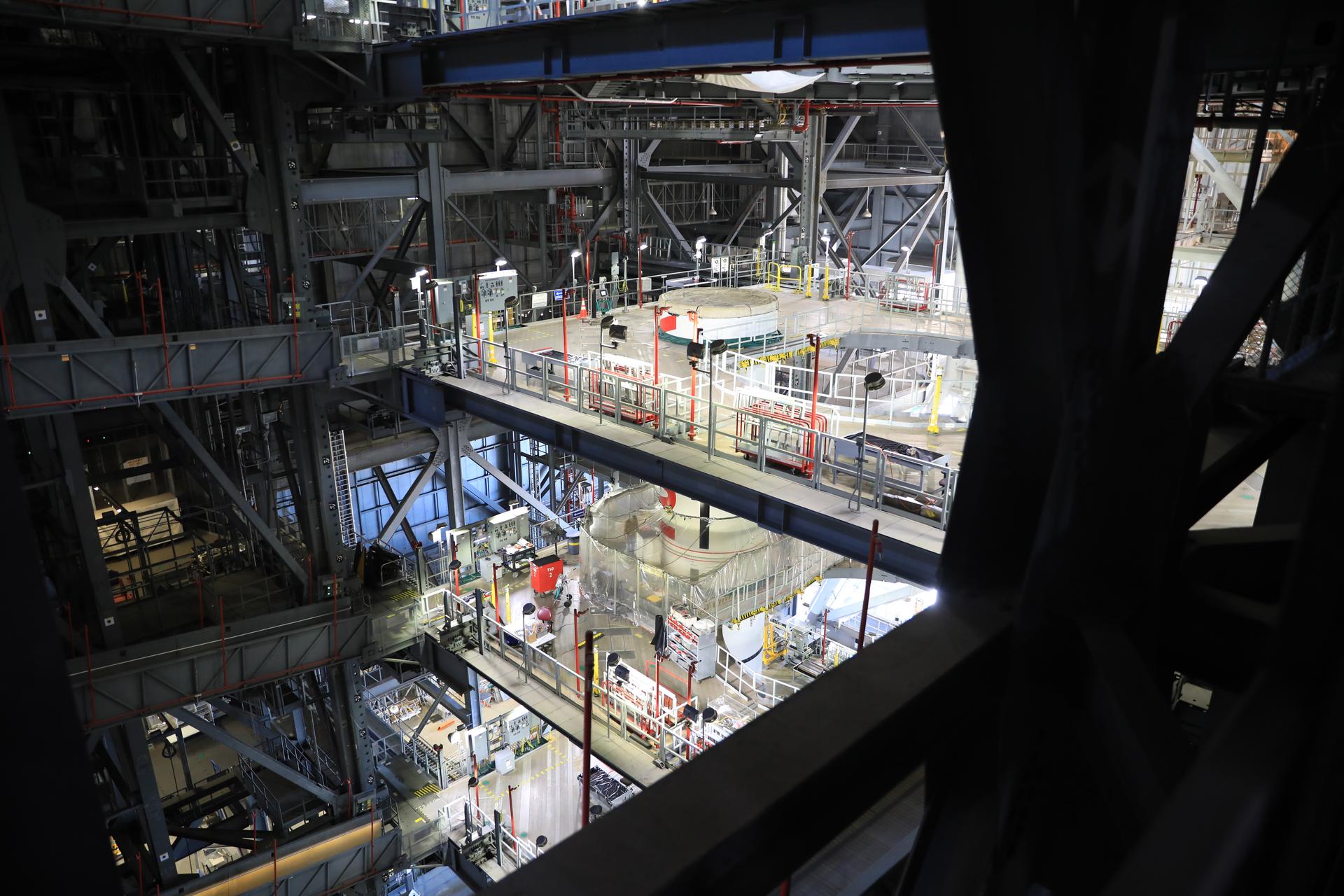
Technicians inside the Vehicle Assembly Building at NASA’s Kennedy Space Center in Florida complete integration of the left center center solid rocket booster segment onto the left aft center booster segment for the Artemis III SLS (Space Launch System) rocket on the mobile launcher inside High Bay 3 on Wednesday, Aug. 19, 2026. The twin boosters, comprising of five segments each manufactured by Northrop Grumman in Utah, will provide more than 75 percent of the SLS rocket’s total thrust at launch. The Artemis III mission will launch crew in the Orion spacecraft on top of the SLS rocket to test rendezvous and docking capabilities between Orion and commercial spacecraft needed to land astronauts on the Moon.
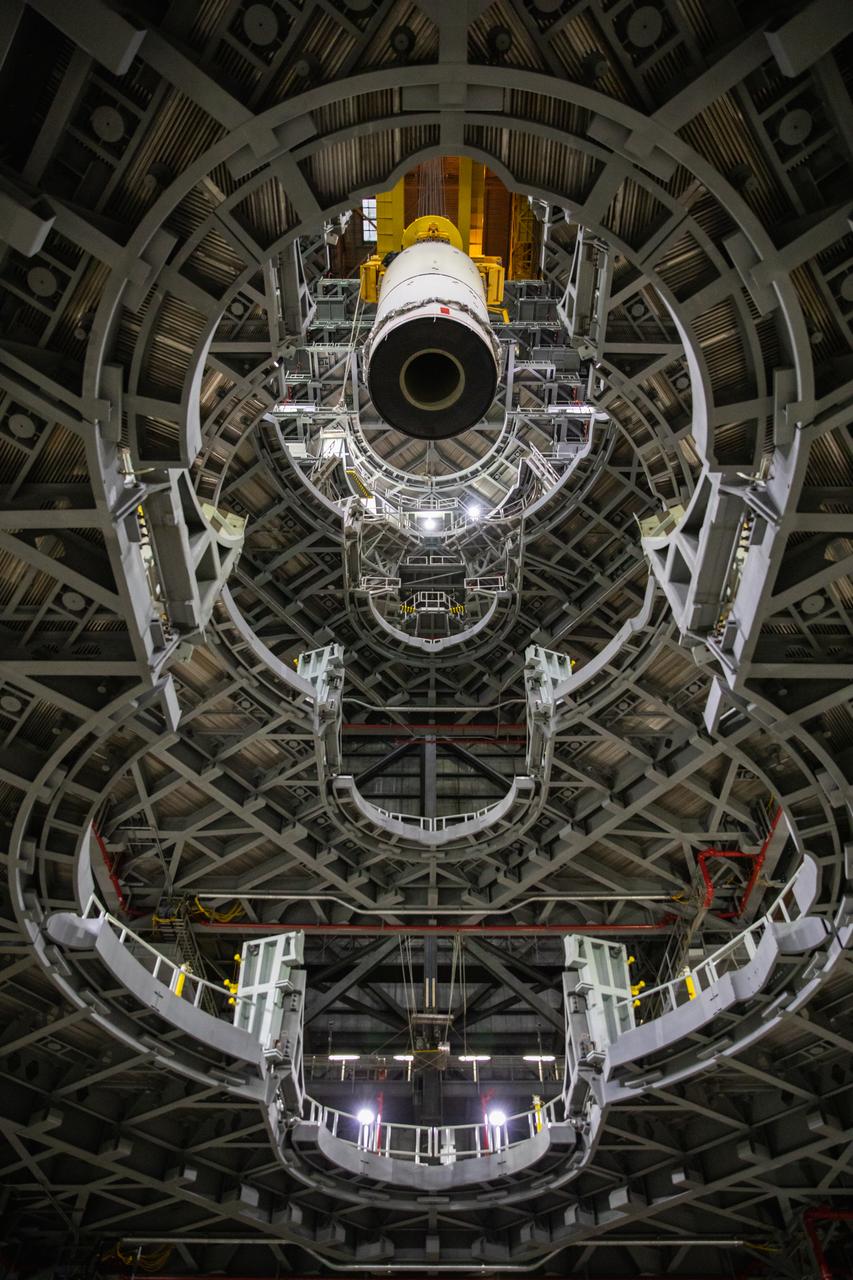
Technicians with NASA’s Exploration Ground Systems prepare to lower a mock-up, or pathfinder, of the Space Launch System’s (SLS) center booster segment onto an aft pathfinder segment inside the Vehicle Assembly Building (VAB) at the agency’s Kennedy Space Center in Florida on Sept. 14, 2020. Teams rehearsed stacking both pathfinder segments on top of the mobile launcher in High Bay 3 of the VAB in preparation for the Artemis I launch. Stacking of the actual SLS booster segments will occur later this year, when the rocket’s core stage arrives at Kennedy. Artemis I is the first in a series of increasingly complex missions that will test SLS and the Orion spacecraft as an integrated system prior to crewed flights to the Moon.
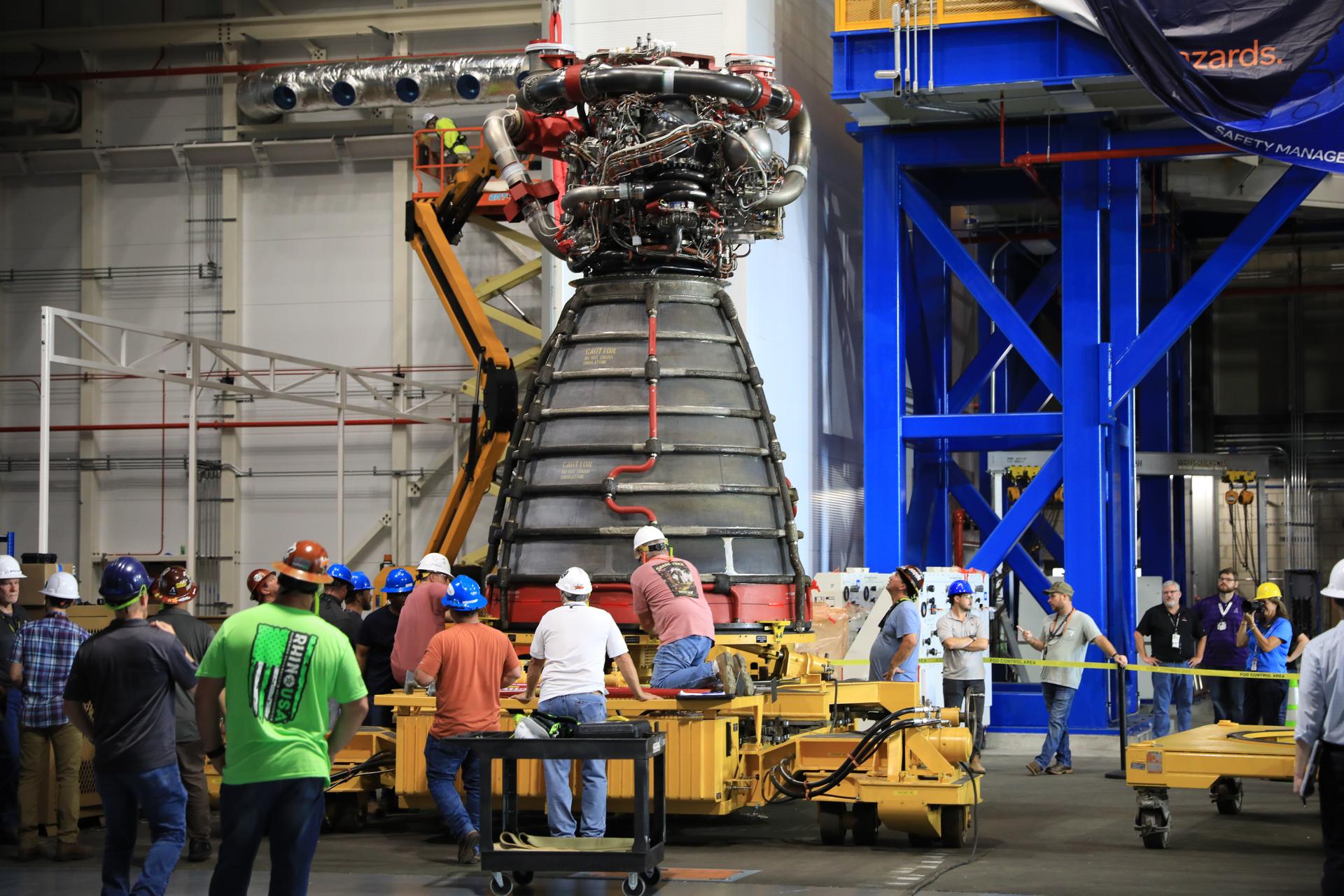
Technicians prepare the #2 RS-25 SLS (Space Launch System) rocket engine for transfer onto a work stand ahead of integration with the Artemis III core stage rocket on Tuesday, Aug. 25, 2026, inside the Vehicle Assembly Building at NASA’s Kennedy Space Center in Florida. During Artemis III, the four RS‑25 engines will launch the Orion spacecraft and its crew of four into low Earth orbit, generating more than two million pounds of thrust at liftoff.
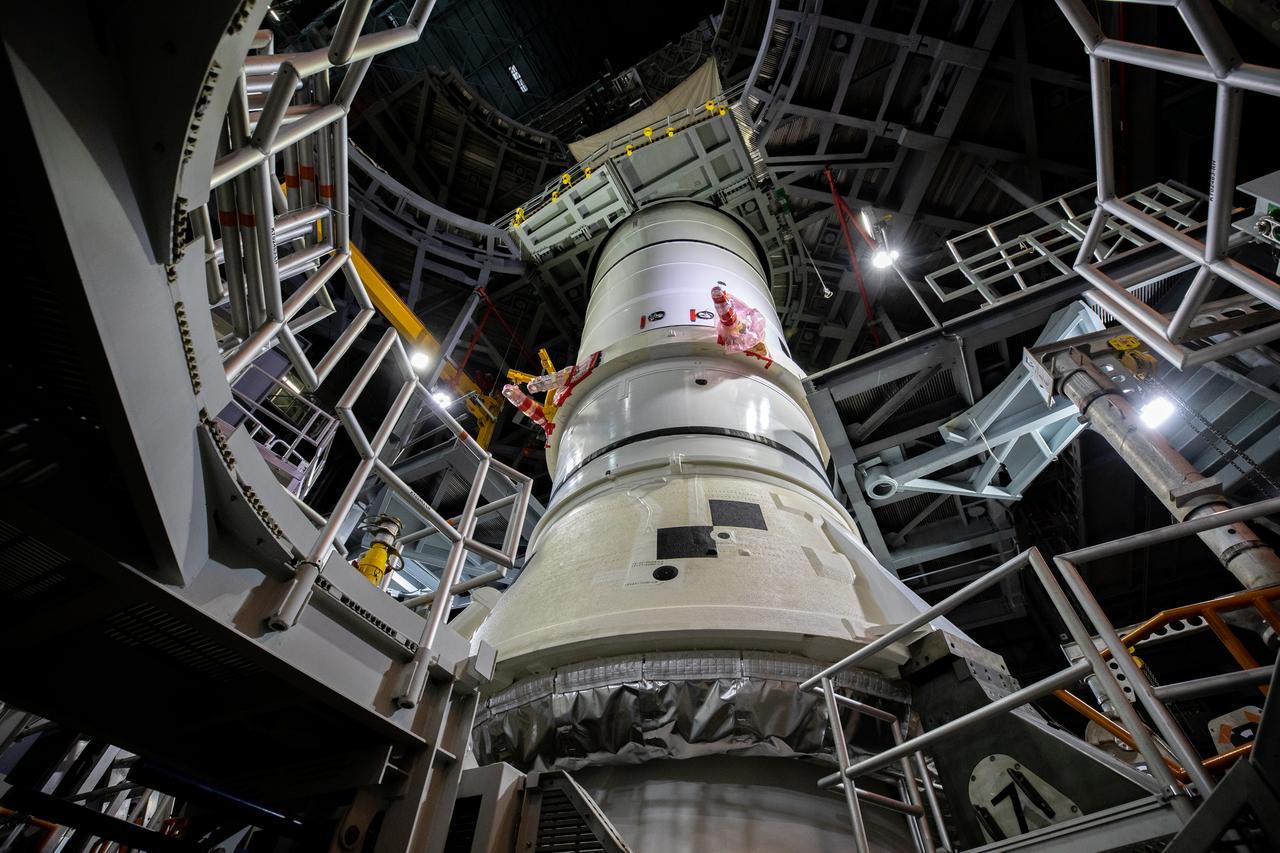
The first of two Artemis I aft booster segments for the Space Launch System is lowered onto the mobile launcher in High Bay 3 of the Vehicle Assembly Building (VAB) at NASA’s Kennedy Space Center in Florida on Nov. 23, 2020. Workers with Exploration Ground Systems and contractor Jacobs teams will stack the twin five-segment boosters on the mobile launcher in High Bay 3 over a number of weeks. When the core stage arrives, it will join the boosters on the mobile launcher, followed by the interim cryogenic propulsion stage and Orion spacecraft. Manufactured by Northrop Grumman in Utah, the twin boosters provide more than 75 percent of the total SLS thrust at launch. The SLS is managed by Marshall Space Flight Center in Huntsville, Alabama. Under the Artemis program, NASA will land the first woman and the next man on the Moon by 2024. The first in a series of increasingly complex missions, Artemis I will test the Orion spacecraft and SLS as an integrated system ahead of crewed flights to the Moon.
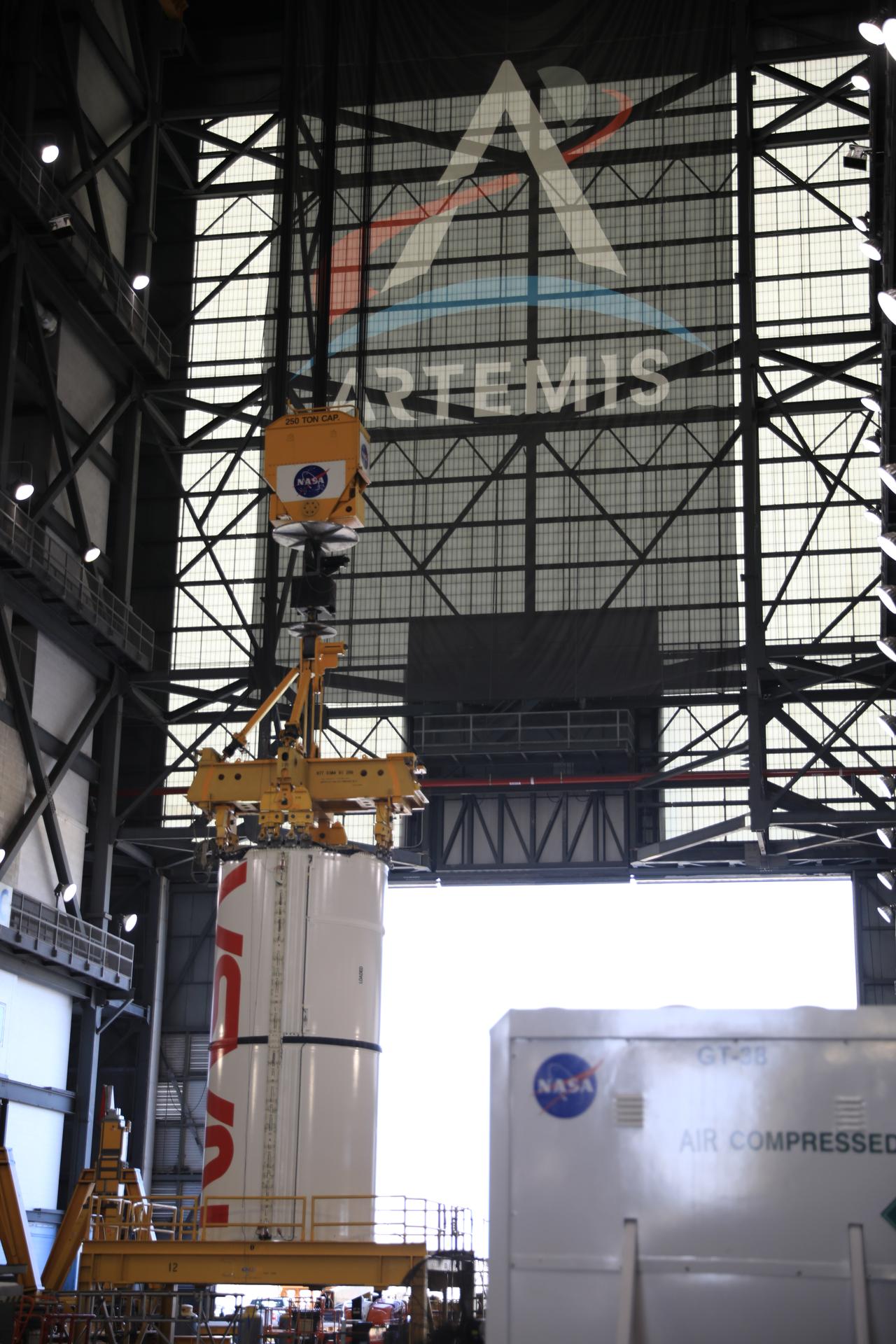
Technicians inside the Vehicle Assembly Building at NASA’s Kennedy Space Center in Florida connect a crane to the right center center booster segment for the Artemis III SLS (Space Launch System) rocket on Thursday, Aug. 20, 2026, ahead of integration onto the right aft center booster on the mobile launcher inside High Bay 3. The twin boosters, comprising of five segments each manufactured by Northrop Grumman in Utah, will provide more than 75 percent of the SLS rocket’s total thrust at launch. The Artemis III mission will launch crew in the Orion spacecraft on top of the SLS rocket to test rendezvous and docking capabilities between Orion and commercial spacecraft needed to land astronauts on the Moon.
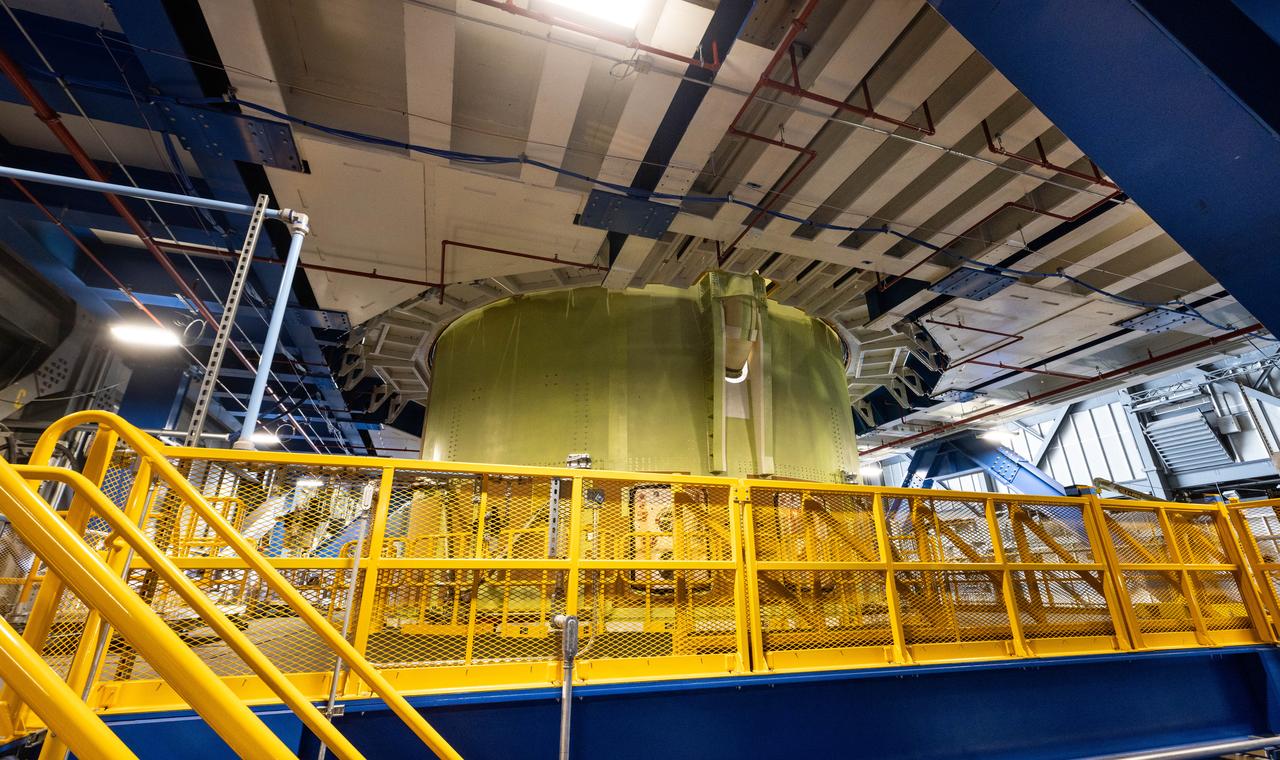
Teams from Kennedy lift NASA’s integrated Artemis III SLS (Space Launch System) core stage engine section with its boat-tail inside the center’s Vehicle Assembly Building at NASA’s Kennedy Space Center in Florida on Wednesday, Aug. 13, 2025. Shown inside the facility’s High Bay 2 for processing, the engine section is one the most complex and intricate parts of the rocket stage that will help power the Artemis missions to the Moon.

Teams from Kennedy lift NASA’s integrated Artemis III SLS (Space Launch System) core stage engine section with its boat-tail inside the center’s Vehicle Assembly Building at NASA’s Kennedy Space Center in Florida on Wednesday, Aug. 13, 2025. Shown inside the facility’s High Bay 2 for processing, the engine section is one the most complex and intricate parts of the rocket stage that will help power the Artemis missions to the Moon.
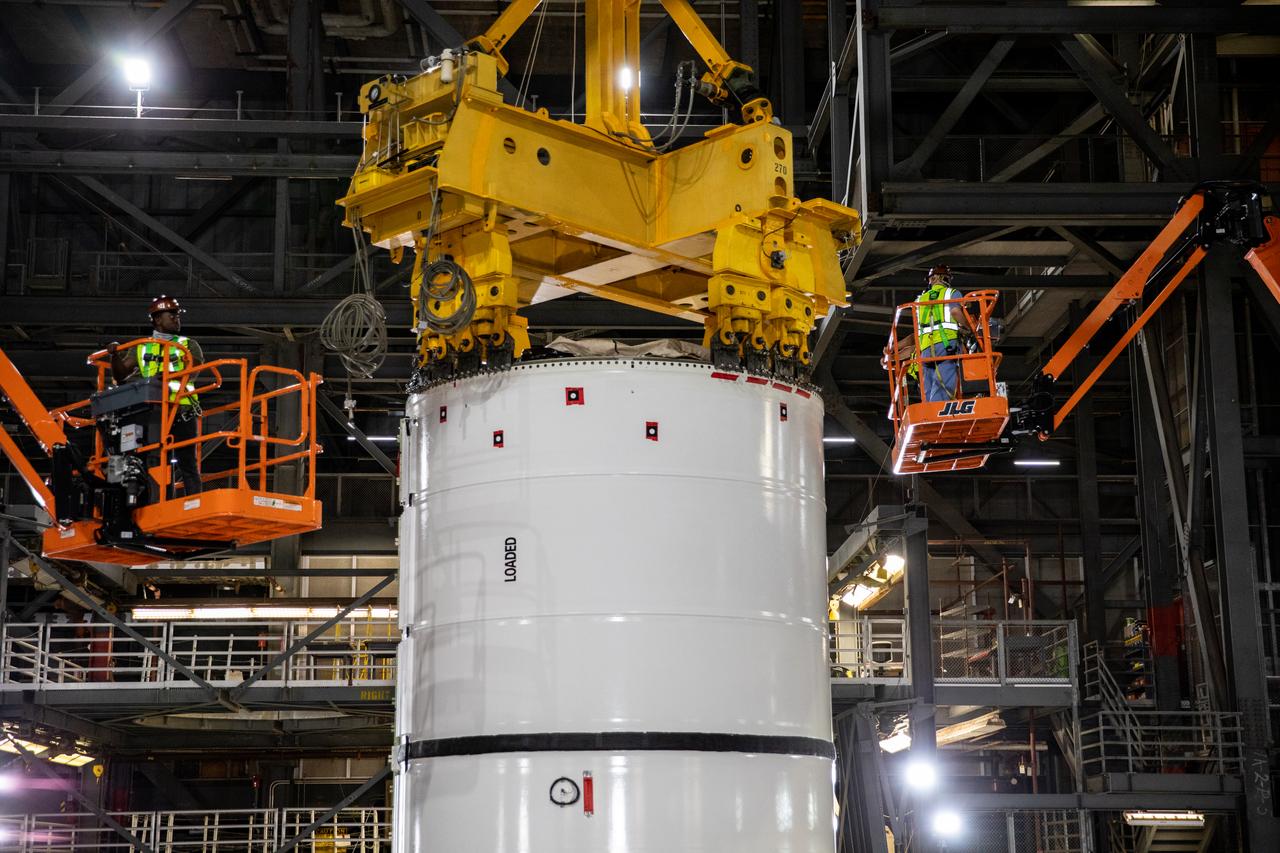
In High Bay 4 of the Vehicle Assembly Building (VAB) at NASA’s Kennedy Space Center in Florida, one of the Artemis I aft booster segments for the Space Launch System is being prepared for its lift up and lowering onto the mobile launcher in High Bay 3 for stacking operations on Nov. 20, 2020. Workers with Exploration Ground Systems and contractor Jacobs teams will stack the twin five-segment boosters on the mobile launcher in High Bay 3 over a number of weeks. When the core stage arrives, it will join the boosters on the mobile launcher, followed by the interim cryogenic propulsion stage and Orion spacecraft. Manufactured by Northrop Grumman in Utah, the twin boosters provide more than 75 percent of the total SLS thrust at launch. The SLS is managed by Marshall Space Flight Center in Huntsville, Alabama. Under the Artemis program, NASA will land the first woman and the next man on the Moon by 2024. The first in a series of increasingly complex missions, Artemis I will test the Orion spacecraft and SLS as an integrated system ahead of crewed flights to the Moon.
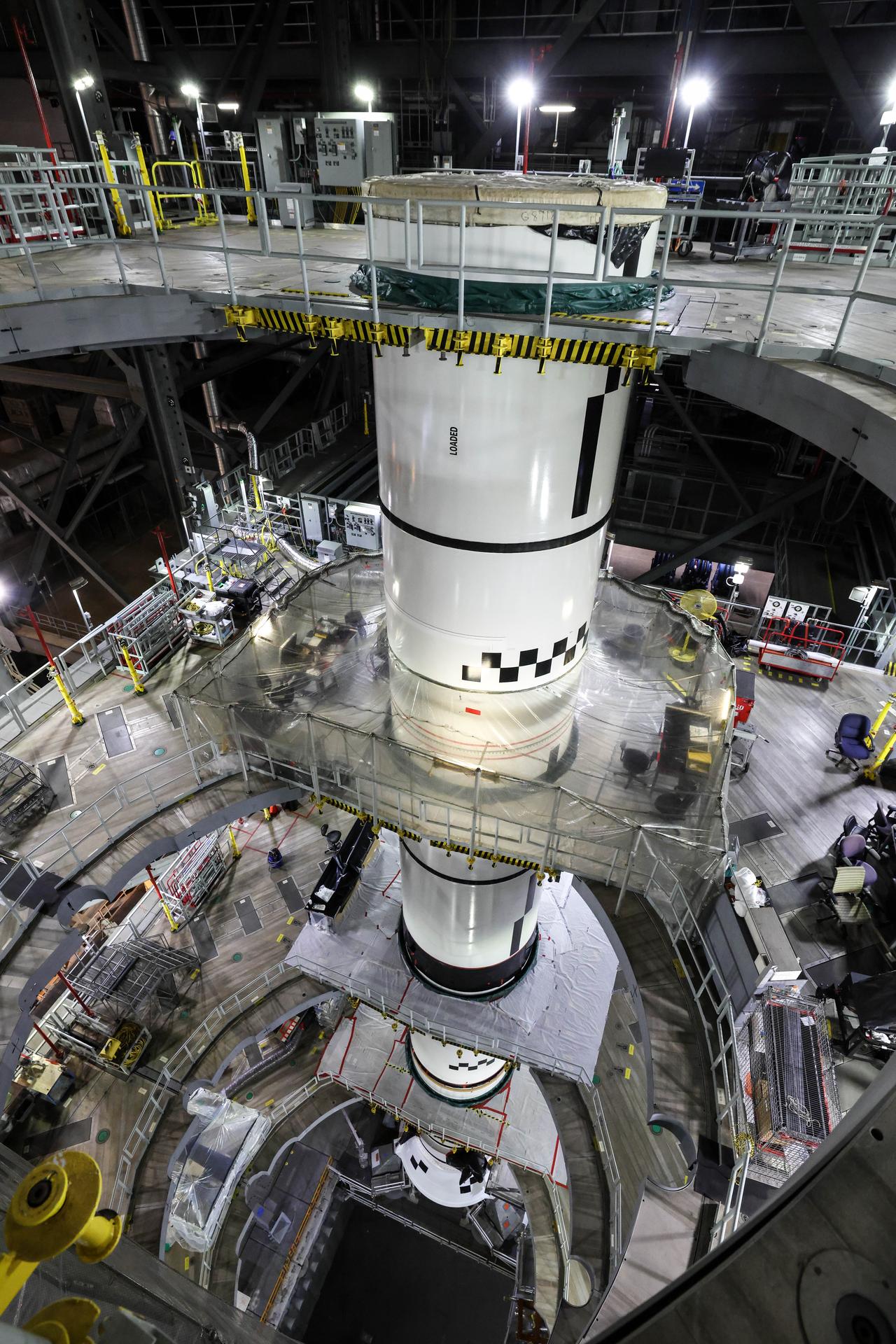
In High Bay 3 of the Vehicle Assembly Building at NASA’s Kennedy Space Center in Florida, the right forward center booster for Artemis III is integrated onto the right booster segments on the mobile launcher for the SLS (Space Launch System) rocket on Friday, Sept. 11, 2026. The twin boosters, comprising of five segments each manufactured by Northrop Grumman in Utah, will provide more than 75 percent of the SLS rocket’s total thrust at launch. The Artemis III mission will launch crew in the Orion spacecraft on top of the SLS rocket to test rendezvous and docking capabilities between Orion and commercial spacecraft needed to land astronauts on the Moon.
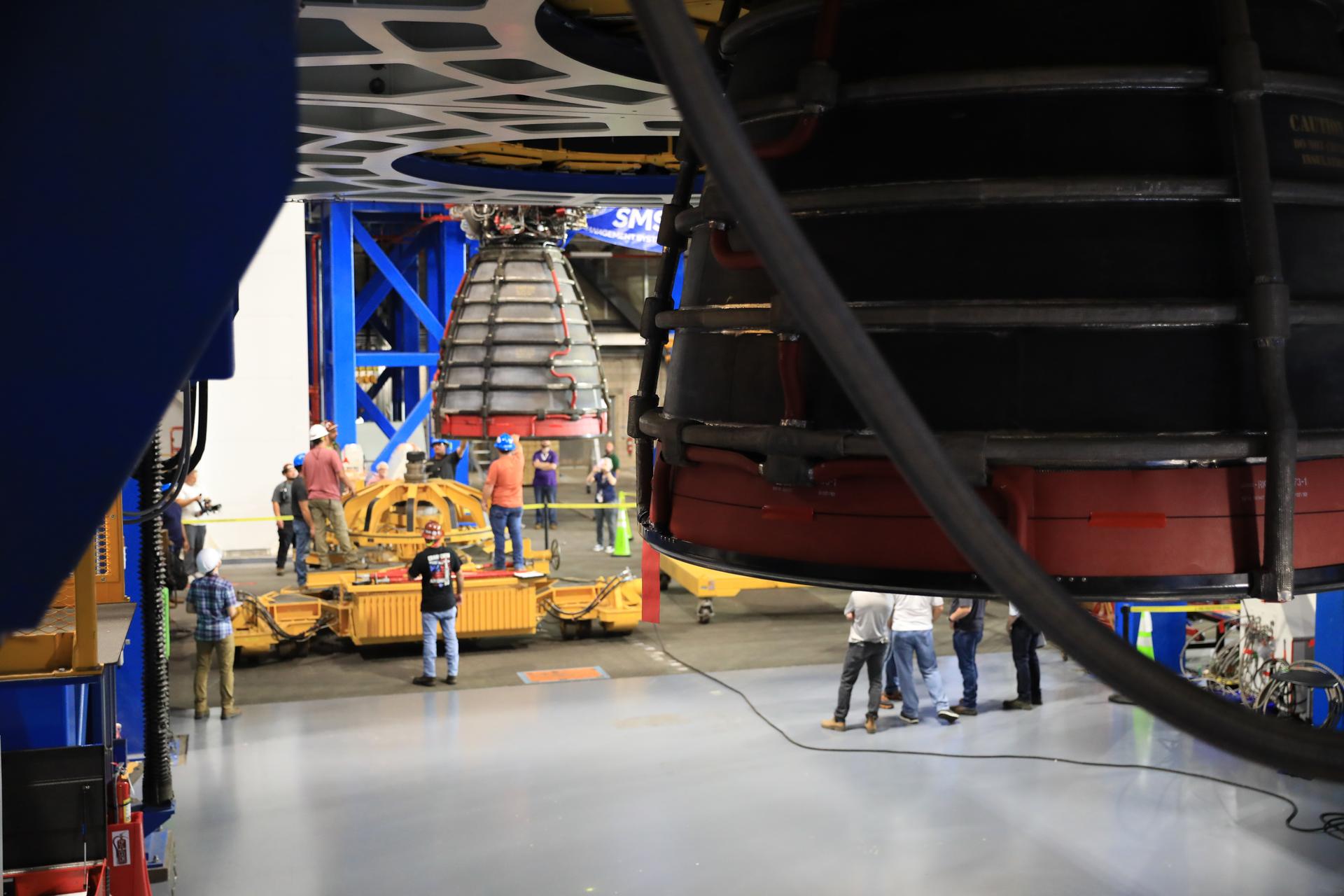
Technicians lift and transfer the #2 RS-25 SLS (Space Launch System) rocket engine (back) to the work stand. Visible in the foreground is the #3 engine already integrated with the Artemis III core stage rocket on Tuesday, Aug. 25, 2026, inside the Vehicle Assembly Building at NASA’s Kennedy Space Center in Florida. During Artemis III, the four RS‑25 engines will launch the Orion spacecraft and its crew of four into low Earth orbit, generating more than two million pounds of thrust at liftoff.
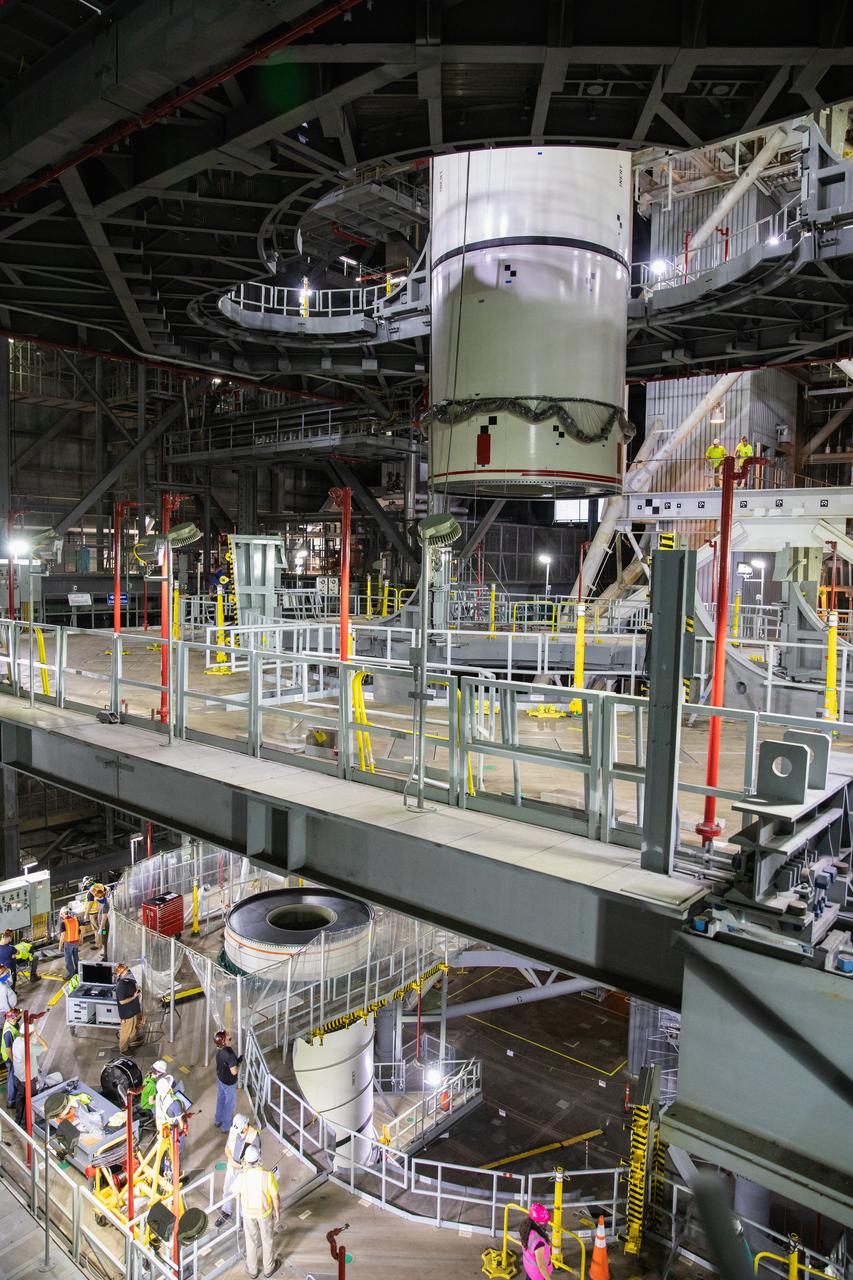
Technicians with NASA’s Exploration Ground Systems lower a mock-up, or pathfinder, of the Space Launch System’s (SLS) center booster segment onto an aft pathfinder segment inside the Vehicle Assembly Building (VAB) at the agency’s Kennedy Space Center in Florida on Sept. 14, 2020. Teams rehearsed stacking both pathfinder segments on top of the mobile launcher in High Bay 3 of the VAB in preparation for the Artemis I launch. Stacking of the actual SLS booster segments will occur later this year, when the rocket’s core stage arrives at Kennedy. Artemis I is the first in a series of increasingly complex missions that will test SLS and the Orion spacecraft as an integrated system prior to crewed flights to the Moon.
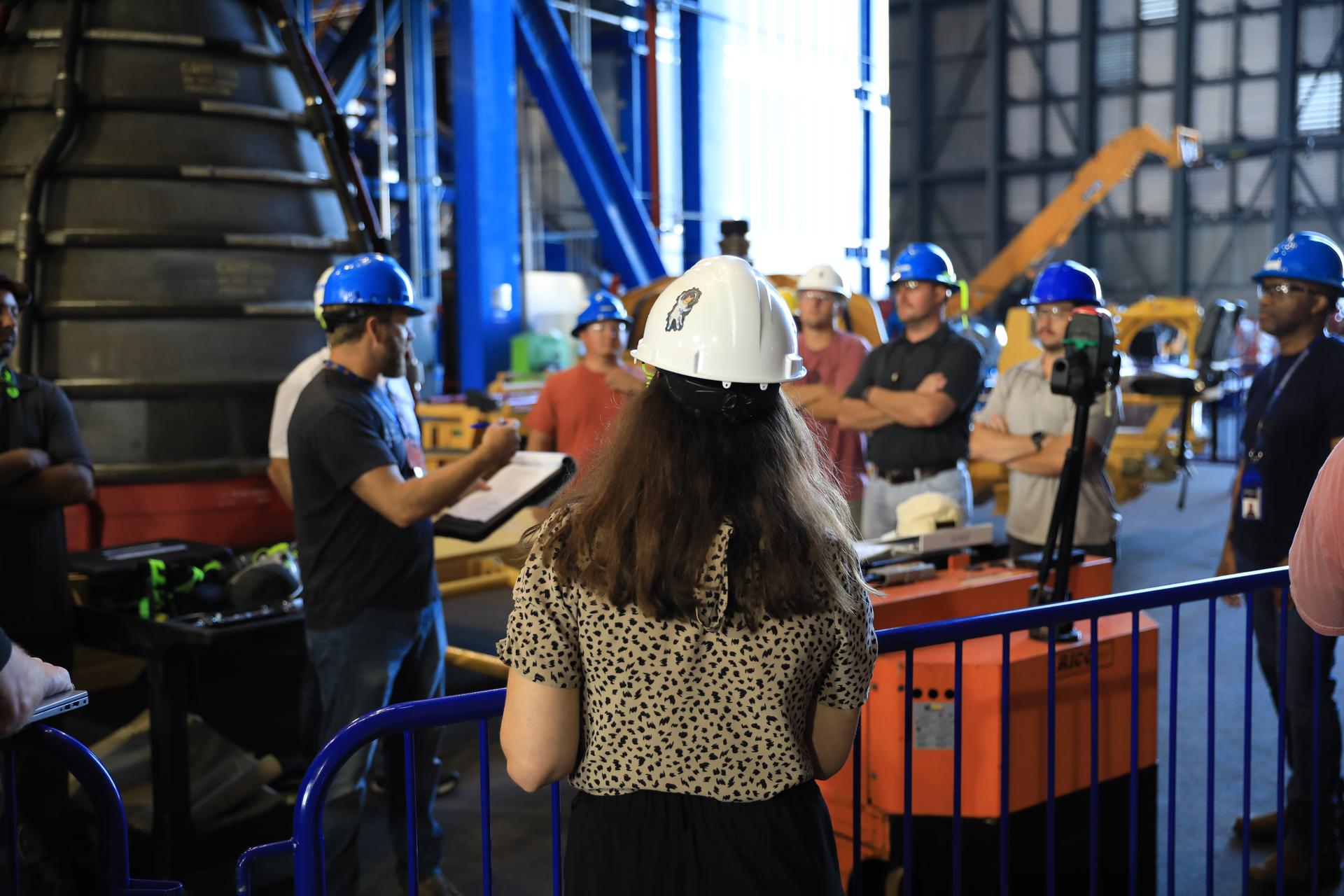
Employees discuss the lift and install operations for the RS-25 SLS (Space Launch System) rocket engines on Tuesday, Aug. 25, 2026, inside the Vehicle Assembly Building at NASA’s Kennedy Space Center in Florida. The engines will be installed in the SLS rocket core stage for integration atop the mobile launcher. During Artemis III, the four RS‑25 engines will launch the Orion spacecraft and its crew of four into low Earth orbit, generating more than two million pounds of thrust at liftoff.
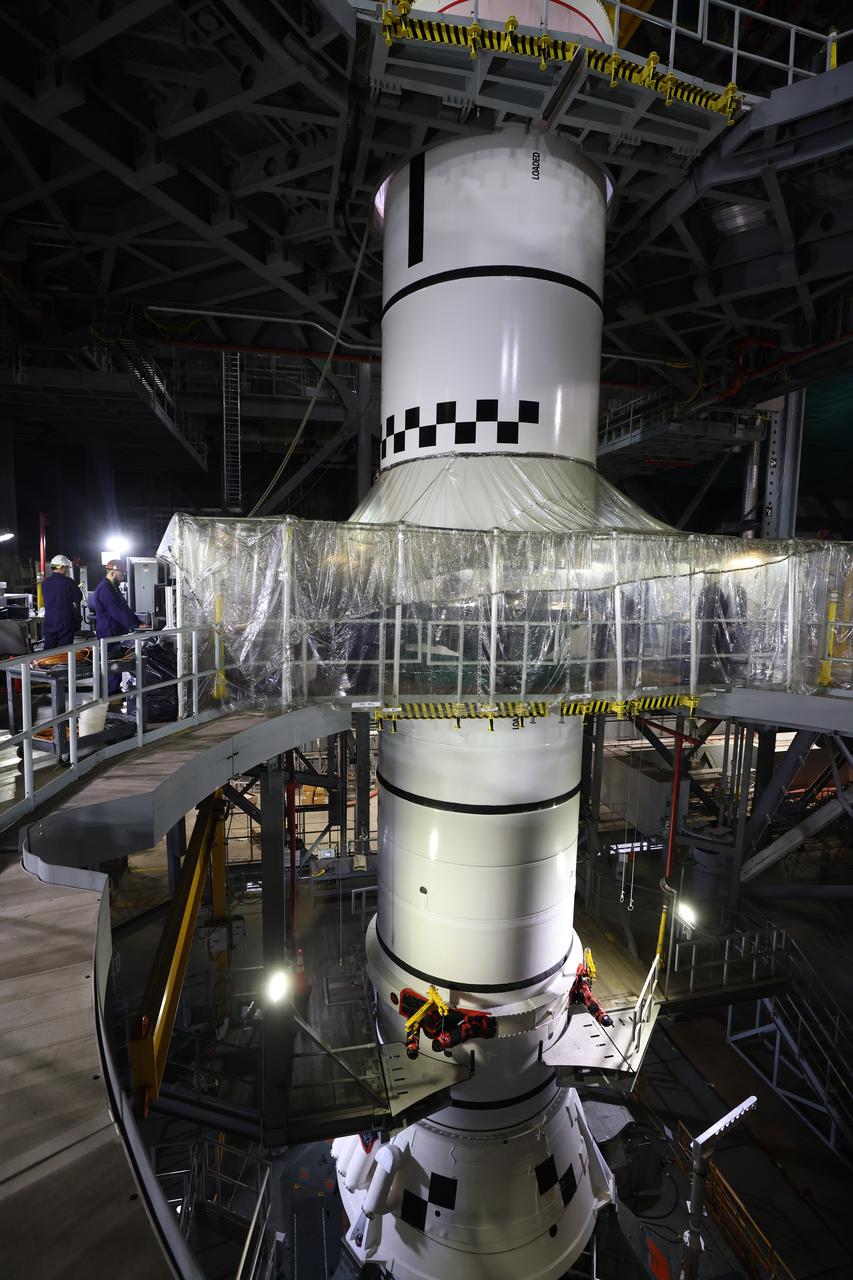
Engineers and technicians with the Exploration Ground Systems Program stack the next solid rocket booster segment, the left aft center, on the for the Artemis II SLS (Space Launch System) Moon rocket onto mobile launcher 1 inside the Vehicle Assembly Building’s High Bay 3 at NASA’s Kennedy Space Center on Thursday, Dec. 19, 2024. Once assembled, the boosters will help support the remaining rocket components and the Orion spacecraft during final assembly of the Artemis II Moon rocket and provide more than 75 percent of the total SLS thrust during liftoff from NASA Kennedy’s Launch Pad 39B.
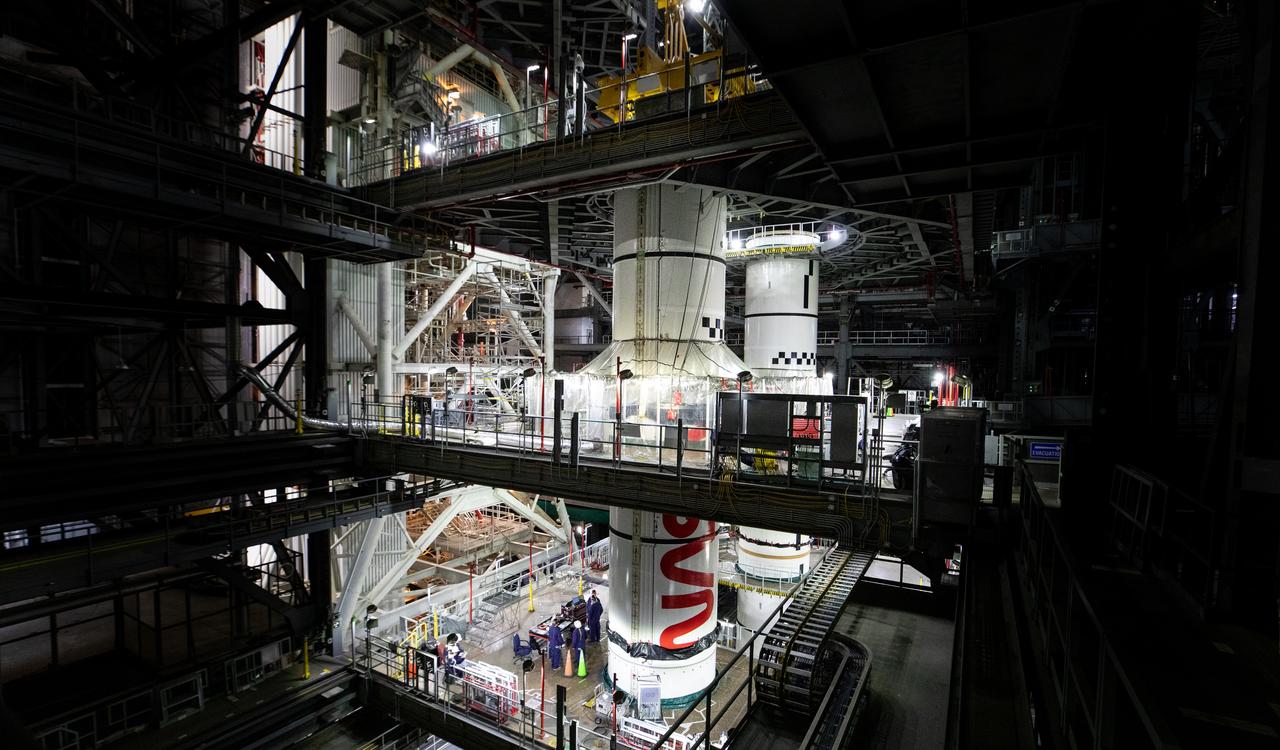
Inside High Bay 3 of the Vehicle Assembly Building at NASA’s Kennedy Space Center in Florida, technicians with the agency’s Exploration Ground Systems integrate the left forward center booster segment for the NASA’s SLS (Space Launch System) rocket onto the left center center segment atop the mobile launcher on Thursday, Jan. 30, 2025. The NASA “worm” insignia can be seen on both the center center booster segments. The boosters will help support the remaining rocket components and the Orion spacecraft during final assembly of the Artemis II Moon rocket and provide more than 75 percent of the total SLS thrust during liftoff from NASA Kennedy’s Launch Pad 39B.
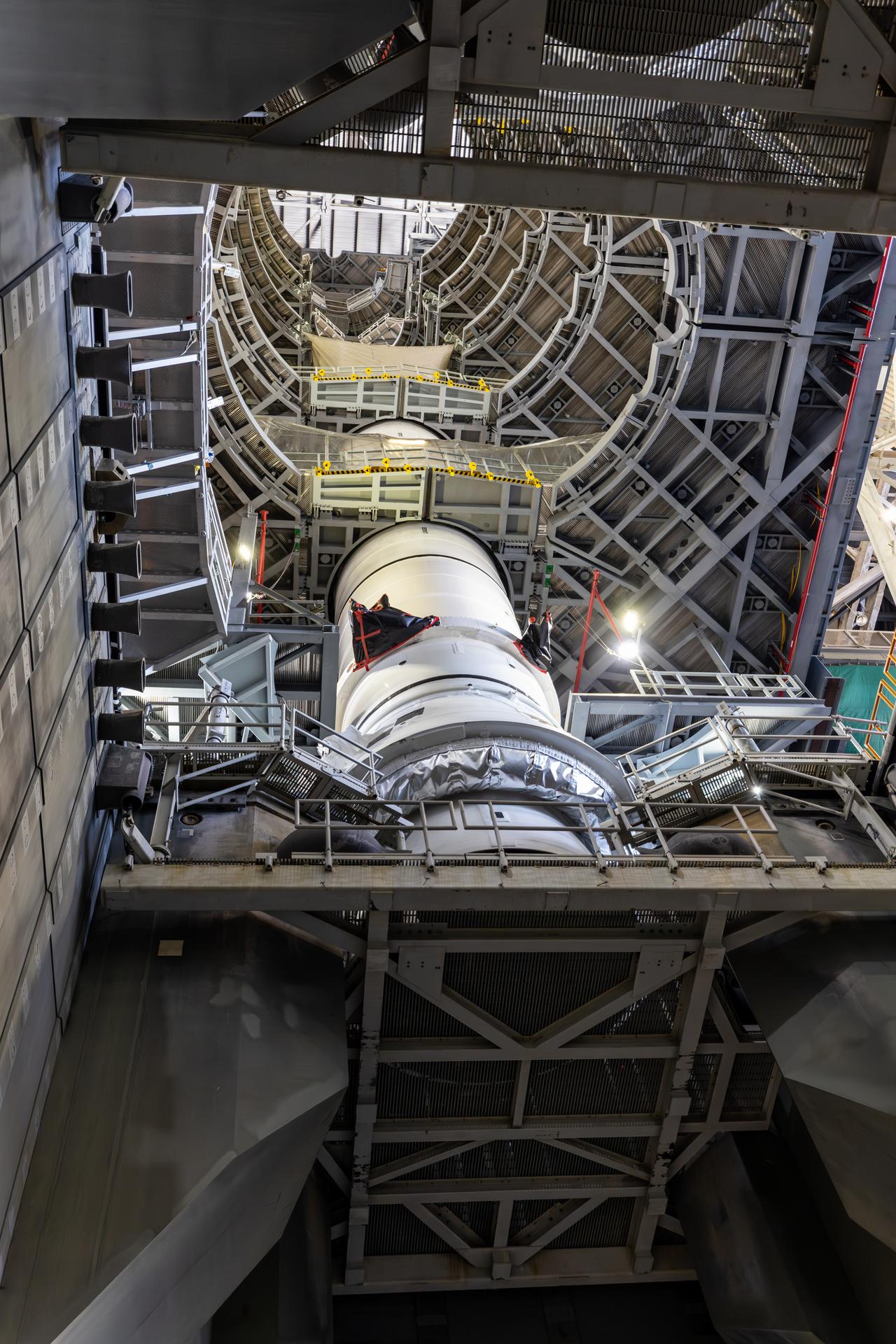
In High Bay 3 of the Vehicle Assembly Building at NASA’s Kennedy Space Center in Florida, the left aft center booster segment for Artemis III is integrated onto its aft assembly segment on the mobile launcher for the SLS (Space Launch System) rocket on Monday, Aug. 12, 2026. The twin boosters, comprising of five segments each manufactured by Northrop Grumman in Utah, will provide more than 75 percent of the SLS rocket’s total thrust at launch. The Artemis III mission will launch crew in the Orion spacecraft on top of the SLS rocket to test rendezvous and docking capabilities between Orion and commercial spacecraft needed to land astronauts on the Moon.
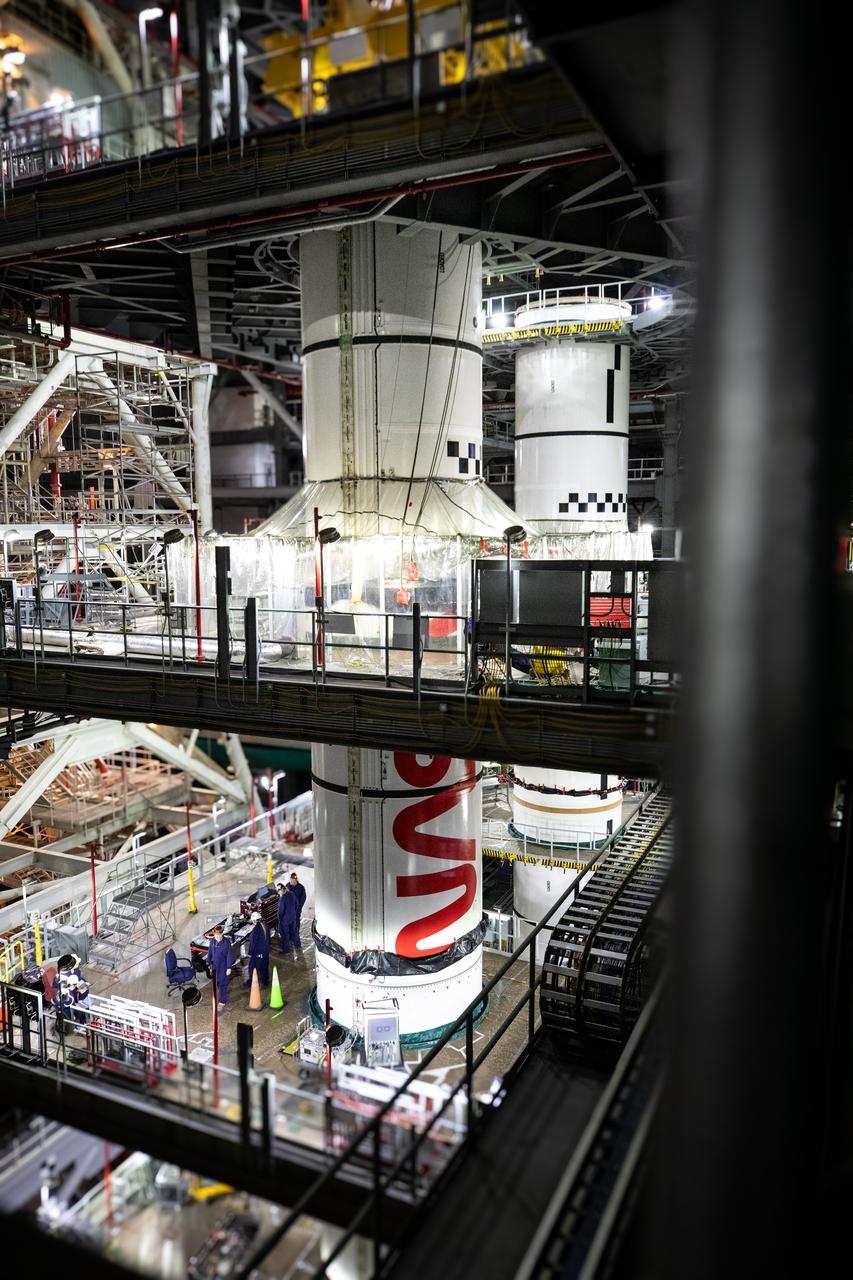
Inside High Bay 3 of the Vehicle Assembly Building at NASA’s Kennedy Space Center in Florida, technicians with the agency’s Exploration Ground Systems integrate the left forward center booster segment for the NASA’s SLS (Space Launch System) rocket onto the left center center segment atop the mobile launcher on Thursday, Jan. 30, 2025. The NASA “worm” insignia can be seen on both the center center booster segments. The boosters will help support the remaining rocket components and the Orion spacecraft during final assembly of the Artemis II Moon rocket and provide more than 75 percent of the total SLS thrust during liftoff from NASA Kennedy’s Launch Pad 39B.
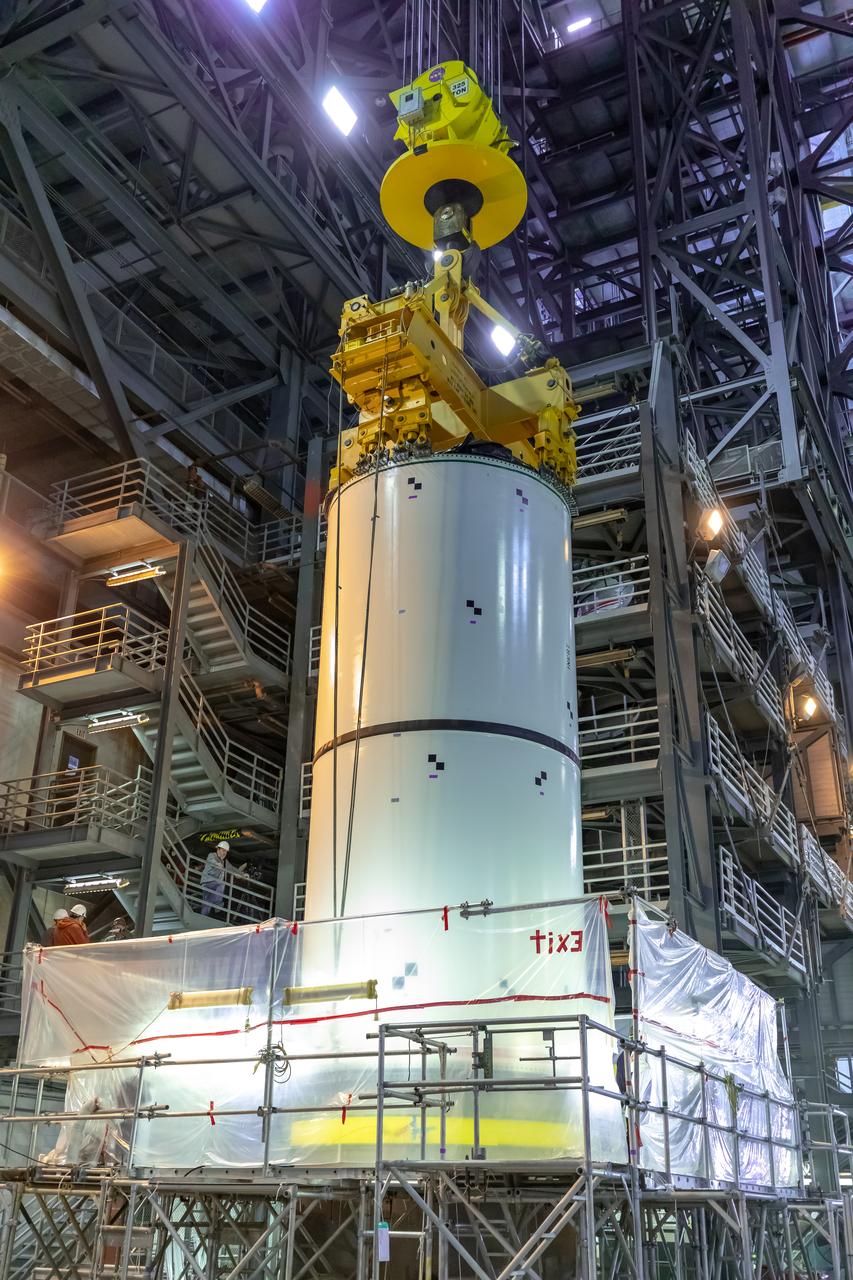
In High Bay 4 of the Vehicle Assembly Building at NASA’s Kennedy Space Center in Florida, a crane lowers Space Launch System (SLS) solid rocket booster pathfinder segments onto a platform during a training exercise on Jan. 8, 2020. A team of engineers with Exploration Ground Systems and crane operators and technicians with contractor Jacobs are practicing lifting, moving and stacking maneuvers, using important ground support equipment to train employees and certify all the equipment works properly. The booster pathfinders are inert, full-scale replicas of the actual booster hardware that will be attached to the SLS rocket for Artemis missions. The five-segment, 17-story-tall twin boosters will provide 3.6 million pounds of thrust each at liftoff to help launch Orion on Artemis I, its first uncrewed mission beyond the Moon.
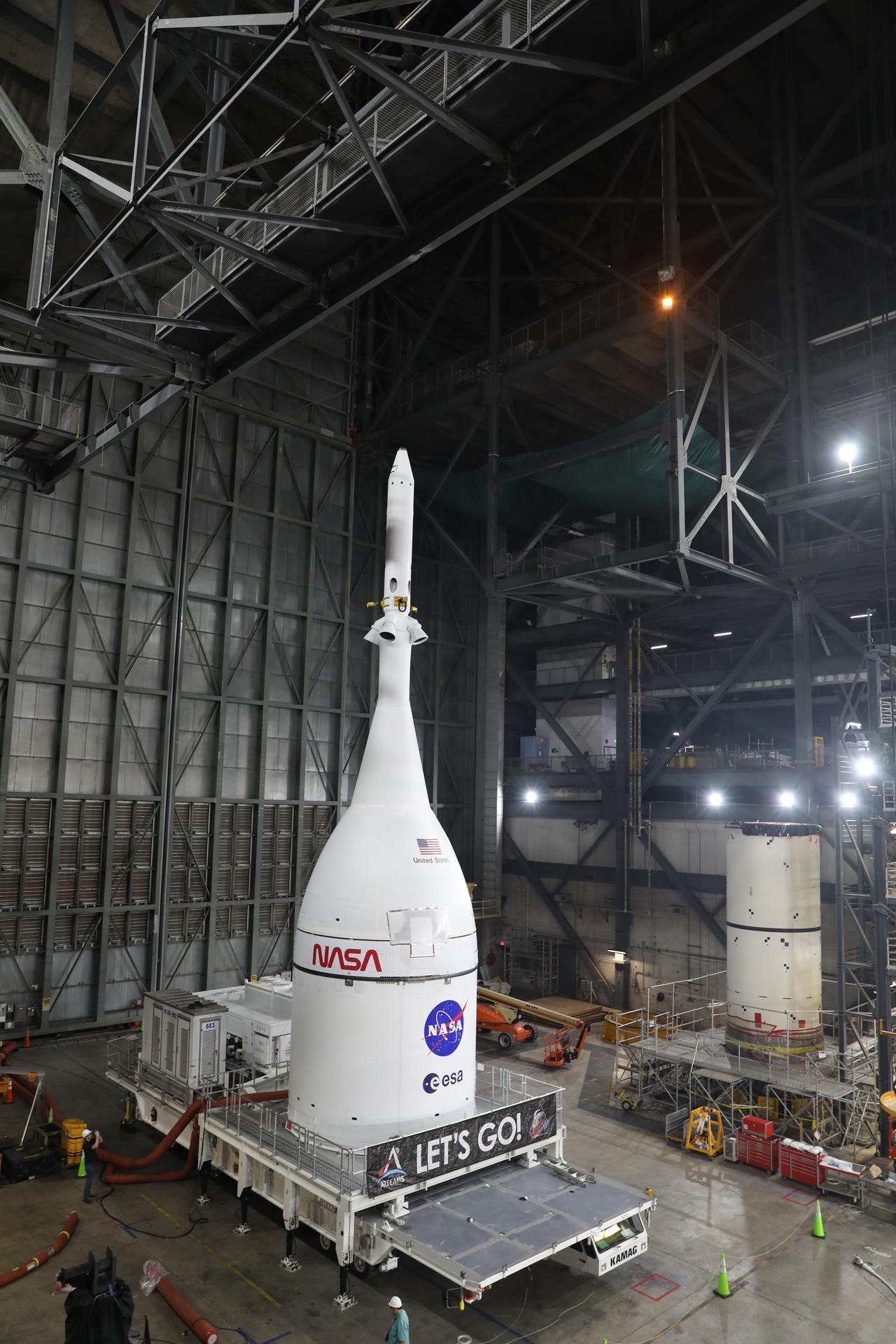
Technicians with NASA’s Exploration Ground Systems team prepare for integration to attach the agency’s Orion spacecraft on top of the SLS (Space Launch System) rocket in High Bay 3 of the Vehicle Assembly Building at NASA’s Kennedy Space Center in Florida on Friday, Oct. 17, 2025, for the agency’s Artemis II mission. Set to launch in 2026, the spacecraft will carry NASA astronauts Reid Wiseman, Victor Glover, Christina Koch, and CSA (Canadian Space Agency) astronaut Jeremy Hansen on a 10-day mission around the Moon and back. Once stacked, teams will begin conducting a series of verification tests ahead of rolling out to Launch Complex 39B for the wet dress rehearsal at NASA Kennedy.
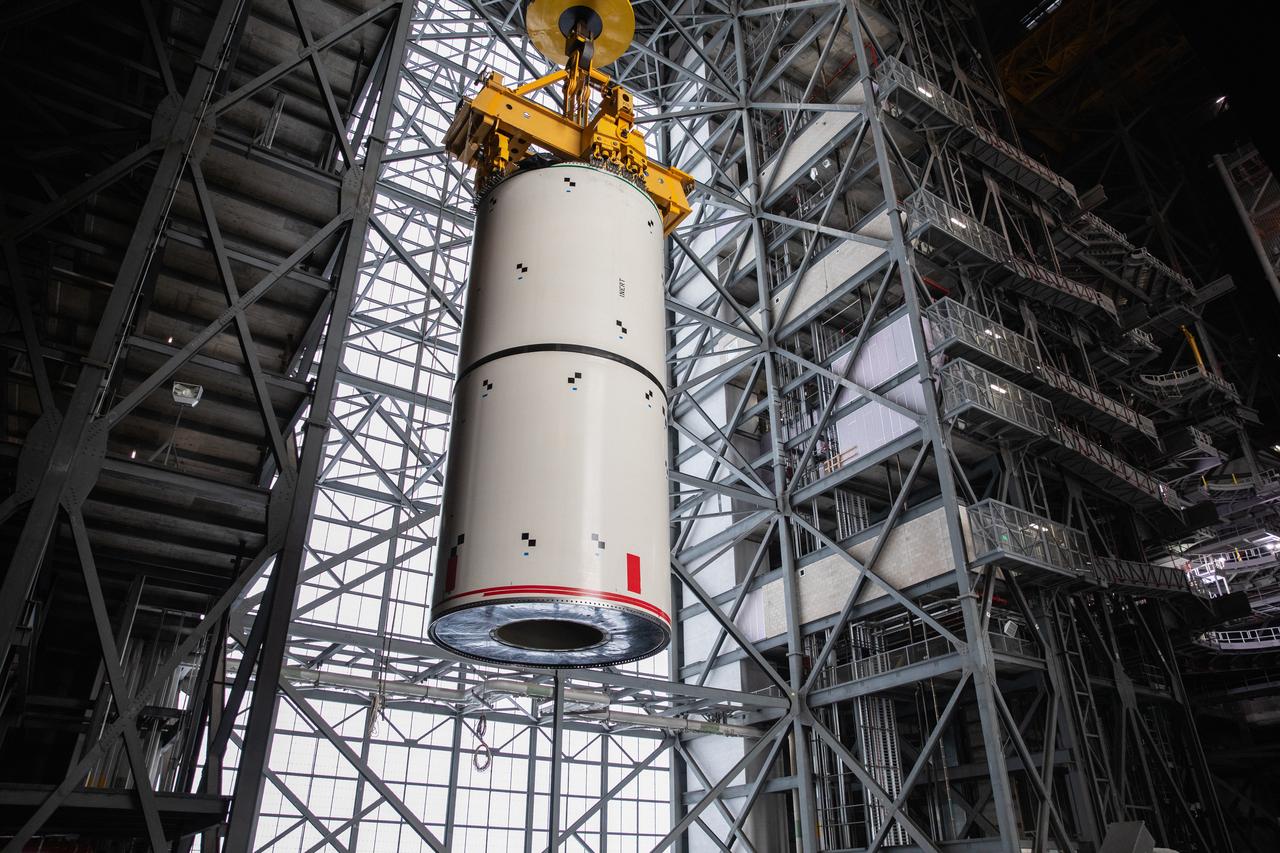
Technicians with NASA’s Exploration Ground Systems rehearse booster stacking operations inside the Vehicle Assembly Building (VAB) at the agency’s Kennedy Space Center in Florida on Sept. 14, 2020, in preparation for Artemis I. The exercise involved using booster segment mock-ups, referred to as pathfinders. During the rehearsal, an aft pathfinder segment was prepared in High Bay 4 of the VAB, after which a team of crane operators moved it over to High Bay 3, where it was placed on the mobile launcher. Careful measurements were then taken before the team added a center pathfinder to the stack. Stacking of the actual Space Launch System (SLS) booster segments will occur later this year, when the rocket’s core stage arrives at Kennedy. Artemis I is the first in a series of increasingly complex missions that will test SLS and the Orion spacecraft as an integrated system prior to crewed flights to the Moon.
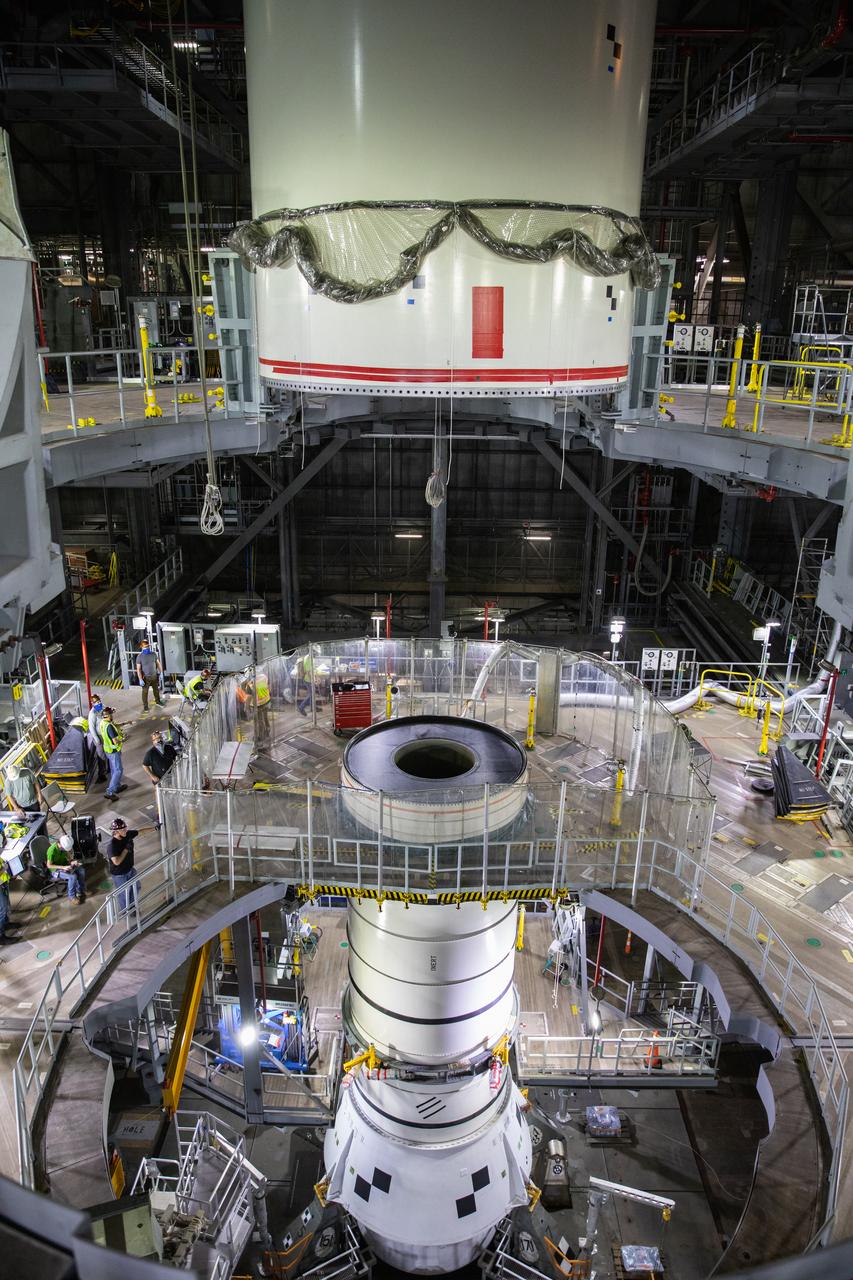
Technicians with NASA’s Exploration Ground Systems lower a mock-up, or pathfinder, of the Space Launch System’s (SLS) center booster segment onto an aft pathfinder segment inside the Vehicle Assembly Building (VAB) at the agency’s Kennedy Space Center in Florida on Sept. 14, 2020. Teams rehearsed stacking both pathfinder segments on top of the mobile launcher in High Bay 3 of the VAB in preparation for the Artemis I launch. Stacking of the actual SLS booster segments will occur later this year, when the rocket’s core stage arrives at Kennedy. Artemis I is the first in a series of increasingly complex missions that will test SLS and the Orion spacecraft as an integrated system prior to crewed flights to the Moon.

Technicians with NASA’s Exploration Ground Systems lower a mock-up, or pathfinder, of the Space Launch System’s (SLS) center booster segment onto an aft pathfinder segment inside the Vehicle Assembly Building (VAB) at the agency’s Kennedy Space Center in Florida on Sept. 14, 2020. Teams rehearsed stacking both pathfinder segments on top of the mobile launcher in High Bay 3 of the VAB in preparation for the Artemis I launch. Stacking of the actual SLS booster segments will occur later this year, when the rocket’s core stage arrives at Kennedy. Artemis I is the first in a series of increasingly complex missions that will test SLS and the Orion spacecraft as an integrated system prior to crewed flights to the Moon.
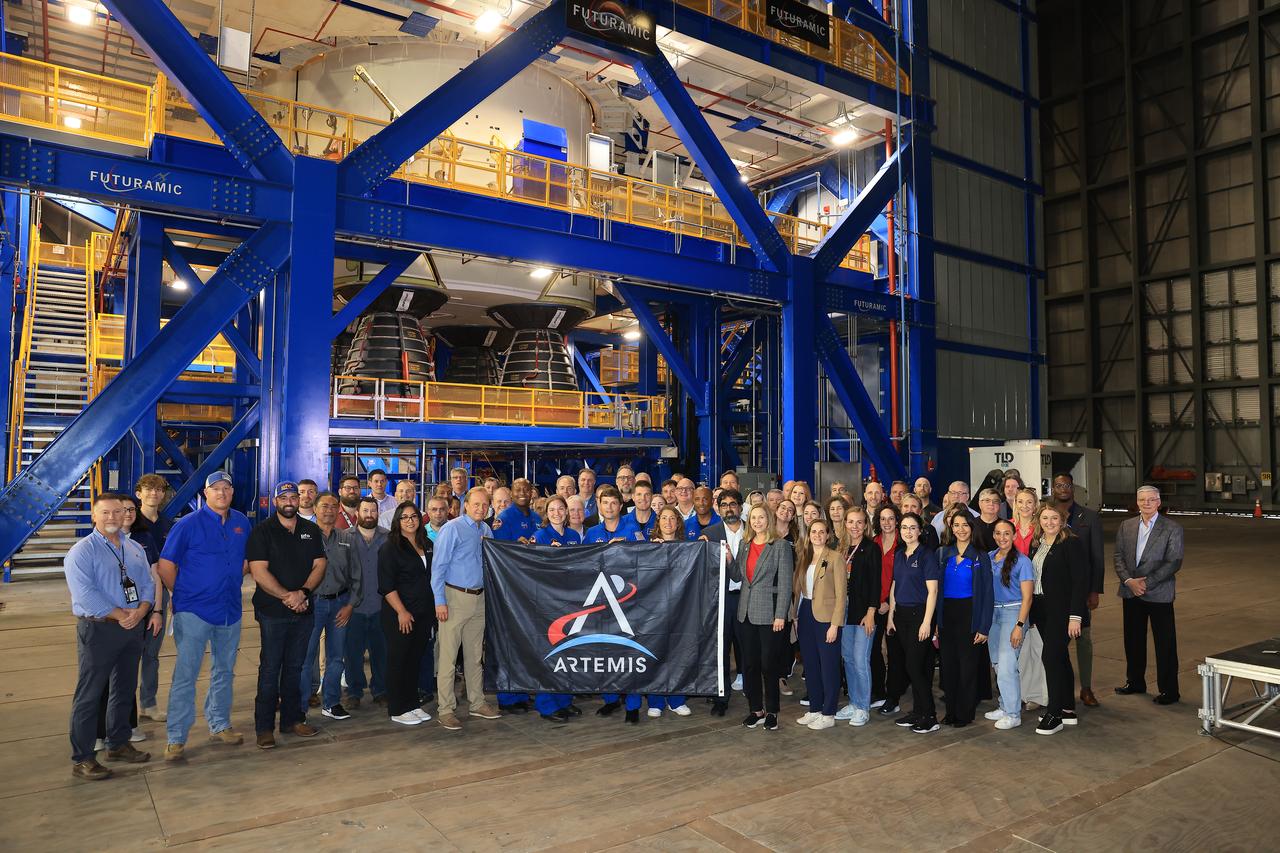
Artemis II crew and backup crew hold a banner with NASA and industry leaders during a supplier and media day event on Monday, Dec. 16, 2024, inside the Vehicle Assembly Building at the agency’s Kennedy Space Center in Florida. The Artemis II crew and backup crew participated in the event days after teams with NASA’s Exploration Ground Systems transport lifted the agency’s 212-foot-tall SLS (Space Launch System) core stage from the facility’s transfer aisle into High Bay 2 where it will remain while teams stack the two solid rocket boosters on top of mobile launcher 1.
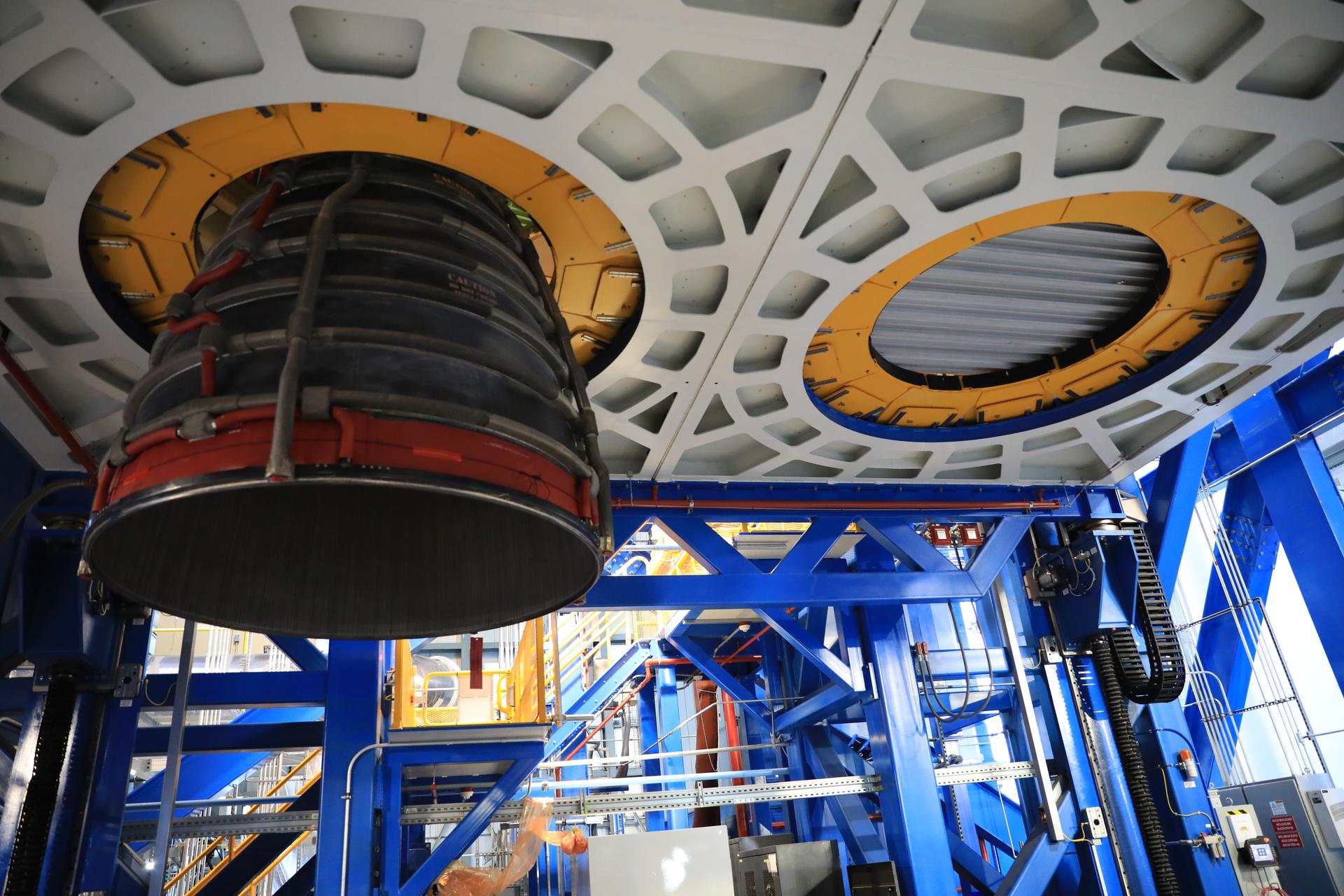
The first of four RS-25 SLS (Space Launch System) rocket engines, is installed on the work stand and integrated with the Artemis III core stage rocket on Tuesday, Aug. 25, 2026, inside the Vehicle Assembly Building at NASA’s Kennedy Space Center in Florida. During Artemis III, the four RS‑25 engines will launch the Orion spacecraft and its crew of four into low Earth orbit, generating more than two million pounds of thrust at liftoff.