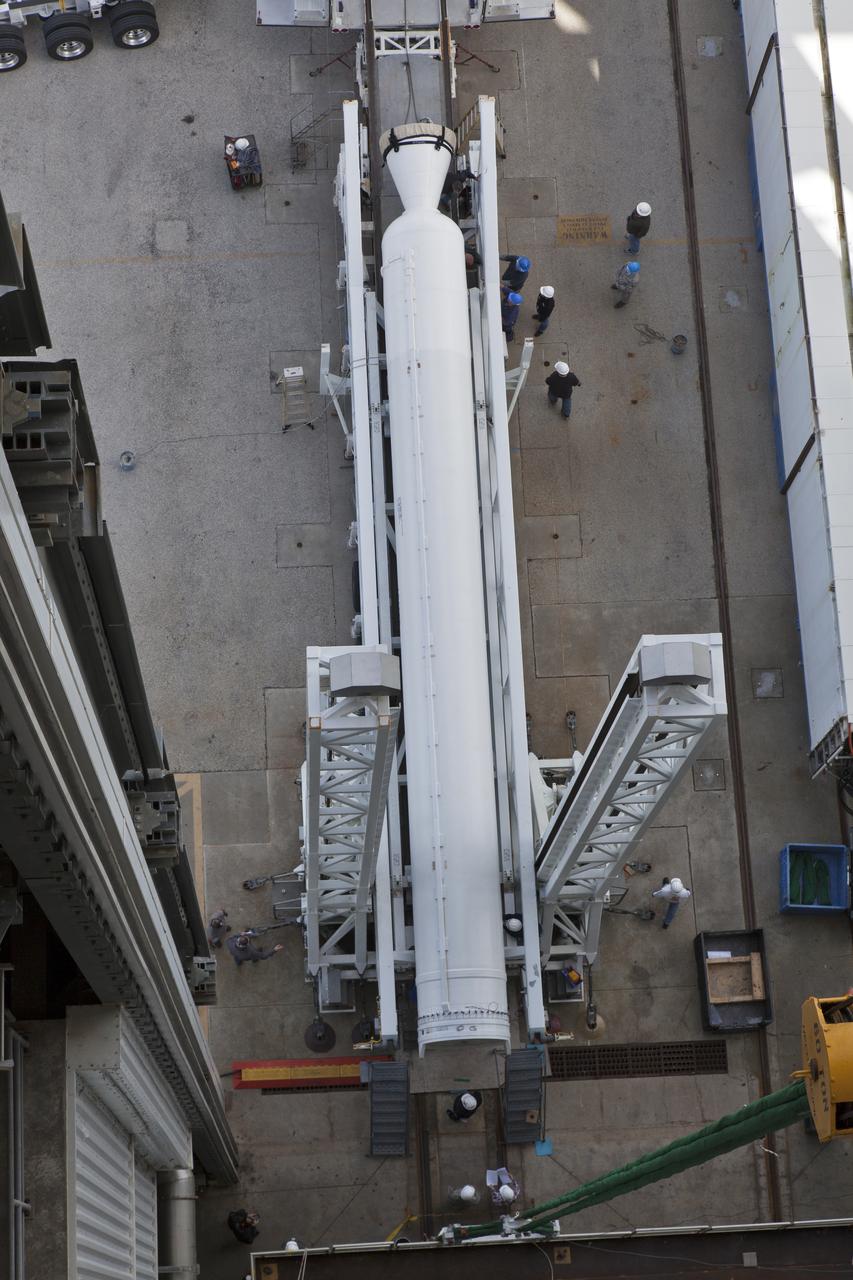
A solid rocket booster (SRB) is prepared for mating to a United Launch Alliance Atlas V first stage in the Vertical Integration Facility at Space Launch Complex 41 at Cape Canaveral Air Force Station in Florida. The SRB will be help boost NOAA's Geostationary Operational Environmental Satellite, or GOES-S, to orbit. GOES-S is the second in a series of four advanced geostationary weather satellites that will significantly improve the detection and observation of environmental phenomena that directly affect public safety, protection of property and the nation's economic health and prosperity. GOES-S is slated to launch March 1, 2018.
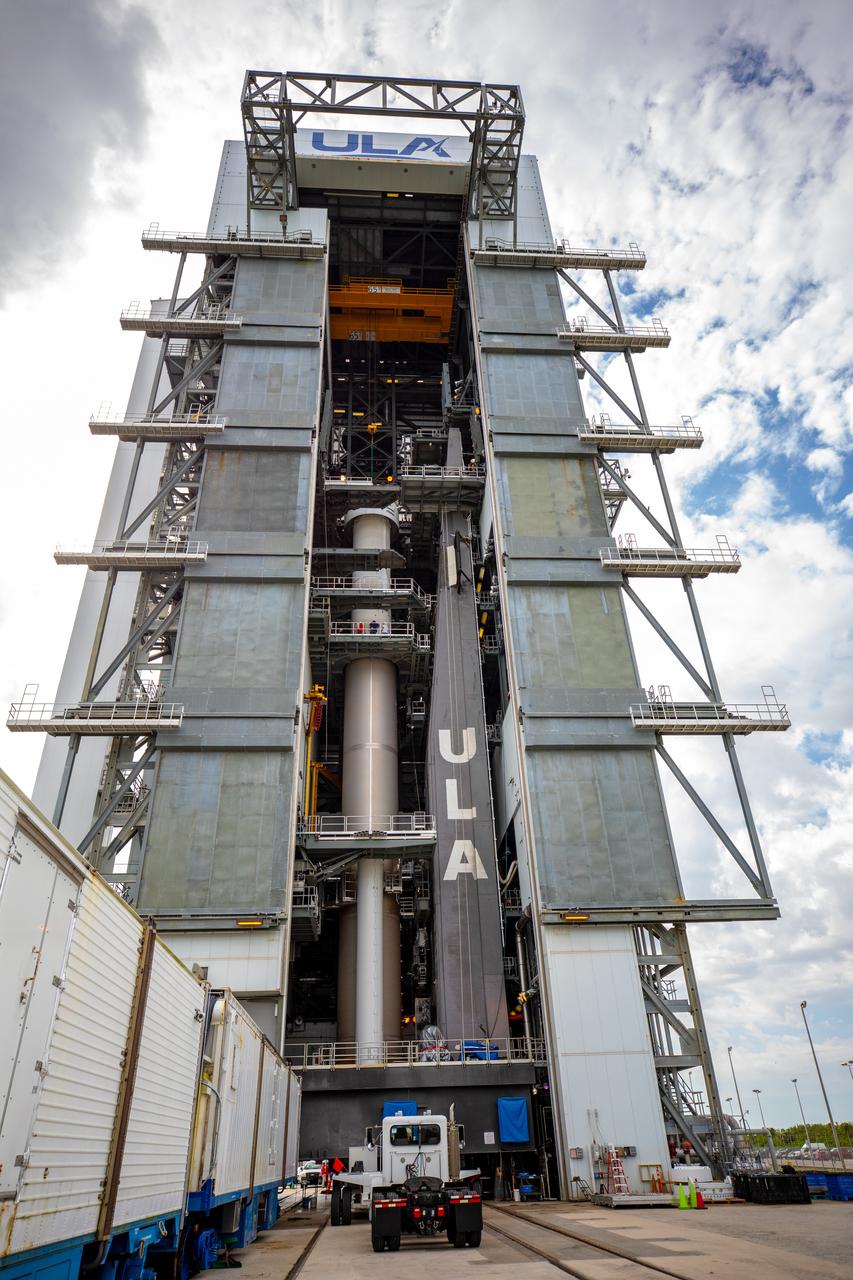
A Centaur upper stage is mated to the United Launch Alliance Atlas V first stage inside the Space Launch Complex 41 Vertical Integration Facility at Florida’s Cape Canaveral Air Force Station on Nov. 8, 2019, in preparation for Boeing’s Orbital Flight Test (OFT). The uncrewed OFT mission will rendezvous and dock Boeing’s CST-100 Starliner spacecraft with the International Space Station as part of NASA’s Commercial Crew Program. Starliner will launch atop the Atlas V rocket from Space Launch Complex 41.
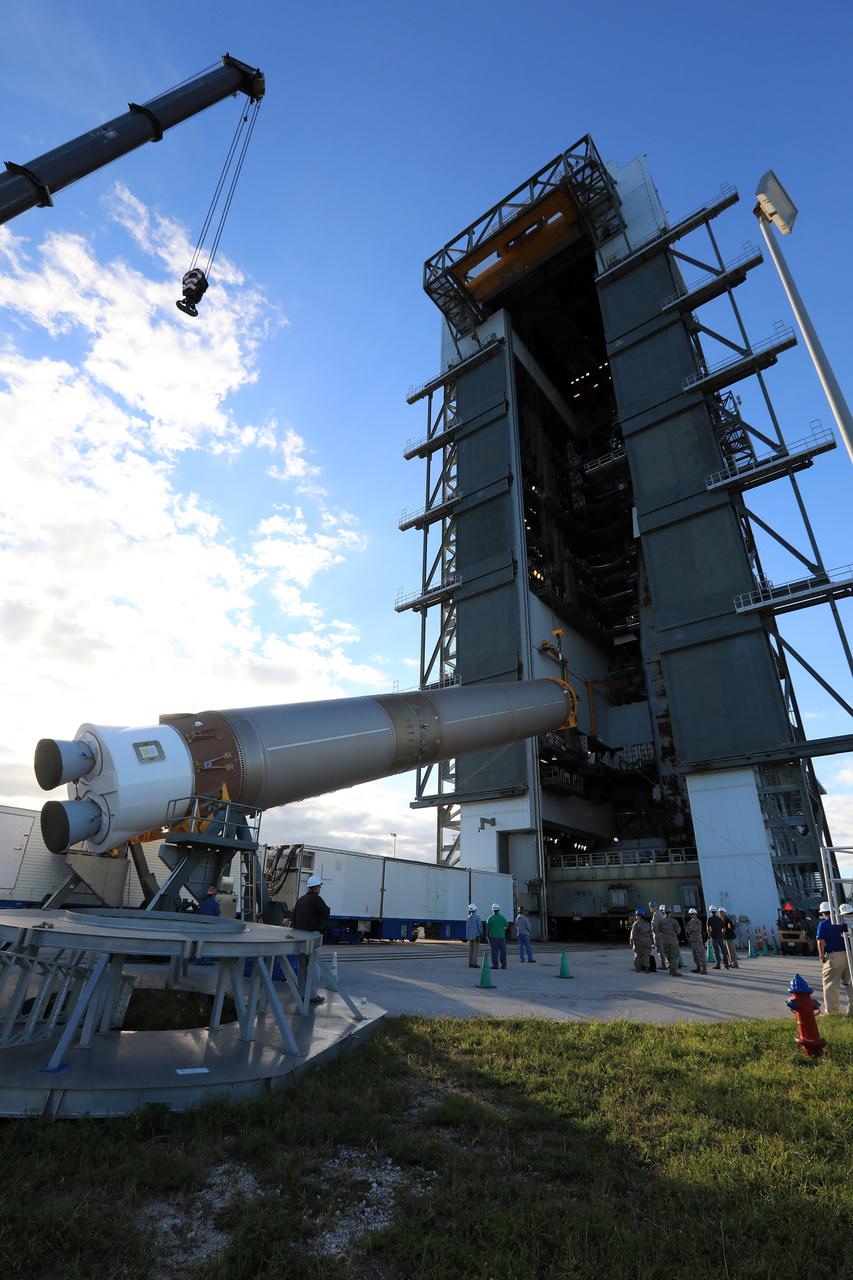
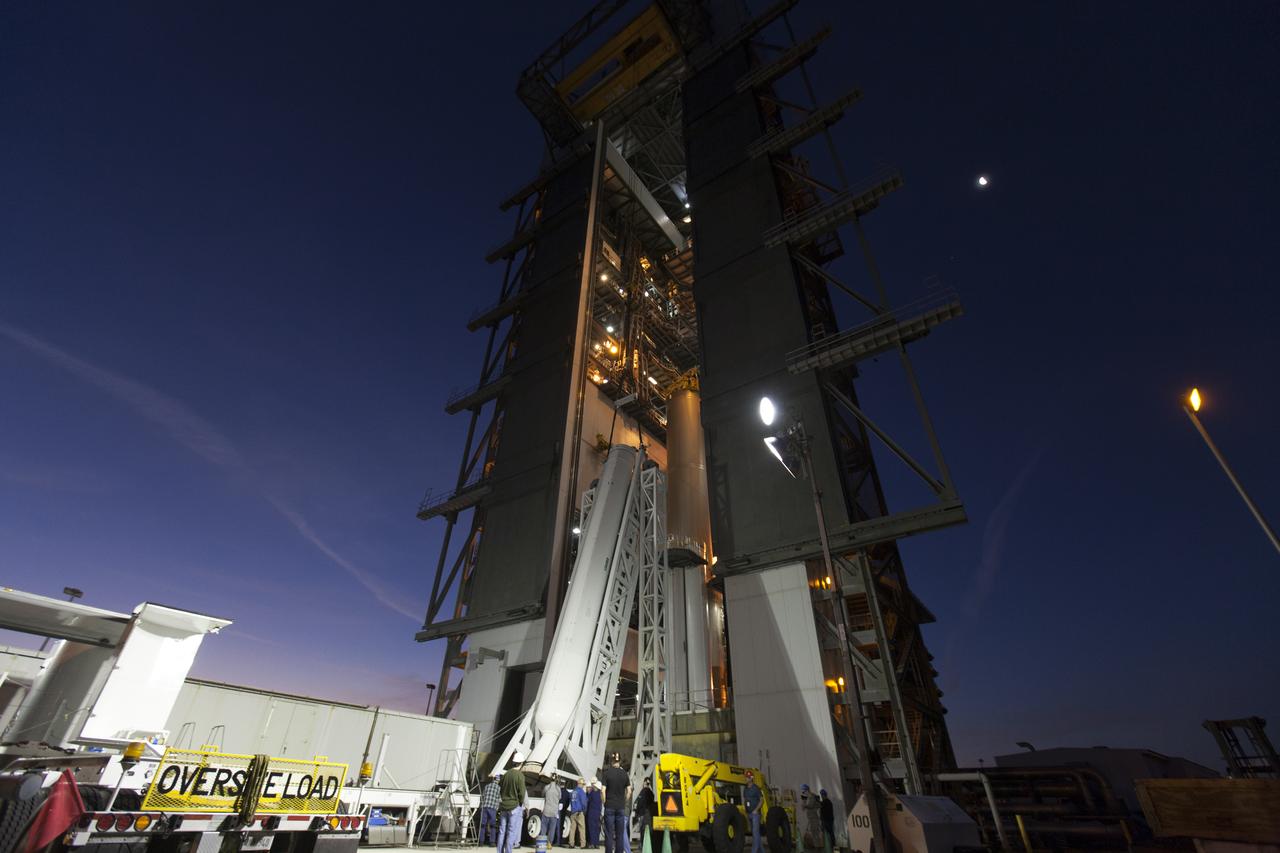
United Launch Alliance team members monitor the progress as the operation begins to lift the Atlas V first stage to the vertical position at the Vertical Integration Facility at Space Launch Complex 41 at Cape Canaveral Air Force Station in Florida. The Geostationary Operational Environmental Satellite (GOES-R) will launch aboard the Atlas V rocket in November. GOES-R will be the first satellite in a series of next-generation NOAA GOES Satellites.
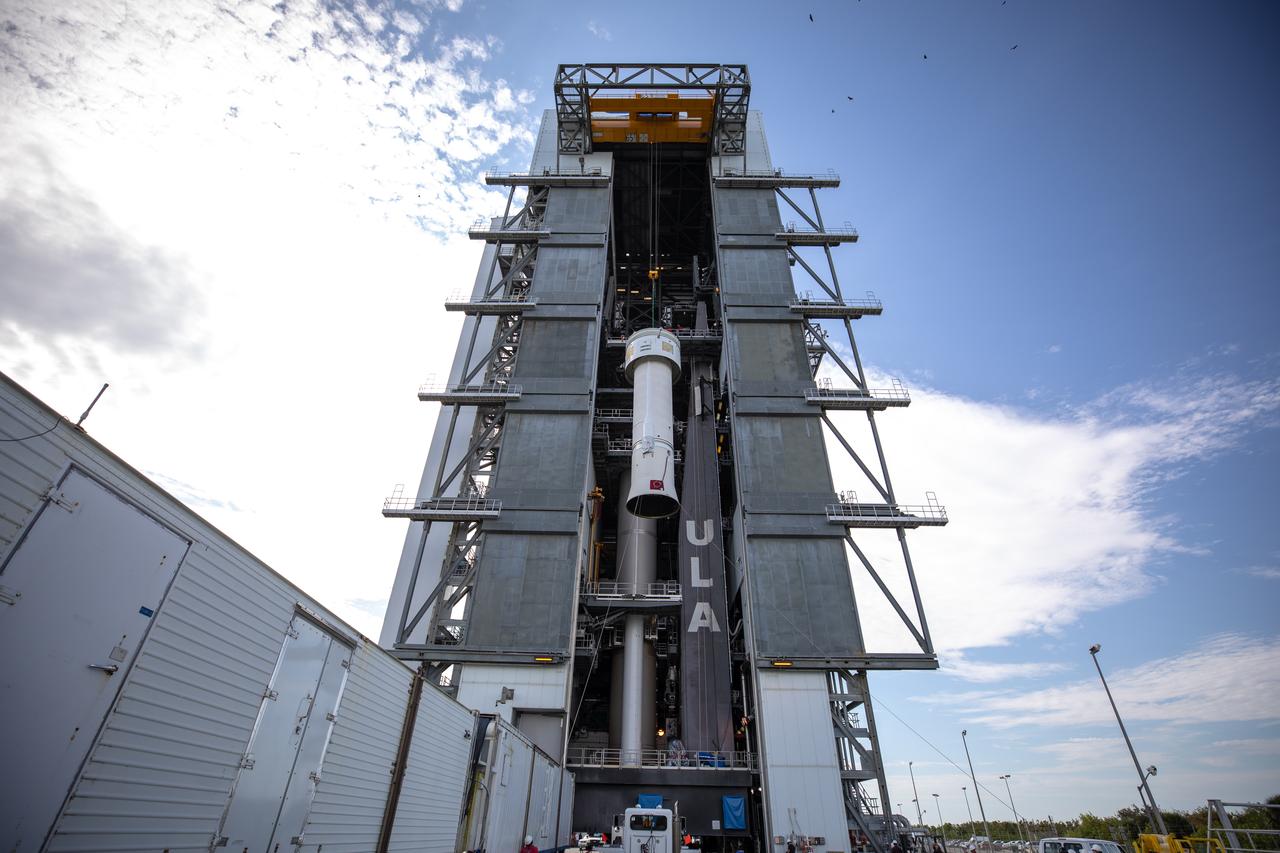
A Centaur upper stage is lifted at the Space Launch Complex 41 Vertical Integration Facility at Florida’s Cape Canaveral Air Force Station on Nov. 8, 2019, for mating to the United Launch Alliance Atlas V first stage in preparation for Boeing’s Orbital Flight Test (OFT). The uncrewed OFT mission will rendezvous and dock Boeing’s CST-100 Starliner spacecraft with the International Space Station as part of NASA’s Commercial Crew Program. Starliner will launch atop the Atlas V rocket from Space Launch Complex 41.

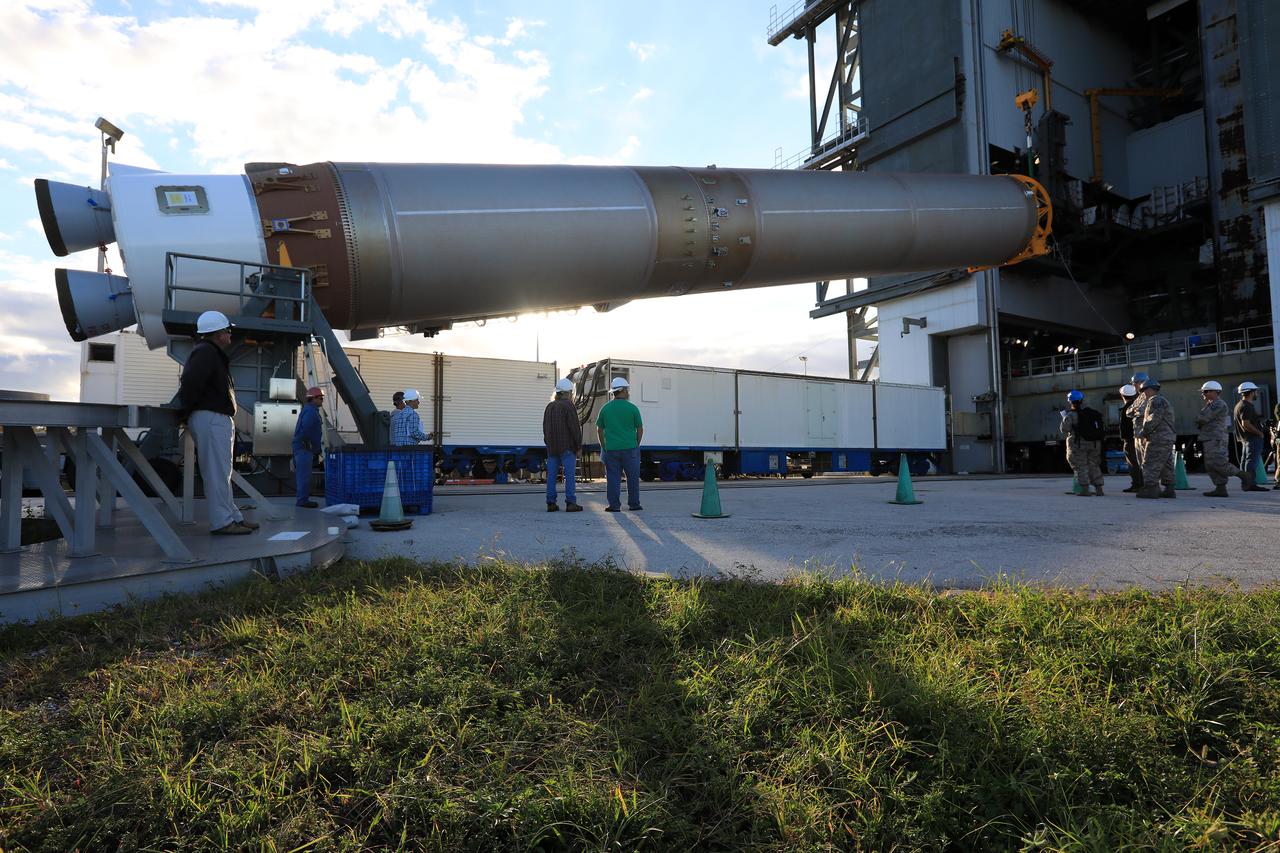
At the Vertical Integration Facility at Space Launch Complex 41 at Cape Canaveral Air Force Station in Florida, a solid rocket booster (SRB) is lifted by a crane for mating to a United Launch Alliance Atlas V first stage. The SRB will help boost NOAA's Geostationary Operational Environmental Satellite, or GOES-S, to orbit. GOES-S is the second in a series of four advanced geostationary weather satellites that will significantly improve the detection and observation of environmental phenomena that directly affect public safety, protection of property and the nation's economic health and prosperity. GOES-S is slated to launch March 1, 2018.
The first stage of the United Launch Alliance (ULA) Atlas V rocket arrives at the Vertical Integration Facility at Space Launch Complex 41 at Cape Canaveral Air Force Station in Florida. The rocket is being prepared for Orbital ATK's seventh commercial resupply mission, CRS-7, to the International Space Station. Orbital ATK's CYGNUS pressurized cargo module is scheduled to launch atop ULA's Atlas V rocket from Pad 41 on March 19, 2017. CYGNUS will deliver thousands of pounds of supplies, equipment and scientific research materials to the space station.
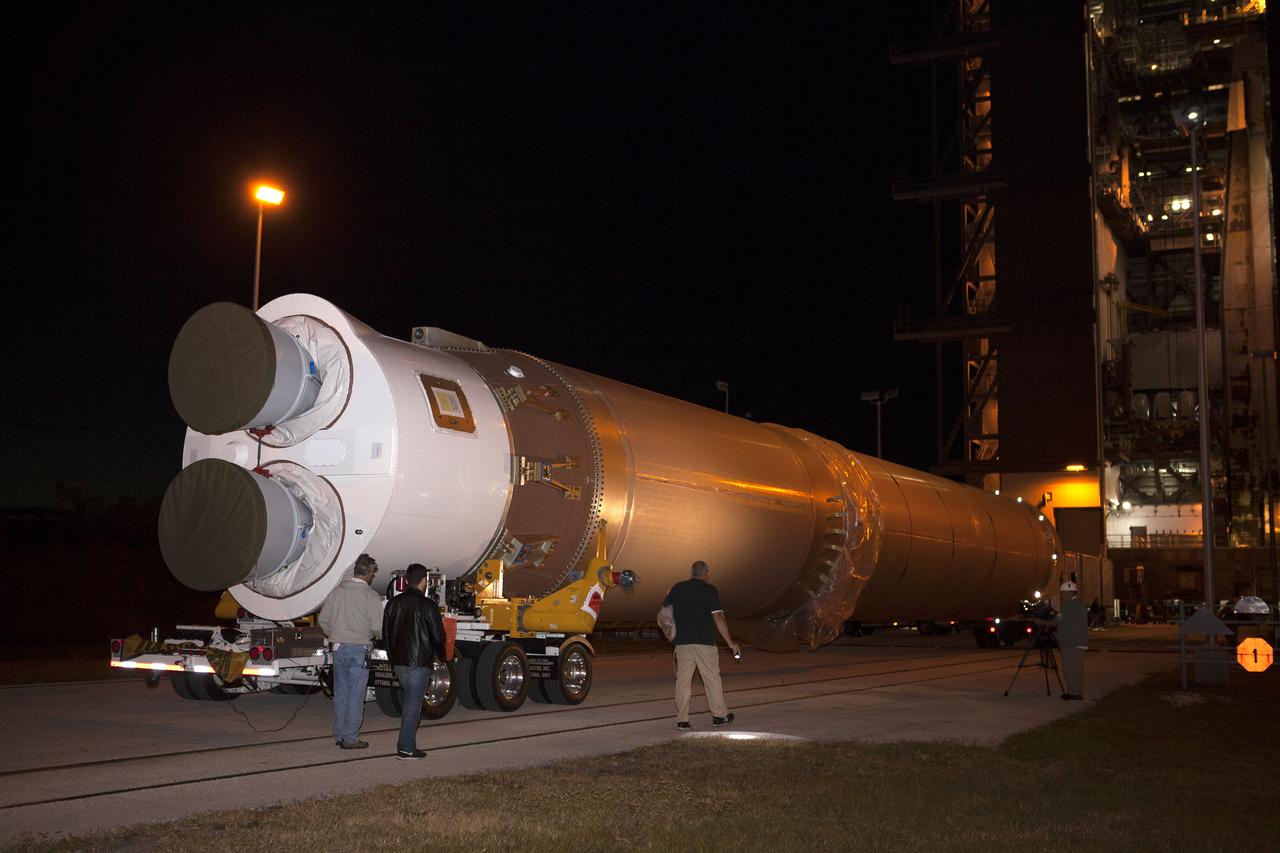
The United Launch Alliance Atlas V first stage arrives at the Vertical Integration Facility at Space Launch Complex 41 at Cape Canaveral Air Force Station in Florida. The Geostationary Operational Environmental Satellite (GOES-R) will launch aboard the Atlas V rocket in November. GOES-R will be the first satellite in a series of next-generation NOAA GOES Satellites.
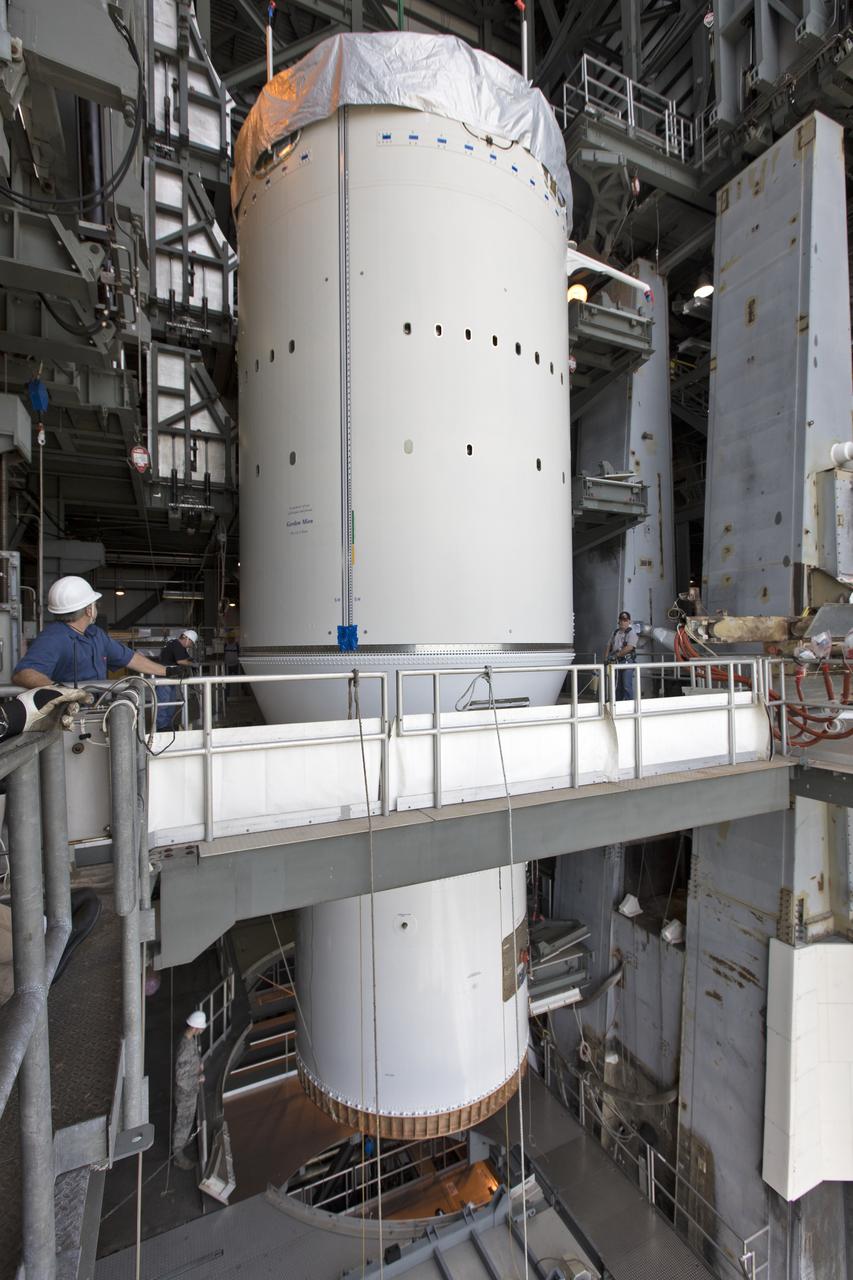
At the Vertical Integration Facility at Space Launch Complex 41 at Cape Canaveral Air Force Station in Florida, technicians and engineers monitor progress as a Centaur upper stage is mated to a United Launch Alliance Atlas V rocket that will boost NOAA's Geostationary Operational Environmental Satellite-S, or GOES-S, to orbit. GOES-S is the second in a series of four advanced geostationary weather satellites that will significantly improve the detection and observation of environmental phenomena that directly affect public safety, protection of property and the nation's economic health and prosperity. GOES-S is slated to launch March 1, 2018.
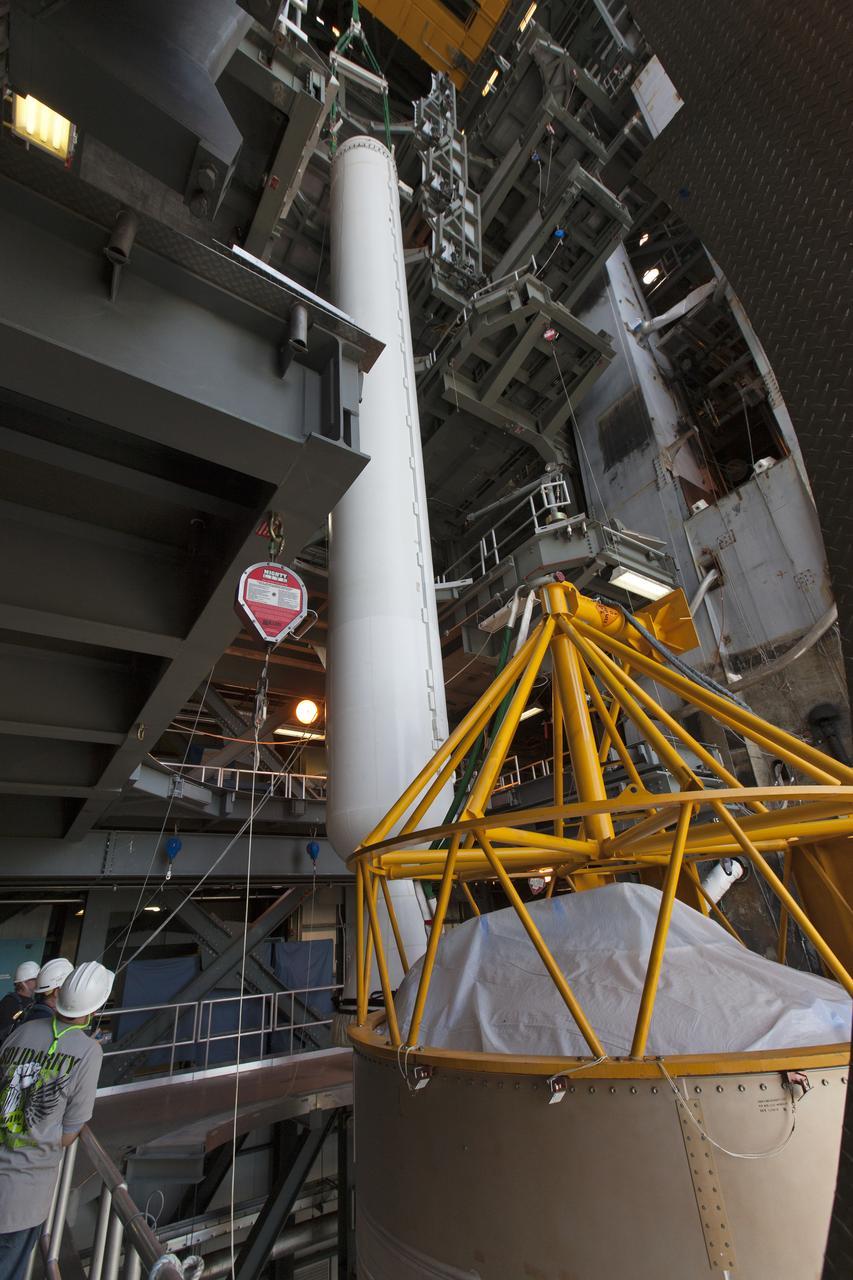
In the Vertical Integration Facility at Space Launch Complex 41 at Cape Canaveral Air Force Station in Florida, a solid rocket booster (SRB) is lifted by a crane for mating to a United Launch Alliance Atlas V first stage. The SRB will help boost NOAA's Geostationary Operational Environmental Satellite, or GOES-S, to orbit. GOES-S is the second in a series of four advanced geostationary weather satellites that will significantly improve the detection and observation of environmental phenomena that directly affect public safety, protection of property and the nation's economic health and prosperity. GOES-S is slated to launch March 1, 2018.
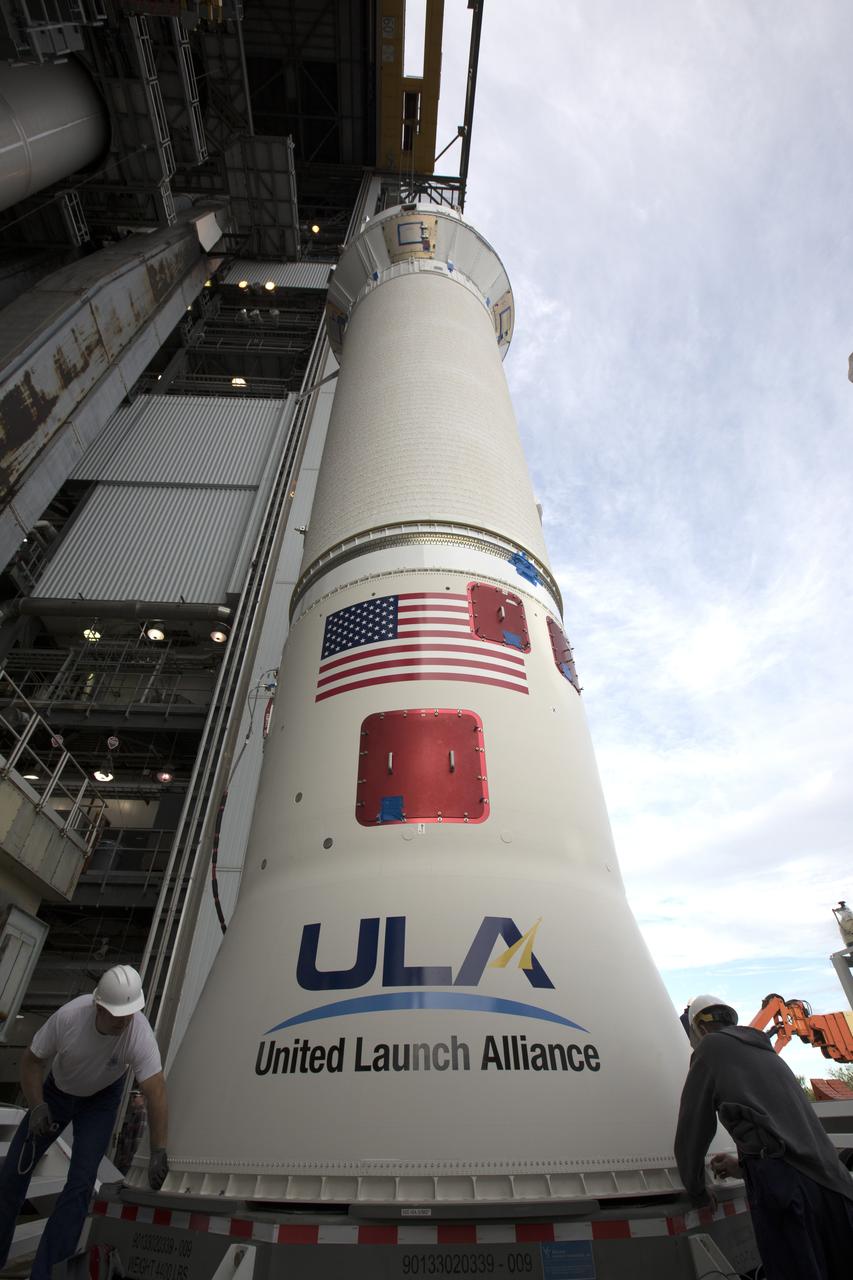
The Centaur upper stage of the United Launch Alliance (ULA) Atlas V rocket arrives at the Vertical Integration Facility at Space Launch Complex 41 at Cape Canaveral Air Force Station in Florida. The Centaur stage will be lifted and mated to the first stage booster. The rocket is being prepared for Orbital ATK's seventh commercial resupply mission, CRS-7, to the International Space Station. Orbital ATK's CYGNUS pressurized cargo module is scheduled to launch atop ULA's Atlas V rocket from Pad 41 on March 19, 2017. CYGNUS will deliver 7,600 of pounds of supplies, equipment and scientific research materials to the space station.
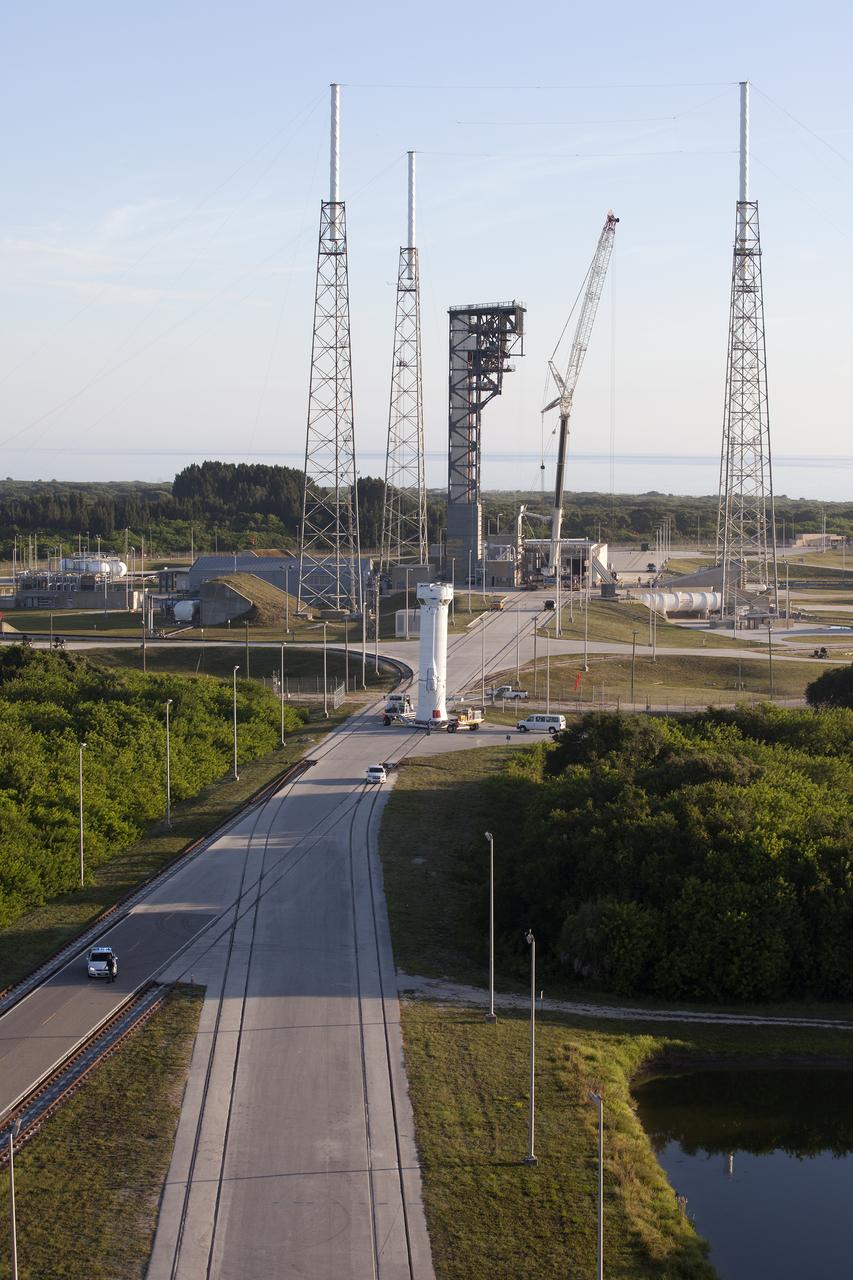
A Centaur upper stage, standing upright on a transporter, arrives at Space Launch Complex 41 on Florida’s Cape Canaveral Air Force Station, where it will be attached to the United Launch Alliance Atlas V rocket first stage booster. The rocket will boost NASA’s Origins, Spectral Interpretation, Resource Identification, Security-Regolith Explorer, or OSIRIS-REx spacecraft. Targeted for liftoff Sept. 8, 2016, OSIRIS-Rex will be the first U.S. mission to sample an asteroid, retrieve at least two ounces of surface material and return it to Earth for study. The asteroid, Bennu, may hold clues to the origin of the solar system and the source of water and organic molecules found on Earth.
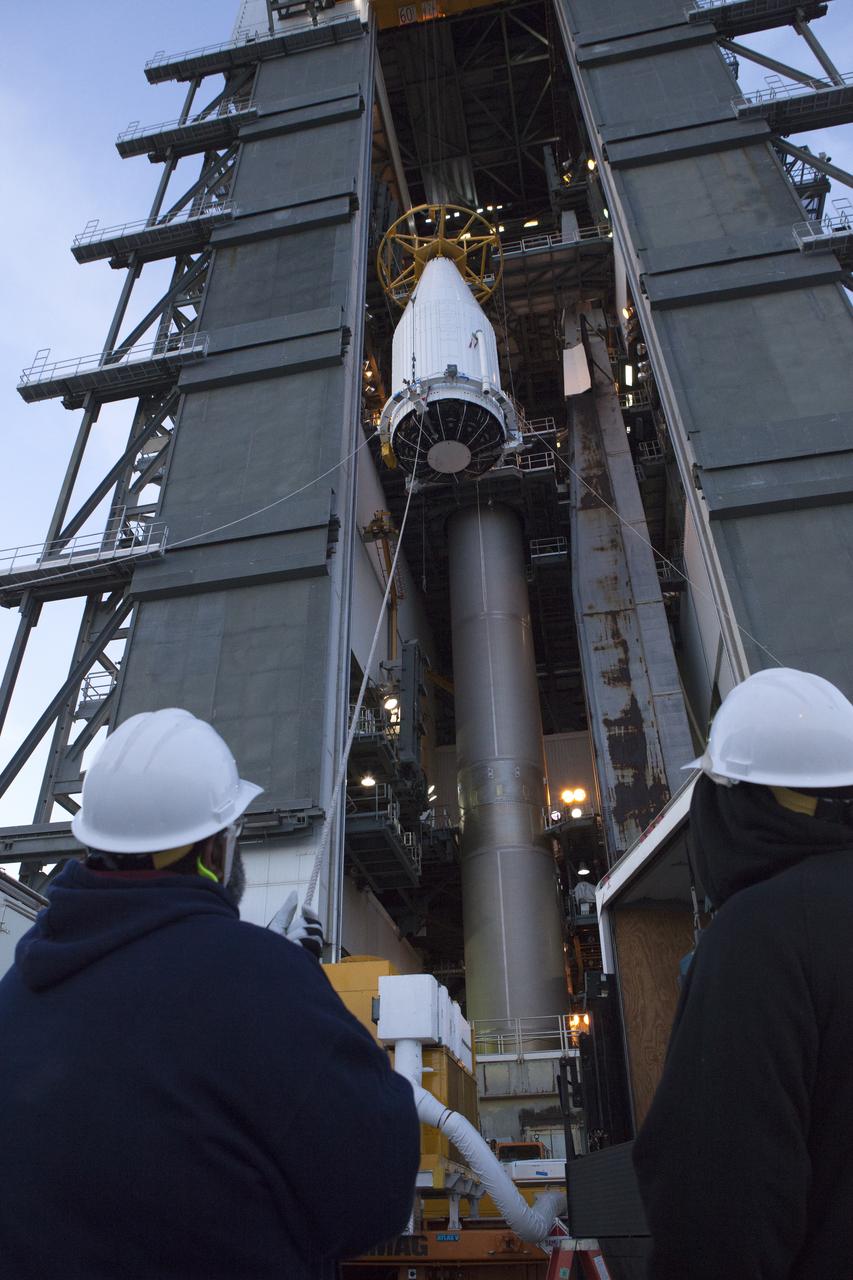
The payload fairing containing the Orbital ATK Cygnus pressurized cargo module is hoisted up by crane at the United Launch Alliance (ULA) Vertical Integration Facility at Space Launch Complex 41 at Cape Canaveral Air Force Station in Florida. The payload will be mated to the ULA Atlas V rocket. The Orbital ATK CRS-7 commercial resupply services mission to the International Space Station is scheduled to launch atop the Atlas V from pad 41. Cygnus will deliver 7,600 pounds of supplies, equipment and scientific research materials to the space station.
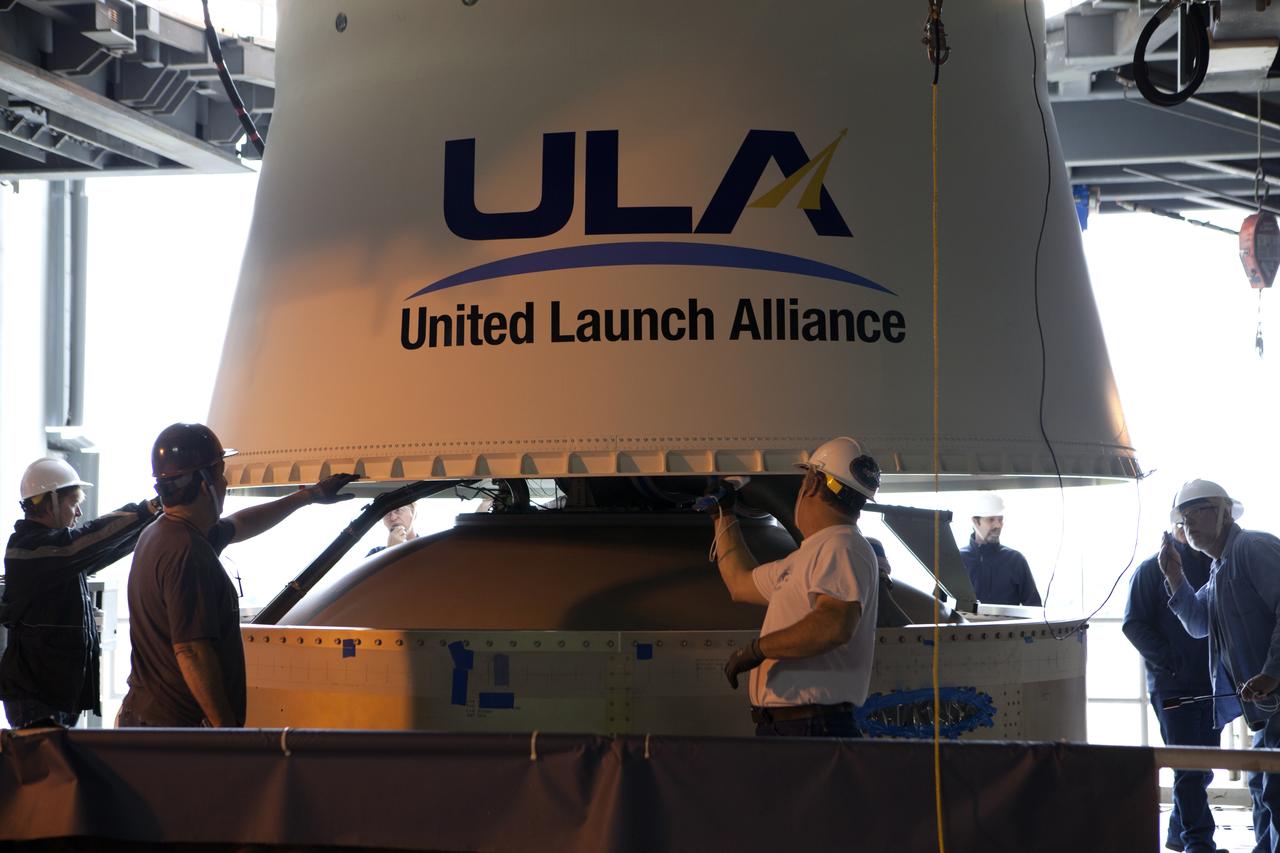
Technicians with United Launch Alliance (ULA) assist as the Centaur upper stage of the ULA Atlas V rocket is lowered onto the first stage booster inside the Vertical Integration Facility at Space Launch Complex 41 at Cape Canaveral Air Force Station in Florida. The rocket is being prepared for Orbital ATK's seventh commercial resupply mission, CRS-7, to the International Space Station. Orbital ATK's CYGNUS pressurized cargo module is scheduled to launch atop ULA's Atlas V rocket from Pad 41 on March 19, 2017. CYGNUS will deliver 7,600 of pounds of supplies, equipment and scientific research materials to the space station.
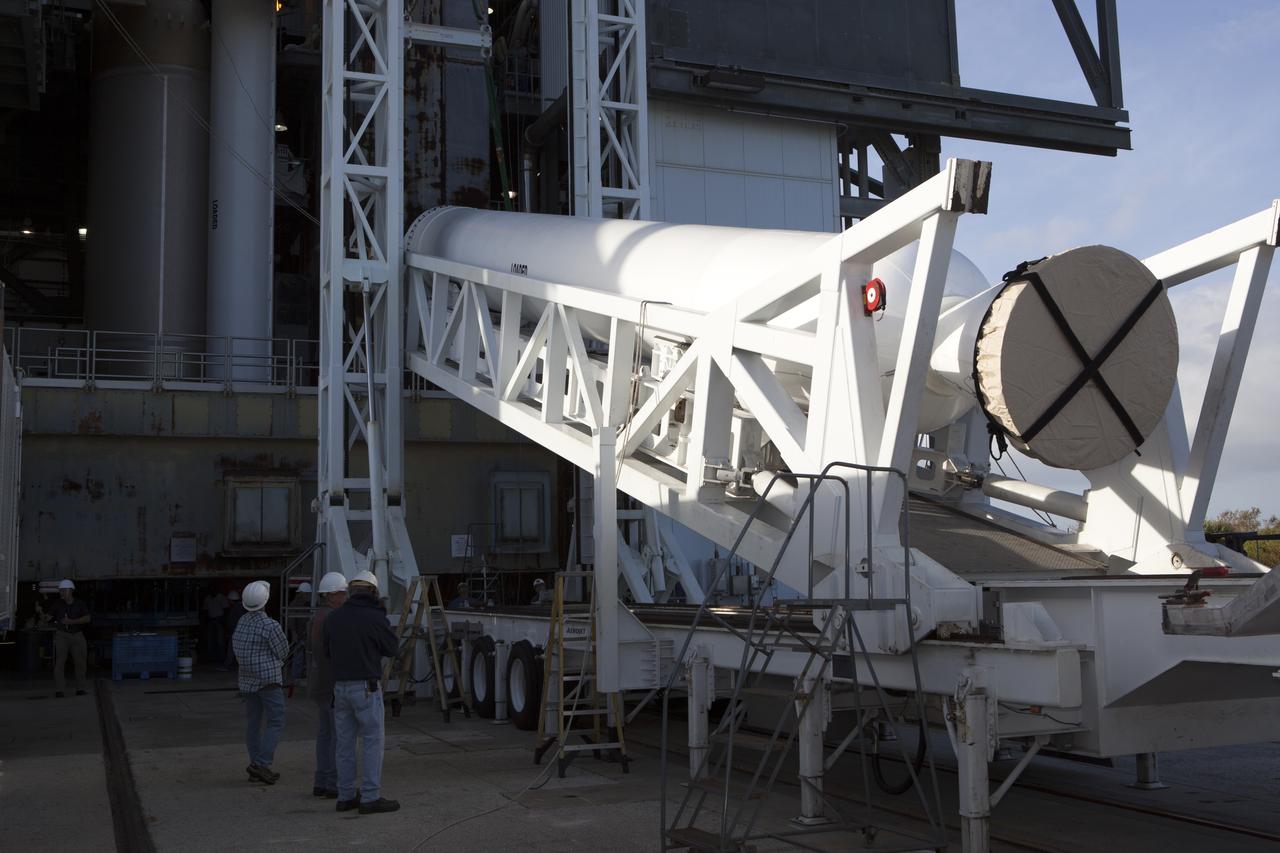
The solid rocket motor is lifted on its transporter for mating to the United Launch Alliance Atlas V rocket in the Vertical Integration Facility at Space Launch Complex 41 at Cape Canaveral Air Force Station in Florida. NOAA's Geostationary Operational Environmental Satellite (GOES-R) will launch aboard the Atlas V rocket this month. GOES-R is the first satellite in a series of next-generation NOAA GOES Satellites.
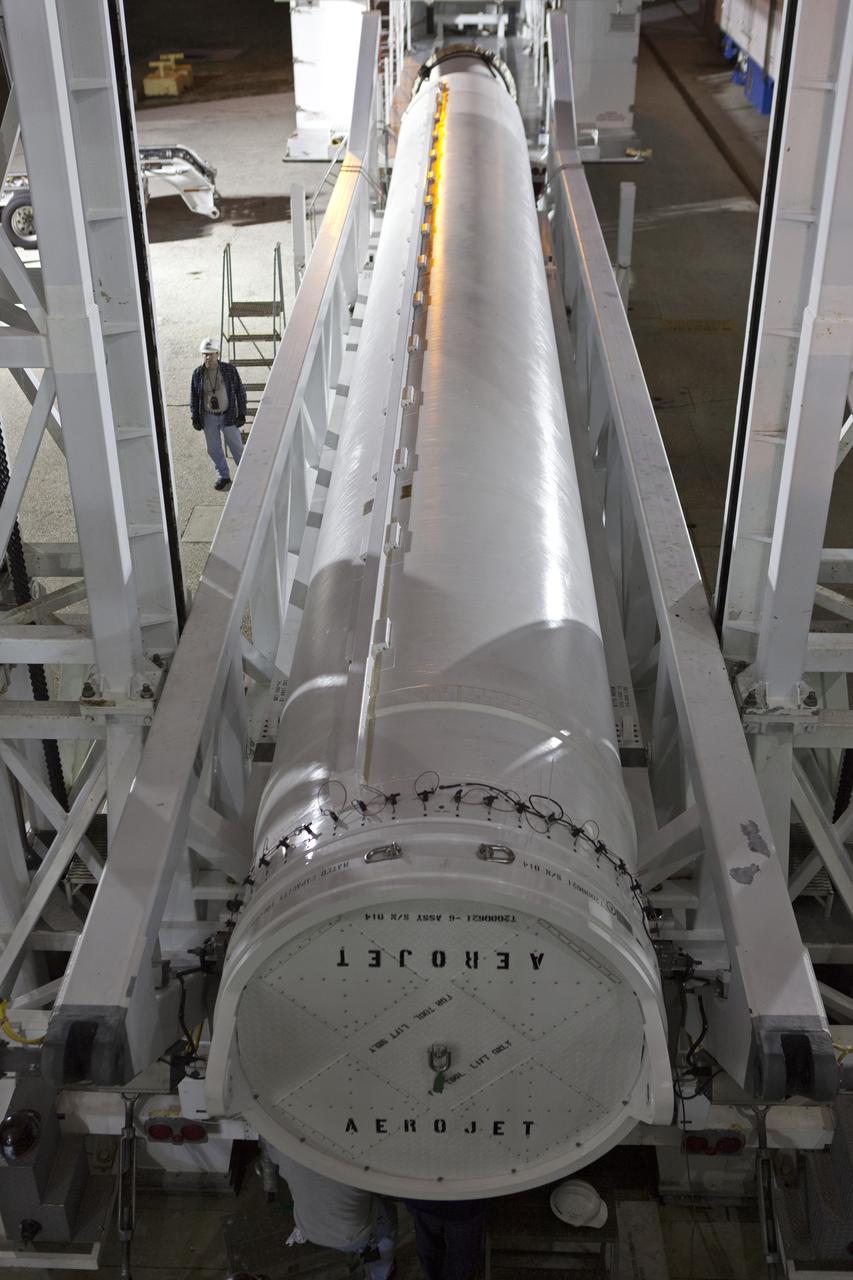
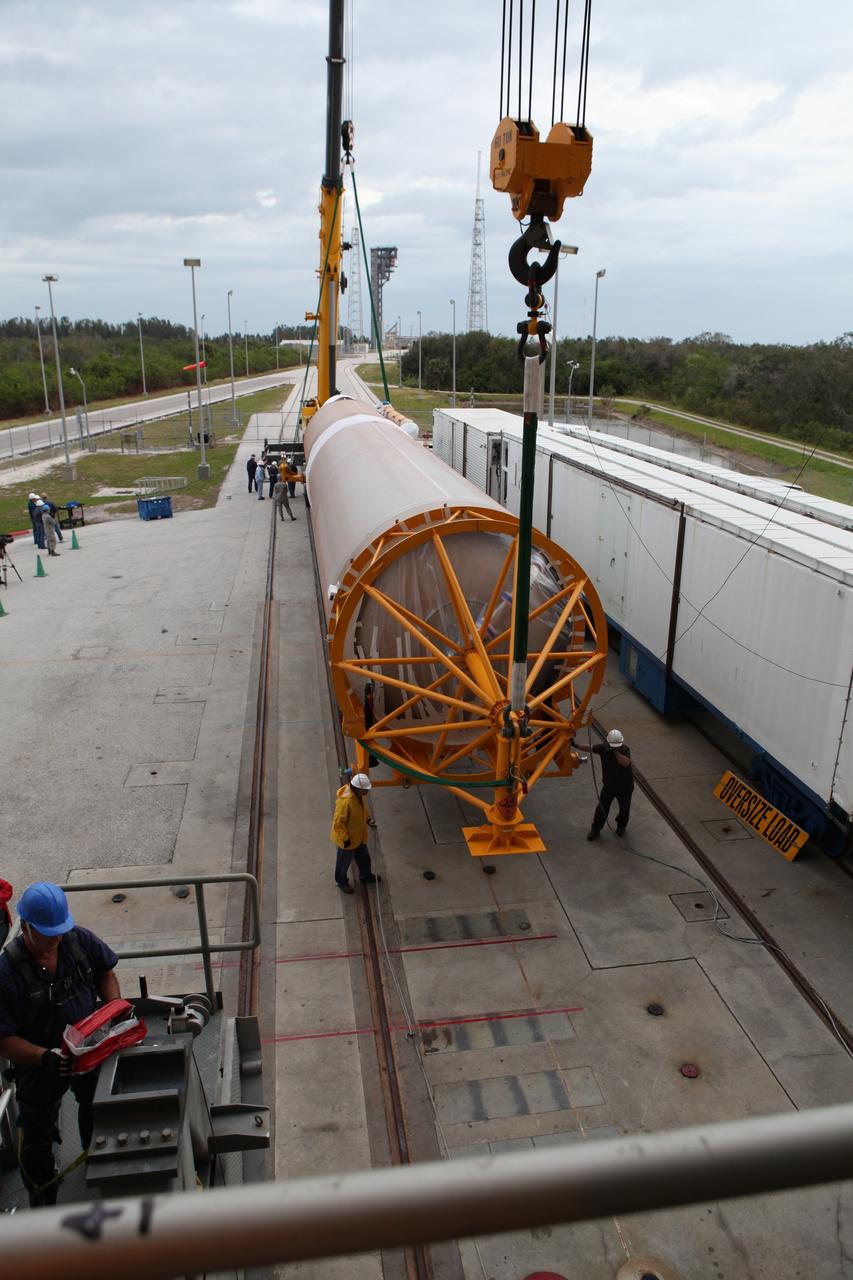
At the Vertical Integration Facility at Space Launch Complex 41 at Cape Canaveral Air Force Station in Florida, a solid rocket booster (SRB) is prepared for mating to a United Launch Alliance Atlas V first stage. The SRB will help boost NOAA's Geostationary Operational Environmental Satellite, or GOES-S, to orbit. GOES-S is the second in a series of four advanced geostationary weather satellites that will significantly improve the detection and observation of environmental phenomena that directly affect public safety, protection of property and the nation's economic health and prosperity. GOES-S is slated to launch March 1, 2018.
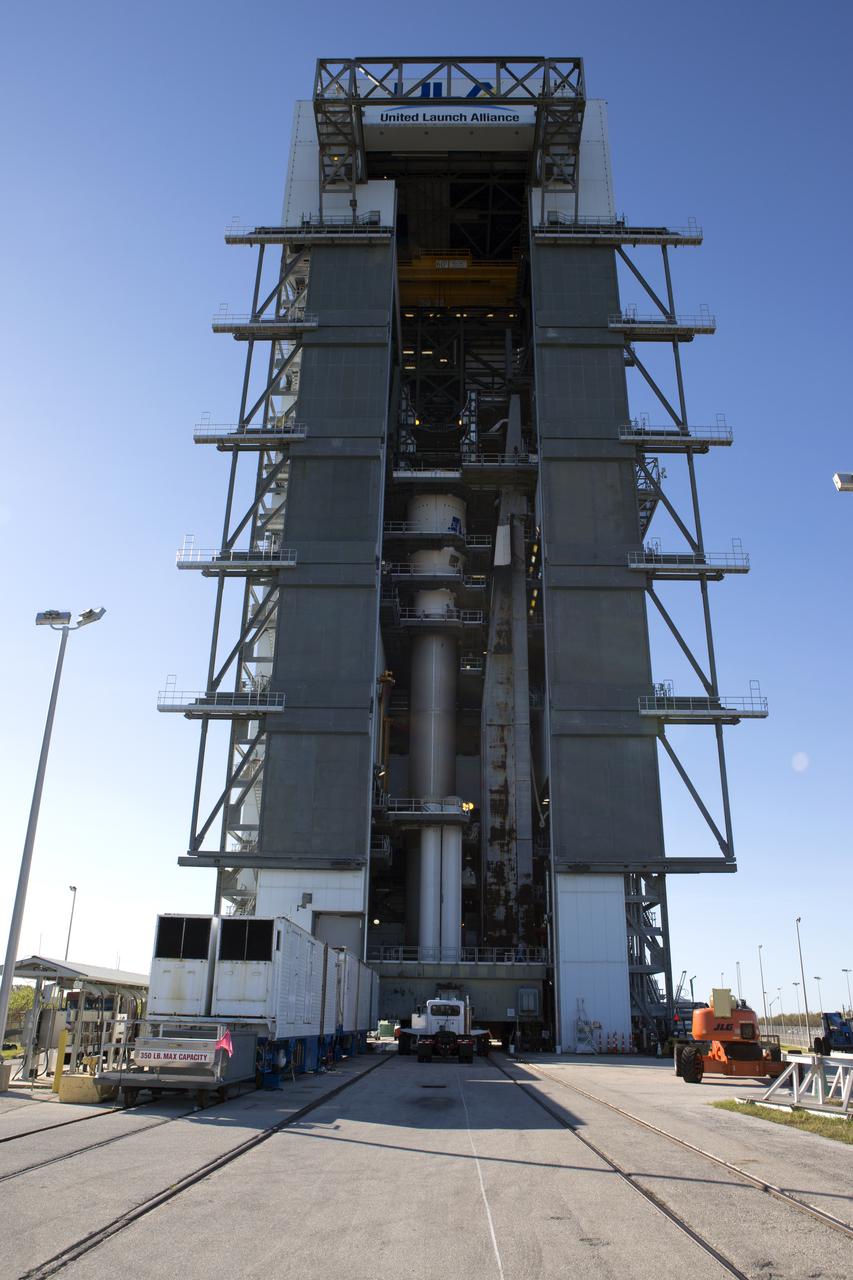
Operations are underway to stack the United Launch Alliance Atlas V Centaur second stage onto the first stage in the Vertical Integration Facility at Space Launch Complex 41 at Cape Canaveral Air Force Station in Florida. The Geostationary Operational Environmental Satellite (GOES-R) will launch aboard the Atlas V rocket in November. GOES-R is the first satellite in a series of next-generation NOAA GOES Satellites.
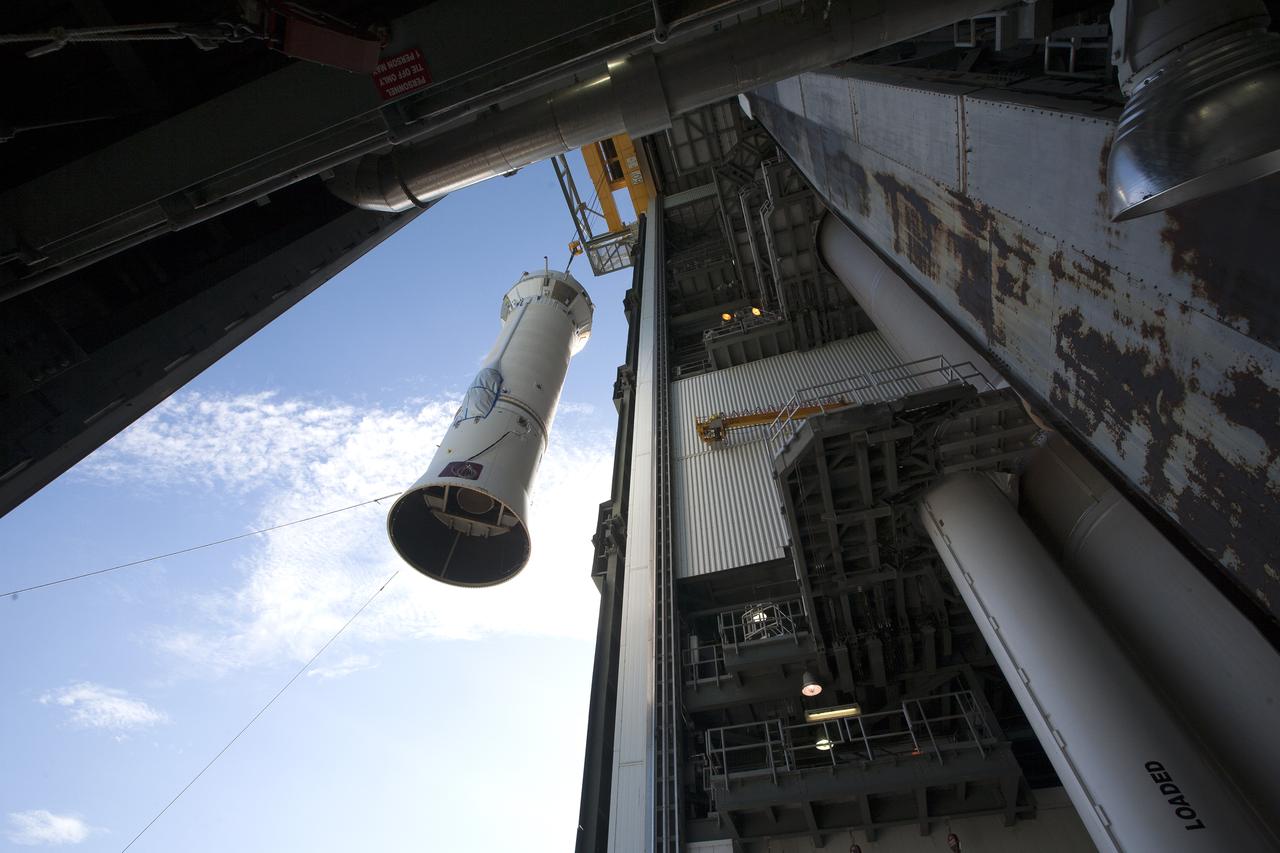
A Centaur upper stage is lifted at Space Launch Complex 41 on Florida’s Cape Canaveral Air Force Station, where it will be attached to the United Launch Alliance Atlas V rocket first stage booster. The rocket will boost NASA’s Origins, Spectral Interpretation, Resource Identification, Security-Regolith Explorer, or OSIRIS-REx spacecraft. Targeted for liftoff Sept. 8, 2016, OSIRIS-Rex will be the first U.S. mission to sample an asteroid, retrieve at least two ounces of surface material and return it to Earth for study. The asteroid, Bennu, may hold clues to the origin of the solar system and the source of water and organic molecules found on Earth.

A crane is used to lift the payload fairing containing NASA's Tracking and Data Relay Satellite (TDRS-M) at the Vertical Integration Facility at Space Launch Complex 41 at Cape Canaveral Air Force Station in Florida. TDRS-M will be stacked atop the United Launch Alliance Atlas V Centaur upper stage. TDRS-M will be the latest spacecraft destined for the agency's constellation of communications satellites that allows nearly continuous contact with orbiting spacecraft ranging from the International Space Station and Hubble Space Telescope to the array of scientific observatories. Liftoff atop the ULA Atlas V rocket is scheduled for Aug. 18, 2017.
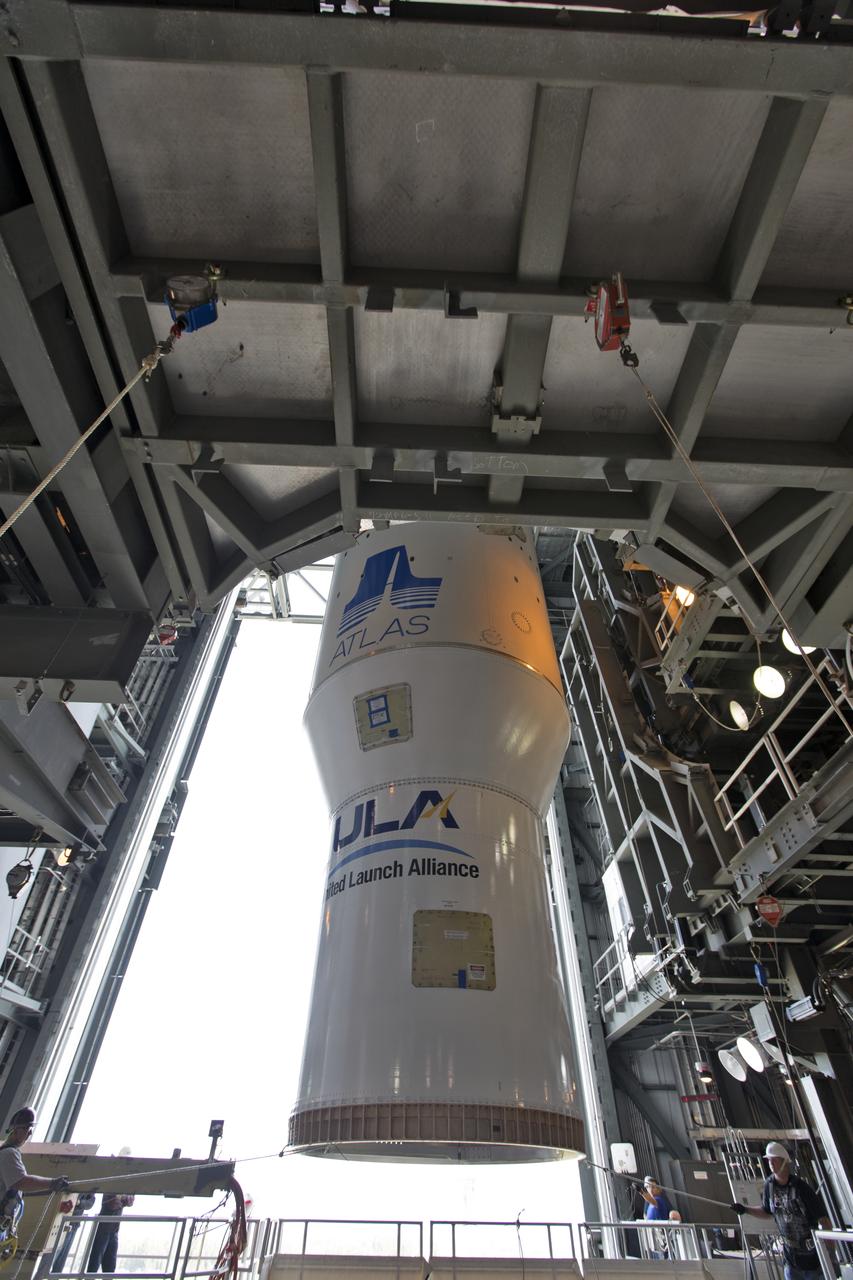
At the Vertical Integration Facility at Space Launch Complex 41 at Cape Canaveral Air Force Station in Florida, a crane lifts a Centaur upper stage for mating to a United Launch Alliance Atlas V rocket that will boost NOAA's Geostationary Operational Environmental Satellite-S, or GOES-S, to orbit. GOES-S is the second in a series of four advanced geostationary weather satellites that will significantly improve the detection and observation of environmental phenomena that directly affect public safety, protection of property and the nation's economic health and prosperity. GOES-S is slated to launch March 1, 2018.
SPACE X MMRTG Offload and Lift for Insertion
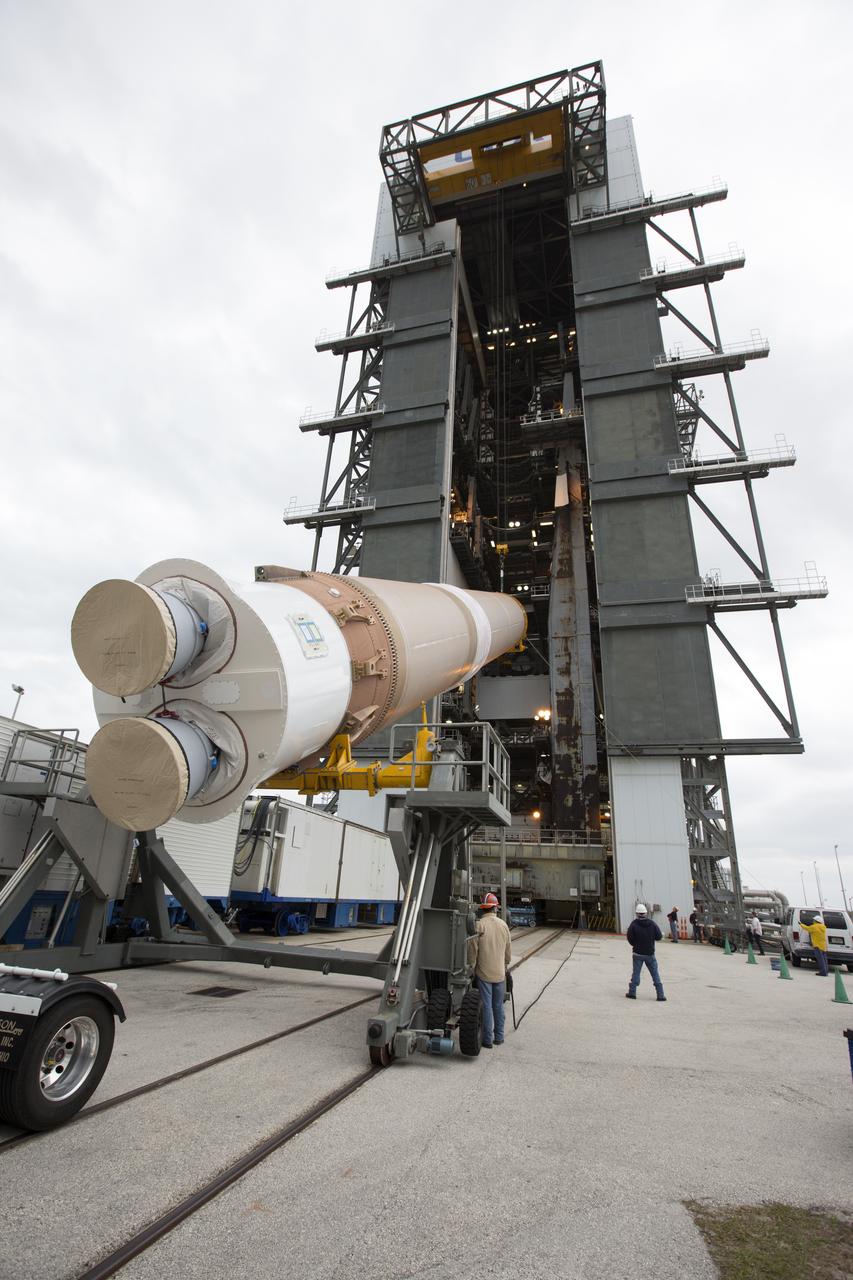
The first stage of the United Launch Alliance (ULA) Atlas V rocket is moved into the Vertical Integration Facility at Space Launch Complex 41 at Cape Canaveral Air Force Station in Florida. The rocket is being prepared for Orbital ATK's seventh commercial resupply mission, CRS-7, to the International Space Station. Orbital ATK's CYGNUS pressurized cargo module is scheduled to launch atop ULA's Atlas V rocket from Pad 41 on March 19, 2017. CYGNUS will deliver thousands of pounds of supplies, equipment and scientific research materials to the space station.
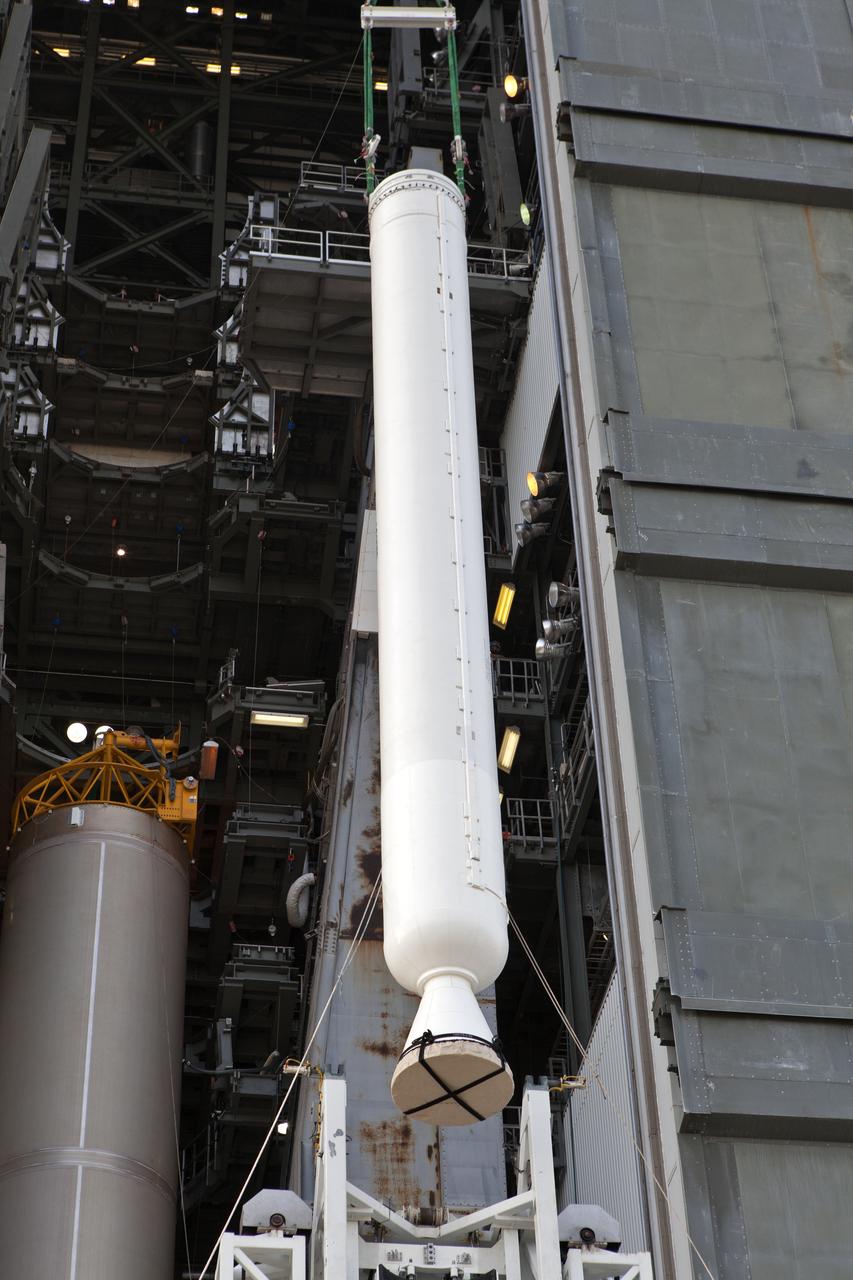
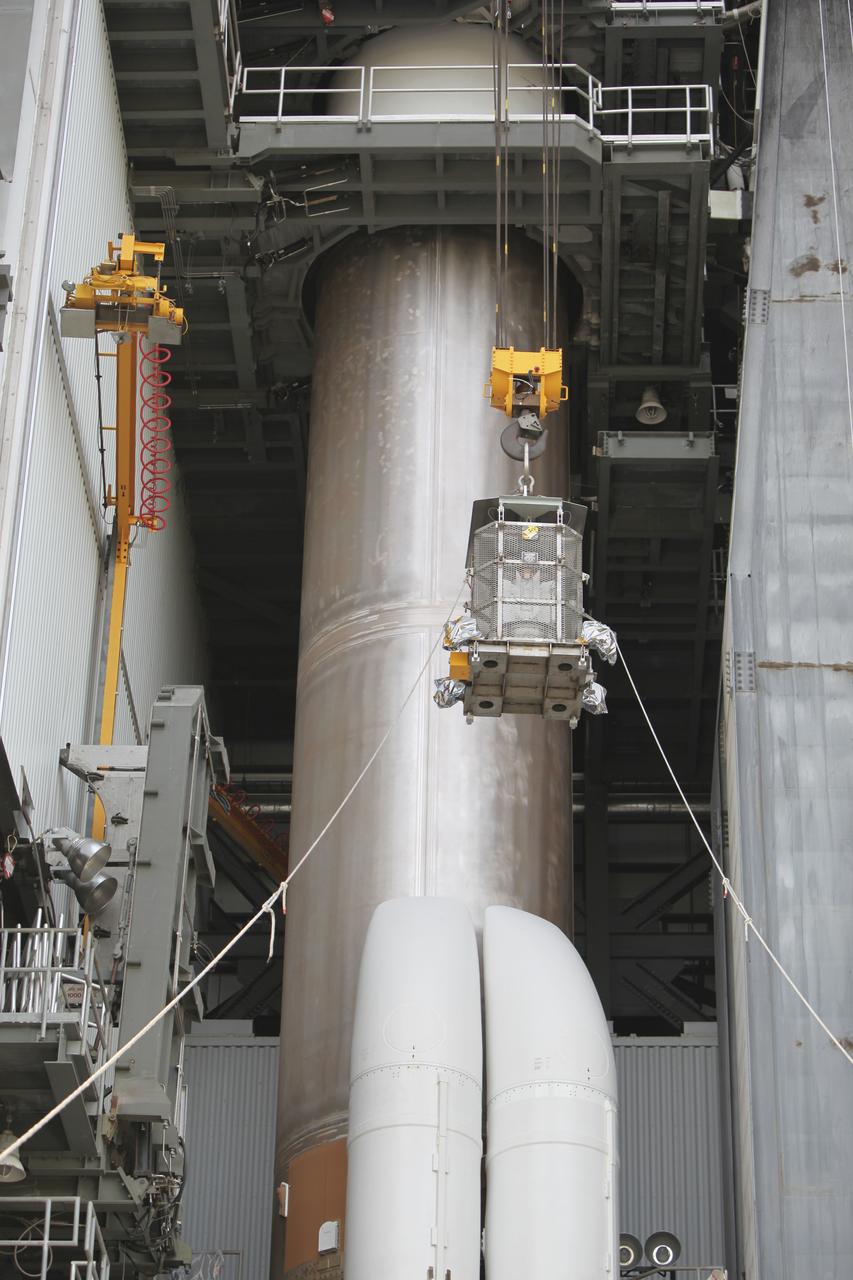
At the Vertical Integration Facility at Space Launch Complex 41 at Cape Canaveral Air Force Station in Florida, a solid rocket booster (SRB) is lifted by a crane for mating to a United Launch Alliance Atlas V first stage. The SRB will help boost NOAA's Geostationary Operational Environmental Satellite, or GOES-S, to orbit. GOES-S is the second in a series of four advanced geostationary weather satellites that will significantly improve the detection and observation of environmental phenomena that directly affect public safety, protection of property and the nation's economic health and prosperity. GOES-S is slated to launch March 1, 2018.
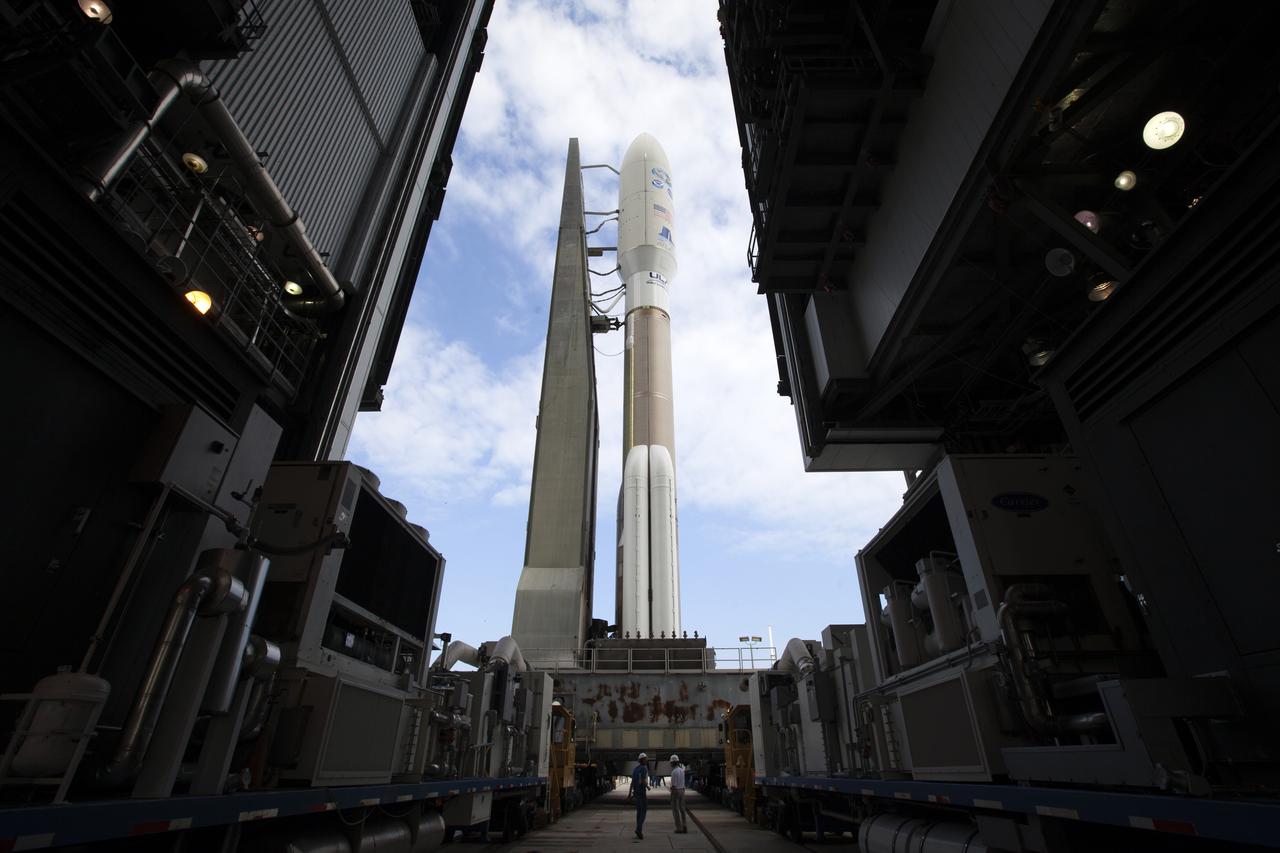
With blue sky in the background, a United Launch Alliance Atlas V rocket begins its rollout from the Vehicle Integration Facility to Space Launch Complex 41 at Cape Canaveral Air Force Station in Florida. The launch vehicle will send the Geostationary Operational Environmental Satellite (GOES-R) to a geostationary position over the U.S. GOES-R is the first satellite in a series of next-generation NOAA GOES satellites.
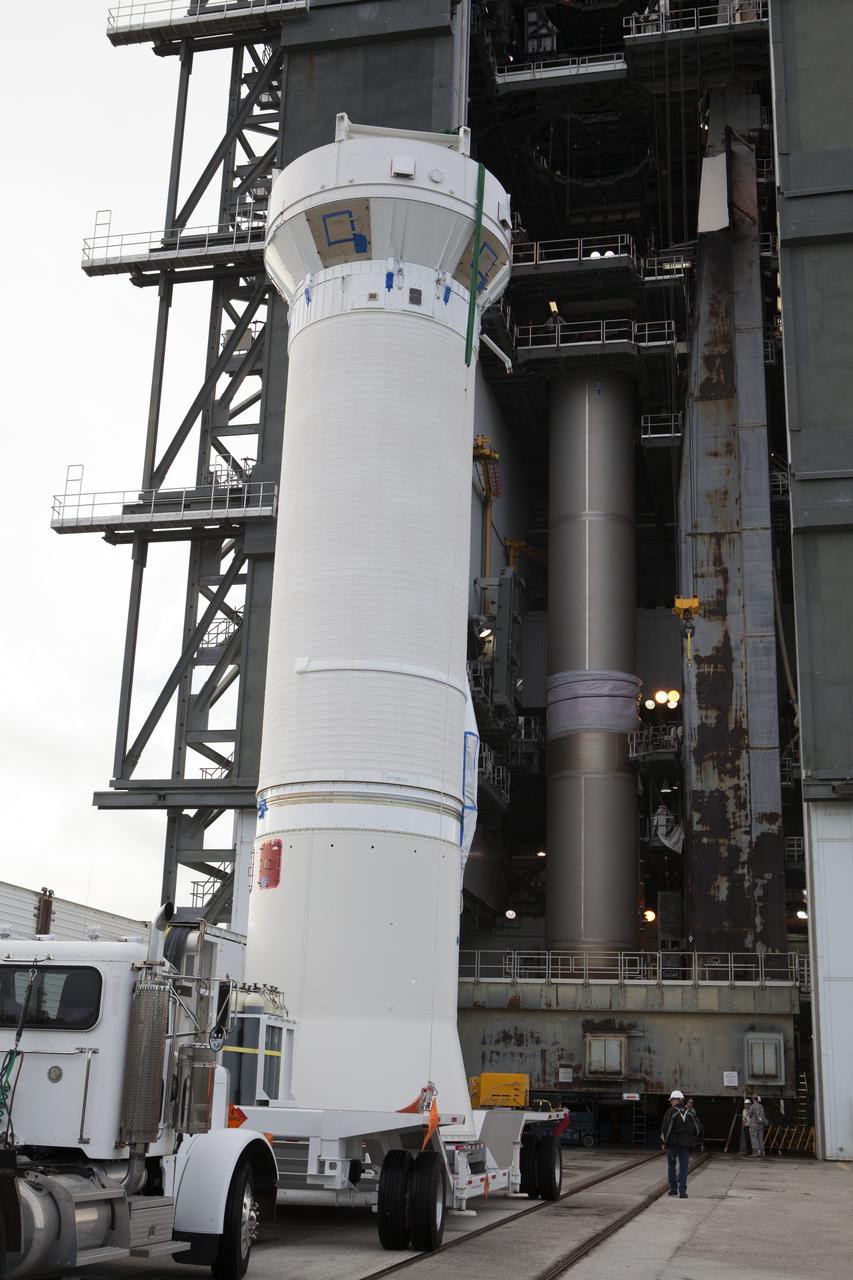
The Centaur upper stage of the United Launch Alliance (ULA) Atlas V rocket arrives at the Vertical Integration Facility at Space Launch Complex 41 at Cape Canaveral Air Force Station in Florida. The Centaur stage will be lifted and mated to the first stage booster. The rocket is being prepared for Orbital ATK's seventh commercial resupply mission, CRS-7, to the International Space Station. Orbital ATK's CYGNUS pressurized cargo module is scheduled to launch atop ULA's Atlas V rocket from Pad 41 on March 19, 2017. CYGNUS will deliver 7,600 pounds of supplies, equipment and scientific research materials to the space station.
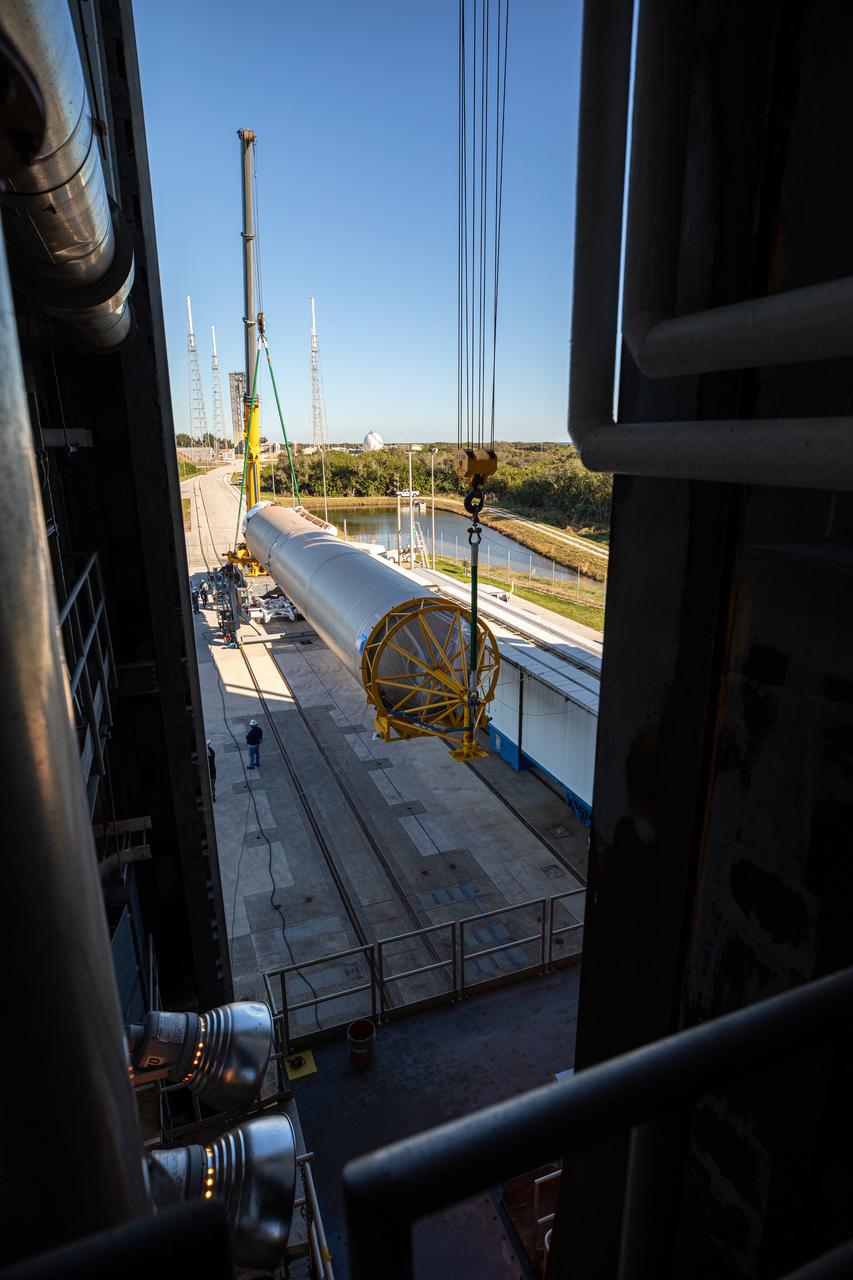
The booster of a United Launch Alliance Atlas V rocket that will launch the Solar Orbiter spacecraft is lifted into the vertical position at the Vertical Integration Facility near Space Launch Complex 41 at Cape Canaveral Air Force Station in Florida on Jan. 6, 2020. Solar Orbiter is an international cooperative mission between ESA (European Space Agency) and NASA. The mission aims to study the Sun, its outer atmosphere and solar wind. The spacecraft will provide the first images of the Sun’s poles. NASA’s Launch Services Program based at Kennedy Space Center in Florida is managing the launch.
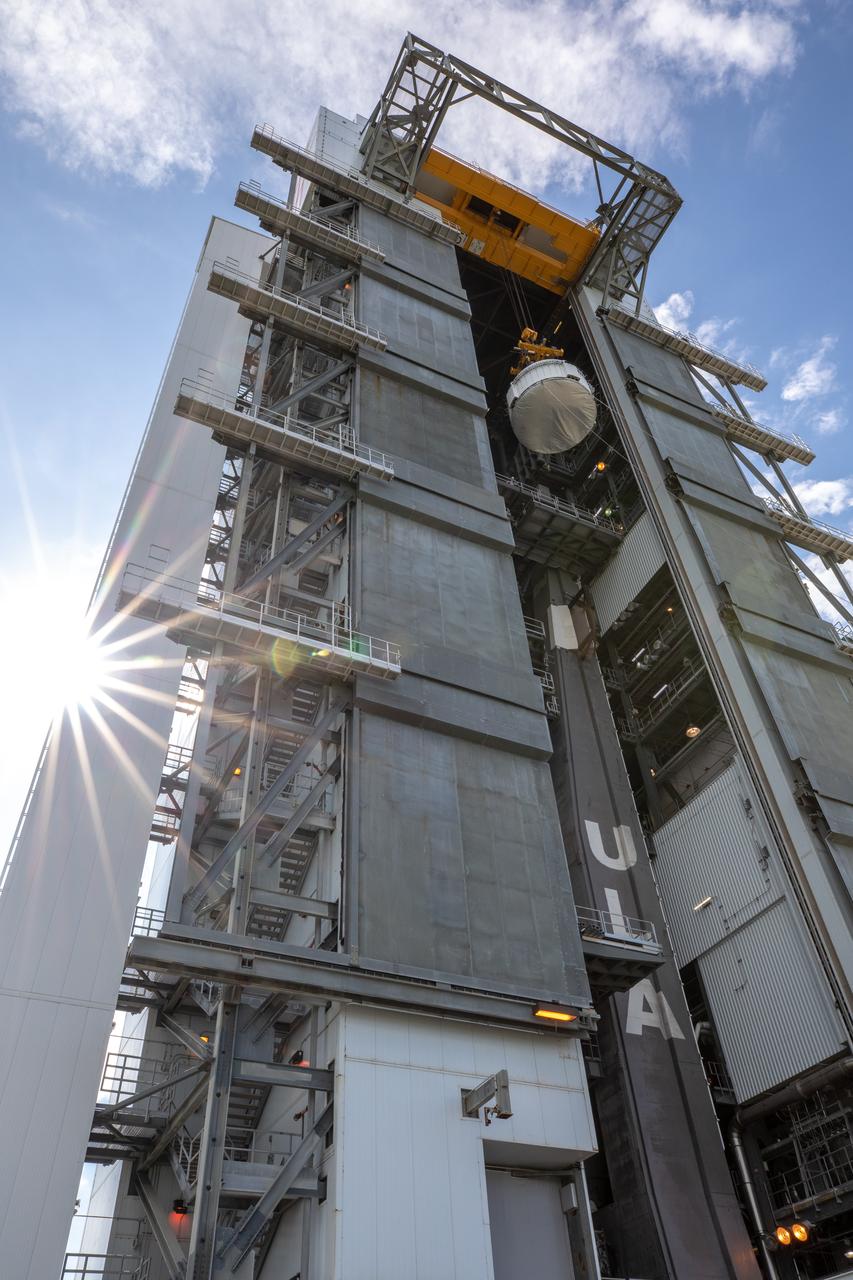
The Boeing CST-100 Starliner spacecraft is lifted at the Vertical Integration Facility at Space Launch Complex 41 at Florida’s Cape Canaveral Air Force Station on Nov. 21, 2019. Starliner will be secured atop a United Launch Alliance Atlas V rocket for Boeing’s Orbital Flight Test to the International Space Station for NASA’s Commercial Crew Program. The spacecraft rolled out from Boeing’s Commercial Crew and Cargo Processing Facility at NASA’s Kennedy Space Center earlier in the day.
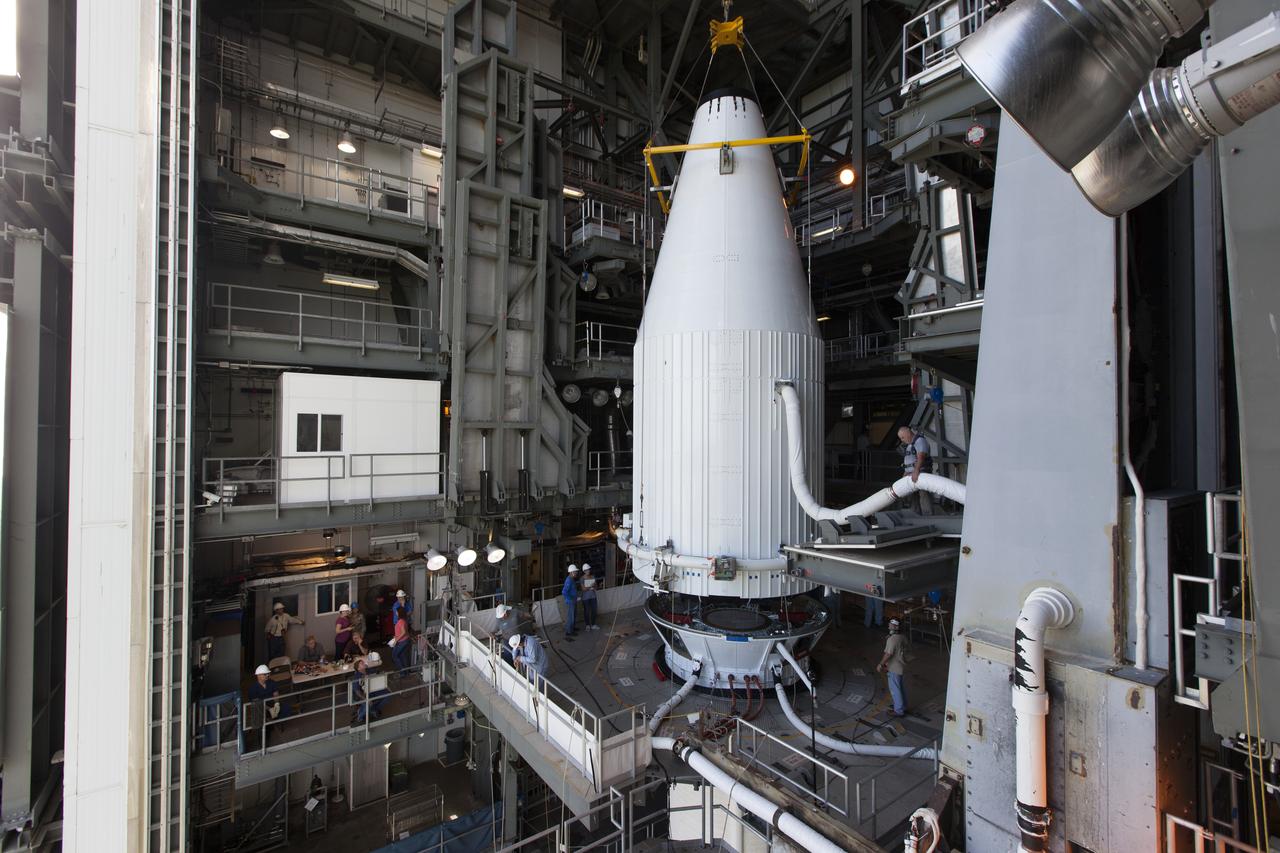
Encapsulated in its payload fairing, Tracking and Data Relay Satellite (TDRS-M) is mated to the United Launch Alliance Atlas V Centaur upper stage in the Vertical Integration Facility at Space Launch Complex 41 at Cape Canaveral Air Force Station in Florida. TDRS-M will be the latest spacecraft destined for the agency's constellation of communications satellites that allows nearly continuous contact with orbiting spacecraft ranging from the International Space Station and Hubble Space Telescope to the array of scientific observatories. Liftoff atop the ULA Atlas V rocket is scheduled for Aug. 18, 2017.
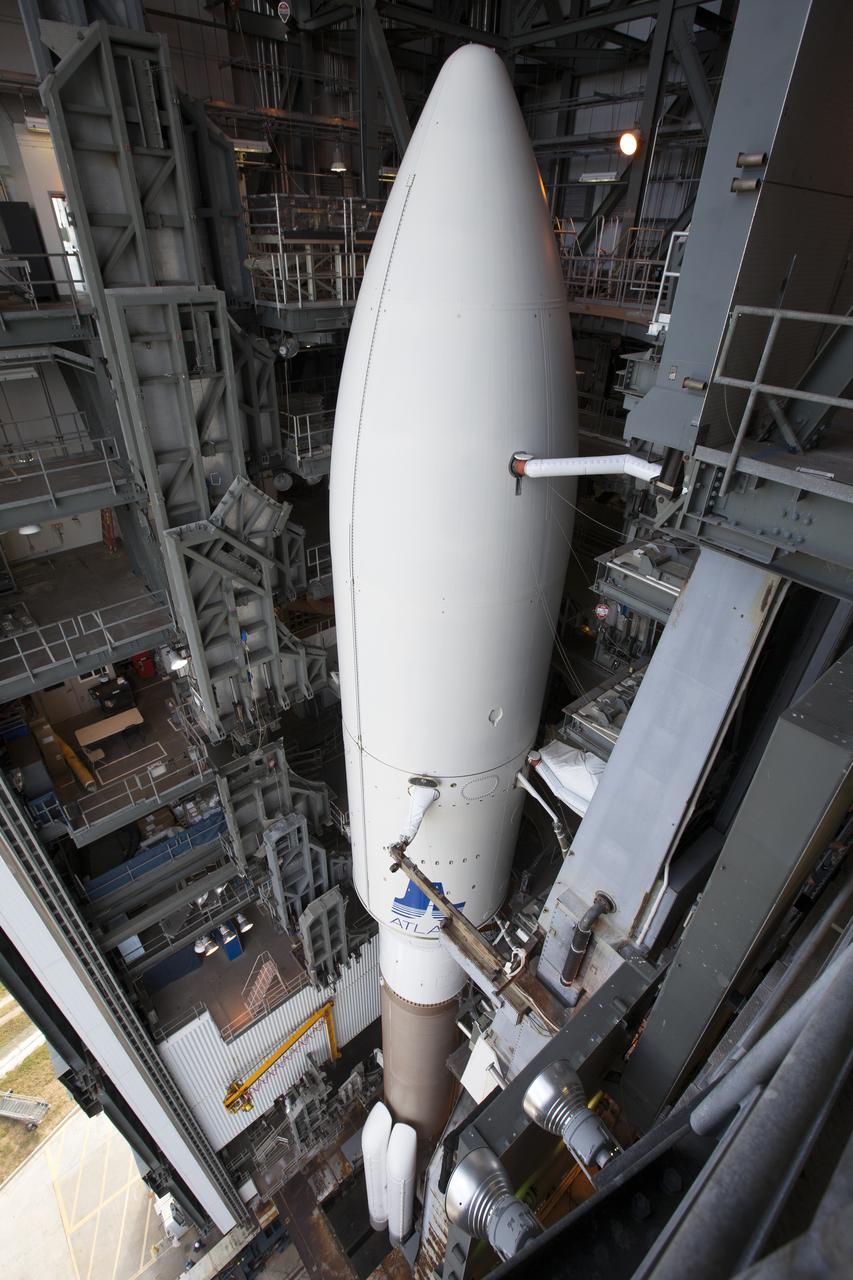
A United Launch Alliance Atlas V rocket is ready to roll out from the Vehicle Integration Facility to Space Launch Complex 41 at Cape Canaveral Air Force Station in Florida. The launch vehicle will send the Geostationary Operational Environmental Satellite (GOES-R) to a geostationary position over the U.S. GOES-R is the first satellite in a series of next-generation NOAA GOES satellites.
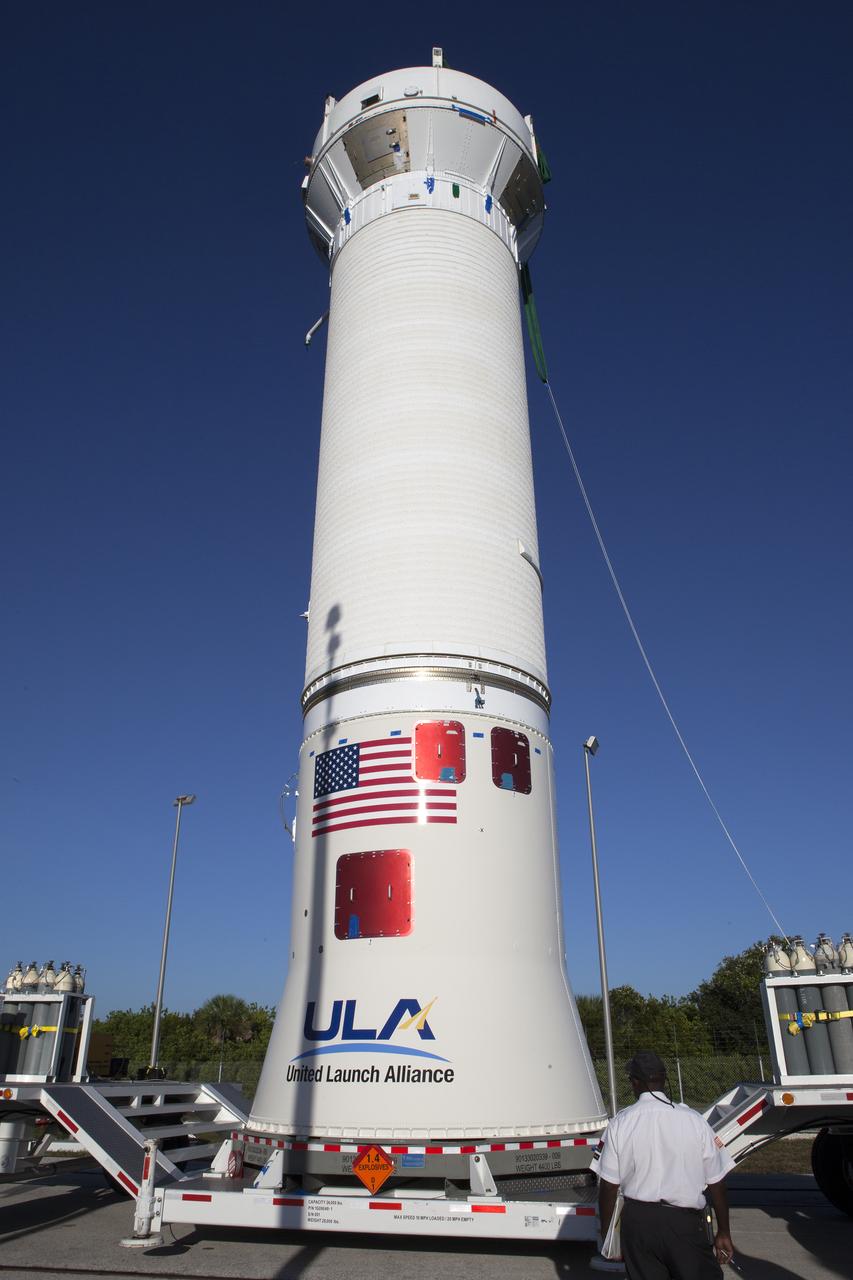
A Centaur upper stage, standing upright on a transporter, is prepared to be lifted and attached to the United Launch Alliance Atlas V rocket first stage booster at Space Launch Complex 41 on Florida’s Cape Canaveral Air Force Station. The rocket will boost NASA’s Origins, Spectral Interpretation, Resource Identification, Security-Regolith Explorer, or OSIRIS-REx spacecraft. Targeted for liftoff Sept. 8, 2016, OSIRIS-Rex will be the first U.S. mission to sample an asteroid, retrieve at least two ounces of surface material and return it to Earth for study. The asteroid, Bennu, may hold clues to the origin of the solar system and the source of water and organic molecules found on Earth.
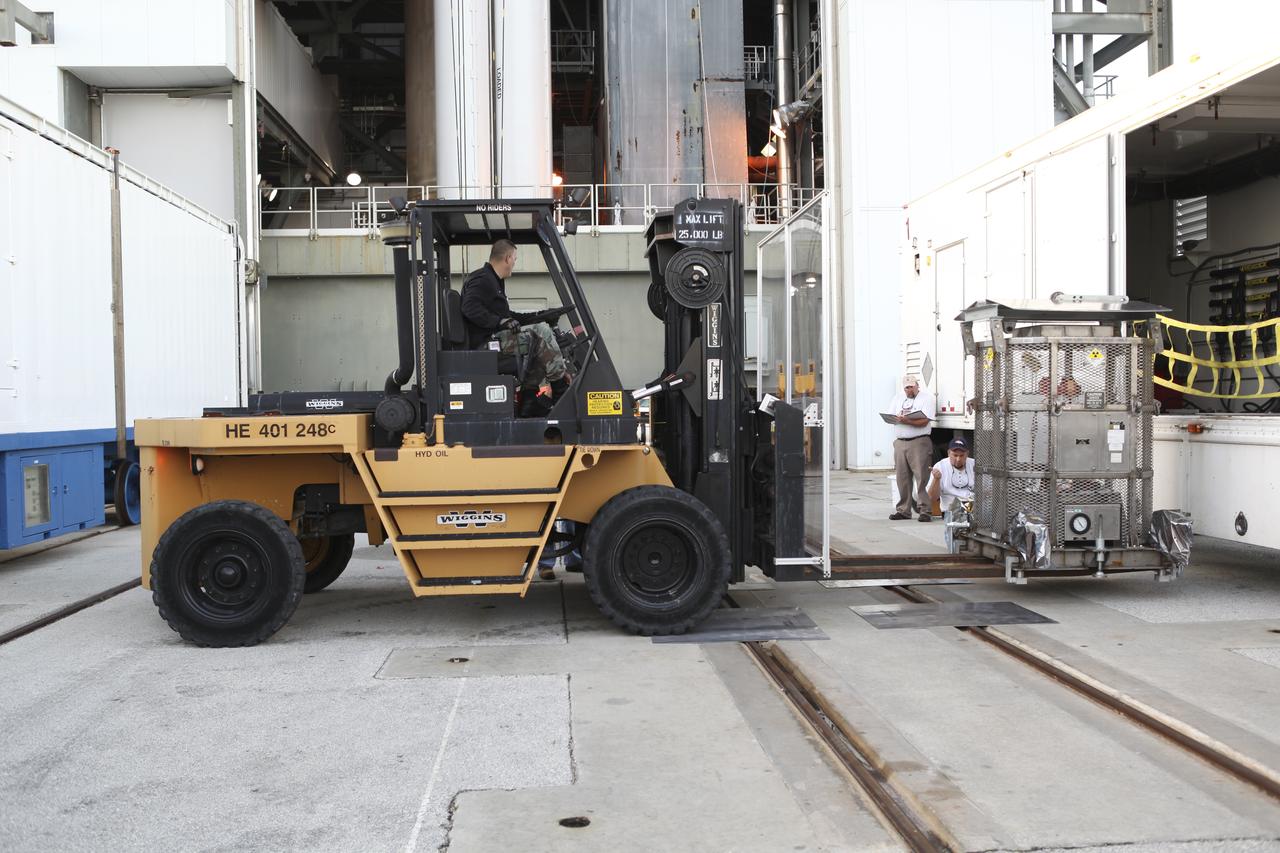
SPACE X MMRTG Offload and Lift for Insertion
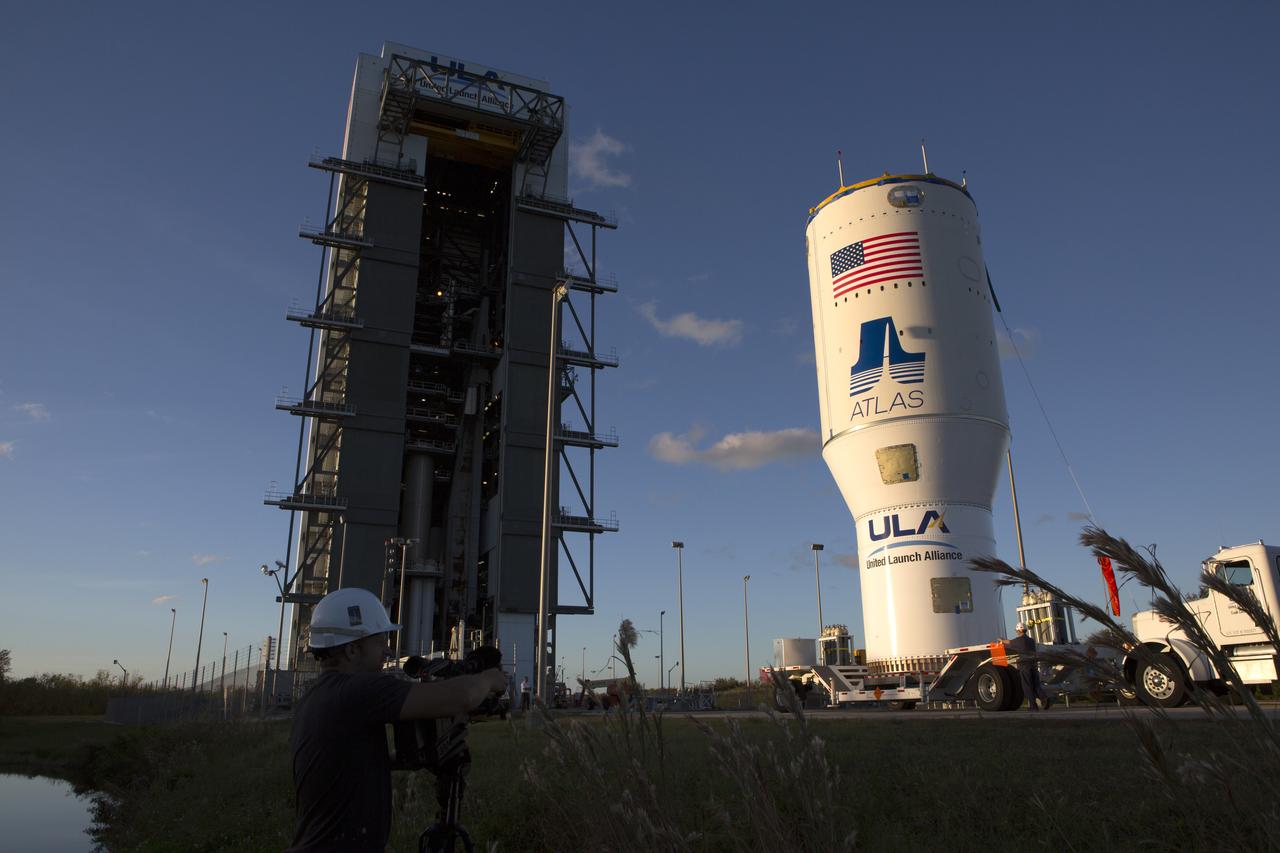
The United Launch Alliance Atlas V Centaur second stage arrives at the Vertical Integration Facility at Space Launch Complex 41 at Cape Canaveral Air Force Station in Florida. The Geostationary Operational Environmental Satellite (GOES-R) will launch aboard the Atlas V rocket in November. GOES-R is the first satellite in a series of next-generation NOAA GOES Satellites.
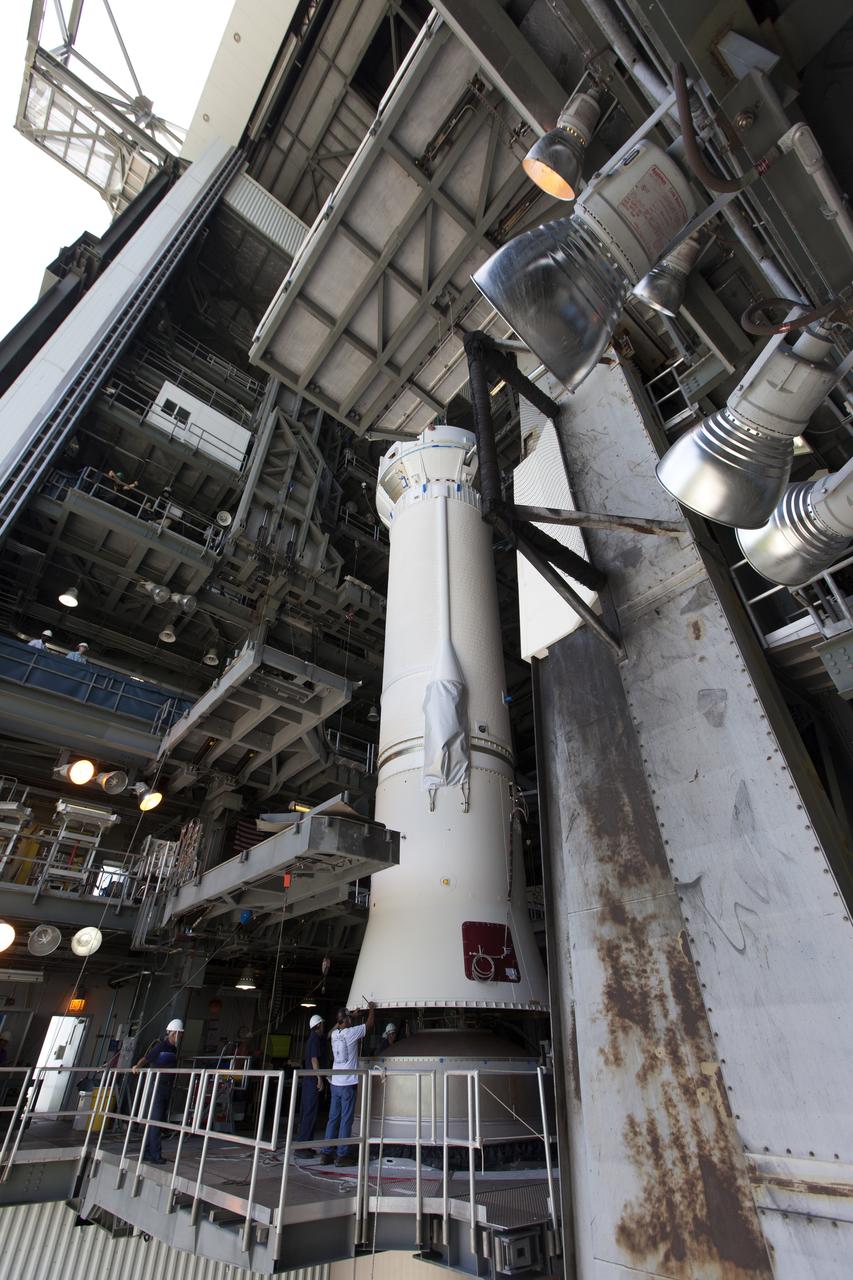
At the Vertical Integration Facility at Space Launch Complex 41 at Cape Canaveral Air Force Station in Florida, United Launch Alliance team members monitor progress as a Centaur upper stage is positioned prior to mating to an Atlas V booster. The rocket is scheduled to launch the Tracking and Data Relay Satellite, TDRS-M. It will be the latest spacecraft destined for the agency's constellation of communications satellites that allows nearly continuous contact with orbiting spacecraft ranging from the International Space Station and Hubble Space Telescope to the array of scientific observatories. Liftoff atop the ULA Atlas V rocket is scheduled to take place from Cape Canaveral's Space Launch Complex 41 in early August.
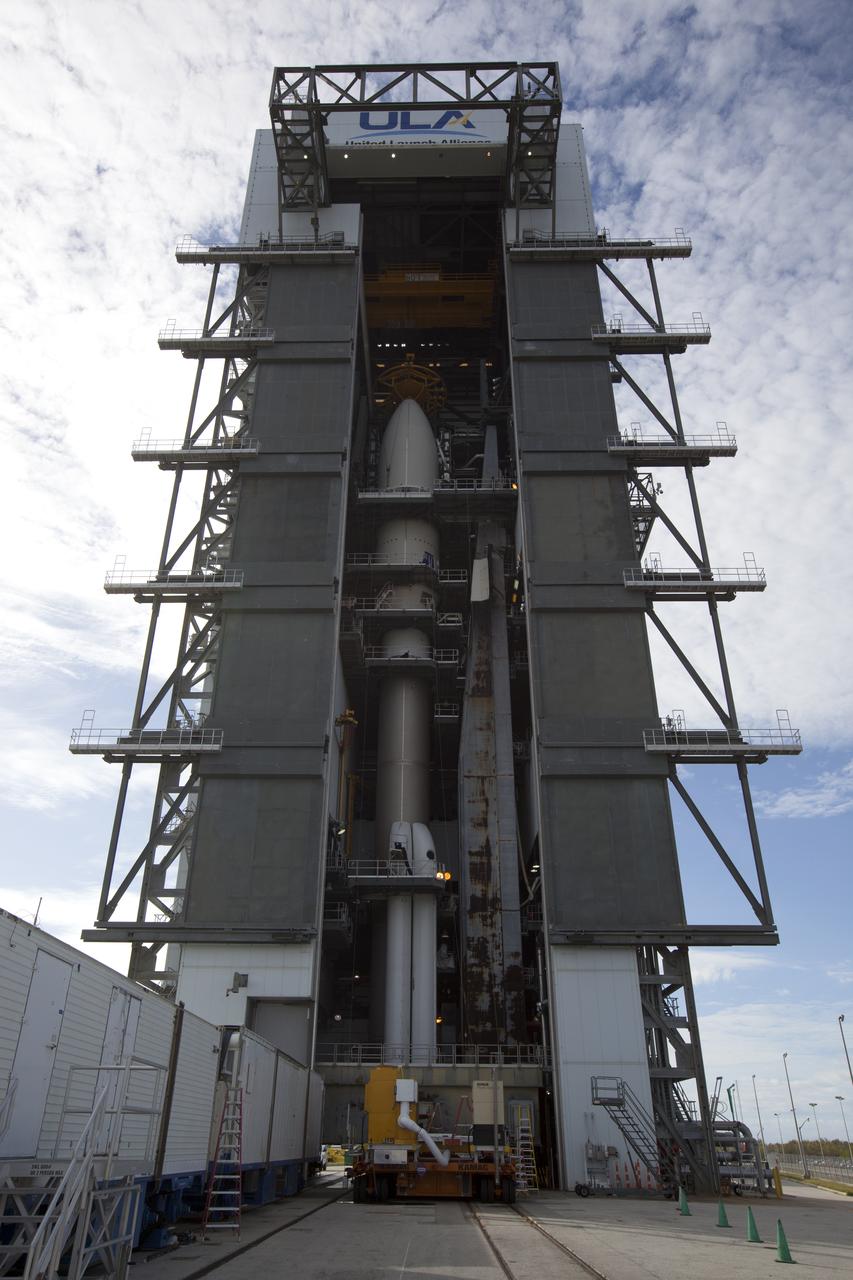
Enclosed in its payload fairing, NOAA's Geostationary Operational Environmental Satellite (GOES-R) is mated to the United Launch Alliance Atlas V Centaur upper stage in the Vertical Integration Facility at Space Launch Complex 41 at Cape Canaveral Air Force Station in Florida. The satellite will launch aboard the Atlas V rocket in November. GOES-R is the first satellite in a series of next-generation NOAA GOES Satellites.
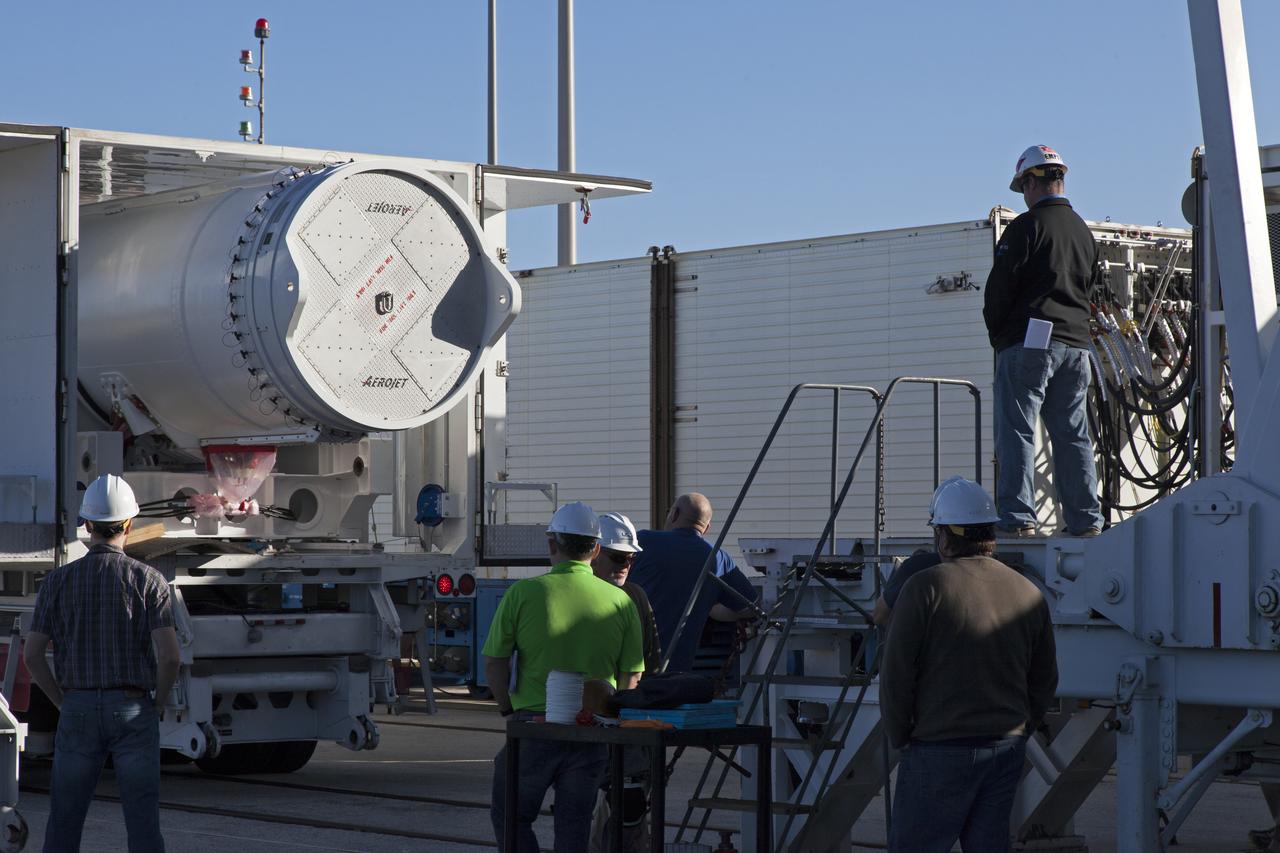
Technicians and engineers offload a solid rocket booster (SRB) that just arrived at the Vertical Integration Facility at Space Launch Complex 41 at Cape Canaveral Air Force Station in Florida. The SRB will be mated to a United Launch Alliance Atlas V first stage to help boost NOAA's Geostationary Operational Environmental Satellite, or GOES-S, to orbit. GOES-S is the second in a series of four advanced geostationary weather satellites that will significantly improve the detection and observation of environmental phenomena that directly affect public safety, protection of property and the nation's economic health and prosperity. GOES-S is slated to launch March 1, 2018.
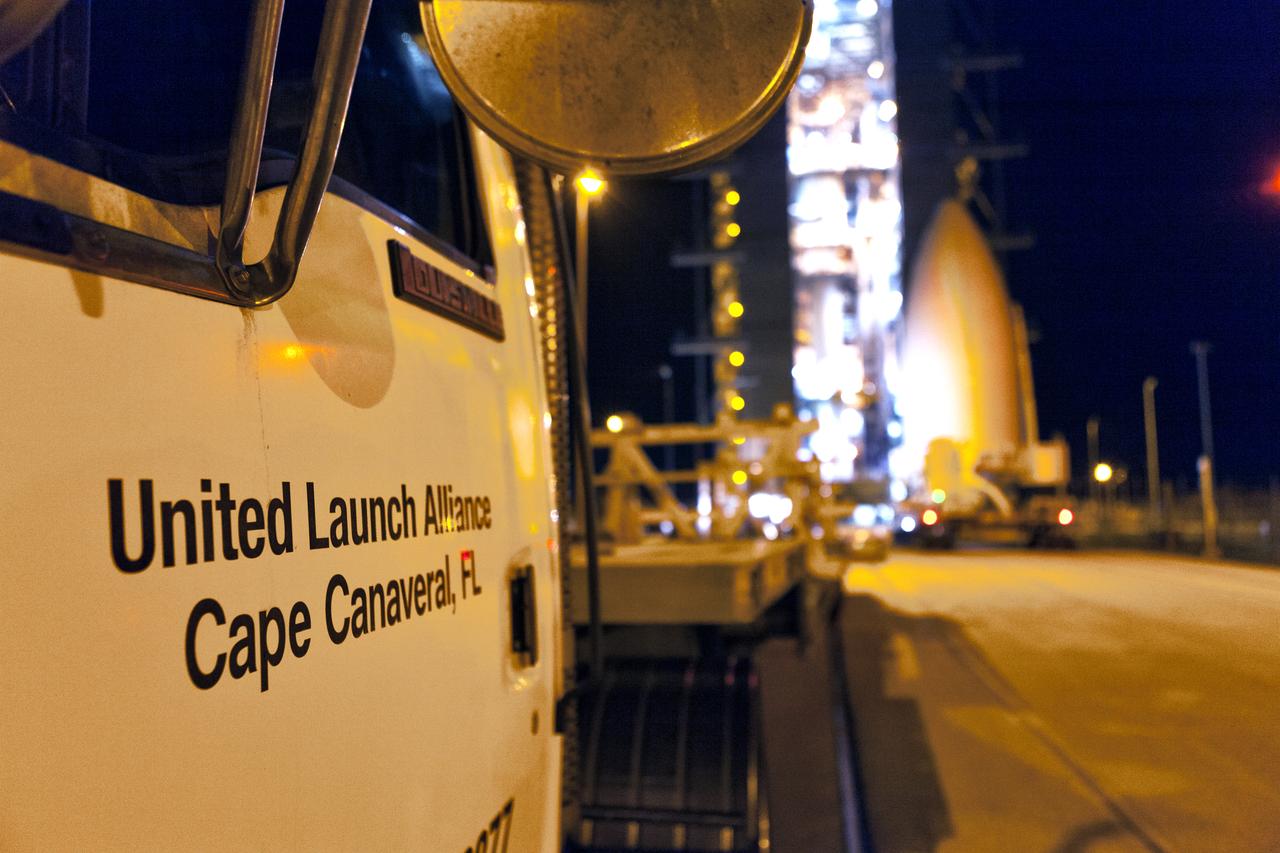
The payload fairing containing NOAA's Geostationary Operational Environmental Satellite-S (GOES-S), secured on a transporter, arrives at the United Launch Alliance (ULA) Vertical Integration Facility at Space Launch Complex 41 at Cape Canaveral Air Force Station in Florida. The payload fairing will be lifted and mated to the ULA Atlas V rocket. GOES-S is the second in a series of four advanced geostationary weather satellites. GOES-S is slated to launch aboard the ULA Atlas V on March 1.
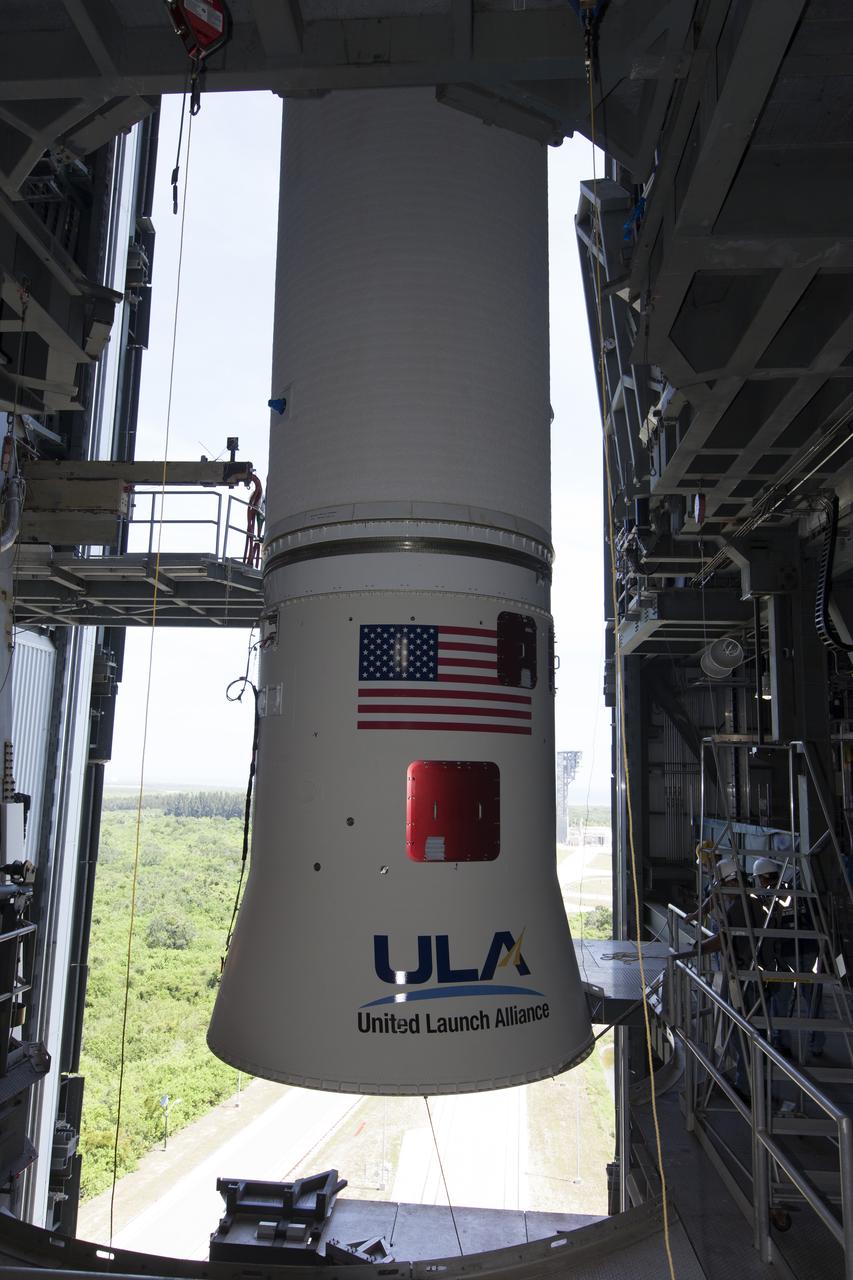
At the Vertical Integration Facility at Space Launch Complex 41 at Cape Canaveral Air Force Station in Florida, a United Launch Alliance Centaur upper stage is positioned prior to mating to an Atlas V booster. The rocket is scheduled to launch the Tracking and Data Relay Satellite, TDRS-M. It will be the latest spacecraft destined for the agency's constellation of communications satellites that allows nearly continuous contact with orbiting spacecraft ranging from the International Space Station and Hubble Space Telescope to the array of scientific observatories. Liftoff atop the ULA Atlas V rocket is scheduled to take place from Cape Canaveral's Space Launch Complex 41 in early August.
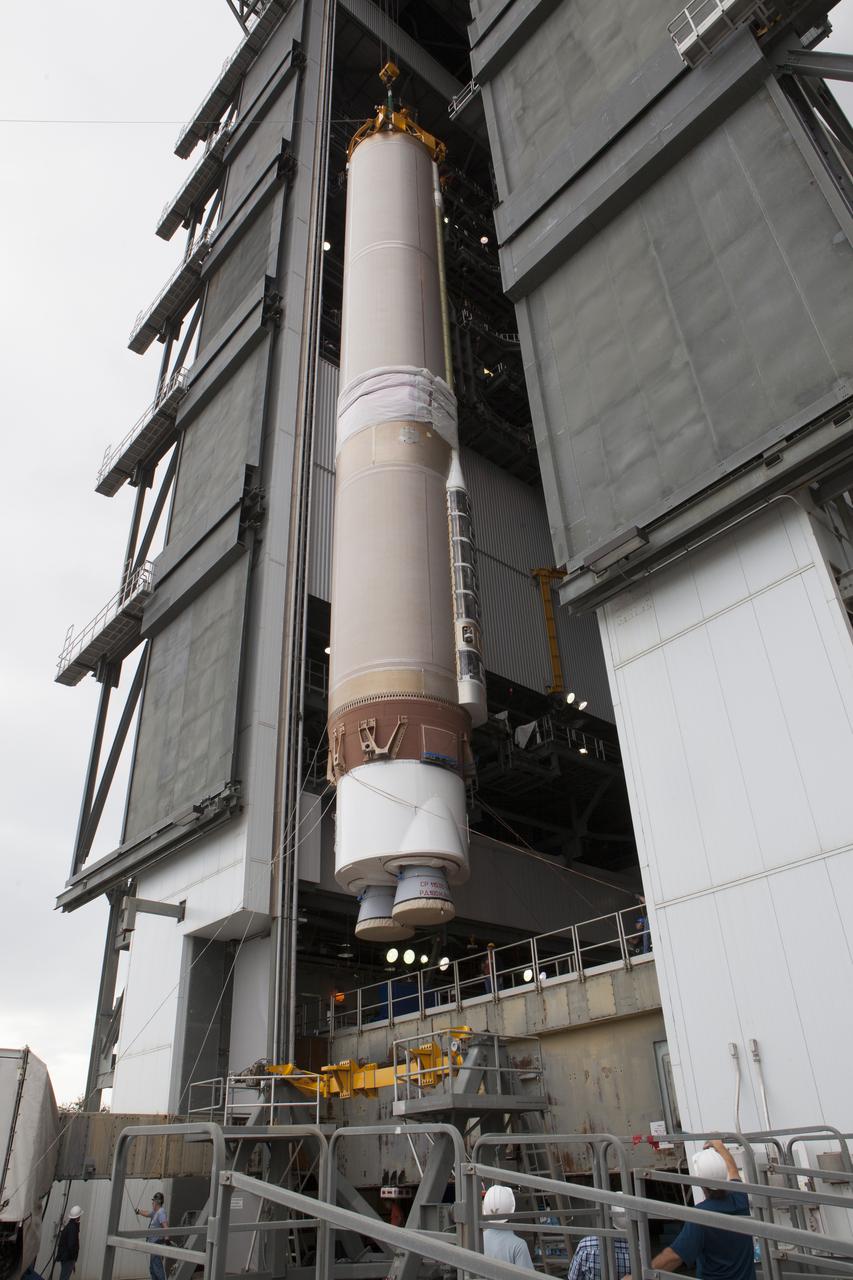
The first stage of the United Launch Alliance (ULA) Atlas V rocket is lifted to vertical and moved into the Vertical Integration Facility at Space Launch Complex 41 at Cape Canaveral Air Force Station in Florida. The rocket is being prepared for Orbital ATK's seventh commercial resupply mission, CRS-7, to the International Space Station. Orbital ATK's CYGNUS pressurized cargo module is scheduled to launch atop ULA's Atlas V rocket from Pad 41 on March 19, 2017. CYGNUS will deliver thousands of pounds of supplies, equipment and scientific research materials to the space station.
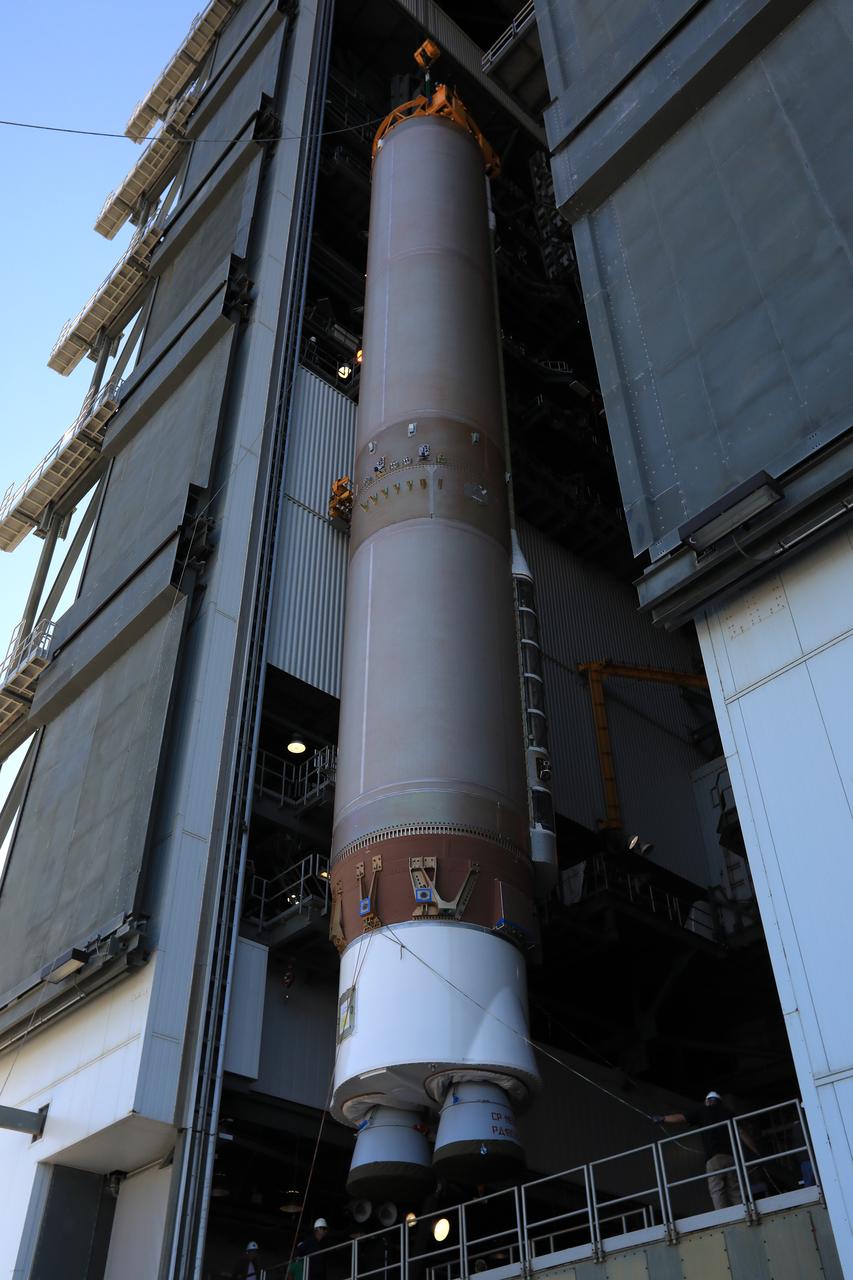
The United Launch Alliance Atlas V first stage has been lifted to the vertical position in the Vertical Integration Facility at Space Launch Complex 41 at Cape Canaveral Air Force Station in Florida. The Geostationary Operational Environmental Satellite (GOES-R) will launch aboard the Atlas V rocket in November. GOES-R will be the first satellite in a series of next-generation NOAA GOES Satellites.
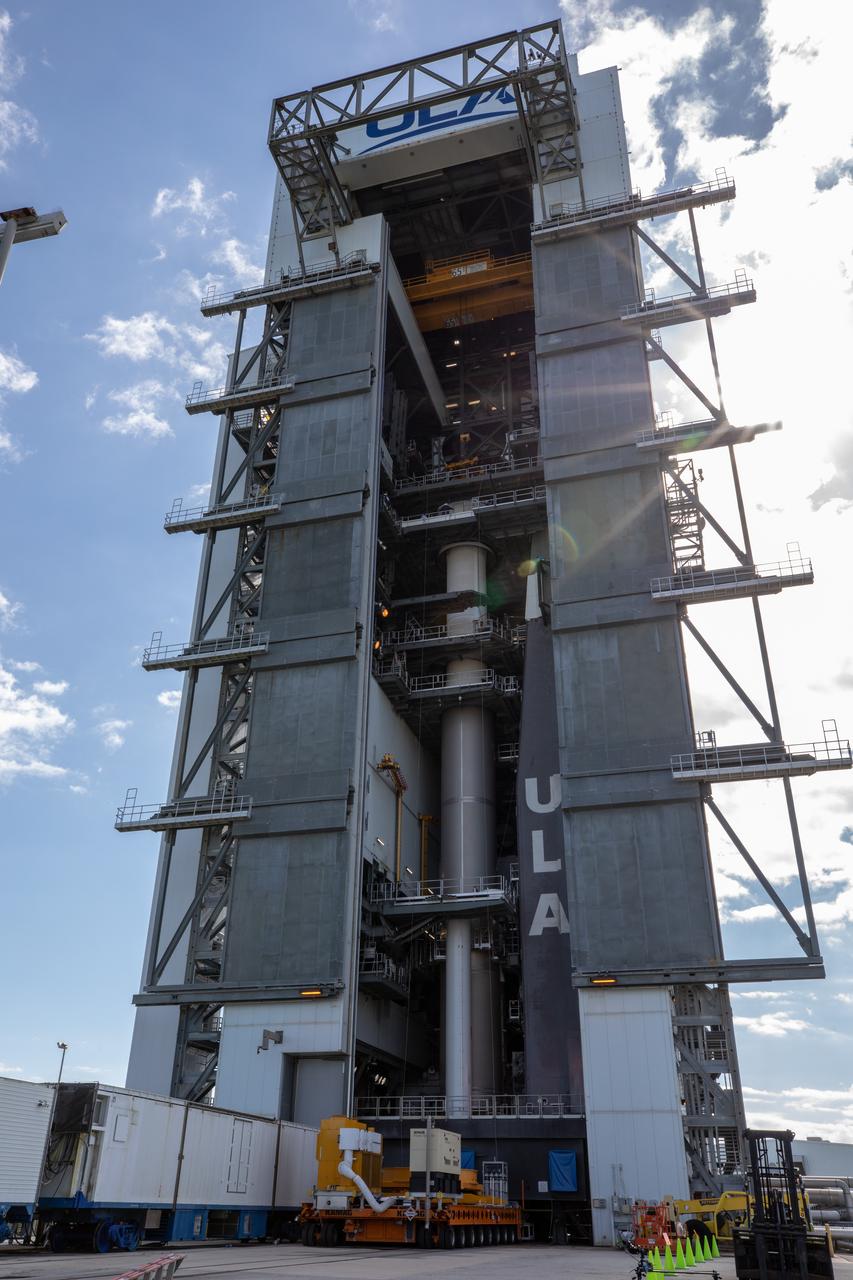
The Boeing CST-100 Starliner spacecraft is secured atop a United Launch Alliance Atlas V rocket at the Vertical Integration Facility at Space Launch Complex 41 at Florida’s Cape Canaveral Air Force Station on Nov. 21, 2019. Starliner will launch on the Atlas V for Boeing’s Orbital Flight Test to the International Space Station for NASA’s Commercial Crew Program. The spacecraft rolled out from Boeing’s Commercial Crew and Cargo Processing Facility at NASA’s Kennedy Space Center earlier in the day.
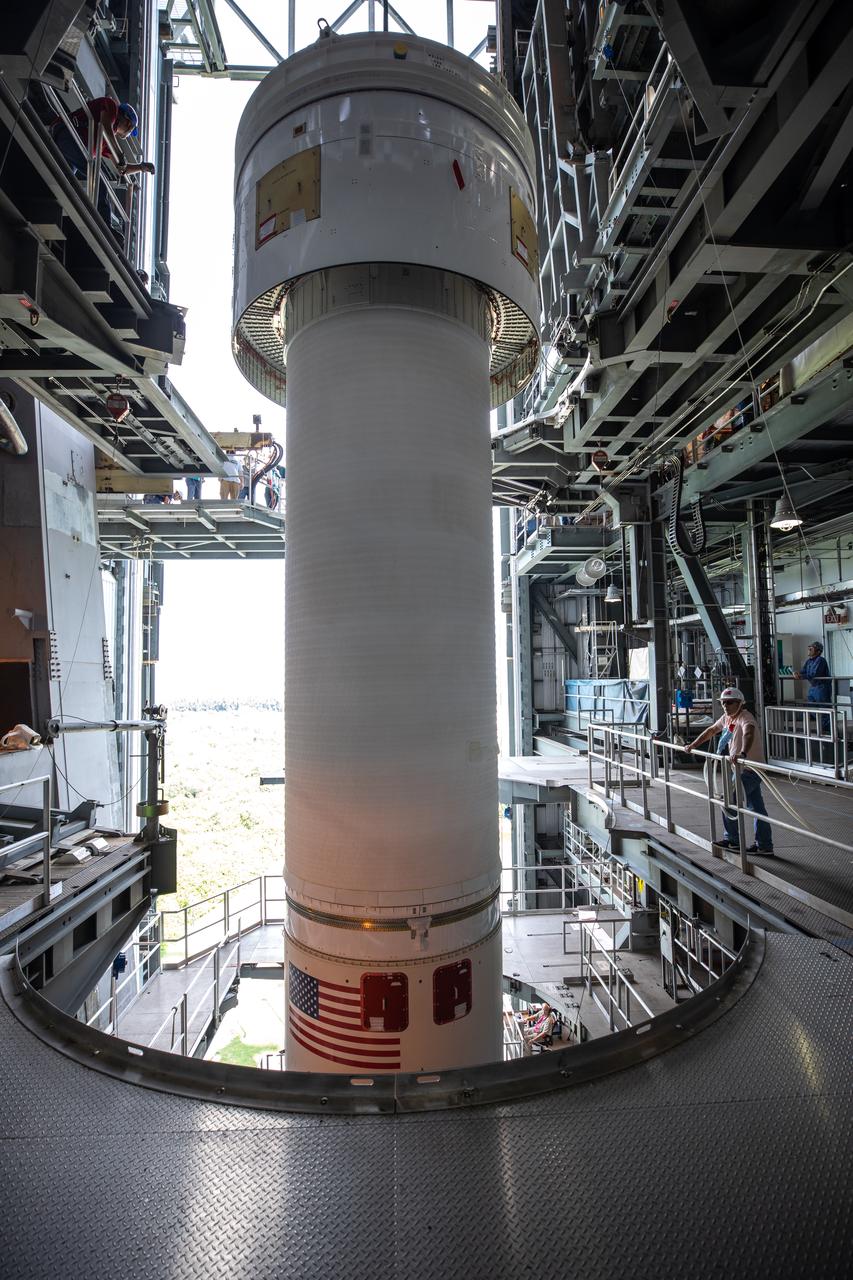
A Centaur upper stage is moved into position above the United Launch Alliance Atlas V first stage inside the Space Launch Complex 41 Vertical Integration Facility at Florida’s Cape Canaveral Air Force Station on Nov. 8, 2019, in preparation for Boeing’s Orbital Flight Test (OFT). The uncrewed OFT mission will rendezvous and dock Boeing’s CST-100 Starliner spacecraft with the International Space Station as part of NASA’s Commercial Crew Program. Starliner will launch atop the Atlas V rocket from Space Launch Complex 41.
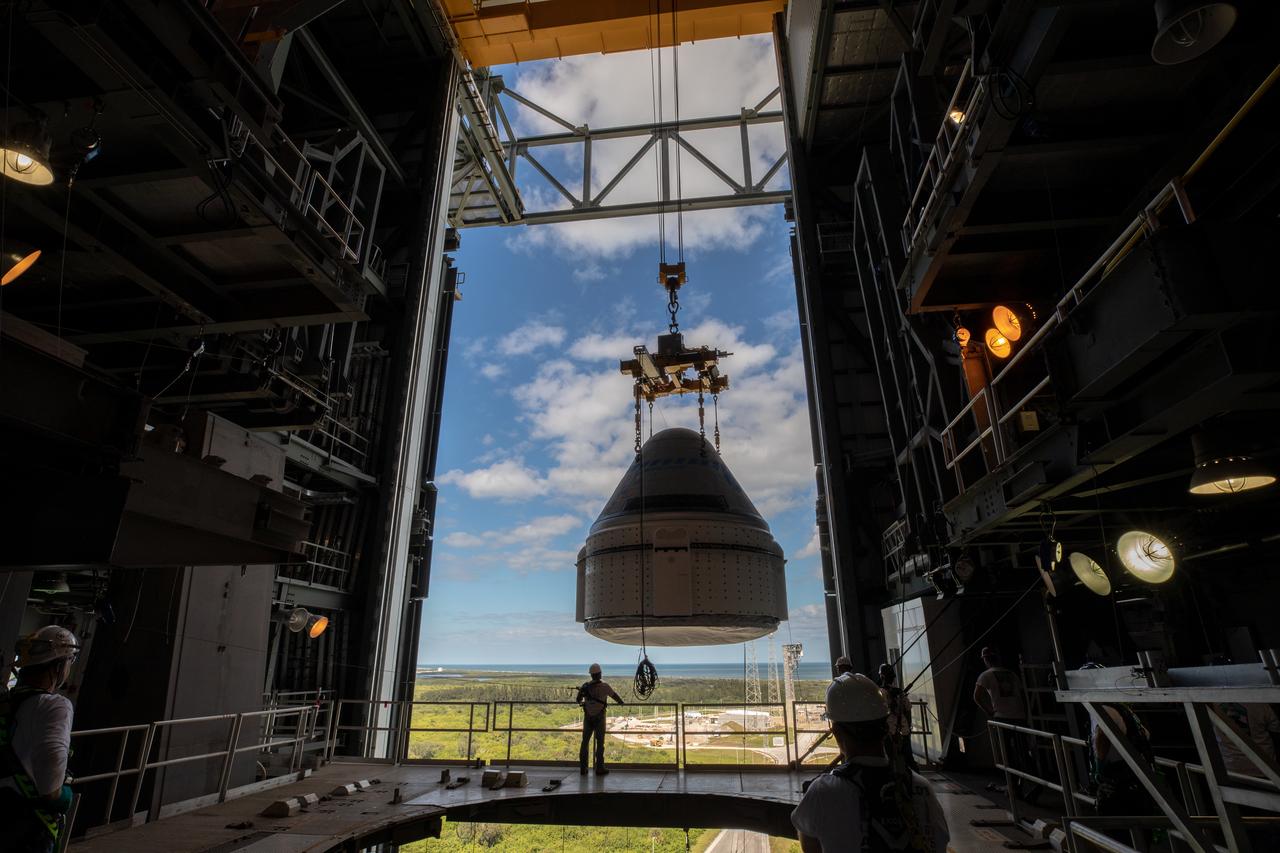
The Boeing CST-100 Starliner spacecraft is guided into position above a United Launch Alliance Atlas V rocket at the Vertical Integration Facility at Space Launch Complex 41 at Florida’s Cape Canaveral Air Force Station on Nov. 21, 2019. Starliner will be secured atop the rocket for Boeing’s Orbital Flight Test to the International Space Station for NASA’s Commercial Crew Program. The spacecraft rolled out from Boeing’s Commercial Crew and Cargo Processing Facility at NASA’s Kennedy Space Center earlier in the day.
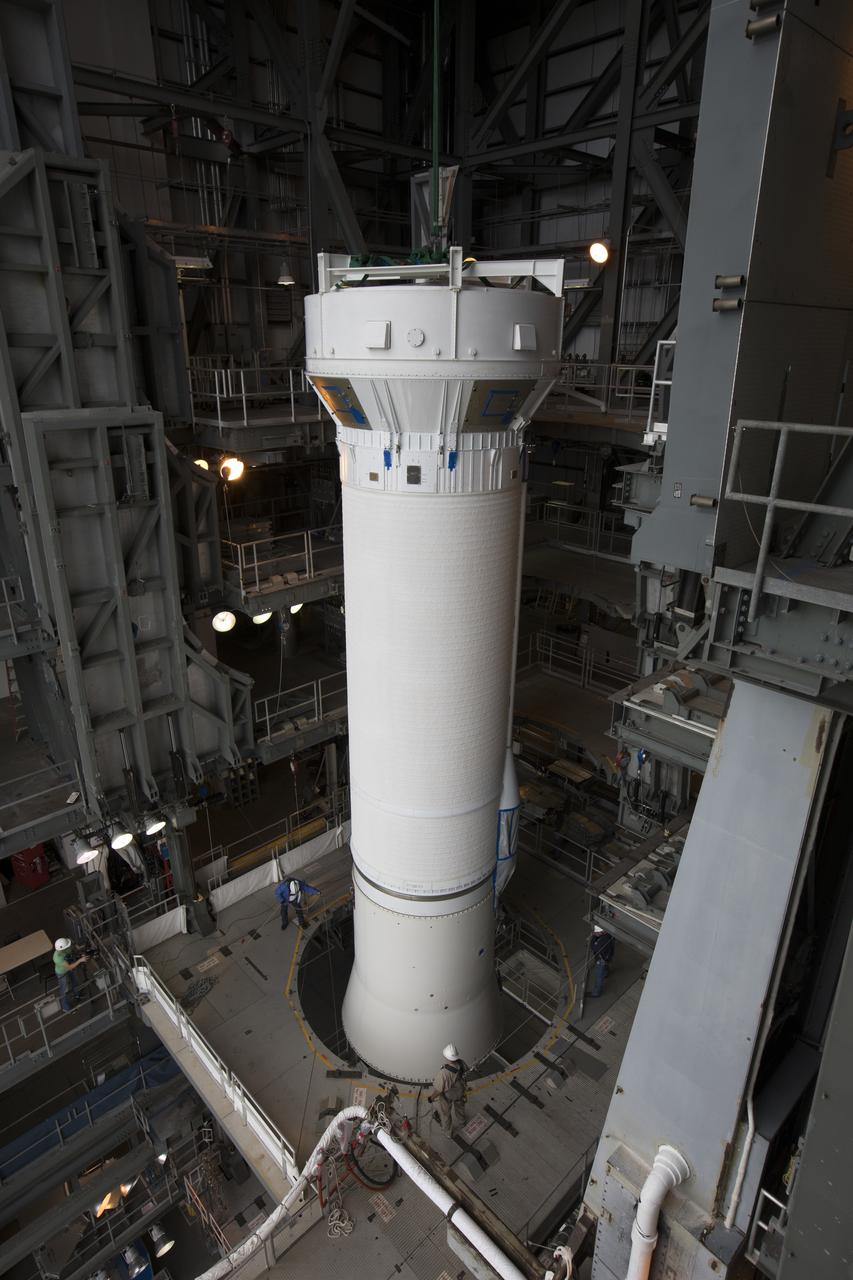
The Centaur upper stage of the United Launch Alliance (ULA) Atlas V rocket has been lifted up inside the Vertical Integration Facility at Space Launch Complex 41 at Cape Canaveral Air Force Station in Florida. The Centaur stage will be lowered and mated to the first stage booster. The rocket is being prepared for Orbital ATK's seventh commercial resupply mission, CRS-7, to the International Space Station. Orbital ATK's CYGNUS pressurized cargo module is scheduled to launch atop ULA's Atlas V rocket from Pad 41 on March 19, 2017. CYGNUS will deliver 7,600 pounds of supplies, equipment and scientific research materials to the space station.
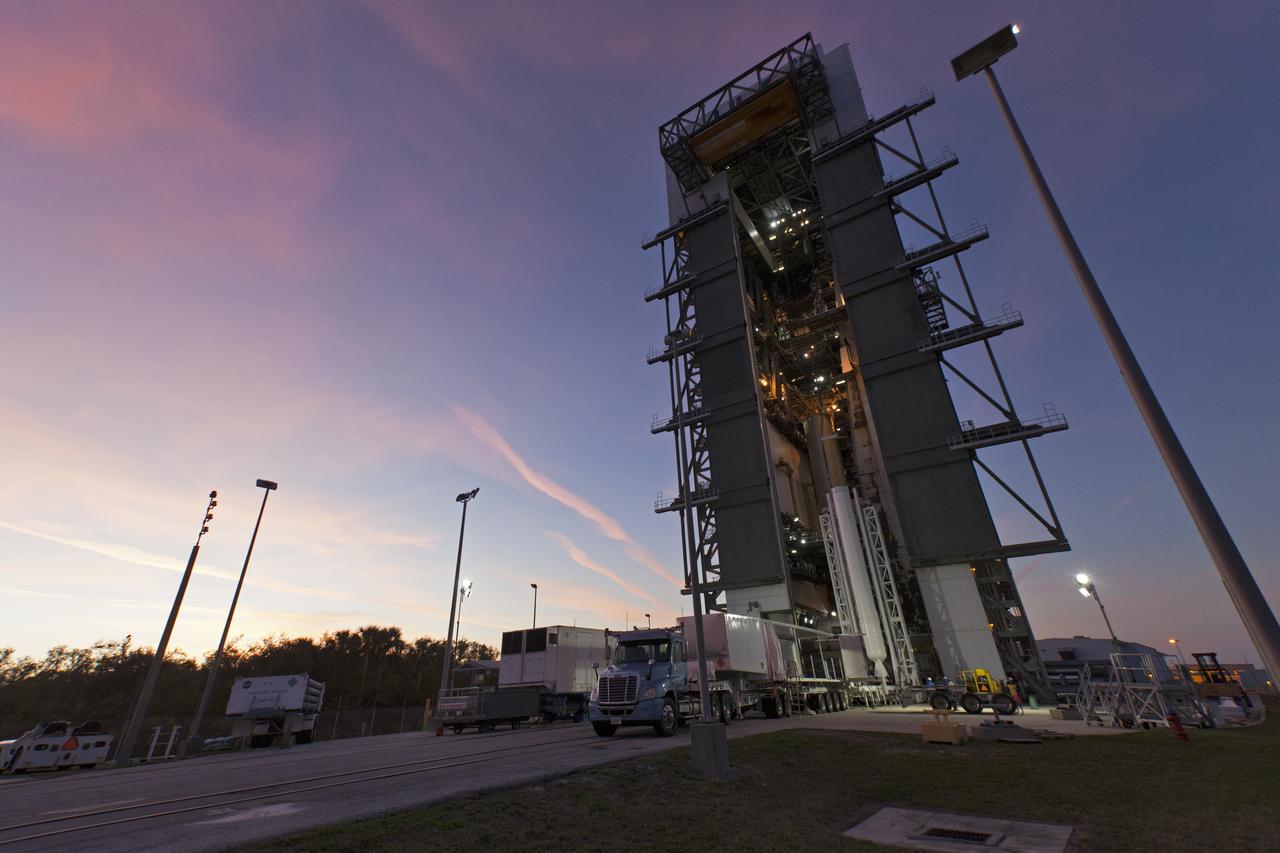
At the Vertical Integration Facility at Space Launch Complex 41 at Cape Canaveral Air Force Station in Florida, a solid rocket booster (SRB) is mated to a United Launch Alliance Atlas V first stage. The SRB will help boost NOAA's Geostationary Operational Environmental Satellite, or GOES-S, to orbit. GOES-S is the second in a series of four advanced geostationary weather satellites that will significantly improve the detection and observation of environmental phenomena that directly affect public safety, protection of property and the nation's economic health and prosperity. GOES-S is slated to launch March 1, 2018.
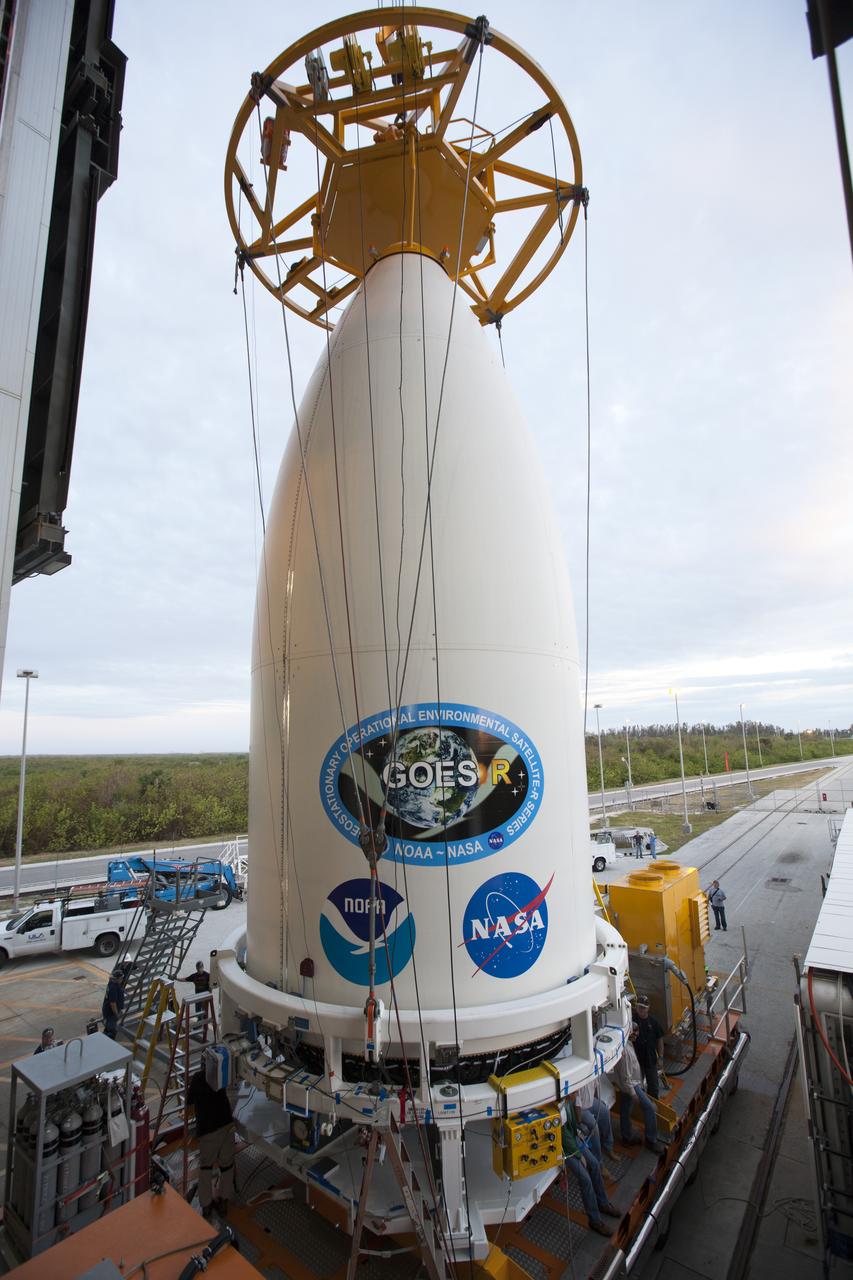
A crane has been attached to the payload fairing containing NOAA's Geostationary Operational Environmental Satellite (GOES-R) at the Vertical Integration Facility at Space Launch Complex 41 at Cape Canaveral Air Force Station in Florida. GOES-R will be mated to the United Launch Alliance Atlas V Centaur upper stage in preparation for launch in November. GOES-R is the first satellite in a series of next-generation NOAA GOES Satellites.
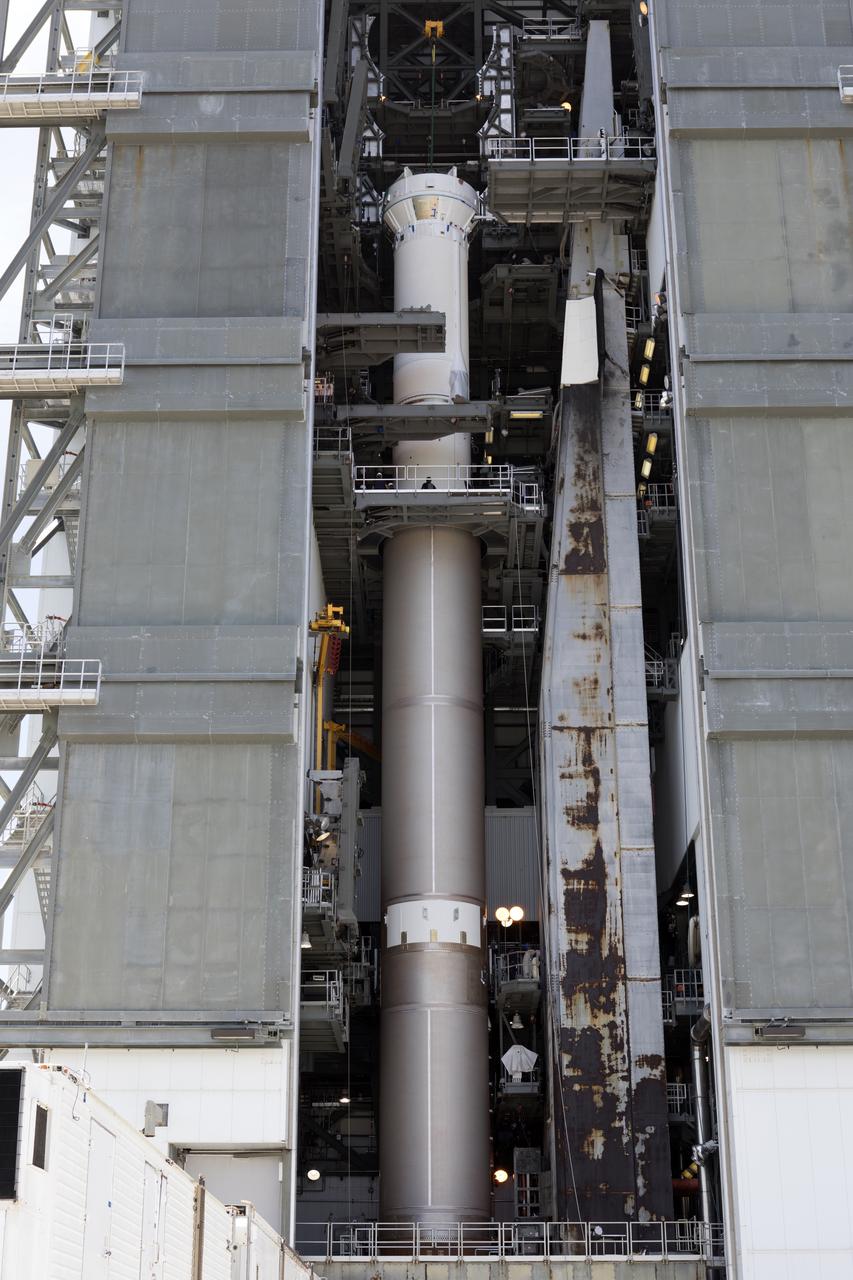
At the Vertical Integration Facility at Space Launch Complex 41 at Cape Canaveral Air Force Station in Florida, a United Launch Alliance Centaur upper stage has been mated to an Atlas V booster. The rocket is scheduled to launch the Tracking and Data Relay Satellite, TDRS-M. It will be the latest spacecraft destined for the agency's constellation of communications satellites that allows nearly continuous contact with orbiting spacecraft ranging from the International Space Station and Hubble Space Telescope to the array of scientific observatories. Liftoff atop the ULA Atlas V rocket is scheduled to take place from Cape Canaveral's Space Launch Complex 41 in early August.
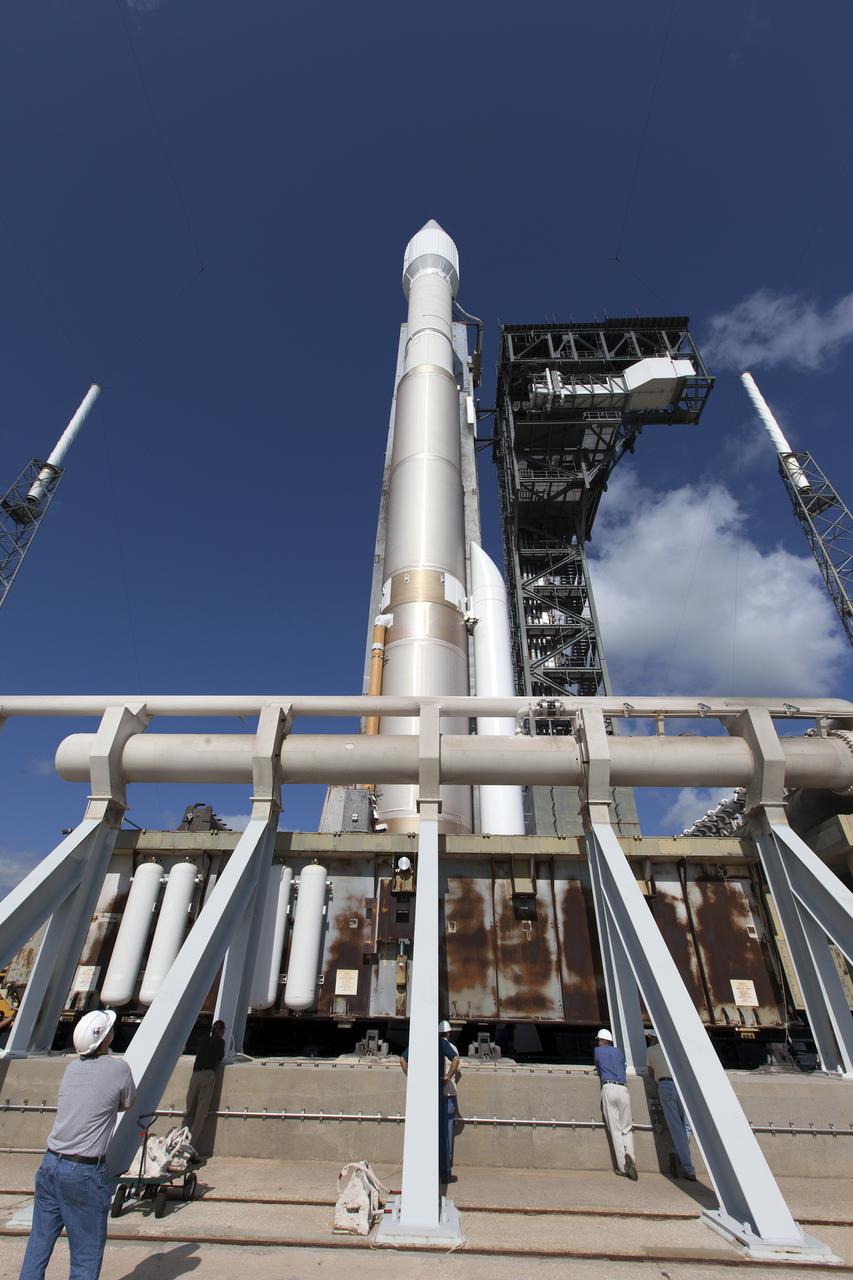
The United Launch Alliance Atlas V rocket arrives at Space Launch Complex 41 at Cape Canaveral Air Force Station in Florida. The launch vehicle will boost NASA’s Origins, Spectral Interpretation, Resource Identification, Security-Regolith Explorer, or OSIRIS-REx spacecraft. This will be the first U.S. mission to sample an asteroid, retrieve at least two ounces of surface material and return it to Earth for study. The asteroid, Bennu, may hold clues to the origin of the solar system and the source of water and organic molecules found on Earth.
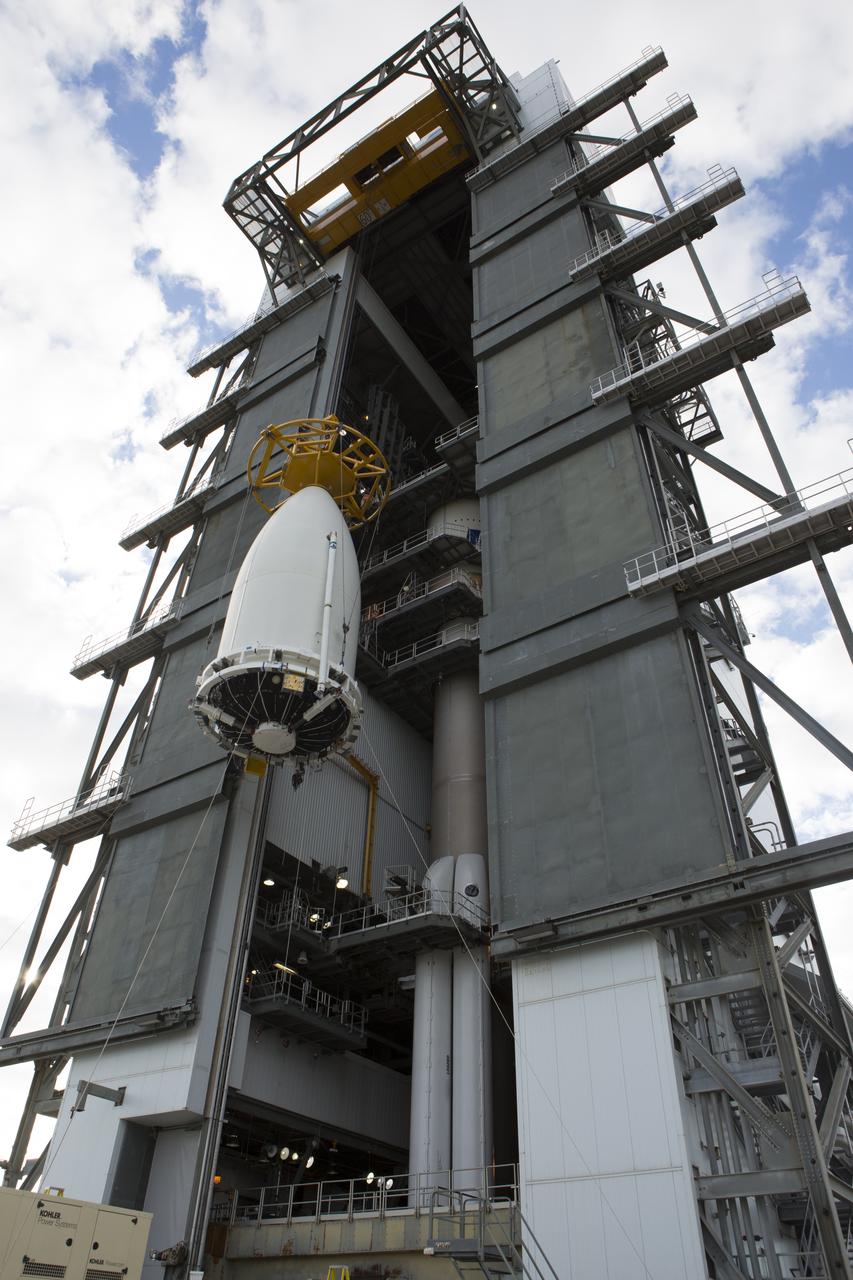
A crane is used to lift the payload fairing containing NOAA's Geostationary Operational Environmental Satellite (GOES-R) at the Vertical Integration Facility at Space Launch Complex 41 at Cape Canaveral Air Force Station in Florida. GOES-R will be mated to the United Launch Alliance Atlas V Centaur upper stage in preparation for launch in November. GOES-R is the first satellite in a series of next-generation NOAA GOES Satellites.
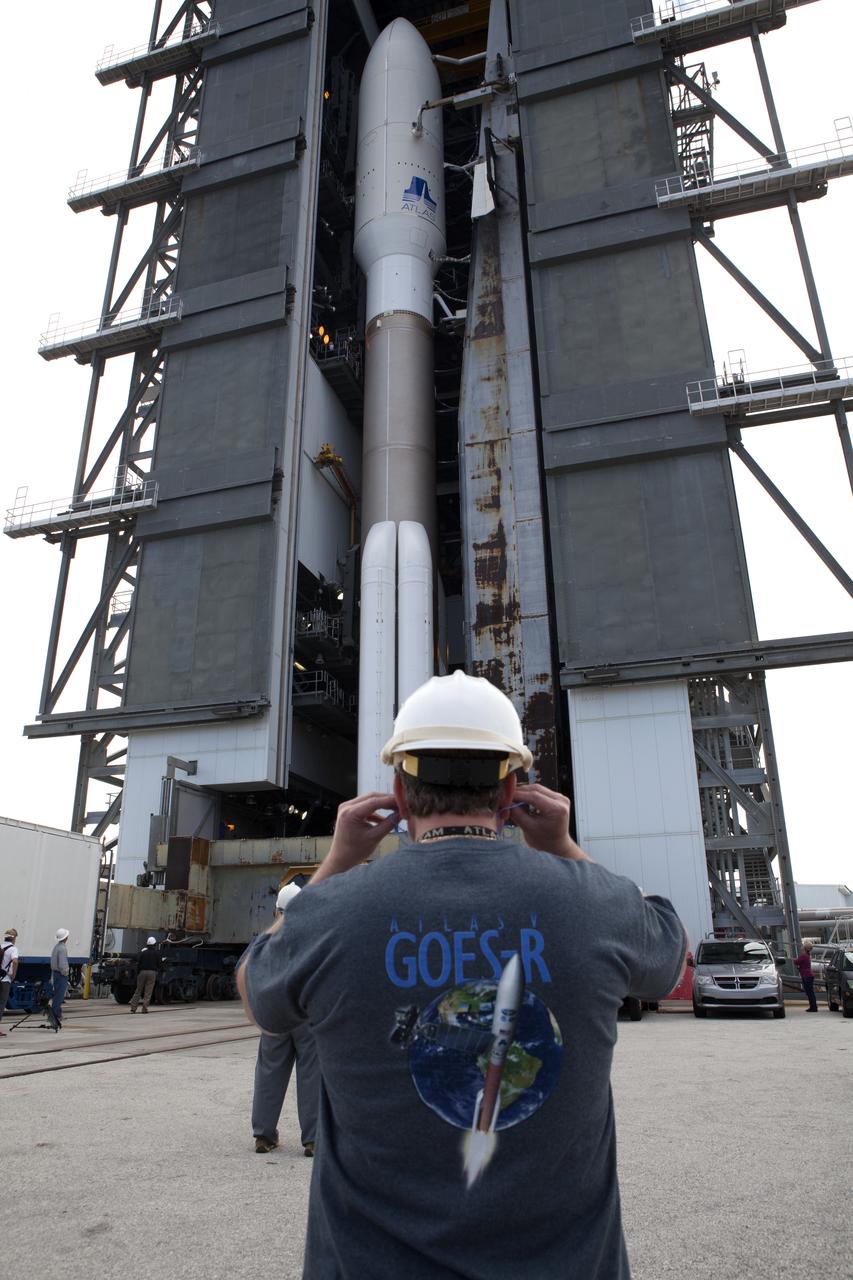
A United Launch Alliance Atlas V rocket is ready to roll out from the Vehicle Integration Facility to Space Launch Complex 41 at Cape Canaveral Air Force Station in Florida. The launch vehicle will send the Geostationary Operational Environmental Satellite (GOES-R) to a geostationary position over the U.S. GOES-R is the first satellite in a series of next-generation NOAA GOES satellites.
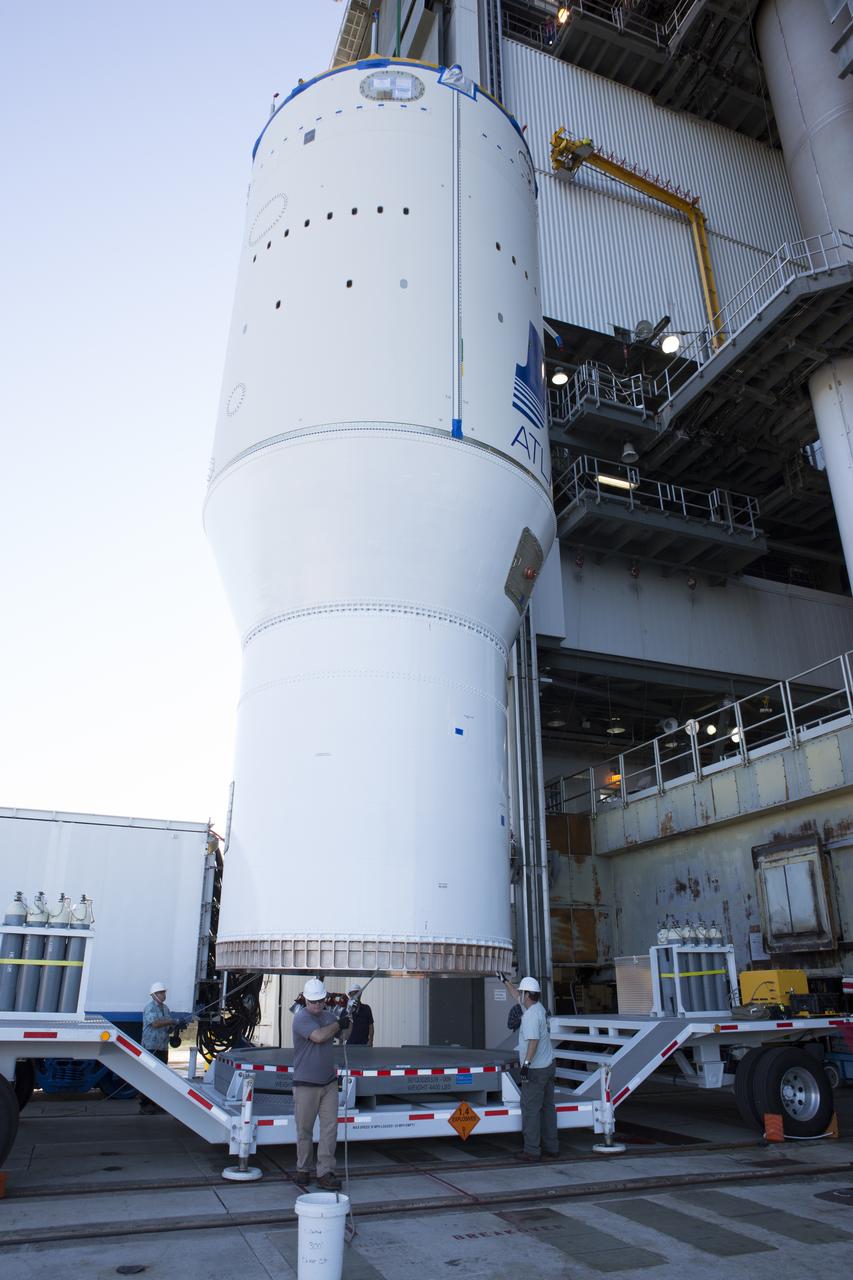
United Launch Alliance team members assist as operation begin to lift the Atlas V Centaur second stage into the Vertical Integration Facility at Space Launch Complex 41 at Cape Canaveral Air Force Station in Florida. The Geostationary Operational Environmental Satellite (GOES-R) will launch aboard the Atlas V rocket in November. GOES-R is the first satellite in a series of next-generation NOAA GOES Satellites.
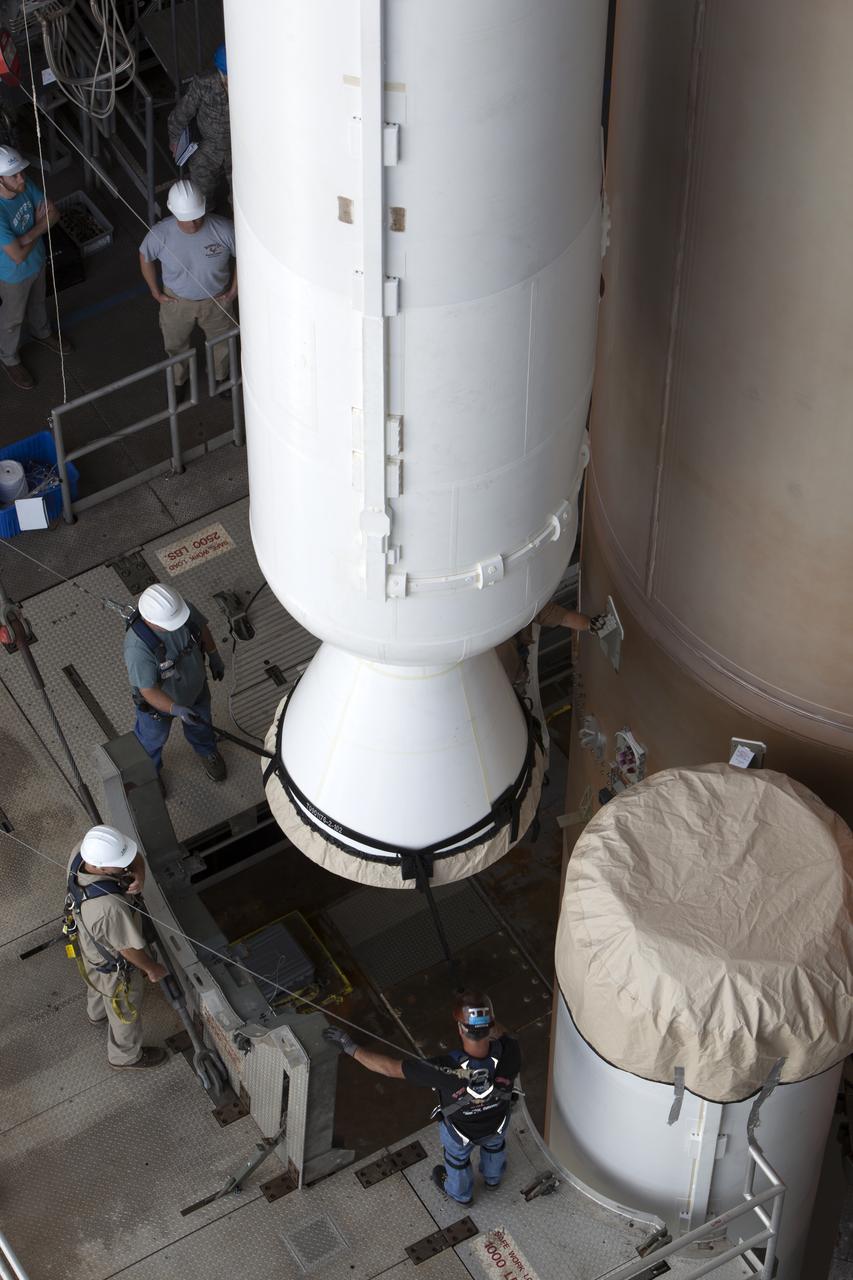
Technicians with United Launch Alliance (ULA) monitor the progress as the solid rocket motor is mated to the ULA Atlas V rocket in the Vertical Integration Facility at Space Launch Complex 41 at Cape Canaveral Air Force Station in Florida. NOAA's Geostationary Operational Environmental Satellite (GOES-R) will launch aboard the Atlas V rocket this month. GOES-R is the first satellite in a series of next-generation NOAA GOES Satellites.
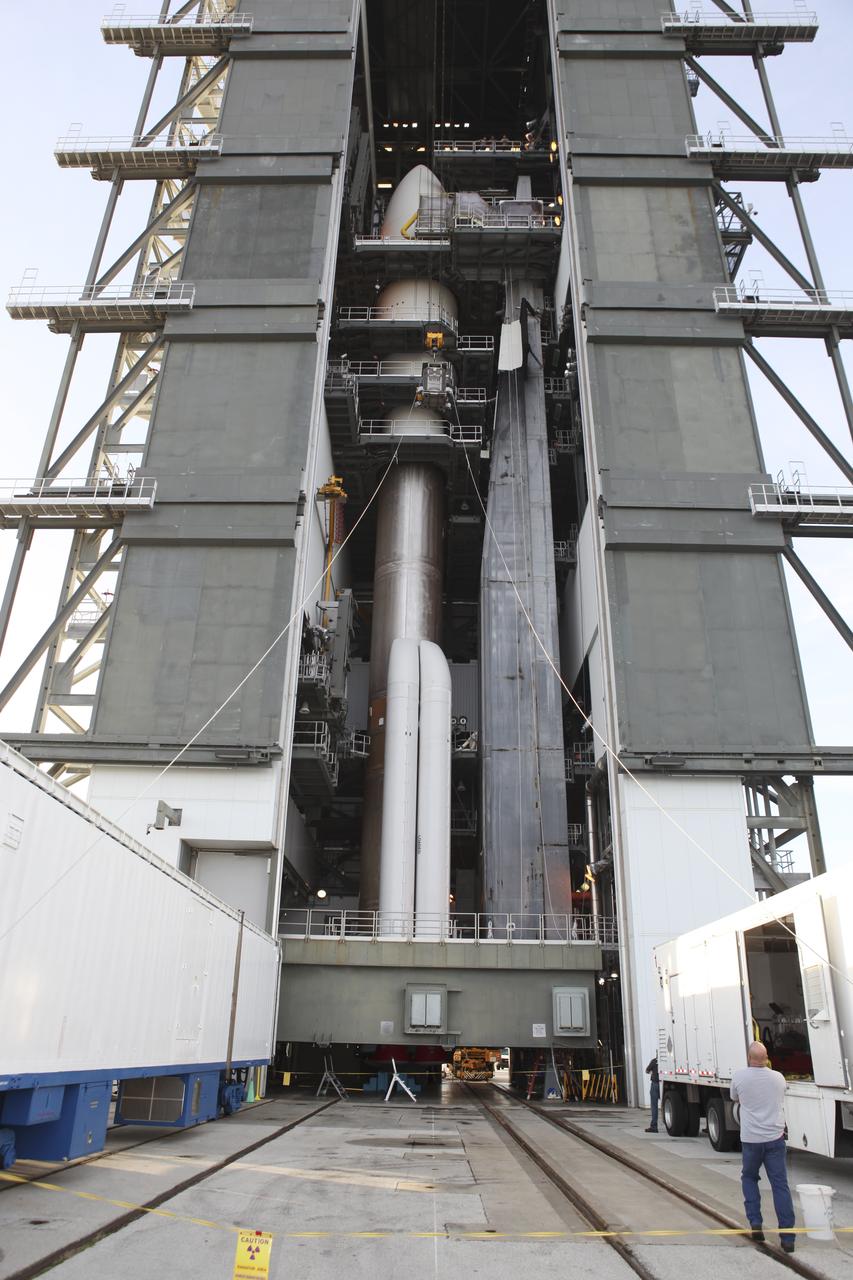
SPACE X MMRTG Offload and Lift for Insertion
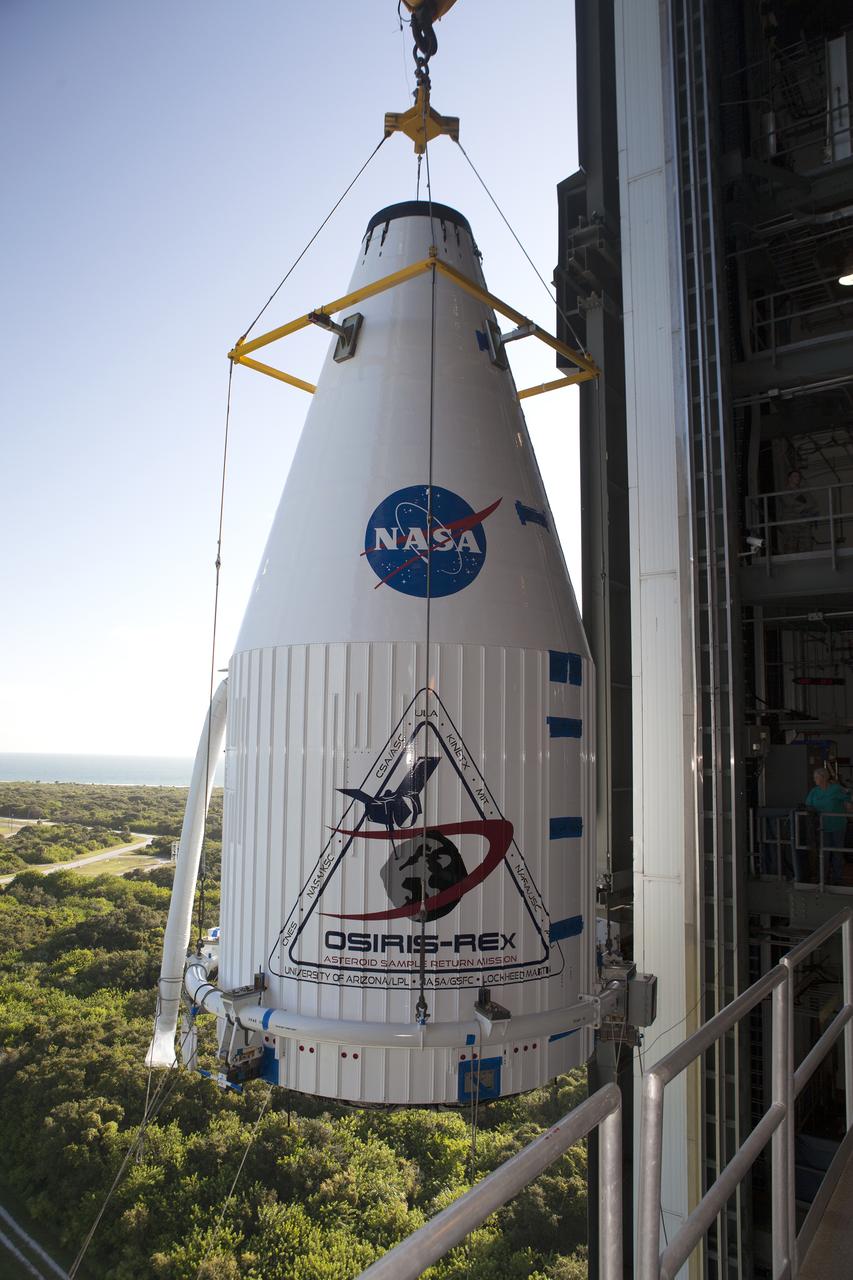
The OSIRIS-REx spacecraft, enclosed in a payload fairing, is lifted at Space Launch Complex 41 at Cape Canaveral Air Force Station. The United Launch Alliance Atlas V rocket that is to lift OSIRIS-REx into space was stacked at SLC-41 so the spacecraft and fairing could be hoisted and bolted to the rocket promptly. The spacecraft will be sent to rendezvous with, survey and take a sample from an asteroid called Bennu.
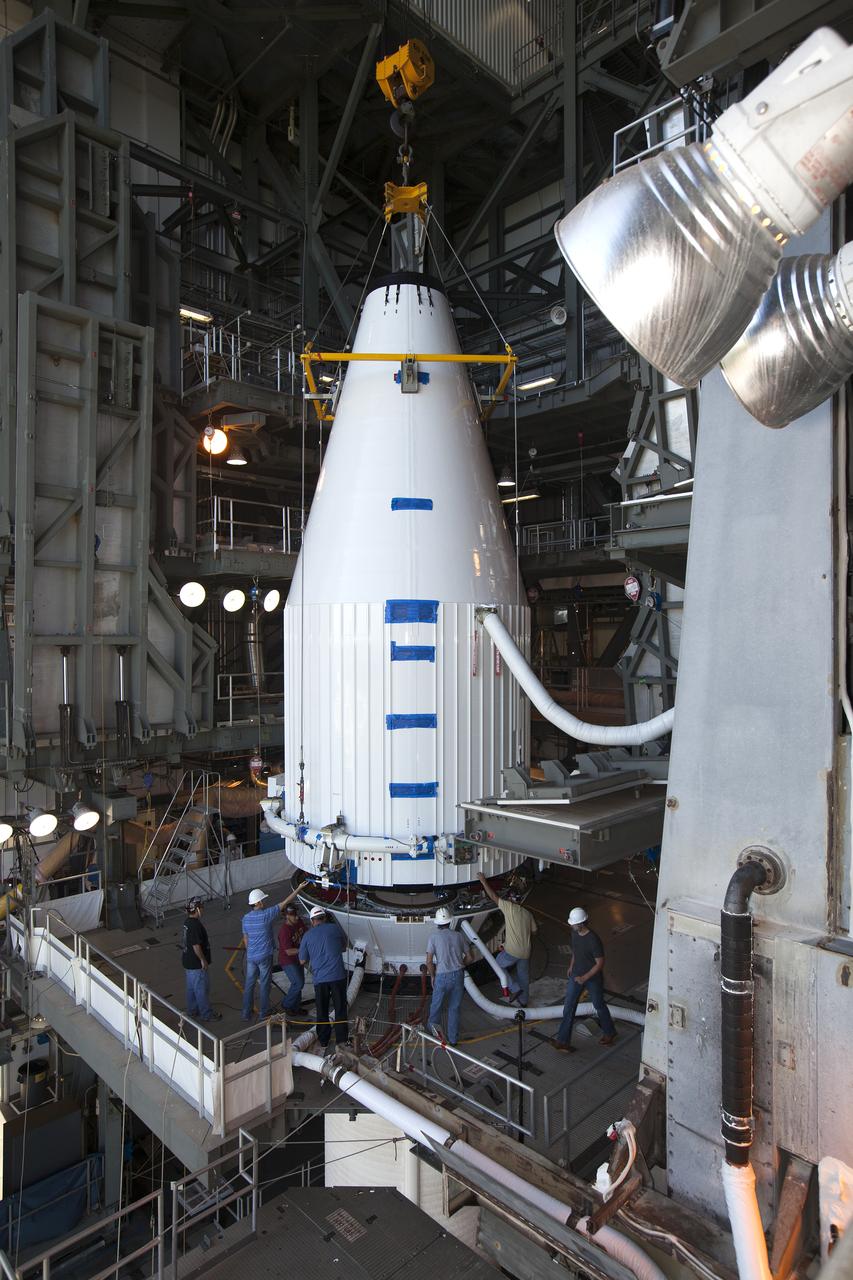
The OSIRIS-REx spacecraft, enclosed in a payload fairing, is positioned atop a United Launch Alliance Atlas V rocket at Space Launch Complex 41 at Cape Canaveral Air Force Station. The rocket that is to lift OSIRIS-REx into space was stacked at SLC-41 so the spacecraft and fairing could be hoisted and bolted to the rocket promptly. The spacecraft will be sent to rendezvous with, survey and take a sample from an asteroid called Bennu.

The United Launch Alliance Atlas V rocket arrives at Space Launch Complex 41 at Cape Canaveral Air Force Station in Florida. The launch vehicle will boost NASA’s Origins, Spectral Interpretation, Resource Identification, Security-Regolith Explorer, or OSIRIS-REx spacecraft. This will be the first U.S. mission to sample an asteroid, retrieve at least two ounces of surface material and return it to Earth for study. The asteroid, Bennu, may hold clues to the origin of the solar system and the source of water and organic molecules found on Earth. Photo credit: NASA/Kim Shiflett
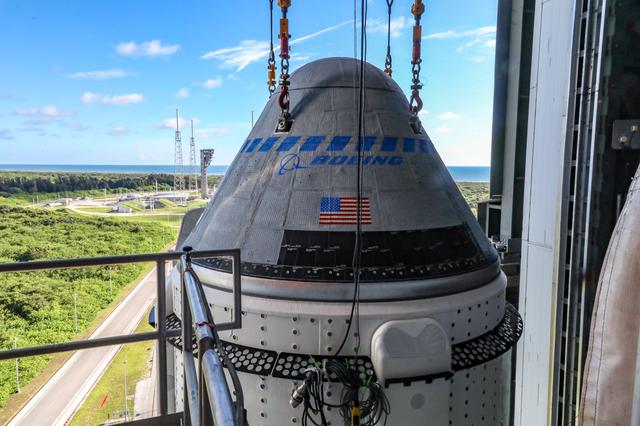
The Boeing CST-100 Starliner spacecraft is secured atop a United Launch Alliance Atlas V rocket at the Vertical Integration Facility at Space Launch Complex 41 at Cape Canaveral Space Force Station in Florida on July 17, 2021. Starliner will launch on the Atlas V for Boeing’s second Orbital Flight Test (OFT-2) for NASA’s Commercial Crew Program. The spacecraft rolled out from Boeing’s Commercial Crew and Cargo Processing Facility at NASA’s Kennedy Space Center earlier in the day.
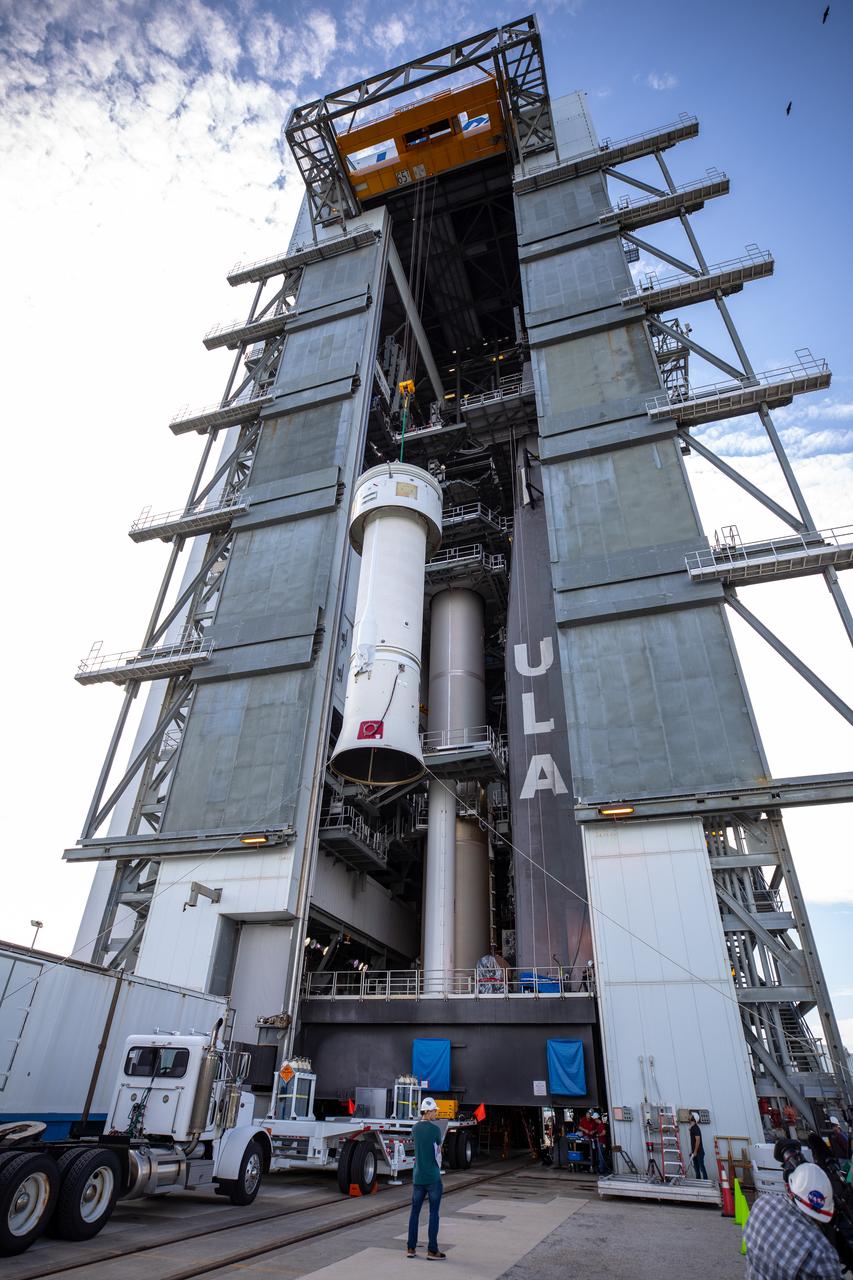
A Centaur upper stage is lifted at the Space Launch Complex 41 Vertical Integration Facility at Florida’s Cape Canaveral Air Force Station on Nov. 8, 2019, for mating to the United Launch Alliance Atlas V first stage in preparation for Boeing’s Orbital Flight Test (OFT). The uncrewed OFT mission will rendezvous and dock Boeing’s CST-100 Starliner spacecraft with the International Space Station as part of NASA’s Commercial Crew Program. Starliner will launch atop the Atlas V rocket from Space Launch Complex 41.
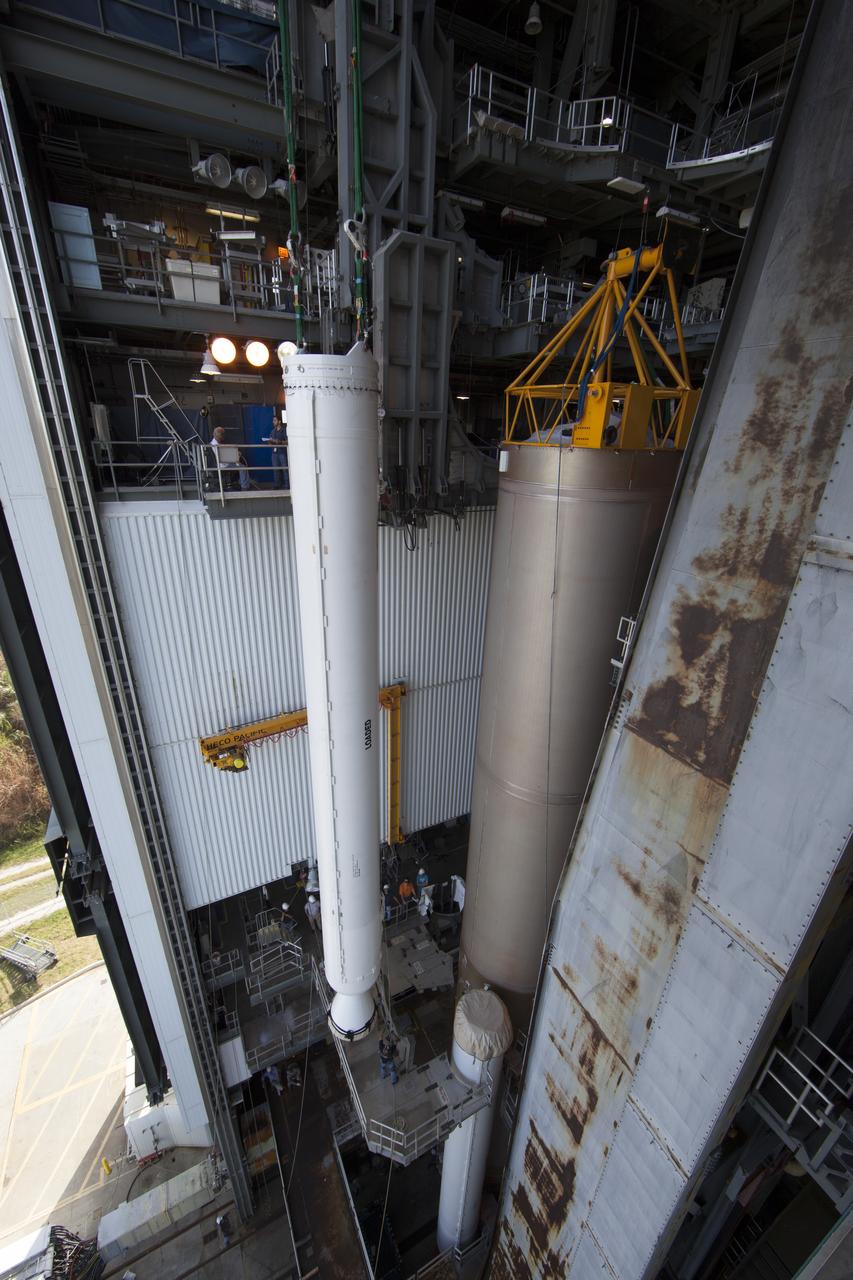
The solid rocket motor has been lifted to the vertical position and moved into the Vertical Integration Facility at Space Launch Complex 41 at Cape Canaveral Air Force Station in Florida for mating to the United Launch Alliance Atlas V rocket. NOAA's Geostationary Operational Environmental Satellite (GOES-R) will launch aboard the Atlas V rocket this month. GOES-R is the first satellite in a series of next-generation NOAA GOES Satellites.
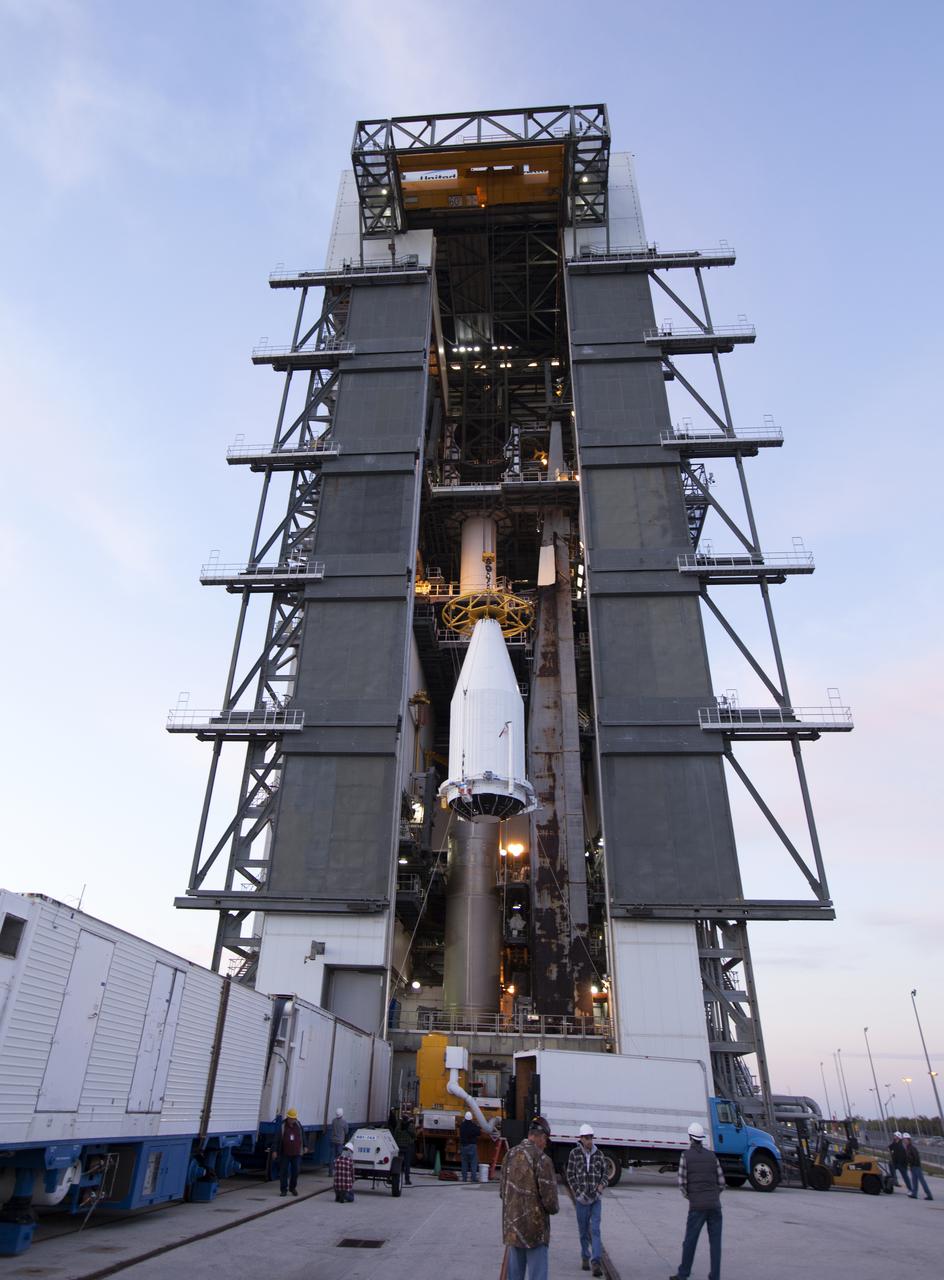
The payload fairing containing the Orbital ATK Cygnus pressurized cargo module is lifted by crane at the United Launch Alliance (ULA) Vertical Integration Facility at Space Launch Complex 41 at Cape Canaveral Air Force Station in Florida. The payload will be hoisted up and mated to the ULA Atlas V rocket. The Orbital ATK CRS-7 commercial resupply services mission to the International Space Station is scheduled to launch atop the Atlas V from pad 41. Cygnus will deliver 7,600 pounds of supplies, equipment and scientific research materials to the space station.
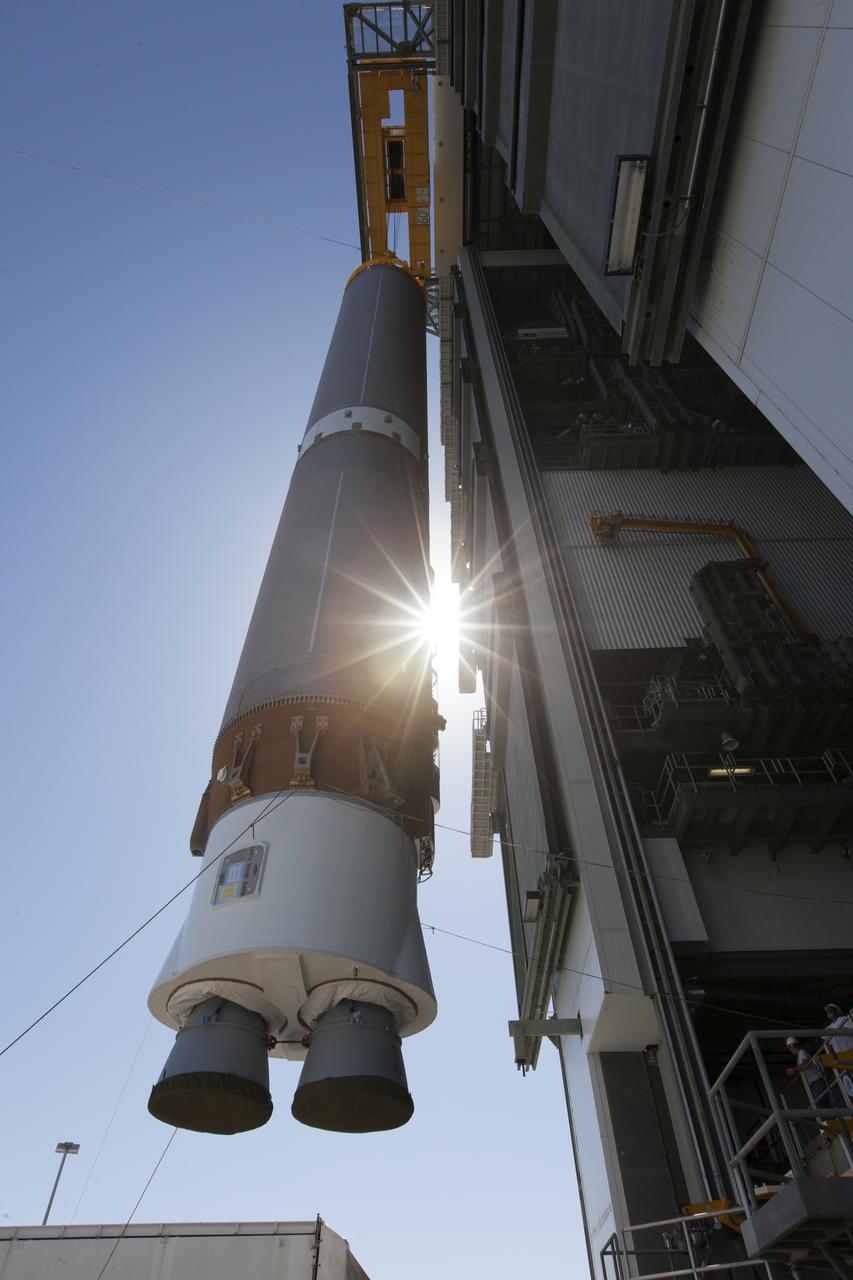
A United Launch Alliance Atlas V first stage is lifted at the Vertical Integration Facility at Space Launch Complex 41 at Cape Canaveral Air Force Station in Florida. The rocket is scheduled to launch the Tracking and Data Relay Satellite, TDRS-M. It will be the latest spacecraft destined for the agency's constellation of communications satellites that allows nearly continuous contact with orbiting spacecraft ranging from the International Space Station and Hubble Space Telescope to the array of scientific observatories. Liftoff atop the ULA Atlas V rocket is scheduled to take place from Cape Canaveral's Space Launch Complex 41 on Aug. 3, 2017 at 9:02 a.m. EDT.
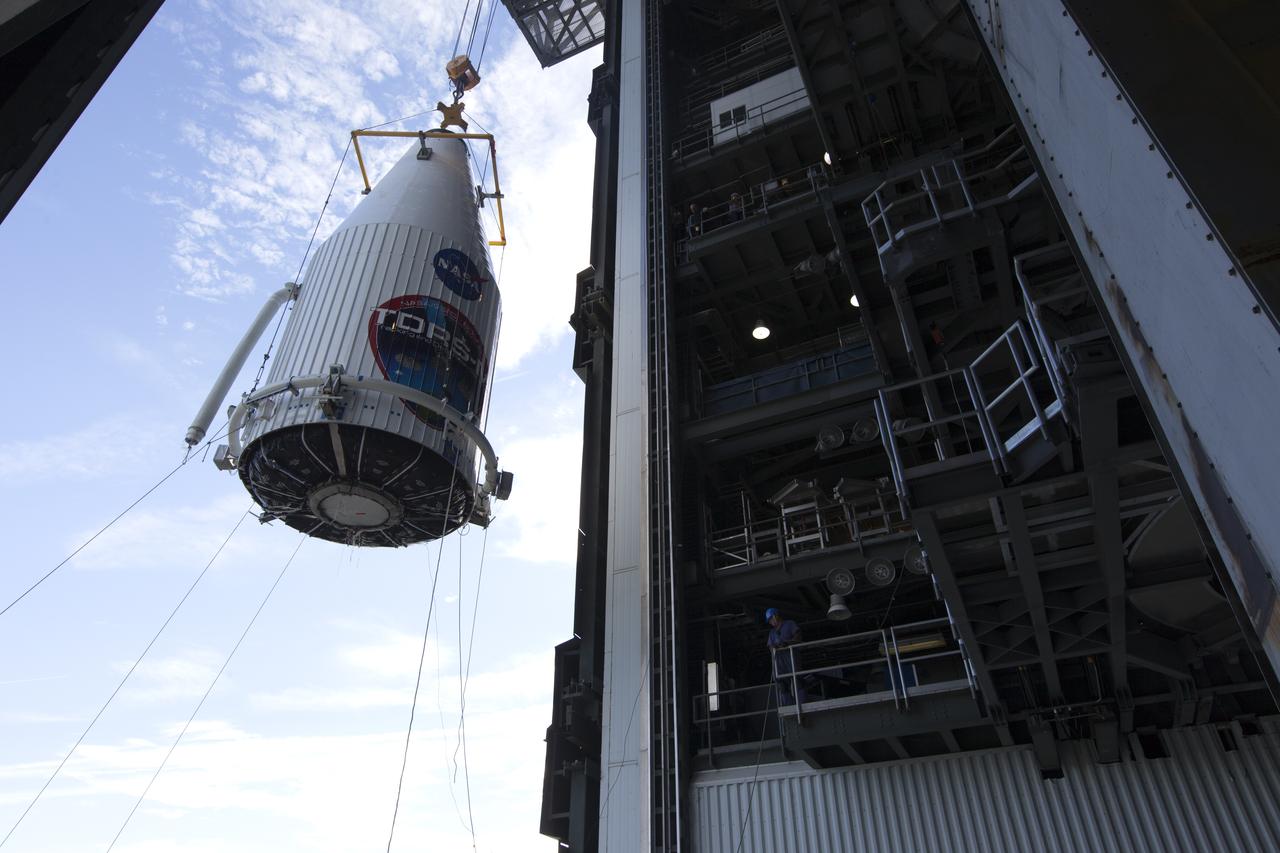
A crane is used to lift the payload fairing containing NASA's Tracking and Data Relay Satellite (TDRS-M) at the Vertical Integration Facility at Space Launch Complex 41 at Cape Canaveral Air Force Station in Florida. TDRS-M will be stacked atop the United Launch Alliance Atlas V Centaur upper stage. TDRS-M will be the latest spacecraft destined for the agency's constellation of communications satellites that allows nearly continuous contact with orbiting spacecraft ranging from the International Space Station and Hubble Space Telescope to the array of scientific observatories. Liftoff atop the ULA Atlas V rocket is scheduled for Aug. 18, 2017.
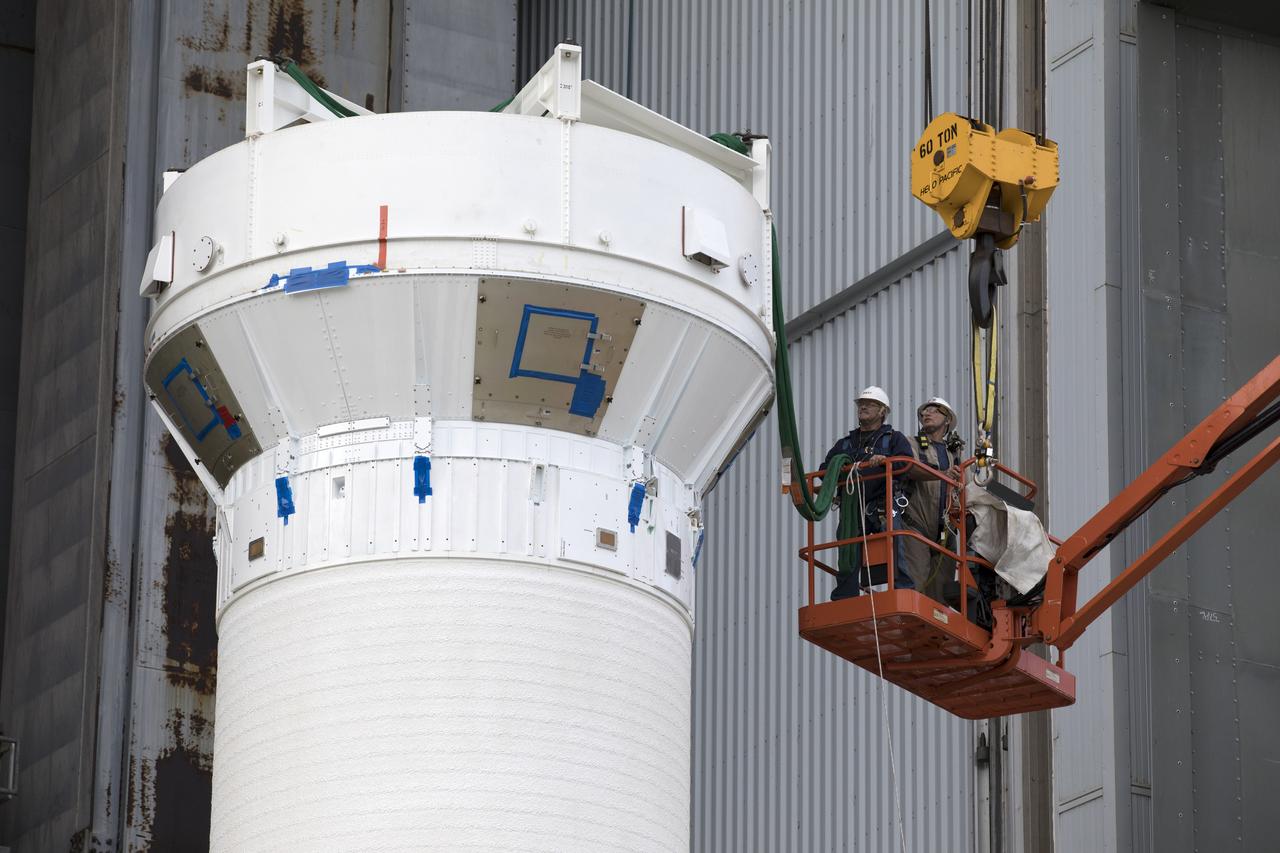
Technicians with United Launch Alliance (ULA) attach crane lines to the Centaur upper stage of the ULA Atlas V Centaur stage at the Vertical Integration Facility at Space Launch Complex 41 at Cape Canaveral Air Force Station in Florida. The Centaur stage will be lifted and mated to the first stage booster. The rocket is being prepared for Orbital ATK's seventh commercial resupply mission, CRS-7, to the International Space Station. Orbital ATK's CYGNUS pressurized cargo module is scheduled to launch atop ULA's Atlas V rocket from Pad 41 on March 19, 2017. CYGNUS will deliver 7,600 pounds of supplies, equipment and scientific research materials to the space station.
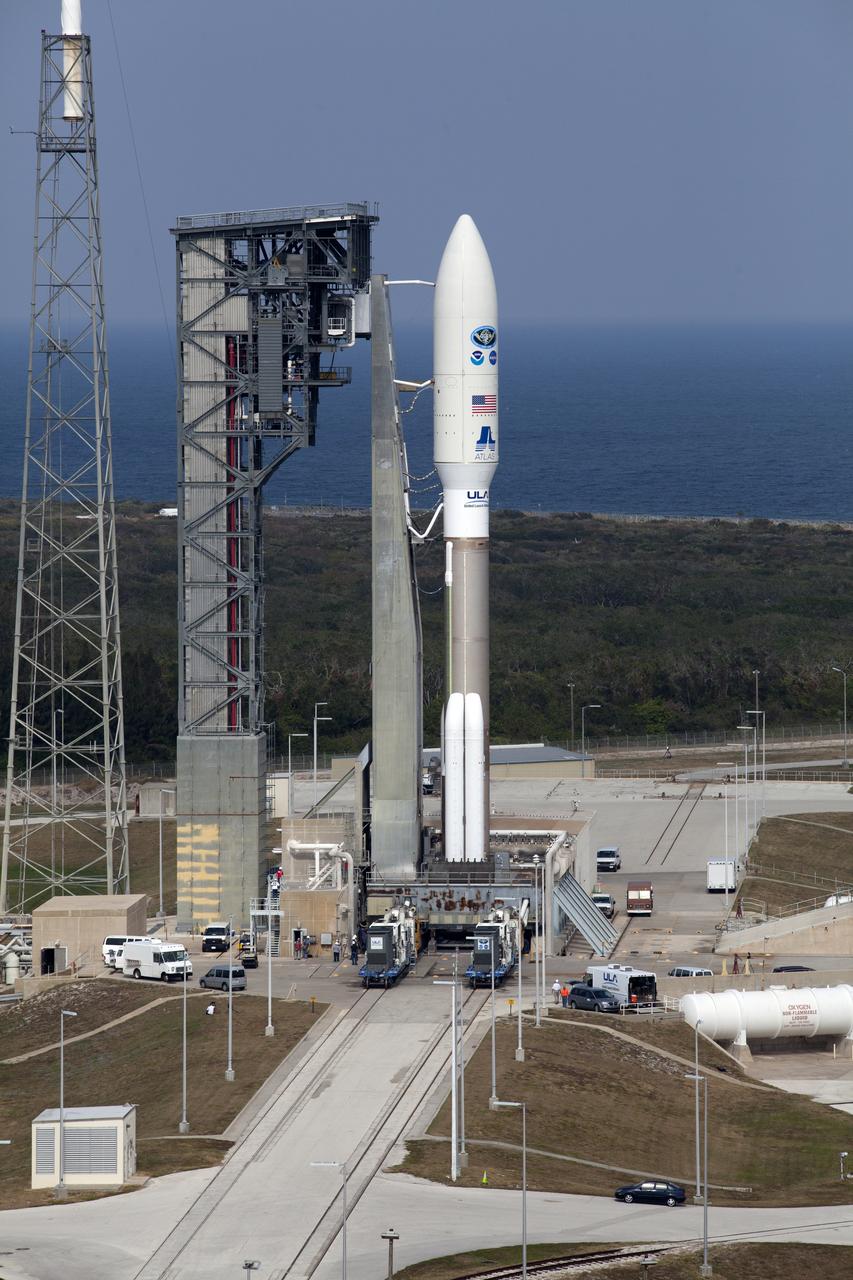
A United Launch Alliance Atlas V rocket arrives at Space Launch Complex 41 at Cape Canaveral Air Force Station in Florida. The launch vehicle will send the Geostationary Operational Environmental Satellite (GOES-R) to a geostationary position over the U.S. GOES-R is the first satellite in a series of next-generation NOAA GOES satellites.
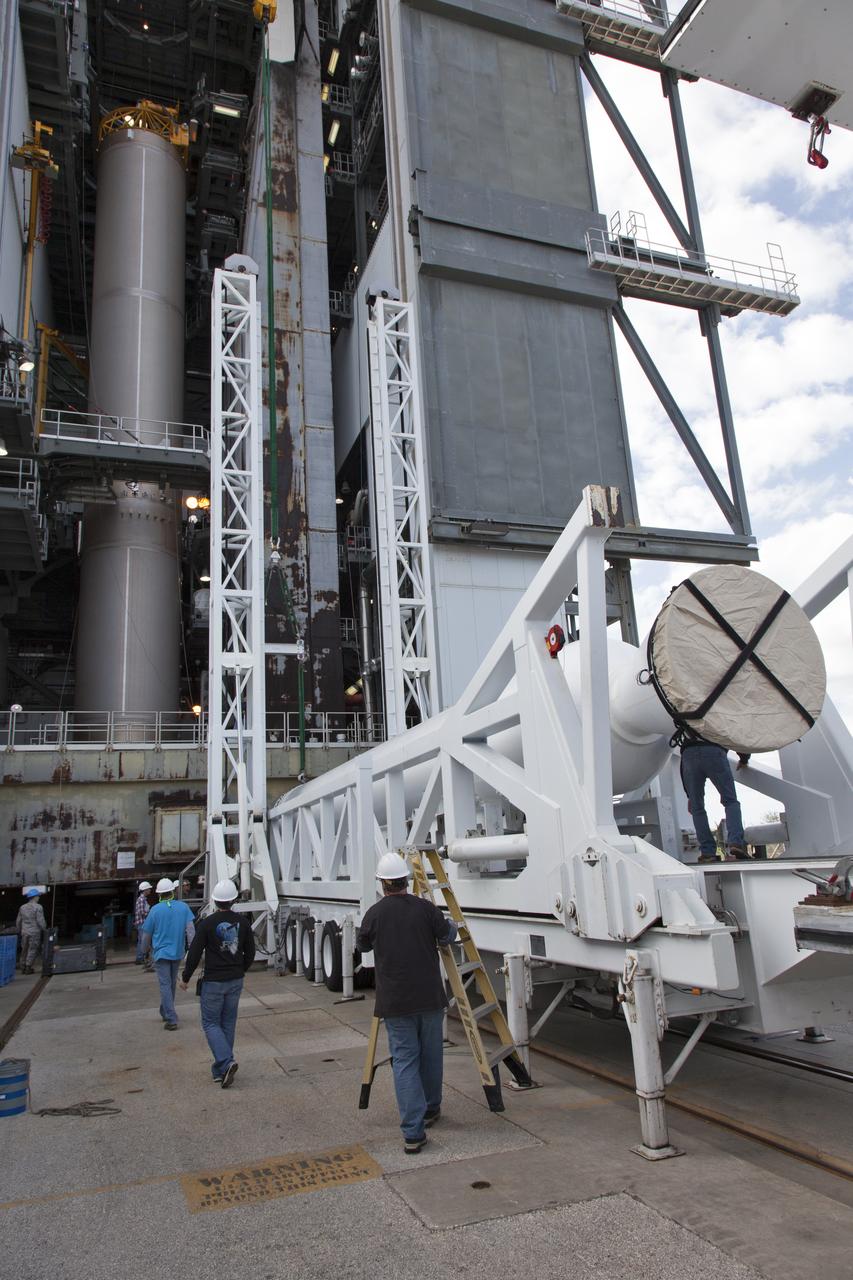
Technicians and engineers offload a solid rocket booster (SRB) that just arrived at the Vertical Integration Facility at Space Launch Complex 41 at Cape Canaveral Air Force Station in Florida. The SRB will be mated to a United Launch Alliance Atlas V first stage to help boost NOAA's Geostationary Operational Environmental Satellite, or GOES-S, to orbit. GOES-S is the second in a series of four advanced geostationary weather satellites that will significantly improve the detection and observation of environmental phenomena that directly affect public safety, protection of property and the nation's economic health and prosperity. GOES-S is slated to launch March 1, 2018.
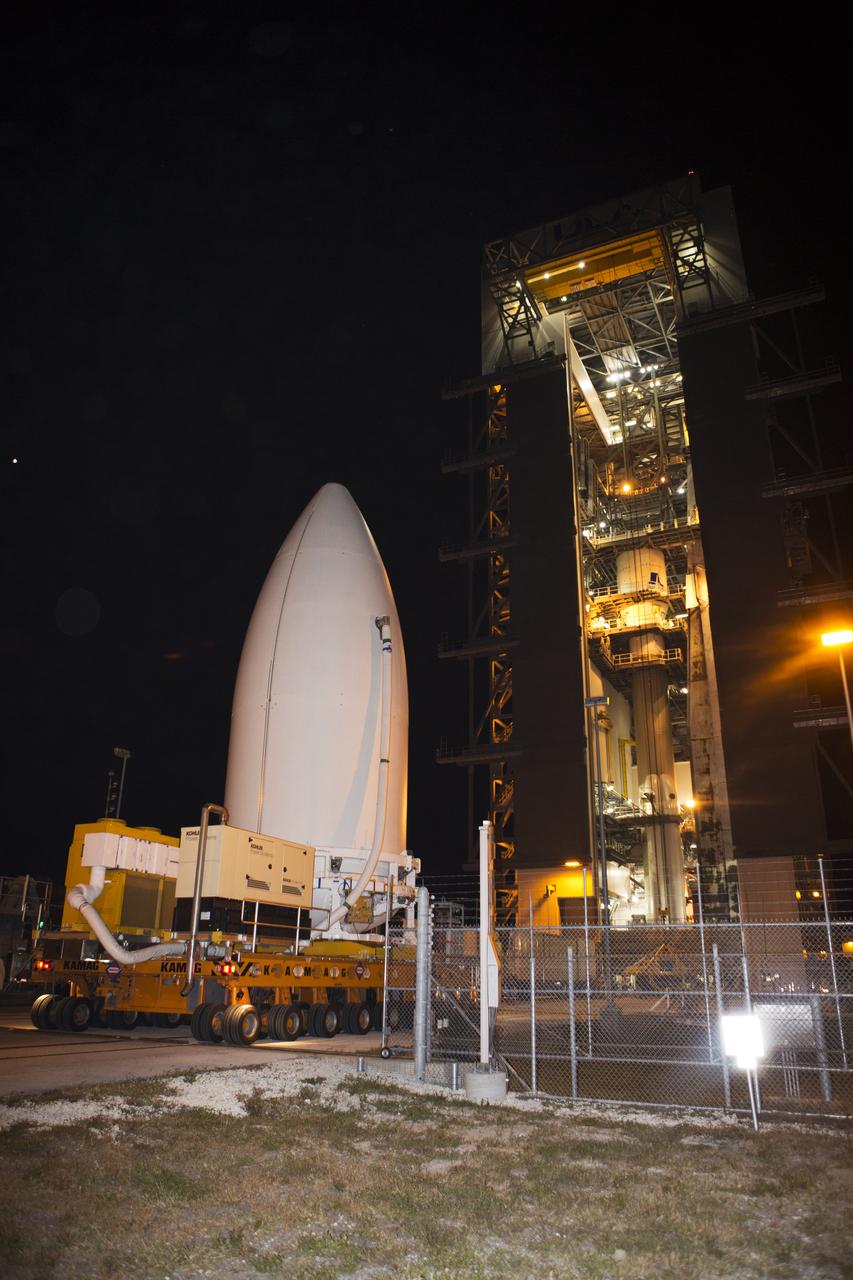
Enclosed in its payload fairing, NOAA's Geostationary Operational Environmental Satellite (GOES-R) arrives at the Vertical Integration Facility at Space Launch Complex 41 at Cape Canaveral Air Force Station. GOES-R will be stacked atop the United Launch Alliance Atlas V Centaur upper stage. The satellite will launch atop the Atlas V rocket in November. GOES-R is the first satellite in a series of next-generation NOAA GOES Satellites.
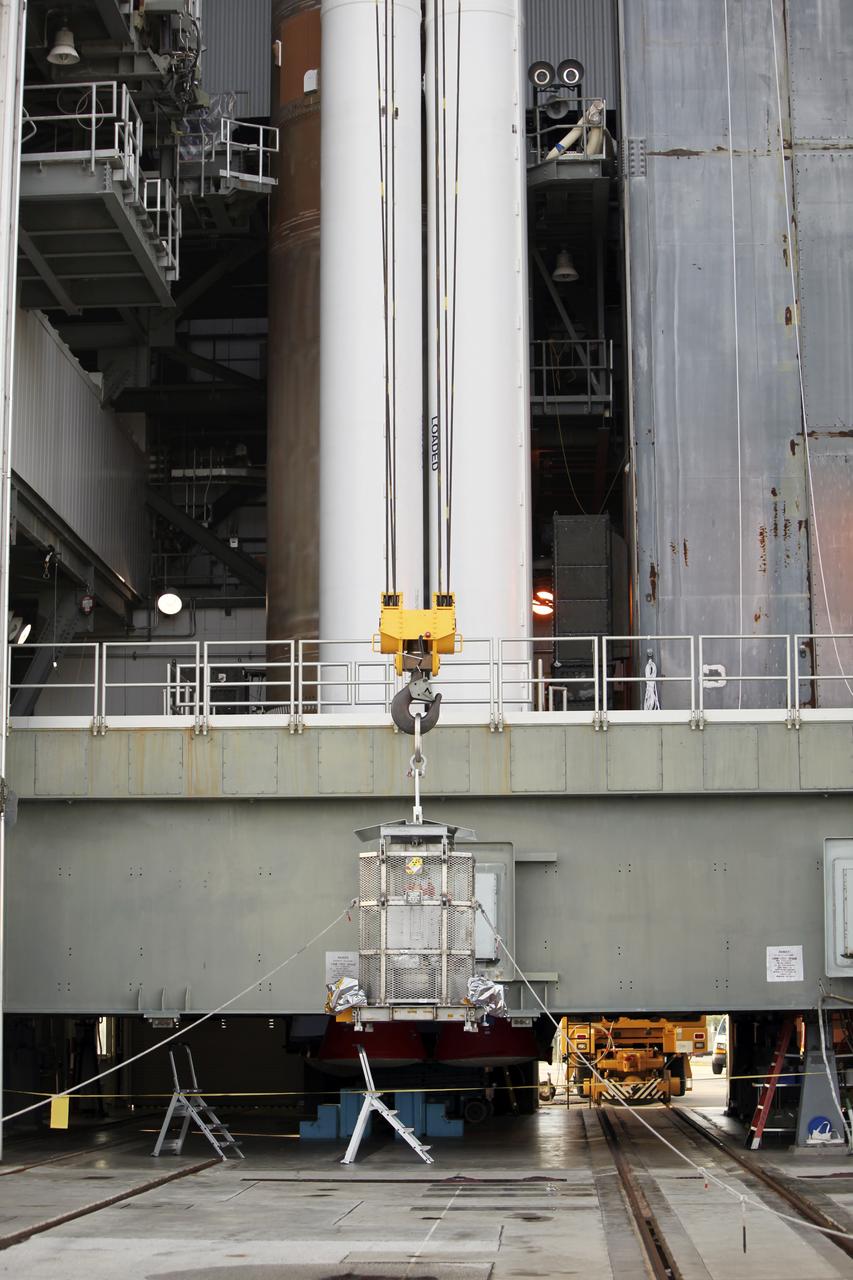
SPACE X MMRTG Offload and Lift for Insertion
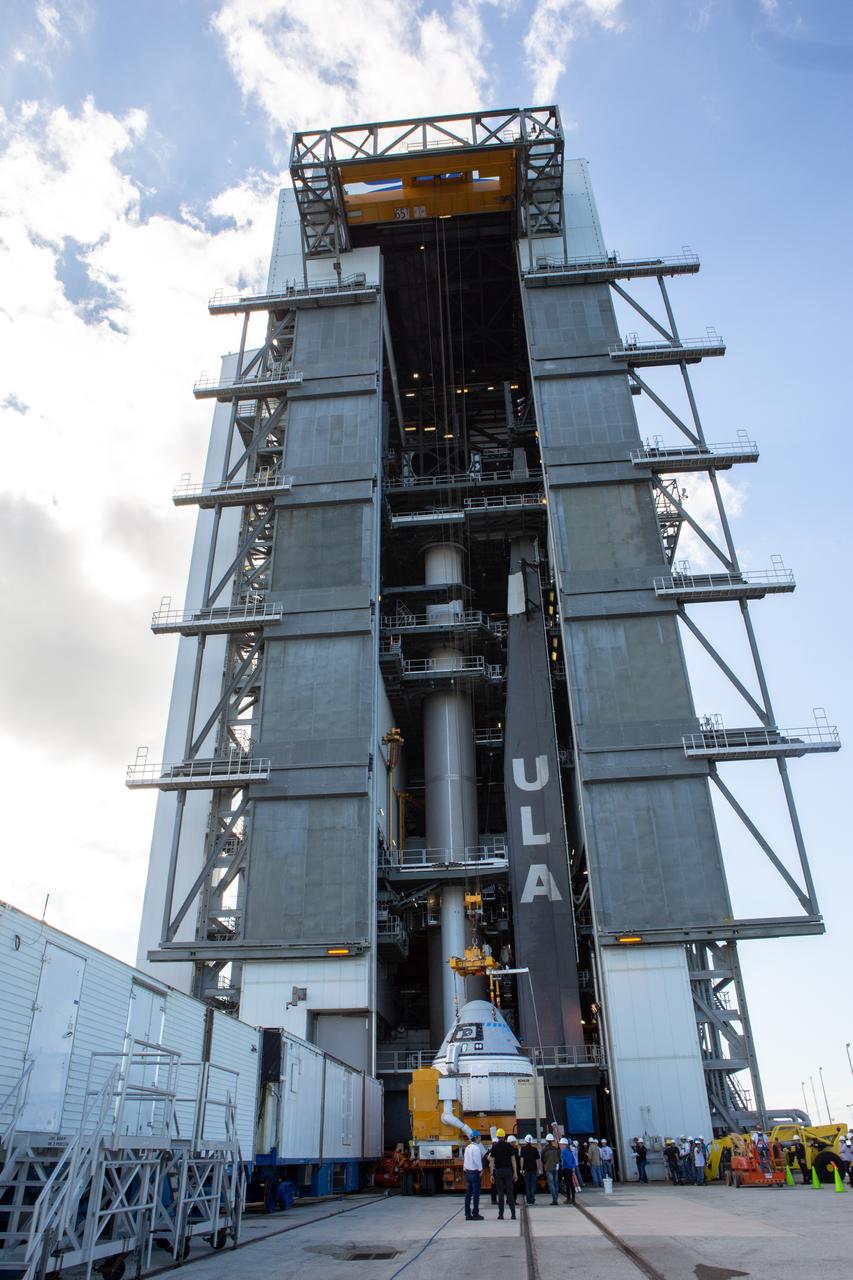
The Boeing CST-100 Starliner spacecraft is lifted at the Vertical Integration Facility at Space Launch Complex 41 at Florida’s Cape Canaveral Air Force Station on Nov. 21, 2019. Starliner will be secured atop a United Launch Alliance Atlas V rocket for Boeing’s Orbital Flight Test to the International Space Station for NASA’s Commercial Crew Program. The spacecraft rolled out from Boeing’s Commercial Crew and Cargo Processing Facility at NASA’s Kennedy Space Center earlier in the day.
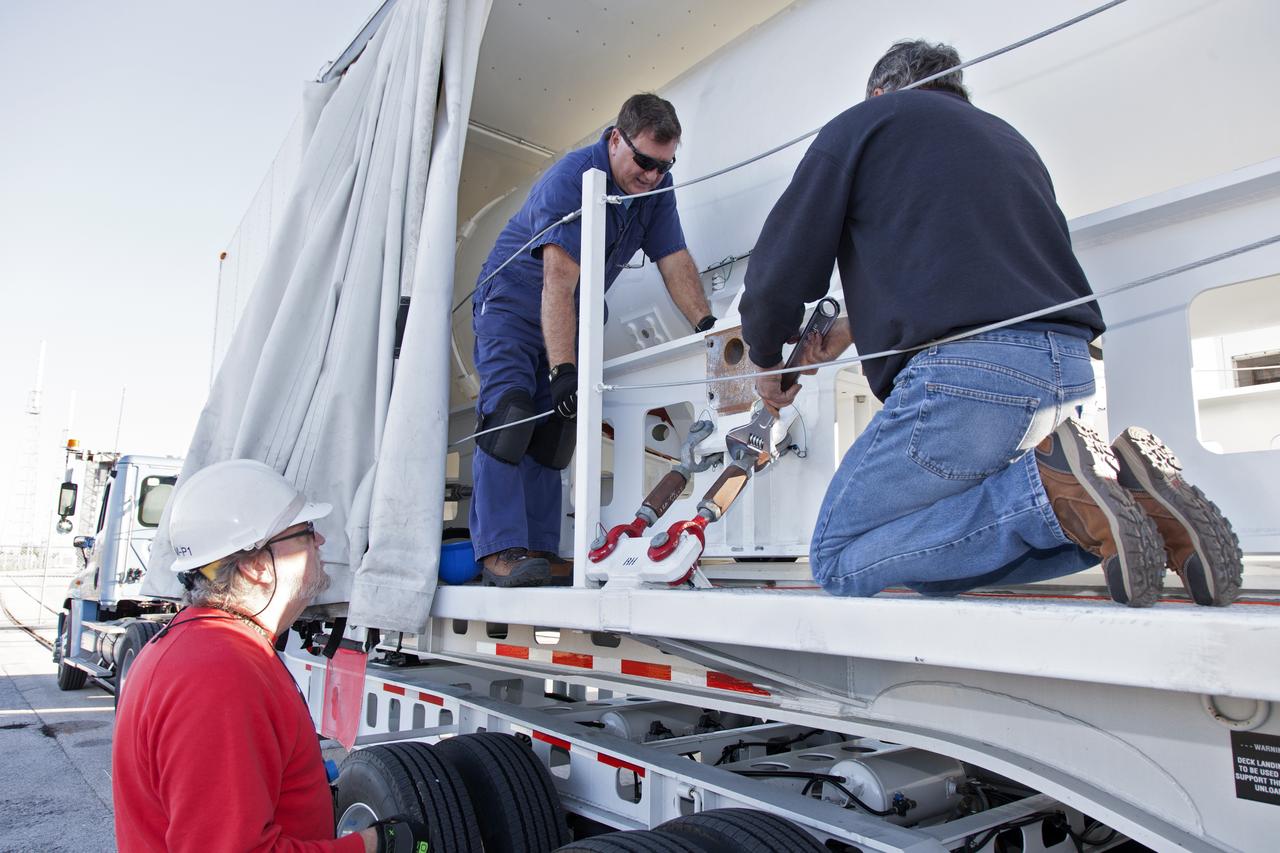
Technicians prepare to offload a solid rocket booster (SRB) that just arrived at the Vertical Integration Facility at Space Launch Complex 41 at Cape Canaveral Air Force Station in Florida. The SRB will be mated to a United Launch Alliance Atlas V first stage to help boost NOAA's Geostationary Operational Environmental Satellite, or GOES-S, to orbit. GOES-S is the second in a series of four advanced geostationary weather satellites that will significantly improve the detection and observation of environmental phenomena that directly affect public safety, protection of property and the nation's economic health and prosperity. GOES-S is slated to launch March 1, 2018.

At the Vertical Integration Facility at Space Launch Complex 41 at Cape Canaveral Air Force Station in Florida, a solid rocket booster (SRB) is lifted by a crane for mating to a United Launch Alliance Atlas V first stage. The SRB will help boost NOAA's Geostationary Operational Environmental Satellite, or GOES-S, to orbit. GOES-S is the second in a series of four advanced geostationary weather satellites that will significantly improve the detection and observation of environmental phenomena that directly affect public safety, protection of property and the nation's economic health and prosperity. GOES-S is slated to launch March 1, 2018.
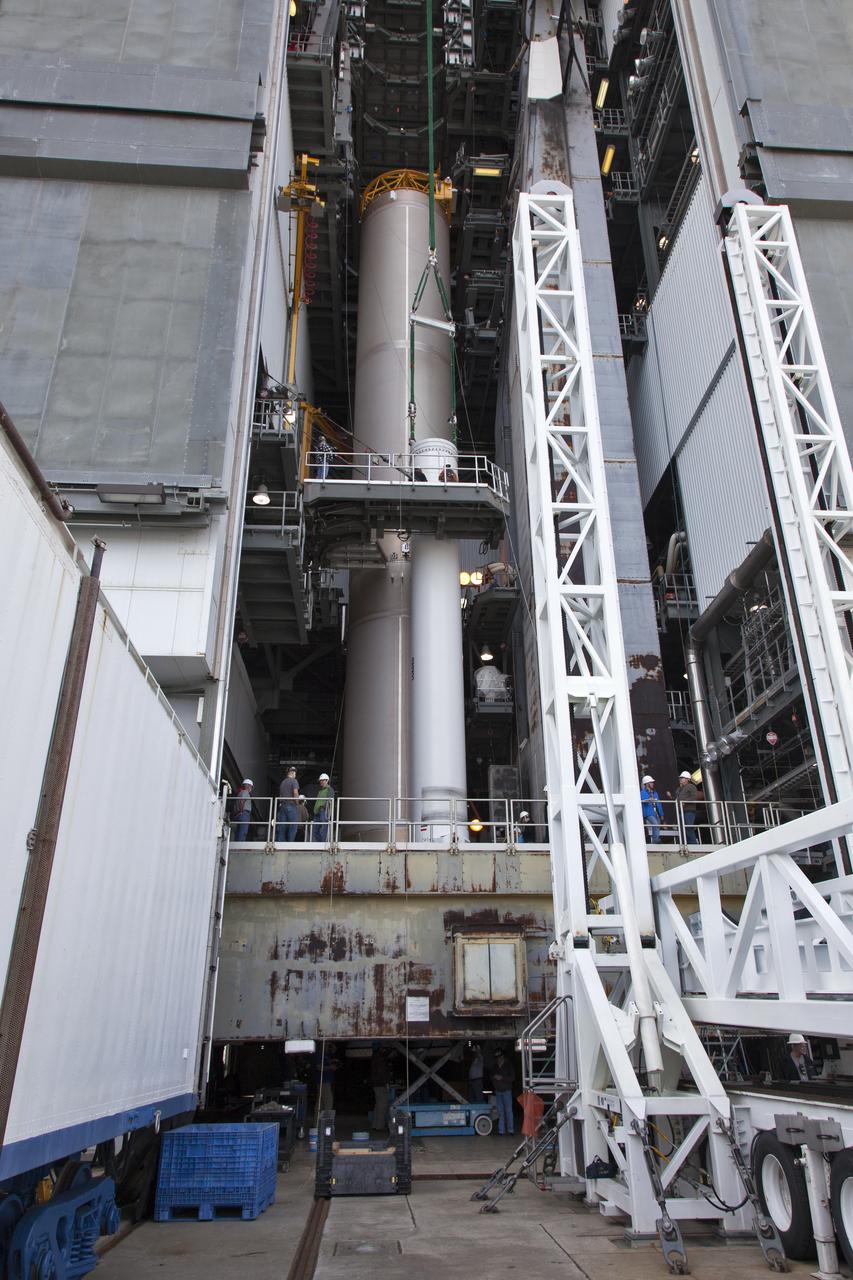
A solid rocket booster (SRB) is mated to a United Launch Alliance Atlas V first stage in the Vertical Integration Facility at Space Launch Complex 41 at Cape Canaveral Air Force Station in Florida. The SRB will be help boost NOAA's Geostationary Operational Environmental Satellite, or GOES-S, to orbit. GOES-S is the second in a series of four advanced geostationary weather satellites that will significantly improve the detection and observation of environmental phenomena that directly affect public safety, protection of property and the nation's economic health and prosperity. GOES-S is slated to launch March 1, 2018.
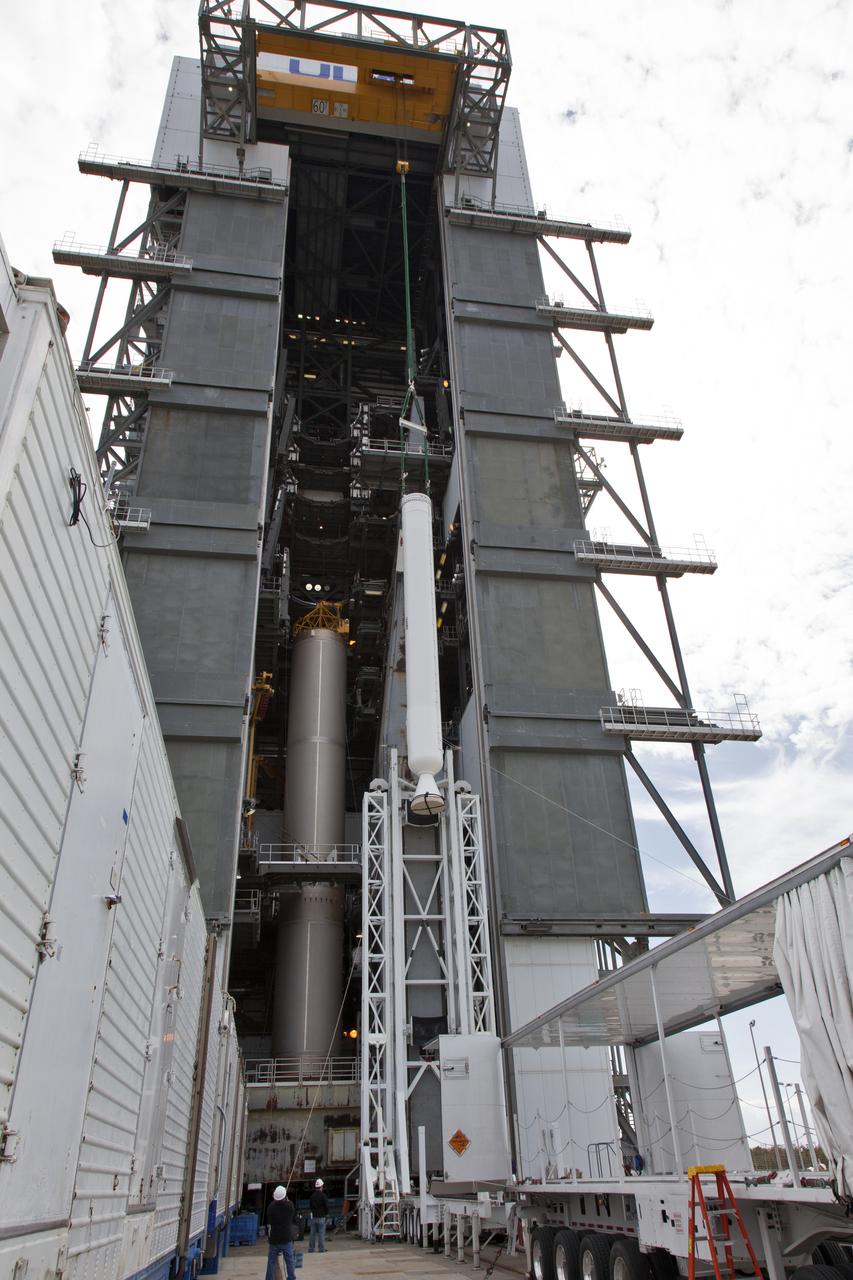
A crane lifts a solid rocket booster (SRB) for mating to a United Launch Alliance Atlas V first stage in the Vertical Integration Facility at Space Launch Complex 41 at Cape Canaveral Air Force Station in Florida. The SRB will be help boost NOAA's Geostationary Operational Environmental Satellite, or GOES-S, to orbit. GOES-S is the second in a series of four advanced geostationary weather satellites that will significantly improve the detection and observation of environmental phenomena that directly affect public safety, protection of property and the nation's economic health and prosperity. GOES-S is slated to launch March 1, 2018.
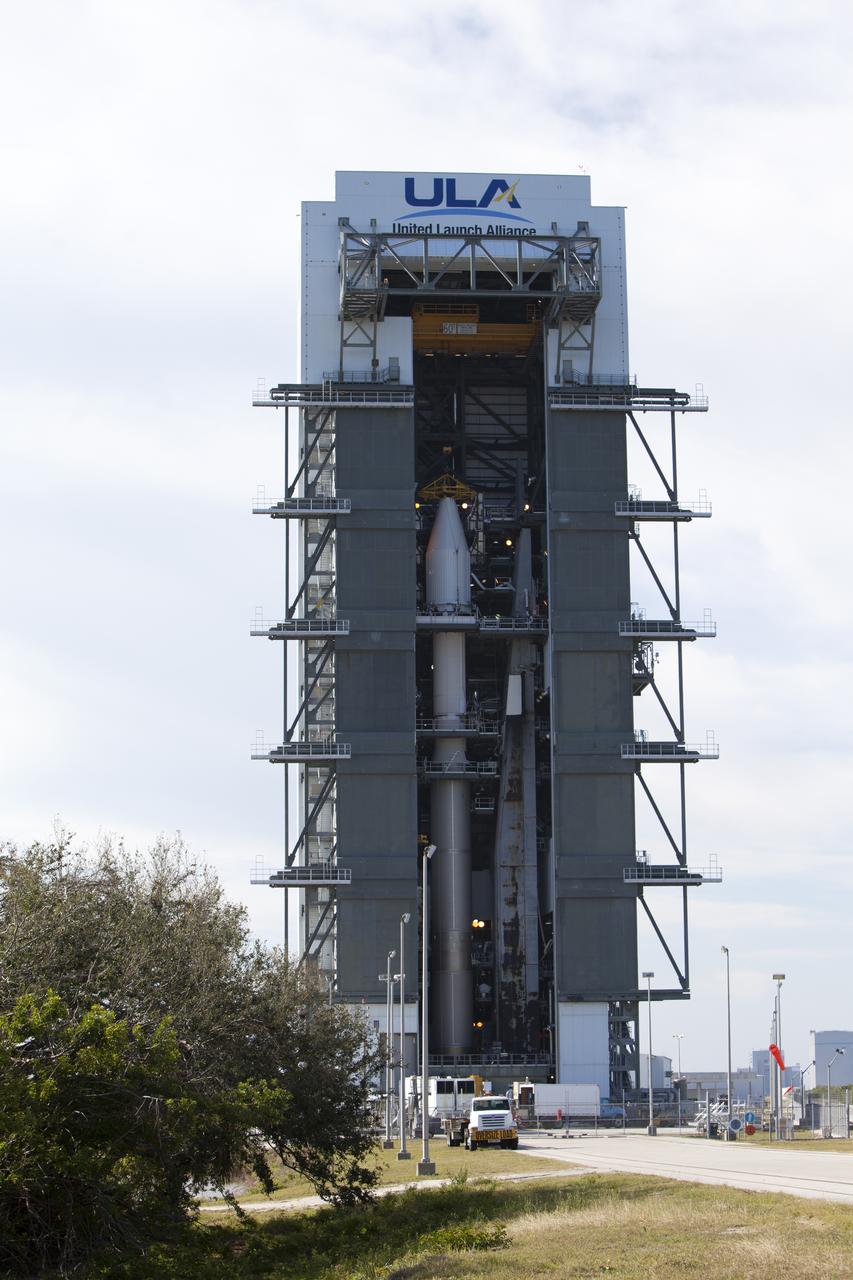
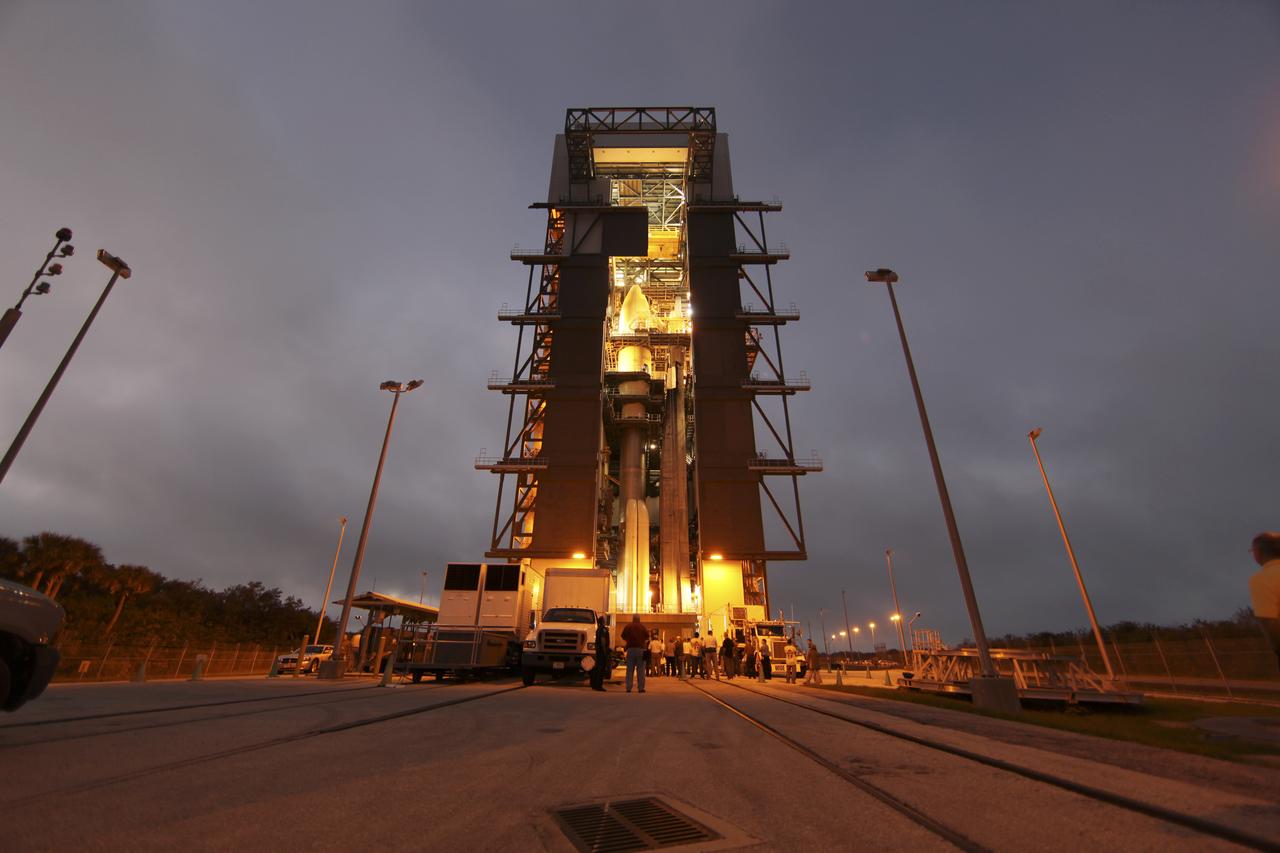
The payload fairing containing the Orbital ATK Cygnus pressurized cargo module is mated to the Centaur upper stage, or second stage, of the United Launch Alliance (ULA) rocket in the Vertical Integration Facility at Space Launch Complex 41 at Cape Canaveral Air Force Station in Florida. The Orbital ATK CRS-7 commercial resupply services mission to the International Space Station is scheduled to launch atop the Atlas V from pad 41. Cygnus will deliver 7,600 pounds of supplies, equipment and scientific research materials to the space station.
SPACE X MMRTG Offload and Lift for Insertion
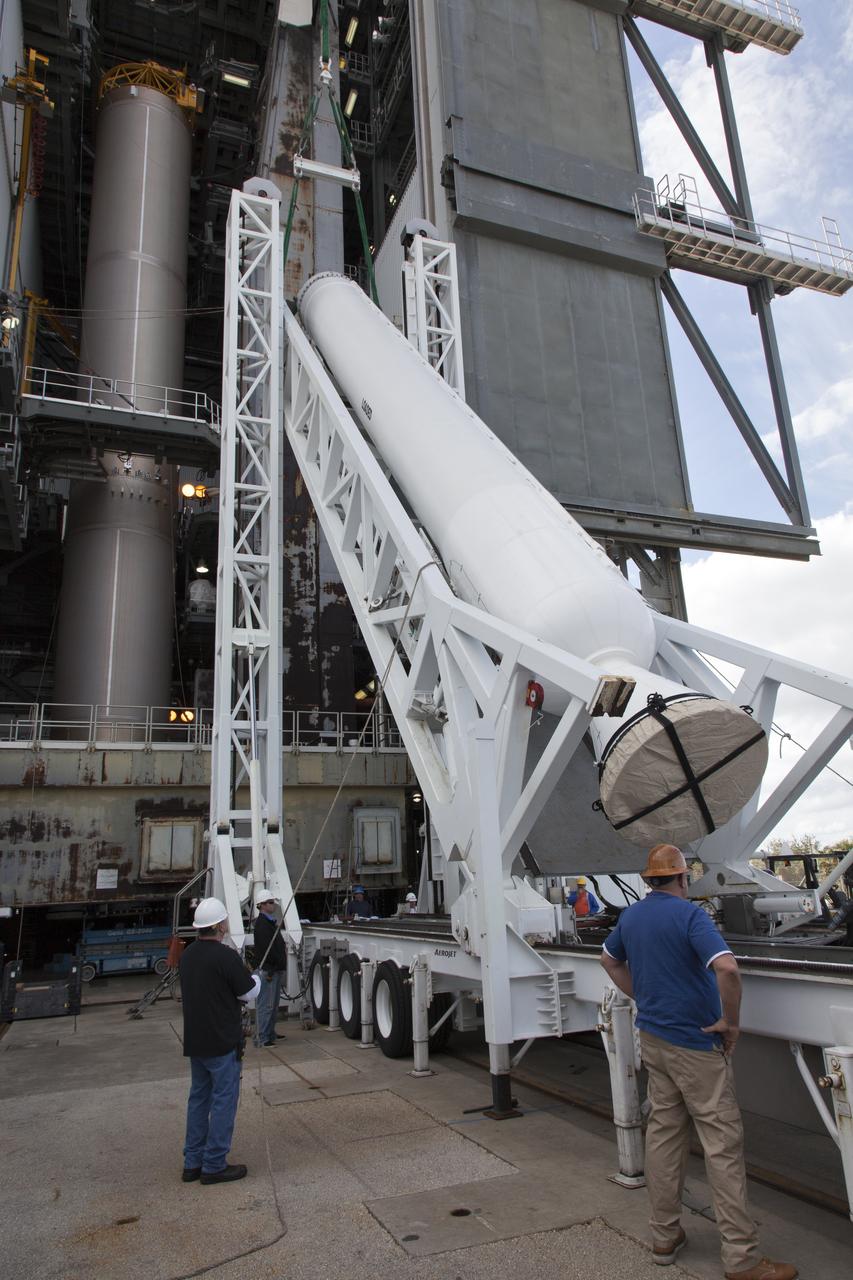
A solid rocket booster (SRB) is lifted for mating to a United Launch Alliance Atlas V first stage in the Vertical Integration Facility at Space Launch Complex 41 at Cape Canaveral Air Force Station in Florida. The SRB will be help boost NOAA's Geostationary Operational Environmental Satellite, or GOES-S, to orbit. GOES-S is the second in a series of four advanced geostationary weather satellites that will significantly improve the detection and observation of environmental phenomena that directly affect public safety, protection of property and the nation's economic health and prosperity. GOES-S is slated to launch March 1, 2018.
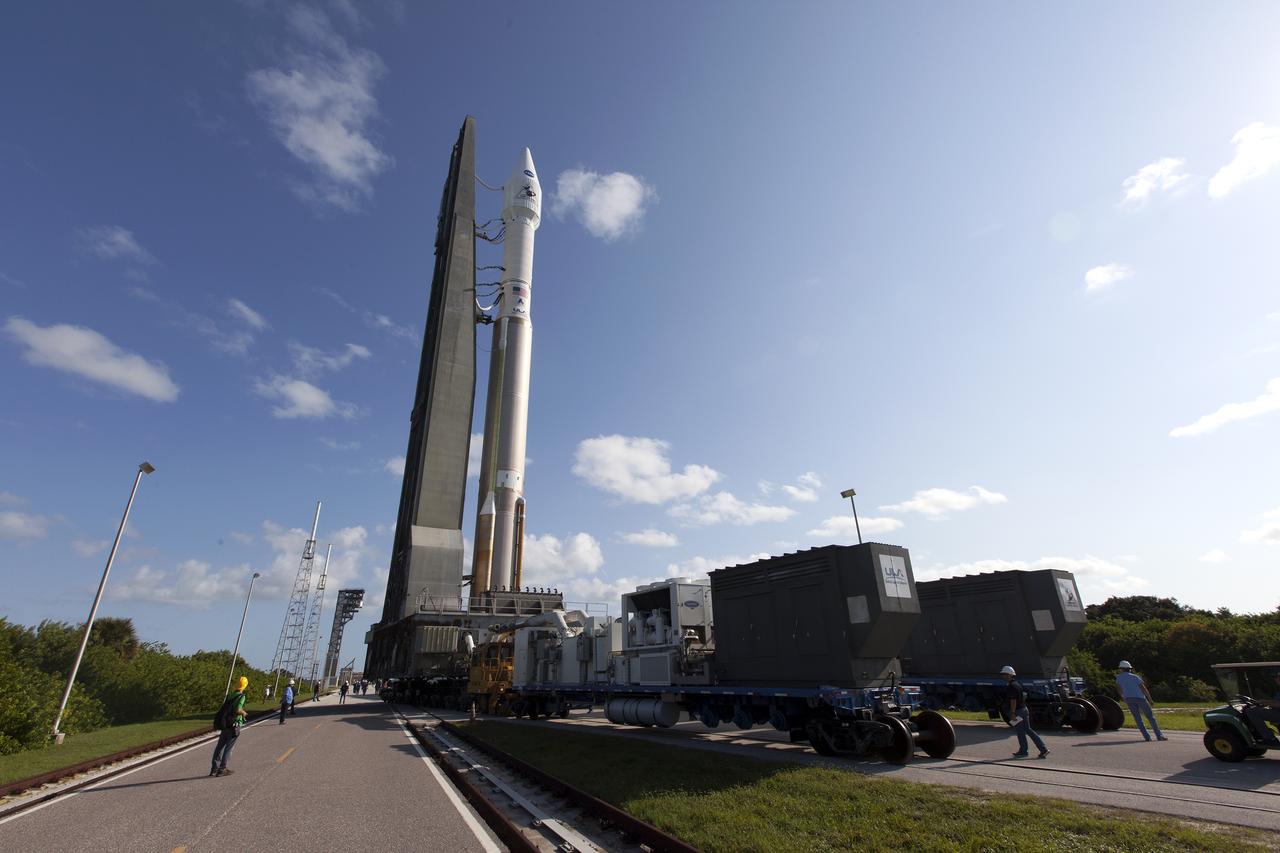
A United Launch Alliance Atlas V rocket rolled out of the Vertical Integration Facility and is on its way to Space Launch Complex 41 at Cape Canaveral Air Force Station in Florida. The launch vehicle will boost NASA’s Origins, Spectral Interpretation, Resource Identification, Security-Regolith Explorer, or OSIRIS-REx spacecraft. This will be the first U.S. mission to sample an asteroid, retrieve at least two ounces of surface material and return it to Earth for study. The asteroid, Bennu, may hold clues to the origin of the solar system and the source of water and organic molecules found on Earth.
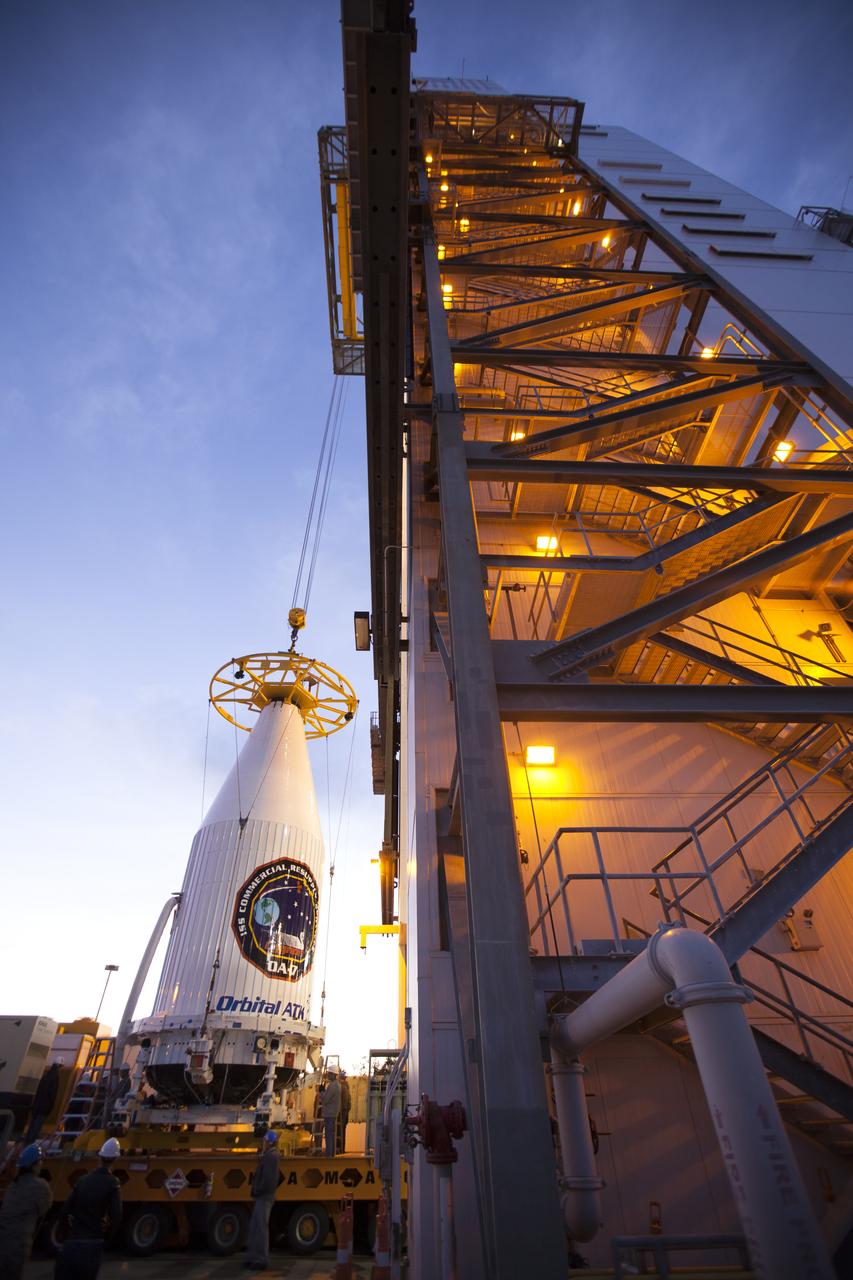
The payload fairing containing the Orbital ATK Cygnus pressurized cargo module is lifted by crane at the United Launch Alliance (ULA) Vertical Integration Facility at Space Launch Complex 41 at Cape Canaveral Air Force Station in Florida. The payload will be hoisted up and mated to the ULA Atlas V rocket. The Orbital ATK CRS-7 commercial resupply services mission to the International Space Station is scheduled to launch atop the Atlas V from pad 41. Cygnus will deliver 7,600 pounds of supplies, equipment and scientific research materials to the space station.
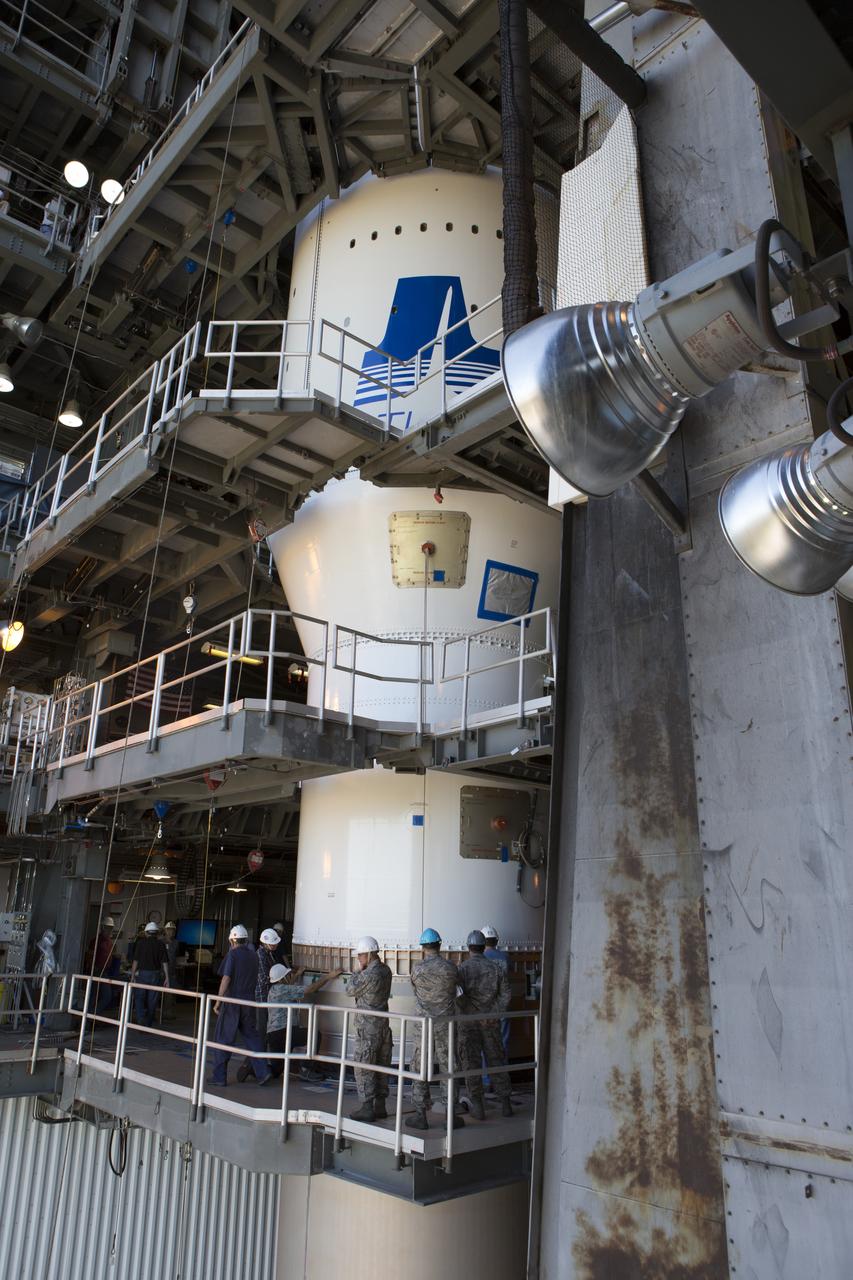
Operations are underway to stack the United Launch Alliance Atlas V Centaur second stage onto the first stage in the Vertical Integration Facility at Space Launch Complex 41 at Cape Canaveral Air Force Station in Florida. The Geostationary Operational Environmental Satellite (GOES-R) will launch aboard the Atlas V rocket in November. GOES-R is the first satellite in a series of next-generation NOAA GOES Satellites.
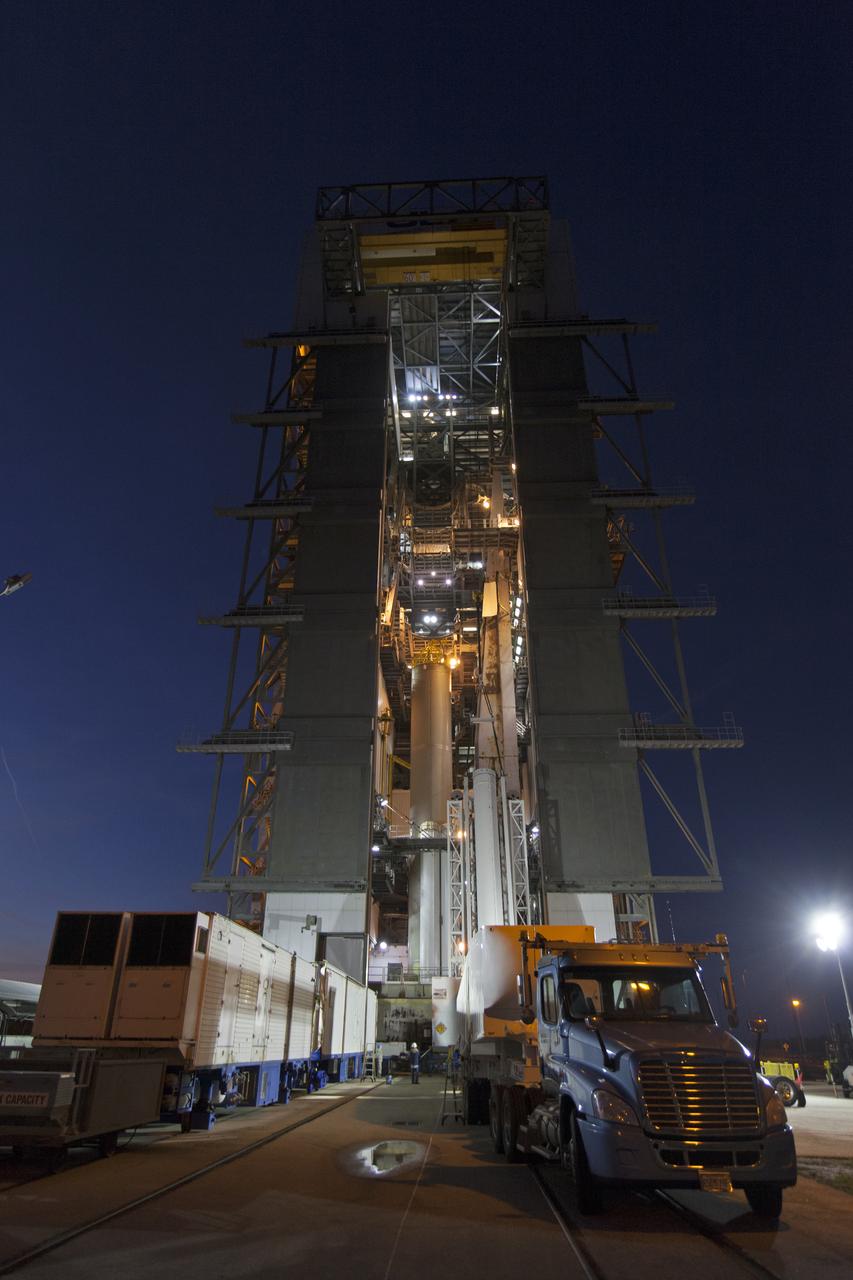
At the Vertical Integration Facility at Space Launch Complex 41 at Cape Canaveral Air Force Station in Florida, a solid rocket booster (SRB) is mated to a United Launch Alliance Atlas V first stage. The SRB will help boost NOAA's Geostationary Operational Environmental Satellite, or GOES-S, to orbit. GOES-S is the second in a series of four advanced geostationary weather satellites that will significantly improve the detection and observation of environmental phenomena that directly affect public safety, protection of property and the nation's economic health and prosperity. GOES-S is slated to launch March 1, 2018.
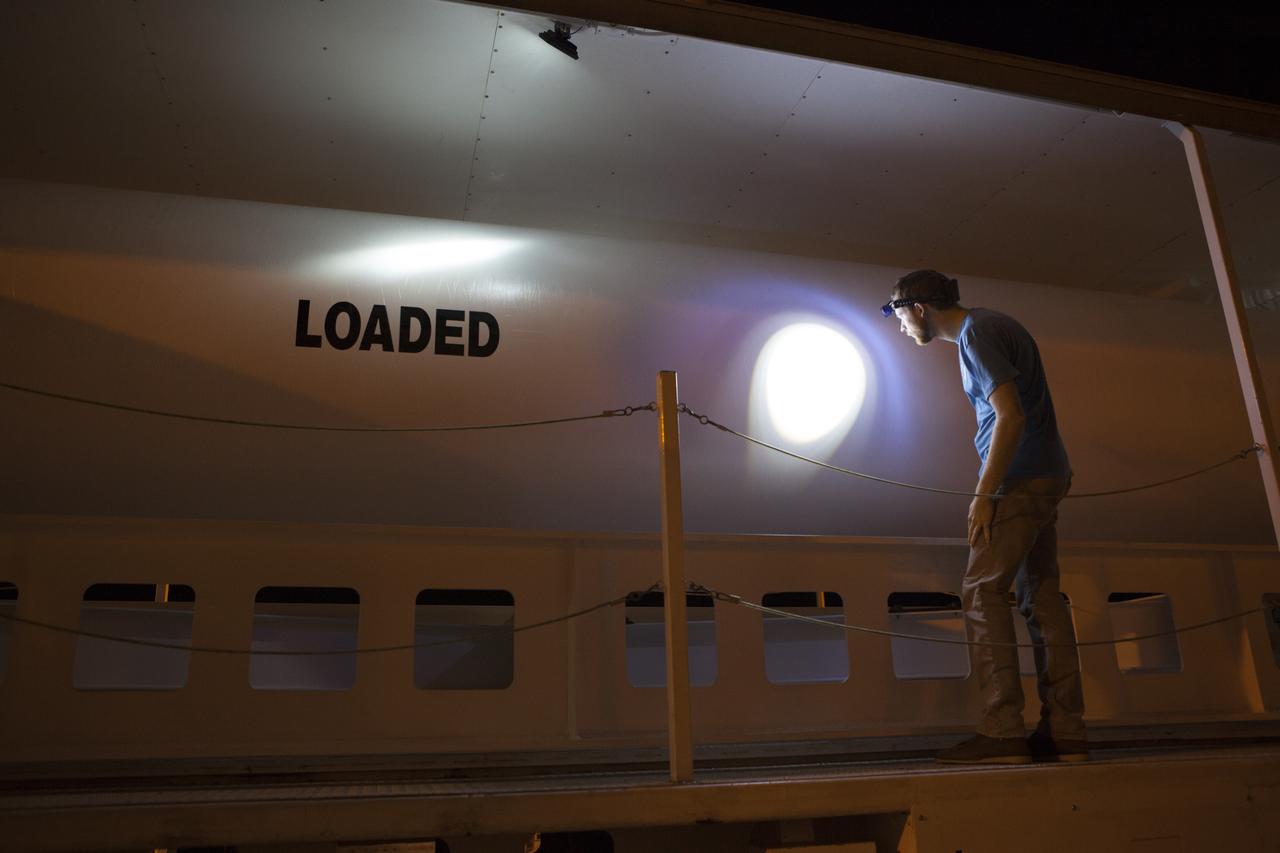
A United Launch Alliance (ULA) technician inspects the solid rocket motor for the ULA Atlas V rocket on its transporter near the Vertical Integration Facility at Space Launch Complex 41 at Cape Canaveral Air Force Station in Florida. The solid rocket motor will be lifted and mated to the rocket in preparation for the launch of NOAA's Geostationary Operational Environmental Satellite (GOES-R) this month. GOES-R is the first satellite in a series of next-generation NOAA GOES Satellites.
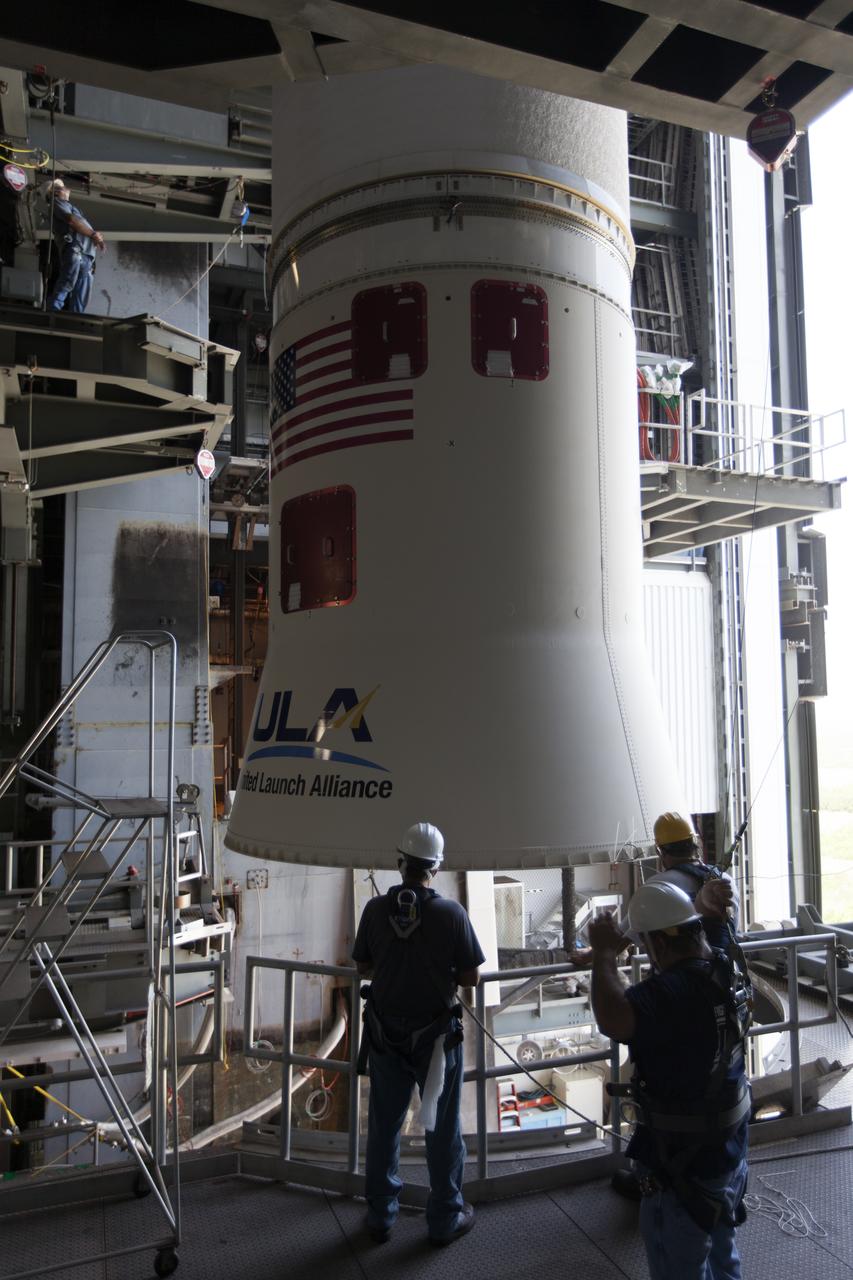
At the Vertical Integration Facility at Space Launch Complex 41 at Cape Canaveral Air Force Station in Florida, United Launch Alliance team members monitor the progress as a Centaur upper stage is positioned prior to mating to an Atlas V booster. The rocket is scheduled to launch the Tracking and Data Relay Satellite, TDRS-M. It will be the latest spacecraft destined for the agency's constellation of communications satellites that allows nearly continuous contact with orbiting spacecraft ranging from the International Space Station and Hubble Space Telescope to the array of scientific observatories. Liftoff atop the ULA Atlas V rocket is scheduled to take place from Cape Canaveral's Space Launch Complex 41 in early August.
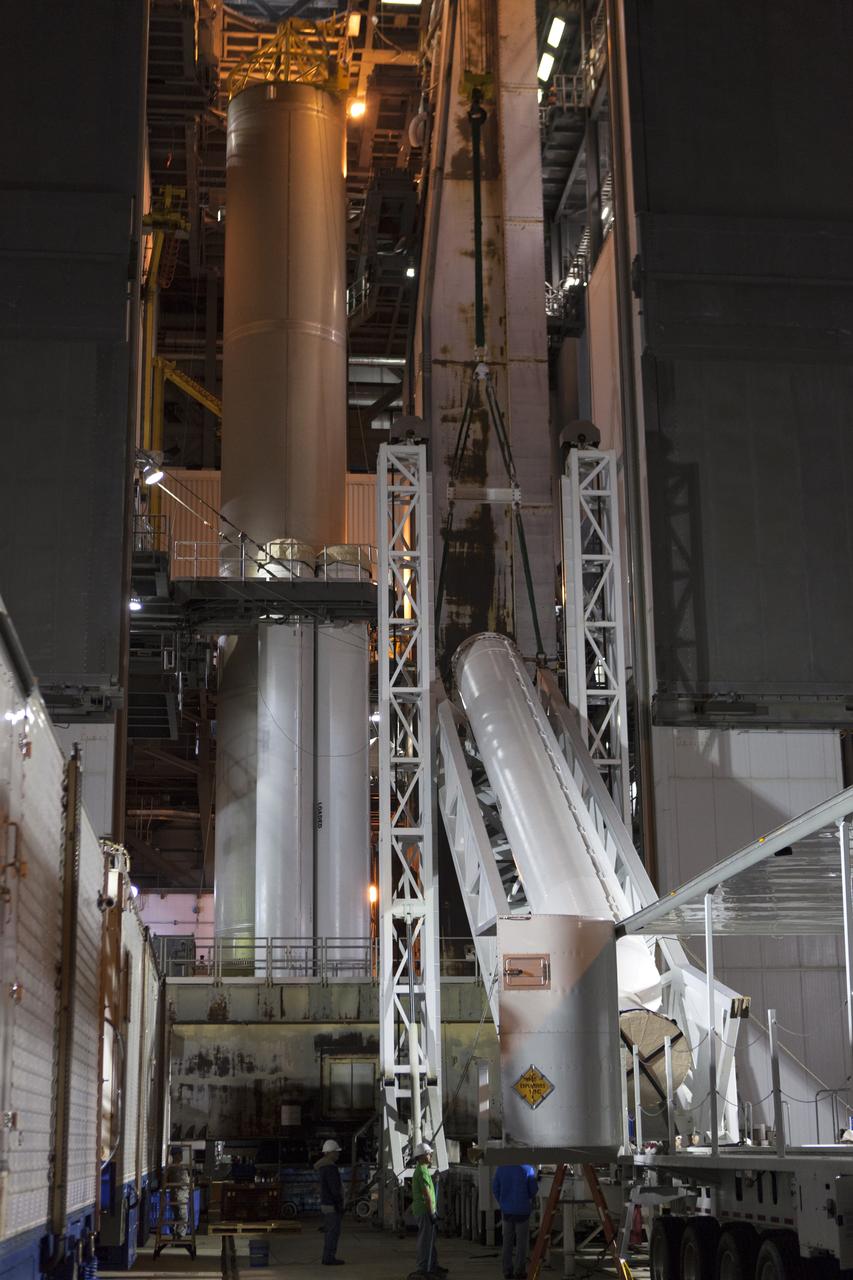
At the Vertical Integration Facility at Space Launch Complex 41 at Cape Canaveral Air Force Station in Florida, a solid rocket booster (SRB) is lifted for mating to a United Launch Alliance Atlas V first stage. The SRB will help boost NOAA's Geostationary Operational Environmental Satellite, or GOES-S, to orbit. GOES-S is the second in a series of four advanced geostationary weather satellites that will significantly improve the detection and observation of environmental phenomena that directly affect public safety, protection of property and the nation's economic health and prosperity. GOES-S is slated to launch March 1, 2018.
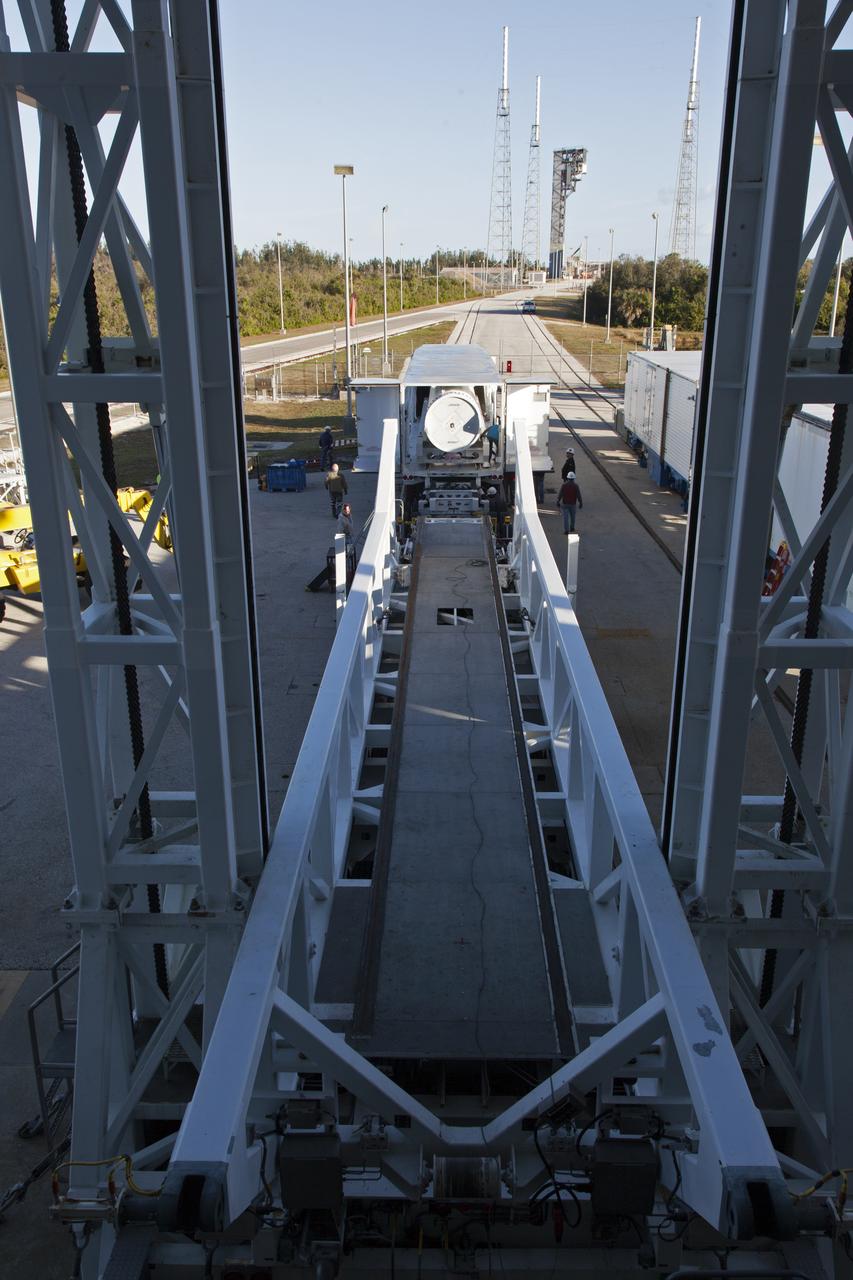
A solid rocket booster (SRB) is offloaded from a transport vehicle at the Vertical Integration Facility at Space Launch Complex 41 at Cape Canaveral Air Force Station in Florida. The SRB will be mated to a United Launch Alliance Atlas V first stage to help boost NOAA's Geostationary Operational Environmental Satellite, or GOES-S, to orbit. GOES-S is the second in a series of four advanced geostationary weather satellites that will significantly improve the detection and observation of environmental phenomena that directly affect public safety, protection of property and the nation's economic health and prosperity. GOES-S is slated to launch March 1, 2018.
United Launch Alliance team members monitor the progress as the operation begins to lift the Atlas V first stage to the vertical position at the Vertical Integration Facility at Space Launch Complex 41 at Cape Canaveral Air Force Station in Florida. The Geostationary Operational Environmental Satellite (GOES-R) will launch aboard the Atlas V rocket in November. GOES-R will be the first satellite in a series of next-generation NOAA GOES Satellites.
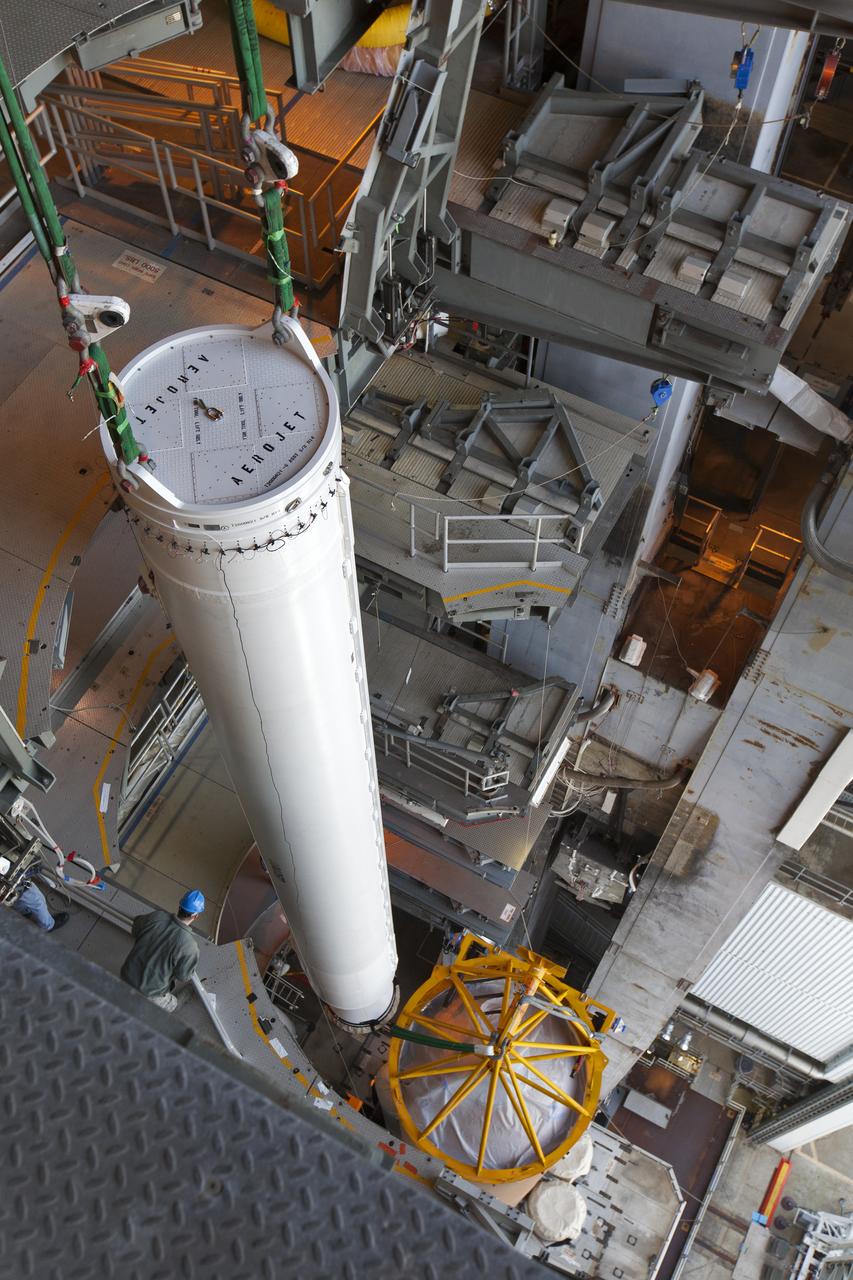
At the Vertical Integration Facility at Space Launch Complex 41 at Cape Canaveral Air Force Station in Florida, a solid rocket booster (SRB) is lifted by a crane for mating to a United Launch Alliance Atlas V first stage. The SRB will help boost NOAA's Geostationary Operational Environmental Satellite, or GOES-S, to orbit. GOES-S is the second in a series of four advanced geostationary weather satellites that will significantly improve the detection and observation of environmental phenomena that directly affect public safety, protection of property and the nation's economic health and prosperity. GOES-S is slated to launch March 1, 2018.
At the Vertical Integration Facility at Space Launch Complex 41 at Cape Canaveral Air Force Station in Florida, a solid rocket booster (SRB) is mated to a United Launch Alliance Atlas V first stage. The SRB will help boost NOAA's Geostationary Operational Environmental Satellite, or GOES-S, to orbit. GOES-S is the second in a series of four advanced geostationary weather satellites that will significantly improve the detection and observation of environmental phenomena that directly affect public safety, protection of property and the nation's economic health and prosperity. GOES-S is slated to launch March 1, 2018.
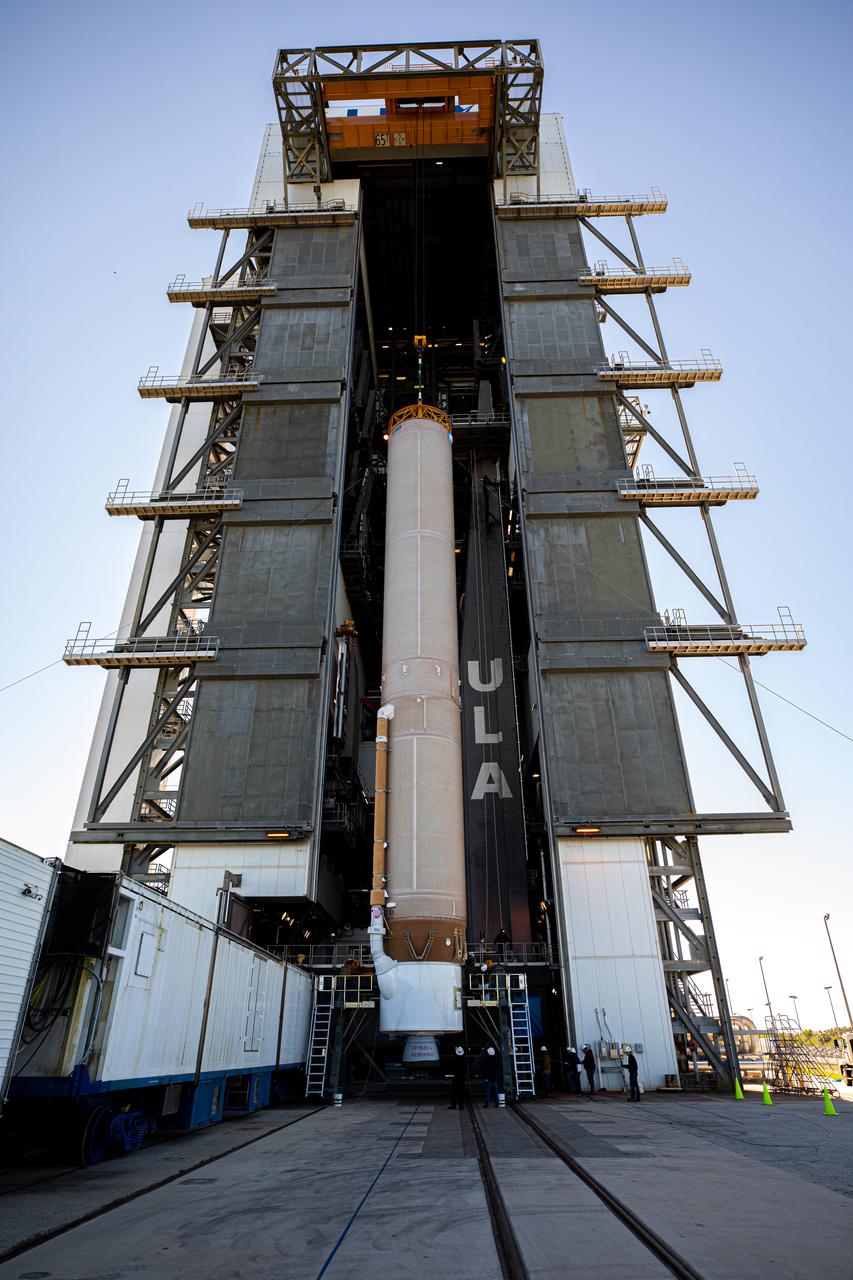
The booster of a United Launch Alliance Atlas V rocket that will launch the Solar Orbiter spacecraft is lifted into the vertical position at the Vertical Integration Facility near Space Launch Complex 41 at Cape Canaveral Air Force Station in Florida on Jan. 6, 2020. Solar Orbiter is an international cooperative mission between ESA (European Space Agency) and NASA. The mission aims to study the Sun, its outer atmosphere and solar wind. The spacecraft will provide the first images of the Sun’s poles. NASA’s Launch Services Program based at Kennedy Space Center in Florida is managing the launch.
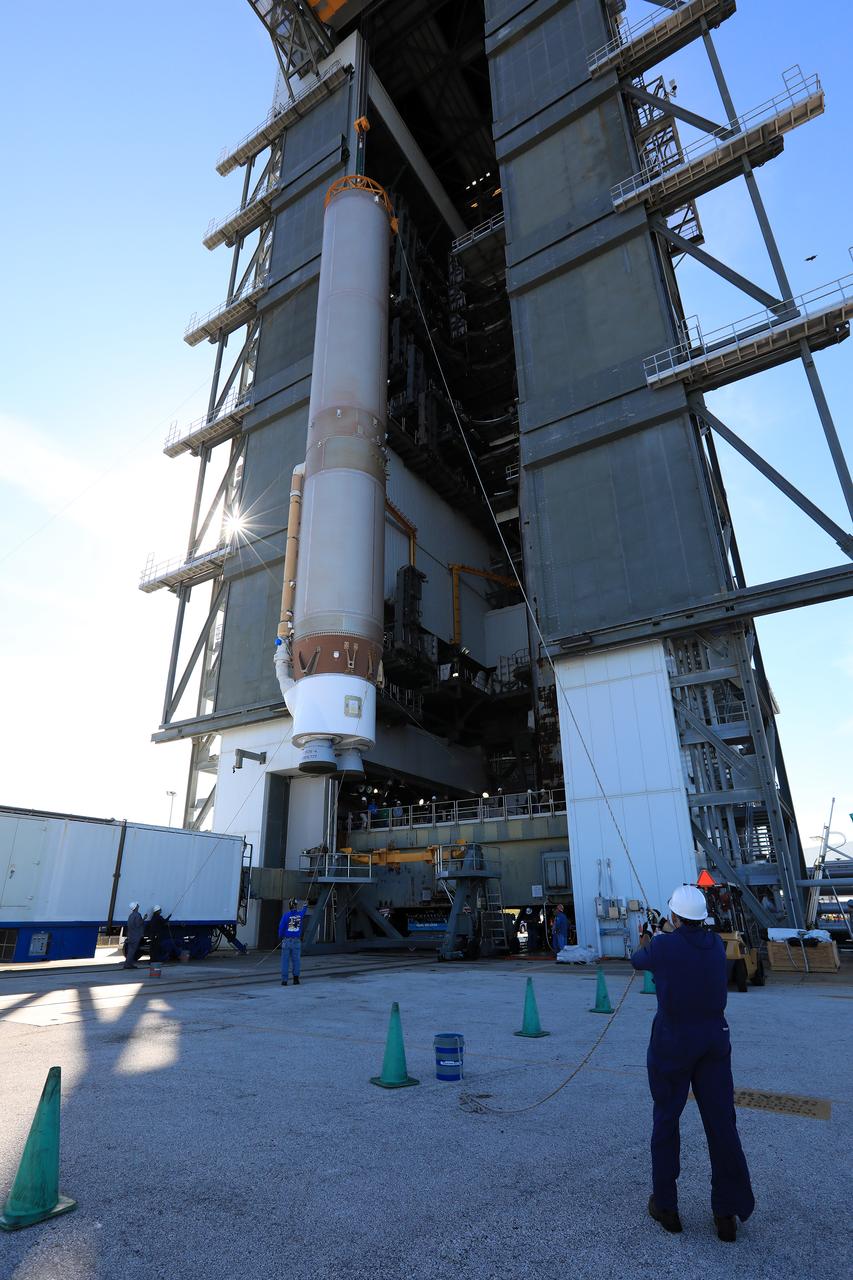
The United Launch Alliance Atlas V first stage is lifted to the vertical position in the Vertical Integration Facility at Space Launch Complex 41 at Cape Canaveral Air Force Station in Florida. The Geostationary Operational Environmental Satellite (GOES-R) will launch aboard the Atlas V rocket in November. GOES-R will be the first satellite in a series of next-generation NOAA GOES Satellites.

A United Launch Alliance Atlas V rocket begins to roll out of the Vertical Integration Facility to Space Launch Complex 41 at Cape Canaveral Air Force Station in Florida. The launch vehicle will boost NASA’s Origins, Spectral Interpretation, Resource Identification, Security-Regolith Explorer, or OSIRIS-REx spacecraft. This will be the first U.S. mission to sample an asteroid, retrieve at least two ounces of surface material and return it to Earth for study. The asteroid, Bennu, may hold clues to the origin of the solar system and the source of water and organic molecules found on Earth.

After leaving the Vertical Integration Facility, a United Launch Alliance Atlas V rocket arrives at Space Launch Complex 41 at Cape Canaveral Air Force Station in Florida. The launch vehicle will boost NASA’s Origins, Spectral Interpretation, Resource Identification, Security-Regolith Explorer, or OSIRIS-REx spacecraft. This will be the first U.S. mission to sample an asteroid, retrieve at least two ounces of surface material and return it to Earth for study. The asteroid, Bennu, may hold clues to the origin of the solar system and the source of water and organic molecules found on Earth.
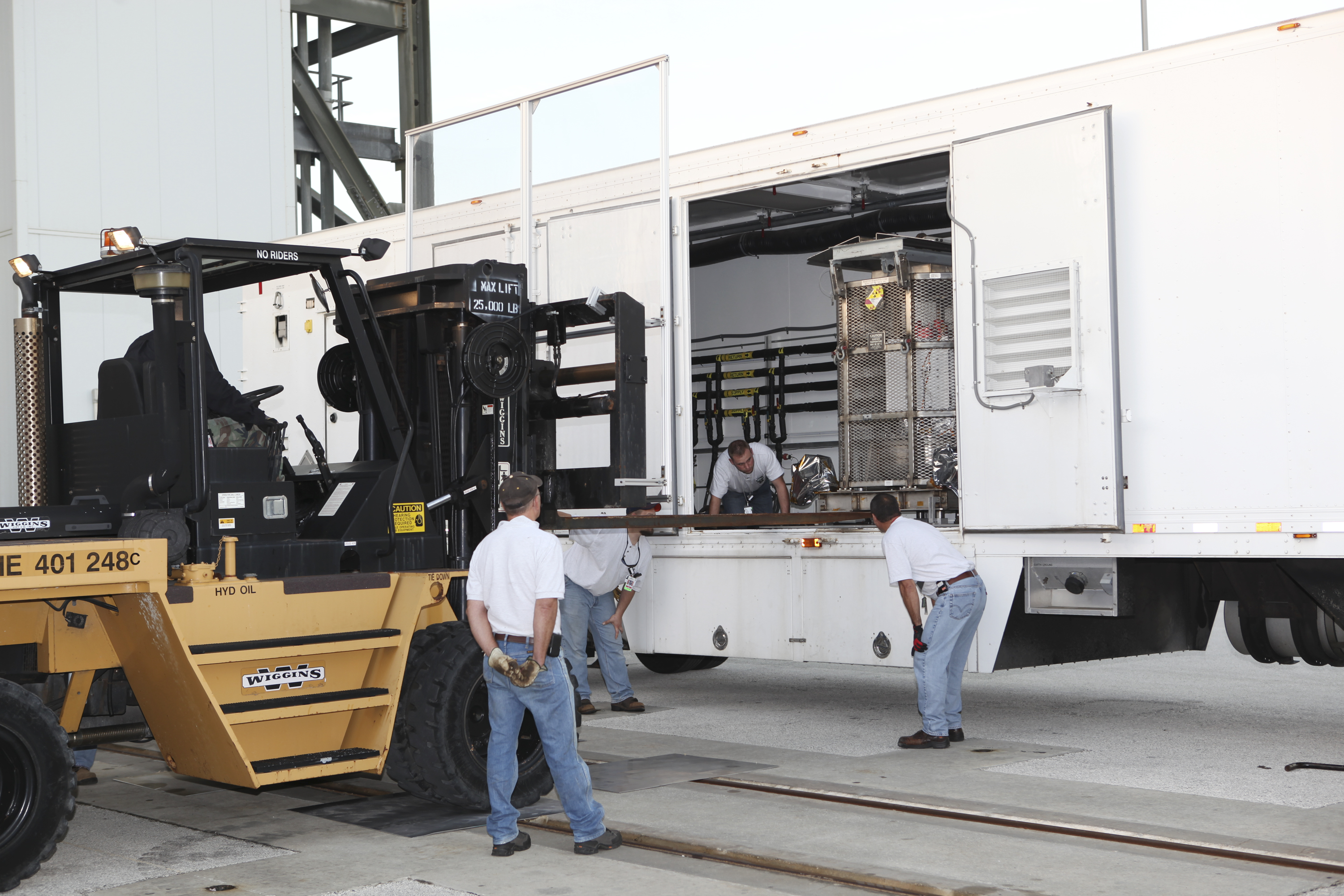
SPACE X MMRTG Offload and Lift for Insertion
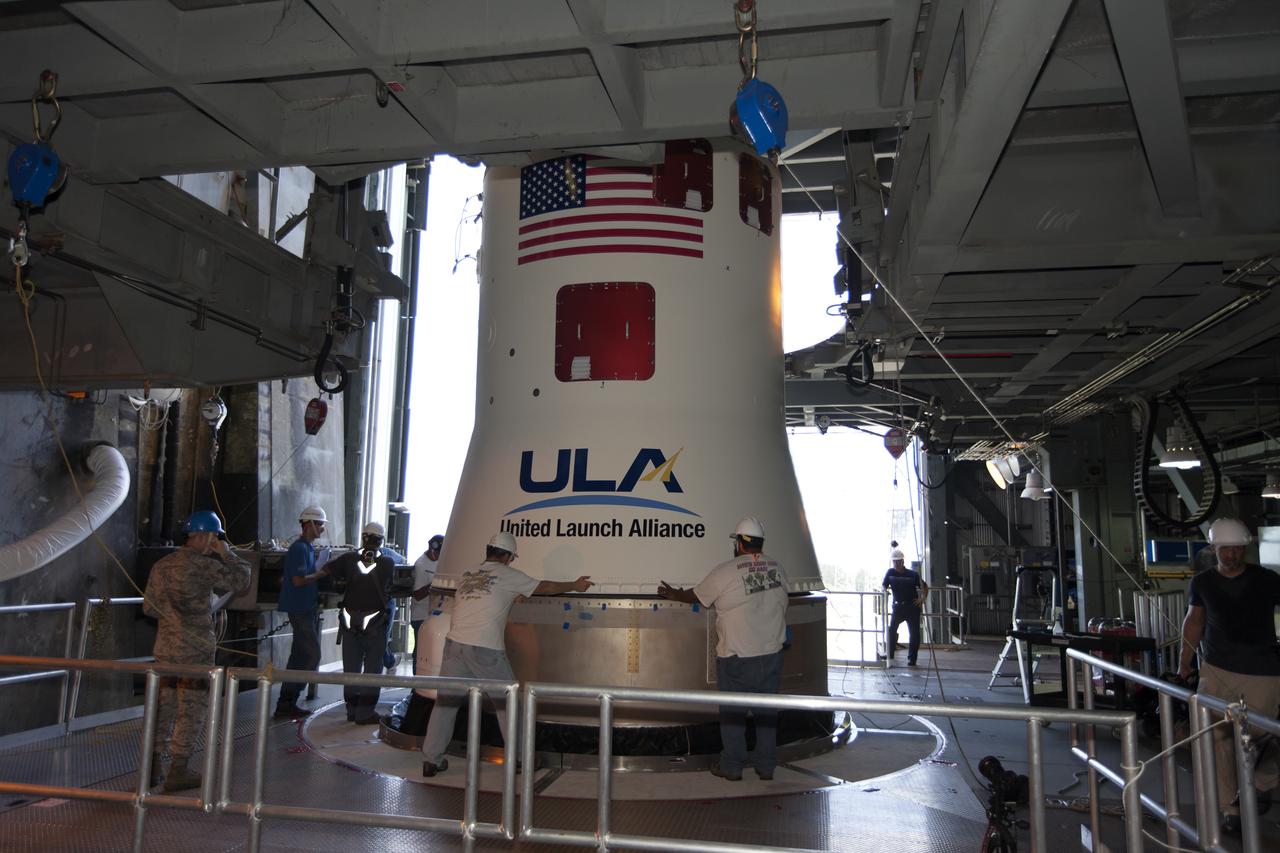
At the Vertical Integration Facility at Space Launch Complex 41 at Cape Canaveral Air Force Station in Florida, United Launch Alliance team members mate a Centaur upper stage to an Atlas V booster. The rocket is scheduled to launch the Tracking and Data Relay Satellite, TDRS-M. It will be the latest spacecraft destined for the agency's constellation of communications satellites that allows nearly continuous contact with orbiting spacecraft ranging from the International Space Station and Hubble Space Telescope to the array of scientific observatories. Liftoff atop the ULA Atlas V rocket is scheduled to take place from Cape Canaveral's Space Launch Complex 41 in early August.
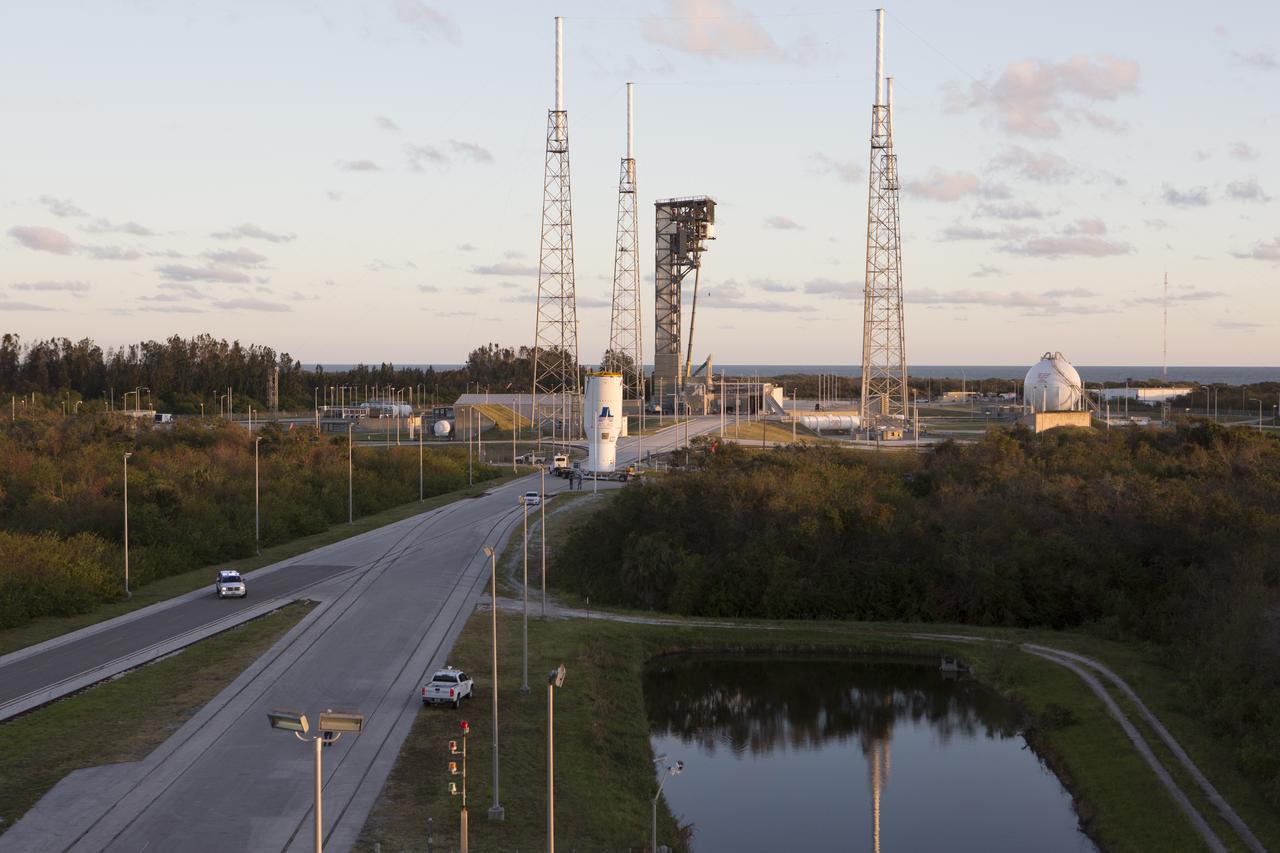
The United Launch Alliance Atlas V Centaur second stage is on its way to the Vertical Integration Facility at Space Launch Complex 41 at Cape Canaveral Air Force Station in Florida. The Geostationary Operational Environmental Satellite (GOES-R) will launch aboard the Atlas V rocket in November. GOES-R is the first satellite in a series of next-generation NOAA GOES Satellites.
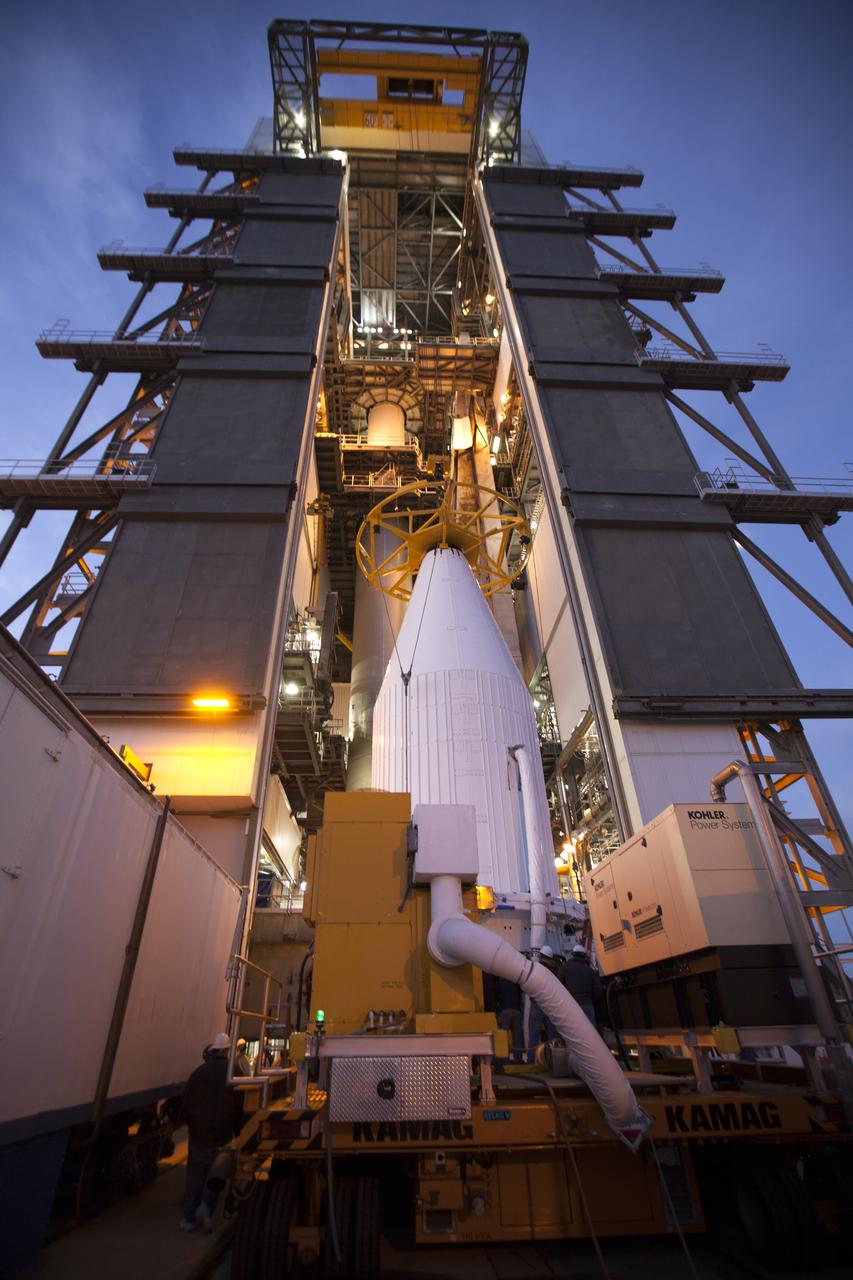
The payload fairing containing the Orbital ATK Cygnus pressurized cargo module is lifted by crane at the United Launch Alliance (ULA) Vertical Integration Facility at Space Launch Complex 41 at Cape Canaveral Air Force Station in Florida. The payload will be hoisted up and mated to the ULA Atlas V rocket. The Orbital ATK CRS-7 commercial resupply services mission to the International Space Station is scheduled to launch atop the Atlas V from pad 41. Cygnus will deliver 7,600 pounds of supplies, equipment and scientific research materials to the space station.
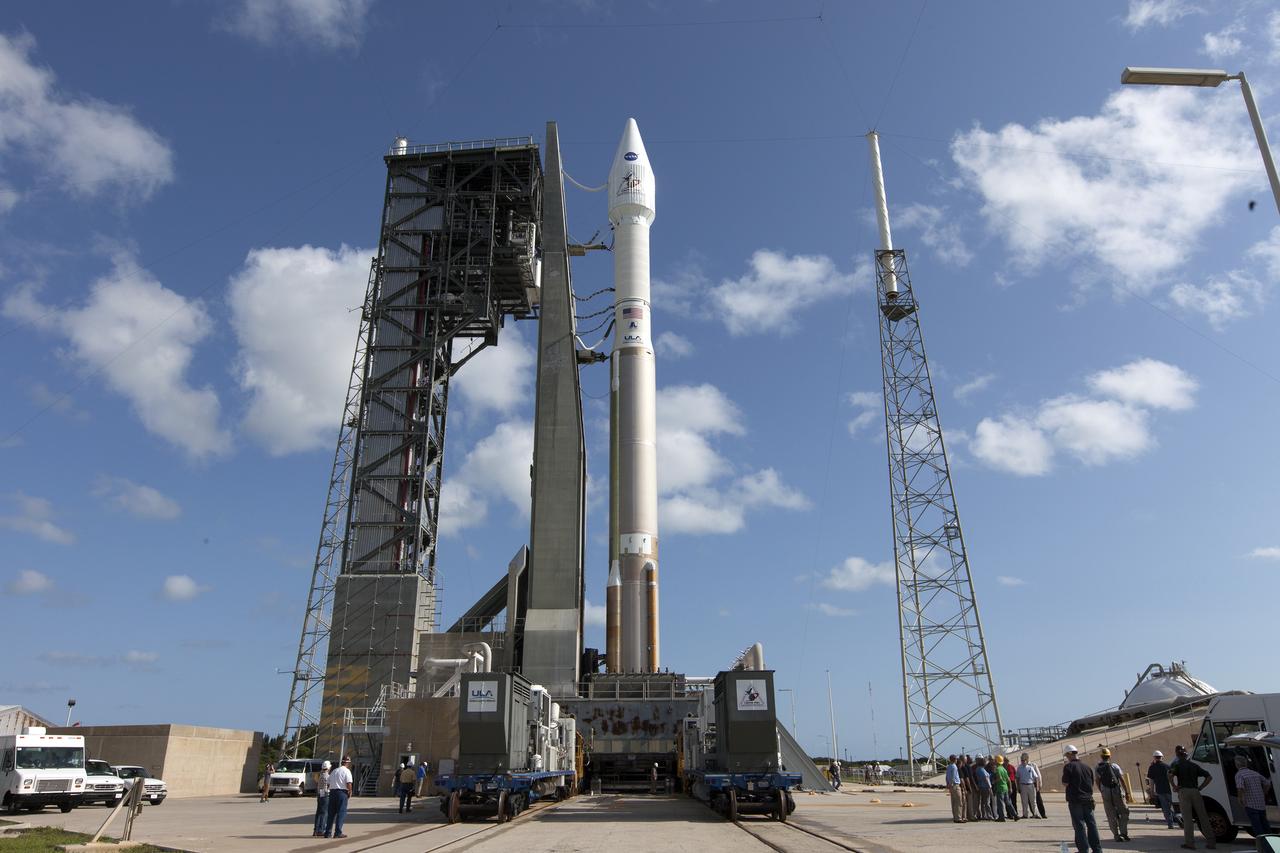
The United Launch Alliance Atlas V rocket arrives at Space Launch Complex 41 at Cape Canaveral Air Force Station in Florida. The launch vehicle will boost NASA’s Origins, Spectral Interpretation, Resource Identification, Security-Regolith Explorer, or OSIRIS-REx spacecraft. This will be the first U.S. mission to sample an asteroid, retrieve at least two ounces of surface material and return it to Earth for study. The asteroid, Bennu, may hold clues to the origin of the solar system and the source of water and organic molecules found on Earth.
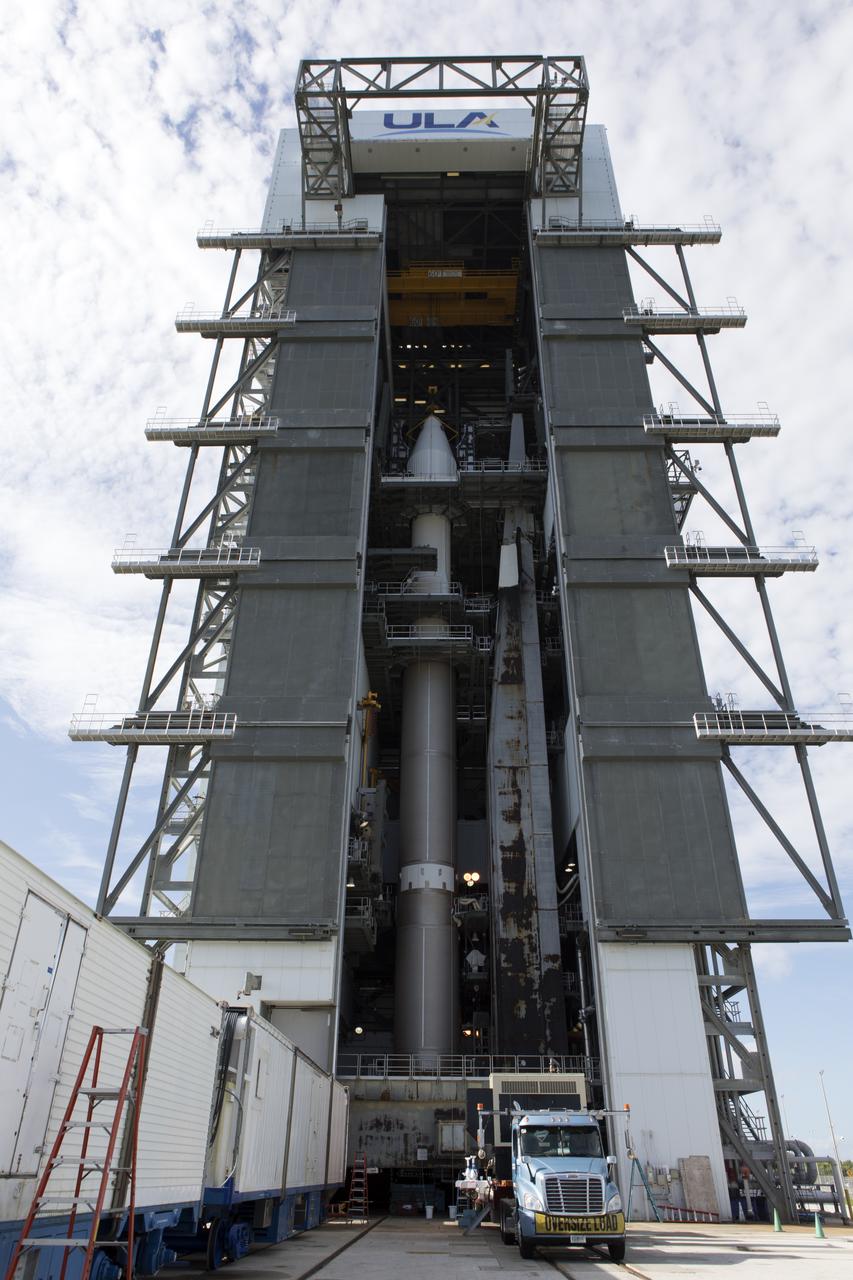
Encapsulated in its payload fairing, Tracking and Data Relay Satellite (TDRS-M) has been mated to the United Launch Alliance Atlas V Centaur upper stage in the Vertical Integration Facility at Space Launch Complex 41 at Cape Canaveral Air Force Station in Florida. TDRS-M will be the latest spacecraft destined for the agency's constellation of communications satellites that allows nearly continuous contact with orbiting spacecraft ranging from the International Space Station and Hubble Space Telescope to the array of scientific observatories. Liftoff atop the ULA Atlas V rocket is scheduled for Aug. 18, 2017.
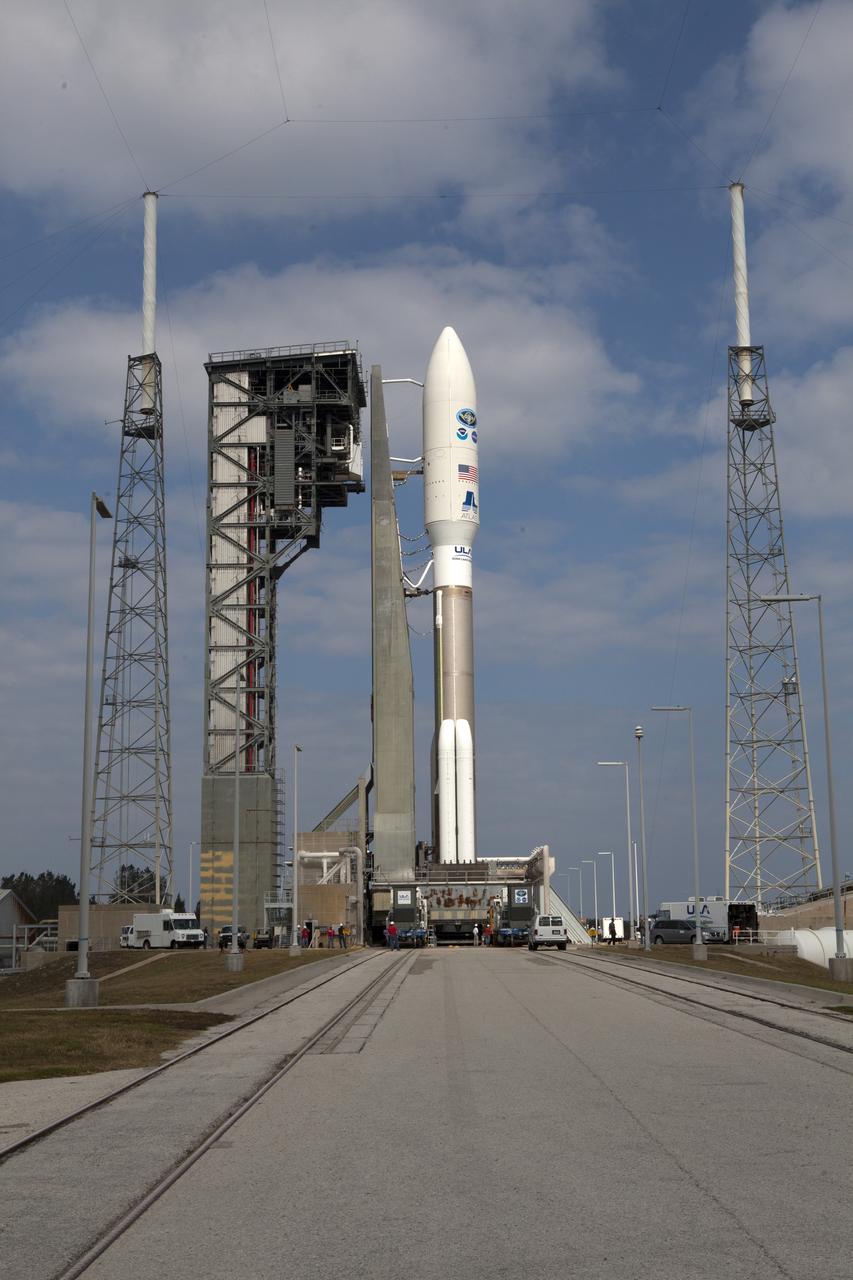
A United Launch Alliance Atlas V rocket arrives at Space Launch Complex 41 at Cape Canaveral Air Force Station in Florida. The launch vehicle will send the Geostationary Operational Environmental Satellite (GOES-R) to a geostationary position over the U.S. GOES-R is the first satellite in a series of next-generation NOAA GOES satellites.
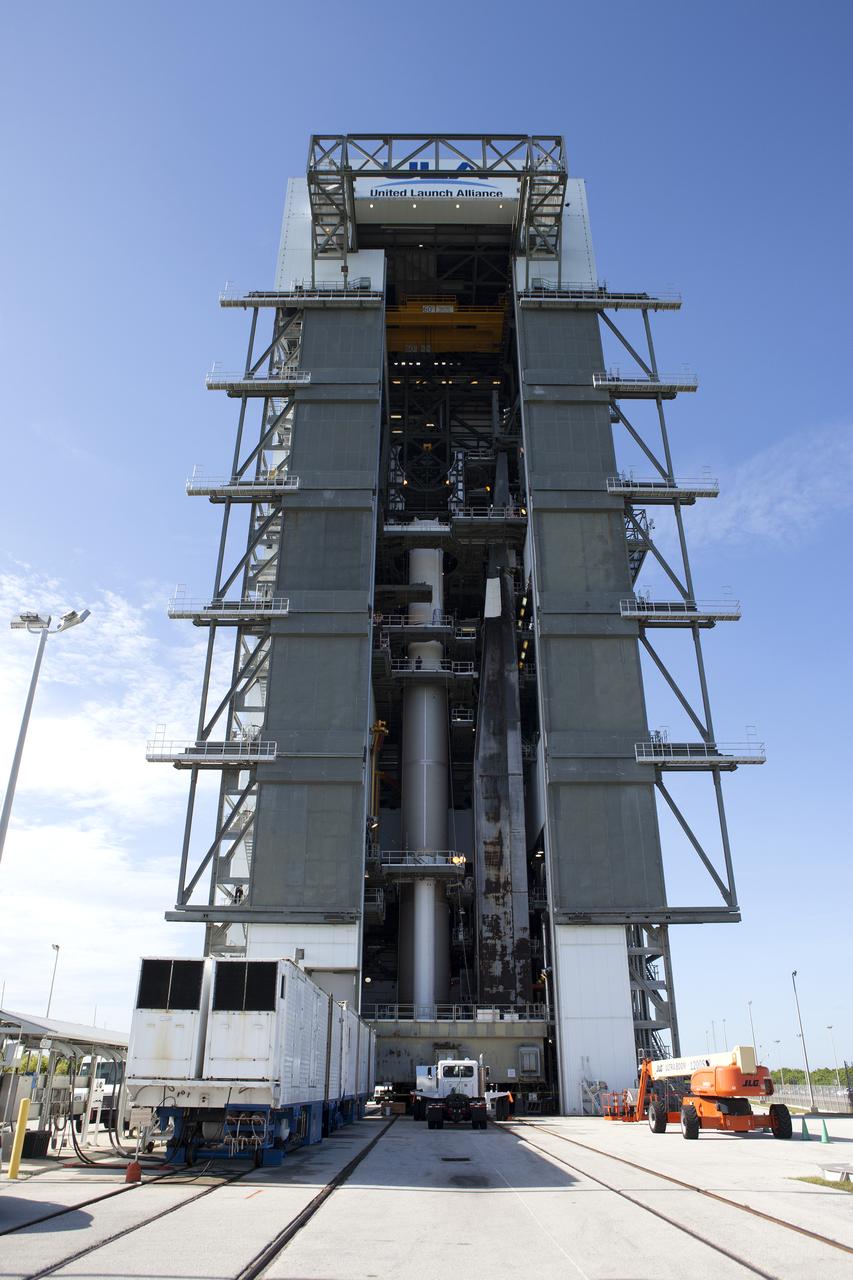
A Centaur upper stage has been lowered into position atop the United Launch Alliance Atlas V rocket first stage booster at Space Launch Complex 41 on Florida’s Cape Canaveral Air Force Station. The rocket will boost NASA’s Origins, Spectral Interpretation, Resource Identification, Security-Regolith Explorer, or OSIRIS-REx spacecraft. Targeted for liftoff Sept. 8, 2016, OSIRIS-Rex will be the first U.S. mission to sample an asteroid, retrieve at least two ounces of surface material and return it to Earth for study. The asteroid, Bennu, may hold clues to the origin of the solar system and the source of water and organic molecules found on Earth.
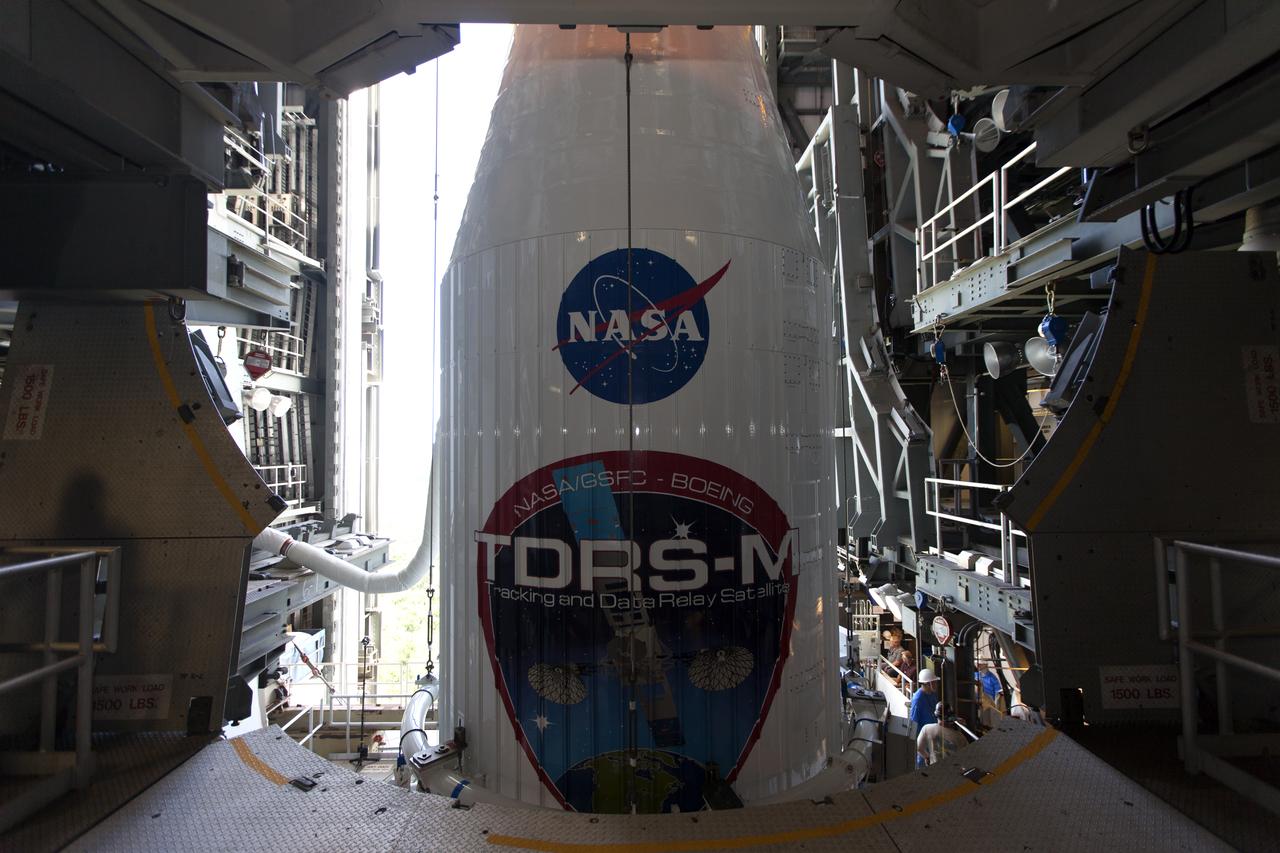
Encapsulated in its payload fairing, Tracking and Data Relay Satellite (TDRS-M) is mated to the United Launch Alliance Atlas V Centaur upper stage in the Vertical Integration Facility at Space Launch Complex 41 at Cape Canaveral Air Force Station in Florida. TDRS-M will be the latest spacecraft destined for the agency's constellation of communications satellites that allows nearly continuous contact with orbiting spacecraft ranging from the International Space Station and Hubble Space Telescope to the array of scientific observatories. Liftoff atop the ULA Atlas V rocket is scheduled for Aug. 18, 2017.
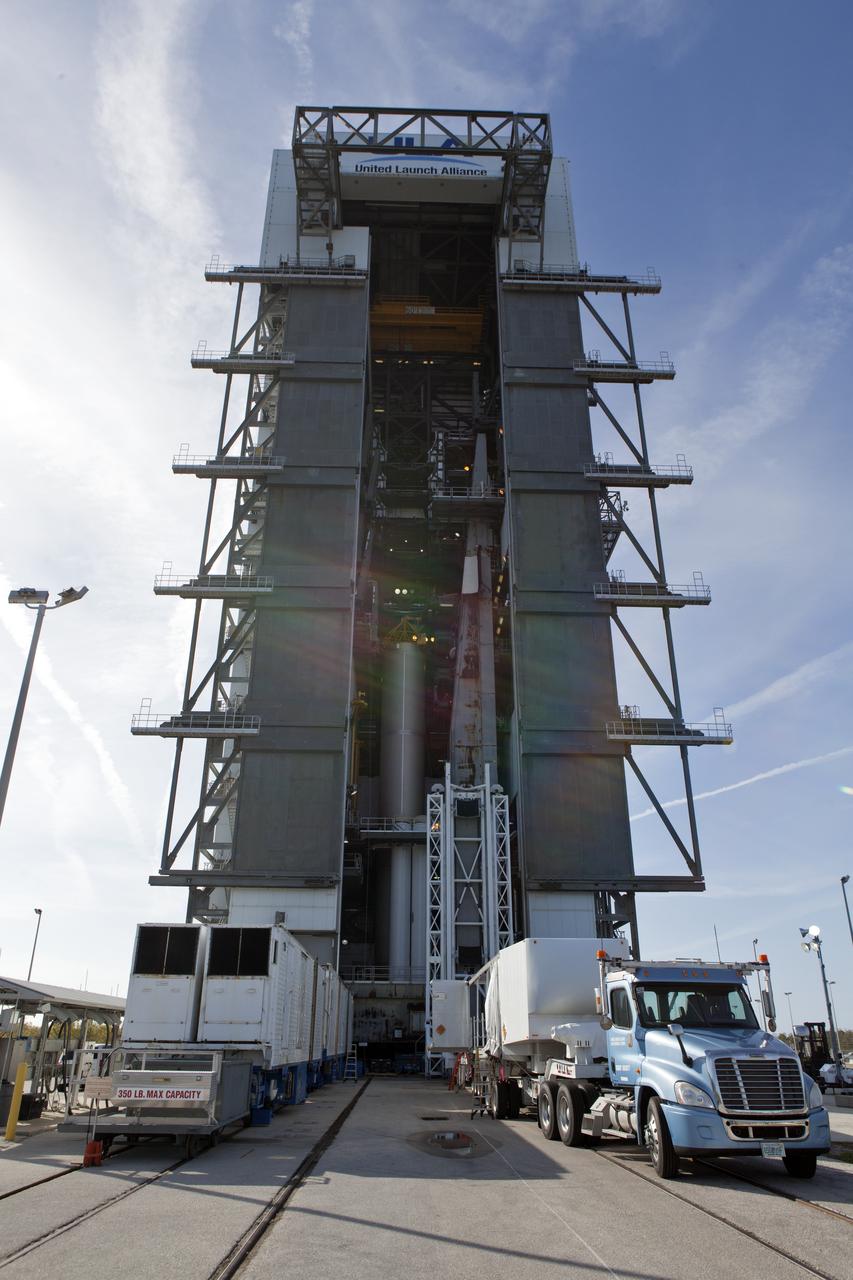
At the Vertical Integration Facility at Space Launch Complex 41 at Cape Canaveral Air Force Station in Florida, solid rocket boosters (SRBs) have been mated to a United Launch Alliance Atlas V first stage. The SRBs will be help boost NOAA's Geostationary Operational Environmental Satellite, or GOES-S, to orbit. GOES-S is the second in a series of four advanced geostationary weather satellites that will significantly improve the detection and observation of environmental phenomena that directly affect public safety, protection of property and the nation's economic health and prosperity. GOES-S is slated to launch March 1, 2018.
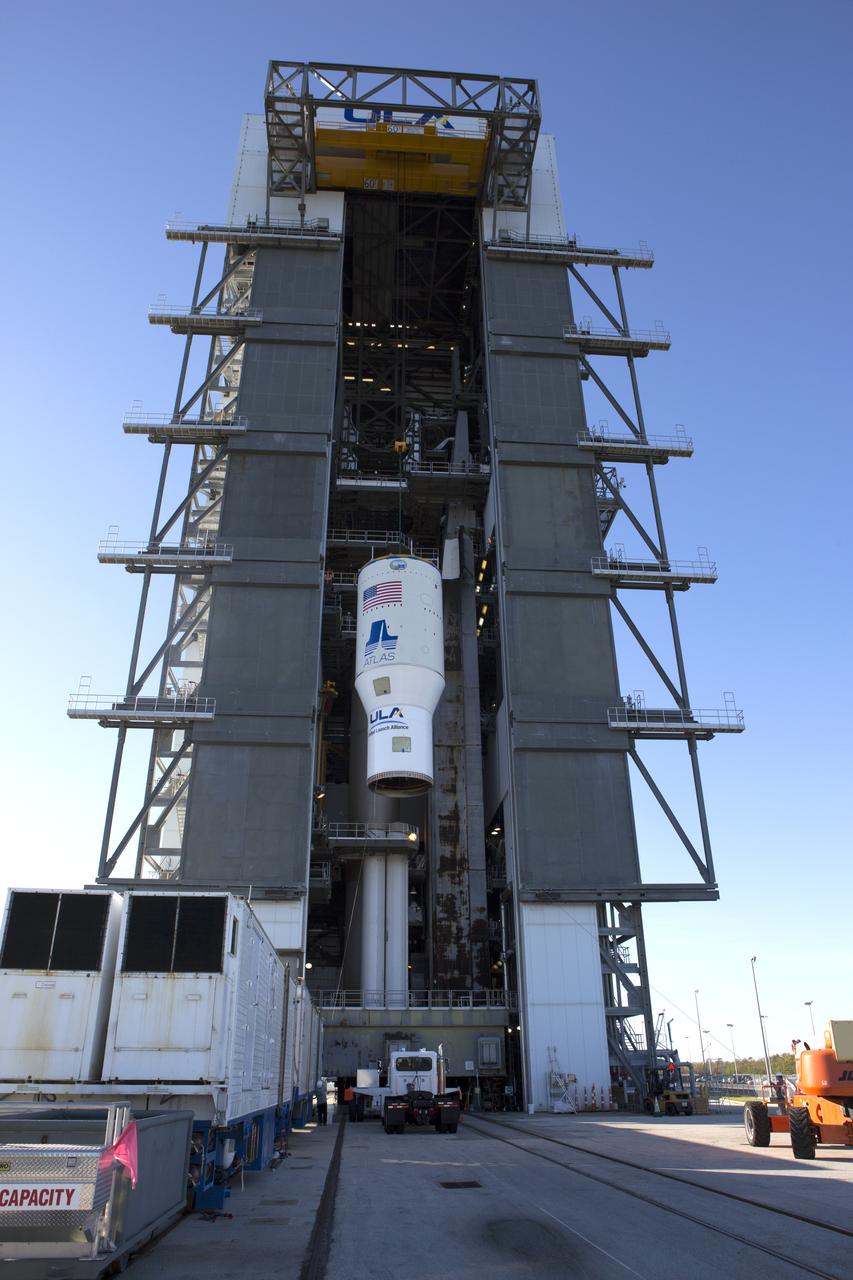
The United Launch Alliance Atlas V Centaur second stage is lifted up by crane for transfer into Vertical Integration Facility at Space Launch Complex 41 at Cape Canaveral Air Force Station in Florida. The Geostationary Operational Environmental Satellite (GOES-R) will launch aboard the Atlas V rocket in November. GOES-R is the first satellite in a series of next-generation NOAA GOES Satellites.
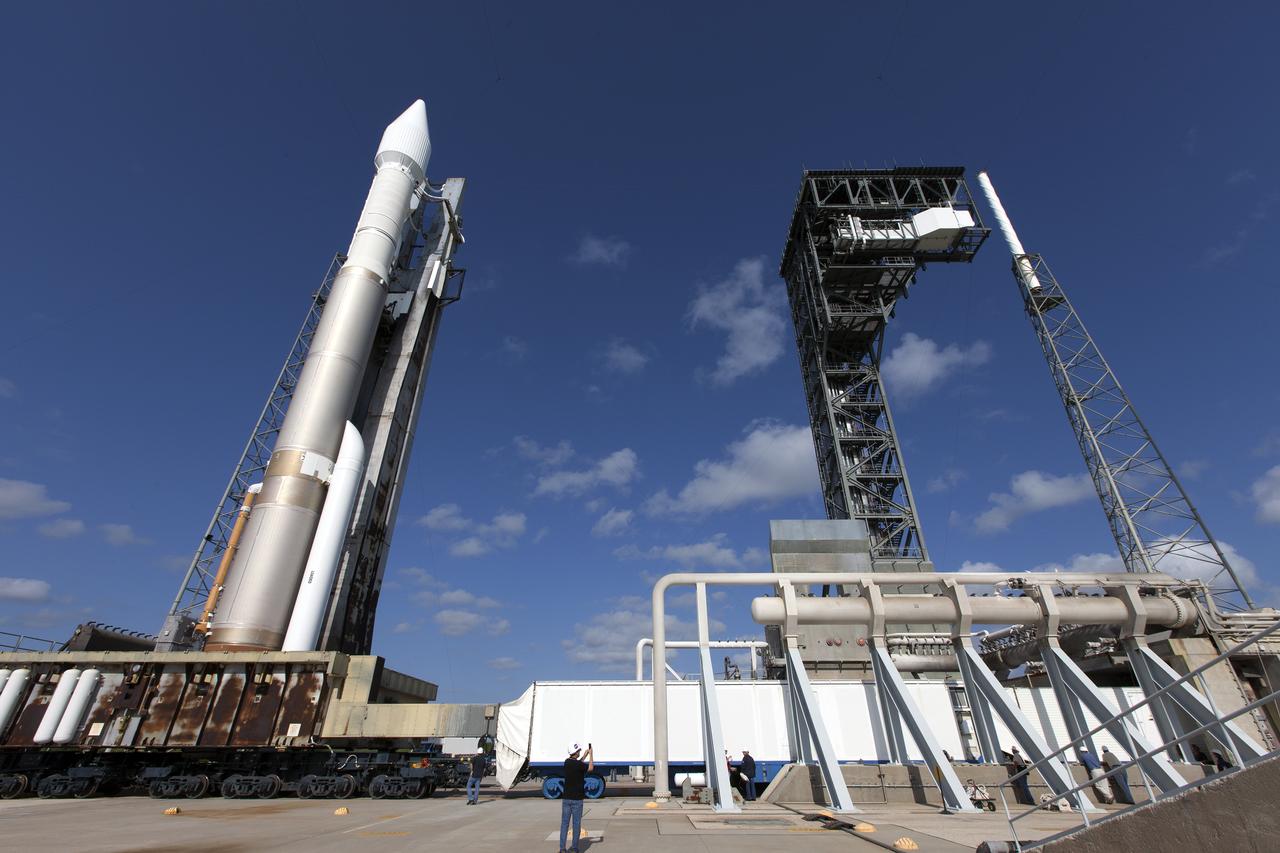
The United Launch Alliance Atlas V rocket arrives at Space Launch Complex 41 at Cape Canaveral Air Force Station in Florida. The launch vehicle will boost NASA’s Origins, Spectral Interpretation, Resource Identification, Security-Regolith Explorer, or OSIRIS-REx spacecraft. This will be the first U.S. mission to sample an asteroid, retrieve at least two ounces of surface material and return it to Earth for study. The asteroid, Bennu, may hold clues to the origin of the solar system and the source of water and organic molecules found on Earth.