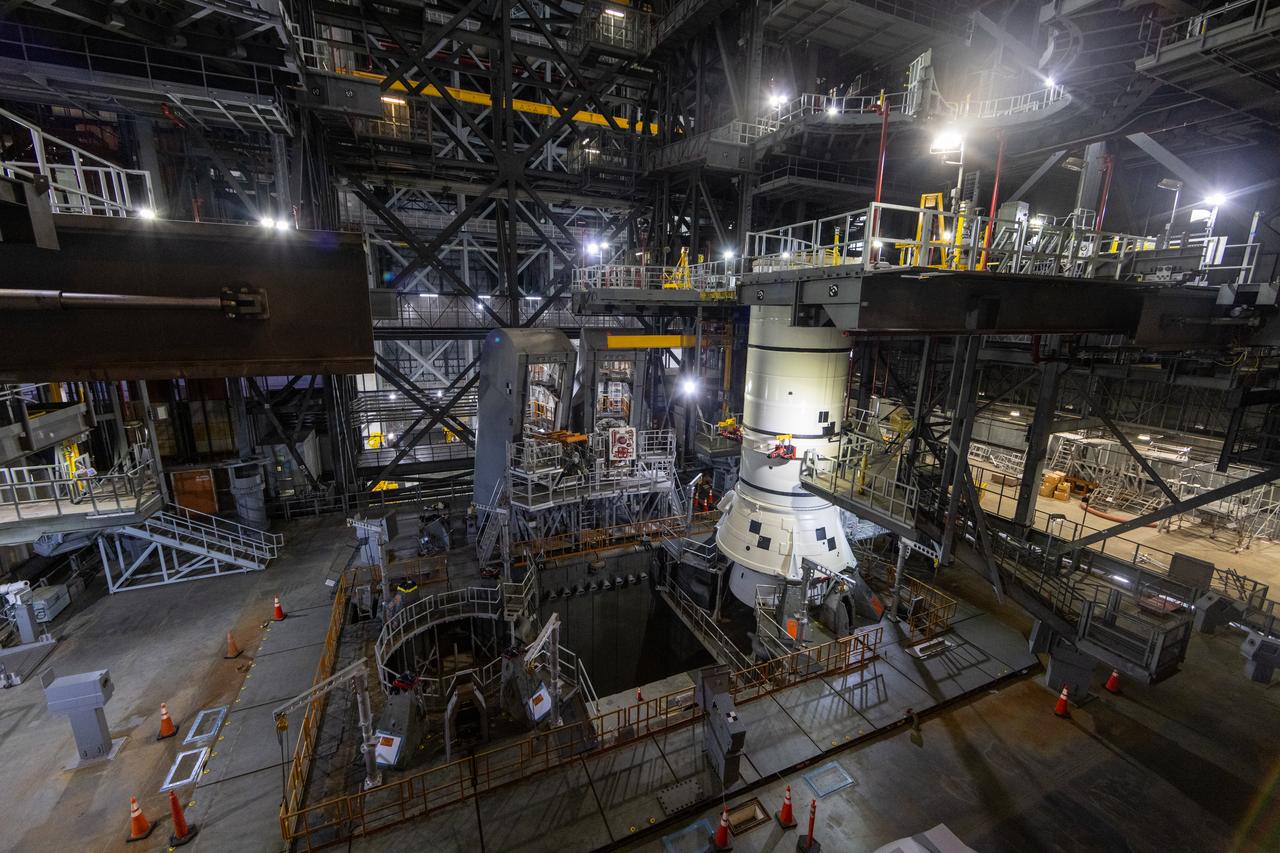
Engineers and technicians with the Exploration Ground Systems Program stack the first Moon rocket segment – the left aft assembly for the Artemis II SLS (Space Launch System) solid rocket booster onto mobile launcher 1 inside the Vehicle Assembly Building at NASA’s Kennedy Space Center on Wednesday, Nov. 20, 2024. The first of 10 booster segments to be stacked, the boosters will help support the remaining rocket components and the Orion spacecraft during final assembly of the Artemis II Moon rocket and provide more than 75 percent of the total SLS thrust during liftoff from NASA Kennedy’s Launch Pad 39B.
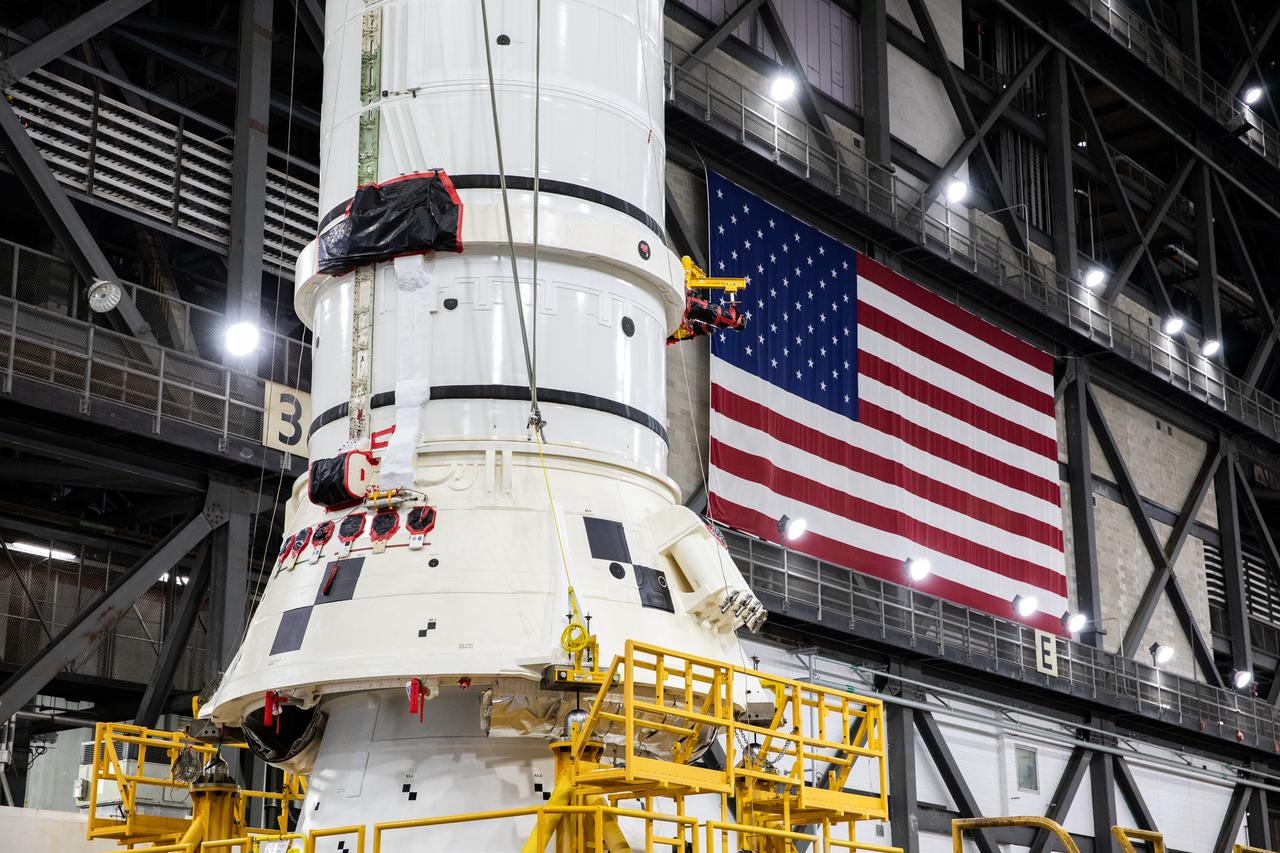
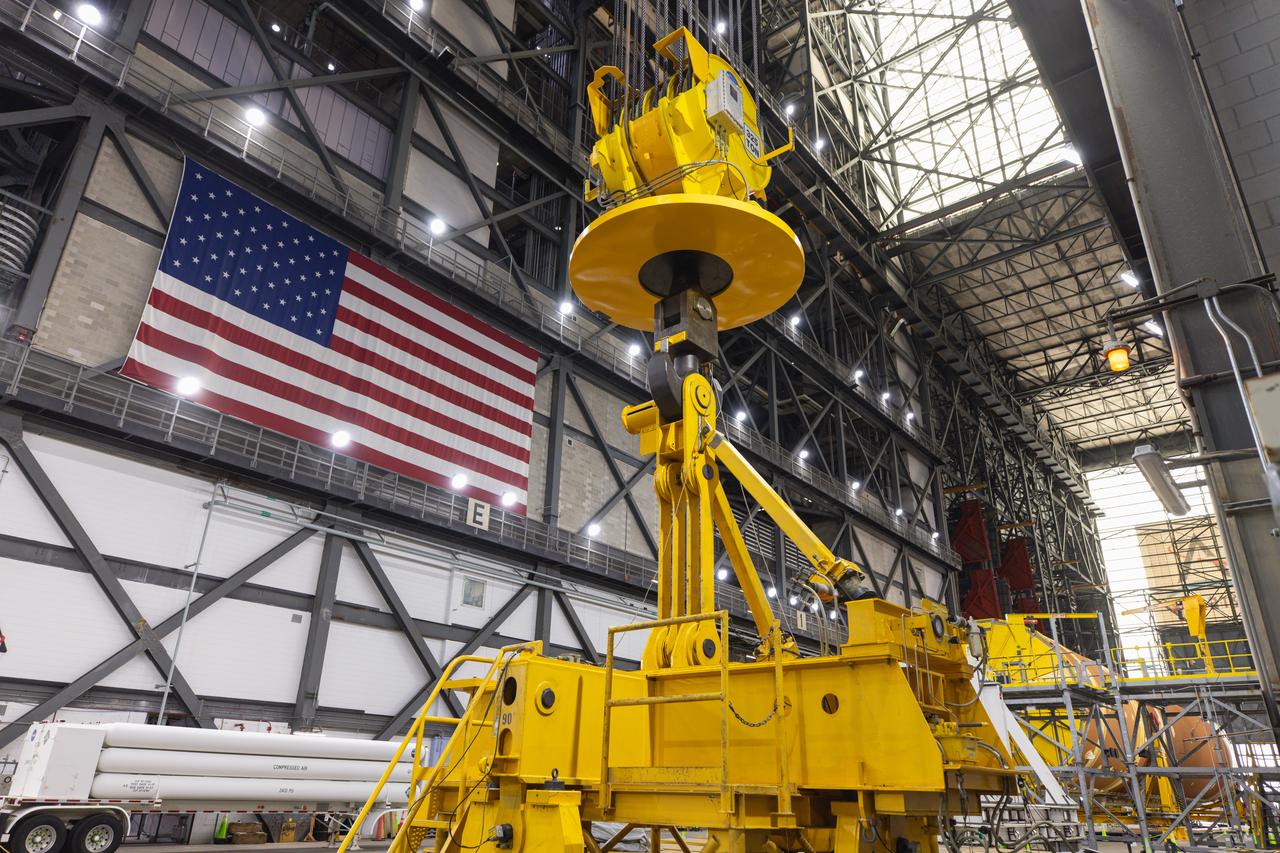
Engineers and technicians with the Exploration Ground Systems Program attach an overhead crane to the left aft assembly, or bottom portion of the solid rocket boosters for the SLS (Space Launch System) rocket, inside the Vehicle Assembly Building at NASA’s Kennedy Space Center on Tuesday, Nov. 19, 2024. The crane will lift the aft assembly on top of mobile launcher 1 followed by the right aft assembly and stack the remaining booster segments for the Artemis II mission.
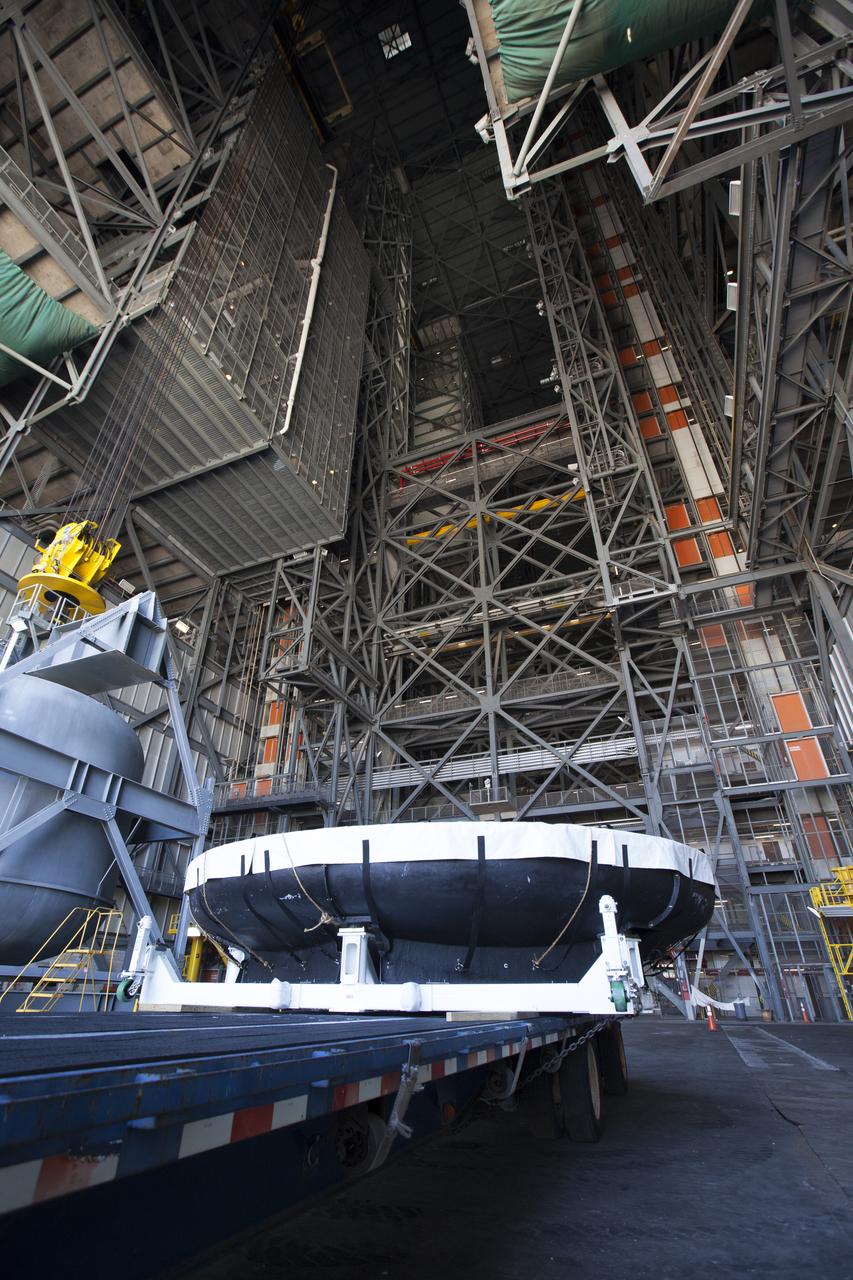
A flatbed truck carrying the Orion heat shield from Exploration Flight Test-1, backs into High Bay 2 in the Vehicle Assembly Building (VAB) at NASA's Kennedy Space Center in Florida. The heat shield was moved from the Launch Abort System Facility. The heat shield is being transferred from the Orion Program to the Ground Systems Development and Operations Program, Landing and Recovery Operations. In the VAB, the heat shield will be integrated with the Orion ground test article and used for future underway recovery testing.
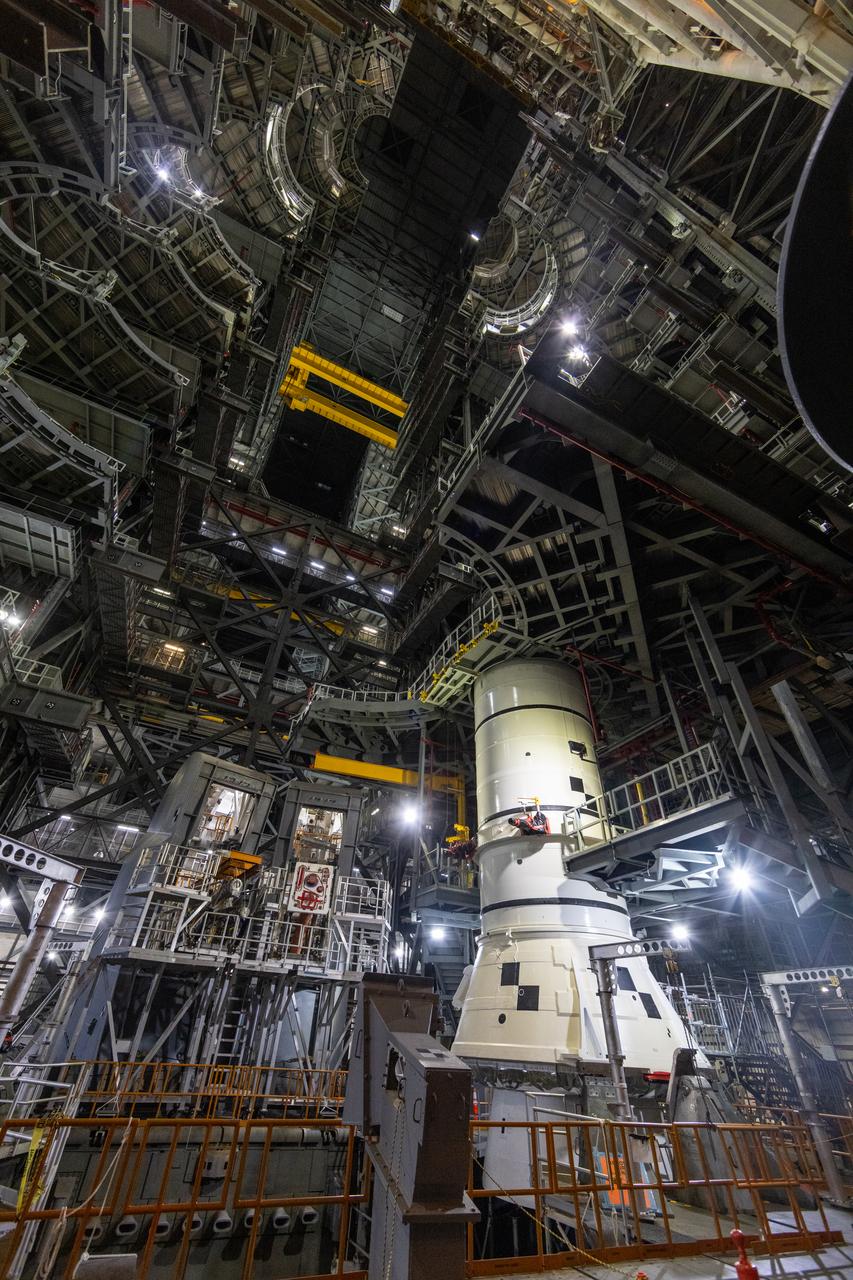
Engineers and technicians with the Exploration Ground Systems Program stack the first Moon rocket segment – the left aft assembly for the Artemis II SLS (Space Launch System) solid rocket booster onto mobile launcher 1 inside the Vehicle Assembly Building at NASA’s Kennedy Space Center on Wednesday, Nov. 20, 2024. The first of 10 booster segments to be stacked, the boosters will help support the remaining rocket components and the Orion spacecraft during final assembly of the Artemis II Moon rocket and provide more than 75 percent of the total SLS thrust during liftoff from NASA Kennedy’s Launch Pad 39B.
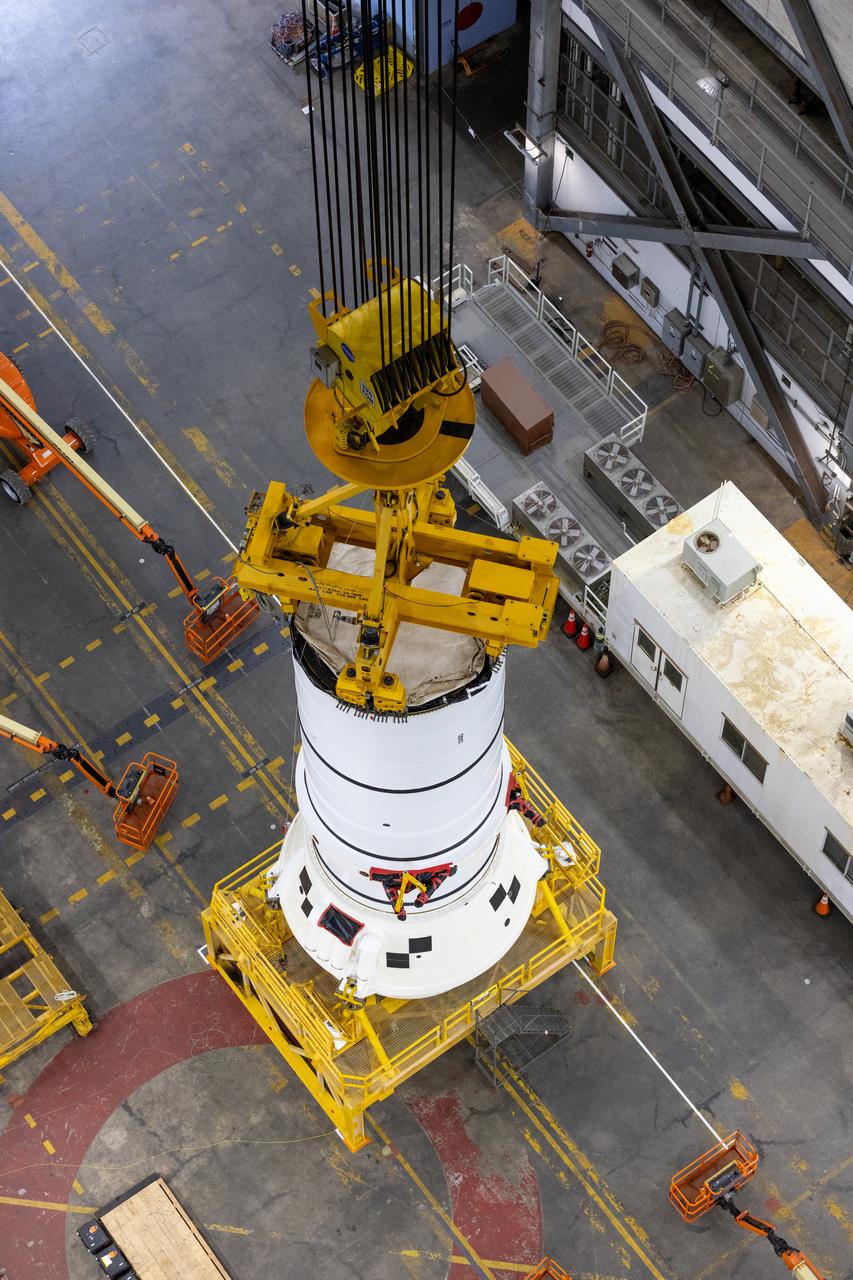
Engineers and technicians with the Exploration Ground Systems Program attach an overhead crane to the left aft assembly, or bottom portion of the solid rocket boosters for the SLS (Space Launch System) rocket inside the Vehicle Assembly Building at NASA’s Kennedy Space Center on Tuesday, Nov. 19, 2024. The crane will lift the aft assembly on top of mobile launcher 1 followed by the right aft assembly and stack the remaining booster segments for the Artemis II mission.
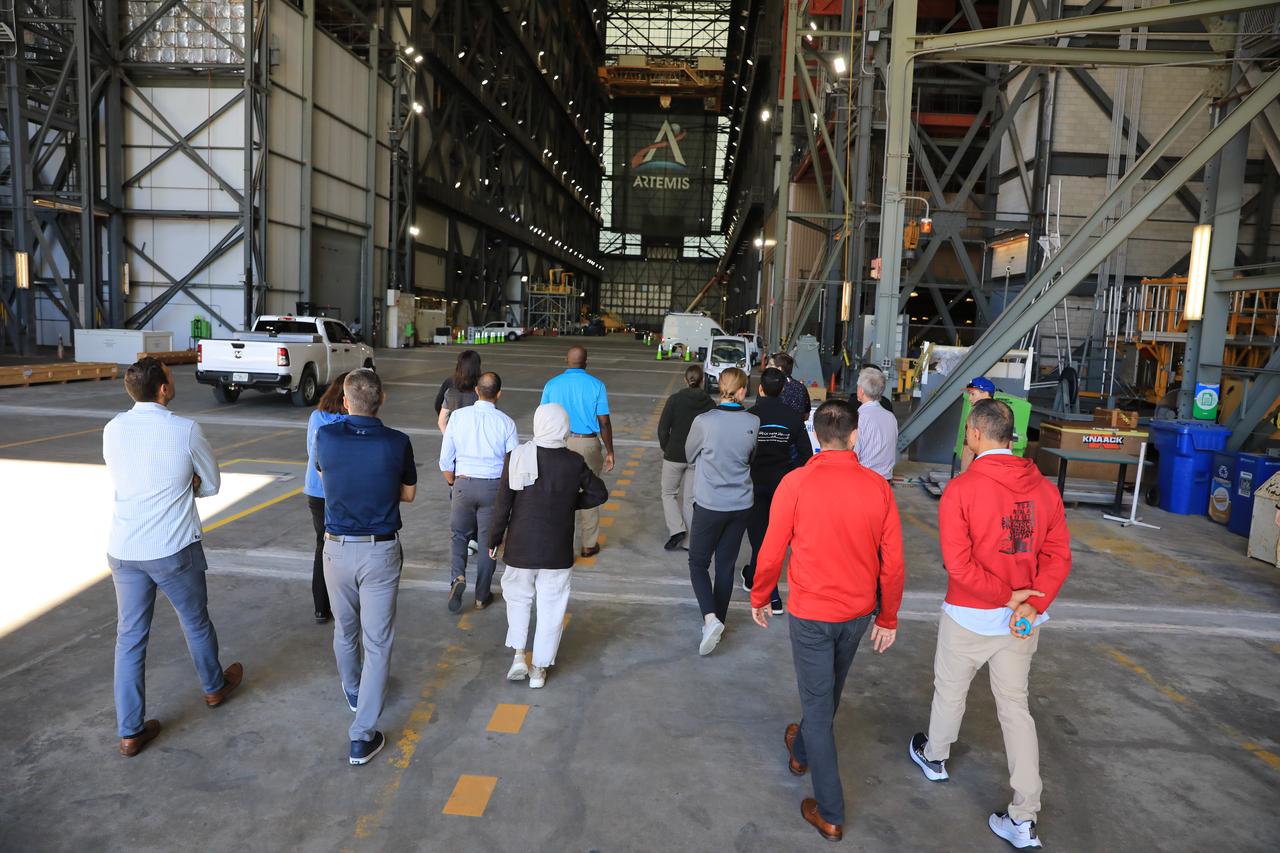
NASA’s 2021 class of astronaut candidates walk inside the Vehicle Assembly Building during a familiarization tour of facilities on Tuesday, Oct. 17, 2023, at the agency’s Kennedy Space Center in Florida.

A SpaceX Falcon Heavy rocket carrying NASA’s Europa Clipper spacecraft lifts off from Launch Complex 39A at NASA’s Kennedy Space Center in Florida at 12:06 p.m. EDT on Monday, Oct. 14, 2024. After launch, the spacecraft plans to fly by Mars in February 2025, then back by Earth in December 2026, using the gravity of each planet to increase its momentum. With help of these “gravity assists,” Europa Clipper will achieve the velocity needed to reach Jupiter in April 2030.
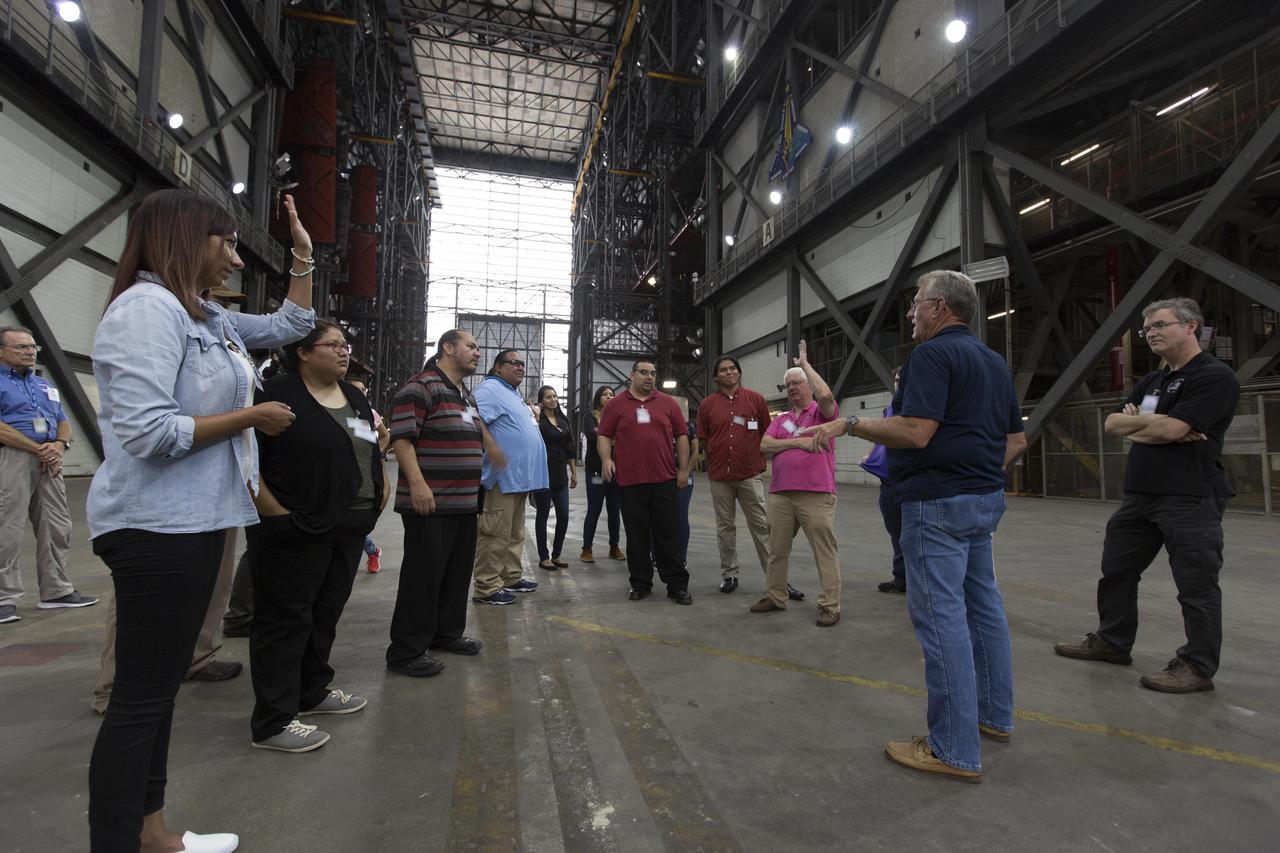
A group of 19 college students recently visited NASA's Kennedy Space Center as winners of the First Nations Launch competition in Wisconsin. They were part of teams that successfully flew high-powered rockets, earning them an opportunity to visit the Florida spaceport. During their visit, they toured the Vehicle Assembly Building, Launch Control Center and the Kennedy visitor complex. The competition is supported by NASA and the Wisconsin Space Grant Consortium. It provides an opportunity for students attending tribal colleges or universities, or who are members of a campus American Indian Science and Engineering Society, or AISES, chapter to design, build and launch a rocket at a competition in Kansasville, Wisconsin.
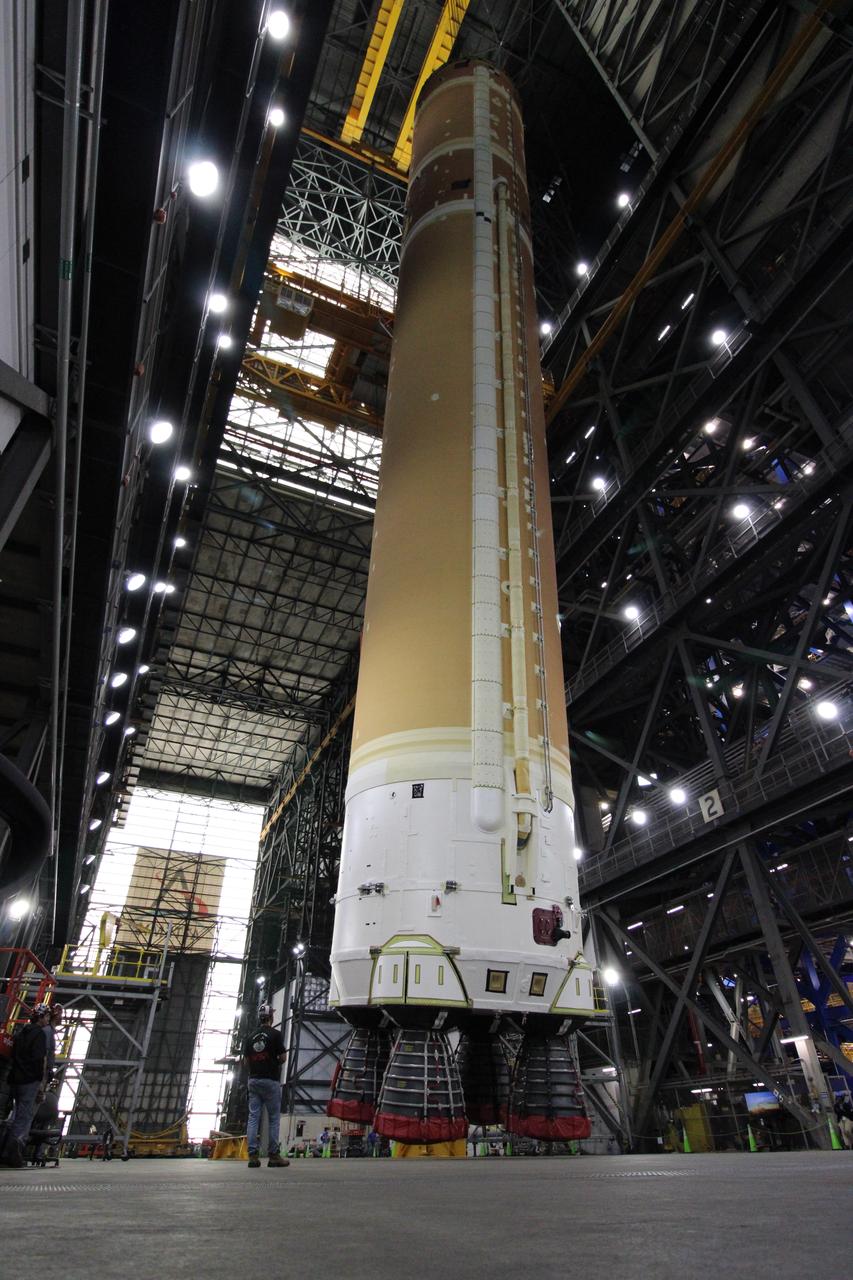
Teams with NASA’s Exploration Ground Systems Program lift the agency’s SLS (Space Launch System) core stage for the Artemis II mission from horizonal to vertical inside the transfer aisle at the Vehicle Assembly Building at NASA’s Kennedy Space Center in Florida on Tuesday, Dec. 10, 2024. The one-of-a kind lifting beam is designed to move the core stage from the transfer aisle to High Bay 2 where it will remain while teams stack the two solid rocket boosters for the SLS core stage.
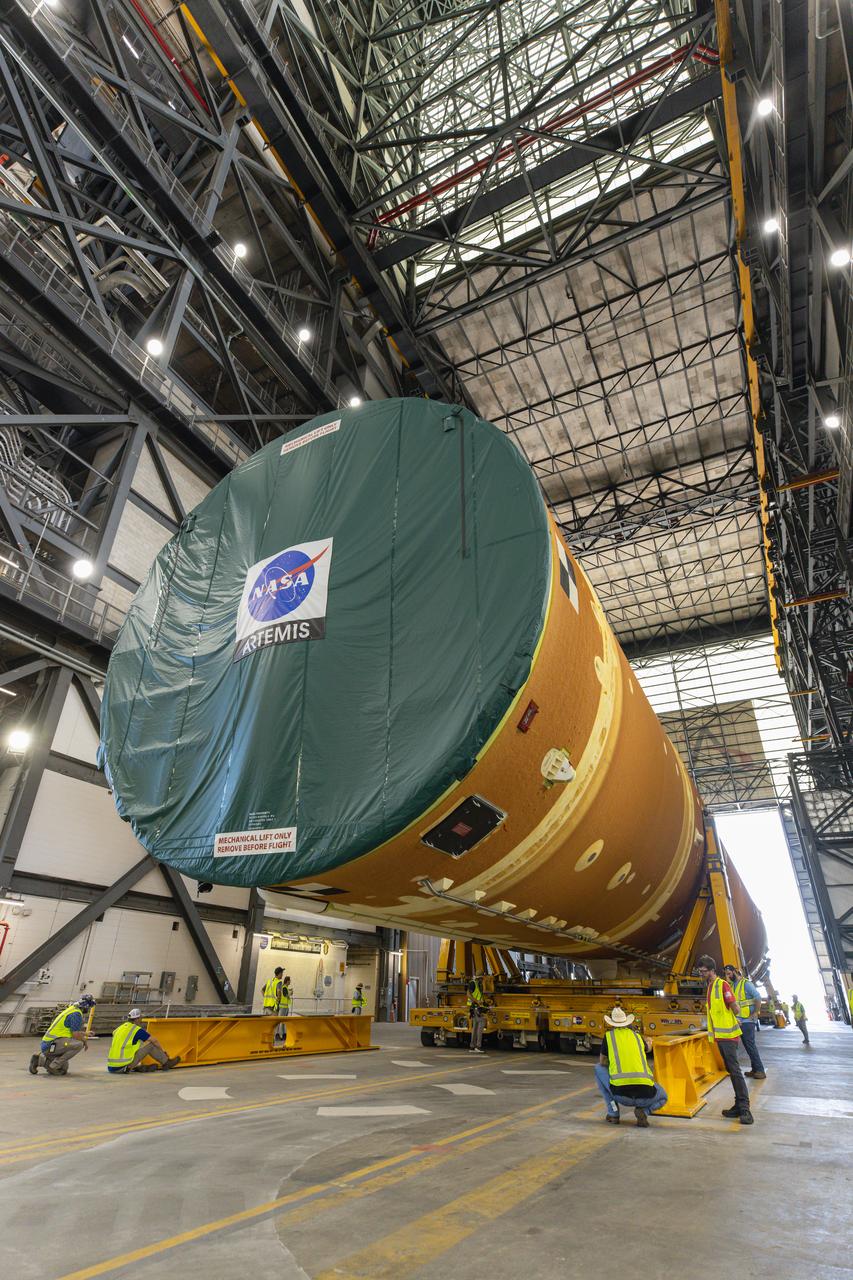
After completing its journey from NASA’s Michoud Assembly Facility in New Orleans aboard the Pegasus barge, teams with Exploration Ground Systems (EGS) transport the agency’s powerful SLS (Space Launch System) core stage into the transfer aisle inside Kennedy Space Center’s Vehicle Assembly Building in Florida on Wednesday, July 24, 2024. In the coming months, SLS will be prepared for integration atop the mobile launcher ahead of the Artemis II launch.
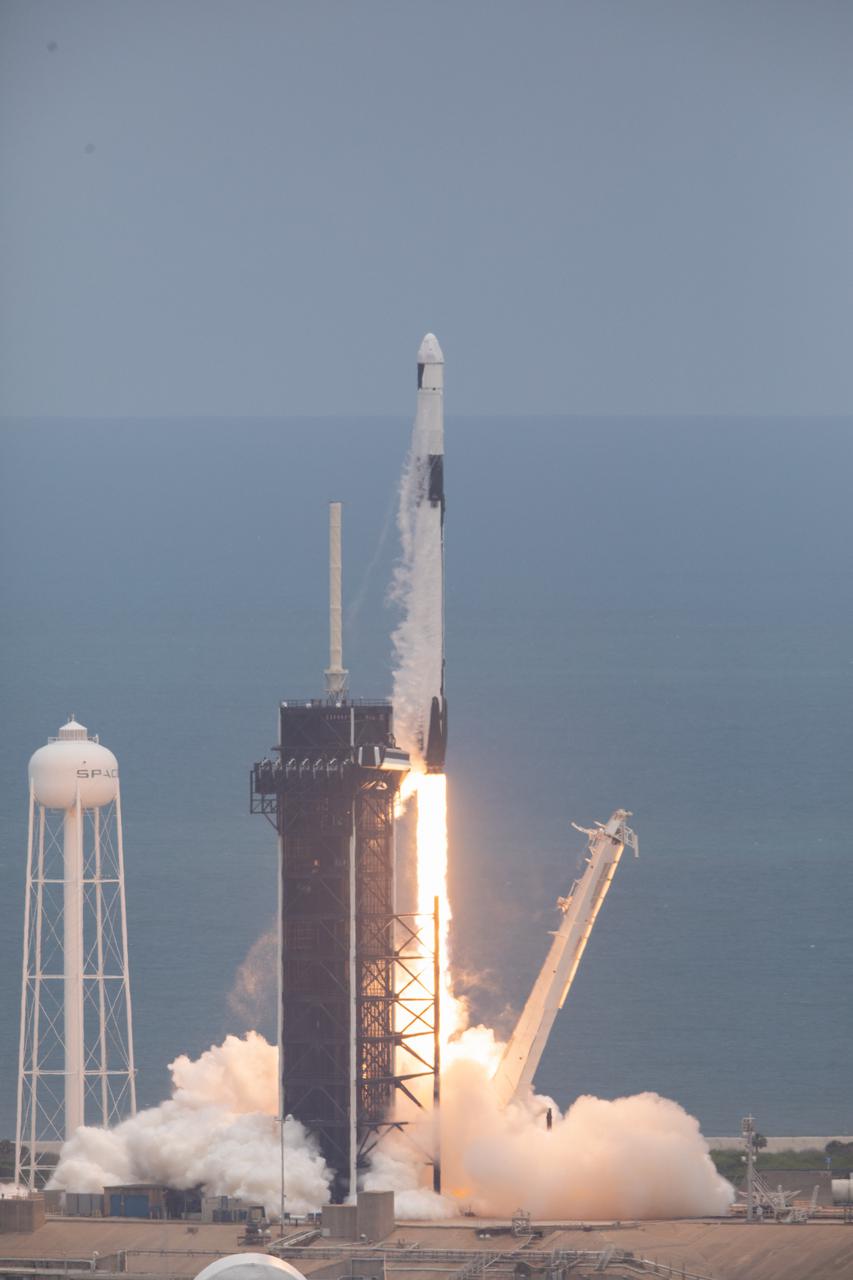
The SpaceX Falcon 9 rocket carrying the Dragon cargo capsule lifts off from Launch Complex 39A at NASA’s Kennedy Space Center in Florida on June 3, 2021, on the company’s 22nd Commercial Resupply Services mission for the agency to the International Space Station. Liftoff was at 1:29 p.m. EDT. Dragon is filled with supplies and payloads including critical materials to directly support dozens of the more than 250 science and research investigations that will occur during Expeditions 65 and 66 on the station.
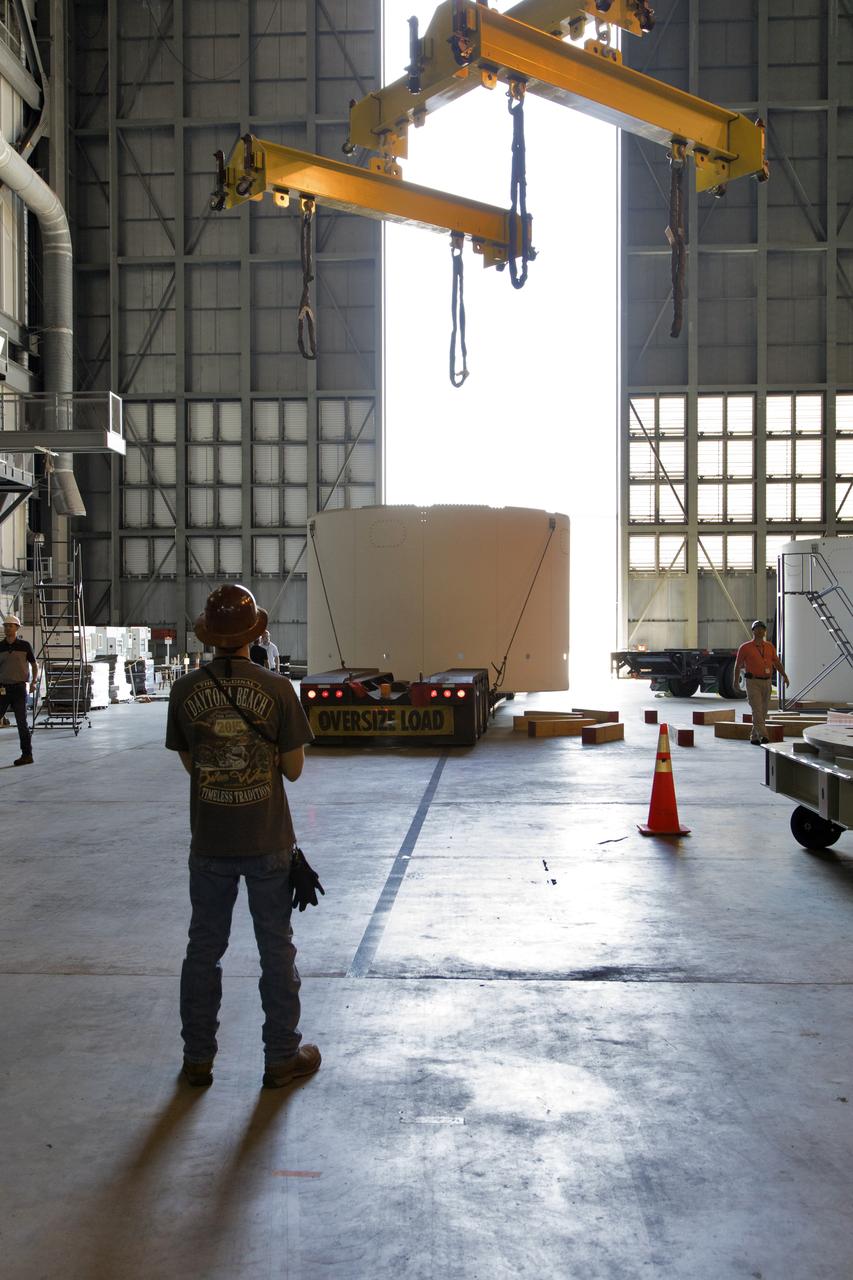
The third and final aeroshell for Orion's Launch Abort System (LAS) arrives by flatbed truck in High Bay 4 of the Vehicle Assembly Building on July 12, 2018, at NASA's Kennedy Space Center in Florida. The aeroshell was shipped from EMF Inc. on nearby Merritt Island. It will be offloaded and secured in the high bay. The aeroshells will be stacked and prepared for a full-stress test of the LAS, called Ascent Abort-2 (AA-2) flight test, scheduled for April 2019. During the test, a booster will launch from Space Launch Complex 46 at Cape Canaveral Air Force Station, carrying a fully functional LAS and a 22,000-pound Orion test vehicle to an altitude of 31,000 feet and traveling at more than 1,000 miles an hour. The test will verify the LAS can steer the crew module and astronauts aboard to safety in the event of an issue with the Space Launch System (SLS) rocket when the spacecraft is under the highest aerodynamic loads it will experience during a rapid climb into space. Orion is being prepared for its first integrated uncrewed flight atop the SLS on Exploration Mission-1.
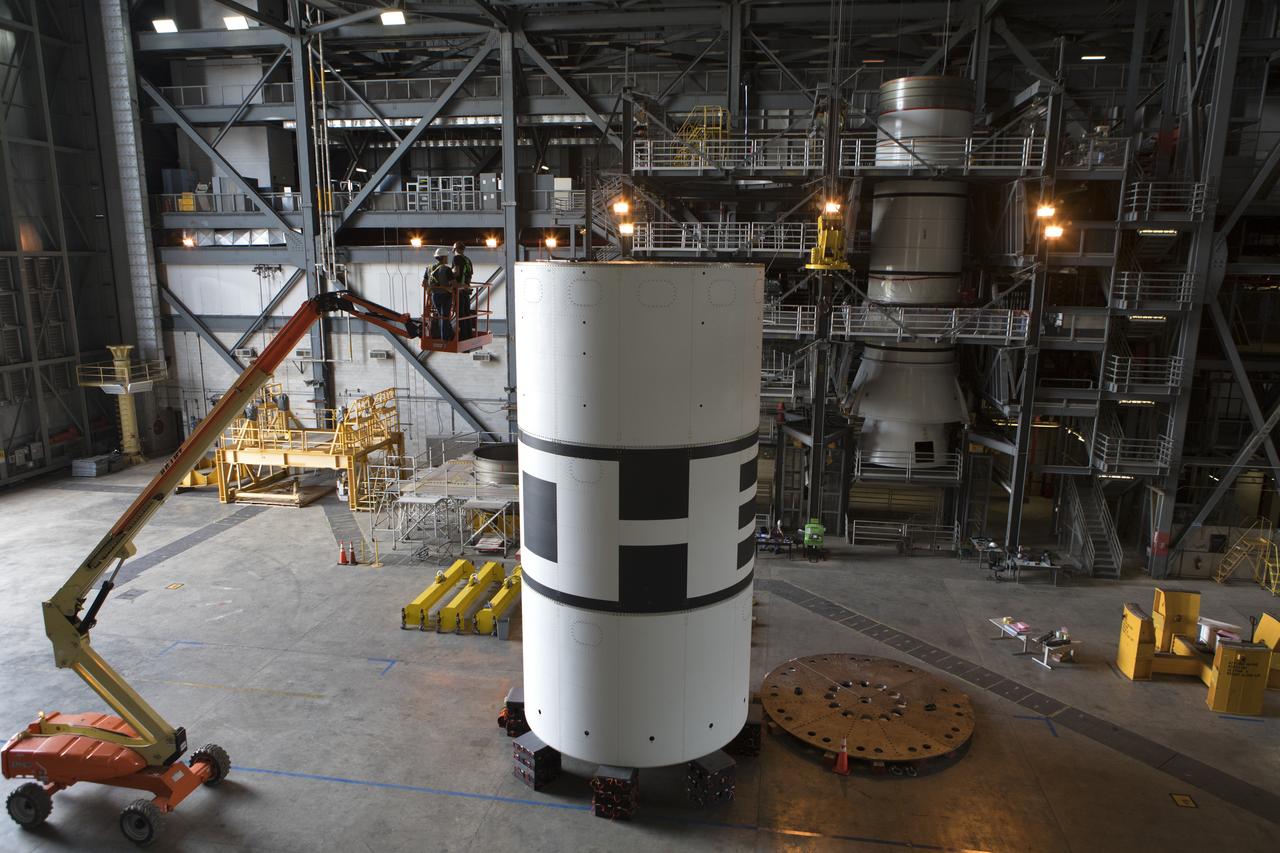
The aeroshells for Orion's Launch Abort System (LAS) are being stacked in High Bay 4 of the Vehicle Assembly Building on Aug. 3, 2018, at NASA's Kennedy Space Center in Florida. The aeroshells are being prepared for a full-stress test of the LAS, called Ascent Abort-2 (AA-2) flight test, scheduled for April 2019. During the test, a booster will launch from Space Launch Complex 46 at Cape Canaveral Air Force Station, carrying a fully functional LAS and a 22,000-pound Orion test vehicle to an altitude of 31,000 feet and traveling at more than 1,000 miles an hour. The test will verify the LAS can steer the crew module and astronauts aboard to safety in the event of an issue with the Space Launch System (SLS) rocket when the spacecraft is under the highest aerodynamic loads it will experience during a rapid climb into space. Orion is being prepared for its first integrated uncrewed flight atop the SLS on Exploration Mission-1.
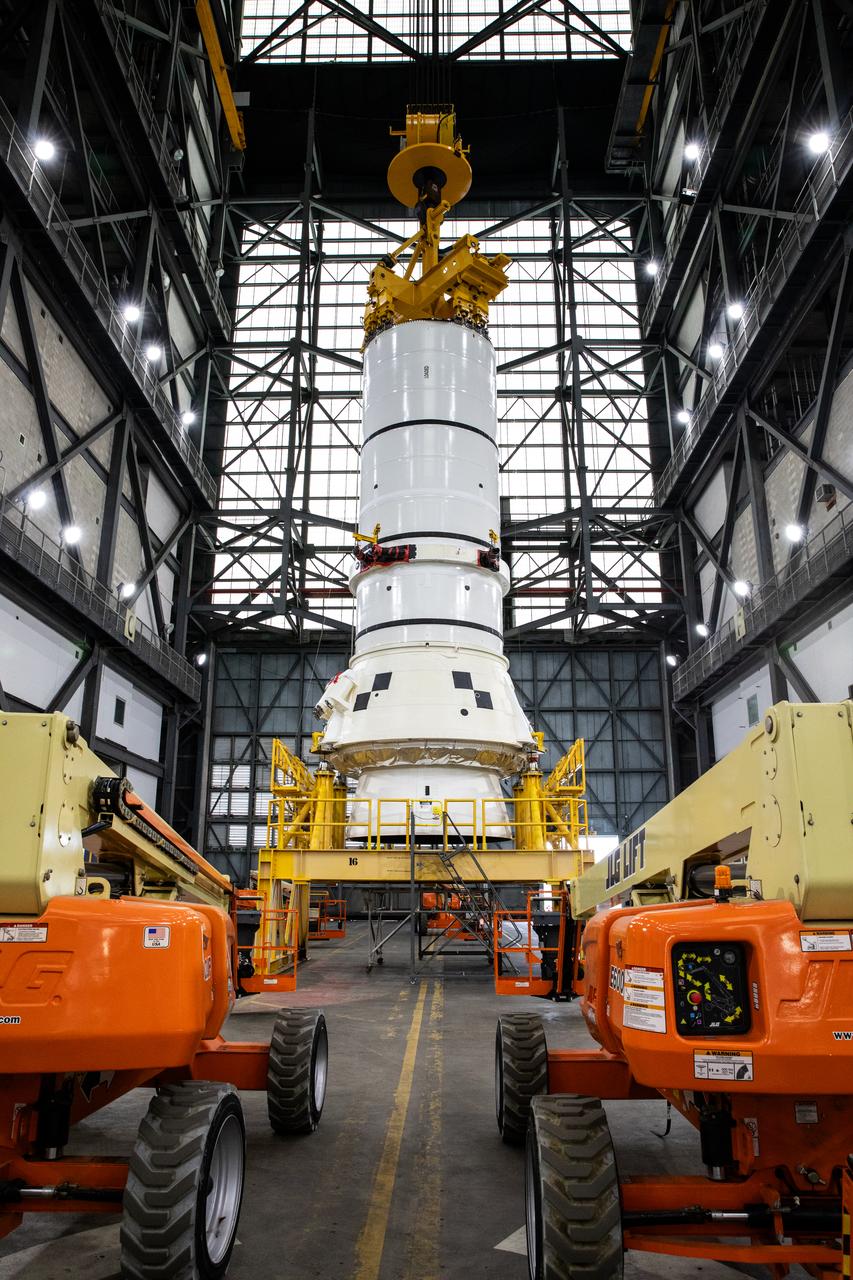
Engineers and technicians with the Exploration Ground Systems Program attach an overhead crane to the left aft assembly, or bottom portion of the solid rocket boosters for the SLS (Space Launch System) rocket, inside the Vehicle Assembly Building at NASA’s Kennedy Space Center on Tuesday, Nov. 19, 2024. The crane will lift the aft assembly on top of mobile launcher 1 followed by the right aft assembly and stack the remaining booster segments for the Artemis II mission.
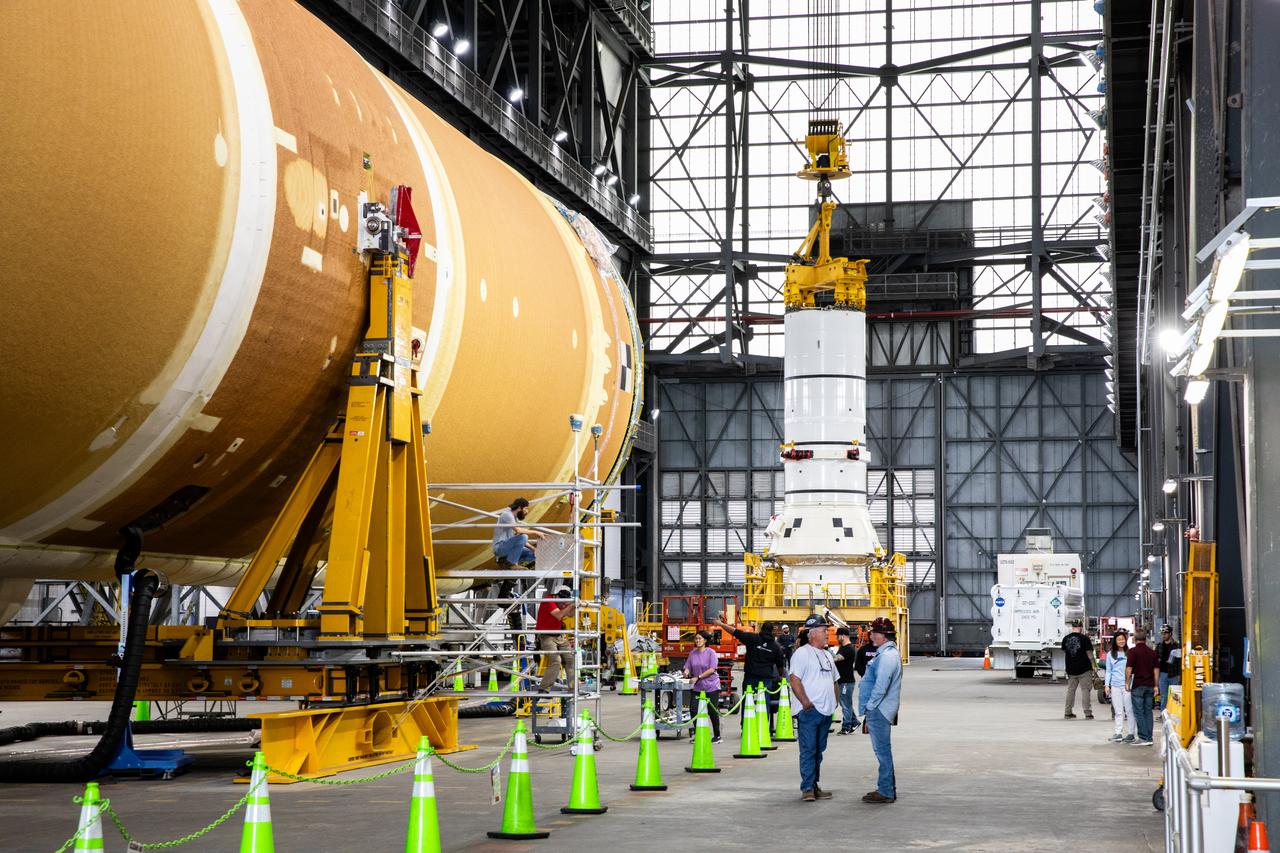
Down the transfer aisle from the Artemis II SLS (Space Launch System) core stage, engineers and technicians with the Exploration Ground Systems Program attach an overhead crane to the left aft assembly, or bottom portion of the solid rocket boosters for the SLS rocket, inside the Vehicle Assembly Building at NASA’s Kennedy Space Center on Tuesday, Nov. 19, 2024. The crane will lift the aft assembly on top of the mobile launcher 1 followed by the right aft assembly and stack the remaining booster segments for the Artemis II mission.

Technicians transport the right forward segment for NASA’s SLS (Space Launch System) Moon rocket boosters from the Rotation Processing and Surge Facility to NASA’s Vehicle Assembly Building in Florida on Monday, Feb. 15, 2025. The right forward segment will be transferred into High Bay 3 where it will be attached to the center forward segment on mobile launcher 1. The twin solid boosters, five segments on each side, will help support the remaining rocket components and the Orion spacecraft during final assembly of the Artemis II Moon rocket and provide more than 75 percent of the total SLS thrust during liftoff from NASA Kennedy’s Launch Pad 39B.
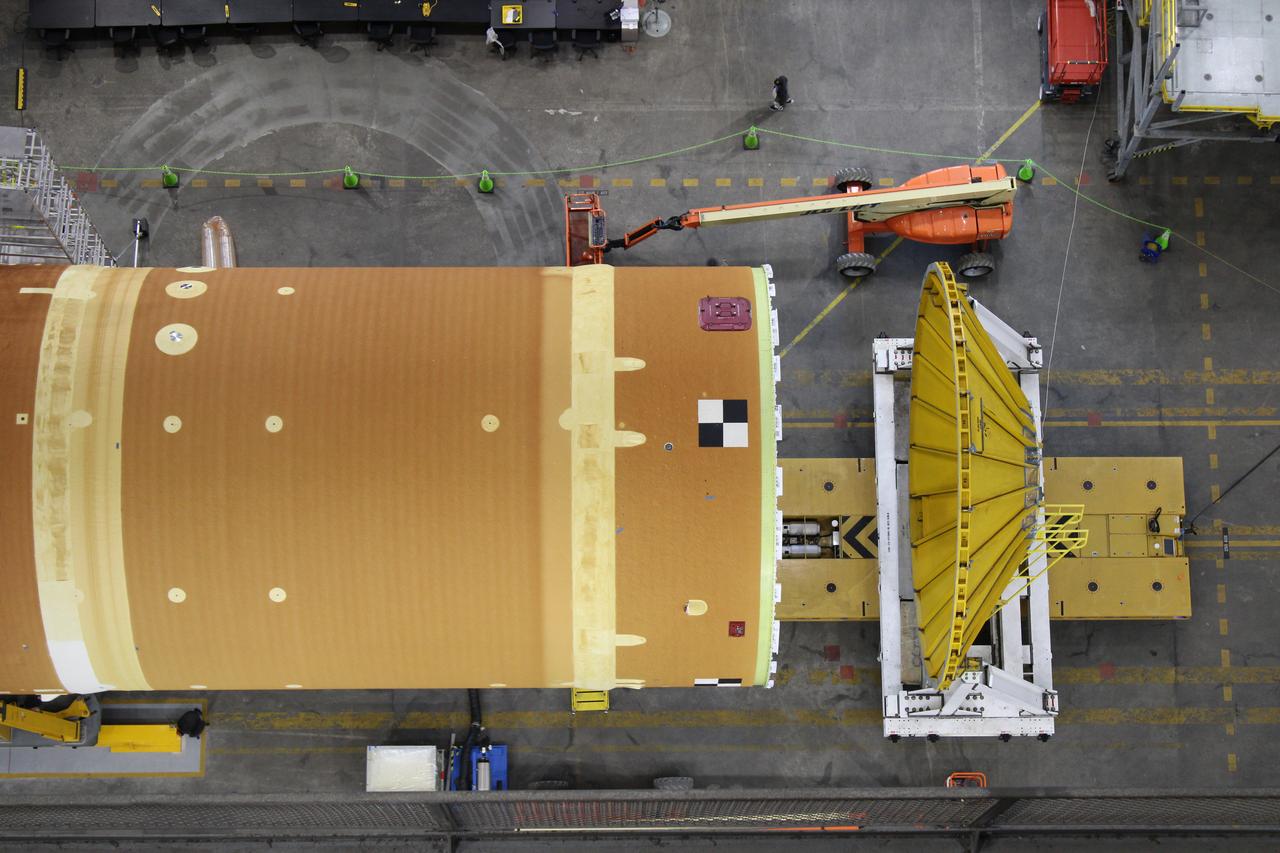
Teams with Exploration Ground Systems prepare to attach a cover, called a “spider” to the top of the SLS (Space Launch System) rocket core stage for NASA’s Artemis II mission on Friday, Oct. 25, 2024, at NASA’s Kennedy Space Center in Florida. Once connected, a crane will attach to the spider cover to raise the core stage vertically. The core stage has two giant propellant tanks that collectively hold more than 733,000 gallons of super cold liquid propellant to feed the stage’s four RS-25 engines to help send astronauts inside NASA’s Orion spacecraft to venture around the Moon for Artemis II.
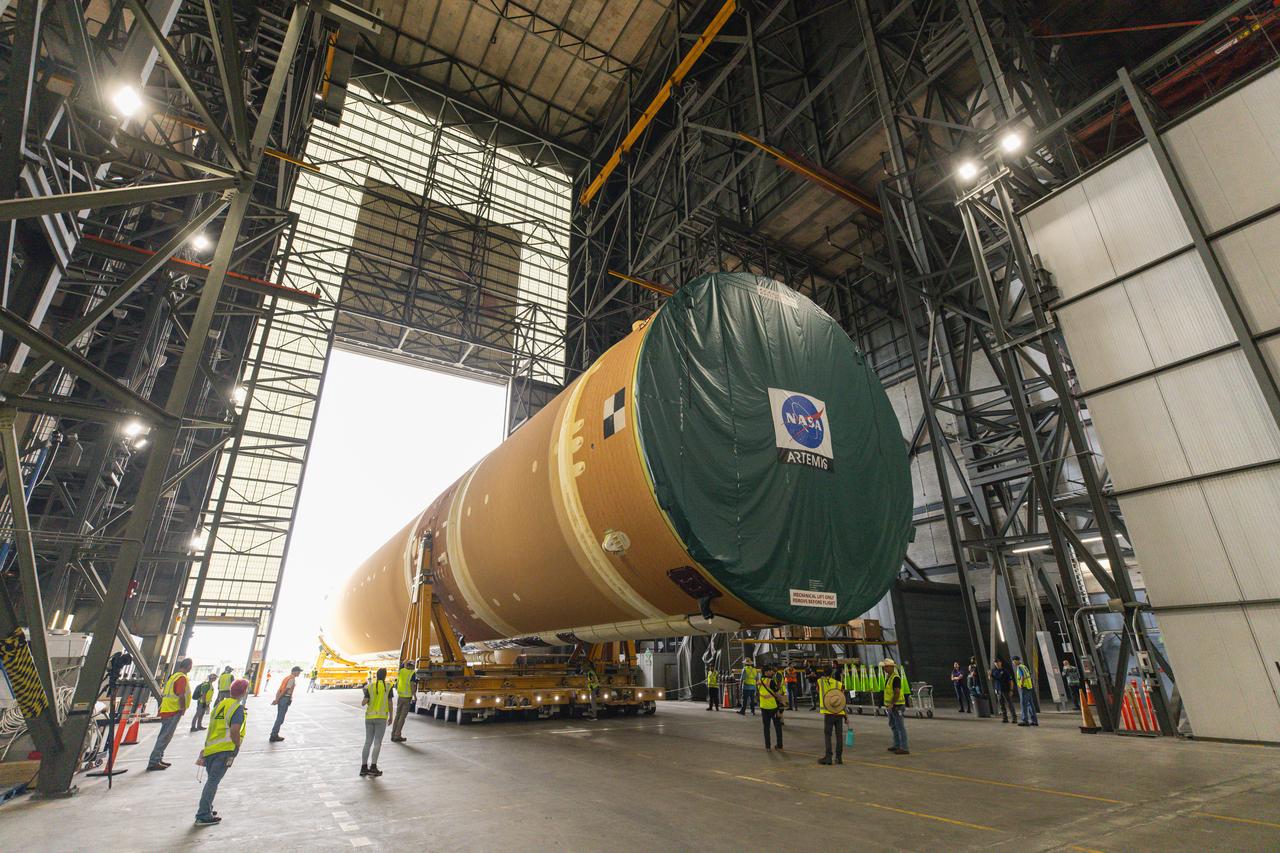
After completing its journey from NASA’s Michoud Assembly Facility in New Orleans aboard the Pegasus barge, teams with Exploration Ground Systems (EGS) transport the agency’s powerful SLS (Space Launch System) core stage into the transfer aisle inside Kennedy Space Center’s Vehicle Assembly Building in Florida on Wednesday, July 24, 2024. In the coming months, SLS will be prepared for integration atop the mobile launcher ahead of the Artemis II launch.
Engineers and technicians with NASA’s Exploration Ground Systems Program move the right aft assembly, or bottom portion of the right solid rocket booster for the agency’s SLS (Space Launch System) rocket, into inside the Vehicle Assembly Building at NASA’s Kennedy Space Center on Thursday, Nov. 22, 2024. The crane will lift the right aft assembly on top of mobile launcher 1, joining the previously stacked left aft assembly as the first booster segments stacked for the Artemis II Moon rocket.
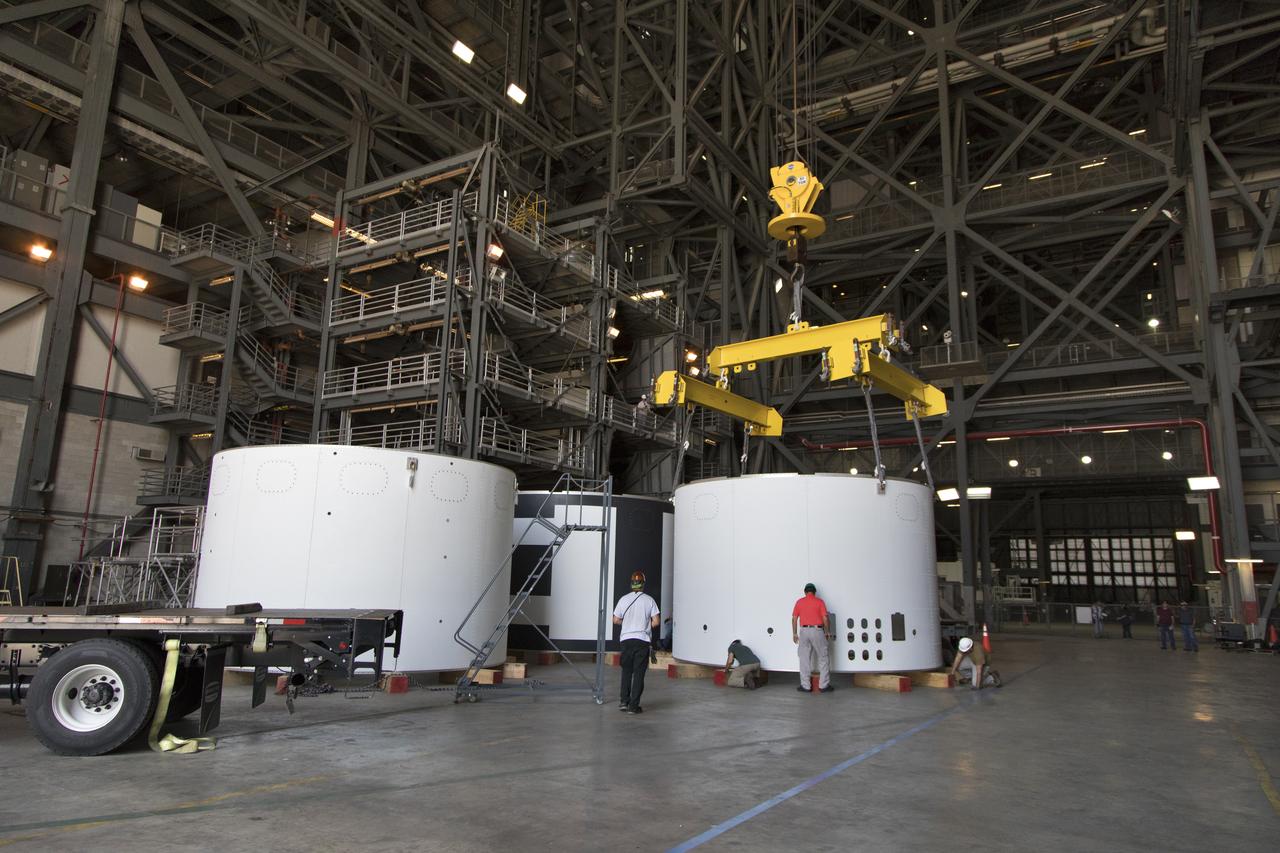
Technicians assist as a crane lowers the third and final aeroshell for Orion's Launch Abort System (LAS) onto slats in High Bay 4 of the Vehicle Assembly Building on July 12, 2018, at NASA's Kennedy Space Center in Florida. The aeroshell was shipped from EMF Inc. on nearby Merritt Island. All three aeroshells will be stacked and prepared for a full-stress test of the LAS, called Ascent Abort-2 (AA-2) flight test, scheduled for April 2019. During the test, a booster will launch from Space Launch Complex 46 at Cape Canaveral Air Force Station, carrying a fully functional LAS and a 22,000-pound Orion test vehicle to an altitude of 31,000 feet and traveling at more than 1,000 miles an hour. The test will verify the LAS can steer the crew module and astronauts aboard to safety in the event of an issue with the Space Launch System (SLS) rocket when the spacecraft is under the highest aerodynamic loads it will experience during a rapid climb into space. Orion is being prepared for its first integrated uncrewed flight atop the SLS on Exploration Mission-1.
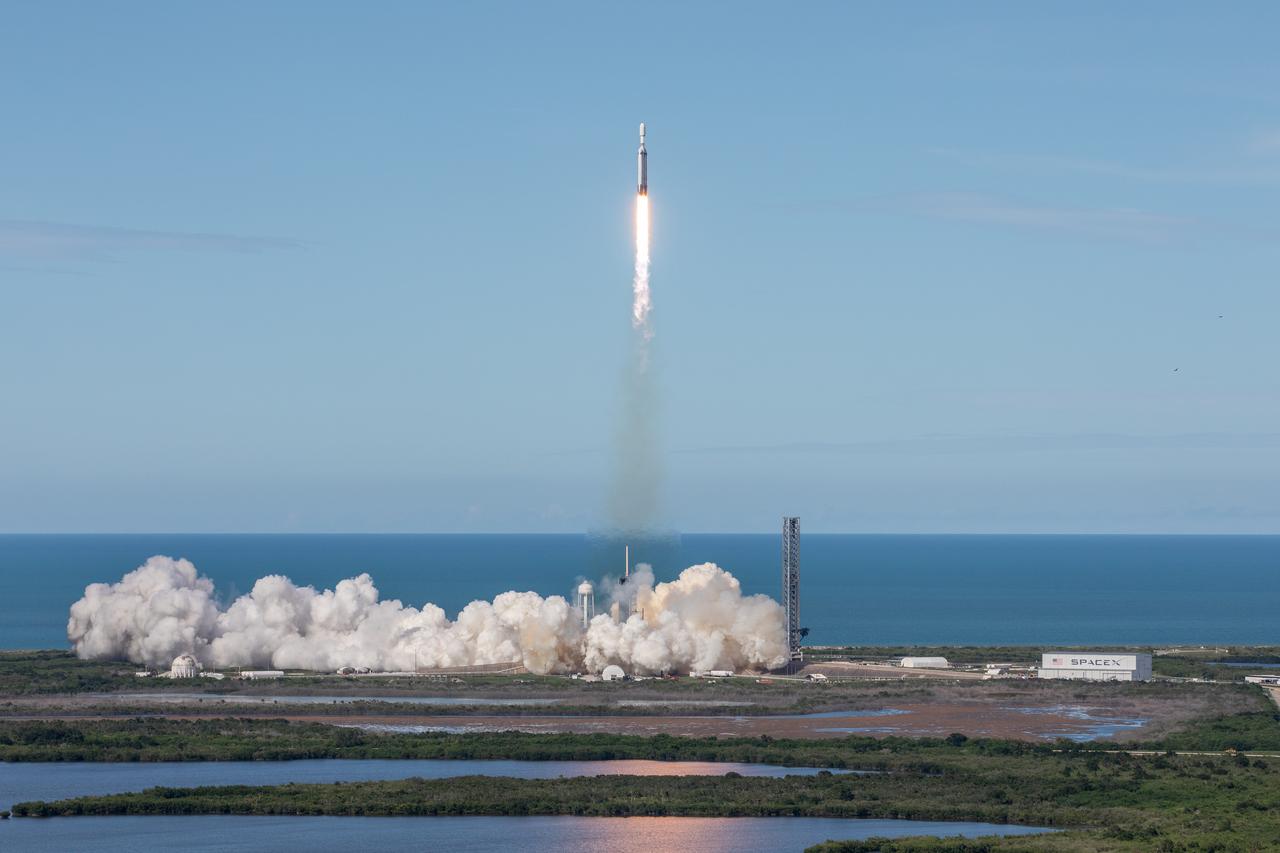
A SpaceX Falcon Heavy rocket carrying the National Oceanic and Atmospheric Administration (NOAA) GOES-U (Geostationary Operational Environmental Satellite U) lifts off from Launch Complex 39A at NASA’s Kennedy Space Center in Florida on Tuesday, June 25, 2024. The GOES-U satellite is the final satellite in the GOES-R series, which serves a critical role in providing continuous coverage of the Western Hemisphere, including monitoring tropical systems in the eastern Pacific and Atlantic oceans.
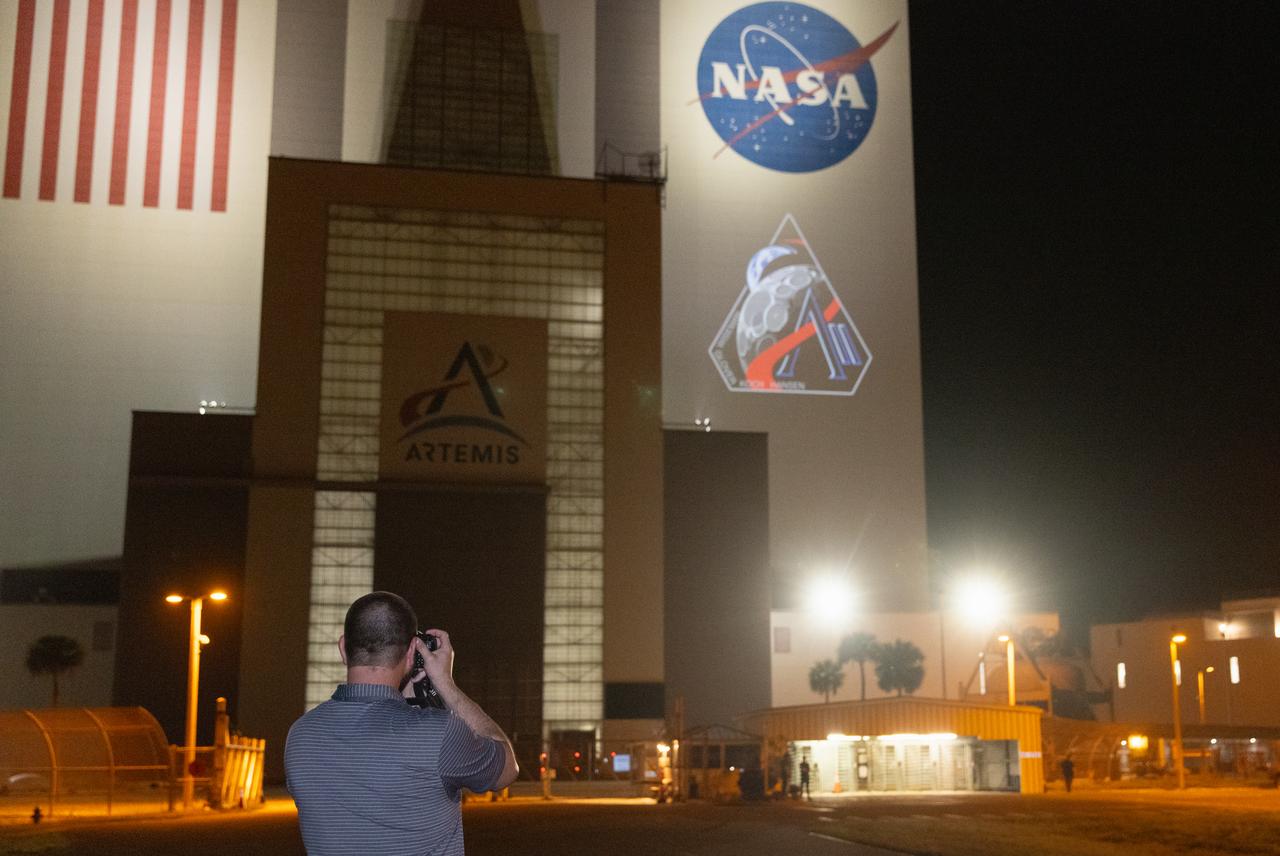
Employees at NASA’s Kennedy Space Center in Florida take photos of the official Artemis II mission crew insignia projected on the exterior of the spaceport’s Vehicle Assembly Building on Friday, April 4, 2025. The patch designates the mission as “AII,” signifying not only the second major flight of the Artemis campaign, but also an endeavor of discovery that seeks to explore for all and by all. Framed in Apollo 8’s famous Earthrise photo, the scene of the Earth and the Moon represents the dual nature of human spaceflight, both equally compelling: The Moon represents our exploration destination, focused on discovery of the unknown. The Earth represents home, focused on the perspective we gain when we look back at our shared planet and learn what it is to be uniquely human. The orbit around Earth highlights the ongoing exploration missions that have enabled Artemis to set sights on a long-term presence on the Moon and soon, Mars.
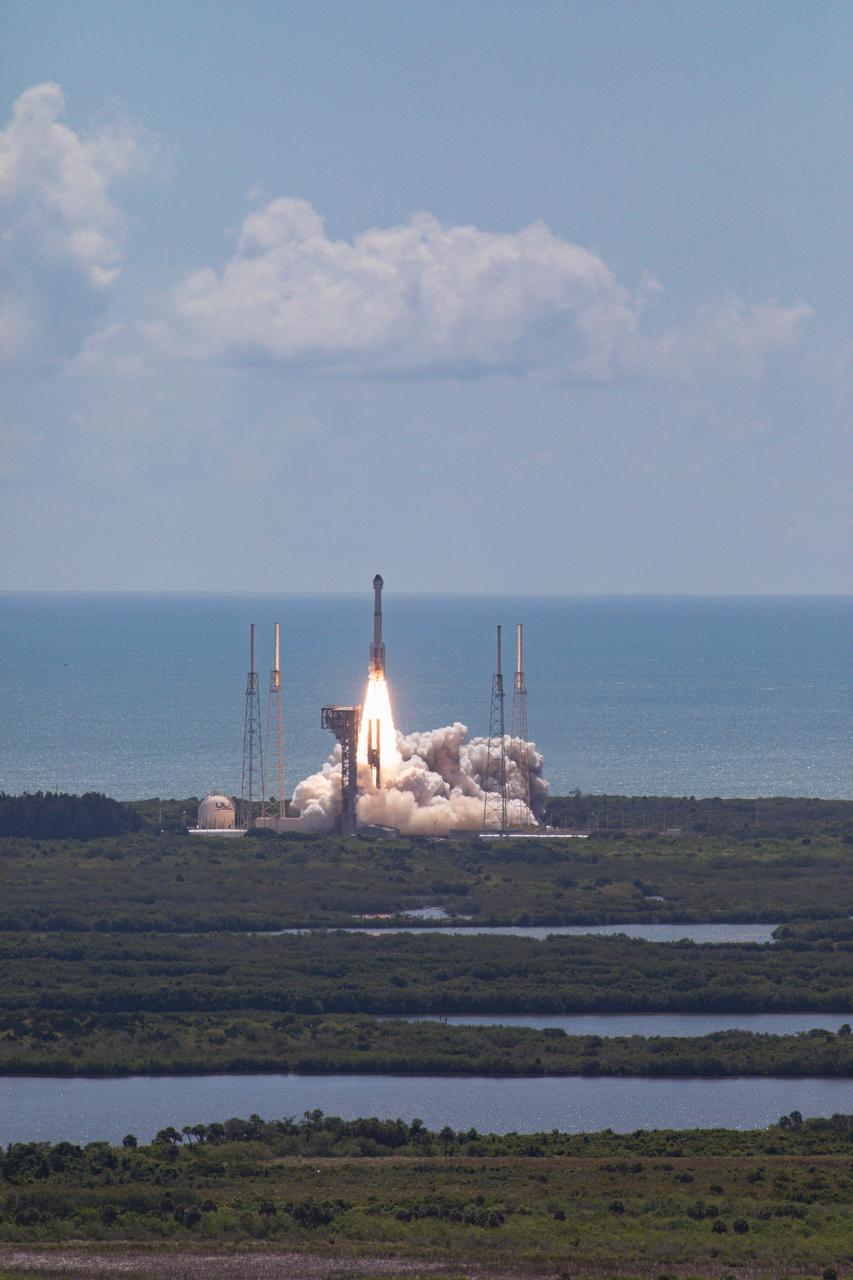
A United Launch Alliance Atlas V rocket carrying a Boeing Starliner spacecraft launches NASA’s Boeing Crew Flight Test with NASA astronauts Butch Wilmore and Suni Williams aboard at 10:52 a.m. EDT Wednesday, June 5, 2024, from Space Launch Complex-41 at Cape Canaveral Space Force Station in Florida. Wilmore and Williams are the first to launch aboard Boeing’s Starliner spacecraft to the International Space Station as part of the agency’s Commercial Crew Program.
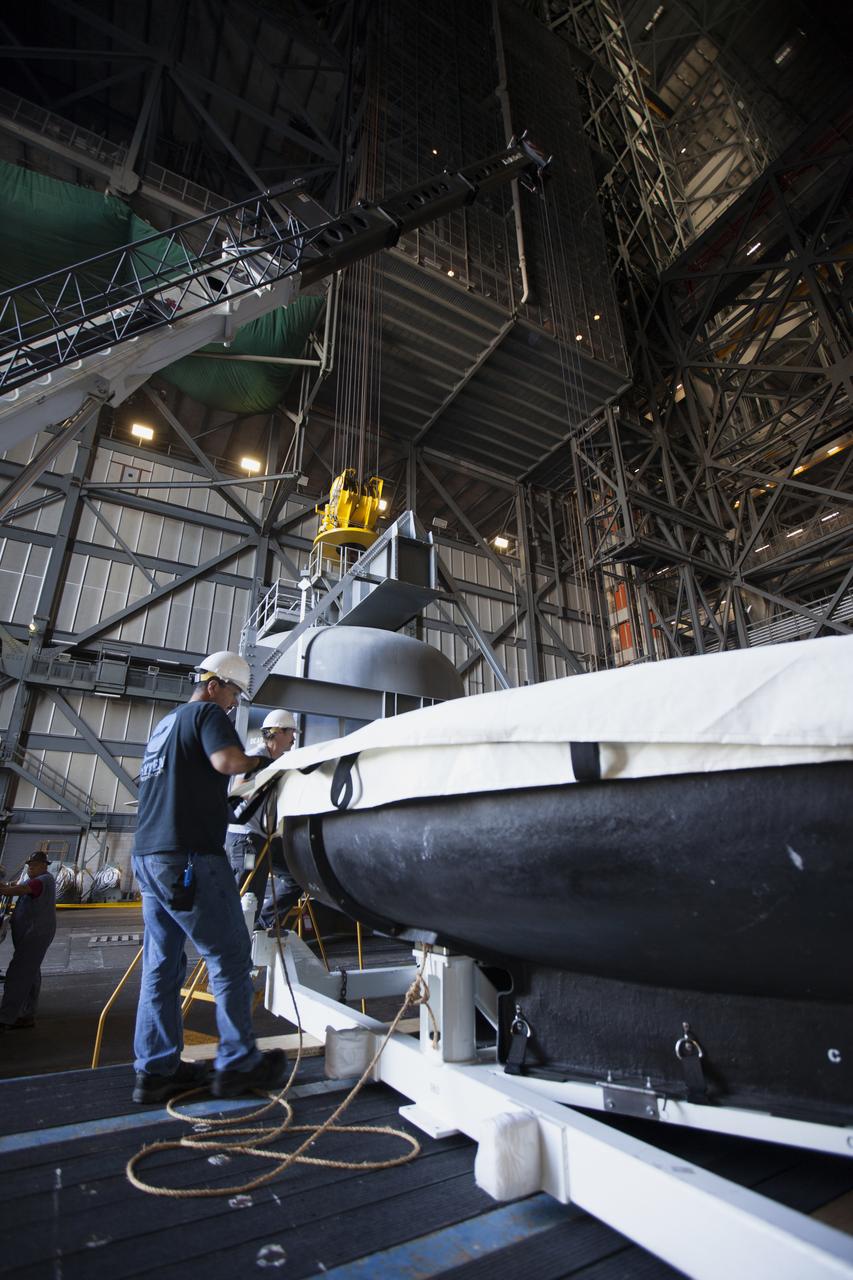
Inside High Bay 2 in the Vehicle Assembly Building (VAB) at NASA's Kennedy Space Center in Florida, workers help prepare the Orion heat shield from Exploration Flight Test-1 for unloading off its transporter. The heat shield is being transferred from the Orion Program to the Ground Systems Development and Operations Program, Landing and Recovery Operations. In the VAB, the heat shield will be integrated with the Orion ground test article and used for future underway recovery testing.
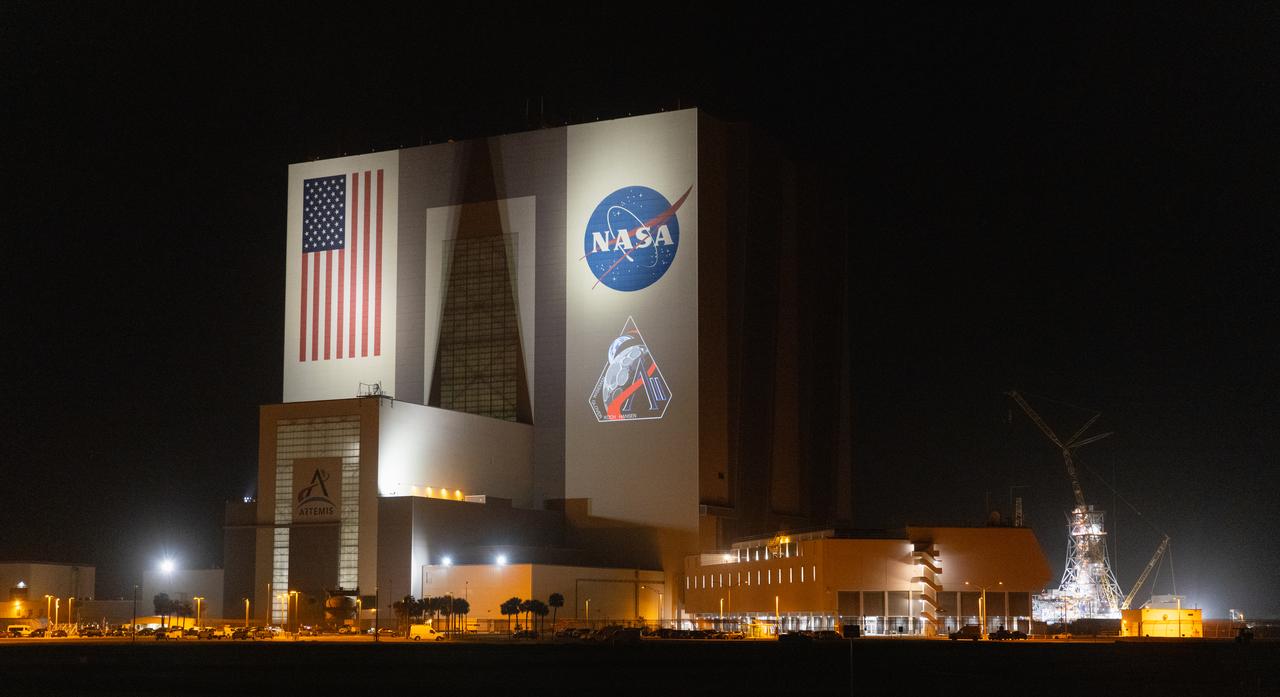
The official Artemis II mission crew insignia is projected on the exterior of the Vehicle Assembly Building at NASA’s Kennedy Space Center in Florida on Friday, April 4, 2025. The patch designates the mission as “AII,” signifying not only the second major flight of the Artemis campaign, but also an endeavor of discovery that seeks to explore for all and by all. Framed in Apollo 8’s famous Earthrise photo, the scene of the Earth and the Moon represents the dual nature of human spaceflight, both equally compelling: The Moon represents our exploration destination, focused on discovery of the unknown. The Earth represents home, focused on the perspective we gain when we look back at our shared planet and learn what it is to be uniquely human. The orbit around Earth highlights the ongoing exploration missions that have enabled Artemis to set sights on a long-term presence on the Moon and soon, Mars.
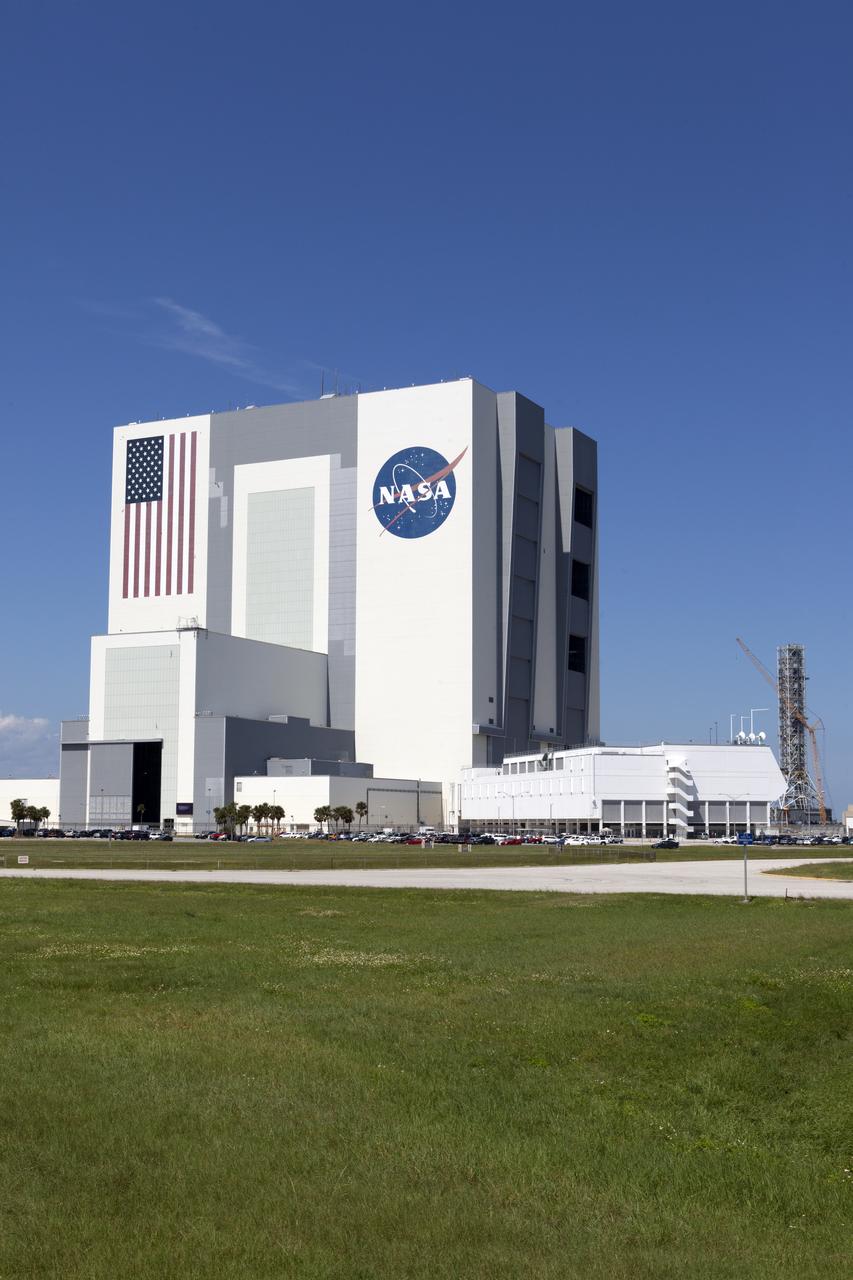
NASA's Vehicle Assembly Building at Kennedy Space Center in Florida was used to assemble and house American-crewed launch vehicles from 1968 to 2011. AT 3,684,883 cubic meters, it is one of the largest buildings in the world by volume. Inside the facility, High Bay 3 is being upgraded and modified to support processing of the agency's Space Launch System rocket and Orion spacecraft.
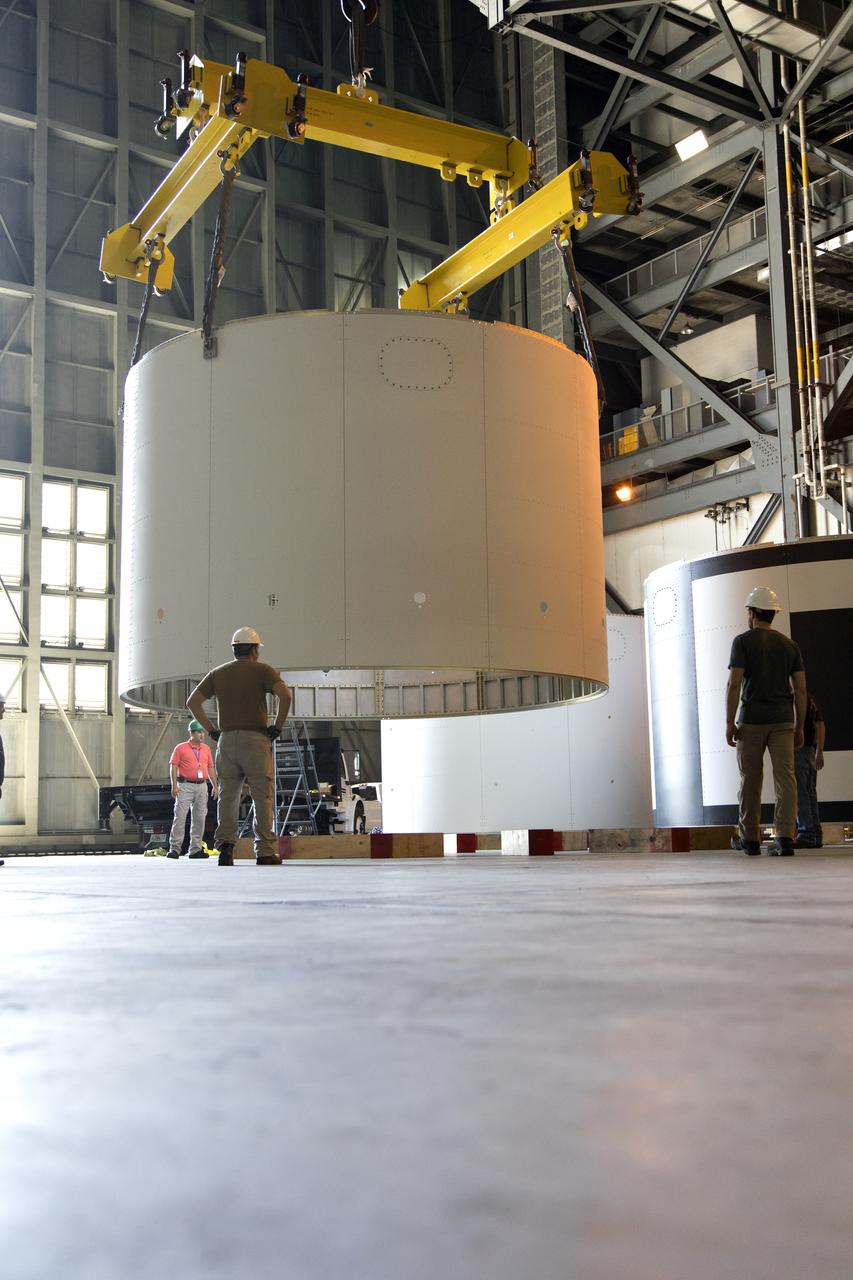
Technicians assist as a crane lowers the third and final aeroshell for Orion's Launch Abort System (LAS) onto slats in High Bay 4 of the Vehicle Assembly Building on July 12, 2018, at NASA's Kennedy Space Center in Florida. The aeroshell was shipped from EMF Inc. on nearby Merritt Island. All three aeroshells will be stacked and prepared for a full-stress test of the LAS, called Ascent Abort-2 (AA-2) flight test, scheduled for April 2019. During the test, a booster will launch from Space Launch Complex 46 at Cape Canaveral Air Force Station, carrying a fully functional LAS and a 22,000-pound Orion test vehicle to an altitude of 31,000 feet and traveling at more than 1,000 miles an hour. The test will verify the LAS can steer the crew module and astronauts aboard to safety in the event of an issue with the Space Launch System (SLS) rocket when the spacecraft is under the highest aerodynamic loads it will experience during a rapid climb into space. Orion is being prepared for its first integrated uncrewed flight atop the SLS on Exploration Mission-1.

A cover, called a “spider” is attached to the SLS (Space Launch System) rocket core stage for NASA’s Artemis II mission inside the Vehicle Assembly Building at NASA’s Kennedy Space Center in Florida on Monday, Oct. 28, 2024. Teams with Exploration Ground Systems will use a crane to attach to the spider cover to raise the core stage vertically. The core stage has two giant propellant tanks that collectively hold more than 733,000 gallons of super cold liquid propellant to feed the stage’s four RS-25 engines to help send astronauts inside NASA’s Orion spacecraft to venture around the Moon for Artemis II.

Engineers and technicians with NASA’s Exploration Ground Systems Program complete stacking of the first Moon rocket segments – the left and right aft assemblies for the agency’s Artemis II SLS (Space Launch System) solid rocket boosters – onto mobile launcher 1 inside the Vehicle Assembly Building at Kennedy Space Center on Friday, Nov. 22, 2024. The first two of 10 booster segments to be stacked, the boosters will help support the remaining rocket components and the Orion spacecraft during final assembly of the Artemis II Moon rocket and provide more than 75 percent of the total SLS thrust during liftoff from NASA Kennedy’s Launch Pad 39B.
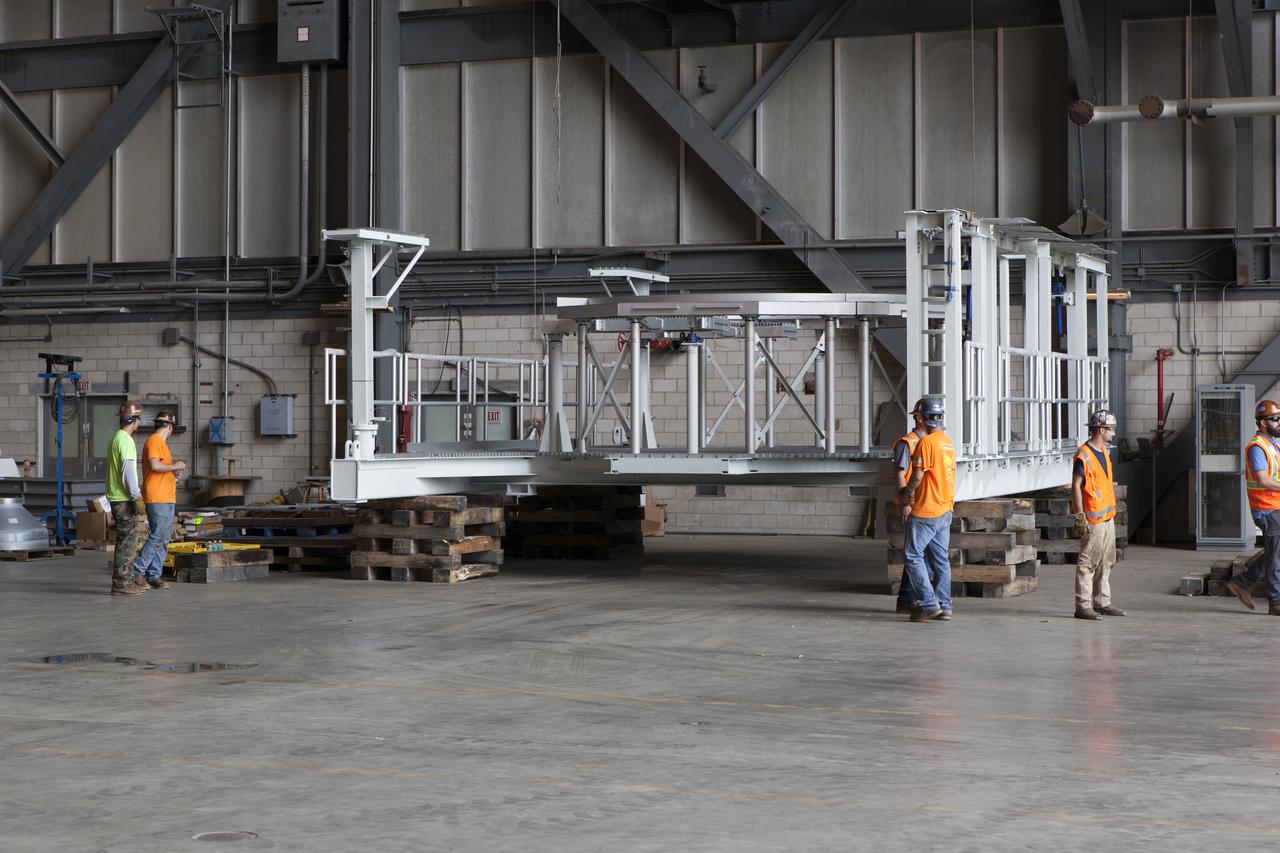
One of two new work platforms for NASA's Space Launch System booster engines is secured on dunnage inside the Vehicle Assembly Building (VAB) at the agency's Kennedy Space Center in Florida. The platforms were transported from fabricator Met-Con Inc. in Cocoa, Florida. They will be stored in the VAB, where they will be used for processing and checkout of the engines for the rocket's twin five-segment solid rocket boosters for Exploration Mission-1. EM-1 will launch an uncrewed Orion spacecraft to a stable orbit beyond the Moon and bring it back to Earth for a splashdown in the Pacific Ocean.
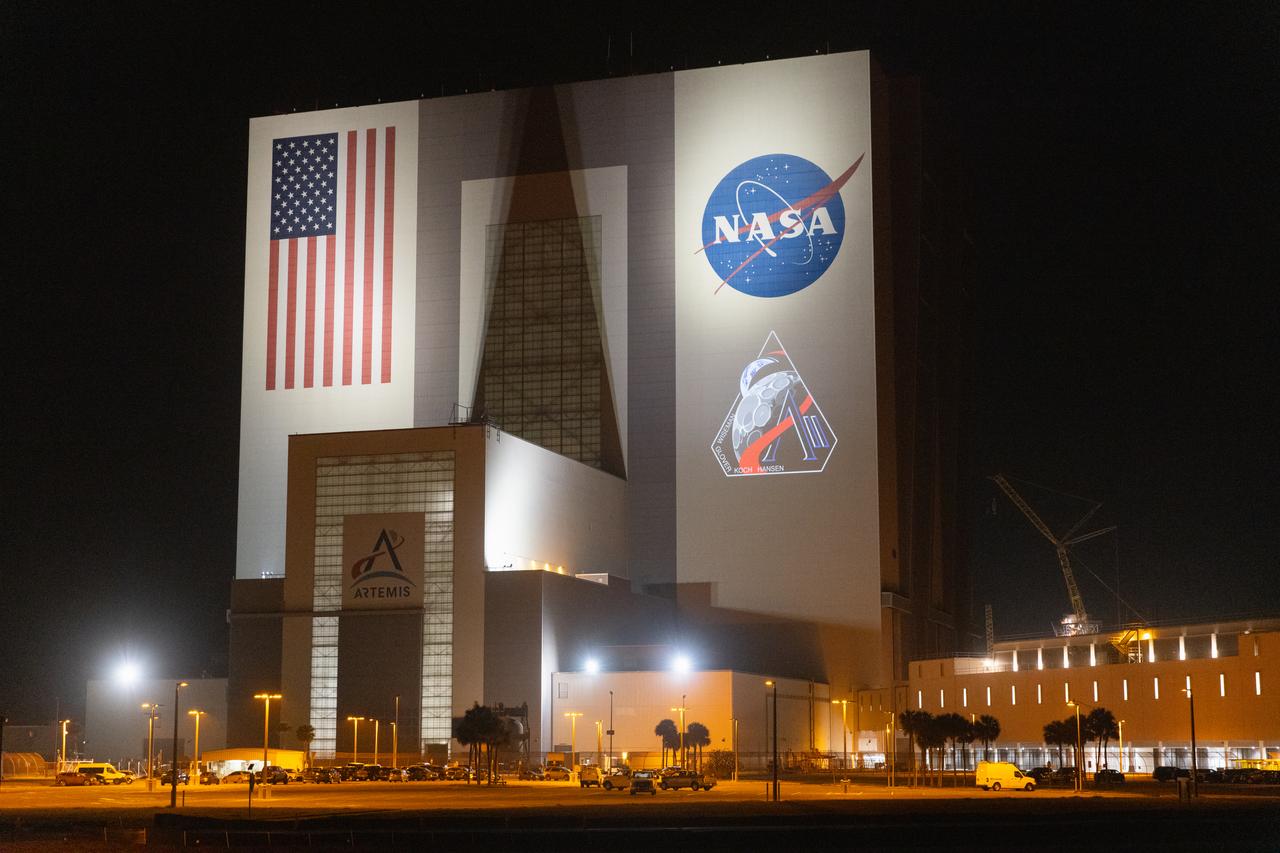
The official Artemis II mission crew insignia is projected on the exterior of the Vehicle Assembly Building at NASA’s Kennedy Space Center in Florida on Friday, April 4, 2025. The patch designates the mission as “AII,” signifying not only the second major flight of the Artemis campaign, but also an endeavor of discovery that seeks to explore for all and by all. Framed in Apollo 8’s famous Earthrise photo, the scene of the Earth and the Moon represents the dual nature of human spaceflight, both equally compelling: The Moon represents our exploration destination, focused on discovery of the unknown. The Earth represents home, focused on the perspective we gain when we look back at our shared planet and learn what it is to be uniquely human. The orbit around Earth highlights the ongoing exploration missions that have enabled Artemis to set sights on a long-term presence on the Moon and soon, Mars.
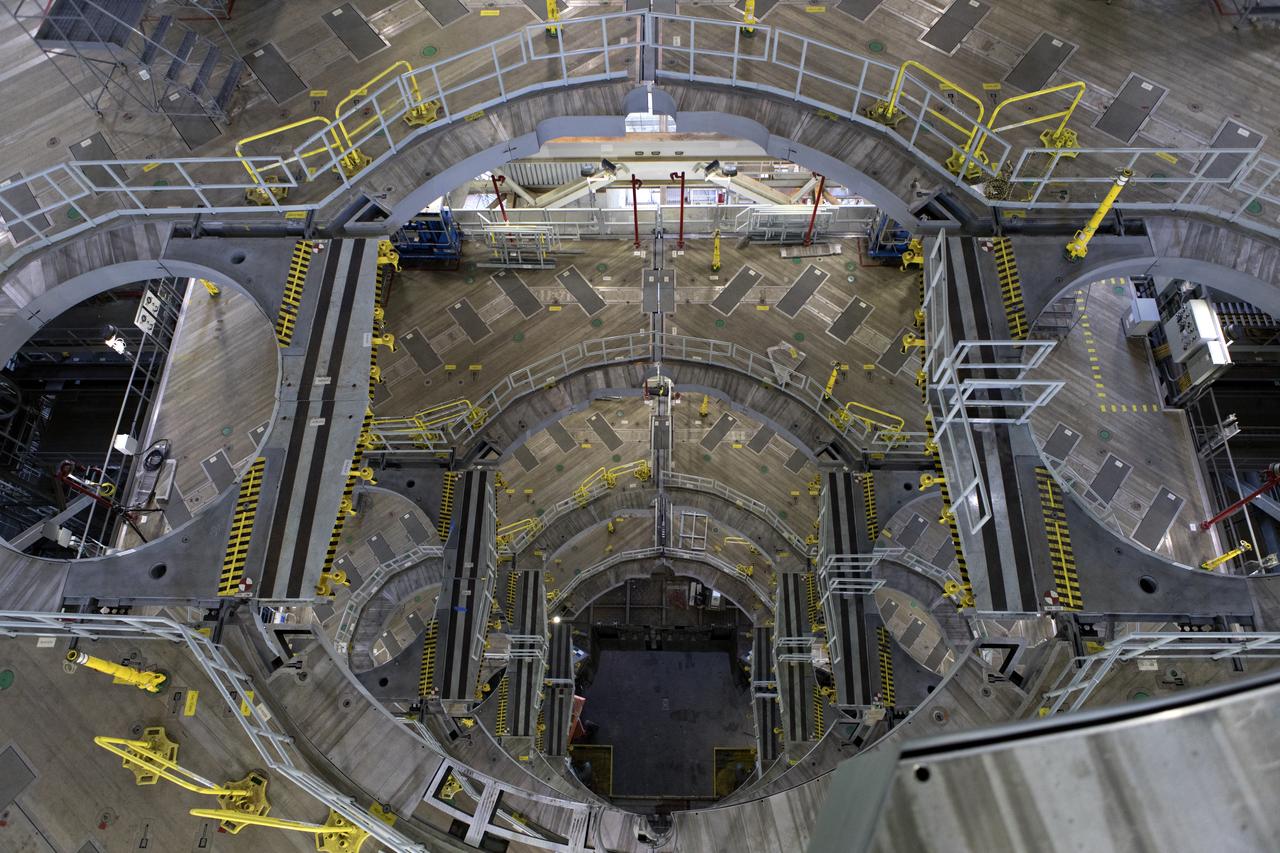
A view of the new work platforms in High Bay 3 of the Vehicle Assembly Building on Feb. 22, 2019, at NASA’s Kennedy Space Center in Florida. Preparations are underway to perform an initial swing test of the Core Stage Inter-tank Umbilical (CSITU) on the mobile launcher. The CSITU is a swing-arm umbilical that will connect to the Space Launch System core stage inter-tank. It will provide conditioned air, pressurized gases and power and data connection to the core stage. Exploration Ground Systems at Kennedy is conducting the swing test.
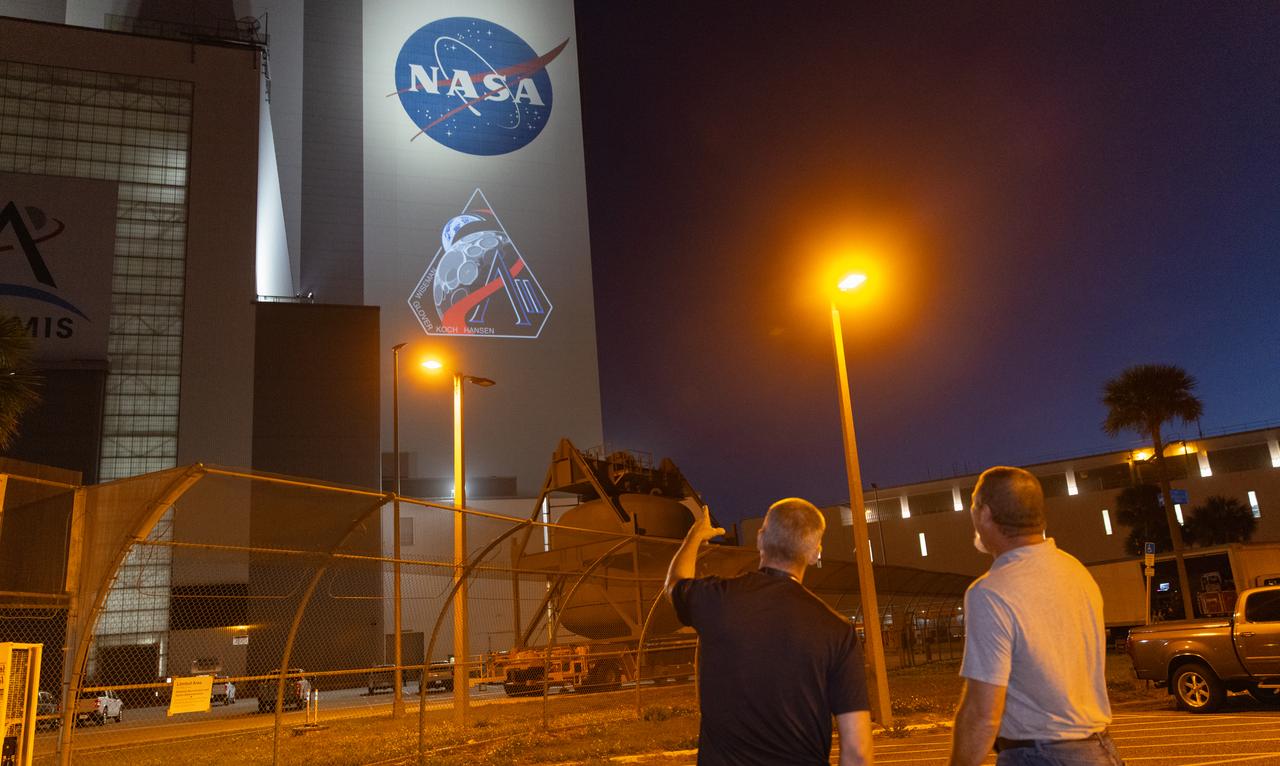
Employees at NASA’s Kennedy Space Center in Florida take photos of the official Artemis II mission crew insignia projected on the exterior of the spaceport’s Vehicle Assembly Building on Friday, April 4, 2025. The patch designates the mission as “AII,” signifying not only the second major flight of the Artemis campaign, but also an endeavor of discovery that seeks to explore for all and by all. Framed in Apollo 8’s famous Earthrise photo, the scene of the Earth and the Moon represents the dual nature of human spaceflight, both equally compelling: The Moon represents our exploration destination, focused on discovery of the unknown. The Earth represents home, focused on the perspective we gain when we look back at our shared planet and learn what it is to be uniquely human. The orbit around Earth highlights the ongoing exploration missions that have enabled Artemis to set sights on a long-term presence on the Moon and soon, Mars.
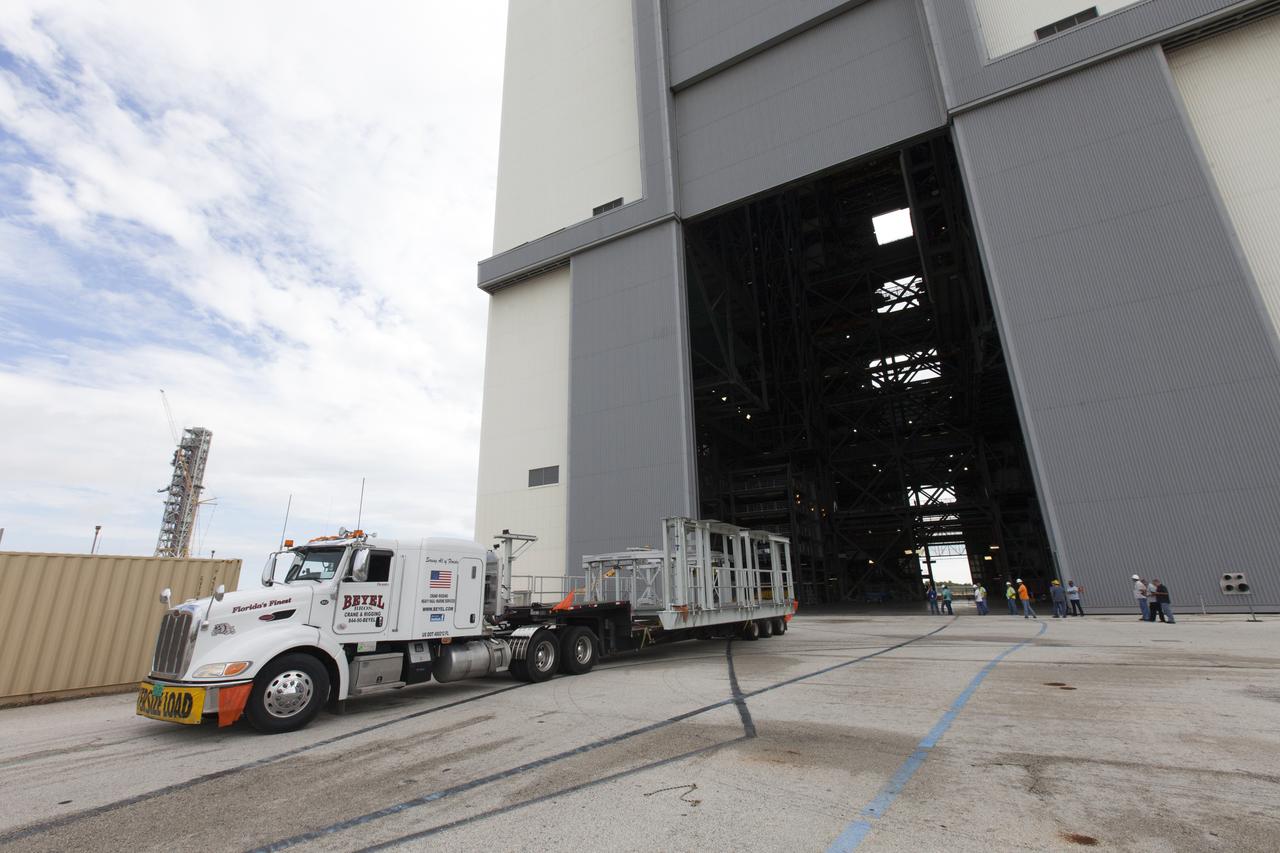
A flatbed truck carrying one of two new service platforms for NASA's Space Launch System booster engines backs in to the Vehicle Assembly Building (VAB) at the agency's Kennedy Space Center in Florida. The platforms were transported from fabricator Met-Con Inc. in Cocoa, Florida. They will be stored in the VAB, where they will be used for processing and checkout of the engines for the rocket's twin five-segment solid rocket boosters for Exploration Mission-1. EM-1 will launch an uncrewed Orion spacecraft to a stable orbit beyond the Moon and bring it back to Earth for a splashdown in the Pacific Ocean.
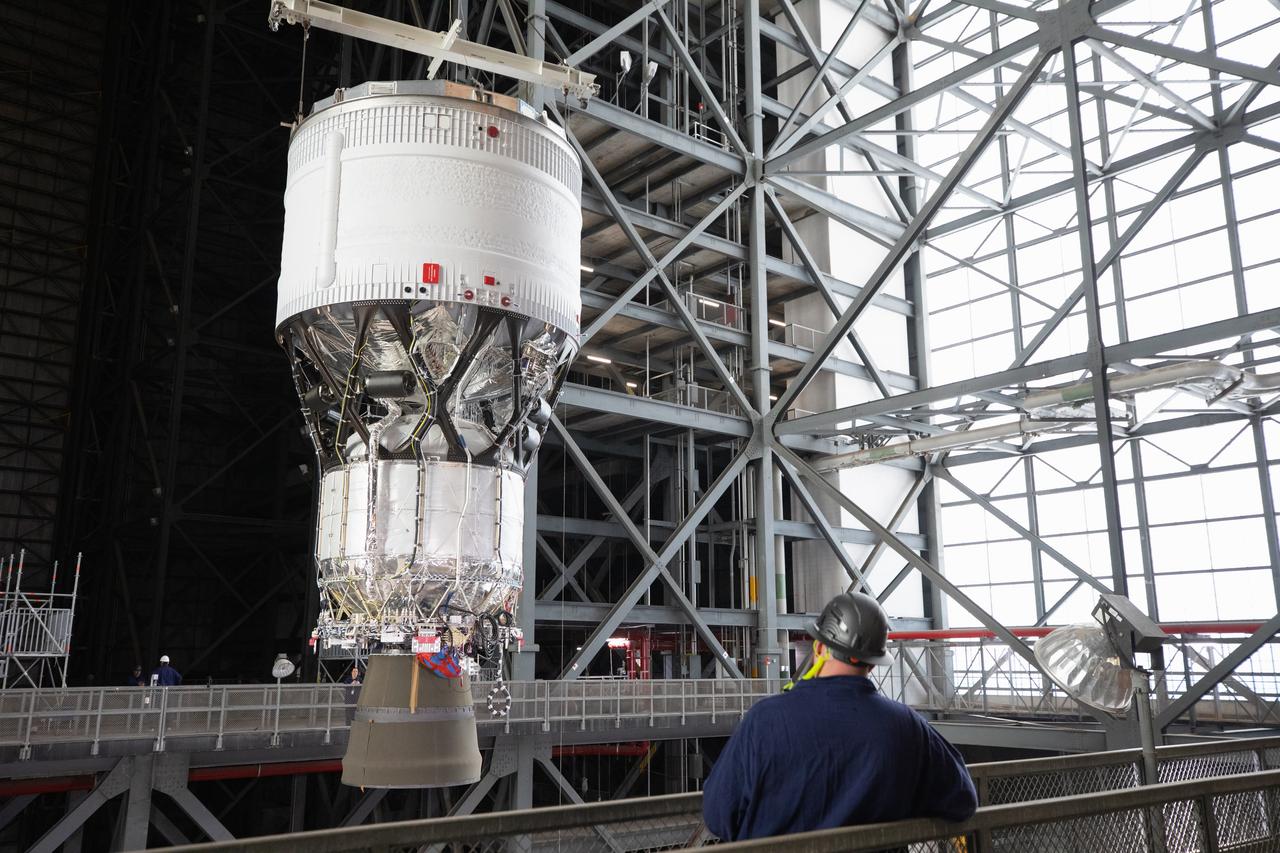
Teams with NASA’s Exploration Ground Systems Program begin integrating the interim cryogenic propulsion stage to the SLS (Space Launch System) launch vehicle stage adapter on Wednesday, April 30, 2025, inside the Vehicle Assembly Building at NASA’s Kennedy Space Center in Florida. The four-story propulsion system, built by Boeing and ULA (United Launch Alliance), is powered by an RL10 engine that will enable the Orion spacecraft to build up enough speed for the push toward the Moon during the Artemis II crewed test flight.
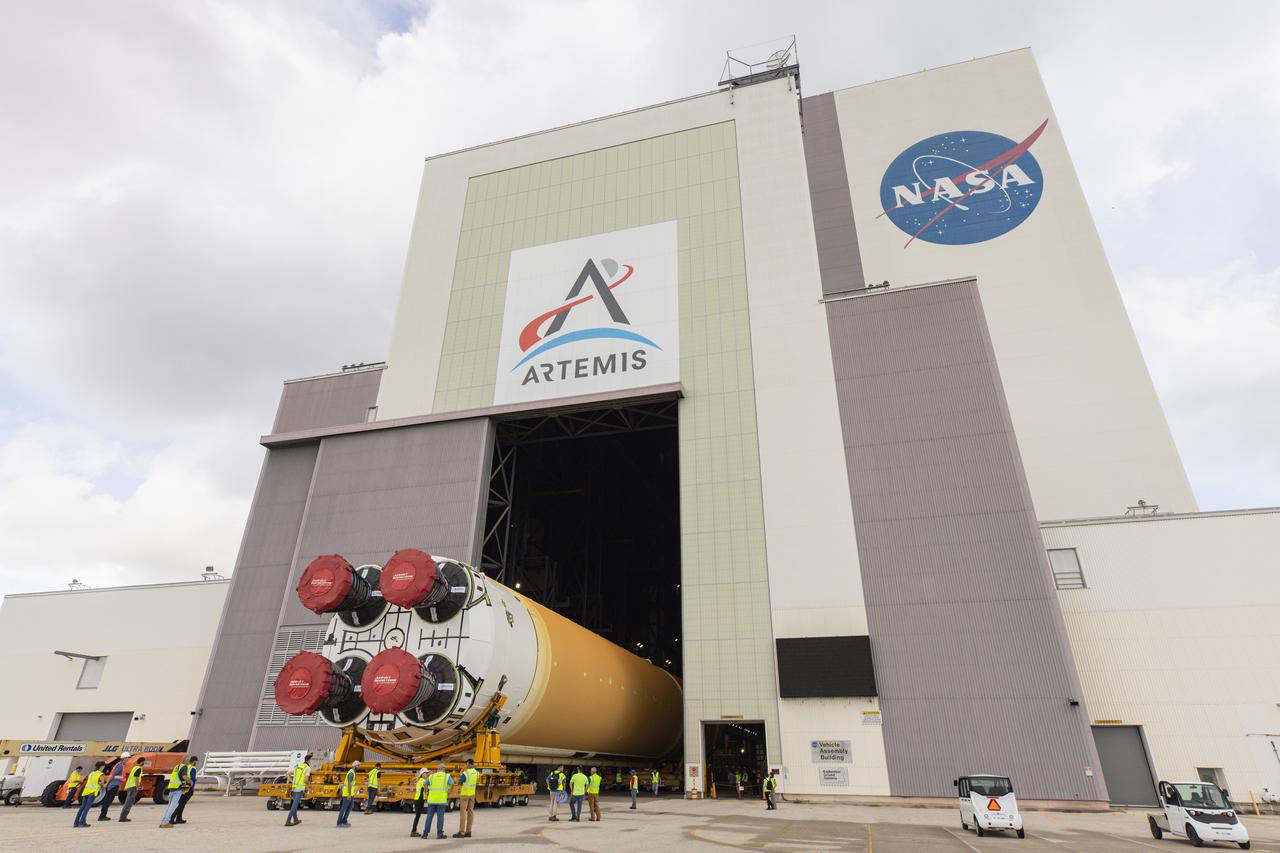
After completing its journey from NASA’s Michoud Assembly Facility in New Orleans aboard the Pegasus barge, teams with Exploration Ground Systems (EGS) transport the agency’s powerful SLS (Space Launch System) core stage into the transfer aisle inside Kennedy Space Center’s Vehicle Assembly Building in Florida on Wednesday, July 24, 2024. In the coming months, SLS will be prepared for integration atop the mobile launcher ahead of the Artemis II launch.
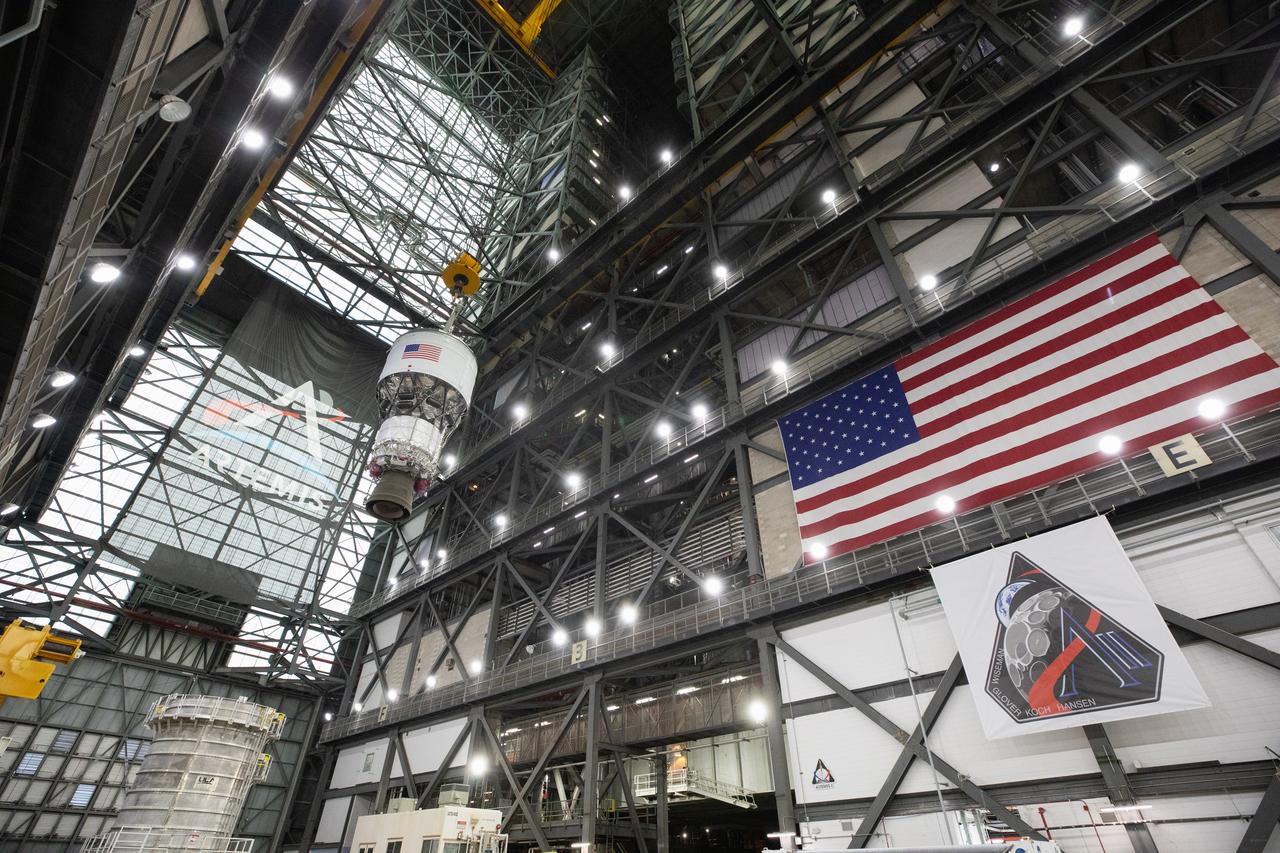
Teams with NASA’s Exploration Ground Systems Program begin integrating the interim cryogenic propulsion stage to the SLS (Space Launch System) launch vehicle stage adapter on Wednesday, April 30, 2025, inside the Vehicle Assembly Building at NASA’s Kennedy Space Center in Florida. The four-story propulsion system, built by Boeing and ULA (United Launch Alliance), is powered by an RL10 engine that will enable the Orion spacecraft to build up enough speed for the push toward the Moon during the Artemis II crewed test flight.
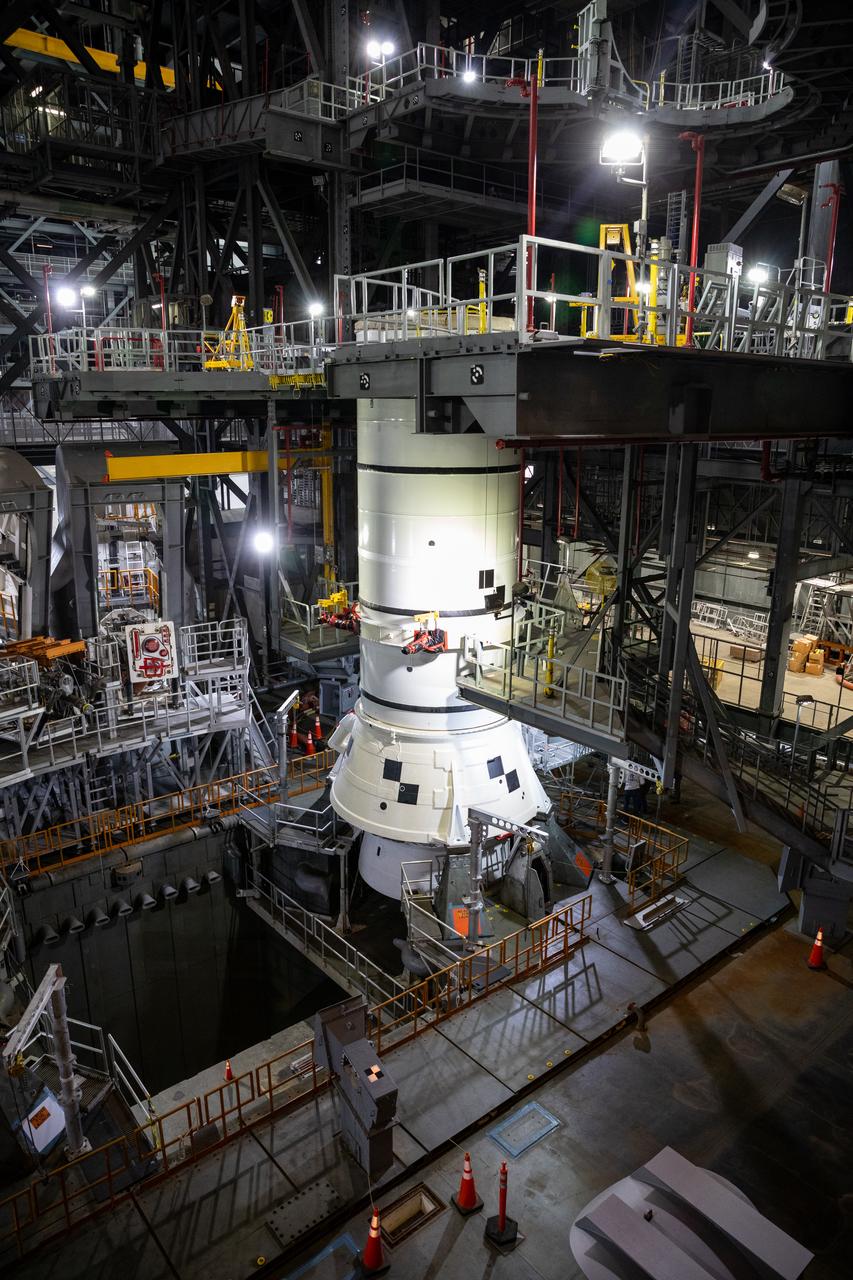
Engineers and technicians with the Exploration Ground Systems Program stack the first Moon rocket segment – the left aft assembly for the Artemis II SLS (Space Launch System) solid rocket booster onto mobile launcher 1 inside the Vehicle Assembly Building at NASA’s Kennedy Space Center on Wednesday, Nov. 20, 2024. The first of 10 booster segments to be stacked, the boosters will help support the remaining rocket components and the Orion spacecraft during final assembly of the Artemis II Moon rocket and provide more than 75 percent of the total SLS thrust during liftoff from NASA Kennedy’s Launch Pad 39B.
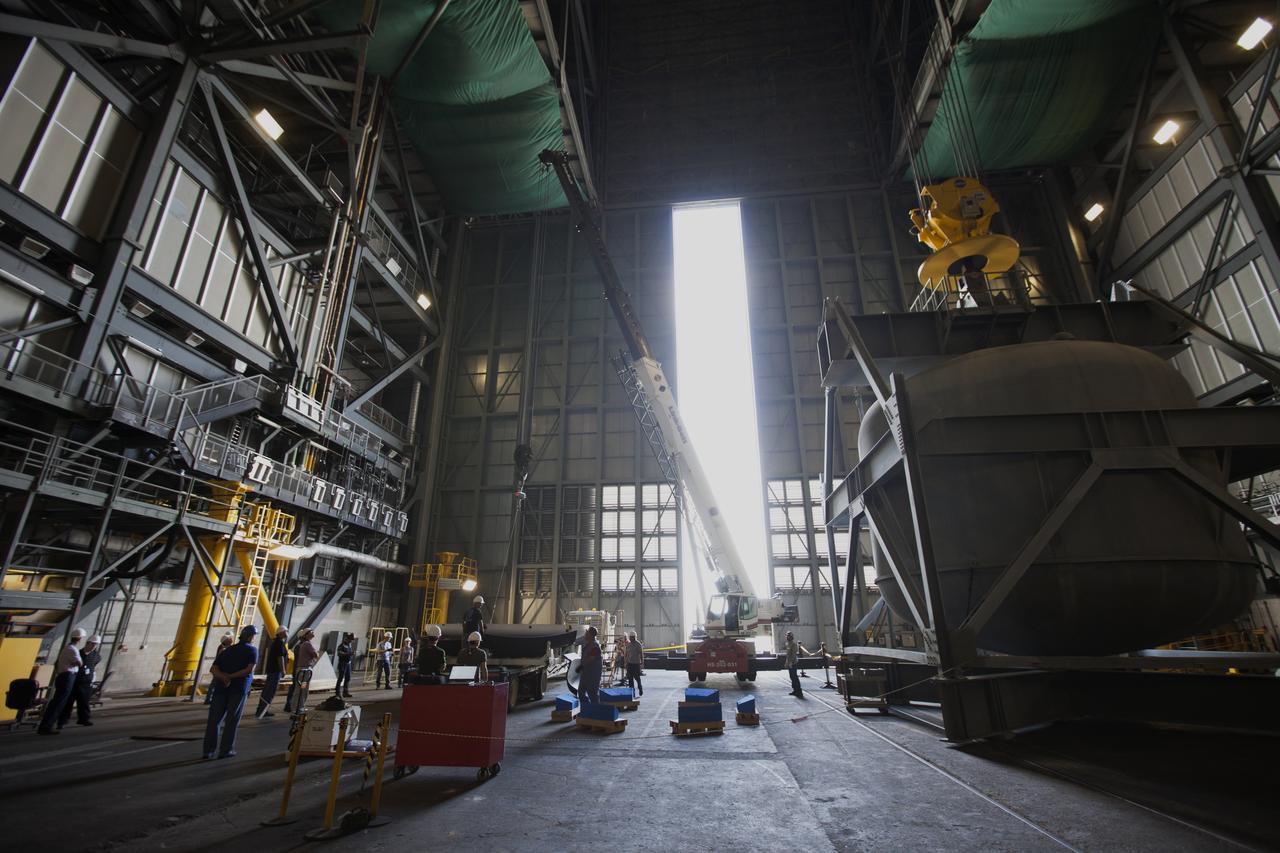
Inside High Bay 2 in the Vehicle Assembly Building (VAB) at NASA's Kennedy Space Center in Florida, a crane is attached to the Orion heat shield from Exploration Flight Test-1 for unloading off its transporter. The heat shield is being transferred from the Orion Program to the Ground Systems Development and Operations Program, Landing and Recovery Operations. In the VAB, the heat shield will be integrated with the Orion ground test article and used for future underway recovery testing.
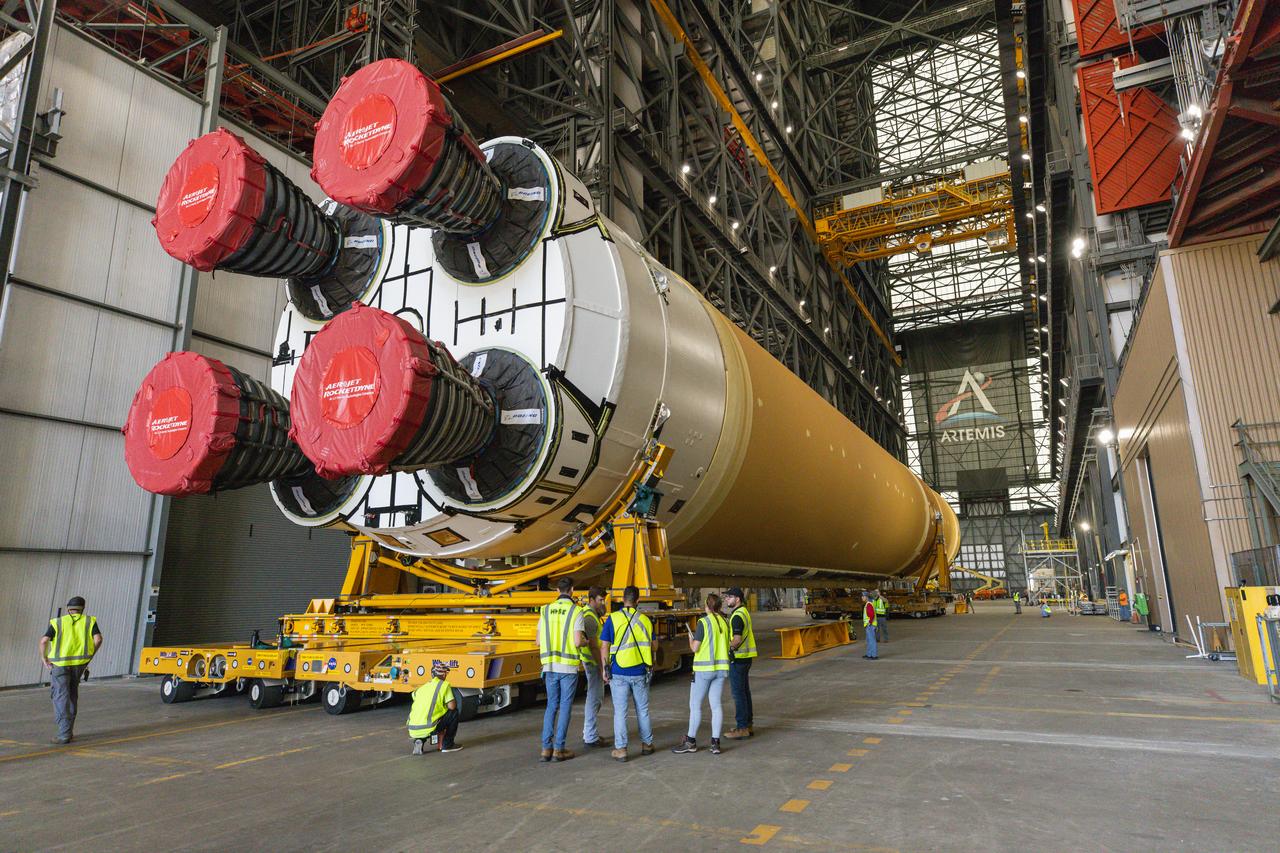
After completing its journey from NASA’s Michoud Assembly Facility in New Orleans aboard the Pegasus barge, teams with Exploration Ground Systems (EGS) transport the agency’s powerful SLS (Space Launch System) core stage into the transfer aisle inside Kennedy Space Center’s Vehicle Assembly Building in Florida on Wednesday, July 24, 2024. In the coming months, SLS will be prepared for integration atop the mobile launcher ahead of the Artemis II launch.
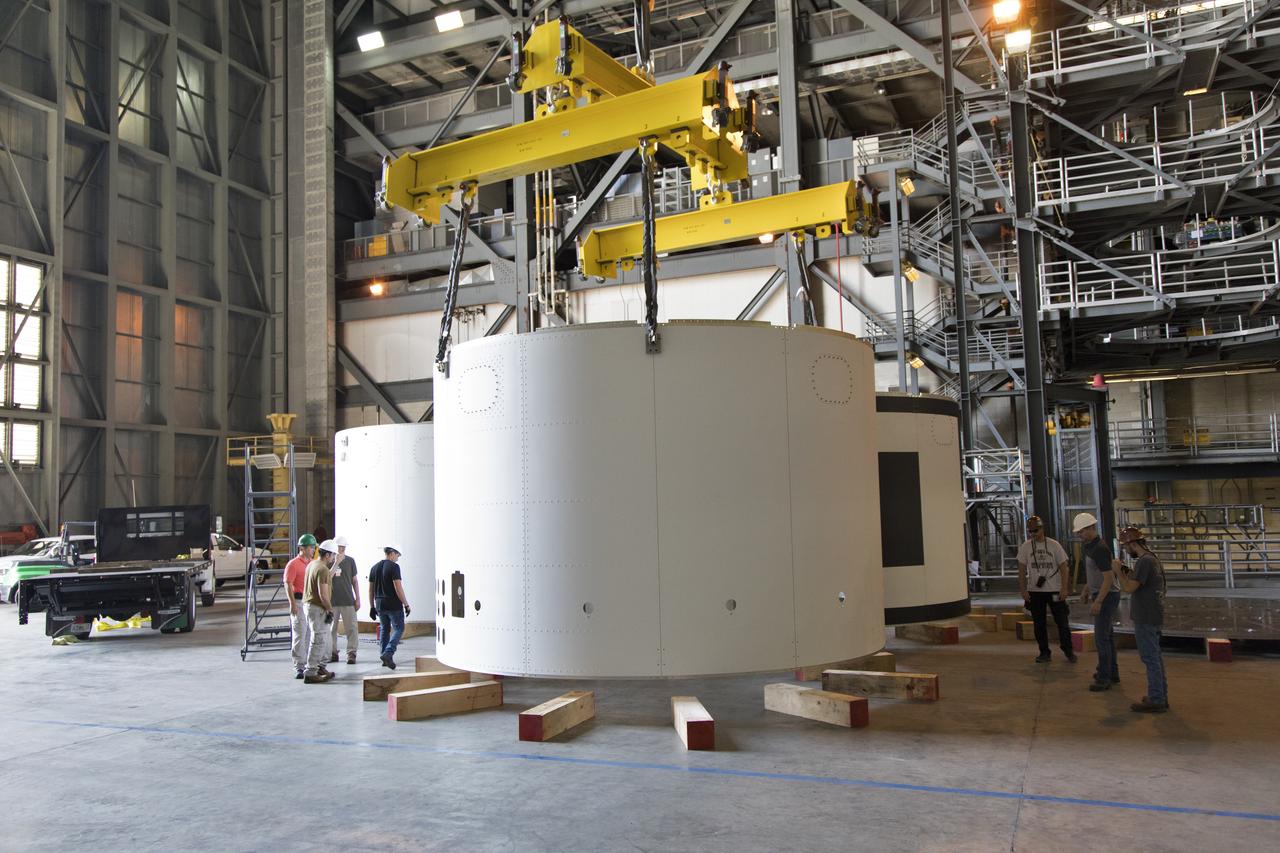
A crane lowers the third and final aeroshell for Orion's Launch Abort System (LAS) onto slats in High Bay 4 of the Vehicle Assembly Building on July 12, 2018, at NASA's Kennedy Space Center in Florida. The aeroshell was shipped from EMF Inc. on nearby Merritt Island. All three aeroshells will be stacked and prepared for a full-stress test of the LAS, called Ascent Abort-2 (AA-2) flight test, scheduled for April 2019. During the test, a booster will launch from Space Launch Complex 46 at Cape Canaveral Air Force Station, carrying a fully functional LAS and a 22,000-pound Orion test vehicle to an altitude of 31,000 feet and traveling at more than 1,000 miles an hour. The test will verify the LAS can steer the crew module and astronauts aboard to safety in the event of an issue with the Space Launch System (SLS) rocket when the spacecraft is under the highest aerodynamic loads it will experience during a rapid climb into space. Orion is being prepared for its first integrated uncrewed flight atop the SLS on Exploration Mission-1.
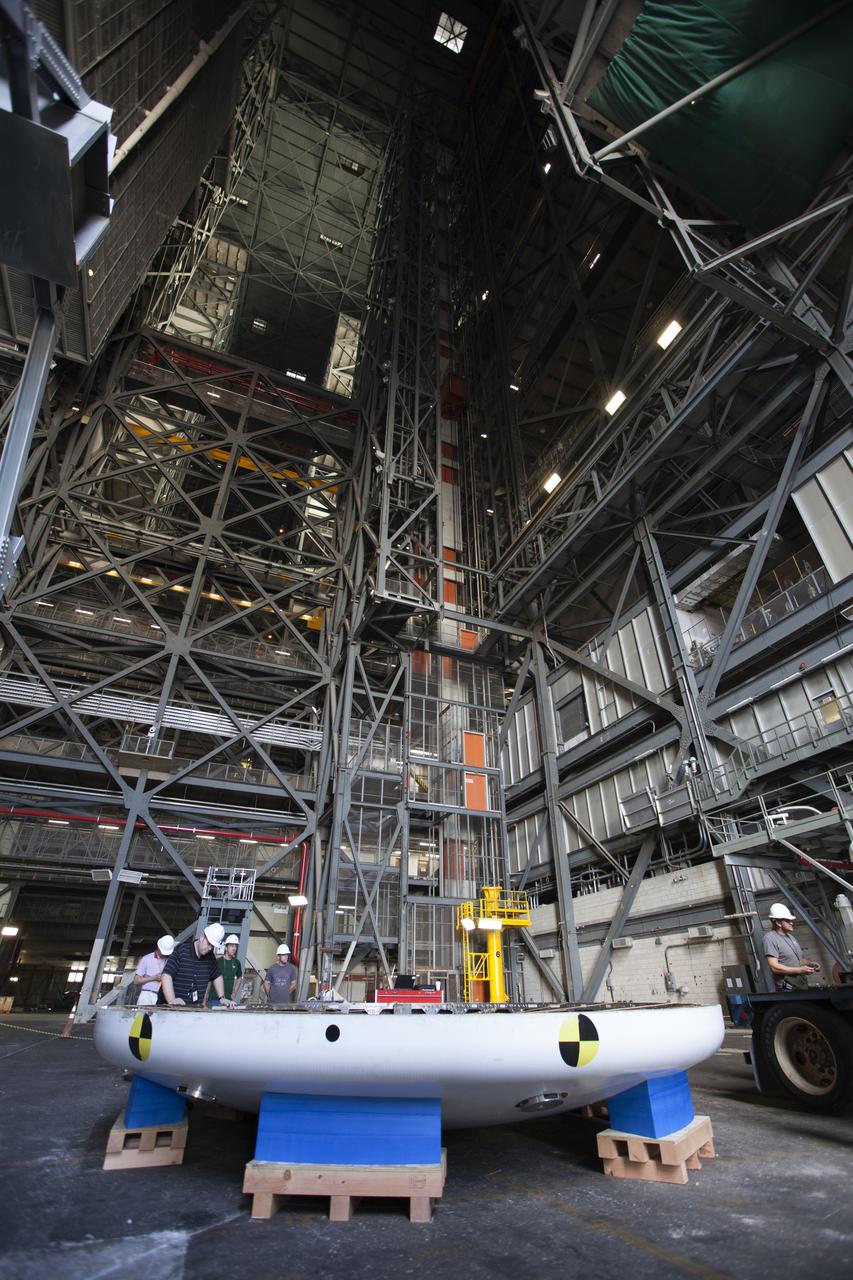
Inside High Bay 2 in the Vehicle Assembly Building (VAB) at NASA's Kennedy Space Center in Florida, the Orion heat shield from Exploration Flight Test-1 is secured on foam blocks. The heat shield is being transferred from the Orion Program to the Ground Systems Development and Operations Program, Landing and Recovery Operations. In the VAB, the heat shield will be integrated with the Orion ground test article and used for future underway recovery testing.
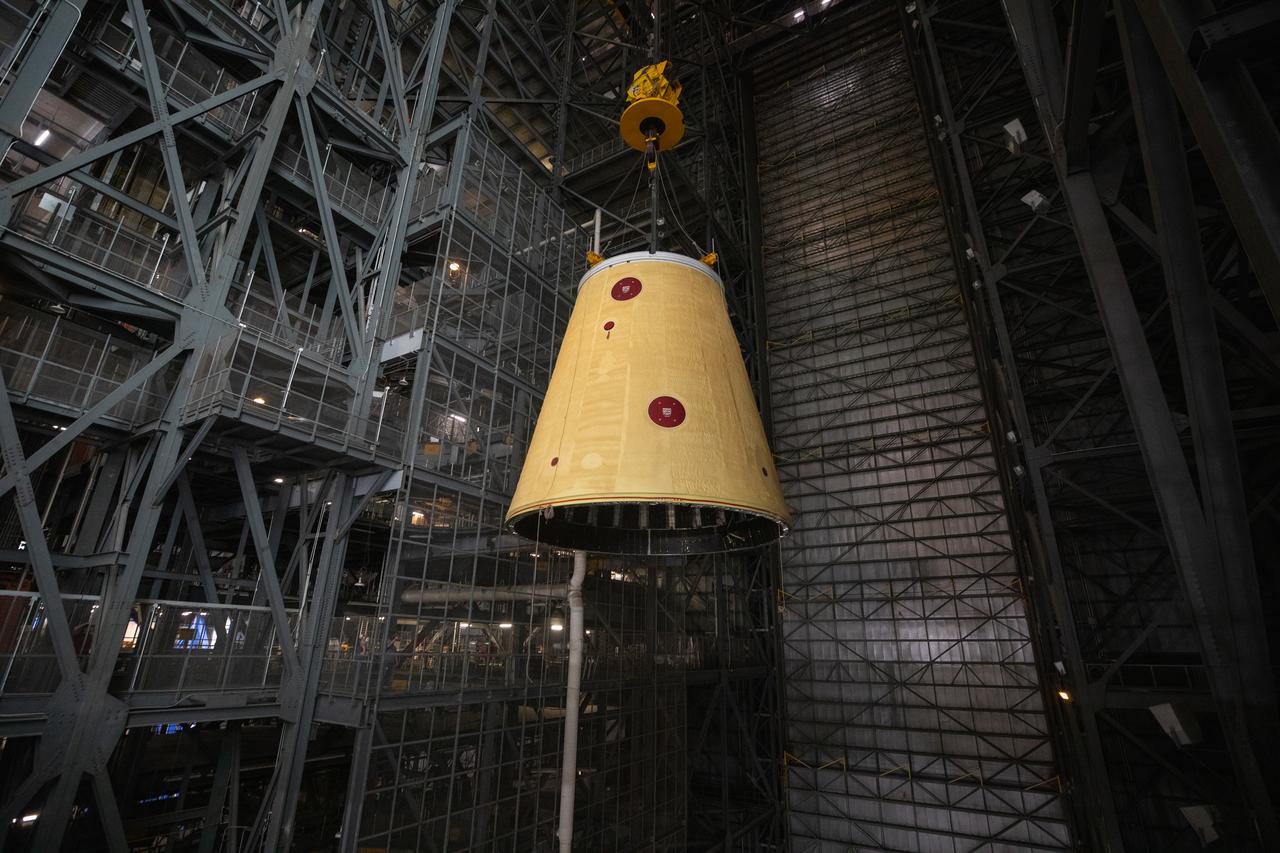
A massive crane lifts the launch vehicle stage adapter 250 feet into the air on Thursday, April 3, 2025, to prepare integration onto the SLS (Space Launch System) core stage in High Bay 3 inside the Vehicle Assembly Building at NASA’s Kennedy Space Center in Florida. During launch and ascent, the launch vehicle stage adapter provides structural support and protects avionics and electrical devices within the upper stage from extreme vibrations and acoustic conditions. The Artemis II test flight will take a crew of four astronauts on a 10-day journey around the Moon, helping confirm the foundational systems and hardware needed for human deep space exploration.
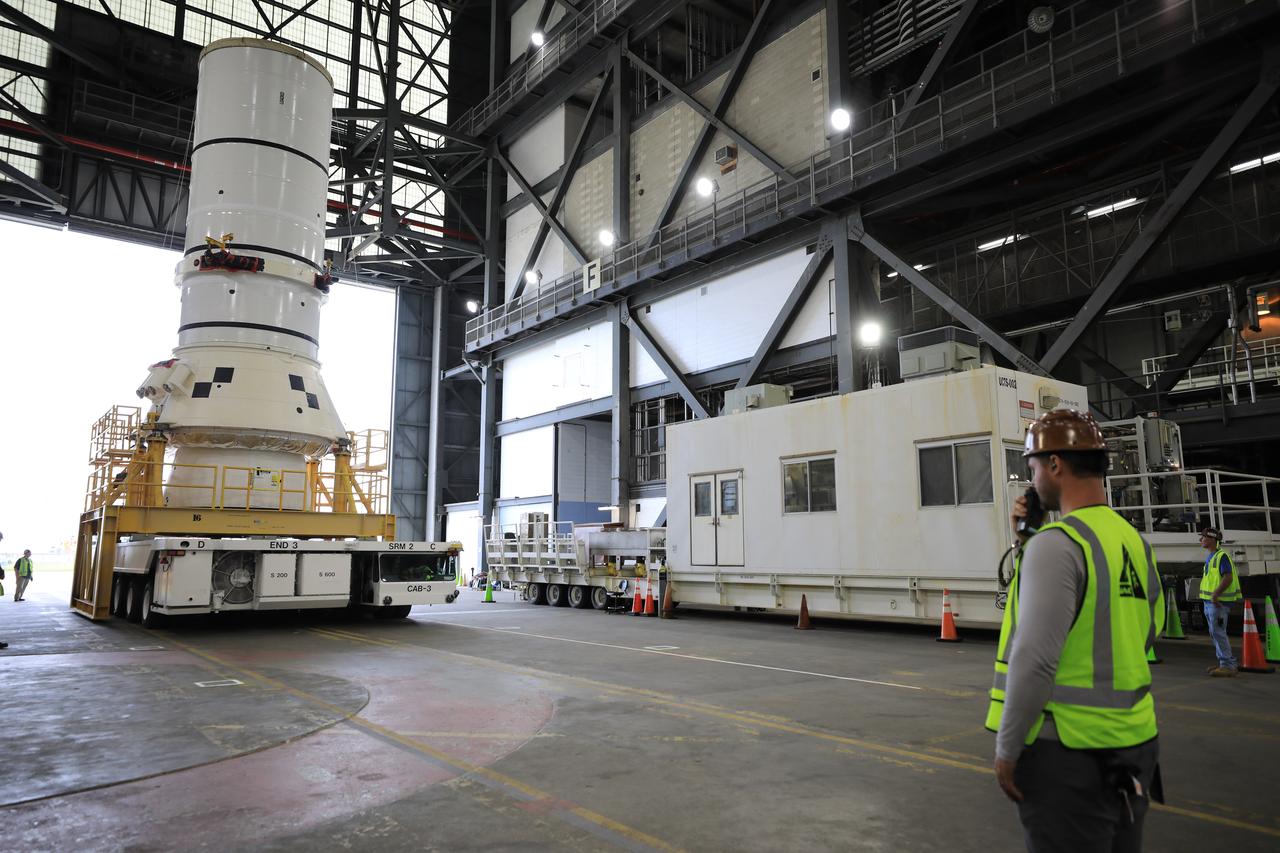
Engineers and technicians with the Exploration Ground Systems Program transport the left aft assembly, or bottom portion of the solid rocket boosters for the SLS (Space Launch System) rocket for the Artemis II mission inside the Vehicle Assembly Building at NASA’s Kennedy Space Center in Florida on Monday, Nov. 18, 2024. The aft assembly will be lifted atop the mobile launcher, followed by the right aft assembly and remaining booster segments.
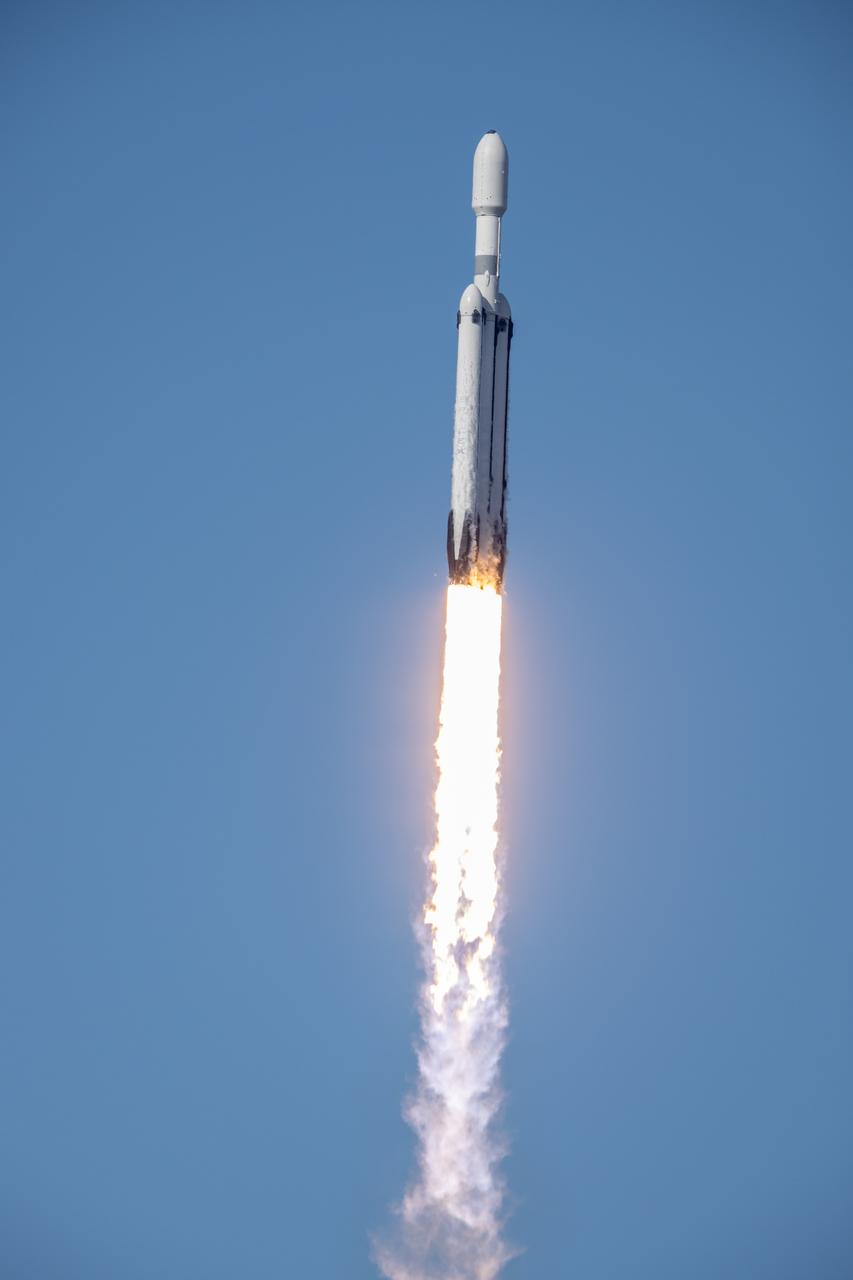
A SpaceX Falcon Heavy rocket carrying the National Oceanic and Atmospheric Administration (NOAA) GOES-U (Geostationary Operational Environmental Satellite U) lifts off from Launch Complex 39A at NASA’s Kennedy Space Center in Florida on Tuesday, June 25, 2024. The GOES-U satellite is the final satellite in the GOES-R series, which serves a critical role in providing continuous coverage of the Western Hemisphere, including monitoring tropical systems in the eastern Pacific and Atlantic oceans.
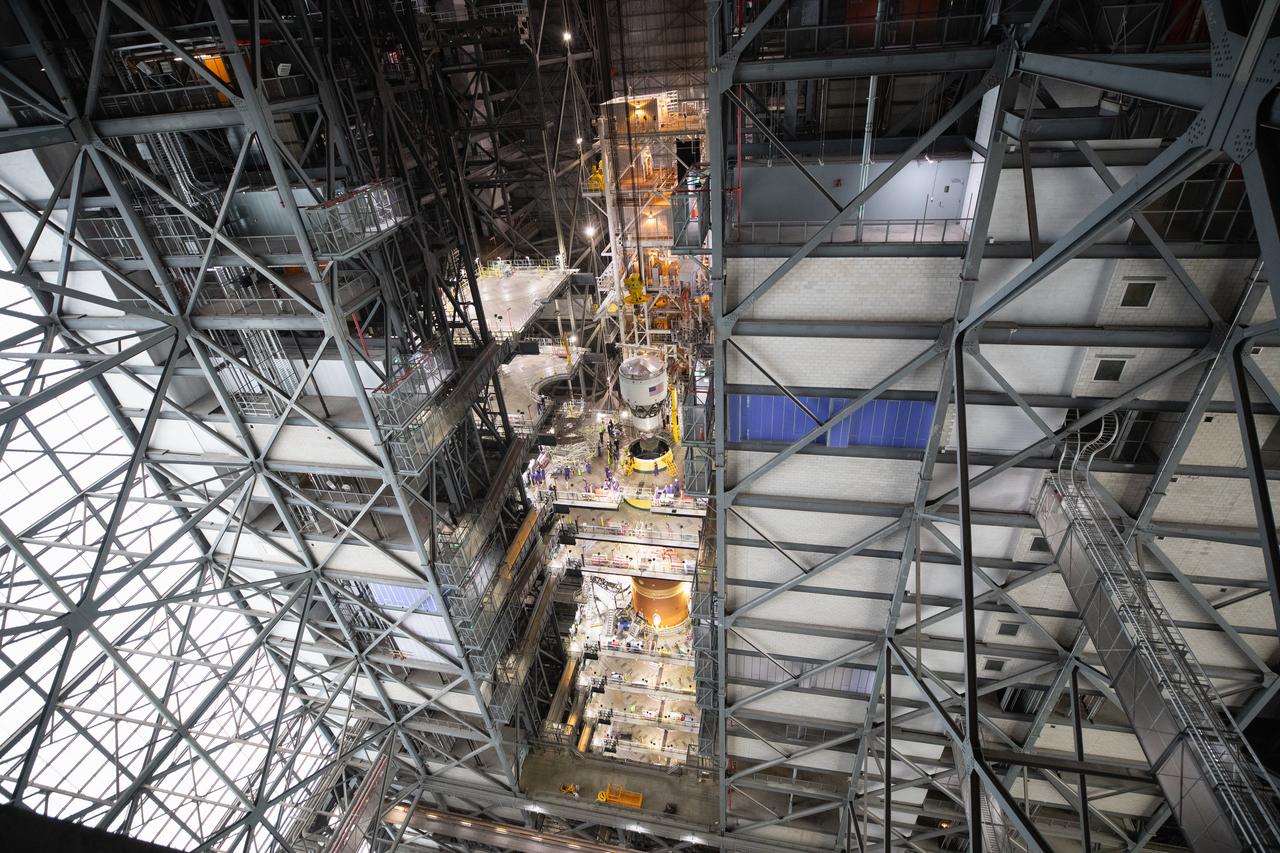
Teams with NASA’s Exploration Ground Systems Program begin integrating the interim cryogenic propulsion stage to the SLS (Space Launch System) launch vehicle stage adapter on Wednesday, April 30, 2025, inside the Vehicle Assembly Building at NASA’s Kennedy Space Center in Florida. The four-story propulsion system, built by Boeing and ULA (United Launch Alliance), is powered by an RL10 engine that will enable the Orion spacecraft to build up enough speed for the push toward the Moon during the Artemis II crewed test flight.
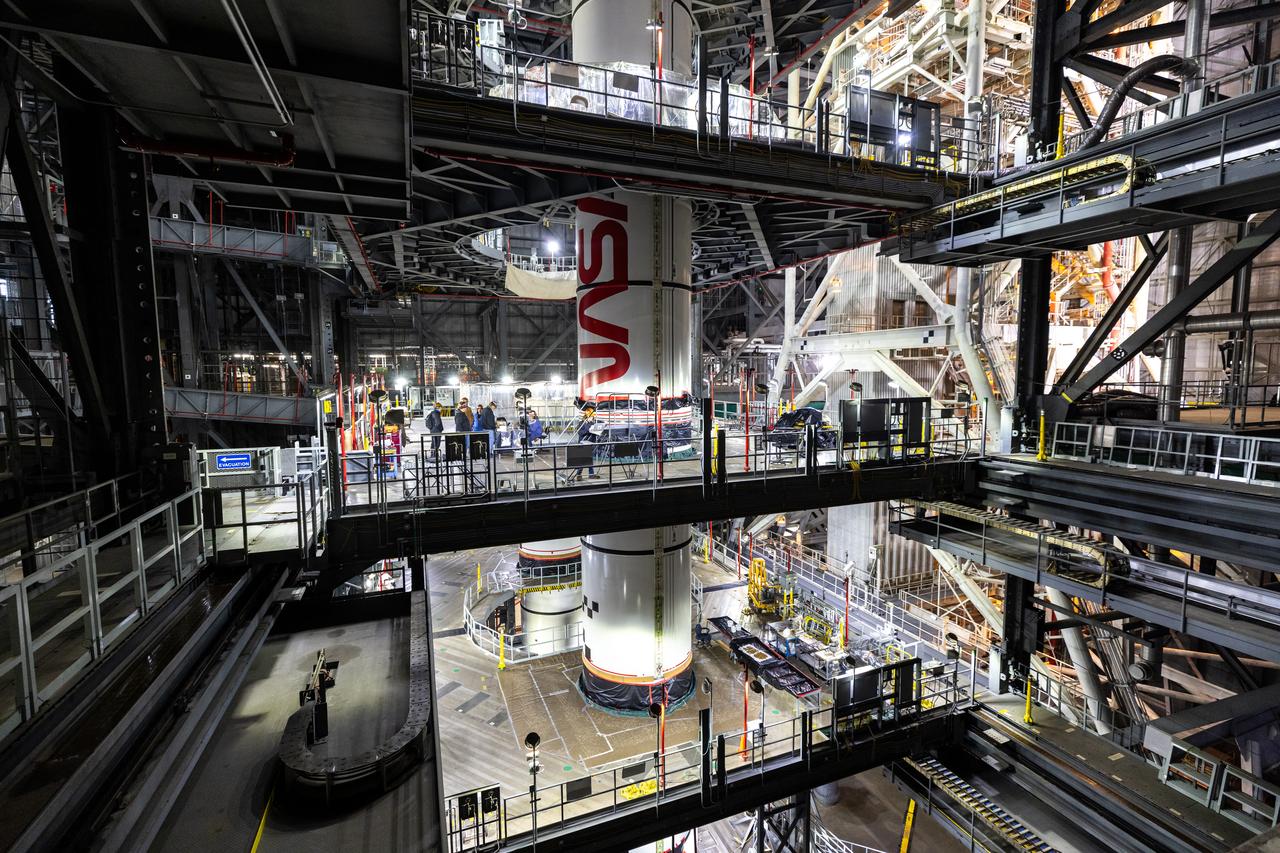
Inside High Bay 3 of the Vehicle Assembly Building at NASA’s Kennedy Space Center in Florida, technicians with the agency’s Exploration Ground Systems use a crane to lower the right forward center booster segment for the NASA’s SLS (Space Launch System) rocket onto the right center center segment with the iconic NASA “worm” insignia atop the mobile launcher on Monday, Jan. 27, 2025. The boosters will help support the remaining rocket components and the Orion spacecraft during final assembly of the Artemis II Moon rocket and provide more than 75 percent of the total SLS thrust during liftoff from NASA Kennedy’s Launch Pad 39B.
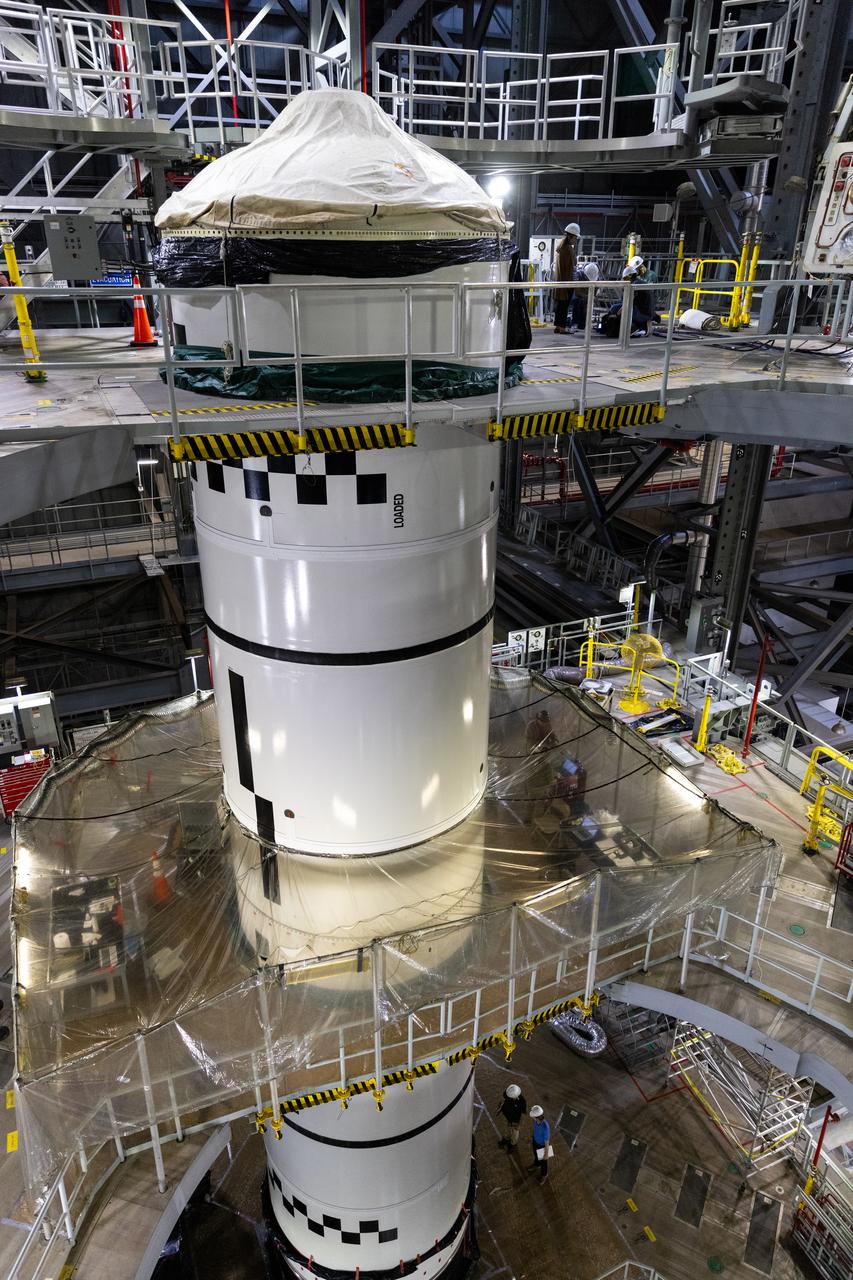
Technicians with NASA’s Exploration Ground Systems complete the integration of the left forward segment to the center forward segment on mobile launcher 1 inside the Vehicle Assembly Building at the agency’s Kennedy Space Center in Florida on Friday, Feb. 7, 2025. The twin solid boosters, five segments on each side, will help support the remaining rocket components and the Orion spacecraft during final assembly of the Artemis II Moon rocket and provide more than 75 percent of the total SLS thrust during liftoff from NASA Kennedy’s Launch Pad 39B.
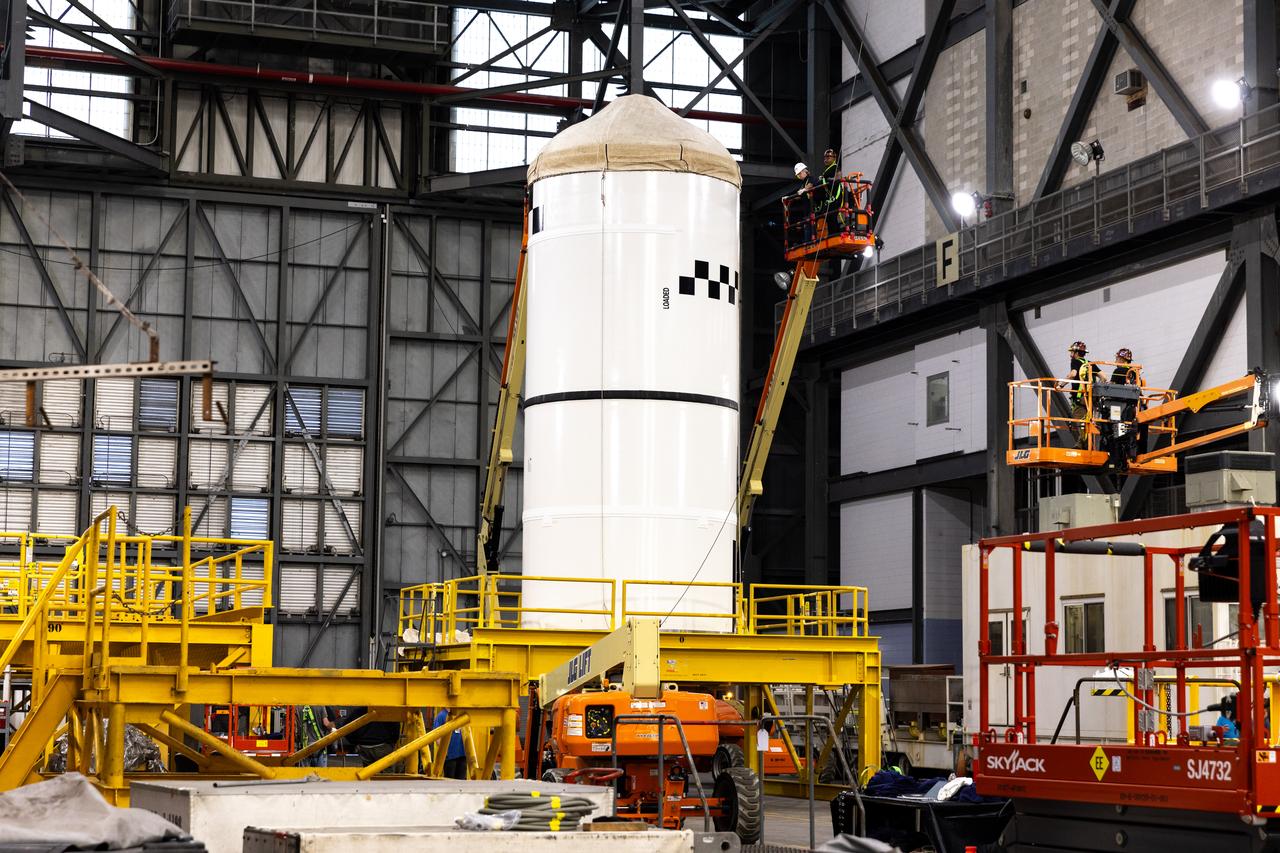
Technicians transport the right forward segment for NASA’s SLS (Space Launch System) Moon rocket boosters from the Rotation Processing and Surge Facility to NASA’s Vehicle Assembly Building in Florida on Monday, Feb. 15, 2025. The right forward segment will be transferred into High Bay 3 where it will be attached to the center forward segment on mobile launcher 1. The twin solid boosters, five segments on each side, will help support the remaining rocket components and the Orion spacecraft during final assembly of the Artemis II Moon rocket and provide more than 75 percent of the total SLS thrust during liftoff from NASA Kennedy’s Launch Pad 39B.
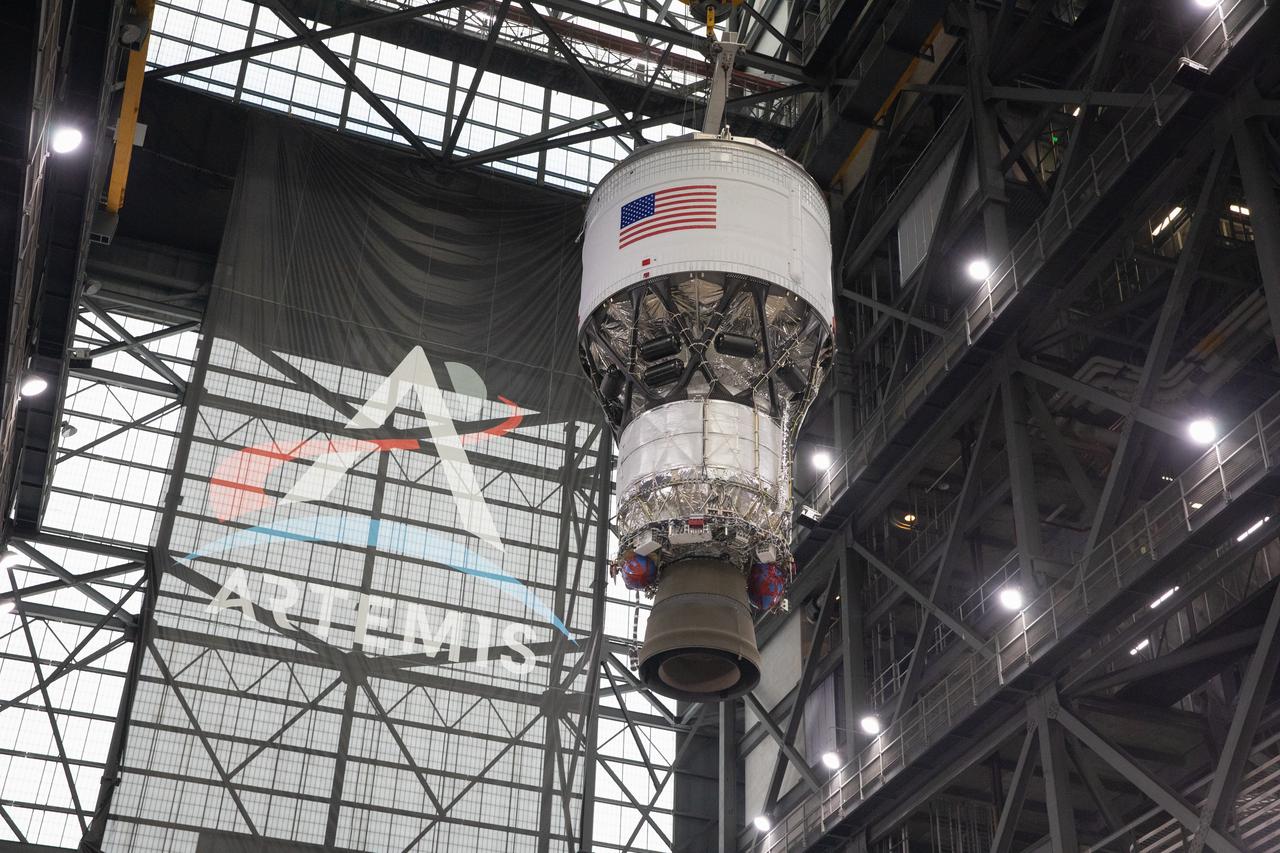
Teams with NASA’s Exploration Ground Systems Program begin integrating the interim cryogenic propulsion stage to the SLS (Space Launch System) launch vehicle stage adapter on Wednesday, April 30, 2025, inside the Vehicle Assembly Building at NASA’s Kennedy Space Center in Florida. The four-story propulsion system, built by Boeing and ULA (United Launch Alliance), is powered by an RL10 engine that will enable the Orion spacecraft to build up enough speed for the push toward the Moon during the Artemis II crewed test flight.
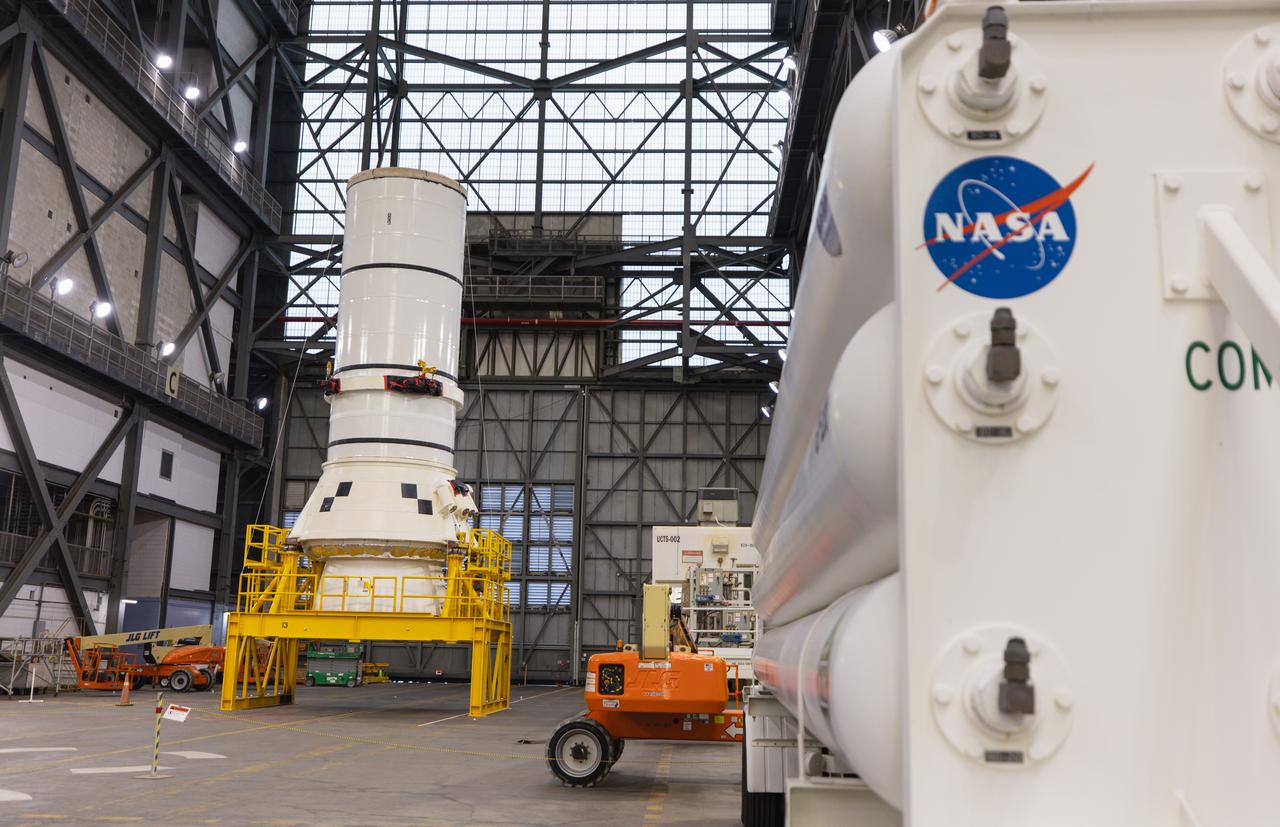
Engineers and technicians with NASA’s Exploration Ground Systems Program move the right aft assembly, or bottom portion of the right solid rocket booster for the agency’s SLS (Space Launch System) rocket, into the transfer aisle of the Vehicle Assembly Building at NASA’s Kennedy Space Center in Florida on Thursday, Nov. 22, 2024. The right aft assembly will be lifted atop mobile launcher 1, joining the previously stacked left aft assembly as the first booster segments stacked for the Artemis II Moon rocket.
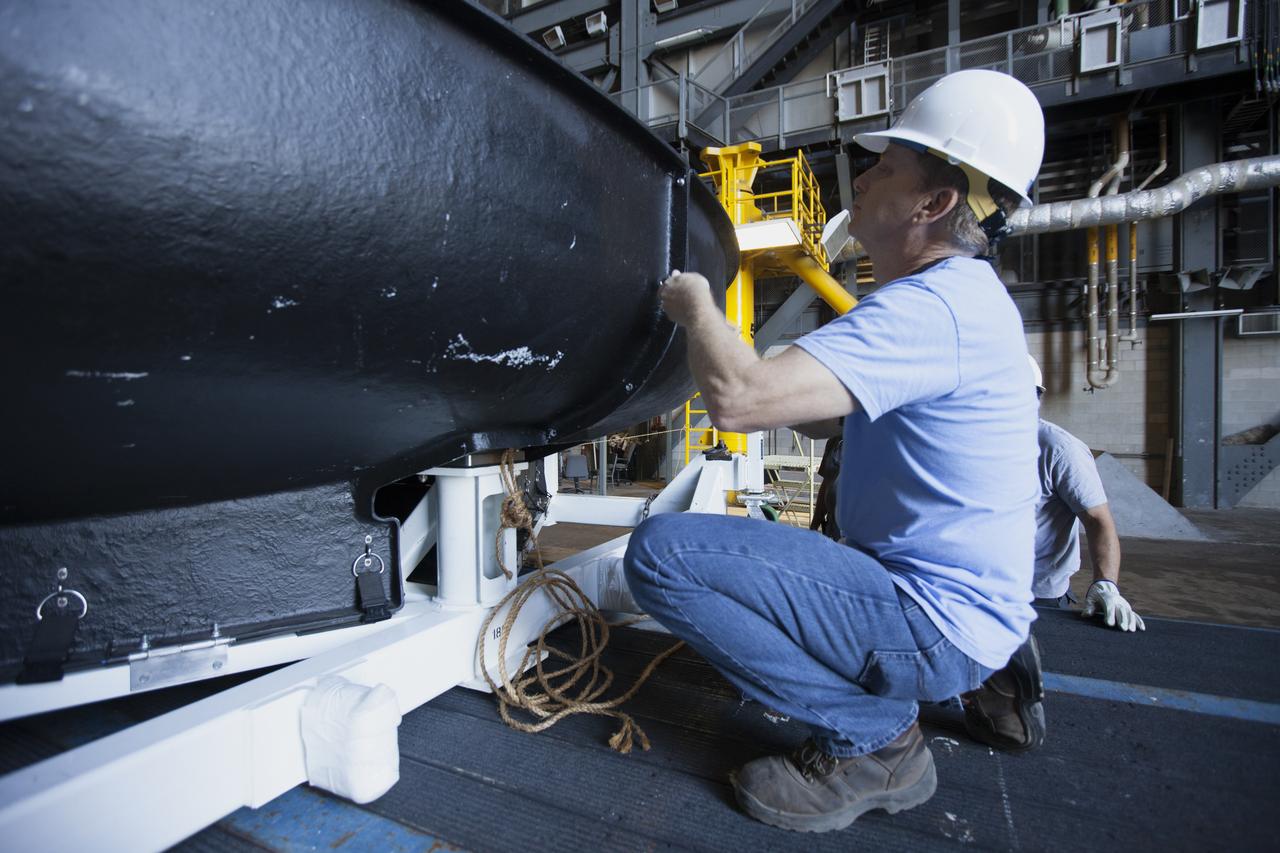
Inside High Bay 2 in the Vehicle Assembly Building (VAB) at NASA's Kennedy Space Center in Florida, workers help prepare the Orion heat shield from Exploration Flight Test-1 for unloading off its transporter. The heat shield is being transferred from the Orion Program to the Ground Systems Development and Operations Program, Landing and Recovery Operations. In the VAB, the heat shield will be integrated with the Orion ground test article and used for future underway recovery testing.
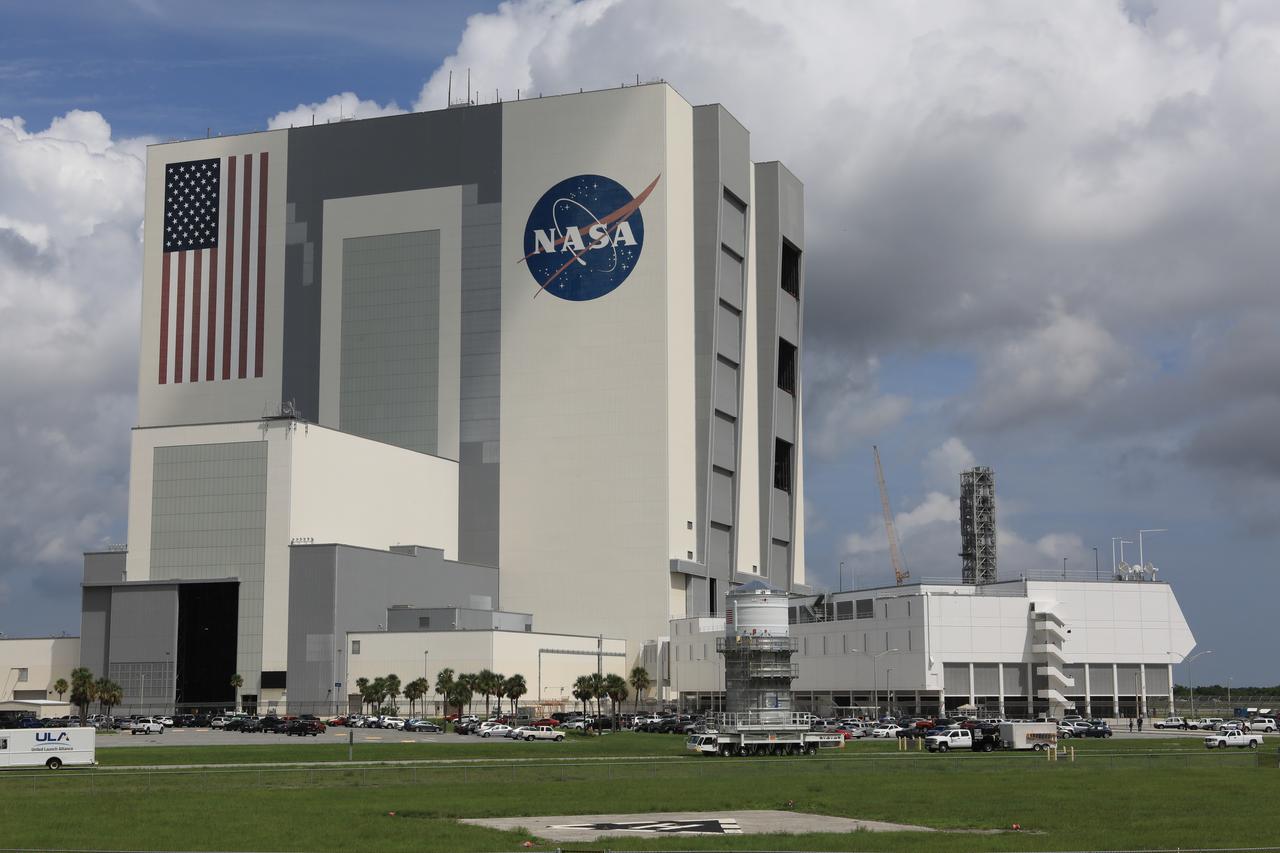
Packed inside its canister, the Interim Cryogenic Propulsion Stage (ICPS) for NASA's Space Launch System (SLS) rocket passes by the Vehicle Assembly Building on its way to the Space Station Processing Facility at NASA's Kennedy Space Center in Florida. The ICPS is the first integrated piece of flight hardware to arrive for the SLS. It is the in-space stage that is located toward the top of the rocket, between the Launch Vehicle Stage Adapter and the Orion Spacecraft Adapter. It will provide some of the in-space propulsion during Orion's first flight test atop the SLS on Exploration Mission-1.
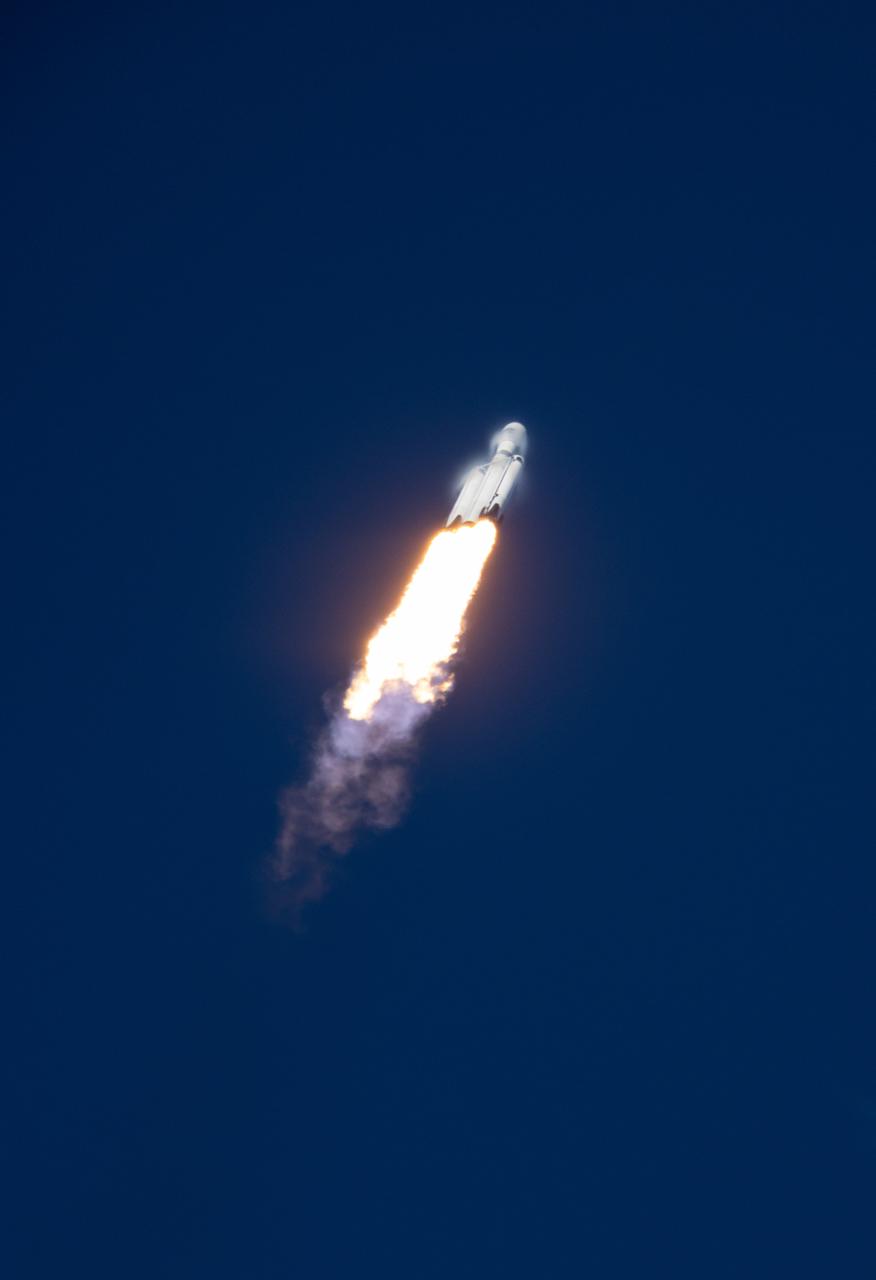
A SpaceX Falcon Heavy rocket carrying the National Oceanic and Atmospheric Administration (NOAA) GOES-U (Geostationary Operational Environmental Satellite U) launches from Launch Complex 39A at NASA’s Kennedy Space Center in Florida on Tuesday, June 25, 2024. The GOES-U satellite is the final satellite in the GOES-R series, which serves a critical role in providing continuous coverage of the Western Hemisphere, including monitoring tropical systems in the eastern Pacific and Atlantic oceans.
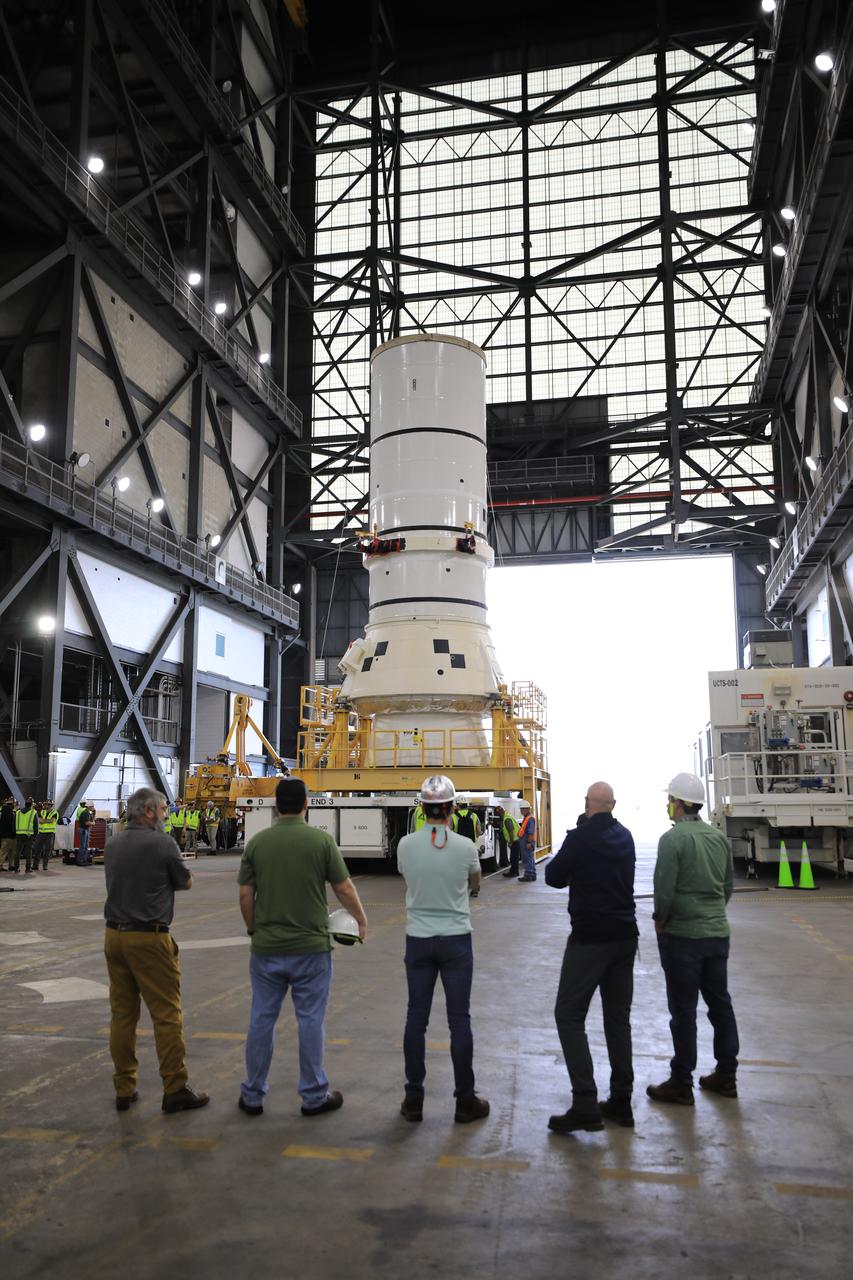
Engineers and technicians with the Exploration Ground Systems Program transport the left aft assembly, or bottom portion of the solid rocket boosters for the SLS (Space Launch System) rocket for the Artemis II mission inside the Vehicle Assembly Building at NASA’s Kennedy Space Center in Florida on Monday, Nov. 18, 2024. The aft assembly will be lifted atop the mobile launcher, followed by the right aft assembly and remaining booster segments.
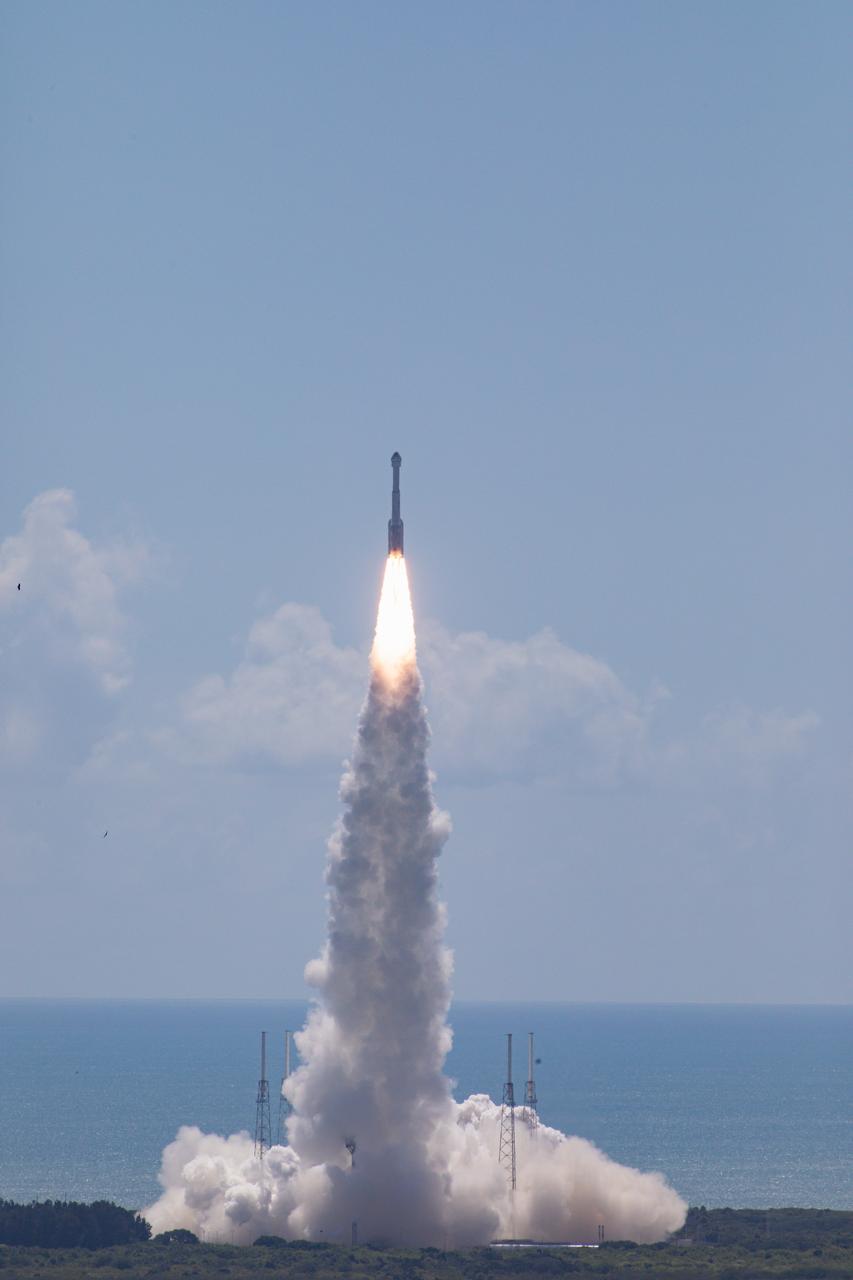
A United Launch Alliance Atlas V rocket carrying a Boeing Starliner spacecraft launches NASA’s Boeing Crew Flight Test with NASA astronauts Butch Wilmore and Suni Williams aboard at 10:52 a.m. EDT Wednesday, June 5, 2024, from Space Launch Complex-41 at Cape Canaveral Space Force Station in Florida. Wilmore and Williams are the first to launch aboard Boeing’s Starliner spacecraft to the International Space Station as part of the agency’s Commercial Crew Program.
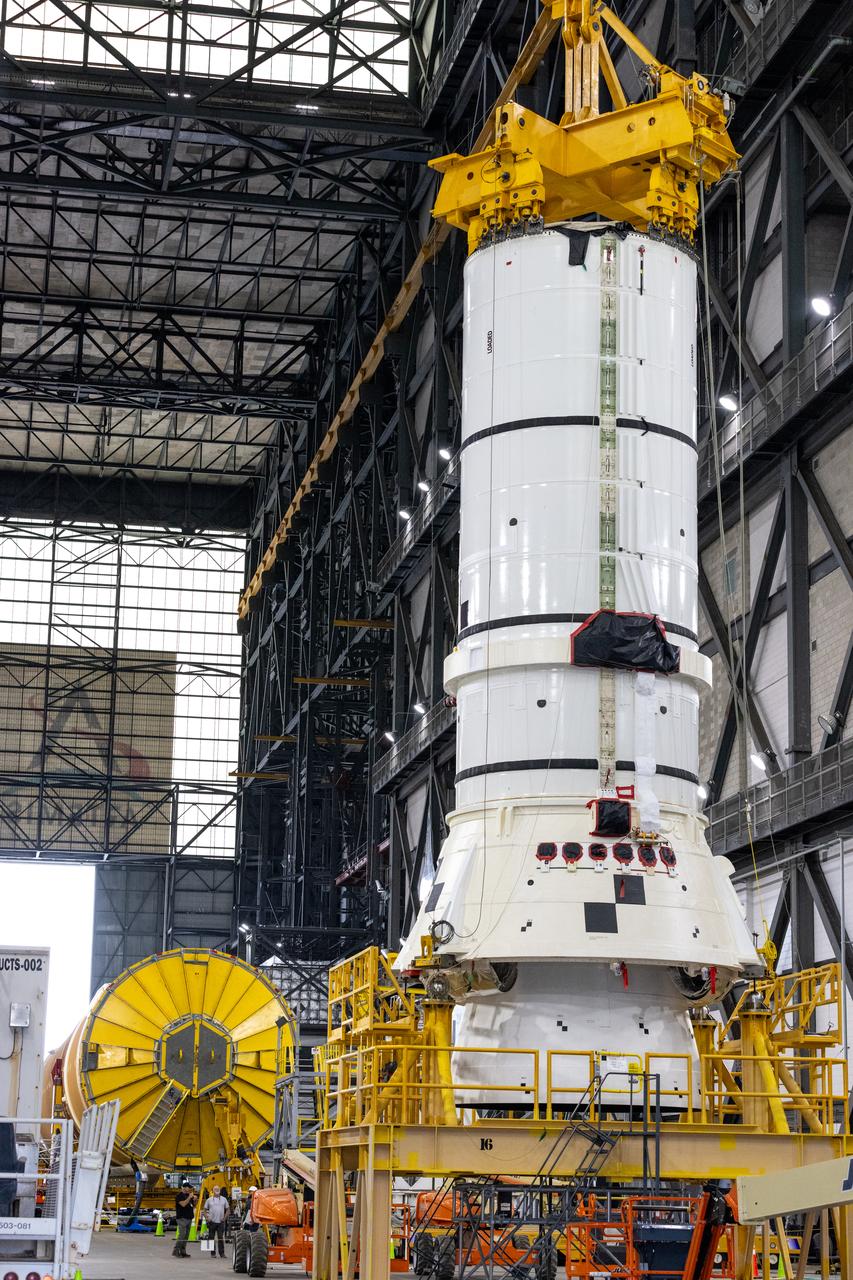
Down the transfer aisle from the Artemis II SLS (Space Launch System) core stage, engineers and technicians with the Exploration Ground Systems Program attach an overhead crane to the left aft assembly, or bottom portion of the solid rocket boosters for the SLS rocket inside the Vehicle Assembly Building at NASA’s Kennedy Space Center on Tuesday, Nov. 19, 2024. The crane will lift the aft assembly on top of the mobile launcher 1 followed by the right aft assembly and stack the remaining booster segments for the Artemis II mission.
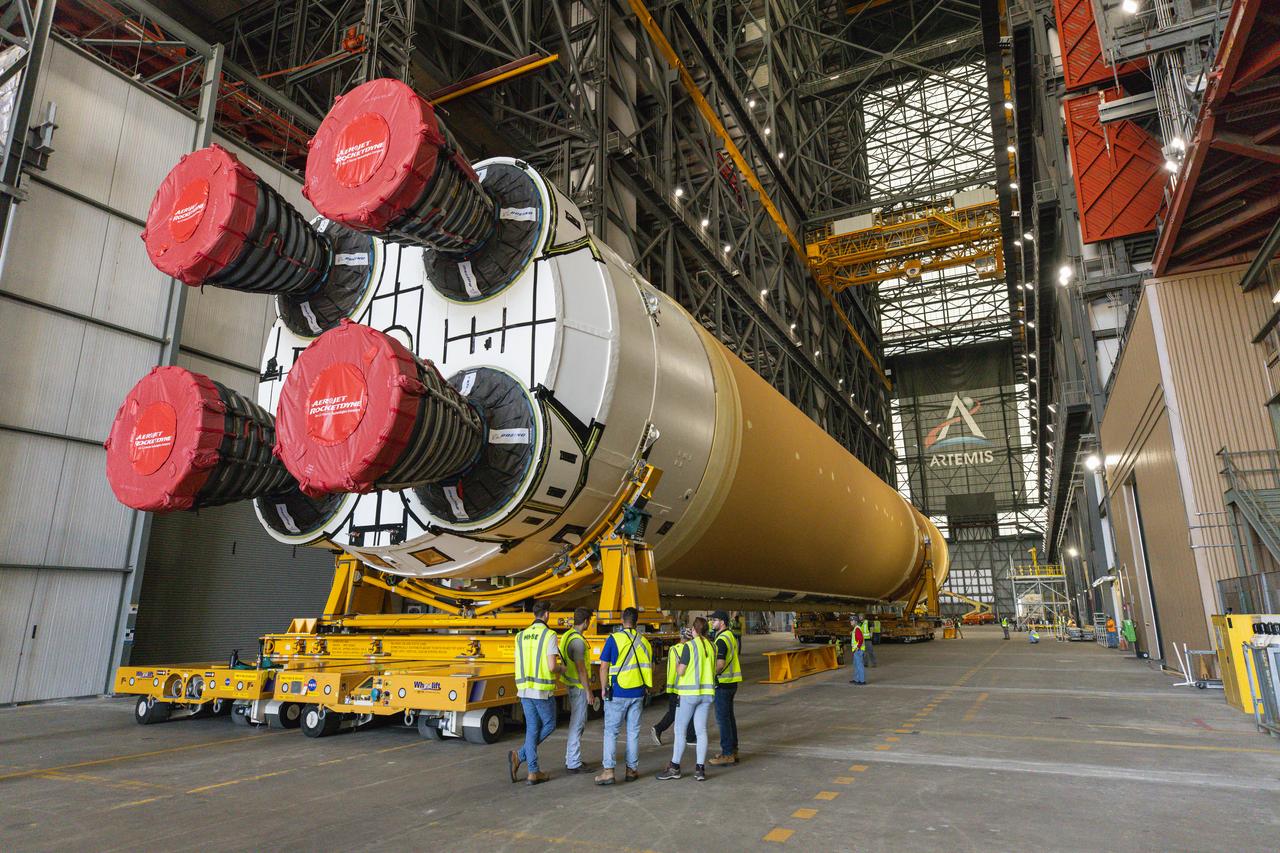
After completing its journey from NASA’s Michoud Assembly Facility in New Orleans aboard the Pegasus barge, teams with Exploration Ground Systems (EGS) transport the agency’s powerful SLS (Space Launch System) core stage into the transfer aisle inside Kennedy Space Center’s Vehicle Assembly Building in Florida on Wednesday, July 24, 2024. In the coming months, SLS will be prepared for integration atop the mobile launcher ahead of the Artemis II launch.
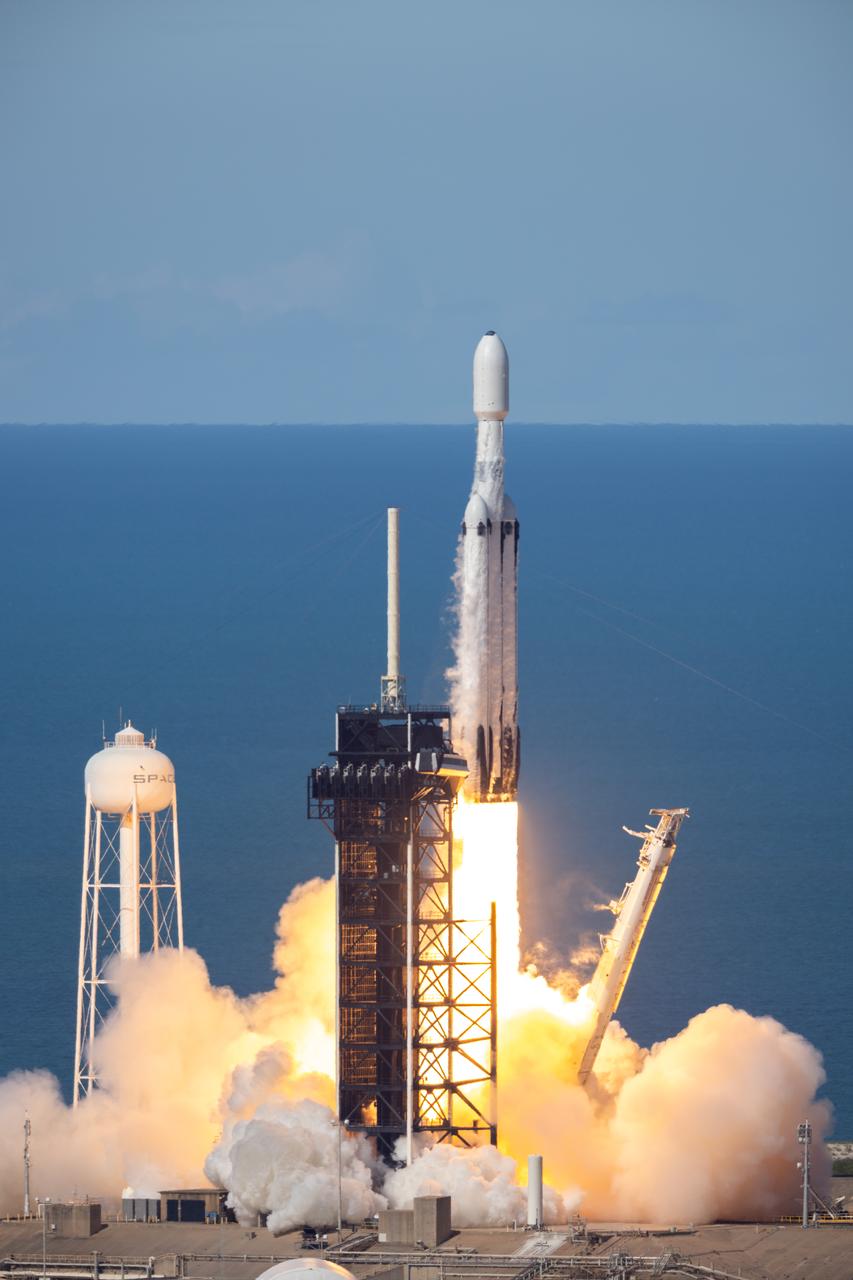
A SpaceX Falcon Heavy rocket carrying the National Oceanic and Atmospheric Administration (NOAA) GOES-U (Geostationary Operational Environmental Satellite U) lifts off from Launch Complex 39A at NASA’s Kennedy Space Center in Florida on Tuesday, June 25, 2024. The GOES-U satellite is the final satellite in the GOES-R series, which serves a critical role in providing continuous coverage of the Western Hemisphere, including monitoring tropical systems in the eastern Pacific and Atlantic oceans.
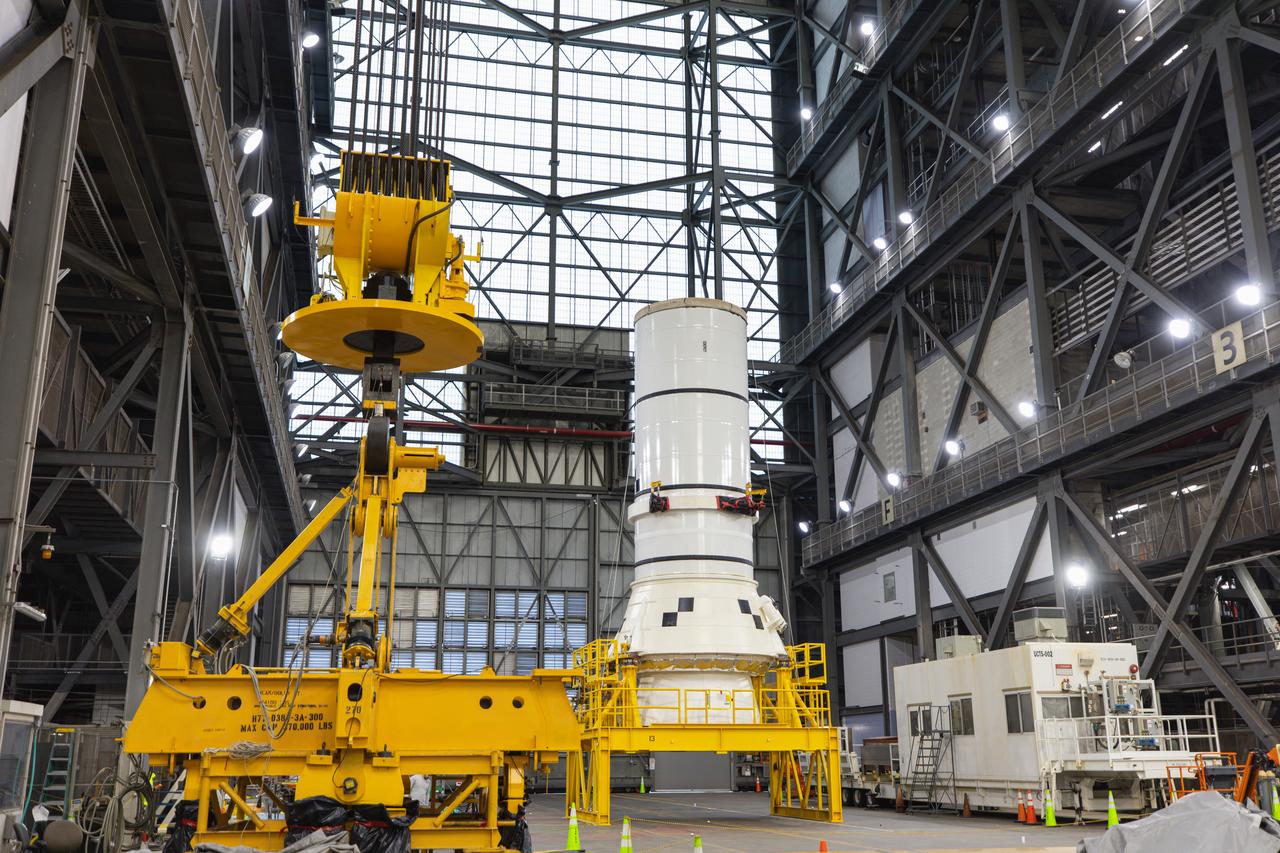
Engineers and technicians with NASA’s Exploration Ground Systems Program move the right aft assembly, or bottom portion of the right solid rocket booster for the agency’s SLS (Space Launch System) rocket, into inside the Vehicle Assembly Building at NASA’s Kennedy Space Center on Thursday, Nov. 22, 2024. The crane will lift the right aft assembly on top of mobile launcher 1, joining the previously stacked left aft assembly as the first booster segments stacked for the Artemis II Moon rocket.
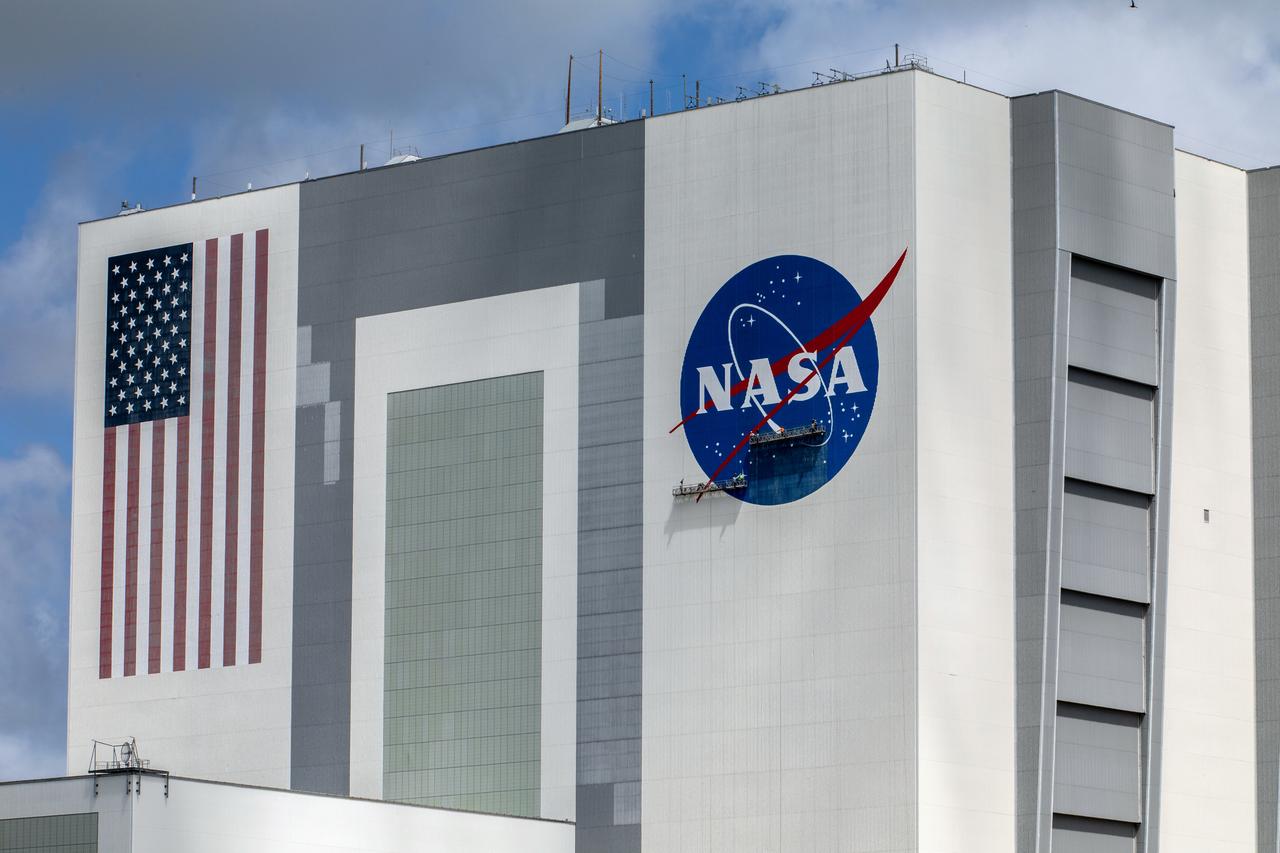
Painting of the NASA logo, also called the meatball, continues on the 525-foot-tall Vehicle Assembly Building (VAB) at the agency’s Kennedy Space Center in Florida on May 29 2020. HM2 and H.I.S. Painting of Titusville, Florida, are repainting the meatball and the American Flag on the iconic building. High Bay 3 inside the VAB has been upgraded with 10 new levels of work platforms that will surround and provide access for service and processing of NASA's Space Launch System (SLS) rocket and Orion spacecraft. Exploration Ground Systems is overseeing upgrades to the VAB to support the launch of the SLS and Orion for Artemis missions. Under the Artemis program, NASA will send the first woman and next man to the Moon.

Engineers and technicians with NASA’s Exploration Ground Systems Program prepare to lift the left center center booster segment shown with the iconic NASA “worm” insignia for the agency’s SLS (Space Launch System) rocket to the Vehicle Assembly Building at NASA's Kennedy Space Center in Florida on Friday, Jan. 24, 2025. The booster segment is shown attached to a lifting beam ahead of integration onto the mobile launcher. The boosters will help support the remaining rocket components and the Orion spacecraft during final assembly of the Artemis II Moon rocket and provide more than 75 percent of the total SLS thrust during liftoff from NASA Kennedy’s Launch Pad 39B.

Engineers and technicians with NASA’s Exploration Ground Systems Program complete stacking of the first Moon rocket segments – the left and right aft assemblies for the agency’s Artemis II SLS (Space Launch System) solid rocket boosters – onto mobile launcher 1 inside the Vehicle Assembly Building at Kennedy Space Center on Friday, Nov. 22, 2024. The first two of 10 booster segments to be stacked, the boosters will help support the remaining rocket components and the Orion spacecraft during final assembly of the Artemis II Moon rocket and provide more than 75 percent of the total SLS thrust during liftoff from NASA Kennedy’s Launch Pad 39B.
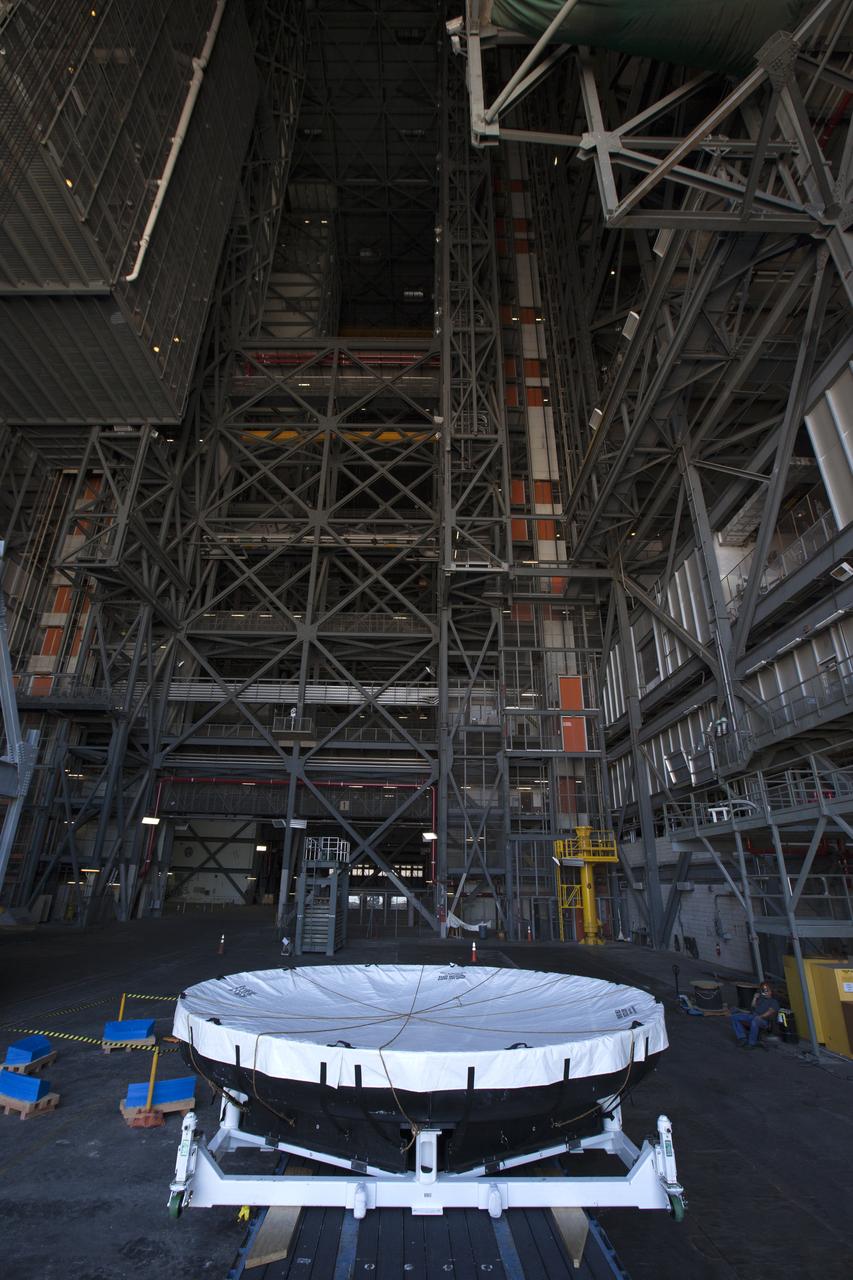
The Orion heat shield from Exploration Flight Test-1 has arrived in High Bay 2 in the Vehicle Assembly Building (VAB) at NASA's Kennedy Space Center in Florida. The heat shield was moved from the Launch Abort System Facility. The heat shield is being transferred from the Orion Program to the Ground Systems Development and Operations Program, Landing and Recovery Operations. In the VAB, the heat shield will be integrated with the Orion ground test article and used for future underway recovery testing.
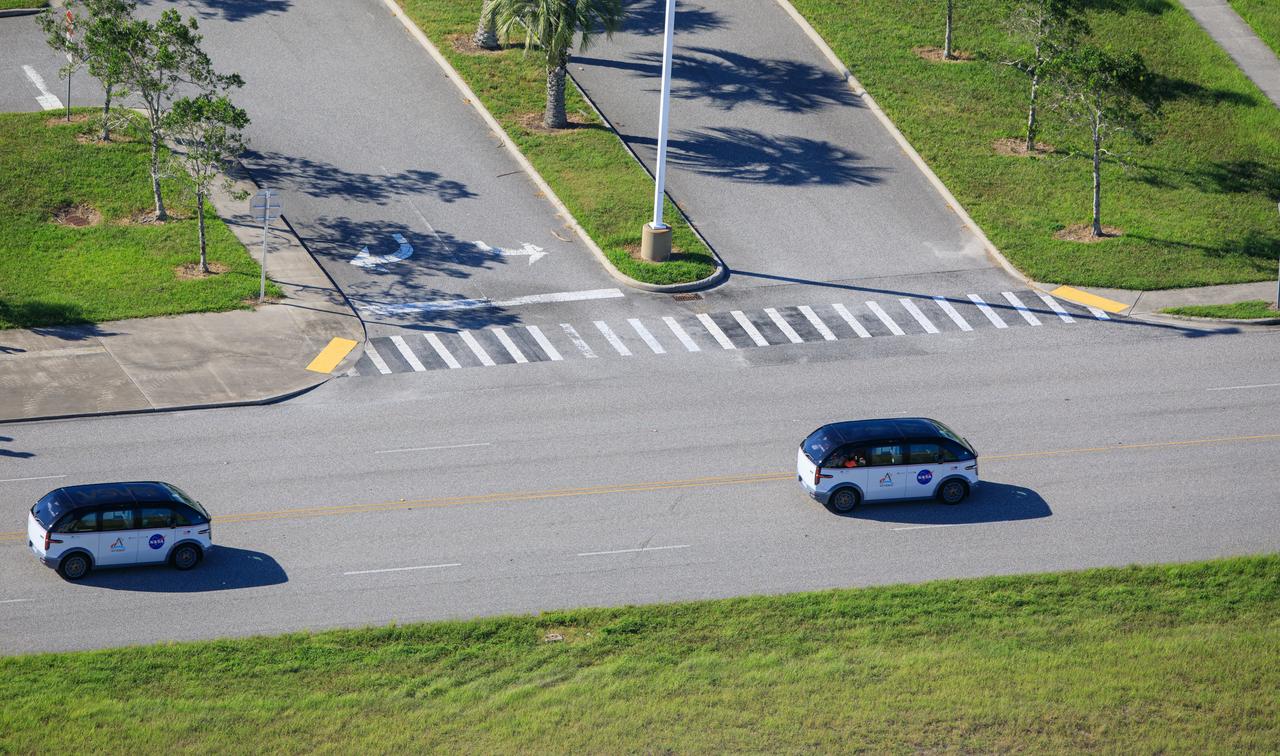
Artemis II NASA astronauts Reid Wiseman, Victor Glover, and Christina Koch, and CSA (Canadian Space Agency) astronaut Jeremy Hansen ride from Astronaut Crew Quarters in the Neil Armstrong Operations and Checkout Building to Launch Pad 39B in the Artemis crew transportation vehicles as part of an integrated ground systems test at Kennedy Space Center in Florida on Wednesday, Sept. 20, to test the crew timeline for launch day.
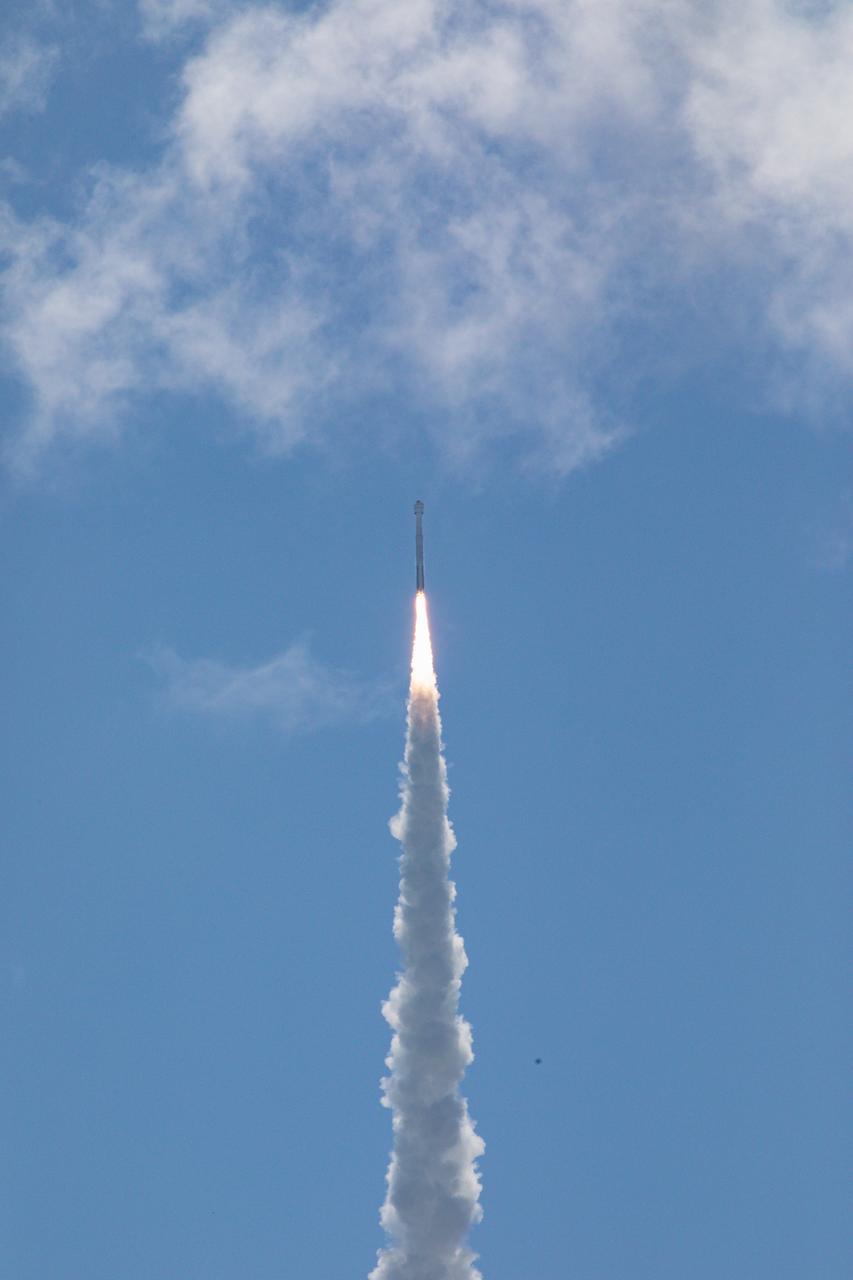
A United Launch Alliance Atlas V rocket soars upward from the pad at Space Launch Complex-41 at Cape Canaveral Space Force Station in Florida at 10:52 a.m. EDT Wednesday, June 5, 2024, carrying a Boeing Starliner spacecraft for NASA’s Boeing Crew Flight Test to the International Space Station. Aboard Starliner are NASA astronauts Butch Wilmore and Suni Williams on the first crewed flight of the spacecraft as part of the agency’s Commercial Crew Program.
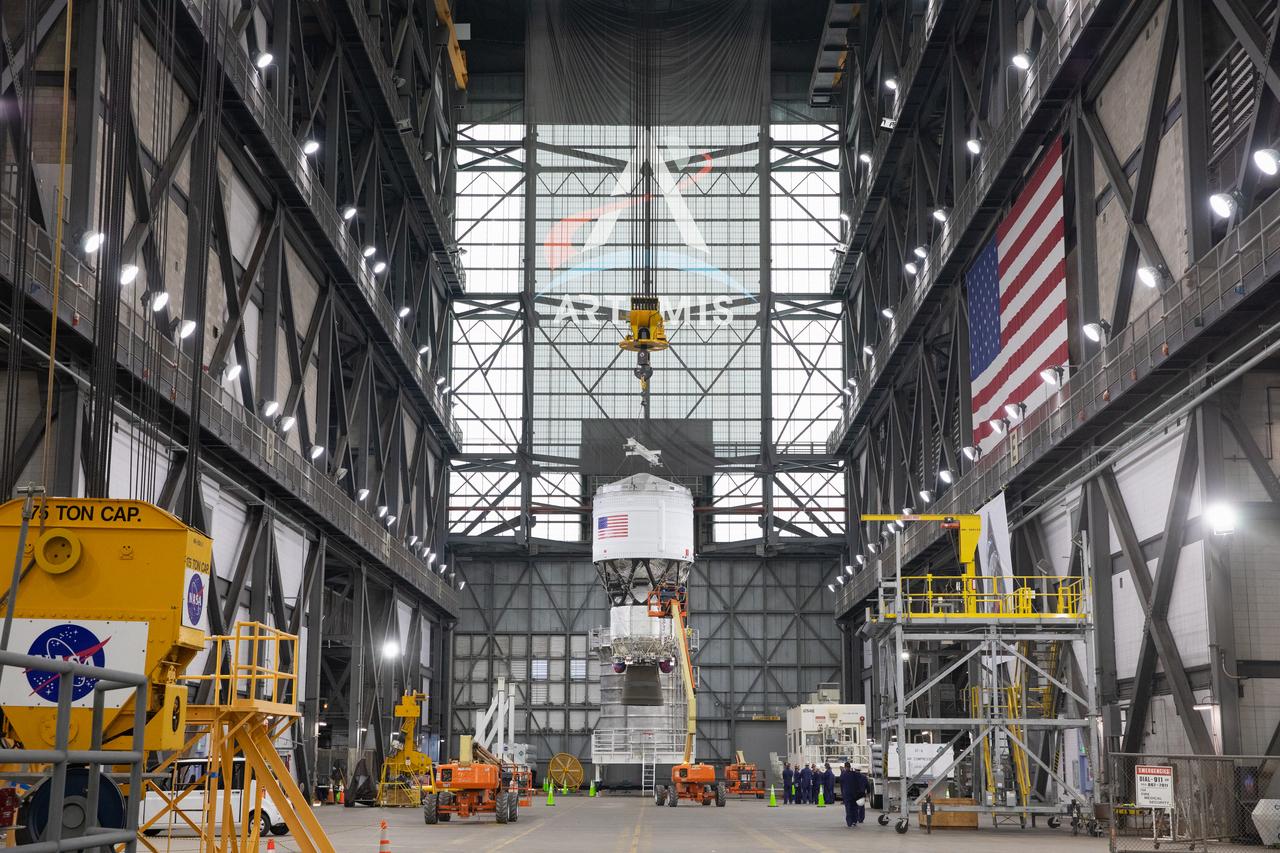
Teams with NASA’s Exploration Ground Systems Program begin integrating the interim cryogenic propulsion stage to the SLS (Space Launch System) launch vehicle stage adapter on Wednesday, April 30, 2025, inside the Vehicle Assembly Building at NASA’s Kennedy Space Center in Florida. The four-story propulsion system, built by Boeing and ULA (United Launch Alliance), is powered by an RL10 engine that will enable the Orion spacecraft to build up enough speed for the push toward the Moon during the Artemis II crewed test flight.
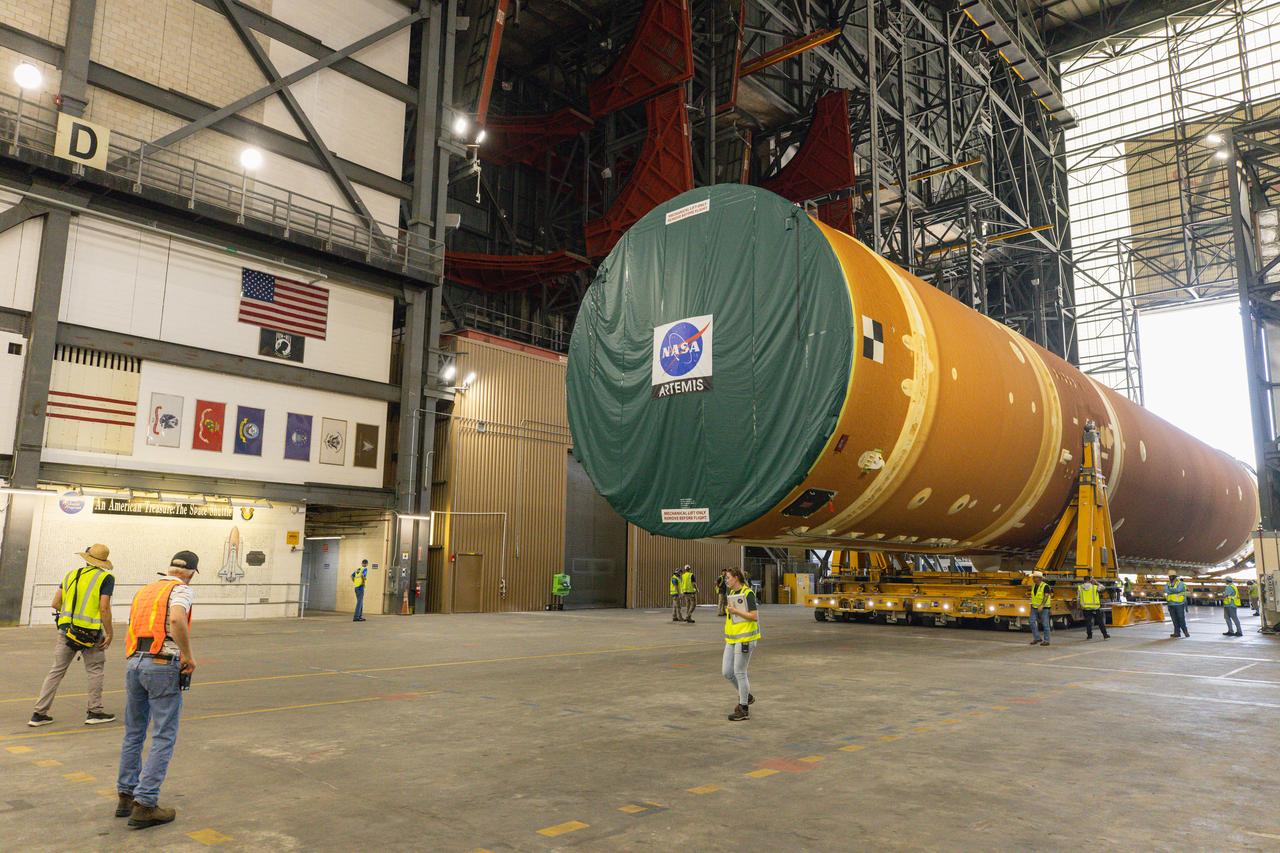
After completing its journey from NASA’s Michoud Assembly Facility in New Orleans aboard the Pegasus barge, teams with Exploration Ground Systems (EGS) transport the agency’s powerful SLS (Space Launch System) core stage into the transfer aisle inside Kennedy Space Center’s Vehicle Assembly Building in Florida on Wednesday, July 24, 2024. In the coming months, SLS will be prepared for integration atop the mobile launcher ahead of the Artemis II launch.
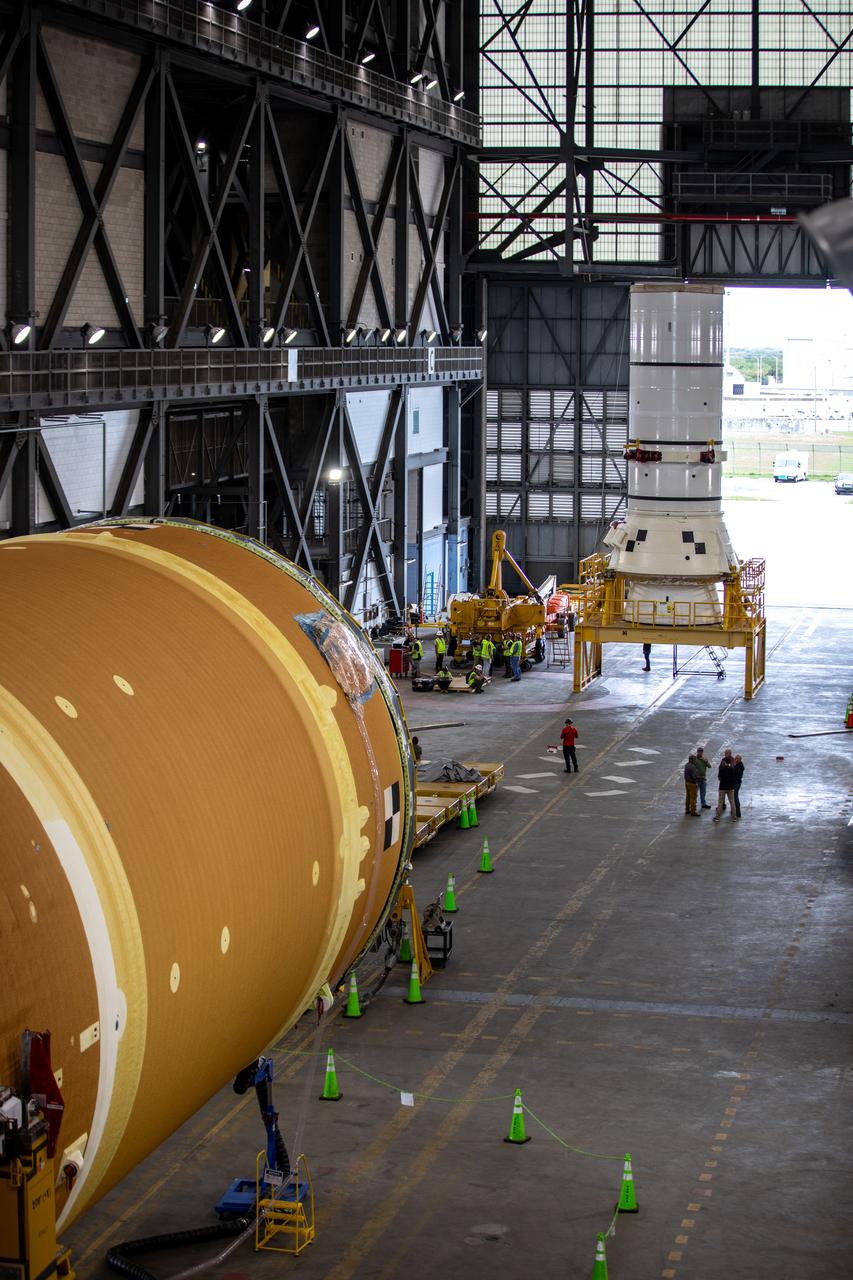
The left aft assembly, or bottom portion of the solid rocket boosters for the SLS (Space Launch System) rocket, moves into the Vehicle Assembly Building with the core stage at NASA’s Kennedy Space Center in Florida on Monday, Nov. 18, 2024. The aft assembly will be lifted atop the mobile launcher, followed by the right aft assembly and remaining rocket segments.
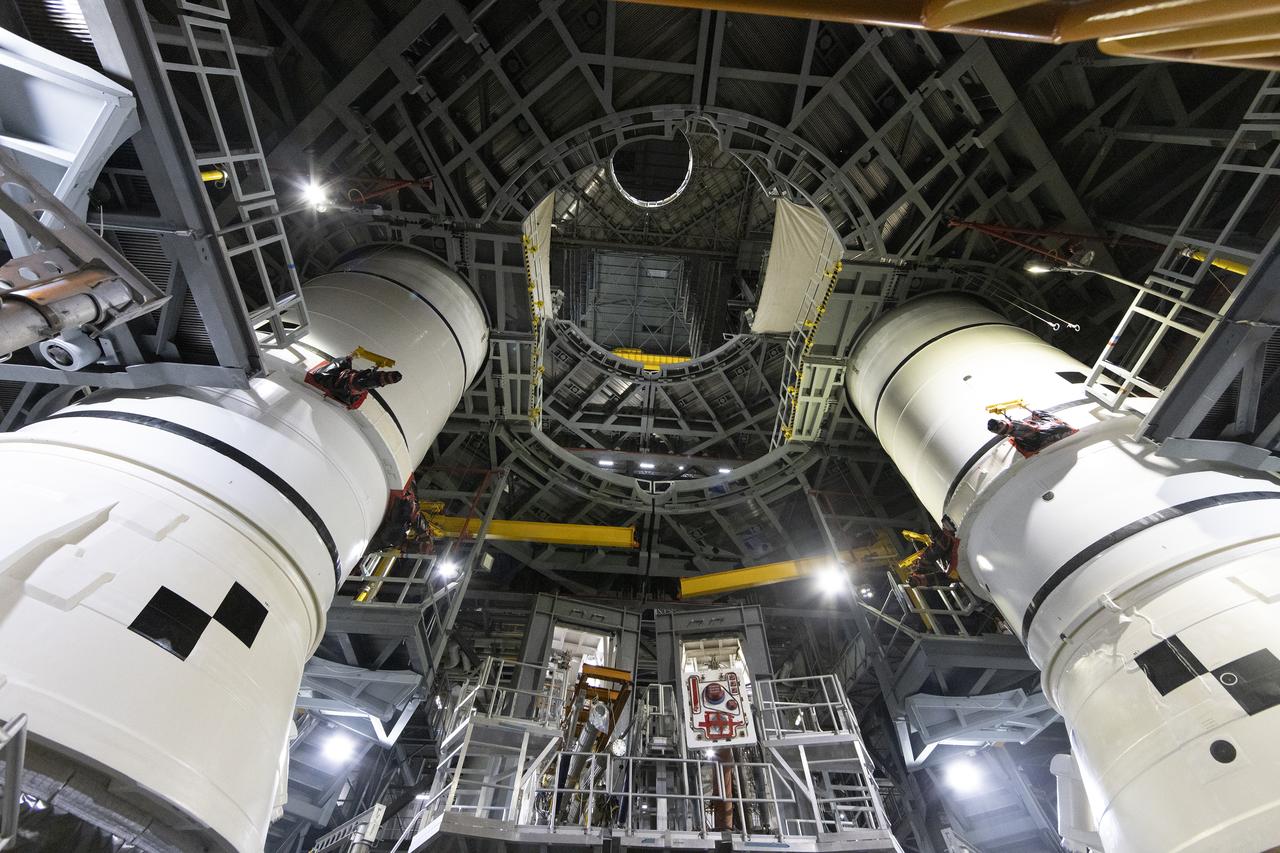
Engineers and technicians with NASA’s Exploration Ground Systems Program complete stacking of the first Moon rocket segments – the left and right aft assemblies for the agency’s Artemis II SLS (Space Launch System) solid rocket boosters – onto mobile launcher 1 inside the Vehicle Assembly Building at Kennedy Space Center on Friday, Nov. 22, 2024. The first two of 10 booster segments to be stacked, the boosters will help support the remaining rocket components and the Orion spacecraft during final assembly of the Artemis II Moon rocket and provide more than 75 percent of the total SLS thrust during liftoff from NASA Kennedy’s Launch Pad 39B.
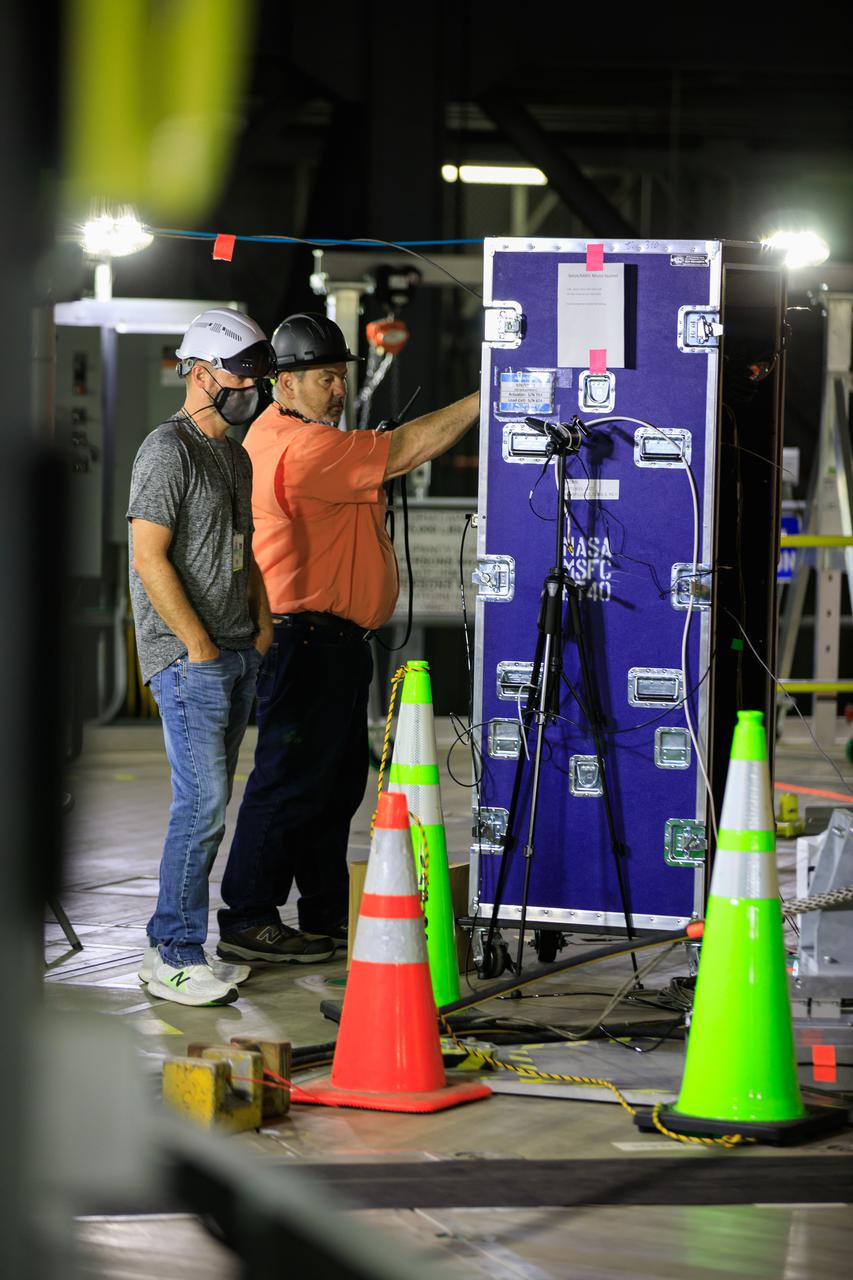
Artemis teams members perform the integrated modal test of the Space Launch System and mobile launcher in High Bay 3 of the Vehicle Assembly Building at NASA’s Kennedy Space Center in Florida on Sept. 24, 2021. The tests will help determine the natural frequencies of the recently stacked rocket before launch of the Artemis I mission. The data also will be used to help steer the rocket during flight. To identify the rocket’s natural frequencies, the team placed about 300 sensors on it and the mobile launcher to detect, record, and transmit the information, along with hydraulic shakers attached to seven locations on the rocket. Artemis I will be the first integrated test of the SLS and Orion spacecraft. In later missions, NASA will land the first woman and the first person of color on the surface of the Moon, paving the way for a long-term lunar presence and serving as a steppingstone on the way to Mars.
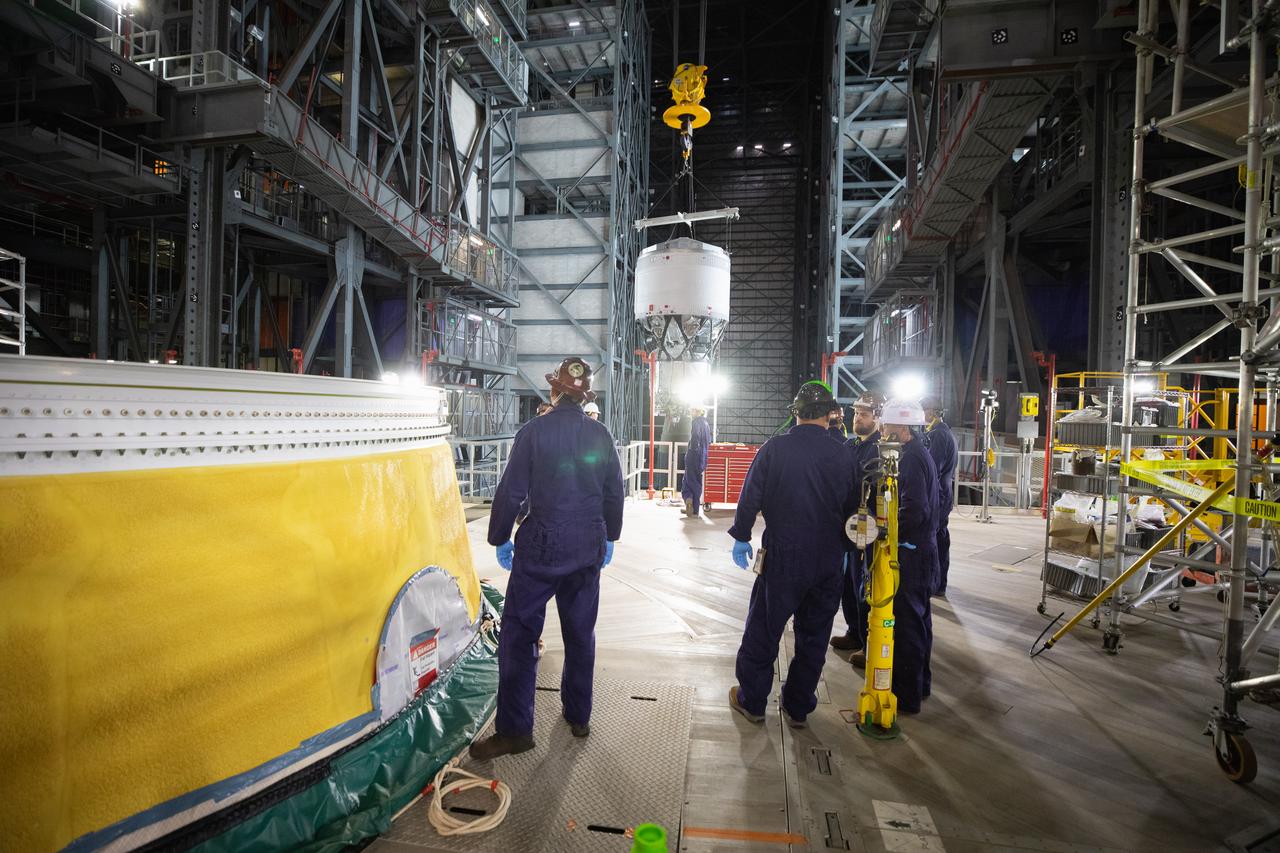
Teams with NASA’s Exploration Ground Systems Program begin integrating the interim cryogenic propulsion stage to the SLS (Space Launch System) launch vehicle stage adapter on Wednesday, April 30, 2025, inside the Vehicle Assembly Building at NASA’s Kennedy Space Center in Florida. The four-story propulsion system, built by Boeing and ULA (United Launch Alliance), is powered by an RL10 engine that will enable the Orion spacecraft to build up enough speed for the push toward the Moon during the Artemis II crewed test flight.
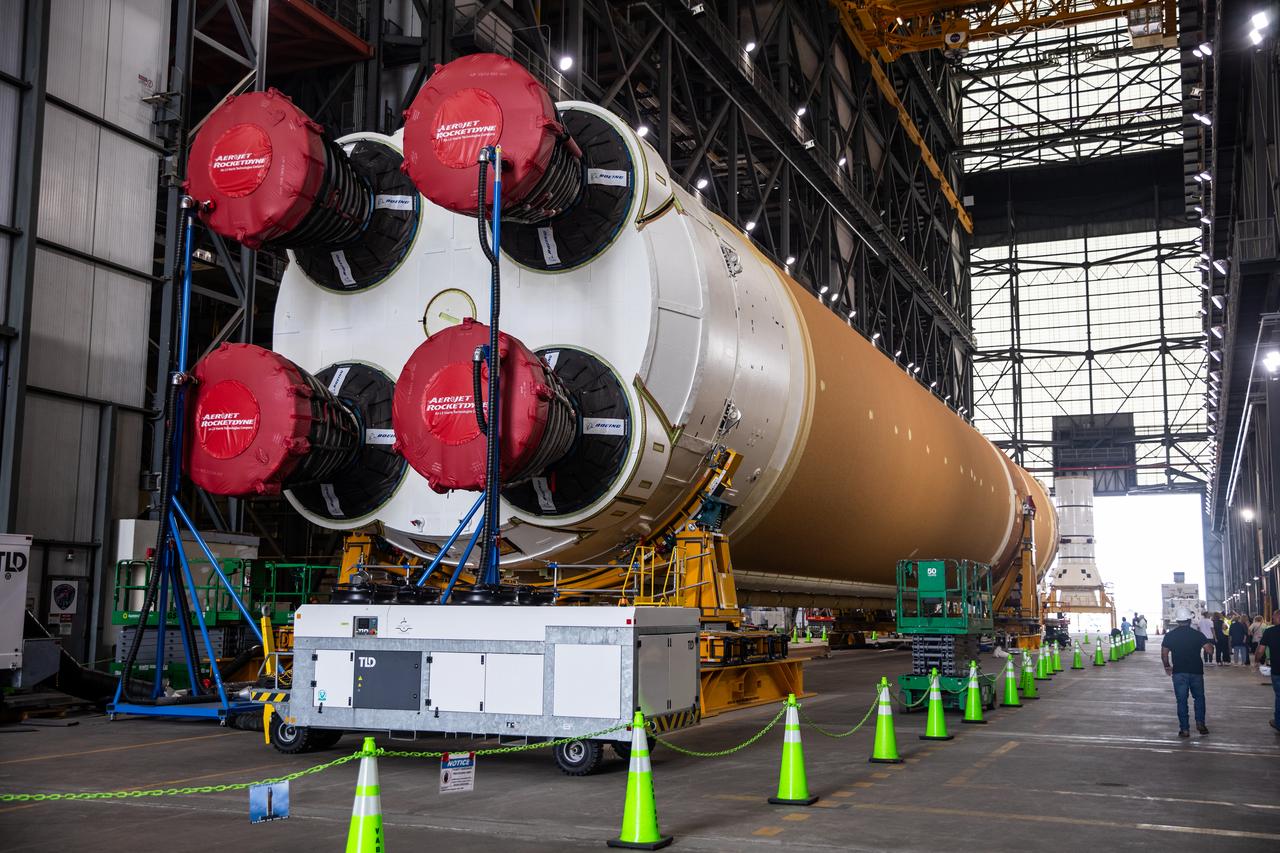
The left aft assembly, or bottom portion of the solid rocket boosters for the SLS (Space Launch System) rocket, moves into the Vehicle Assembly Building with the core stage at NASA’s Kennedy Space Center in Florida on Monday, Nov. 18, 2024. The aft assembly will be lifted atop the mobile launcher, followed by the right aft assembly and remaining rocket segments.

Technicians with NASA’s Exploration Ground Systems complete the integration of the left forward segment to the center forward segment on mobile launcher 1 inside the Vehicle Assembly Building at the agency’s Kennedy Space Center in Florida on Friday, Feb. 7, 2025. The twin solid boosters, five segments on each side, will help support the remaining rocket components and the Orion spacecraft during final assembly of the Artemis II Moon rocket and provide more than 75 percent of the total SLS thrust during liftoff from NASA Kennedy’s Launch Pad 39B.
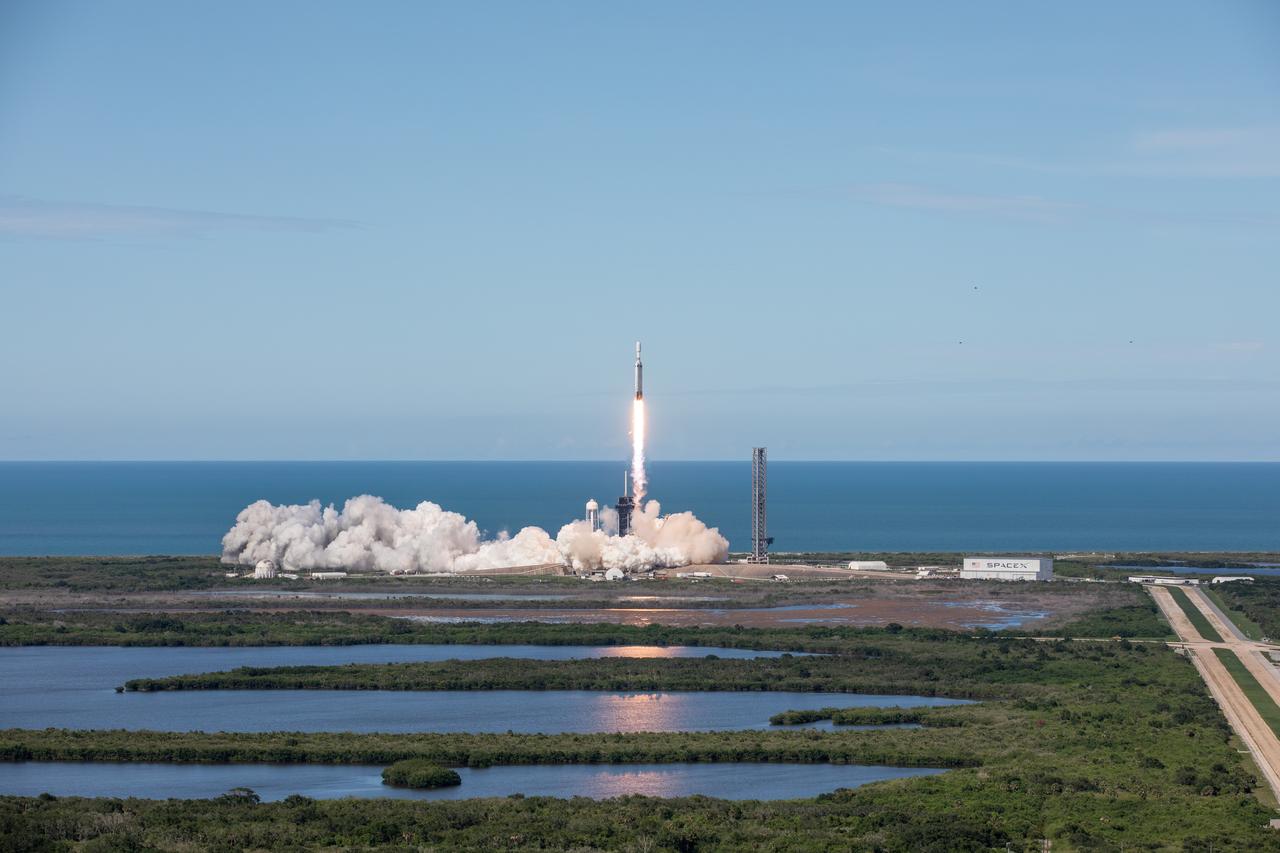
A SpaceX Falcon Heavy rocket carrying the National Oceanic and Atmospheric Administration (NOAA) GOES-U (Geostationary Operational Environmental Satellite U) lifts off from Launch Complex 39A at NASA’s Kennedy Space Center in Florida on Tuesday, June 25, 2024. The GOES-U satellite is the final satellite in the GOES-R series, which serves a critical role in providing continuous coverage of the Western Hemisphere, including monitoring tropical systems in the eastern Pacific and Atlantic oceans.
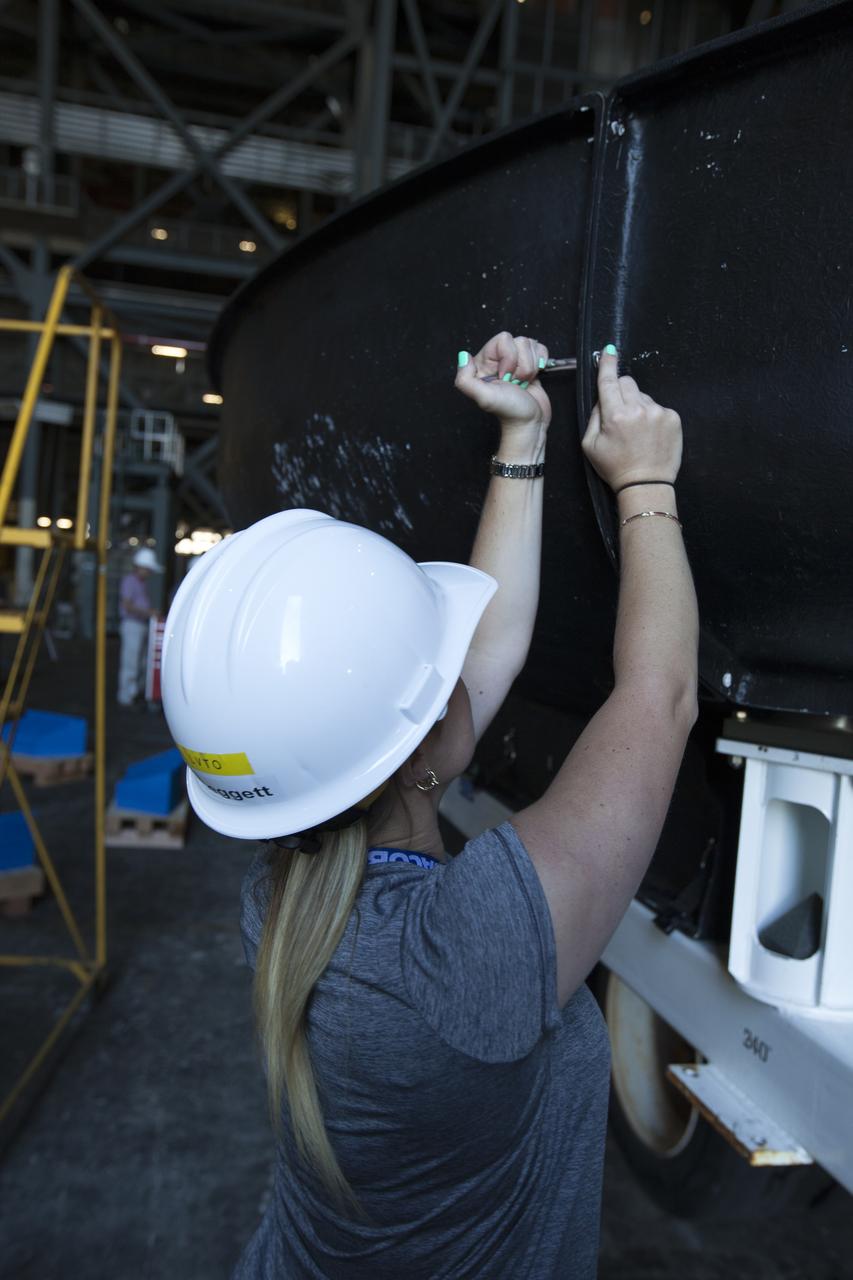
Inside High Bay 2 in the Vehicle Assembly Building (VAB) at NASA's Kennedy Space Center in Florida, a worker helps prepare the Orion heat shield from Exploration Flight Test-1 for unloading off its transporter. The heat shield is being transferred from the Orion Program to the Ground Systems Development and Operations Program, Landing and Recovery Operations. In the VAB, the heat shield will be integrated with the Orion ground test article and used for future underway recovery testing.
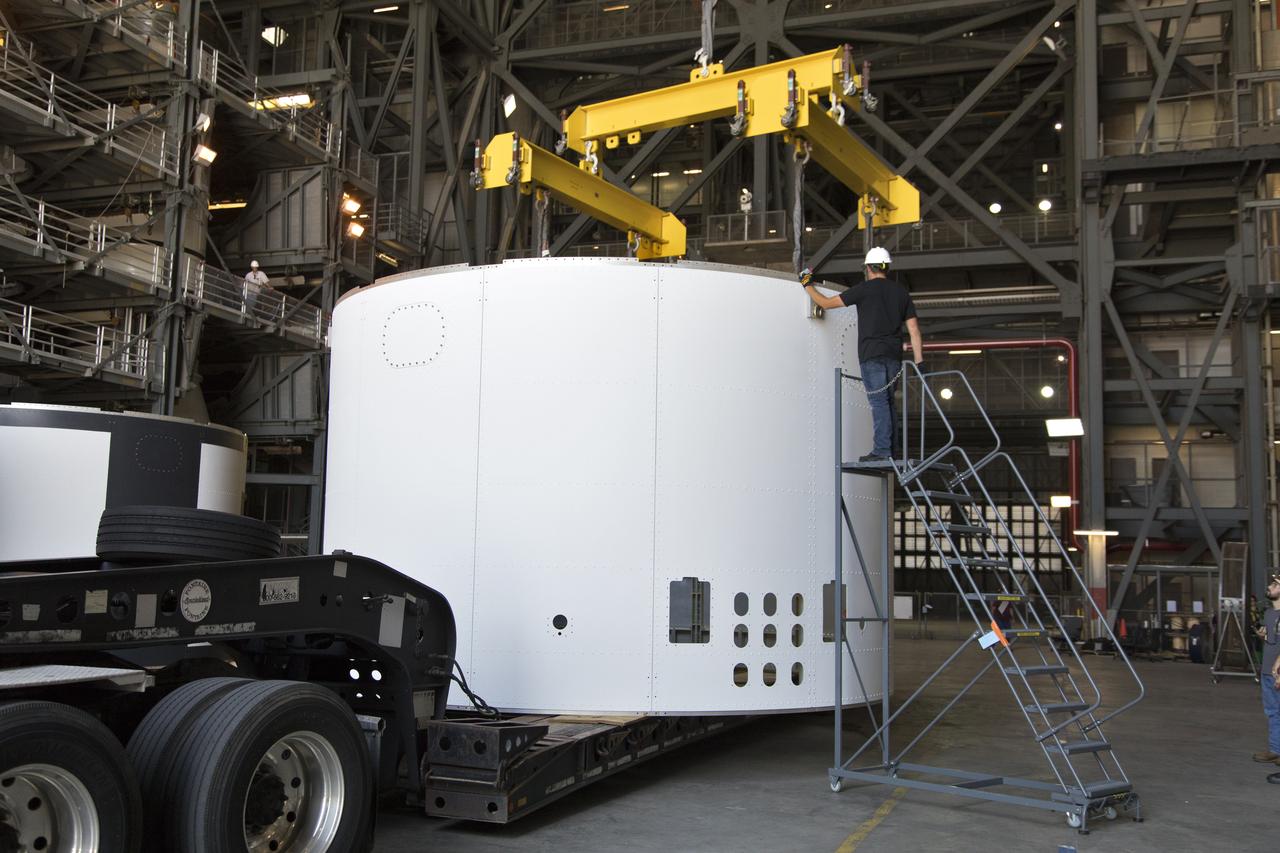
The third and final aeroshell for Orion's Launch Abort System (LAS) arrives by flatbed truck in High Bay 4 of the Vehicle Assembly Building on July 12, 2018, at NASA's Kennedy Space Center in Florida. The aeroshell was shipped from EMF Inc. on nearby Merritt Island. A technician assists with crane attachment so that the aeroshell can be offloaded and placed on slats in the high bay. The aeroshells will be stacked and prepared for a full-stress test of the LAS, called Ascent Abort-2 (AA-2) flight test, scheduled for April 2019. During the test, a booster will launch from Space Launch Complex 46 at Cape Canaveral Air Force Station, carrying a fully functional LAS and a 22,000-pound Orion test vehicle to an altitude of 31,000 feet and traveling at more than 1,000 miles an hour. The test will verify the LAS can steer the crew module and astronauts aboard to safety in the event of an issue with the Space Launch System (SLS) rocket when the spacecraft is under the highest aerodynamic loads it will experience during a rapid climb into space. Orion is being prepared for its first integrated uncrewed flight atop the SLS on Exploration Mission-1.
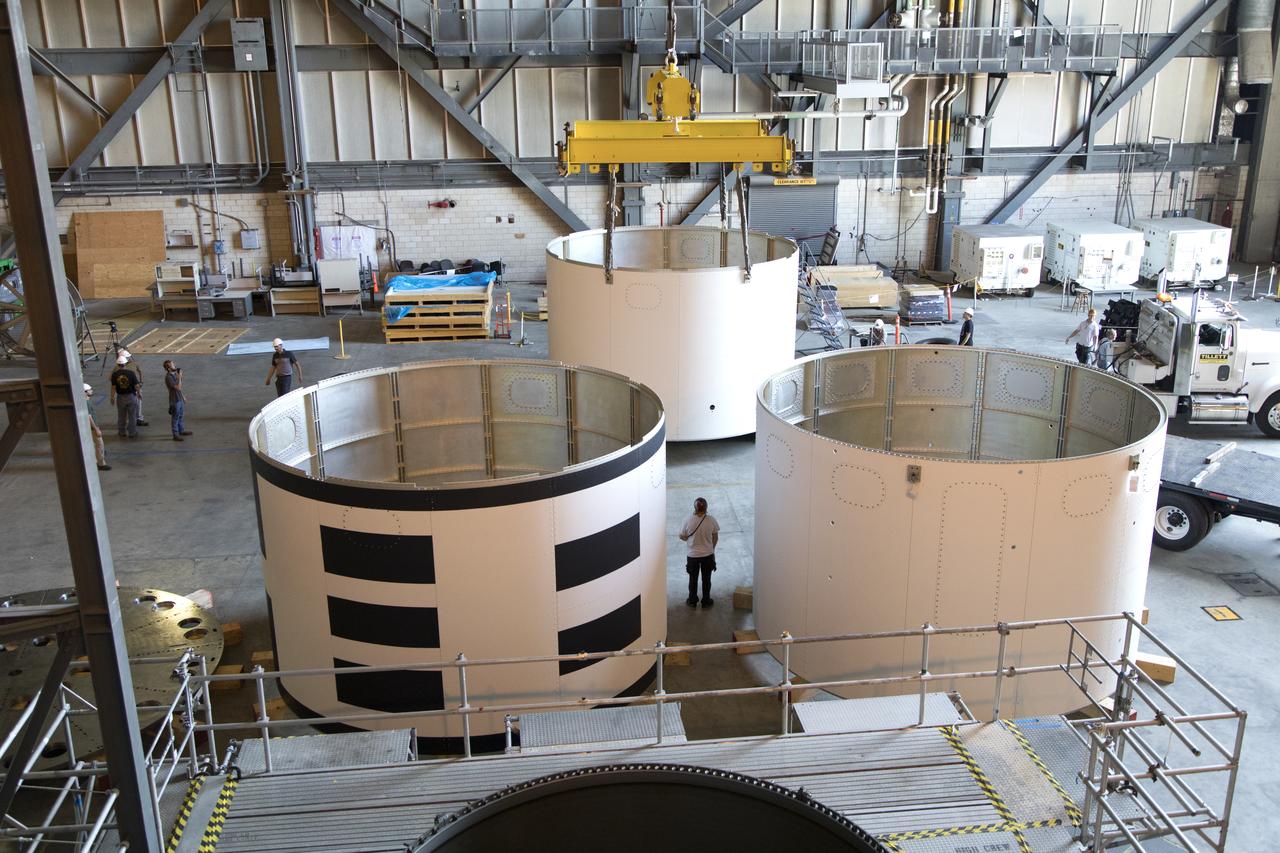
The third and final aeroshell for Orion's Launch Abort System (LAS) is lifted by crane in High Bay 4 of the Vehicle Assembly Building on July 12, 2018, at NASA's Kennedy Space Center in Florida. The aeroshell was shipped from EMF Inc. on nearby Merritt Island. The aeroshell will be lowered onto slats. All three aeroshells will be stacked and prepared for a full-stress test of the LAS, called Ascent Abort-2 (AA-2) flight test, scheduled for April 2019. During the test, a booster will launch from Space Launch Complex 46 at Cape Canaveral Air Force Station, carrying a fully functional LAS and a 22,000-pound Orion test vehicle to an altitude of 31,000 feet and traveling at more than 1,000 miles an hour. The test will verify the LAS can steer the crew module and astronauts aboard to safety in the event of an issue with the Space Launch System (SLS) rocket when the spacecraft is under the highest aerodynamic loads it will experience during a rapid climb into space. Orion is being prepared for its first integrated uncrewed flight atop the SLS on Exploration Mission-1.

A massive crane lowers the launch vehicle stage adapter onto the SLS (Space Launch System) core stage on Thursday, April 3, 2025, in High Bay 3 inside the Vehicle Assembly Building at NASA’s Kennedy Space Center in Florida. During launch and ascent, the launch vehicle stage adapter provides structural support and protects avionics and electrical devices within the upper stage from extreme vibrations and acoustic conditions. The Artemis II test flight will take a crew of four astronauts on a 10-day journey around the Moon, helping confirm the foundational systems and hardware needed for human deep space exploration.
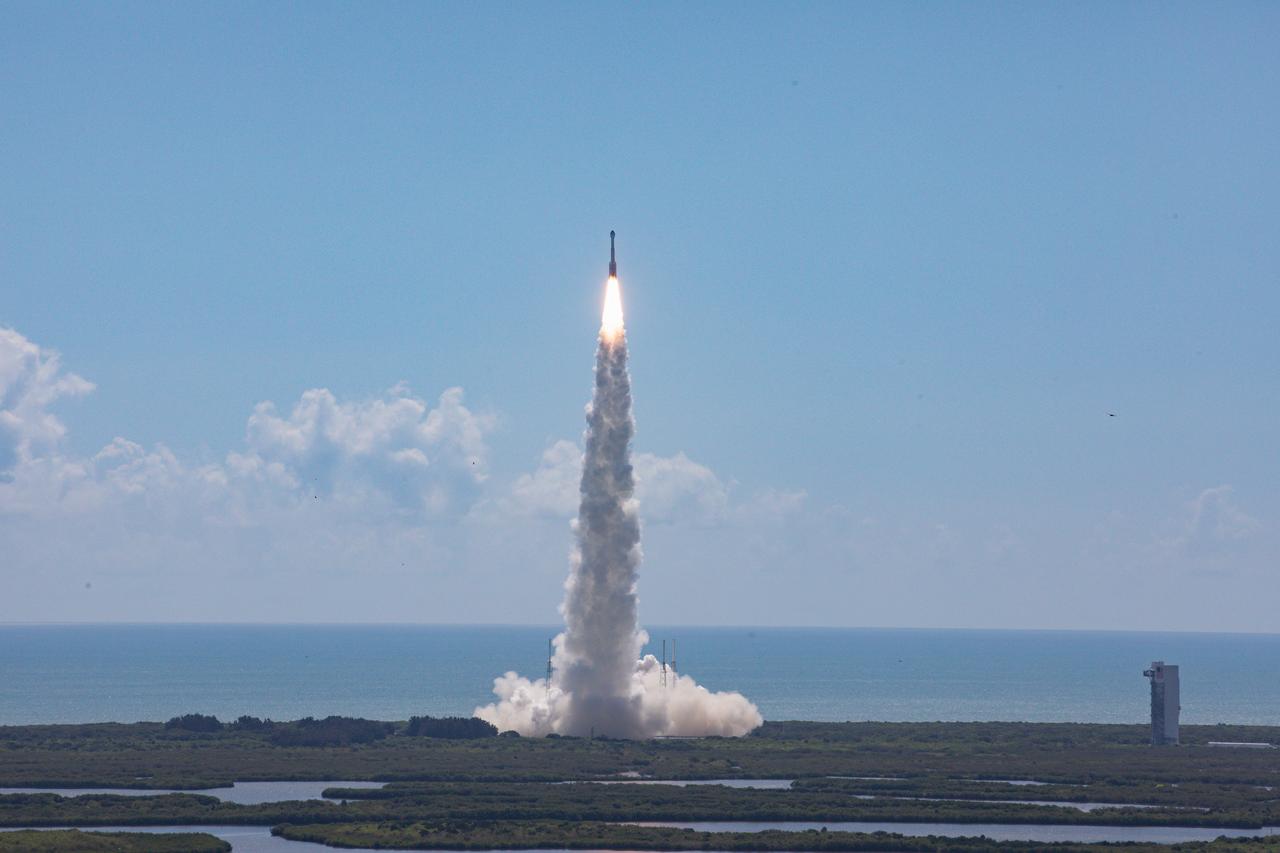
A United Launch Alliance Atlas V rocket carrying a Boeing Starliner spacecraft launches NASA’s Boeing Crew Flight Test with NASA astronauts Butch Wilmore and Suni Williams aboard at 10:52 a.m. EDT Wednesday, June 5, 2024, from Space Launch Complex-41 at Cape Canaveral Space Force Station in Florida. Wilmore and Williams are the first to launch aboard Boeing’s Starliner spacecraft to the International Space Station as part of the agency’s Commercial Crew Program.
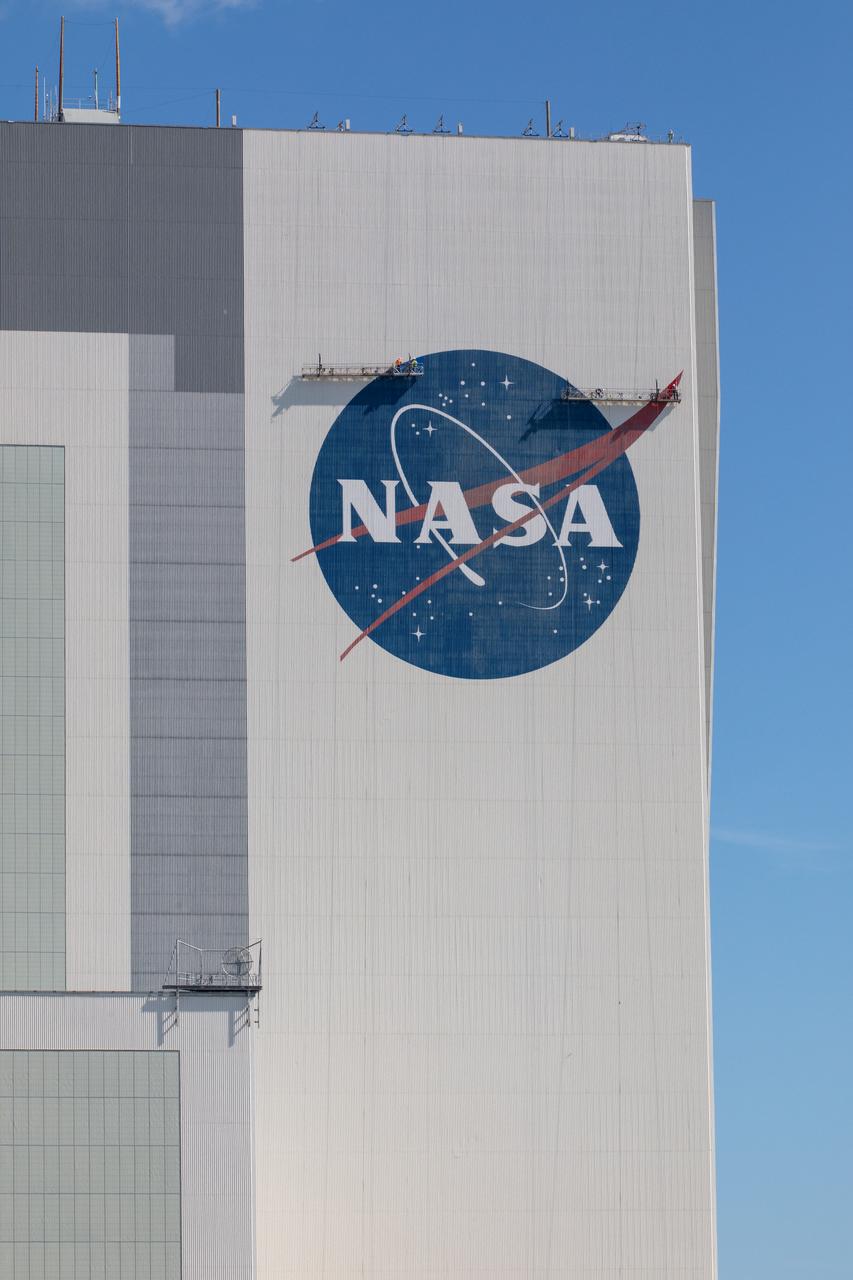
Painting of the NASA logo, also called the meatball, is underway on the 525-foot-tall Vehicle Assembly Building (VAB) at the agency’s Kennedy Space Center in Florida on May 8, 2020. HM2 and H.I.S. Painting of Titusville, Florida, are repainting the meatball and the American Flag on the iconic building. High Bay 3 inside the VAB has been upgraded with 10 new levels of work platforms that will surround and provide access for service and processing of NASA's Space Launch System (SLS) rocket and Orion spacecraft. Exploration Ground Systems is overseeing upgrades to the VAB to support the launch of the SLS and Orion for Artemis missions. Under the Artemis program, NASA will send the first woman and next man to the Moon.
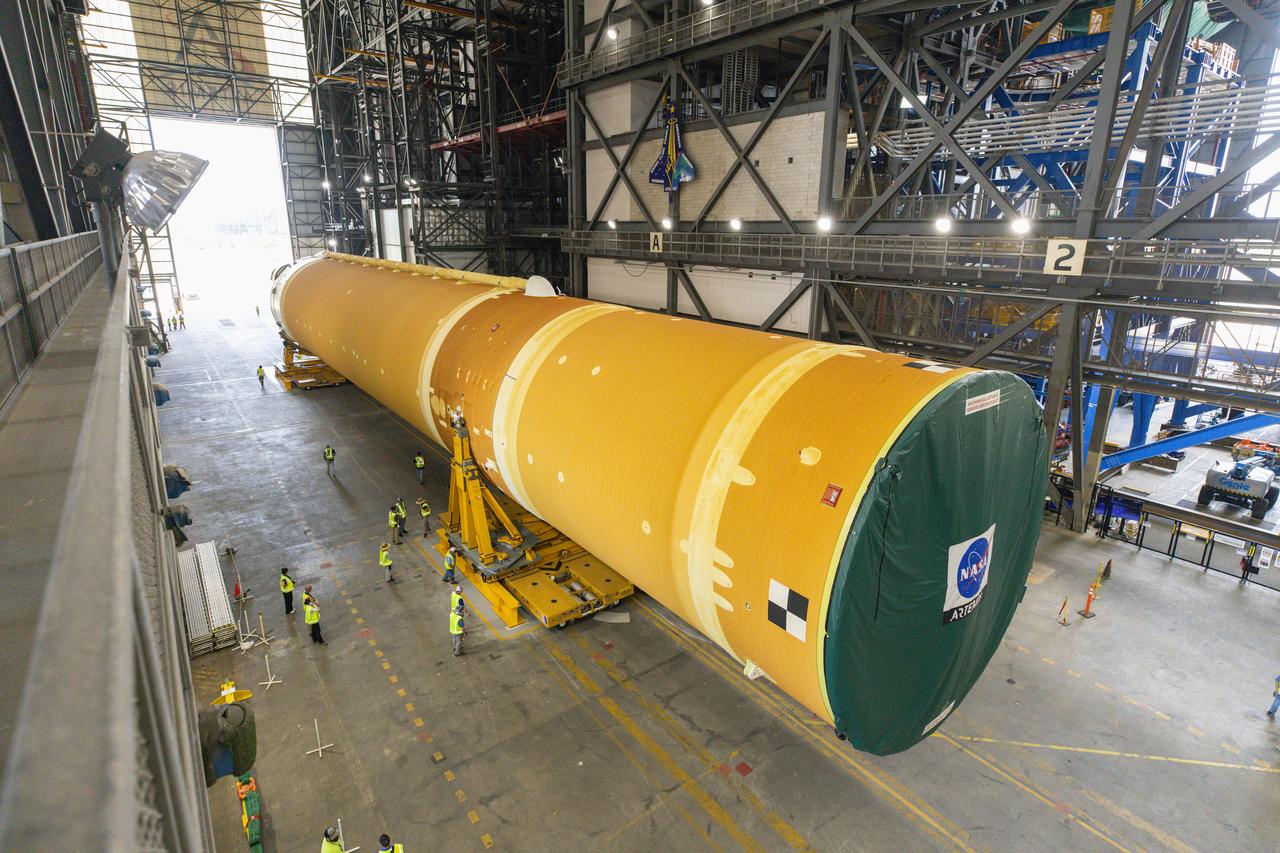
After completing its journey from NASA’s Michoud Assembly Facility in New Orleans aboard the Pegasus barge, teams with Exploration Ground Systems (EGS) transport the agency’s powerful SLS (Space Launch System) core stage into the transfer aisle inside Kennedy Space Center’s Vehicle Assembly Building in Florida on Wednesday, July 24, 2024. In the coming months, SLS will be prepared for integration atop the mobile launcher ahead of the Artemis II launch.
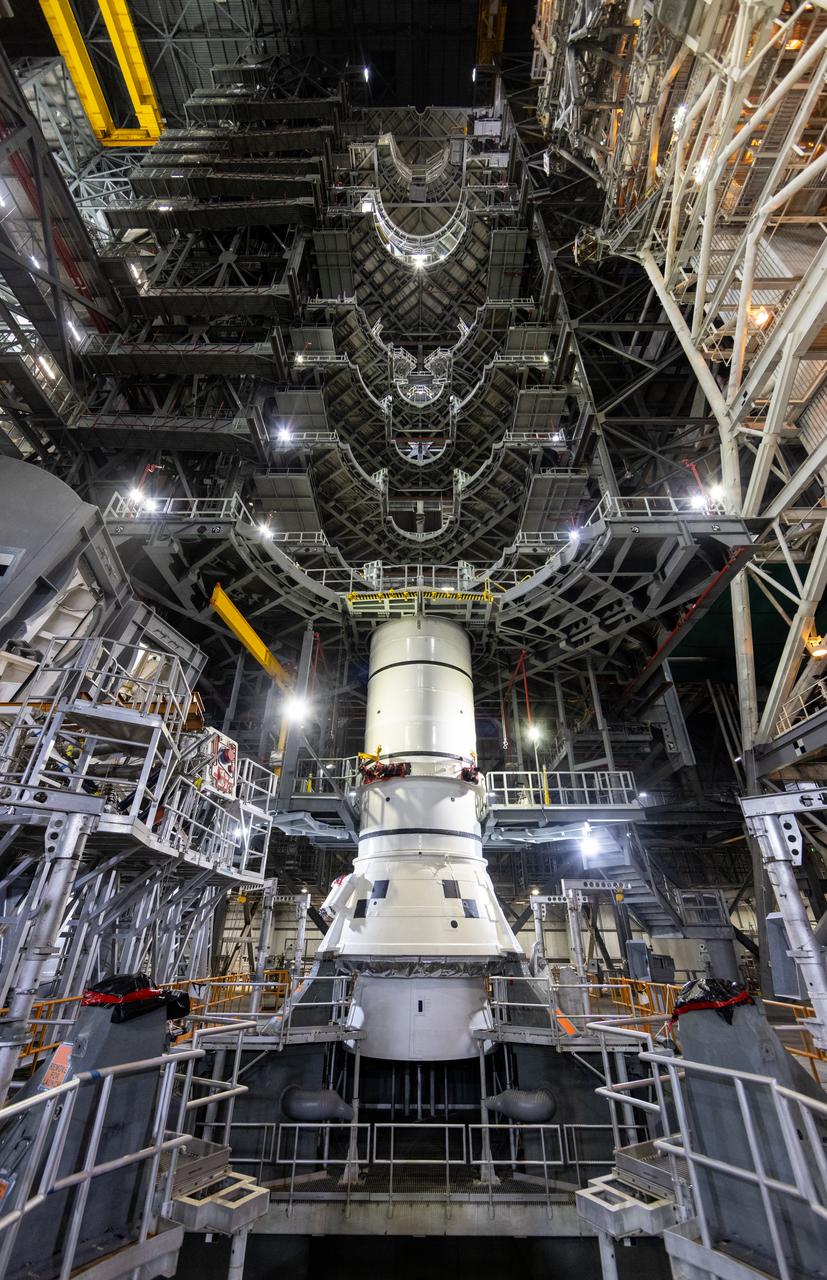
Engineers and technicians with the Exploration Ground Systems Program stack the first Moon rocket segment – the left aft assembly for the Artemis II SLS (Space Launch System) solid rocket booster onto mobile launcher 1 inside the Vehicle Assembly Building at NASA’s Kennedy Space Center on Wednesday, Nov. 20, 2024. The first of 10 booster segments to be stacked, the boosters will help support the remaining rocket components and the Orion spacecraft during final assembly of the Artemis II Moon rocket and provide more than 75 percent of the total SLS thrust during liftoff from NASA Kennedy’s Launch Pad 39B.

NASA’s 2021 class of astronaut candidates visit the Vehicle Assembly Building during a familiarization tour of facilities on Tuesday, Oct. 17, 2023, at the agency’s Kennedy Space Center in Florida.
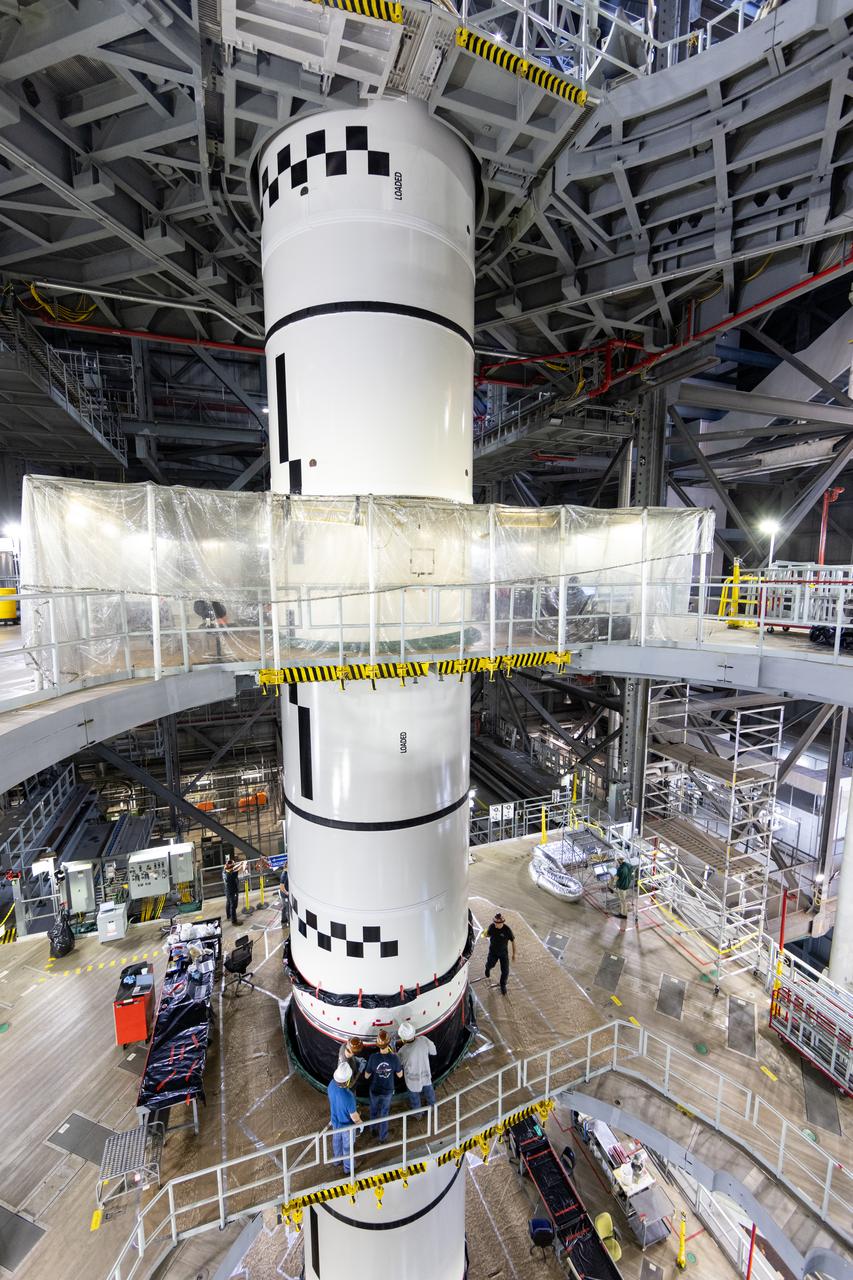
Technicians with NASA’s Exploration Ground Systems complete the integration of the left forward segment to the center forward segment on mobile launcher 1 inside the Vehicle Assembly Building at the agency’s Kennedy Space Center in Florida on Friday, Feb. 7, 2025. The twin solid boosters, five segments on each side, will help support the remaining rocket components and the Orion spacecraft during final assembly of the Artemis II Moon rocket and provide more than 75 percent of the total SLS thrust during liftoff from NASA Kennedy’s Launch Pad 39B.
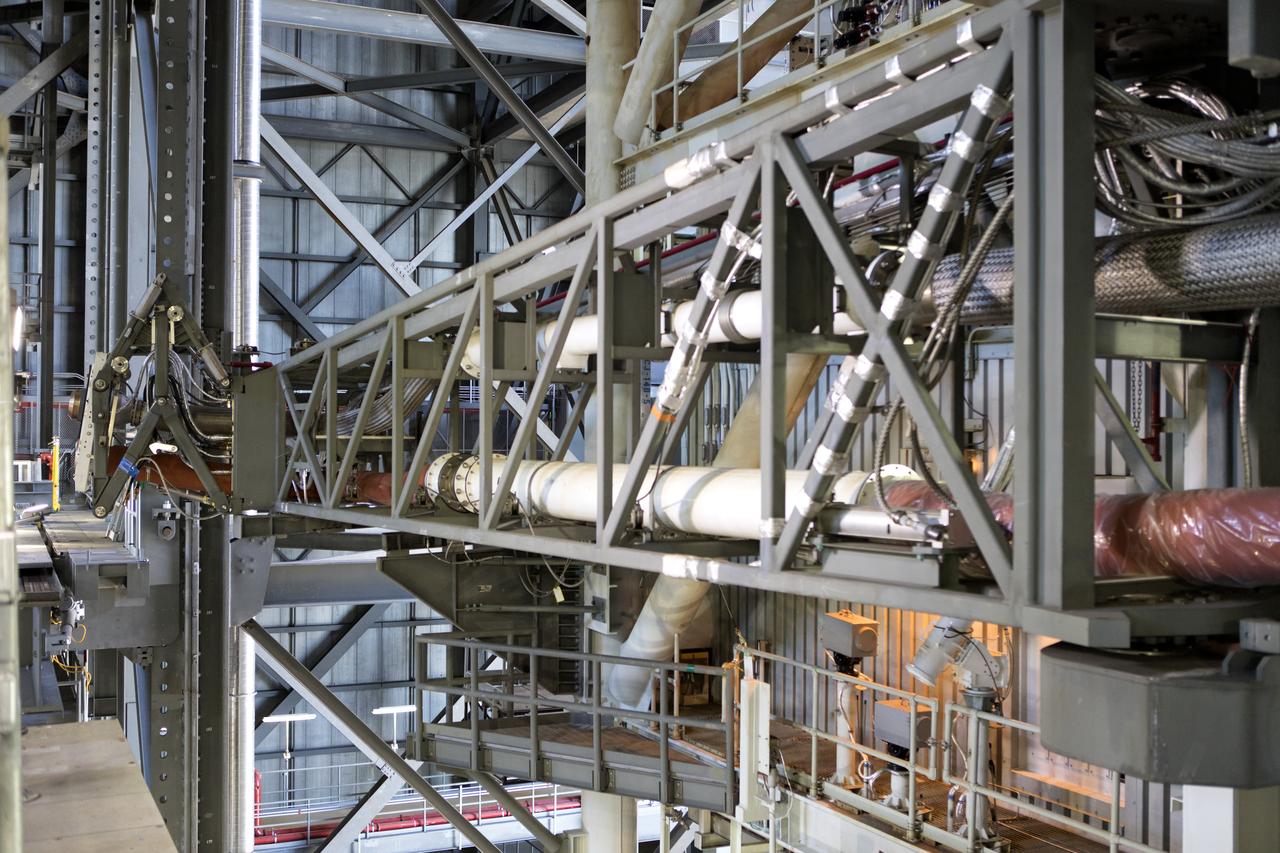
Preparations are underway to perform a preliminary swing test of the Core Stage Inter-tank Umbilical (CSITU) on the mobile launcher in High Bay 3 of the Vehicle Assembly Building on Feb. 22, 2019, at NASA's Kennedy Space Center in Florida. The CSITU is a swing-arm umbilical that will connect to the Space Launch System core stage inter-tank. It will provide conditioned air, pressurized gases and power and data connection to the core stage. The Exploration Ground Systems Program is overseeing installation of the umbilicals.
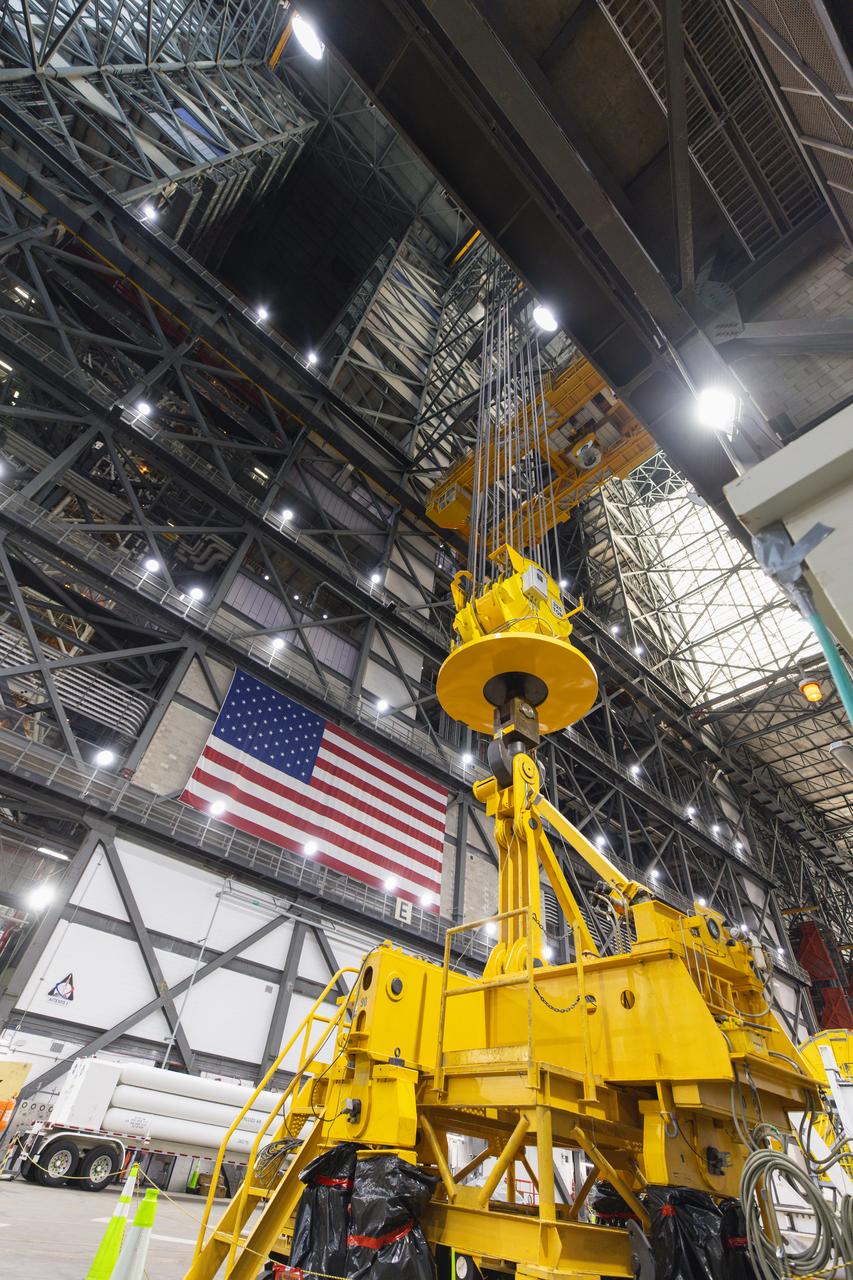
Engineers and technicians with NASA’s Exploration Ground Systems Program move the right aft assembly, or bottom portion of the right solid rocket booster for the agency’s SLS (Space Launch System) rocket, into inside the Vehicle Assembly Building at NASA’s Kennedy Space Center on Thursday, Nov. 22, 2024. The crane will lift the right aft assembly on top of mobile launcher 1, joining the previously stacked left aft assembly as the first booster segments stacked for the Artemis II Moon rocket.
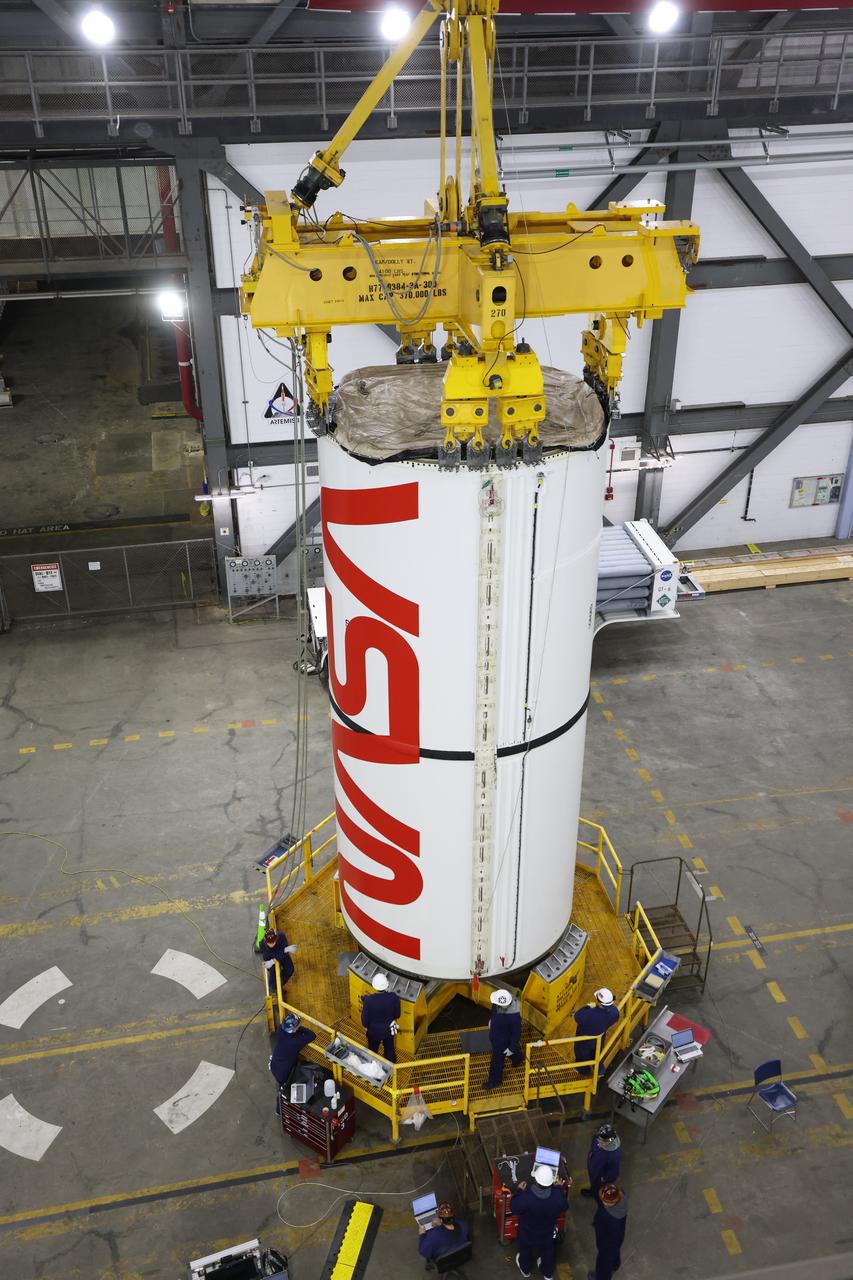
Engineers and technicians with NASA’s Exploration Ground Systems Program transfer the right center center segment with the NASA worm insignia to the Vehicle Assembly Building at NASA's Kennedy Space Center in Florida on Tuesday, Jan. 14, 2025. The booster segment is shown attached to a lifting beam ahead of integration onto the mobile launcher. The boosters will help support the remaining rocket components and the Orion spacecraft during final assembly of the Artemis II Moon rocket and provide more than 75 percent of the total SLS (Space Launch System) thrust during liftoff from NASA Kennedy’s Launch Pad 39B.
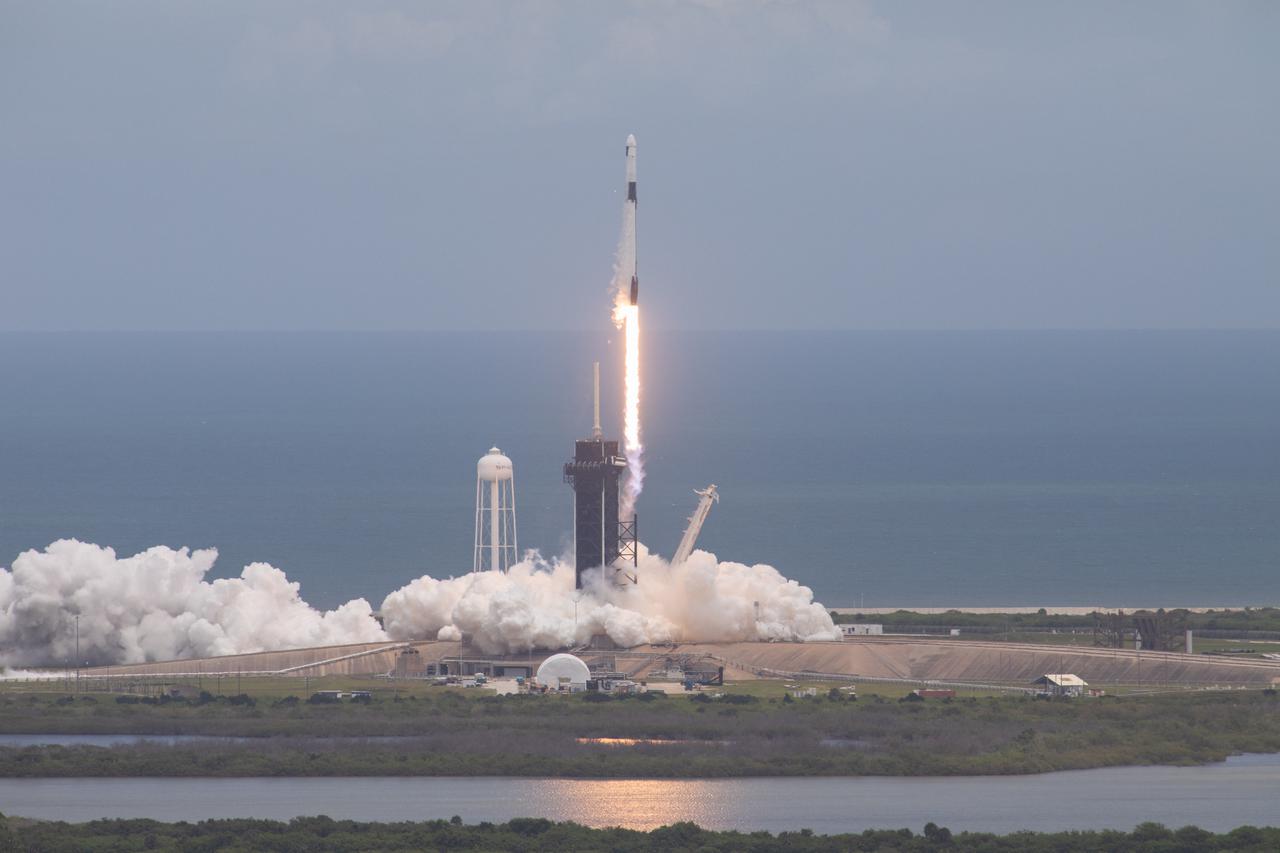
The SpaceX Falcon 9 rocket carrying the Dragon cargo capsule lifts off from Launch Complex 39A at NASA’s Kennedy Space Center in Florida on June 3, 2021, on the company’s 22nd Commercial Resupply Services mission for the agency to the International Space Station. Liftoff was at 1:29 p.m. EDT. Dragon is filled with supplies and payloads including critical materials to directly support dozens of the more than 250 science and research investigations that will occur during Expeditions 65 and 66 on the station.
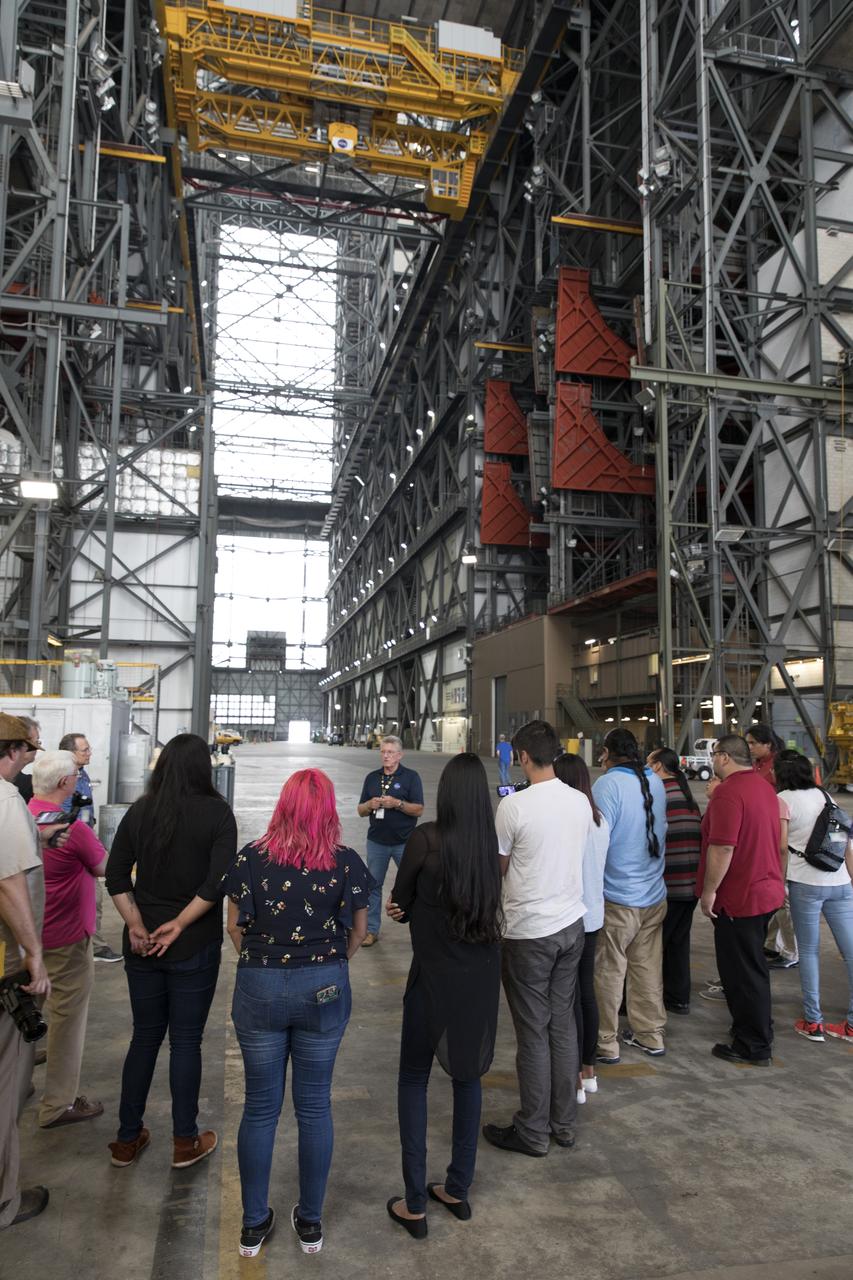
A group of 19 college students recently visited NASA's Kennedy Space Center as winners of the First Nations Launch competition in Wisconsin. They were part of teams that successfully flew high-powered rockets, earning them an opportunity to visit the Florida spaceport. During their visit, they toured the Vehicle Assembly Building, Launch Control Center and the Kennedy visitor complex. The competition is supported by NASA and the Wisconsin Space Grant Consortium. It provides an opportunity for students attending tribal colleges or universities, or who are members of a campus American Indian Science and Engineering Society, or AISES, chapter to design, build and launch a rocket at a competition in Kansasville, Wisconsin.
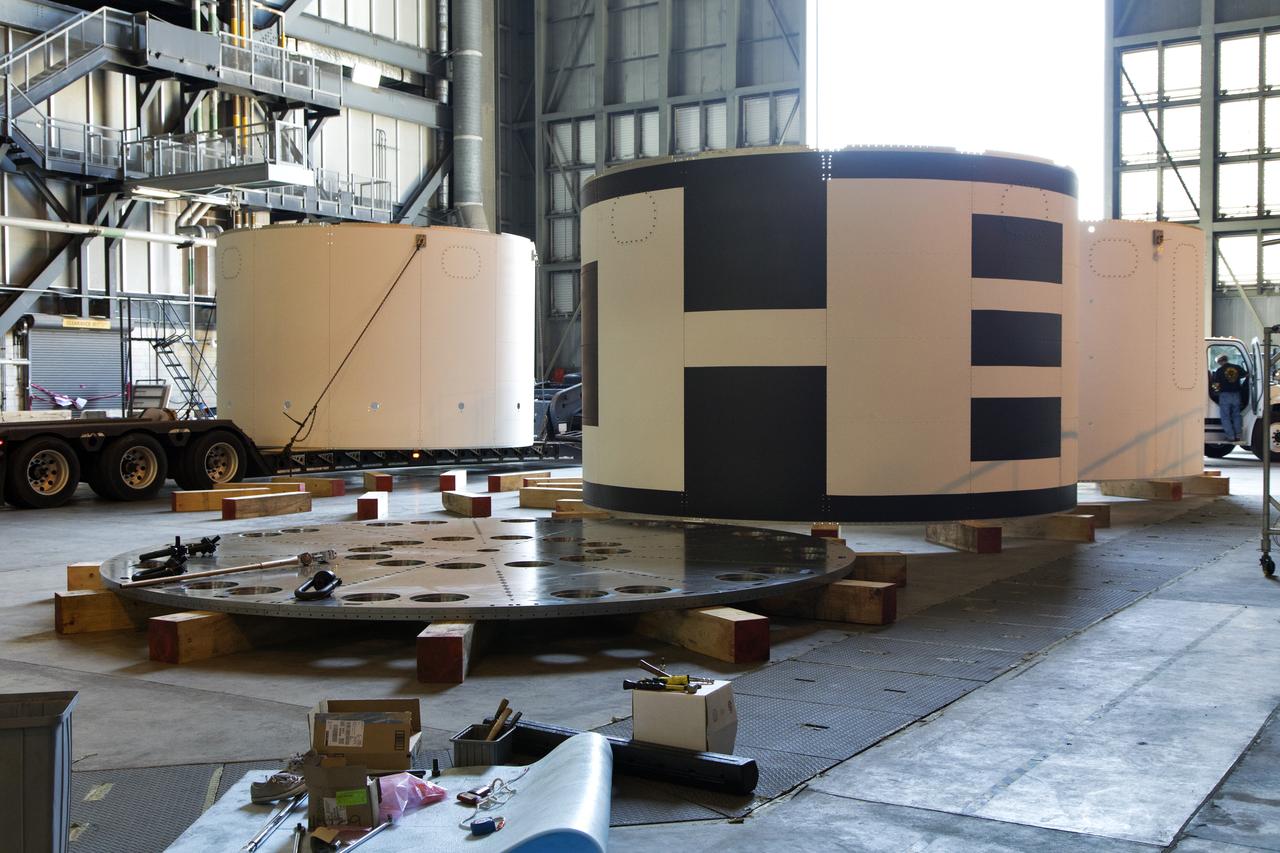
The third and final aeroshell, at left, for Orion's Launch Abort System (LAS) arrives by flatbed truck in High Bay 4 of the Vehicle Assembly Building on July 12, 2018, at NASA's Kennedy Space Center in Florida. The aeroshell was shipped from EMF Inc. on nearby Merritt Island. It will be offloaded and secured in the high bay. The aeroshells will be stacked and prepared for a full-stress test of the LAS, called Ascent Abort-2 (AA-2) flight test, scheduled for April 2019. During the test, a booster will launch from Space Launch Complex 46 at Cape Canaveral Air Force Station, carrying a fully functional LAS and a 22,000-pound Orion test vehicle to an altitude of 31,000 feet and traveling at more than 1,000 miles an hour. The test will verify the LAS can steer the crew module and astronauts aboard to safety in the event of an issue with the Space Launch System (SLS) rocket when the spacecraft is under the highest aerodynamic loads it will experience during a rapid climb into space. Orion is being prepared for its first integrated uncrewed flight atop the SLS on Exploration Mission-1.
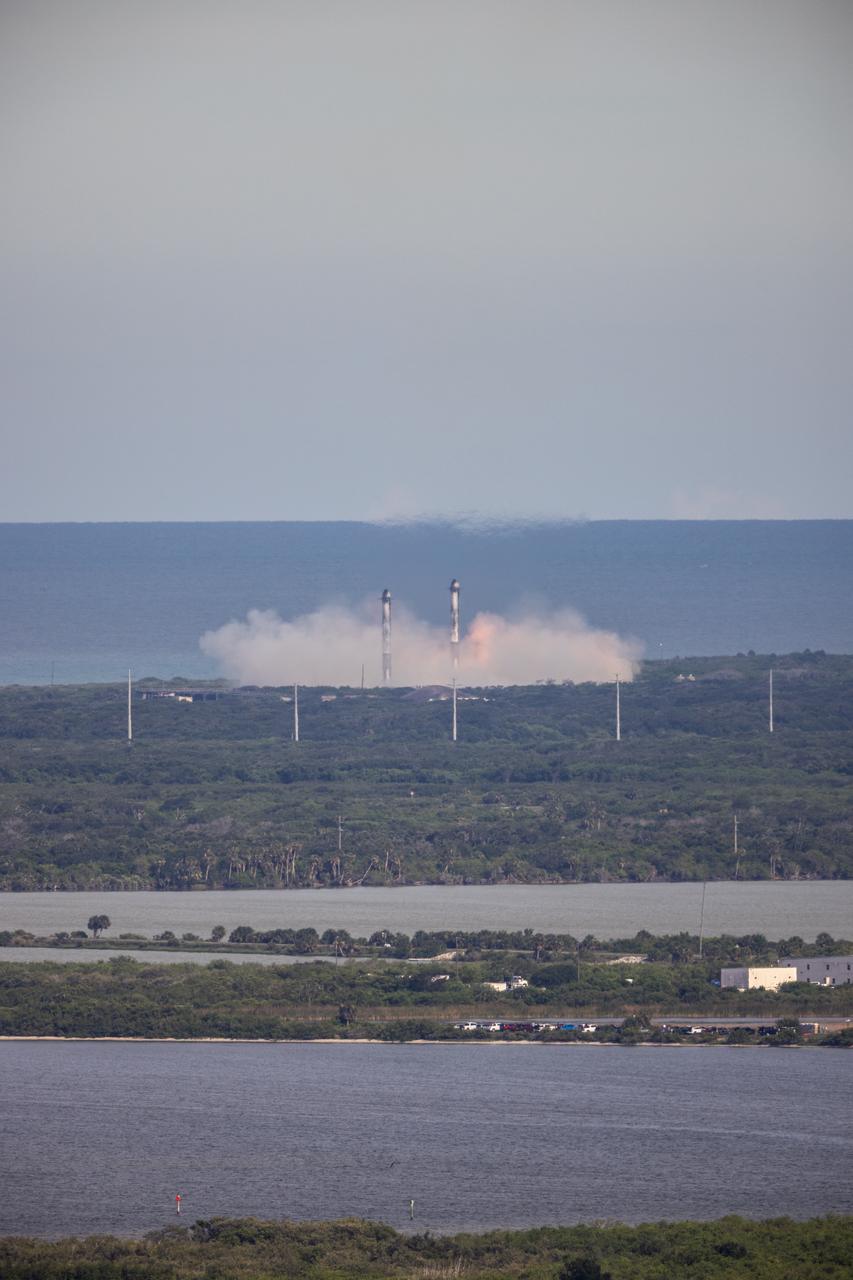
The SpaceX Falcon Heavy dual side boosters land on SpaceX Landing Zones 1 and 2 at Cape Canaveral Space Force Station in Florida. The rocket carrying NOAA’s (National Oceanic and Atmospheric Administration) Geostationary Operational Environmental Satellite (GOES-U) launched from NASA’s Kennedy Space Center in Florida on Tuesday, June 25, 2024.

Engineers and technicians with the Exploration Ground Systems Program attach an overhead crane to the left aft assembly, or bottom portion of the solid rocket boosters for the SLS (Space Launch System) rocket, inside the Vehicle Assembly Building at NASA’s Kennedy Space Center on Tuesday, Nov. 19, 2024. The crane will lift the aft assembly on top of mobile launcher 1 followed by the right aft assembly and stack the remaining booster segments for the Artemis II mission.
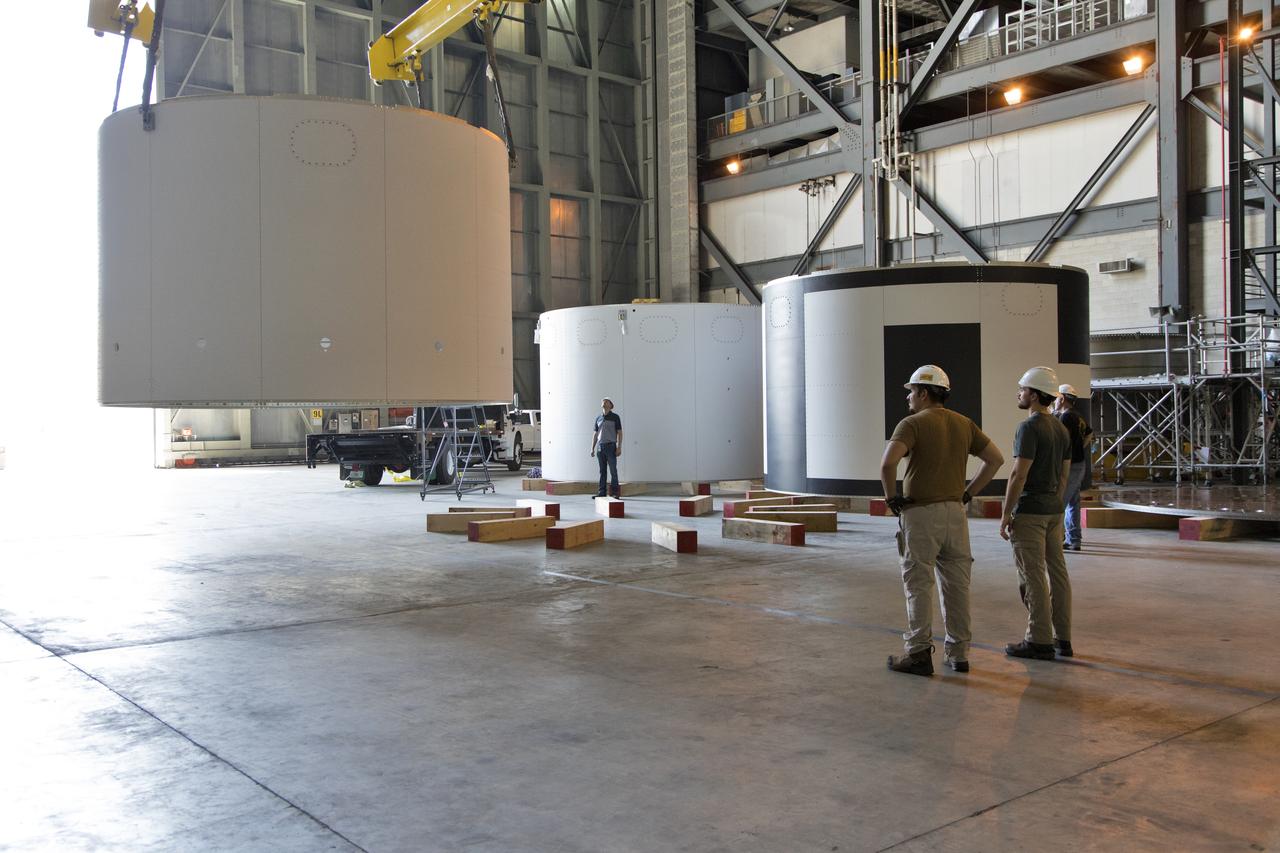
The third and final aeroshell for Orion's Launch Abort System (LAS) is lifted by crane in High Bay 4 of the Vehicle Assembly Building on July 12, 2018, at NASA's Kennedy Space Center in Florida. The aeroshell was shipped from EMF Inc. on nearby Merritt Island. All three aeroshells will be stacked and prepared for a full-stress test of the LAS, called Ascent Abort-2 (AA-2) flight test, scheduled for April 2019. During the test, a booster will launch from Space Launch Complex 46 at Cape Canaveral Air Force Station, carrying a fully functional LAS and a 22,000-pound Orion test vehicle to an altitude of 31,000 feet and traveling at more than 1,000 miles an hour. The test will verify the LAS can steer the crew module and astronauts aboard to safety in the event of an issue with the Space Launch System (SLS) rocket when the spacecraft is under the highest aerodynamic loads it will experience during a rapid climb into space. Orion is being prepared for its first integrated uncrewed flight atop the SLS on Exploration Mission-1.
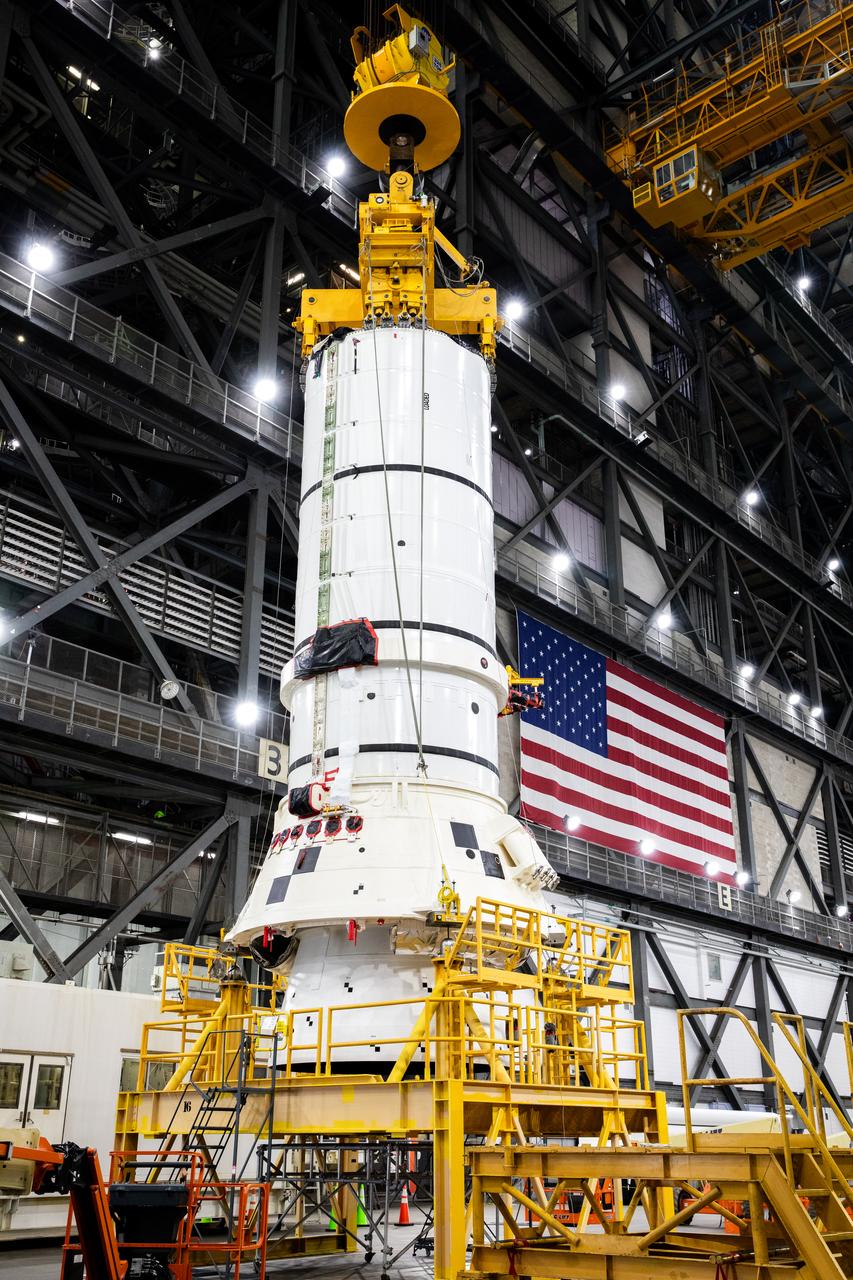
Engineers and technicians with the Exploration Ground Systems Program attach an overhead crane to the left aft assembly, or bottom portion of the solid rocket boosters for the SLS (Space Launch System) rocket, inside the Vehicle Assembly Building at NASA’s Kennedy Space Center on Tuesday, Nov. 19, 2024. The crane will lift the aft assembly on top of mobile launcher 1 followed by the right aft assembly and stack the remaining booster segments for the Artemis II mission.
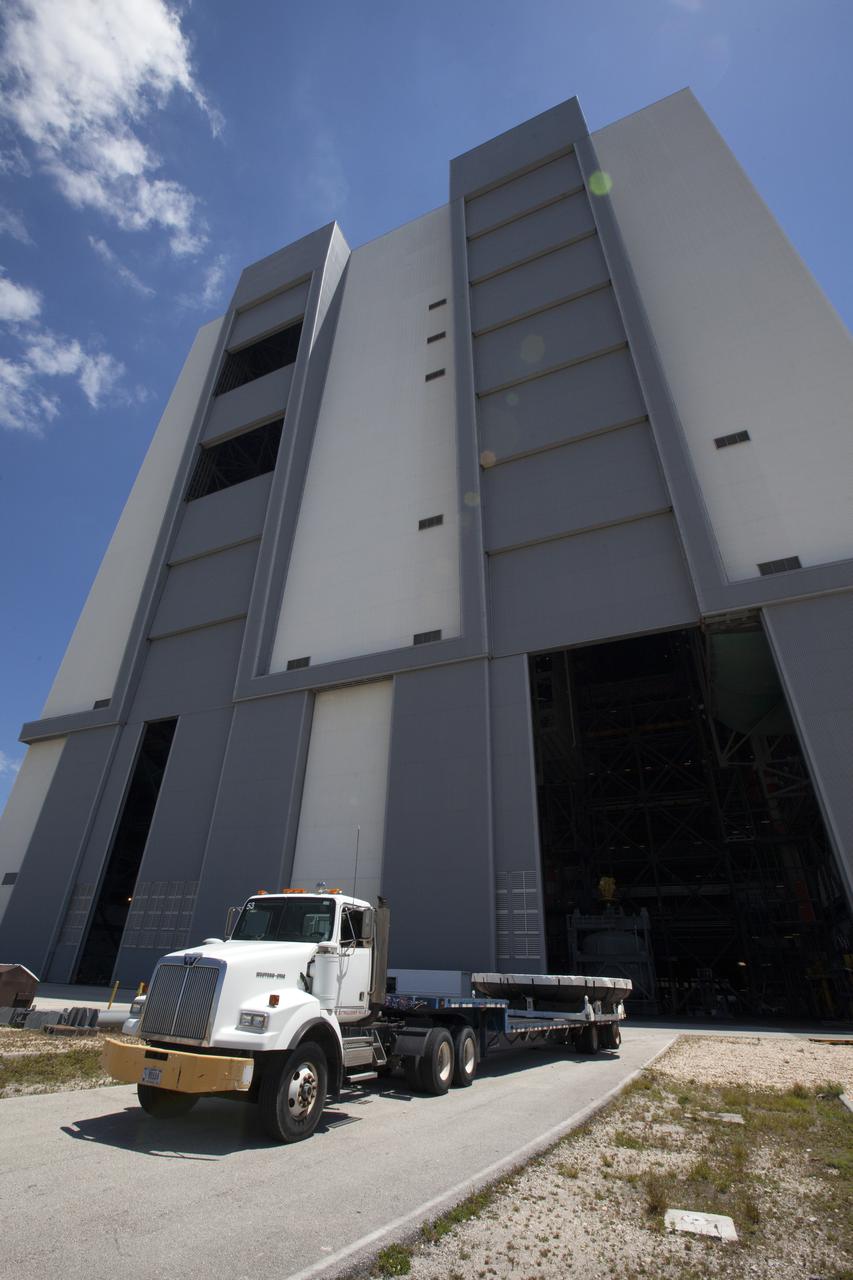
A flatbed truck carrying the Orion heat shield from Exploration Flight Test-1, prepares to back into High Bay 2 in the Vehicle Assembly Building (VAB) at NASA's Kennedy Space Center in Florida. The heat shield was moved from the Launch Abort System Facility. The heat shield is being transferred from the Orion Program to the Ground Systems Development and Operations Program, Landing and Recovery Operations. In the VAB, the heat shield will be integrated with the Orion ground test article and used for future underway recovery testing.
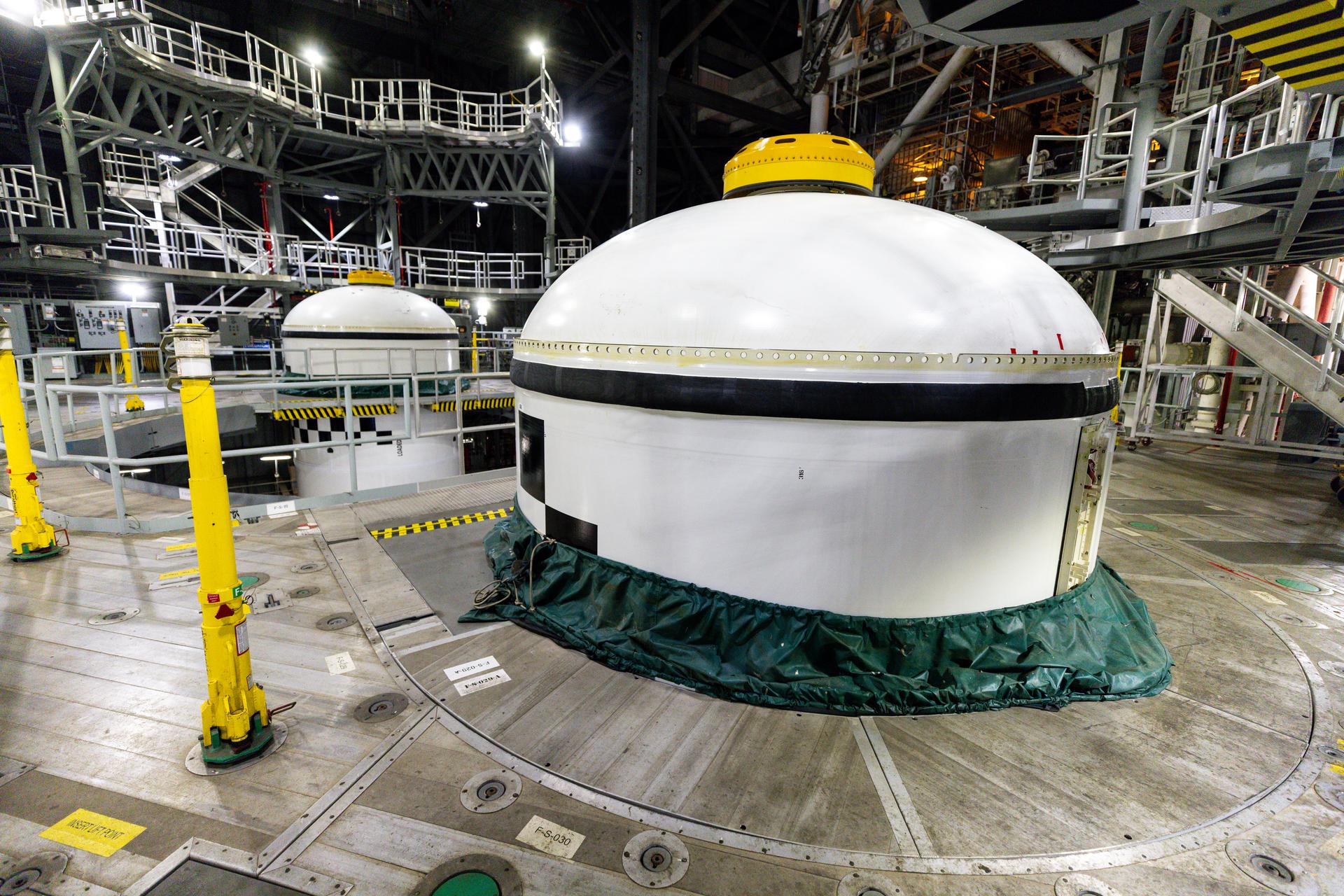
In High Bay 3 of the Vehicle Assembly Building at NASA’s Kennedy Space Center in Florida, the final left and right forward solid rocket booster motor segments for Artemis III are integrated onto the mobile launcher for the SLS (Space Launch System) rocket on Thursday, Sept. 24, 2026. The twin boosters, consisting of five segments each manufactured by Northrop Grumman in Utah, will provide more than 75 percent of the SLS rocket’s total thrust at launch. The Artemis III mission will launch crew in the Orion spacecraft on top of the SLS rocket to test rendezvous and docking capabilities between Orion and commercial spacecraft needed to land astronauts on the Moon.
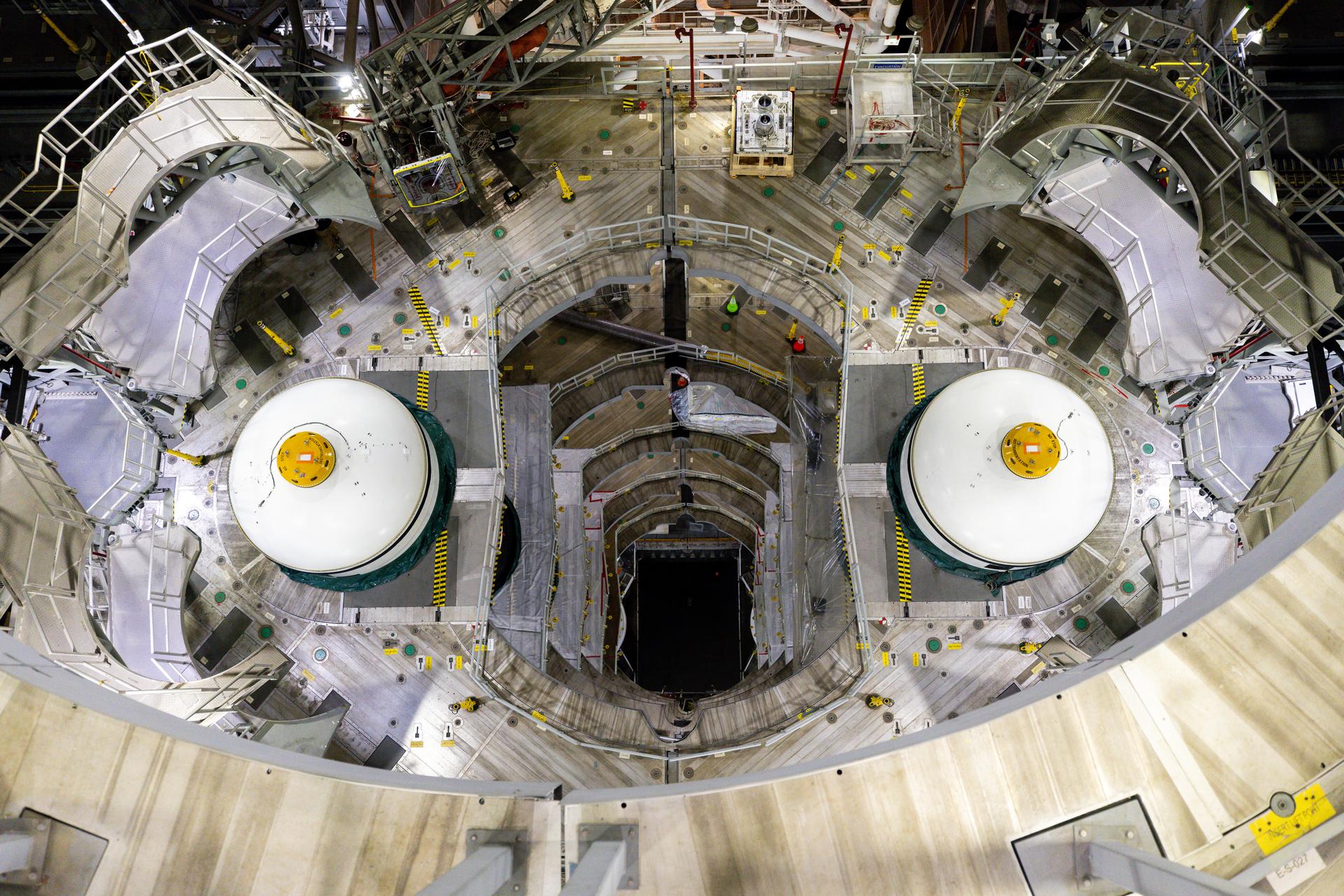
In High Bay 3 of the Vehicle Assembly Building at NASA’s Kennedy Space Center in Florida, the final left and right forward solid rocket booster motor segments for Artemis III are integrated onto the mobile launcher for the SLS (Space Launch System) rocket on Thursday, Sept. 24, 2026. The twin boosters, consisting of five segments each manufactured by Northrop Grumman in Utah, will provide more than 75 percent of the SLS rocket’s total thrust at launch. The Artemis III mission will launch crew in the Orion spacecraft on top of the SLS rocket to test rendezvous and docking capabilities between Orion and commercial spacecraft needed to land astronauts on the Moon.
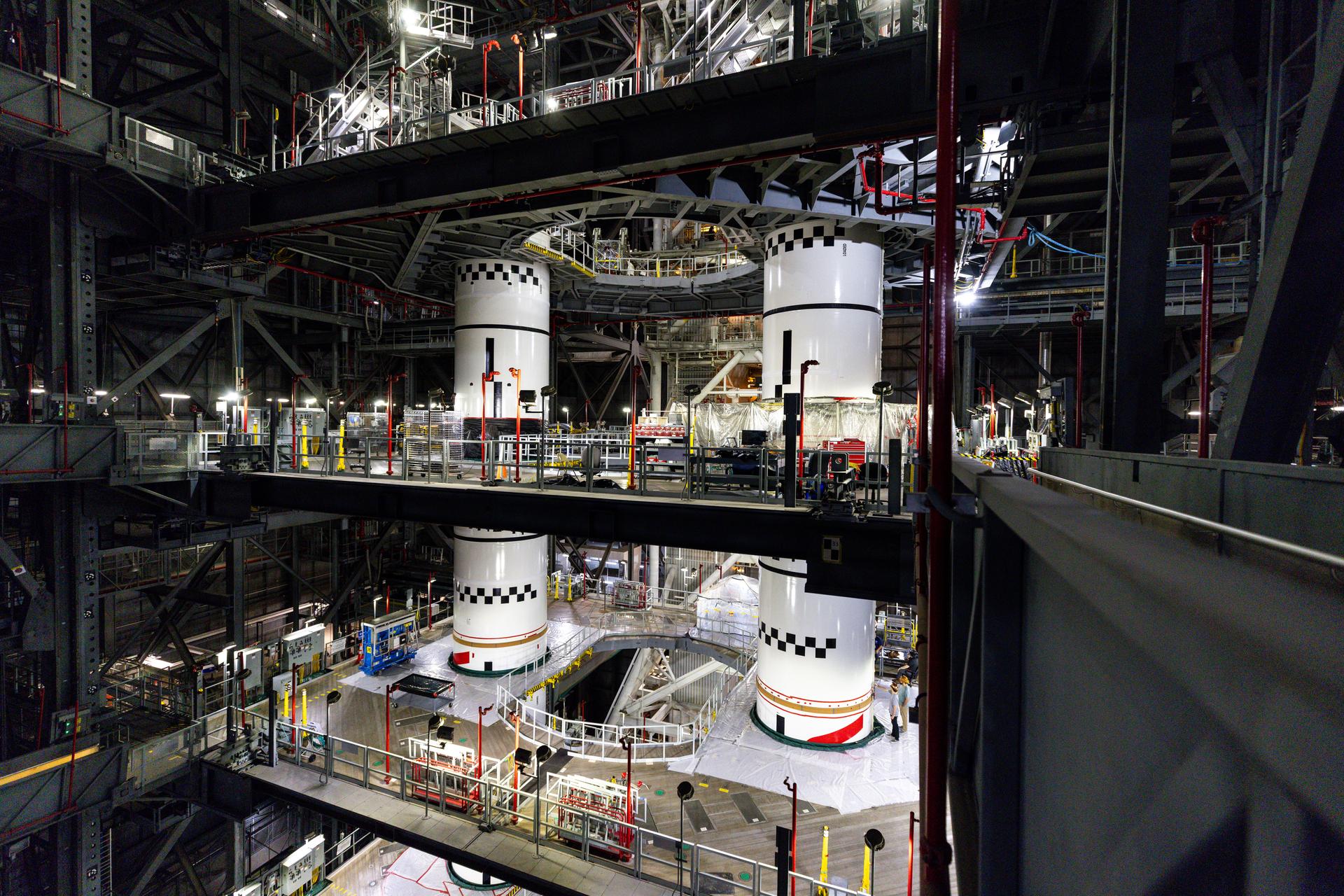
In High Bay 3 of the Vehicle Assembly Building at NASA’s Kennedy Space Center in Florida, the final left and right forward solid rocket booster motor segments for Artemis III are integrated onto the mobile launcher for the SLS (Space Launch System) rocket on Thursday, Sept. 24, 2026. The twin boosters, consisting of five segments each manufactured by Northrop Grumman in Utah, will provide more than 75 percent of the SLS rocket’s total thrust at launch. The Artemis III mission will launch crew in the Orion spacecraft on top of the SLS rocket to test rendezvous and docking capabilities between Orion and commercial spacecraft needed to land astronauts on the Moon.
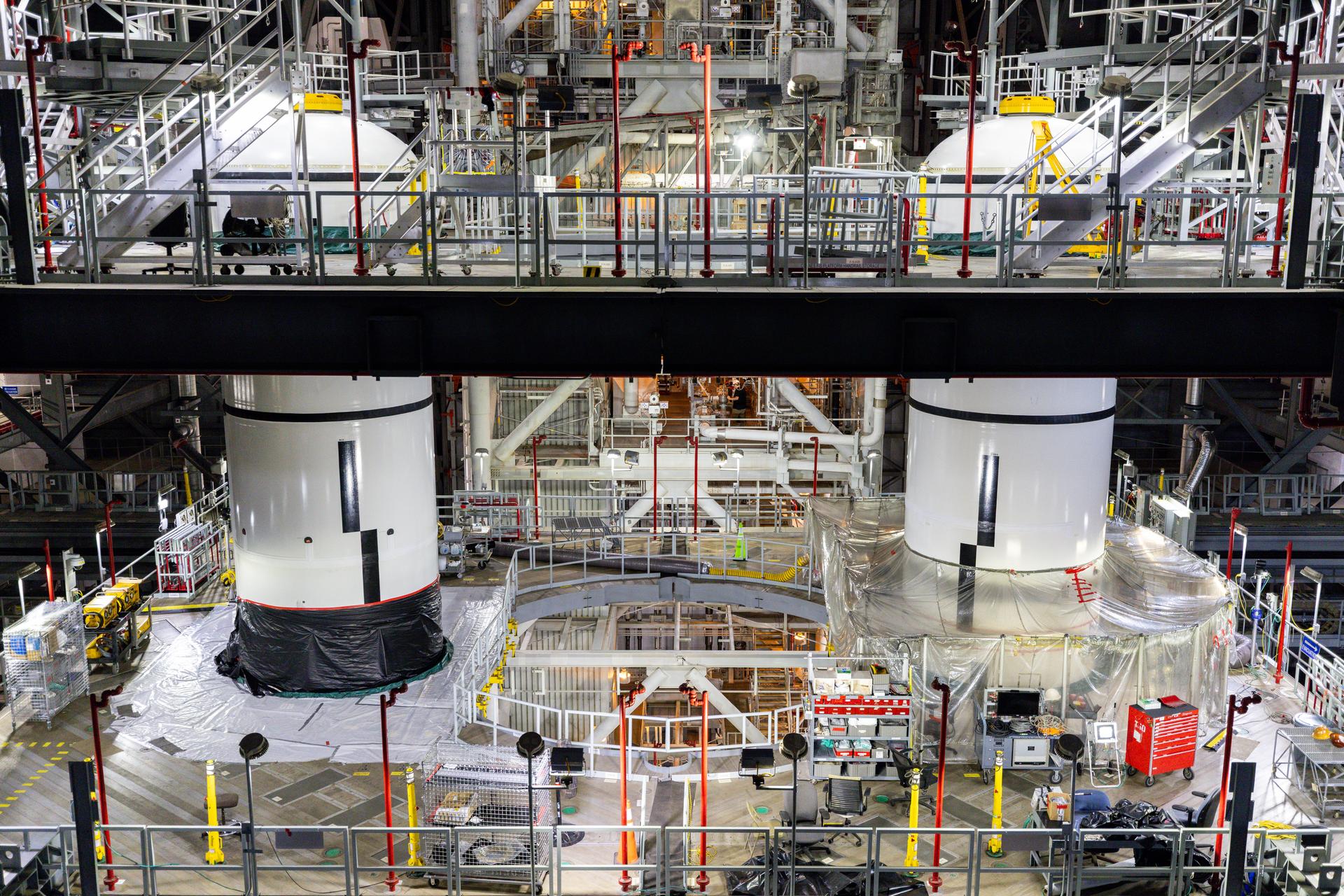
In High Bay 3 of the Vehicle Assembly Building at NASA’s Kennedy Space Center in Florida, the final left and right forward solid rocket booster motor segments for Artemis III are integrated onto the mobile launcher for the SLS (Space Launch System) rocket on Thursday, Sept. 24, 2026. The twin boosters, consisting of five segments each manufactured by Northrop Grumman in Utah, will provide more than 75 percent of the SLS rocket’s total thrust at launch. The Artemis III mission will launch crew in the Orion spacecraft on top of the SLS rocket to test rendezvous and docking capabilities between Orion and commercial spacecraft needed to land astronauts on the Moon.