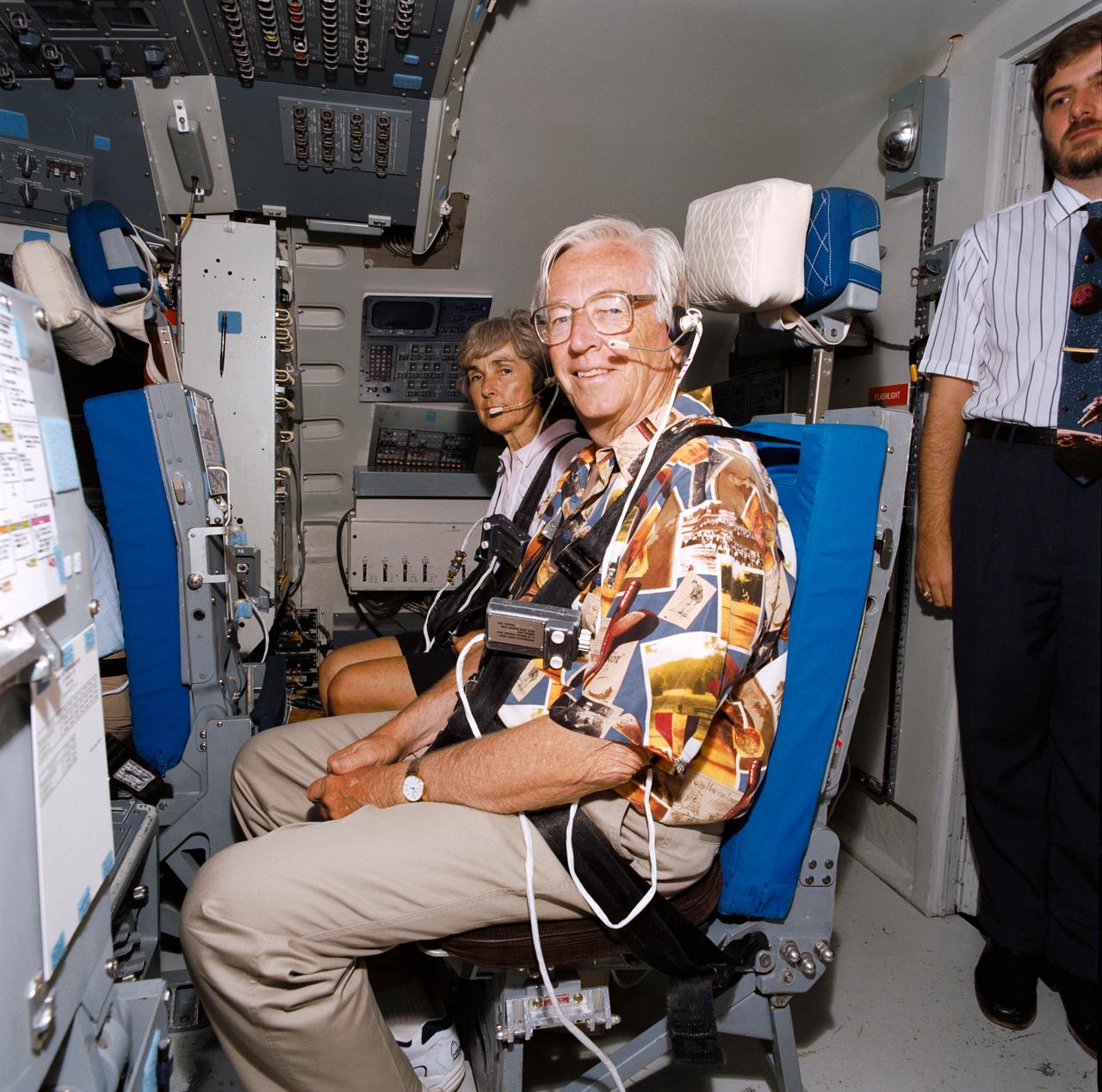
Charles Schulz Memorial Library. View of unidentified individual in cockpit area (02834 thru 02835); and View of unidentified individuals in cockpit area (02836).
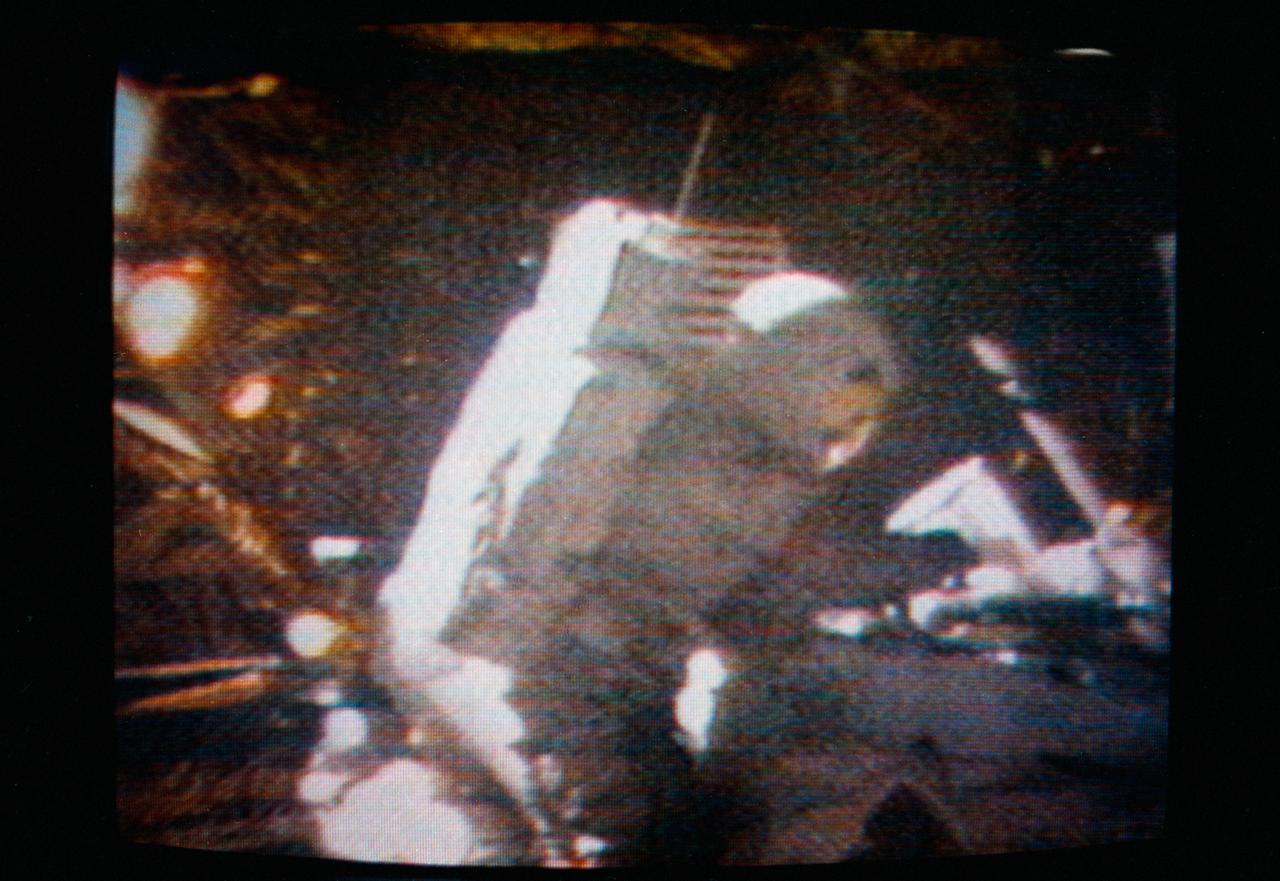
S71-43785 (2 Aug. 1971) --- Astronaut David R. Scott, Apollo 15 commander, performs the act of cancelling the first Apollo 15 commemorative postage stamp on the moon, as seen in this color reproduction taken from a transmission made by the RCA color television camera mounted on the Lunar Roving Vehicle. Scott holds a stamp cancellation device in his right hand. The new commemorative postage stamp heralds: "United States in Space -- A Decade of Achievement." The U.S. Postal Service chose artist Robert McCall of Paradise Valley, Arizona, to design the new U.S. eight-cent stamp. The stamp cancellation occurred toward the end of the third and final lunar surface extravehicular activity by astronauts Scott and James B. Irwin, lunar module pilot.
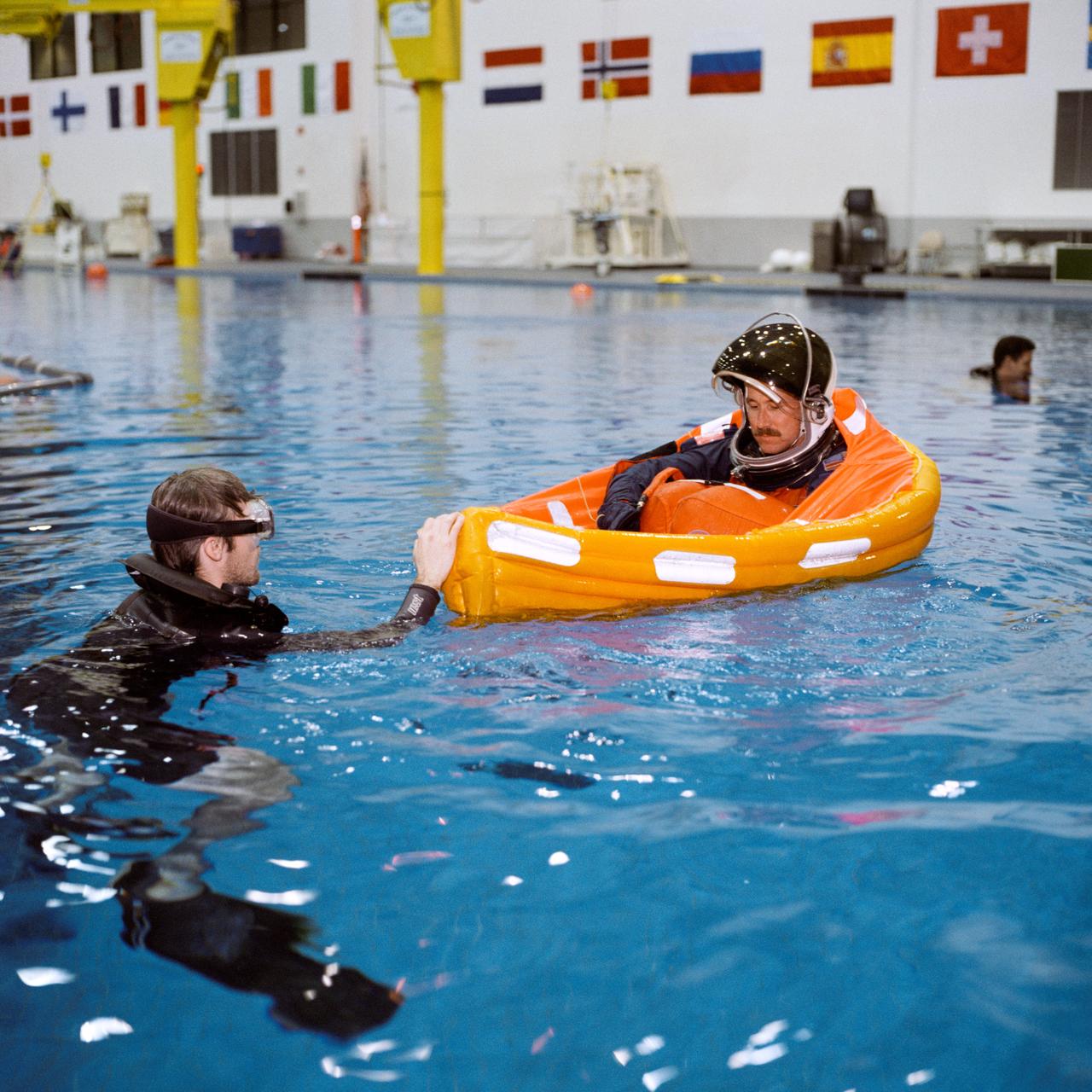
Photographic documentation of the crew of STS-96 conducting bailout training in the Neutral Buoyancy Lab (NBL) pool. Images include: an unidentifiable astronaut in an orange Launch and Entry Suit and helmet being dropped into the pool during training (00580); Mission Specialist (MS) Julie Payette being suspended above the NBL pool prior to being dropped (00581); Julie Payette in her floatation device in the NBL pool (00582-7); Flight Commander Kent Rominger in a blue Launch and Entry Suit (LES) being suspended over the NBL pool prior to being dropped (00589); Mission Specialist (MS) Ellen Ochoa in an orange LES being suspended over the NBL pool prior to being dropped (00590); Pilot Rick D. Husband and MS Daniel T. Barry in floatation devices (00591); closeups of Julie Payette prior to being lifted above the NBL pool (00592-3); MS Tamara E. Jernigan in her floatation device (00594); Julie Payette talking with a NASA employee prior to being raised over the pool (00595); Husband in an orange LES and helmet seated at the poolside talking with a NASA employee (00596); Kominger in his floatation device (00597-8); Barry being assisted with his floatation device at the poolside (00599); Ochoa in her orange LES with helmet talking to NASA personnel at the poolside (00600); Husband in his floatation device operating a transmitter (00601); Rominger splashing Husband (00602); Husband in his floatation device (00603); Barry in an orange LES suspended over the NBL pool prior to being dropped (00604); Ochoa in her floatation device (00605, 00607-8); and Ochoa suspended over the NBL pool with part of her floatation device already inflated (00606).
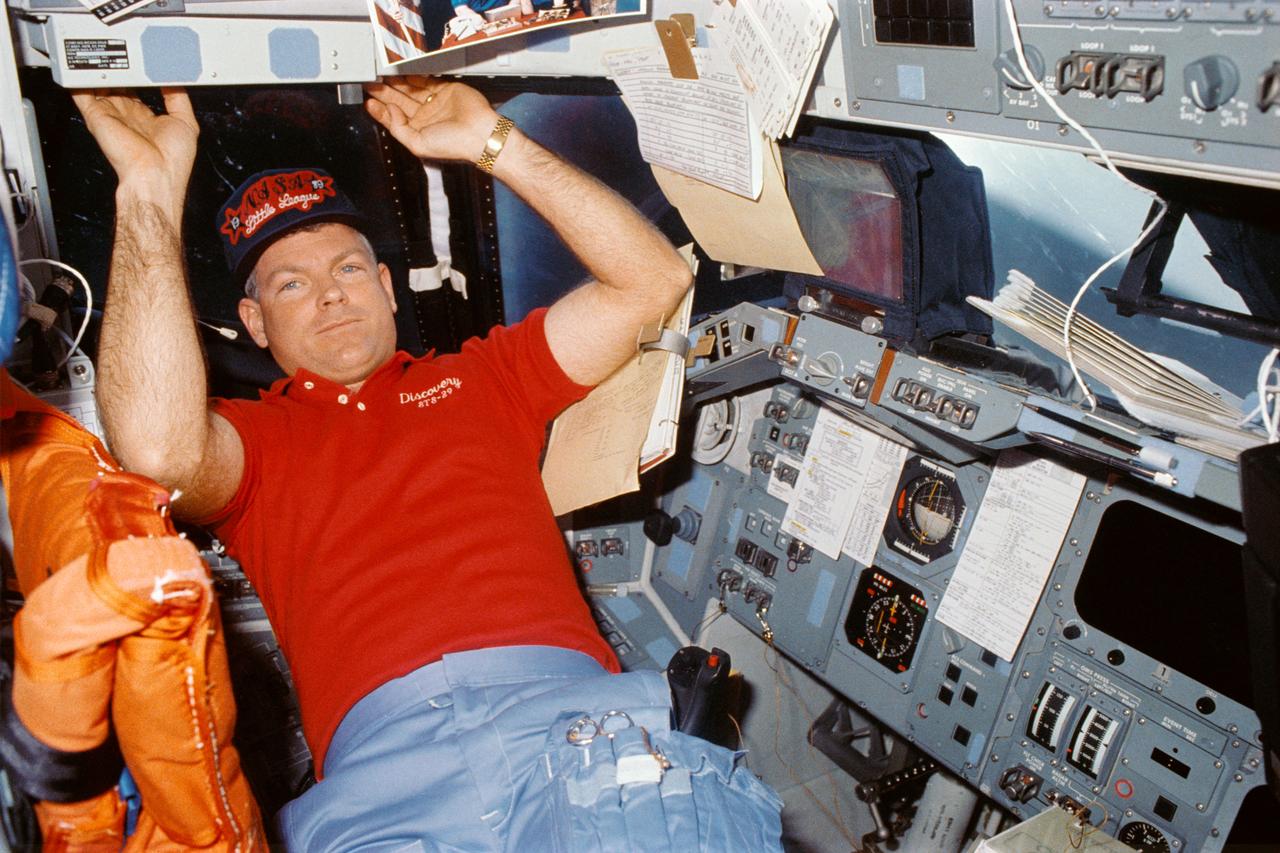
S29-11-024 (13-18 March 1989) --- Astronaut Michael L. Coats, STS-29 commander, stretches across the forward flight deck of the space shuttle Discovery during a rare moment of leisure on the busy five-day mission. Photo credit: NASA
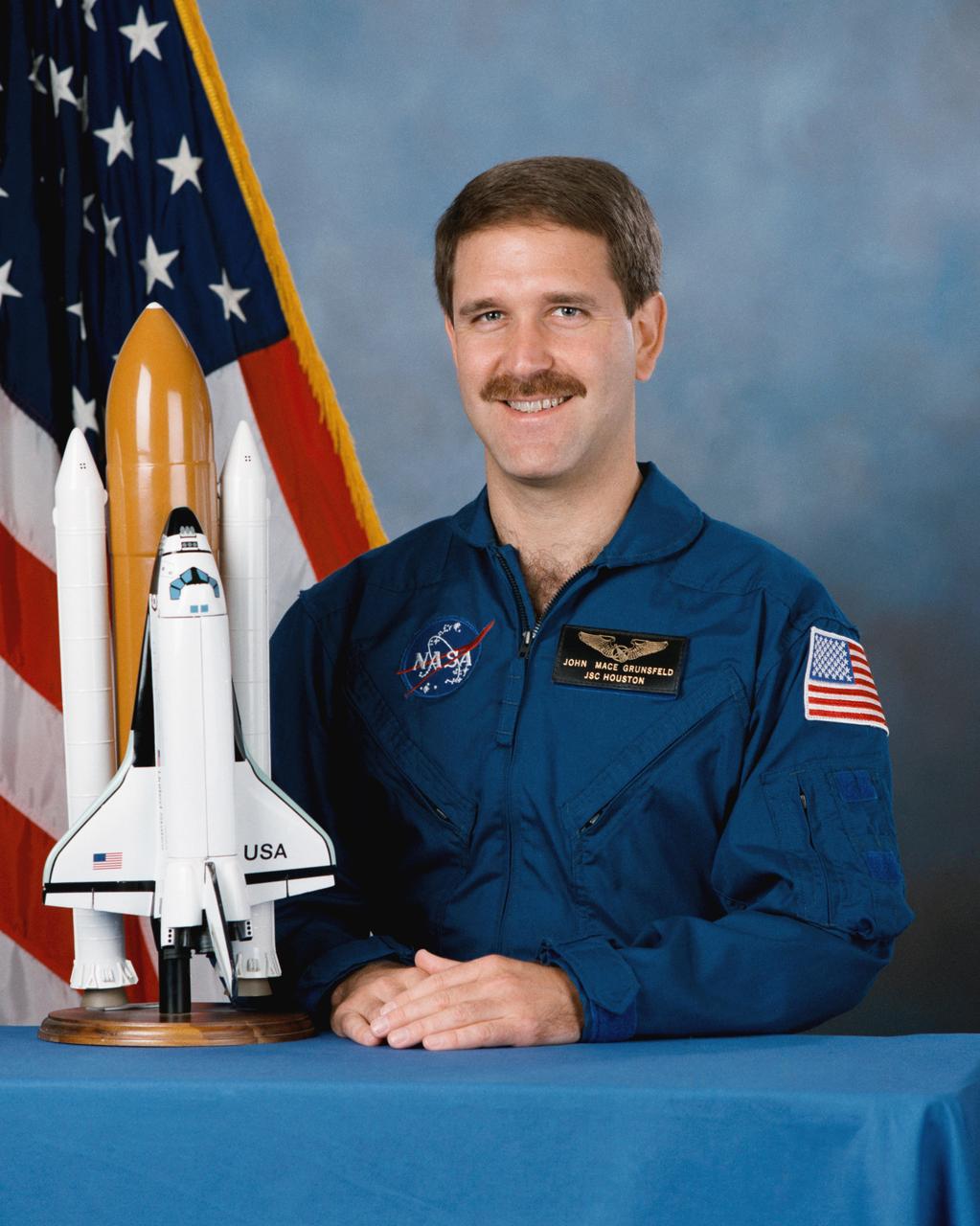
S92-45921 (21 Sept. 1992) --- Astronaut John M. Grunsfeld.
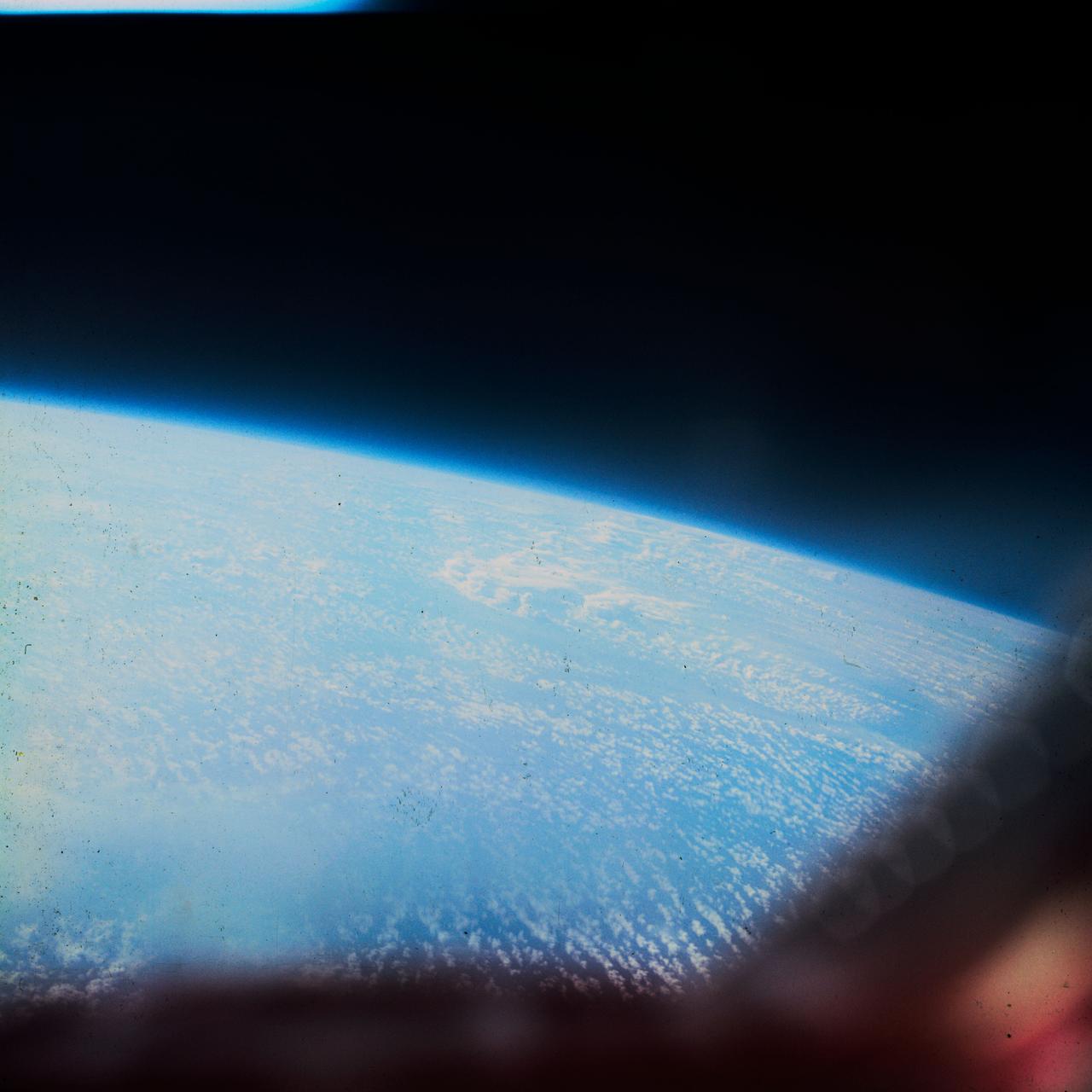
S62-06612 (3 Oct. 1962) --- Cloud formation over South America taken during the fifth orbit pass of the Mercury-Atlas 8 (MA-8) mission by astronaut Walter M. Schirra Jr. with a hand-held camera. Photo credit: NASA

STS039-20-006 (28 April-6 May 1991) --- Astronaut Michael L. Coats, STS-39 mission commander, works controls of a robotic arm on the aft flight deck of the Earth-orbiting space shuttle Discovery. Out the overhead window, the SPAS-II hovers on the end of the remote manipulator system (RMS, out of frame). Inside the window, just above Coats' head is the Crewman Optical Alignment Sight (COAS), an optical device that aids in navigation. Photo credit: NASA
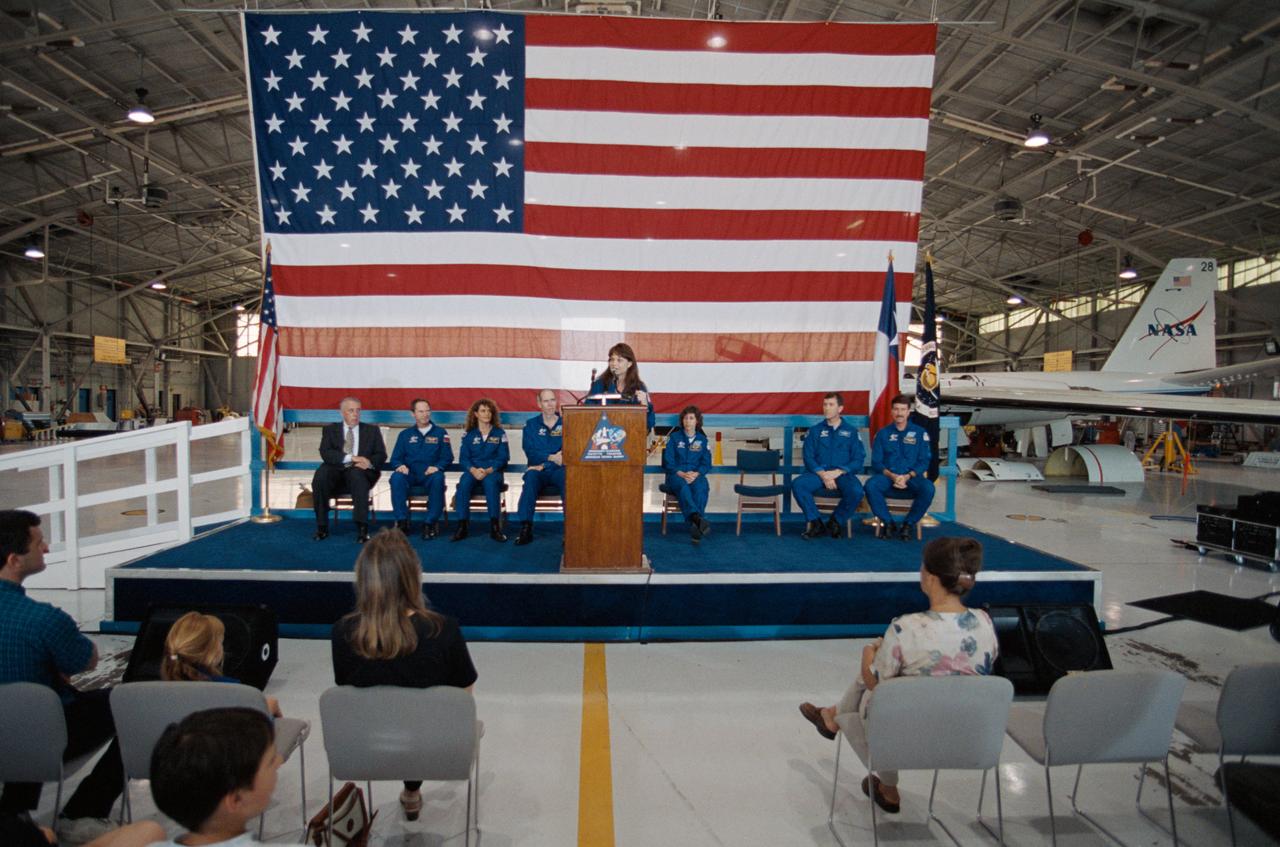
S99-05975 (7 June 1999) --- Astronaut Tamara E. Jernigan takes her turn at the lectern in Ellington Field's Hangar 990. Her six crew mates and JSC Director George W.S. Abbey, all seated behind, also spoke to the crowd gathered for the welcome home ceremonies.
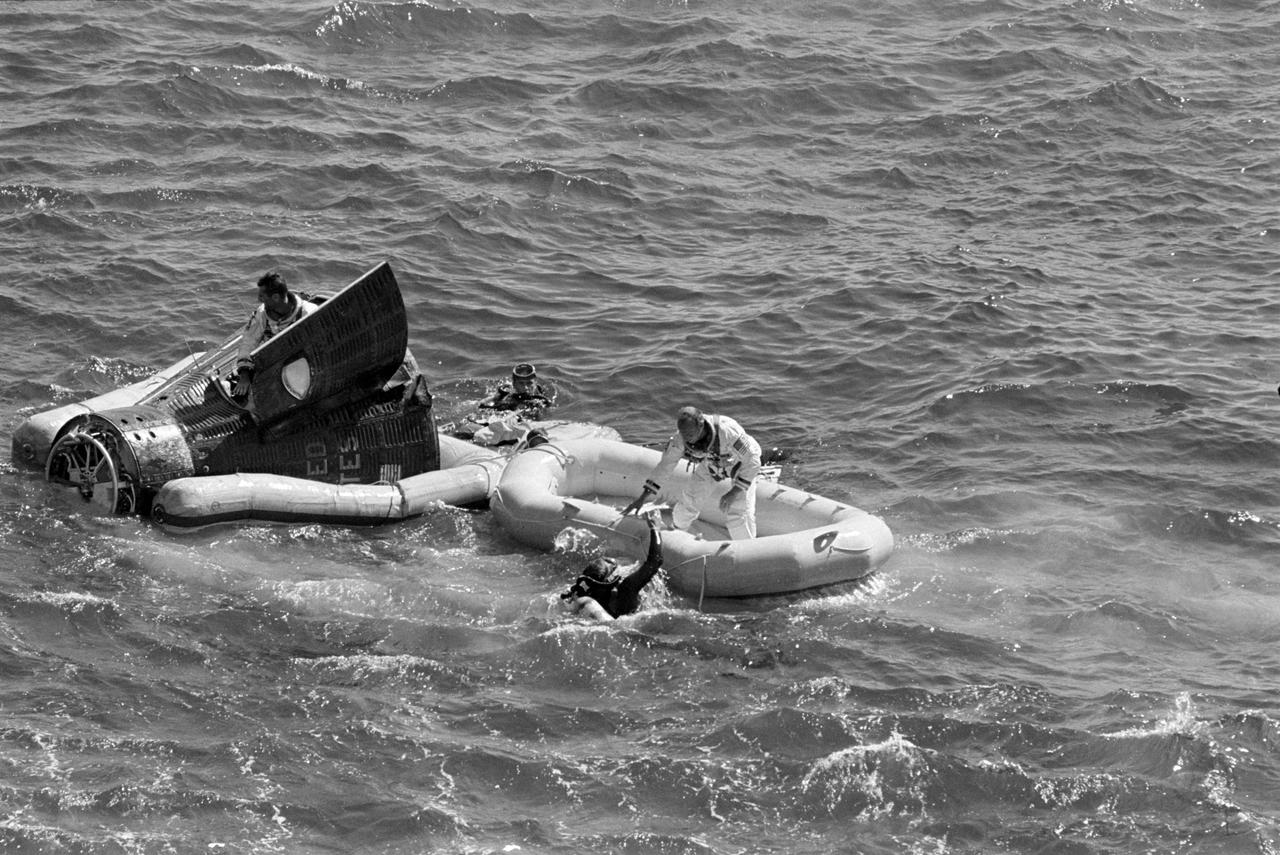
S66-50795 (15 Sept. 1966) --- Frogmen assist in the recovery of Gemini 11 astronauts Conrad & Gordon while they await the helicopter.

Apollo 6 (AS-502) Pacific Recovery
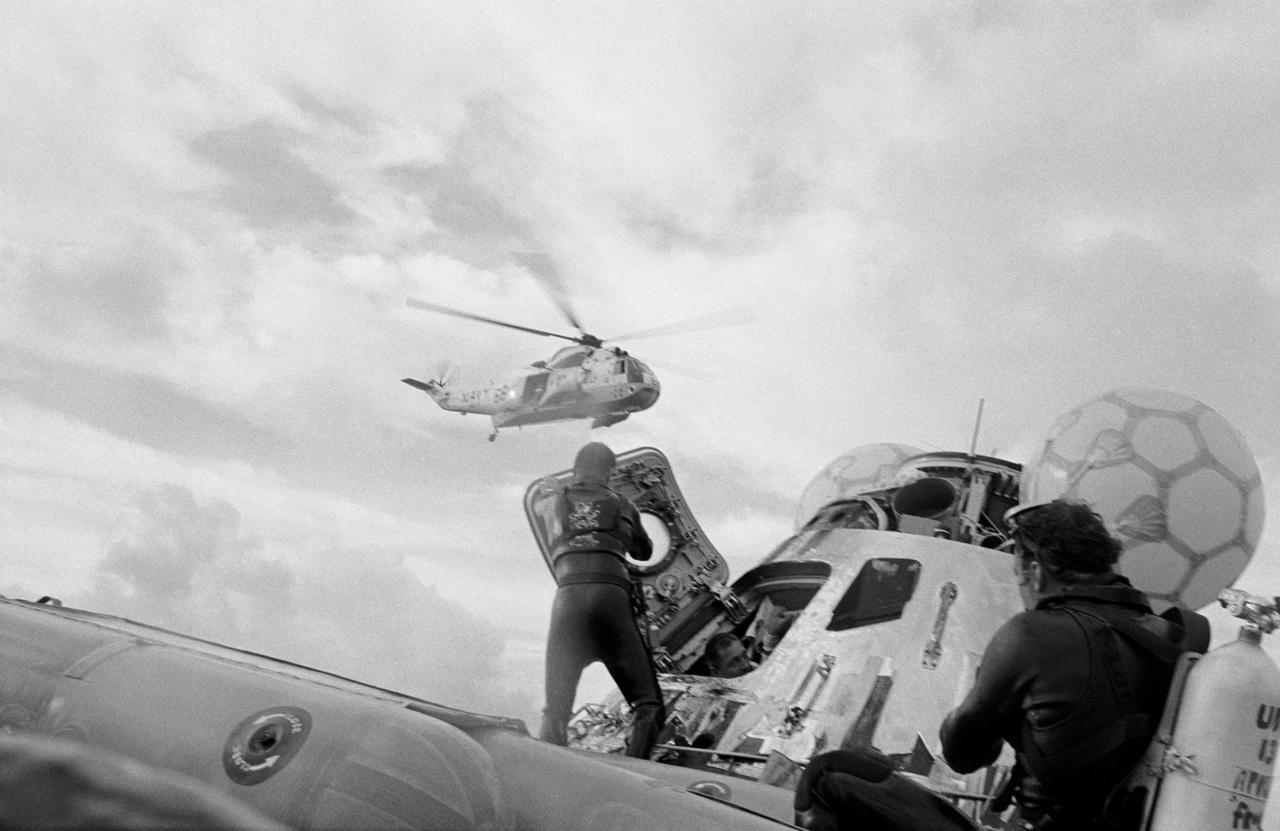
S70-35622 (17 April 1970) --- United States Navy underwater demolition team swimmers assist in the recovery operations of the Apollo 13 crewmembers, shortly after splashdown. The divers prepare to assist the astronauts out of their crippled Command Module (CM), into an awaiting life raft. Astronaut John L. Swigert Jr., command module pilot, is preparing to exit the CM. A Navy helicopter is waiting to take the astronauts to the prime recovery ship, the USS Iwo Jima. Apollo 13 splashed down at 12:07:44 p.m. (CST), April 17, 1970. Still aboard the CM are astronauts James A. Lovell Jr., commander; and Fred W. Haise Jr., lunar module pilot.
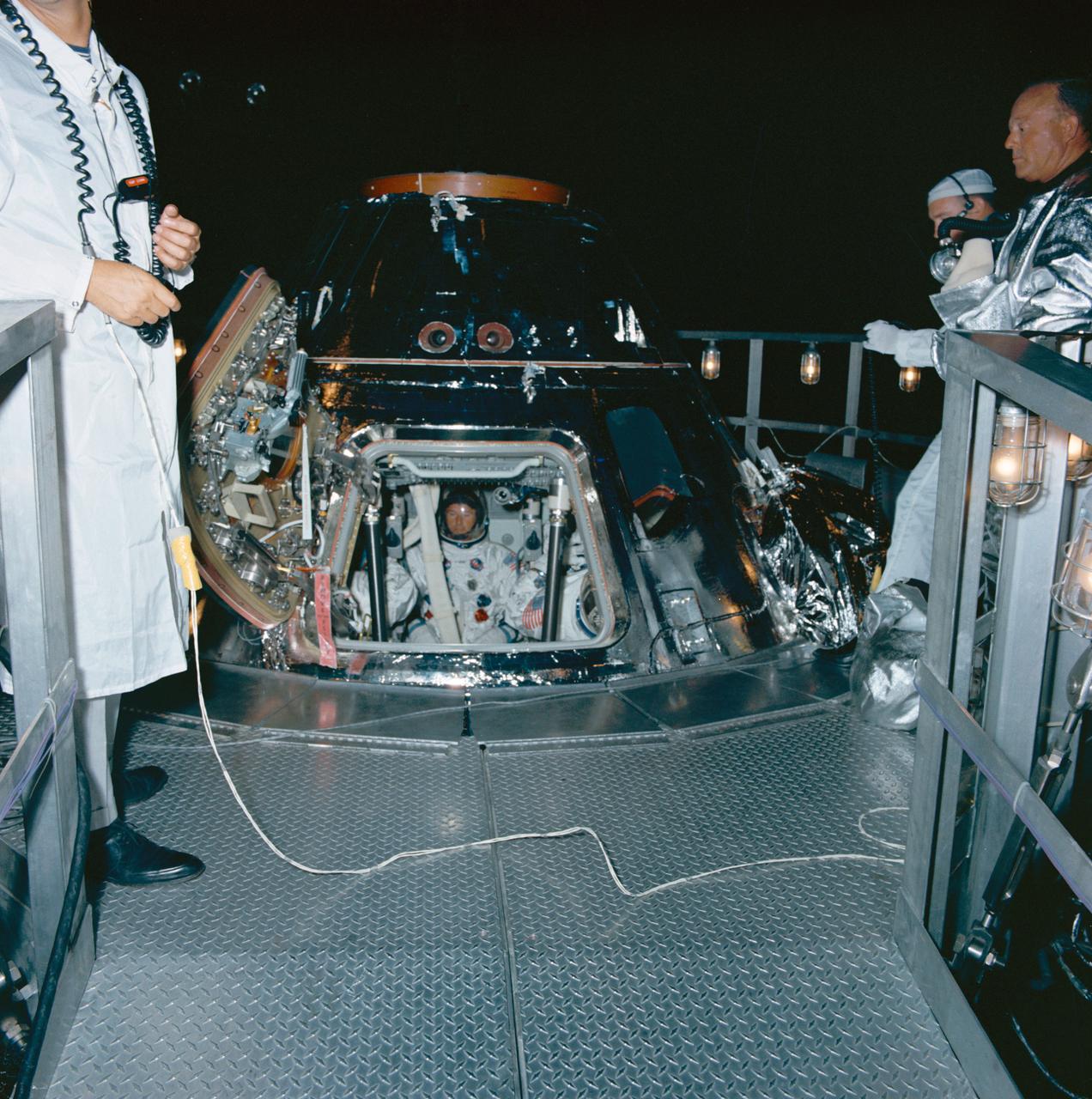
Crew ingress and beginnings of 7 1/2-day Manned Thermal Vacuum Test with Astronauts Joe Engle, Dr. Joseph Kerwin and Brand in the Apollo S/C-2TV-1, Chamber "A", Bldg. 32. Note - 35mm BW (S68-35881 thru S68-35882) - 120 CN (S68-35883 thru S68-35908) 1. ASTRONAUT BRAND, VANCE D. - VACUUM TEST 2. ASTRONAUT KERWIN, JOSEPH - VACUUM TEST 3. ASTRONAUT ENGLE, JOE - VACUUM MSC, HOUSTON, TX
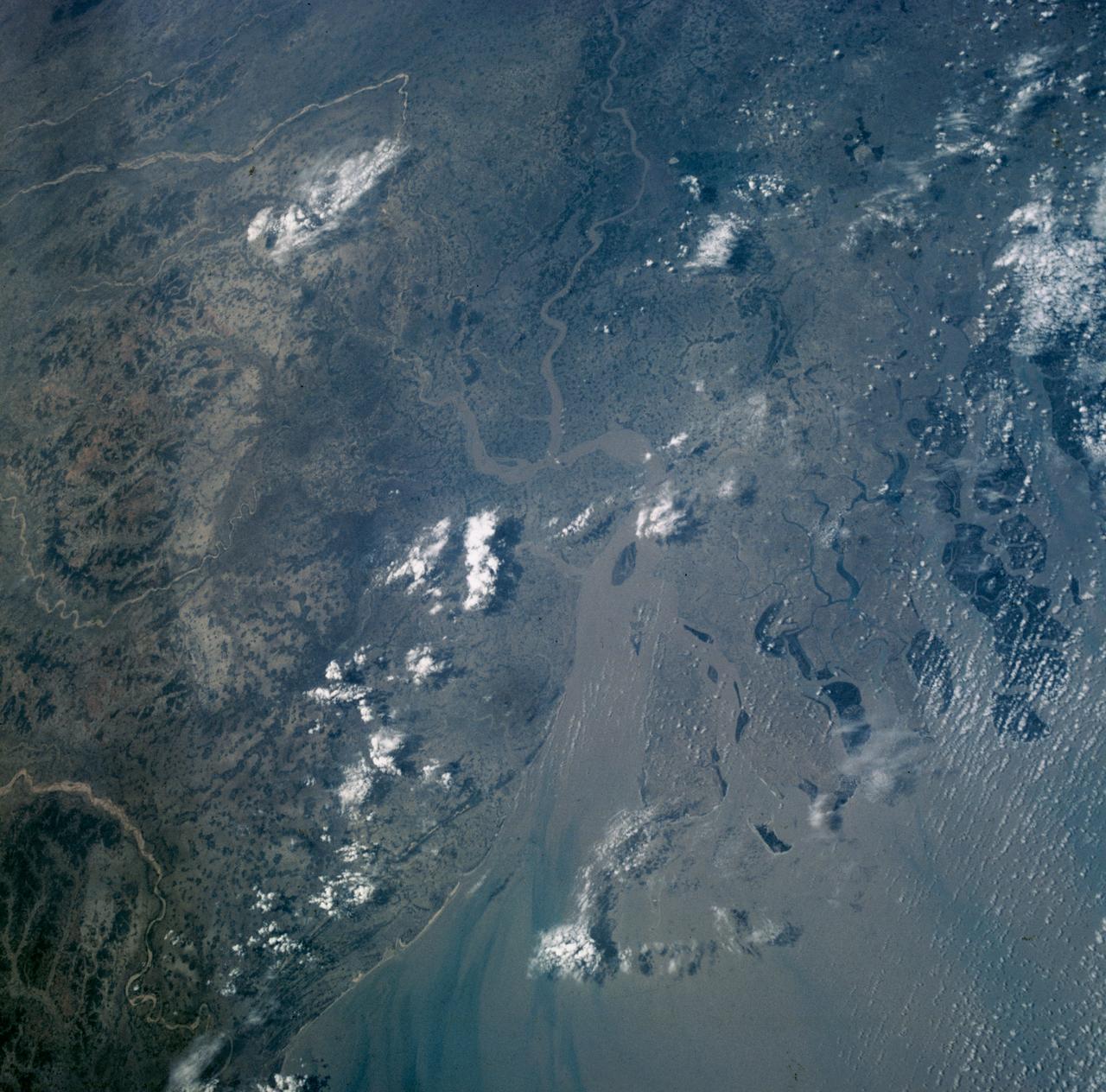
S63-06435 (15-16 May 1963) --- Part of the Ganges delta near Calcutta, as photographed from the Mercury-Atlas 9 (MA-9) capsule by astronaut L. Gordon Cooper Jr., during his 22-orbit MA-9 spaceflight. Photo credit: NASA
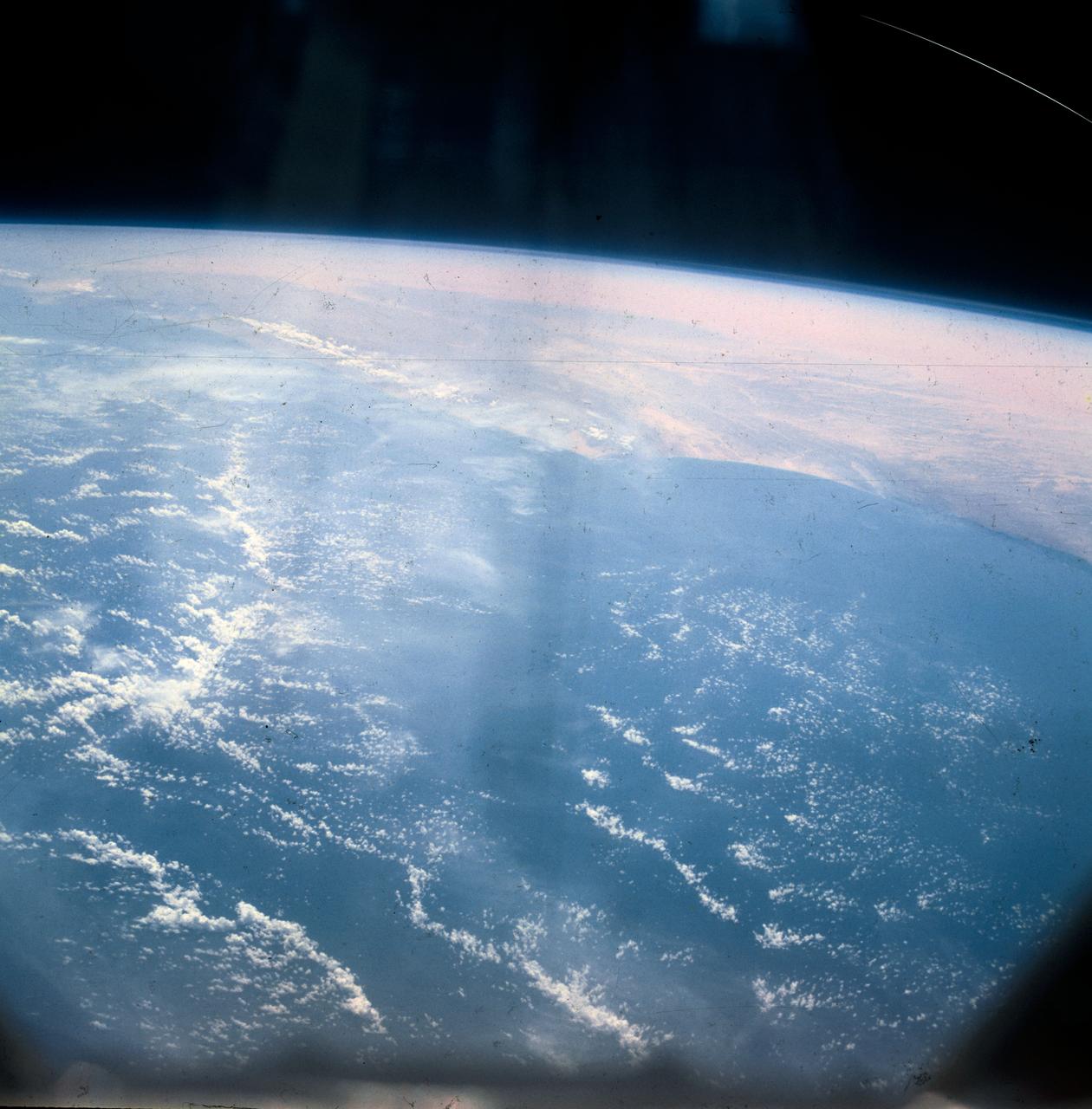
S63-06434 (15-16 May 1963) --- East looking view across Atlantic waters toward Africa, showing Mauritania and Spanish Sahara photographed from the Mercury-Atlas 9 (MA-9) capsule by astronaut L. Gordon Cooper Jr., during his 22-orbit MA-9 spaceflight. Photo credit: NASA
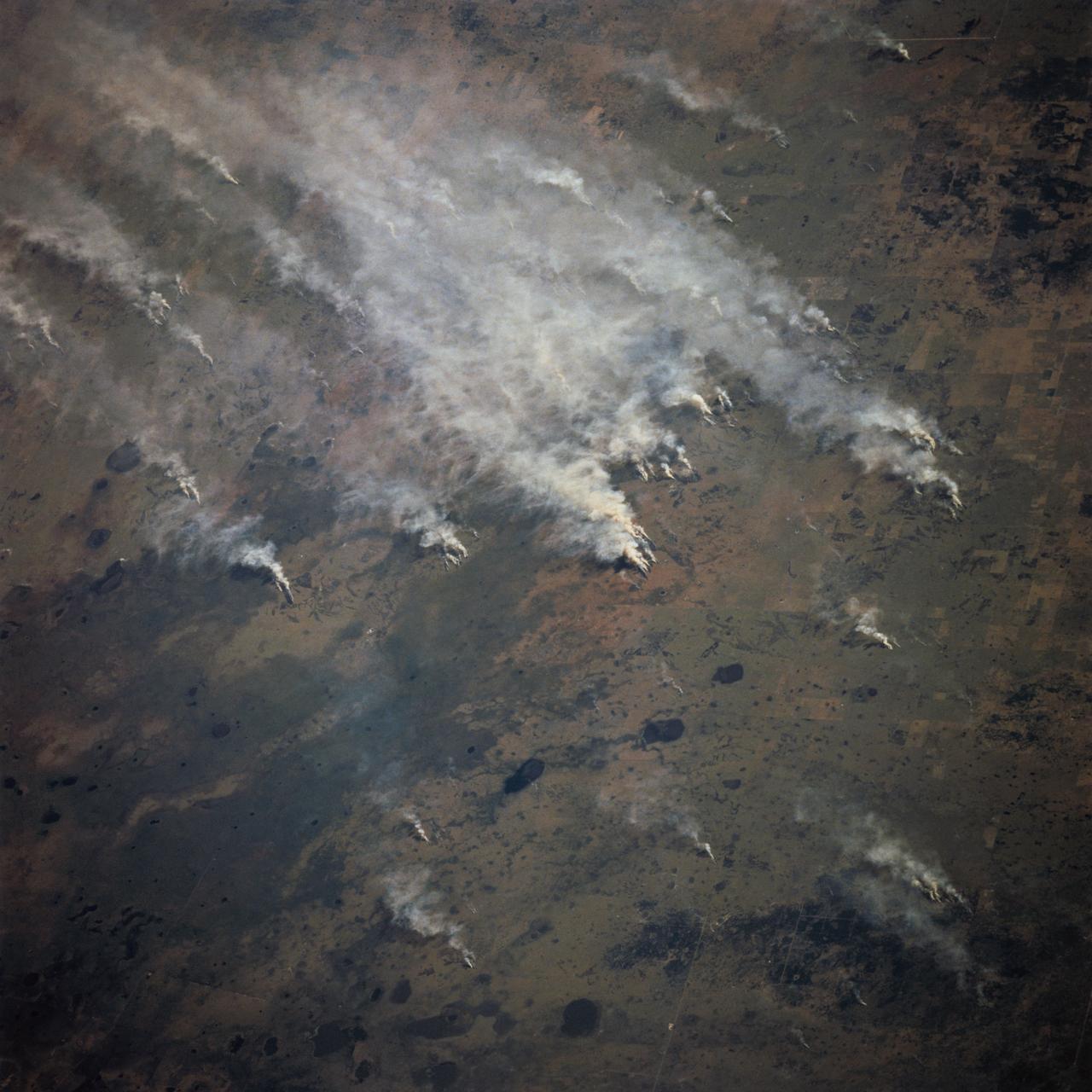
STS070-717-027 (13-22 JULY 1995) --- Easterly winds from the Mozambique Channel blow the smoke from many large fires in southern Mozambique inland. Neighboring views showed the smoke moving over and around the Chimanimani Mountains, into Zimbabwe on the African plateau. Winter is the dry season in southern Africa and fires are set to hasten the greening of the grass shoots for cattle grazing.
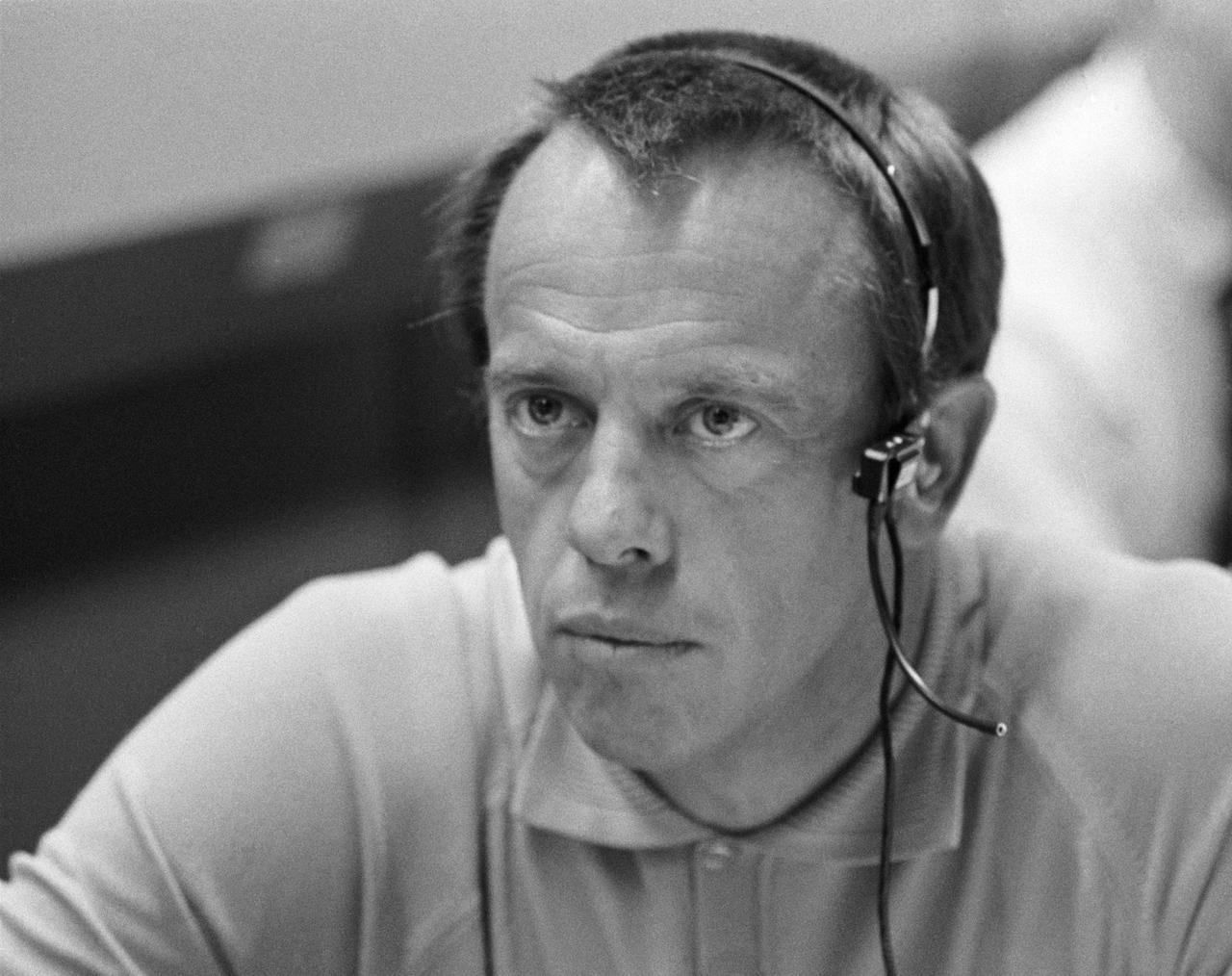
S70-34904 (14 April 1970) --- Astronaut Alan B. Shepard Jr., prime crew commander of the Apollo 14 mission, monitors communications between the Apollo 13 spacecraft and Mission Control Center. He is seated at a console in the Mission Operations Control Room of the MCC, Manned Spacecraft Center. The main concern of the moment was action taken by the three Apollo 13 crewmen - astronauts James A. Lovell Jr., John L. Swigert Jr. and Fred W. Haise Jr. - to make corrections inside the spacecraft following discovery of an oxygen cell failure several hours earlier.
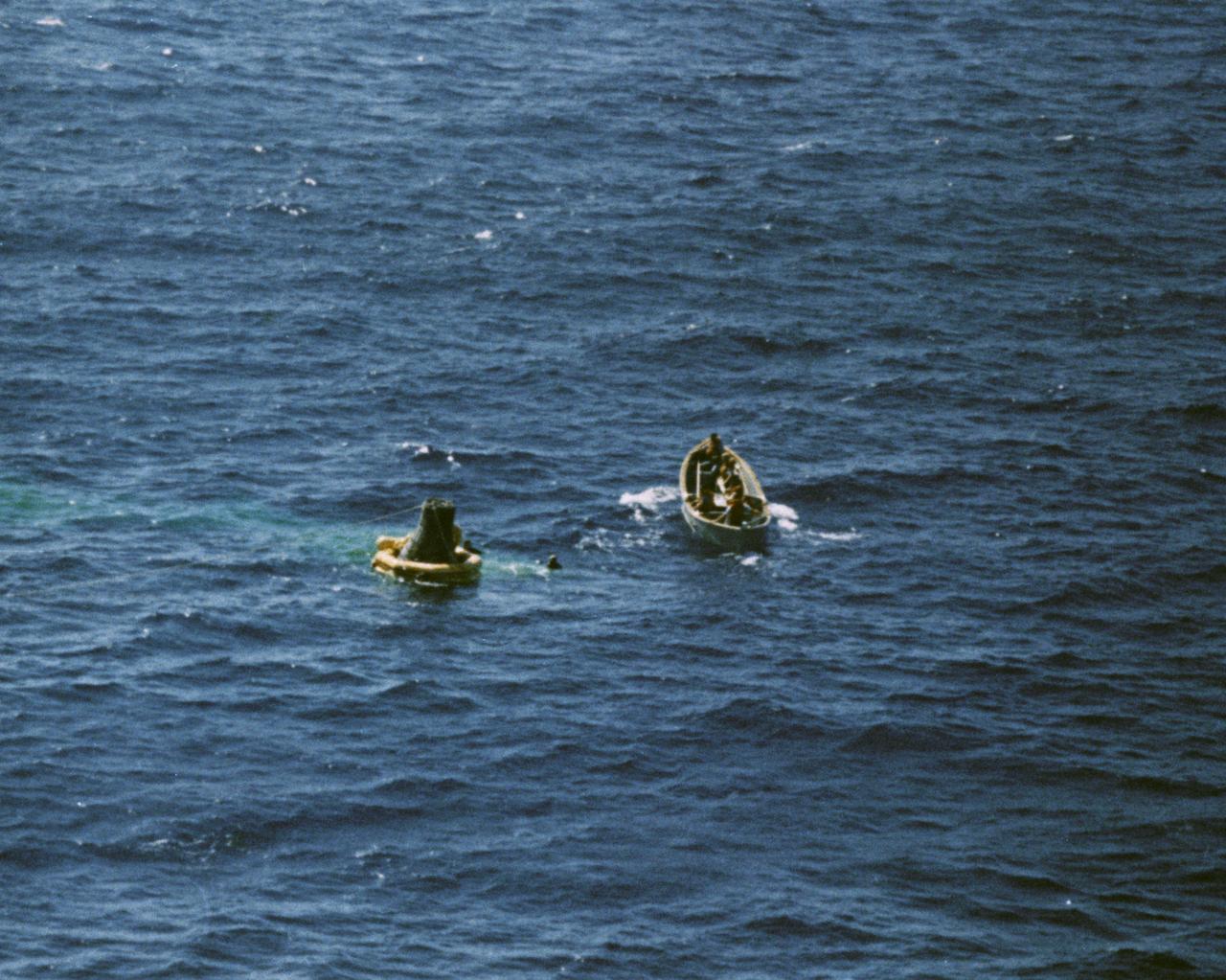
S62-09049 (3 Oct. 1962) --- Aerial view of a life boat from the USS Kearsarge, recovery ship, approaching the floating Sigma 7 capsule for the Mercury-Atlas 8 (MA-8) mission. Photo credit: NASA
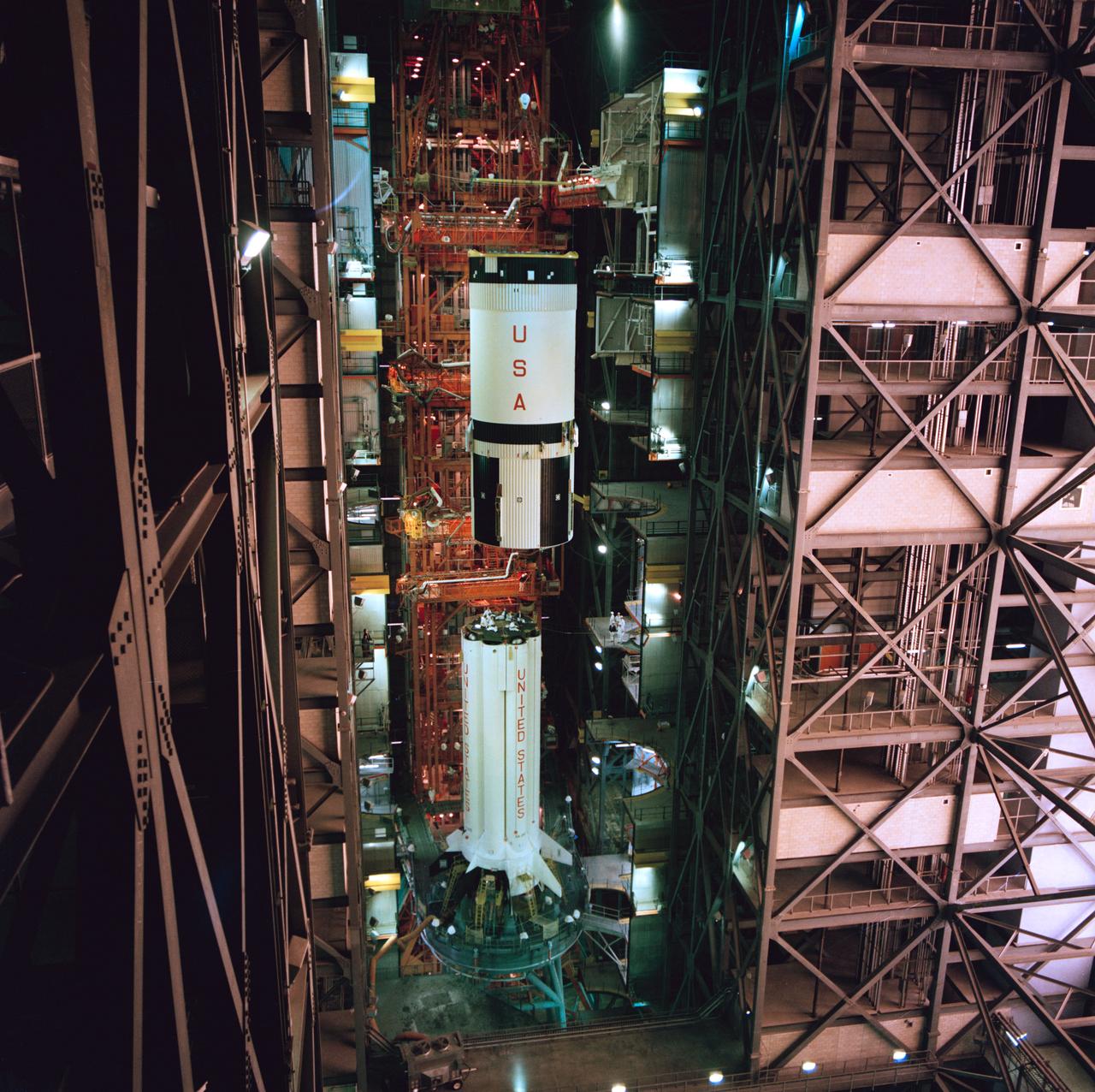
S75-20909 (January 1975) --- A high-angle view of the high-bay area in the Vehicle Assembly Building at the Kennedy Space Center showing the second (S-IVB) stage of the Saturn 1-B launch vehicle for the joint U.S.-USSR Apollo-Soyuz Test Project mission being hoisted into position for mating atop the first (S-1B) stage. The major components of the American ASTP space vehicle will be the S-1B stage, the S-IVB stage, and a payload consisting of a Command/Service Module and a Docking Module.
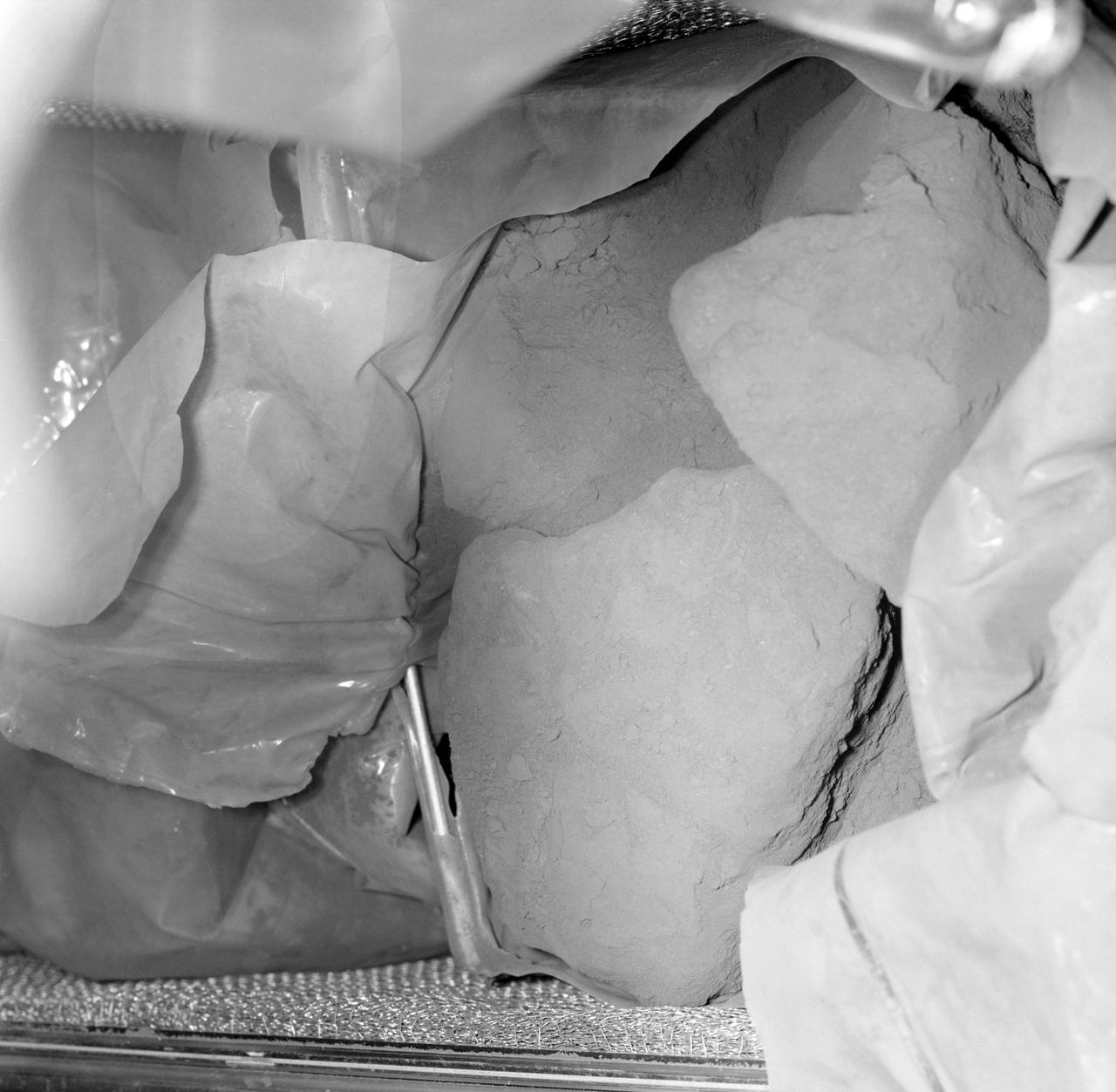
S69-60294 (26 Nov. 1969) --- One of the first views of the Apollo 12 lunar rocks is this photograph of the open sample return container. The large rock is approximately 7 1/2 inches across and is larger than any rock brought back to Earth by the crew of the Apollo 11 lunar landing mission. Two of the rocks in the first container are crystalline and generally lighter in color than those returned on the first lunar landing. The rocks in this box are medium charcoal brown/gray in color.
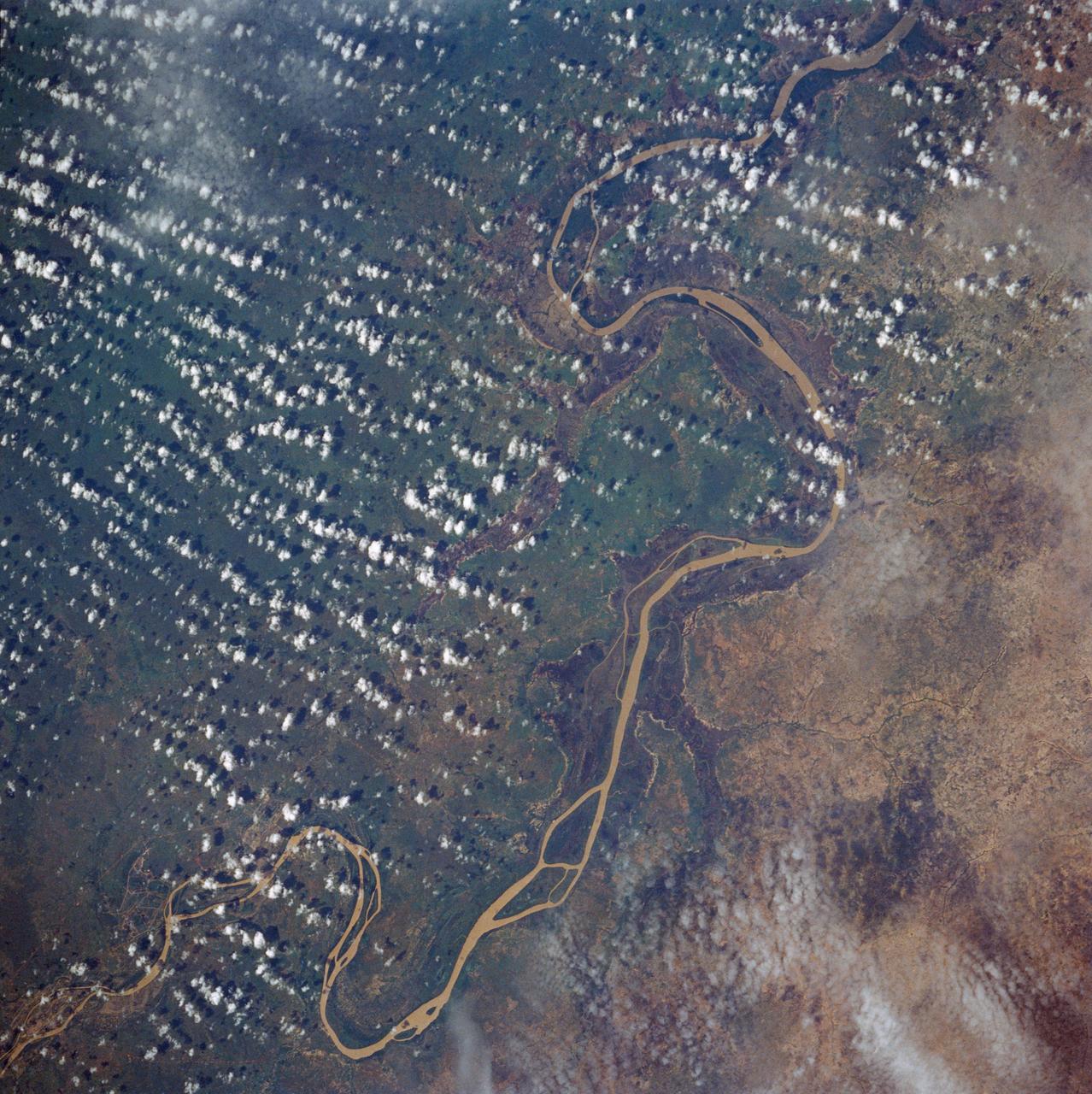
41D-34-099 (30 Aug-5 Sept 1984) --- The Gambia River, from Georgetown in the upper right corner of the photograph downstream to Mansa Konko, where it becomes an estuary about 60 miles above Banjul, the capital of The Gambia. The river is heavily silted from rain originating in the highlands of Guinea. This accounts for its bronze color as it passes from forest to drier savannah en route to the Sahara and across the nation of Senegal in west Africa. The Gambia itself is a long, narrow nation which follows the river for about 200 miles.
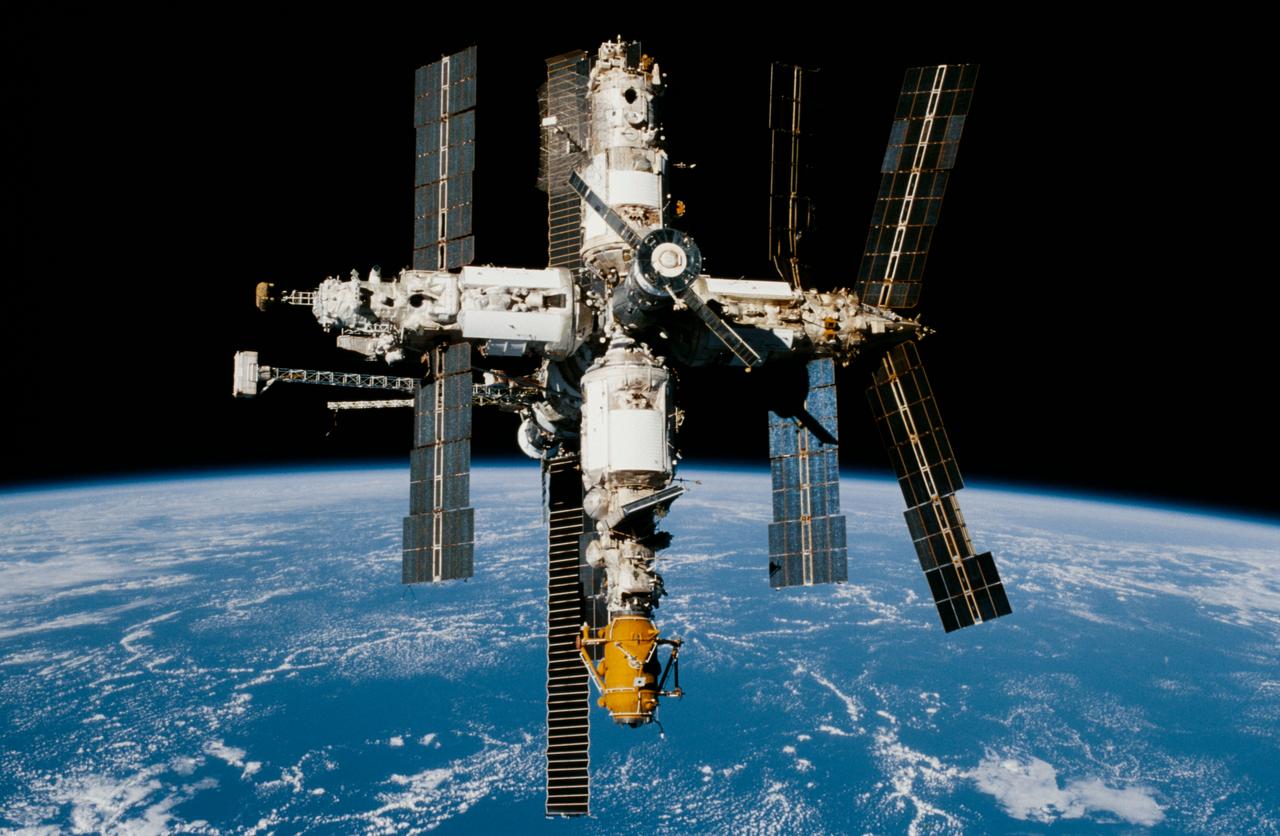
STS089-346-007 (22-31 Jan 1998) --- After several days of joint activities between NASA astronauts and Russian cosmonauts in Earth-orbit, the Space Shuttle Endeavour?s crew recorded a series of 35mm and 70mm ?flyaround? survey photos of Russia?s Mir Space Station. Earth?s horizon serves as the backdrop for this 35mm scene.
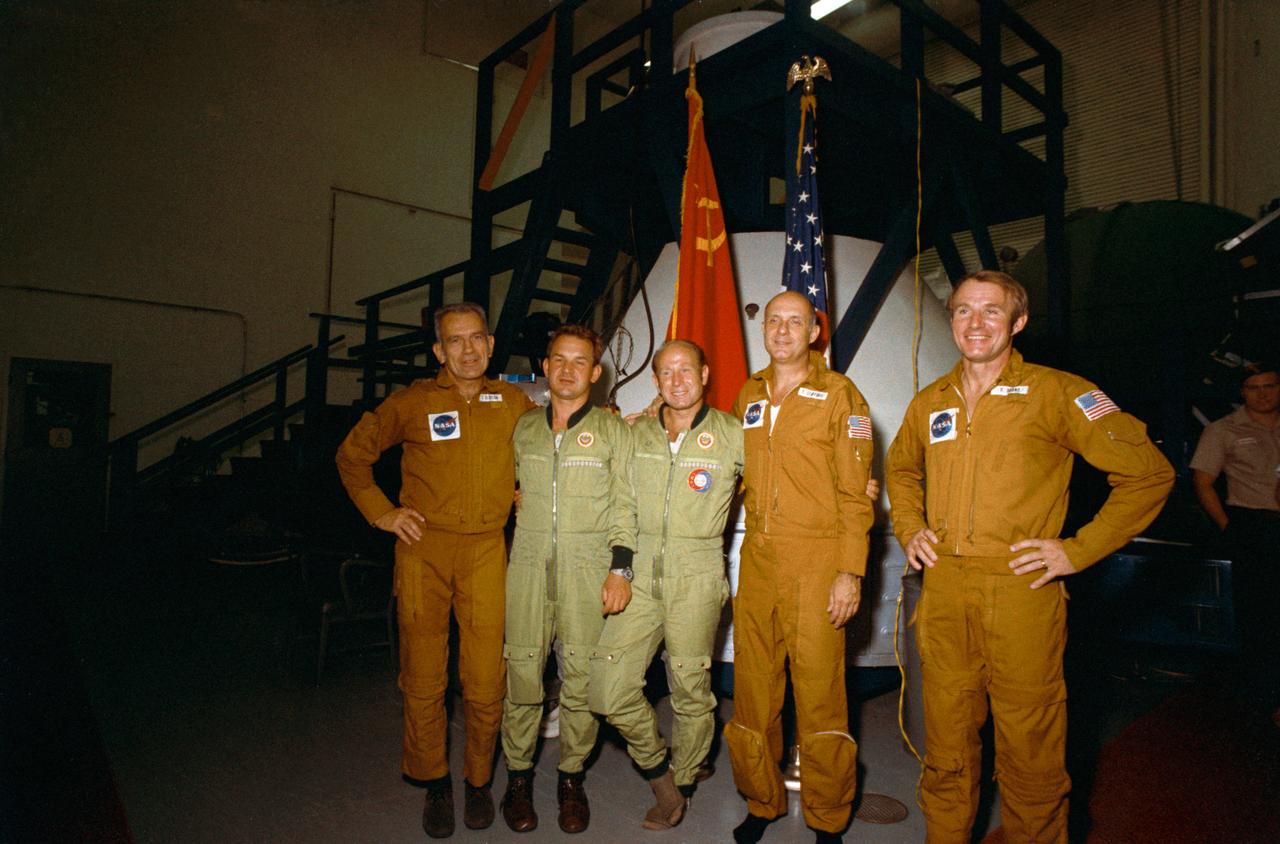
S74-28811 (23 Sept. 1974) --- The five prime crewmen of the joint U.S.-USSR Apollo-Soyuz Test Project mission are photographed in the Flight Crew Training Facility, Building 35, at the Johnson Space Center during ASTP crew training activity. They are, left to right, astronaut Donald K. Slayton, docking module pilot of the American crew; cosmonaut Valeriy N. Kubasov, engineer on the Soviet crew; cosmonaut Aleksey A. Leonov, commander of the Soviet crew; astronaut Thomas P. Stafford, commander of the American crew; and astronaut Vance D. Brand, command module pilot of the American crew.
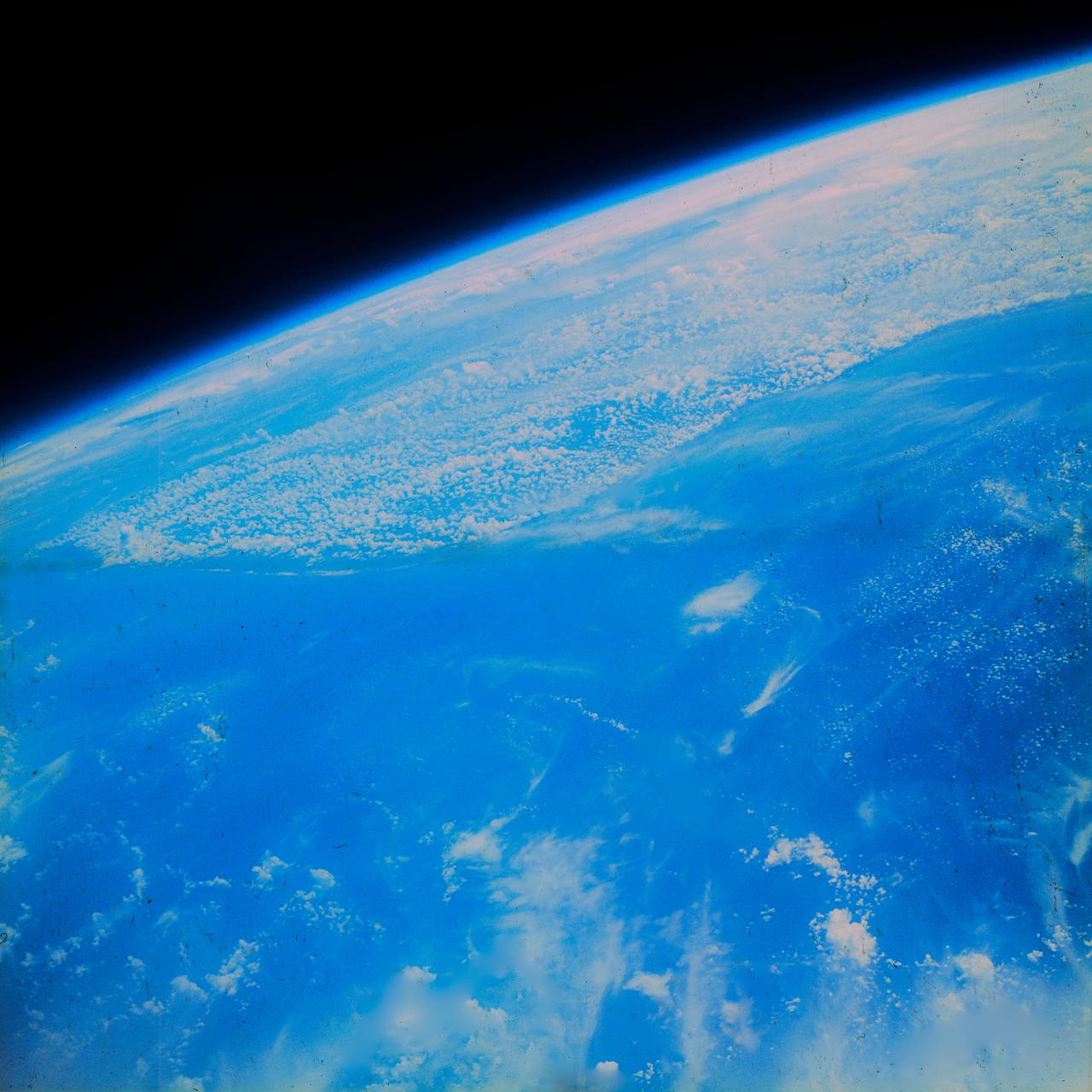
S62-06607 (3 Oct. 1962) --- Western horizon over South America taken during the sixth orbit pass of the Mercury-Atlas 8 (MA-8) mission by astronaut Walter M. Schirra Jr. with a hand-held camera. Photo credit: NASA

S69-40939 (August 1969) --- Landrum Young, Brown and Root - Northrop technician, examines mice in the Animal Laboratory of the Lunar Receiving Laboratory (LRL) which have been inoculated with lunar sample material. The sample material was collected by astronauts Neil A. Armstrong and Edwin E. Aldrin Jr. during their lunar surface extravehicular activity (EVA) on July 20, 1969.
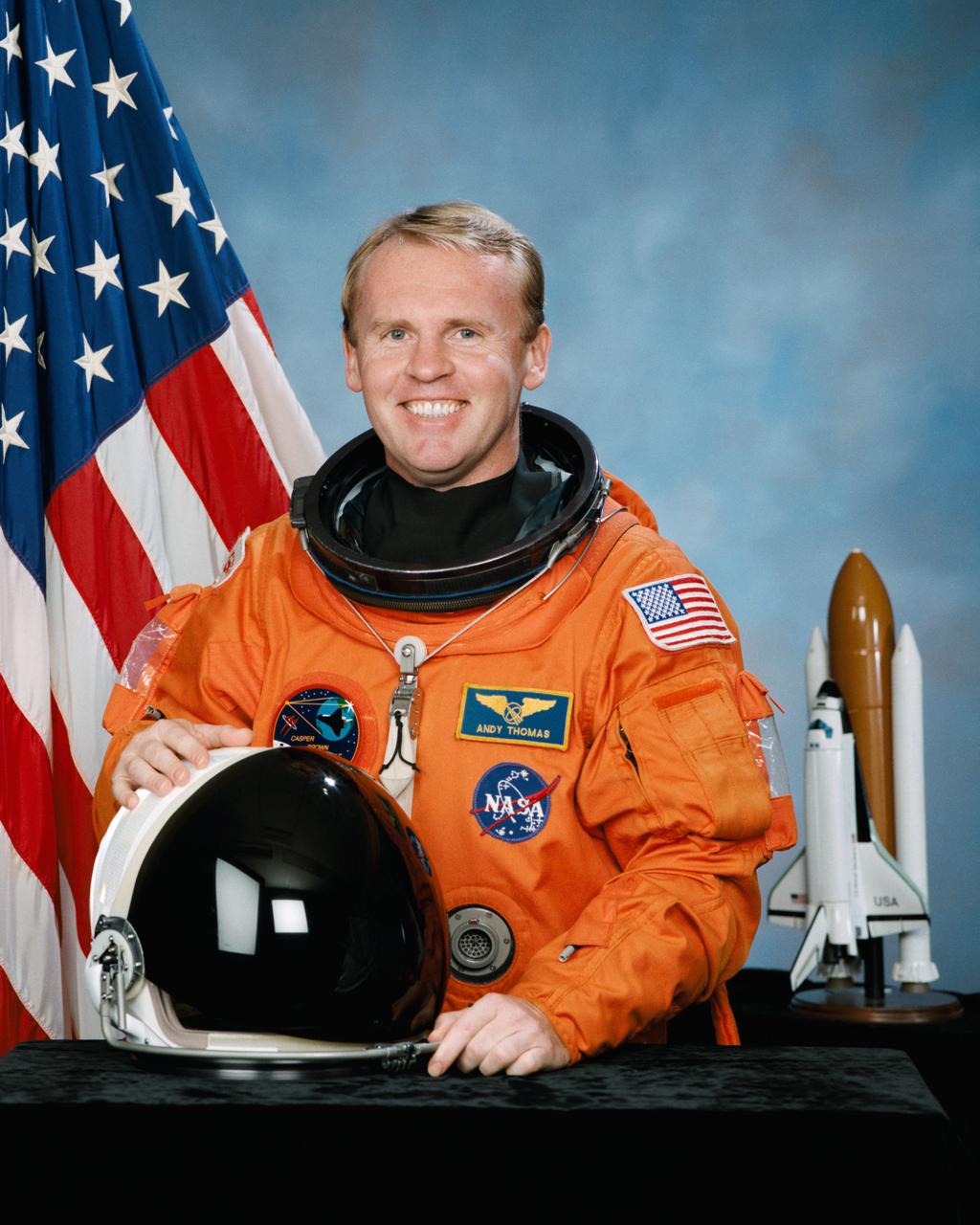
S96-04832 (March 1996) --- Astronaut Andrew S. W. Thomas, mission specialist.
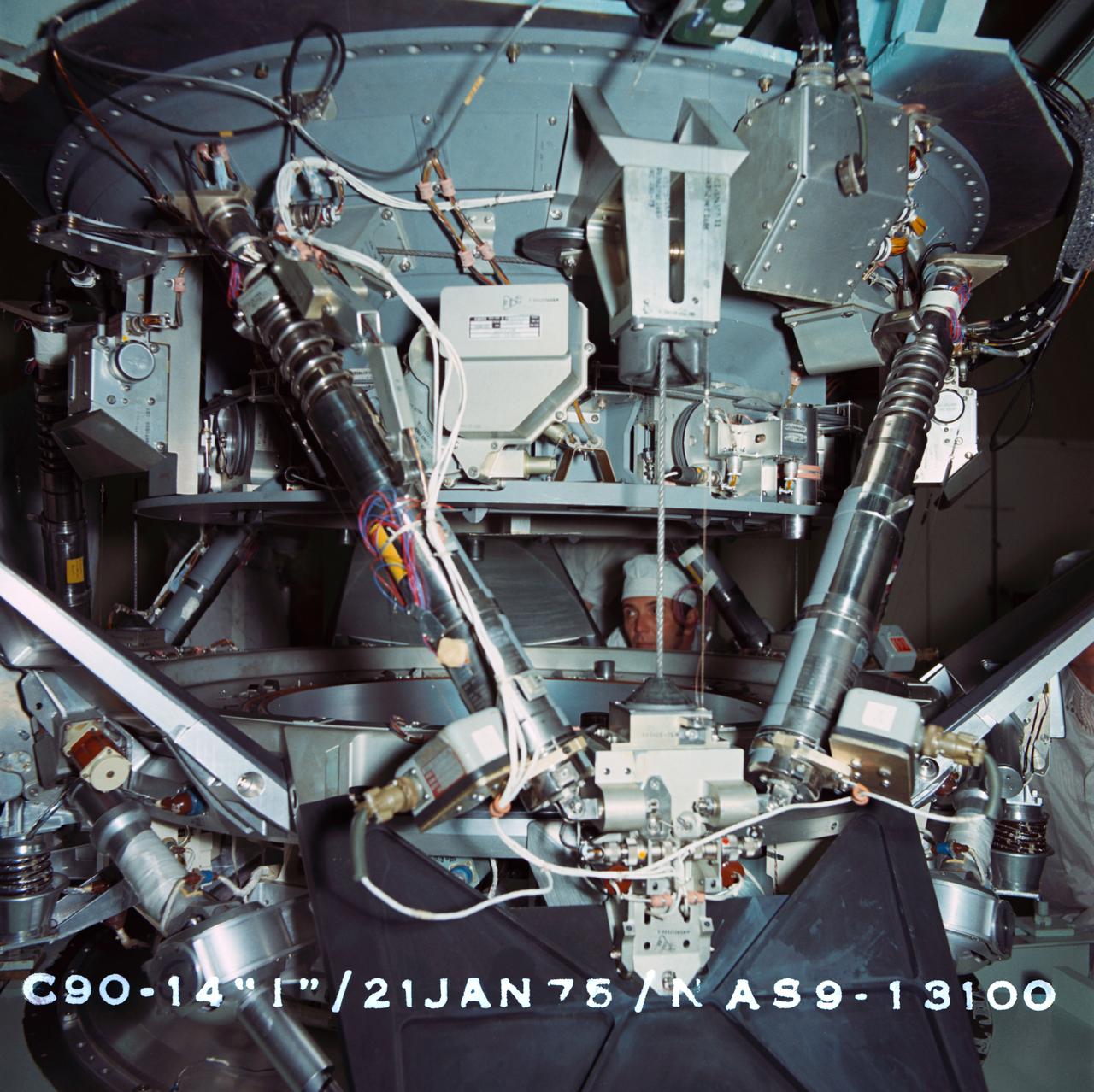
S95-02815 (21 Jan. 1975) --- Soviet junior researcher Y.G. Pobrov observes testing of the Apollo-Soyuz docking system at Rockwell International's plant in Downey, California. The United States' Docking System 3 (DS-3) here is being positioned onto the USSR's CA-4 system during a Pin and Socket Alignment Test. DS-5 has been designated as the prime flight article for the joint U.S.-USSR Apollo-Soyuz Test Project (ASTP) docking mission in Earth orbit, scheduled for July 1975.
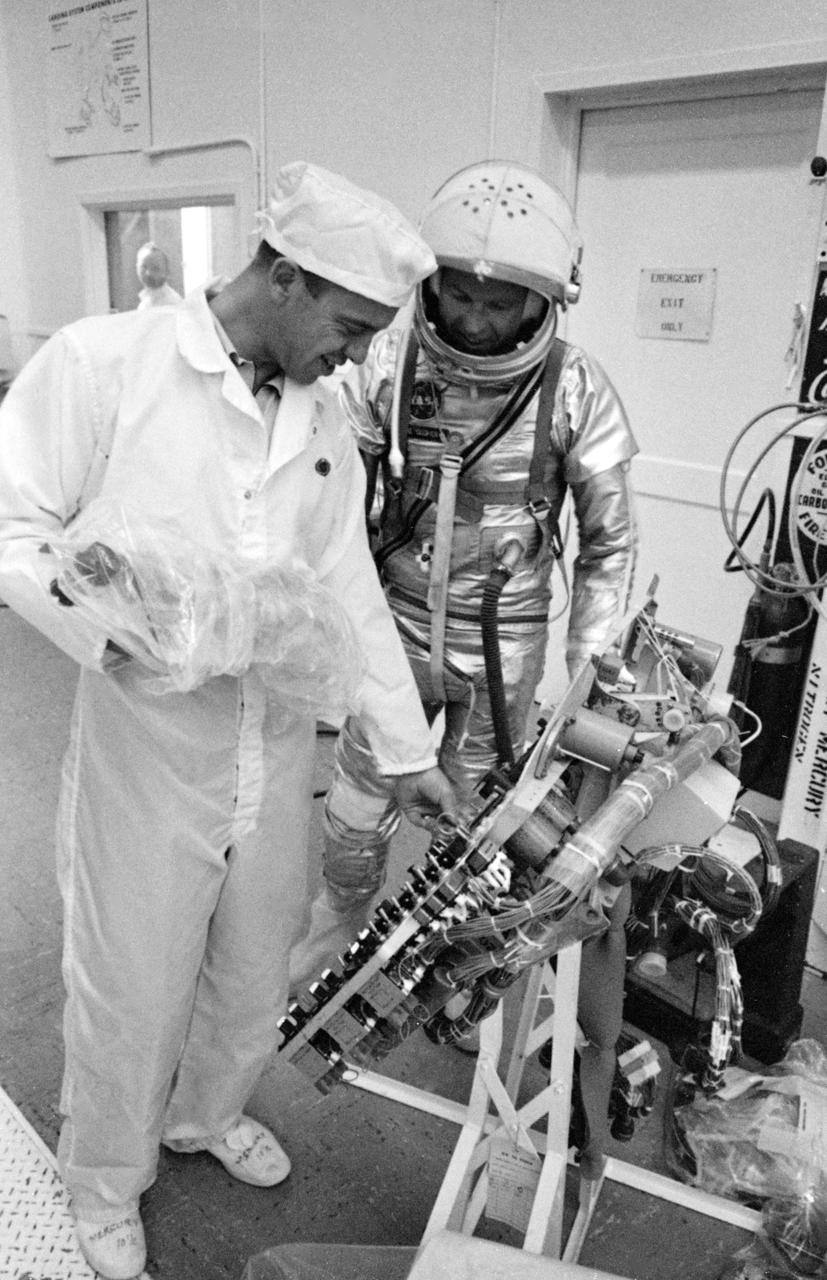
S63-03965 (1963) --- Astronauts Alan Shepard (left) and L. Gordon Cooper Jr.(in suit) check over the instrument panel from Mercury spacecraft #20. It contains the instruments necessary to monitor spacecraft systems and sequencing, the controls required to initiate primary sequences manually, and the necessary flight control displays. Photo credit: NASA
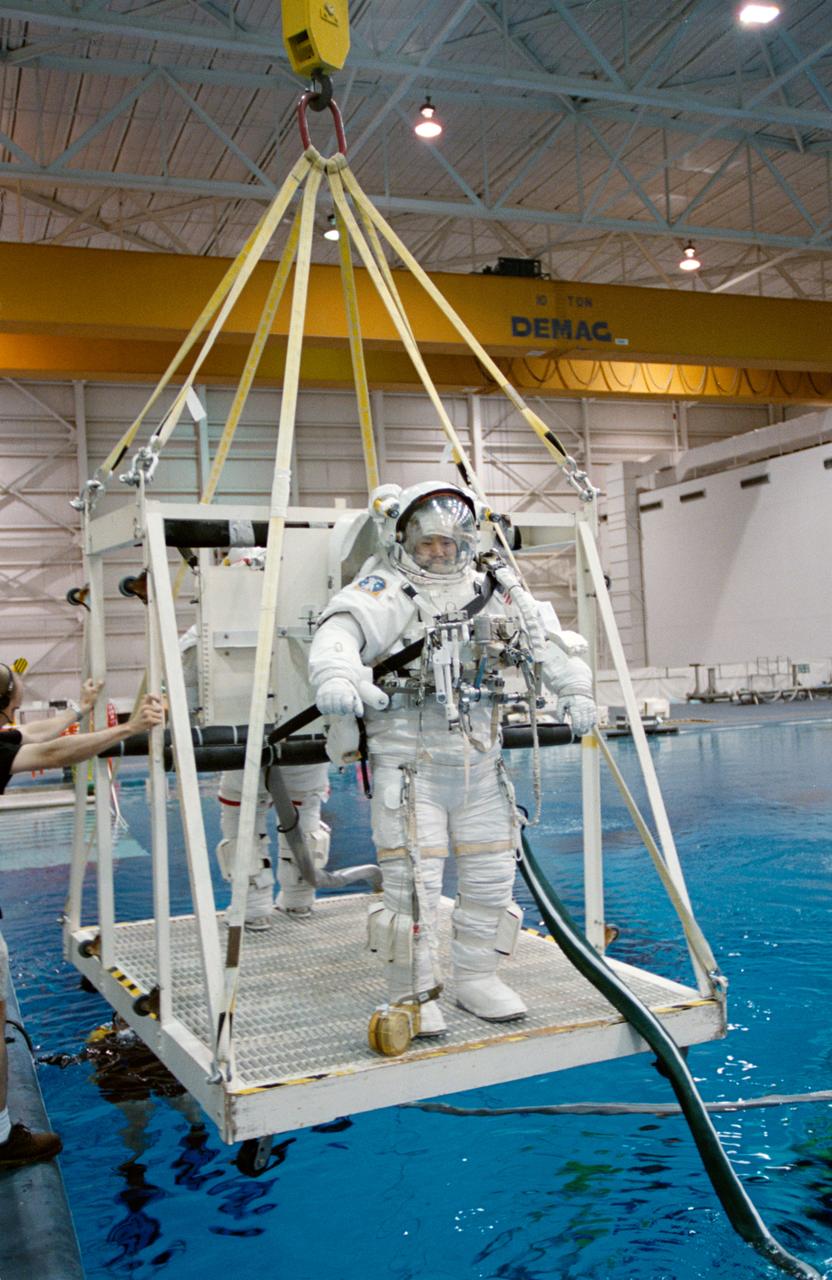
JSC2001-01442 (17 May 2001) --- Astronaut Soichi Noguchi and Stephen K. Robinson, (partially obscured), both STS-114 mission specialists, are about to be submerged in the waters of the Neutral Buoyancy Laboratory (NBL) near the Johnson Space Center (JSC). Noguchi and Robinson are wearing the training version of the Extravehicular Mobility Unit (EMU) spacesuit. Divers are in the water to assist the astronauts in their rehearsal, intended to help prepare them for work on the exterior of the International Space Station (ISS). Noguchi represents Japan’s National Space Development Agency (NASDA).
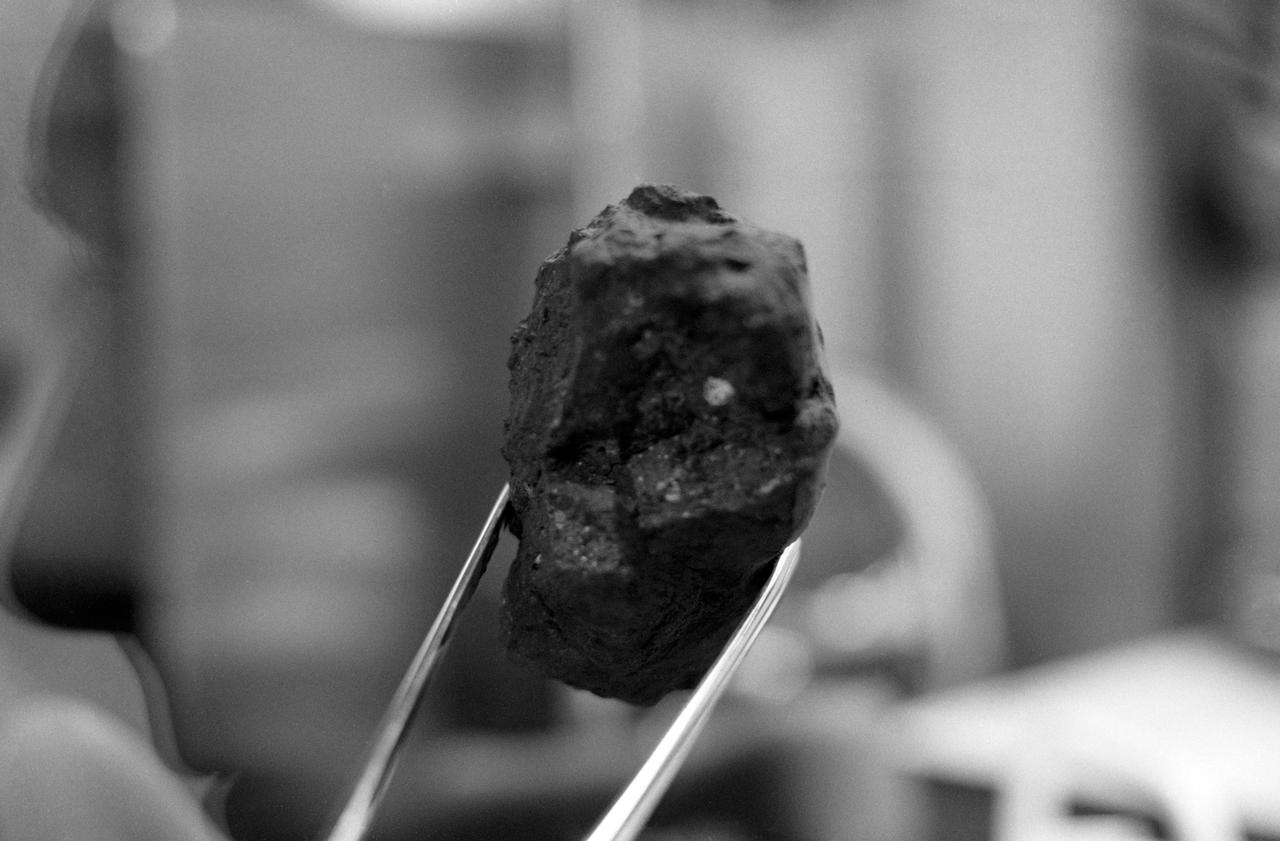
S69-60487 (1 Dec. 1969) --- A close-up view of one of the rocks brought back to Earth from the Apollo 12 lunar landing mission. The rock is under examination in the Physical-Chemical Test Laboratory in the Lunar Receiving Laboratory (LRL), Building 37, MSC. This rock is one of two breccia found in the contingency collection gathered by astronauts Charles Conrad Jr. and Alan L. Bean during their stay on the lunar surface. The breccia rocks, common in the collection of Apollo 11 lunar samples, have been rare in examinations of the Apollo 12 samples thus far.
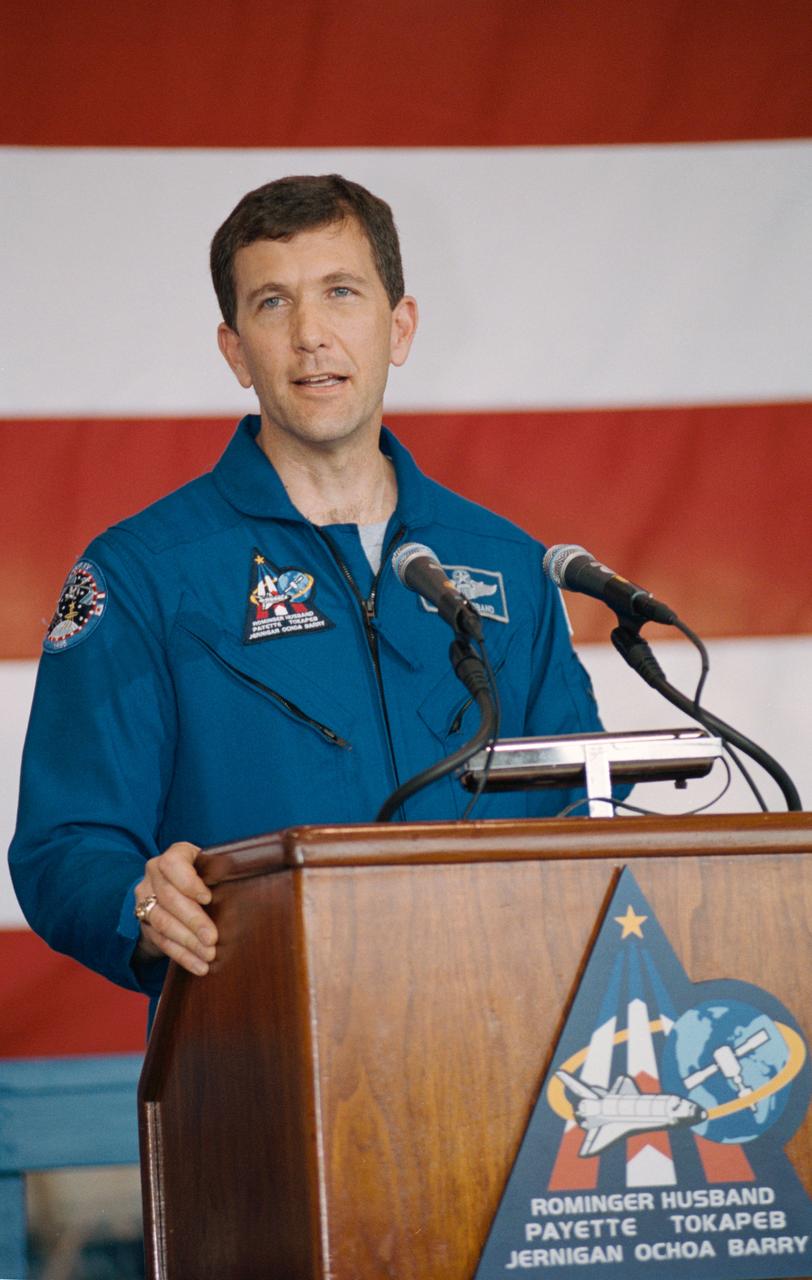
S99-05971 (7 June 1999) --- Astronaut Rick D. Husband, pilot, speaks to crowd at Ellington Field following crew arrival.

S69-60644 (29 Nov. 1969) --- A Mobile Quarantine Facility (MQF), with the crew men of the Apollo 12 lunar landing mission aboard, arrived at the Manned Spacecraft Center (MSC) Saturday morning, Nov. 29, 1969. Astronauts Charles Conrad Jr., Richard F. Gordon Jr., and Alan L. Bean were on their way to the Lunar Receiving Laboratory (LRL) where they will remain in quarantines until Dec. 10, 1969. Minutes earlier the three astronauts had arrived at Ellington Air Force Base from Hawaii aboard a U.S. Air Force C-141 transport. The crewmen were confined to the MQF from splashdown until they arrived at the LRL.
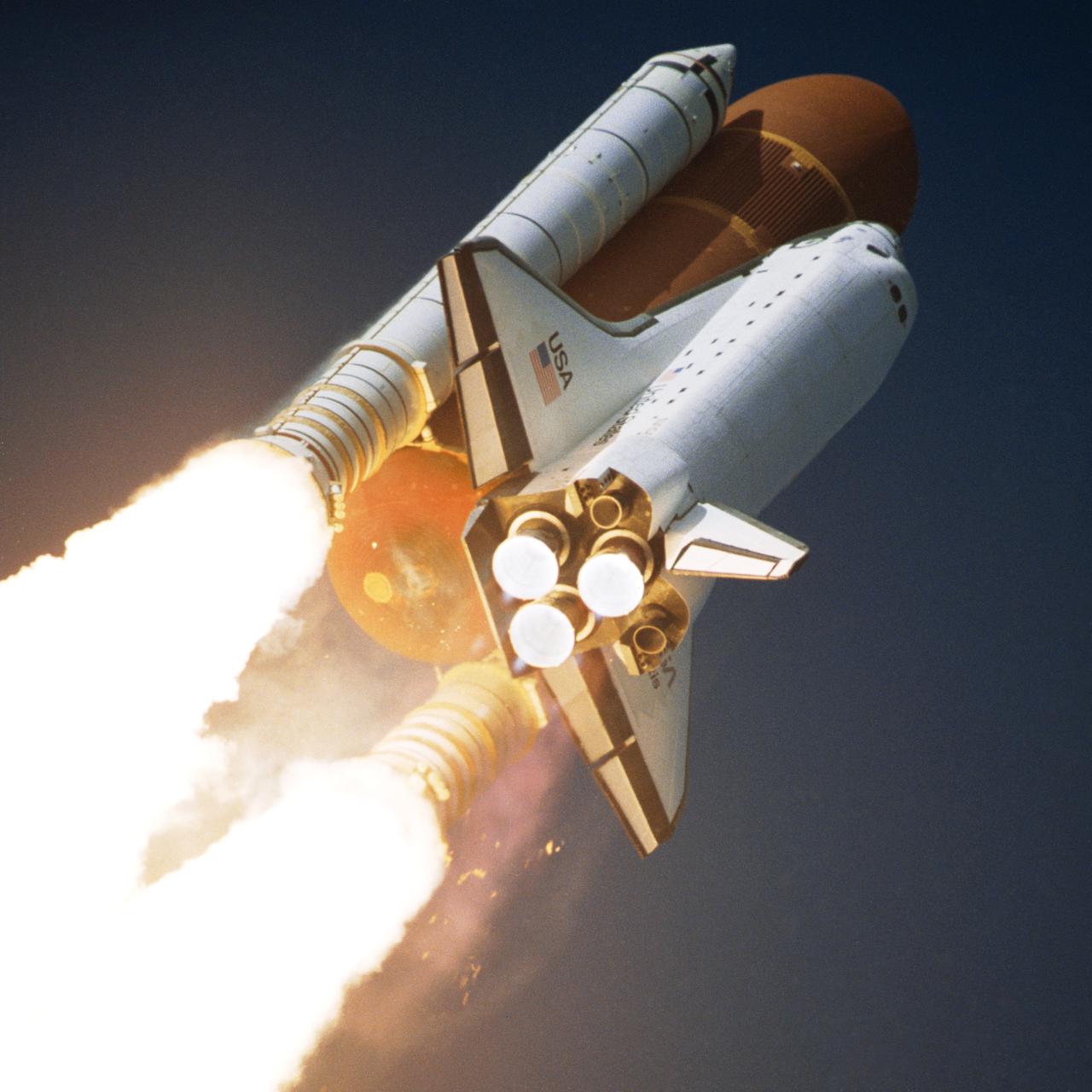
STS027-S-003 (2 Dec. 1988) --- The Space Shuttle Atlantis and its five-man crew of astronauts are launched from Kennedy Space Center?s Pad 39B at 9:30 a.m. (EST), Dec. 2, 1988. Onboard the Department of Defense ? dedicated mission are astronauts Robert L. Gibson, Guy S. Gardner, Jerry L. Ross, Richard M. (Mike) Mullane and Williams M. Shepherd.
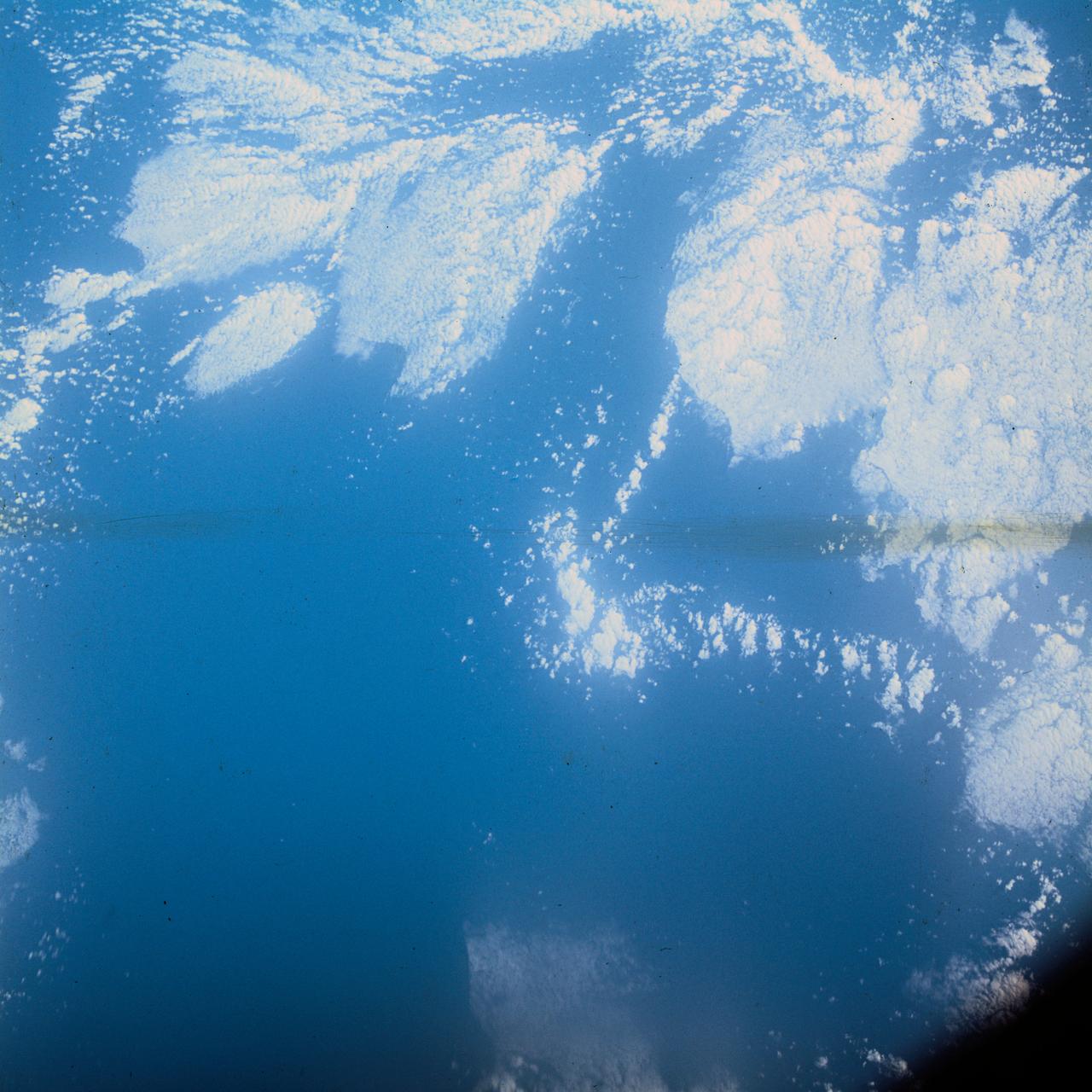
S62-06606 (3 Oct. 1962) --- Cloud formation over Western Atlantic Ocean north of South America taken during the fourth orbit pass of the Mercury-Atlas 8 (MA-8) mission by astronaut Walter M. Schirra Jr. with a hand-held camera. Photo credit: NASA
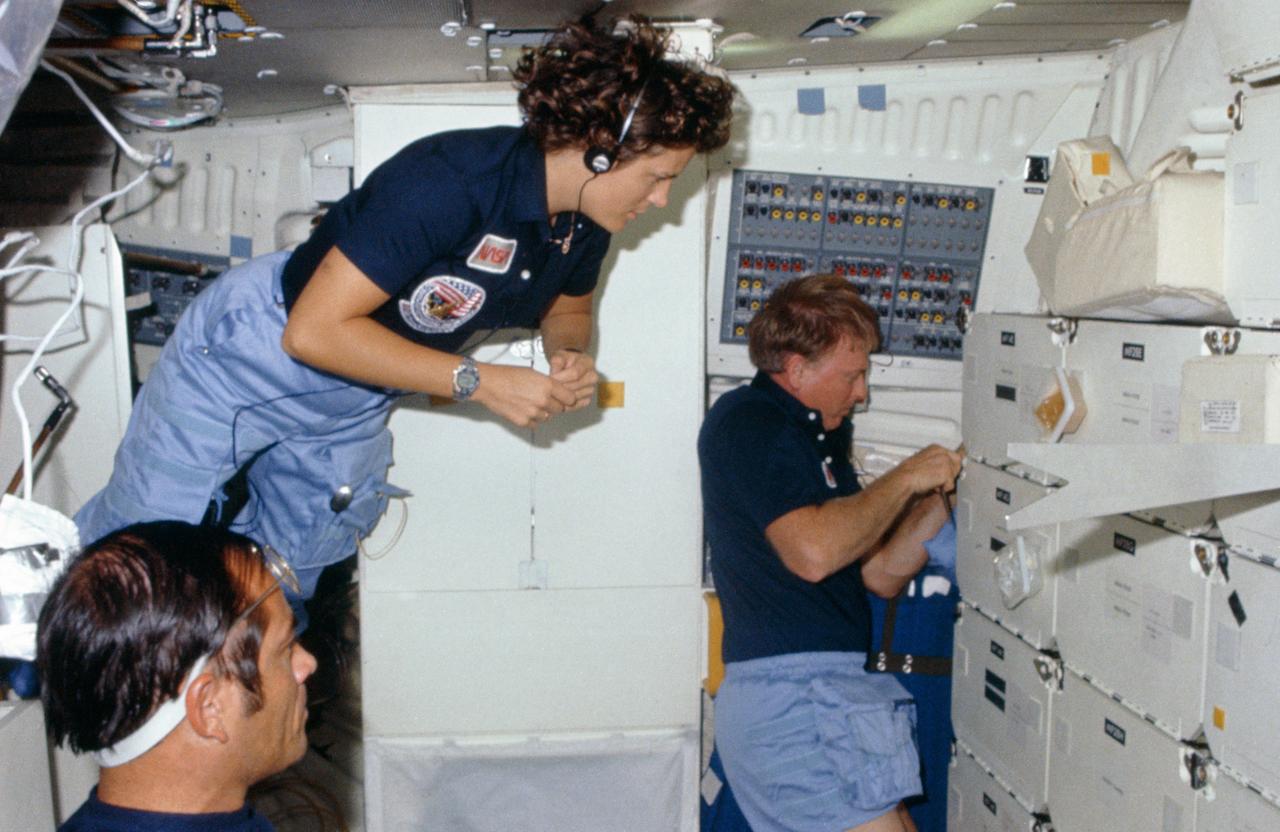
41G-102-003 (5-13 Oct 1984) ---- Astronaut Kathryn D. Sullivan, 41-G mission specialist, floats into a middeck scene to join a more stationary pair of crewmembers---Astronauts Robert L. Crippen, crew commander; and Jon A. McBride, pilot. The protruding article near the stowage lockers is a Krimsky rule, part of the near vision acuity experiment in which recent NASA space travelers have participated.
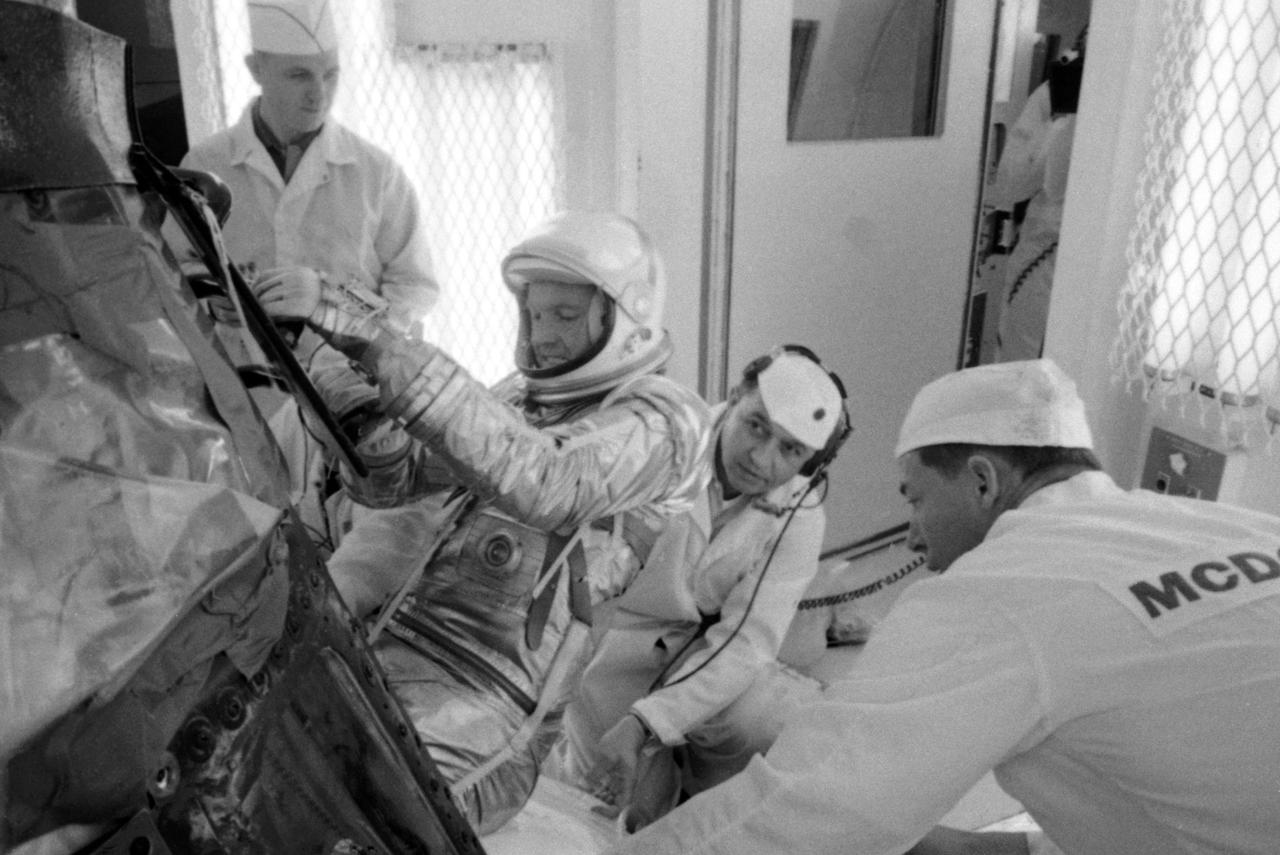
S63-03957 (1963) --- NASA and McDonnell Aircraft Corp. spacecraft technicians assist astronaut L. Gordon Cooper Jr. into his spacecraft prior to undergoing tests in the altitude chamber. These tests are used to determine the operating characteristcs of the overall environmental control system. Photo credit: NASA
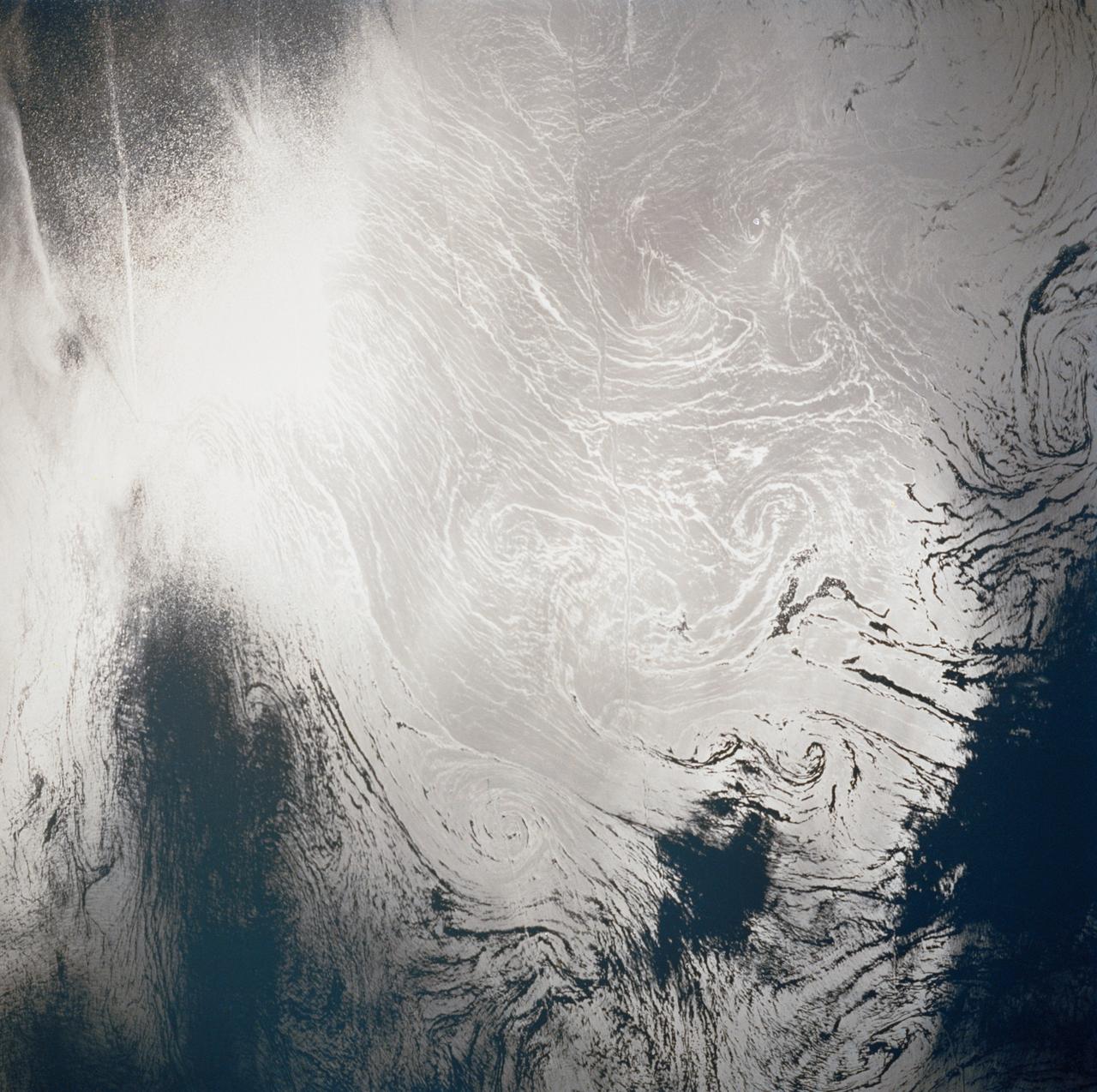
41G-38-060 (5-13 Oct 1984) --- A large ship wake in the central Mediterranean Sea is highlighted by sunglint in this handheld camera's view from STS-41G. According to NASA and U.S. Navy scientists studying the STS-41G film, the depicted reflectance is similar to oil slicks seen in the various oceans of the world. They note that it is apparent that a ship is pumping a mixture of bilge water and oil overboard. The crew consisted of astronauts Robert L. Crippen, commander; Jon A. McBride, pilot; mission specialist's Kathryn D. Sullivan, Sally K. Ride, and David D. Leestma; Canadian astronaut Marc Garneau; and Paul D. Scully-Power, payload specialist. EDITOR'S NOTE: The STS-41G mission had the first American female EVA (Sullivan); first seven-person crew; first orbital fuel transfer; and the first Canadian (Garneau).
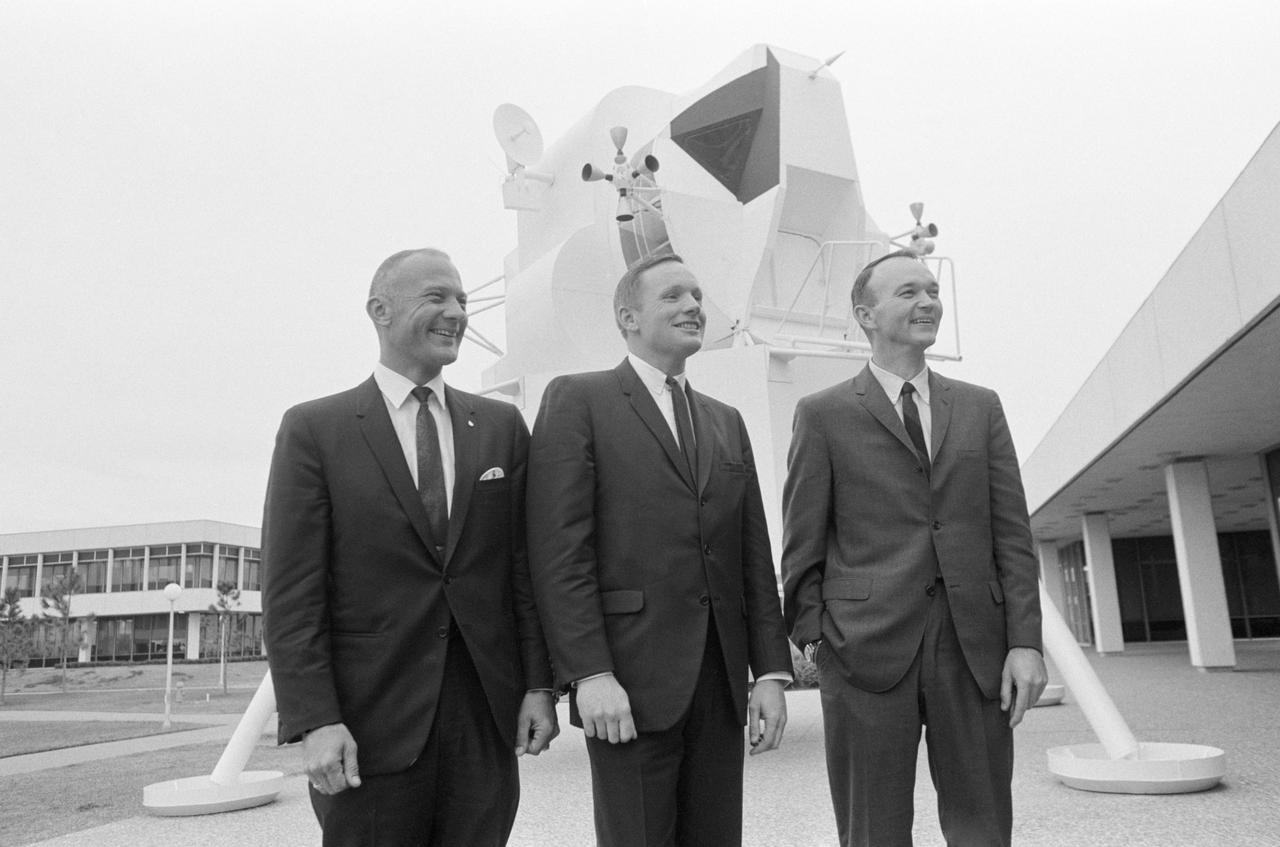
S69-16681 (10 Jan. 1969) --- These three astronauts have been selected by NASA as the prime crew of the Apollo 11 lunar landing mission. Left to right, are astronauts Edwin E. Aldrin Jr., lunar module pilot; Neil A. Armstrong, commander; and Michael Collins, command module pilot. They were photographed in front of a lunar module (LM) mock-up beside Building 1 following a press conference in the MSC Auditorium.
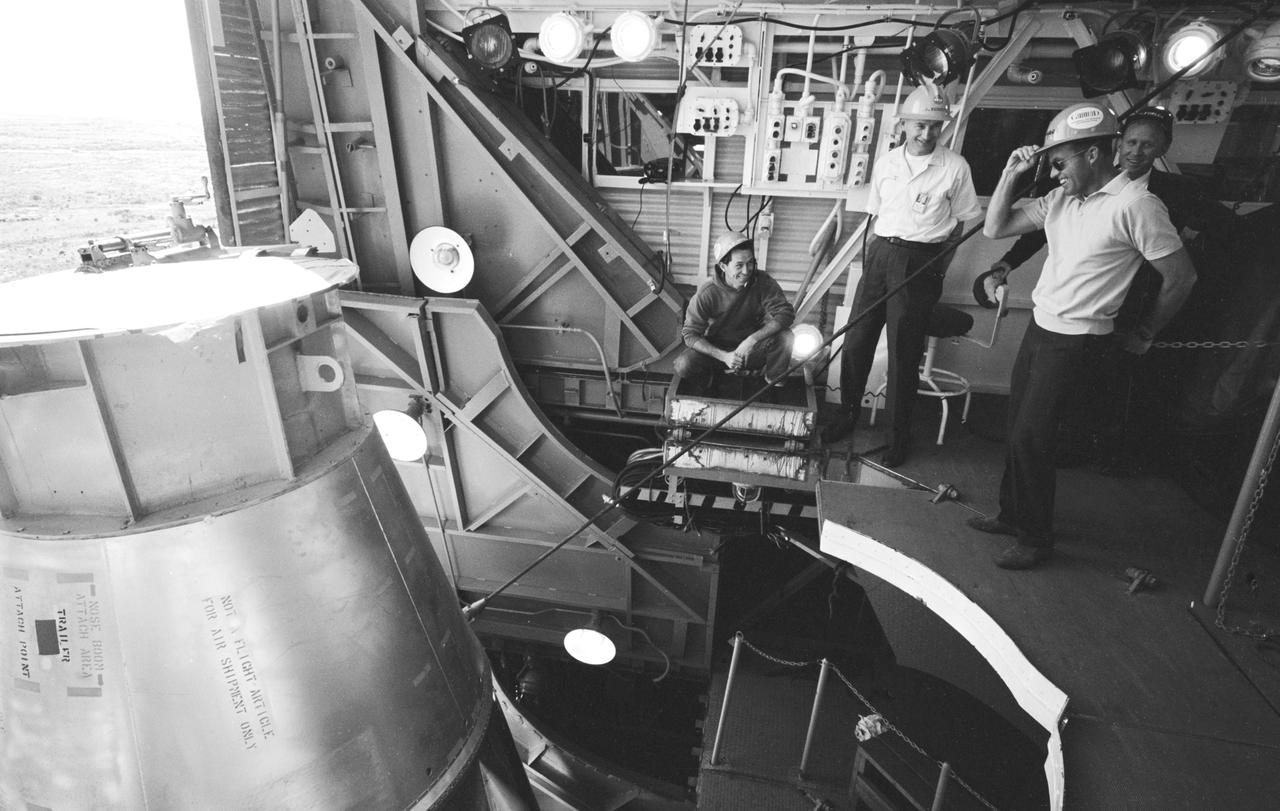
S63-03986 (1963) --- Astronaut L. Gordon Cooper Jr., prime pilot for the Mercury-Atlas 9 (MA-9) mission, and General Dynamics pad technicians watch Atlas 130D being hoisted into place in the gantry at pad #14, Cape Canaveral, Florida. Photo credit: NASA
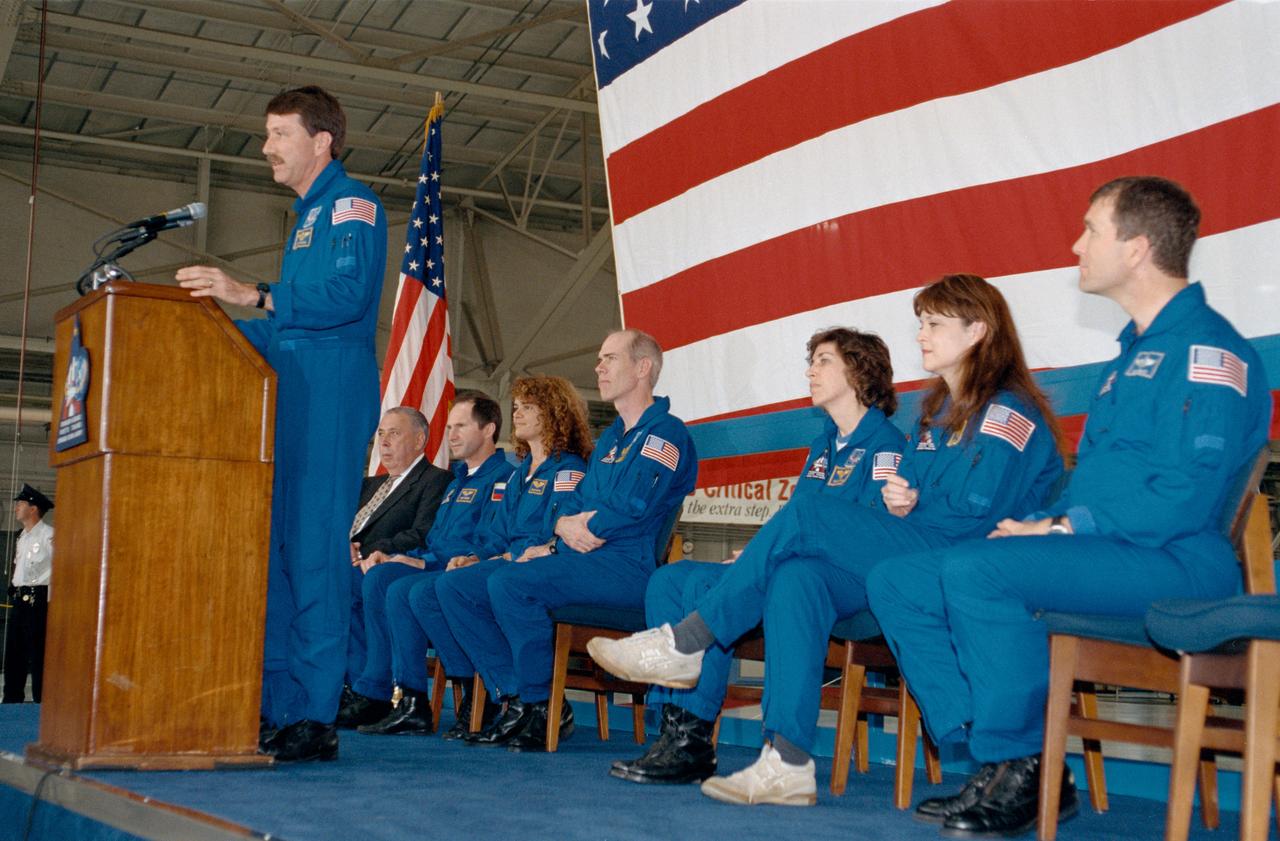
S99-05968 (7 June 1999) --- Astronaut Kent V. Rominger, mission commander, speaks to crowd on hand at Ellington Field's Hangar 990 following crew arrival. In the background, from the left, are JSC Director George W.S. Abbey and cosmonaut Valeriy I. Tokarev along with astronauts Julie Payette, Daniel T. Barry, Ellen Ocoa and Tamara E. Jernigan, all mission specialists; and Rick D. Husband, pilot. Tokarev represents the Russian Space Agency (RSA) and Payette, the Canadian Space Agency (CSA).
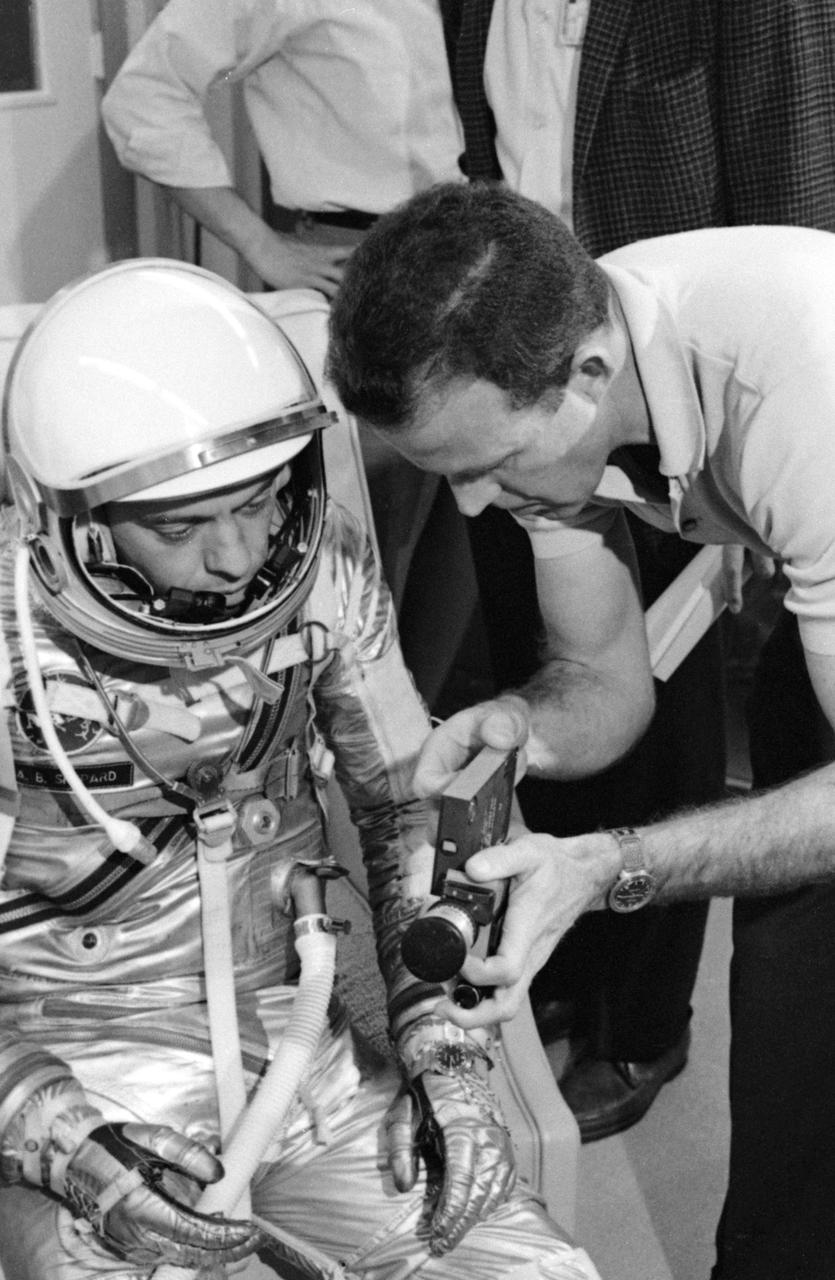
S63-03952 (1963) --- Astronaut L. Gordon Cooper Jr. explains the 16mm handheld spacecraft camera to his backup pilot astronaut Alan Shepard. The camera, designed by J.R. Hereford of McDonnell Aircraft Corp., will be used by Cooper during the Mercury-Atlas 9 (MA-9) mission to photograph experiments in space for M.I.T. and the Weather Bureau. Photo credit: NASA
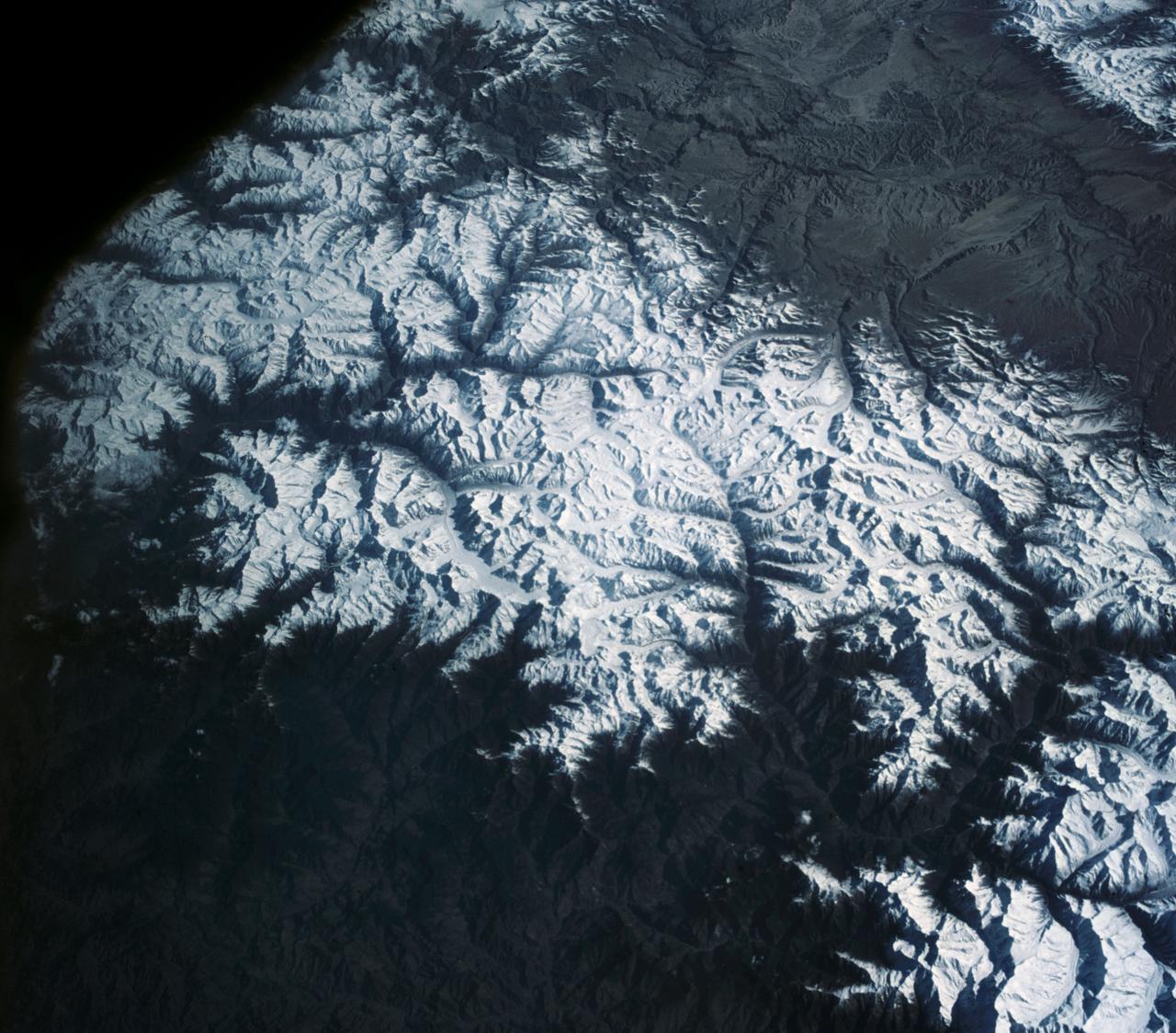
S63-06445 (15-16 May 1963) --- View of the Himalaya Mountain Range in the India-Nepal-Tibet border area, as photographed from the Mercury-Atlas 9 capsule by astronaut L. Gordon Cooper Jr., during his 22-orbit MA-9 spaceflight. Photo credit: NASA
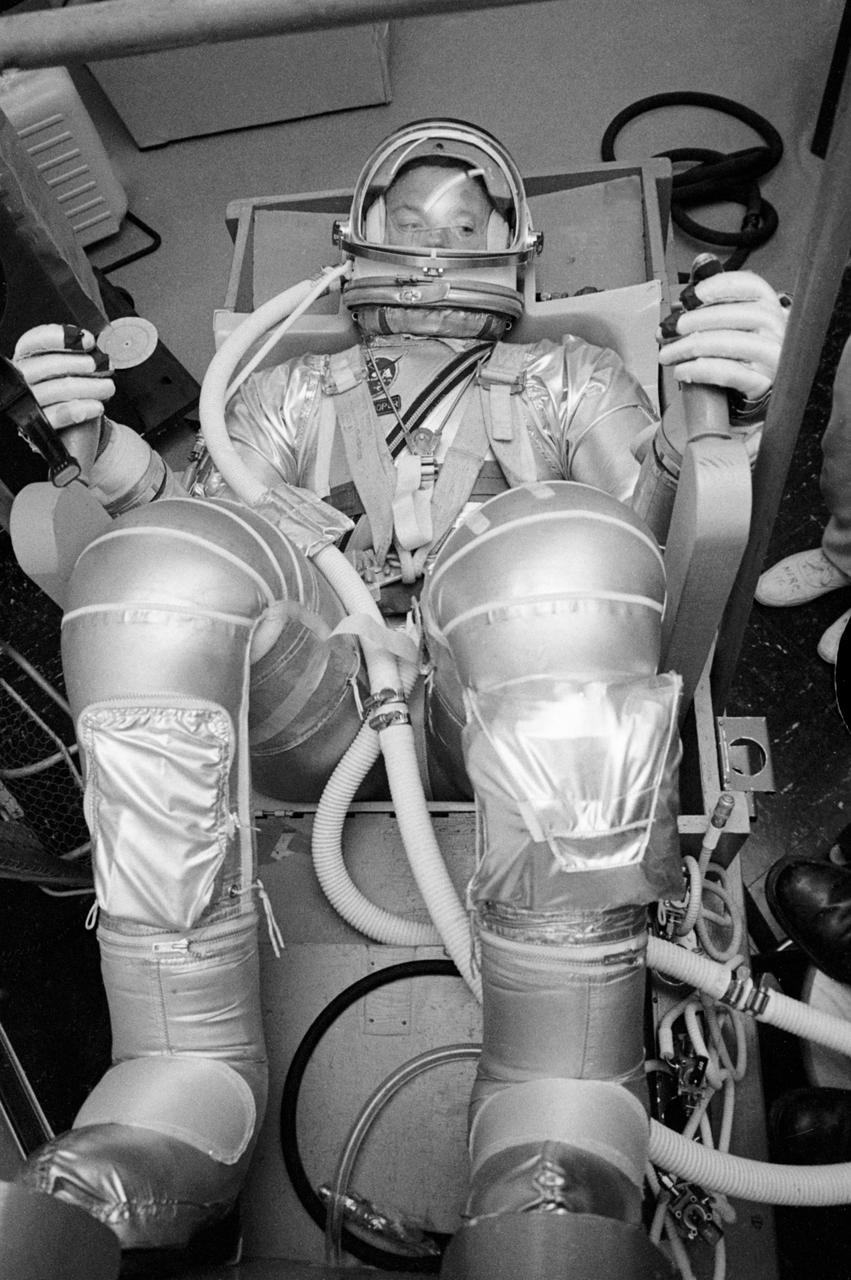
S63-03976 (1963) --- Astronaut L. Gordon Cooper Jr., prime pilot for the Mercury-Atlas 9 (MA-9) mission, undergoes suit pressurization tests. Photo credit: NASA
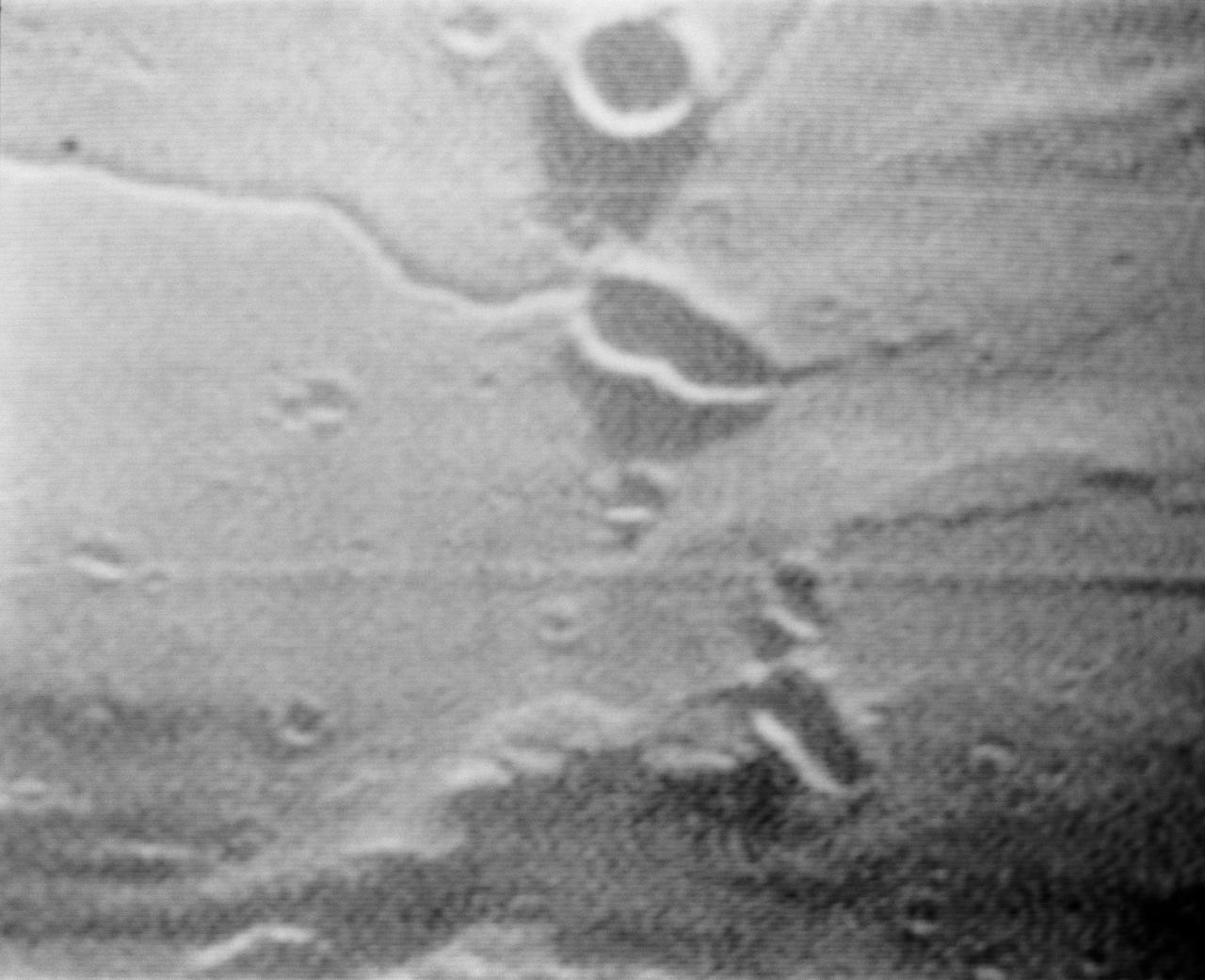
S69-39541 (19 July 1969) --- A near vertical view of Diamondback Rille is seen in this color reproduction taken from the fourth color television transmission from the Apollo 11 spacecraft, during its second revolution of the moon. The center of the picture is located at about 26.9 degrees east longitude and 1.2 degrees north latitude. This area is just east of the Apollo Landing Site 2. The crew of the Apollo 11 lunar landing mission is astronauts Neil A. Armstrong, commander; Michael Collins, command module pilot; and Edwin E. Aldrin Jr., lunar module pilot.
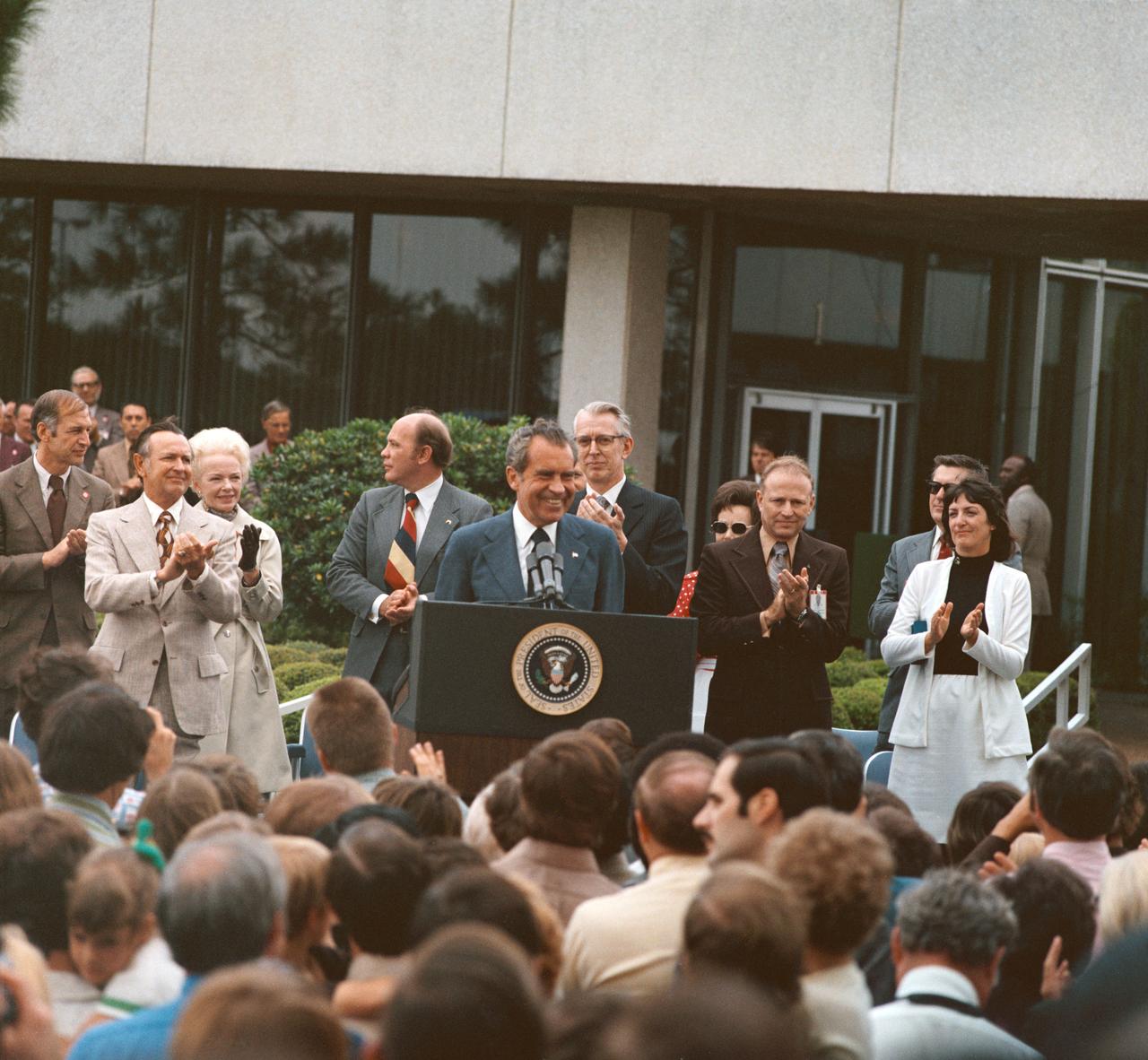
Five (5) views of President Richard M. Nixon during his visit to the JSC. These views show the President as he addresses a crowd of employees and visitors outside of Building 1 Auditorium. Dr. Christopher C. Kraft, Fletcher, and Astronaut Gerald Carr, with Pete Clements, George Abbey, and Jack Waite in the background is also seen with the President. 1. Pres. Richard M. Nixon 2. Dr. Christopher C. Kraft JSC, HOUSTON, TX
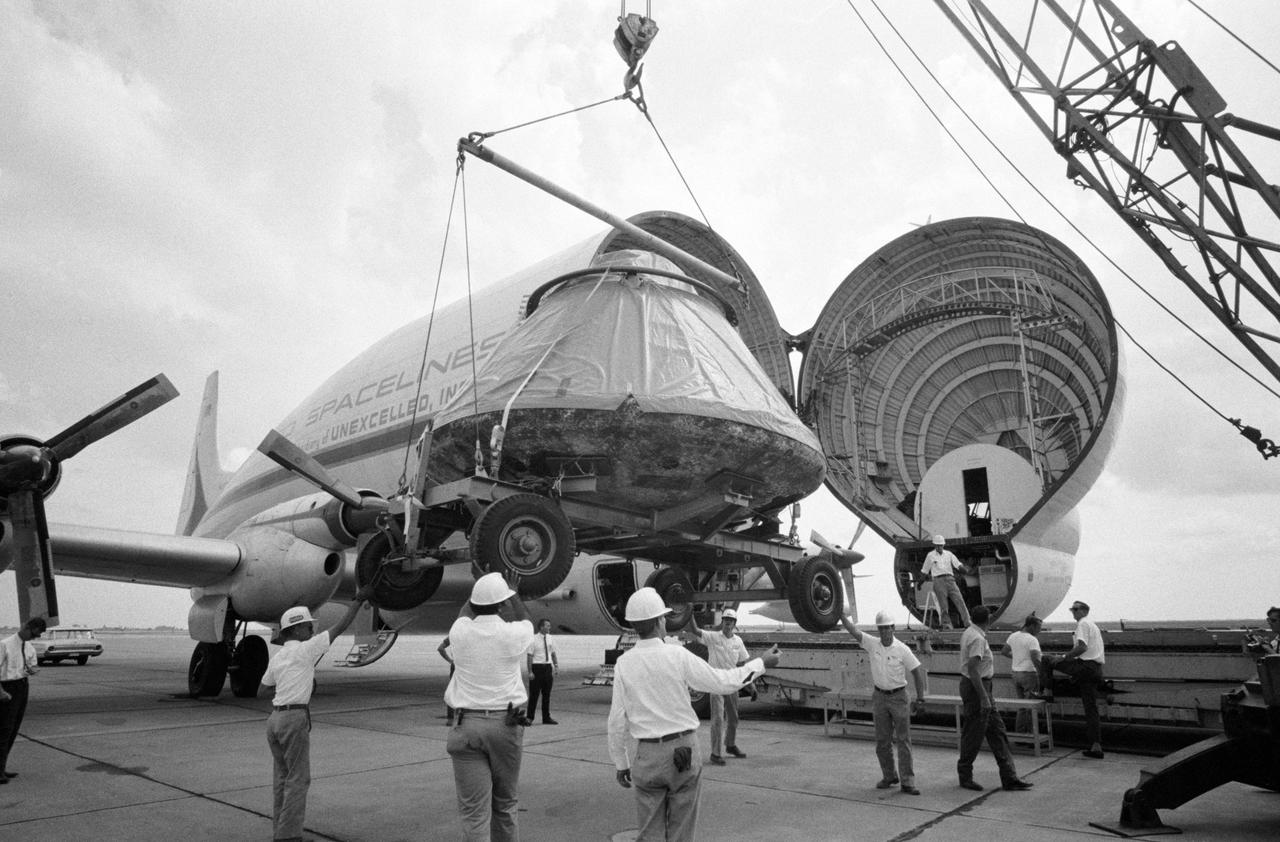
S69-41985 (14 Aug. 1969) --- The Apollo 11 spacecraft Command Module (CM) is loaded aboard a Super Guppy Aircraft at Ellington Air Force Base for shipment to the North American Rockwell Corporation at Downey, California. The CM was just released from its postflight quarantine at the Manned Spacecraft Center (MSC). The Apollo 11 spacecraft was flown by astronauts Neil A. Armstrong, commander; Michael Collins, command module pilot; and Edwin E. Aldrin Jr., lunar module pilot, during their lunar landing mission. Note damage to aft heat shield caused by extreme heat of Earth reentry. North American Rockwell is the prime contractor for the Apollo Command and Service Modules (CSM).
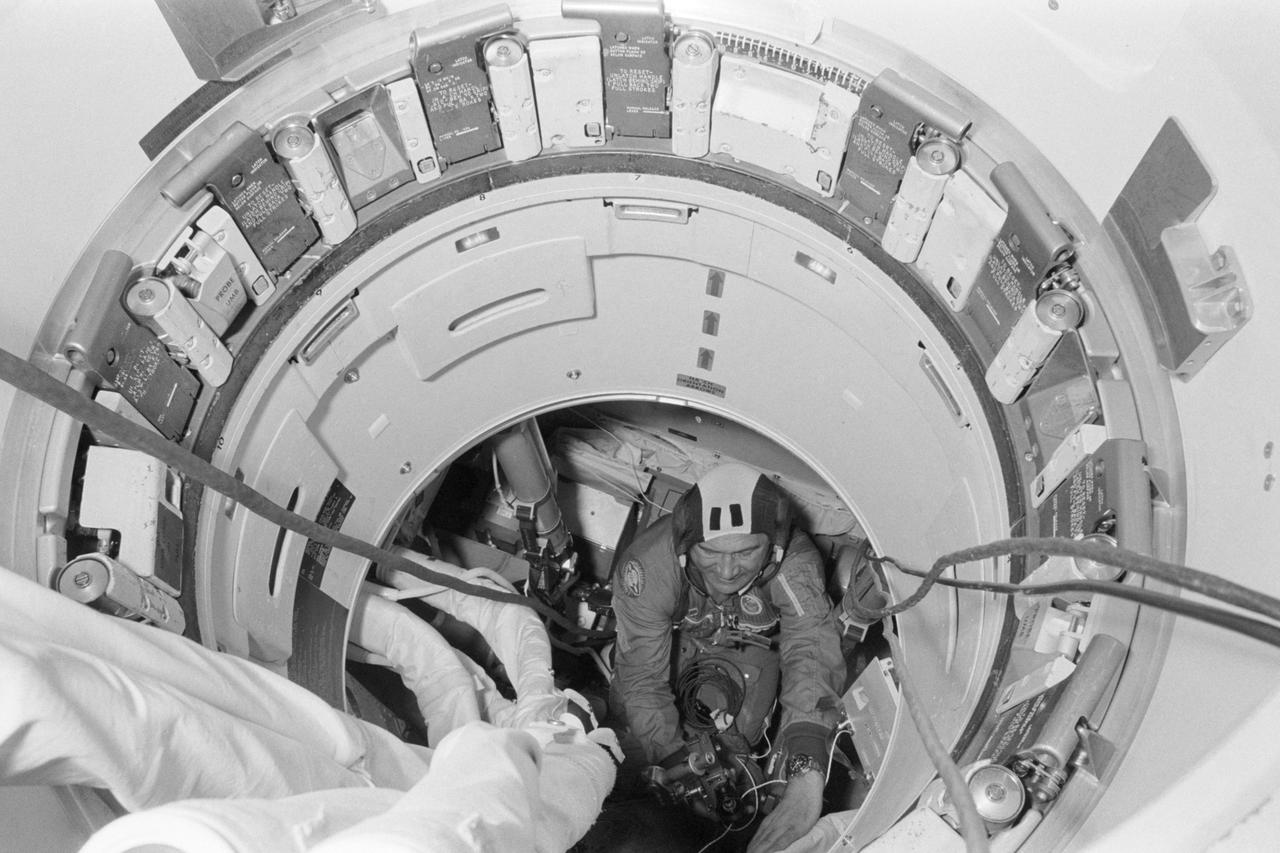
S75-21836 (20 Feb. 1975) --- Cosmonaut Anatoliy V. Filipchenko, commander of the Soviet ASTP second (backup) crew, participates in Apollo-Soyuz Test Project joint crew training in Building 35 at NASA's Johnson Space Center. Filipchenko is in the Apollo Command Module trainer. This picture was taken from inside the Docking Module during a ?walk-through? of the second day?s activities in Earth orbit.
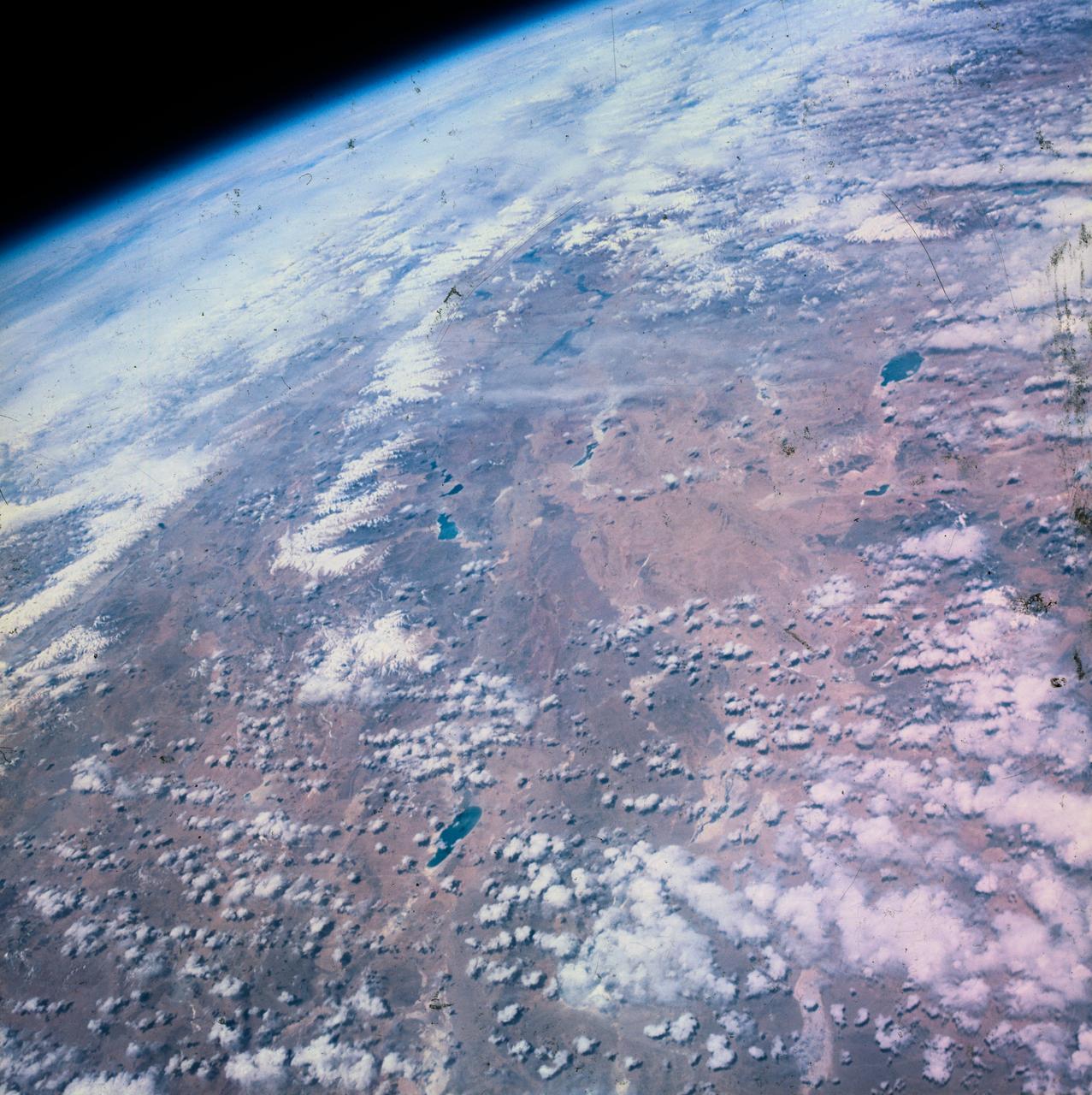
S63-06444 (15-16 May 1963) --- Tibet-Kashmir, looking northwest, as photographed from the Mercury-Atlas 9 (MA-9) capsule by astronaut L. Gordon Cooper Jr. during his 22-orbit MA-9 spaceflight. Lake Ch'in-Tzu-Hu is at upper right, Lake Yen-K'o-Ling-Ts is at lower left center. The Korakaram Range is at upper center portion of the picture. Photo credit: NASA

Apollo 6 (AS-502) Pacific Recovery
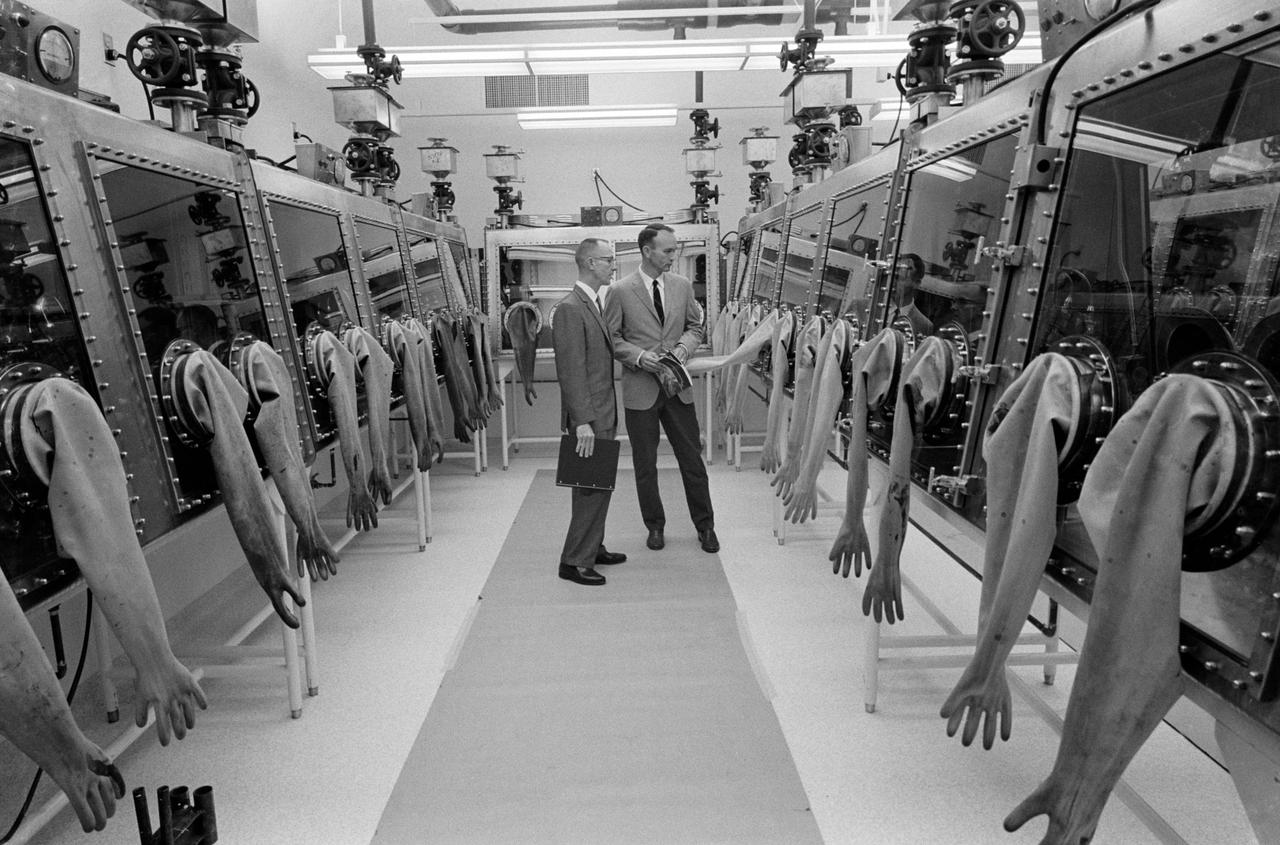
Astronaut Michael Collins on the right and Richard Wright on the left during tour of Lunar Receiving Lab (LRL) at MSC.
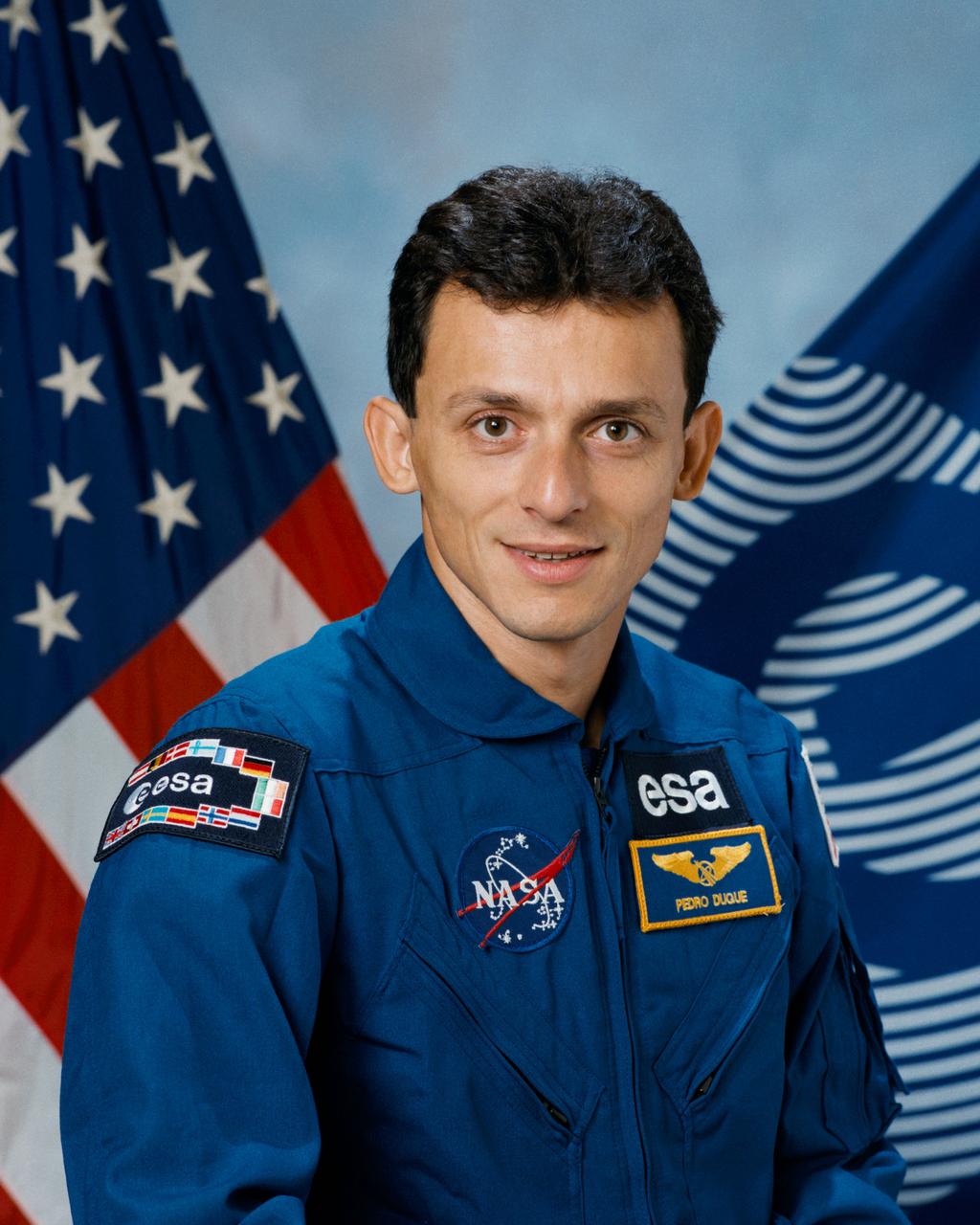
S96-16131 (13 Sept 1996) --- ESA payload specialist Pedro Duque.
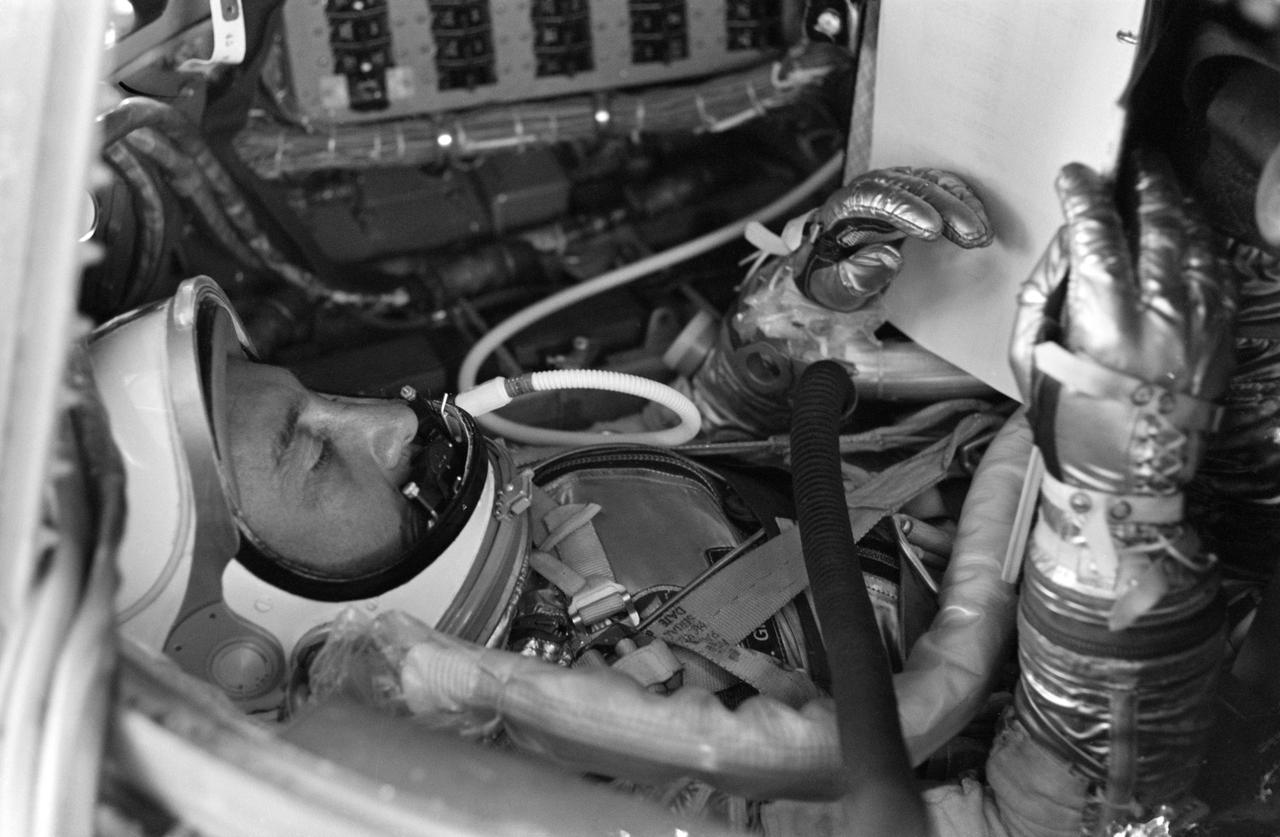
S64-10806 (21 July 1961) --- Astronaut Virgil I. (Gus) Grissom, pilot of the Mercury-Redstone 4 (MR-4) spaceflight, in his Mercury "Liberty Bell 7" spacecraft is checking his flight plan during prelaunch activities. Photo credit: NASA
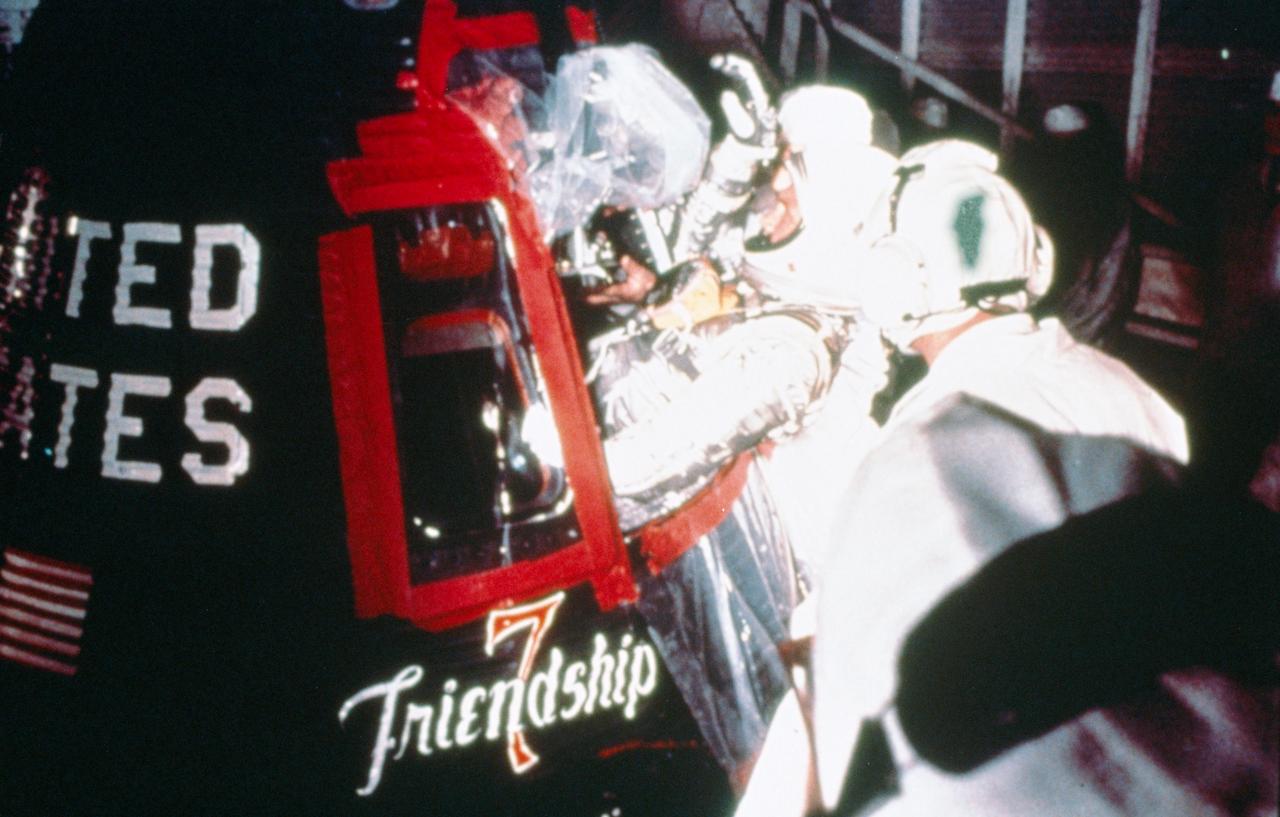
S85-26952 (20 Feb. 1962) --- Project Mercury astronaut John H. Glenn Jr., enters the Friendship 7 spacecraft during the last part of the countdown on Feb. 20, 1962. At 9:47 a.m. (EST), the Atlas launch vehicle lifted the spacecraft into orbit for a three-orbit mission lasting four hours, 55 minutes and 23 seconds. Glenn and his spacecraft were recovered by the destroyer Noa just 21 minutes after landing in the Atlantic near Grand Turk Island, to successfully complete the nation's first manned orbital flight. Photo credit: NASA
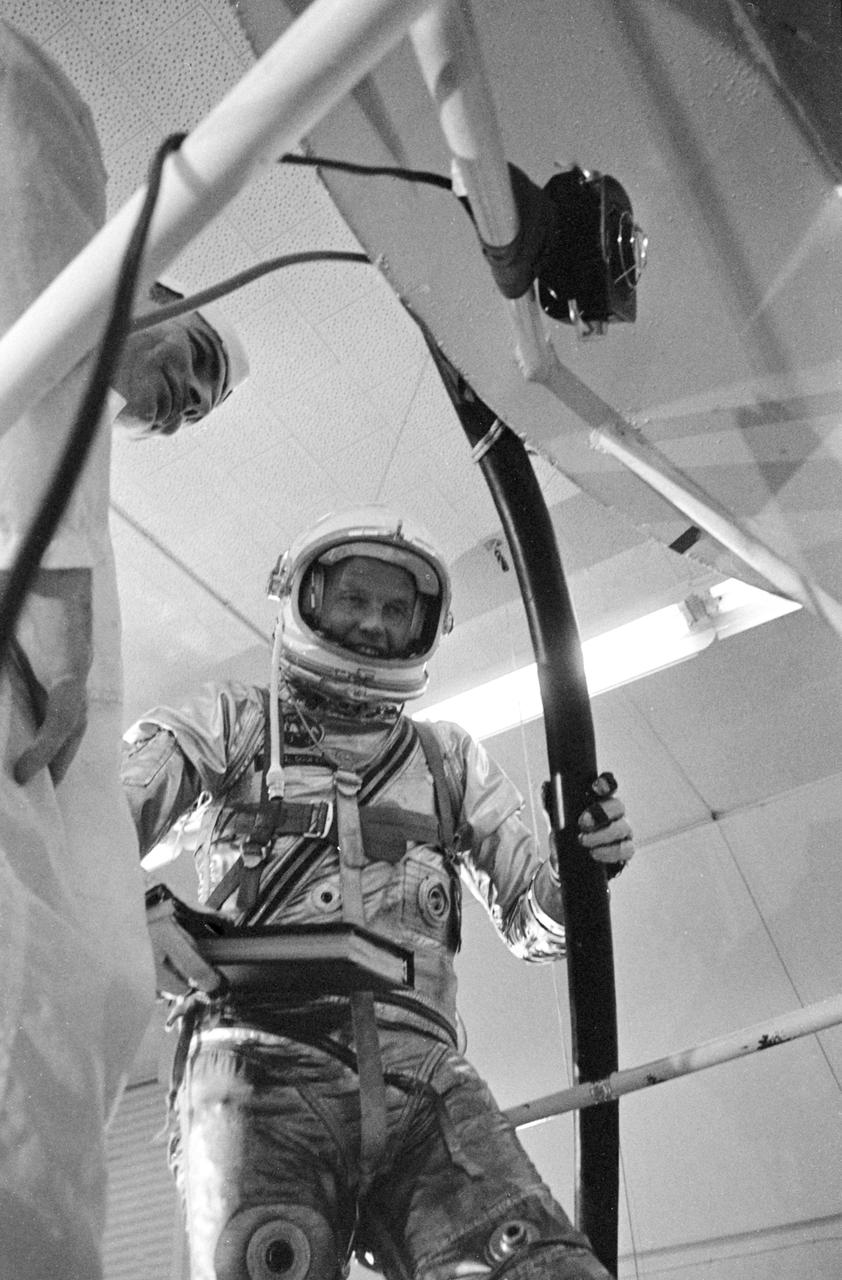
S63-03975 (1963) --- Astronaut L. Gordon Cooper Jr., prime pilot for the Mercury-Atlas 9 (MA-9) mission, is pictured prior to entering the Mercury spacecraft for a series of simulated flight tests. During these tests NASA doctors, engineers and technicians monitor Cooper's performance. Photo credit: NASA
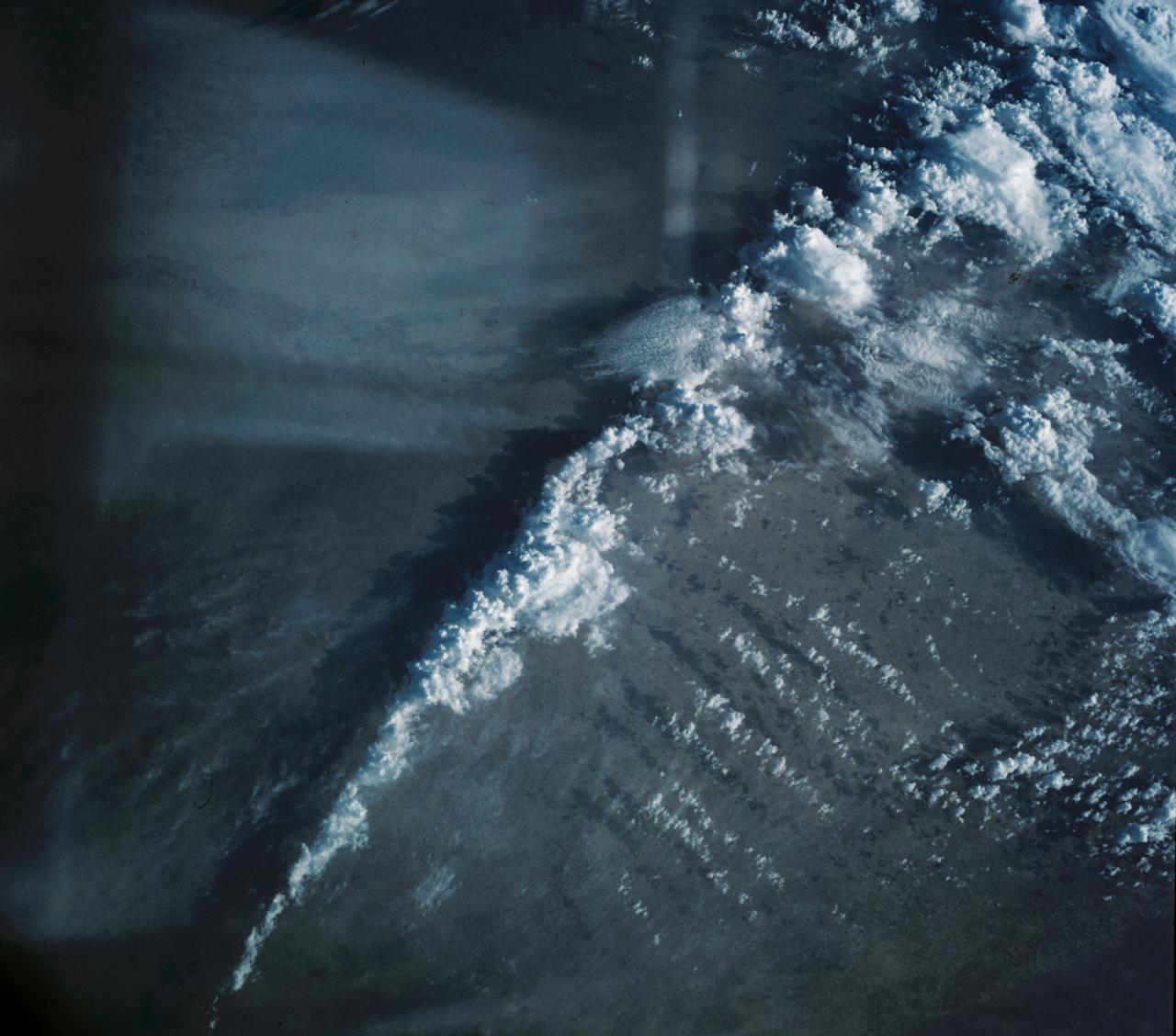
S63-06447 (15-16 May 1963) --- The Great Indian Desert, located west of New Delhi, India, as photographed from the Mercury-Atlas 9 (MA-9) capsule by astronaut L. Gordon Cooper Jr., during his 22-orbit MA-9 spaceflight. Photo credit: NASA
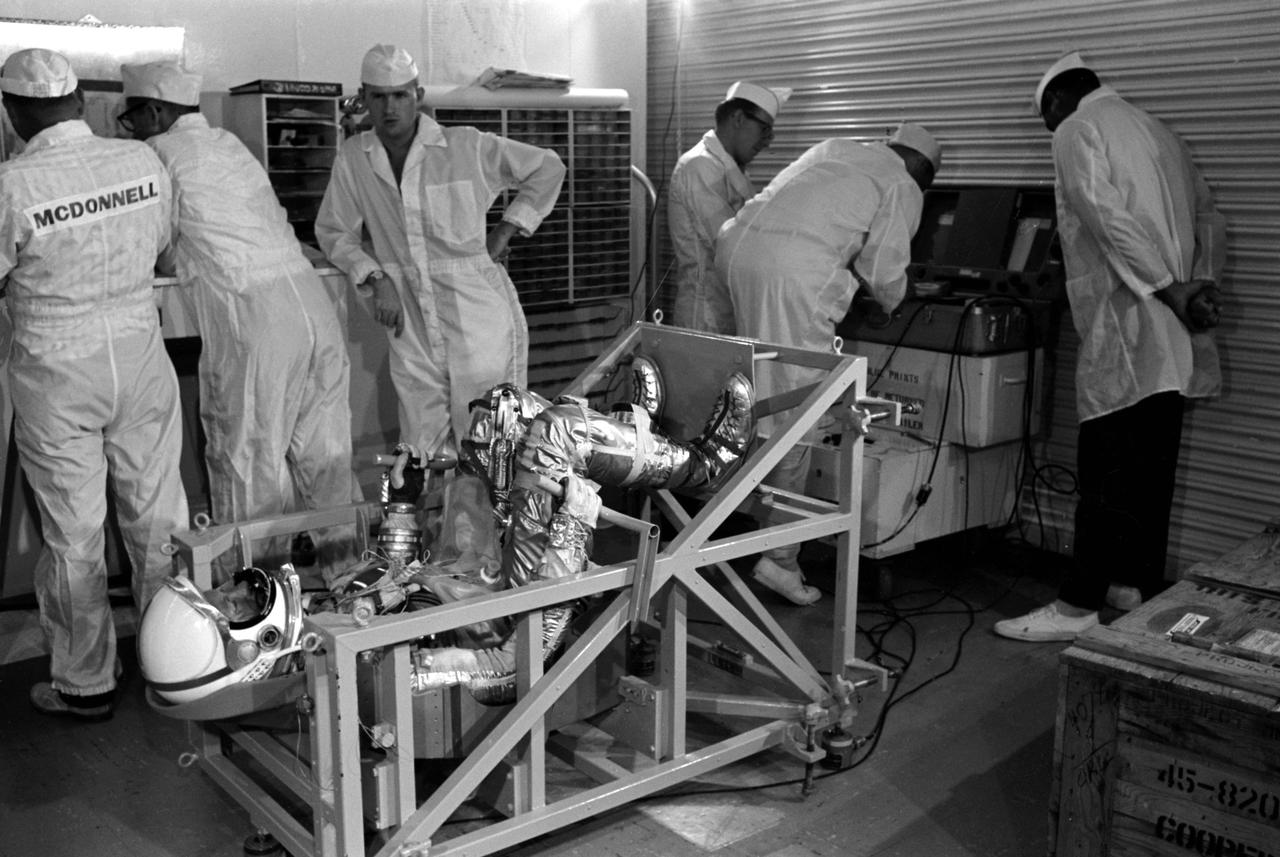
S62-05118 (1962) --- Astronaut L. Gordon Cooper Jr. on weight and balance scale in the White Room, Hangar S at Cape Canaveral. Photo credit: NASA
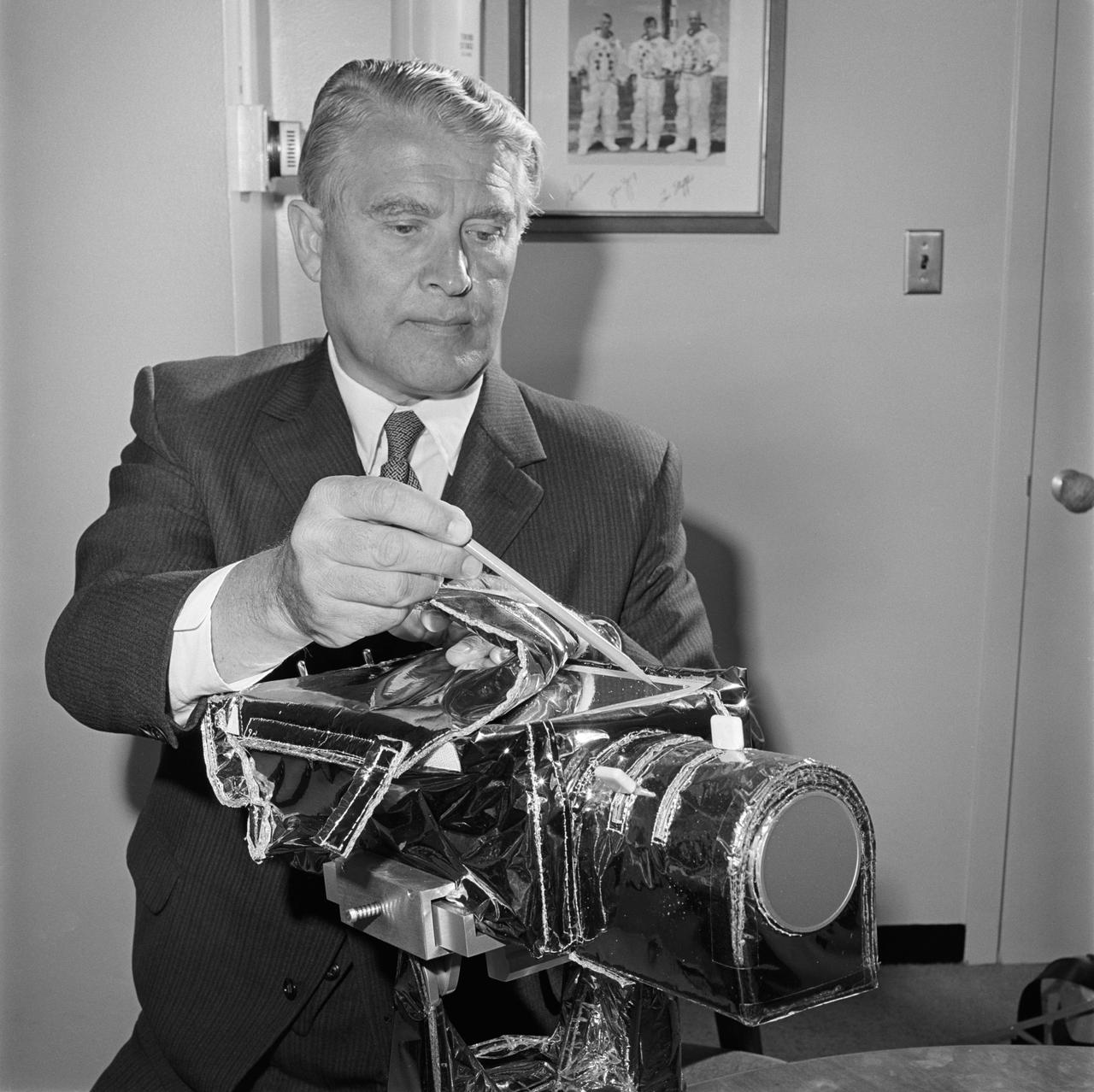
S71-35169 (June 1971) --- The color television camera for the National Aeronautics and Space Administration's (NASA) Apollo 15 lunar landing mission is examined by NASA's Deputy Associate Director Dr. Wernher von Braun. The camera will be mounted on the Lunar Roving Vehicle (LRV) and will be operated by the flight crew astronauts, David R. Scott and James B. Irwin, or by ground command from the Mission Control Center (MCC) in Houston during the three lunar traverses. It will also be used to show the astronauts whenever they leave the LRV, and for the first time it will make possible the viewing of the Lunar Module (LM) ascent stage as it lifts off the moon.
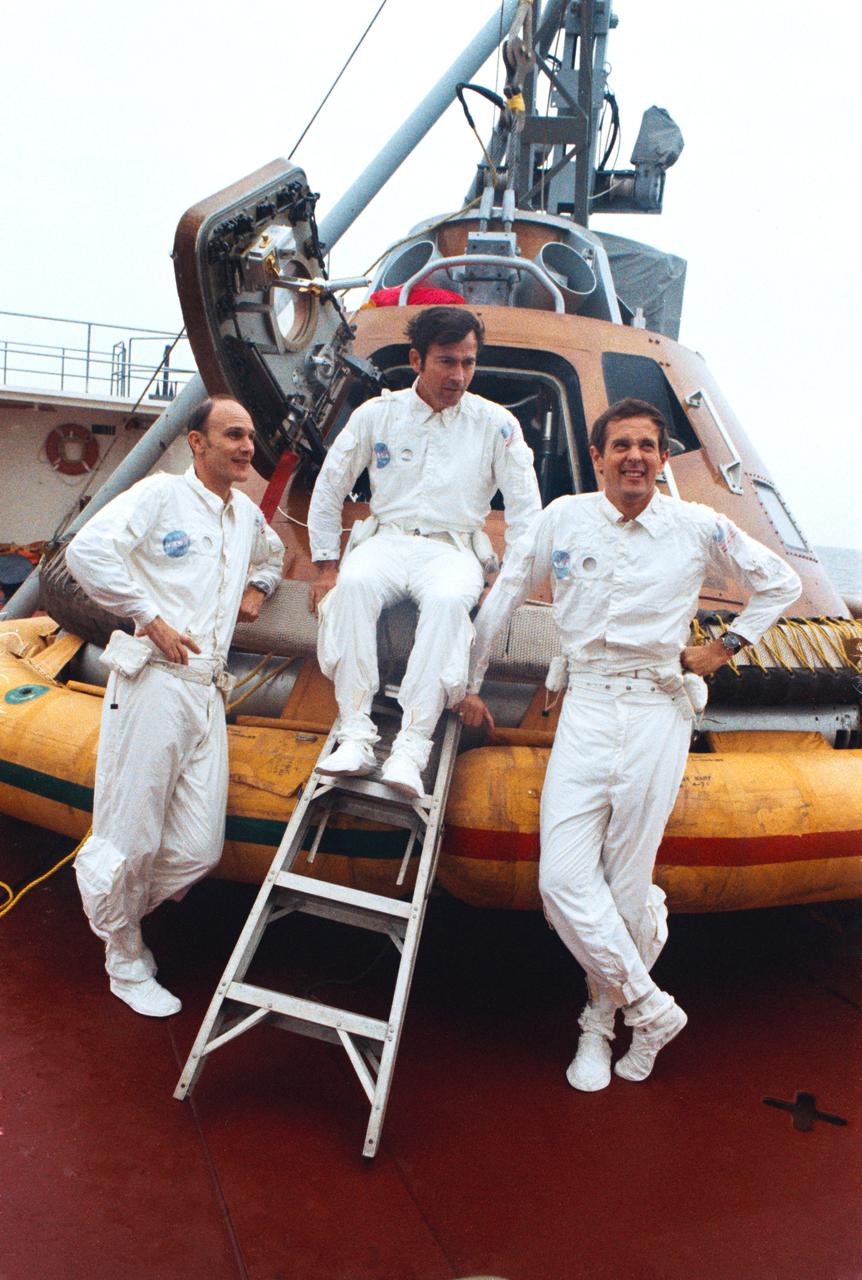
S72-30160 (5 May 1972) --- The Apollo 16 prime crew relax aboard the NASA Motor Vessel Retriever during water egress training activity in the Gulf of Mexico. They are, left to right, astronauts Thomas K. Mattingly II, command module pilot; John W. Young, commander; and Charles M. Duke Jr., lunar module pilot. The Command Module trainer was used in the training exercise.
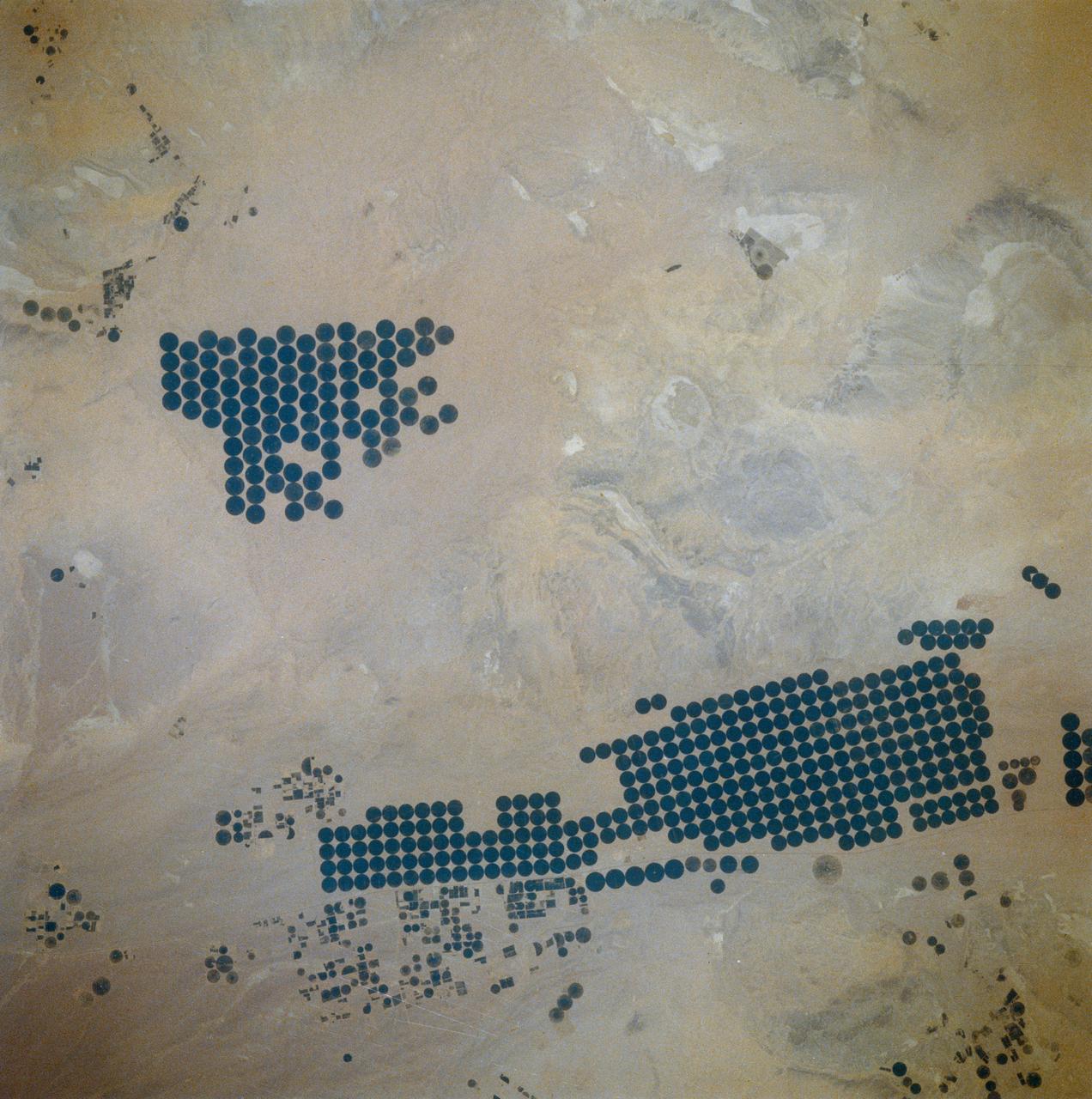
41C-31-1002 (6-13 April 1984) --- Though previous photographs of this area have been taken prior to 41-C, that mission?s photography represents the best ever of ground water irrigation in Near East deserts. The system here is located in northeast Saudi Arabia, in the vicinity of Al Hufuf. Designed for use in the American west, the center pivot irrigation method pumps water from the ground and broadcasts it in a half-mile diameter circle from a mobile sprinkler system. This frame was one of the visuals used by the 41-C astronauts at their post-flight press conference.
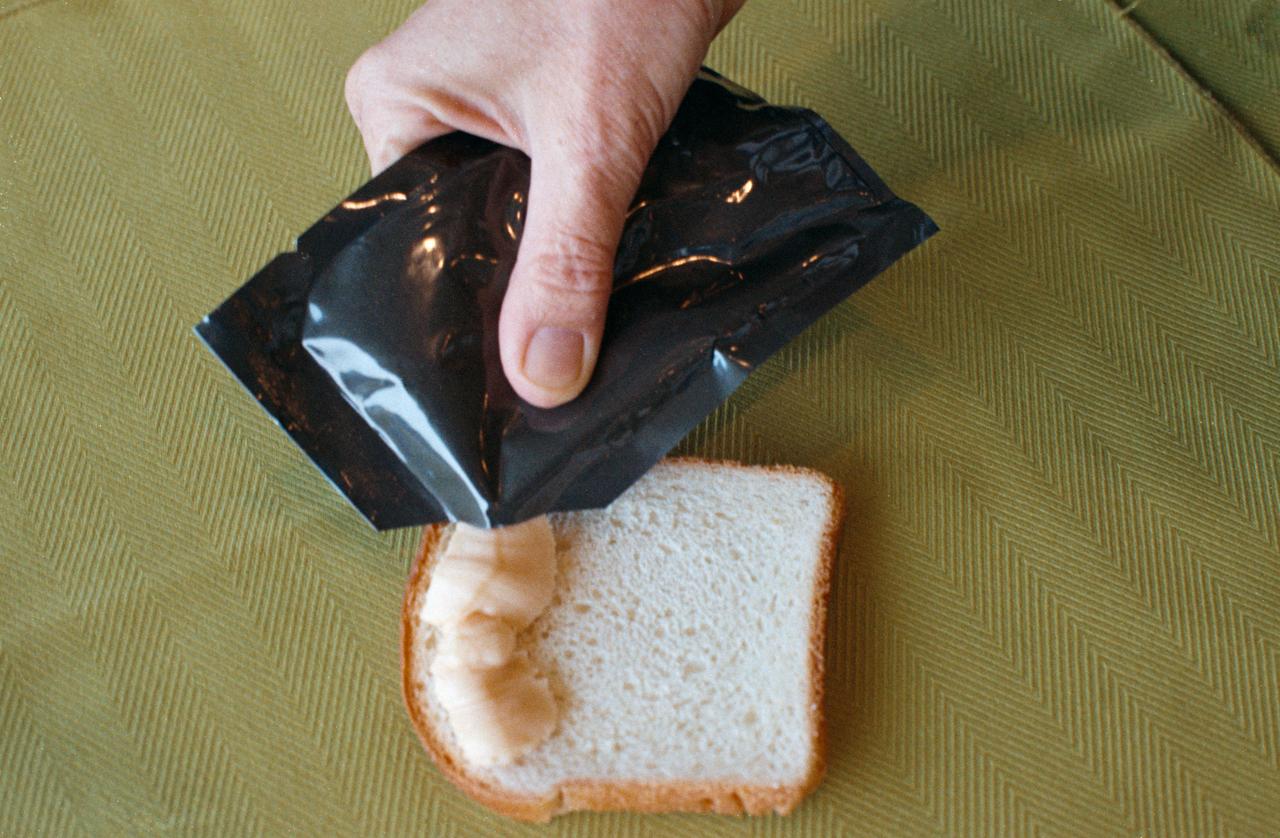
S74-25635 (August 1974) --- A close-up view of cheddar cheese spread, one of the items of food selected for the Apollo-Soyuz Test Project mission scheduled for the summer of 1975. This food item was carried on the Apollo missions also.
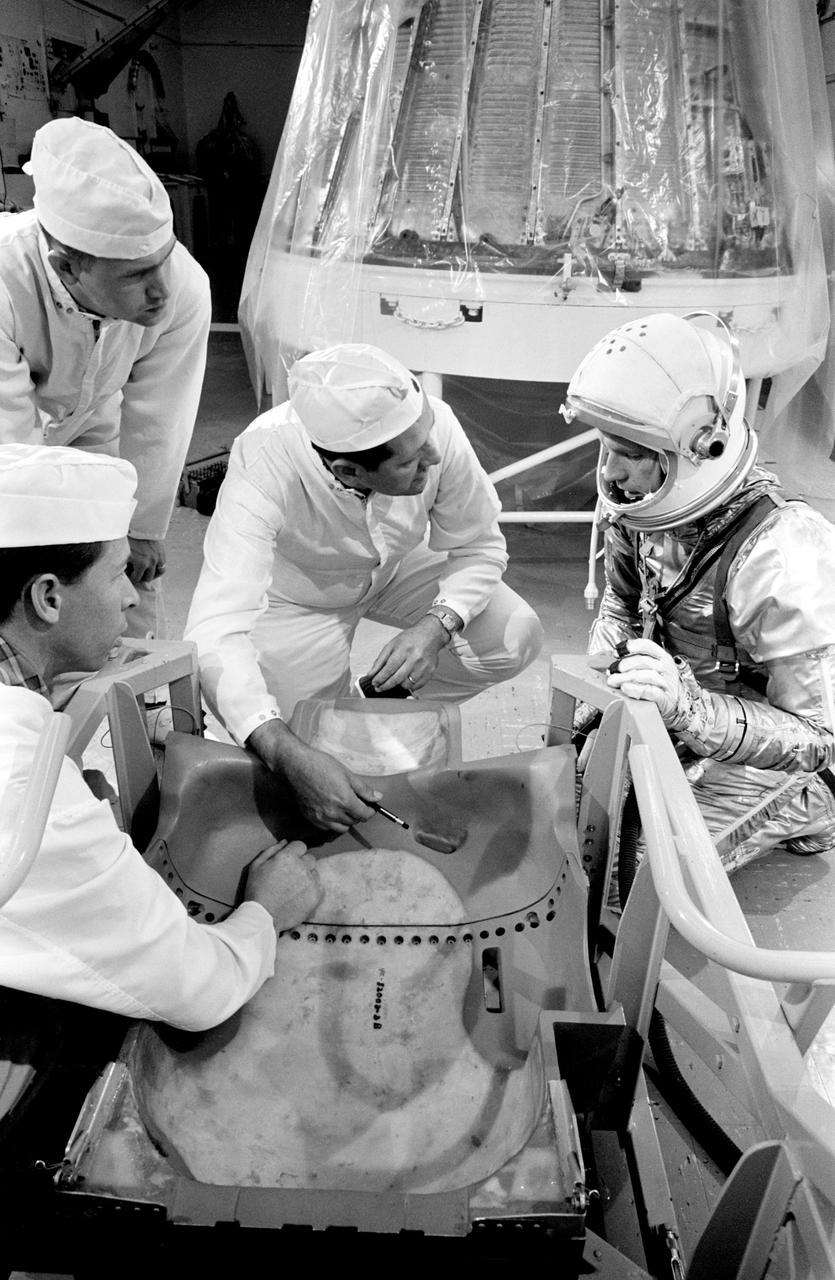
S63-03968 (1963) --- Astronaut L. Gordon Cooper Jr., prime pilot for the Mercury-Atlas 9 (MA-9) mission; Joe Trammel, MAC technician; A. Rochford, NASA suit technician; and C.R. Coyle, MAC technician, look over spacecraft couch. Photo credit: NASA
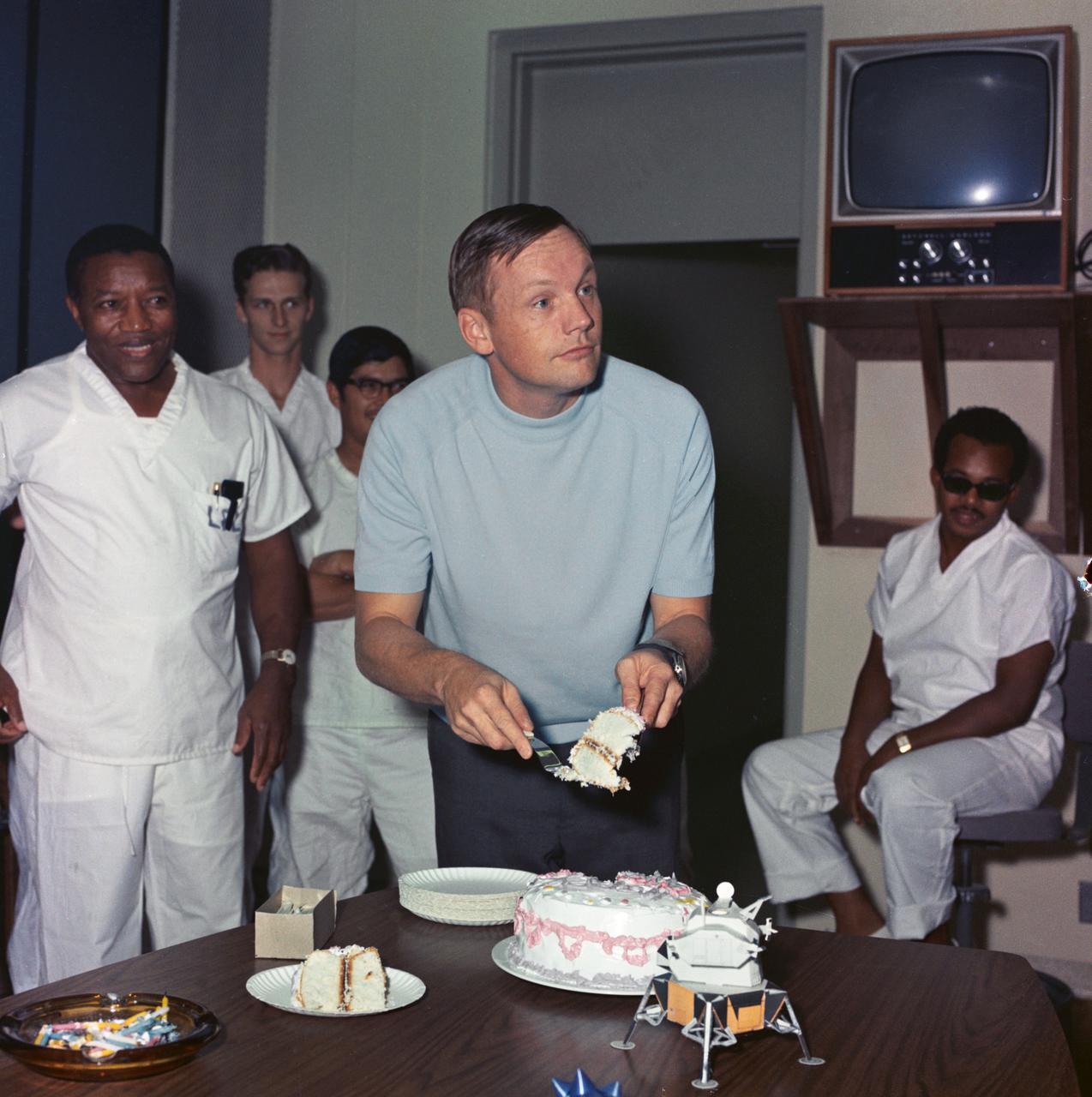
S69-40958 (5 August 1969) --- Astronaut Neil A. Armstrong, commander of the historic Apollo 11 lunar landing mission, and the first man to set foot on the Moon, cuts his birthday cake as he celebrated his 39th birthday. The crew still confined to the Crew Reception Area (CRA) of the Manned Spacecraft Center's (MSC) Lunar Receiving Laboratory (LRL). Armstrong was born on August 5, 1930, in Wapakoneta, Ohio. The cake was described as "standard two-layer, plain vanilla" on which was placed 39 candles. Eighteen of the persons quarantined with Armstrong assembled and sang happy birthday; and a champagne toast was offered. CRA support personnel are in the background. Astronauts Armstrong; Michael Collins, command module pilot; and Edwin E. Aldrin Jr., lunar module pilot, will be released from quarantine on August 11, 1969.
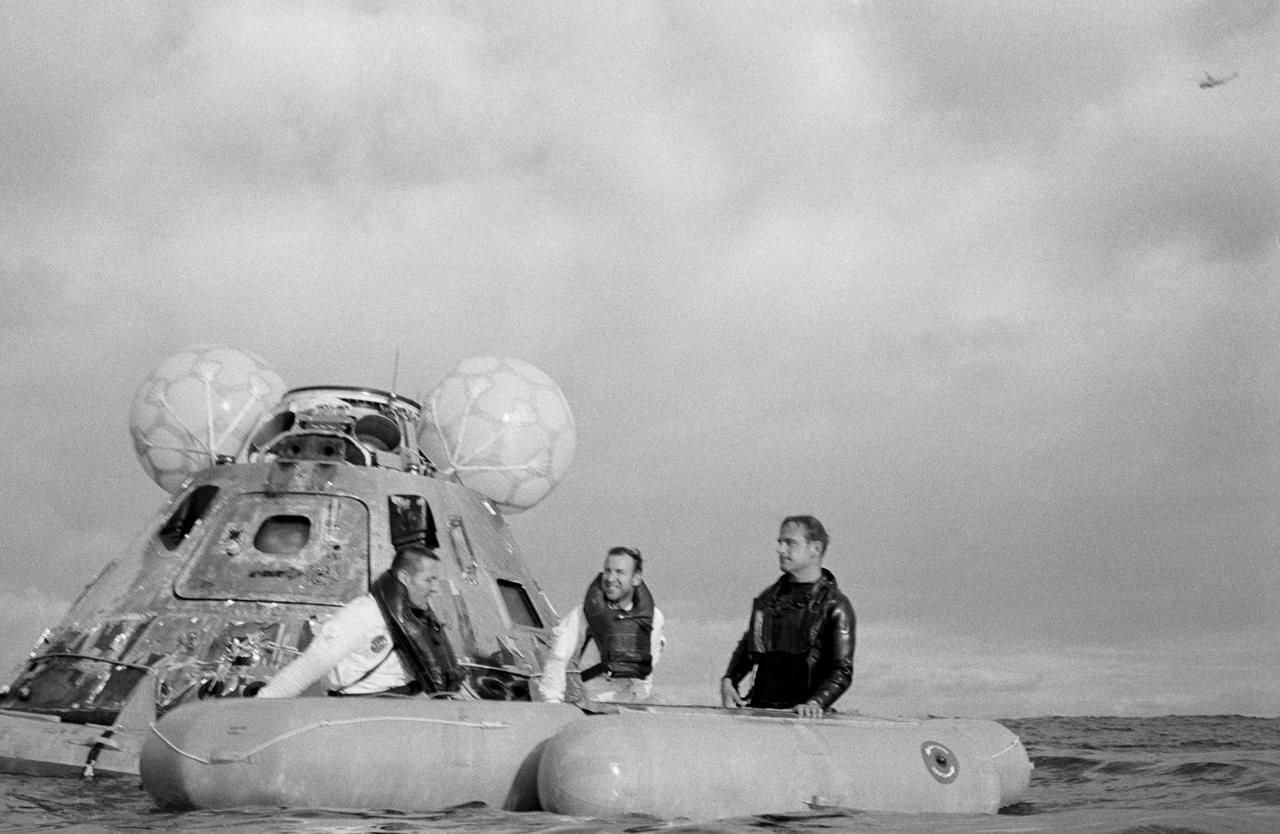
S70-35615 (17 April 1970) --- A water level view of the Apollo 13 recovery operations in the South Pacific Ocean. The three astronauts have egressed their spacecraft, and astronaut Fred W. Haise Jr., lunar module pilot, has already ascended to the helicopter. The other two crewmembers await the return of the "Billy Pugh" net. Astronaut James A. Lovell Jr. (center), commander, will remain in the life raft until astronaut John L. Swigert Jr., command module pilot, has boarded the helicopter. A United States Navy underwater demolition team swimmer assist with the recovery operations. The three Apollo 13 crewmembers were flown to the USS Iwo Jima, prime recovery ship. Apollo 13 splashed down at 12:07:44 p.m. (CST), April 17, 1970, to safely conclude a perilous space flight.
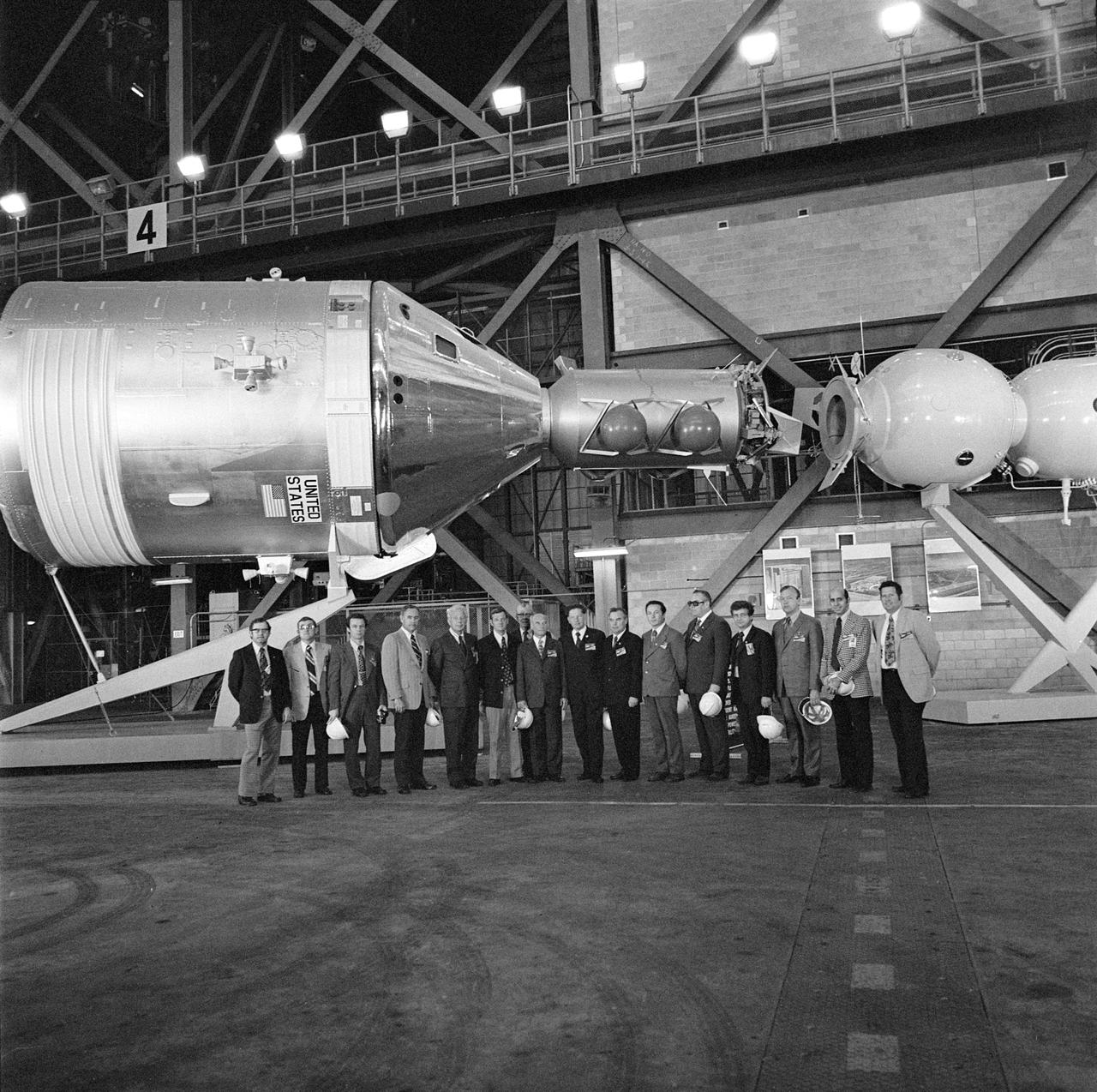
S75-24026 (4 Feb. 1975) --- A group of Soviet and American ASTP officials during a tour of the Kennedy Space Center. They were photographed next to the Apollo-Soyuz Test Project docking in Earth orbit mock-up at KSC.
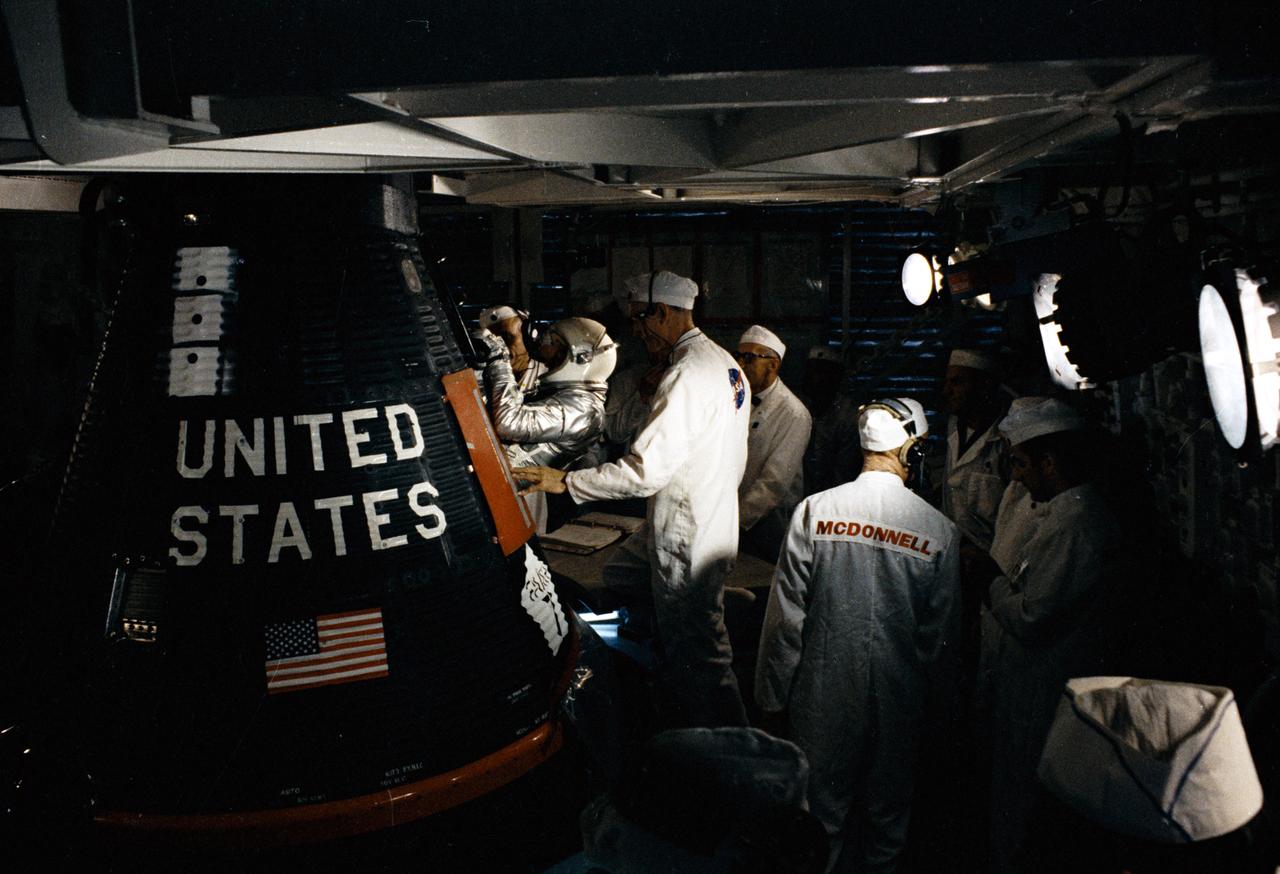
S63-09676-E (15 May 1963) --- Astronaut L. Gordon Cooper Jr., pilot of the Mercury-Atlas 9 (MA-9) Earth-orbital space mission, is assisted into his "Faith 7" Mercury spacecraft during the prelaunch countdown. MA-9 was launched on May 15, 1963, and the flight lasted for 34 hours and 20 minutes. Photo credit: NASA
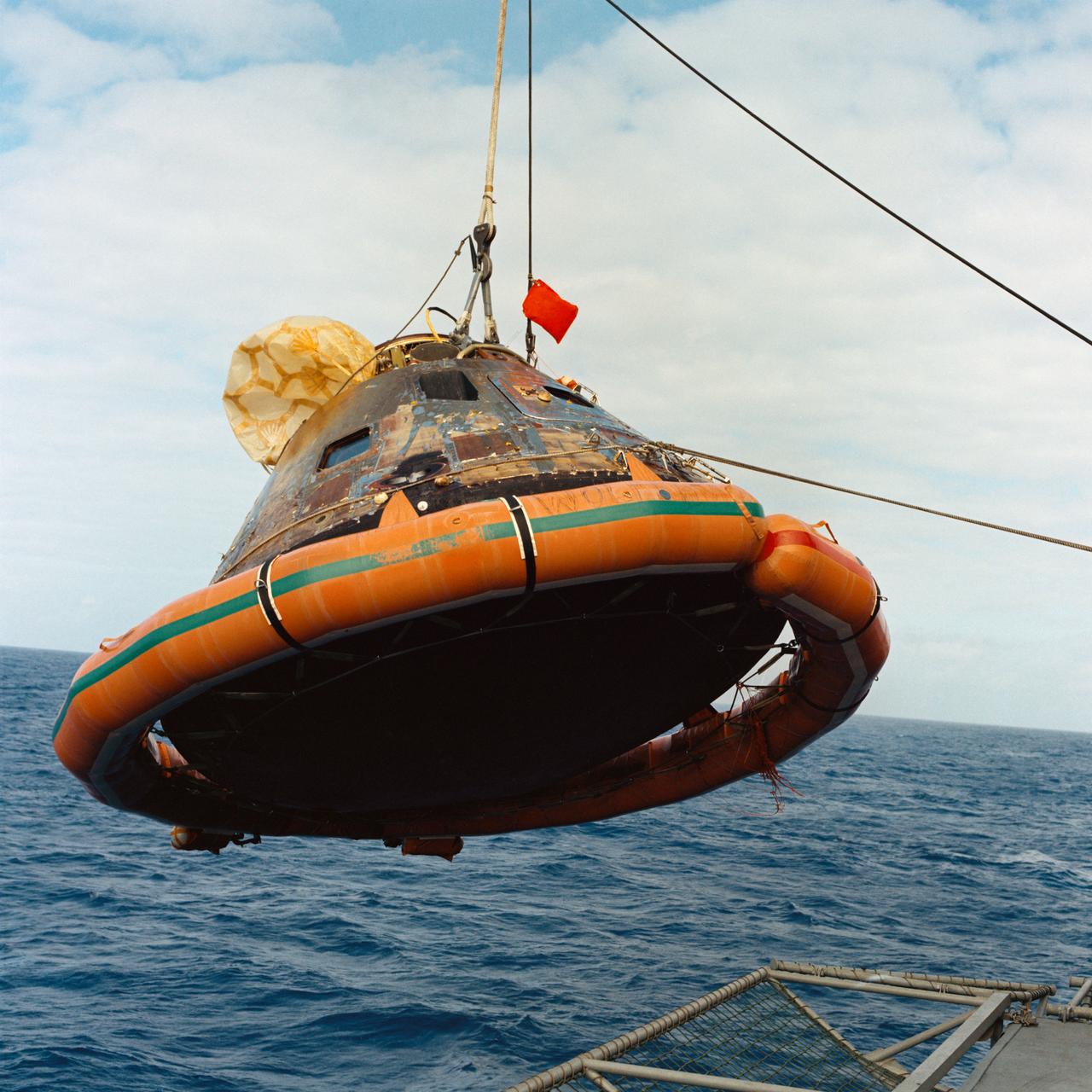
S69-21783 (24 July 1969) --- The Apollo 11 Command Module (CM) is photographed as it is hoisted aboard the USS Hornet, prime recovery vessel for the historic Apollo 11 lunar landing mission. The splashdown took place at 11:49 a.m. (CDT), July 24, 1969, about 812 nautical miles southwest of Hawaii, only 12 nautical miles from the USS Hornet.
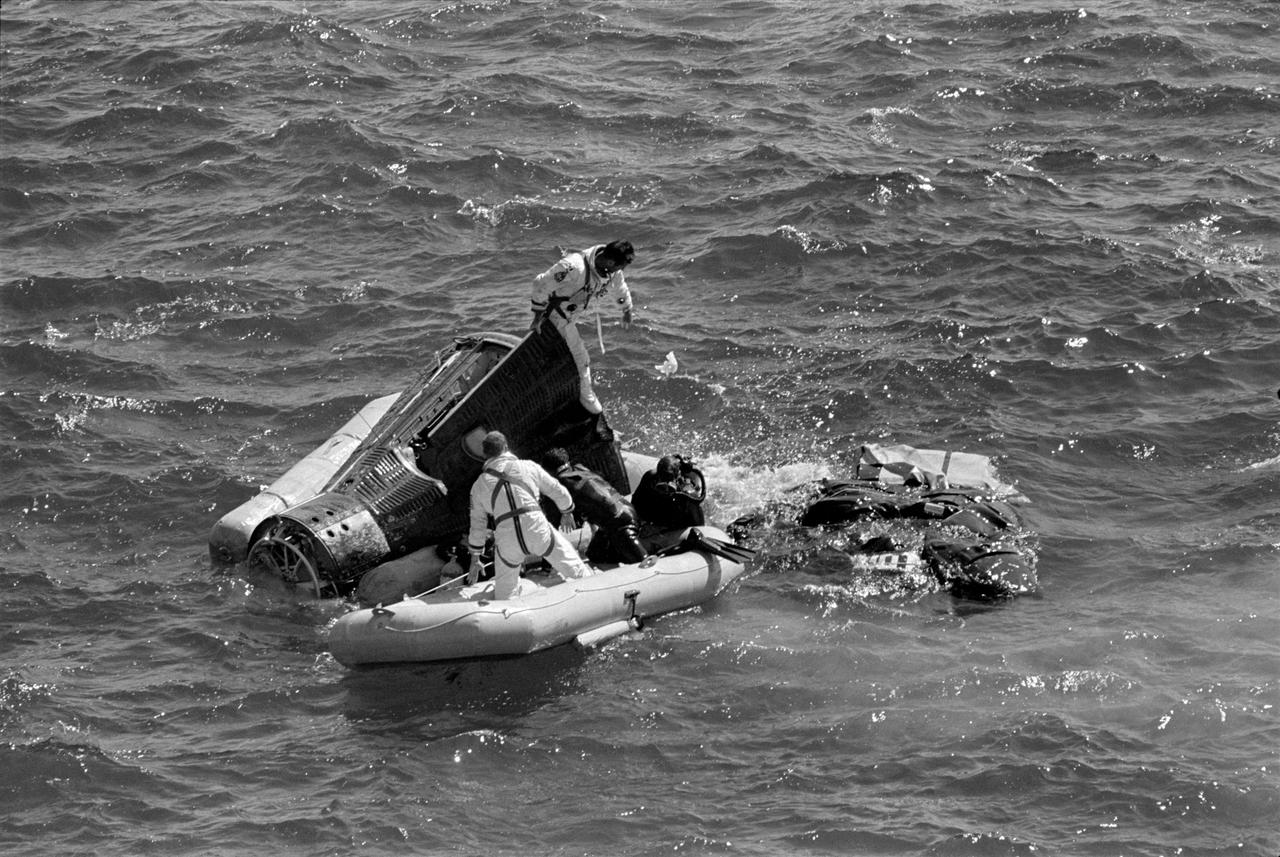
S66-50789 (15 Sept. 1966) --- Frogmen assist in the recovery of Gemini 11 astronauts Conrad & Gordon while they await the helicopter.
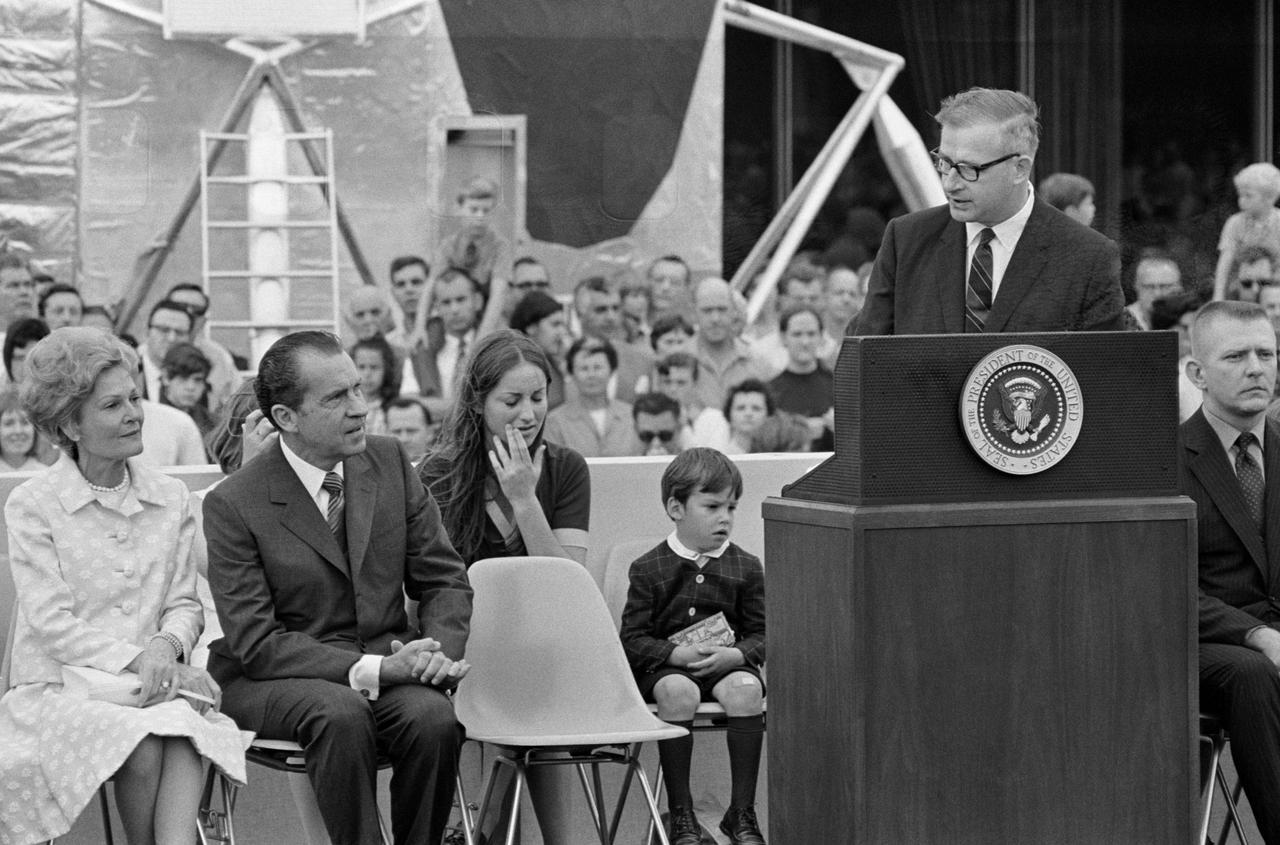
S70-35595 (18 April 1970) --- President Richard M. Nixon is welcomed to Manned Spacecraft Center (MSC) and introduced by Dr. Thomas O. Paine, Administrator, National Aeronautics and Space Administration (NASA). The First Lady is at extreme left. Others on the speakers platform in this view are Barbara and Jeffrey C. Lovell, children of astronaut James A. Lovell Jr., commander; and Eugene F. Kranz (extreme right), one of four flight directors on duty around the clock during the mission. President Nixon was on the site to present the Presidential Medal of Freedom to the Apollo 13 Mission Operations Team.
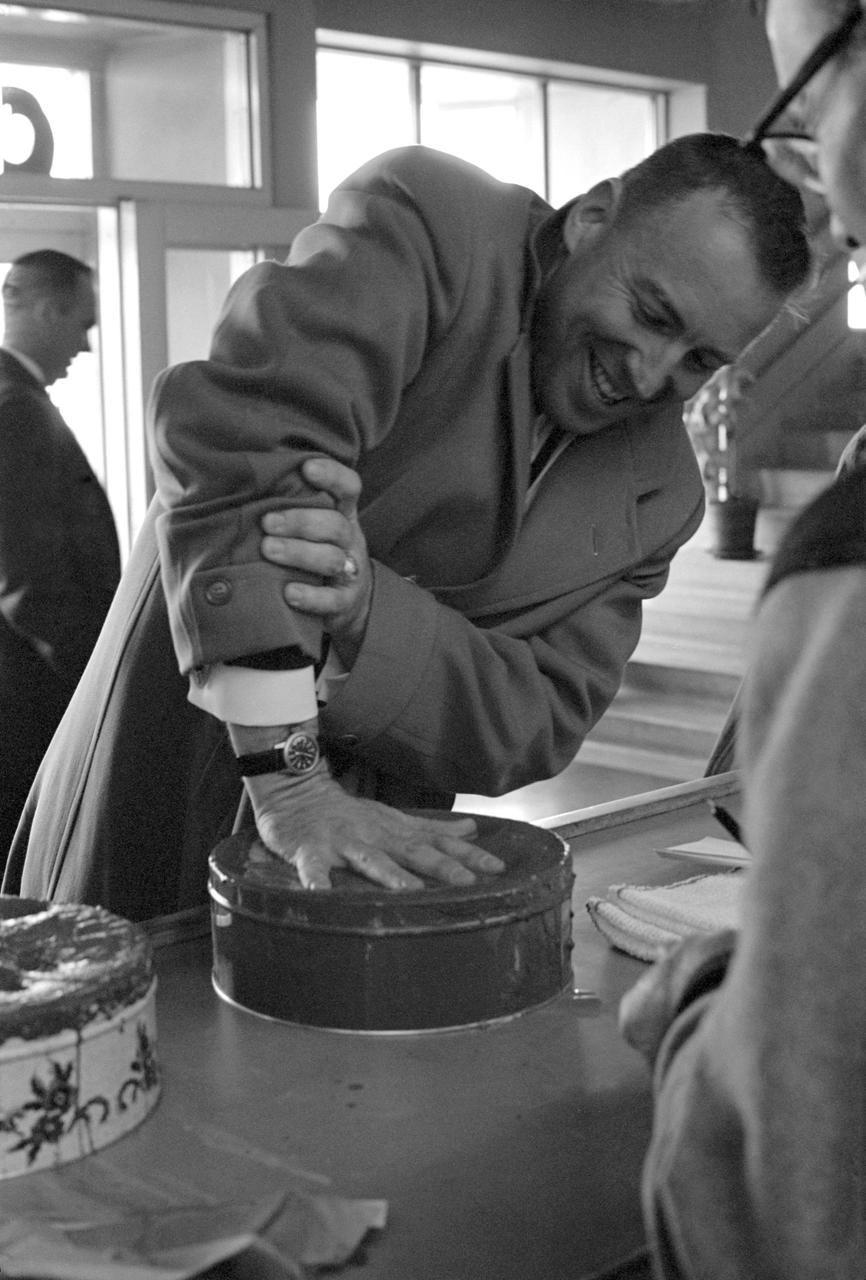
MSC Flight Crew visit Lowell Observatory at Flagstaff, AZ
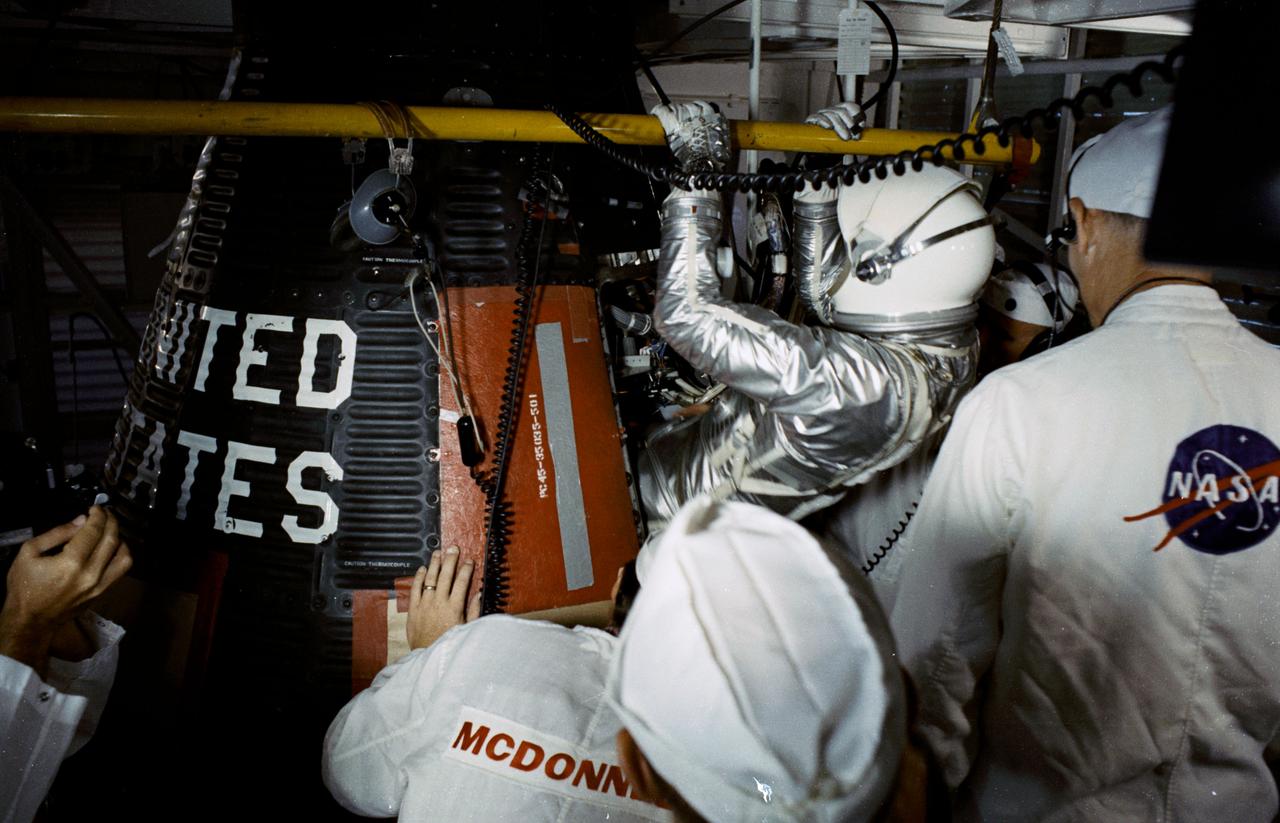
S63-07521 (15 May 1963) --- Astronaut L. Gordon Cooper Jr., pilot of the Mercury-Atlas 9 (MA-9) Earth-orbital space mission, is assisted into his "Faith 7" Mercury spacecraft during the prelaunch countdown. MA-9 was launched on May 15, 1963, and the flight lasted for 34 hours and 20 minutes. Photo credit: NASA
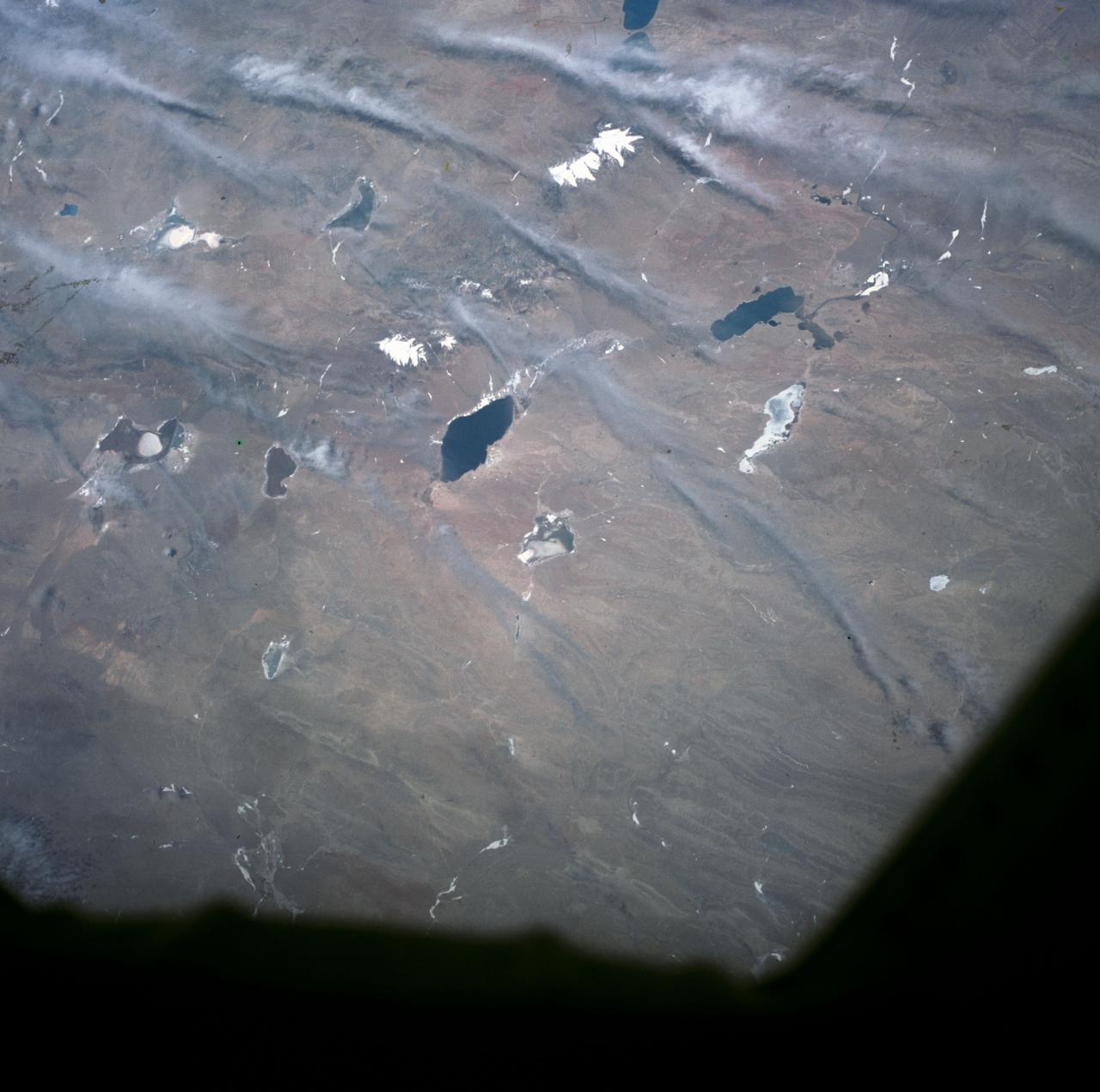
S63-06456 (15-16 May 1963) --- Lakes of Western Tibet, photographed from the Mercury-Atlas 9 (MA-9) capsule by astronaut L. Gordon Cooper Jr., during his 22-orbit MA-9 spaceflight. Photo credit: NASA
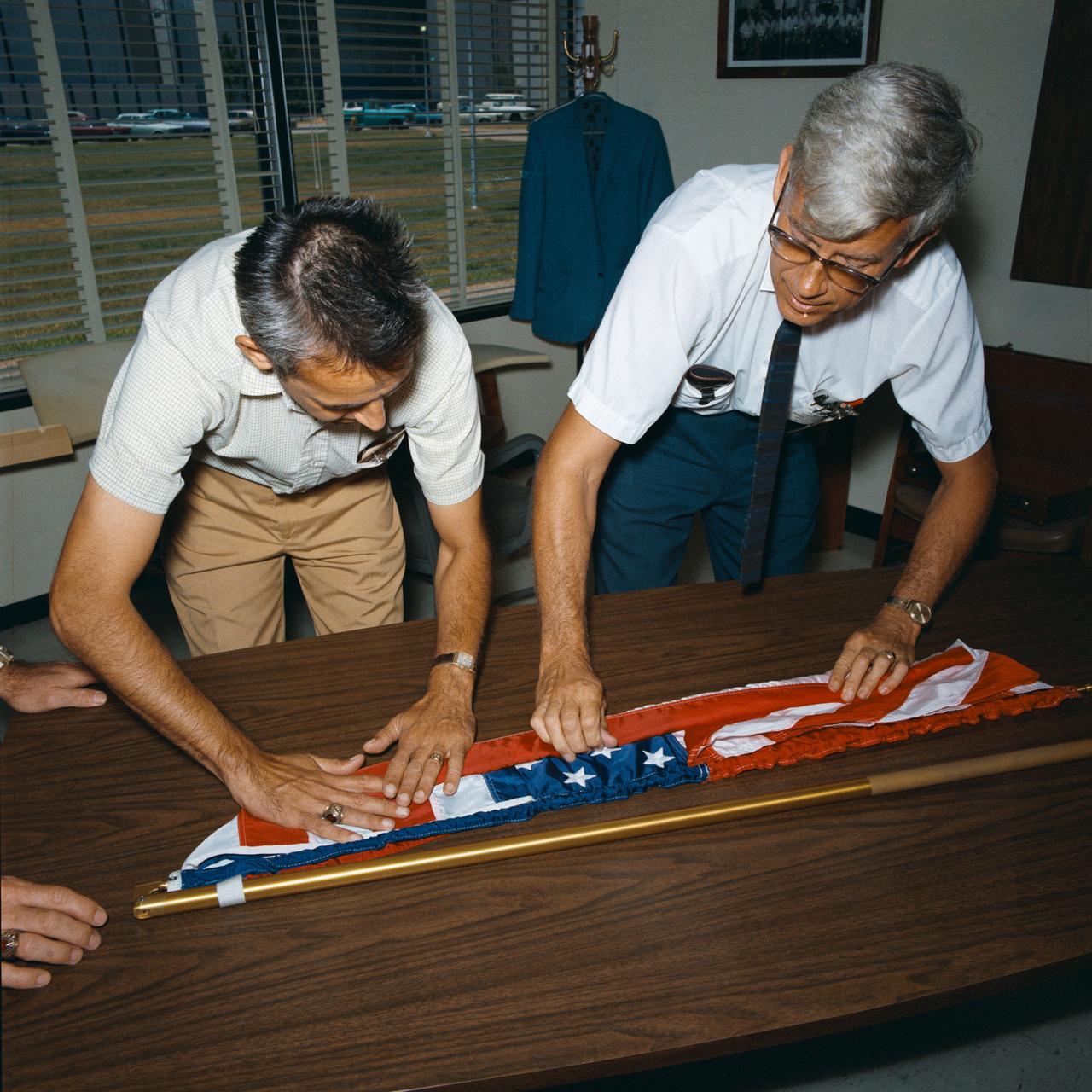
S69-38765 (1969) -- Jack Kinzler, right, with the U.S. flag kit for Apollo 11, seen in the technical services shop in Building 9.
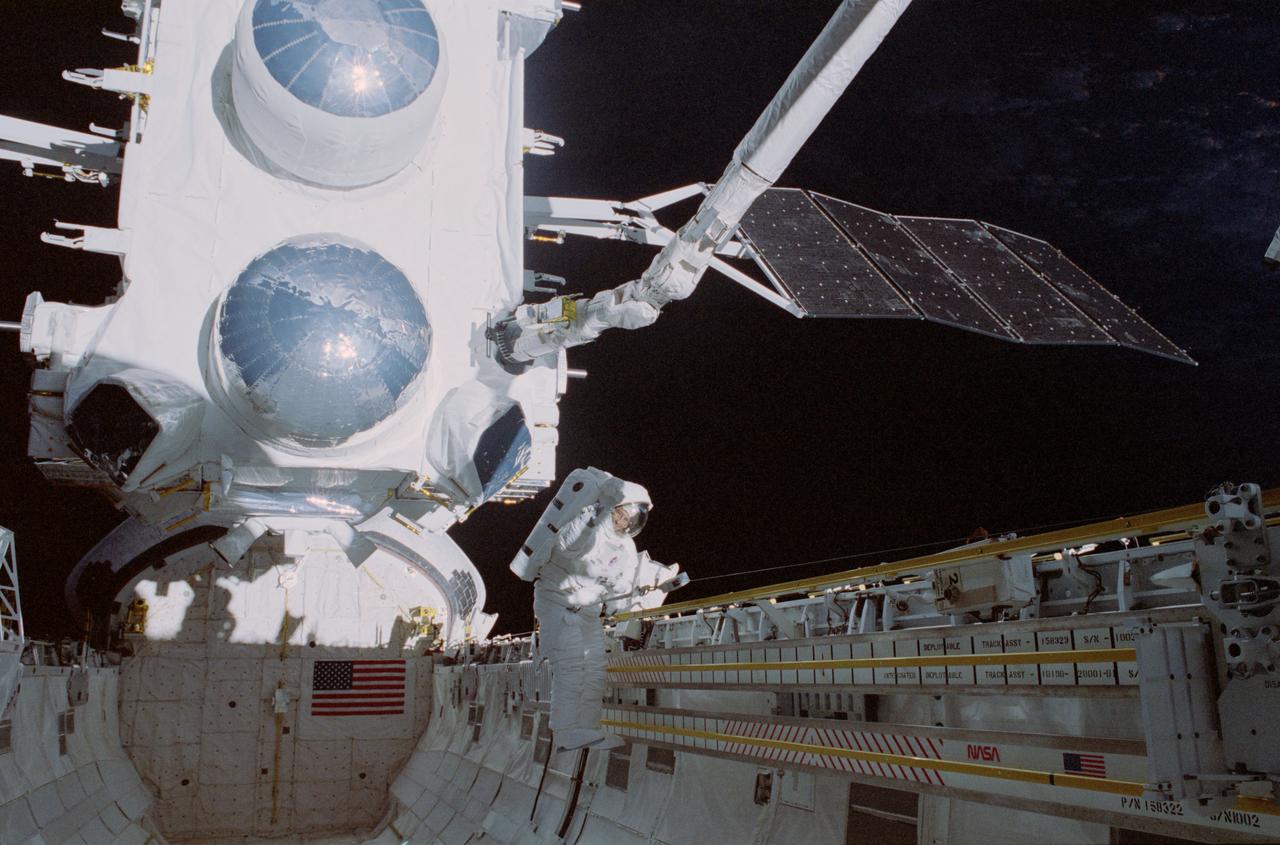
Photographic documentation showing activities in the payload bay of the orbiter Atlantis during STS-37. View include: Gamma Ray Observatory (GRO) on end of Remote Manipulator System (RMS), with Mission Specialist Jay Apt below on the port side of the payload bay.
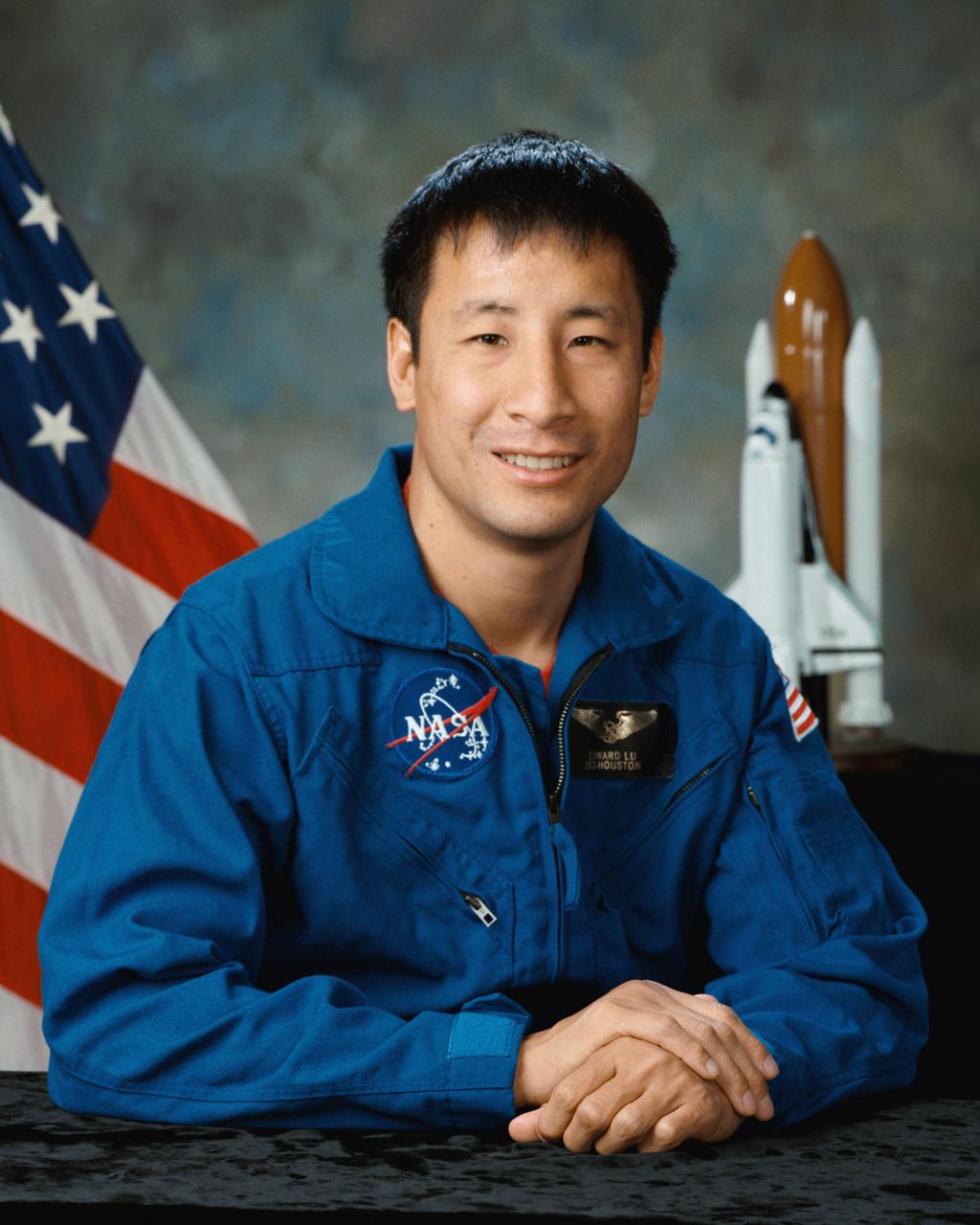
S95-06572 (23 March 1995) --- Astronaut Edward T. Lu, mission specialist.
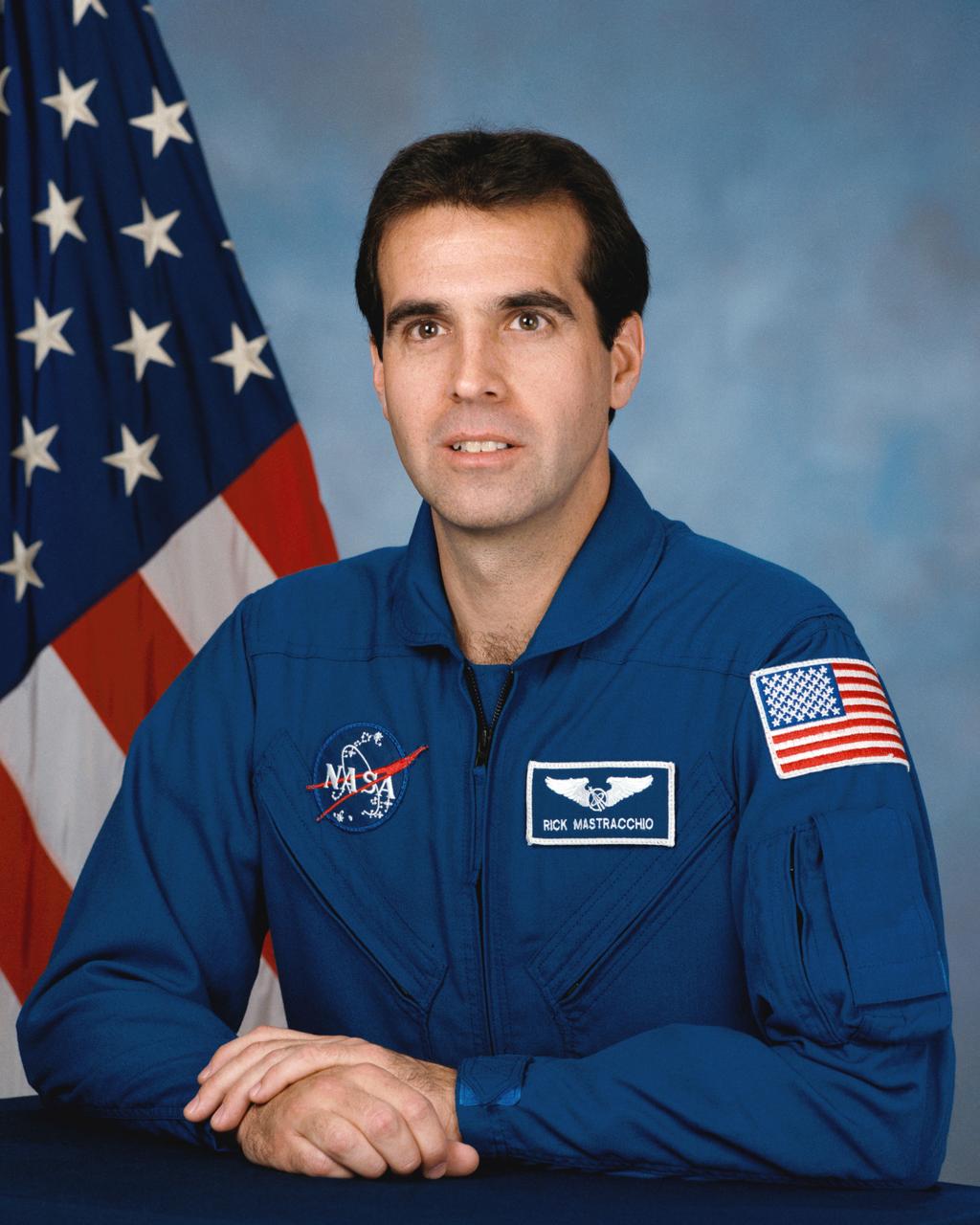
S96-16635 (1996) --- Astronaut Richard Mastracchio.
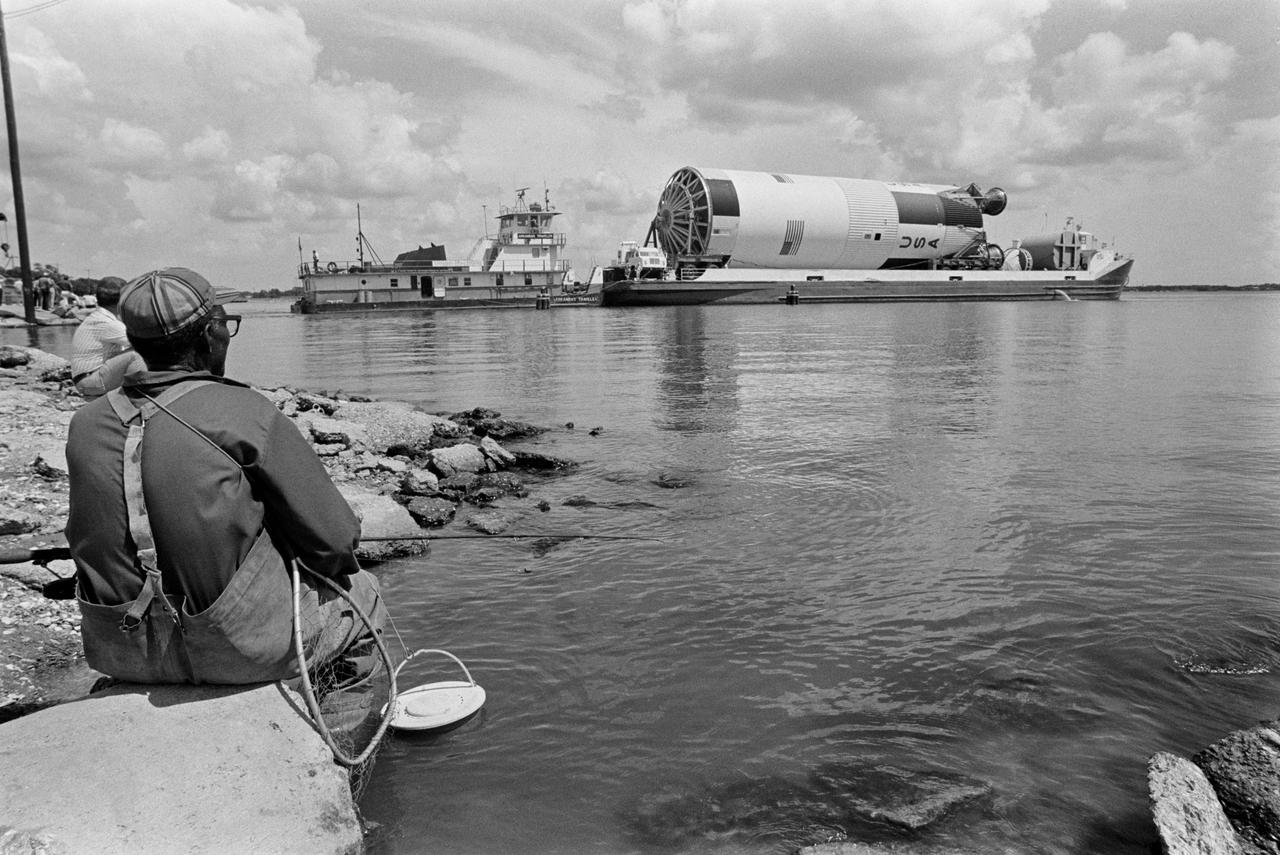
Views documenting the arrival of the Saturn V first stage at the Clear Lake dock near JSC after being transported via barge from Michoud Facility to be put on exhibit at JSC near Building 14. Barge approach with fisherman and others onshore watching. Houston, TX
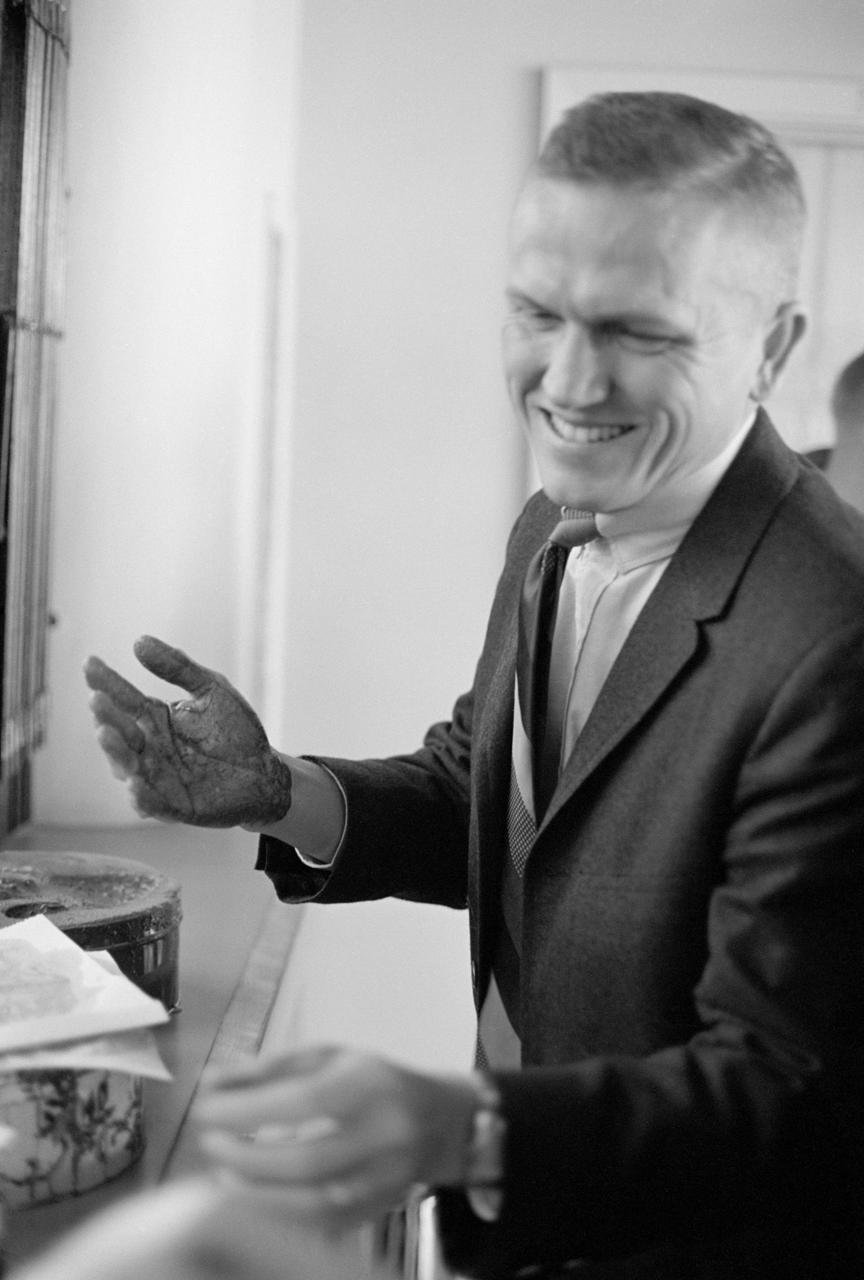
MSC Flight Crew visit Lowell Observatory at Flagstaff, AZ
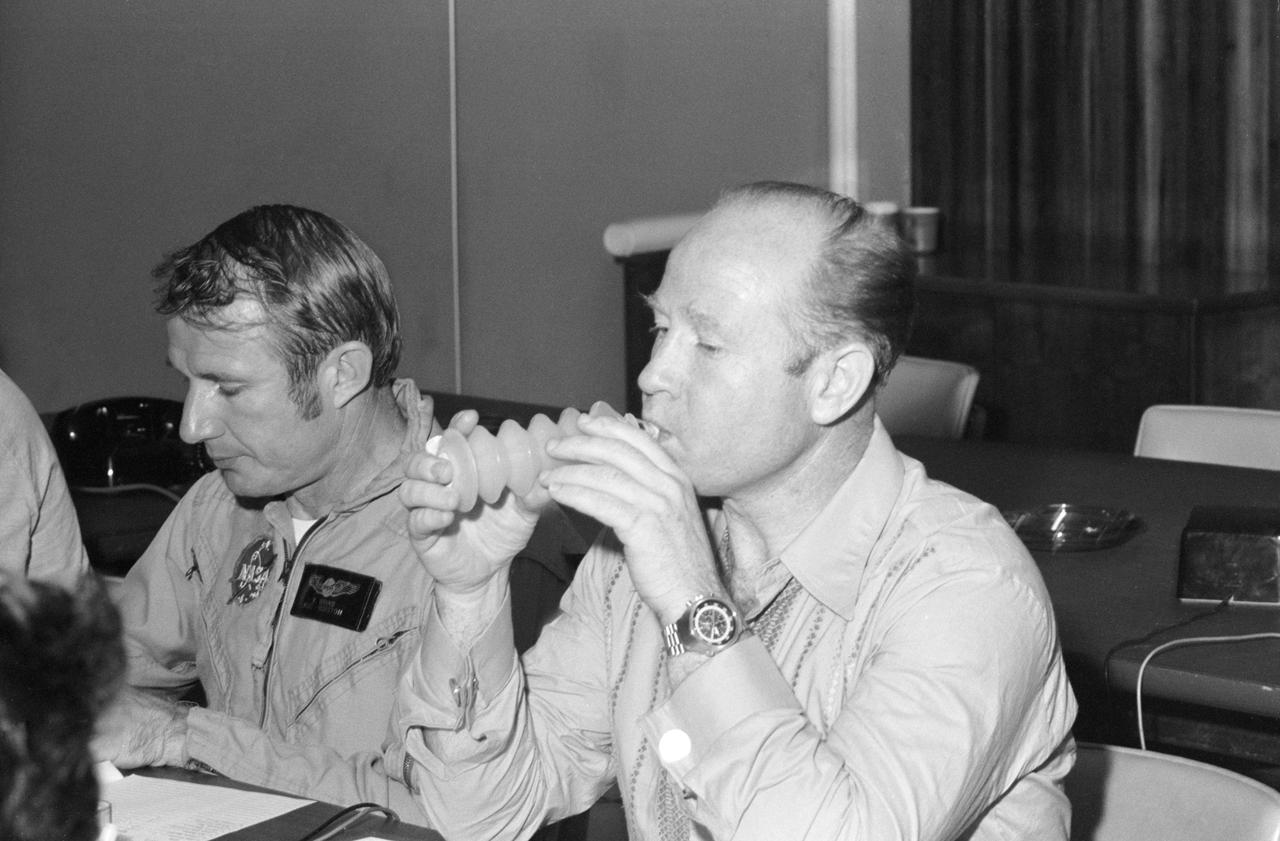
S74-20798 (23 April 1974) --- Candidate food items being considered for the joint U.S.-USSR Apollo-Soyuz Test Project mission are sampled by two ASTP crewmen in Building 4 at the Johnson Space Center. They are, left to right, astronaut Vance D. Brand, command module pilot of the American ASTP crew; and cosmonaut Aleksey A. Leonov, commander of the Soviet ASTP crew. Leonov is drinking orange juice from an accordion-like dispenser. The two Soviet crewmen will have an opportunity to eat with the three American crewmen while the Apollo and Soyuz spacecraft are docked in Earth orbit. Leonov will dine on food being chosen by him now.

S70-34901 (14 April 1970) --- Mrs. Marilyn Lovell, wife of astronaut James A. Lovell, Apollo 13 mission commander, discusses the flight with Dr. Charles A. Berry, flight surgeon. The two are in a special viewing area overlooking the Flight Control Room (FCR), staffed with flight controllers who were supporting the planned lunar landing mission. EDITOR?S NOTE: After this picture was taken, an explosion occurred aboard the Service Module (SM), causing cancellation of the lunar landing phase of the mission.
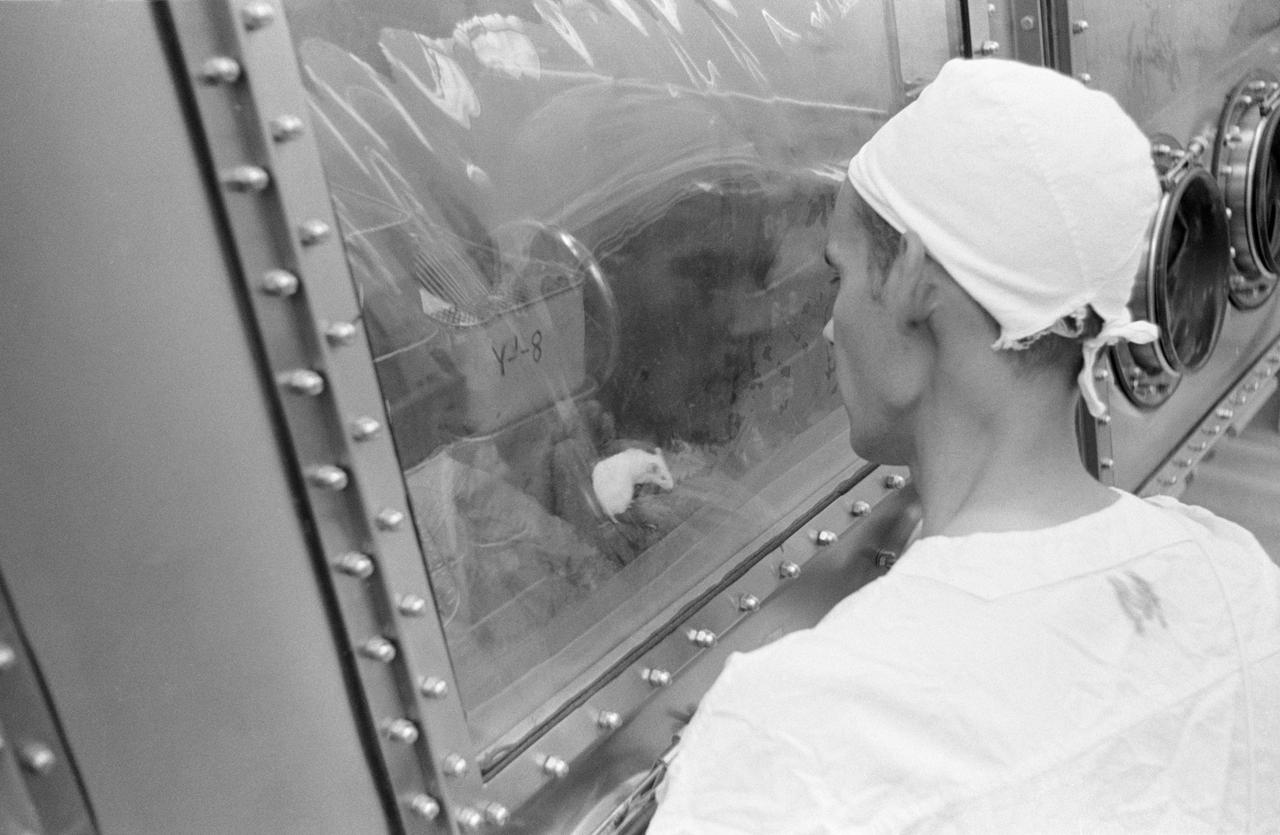
S69-40752 (August 1969) --- Landrum Young, Brown and Root - Northrop technician examines mice in the Animal Laboratory of the Lunar Receiving Laboratory (LRL) which have been inoculated with lunar sample material. The sample material was collected by astronauts Neil A. Armstrong and Edwin E. Aldrin Jr. during their lunar surface extravehicular activity (EVA) on July 20, 1969.

Anna L. Fisher, Astronaut-Candidate (ASCAN) in Water Immersion Facility (WIF) Training. 1. ASCAN Fisher, Anna L. - Training JSC, HOUSTON, TX
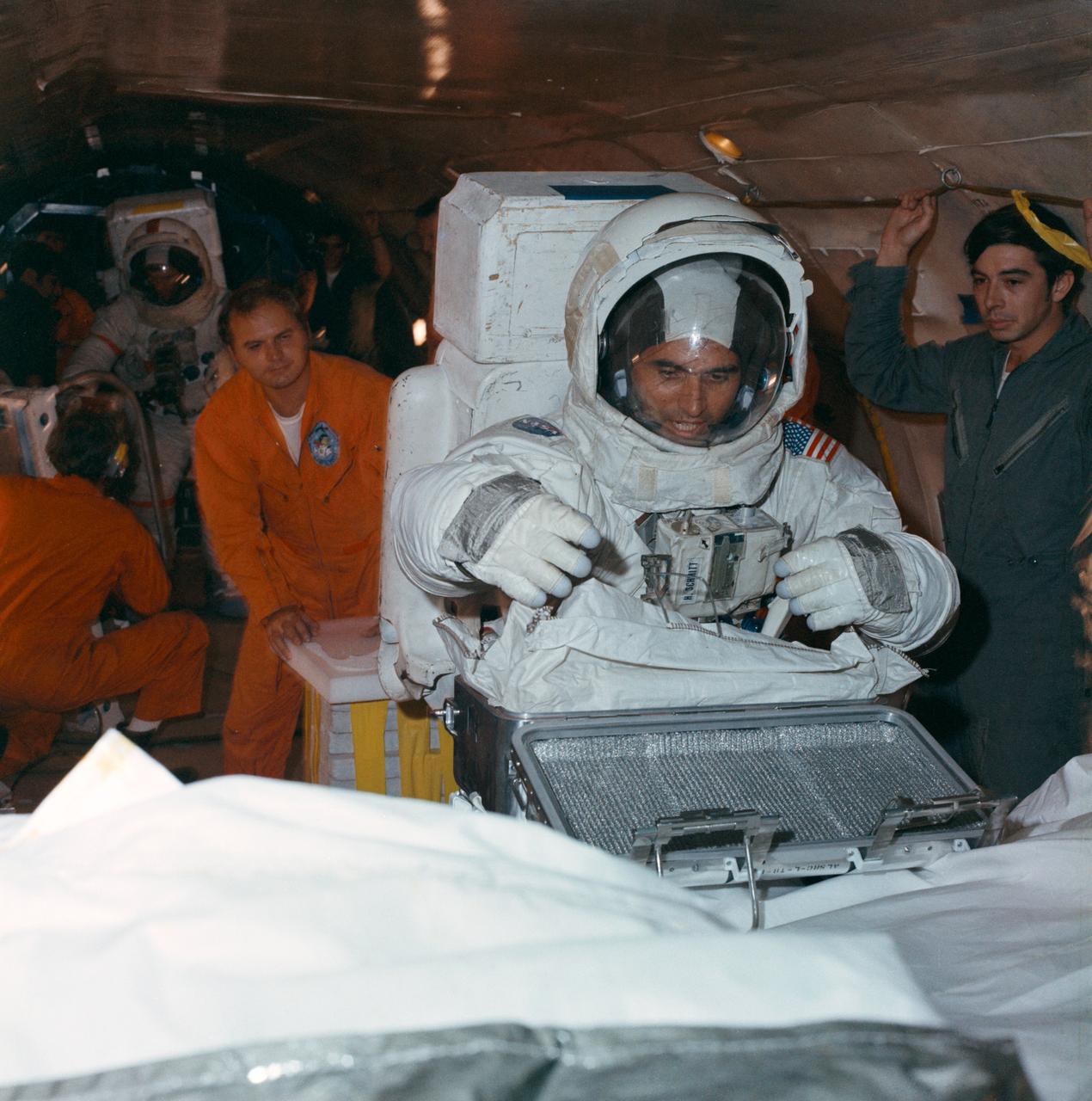
S72-50269 (September 1972) --- Scientist-astronaut Harrison H. Schmitt, lunar module pilot of the Apollo 17 lunar landing mission, seals an Apollo lunar sample return container during lunar surface extravehicular activity simulation training under one-sixth gravity conditions aboard a U.S. Air Force KC-135 aircraft. Astronaut Eugene A. Cernan, Apollo 17 commander, can be seen in the left background.
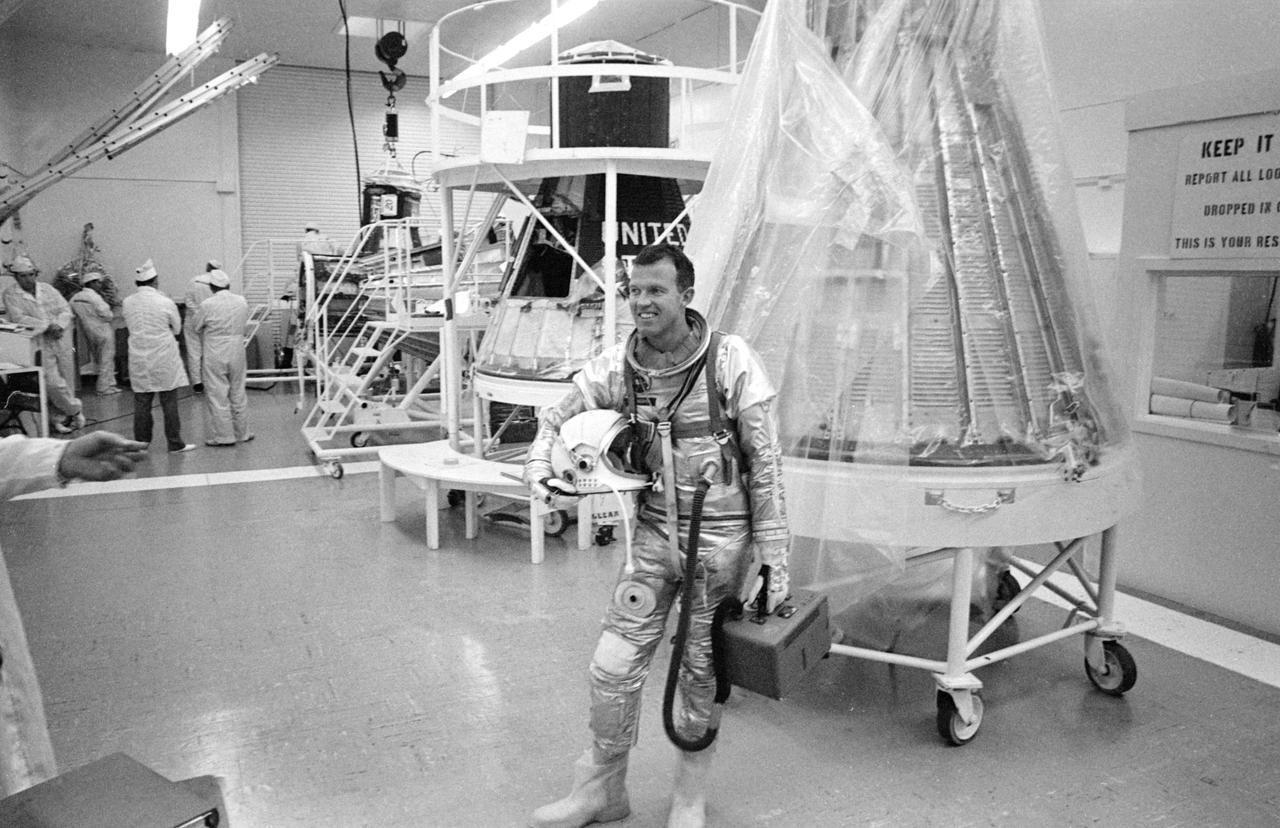
S63-03966 (1963) --- Astronaut L. Gordon Cooper Jr., prime pilot for the Mercury-Atlas 9 (MA-9) mission, carrying the portable air conditioner to his spacesuit, leaves Hangar S after completing the day's simulated flight tests. Photo credit: NASA
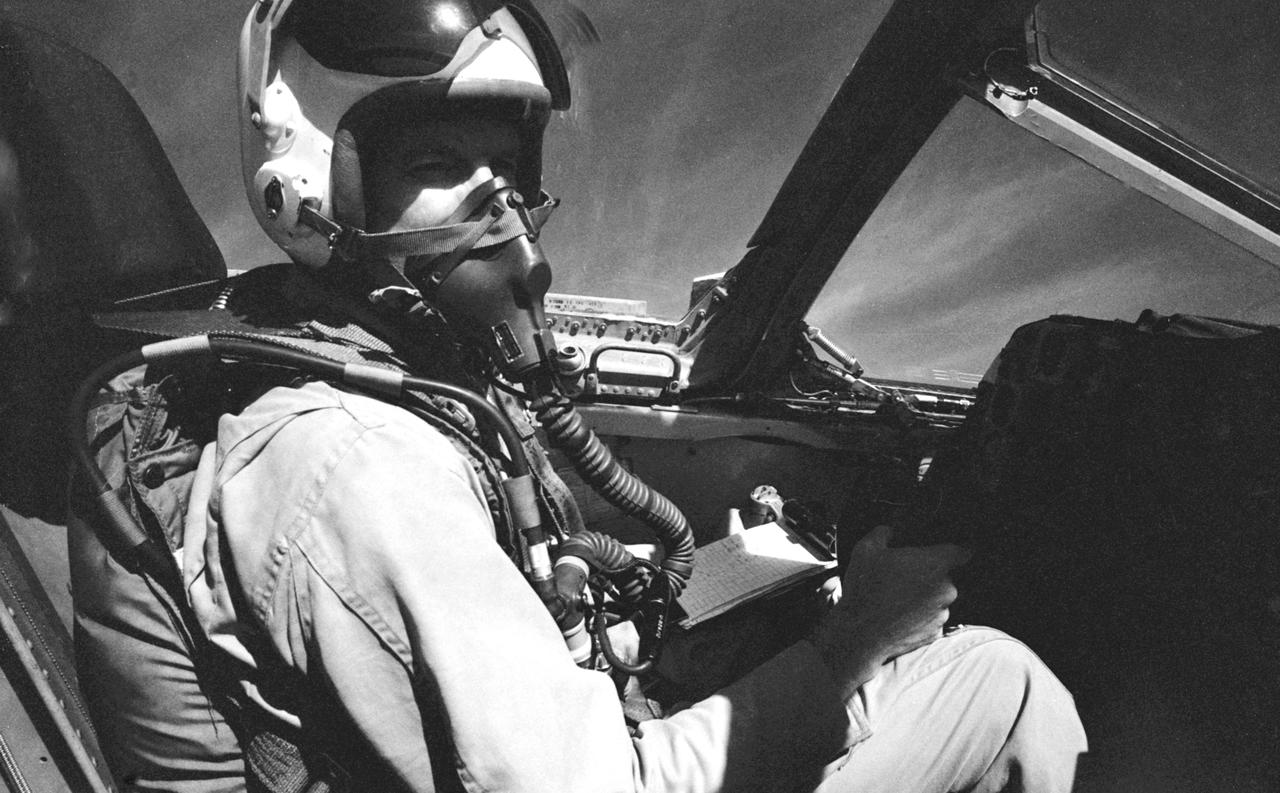
S63-03980 (1963) --- Astronaut L. Gordon Cooper Jr., prime pilot for the Mercury-Atlas 9 (MA-9) mission, in flight in a Convair TF-102 aircraft. Photo credit: NASA
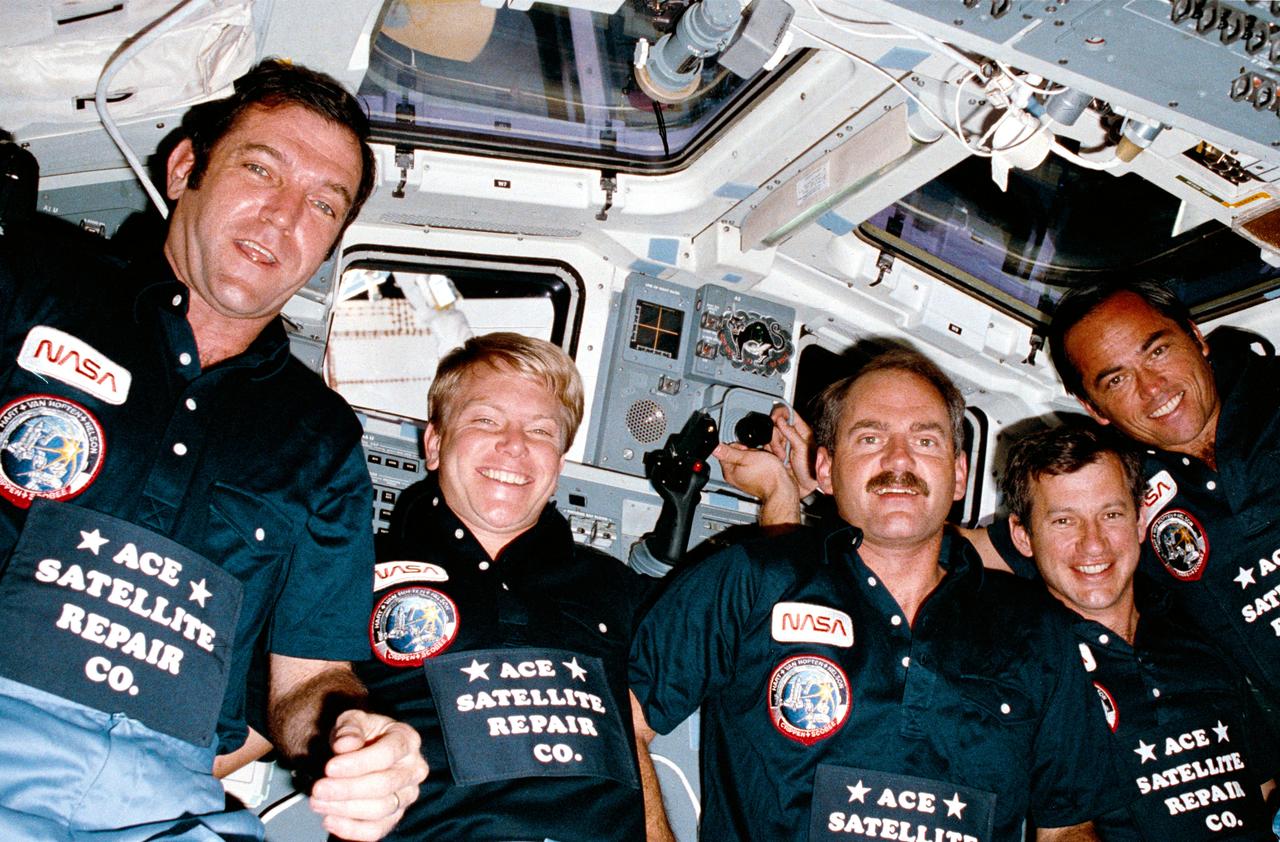
41C-07-262 (6-13 April 1984) --- Automatic exposure on a stationary 35mm camera recorded this "team" photograph of the 41-C astronauts at the aft flight deck of the Earth orbiting Challenger. Astronauts Robert L. Crippen, right, crew commander; and Francis R. (Dick) Scobee, left, pilot, flank the mission specialists--(l-r) George D. Nelson, James D. van Hoften and Terry J. Hart. This picture was among 20 frames of 41-C photography released by NASA on the weekend following the April 13 landing at Edwards Air Force Base and it was used as one of the visuals at the April 24 post-flight press conference. .
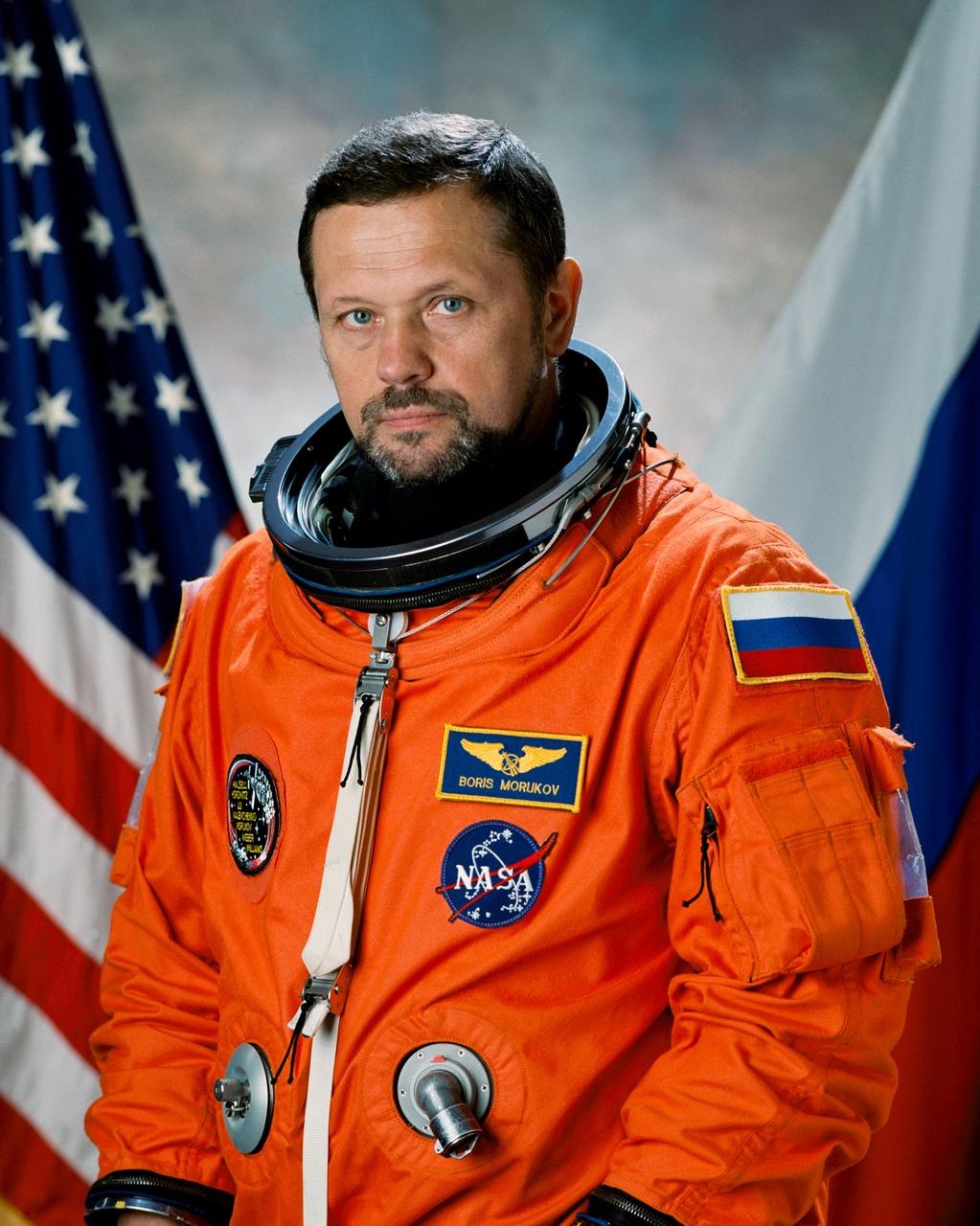
S99-07607 (July 1999) --- Cosmonaut Boris V. Morukov, Russian Space Agency (RSA). (Morukov was assigned in the summer of 1999 to serve on the crew of STS-106, the second Shuttle-Assembly mission for the International Space Station.)

Apollo 6 (AS-502) Pacific Recovery
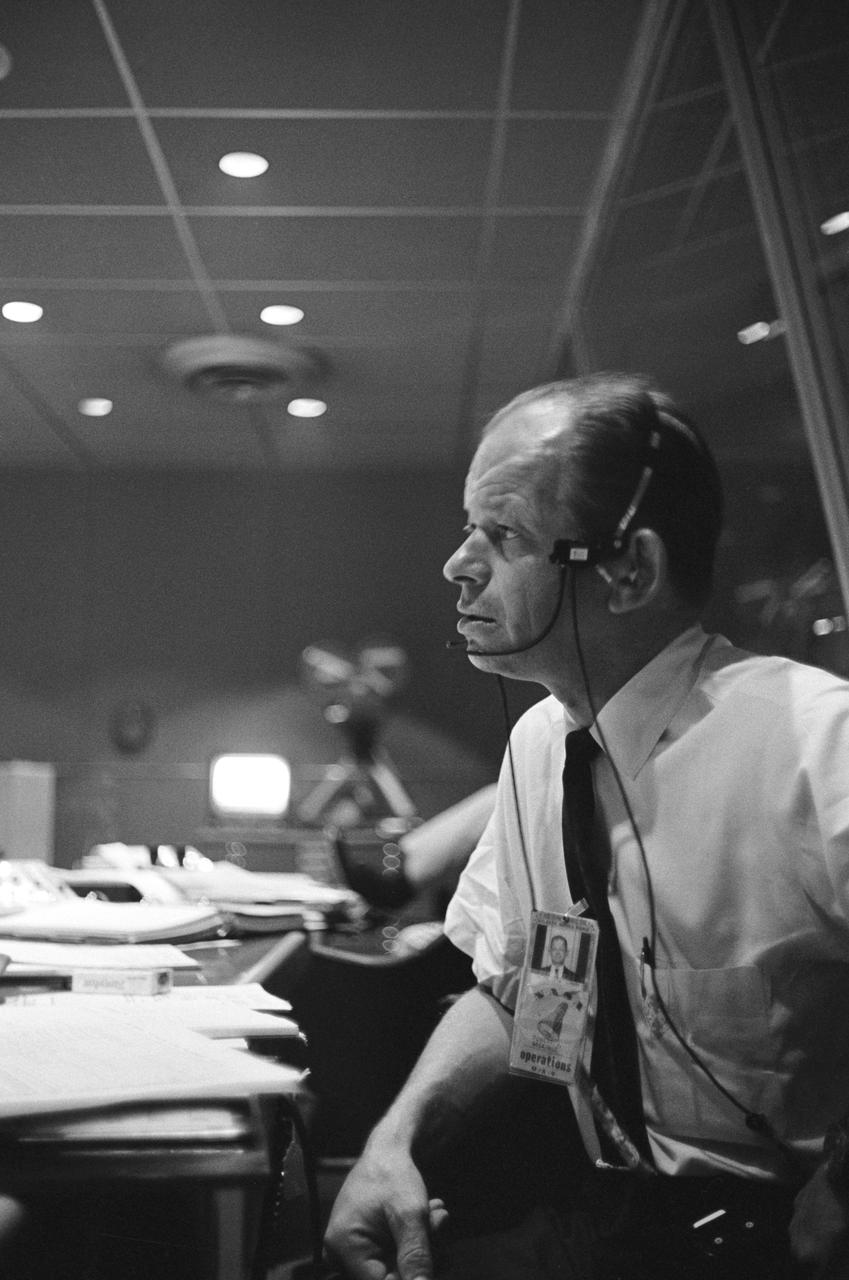
S63-09593 (15-16 May 1963) --- John A. Powers sits at the Public Affairs Officer console in Mercury Control Center at Cape Canaveral, Florida during the Mercury Atlas 9 (MA-9) 22-orbit mission of astronaut L. Gordon Cooper Jr. Photo credit: NASA
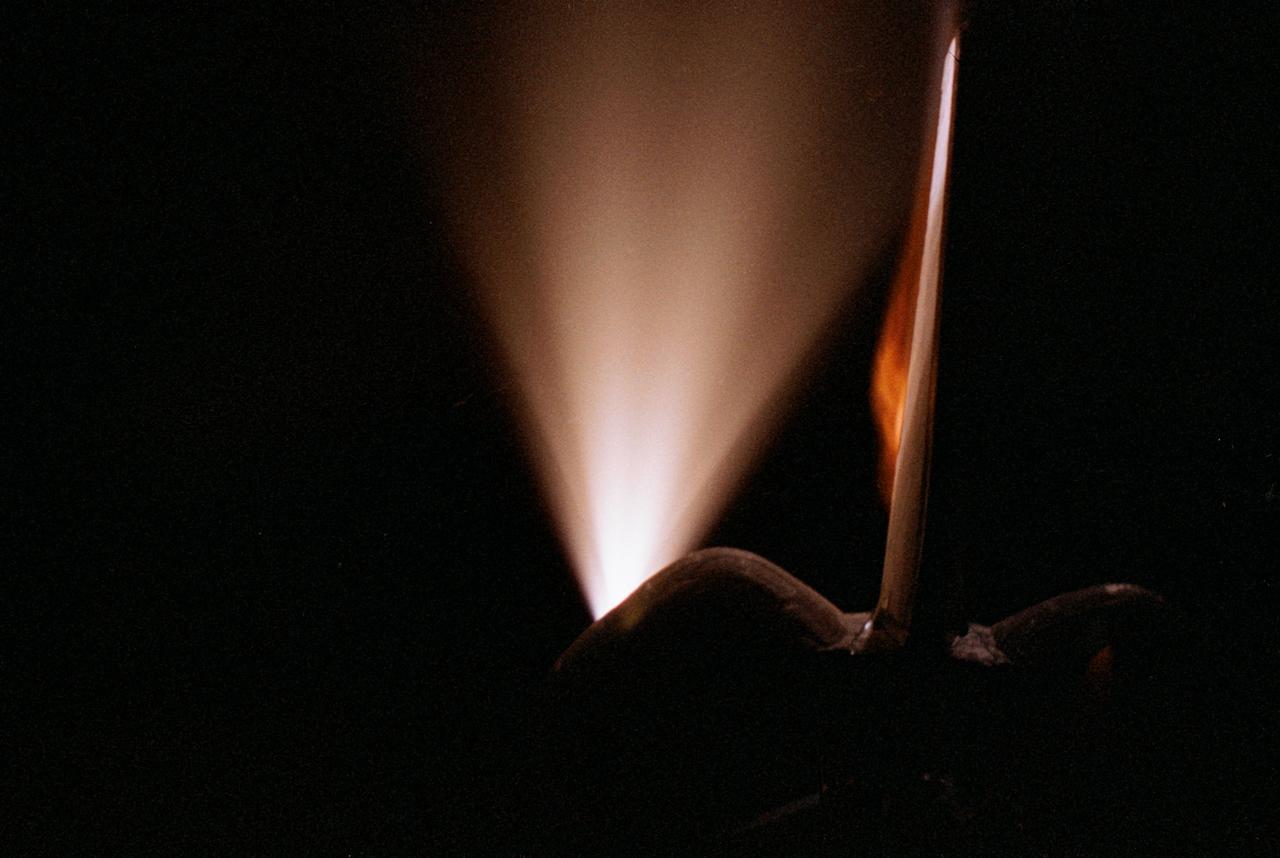
STS070-386-027 (13-22 JULY 1995) --- High-speed film provided this close-up view of the Space Shuttle Discovery’s aft, featuring the ignition of one of the primary thrusters. Note the impact of the firing on the starboard side of the vertical stabilizer. Crew members told a August 11, 1995, gathering of Johnson Space Center (JSC) employees that the Window Experiment (WINDEX) paid close attention to surface glow, jet plumes, water dumps, aurora and airglow. The data collection is part of an effort to avoid misinterpretation of measurements of Earth, the solar system and starts taken from satellites in low Earth-orbits and prevent damage to sensitive systems and solar arrays during rendezvous and docking. Such firings of the thrusters increase local densities of gases in the atmosphere dramatically and introduce non-natural elements that react with the atmosphere dramatically and spacecraft systems enveloped by the thruster plume. WINDEX recorded phenomena associated with thruster start-up and shut-down transients and observed the effect of the transients on Shuttle glow phenomenon.
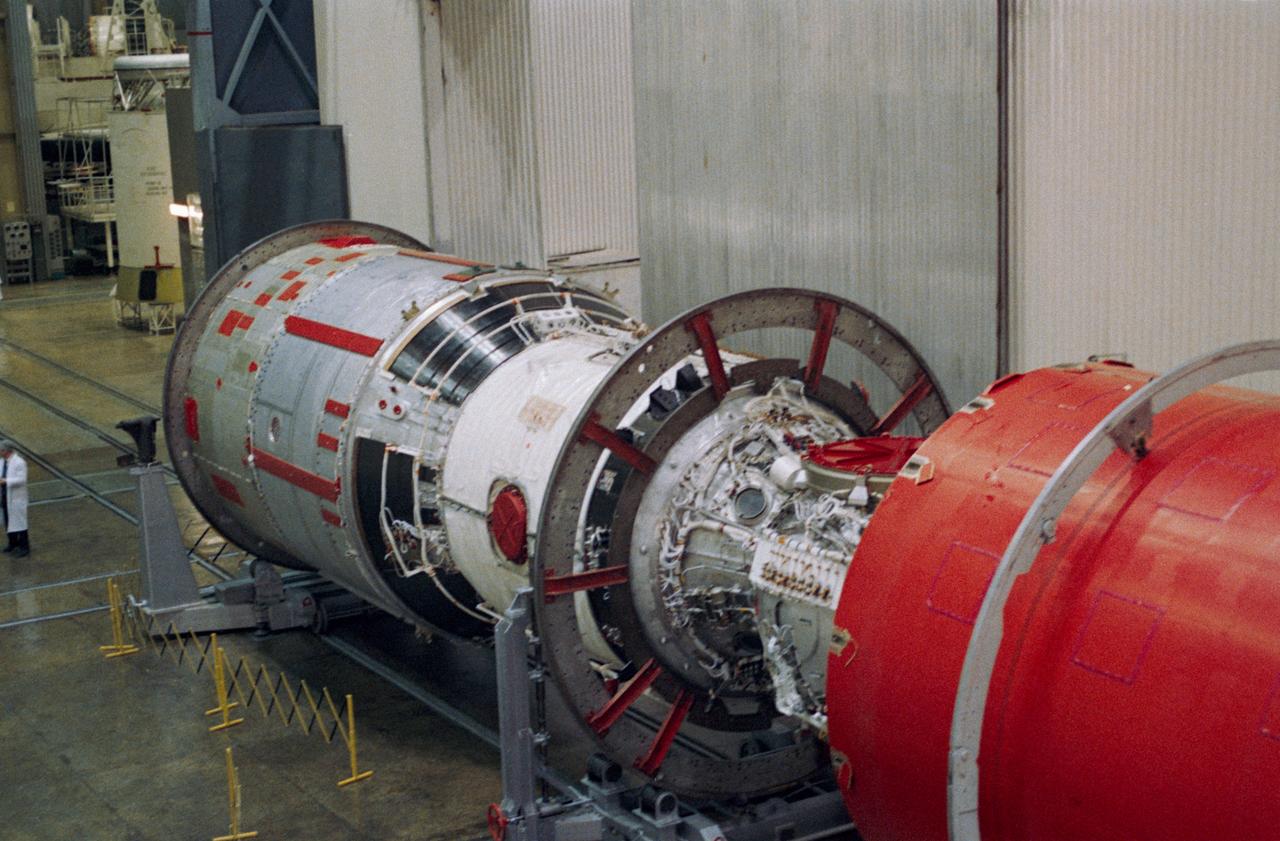
S99-05653 (April 1999) --- ISS service module roll-out. --- A three-quarter, forward view of the International Space Station (ISS) Service Module (SM) during roll-out at RSC-Energia in Moscow, Russia.

S69-40740 (July 1969) --- Dr. Ross Taylor (seated), Australian National University, and John Allen, Brown and Root-Northrop technician, review preliminary data from the optical emission spectrograph in the Spectrographic Laboratory of the Physical-Chemical Test Laboratory. Tests were being conducted on lunar surface material collected by astronauts Neil A. Armstrong and Edwin E. Aldrin Jr. during their lunar surface extravehicular activity on July 20, 1969.
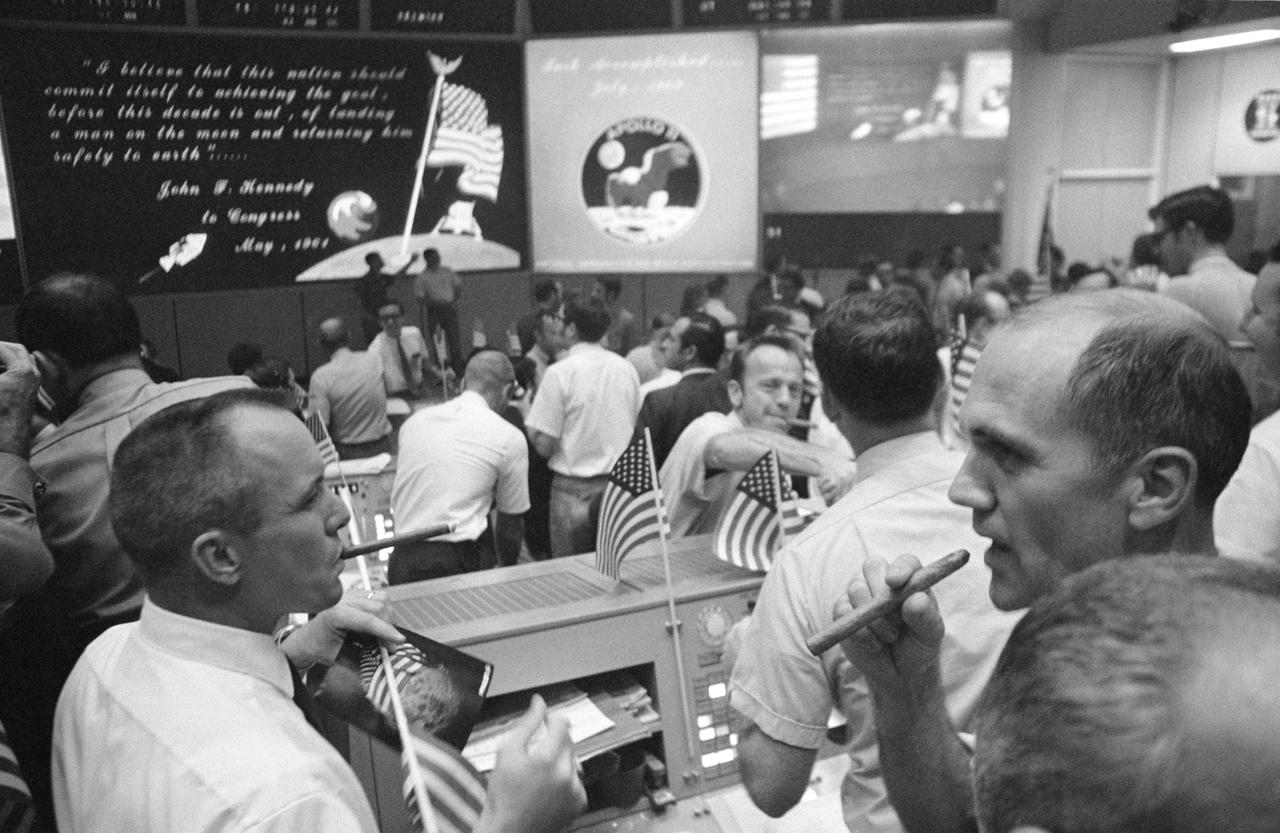
S69-40025 (24 July 1969) --- Overall view of the Mission Operations Control Room (MOCR) in the Mission Control Center (MCC), Building 30, Manned Spacecraft Center (MSC), showing the flight controllers celebrating the successful conclusion of the Apollo 11 lunar landing mission.
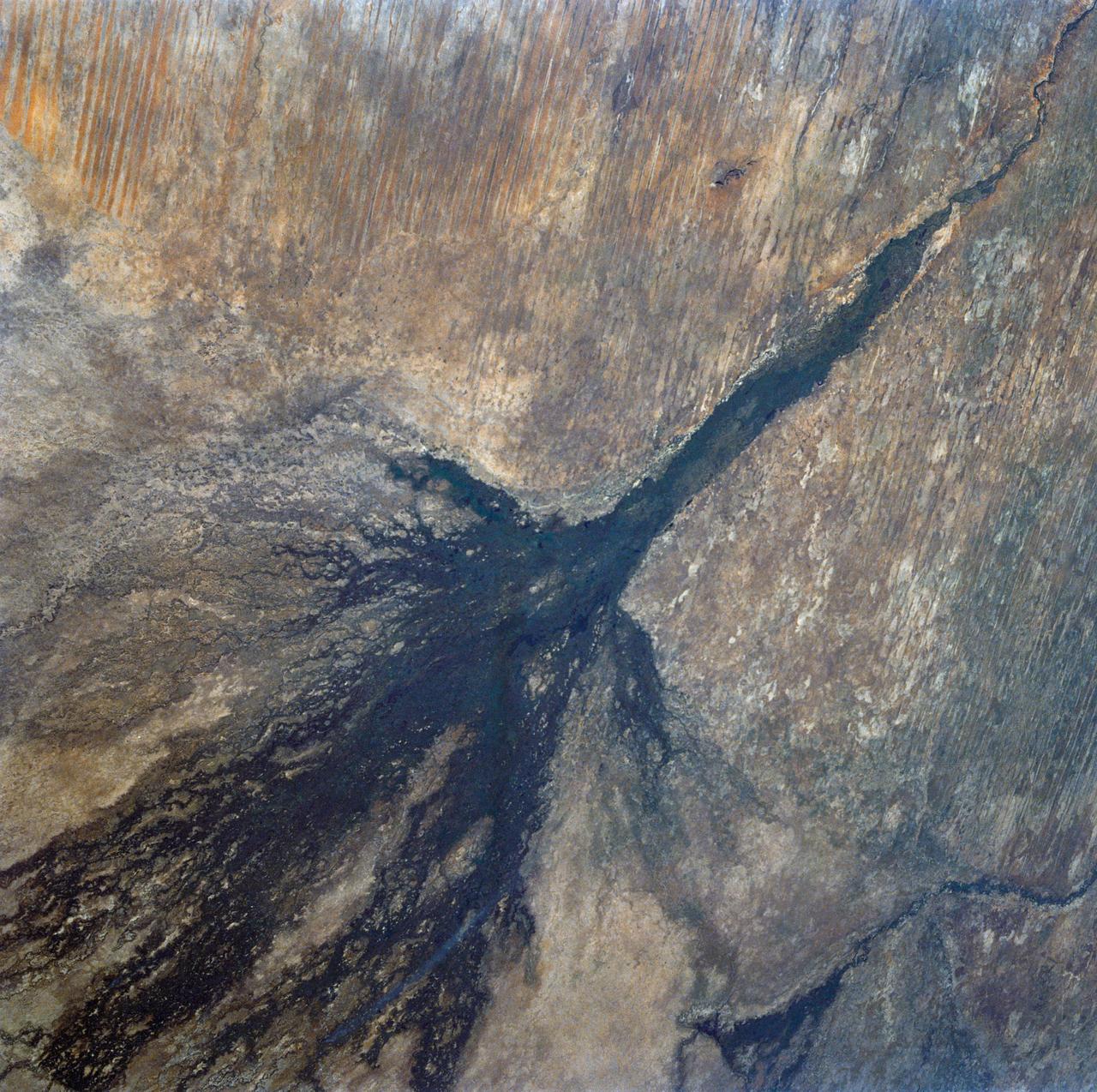
61A-43-029 (2 Nov 1985) --- This view, photographed from the Earth orbiting Challenger, features a vertical view of the Okavango Swamp in Botswana. Center coordinates are 19.0 degrees south latitude and 22.5 degrees east longitude. The Challenger was flying at an altitude of 177 nautical miles when the photo was taken with a 70mm handheld Hasselblad camera.
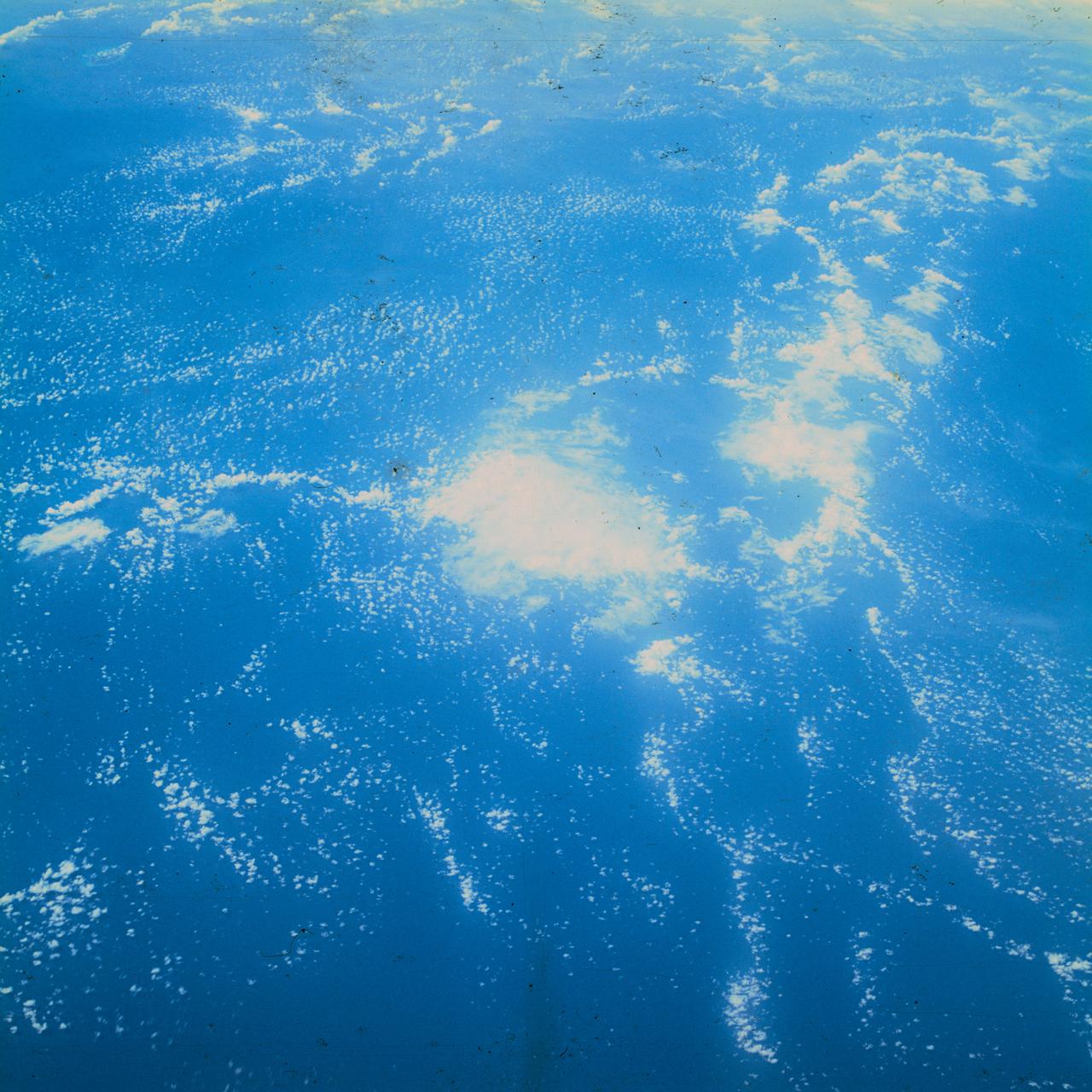
S62-06613 (3 Oct. 1962) --- Cumulus cloud formation over West Atlantic Ocean north of South American during the fourth orbit pass of the Mercury-Atlas 8 (MA-8) mission by astronaut Walter M. Schirra Jr. with a hand-held camera. Photo credit: NASA
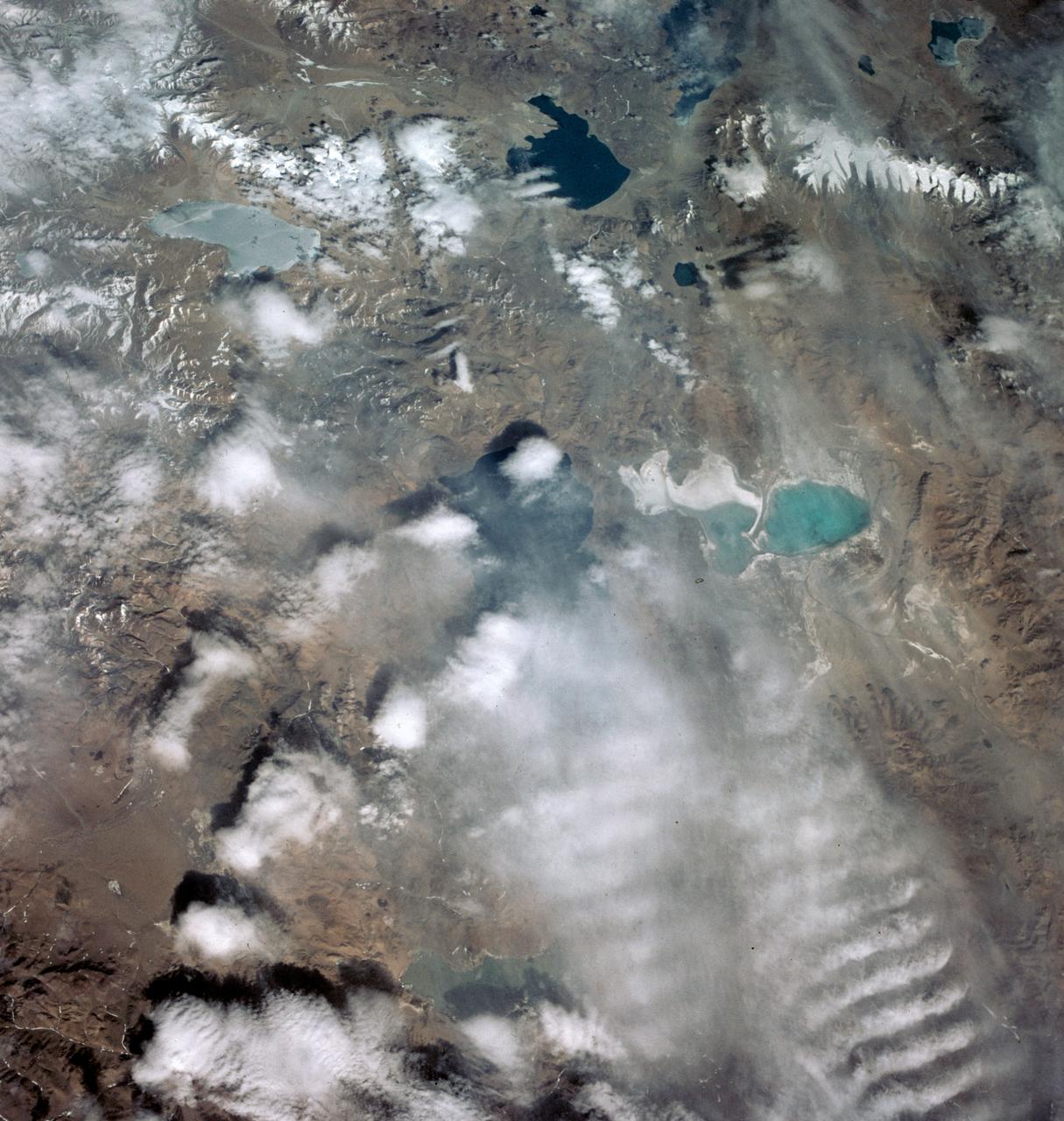
S63-06454 (15-16 May 1963) --- Tibetan Lake Country North of Katmandu, west of Ihasa, photographed from the Mercury-Atlas 9 (MA-9) capsule by astronaut L. Gordon Cooper Jr., during his 22-orbit MA-9 spaceflight. Photo credit: NASA
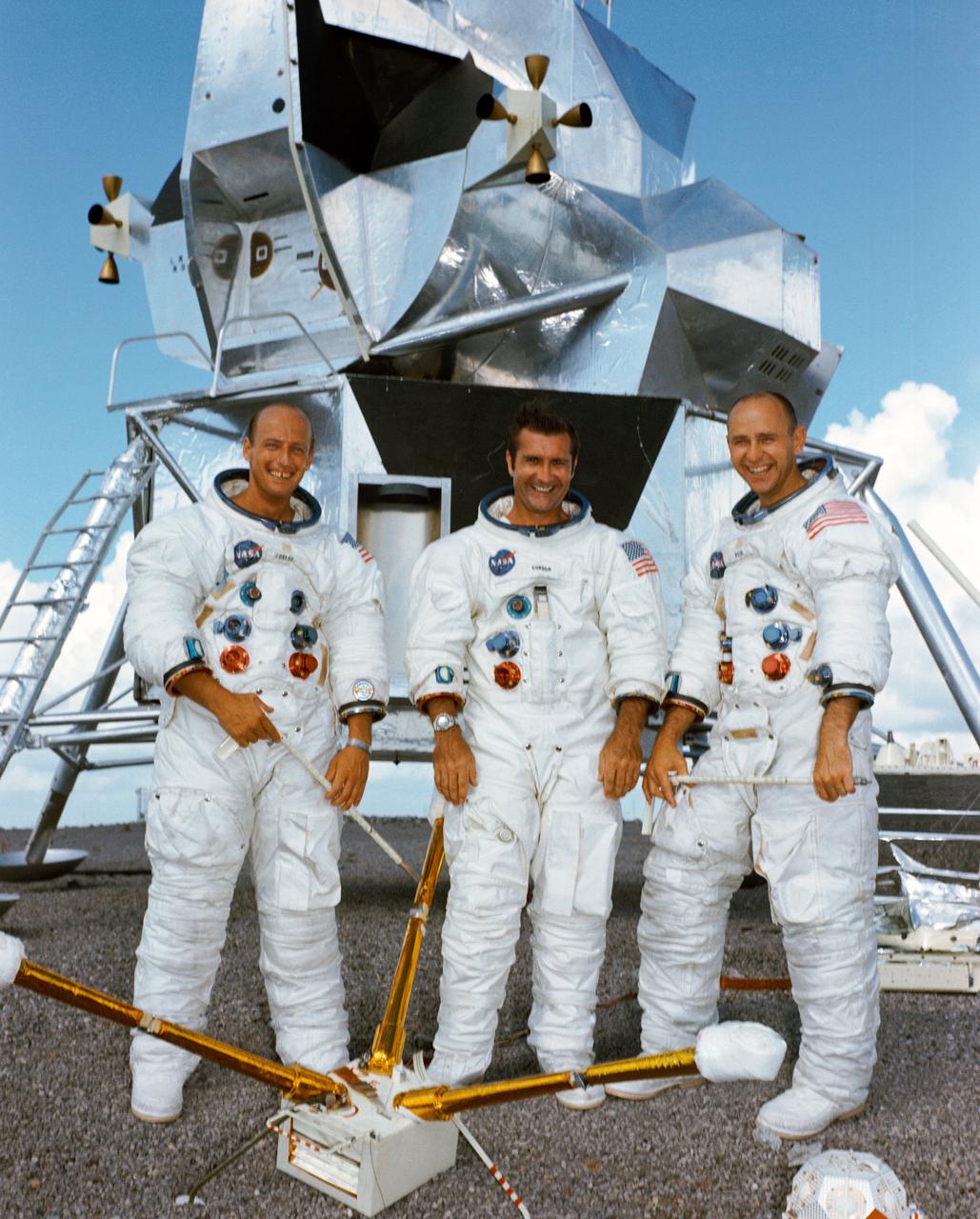
S69-38992 (September 1969) --- These three astronauts have been named by the National Aeronautics and Space Administration (NASA) as the prime crew of the Apollo 12 lunar landing mission. Left to right, are Charles Conrad Jr., Richard F. Gordon Jr., and Alan L. Bean.
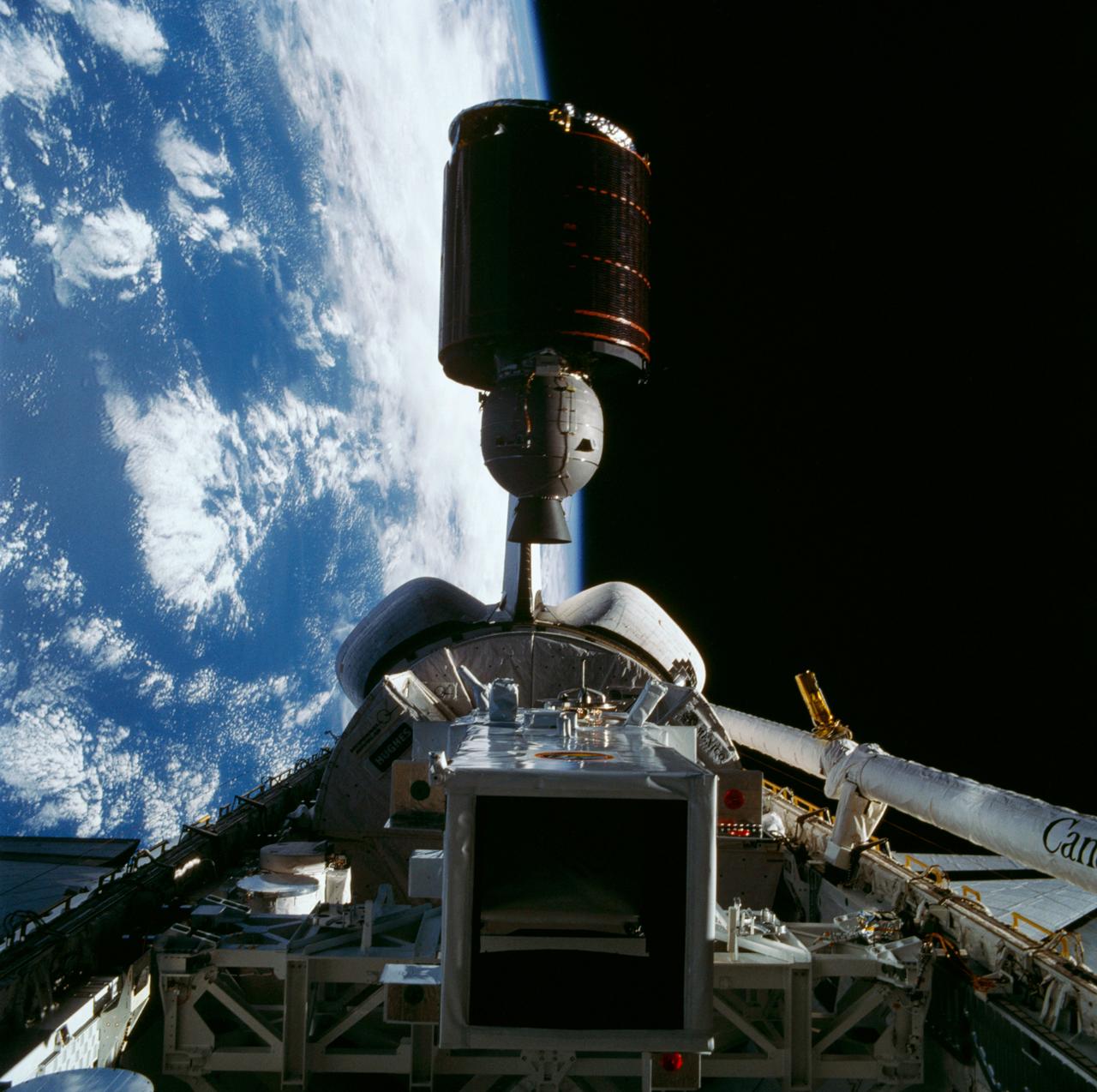
51G-32-082 (17-24 June 1985) --- Mexico's Morelos satellite rises from Discovery's cargo bay to begin its life in space.
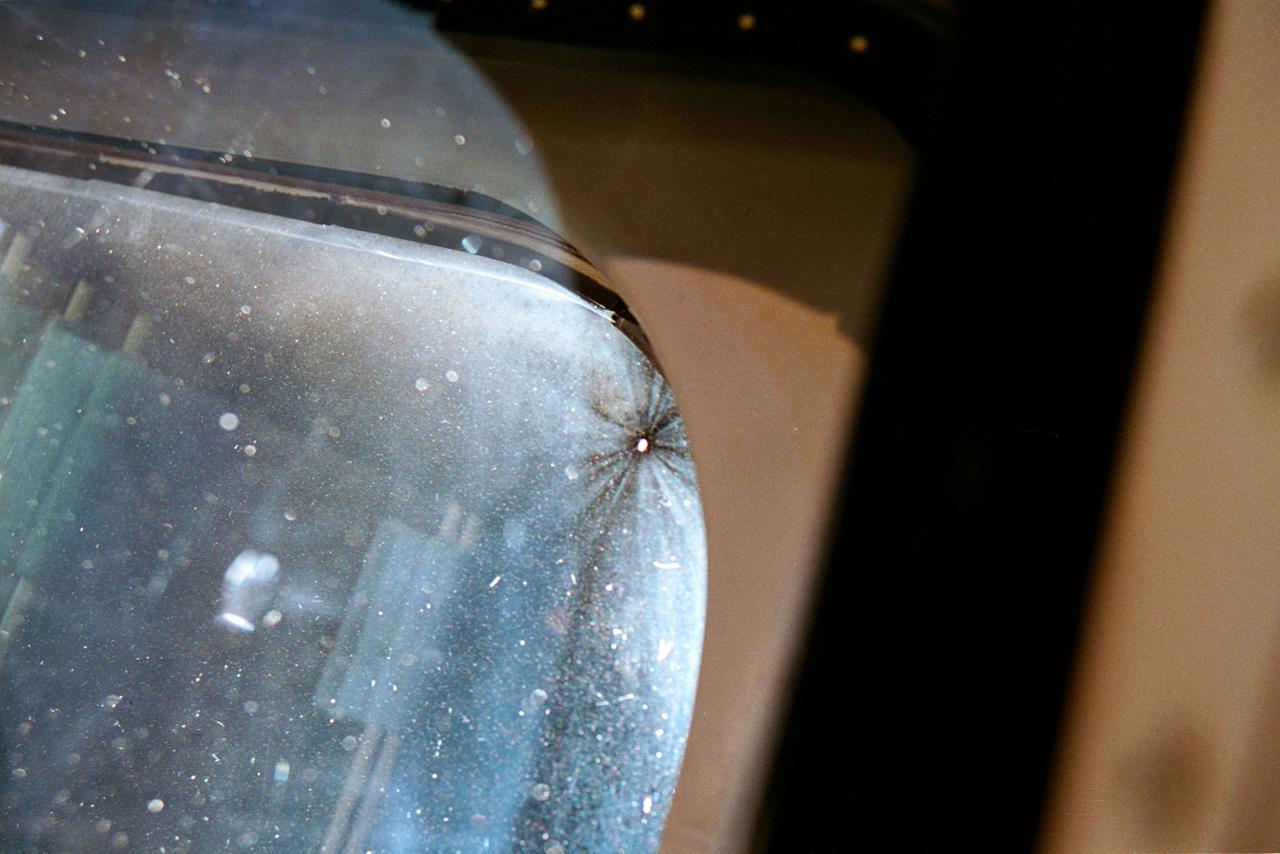
STS070-309-026 (13-22 JULY 1995) --- A close-up view of the space shuttle Discovery?s window number 6, on the forward starboard side, nearest the pilot?s station. A small impact in the window, about 1/16 inch in size, is clearly seen in the corner. Crew members told a August 11, 1995, gathering of Johnson Space Center (JSC) employees that a small piece of debris apparently struck the window during Discovery?s wing velocity vector mode. It was noticed when the astronauts awoke from their sleep period. Though watched closely during the remainder of the mission, the impact never caused a major concern.
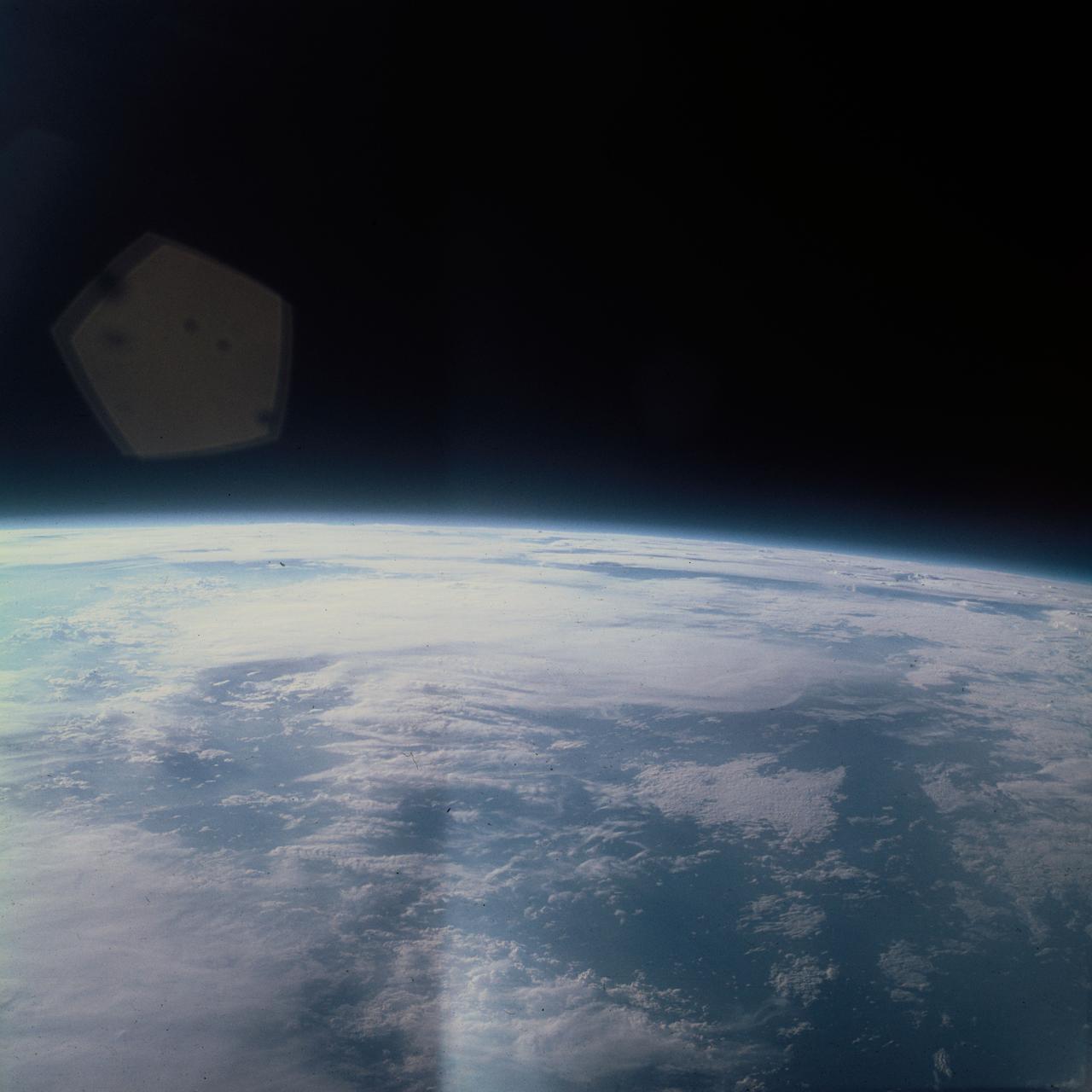
S62-06604 (3 Oct. 1962) --- Western horizon over South America taken during the sixth orbit pass of the Mercury-Atlas 8 (MA-8) mission by astronaut Walter M. Schirra Jr. with a hand-held camera. Photo credit: NASA
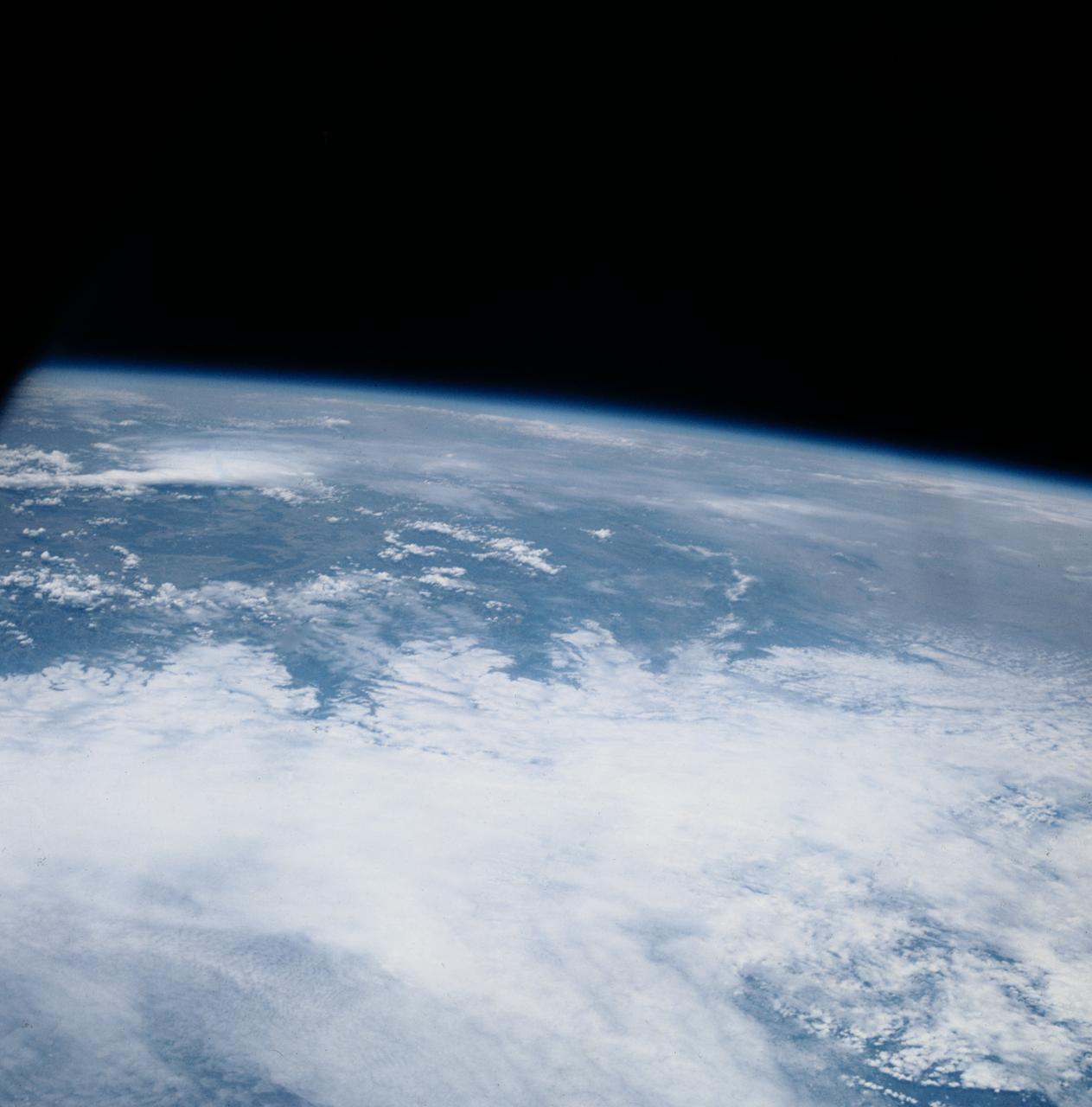
S63-06438 (15-16 May 1963) --- Changsha area in China, showing Tung Ting lake region, as photographed from the Mercury-Atlas 9 (MA-9) capsule by astronaut L. Gordon Cooper Jr., during his 22-orbit MA-9 spaceflight. Photo credit: NASA
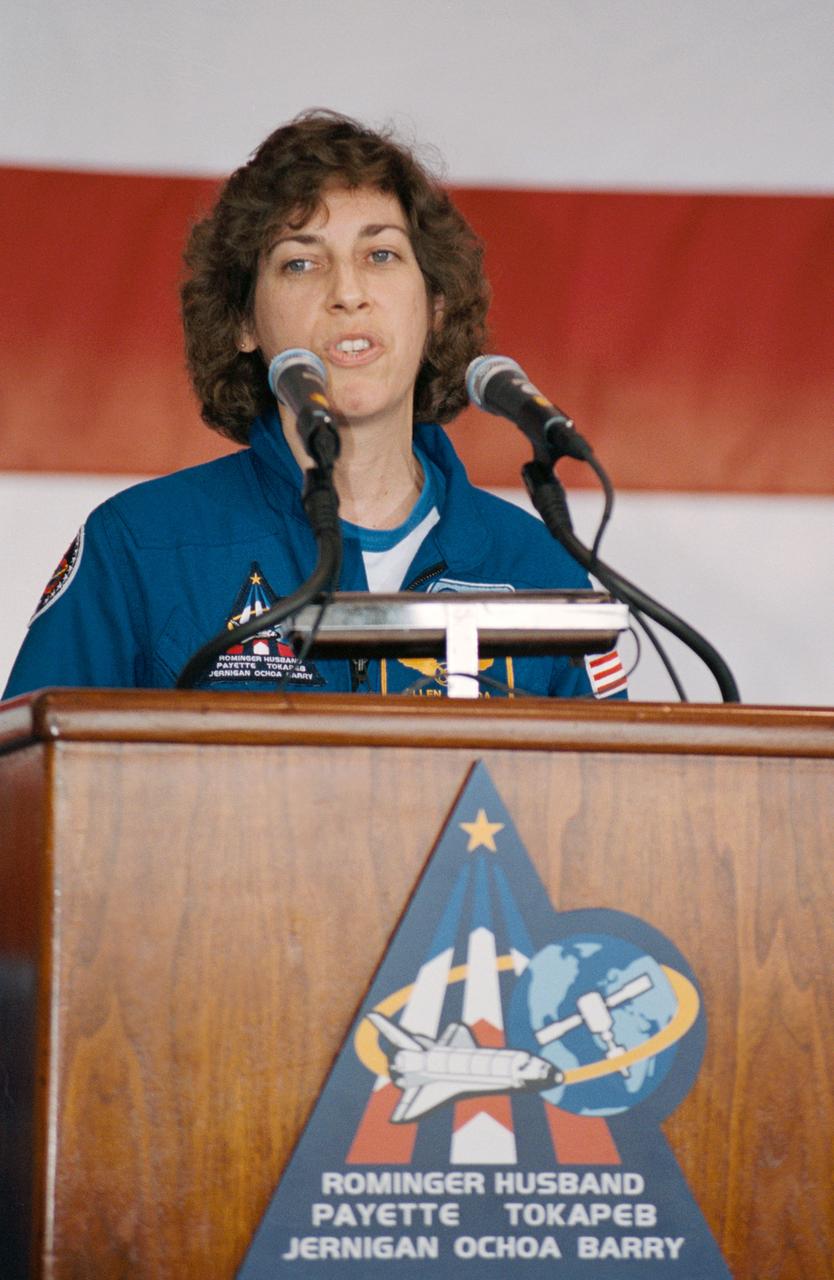
S99-05972 (7 June 1999) --- Astronaut Ellen Ochoa, mission specialist, speaks to crowd on hand at welcome ceremonies following crew arrival at Ellington Field.