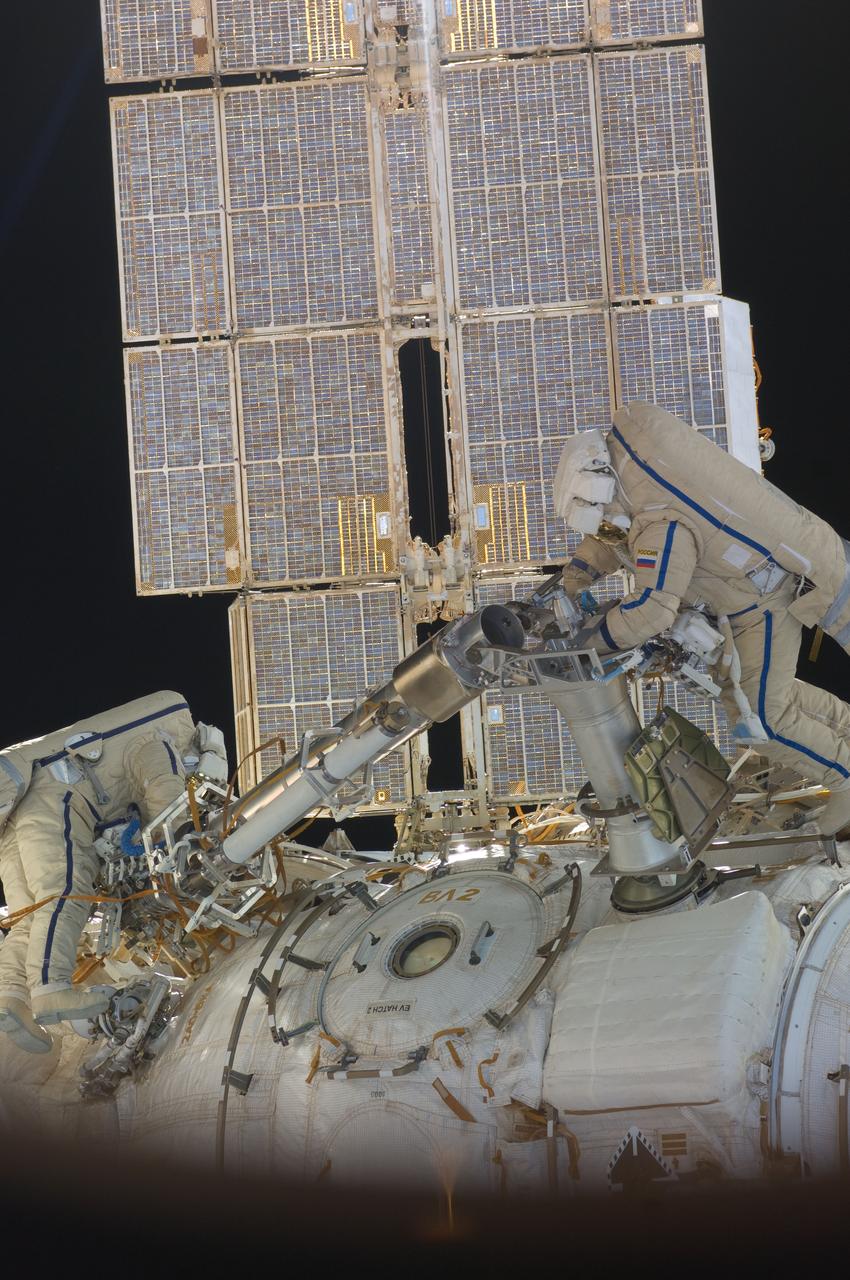
ISS030-E-078393 (16 Feb. 2012) --- Russian cosmonauts Oleg Kononenko and Anton Shkaplerov, both Expedition 30 flight engineers, participate in a session of extravehicular activity (EVA) to continue outfitting the International Space Station. During the six-hour, 15-minute spacewalk, Kononenko and Shkaplerov moved the Strela-1 crane from the Pirs Docking Compartment to begin preparing the Pirs for its replacement next year with a new laboratory and docking module. The duo used another boom, the Strela-2, to move the hand-operated crane to the Poisk module for future assembly and maintenance work. Both telescoping booms extend like fishing rods and are used to move massive components outside the station. On the exterior of the Poisk Mini-Research Module 2 (MRM2), they also installed the Vinoslivost Materials Sample Experiment, which will investigate the influence of space on the mechanical properties of the materials. The spacewalkers also collected a test sample from underneath the insulation on the Zvezda Service Module to search for any signs of living organisms. Both spacewalkers wore Russian Orlan spacesuits bearing blue stripes and equipped with NASA helmet cameras.

ISS030-E-155913 (16 Jan. 2012) --- NASA astronaut Dan Burbank, Expedition 30 commander, performs in-flight maintenance on the front stray light cover for the Microgravity Science Glovebox (MSG) in the Destiny laboratory of the International Space Station.
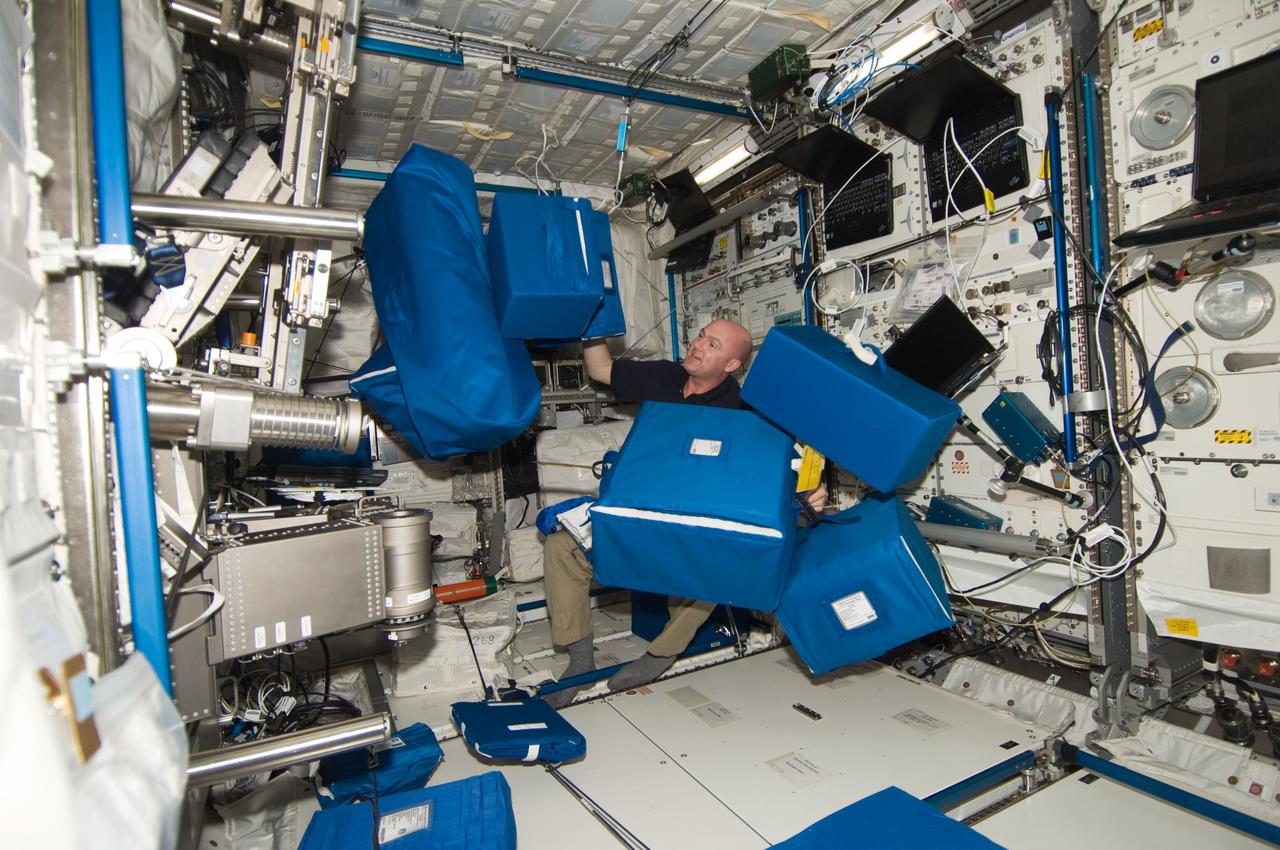
ISS030-E-155920 (16 Jan. 2012) --- European Space Agency astronaut Andre Kuipers, Expedition 30 flight engineer, works with various stowage containers in the Columbus laboratory of the International Space Station.
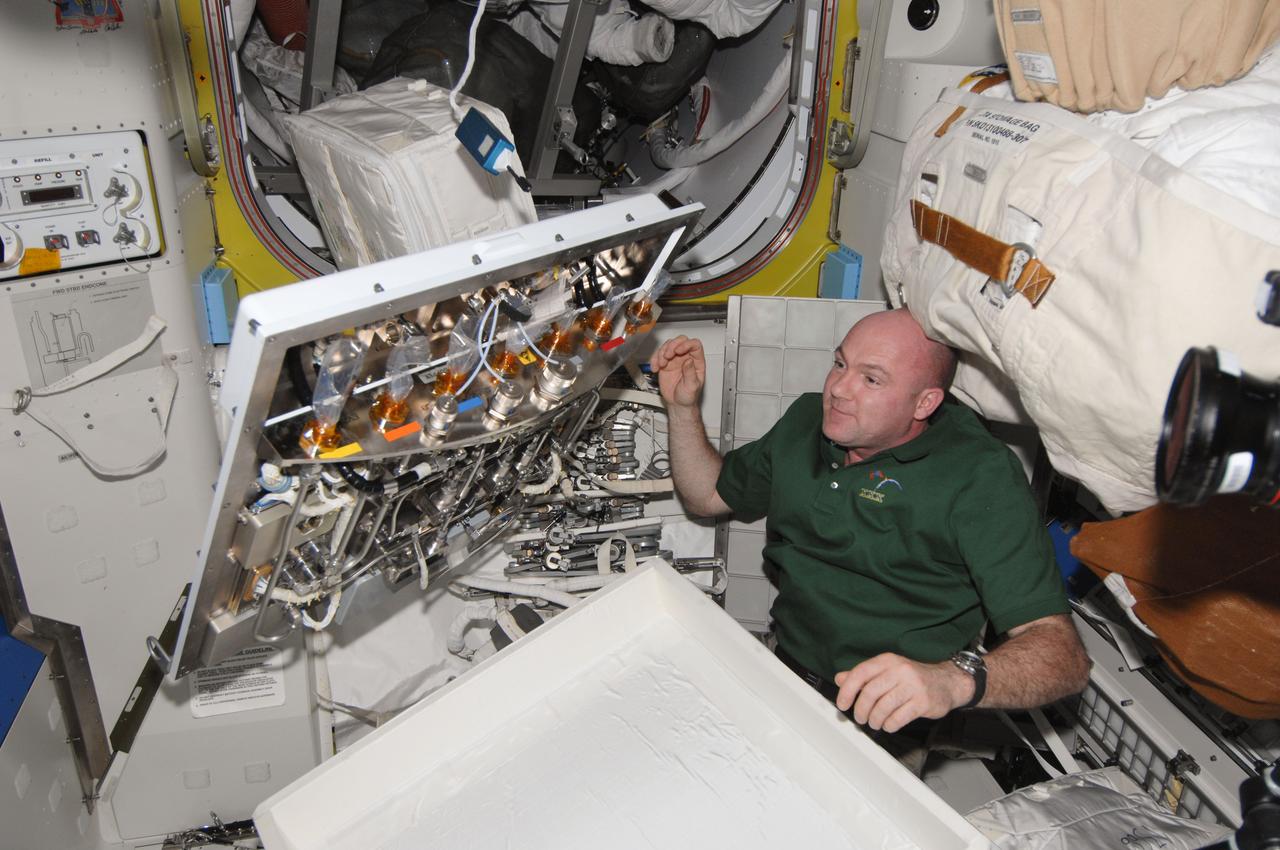
ISS030-E-156468 (27 Jan. 2012) --- European Space Agency astronaut Andre Kuipers, Expedition 30 flight engineer, is pictured in the Quest airlock of the International Space Station during photo documentation of the fluid and electrical interfaces on the Umbilical Interface Assembly (UIA) Connector Shelf.
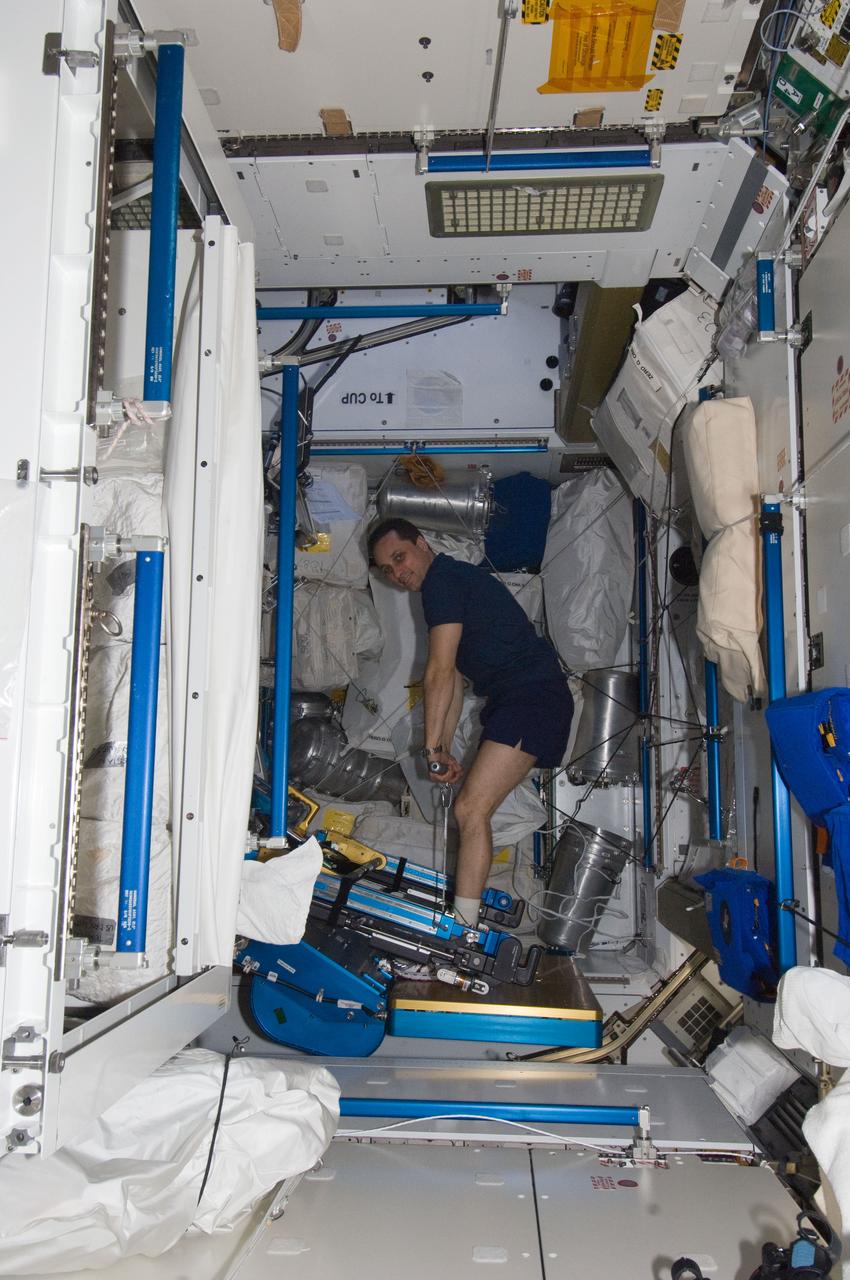
ISS030-E-235507 (5 Jan. 2012) --- Russian cosmonaut Anton Shkaplerov, Expedition 30 flight engineer, exercises using the advanced Resistive Exercise Device (aRED) in the Tranquility node of the International Space Station.
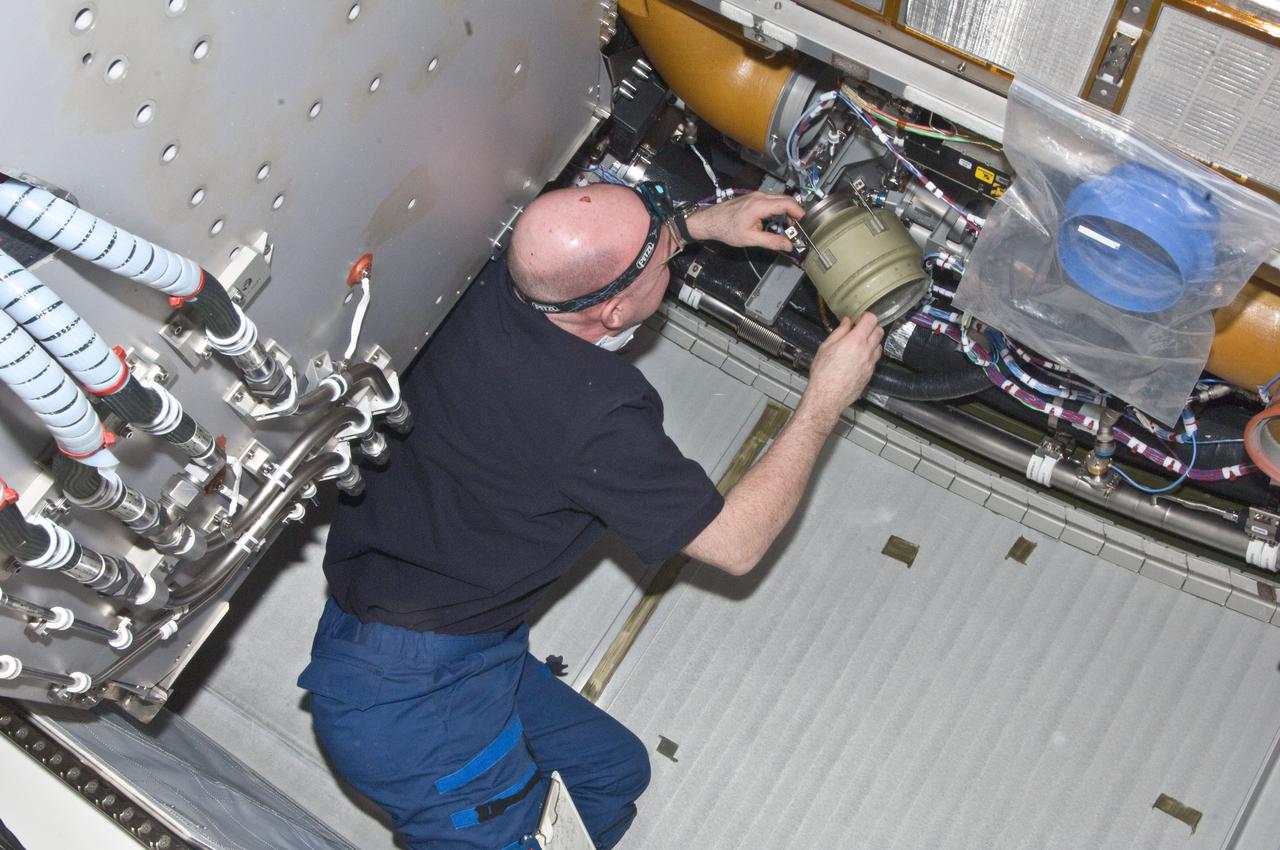
ISS030-E-129474 (22 Feb. 2012) --- European Space Agency astronaut Andre Kuipers, Expedition 30 flight engineer, performs the scheduled inspection and extensive cleanup of ventilation systems and ventilation ducts in the Columbus laboratory of the International Space Station.
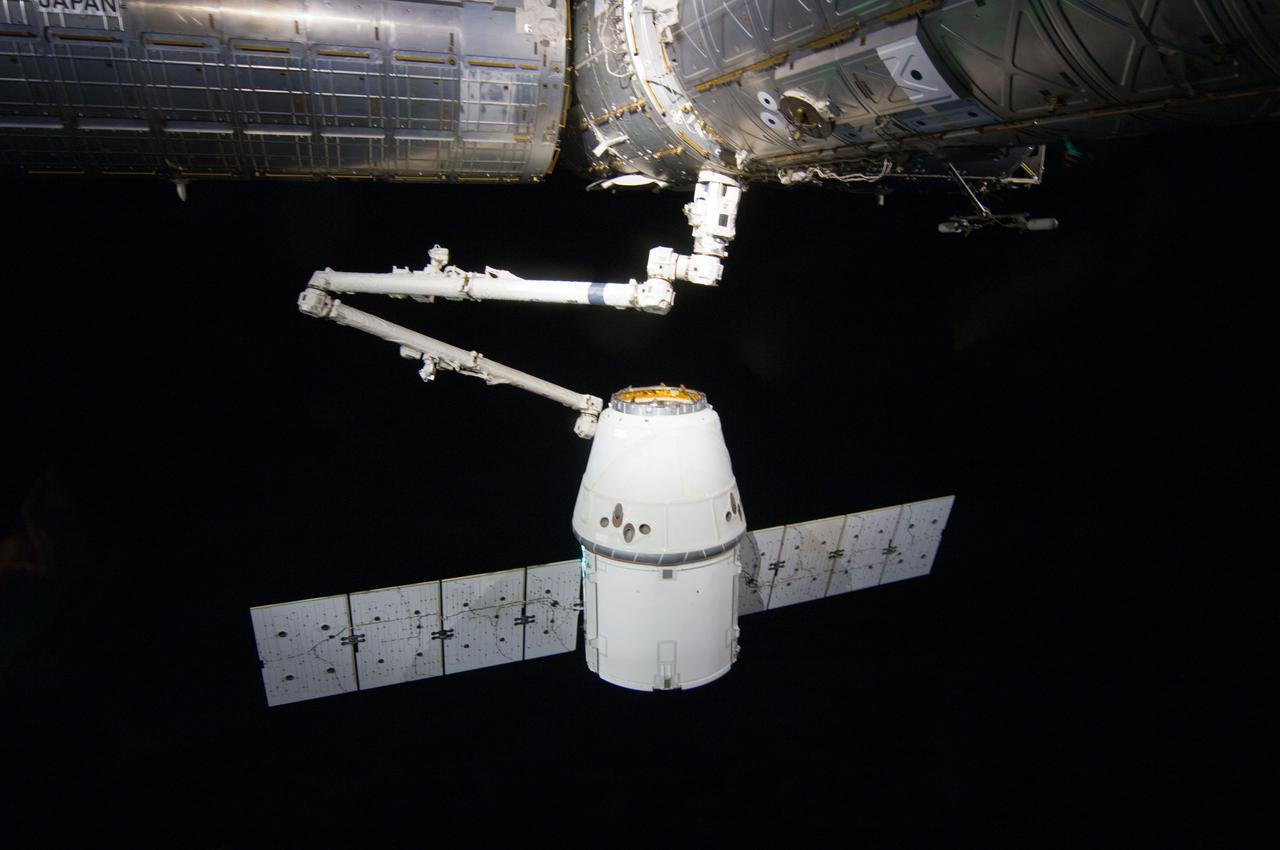
ISS031-E-079317 (31 May 2012) --- The SpaceX Dragon cargo craft is pictured just prior to being released by the International Space Station's Canadarm2 robotic arm on May 31 to allow it to head toward a splashdown in the Pacific Ocean.
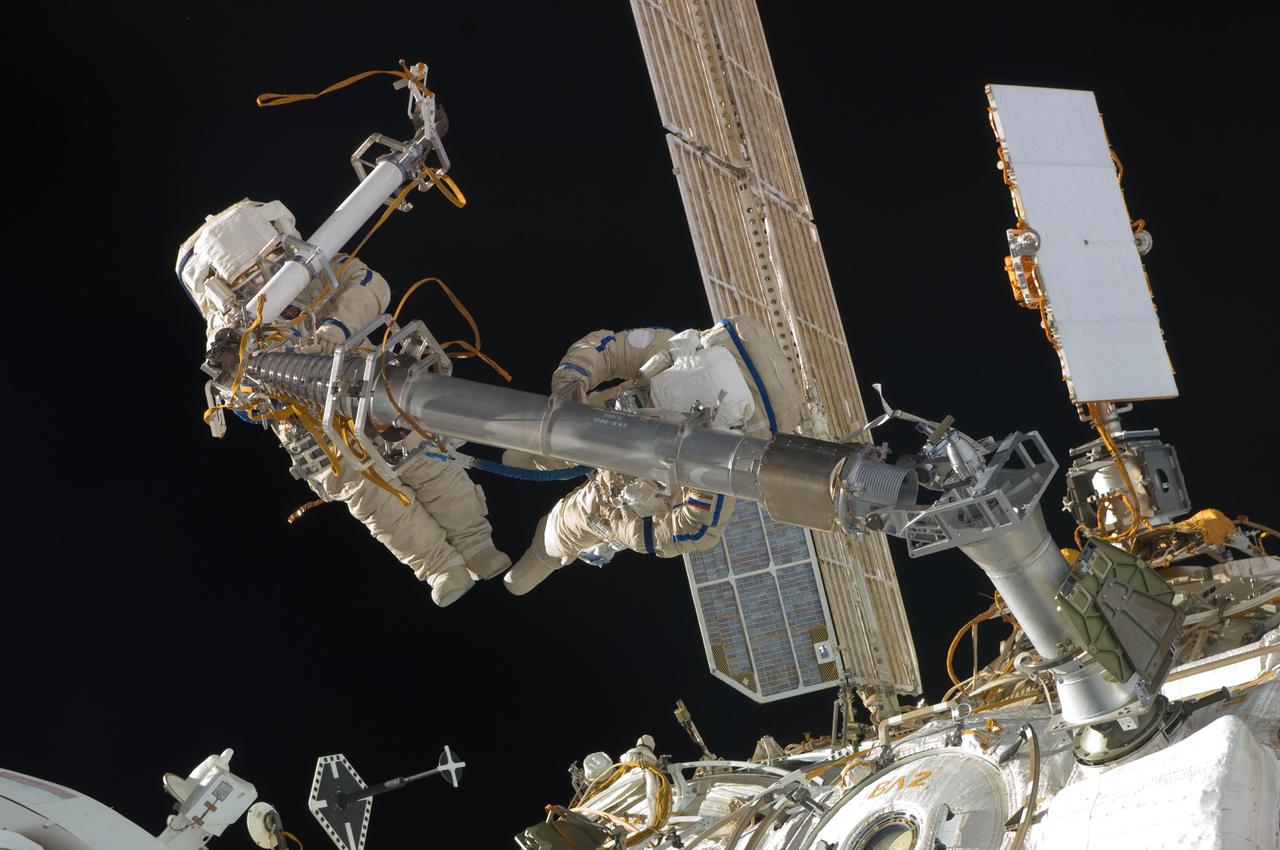
ISS030-E-078381 (16 Feb. 2012) --- Russian cosmonauts Oleg Kononenko and Anton Shkaplerov, both Expedition 30 flight engineers, participate in a session of extravehicular activity (EVA) to continue outfitting the International Space Station. During the six-hour, 15-minute spacewalk, Kononenko and Shkaplerov moved the Strela-1 crane from the Pirs Docking Compartment to begin preparing the Pirs for its replacement next year with a new laboratory and docking module. The duo used another boom, the Strela-2, to move the hand-operated crane to the Poisk module for future assembly and maintenance work. Both telescoping booms extend like fishing rods and are used to move massive components outside the station. On the exterior of the Poisk Mini-Research Module 2 (MRM2), they also installed the Vinoslivost Materials Sample Experiment, which will investigate the influence of space on the mechanical properties of the materials. The spacewalkers also collected a test sample from underneath the insulation on the Zvezda Service Module to search for any signs of living organisms. Both spacewalkers wore Russian Orlan spacesuits bearing blue stripes and equipped with NASA helmet cameras.
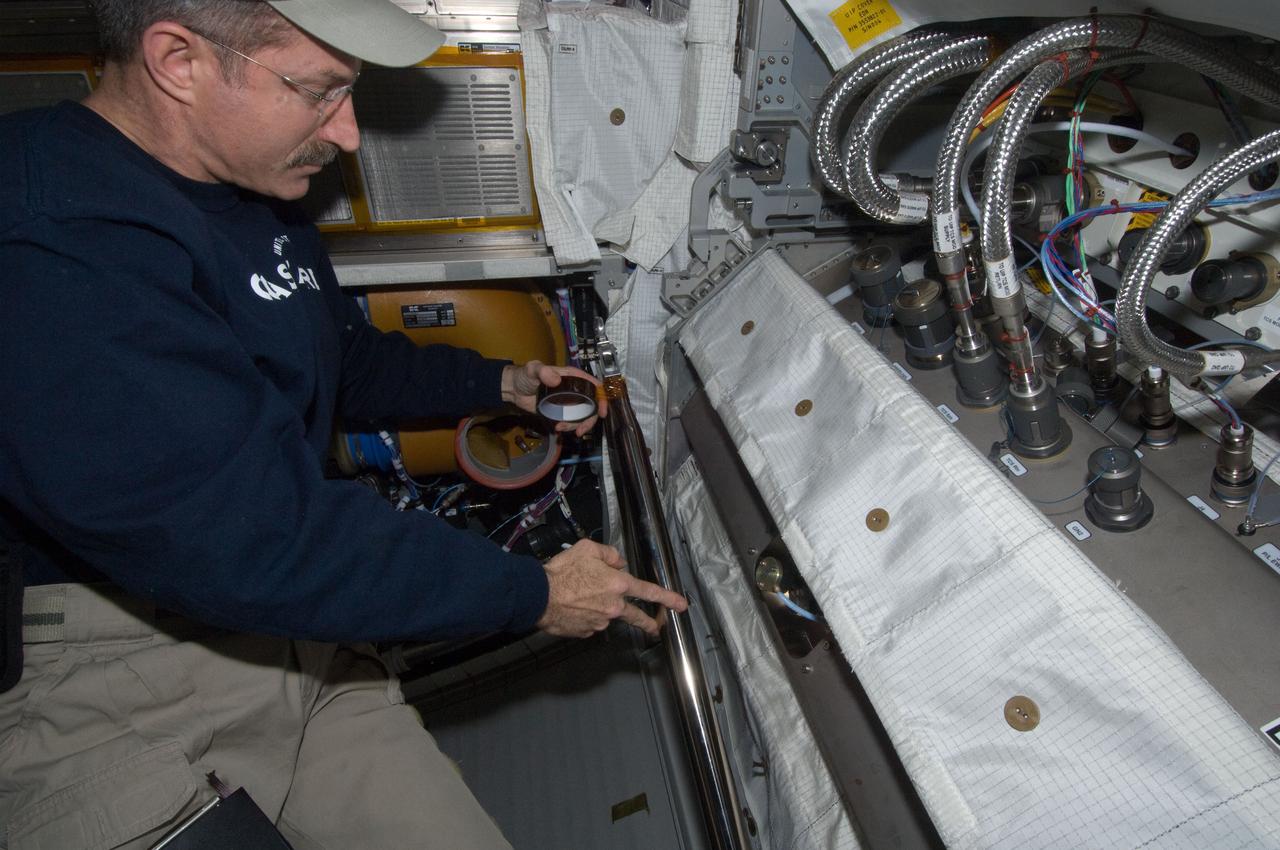
ISS030-E-093414 (22 Feb. 2012) --- NASA astronaut Dan Burbank, Expedition 30 commander, performs the scheduled extensive cleanup of ventilation systems in the Columbus laboratory of the International Space Station.
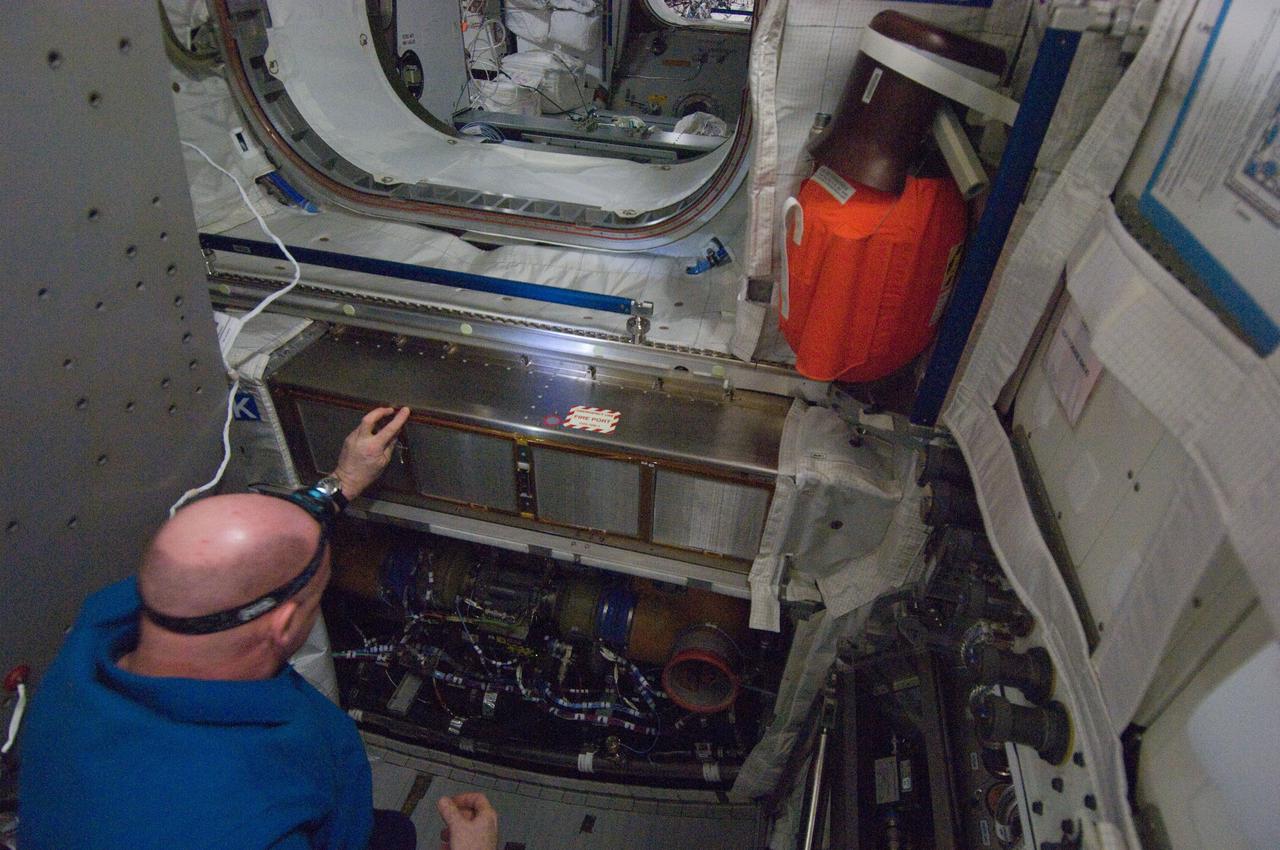
ISS030-E-094598 (23 Feb. 2012) --- European Space Agency astronaut Andre Kuipers, Expedition 30 flight engineer, performs the scheduled inspection and extensive cleanup of ventilation systems in the Columbus laboratory of the International Space Station.
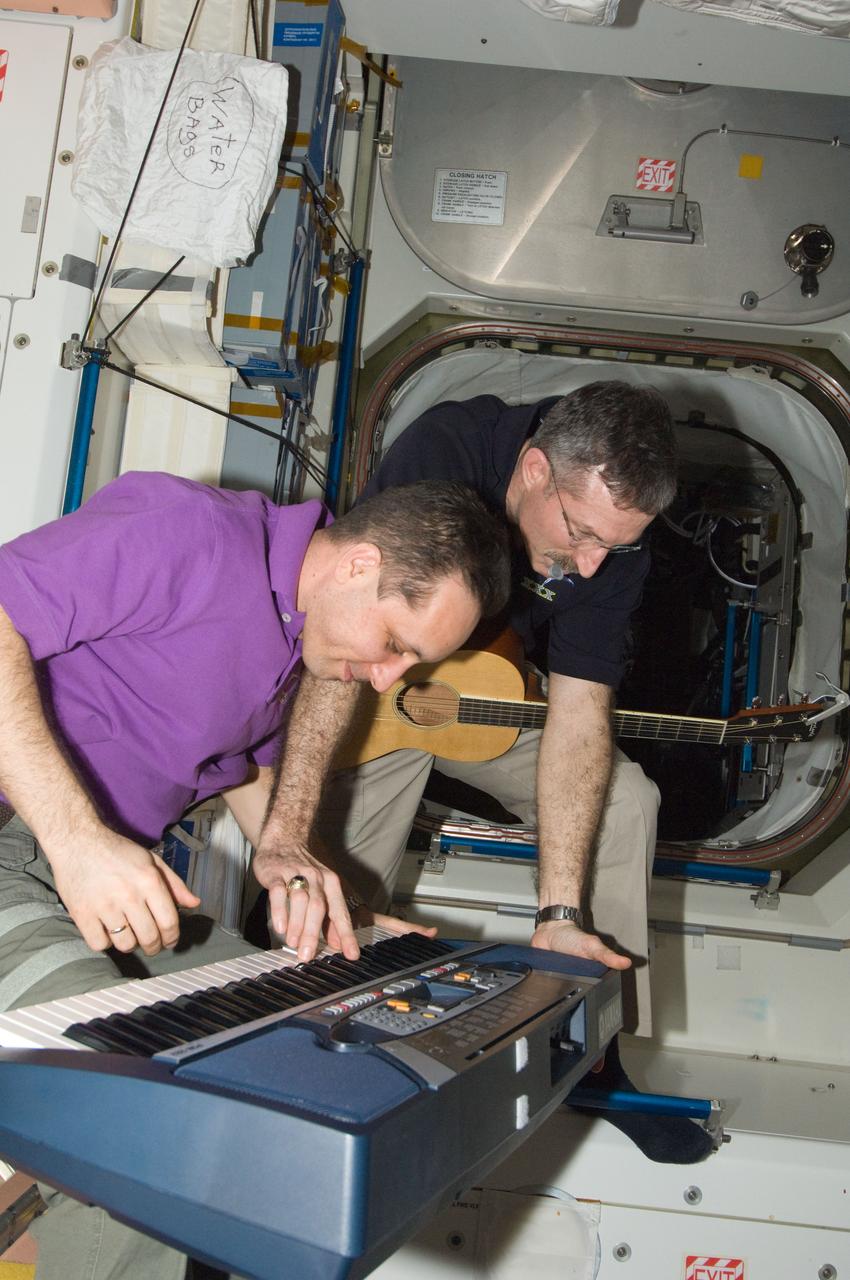
ISS030-E-267652 (21 April 2012) --- NASA astronaut Dan Burbank (with guitar), Expedition 30 commander, and Russian cosmonaut Anton Shkaplerov, flight engineer, are pictured at a musical keyboard during off-time in the Unity node of the International Space Station.
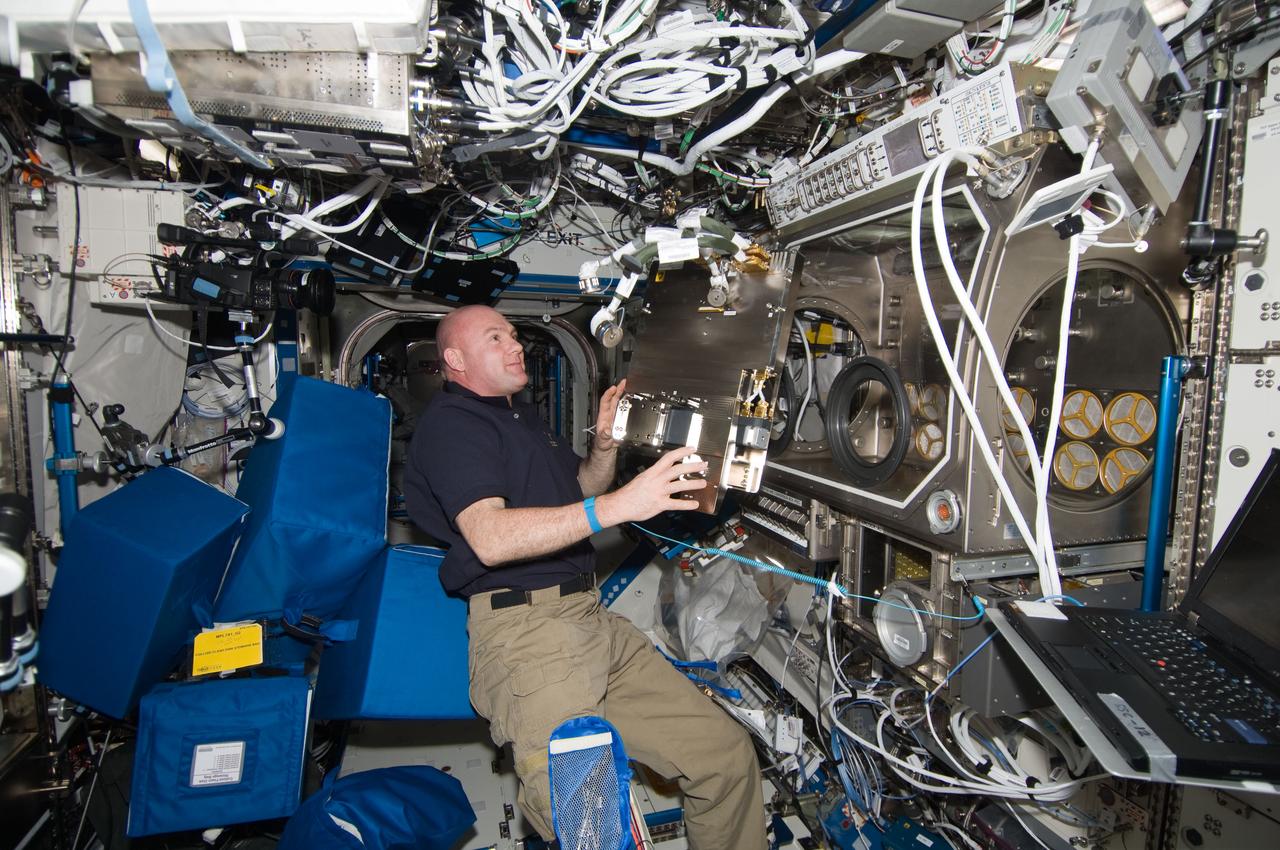
ISS030-E-155917 (16 Jan. 2012) --- European Space Agency astronaut Andre Kuipers, Expedition 30 flight engineer, prepares to place Diffusion Soret Coefficient (DSC) hardware in stowage containers in the Destiny laboratory of the International Space Station.
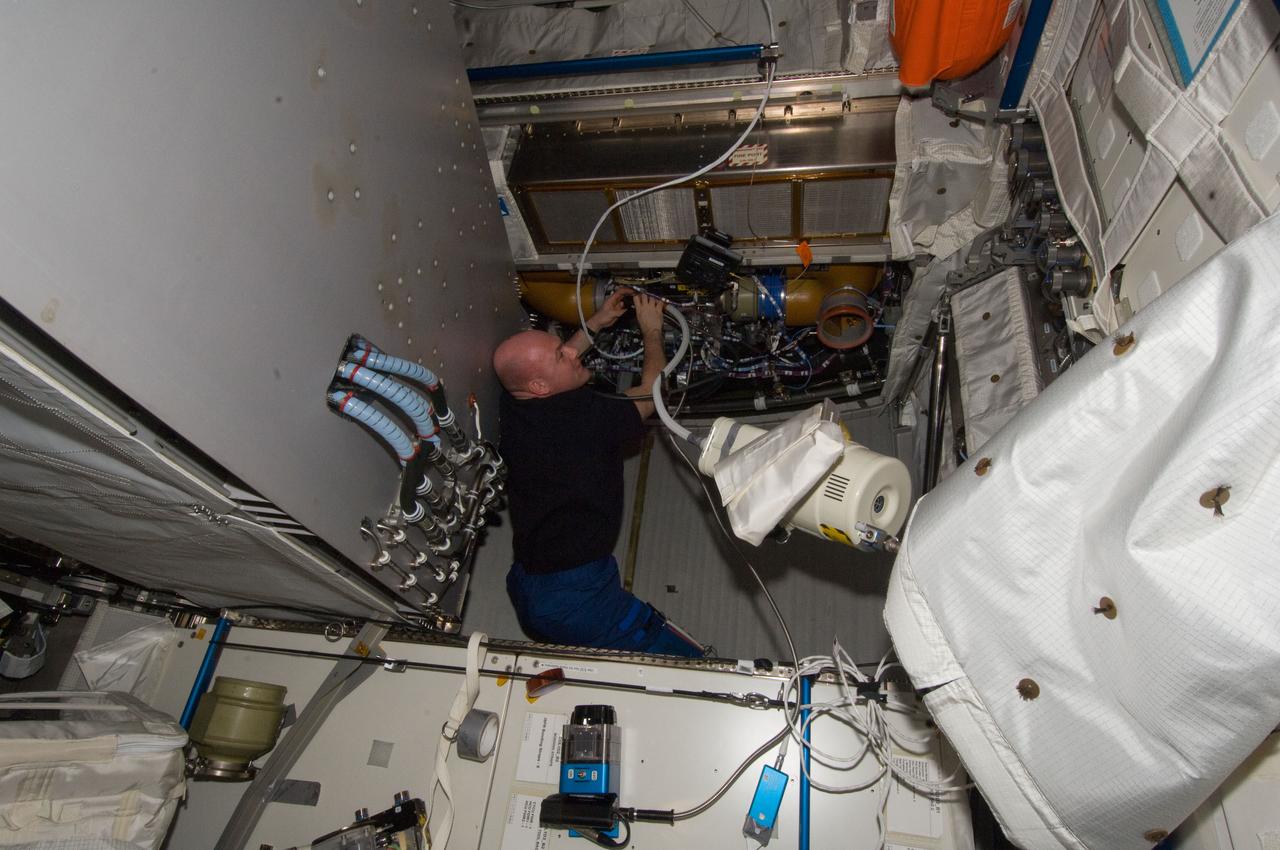
ISS030-E-093398 (22 Feb. 2012) --- European Space Agency astronaut Andre Kuipers, Expedition 30 flight engineer, uses a vacuum cleaner while performing the scheduled extensive cleanup of ventilation systems in the Columbus laboratory of the International Space Station.

ISS030-E-078511 (16 Feb. 2012) --- Russian cosmonauts Oleg Kononenko and Anton Shkaplerov, both Expedition 30 flight engineers, participate in a session of extravehicular activity (EVA) to continue outfitting the International Space Station. During the six-hour, 15-minute spacewalk, Kononenko and Shkaplerov moved the Strela-1 crane from the Pirs Docking Compartment to begin preparing the Pirs for its replacement next year with a new laboratory and docking module. The duo used another boom, the Strela-2, to move the hand-operated crane to the Poisk module for future assembly and maintenance work. Both telescoping booms extend like fishing rods and are used to move massive components outside the station. On the exterior of the Poisk Mini-Research Module 2 (MRM2), they also installed the Vinoslivost Materials Sample Experiment, which will investigate the influence of space on the mechanical properties of the materials. The spacewalkers also collected a test sample from underneath the insulation on the Zvezda Service Module to search for any signs of living organisms. Both spacewalkers wore Russian Orlan spacesuits bearing blue stripes and equipped with NASA helmet cameras.
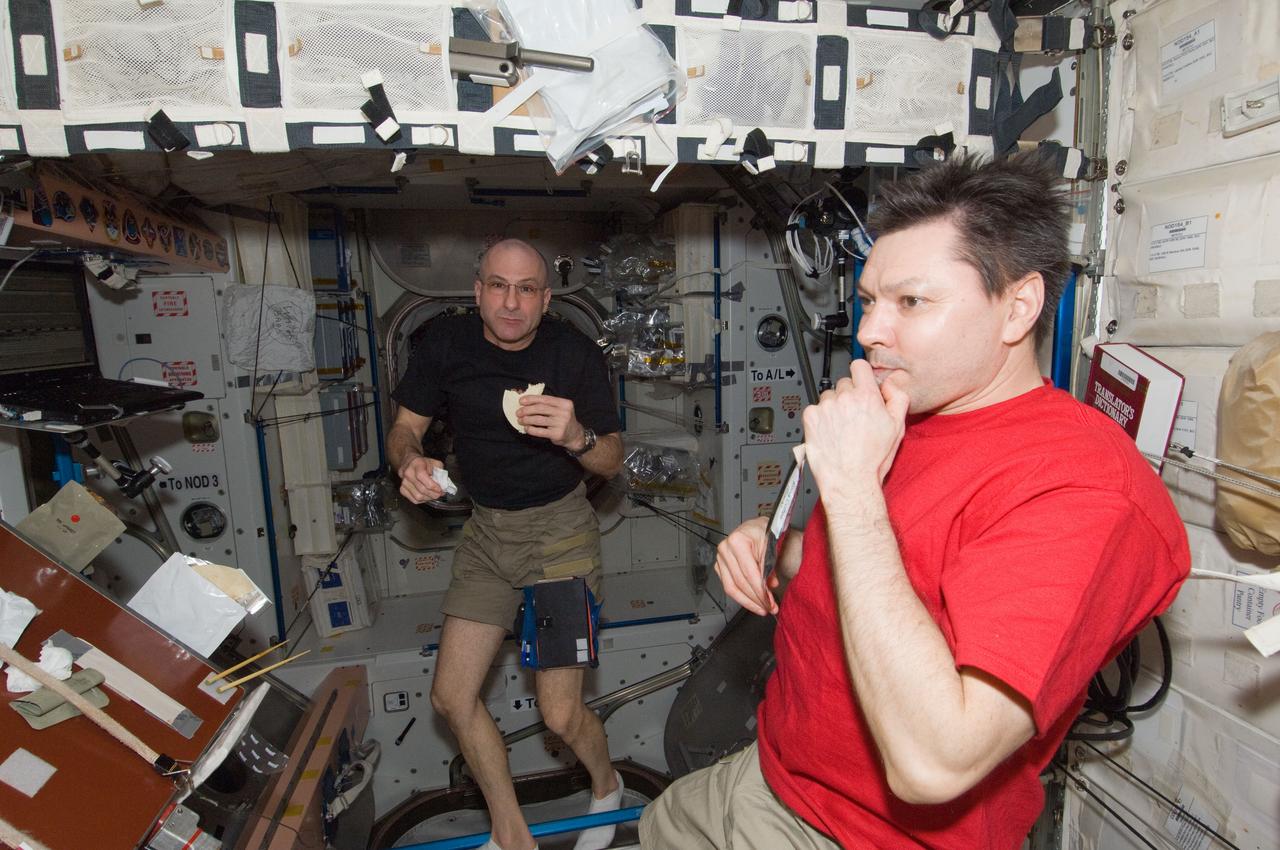
ISS031-E-077526 (13 May 2012) --- Russian cosmonaut Oleg Kononenko (right), Expedition 31 commander; and NASA astronaut Don Pettit, flight engineer, enjoy a snack in the Unity node of the International Space Station.
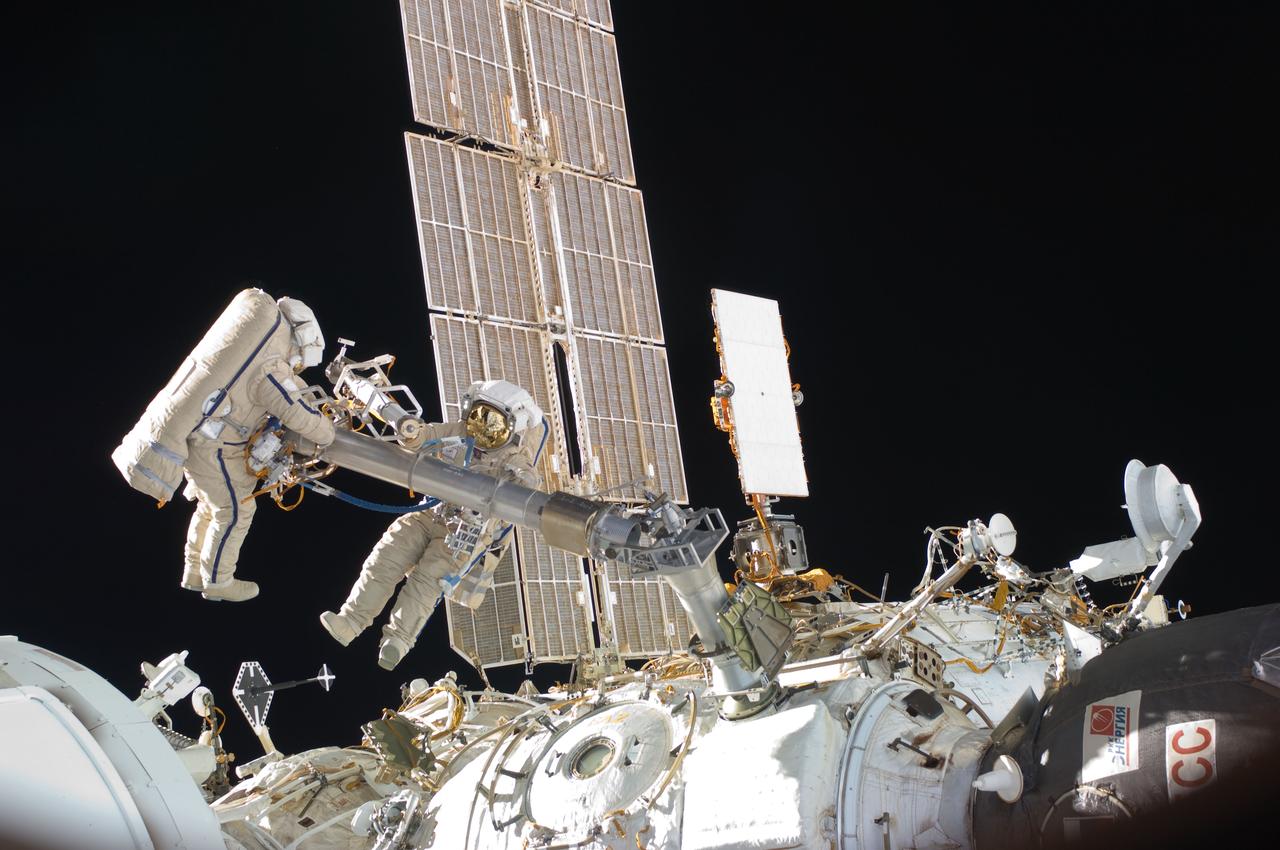
ISS030-E-078385 (16 Feb. 2012) --- Russian cosmonauts Oleg Kononenko and Anton Shkaplerov, both Expedition 30 flight engineers, participate in a session of extravehicular activity (EVA) to continue outfitting the International Space Station. During the six-hour, 15-minute spacewalk, Kononenko and Shkaplerov moved the Strela-1 crane from the Pirs Docking Compartment to begin preparing the Pirs for its replacement next year with a new laboratory and docking module. The duo used another boom, the Strela-2, to move the hand-operated crane to the Poisk module for future assembly and maintenance work. Both telescoping booms extend like fishing rods and are used to move massive components outside the station. On the exterior of the Poisk Mini-Research Module 2 (MRM2), they also installed the Vinoslivost Materials Sample Experiment, which will investigate the influence of space on the mechanical properties of the materials. The spacewalkers also collected a test sample from underneath the insulation on the Zvezda Service Module to search for any signs of living organisms. Both spacewalkers wore Russian Orlan spacesuits bearing blue stripes and equipped with NASA helmet cameras.
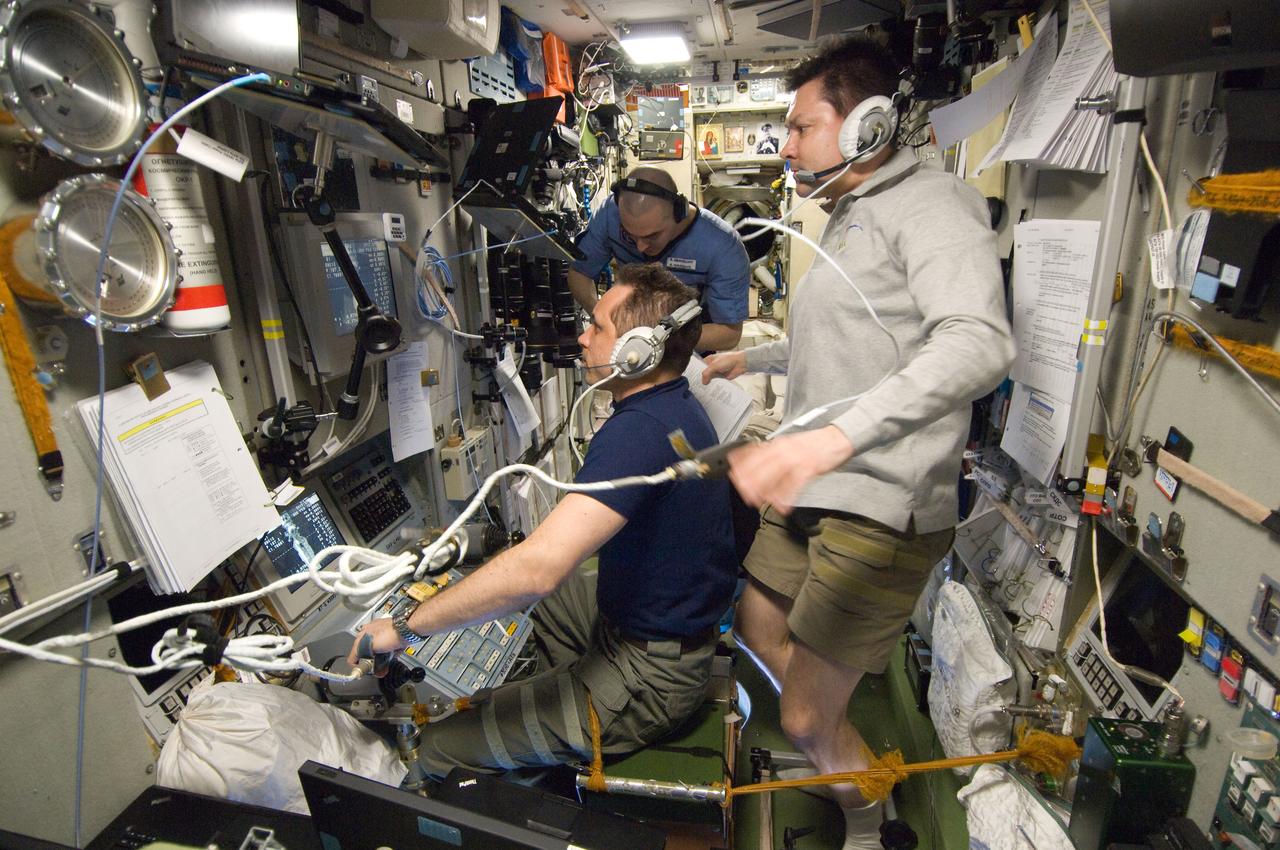
ISS030-E-267689 (22 April 2012) --- Russian cosmonauts Anton Shkaplerov (left), Oleg Kononenko (right) and Anatoly Ivanishin, all Expedition 30 flight engineers, monitor data at the manual TORU docking system controls in the Zvezda Service Module of the International Space Station during approach and docking operations of the unpiloted ISS Progress 47 resupply vehicle. Progress 47 docked automatically to the Pirs Docking Compartment via the Kurs automated rendezvous system at 10:39 a.m. (EDT) on April 22, 2012.
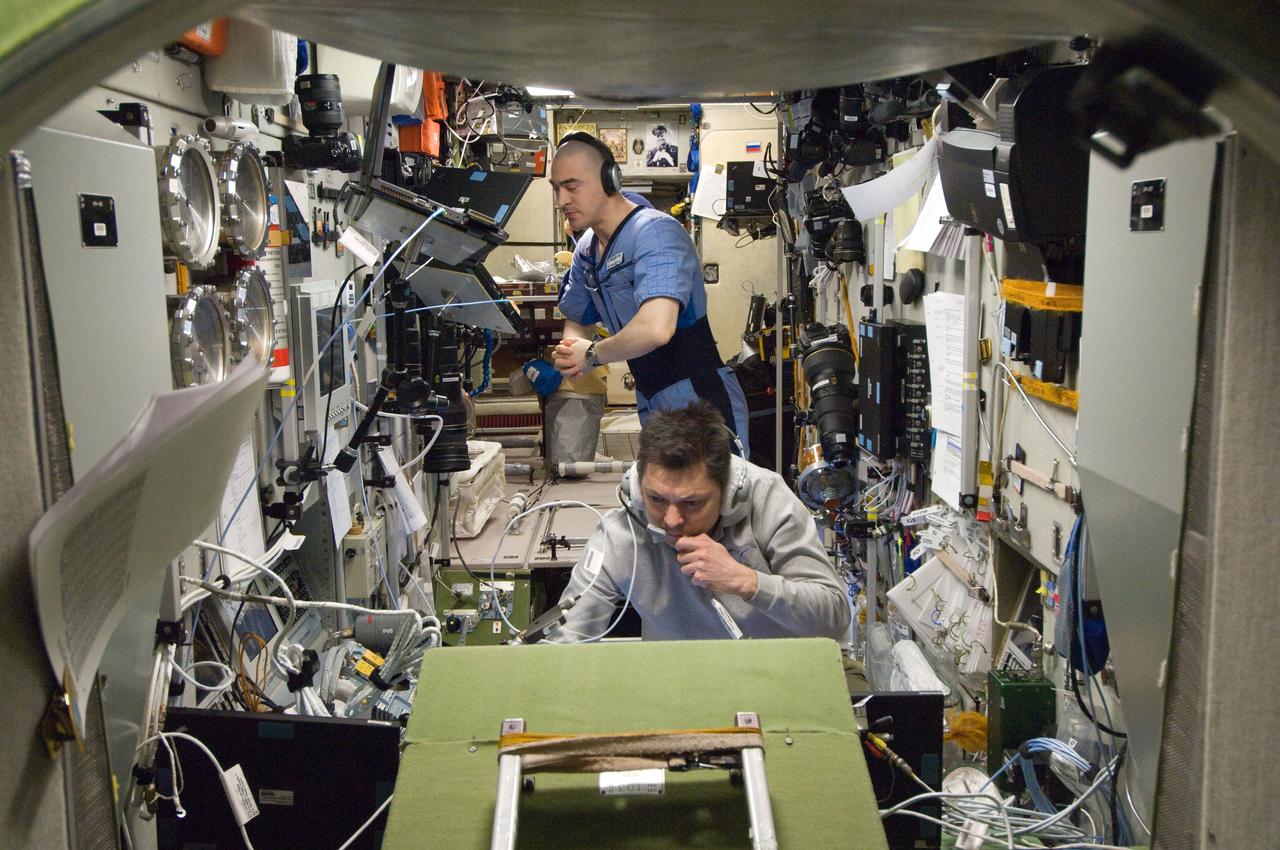
ISS030-E-267685 (22 April 2012) --- Russian cosmonauts Oleg Kononenko (foreground) and Anatoly Ivanishin, both Expedition 30 flight engineers, monitor data in the Zvezda Service Module of the International Space Station during approach and docking operations of the unpiloted ISS Progress 47 resupply vehicle. Progress 47 docked automatically to the Pirs Docking Compartment via the Kurs automated rendezvous system at 10:39 a.m. (EDT) on April 22, 2012.
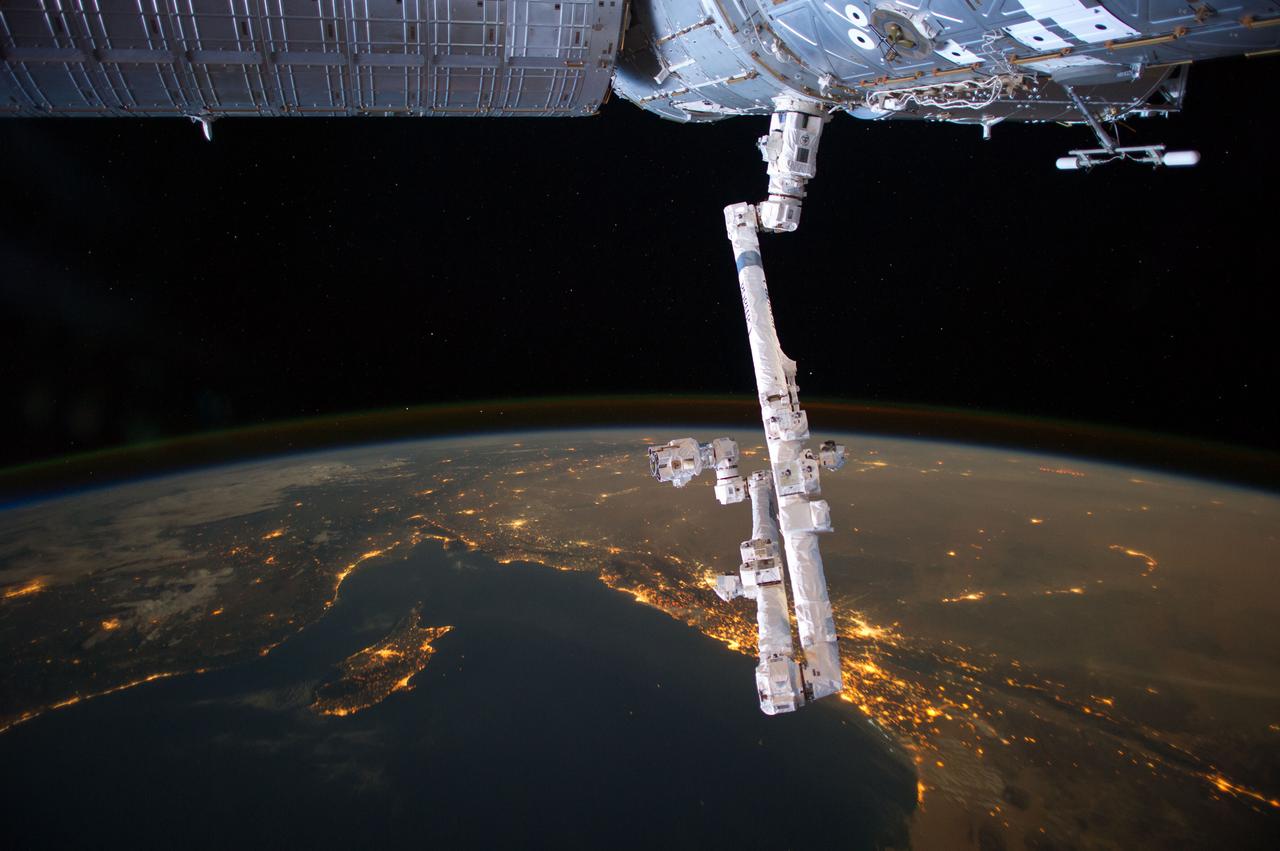
ISS031-E-095448(4 June 2012) ---
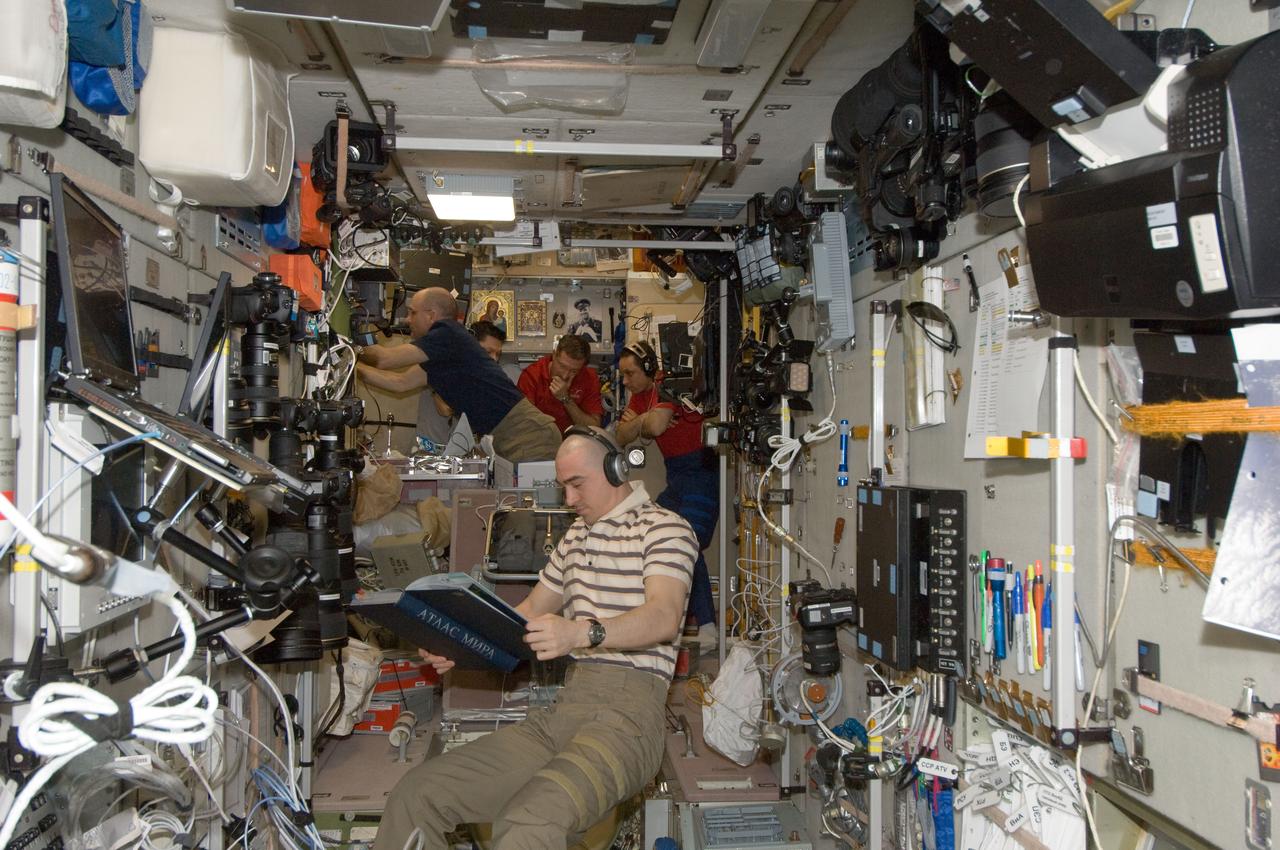
ISS030-E-173969 (24 March 2012) --- Expedition 30 crew members are pictured in the Zvezda Service Module of the International Space Station as they prepare to move to the appropriate Soyuz vehicles, due to the possibility that space debris could pass close to the station. Burbank, Shkaplerov and Ivanishin sheltered in the Soyuz TMA-22 spacecraft attached to the Poisk Mini-Research Module 2 (MRM2) while Kononenko, Kuipers and Pettit took to the Soyuz TMA-03M docked to the Rassvet Mini-Research Module 1 (MRM-1).
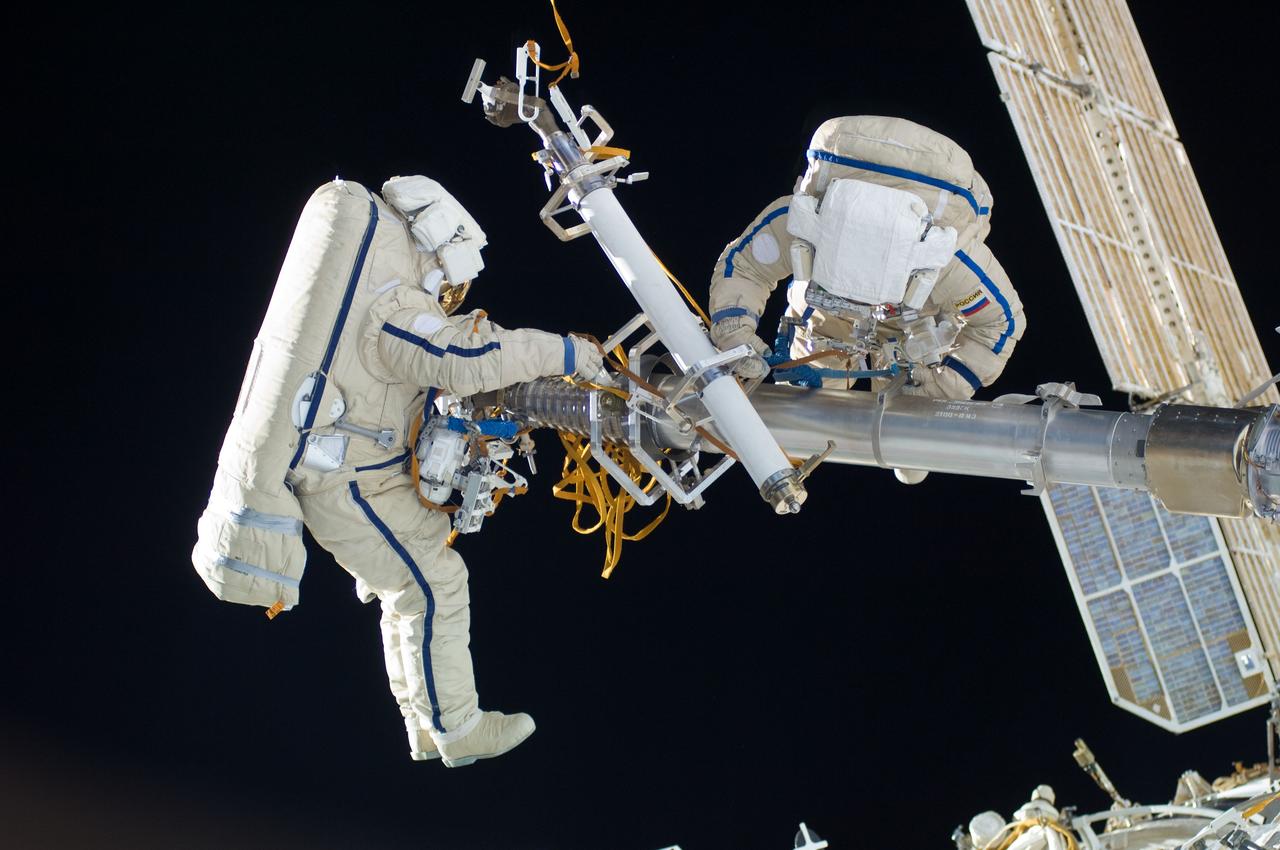
ISS030-E-078537 (16 Feb. 2012) --- Russian cosmonauts Oleg Kononenko and Anton Shkaplerov, both Expedition 30 flight engineers, participate in a session of extravehicular activity (EVA) to continue outfitting the International Space Station. During the six-hour, 15-minute spacewalk, Kononenko and Shkaplerov moved the Strela-1 crane from the Pirs Docking Compartment to begin preparing the Pirs for its replacement next year with a new laboratory and docking module. The duo used another boom, the Strela-2, to move the hand-operated crane to the Poisk module for future assembly and maintenance work. Both telescoping booms extend like fishing rods and are used to move massive components outside the station. On the exterior of the Poisk Mini-Research Module 2 (MRM2), they also installed the Vinoslivost Materials Sample Experiment, which will investigate the influence of space on the mechanical properties of the materials. The spacewalkers also collected a test sample from underneath the insulation on the Zvezda Service Module to search for any signs of living organisms. Both spacewalkers wore Russian Orlan spacesuits bearing blue stripes and equipped with NASA helmet cameras.
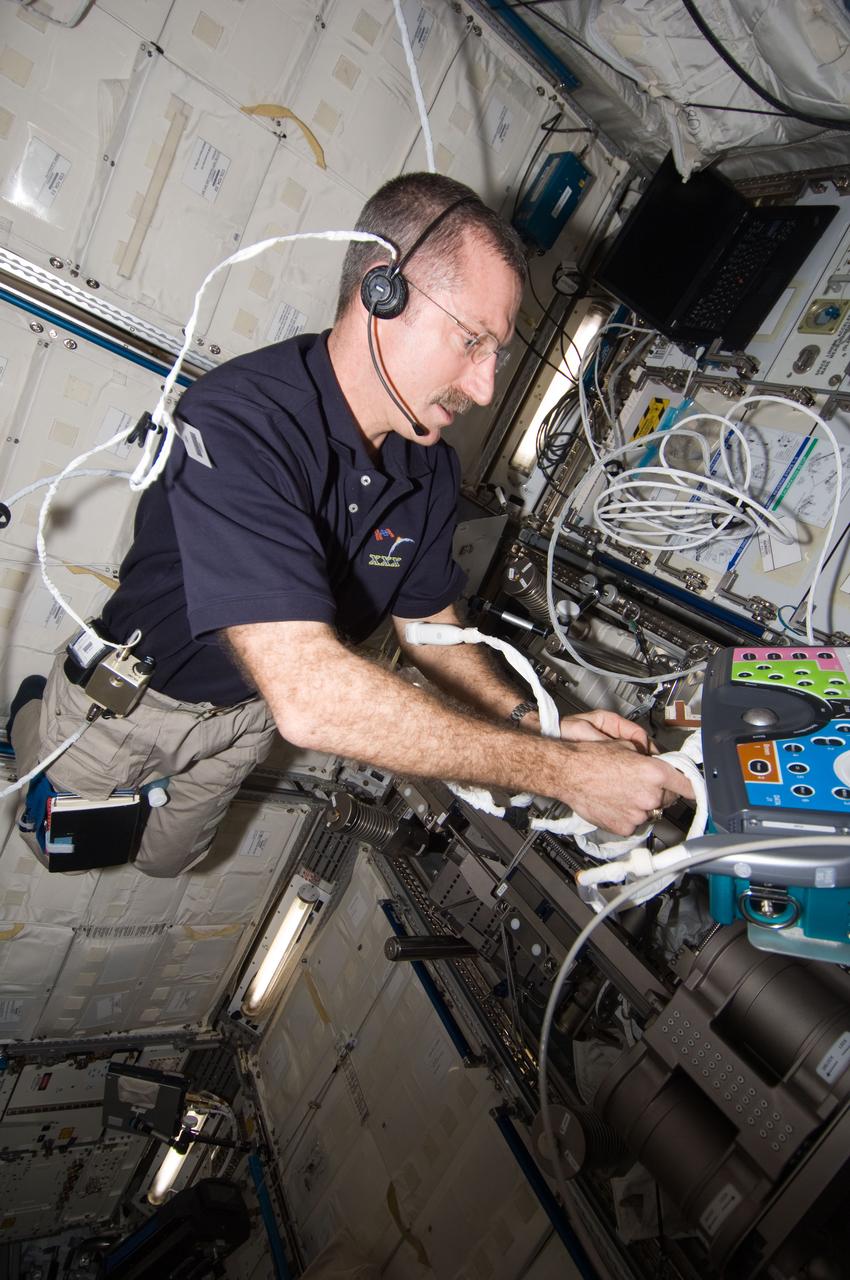
ISS030-E-155938 (20 Jan. 2012) --- NASA astronaut Dan Burbank, Expedition 30 commander, sets up the Integrated Cardiovascular (ICV) Resting Echo Scan at the Human Research Facility (HRF) rack in the Columbus laboratory of the International Space Station.
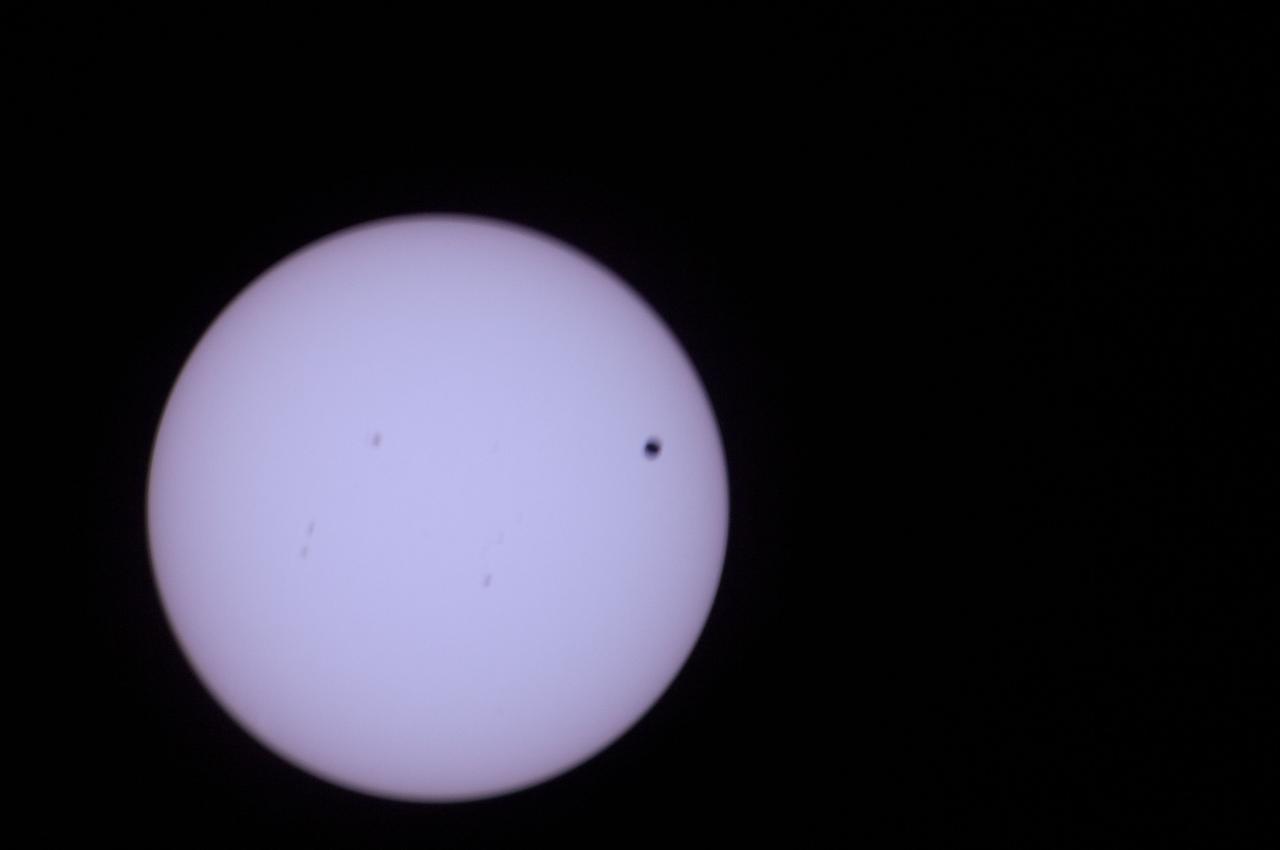
Transit of Venus as seen from the Cupola Module.
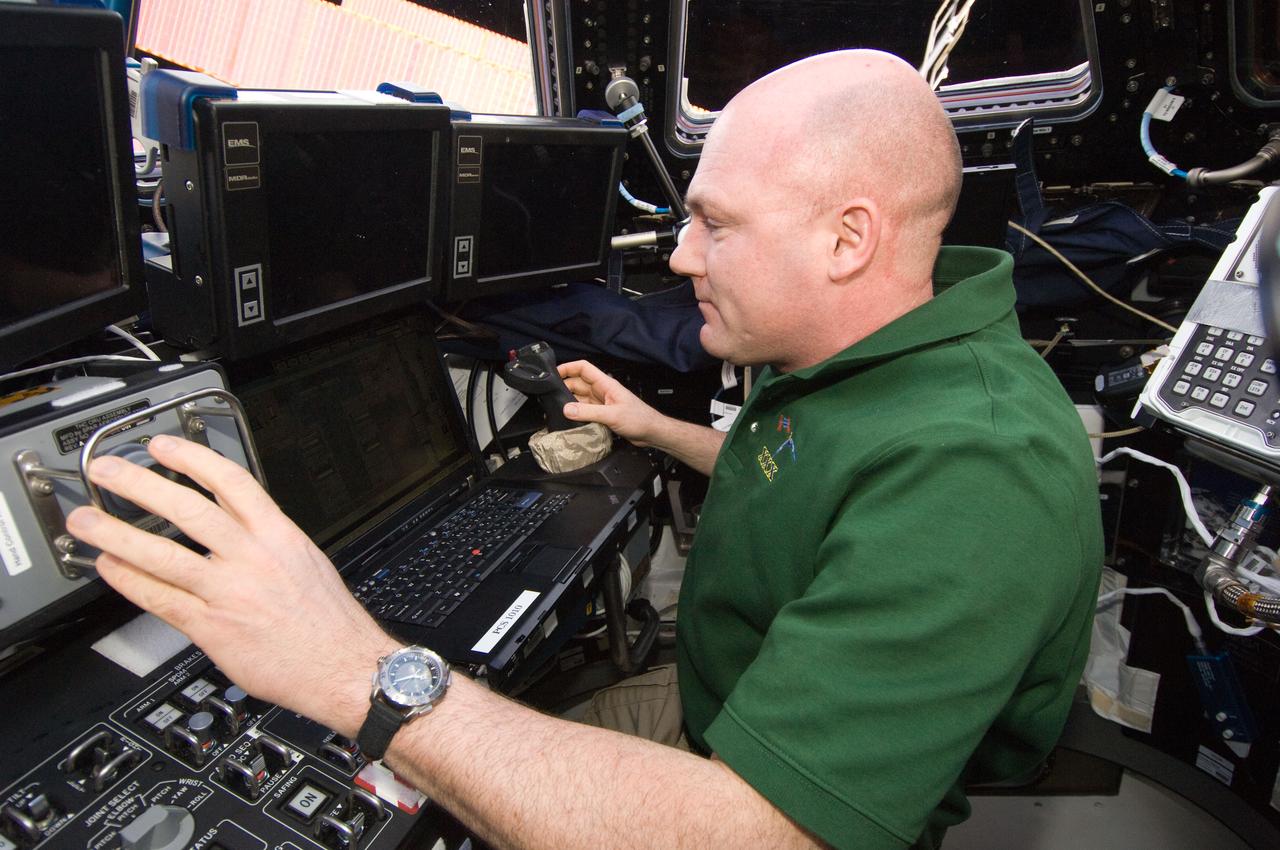
ISS030-E-272083 (17 April 2012) --- European Space Agency astronaut Andre Kuipers, Expedition 30 flight engineer, works the controls of the Canadarm2 Space Station Remote Manipulator System (SSRMS) in the Cupola of the International Space Station.
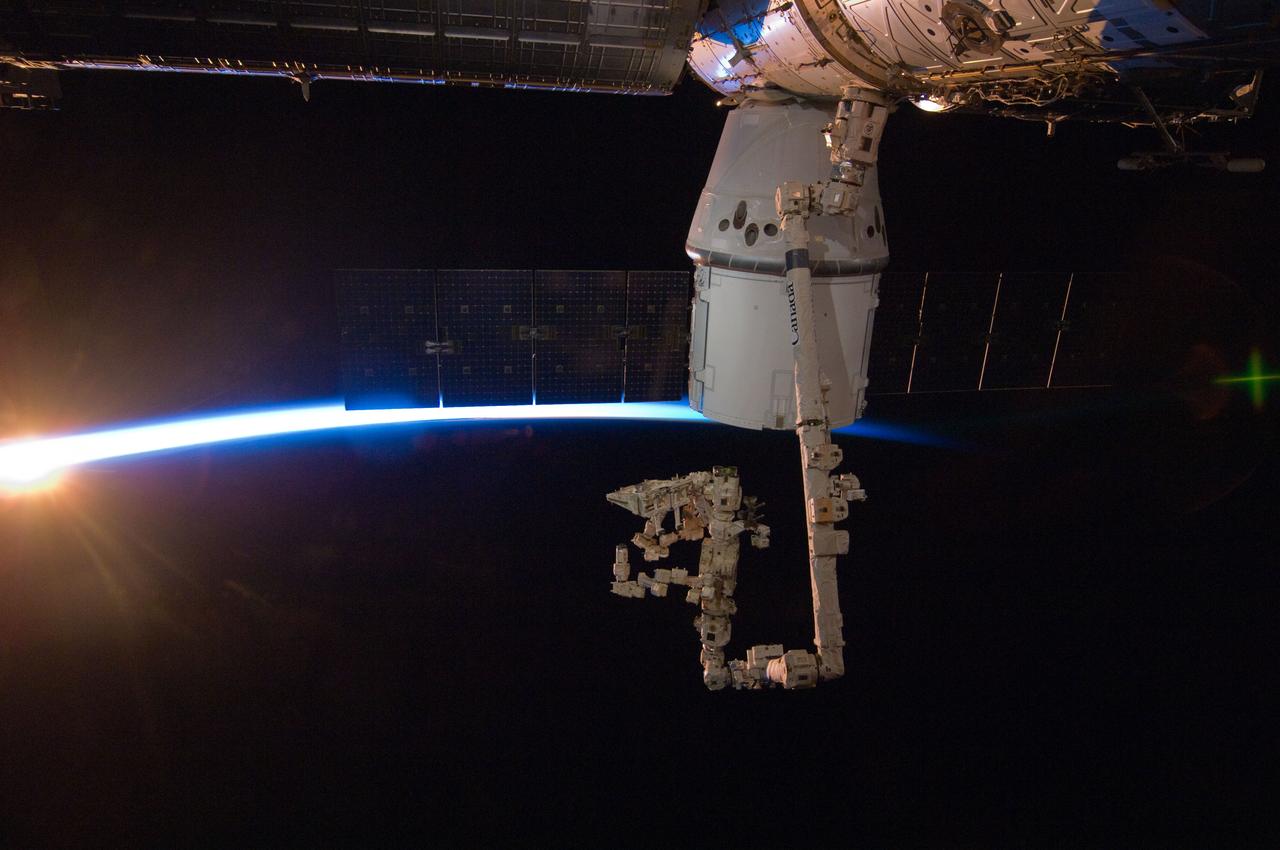
ISS031-E-077670 (25 May 2012) --- With rays of sunshine and the thin blue atmosphere of Earth serving as a backdrop, the SpaceX Dragon commercial cargo craft is berthed to the Earth-facing side of the International Space Station’s Harmony node. Expedition 31 Flight Engineers Don Pettit and Andre Kuipers grappled Dragon at 9:56 a.m. (EDT) with the Canadarm2 robotic arm and used it to berth Dragon to the at 12:02 p.m. May 25, 2012. Dragon became the first commercially developed space vehicle to be launched to the station to join Russian, European and Japanese resupply craft that service the complex while restoring a U.S. capability to deliver cargo to the orbital laboratory. Dragon is scheduled to spend about a week docked with the station before returning to Earth on May 31 for retrieval
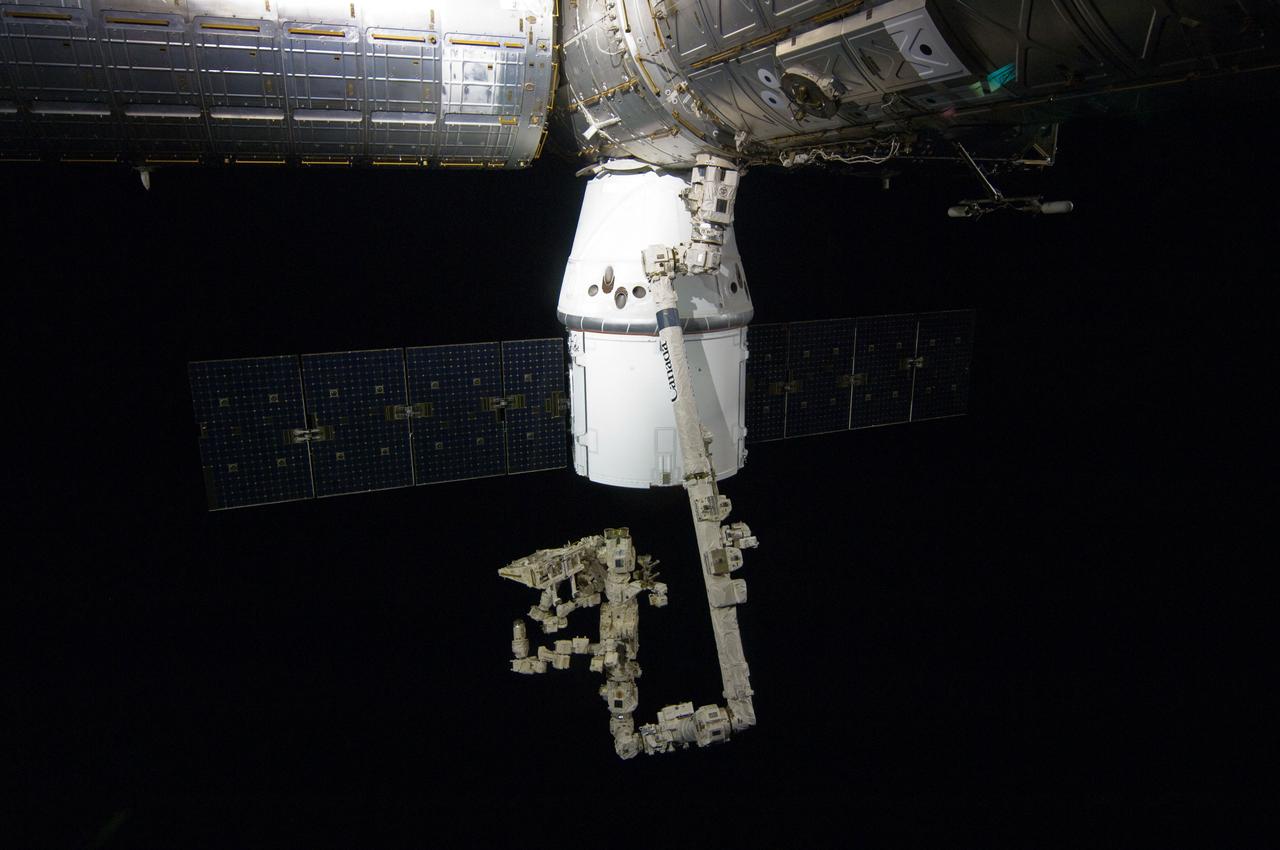
ISS031-E-077666 (25 May 2012) --- The SpaceX Dragon commercial cargo craft is berthed to the Earth-facing side of the International Space Station’s Harmony node. Expedition 31 Flight Engineers Don Pettit and Andre Kuipers grappled Dragon at 9:56 a.m. (EDT) with the Canadarm2 robotic arm and used it to berth Dragon to the at 12:02 p.m. May 25, 2012. Dragon became the first commercially developed space vehicle to be launched to the station to join Russian, European and Japanese resupply craft that service the complex while restoring a U.S. capability to deliver cargo to the orbital laboratory. Dragon is scheduled to spend about a week docked with the station before returning to Earth on May 31 for retrieval.
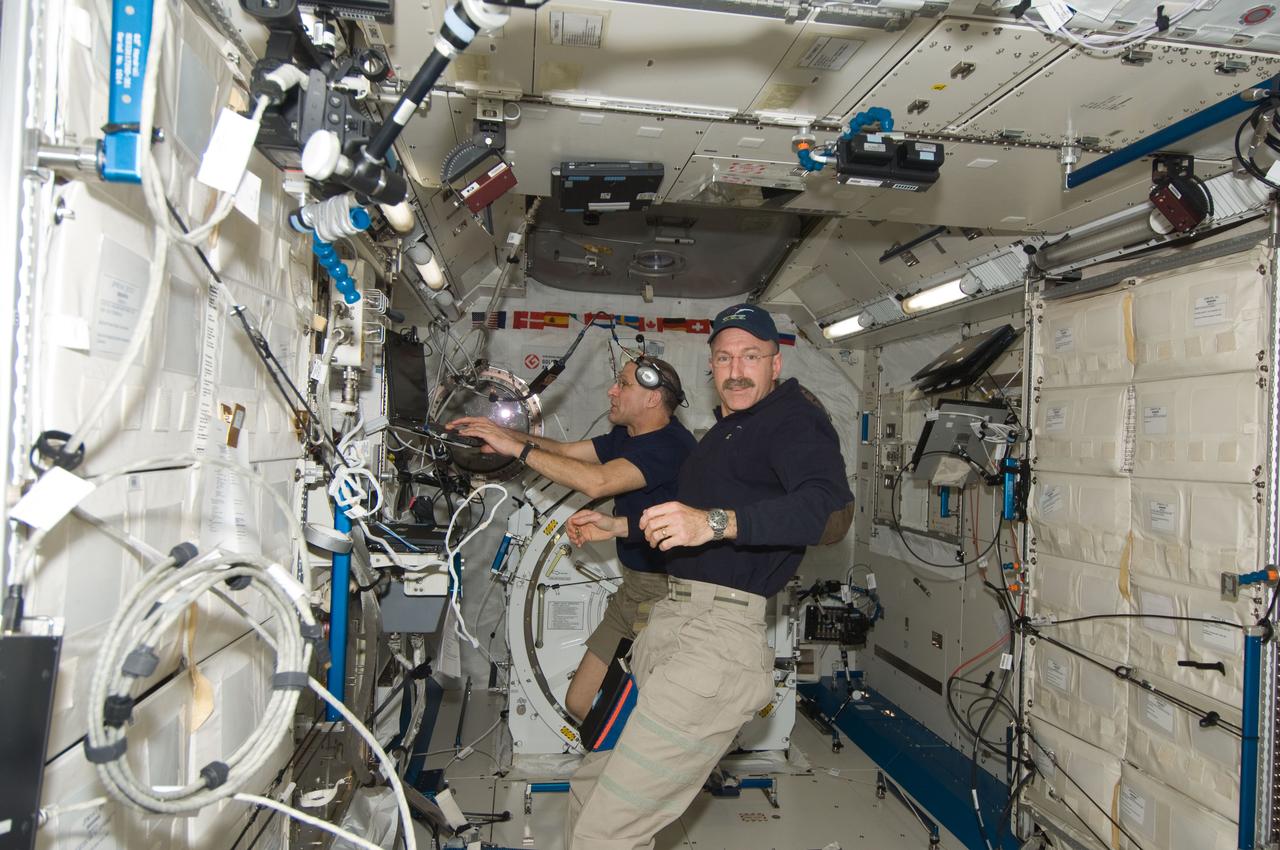
ISS030-E-235473 (4 Jan. 2012) --- NASA astronauts Dan Burbank (foreground), Expedition 30 commander; and Don Pettit, flight engineer, work in the Kibo laboratory of the International Space Station.
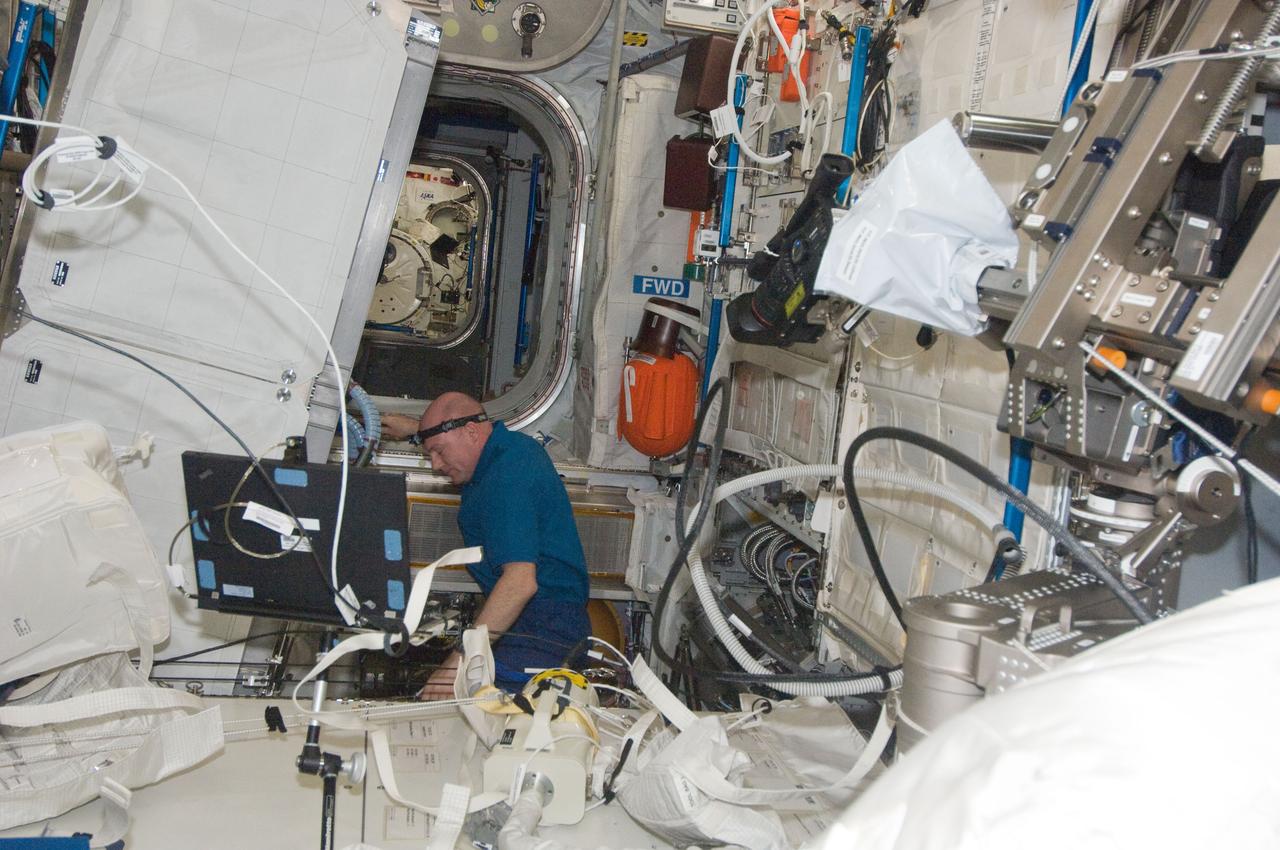
ISS030-E-094534 (23 Feb. 2012) --- European Space Agency astronaut Andre Kuipers, Expedition 30 flight engineer, performs the scheduled inspection and extensive cleanup of ventilation systems in the Columbus laboratory of the International Space Station.
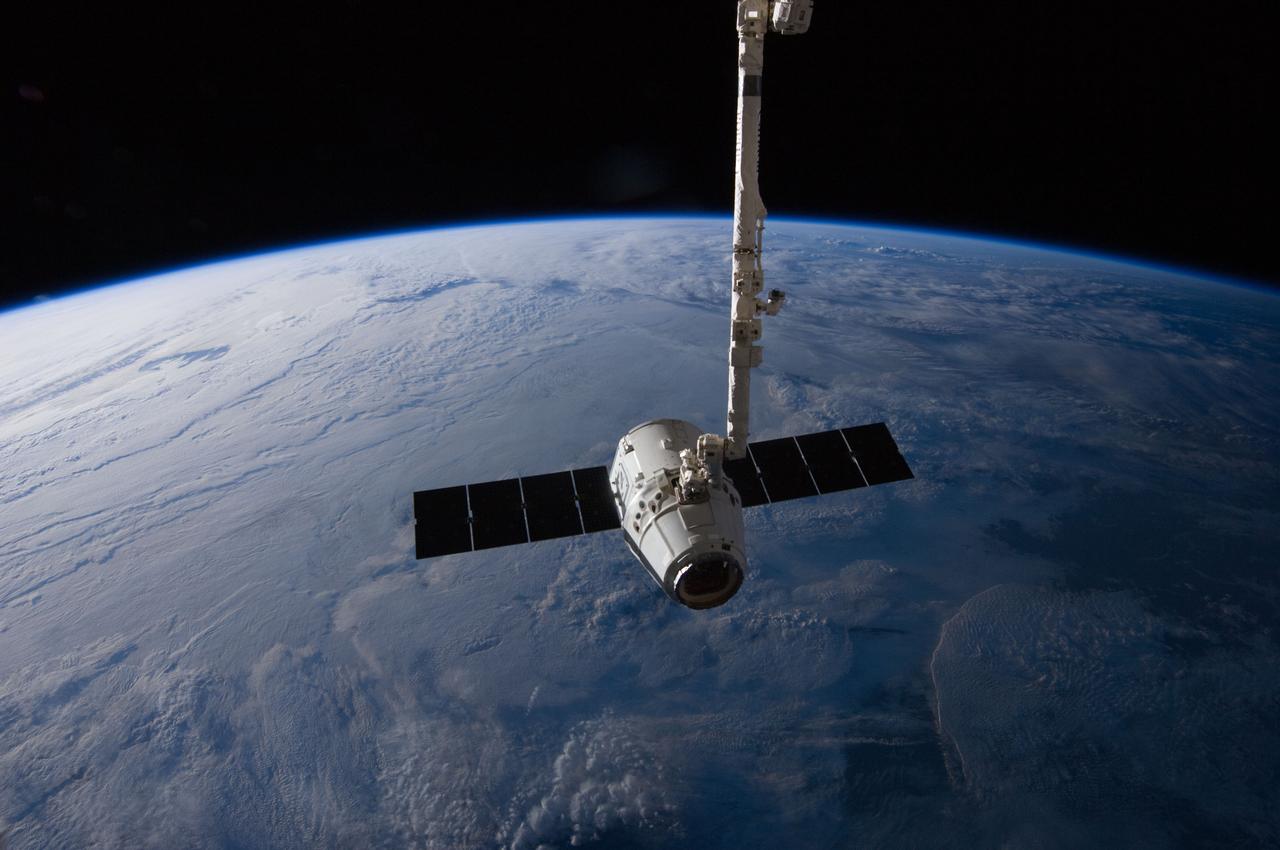
ISS031-E-079332 (31 May 2012) --- The SpaceX Dragon cargo craft, after spending the better part of a week docked to the International Space Station, is suspended in the grasp of the Candarm2 robotic arm some 240 miles above the home planet prior to its May 31 return.
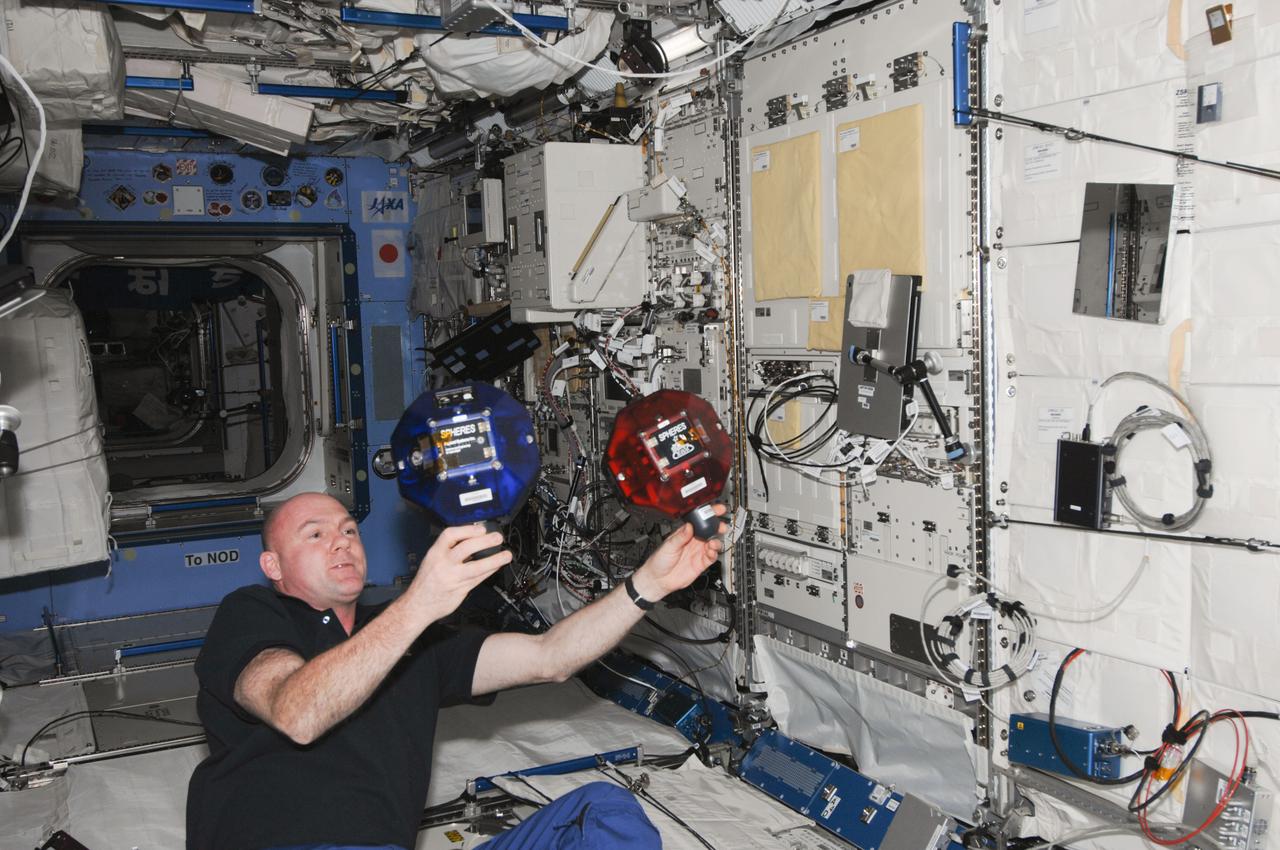
ISS030-E-156313 (23 Jan. 2012) --- European Space Agency astronaut Andre Kuipers, Expedition 30 flight engineer, works with the Synchronized Position Hold, Engage, Reorient, Experimental Satellites Zero Robotics (SPHERES ZR) experiment in the Kibo laboratory of the International Space Station.
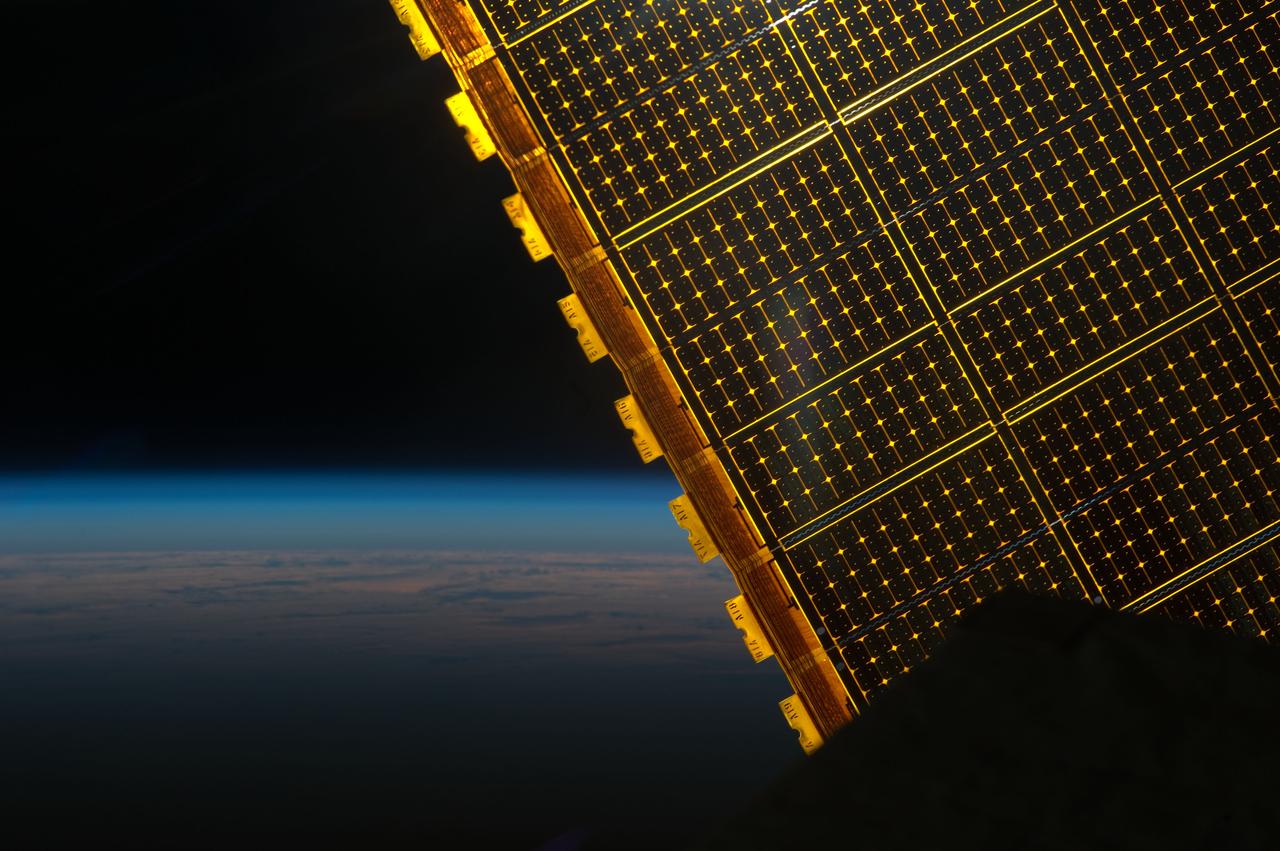
ISS031-E-084106 (2 June 2012) --- Solar array panels are featured in this image photographed by an Expedition 31 crew member on the International Space Station. Earth’s atmosphere and the blackness of space provide the backdrop for the scene.
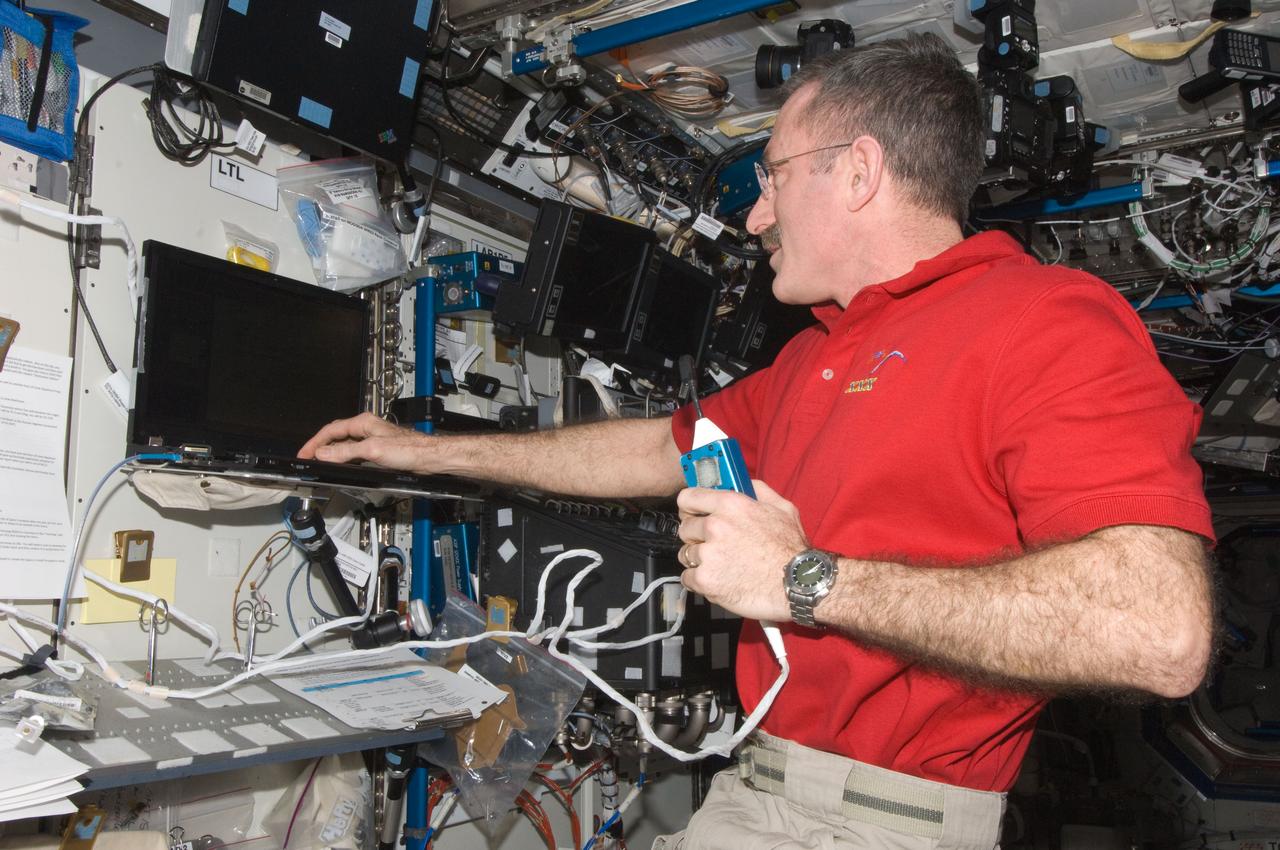
ISS030-E-267797 (25 April 2012) --- NASA astronaut Dan Burbank, Expedition 30 commander, holds a microphone while using a computer in the Destiny laboratory of the International Space Station.
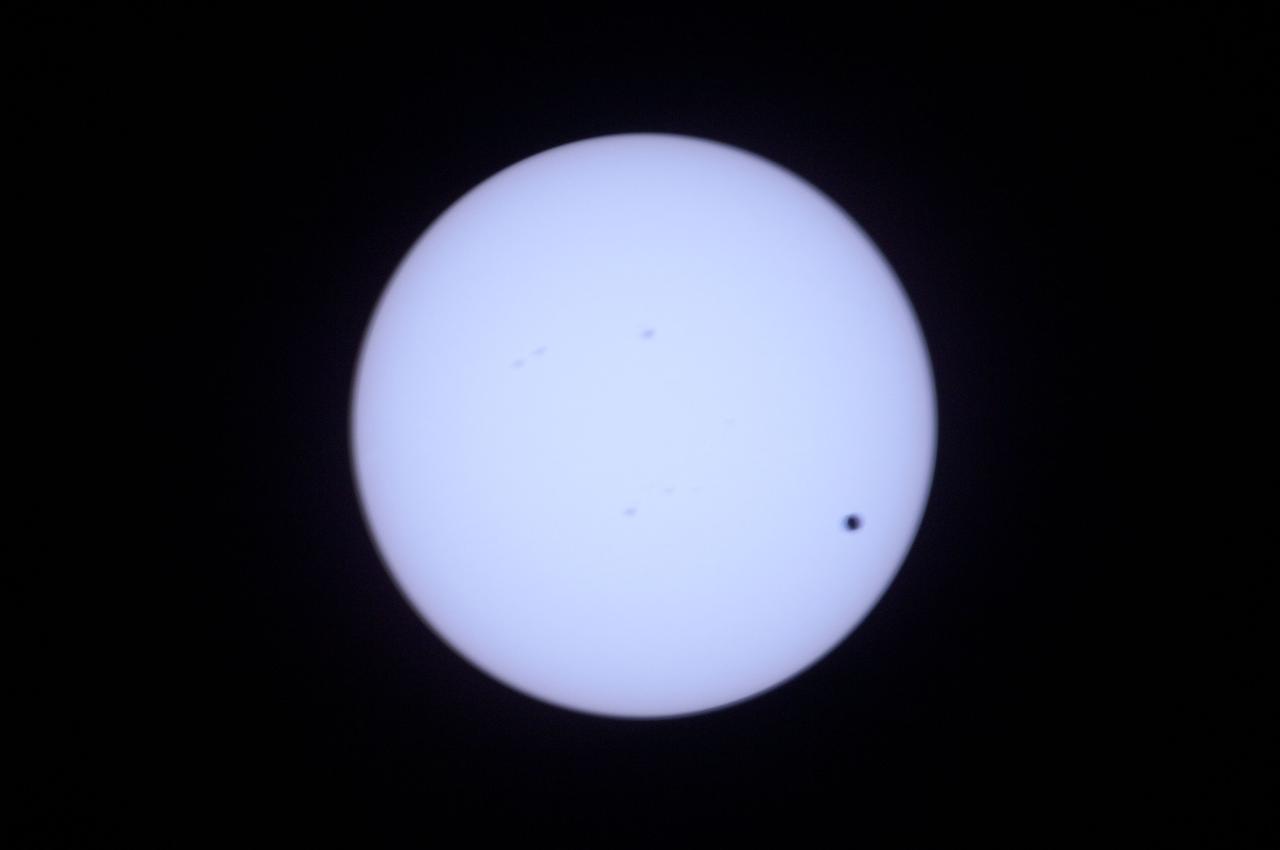
Transit of Venus as seen from the Cupola Module.
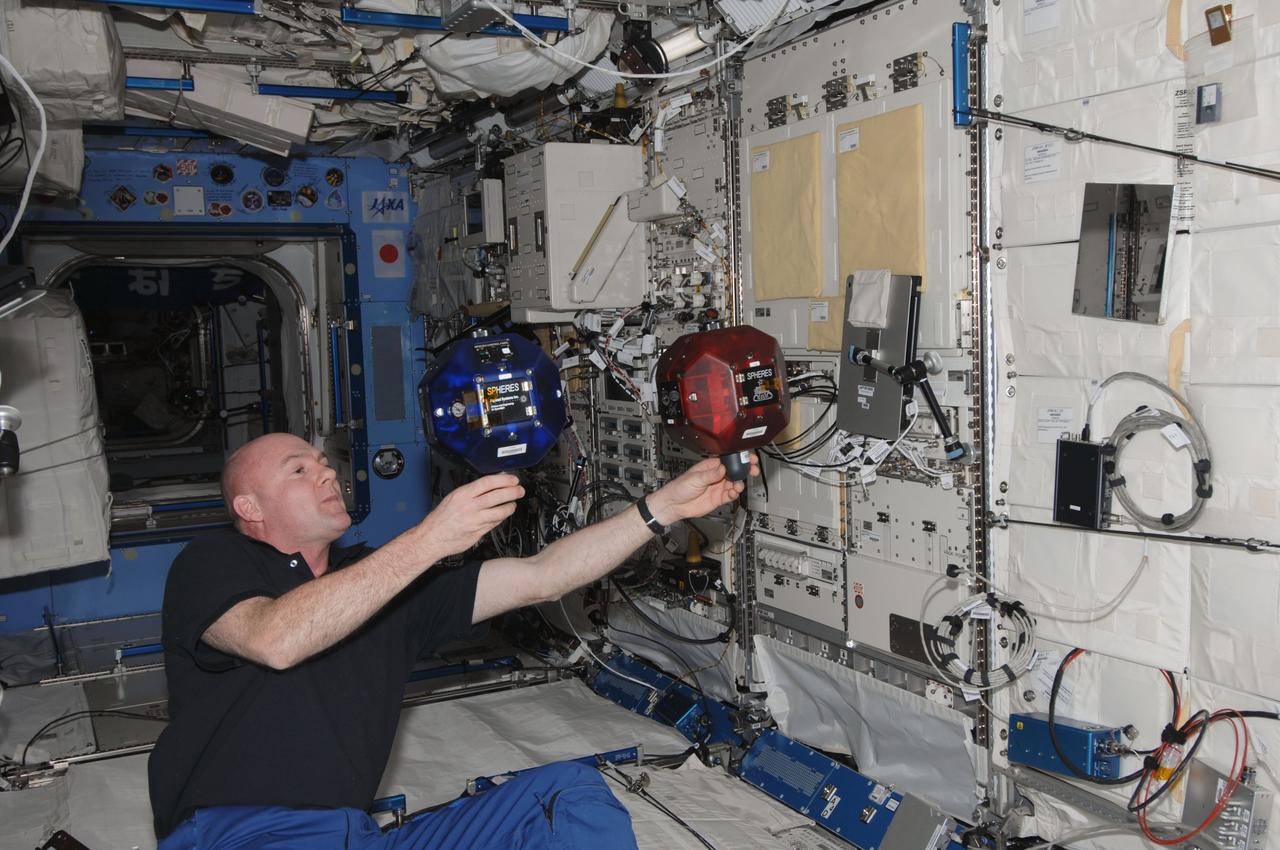
ISS030-E-156310 (23 Jan. 2012) --- European Space Agency astronaut Andre Kuipers, Expedition 30 flight engineer, works with the Synchronized Position Hold, Engage, Reorient, Experimental Satellites Zero Robotics (SPHERES ZR) experiment in the Kibo laboratory of the International Space Station.
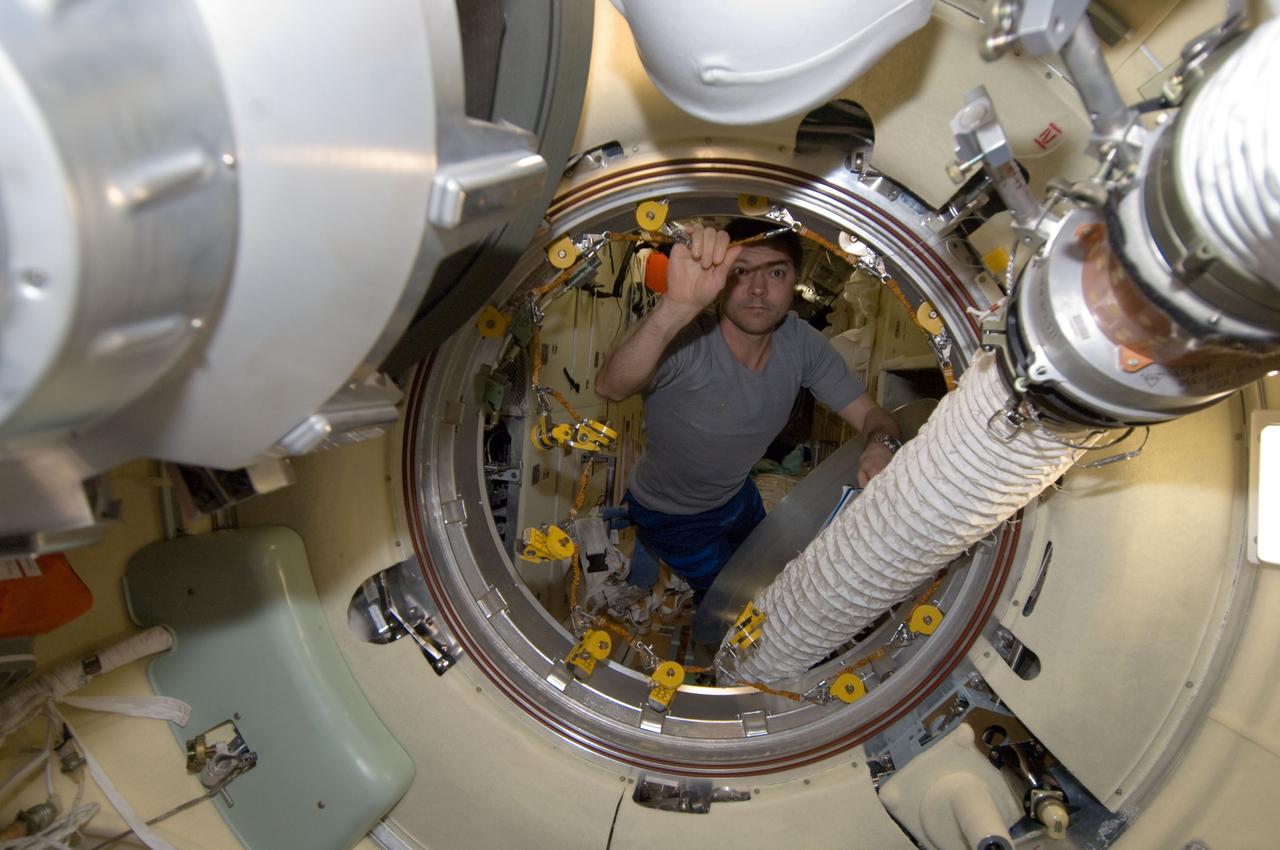
ISS030-E-173974 (24 March 2012) --- Russian cosmonaut Oleg Kononenko, Expedition 30 flight engineer, works in a hatchway on the International Space Station as crew members prepare to move to the appropriate Soyuz vehicles, due to the possibility that space debris could pass close to the station. Burbank, Shkaplerov and Ivanishin sheltered in the Soyuz TMA-22 spacecraft attached to the Poisk Mini-Research Module 2 (MRM2) while Kononenko, Kuipers and Pettit took to the Soyuz TMA-03M docked to the Rassvet Mini-Research Module 1 (MRM-1).
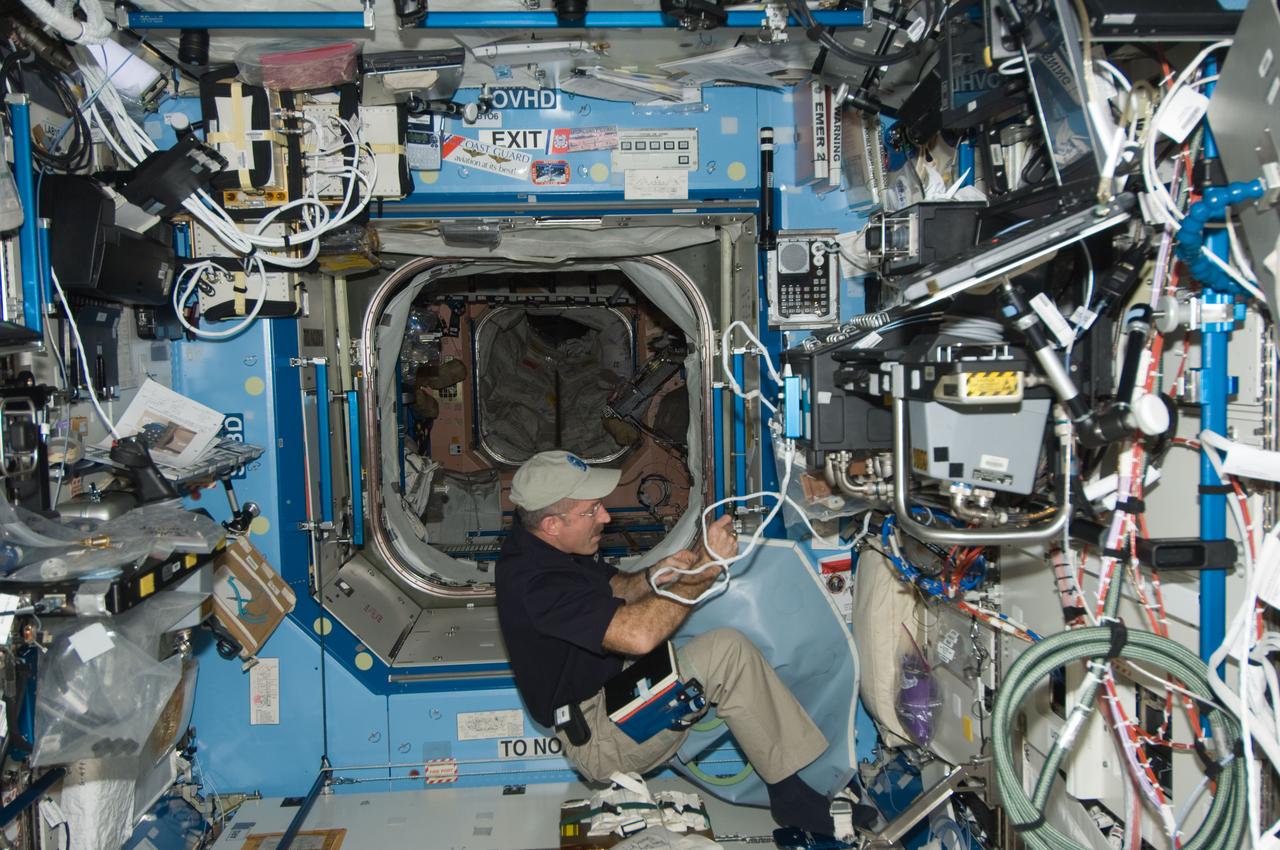
ISS030-E-155912 (16 Jan. 2012) --- NASA astronaut Dan Burbank, Expedition 30 commander, performs in-flight maintenance on the front stray light cover for the Microgravity Science Glovebox (MSG) in the Destiny laboratory of the International Space Station.
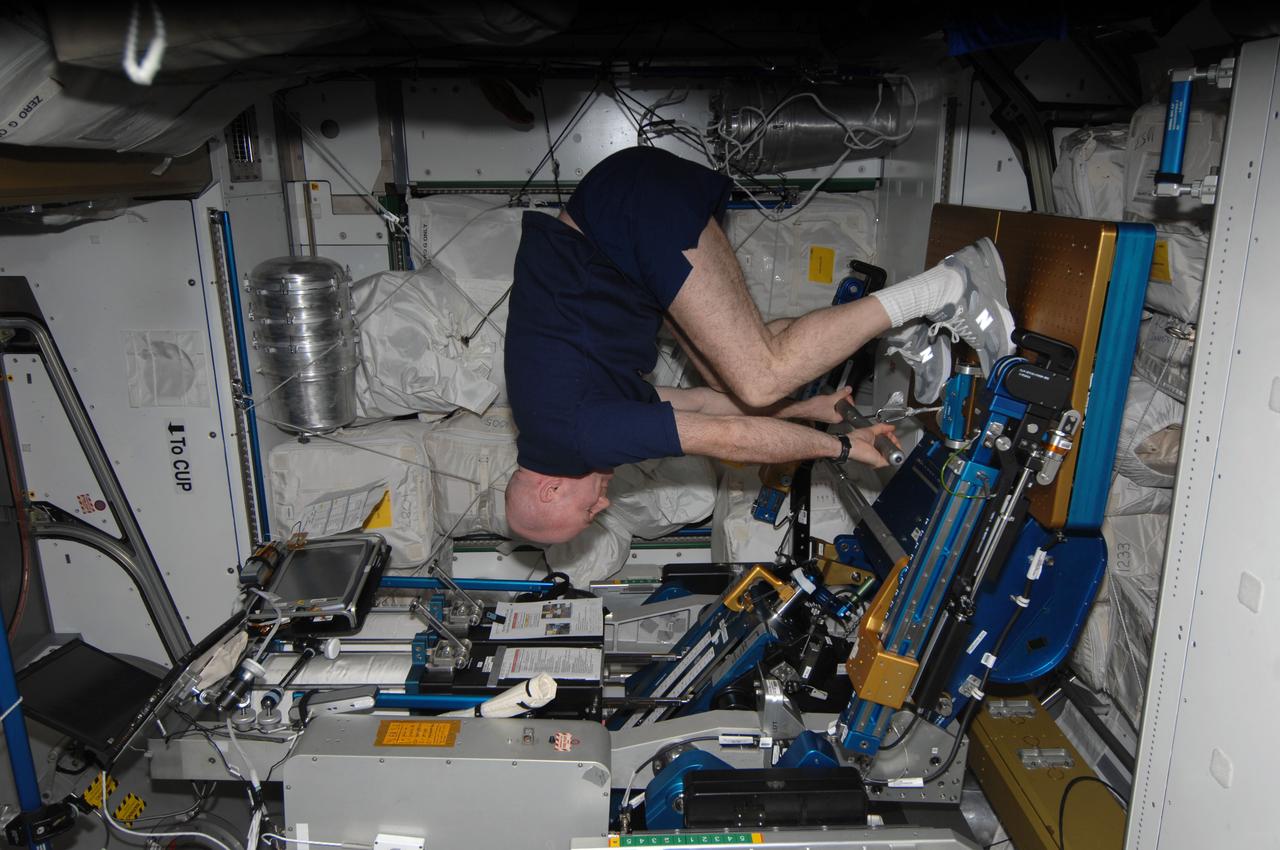
ISS030-E-148403 (22 Jan. 2012) --- European Space Agency astronaut Andre Kuipers, Expedition 30 flight engineer, exercises in the Tranquility node of the International Space Station, using the advanced Resistive Exercise Device (aRED).
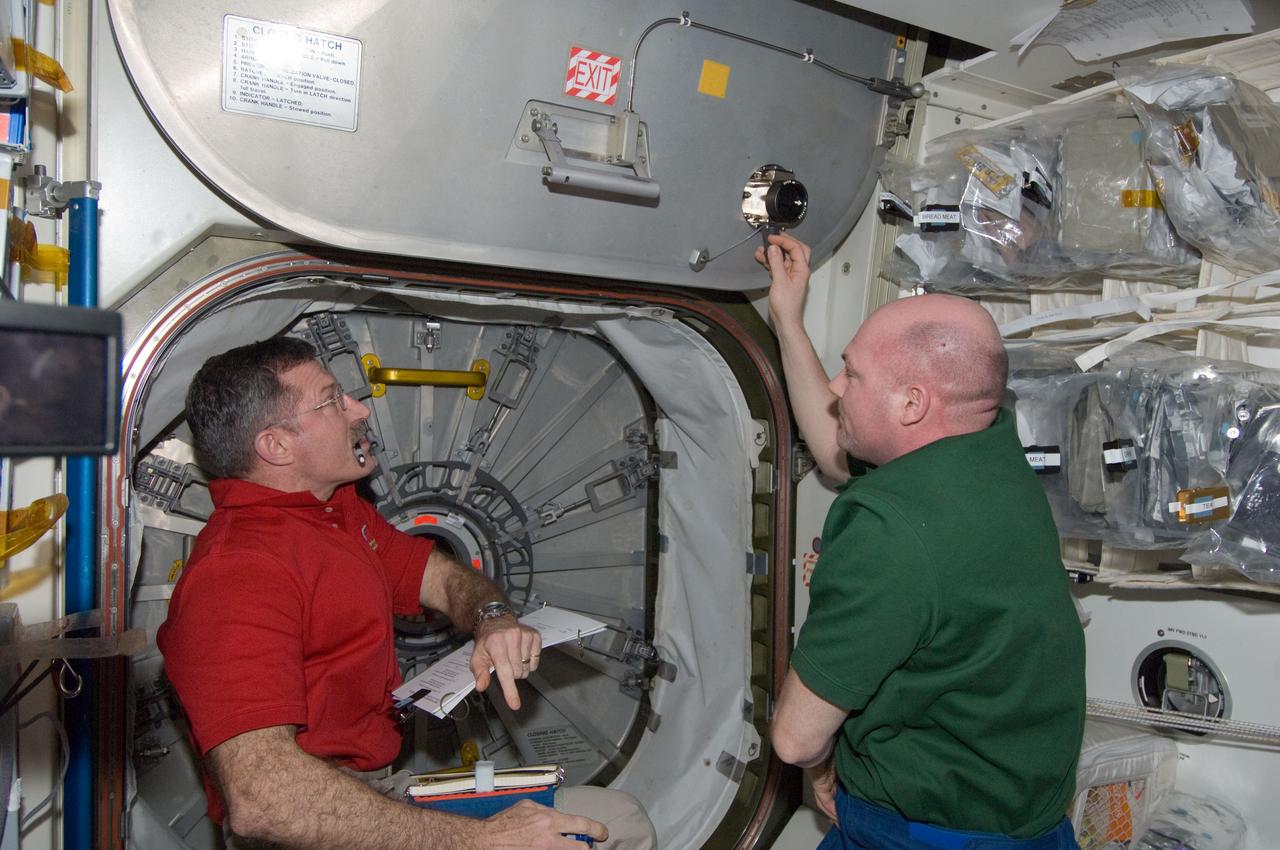
ISS030-E-173929 (24 March 2012) --- NASA astronaut Dan Burbank (left), Expedition 30 commander; and European Space Agency astronaut Andre Kuipers, flight engineer, are pictured near a hatch in the International Space Station as crew members prepare to move to the appropriate Soyuz vehicles, due to the possibility that space debris could pass close to the station. Burbank, Shkaplerov and Ivanishin sheltered in the Soyuz TMA-22 spacecraft attached to the Poisk Mini-Research Module 2 (MRM2) while Kononenko, Kuipers and Pettit took to the Soyuz TMA-03M docked to the Rassvet Mini-Research Module 1 (MRM-1).
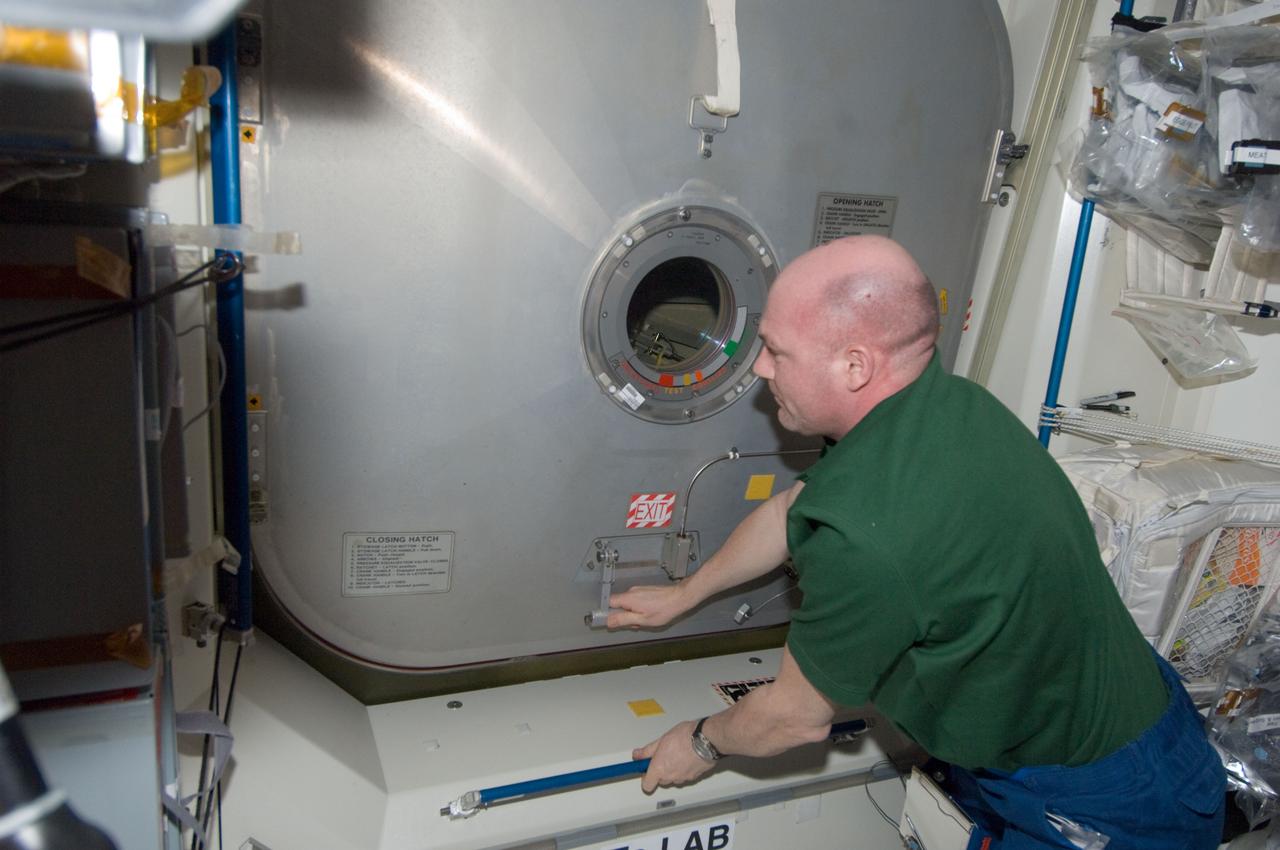
ISS030-E-173931 (24 March 2012) --- European Space Agency astronaut Andre Kuipers, Expedition 30 flight engineer, closes a hatch in the International Space Station as crew members prepare to move to the appropriate Soyuz vehicles, due to the possibility that space debris could pass close to the station. Burbank, Shkaplerov and Ivanishin sheltered in the Soyuz TMA-22 spacecraft attached to the Poisk Mini-Research Module 2 (MRM2) while Kononenko, Kuipers and Pettit took to the Soyuz TMA-03M docked to the Rassvet Mini-Research Module 1 (MRM-1).
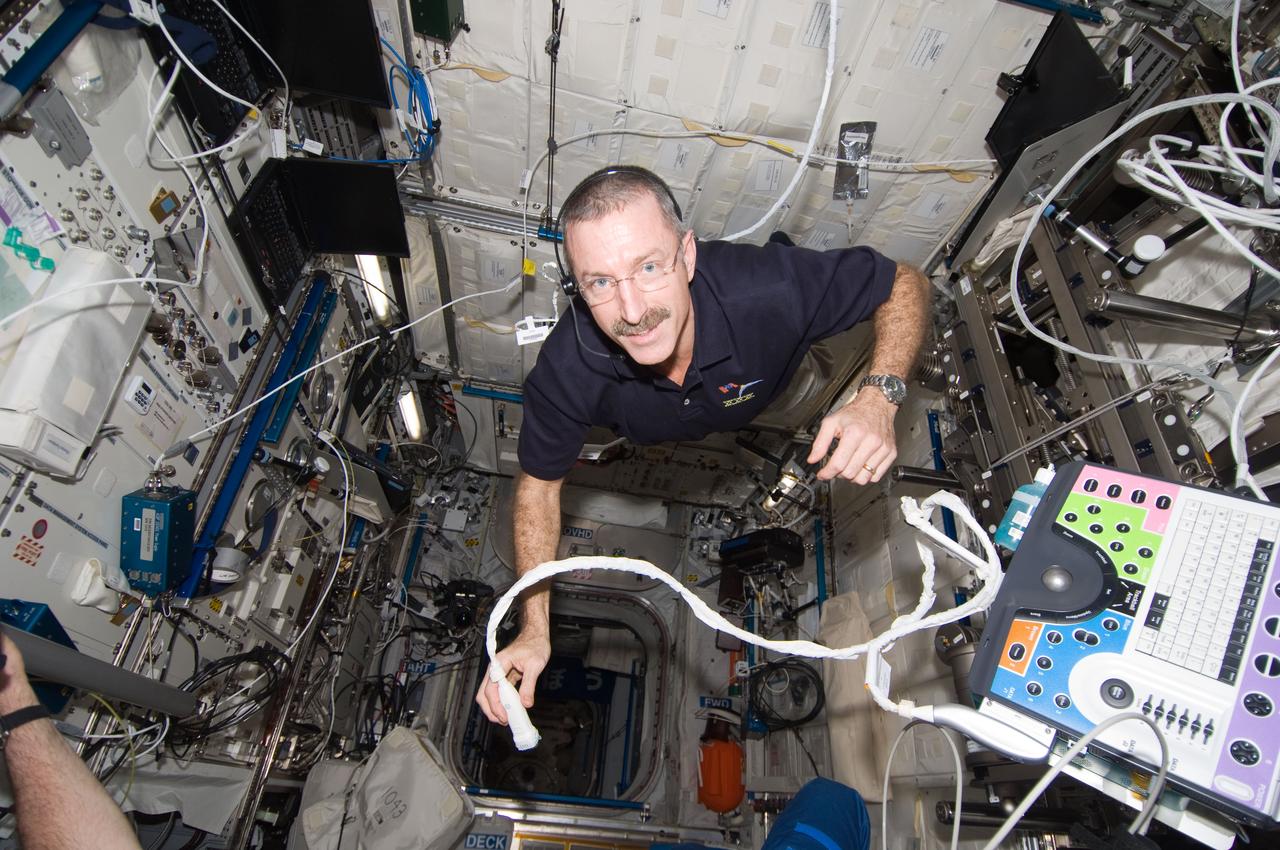
ISS030-E-155942 (20 Jan. 2012) --- NASA astronaut Dan Burbank, Expedition 30 commander, prepares to use the Integrated Cardiovascular (ICV) Resting Echo Scan on a crew member (out of frame) at the Human Research Facility (HRF) rack in the Columbus laboratory of the International Space Station.
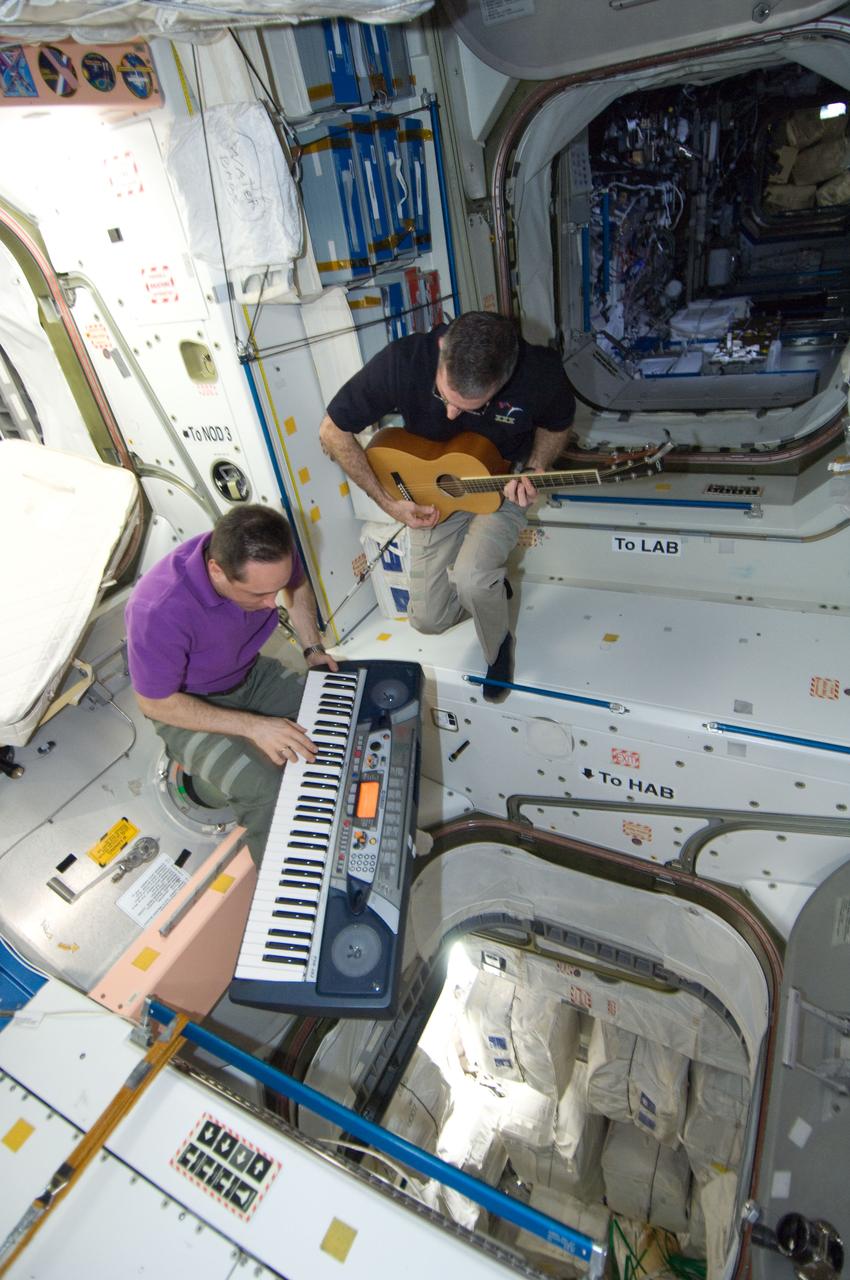
ISS030-E-267658 (21 April 2012) --- NASA astronaut Dan Burbank, Expedition 30 commander, plays a guitar, while Russian cosmonaut Anton Shkaplerov, flight engineer, plays a musical keyboard during off-time in the Unity node of the International Space Station.
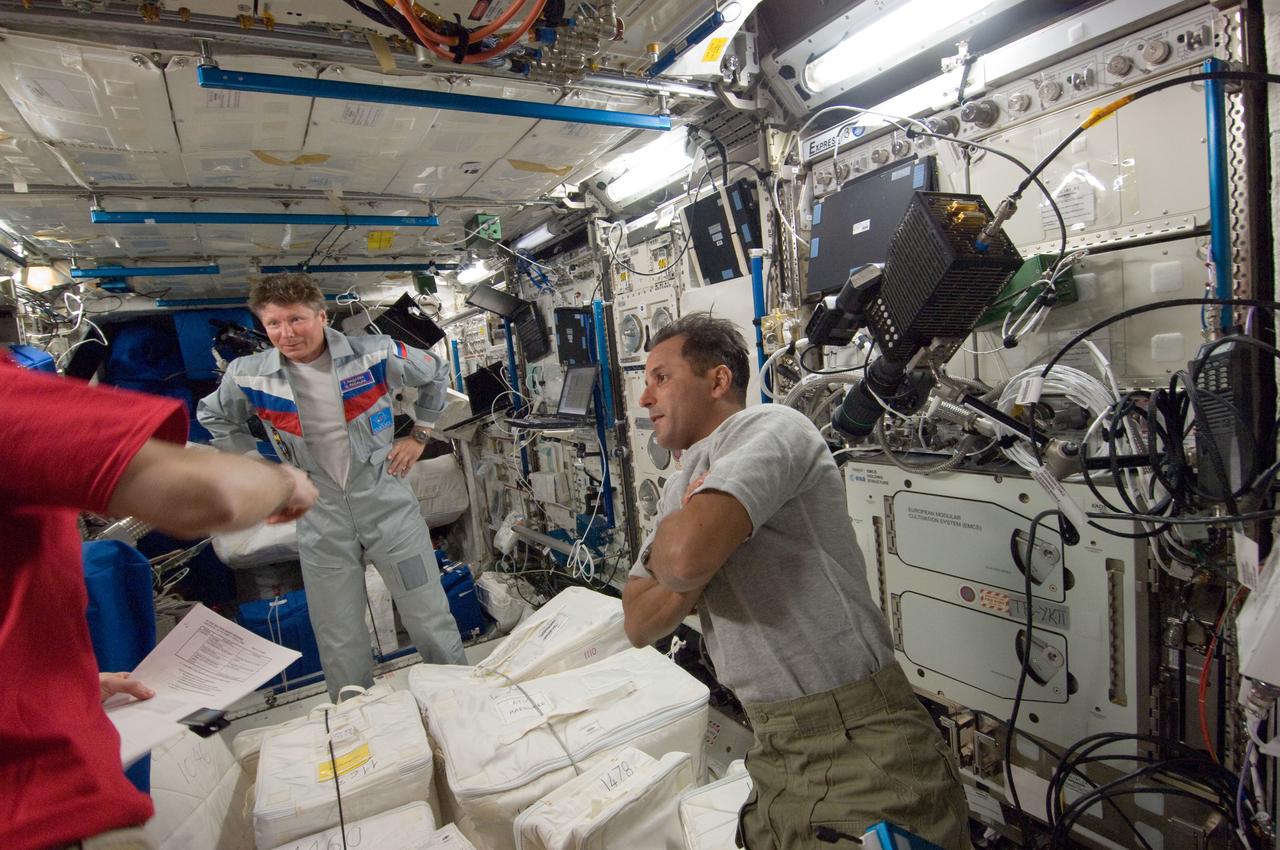
ISS031-E-081658 (17 May 2012) --- Russian cosmonaut Gennady Padalka (background) and NASA astronaut Joe Acaba, both Expedition 31 flight engineers, are pictured during a crew safety briefing in the Columbus laboratory to familiarize them with the potential hazards and available safety measures onboard the International Space Station. Russian cosmonaut Oleg Kononenko (mostly out of frame at left), commander, conducted the briefing. Out of frame are European Space Agency astronaut Andre Kuipers, NASA astronaut Don Pettit and Russian cosmonaut Sergei Revin, all flight engineers. The event took place shortly after Padalka, Revin and Acaba docked with the space station in their Soyuz TMA-04M spacecraft.
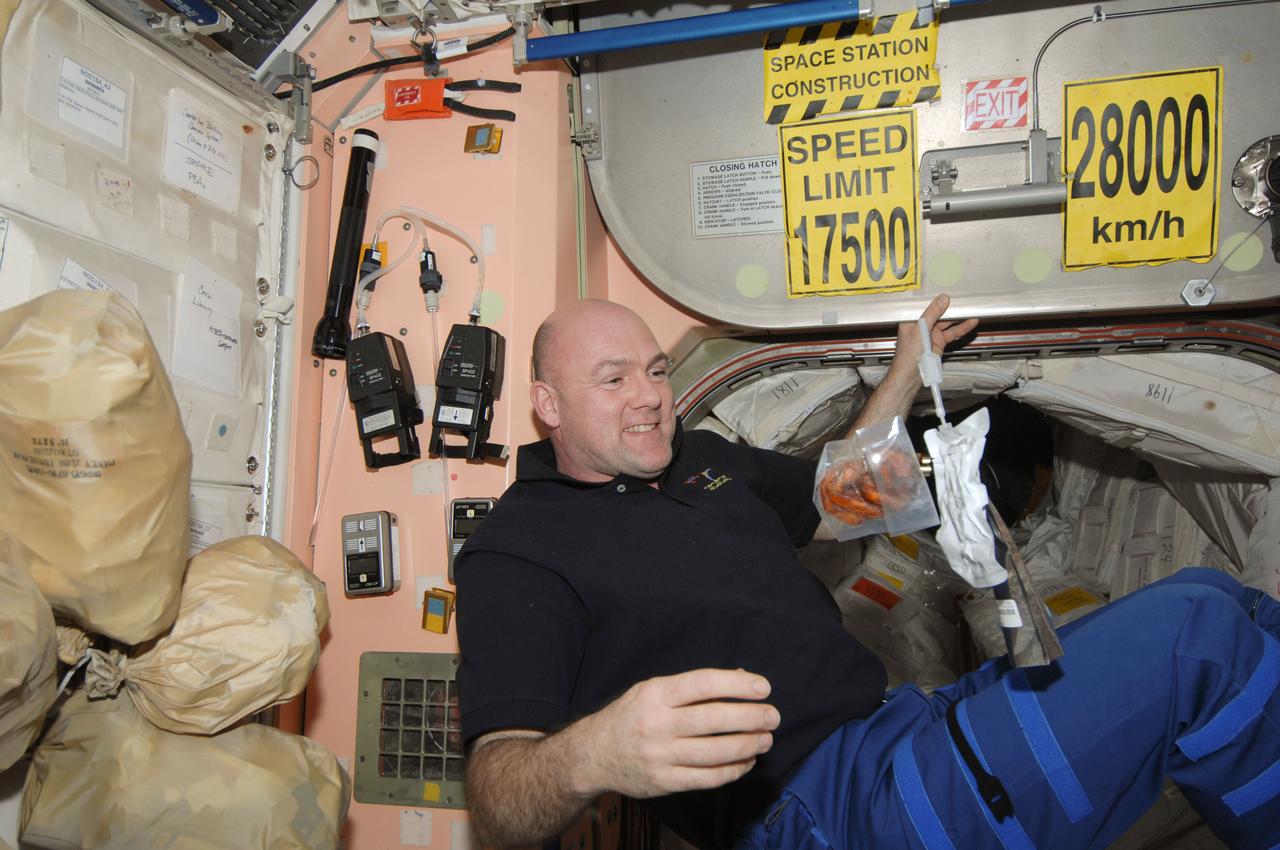
ISS030-E-166649 (30 Jan. 2012) --- European Space Agency astronaut Andre Kuipers, Expedition 30 flight engineer, is pictured near food and beverage packages floating freely in the Unity node of the International Space Station.

ISS030-E-078532 (16 Feb. 2012) --- Russian cosmonauts Oleg Kononenko and Anton Shkaplerov, both Expedition 30 flight engineers, participate in a session of extravehicular activity (EVA) to continue outfitting the International Space Station. During the six-hour, 15-minute spacewalk, Kononenko and Shkaplerov moved the Strela-1 crane from the Pirs Docking Compartment to begin preparing the Pirs for its replacement next year with a new laboratory and docking module. The duo used another boom, the Strela-2, to move the hand-operated crane to the Poisk module for future assembly and maintenance work. Both telescoping booms extend like fishing rods and are used to move massive components outside the station. On the exterior of the Poisk Mini-Research Module 2 (MRM2), they also installed the Vinoslivost Materials Sample Experiment, which will investigate the influence of space on the mechanical properties of the materials. The spacewalkers also collected a test sample from underneath the insulation on the Zvezda Service Module to search for any signs of living organisms. Both spacewalkers wore Russian Orlan spacesuits bearing blue stripes and equipped with NASA helmet cameras.
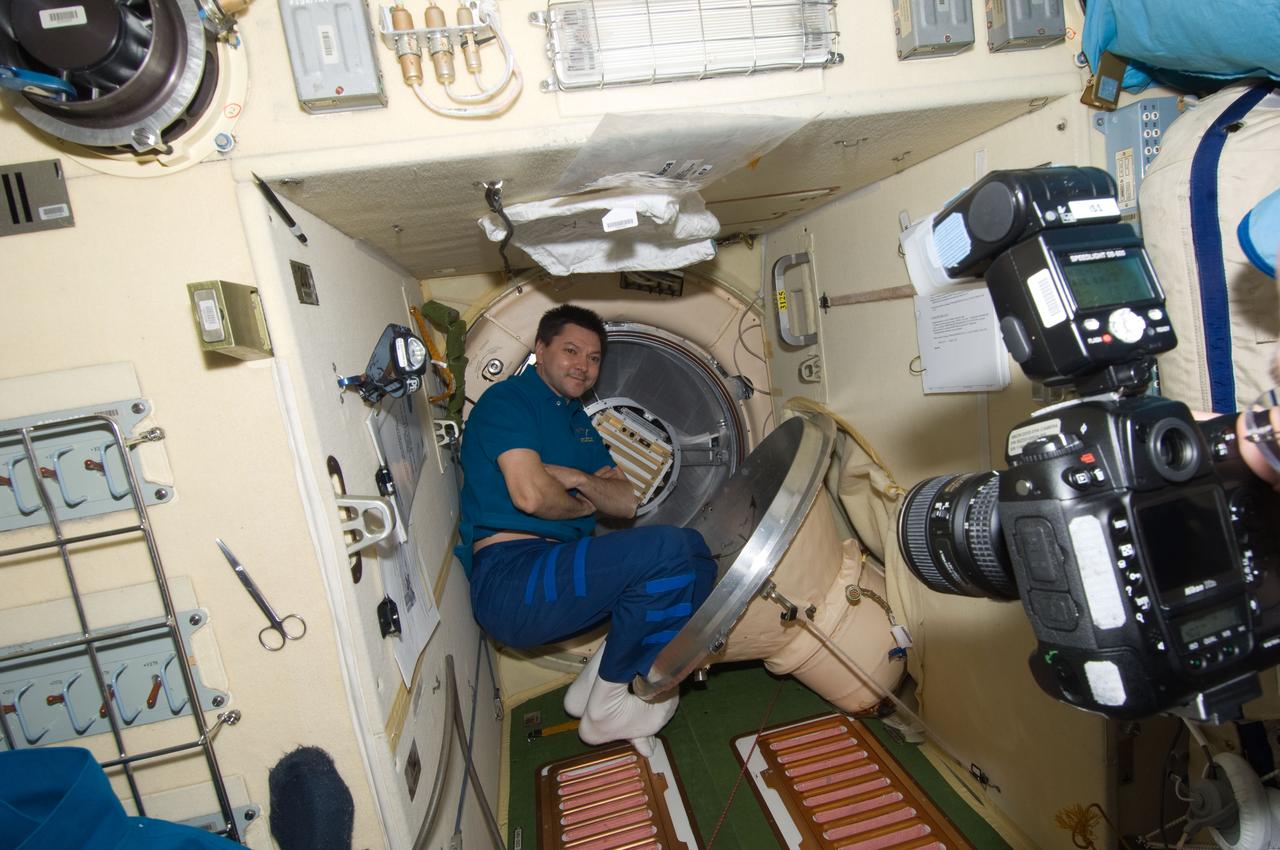
ISS030-E-155928 (19 Jan. 2012) --- Russian cosmonaut Oleg Kononenko, Expedition 30 flight engineer, is pictured near a hatch in the Pirs Docking Compartment of the International Space Station.
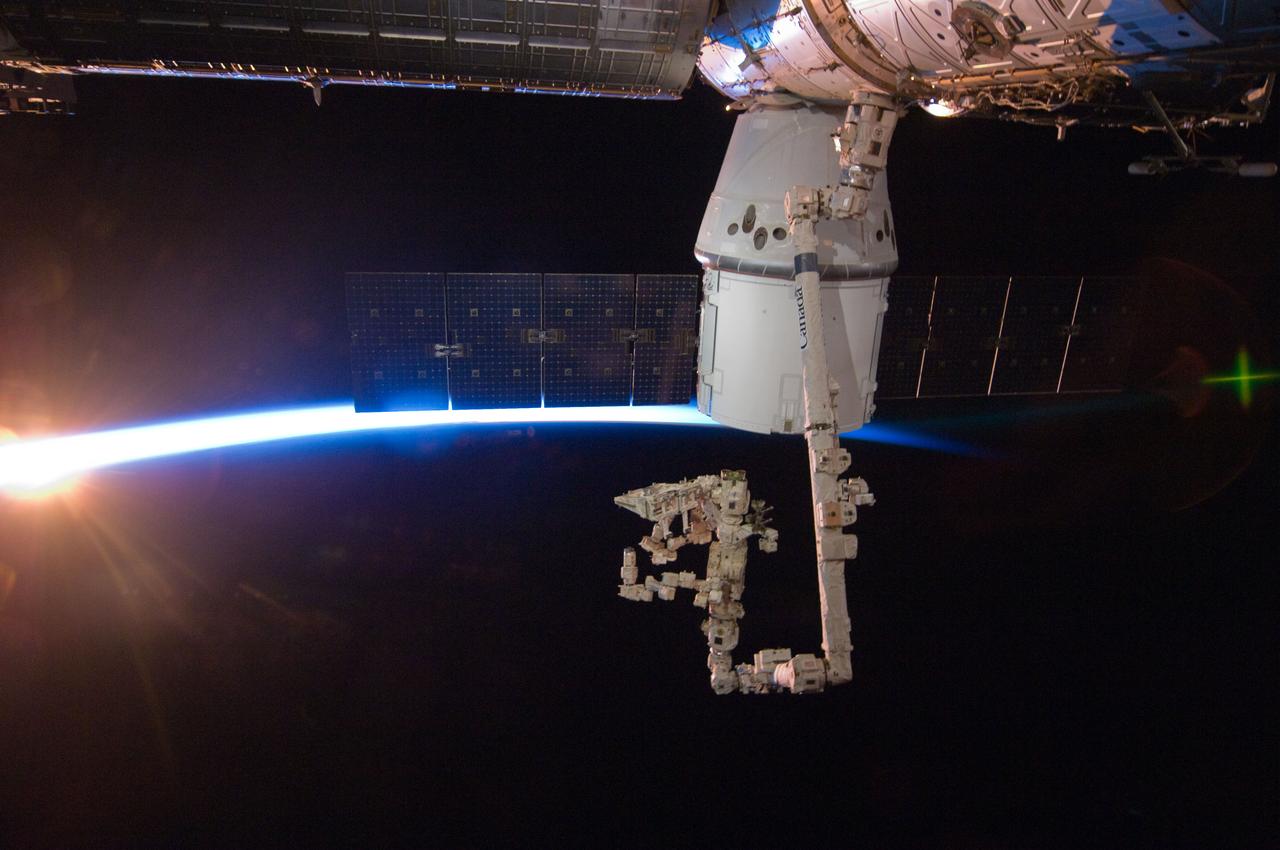
ISS031-E-077669 (25 May 2012) --- With rays of sunshine and the thin blue atmosphere of Earth serving as a backdrop, the SpaceX Dragon commercial cargo craft is berthed to the Earth-facing side of the International Space Station’s Harmony node. Expedition 31 Flight Engineers Don Pettit and Andre Kuipers grappled Dragon at 9:56 a.m. (EDT) with the Canadarm2 robotic arm and used it to berth Dragon to the at 12:02 p.m. May 25, 2012. Dragon became the first commercially developed space vehicle to be launched to the station to join Russian, European and Japanese resupply craft that service the complex while restoring a U.S. capability to deliver cargo to the orbital laboratory. Dragon is scheduled to spend about a week docked with the station before returning to Earth on May 31 for retrieval
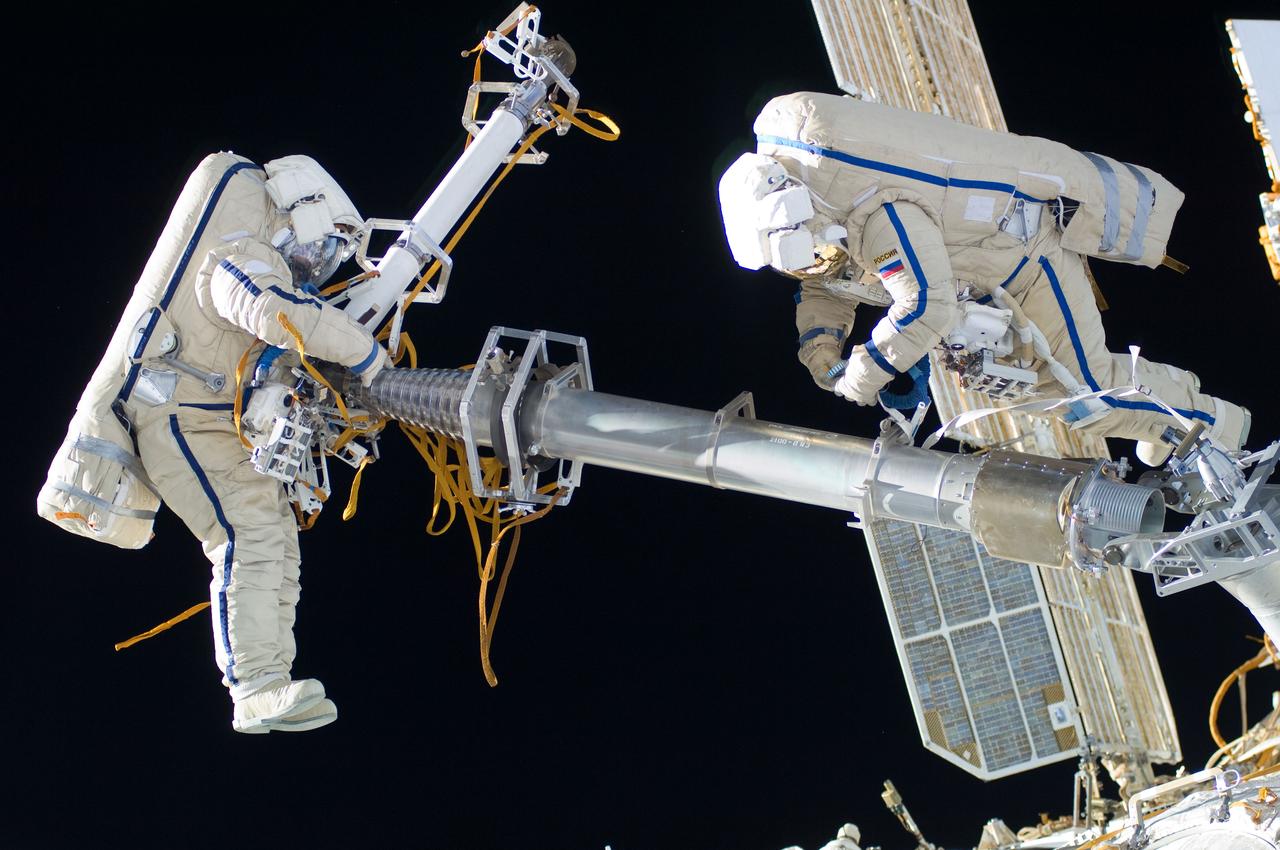
ISS030-E-078533 (16 Feb. 2012) --- Russian cosmonauts Oleg Kononenko and Anton Shkaplerov, both Expedition 30 flight engineers, participate in a session of extravehicular activity (EVA) to continue outfitting the International Space Station. During the six-hour, 15-minute spacewalk, Kononenko and Shkaplerov moved the Strela-1 crane from the Pirs Docking Compartment to begin preparing the Pirs for its replacement next year with a new laboratory and docking module. The duo used another boom, the Strela-2, to move the hand-operated crane to the Poisk module for future assembly and maintenance work. Both telescoping booms extend like fishing rods and are used to move massive components outside the station. On the exterior of the Poisk Mini-Research Module 2 (MRM2), they also installed the Vinoslivost Materials Sample Experiment, which will investigate the influence of space on the mechanical properties of the materials. The spacewalkers also collected a test sample from underneath the insulation on the Zvezda Service Module to search for any signs of living organisms. Both spacewalkers wore Russian Orlan spacesuits bearing blue stripes and equipped with NASA helmet cameras.
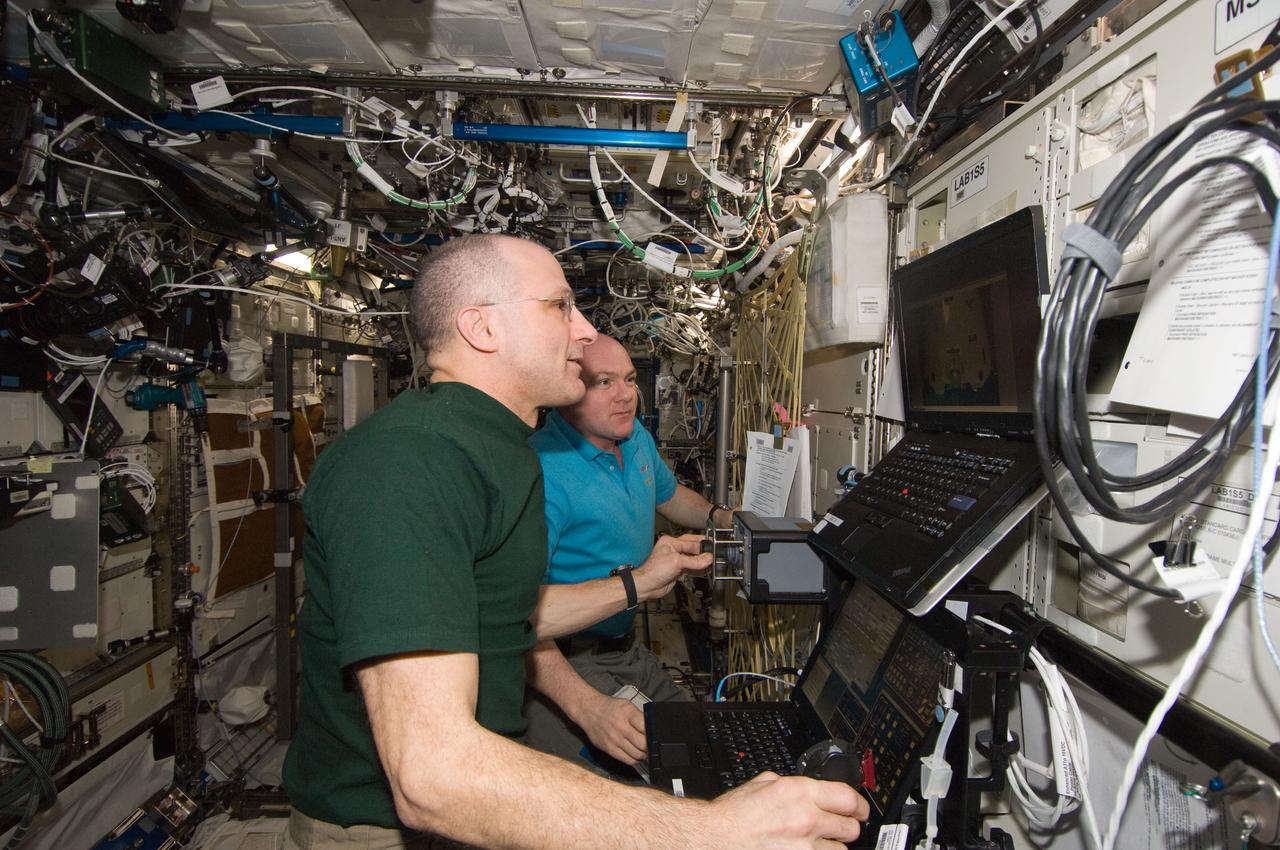
ISS030-E-235593 (11 April 2012) --- In the International Space Station’s Destiny laboratory, NASA astronaut Don Pettit (foreground) and European Space Agency astronaut Andre Kuipers, both Expedition 30 flight engineers, conduct the first of three sessions on the ROBoT simulator in preparation for the arrival of the SpaceX Dragon. Slated for liftoff on April 30, 2012, at 12:22 (EDT) from the Kennedy Space Center, the goal of Dragon’s planned 21-day mission will be to test the unpiloted capsule’s ability to rendezvous with the space station.
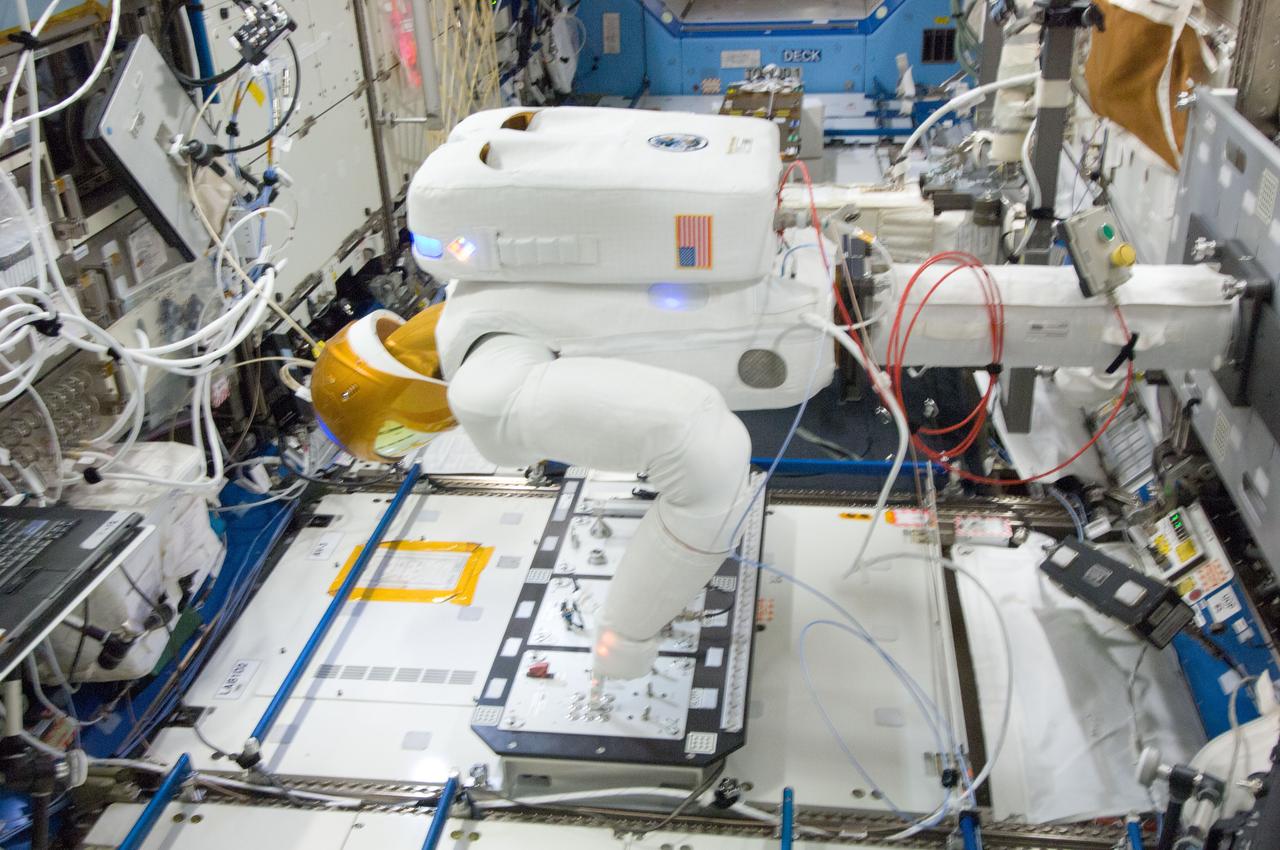
ISS031-E-031704 (1 May 2012) --- Controlled by teams on the ground, Robonaut 2 humanoid robot uses a task board during an arm and finger motions check out in the Destiny laboratory of the International Space Station.
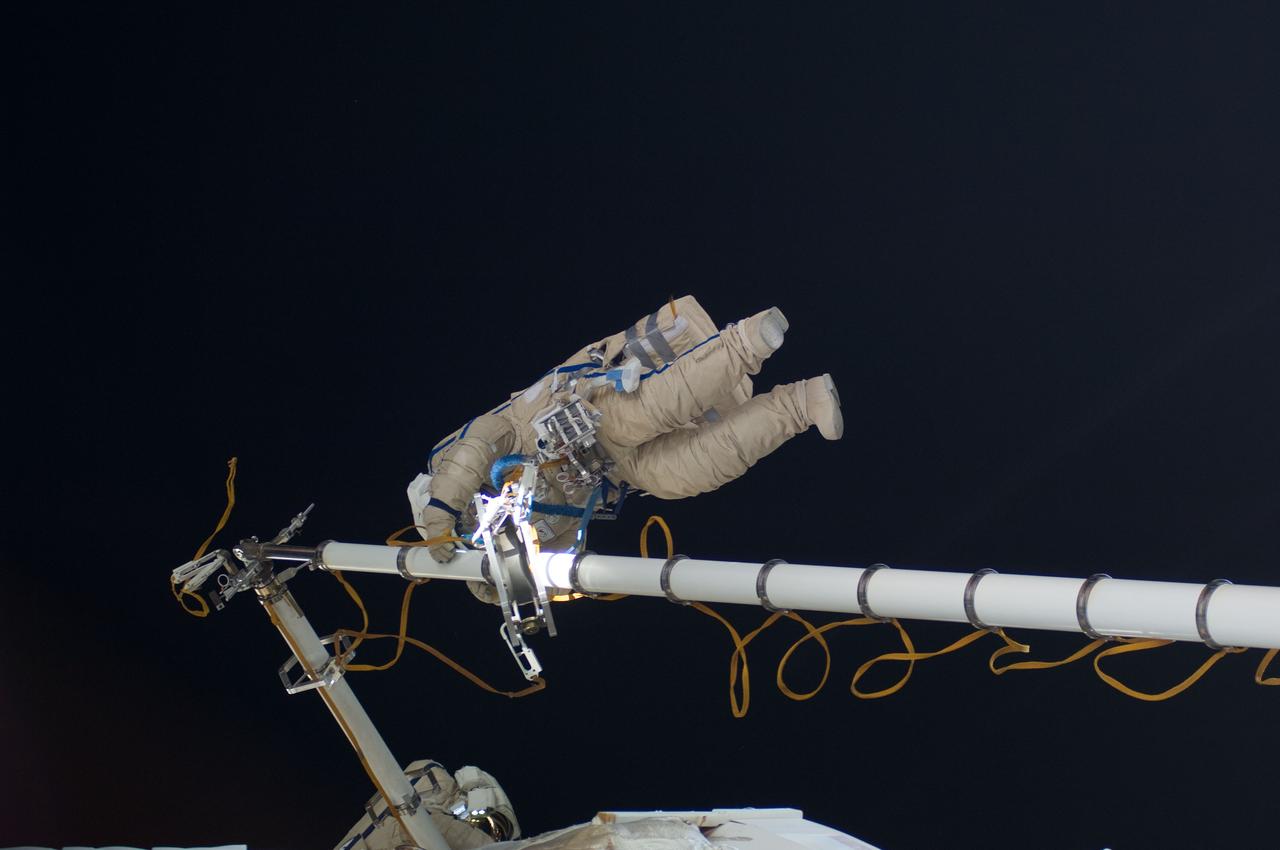
ISS030-E-078488 (16 Feb. 2012) --- Russian cosmonauts Oleg Kononenko and Anton Shkaplerov, both Expedition 30 flight engineers, participate in a session of extravehicular activity (EVA) to continue outfitting the International Space Station. During the six-hour, 15-minute spacewalk, Kononenko and Shkaplerov moved the Strela-1 crane from the Pirs Docking Compartment to begin preparing the Pirs for its replacement next year with a new laboratory and docking module. The duo used another boom, the Strela-2, to move the hand-operated crane to the Poisk module for future assembly and maintenance work. Both telescoping booms extend like fishing rods and are used to move massive components outside the station. On the exterior of the Poisk Mini-Research Module 2 (MRM2), they also installed the Vinoslivost Materials Sample Experiment, which will investigate the influence of space on the mechanical properties of the materials. The spacewalkers also collected a test sample from underneath the insulation on the Zvezda Service Module to search for any signs of living organisms. Both spacewalkers wore Russian Orlan spacesuits bearing blue stripes and equipped with NASA helmet cameras.
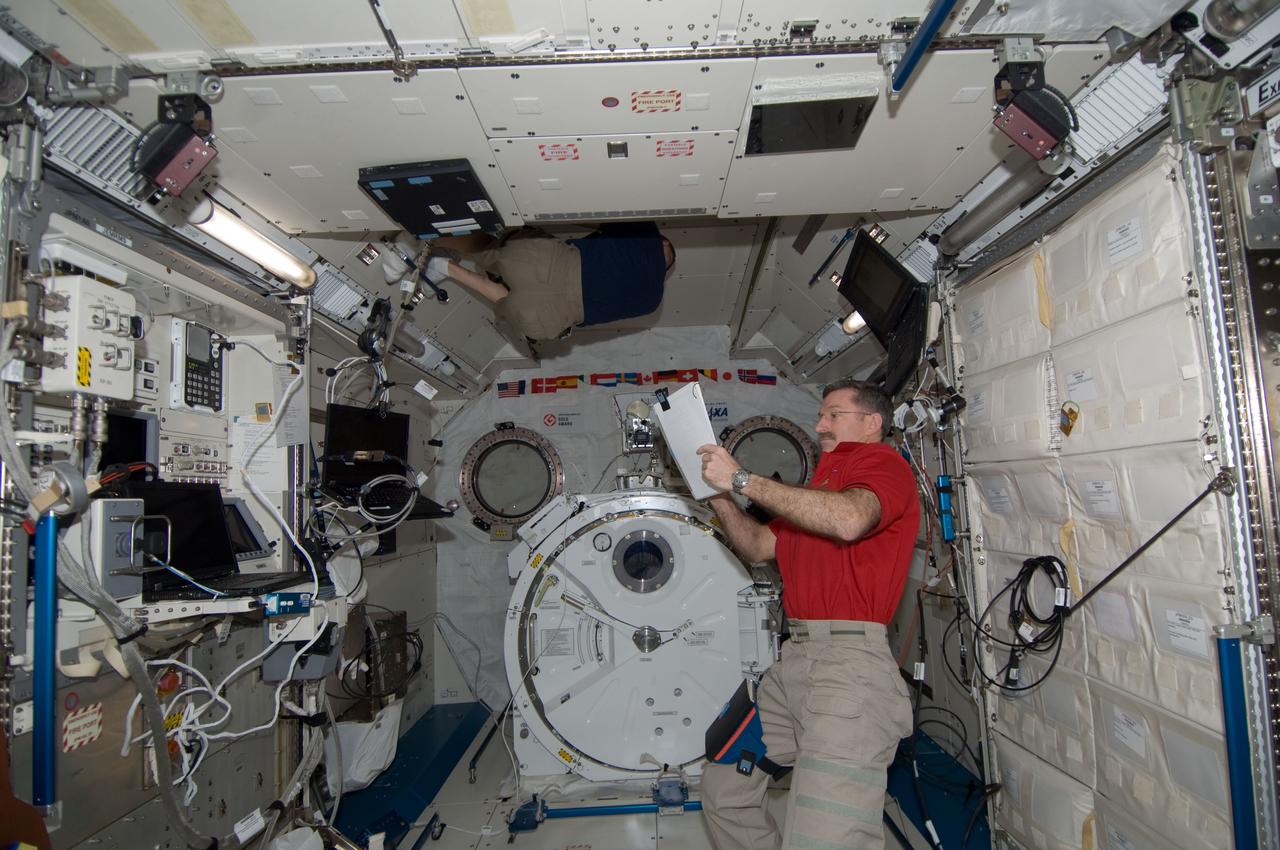
ISS030-E-173911 (24 March 2012) --- NASA astronaut Dan Burbank, Expedition 30 commander, reviews crew procedures in the Kibo laboratory of the International Space Station as crew members prepare to move to the appropriate Soyuz vehicles, due to the possibility that space debris could pass close to the station. Burbank, Shkaplerov and Ivanishin sheltered in the Soyuz TMA-22 spacecraft attached to the Poisk Mini-Research Module 2 (MRM2) while Kononenko, Kuipers and Pettit took to the Soyuz TMA-03M docked to the Rassvet Mini-Research Module 1 (MRM-1).
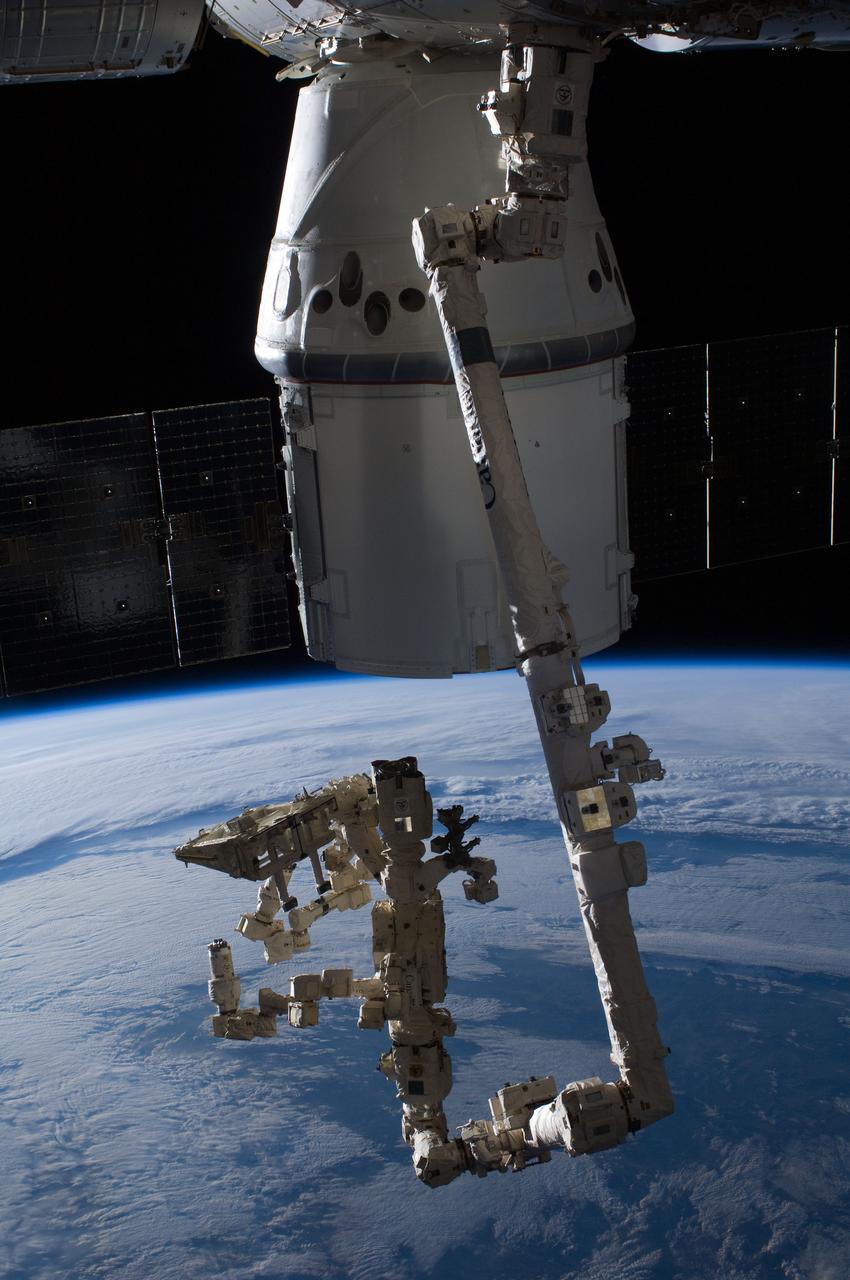
ISS031-E-077562 (25 May 2012) --- The SpaceX Dragon commercial cargo craft is berthed to the Earth-facing side of the International Space Station’s Harmony node. Expedition 31 Flight Engineers Don Pettit and Andre Kuipers grappled Dragon at 9:56 a.m. (EDT) with the Canadarm2 robotic arm and used it to berth Dragon to the at 12:02 p.m. May 25, 2012. Dragon became the first commercially developed space vehicle to be launched to the station to join Russian, European and Japanese resupply craft that service the complex while restoring a U.S. capability to deliver cargo to the orbital laboratory. Dragon is scheduled to spend about a week docked with the station before returning to Earth on May 31 for retrieval.
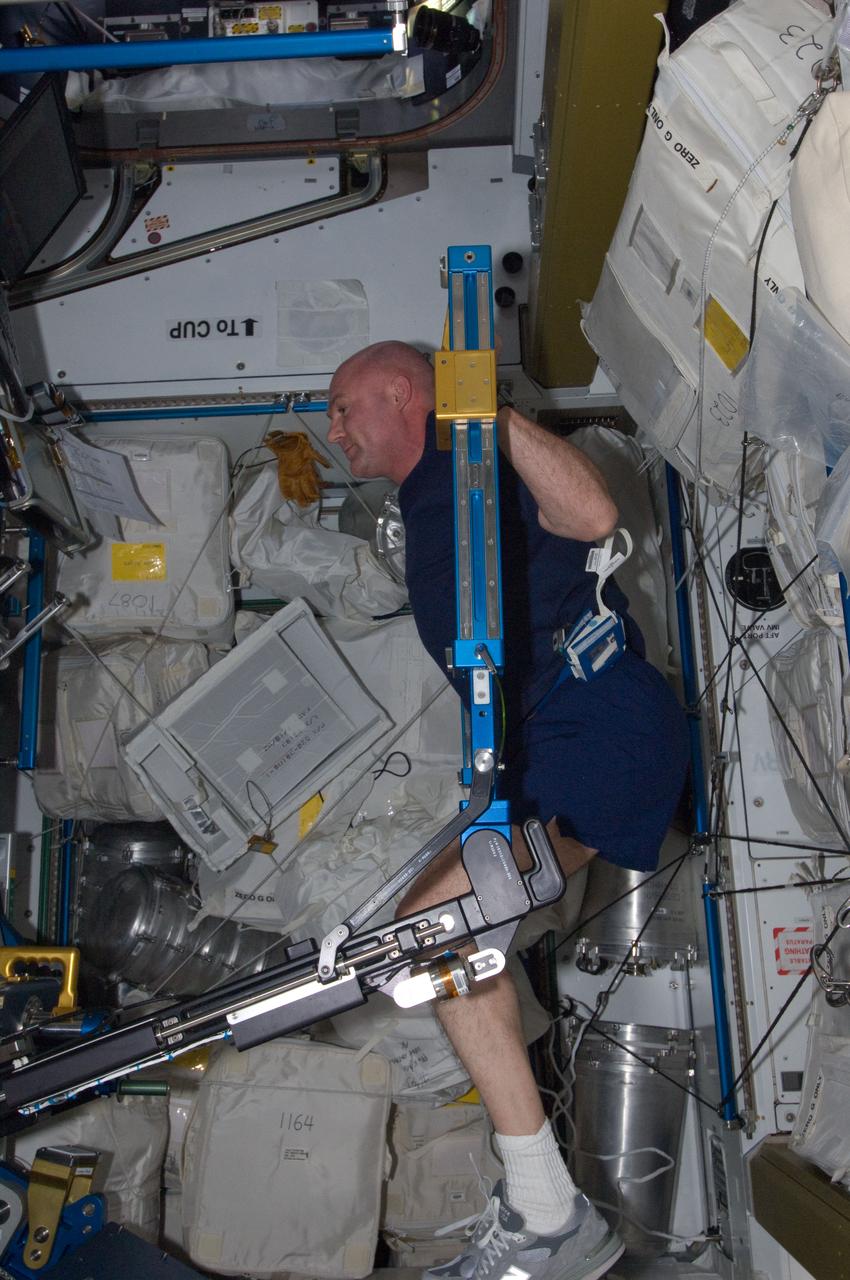
ISS030-E-235558 (6 Jan. 2012) --- European Space Agency astronaut Andre Kuipers, Expedition 30 flight engineer, exercises using the advanced Resistive Exercise Device (aRED) in the Tranquility node of the International Space Station.
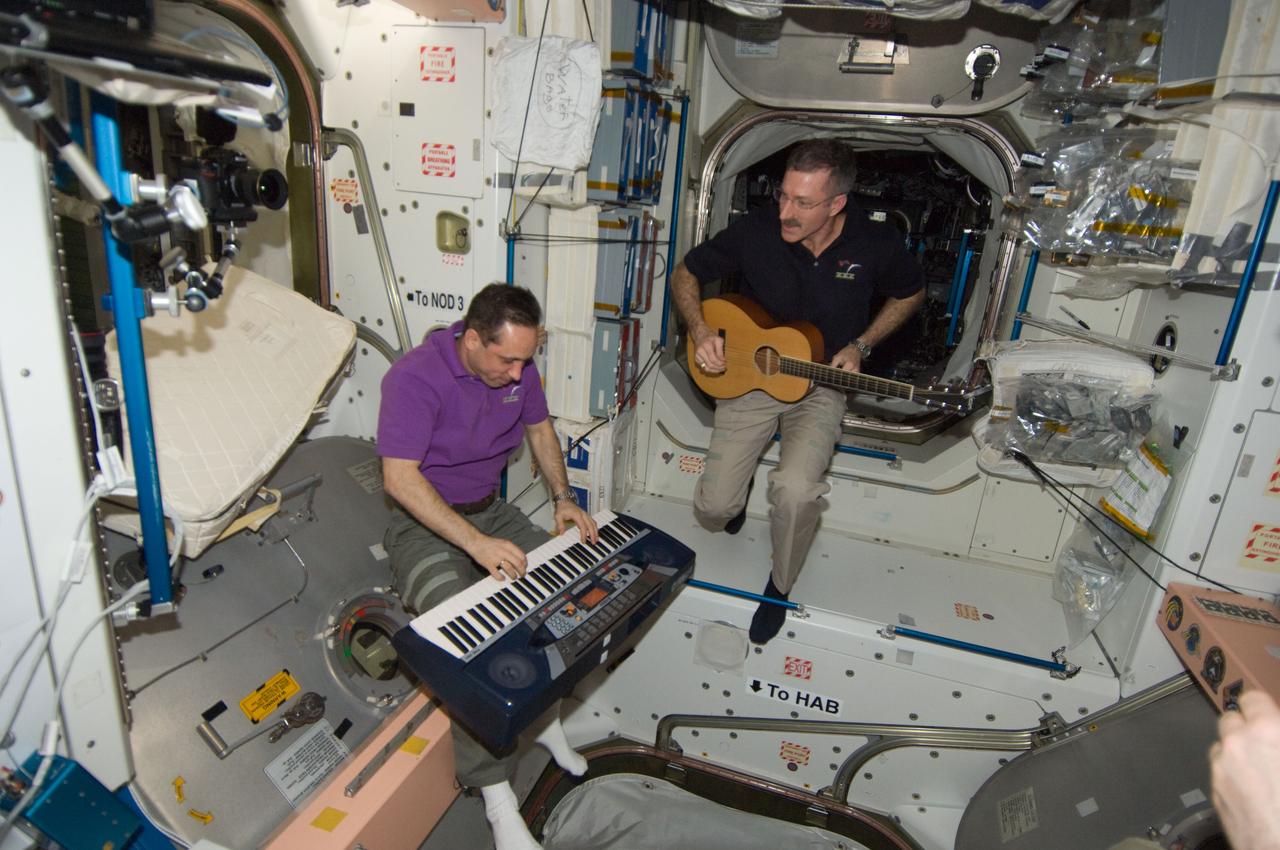
ISS030-E-267651 (21 April 2012) --- NASA astronaut Dan Burbank, Expedition 30 commander, plays a guitar, while Russian cosmonaut Anton Shkaplerov, flight engineer, plays a musical keyboard during off-time in the Unity node of the International Space Station.
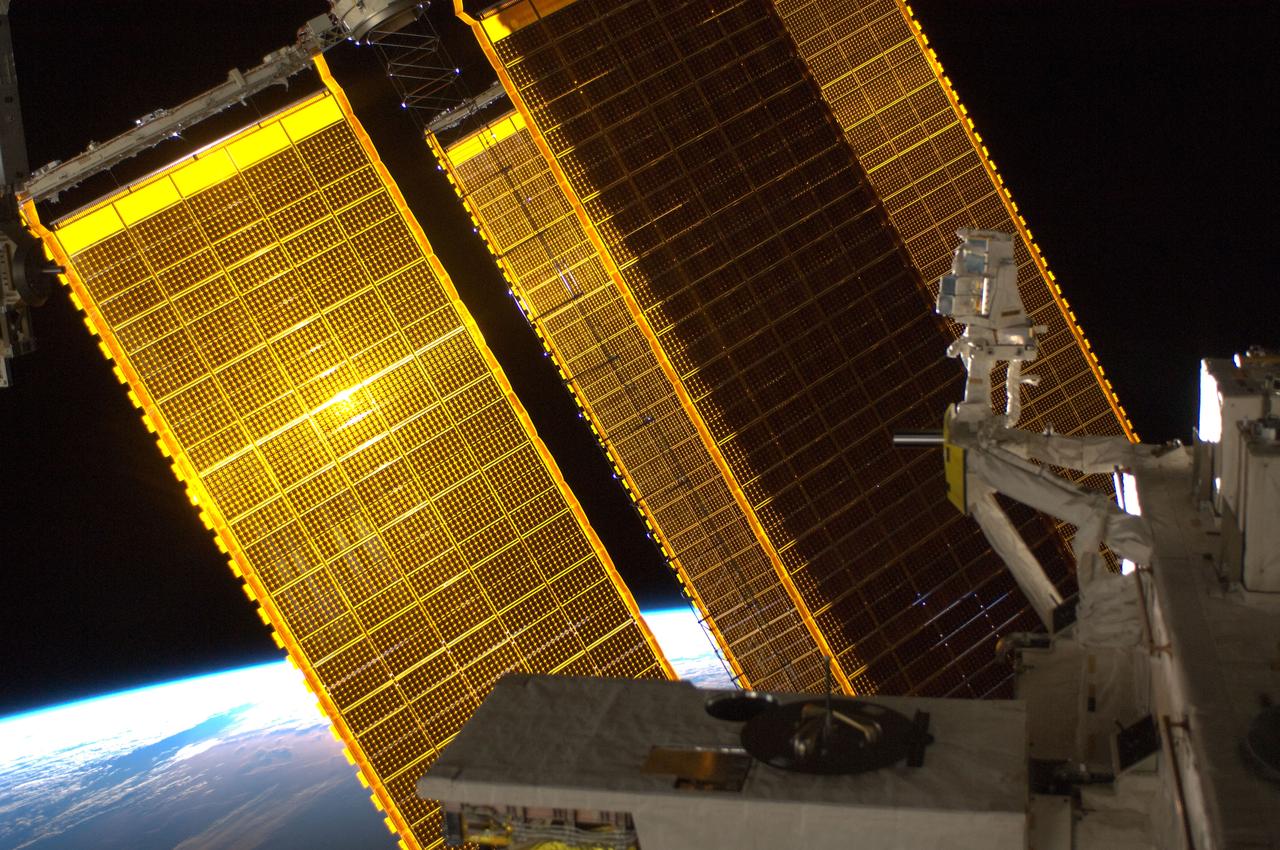
ISS031-E-081862 (2 June 2012) --- Solar array panels are featured in this image photographed by an Expedition 31 crew member on the International Space Station. Earth’s horizon and the blackness of space provide the backdrop for the scene.
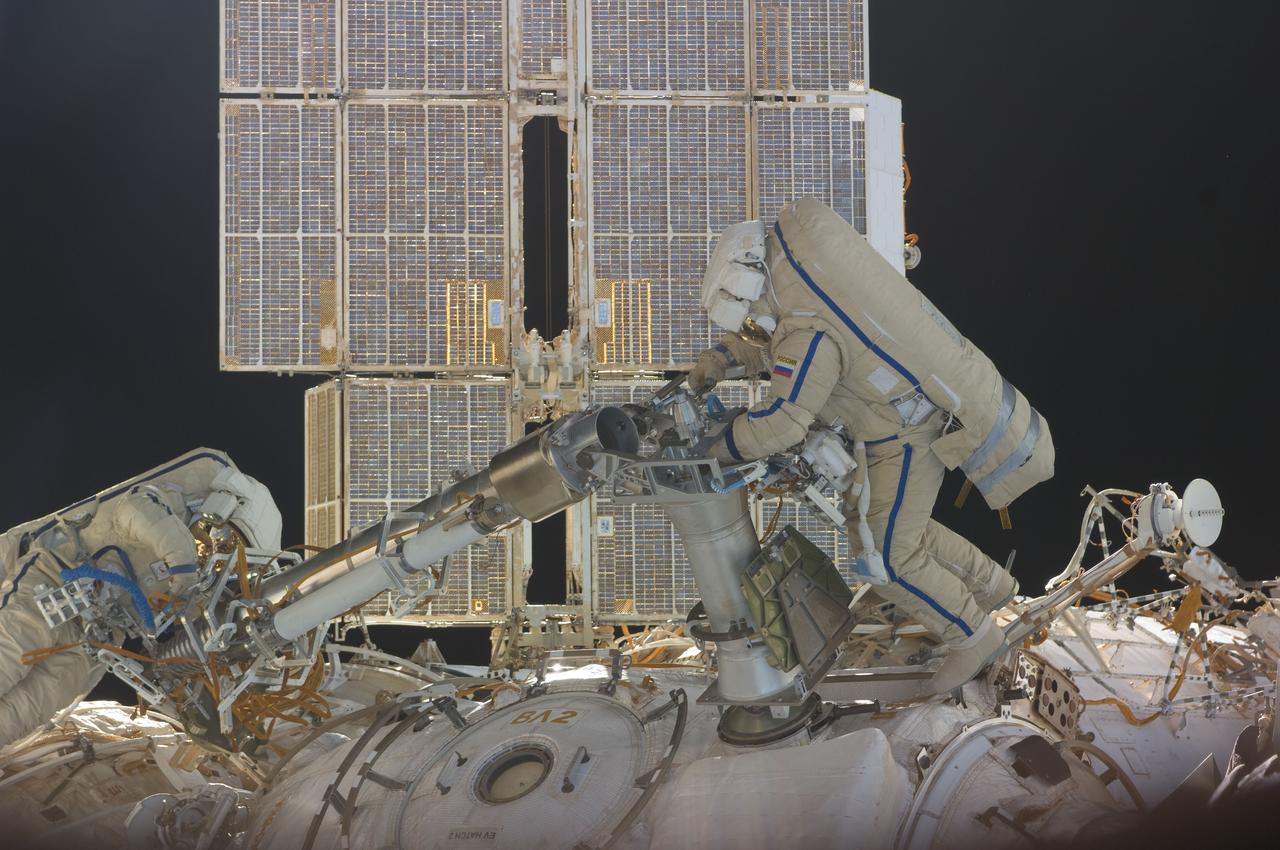
ISS030-E-078391 (16 Feb. 2012) --- Russian cosmonauts Oleg Kononenko and Anton Shkaplerov, both Expedition 30 flight engineers, participate in a session of extravehicular activity (EVA) to continue outfitting the International Space Station. During the six-hour, 15-minute spacewalk, Kononenko and Shkaplerov moved the Strela-1 crane from the Pirs Docking Compartment to begin preparing the Pirs for its replacement next year with a new laboratory and docking module. The duo used another boom, the Strela-2, to move the hand-operated crane to the Poisk module for future assembly and maintenance work. Both telescoping booms extend like fishing rods and are used to move massive components outside the station. On the exterior of the Poisk Mini-Research Module 2 (MRM2), they also installed the Vinoslivost Materials Sample Experiment, which will investigate the influence of space on the mechanical properties of the materials. The spacewalkers also collected a test sample from underneath the insulation on the Zvezda Service Module to search for any signs of living organisms. Both spacewalkers wore Russian Orlan spacesuits bearing blue stripes and equipped with NASA helmet cameras.
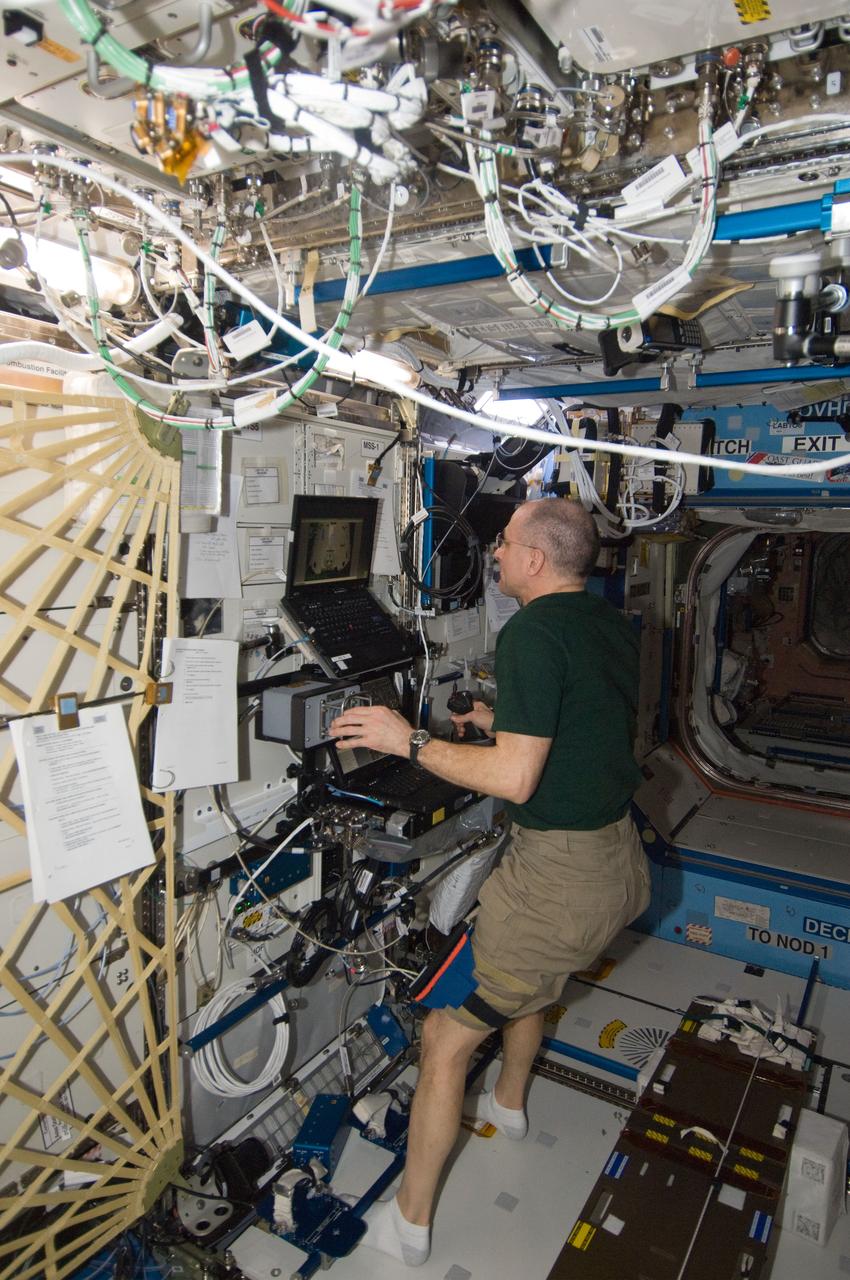
ISS030-E-235581 (11 April 2012) --- In the International Space Station’s Destiny laboratory, NASA astronaut Don Pettit, Expedition 30 flight engineer, conducts the first of three sessions on the ROBoT simulator in preparation for the arrival of the SpaceX Dragon. Slated for liftoff on April 30, 2012, at 12:22 (EDT) from the Kennedy Space Center, the goal of Dragon’s planned 21-day mission will be to test the unpiloted capsule’s ability to rendezvous with the space station.
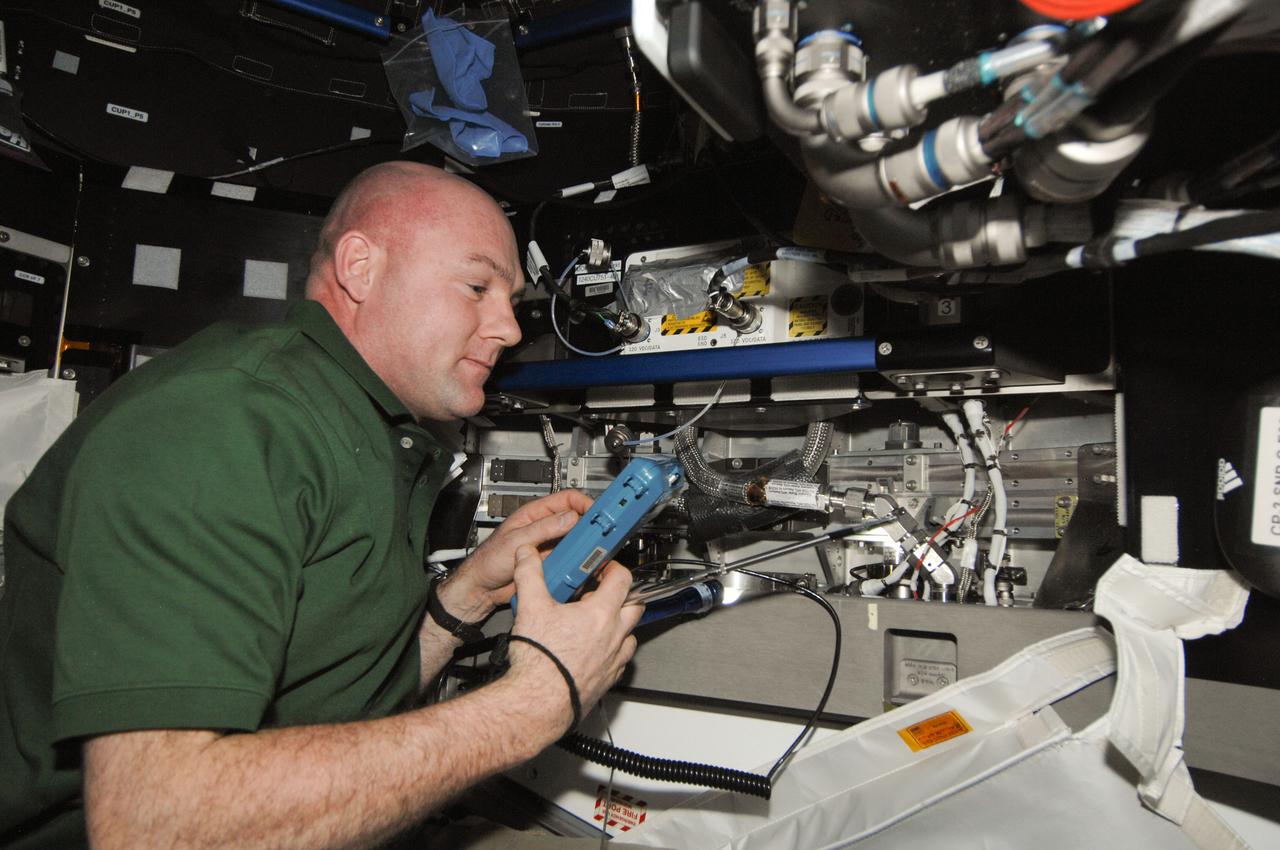
ISS030-E-166606 (28 Jan. 2012) --- European Space Agency astronaut Andre Kuipers, Expedition 30 flight engineer, uses an instrument to measure air velocity in the Tranquility node of the International Space Station.
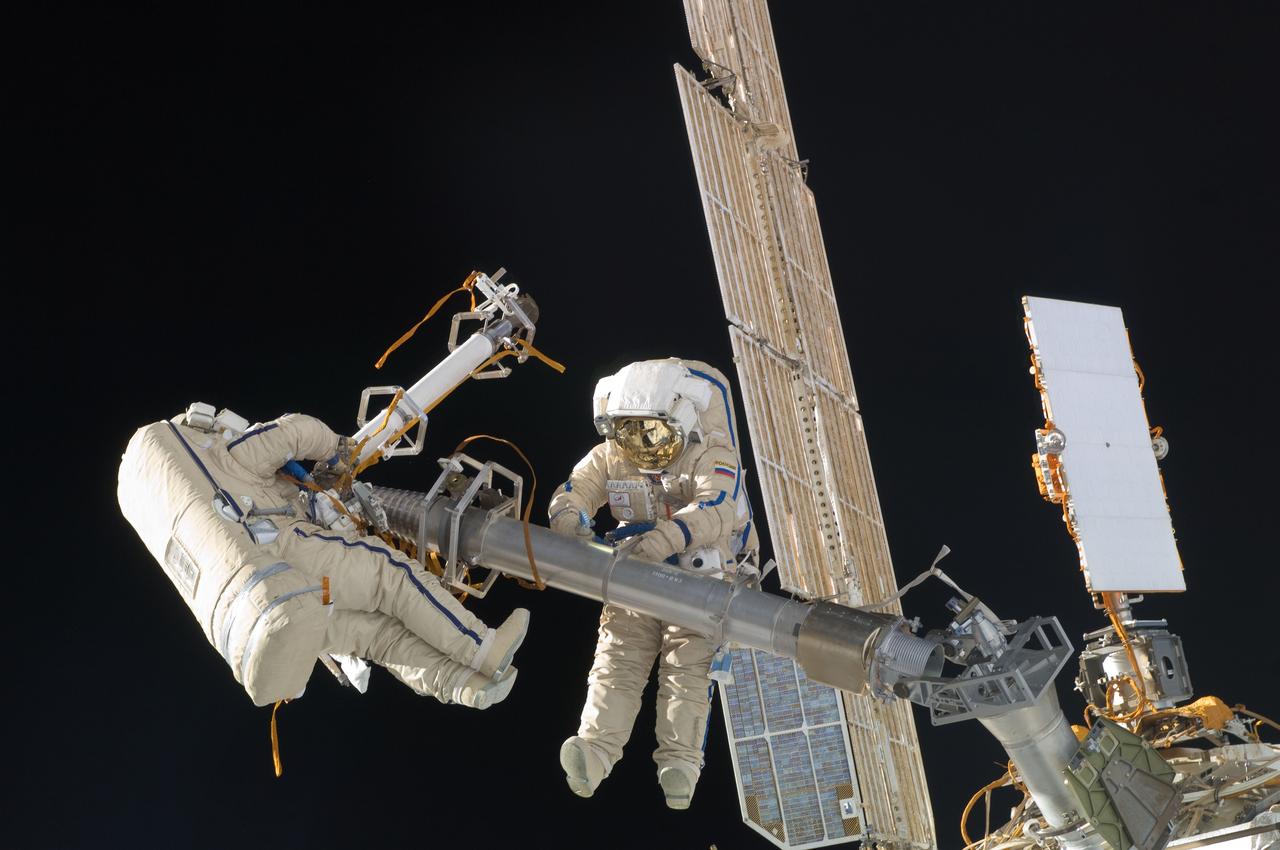
ISS030-E-078372 (16 Feb. 2012) --- Russian cosmonauts Oleg Kononenko and Anton Shkaplerov, both Expedition 30 flight engineers, participate in a session of extravehicular activity (EVA) to continue outfitting the International Space Station. During the six-hour, 15-minute spacewalk, Kononenko and Shkaplerov moved the Strela-1 crane from the Pirs Docking Compartment to begin preparing the Pirs for its replacement next year with a new laboratory and docking module. The duo used another boom, the Strela-2, to move the hand-operated crane to the Poisk module for future assembly and maintenance work. Both telescoping booms extend like fishing rods and are used to move massive components outside the station. On the exterior of the Poisk Mini-Research Module 2 (MRM2), they also installed the Vinoslivost Materials Sample Experiment, which will investigate the influence of space on the mechanical properties of the materials. The spacewalkers also collected a test sample from underneath the insulation on the Zvezda Service Module to search for any signs of living organisms. Both spacewalkers wore Russian Orlan spacesuits bearing blue stripes and equipped with NASA helmet cameras.
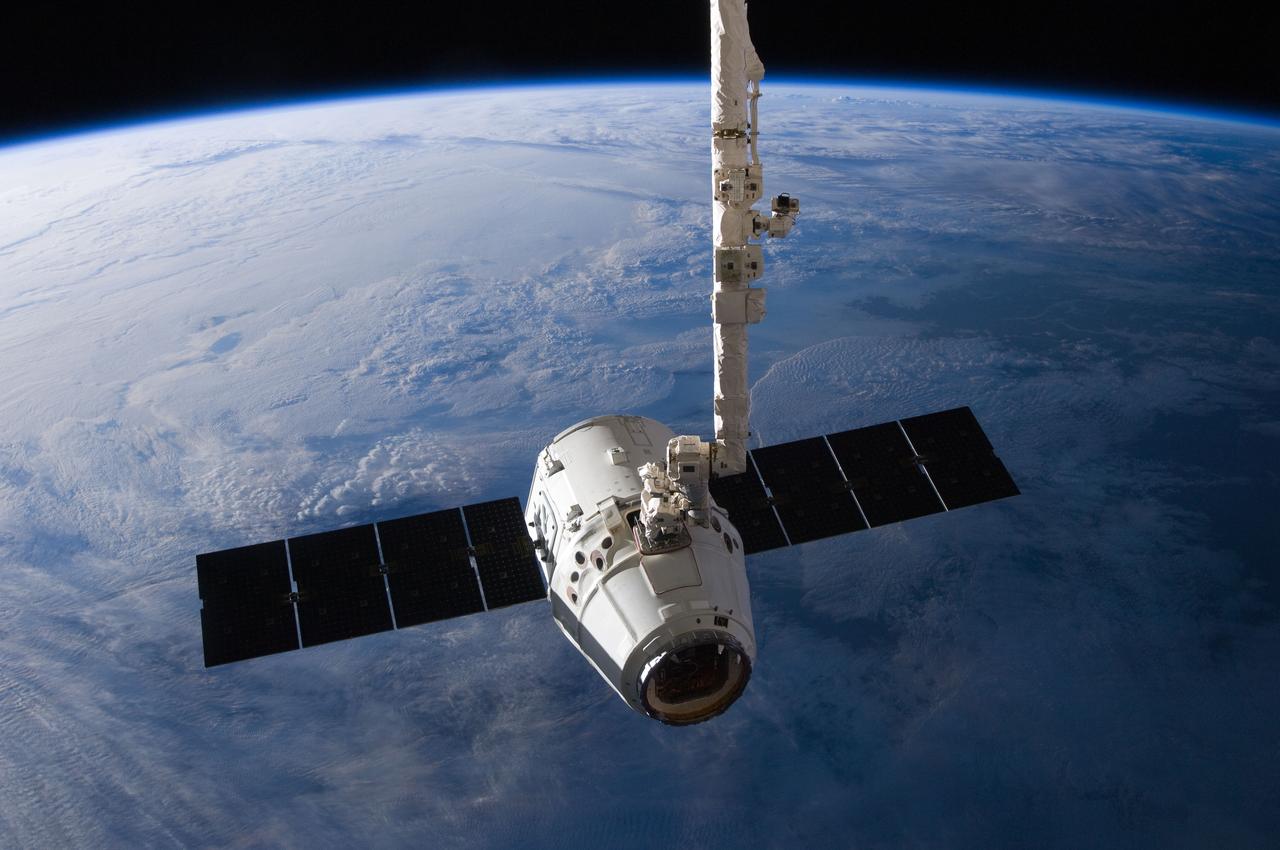
ISS031-E-079326 (31 May 2012) --- The SpaceX Dragon cargo craft is pictured just prior to being released by the International Space Station's Canadarm2 robotic arm on May 31 to allow it to head toward a splashdown in the Pacific Ocean.
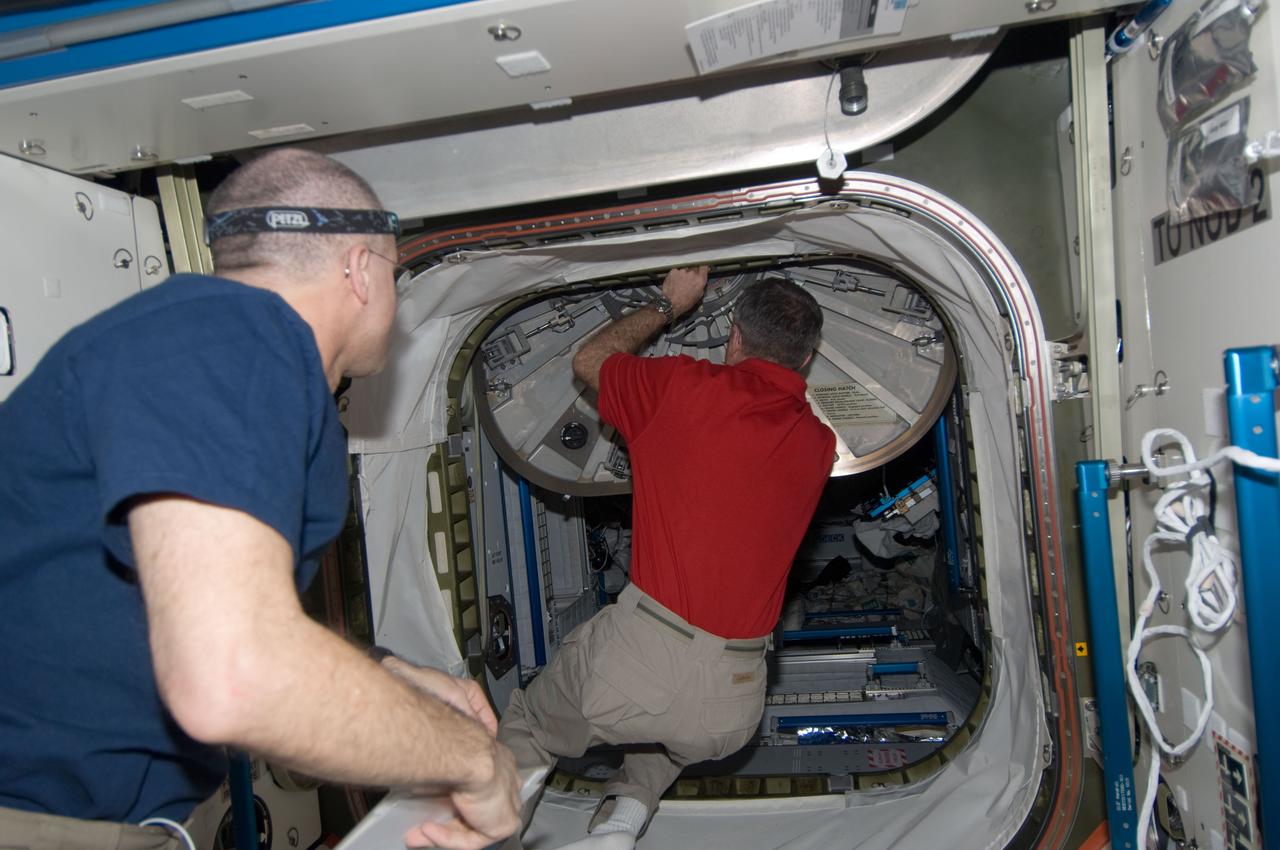
ISS030-E-173920 (24 March 2012) --- NASA astronaut Dan Burbank, Expedition 30 commander, closes a hatch in the International Space Station as crew members prepare to move to the appropriate Soyuz vehicles, due to the possibility that space debris could pass close to the station. NASA astronaut Don Pettit, flight engineer, is at left. Burbank, Shkaplerov and Ivanishin sheltered in the Soyuz TMA-22 spacecraft attached to the Poisk Mini-Research Module 2 (MRM2) while Kononenko, Kuipers and Pettit took to the Soyuz TMA-03M docked to the Rassvet Mini-Research Module 1 (MRM-1).
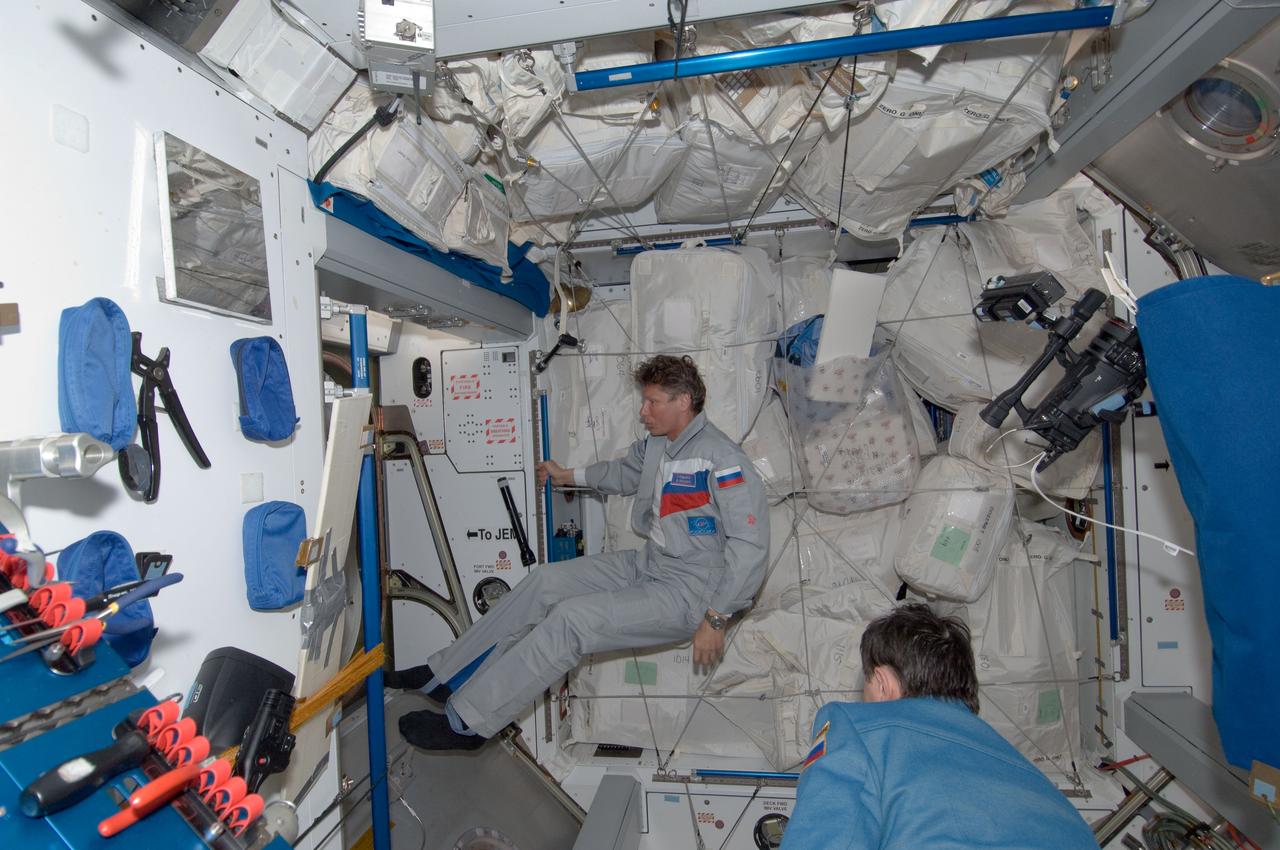
ISS031-E-081649 (17 May 2012) --- Russian cosmonauts Gennady Padalka (background) and Sergei Revin, both Expedition 31 flight engineers, are pictured in the Harmony node of the International Space Station shortly after Padalka, Revin and NASA astronaut Joe Acaba (not pictured) docked with the space station in their Soyuz TMA-04M spacecraft.
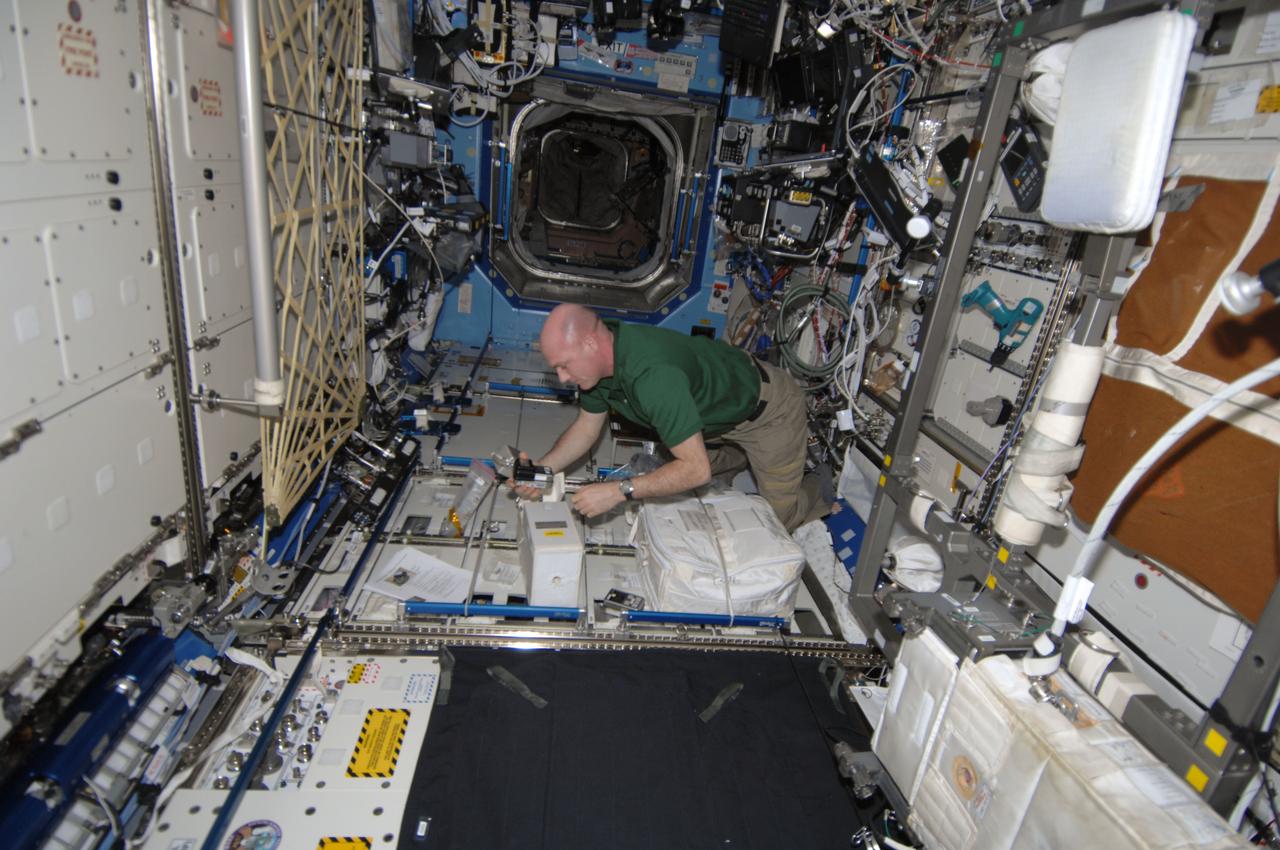
ISS030-E-156455 (26 Jan. 2012) --- European Space Agency astronaut Andre Kuipers, Expedition 30 flight engineer, sets up the Compound Specific Analyzer - Combustion Products (CSA-CP) in the Destiny laboratory of the International Space Station. The purpose of the analyzer is to measure the concentrations of carbon monoxide, hydrogen cyanide, hydrogen chloride and oxygen.
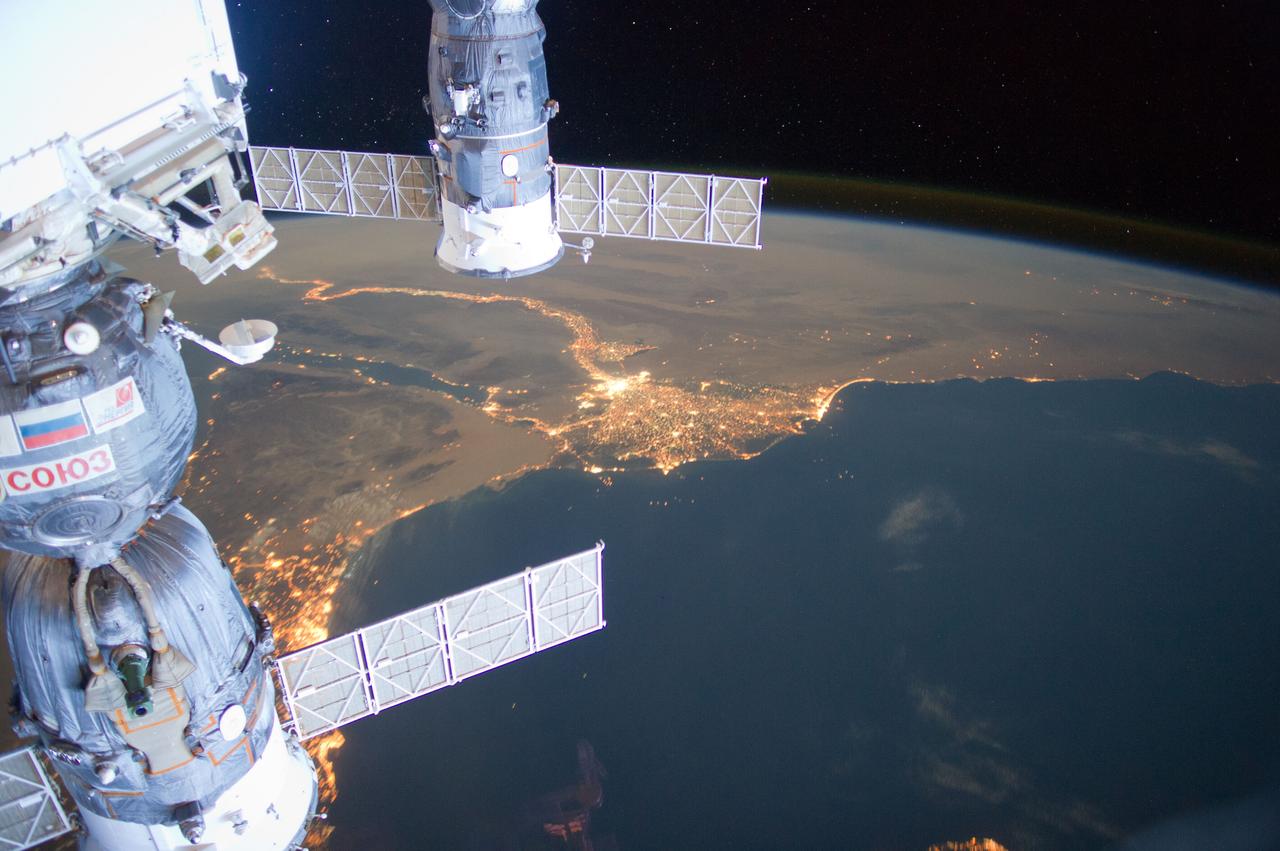
ISS031-E-095276 (4 June 2012) --- Much of the Middle East is seen in this night time image photographed by one of the Expedition 31 crew members aboard the International Space Station as it flew some 240 miles above the Mediterranean Sea on June 4, 2012. The Nile River Delta is easily recognizable in center frame, and city lights make it easy to see both Cairo and Alexandria, Egypt near the Delta. Two Russian spacecraft -- a Soyuz (left) and a Progress -- appear in the frame while they are docked to the station.
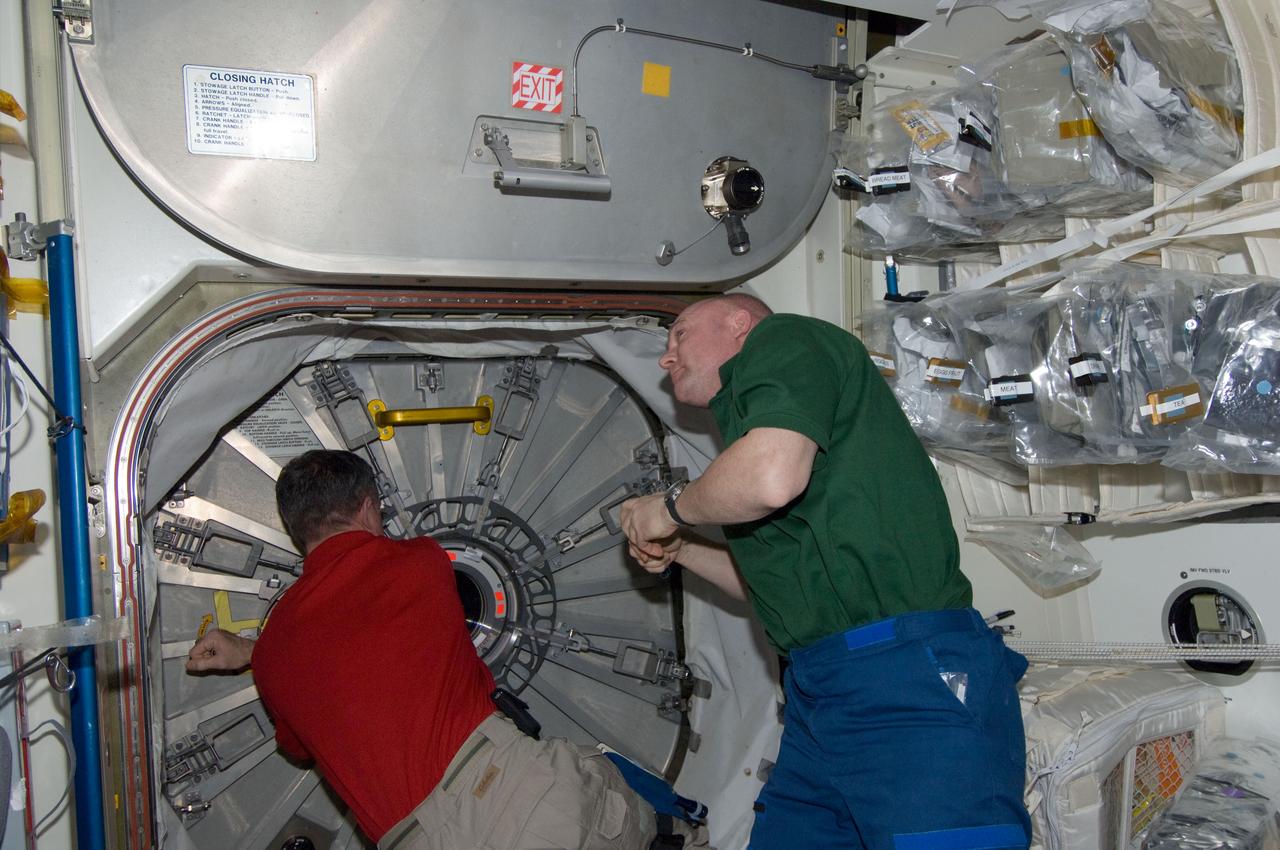
ISS030-E-173924 (24 March 2012) --- NASA astronaut Dan Burbank (left), Expedition 30 commander; and European Space Agency astronaut Andre Kuipers, flight engineer, close a hatch in the International Space Station as crew members prepare to move to the appropriate Soyuz vehicles, due to the possibility that space debris could pass close to the station. Burbank, Shkaplerov and Ivanishin sheltered in the Soyuz TMA-22 spacecraft attached to the Poisk Mini-Research Module 2 (MRM2) while Kononenko, Kuipers and Pettit took to the Soyuz TMA-03M docked to the Rassvet Mini-Research Module 1 (MRM-1).
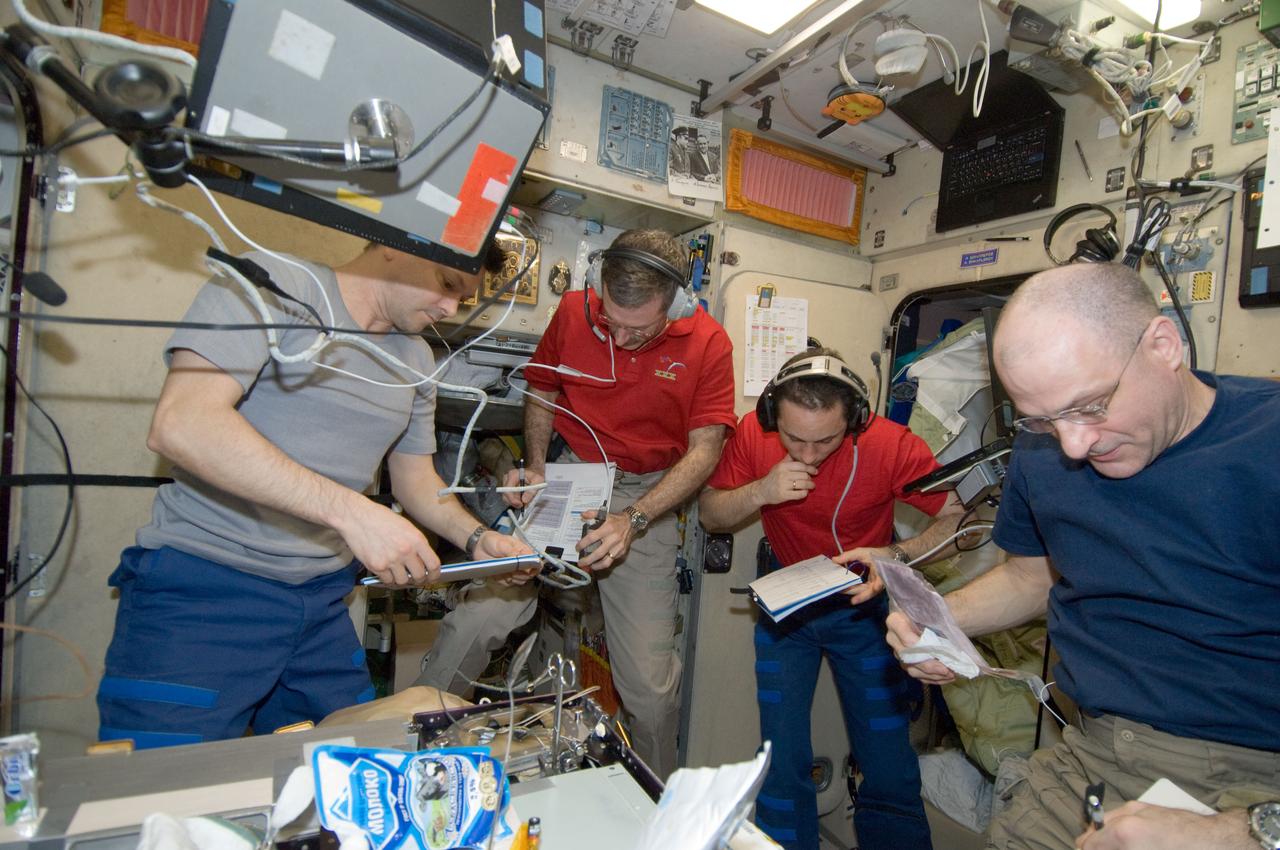
ISS030-E-173973 (24 March 2012) --- NASA astronaut Dan Burbank (second left), Expedition 30 commander; along with Russian cosmonauts Oleg Kononenko (left) and Anton Shkaplerov and NASA astronaut Don Pettit, all flight engineers, are pictured in the Zvezda Service Module of the International Space Station as they prepare to move to the appropriate Soyuz vehicles, due to the possibility that space debris could pass close to the station. Burbank, Shkaplerov and Ivanishin sheltered in the Soyuz TMA-22 spacecraft attached to the Poisk Mini-Research Module 2 (MRM2) while Kononenko, Kuipers and Pettit took to the Soyuz TMA-03M docked to the Rassvet Mini-Research Module 1 (MRM-1).
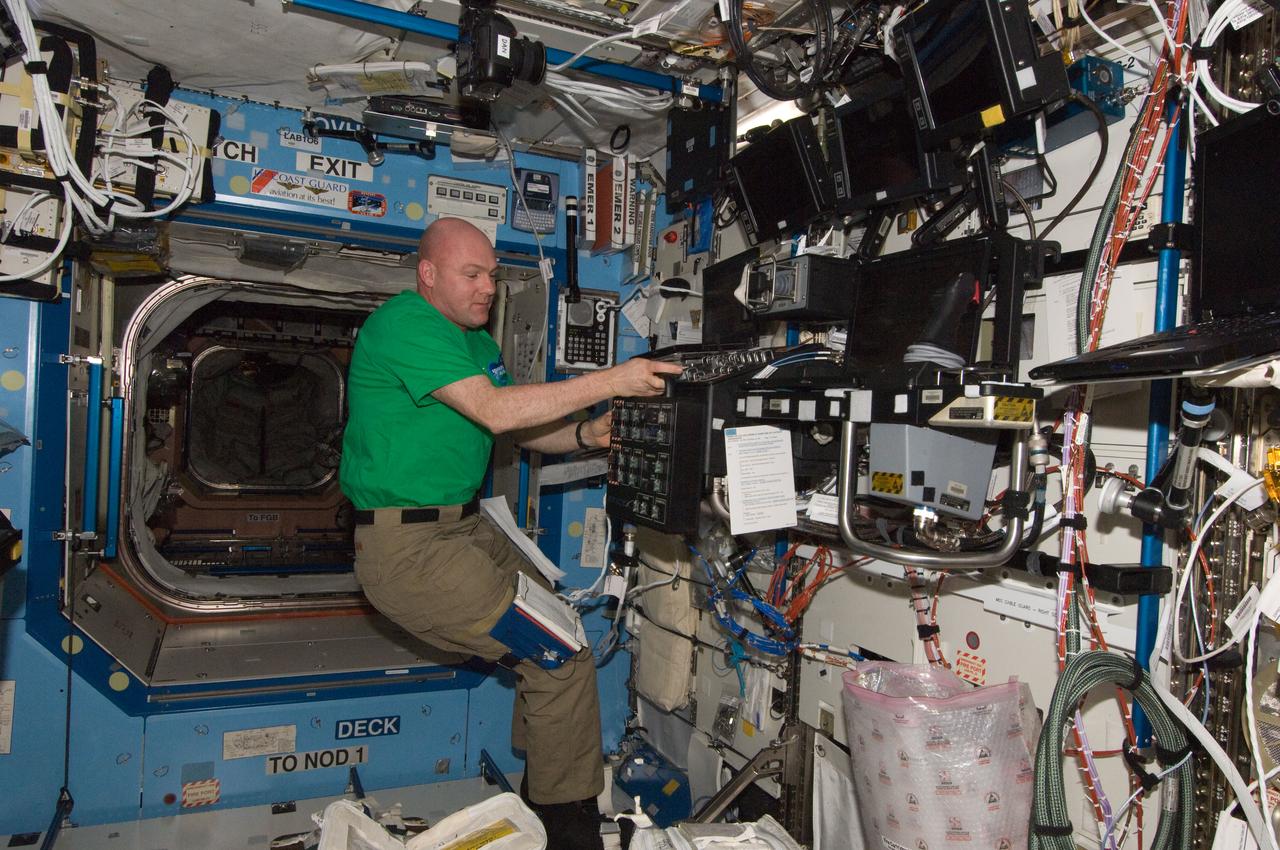
ISS030-E-267769 (24 April 2012) --- European Space Agency astronaut Andre Kuipers, Expedition 30 flight engineer, works at a robotic workstation in the Destiny laboratory of the International Space Station.
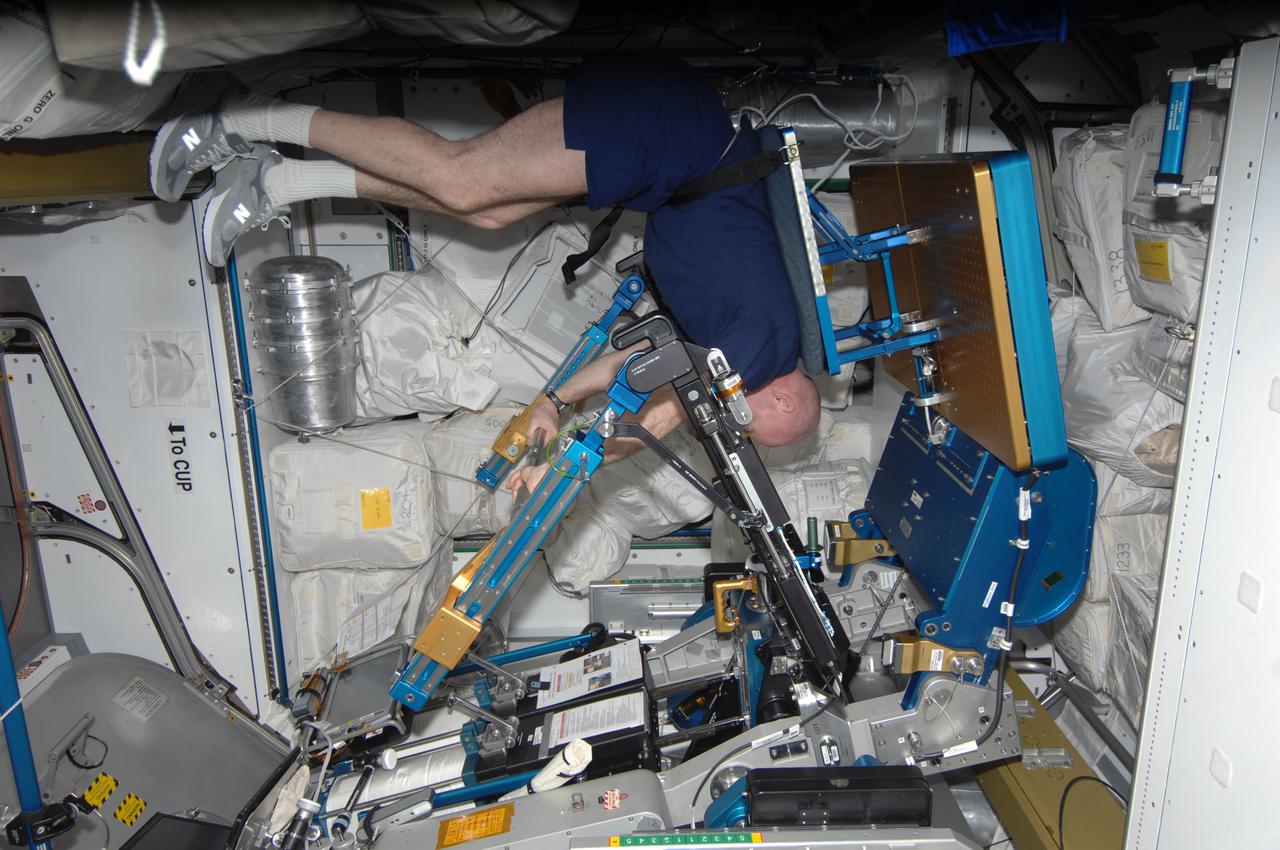
ISS030-E-148397 (22 Jan. 2012) --- European Space Agency astronaut Andre Kuipers, Expedition 30 flight engineer, prepares to exercise in the Tranquility node of the International Space Station, using the advanced Resistive Exercise Device (aRED).
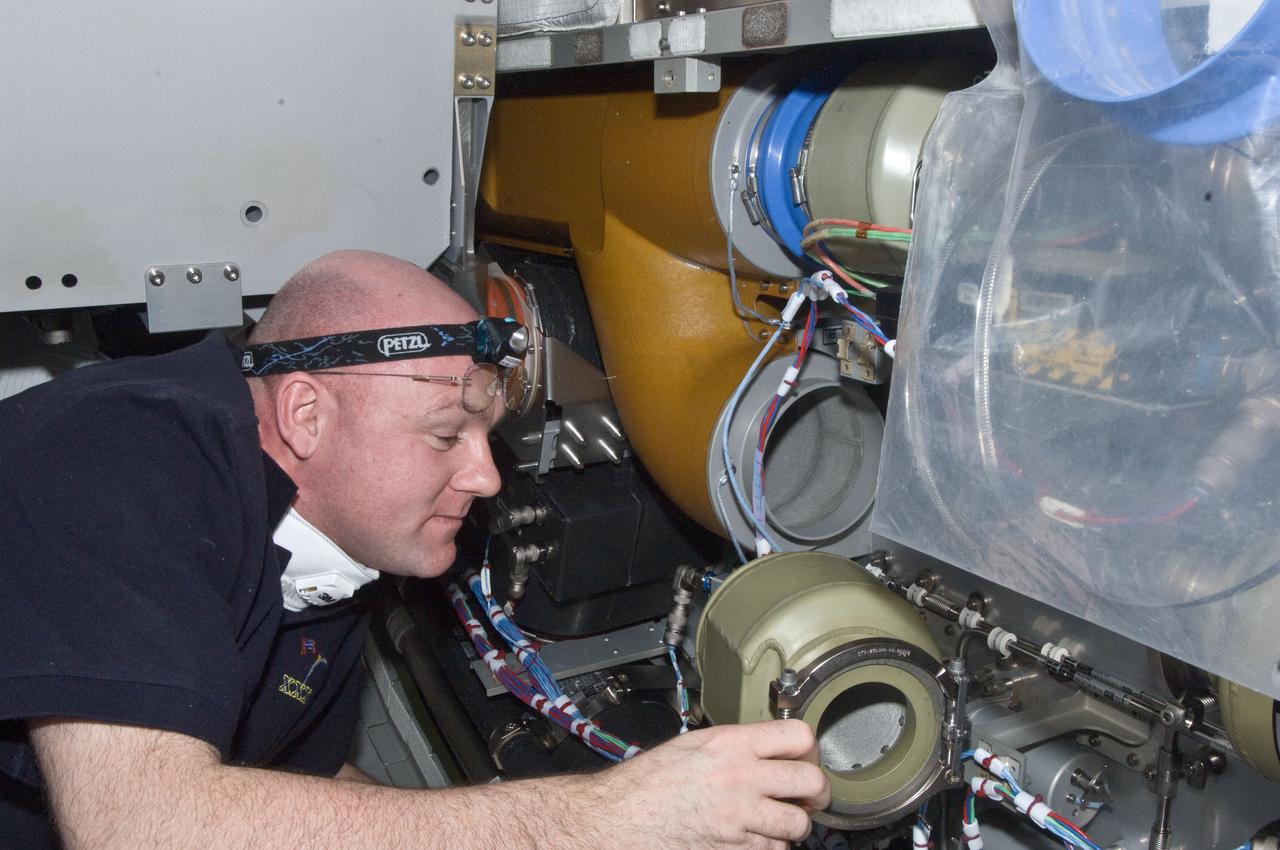
ISS030-E-129477 (22 Feb. 2012) --- European Space Agency astronaut Andre Kuipers, Expedition 30 flight engineer, performs the scheduled inspection and extensive cleanup of ventilation systems and ventilation ducts in the Columbus laboratory of the International Space Station.

ISS031-E-006398 (30 April 2012) --- Lake Powell and the Rincon in Utah are featured in this image photographed by an Expedition 31 crew member on the International Space Station. This photograph highlights part of Lake Powell; the lake extends across southeastern Utah and northeastern Arizona. Lake Powell started filling in 1963 when the Glen Canyon Dam on the Colorado River in Arizona was completed, and Glen Canyon flooded. The serpentine water surface of the reservoir-highlighted by gray regions of sunglint-follows the incised course of the canyon. Today Lake Powell is part of the Glen Canyon National Recreation Area which extends for more than 186 miles along the shoreline and side canyons. The primary intended use of Lake Powell?s water is support of agricultural production, with a small portion allocated to urban use in Arizona, Nevada, and California. The reservoir did not reach its maximum capacity of 27 million acre-feet until 1980. More recently, extended drought conditions in the southwestern United States over the past decade have resulted in a significant lowering of the Lake water level and emergence of parts of Glen Canyon. Should average precipitation in the Colorado River watershed lessen (as predicted by regional climate change models), that could result in further lowering of the Lake Powell water level and changes to the current water management plans. Fluctuations in water levels and change of river courses are a common occurrence seen in the geologic record of rivers. Looking somewhat like a donut or automobile tire from the vantage point of the space station, the Rincon (center) is an entrenched and abandoned meander, or loop, of the Colorado River, thought to have formed several thousand years ago when the river cut straight across the ends of the loop and shortened its course by six miles. The resulting canyon and 600 ? 750 feet-high central mesa indicate where the river used to flow. The term ?Rincon? also is used by geomorphologists to describe similar ancient river features observed elsewhere. The Goosenecks of the San Juan River are an example of an active entrenched meander.
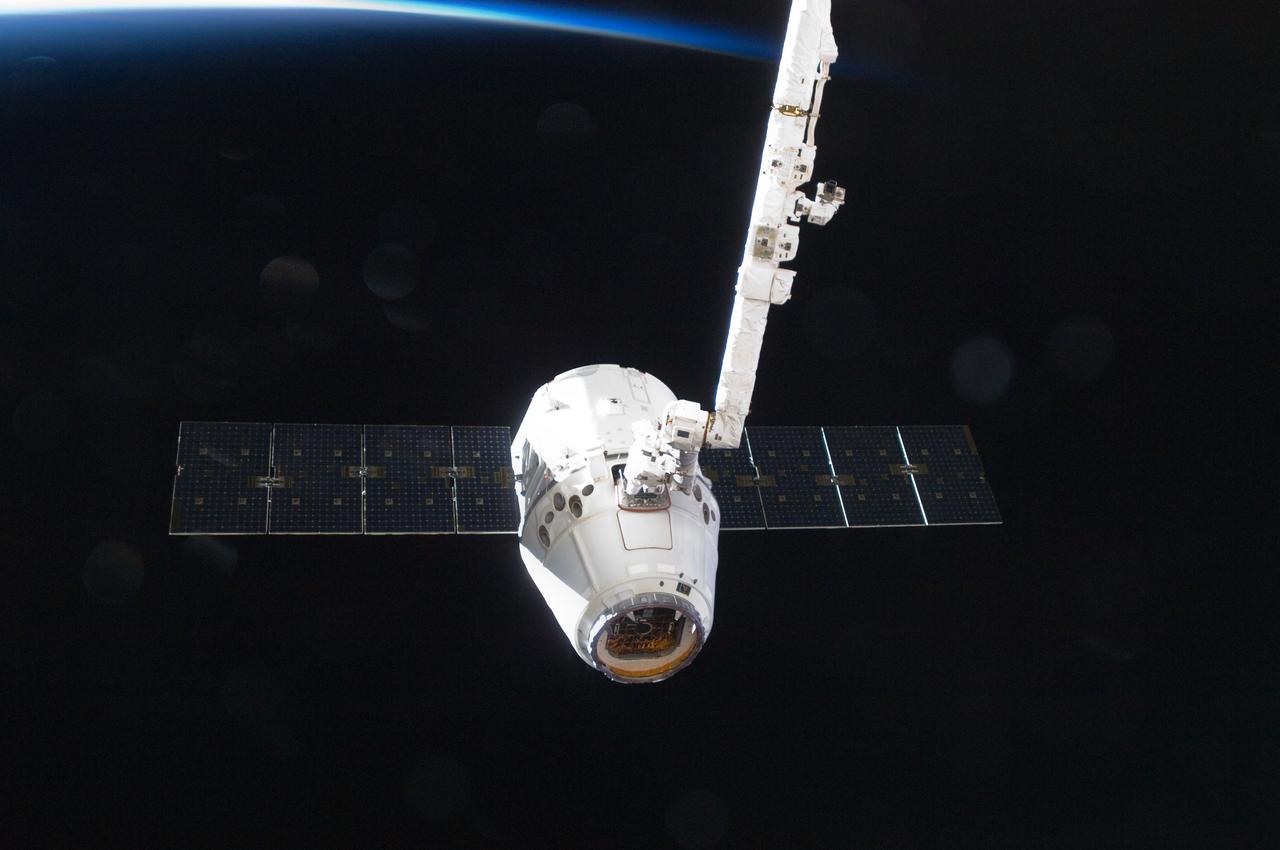
ISS031-E-079325 (31 May 2012) --- The SpaceX Dragon cargo craft is pictured just prior to being released by the International Space Station's Canadarm2 robotic arm on May 31 to allow it to head toward a splashdown in the Pacific Ocean.
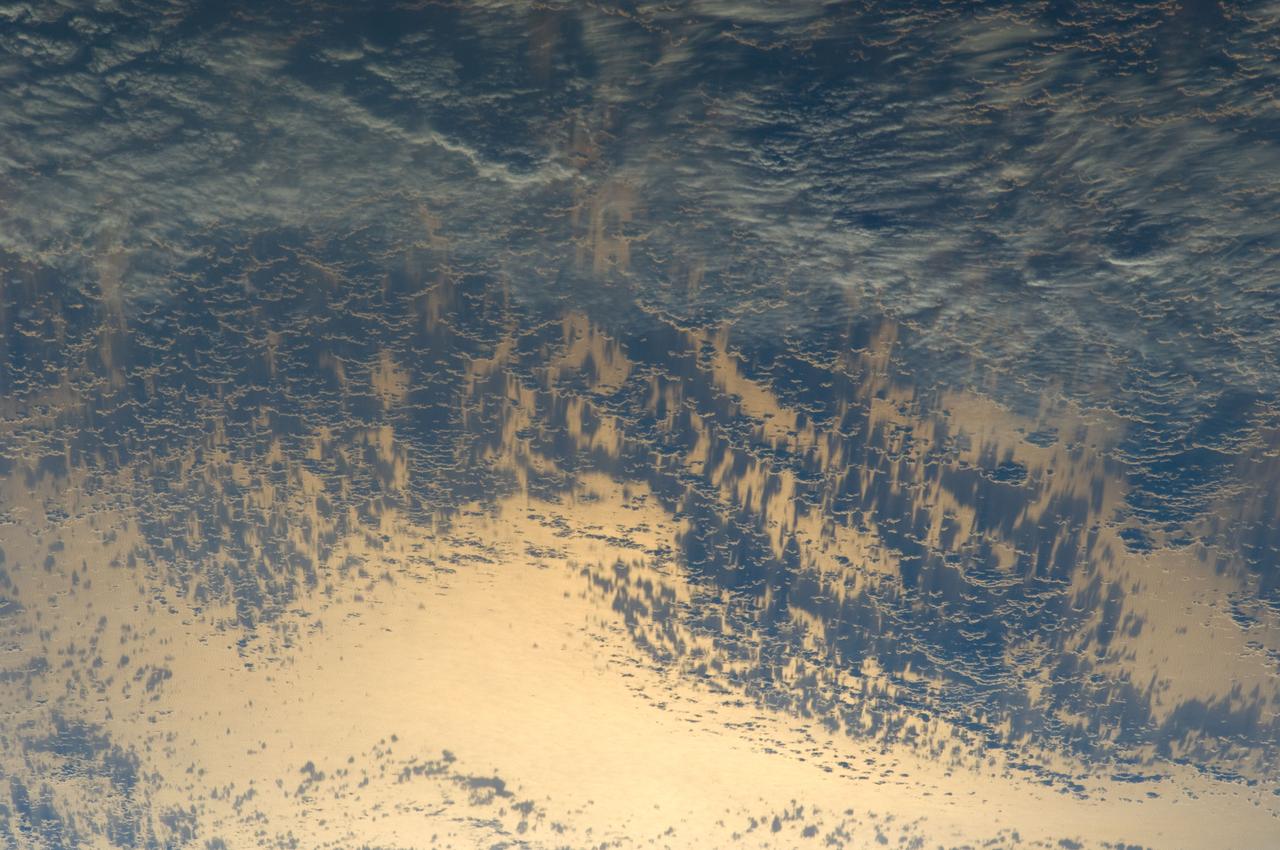
ISS031-E-035310 (15 May 2012) --- Sunglint and clouds off Western South America are featured in this image photographed by an Expedition 31 crew member on the International Space Station. The setting sun highlights cloud patterns above the Pacific Ocean, as well as the ocean surface itself in this impressive image. The space station was located over the Andes Mountains of central Chile at the time. The view is looking towards the Pacific Ocean and the sun setting in the west (towards lower left). Light from the setting sun reflects off the water surface towards the observer on the space station and creates a mirror-like appearance—a phenomenon known as sunglint. Bands of relatively low altitude cumulus clouds appear much like a flotilla of ships with their west-facing sides illuminated by the waning sunlight and the rest in shadow (center). Due to the low sun angle, they cast long and deep shadows over large swaths of the ocean surface. Given the short camera lens used, an individual cloud shadow may extend for miles. Light gray clouds at upper right appear to be at a higher altitude. The cloud cover is likely a remnant of a frontal system that moved inland over South America from the Pacific a day or two prior to the time the image was taken.
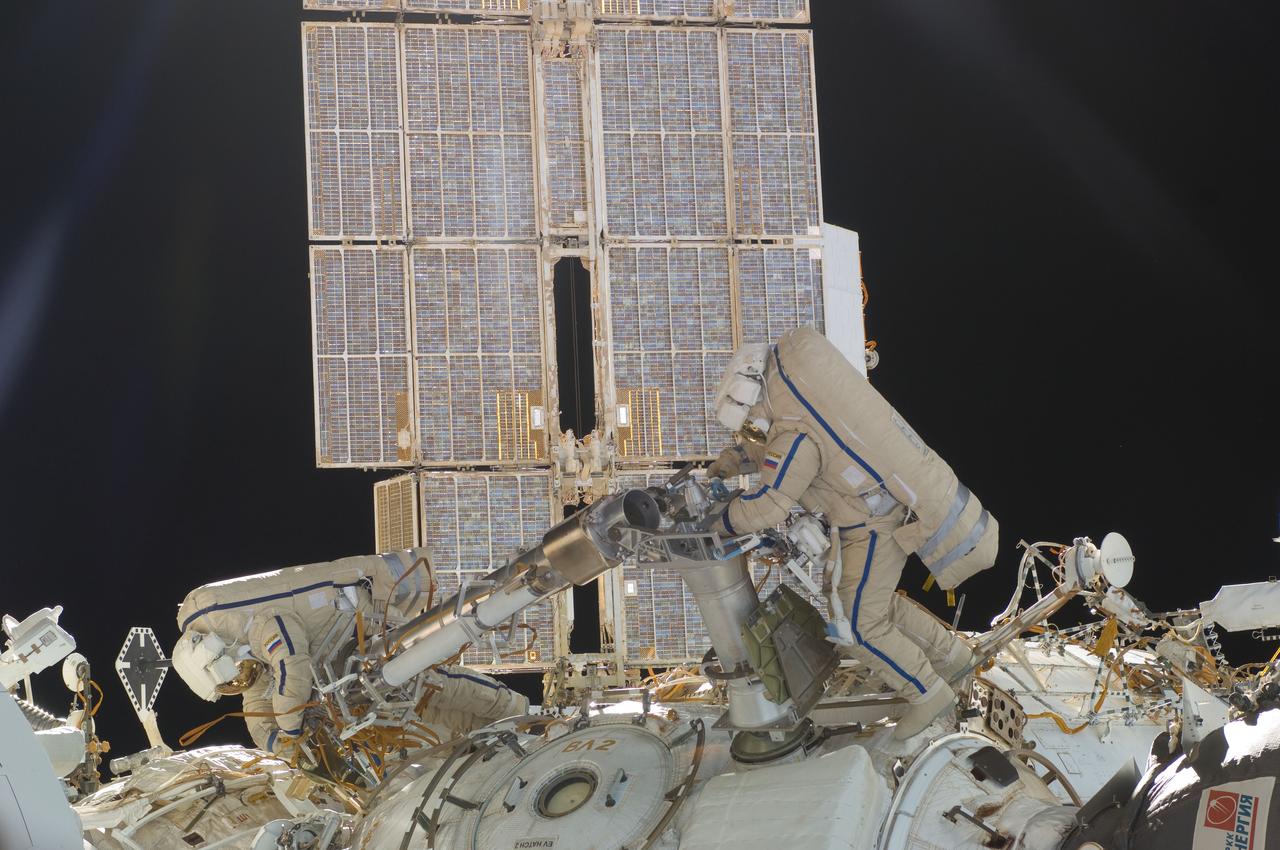
ISS030-E-078388 (16 Feb. 2012) --- Russian cosmonauts Oleg Kononenko and Anton Shkaplerov, both Expedition 30 flight engineers, participate in a session of extravehicular activity (EVA) to continue outfitting the International Space Station. During the six-hour, 15-minute spacewalk, Kononenko and Shkaplerov moved the Strela-1 crane from the Pirs Docking Compartment to begin preparing the Pirs for its replacement next year with a new laboratory and docking module. The duo used another boom, the Strela-2, to move the hand-operated crane to the Poisk module for future assembly and maintenance work. Both telescoping booms extend like fishing rods and are used to move massive components outside the station. On the exterior of the Poisk Mini-Research Module 2 (MRM2), they also installed the Vinoslivost Materials Sample Experiment, which will investigate the influence of space on the mechanical properties of the materials. The spacewalkers also collected a test sample from underneath the insulation on the Zvezda Service Module to search for any signs of living organisms. Both spacewalkers wore Russian Orlan spacesuits bearing blue stripes and equipped with NASA helmet cameras.
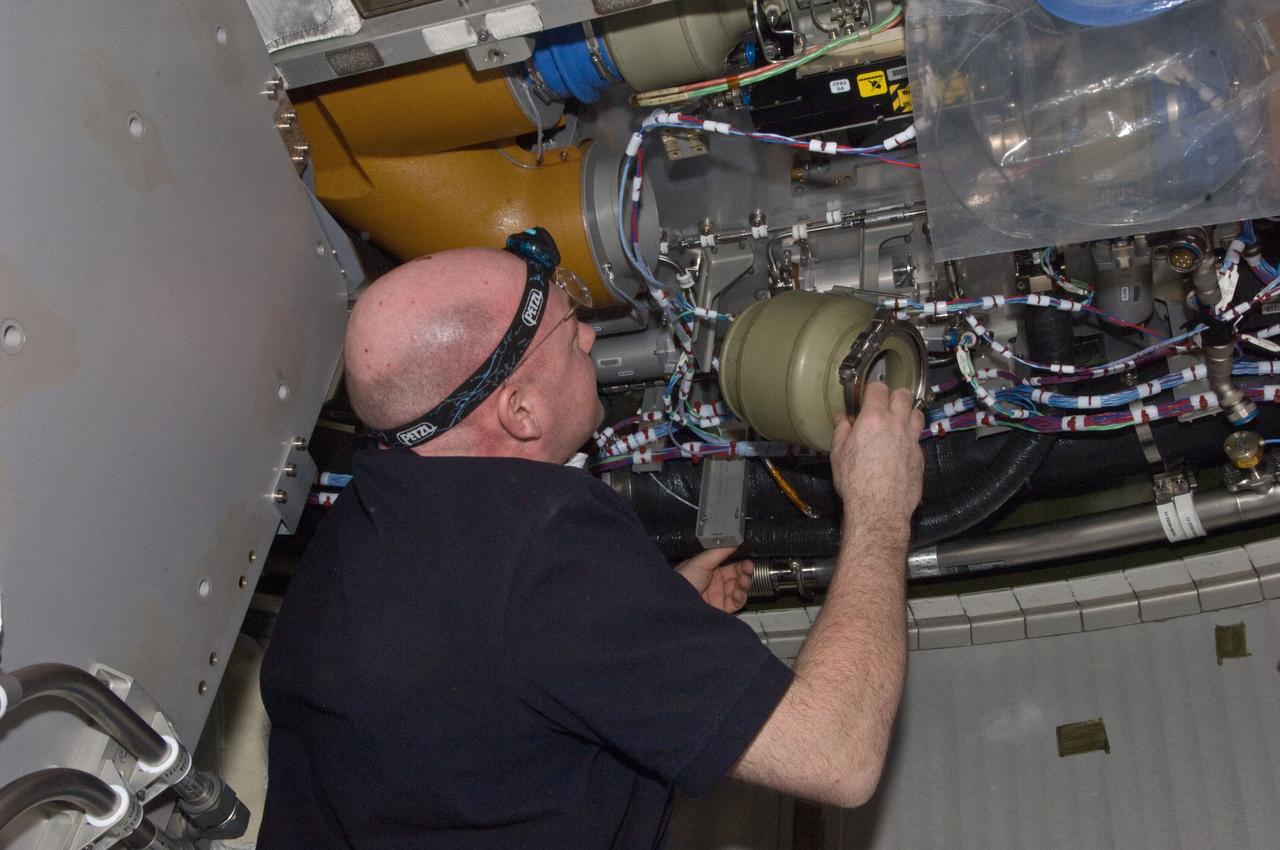
ISS030-E-129476 (22 Feb. 2012) --- European Space Agency astronaut Andre Kuipers, Expedition 30 flight engineer, performs the scheduled inspection and extensive cleanup of ventilation systems and ventilation ducts in the Columbus laboratory of the International Space Station.
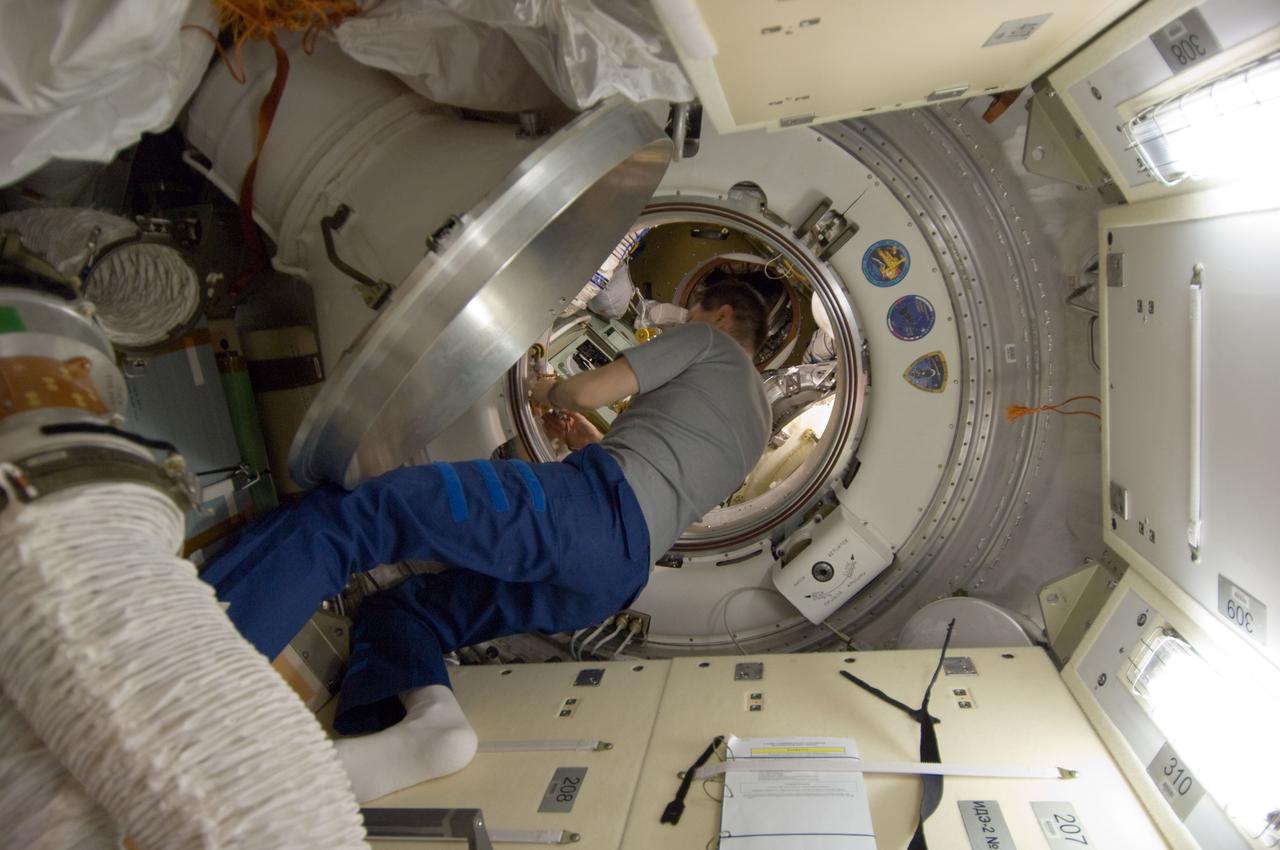
ISS030-E-173977 (24 March 2012) --- Russian cosmonaut Oleg Kononenko, Expedition 30 flight engineer, works in a hatchway on the International Space Station as crew members prepare to move to the appropriate Soyuz vehicles, due to the possibility that space debris could pass close to the station. Burbank, Shkaplerov and Ivanishin sheltered in the Soyuz TMA-22 spacecraft attached to the Poisk Mini-Research Module 2 (MRM2) while Kononenko, Kuipers and Pettit took to the Soyuz TMA-03M docked to the Rassvet Mini-Research Module 1 (MRM-1).
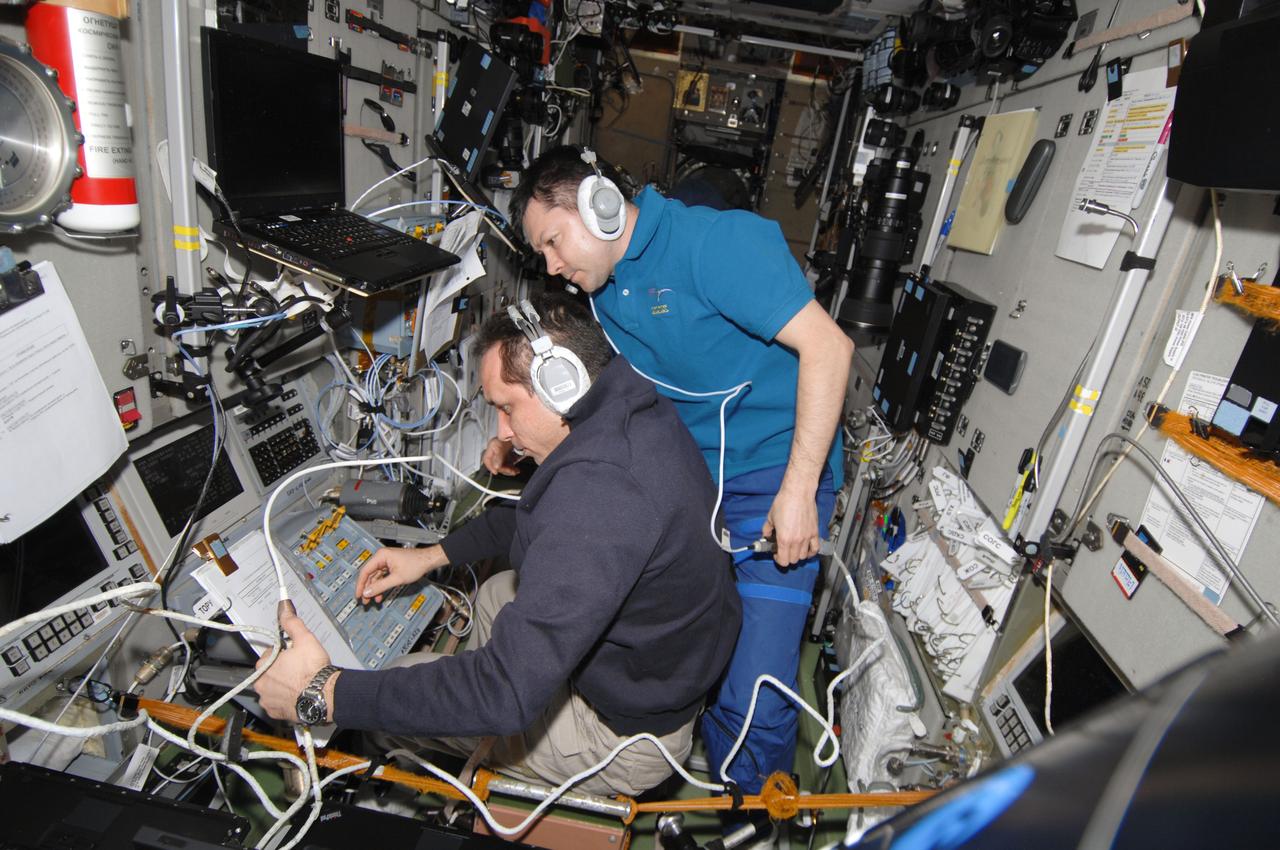
ISS030-E-156562 (27 Jan. 2012) --- Russian cosmonauts Anton Shkaplerov (left) and Oleg Kononenko, both Expedition 30 flight engineers, monitor data at the manual TORU docking system controls in the Zvezda Service Module of the International Space Station during approach and docking operations of the unpiloted ISS Progress 46 resupply vehicle. Progress 46 docked automatically to the Pirs Docking Compartment via the Kurs automated rendezvous system at 7:00 p.m. (EST) on Jan. 27, 2012.
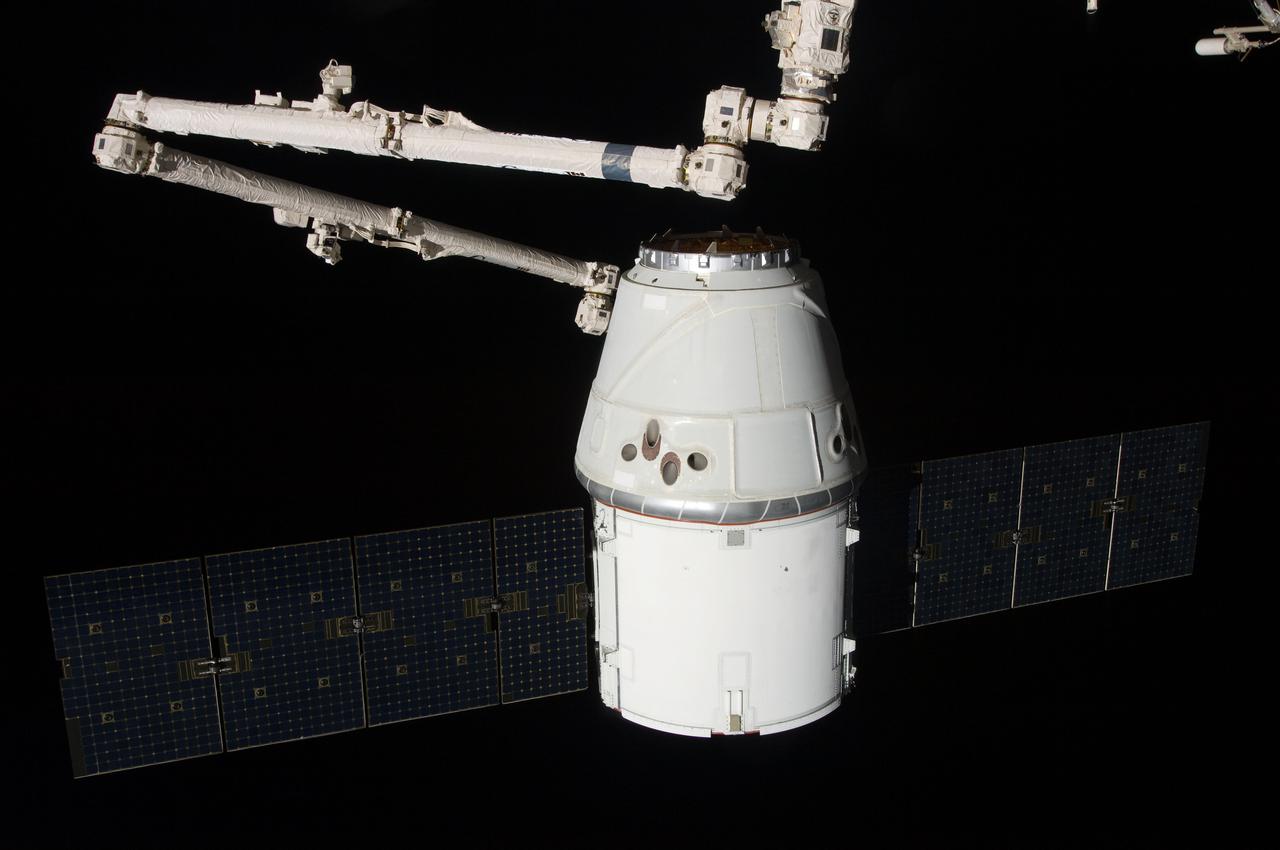
ISS031-E-079316 (31 May 2012) --- The SpaceX Dragon cargo craft is pictured just prior to being released by the International Space Station's Canadarm2 robotic arm on May 31 to allow it to head toward a splashdown in the Pacific Ocean.
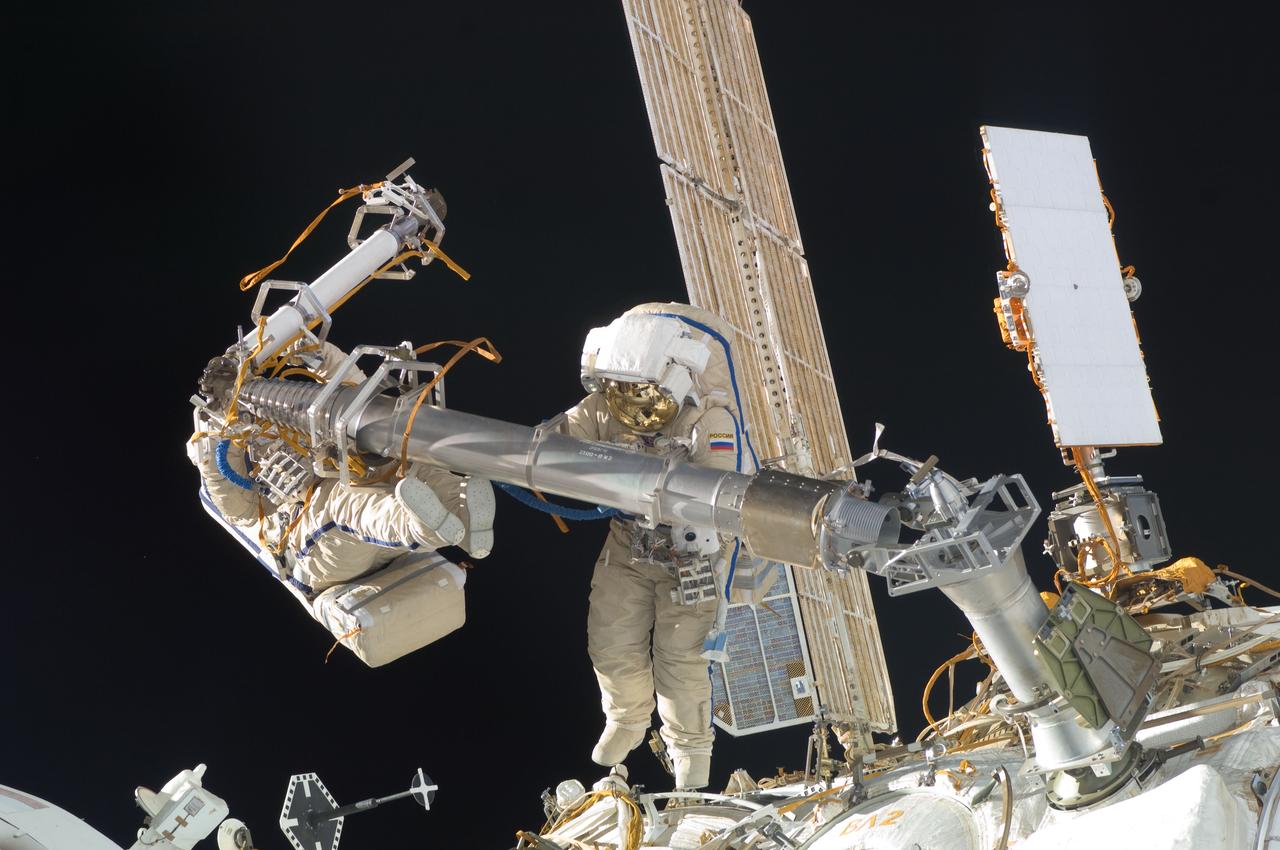
ISS030-E-078377 (16 Feb. 2012) --- Russian cosmonauts Oleg Kononenko and Anton Shkaplerov, both Expedition 30 flight engineers, participate in a session of extravehicular activity (EVA) to continue outfitting the International Space Station. During the six-hour, 15-minute spacewalk, Kononenko and Shkaplerov moved the Strela-1 crane from the Pirs Docking Compartment to begin preparing the Pirs for its replacement next year with a new laboratory and docking module. The duo used another boom, the Strela-2, to move the hand-operated crane to the Poisk module for future assembly and maintenance work. Both telescoping booms extend like fishing rods and are used to move massive components outside the station. On the exterior of the Poisk Mini-Research Module 2 (MRM2), they also installed the Vinoslivost Materials Sample Experiment, which will investigate the influence of space on the mechanical properties of the materials. The spacewalkers also collected a test sample from underneath the insulation on the Zvezda Service Module to search for any signs of living organisms. Both spacewalkers wore Russian Orlan spacesuits bearing blue stripes and equipped with NASA helmet cameras.
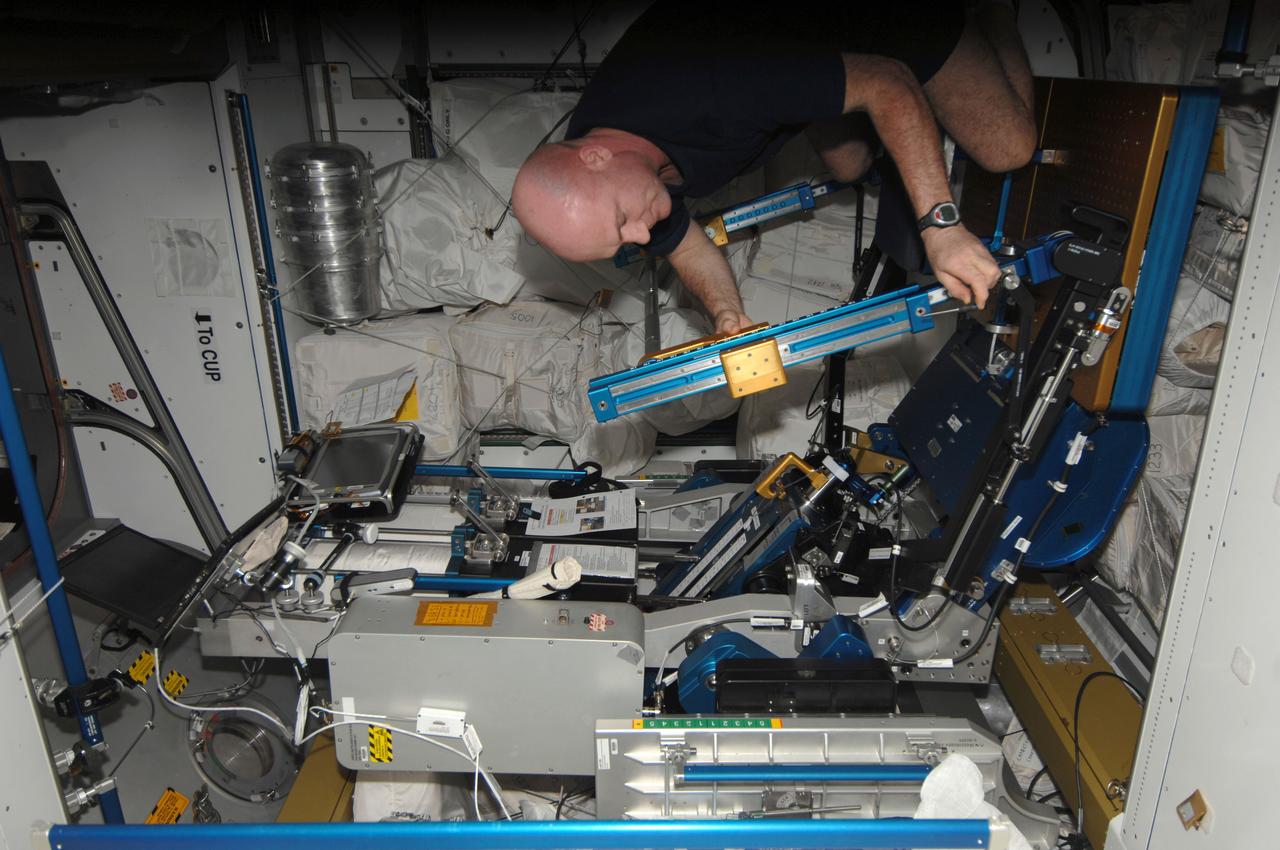
ISS030-E-148381 (22 Jan. 2012) --- European Space Agency astronaut Andre Kuipers, Expedition 30 flight engineer, prepares to exercise in the Tranquility node of the International Space Station, using the advanced Resistive Exercise Device (aRED).
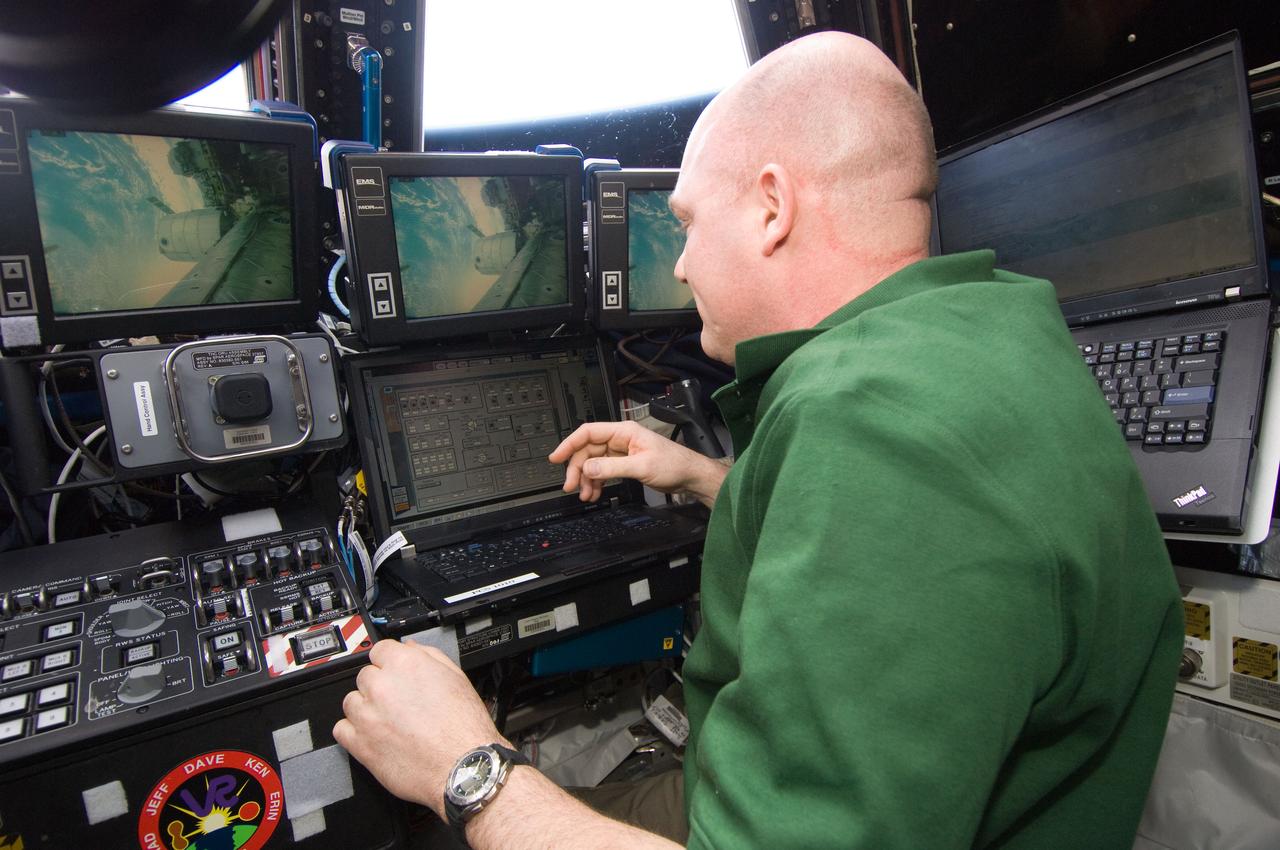
ISS030-E-272092 (17 April 2012) --- European Space Agency astronaut Andre Kuipers, Expedition 30 flight engineer, works the controls of the Canadarm2 Space Station Remote Manipulator System (SSRMS) in the Cupola of the International Space Station.
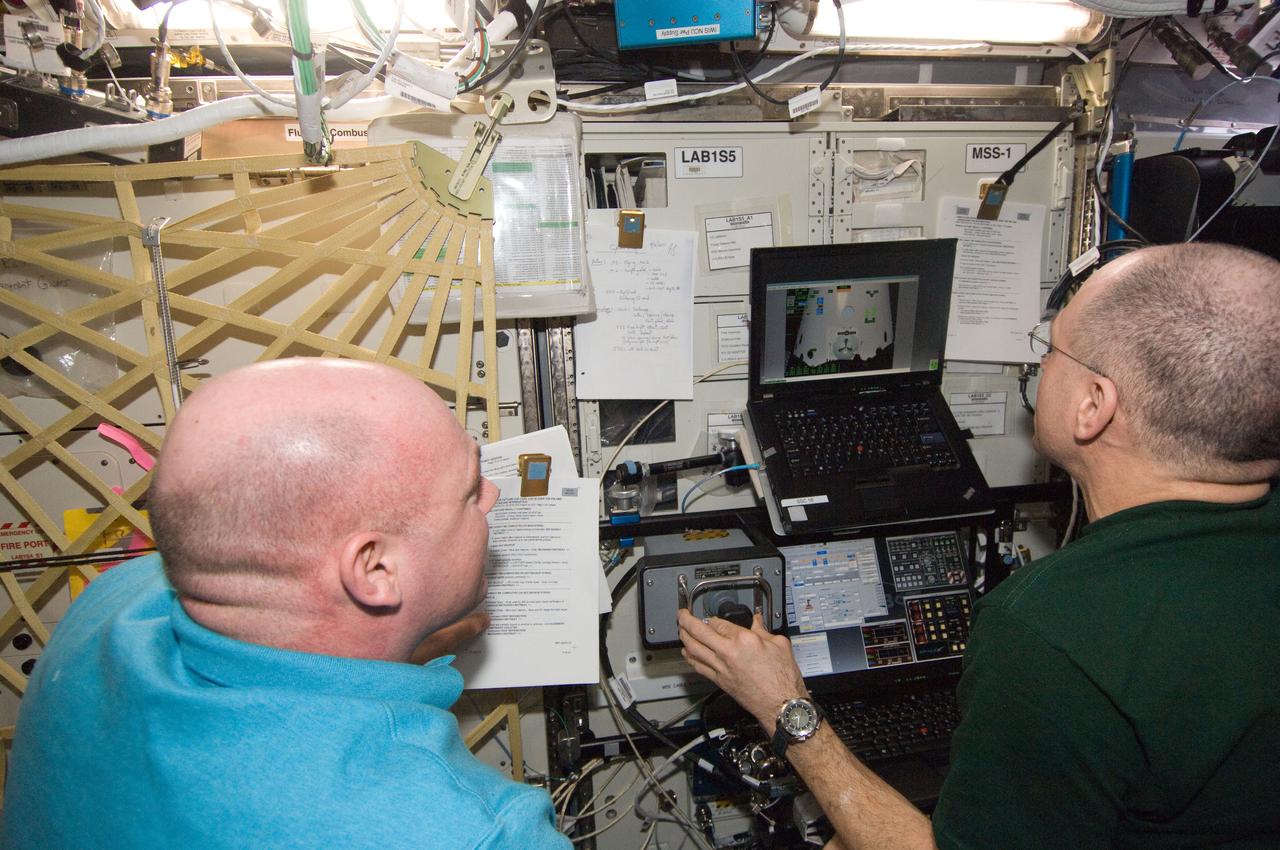
ISS030-E-235592 (11 April 2012) --- In the International Space Station’s Destiny laboratory, NASA astronaut Don Pettit (right) and European Space Agency astronaut Andre Kuipers, both Expedition 30 flight engineers, conduct the first of three sessions on the ROBoT simulator in preparation for the arrival of the SpaceX Dragon. Slated for liftoff on April 30, 2012, at 12:22 (EDT) from the Kennedy Space Center, the goal of Dragon’s planned 21-day mission will be to test the unpiloted capsule’s ability to rendezvous with the space station.

ISS031-E-006844 (5 May 2012) --- Earth?s atmosphere contrasted by the blackness of space is featured in this image photographed by an Expedition 31 crew member on the International Space Station.
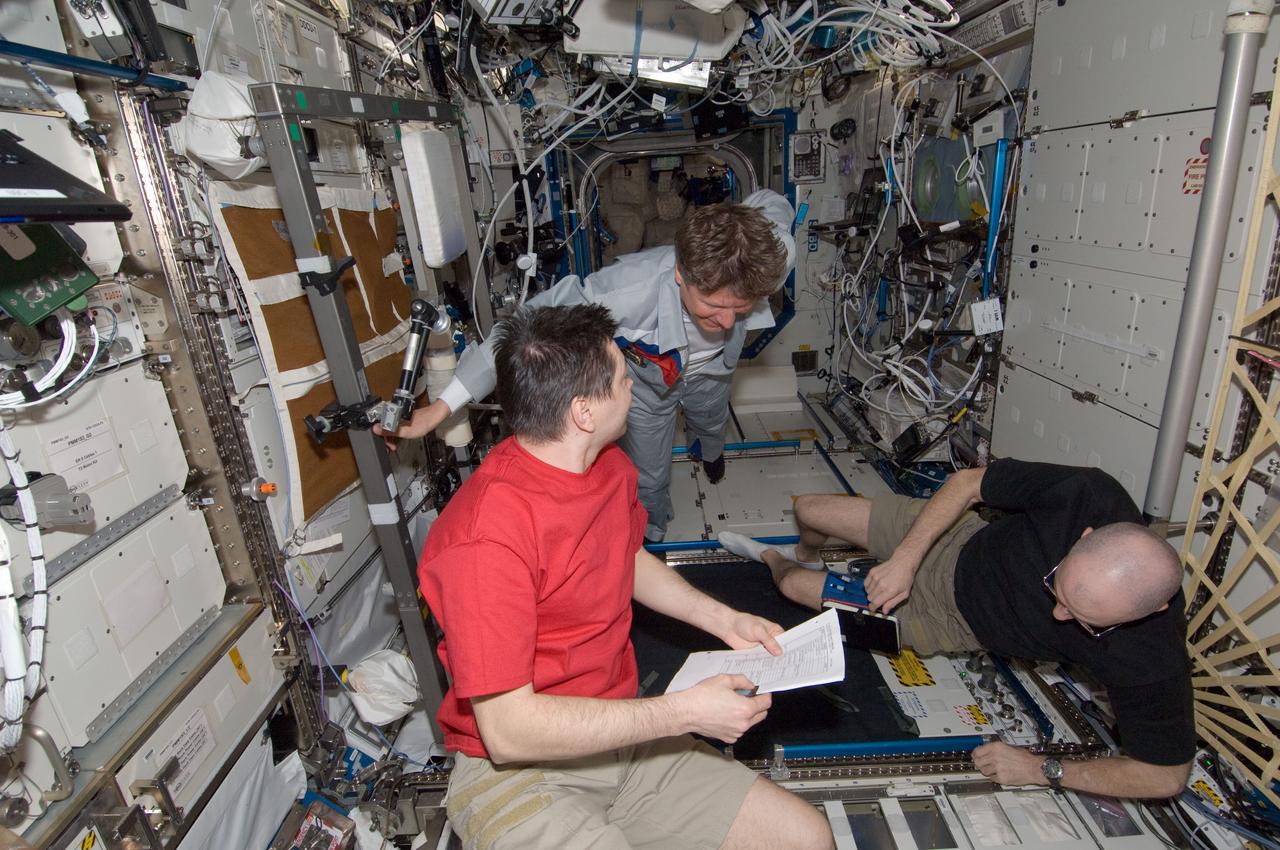
ISS031-E-081644 (17 May 2012) --- Russian cosmonaut Oleg Kononenko (left), Expedition 31 commander, conducts a crew safety briefing in the Destiny laboratory of the International Space Station shortly after Russian cosmonauts Gennady Padalka (center) and Sergei Revin (out of frame); along with NASA astronaut Joe Acaba (not pictured) docked with the space station in their Soyuz TMA-04M spacecraft. NASA astronaut Don Pettit, flight engineer, is at right.
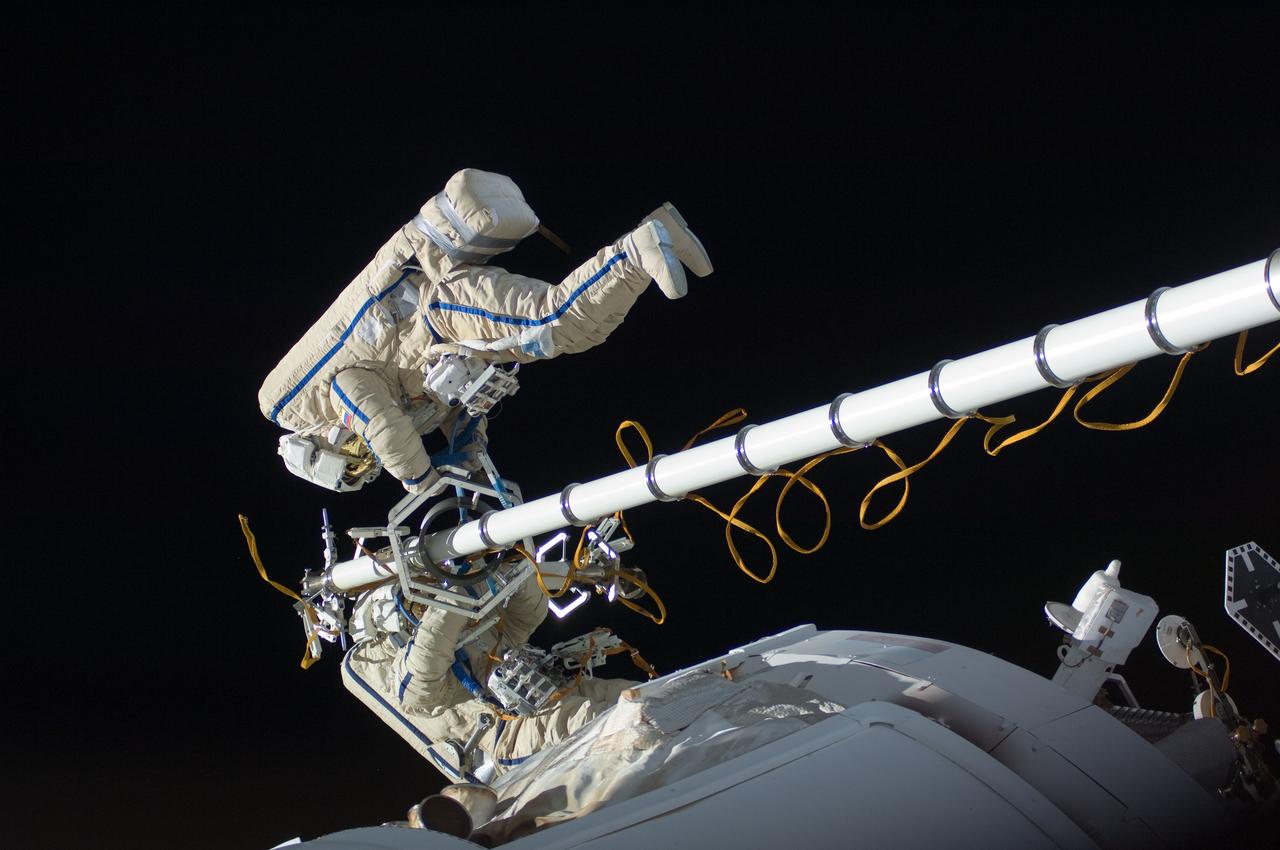
ISS030-E-078522 (16 Feb. 2012) --- Russian cosmonauts Oleg Kononenko and Anton Shkaplerov, both Expedition 30 flight engineers, participate in a session of extravehicular activity (EVA) to continue outfitting the International Space Station. During the six-hour, 15-minute spacewalk, Kononenko and Shkaplerov moved the Strela-1 crane from the Pirs Docking Compartment to begin preparing the Pirs for its replacement next year with a new laboratory and docking module. The duo used another boom, the Strela-2, to move the hand-operated crane to the Poisk module for future assembly and maintenance work. Both telescoping booms extend like fishing rods and are used to move massive components outside the station. On the exterior of the Poisk Mini-Research Module 2 (MRM2), they also installed the Vinoslivost Materials Sample Experiment, which will investigate the influence of space on the mechanical properties of the materials. The spacewalkers also collected a test sample from underneath the insulation on the Zvezda Service Module to search for any signs of living organisms. Both spacewalkers wore Russian Orlan spacesuits bearing blue stripes and equipped with NASA helmet cameras.
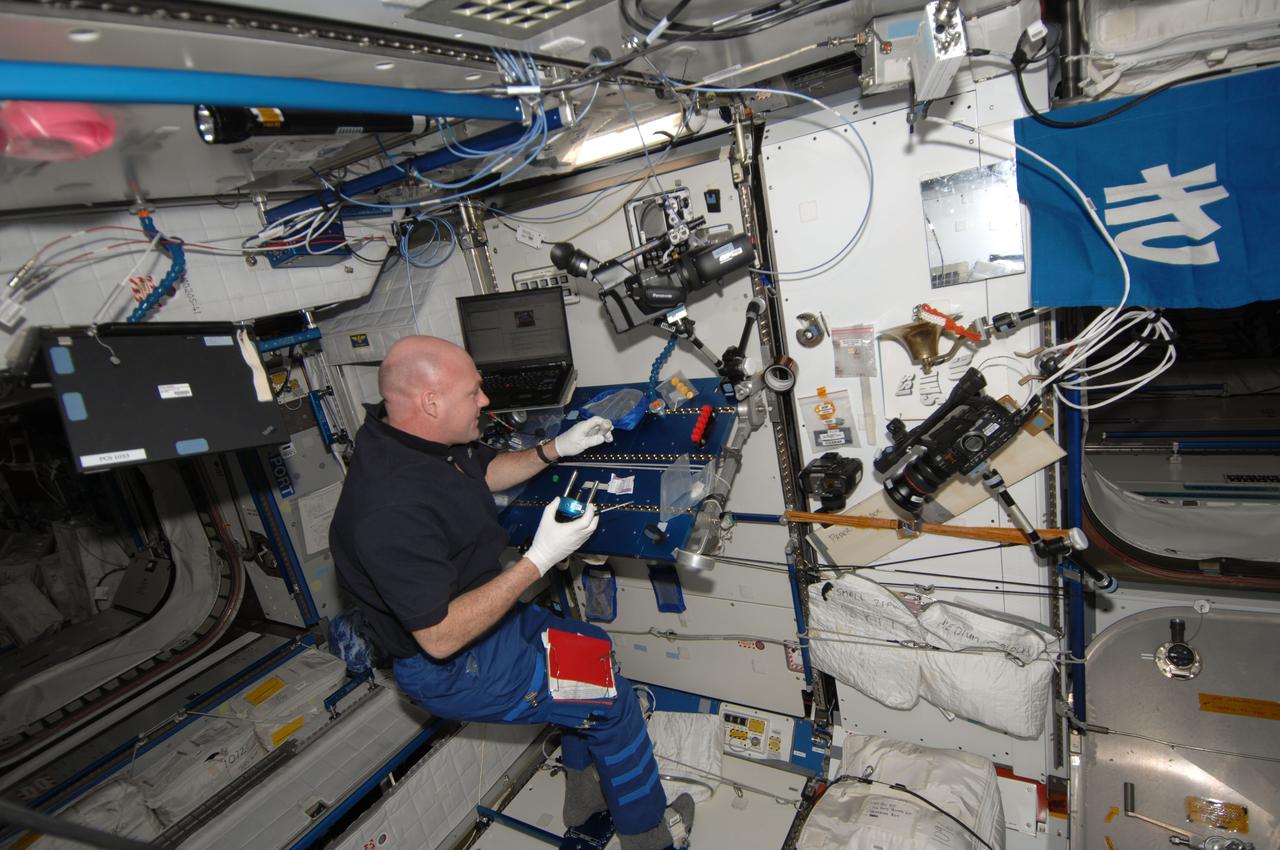
ISS030-E-156300 (23 Jan. 2012) --- European Space Agency astronaut Andre Kuipers, Expedition 30 flight engineer, lubricates and cleans the beverage adapter on the Potable Water Dispenser (PWD) in the Harmony node of the International Space Station.
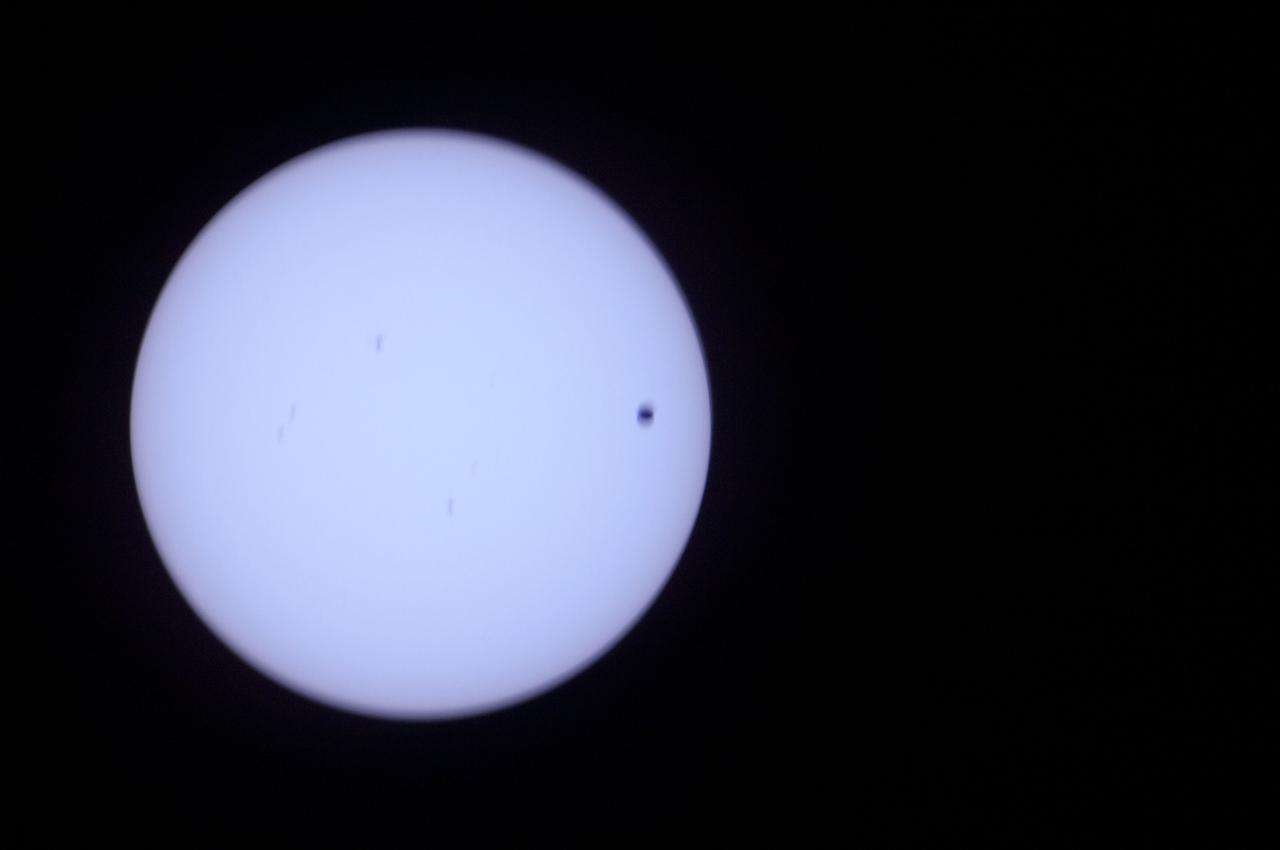
Transit of Venus as seen from the Cupola Module.