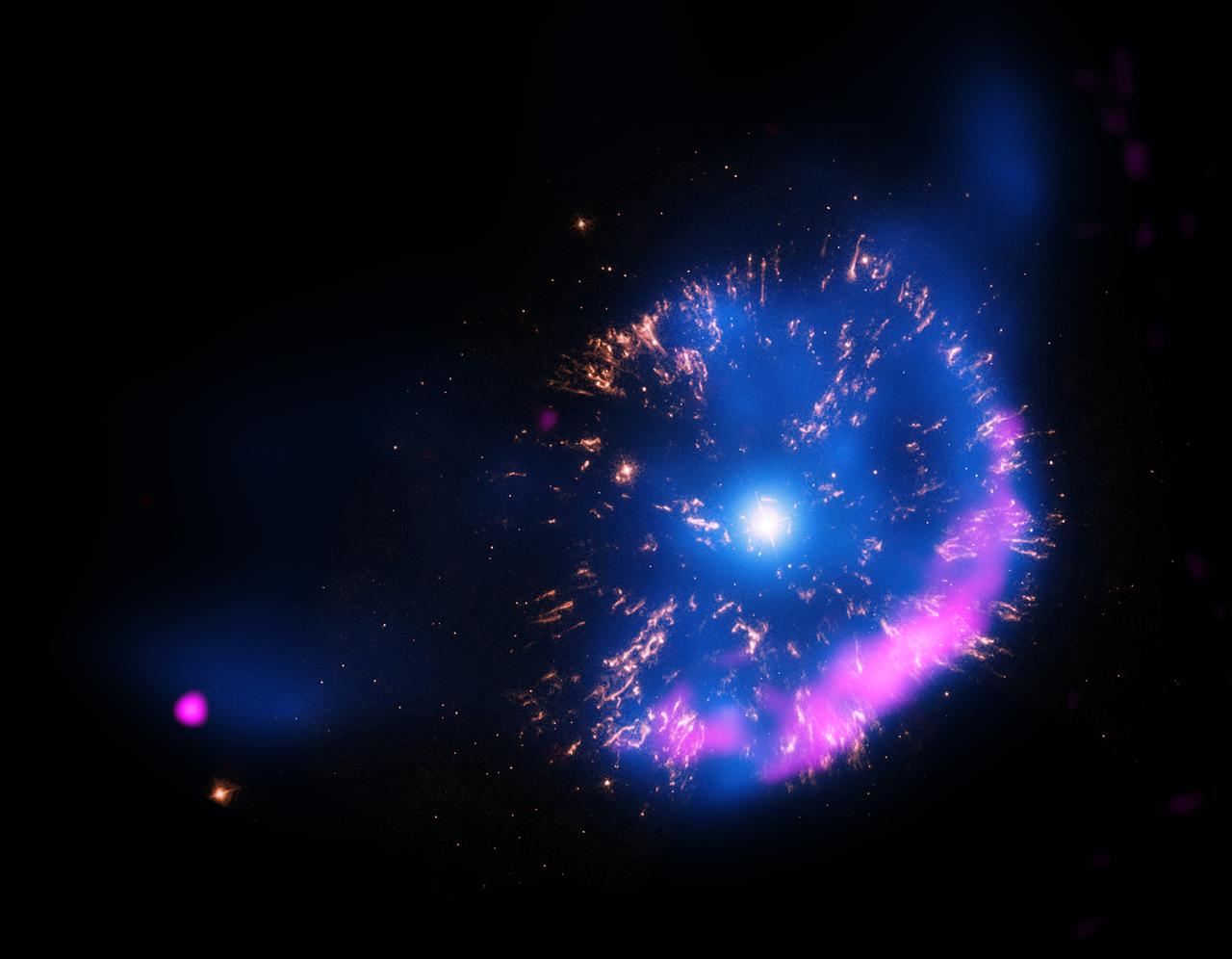
In Hollywood blockbusters, explosions are often among the stars of the show. In space, explosions of actual stars are a focus for scientists who hope to better understand their births, lives, and deaths and how they interact with their surroundings. Using NASA’s Chandra X-ray Observatory, astronomers have studied one particular explosion that may provide clues to the dynamics of other, much larger stellar eruptions. A team of researchers pointed the telescope at GK Persei, an object that became a sensation in the astronomical world in 1901 when it suddenly appeared as one of the brightest stars in the sky for a few days, before gradually fading away in brightness. Today, astronomers cite GK Persei as an example of a “classical nova,” an outburst produced by a thermonuclear explosion on the surface of a white dwarf star, the dense remnant of a Sun-like star.
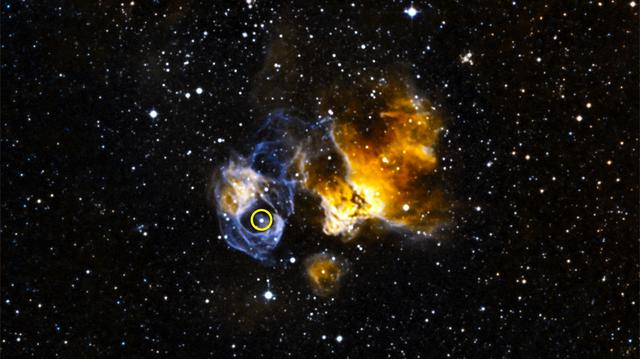
This composite image contains data from Chandra (purple) that provides evidence for the survival of a companion star from the blast of a supernova explosion. Chandra's X-rays reveal a point-like source in the supernova remnant at the location of a massive star. The data suggest that mass is being pulled away from the massive star towards a neutron star or a black hole companion. If confirmed, this would be only the third binary system containing both a massive star and a neutron star or black hole ever found in the aftermath of a supernova. This supernova remnant is found embedded in clouds of ionized hydrogen, which are shown in optical light (yellow and cyan) from the MCELS survey, along with additional optical data from the DSS (white).
This composite image contains data from Chandra (purple) that provides evidence for the survival of a companion star from the blast of a supernova explosion. Chandra's X-rays reveal a point-like source in the supernova remnant at the location of a massive star. The data suggest that mass is being pulled away from the massive star towards a neutron star or a black hole companion. If confirmed, this would be only the third binary system containing both a massive star and a neutron star or black hole ever found in the aftermath of a supernova. This supernova remnant is found embedded in clouds of ionized hydrogen, which are shown in optical light (yellow and cyan) from the MCELS survey, along with additional optical data from the DSS (white).