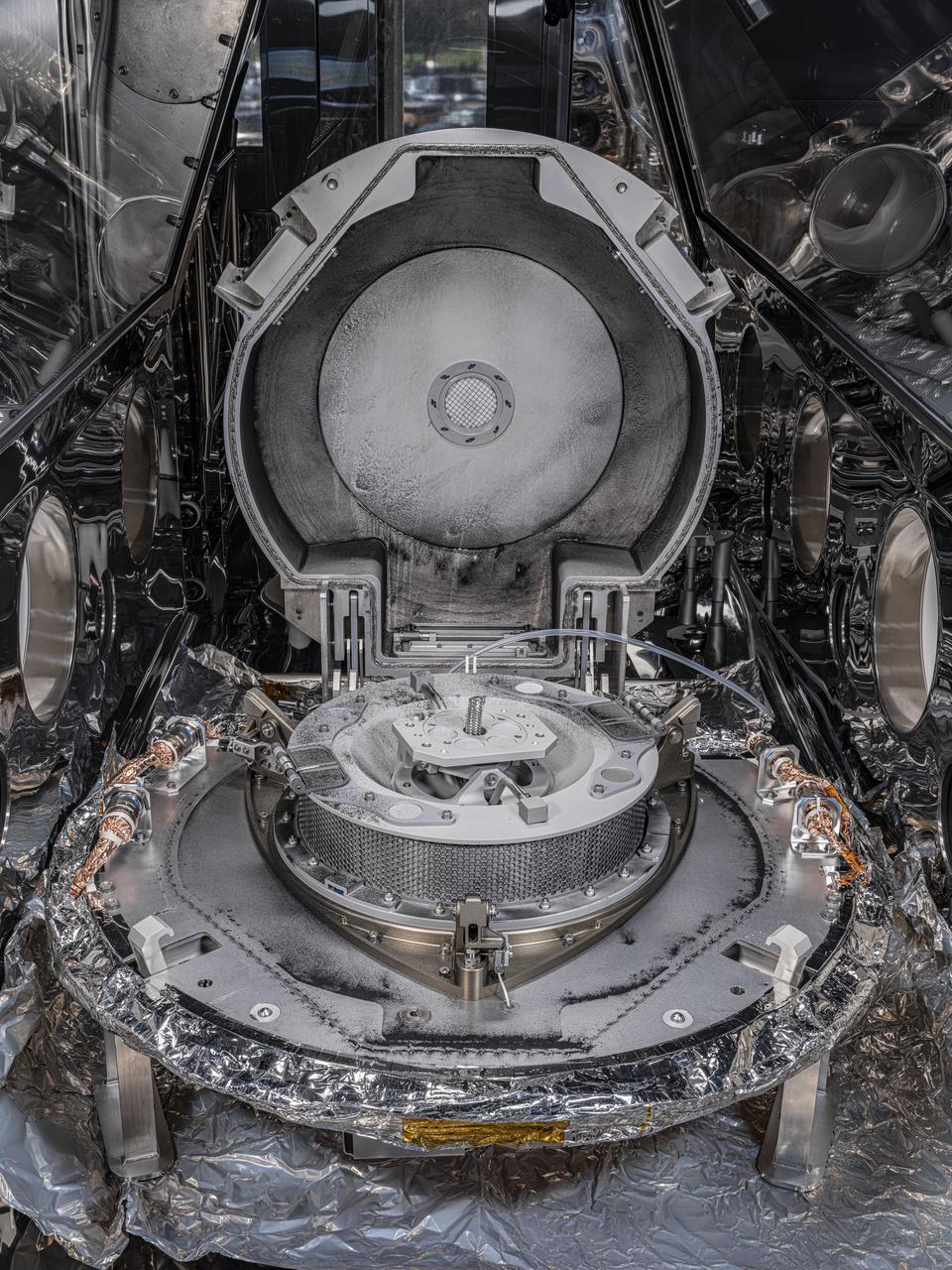
A view of the OSIRIS-REx sample canister with the lid removed, revealing the Touch and Go Sample Acquisition Mechanism (TAGSAM) inside. When astromaterials processors removed the canister lid, they discovered a coating of fine asteroid dust and sand-sized particles covering the inside of the lid and on the top of the avionics deck. The round portion in the center of the lower part of the canister is the TAGSAM that was used to collect pristine material from asteroid Bennu in 2020. The spacecraft delivered the sample return capsule to Earth on Sept. 24, 2023. OSIRIS-REx is the first U.S. mission to collect a sample from an asteroid. Scientists hope the Bennu sample will reveal whether asteroids that collided with Earth billions of years ago thereby delivered water and other ingredients for life to our planet. Credits: Photo credit: NASA/Erika Blumenfeld & Joseph Aebersold Image Capture: Created using manual high-resolution precision photography and semi-automated focus stacking procedure.

A top-down view of the OSIRIS-REx Touch-and-Go-Sample-Acquisition-Mechanism (TAGSAM) head with the lid removed, revealing the remainder of the asteroid sample inside. Erika Blumenfeld, creative lead for the Advanced Imaging and Visualization of Astromaterials (AIVA) and Joe Aebersold, project management lead, captured this picture using manual high-resolution precision photography and a semi-automated focus stacking procedure. The result is an image that can be zoomed in on to show extreme detail of the sample. The remaining sample material includes dust and rocks up to about .4 in (one cm) in size. Credit: NASA/Erika Blumenfeld & Joseph Aebersold

A view of the TAGSAM (Touch and Go Sample Acquisition Mechanism) from above, showing the Mylar flap with a pile of asteroid material resting on it. This image was created using manual high-resolution precision photography and semi-automated focus stacking procedure. Created using manual high-resolution precision photography and semi-automated focus stacking procedure. Credit: NASA/Erika Blumenfeld & Joseph Aebersold
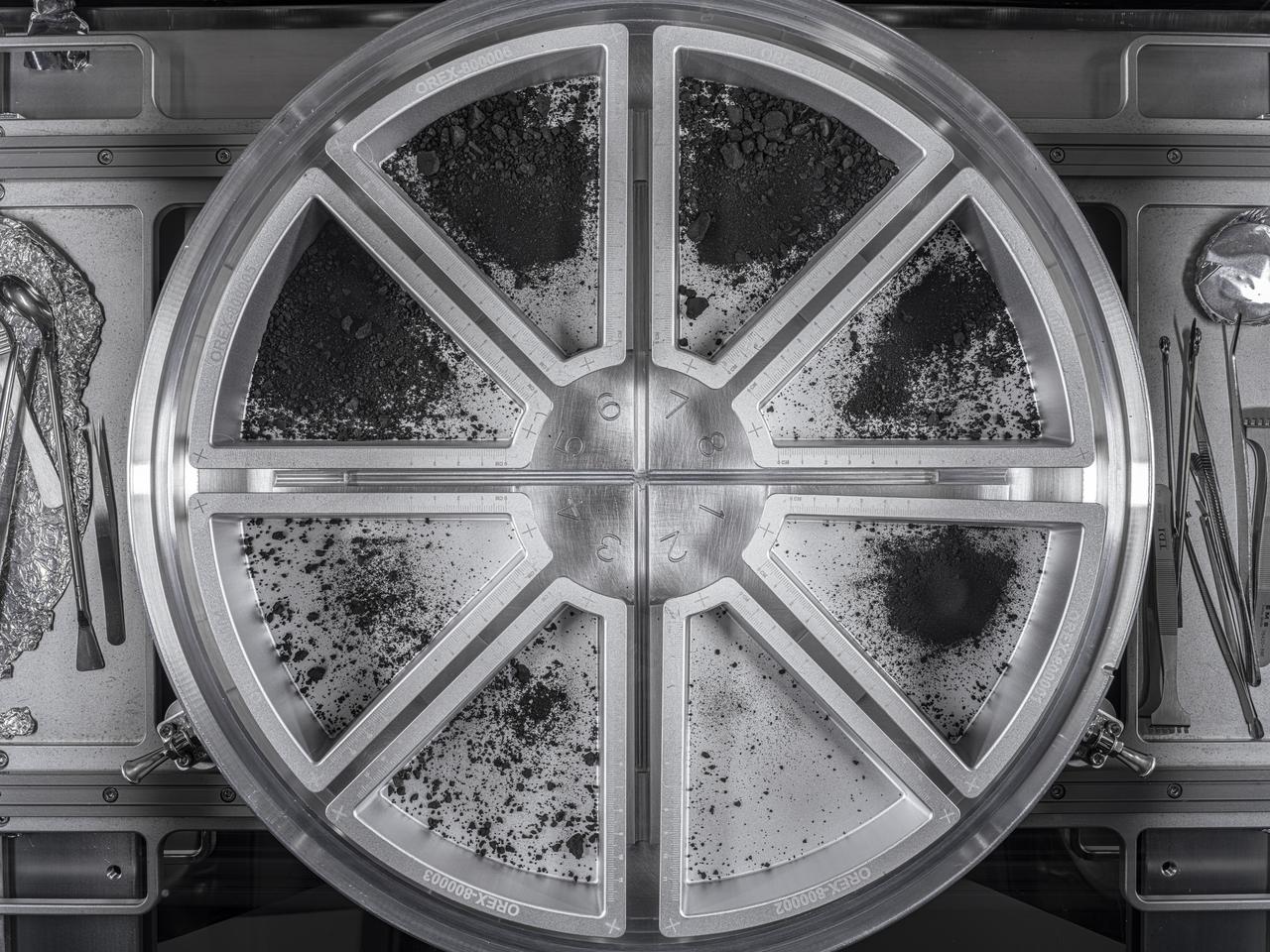
A view of eight sample trays containing the final material from asteroid Bennu. The dust and rocks were poured into the trays from the top plate of the Touch-and-Go Sample Acquisition Mechanism (TAGSAM) head. 51.2 grams were collected from this pour, bringing the final mass of asteroid sample to 121.6 grams. Credit: NASA/Erika Blumenfeld & Joseph Aebersold