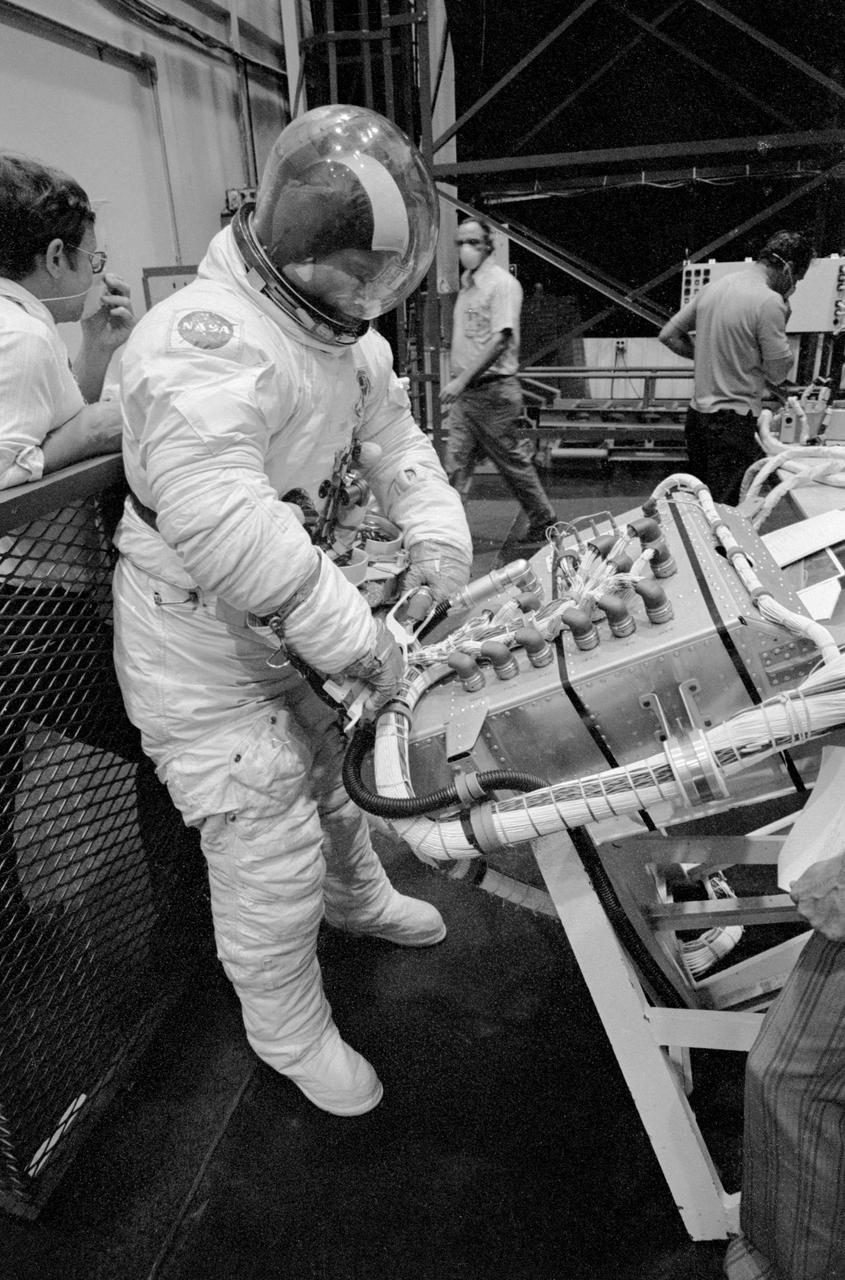
S73-31323 (30 June 1973) --- Astronaut Jack R. Lousma, Skylab 3 pilot, practices procedures for extravehicular activity (EVA) in his Extravehicular Mobility Unit (EMU) spacesuit during Skylab 3 prelaunch training at Johnson Space Center. He is working with a mock-up of a trunion plug plate which is on the space station's deployment assembly. Photo credit: NASA
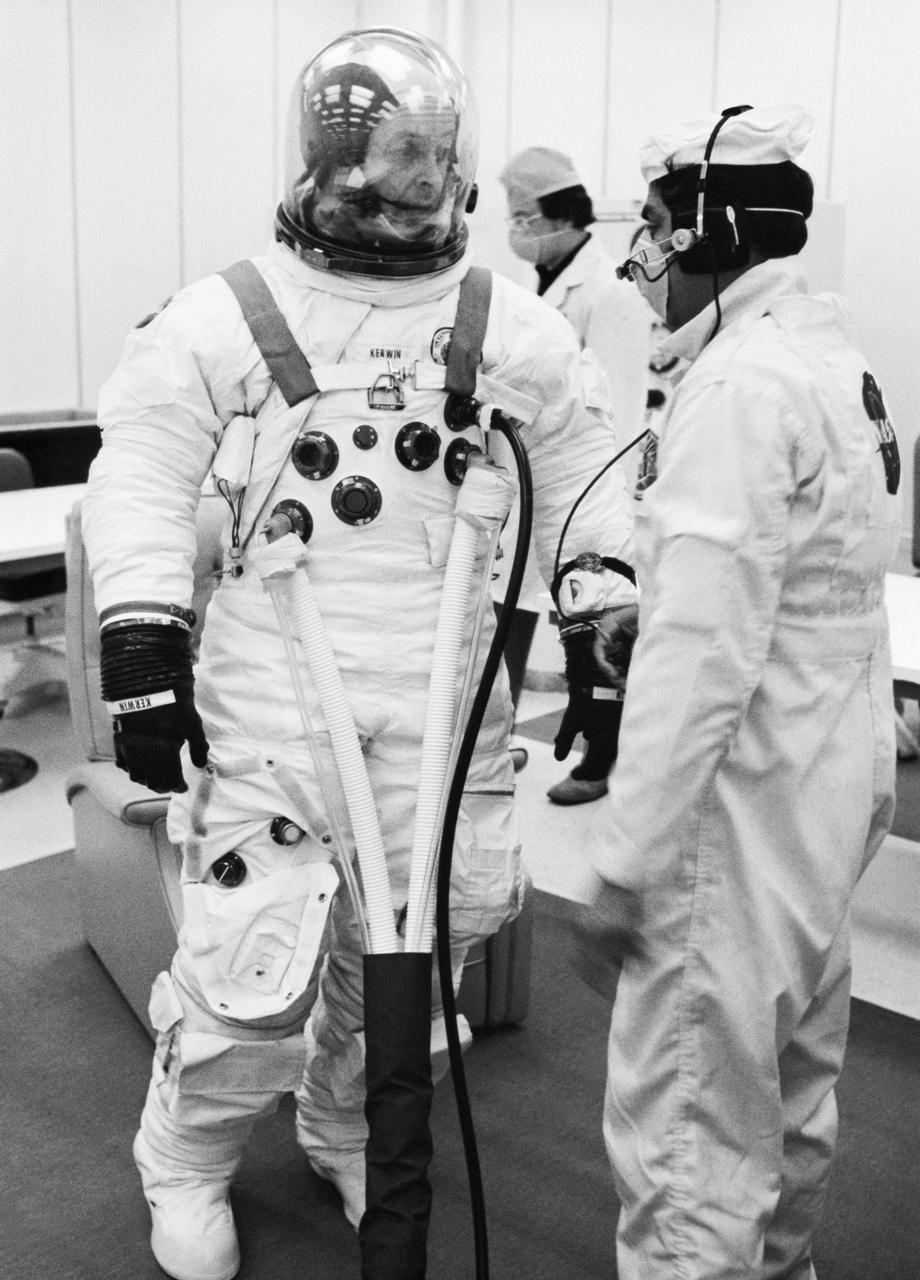
S73-25900 (25 May 1973) --- Scientist-astronaut Joseph P. Kerwin, science pilot of the Skylab 2 mission, is suited up in the Manned Spacecraft Operations Building at the Kennedy Space Center during Skylab 2 prelaunch preparations. Photo credit: NASA
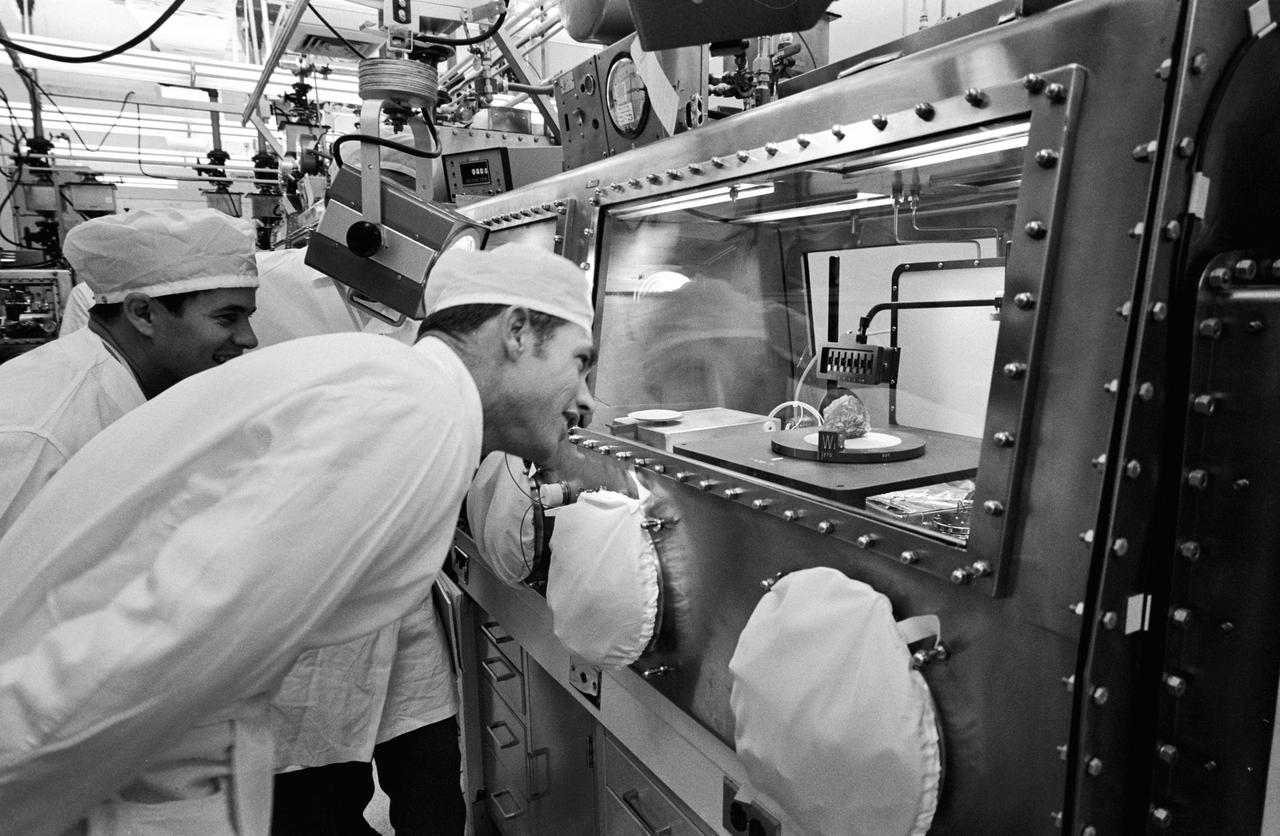
S71-43477 (12 Aug. 1971) --- Astronaut David R. Scott, right, commander of the Apollo 15 mission, gets a close look at the sample referred to as "Genesis rock" in the Non-Sterile Nitrogen Processing Line (NNPL) in the Lunar Receiving Laboratory (LRL) at the Manned Spacecraft Center (MSC). Scientist-astronaut Joseph P. Allen IV, left, an Apollo 15 spacecraft communicator, looks on with interest. The white-colored rock has been given the permanent identification of 15415.

S73-26794 (26 May 1973) --- Two of the three Skylab 2 astronauts are seen in the wardroom of the crew quarters of the Orbital Workshop of the Skylab 1 space station cluster in Earth orbit in this reproduction taken from a color television transmission made by a TV camera aboard the space station. They are preparing a meal. Astronaut Charles Conrad Jr., commander, is in the right foreground. In the background is scientist-astronaut Joseph P. Kerwin, science pilot. Photo credit: NASA
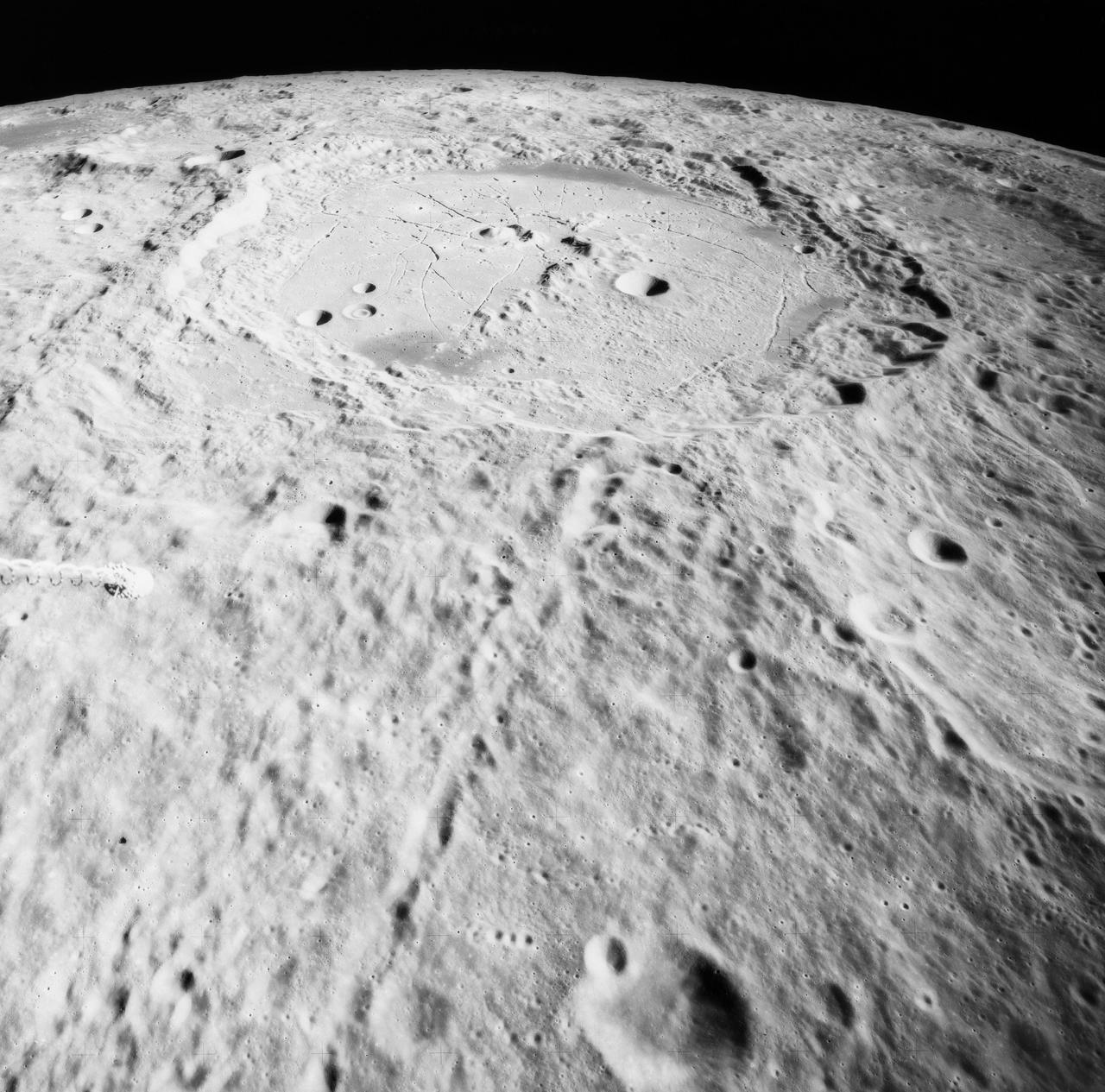
S71-44668 (31 July-2 Aug. 1971) --- An oblique view of the crater Humboldt, as photographed by the Fairchild metric camera in the Scientific Instrument Module (SIM) bay of the Apollo 15 Command and Service Modules (CSM) in lunar orbit. This view is looking southerly. Humboldt, which is 200 kilometers (124 statute miles) in diameter, is located at 81 degrees east longitude and 27 degrees south latitude. The three-inch mapping camera was one of eight lunar orbital science experiments located in the SIM bay.

S73-27508 (6 June 1973) --- An artist's concept showing astronaut Charles Conrad Jr., Skylab 2 commander, attempting to free the solar array system wing on the Orbital Workshop during extravehicular activity at the Skylab 1 & 2 space station cluster in Earth orbit. The astronaut in the background is Joseph P. Kerwin, Skylab 2 science pilot. Here, Conrad is pushing up on the Beam Erection Tether (BET) to raise the stuck solar panel. The solar wing is only partially deployed; an aluminum strap is believed to be holding it down. Note the cut aluminum angle. Attach points for the BET are on the vent module of the solar array beam. The other end of the BET is attached to the "A" frame supporting the Apollo Telescope Mount (ATM) which is out of view. The aluminum strapping is to be out first, freeing the solar array beam. Then, if the beam does not automatically deploy, Conrad will attempt to help by pulling on the BET. The automatic openers may have become too cold to open without assistance. A deployed solar panel of the ATM is at upper left. The EVA is scheduled for Thursday, June 7th. This concept is by artist Paul Fjeld. Photo credit: NASA
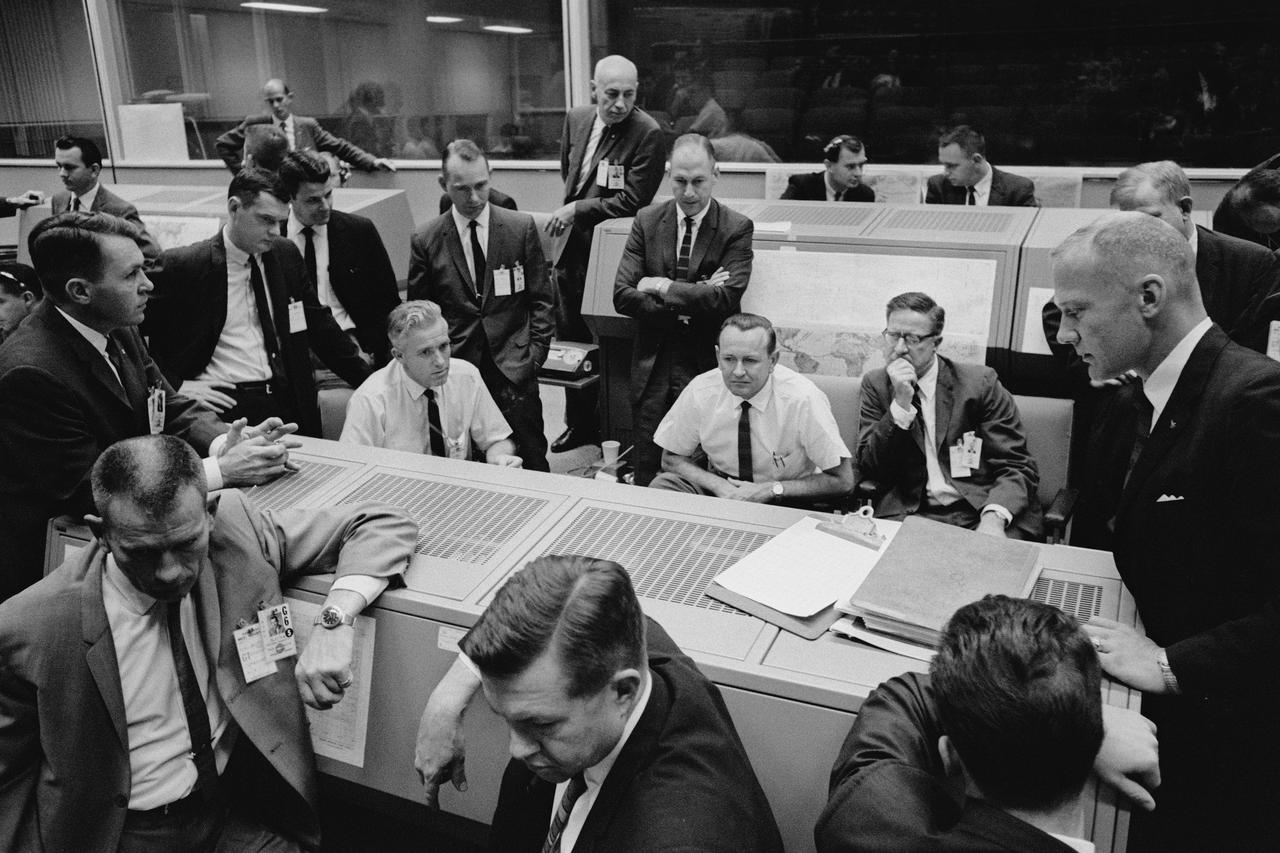
S65-44401 (1965) --- A group of National Aeronautics and Space Administration (NASA) and Manned Spacecraft Center (MSC) officials and personnel watch a Cape Kennedy press conference being telecast in the Mission Control Center (MCC) after the Gemini-6 mission was scrubbed due to the apparent failure of the Agena Target Vehicle to attain orbit.
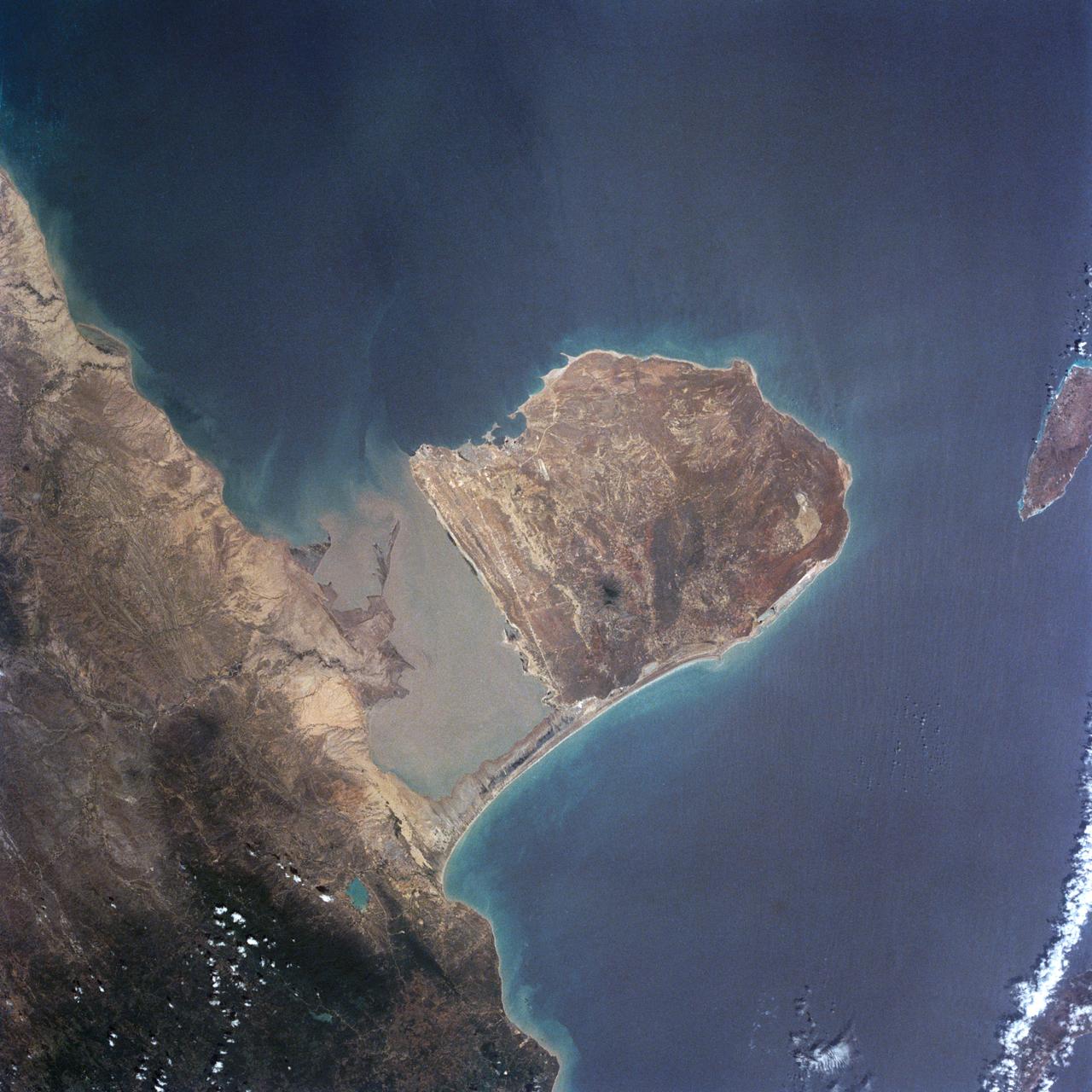
Various views of Earth taken on STS-7 for news release.
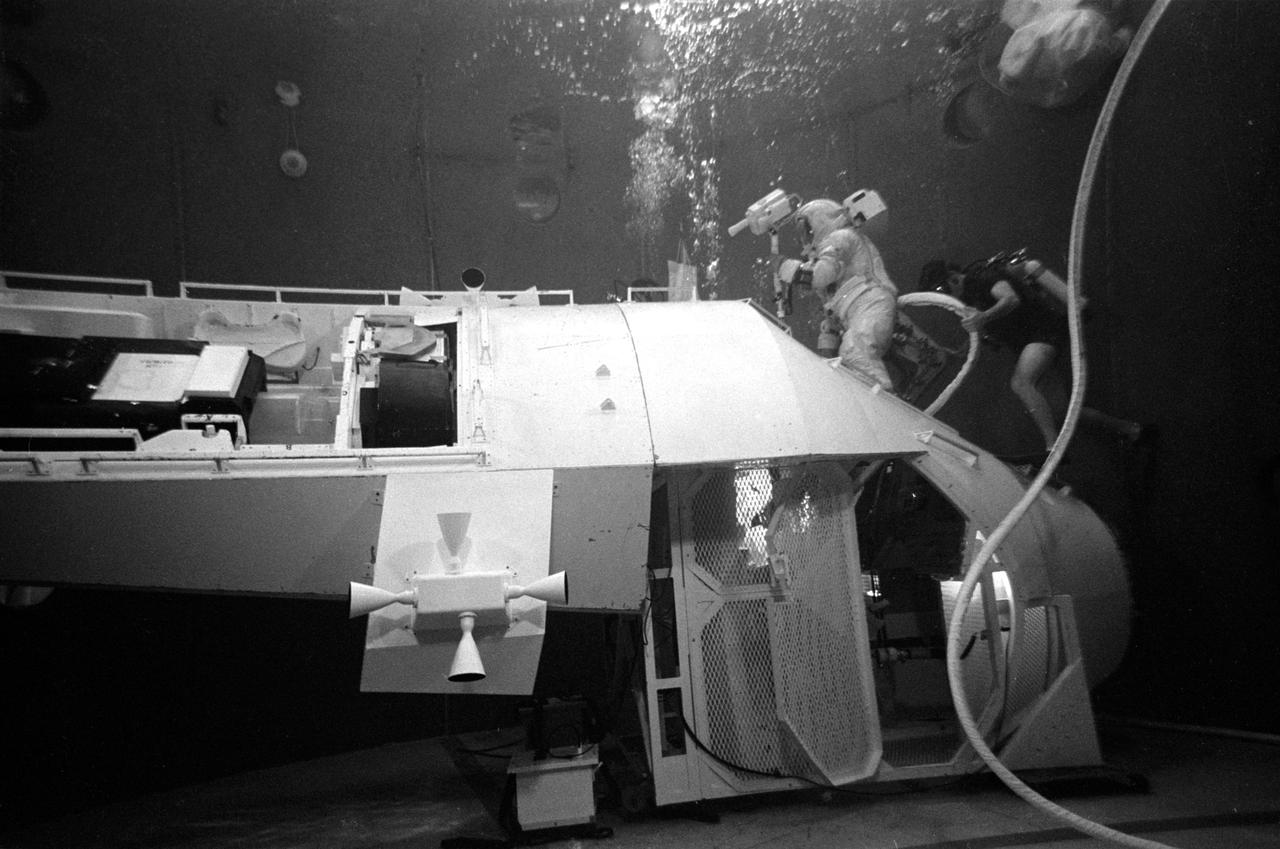
S71-58148 (1 Dec. 1971) --- Astronaut Thomas K. Mattingly II, command module pilot of the planned Apollo 16 lunar landing mission, participates in extravehicular activity (EVA) simulations in the water facility tank in Building 5 at the Manned Spacecraft Center (MSC), Houston, Texas, during training preparations for the forthcoming mission. Mattingly is scheduled to perform EVA during the trans-Earth journey of the Apollo 16 mission.
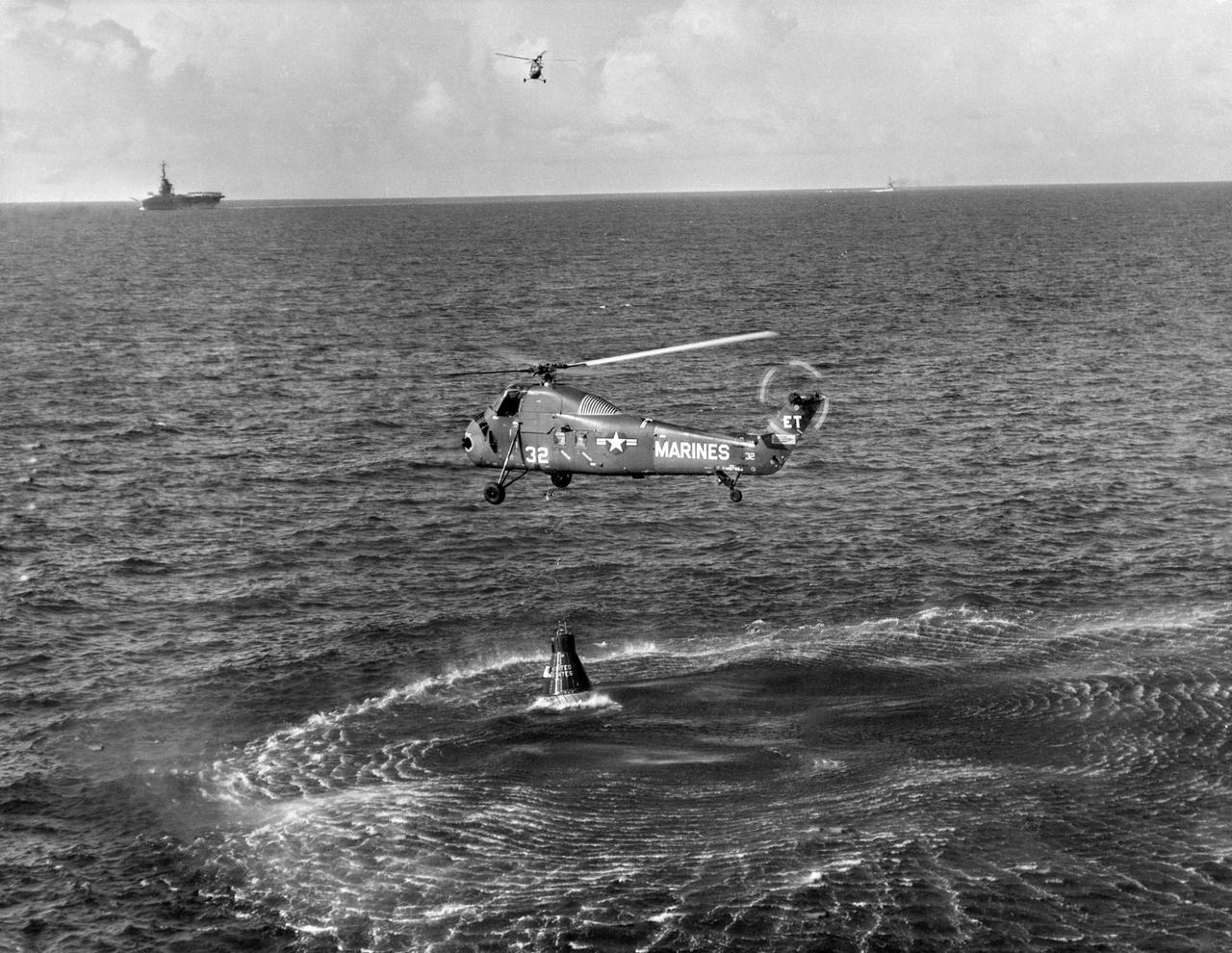
S61-02821 (21 July 1961) --- Attempted recovery of Mercury spacecraft at end of the Mercury-Redstone 4 (MR-4) mission. View shows the Marine helicopter dropping a recovery line to the capsule. In the upper left corner of the view, the recovery ship and another helicopter can be seen. Photo credit: NASA
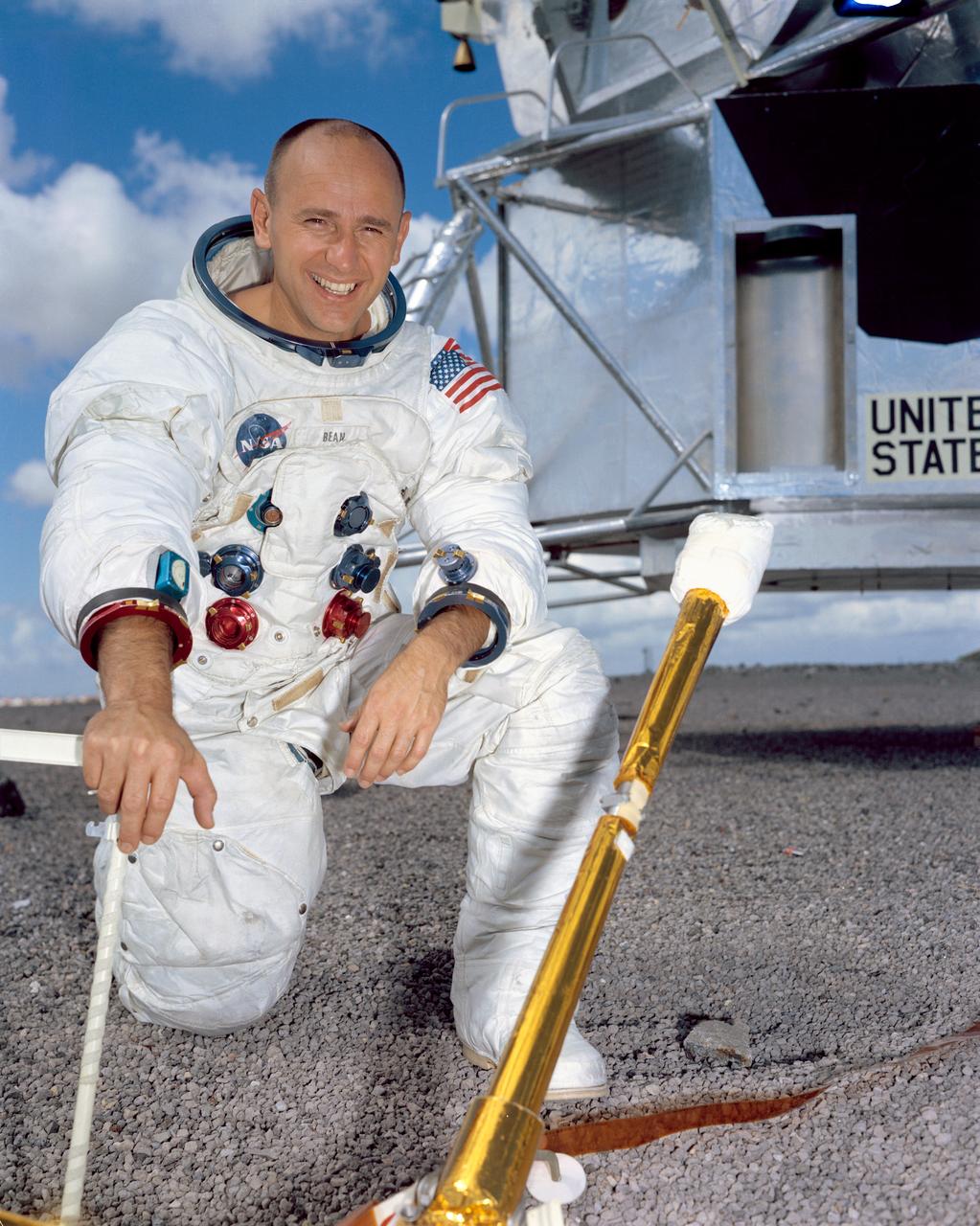
S69-38859 (September 1969) --- Astronaut Alan L. Bean, Apollo 12 lunar module pilot.
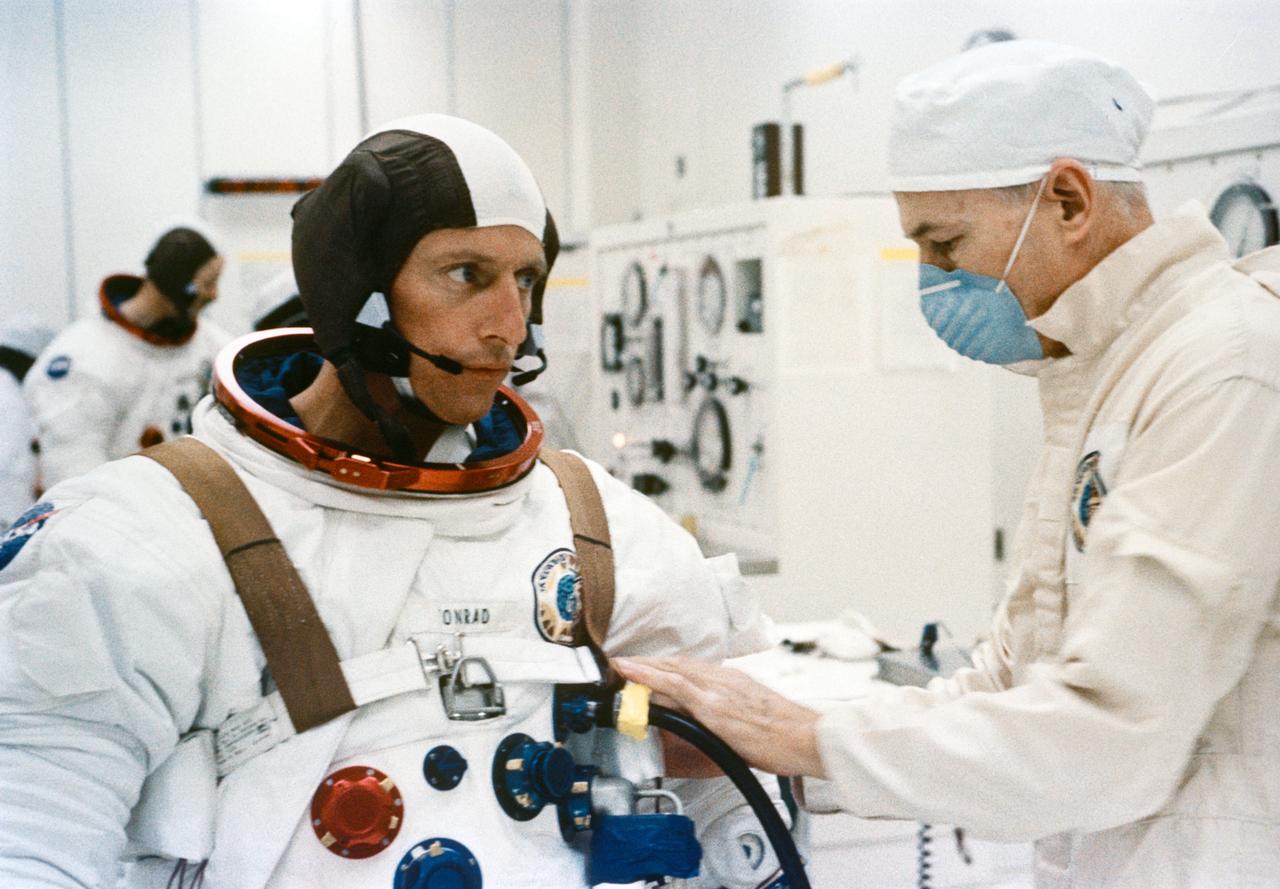
S73-25901 (25 May 1973) --- Astronaut Charles Conrad Jr., commander of the Skylab 2 mission, is suited up in the Manned Spacecraft Operations Building at the Kennedy Space Center during Skylab 2 prelaunch preparations. Skylab 2, with astronauts Conrad, Joseph P. Kerwin and Paul J. Weitz aboard, was launched from KSC's Pad B, Launch Complex 39, at 9:00 a.m. (EDT), May 25, 1973. Photo credit: NASA
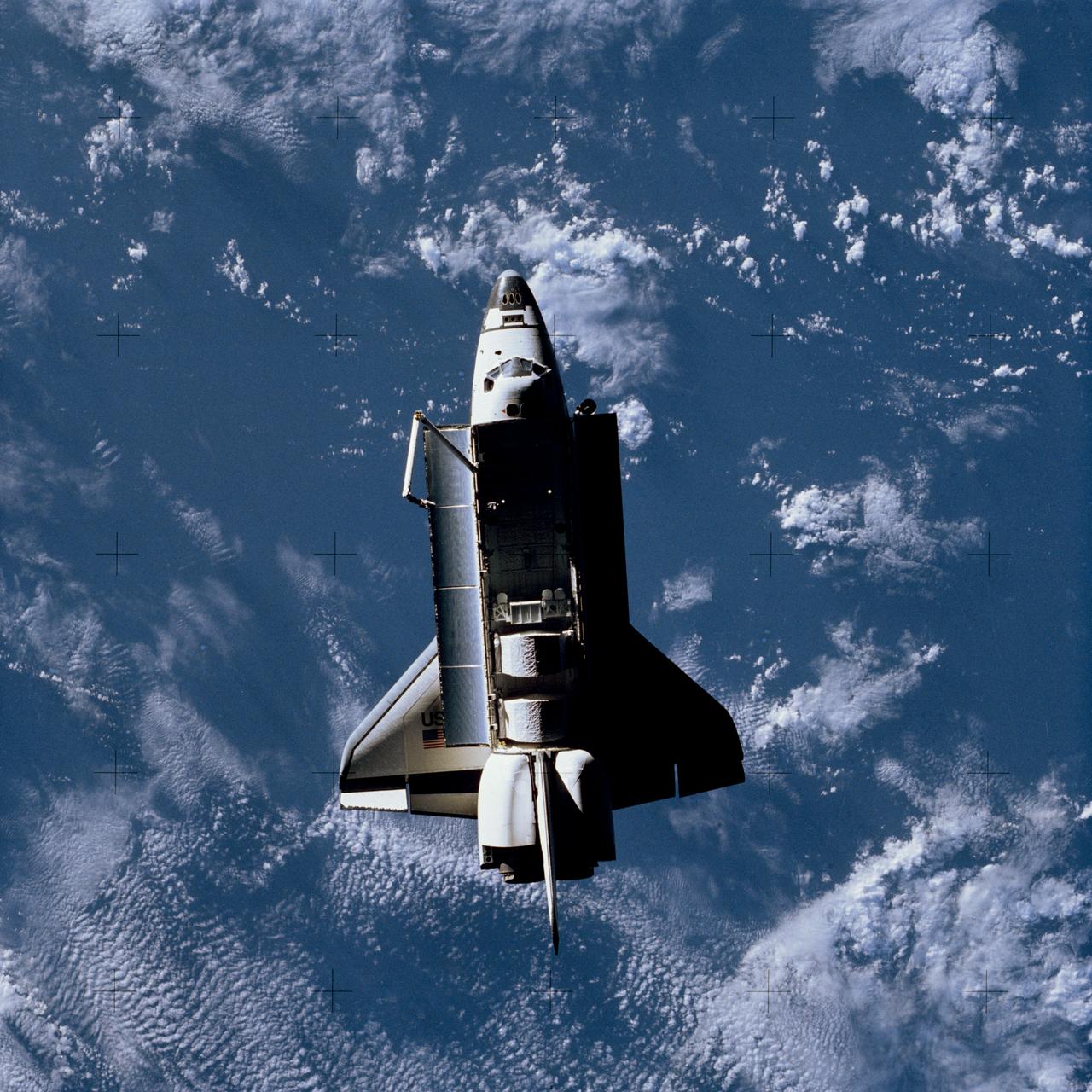
Full views of "Challenger" in Space, taken by the Shuttle Pallet Satellite (SPAS), also views of Cargo Bay and Remote Manipulator System (RMS) extended. 1. SHUTTLE - RMS (STS-7) Also available in 4x5 CN
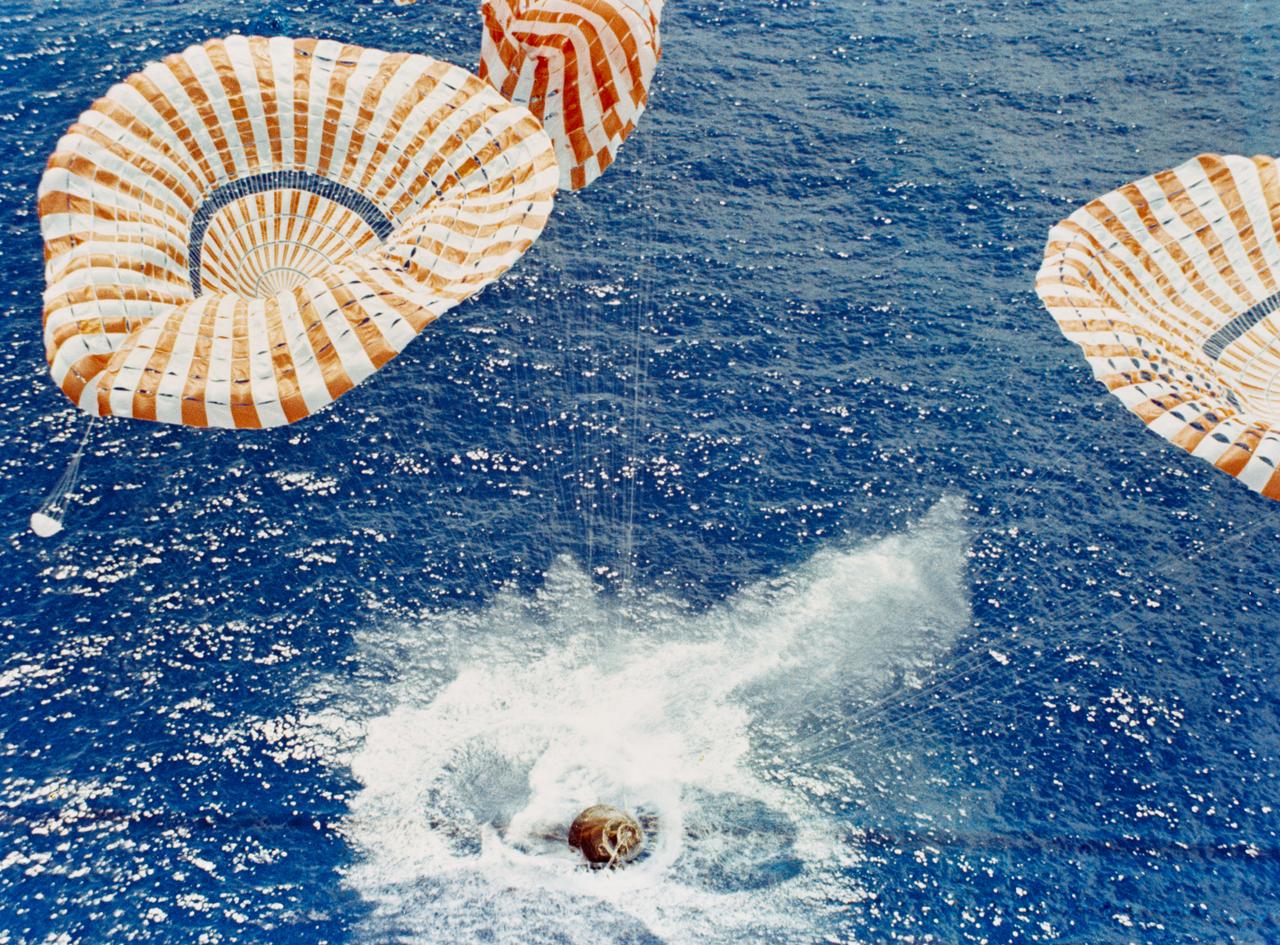
S71-43542 (7 Aug. 1971) --- The Apollo 15 Command Module (CM), with astronauts David R. Scott, commander; Alfred M. Worden, command module pilot; and James B. Irwin, lunar module pilot, aboard safely touches down in the mid-Pacific Ocean to conclude a highly successful lunar landing mission. Although causing no harm to the crew men, one of the three main parachutes failed to function properly. The splashdown occurred at 3:45:53 p.m. (CDT), Aug. 7, 1971, some 330 miles north of Honolulu, Hawaii. The three astronauts were picked up by helicopter and flown to the prime recovery ship, USS Okinawa, which was only 6 1/2 miles away.
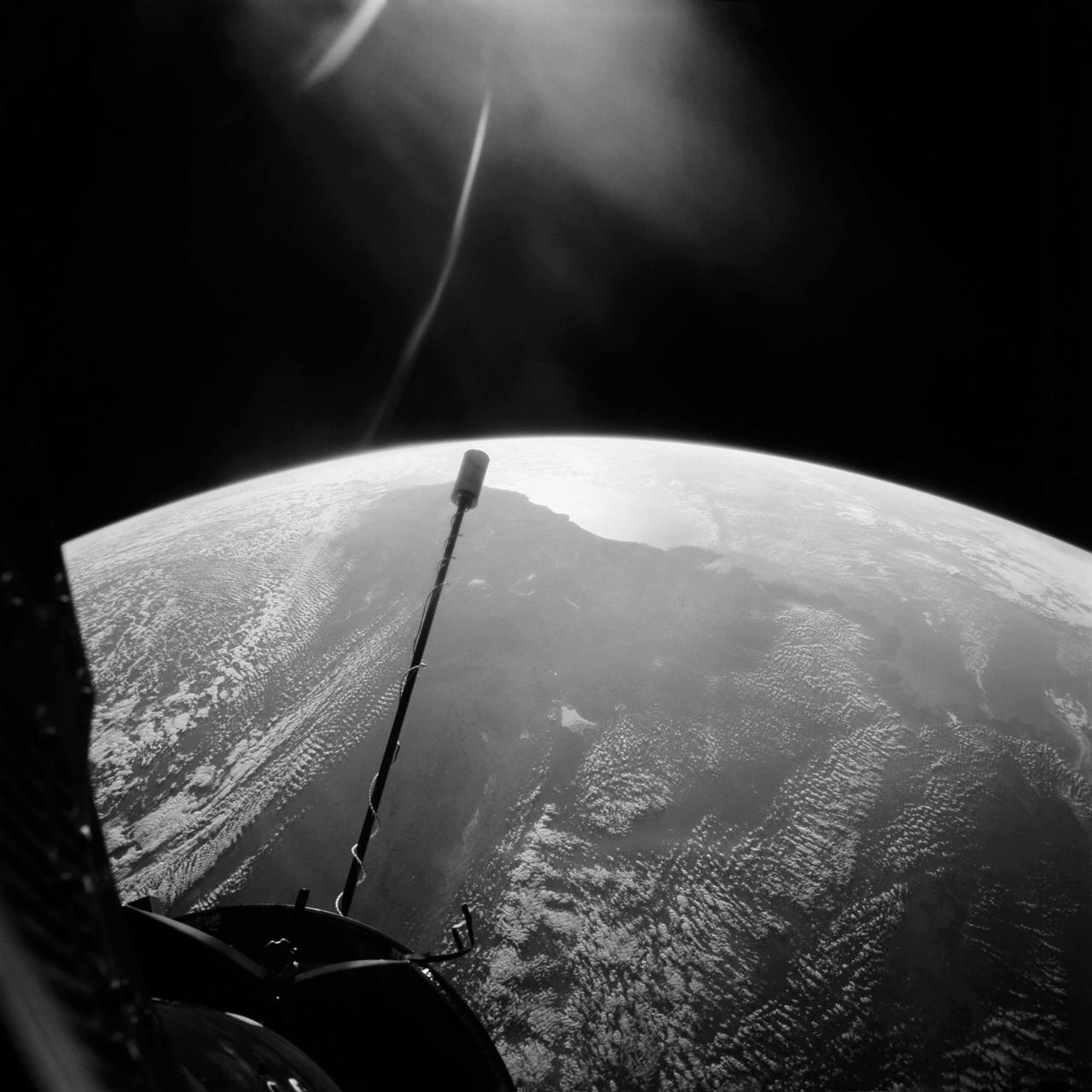
S66-54643 (14 Sept. 1966) --- Western half of Australia, including the coastline from Perth to Port Darwin, looking west, as seen from the Gemini-11 spacecraft at a record-high apogee of 740 nautical miles during its 26th revolution of Earth. Photo credit: NASA
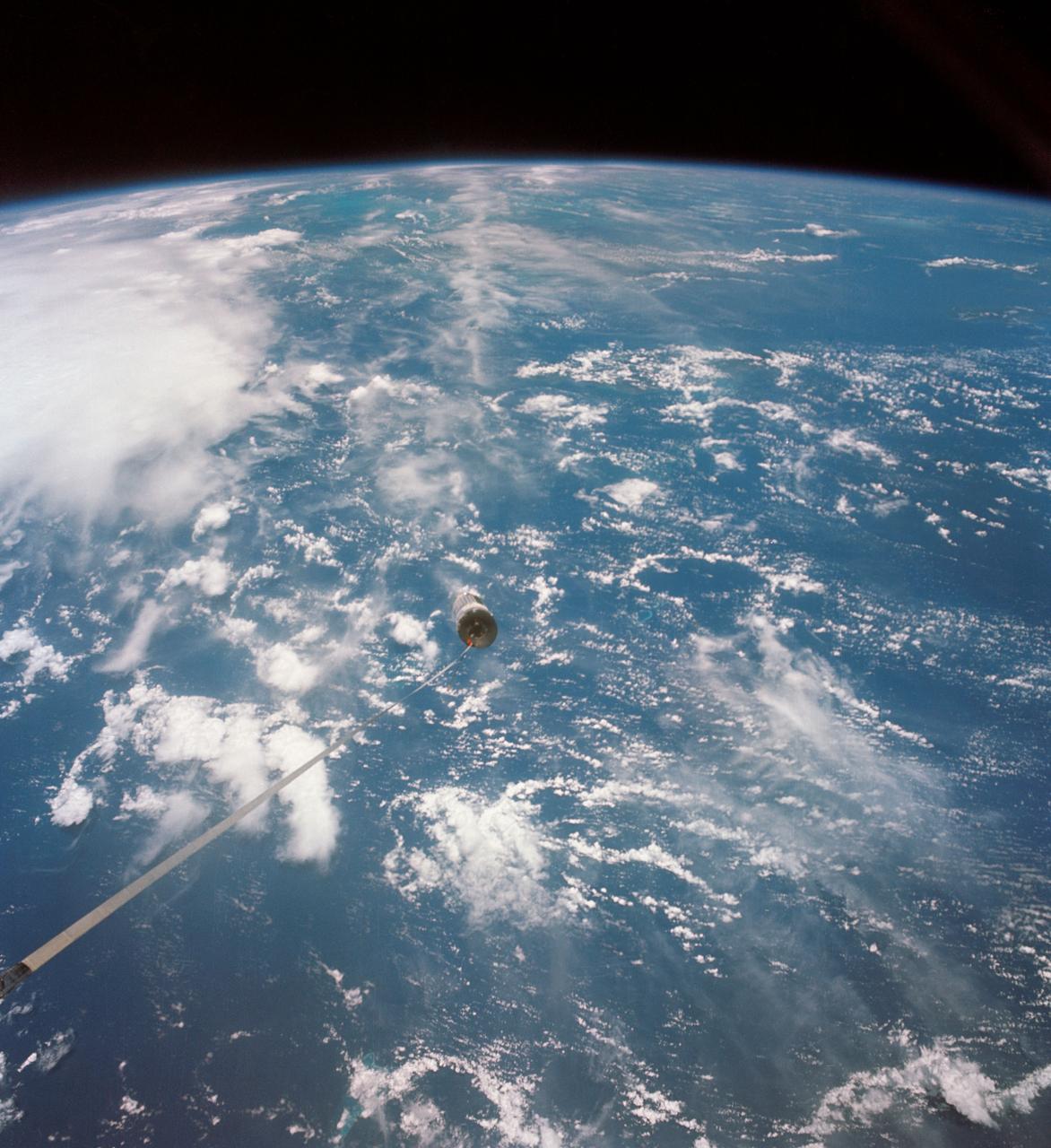
S66-54571 (14 Sept. 1966) --- A 100-foot tether line connects the Agena Target Docking Vehicle with the Gemini-11 spacecraft during its 32nd revolution of Earth. Photo credit: NASA
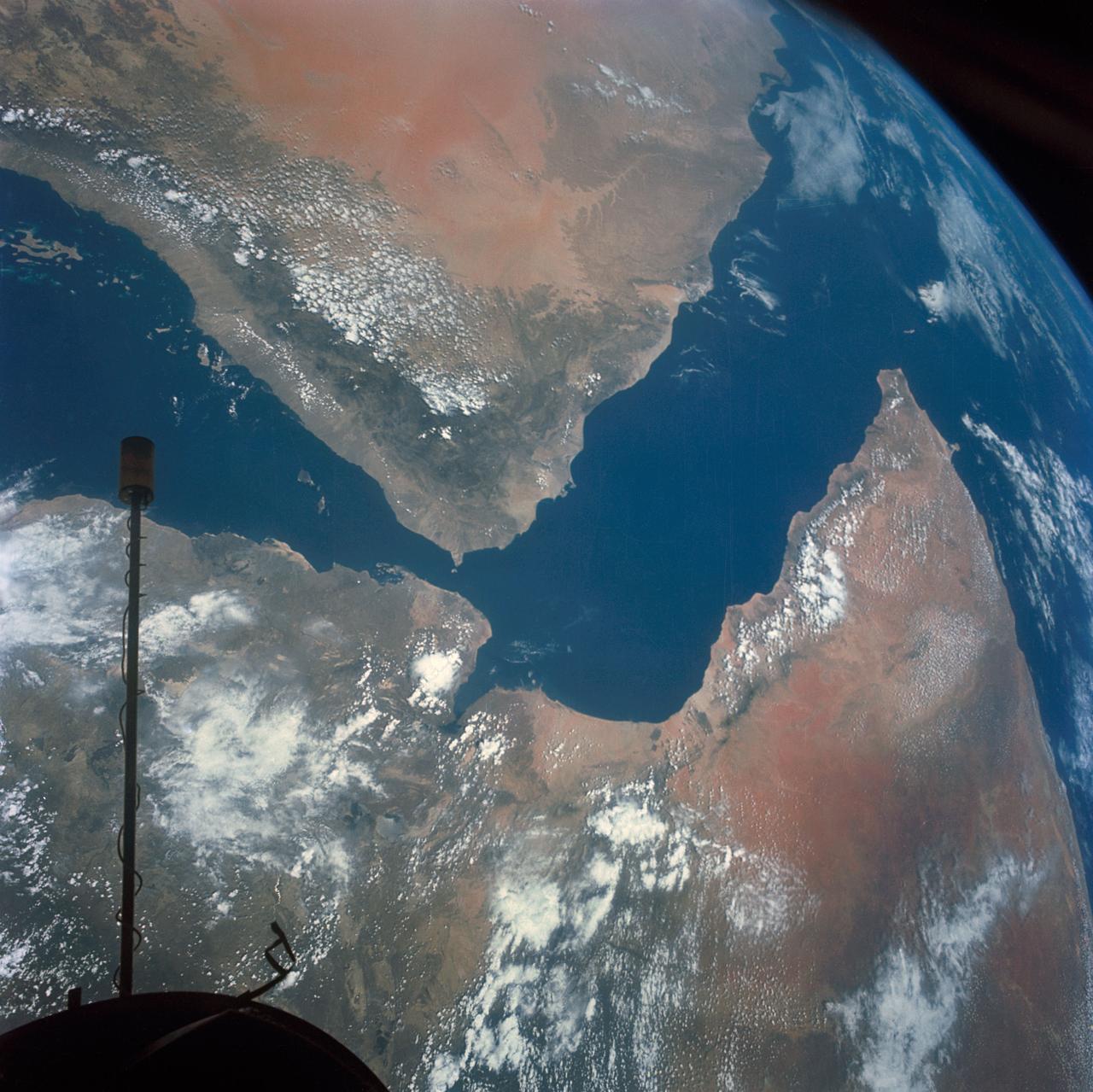
S66-54536 (14 Sept. 1966) --- Arabian Peninsula (on left) and northeast Africa (on right) as seen from the orbiting Gemini-11 spacecraft at an altitude of 340 nautical miles during its 27th revolution of Earth, looking southeast. Saudi Arabia, South Arabia, Yemen, and Aden Protectorate are at left. At bottom right is Ethiopia. French Somaliland is in center on right shore. Somali is at upper right. Body of water at bottom is Red Sea. Gulf of Aden is in center; and at top left is Indian Ocean. Taken with a modified 70mm Hasselblad camera, using Eastman Kodak, Ektachrome, MS (S.O. 368) color film. Photo credit: NASA
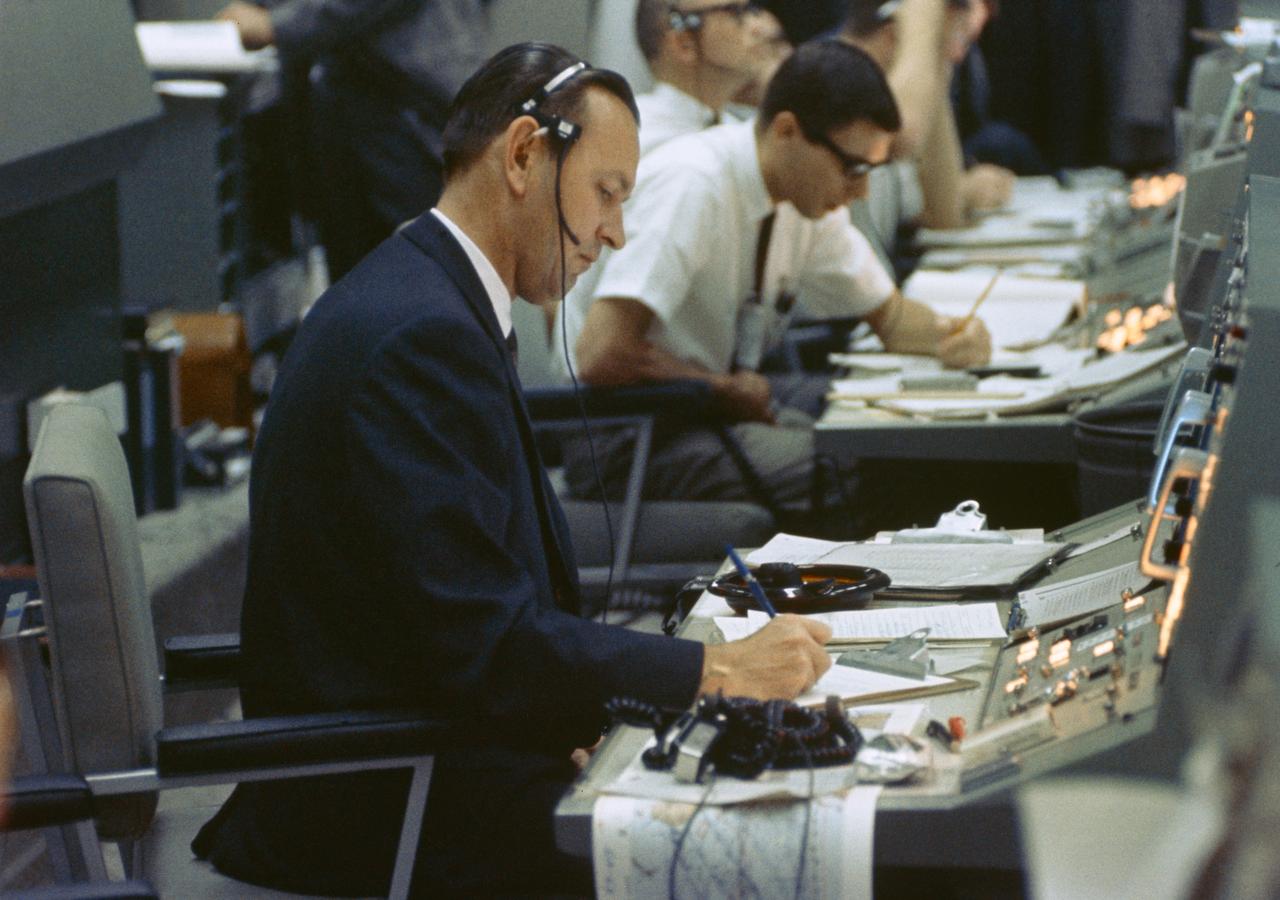
S65-28462 (3-7 June 1965) --- Christopher C. Kraft Jr., assistant director for Flight Operations, at his console in the Mission Control Center during Gemini-4 spaceflight. He served as mission director and as a flight director.
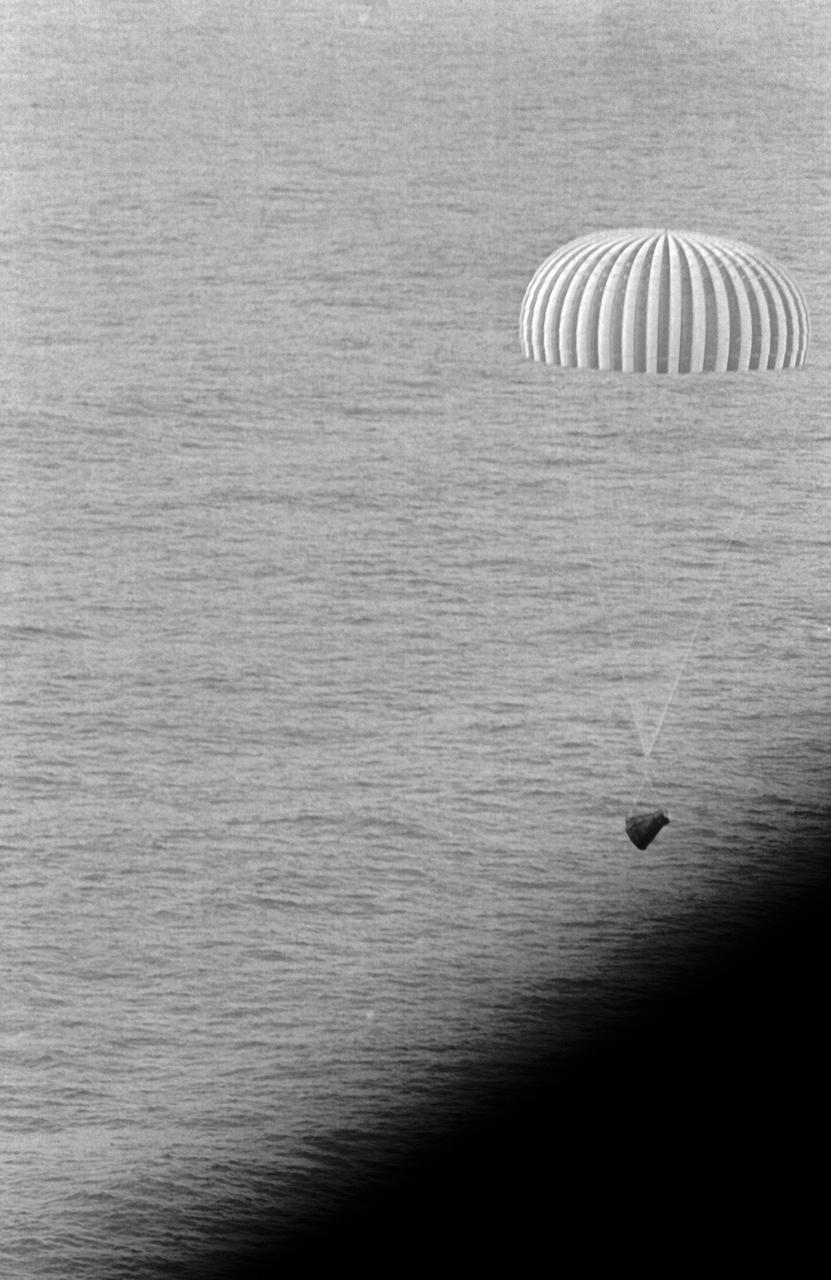
S66-42795 (21 July 1966) --- The Gemini-10 spacecraft, with astronauts John W. Young and Michael Collins aboard, nears touchdown in the Atlantic Ocean about four nautical miles from the prime recovery ship, USS Guadalcanal. Gemini-10 splashed down 460 nautical miles east of Cape Kennedy at 4:07 p.m. (EST), July 21, 1966, to conclude a three-day mission in space. Photo credit: NASA
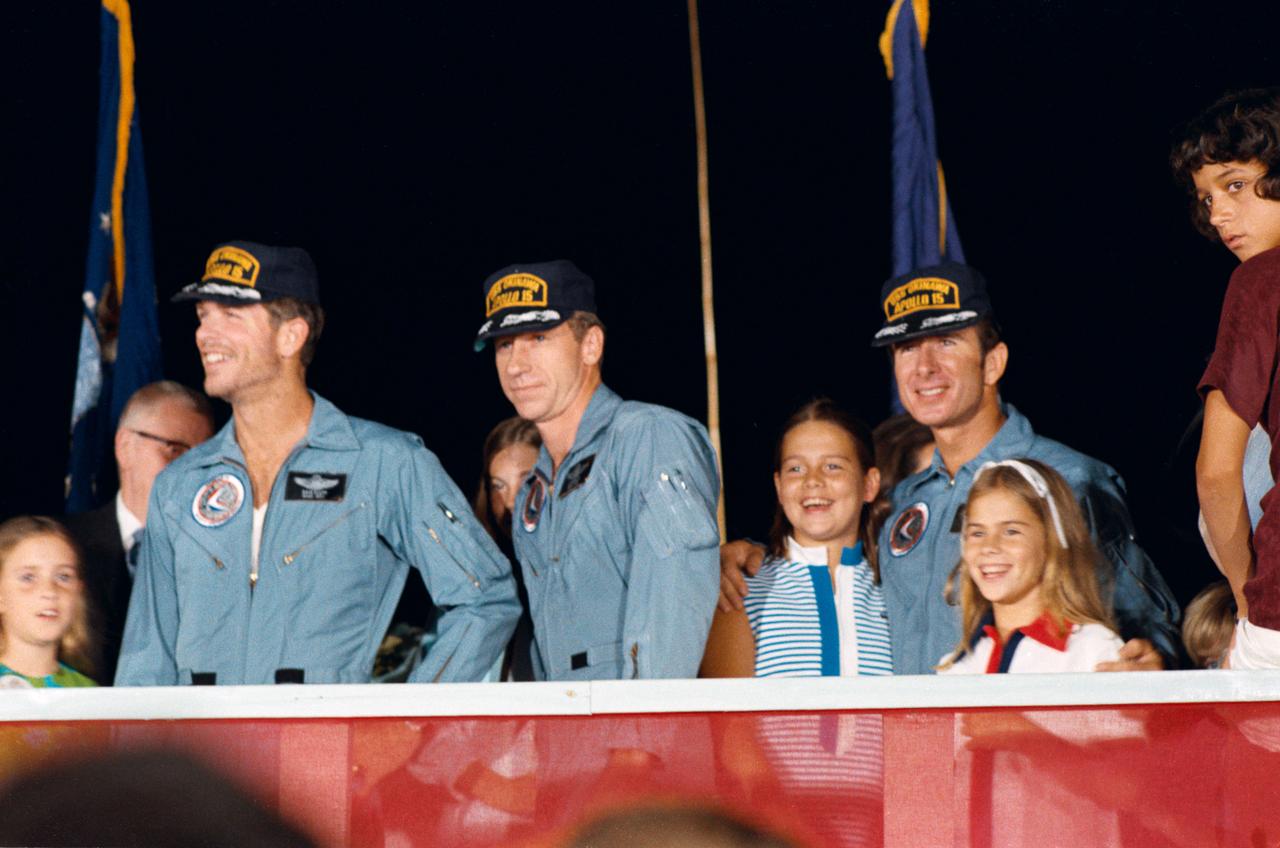
S71-43428 (8 Aug. 1971) --- The three crew men, of the highly successful Apollo 15 lunar landing mission, receive a warm welcome home at Ellington Air Force Base (EAFB), Houston, after an eight hour flight aboard a U.S. Air Force C-141 jet aircraft from Hawaii. Left to right, are astronauts David R. Scott, commander; Alfred M. Worden, command module pilot; and James B. Irwin, lunar module pilot. Apollo 15 splashdown in the mid-Pacific at 3:45 p.m. (CDT), Aug. 7, 1971, some 330 miles north of Honolulu. The C-141 landed at EAFB at 9 p.m. (CDT), Sunday, Aug. 8, 1971. Members of the astronauts' families identifiable in the picture are, left to right, Scott's daughter, Tracy; Worden's father, Merrill Worden; Worden's daughter, Merrill; and Irwin's two daughters, Joy and Jill.
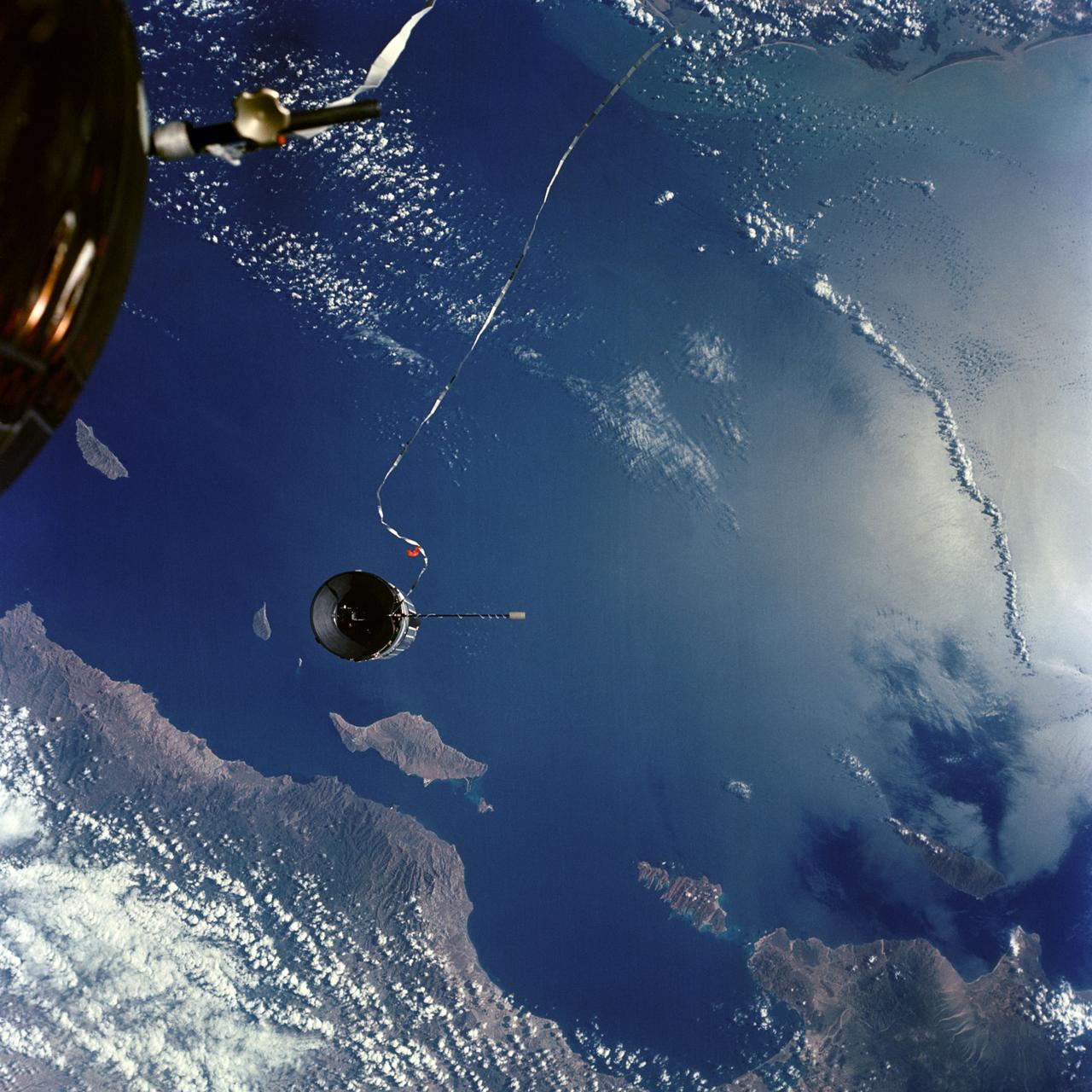
S66-54810 (14 Sept. 1966) --- The Agena Target Docking Vehicle is tethered to the Gemini-11 spacecraft during its 31st revolution of Earth. Area below is the Gulf of California and Baja California at La Paz. Taken with a J.A. Maurer 70mm camera, using Eastman Kodak, Ektachrome, MS (S.O. 368) color film. Photo credit: NASA
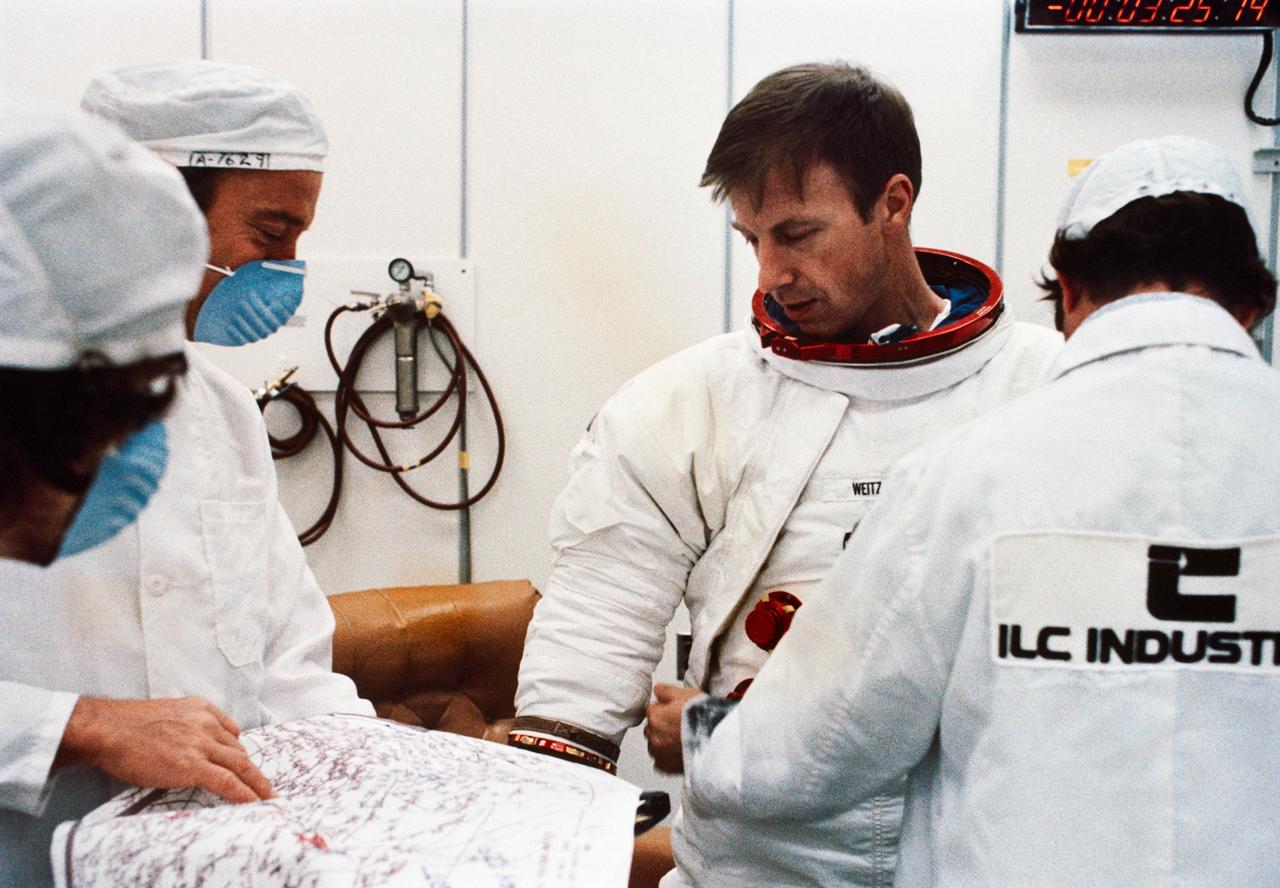
S73-25898 (25 May 1973) --- Astronaut Paul Weitz, pilot of the Skylab 2 mission, is suited up in the Manned Spacecraft Operations Building at the Kennedy Space Center during Skylab 2 prelaunch preparations. Photo credit: NASA
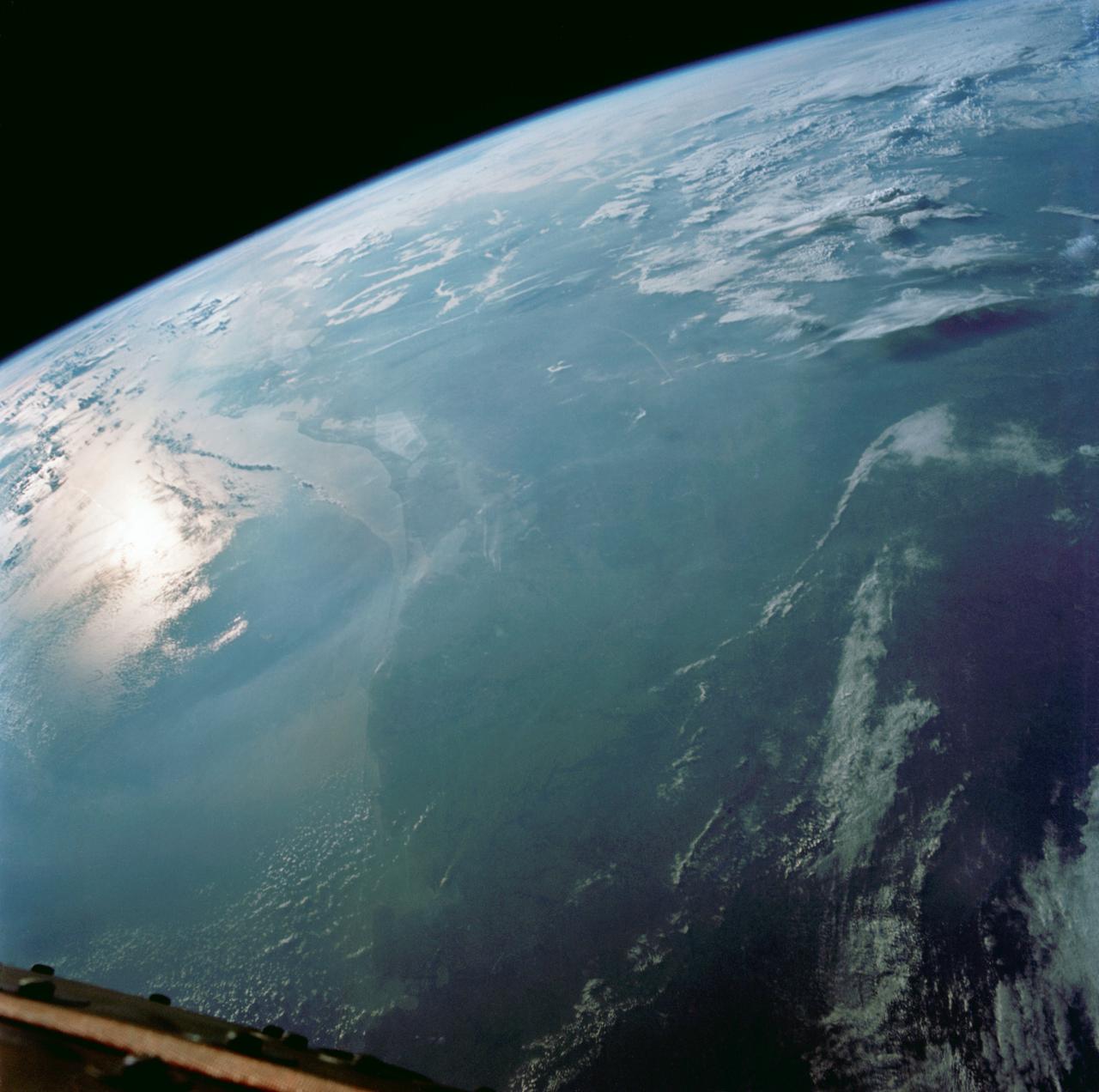
S66-54560 (14 Sept. 1966) --- U.S. Gulf coast area from Aransas Bay, Texas, to Mobile Bay, Alabama, as seen from the Gemini-11 spacecraft during its 29th revolution of Earth. The Galveston Bay and Houston area is in center of photograph. Further eastward along the coast can be seen the Mississippi River delta and New Orleans area. Taken with a modified 70mm Hasselblad camera, using Eastman Kodak, Ektachrome, MS (S.O. 368) color film. Photo credit: NASA
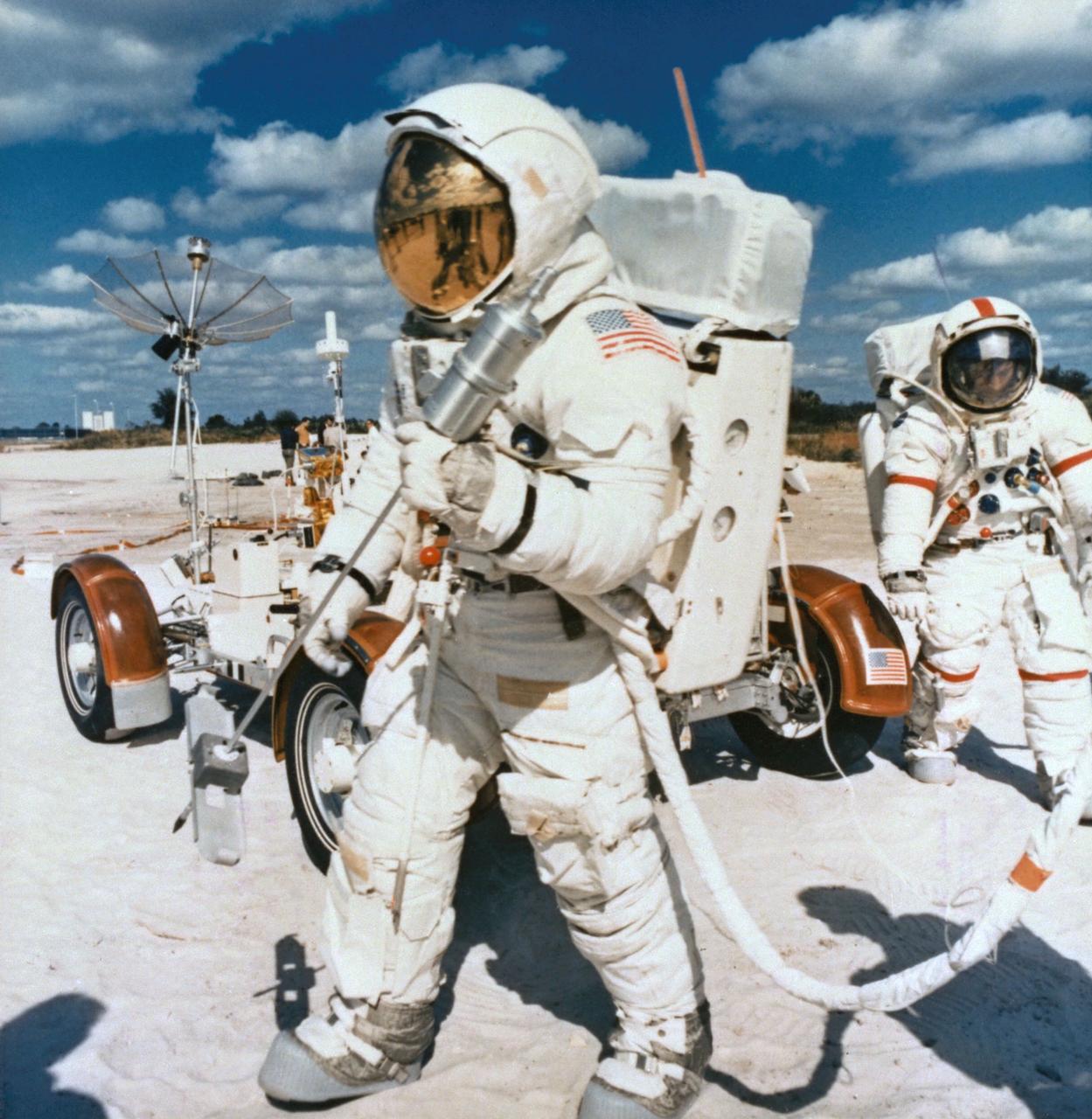
S72-30694 (28 Jan. 1972) --- Astronauts John W. Young, left, Apollo 16 commander, and Charles M. Duke Jr., lunar module pilot, prepare to begin a simulated traverse in a training area at the Kennedy Space Center (KSC). The fifth National Aeronautics and Space Administration (NASA) Apollo lunar landing mission is scheduled to land in the mountainous highlands region near the crater Descartes to explore the area for a three-day period. Among the experiments to fly on Apollo 16 is the soil mechanics (S-200) experiment or self-recording penetrometer, a model of which is held here by Duke. A training model of the Lunar Roving Vehicle (LRV) is parked between the two crew men. Astronaut Thomas K. (Ken) Mattingly II is prime crew command module pilot for the mission.
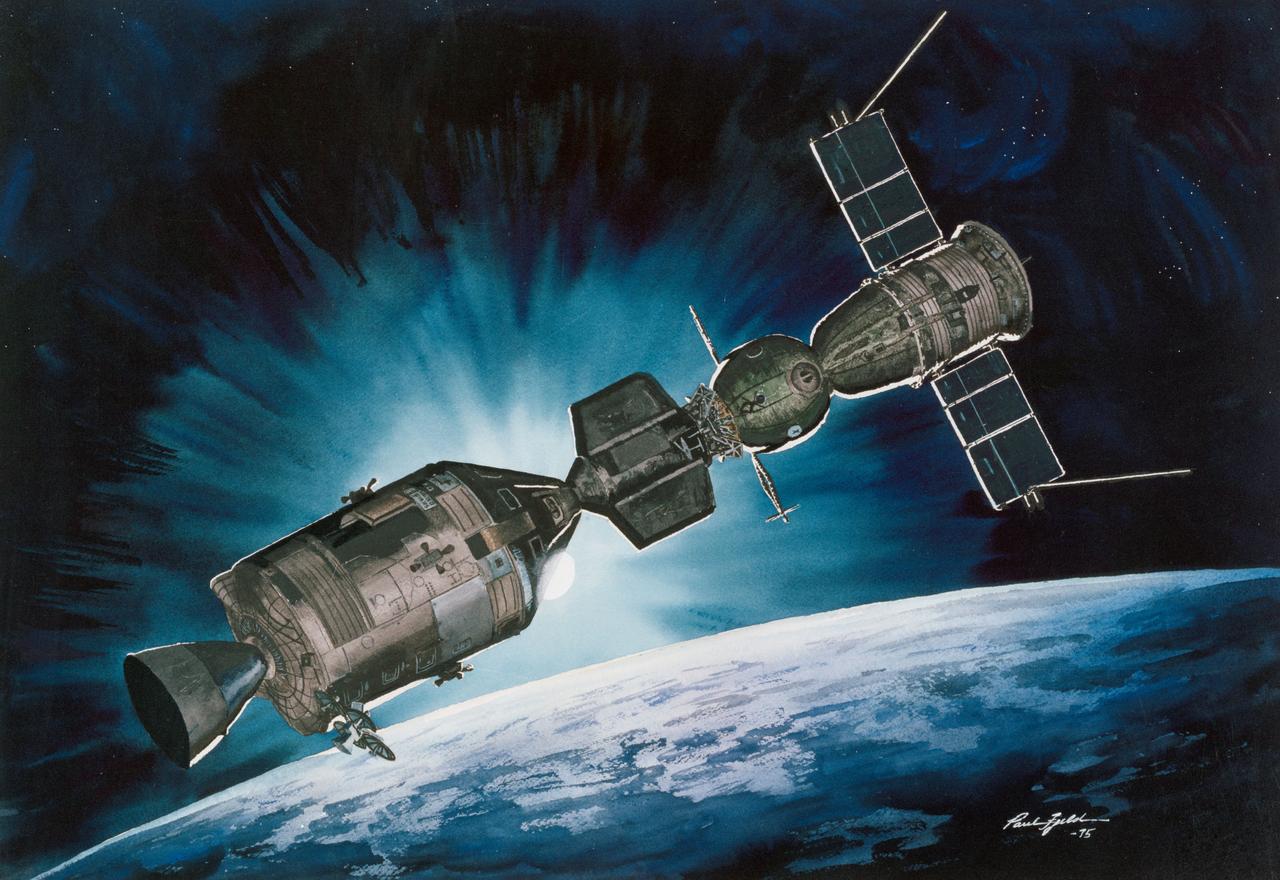
S75-28511 (July 1975) --- An artist?s concept depicting the American and Soviet spacecraft docked in Earth orbit during the July 1975 Apollo-Soyuz Test Project mission. The Apollo Command/Service Module is on the left, the Docking Module is in the center, and the Soyuz spacecraft is on the right. The first docking of spacecraft from two different nations was scheduled for July 17, 1975. The American and Soviet ASTP crewmen planned to visit each other?s spacecraft while Apollo and Soyuz are docked for a maximum period of two days. The docking system on the Docking Module and the docking system on the Soyuz Orbital Module are designed to interface with each other. The painting is by artist Paul Fjeld.
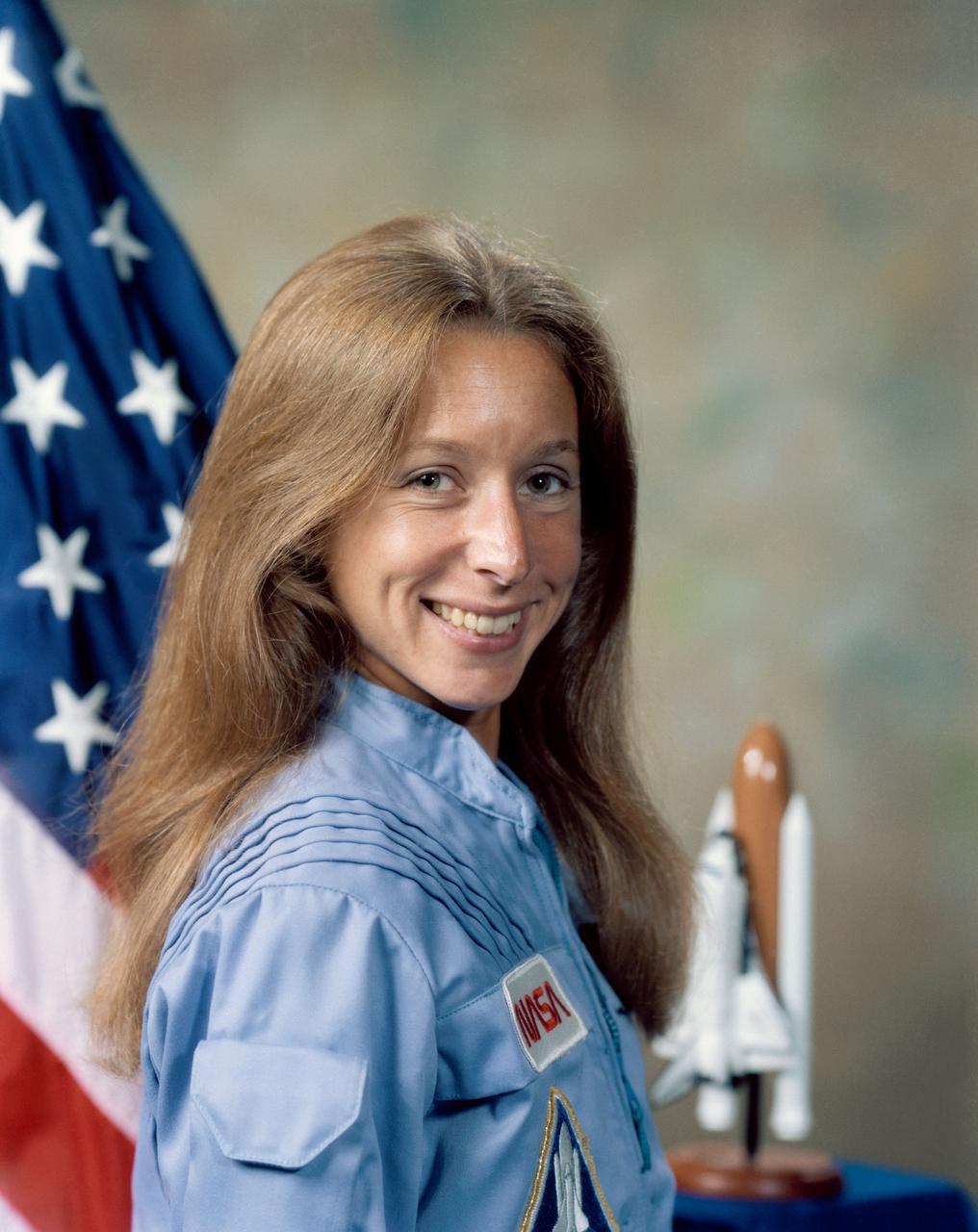
Portrait photograph, Astronaut Marsha S. Ivins, dressed in Blue Flight Suit, with Flag (frame left), and Space Shuttle Model (frame right). JSC, HOUSTON, TX
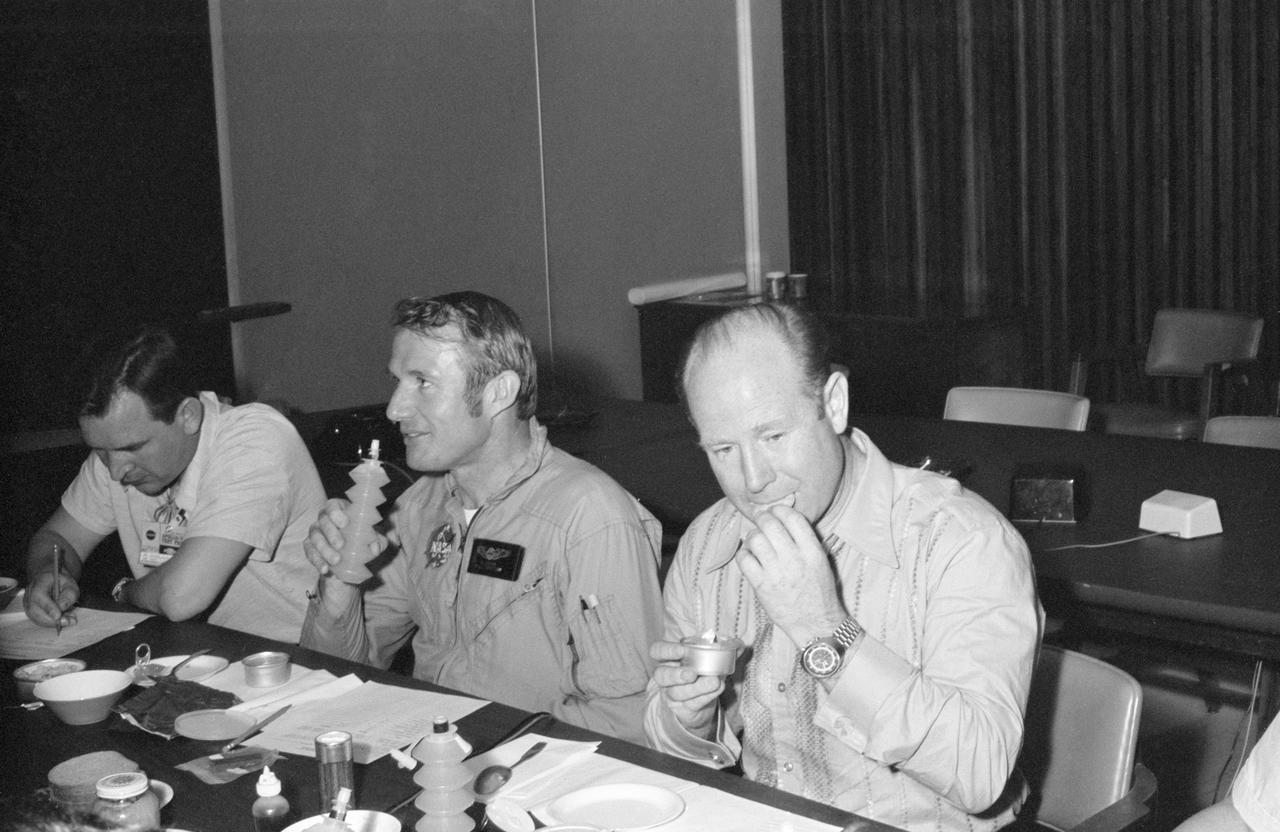
S74-20797 (23 April 1974) --- Candidate food items being considered for the joint U.S.-USSR Apollo-Soyuz Test Project mission are sampled by three ASTP crewmen in Building 4 at the Johnson Space Center. They are, left to right, cosmonaut Valeriy N. Kubasov, engineer on the Soviet ASTP crew; astronaut Vance D. Brand, command module pilot of the American ASTP crew; and cosmonaut Aleksey A. Leonov, commander of the Soviet ASTP crew. Kubasov is marking a food rating chart on which the crewmen mark their choices, likes and dislikes of the food being sampled. Brand is drinking orange juice from an accordion-like dispenser. Leonov is eating butter cookies. The two Soviet crewmen will have an opportunity to eat with the three American crewmen while the Apollo and Soyuz spacecraft are docked in Earth orbit. Leonov and Kubasov will dine on food being chosen individually by them now.
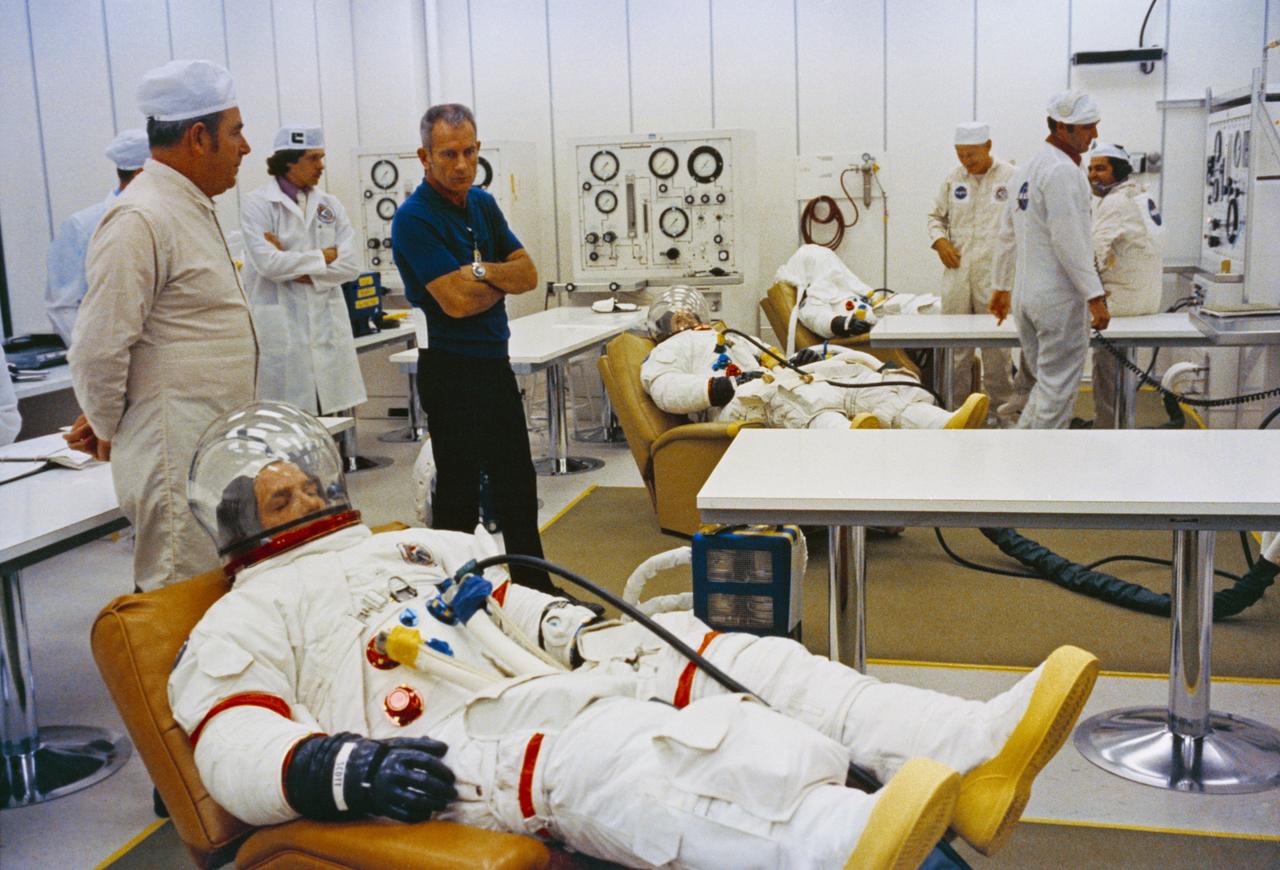
S71-41408 (26 July 1971) --- The three Apollo 15 astronauts go through suiting up operations in the Kennedy Space Center's (KSC) Manned Spacecraft Operations Building (MSOB) during the Apollo 15 prelaunch countdown. They are David R. Scott (foreground), commander; Alfred M. Worden (center), command module pilot; and James B. Irwin (background), lunar module pilot. Minutes later the crew rode a special transport van over to Pad A, Launch Complex 39, where their spacecraft awaited them. With the crew was Dr. Donald (Deke) K. Slayton (wearing dark blue sport shirt), director of Flight Crew Operations, Manned Spacecraft Center (MSC). The Apollo 15 space vehicle was launched at 9:34:00:79 a.m. (EDT), July 26, 1971, on a lunar landing mission.
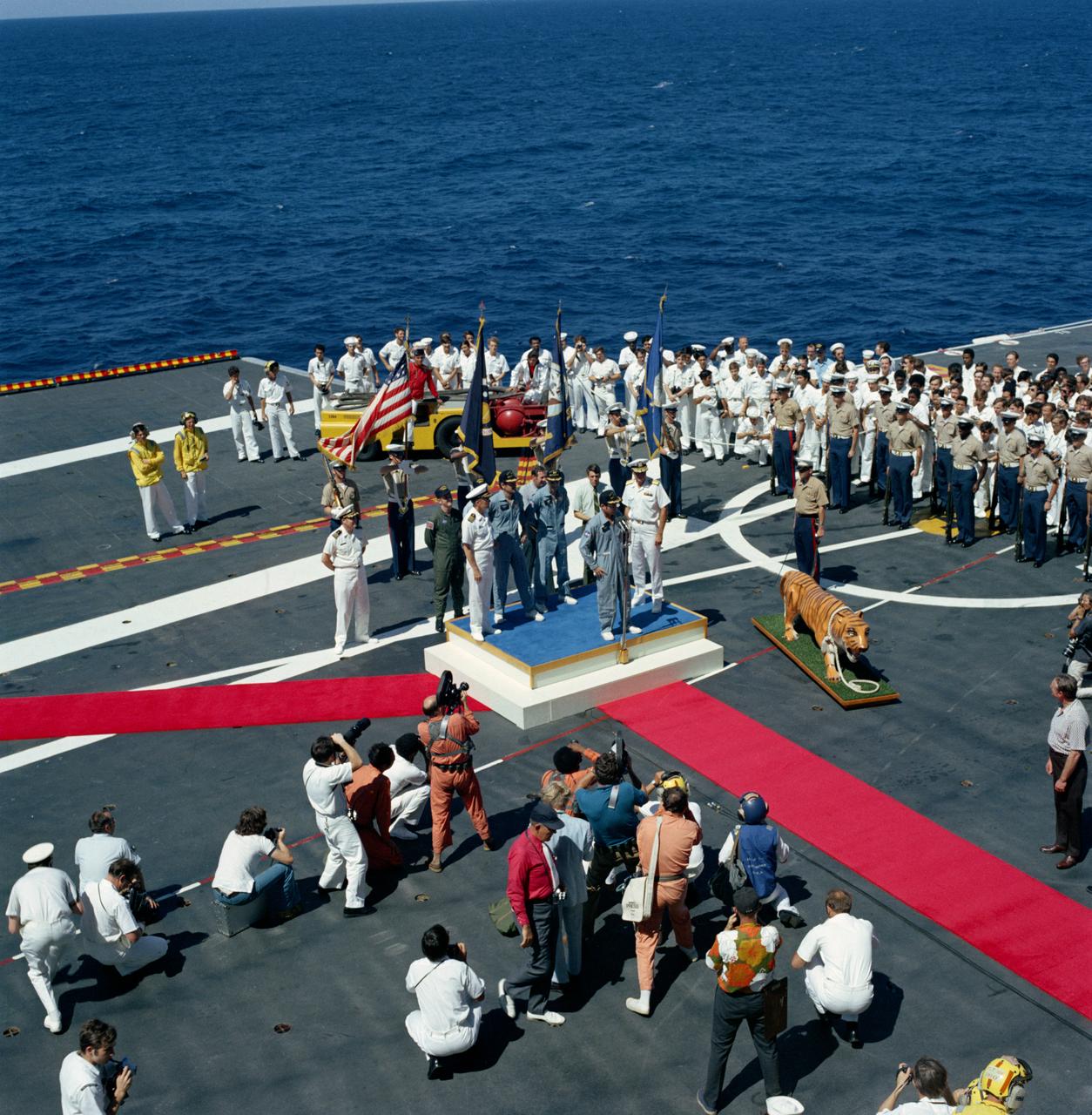
S72-36262 (27 April 1972) --- A high-angle view of the Apollo 16 welcoming aboard ceremonies on the deck of the prime recovery ship, USS Ticonderoga. It was soon after the splashdown of the Apollo 16 Command Module (CM) in the central Pacific Ocean approximately 215 miles southeast of Christmas Island. Astronaut John W. Young, commander, is standing at the microphone. Standing behind Young are astronaut Charles M. Duke Jr. (Left), lunar module pilot; and astronaut Thomas K. Mattingly II, command module pilot. The splashdown occurred at 290:37:06 ground elapsed time, 1:45:06 p.m. (CST), Thursday, April 27, 1972. The coordinates were 00:43.2 degrees south latitude and 156:11.4 degrees west longitude. The three crew members were picked up by helicopter and flown to the deck of the USS Ticonderoga.
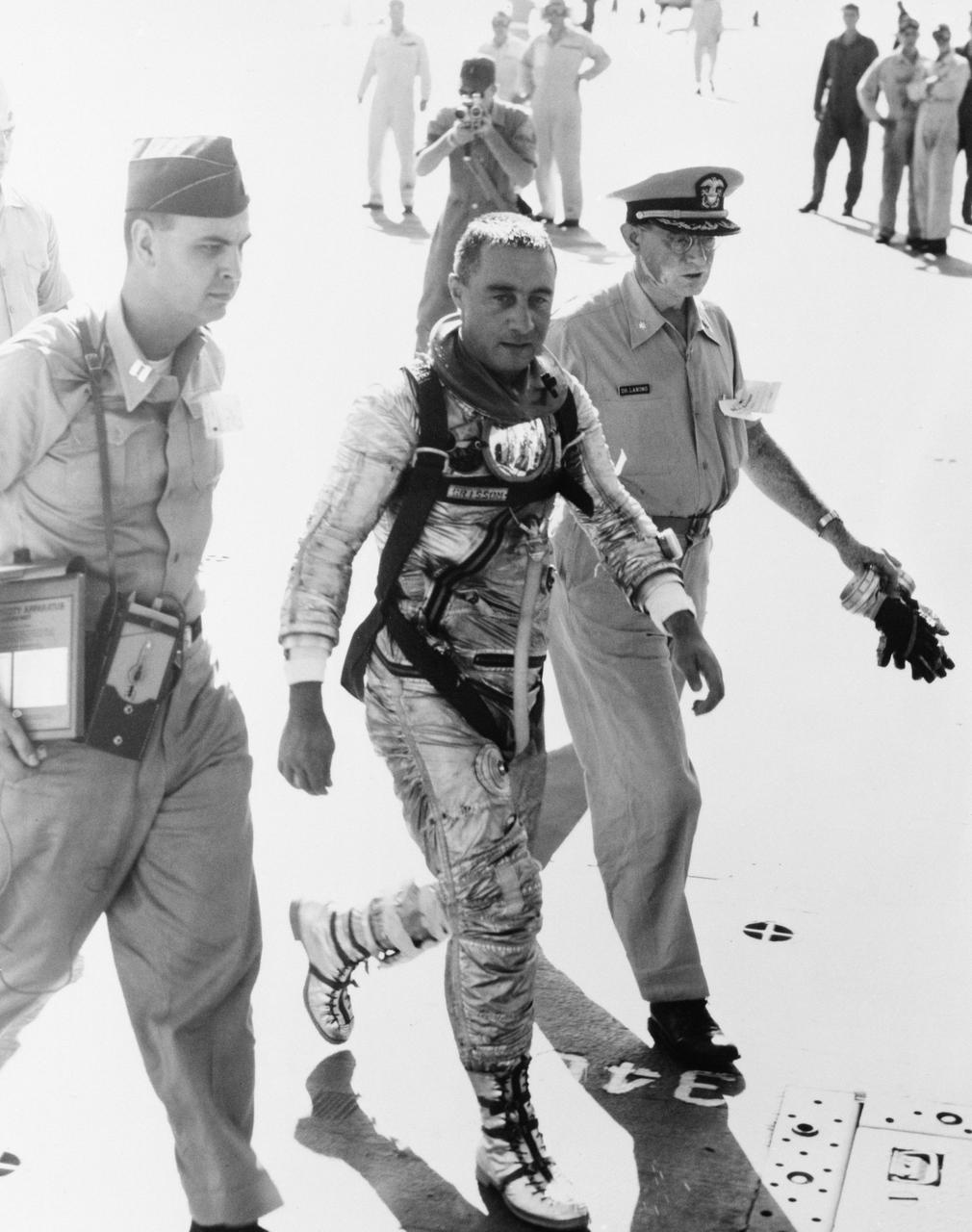
S61-02894 (21 July 1961) --- Astronaut Virgil I. (Gus) Grissom, pilot of the Mercury-Redstone 4 (MR-4) “Liberty Bell 7” spaceflight, arrives aboard the recovery ship, USS Randolph, following his 15-minute, 37-second suborbital space mission. He is flanked by military medical officers. Photo credit: NASA
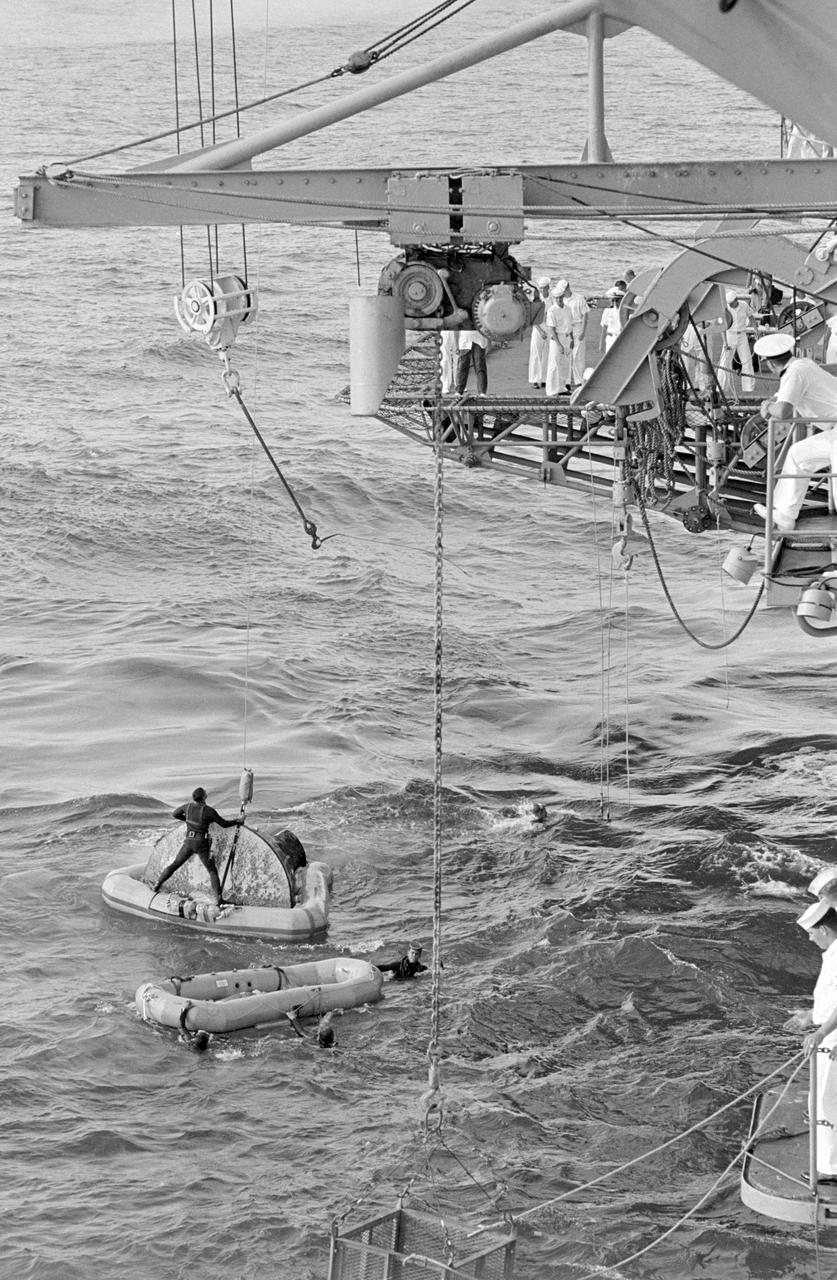
S66-42790 (21 July 1966) --- The Gemini-10 spacecraft, with flotation collar still attached, is prepared for hoisting aboard the prime recovery ship, USS Guadalcanal. Navy frogmen assist in the recovery operations. Astronauts John W. Young, command pilot, and Michael Collins, pilot, prime crew for the Gemini-10 spaceflight, had already been picked up by helicopter and flown to the Guadalcanal. Gemini-10 splashed down 460 nautical miles east of Cape Kennedy at 4:07 p.m. (EST), July 21, 1966, to conclude a three-day mission in space. Photo credit: NASA
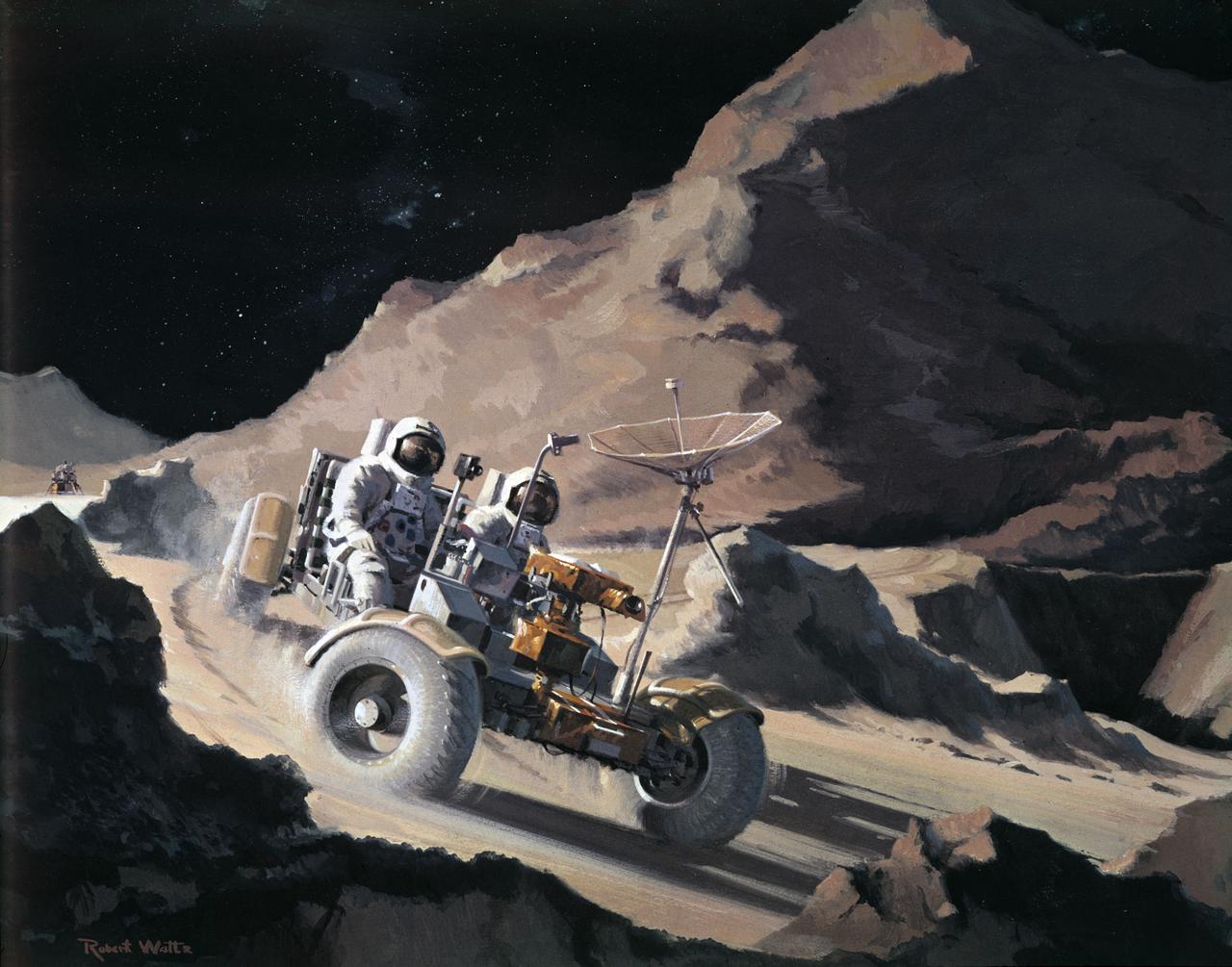
S71-39868 (July 1971) --- An artist's concept of the Apollo 15 Hadley-Apennine landing area showing the two moon-exploring crewmen on a traverse in their Lunar Roving Vehicle (LRV). The two figures represent astronauts David R. Scott, commander, and James B. Irwin, lunar module pilot. The artwork is by Teledyne Ryan.
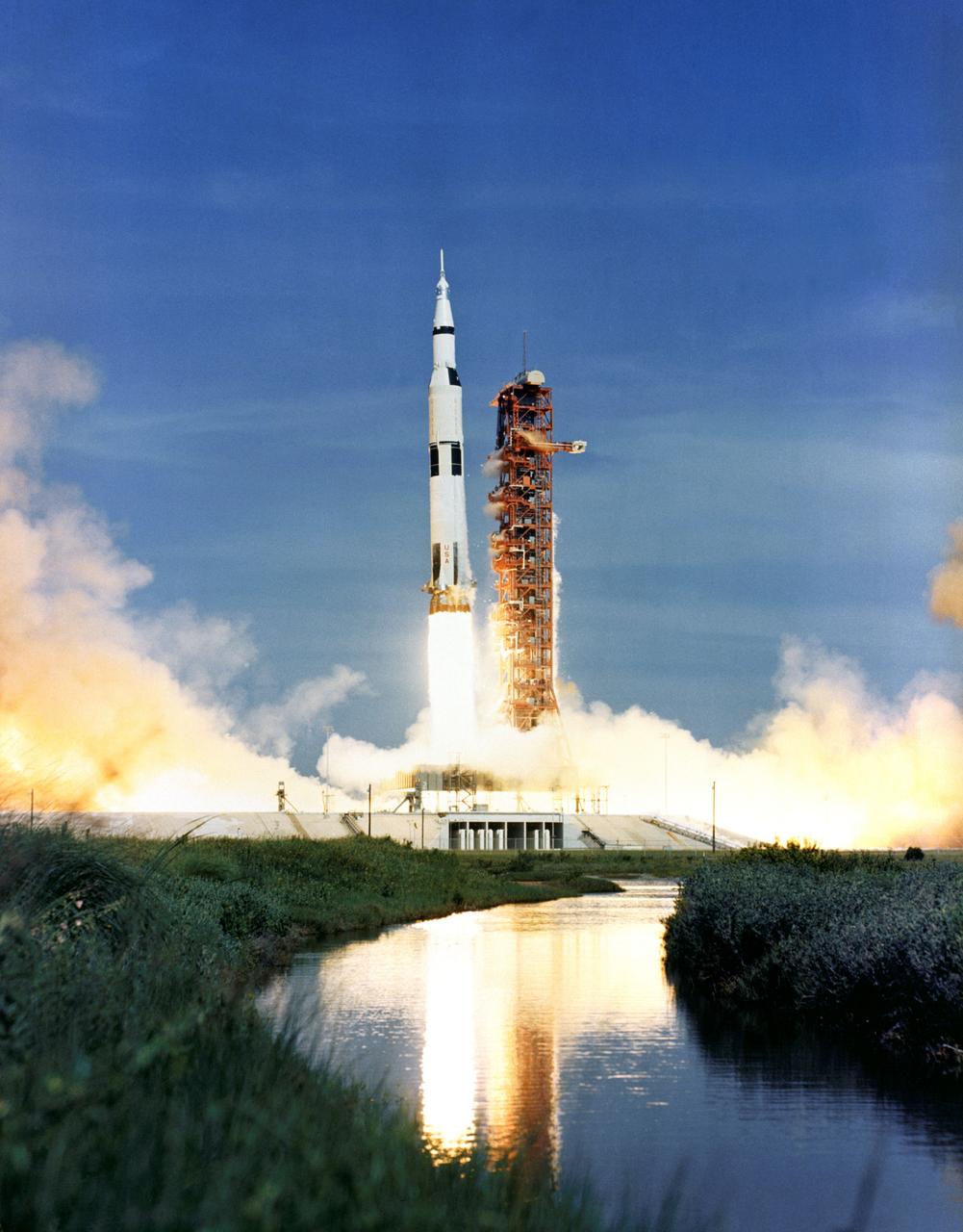
S71-41810 (26 July 1971) --- The 363-feet tall Apollo 15 (Spacecraft 112/Lunar Module 10/Saturn 510) space vehicle is launched from Pad A, Launch Complex 39, Kennedy Space Center, Florida, at 9:34:00.79 a.m., July 26, 1971, on a lunar landing mission. Aboard the Apollo 15 spacecraft were astronauts David R. Scott, commander; Alfred M. Worden, commander module pilot; and James B. Irwin, lunar module pilot. Apollo 15 is the National Aeronautics and Space Administration's (NASA) fourth manned lunar landing mission.
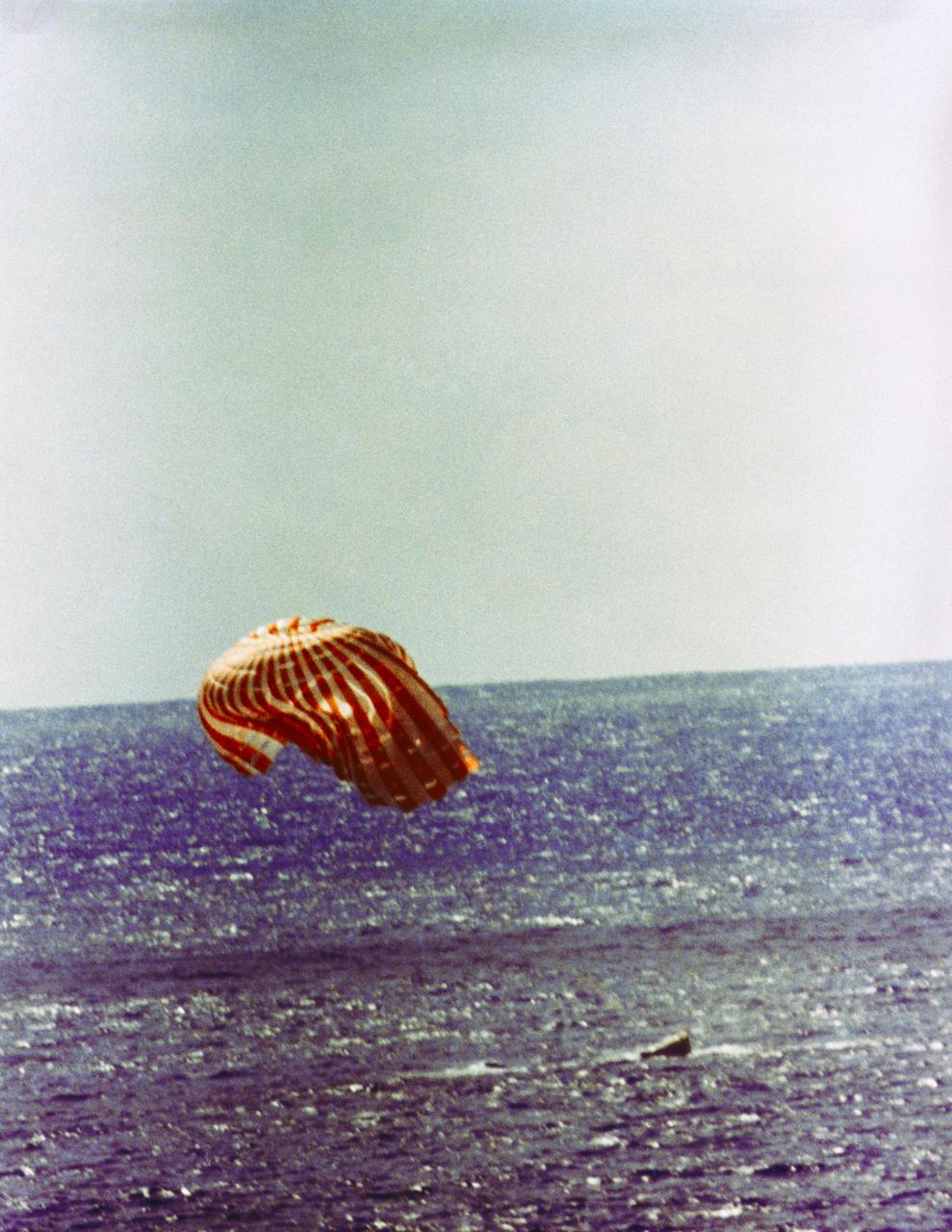
S66-50749 (15 Sept. 1966) --- The Gemini-11 spaceflight is concluded as the Gemini-11 spacecraft, with astronauts Charles Conrad Jr., command pilot, and Richard F. Gordon Jr., pilot, aboard, touches down in the Atlantic Ocean 1.5-2 statute miles from the prime recovery ship, USS Guam. Gemini-11 splashed down at 9 a.m. (EST), Sept. 15, 1966, to conclude a three-day mission in space. Photo credit: NASA
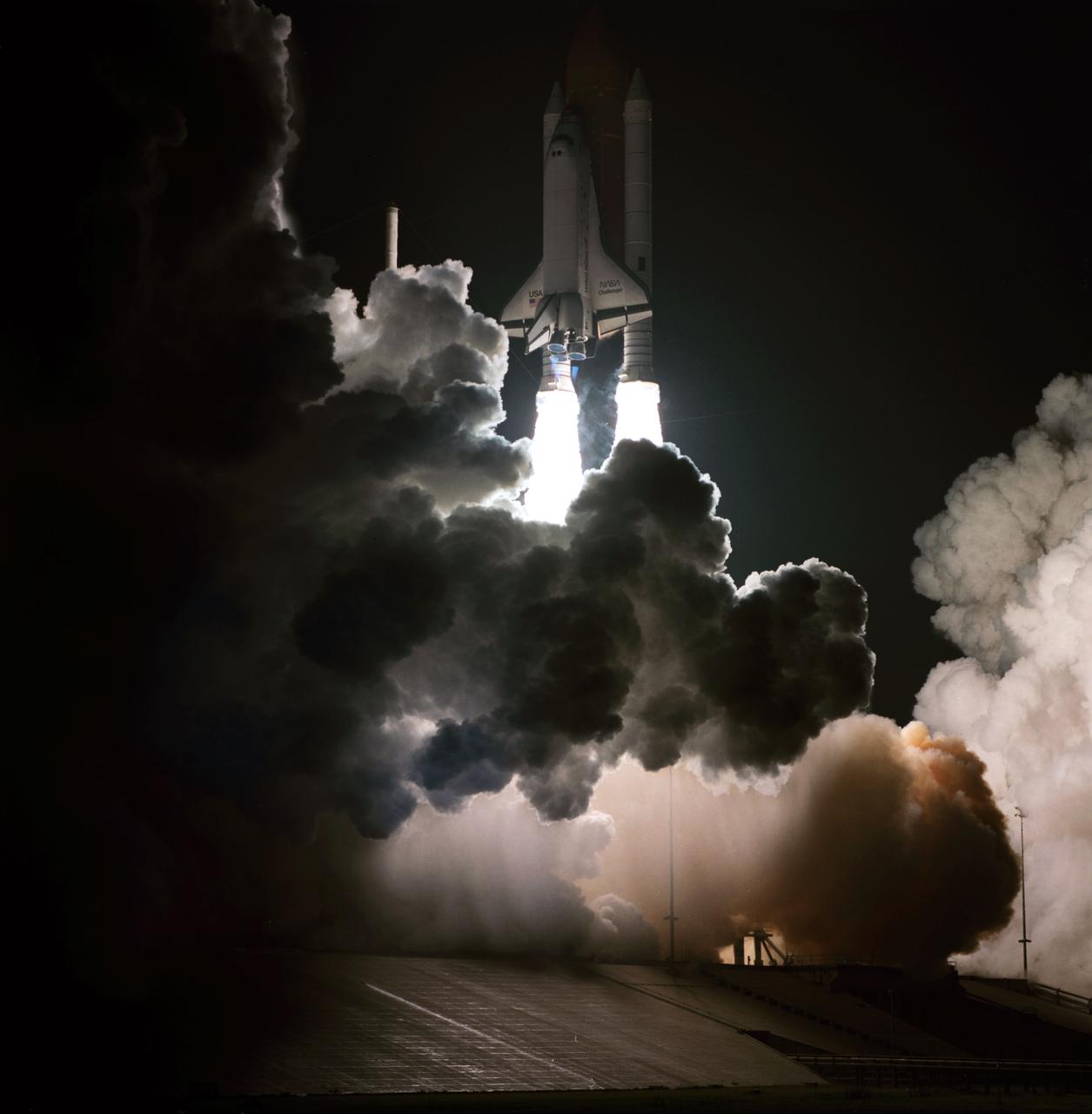
S83-39513 (30 Aug. 1983) --- NASA's eighth space shuttle launch lights up the Florida sky at 2:32 a.m. (EDT), Aug. 30, 1983. The Challenger's third flight is the first to have its beginnings in darkness. Five astronauts and an assortment of experiments are aboard the reusable vehicle. Crew members are astronauts Richard H. Truly, STS-8 commander; Daniel C. Brandenstein, pilot; and Dale A. Gardner, Guion S. Bluford and William E. Thornton, all mission specialists. Photo credit: NASA
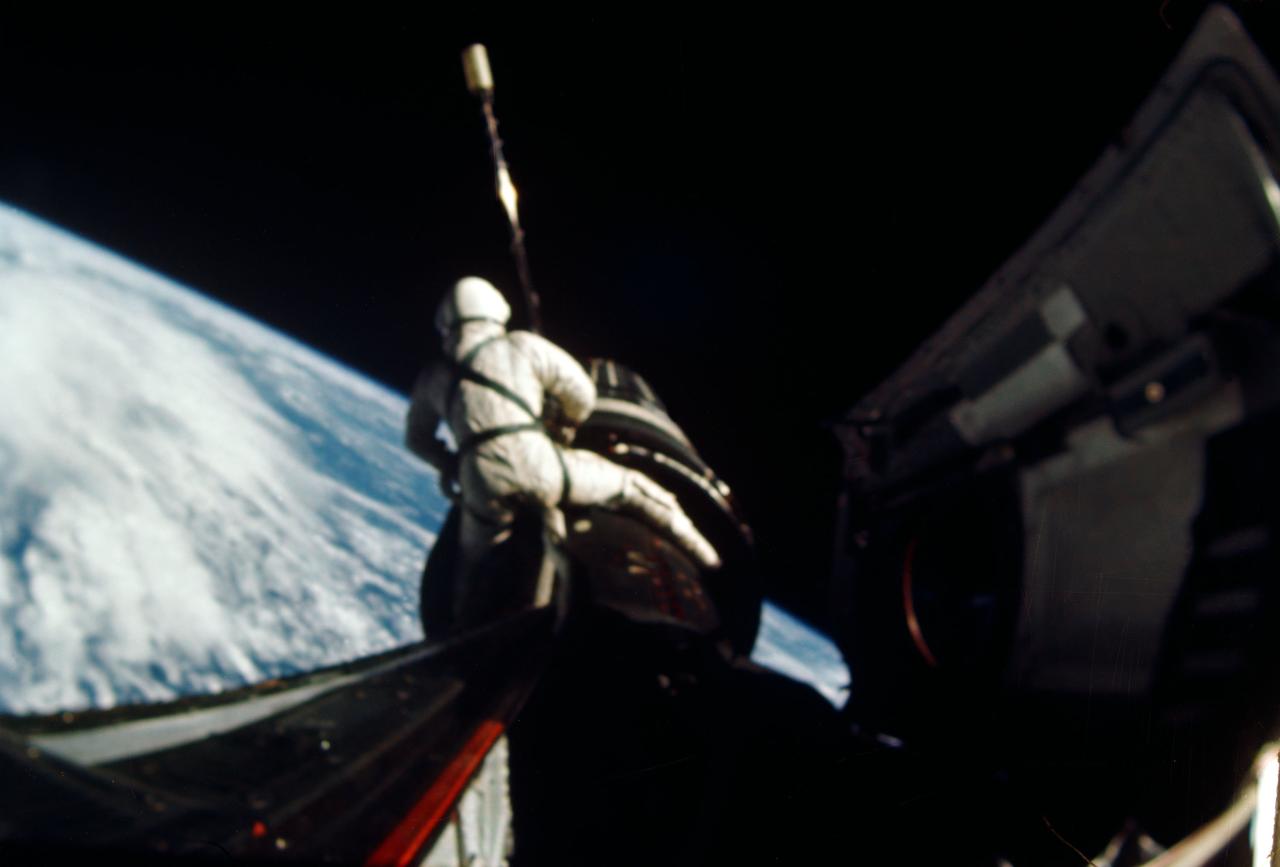
S66-54455 (13 Sept. 1966) --- Astronaut Richard F. Gordon Jr., Gemini-11 pilot, attaches a tether line from his spacecraft to the Agena Target Docking Vehicle (ATDV) during a spacewalk. This view was taken over the Atlantic Ocean at approximately 160 miles above Earth on Sept. 13, 1966. With the aid of the ATDV, Gordon and astronaut Charles (Pete) Conrad Jr., command pilot, set a new altitude record of 750 miles during the GT-11 mission. Photo credit: NASA
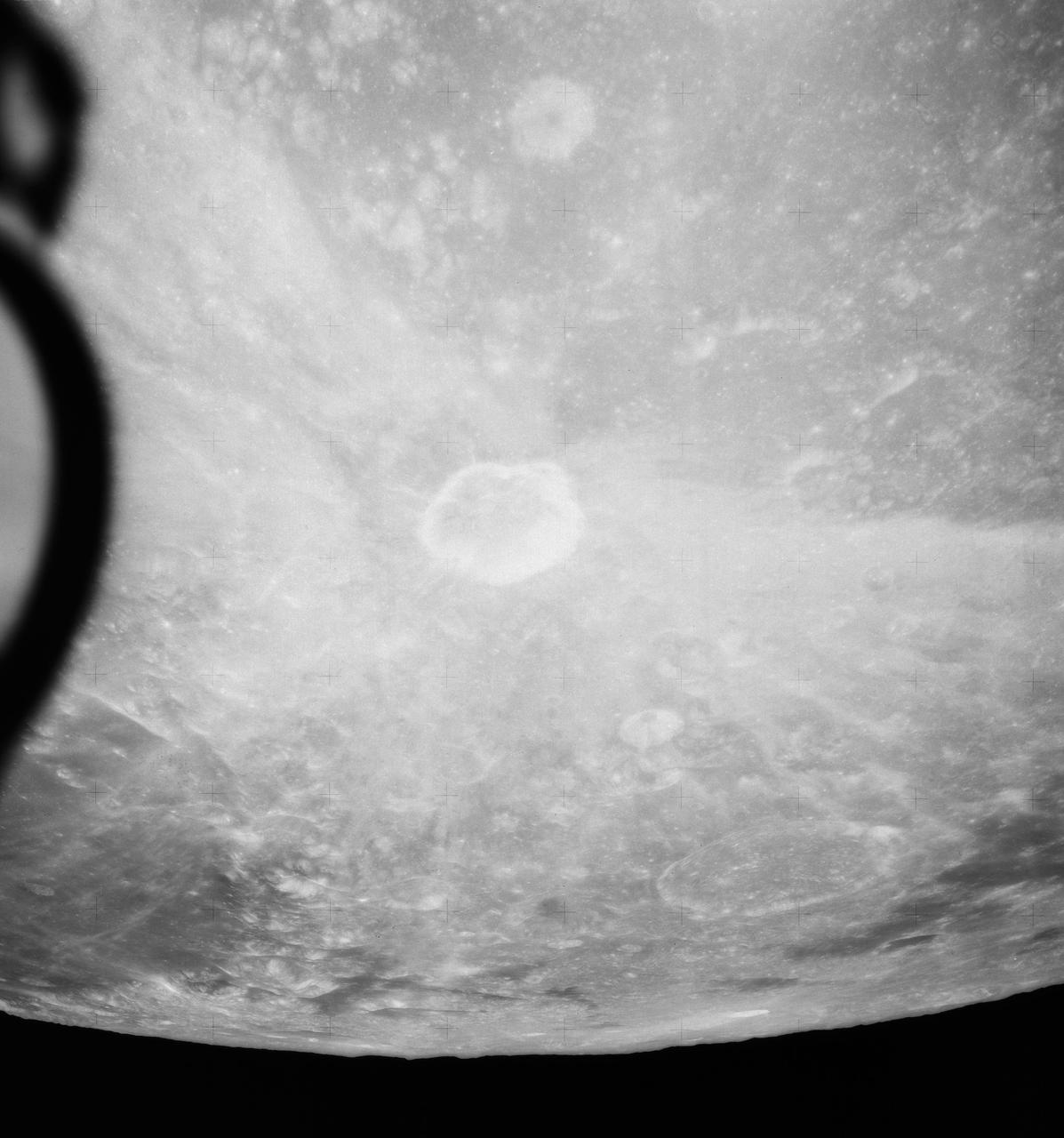
S71-44669 (31 July-2 Aug. 1971) --- An oblique view of the rayed crater Proclus on the lunar nearside, as photographed by the Fairchild metric camera in the SIM bay of the Apollo 15 Command and Service Modules (CSM) in lunar orbit. This view is looking north. The Sea of Crisis is at upper right. Proclus, which is 28 kilometers (16.58 statute miles) in diameter, is located at 47 degrees east longitude and 16 degrees north latitude. The Marsh of Sleep is at lower left. A small portion of the Sea of Tranquility can be seen at upper left. The crater Macrobius is located at upper left. The three-inch mapping camera was one of eight lunar orbital science experiments mounted in the SIM bay.
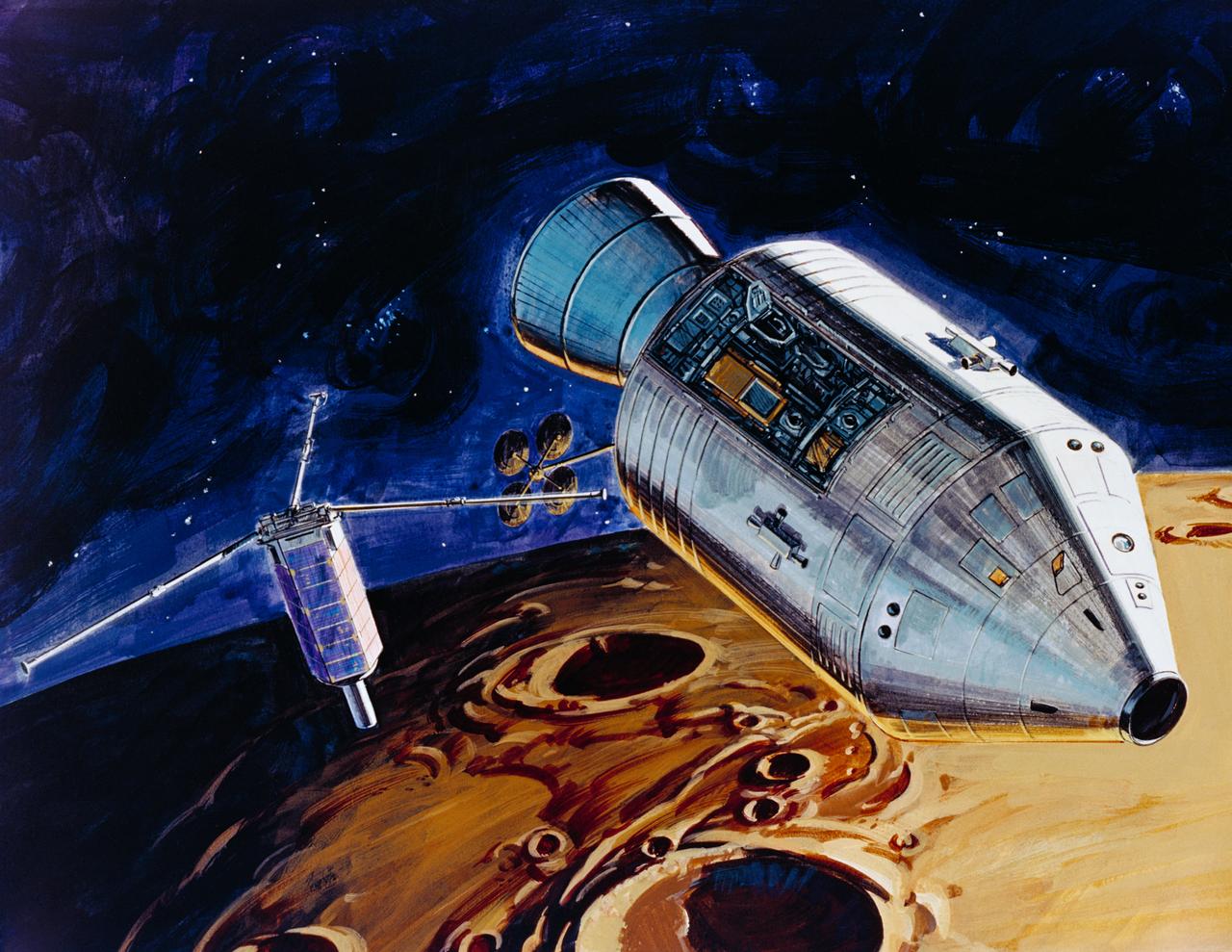
S71-39481 (July 1971) --- An artist's concept showing TRW's small lunar subsatellite being ejected into lunar orbit from the SIM bay of the Apollo 15 Service Module. The 80-pound satellite will remain in orbit a year or more, carrying scientific experiments to study space in the vicinity of the moon. The satellite carries three experiments: S-Band Transponder; Particle Shadows/Boundary Layer Experiment; and Subsatellite Magnetometer Experiment. The subsatellite is housed in a container resembling a rural mailbox, and when deployed is spring-ejected out-of-plane at 4 fps with a spin rate of 140 rpm. After the satellite booms are deployed, the spin rate is stabilized at about 12 rpm. The subsatellite is 31 inches long and has a 14 inch hexagonal diameter. The exact weight is 78.5 pounds. The folded booms deploy to a length of five feet. Subsatellite electrical power is supplied by a solar cell array outputting 25 watts for dayside operation and a rechargeable silver-cadmium battery for nightside passes.
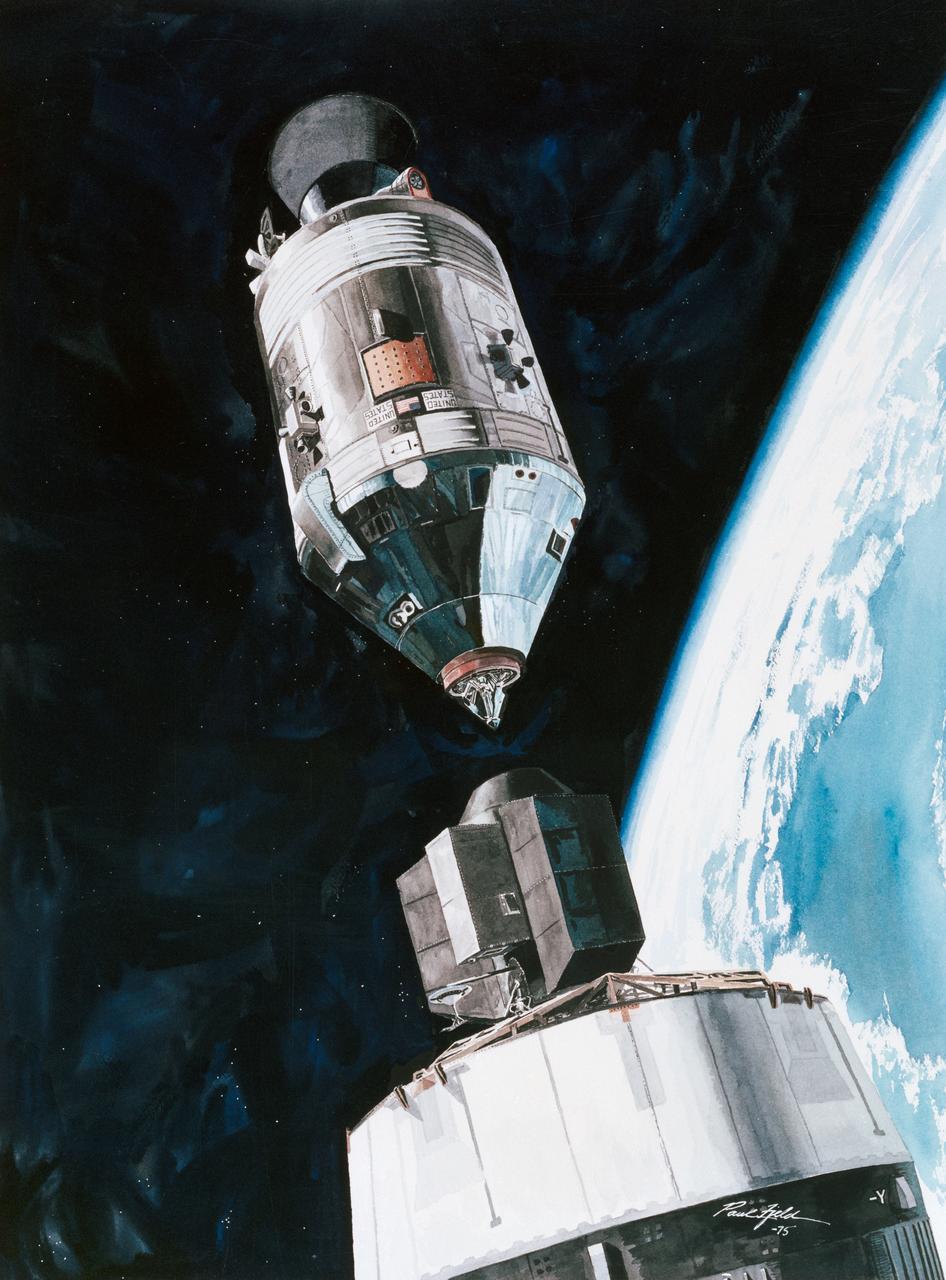
S75-28512 (July 1975) --- An artist?s concept depicting a scene in Earth orbit during the Apollo transposition and docking maneuvers of the Apollo-Soyuz Test Project mission. The Command/Service Module is moving into position to dock with the Docking Module. Following the docking the DM will be extracted from the expended Saturn IVB stage. The Docking Module is designed to link the American Apollo spacecraft with the Soviet Soyuz spacecraft. This scene will take place some one hour and twenty-three minutes after the Apollo-Saturn 1B liftoff from the Kennedy Space Center on July 15, 1975. The Soyuz launch at 7:20 a.m. (CDT) from the Baikonur, Kazakhstan launch pad will precede the Apollo liftoff by seven and one-half hours. The artwork is by Paul Fjeld.

STS007-15-671 / S83-35767 (21 June 1983) --- Among the "firsts" on the mission is this unprecedented scene of a crew of five astronauts aboard the Space Shuttle Challenger in space. A pre-set 35mm camera exposed the frame. Left to right on the flight deck are Norman E. Thagard, mission specialist; Robert L. Crippen, commander; Frederick H. Hauck, pilot; Sally K. Ride, mission specialist; and John M. Fabian, mission specialist. Crippen the crew commander, is making his second Space Shuttle trip; pilot Hauck and mission specialist Dr. Ride, Dr. Thagard and Fabian are members of the 1978 class of astronaut candidates (ASCAN).
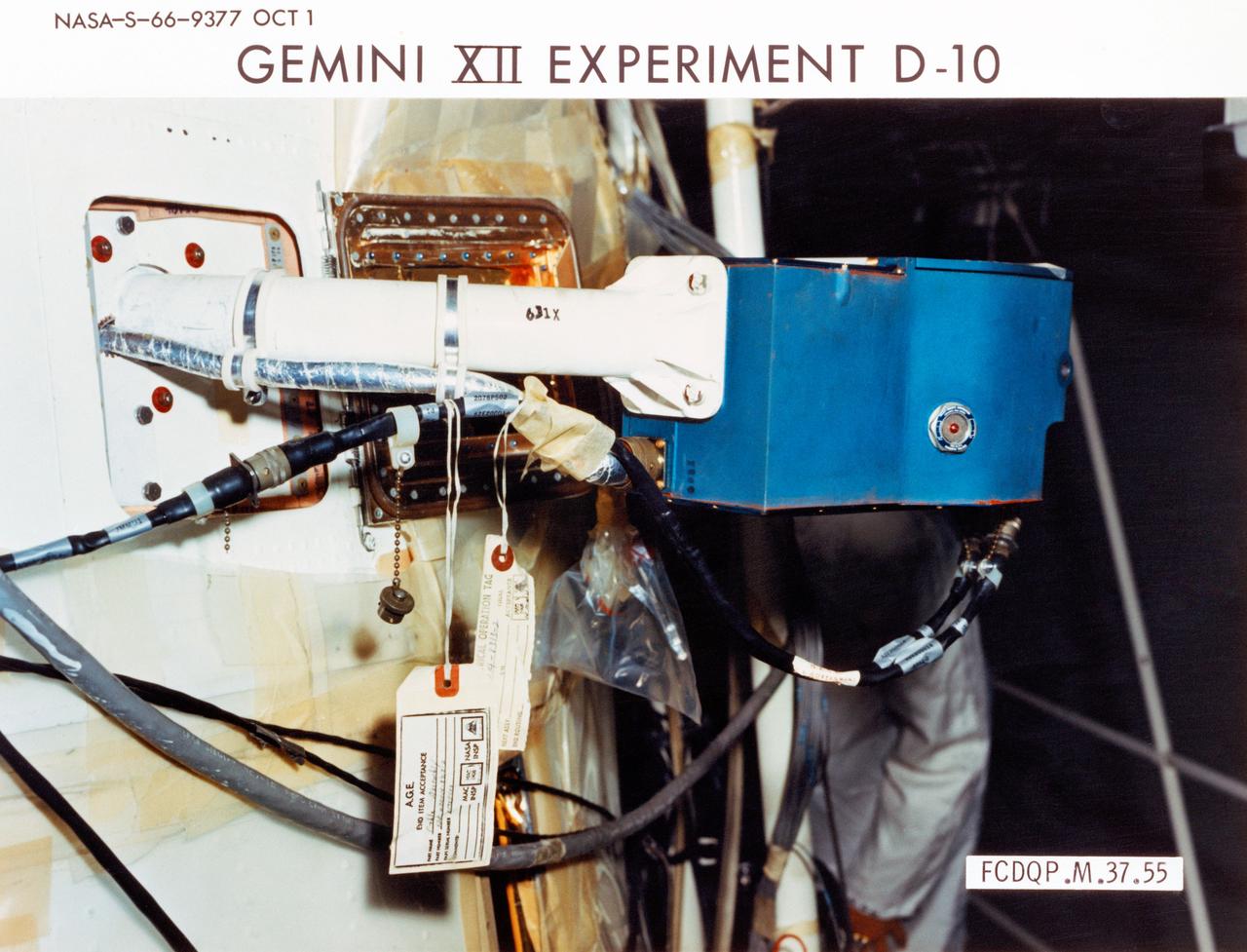
S66-09377 (1 Oct. 1966) --- One of two Ion Sensors which will be used to investigate determination of Gemini-12 spacecraft attitude in yaw and pitch from measurement of ion flow variations. Each sensor is attached to an extendible boom in the retrograde adapter section. Photo credit: NASA
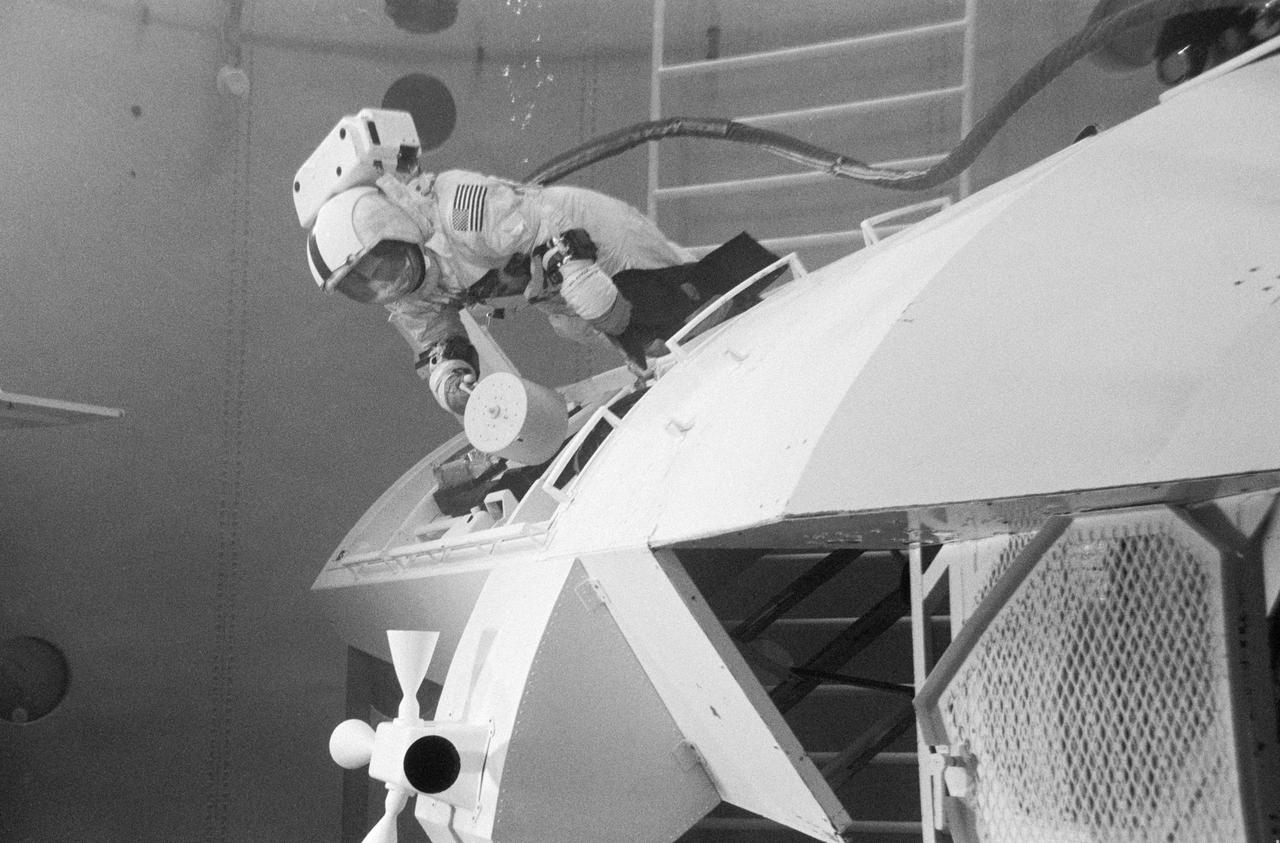
S72-49971 (29 Sept. 1972) --- Astronaut Ronald E. Evans, command module pilot of the Apollo 17 lunar landing mission, participates in extravehicular activity training in a water tank in Building 5 at the Manned Spacecraft Center. Evans is scheduled to perform trans-Earth extravehicular activity after the Apollo 17 spacecraft leaves lunar orbit on its way back home. The structure in the picture simulates the Scientific Instrument Module (SIM) bay of the Apollo 17 Service Module.
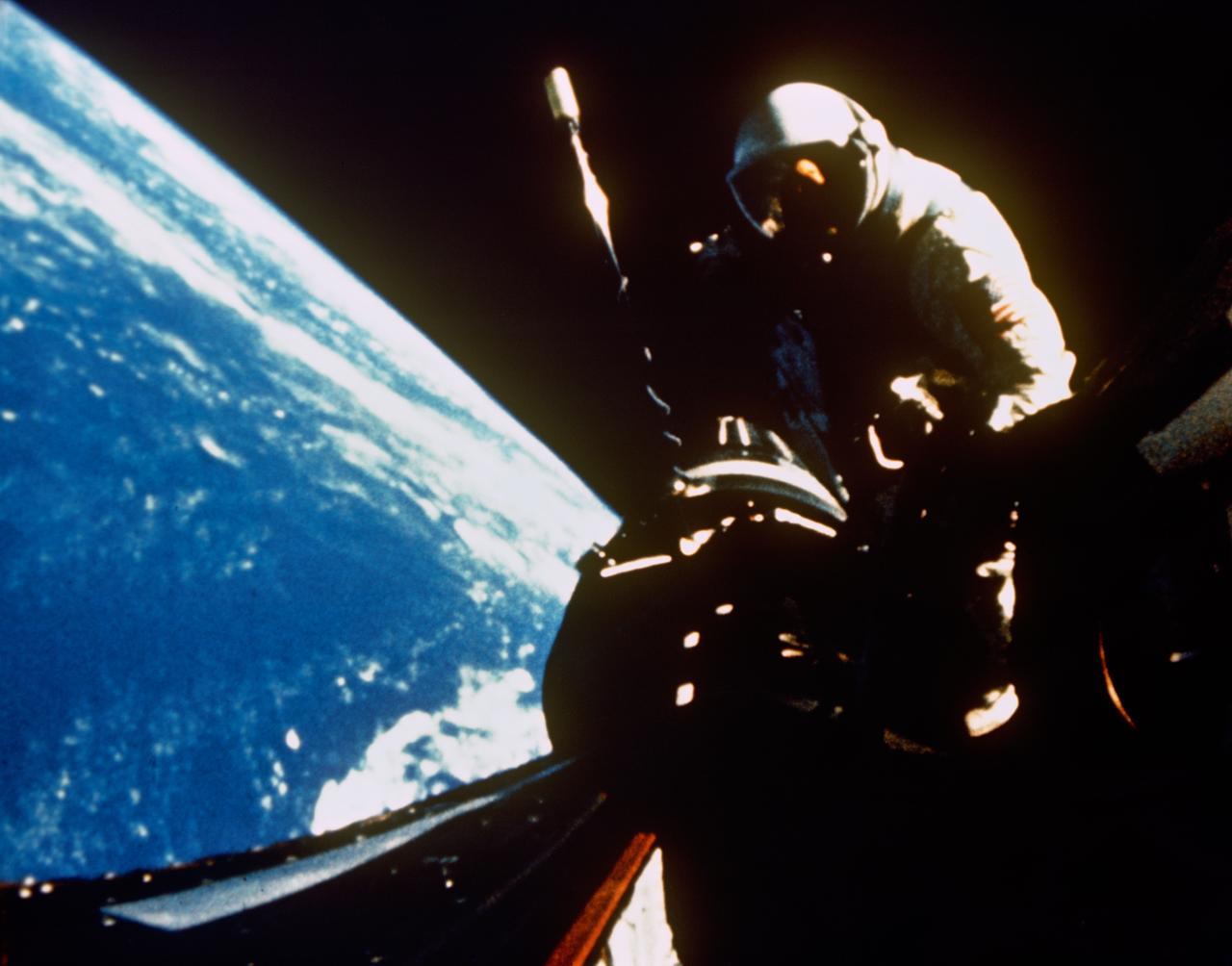
S66-54454 (13 Sept. 1966) --- Astronaut Richard F. Gordon Jr., pilot for the Gemini-11 spaceflight, returns to the hatch of the spacecraft following extravehicular activity (EVA). This picture was taken over the Atlantic Ocean at approximately 160 nautical miles above Earth's surface. Photo credit: NASA
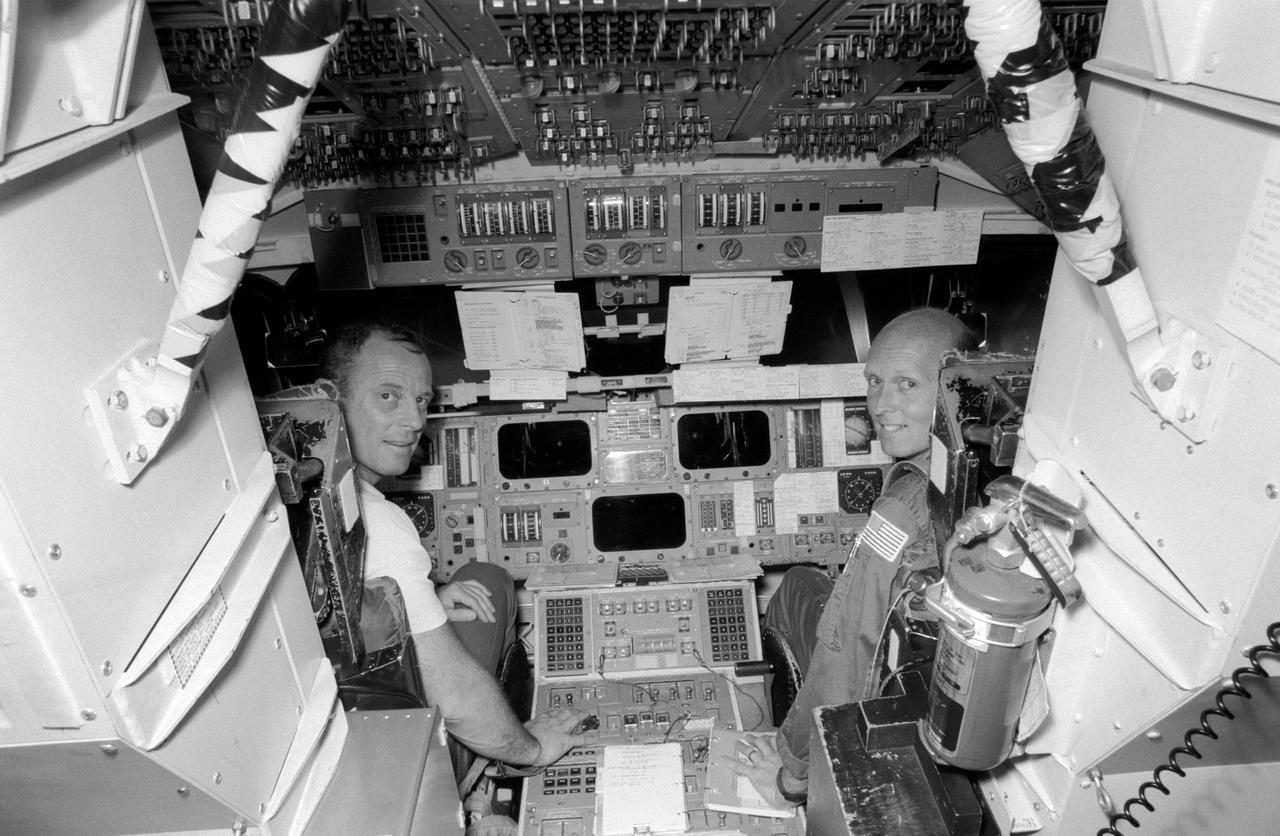
S82-28534 (16 March 1982) --- Astronauts Jack R. Lousma, left, and C. Gordon Fullerton are at the commander and pilot?s station, respectively, in the shuttle mission simulator at the LBJ Space Centers mission simulation and training facility. They have less than a week of training left in preparation for NASA?s third space transportation system (STS-3) flight. Scheduled to launch on March 22, STS-3 in expected to give space shuttle Columbia its longest stay (seven days) thus far. Photo credit: NASA
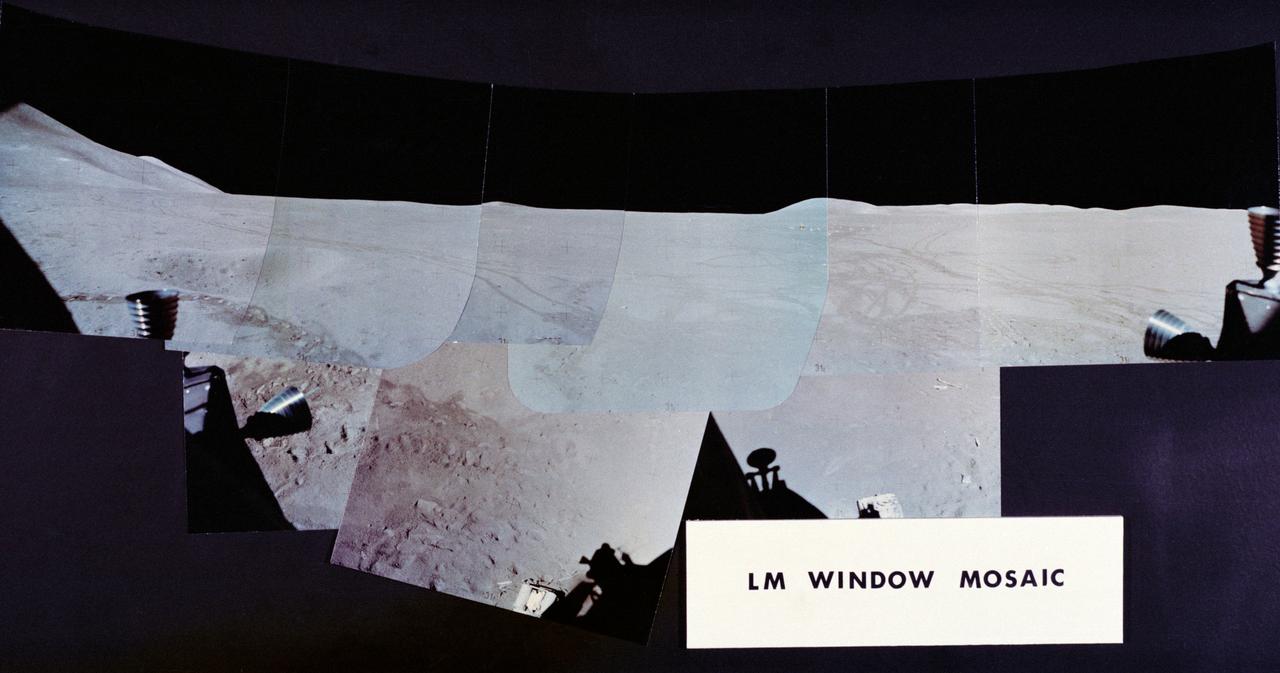
S71-43941 (2 Aug. 1971) --- A photographic mosaic showing a portion of the Apollo 15 Hadley-Apennine landing site with a field of view from about south by southwest to about north by northwest. The photographs were taken from the windows of the Lunar Module (LM) which was resting on the lunar surface facing west. Note bootprints and tracks of the Lunar Roving Vehicle (LRV) in the foreground. Visible on the horizon from left to right are: Hadley Delta Mountain and St. George Crater; Bennett Hill; and Hill 305, with the ALSEP equipment deployed in front of it.
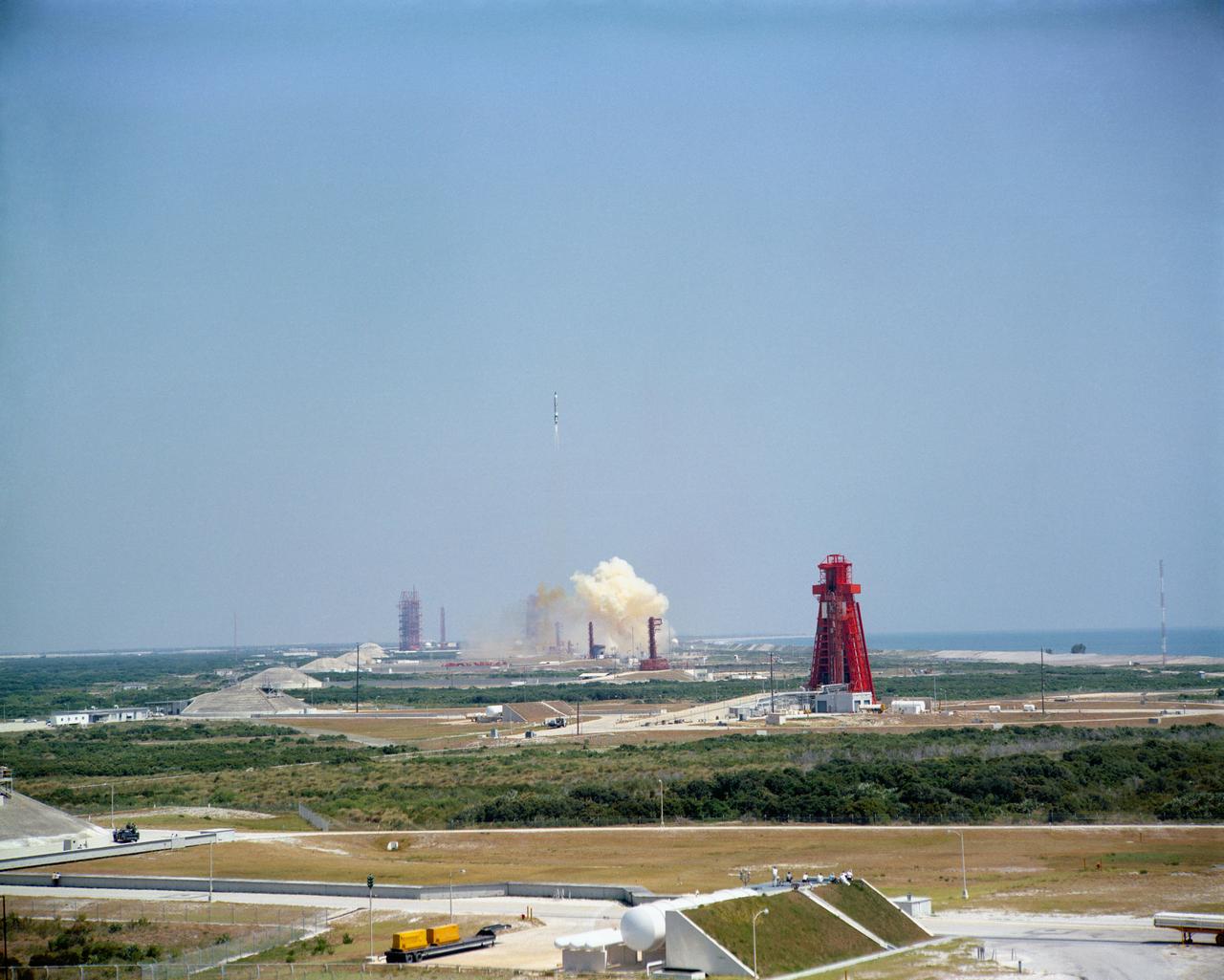
S65-29601 (3 June 1965) --- Distant view of the launch of the Gemini-Titan 4 (GT-4) spacecraft from Pad 19 at 10:16 a.m. (EST) on June 3, 1965. The Gemini IV spacecraft carried astronauts James A. McDivitt, command pilot; and Edward H. White II, pilot, on a four-day, 62-revolution mission that lasted 97 hours and 56 minutes.
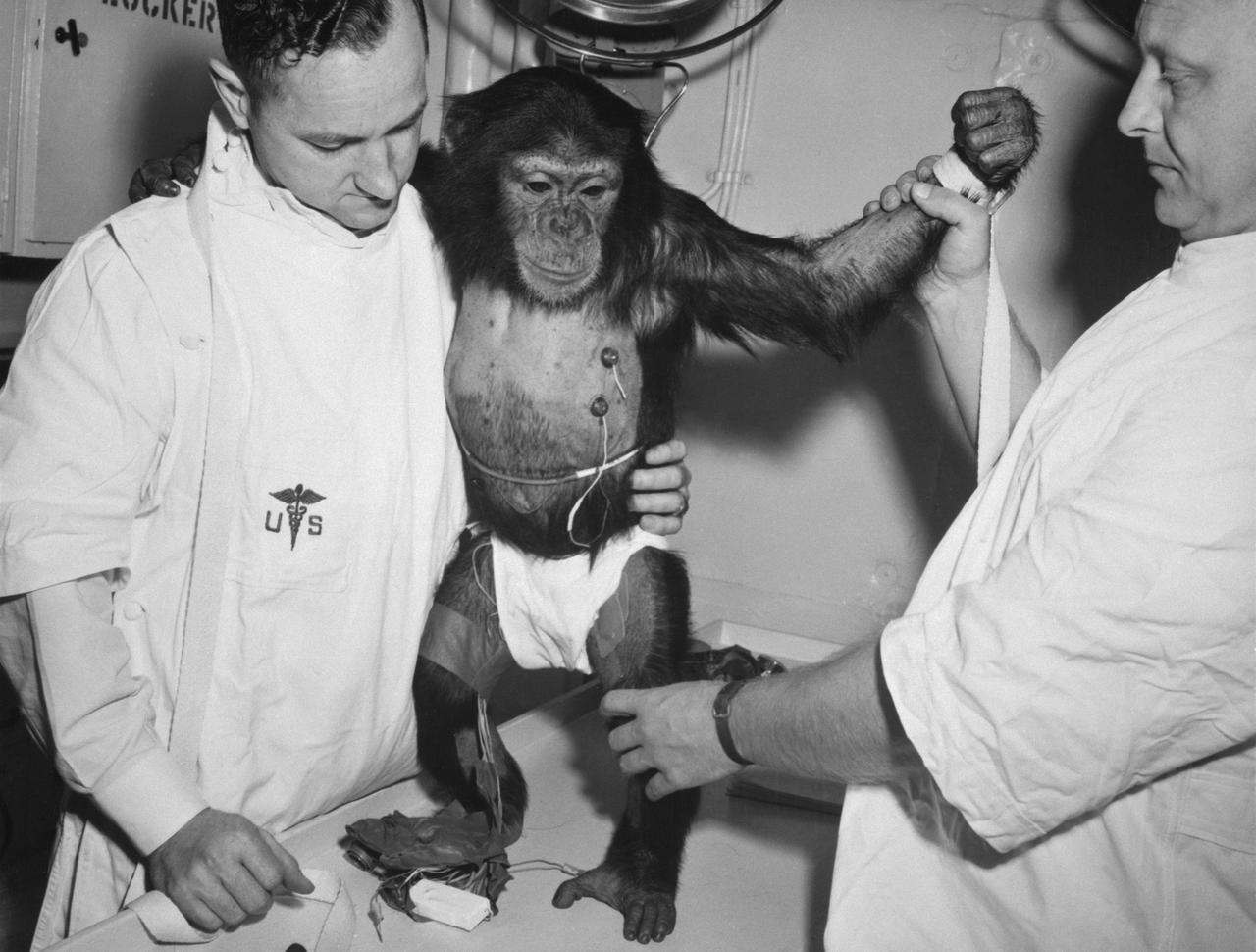
S61-00203 (31 Jan. 1961) --- Chimpanzee "Ham" with bio-sensors attached to his body is readied by handlers for his trip in the Mercury-Redstone 2 (MR-2) spacecraft. Photo credit: NASA
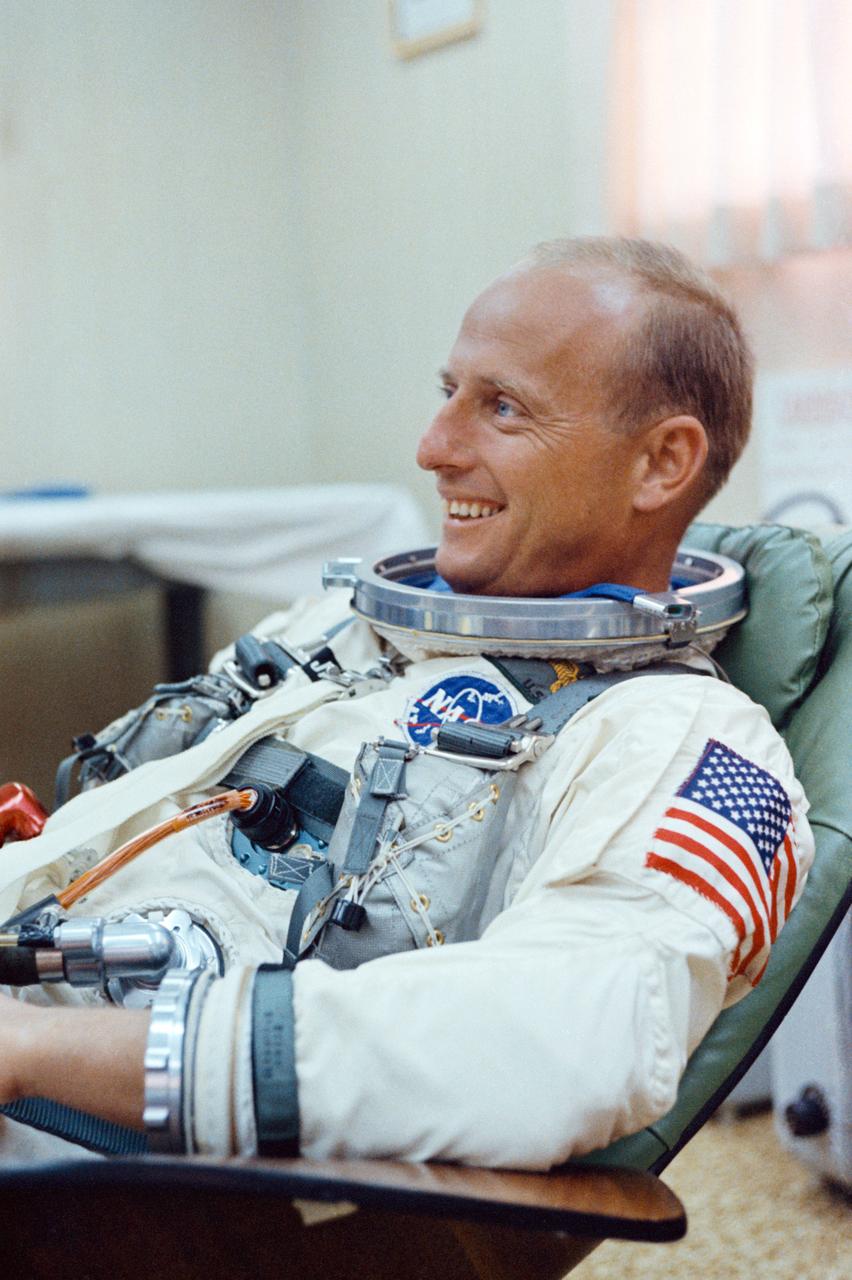
S66-50726 (12 Sept. 1966) --- Astronaut Charles Conrad Jr., command pilot of the Gemini-11 spaceflight, relaxes in Launch Complex 16 suiting trailer during the Gemini-11 prelaunch countdown. Minutes later astronauts Conrad and Richard F. Gordon Jr., pilot, were transported to Pad 19 and their waiting Gemini-11 spacecraft in preparation for their scheduled three-day mission in space. Photo credit: NASA

S73-32839 (10 Sept. 1973) --- Scientist-astronaut Edward G. Gibson, science pilot for the third manned Skylab mission (Skylab 4), enters a notation in a manual while seated at the control and display panel for the Apollo Telescope Mount (ATM) during simulations inside the one-G trainer for the Multiple Docking Adapter (MDA) at the Johnson Space Center (JSC). Dr. Gibson will be joined by astronauts Gerald P. Carr, commander, and William R. Pogue, pilot, when the Skylab 4 mission begins in November 1973. Photo credit: NASA

General Activities in the Mission Operations Control Center (MOCR) during Day-1 of the STS-4 Mission. JSC, HOUSTON, TX Also available in 35 CN
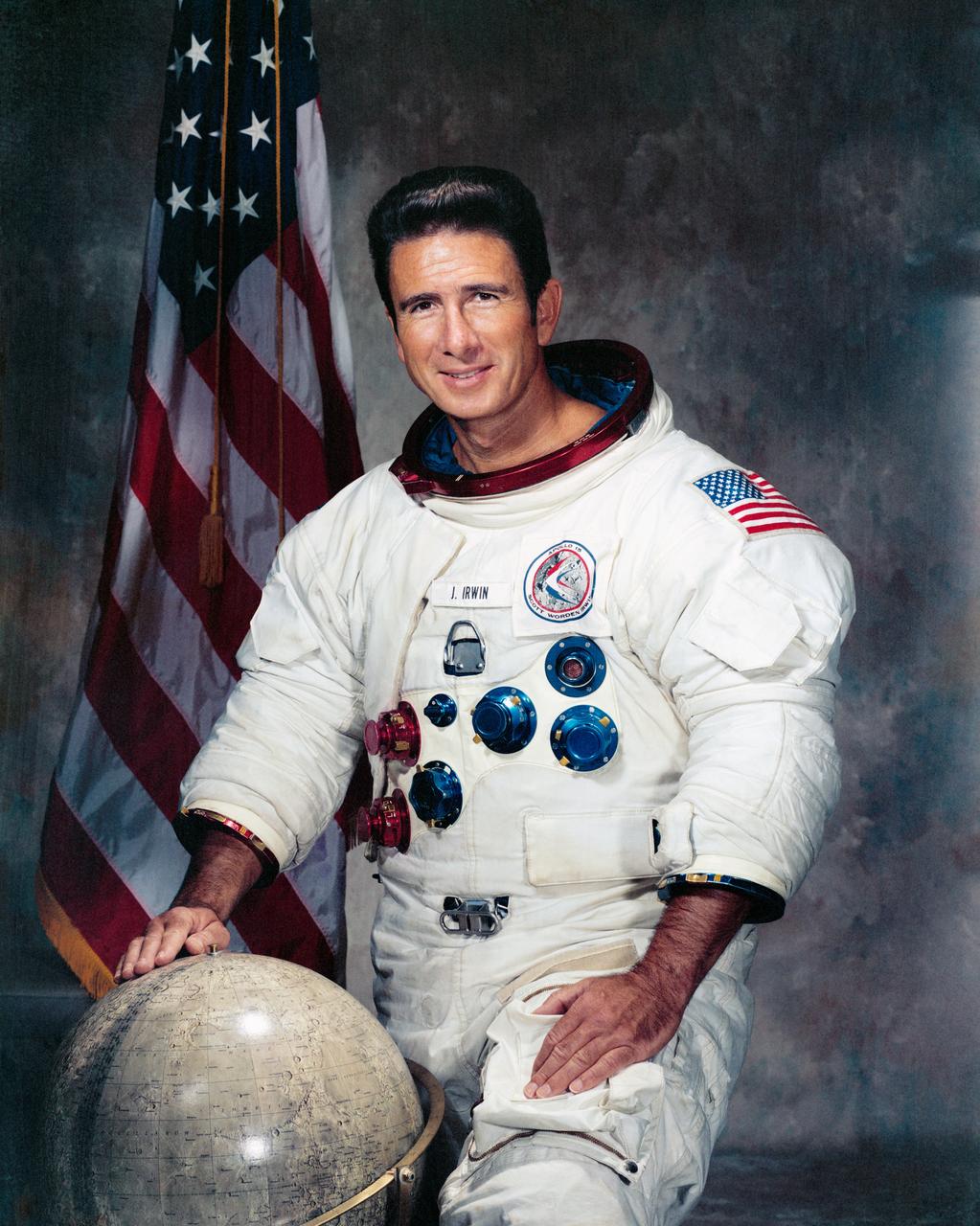
S71-56478 (December 1971) --- Astronaut James B. Irwin
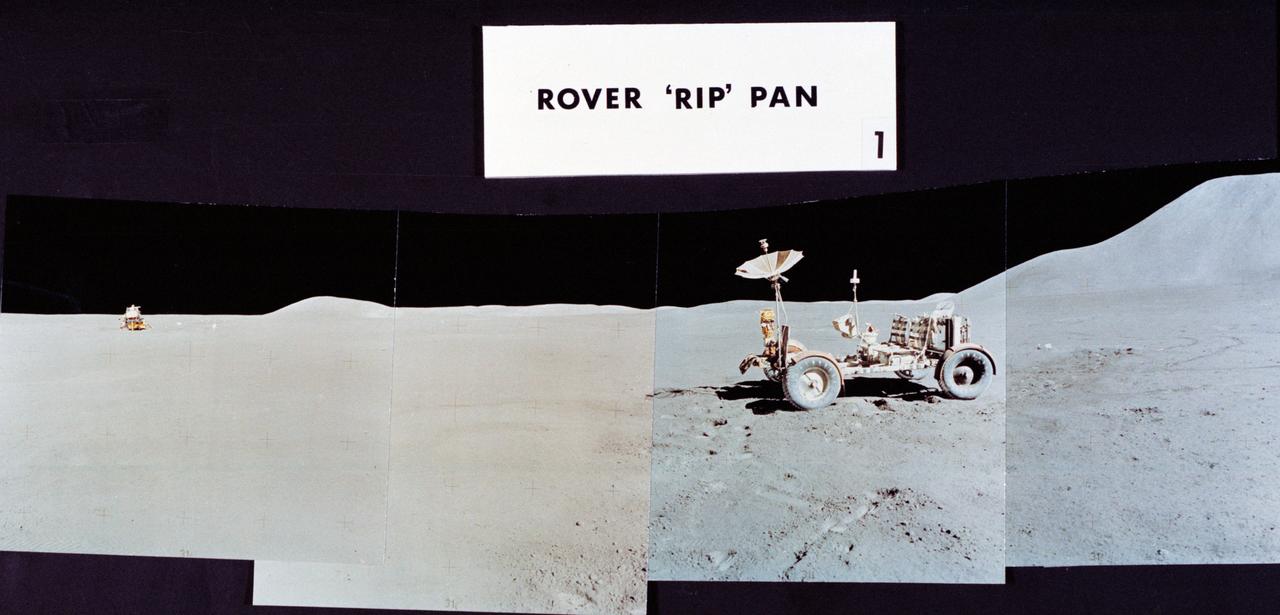
S71-43942 (2 Aug. 1971) --- This view is the second of a series of three mosaic photographs which compose a 360-degree panoramic view of the Apollo 15 Hadley-Apennine landing site, taken near the close of the third and final lunar surface extravehicular activity (EVA) by astronauts David R. Scott, commander, and James B. Irwin, lunar module pilot. This group of photographs was designated the Rover "RIP" Pan because the Lunar Roving Vehicle (LRV) was parked in its final position prior to the two crew men returning to the Lunar Module (LM). The astronaut taking the pan was standing about 325 feet east of the LM. The LRV was parked about 300 feet east of the LM. This mosaic covers a field of view from about southeast to about west by northwest. Visible on the horizon from left to right are: Sliver Spur on the Apennine Front; Hadley Delta Mountain and St. George Crater; Bennett Hill; and the LM. The other two views which compose the 360-degree pan are S71-43940 and S71-43943.
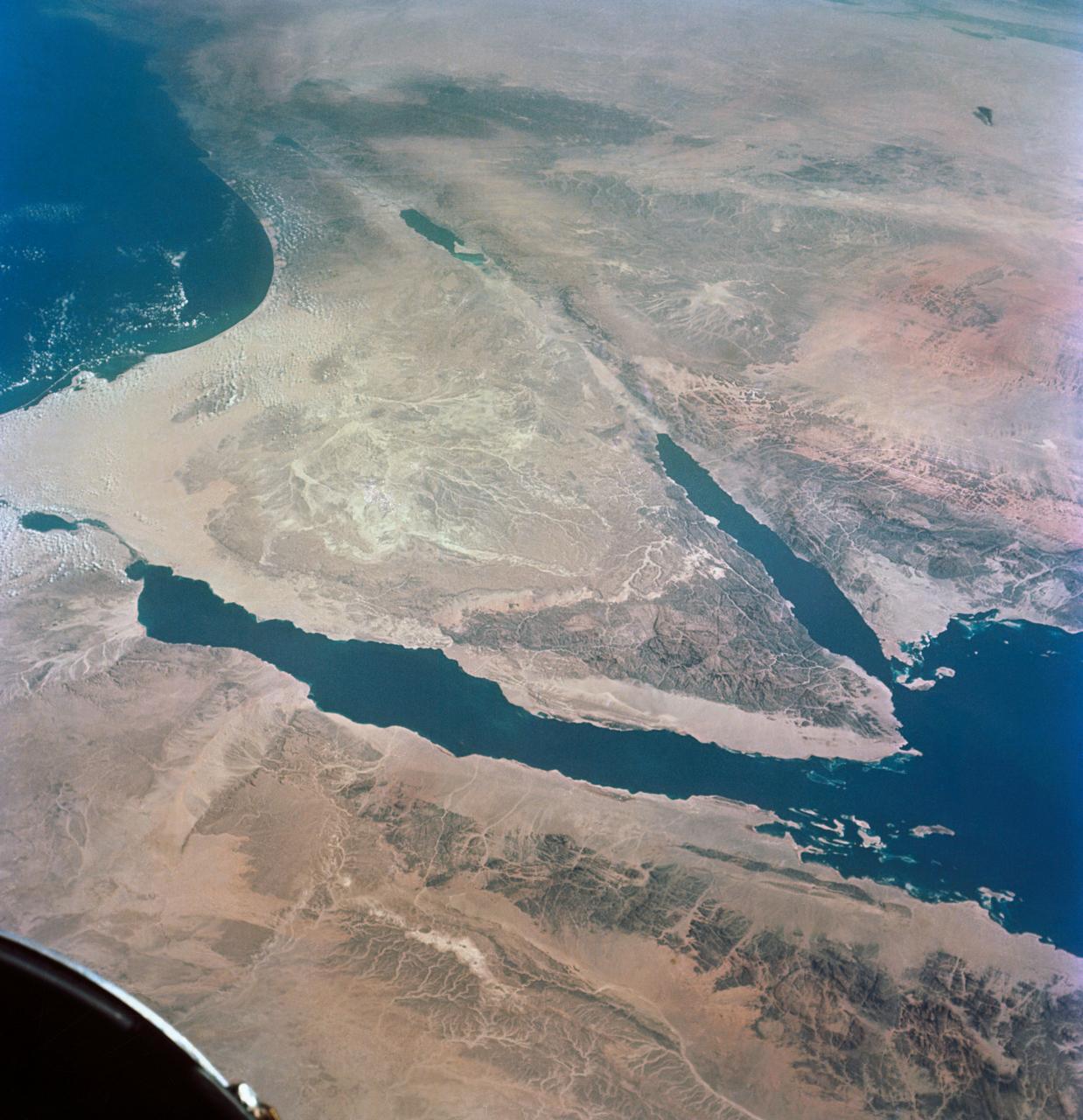
S66-54893 (14 Sept. 1966) --- Near East area as seen from the orbiting Gemini-11 spacecraft during its 26th revolution of Earth. The United Arab Republic (Egypt) is in foreground. Triangular-shaped area is the Sinai Peninsula. Saudi Arabia is at upper right. The Mediterranean Sea is at upper left. The Gulf of Suez separates Egypt from the Sinai Peninsula. The Red Sea is at bottom right. The Gulf of Aqaba is the body of water in right center of photograph separating the Sinai Peninsula and the Arabian Peninsula. The Dead Sea, Sea of Galilee, Jordan and Israel are in top center of picture. Iraq is at top right edge of photograph. Taken with a J. A. Maurer 70mm camera, using Eastman Kodak, Ektachrome, MS (S.O. 368) color film. Photo credit: NASA
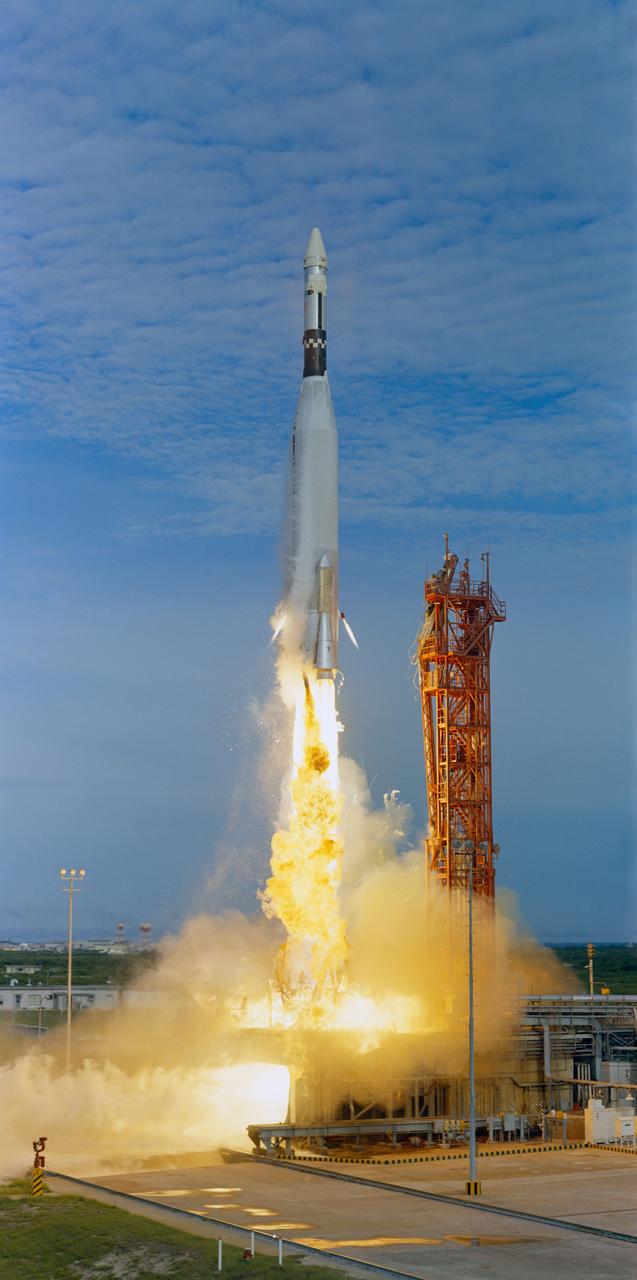
S66-50784 (12 Sept. 1966) --- An Agena Target Docking Vehicle atop its Atlas launch vehicle was launched from the Kennedy Space Center's Launch Complex 14 at 6:05 a.m., Sept. 12, 1966. The Agena served as a rendezvous and docking vehicle for the Gemini-11 spacecraft. Photo credit: NASA
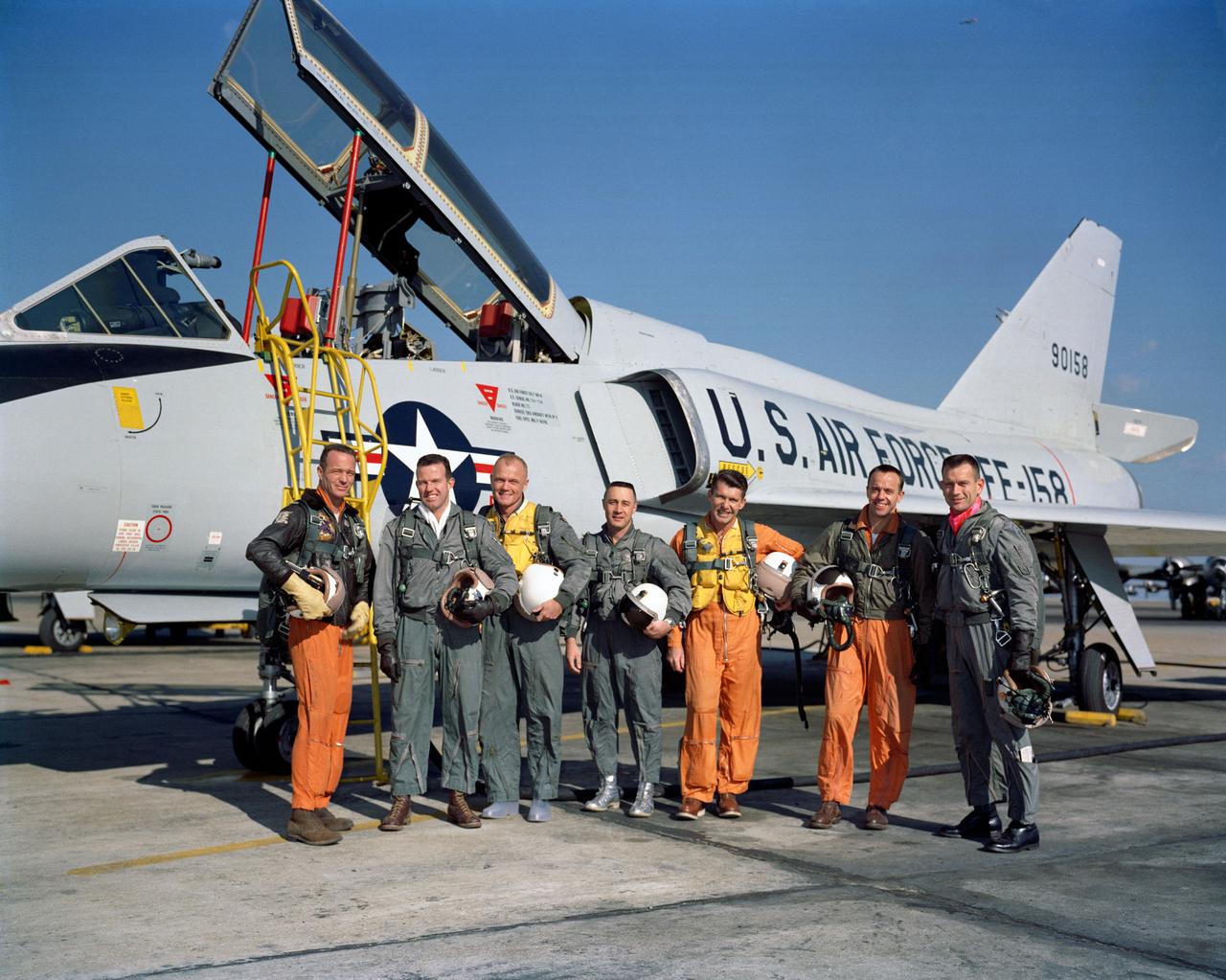
S61-01250 (20 Jan. 1961) --- Photo of the Mercury astronauts standing beside a Convair 106-B aircraft. They are, left to right, M. Scott Carpenter, L. Gordon Cooper Jr., John H. Glenn Jr., Virgil I. Grissom, Walter M. Schirra Jr., Alan B. Shepard Jr. and Donald K. Slayton. EDITOR'S NOTE: Astronaut Gus Grissom died in the Apollo 1 -- Apollo/Saturn (AS-204) -- fire at Cape Kennedy, Florida on Jan. 27, 1967. Astronaut Deke Slayton died from complications of a brain tumor, in League City, Texas on June 13, 1993. Astronaut Shepard died after a lengthy illness in Monterey, California, on July 21, 1998. As of Jan. 1, 1977 none of the seven astronauts remained with the NASA Space Program. However, in October 1998, United States Senator Glenn (Democrat-Ohio) flew as payload specialist on the STS-95 mission. Photo credit: NASA
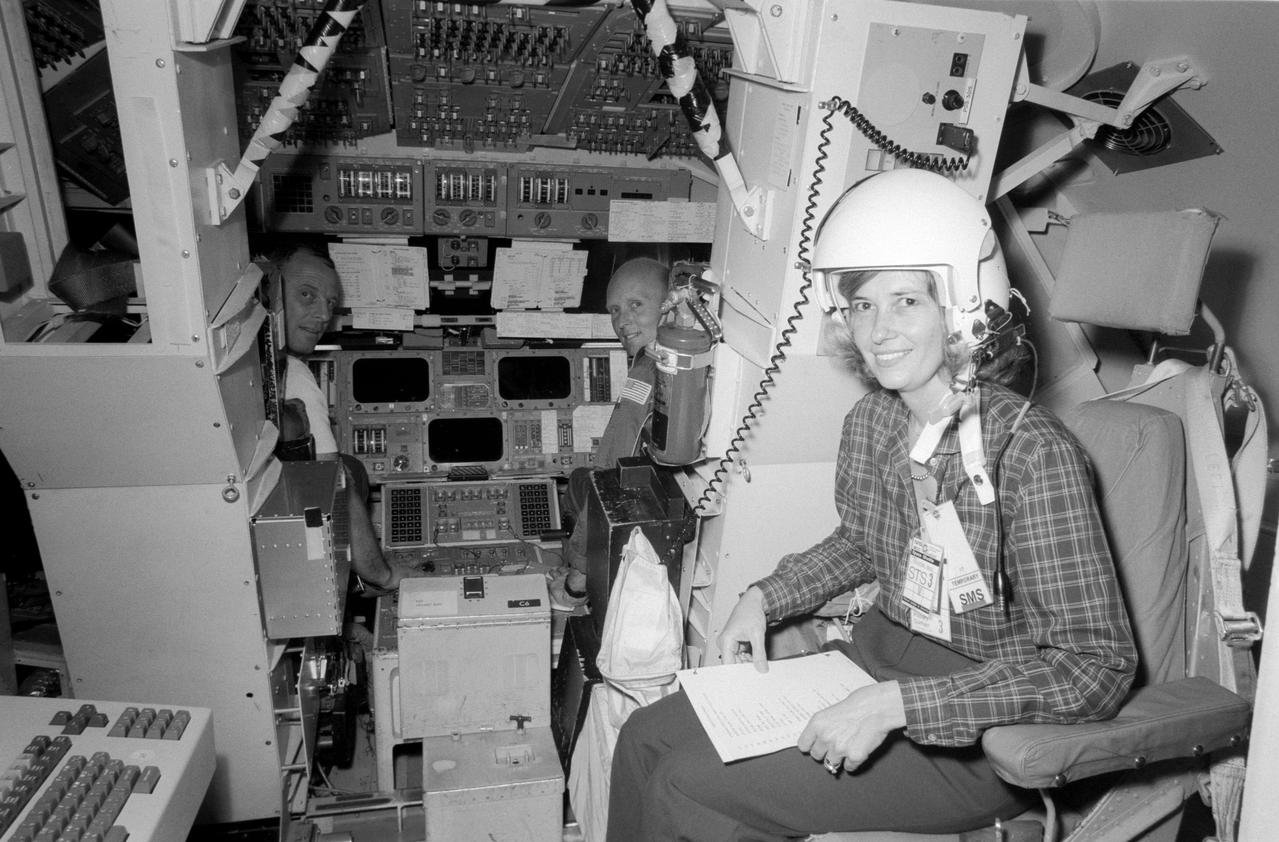
S82-28535 (16 March 1982) --- One of the more pleasant surprises of what are usually routine training sessions today was Mrs. Marie Fullerton, seated in the foreground in a special chair. Astronauts Jack R. Lousma, left background, and C. Gordon Fullerton, center, take a brief break in their simulation session to look back toward their visitor, wife of the pilot for NASA?s next flight. They are in the shuttle mission simulator (SMS) in the LBJ Space Center?s mission simulation and training facility. The crew is in training for its scheduled March 22 launch aboard the space shuttle Columbia for a week?s stay in Earth orbit. Photo credit: NASA
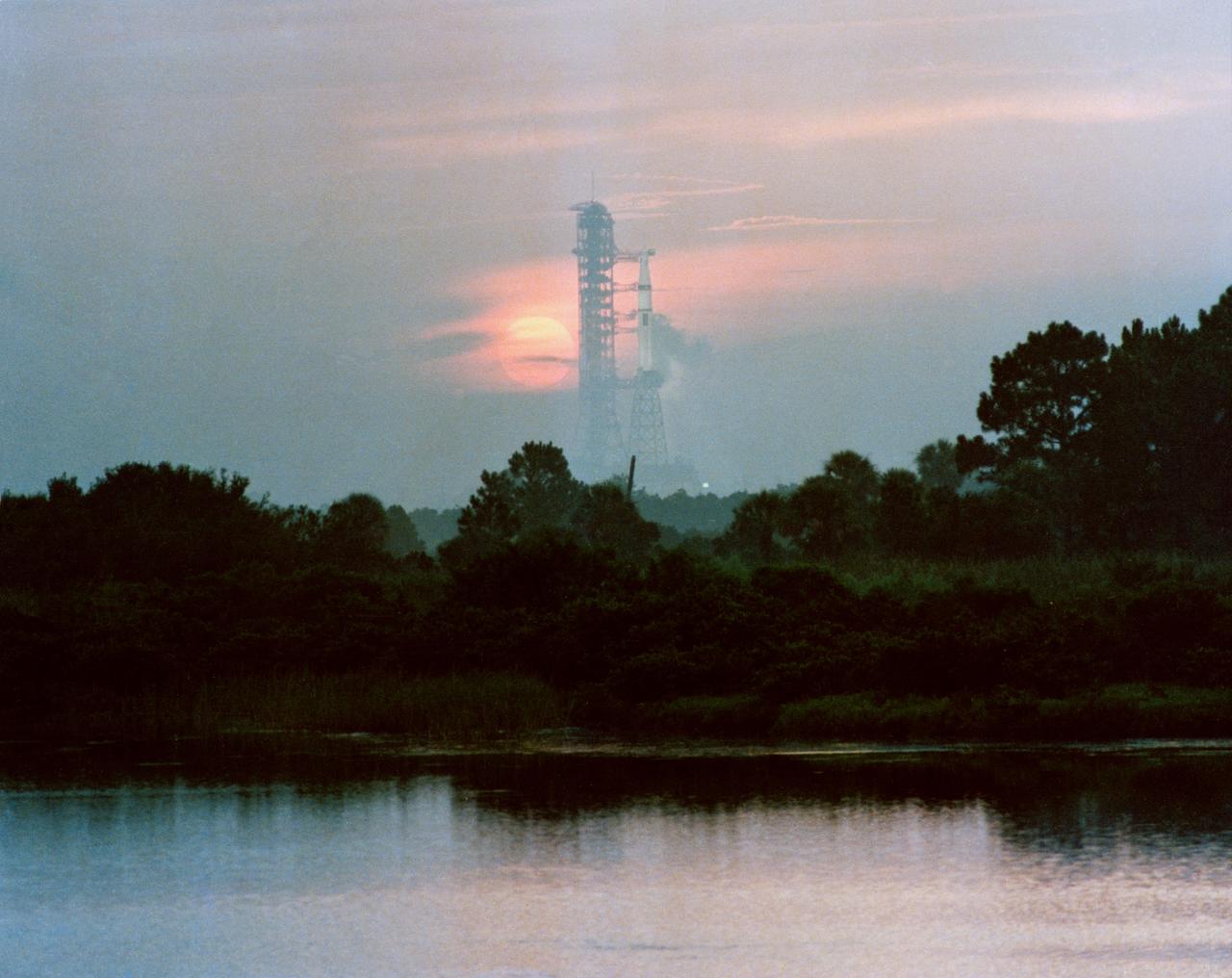
S73-37929 (16 Nov. 1973) --- A sunrise view at the Kennedy Space Center showing in the near distance the Skylab 4/Saturn 1B space vehicle on Pad B, Launch Complex 39, on the morning of the launch. The liftoff was at 9:01:23 a.m. (EST), Friday, Nov. 16, 1973. Skylab 4 is the third and last of three scheduled manned Skylab missions. Aboard the Skylab 4 Command/Service Module were astronauts Gerald P. Carr, Edward G. Gibson and William R. Pogue. This picture was photographed by astronaut Bruce McCandless II. Photo credit: NASA
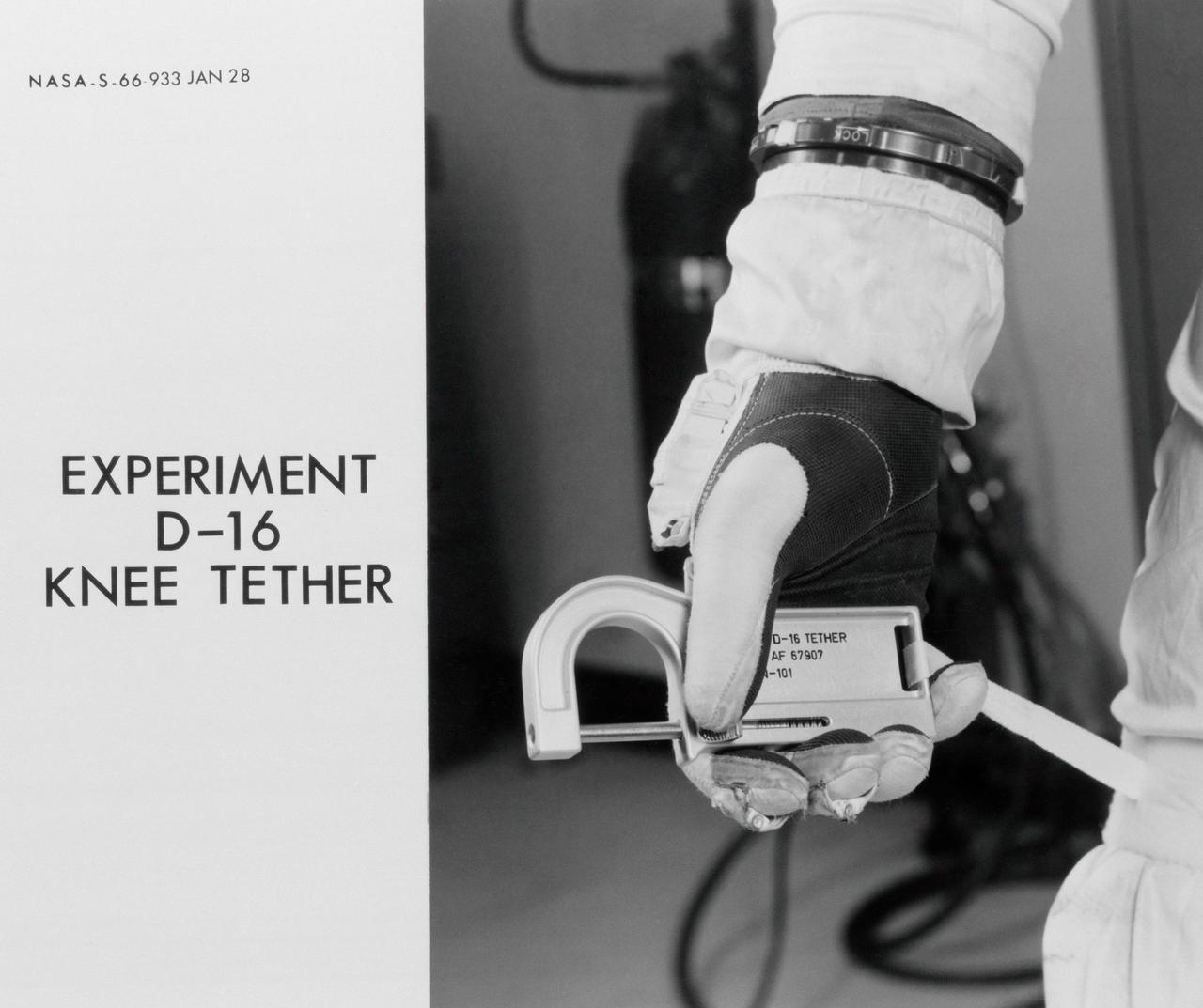
S66-00933 (28 Jan. 1966) --- Gemini-11 Experiment D-16 Knee Tether, sponsored by the Department of Defense and the United States Air Force. The astronaut tightens and loosens bolts in a prescribed pattern during his extravehicular activity, once with his body held to the spacecraft by a nine-inch tether looped around his knee and through the handrail, and once without the tether. Photo credit: NASA
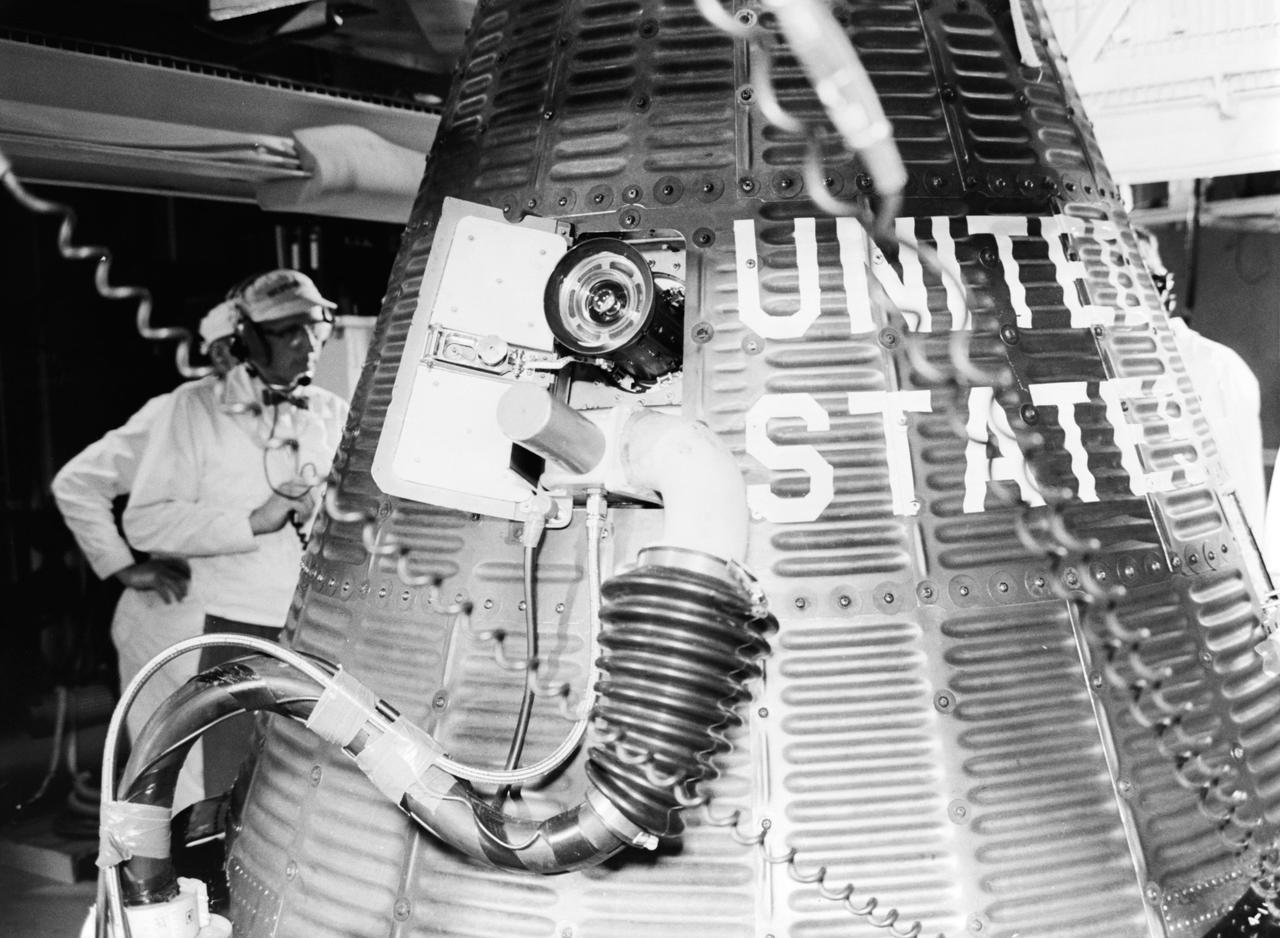
S61-03705 (1961) --- Close-up view of the fueling of the Liberty Bell 7 for the Mercury-Redstone 4 (MR-4) mission. Photo credit: NASA
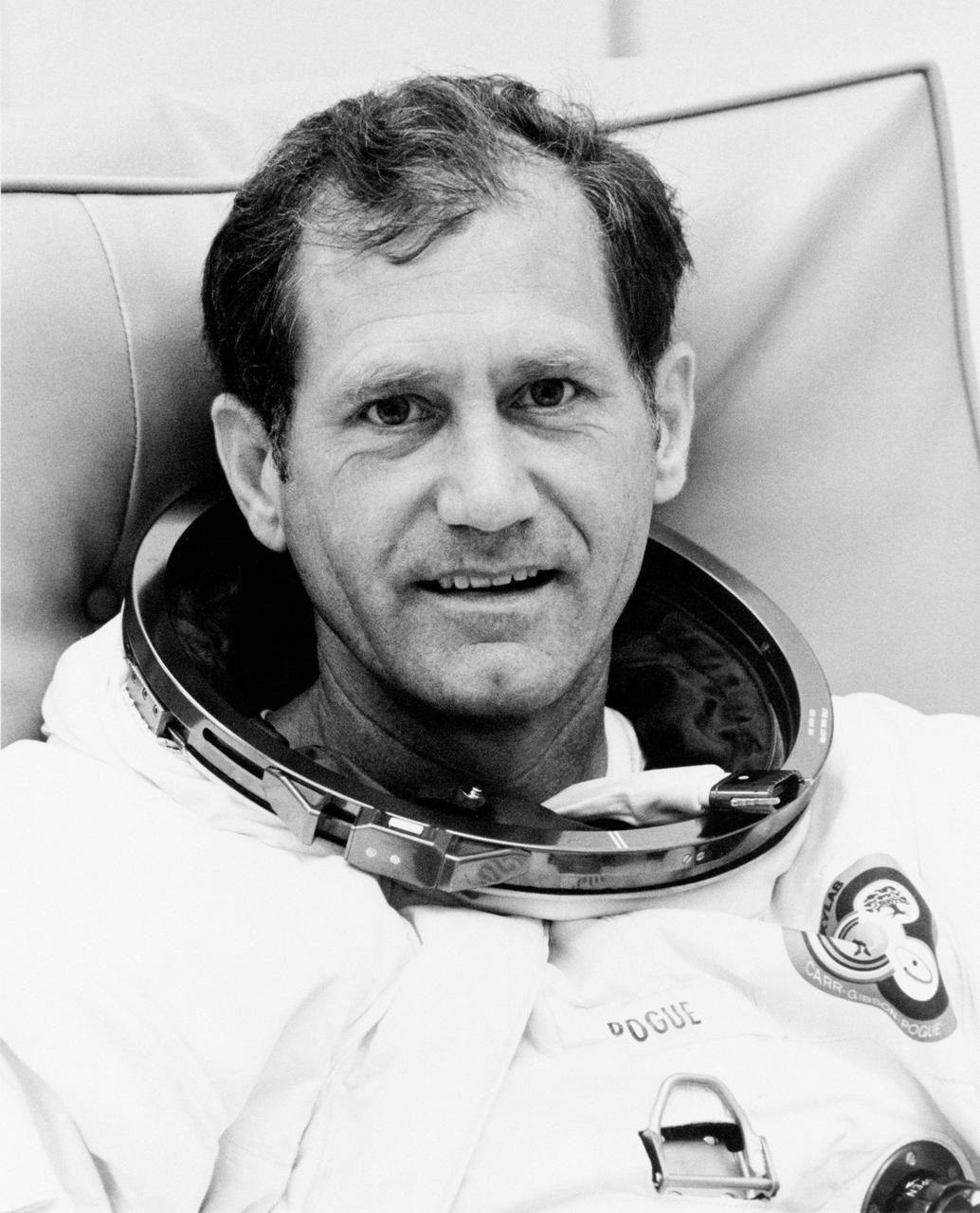
S73-36905 (8 Nov. 1973) --- Astronaut William R. Pogue, pilot of the Skylab 4 mission, relaxes during spacesuit pressure and fit checks at the Kennedy Space Center, Florida. This shoulder and head shot of Pogue was taken a few days before the scheduled Skylab 4 launch. This third and last visit to the Skylab space station in Earth orbit will return additional information on the Earth and sun, as well as provide favorable location from which to observe the recently discovered Comet Kohoutek. The other two members of the Skylab 4 crew will be astronaut Gerald P. Carr, commander; and scientist-astronaut Edward G. Gibson, science pilot. Photo credit: NASA
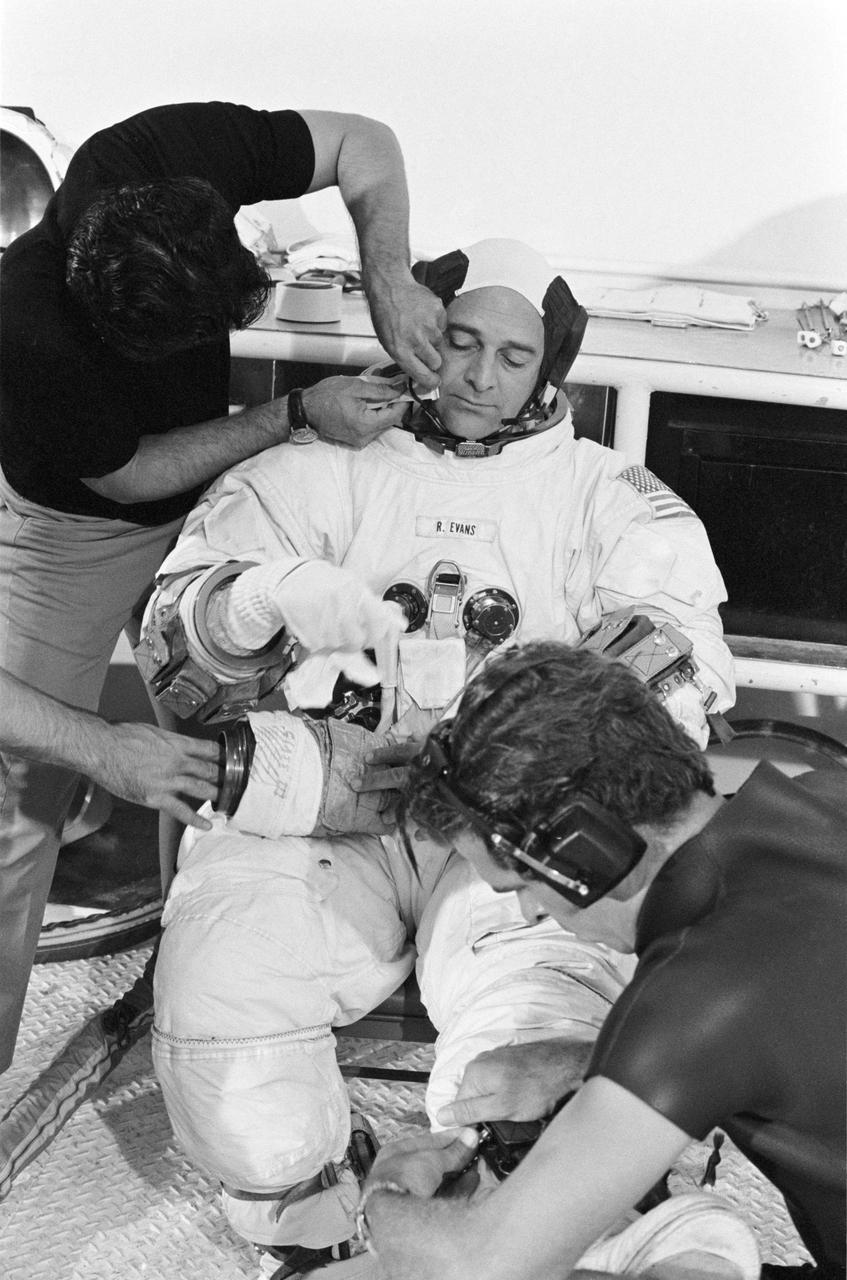
S72-49970 (29 Sept. 1972) --- Astronaut Ronald E. Evans, command module pilot of the Apollo 17 lunar landing mission, is suited up in preparation for extravehicular activity training in a water tank in Building 5 at the Manned Spacecraft Center. Evans is scheduled to perform trans-Earth extravehicular activity after the Apollo 17 spacecraft leaves lunar orbit on its way back home.
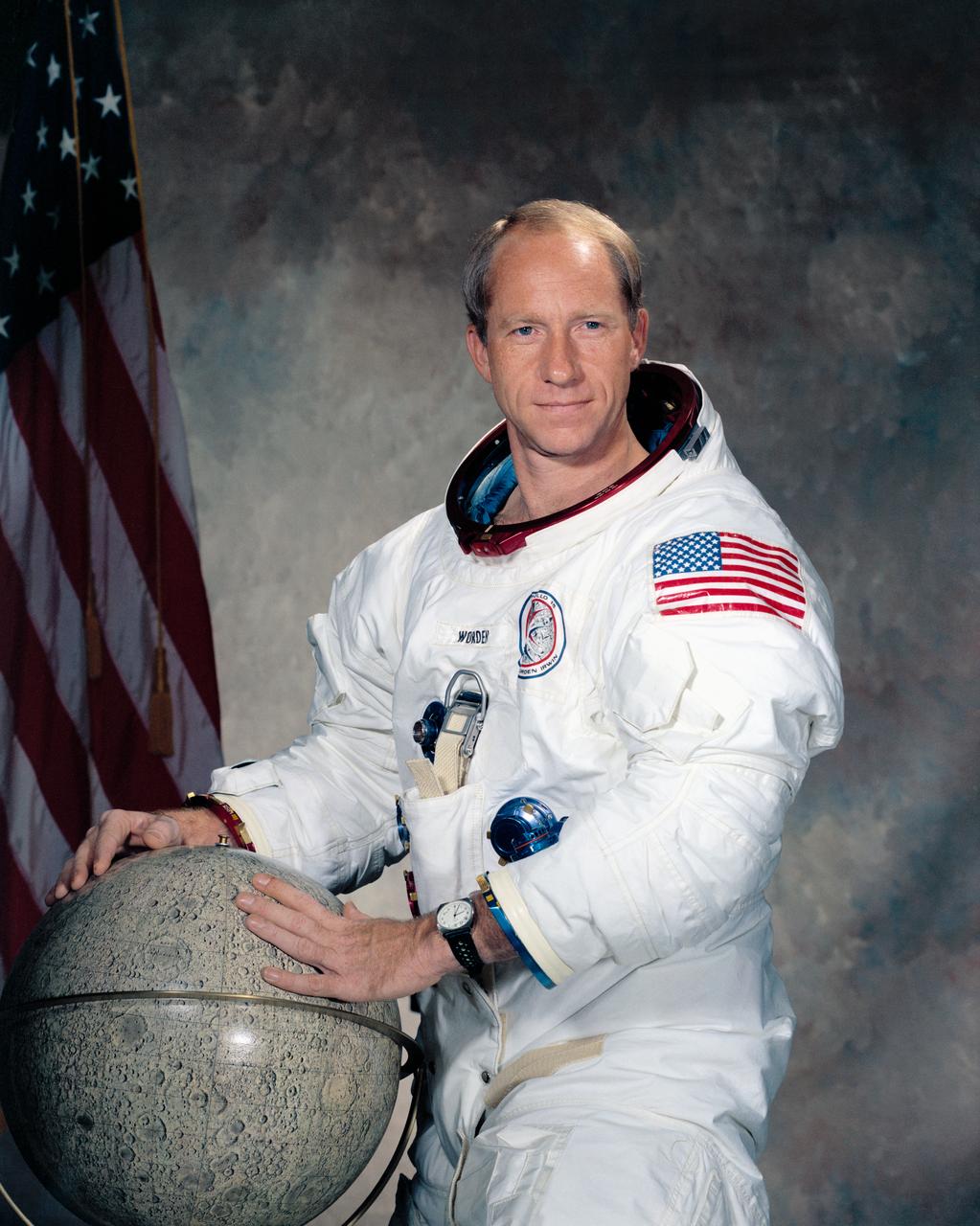
S71-52280 (1971) --- Astronaut Alfred M. Worden
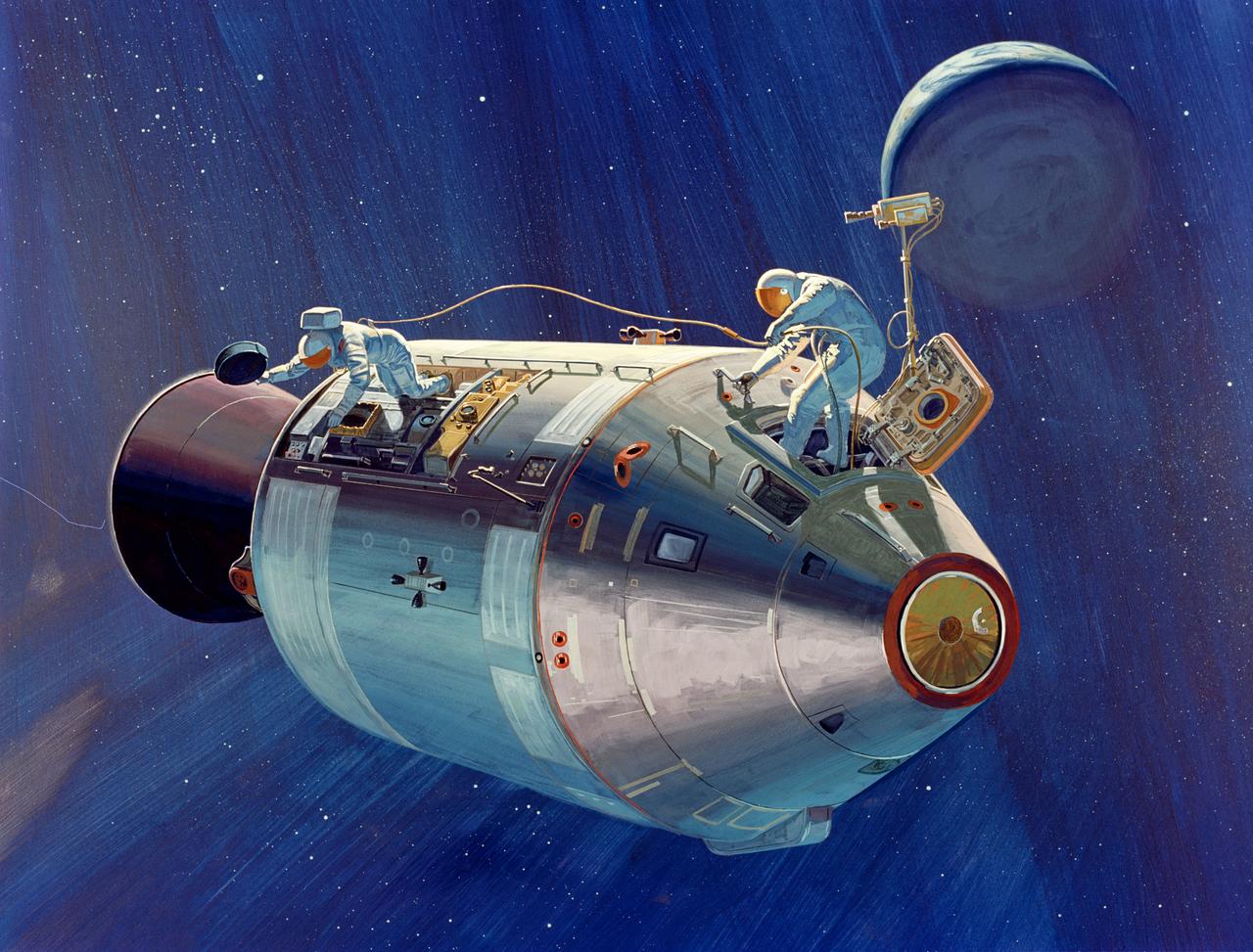
S71-39614 (July 1971) --- An artist's concept of the Apollo 15 Command and Service Modules (CSM), showing two crewmembers performing a new-to-Apollo extravehicular activity (EVA). The figure at left represents astronaut Alfred M. Worden, command module pilot, connected by an umbilical tether to the CM, at right, where a figure representing astronaut James B. Irwin, lunar module pilot, stands at the open CM hatch. Worden is working with the panoramic camera in the Scientific Instrument Module (SIM). Behind Irwin is the 16mm data acquisition camera. Artwork by North American Rockwell.
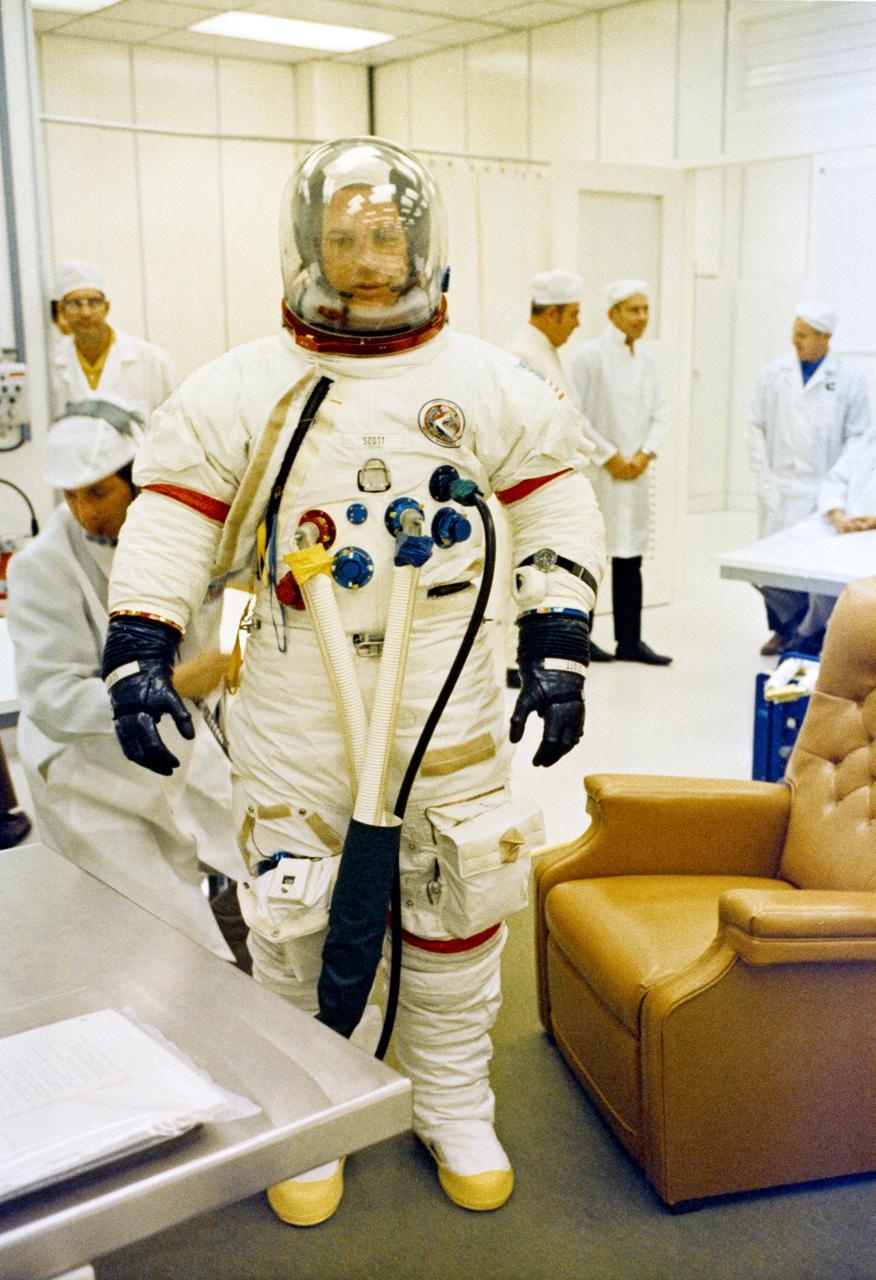
S71-41409 (26 July 1971) --- Astronaut David R. Scott, commander of the Apollo 15 lunar landing mission, goes through suiting up operations in the Kennedy Space Center's (KSC) Manned Spacecraft Operations Building (MSOB) during the Apollo 15 prelaunch countdown. Minutes later astronauts Scott; Alfred M. Worden, command module pilot; and James B. Irwin, lunar module pilot, rode a special transport van over to Pad A, Launch Complex 39, where their spacecraft awaited them. The Apollo 15 space vehicle was launched at 9:34:00:79 a.m. (EDT), July 26, 1971.
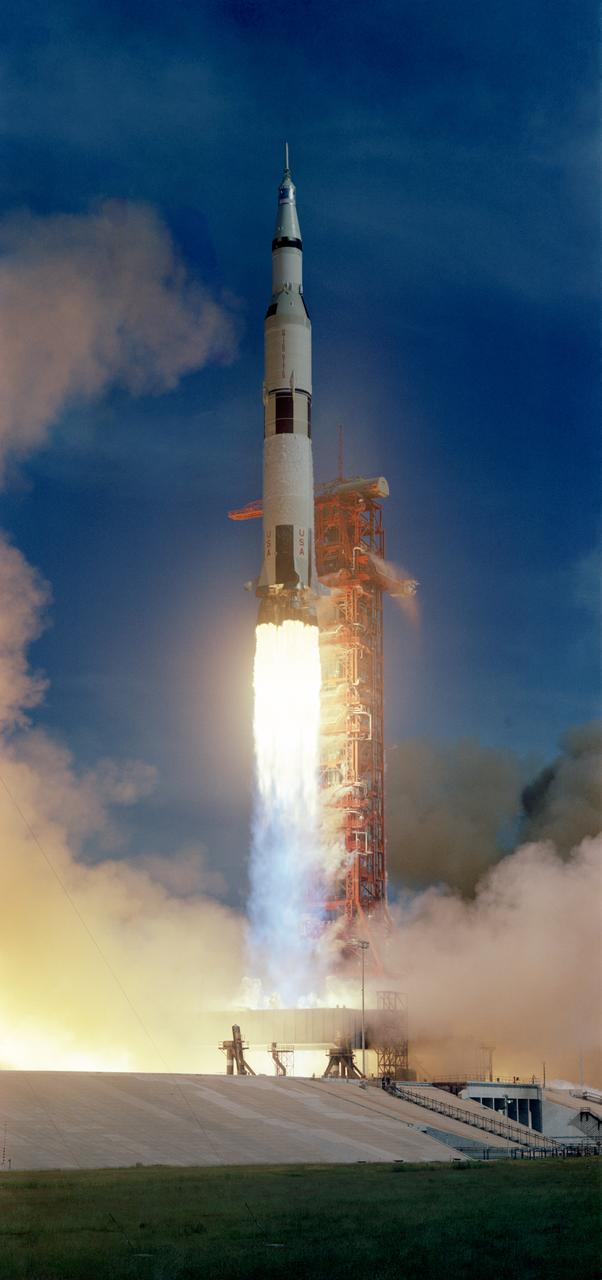
S71-41356 (26 July 1971) --- The huge, 363-feet tall Apollo 15 (Spacecraft 112/Lunar Module 10/Saturn 510) space vehicle is launched from Pad A, Launch Complex 39, Kennedy Space Center (KSC), Florida, at 9:34:00:79 a.m. (EDT), July 26, 1971, on a lunar landing mission. Aboard the Apollo 15 spacecraft were astronauts David R. Scott, commander; Alfred M. Worden, command module pilot; and James B. Irwin, lunar module pilot. Apollo 15 is the National Aeronautics and Space Administration's (NASA) fourth manned lunar landing mission. While astronauts Scott and Irwin will descend in the Lunar Module (LM) to explore the moon, astronaut Worden will remain with the Command and Service Modules (CSM) in lunar orbit.
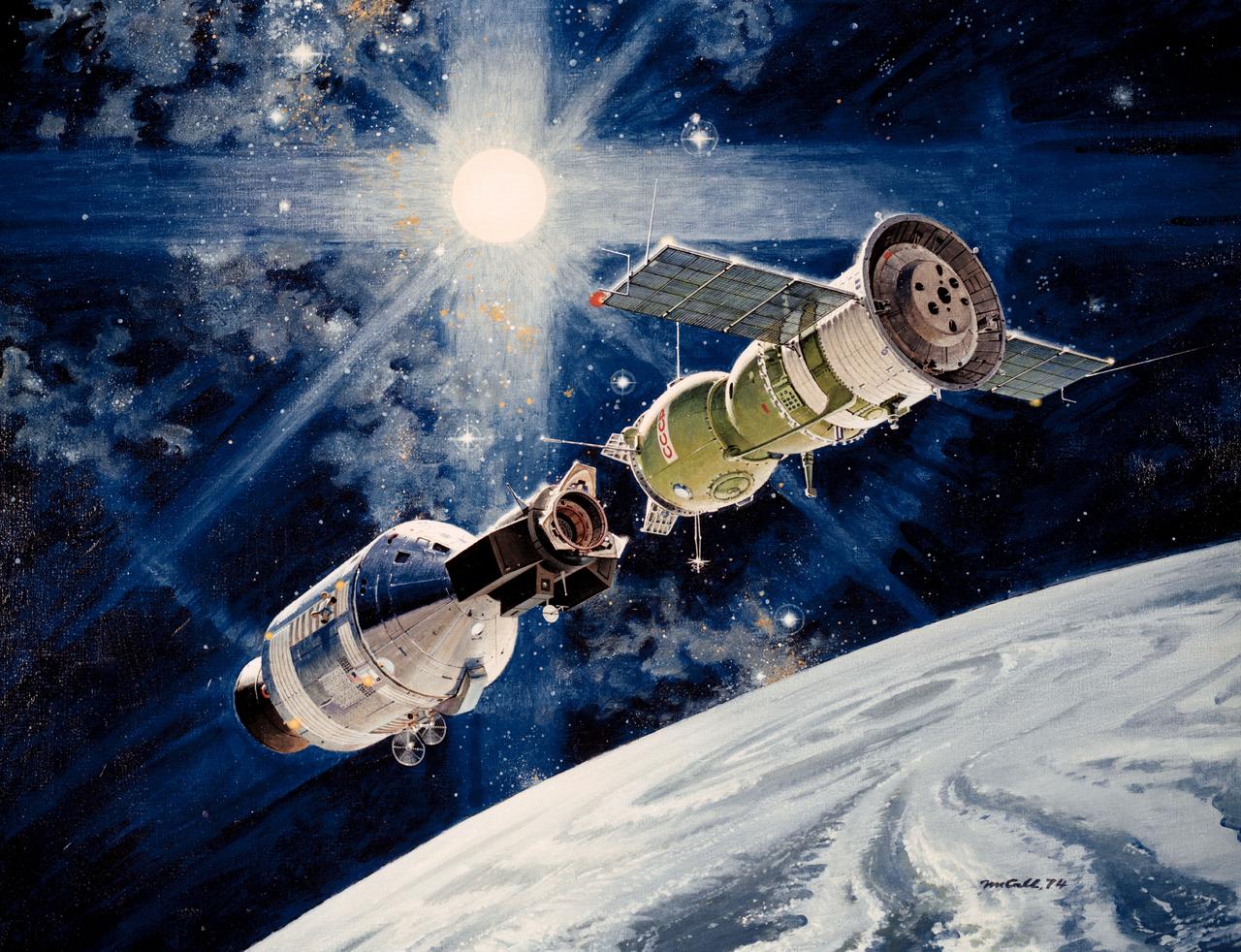
S74-24913 (August 1973) --- An artist's concept illustrating an Apollo-type spacecraft (left) about to dock with a Soviet Soyuz-type spacecraft. A recent agreement between the United States (USA) and the Union of Soviet Socialist Republic (USSR) provides for the docking in space of the Soyuz and Apollo-type spacecraft in Earth orbit in 1975. The joint space venture is called the Apollo-Soyuz Test Project (ASTP).
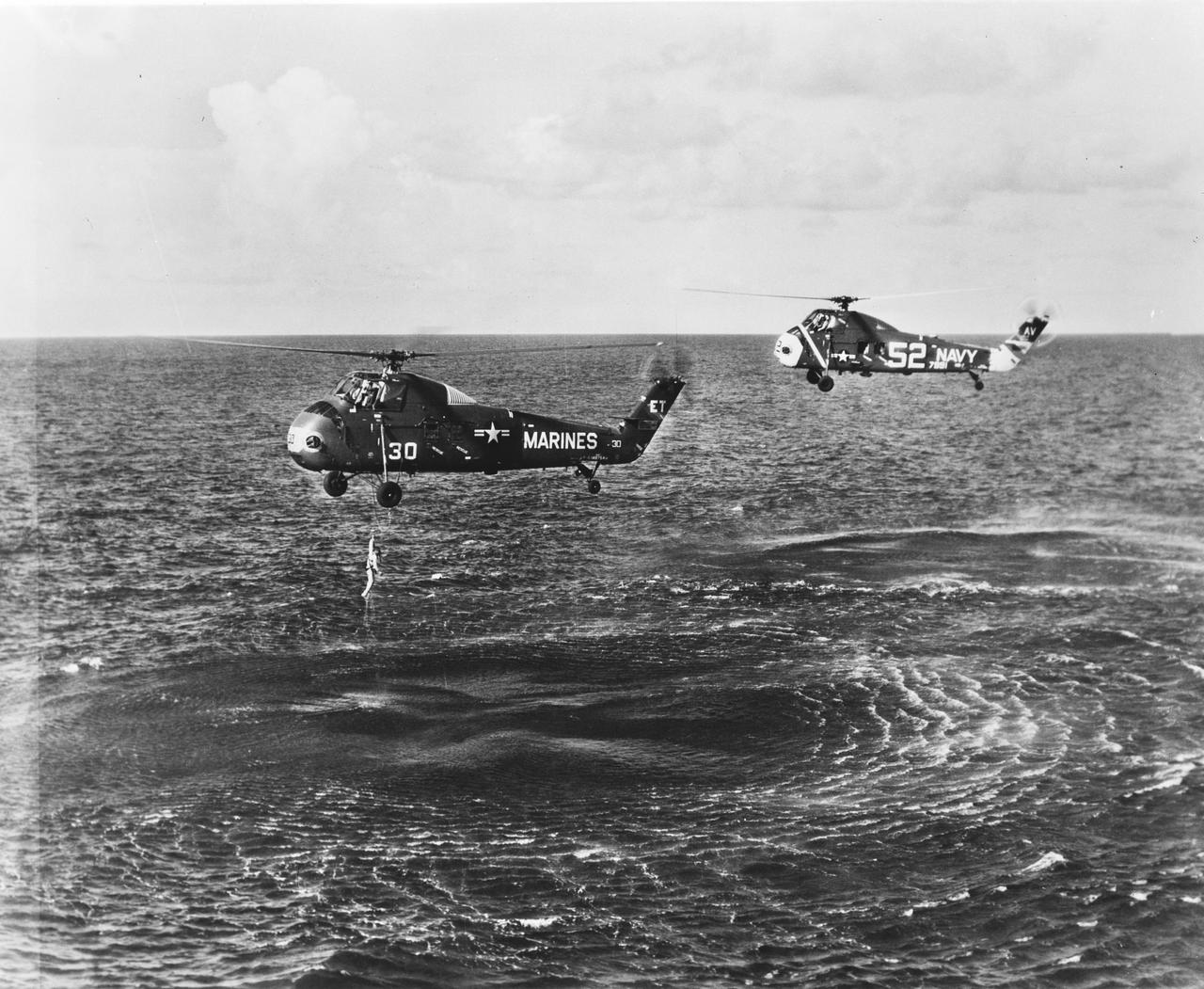
S61-02819 (21 July 1961) --- A U.S. Marine Corps helicopter retrieves astronaut Virgil I. Grissom from the Atlantic Ocean following the Mercury-Redstone 4 (MR-4) spaceflight. Grissom's "Liberty Bell" Mercury spacecraft sank to the bottom of the ocean and was not recovered. Photo credit: NASA
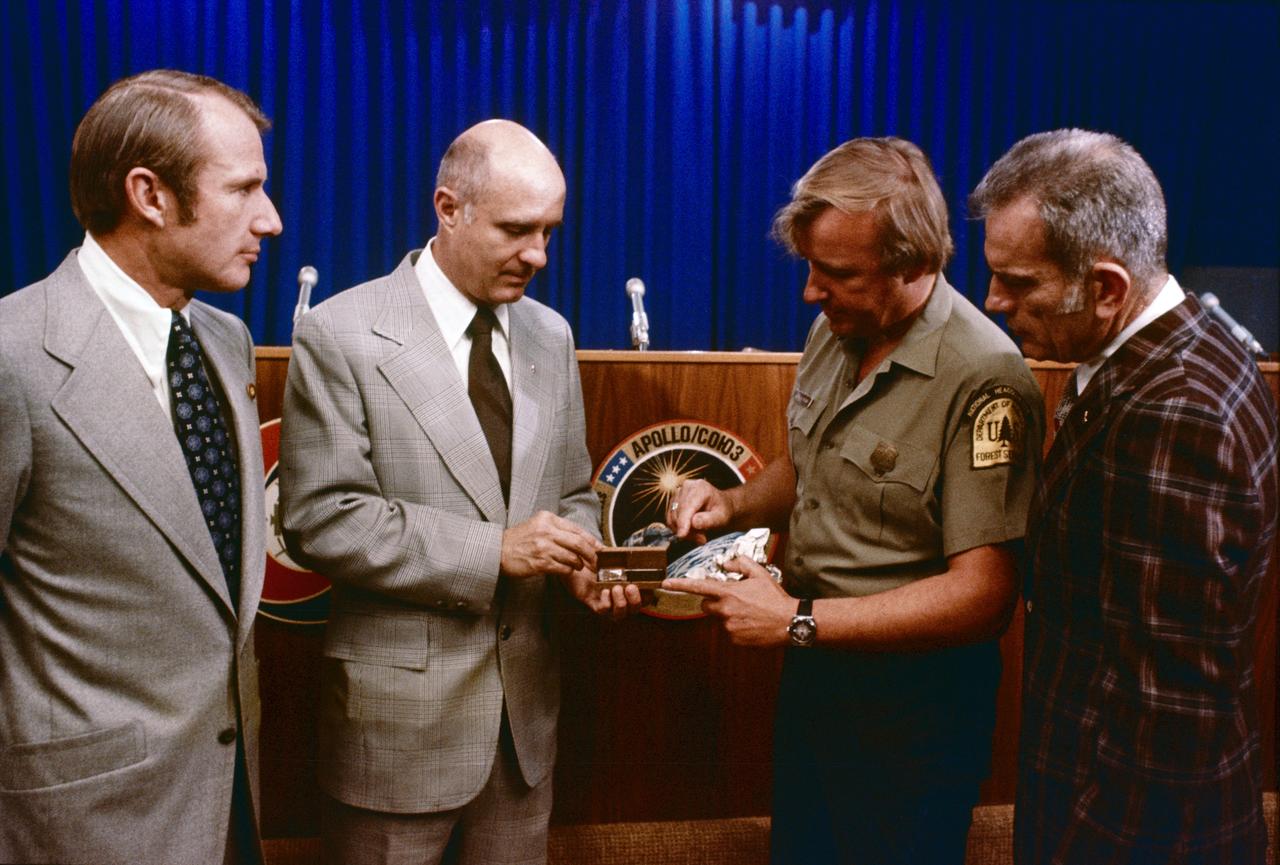
S75-27445 (6 June 1975) --- American ASTP crewmen Vance D. Brand (left), Thomas P. Stafford (second from left) and Donald K. Slayton (right) receive a special box of genetically superior white spruce seeds from Glenn A. Kovar (second from right), USDA Forest Service project coordinator. The seeds, enough to plant an acre of trees, will be presented to the Soviet ASTP crewmen during the U.S.-USSR Apollo-Soyuz Test Project docking-in-Earth-orbit mission in July 1975. The seeds will produce faster-growing trees of exceptional height and shape. The trees will thrive in Moscow-like climate, and were developed by Forest Service?s Institute of Forest Genetics in Rhinelander, Wisconsin. The seed container box was made from recycled fibers and stabilized walnut. These seeds are an outstanding example of the U.S. Forest Service research to help produce new improved forests for the world. The four men are standing in the Building 2 briefing room at NASA's Johnson Space Center.
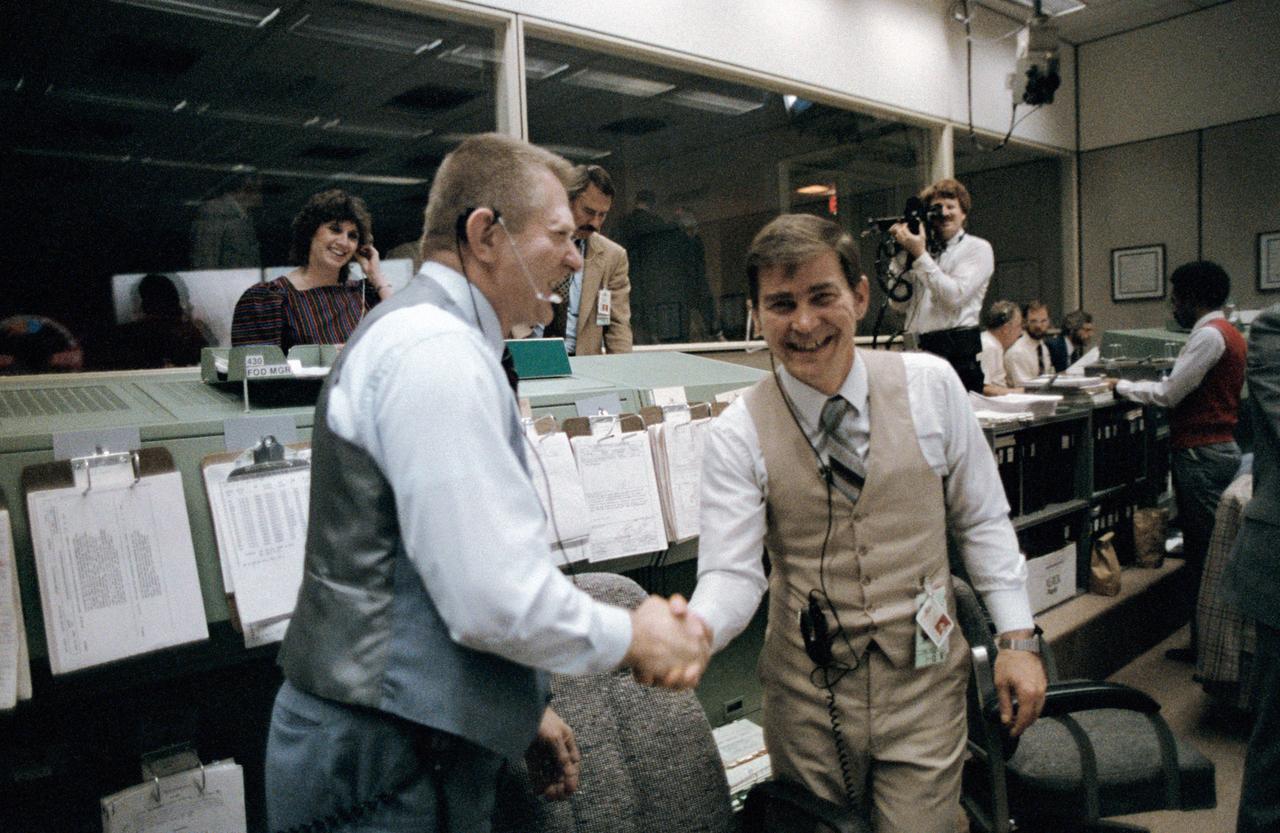
Various views of STS-6 MOCR activities during Day-5 with Vice-Pres. George Bush, Cap Communicator Bridges, JSC Director Gerald Griffin, Eugene F. Kranz, NASA Admin. James M. Beggs, Cap Com Astronaut O'Connor, Flight Directors Jay H. Greene, Gary E. Coen, and Harold Draughon. 1. BUSH, GEORGE, VICE-PRES. - STS-6 MOCR 2. DIR. GRIFFIN, GERALD D. - STS-6 MOCR 3. ADMIN. BEGGS, JAMES M. - STS-6 MOCR 4. FLT. DIRECTORS - STS-6 JSC, HOUSTON, TX Also available in 35 CN
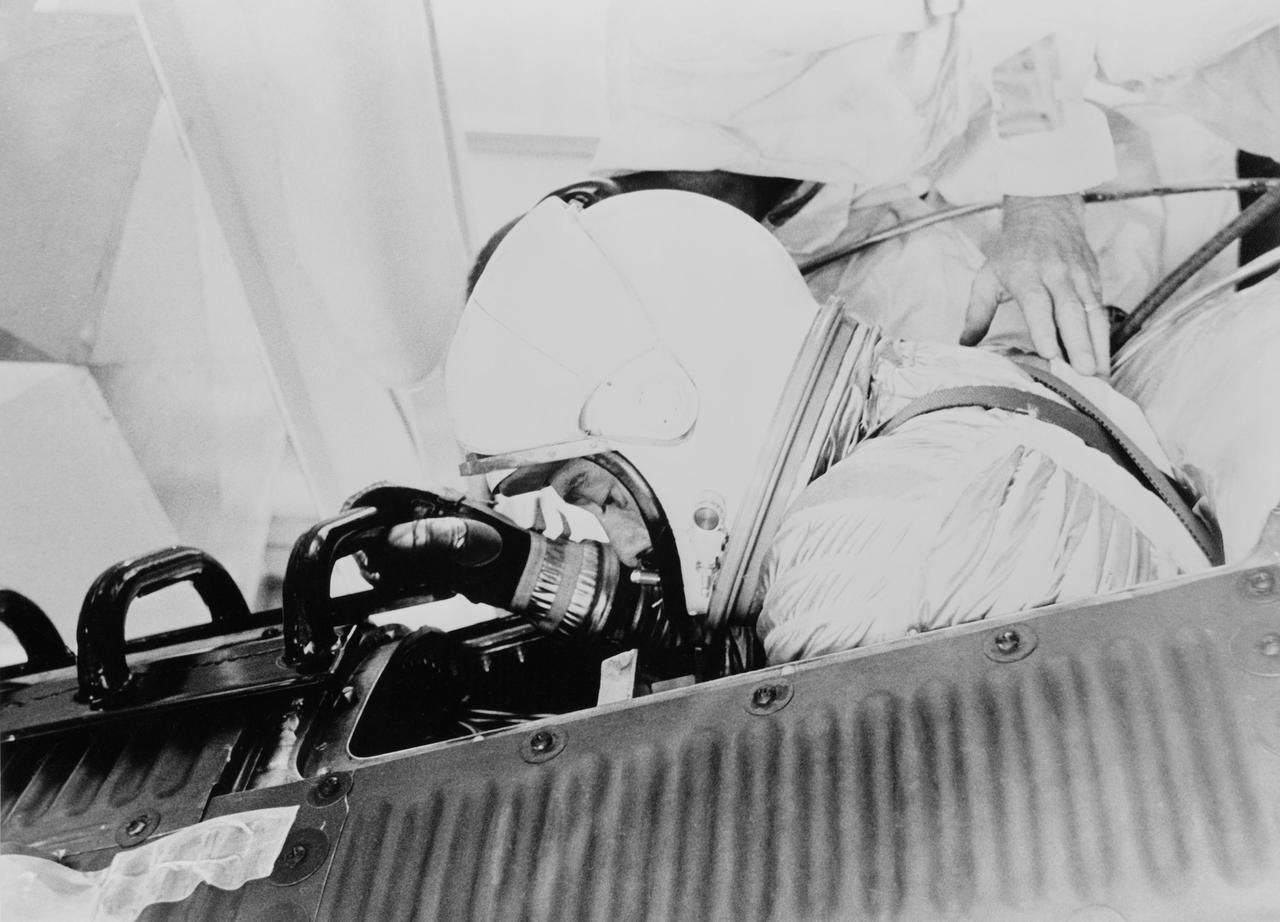
S61-03645 (5 May 1961) --- Close-up of astronaut Alan B. Shepard Jr., in his pressure suit and helmet, ingressing into the Freedom 7 capsule in preparation for the Mercury-Redstone 3 (MR-3) mission. Photo credit: NASA or National Aeronautics and Space Administration
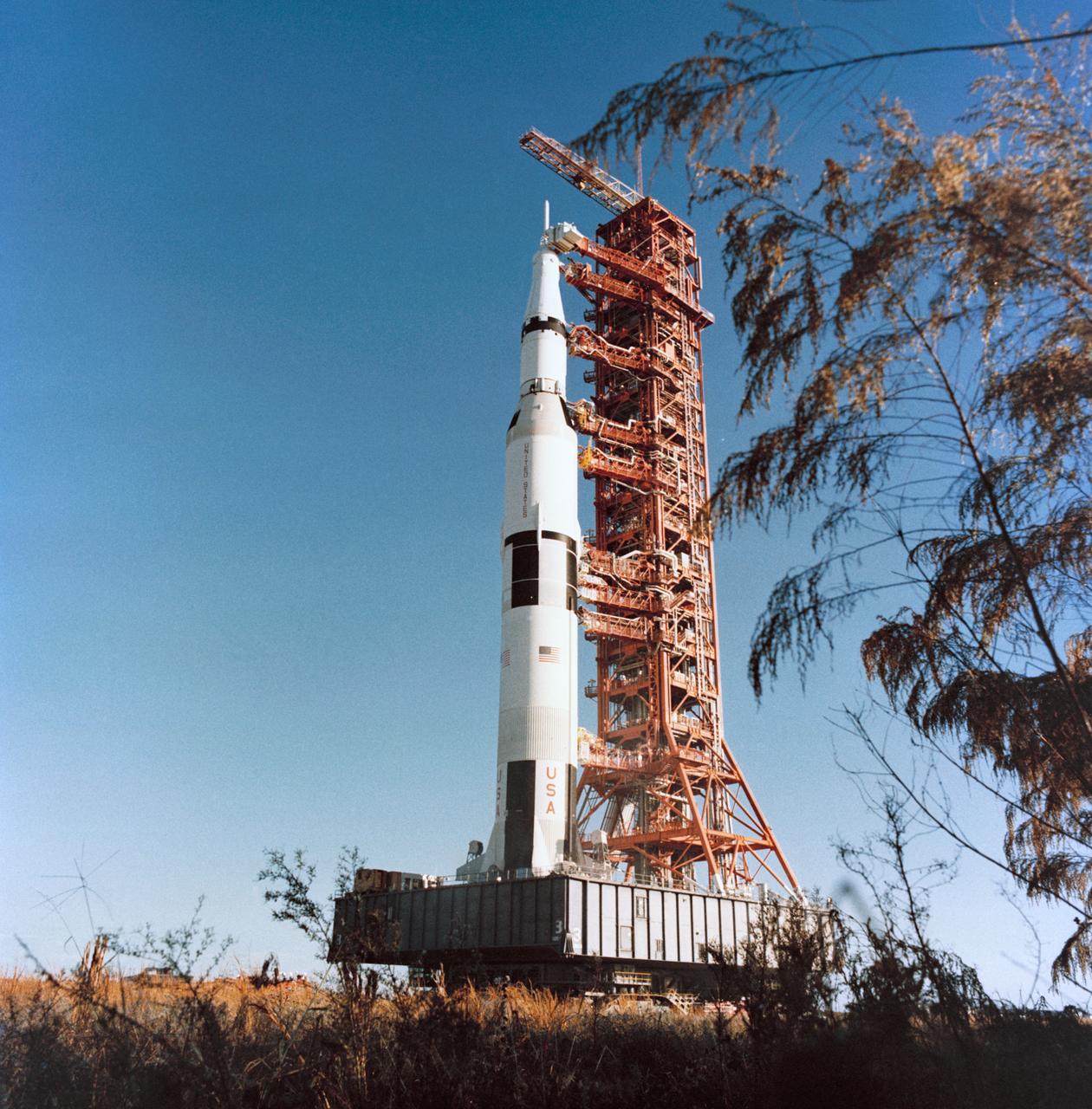
S72-19794 (13 Dec. 1971) --- A ground-level view showing the tall Apollo 16 (Spacecraft 113/Lunar Module 11/Saturn 511) space vehicle at the Kennedy Space Center's (KSC) Launch Complex 39 being moved from the Vehicle Assembly Building (VAB) toward Pad A. The Saturn V stack and its mobile launch tower are atop a huge crawler-transporter. The prime crew men of the scheduled Apollo 16 lunar landing mission are astronauts John W. Young, Apollo 16 lunar landing mission are astronauts John W. Young, commander; Thomas K. Mattingly II, command module pilot; and Charles M. Duke Jr., lunar module pilot.
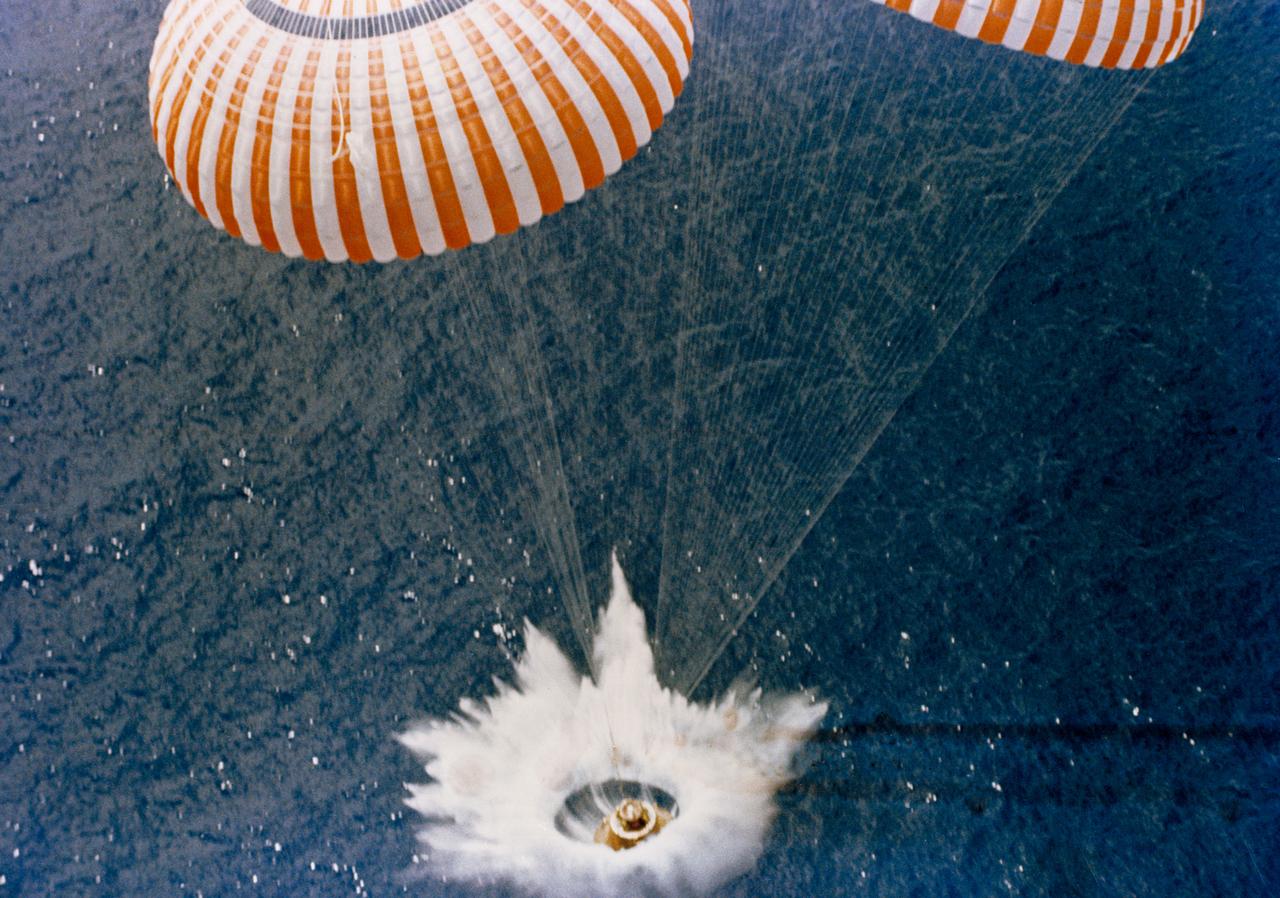
S71-43543 (7 Aug. 1971) --- The Apollo 15 Command Module (CM), with astronauts David R. Scott, commander; Alfred M. Worden, command module pilot; and James B. Irwin, lunar module pilot, aboard safely touches down in the mid-Pacific Ocean to conclude a highly successful lunar landing mission. Although causing no harm to the crew men, one of the three main parachutes failed to function properly. The splashdown occurred at 3:45:53 p.m. (CDT), Aug. 7, 1971, some 330 miles north of Honolulu, Hawaii. The three astronauts were picked up by helicopter and flown to the prime recovery ship, USS Okinawa, which was only 6 1/2 miles away.
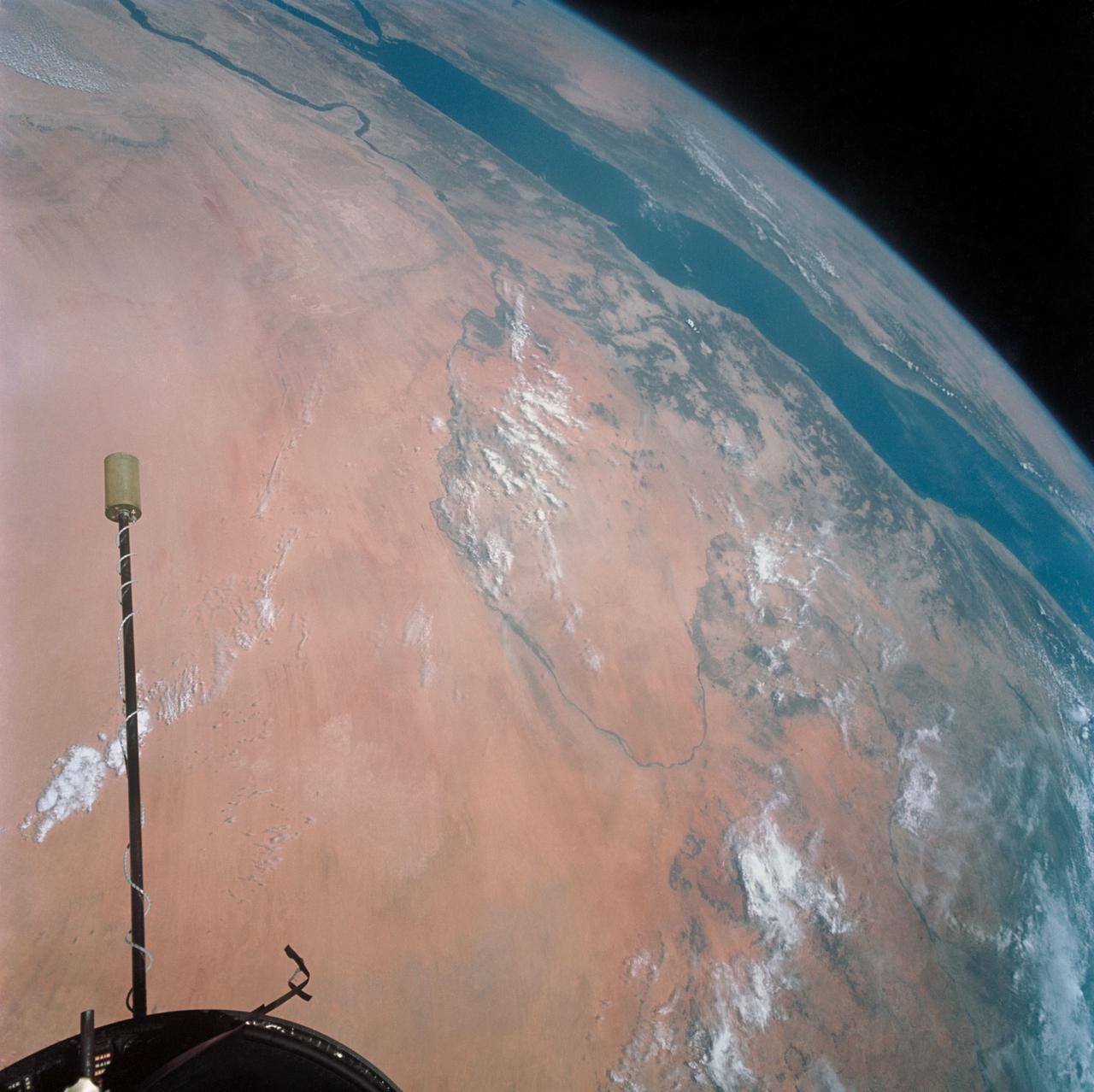
S66-54530 --- Libyan Desert area of Sudan, foreground, and the United Arab Republic (Egypt), at lower left, as seen from the orbiting Gemini-11 spacecraft at an altitude of 300 nautical miles during its 27th revolution of Earth. In view is the Nile River from Biba in Egypt to Khartoum in the Sudan. The Red Sea is in the background. At upper left is the Arabian Peninsula. At top right is Ethiopia. Note L-band antenna of the Agena Target Vehicle. Taken with a modified 70mm Hasselblad camera, using Eastman Kodak, Ektachrome, MS (S.O. 368) color film. Photo credit: NASA
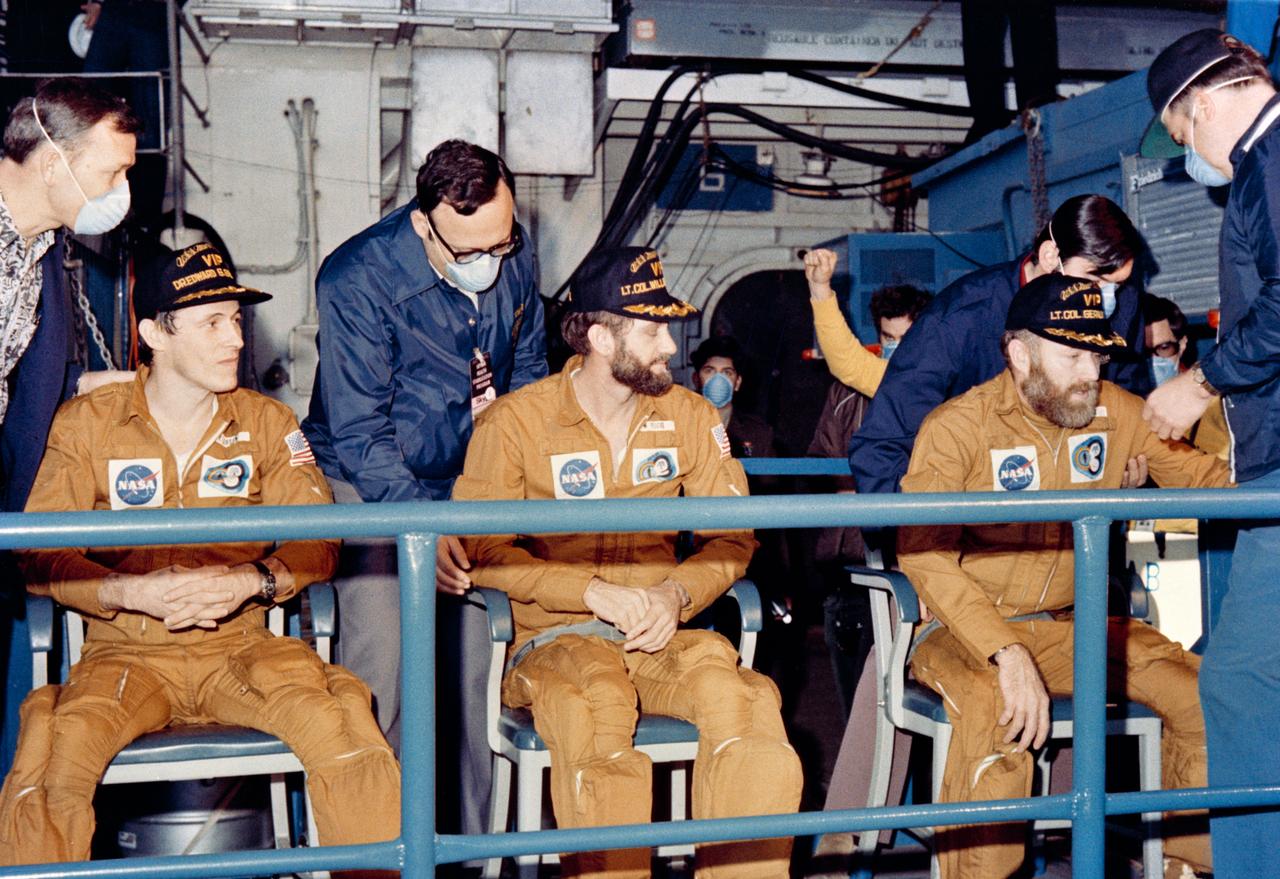
S74-17744 (8 Feb. 1974) --- The crewmen of the third and final manned Skylab mission relax on the USS New Orleans, prime recovery ship for their mission, about an hour after their Command Module splashed down at 10:17 a.m. (CDT), Feb. 8, 1974. The splashdown, which occurred 176 statute miles from San Diego, ended 84 record-setting days of flight activity aboard the Skylab space station cluster in Earth orbit. Photo credit: NASA

S82-28456 (19 Feb. 1982) --- Astronauts Jack R. Lousma, left, STS-3 commander, and C. Gordon Fullerton, pilot, are briefed on emergency procedures at Launch Pad 39A by Buck Tomlinson, a safety instructor with Wackenhut Services, Inc. Also pictured is astronaut Daniel C. Brandenstein, STS-8 pilot. The men were at Kennedy Space Center (KSC) for participation in a countdown demonstration test (CDDT). Photo credit: NASA
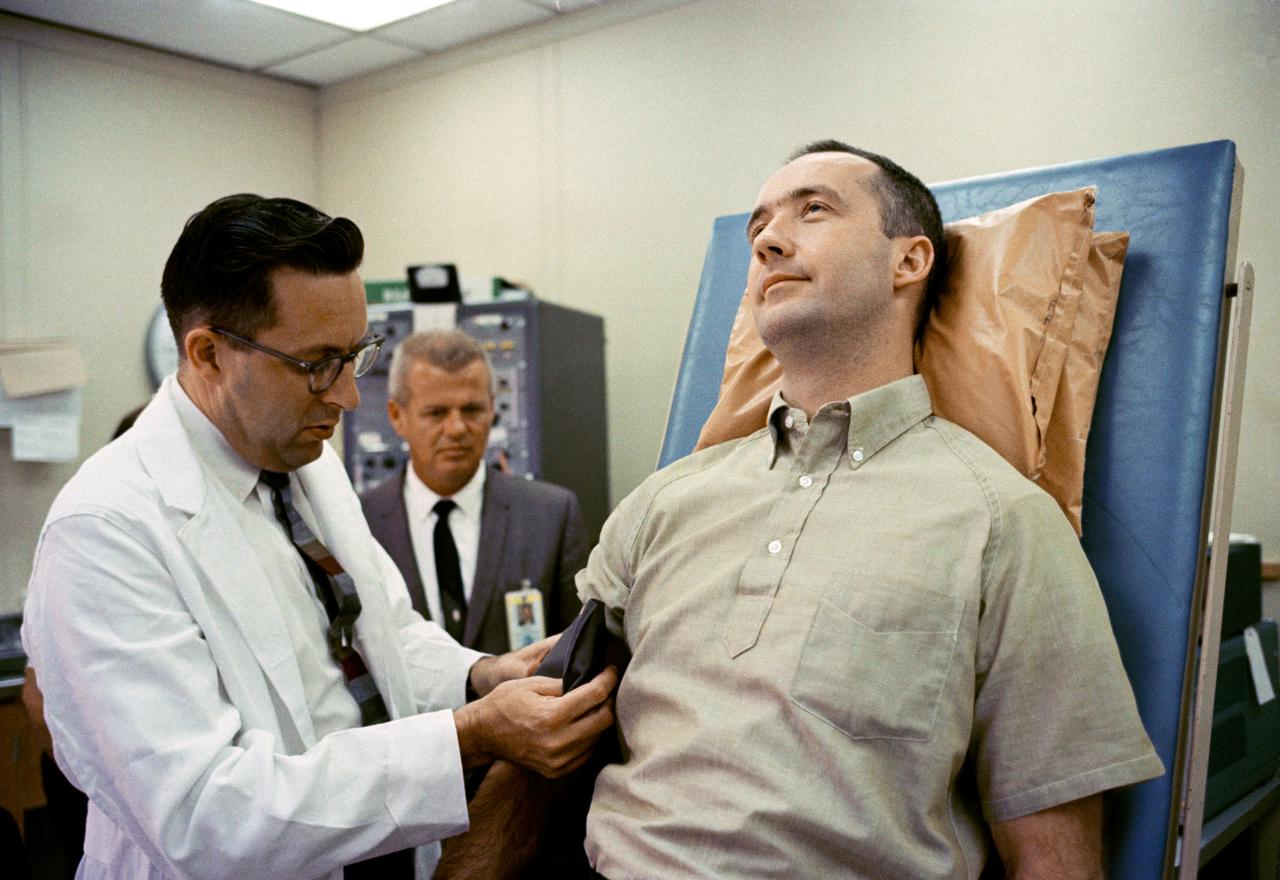
S65-19524 (1 June 1965) --- Dr. Charles A. Berry, chief of Center Medical Programs, MSC, Houston, Texas, prepares to check the blood pressure of astronaut James A. McDivitt, command pilot for the Gemini-Titan 4 spaceflight. McDivitt is on the tilt table at the Aero Medical Area, MSC, Merritt Island, where he and astronaut Edward H. White II (out of frame), GT-4 pilot, underwent preflight physicals in preparation for the four-day, 62-revolution spaceflight. The two astronauts were declared in top physical condition. In the background is Dr. Gordon Benson, NASA physician at Cape Kennedy.
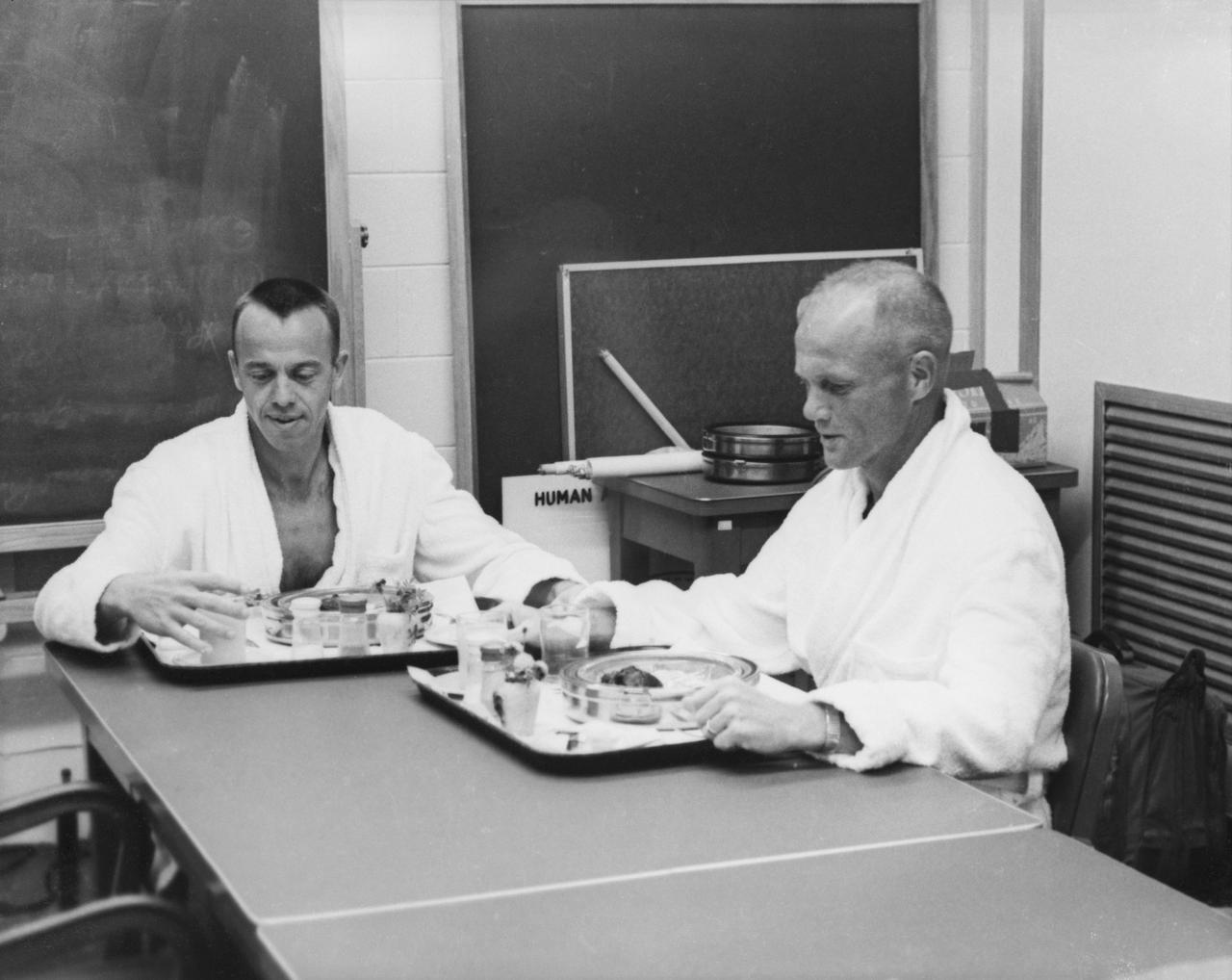
S61-02735 (5 May 1961) --- Astronauts Alan Shepard and John Glenn at breakfast before Shepard's Mercury-Redstone 3 (MR-3) spaceflight. Photo credit: NASA or National Aeronautics and Space Administration
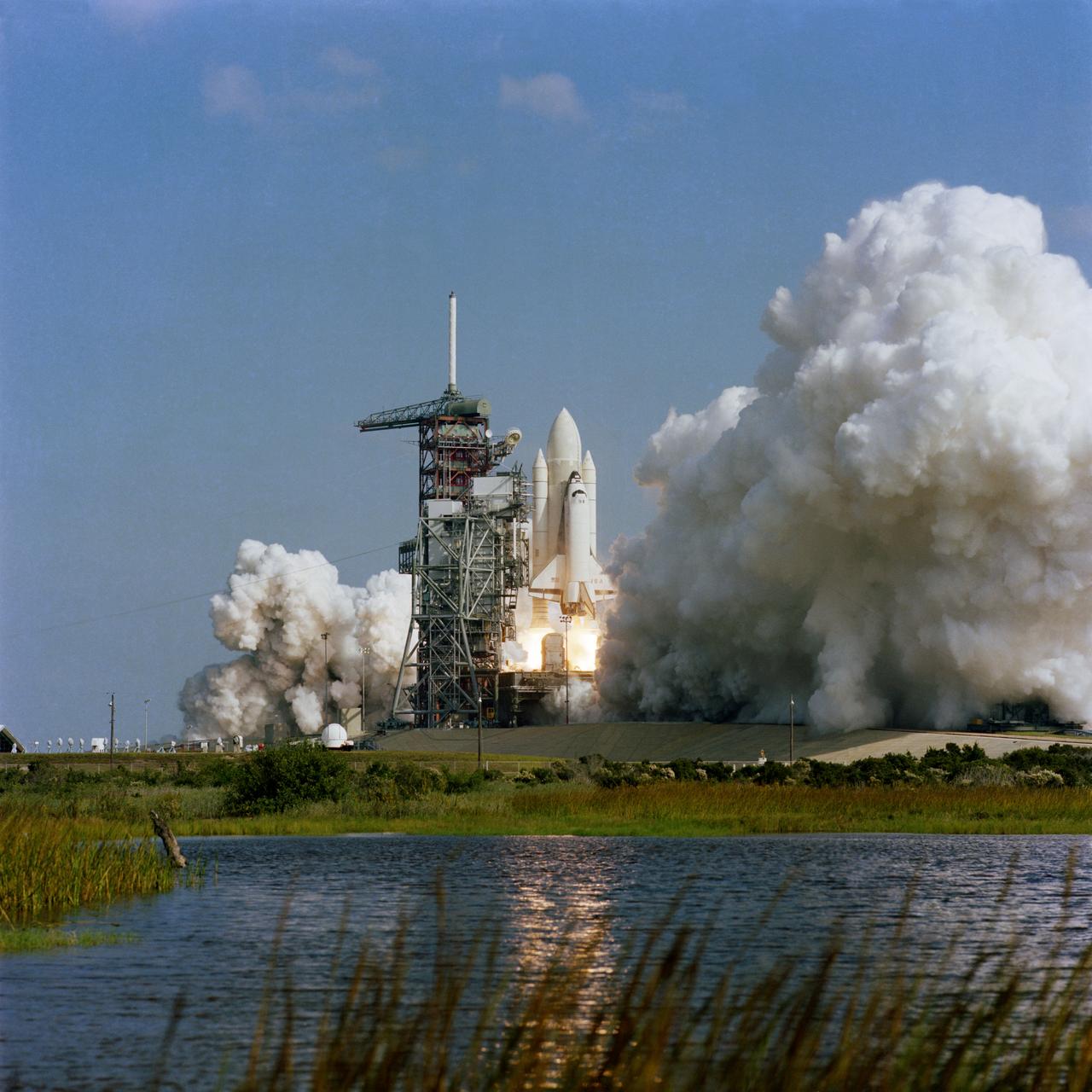
S81-39548 (12 Nov. 1981) --- NASA's space shuttle Columbia climbs toward space for a return visit after its 10:10 a.m. liftoff from Launch Pad 39A. Aboard the space shuttle, astronauts Joe H. Engle and Richard H. Truly man the flight deck. On its second mission (STS-2), Columbia carries a payload of science and applications experiments and an arm-like robot device named a remote manipulator system (RMS). Photo credit: NASA
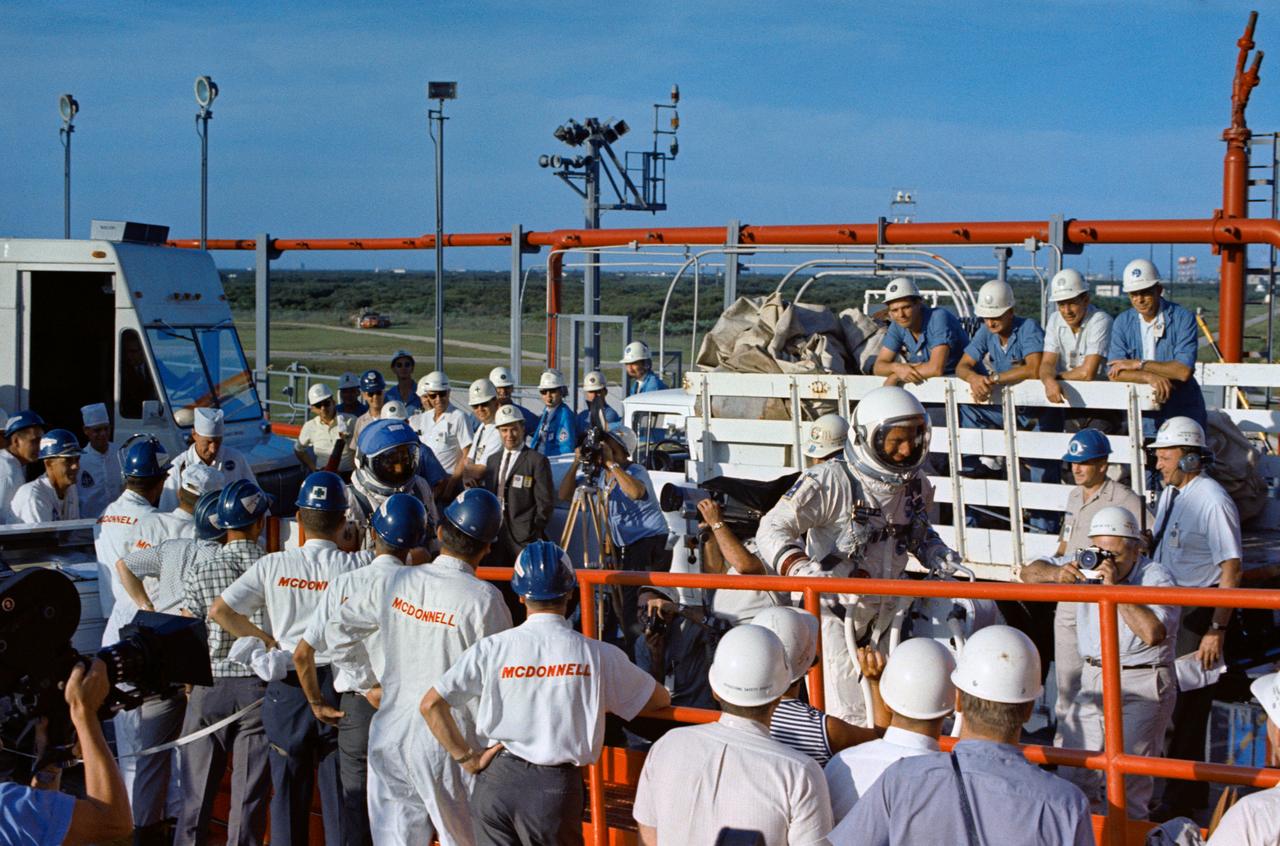
S66-50780 (10 Sept. 1966) --- Astronauts Richard F. Gordon Jr. (in front), pilot, and Charles Conrad Jr., command pilot, walk up the ramp at Pad 19 during the Gemini-11 prelaunch countdown. Photo credit: NASA

General Activities in the Mission Operations Control Center (MOCR) during Day-1 of the STS-4 Mission. JSC, HOUSTON, TX Also available in 35 CN
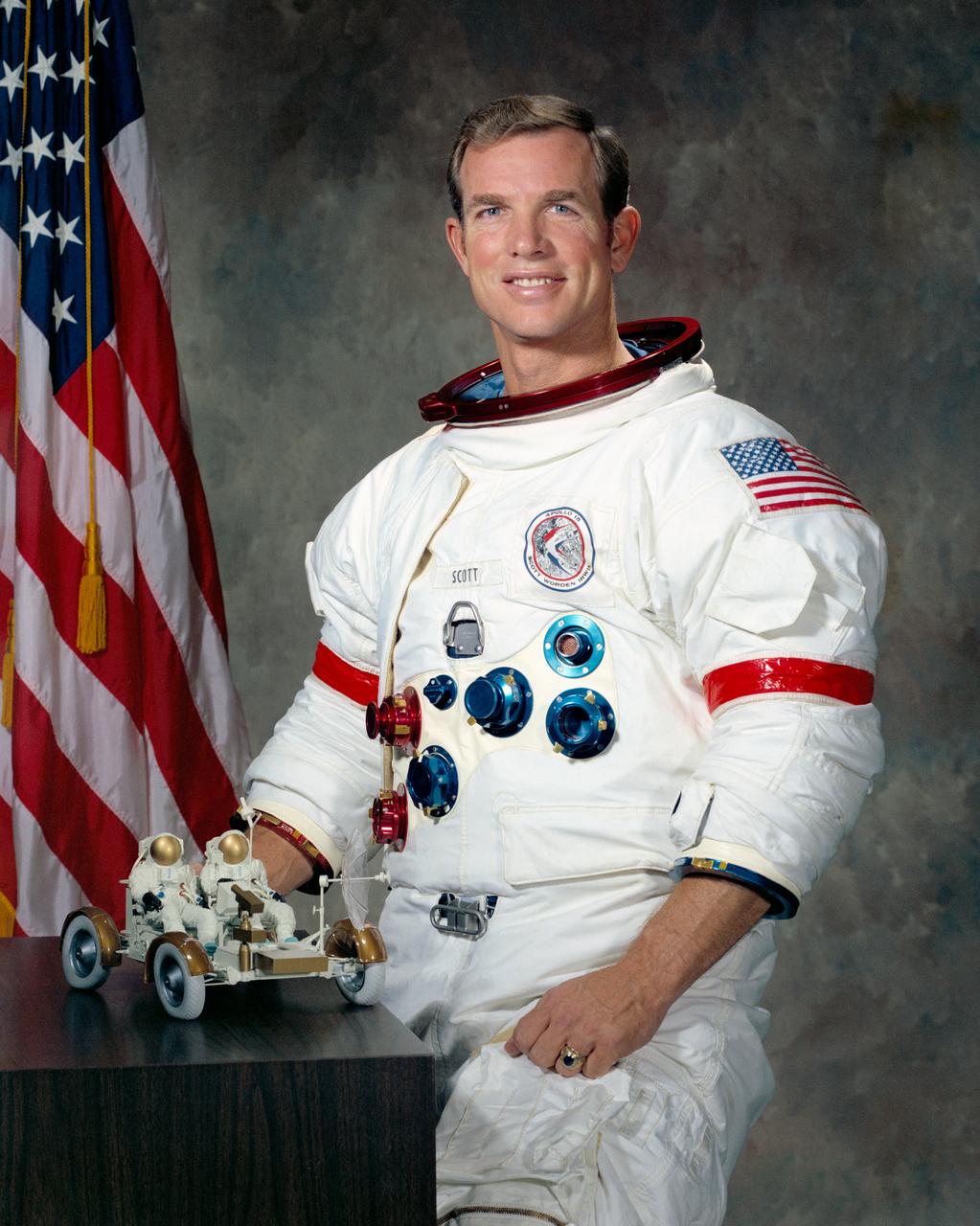
S71-52276 (1971) --- Astronaut David R. Scott
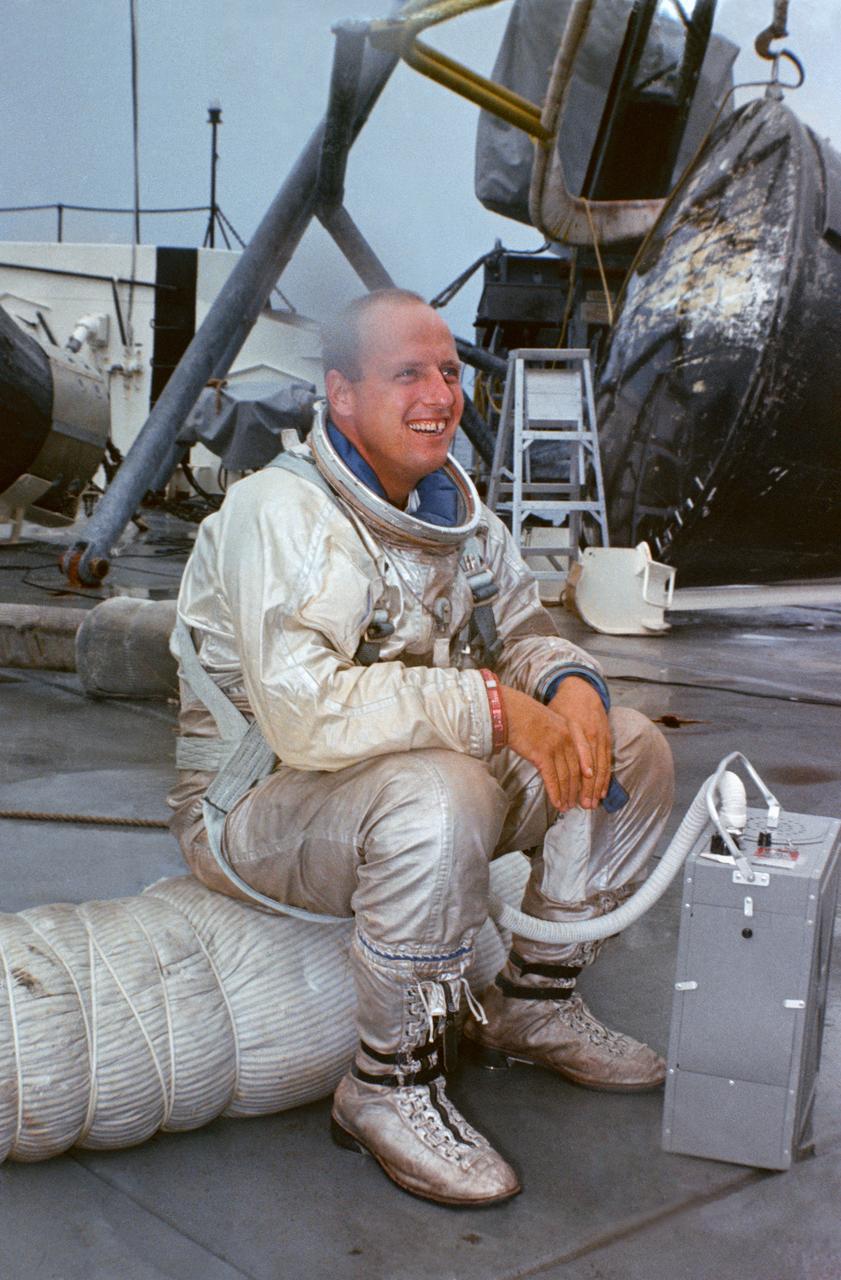
S66-44501 (23 July 1966) --- Astronaut Charles Conrad Jr., prime crew command pilot of the Gemini-11 spaceflight, relaxes on deck of the NASA Motor Vessel Retriever after suiting up for water egress training in the Gulf of Mexico. Photo credit: NASA
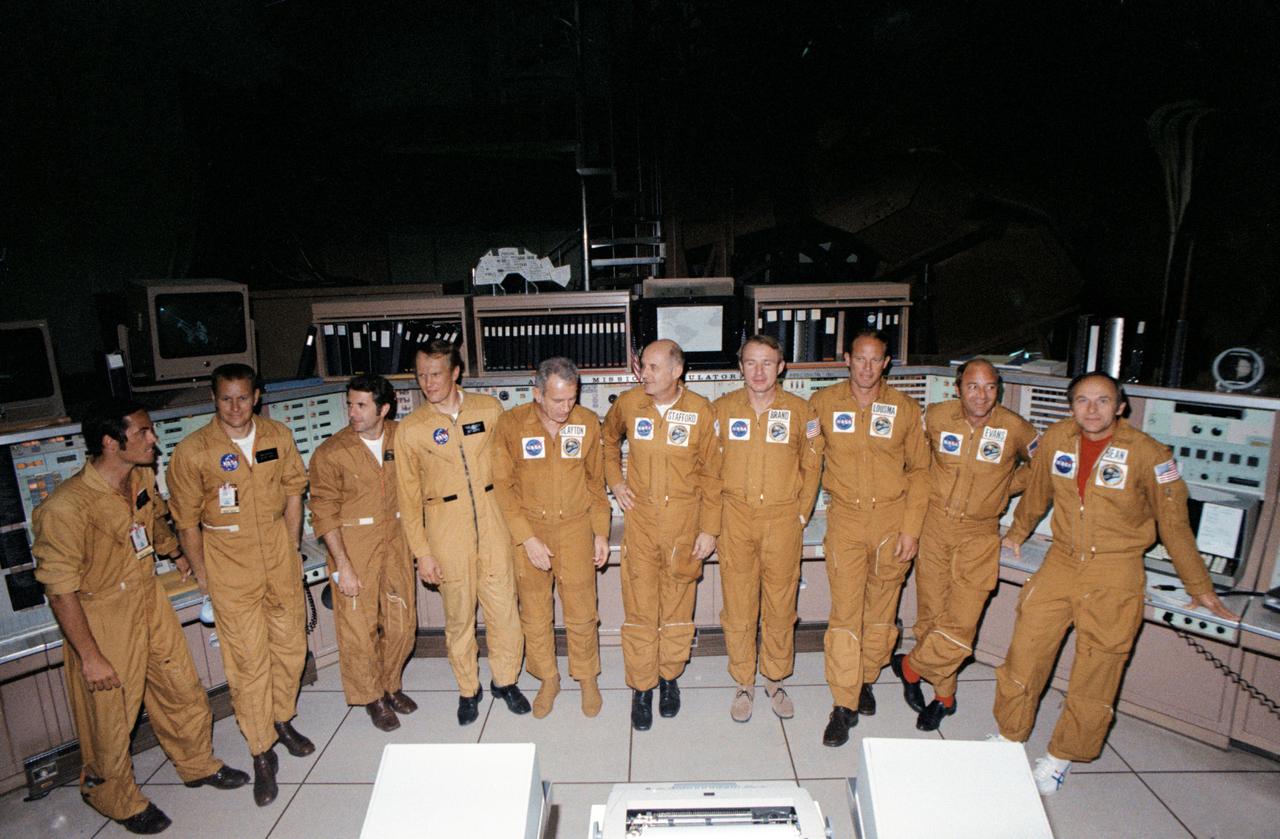
S75-28361 (9 July 1975) --- These ten American astronauts compose the U.S. prime crew, the backup crew and the crew support team for the joint U.S.-USSR Apollo-Soyuz Test Project docking mission in Earth orbit. They are, left to right, Robert L. Crippen, support team; Robert F. Overmyer, support team; Richard H. Truly, support team; Karol J. Bobko, support team; Donald K. Slayton, prime crew docking module pilot; Thomas P. Stafford, prime crew commander; Vance D. Brand, prime crew command module pilot; Jack R. Lousma, backup crew docking module pilot; Ronald E. Evans, backup crew command module pilot; and Alan L. Bean, backup crew commander. They are photographed by the Apollo Mission Simulator console in Building 5 at NASA's Johnson Space Center.
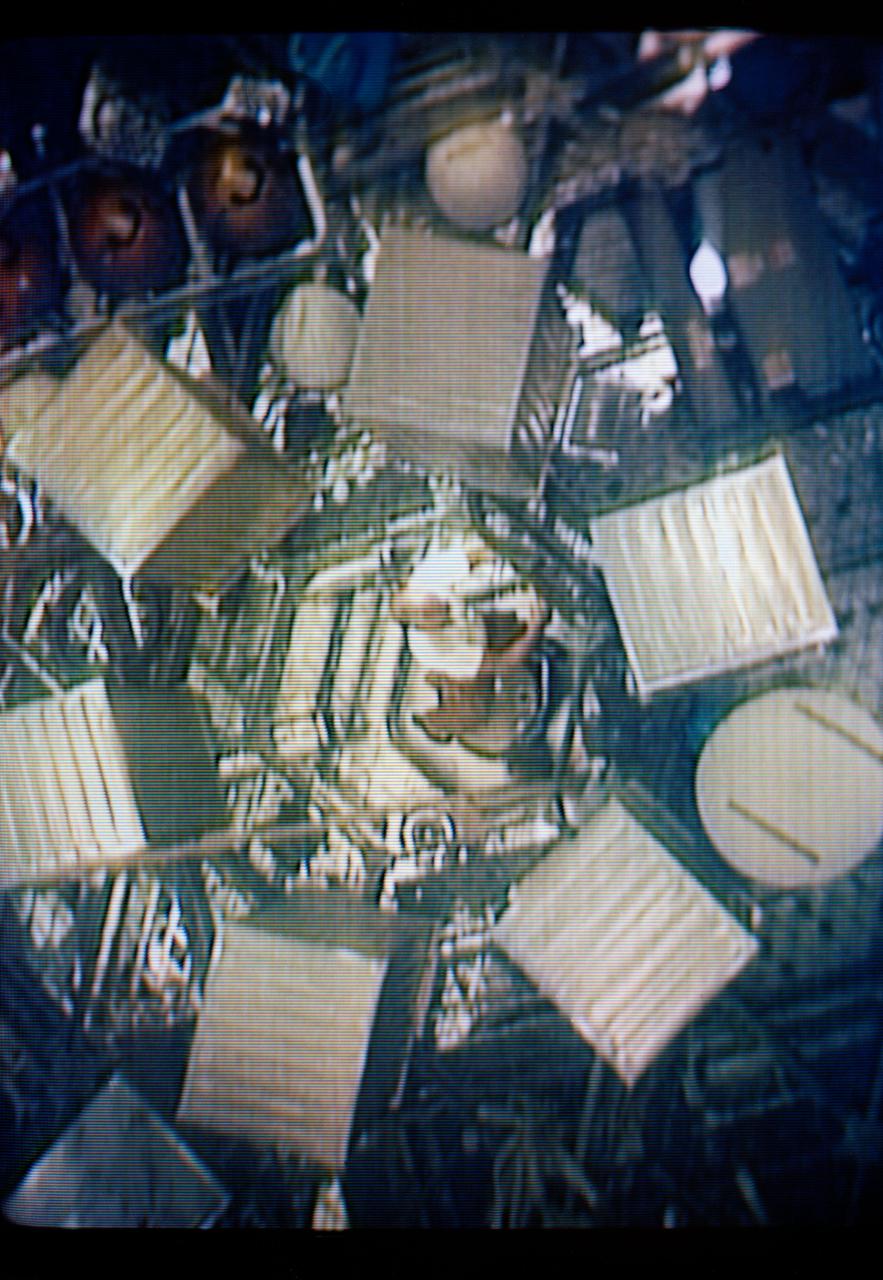
S73-26776 (26 May 1973) --- An interior view of the Orbital Workshop of the Skylab 1 space station cluster in Earth orbit can be seen in this reproduction taken from a color television transmission made by a TV camera aboard the space station. Astronaut Charles Conrad Jr., Skylab 2 commander, is floating up through the hatch. Food lockers are in the foreground. Photo credit: NASA
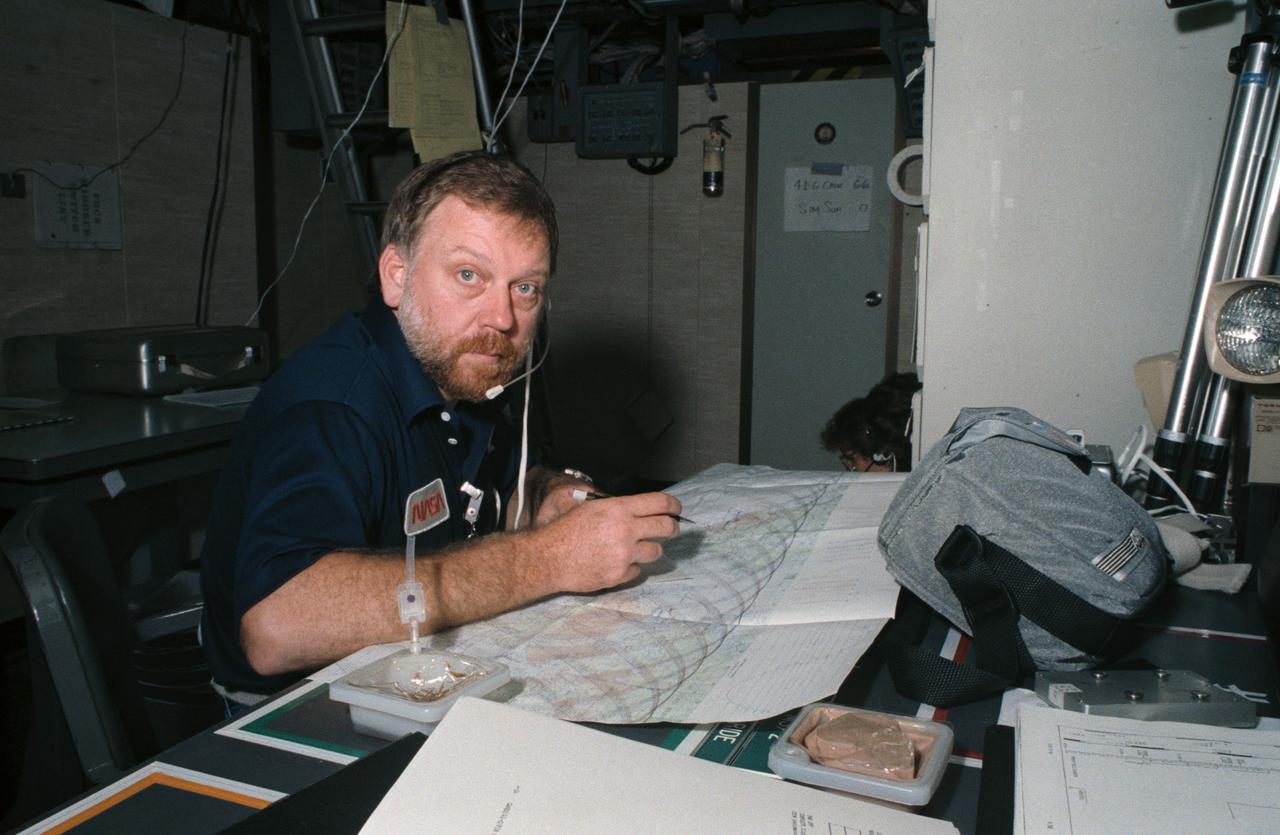
Views of STS-41G Crew member Paul Sculley-Powers during mission experiment training, Fixed Base Simulator, Bldg. 5, 09/09/1984. 1. SHUTTLE - SIMUALTOR (1-G) JSC, HOUSTON, TX
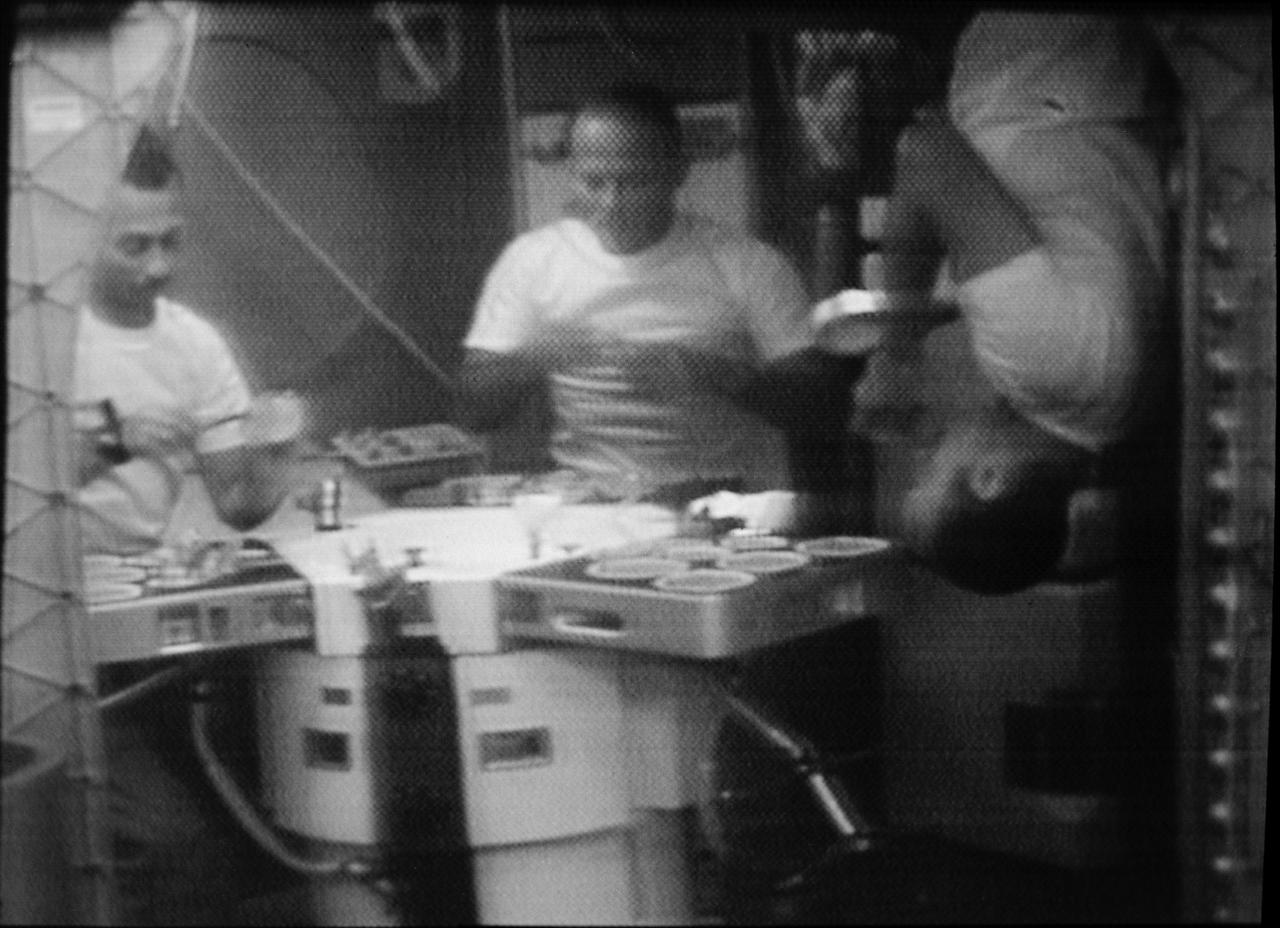
S73-31705 (1 Aug. 1973) --- The three Skylab 3 crewmen are shown eating in the Orbital Workshop (OWS) wardroom of the Skylab space station in Earth orbit, in this photographic reproduction taken from a television transmission made by a color TV camera aboard the OWS. Astronaut Alan L. Bean (right), commander, illustrates eating under zero-gravity conditions upsidedown. The two other crewmen are scientist-astronaut Owen K. Garriott (left), science pilot; and astronaut Jack R. Lousma, pilot. Photo credit: NASA
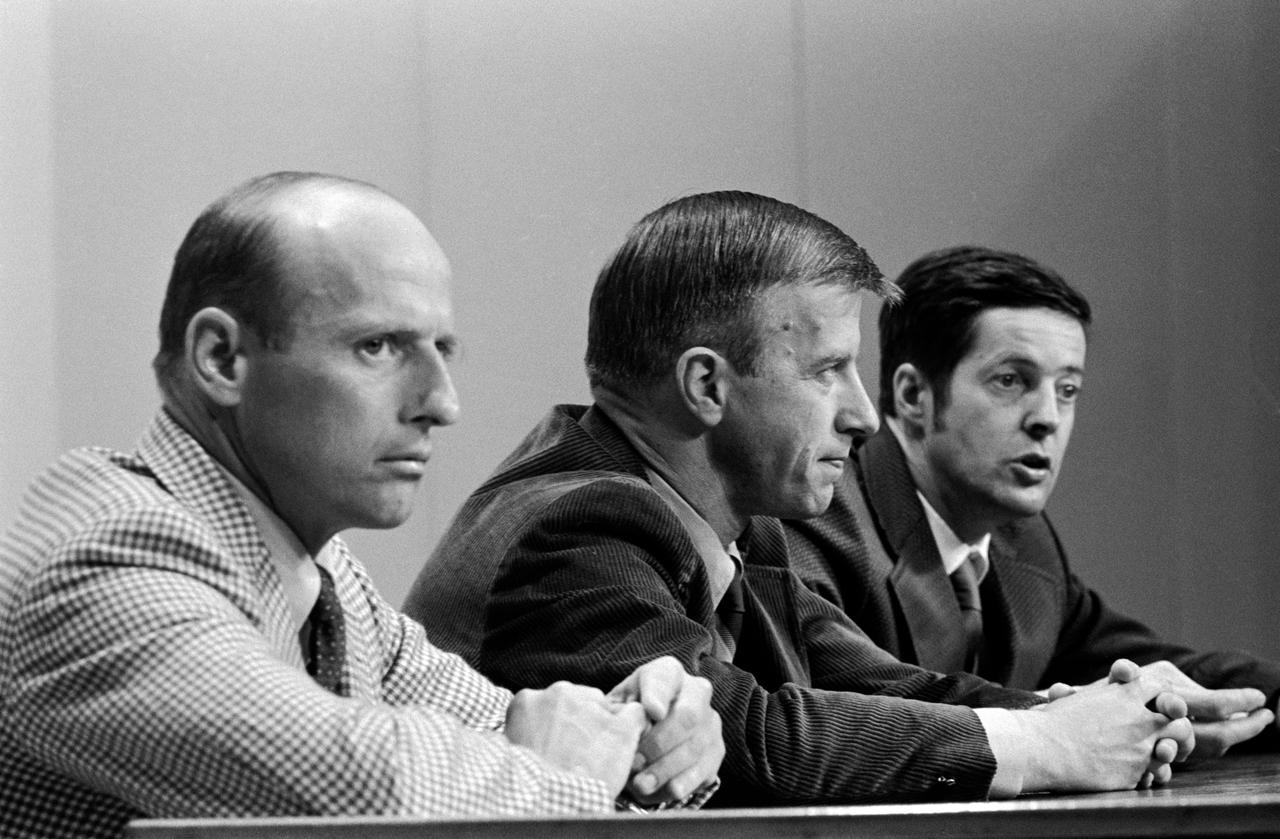
S73-24369 (17 April 1973) --- The three members of the prime crew of the first manned Skylab mission discuss their scheduled flight before a gathering of news media representatives, in building 1 auditorium, April 17, 1973. They are (left to right) astronauts Charles Conrad Jr., commander; Paul J. Weitz, pilot; and scientist Joseph P. Kerwin, science-pilot. Skylab is a three-part program consisting of one 28-day; and two 56-day manned visits spanning an eight-month period. One day prior to the launch of this crew, the unmanned Skylab Space Station cluster will be launched and placed in Earth orbit. The first manned mission will last up to 28 days. Photo credit: NASA
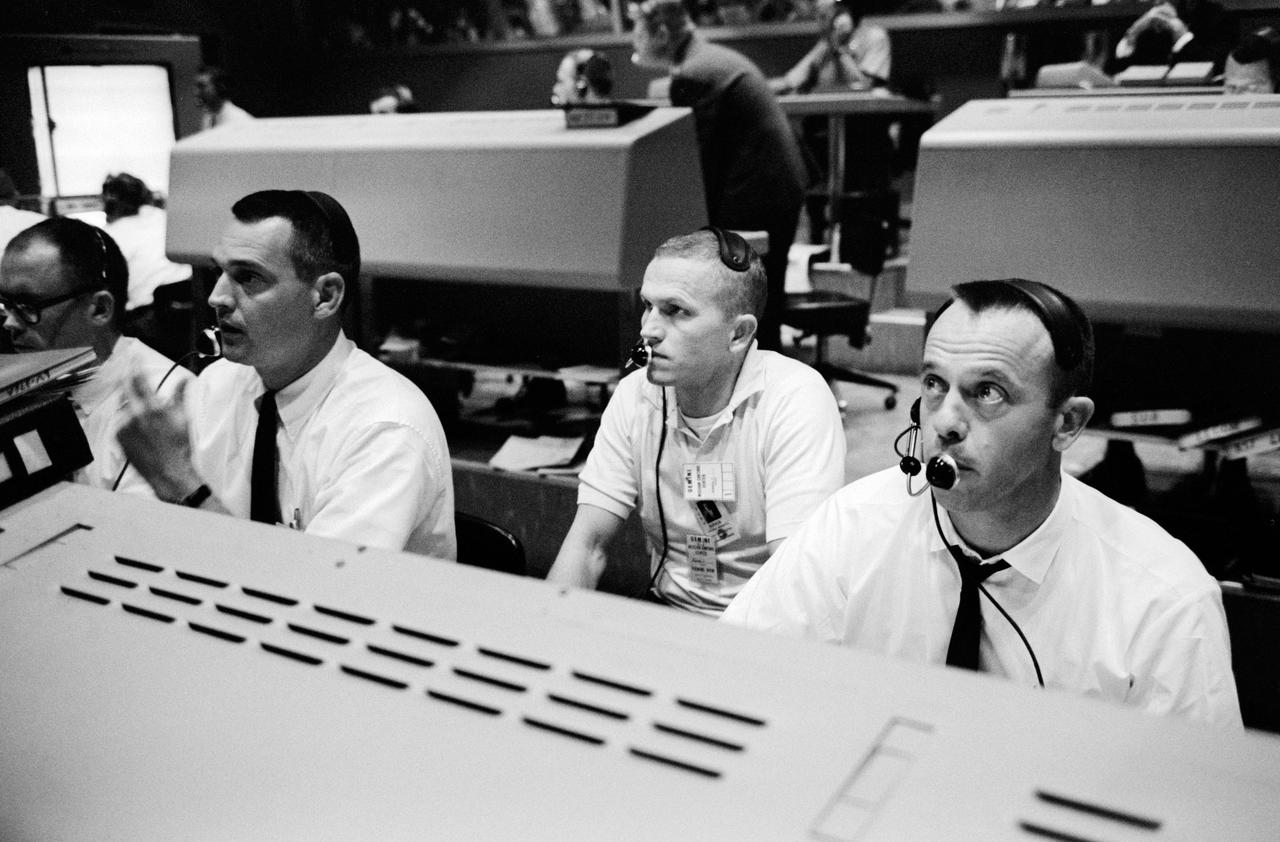
S65-30263 (3 June 1965) --- Shown at their consoles during the liftoff of Gemini-4 (from left) are astronauts Clifford C. Williams Jr., Frank Borman and Alan B. Shepard Jr. Borman was command pilot of the backup crew for the Gemini-4 flight. The three astronauts monitored the flight from the Mission Control Center at Cape Kennedy.
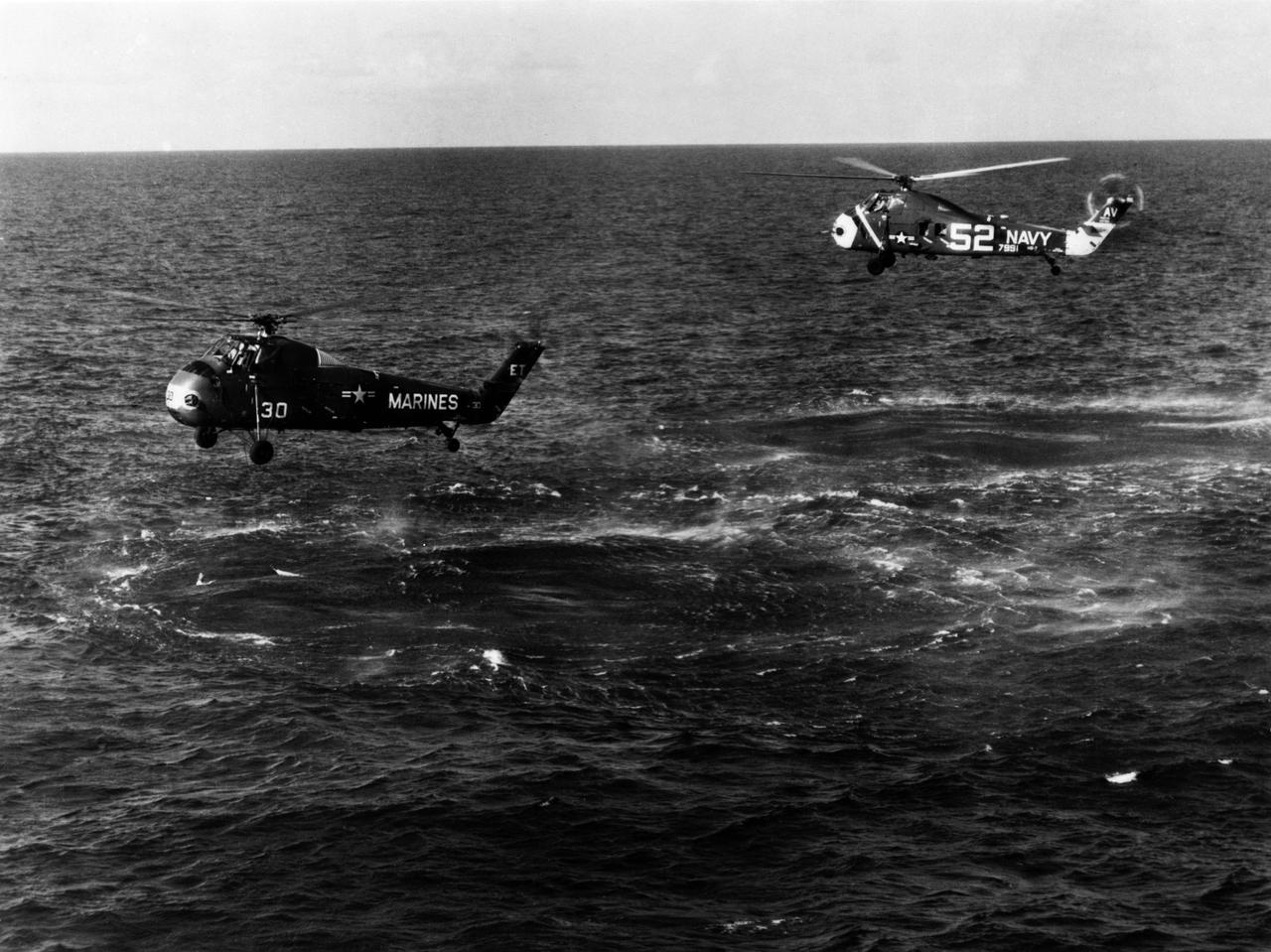
S61-02820 (21 July 1961) --- Attempted recovery of Mercury spacecraft at end of the Mercury-Redstone 4 (MR-4) mission. View shows the Marine helicopter pulled almost to the waters surface by the weight of the capsule, which filled with water. It eventually had to abandon its recovery attempts. Behind the Marine helicopter, a Navy helicopter prepares to assist. Photo credit: NASA
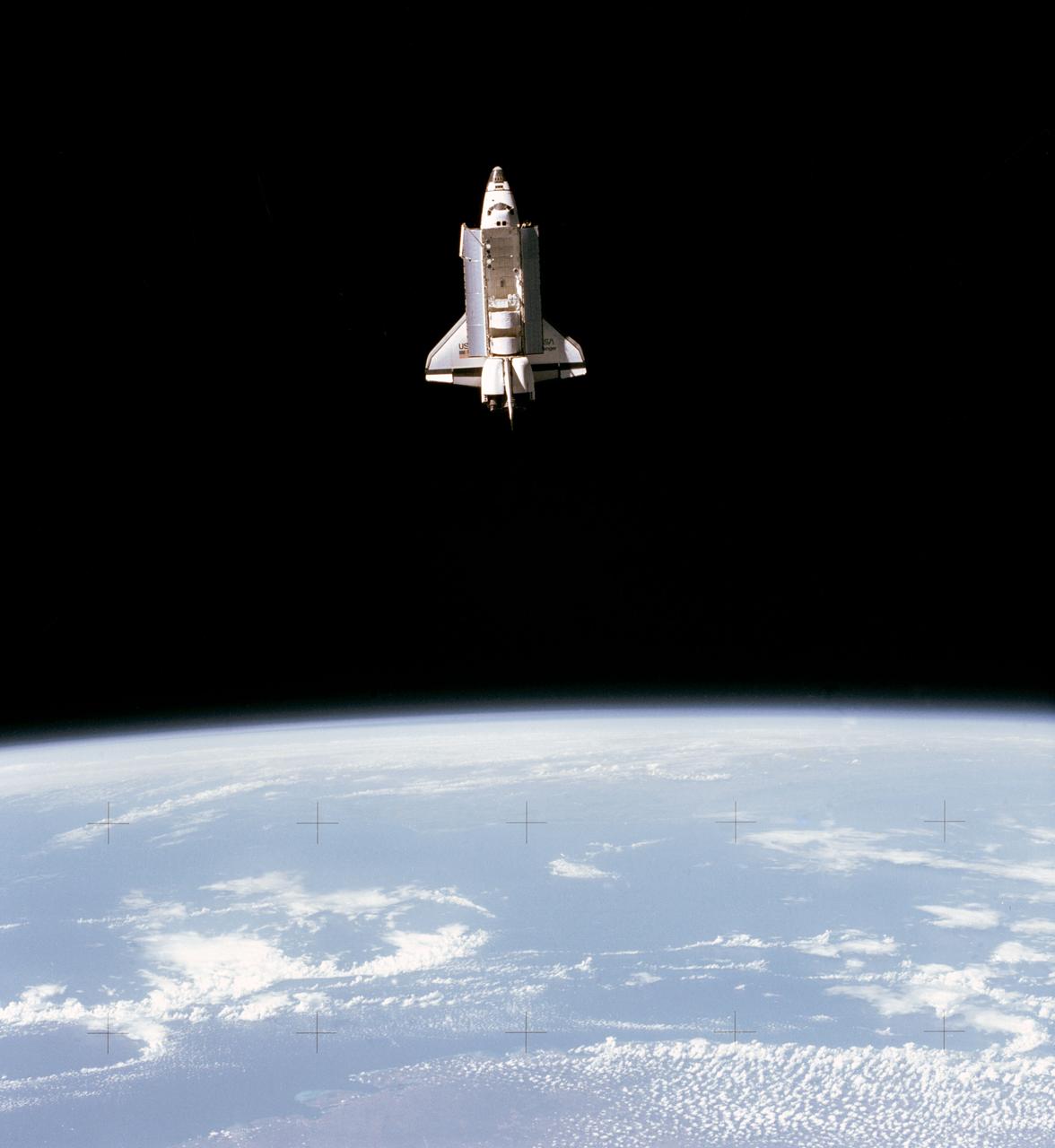
Full views of "Challenger" in Space, taken by the Shuttle Pallet Satellite (SPAS), also views of Cargo Bay and Remote Manipulator System (RMS) extended. 1. SHUTTLE - RMS (STS-7) Also available in 4x5 CN
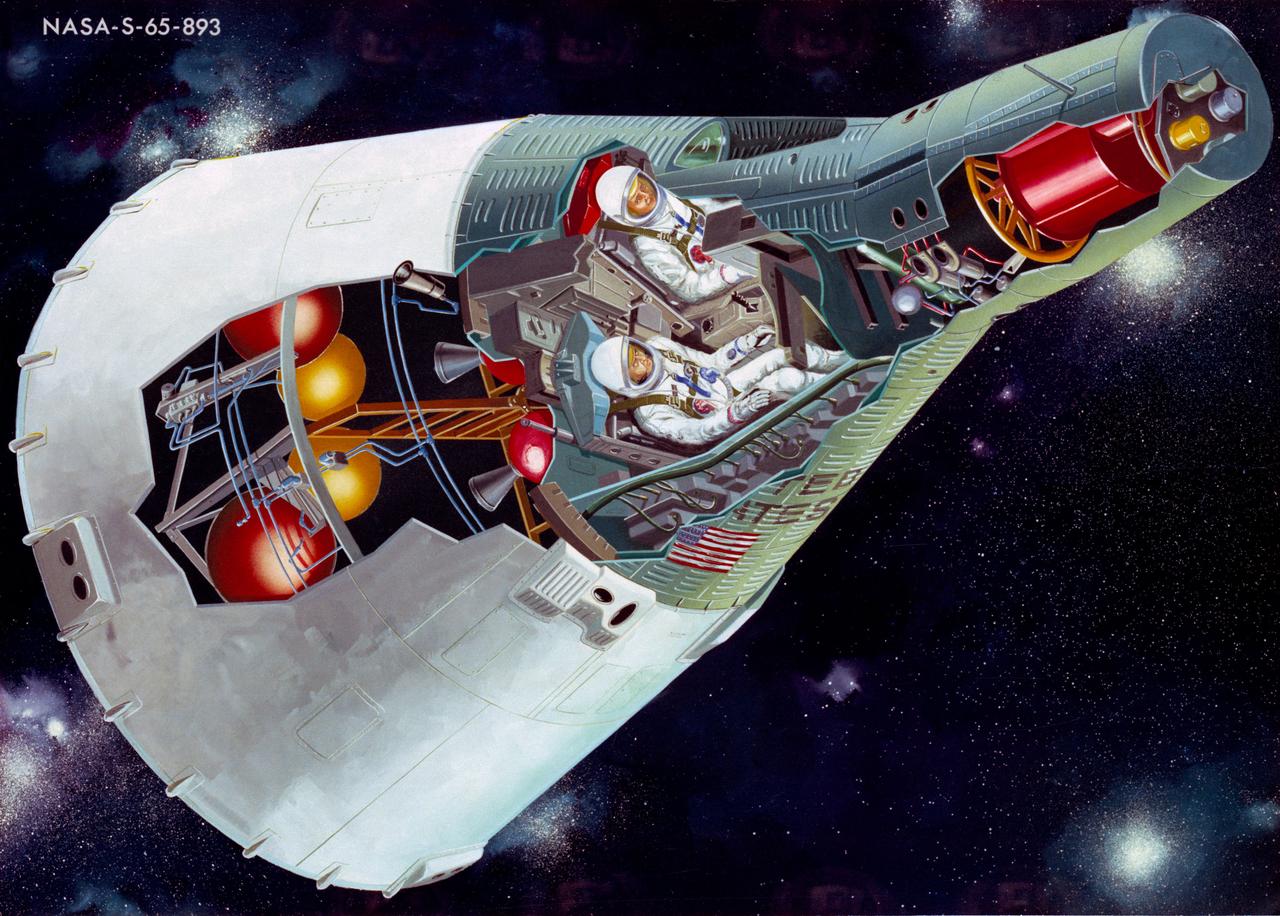
S65-14257 (January 1965) --- This is an artist's concept of a two-man Gemini spacecraft in flight, showing a cutaway view.
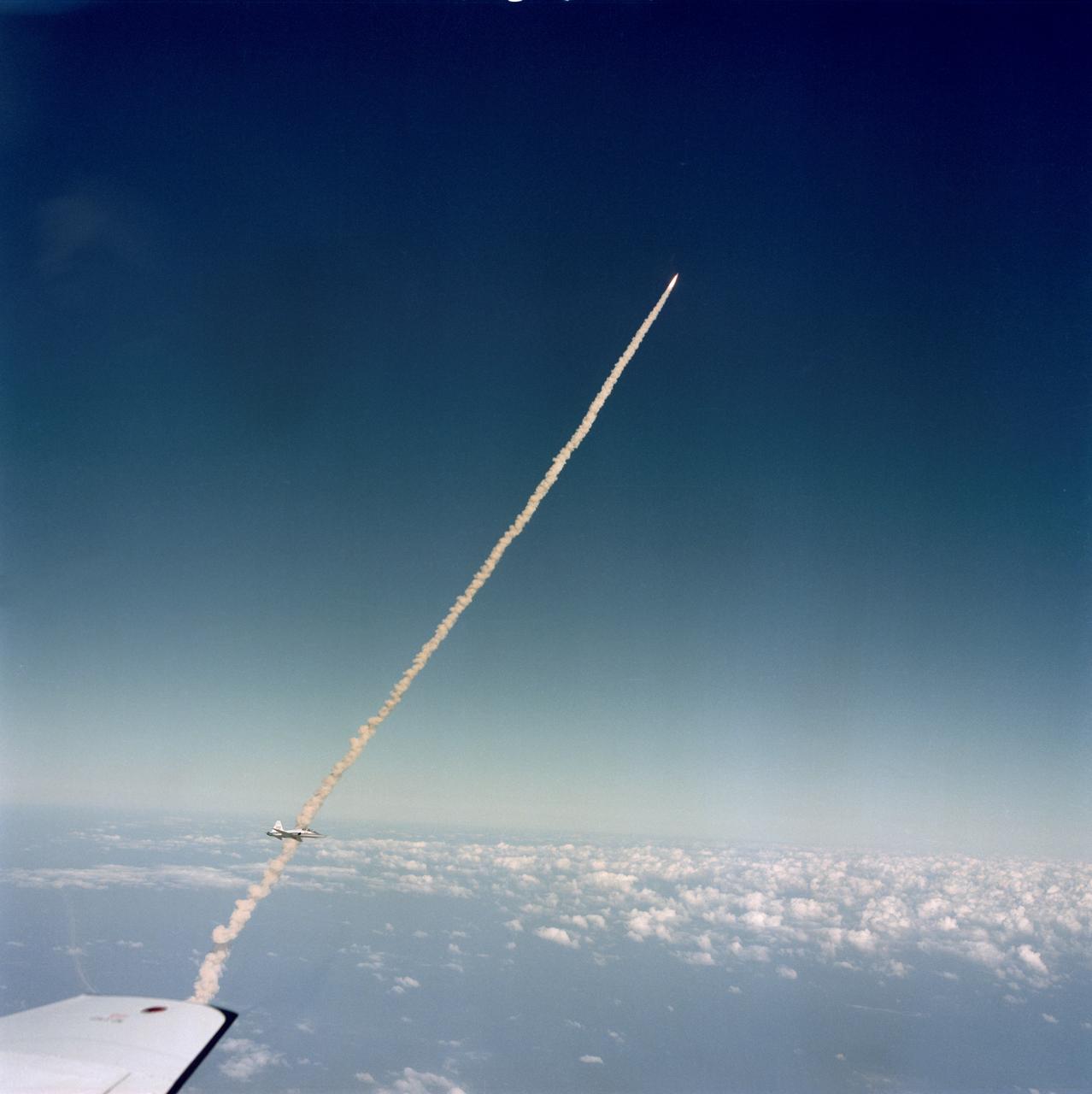
S81-39527 (12 Nov. 1981) --- This photograph of the STS-2 crew and the space shuttle Columbia soaring toward Earth orbit was captured with a hand-held 70mm camera (using an 80mm lens) operated from the rear station of a T-38 jet aircraft. Mission specialist-astronaut Kathryn D. Sullivan took the picture, and part of the wing tip of her aircraft can be seen in lower left corner. Astronaut John W. Young piloting NASA?s shuttle training aircraft (STA) was taking pictures from a higher angle. A close look can delineate his craft above the orbiter and supportive elements, almost perpendicular to them from this point of view. Another T-38 jet, with a TV camera operator as back-seat passenger, can be seen at lower left corner near the smoke trails from the shuttle. Photo credit: NASA
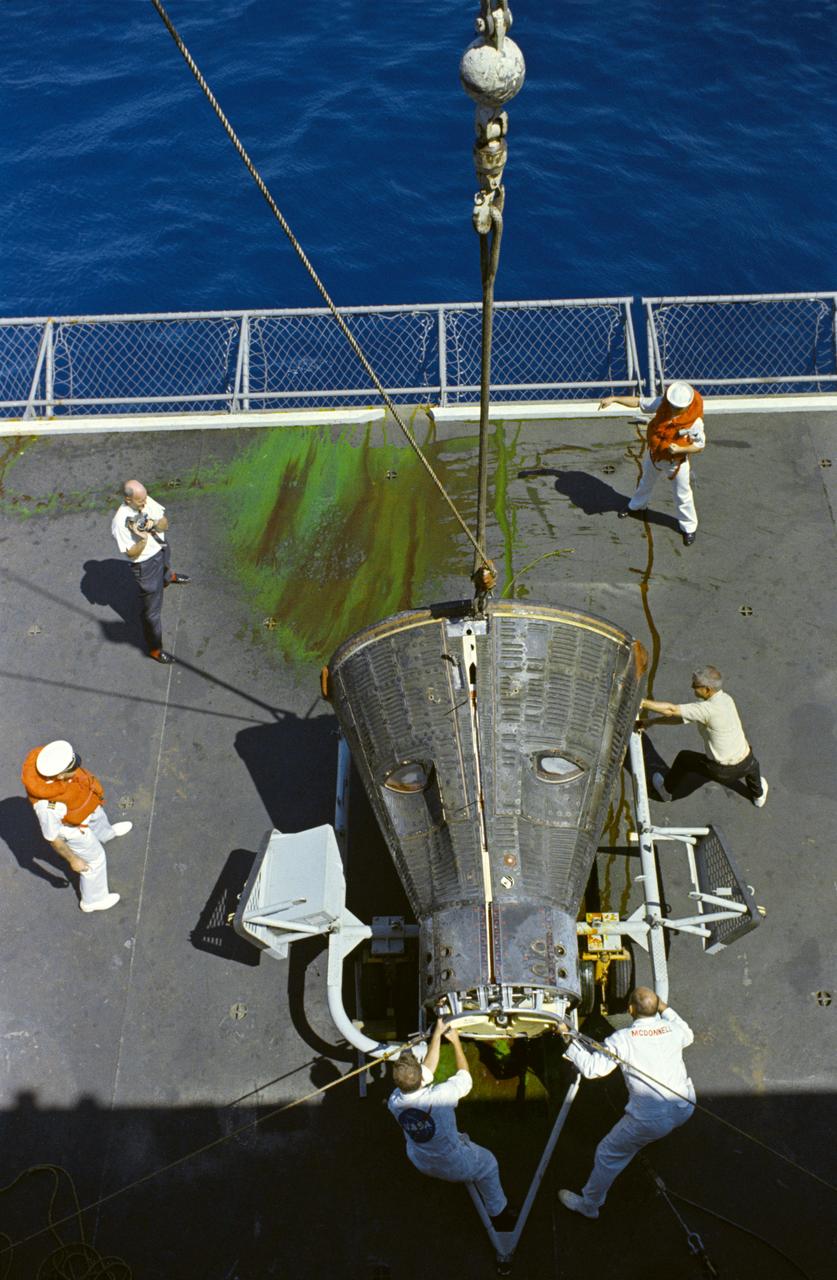
S66-50743 (15 Sept. 1966) --- The Gemini-11 spacecraft is lowered onto a dolly on the deck of the USS Guam, prime recovery vessel for the Gemini-11 mission. Astronaut Charles Conrad Jr. and Richard F. Gordon Jr. had already been picked up by helicopter from the splashdown area and brought aboard the Guam. Photo credit: NASA
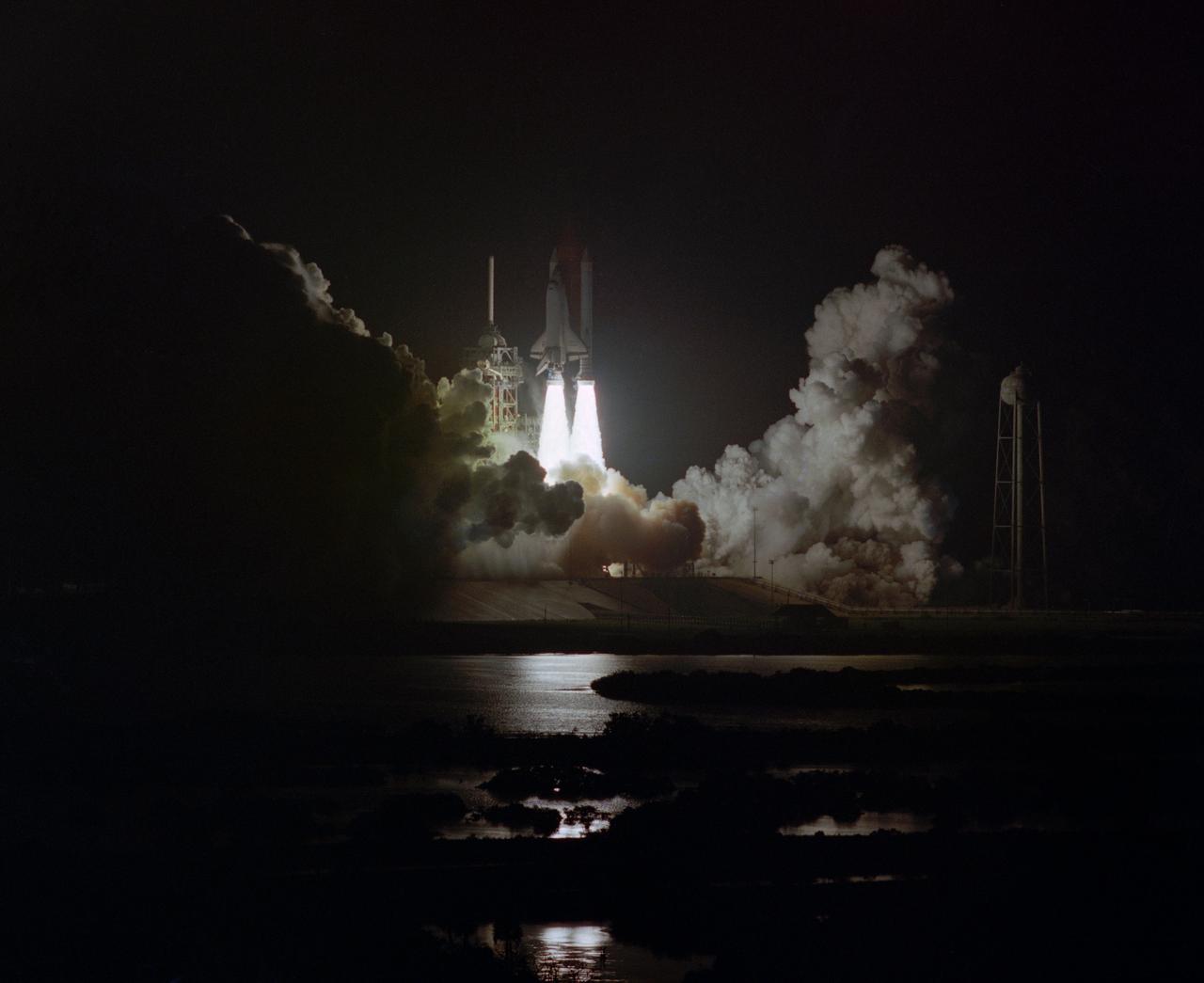
S83-39512 (30 Aug. 1983) --- NASA's eighth space shuttle launch lights up the Florida sky at 2:32 a.m. (EDT), Aug. 30, 1983. The space shuttle Challenger's third flight is the first to have its beginnings in darkness. Five astronauts and an assortment of experiments are aboard the reusable vehicle. Crew members are astronauts Richard H. Truly, STS-8 commander; Daniel C. Brandenstein, pilot; and Dale A. Gardner, Guion S. Bluford and William E. Thornton, all mission specialists. Photo credit: NASA
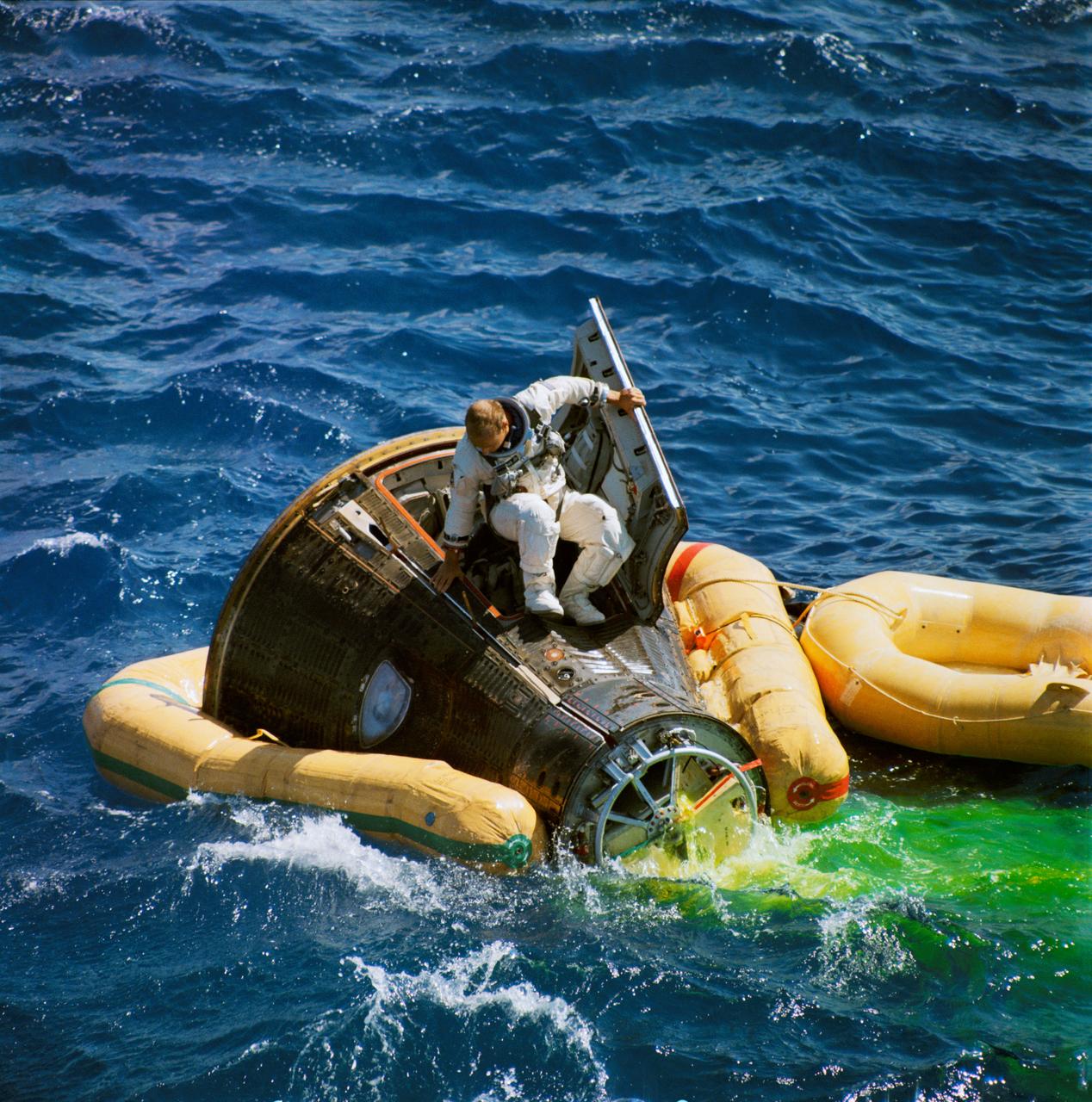
S66-50767 (15 Sept. 1966) --- Astronaut Charles Conrad Jr., command pilot of the Gemini-11 spaceflight, climbs from the spacecraft minutes after splashdown. Astronaut Richard F. Gordon Jr., pilot, still has his hatch closed. A U.S. Navy frogman team attached a flotation collar to the spacecraft. A recovery helicopter from the USS Guam picked up the two astronauts. Photo credit: NASA
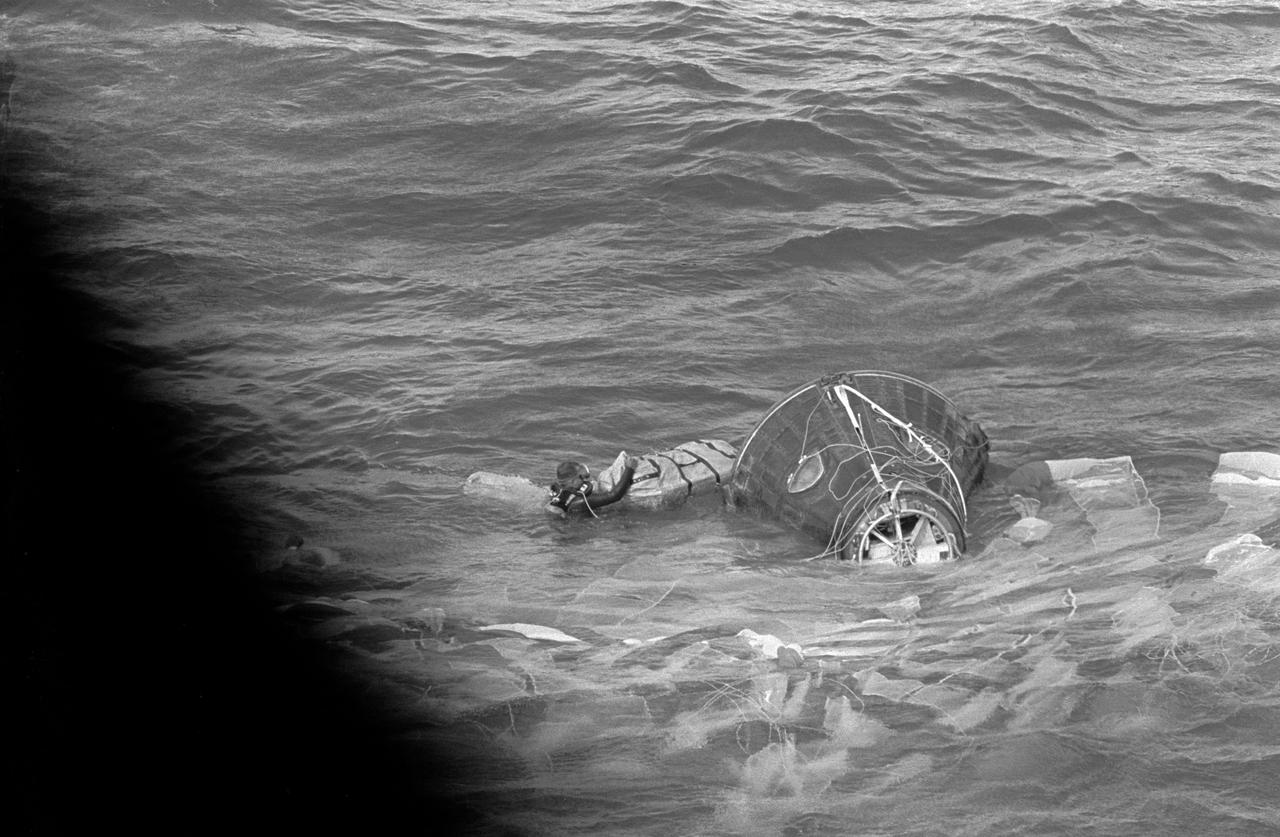
S66-42794 (21 July 1966) --- Navy frogmen prepare to attach a flotation collar to the Gemini-10 spacecraft as it bobs in the Atlantic Ocean following its successful splashdown. Inside the spacecraft are astronauts John W. Young, command pilot, and Michael Collins, pilot, waiting to egress the spacecraft for recovery by helicopter from the prime recovery ship, USS Guadalcanal. Photo credit: NASA
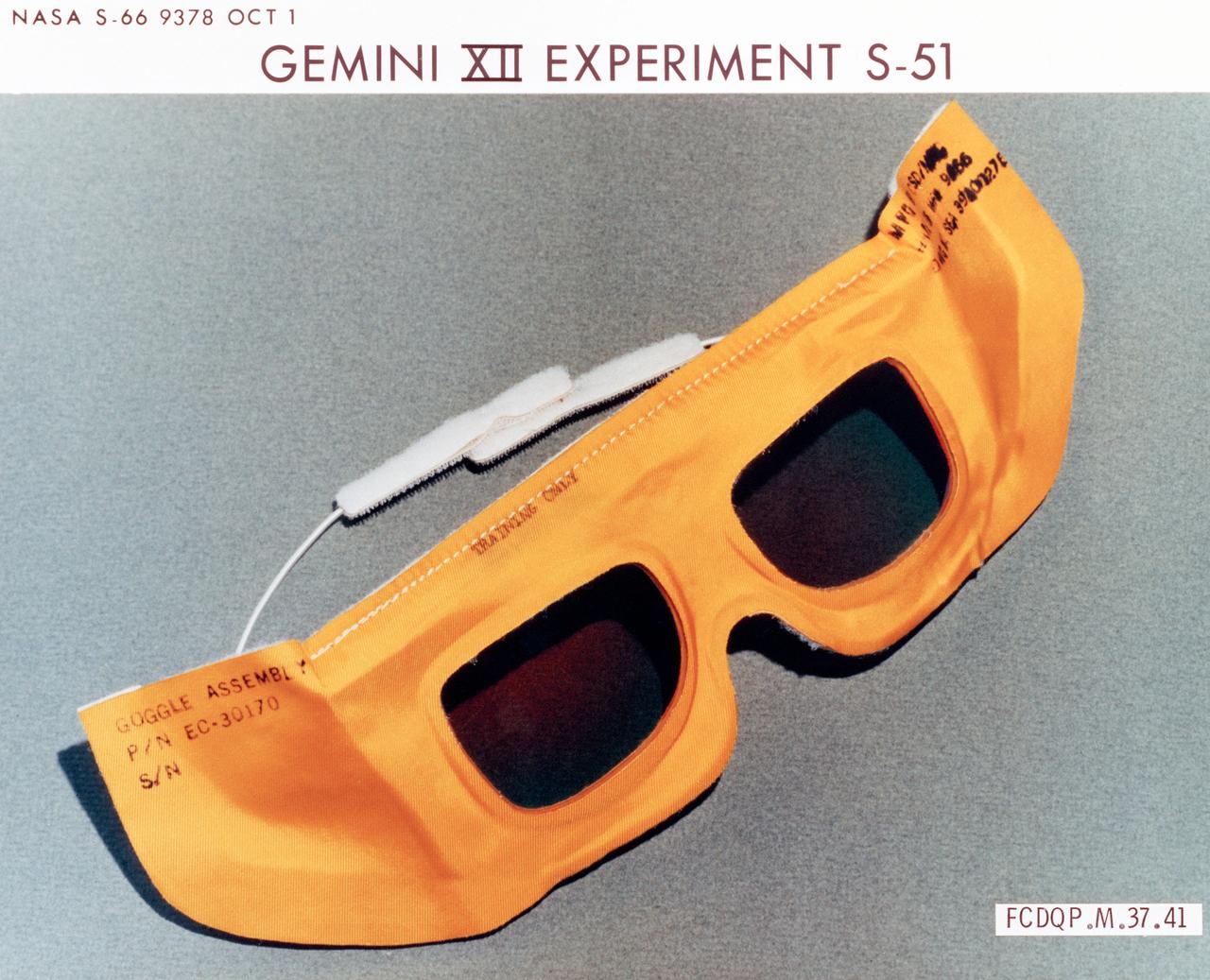
S66-09378 (1 Oct. 1966) --- Goggles which will be worn by Gemini-12 astronaut as he photographs sodium cloud ejected from French Centaure rocket launched from Hammaguir, Algeria. Photo credit: NASA
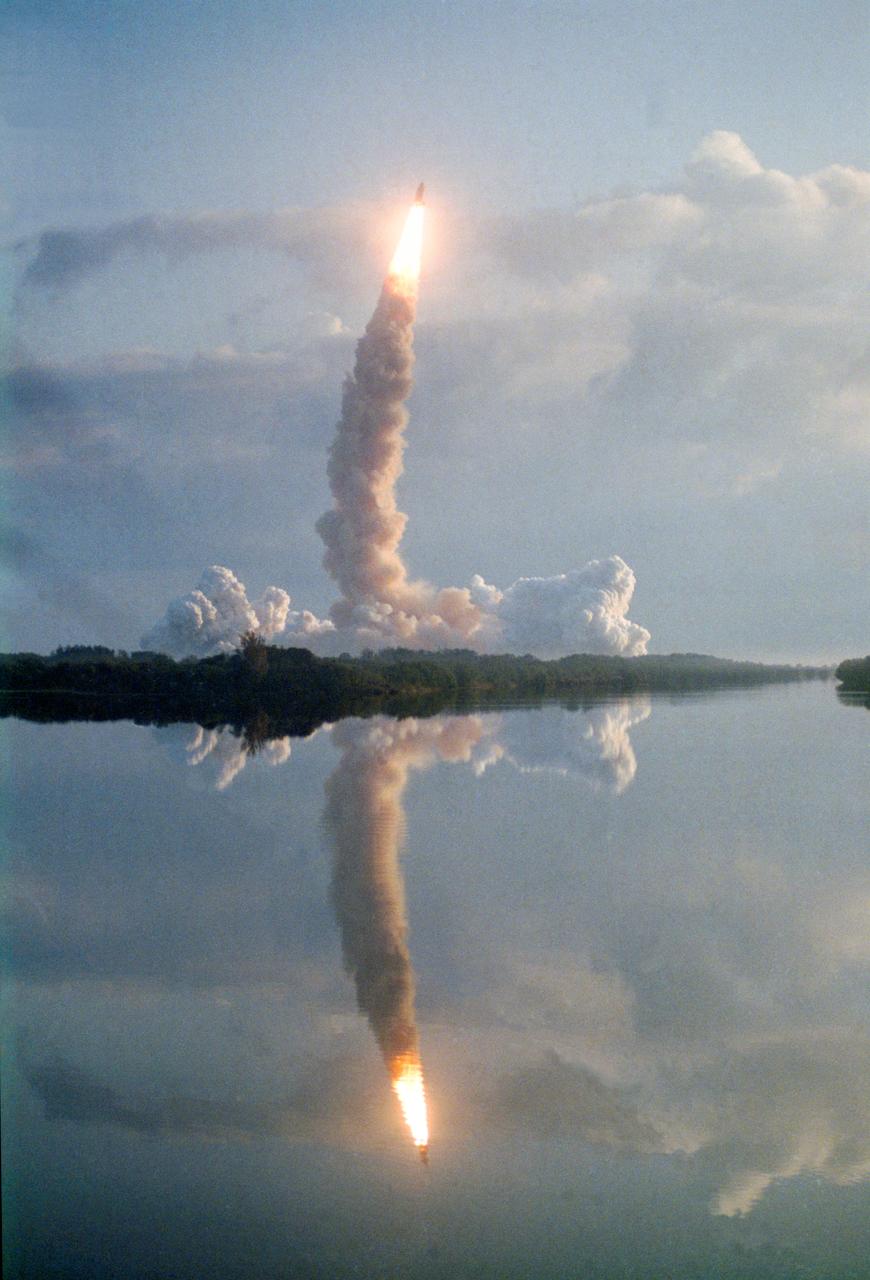
S84-28205 (3 Feb. 1984) --- Reflected in nearby water, NASA's space shuttle Challenger, attached to two solid rocket boosters and an external fuel tank which it will later jettison, blasts off from Pad A at Kennedy Space Center's Launch Complex 39, at 8:00 a.m. (EST), Feb. 3, 1984. The photograph was taken by Otis Imboden. Photo credit: NASA
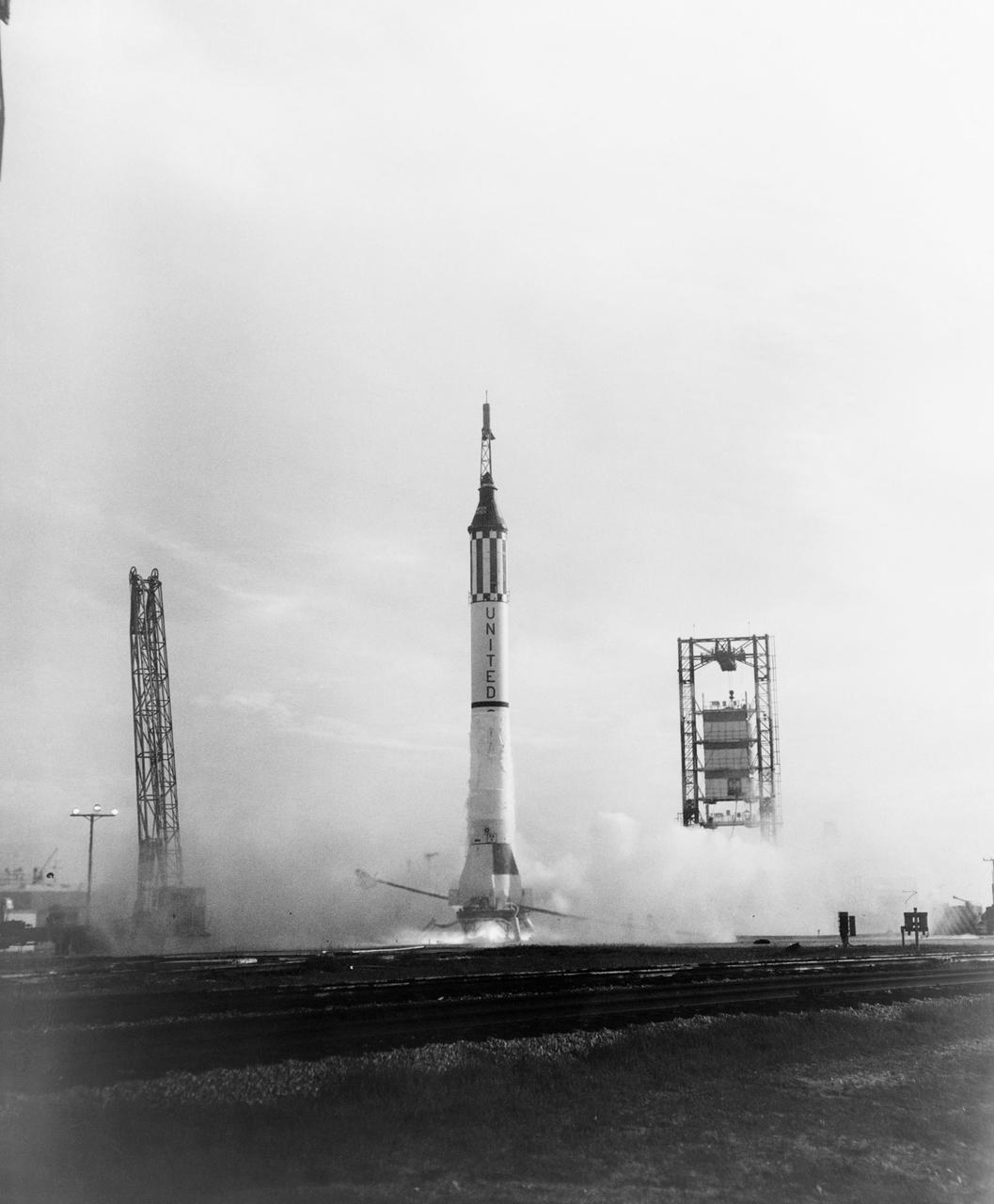
S61-03121 (21 July 1961) --- Mercury-Redstone 4 (MR-4) launch of Virgil I. Grissom on July 21, 1961, from Cape Canaveral, Florida. Photo credit: NASA
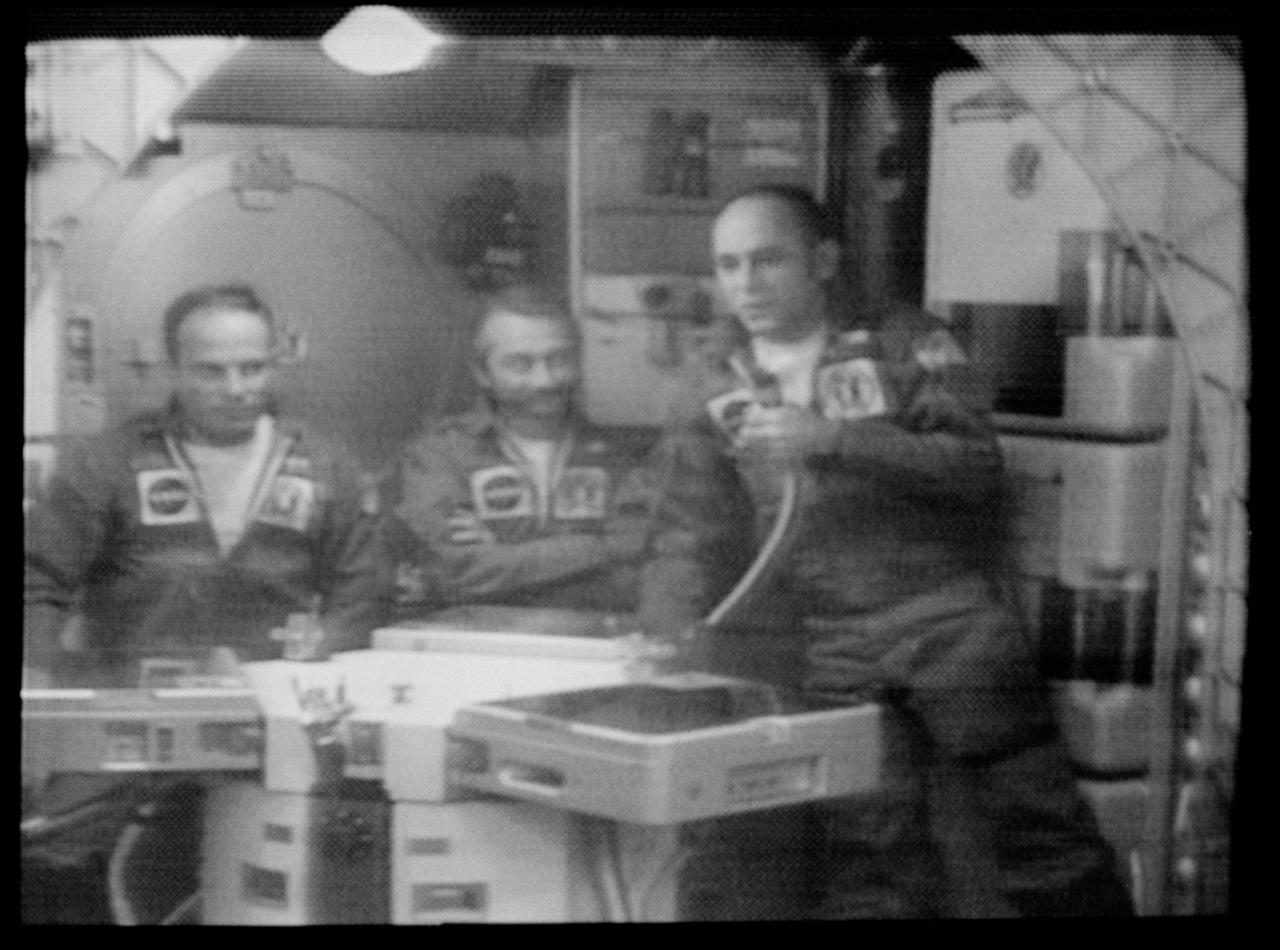
S73-34339 (21 Sept. 1973) --- Astronaut Alan L. Bean, right, Skylab 3 commander, answers a question during the Sept. 21, 1973 press conference from the Skylab space station in Earth orbit. This is a black and white reproduction taken from a television transmission made by a TV camera aboard the Skylab space station. Scientist-astronaut Owen K. Garriott, center, science pilot; and astronaut Jack R. Lousma, left, pilot, await queries from newsmen on the ground to be sent up by scientist-astronaut Story Musgrave, CAPCOM for this shift of Skylab 3. Photo credit: NASA