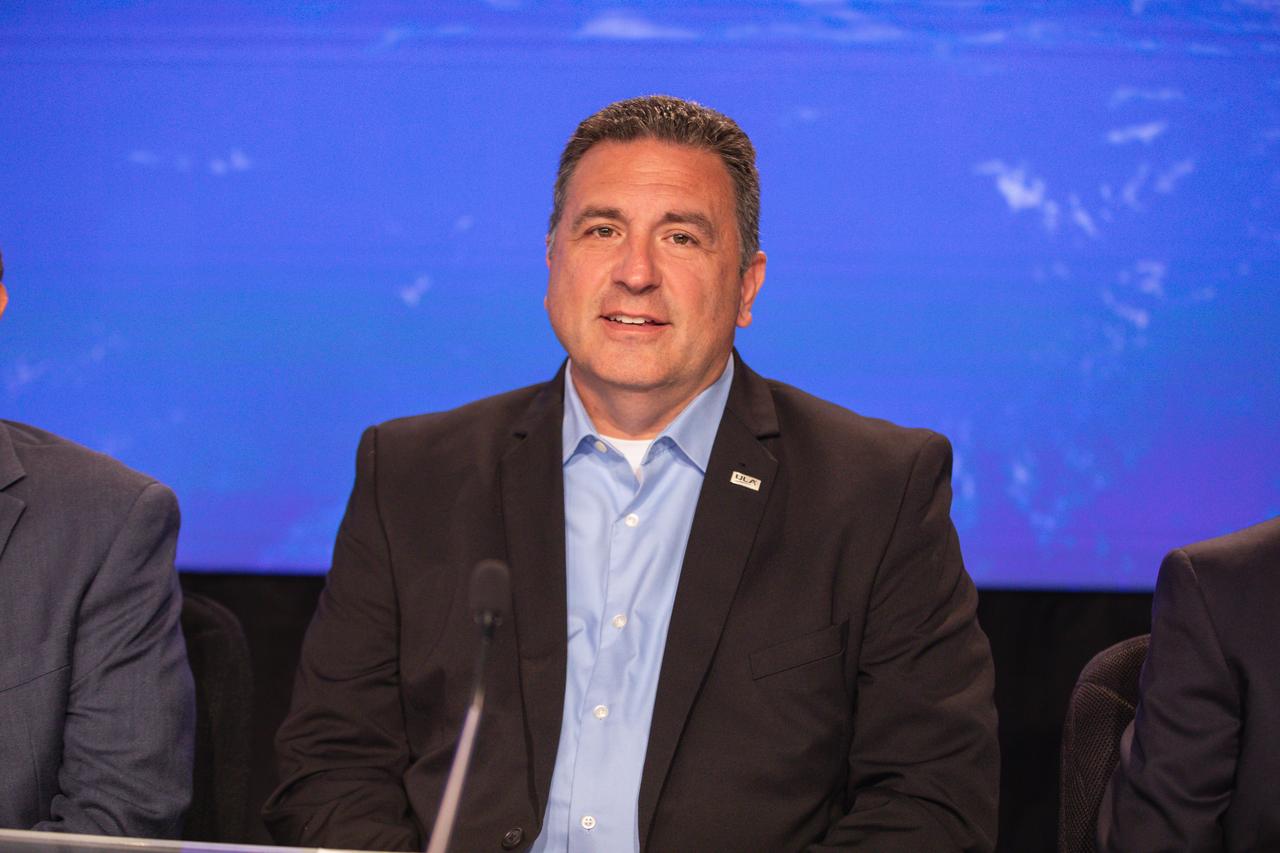
Gary Wentz, vice president, Government and Commercial Programs, United Launch Alliance, participates in a prelaunch briefing for NASA’s Boeing Crew Flight Test at the agency’s Kennedy Space Center in Florida Friday, May 31, 2024. As part of the agency’s Commercial Crew Program, NASA astronauts Butch Wilmore and Suni Williams are the first to launch aboard Boeing’s Starliner spacecraft atop a United Launch Alliance Atlas V rocket from Space Launch Complex-41 at Cape Canaveral Space Force Station in Florida. Liftoff is scheduled for 12:25 p.m. ET on Saturday, June 1.
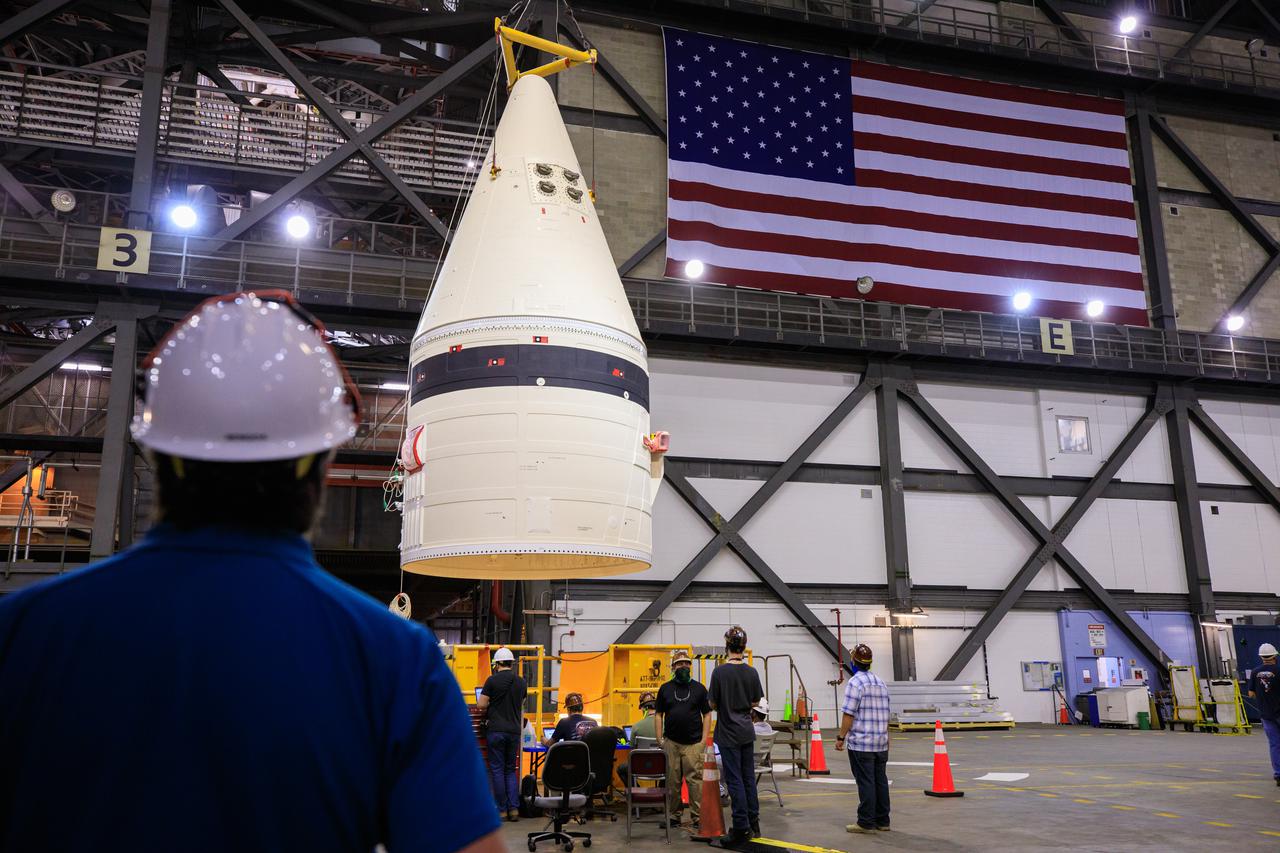
In the transfer aisle of the Vehicle Assembly Building at NASA’s Kennedy Space Center in Florida, workers use a crane to lift up the left-hand booster forward assembly for the agency’s Space Launch System for transfer into High Bay 3 on March 1, 2021. The forward assembly will be attached to the center forward segment on the mobile launcher (ML). Exploration Ground Systems and contractor Jacobs teams have been stacking the twin five-segment boosters on the ML over a number of weeks. When the core stage arrives, it will join the boosters on the mobile launcher, followed by the interim cryogenic propulsion stage and Orion spacecraft. Manufactured by Northrop Grumman in Utah, the twin boosters provide more than 75 percent of the total SLS thrust at launch. Marshall Space Flight Center in Huntsville, Alabama, manages the SLS. Under the Artemis program, NASA will land the first woman and the next man on the Moon. The first in a series of increasingly complex missions, Artemis I will test the Orion spacecraft and SLS as an integrated system ahead of crewed flights to the Moon.
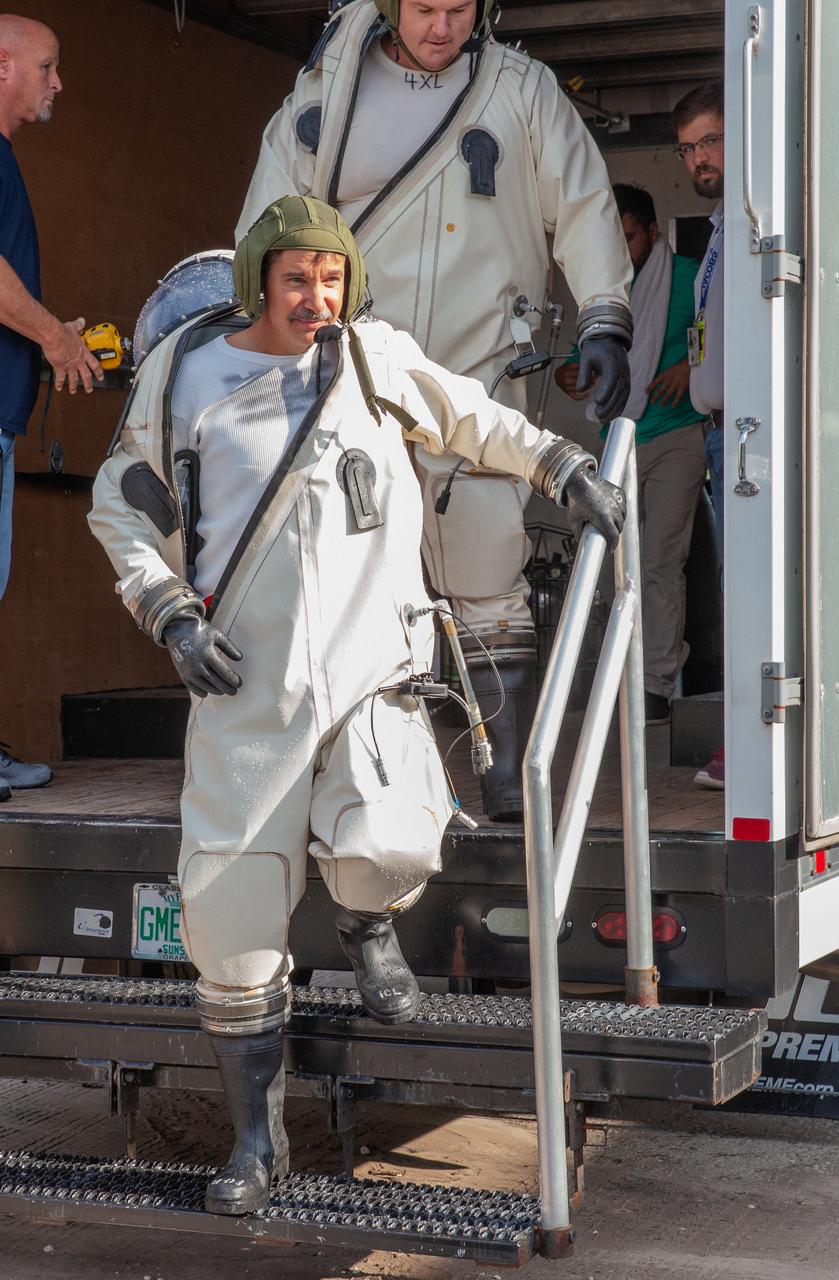
Technicians in Self-Contained Atmospheric Protective Ensemble (SCAPE) suits exit a truck near the Multi-Payload Processing Facility (MPPF) at NASA’s Kennedy Space Center in Florida, for a test simulation of loading propellants into a replicated test tank for Orion on Aug. 16, 2019. Exploration Ground Systems is preparing for Artemis 1 with a series of hazardous hyper test events at the MPPF. The technicians will complete a tanking to test the system before Orion arrives for processing. During preparations for launch, these teams will be responsible for loading the Orion vehicle with propellants prior to transportation to the Vehicle Assembly Building, where it will be secured atop the Space Launch System rocket. SCAPE suits are used in operations involving toxic propellants and are supplied with air either through a hardline or through a self-contained environmental control unit.
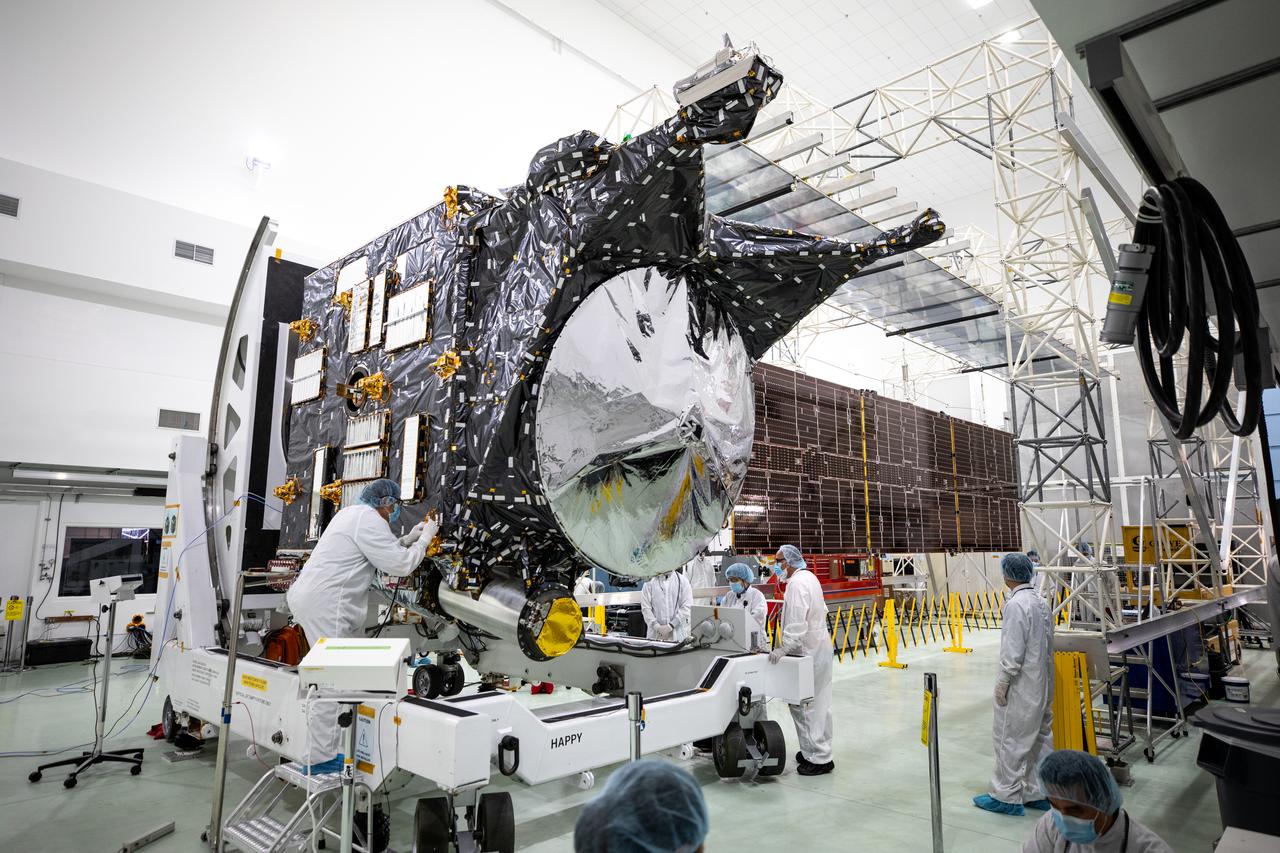
The first of two solar arrays for NASA’s Psyche spacecraft has been extended inside the Astrotech Space Operations Facility near the agency’s Kennedy Space Center in Florida on July 20, 2023. Technicians are preparing to integrate the solar arrays to the Psyche spacecraft. The solar arrays were shipped from Maxar Technologies, in San Jose, California. They are part of the solar electric propulsion system, provided by Maxar, that will power the spacecraft on its journey to explore a metal-rich asteroid. Psyche will launch atop a SpaceX Falcon Heavy rocket from Launch Complex 39A at Kennedy. Launch is targeted for Oct. 5, 2023. Riding with Psyche is a pioneering technology demonstration, NASA’s Deep Space Optical Communications (DSOC) experiment.

Artemis Launch Director Charlie Blackwell-Thompson, at left, holds the Artemis I plaque inside the lobby of the Launch Control Center at NASA’s Kennedy Space Center in Florida on March 24, 2023. Joining her from left are Shawn Quinn, manager, Exploration Ground Systems; and Kelvin Manning, Kennedy deputy director. Following tradition from the Apollo and Space Shuttle Programs, the plaque will be added to the wall behind them. The first in a series of increasingly complex missions, Artemis I launched successfully from Kennedy’s Launch Pad 39B at 1:47 a.m. EST on Nov. 16, 2022.
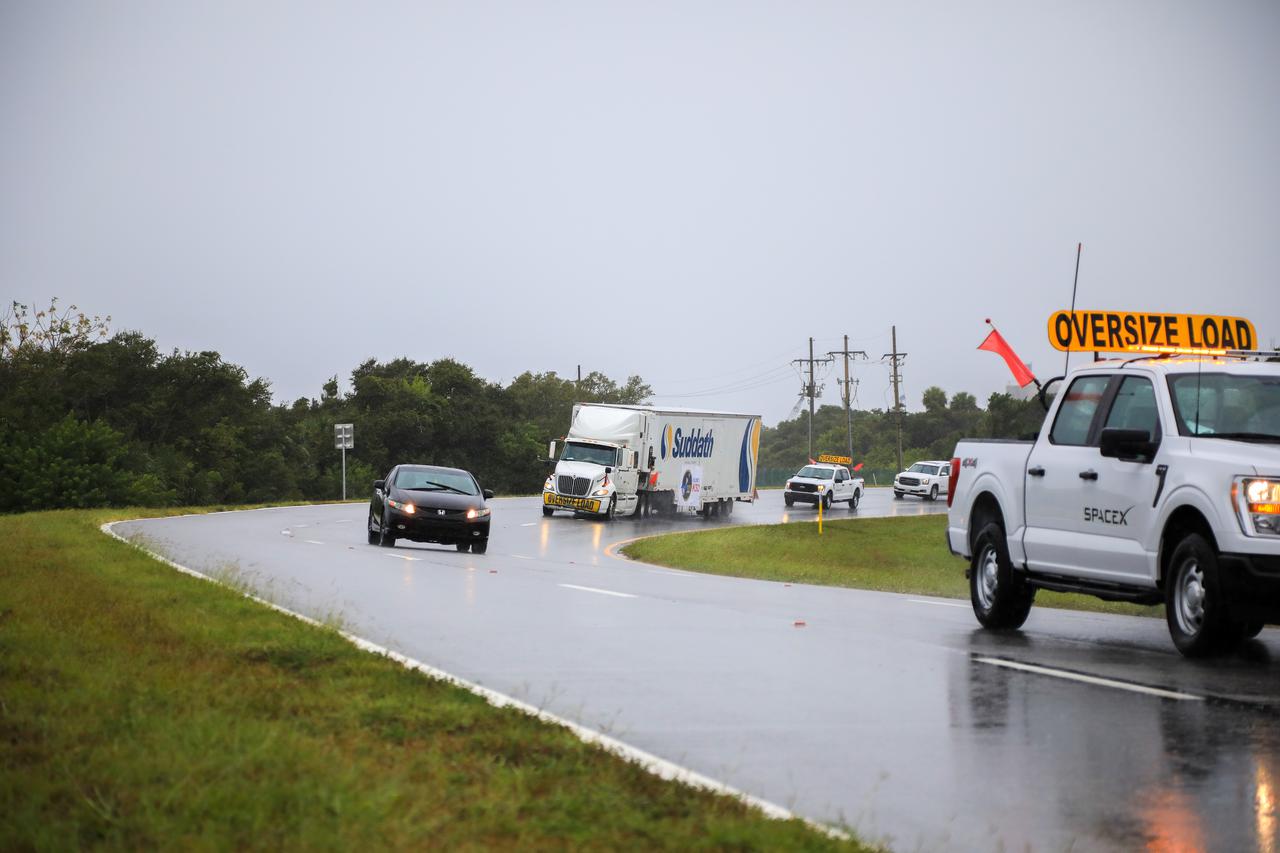
NASA’s Imaging X-Ray Polarimetry Explorer (IXPE) spacecraft – the agency’s first mission dedicated to measuring X-ray polarization – arrives at the Cape Canaveral Space Force Station in Florida on Nov. 5, 2021. IXPE is scheduled to launch aboard a SpaceX Falcon 9 vehicle from Kennedy’s Launch Complex 39A on Dec. 9, 2021. The launch is managed by NASA’s Launch Services Program, based at Kennedy. IXPE will study the polarization of X-rays coming to us from some of the universe’s most extreme sources, including black holes and dead stars known as pulsars.
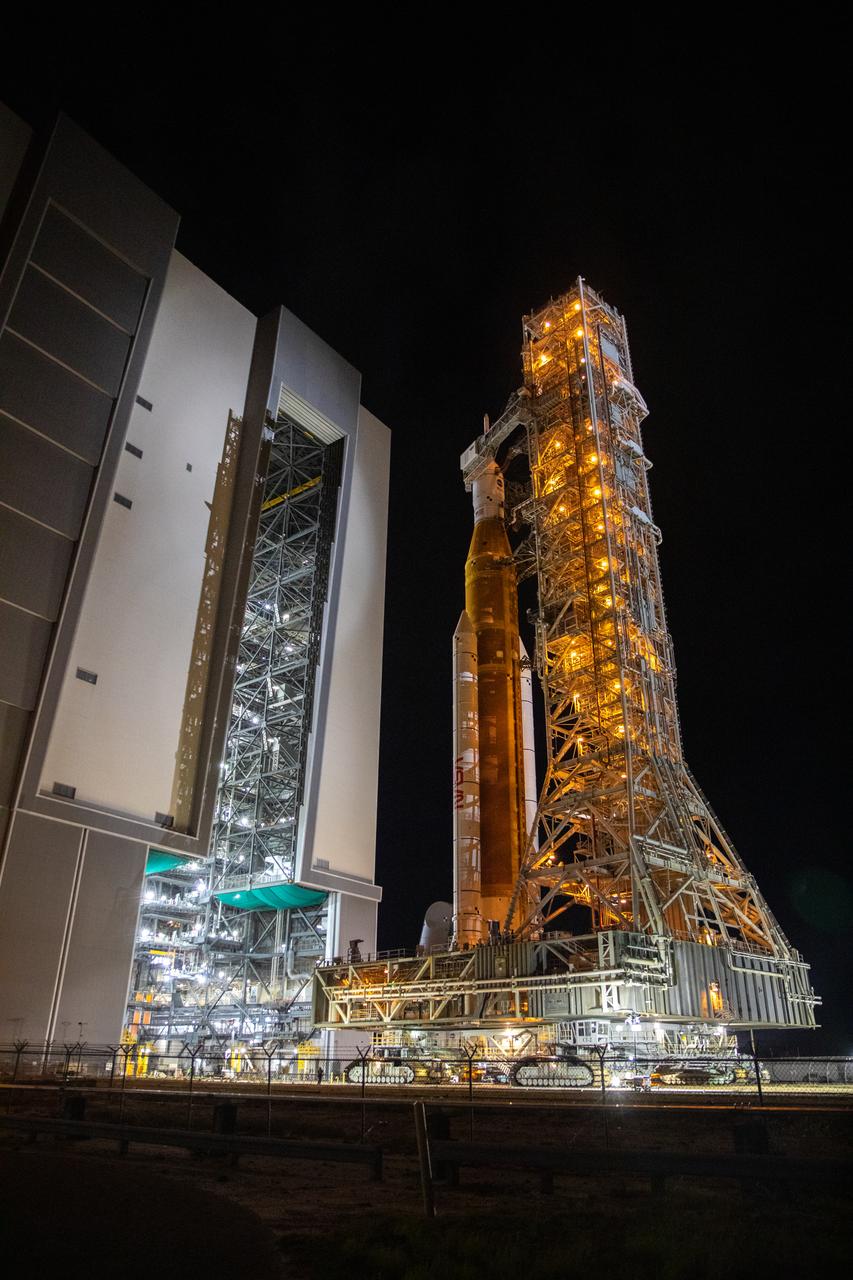
The mobile launcher, with NASA’s Space Launch System (SLS) rocket and Orion spacecraft atop, rolls out of the Vehicle Assembly Building’s High Bay 3 to begin its 4.2-mile journey to Launch Pad 39B at NASA’s Kennedy Space Center in Florida on Nov. 4, 2022. Artemis I will be the first integrated test of NASA’s SLS rocket and Orion spacecraft and is scheduled to launch Monday, Nov. 14. The primary goal of Artemis I is to thoroughly test the integrated systems before crewed missions by launching Orion atop the SLS rocket, operating the spacecraft in a deep space environment, testing Orion’s heat shield, and recovering the crew module after reentry, descent, and splashdown. During the flight, Orion will launch atop the most powerful rocket in the world and fly farther than any human-rated spacecraft has ever flown, paving the way for human deep space exploration and demonstrating our commitment and capability to extend human presence to the Moon and beyond.
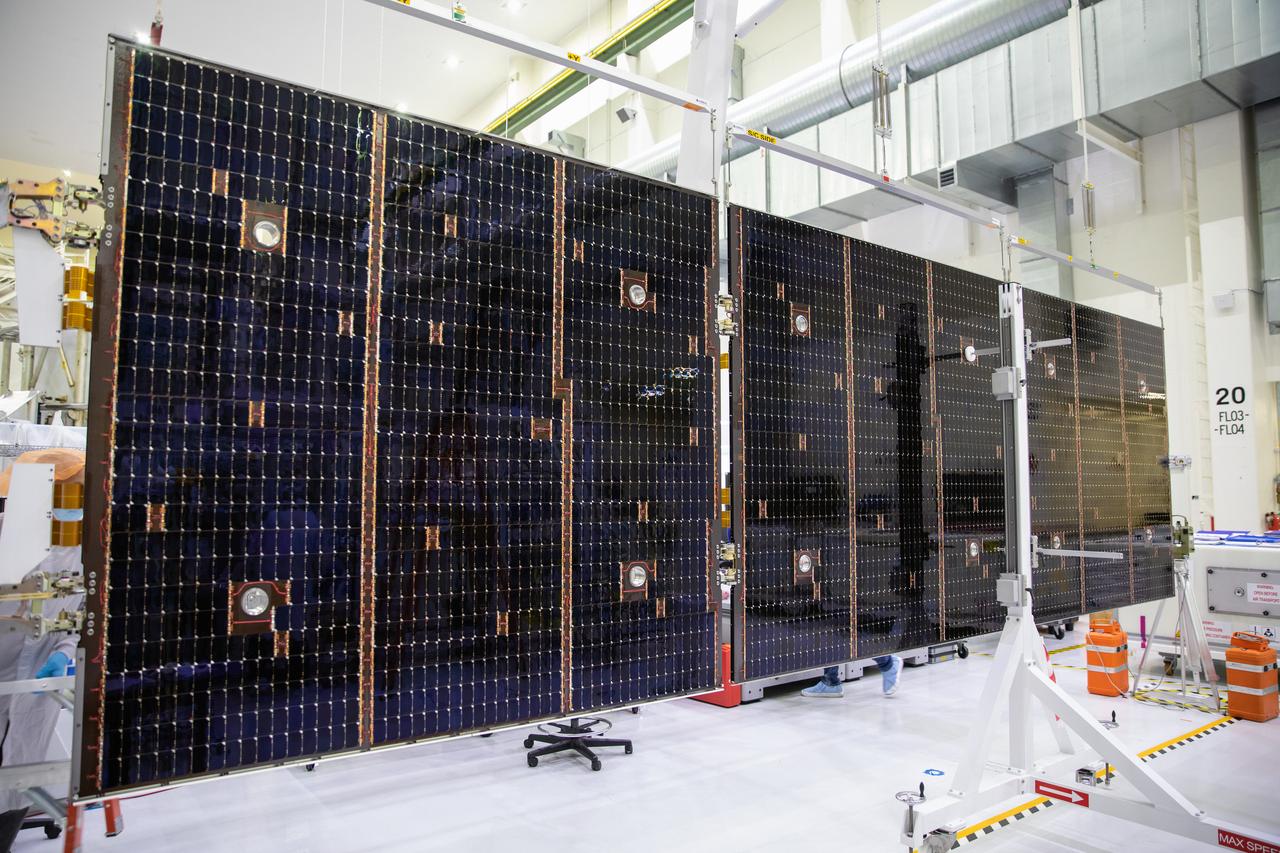
Inside the Neil Armstrong Operations and Checkout Building high bay at NASA’s Kennedy Space Center in Florida, in preparation for installation on the Artemis I spacecraft, technicians have extended one of the Artemis I solar array wings for inspection on Sept. 10, 2020, to confirm that it unfurled properly and all of the mechanisms functioned as expected. The solar array is one of four panels that will generate 11 kilowatts of power and span about 63 feet. The array is a component of Orion’s service module, which is provided by the European Space Agency and built by Airbus Defence and Space to supply Orion’s power, propulsion, air and water. The first in a series of increasingly complex missions, Artemis I will test the Orion spacecraft and Space Launch System as an integrated system ahead of crewed flights to the Moon. Under the Artemis program, NASA will land the first woman and the next man on the Moon in 2024.

Horticulture scientist Blake Costine adjusts moisture sensors for the Advanced Plant Imaging project at NASA’s Kennedy Space Center on April 17, 2023. In this project, hyperspectral cameras are used to assess plant health. The activity is taking place inside the Plant Production Area at the Florida spaceport’s Space Station Processing Facility.
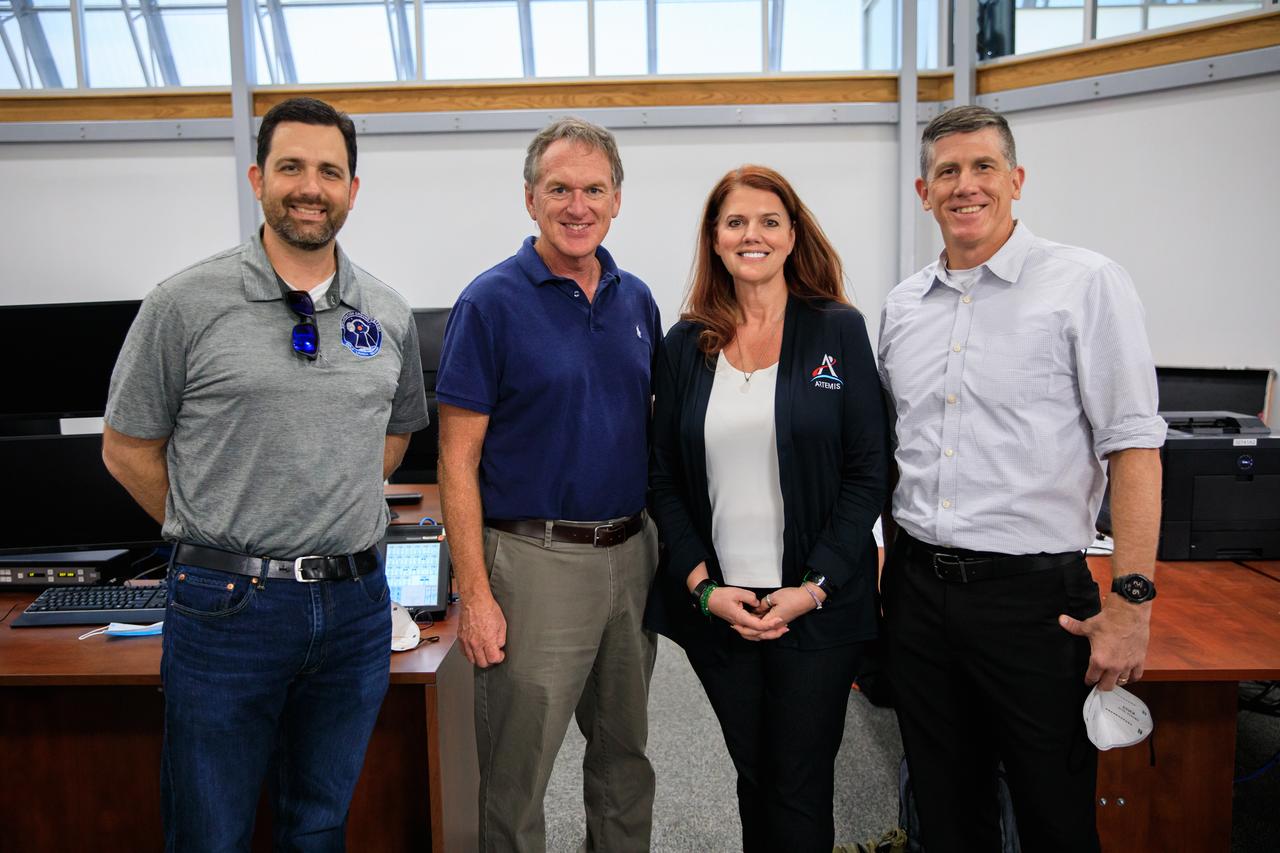
From left, NASA’s Exploration Ground Systems (EGS) Deputy Manager Jeremy Parsons, EGS Manager Mike Bolger, Artemis I Launch Director Charlie Blackwell-Thompson, and Assistant Launch Director Jeremy Graeber are photographed inside Firing Room 2 of the Rocco A. Petrone Launch Control Center at the agency’s Kennedy Space Center in Florida during a certification ceremony on Aug. 12, 2022. The ceremony was held to commemorate the certification of the Artemis I launch team following their launch simulation held in December 2021. During the ceremony, management staff handed out certificates to individual team members. The first in an increasingly complex series of missions, Artemis I will test NASA’s Space Launch System rocket and Orion spacecraft as an integrated system prior to crewed flights to the Moon. Through Artemis, NASA will land the first woman and the first person of color on the lunar surface, paving the way for long-term lunar presence and using the Moon as a steppingstone before venturing to Mars.
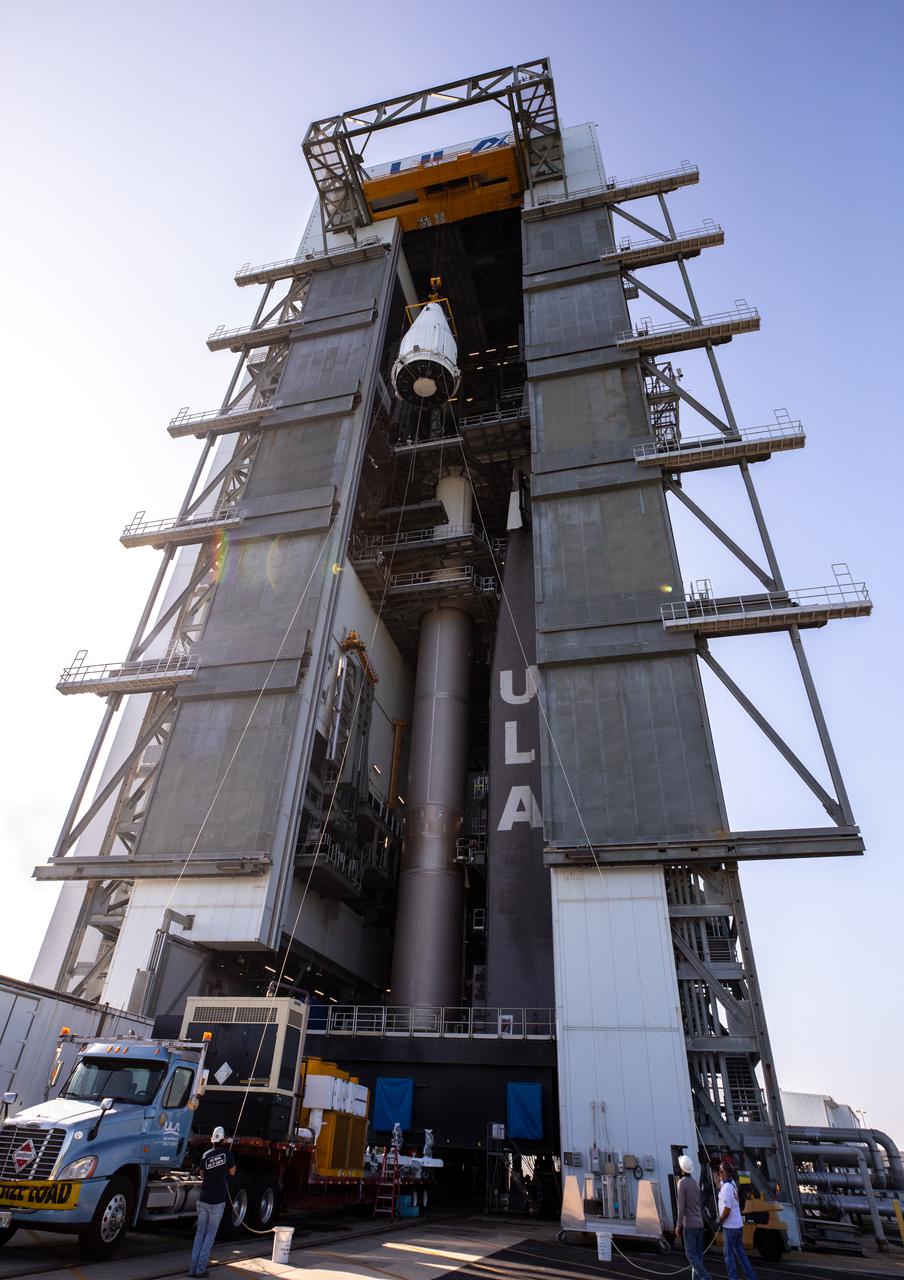
The payload fairing containing NASA’s Lucy spacecraft is hoisted up at the Vertical Integration Facility at Space Launch Complex 41 at Cape Canaveral Space Force Station in Florida on Oct. 7, 2021. It will be lowered onto the United Launch Alliance (ULA) Atlas V Centaur second stage. Lucy is scheduled to launch no earlier than Saturday, Oct. 16, on the ULA Atlas V 401 rocket from Launch Pad 41. NASA’s Launch Services Program, based at Kennedy Space Center, America’s premier multi-user spaceport, is managing the launch. Over its 12-year primary mission, Lucy will explore a record-breaking number of asteroids, flying by one asteroid in the solar system’s main belt and seven Trojan asteroids. Additionally, Lucy’s path will circle back to Earth three times for gravity assists, making it the first spacecraft ever to return to the vicinity of Earth from the outer solar system.
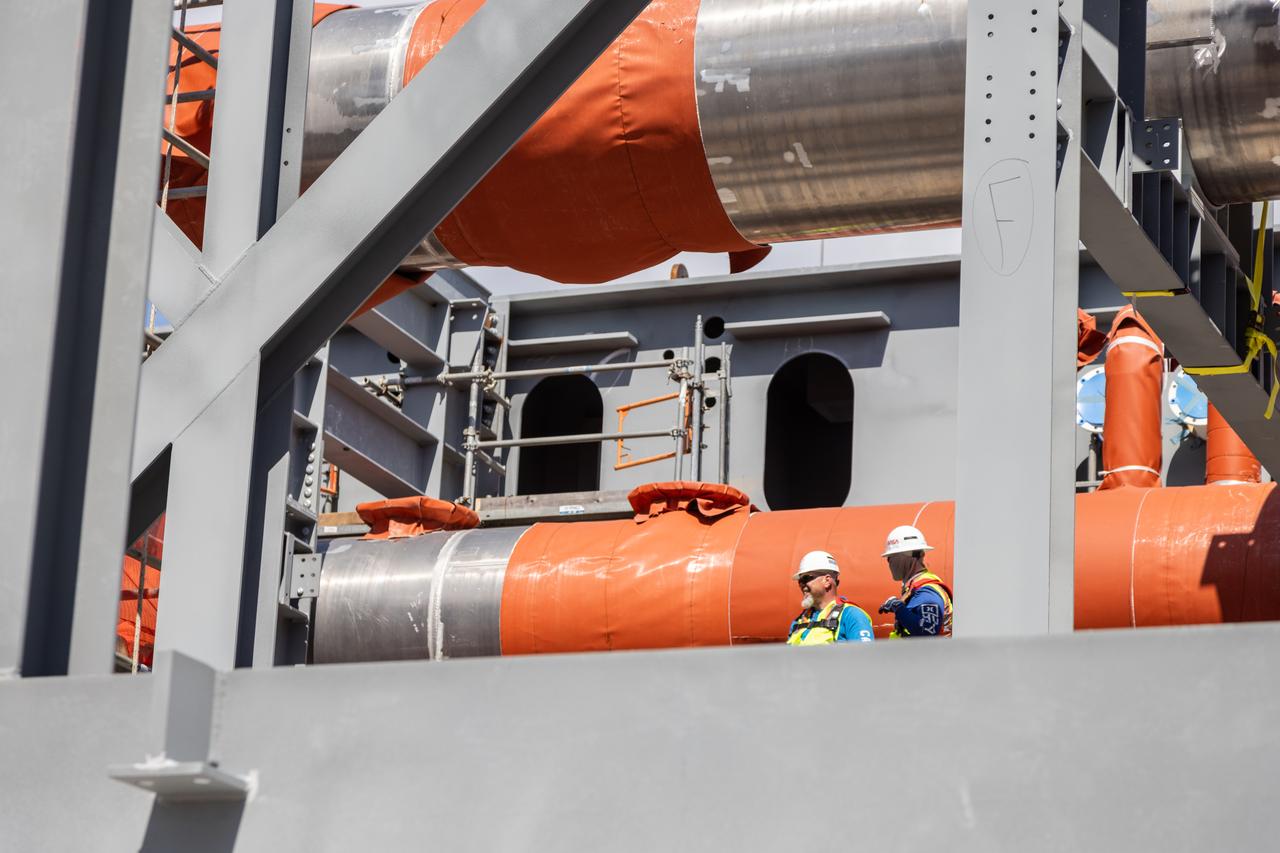
Teams with NASA’s Exploration Ground Systems Program and Bechtel National, Inc., the prime contractor for NASA’s mobile launcher 2, continue construction on the new mobile launcher at the agency’s Kennedy Space Center in Florida on Wednesday, April 24, 2024. Once completed and able to be carried atop the crawler-transporter, the 355-foot-tall mobile launcher 2 will be used during assembly, processing, and launch of the SLS (Space Launch System) rocket and Orion spacecraft on NASA’s upcoming Artemis missions to the Moon beginning with Artemis IV.
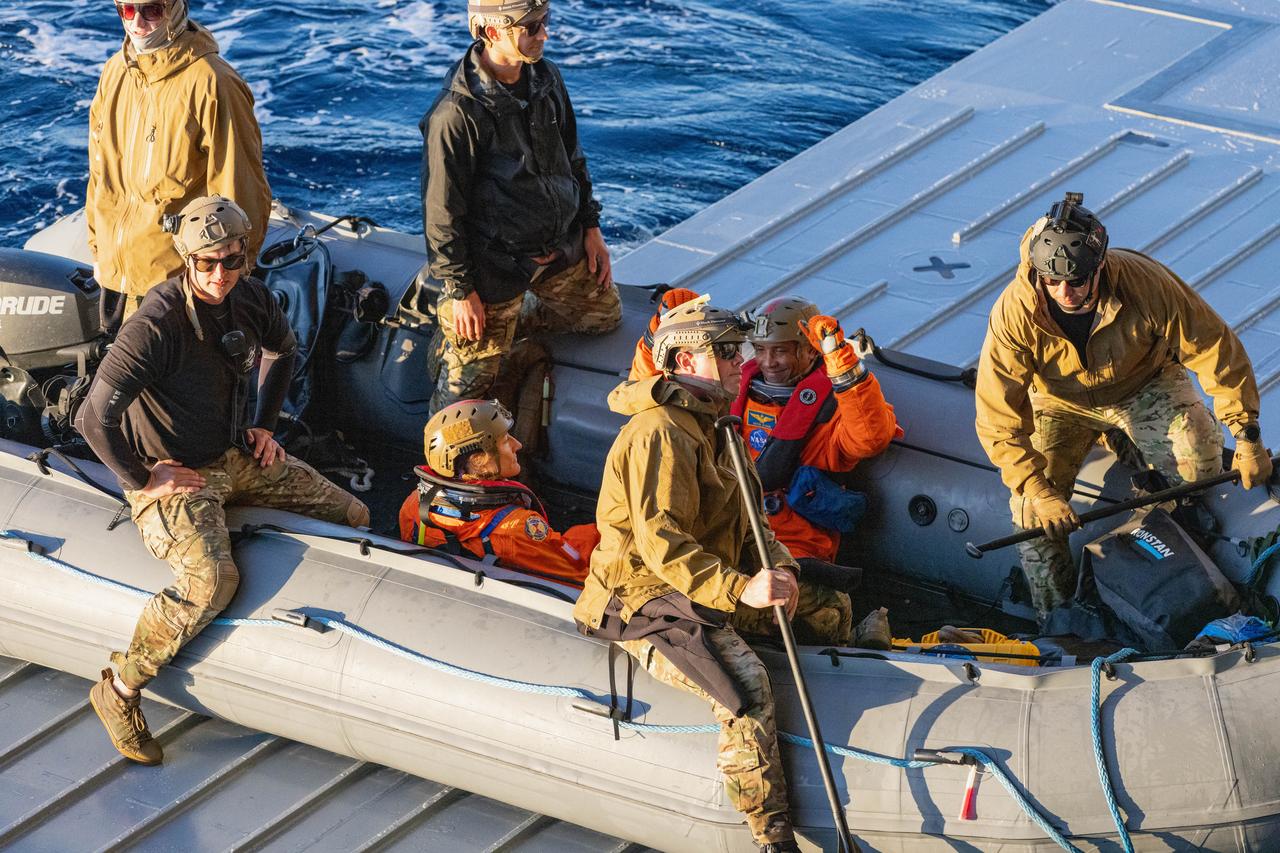
NASA’s Exploration Ground System’s Landing and Recovery team, partners from the Department of Defense, and U.S. Navy personnel aboard the USS San Diego assist NASA’s Artemis II crew members from left to right NASA astronauts Christina Koch and Victor Glover from a boat during practice recovery procedures during Underway Recovery Test 11 (URT-11) off the coast of San Diego, California on Tuesday, Feb. 27, 2024. URT-11 is the eleventh in a series of Artemis recovery tests, and the first time NASA and its partners put their Artemis II recovery procedures to the test with the astronauts.
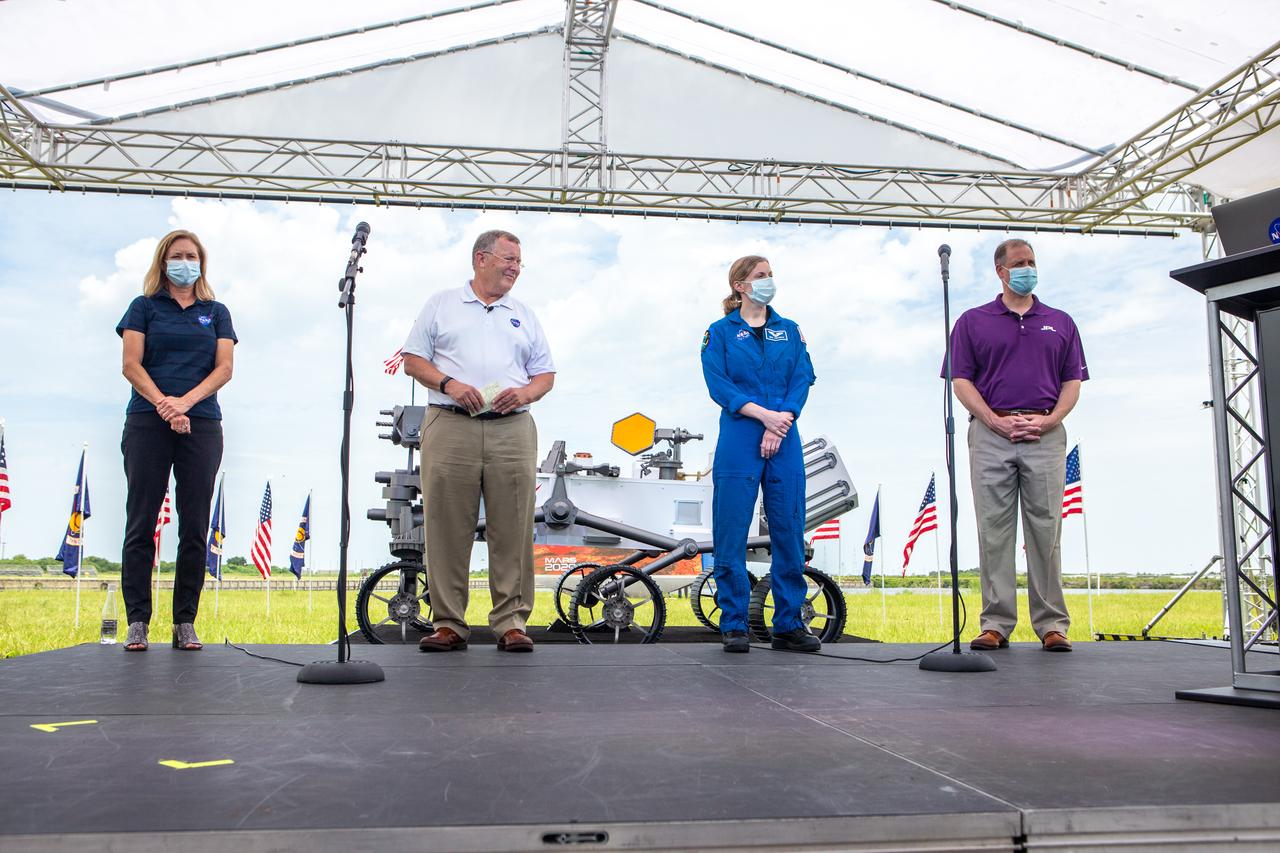
A Mars 2020 NASA Social is held at Kennedy Space Center’s News Center in Florida on July 29, 2020. Participants from left are Kennedy Deputy Director Janet Petro, NASA Deputy Administrator Jim Morhard, NASA astronaut Zena Cardman, and NASA Administrator Jim Bridenstine. The Mars Perseverance rover and Ingenuity helicopter are scheduled to launch July 30, on a United Launch Alliance Atlas V 541 rocket from Space Launch Complex 41 at nearby Cape Canaveral Air Force Station. The rover is part of NASA’s Mars Exploration Program, a long-term effort of robotic exploration of the Red Planet. The rover will search for habitable conditions in the ancient past and signs of past microbial life on Mars. The Launch Services Program at Kennedy is responsible for launch management.
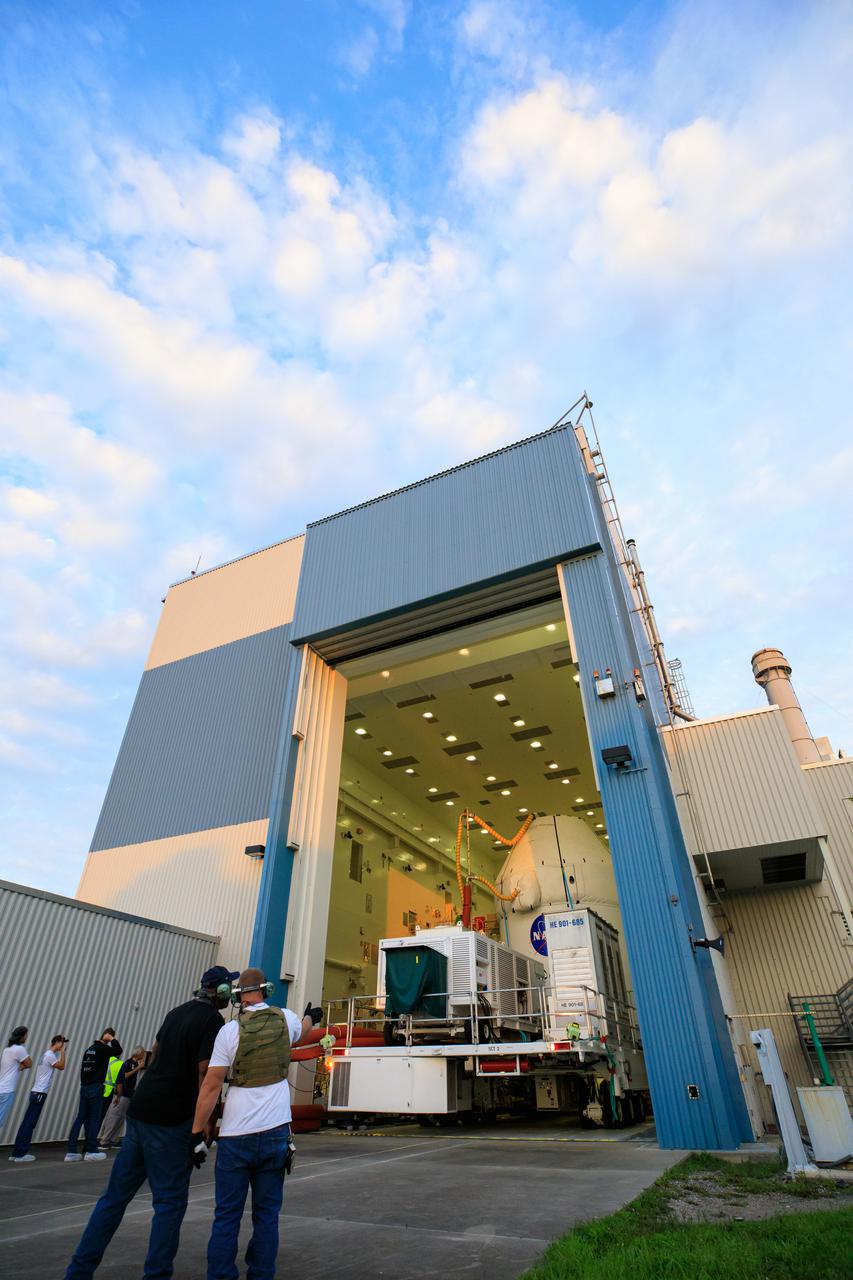
After recently completing fueling and servicing checks, the Orion spacecraft for the Artemis I mission departs from Kennedy Space Center’s Multi-Payload Processing on July 10, 2021. It is being transported to the Florida spaceport’s Launch Abort System Facility, where teams with Exploration Ground Systems and contractor Jacobs will integrate components of the launch abort system onto the spacecraft. Launching later this year, Artemis I will be a test of the Orion spacecraft and SLS rocket as an integrated system ahead of crewed flights to the Moon.

NASA’s 2021 class of astronaut candidates visit the Vehicle Assembly Building during a familiarization tour of facilities on Tuesday, Oct. 17, 2023, at the agency’s Kennedy Space Center in Florida.
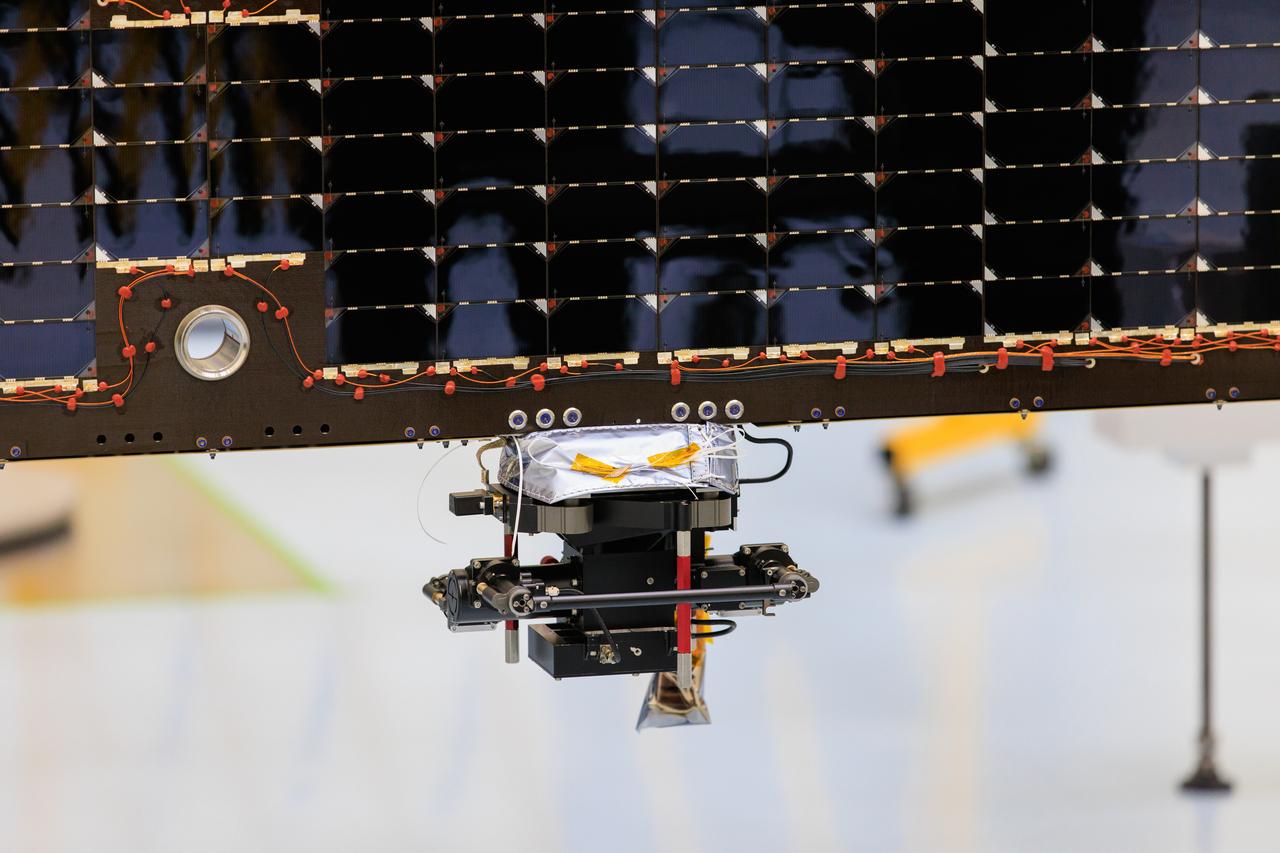
An antenna for the REASON, (Radar for Europa Assessment and Sounding: Ocean to Near-surface) instrument attaches to a solar array for NASA’s Europa Clipper spacecraft inside the Payload Hazardous Servicing Facility at the agency’s Kennedy Space Center in Florida on Wednesday, March 20, 2024. The Europa Clipper spacecraft will study Jupiter’s icy moon Europa, and the REASON instrument will use the antennas to send both both High Frequency (HF) and Very High Frequency (VHF) radio waves to penetrate up to 18 miles (30 kilometers) deep and search the ocean, measure ice thickness, and study the topography, composition, and roughness of Europa’s surface. The Europa Clipper spacecraft will ship to Florida later this year from NASA’s Jet Propulsion Lab in Southern California in preparation for launch aboard a SpaceX Falcon Heavy rocket from Kennedy’s Launch Complex 39A, targeting October.
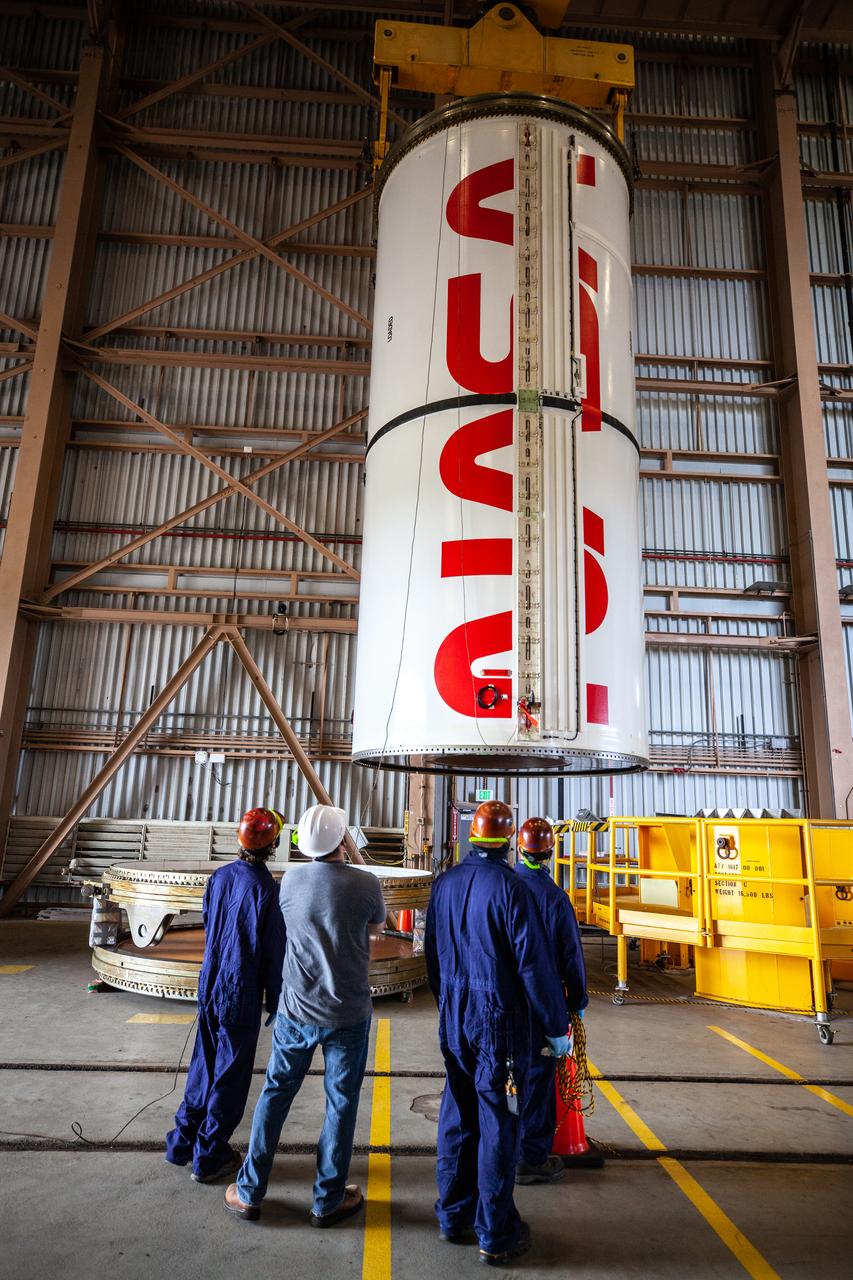
Inside the Rotation, Processing and Surge Facility at NASA’s Kennedy Space Center in Florida, Exploration Ground Systems and Jacobs TOSC workers completed painting of NASA’s iconic “worm” logo on the Artemis I Space Launch System twin solid rocket boosters on Sept. 23, 2020. Originally created by the firm of Danne & Blackburn, the iconic “worm” logo’s bold, sleek design was officially introduced in 1975 and was incorporated into many of the agency’s next-generation programs. It was retired in 1992, but has made a comeback in 2020 as the agency ushers in a new, modern era of human spaceflight. The first in a series of increasingly complex missions, Artemis I will test the Orion spacecraft and Space Launch System as an integrated system ahead of crewed flights to the Moon. Under the Artemis program, NASA will land the first woman and the next man on the Moon by 2024.

The Orion spacecraft for NASA’s Artemis I mission, fully assembled with its launch abort system, has moved out of the Launch Abort System Facility at Kennedy Space Center in Florida on Oct. 19, 2021. Orion is on its way to the Vehicle Assembly Building where it will join the already stacked flight hardware and be raised into position atop the Space Launch System rocket in High Bay 3. Launching in 2021, Artemis I will be an uncrewed test flight of the Orion spacecraft and Space Launch System rocket as an integrated system ahead of crewed flights to the Moon. Under Artemis, NASA aims to land the first woman and first person of color on the Moon and establish sustainable lunar exploration.
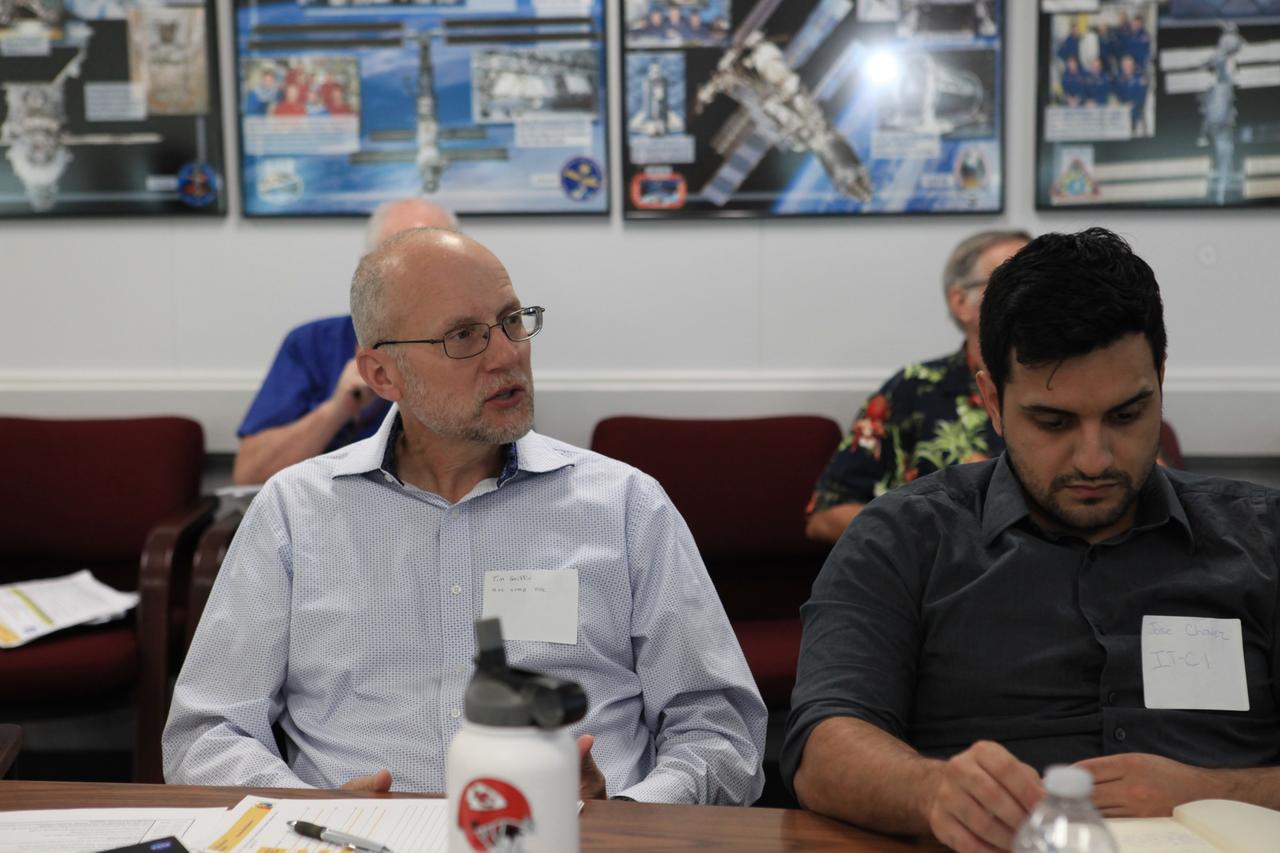
Tim Griffin, NASA’s Kennedy Space Center’s Space Technology Mission Directorate representative for this year’s “Innovation Without Boundaries” event held in Kennedy’s Space Station Processing Facility on June 14, 2019, asks a participant a question. A number of employees, including civil servants and contractors that opted to take part, presented their proposals to a panel of judges as part of the Chief Technologist Innovation Call. The three categories of awards were innovative ideas that had little cost, ideas with great returns on investment up to $20,000 and big ideas where participants could socialize ideas for projects that would take more than $20,000 to implement.
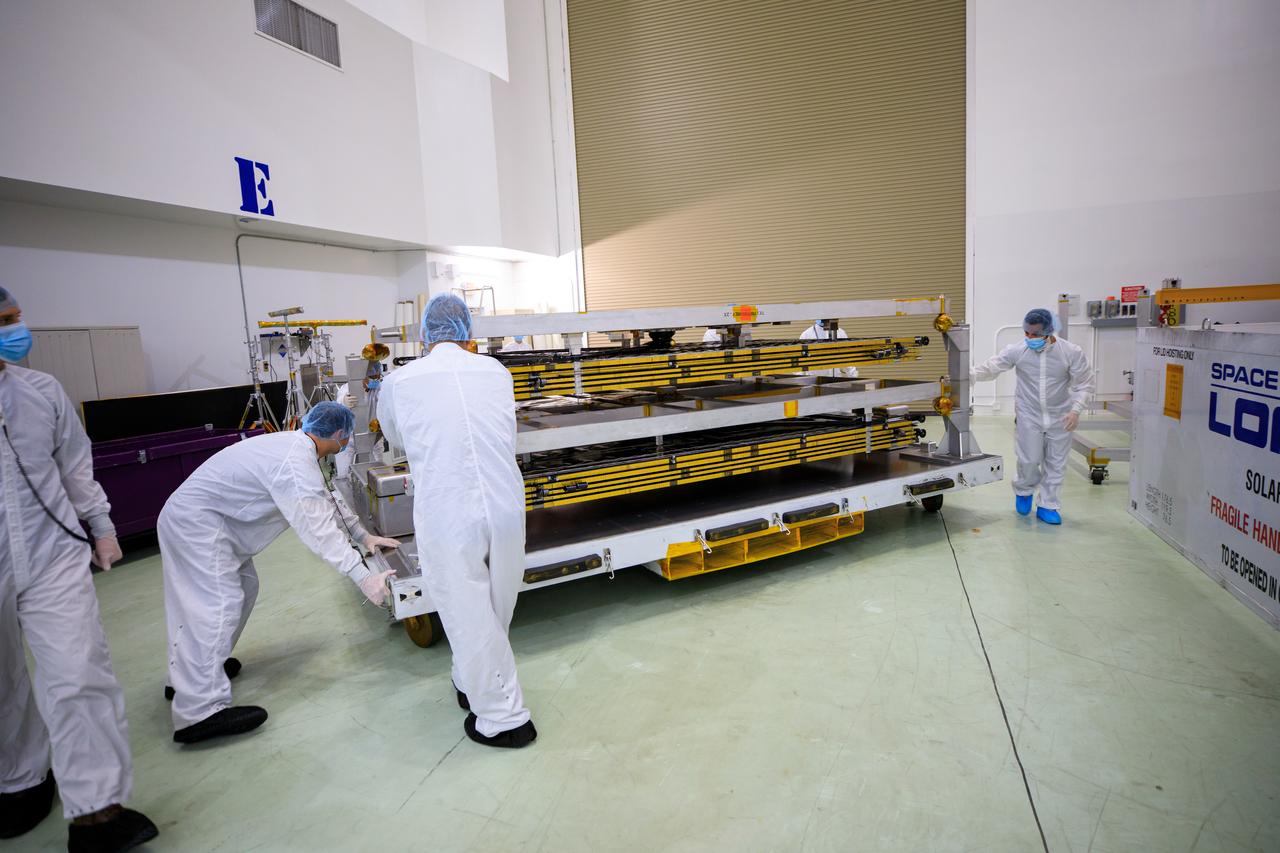
A NASA team uncrates the twin solar arrays for NASA’s Psyche spacecraft at the Astrotech Space Operations Facility near the agency’s Kennedy Space Center in Florida on July 18, 2023. The solar arrays were shipped from Maxar Technologies, in California. They are part of the solar electric propulsion system, provided by Maxar, that will power the spacecraft on its journey to explore a metal-rich asteroid. Psyche will launch atop a SpaceX Falcon Heavy rocket from Launch Complex 39A at Kennedy. Launch is targeted for Oct. 5, 2023. Riding with Psyche is a pioneering technology demonstration, NASA’s Deep Space Optical Communications (DSOC) experiment.
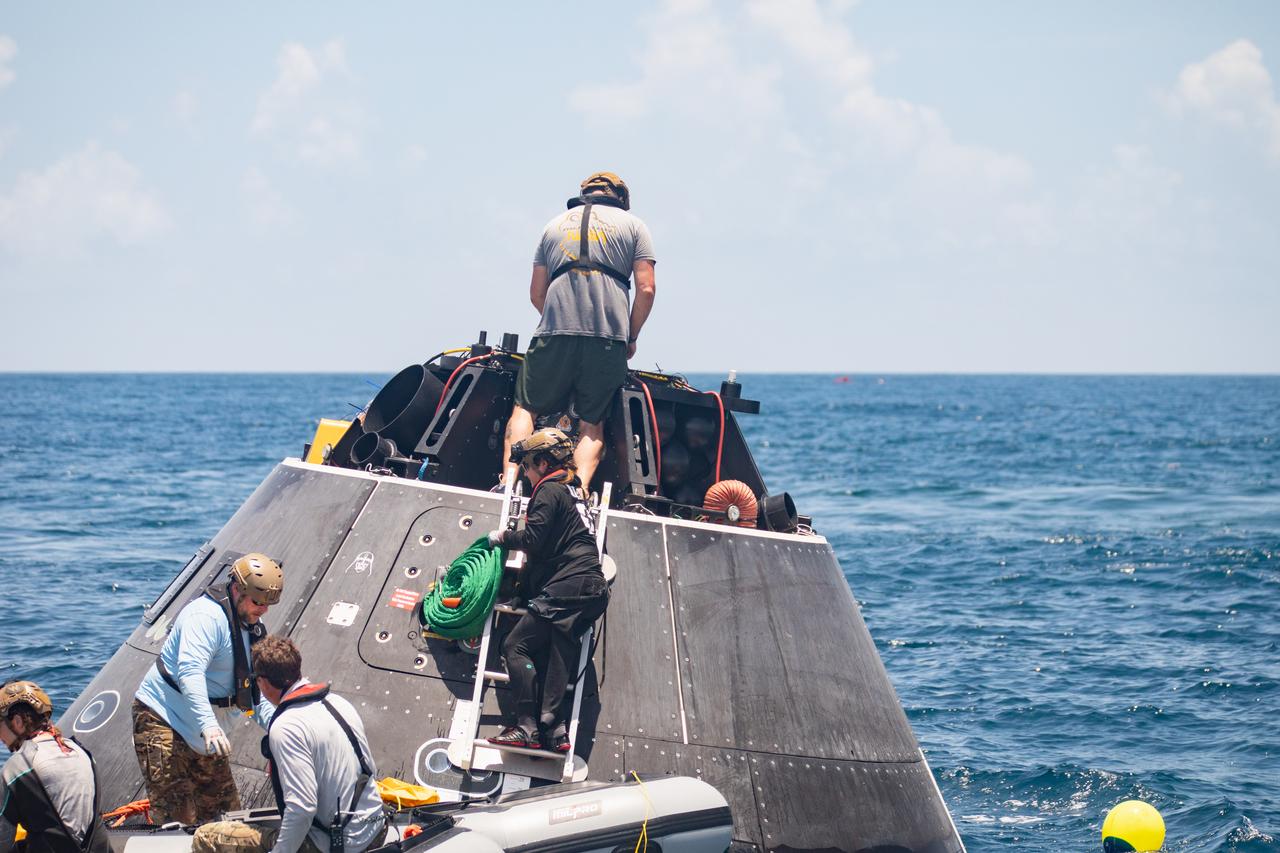
Teams with NASA and the Department of Defense (DoD) rehearse recovery procedures for an ascent abort scenario off the coast of Florida near the agency’s Kennedy Space Center on Thursday, June 12, 2025. Utilizing mannequin crew members inside the Crew Module Test Article (CMTA) – a full-scale mockup of the Orion spacecraft – the simulations practiced abort timelines and joint NASA and DoD recovery procedures supported by Artemis II launch and flight control teams, as NASA prepares to send four astronauts around the Moon and back next year as part of the agency’s first crewed Artemis mission.
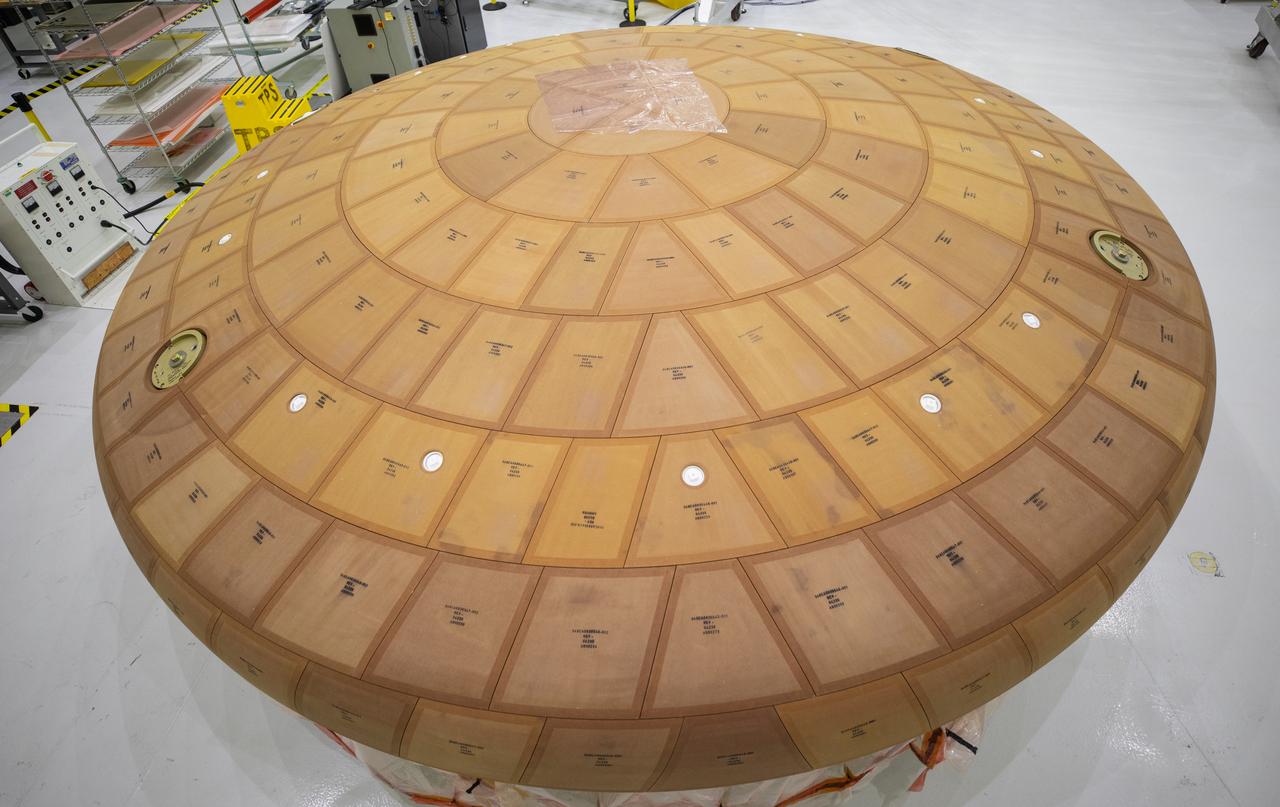
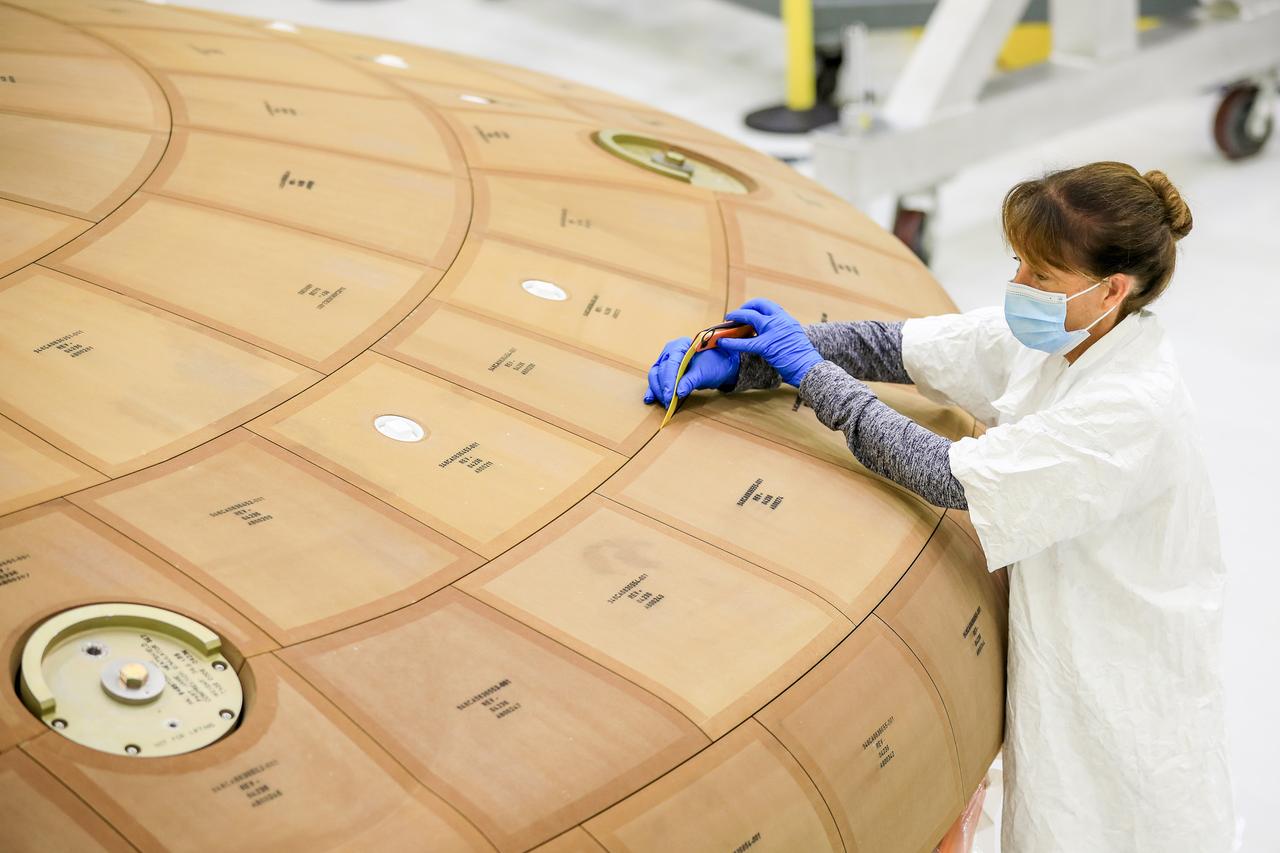
Inside the Neil Armstrong Operations and Checkout Building high bay at NASA's Kennedy Space Center in Florida, the AVOCAT block bonding is complete on the Artemis II heat shield on July 2, 2020. The heat shield is one of the most critical elements of Orion and will protect the capsule and astronauts during reentry through Earth’s atmosphere. Artemis II is the first crewed mission in a series of missions to the Moon and on to Mars. Artemis II will confirm all of the Orion spacecraft’s systems operate as designed in the actual environment of deep space with astronauts aboard. As part of the Artemis Program, NASA will send the first woman and next man to the Moon by 2024.
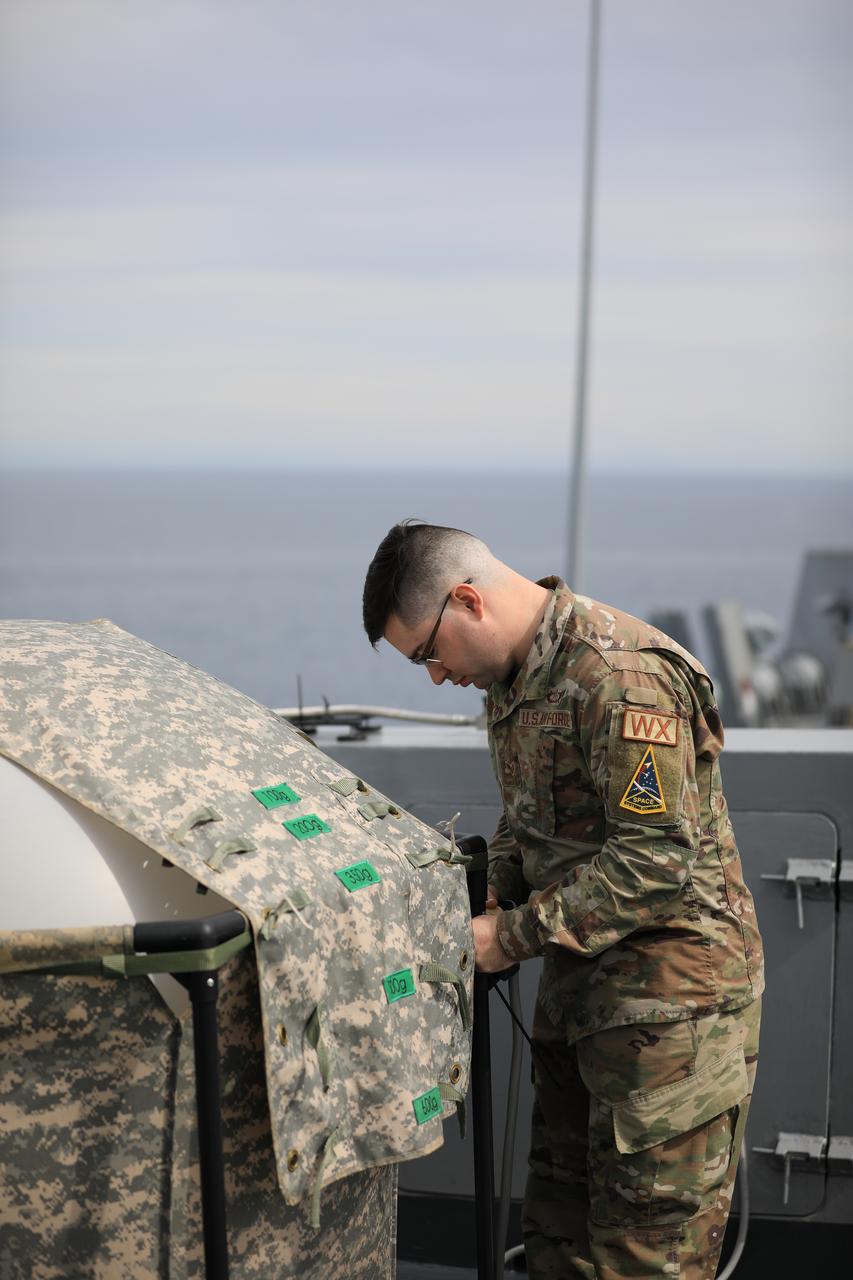
Members of NASA’s Exploration Ground System’s Landing and Recovery team and partners from the Department of Defense aboard the USS San Diego release a weather balloon while practicing recovery procedures using the Crew Module Test Article during Underway Recovery Test 11 (URT-11) off the coast of San Diego on Saturday, Feb. 24, 2024. URT-11 is the eleventh in a series of Artemis recovery tests, and the first time NASA and its partners put their Artemis II recovery procedures to the test with the astronauts.
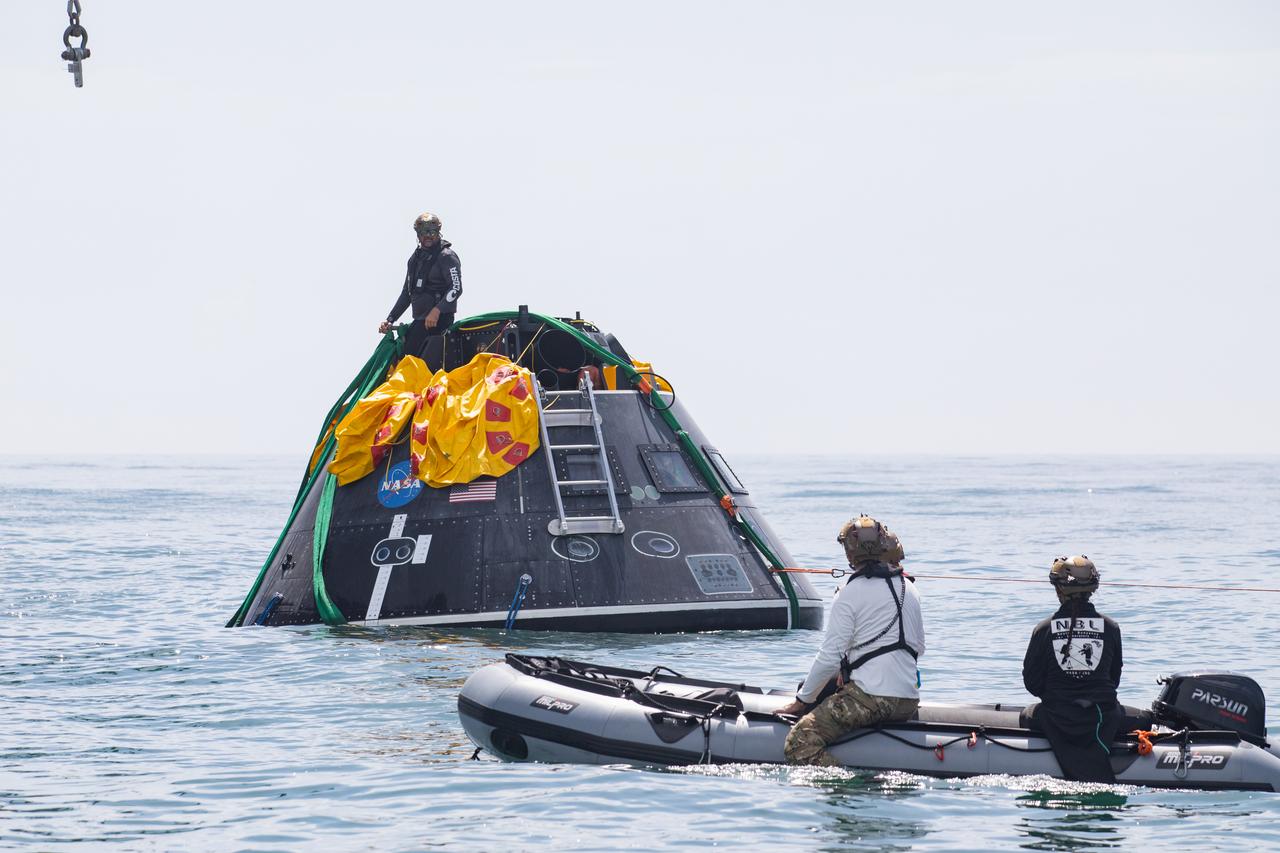
Teams with NASA and the Department of Defense (DoD) rehearse recovery procedures for a launch pad abort scenario off the coast of Florida near the agency’s Kennedy Space Center on Wednesday, June 11, 2025. Utilizing mannequin crew members inside the Crew Module Test Article (CMTA) – a full-scale mockup of the Orion spacecraft – the simulations practiced abort timelines and joint NASA and DoD recovery procedures supported by Artemis II launch and flight control teams, as NASA prepares to send four astronauts around the Moon and back next year as part of the agency’s first crewed Artemis mission.
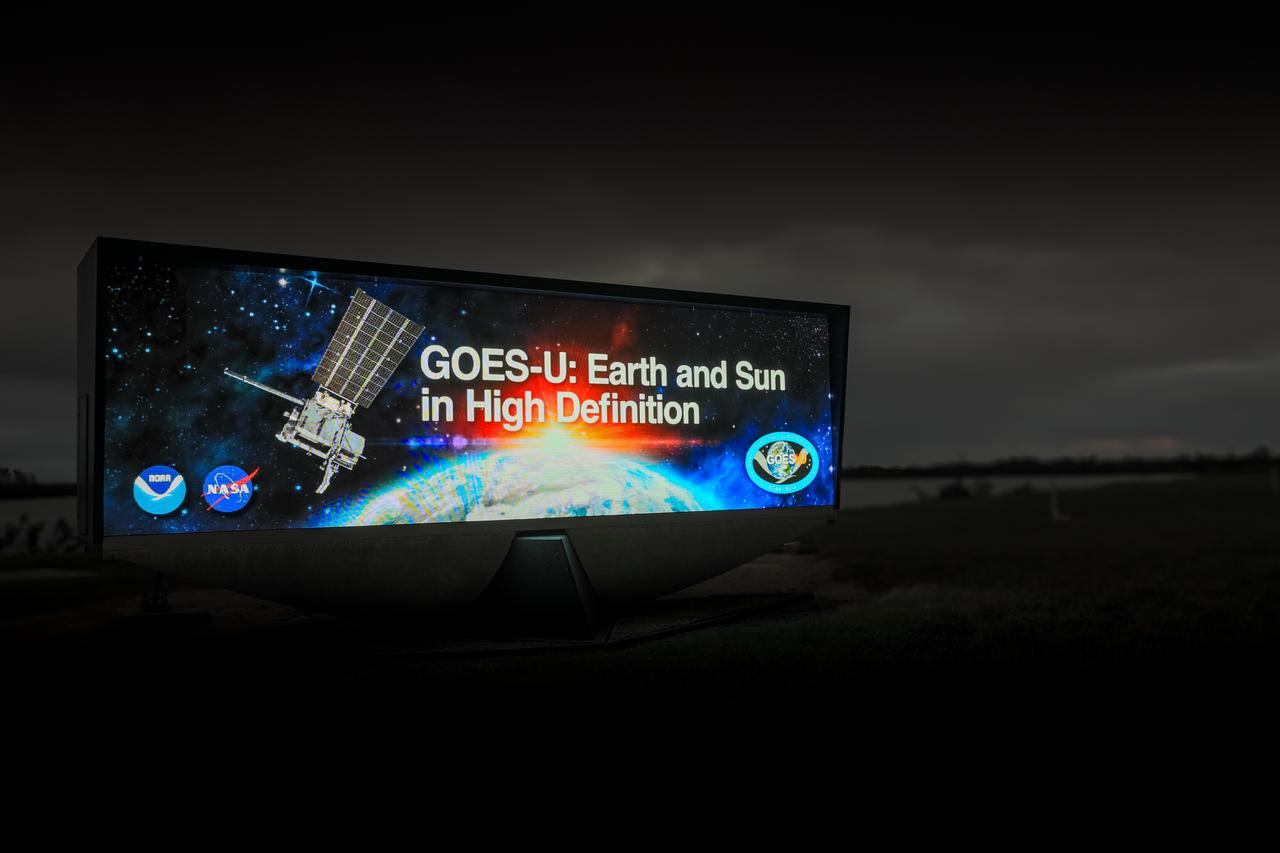
NOAA’s Geostationary Operational Environmental Satellite-U (GOES-U) mission graphic is displayed on the historic countdown clock at Kennedy Space Center’s NASA News Center in Florida on Tuesday, Jan. 23, 2024. GOES-U is the fourth and final satellite in NOAA's GOES-R series of advanced geostationary weather satellites. Data from the GOES satellite constellation – consisting of the GOES-R, GOES-S, GOES-T and GOES-U spacecraft – enables forecasters to predict, observe, and track local weather events that affect public safety like thunderstorms, hurricanes, and wildfires.
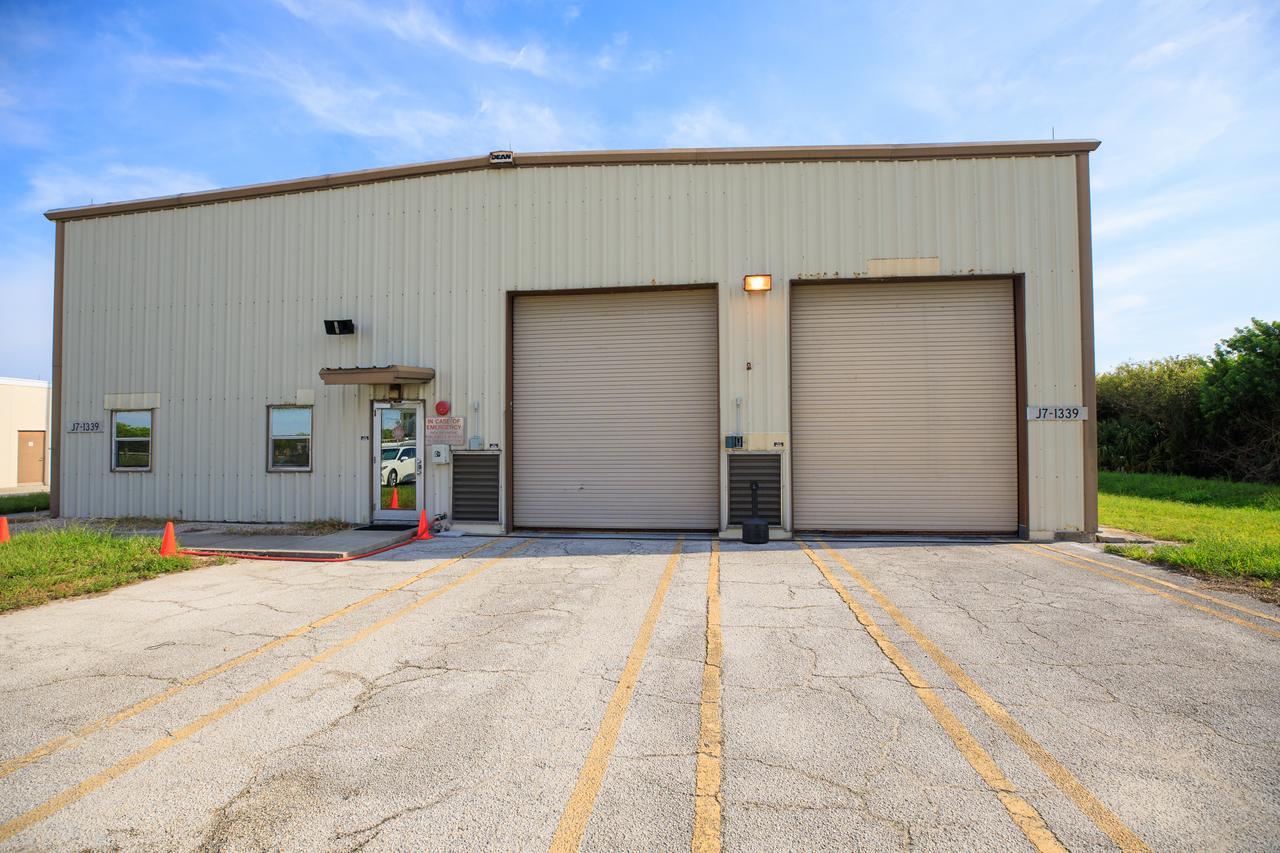
An exterior view of Fire Station 3 at Launch Complex 39B at NASA’s Kennedy Space Center in Florida on Sept. 8, 2022.
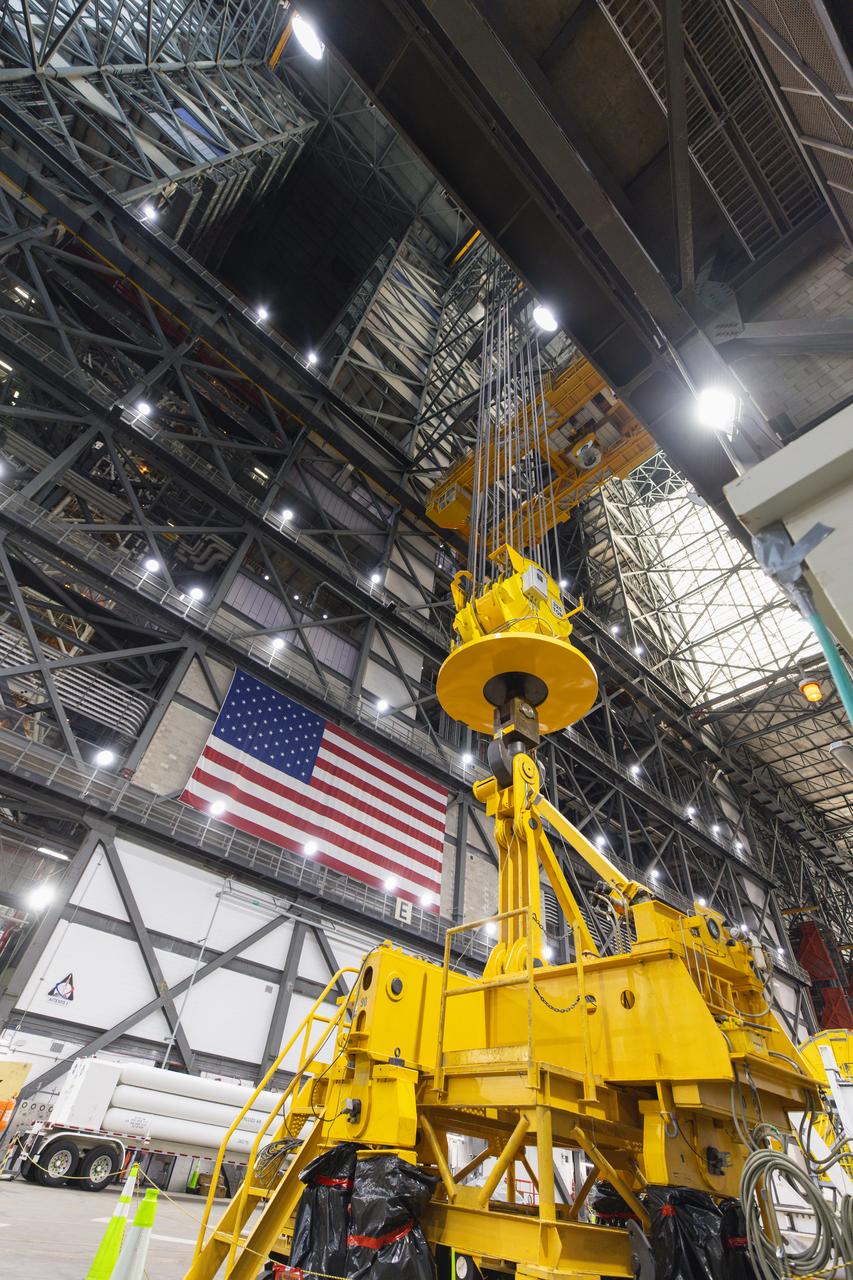
Engineers and technicians with NASA’s Exploration Ground Systems Program move the right aft assembly, or bottom portion of the right solid rocket booster for the agency’s SLS (Space Launch System) rocket, into inside the Vehicle Assembly Building at NASA’s Kennedy Space Center on Thursday, Nov. 22, 2024. The crane will lift the right aft assembly on top of mobile launcher 1, joining the previously stacked left aft assembly as the first booster segments stacked for the Artemis II Moon rocket.
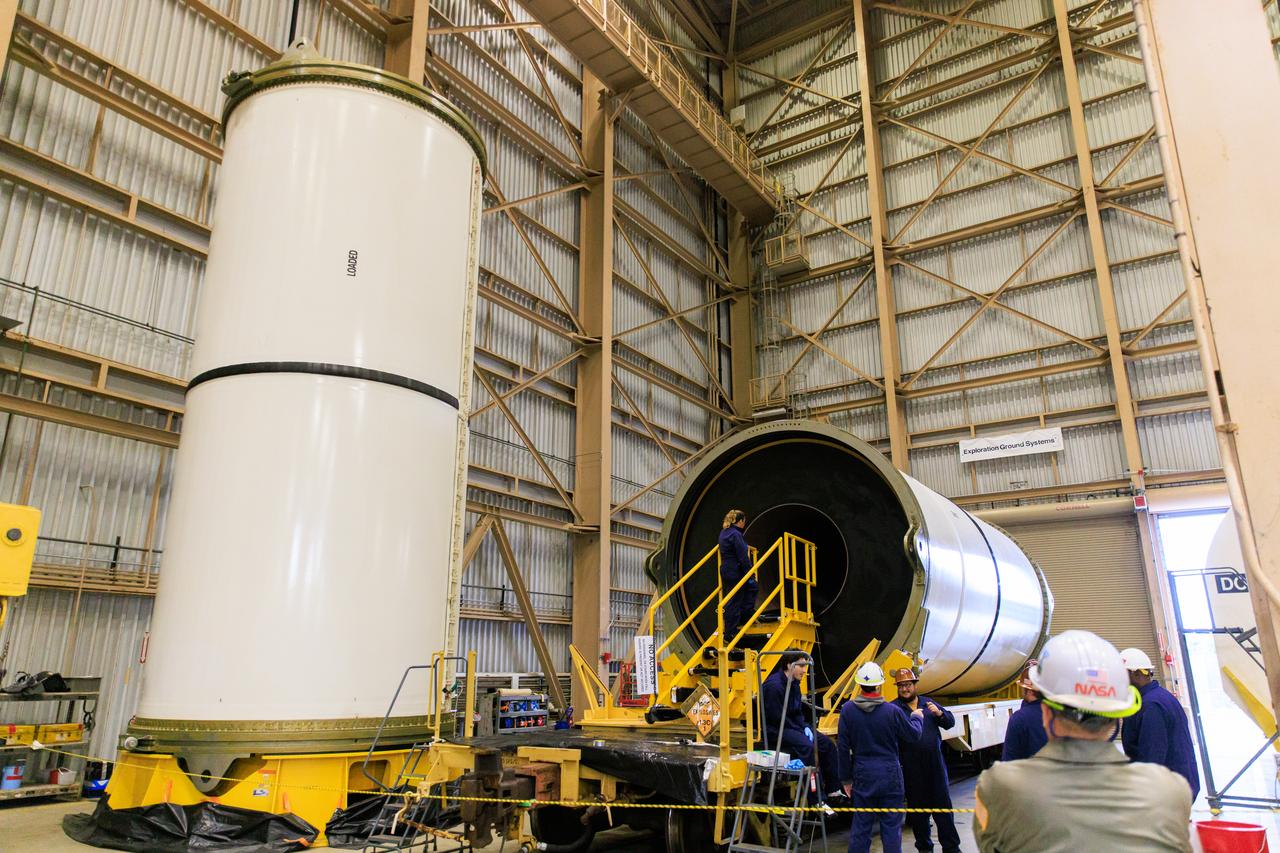
Technicians with Exploration Ground Systems, based at NASA’s Kennedy Space Center in Florida, perform propellant grain inspections on two of the agency’s Space Launch System solid rocket booster segments for the Artemis II campaign on Wednesday, Dec. 20, 2023, inside the Rotation, Processing and Surge Facility. The team is inspecting the propellant of all 10 booster segments before they are rotated vertically for processing. The Artemis II mission will send four astronauts around the Moon as part of the agency’s effort to establish a long-term science and exploration presence at the Moon, and eventually Mars.
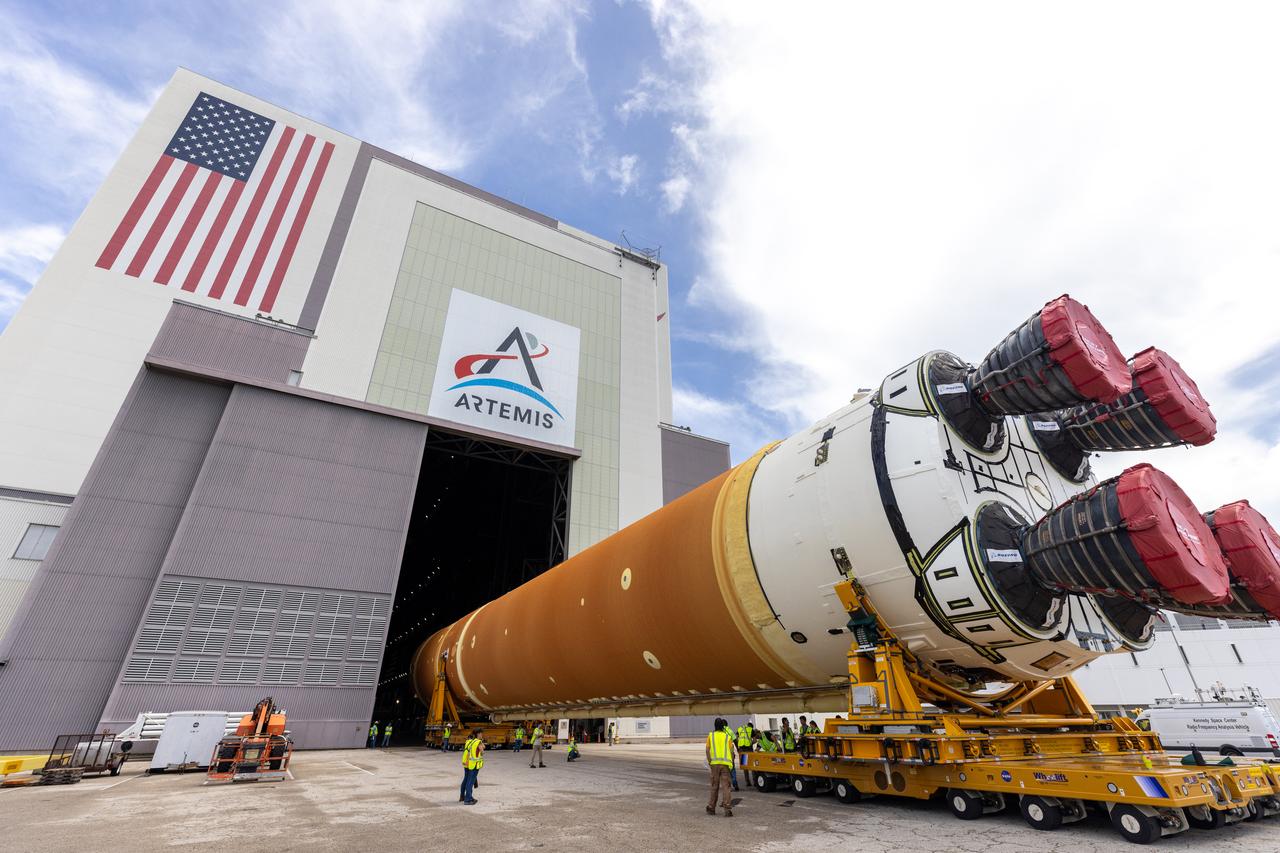
After completing its journey from NASA’s Michoud Assembly Facility in New Orleans aboard the Pegasus barge, teams with Exploration Ground Systems (EGS) transport the agency’s powerful SLS (Space Launch System) core stage to NASA’s Kennedy Space Center’s Vehicle Assembly Building in Florida on Wednesday, July 24, 2024. Once inside, SLS will be prepared for integration atop the mobile launcher ahead of the Artemis II launch.

A full-scale mockup of NASA’s Mars 2020 Perseverance rover is on display at the News Center at the agency’s Kennedy Space Center in Florida on July 29, 2020. A Mars 2020 NASA Social is in progress featuring, right to left, Kennedy Space Center Deputy Director Janet Petro, NASA Deputy Administrator Jim Morhard, NASA astronaut Zena Cardman, and NASA Administrator Jim Bridenstine. The Mars Perseverance rover and Ingenuity helicopter are scheduled to launch July 30, on a United Launch Alliance Atlas V 541 rocket from Space Launch Complex 41 at nearby Cape Canaveral Air Force Station. The rover is part of NASA’s Mars Exploration Program, a long-term effort of robotic exploration of the Red Planet. The rover will search for habitable conditions in the ancient past and signs of past microbial life on Mars. The Launch Services Program at Kennedy is responsible for launch management.
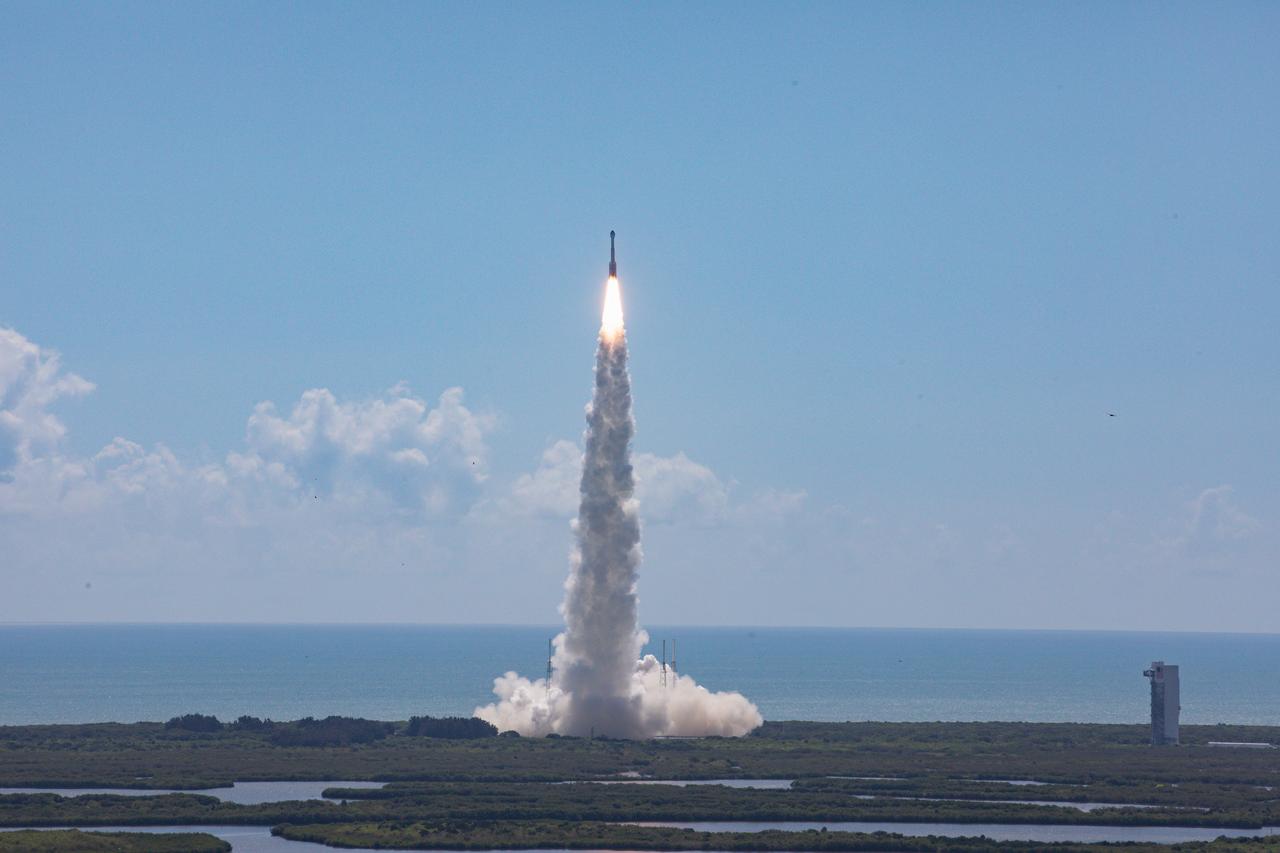
A United Launch Alliance Atlas V rocket carrying a Boeing Starliner spacecraft launches NASA’s Boeing Crew Flight Test with NASA astronauts Butch Wilmore and Suni Williams aboard at 10:52 a.m. EDT Wednesday, June 5, 2024, from Space Launch Complex-41 at Cape Canaveral Space Force Station in Florida. Wilmore and Williams are the first to launch aboard Boeing’s Starliner spacecraft to the International Space Station as part of the agency’s Commercial Crew Program.
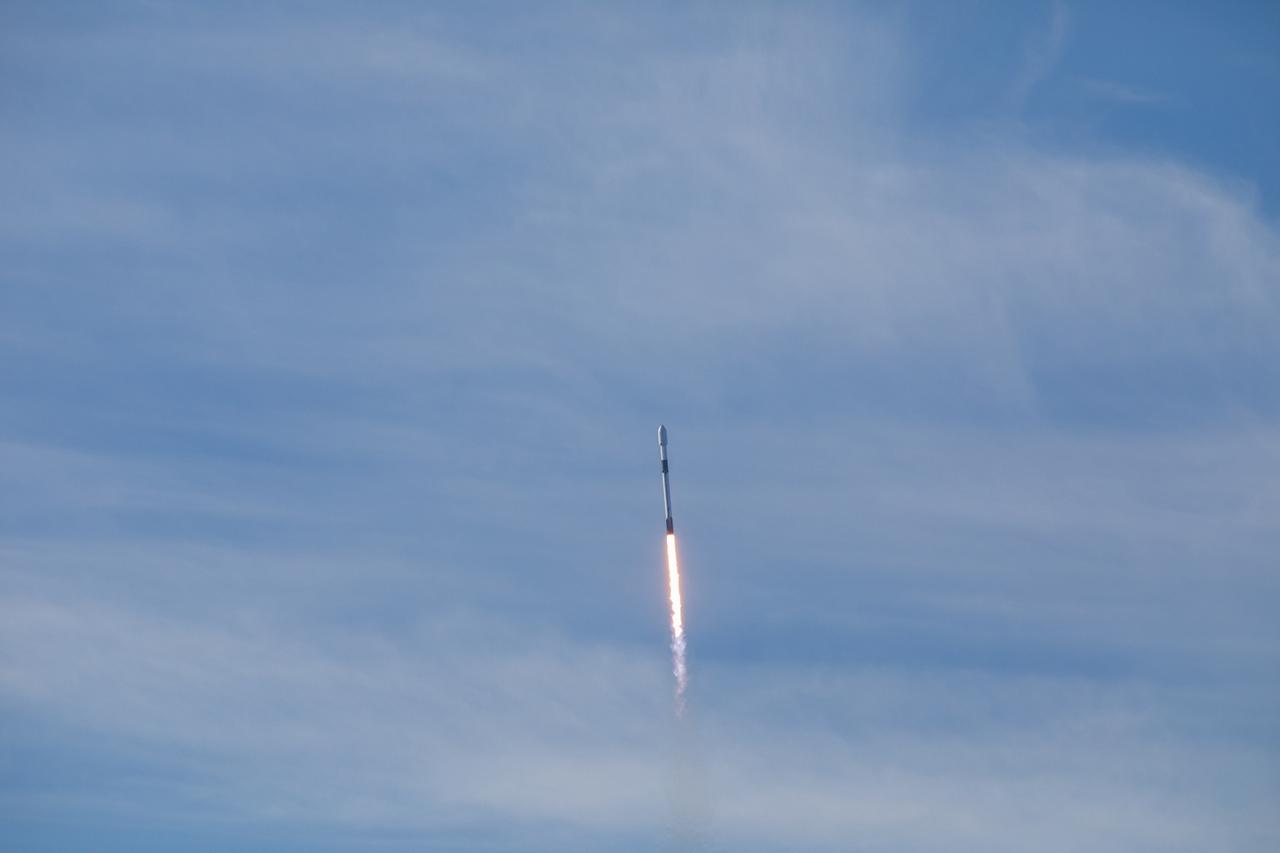
The SpaceX Falcon 9 rocket carrying the Sentinel-6 Michael Freilich spacecraft lifts off from Space Launch Complex 4 at Vandenberg Air Force Base in California, Nov. 21, 2020, at 9:17 a.m. PST (12:17 p.m. EST). The Sentinel-6/Jason-CS (Continuity of Service) mission consists of the Sentinel-6 Michael Freilich satellite, which will be followed by its twin, the Sentinel-6B satellite, in 2025. The Sentinel-6/Jason-CS mission is part of Copernicus, the European Union’s Earth observation program, managed by the European Commission. Continuing the legacy of the Jason series missions, Sentinel-6/Jason-CS will extend the records of sea level into their fourth decade, collecting accurate measurements of sea surface height for more than 90% of the world’s seas, and providing crucial information for operational oceanography, marine meteorology, and climate studies. NASA’s Launch Services Program at Kennedy Space Center was responsible for launch management.
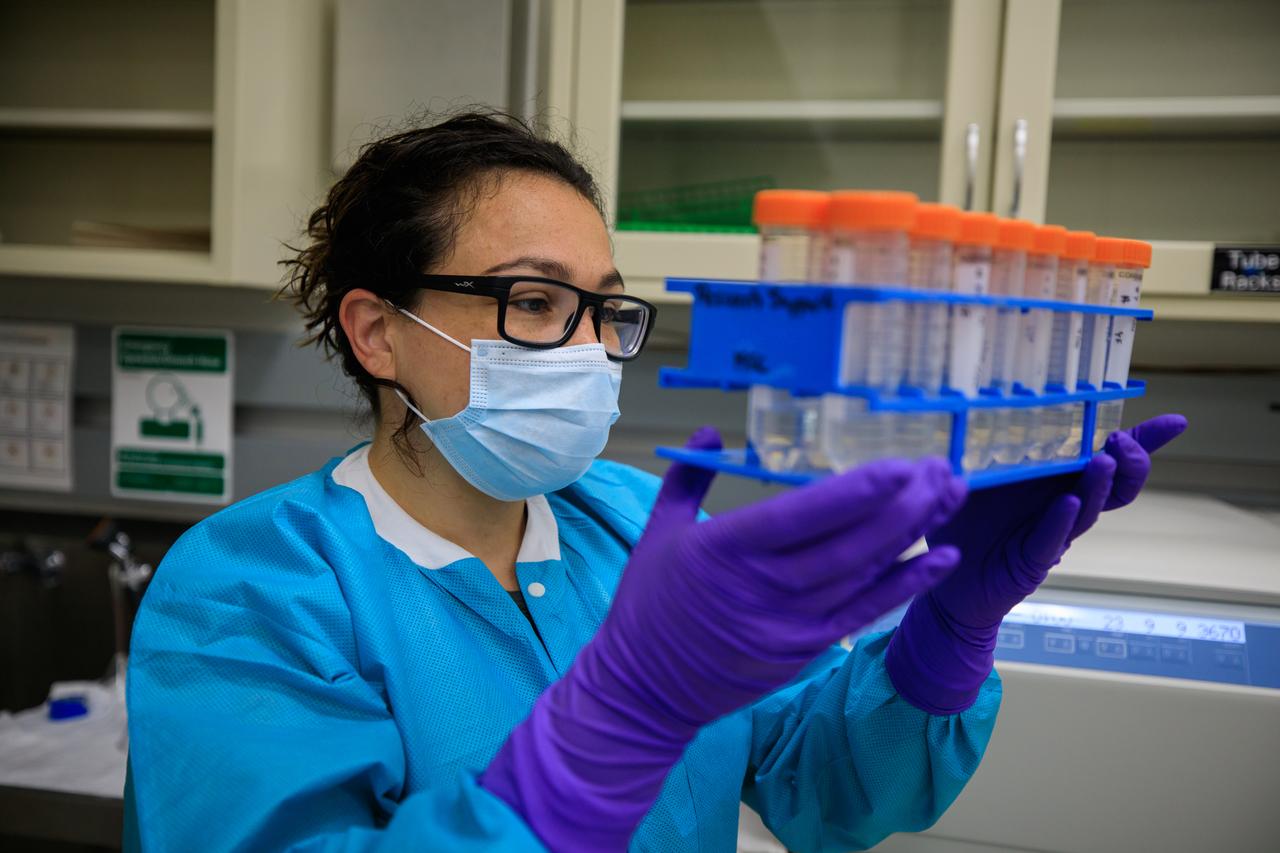
Marci Garcia, a research associate at Pacific Northwest National Laboratory (PNNL), examines some of the science tubes that make up the Dynamics of Microbiomes in Space (DynaMoS) experiment inside a laboratory at the Space Station Processing Facility on July 11, 2022. The DynaMoS experiment will launch on SpaceX’s 25th cargo resupply services mission to examine how microgravity affects metabolic interactions in communities of soil microbes. This will help NASA understand the function of soil microorganisms in space versus on Earth and how they can be used to enhance plant growth for crew consumption during long-duration missions to the Moon and Mars. SpaceX’s Falcon 9 rocket and Dragon spacecraft are scheduled to lift off from Kennedy’s Launch Complex 39A at 8:44 p.m. EDT on Thursday, July 14.
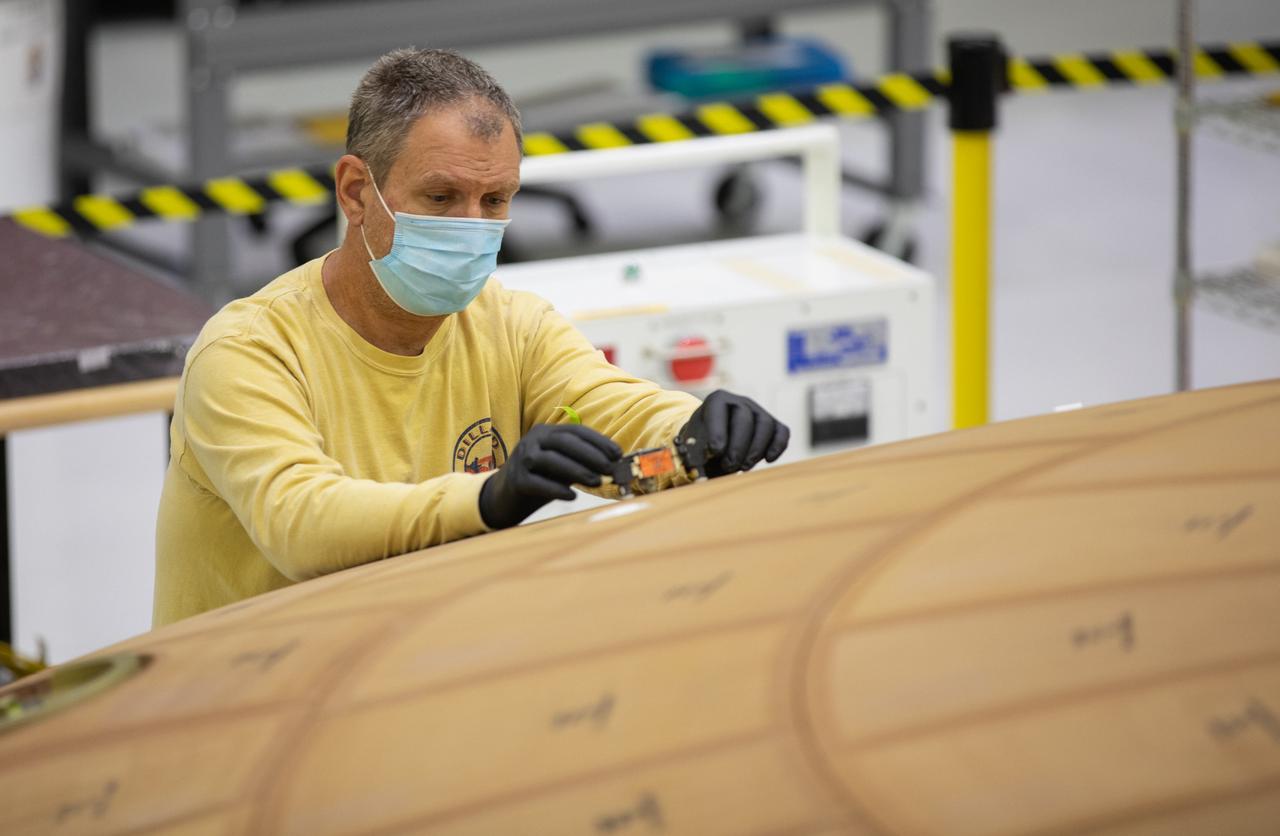
Inside the Neil Armstrong Operations and Checkout Building high bay at NASA's Kennedy Space Center in Florida, technician Kenny Leidner with ASRC Federal, inspects AVCOAT block bonding on the Artemis II heat shield on July 2, 2020. The heat shield is one of the most critical elements of Orion and will protect the capsule and astronauts during reentry through Earth’s atmosphere. Artemis II is the first crewed mission in a series of missions to the Moon and on to Mars. Artemis II will confirm all of the Orion spacecraft’s systems operate as designed in the actual environment of deep space with astronauts aboard. As part of the Artemis Program, NASA will send the first woman and next man to the Moon by 2024.
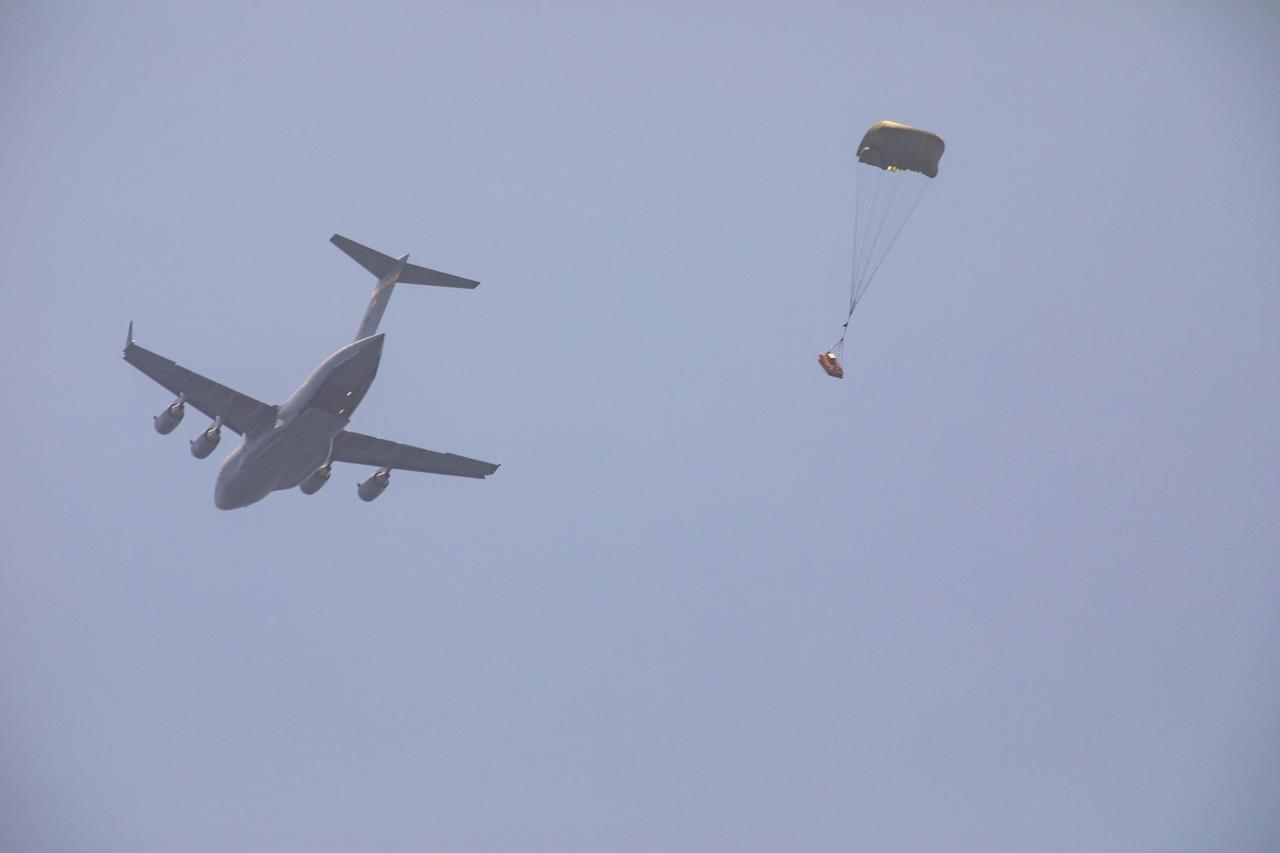
Teams with NASA and the Department of Defense (DoD) rehearse recovery procedures for an ascent abort scenario off the coast of Florida near the agency’s Kennedy Space Center on Thursday, June 12, 2025. Utilizing mannequin crew members inside the Crew Module Test Article (CMTA) – a full-scale mockup of the Orion spacecraft – the simulations practiced abort timelines and joint NASA and DoD recovery procedures supported by Artemis II launch and flight control teams, as NASA prepares to send four astronauts around the Moon and back next year as part of the agency’s first crewed Artemis mission.
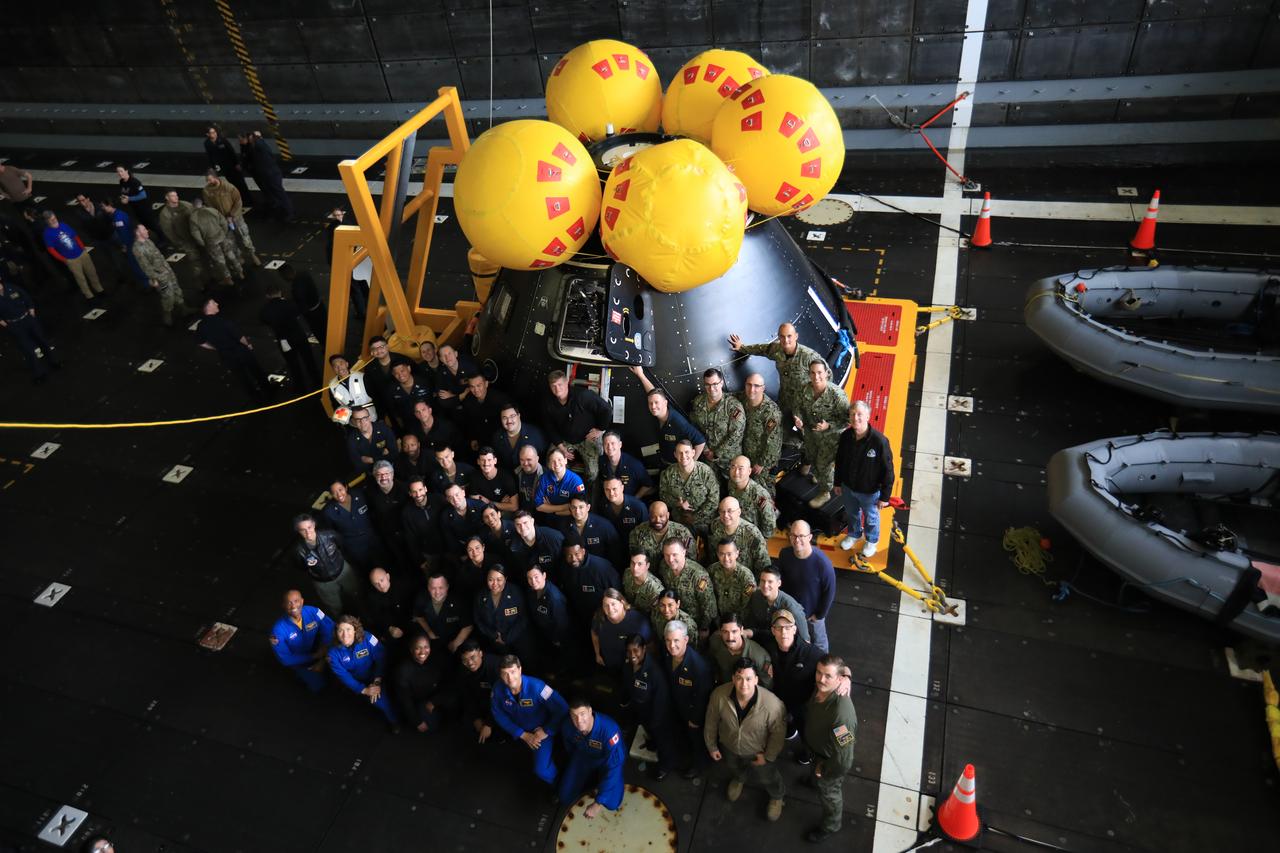
NASA Artemis II astronauts, members of NASA’s Exploration Ground System’s Landing and Recovery team, U.S. Navy personnel, and others aboard the USS San Diego pose in front of a mockup of the Orion spacecraft during Underway Recovery Test 11 (URT-11) off the coast of San Diego, California on Monday, Feb. 26, 2024. URT-11 is the eleventh in a series of Artemis recovery tests, and the first time NASA and its partners put their Artemis II recovery procedures to the test with the astronauts.
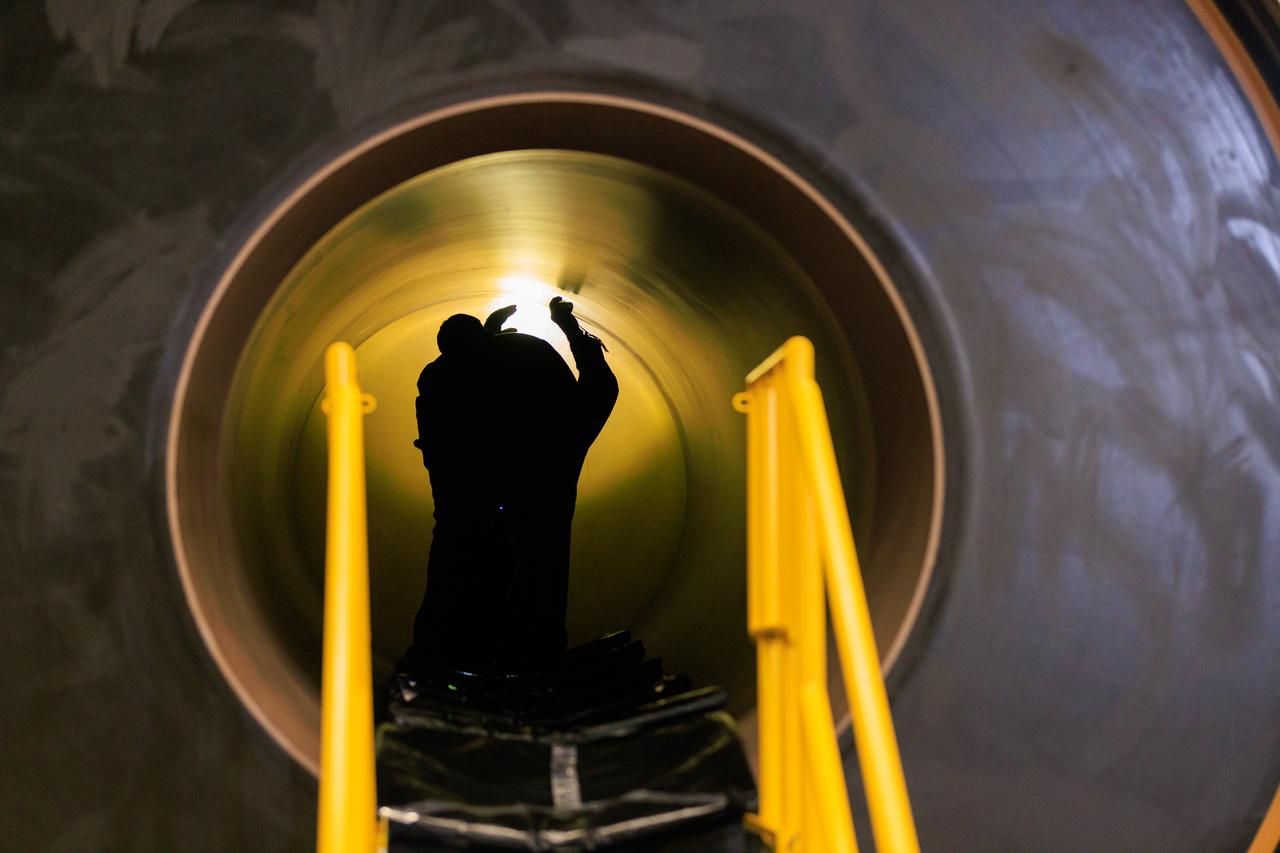
Technicians with Exploration Ground Systems, based at NASA’s Kennedy Space Center in Florida, perform propellant grain inspections on two of the agency’s Space Launch System solid rocket booster segments for the Artemis II campaign on Wednesday, Dec. 20, 2023, inside the Rotation, Processing and Surge Facility. The team is inspecting the propellant of all 10 booster segments before they are rotated vertically for processing. The Artemis II mission will send four astronauts around the Moon as part of the agency’s effort to establish a long-term science and exploration presence at the Moon, and eventually Mars.
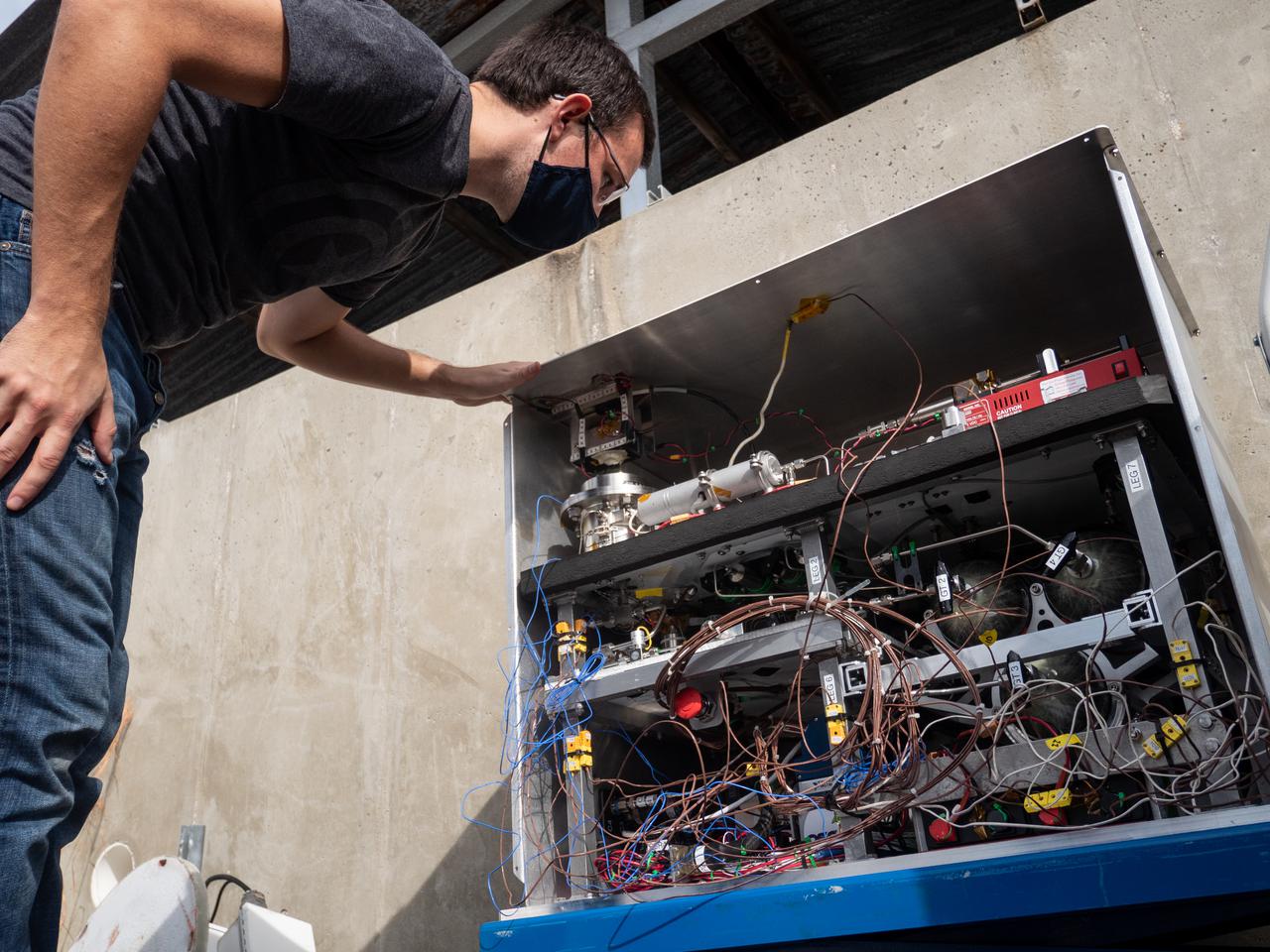
Chemical Engineer David Rinderknecht prepares the Orbital Syngas Commodity Augmentation Reactor (OSCAR) for thermal testing Jan. 26, 2021, at NASA’s Kennedy Space Center in Florida. The tests are in preparation for a scheduled suborbital flight test later this year facilitated by NASA’s Flight Opportunities program. The testing ensures the thermal environment of the payload won’t create additional hazards during flight and that OSCAR can successfully operate within the temperature range it may encounter as it performs tests in microgravity.
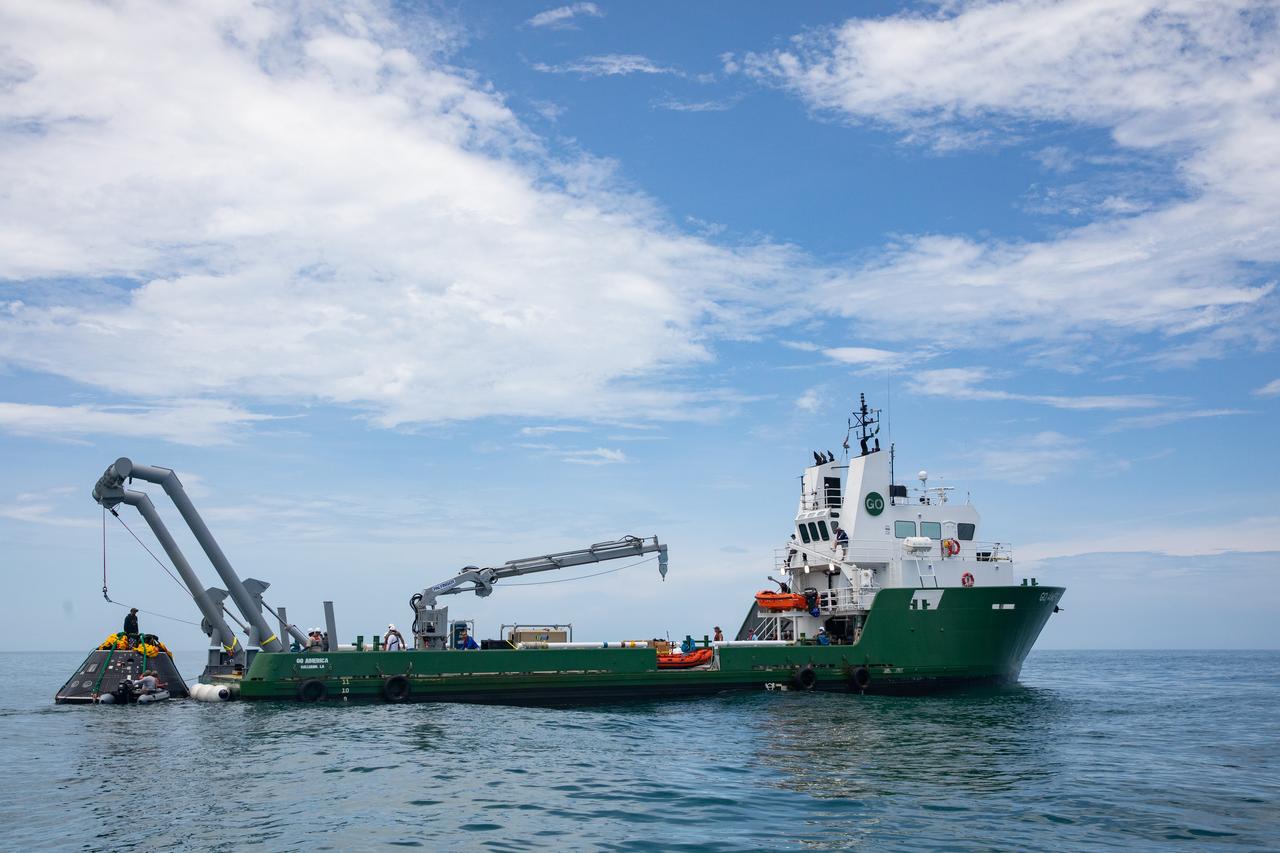
Teams with NASA and the Department of Defense (DoD) rehearse recovery procedures for a launch pad abort scenario off the coast of Florida near the agency’s Kennedy Space Center on Wednesday, June 11, 2025. Utilizing mannequin crew members inside the Crew Module Test Article (CMTA) – a full-scale mockup of the Orion spacecraft – the simulations practiced abort timelines and joint NASA and DoD recovery procedures supported by Artemis II launch and flight control teams, as NASA prepares to send four astronauts around the Moon and back next year as part of the agency’s first crewed Artemis mission.
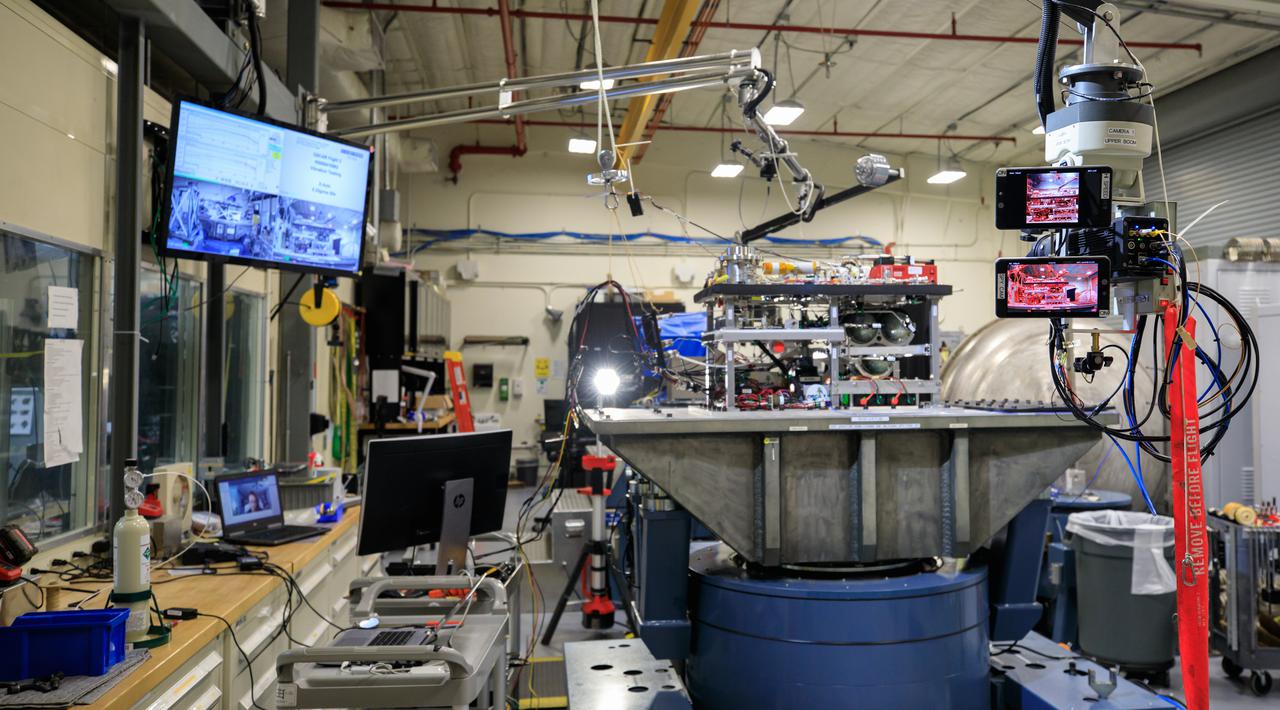
NASA’s Orbital Syngas Commodity Augmentation Reactor, or OSCAR, undergoes vibration testing inside the Vibration Test Lab at the agency’s Kennedy Space Center in Florida on Jan. 14, 2021. The tests are part of ongoing preparation for a scheduled suborbital flight test later this year. Beginning as an Early Career Initiative project, OSCAR studies technology to convert trash and human waste into useful gasses such as methane, hydrogen, and carbon dioxide. By processing small pieces of trash in a high-temperature reactor, OSCAR would reduce the amount of space needed for waste storage within a spacecraft, turn some waste into gasses that have energy storage and life support applications, and ensure waste is no longer biologically active.
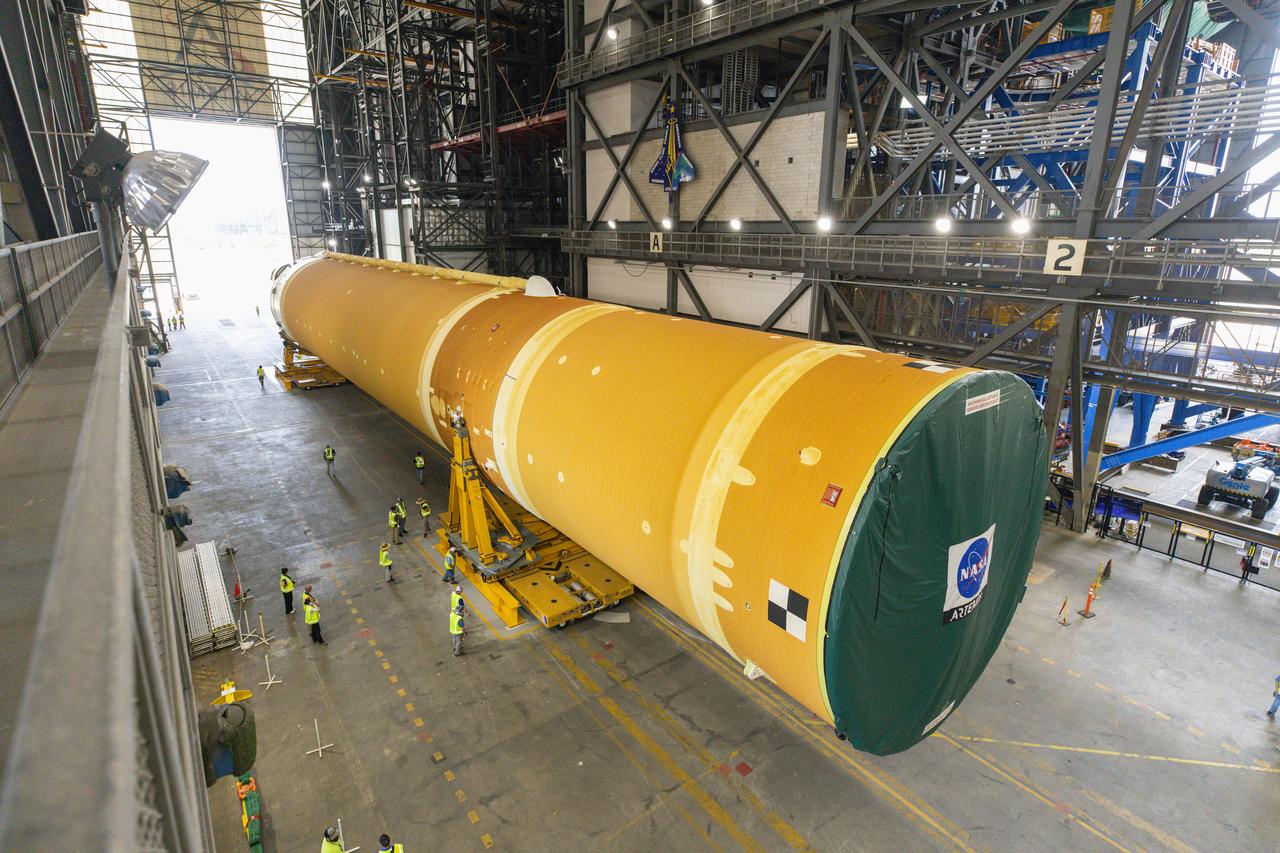
After completing its journey from NASA’s Michoud Assembly Facility in New Orleans aboard the Pegasus barge, teams with Exploration Ground Systems (EGS) transport the agency’s powerful SLS (Space Launch System) core stage into the transfer aisle inside Kennedy Space Center’s Vehicle Assembly Building in Florida on Wednesday, July 24, 2024. In the coming months, SLS will be prepared for integration atop the mobile launcher ahead of the Artemis II launch.
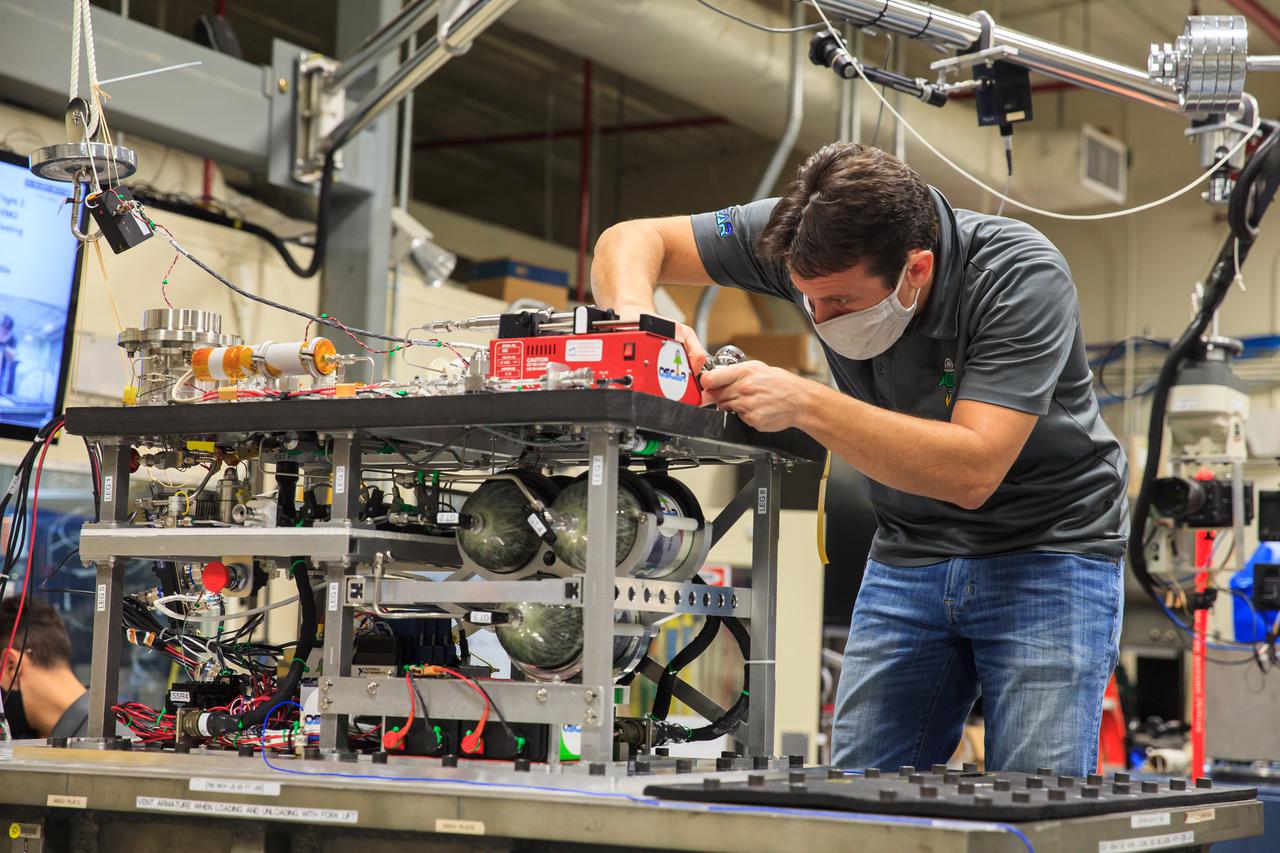
Gino Carro, a pressure vessels and systems engineer for Kennedy Space Center’s Laboratory Support Services and Operations contract, prepares NASA’s Orbital Syngas Commodity Augmentation Reactor (OSCAR) for vibration tests inside the Vibration Test Lab at the Florida spaceport on Jan. 14, 2021. The tests are part of ongoing preparation for a scheduled suborbital flight test later this year. Beginning as an Early Career Initiative project, OSCAR studies technology to convert trash and human waste into useful gasses such as methane, hydrogen, and carbon dioxide. By processing small pieces of trash in a high-temperature reactor, OSCAR would reduce the amount of space needed for waste storage within a spacecraft, turn some waste into gasses that have energy storage and life support applications, and ensure waste is no longer biologically active.
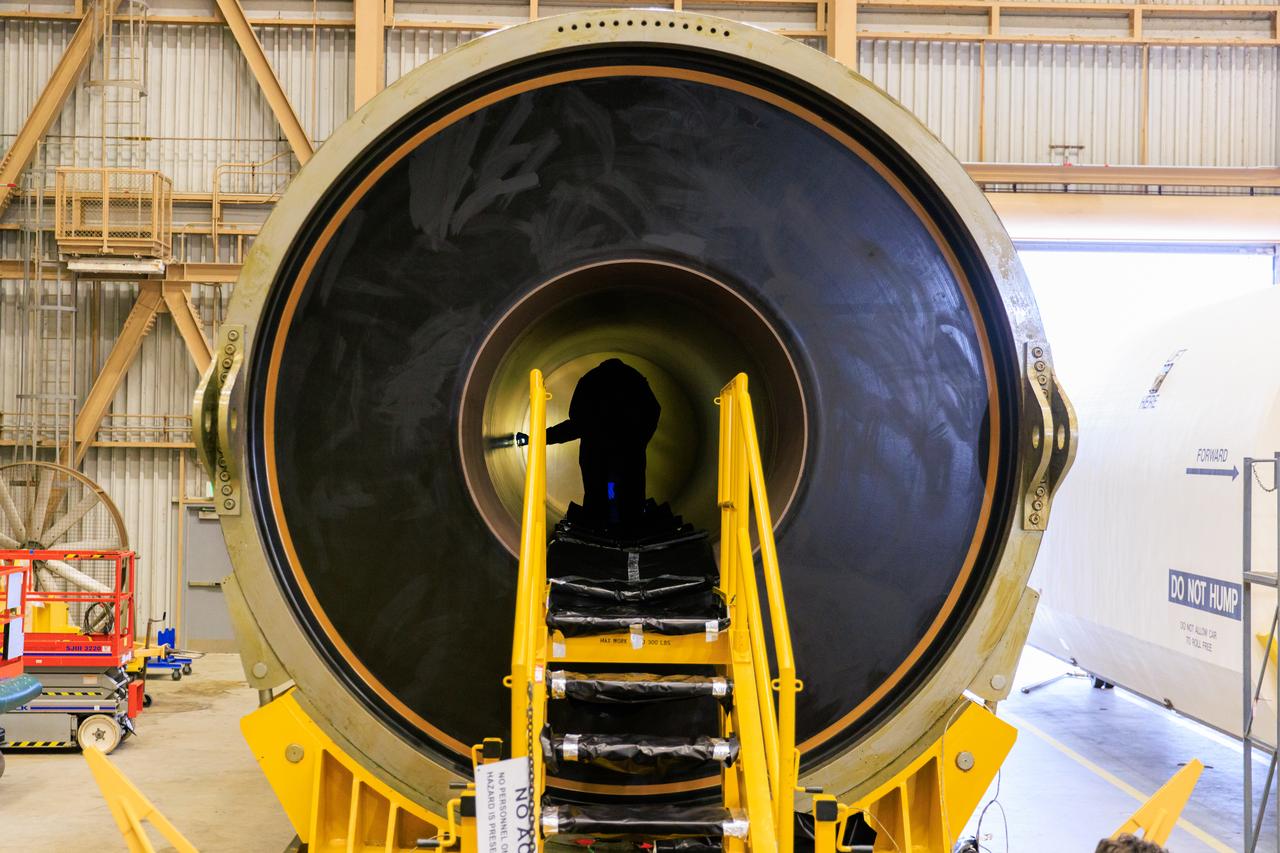
Technicians with Exploration Ground Systems, based at NASA’s Kennedy Space Center in Florida, perform propellant grain inspections on two of the agency’s Space Launch System solid rocket booster segments for the Artemis II campaign on Wednesday, Dec. 20, 2023, inside the Rotation, Processing and Surge Facility. The team is inspecting the propellant of all 10 booster segments before they are rotated vertically for processing. The Artemis II mission will send four astronauts around the Moon as part of the agency’s effort to establish a long-term science and exploration presence at the Moon, and eventually Mars.
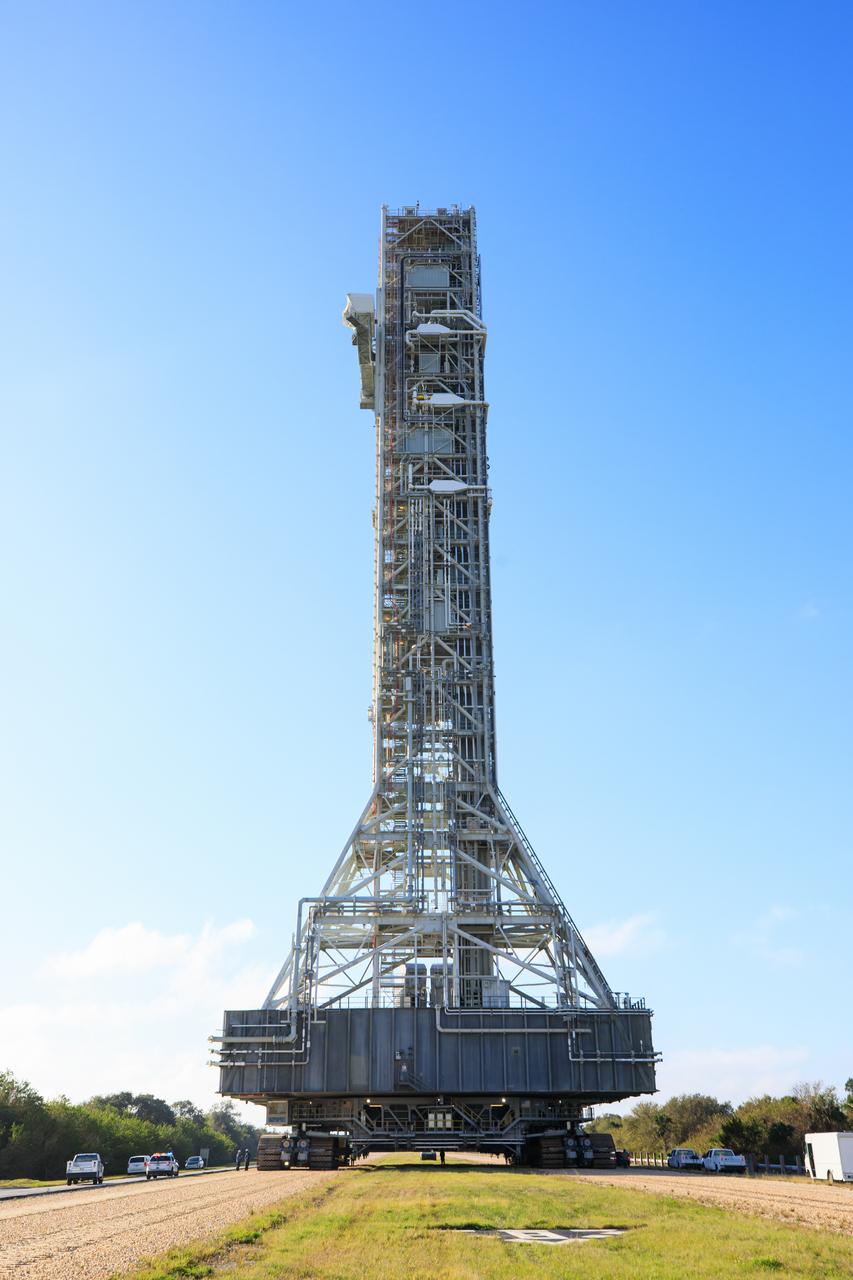
NASA’s mobile launcher, carried atop the crawler-transporter 2, left launch pad 39B at NASA’s Kennedy Space Center in Florida on Dec. 8, 2022, following the successful launch of the agency’s Space Launch System (SLS) rocket and Orion spacecraft on the Artemis I flight test on Nov. 16, 2022. The mobile launcher is scheduled to return to the Vehicle Assembly Building (VAB) on Dec. 9, 2022, and it will remain inside the VAB for several weeks as teams get it ready for the Artemis II crewed mission. Following its stay in the VAB, it will go to the mobile launcher park site location at Kennedy where it will undergo emergency egress modifications and testing to support future Artemis missions.
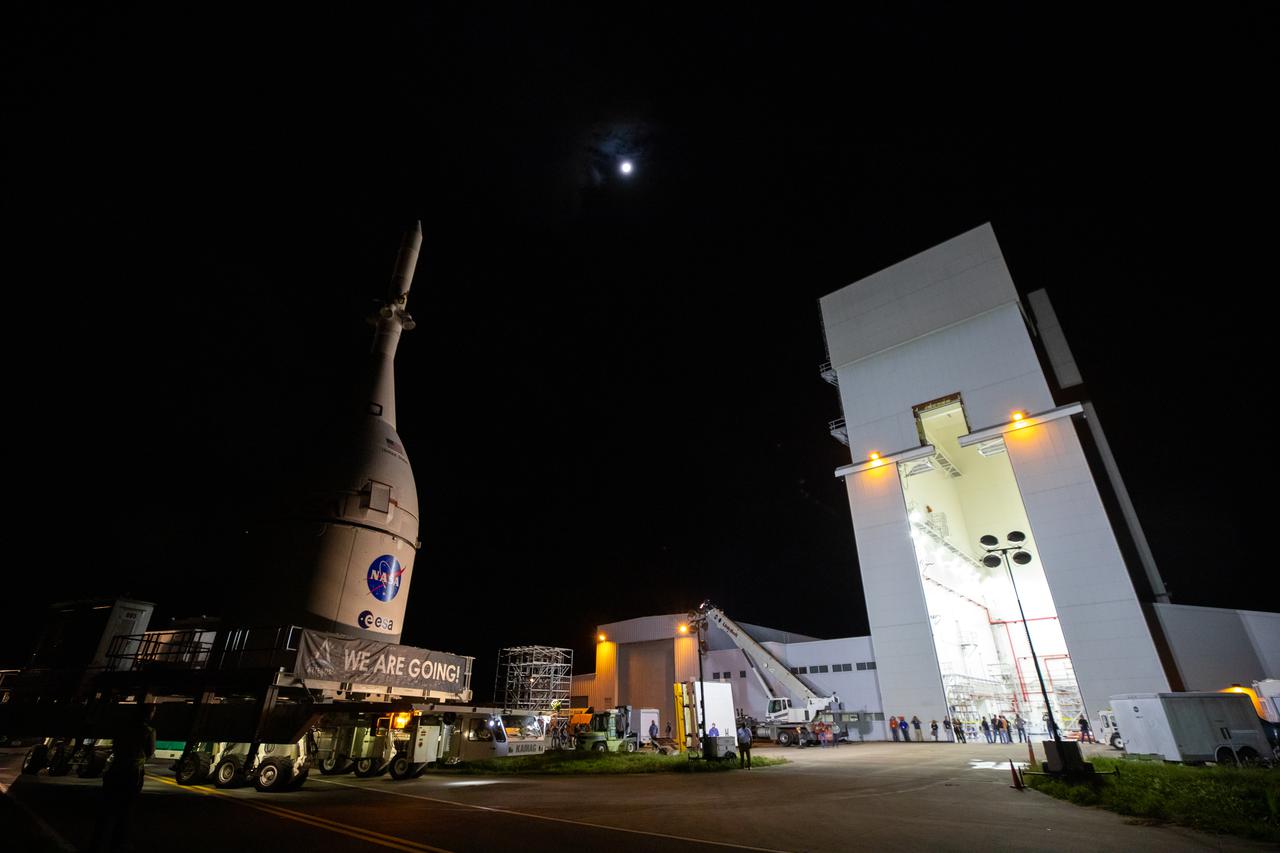
The Orion spacecraft for NASA’s Artemis I mission, fully assembled with its launch abort system, moves out of the Launch Abort System Facility at Kennedy Space Center in Florida on Oct. 19, 2021. Orion will be transported to the Vehicle Assembly Building where it will join the already stacked flight hardware and be raised into position atop the Space Launch System rocket in High Bay 3. Launching in 2021, Artemis I will be an uncrewed test flight of the Orion spacecraft and Space Launch System rocket as an integrated system ahead of crewed flights to the Moon. Under Artemis, NASA aims to land the first woman and first person of color on the Moon and establish sustainable lunar exploration.
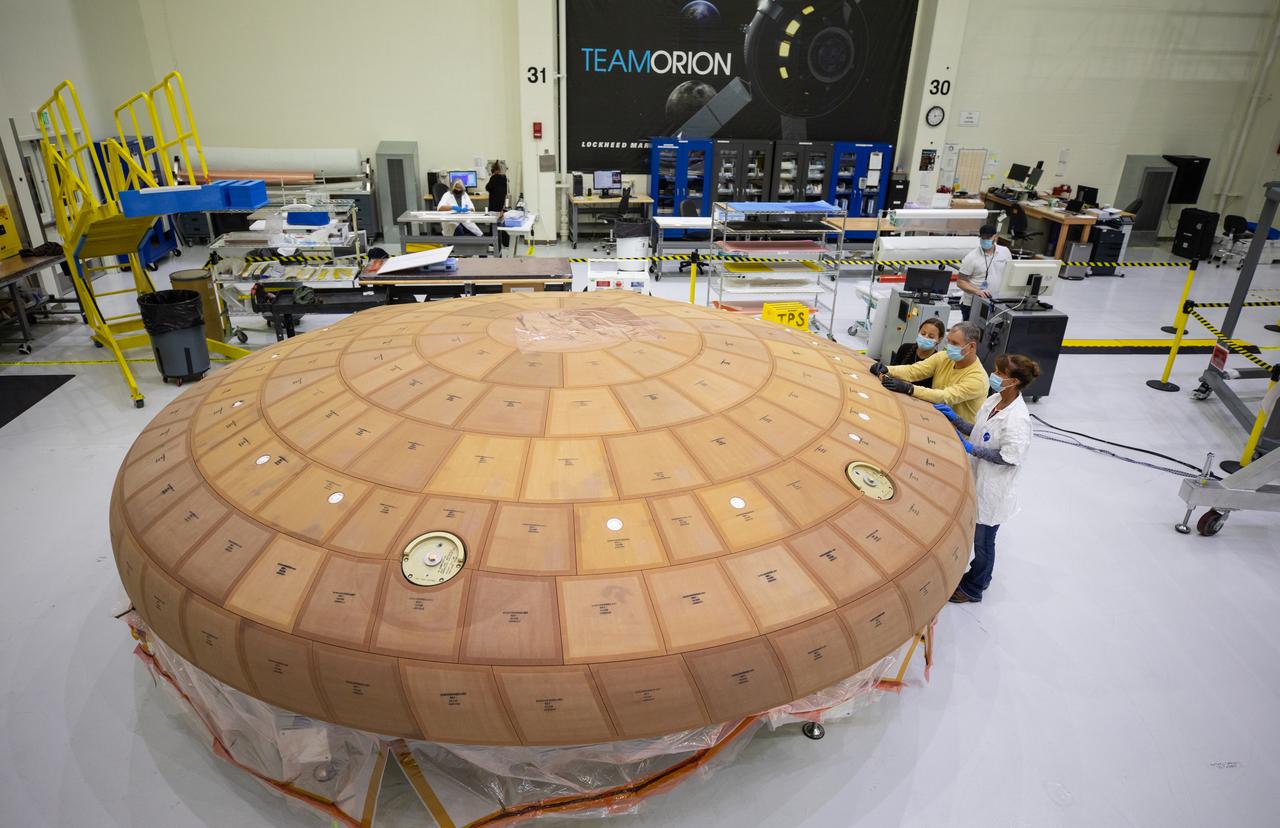
Inside the Neil Armstrong Operations and Checkout Building high bay at NASA's Kennedy Space Center in Florida, from left, technicians Diamond ScharSenstine, Kenny Leidner, Russ Novak and Darlene Beville, all with ASRC Federal, inspect AVCOAT block bonding on the Artemis II heat shield on July 2, 2020. The heat shield is one of the most critical elements of Orion and will protect the capsule and astronauts during reentry through Earth’s atmosphere. Artemis II is the first crewed mission in a series of missions to the Moon and on to Mars. Artemis II will confirm all of the Orion spacecraft’s systems operate as designed in the actual environment of deep space with astronauts aboard. As part of the Artemis Program, NASA will send the first woman and next man to the Moon by 2024.

A massive crane lowers the launch vehicle stage adapter onto the SLS (Space Launch System) core stage on Thursday, April 3, 2025, in High Bay 3 inside the Vehicle Assembly Building at NASA’s Kennedy Space Center in Florida. During launch and ascent, the launch vehicle stage adapter provides structural support and protects avionics and electrical devices within the upper stage from extreme vibrations and acoustic conditions. The Artemis II test flight will take a crew of four astronauts on a 10-day journey around the Moon, helping confirm the foundational systems and hardware needed for human deep space exploration.
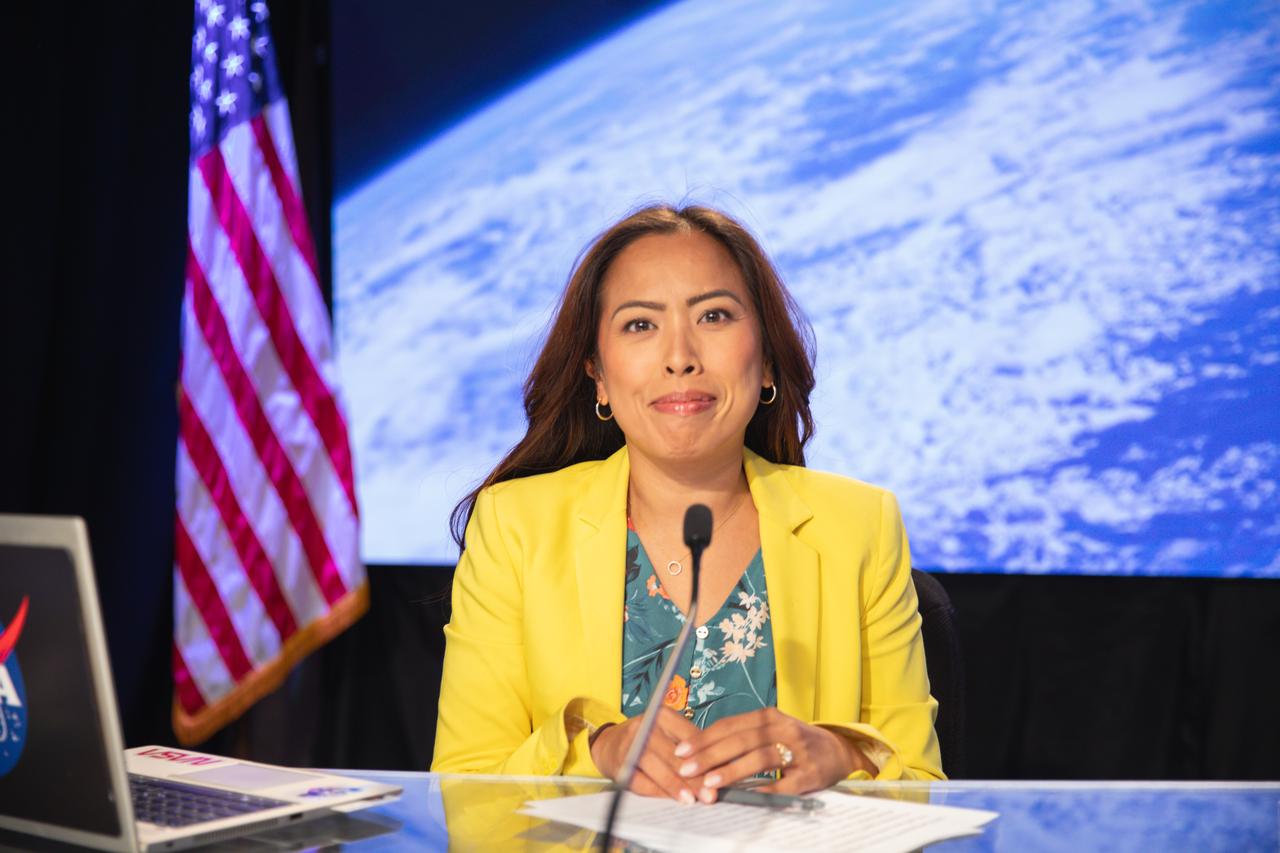
Megan Cruz, NASA Communications, participates in a news conference held at the agency’s Kennedy Space Center in Florida on Saturday, June 1, 2024, after the second launch attempt of NASA’s Boeing Crew Flight Test scrubbed for the day. As part of the agency’s Commercial Crew Program, NASA astronauts Butch Wilmore and Suni Williams will be the first to launch to the International Space Station aboard Boeing’s Starliner spacecraft atop a ULA (United Launch Alliance) Atlas V rocket from Space Launch Complex-41 at nearby Cape Canaveral Space Force Station.
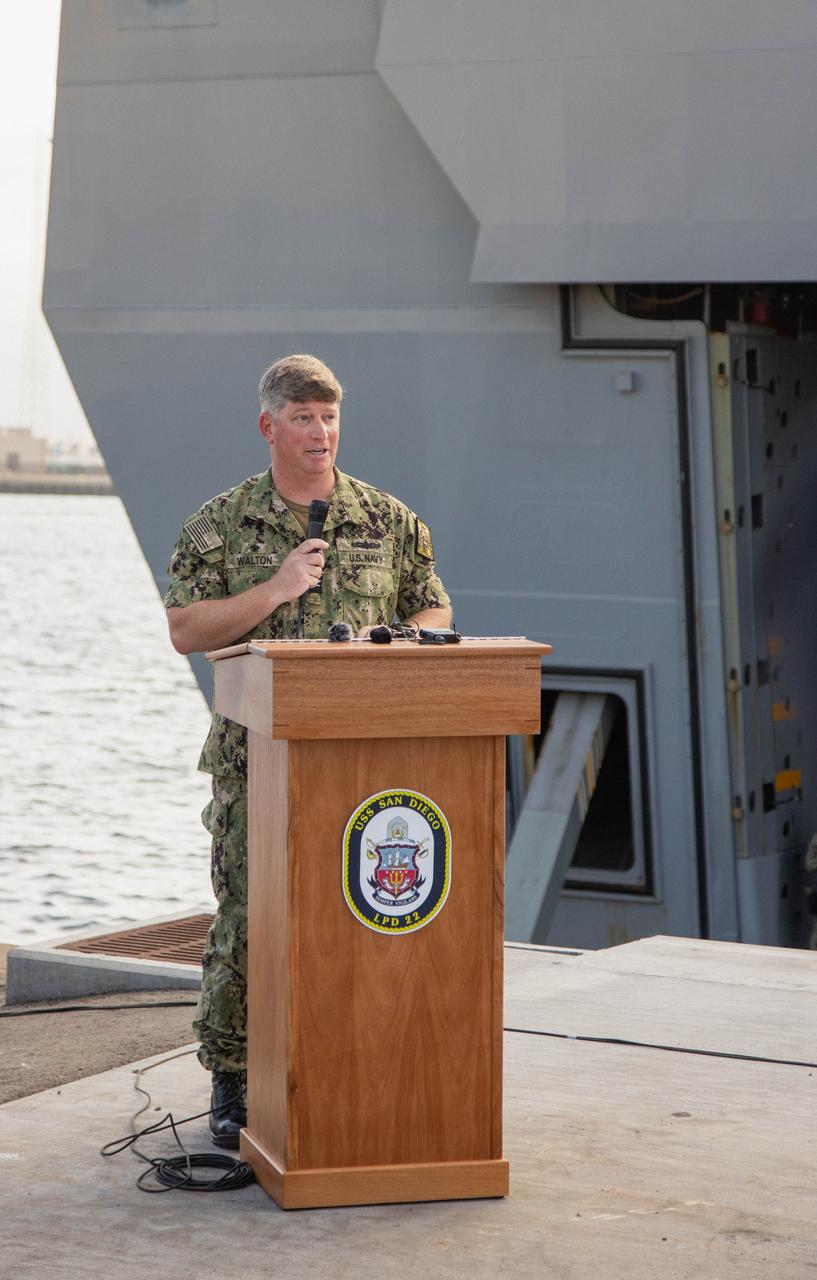
USS San Diego Commanding Officer Capt. David Walton speaks at a news conference held in San Diego, California on Wednesday, Feb. 28, 2024, about the Underway Recovery Test 11 (URT-11) off the coast of San Diego, California. URT-11 performed by NASA’s Exploration Ground System’s Landing and Recovery team, partners from the Department of Defense, and U.S. Navy personnel aboard the USS San Diego is the eleventh in a series of Artemis recovery tests, and the first the Artemis II recovery procedures involved the astronauts.
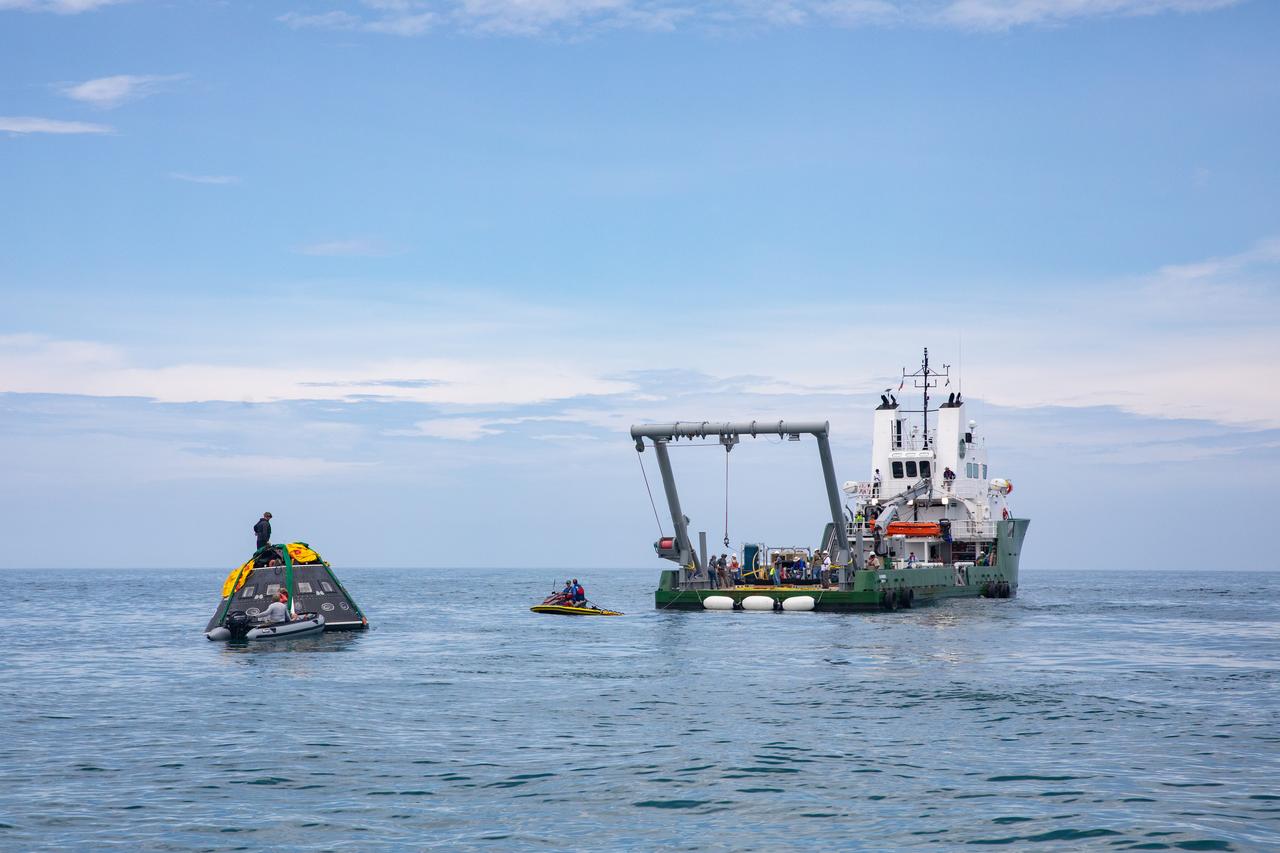
Teams with NASA and the Department of Defense (DoD) rehearse recovery procedures for a launch pad abort scenario off the coast of Florida near the agency’s Kennedy Space Center on Wednesday, June 11, 2025. Utilizing mannequin crew members inside the Crew Module Test Article (CMTA) – a full-scale mockup of the Orion spacecraft – the simulations practiced abort timelines and joint NASA and DoD recovery procedures supported by Artemis II launch and flight control teams, as NASA prepares to send four astronauts around the Moon and back next year as part of the agency’s first crewed Artemis mission.
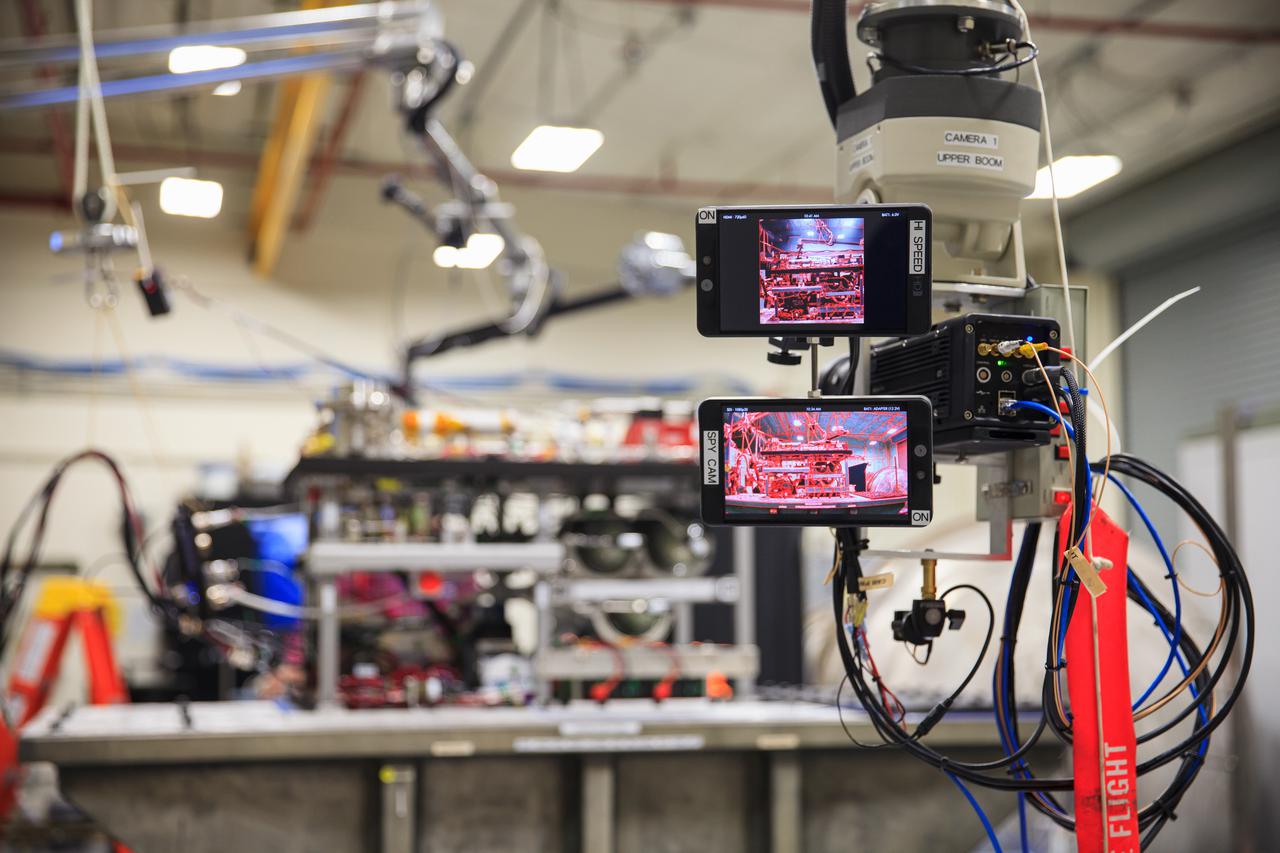
NASA’s Orbital Syngas Commodity Augmentation Reactor, or OSCAR, undergoes vibration testing inside the Vibration Test Lab at the agency’s Kennedy Space Center in Florida on Jan. 14, 2021, in preparation for a scheduled suborbital flight later this year. Beginning as an Early Career Initiative project, OSCAR studies technology to convert trash and human waste into useful gasses such as methane, hydrogen, and carbon dioxide. By processing small pieces of trash in a high-temperature reactor, OSCAR would reduce the amount of space needed for waste storage within a spacecraft, turn some waste into gasses that have energy storage and life support applications, and ensure waste is no longer biologically active.
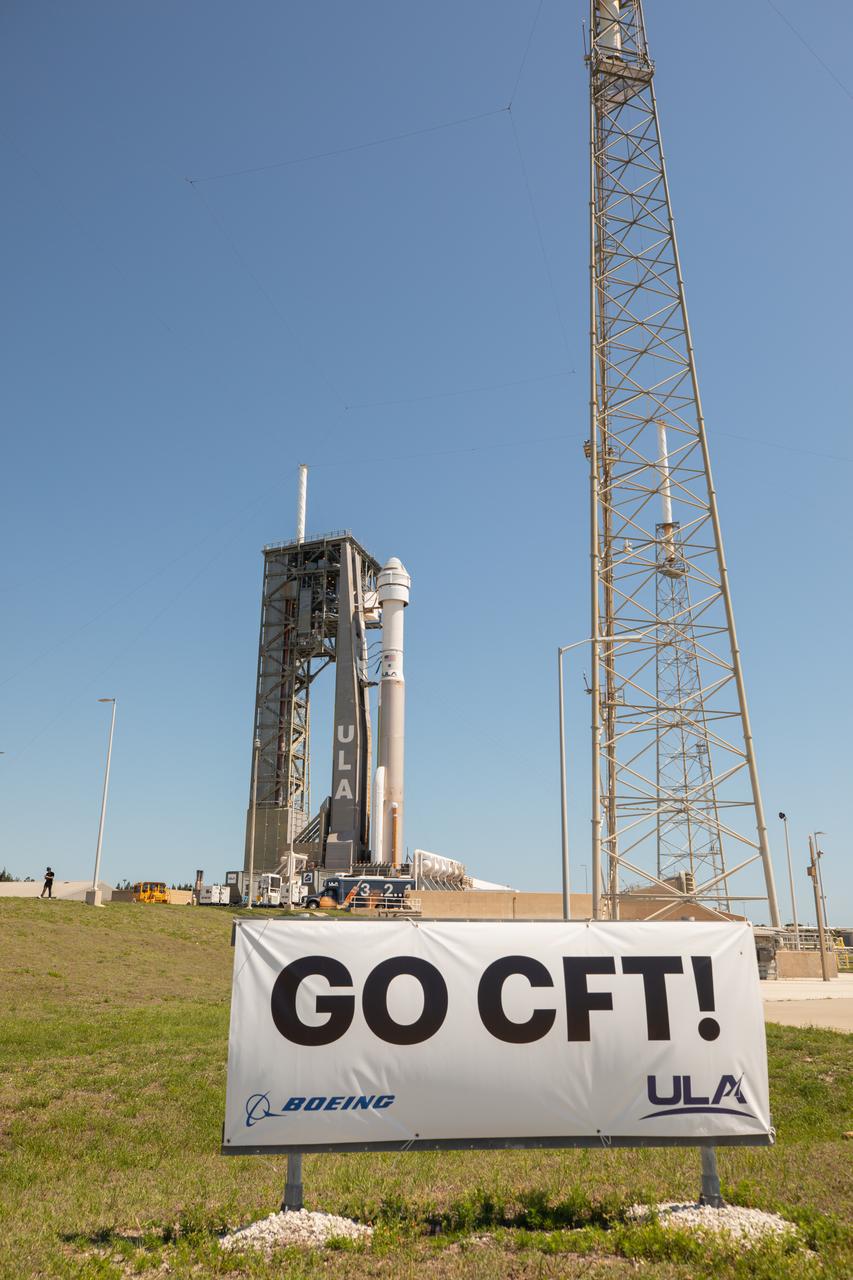
Boeing’s Starliner spacecraft atop the United Launch Alliance Atlas V rocket is seen on the launch pad of Space Launch Complex-41 at Cape Canaveral Space Force Station in Florida on Thursday, May 30, 2024, ahead of NASA’s Boeing Crew Flight Test. As part of the agency’s Commercial Crew Program, NASA astronauts Butch Wilmore and Suni Williams are the first to launch to the International Space Station aboard Boeing’s Starliner spacecraft. Liftoff is scheduled for 12:25 p.m. ET on Saturday, June 1.
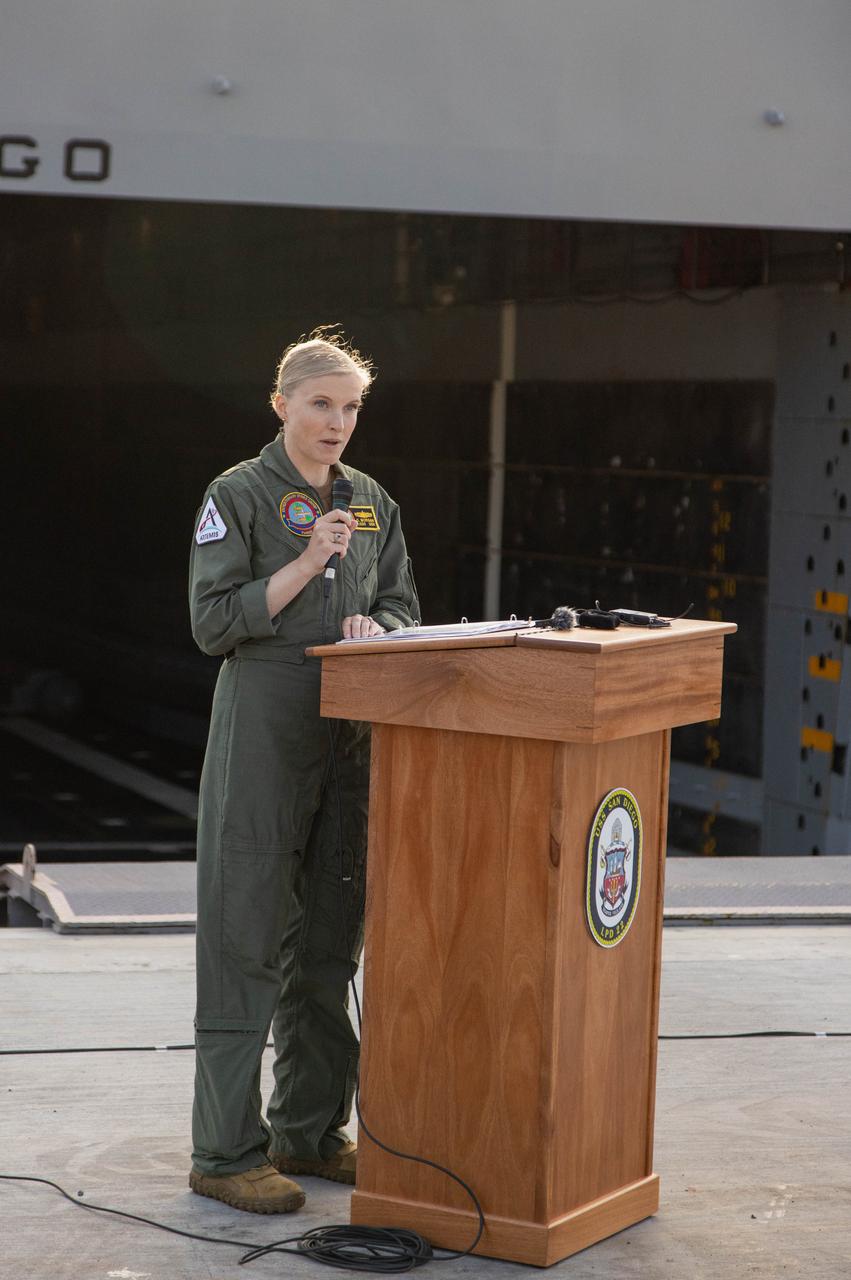
Lt. Cmdr. Chloe Morgan, public affairs officer for Expeditionary Strike Group 3 U.S. Navy speaks during a news conference held in San Diego, California on Wednesday, Feb. 28, 2024, about the Underway Recovery Test 11 (URT-11) performed off the coast of San Diego, California. URT-11 performed by NASA’s Exploration Ground System’s Landing and Recovery team, partners from the Department of Defense, and U.S. Navy personnel aboard the USS San Diego is the eleventh in a series of Artemis recovery tests, and the first the Artemis II recovery procedures involved the astronauts.

With the Vehicle Assembly Building in the background, the three specially designed, fully electric, environmentally friendly crew transportation vehicles for Artemis missions arrived at NASA’s Kennedy Space Center in Florida on July 11, 2023. The zero-emission vehicles, which will carry astronauts to Launch Complex 39B for Artemis missions, were delivered by the manufacturer, Canoo Technologies Inc. of Torrance, California.
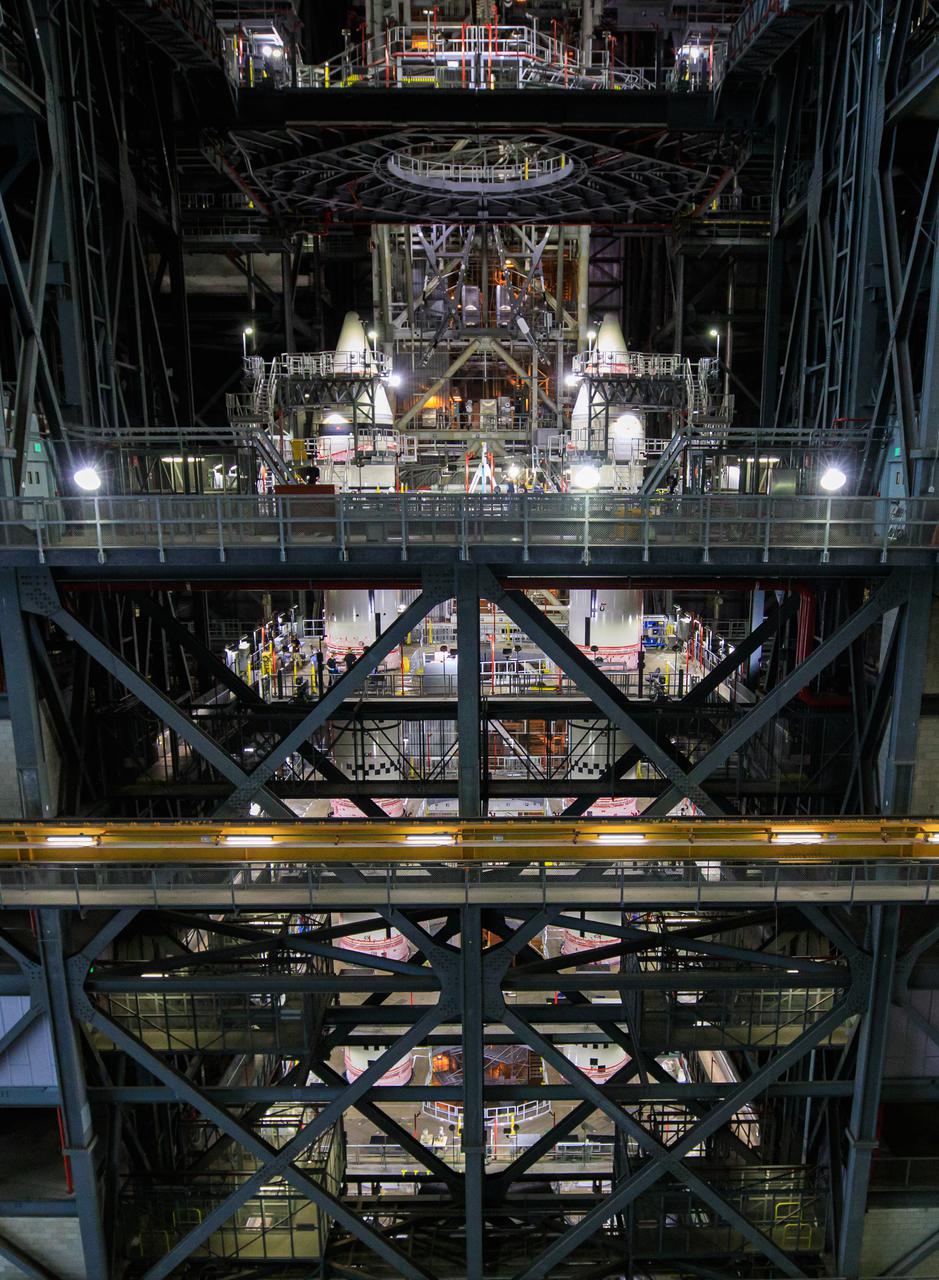
In High Bay 3 of the Vehicle Assembly Building at NASA’s Kennedy Space Center in Florida, the right-hand and left-hand forward segments are secured on the center forward segments on the mobile launcher (ML) for the Space Launch System (SLS) on March 3, 2021. Workers with Exploration Ground Systems and contractor Jacobs teams stacked the twin five-segment boosters on the ML over a number of weeks. When the core stage arrives, it will join the boosters on the mobile launcher, followed by the interim cryogenic propulsion stage and Orion spacecraft. Manufactured by Northrop Grumman in Utah, the twin boosters provide more than 75 percent of the total SLS thrust at launch. Marshall Space Flight Center in Huntsville, Alabama, manages the SLS. Under the Artemis program, NASA will land the first woman and the next man on the Moon. The first in a series of increasingly complex missions, Artemis I will test the Orion spacecraft and SLS as an integrated system ahead of crewed flights to the Moon.
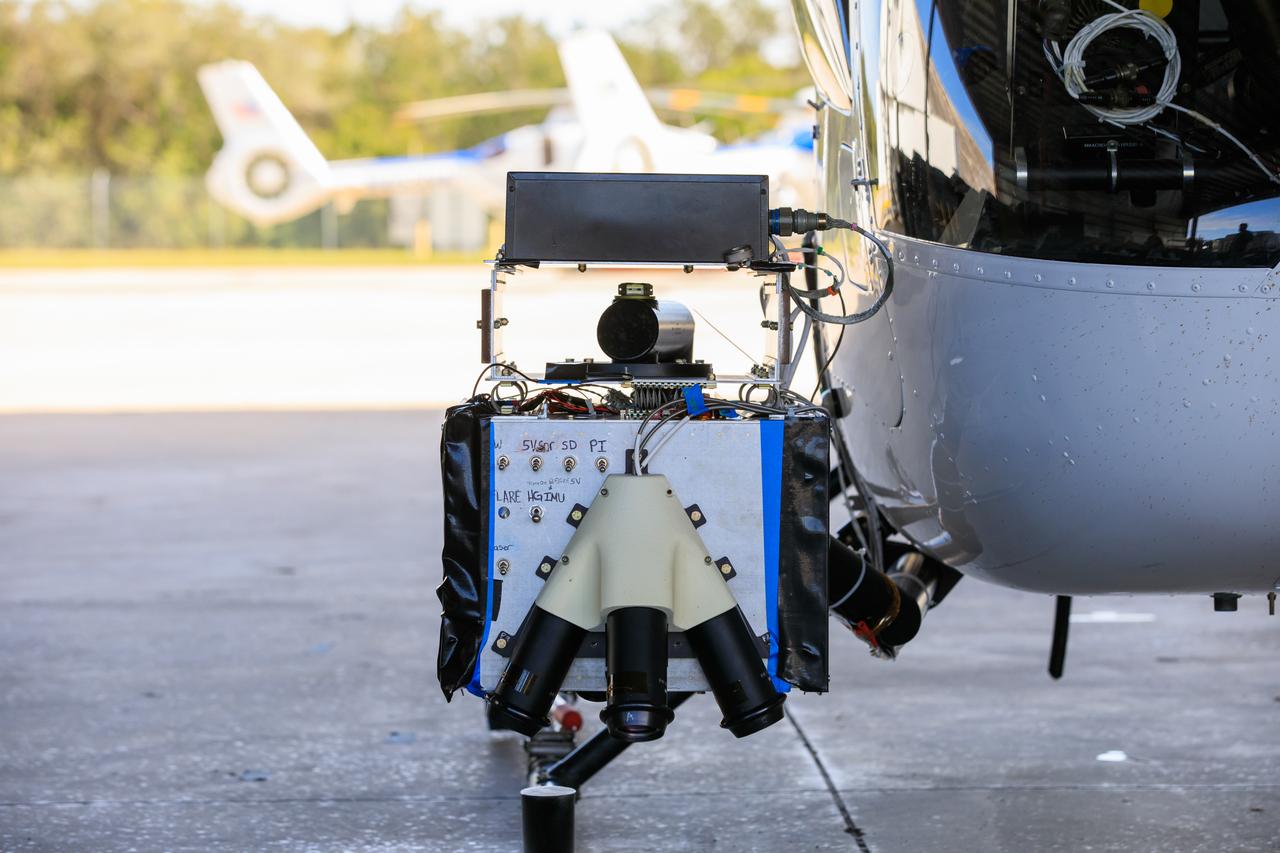
Seen here is a close-up view of Intuitive Machines’ navigation pod sensors for the company’s Nova-C lunar lander ahead of testing done at NASA’s Kennedy Space Center in Florida on Nov. 18, 2022. The test involved flying the sensors over a simulated lunar surface at the Launch and Landing Facility on a private helicopter. Intuitive Machines is scheduled to launch two missions to the Moon in 2023 – one of which will carry NASA’s Mass Spectrometer observing lunar operations (MSolo) instrument that will help analyze the chemical makeup of landing sites on the Moon, as well as study water on the lunar surface. Through NASA’s Commercial Lunar Payload Services initiative, the agency selected Intuitive Machines to deliver science and technology demonstration payloads to the Moon, contributing to NASA’s goal of establishing a sustainable human presence on the lunar surface.
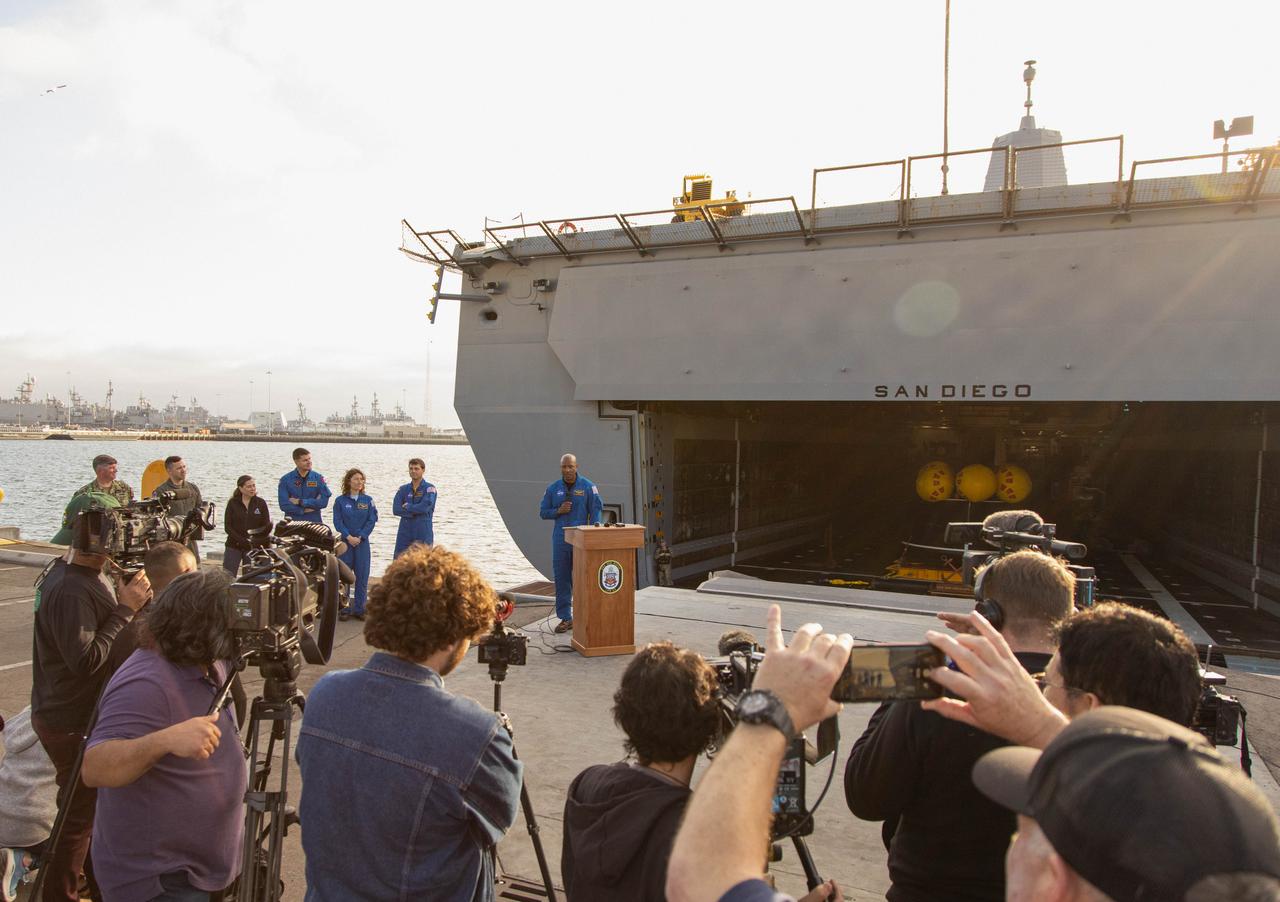
NASA’s Artemis II crew member NASA astronaut Victor Glover speaks to members of the media about the Underway Recovery Test (URT-11) during a news conference held in San Diego, California on Wednesday, Feb. 28, 2024. URT-11 performed by NASA’s Exploration Ground System’s Landing and Recovery team, partners from the Department of Defense, and U.S. Navy personnel aboard the USS San Diego is the eleventh in a series of Artemis recovery tests, and the first the Artemis II recovery procedures involved the astronauts.
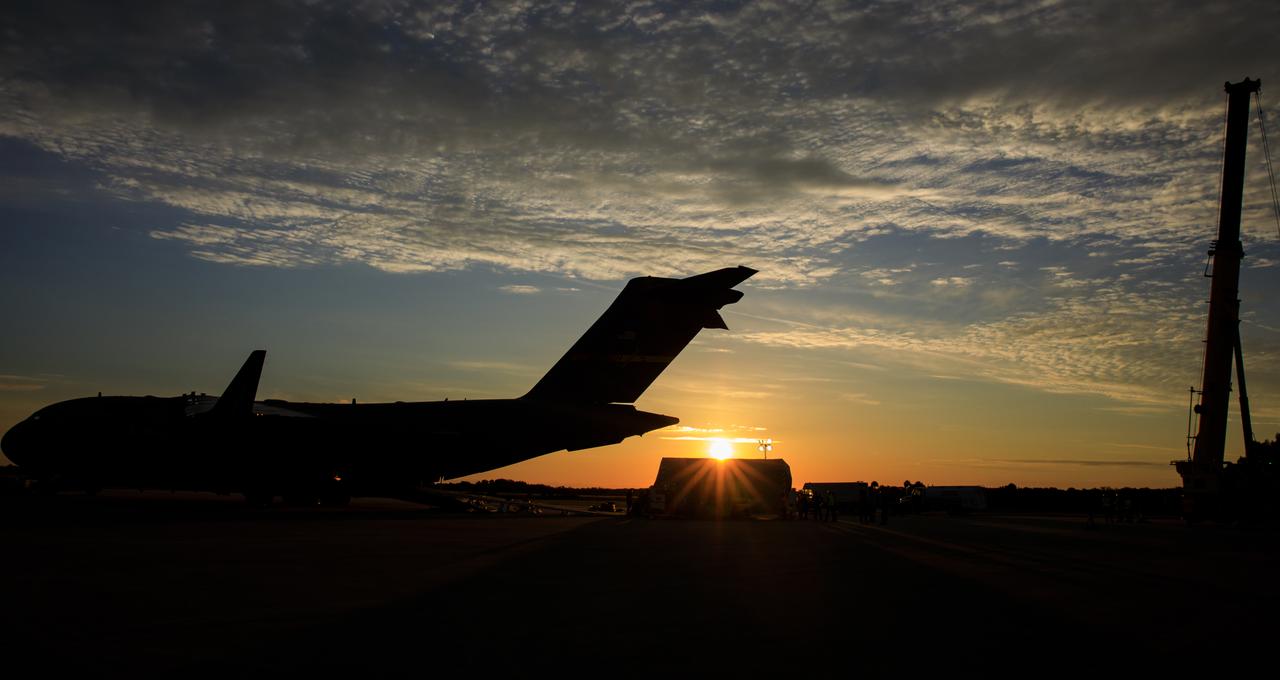
Teams offload NASA’s largest planetary mission spacecraft, Europa Clipper, from a United States Air Force C-17 Globemaster III transport aircraft onto the flatbed of a heavy-lift truck at the Launch and Landing Facility at NASA’s Kennedy Space Center in Florida on Thursday, May 23, 2024. Crews transported Europa Clipper to the Payload Hazardous Servicing Facility at Kennedy to prepare it for launch aboard a SpaceX Falcon Heavy rocket later this year from Launch Complex 39A at the Florida spaceport. Europa Clipper will help determine if conditions exist below the surface Jupiter’s fourth largest moon, Europa, that could support life.
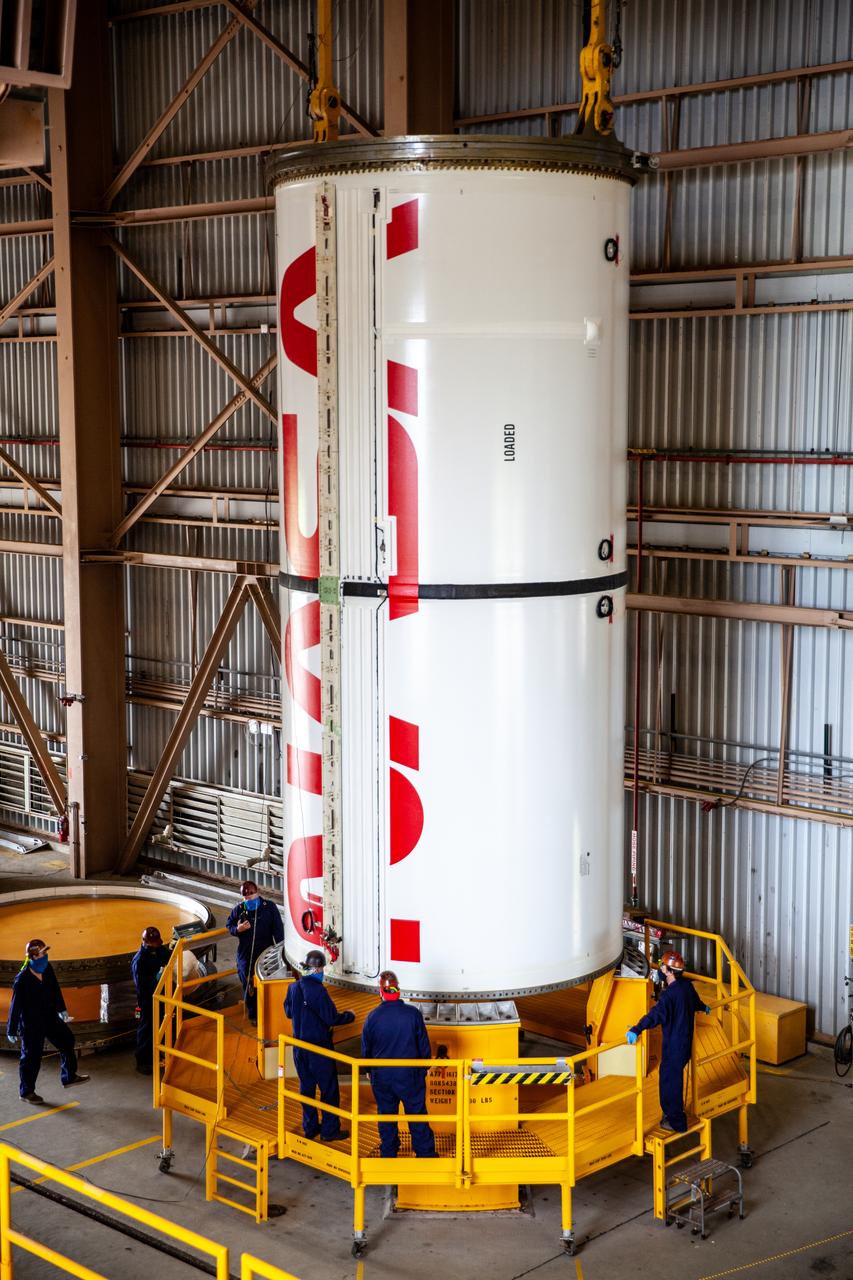
Inside the Rotation, Processing and Surge Facility at NASA’s Kennedy Space Center in Florida, Exploration Ground Systems and Jacobs TOSC workers completed painting of NASA’s iconic “worm” logo on the Artemis I Space Launch System twin solid rocket boosters on Sept. 23, 2020. Originally created by the firm of Danne & Blackburn, the iconic “worm” logo’s bold, sleek design was officially introduced in 1975 and was incorporated into many of the agency’s next-generation programs. It was retired in 1992, but has made a comeback in 2020 as the agency ushers in a new, modern era of human spaceflight. The first in a series of increasingly complex missions, Artemis I will test the Orion spacecraft and Space Launch System as an integrated system ahead of crewed flights to the Moon. Under the Artemis program, NASA will land the first woman and the next man on the Moon by 2024.
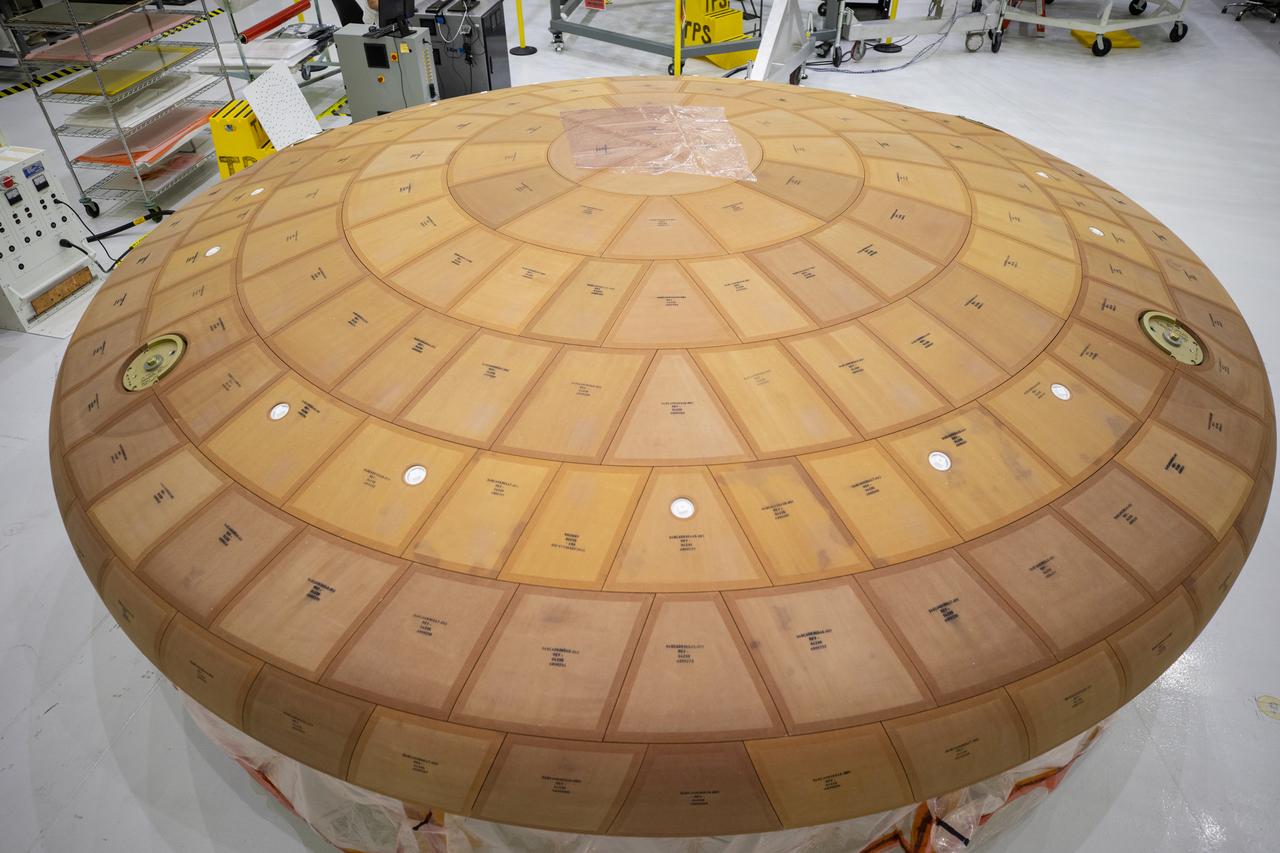
Inside the Neil Armstrong Operations and Checkout Building high bay at NASA's Kennedy Space Center in Florida, the AVCOAT block bonding is complete on the Artemis II heat shield on July 2, 2020. The heat shield is one of the most critical elements of Orion and will protect the capsule and astronauts during reentry through Earth’s atmosphere. Artemis II is the first crewed mission in a series of missions to the Moon and on to Mars. Artemis II will confirm all of the Orion spacecraft’s systems operate as designed in the actual environment of deep space with astronauts aboard. As part of the Artemis Program, NASA will send the first woman and next man to the Moon by 2024.
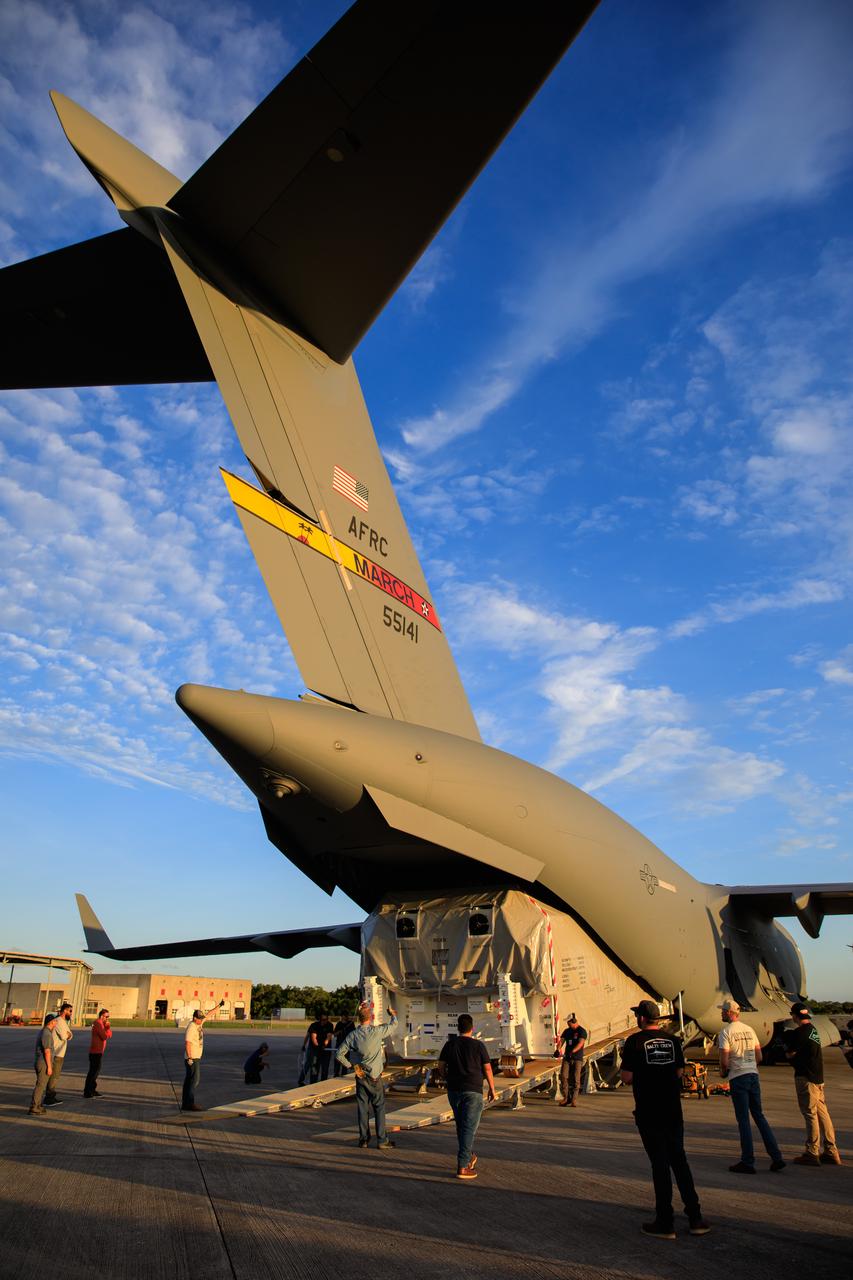
Teams offload NASA’s largest planetary mission spacecraft, Europa Clipper, from a United States Air Force C-17 Globemaster III transport aircraft onto the flatbed of a heavy-lift truck at the Launch and Landing Facility at NASA’s Kennedy Space Center in Florida on Thursday, May 23, 2024. Crews transported Europa Clipper to the Payload Hazardous Servicing Facility at Kennedy to prepare it for launch aboard a SpaceX Falcon Heavy rocket later this year from Launch Complex 39A at the Florida spaceport. Europa Clipper will help determine if conditions exist below the surface Jupiter’s fourth largest moon, Europa, that could support life.
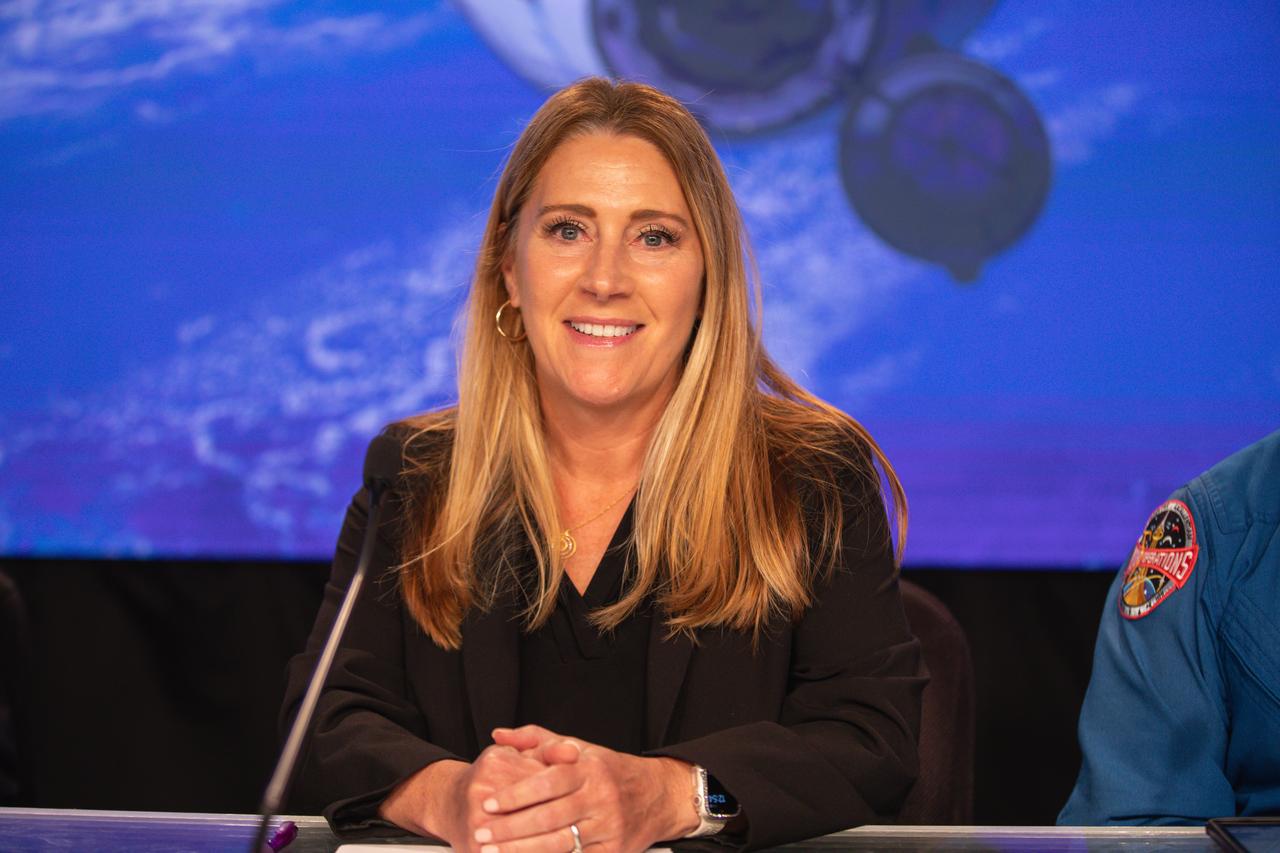
Dana Weigel, manager, NASA’s International Space Station Program, participates in a prelaunch briefing for NASA’s Boeing Crew Flight Test at the agency’s Kennedy Space Center in Florida, Friday, May 31, 2024. As part of the agency’s Commercial Crew Program, NASA astronauts Butch Wilmore and Suni Williams are the first to launch aboard Boeing’s Starliner spacecraft atop a United Launch Alliance Atlas V rocket from Space Launch Complex-41 at Cape Canaveral Space Force Station in Florida. Liftoff is scheduled for 12:25 p.m. ET on Saturday, June 1.
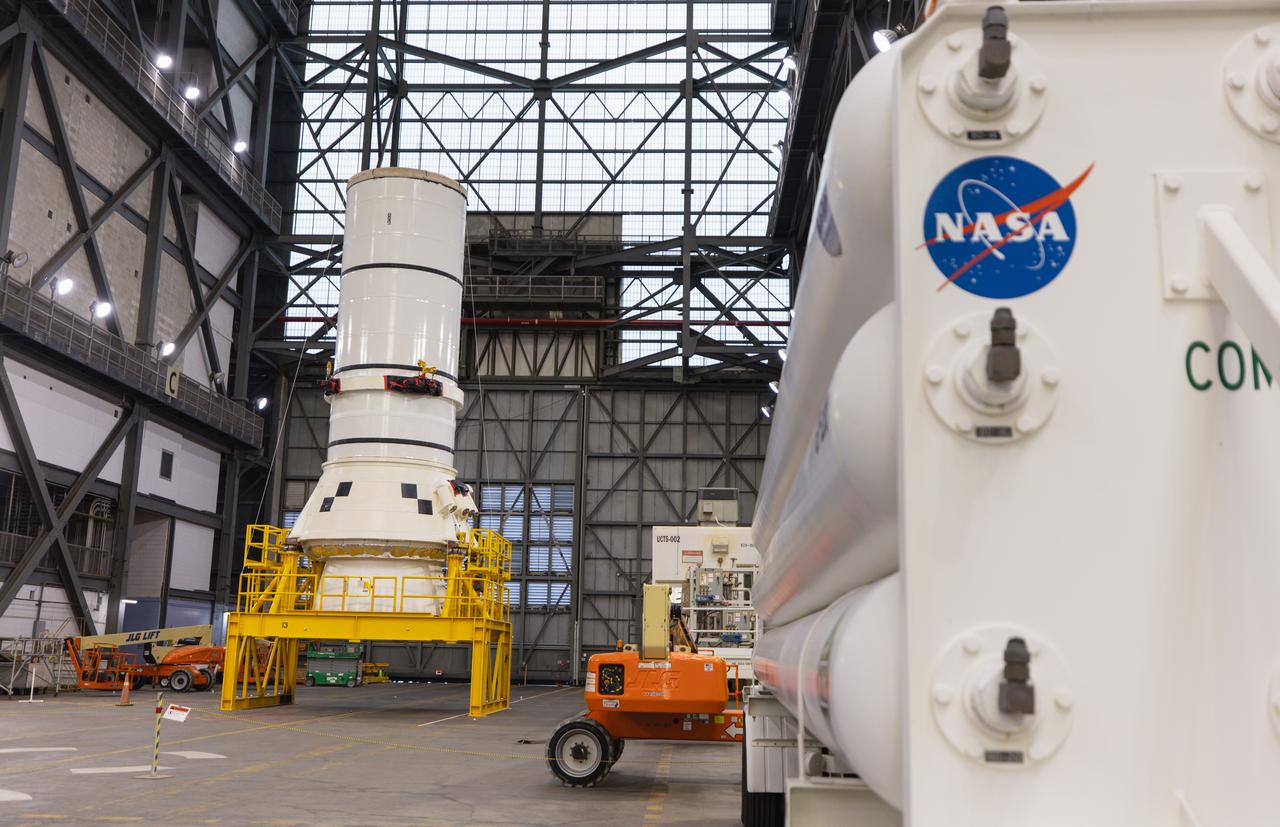
Engineers and technicians with NASA’s Exploration Ground Systems Program move the right aft assembly, or bottom portion of the right solid rocket booster for the agency’s SLS (Space Launch System) rocket, into the transfer aisle of the Vehicle Assembly Building at NASA’s Kennedy Space Center in Florida on Thursday, Nov. 22, 2024. The right aft assembly will be lifted atop mobile launcher 1, joining the previously stacked left aft assembly as the first booster segments stacked for the Artemis II Moon rocket.
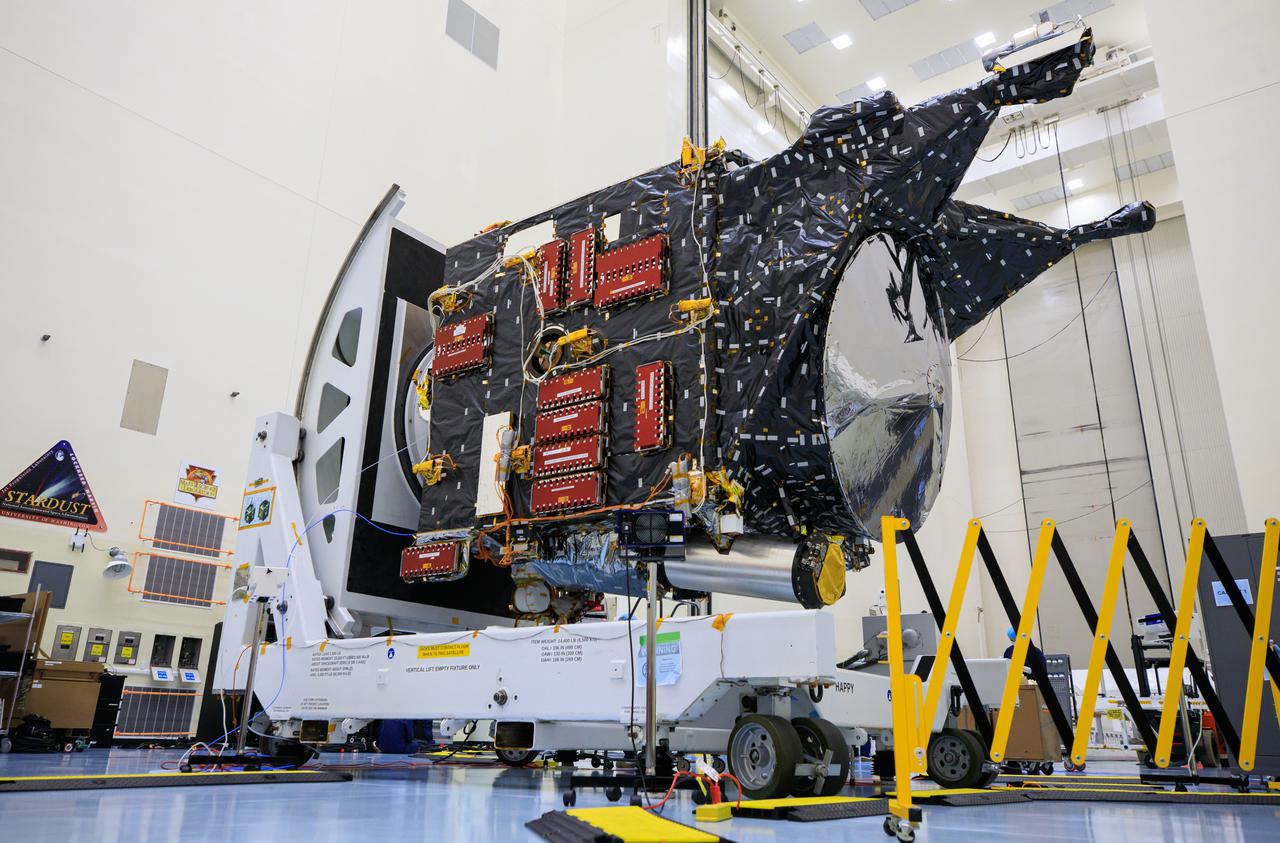
NASA’s Psyche spacecraft undergoes processing and servicing ahead of launch atop a work stand inside the Payload Hazardous Servicing Facility at NASA’s Kennedy Space Center in Florida on May 3, 2022. Psyche is targeting to lift off aboard a SpaceX Falcon Heavy rocket on Aug. 1, 2022. The spacecraft will use solar-electric propulsion to travel approximately 1.5 billion miles to rendezvous with its namesake asteroid in 2026. The Psyche mission is led by Arizona State University. NASA’s Jet Propulsion Laboratory, which is managed for the agency by Caltech in Pasadena, California, is responsible for the mission’s overall management, system engineering, integration and testing, and mission operations. Maxar Technologies in Palo Alto, California, provided the high-power solar electric propulsion spacecraft chassis. NASA’s Launch Services Program (LSP), based at Kennedy, is managing the launch. Psyche will be the 14th mission in the agency's Discovery program and LSP’s 100th primary mission.
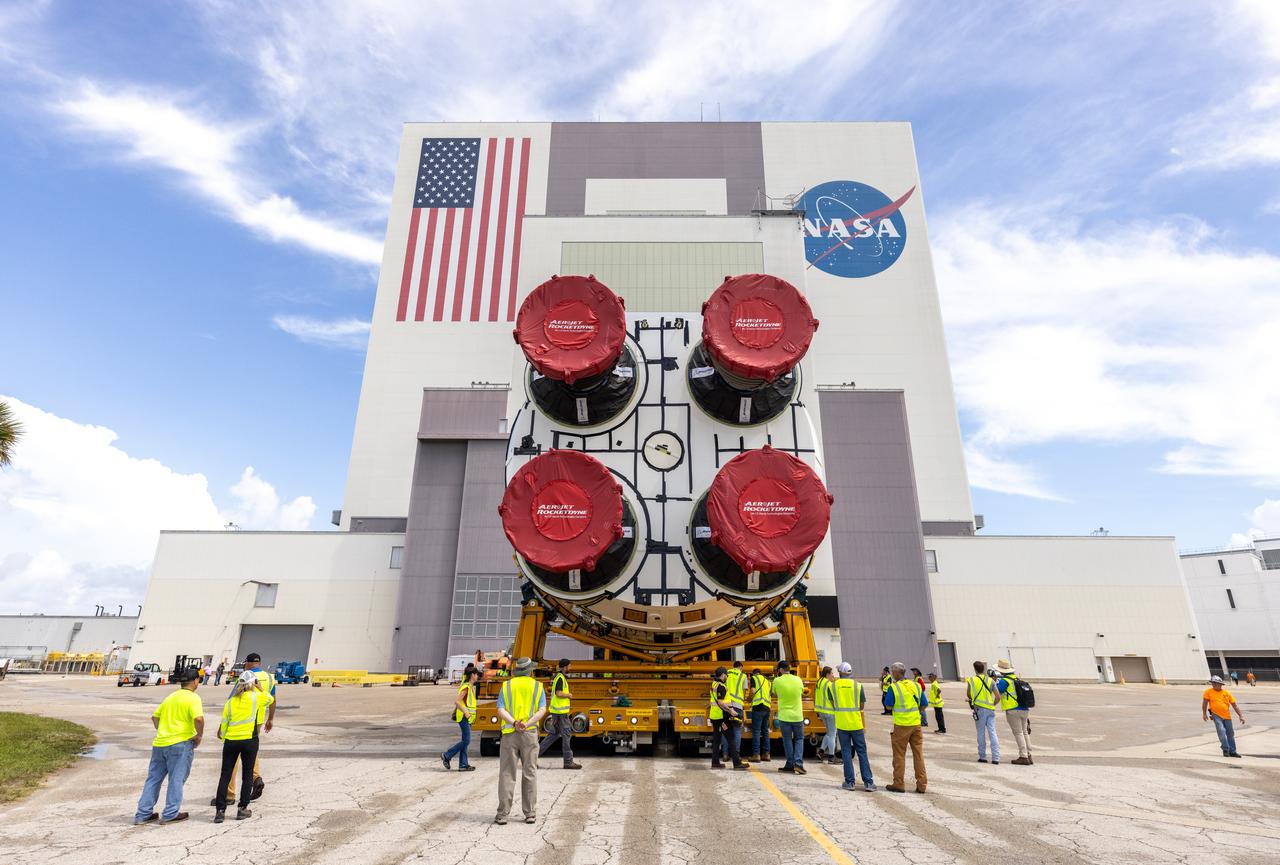
After completing its journey from NASA’s Michoud Assembly Facility in New Orleans aboard the Pegasus barge, teams with Exploration Ground Systems (EGS) transport the agency’s powerful SLS (Space Launch System) core stage to NASA’s Kennedy Space Center’s Vehicle Assembly Building in Florida on Wednesday, July 24, 2024. Once inside, SLS will be prepared for integration atop the mobile launcher ahead of the Artemis II launch.
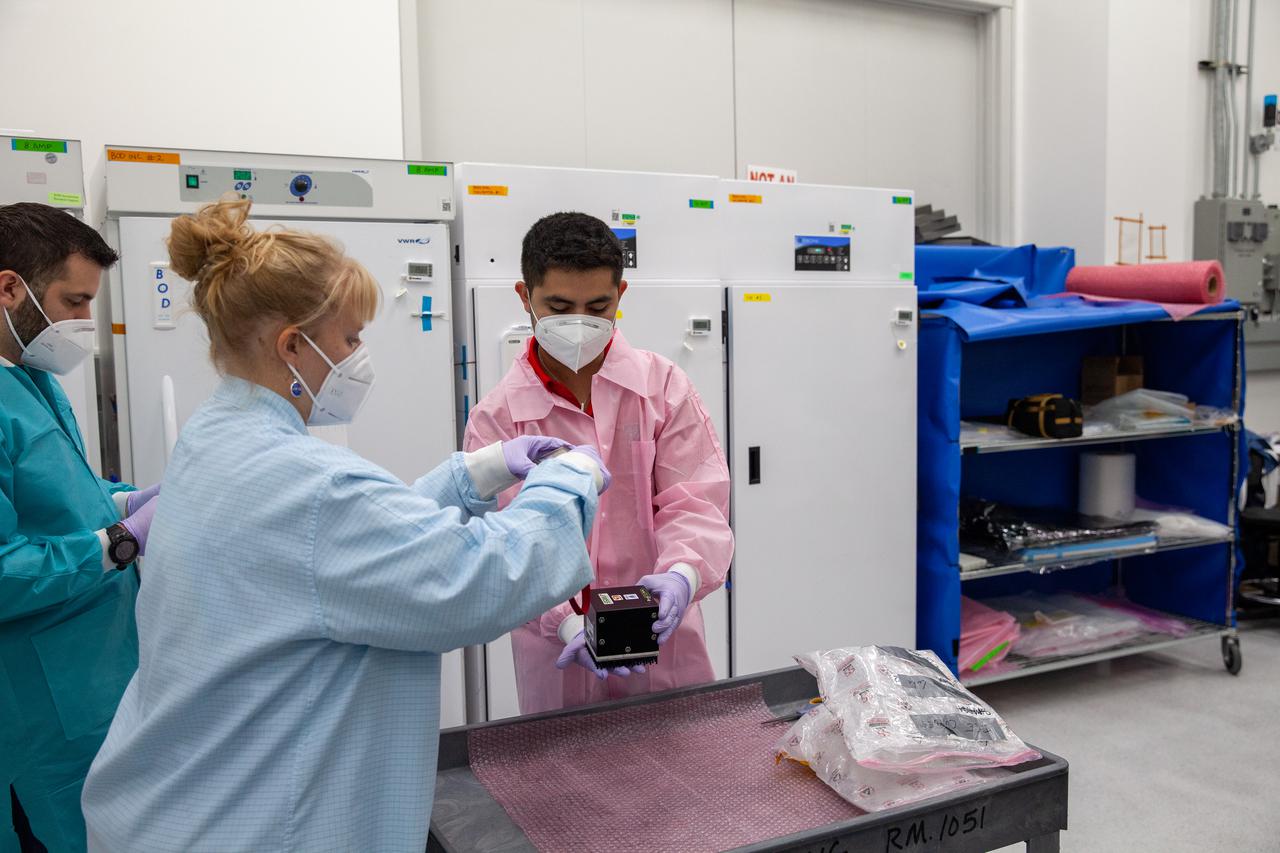
Members of the cold stowage team unpack science experiments inside the Space Station Processing Facility at NASA’s Kennedy Space Center in Florida on Jan. 14, 2021. The experiments returned to Earth on SpaceX’s 21st commercial resupply services mission (CRS-21). Making its successful parachute-assisted splashdown west of Tampa off the Florida coast, at 8:26 p.m. EST on Jan. 13, the SpaceX cargo Dragon returned more than 4,400 pounds of scientific experiments and other cargo from the International Space Station. After splashdown, SpaceX loaded Dragon aboard their Go Navigator recovery ship and packed an Airbus H225 helicopter with the time-sensitive research cargo for delivery to Kennedy. The upgraded cargo Dragon capsule also boasts double the powered locker capacity to preserve science samples, allowing for a significant increase in the research that can be carried back to Earth.
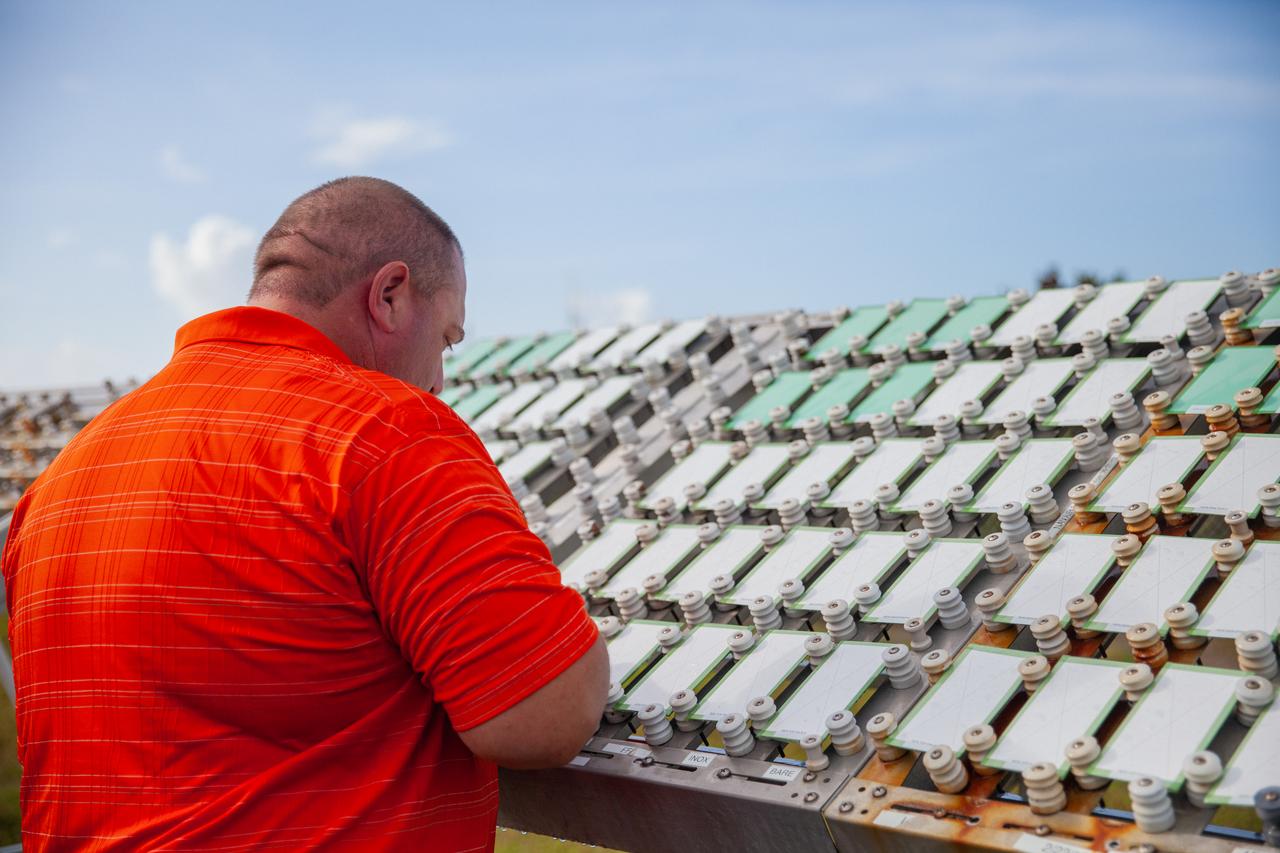
A Mechanical and Environmental Testing Lab engineer examines samples at the corrosion engineering test site at NASA’s Kennedy Space Center in Florida on Oct. 6, 2020. The corrosion lab is a network of people, equipment, and facilities that provides engineering services and technical innovations in all areas of corrosion for NASA and external customers.
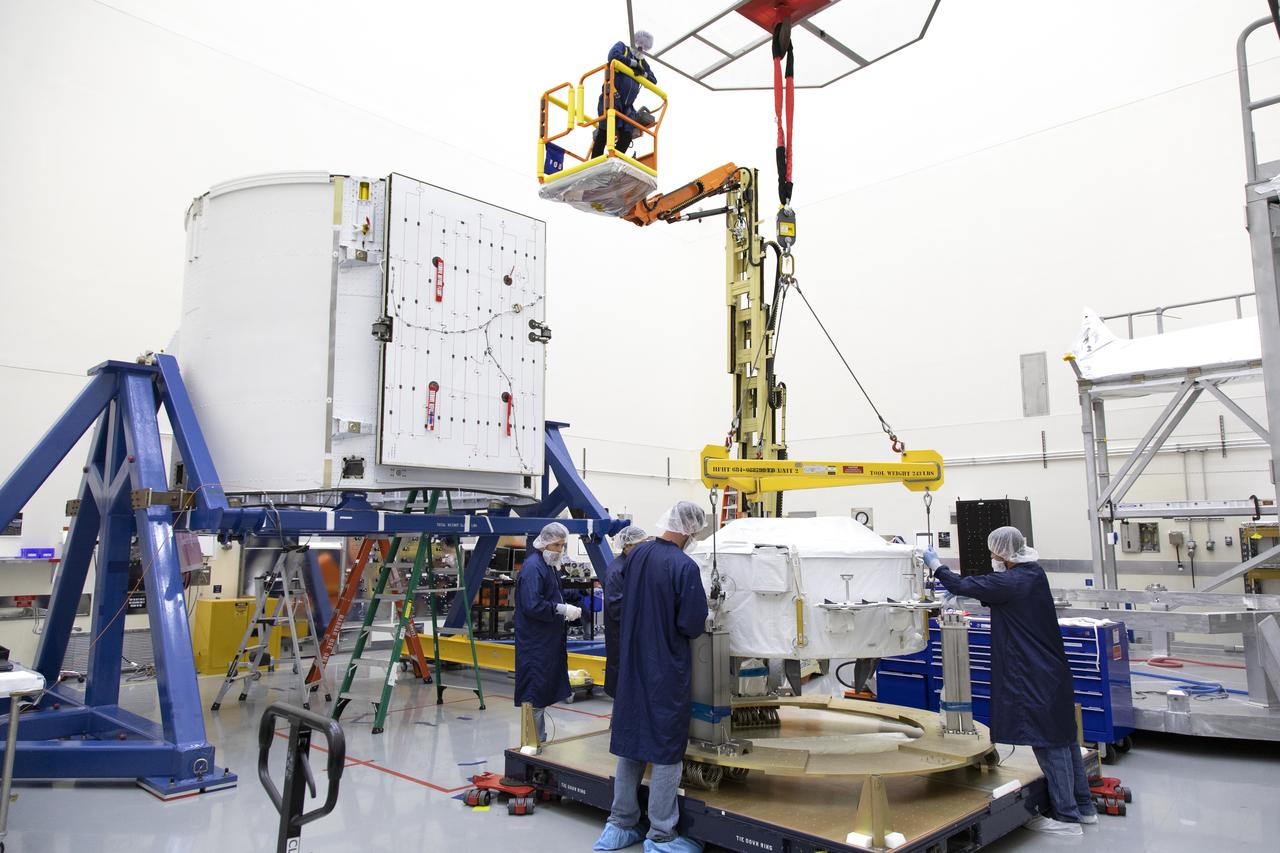
The International Docking Adapter 3, a critical component for future crewed missions to the International Space Station, is carefully packed away in the unpressurized “trunk” section of the SpaceX Dragon spacecraft at the SpaceX facility on Cape Canaveral Air Force Station in Florida on June 19. It will launch to the orbiting laboratory in July on the company’s 18th commercial resupply mission. The adapter will support future U.S. crewed vehicles visiting the station.
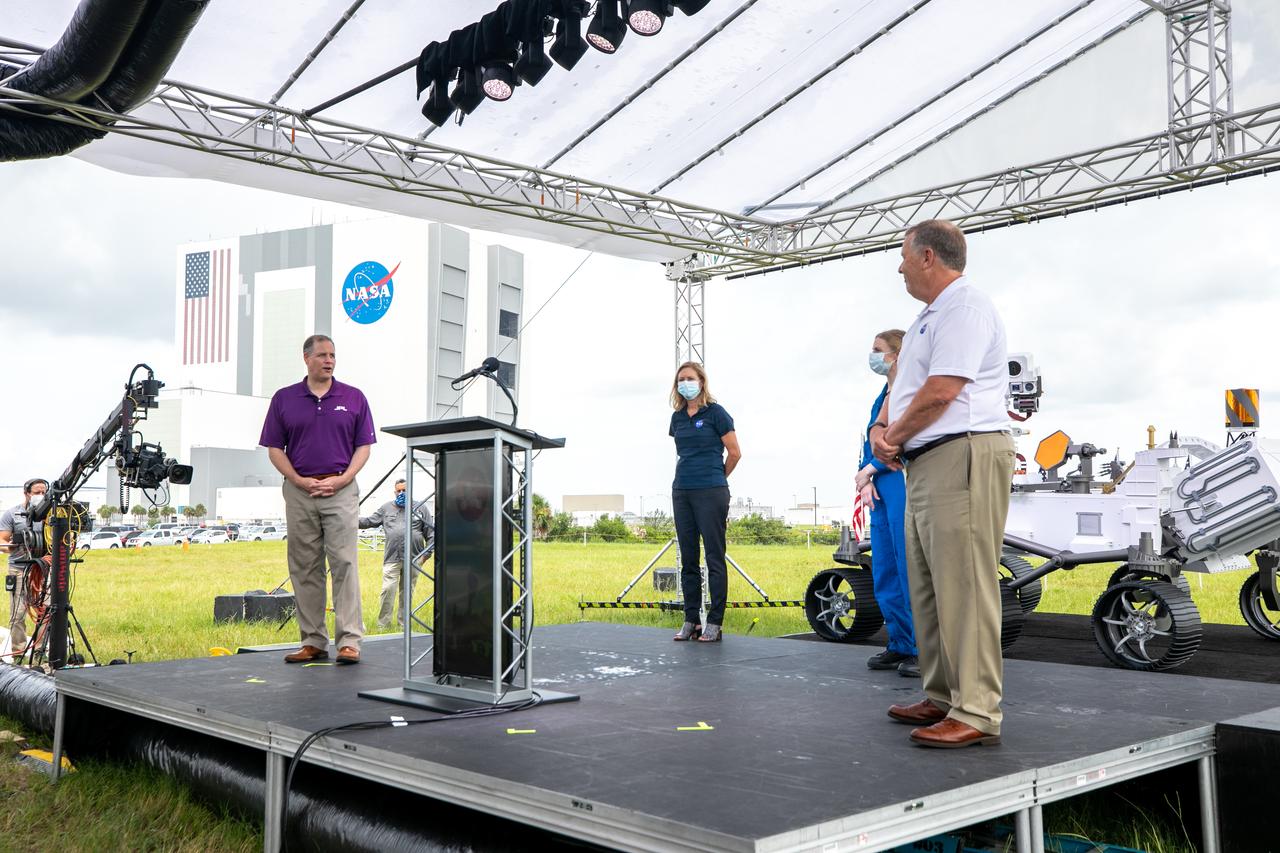
NASA Administrator Jim Bridenstine, far left, conducts a briefing at the agency’s Kennedy Space Center in Florida on July 29, 2020, in advance of the launch of the Mars 2020 Perseverance rover and Ingenuity helicopter scheduled for July 30. Joining him, from left are Kennedy Deputy Director Janet Petro, NASA astronaut Zena Cardman, partially hidden, and NASA Deputy Administrator Jim Morhard. Mars 2020 will lift off aboard a United Launch Alliance Atlas V 541 rocket from Space Launch Complex 41 at Cape Canaveral Air Force Station. The two-hour launch window opens at 7:50 a.m. EDT. NASA’s Launch Services Program, based at Kennedy, is managing the launch.
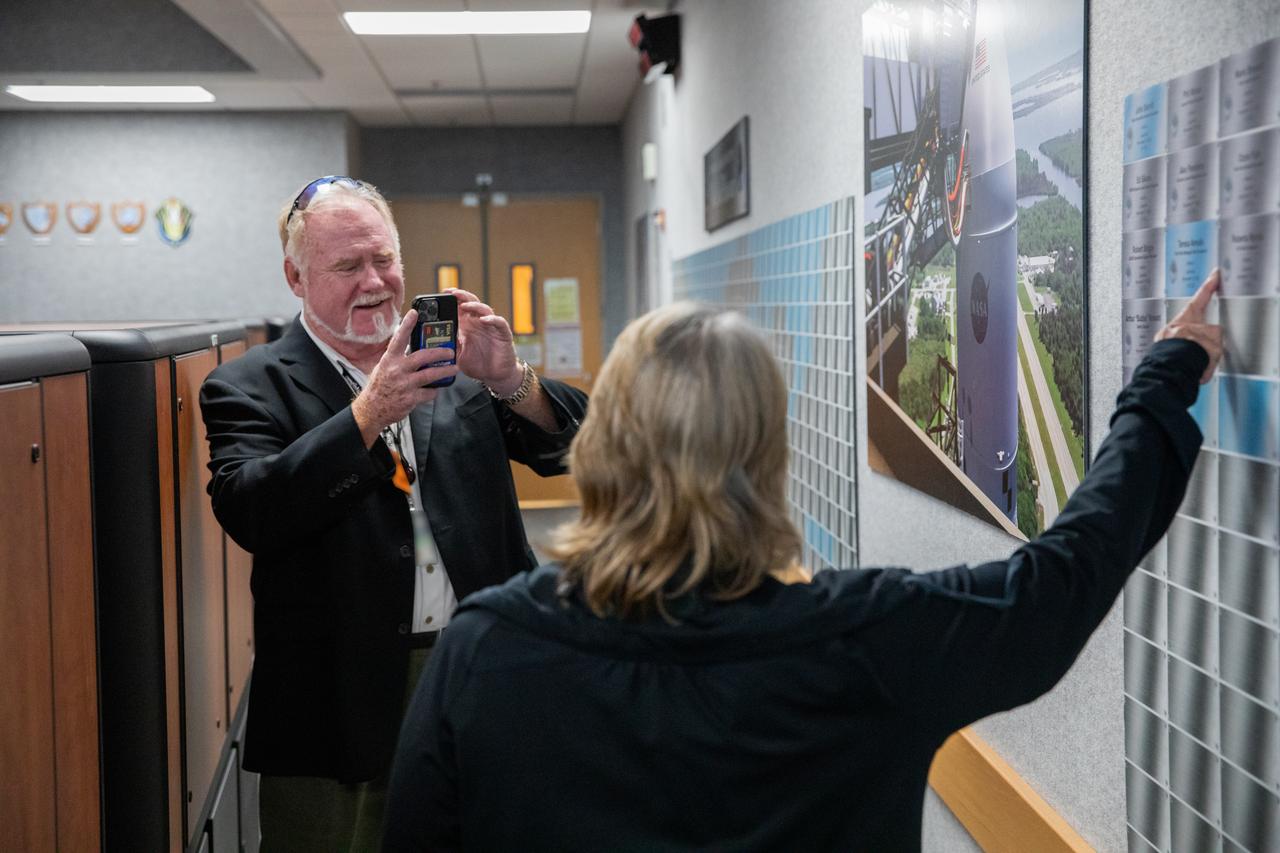
Artemis team members gather around Firing Room 1 of the Launch Control Center at NASA’s Kennedy Space Center in Florida on March 24, 2023 for the inaugural Artemis Launch Director Awards. The first in a series of increasingly complex missions, Artemis I launched successfully from Kennedy’s Launch Pad 39B at 1:47 a.m. EST on Nov. 16, 2022.
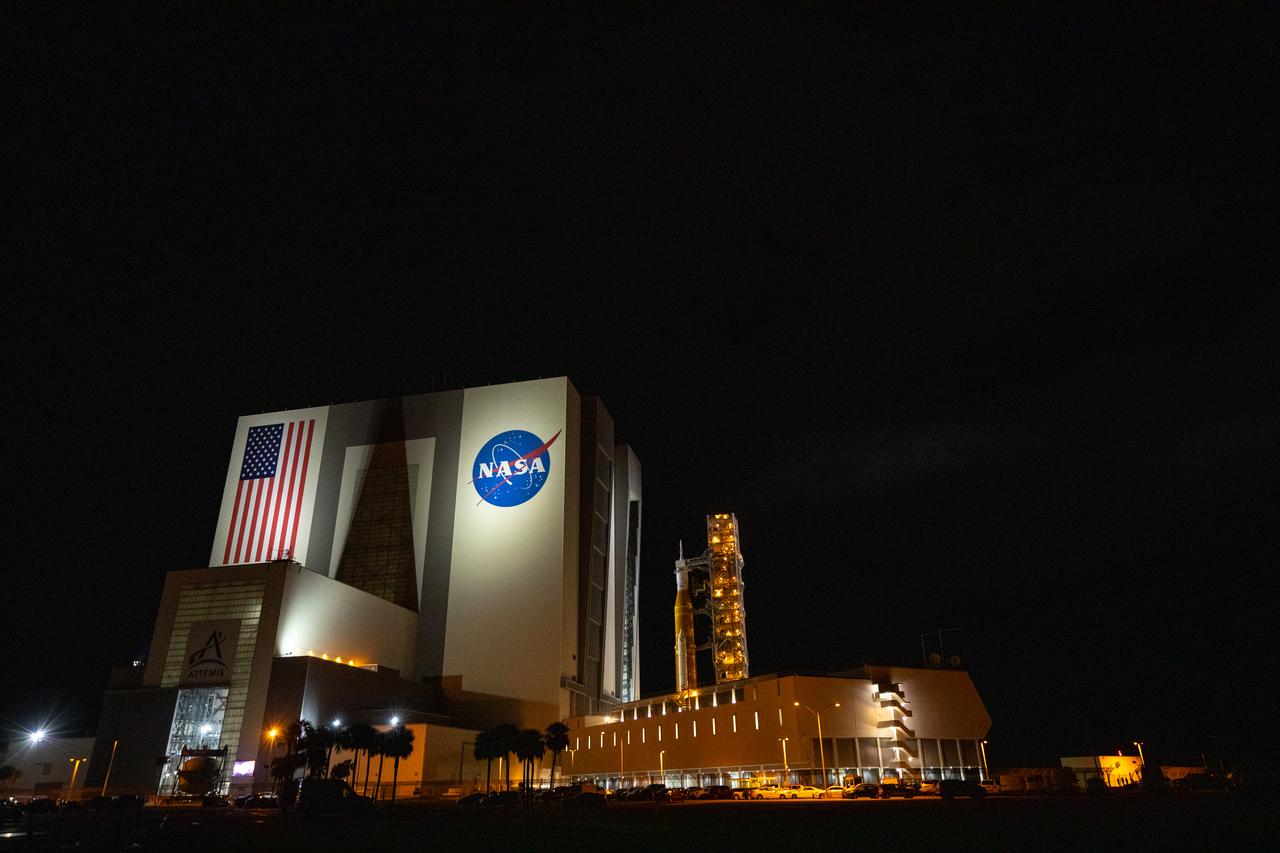
The mobile launcher, with NASA’s Space Launch System (SLS) rocket and Orion spacecraft atop, rolls out of the Vehicle Assembly Building’s High Bay 3 to begin its 4.2-mile journey to Launch Pad 39B at NASA’s Kennedy Space Center in Florida on Nov. 4, 2022. Artemis I will be the first integrated test of NASA’s SLS rocket and Orion spacecraft and is scheduled to launch Monday, Nov. 14. The primary goal of Artemis I is to thoroughly test the integrated systems before crewed missions by launching Orion atop the SLS rocket, operating the spacecraft in a deep space environment, testing Orion’s heat shield, and recovering the crew module after reentry, descent, and splashdown. During the flight, Orion will launch atop the most powerful rocket in the world and fly farther than any human-rated spacecraft has ever flown, paving the way for human deep space exploration and demonstrating our commitment and capability to extend human presence to the Moon and beyond.

Inside the Neil Armstrong Operations and Checkout Building high bay at NASA's Kennedy Space Center in Florida, from left, technicians Kenny Leidner, Diamond ScharSenstine, Russ Novak and Darlene Beville with ASRC Federal, inspect AVOCAT block bonding on the Artemis II heat shield on July 2, 2020. The heat shield is one of the most critical elements of Orion and will protect the capsule and astronauts during reentry through Earth’s atmosphere. Artemis II is the first crewed mission in a series of missions to the Moon and on to Mars. Artemis II will confirm all of the Orion spacecraft’s systems operate as designed in the actual environment of deep space with astronauts aboard. As part of the Artemis Program, NASA will send the first woman and next man to the Moon by 2024.

NOAA’s Geostationary Operational Environmental Satellite-U (GOES-U) is offloaded from a C-5M Super Galaxy transport aircraft onto the flatbed of a heavy-lift truck at the Launch and Landing Facility at NASA’s Kennedy Space Center in Florida on Tuesday, Jan. 23, 2024. Crews transported the satellite to the Astrotech Space Operations facility in Titusville, Florida to prepare it for launch. Part of a collaborative NOAA and NASA program, GOES-U is the fourth in a series of four advanced geostationary weather satellites. Data from the GOES satellite constellation – consisting of the GOES-R, GOES-S, GOES-T and GOES-U spacecraft – enables forecasters to predict, observe, and track local weather events that affect public safety like thunderstorms, hurricanes, and wildfires.
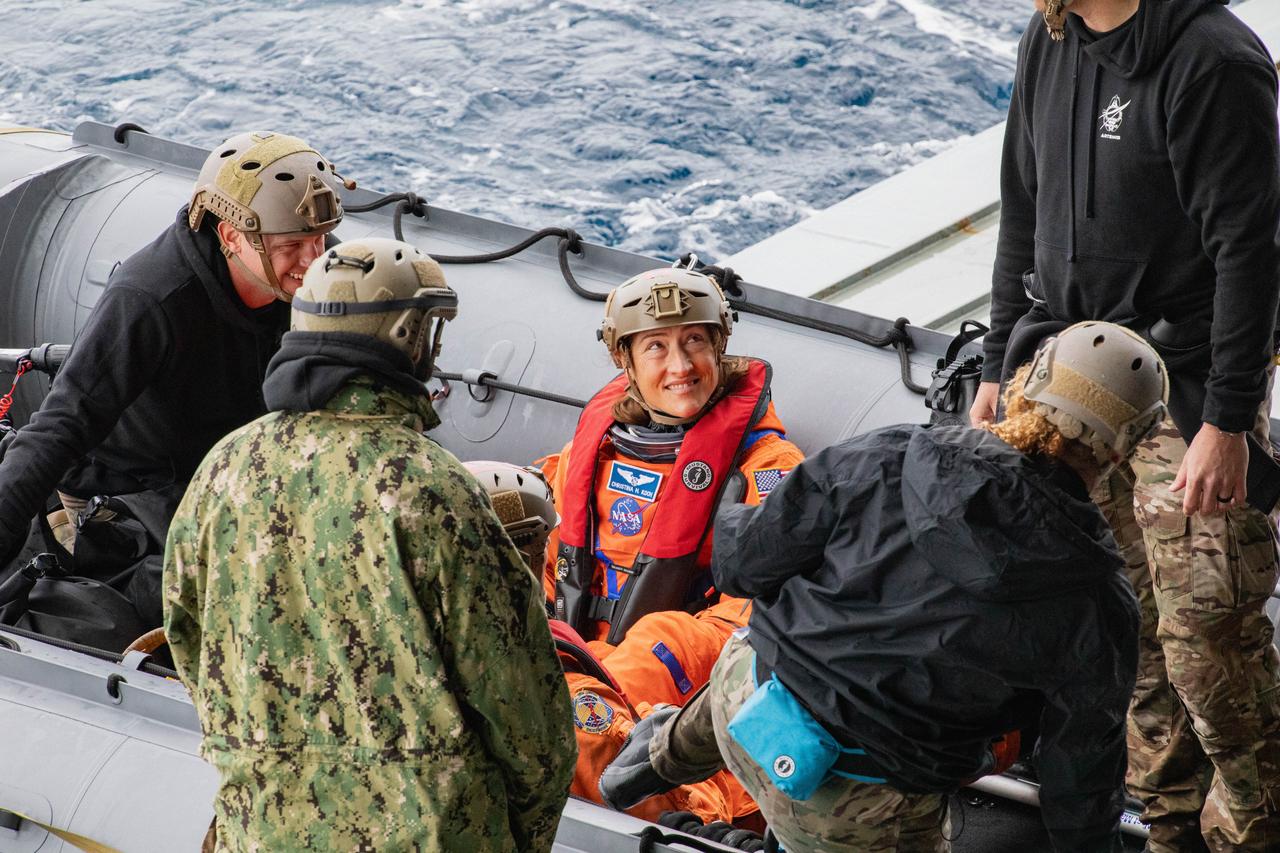
Artemis II crew member NASA astronaut Christina Koch joins NASA’s Exploration Ground System’s Landing and Recovery team and partners from the Department of Defense aboard the USS San Diego practicing recovery procedures using the Crew Module Test Article, during Underway Recovery Test 11 (URT-11) off the coast of San Diego, California on Sunday, Feb. 25, 2024. URT-11 is the eleventh in a series of Artemis recovery tests, and the first time NASA and its partners put their Artemis II recovery procedures to the test with the astronauts.
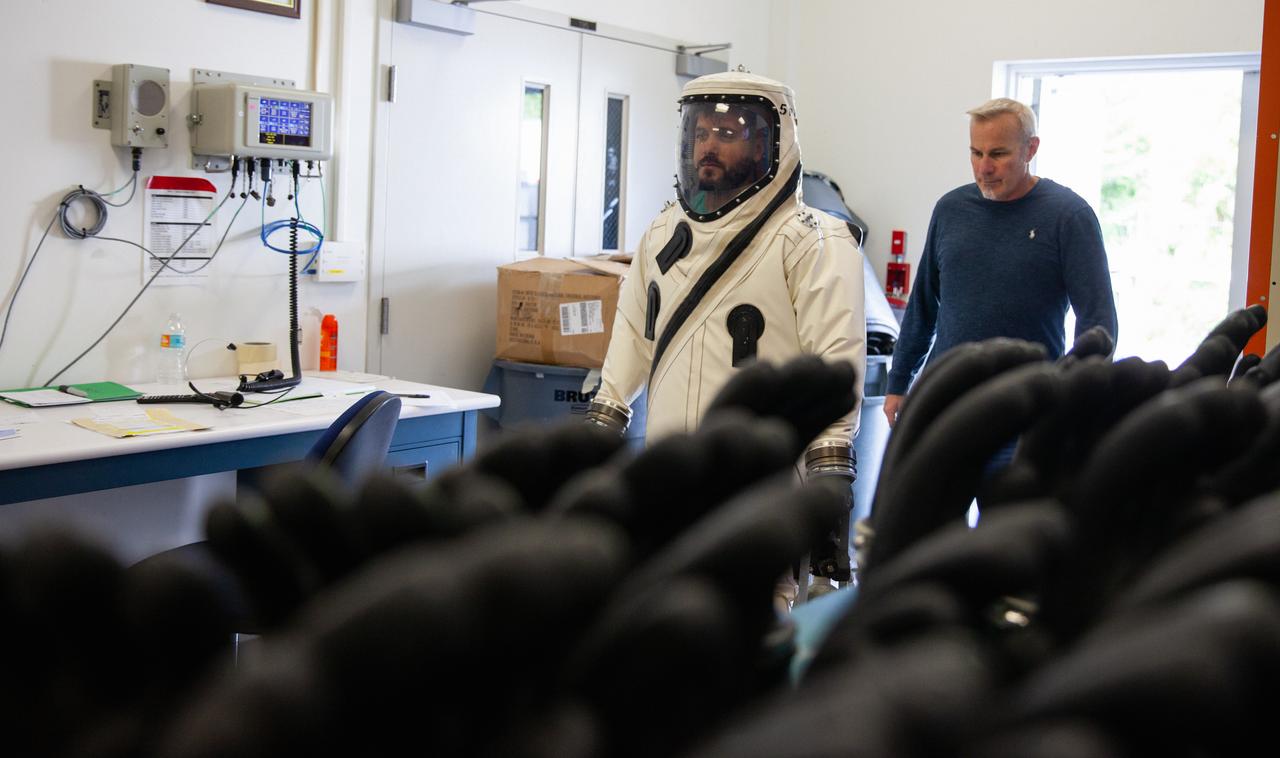
Inside the Multi-Operations Support Building near the Multi-Payload Processing Facility (MPPF) at NASA’s Kennedy Space Center in Florida, a technician is wearing a Self-Contained Atmospheric Protective Ensemble (SCAPE) suit to prepare for a test simulation of loading propellants into a replicated test tank for Orion, on Aug. 16, 2019. Exploration Ground Systems is preparing for Artemis 1 with a series of hazardous hyper test events at the MPPF. After donning their suits, the technicians will complete a tanking to test the system before Orion arrives for processing. During preparations for launch, these teams will be responsible for loading the Orion vehicle with propellants prior to transportation to the Vehicle Assembly Building, where it will be secured atop the Space Launch System rocket. SCAPE suits are used in operations involving toxic propellants and are supplied with air either through a hardline or through a self-contained environmental control unit.
AFS-8/101
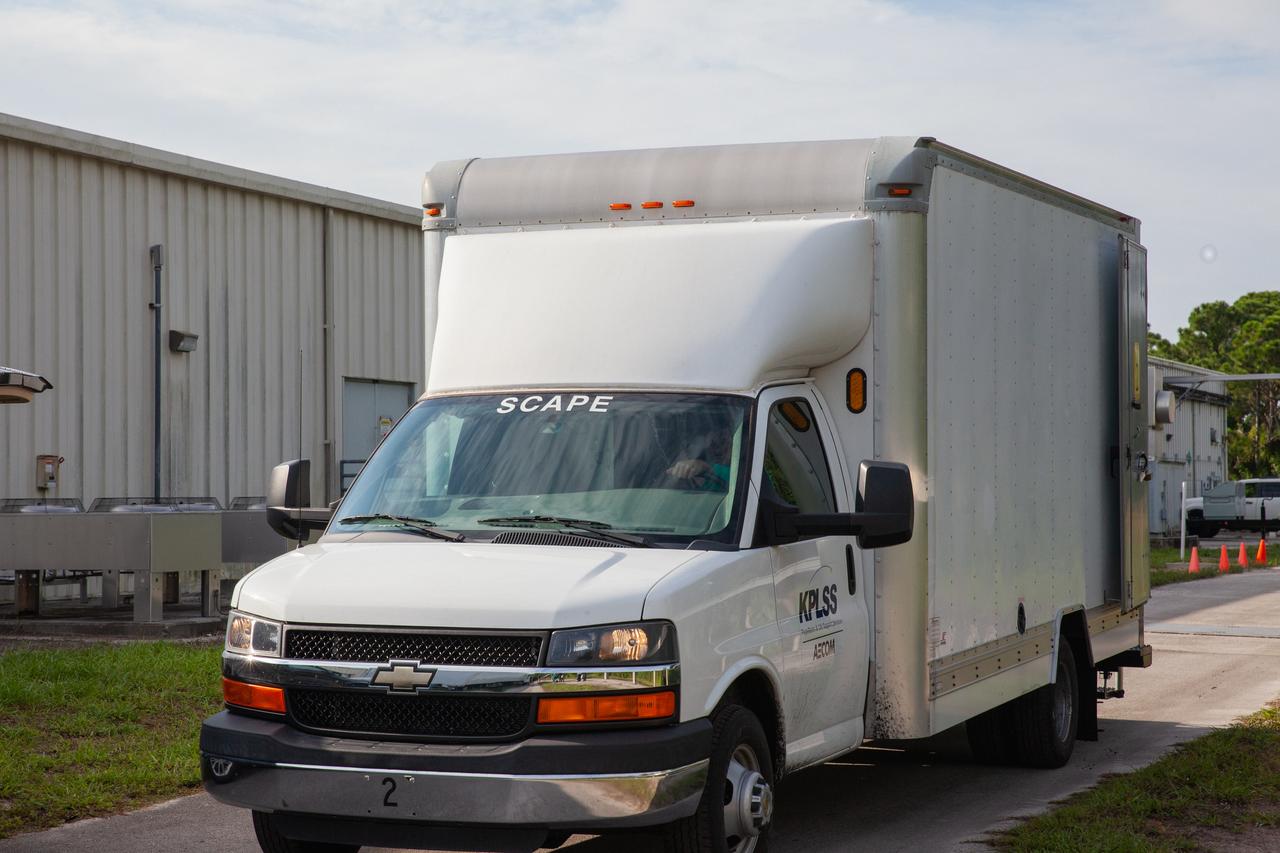
A truck transports technicians wearing Self-Contained Atmospheric Protective Ensemble (SCAPE) suits and operations support personnel to the Multi-Payload Processing Facility (MPPF) at NASA’s Kennedy Space Center in Florida, for a test simulation of loading propellants into a replicated test tank for Orion on Aug. 16, 2019. Exploration Ground Systems is preparing for Artemis 1 with a series of hazardous hyper test events at the MPPF. The technicians will complete a tanking to test the system before Orion arrives for processing. During preparations for launch, these teams will be responsible for loading the Orion vehicle with propellants prior to transportation to the Vehicle Assembly Building, where it will be secured atop the Space Launch System rocket. SCAPE suits are used in operations involving toxic propellants and are supplied with air either through a hardline or through a self-contained environmental control unit.
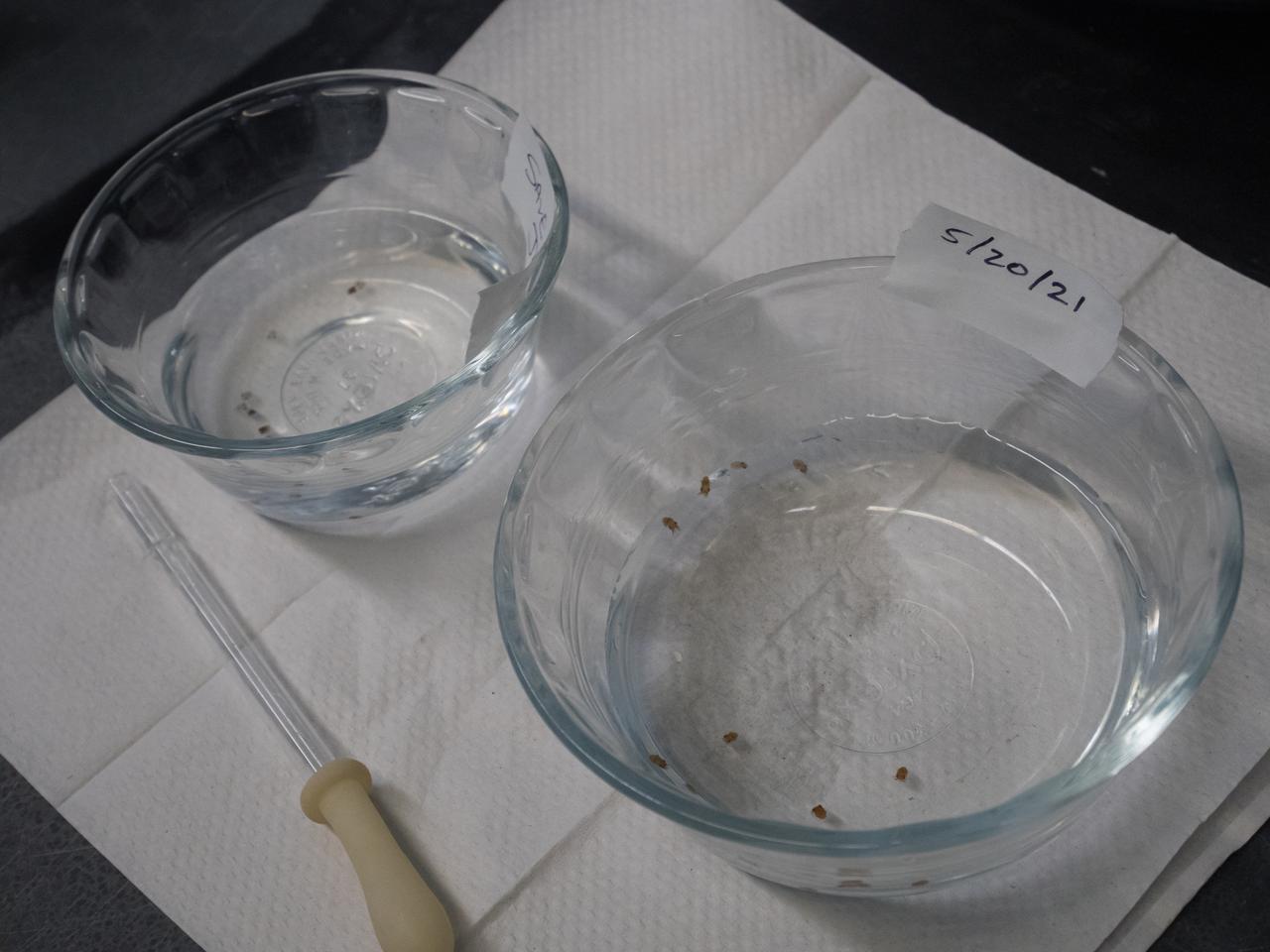
Inside the Space Life Sciences Laboratory at NASA’s Kennedy Space Center in Florida, bobtail squid are part of preparations on May 20, 2021, for the Understanding of Microgravity on Animal-Microbe Interactions (UMAMI) experiment that will launch to the International Space Station aboard SpaceX’s 22nd Commercial Resupply Services mission. The experiment will examine the effects of spaceflight on the molecular and chemical interactions between beneficial microbes and their animal hosts. Animals, including humans, rely on microbes to maintain a healthy digestive and immune system. UMAMI is one of several experiments bound for the space station in the Dragon capsule atop the SpaceX Falcon 9 rocket. The mission is scheduled to lift off from Launch Complex 39A on June 3.
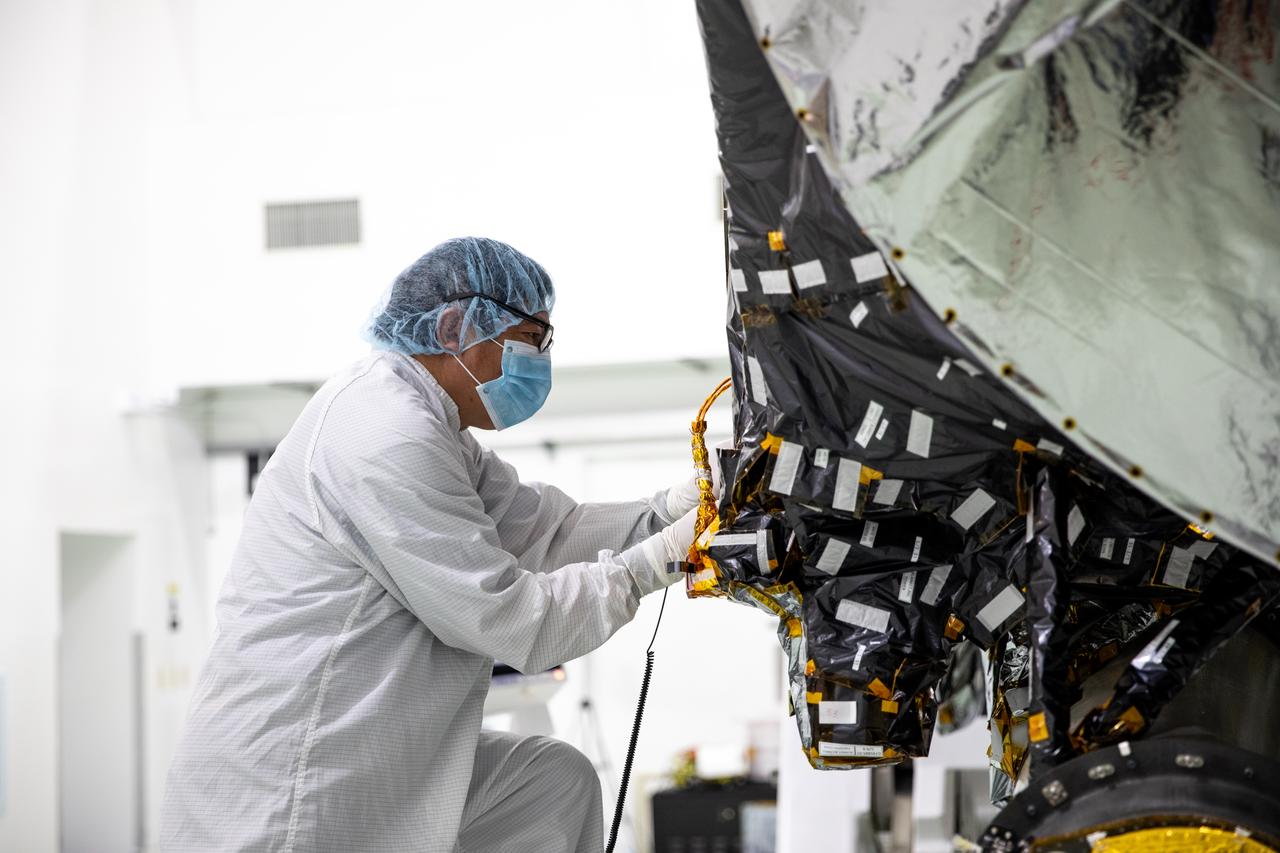
A NASA team member prepares the agency’s Psyche spacecraft for integration with its twin solar arrays inside the Astrotech Space Operations Facility near the agency’s Kennedy Space Center in Florida on July 20, 2023. The solar arrays were shipped from Maxar Technologies, in San Jose, California. They are part of the solar electric propulsion system, provided by Maxar, that will power the spacecraft on its journey to explore a metal-rich asteroid. Psyche will launch atop a SpaceX Falcon Heavy rocket from Launch Complex 39A at Kennedy. Launch is targeted for Oct. 5, 2023. Riding with Psyche is a pioneering technology demonstration, NASA’s Deep Space Optical Communications (DSOC) experiment.
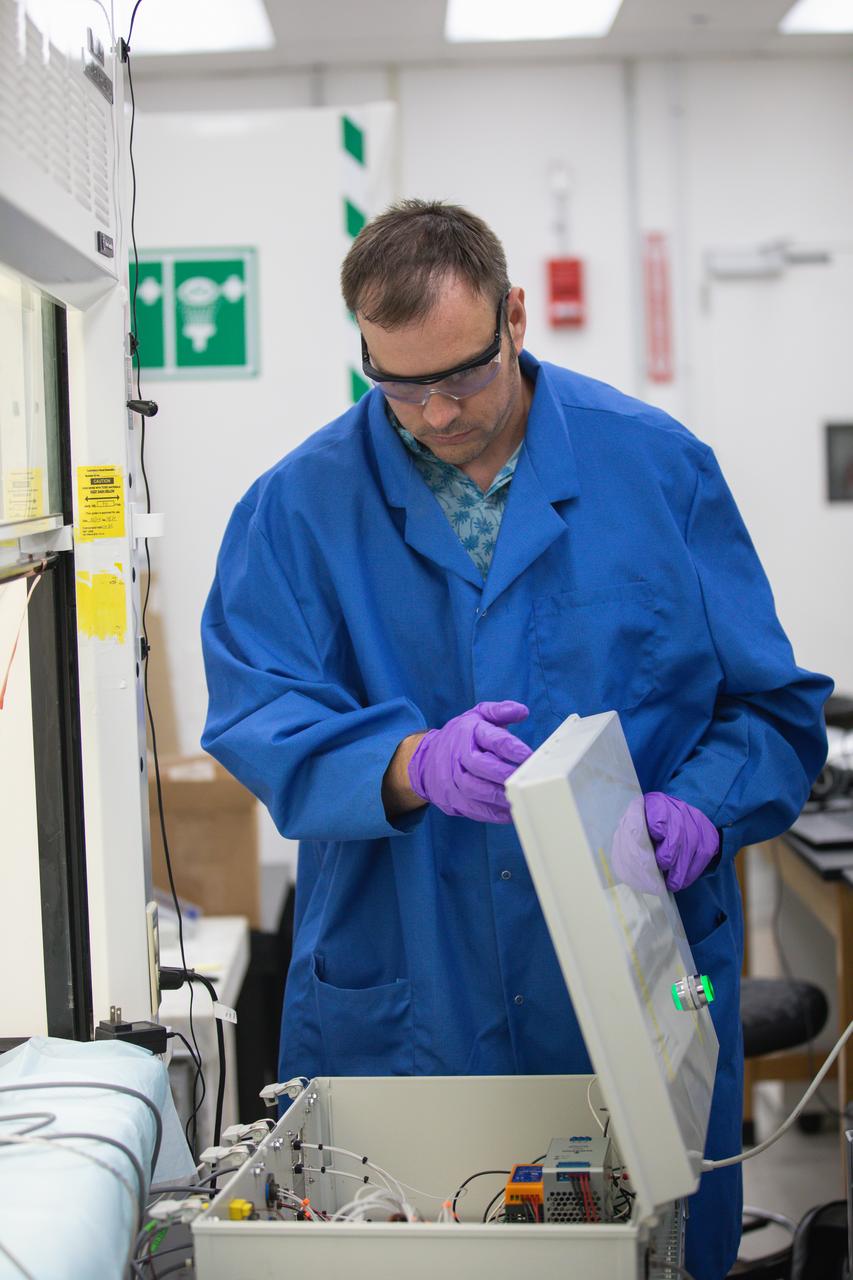
Beau Peacock, software engineer, conducts testing of the Volatile Monitoring Oxygen Measurement Subsystem (VMOMS) for Molten Regolith Electrolysis (MRE) inside a laboratory in the Neil A. Armstrong Operations and Checkout Building at NASA’s Kennedy Space Center in Florida on April 19, 2024. The high-temperature electrolytic process aims to extract oxygen from simulated lunar regolith which will be critical to the agency’s Artemis campaign. Oxygen extracted from the Moon can be utilized for propellent to NASA’s lunar landers, breathable oxygen for astronauts, and a variety of other industrial and scientific applications for NASA’s future missions to the Moon.

The first-stage booster of a SpaceX Falcon 9 rocket flies down to a landing at Vandenberg Air Force Base in California during the launch of the Sentinel-6 Michael Freilich mission. The Sentinel-6/Jason-CS (Continuity of Service) mission consists of the Sentinel-6 Michael Freilich satellite, which will be followed by its twin, the Sentinel-6B satellite, in 2025. The Sentinel-6/Jason-CS mission is part of Copernicus, the European Union’s Earth observation program, managed by the European Commission. Continuing the legacy of the Jason series missions, Sentinel-6/Jason-CS will extend the records of sea level into their fourth decade, collecting accurate measurements of sea surface height for more than 90% of the world’s seas, and providing crucial information for operational oceanography, marine meteorology, and climate studies. Sentinel-6 Michael Freilich launched Nov. 21, 2020, at 9:17 PST (12:17 EST). NASA’s Launch Services Program at Kennedy Space Center was responsible for launch management.

Members of the Florida Native Plant Society converse with visitors during a sustainability expo held at the Kennedy Space Center Visitor Complex in Florida on April 11, 2019. The expo kicked off Kennedy’s annual Earth Day celebrations. The Florida Native Plant Society was one of approximately 40 exhibitors present at the expo. Exhibitors in attendance provided information ranging from energy-saving solutions to wildlife and natural conservation. In addition, there were multiple butterfly releases throughout the day.
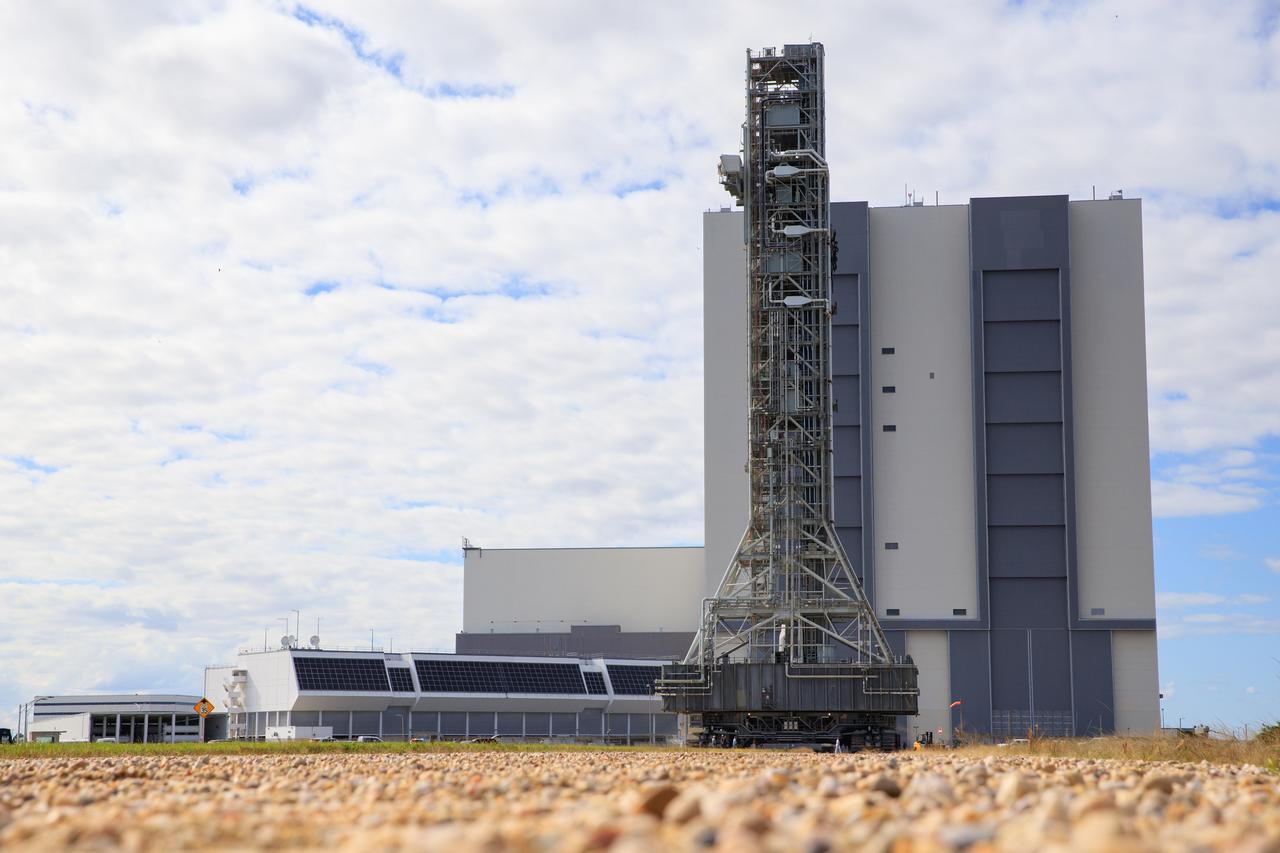
NASA’s mobile launcher, carried atop the crawler-transporter 2, left launch pad 39B at NASA’s Kennedy Space Center in Florida on Dec. 8, 2022, following the successful launch of the agency’s Space Launch System (SLS) rocket and Orion spacecraft on the Artemis I flight test on Nov. 16, 2022. The mobile launcher is scheduled to return to the Vehicle Assembly Building (VAB) on Dec. 9, 2022, and it will remain inside the VAB for several weeks as teams get it ready for the Artemis II crewed mission. Following its stay in the VAB, it will go to the mobile launcher park site location at Kennedy where it will undergo emergency egress modifications and testing to support future Artemis missions.

Charlie Blackwell-Thompson, Artemis launch director, Exploration Ground Systems at NASA’s Kennedy Space Center in Florida, participates in an Artemis II launch countdown simulation inside Firing Room 1 in the Launch Control Center at NASA’s Kennedy on Thursday, Jan. 23, 2025. The simulations go through launch day scenarios to help launch team members test software and make adjustments if needed during countdown operations. For Artemis II, four astronauts will venture around the Moon, the first crewed mission on NASA’s path to establishing a long-term presence for science and exploration through Artemis.
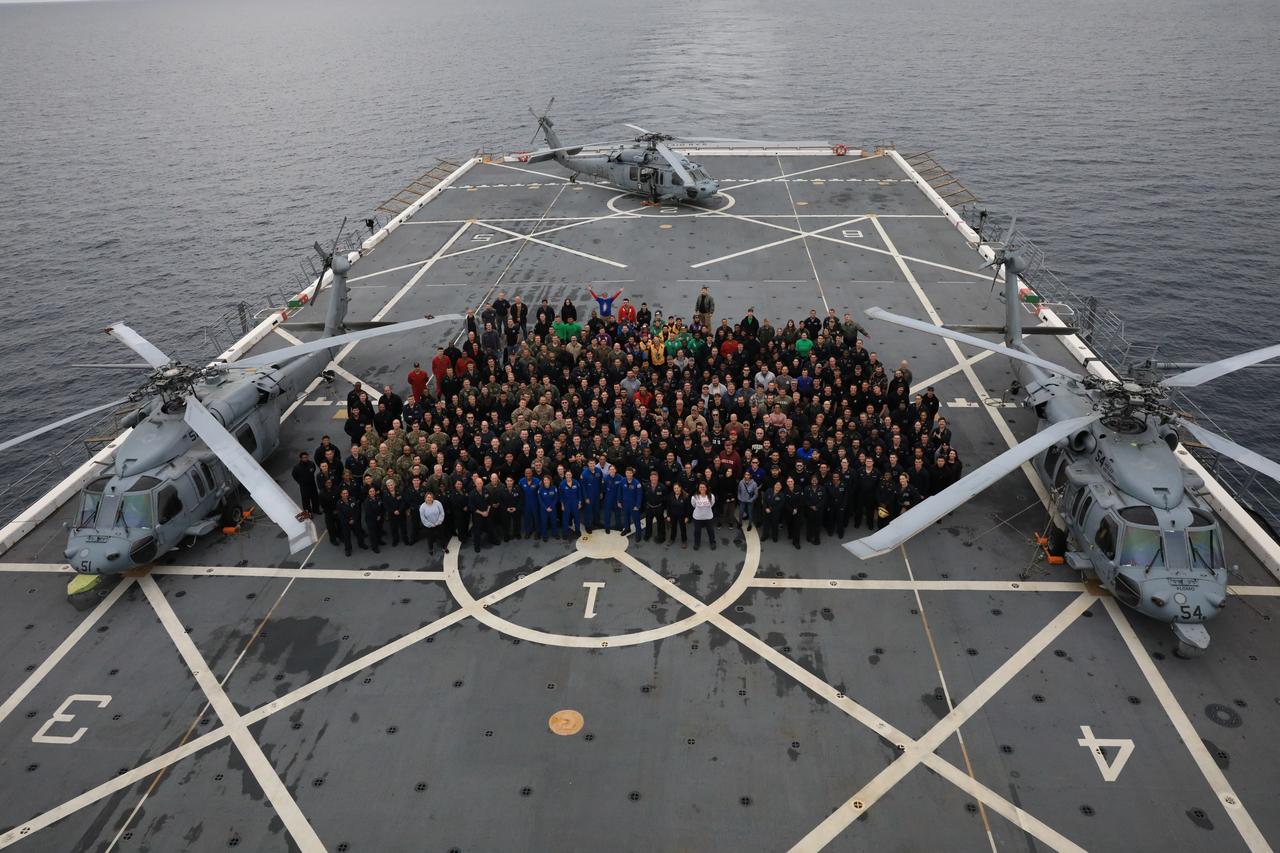
NASA Artemis II astronauts, members of NASA’s Exploration Ground System’s Landing and Recovery team, U.S. Navy personnel, and others aboard the USS San Diego pose for a photo during Underway Recovery Test 11 (URT-11) off the coast of San Diego, California on Monday, Feb. 26, 2024. URT-11 is the eleventh in a series of Artemis recovery tests, and the first time NASA and its partners put their Artemis II recovery procedures to the test with the astronauts.
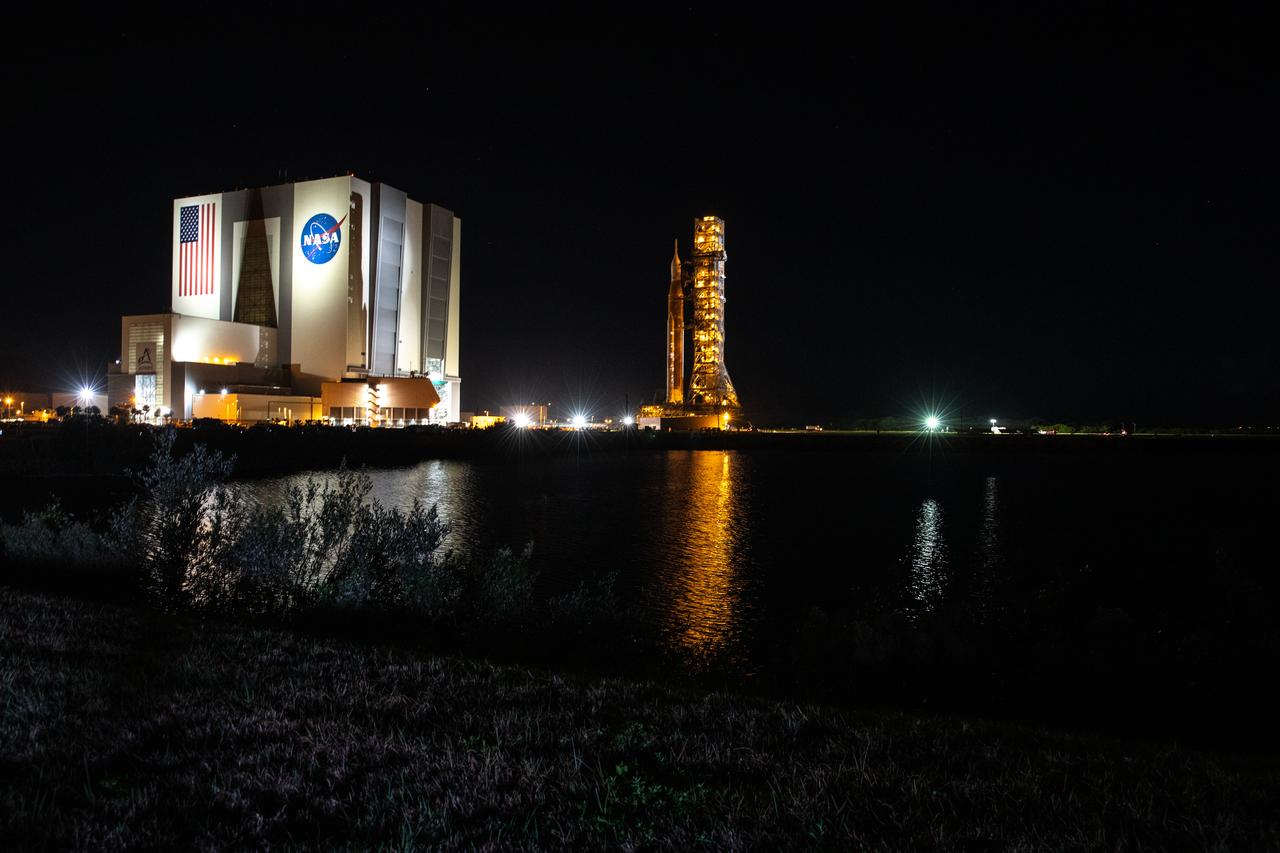
The mobile launcher, with NASA’s Space Launch System (SLS) rocket and Orion spacecraft atop, rolls out of the Vehicle Assembly Building’s High Bay 3 to begin its 4.2-mile journey to Launch Pad 39B at NASA’s Kennedy Space Center in Florida on Nov. 4, 2022. Artemis I will be the first integrated test of NASA’s SLS rocket and Orion spacecraft and is scheduled to launch Monday, Nov. 14. The primary goal of Artemis I is to thoroughly test the integrated systems before crewed missions by launching Orion atop the SLS rocket, operating the spacecraft in a deep space environment, testing Orion’s heat shield, and recovering the crew module after reentry, descent, and splashdown. During the flight, Orion will launch atop the most powerful rocket in the world and fly farther than any human-rated spacecraft has ever flown, paving the way for human deep space exploration and demonstrating our commitment and capability to extend human presence to the Moon and beyond.
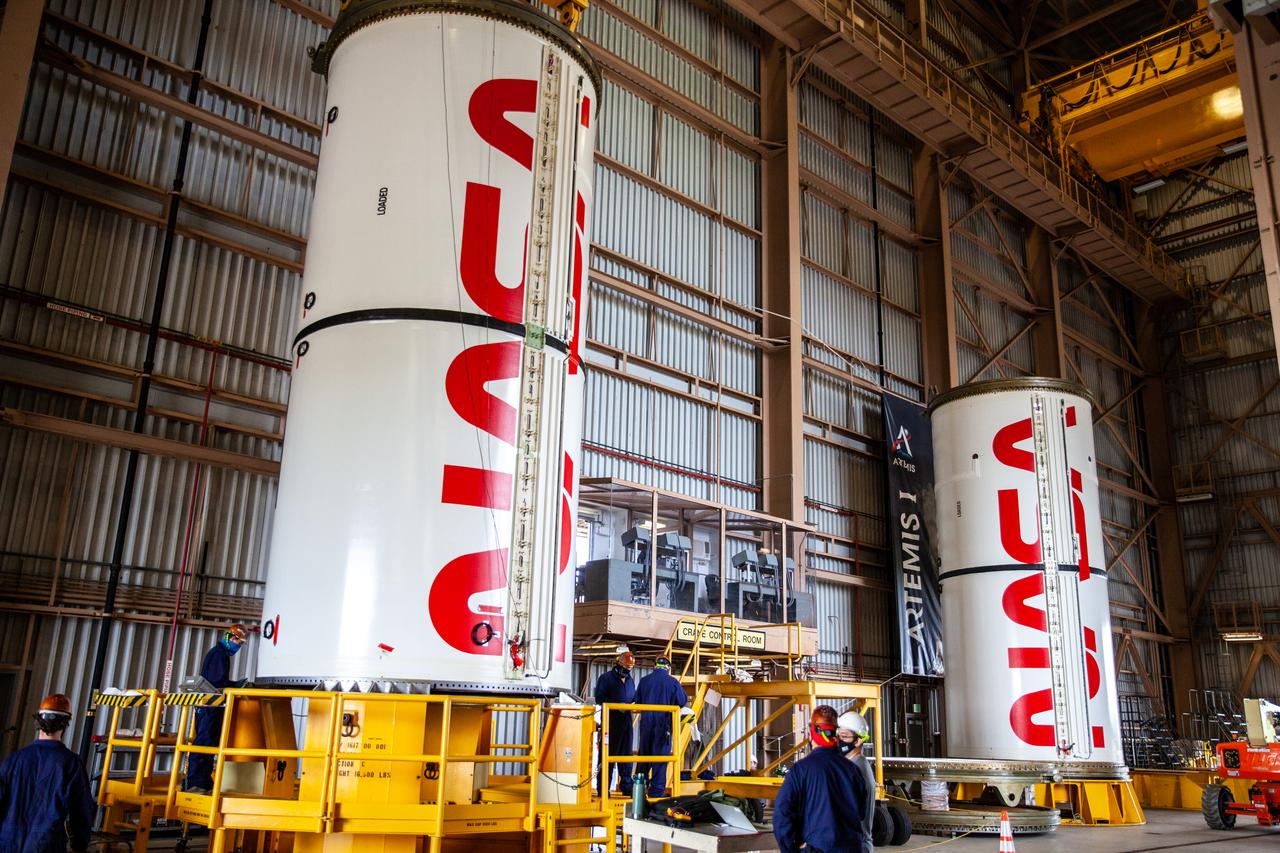
Inside the Rotation, Processing and Surge Facility at NASA’s Kennedy Space Center in Florida, Exploration Ground Systems and Jacobs TOSC workers completed painting of NASA’s iconic “worm” logo on the Artemis I Space Launch System twin solid rocket boosters on Sept. 23, 2020. Originally created by the firm of Danne & Blackburn, the iconic “worm” logo’s bold, sleek design was officially introduced in 1975 and was incorporated into many of the agency’s next-generation programs. It was retired in 1992, but has made a comeback in 2020 as the agency ushers in a new, modern era of human spaceflight. The first in a series of increasingly complex missions, Artemis I will test the Orion spacecraft and Space Launch System as an integrated system ahead of crewed flights to the Moon. Under the Artemis program, NASA will land the first woman and the next man on the Moon by 2024.
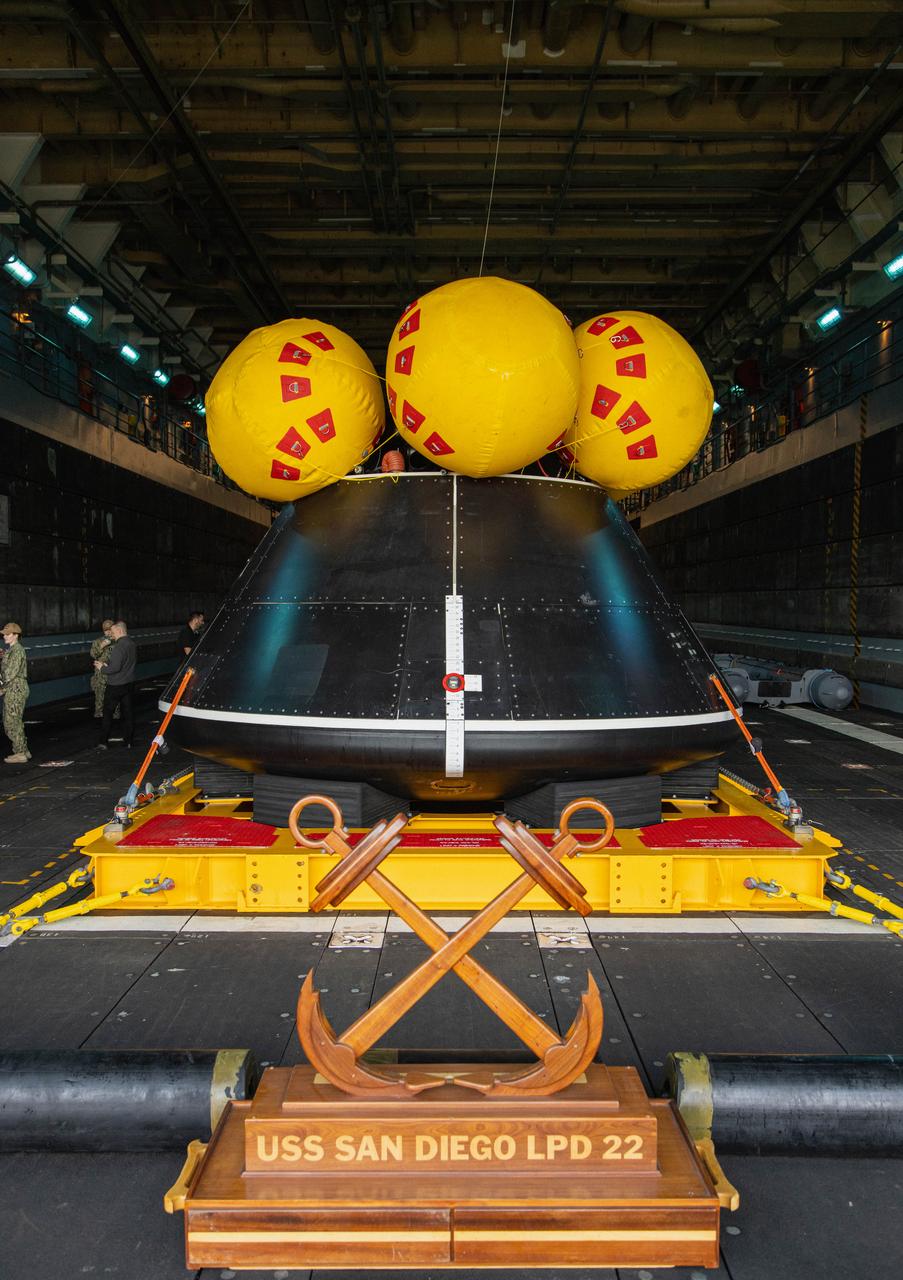
The mockup of the NASA Orion spacecraft sits aboard the USS San Diego on Wednesday Feb. 28, 2024, following the completion of the Underway Recovery Test (URT-11). URT-11, aboard the USS San Diego, is the eleventh in a series of Artemis recovery tests, and the first time NASA and its partners put their Artemis II recovery procedures to the test with the astronauts.
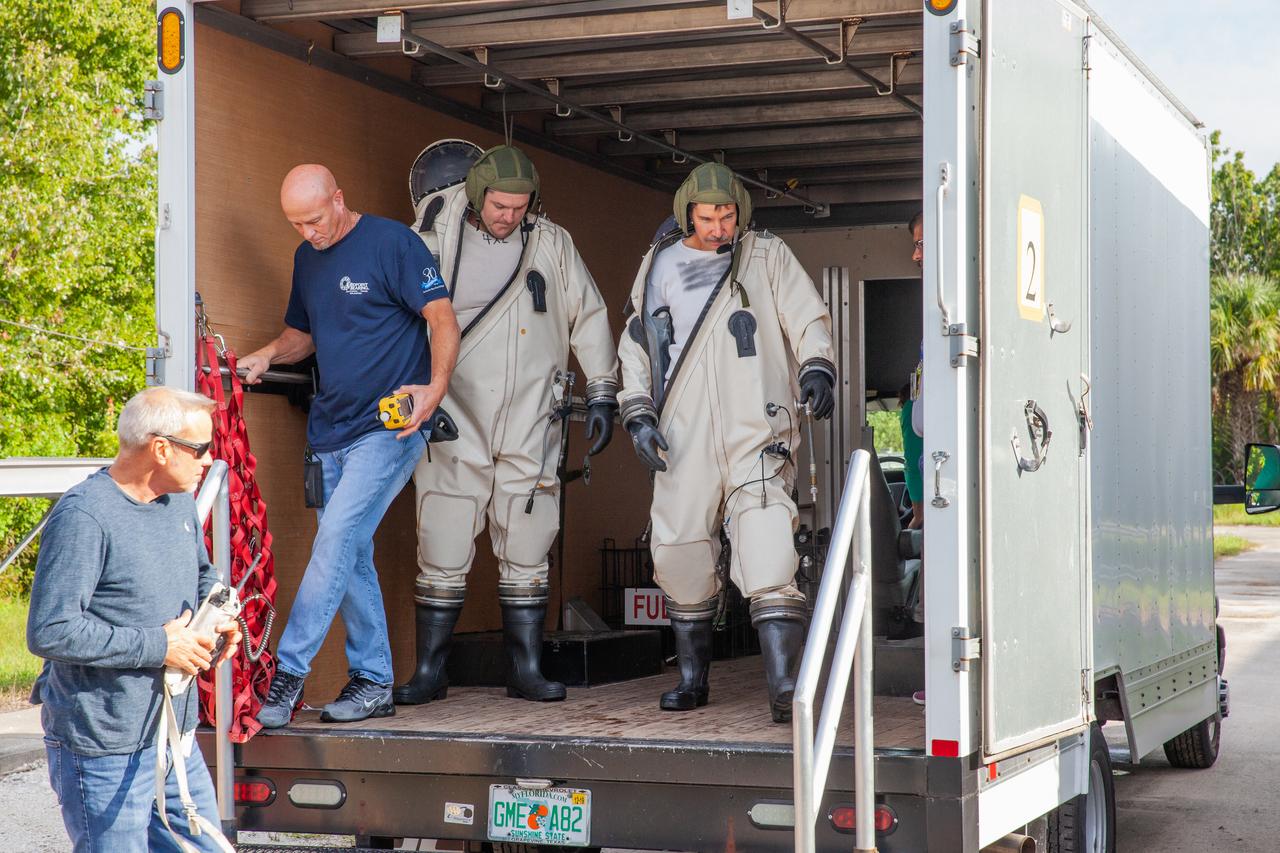
Technicians in Self-Contained Atmospheric Protective Ensemble (SCAPE) suits exit a truck near the Multi-Payload Processing Facility (MPPF) at NASA’s Kennedy Space Center in Florida, for a test simulation of loading propellants into a replicated test tank for Orion on Aug. 16, 2019. Exploration Ground Systems is preparing for Artemis 1 with a series of hazardous hyper test events at the MPPF. The technicians will complete a tanking to test the system before Orion arrives for processing. During preparations for launch, these teams will be responsible for loading the Orion vehicle with propellants prior to transportation to the Vehicle Assembly Building, where it will be secured atop the Space Launch System rocket. SCAPE suits are used in operations involving toxic propellants and are supplied with air either through a hardline or through a self-contained environmental control unit.
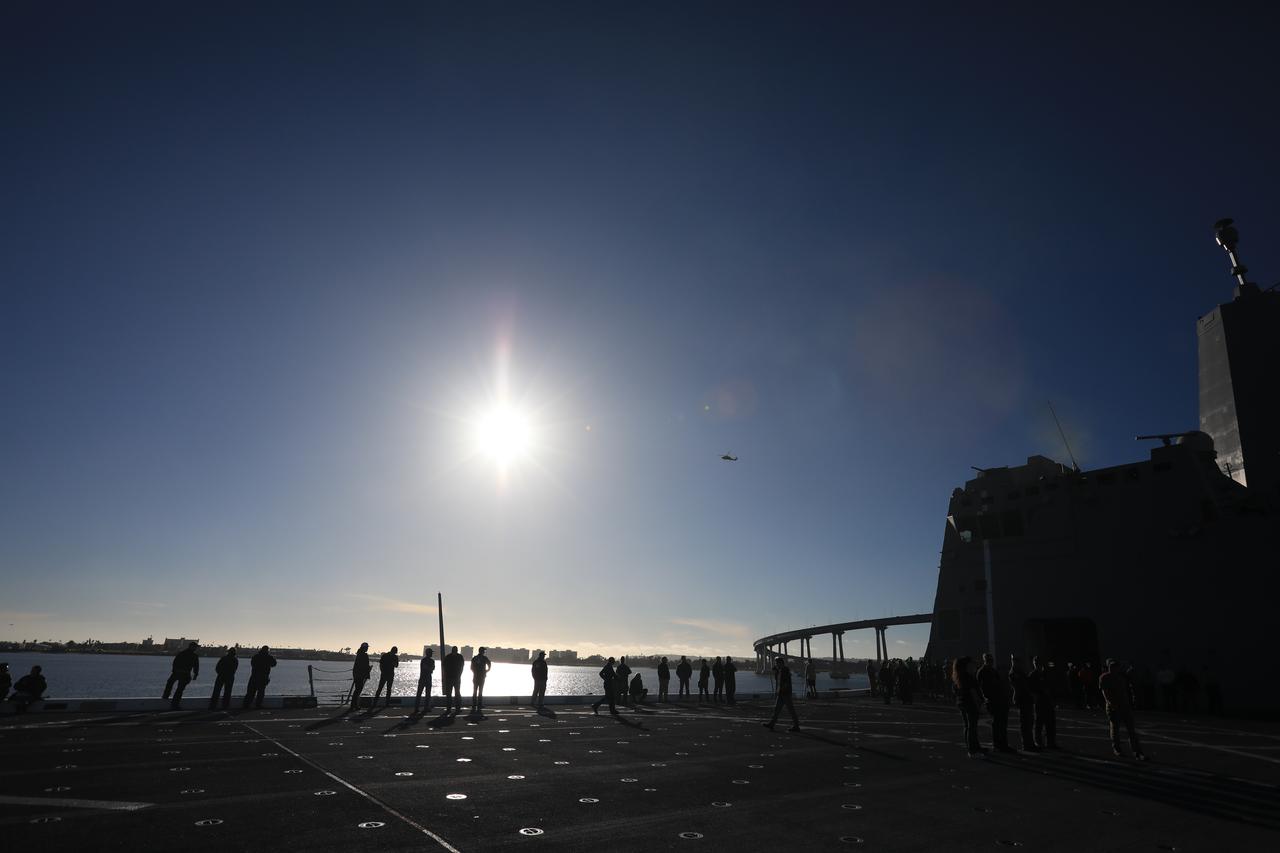
Members of NASA’s Exploration Ground System’s Landing and Recovery team and partners from the Department of Defense aboard the USS San Diego participate in a ship rider briefing on the flight deck prior to departure from Naval Base San Diego on Feb. 21. During this test campaign, teams will practice recovery procedures using the Crew Module Test Article, during Underway Recovery Test 11 (URT-11) off the coast of San Diego. URT-11 is the eleventh in a series of Artemis recovery tests, but the first time NASA and its partners from the Department of Defense put their Artemis II recovery procedures to the test with the astronauts.

Inside the Space Life Sciences Lab at NASA’s Kennedy Space Center in Florida, researchers plant pepper seeds in a science carrier on April 8, 2021, in preparation for the Plant Habitat-04 (PH-04) experiment. The seeds will fly to the International Space Station on SpaceX’s 22nd Commercial Resupply Services (CRS-22) mission. When the experiment starts, astronauts will grow the pepper seeds in the Advanced Plant Habitat (APH) growth chamber, which will monitor the experiment with more than 180 sensors. The astronauts will observe plant growth for about four months and conduct two harvests to study whether microgravity affects growth, flavor, or texture. Since peppers take longer to germinate, grow, and develop than previous crops grown in space, the PH-04 experiment also will test the durability and reliability of the various systems within the APH.
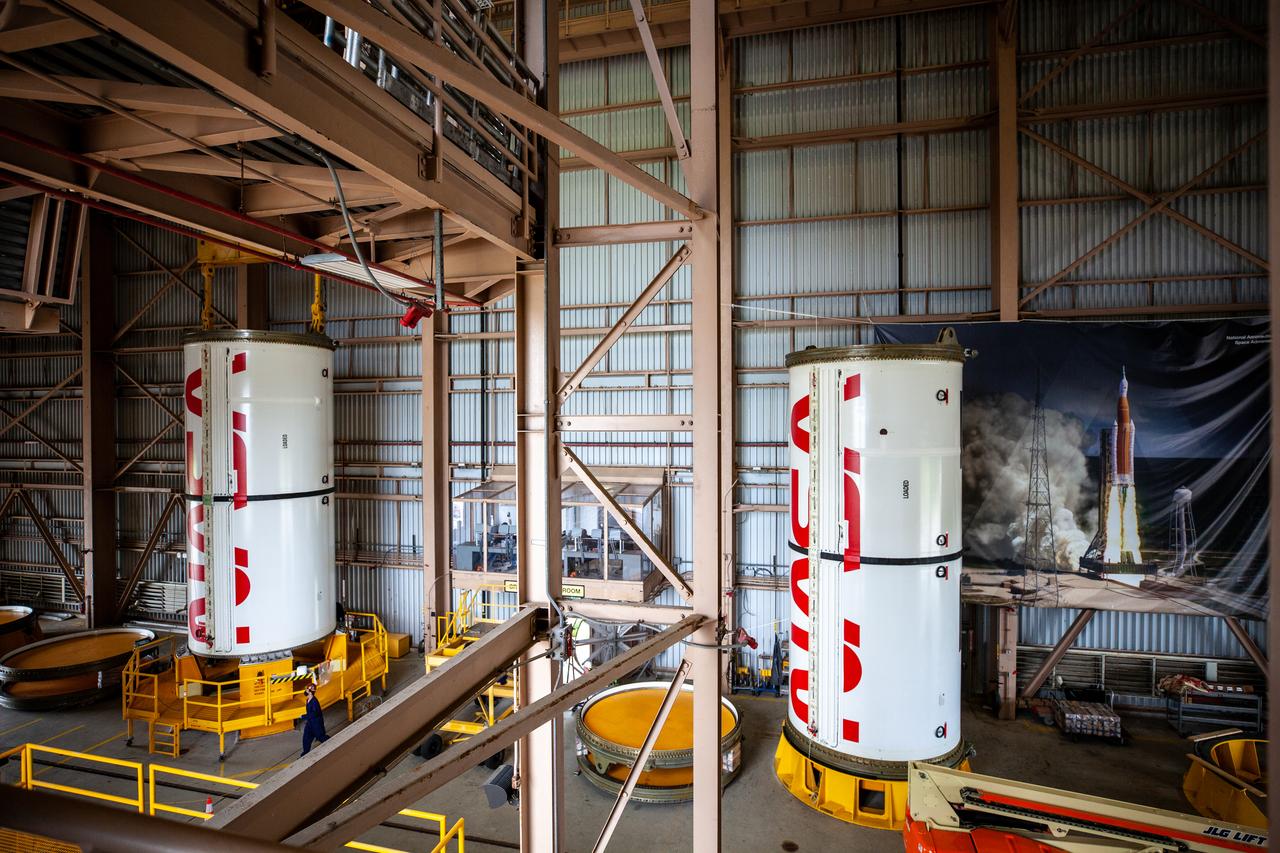
Inside the Rotation, Processing and Surge Facility at NASA’s Kennedy Space Center in Florida, Exploration Ground Systems and Jacobs TOSC workers completed painting of NASA’s iconic “worm” logo on the Artemis I Space Launch System twin solid rocket boosters on Sept. 23, 2020. Originally created by the firm of Danne & Blackburn, the iconic “worm” logo’s bold, sleek design was officially introduced in 1975 and was incorporated into many of the agency’s next-generation programs. It was retired in 1992, but has made a comeback in 2020 as the agency ushers in a new, modern era of human spaceflight. The first in a series of increasingly complex missions, Artemis I will test the Orion spacecraft and Space Launch System as an integrated system ahead of crewed flights to the Moon. Under the Artemis program, NASA will land the first woman and the next man on the Moon by 2024.
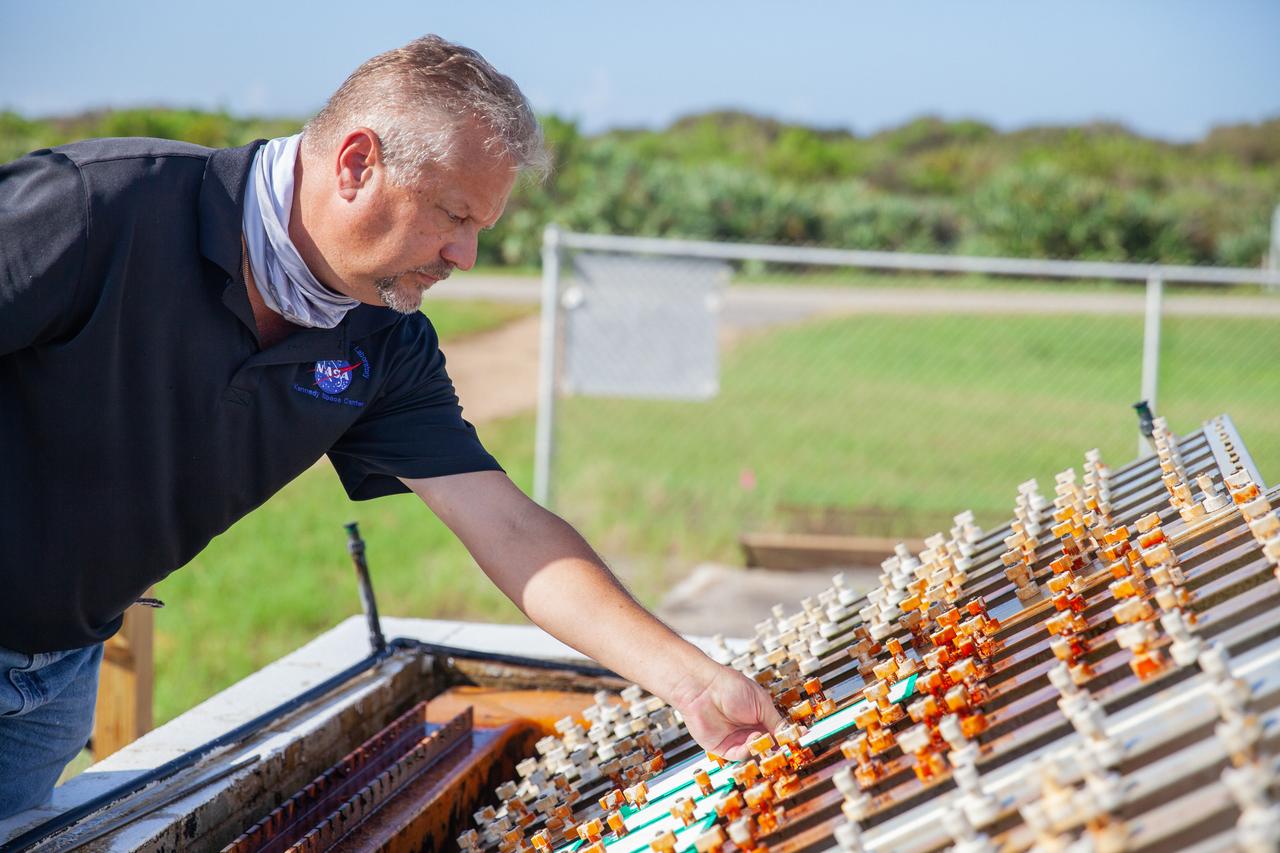
A Mechanical and Environmental Testing Lab engineer examines samples at the corrosion engineering test site on Oct. 6, 2020, at NASA’s Kennedy Space Center in Florida. The corrosion lab is a network of people, equipment, and facilities that provides engineering services and technical innovations in all areas of corrosion for NASA and external customers.
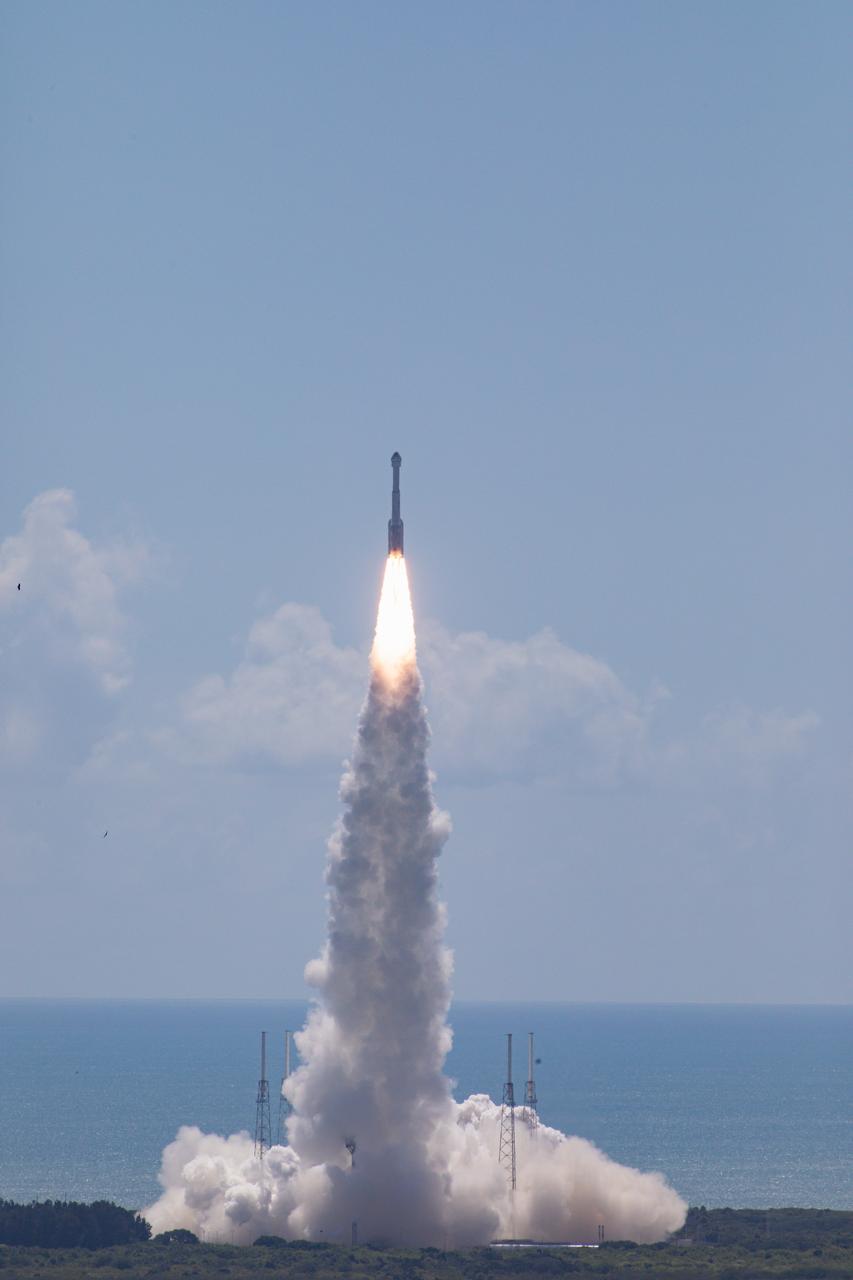
A United Launch Alliance Atlas V rocket carrying a Boeing Starliner spacecraft launches NASA’s Boeing Crew Flight Test with NASA astronauts Butch Wilmore and Suni Williams aboard at 10:52 a.m. EDT Wednesday, June 5, 2024, from Space Launch Complex-41 at Cape Canaveral Space Force Station in Florida. Wilmore and Williams are the first to launch aboard Boeing’s Starliner spacecraft to the International Space Station as part of the agency’s Commercial Crew Program.
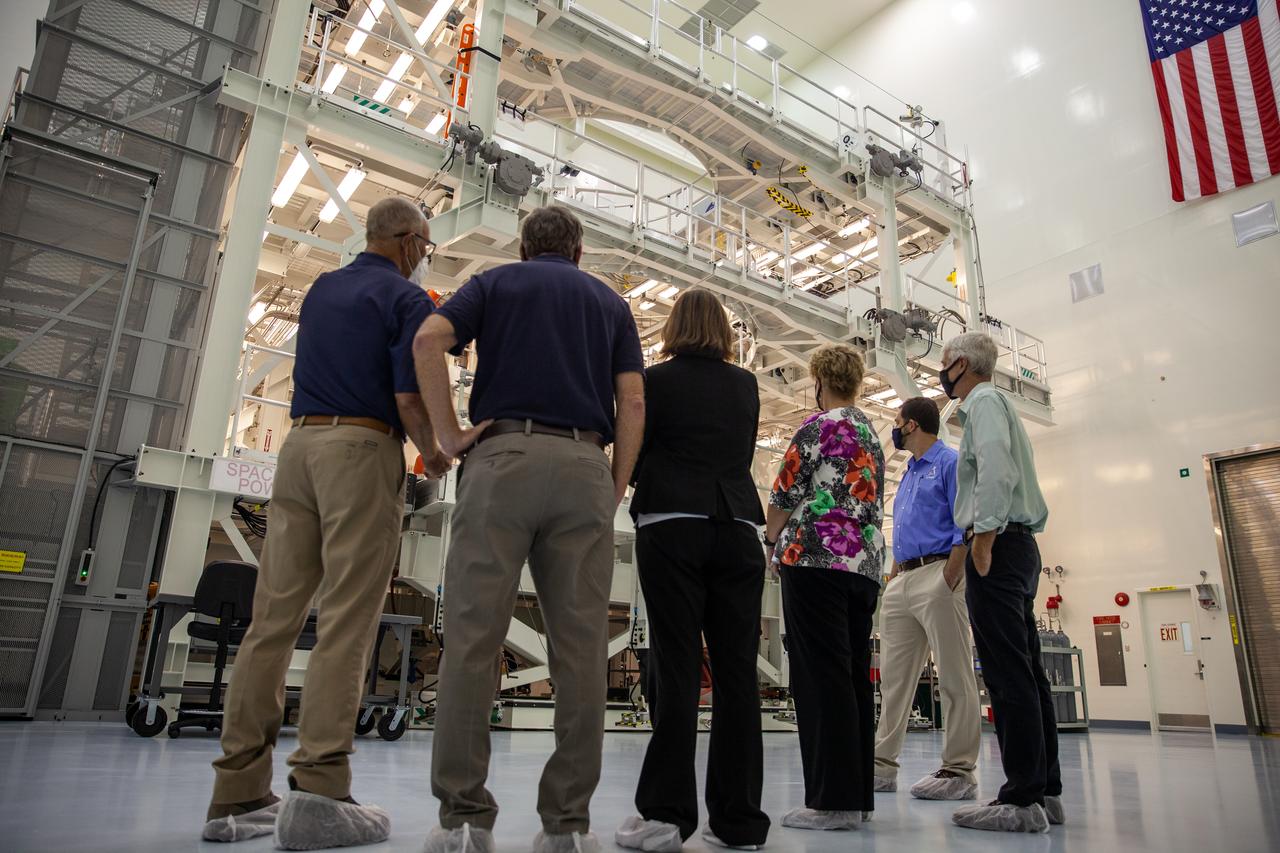
Catherine Koerner, third from left, NASA Orion Program manager, along with senior managers from Orion, and Exploration Ground Systems (EGS), visits the Multi-Payload Processing Facility (MPPF) at NASA’s Kennedy Space Center in Florida on Oct. 5, 2020. Accompanying her, from left are Skip Williams, operations manager for the MPPF spacecraft offline element integration team; Mike Bolger, EGS manager; Annette Hasbrook, Orion Program assistant manager; Scott Wilson, Orion Production Operations manager; and Jeremy Parsons, EGS deputy manager. Koerner viewed spacecraft hardware and processing facilities for the Artemis I and II missions. The first in a series of increasingly complex missions, Artemis I will test the Orion spacecraft and Space Launch System as an integrated system ahead of crewed flights to the Moon. Under the Artemis program, NASA will land the first woman and the next man on the Moon in 2024.

A researcher from NASA’s Kennedy Space Center in Florida prepares pepper seeds for planting inside science carriers on April 8, 2021, inside the Space Life Sciences Lab for the Plant Habitat-04 (PH-04) experiment. The seeds will fly to the International Space Station on SpaceX’s 22nd Commercial Resupply Services (CRS-22) mission. When the experiment starts, astronauts will grow the pepper seeds in the Advanced Plant Habitat (APH) growth chamber, which will monitor the experiment with more than 180 sensors. The astronauts will observe plant growth for about four months and conduct two harvests to study whether microgravity affects growth, flavor, or texture. Since peppers take longer to germinate, grow, and develop than previous crops grown in space, the PH-04 experiment also will test the durability and reliability of the various systems within the APH.

Inside the lobby of the Neil Armstrong Operations and Checkout Building at NASA’s Kennedy Space Center in Florida, Snoopy, the zero-gravity indicator that flew aboard Orion during the Artemis I mission, is shown on Jan. 5, 2023, after being unpacked from his transport case. Snoopy was secured inside Orion during the Artemis I mission, a journey beyond the Moon and back to prepare for crewed missions to the Moon. Artemis I launched atop the Space Launch System rocket on Nov. 16, 2022 from Kennedy’s Launch Complex 39B. Orion returned to Earth for a splashdown in the Pacific Ocean on Dec. 11, 2022 after traveling more than 1.4 million miles. NASA has held an association with Snoopy since the Apollo Era – the character has contributed to the excitement for NASA human spaceflight missions, helping inspire generations to dream big, and is a symbol of NASA’s safety culture and mission success.
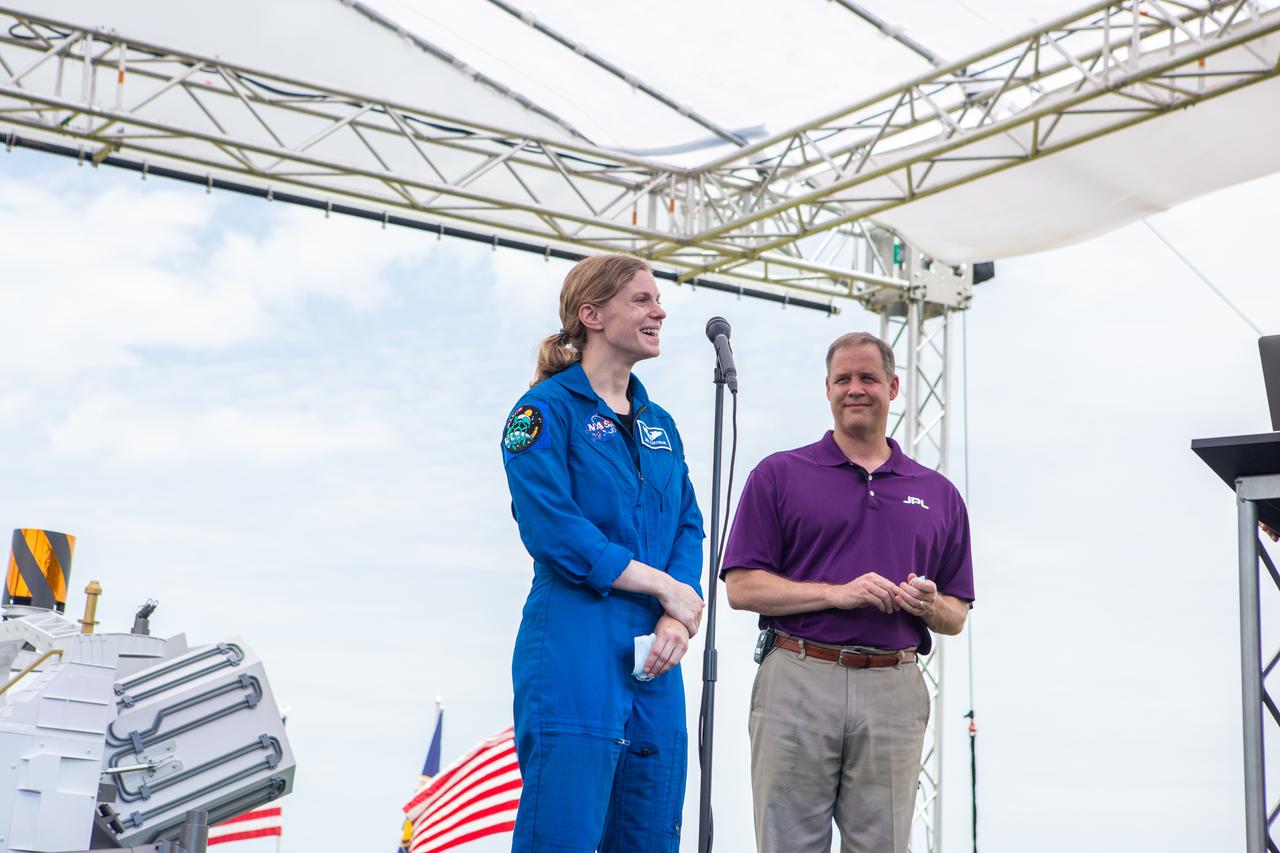
NASA astronaut Zena Cardman answers a question during a Mars 2020 NASA Social at Kennedy Space Center’s News Center in Florida on July 29, 2020. At right is NASA Administrator Jim Bridenstine. The Mars Perseverance rover and Ingenuity helicopter are scheduled to launch July 30, on a United Launch Alliance Atlas V 541 rocket from Space Launch Complex 41 at nearby Cape Canaveral Air Force Station. The rover is part of NASA’s Mars Exploration Program, a long-term effort of robotic exploration of the Red Planet. The rover will search for habitable conditions in the ancient past and signs of past microbial life on Mars. The Launch Services Program at Kennedy is responsible for launch management.
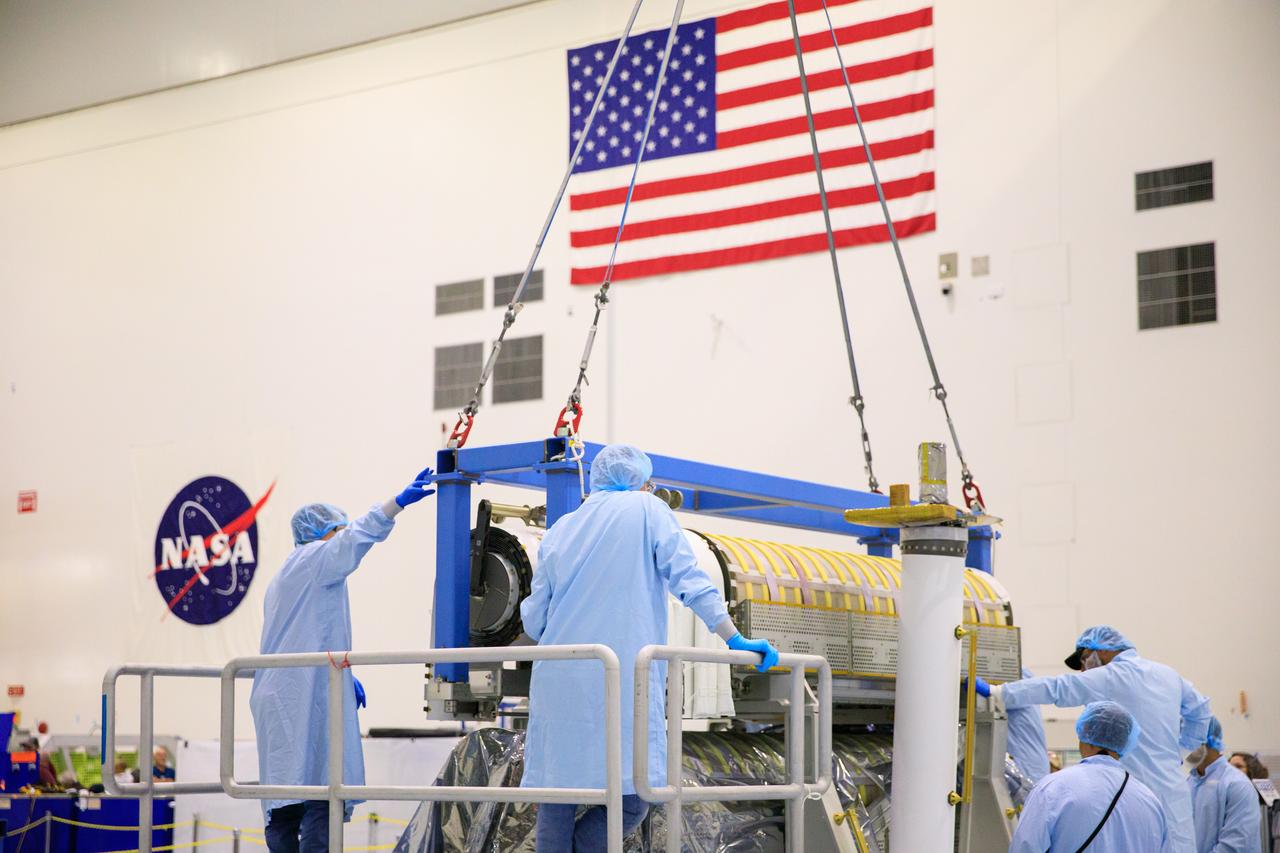
Inside the Space Station Processing Facility high bay at NASA's Kennedy Space Center in Florida, technicians assist as a crane is used to lower a set of International Space Station Roll Out Solar Arrays (iROSA) onto a platform on March 23, 2023. They are being prepared for delivery to the space station aboard SpaceX’s Dragon cargo carrier on the company’s 28th commercial resupply services (CRS-28) mission to the space station. iROSA is a new type of solar panel that rolls open in space and is more compact than current rigid panel designs.