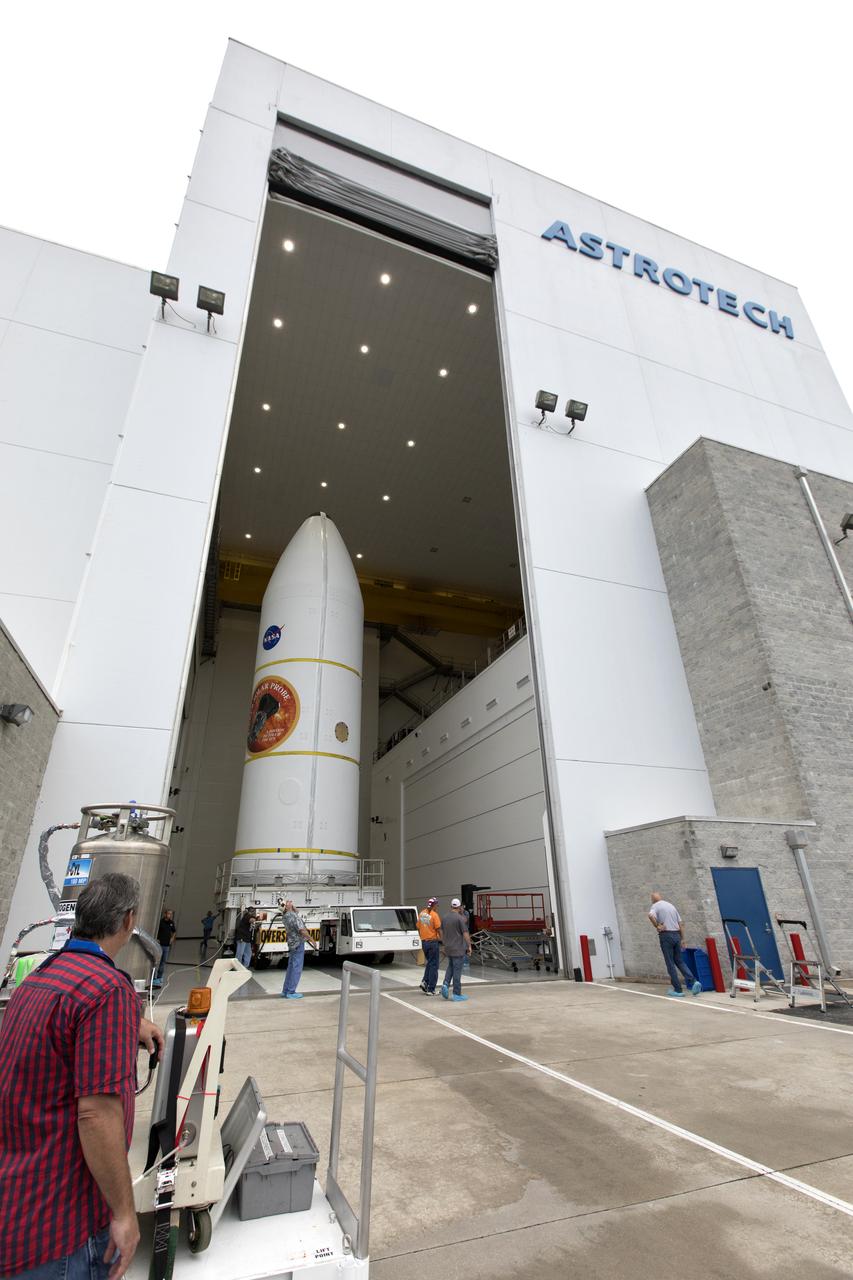
Encapsulated in its payload fairing, NASA's Parker Solar Probe is transported out of the Astrotech processing facility in Titusville, Florida, near the agency's Kennedy Space Center, on Monday, July 30, 2018. The spacecraft is beginning a trek to Space Launch Complex 37 at Cape Canaveral Air Force Station where it will be mated atop a United Launch Alliance Delta IV Heavy rocket. The mission will perform the closest-ever observations of a star when it travels through the Sun's atmosphere, called the corona. The probe will rely on measurements and imaging to revolutionize our understanding of the corona and the Sun-Earth connection.
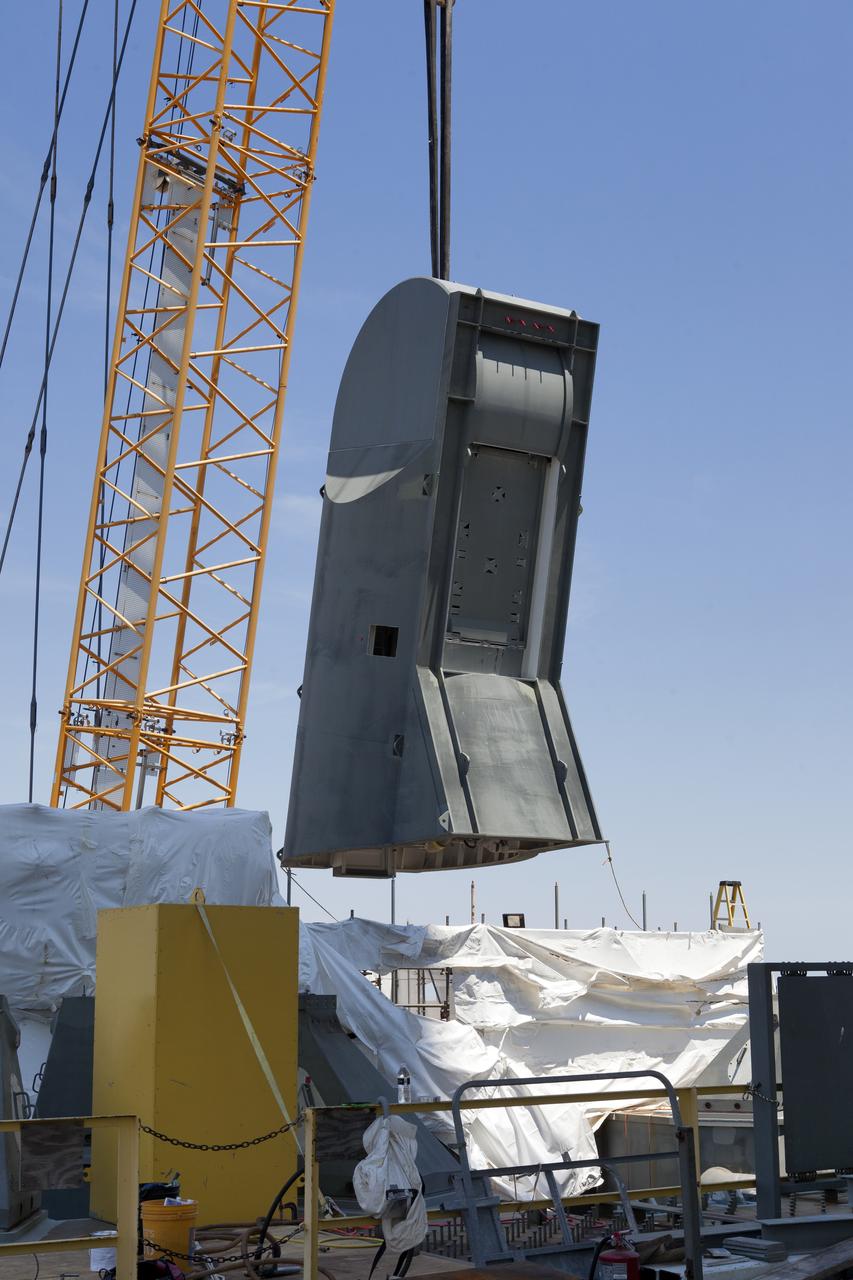
A crane is used to lift up the first of two Tail Service Mast Umbilicals for installation on the 0-level deck of the mobile launcher on July 12, at NASA's Kennedy Space Center in Florida. The 35-foot-tall umbilical will connect to NASA's Space Launch System rocket core stage aft section and provide liquid oxygen and electrical cable connections to the core stage engine section to support propellant handling during prelaunch operations. The installation brings Exploration Ground Systems one step closer to supporting prelaunch operations for the agency's SLS rocket and Orion spacecraft on Exploration Mission-1 and deep space destinations.
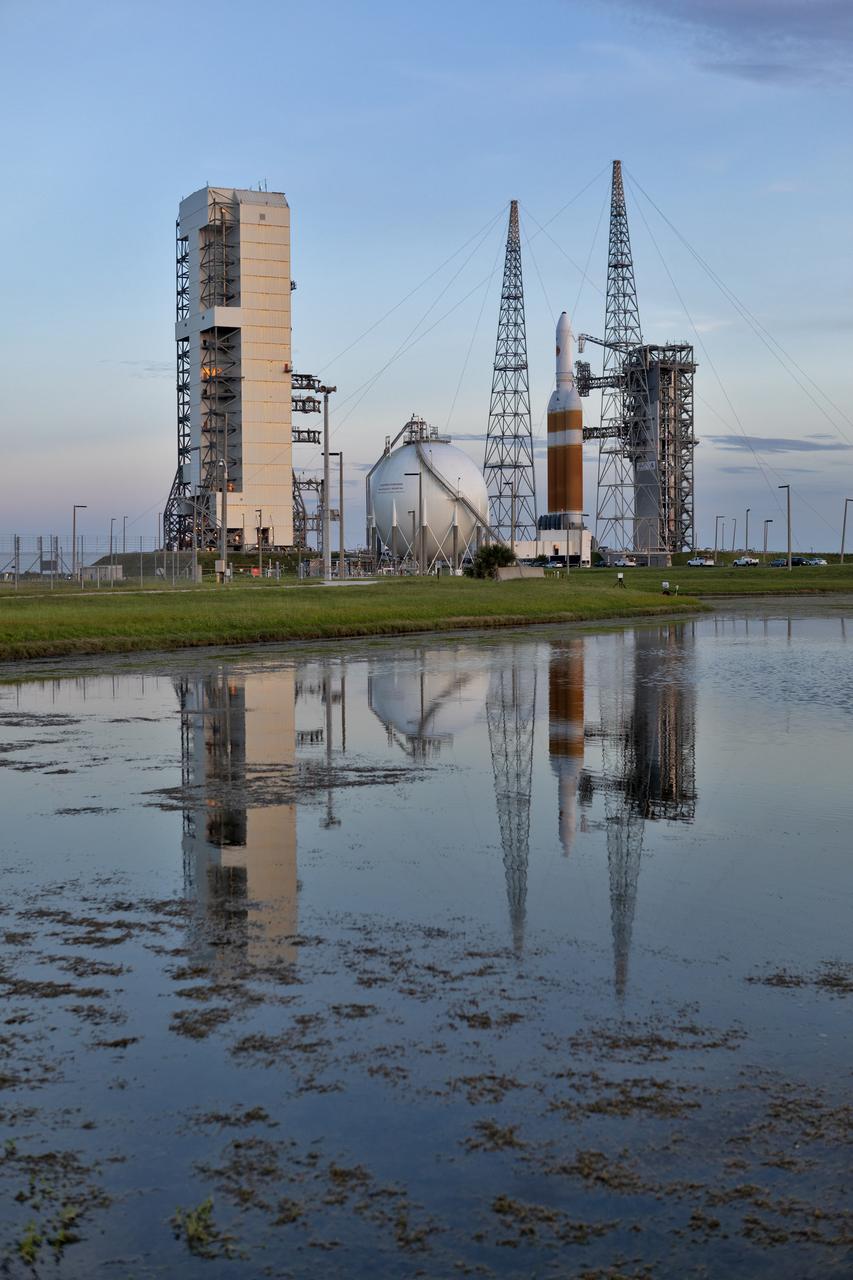
On Friday, Aug. 10, 2018, at Cape Canaveral Air Force Station in Florida, the United Launch Alliance Delta IV Heavy rocket that will boost NASA's Parker Solar Probe is reflected in a nearby pond during rollback of the Mobile Service Tower gantry at Space Launch Complex 37. Parker Solar Probe will perform the closest-ever observations of a star when it travels through the Sun's atmosphere, called the corona. The probe will rely on measurements and imaging to revolutionize our understanding of the corona and the Sun-Earth connection.
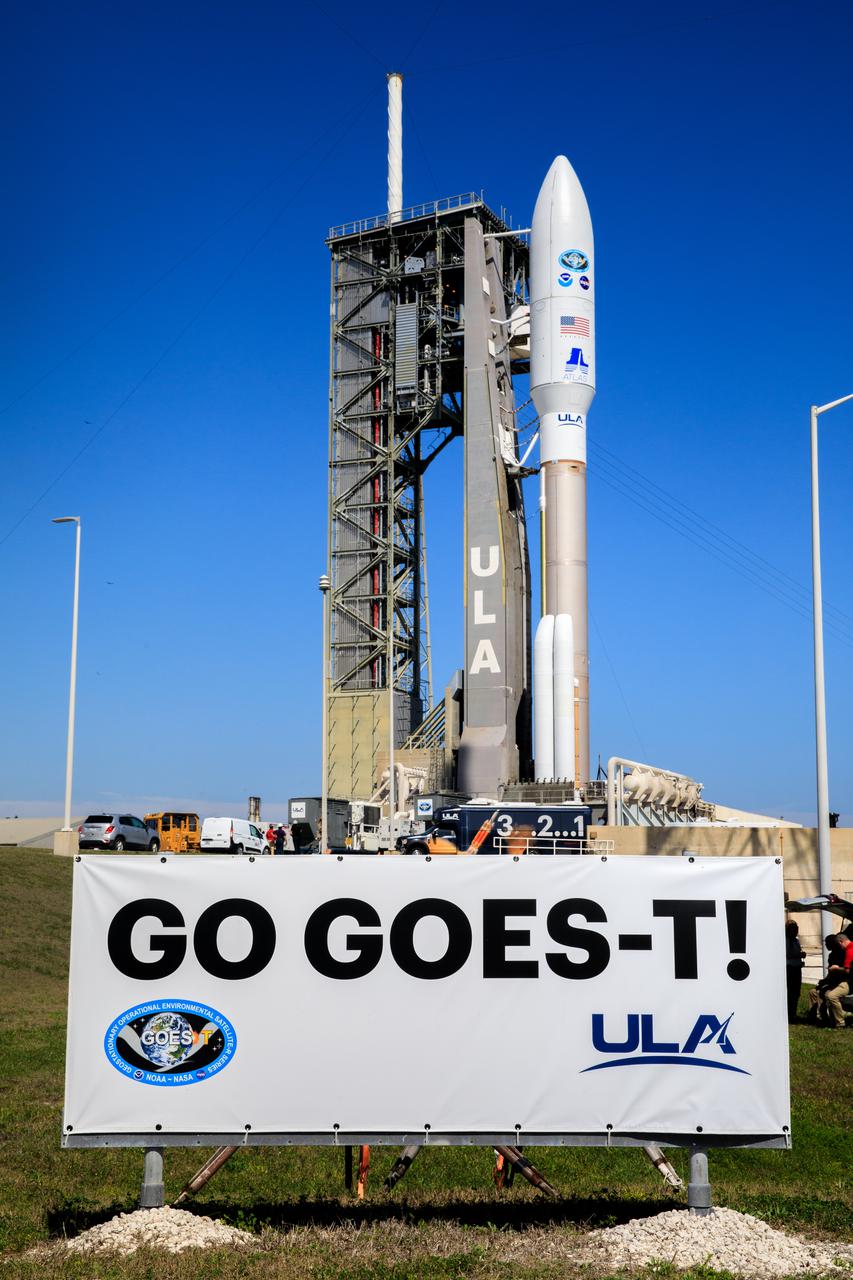
A United Launch Alliance Atlas V 541 rocket carrying the National Oceanic and Atmospheric Administration’s (NOAA) Geostationary Operational Environmental Satellite-T (GOES-T), is secured on the pad at Space Launch Complex 41 at Cape Canaveral Space Force Station in Florida on Feb. 28, 2022. GOES-T will lift off atop the Atlas V from SLC-41 on March 1, 2022, at 4:38 p.m. GOES-T is the third satellite in the GOES-R series that will continue to help meteorologists observe and predict local weather events that affect public safety. GOES-T will be renamed GOES-18 once it reaches geostationary orbit. GOES-18 will go into operational service as GOES West to provide critical data for the U.S. West Coast, Alaska, Hawaii, Mexico, Central America, and the Pacific Ocean. The launch is managed by NASA’s Launch Services Program based at Kennedy Space Center in Florida, America’s multi-user spaceport.
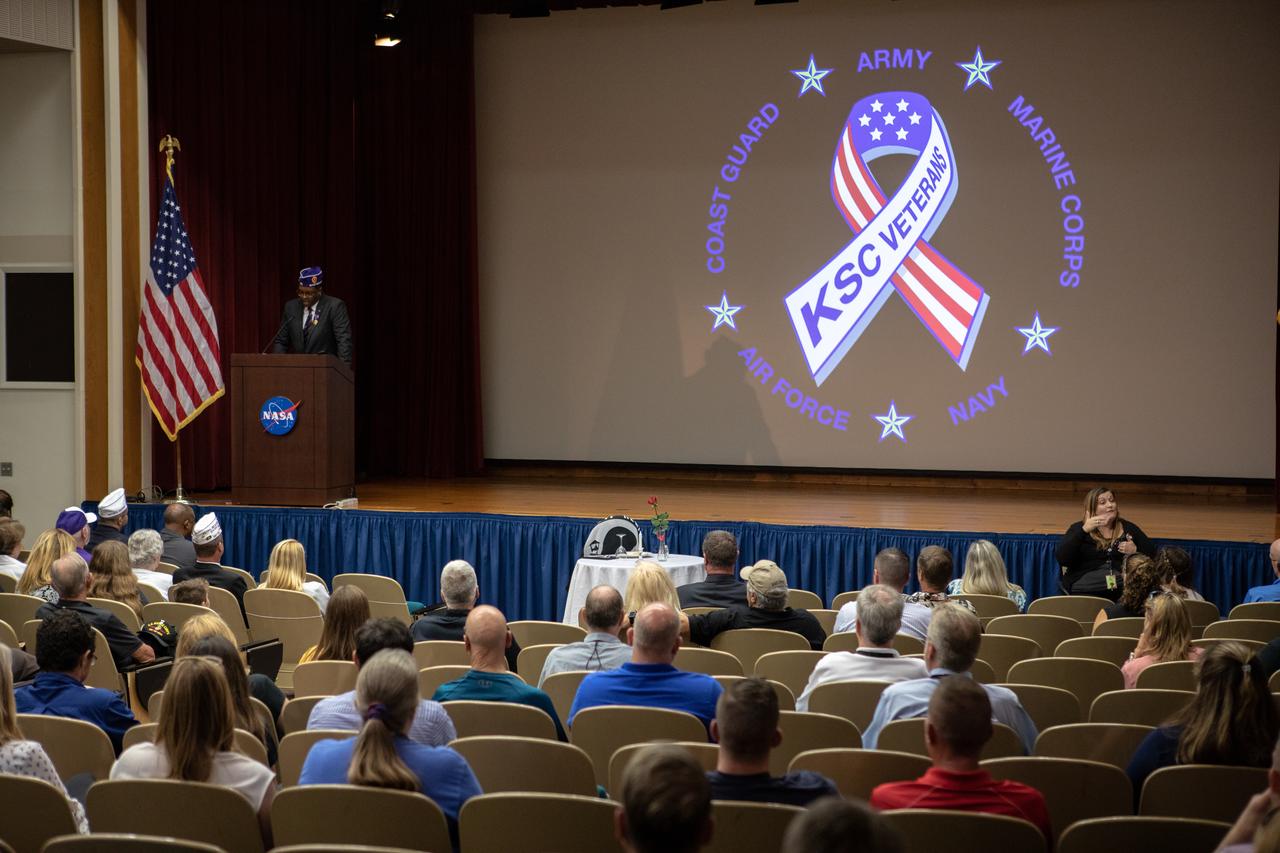
NASA Public Affairs Officer Derrick Matthews serves as emcee during a Veterans Day observance event on Nov. 7, 2019, at the Kennedy Space Center Training Auditorium in Florida. During the event, Kennedy was named a Purple Heart Entity by the Military Order of the Purple Heart, becoming the first NASA center to receive this designation for support and services provided to veterans through the spaceport’s Veterans employee resource group. Attendees included Kennedy employees and more than 20 Purple Heart recipients. Following the award presentation, Christopher Vedvick, a combat wounded veteran and Military Order of the Purple Heart department of Florida commander, spoke about his experience serving in the United States Army before retiring, his involvement in the Military Order of the Purple Heart and the purpose of the organization.
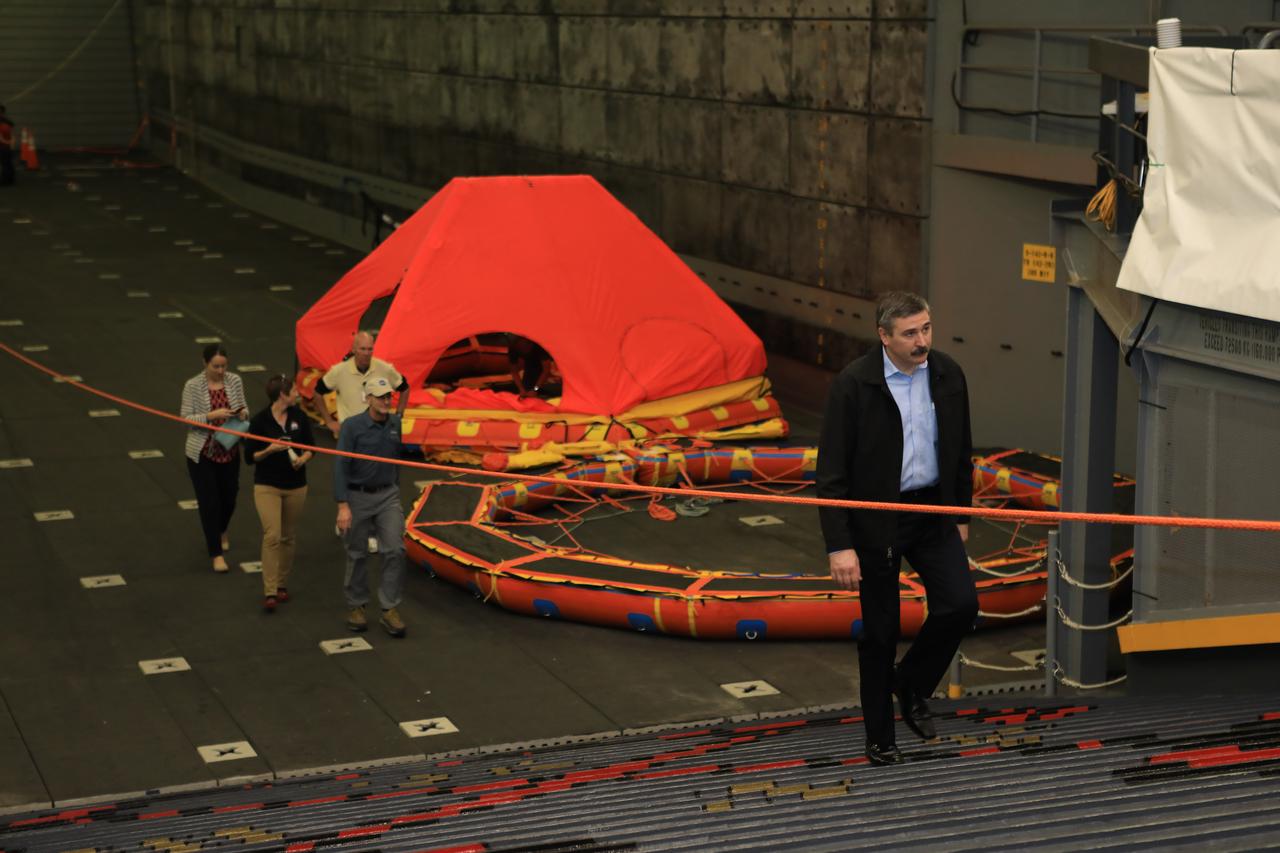
Exploration Mission-1 Mission Manager Mike Sarafin and other senior leaders from around NASA received a familiarization tour by the Exploration Ground Systems (EGS) recovery team on Oct. 29, 2018, as they prepare for Underway Recovery Test-7 (URT-7) on a U.S. Navy ship. EGS and the U.S. Navy will use a test version of the Orion crew module, several rigid hull inflatable boats and support equipment to verify and validate processes, procedures, hardware and personnel during recovery of Orion in open waters. URTs are a series of tests to ensure all systems are go when recovering the Orion crew capsule and astronauts onboard in the future. Orion will have emergency abort capability, sustain the crew during space travel and provide safe re-entry from deep space return velocities.

NASA Kennedy Space Center Deputy Director Janet Petro participates in a virtual town hall meeting on Aug. 20, 2020, inside the Florida spaceport’s Press Site auditorium. During the town hall, Kennedy’s senior leaders answered questions submitted by the workforce and discussed a wide range of topics, including upcoming milestones, updates on the criteria for returning to onsite work, and diversity and inclusion at the multi-user spaceport.

NASA Kennedy Space Center workers enjoy Hispanic food at KARS Park II during an event to celebrate Hispanic Heritage Month on Oct. 17, 2019. The event was hosted by the center’s Hispanic Outreach and Leadership Alliance (HOLA) employee resource group for Hispanic Heritage Month. This year’s theme is “Hispanic Americans: A History of Serving our Nation.” HOLA’s initiatives include education and recruitment, professional networking and development, and community outreach and media support.
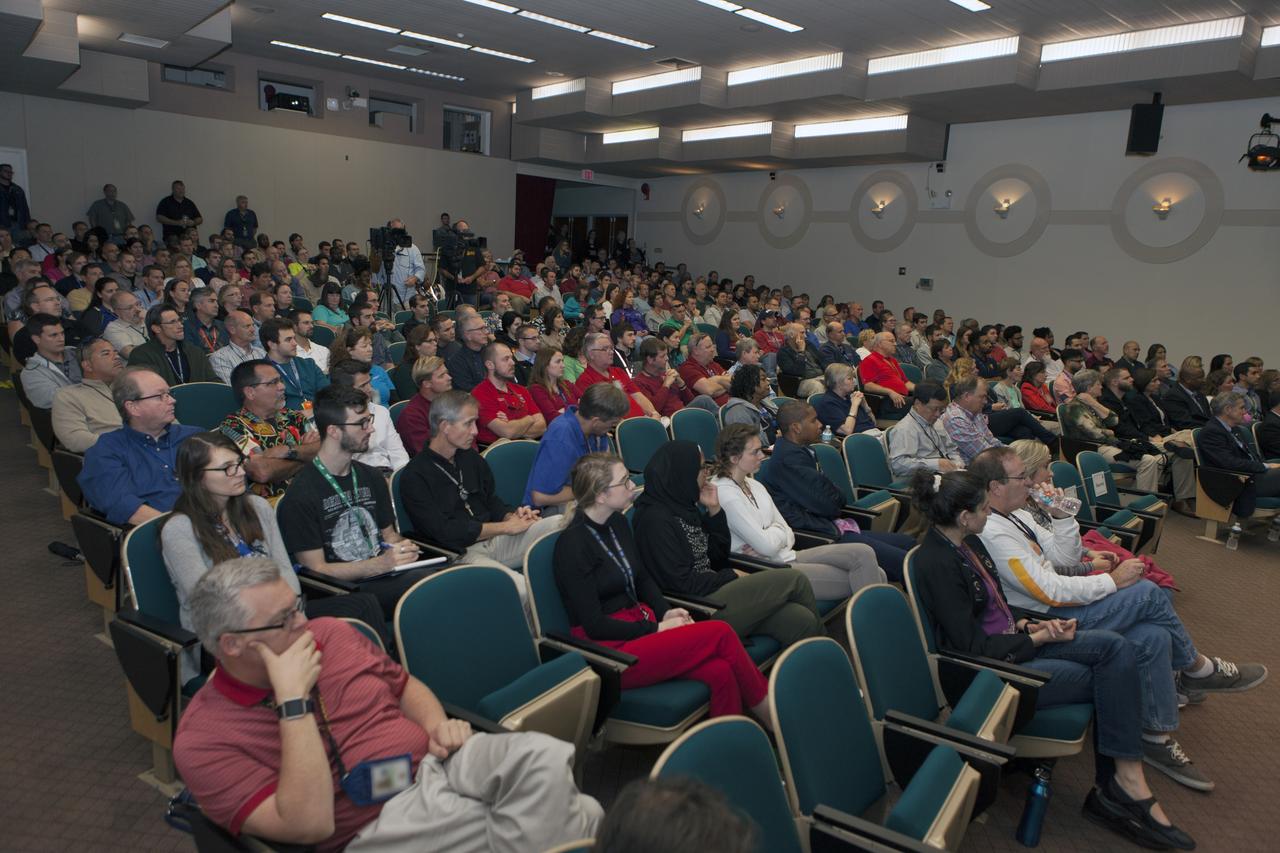
Employees listen intently during an Apollo, Challenger, Columbia Lessons Learned Program event in the Training Auditorium at NASA's Kennedy Space Center in Florida. The program's theme was "Columbia: Lessons and Legends of Recovery." Kennedy Center Director Bob Cabana moderated a panel discussion featuring guests with connections to Columbia and recovery efforts.

A photon demonstration was conducted in front of news media and social media participants during a prelaunch mission briefing for NASA's Ice, Cloud and land Elevation Satellite-2 (ICESat-2), a mission to measure the changing height of Earth's ice, on Sept. 13, 2018 at Vandenberg Air Force Base (VAFB) in California. ICESat-2 will launch aboard a United Launch Alliance Delta II, the rocket’s final mission, from Space Launch Complex 2 at VAFB. Launch is scheduled for 8:46 a.m. EDT (5:46 a.m. PDT). The satellite will measure the height of our changing Earth, one laser pulse at a time, 10,000 laser pulses per second. ICESat-2 will provide scientists with height measurements that create a global portrait of Earth's third dimension, gathering date that can precisely track changes of terrain, including glaciers, sea ice and forests.
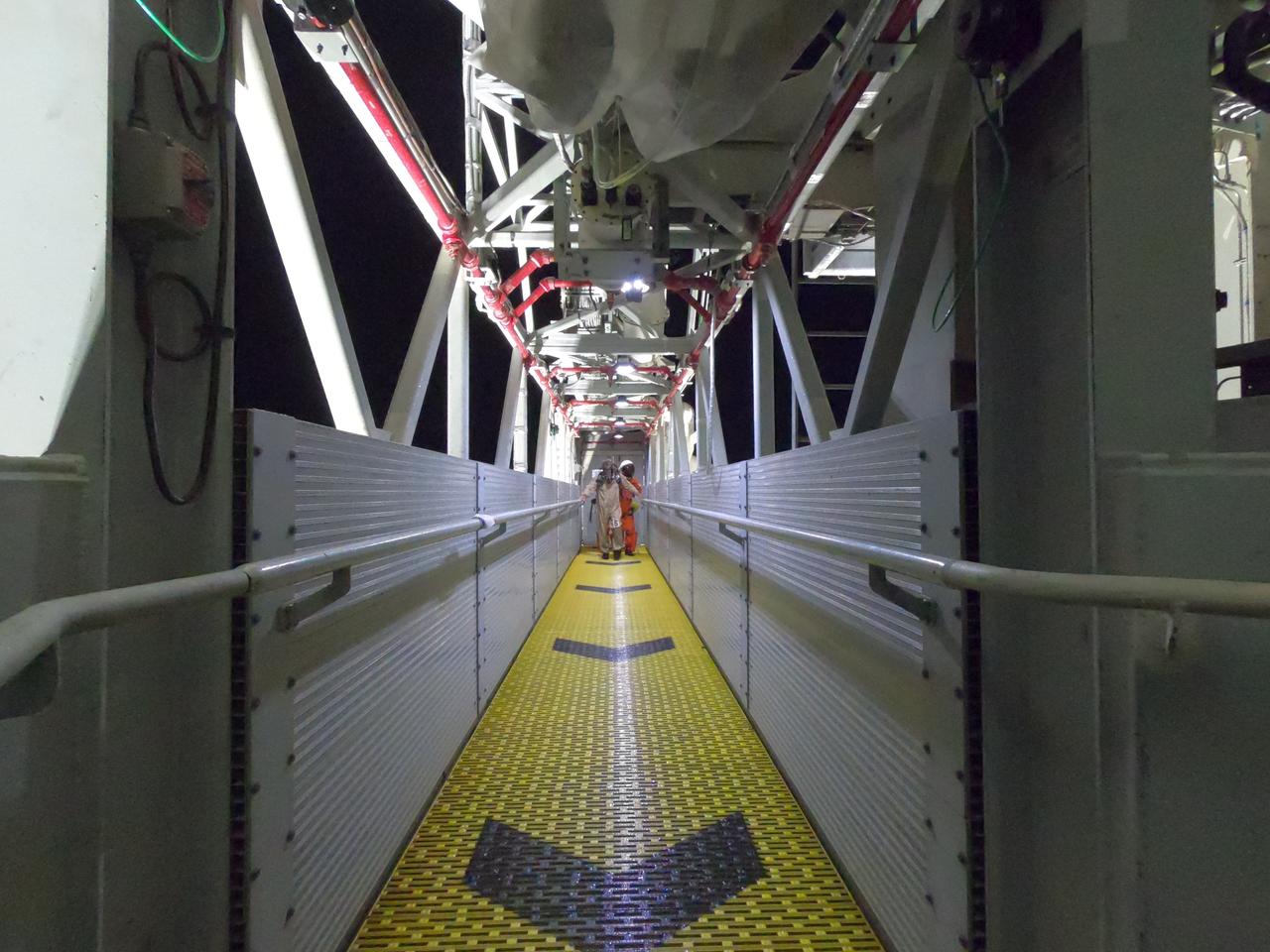
Teams at NASA’s Kennedy Space Center in Florida practice the Artemis mission emergency escape or egress procedures during a series of integrated system verification and validation tests at Launch Pad 39B on Tuesday, Aug. 13, 2024. Members of the closeout crew, pad rescue team, and the Exploration Ground Systems Program – who also suited up as astronauts – practiced the process of getting inside and out of the emergency egress baskets. While the crew and other personnel will ride the emergency egress baskets to the terminus area in a real emergency, no one rode the baskets for this test. Instead, teams tested the baskets during separate occasions by using water tanks filled to different levels to replicate simulate the weight of passengers.

Members of the media get an up-close look at the SLS (Space Launch System) rocket core stage for Artemis II inside the Vehicle Assembly Building at NASA’s Kennedy Space Center in Florida during Artemis Media Day on Friday, March 7, 2025. The core stage has two giant propellant tanks that collectively hold more than 733,000 gallons of super cold liquid propellant to feed the stage’s four RS-25 engines to help send astronauts inside NASA’s Orion spacecraft to venture around the Moon for Artemis II.
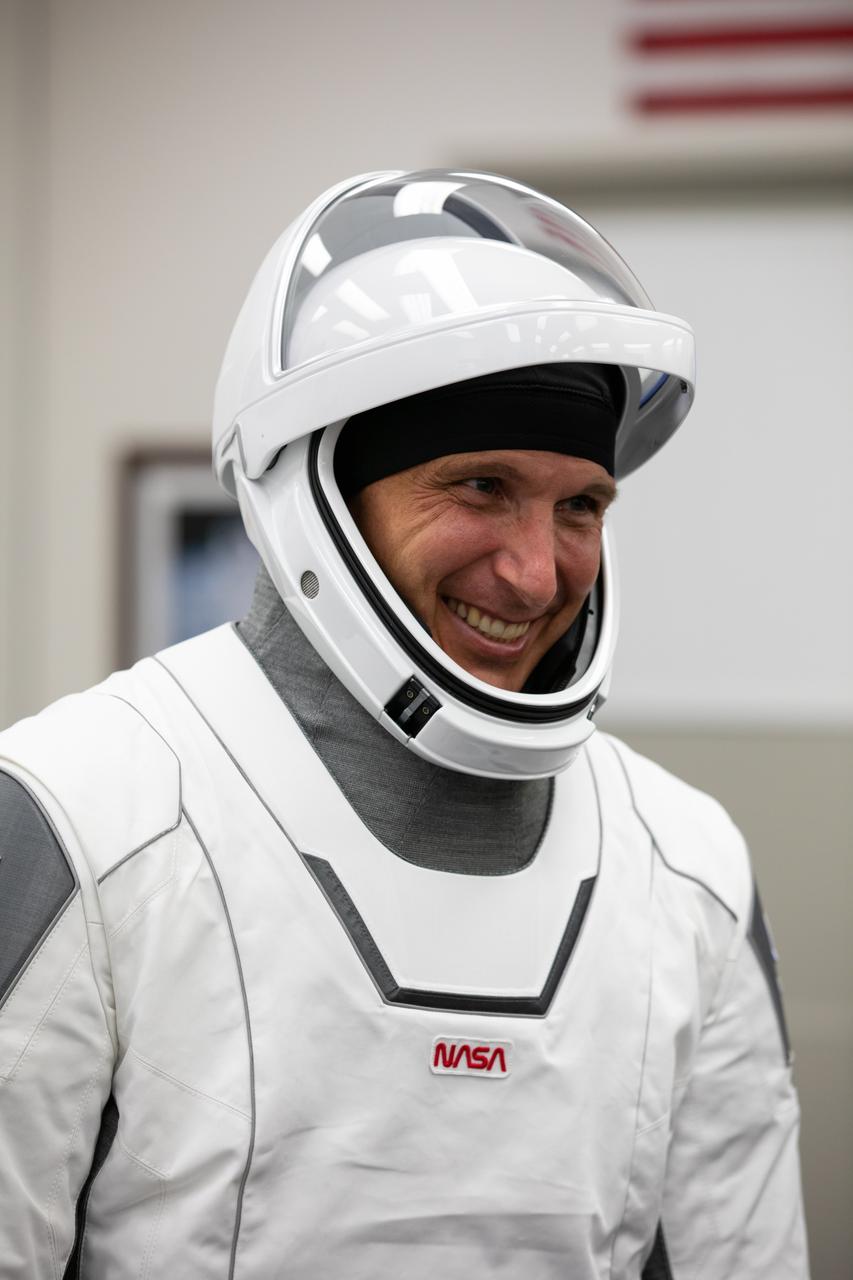
Inside the crew suit-up room in the Neil Armstrong Operations and Checkout Building at NASA’s Kennedy Space Center in Florida, on Nov. 15, 2020, NASA astronaut Michael Hopkins, spacecraft commander, is shown in a SpaceX spacesuit in preparation for NASA SpaceX’s Crew-1 mission. Crew-1 is the first regular crew mission of a U.S. commercial spacecraft with astronauts to the International Space Station as part of NASA’s Commercial Crew Program. The SpaceX Crew Dragon Resilience capsule will launch atop the company’s Falcon 9 rocket from Launch Complex 39A to the space station for a six-month science mission.
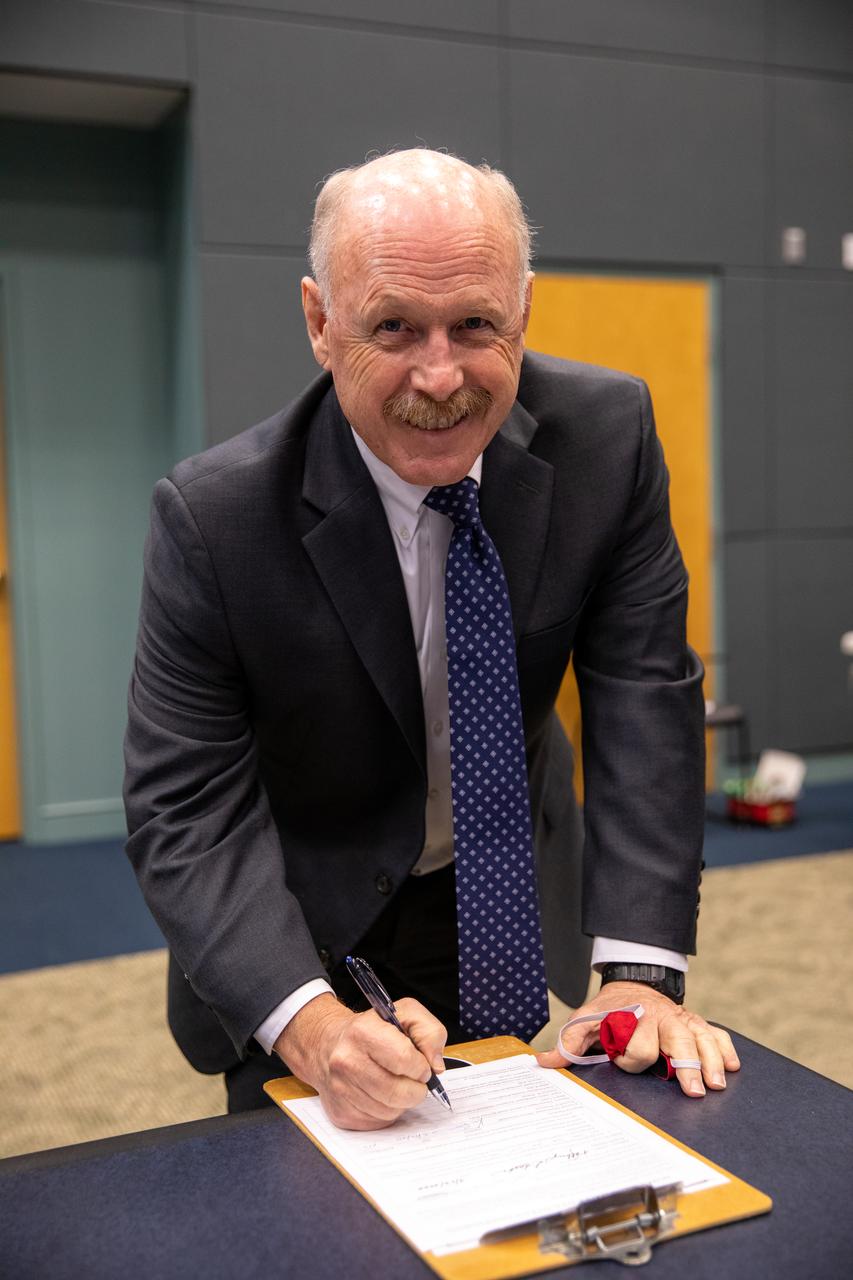
On May 22, 2020, inside the Operations Support Building II at NASA’s Kennedy Space Center in Florida, Kenneth Bowersox, deputy associate administrator for the agency’s Human Exploration and Operations Missions Directorate, signs the official document denoting the NASA and SpaceX are a ‘Go’ for the upcoming Demo-2 launch, following the conclusion of the flight readiness review. A SpaceX Falcon 9 rocket and Crew Dragon spacecraft will carry NASA astronauts Robert Behnken and Douglas Hurley to the International Space Station as part of the agency’s Commercial Crew Program, returning human spaceflight capability to the U.S. after nearly a decade. Launch is slated for 4:33 p.m. EDT on Wednesday, May 27, from Kennedy’s Launch Complex 39A.
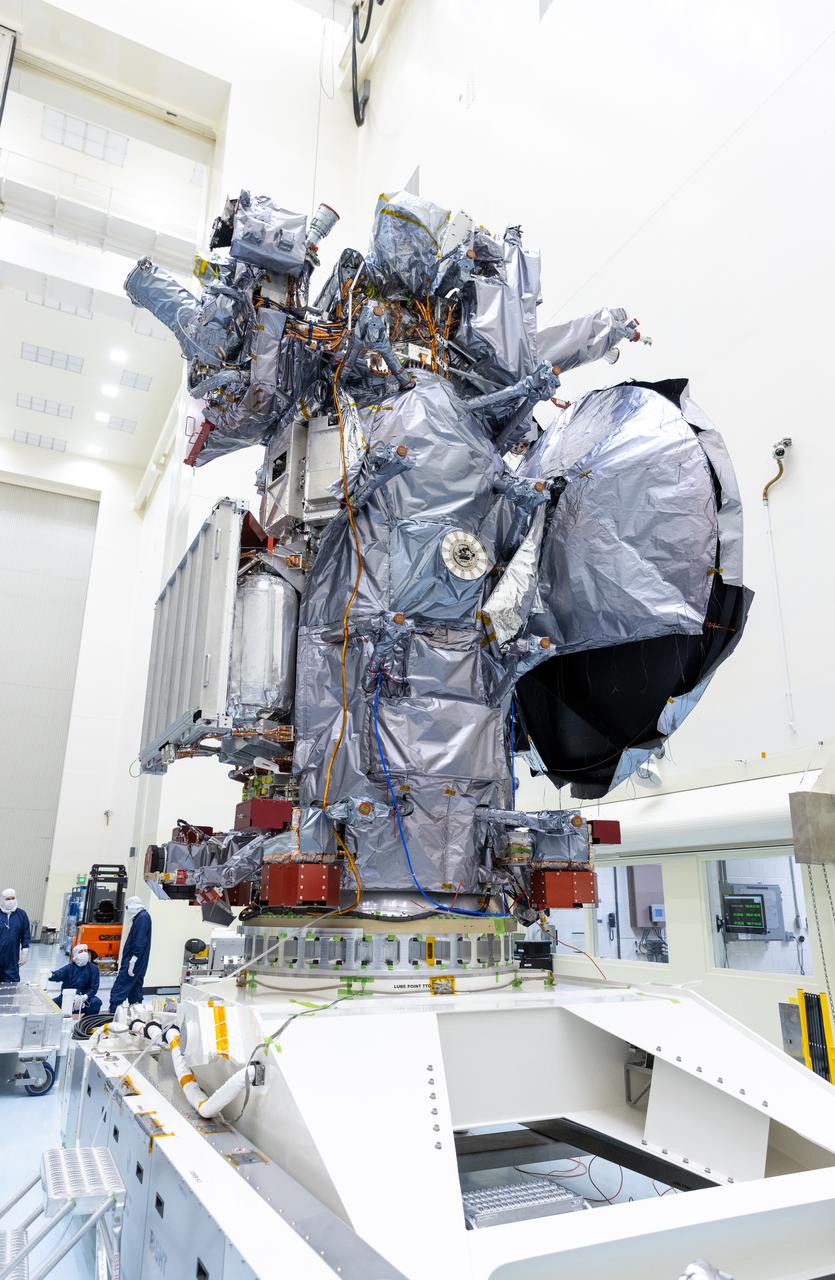
Technicians prepare to install the nearly 10 feet (3 meters) wide dish-shaped high-gain antenna to NASA’s Europa Clipper, a spacecraft to study Jupiter’s icy moon, at the agency’s Payload Hazardous Servicing Facility at Kennedy Space Center in Florida on Tuesday, June 18, 2024. The spacecraft will perform a series of flybys of the Jupiter moon Europa to gather data on its atmosphere, icy crust, and the ocean underneath, and the high-gain antenna will send the research data to scientists on Earth to determine if the moon can support habitable condition. The Europa Clipper spacecraft is scheduled to launch atop a SpaceX Falcon Heavy rocket from Kennedy’s Launch Complex 39A no earlier than October 2024.
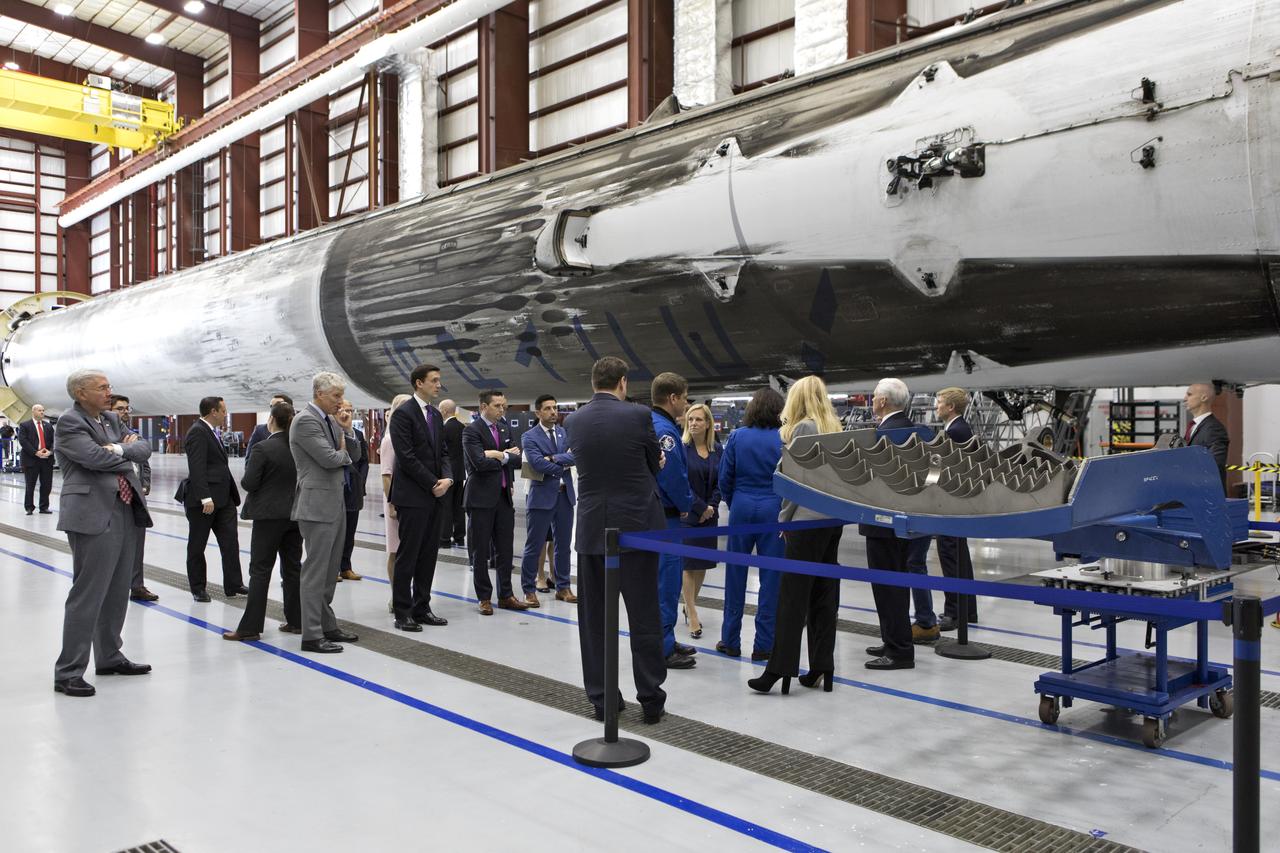
Vice President Mike Pence tours the SpaceX hangar at Launch Complex 39A, at NASA's Kennedy Space Center in Florida, on Feb. 21, 2018. The group is getting a close-up look at a previously flown Falcon 9 rocket. During his visit, Pence chaired a meeting of the National Space Council in the high bay of the center's Space Station Processing Facility. The council's role is to advise the president regarding national space policy and strategy, and review the nation's long-range goals for space activities.

NASA’s SpaceX Crew-6 crewmember Sultan Alneyadi, UAE (United Arab Emirates) astronaut and mission specialist, is in his SpaceX spacesuit in the crew suit-up room inside the Neil Armstrong Operations and Checkout Building at NASA’s Kennedy Space Center in Florida on Feb. 26, 2023. He and his crewmates are preparing for their launch to the International Space Station aboard SpaceX’s Dragon spacecraft atop the Falcon 9 rocket. Launch was targeted for 1:45 a.m. EST on Feb. 27 from Launch Complex 39A, but was scrubbed for the day. Crew-6 is the sixth crew rotation mission with SpaceX to the station, and the seventh flight of Dragon with people as part of the agency’s Commercial Crew Program.
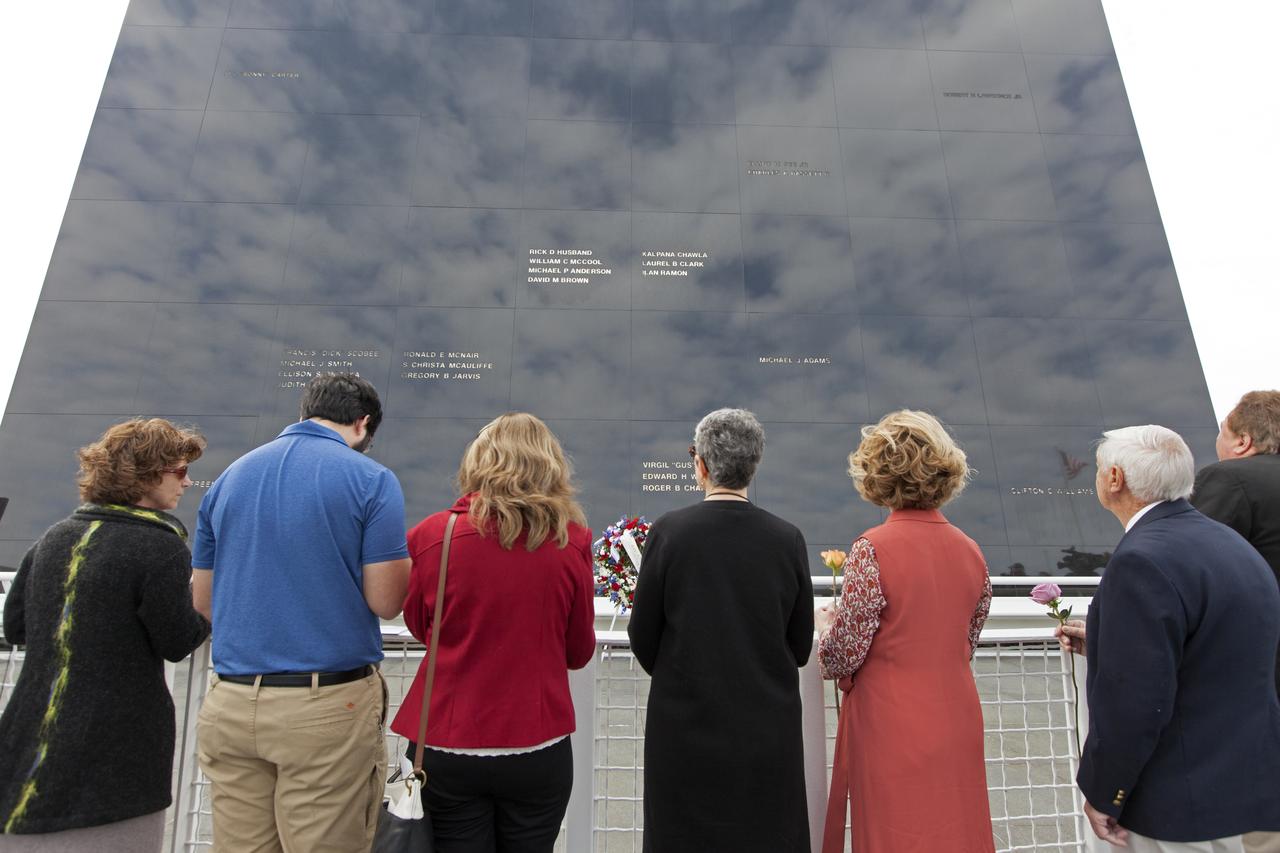
Family members of astronauts honored on the Space Mirror Memorial participate in the Day of Remembrance ceremony at Kennedy Space Center Visitor Complex. Each year spaceport employees and guests join others throughout NASA honoring the contributions of astronauts who have perished in the conquest of space.
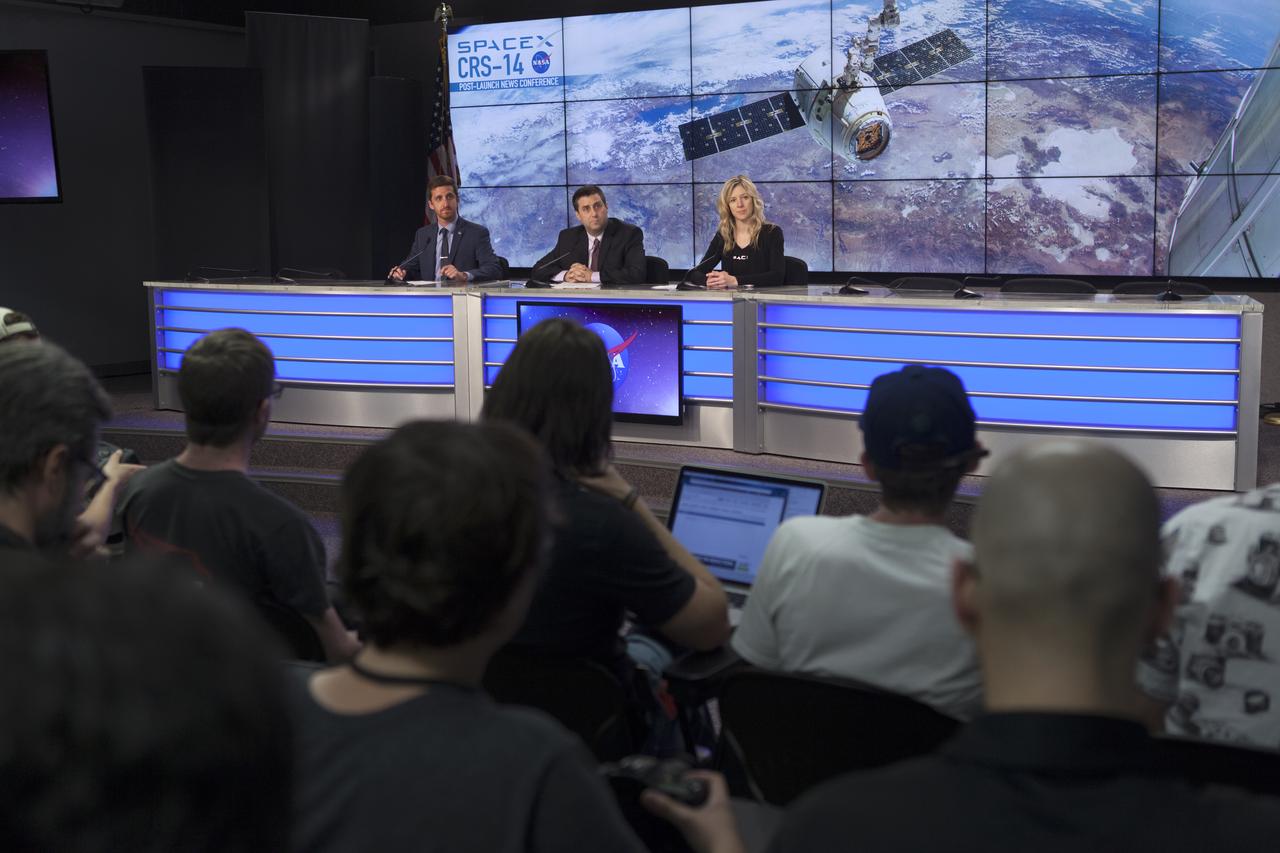
In the Press Site auditorium of NASA's Kennedy Space Center in Florida, from left, Josh Finch of NASA Communications, Joel Montalbano, deputy manager, International Space Station Program manager at NASA's Johnson Space Center in Houston, and Jessica Jensen, SpaceX director of Dragon Mission Management, speak to media at a post-launch news conference following the liftoff of the SpaceX Falcon 9 rocket at 4:30 p.m. EST. The flight is a commercial resupply services mission for NASA to the International Space Station. SpaceX CRS-14 lifted off atop the Falcon 9 rocket from Space Launch Complex 40 at Cape Canaveral Air Force Station carrying supplies and equipment and new science experiments for technology research.

Kennedy Space Center employees enjoy coffee and donuts ahead of a Town Hall meeting, courtesy of NASA Administrator Jared Isaacman on Tuesday, June 16, 2026.
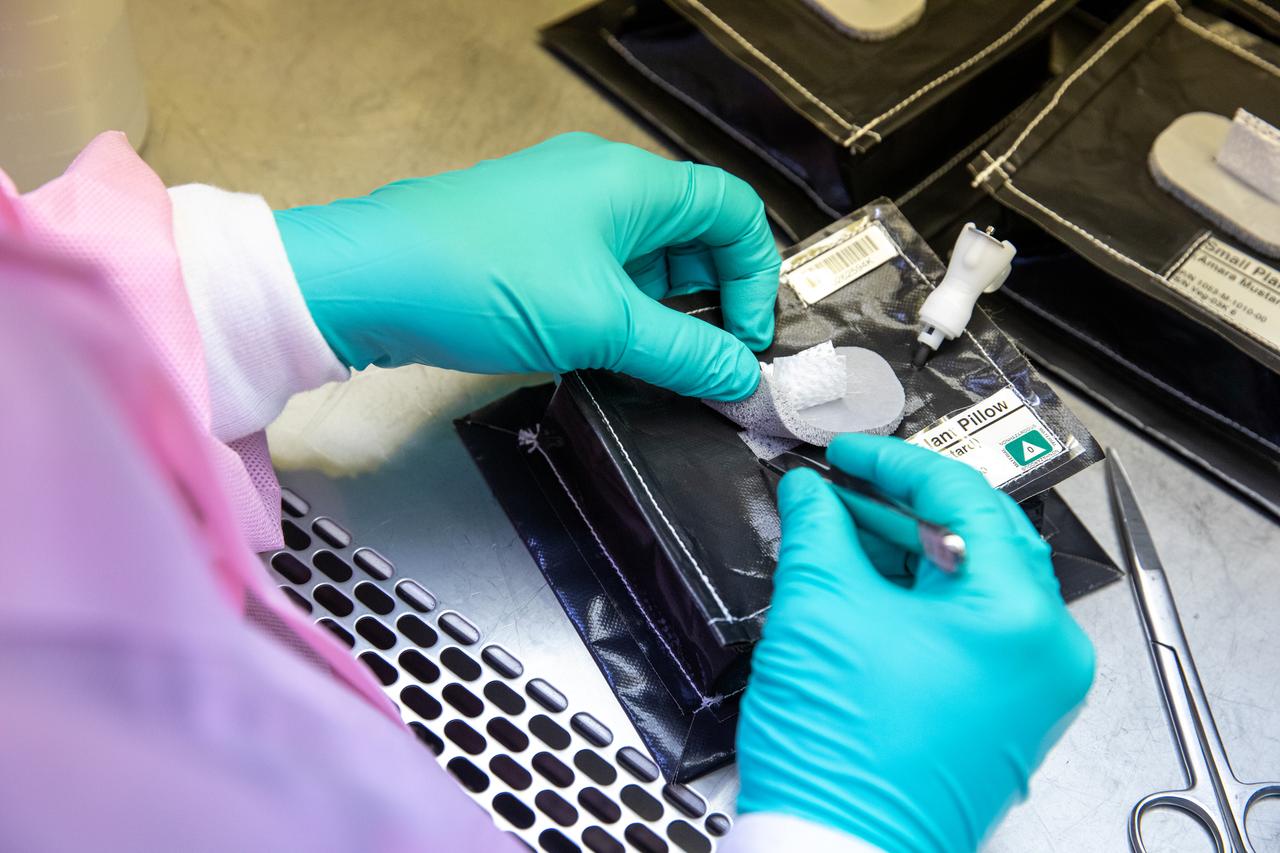
On Jan. 21, 2020, inside the Space Station Processing Facility at NASA’s Kennedy Space Center in Florida, intern Emily Kennebeck prepares plant pillows for their flight to the International Space Station. The pillows, which are a common method used to grow plants in space, are being sent to the orbiting laboratory on Northrop Grumman’s 13th resupply services (NG-13) mission for a series of VEG-03 experiments that will study the growth of three types of leafy greens in a microgravity environment. Once the pillows are assembled and packaged for flight, they will be transported to the agency’s Wallops Flight Facility in Virginia, where liftoff will occur. NG-13 is scheduled to launch on Feb. 9, 2020, at 5:39 p.m. EST.
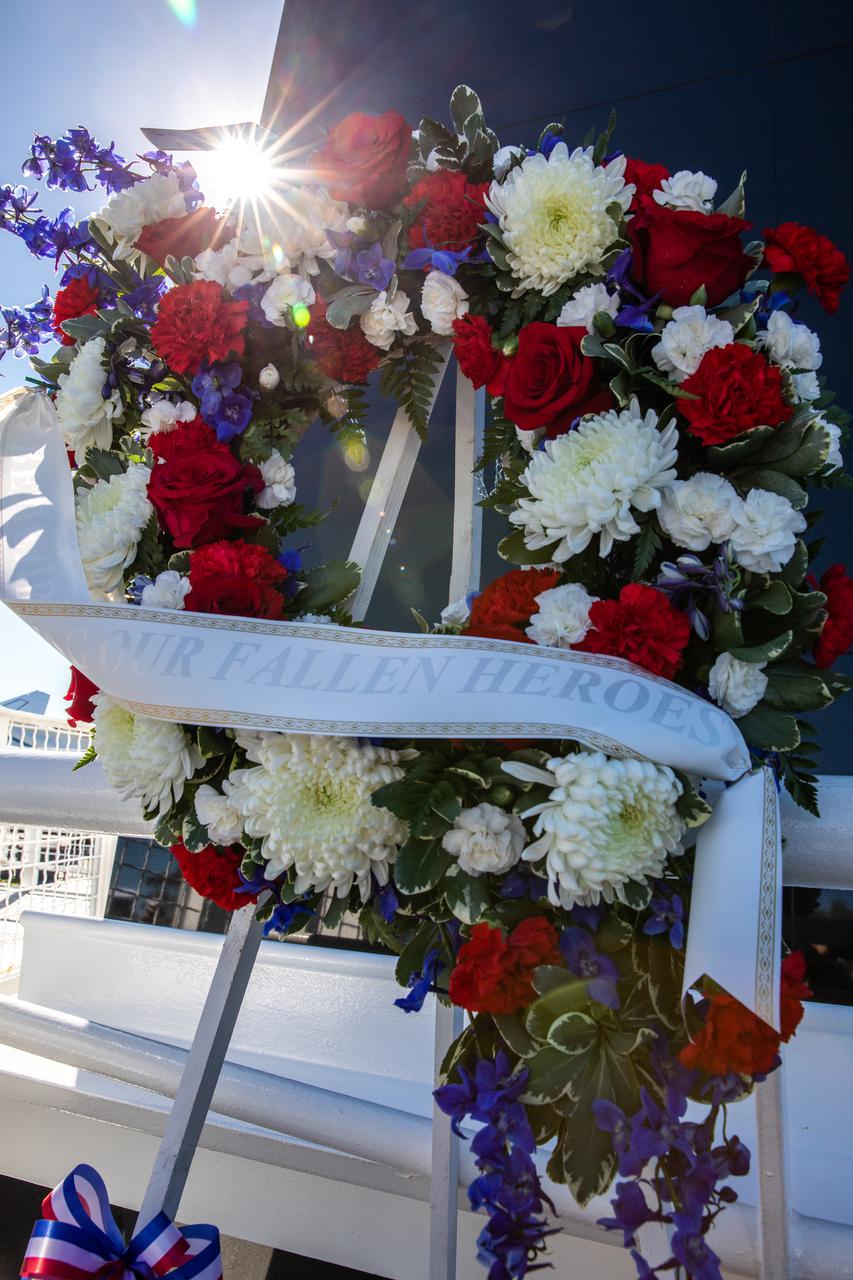
NASA’s Day of Remembrance is marked by a memorial wreath placed before the Space Mirror Memorial at the Kennedy Space Center Visitor Complex, Jan. 28, 2021. The mirror was dedicated in 1991 to honor all astronauts who lost their lives on missions or during training. During the Day of Remembrance, NASA centers across the country honor those astronauts who have fallen in the pursuit of space exploration.
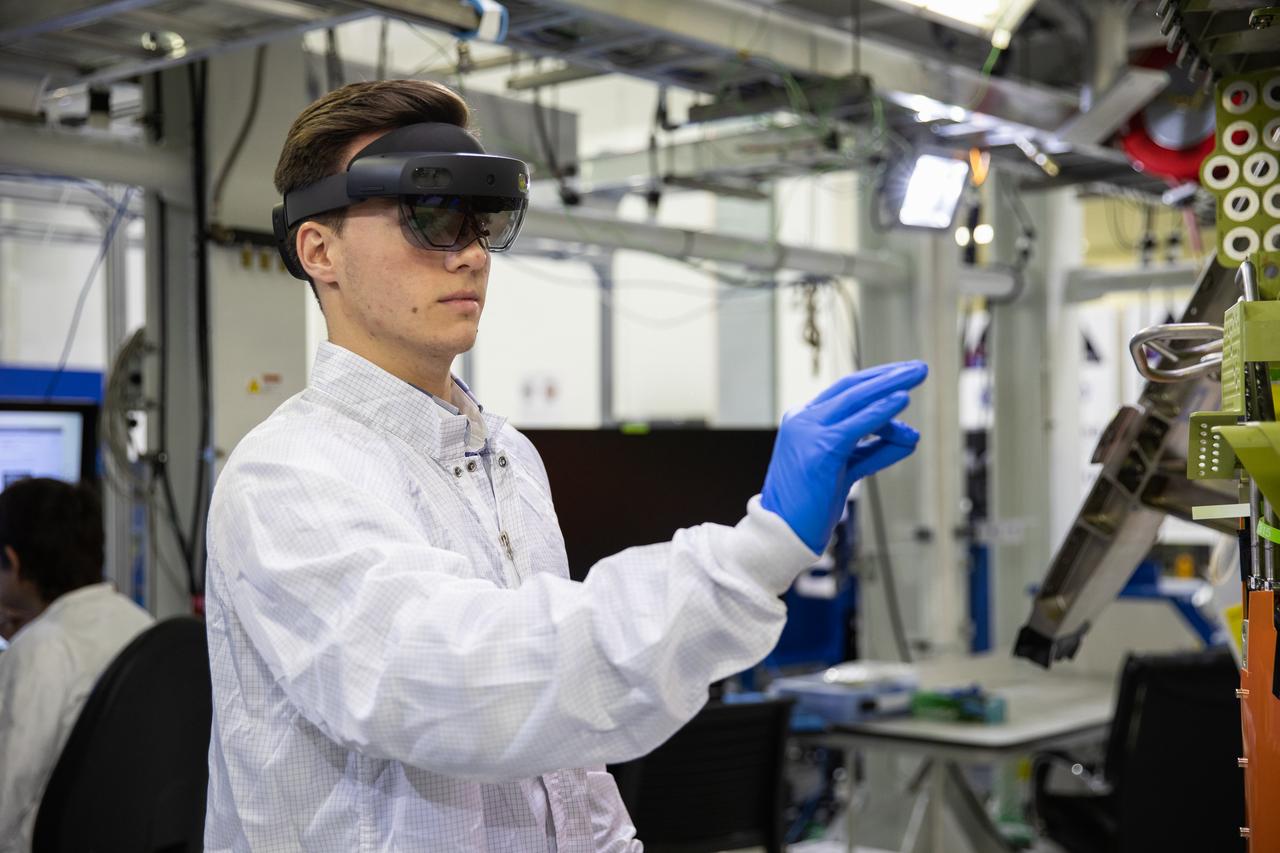
Michael Maxwell, with Lockheed Martin’s augmented reality team, wears a pair of augmented reality (AR) goggles to work on the crew module for NASA’s Artemis II mission inside the high bay of the Neil Armstrong Operations and Checkout Building at the agency’s Kennedy Space Center in Florida on March 18, 2020. Orion manufacturer Lockheed Martin provided the goggles to technicians to help place tapes where components will be installed on the crew module adapter for Artemis II, the first crewed mission aboard the spacecraft. Using the AR goggles saves significant labor and time to complete tasks. Manufactured by Microsoft, the goggles, called HoloLens2, are the second version used by Lockheed.
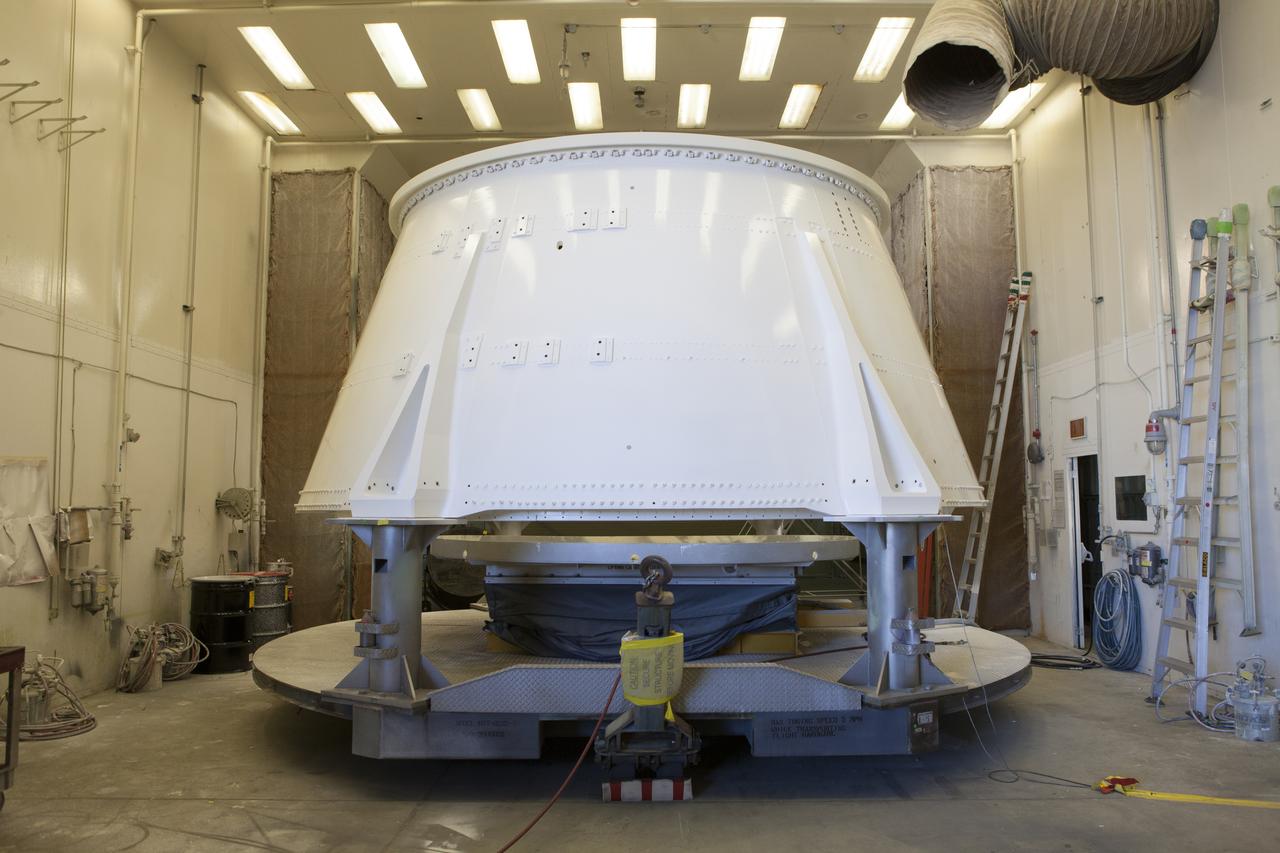
The right hand aft skirt for NASA's Space Launch System (SLS) rocket has been refurbished and painted and is in a drying cell in a support building at the Hangar AF facility at Cape Canaveral Air Force Station in Florida. The space shuttle-era aft skirt will be used on the right hand booster of the SLS for Exploration Mission 1 (EM-1). NASA is preparing for EM-1, deep space missions, and the Journey to Mars.
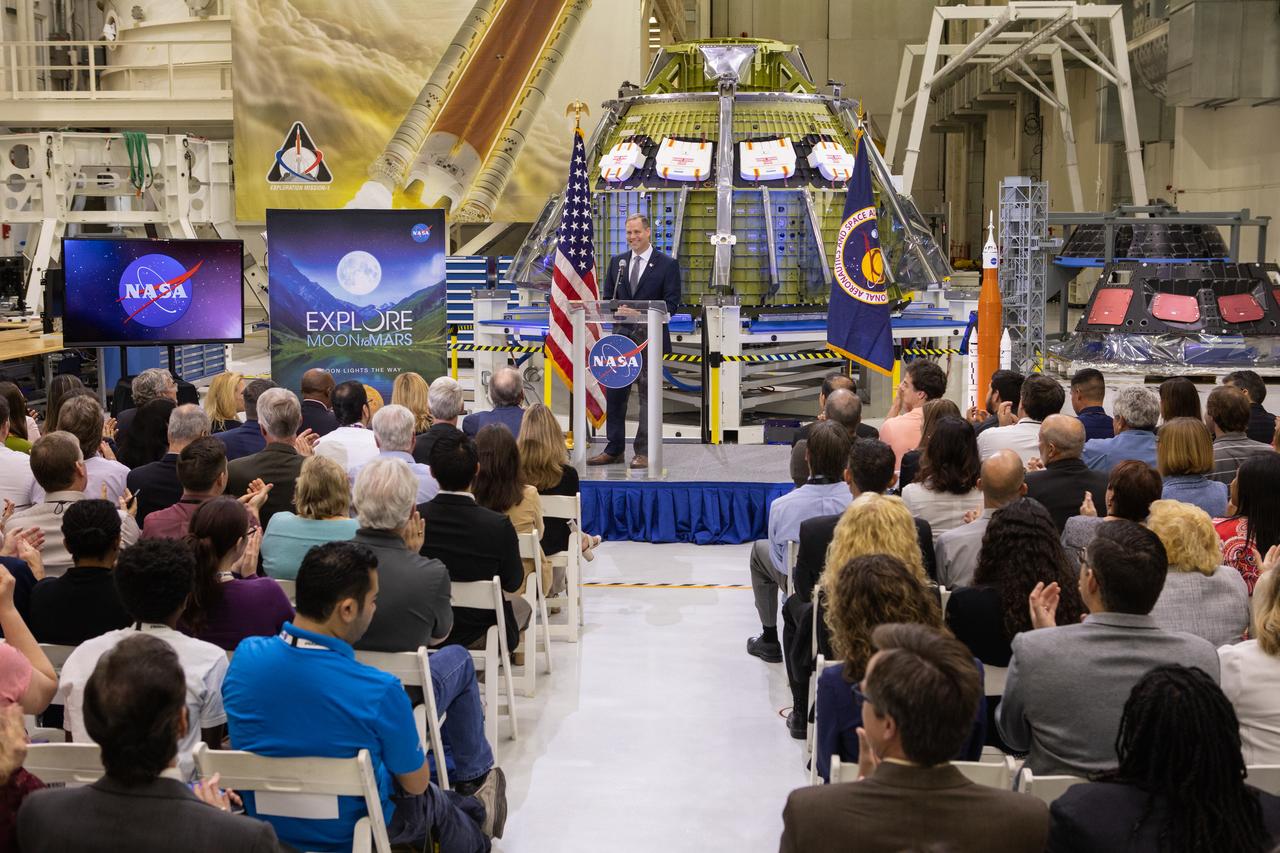
NASA Administrator Jim Bridenstine speaks to NASA workers across the nation and members of the news media, during a Moon to Mars event in the Neil Armstrong Operations and Checkout Building high bay on March 11, 2019. Behind him is the Orion crew module for Exploration Mission-2. The event followed the delivery of President Trump’s fiscal year 2020 budget proposal to U.S. Congress, which includes funding for the agency’s Moon to Mars initiative and Gateway lunar outpost. Bridenstine presented a closer look at America’s work to return astronauts to the Moon in a sustainable way and continue exploration to Mars.
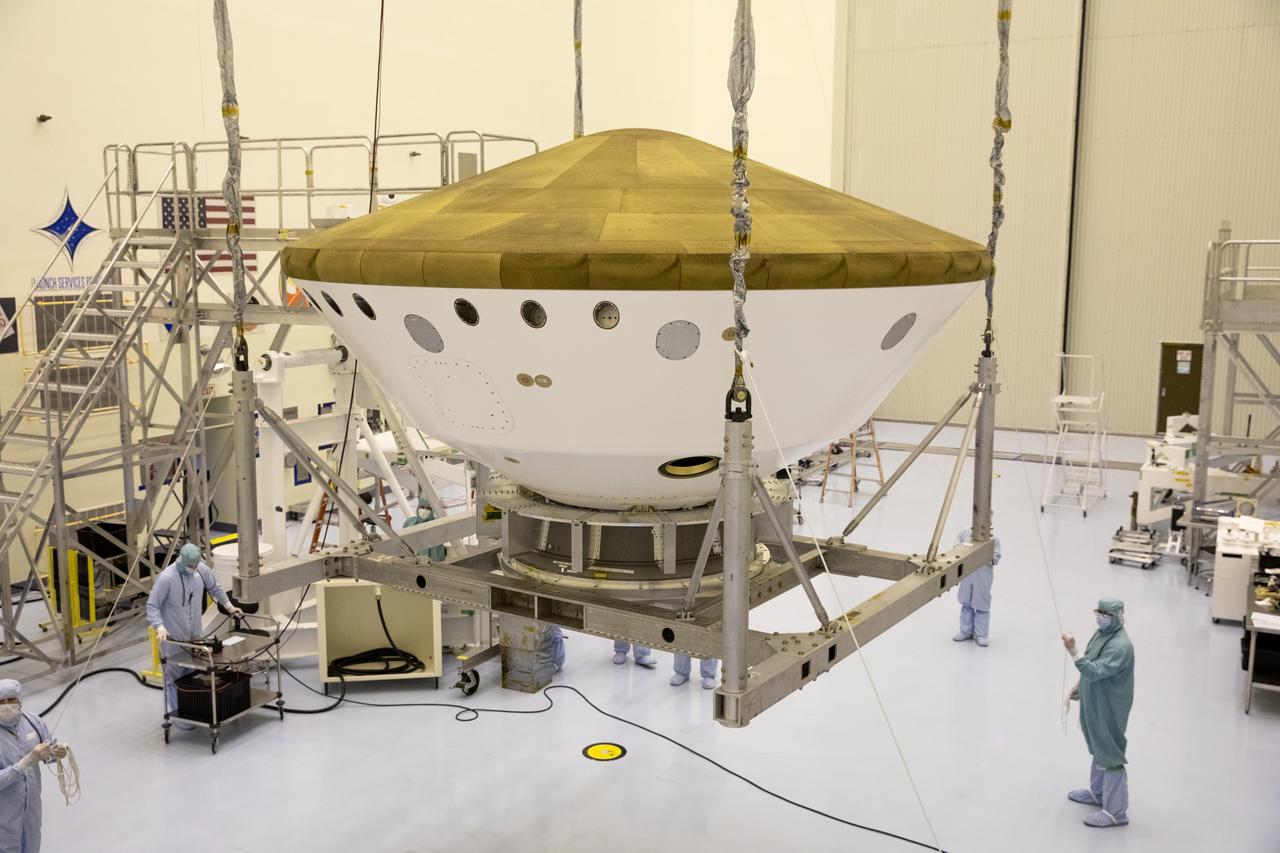
Mars 2020 Lift Activities in Payload Hazardous Serviceing Facility (PHSF)
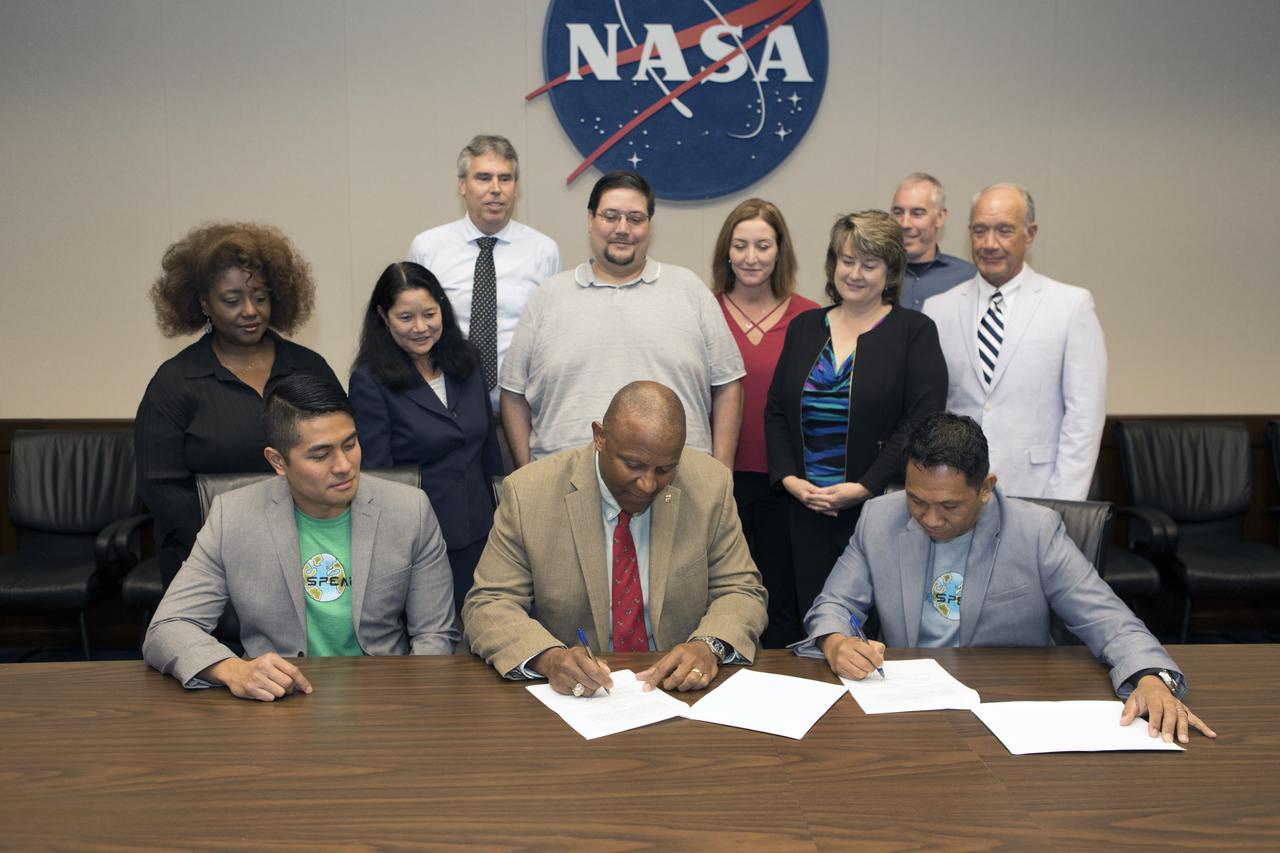
NASA Kennedy Space Center's Associate Director Kelvin Manning, center, signs a license agreement with the President and CEO of ecoSPEARS, which allows the company to commercially sell a soil remediation technology developed by a research team at Kennedy. The technology, known as Sorbent Polymer Extraction And Remediation System, is designed to capture and remove polychlorinated biphenyls (PCBs) from contaminated sediments in waterways and wetlands.
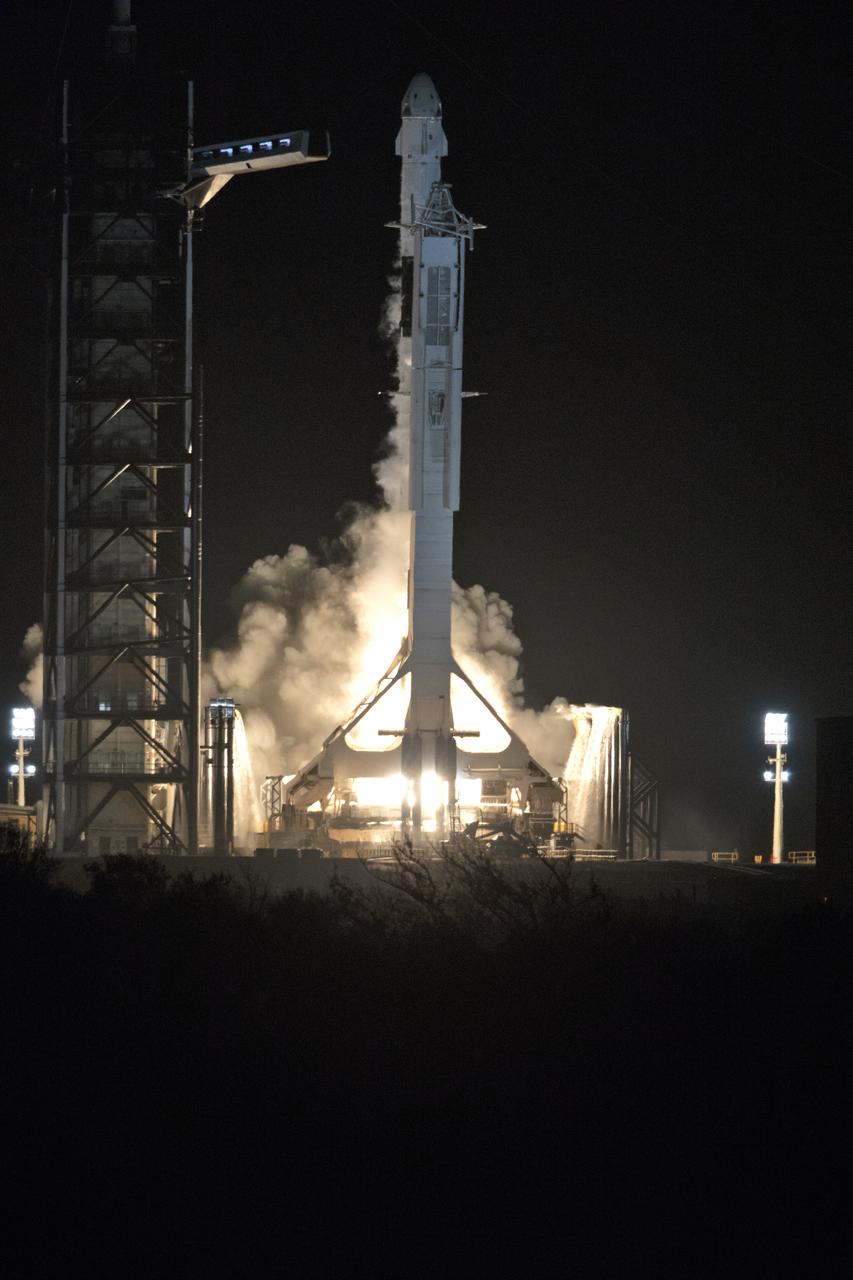
A two-stage SpaceX Falcon 9 rocket lifts off from Launch Complex 39A at NASA’s Kennedy Space Center in Florida for Demo-1, the first uncrewed mission of the agency’s Commercial Crew Program. Liftoff was at 2:49 a.m., March 2, 2019. The SpaceX Crew Dragon’s trip to the International Space Station is designed to validate end-to-end systems and capabilities, leading to certification to fly crew. NASA has worked with SpaceX and Boeing in developing the Commercial Crew Program spacecraft to facilitate new human spaceflight systems launching from U.S. soil with the goal of safe, reliable and cost-effective access to low-Earth orbit destinations, such as the space station.
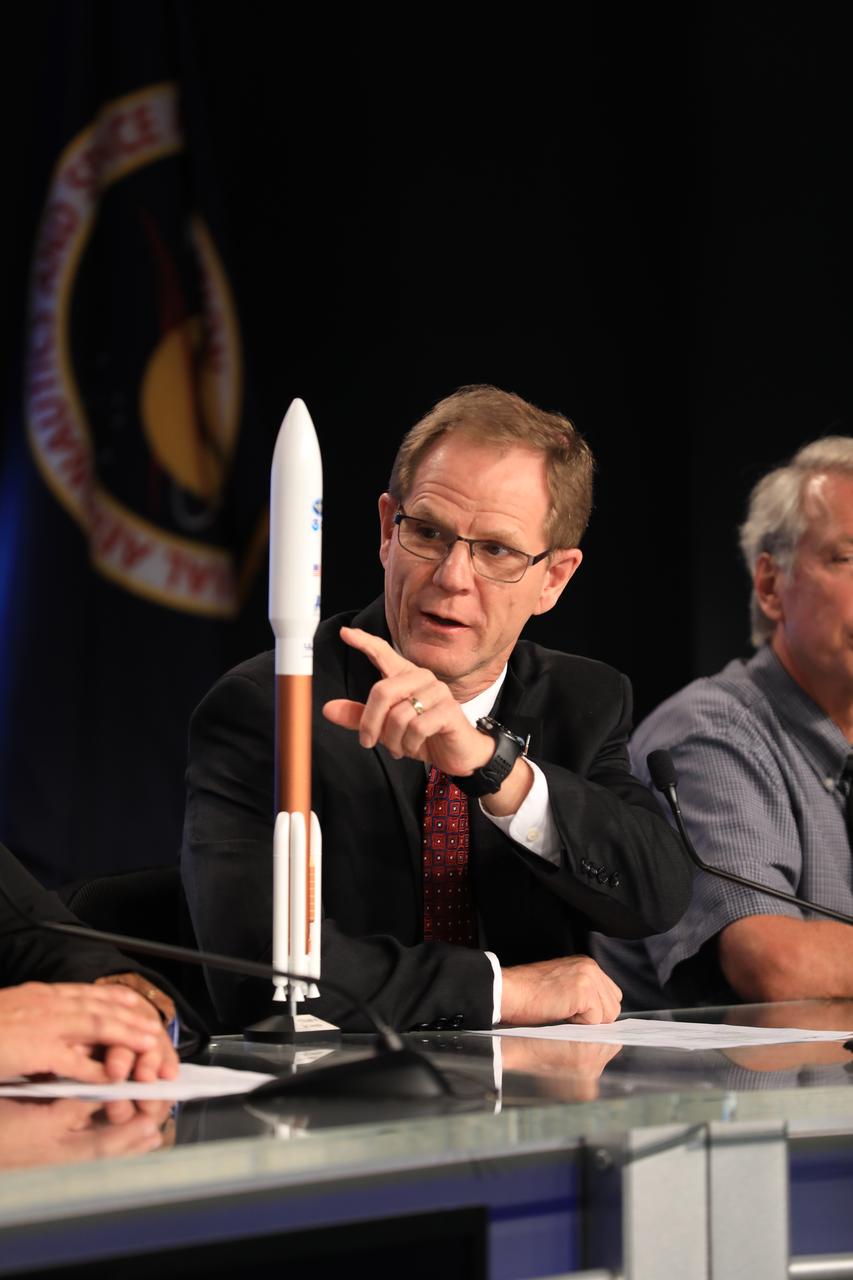
Scott Messer, program manager, NASA Missions, United Launch Alliance, speak to members of the news media during a Geostationary Operational Environmental Satellite (GOES-R) prelaunch news conference in the Kennedy Space Center's Press Site auditorium in Florida.
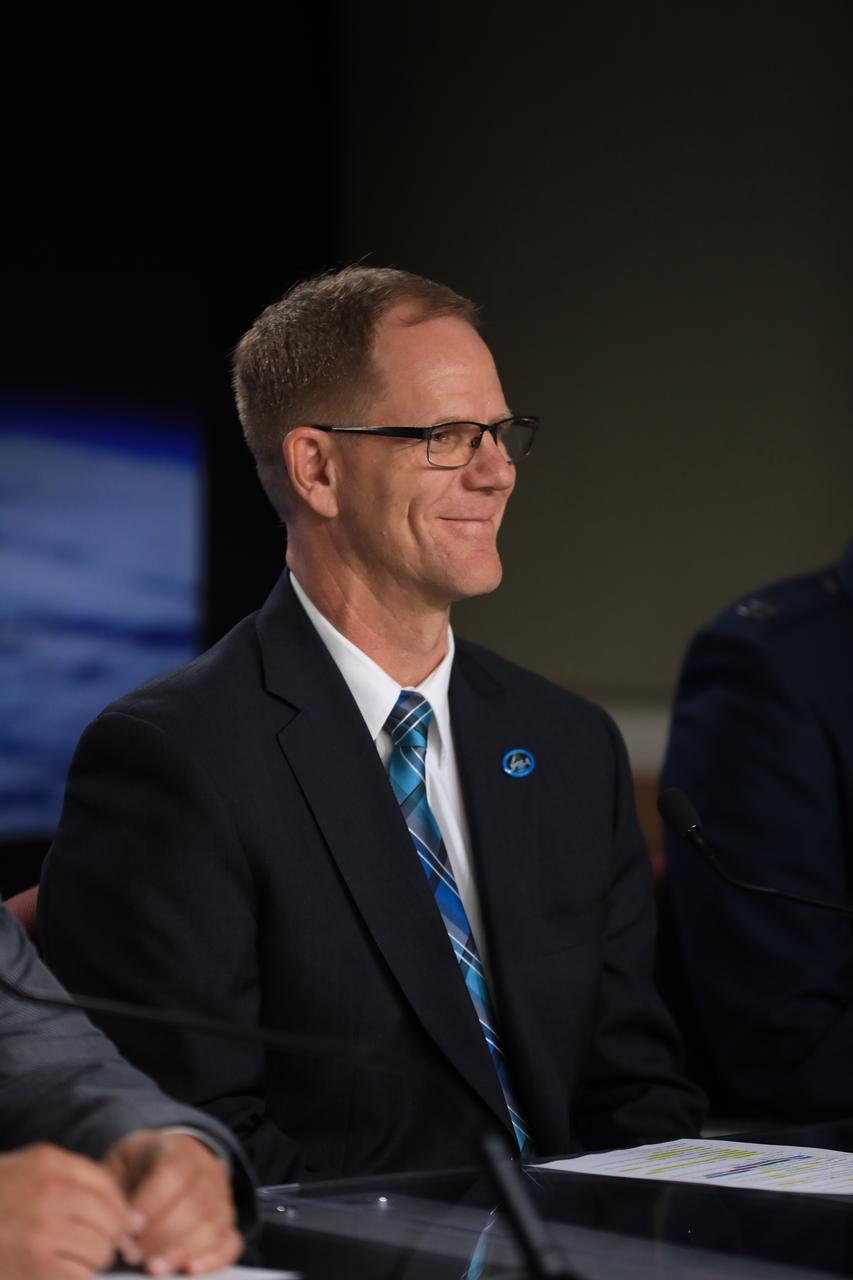
At Vandenberg Air Force Base in California, Scott Messer, United Launch Alliance program manager for NASA missions, speaks to members of the media at a prelaunch news conference for the Joint Polar Satellite System-1, or JPSS-1. Built by Ball Aerospace and Technologies Corp. of Boulder, Colorado, JPSS is the first in a series four next-generation environmental satellites in a collaborative program between the NOAA and NASA. Liftoff atop a United Launch Alliance Delta II rocket is scheduled to take place from Vandenberg's Space Launch Complex 2 at 1:47 a.m. PST (4:47 a.m. EST), on Nov. 14, 2017.
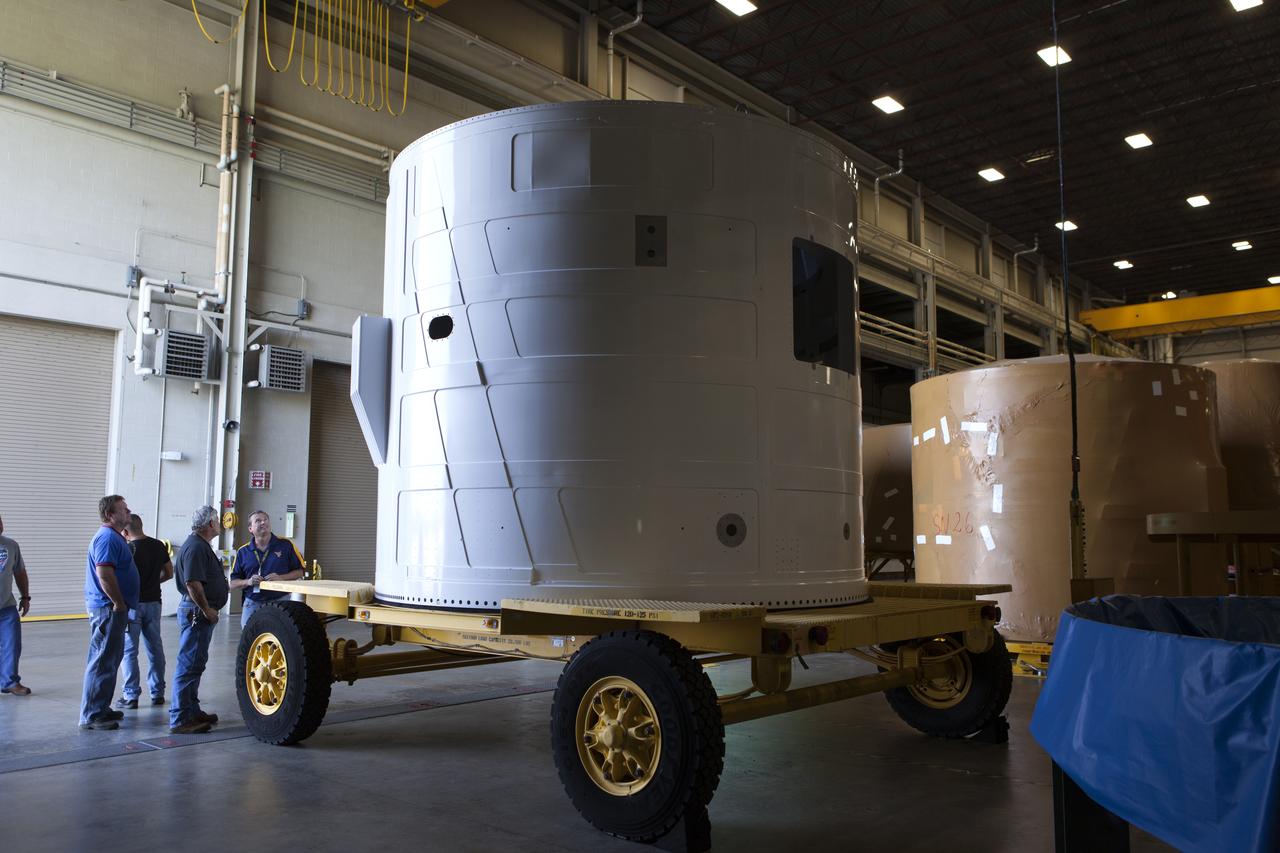
The Exploration Mission-1 (EM-1) left-hand forward skirt for NASA's Space Launch System (SLS) solid rocket boosters arrives inside the high bay at the Booster Fabrication Facility (BFF) at NASA's Kennedy Space Center in Florida. In the BFF, the forward skirt will be inspected and prepared for use on the left-hand solid rocket booster for EM-1. NASA's Orion spacecraft will fly atop the SLS rocket on its first uncrewed flight test.
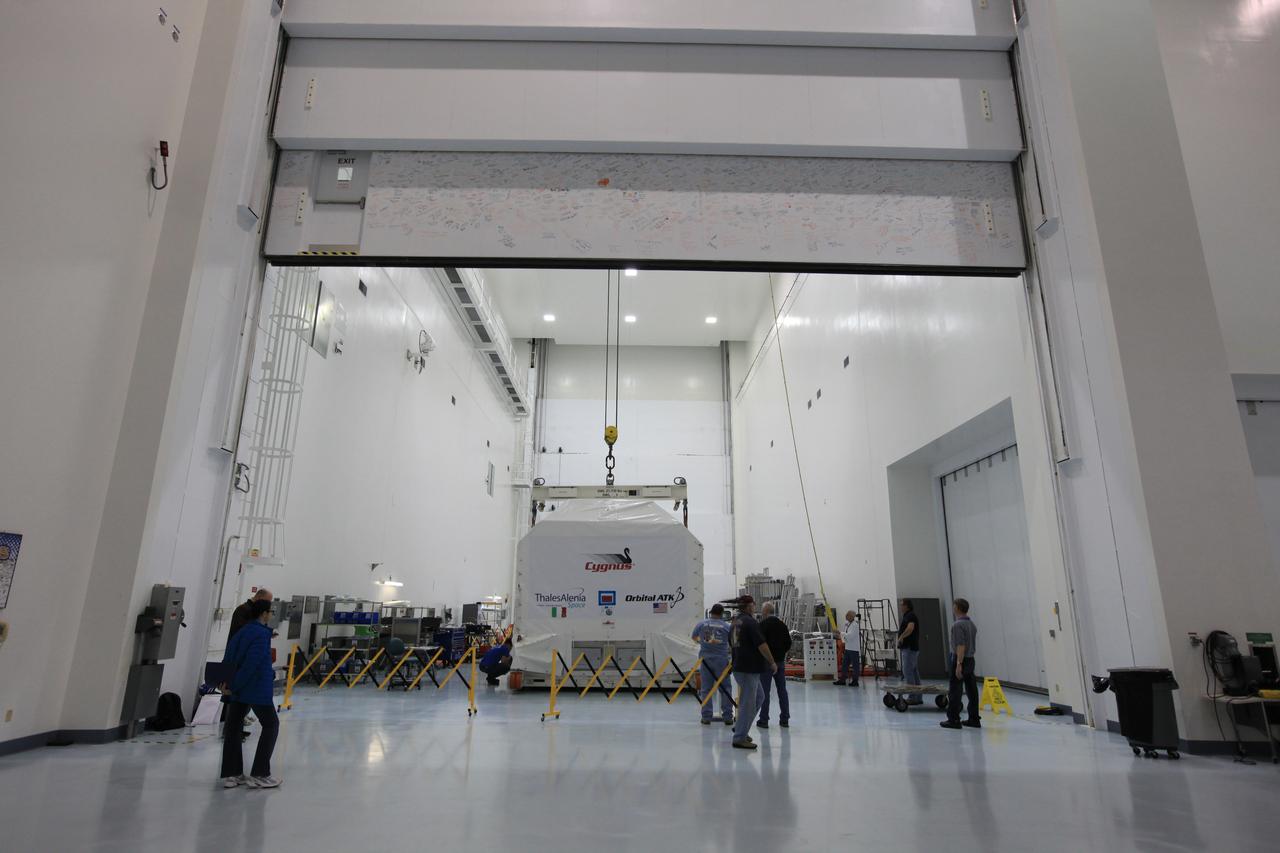
Inside an environmentally controlled shipping container the Orbital ATK OA-7 Cygnus spacecraft's pressurized cargo module (PCM) moves from an airlock to the high bay of the Space Station Processing Facility of NASA's Kennedy Space Center in Florida. Scheduled to launch on March 19, 2017, the Orbital ATK OA-7 mission will lift off atop a United Launch Alliance Atlas V rocket from Space launch Complex 41 at Cape Canaveral Air Force Station. The commercial resupply services mission to the International Space Station will deliver thousands of pounds of supplies, equipment and scientific research materials that improve life on Earth and drive progress toward future space exploration.

Omar Baez, right, launch director in NASA’s Launch Services Program (LSP), monitors the launch of the agency’s Ionospheric Connection Explorer (ICON) satellite inside Hangar AE’s Mission Director’s Center at Cape Canaveral Air Force Station (CCAFS). The Northrop Grumman Pegasus XL rocket carrying ICON was released from the company’s L-1011 Stargazer aircraft at 9:59 p.m. EDT on Oct. 10, 2019, over the Atlantic Ocean about 50 miles from Daytona Beach, Florida, following takeoff from CCAFS. ICON will spend two years studying the Earth’s ionosphere – the dynamic zone in our atmosphere where terrestrial weather from below meets space weather from above. The ICON launch was managed by LSP.
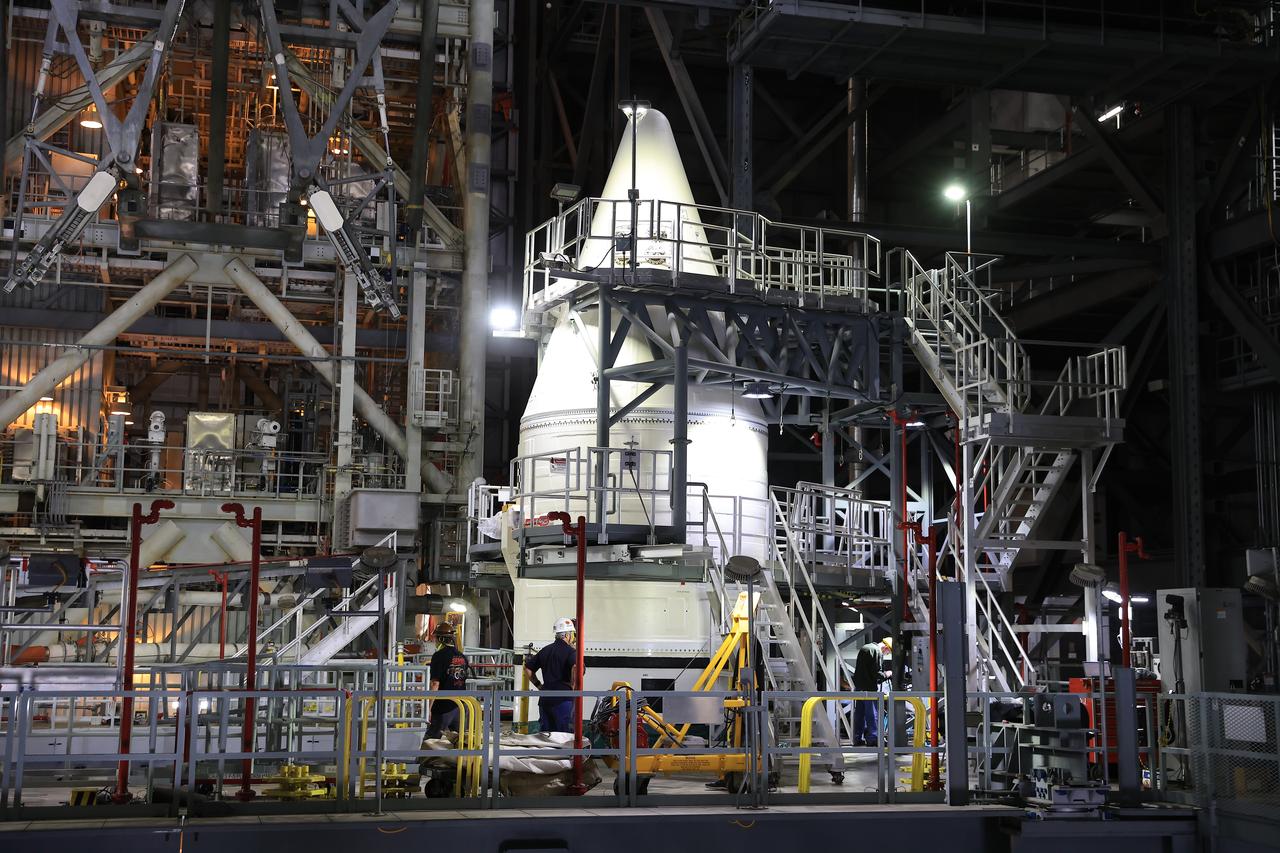
Engineers with NASA’s Exploration Ground Systems complete stacking operations on the twin SLS (Space Launch System) solid rocket boosters for Artemis II by integrating the nose cones atop the forward assemblies inside the Vehicle Assembly Building’s High Bay 3 at NASA’s Kennedy Space Center in Florida on Wednesday, Feb. 19, 2025. During three months of stacking operations, technicians used a massive overhead crane to lift 10 booster segments – five segments per booster – and aerodynamic nose cones into place on mobile launcher 1. The twin solid boosters will help support the remaining rocket components and the Orion spacecraft during final assembly of the Artemis II Moon rocket and provide more than 75 percent of the total SLS thrust during liftoff from NASA Kennedy’s Launch Pad 39B.
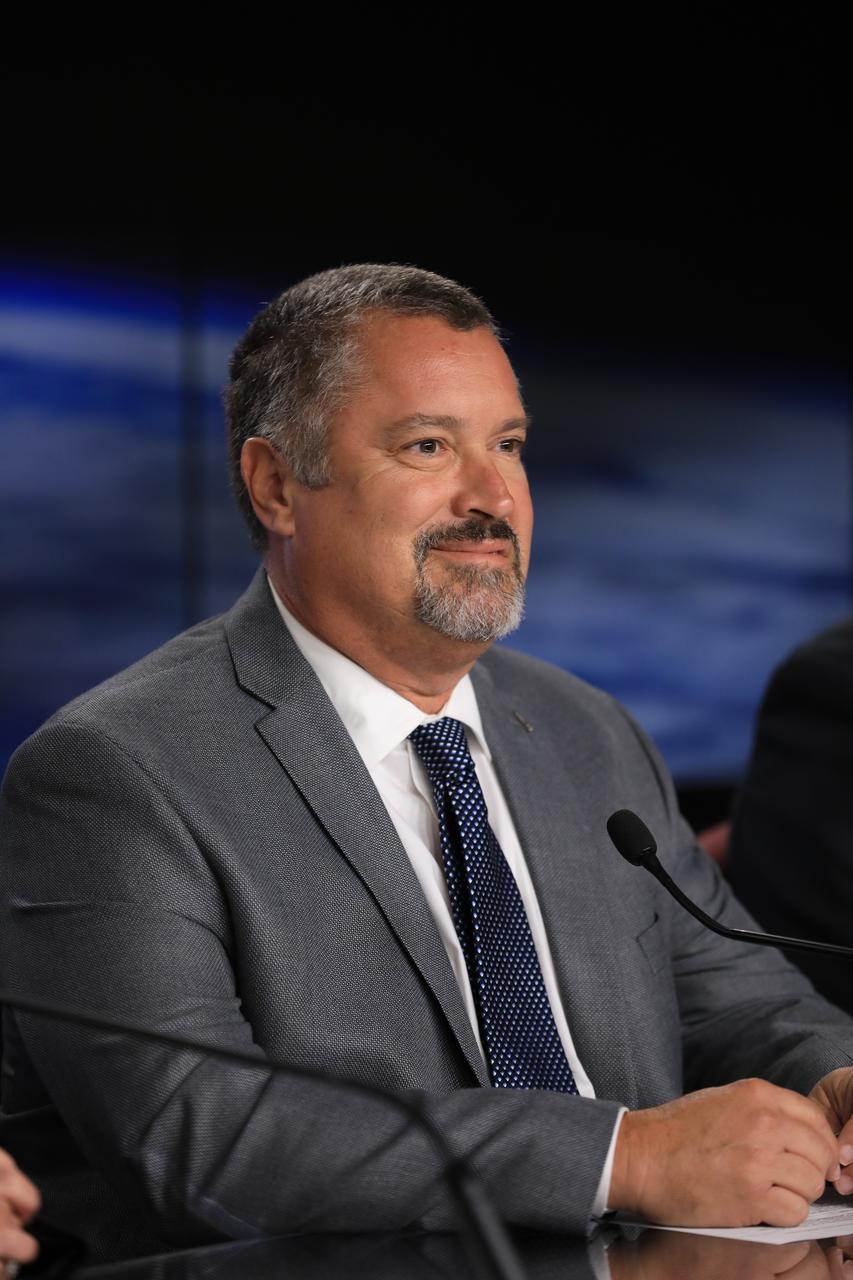
At Vandenberg Air Force Base in California, Omar Baez, NASA launch director, speaks to members of the media at a prelaunch news conference for the Joint Polar Satellite System-1, or JPSS-1. Built by Ball Aerospace and Technologies Corp. of Boulder, Colorado, JPSS is the first in a series four next-generation environmental satellites in a collaborative program between the NOAA and NASA. Liftoff atop a United Launch Alliance Delta II rocket is scheduled to take place from Vandenberg's Space Launch Complex 2 at 1:47 a.m. PST (4:47 a.m. EST), on Nov. 14, 2017.
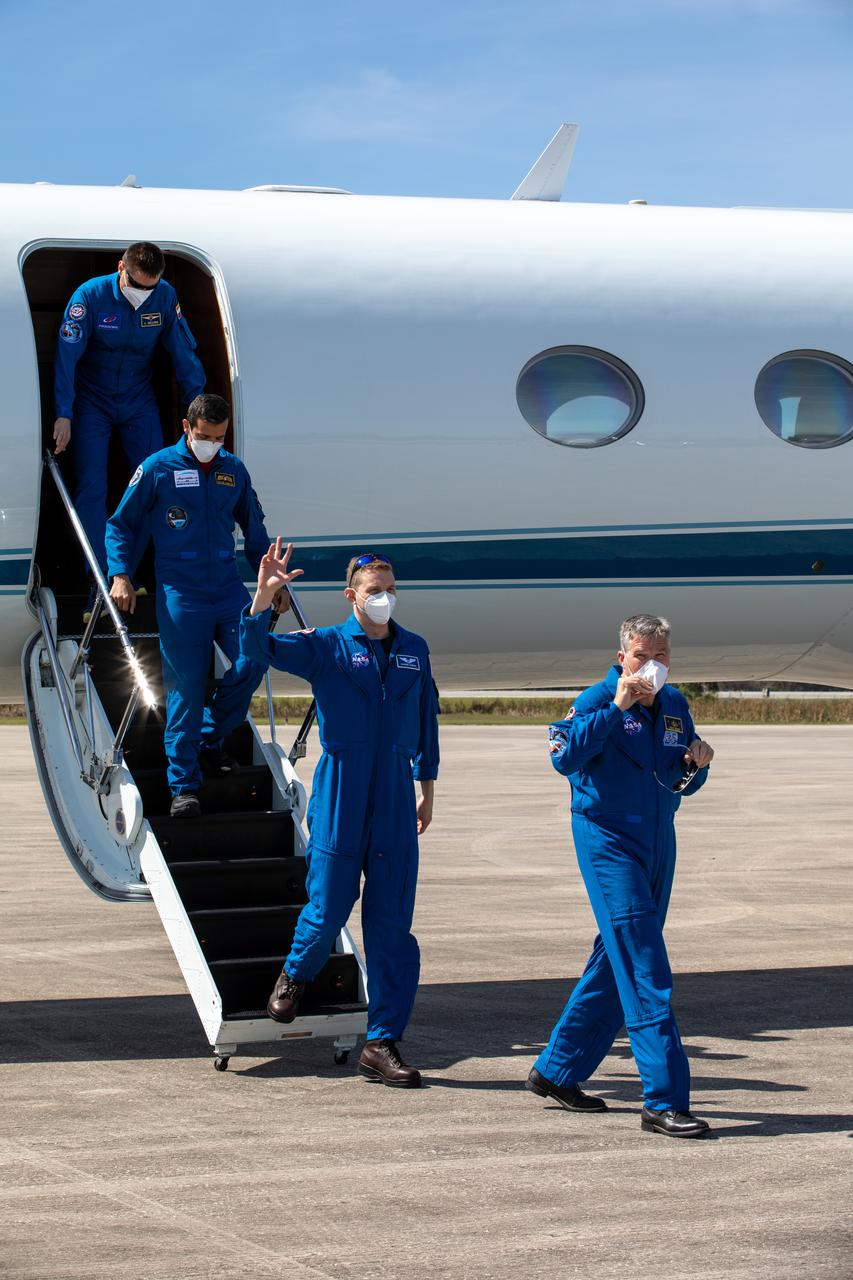
Crew members for NASA’s SpaceX Crew-6 mission to the International Space Station arrive at Kennedy Space Center’s Launch and Landing Facility in Florida on Feb. 21, 2023. From the front are NASA astronauts Stephen Bowen and Warren “Woody” Hoburg, UAE (United Arab Emirates) astronaut Sultan Alneyadi, and Roscosmos cosmonaut Andrey Fedyaev. The crew will head to the center’s Astronaut Crew Quarters as they await launch aboard the Crew Dragon on a SpaceX Falcon 9 rocket. Launch is targeted for no earlier than Feb. 26 at 2:07 a.m. EST. Crew-6 is the sixth crew rotation mission with SpaceX to the station, and the seventh flight of Dragon with people as part of the agency’s Commercial Crew Program.
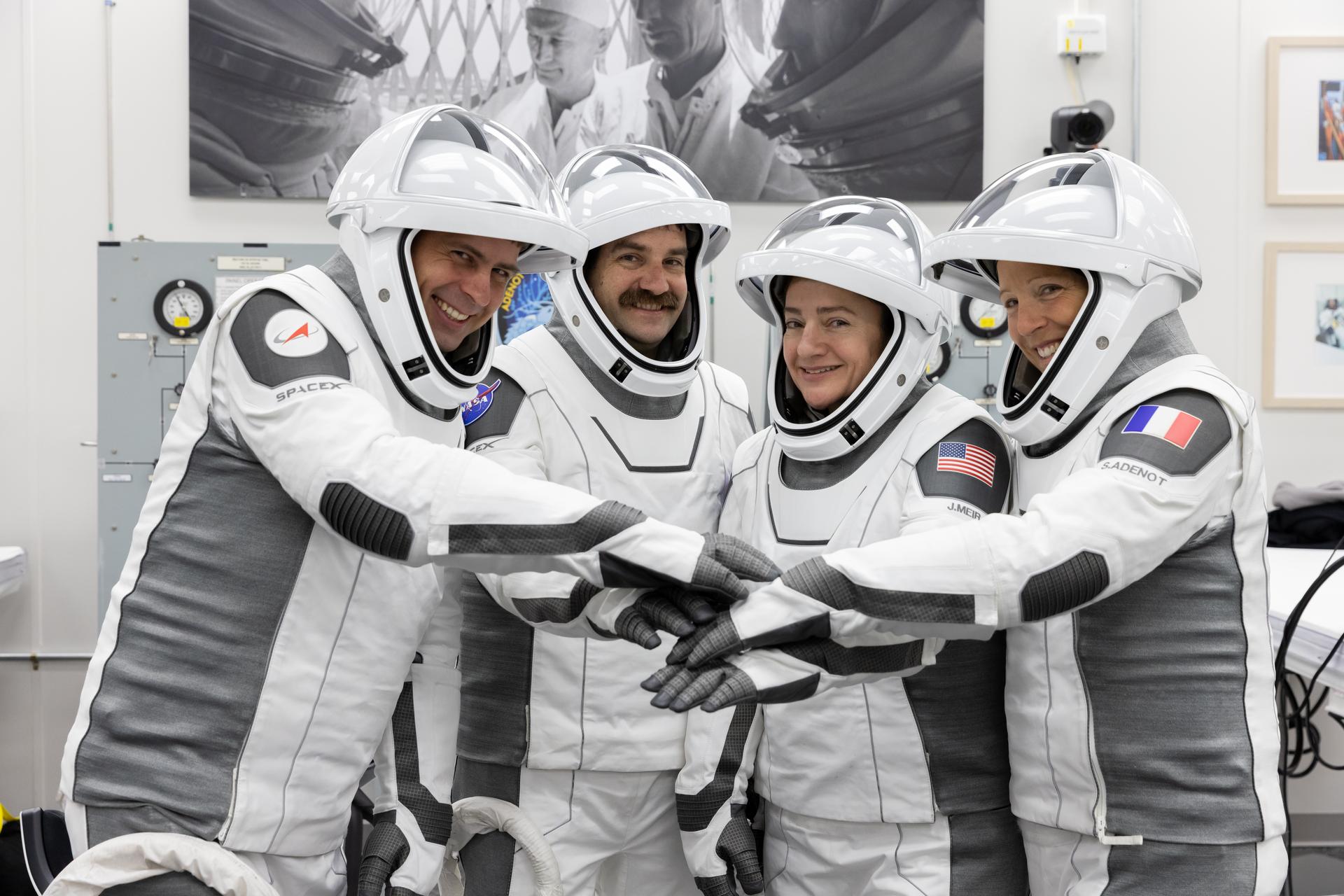
NASA’s SpaceX Crew-12 members suit up in the Neil A. Armstrong Operations and Checkout Building at the agency’s Kennedy Space Center in Florida ahead of launch to the International Space Station on Friday, Feb. 13, 2026. From left, Roscosmos cosmonaut Andrey Fedyaev, NASA astronauts Jack Hathaway and Jessica Meir, and ESA (European Space Agency) astronaut Sophie Adenot are scheduled to lift off aboard SpaceX’s Dragon spacecraft and Falcon 9 rocket at 5:15 a.m. EST, from Space Launch Complex 40 at Cape Canaveral Space Force Station in Florida.
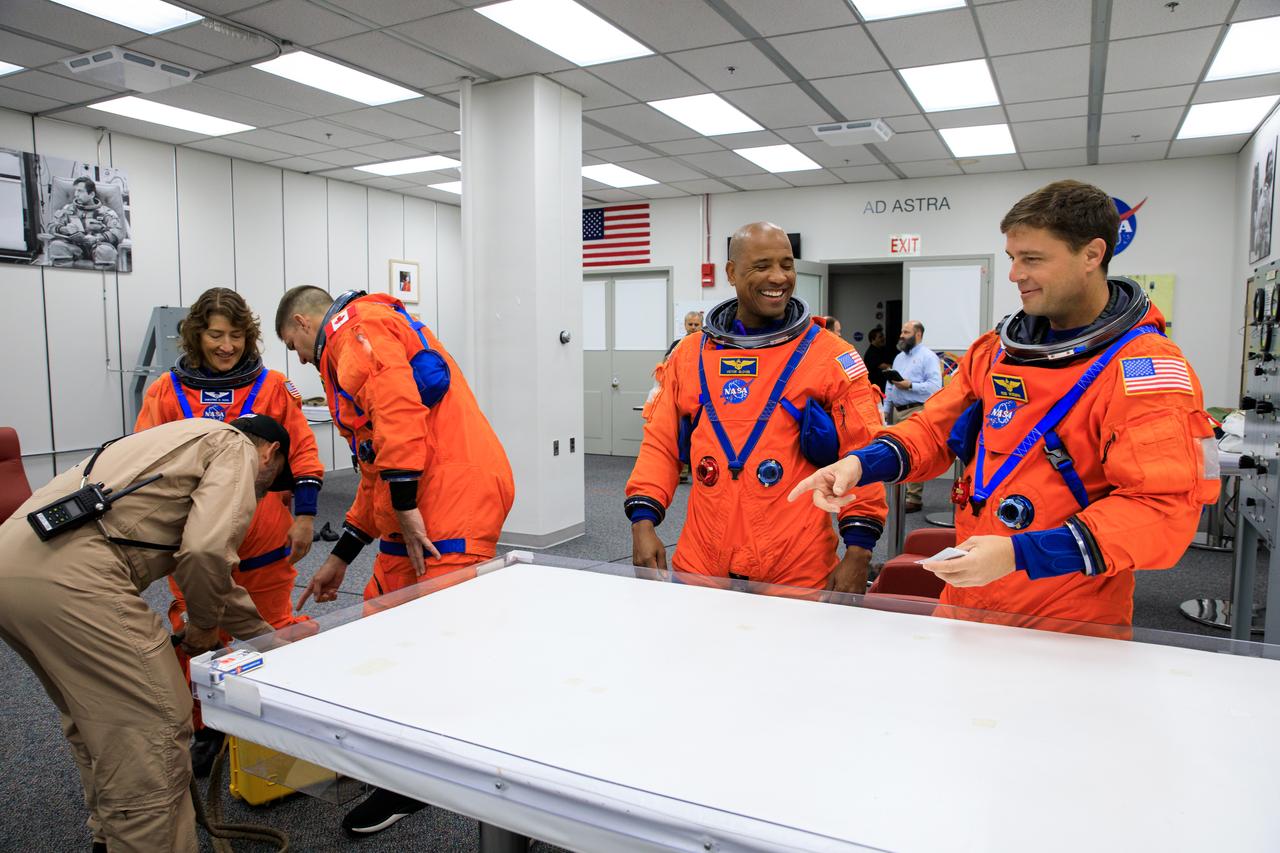
Inside the Astronaut Crew Quarters at the Neil Armstrong Operations and Checkout Building at NASA’s Kennedy Space Center in Florida, Artemis II crew members (from left) NASA astronaut Christina Koch, CSA (Canadian Space Agency) astronaut Jeremy Hansen, and NASA astronauts Reid Wiseman and Victor Glover are shown wearing test versions of the Orion crew survival system spacesuits they will wear on launch day as part of an integrated ground systems test on Wednesday, Sept. 20.
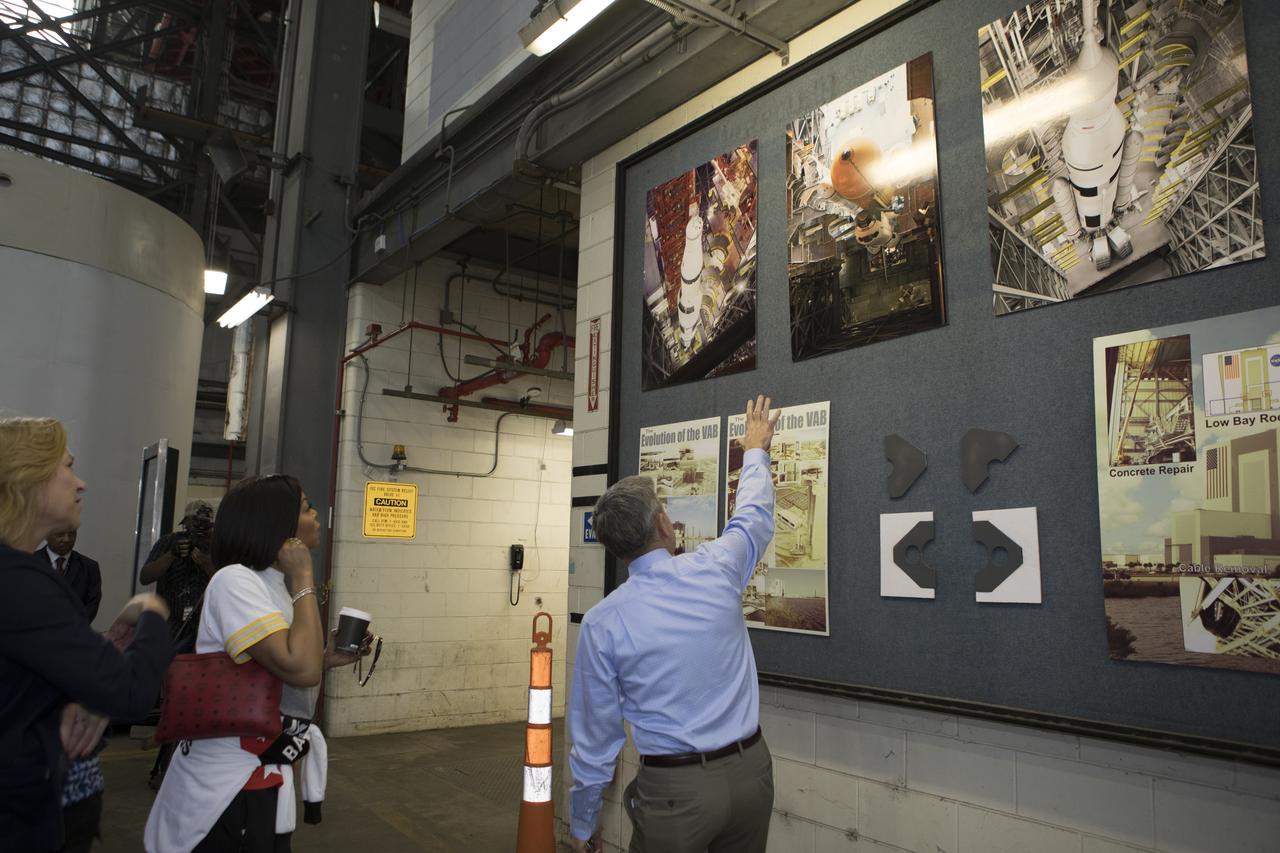
Kennedy Space Center Director Bob Cabana points to a display during a tour for cast and crew members of the upcoming motion picture "Hidden Figures." The group is walking thought the transfer aisle of the Vehicle Assembly Building. The movie is based on the book of the same title, by Margot Lee Shetterly. It chronicles the lives of Katherine Johnson, Dorothy Vaughan and Mary Jackson, three African-American women who worked for NASA as human "computers.” Their mathematical calculations were crucial to the success of Project Mercury missions including John Glenn’s orbital flight aboard Friendship 7 in 1962. The film is due in theaters in January 2017.
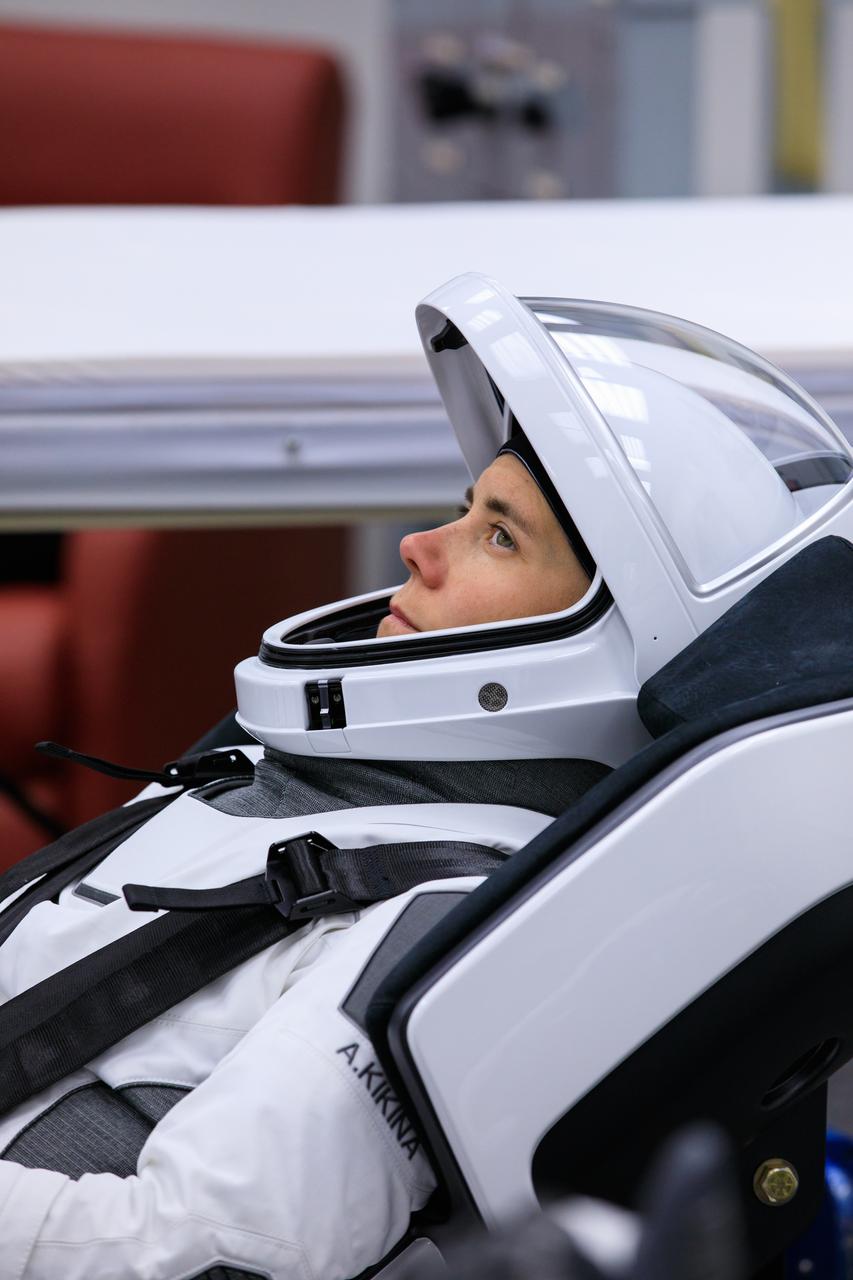
Roscosmos cosmonaut Anna Kikina is seated inside the crew suit-up room in the Neil A. Armstrong Operations and Checkout Building at NASA’s Kennedy Space Center in Florida during a countdown dress rehearsal on Oct. 2, 2022. Kikina, along with NASA astronauts Josh Cassada and Nicole Aunapu Mann, and JAXA (Japan Aerospace Exploration Agency) astronaut Koichi Wakata will launch to the International Space Station on NASA’s SpaceX Crew-5 mission as part of the agency’s Commercial Crew Program. Liftoff of SpaceX’s Falcon 9 rocket and Crew Dragon Endurance spacecraft is targeted for noon EDT on Oct. 5, 2022, from Kennedy’s Launch Complex 39A.
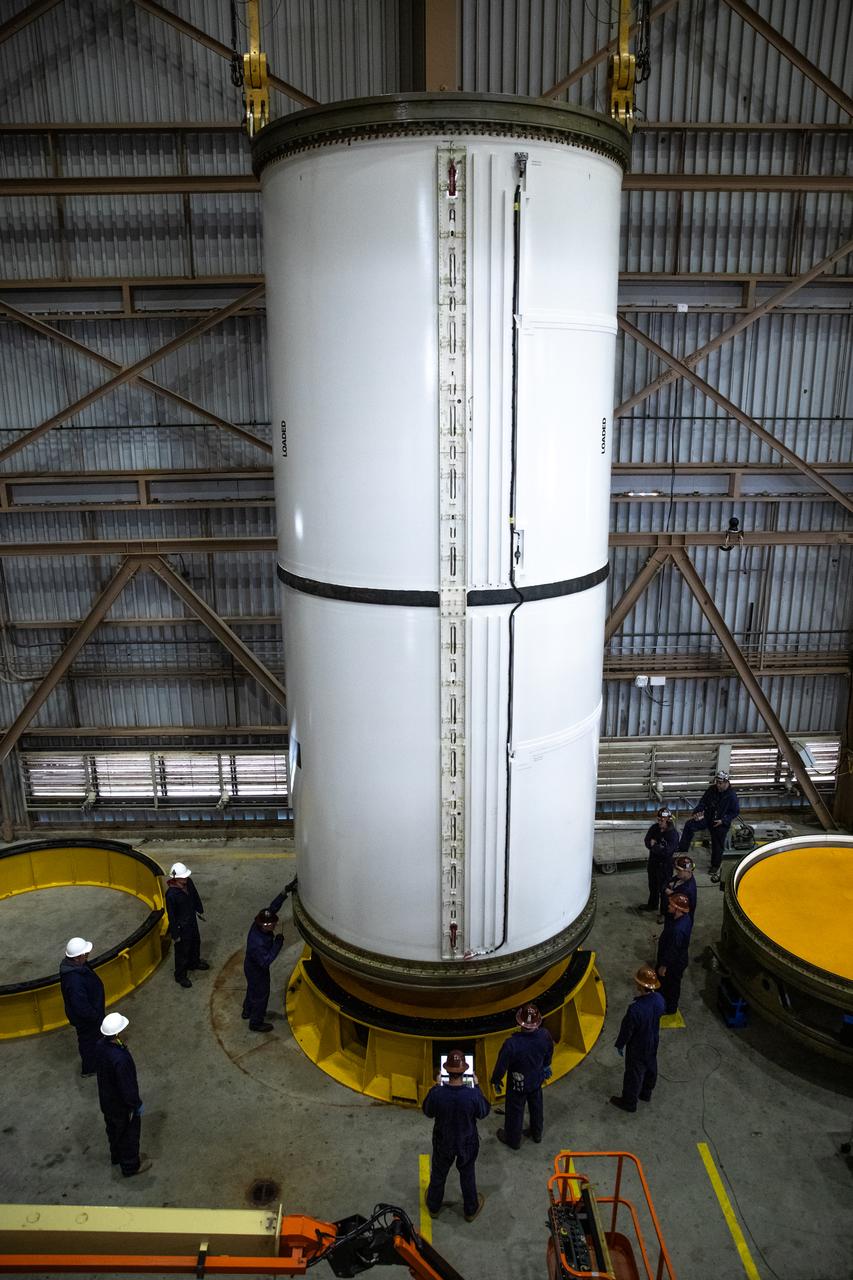
Engineers and technicians process the right forward center segment of the Space Launch System solid rocket boosters for the Artemis II mission inside the Rotation, Processing and Surge Facility (RPSF) at NASA’s Kennedy Space Center in Florida on Tuesday, Nov. 27, 2023. The team has been examining the 10 booster segments one-by-one then lifting them to make sure they are ready for integration and launch before moving them to the Vehicle Assembly Building for stacking atop the mobile launcher. Artemis II astronauts Reid Wiseman, Victor Glover, Christina Koch, and Jeremy Hansen will blast off from Kennedy and travel around the moon for the agency’s first crewed mission under Artemis that will test all of the Orion spacecraft’s systems.
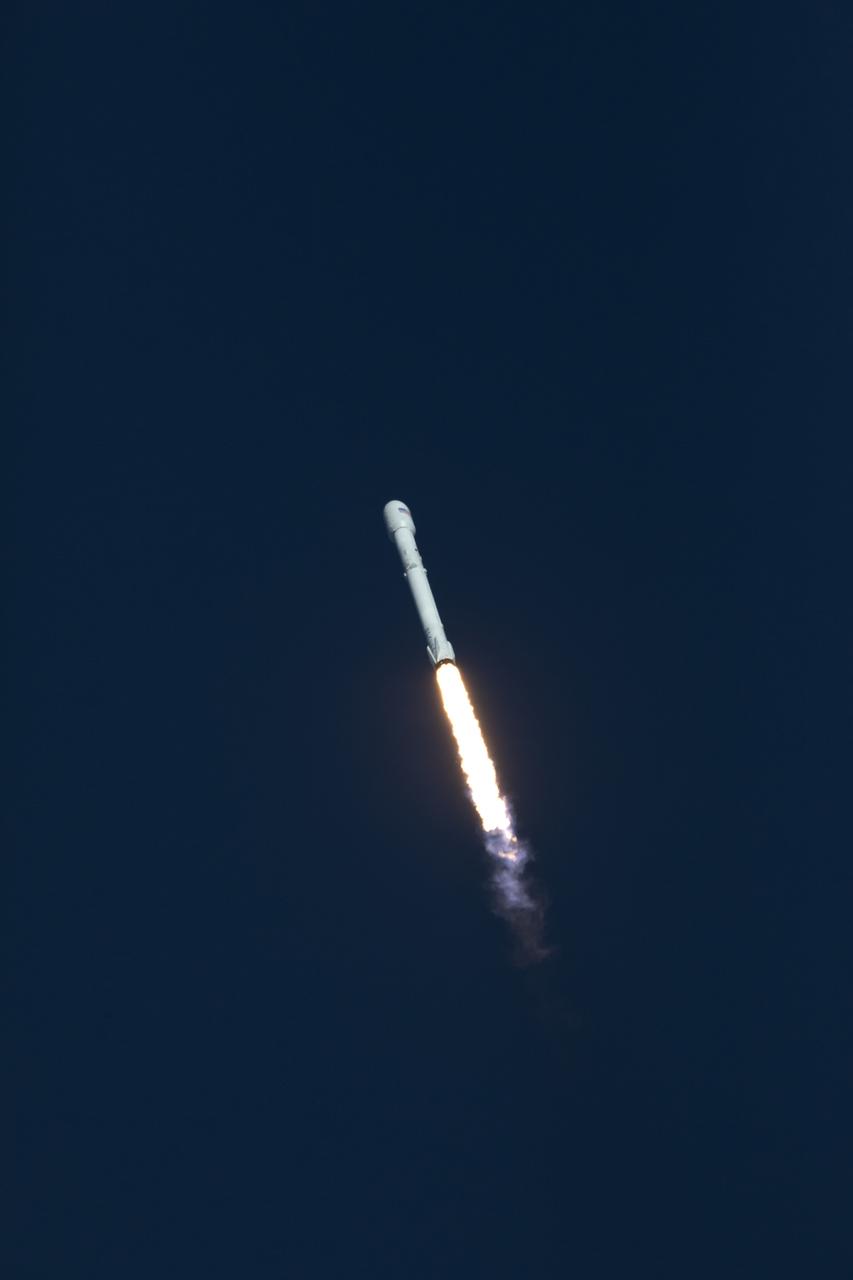
A SpaceX Falcon 9 rocket soars upward after lifting off from Space Launch Complex 40 at Cape Canaveral Air Force Station in Florida, carrying NASA's Transiting Exoplanet Survey Satellite (TESS). Liftoff was at 6:51 p.m. EDT. TESS will search for planets outside of our solar system. The mission will find exoplanets that periodically block part of the light from their host stars, events called transits. The satellite will survey the nearest and brightest stars for two years to search for transiting exoplanets.

A science briefing for the National Oceanic and Atmospheric Administration’s (NOAA) Geostationary Operational Environmental Satellite-T (GOES-T) is held on Feb. 25, 2022, at NASA’s Kennedy Space Center in Florida. Daniel Gall, Advanced Baseline Imager chief systems engineer, Space and Airborne Systems, L3 Harris Technologies, participates in the briefing. GOES-T is scheduled to lift off on a United Launch Alliance Atlas V 541 rocket from Space Launch Complex 41 at Cape Canaveral Space Force Station in Florida on March 1, 2022, at 4:38 p.m. GOES-T is the third satellite in the GOES-R series that will continue to help meteorologists observe and predict local weather events that affect public safety. The launch is being managed by NASA’s Launch Services Program based at Kennedy Space Center in Florida, America’s multi-user spaceport.
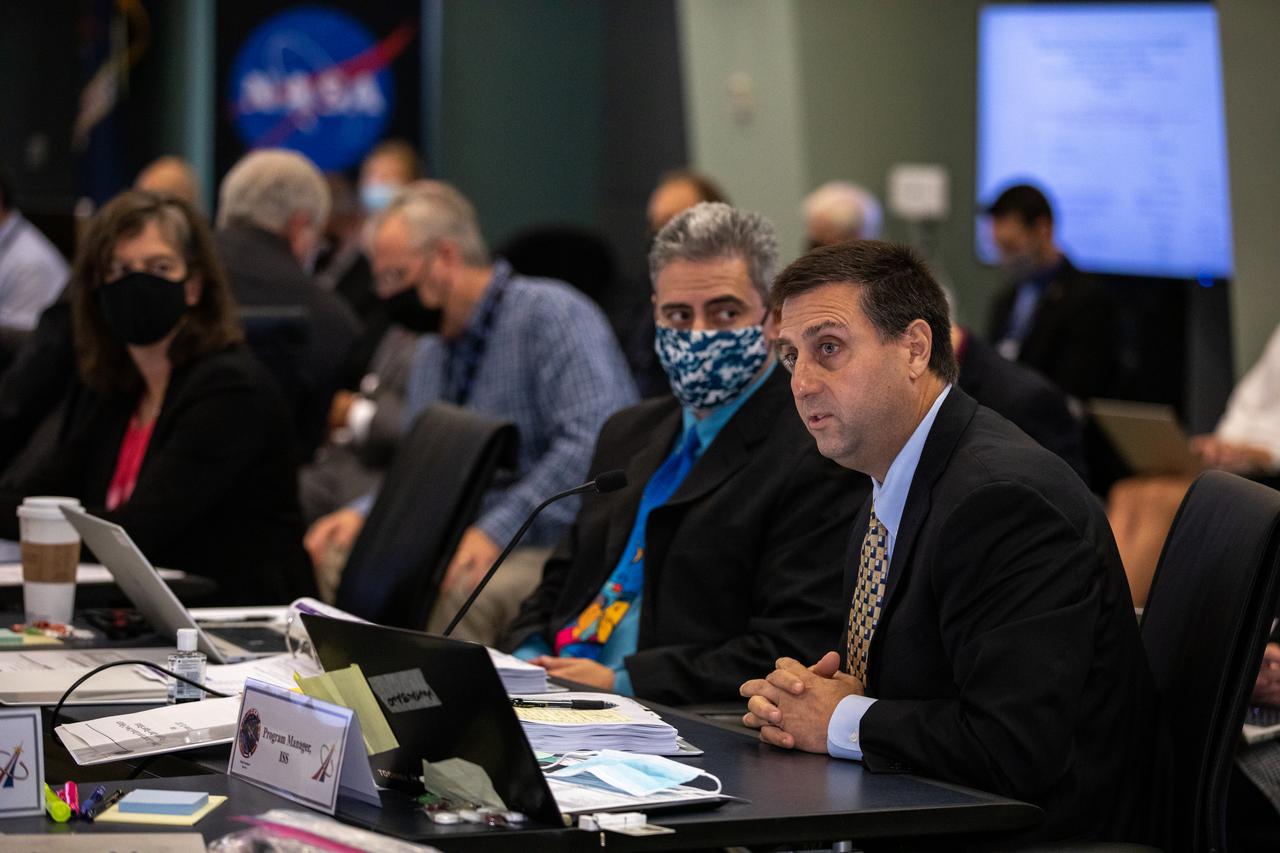
Joel Montalbano, at right, manager, International Space Station, NASA’s Johnson Space Center, participates in a Flight Readiness Review for the agency’s SpaceX Crew-3 mission at Kennedy Space Center in Florida on Oct. 25, 2021. International partners also participated. NASA and SpaceX mission managers held the FRR to confirm the SpaceX Falcon 9 and Crew Dragon spacecraft are ready for launch. Crew-3 is scheduled to launch to the International Space Station from Kennedy’s Launch Complex 39A on Oct. 31, 2021 as part of NASA’s Commercial Crew Program. Liftoff of the Falcon 9 rocket and Crew Dragon spacecraft is targeted for 2:21 a.m. EDT.
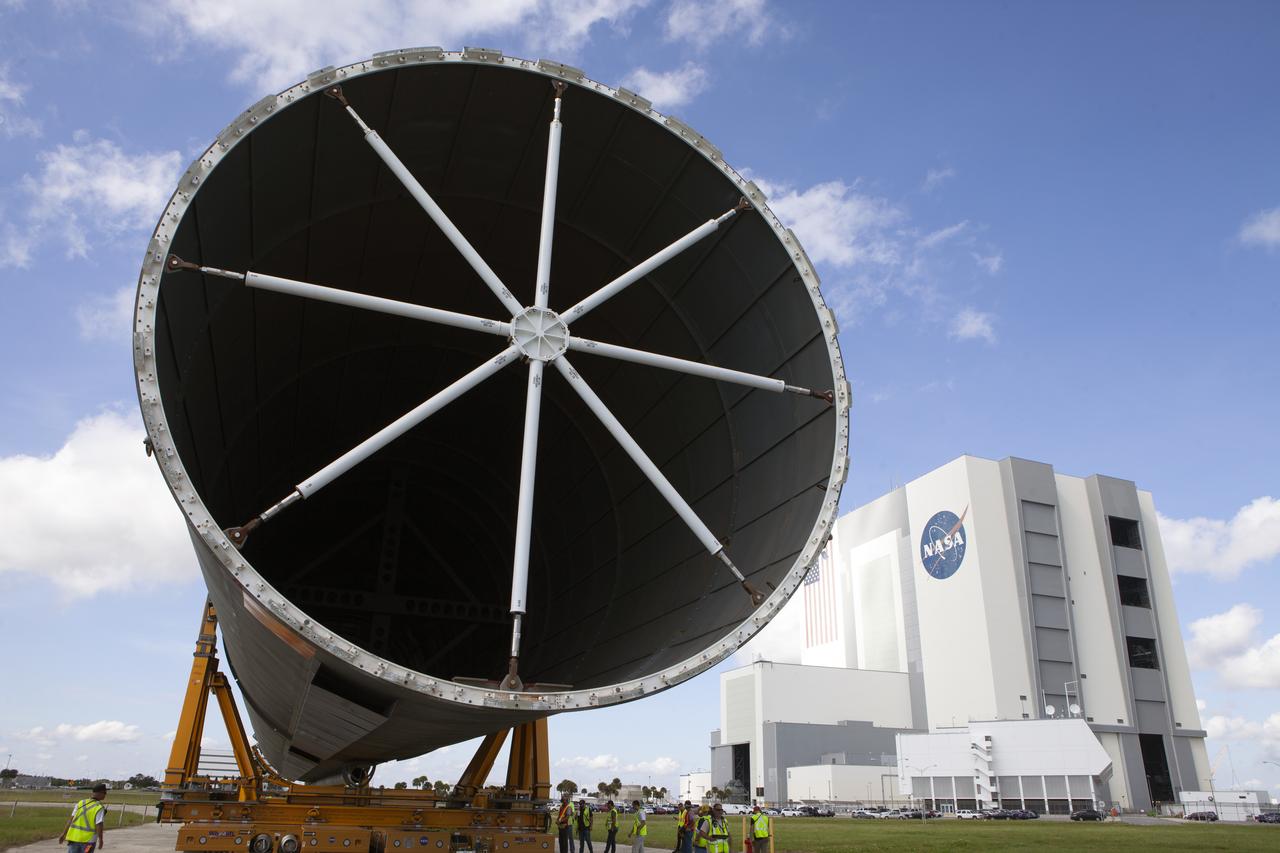
A close-up view of the top of the 212-foot-long Space Launch System (SLS) rocket core stage pathfinder as it is being moved back to the Pegasus barge at the Launch Complex 39 turn basin wharf at NASA’s Kennedy Space Center in Florida on Oct. 28, 2019. The core stage pathfinder is a full-scale mock-up of the rocket's core stage. It was used by the Exploration Ground Systems Program and their contractor, Jacobs, to practice offloading, moving and stacking maneuvers inside the Vehicle Assembly Building, using important ground support equipment to train employees and certify all the equipment works properly. The pathfinder was at Kennedy for about a month. It will make the trek back to NASA's Michoud Assembly Facility in Louisiana.
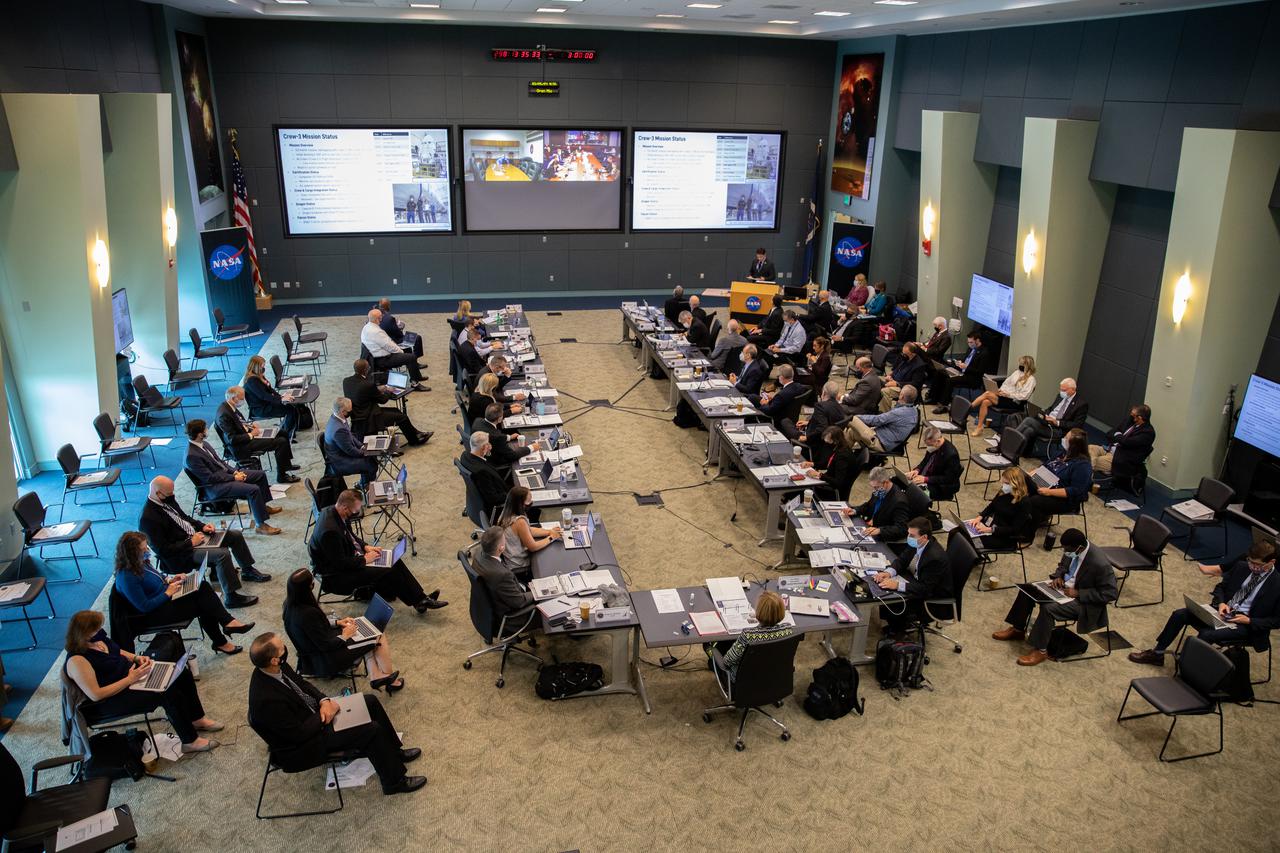
NASA and SpaceX managers participate in a Flight Readiness Review for the agency’s SpaceX Crew-3 mission at Kennedy Space Center in Florida on Oct. 25, 2021. International partners also participated. Crew-3 is scheduled to launch to the International Space Station from Kennedy’s Launch Complex 39A on Oct. 31, 2021 as part of NASA’s Commercial Crew Program. Liftoff of the Falcon 9 rocket and Crew Dragon spacecraft is targeted for 2:21 a.m. EDT.
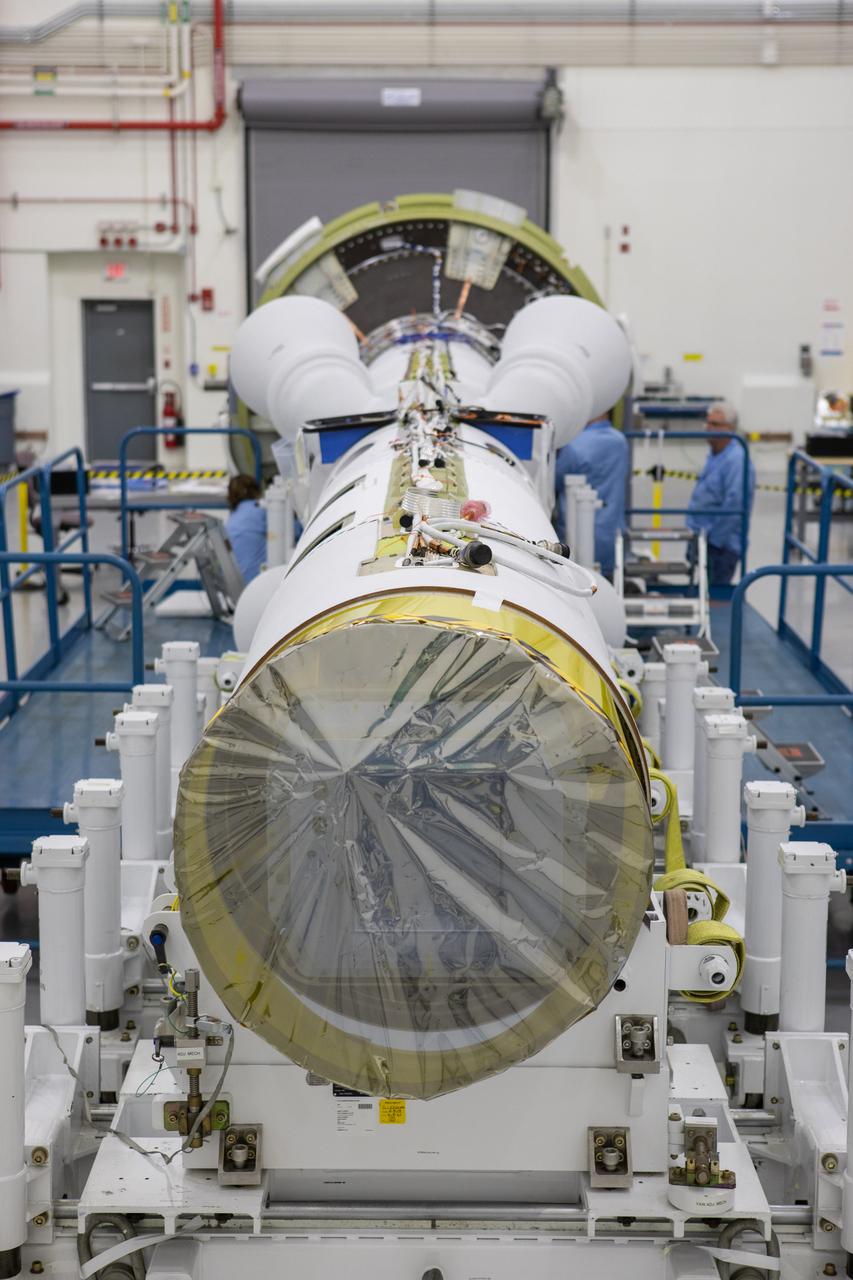
Inside the Launch Abort System Facility at NASA’s Kennedy Space Center in Florida, work is underway Aug. 21, 2019, to integrate segments of the launch abort system for the agency’s uncrewed flight test, Artemis I. During crewed launches of the Orion spacecraft atop the Space Launch System rocket, the LAS will protect the crew module and astronauts aboard to safety if an emergency occurs during launch.

NASA’s SLS (Space Launch System) core stage for the Artemis III mission undergoes prelaunch processing inside High Bay 2 of the Vehicle Assembly Building at NASA’s Kennedy Space Center in Florida on Tuesday, May 12, 2026. This marks the first time core stage assembly operations for Artemis missions have been conducted at the spaceport. Artemis III will launch astronauts to low Earth orbit aboard the Orion spacecraft on top of SLS to test rendezvous and docking capabilities between Orion and commercial spacecraft needed to land Artemis IV astronauts on the Moon in 2028.
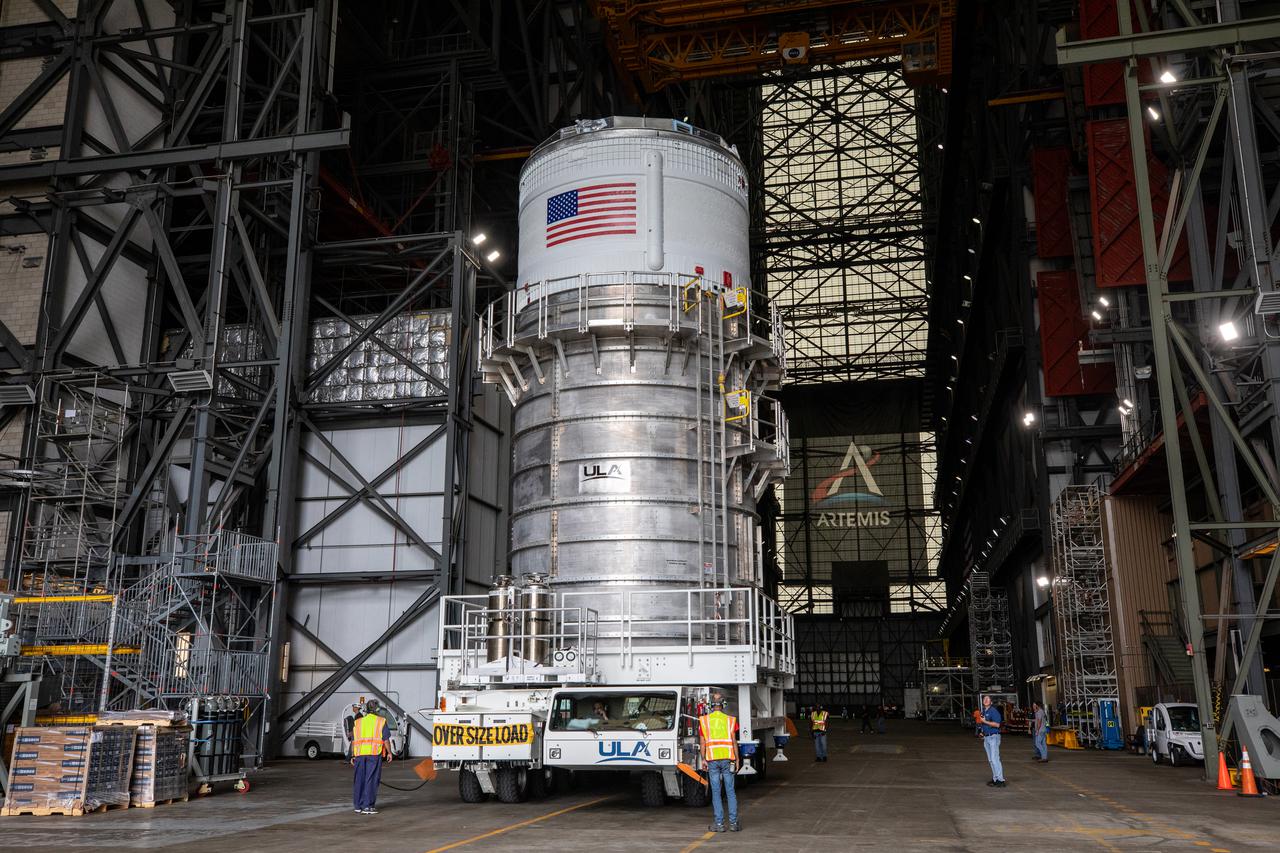
The Space Launch System (SLS) rocket’s interim cryogenic propulsion stage (ICPS) is moved into the transfer aisle of the Vehicle Assembly Building (VAB) by teams with NASA’s Exploration Ground Systems and contractor Jacobs at NASA’s Kennedy Space Center in Florida on Saturday, June 19, 2021. After being fueled and serviced inside the Multi-Payload Processing Facility (MPPF), the ICPS will be hoisted into place atop the SLS core stage while its Aerojet Rocketdyne-built RL-10 engine will be protected inside the launch vehicle stage adapter (LVSA) on the mobile launcher in preparation for the launch of Artemis I. The ICPS will provide Orion spacecraft with the push needed for its flight around the Moon. The first in a series of increasingly complex missions, Artemis I will test SLS and the Orion spacecraft as an integrated system prior to crewed flights in which NASA will land the first woman and person of color on the Moon.
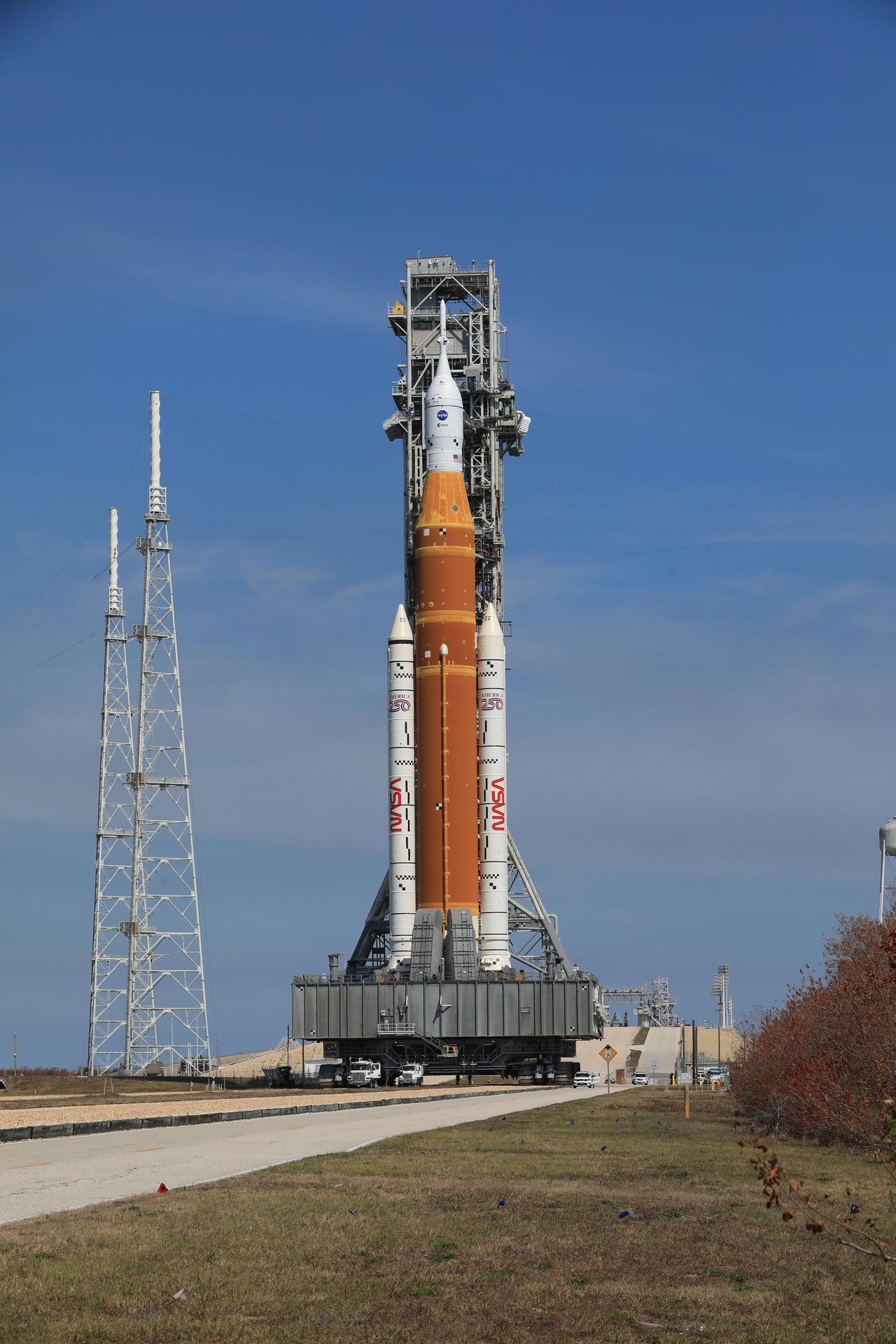
NASA’s crawler-transporter 2, carrying NASA’s Artemis II SLS (Space Launch System) rocket with the Orion spacecraft secured to mobile launcher 1, leaves Launch Complex 39B to roll back to the Vehicle Assembly Building at NASA’s Kennedy Space Center in Florida on Wednesday, Feb. 25, 2026, to troubleshoot the flow of helium to the rocket’s upper stage, the interim cryogenic propulsion stage. Once complete, the SLS rocket will roll back to Launch Complex 39B to prepare to launch four astronauts around the Moon and back for the Artemis II test flight.
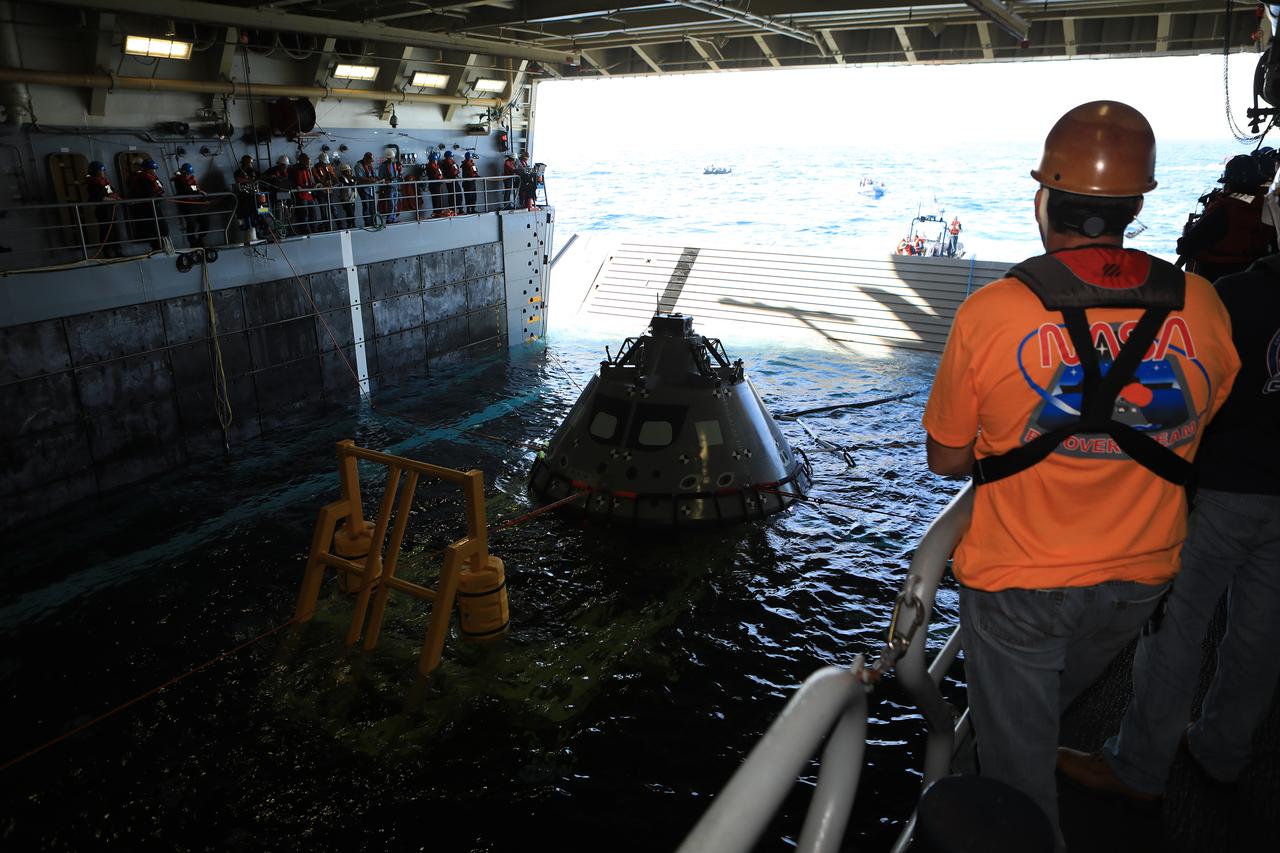
The Exploration Ground Systems Recovery Team, based out of Kennedy Space Center in Florida, practices bringing a test version of the Orion capsule inside the flooded well deck of the USS John P. Murtha and setting it in a cradle as part of Underway Recovery Test-7 (URT-7) on Oct. 31, 2018, in the Pacific Ocean. URT-7 is one in a series of tests to verify and validate procedures and hardware that will be used to recover the Orion spacecraft after it splashes down in the Pacific Ocean following deep space exploration missions. Orion will have emergency abort capability, sustain the crew during space travel and provide safe re-entry from deep space return velocities.
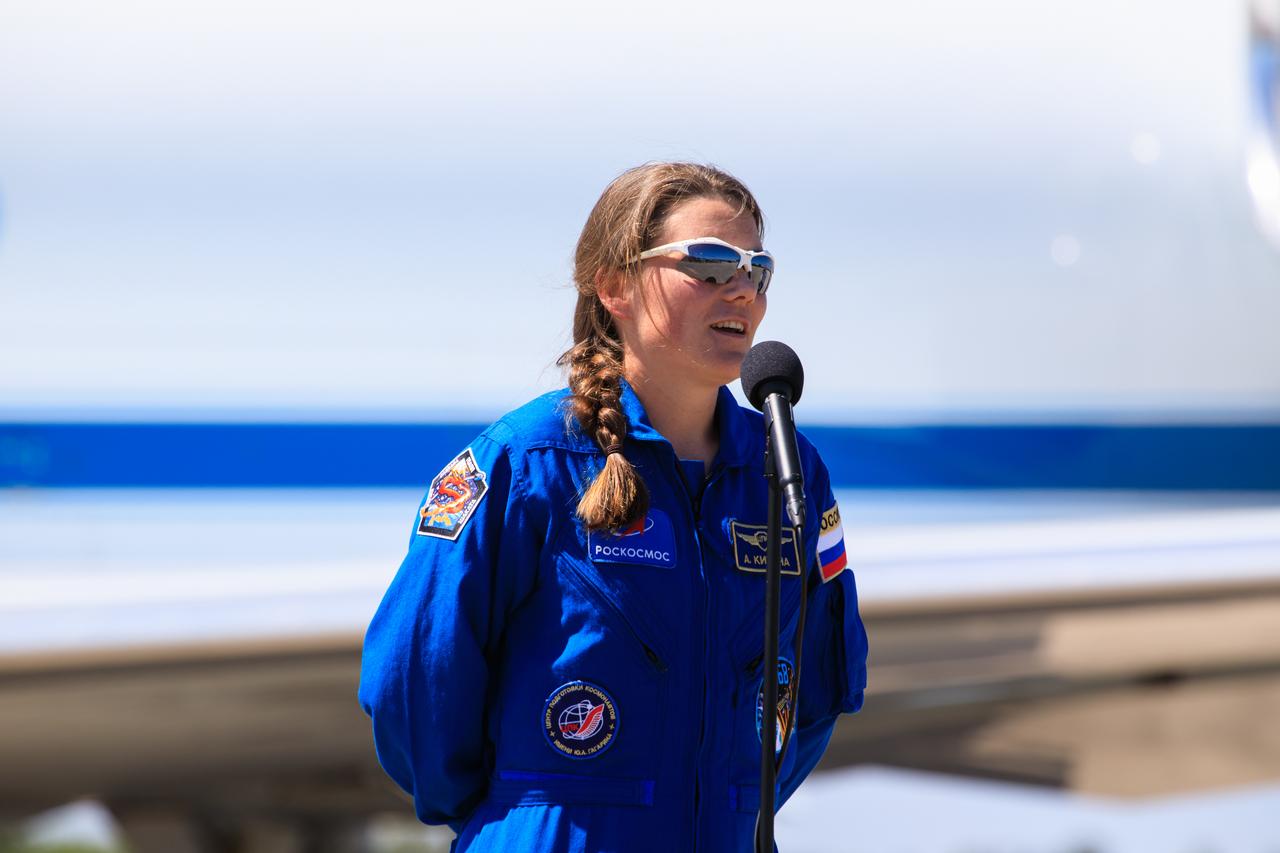
Roscosmos cosmonaut Anna Kikina speaks to members of the news media during crew arrival for NASA’s SpaceX Crew-5 mission at the Launch and Landing Facility at Kennedy Space Center in Florida on Oct. 1, 2022. The astronauts will launch aboard the Crew Dragon on a SpaceX Falcon 9 rocket on Oct. 5. Launch is targeted for noon EDT from Launch Complex 39A. Crew-5 is the fifth crew rotation mission with SpaceX to the station, and the sixth flight of Dragon with people as part of the agency’s Commercial Crew Program.
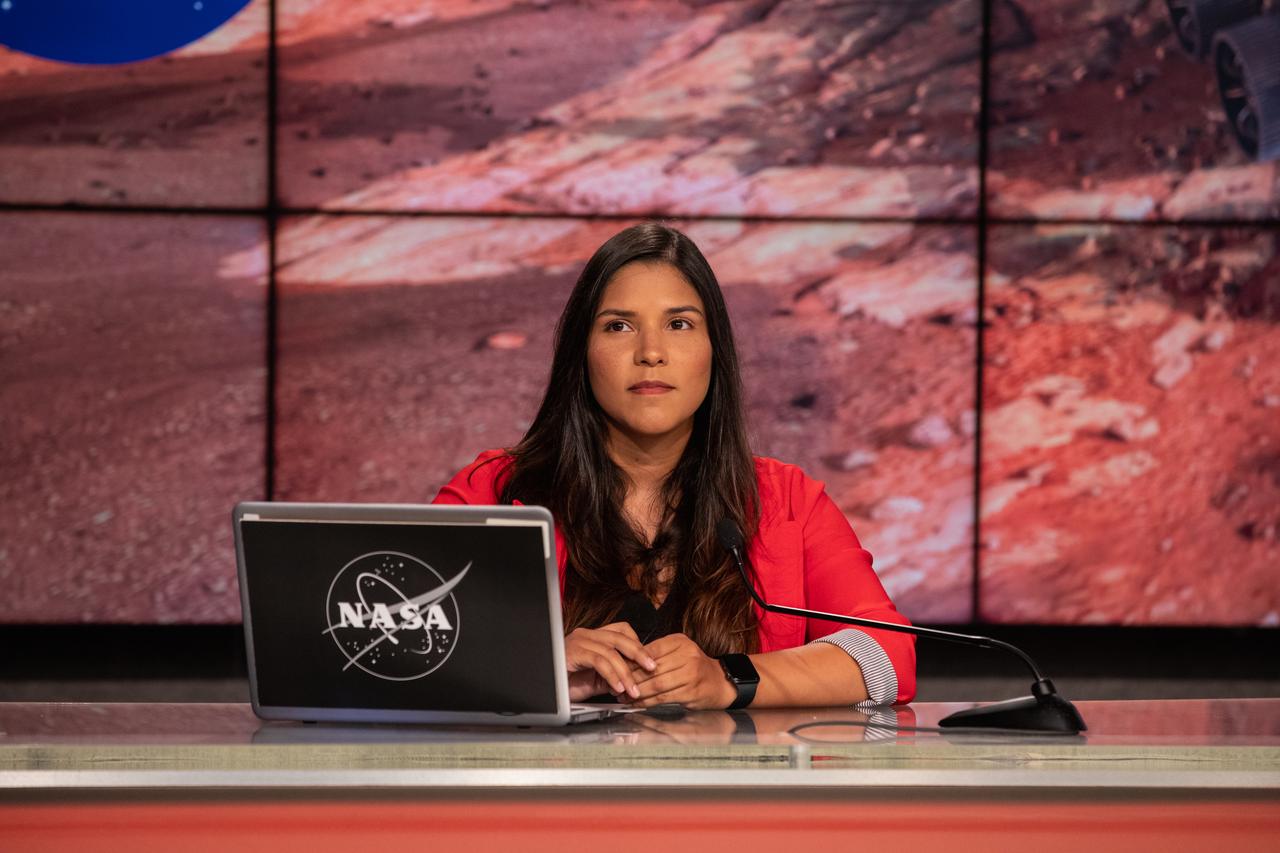
NASA Public Affairs Specialist Kristi Irastorza hosts a “Mars 2020 Social Media Q&A: En Español” program on Wednesday, July 22, at NASA’s Kennedy Space Center in Florida. The event featured representatives from NASA’s Launch Services Program (LSP) and NASA’s Jet Propulsion Laboratory. The Mars Perseverance rover is scheduled to lift off aboard a United Launch Alliance Atlas V 541 rocket from Cape Canaveral Air Force Station’s Space Launch Complex 41 on Thursday, July 30. The two-hour window opens at 7:50 a.m. EDT. LSP, based at Kennedy, is managing the launch.
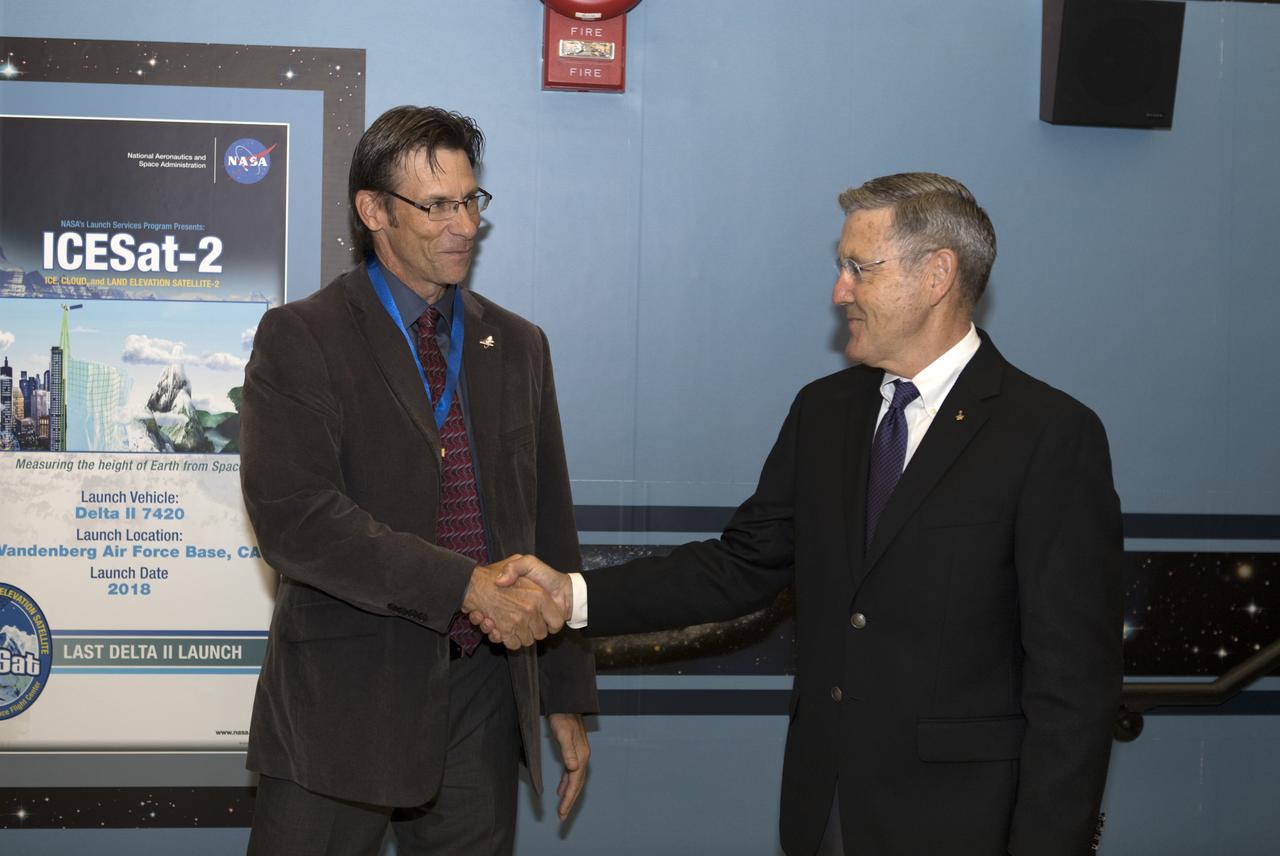
NASA Kennedy Space Center Director Bob Cabana, at right, congratulates Chuck Dovale, deputy program manager for the Launch Services Program (LSP), on Aug. 7, 2018. During a visit to the center, NASA Administrator Jim Bridenstine presents a NASA Distinguished Service Medal to Dovale. During his tour of Hangar AE and LSP's Mission Director's Center, Bridenstine received updates on LSP missions and accomplishments.
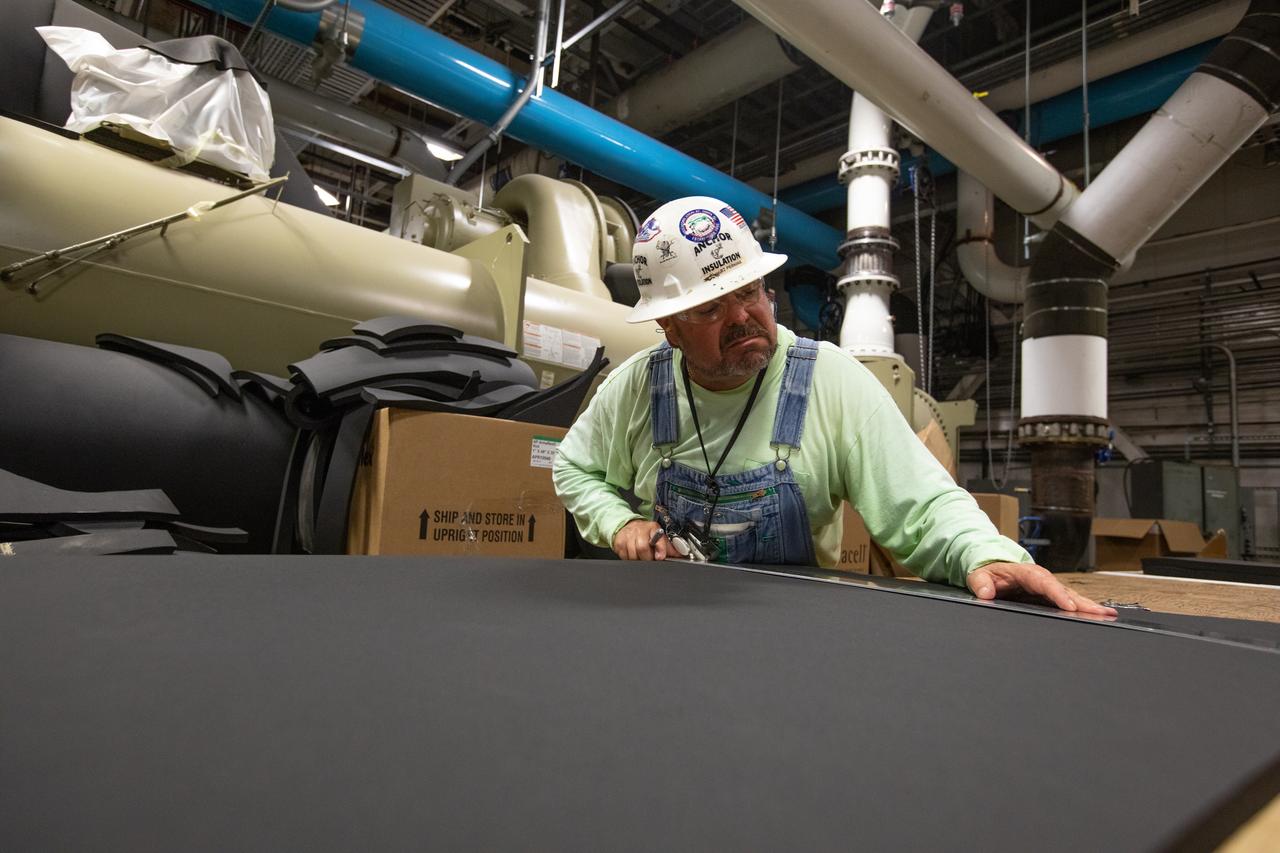
A technician measures foam insulation inside the Utility Annex near the Vehicle Assembly (VAB) Building at NASA’s Kennedy Space Center in Florida on July 24, 2019. The Utility Annex, which provides 8,000 gallons of chilled water per minute to the VAB and other facilities in the Launch Complex 39 area, is being upgraded and repaired. The facility also contains boilers necessary to provide hot water to the VAB. The center’s Engineering Directorate is making the repairs and upgrades to the facility to prepare for the agency’s Artemis missions to the Moon and on to Mars.

NASA Artemis Launch Director Charlie Blackwell-Thompson monitors activities during the launch day demonstration for one of the Artemis II integrated ground systems tests from Firing Room 1 in the Launch Control Center at Kennedy Space Center in Florida on Wednesday, Sept. 20. This is part of a series of tests to ensure the ground systems team is ready to support the crew timeline on launch day. Artemis II is the first mission with astronauts under Artemis that will test and check out all of the Orion spacecraft’s systems needed for future crewed missions.
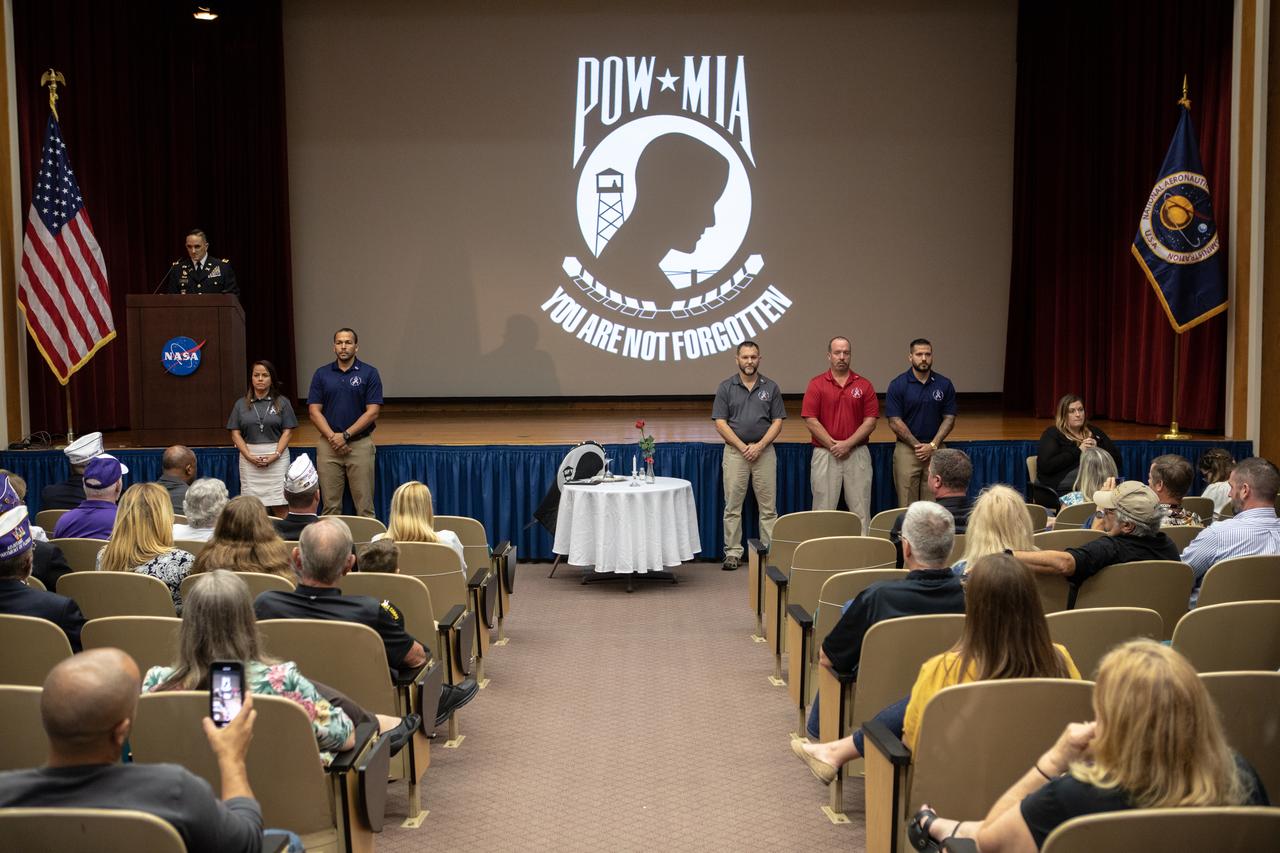
NASA Public Affairs Officer Dustin Cammack conducts a prisoner of war, missing in action ceremony at the start of a Veterans Day observance event on Nov. 7, 2019, at the Kennedy Space Center Training Auditorium in Florida. During the event, Kennedy was named a Purple Heart Entity by the Military Order of the Purple Heart, becoming the first NASA center to receive this designation for support and services provided to veterans through the spaceport’s Veterans employee resource group. Attendees included Kennedy employees and more than 20 Purple Heart recipients. Following the award presentation, Christopher Vedvick, a combat wounded veteran and Military Order of the Purple Heart department of Florida commander, spoke about his experience serving in the United States Army before retiring, his involvement in the Military Order of the Purple Heart and the purpose of the organization.
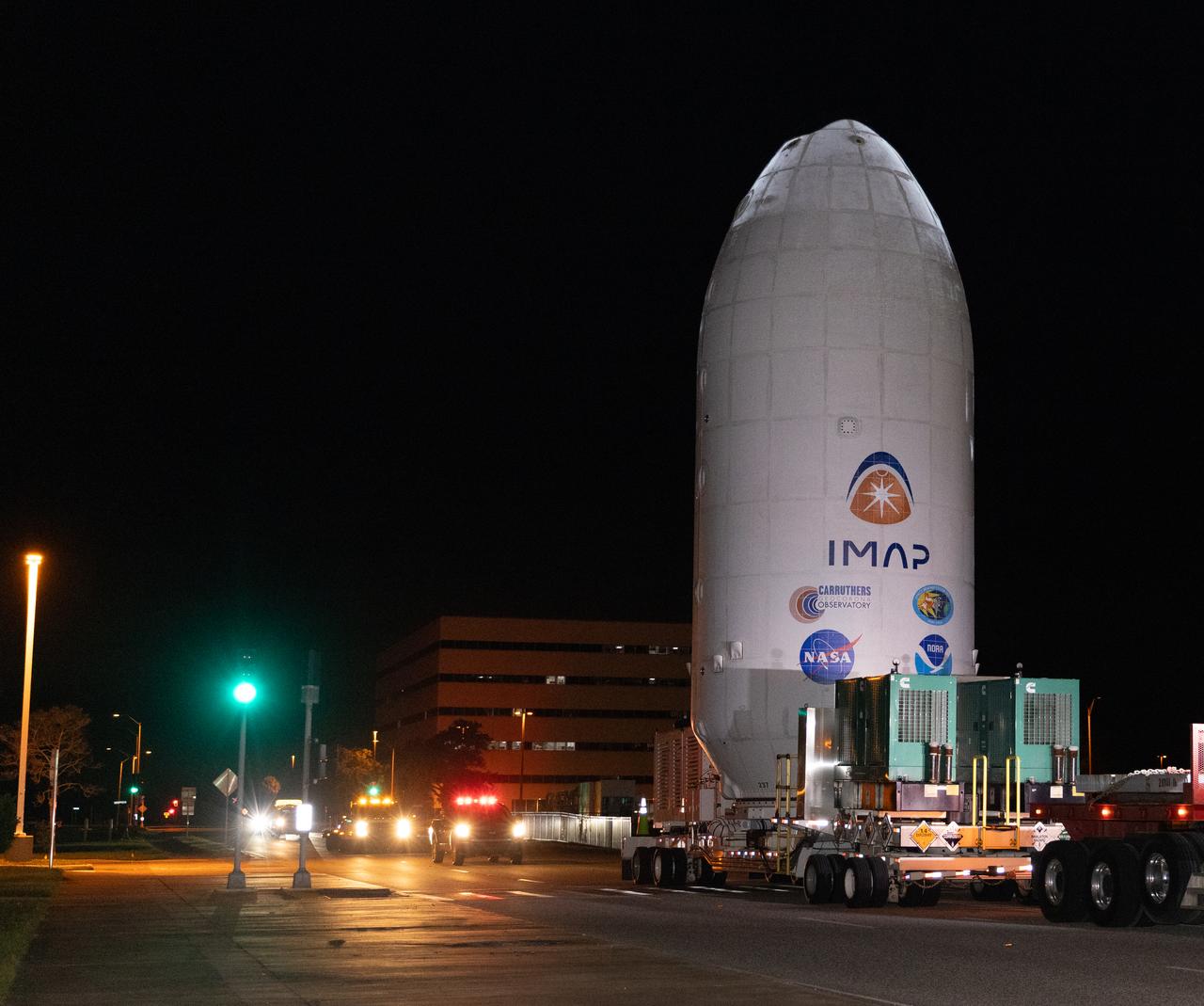
Workers transport NASA’s IMAP (Interstellar Mapping and Acceleration Probe) spacecraft along with the agency’s Carruthers Geocorona Observatory and National Oceanic and Atmospheric Administration’s (NOAA) Space Weather Follow On–Lagrange 1 (SWFO-L1) satellite late on Wednesday, Sept. 17, 2025, through early Thursday, Sept. 18, 2025, from the Astrotech Space Operations Facility in Titusville Florida, to the SpaceX hangar at Launch Complex 39A at the agency’s Kennedy Space Center in Florida. Technicians will soon mate the three spacecraft to a SpaceX Falcon 9 rocket in preparation for launch. Liftoff is targeted for 7:32 a.m. EDT, Tuesday, Sept. 23, from Launch Complex 39A at NASA Kennedy.
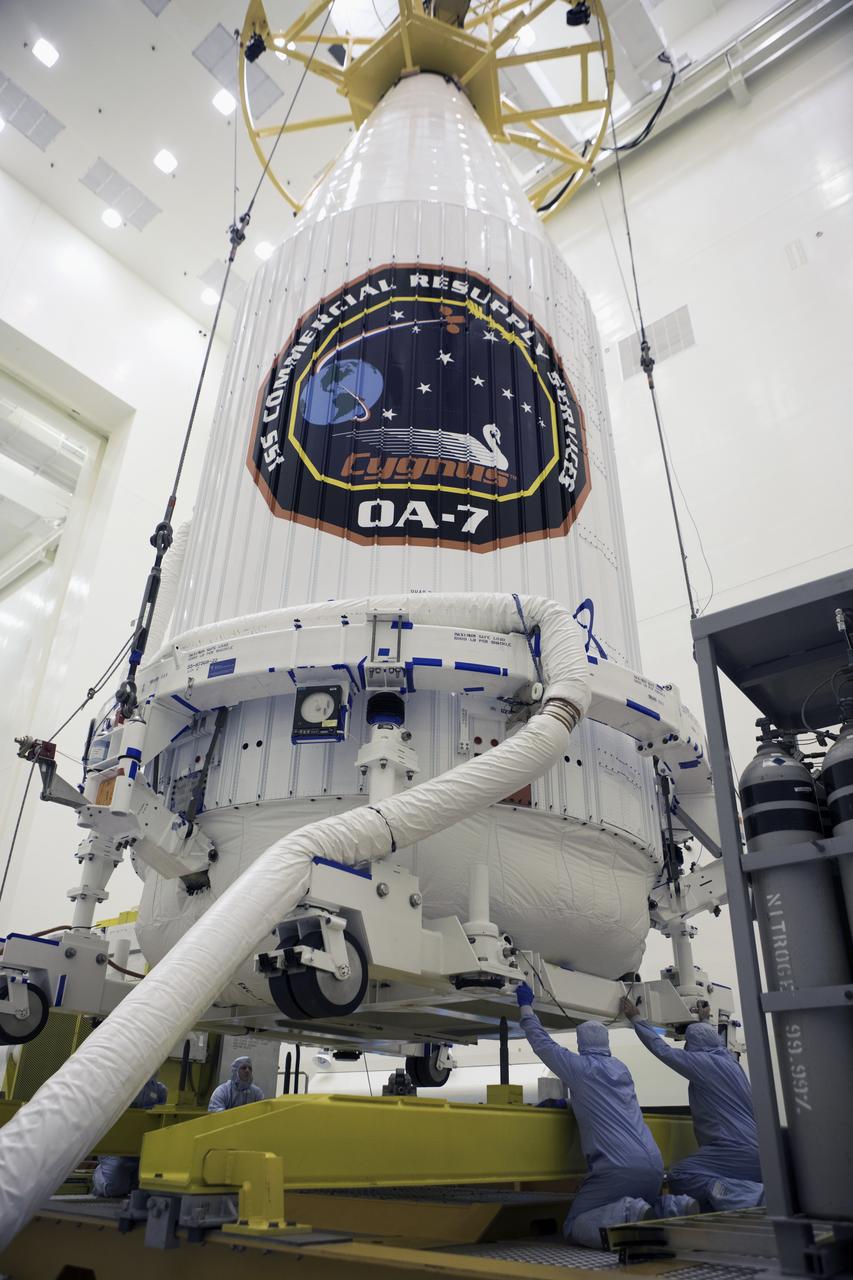
Inside the Payload Hazardous Servicing Facility at NASA's Kennedy Space Center in Florida, technicians assist as a crane lowers the Orbital ATK Cygnus pressurized cargo module, enclosed in its payload fairing, onto a KAMAG transporter. The Orbital ATK CRS-7 commercial resupply services mission to the International Space Station is scheduled to launch atop a United Launch Alliance Atlas V rocket from Space Launch Complex 41 at Cape Canaveral Air Force Station. Cygnus will deliver 7,600 pounds of supplies, equipment and scientific research materials to the space station.
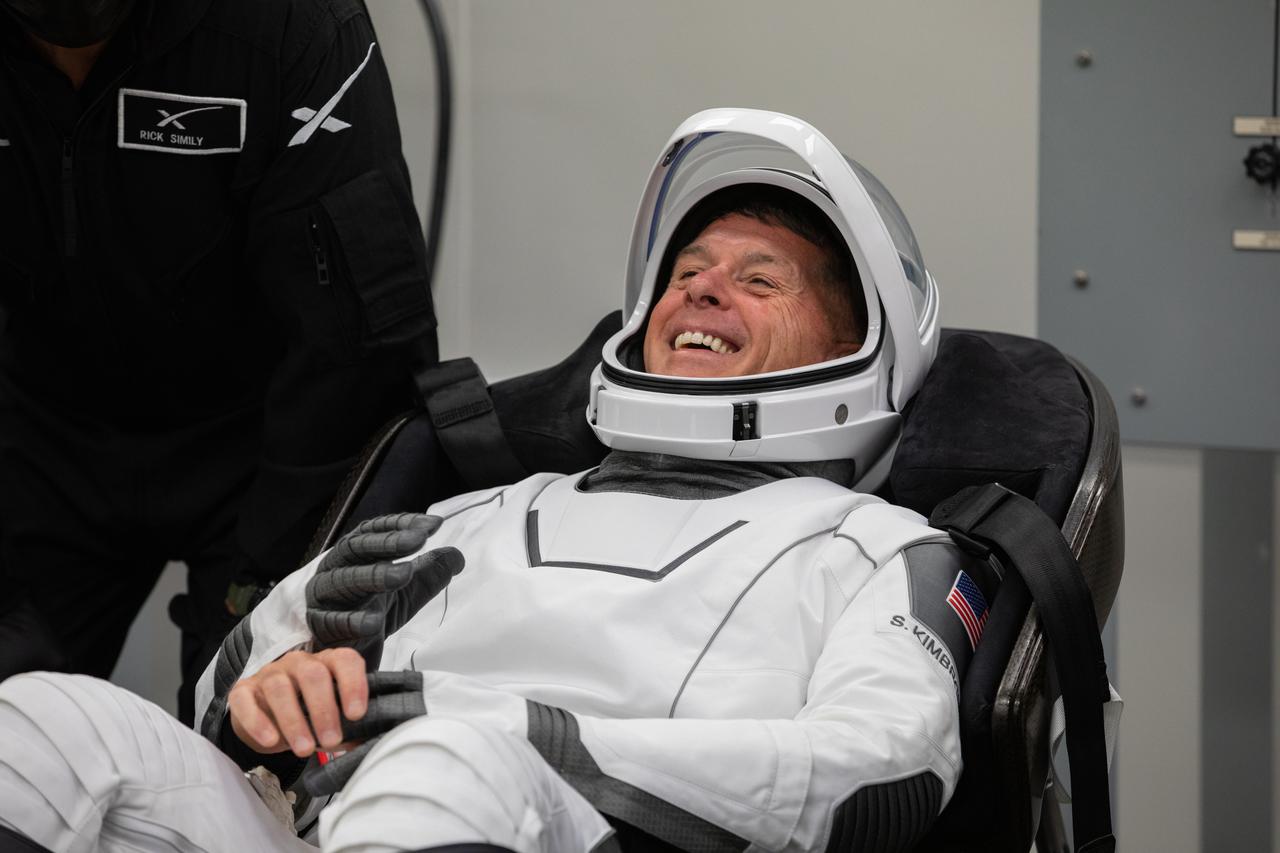
NASA astronaut Shane Kimbrough smiles inside the crew suit-up room in the Neil Armstrong Operations and Checkout Building at NASA’s Kennedy Space Center in Florida, on April 23, 2021. Kimbrough, along with NASA astronaut Megan McArthur, ESA astronaut Thomas Pesquet, and JAXA astronaut Akihiko Hoshide, will head to the International Space Station on NASA’s SpaceX Crew-2 mission. SpaceX’s Crew Dragon Endeavour will launch on the company’s Falcon 9 rocket from Kennedy’s Launch Complex 39A today at 5:49 a.m. EDT.
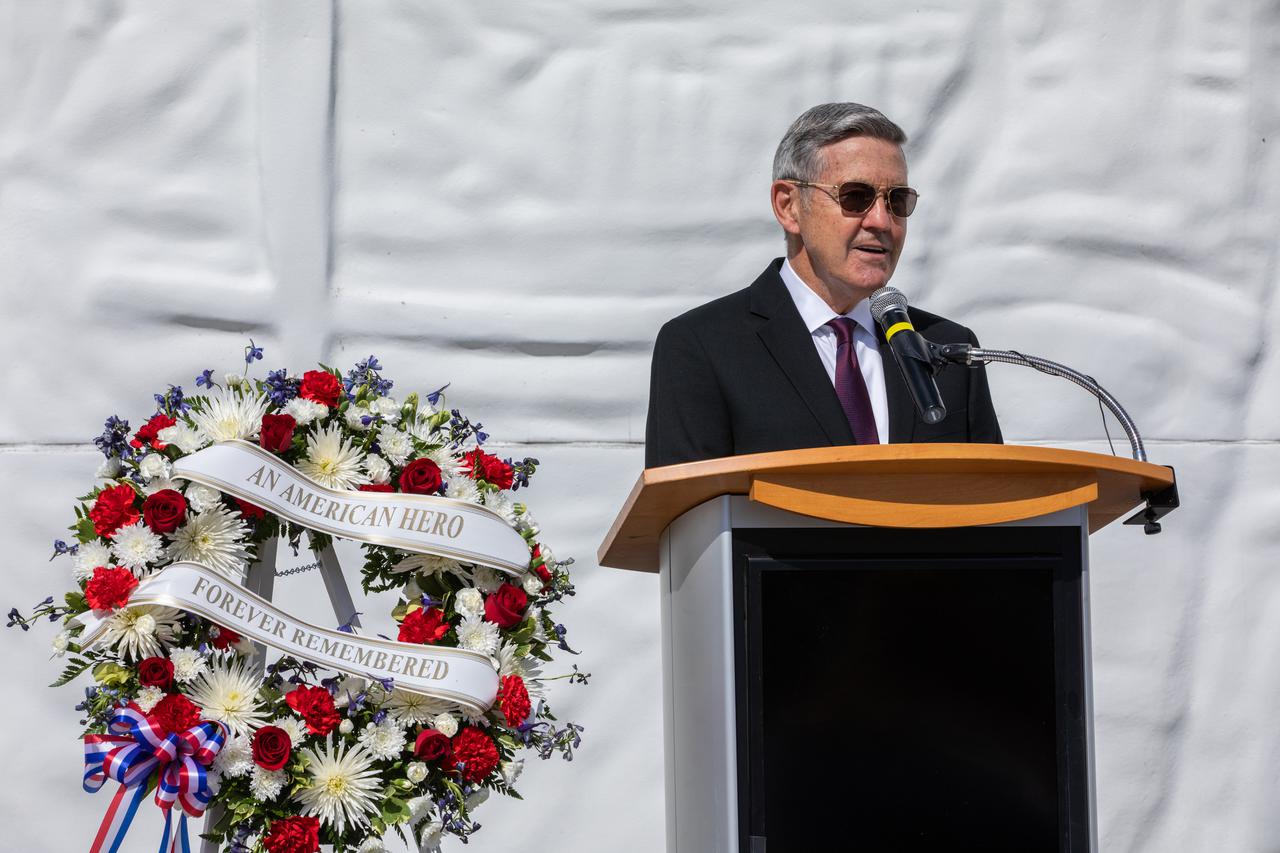
Kennedy Space Center Director Bob Cabana provides remarks during a wreath-laying ceremony in Florida, honoring the memory of former Apollo 11 astronaut Michael Collins on April 30, 2021. Therrin Protze, chief operating officer of Delaware North at Kennedy’s visitor complex, also spoke during the ceremony, held just outside of the Heroes and Legends exhibit at the visitor complex. Collins served as pilot on the three-day Gemini X mission in 1966, and he was the command module pilot for the historic Apollo 11 mission in 1969, where he remained in lunar orbit while Neil Armstrong and Buzz Aldrin become the first people to walk on the Moon. Collins passed away on April 28, 2021, at the age of 90.

NASA’s Artemis II Orion spacecraft with its launch abort system is stacked atop the agency’s SLS (Space Launch System) rocket in High Bay 3 of the Vehicle Assembly Building at NASA’s Kennedy Space Center in Florida on Monday, Oct. 20, 2025. The spacecraft will carry NASA astronauts Reid Wiseman, Victor Glover, Christina Koch, and CSA (Canadian Space Agency) astronaut Jeremy Hansen on a 10-day mission around the Moon and back in early 2026. Teams will begin conducting a series of verification tests ahead of rolling out the integrated SLS rocket to NASA Kennedy’s Launch Complex 39B for the wet dress rehearsal.
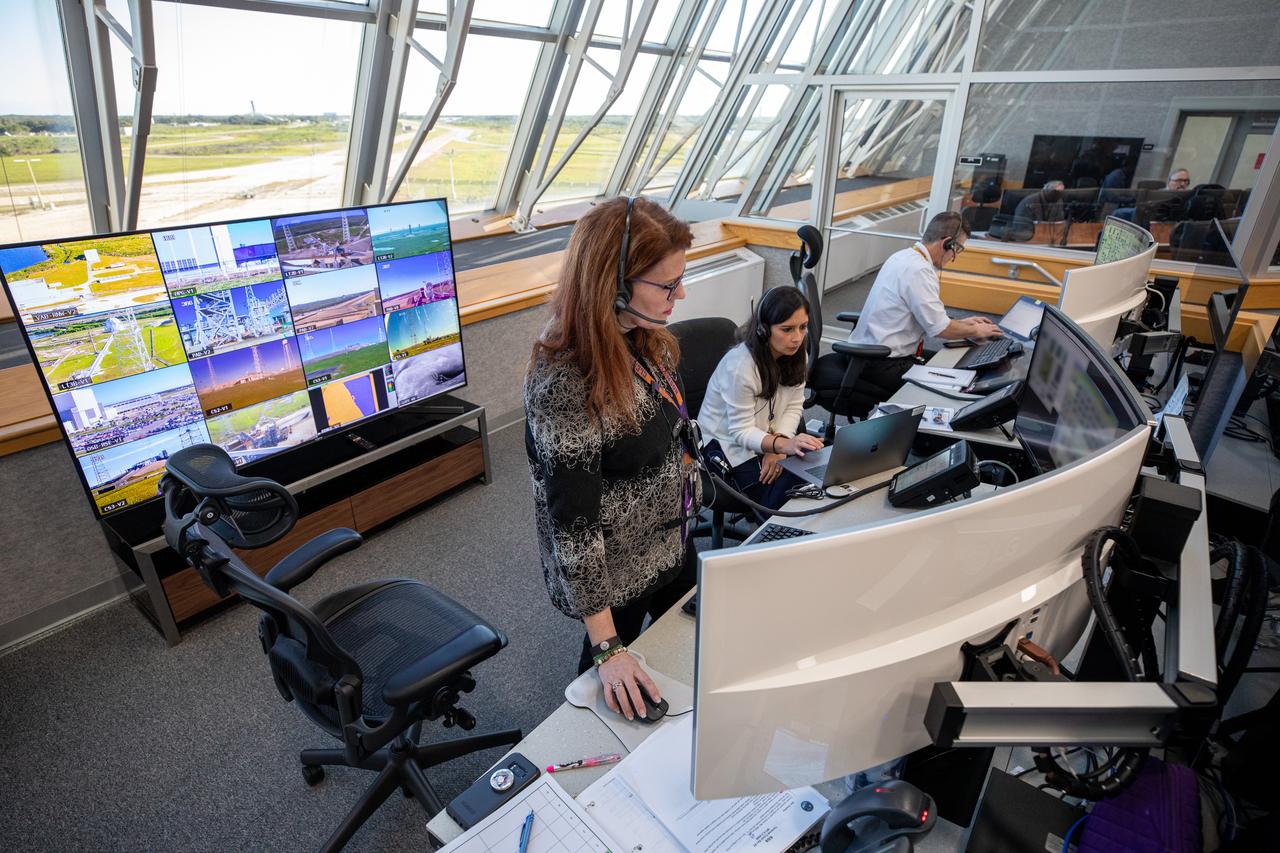
Artemis I Launch Director Charlie Blackwell-Thompson (left) stands at the launch console inside the Launch Control Center’s Firing Room 1 at the Kennedy Space Center in Florida during a countdown simulation. Next to her are Jessica Parsons, technical assistant to the launch director, and Jeremy Graeber, NASA’s Test, Launch and Recovery Operations branch chief, who also serves as the assistant launch director. A team of nearly 100 engineers from Orion, Space Launch System (SLS) and the agency’s Exploration Ground Systems coming together on Feb. 3, 2020, to work through a series of simulated challenges, as well as a final countdown procedure. During these exercises, different issues were introduced to familiarize the team with launch day operations, while providing them with an opportunity to practice how they would handle those issues in real-time. Artemis I will be the first integrated test flight of the Orion spacecraft and SLS rocket – the system that will ultimately land the first woman and the next man on the Moon.
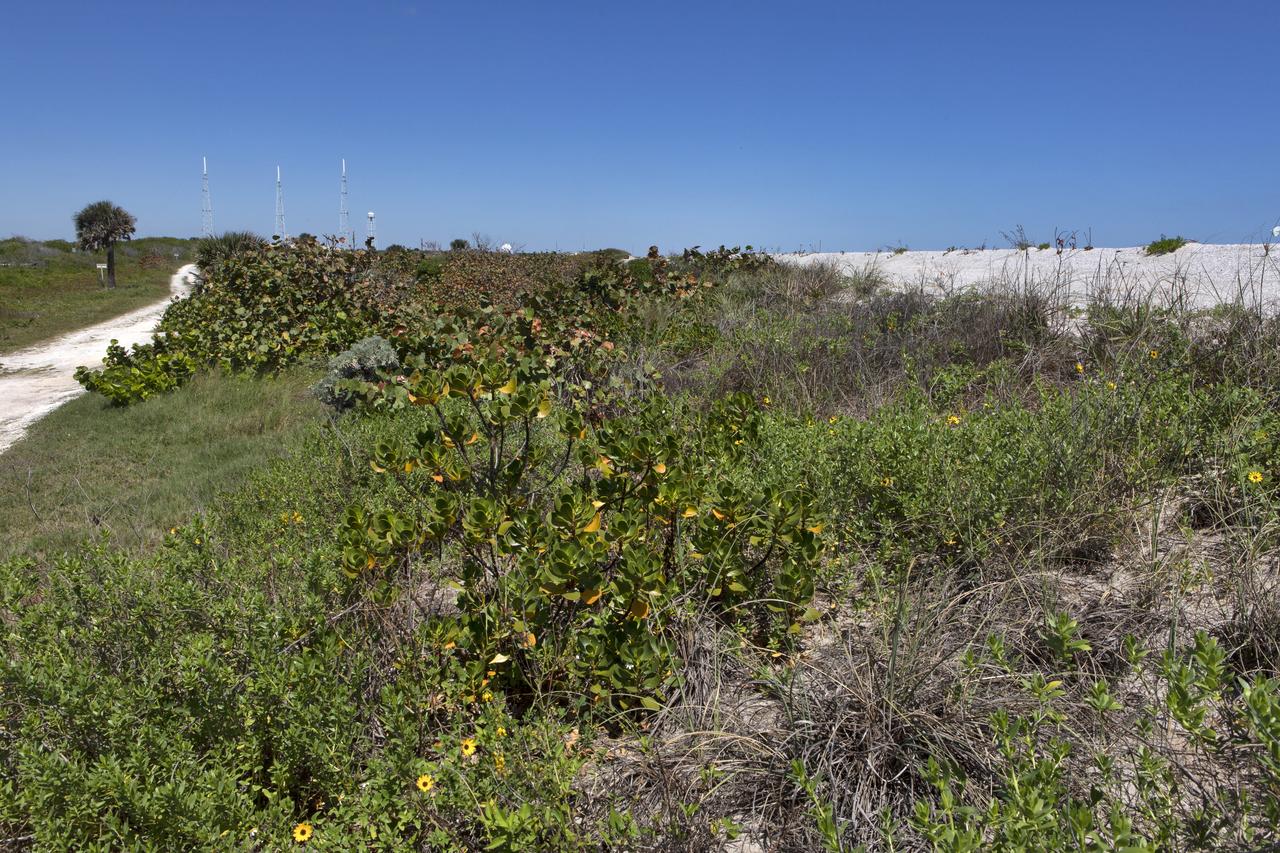
Restoration efforts are underway to the dunes at the north beaches at NASA’s Kennedy Space Center in Florida in this view on April 15, 2019. The existing dunes in the foreground are a contrast to a small portion of the dune restoration in view at far right. About 450,000 cubic yards of beach-quality sand, tested for compatibility, was transported to the space center’s beaches. Once the dune is built up, native coastal vegetation will be replanted, helping to stabilize the dune and offer a habitat for Kennedy’s coast wildlife. Dunes are affected by beach erosion and storm surge from tropical events, such as hurricanes. Restoration began in spring 2018 and was targeted to be completed by April 2019.
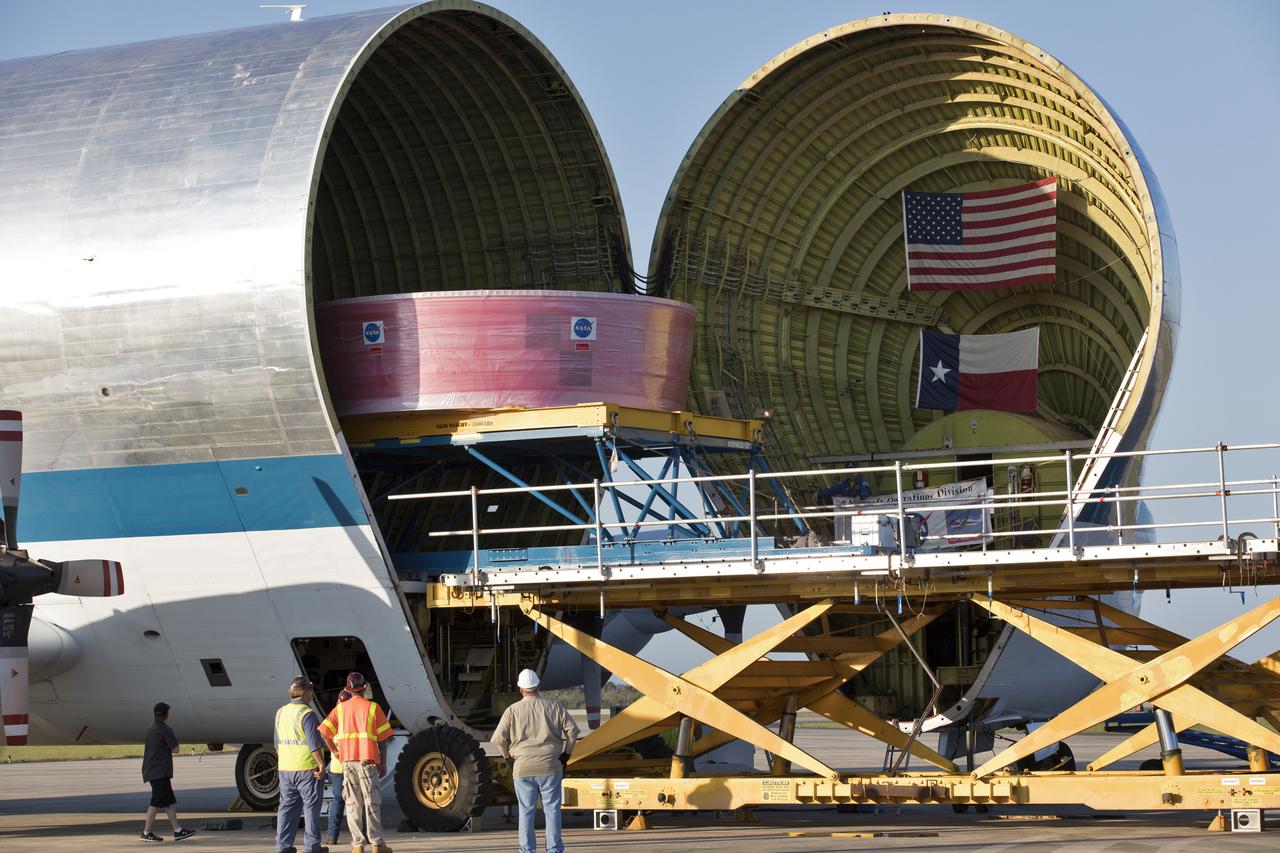
The Orion Stage Adapter (OSA) is moved out of NASA's Super Guppy aircraft onto a special payload handler at the Shuttle Landing Facility at Kennedy Space Center in Florida. The OSA is the second flight-hardware section of NASA's Space Launch System (SLS) rocket to arrive at Kennedy. The OSA will connect the Orion spacecraft to the upper part of the SLS, the interim cryogenic propulsion stage (ICPS). Both the OSA and ICPS are being stored for processing in the center's Space Station Processing Facility in preparation for Exploration Mission-1, the first uncrewed, integrated launch of the SLS rocket and Orion spacecraft.

NASA astronaut Nicole Mann participates in a NASA Social Facebook Live briefing inside the Press Site auditorium on May 26, 2020, at the agency’s Kennedy Space Center in Florida ahead of NASA’s SpaceX Demo-2 launch, slated for Wednesday, May 27. A SpaceX Falcon 9 rocket and Crew Dragon spacecraft are scheduled to lift off from Kennedy’s Launch Complex 39A, carrying NASA astronauts Robert Behnken and Douglas Hurley to the International Space Station. This will mark the first launch of astronauts from U.S. soil to the space station since the conclusion of the Space Shuttle Program in 2011. Part of the agency’s Commercial Crew Program, this will be SpaceX’s final flight test, paving the way for NASA to certify the crew transportation system for regular, crewed flights to the orbiting laboratory. Liftoff is scheduled for 4:33 p.m. EDT.
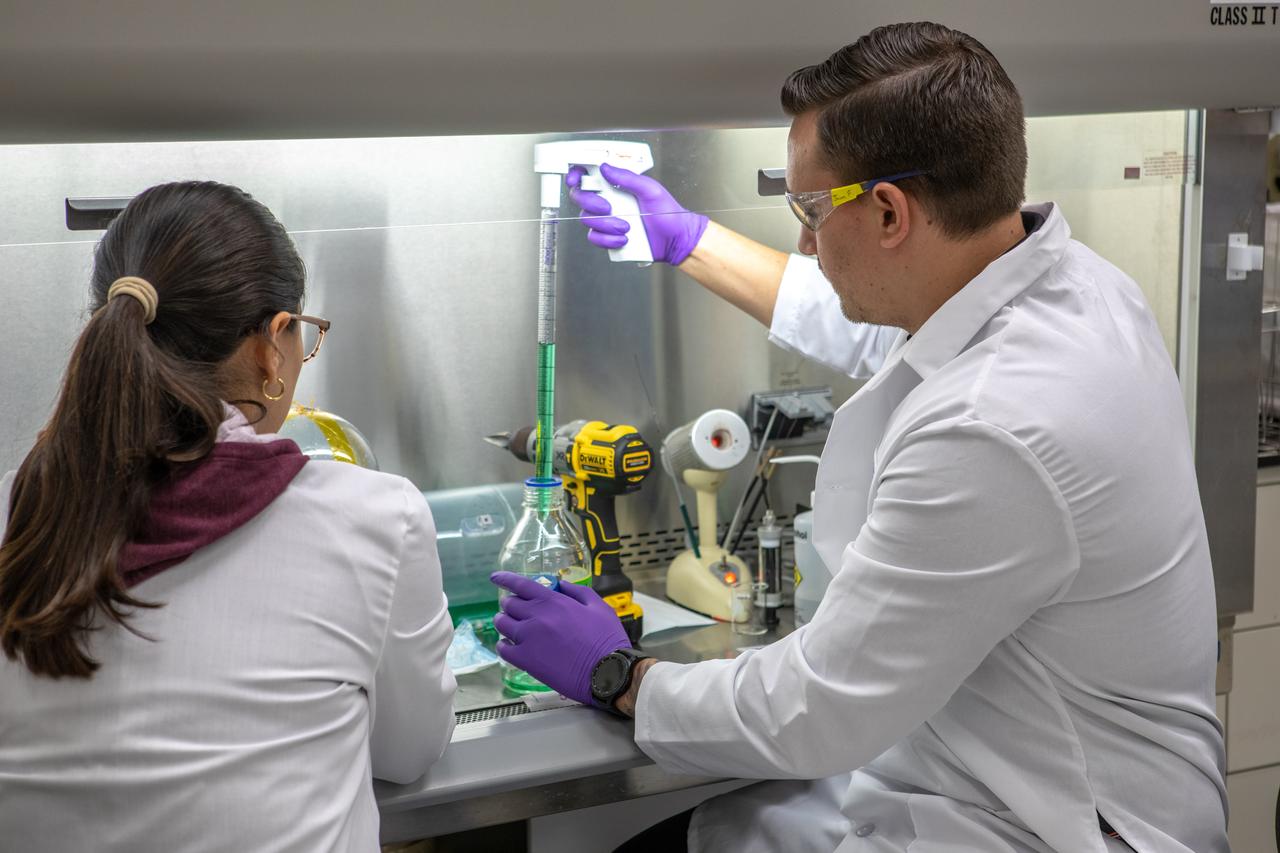
Kennedy Space Center’s Carolina Franco, Ph.D., left, and Jason Fischer collect samples from a water tank, filled with green dye, for a biological study in the Florida spaceport’s Neil Armstrong Operations and Checkout Building on Nov. 13, 2019. Two tanks have recently returned to Kennedy after spending the last five years on the International Space Station for an experiment to study slosh, or the movement of water, in a zero-gravity environment to help engineers predict the movement of propellant in rocket tanks. Kennedy’s Air and Water Revitalization lab is studying the water tanks to determine if there is, or was, any microbial growth within them. The results will help NASA determine whether clean water can be stored in space for long-duration missions, an essential component to keeping astronauts safe and healthy as the agency prepares for missions to the Moon and beyond to Mars.
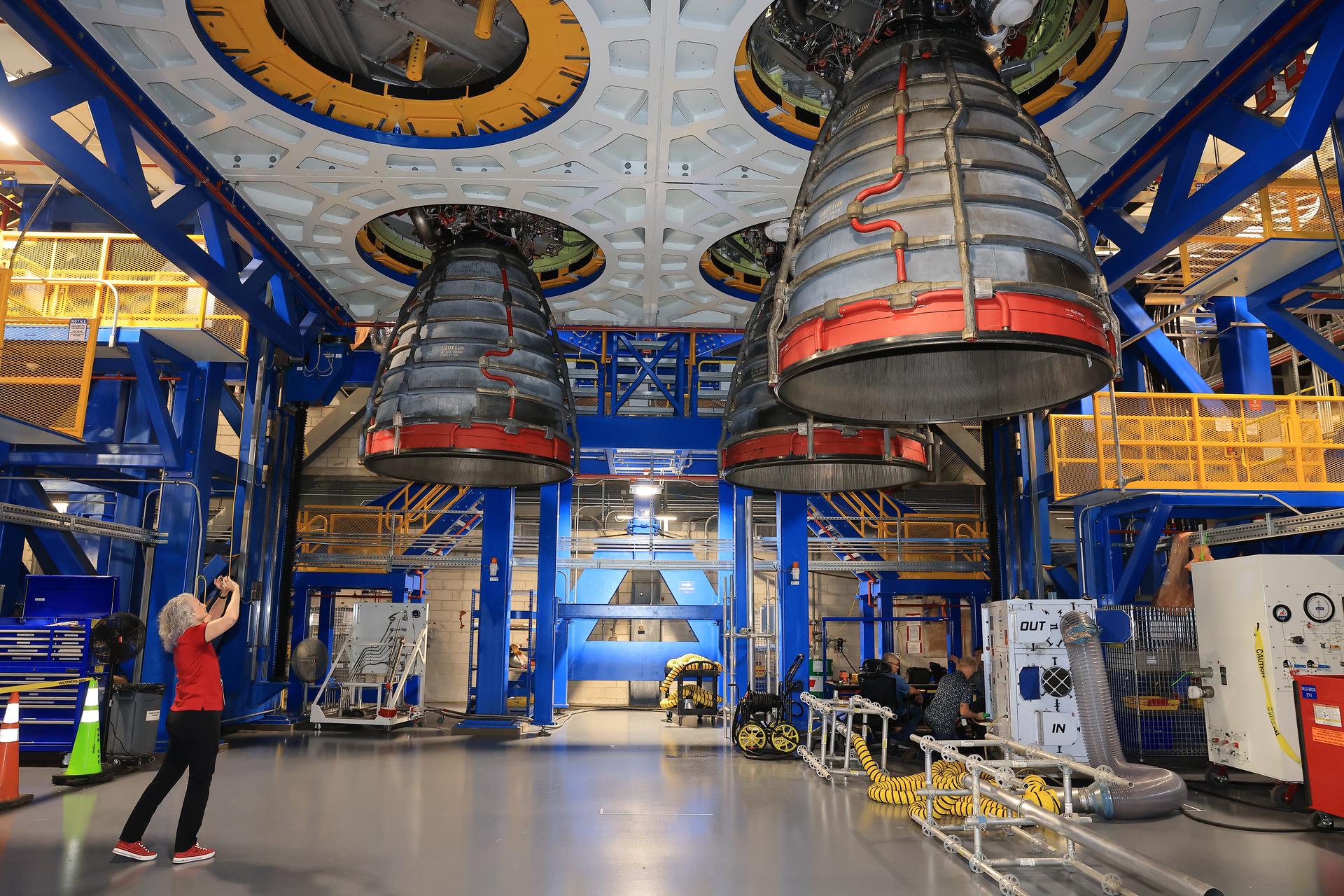
Technicians install three of four RS-25 SLS (Space Launch System) rocket engines on the work stand for integration with the Artemis III core stage rocket on Friday, Aug. 28, 2026, inside the Vehicle Assembly Building at NASA’s Kennedy Space Center in Florida. During Artemis III, the four RS-25 engines will launch the Orion spacecraft and its crew of four into low Earth orbit, generating more than two million pounds of thrust at liftoff.
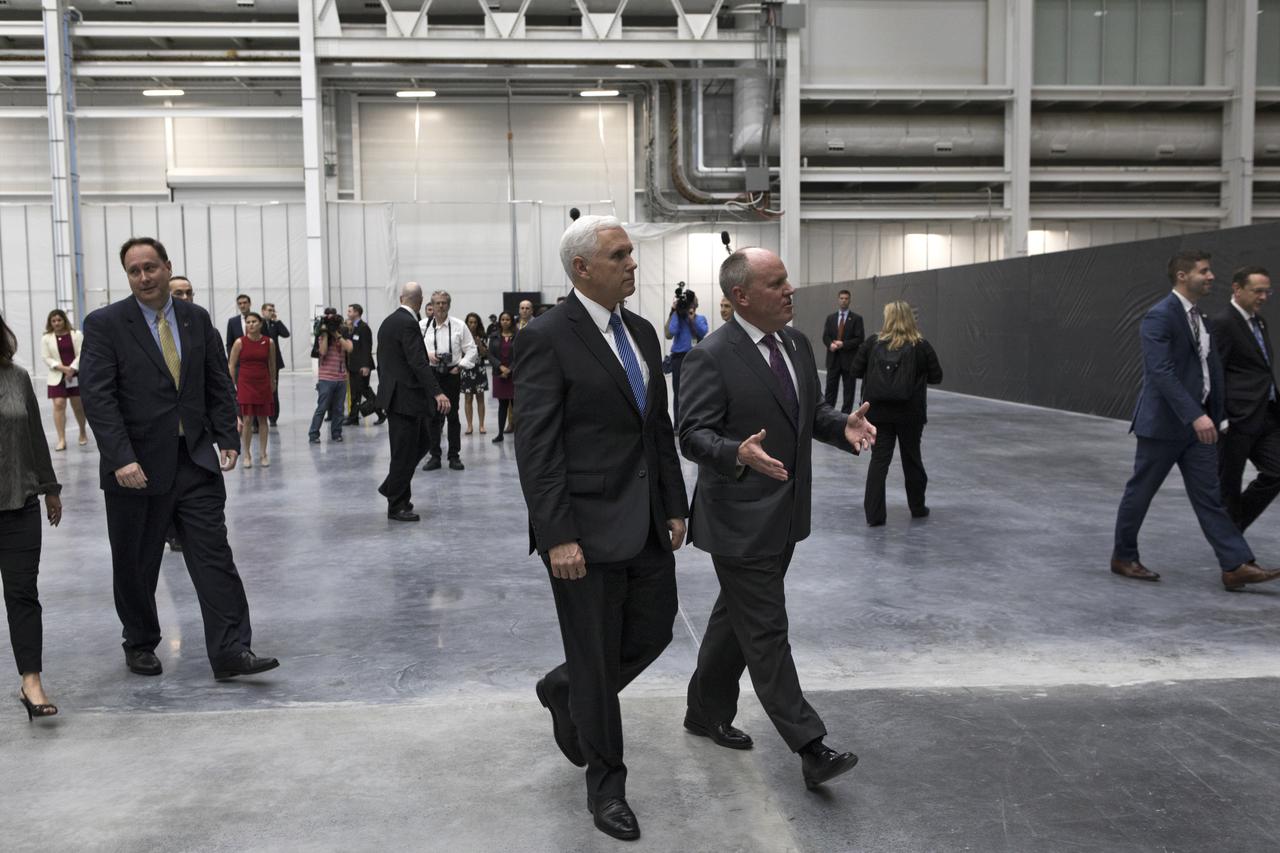
Vice President Mike Pence, at left, tours the Blue Origin Manufacturing Facility near NASA's Kennedy Space Center in Florida, Feb. 20, 2018, with the company's CEO Robert Smith. Vice President Pence viewed the flown New Shepard Booster and Crew Capsule. The booster was the first launch vehicle with a successful vertical takeoff and vertical landing to demonstrate reusability. During his visit, Pence will chair a meeting of the National Space Council on Feb. 21, 2018 in the high bay of NASA Kennedy Space Center's Space Station Processing Facility. The council's role is to advise the president regarding national space policy and strategy, and review the nation's long-range goals for space activities.
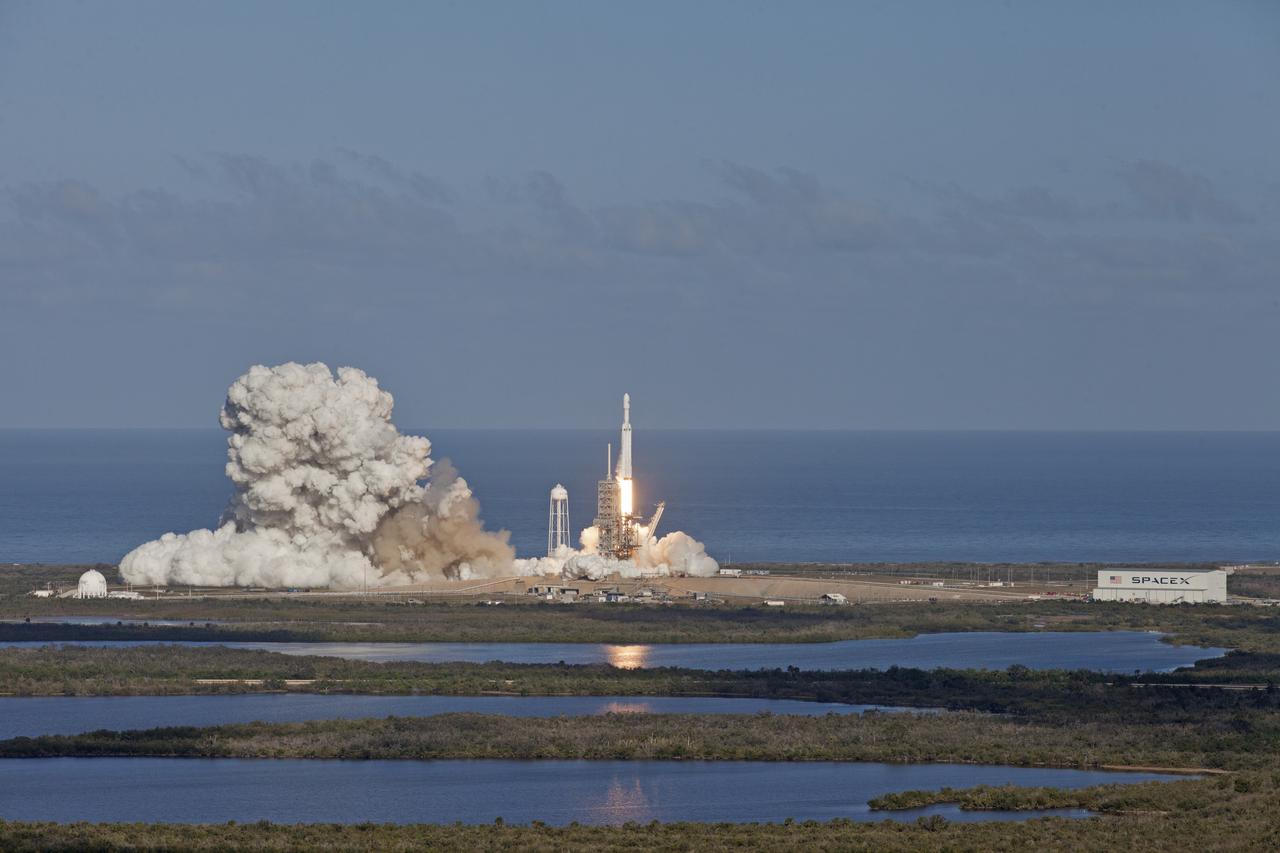
A SpaceX Falcon Heavy rocket begins its demonstration flight with liftoff at 3:45 p.m. EST from from Launch Complex 39A at NASA's Kennedy Space Center in Florida. This is a significant milestone for the world's premier multi-user spaceport. In 2014, NASA signed a property agreement with SpaceX for the use and operation of the center's pad 39A, where the company has launched Falcon 9 rockets and prepared for the first Falcon Heavy. NASA also has Space Act Agreements in place with partners, such as SpaceX, to provide services needed to process and launch rockets and spacecraft.
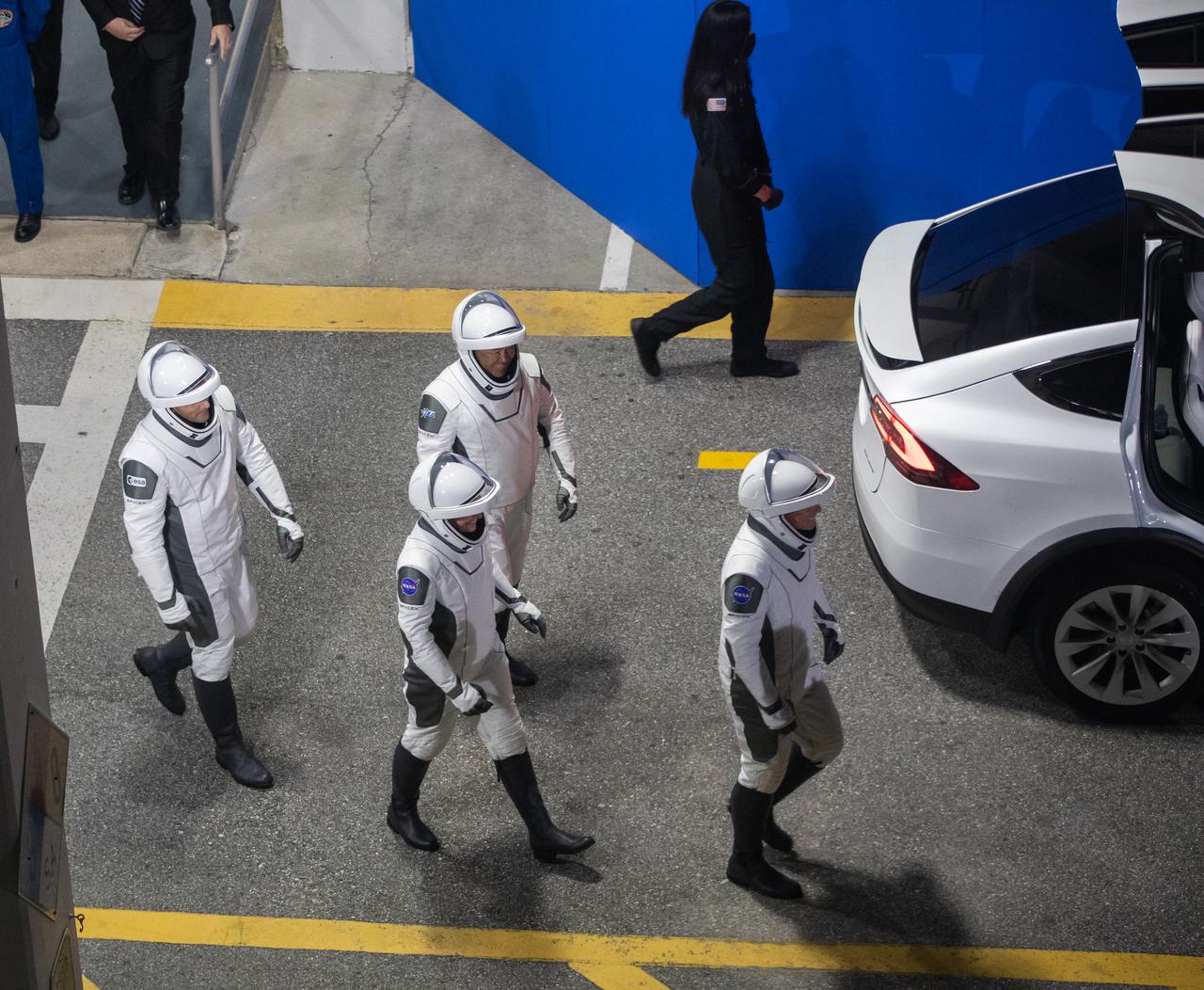
NASA SpaceX’s Crew-2 astronauts walk outside of the Neil Armstrong Operations and Checkout Building at NASA’s Kennedy Space Center in Florida on April 23, 2021. NASA astronaut Shane Kimbrough, spacecraft commander; NASA astronaut Megan McArthur, pilot; ESA astronaut Thomas Pesquet, mission specialist; and JAXA astronaut Akihiko Hoshide, mission specialist then boarded two Tesla vehicles for the trip to Kennedy’s Launch Complex 39A. Crew-2 is the second regular crew mission of a U.S. commercial spacecraft with astronauts to the International Space Station as part of NASA’s Commercial Crew Program. The SpaceX Crew Dragon Endeavour will launch atop the company’s Falcon 9 rocket from Pad 39A to the space station for a six-month science mission.
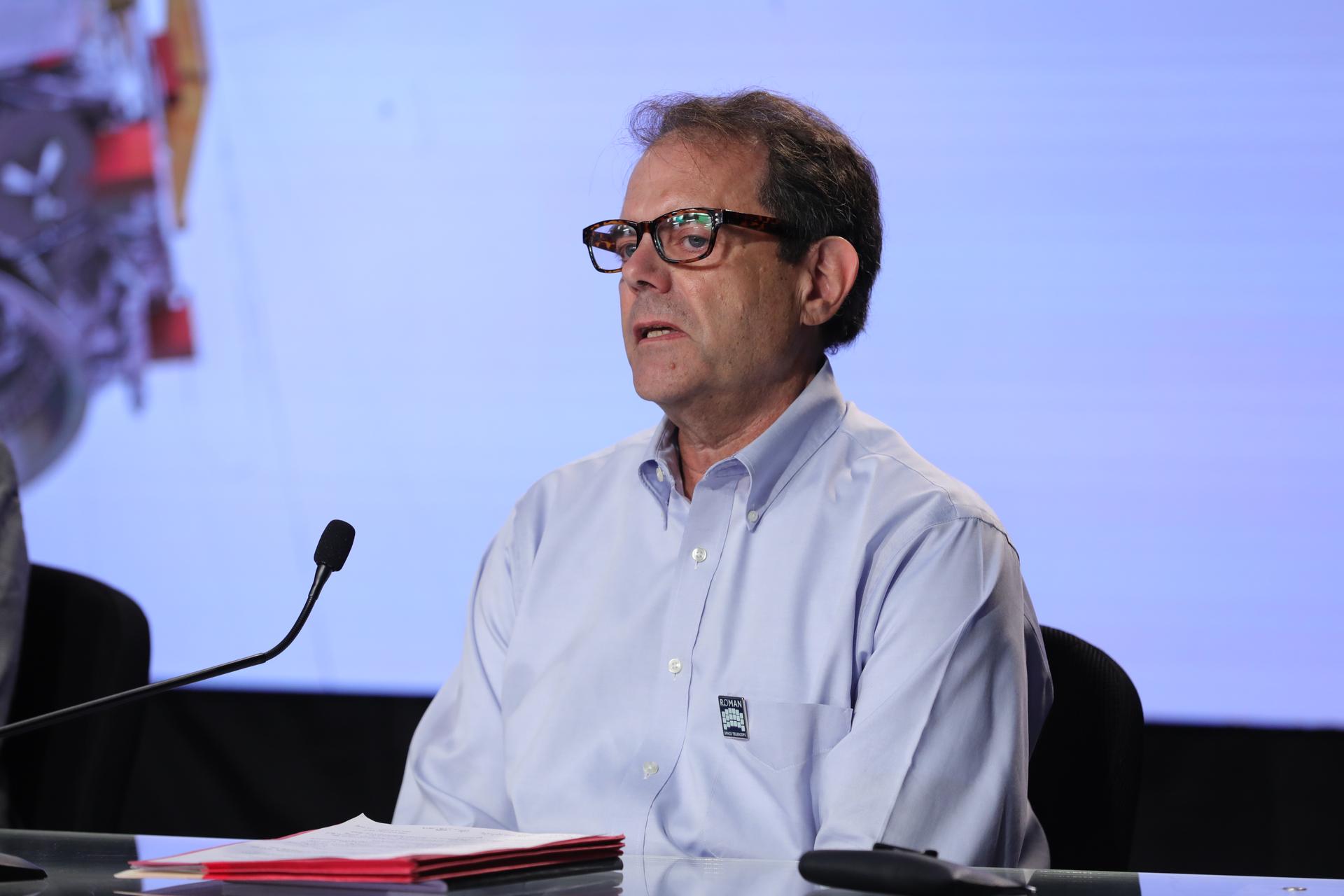
Lee Armus, Roman Science Support Center lead, Caltech/IPAC, participates in a science briefing for NASA’s Nancy Grace Roman Space Telescope inside the NASA News Center’s John Holliman Auditorium at Kennedy Space Center in Florida, on Saturday, Aug. 29, 2026. Roman will investigate dark energy and dark matter, conduct a statistical census of planetary systems, and enable a broad range of additional astrophysics research. Liftoff from Launch Complex 39A at Kennedy is targeted for no earlier than Sunday, Aug. 30, 2026.
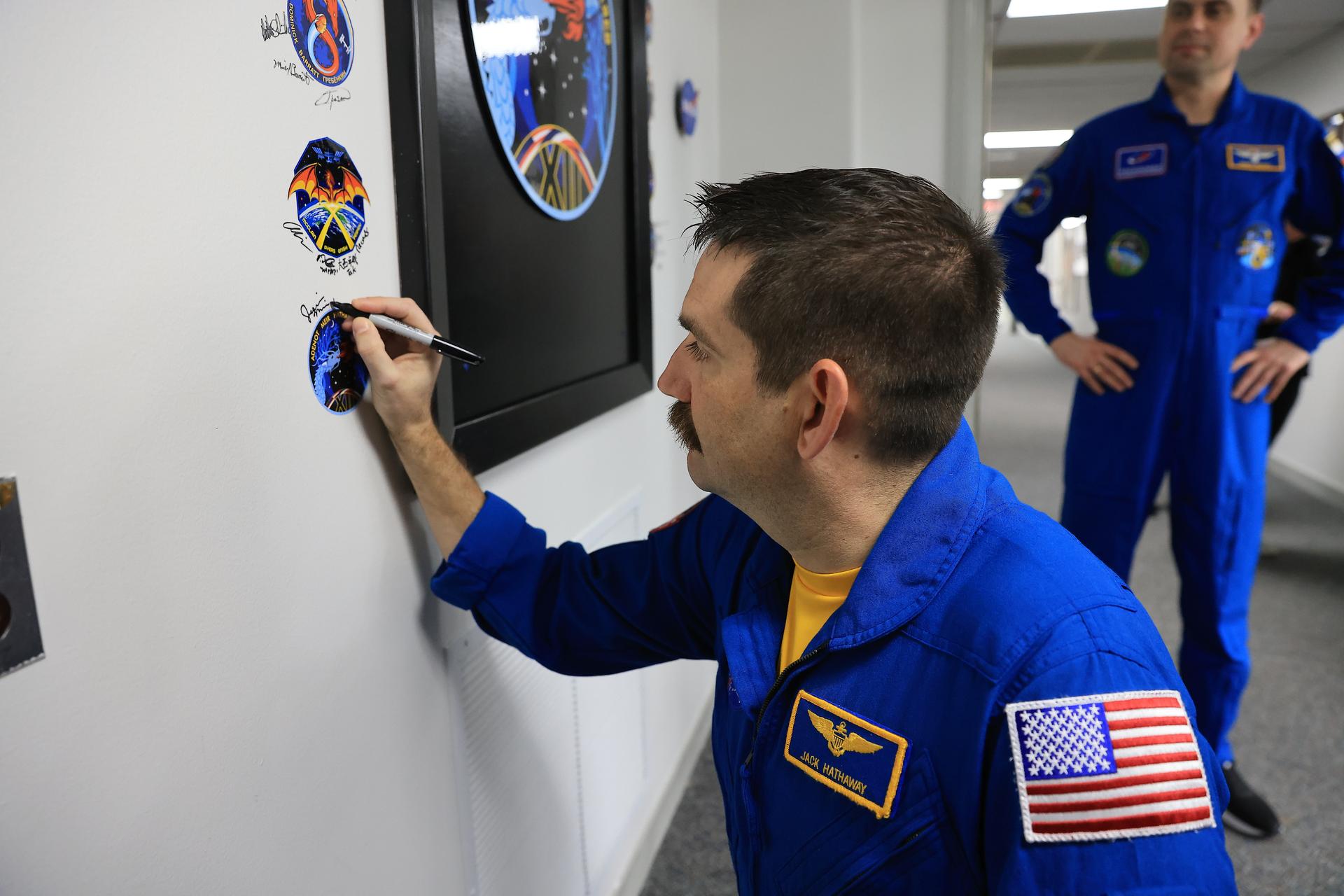
NASA astronaut Jack Hathaway signs his name next to the Crew-12 mission insignia inside the Astronaut Crew Quarters in the Neil A. Armstrong Operations and Checkout Building at NASA’s Kennedy Space Center in Florida on Monday, Feb. 9, 2026, ahead of NASA’s SpaceX Crew-12 mission. A SpaceX Dragon spacecraft and Falcon 9 rocket will send NASA astronauts Hathaway and Jessica Meir, ESA (European Space Agency) astronaut Sophie Adenot, and Roscosmos cosmonaut Andrey Fedyaev to the International Space Station no earlier than 5:15 a.m. EST on Friday, Feb. 13, from Cape Canaveral Space Force Station’s Space Launch Complex 40.

Teams from NASA’s Exploration Ground Systems and Space Launch System (SLS) practice SLS booster stacking with pathfinders inside Kennedy Space Center’s Vehicle Assembly Building on Nov. 19, 2019. Using overhead cranes and booster handling activities, the teams focused on procedures for mating a center segment onto a cylinder that simulated another segment. The exercise was performed around the clock, operating three shifts per day. SLS will launch the first woman and next man to the Moon by 2024 through the Artemis program.
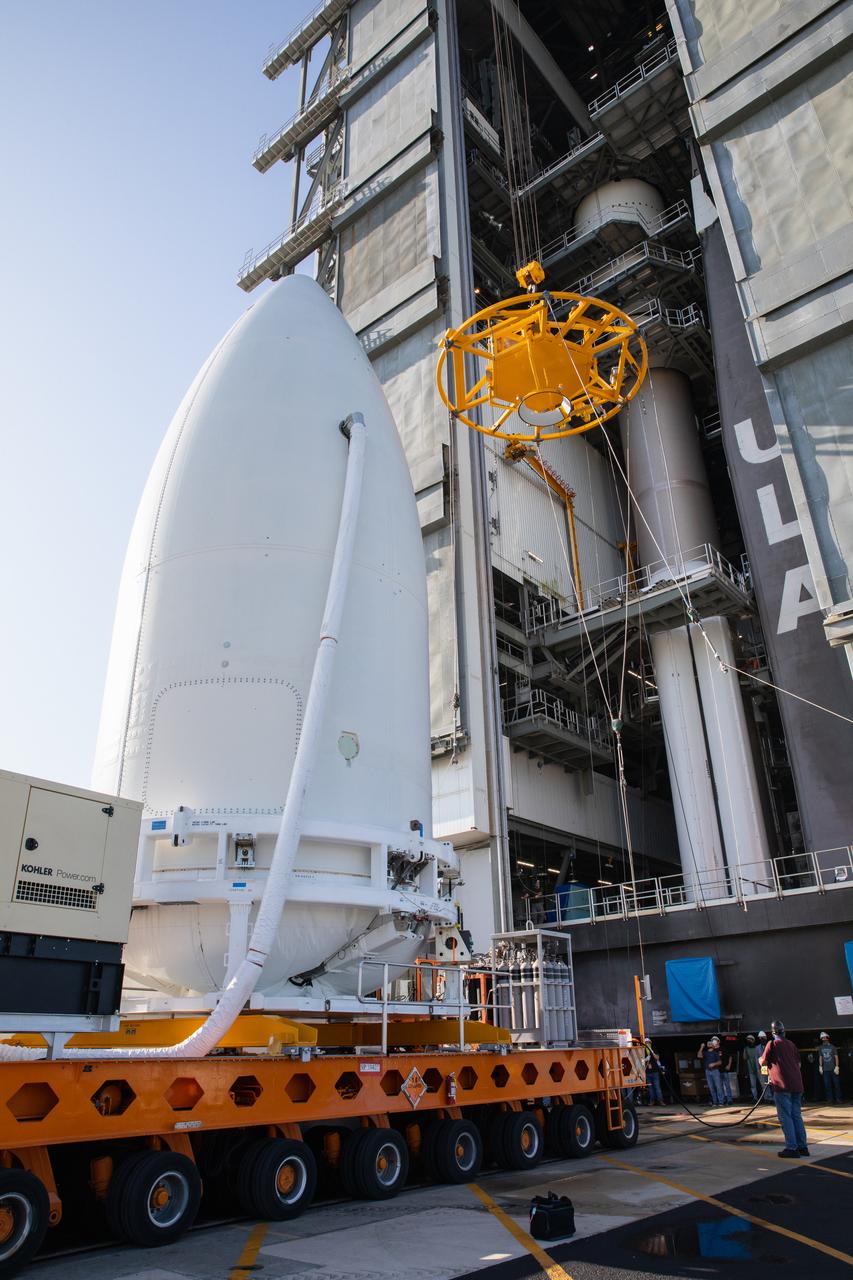
Preparations are underway to lift the United Launch Alliance (ULA) payload fairing with NASA’s Mars 2020 Perseverance rover secured inside up into the Vertical Integration Facility (VIF) at Space Launch Complex 41 at Cape Canaveral Air Force Station in Florida on July 7, 2020. Inside the VIF, the payload fairing will be lifted up by crane and secured on the ULA Atlas V rocket. The Mars Perseverance rover is scheduled to launch atop the Atlas V 541 rocket from Pad 41 on July 30. The rover is part of NASA’s Mars Exploration Program, a long-term effort of robotic exploration of the Red Planet. The rover’s seven instruments will search for habitable conditions in the ancient past and signs of past microbial life on Mars. The Launch Services Program at Kennedy is responsible for launch management.
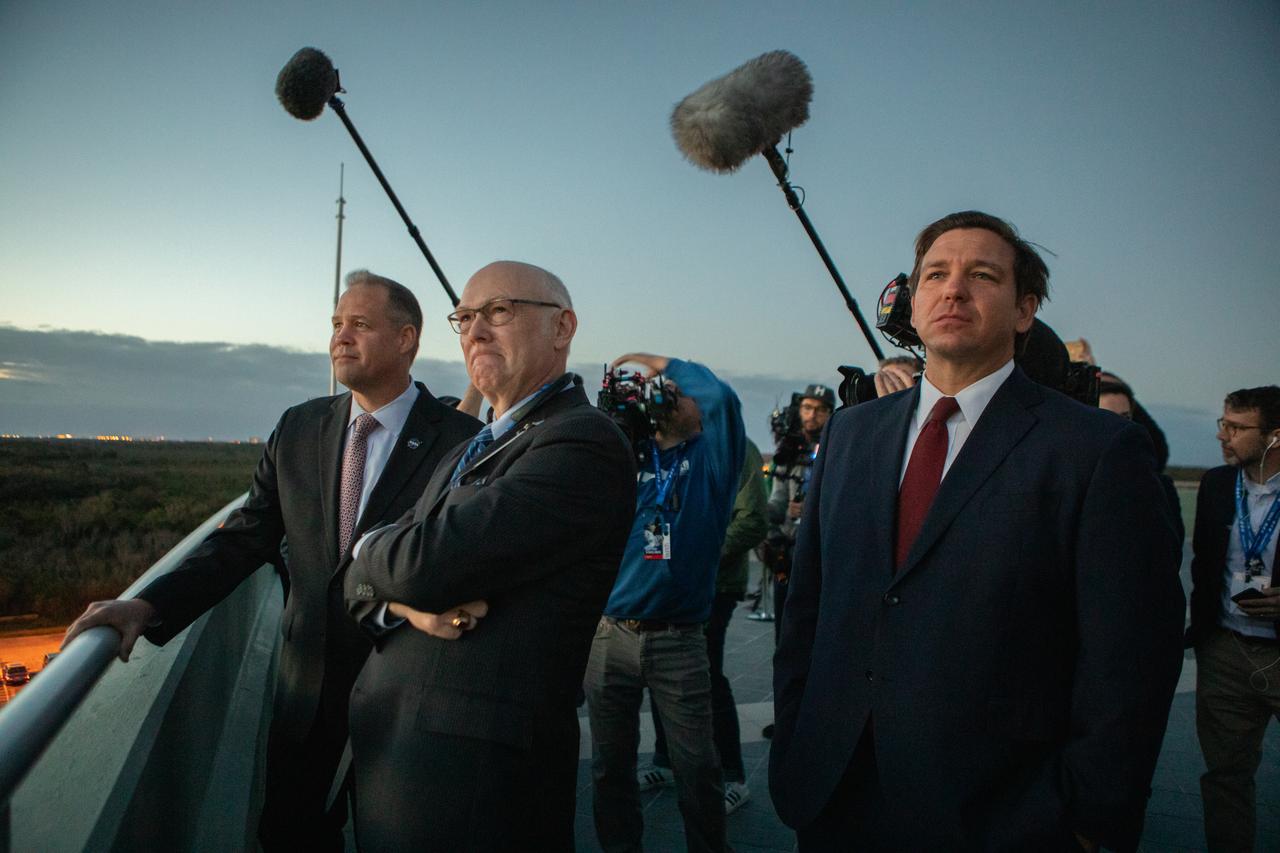
From left to right, NASA Administrator Jim Bridenstine; Tory Bruno, president and chief executive officer of United Launch Alliance; and Florida Governor Ron DeSantis wait at NASA’s Kennedy Space Center in Florida to see the liftoff of a United Launch Alliance Atlas V rocket carrying Boeing’s CST-100 Starliner spacecraft for Boeing’s Orbital Flight Test, Dec. 20, 2019. Liftoff occurred at 6:36 a.m. EST from Space Launch Complex 41 at Florida’s Cape Canaveral Air Force Station. The uncrewed Orbital Flight Test is the Starliner’s first flight for NASA’s Commercial Crew Program.
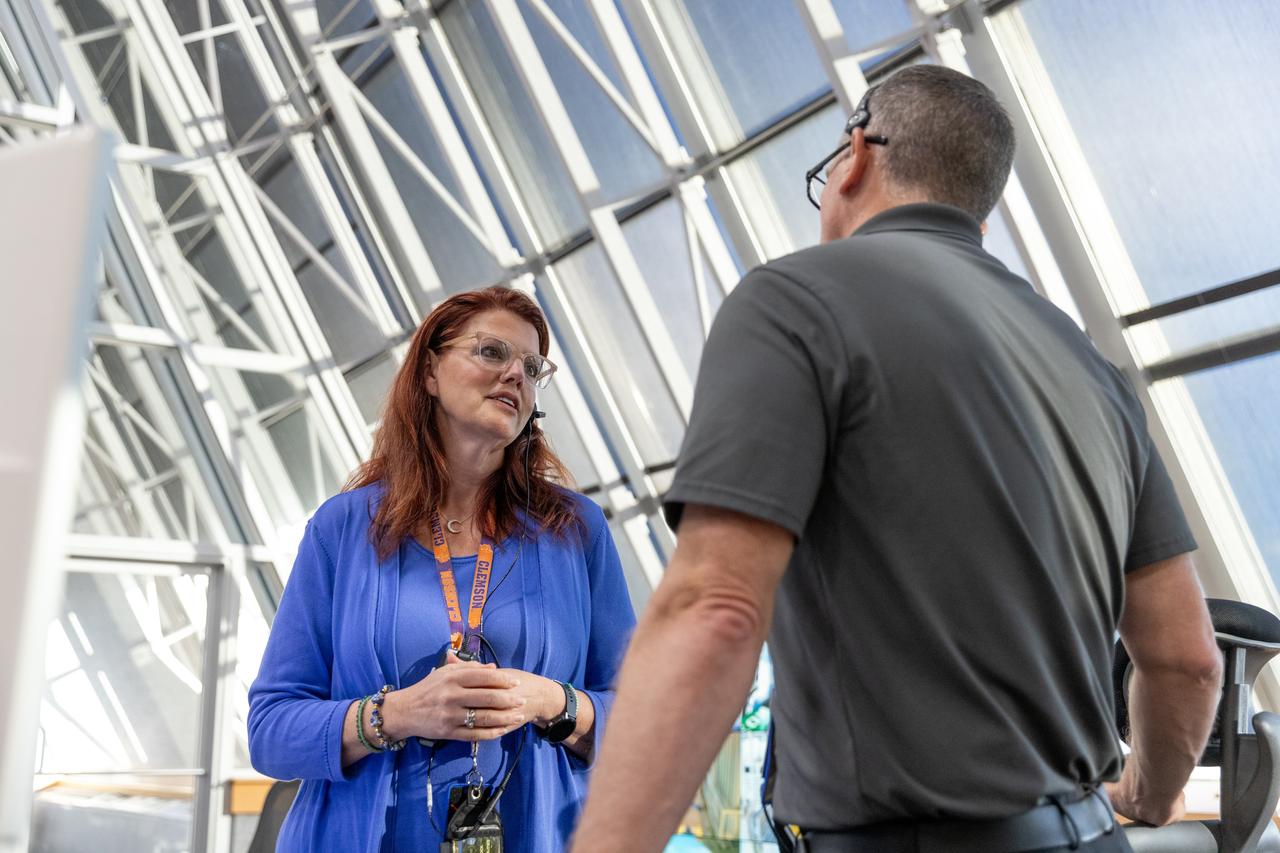
Charlie Blackwell-Thompson, Artemis launch director, Exploration Ground Systems at NASA’s Kennedy Space Center in Florida, participates in an emergency escape or egress demonstration simulation for the Artemis II mission inside Firing Room 1 in the Launch Control Center at NASA’s Kennedy on Monday, Aug. 12, 2024. Other members of the closeout crew, pad rescue team, and the Exploration Ground Systems Program performed emergency egress demonstrations during a series of integrated system verification tests at Launch Pad 39B in preparation for the Artemis II launch.

On July 16, 2019, the 50th anniversary of the Apollo 11 launch, Apollo launch team members mingle in Launch Control Center Firing Room 1 at NASA's Kennedy Space Center in Florida. At right is Bob Sieck, Apollo launch team member and former space shuttle launch director.
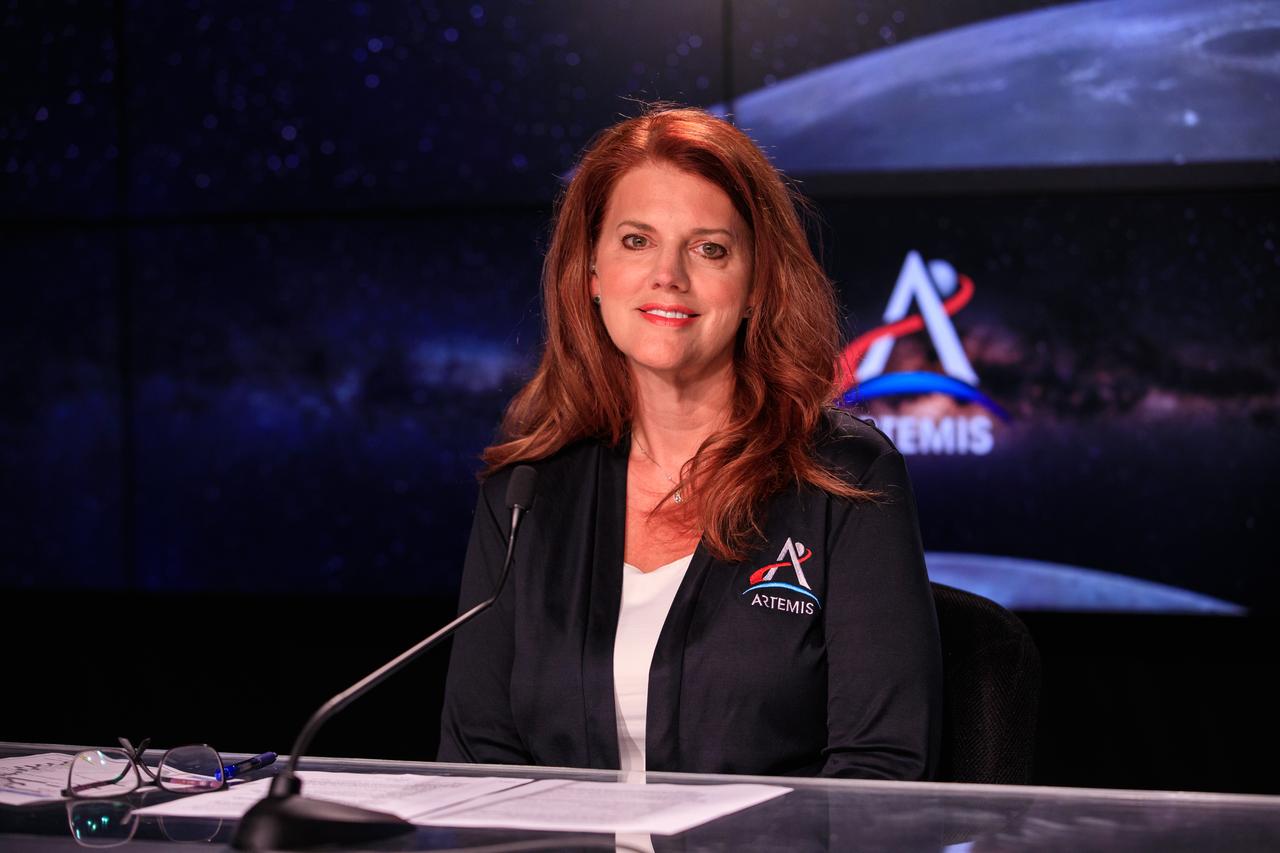
Launch Director Charlie Blackwell-Thompson participates in an Artemis I mission overview briefing inside the Press Site auditorium at NASA’s Kennedy Space Center in Florida on Aug. 3, 2022. Also participating in the briefing from various locations were NASA Administrator Bill Nelson; Associate Administrator for Technology, Policy, and Strategy Bhavya Lal; Mission Manager Mike Sarafin; Space Launch System (SLS) Program Manager John Honeycutt; and Orion Program Manager Howard Hu. The first in an increasingly complex series of missions, Artemis I will test the SLS rocket and Orion spacecraft as an integrated system prior to crewed flights to the Moon. Through Artemis, NASA will land the first woman and first person of color on the lunar surface, paving the way for long-term lunar presence and serving as a steppingstone before venturing to Mars.
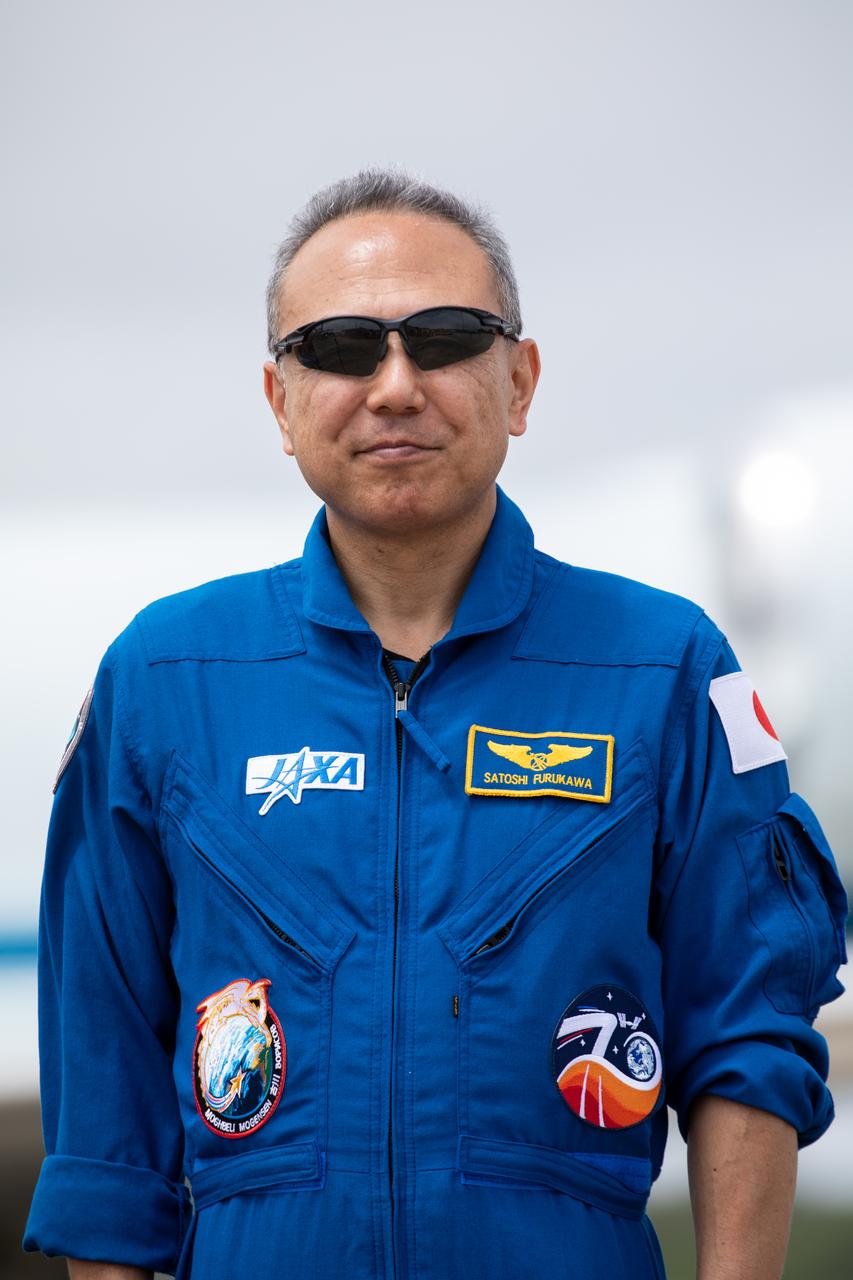
NASA’s SpaceX Crew-7 crew member and JAXA (Japan Aerospace Exploration Agency) astronaut Satoshi Furukawa smiles to the crowd after arriving at the Launch and Landing Facility at Kennedy Space Center in Florida – along with the rest of his crewmates – on Sunday, Aug. 20, 2023. Crew-7 will launch to the International Space Station aboard SpaceX’s Dragon spacecraft on the company’s Falcon 9 rocket. Liftoff is targeted for 3:49 a.m. EDT Friday, Aug. 25, 2023, from Kennedy’s Launch Complex 39A.
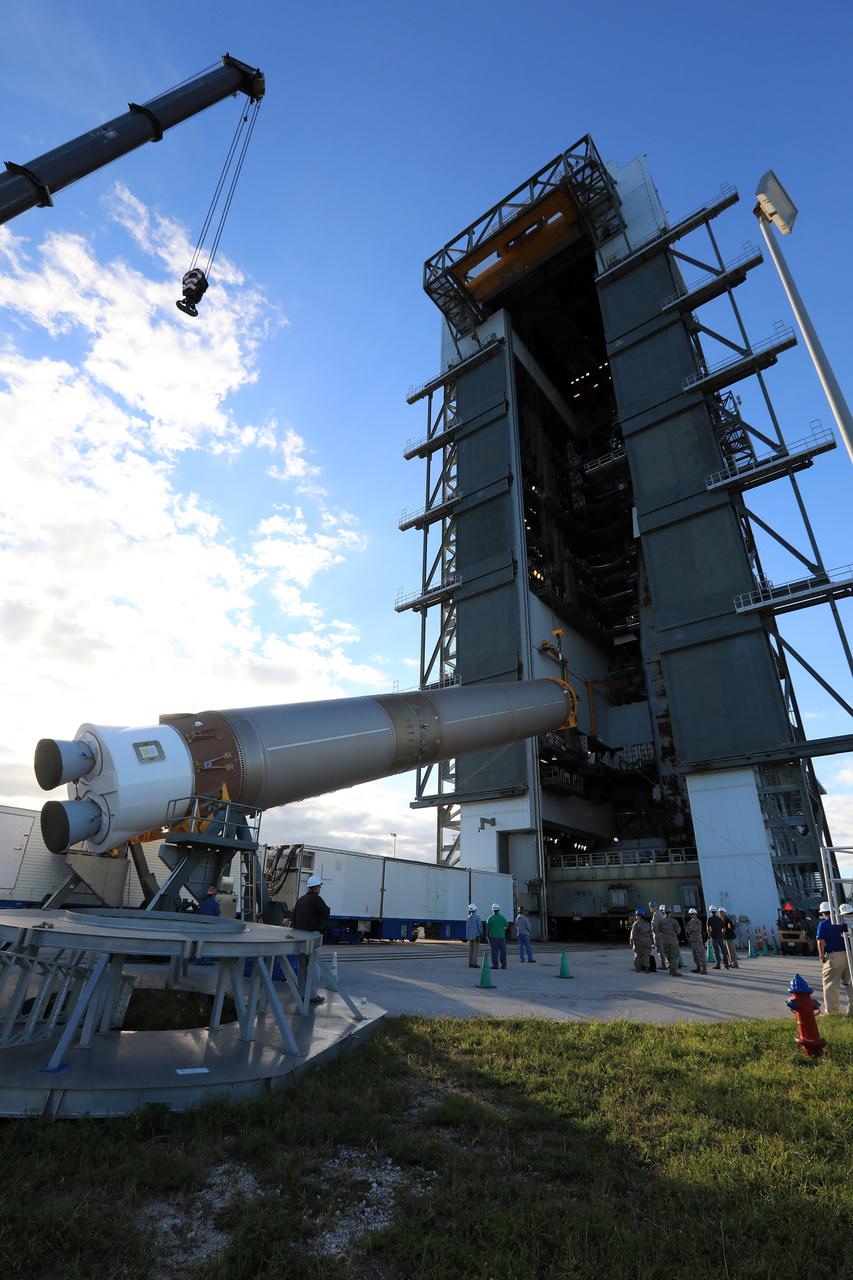
United Launch Alliance team members monitor the progress as the operation begins to lift the Atlas V first stage to the vertical position at the Vertical Integration Facility at Space Launch Complex 41 at Cape Canaveral Air Force Station in Florida. The Geostationary Operational Environmental Satellite (GOES-R) will launch aboard the Atlas V rocket in November. GOES-R will be the first satellite in a series of next-generation NOAA GOES Satellites.
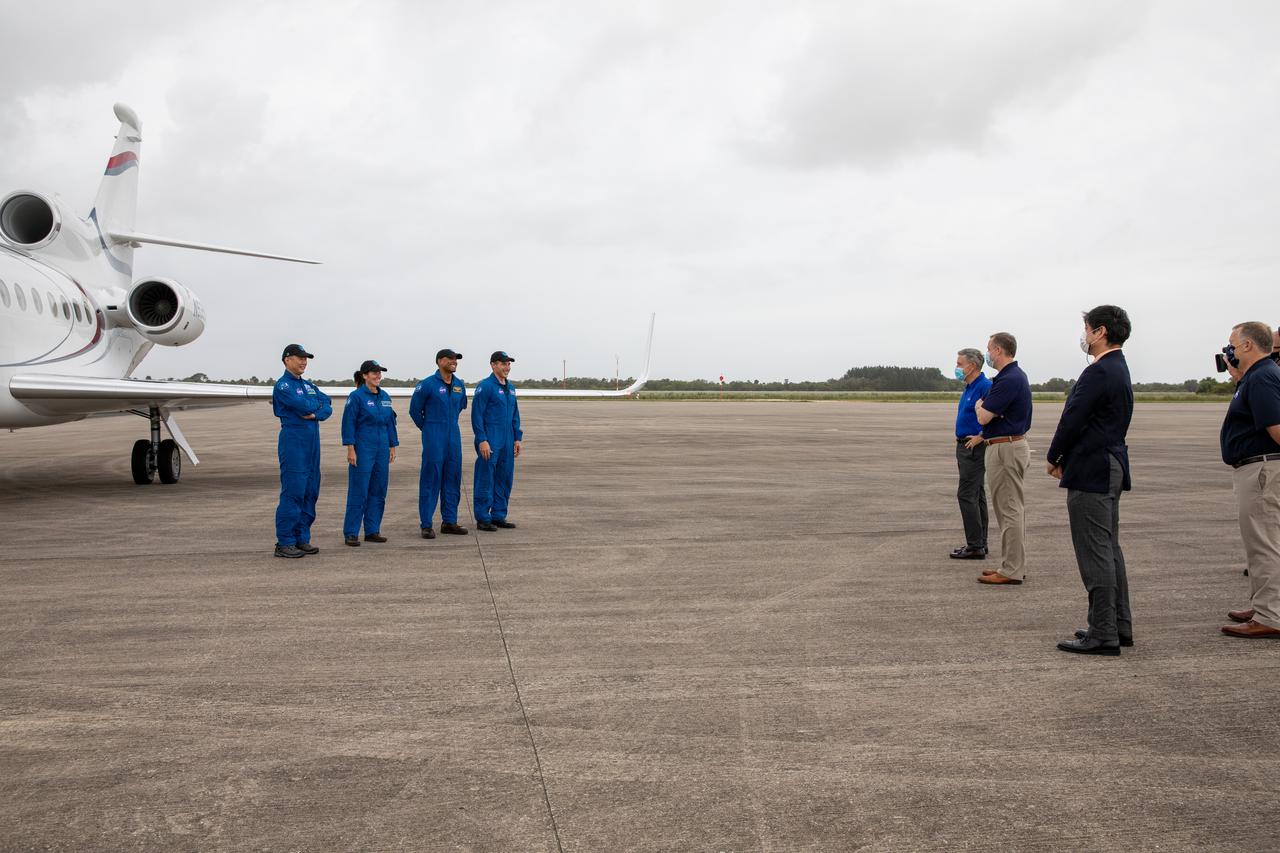
The astronauts for NASA’s SpaceX Crew-1 mission arrive at the Launch and Landing Facility at the agency’s Kennedy Space Center in Florida on Nov. 8, 2020, and are greeted by NASA and JAXA leadership. From left are, JAXA astronaut Soichi Noguchi, mission specialist; NASA astronaut Shannon Walker, mission specialist; NASA astronaut Victor Glover, pilot; and NASA astronaut Michael Hopkins, spacecraft commander. At right, from left are Bob Cabana, director, Kennedy Space Center; NASA Administrator Jim Bridenstine; Junichi Sakai, manager, International Space Station Program, JAXA; and NASA Deputy Administrator Jim Morhard. Crew-1 is the first crew rotation mission of a U.S. commercial spacecraft with astronauts to the International Space Station as part of NASA’s Commercial Crew Program. The SpaceX Crew Dragon spacecraft, named Resilience, will launch atop a Falcon 9 rocket from Kennedy’s Launch Complex 39A.
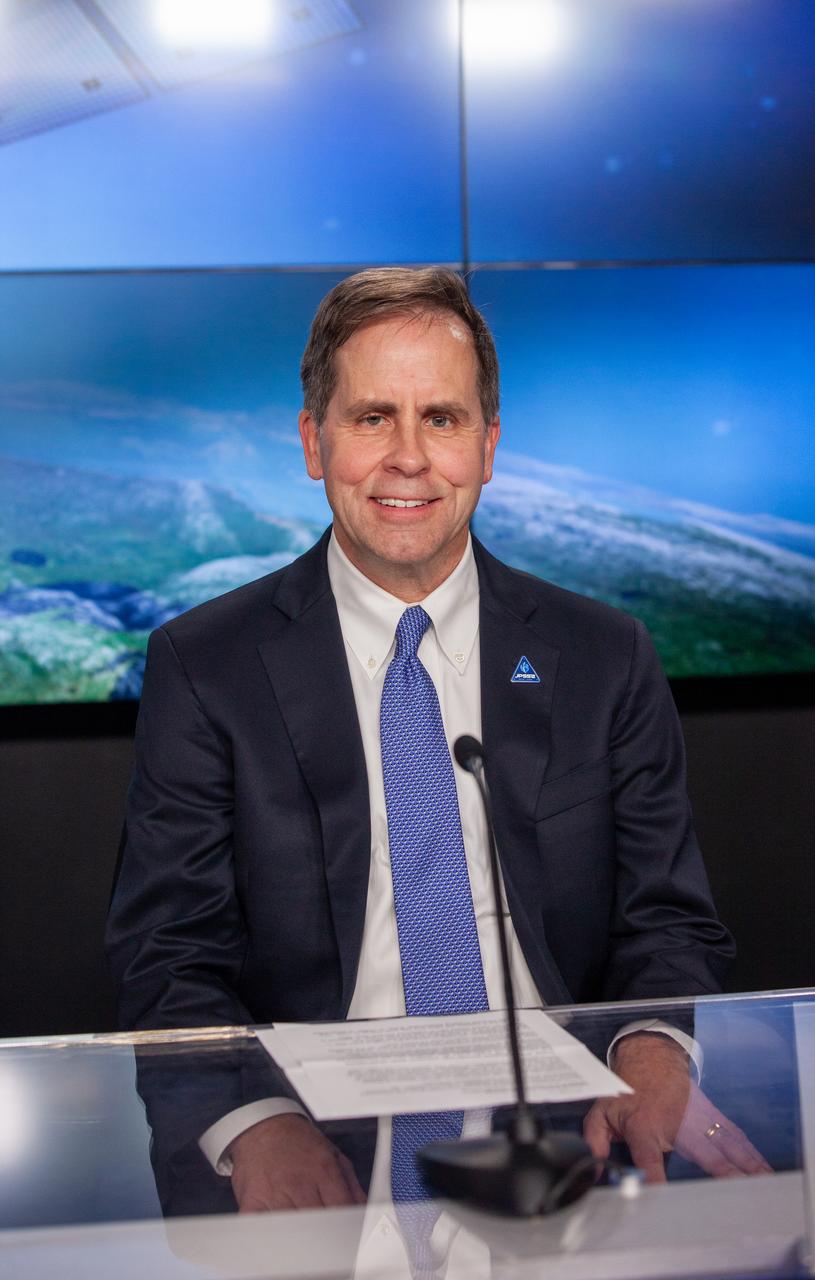
Tim Walsh, director, NOAA’s JPSS Program Office, NOAA, participates in a prelaunch news conference for the National Oceanic and Atmospheric Administration’s (NOAA) Joint Polar Satellite System-2 (JPSS-2) and NASA Low-Earth Orbit Flight Test of an Inflatable Decelerator (LOFTID) technology demonstration at Vandenberg Space Force Base in California on Oct. 28, 2022. JPSS-2 is the third satellite in the polar satellite series and is expected to capture data to improve weather forecasts, helping scientists predict and prepare for extreme weather events and climate change. JPSS-2 is scheduled to launch at 2:25 a.m. PDT Tuesday, Nov. 1, on a United Launch Alliance (ULA) Atlas V 401 rocket from Space Launch Complex 3 at Vandenberg Space Force Base in California. Launching with JPSS-2 is NASA’s LOFTID technology demonstration. After JPSS-2 safely reaches orbit, LOFTID will follow a re-entry trajectory from low-Earth orbit to demonstrate the inflatable heat shield’s ability to slow down and survive re-entry. LOFTID is a partnership with ULA and is dedicated to the memory of Bernard Kutter, one of the company’s engineers who played a key role in developing the technology. LOFTID will demonstrate how the inflatable aeroshell, or heat shield, can slow down and survive re-entry in conditions relevant to many potential applications, whether landing humans on Mars, new missions to Venus and Titan, or returning heavier payloads and samples from low-Earth orbit.
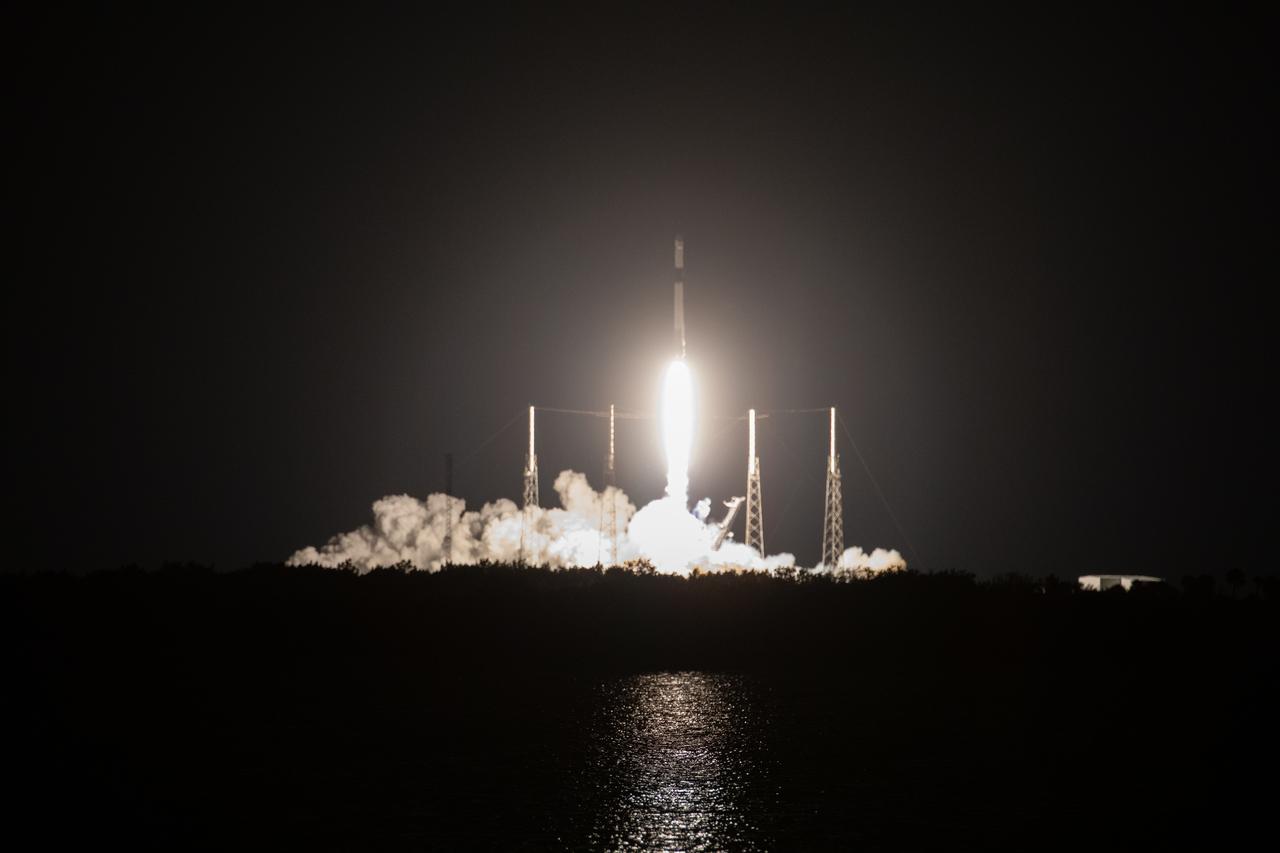
A SpaceX Falcon 9 rocket, with the uncrewed cargo Dragon spacecraft atop, lifts off from Space Launch Complex 40 at Cape Canaveral Air Force Station in Florida at 11:50 p.m. EST on March 6, 2020, for NASA and SpaceX’s 20th Commercial Resupply Services (CRS-20) mission to the International Space Station. The Dragon spacecraft will deliver more than 5,600 pounds of science investigations and cargo to the orbiting laboratory.
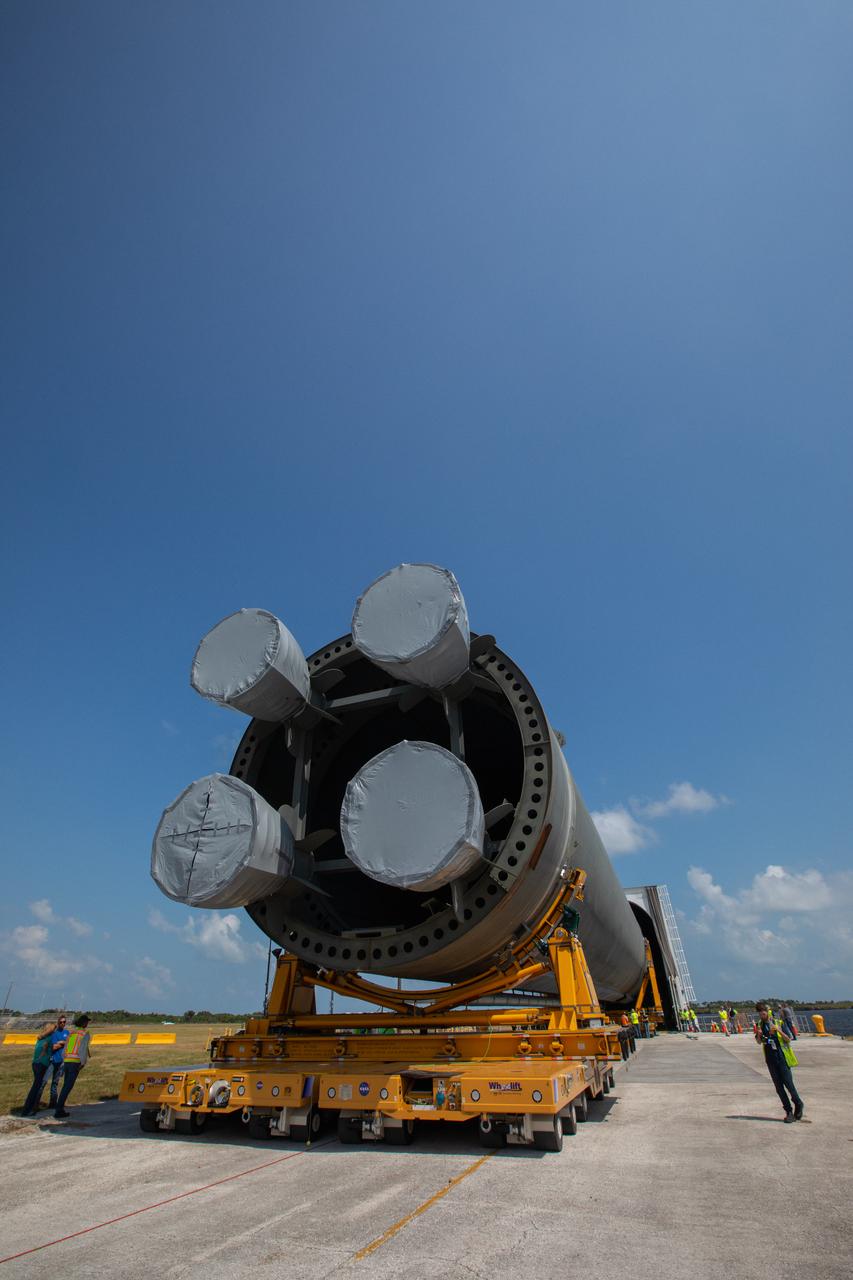
The 212-foot-long Space Launch System (SLS) rocket core stage pathfinder has been offloaded from NASA’s Pegasus Barge at Kennedy Space Center’s Launch Complex 39 turn basin wharf on Sept. 30, 2019. The Pegasus Barge made its first delivery to Kennedy in support of the agency's Artemis missions. The upgraded 310-foot-long barge arrived Sept. 27, 2019, ferrying the SLS core stage pathfinder, a full-scale mock-up of the rocket's core stage. It will be used by the Exploration Ground Systems Program and their contractor, Jacobs, to practice offloading, moving and stacking maneuvers, using important ground support equipment to train employees and certify all the equipment works properly. The pathfinder will stay at Kennedy for approximately one month before trekking back to NASA's Michoud Assembly Facility in Louisiana.
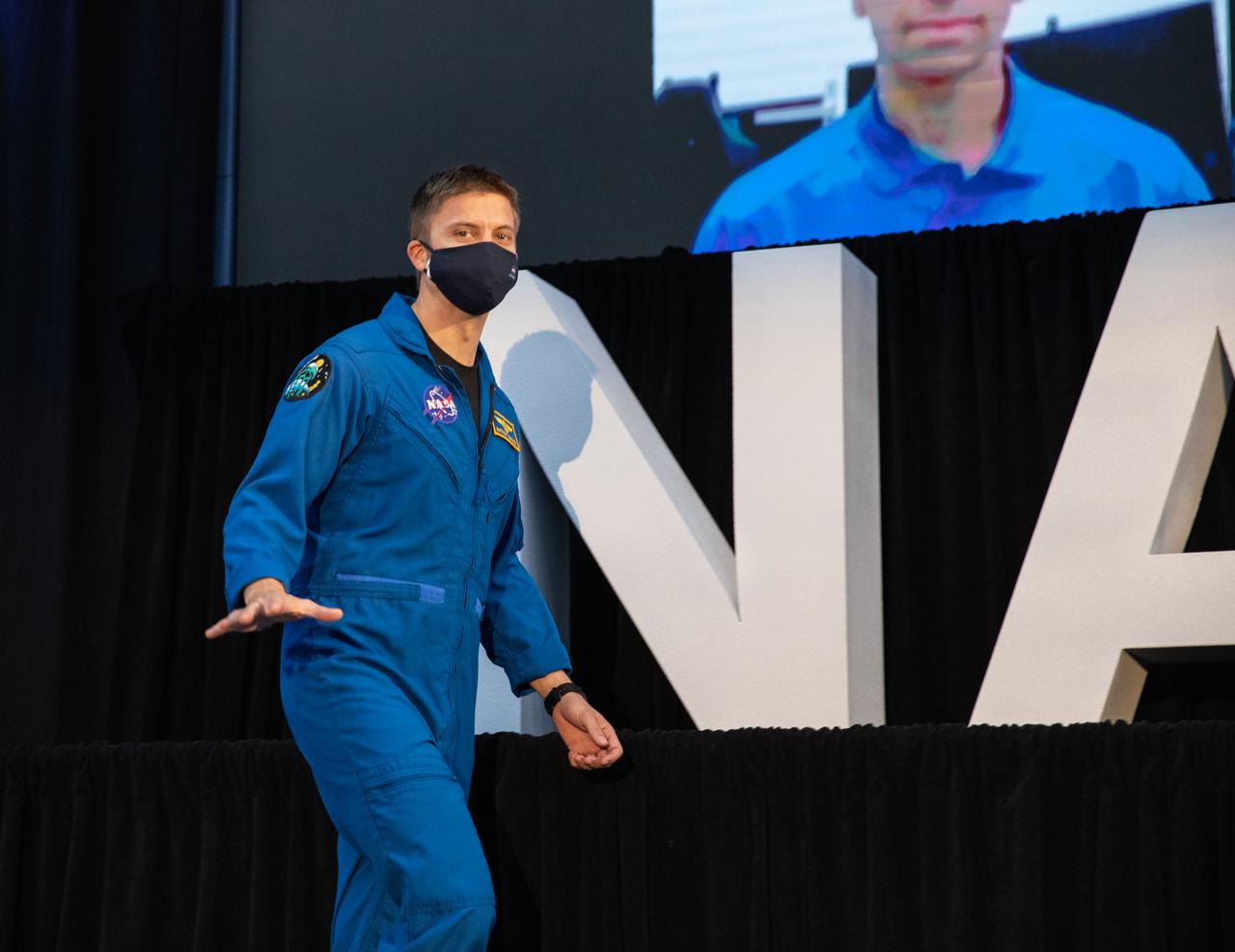
NASA astronaut Matthew Dominick waves during an announcement Dec. 9, 2020, that he is one of the initial team of 18 astronauts eligible for early Artemis missions on and around the Moon. A Colorado native, Dominick was selected as a NASA astronaut in 2017. Joining him at the event were fellow astronauts Joseph Acaba, Jessica Meir, Anne McClain, and Jessica Watkins. Vice President Mike Pence made the announcement at the close of a National Space Council meeting he chaired in the Apollo/Saturn V Center at the Kennedy Space Center Visitor Complex in Florida. Under the Artemis program, NASA will land the first woman and the next man on the Moon in 2024.
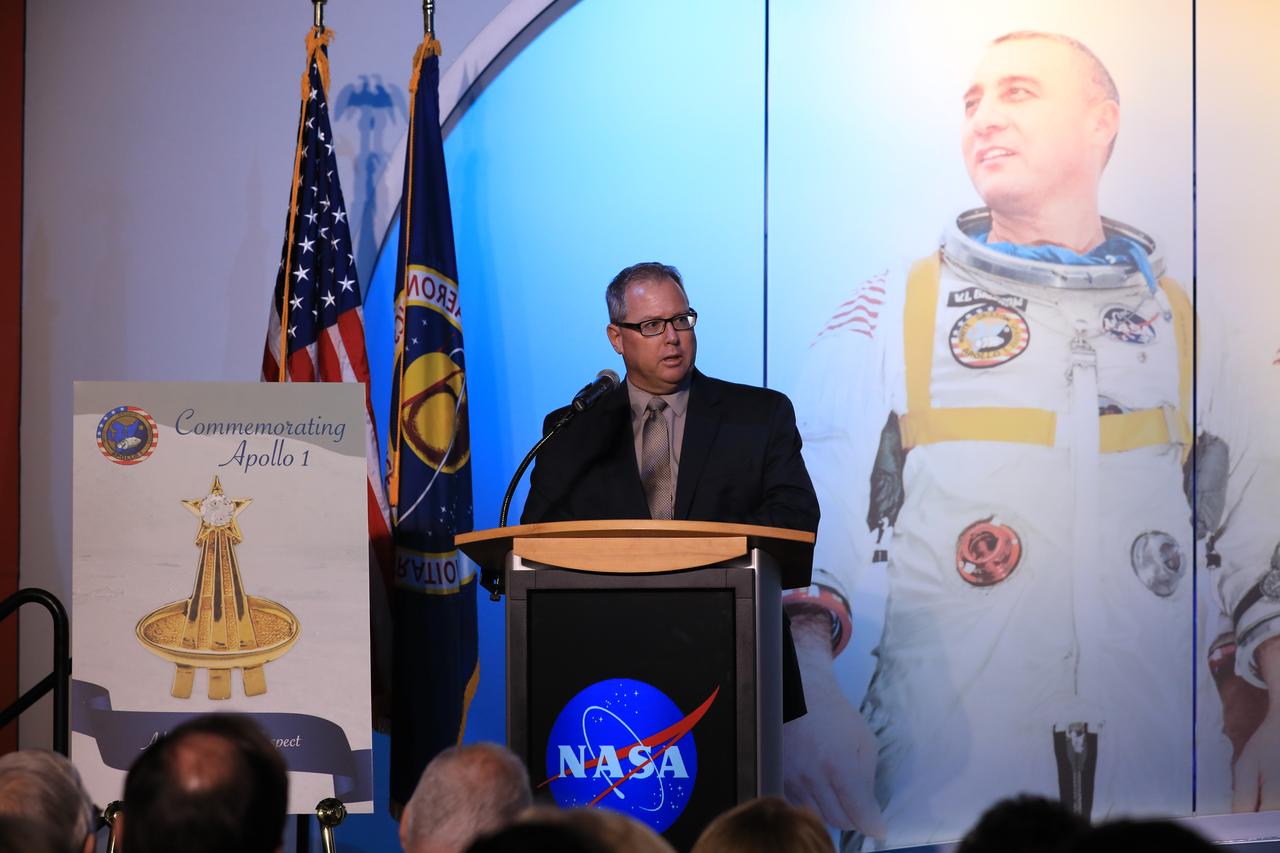
Therrin Protze, Chief Operating Officer, Delaware North Corporation Parks & Resorts at KSC, Inc., speaks during the opening of the tribute exhibition to the Apollo 1 astronauts who perished in a fire at the launch pad on Jan. 27, 1967, during training for the mission. The tribute highlights the lives and careers of astronauts Gus Grissom, Ed White II and Roger Chaffee who were lost during the fire. The tribute at the Apollo/Saturn V Center at NASA's Kennedy Space Center opened Jan. 27, 2017, 50 years after the crew of three was lost. It features numerous items recalling the lives of the three astronauts. The tribute also includes the three-part hatch to the spacecraft itself, the first time any part of the Apollo 1 spacecraft has been displayed publicly. A version of the hatch after it was redesigned is also showcased as an example of improvements NASA made throughout the agency and to the Apollo spacecraft that would later carry astronauts to the moon.
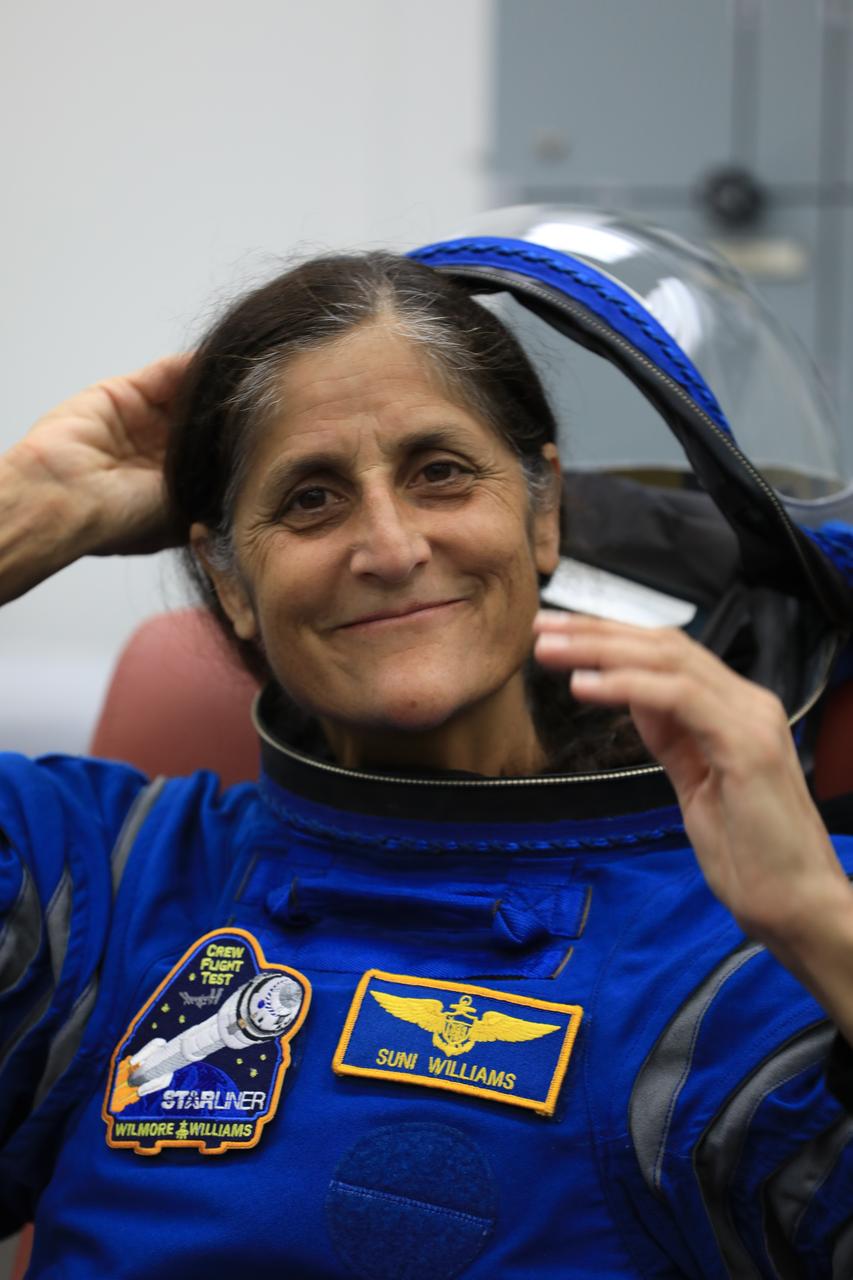
NASA astronaut Suni Williams, pilot for Boeing’s Crew Flight Test (CFT), checks her spacesuit and helmet during a crew validation test inside the Astronaut Crew Quarters at NASA’s Kennedy Space Center in Florida on Oct. 18, 2022. Williams, along with NASA astronauts Barry “Butch” Wilmore, CFT commander, and Mike Fincke, CFT backup spacecraft test pilot, with assistance from the Boeing team, successfully completed the validation test during which they suited up and tested out the pressurized crew module to ensure seat fit, suit functionality, cabin temperature, audio system, and day of launch operations. Boeing’s CFT is scheduled to launch in April 2023.

Inside the Rotation, Processing and Surge Facility at NASA’s Kennedy Space Center in Florida, the right-hand motor segment – one of five segments that make up one of two solid rocket boosters for the agency’s Space Launch System (SLS) – is mated to the rocket’s right-hand aft skirt on June 24, 2020. Once the aft segments are mated to the two aft skirts, they will be moved to the Vehicle Assembly Building for stacking on the mobile launcher. Manufactured by Northrop Grumman in Utah, the twin boosters provide more than 75 percent of the total SLS thrust at launch. Under the Artemis program, NASA will land the first woman and the next man on the Moon by 2024. The first in a series of increasingly complex missions, Artemis I will test the Orion spacecraft and SLS as an integrated system ahead of crewed flights to the Moon.
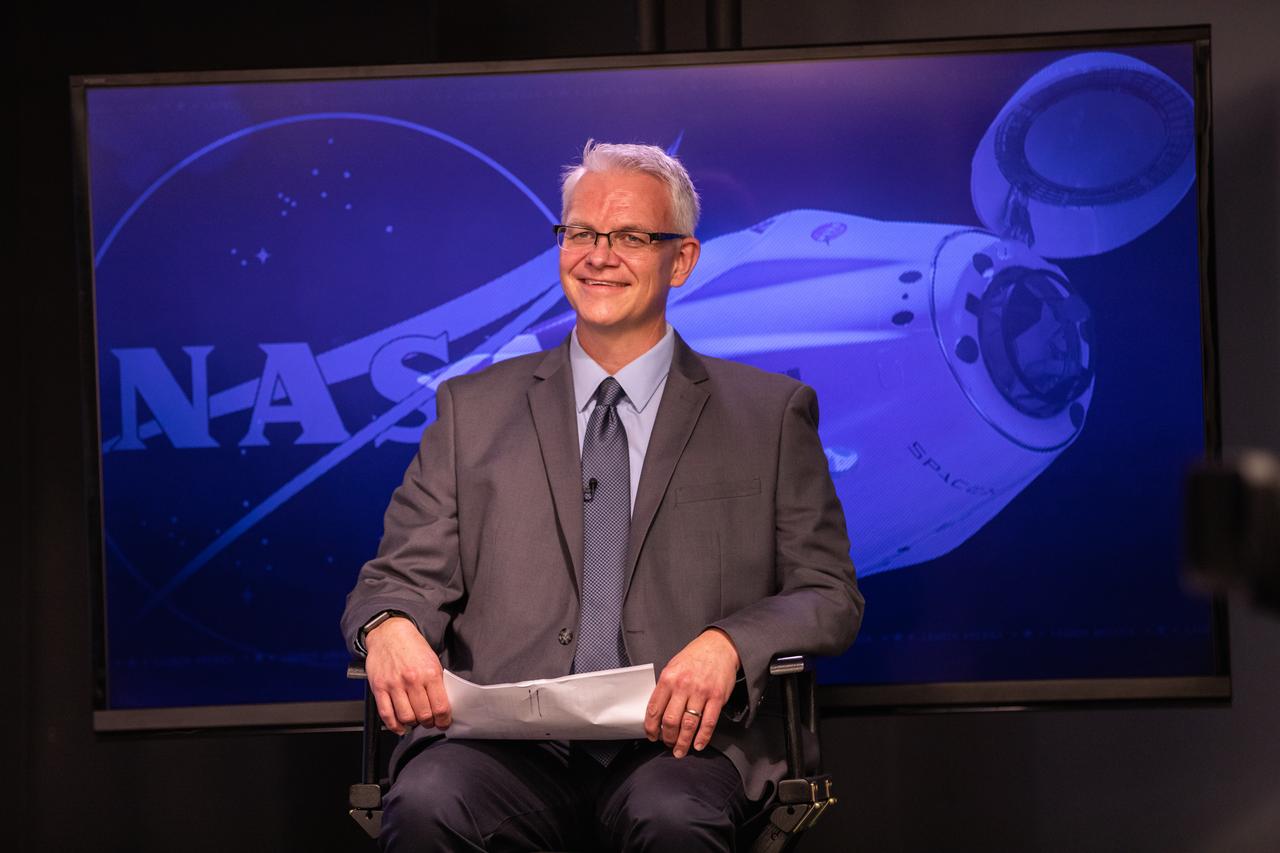
Benji Reed, senior director, Human Spaceflight Programs, SpaceX, answers questions during a virtual prelaunch news conference Nov. 13, 2020, inside the Press Site auditorium at NASA’s Kennedy Space Center in Florida ahead of the agency’s SpaceX Crew-1 launch. Crew-1 is the first regular crew mission of a U.S. commercial spacecraft with astronauts to the International Space Station as part of NASA’s Commercial Crew Program. The SpaceX Crew Dragon Resilience capsule will launch atop the company’s Falcon 9 rocket from Launch Complex 39A to the space station for a six-month science mission.
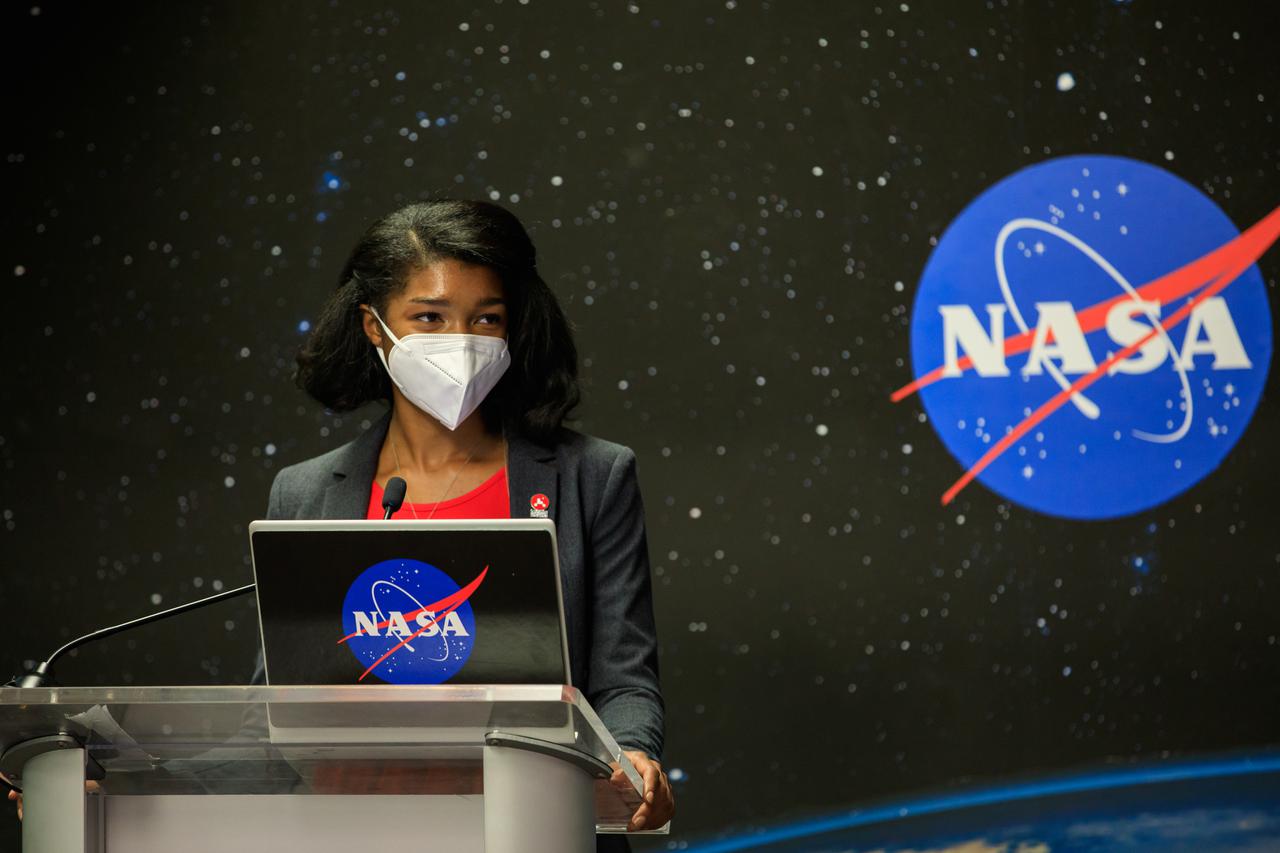
NASA Communications’ Jasmine Hopkins moderates a Mars 2020 Facebook live event inside the Press Site auditorium at NASA’s Kennedy Space Center in Florida on Feb. 12, 2021. Participants included United Launch Alliance (ULA) Launch Conductor Dillon Rice and NASA’s Launch Services Program (LSP) Launch Director Tim Dunn. During the event, Rice and Dunn discussed the partnership between ULA and LSP, as well as major milestones that led to the Mars 2020 launch, and how launches to Mars have changed over time. NASA’s Mars Perseverance rover lifted off from Cape Canaveral Space Force Station’s Space Launch Complex 41 on July 30, 2020, and is slated to touch down on the Red Planet Feb. 18, 2021.
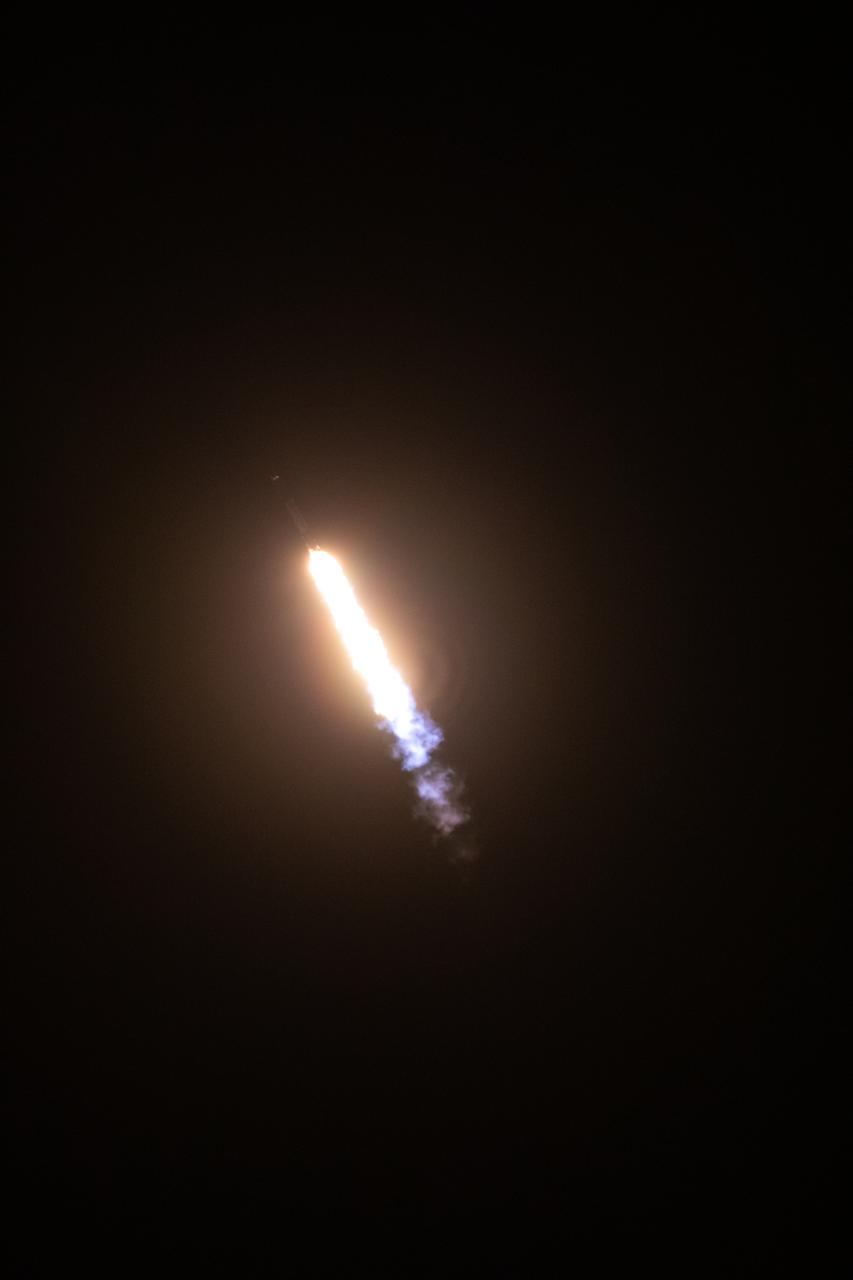
A SpaceX Falcon 9 rocket climbs upward after lifting off from Space Launch Complex 40 at Cape Canaveral Air Force Station in Florida at 11:50 p.m. EST on March 6, 2020, for NASA and SpaceX’s 20th Commercial Resupply Services (CRS-20) mission. SpaceX’s uncrewed cargo Dragon spacecraft, carried atop the Falcon 9, will deliver more than 5,600 pounds of science investigations and cargo to the International Space Station.
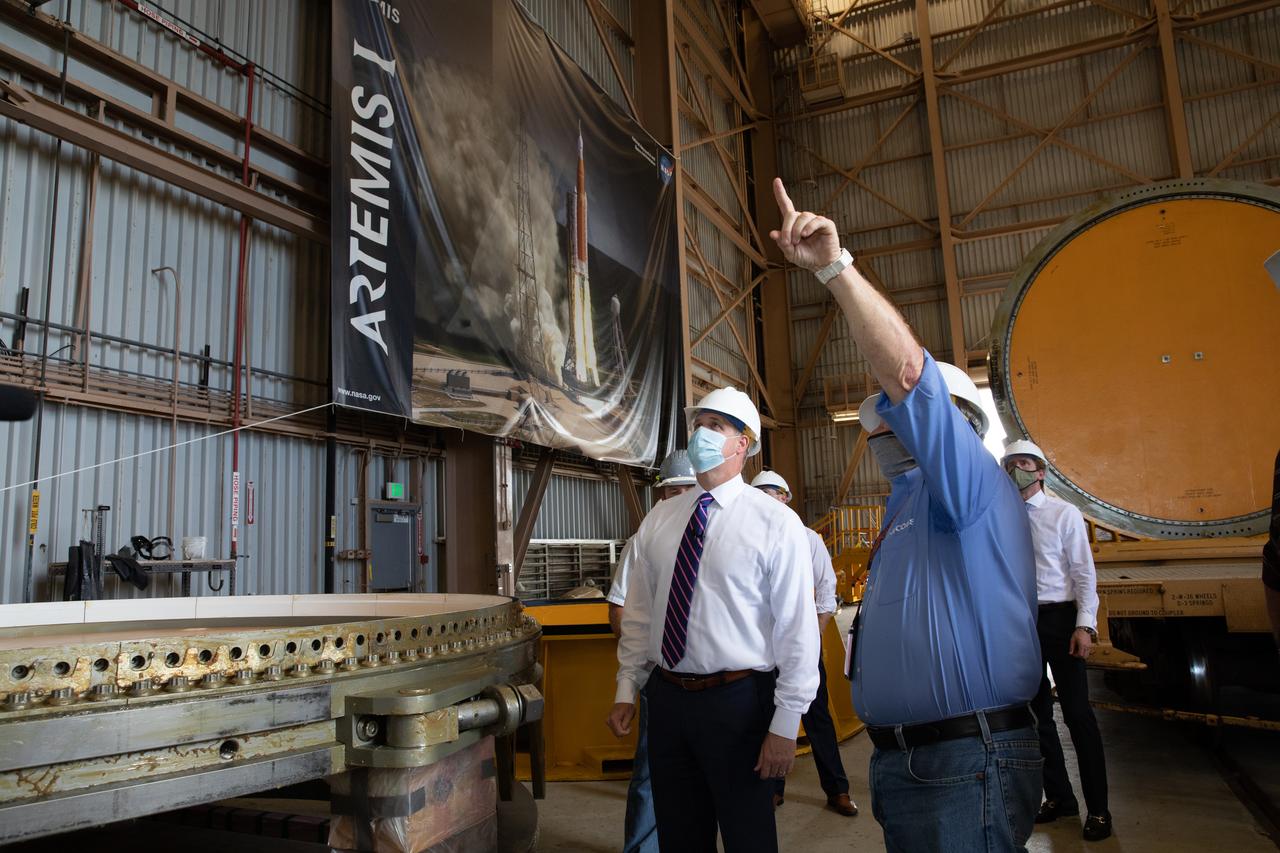
NASA Administrator Jim Bridenstine (left), accompanied by Jacobs employees, views Artemis I booster hardware inside the Rotation, Processing and Surge Facility at NASA’s Kennedy Space Center in Florida on July 27, 2020. Manufactured by Northrop Grumman in Utah, the boosters for the agency’s Space Launch System (SLS) rocket are now undergoing prelaunch processing at Kennedy. During launch, the twin boosters will provide more than 75 percent of the total SLS thrust. The first in a series of increasingly complex missions, Artemis I will test the Orion spacecraft and SLS as an integrated system ahead of crewed flights to the Moon.

Derrol Nail, NASA Communications, moderates a prelaunch news conference for the Solar Orbiter mission at NASA’s Kennedy Space Center in Florida on Feb. 7, 2020. Solar Orbiter is an international cooperative mission between ESA (European Space Agency) and NASA. The mission aims to study the Sun, its outer atmosphere and solar wind. The spacecraft will provide the first images of the Sun’s poles. The spacecraft was developed by Airbus Defence and Space. NASA’s Launch Services Program based at Kennedy is managing the launch. Solar Orbiter will launch aboard a United Launch Alliance Atlas V rocket on Feb. 9, 2020, from Space Launch Complex 41 at Cape Canaveral Air Force Station.
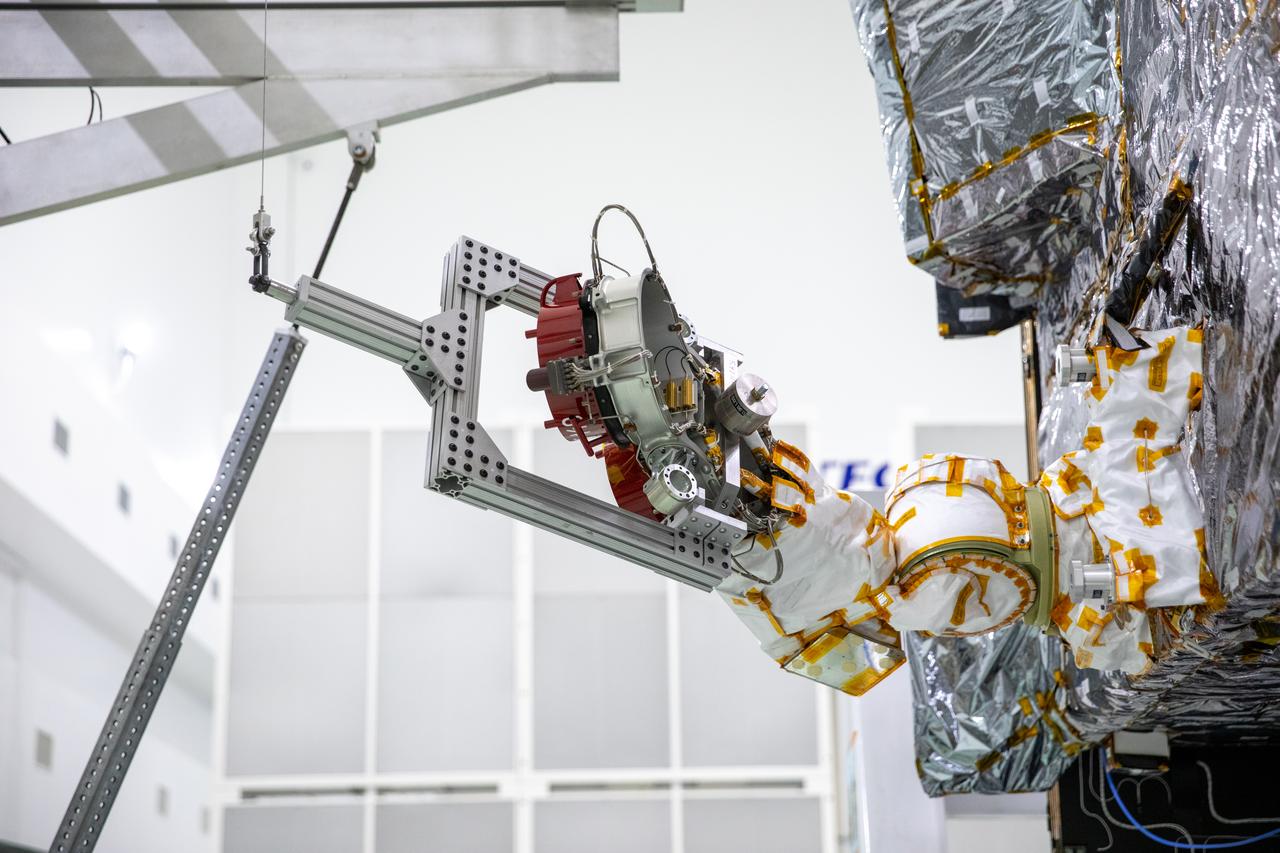
A team of engineers and technicians work on deploying and stowing stationary plasma thrusters (SPT) on NASA's Psyche spacecraft inside the Astrotech Space Operations Facility near the agency’s Kennedy Space Center in Florida on Aug. 4, 2023. This is part of the assembly, test, and launch operations preparations. The SPT are on a dual axis positioning mechanism (DAPM), and together they make a DSM, or DAPM-actuated SPT module. Psyche will launch atop a SpaceX Falcon Heavy rocket from Launch Complex 39A at Kennedy. Launch is targeted for Oct. 5, 2023. Riding with Psyche is a pioneering technology demonstration, NASA’s Deep Space Optical Communications (DSOC) experiment.
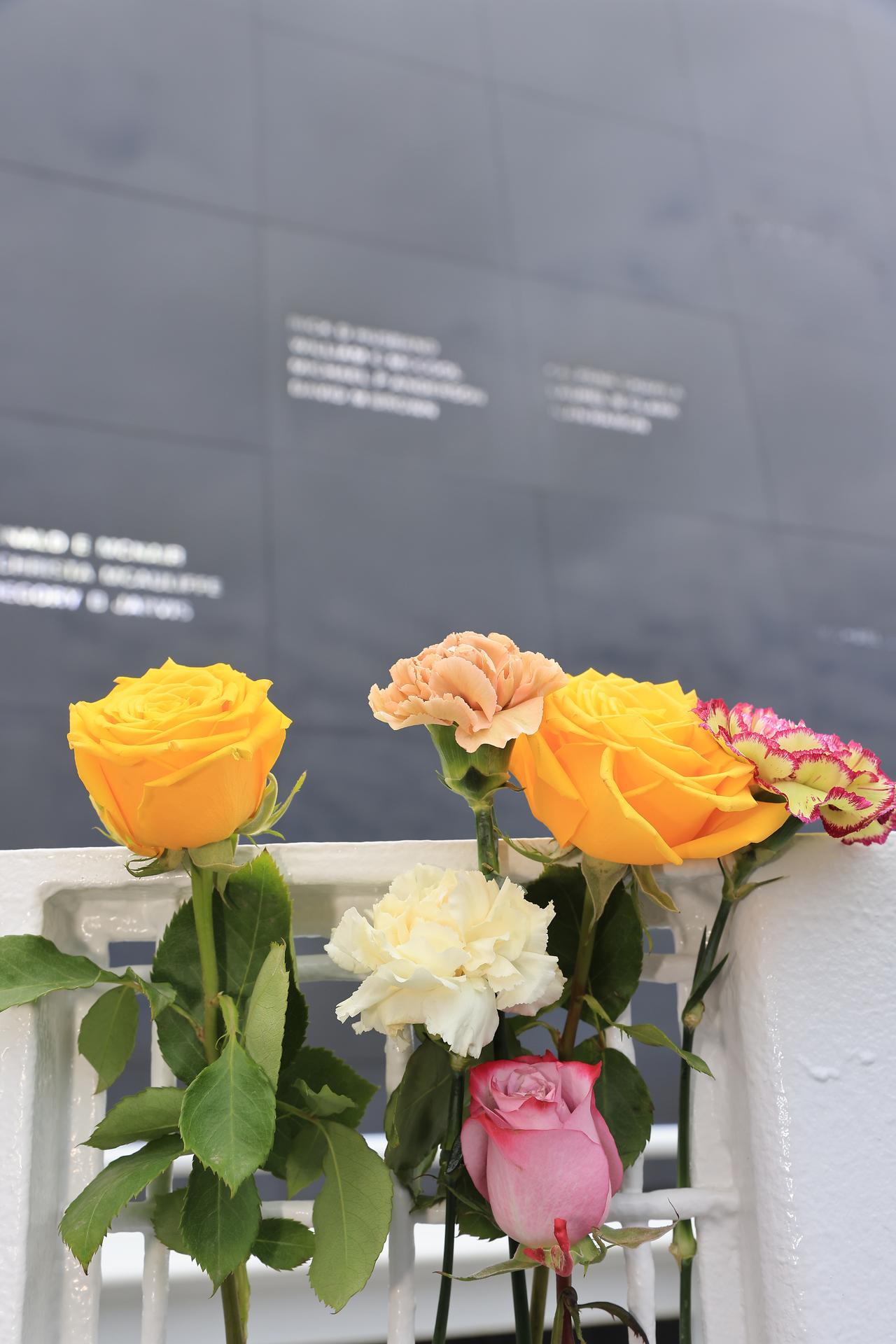
NASA’s Day of Remembrance is marked by flowers placed before the Space Mirror Memorial at the Kennedy Space Center Visitor Complex on Thursday, Jan. 22, 2026. The mirror was dedicated in 1991 to honor all astronauts who lost their lives on missions or during training. During the Day of Remembrance, NASA centers across the country honor those astronauts who have fallen in the pursuit of space exploration. This year marks the 40th anniversary of the Challenger tragedy.
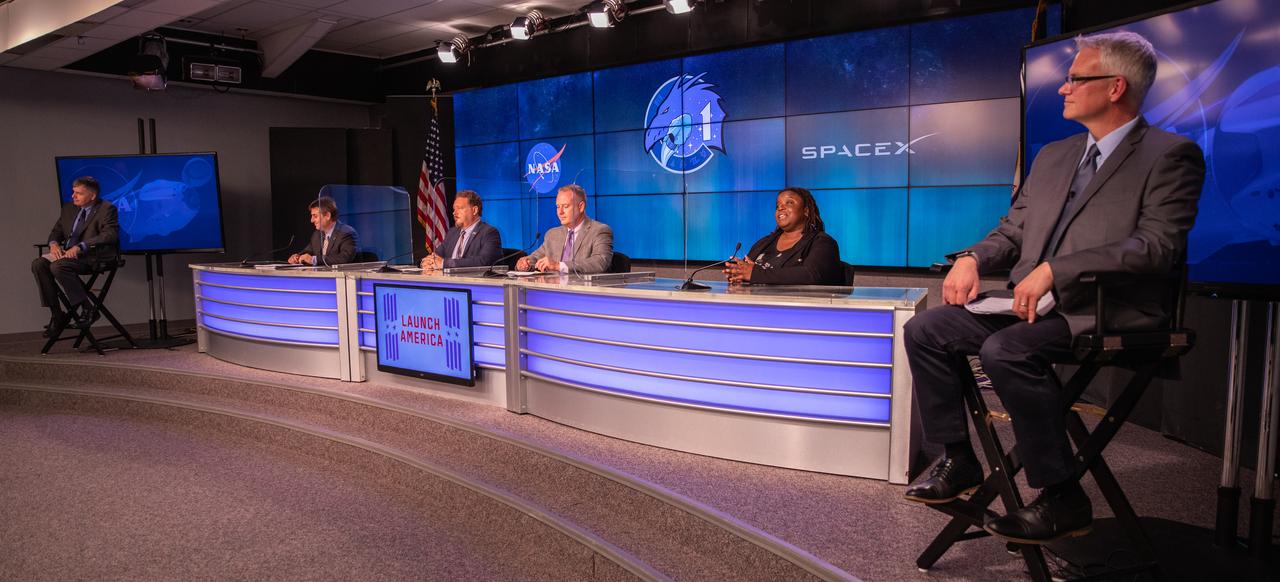
Inside the Press Site auditorium at NASA’s Kennedy Space Center in Florida, NASA and industry leaders conduct a virtual prelaunch news conference Nov. 13, 2020, ahead of the agency’s SpaceX Crew-1 mission. From left are Steve Stich, manager, Commercial Crew Program, Kennedy Space Center; Joel Montalbano, manager, International Space Station, Johnson Space Center; Kirt Costello, chief scientist, International Space Station Program, Johnson; Norm Knight, deputy manager, Flight Operations Directorate, Johnson; Arlena Moses, launch weather officer, U.S. Air Force 45th Weather Squadron; and Benji Reed, senior director, Human Spaceflight Programs, SpaceX. Crew-1 is the first regular crew mission of a U.S. commercial spacecraft with astronauts to the International Space Station as part of NASA’s Commercial Crew Program. The SpaceX Crew Dragon Resilience capsule will launch atop the company’s Falcon 9 rocket from Launch Complex 39A to the space station for a six-month science mission.
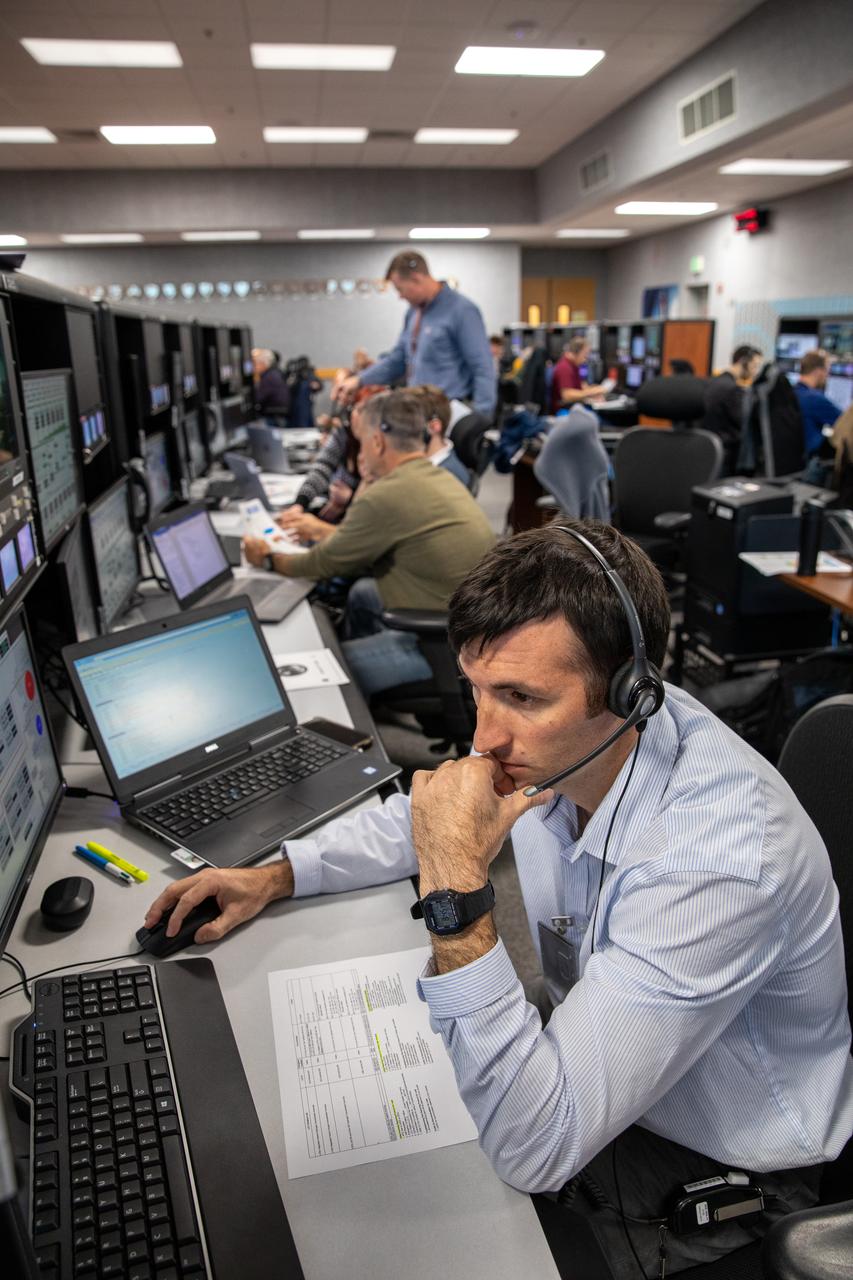
Billy Mitchell, a hazardous gas engineer at NASA’s Kennedy Space Center in Florida, participates in an Artemis I launch countdown training exercise inside Firing Room 1 in the Launch Control Center on Feb. 3, 2020. Under the leadership of Launch Director Charlie Blackwell-Thompson, a team of nearly 100 engineers from Orion, Space Launch System (SLS) and NASA’s Exploration Ground Systems came together to work through a series of simulated challenges, as well as a final countdown procedure. During these exercises, different issues were introduced to familiarize the team with launch day operations, while providing them with an opportunity to practice how they would handle those issues in real-time. Artemis I will be the first integrated test flight of the Orion spacecraft and SLS rocket – the system that will ultimately land the first woman and the next man on the Moon.
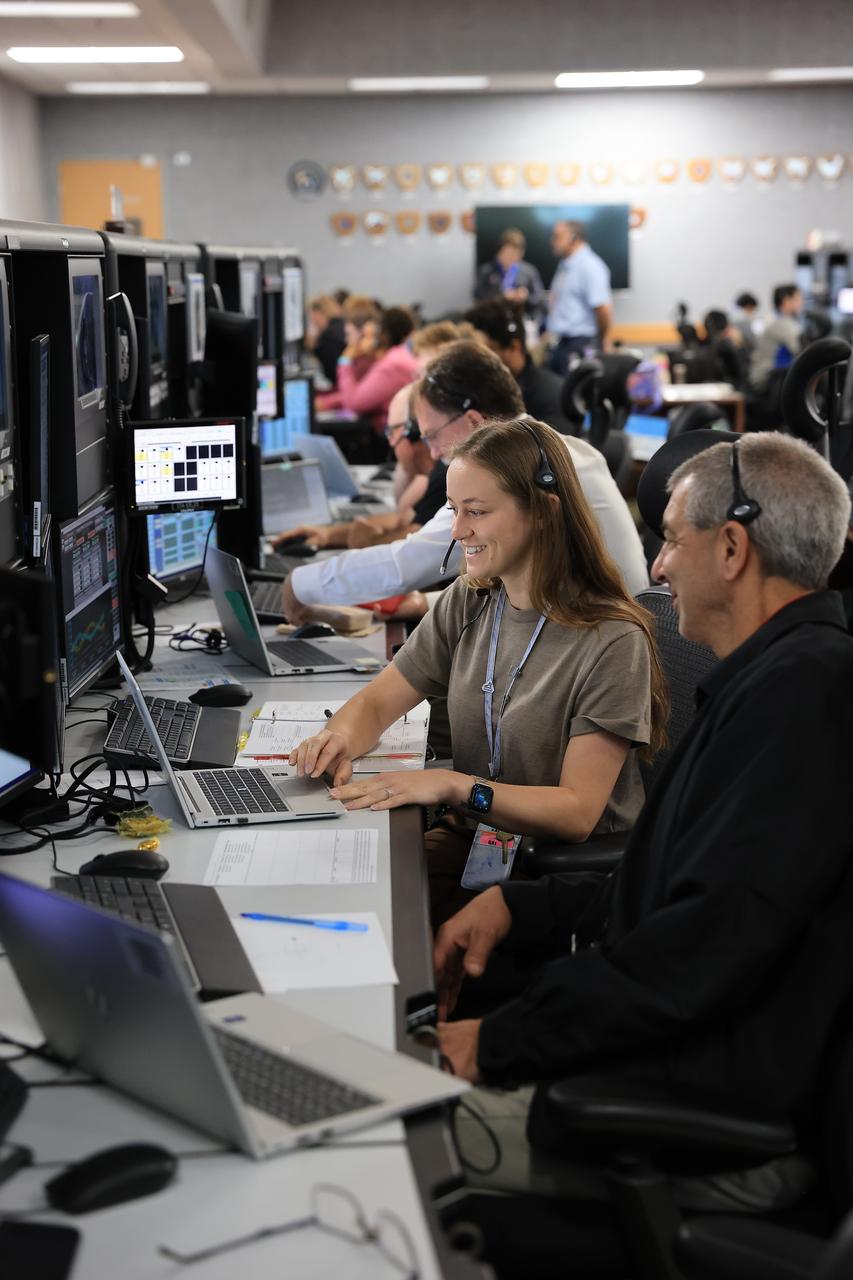
Teams at NASA’s Kennedy Space Center in Florida participate in the first joint integrated launch countdown simulation for Artemis II inside Firing Room 1 of the Launch Control Center on Thursday, Sept. 11, 2025. The training exercise involved engineers from Kennedy, Marshall Space Flight Center in Huntsville, Alabama, and Johnson Space Center in Houston coming together to rehearse all aspects of the launch countdown, from cryogenic loading – filling tanks in the SLS (Space Launch System) rocket’s core stage with liquid hydrogen and liquid oxygen – to liftoff. These simulations will help certify that the launch team is ready for Artemis II – the first crewed Artemis mission that will send four astronauts around the Moon and back.
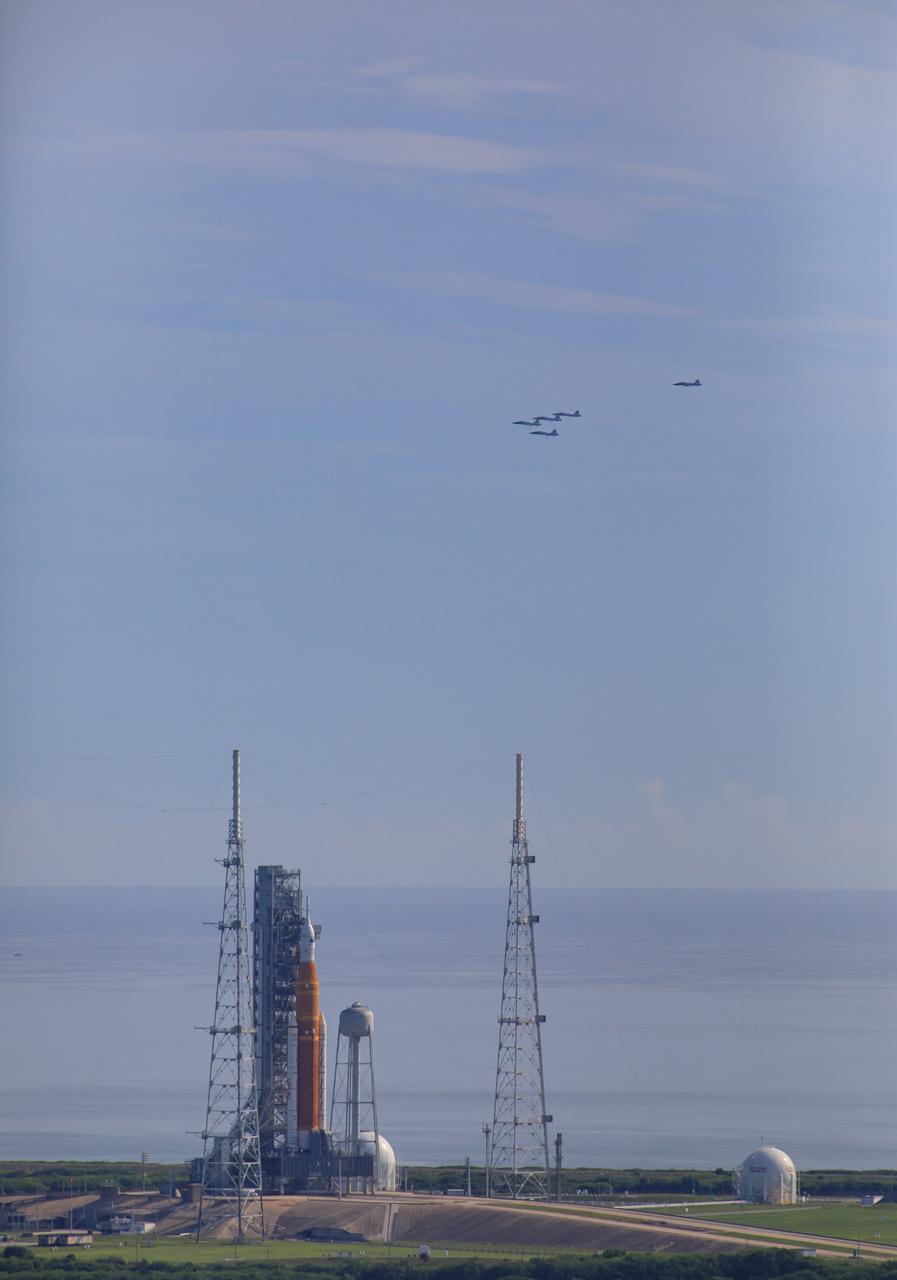
Ahead of NASA’s Artemis I launch, a flight of T-38 supersonic trainer aircraft from the Johnson Space Center Aircraft Operations Division flies in formation over the agency’s Space Launch System and Orion spacecraft on the pad at Launch Complex 39B at Kennedy Space Center in Florida, on Aug. 23, 2022. Pilots and passengers of the five aircraft include NASA Research Pilot Chris Condon and NASA Astronaut Zena Cardman in the lead plane, followed by NASA astronaut candidate Nicole Ayers and NASA astronaut Christina Koch in the second plane, Canadian Space Agency astronaut Jeremy Hansen and NASA astronaut Drew Morgan in the third plane, NASA astronaut Reid Wiseman and NASA astronaut Joe Acaba in the fourth plane, and NASA astronaut candidate Jack Hathaway and Josh Valcarcel, NASA photographer, in the chase plane. Artemis I is scheduled to launch at 8:33 a.m. EDT on Aug. 29, 2022. The first in a series of increasingly complex missions, Artemis I will provide a foundation for human deep space exploration and demonstrate our commitment and capability to extend human presence to the Moon and beyond. The primary goal of Artemis I is to thoroughly test the integrated systems before crewed missions by operating the spacecraft in a deep space environment, testing Orion’s heat shield, and recovering the crew module after reentry, descent, and splashdown.