
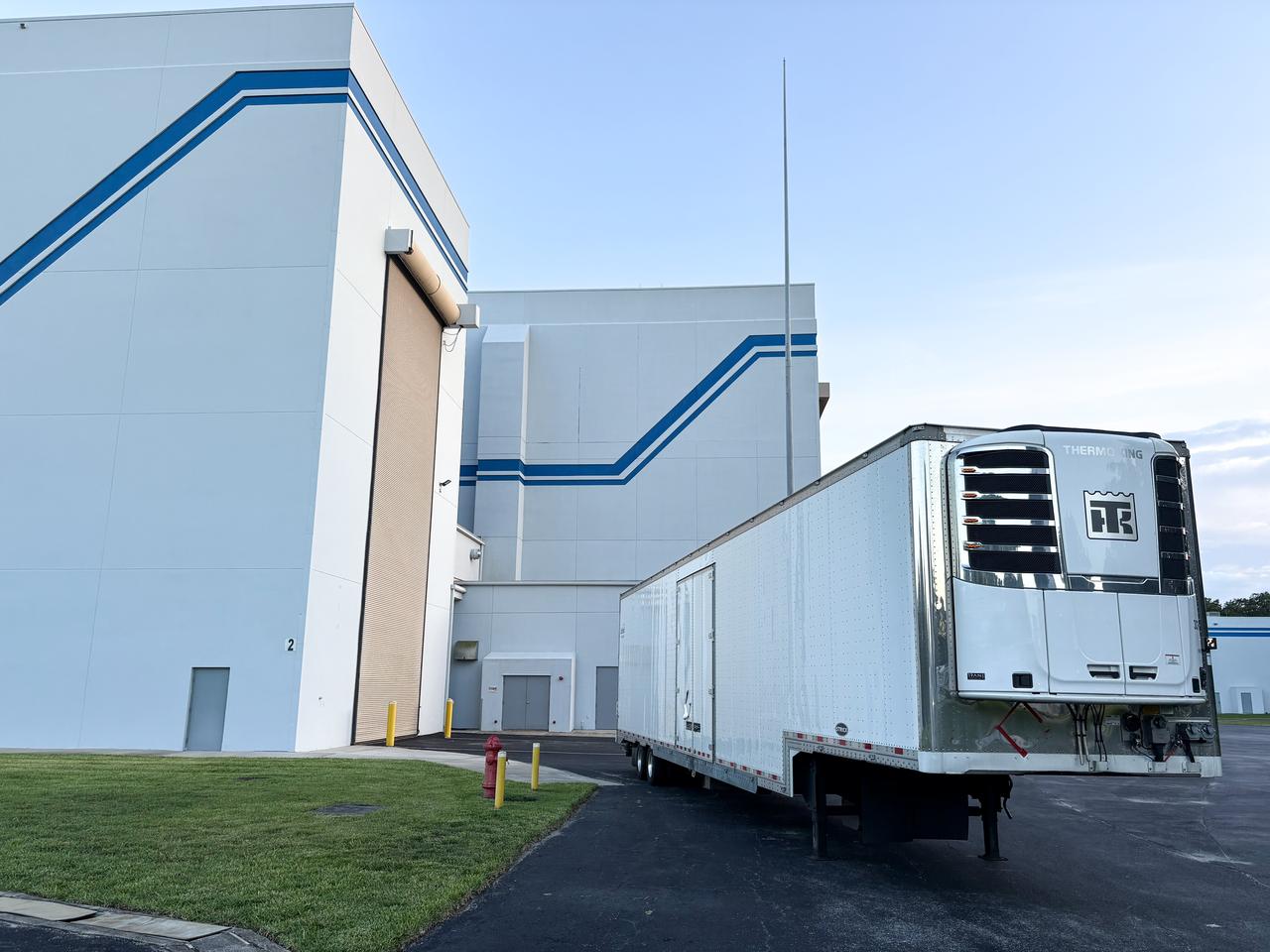
Technicians at NASA’s Payload Hazardous Servicing Facility at Kennedy Space Center in Florida offload eight high‑efficiency particulate air (HEPA) wall modules and other ground support equipment on Monday, April 27, 2026, as part of preparations for arrival of NASA’s Nancy Grace Roman Space Telescope. Each 1,800‑pound module enhances the 40-year-old facility’s clean room systems, helping meet the telescope’s stringent cleanliness requirements during prelaunch processing. Teams are targeting launch as soon as early September aboard a SpaceX Falcon Heavy rocket from Launch Complex 39A at NASA Kennedy.
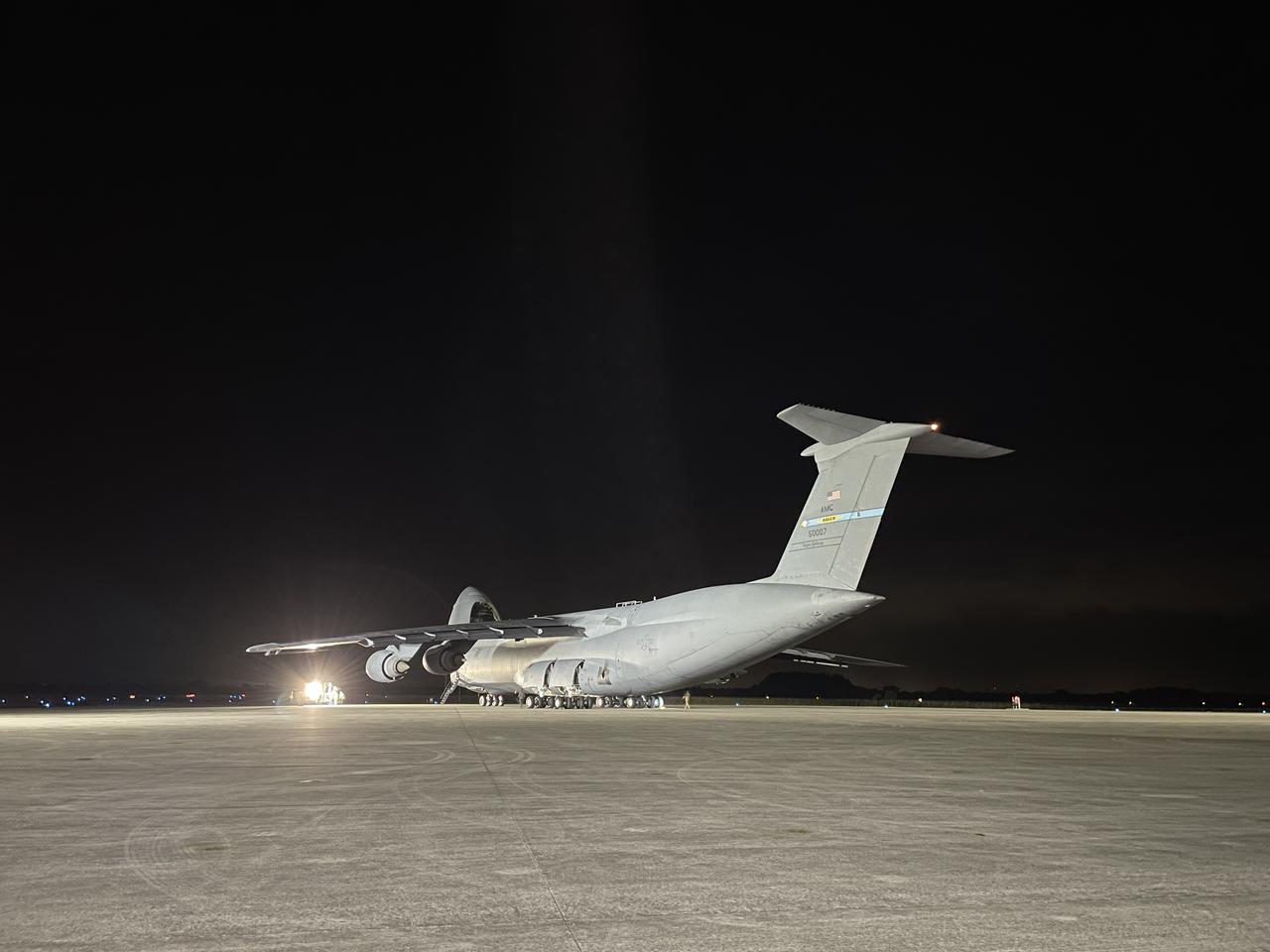
A C-5M Super Galaxy transport aircraft carrying NOAA’s Geostationary Operational Environmental Satellite-U (GOES-U) arrives at the Launch and Landing Facility at NASA’s Kennedy Space Center in Florida on Tuesday, Jan. 23, 2024. Crews offloaded and transported the satellite to the Astrotech Space Operations facility in nearby Titusville, Florida to prepare it for launch. Part of a collaborative NOAA and NASA program, GOES-U is the fourth in a series of four advanced geostationary weather satellites. Data from the GOES satellite constellation – consisting of the GOES-R, GOES-S, GOES-T and GOES-U spacecraft – enables forecasters to predict, observe, and track local weather events that affect public safety like thunderstorms, hurricanes, and wildfires.
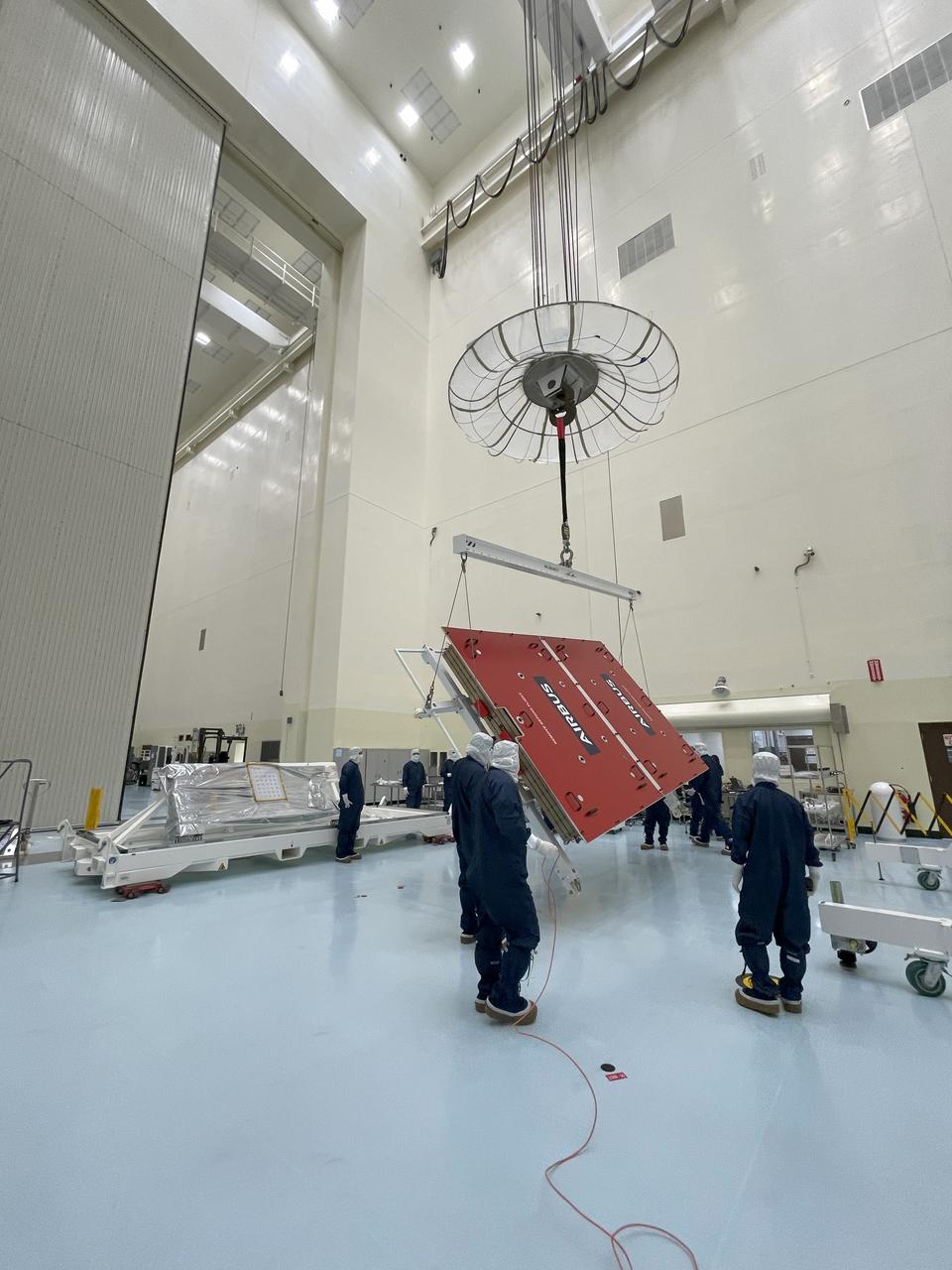
Technicians hoist a five-panel solar array protected by a lid for NASA’s Europa Clipper spacecraft at the Payload Hazardous Servicing Facility at the agency’s Kennedy Space Center in Florida on Tuesday, Feb. 27, 2024. The arrays are each 46.5 feet long (14.2 meters). With both solar arrays deployed, Europa Clipper will span more than 100 feet long, about the length of a basketball court. The solar arrays power the spacecraft so it can study Jupiter’s icy moon, Europa, which is more than five times as far from the Sun as the Earth. Launch on a SpaceX Falcon Heavy rocket is no earlier than October 2024.
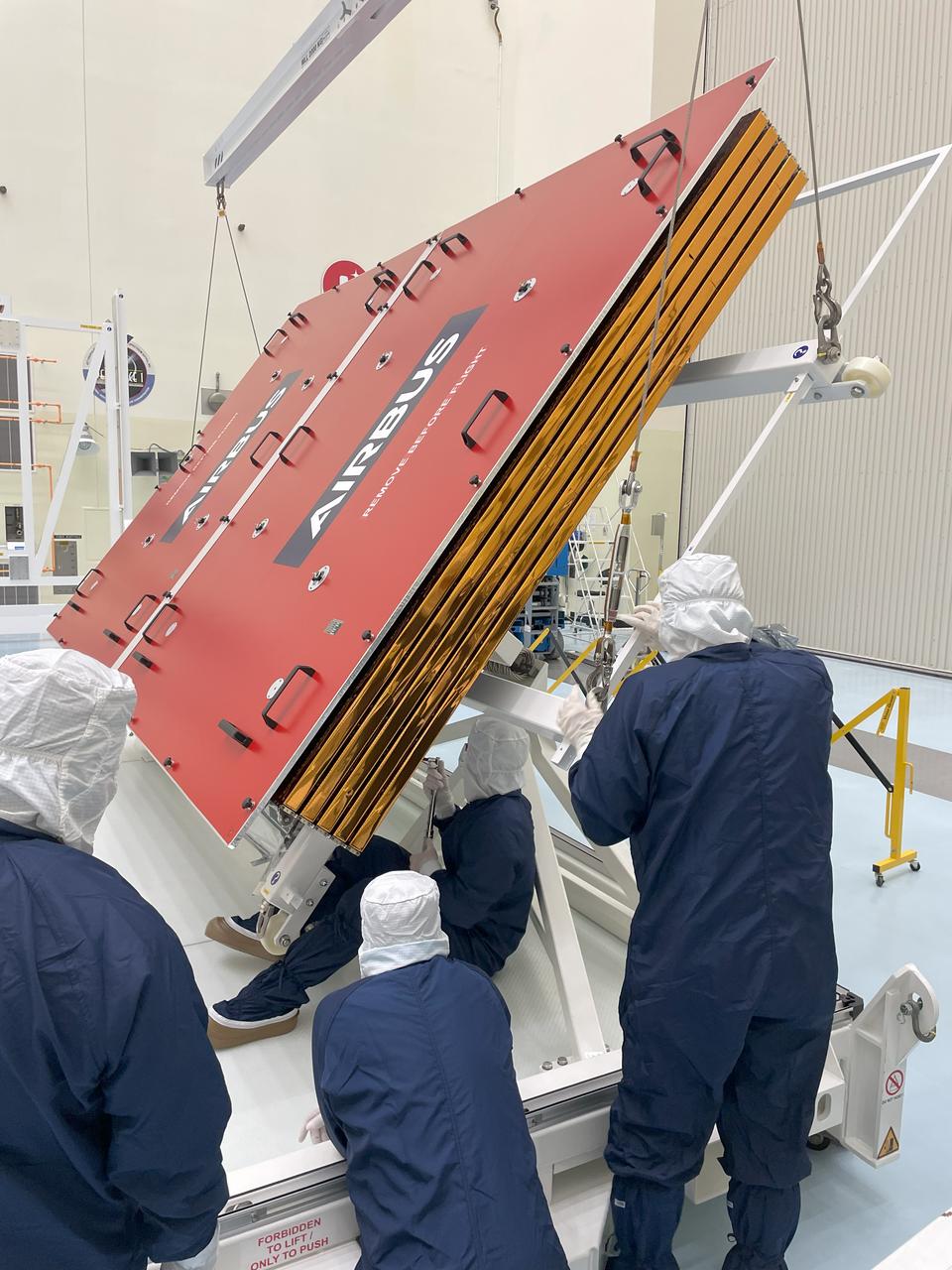
Technicians hoist a five-panel solar array protected by a lid for NASA’s Europa Clipper spacecraft at the Payload Hazardous Servicing Facility at the agency’s Kennedy Space Center in Florida on Tuesday, Feb. 27, 2024. The arrays are each 46.5 feet long (14.2 meters). With both solar arrays deployed, Europa Clipper will span more than 100 feet long, about the length of a basketball court. The solar arrays power the spacecraft so it can study Jupiter’s icy moon, Europa, which is more than five times as far from the Sun as the Earth. Launch on a SpaceX Falcon Heavy rocket is no earlier than October 2024.
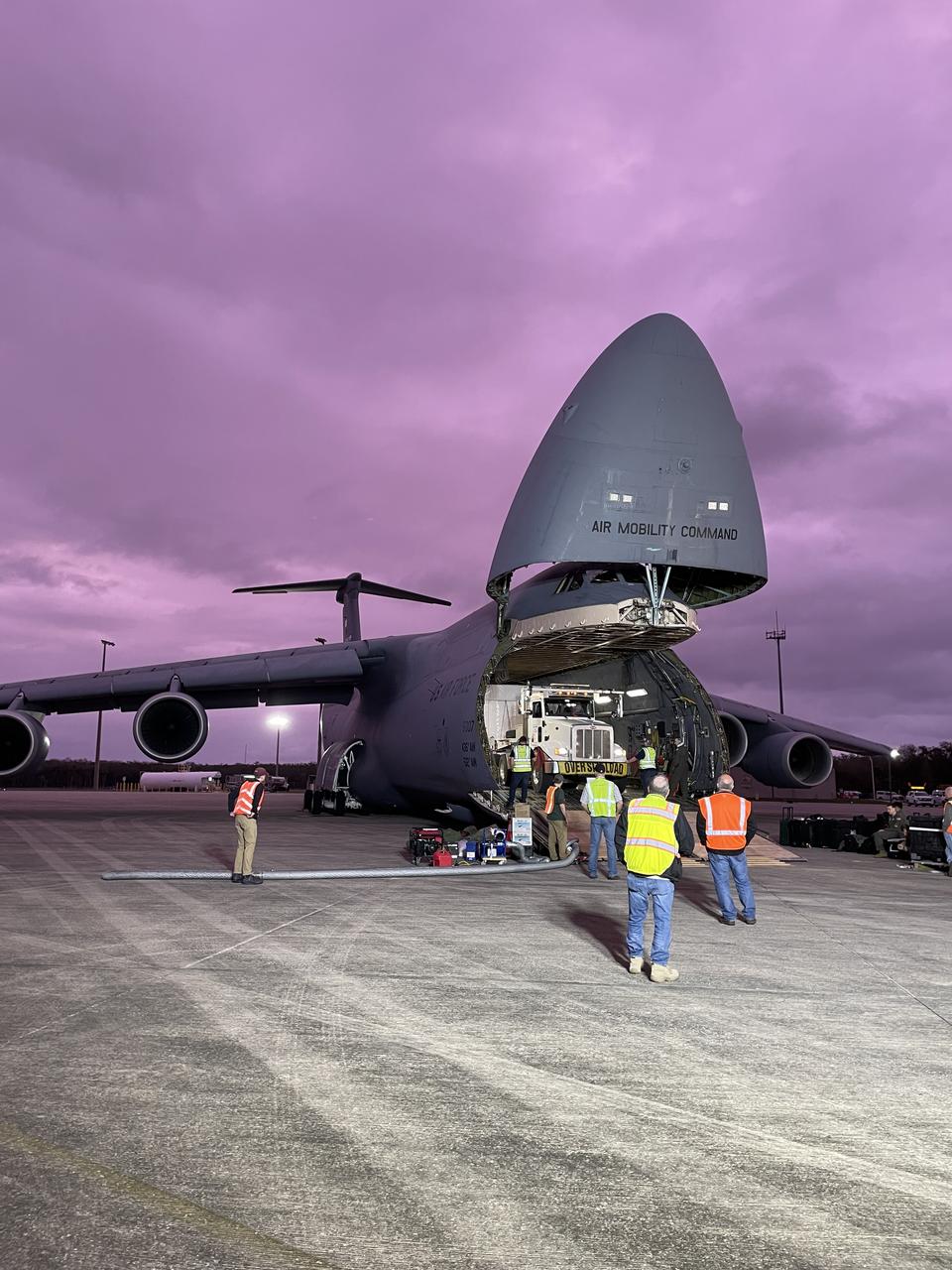
NOAA’s Geostationary Operational Environmental Satellite-U (GOES-U) is offloaded from a C-5M Super Galaxy transport aircraft onto the flatbed of a heavy-lift truck at the Launch and Landing Facility at NASA’s Kennedy Space Center in Florida on Tuesday, Jan. 23, 2024. Crews transported the satellite to the Astrotech Space Operations facility in Titusville, Florida to prepare it for launch. Part of a collaborative NOAA and NASA program, GOES-U is the fourth in a series of four advanced geostationary weather satellites. Data from the GOES satellite constellation – consisting of the GOES-R, GOES-S, GOES-T and GOES-U spacecraft – enables forecasters to predict, observe, and track local weather events that affect public safety like thunderstorms, hurricanes, and wildfires.

Technicians at NASA’s Payload Hazardous Servicing Facility at Kennedy Space Center in Florida offload eight high‑efficiency particulate air (HEPA) wall modules and other ground support equipment on Monday, April 27, 2026, as part of preparations for arrival of NASA’s Nancy Grace Roman Space Telescope. Each 1,800‑pound module enhances the 40-year-old facility’s clean room systems, helping meet the telescope’s stringent cleanliness requirements during prelaunch processing. Teams are targeting launch as soon as early September aboard a SpaceX Falcon Heavy rocket from Launch Complex 39A at NASA Kennedy.
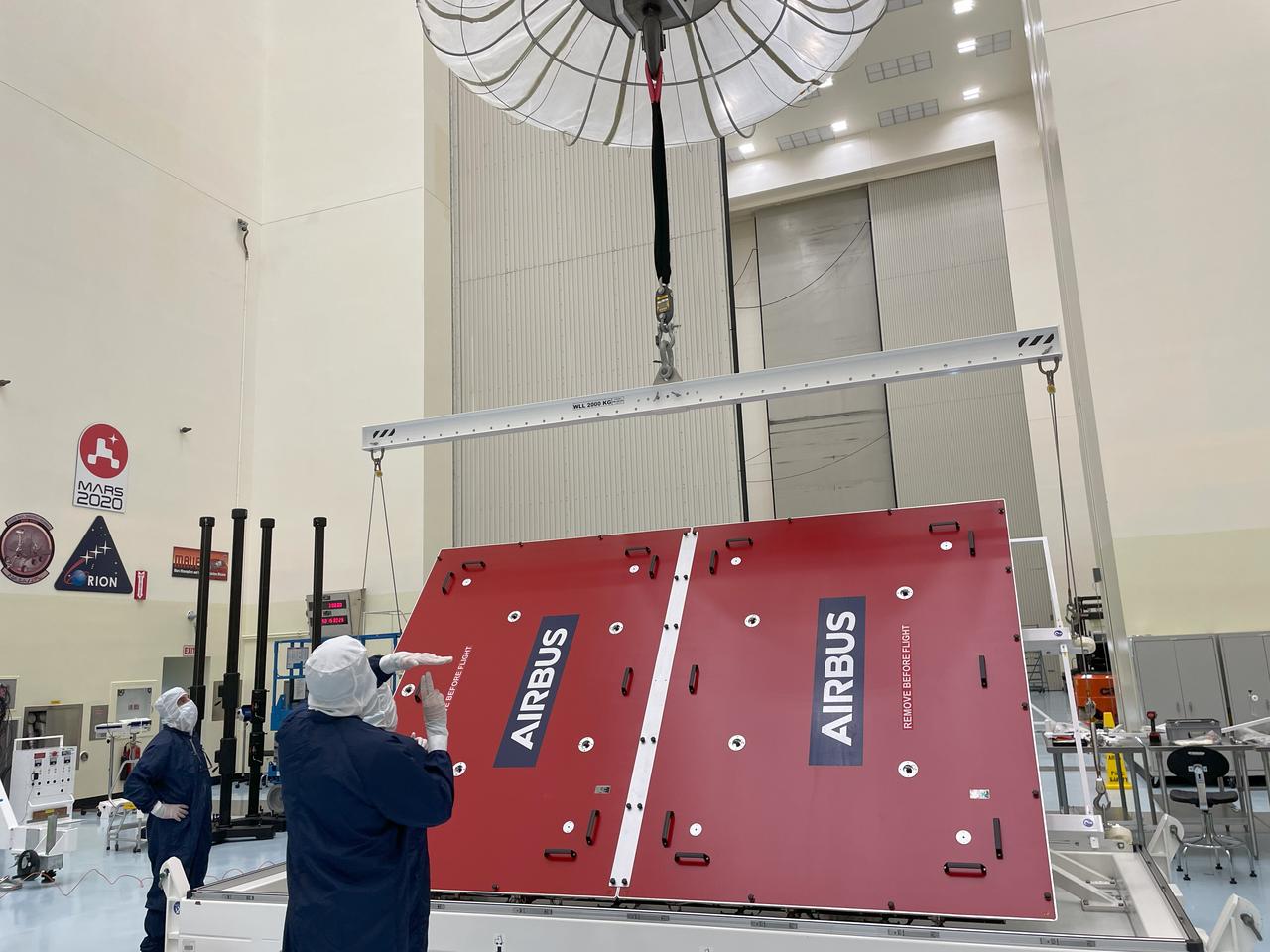
Technicians hoist a five-panel solar array protected by a lid for NASA’s Europa Clipper spacecraft at the Payload Hazardous Servicing Facility at the agency’s Kennedy Space Center in Florida on Tuesday, Feb. 27, 2024. The arrays are each 46.5 feet long (14.2 meters). With both solar arrays deployed, Europa Clipper will span more than 100 feet long, about the length of a basketball court. The solar arrays power the spacecraft so it can study Jupiter’s icy moon, Europa, which is more than five times as far from the Sun as the Earth. Launch on a SpaceX Falcon Heavy rocket is no earlier than October 2024.

NOAA’s Geostationary Operational Environmental Satellite-U (GOES-U) is offloaded from a C-5M Super Galaxy transport aircraft onto the flatbed of a heavy-lift truck at the Launch and Landing Facility at NASA’s Kennedy Space Center in Florida on Tuesday, Jan. 23, 2024. Crews transported the satellite to the Astrotech Space Operations facility in Titusville, Florida to prepare it for launch. Part of a collaborative NOAA and NASA program, GOES-U is the fourth in a series of four advanced geostationary weather satellites. Data from the GOES satellite constellation – consisting of the GOES-R, GOES-S, GOES-T and GOES-U spacecraft – enables forecasters to predict, observe, and track local weather events that affect public safety like thunderstorms, hurricanes, and wildfires.
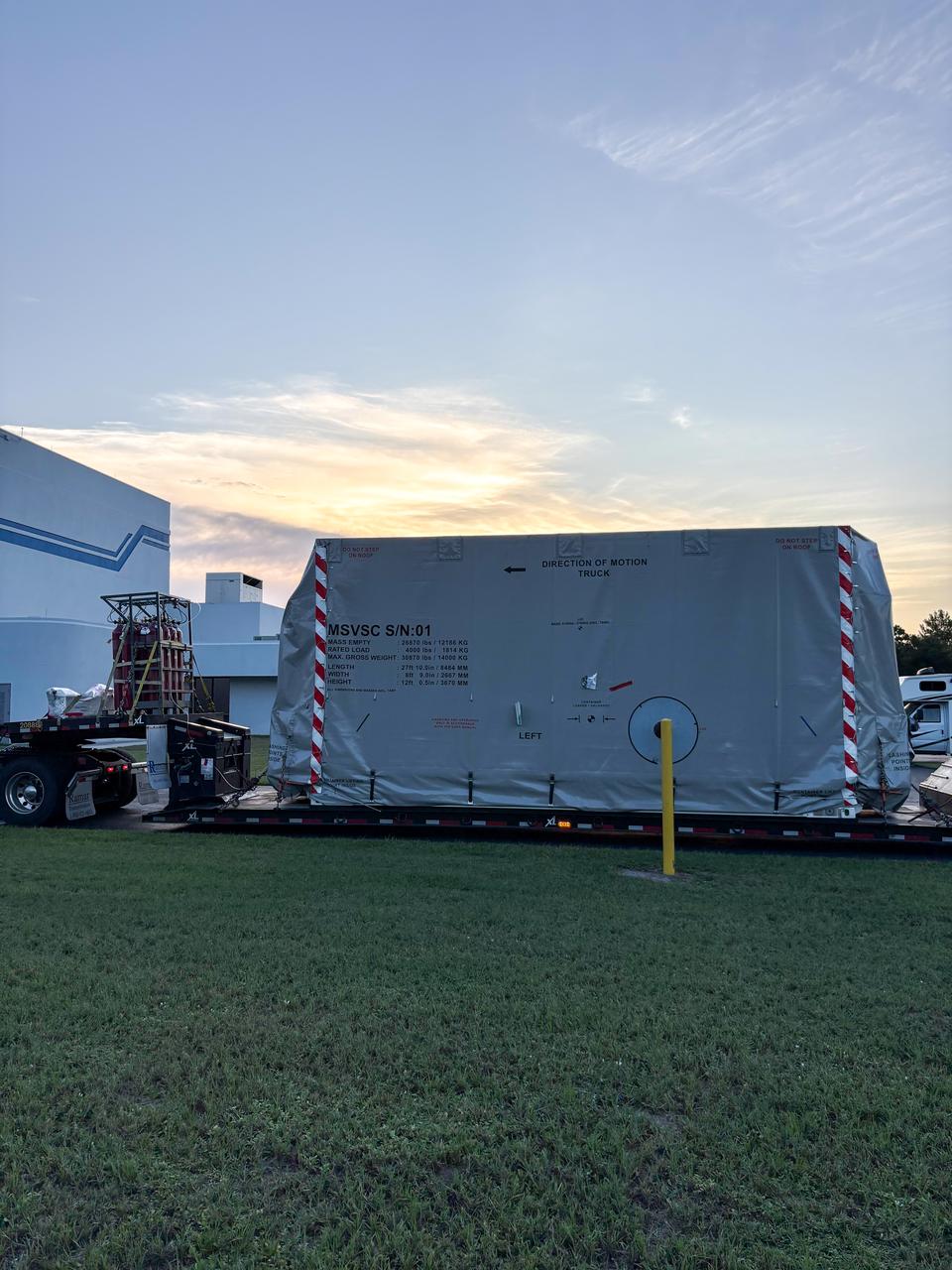
The National Oceanic and Atmospheric Administration’s (NOAA) Space Weather Follow On–Lagrange 1 (SWFO-L1) Observatory, set to provide quicker and more accurate space weather forecasts, arrived Sunday, July 20, 2025, at the Astrotech Space Operations Facility near NASA’s Kennedy Space Center in Florida. The SWFO-L1 mission will monitor the Sun and near-Earth environment using a suite of instruments that provide real-time measurements of solar activity.
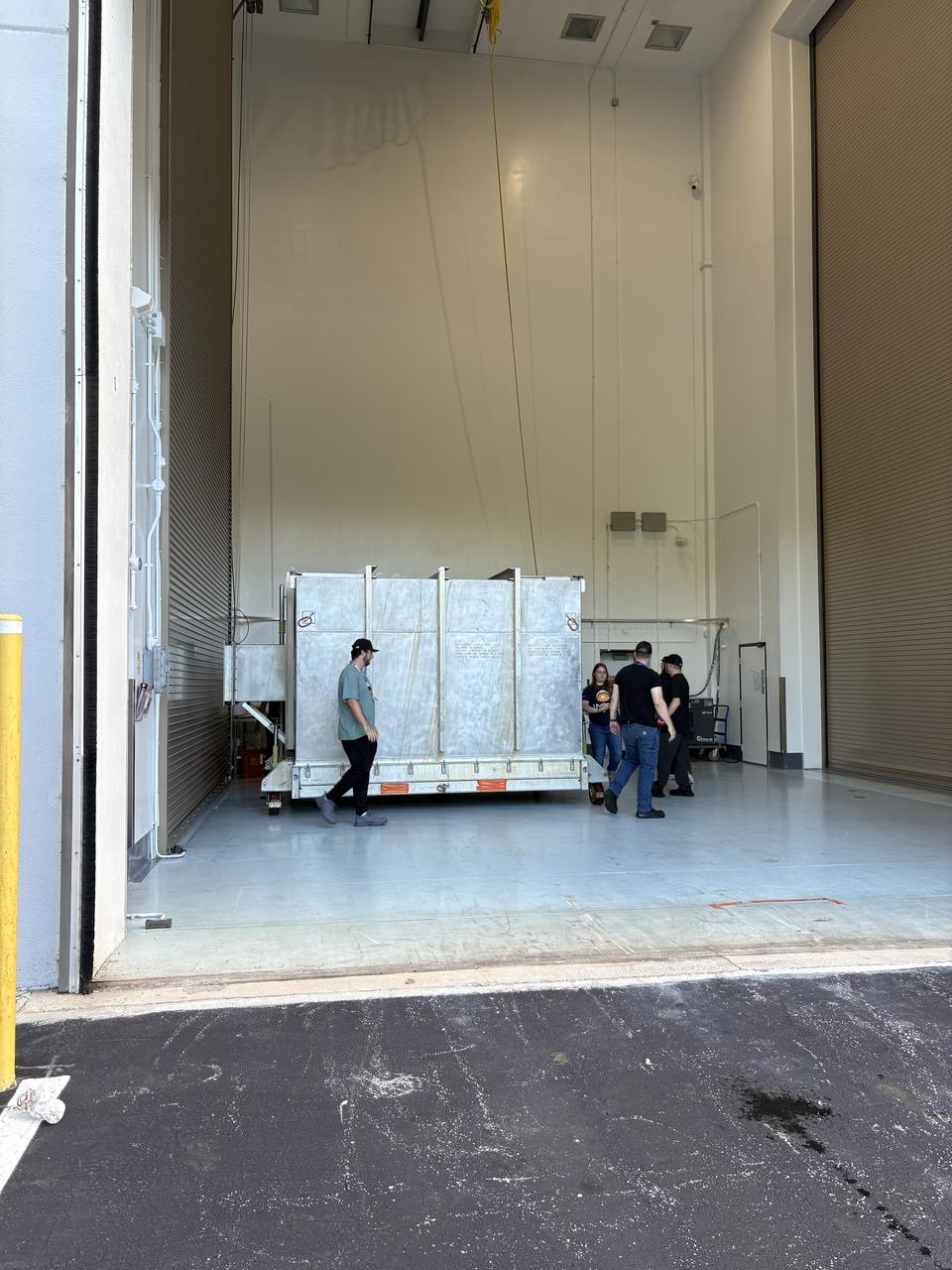
NASA’s IMAP (Interstellar Mapping and Acceleration Probe) observatory arrives at Building 2 where technicians will load 317 pounds (or 144 kilograms) of hydrazine into three tanks into the spacecraft at the Astrotech Space Operations Facility near NASA’s Kennedy Space Center in Florida on Tuesday, Aug. 12, 2025. IMAP will explore and map the boundaries of the heliosphere — a huge bubble created by the Sun’s wind that encapsulates our entire solar system — and study how the heliosphere interacts with the local galactic neighborhood beyond.
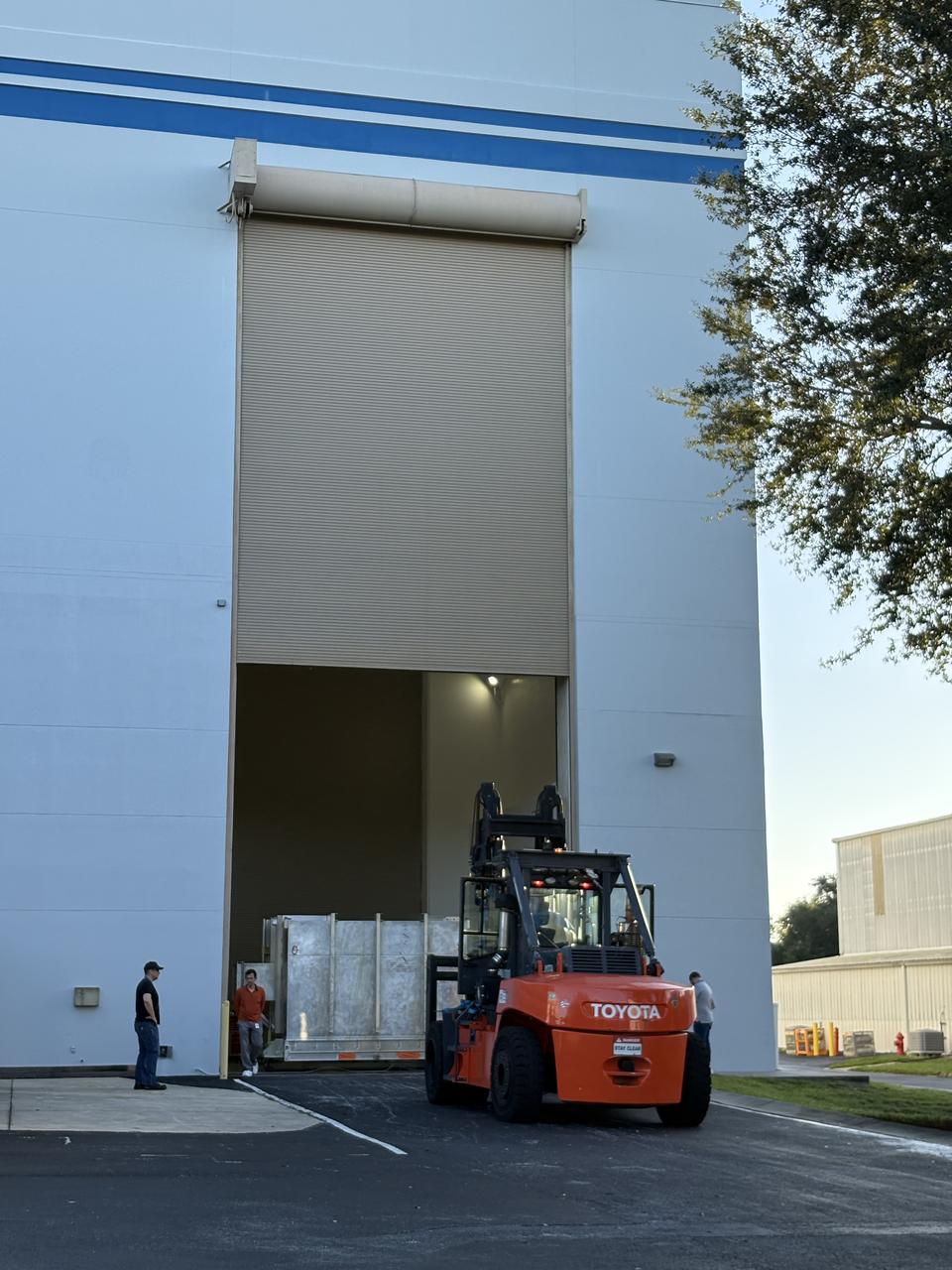
Technicians prepare to transport NASA’s IMAP (Interstellar Mapping and Acceleration Probe) observatory to Building 2 where they will load 317 pounds (or 144 kilograms) of hydrazine into three tanks into the spacecraft at the Astrotech Space Operations Facility near NASA’s Kennedy Space Center in Florida on Tuesday, Aug. 12, 2025. IMAP will explore and map the boundaries of the heliosphere — a huge bubble created by the Sun’s wind that encapsulates our entire solar system — and study how the heliosphere interacts with the local galactic neighborhood beyond.
Technicians offloaded NASA’s Carruthers Geocorona Observatory following the spacecraft’s arrival on Sunday, July 20, 2025, at the Astrotech Space Operations Facility near the agency’s Kennedy Space Center in Florida. The Carruthers Geocorona Observatory is a small satellite set to operate at Lagrange Point 1 (L1), an orbit point between the Earth and Sun about one million miles away, to study the Earth’s exosphere, the outermost part of the atmosphere. Carruthers will use its ultraviolet cameras to monitor how space weather from the Sun impacts the exosphere.
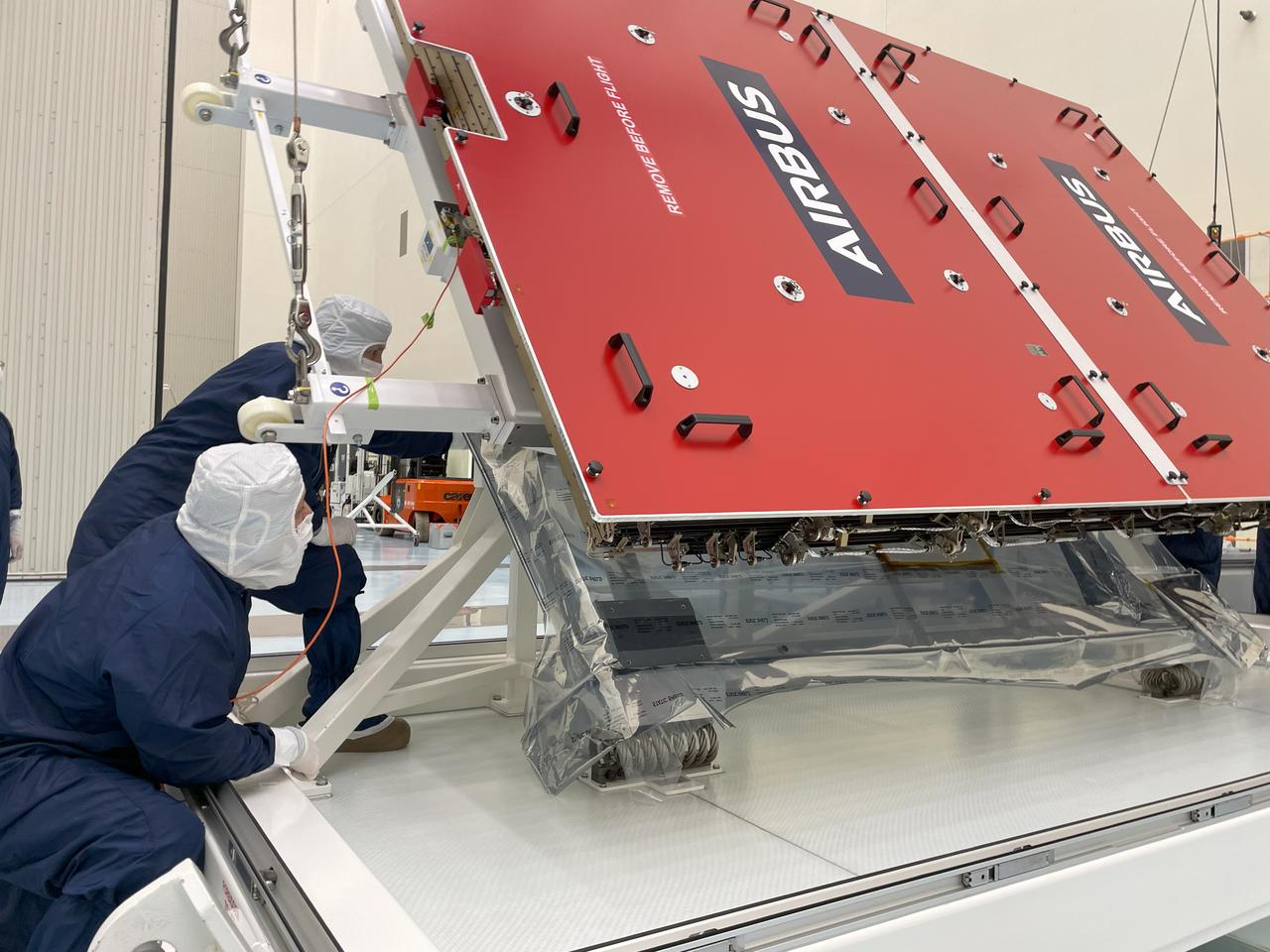
Technicians hoist a five-panel solar array protected by a lid for NASA’s Europa Clipper spacecraft at the Payload Hazardous Servicing Facility at the agency’s Kennedy Space Center in Florida on Tuesday, Feb. 27, 2024. The arrays are each 46.5 feet long (14.2 meters). With both solar arrays deployed, Europa Clipper will span more than 100 feet long, about the length of a basketball court. The solar arrays power the spacecraft so it can study Jupiter’s icy moon, Europa, which is more than five times as far from the Sun as the Earth. Launch on a SpaceX Falcon Heavy rocket is no earlier than October 2024.
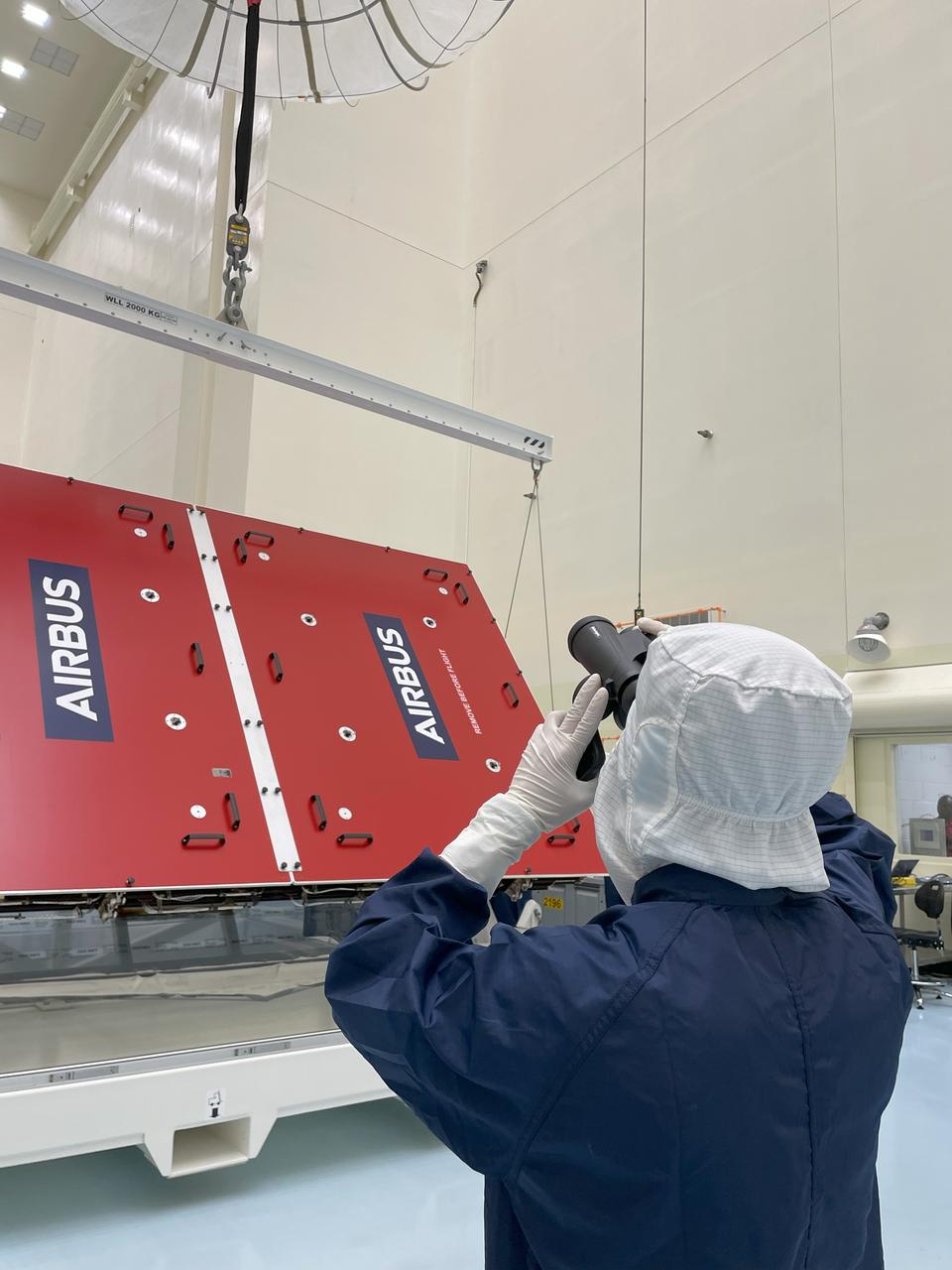
Technicians hoist a five-panel solar array protected by a lid for NASA’s Europa Clipper spacecraft at the Payload Hazardous Servicing Facility at the agency’s Kennedy Space Center in Florida on Tuesday, Feb. 27, 2024. The arrays are each 46.5 feet long (14.2 meters). With both solar arrays deployed, Europa Clipper will span more than 100 feet long, about the length of a basketball court. The solar arrays power the spacecraft so it can study Jupiter’s icy moon, Europa, which is more than five times as far from the Sun as the Earth. Launch on a SpaceX Falcon Heavy rocket is no earlier than October 2024.
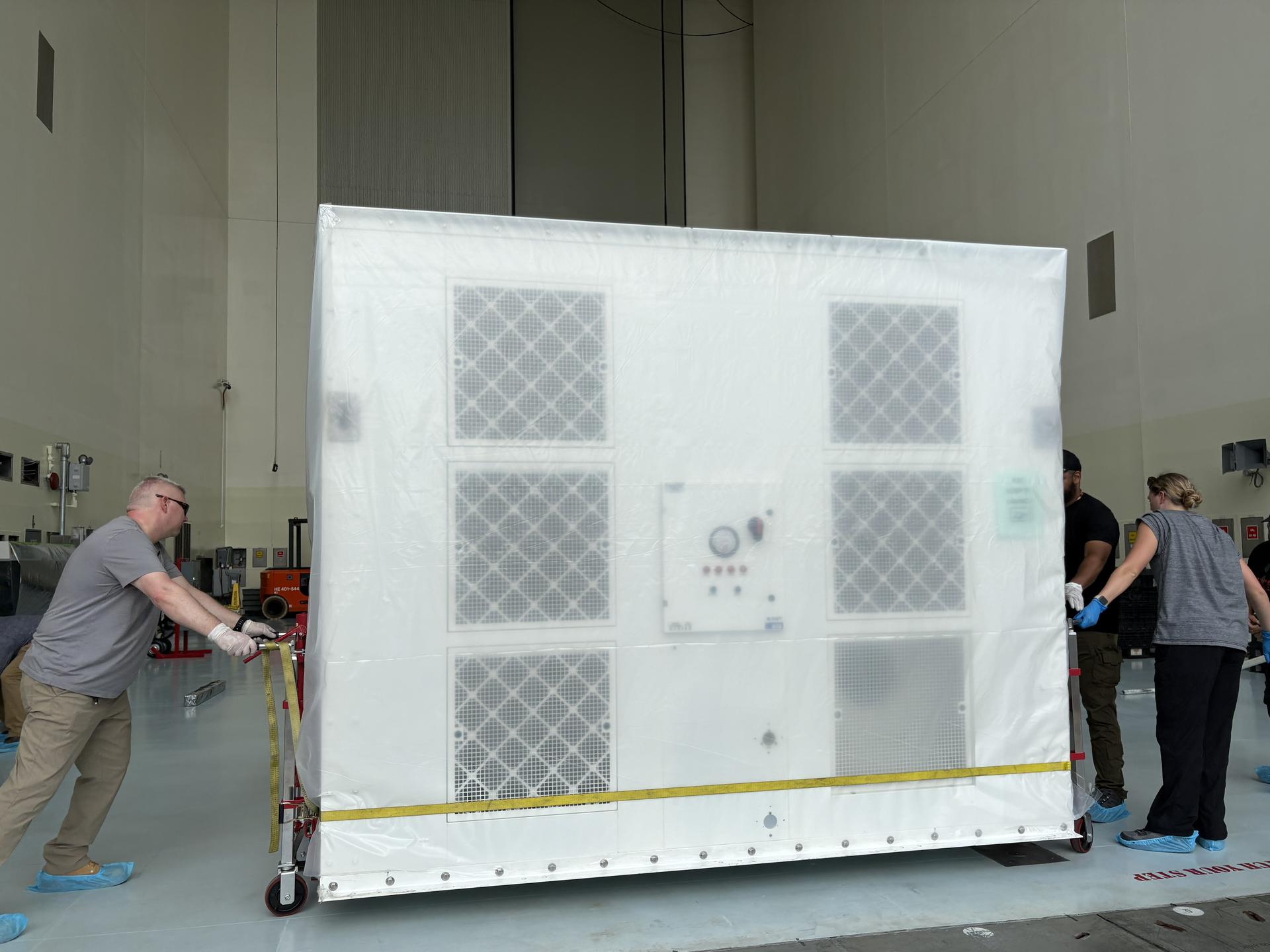
Technicians at NASA’s Payload Hazardous Servicing Facility at Kennedy Space Center in Florida offload eight high‑efficiency particulate air (HEPA) wall modules and other ground support equipment on Monday, April 27, 2026, as part of preparations for arrival of NASA’s Nancy Grace Roman Space Telescope. Each 1,800‑pound module enhances the 40-year-old facility’s clean room systems, helping meet the telescope’s stringent cleanliness requirements during prelaunch processing. Teams are targeting launch as soon as early September aboard a SpaceX Falcon Heavy rocket from Launch Complex 39A at NASA Kennedy.

Technicians at NASA’s Payload Hazardous Servicing Facility at Kennedy Space Center in Florida offload eight high‑efficiency particulate air (HEPA) wall modules and other ground support equipment on Monday, April 27, 2026, as part of preparations for arrival of NASA’s Nancy Grace Roman Space Telescope. Each 1,800‑pound module enhances the 40-year-old facility’s clean room systems, helping meet the telescope’s stringent cleanliness requirements during prelaunch processing. Teams are targeting launch as soon as early September aboard a SpaceX Falcon Heavy rocket from Launch Complex 39A at NASA Kennedy.

NOAA’s Geostationary Operational Environmental Satellite-U (GOES-U) is offloaded from a C-5M Super Galaxy transport aircraft onto the flatbed of a heavy-lift truck at the Launch and Landing Facility at NASA’s Kennedy Space Center in Florida on Tuesday, Jan. 23, 2024. Crews transported the satellite to the Astrotech Space Operations facility in Titusville, Florida to prepare it for launch. Part of a collaborative NOAA and NASA program, GOES-U is the fourth in a series of four advanced geostationary weather satellites. Data from the GOES satellite constellation – consisting of the GOES-R, GOES-S, GOES-T and GOES-U spacecraft – enables forecasters to predict, observe, and track local weather events that affect public safety like thunderstorms, hurricanes, and wildfires.

NOAA’s Geostationary Operational Environmental Satellite-U (GOES-U) is offloaded from a C-5M Super Galaxy transport aircraft onto the flatbed of a heavy-lift truck at the Launch and Landing Facility at NASA’s Kennedy Space Center in Florida on Tuesday, Jan. 23, 2024. Crews transported the satellite to the Astrotech Space Operations facility in Titusville, Florida to prepare it for launch. Part of a collaborative NOAA and NASA program, GOES-U is the fourth in a series of four advanced geostationary weather satellites. Data from the GOES satellite constellation – consisting of the GOES-R, GOES-S, GOES-T and GOES-U spacecraft – enables forecasters to predict, observe, and track local weather events that affect public safety like thunderstorms, hurricanes, and wildfires.
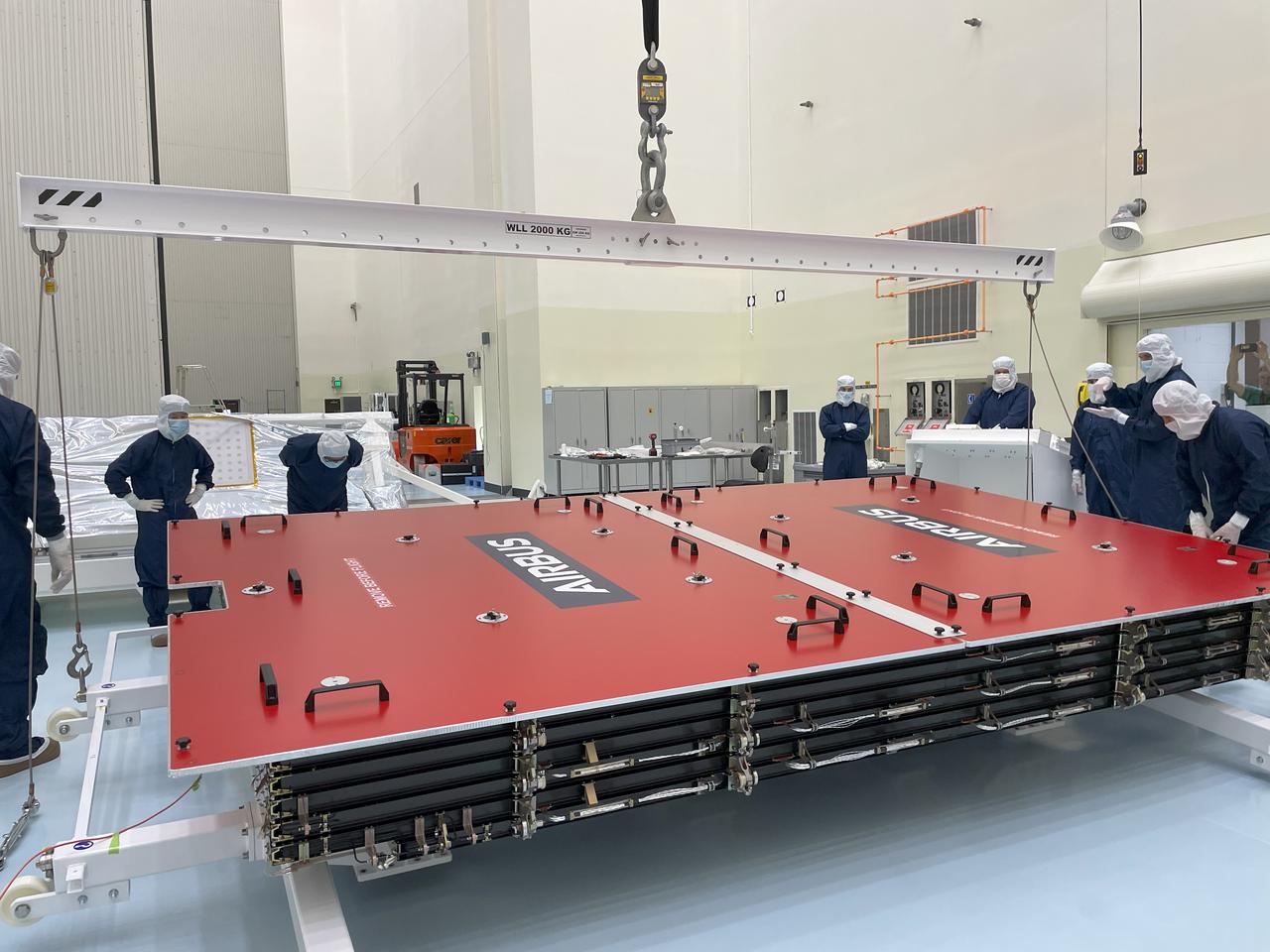
Technicians hoist a five-panel solar array protected by a lid for NASA’s Europa Clipper spacecraft at the Payload Hazardous Servicing Facility at the agency’s Kennedy Space Center in Florida on Tuesday, Feb. 27, 2024. The arrays are each 46.5 feet long (14.2 meters). With both solar arrays deployed, Europa Clipper will span more than 100 feet long, about the length of a basketball court. The solar arrays power the spacecraft so it can study Jupiter’s icy moon, Europa, which is more than five times as far from the Sun as the Earth. Launch on a SpaceX Falcon Heavy rocket is no earlier than October 2024.

Technicians transport NASA’s IMAP (Interstellar Mapping and Acceleration Probe) observatory to Building 2 where they will load 317 pounds (or 144 kilograms) of hydrazine into three tanks into the spacecraft at the Astrotech Space Operations Facility near NASA’s Kennedy Space Center in Florida on Tuesday, Aug. 12, 2025. IMAP will explore and map the boundaries of the heliosphere — a huge bubble created by the Sun’s wind that encapsulates our entire solar system — and study how the heliosphere interacts with the local galactic neighborhood beyond.
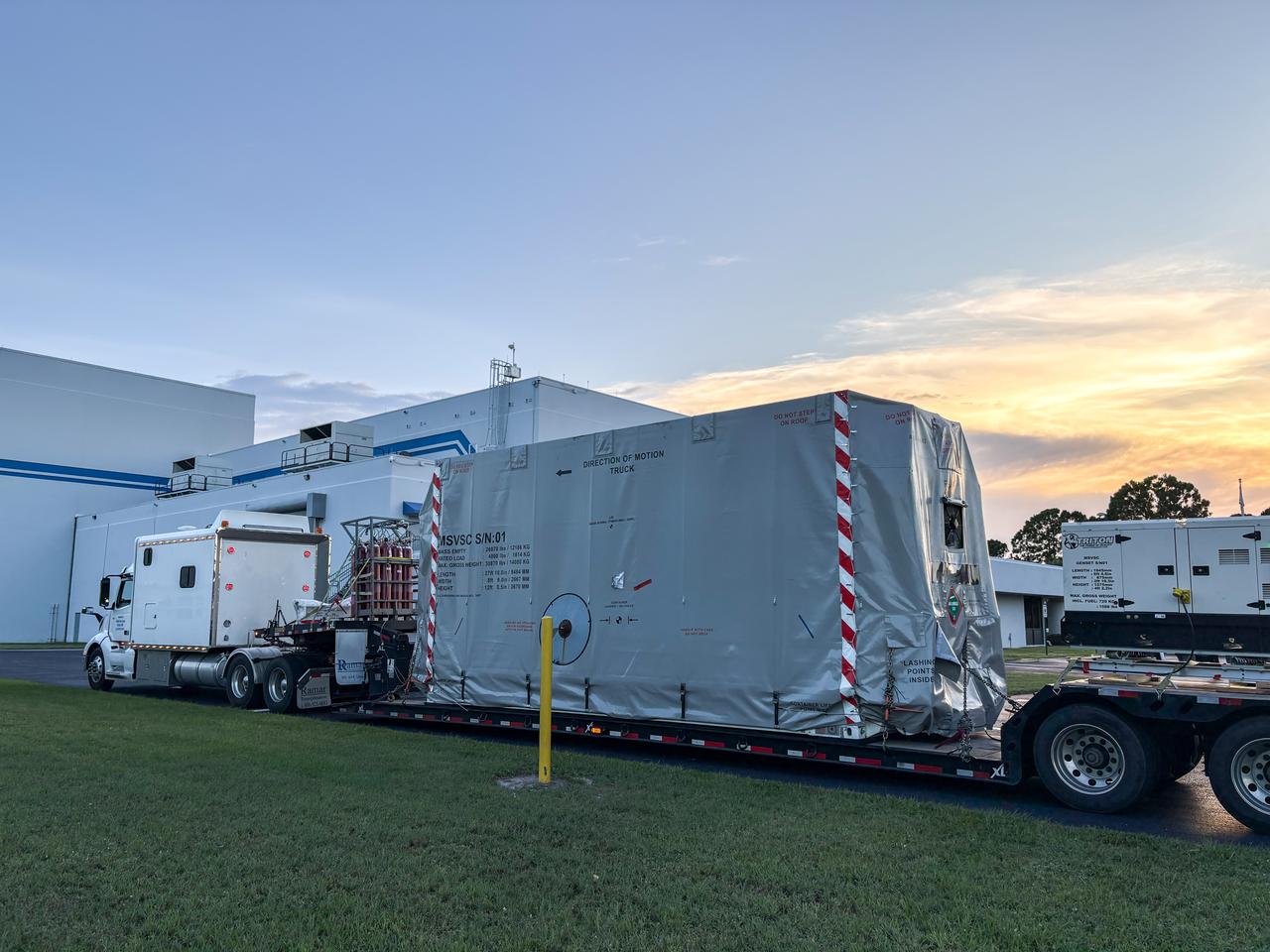
The National Oceanic and Atmospheric Administration’s (NOAA) Space Weather Follow On–Lagrange 1 (SWFO-L1) Observatory, set to provide quicker and more accurate space weather forecasts, arrived Sunday, July 20, 2025, at the Astrotech Space Operations Facility near NASA’s Kennedy Space Center in Florida. The SWFO-L1 mission will monitor the Sun and near-Earth environment using a suite of instruments that provide real-time measurements of solar activity.

Technicians at NASA’s Payload Hazardous Servicing Facility at Kennedy Space Center in Florida offload eight high‑efficiency particulate air (HEPA) wall modules and other ground support equipment on Monday, April 27, 2026, as part of preparations for arrival of NASA’s Nancy Grace Roman Space Telescope. Each 1,800‑pound module enhances the 40-year-old facility’s clean room systems, helping meet the telescope’s stringent cleanliness requirements during prelaunch processing. Teams are targeting launch as soon as early September aboard a SpaceX Falcon Heavy rocket from Launch Complex 39A at NASA Kennedy.
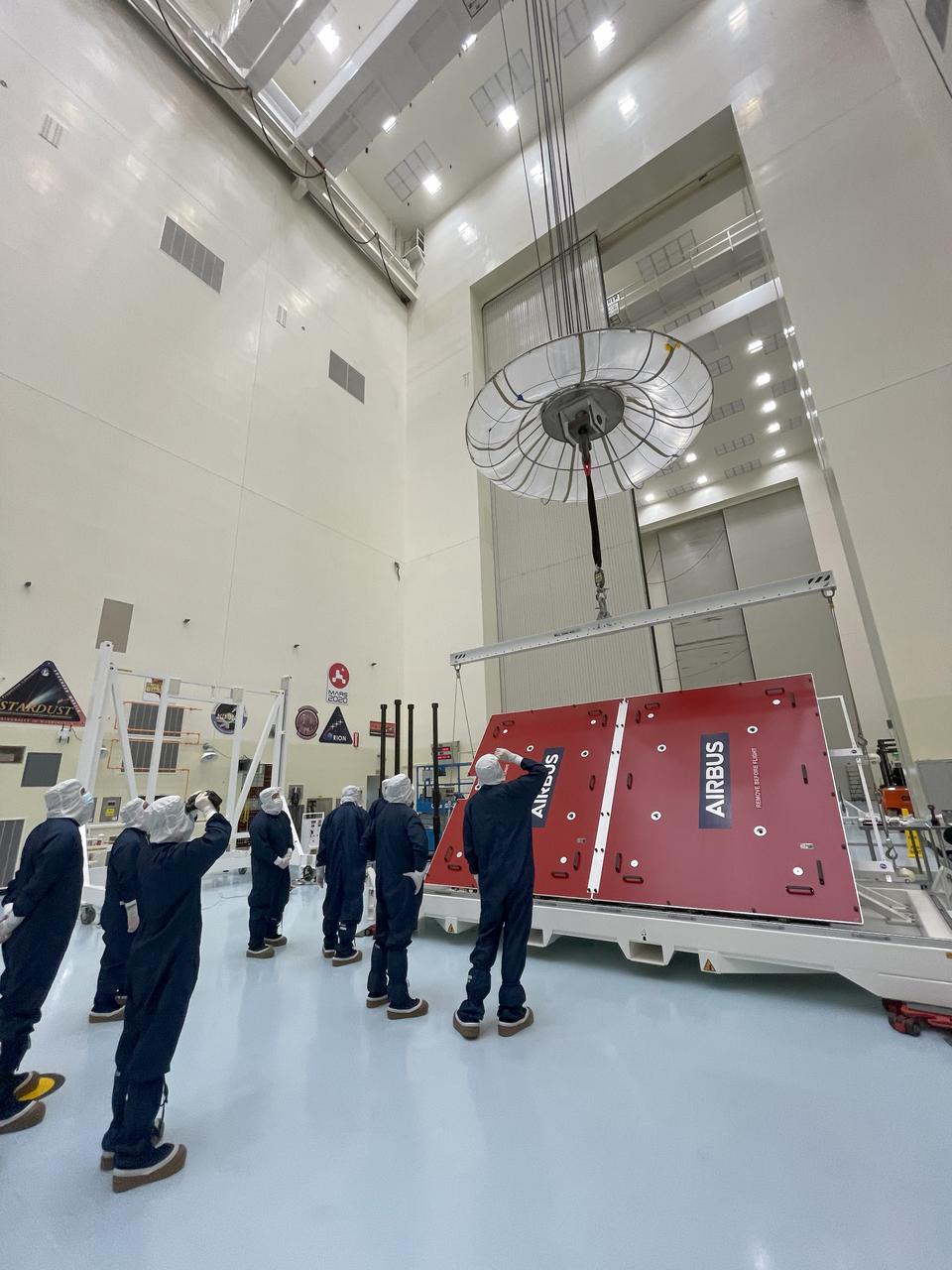
Technicians hoist a five-panel solar array protected by a lid for NASA’s Europa Clipper spacecraft at the Payload Hazardous Servicing Facility at the agency’s Kennedy Space Center in Florida on Tuesday, Feb. 27, 2024. The arrays are each 46.5 feet long (14.2 meters). With both solar arrays deployed, Europa Clipper will span more than 100 feet long, about the length of a basketball court. The solar arrays power the spacecraft so it can study Jupiter’s icy moon, Europa, which is more than five times as far from the Sun as the Earth. Launch on a SpaceX Falcon Heavy rocket is no earlier than October 2024.