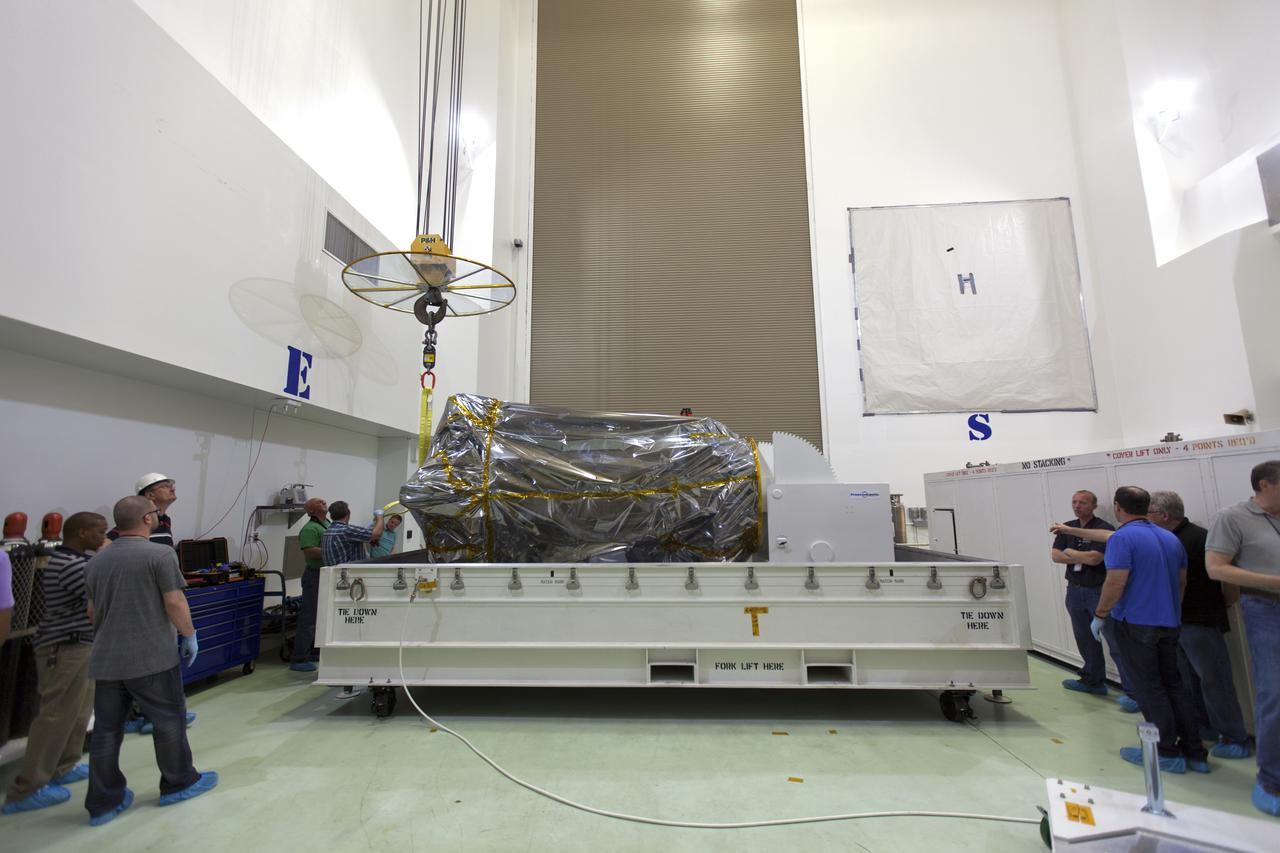
At the Astrotech processing facility in Titusville, Florida, near NASA's Kennedy Space Center, technicians and engineers remove NASA's Parker Solar Probe from its shipping container on Wednesday, April 4, 2018. The Parker Solar Probe will launch on a United Launch Alliance Delta IV Heavy rocket from Space Launch Complex 37 at Cape Canaveral Air Force Station in Florida no earlier than Aug. 4, 2018. The mission will perform the closest-ever observations of a star when it travels through the Sun's atmosphere, called the corona. The probe will rely on measurements and imaging to revolutionize our understanding of the corona and the Sun-Earth connection.
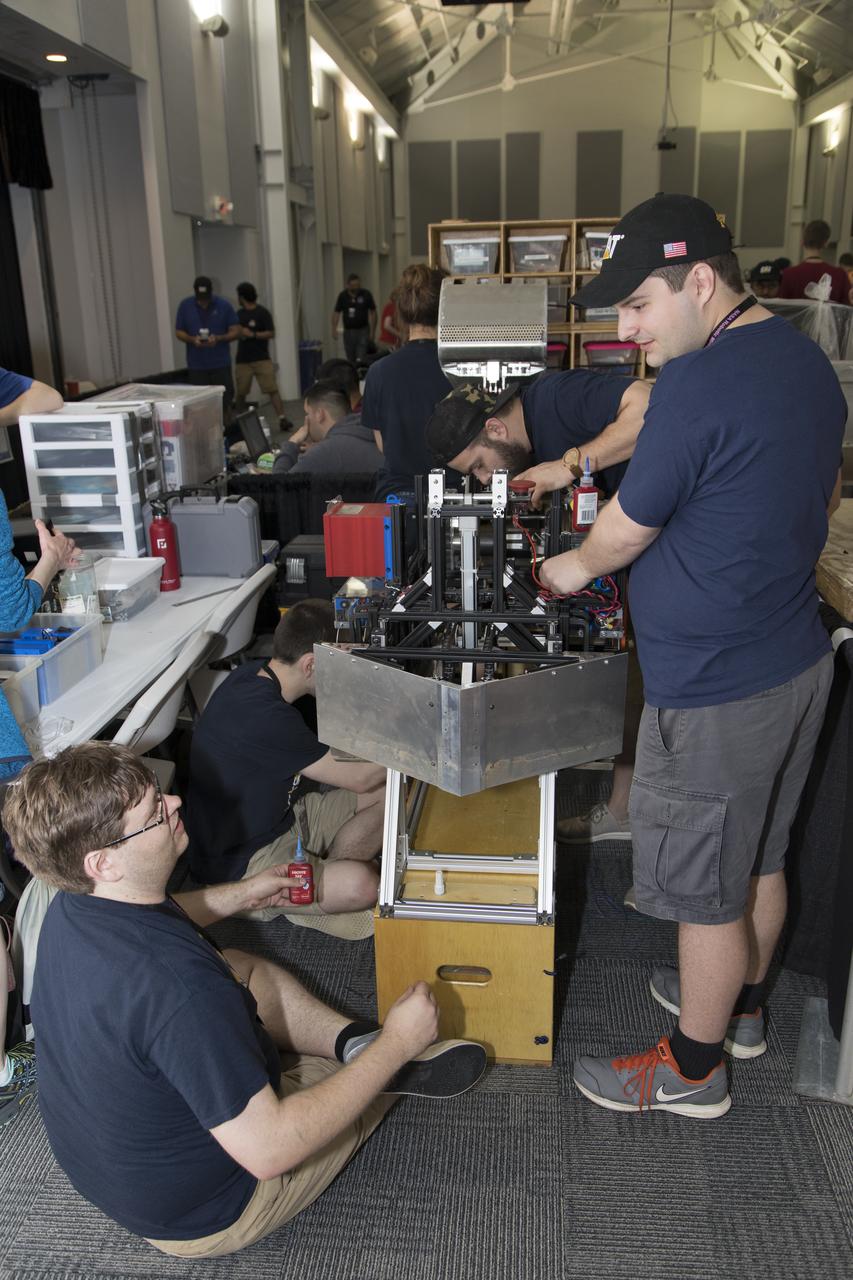
On the first day of NASA's 9th Robotic Mining Competition, set-up day on May 14, college team members work on their robot miner in the RobotPits in the Educator Resource Center at Kennedy Space Center Visitor Complex in Florida. More than 40 student teams from colleges and universities around the U.S. will use their mining robots to dig in a supersized sandbox filled with BP-1, or simulated Lunar soil, gravel and rocks, and participate in other competition requirements. The Robotic Mining Competition is a NASA Human Exploration and Operations Mission Directorate project designed to encourage students in science, technology, engineering and math, or STEM fields. The project provides a competitive environment to foster innovative ideas and solutions that could be used on NASA's deep space missions.

John "JC" Carver, a payload integration engineer with NASA Kennedy Space Center's Test and Operations Support Contract, places Arabidopsis thaliana plants harvested from the Advanced Plant Habitat (APH) Flight Unit No. 1 into an Ultra-low Freezer chilled to -150 degrees Celsius. The harvest is part of an ongoing verification test of the APH unit, which is located inside the International Space Station Environmental Simulator in Kennedy's Space Station Processing Facility. The APH undergoing testing at Kennedy is identical to one on the station and uses red, green and broad-spectrum white LED lights to grow plants in an environmentally controlled chamber. The seeds grown during the verification test will be grown on the station to help scientists understand how these plants adapt to spaceflight.
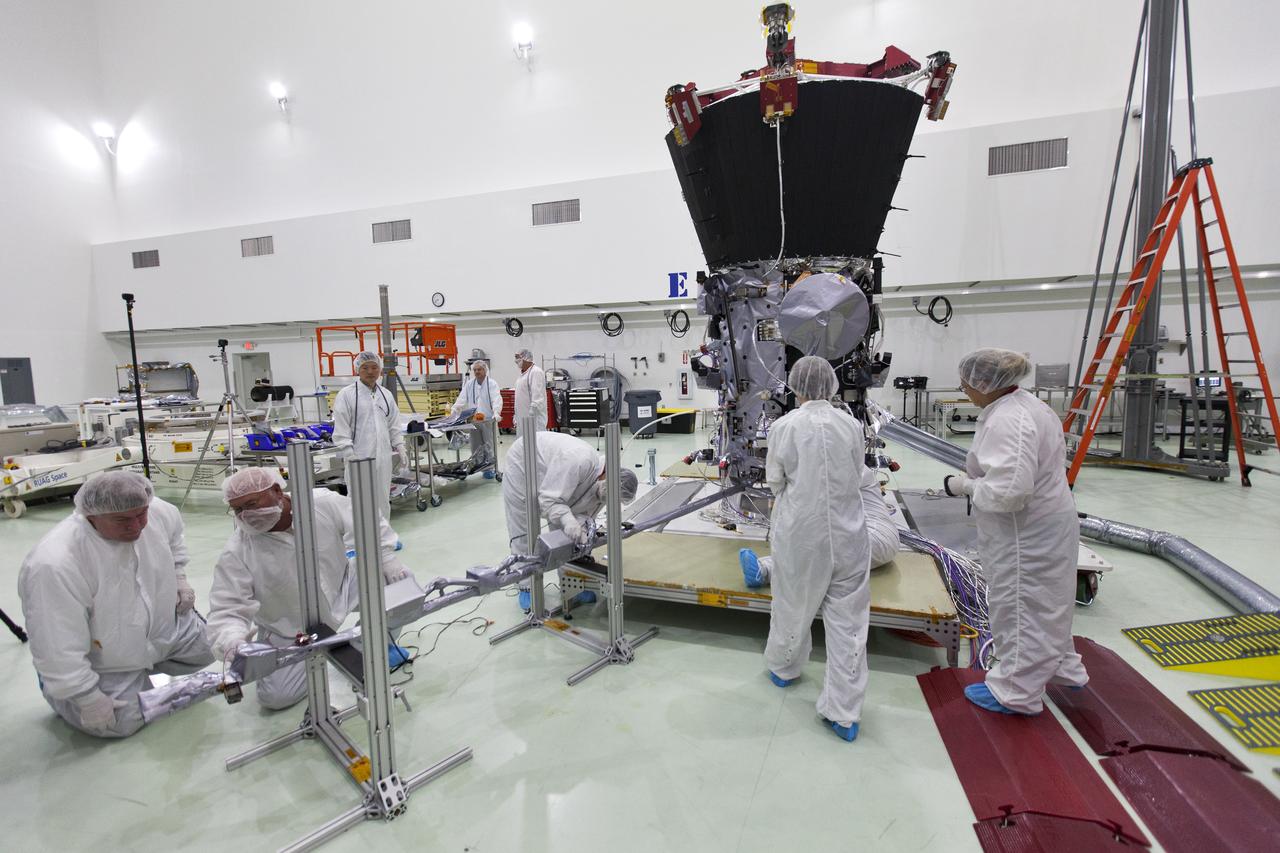
In the Astrotech processing facility in Titusville, Florida, near NASA's Kennedy Space Center, on Wednesday, May 23, 2018, technicians and engineers deploy the magnetometer boom on NASA's Parker Solar Probe. The Parker Solar Probe will launch on a United Launch Alliance Delta IV Heavy rocket from Space Launch Complex 37 at Cape Canaveral Air Force Station in Florida no earlier than Aug. 4, 2018. The mission will perform the closest-ever observations of a star when it travels through the Sun's atmosphere, called the corona. The probe will rely on measurements and imaging to revolutionize our understanding of the corona and the Sun-Earth connection.
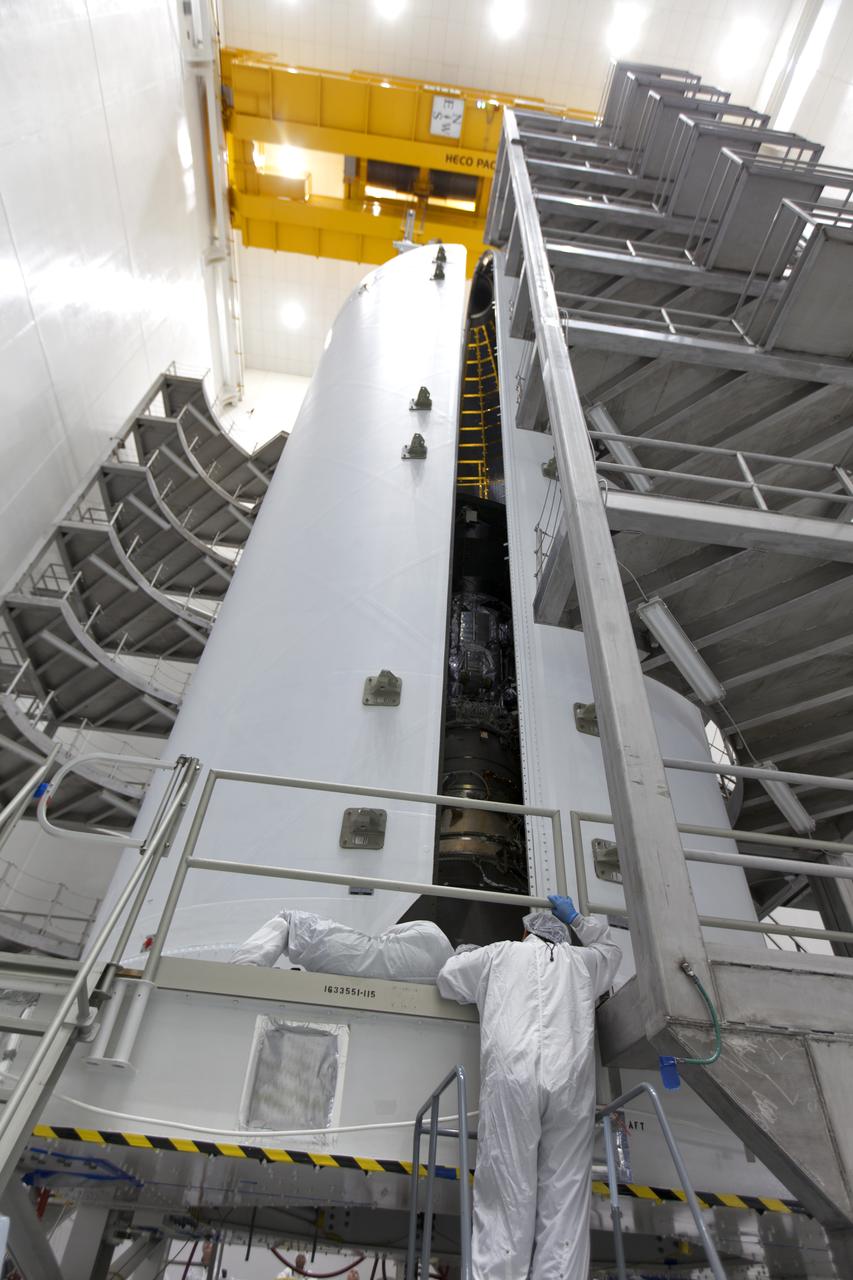
In the Astrotech processing facility in Titusville, Florida, near NASA's Kennedy Space Center, on Thursday, July 19, 2018, technicians and engineers encapsulate NASA's Parker Solar Probe in its payload fairing. The spacecraft is mated to its third stage, built and tested by Northrup Grumman in Chandler, Arizona. The Parker Solar Probe will launch on a United Launch Alliance Delta IV Heavy rocket from Space Launch Complex 37 at Cape Canaveral Air Force Station in Florida. The mission will perform the closest-ever observations of a star when it travels through the Sun's atmosphere, called the corona. The probe will rely on measurements and imaging to revolutionize our understanding of the corona and the Sun-Earth connection.
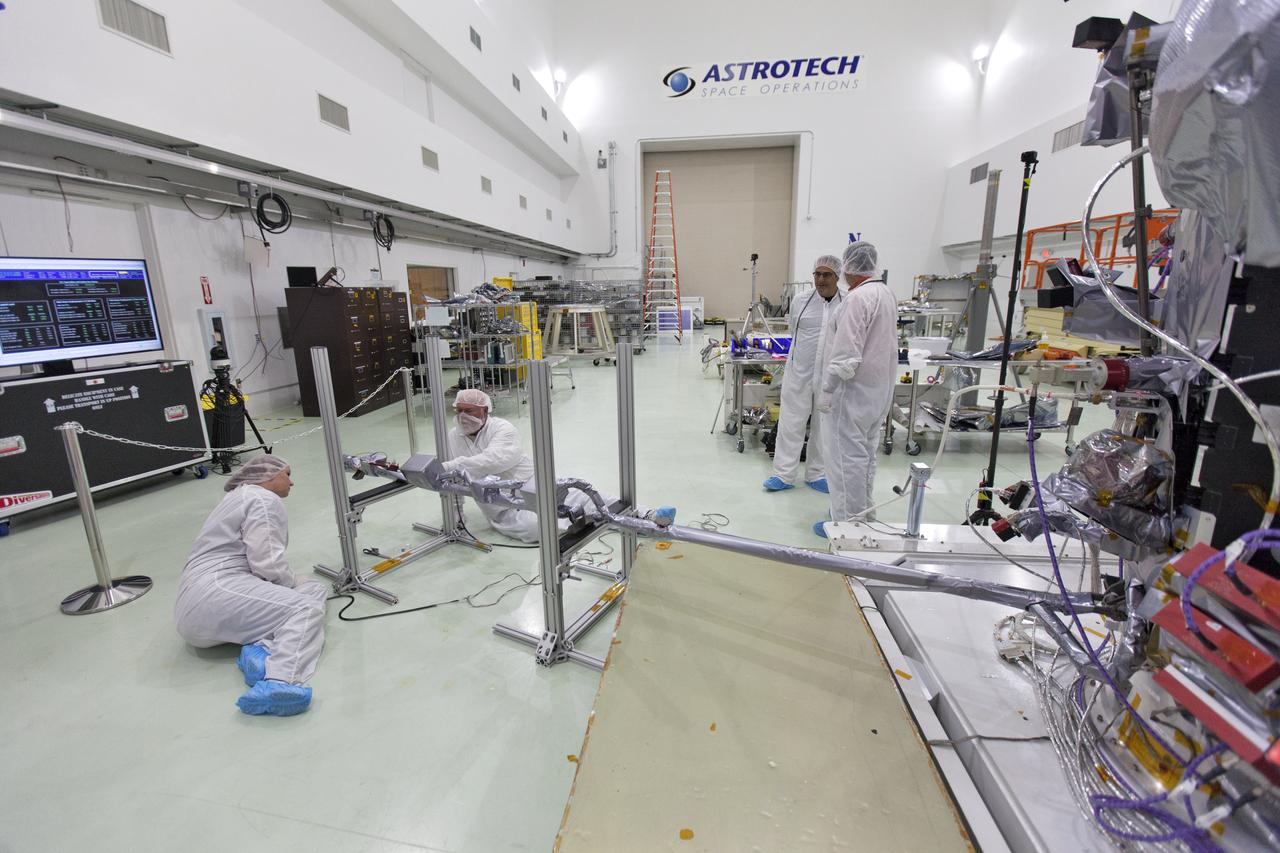
In the Astrotech processing facility in Titusville, Florida, near NASA's Kennedy Space Center, on Wednesday, May 23, 2018, technicians and engineers deploy the magnetometer boom on NASA's Parker Solar Probe. The Parker Solar Probe will launch on a United Launch Alliance Delta IV Heavy rocket from Space Launch Complex 37 at Cape Canaveral Air Force Station in Florida no earlier than Aug. 4, 2018. The mission will perform the closest-ever observations of a star when it travels through the Sun's atmosphere, called the corona. The probe will rely on measurements and imaging to revolutionize our understanding of the corona and the Sun-Earth connection.
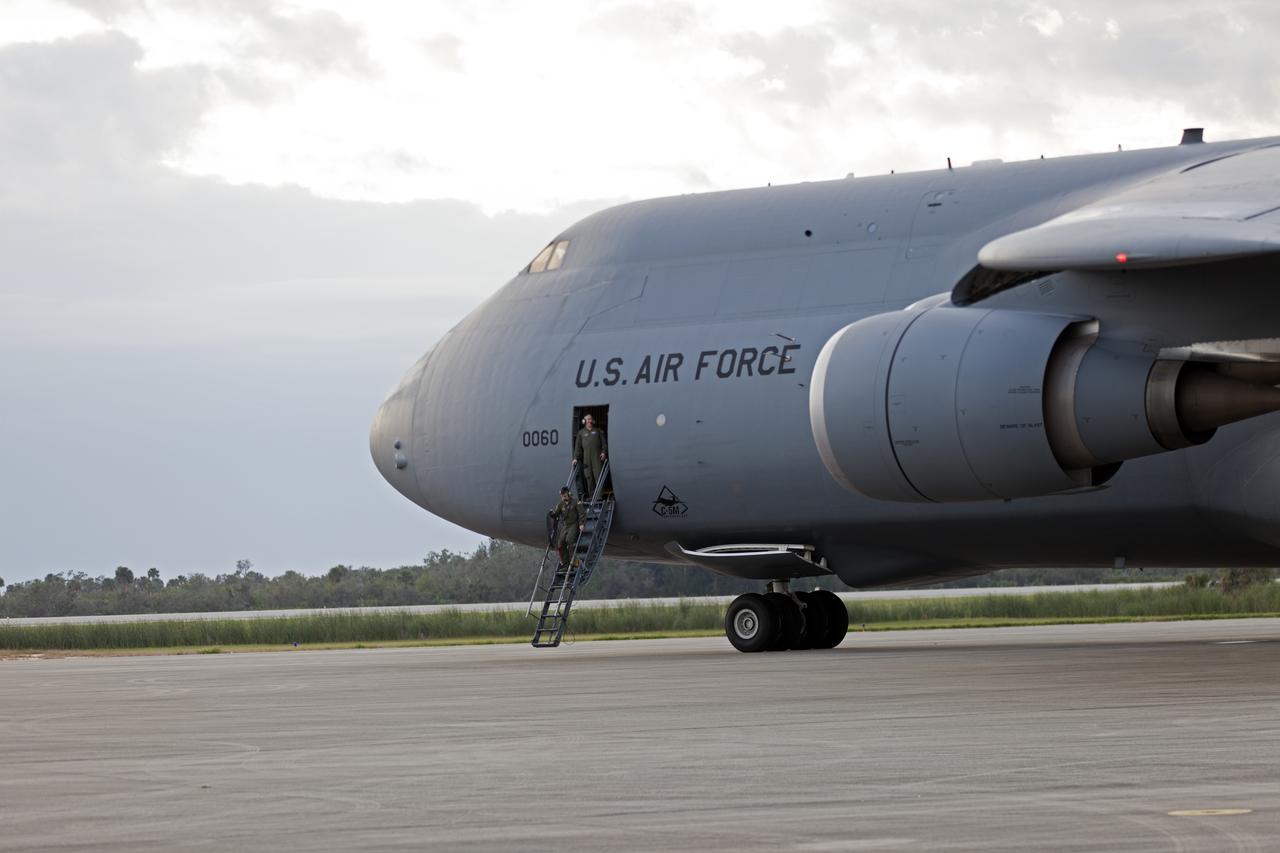
A C-5 transport aircraft arrives at the Shuttle Landing Facility at NASA's Kennedy Space Center in Florida, carrying the Geostationary Operation Environmental Satellite-S (GOES-S). The satellite will be offloaded and transported to the Astrotech Space Operations facility in Titusville, Florida. GOES-S is the second in a series of four advanced geostationary weather satellites. The GOES-R series - consisting of the GOES-R, GOES-S, GOES-T and GOES-U spacecraft - will significantly improve the detection and observation of environmental phenomena that directly affect public safety, protection of property and the nation's economic health and prosperity. GOES-S is slated to launch March 1, 2018 aboard a United Launch Alliance Atlas V rocket from Cape Canaveral Air Force Station in Florida.
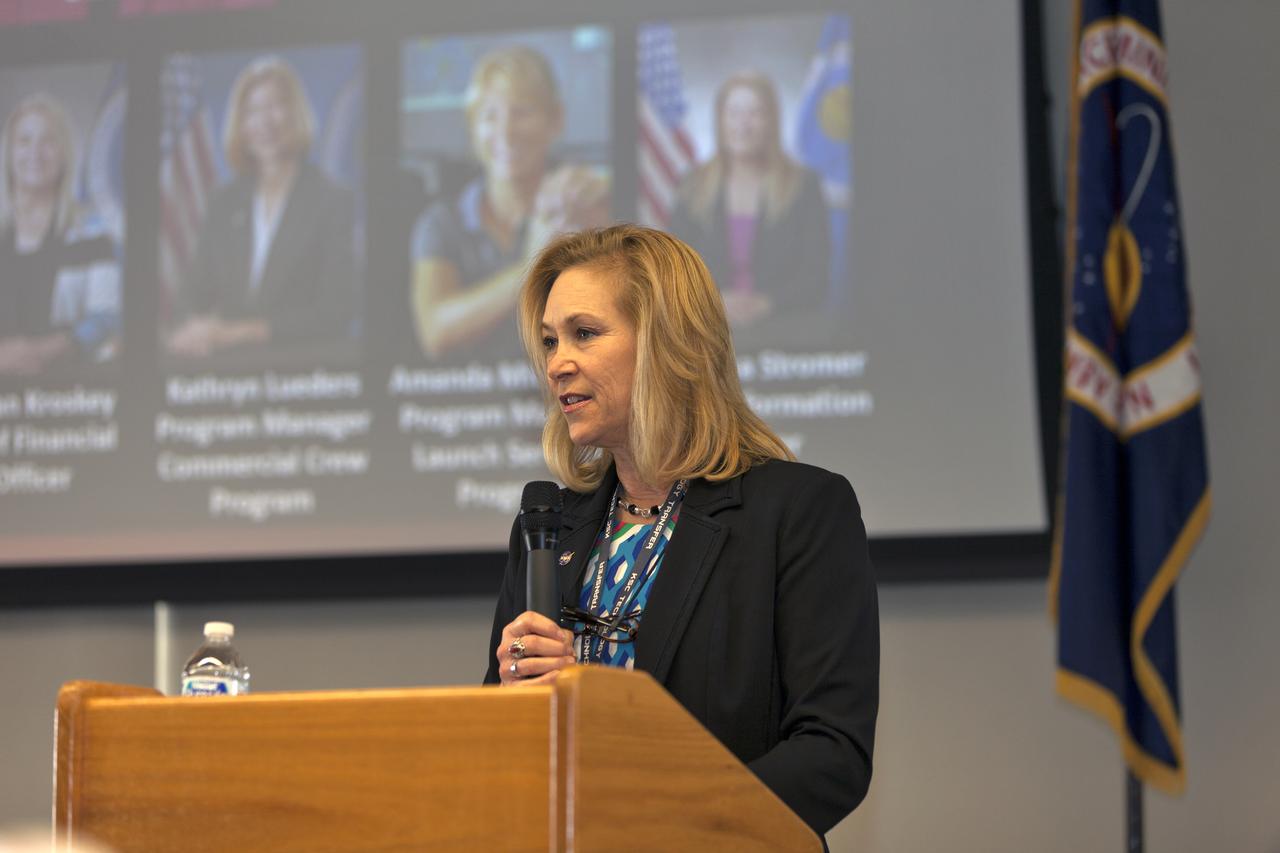
NASA Kennedy Space Center's Deputy Director Janet Petro welcomes workers to the center's Women's History Month event, with the theme "Nevertheless She Persisted." Keynote speaker, JoAnn Morgan, former associate director of the center, spoke to the group about her experience as the first female engineer working in the space program in the 1960s. Morgan was the first female in the Launch Control Center firing room during the Apollo 11 launch. The event was hosted by the center's Kennedy Networking Opportunities for Women (KNOW) and Launching Leaders organizations. The purpose of KNOW is to provide focus on issues such as employment, retention, promotion, training, career and personal development, education, and identify and eliminate barriers that hinder the advancement of women in the workforce.
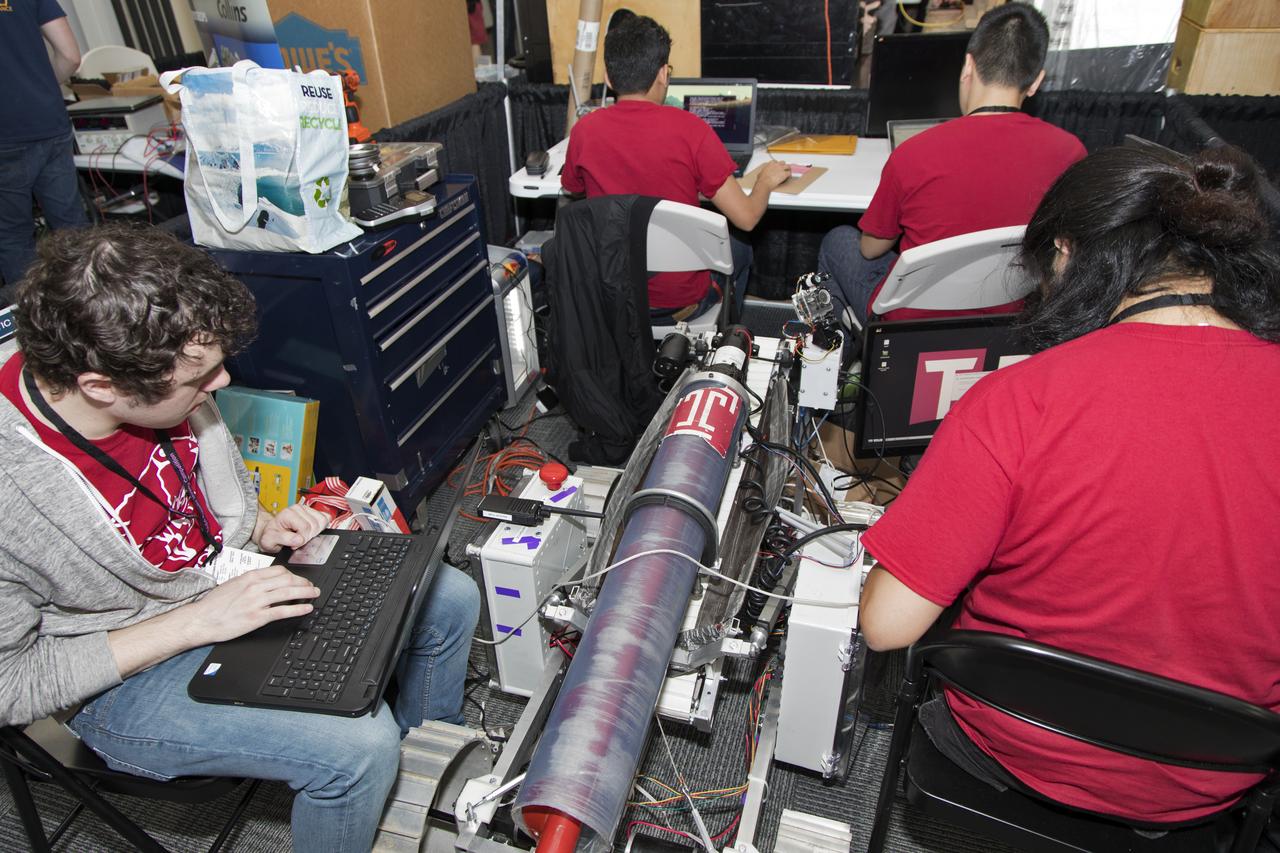
On the first day of NASA's 9th Robotic Mining Competition, set-up day on May 14, team members from Temple University work on their robot miner in the RobotPits in the Educator Resource Center at Kennedy Space Center Visitor Complex in Florida. More than 40 student teams from colleges and universities around the U.S. will use their mining robots to dig in a supersized sandbox filled with BP-1, or simulated Lunar soil, gravel and rocks, and participate in other competition requirements. The Robotic Mining Competition is a NASA Human Exploration and Operations Mission Directorate project designed to encourage students in science, technology, engineering and math, or STEM fields. The project provides a competitive environment to foster innovative ideas and solutions that could be used on NASA's deep space missions.
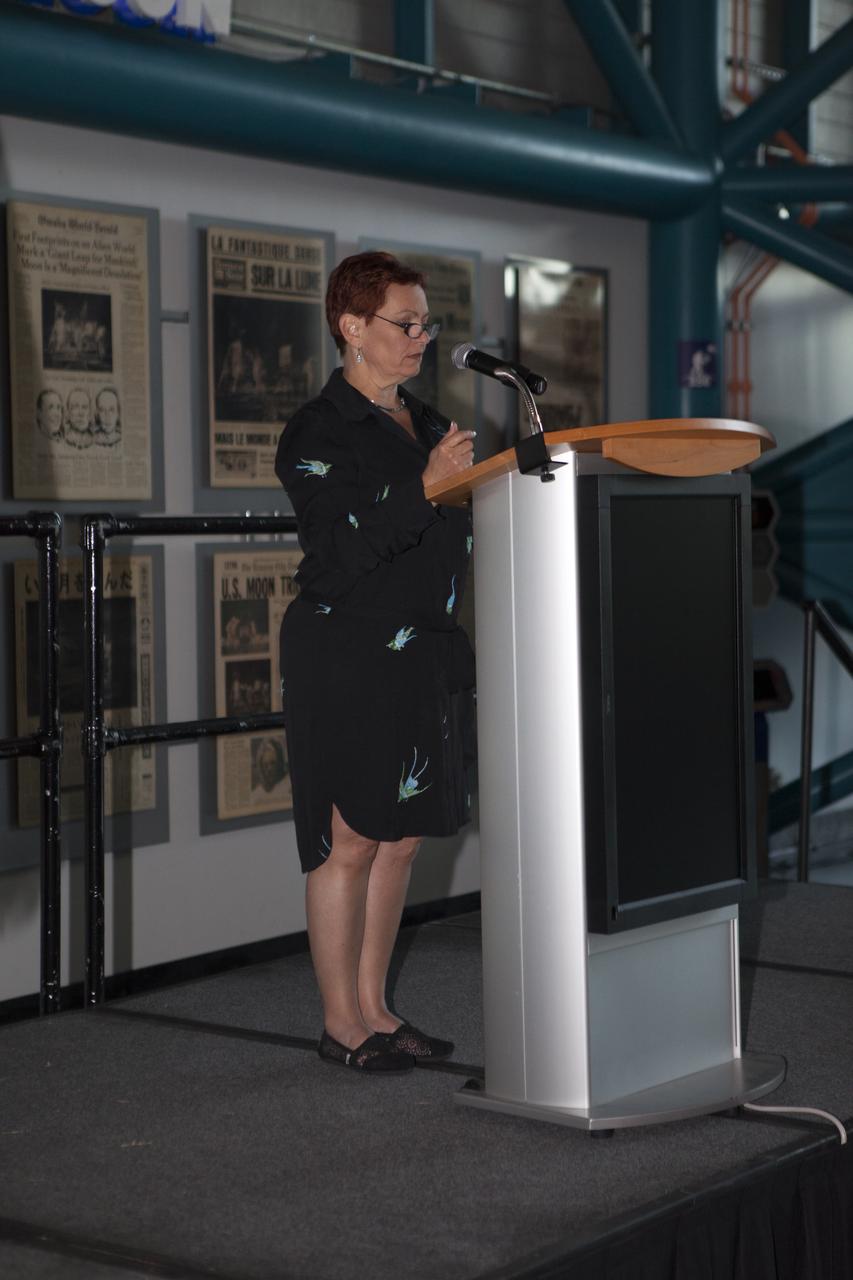
Inside the Apollo-Saturn V Center at the Kennedy Space Center Visitor Complex in Florida, Lisa May, with Murphian Systems, presents the Judges Innovation Award during the award ceremony for NASA's 8th Annual Robotic Mining Competition. More than 40 student teams from colleges and universities around the U.S. used their uniquely-designed mining robots to dig in a supersized sandbox filled with BP-1, or simulated Martian soil, and participated in other competition requirements, May 22-26, at the visitor complex. The Robotic Mining Competition is a NASA Human Exploration and Operations Mission Directorate project designed to encourage students in science, technology, engineering and math, or STEM fields. The project provides a competitive environment to foster innovative ideas and solutions that could be used on NASA's Journey to Mars.
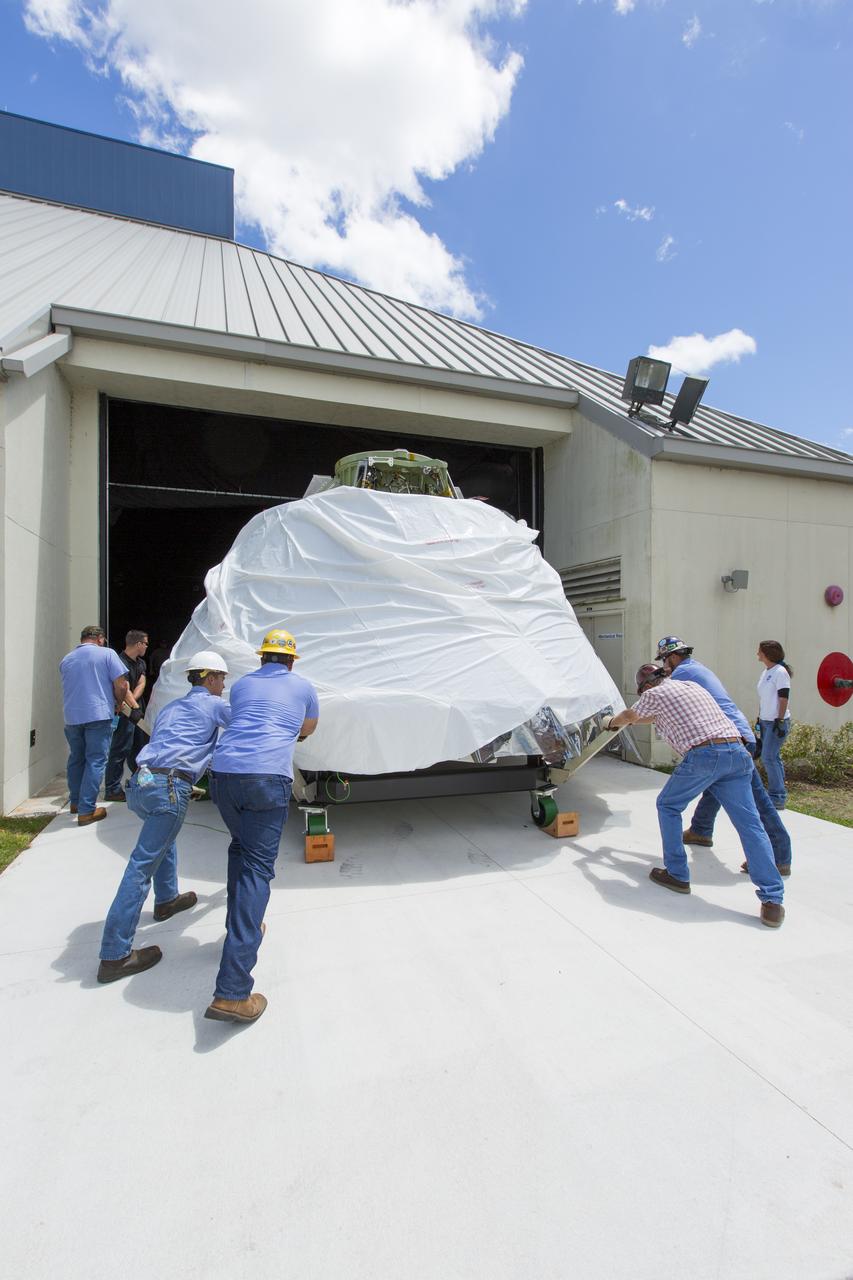
At NASA's Kennedy Space Center Visitor Complex in Florida, the Orion crew module from Exploration Flight Test 1, secured on its custom-made ground support equipment, is moved inside the IMAX Theater. The crew module will be prepared for display in the NASA Now exhibit in the IMAX Theater. The Orion spacecraft launched atop a United Launch Alliance Delta IV rocket Dec. 5, 2014, from Space Launch Complex 37 at Cape Canaveral Air Force Station. The spacecraft built for humans traveled 3,604 miles above Earth and splashed down about 4.5 hours later in the Pacific Ocean.
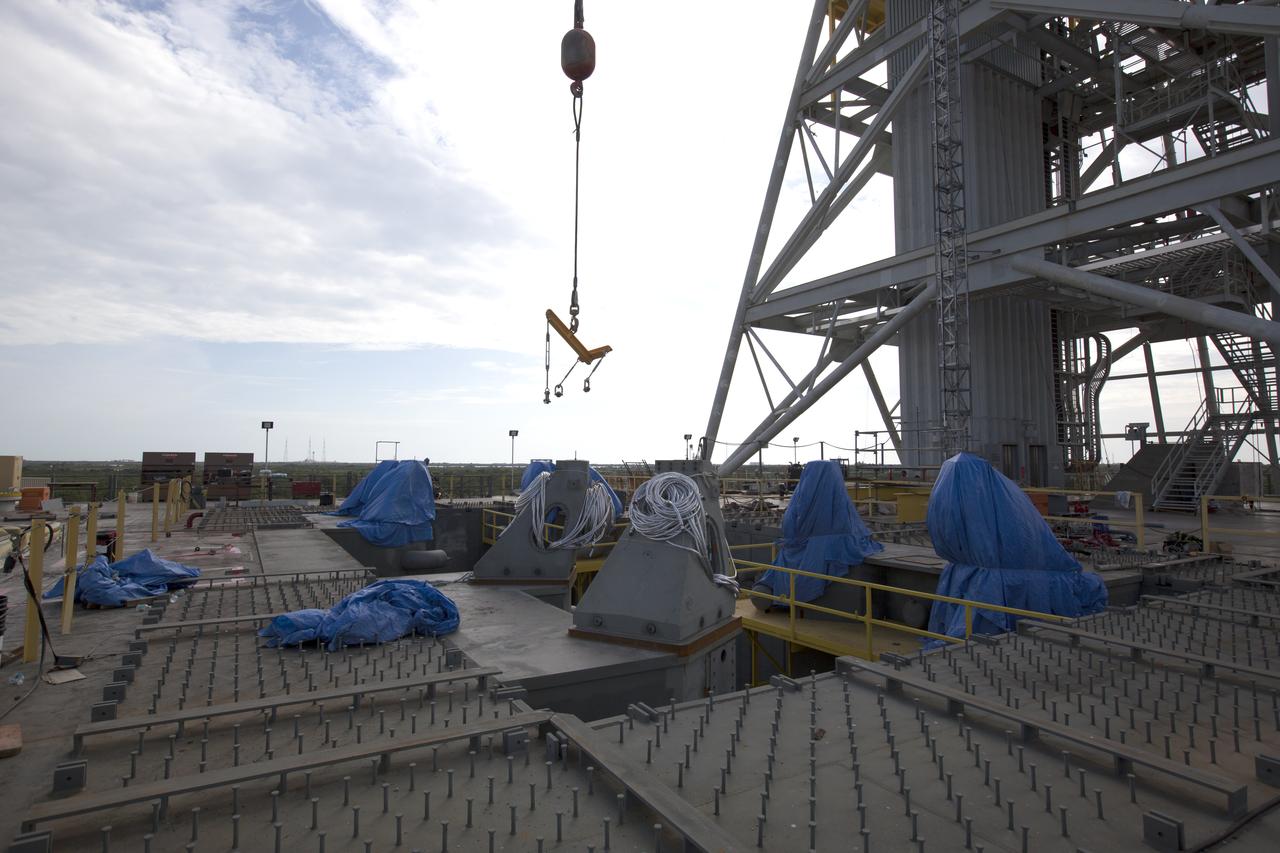
At NASA's Kennedy Space Center in Florida, the final four vehicle support posts are being installed on the deck of the mobile launcher. A total of eight support posts are being installed to support the load of the Space Launch System's (SLS) solid rocket boosters, with four posts for each of the boosters. The support posts are about five feet tall and each weigh about 10,000 pounds. The posts will structurally support the SLS rocket through T-0 and liftoff, and will drop down before vehicle liftoff to avoid contact with the flight hardware. The Ground Systems Development and Operations Program is overseeing installation of the support posts to prepare for the launch of the Orion spacecraft atop the SLS rocket.
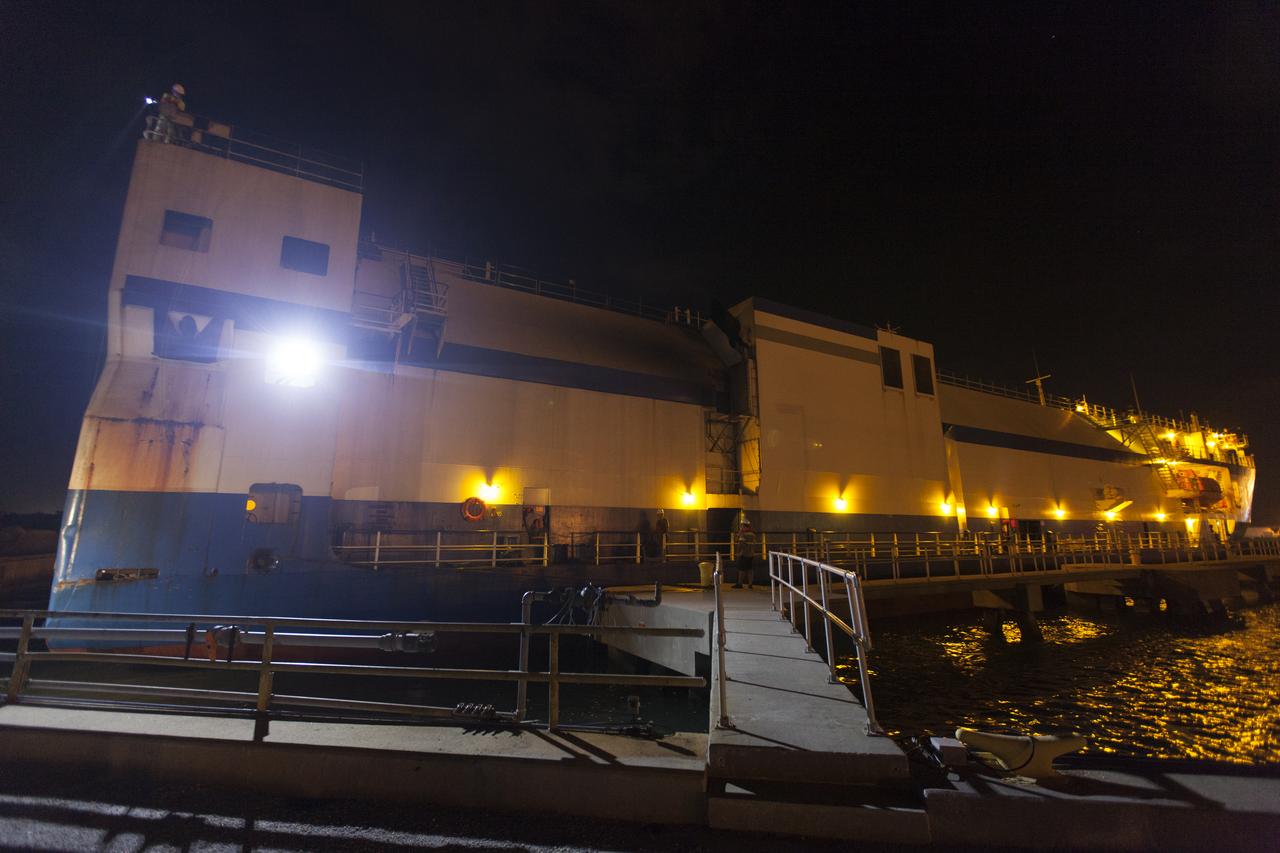
The United Launch Alliance (ULA) Mariner docks at Port Canaveral in Florida carrying two of the three Delta IV Heavy Common Booster Cores for NASA's upcoming Parker Solar Probe mission. The mission will perform the closest-ever observations of a star when it travels through the Sun's atmosphere, called the corona. The probe will rely on measurements and imaging to revolutionize our understanding of the corona and the Sun-Earth connection. Liftoff atop the Delta IV rocket is scheduled to take place from Cape Canaveral's Space Launch Complex 37 in summer 2018.
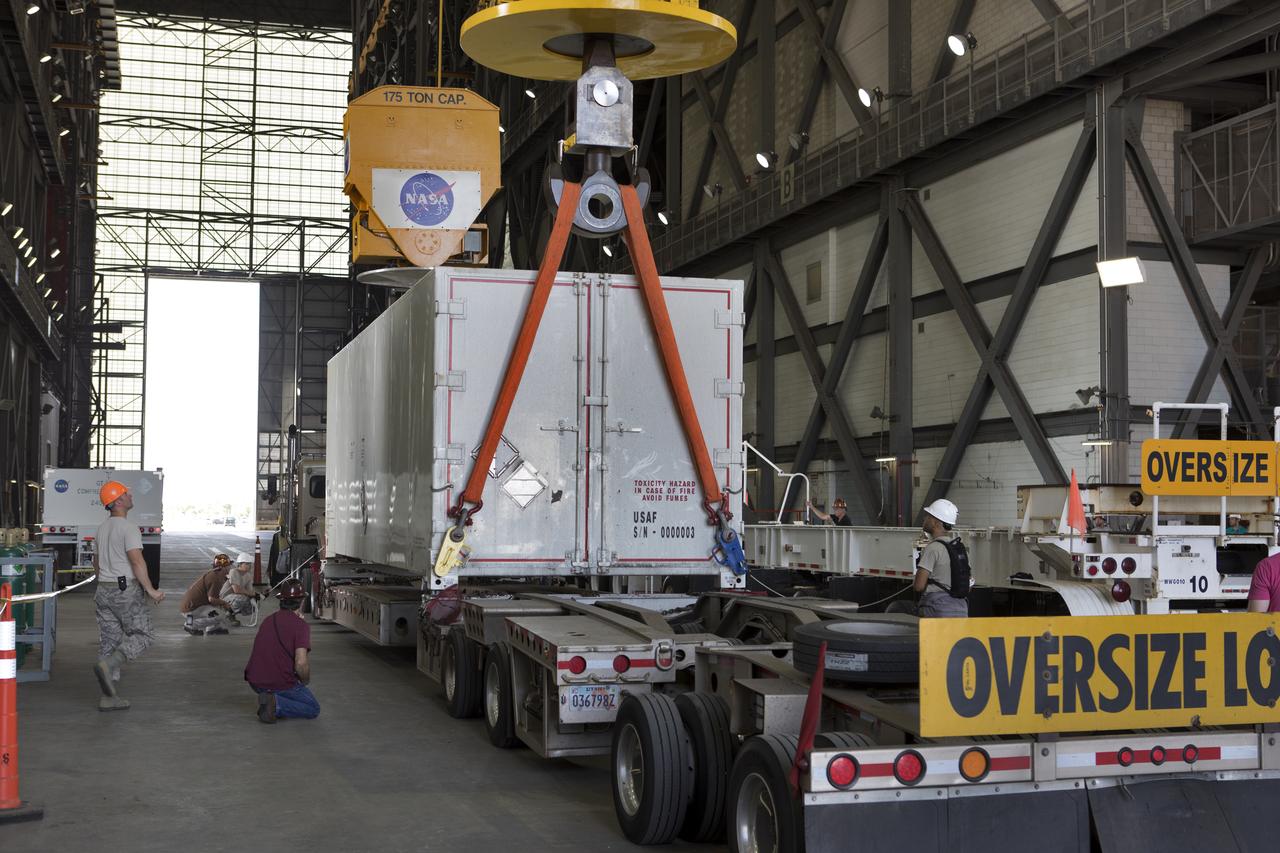
In the transfer aisle inside the Vehicle Assembly Building (VAB) at NASA's Kennedy Space Center in Florida, Jacob’s technicians attach a crane to a shipping container with the ground test motor for Orion's Launch Abort System (LAS) inside on July 20, 2018. The container will be lifted and transferred to another transporter and moved to the Rotation, Processing and Surge Facility where it will be inspected and prepared for transport to Space Launch Complex 46 (SLC-46) at Cape Canaveral Air Force Station for mechanical fit testing. This inert motor will not be used for flight, but will be used to certify flight hardware assembly in preparation for a full-stress test of the LAS, called Ascent Abort-2 (AA-2) flight test, scheduled for April 2019. During the test, the booster will launch from SLC 46, carrying a fully functional LAS and a 22,000-pound Orion test vehicle to an altitude of 31,000 feet and traveling at more than 1,000 miles an hour. The test will verify the LAS can steer the crew module and astronauts aboard to safety in the event of an issue with the Space Launch System (SLS) rocket when the spacecraft is under the highest aerodynamic loads it will experience during a rapid climb into space. NASA's Orion and Exploration Ground Systems programs and their contractors from Jacob's and Northrup Grumman in conjunction with the Air Force Space and Missile Center's Launch Operations branch SMC/LEXO, are performing the pathfinding exercises and flight operations for AA-2.

Arabidopsis thaliana plants are seen inside the growth chamber of the Advanced Plant Habitat (APH) Flight Unit No. 1 prior to harvest of half the plants. The harvest is part of an ongoing verification test of the APH unit, which is located inside the International Space Station Environmental Simulator in NASA Kennedy Space Center's Space Station Processing Facility. The APH undergoing testing at Kennedy is identical to one on the station and uses red, green and broad-spectrum white LED lights to grow plants in an environmentally controlled chamber. The seeds grown during the verification test will be grown on the station to help scientists understand how these plants adapt to spaceflight.
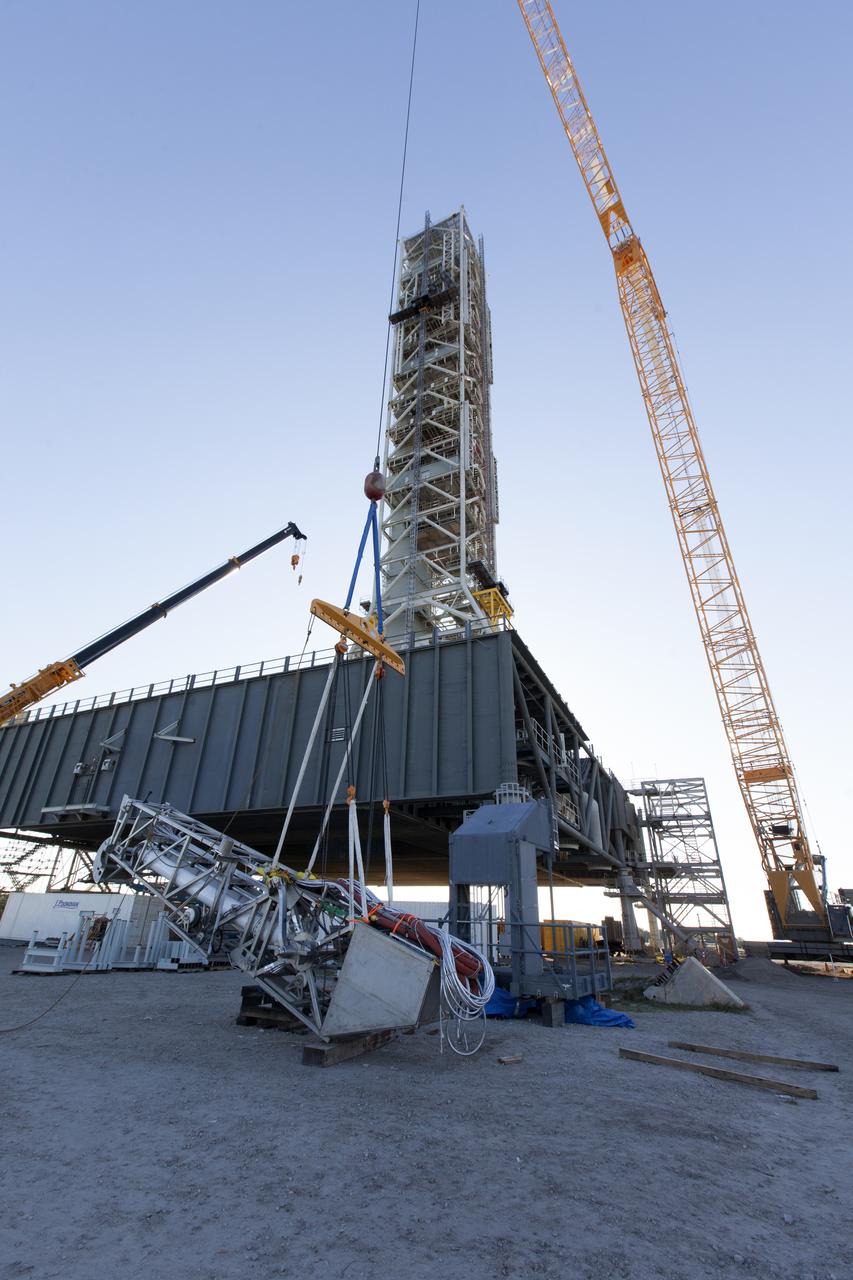
Preparations are underway to lift the Orion Service Module Umbilical (OSMU) up for installation on the mobile launcher tower at NASA's Kennedy Space Center in Florida. The mobile launcher tower will be equipped with a number of lines, called umbilicals, that will connect to the Space Launch System rocket and Orion spacecraft for Exploration Mission-1 (EM-1). The OSMU will be located high on the mobile launcher tower and, prior to launch, will transfer liquid coolant for the electronics and air for the Environmental Control System to the Orion service module that houses these critical systems to support the spacecraft. EM-1 is scheduled to launch in 2018. The Ground Systems Development and Operations Program is overseeing installation of the umbilicals.
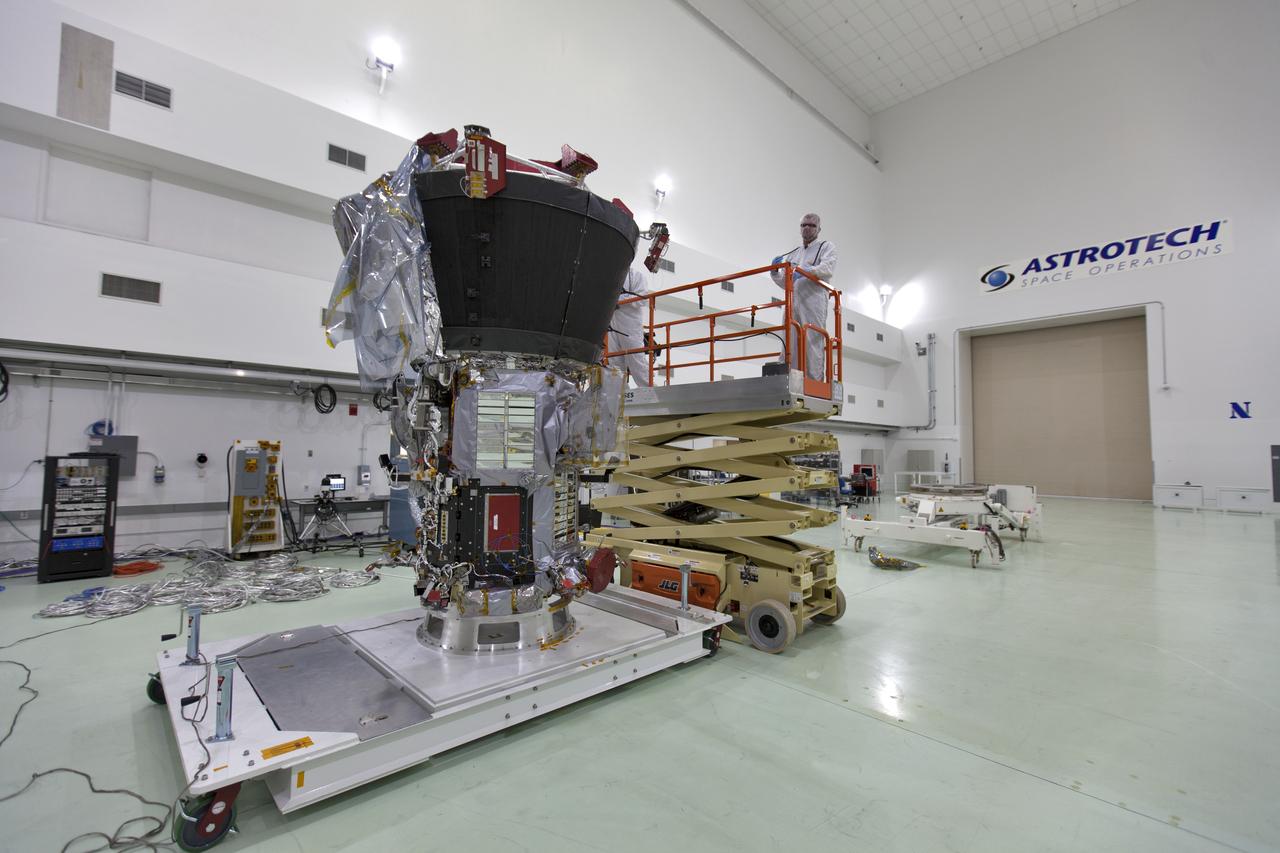
At the Astrotech processing facility in Titusville, Florida, near NASA's Kennedy Space Center, technicians and engineers remove NASA's Parker Solar Probe from its shipping bag on Wednesday, April 4, 2018. The Parker Solar Probe will launch on a United Launch Alliance Delta IV Heavy rocket from Space Launch Complex 37 at Cape Canaveral Air Force Station in Florida no earlier than Aug. 4, 2018. The mission will perform the closest-ever observations of a star when it travels through the Sun's atmosphere, called the corona. The probe will rely on measurements and imaging to revolutionize our understanding of the corona and the Sun-Earth connection.
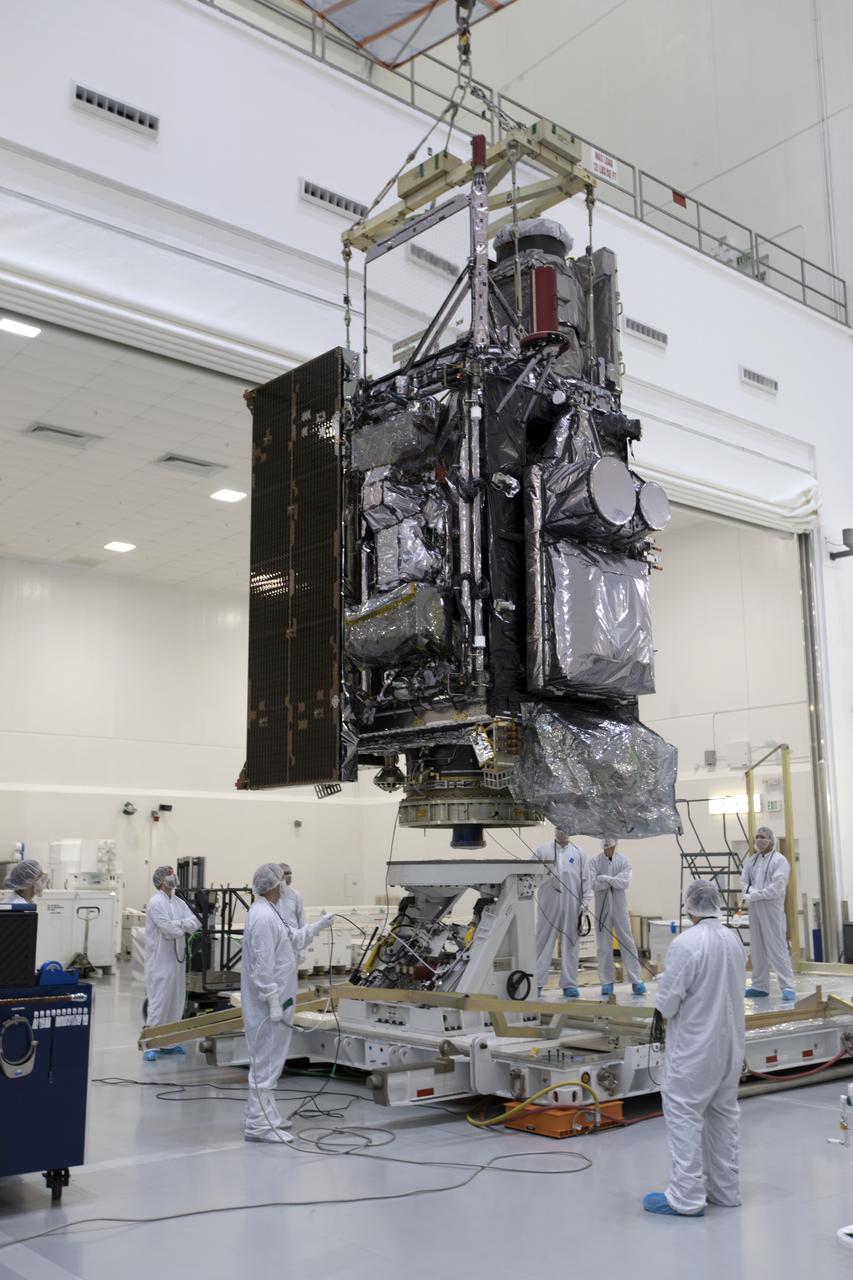
At Astrotech Space Operations in Titusville, Florida, technicians and engineers keep a watchful eye on NOAA's Geostationary Operational Environmental Satellite-S (GOES-S) as it is moved to a work stand. The facility is located near NASA's Kennedy Space Center. GOES-S is the second in a series of four advanced geostationary weather satellites. The GOES-R series - consisting of the GOES-R, GOES-S, GOES-T and GOES-U spacecraft - will significantly improve the detection and observation of environmental phenomena that directly affect public safety, protection of property and the nation's economic health and prosperity. GOES-S is slated to launch March 1, 2018 aboard a United Launch Alliance Atlas V rocket from Cape Canaveral Air Force Station in Florida.
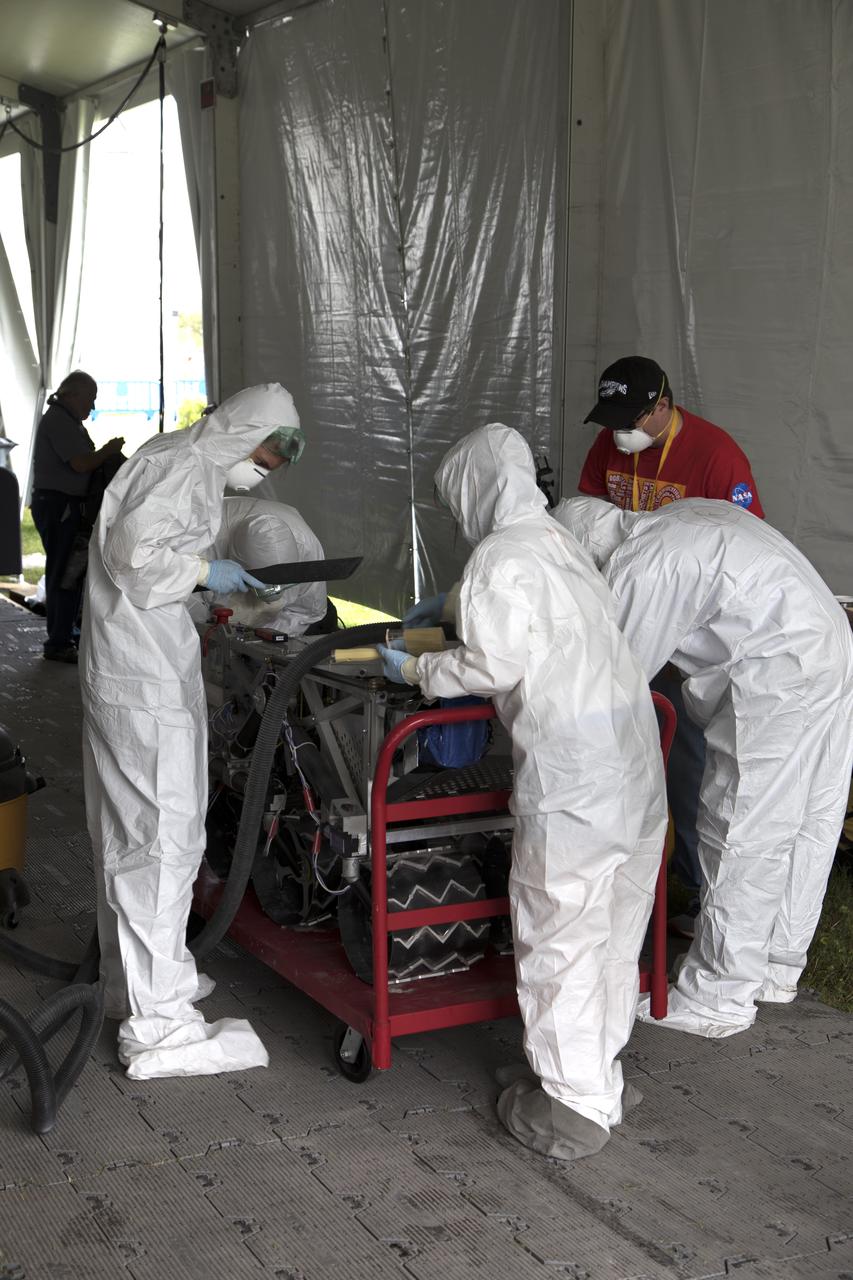
On the third day of NASA's 9th Robotic Mining Competition, May 16, a university team cleans their robot miner after its turn in the mining arena at NASA's Kennedy Space Center Visitor Complex in Florida. More than 40 student teams from colleges and universities around the U.S. will use their mining robots to dig in a supersized sandbox filled with BP-1, or simulated Lunar soil, gravel and rocks, and participate in other competition requirements. The Robotic Mining Competition is a NASA Human Exploration and Operations Mission Directorate project designed to encourage students in science, technology, engineering and math, or STEM fields. The project provides a competitive environment to foster innovative ideas and solutions that could be used on NASA's deep space missions.
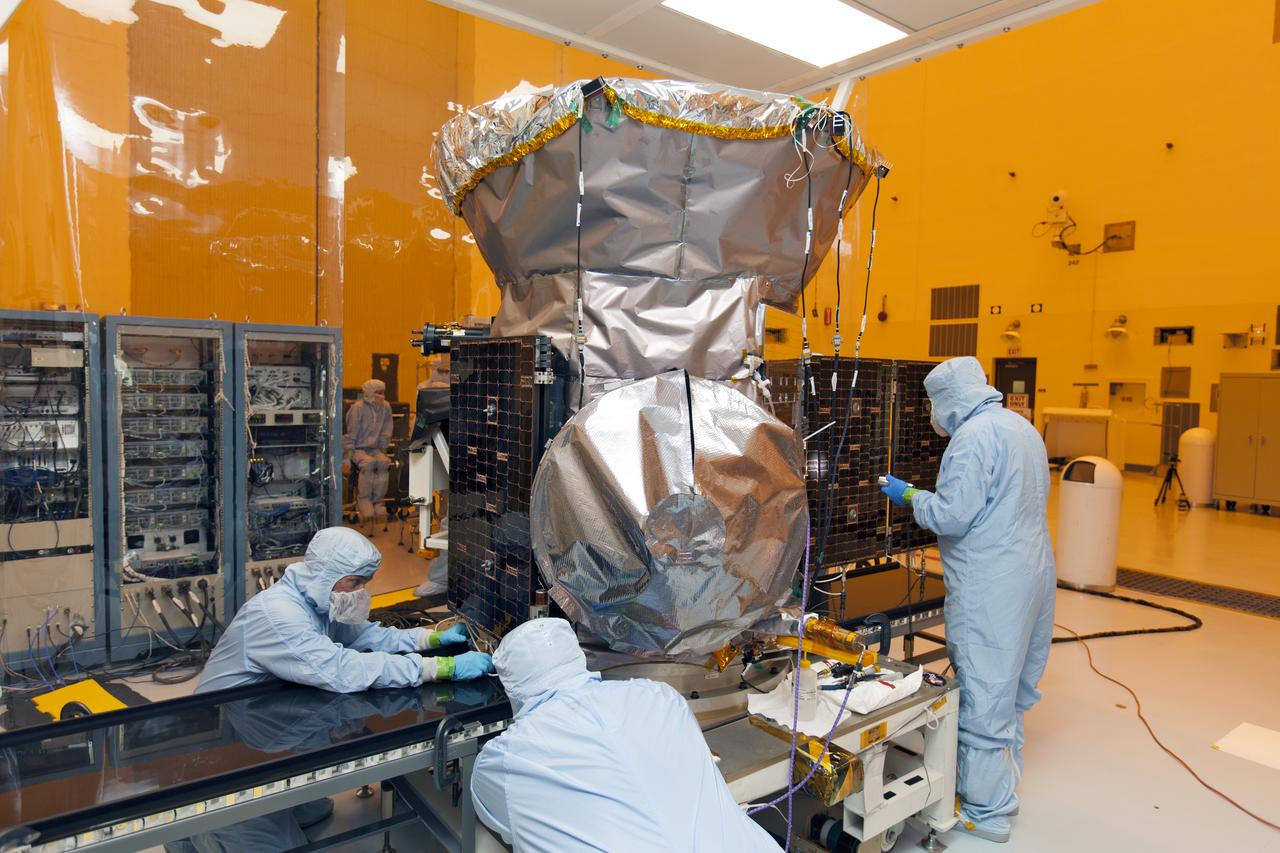
Inside the Payload Hazardous Servicing Facility at the NASA's Kennedy Space Center in Florida, one of the solar panels is being deployed on the agency's Transiting Exoplanet Survey Satellite (TESS). Technicians are preparing to deploy the second solar array. The satellite is scheduled to launch atop a SpaceX Falcon 9 rocket from Space Launch Complex 40 at Cape Canaveral Air Force Station. TESS is the next step in NASA's search for planets outside our solar system, known as exoplanets. TESS is a NASA Astrophysics Explorer mission led and operated by MIT in Cambridge, Massachusetts, and managed by NASA’s Goddard Space Flight Center in Greenbelt, Maryland. Dr. George Ricker of MIT’s Kavli Institute for Astrophysics and Space Research serves as principal investigator for the mission. Additional partners include Orbital ATK, NASA’s Ames Research Center, the Harvard-Smithsonian Center for Astrophysics and the Space Telescope Science Institute. More than a dozen universities, research institutes and observatories worldwide are participants in the mission. NASA’s Launch Services Program is responsible for launch management.
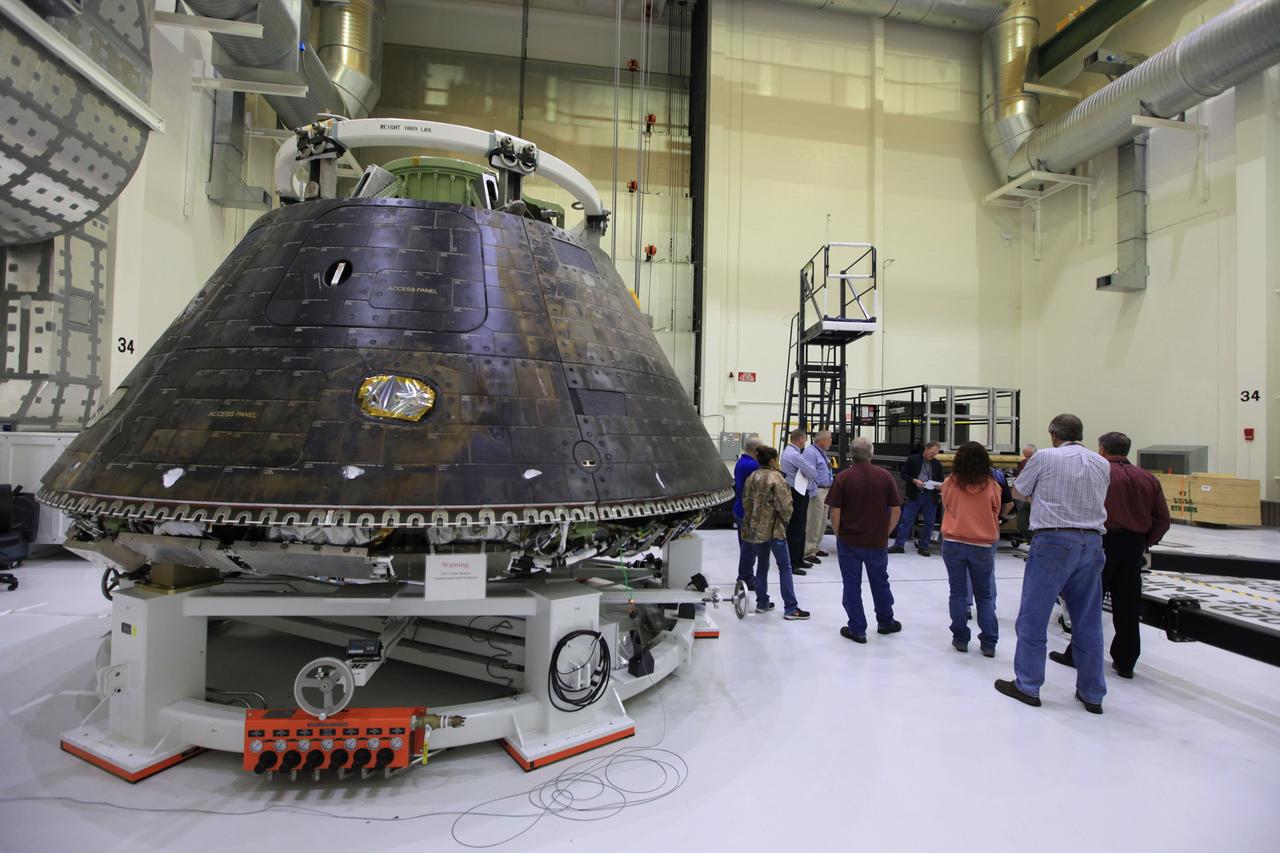
Inside the Neil Armstrong Operations and Checkout Building high bay at NASA's Kennedy Space Center in Florida, Lockheed Martin and ASRC engineers and technicians review procedures before preparing the Orion crew module from Exploration Flight Test 1 for its move to the nearby Kennedy Space Center Visitor Complex. The crew module will be delivered to the IMAX Theater where it will be prepared for display in the NASA Now exhibit. The Orion spacecraft launched atop a United Launch Alliance Delta IV rocket Dec. 5, 2014, from Space Launch Complex 37 at Cape Canaveral Air Force Station. The spacecraft built for humans traveled 3,604 miles above Earth and splashed down about 4.5 hours later in the Pacific Ocean.
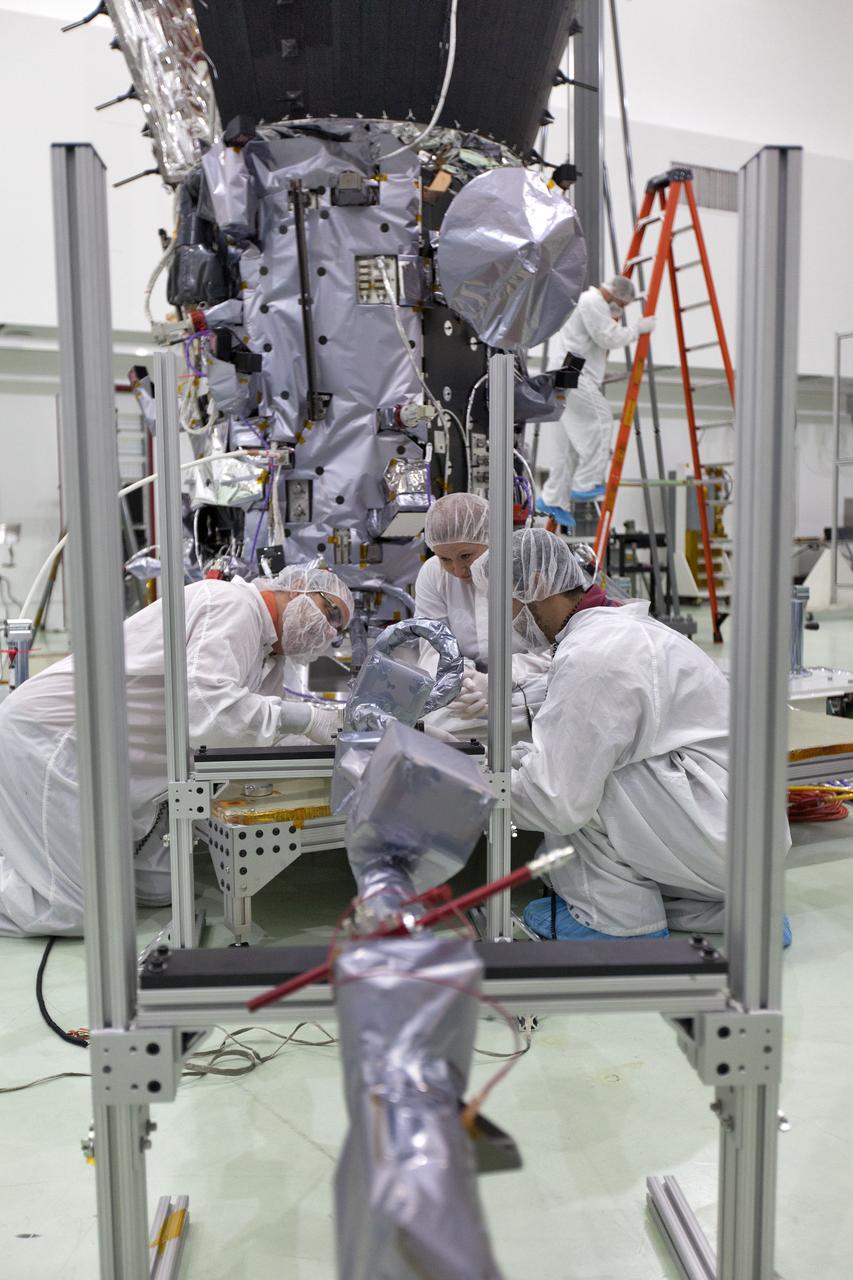
In the Astrotech processing facility in Titusville, Florida, near NASA's Kennedy Space Center, on Wednesday, May 23, 2018, technicians and engineers deploy the magnetometer boom on NASA's Parker Solar Probe. The Parker Solar Probe will launch on a United Launch Alliance Delta IV Heavy rocket from Space Launch Complex 37 at Cape Canaveral Air Force Station in Florida no earlier than Aug. 4, 2018. The mission will perform the closest-ever observations of a star when it travels through the Sun's atmosphere, called the corona. The probe will rely on measurements and imaging to revolutionize our understanding of the corona and the Sun-Earth connection.
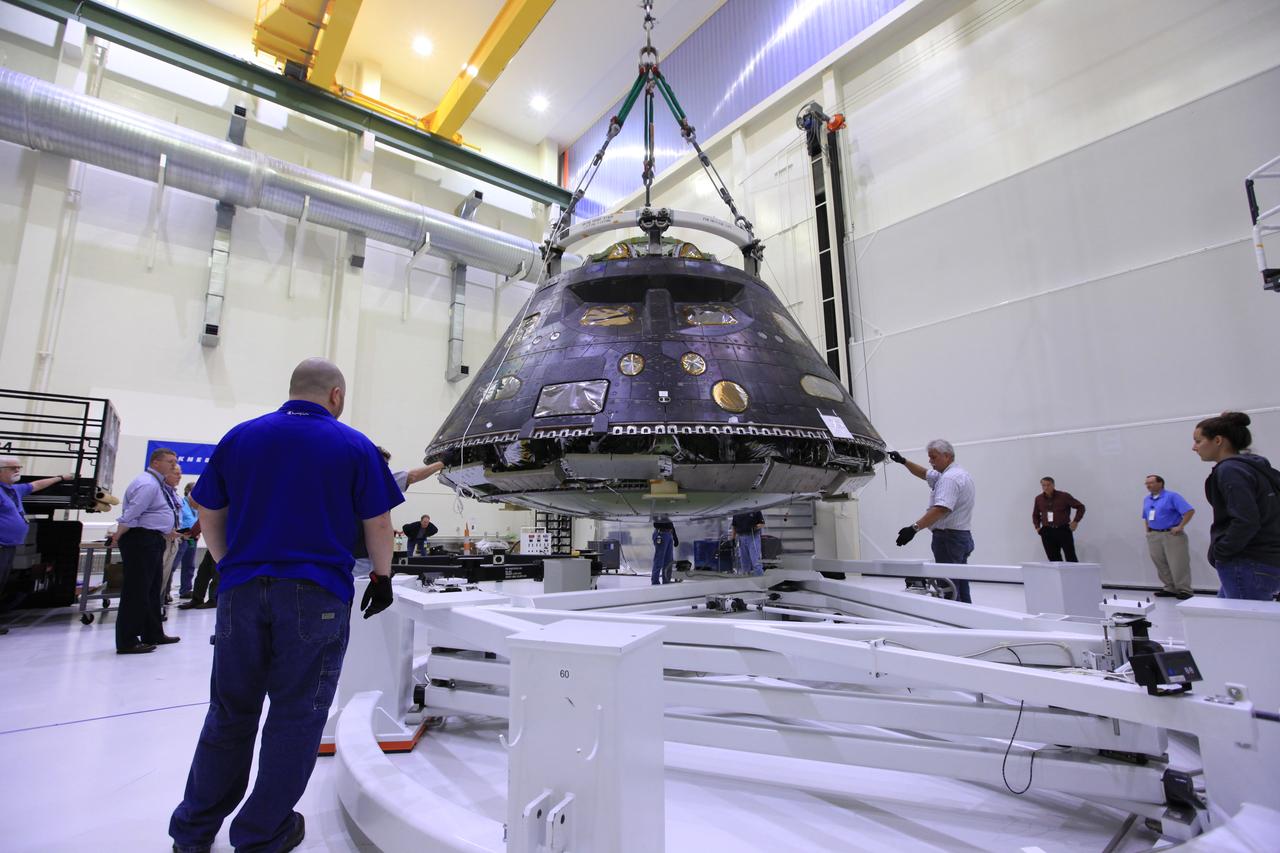
Inside the Neil Armstrong Operations and Checkout Building high bay at NASA's Kennedy Space Center in Florida, Lockheed Martin and ASRC workers monitor the progress as a crane moves the Orion crew module from Exploration Flight Test 1 over to a custom-built transport stand. The crew module is being prepared for its move to the nearby Kennedy Space Center Visitor Complex. It will be on display in the NASA Now exhibit in the IMAX Theater. The Orion spacecraft launched atop a United Launch Alliance Delta IV rocket Dec. 5, 2014, from Space Launch Complex 37 at Cape Canaveral Air Force Station. The spacecraft built for humans traveled 3,604 miles above Earth and splashed down about 4.5 hours later in the Pacific Ocean.

NASA's Parker Solar Probe undergoes testing at the Astrotech processing facility in Titusville, Florida, near NASA's Kennedy Space Center on Friday, May 18, 2018. The Parker Solar Probe will launch on a United Launch Alliance Delta IV Heavy rocket from Space Launch Complex 37 at Cape Canaveral Air Force Station in Florida no earlier than Aug. 4, 2018. The mission will perform the closest-ever observations of a star when it travels through the Sun's atmosphere, called the corona. The probe will rely on measurements and imaging to revolutionize our understanding of the corona and the Sun-Earth connection.

On the first day of NASA's 9th Robotic Mining Competition, set-up day on May 14, team members from the University of Minnesota-Twin Cities work on their robot miner in the RobotPits in the Educator Resource Center at Kennedy Space Center Visitor Complex in Florida. More than 40 student teams from colleges and universities around the U.S. will use their mining robots to dig in a supersized sandbox filled with BP-1, or simulated Lunar soil, gravel and rocks, and participate in other competition requirements. The Robotic Mining Competition is a NASA Human Exploration and Operations Mission Directorate project designed to encourage students in science, technology, engineering and math, or STEM fields. The project provides a competitive environment to foster innovative ideas and solutions that could be used on NASA's deep space missions.

Team members pause for a photo after the successful harvest of half the Arabidopsis thaliana plants inside the growth chamber of the Advanced Plant Habitat (APH) Flight Unit No. 1. From right to left are Jeff Richards with Stinger-Ghaffarian Technologies; David Hanson, part of the principal investigator's team; Oscar Monje with NASA Kennedy Space Center's Engineering Services Contract; and John "JC" Carver, a payload integration engineer with Kennedy's Test and Operations Support Contract. The harvest is part of an ongoing verification test of the APH unit, which is located inside the International Space Station Environmental Simulator in Kennedy's Space Station Processing Facility. The APH undergoing testing at Kennedy is identical to one on the station and uses red, green and broad-spectrum white LED lights to grow plants in an environmentally controlled chamber. The seeds grown during the verification test will be grown on the station to help scientists understand how these plants adapt to spaceflight.
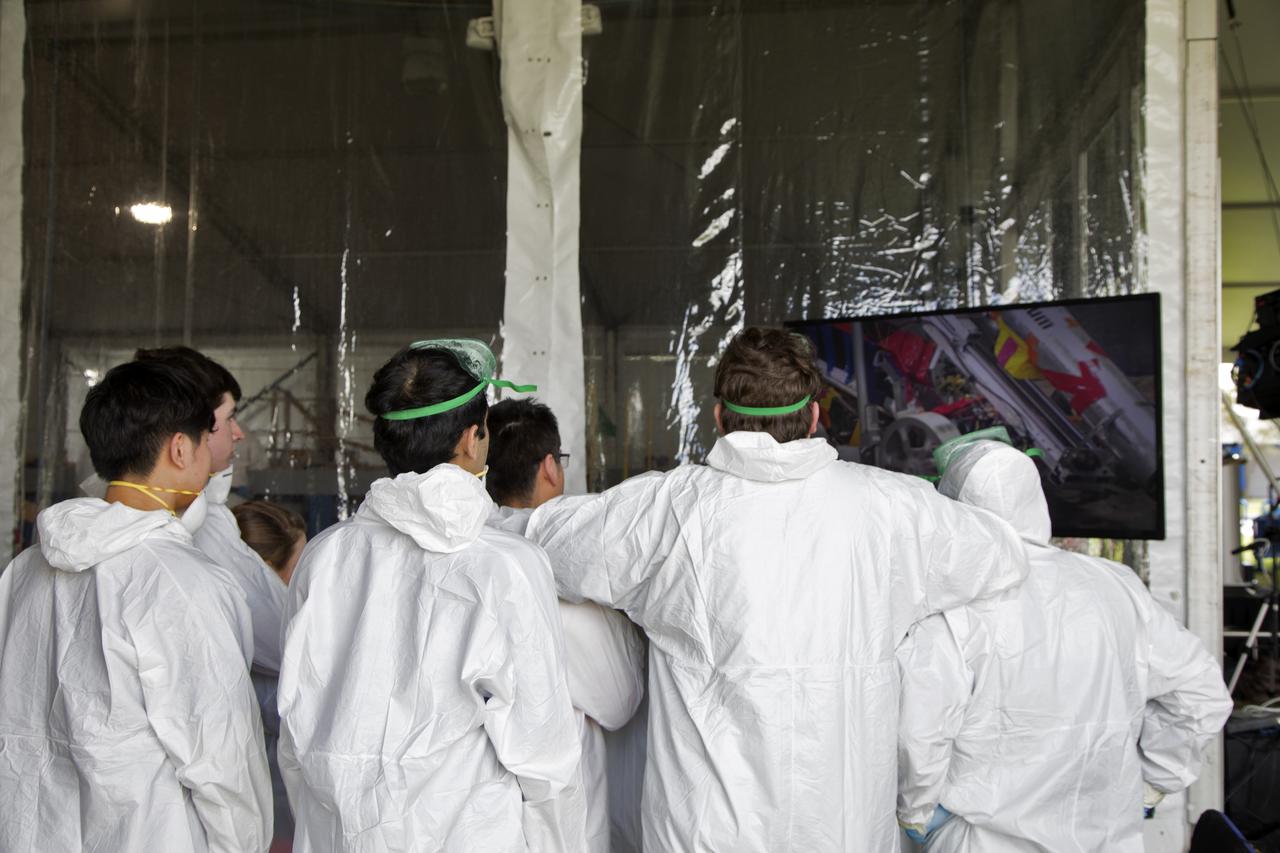
Members of a college team watch on the monitor as their robot miner digs in the mining arena on the third day of NASA's 9th Robotic Mining Competition, May 16, at NASA's Kennedy Space Center Visitor Complex in Florida. More than 40 student teams from colleges and universities around the U.S. will use their mining robots to dig in a supersized sandbox filled with BP-1, or simulated Lunar soil, gravel and rocks, and participate in other competition requirements. The Robotic Mining Competition is a NASA Human Exploration and Operations Mission Directorate project designed to encourage students in science, technology, engineering and math, or STEM fields. The project provides a competitive environment to foster innovative ideas and solutions that could be used on NASA's deep space missions.
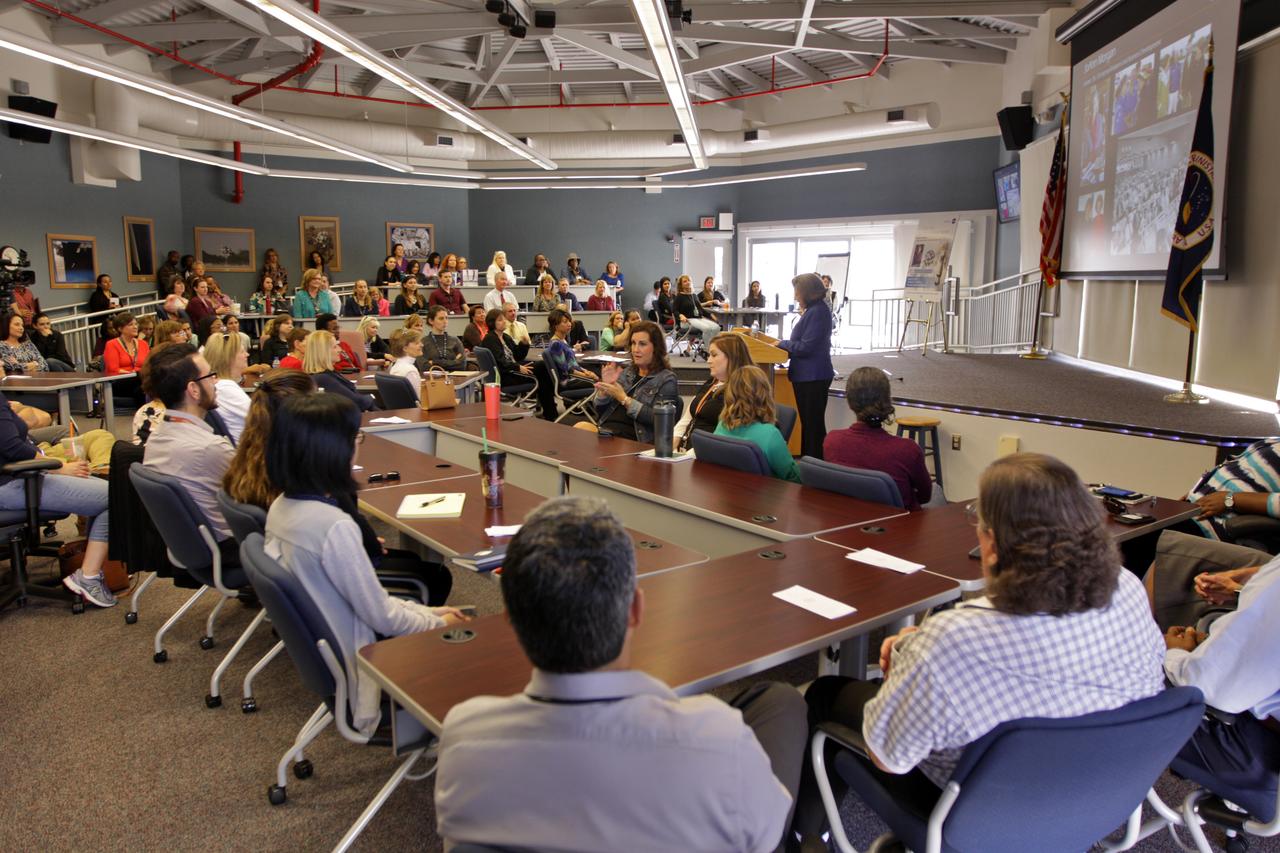
JoAnn Morgan, former associate director of NASA Kennedy Space Center, speaks to workers during a Women's History Month event at the center. With the theme "Nevertheless She Persisted," Morgan described her experience as the first female engineer working in the space program in the 1960s. Morgan was the first female in the Launch Control Center firing room during the Apollo 11 launch. The event was hosted by the center's Kennedy Networking Opportunities for Women (KNOW) and Launching Leaders organizations. The purpose of KNOW is to provide focus on issues such as employment, retention, promotion, training, career and personal development, education, and identify and eliminate barriers that hinder the advancement of women in the workforce.
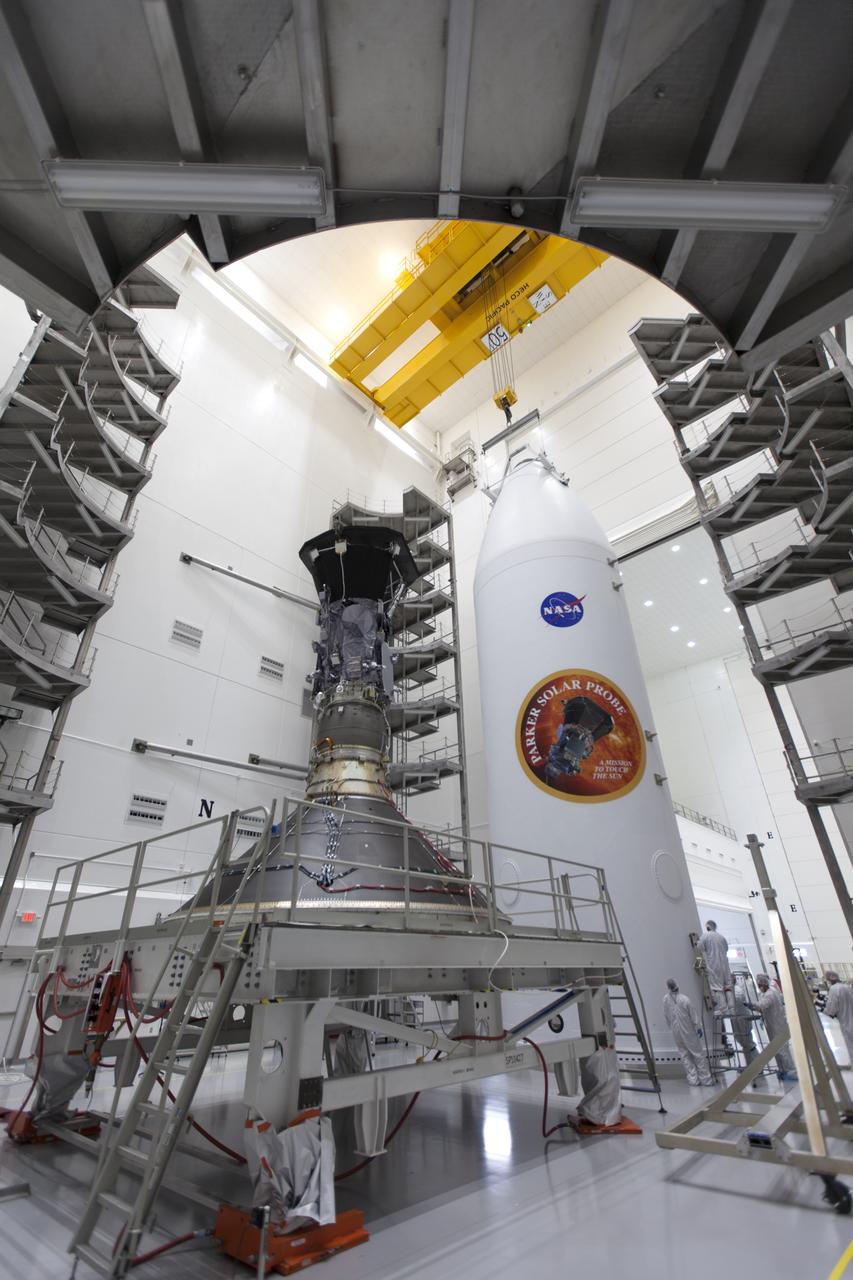
In the Astrotech processing facility in Titusville, Florida, near NASA's Kennedy Space Center, on Monday, July 16, 2018, NASA's Parker Solar Probe is prepared for encapsulation in its payload fairing. The spacecraft is mated to its third stage, built and tested by Northrup Grumman in Chandler, Arizona. The Parker Solar Probe will launch on a United Launch Alliance Delta IV Heavy rocket from Space Launch Complex 37 at Cape Canaveral Air Force Station in Florida. The mission will perform the closest-ever observations of a star when it travels through the Sun's atmosphere, called the corona. The probe will rely on measurements and imaging to revolutionize our understanding of the corona and the Sun-Earth connection
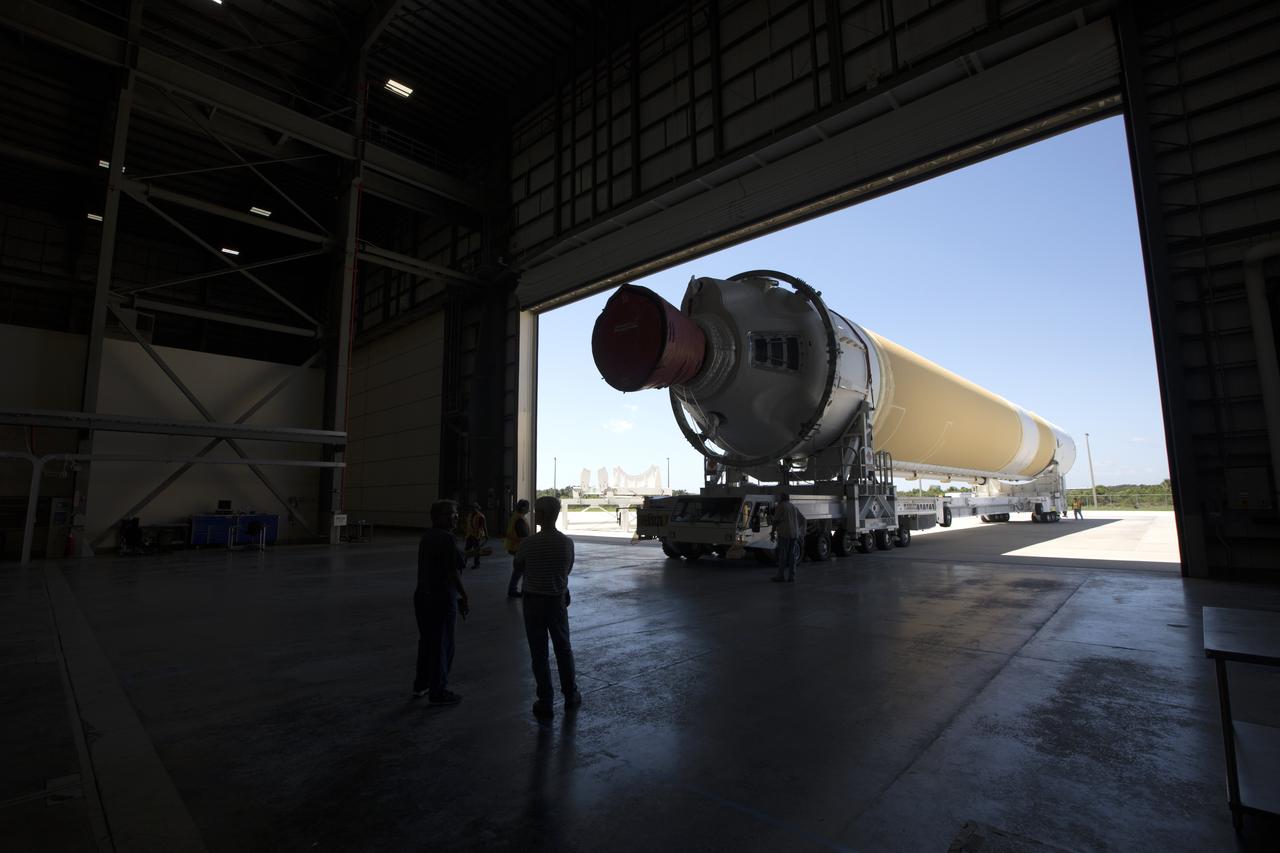
A United Launch Alliance Delta IV Heavy common booster core is transported by truck inside Cape Canaveral Air Force Station's Launch Complex 37 Horizontal Processing Facility. The Delta IV Heavy will launch NASA's upcoming Parker Solar Probe mission. The mission will perform the closest-ever observations of a star when it travels through the Sun's atmosphere, called the corona. The probe will rely on measurements and imaging to revolutionize our understanding of the corona and the Sun-Earth connection. Liftoff atop the Delta IV Heavy rocket is scheduled to take place from Cape Canaveral's Space Launch Complex 37 in summer 2018.
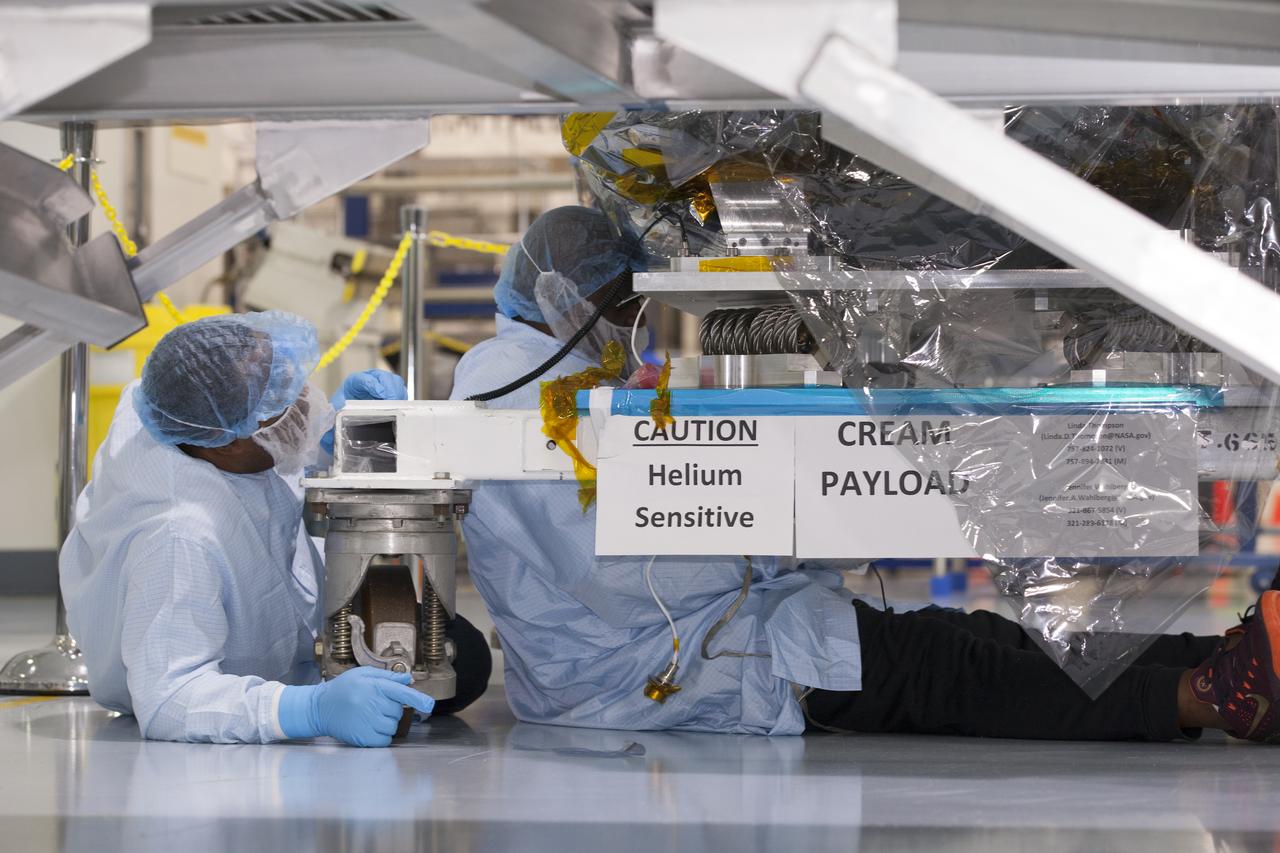
In the Space Station Processing Facility at NASA's Kennedy Space Center in Florida, technicians and engineers remove a protective cover on the Cosmic-Ray Energetics and Mass investigation, or CREAM, instrument. It is designed to measure the charges of cosmic rays to better understand what gives them such incredible energies, and how that effects the composition of the universe. The instrument will be launched to the space station on the SpaceX CRS-12 commercial resupply mission in August 2017.
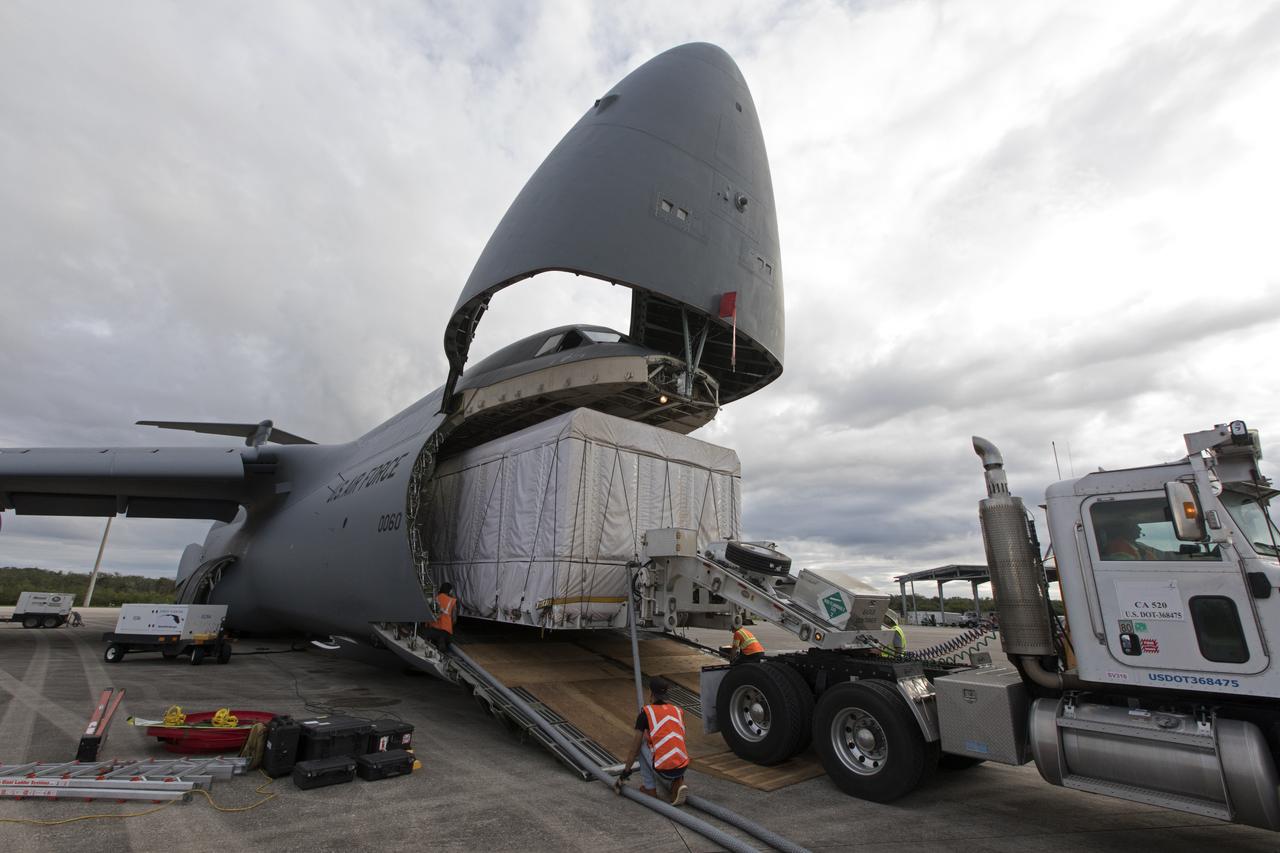
NOAA's Geostationary Operation Environmental Satellite-S (GOES-S) is being offloaded from a C-5 transport aircraft at the Shuttle Landing Facility at NASA's Kennedy Space Center in Florida. The satellite will be transported to the Astrotech Space Operations facility in Titusville, Florida to prepare it for launch. GOES-S is the second in a series of four advanced geostationary weather satellites. The GOES-R series - consisting of the GOES-R, GOES-S, GOES-T and GOES-U spacecraft - will significantly improve the detection and observation of environmental phenomena that directly affect public safety, protection of property and the nation's economic health and prosperity. GOES-S is slated to launch March 1, 2018 aboard a United Launch Alliance Atlas V rocket from Cape Canaveral Air Force Station in Florida.
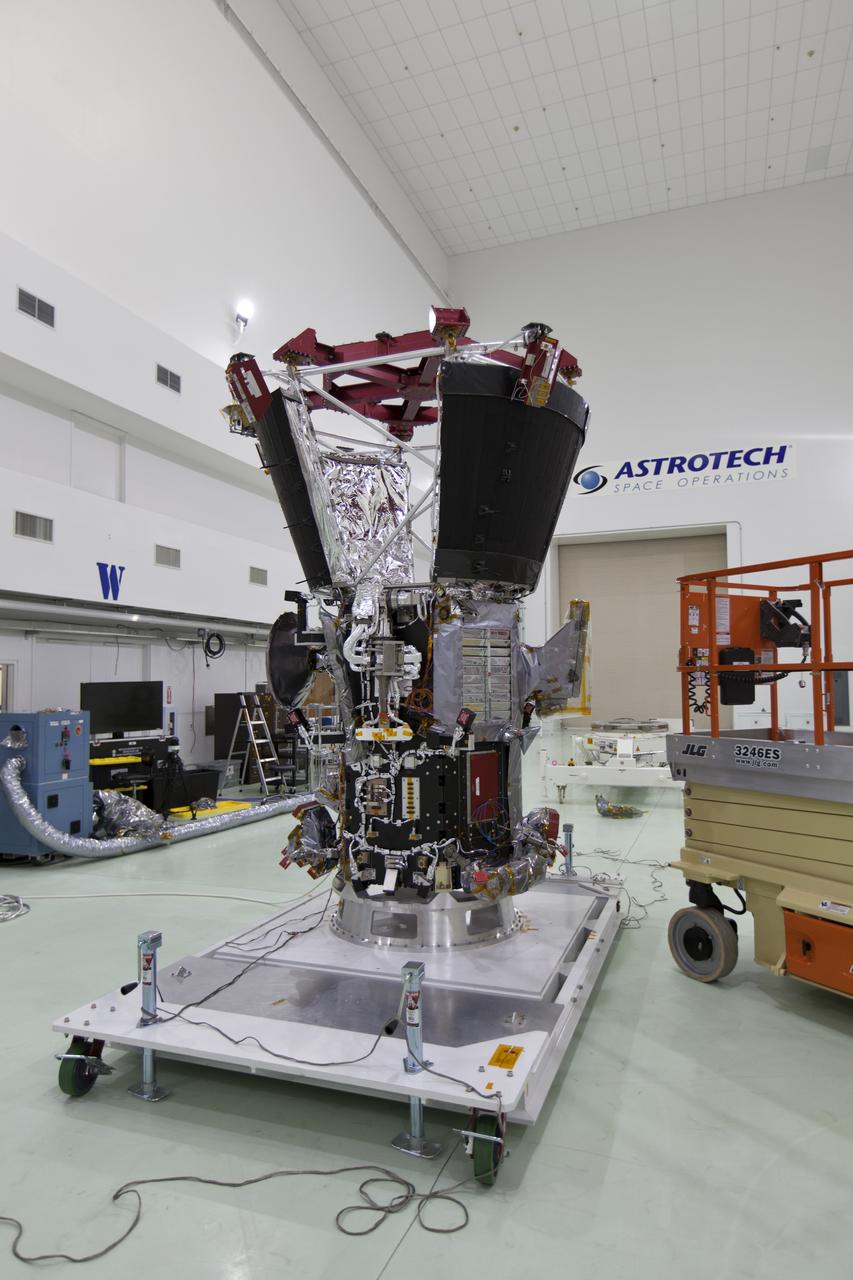
At the Astrotech processing facility in Titusville, Florida, near NASA's Kennedy Space Center, NASA's Parker Solar Probe has been removed from its shipping bag on Wednesday, April 4, 2018. The Parker Solar Probe will launch on a United Launch Alliance Delta IV Heavy rocket from Space Launch Complex 37 at Cape Canaveral Air Force Station in Florida no earlier than Aug. 4, 2018. The mission will perform the closest-ever observations of a star when it travels through the Sun's atmosphere, called the corona. The probe will rely on measurements and imaging to revolutionize our understanding of the corona and the Sun-Earth connection.
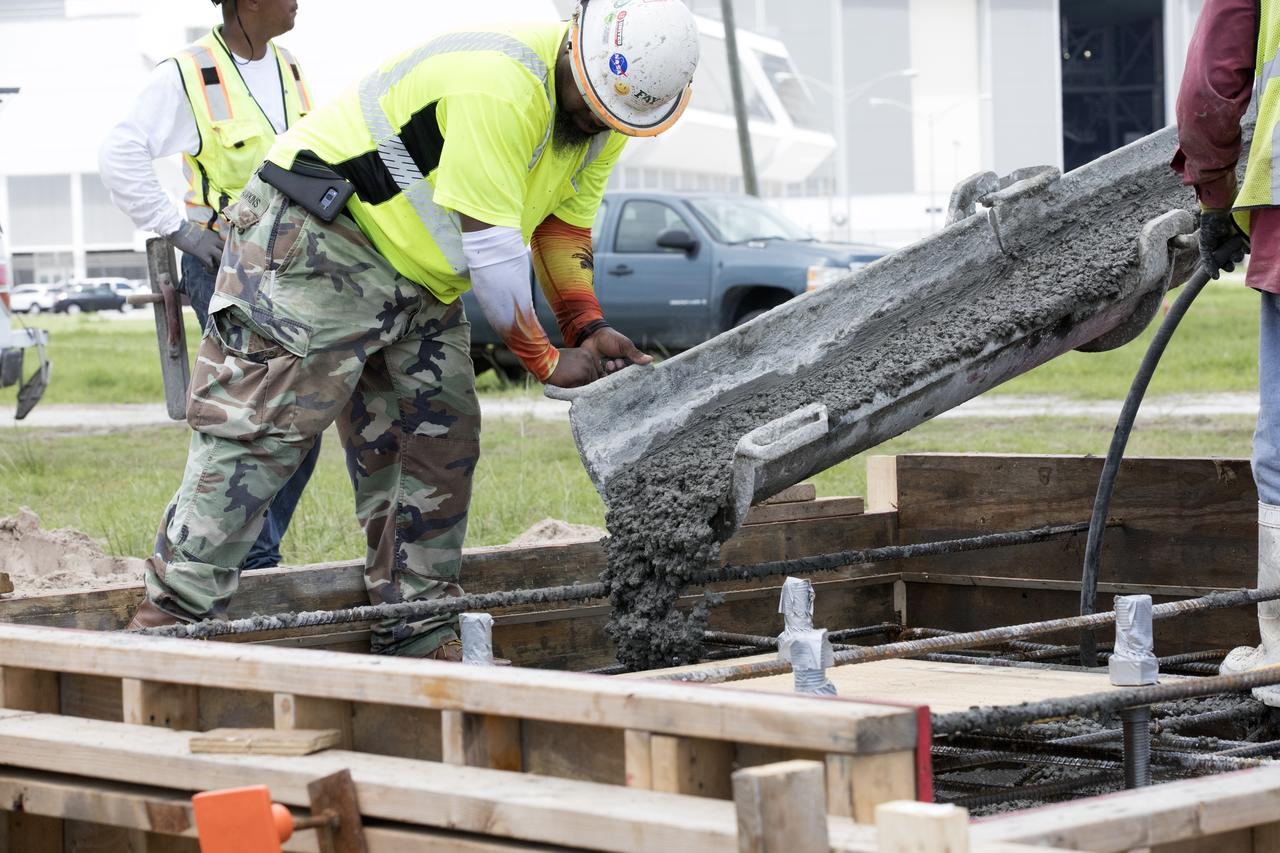
At NASA's Kennedy Space Center in Florida, cement is poured as part of a construction project to upgrade the turn basin wharf. The work includes driving multiple precast concrete piles to a depth of about 70 feet to accommodate arrival of the core stage for the agency's Space Launch System (SLS) rocket. When the stage for NASA's SLS departs the Michoud Assembly Facility in New Orleans, it will be shipped by the agency's modified barge to the Launch Complex 39 turn basin.
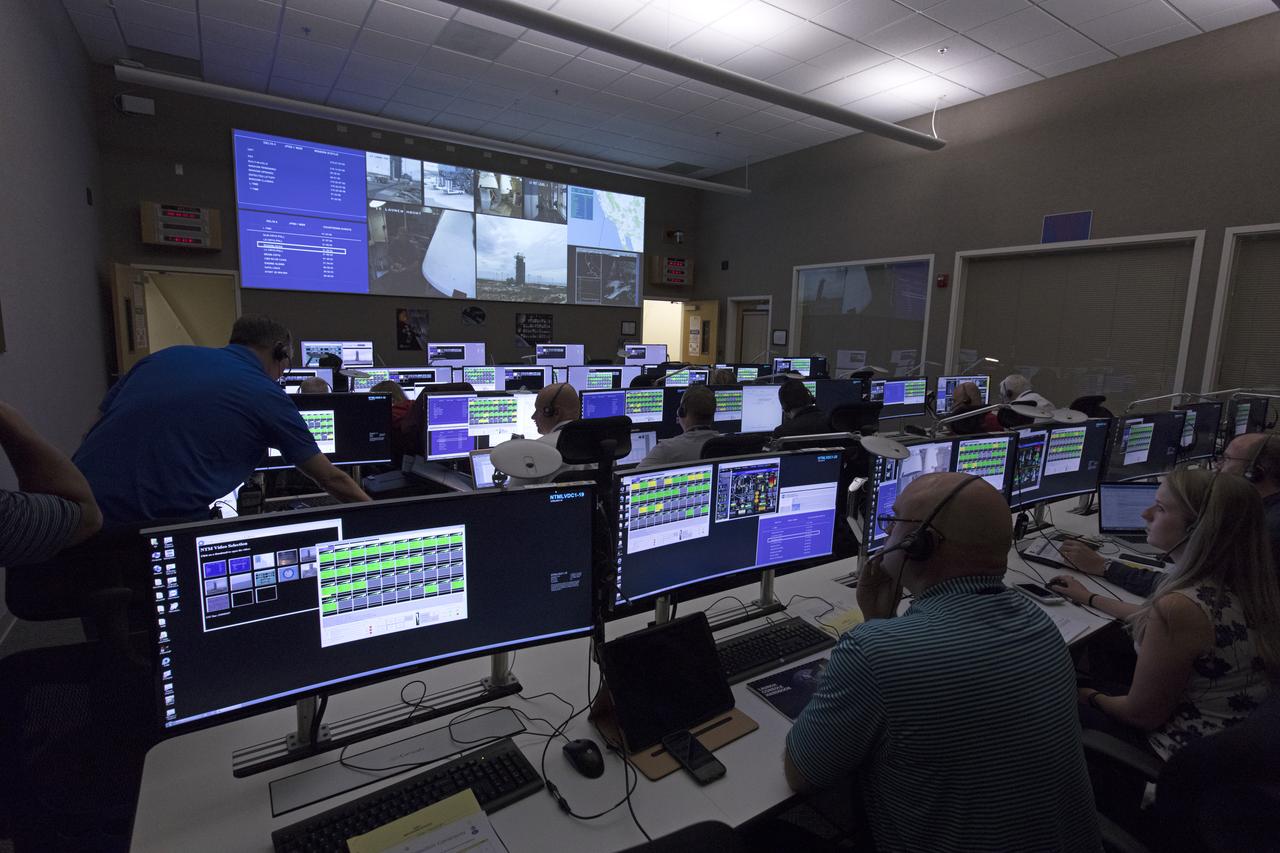
In the Mission Director's Center at Vandenberg Air Force Base in California, NASA and contractor managers and engineers monitor progress during a countdown rehearsal for the launch of a United Launch Alliance Delta II rocket with the Joint Polar Satellite System-1, or JPSS-1, spacecraft. Built by Ball Aerospace and Technologies Corp. of Boulder, Colorado, JPSS is the first in a series four next-generation environmental satellites in a collaborative program between the NOAA and NASA. Liftoff is scheduled to take place from Vandenberg's Space Launch Complex 2.
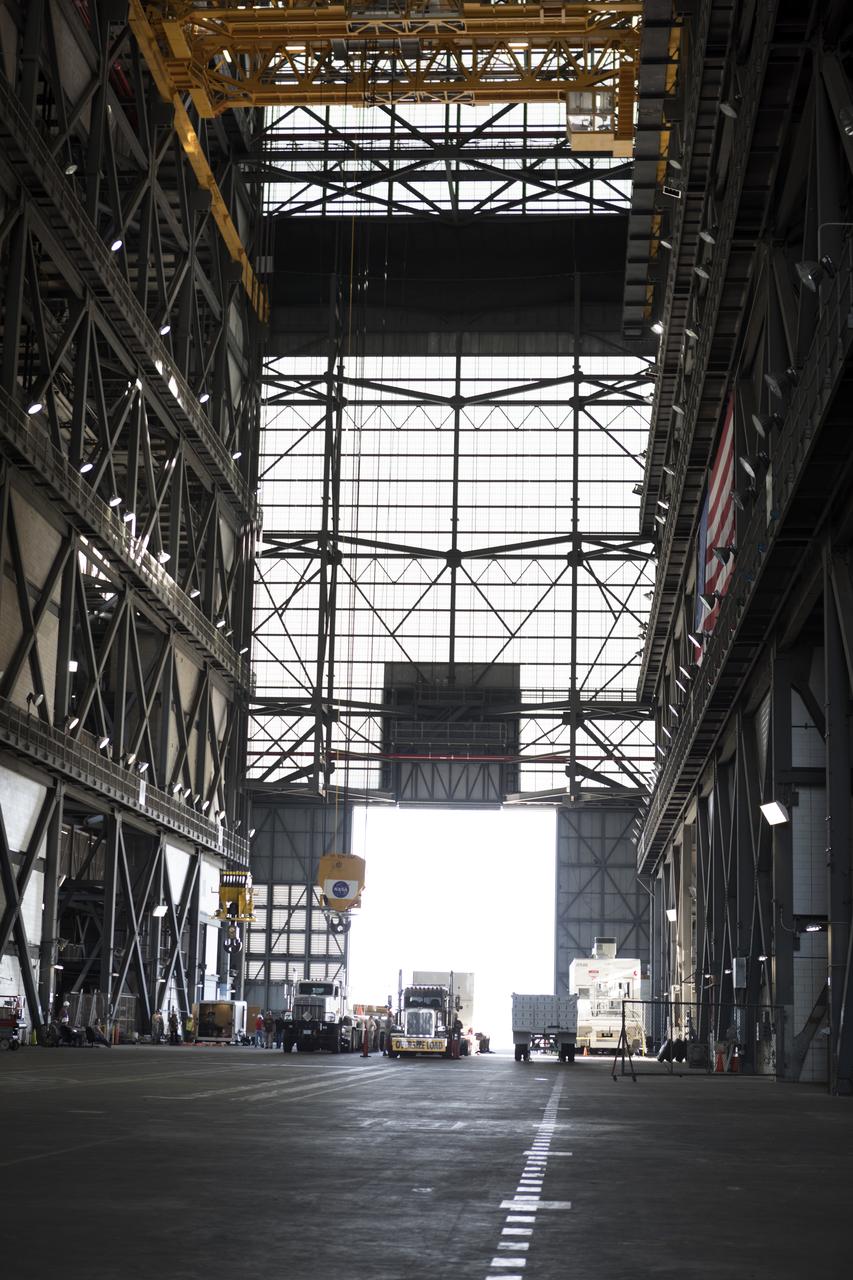
The ground test motor for Orion's Launch Abort System (LAS) arrives by flatbed truck in its shipping container in the transfer aisle of the Vehicle Assembly Building on July 20, 2018, at NASA's Kennedy Space Center in Florida. It will be transferred to the Rotation, Processing and Surge Facility where it will be inspected and prepared for transport to Space Launch Complex 46 (SLC-46) at Cape Canaveral Air Force Station for mechanical fit testing. This inert motor will not be used for flight, but will be used to certify flight hardware assembly in preparation for a full-stress test of the LAS, called Ascent Abort-2 (AA-2) flight test, scheduled for April 2019. During the test, the booster will launch from SLC 46, carrying a fully functional LAS and a 22,000-pound Orion test vehicle to an altitude of 31,000 feet and traveling at more than 1,000 miles an hour. The test will verify the LAS can steer the crew module and astronauts aboard to safety in the event of an issue with the Space Launch System (SLS) rocket when the spacecraft is under the highest aerodynamic loads it will experience during a rapid climb into space. NASA's Orion and Exploration Ground Systems programs and their contractors from Jacob's and Northrup Grumman in conjunction with the Air Force Space and Missile Center's Launch Operations branch are performing the pathfinding exercises and flight operations for AA-2.
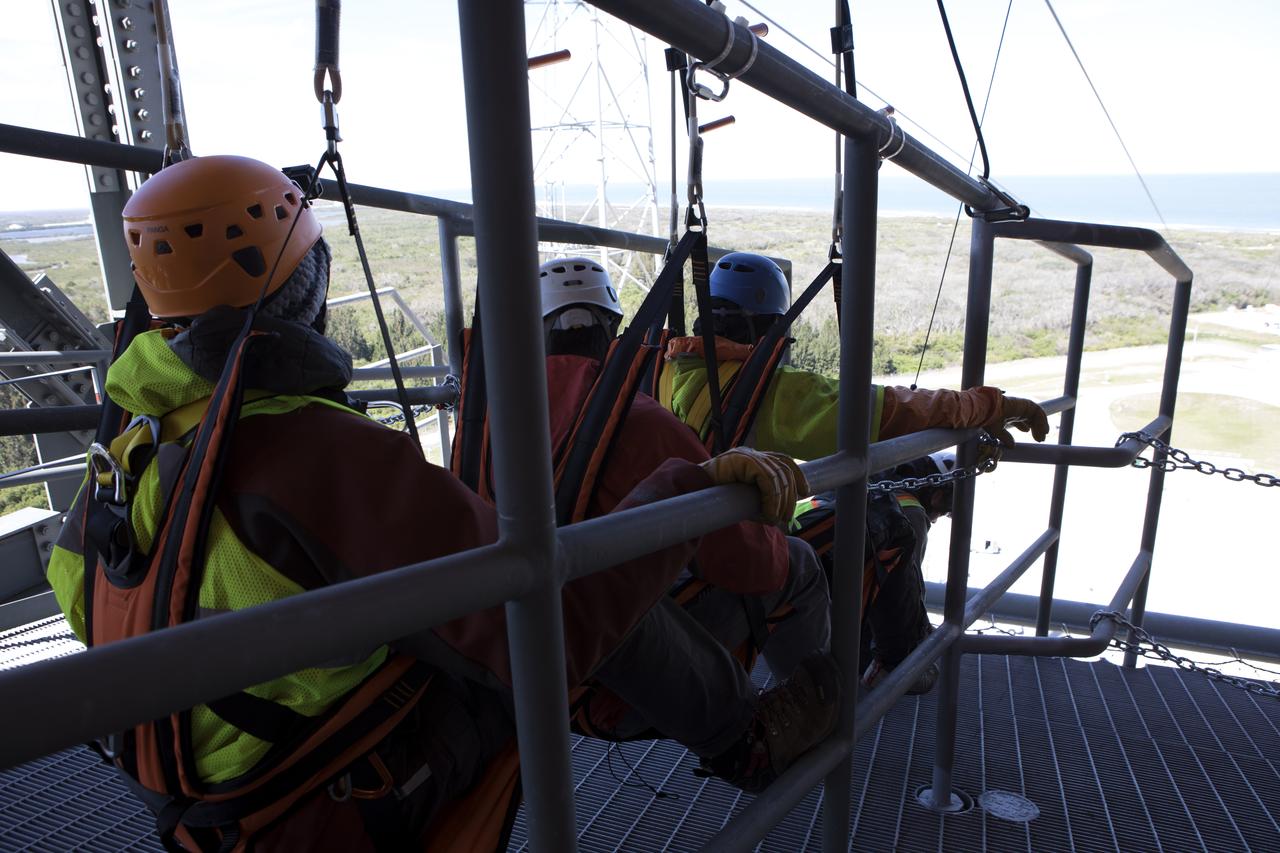
Three engineers prepare to evaluate the Emergency Egress System as they ride in folding seats attached to slide wires at Space Launch Complex 41. United Launch Alliance and Boeing continue modifications to the pad in order to host missions by the Boeing CST-100 Starliner carrying astronauts and crew. The system recently completed its final test. In the unlikely event of an emergency prior to liftoff, each person on the Crew Access Tower would get into their own seat attached to the wire and slide more than 1,340 feet to a safe area. The wires are situated 172 feet above the pad deck on level 12 of the tower. The Starliner will launch on a ULA Atlas V on mission to low-Earth orbit including those flying astronauts to the International Space Station during missions by NASA's Commercial Crew Program.
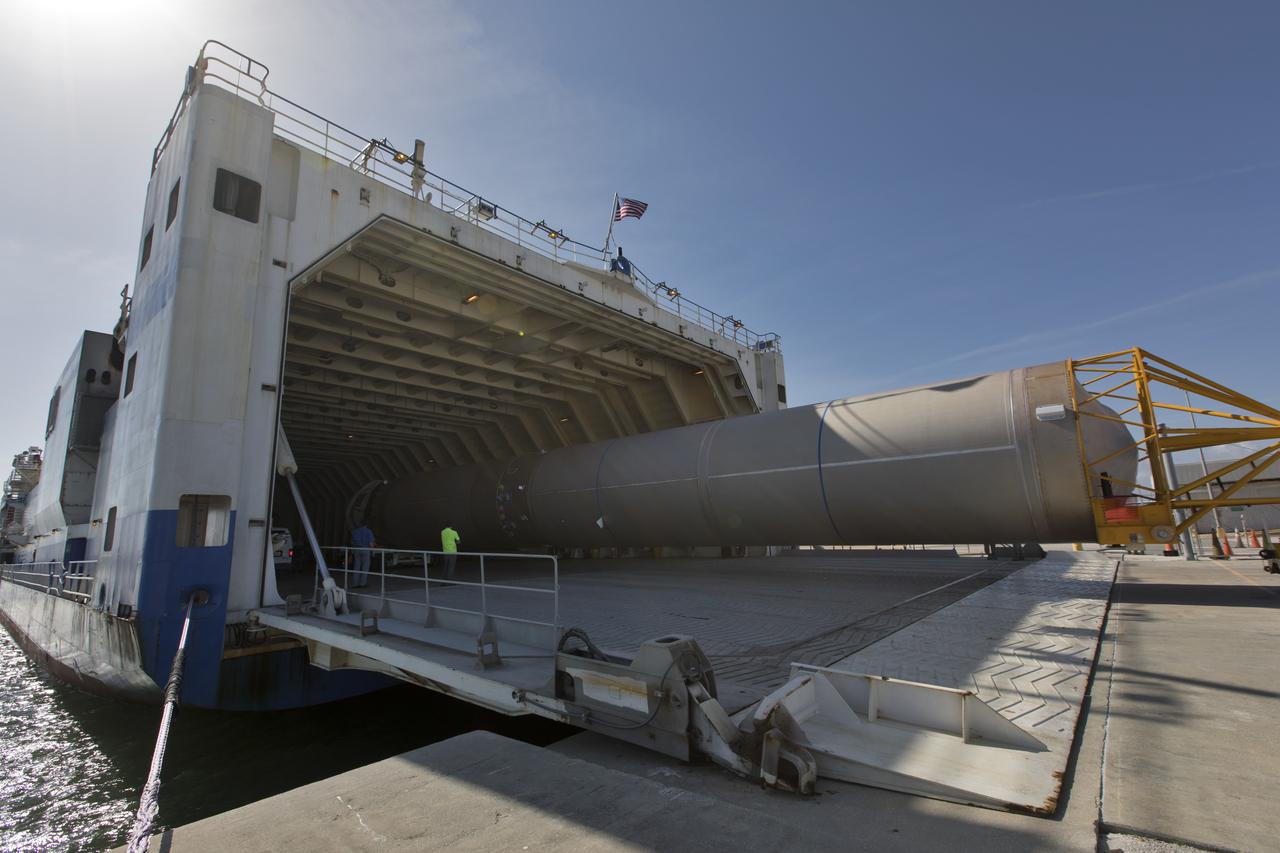
The United Launch Alliance Atlas V booster for NOAA's Geostationary Operational Environmental Satellite-S (GOES-S) is offloaded from the Mariner transport ship at the Army Wharf at Cape Canaveral Air Force Station in Florida. The booster will be transported to the Atlas Spaceflight Operations Center near Space Launch Complex 41 at CCAFS. GOES-S is the second in a series of four advanced geostationary weather satellites. The satellite is slated to launch aboard the Atlas V rocket March 1.
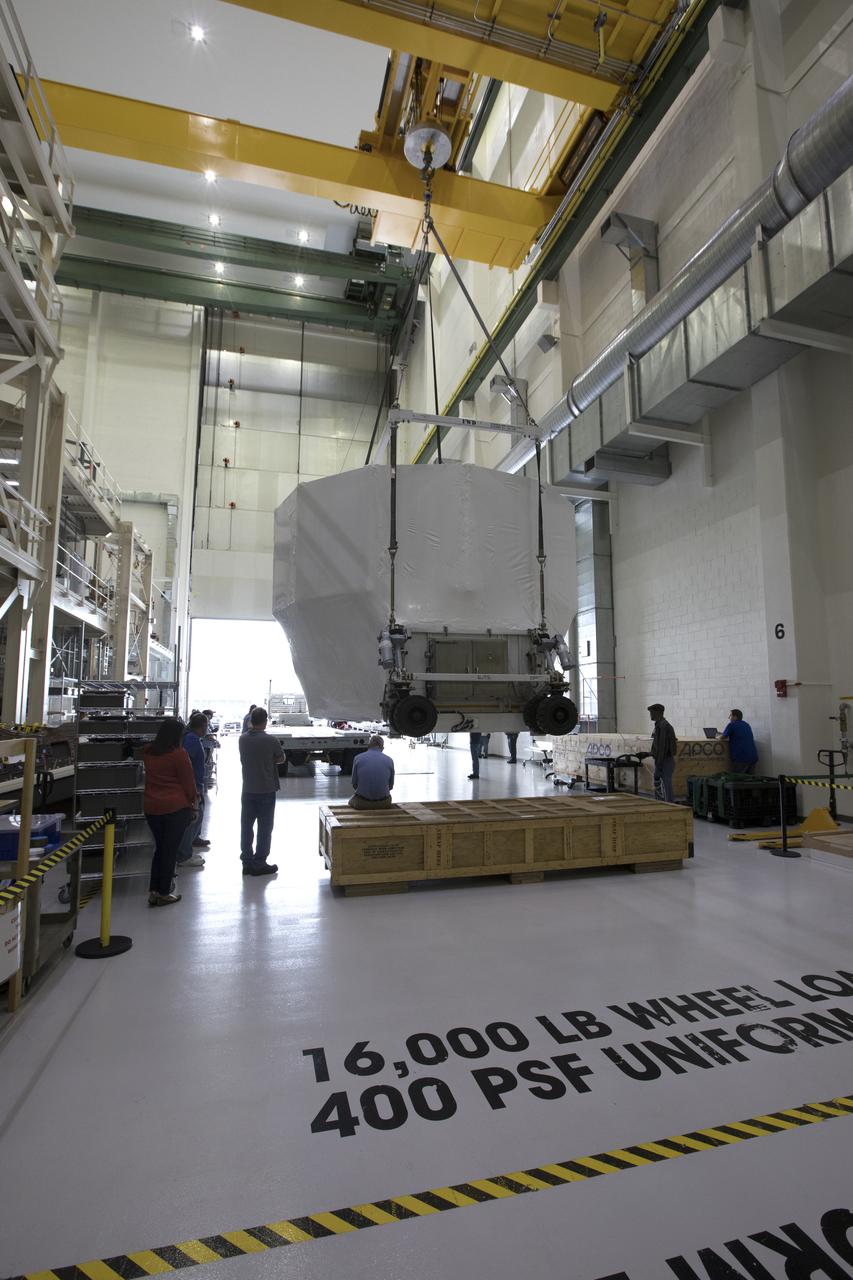
The Orion service module structural test article for Exploration Mission-1 (EM-1), built by the European Space Agency, is prepared for shipment to Lockheed Martin's Denver facility to undergo testing. Inside the Neil Armstrong Operations and Checkout Building high bay at NASA's Kennedy Space Center in Florida, a crane lifts the module, secured on a stand, for the move to the transport truck. The Orion spacecraft will launch atop the agency's Space Launch System rocket on EM-1 in 2019.
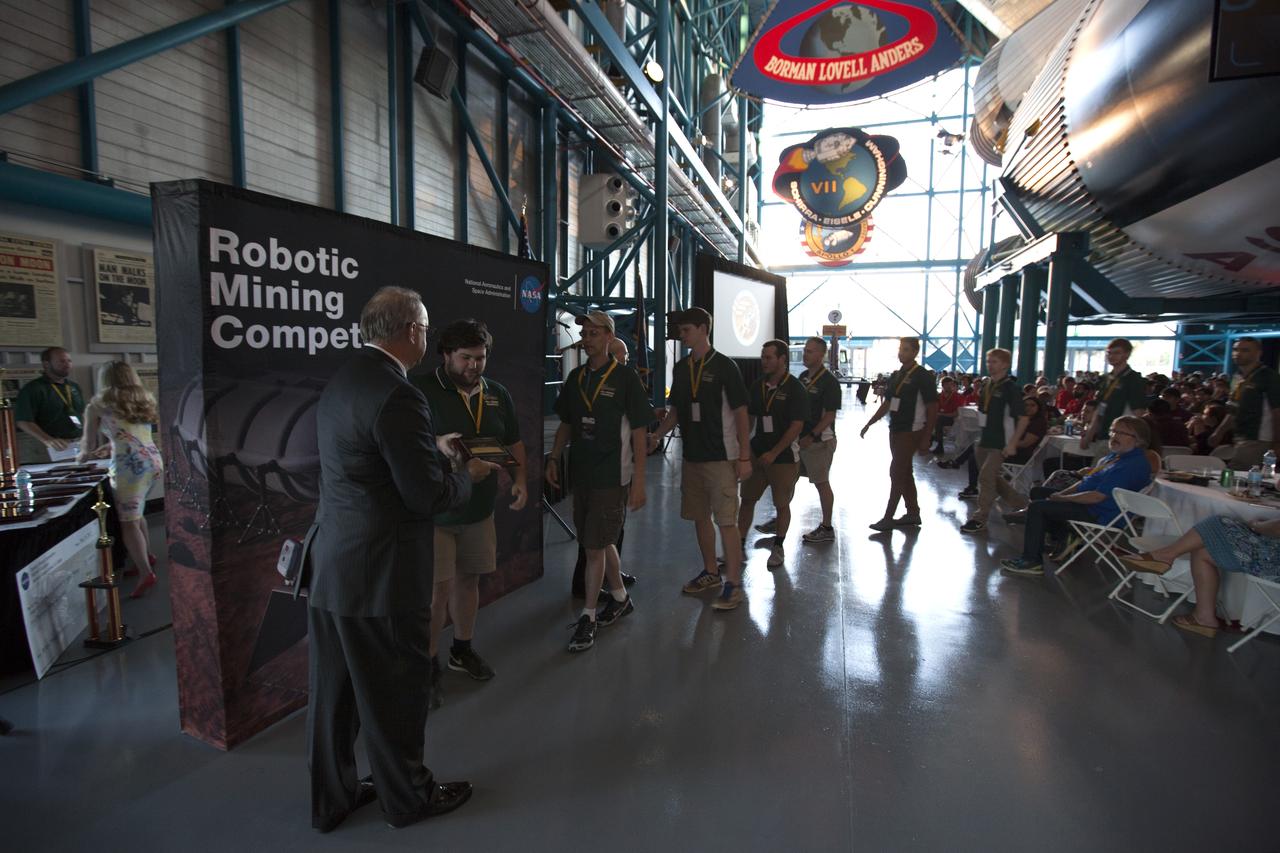
Inside the Apollo-Saturn V Center at the Kennedy Space Center Visitor Complex in Florida, team members from the University of North Carolina at Charlotte receive third-place in the Caterpillar Autonomy Award during the award ceremony for NASA's 8th Annual Robotic Mining Competition. More than 40 student teams from colleges and universities around the U.S. used their uniquely-designed mining robots to dig in a supersized sandbox filled with BP-1, or simulated Martian soil, and participated in other competition requirements, May 22-26, at the visitor complex. The Robotic Mining Competition is a NASA Human Exploration and Operations Mission Directorate project designed to encourage students in science, technology, engineering and math, or STEM fields. The project provides a competitive environment to foster innovative ideas and solutions that could be used on NASA's Journey to Mars.
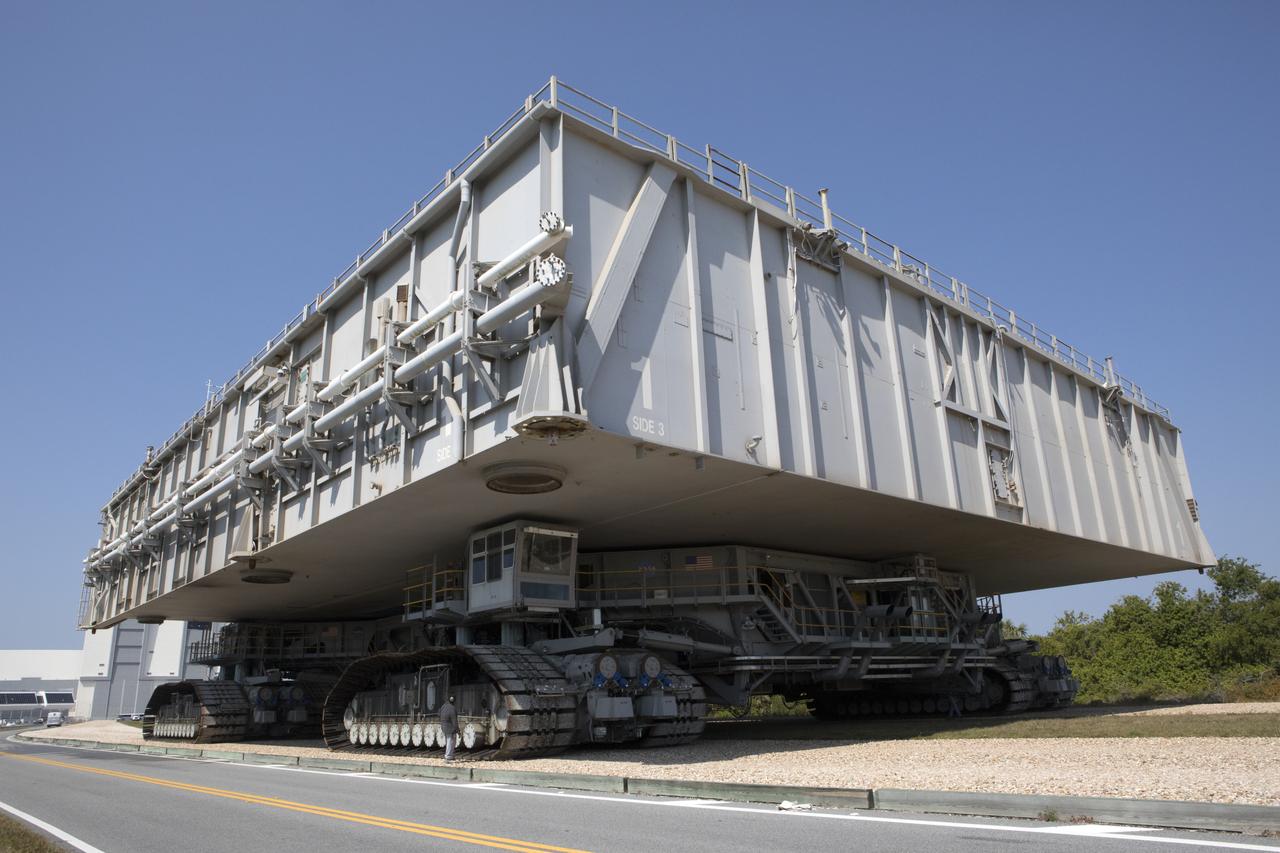
NASA's upgraded crawler-transporter 2 (CT-2), carrying mobile launcher platform 1, moves slowly along the crawlerway toward the Vehicle Assembly Building at the agency's Kennedy Space Center in Florida. The crawler's upgrades and modifications were monitored and tested during a loaded test to the crawlerway Pad A/B split. CT-2 will return to the crawler yard. The crawler is being tested to confirm it is ready to support the load of the mobile launcher carrying the Space Launch System with Orion atop for the first test flight, Exploration Mission 1. The Ground Systems Development and Operations Program at Kennedy is managing upgrades to the crawler.
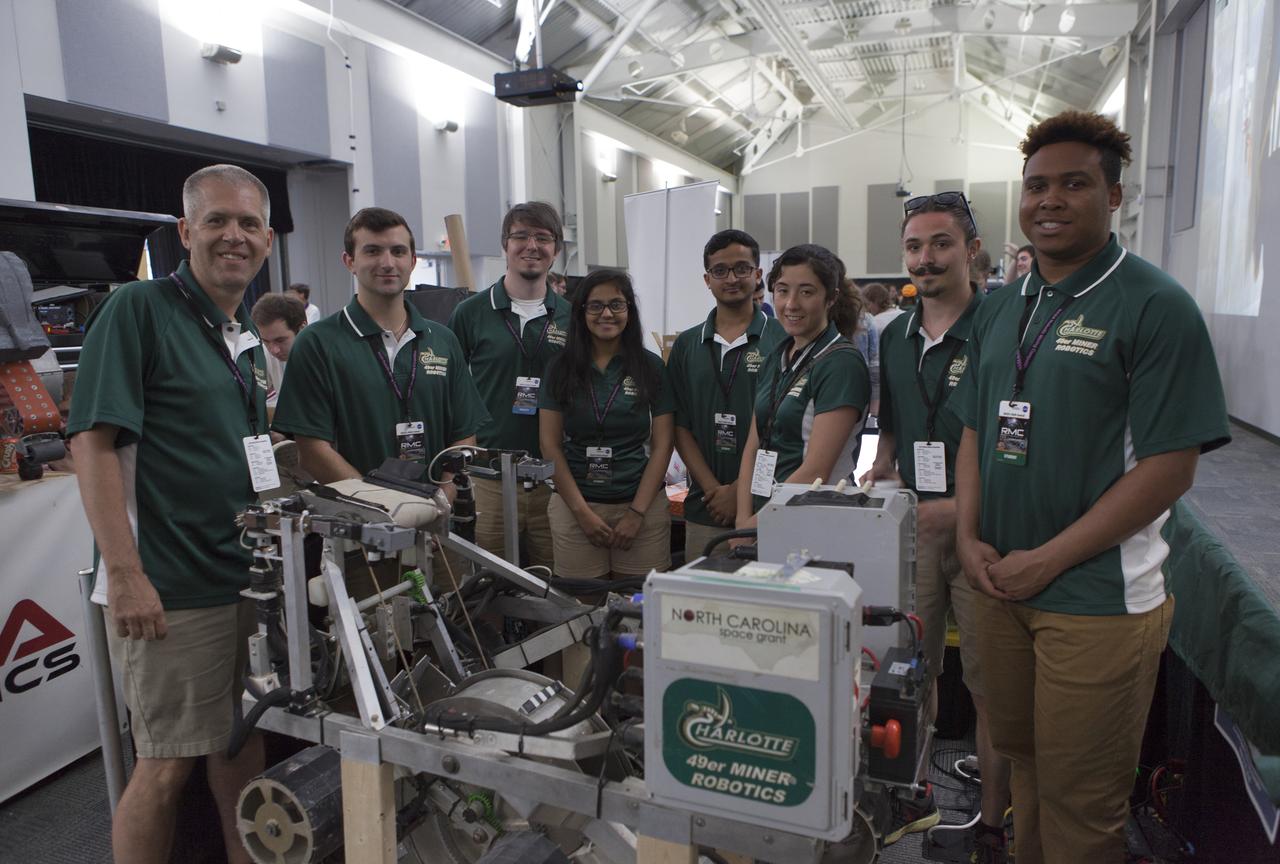
Team members and their faculty advisor, far left, from The University of North Carolina at Charlotte pause with their robot miner in the RobotPits on the fourth day of NASA's 9th Robotic Mining Competition, May 17, at NASA's Kennedy Space Center Visitor Complex in Florida. More than 40 student teams from colleges and universities around the U.S. will use their mining robots to dig in a supersized sandbox filled with BP-1, or simulated Lunar soil, gravel and rocks, and participate in other competition requirements. The Robotic Mining Competition is a NASA Human Exploration and Operations Mission Directorate project designed to encourage students in science, technology, engineering and math, or STEM fields. The project provides a competitive environment to foster innovative ideas and solutions that could be used on NASA's deep space missions.
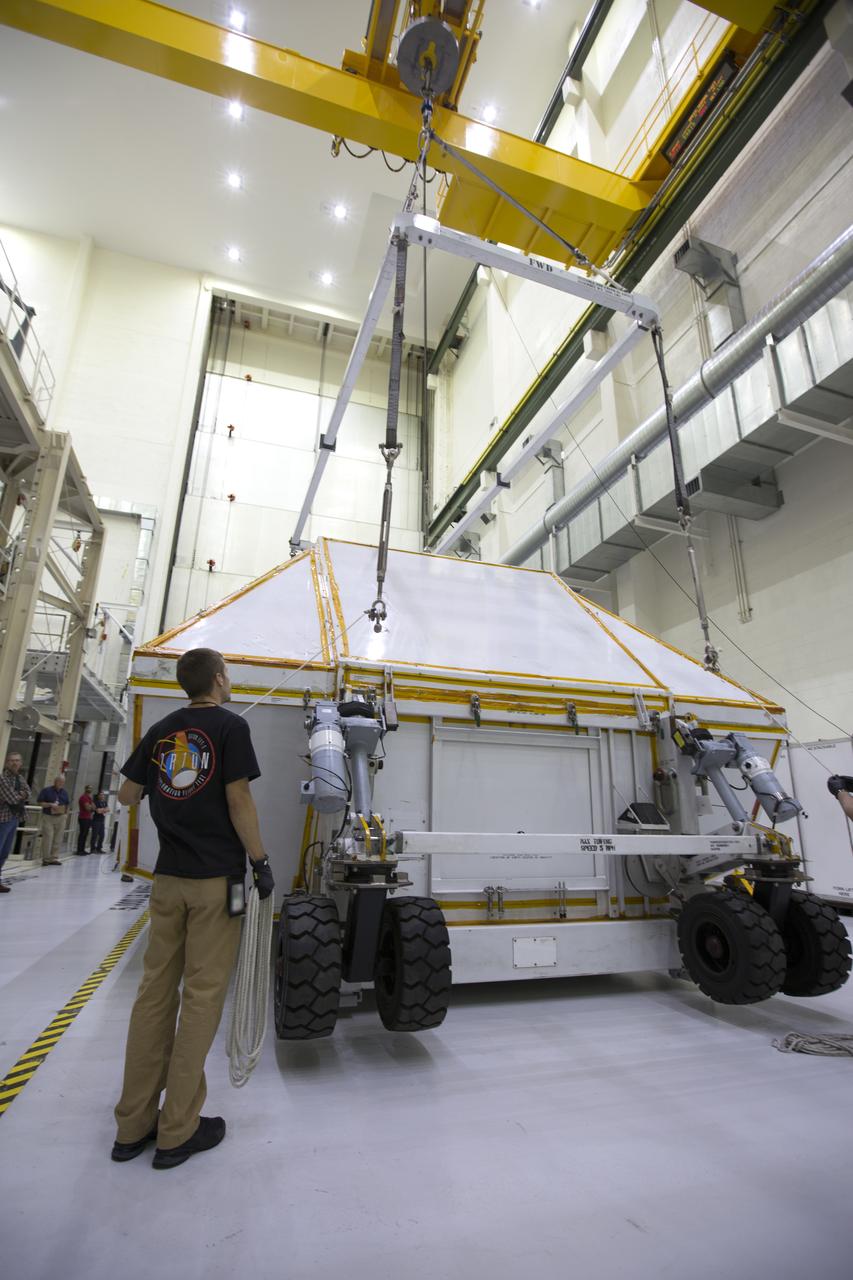
Inside the Neil Armstrong Operations and Checkout Building high bay at NASA's Kennedy Space Center in Florida, the Orion Exploration Mission-1 (EM-1) structural test article is secured inside its transport container. A crane is used to move the container toward a transport vehicle for the move to the Shuttle Landing Facility. The test article will be loaded in NASA's Super Guppy airplane and transported to Lockheed Martin's Denver facility for testing. The Orion spacecraft will launch atop NASA’s Space Launch System rocket on EM-1, its first deep space mission.
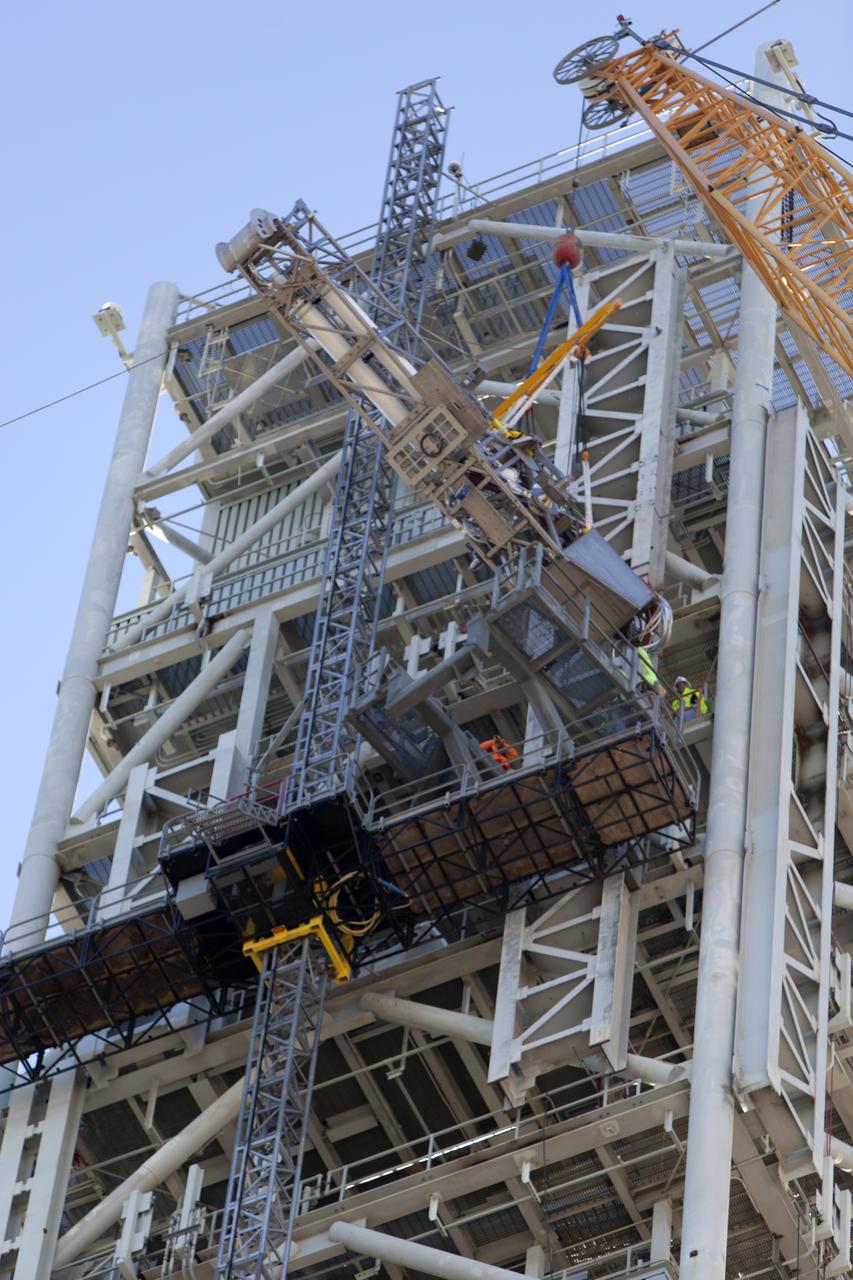
A crane and rigging are used to lift the Orion Service Module Umbilical (OSMU) high up for installation on the mobile launcher tower at NASA's Kennedy Space Center in Florida. The mobile launcher tower will be equipped with a number of lines, called umbilicals, that will connect to the Space Launch System rocket and Orion spacecraft for Exploration Mission-1 (EM-1). The OSMU will be located high on the mobile launcher tower and, prior to launch, will transfer liquid coolant for the electronics and air for the Environmental Control System to the Orion service module that houses these critical systems to support the spacecraft. EM-1 is scheduled to launch in 2018. The Ground Systems Development and Operations Program is overseeing installation of the umbilicals.
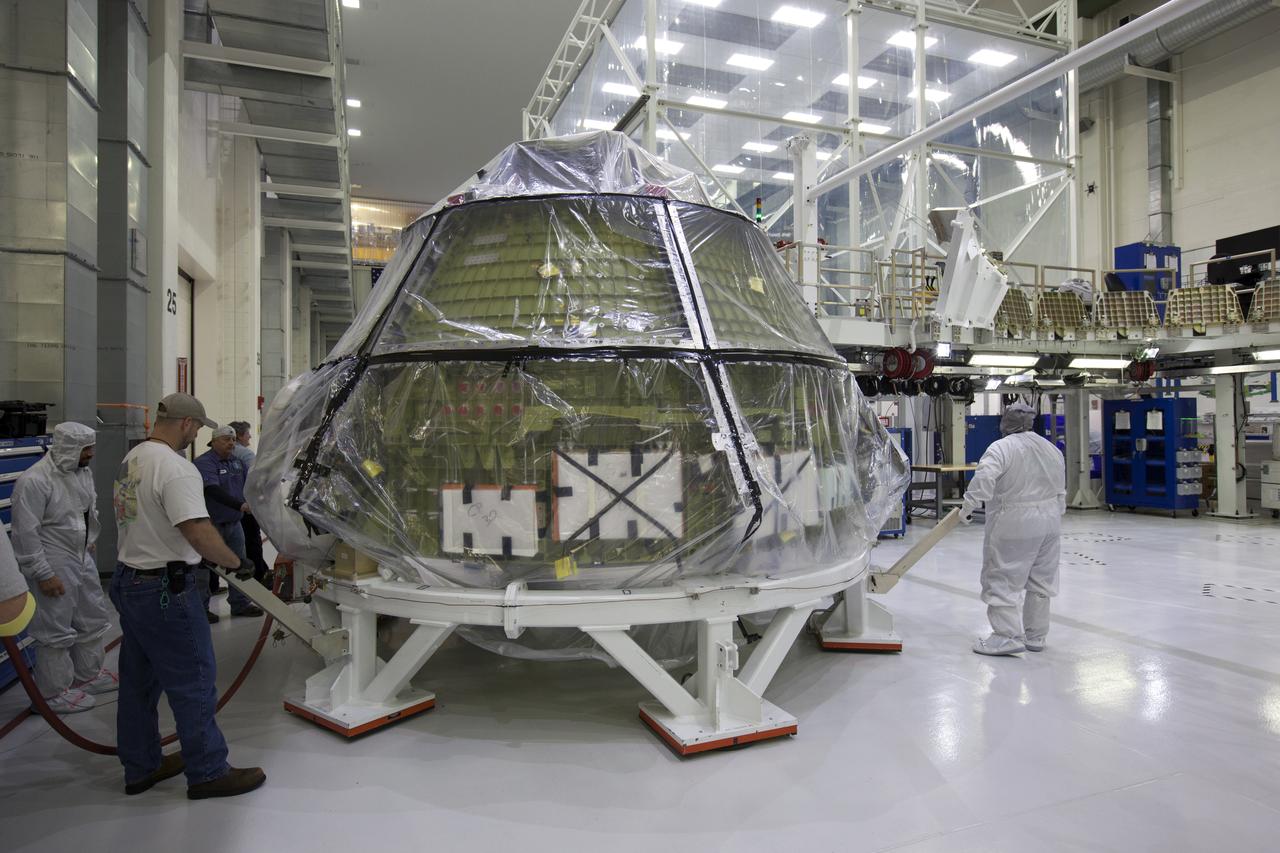
Workers have moved the Orion crew module pressure vessel for NASA’s Exploration Mission 1 (EM-1) out of a clean room inside the Neil Armstrong Operations and Checkout Building high bay at NASA’s Kennedy Space Center in Florida. The crew module will be moved to a work station where it will undergo additional processing to prepare it for launch in 2019. The spacecraft is being prepared for its first integrated flight atop the Space Launch System rocket on Exploration Mission-1.
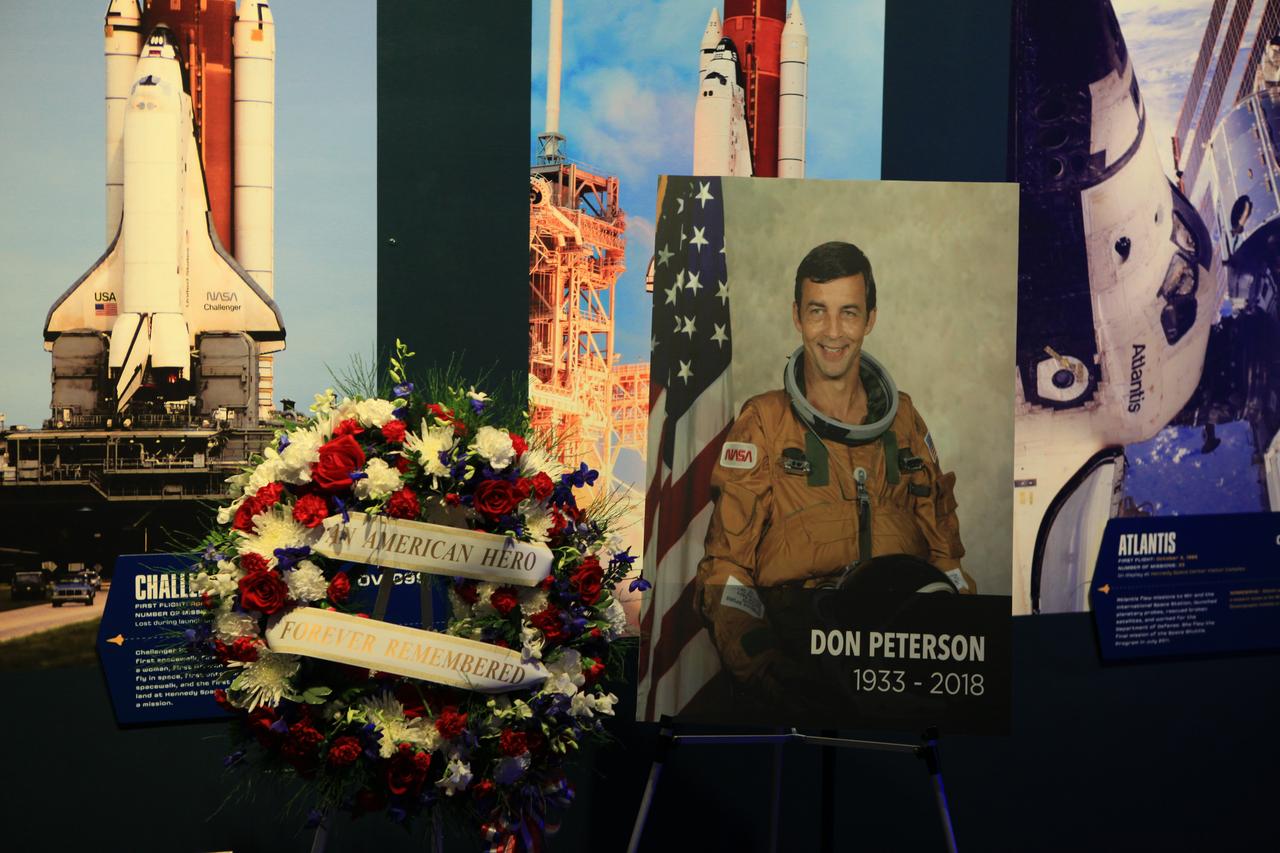
A memorial wreath placed in the Space Shuttle Atlantis exhibit at the Kennedy Space Center Visitor Complex on Wednesday, May 30, 2018, honoring former NASA astronaut Don Peterson. As a mission specialist on STS-6 in April 1983, he participated in the first spacewalk of the Space Shuttle Program. He passed away May 27, 2018, in El Lago, Texas. He was 84.
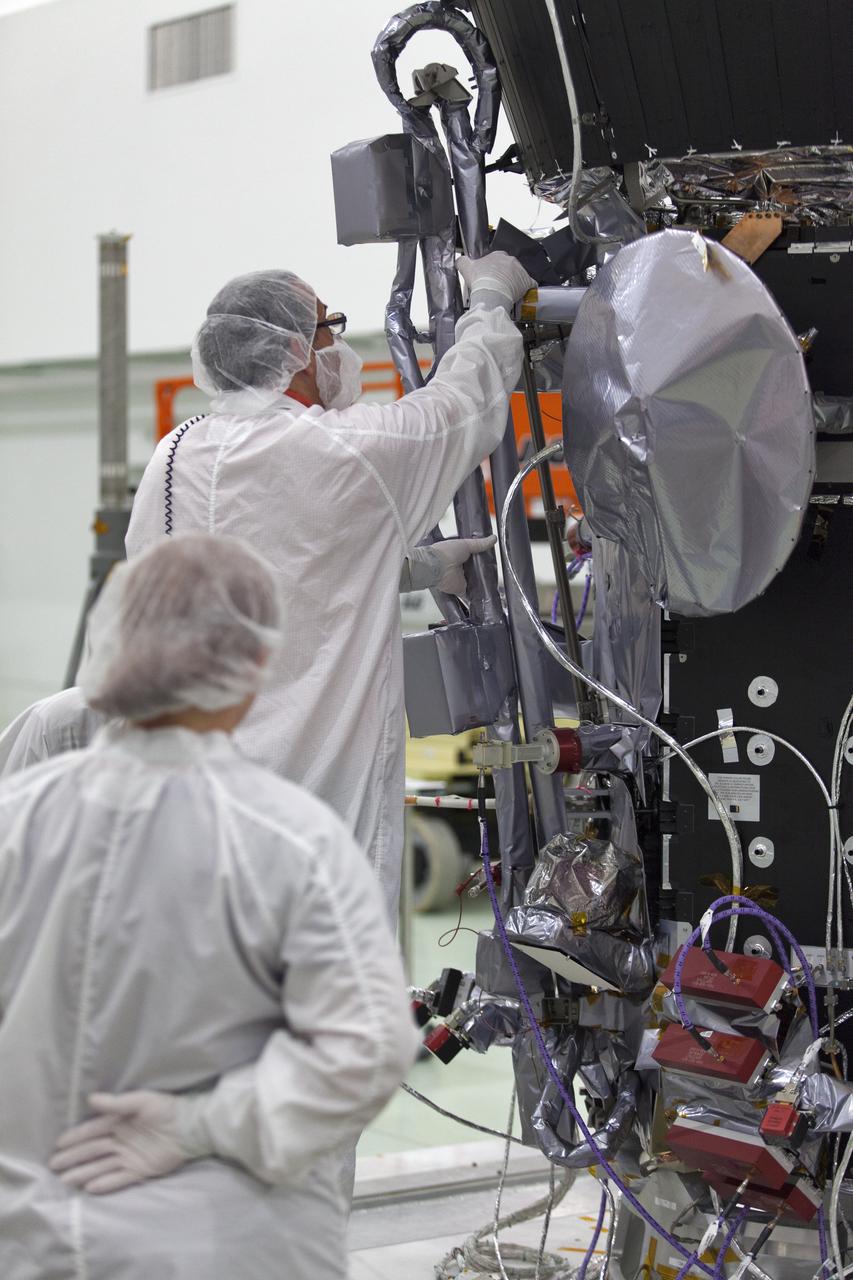
In the Astrotech processing facility in Titusville, Florida, near NASA's Kennedy Space Center, on Wednesday, May 23, 2018, technicians and engineers deploy the magnetometer boom on NASA's Parker Solar Probe. The Parker Solar Probe will launch on a United Launch Alliance Delta IV Heavy rocket from Space Launch Complex 37 at Cape Canaveral Air Force Station in Florida no earlier than Aug. 4, 2018. The mission will perform the closest-ever observations of a star when it travels through the Sun's atmosphere, called the corona. The probe will rely on measurements and imaging to revolutionize our understanding of the corona and the Sun-Earth connection.

In the Astrotech processing facility in Titusville, Florida, near NASA's Kennedy Space Center, on Thursday, July 19, 2018, technicians and engineers encapsulate NASA's Parker Solar Probe in its payload fairing. The spacecraft is mated to its third stage, built and tested by Northrup Grumman in Chandler, Arizona. The Parker Solar Probe will launch on a United Launch Alliance Delta IV Heavy rocket from Space Launch Complex 37 at Cape Canaveral Air Force Station in Florida. The mission will perform the closest-ever observations of a star when it travels through the Sun's atmosphere, called the corona. The probe will rely on measurements and imaging to revolutionize our understanding of the corona and the Sun-Earth connection.
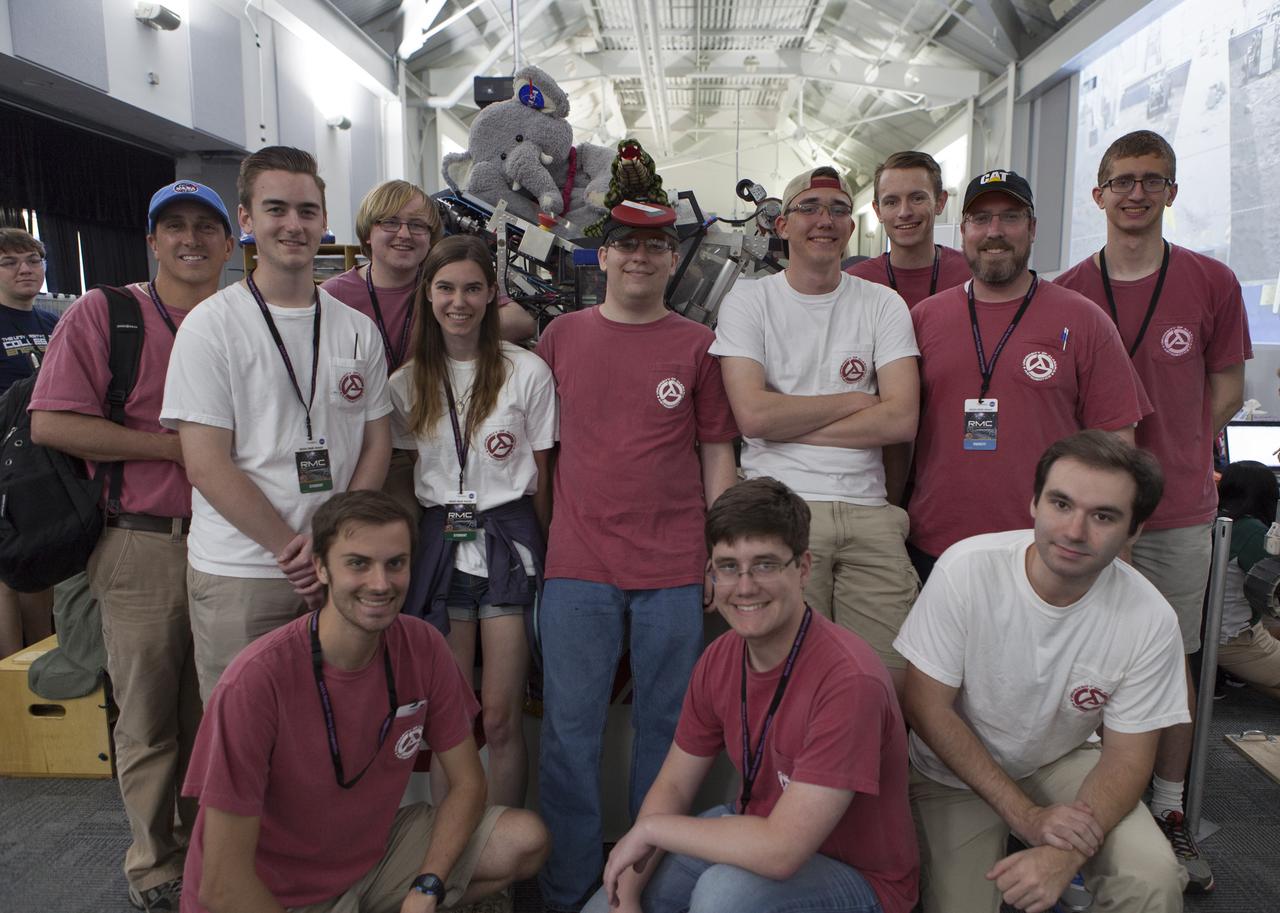
Team members from The University of Alabama pause with their robot miner in the RobotPits on the fourth day of NASA's 9th Robotic Mining Competition, May 17, at NASA's Kennedy Space Center Visitor Complex in Florida. More than 40 student teams from colleges and universities around the U.S. will use their mining robots to dig in a supersized sandbox filled with BP-1, or simulated Lunar soil, gravel and rocks, and participate in other competition requirements. The Robotic Mining Competition is a NASA Human Exploration and Operations Mission Directorate project designed to encourage students in science, technology, engineering and math, or STEM fields. The project provides a competitive environment to foster innovative ideas and solutions that could be used on NASA's deep space missions.
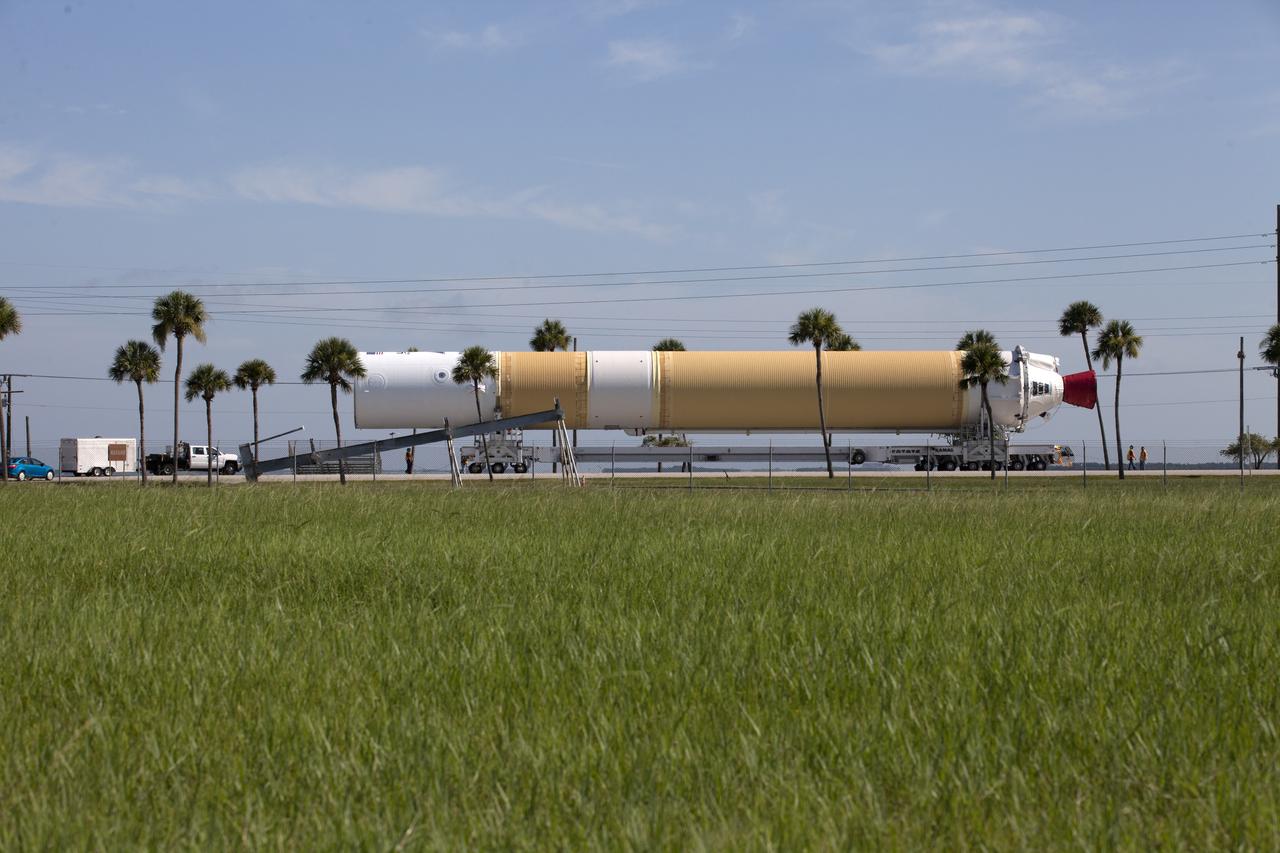
Framed by a series of cabbage palms, a United Launch Alliance Delta IV Heavy common booster core is transported by truck to Cape Canaveral Air Force Station's Launch Complex 37 Horizontal Processing Facility after arriving at Port Canaveral. The Delta IV Heavy will launch NASA's upcoming Parker Solar Probe mission. The mission will perform the closest-ever observations of a star when it travels through the Sun's atmosphere, called the corona. The probe will rely on measurements and imaging to revolutionize our understanding of the corona and the Sun-Earth connection. Liftoff atop the Delta IV Heavy rocket is scheduled to take place from Cape Canaveral's Space Launch Complex 37 in summer 2018.
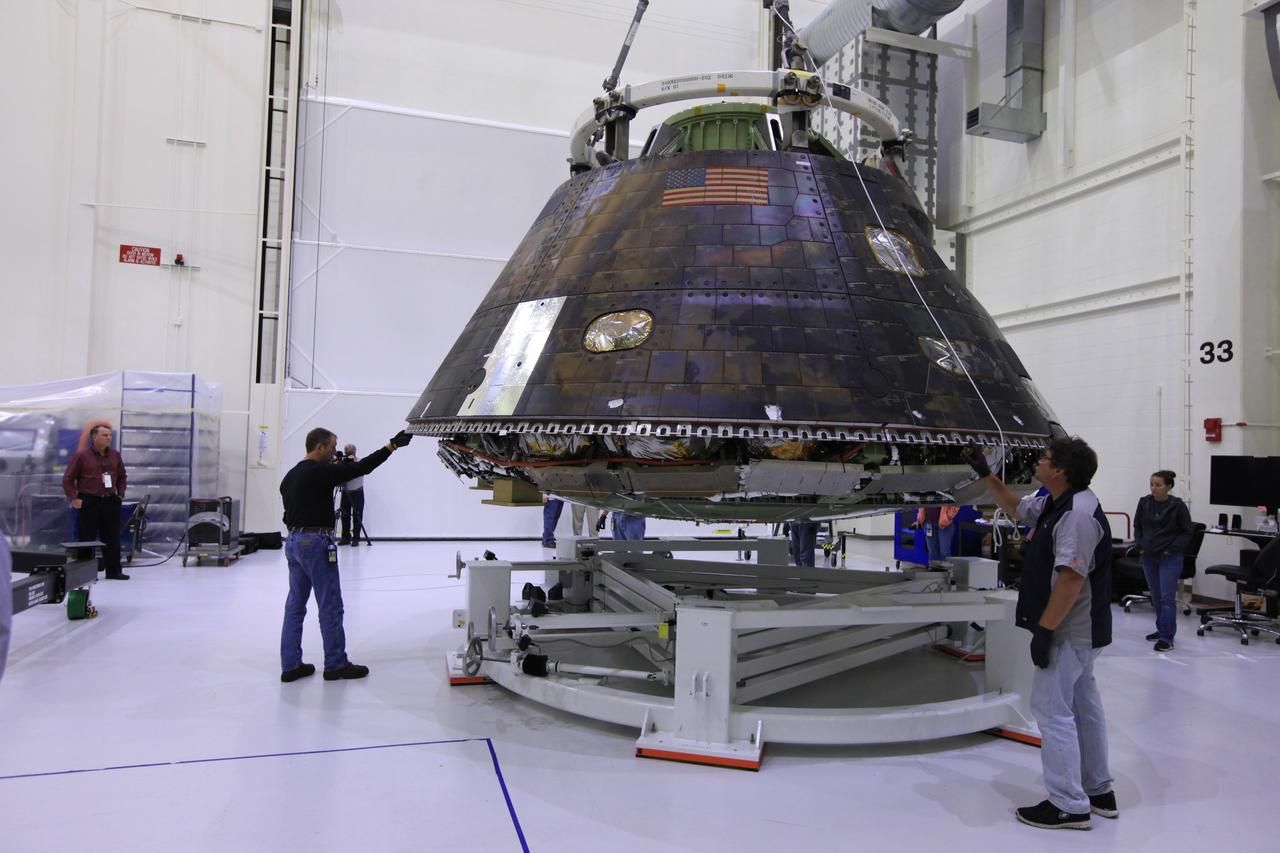
The Exploration Flight Test-1 (EFT-1) Crew Module undergoes preparations to move from the Operations and Checkout Building at Kennedy Space Center to the KSC Visitor Complex on April 6, 2017.

John "JC" Carver, a payload integration engineer with NASA Kennedy Space Center's Test and Operations Support Contract, opens the door to the growth chamber of the Advanced Plant Habitat (APH) Flight Unit No. 1 for a test harvest of half of the Arabidopsis thaliana plants growing within. The harvest is part of an ongoing verification test of the APH unit, which is located inside the International Space Station Environmental Simulator in Kennedy's Space Station Processing Facility. The APH undergoing testing at Kennedy is identical to one on the station and uses red, green and broad-spectrum white LED lights to grow plants in an environmentally controlled chamber. The seeds grown during the verification test will be grown on the station to help scientists understand how these plants adapt to spaceflight.
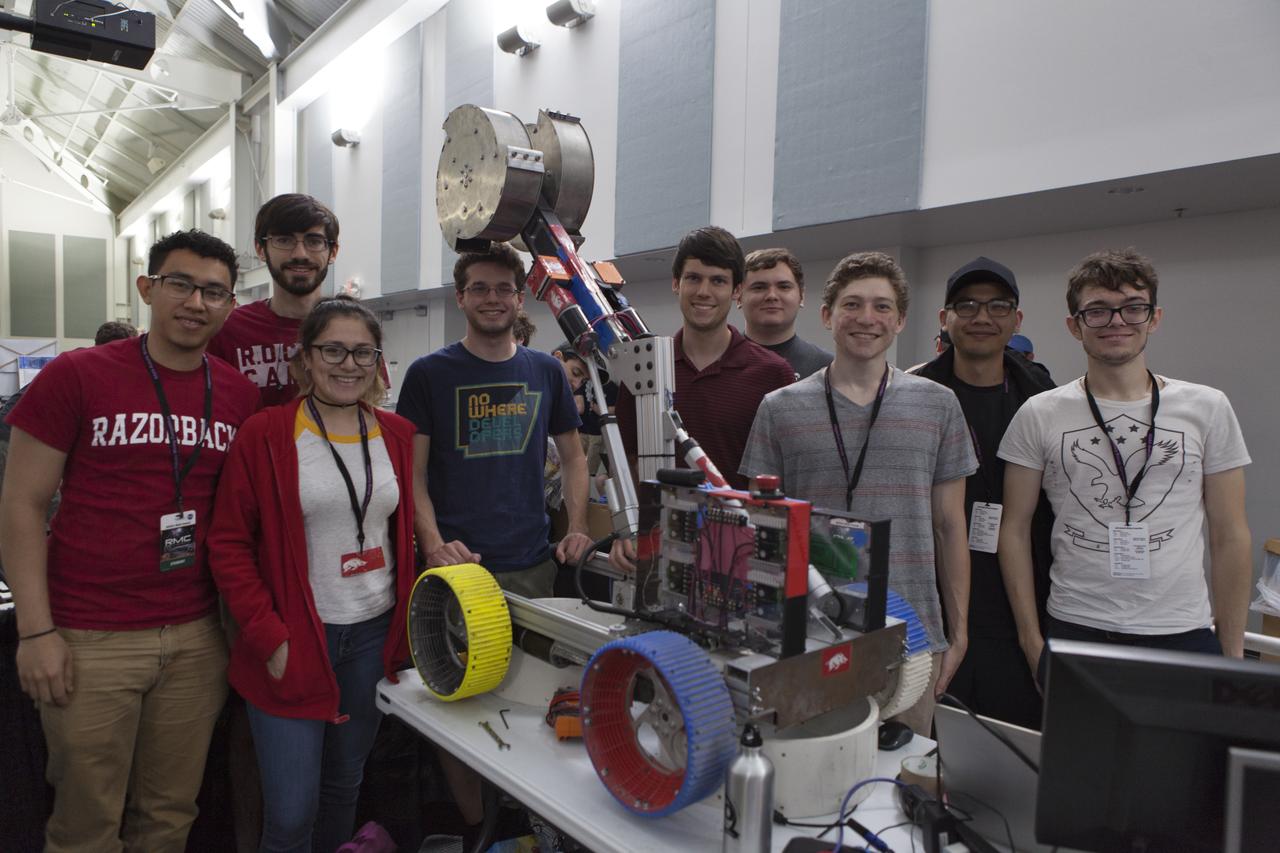
Team members from the University of Arkansas pause with their robot miner in the RobotPits on the fourth day of NASA's 9th Robotic Mining Competition, May 17, at NASA's Kennedy Space Center Visitor Complex in Florida. More than 40 student teams from colleges and universities around the U.S. are using their mining robots to dig in a supersized sandbox filled with BP-1, or simulated Lunar soil, gravel and rocks, and participate in other competition requirements. The Robotic Mining Competition is a NASA Human Exploration and Operations Mission Directorate project designed to encourage students in science, technology, engineering and math, or STEM fields. The project provides a competitive environment to foster innovative ideas and solutions that could be used on NASA's deep space missions.

JoAnn Morgan, former associate director of NASA Kennedy Space Center, was the keynote speaker during a Women's History Month event at the center. With the theme "Nevertheless She Persisted," Morgan described her experience as the first female engineer working in the space program in the 1960s. Morgan was the first female in the Launch Control Center firing room during the Apollo 11 launch. The event was hosted by the center's Kennedy Networking Opportunities for Women (KNOW) and Launching Leaders organizations. The purpose of KNOW is to provide focus on issues such as employment, retention, promotion, training, career and personal development, education, and identify and eliminate barriers that hinder the advancement of women in the workforce.
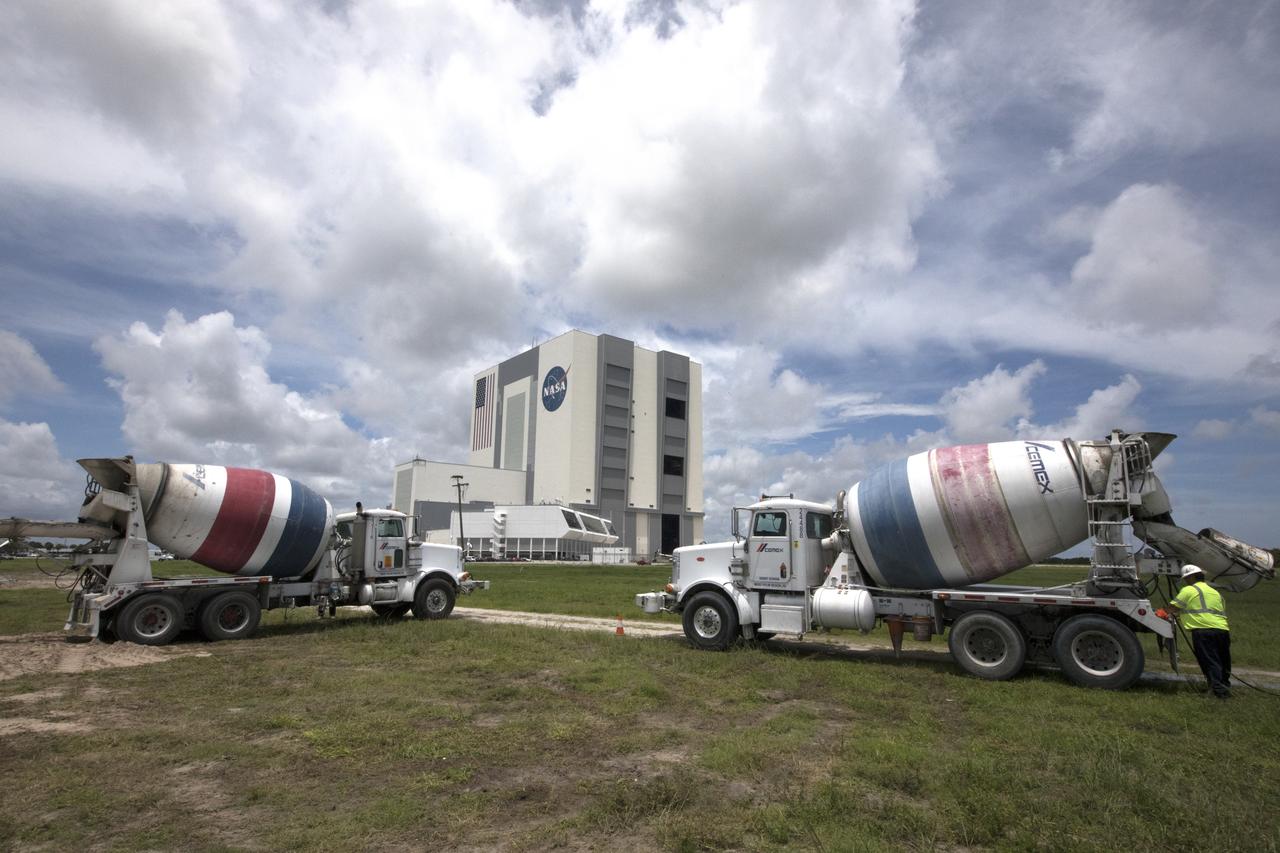
Across from the Vehicle Assembly Building at NASA's Kennedy Space Center in Florida, cement trucks stand by to support a construction project to upgrade the turn basin wharf. The work includes driving multiple precast concrete piles to a depth of about 70 feet to accommodate arrival of the core stage for the agency's Space Launch System (SLS) rocket. When the stage for NASA's SLS departs the Michoud Assembly Facility in New Orleans, it will be shipped by the agency's modified barge to the Launch Complex 39 turn basin.
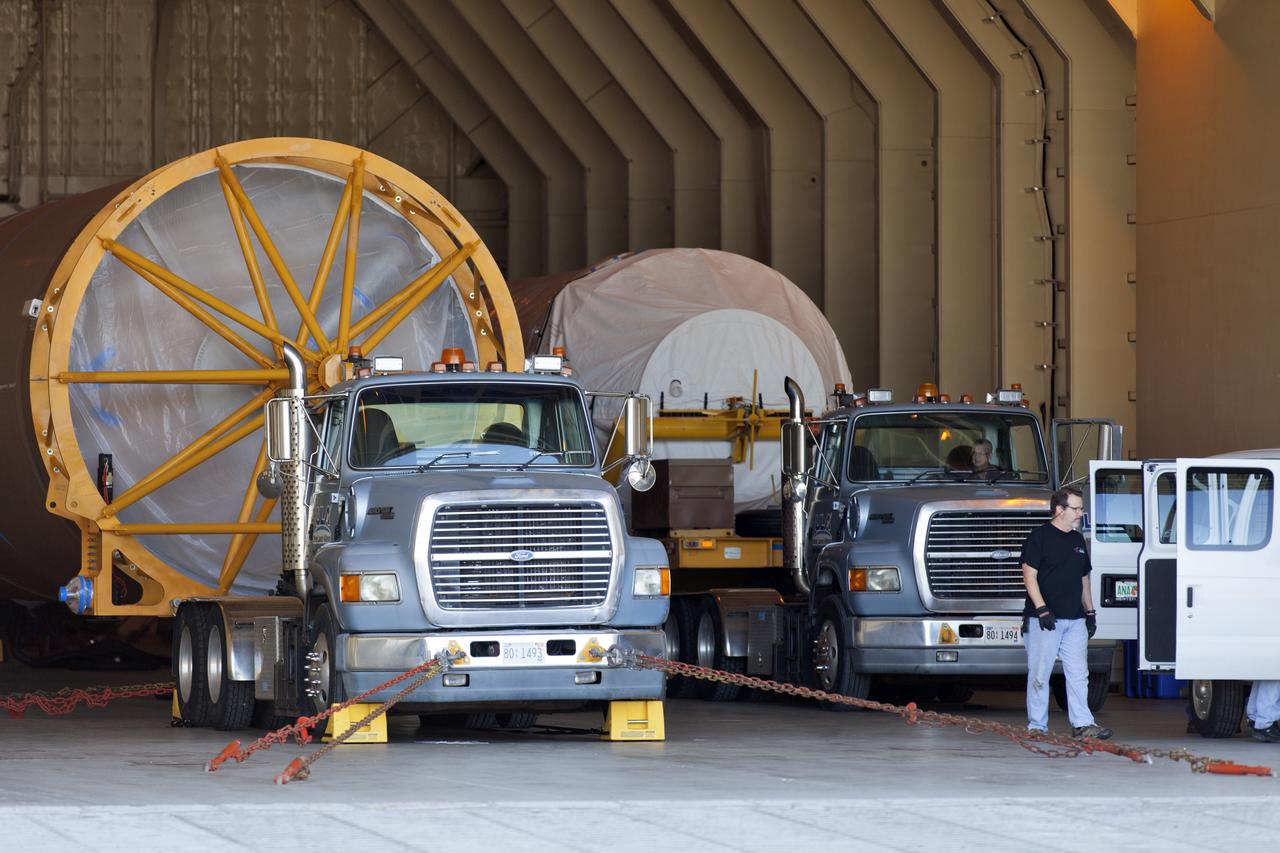
Preparations are underway to offload the United Launch Alliance Atlas V booster and Centaur stage for NOAA's Geostationary Operational Environmental Satellite-S (GOES-S) from the Mariner transport ship at the Army Wharf at Cape Canaveral Air Force Station in Florida. They will be transported to the Atlas Spaceflight Operations Center near Space Launch Complex 41 at CCAFS. GOES-S is the second in a series of four advanced geostationary weather satellites. The satellite is slated to launch aboard the Atlas V rocket March 1.
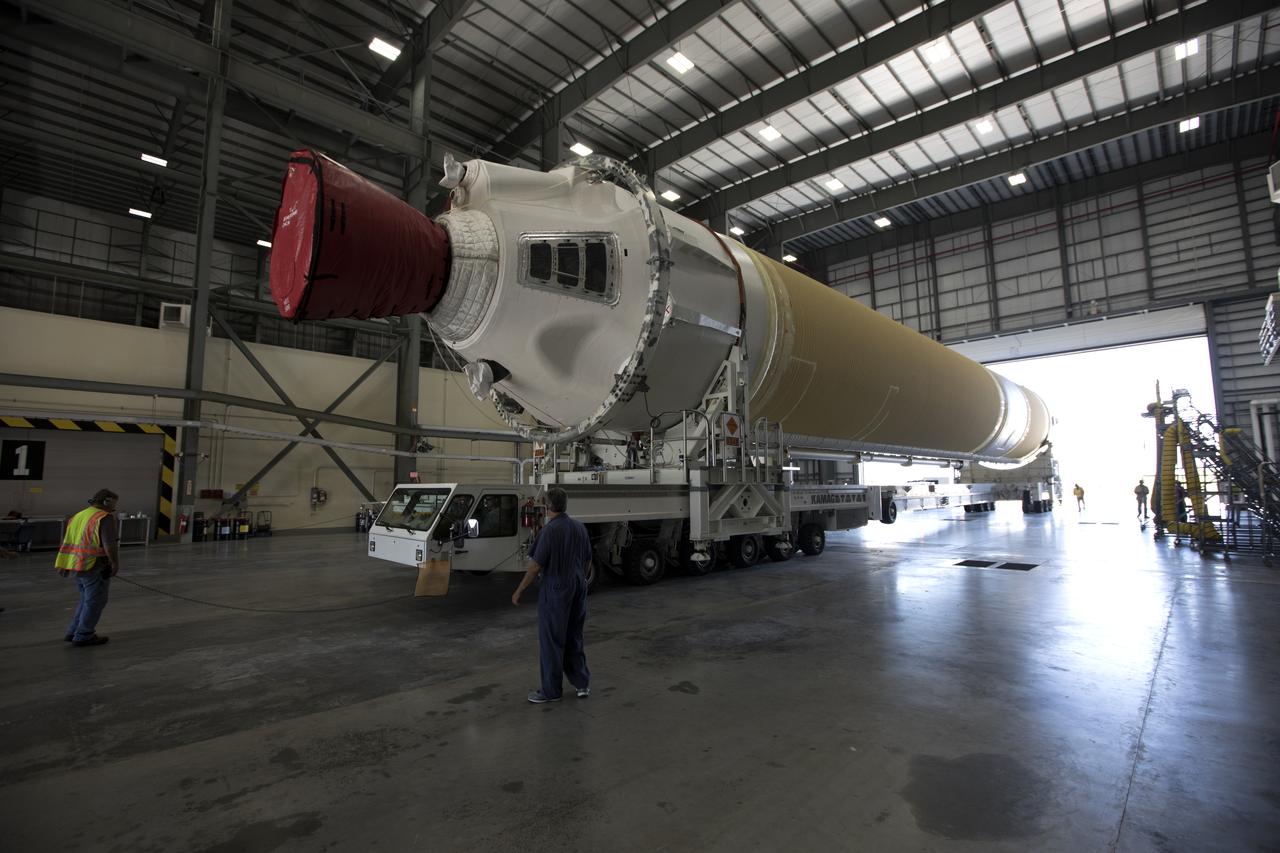
A United Launch Alliance Delta IV Heavy common booster core is transported by truck inside Cape Canaveral Air Force Station's Launch Complex 37 Horizontal Processing Facility. The Delta IV Heavy will launch NASA's upcoming Parker Solar Probe mission. The mission will perform the closest-ever observations of a star when it travels through the Sun's atmosphere, called the corona. The probe will rely on measurements and imaging to revolutionize our understanding of the corona and the Sun-Earth connection. Liftoff atop the Delta IV Heavy rocket is scheduled to take place from Cape Canaveral's Space Launch Complex 37 in summer 2018.
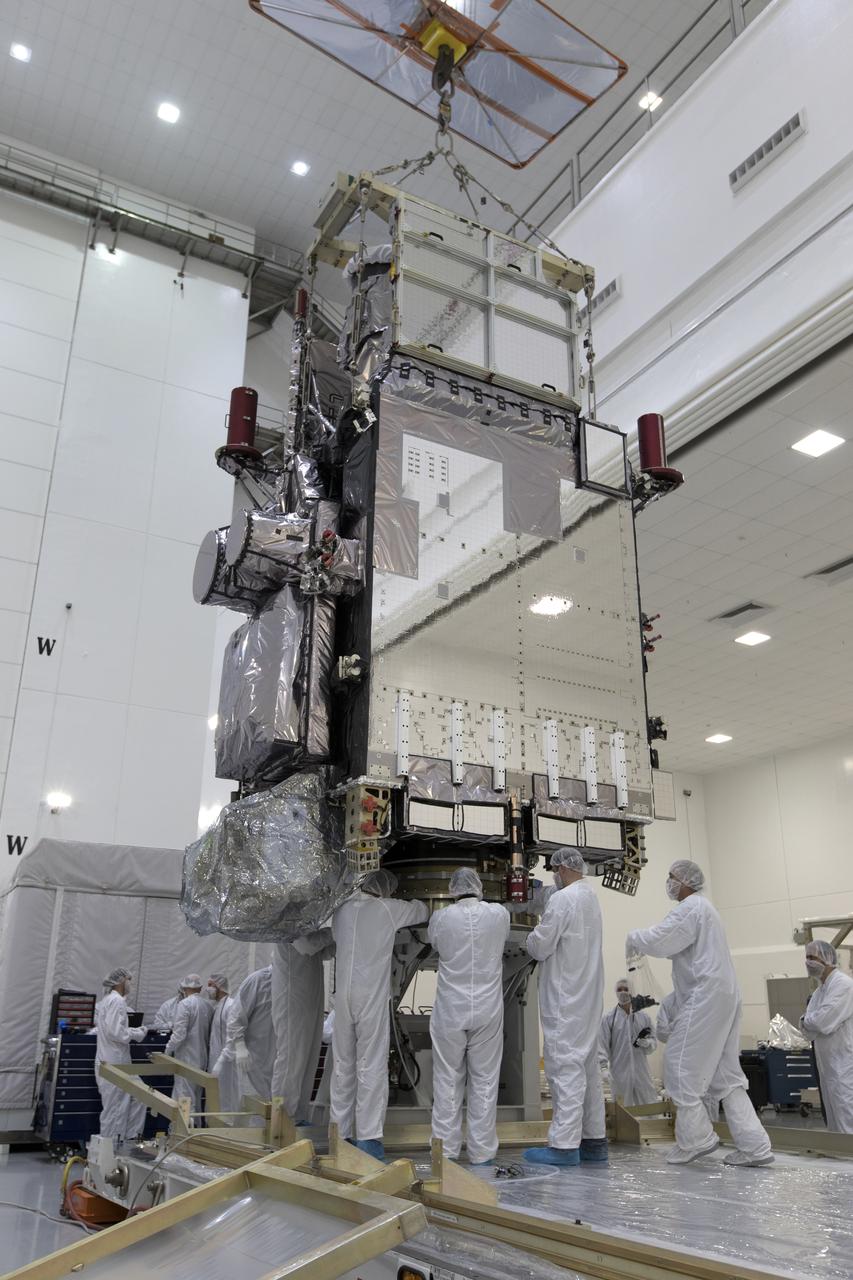
At Astrotech Space Operations in Titusville, Florida, technicians and engineers inspect NOAA's Geostationary Operational Environmental Satellite-S (GOES-S). The facility is located near NASA's Kennedy Space Center. GOES-S is the second in a series of four advanced geostationary weather satellites. The GOES-R series - consisting of the GOES-R, GOES-S, GOES-T and GOES-U spacecraft - will significantly improve the detection and observation of environmental phenomena that directly affect public safety, protection of property and the nation's economic health and prosperity. GOES-S is slated to launch March 1, 2018 aboard a United Launch Alliance Atlas V rocket from Cape Canaveral Air Force Station in Florida.
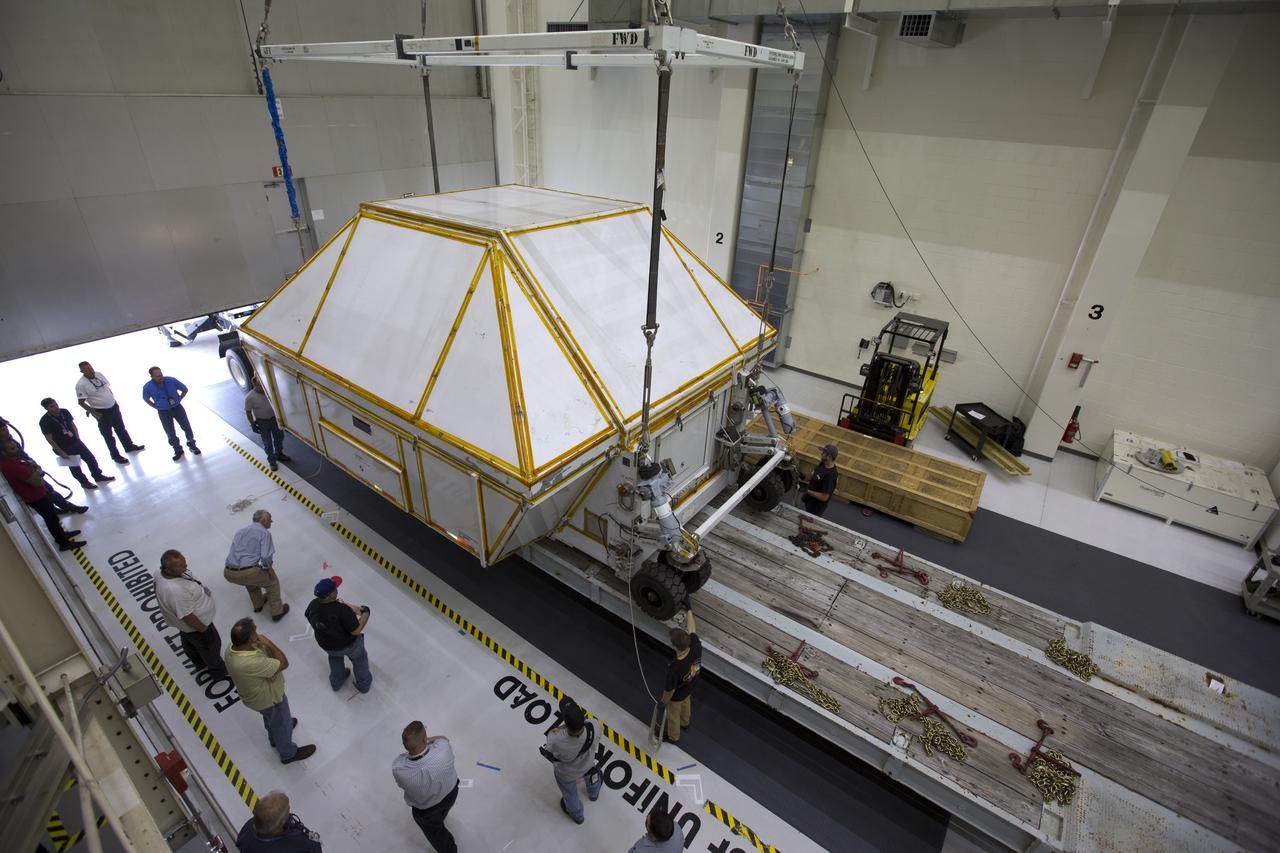
Inside the Neil Armstrong Operations and Checkout Building high bay at NASA's Kennedy Space Center in Florida, the Orion Exploration Mission-1 (EM-1) structural test article inside its transport container, is secured onto a transport vehicle for the move to the Shuttle Landing Facility. The test article will be loaded in NASA's Super Guppy airplane and transported to Lockheed Martin's Denver facility for testing. The Orion spacecraft will launch atop NASA’s Space Launch System rocket on EM-1, its first deep space mission.
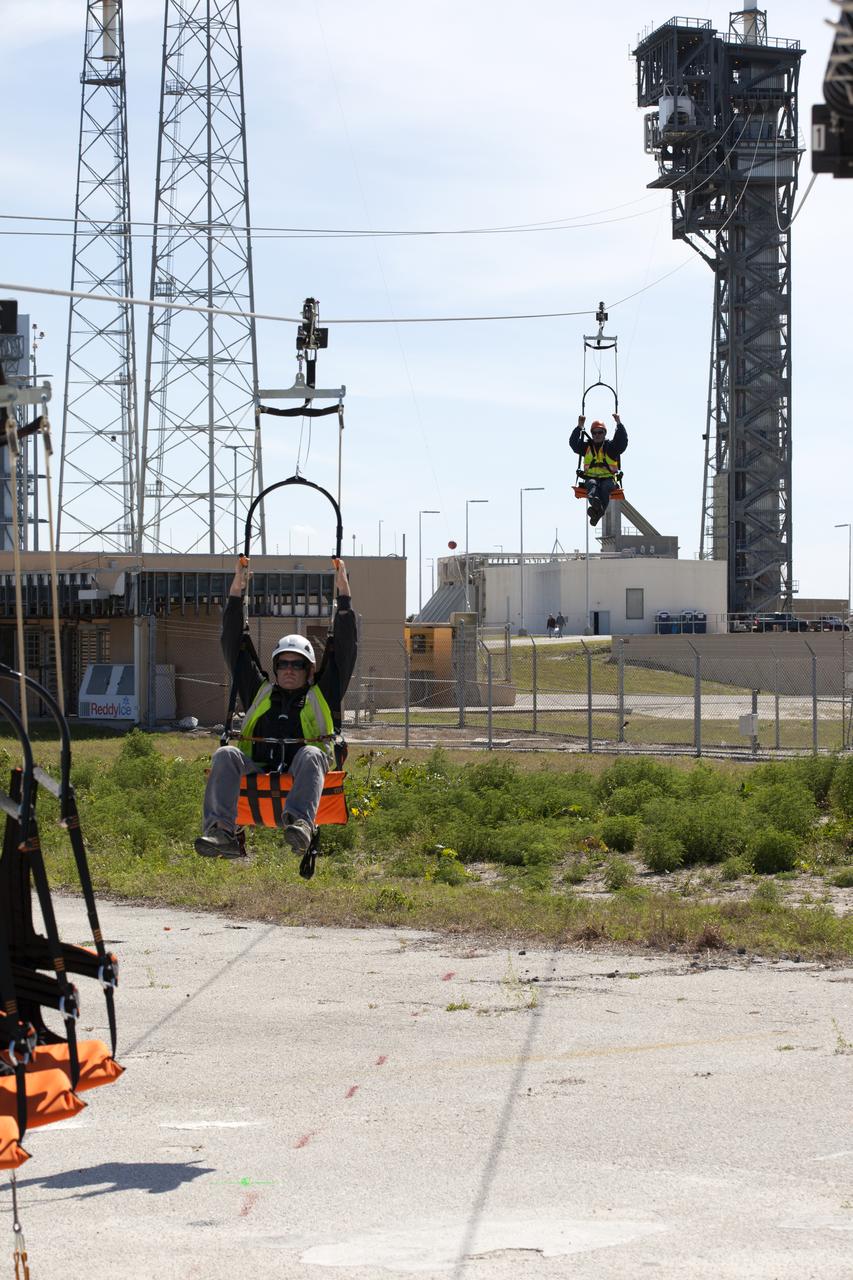
Two engineers evaluate the Emergency Egress System as they ride in folding seats attached to slide wires at Space Launch Complex 41. United Launch Alliance and Boeing continue modifications to the pad in order to host missions by the Boeing CST-100 Starliner carrying astronauts and crew. The system recently completed its final test. In the unlikely event of an emergency prior to liftoff, each person on the Crew Access Tower would get into their own seat attached to the wire and slide more than 1,340 feet to a safe area. The wires are situated 172 feet above the pad deck on level 12 of the tower. The Starliner will launch on a ULA Atlas V on mission to low-Earth orbit including those flying astronauts to the International Space Station during missions by NASA's Commercial Crew Program.
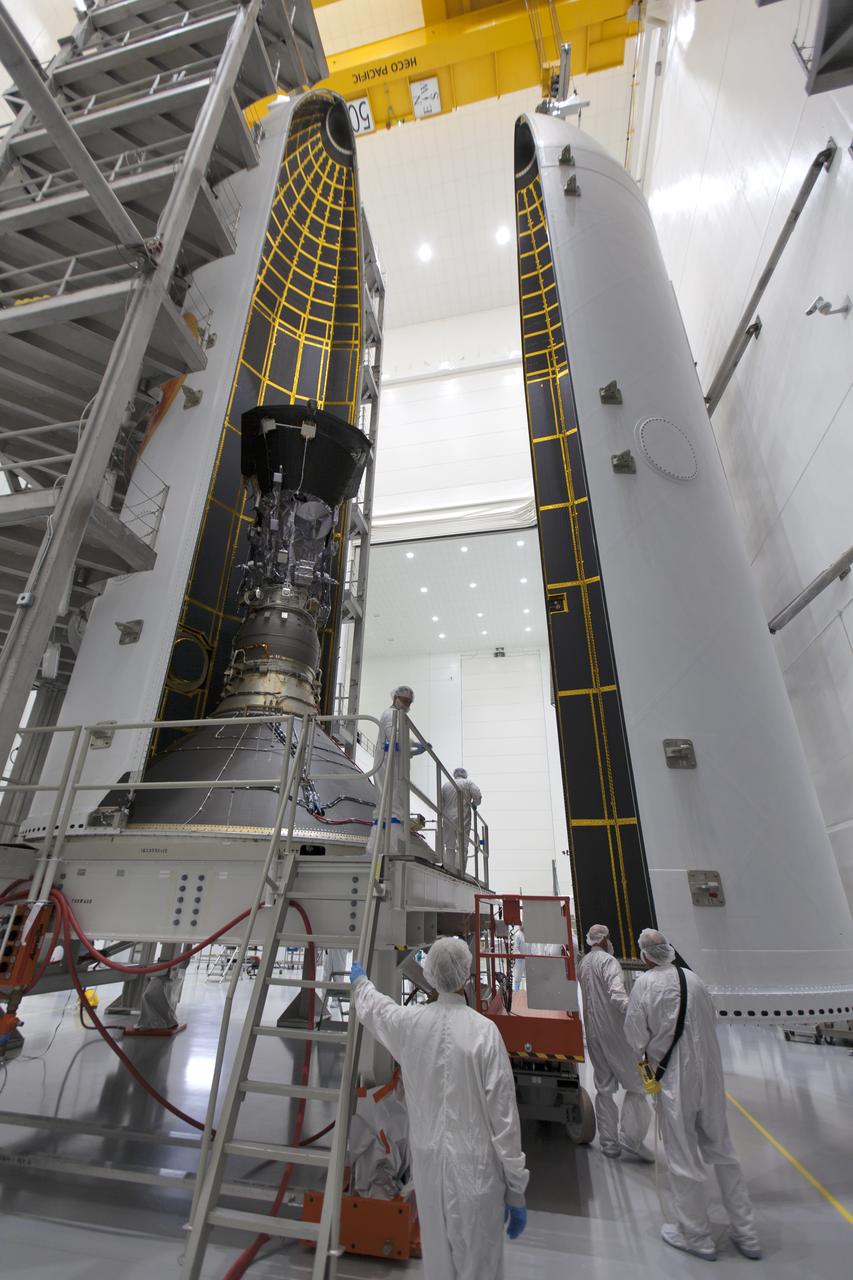
In the Astrotech processing facility in Titusville, Florida, near NASA's Kennedy Space Center, on Thursday, July 19, 2018, technicians and engineers encapsulate NASA's Parker Solar Probe in its payload fairing. The spacecraft is mated to its third stage, built and tested by Northrup Grumman in Chandler, Arizona. The Parker Solar Probe will launch on a United Launch Alliance Delta IV Heavy rocket from Space Launch Complex 37 at Cape Canaveral Air Force Station in Florida. The mission will perform the closest-ever observations of a star when it travels through the Sun's atmosphere, called the corona. The probe will rely on measurements and imaging to revolutionize our understanding of the corona and the Sun-Earth connection.
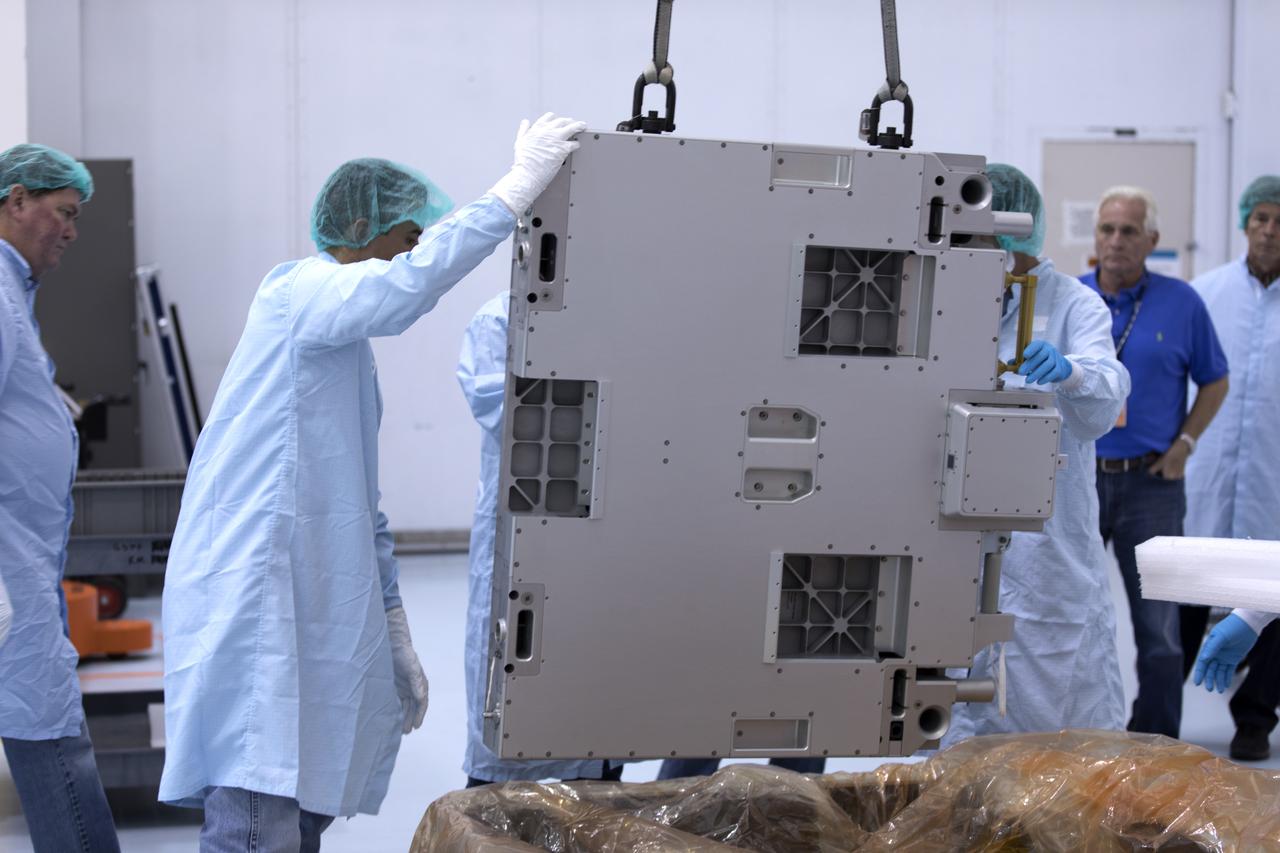
The Materials International Space Station Experiment-Flight Facility, or MISSE-FF, hardware arrived at the Space Station Processing Facility low bay at NASA's Kennedy Space Center in Florida. Technicians assist as a crane is used to lift MISSE out of its shipping container. MISSE will be used to test various materials and computing elements on the exterior of the space station. They will be exposed to the harsh environment of low-Earth orbit, including to a vacuum, atomic oxygen, ultraviolet radiation, direct sunlight and extreme heat and cold. The experiment will provide a better understanding of material durability, from coatings to electronic sensors, which could be applied to future spacecraft designs. MISSE will be delivered to the space station on a future commercial resupply mission.
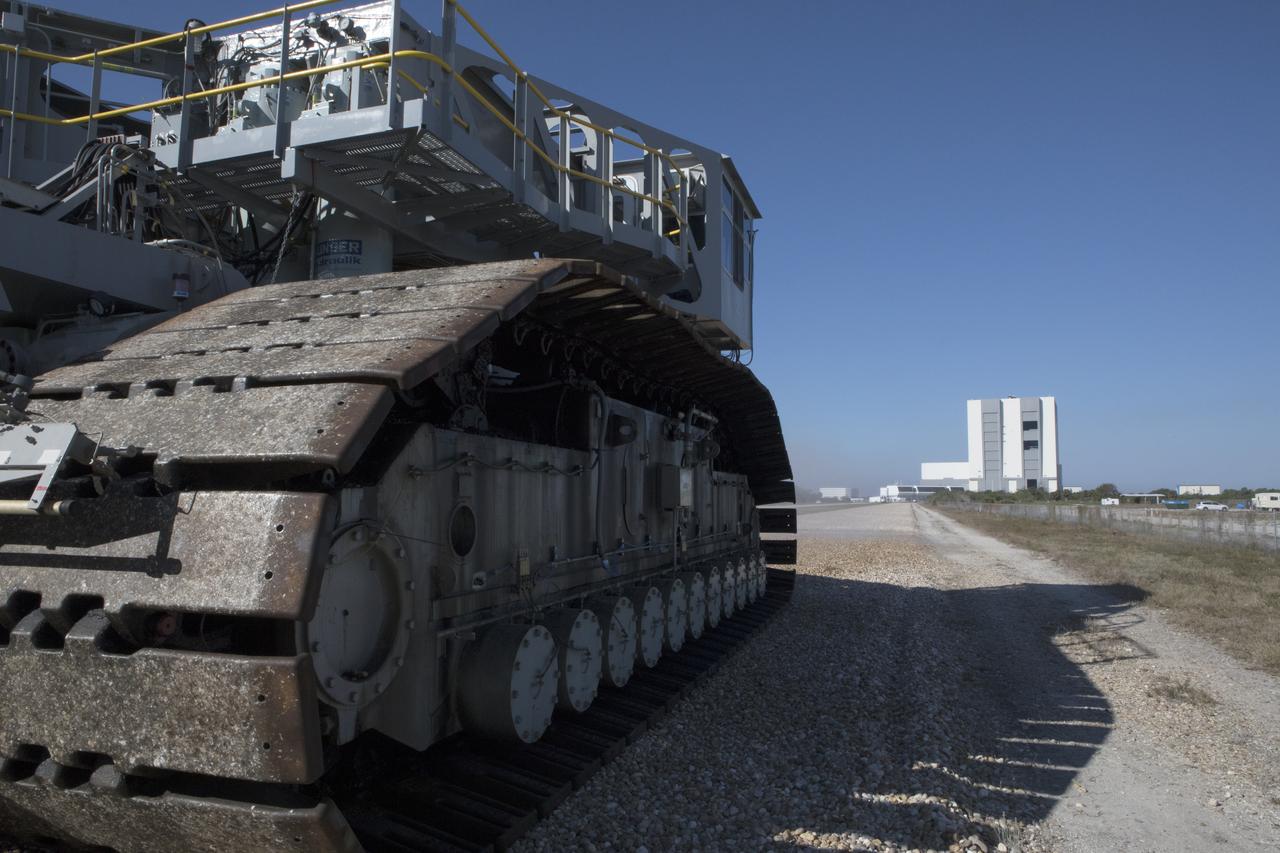
Crawler-transporter 2 (CT-2) moves slowly along the crawlerway toward the Vehicle Assembly Building (in the background) at NASA's Kennedy Space Center in Florida. The crawler took a trip to the Pad A/B split to test upgrades recently completed that will allow the giant vehicle to handle the load of the agency's Space Launch System rocket and Orion spacecraft atop the mobile launcher. The Ground Systems Development and Operations Program oversaw upgrades to the 50-year-old CT-2. New generators, gear assemblies, jacking, equalizing and leveling (JEL) hydraulic cylinders, roller bearings and brakes were installed, and other components were upgraded to prepare for Exploration Mission 1.
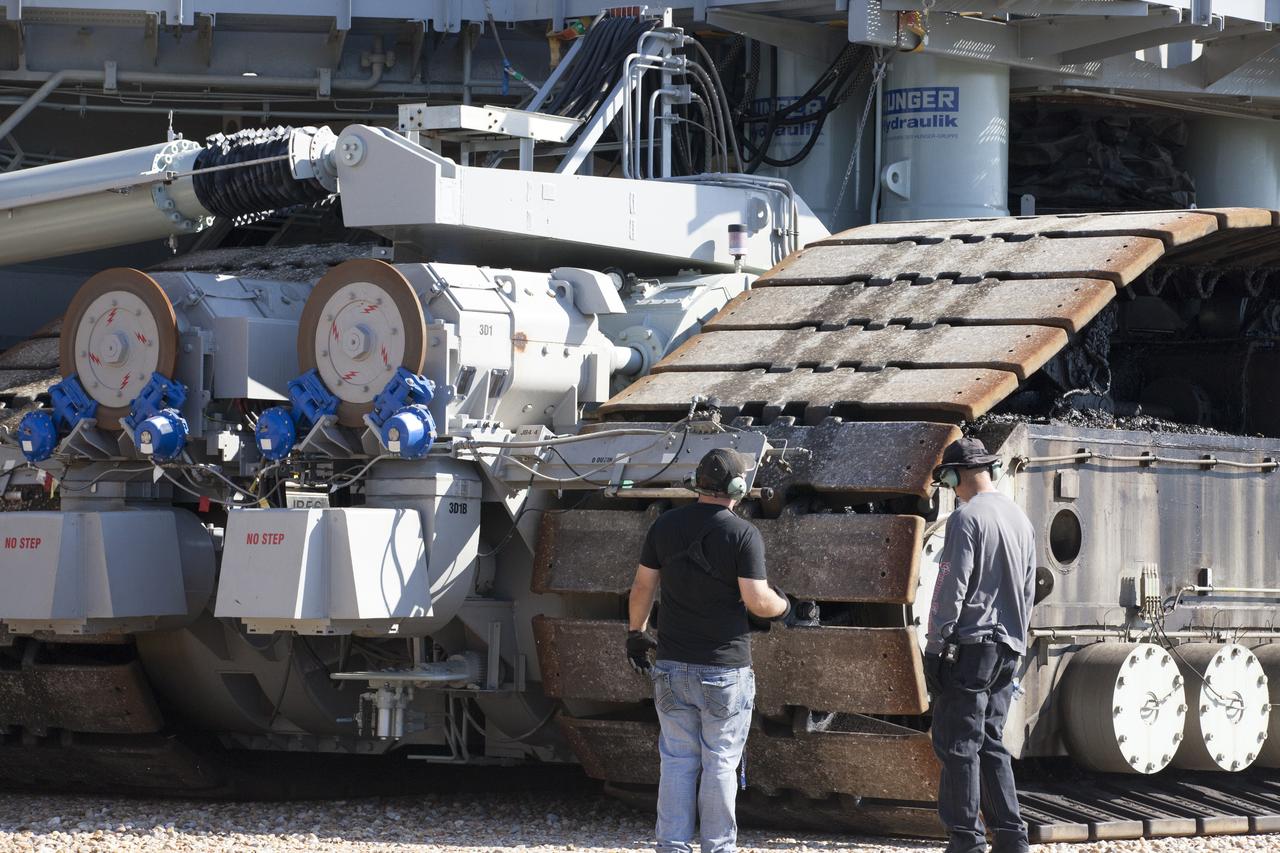
Ground support technicians check out the treads on crawler-transporter 2 (CT-2) as the vehicle moves slowly along the crawlerway toward the Vehicle Assembly Building at NASA's Kennedy Space Center in Florida. The crawler took a trip to the Pad A/B split to test upgrades recently completed that will allow the giant vehicle to handle the load of the agency's Space Launch System rocket and Orion spacecraft atop the mobile launcher. The Ground Systems Development and Operations Program oversaw upgrades to the 50-year-old CT-2. New generators, gear assemblies, jacking, equalizing and leveling (JEL) hydraulic cylinders, roller bearings and brakes were installed, and other components were upgraded to prepare for Exploration Mission 1.
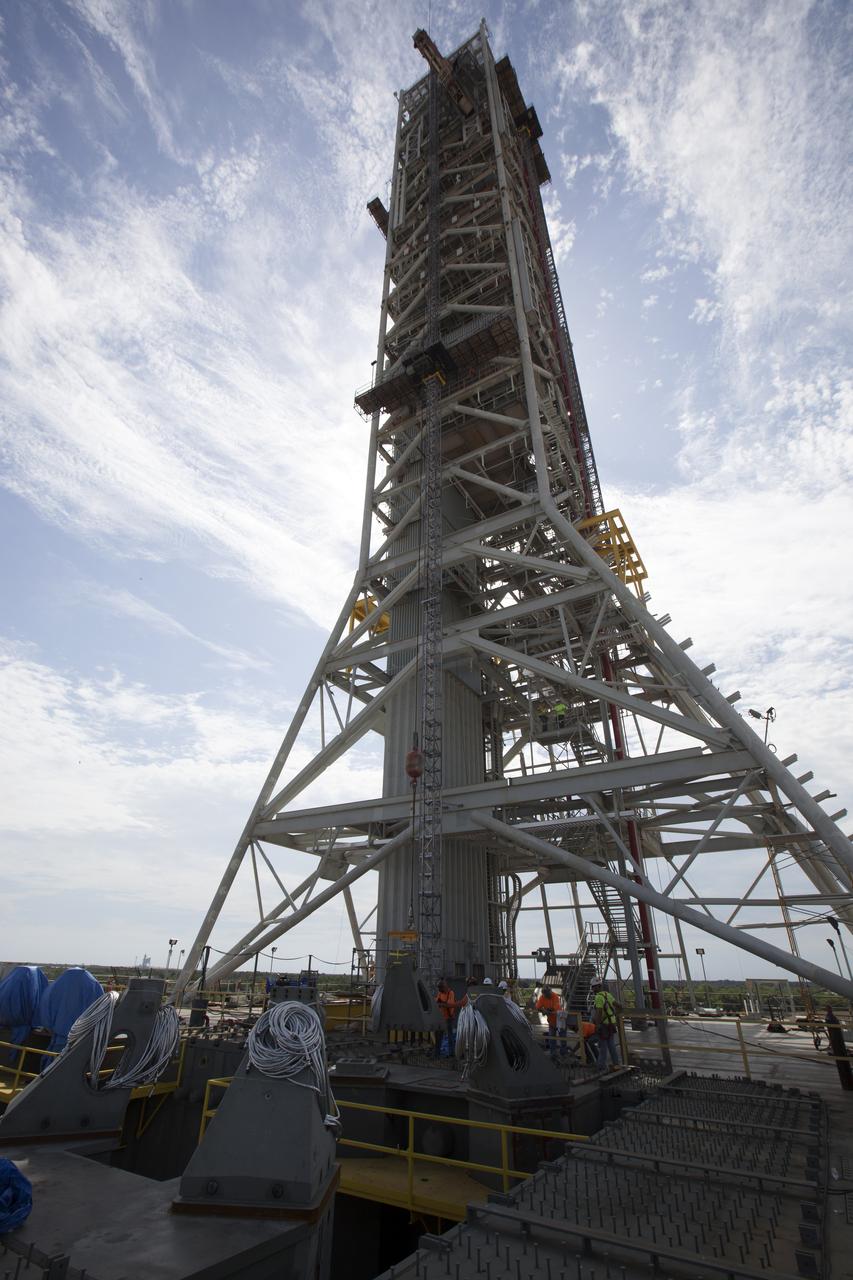
Construction workers on the deck of the mobile launcher at NASA's Kennedy Space Center in Florida, prepare to install a vehicle support post. A total of eight support posts are being installed to support the load of the Space Launch System's (SLS) solid rocket boosters, with four posts for each of the boosters. The support posts are about five feet tall and each weigh about 10,000 pounds. The posts will structurally support the SLS rocket through T-0 and liftoff, and will drop down before vehicle liftoff to avoid contact with the flight hardware. The Ground Systems Development and Operations Program is overseeing installation of the support posts to prepare for the launch of the Orion spacecraft atop the SLS rocket.
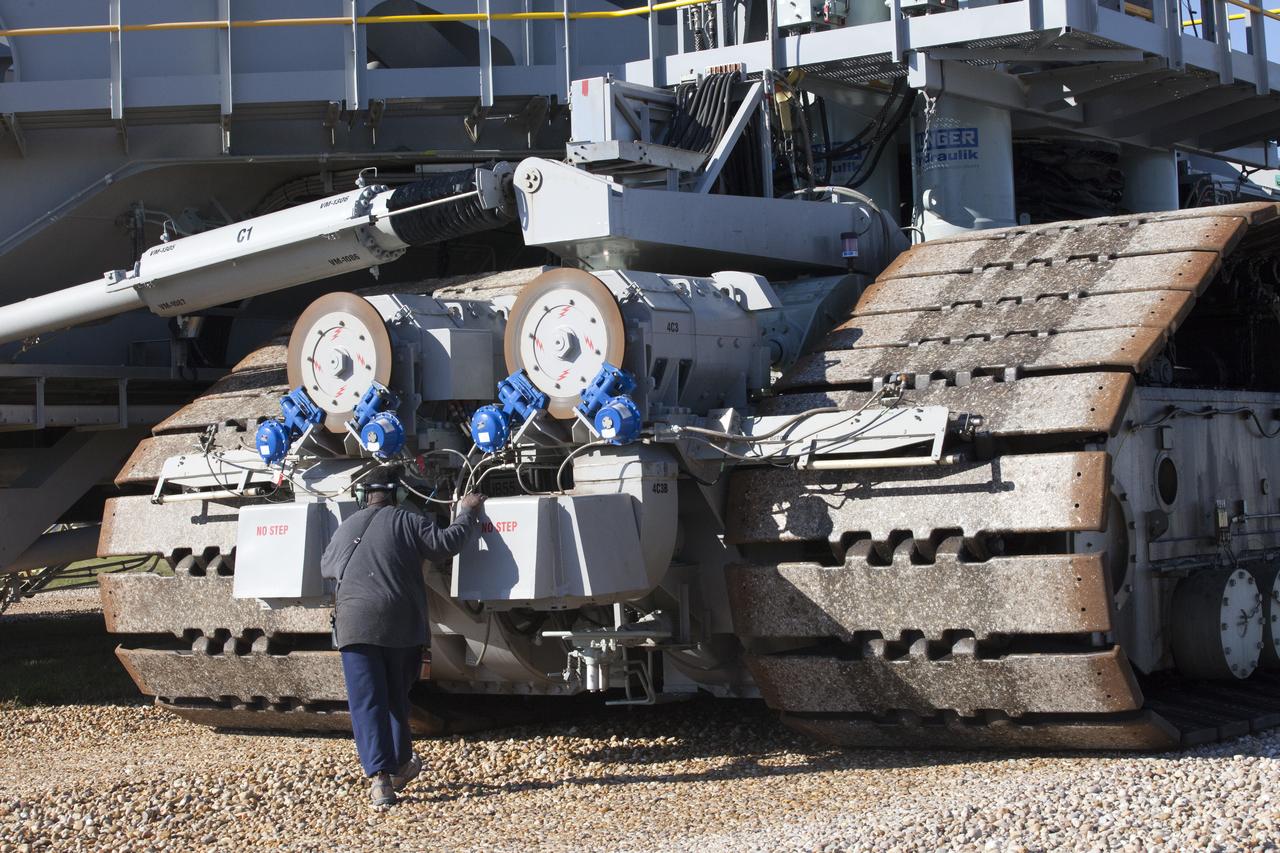
A ground support technician checks the new hydraulic cylinders on crawler-transporter 2 (CT-2) as the vehicle moves slowly along the crawlerway toward the Vehicle Assembly Building at NASA's Kennedy Space Center in Florida. The crawler took a trip to the Pad A/B split to test upgrades recently completed that will allow the giant vehicle to handle the load of the agency's Space Launch System rocket and Orion spacecraft atop the mobile launcher. The Ground Systems Development and Operations Program oversaw upgrades to the 50-year-old CT-2. New generators, gear assemblies, jacking, equalizing and leveling (JEL) hydraulic cylinders, roller bearings and brakes were installed, and other components were upgraded to prepare for Exploration Mission 1.
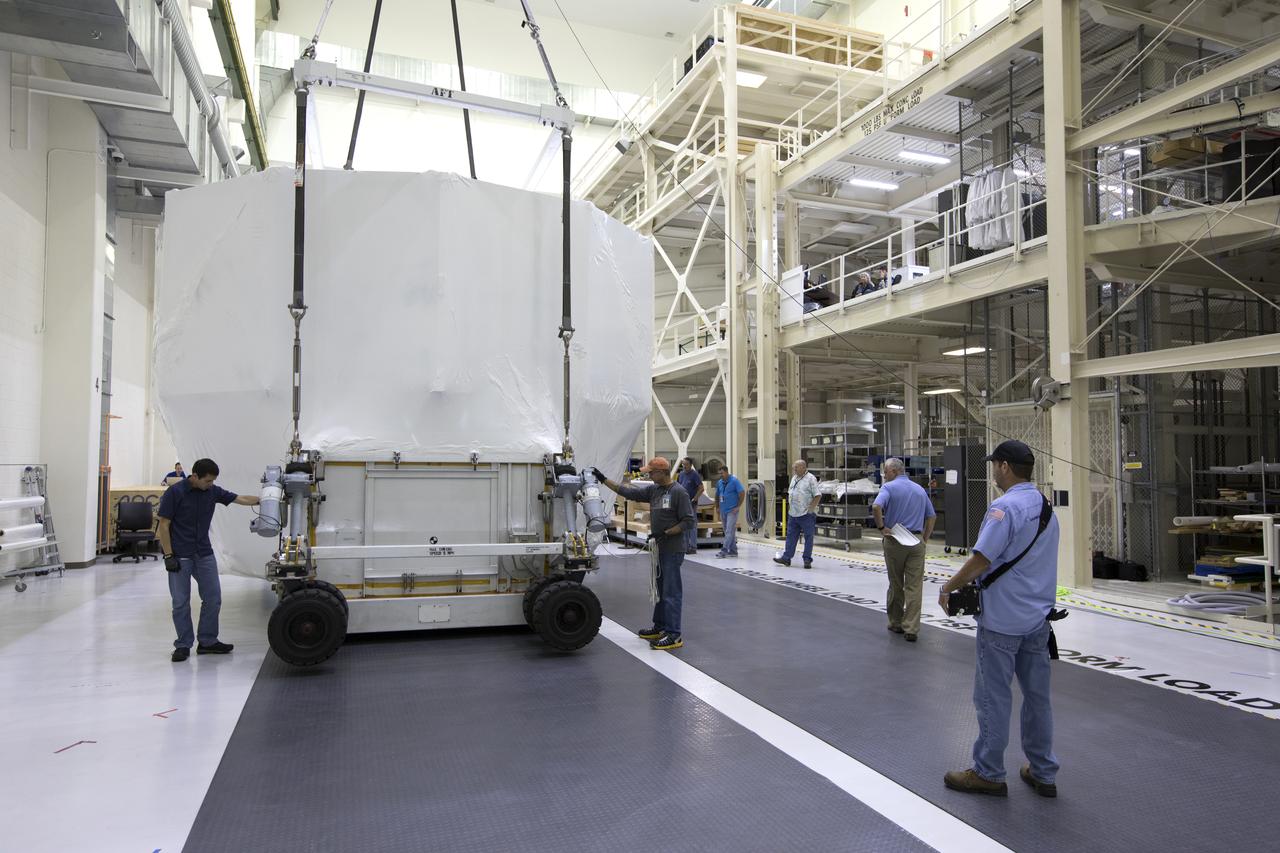
The Orion service module structural test article for Exploration Mission-1 (EM-1), built by the European Space Agency, is prepared for shipment to Lockheed Martin's Denver facility to undergo testing. Inside the Neil Armstrong Operations and Checkout Building high bay at NASA's Kennedy Space Center in Florida, workers secure the protective covering around the module and a crane lifts the module, secured on stand, for the move to the transport truck. The Orion spacecraft will launch atop the agency's Space Launch System rocket on EM-1 in 2019.

John "JC" Carver, a payload integration engineer with NASA Kennedy Space Center's Test and Operations Support Contract, places Arabidopsis thaliana plants harvested from the Advanced Plant Habitat (APH) Flight Unit No. 1 into a Mini ColdBag that quickly freezes the plants. The harvest is part of an ongoing verification test of the APH unit, which is located inside the International Space Station Environmental Simulator in Kennedy's Space Station Processing Facility. The APH undergoing testing at Kennedy is identical to one on the station and uses red, green and broad-spectrum white LED lights to grow plants in an environmentally controlled chamber. The seeds grown during the verification test will be grown on the station to help scientists understand how these plants adapt to spaceflight.
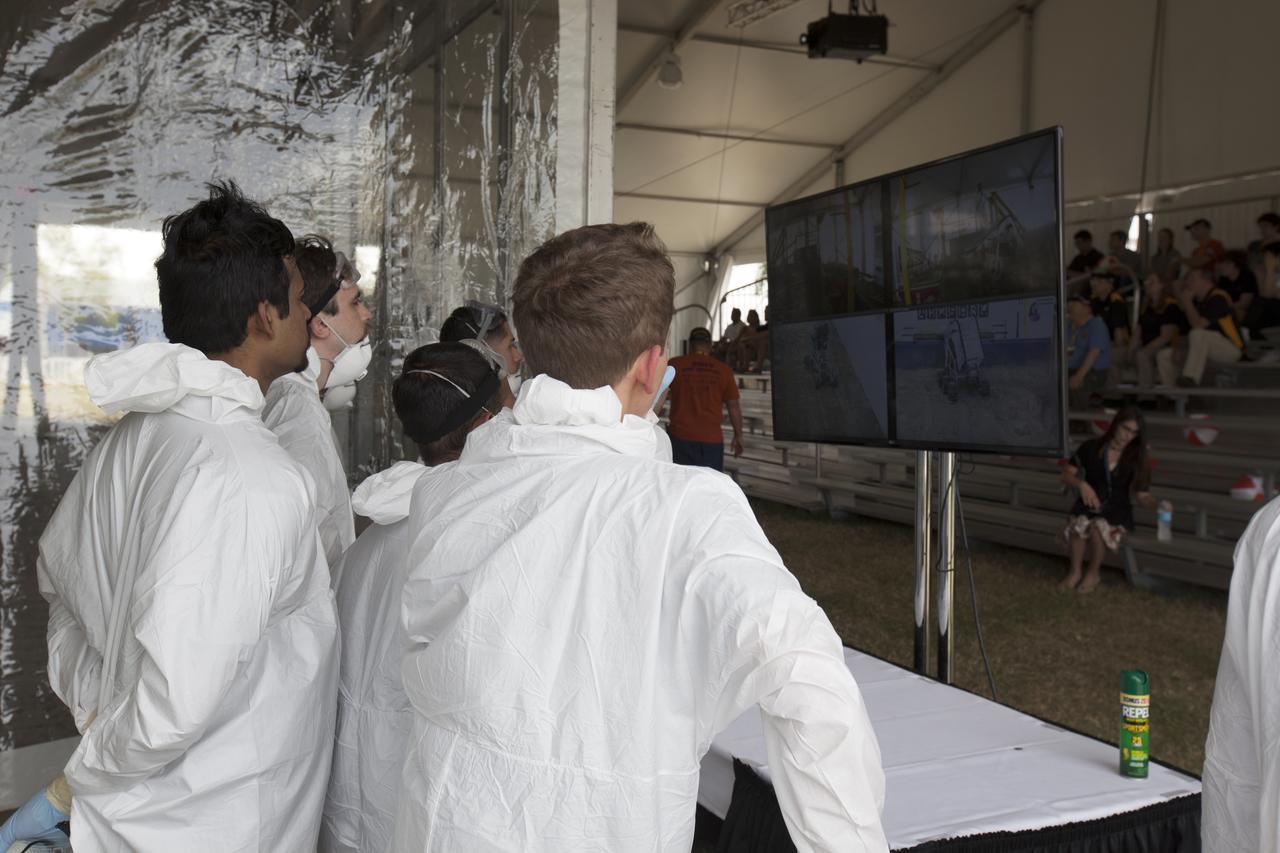
College team members watch a live display of their mining robots during test runs in the mining arena at NASA's 8th Annual Robotic Mining Competition at the Kennedy Space Center Visitor Complex in Florida. More than 40 student teams from colleges and universities around the U.S. will use their uniquely-designed mining robots to dig in a supersized sandbox filled with BP-1, or simulated Martian soil, and participate in other competition requirements. The Robotic Mining Competition is a NASA Human Exploration and Operations Mission Directorate project designed to encourage students in science, technology, engineering and math, or STEM fields. The project provides a competitive environment to foster innovative ideas and solutions that could be used on NASA's Journey to Mars.
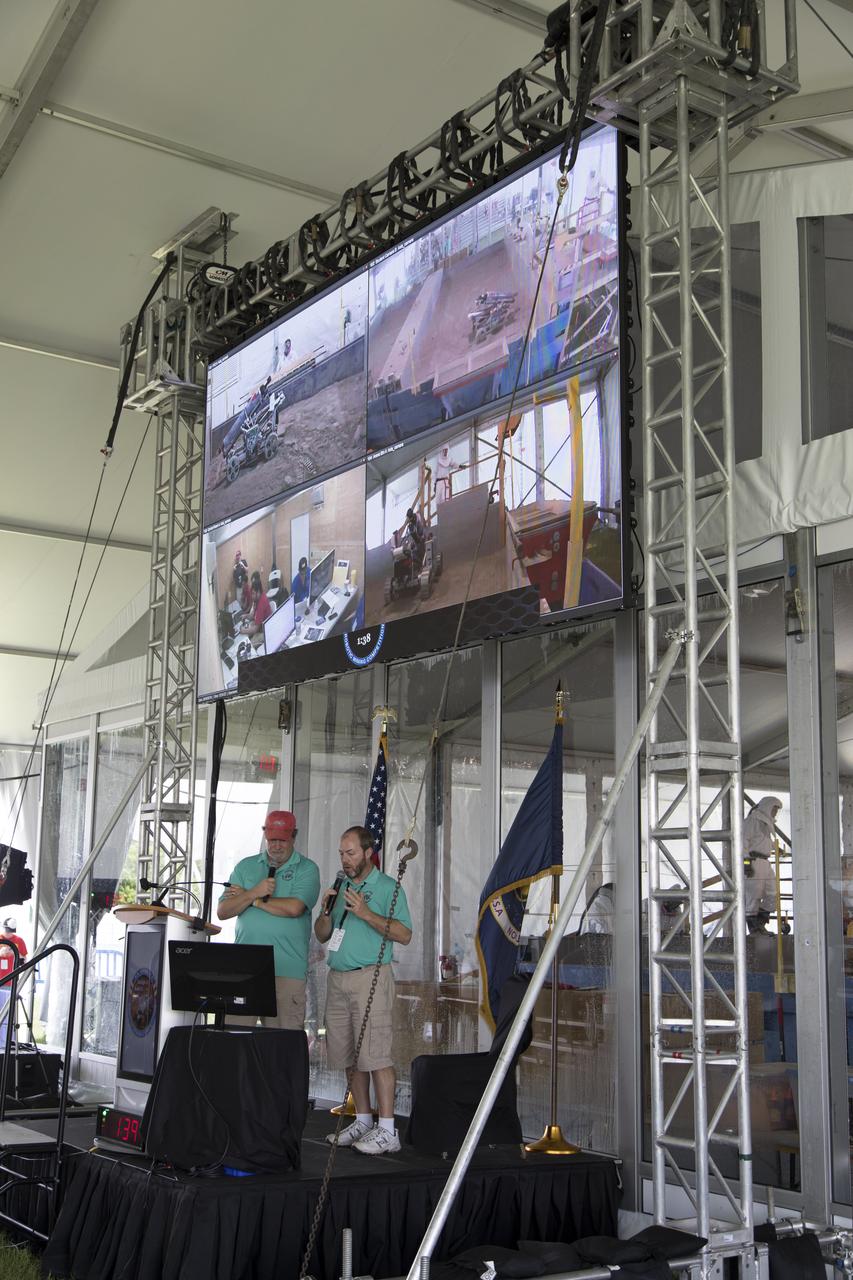
During the third day of NASA's 9th Robotic Mining Competition, May 16, Al Feinberg, left, with Kennedy Space Center's Communication and Public Engagement, and Kurt Leucht, with Kennedy's Engineering Directorate, provide commentary as robot miners dig in the dirt in the mining arena at NASA's Kennedy Space Center Visitor Complex in Florida. More than 40 student teams from colleges and universities around the U.S. will use their mining robots to dig in a supersized sandbox filled with BP-1, or simulated Lunar soil, gravel and rocks, and participate in other competition requirements. The Robotic Mining Competition is a NASA Human Exploration and Operations Mission Directorate project designed to encourage students in science, technology, engineering and math, or STEM fields. The project provides a competitive environment to foster innovative ideas and solutions that could be used on NASA's deep space missions.
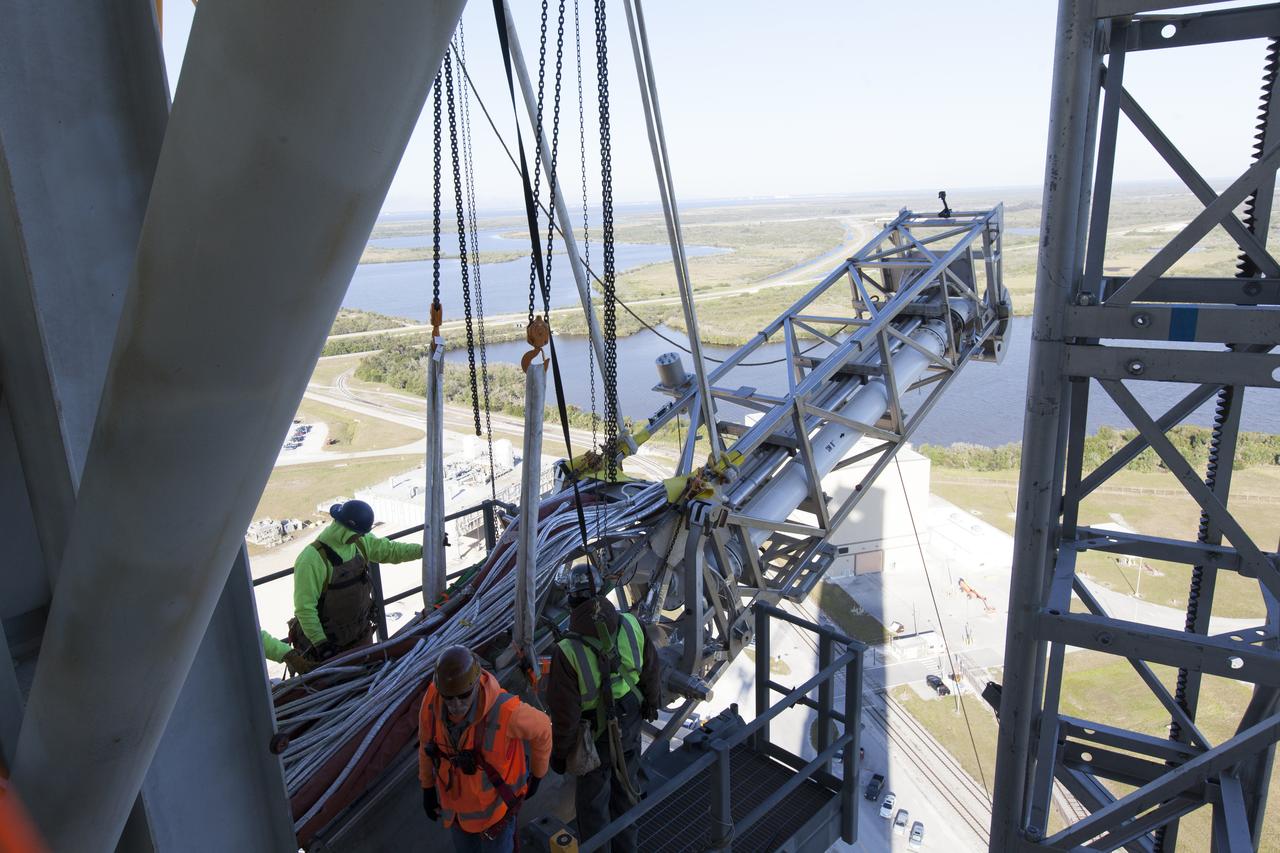
Construction workers assist as a crane and rigging are used to position the Orion Service Module Umbilical (OSMU) for installation high up on the mobile launcher tower at NASA's Kennedy Space Center in Florida. The mobile launcher tower will be equipped with a number of lines, called umbilicals, that will connect to the Space Launch System rocket and Orion spacecraft for Exploration Mission-1 (EM-1). The OSMU will be located high on the mobile launcher tower and, prior to launch, will transfer liquid coolant for the electronics and air for the Environmental Control System to the Orion service module that houses these critical systems to support the spacecraft. EM-1 is scheduled to launch in 2018. The Ground Systems Development and Operations Program is overseeing installation of the umbilicals.
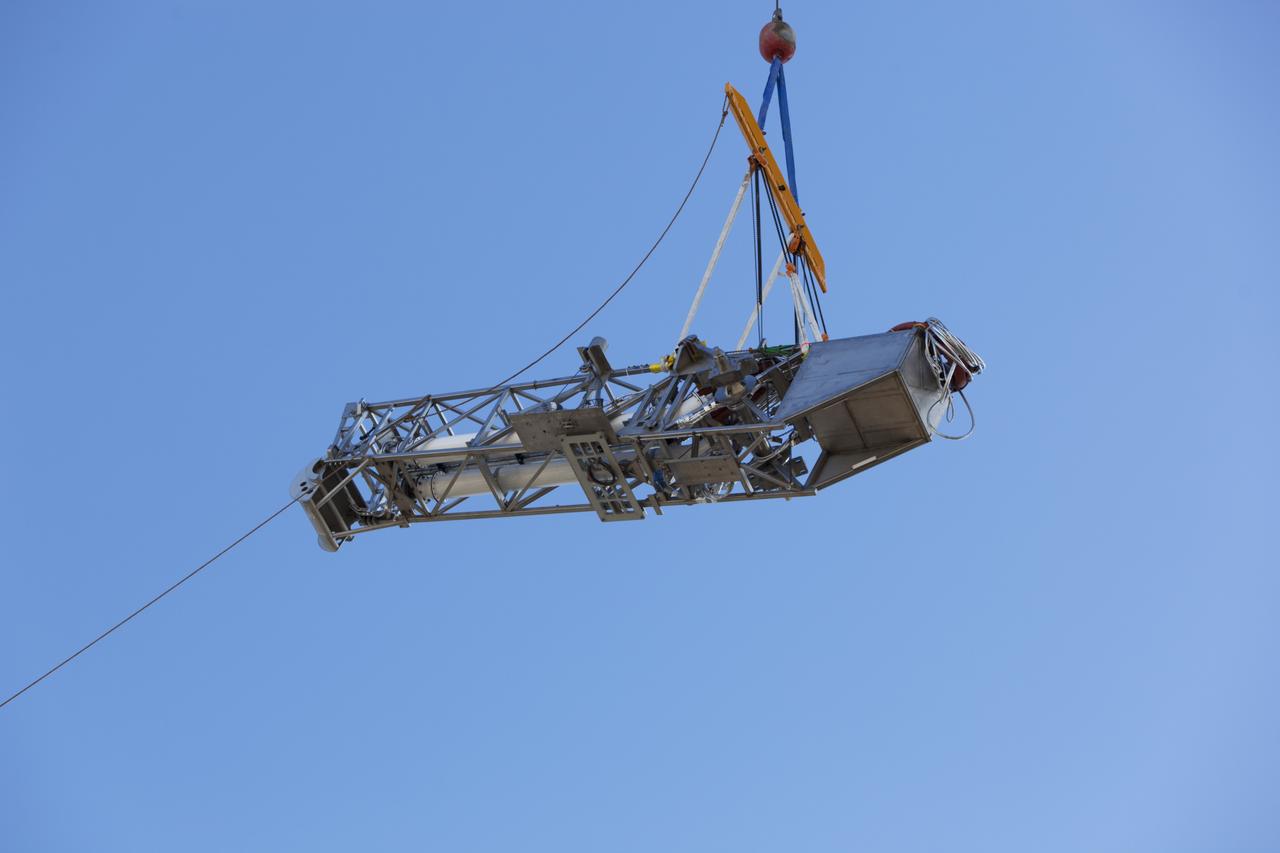
Seeming to hang in midair, the Orion Service Module Umbilical (OSMU) is lifted high up by crane for installation on the mobile launcher tower at NASA's Kennedy Space Center in Florida. The mobile launcher tower will be equipped with a number of lines, called umbilicals, that will connect to the Space Launch System rocket and Orion spacecraft for Exploration Mission-1 (EM-1). The OSMU will be located high on the mobile launcher tower and, prior to launch, will transfer liquid coolant for the electronics and air for the Environmental Control System to the Orion service module that houses these critical systems to support the spacecraft. EM-1 is scheduled to launch in 2018. The Ground Systems Development and Operations Program is overseeing installation of the umbilicals.
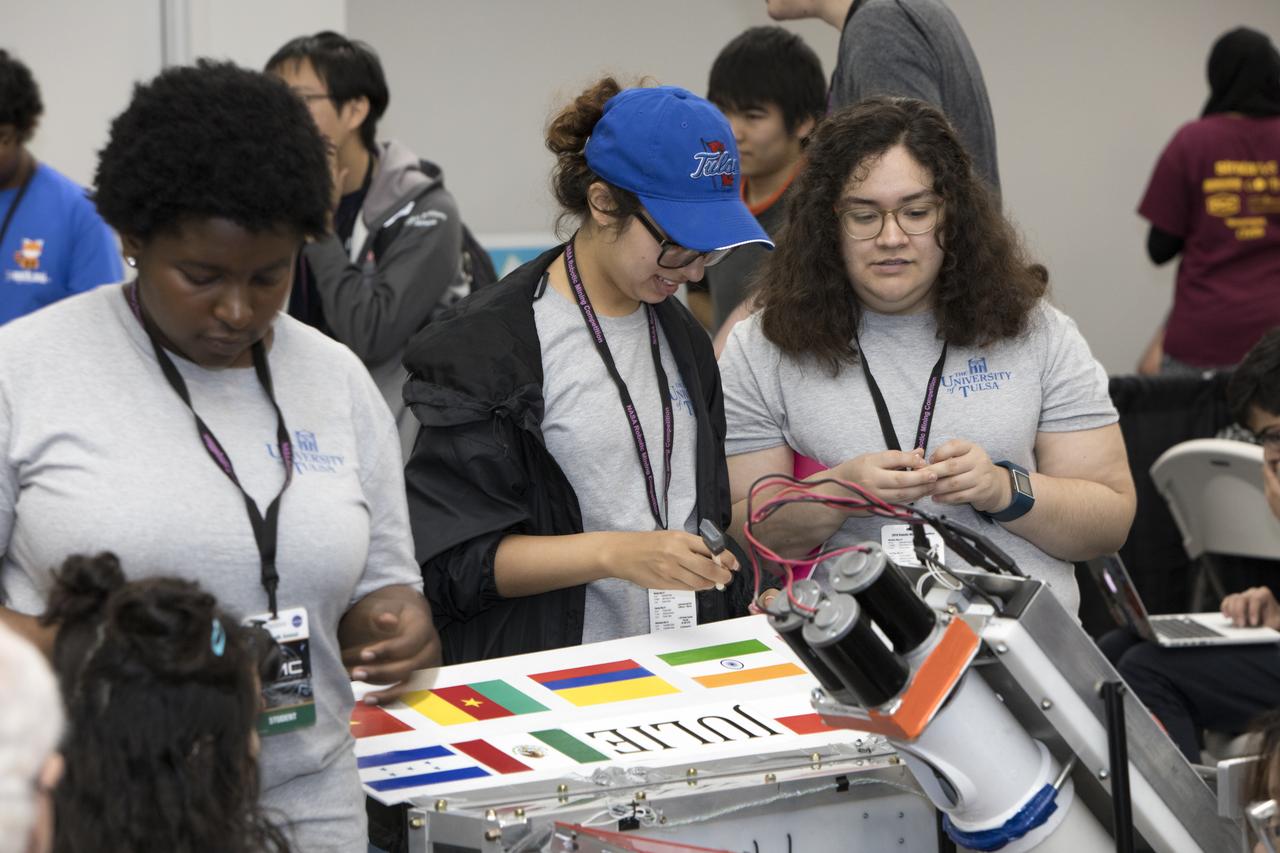
On the second day of NASA's 9th Robotic Mining Competition, May 15, team members from the University of Tulsa work on their robot miner in the RobotPits in the Educator Resource Center at Kennedy Space Center Visitor Complex in Florida. More than 40 student teams from colleges and universities around the U.S. will use their mining robots to dig in a supersized sandbox filled with BP-1, or simulated Lunar soil, gravel and rocks, and participate in other competition requirements. The Robotic Mining Competition is a NASA Human Exploration and Operations Mission Directorate project designed to encourage students in science, technology, engineering and math, or STEM fields. The project provides a competitive environment to foster innovative ideas and solutions that could be used on NASA's deep space missions.
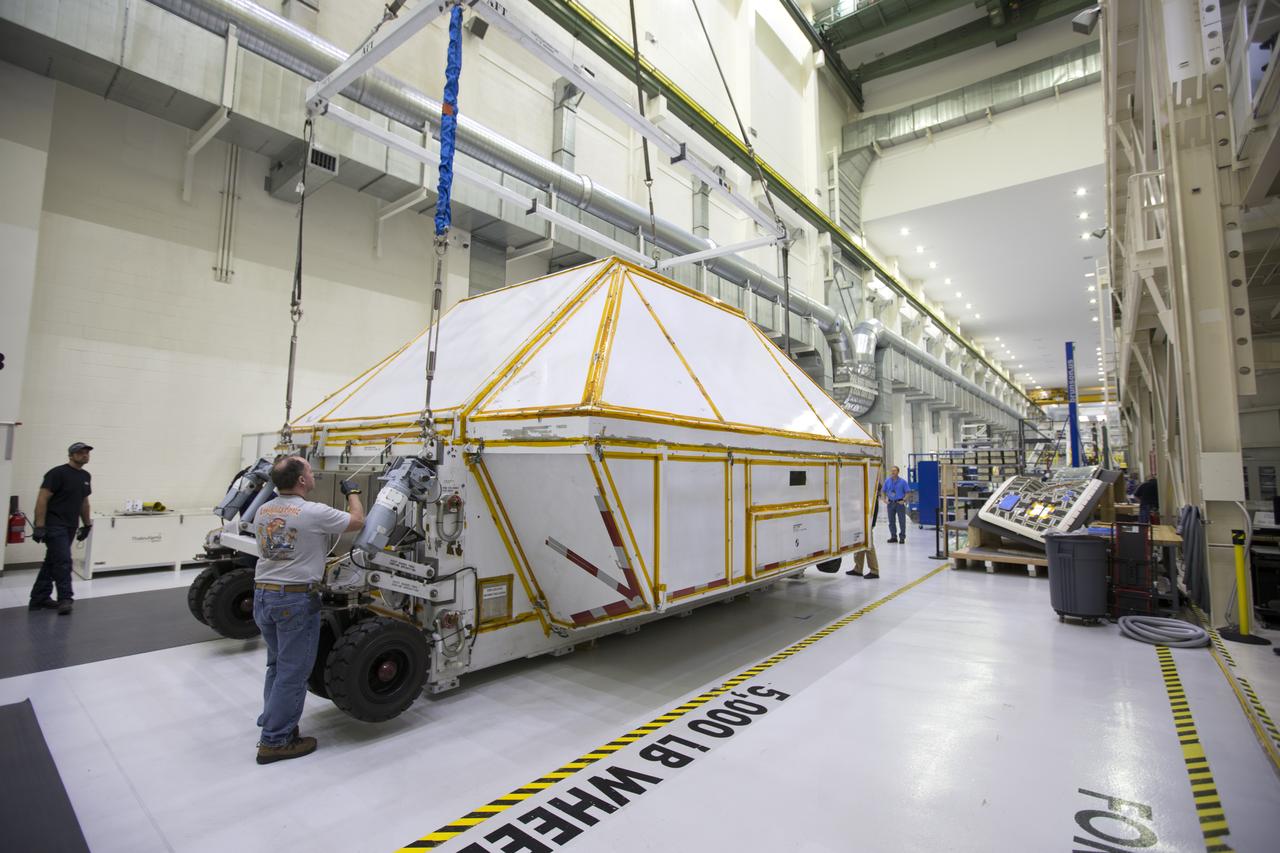
Inside the Neil Armstrong Operations and Checkout Building high bay at NASA's Kennedy Space Center in Florida, the Orion Exploration Mission-1 (EM-1) structural test article is secured inside its transport container. A crane is used to move the container toward a transport vehicle for the move to the Shuttle Landing Facility. The test article will be loaded in NASA's Super Guppy airplane and transported to Lockheed Martin's Denver facility for testing. The Orion spacecraft will launch atop NASA’s Space Launch System rocket on EM-1, its first deep space mission.

Engineers evaluate the Emergency Egress System as they ride in folding seats attached to slide wires at Space Launch Complex 41. United Launch Alliance and Boeing continue modifications to the pad in order to host missions by the Boeing CST-100 Starliner carrying astronauts and crew. The system recently completed its final test. In the unlikely event of an emergency prior to liftoff, each person on the Crew Access Tower would get into their own seat attached to the wire and slide more than 1,340 feet to a safe area. The wires are situated 172 feet above the pad deck on level 12 of the tower. The Starliner will launch on a ULA Atlas V on mission to low-Earth orbit including those flying astronauts to the International Space Station during missions by NASA's Commercial Crew Program.

On the second day of NASA's 9th Robotic Mining Competition, May 15, team members from Mississippi State University work on their robot miner in the RobotPits in the Educator Resource Center at Kennedy Space Center Visitor Complex in Florida. At far right is Kennedy Space Center Director Bob Cabana. More than 40 student teams from colleges and universities around the U.S. will use their mining robots to dig in a supersized sandbox filled with BP-1, or simulated Lunar soil, gravel and rocks, and participate in other competition requirements. The Robotic Mining Competition is a NASA Human Exploration and Operations Mission Directorate project designed to encourage students in science, technology, engineering and math, or STEM fields. The project provides a competitive environment to foster innovative ideas and solutions that could be used on NASA's deep space missions.
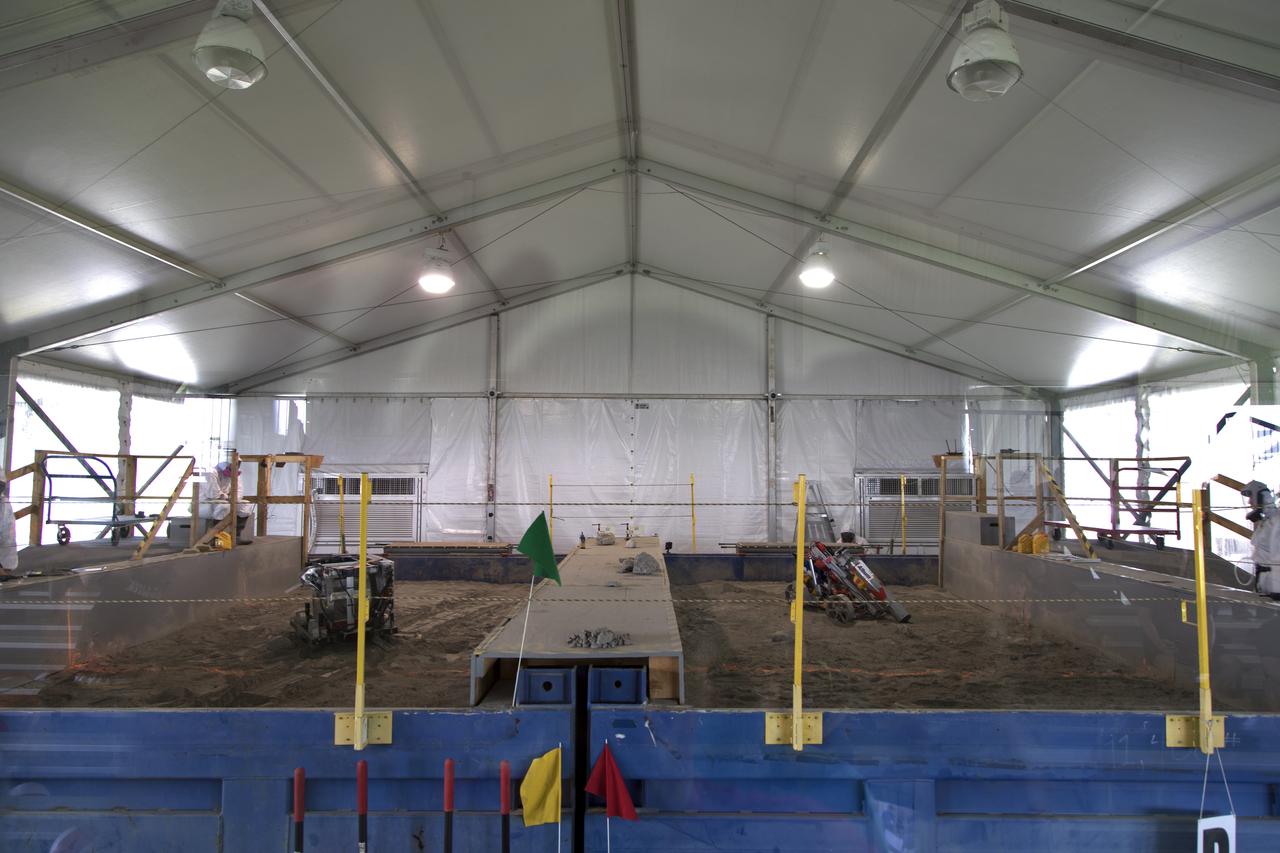
On the third day of NASA's 9th Robotic Mining Competition, May 16, two robot miners dig in the dirt in the mining arena at NASA's Kennedy Space Center Visitor Complex in Florida. More than 40 student teams from colleges and universities around the U.S. will use their mining robots to dig in a supersized sandbox filled with BP-1, or simulated Lunar soil, gravel and rocks, and participate in other competition requirements. The Robotic Mining Competition is a NASA Human Exploration and Operations Mission Directorate project designed to encourage students in science, technology, engineering and math, or STEM fields. The project provides a competitive environment to foster innovative ideas and solutions that could be used on NASA's deep space missions.
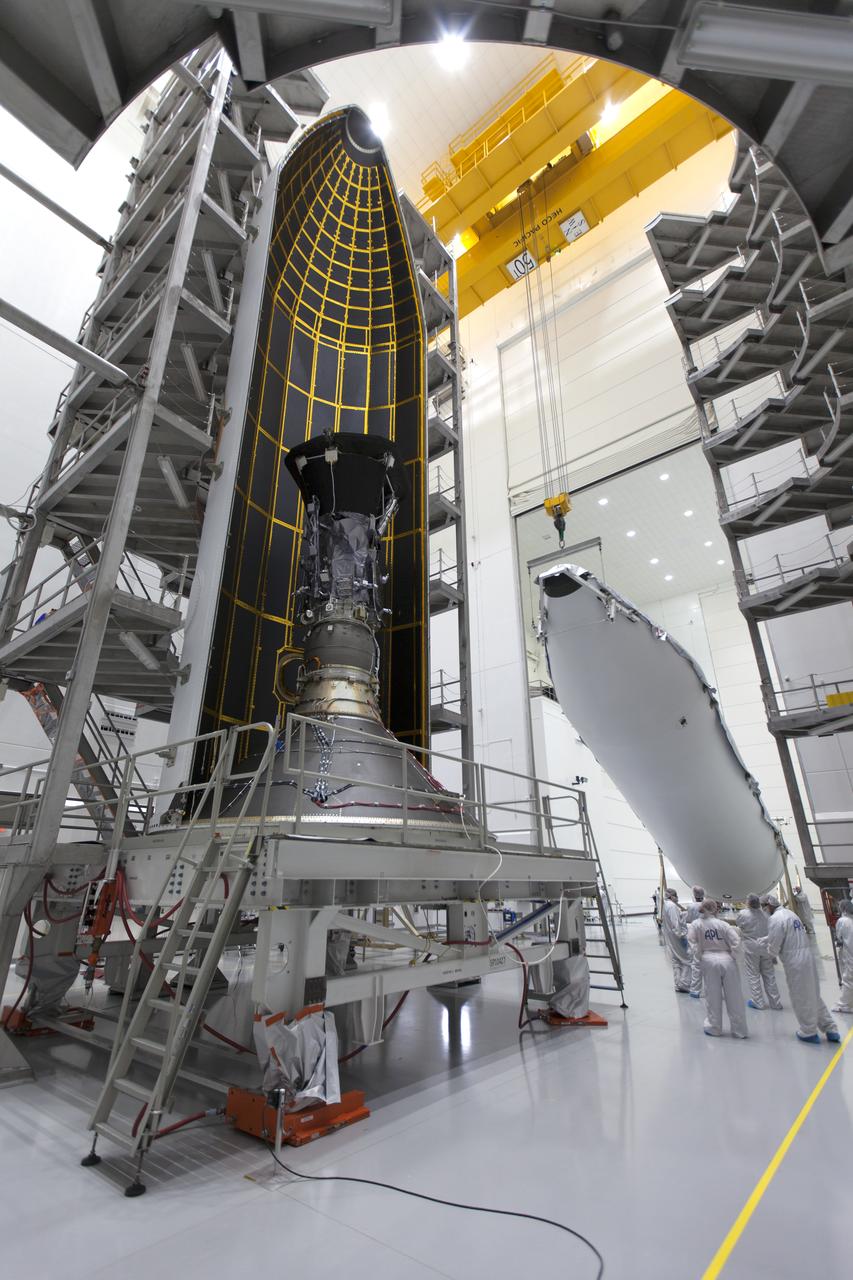
In the Astrotech processing facility in Titusville, Florida, near NASA's Kennedy Space Center, on Thursday, July 19, 2018, NASA's Parker Solar Probe is being encapsulated in its payload fairing. The spacecraft is mated to its third stage, built and tested by Northrup Grumman in Chandler, Arizona. The Parker Solar Probe will launch on a United Launch Alliance Delta IV Heavy rocket from Space Launch Complex 37 at Cape Canaveral Air Force Station in Florida. The mission will perform the closest-ever observations of a star when it travels through the Sun's atmosphere, called the corona. The probe will rely on measurements and imaging to revolutionize our understanding of the corona and the Sun-Earth connection.

John "JC" Carver, a payload integration engineer with NASA Kennedy Space Center's Test and Operations Support Contract, uses a FluorPen to measure the chlorophyll fluorescence of Arabidopsis thaliana plants inside the growth chamber of the Advanced Plant Habitat (APH) Flight Unit No. 1. Half the plants were then harvested. The harvest is part of an ongoing verification test of the APH unit, which is located inside the International Space Station Environmental Simulator in Kennedy's Space Station Processing Facility. The APH undergoing testing at Kennedy is identical to one on the station and uses red, green and broad-spectrum white LED lights to grow plants in an environmentally controlled chamber. The seeds grown during the verification test will be grown on the station to help scientists understand how these plants adapt to spaceflight.
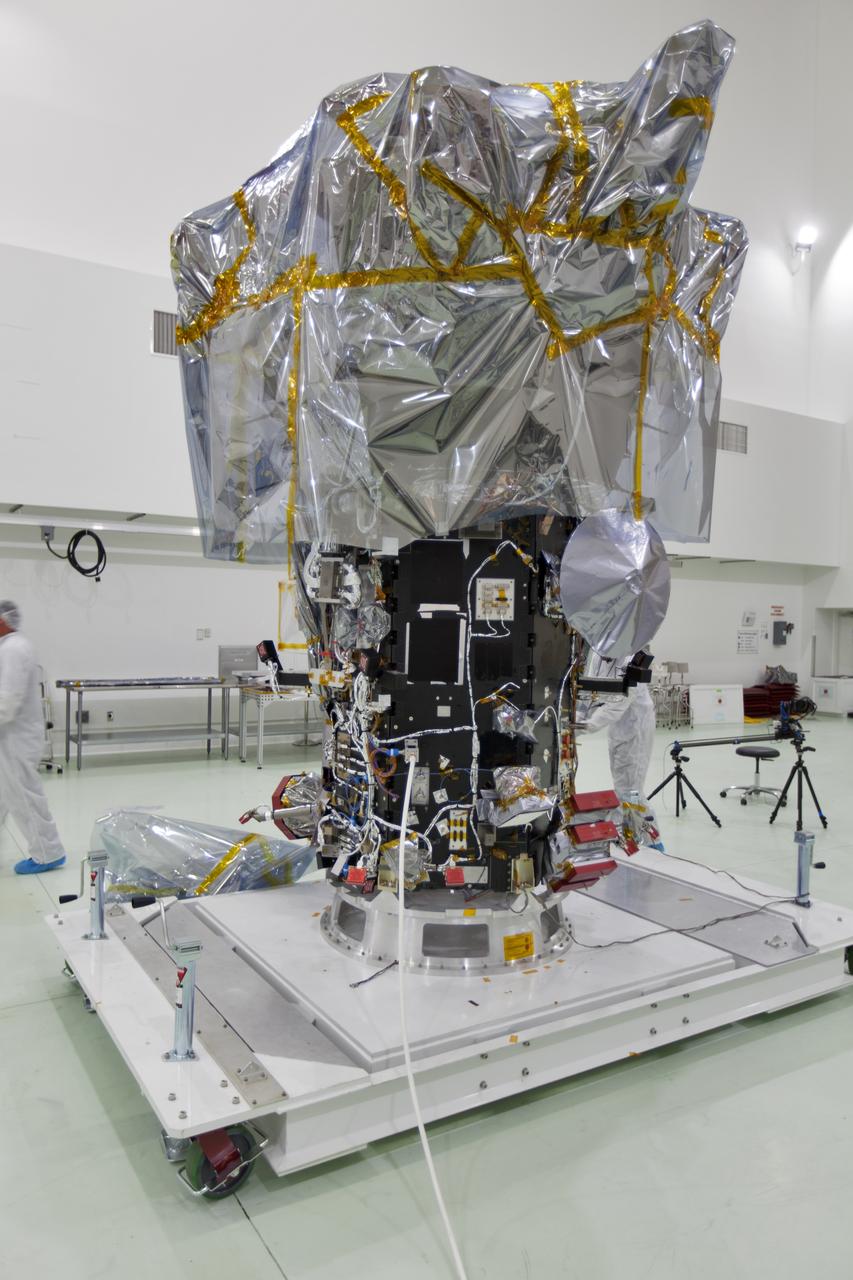
At the Astrotech processing facility in Titusville, Florida, near NASA's Kennedy Space Center, NASA's Parker Solar Probe is removed from its shipping bag on Wednesday, April 4, 2018. The Parker Solar Probe will launch on a United Launch Alliance Delta IV Heavy rocket from Space Launch Complex 37 at Cape Canaveral Air Force Station in Florida no earlier than Aug. 4, 2018. The mission will perform the closest-ever observations of a star when it travels through the Sun's atmosphere, called the corona. The probe will rely on measurements and imaging to revolutionize our understanding of the corona and the Sun-Earth connection.

John "JC" Carver, a payload integration engineer with NASA Kennedy Space Center's Test and Operations Support Contract, opens the door to the growth chamber of the Advanced Plant Habitat (APH) Flight Unit No. 1 for a test harvest of half of the Arabidopsis thaliana plants growing within. The harvest is part of an ongoing verification test of the APH unit, which is located inside the International Space Station Environmental Simulator in Kennedy's Space Station Processing Facility. The APH undergoing testing at Kennedy is identical to one on the station and uses red, green and broad-spectrum white LED lights to grow plants in an environmentally controlled chamber. The seeds grown during the verification test will be grown on the station to help scientists understand how these plants adapt to spaceflight.
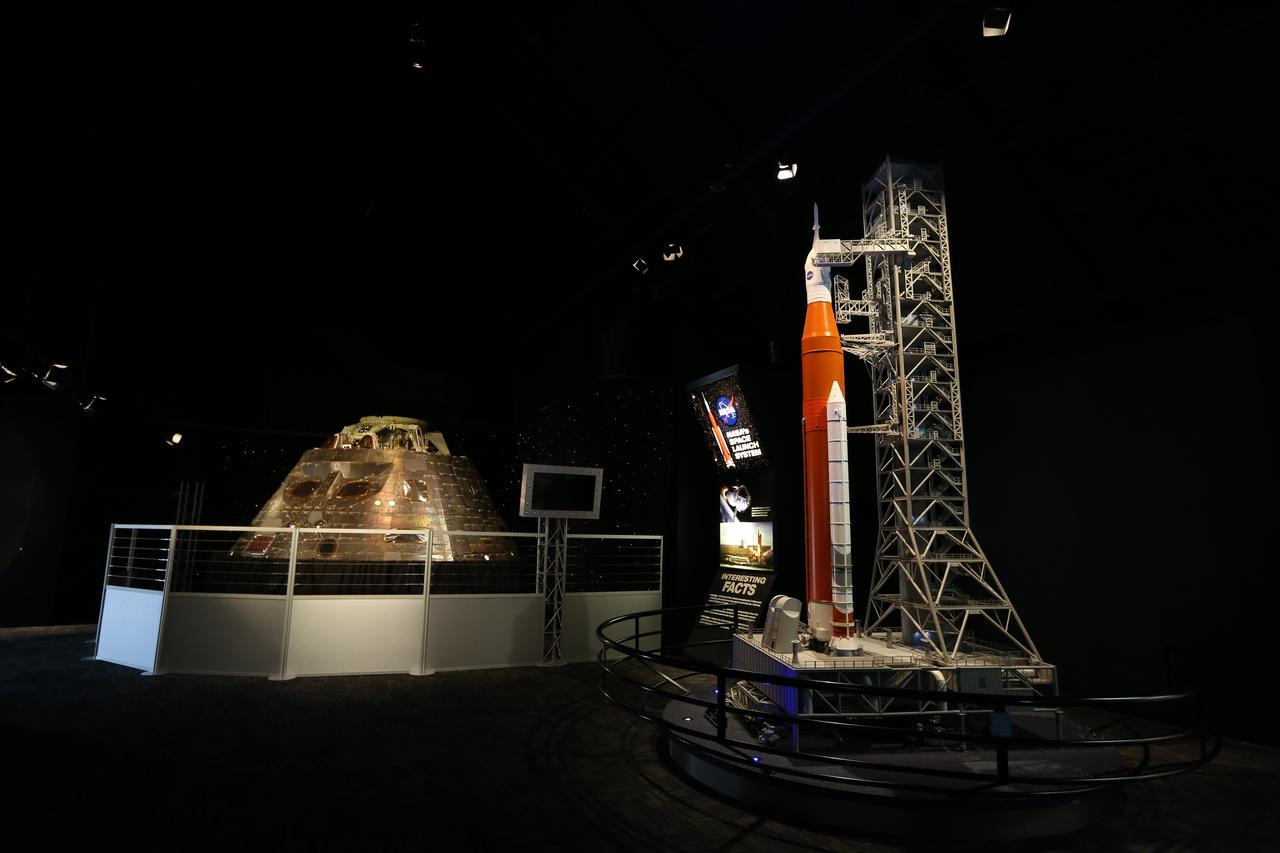
The Orion crew module from Exploration Flight Test 1 (EFT-1) is on display at nearby NASA Kennedy Space Center Visitor Complex in Florida. The crew module is part of the NASA Now exhibit in the IMAX Theater. Also in view is a scale model of NASA's Space Launch System rocket and Orion spacecraft on the mobile launcher. The Orion EFT-1 spacecraft launched atop a United Launch Alliance Delta IV rocket Dec. 5, 2014, from Space Launch Complex 37 at Cape Canaveral Air Force Station. The spacecraft built for humans traveled 3,604 miles above Earth and splashed down about 4.5 hours later in the Pacific Ocean.
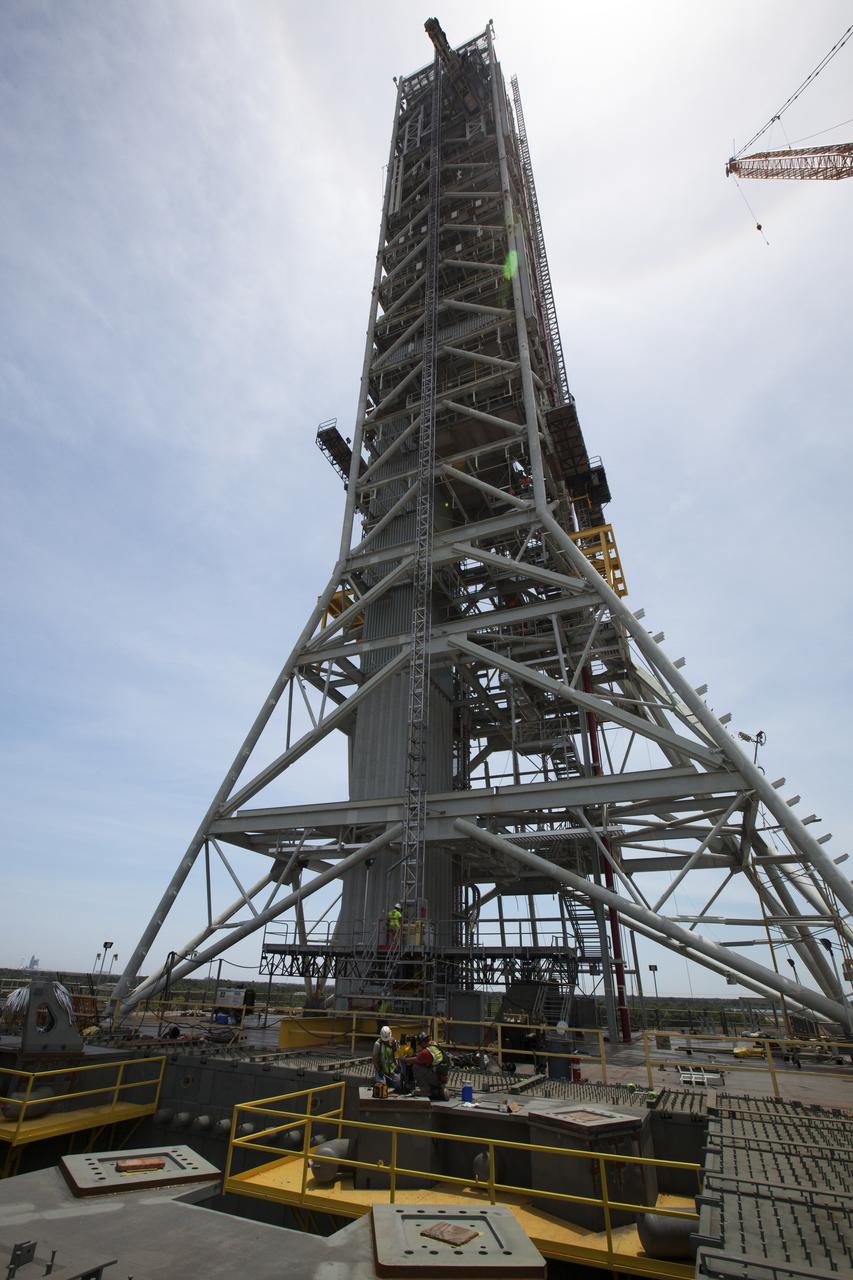
Construction workers on the deck of the mobile launcher at NASA's Kennedy Space Center in Florida, prepare a platform for installation of a vehicle support post. A total of eight support posts will be installed to support the load of the Space Launch System's (SLS) solid rocket boosters, with four posts for each of the boosters. The support posts are about five feet tall and each weigh about 10,000 pounds. The posts will structurally support the SLS rocket through T-0 and liftoff, and will drop down before vehicle liftoff to avoid contact with the flight hardware. The Ground Systems Development and Operations Program is overseeing installation of the support posts to prepare for the launch of the Orion spacecraft atop the SLS rocket.
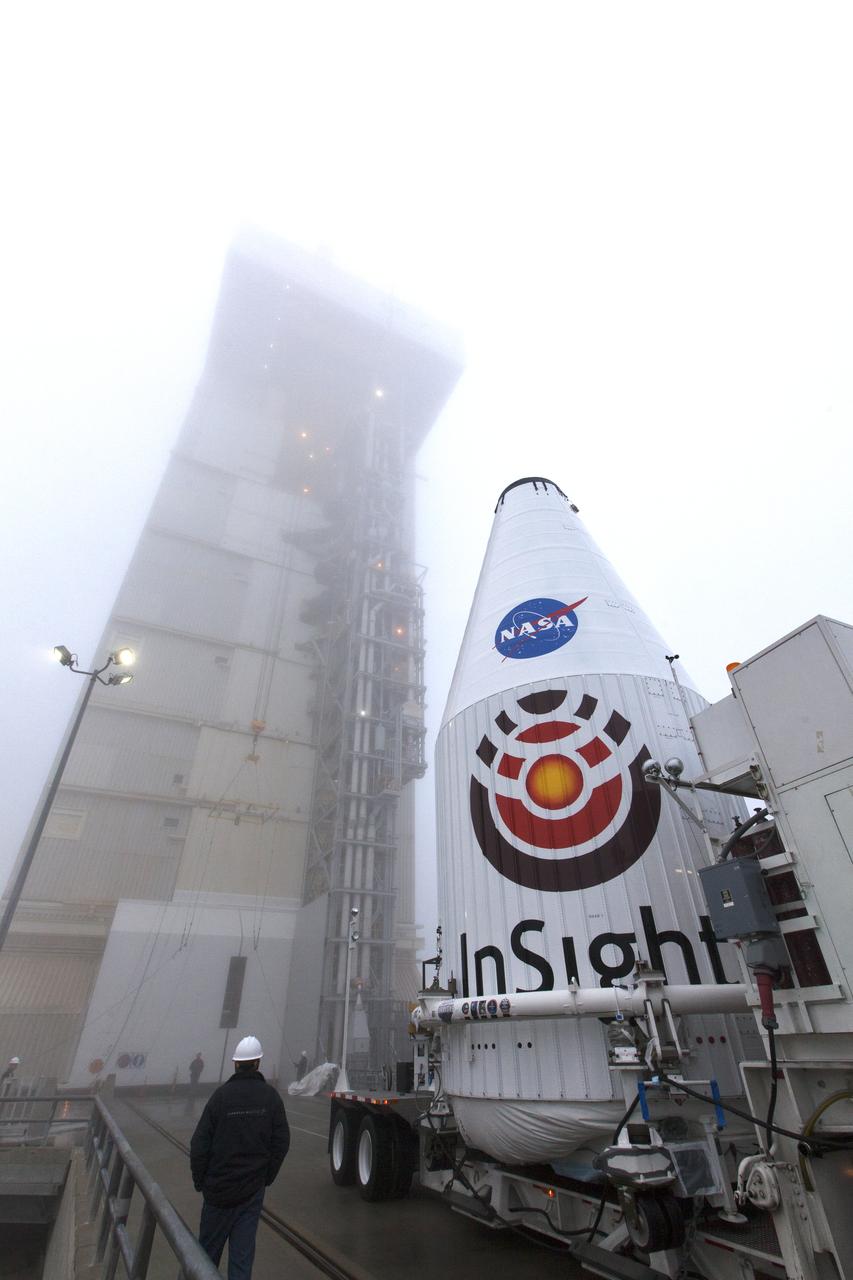
Encapsulated in its payload fairing NASA's Interior Exploration using Seismic Investigations, Geodesy and Heat Transport, or InSight, Mars lander arrives at Space Launch Complex 3 at Vandenberg Air Force Base in California. InSight will be the first mission to look deep beneath the Martian surface. It will study the planet's interior by measuring its heat output and listen for marsquakes. The spacecraft will use the seismic waves generated by marsquakes to develop a map of the planet’s deep interior. The resulting insight into Mars’ formation will provide a better understanding of how other rocky planets, including Earth, were created. InSight is scheduled for liftoff May 5, 2018.
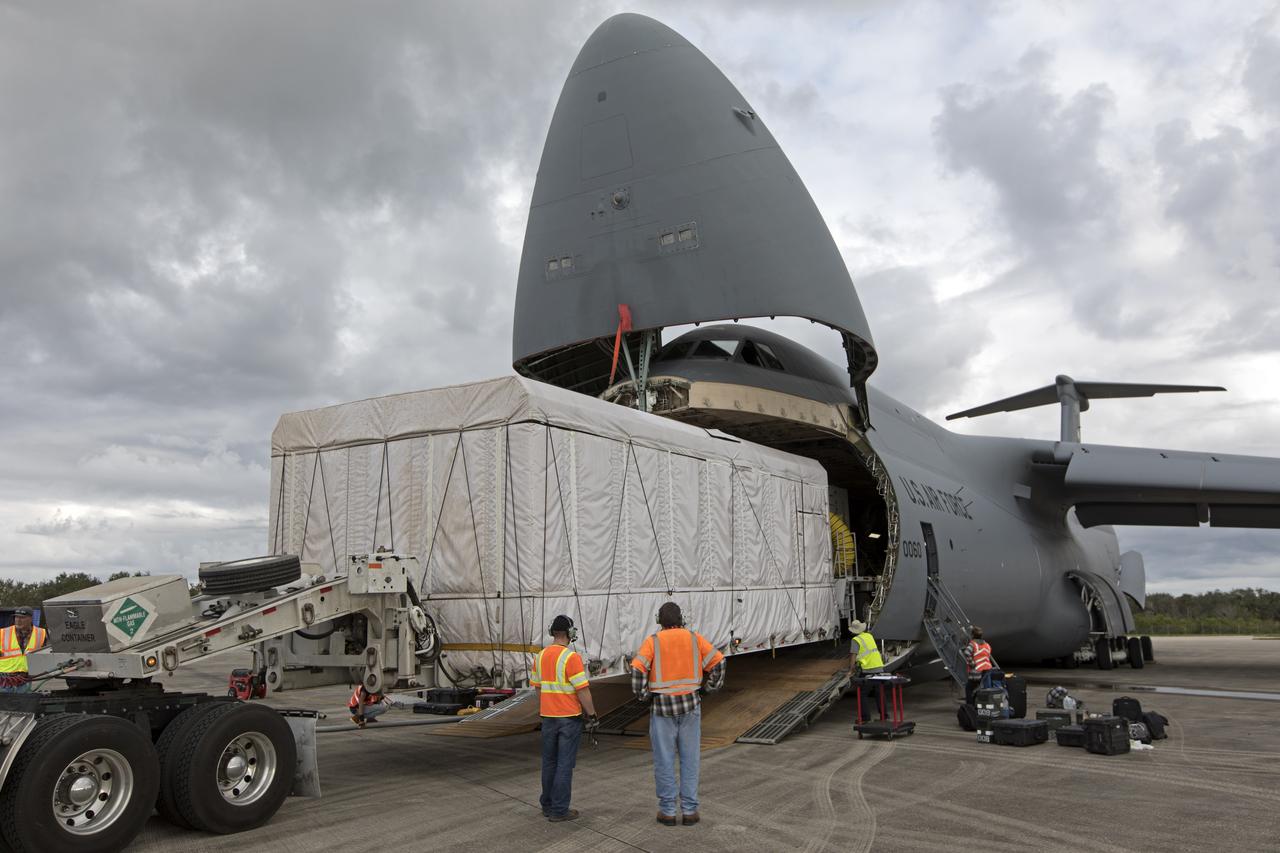
NOAA's Geostationary Operation Environmental Satellite-S (GOES-S) is being offloaded from a C-5 transport aircraft onto the flatbed of a heavy-lift truck at the Shuttle Landing Facility at NASA's Kennedy Space Center in Florida. The satellite will be transported to the Astrotech Space Operations facility in Titusville, Florida to prepare it for launch. GOES-S is the second in a series of four advanced geostationary weather satellites. The GOES-R series - consisting of the GOES-R, GOES-S, GOES-T and GOES-U spacecraft - will significantly improve the detection and observation of environmental phenomena that directly affect public safety, protection of property and the nation's economic health and prosperity. GOES-S is slated to launch March 1, 2018 aboard a United Launch Alliance Atlas V rocket from Cape Canaveral Air Force Station in Florida.
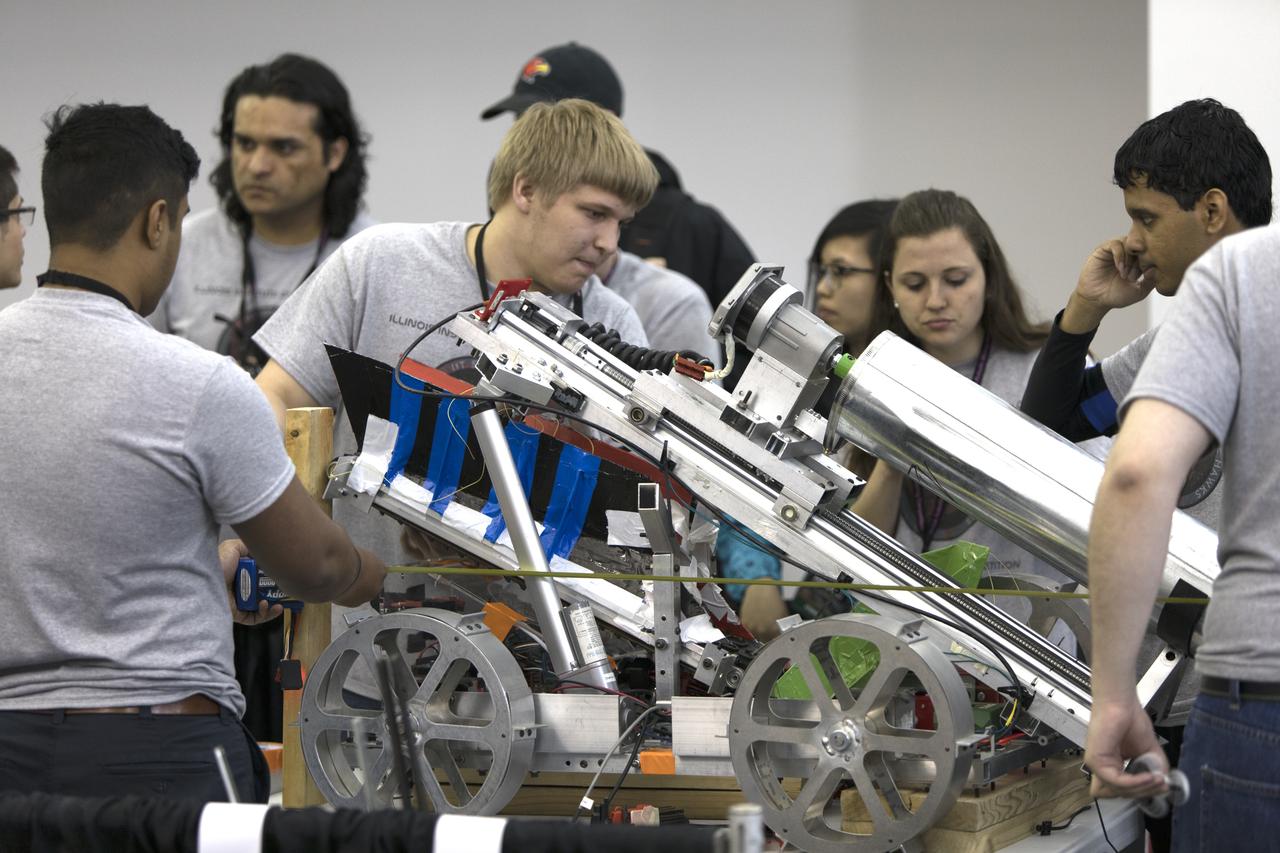
On the first day of NASA's 9th Robotic Mining Competition, set-up day on May 14, team members from the Illinois Institute of Technology work on their robot miner in the RobotPits in the Educator Resource Center at Kennedy Space Center Visitor Complex in Florida. More than 40 student teams from colleges and universities around the U.S. will use their mining robots to dig in a supersized sandbox filled with BP-1, or simulated Lunar soil, gravel and rocks, and participate in other competition requirements. The Robotic Mining Competition is a NASA Human Exploration and Operations Mission Directorate project designed to encourage students in science, technology, engineering and math, or STEM fields. The project provides a competitive environment to foster innovative ideas and solutions that could be used on NASA's deep space missions.
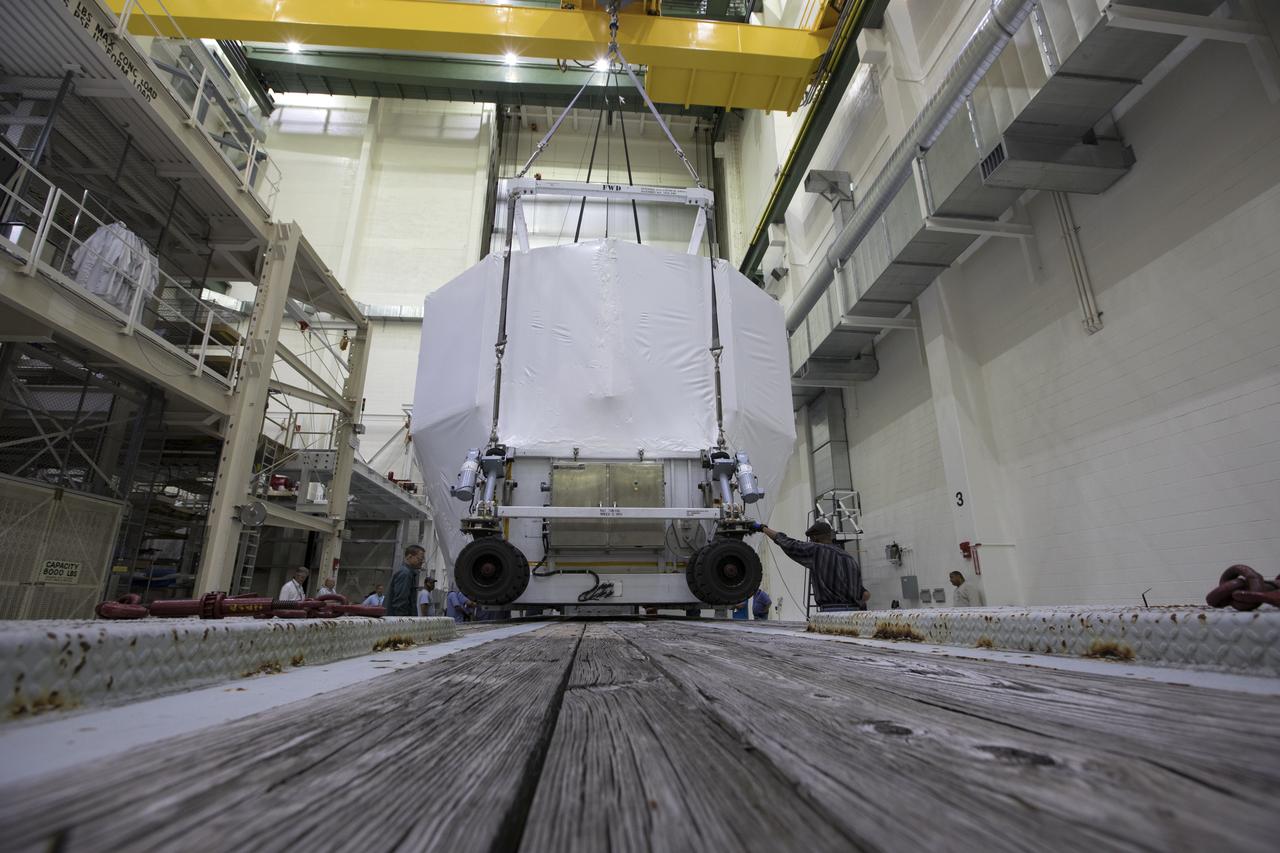
The Orion service module structural test article for Exploration Mission-1 (EM-1), built by the European Space Agency, is prepared for shipment to Lockheed Martin's Denver facility to undergo testing. Inside the Neil Armstrong Operations and Checkout Building high bay at NASA's Kennedy Space Center in Florida, a crane lifts the module, secured on a stand, for the move to the transport truck. The Orion spacecraft will launch atop the agency's Space Launch System rocket on EM-1 in 2019.
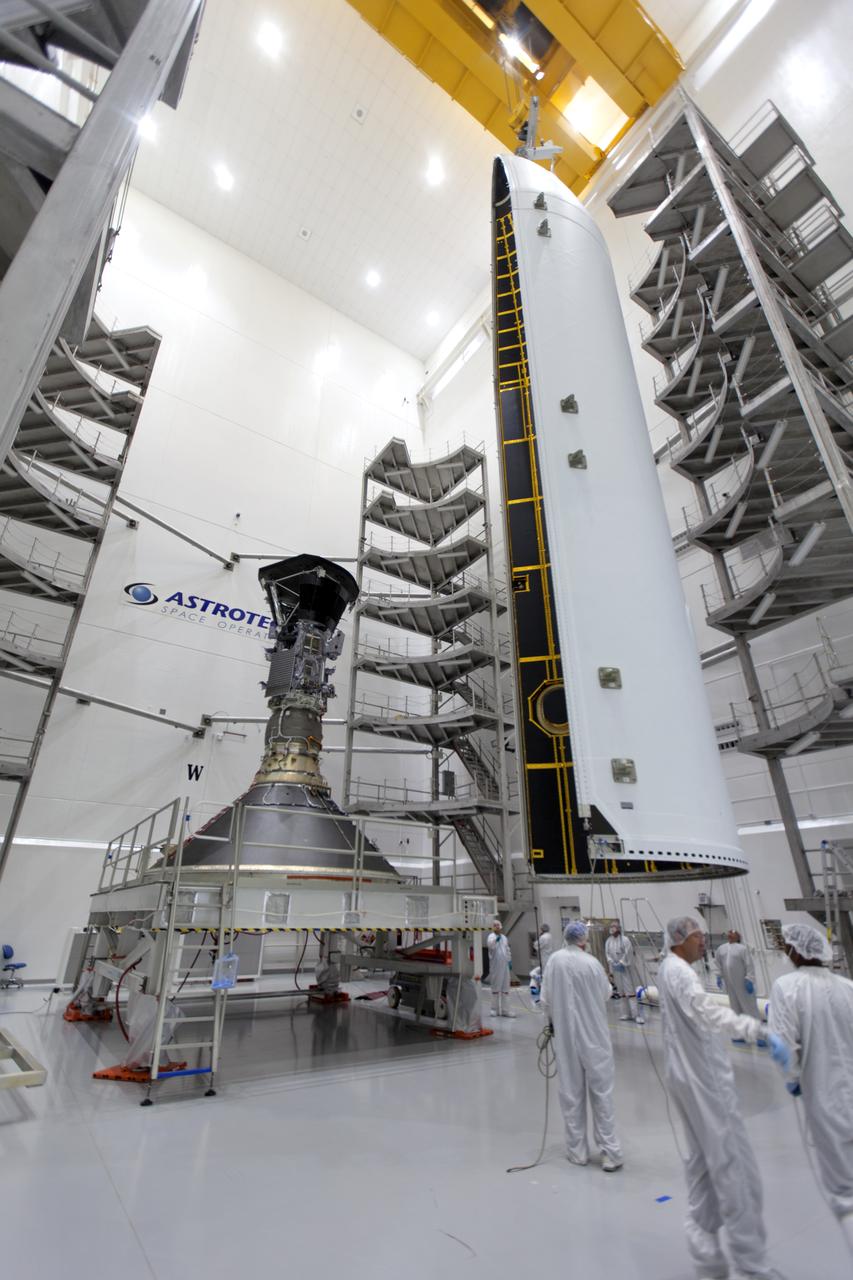
In the Astrotech processing facility in Titusville, Florida, near NASA's Kennedy Space Center, on Monday, July 16, 2018, technicians and engineers prepare NASA's Parker Solar Probe for encapsulation in its payload fairing. The spacecraft is mated to its third stage, built and tested by Northrup Grumman in Chandler, Arizona. The Parker Solar Probe will launch on a United Launch Alliance Delta IV Heavy rocket from Space Launch Complex 37 at Cape Canaveral Air Force Station in Florida. The mission will perform the closest-ever observations of a star when it travels through the Sun's atmosphere, called the corona. The probe will rely on measurements and imaging to revolutionize our understanding of the corona and the Sun-Earth connection.
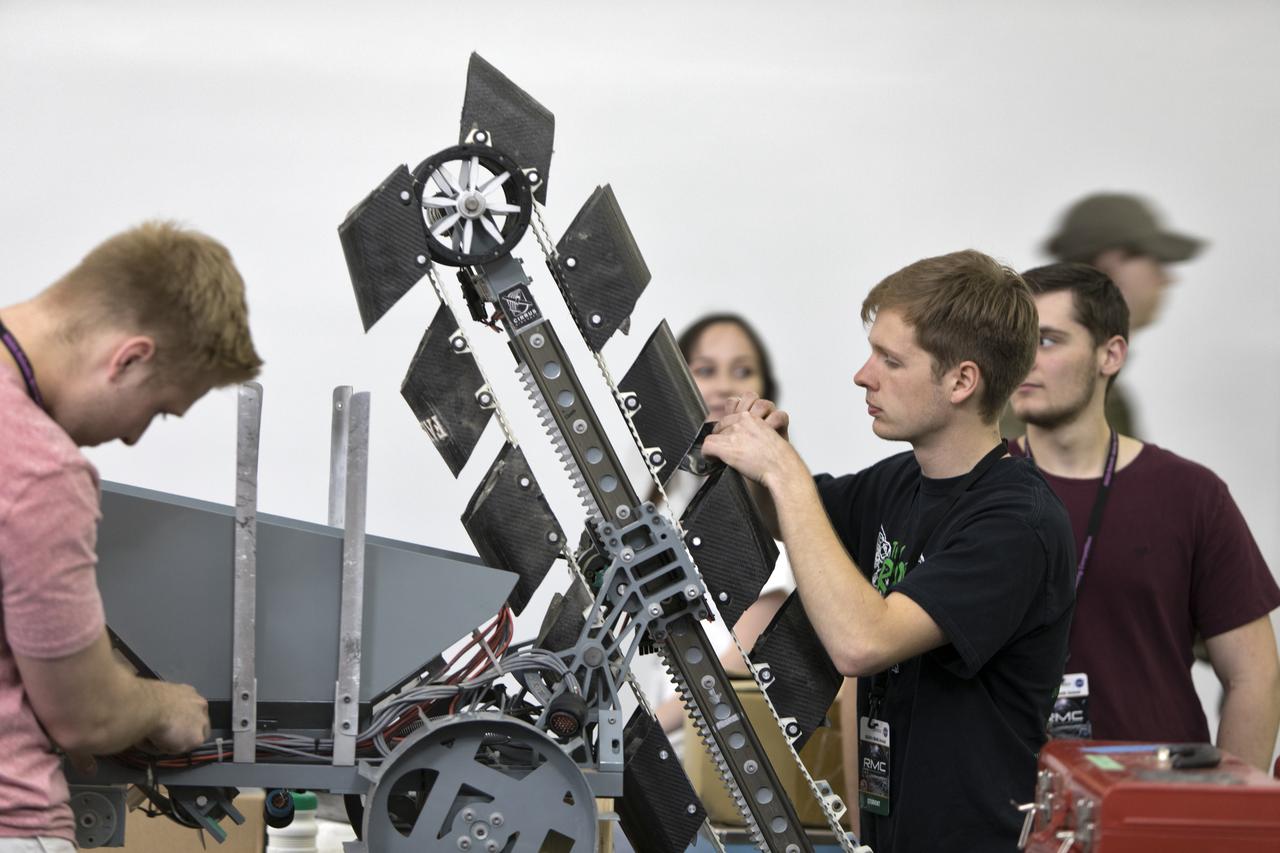
On the first day of NASA's 9th Robotic Mining Competition, set-up day on May 14, team members from the University of North Carolina at Charlotte work on their robot miner in the RobotPits in the Educator Resource Center at Kennedy Space Center Visitor Complex in Florida. More than 40 student teams from colleges and universities around the U.S. will use their mining robots to dig in a supersized sandbox filled with BP-1, or simulated Lunar soil, gravel and rocks, and participate in other competition requirements. The Robotic Mining Competition is a NASA Human Exploration and Operations Mission Directorate project designed to encourage students in science, technology, engineering and math, or STEM fields. The project provides a competitive environment to foster innovative ideas and solutions that could be used on NASA's deep space missions.
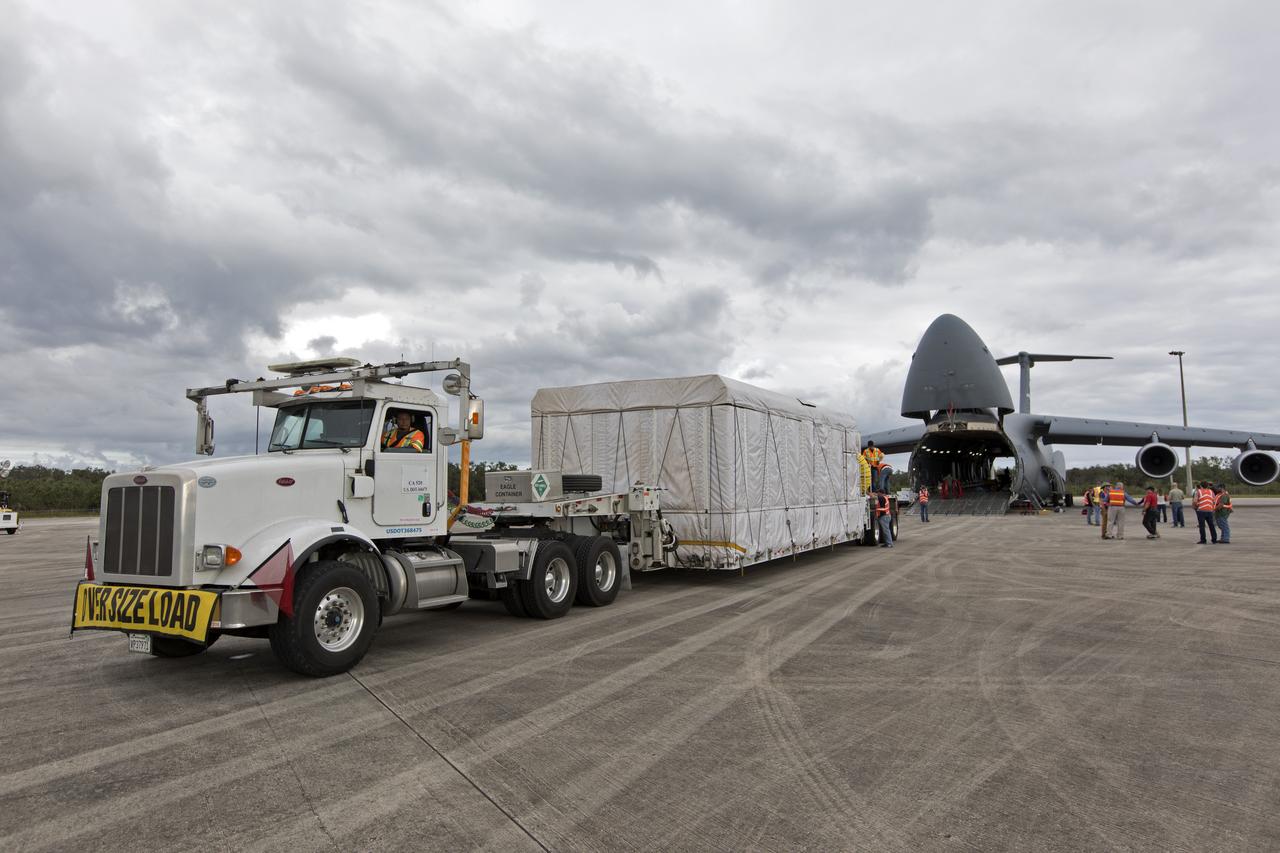
NOAA's Geostationary Operation Environmental Satellite-S (GOES-S) has been offloaded from a C-5 transport aircraft and secured onto the flatbed of a heavy-lift truck at the Shuttle Landing Facility at NASA's Kennedy Space Center in Florida. The satellite will be transported to the Astrotech Space Operations facility in Titusville, Florida to prepare it for launch. GOES-S is the second in a series of four advanced geostationary weather satellites. The GOES-R series - consisting of the GOES-R, GOES-S, GOES-T and GOES-U spacecraft - will significantly improve the detection and observation of environmental phenomena that directly affect public safety, protection of property and the nation's economic health and prosperity. GOES-S is slated to launch March 1, 2018 aboard a United Launch Alliance Atlas V rocket from Cape Canaveral Air Force Station in Florida.
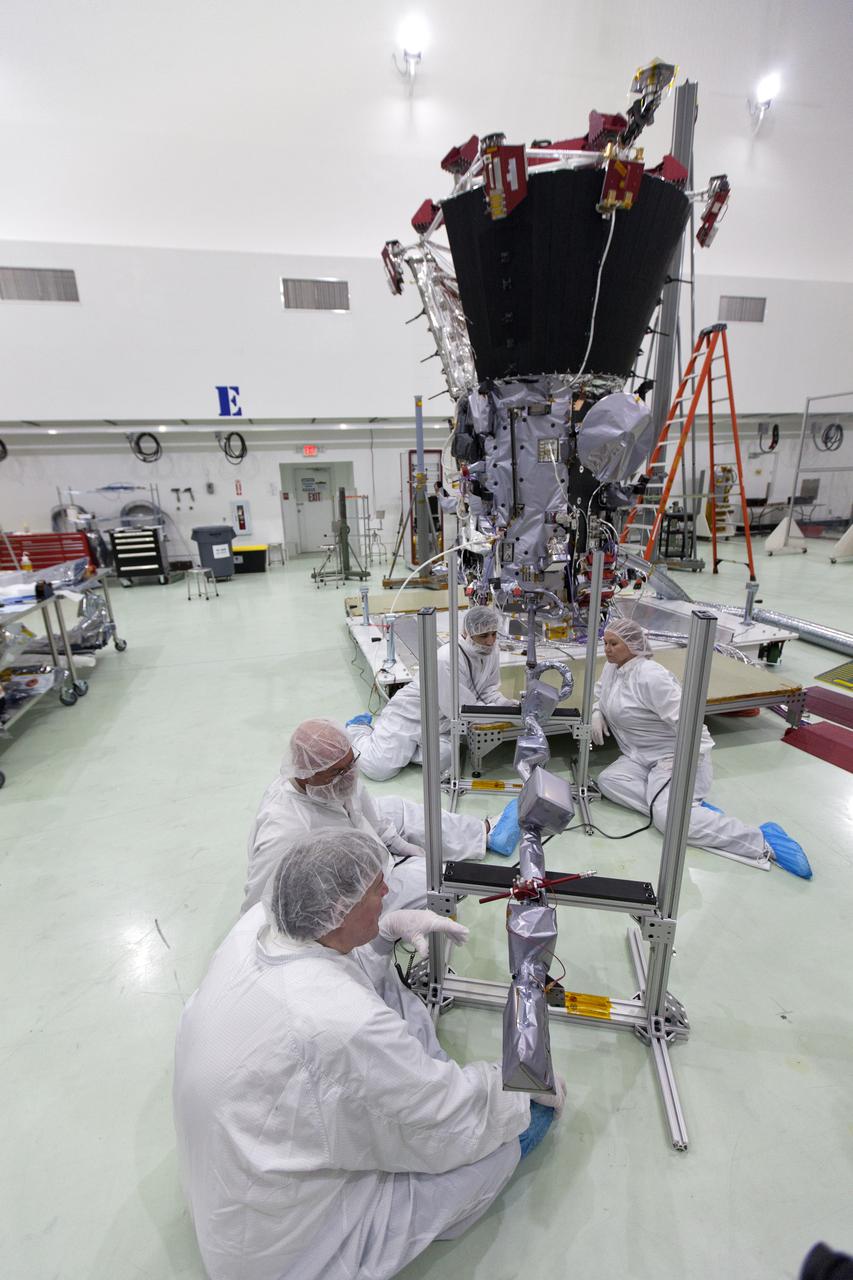
In the Astrotech processing facility in Titusville, Florida, near NASA's Kennedy Space Center, on Wednesday, May 23, 2018, technicians and engineers deploy the magnetometer boom on NASA's Parker Solar Probe. The Parker Solar Probe will launch on a United Launch Alliance Delta IV Heavy rocket from Space Launch Complex 37 at Cape Canaveral Air Force Station in Florida no earlier than Aug. 4, 2018. The mission will perform the closest-ever observations of a star when it travels through the Sun's atmosphere, called the corona. The probe will rely on measurements and imaging to revolutionize our understanding of the corona and the Sun-Earth connection.
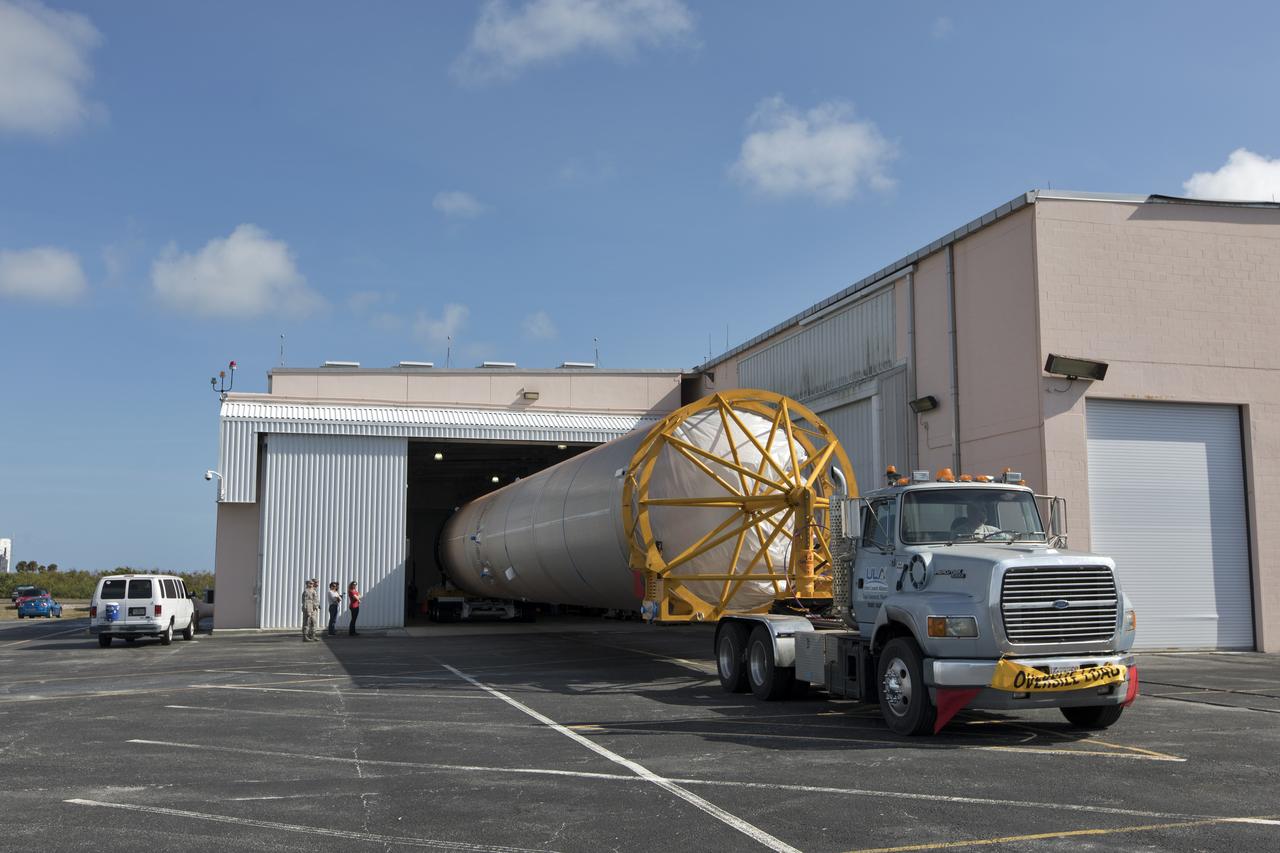
The United Launch Alliance Atlas V booster for NOAA's Geostationary Operational Environmental Satellite-S (GOES-S) arrives at the Atlas Spaceflight Operations Center near Space Launch Complex 41 at Cape Canaveral Air Force Station in Florida. GOES-S is the second in a series of four advanced geostationary weather satellites. The satellite is slated to launch aboard the Atlas V rocket March 1.
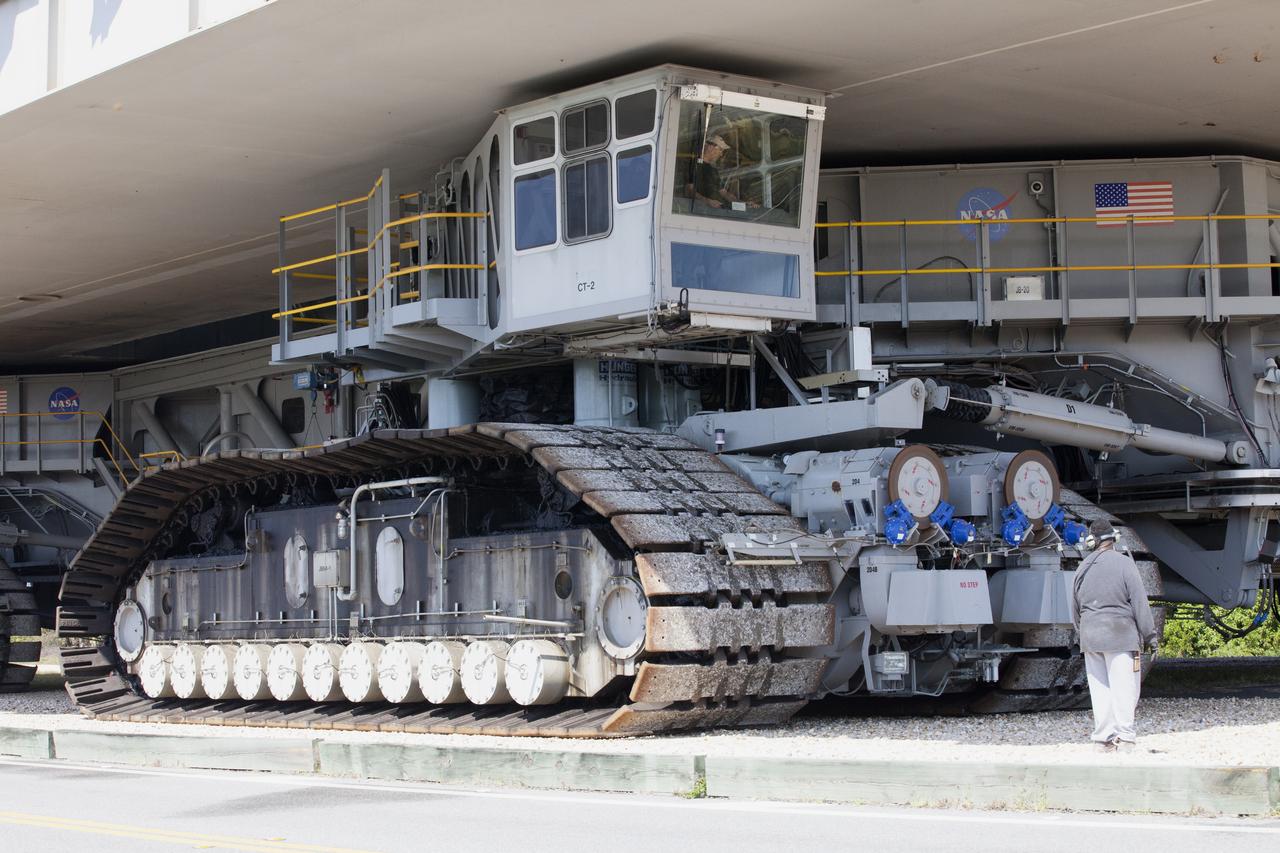
NASA's upgraded crawler-transporter 2 (CT-2), carrying mobile launcher platform 1, moves slowly along the crawlerway at the agency's Kennedy Space Center in Florida. The crawler's upgrades and modifications will be monitored and tested under loaded conditions during its travel to the crawlerway Pad A/B split and back to the crawler yard to confirm it is ready to support the load of the mobile launcher carrying the Space Launch System with Orion atop for the first test flight, Exploration Mission 1. The Ground Systems Development and Operations Program at Kennedy is managing upgrades to the crawler.
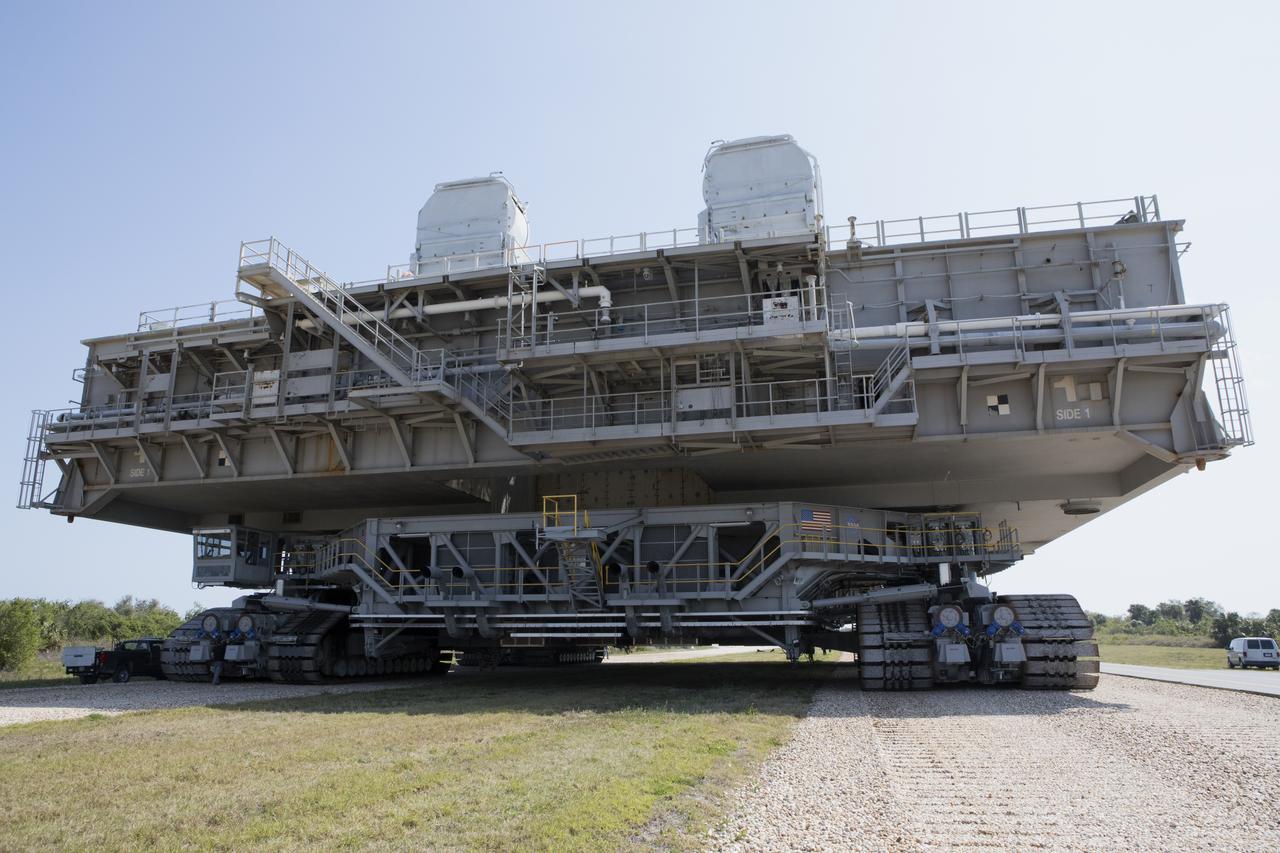
NASA's upgraded crawler-transporter 2 (CT-2), carrying mobile launcher platform 1, moves slowly along the crawlerway at the agency's Kennedy Space Center in Florida. The crawler's upgrades and modifications will be monitored and tested under loaded conditions during its travel to the crawlerway Pad A/B split and back to the crawler yard to confirm it is ready to support the load of the mobile launcher carrying the Space Launch System with Orion atop for the first test flight, Exploration Mission 1. The Ground Systems Development and Operations Program at Kennedy is managing upgrades to the crawler.
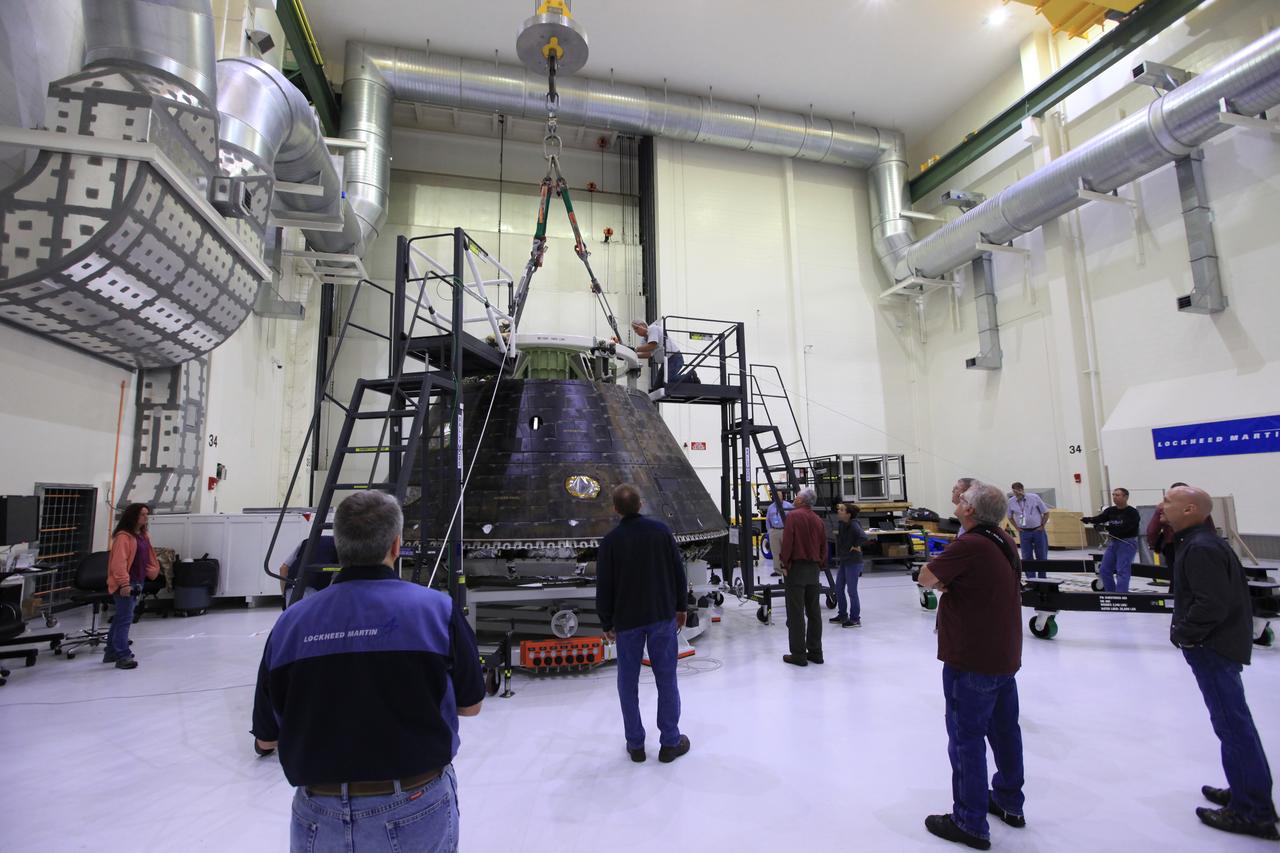
Inside the Neil Armstrong Operations and Checkout Building high bay at NASA's Kennedy Space Center in Florida, Lockheed Martin and ASRC workers monitor the progress as a crane is attached to the top of the Orion crew module from Exploration Flight Test 1. The crew module will be moved to the nearby Kennedy Space Center Visitor Complex and delivered to the IMAX Theater where it will be prepared for display in the NASA Now exhibit. The Orion spacecraft launched atop a United Launch Alliance Delta IV rocket Dec. 5, 2014, from Space Launch Complex 37 at Cape Canaveral Air Force Station. The spacecraft built for humans traveled 3,604 miles above Earth and splashed down about 4.5 hours later in the Pacific Ocean.
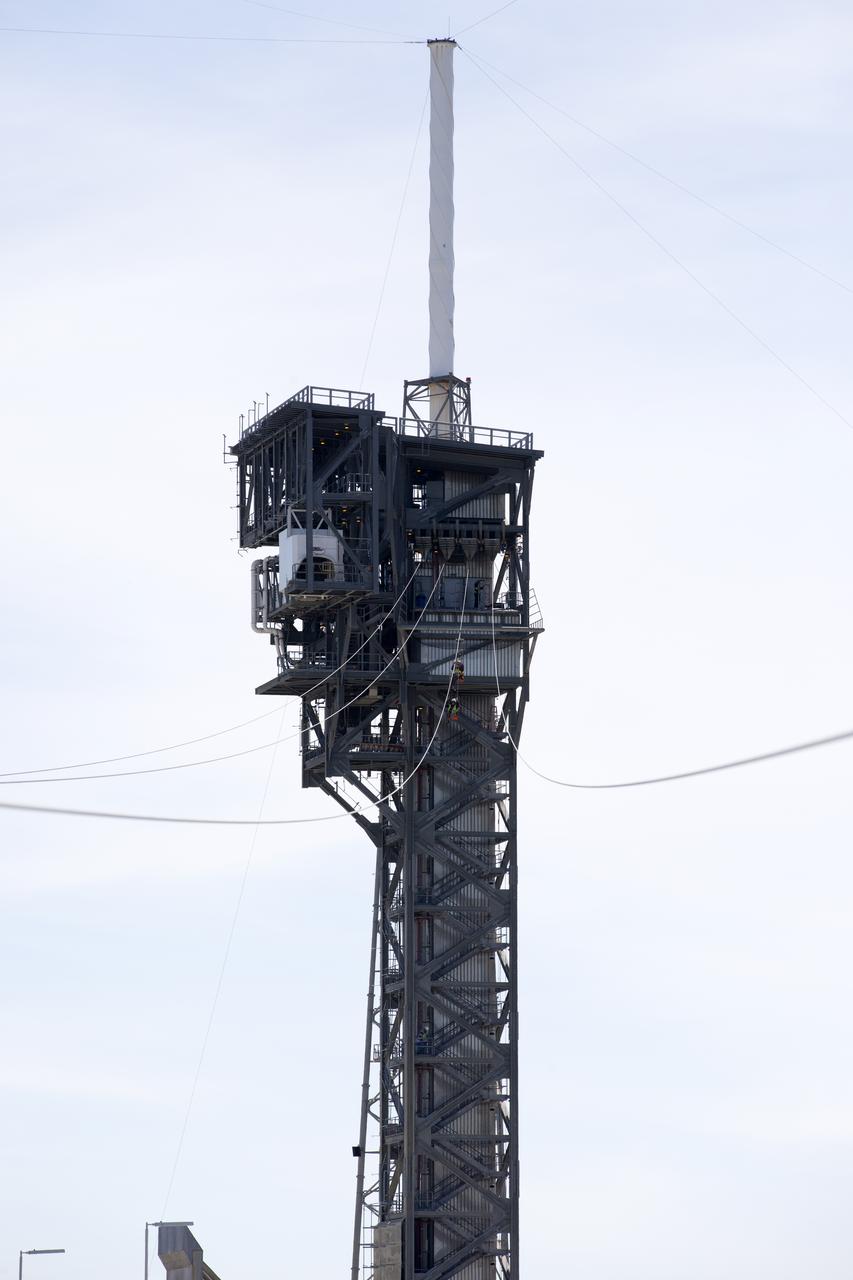
Two engineers evaluate the Emergency Egress System as they ride in folding seats attached to slide wires at Space Launch Complex 41. United Launch Alliance and Boeing continue modifications to the pad in order to host missions by the Boeing CST-100 Starliner carrying astronauts and crew. The system recently completed its final test. In the unlikely event of an emergency prior to liftoff, each person on the Crew Access Tower would get into their own seat attached to the wire and slide more than 1,340 feet to a safe area. The wires are situated 172 feet above the pad deck on level 12 of the tower. The Starliner will launch on a ULA Atlas V on mission to low-Earth orbit including those flying astronauts to the International Space Station during missions by NASA's Commercial Crew Program.
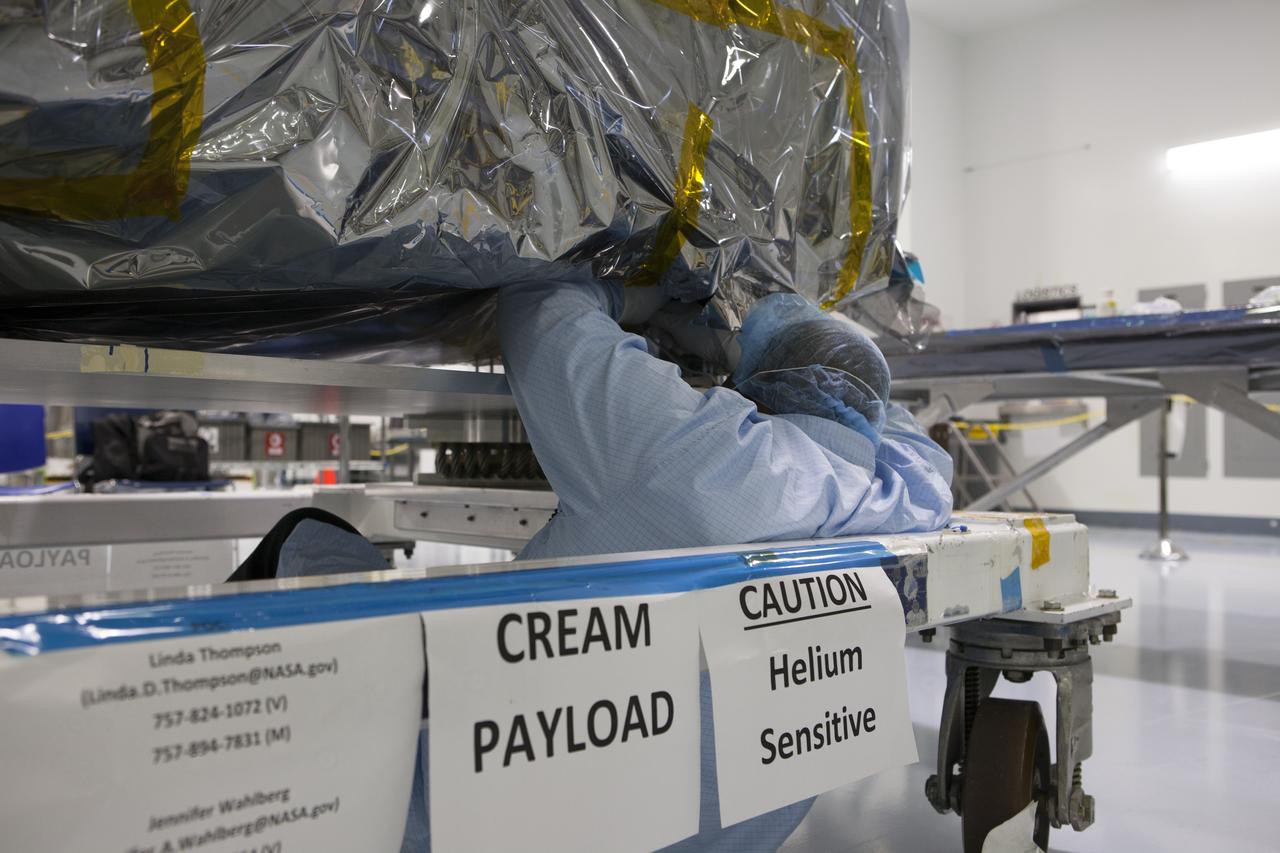
In the Space Station Processing Facility at NASA's Kennedy Space Center in Florida, a technician remove a protective cover on the Cosmic-Ray Energetics and Mass investigation, or CREAM, instrument. It is designed to measure the charges of cosmic rays to better understand what gives them such incredible energies, and how that effects the composition of the universe. The instrument will be launched to the space station on the SpaceX CRS-12 commercial resupply mission in August 2017.
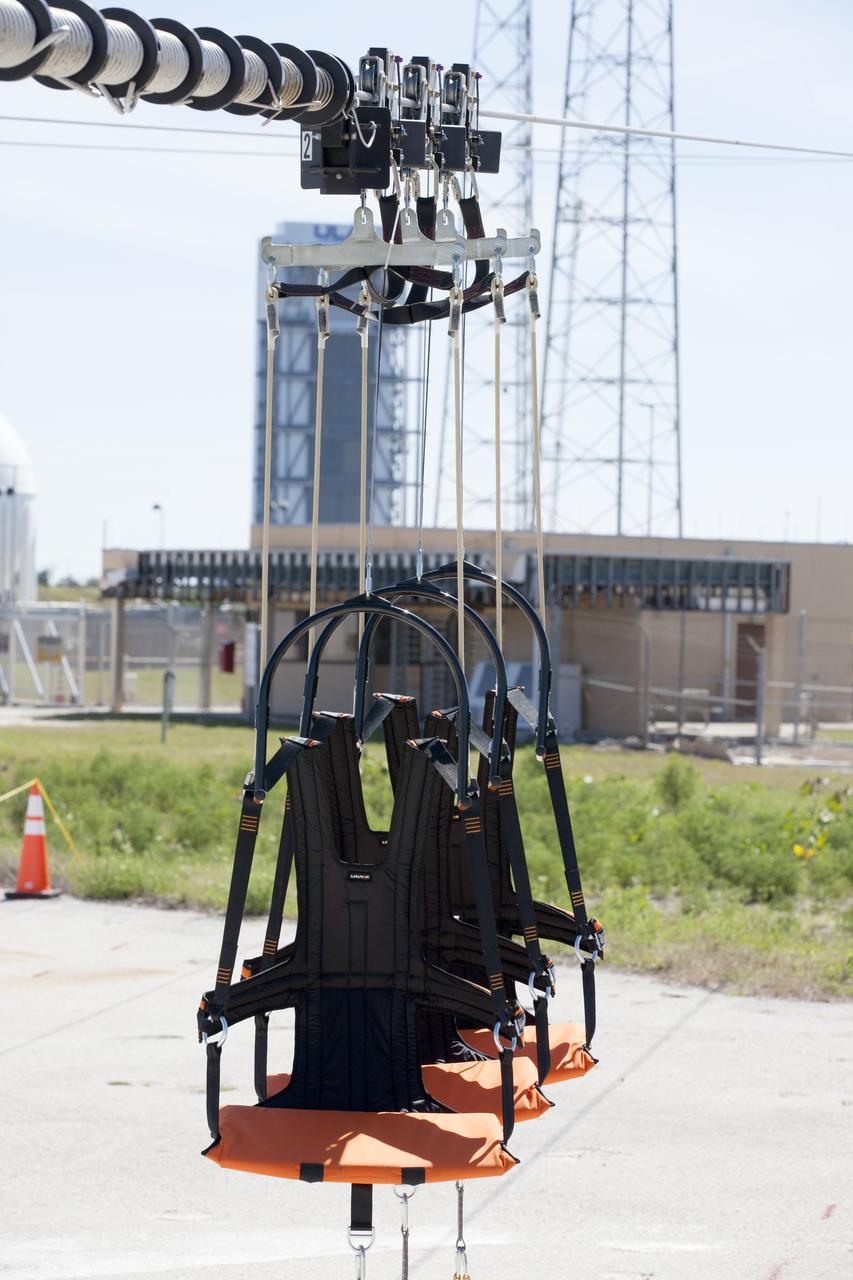
The folding seats that make up the Emergency Egress System are seen attached to slide wires at Space Launch Complex 41 where United Launch Alliance and Boeing continue modifications to the pad in order to host missions by the Boeing CST-100 Starliner carrying astronauts and crew. The system recently completed its final test. In the unlikely event of an emergency prior to liftoff, each person on the Crew Access Tower would get into their own seat attached to the wire and slide more than 1,340 feet to a safe area. The wires are situated 172 feet above the pad deck on level 12 of the tower. The Starliner will launch on a ULA Atlas V on mission to low-Earth orbit including those flying astronauts to the International Space Station during missions by NASA's Commercial Crew Program.
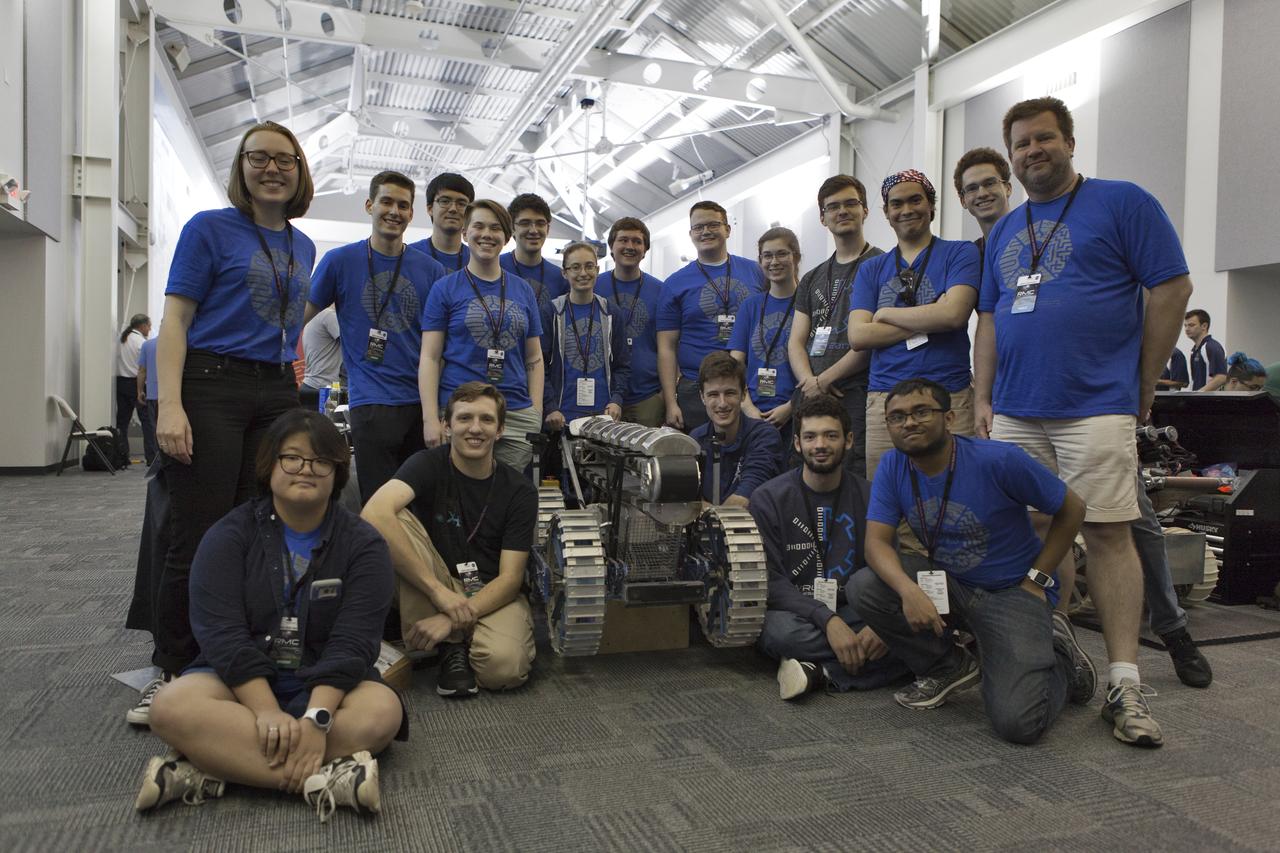
Team members from Case Western Reserve University pause with their robot miner in the RobotPits on the fourth day of NASA's 9th Robotic Mining Competition, May 17, at NASA's Kennedy Space Center Visitor Complex in Florida. More than 40 student teams from colleges and universities around the U.S. are using their mining robots to dig in a supersized sandbox filled with BP-1, or simulated Lunar soil, gravel and rocks, and participate in other competition requirements. The Robotic Mining Competition is a NASA Human Exploration and Operations Mission Directorate project designed to encourage students in science, technology, engineering and math, or STEM fields. The project provides a competitive environment to foster innovative ideas and solutions that could be used on NASA's deep space missions.
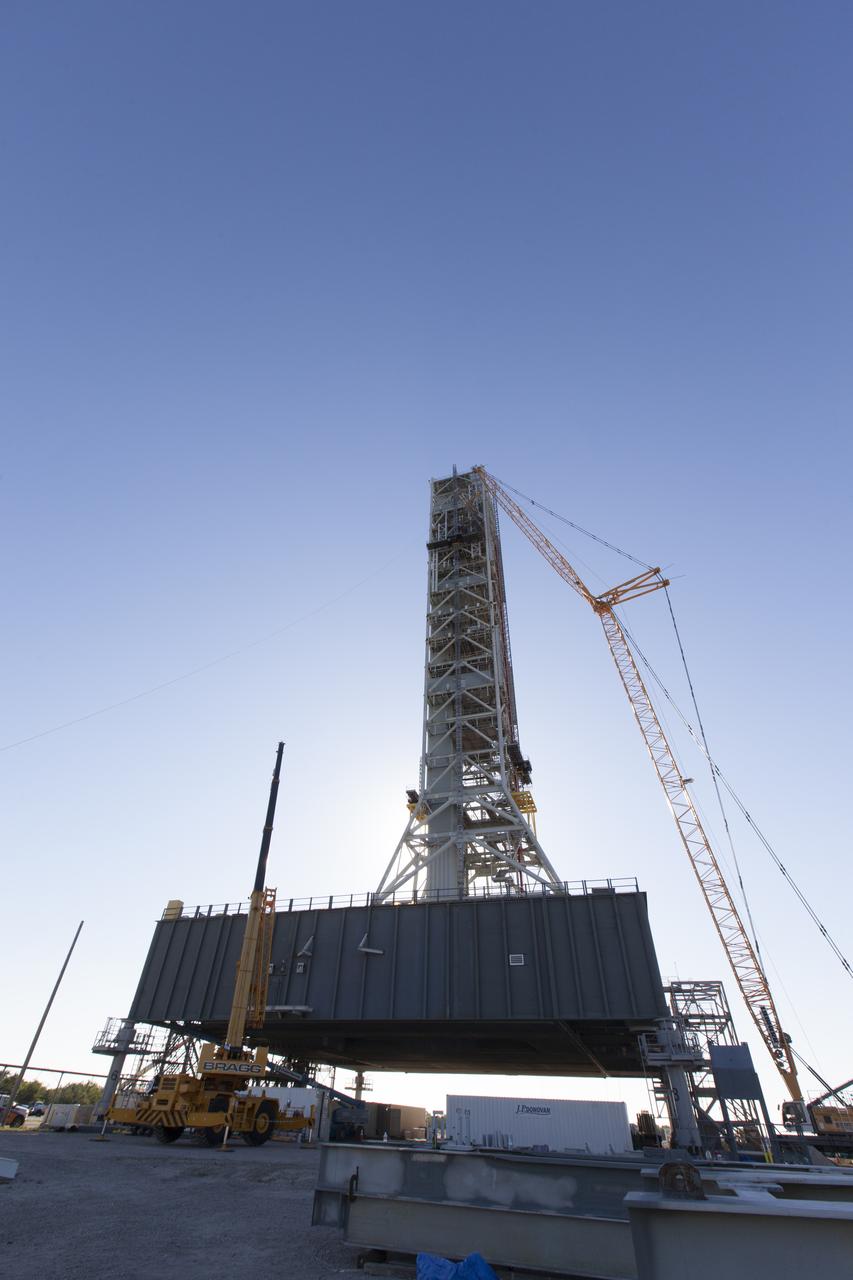
A crane and rigging are used to position the Orion Service Module Umbilical (OSMU) for installation high up on the mobile launcher tower at NASA's Kennedy Space Center in Florida. The mobile launcher tower will be equipped with a number of lines, called umbilicals, that will connect to the Space Launch System rocket and Orion spacecraft for Exploration Mission-1 (EM-1). The OSMU will be located high on the mobile launcher tower and, prior to launch, will transfer liquid coolant for the electronics and air for the Environmental Control System to the Orion service module that houses these critical systems to support the spacecraft. EM-1 is scheduled to launch in 2018. The Ground Systems Development and Operations Program is overseeing installation of the umbilicals.