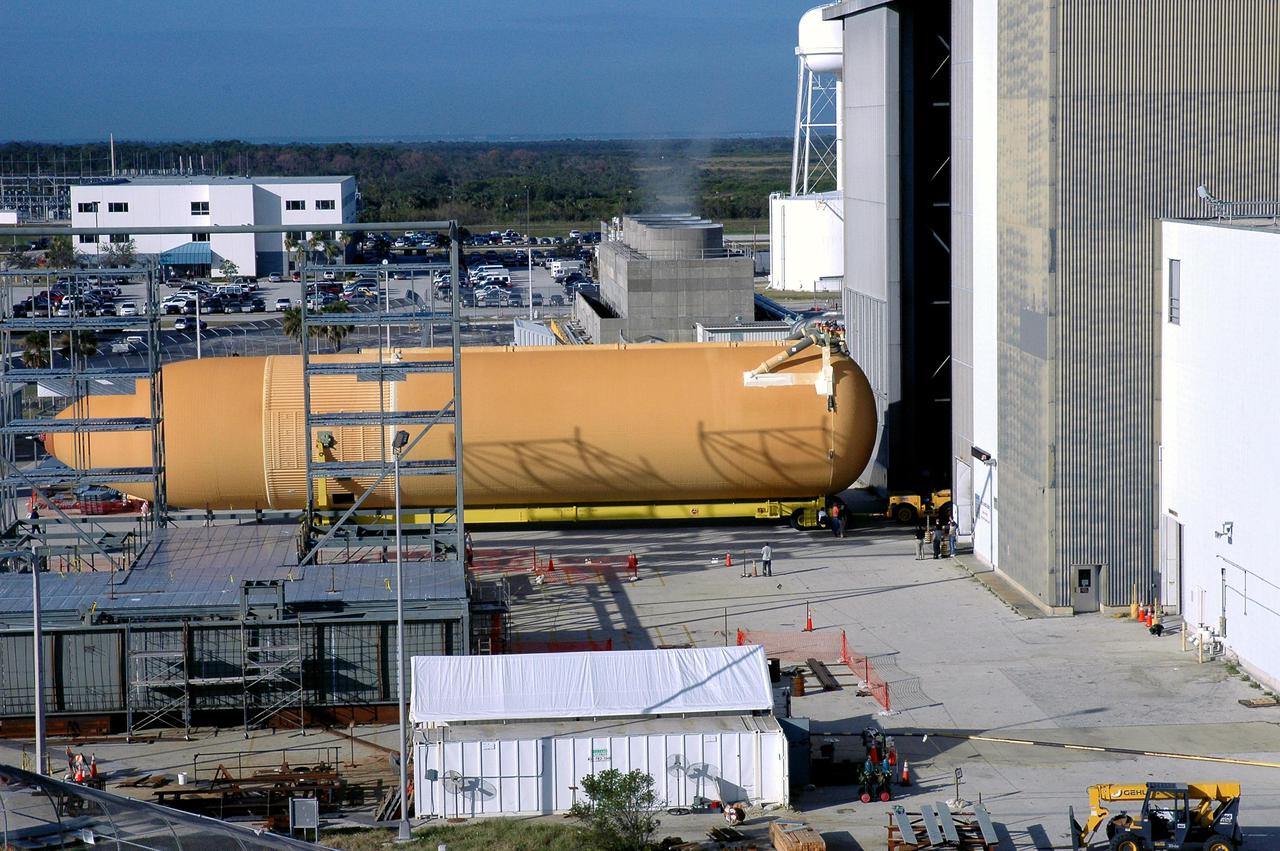
KENNEDY SPACE CENTER, FLA. - Viewed from the roof of the Launch Control Center in the Launch Complex 39 Area, the newly redesigned External Tank is seen moving into the Vehicle Assembly Building. In the transfer aisle of the VAB, the tank will be raised from a horizontal to a vertical position, then lifted high up into a storage cell, or “checkout cell,” where it will undergo inspections of the mechanical, electrical and thermal protection systems. New processing activities resulting from re-design of the tank include inspection of the bipod heater and External Tank separation camera, which includes charging the camera batteries. The tank will be then prepared for mating to the Solid Rocket Boosters. When preparations are complete, the tank will be lifted from the checkout cell, moved across the transfer aisle and into High Bay 1, where it will be lowered and attached to the boosters, which are sitting on the Mobile Launch Platform. The tank is designated for the Return to Flight mission, STS-114, targeted for a launch opportunity beginning in May. The seven-member Discovery crew will fly to the International Space Station primarily to test and evaluate new procedures for flight safety, including Space Shuttle inspection and repair techniques.
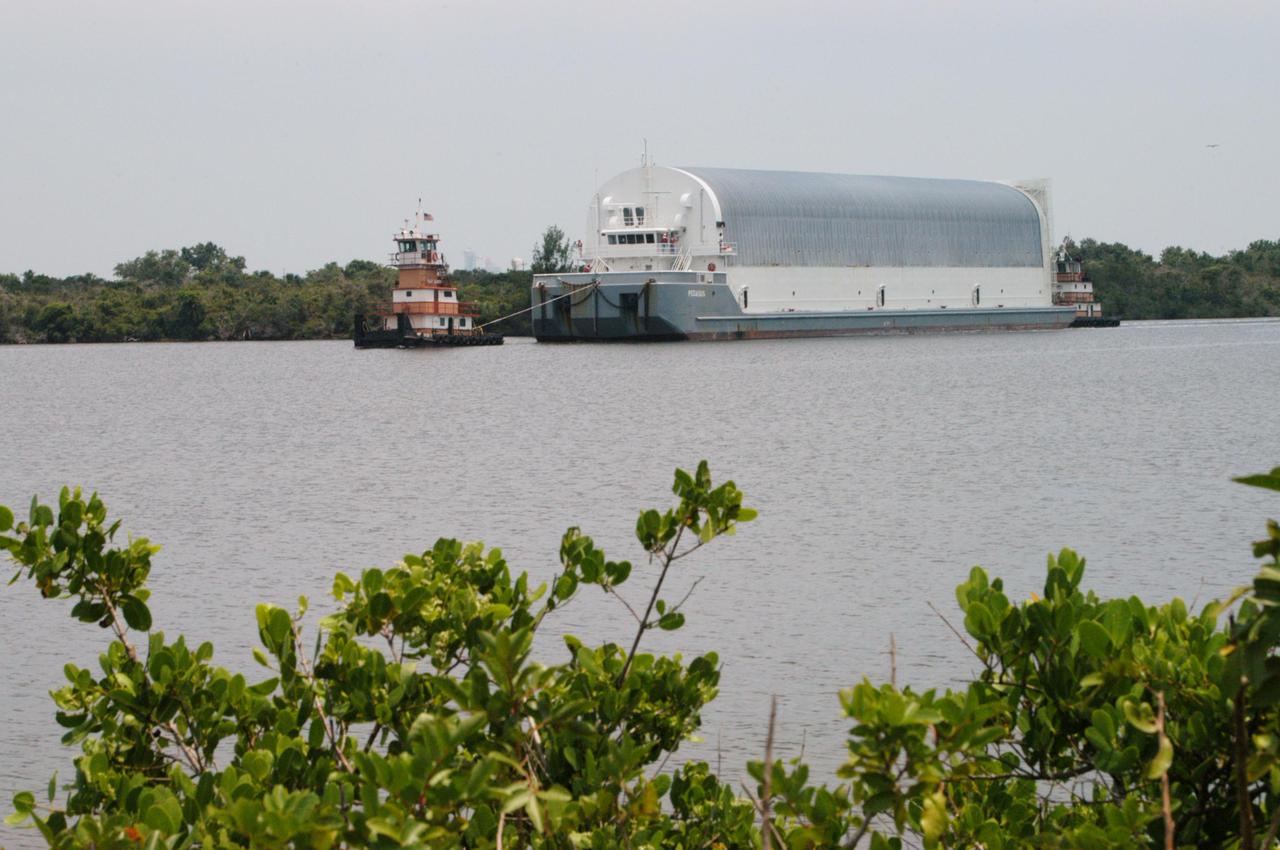
KENNEDY SPACE CENTER, FLA. - A barge carrying a new External Tank (ET) arrives at the Turn Basin in the Launch Complex 39 Area. Designated ET-119, the tank will be used on a future Space Shuttle launch. After being offloaded, the tank will be transported to the Vehicle Assembly Building. The barge was towed on a 900-mile journey at sea from the Michoud Assembly Facility in New Orleans by one of NASA’s Solid Rocket Booster Retrieval Ships.
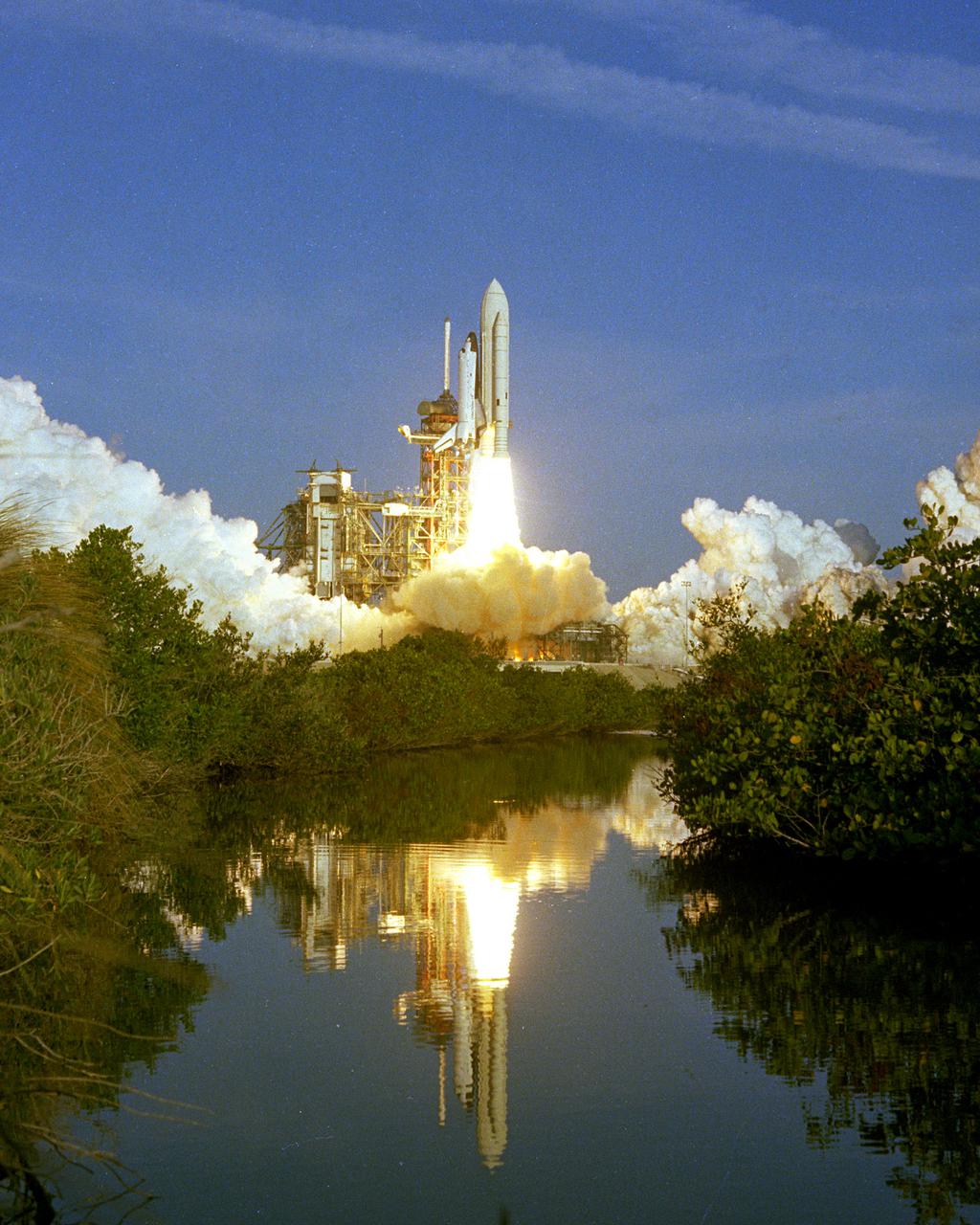
KENNEDY SPACE CENTER, FLA. - Columbia flies. Just seconds past the scheduled launch time of 7 a.m. on April 12, America's Space Transportation System becomes a fact, with the liftoff of the first Space Shuttle from Launch Pad 39A. The successful maiden flight of the new concept in space vehicles took Astronauts John Young and Robert Crippen into an Earth orbital mission scheduled to last 54 hours, concluding with unpowered landing at Edwards Air Force Base, California.
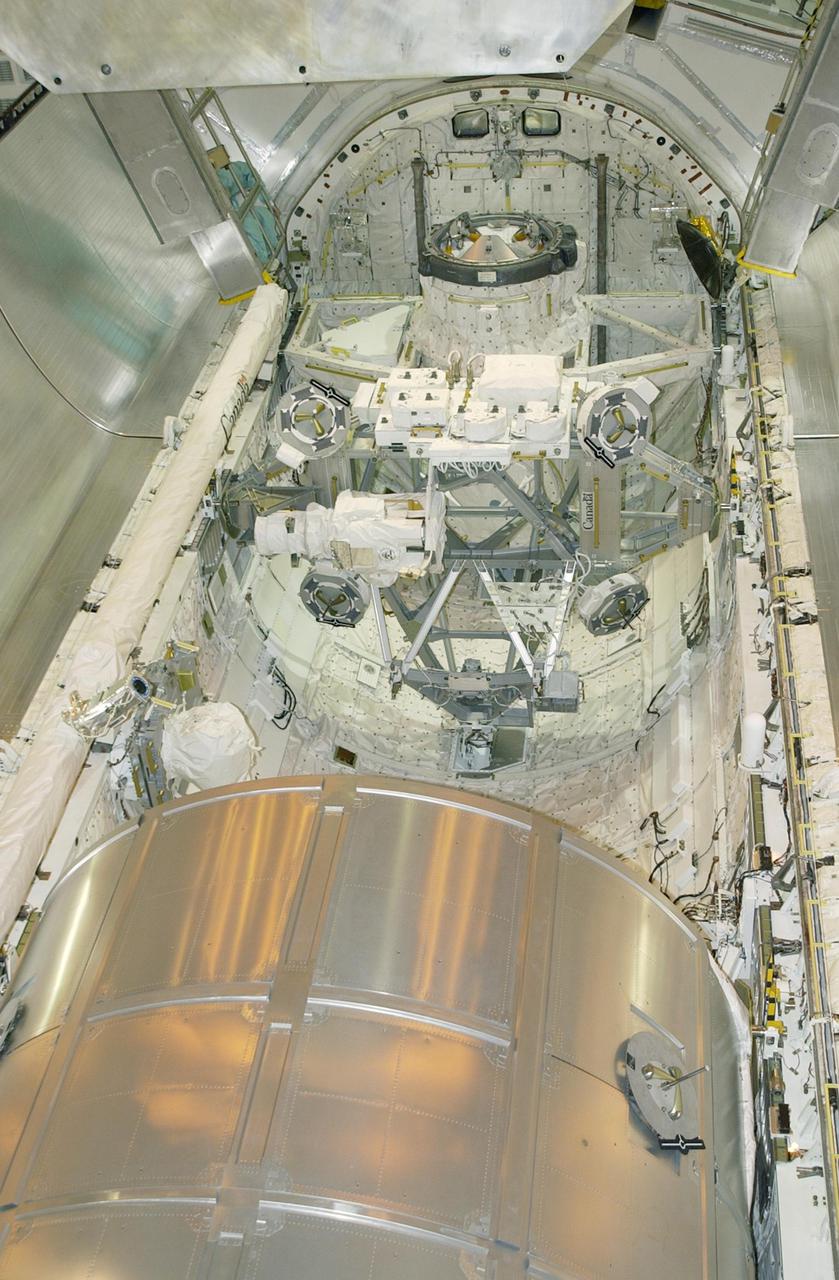
KENNEDY SPACE CENTER, FLA. -- The Multi-Purpose Logistics Module Leonardo (bottom of photo) is being installed in Endeavour's payload bay for mission STS-111. The mission, known as Utilization Flight 2, is carrying supplies and equipment to the International Space Station. The payload includes the Multi-Purpose Logistics Module Leonardo, the Mobile Base System, which will be installed on the Mobile Transporter to complete the Canadian Mobile Servicing System, and a replacement wrist_roll joint for Canadarm 2. Also part of the mission, Expedition 5 will travel to the Station as the replacement crew for Expedition 4, who will return to Earth aboard the orbiter. Launch is scheduled for May 30, 2002
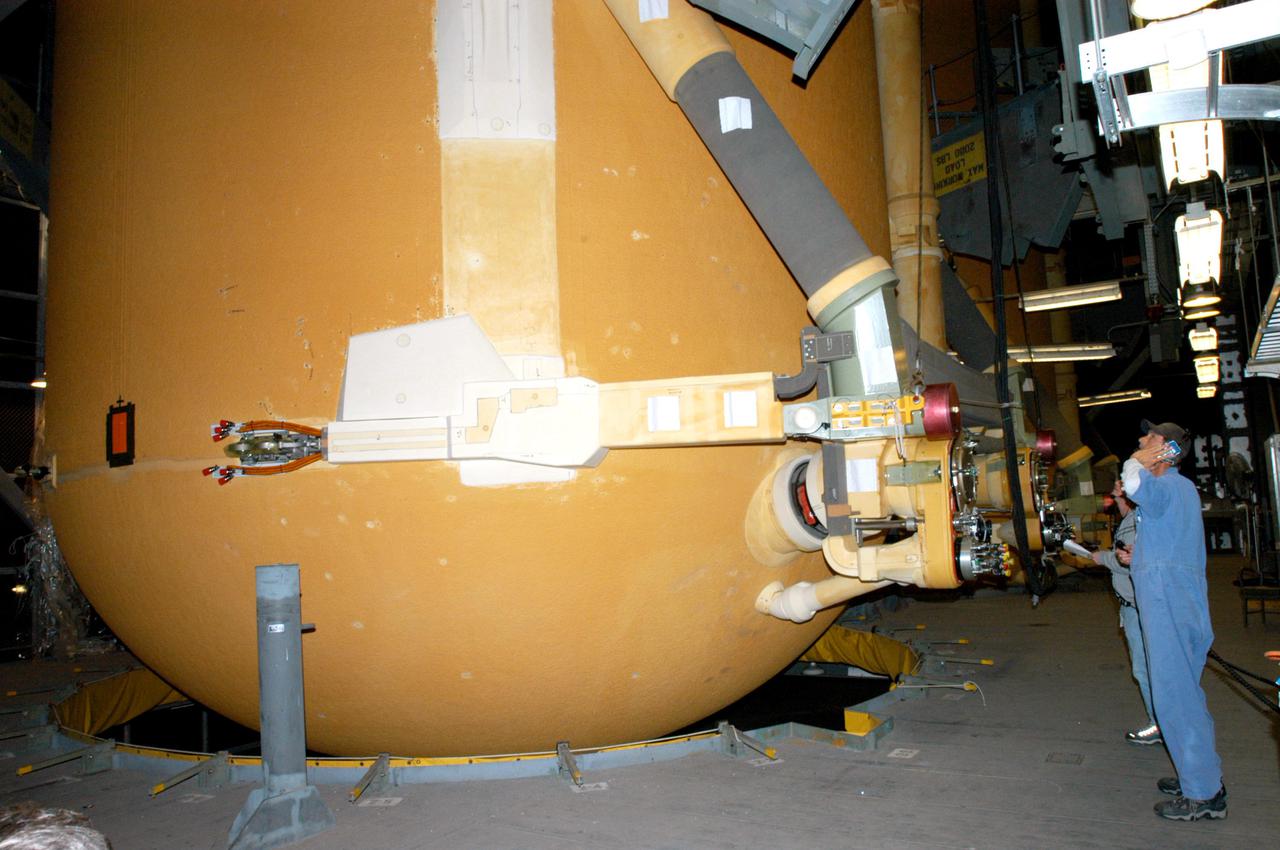
KENNEDY SPACE CENTER, FLA. - A technician watches as the External Tank (ET) designated to fly on Return to Flight mission STS-114 is prepared to be lifted from the checkout cell in the Vehicle Assembly Building. It will be mated with the Solid Rocket Boosters. The ET is recently redesigned to meet recommendations of the Columbia Accident Investigation Board before return to flight. Among dozens of changes is a redesigned forward bipod fitting to reduce the risk to the Space Shuttle from falling debris during ascent. Considered a test flight, STS-114 is scheduled to launch during a window extending May 15 to June 3. The Shuttle will carry supplies and equipment to the International Space Station.

KENNEDY SPACE CENTER, FLA. - Students from one of NASA’s Explorer Schools, Stewart Middle School in Tampa pose for a photo with other guests visiting the Museum of Science and Industry (MOSI) in Tampa. At left, in the back row, are former astronaut Dan Brandenstein, current vice president of Consolidated Space Operations Centers (CSOC), and KSC Deputy Director Dr. Woodrow Whitlow Jr. In the center is Ronte Smith, southeast regional sales manager for General Motors, and Gail Rymer, with Lockheed Martin. On the right are Dr. Adena Williams Loston, chief education officer at NASA Headquarters, and Wit Ostrenko, president of MOSI. The MOSI is featuring the space exhibits Space: A Journey to Our Future, an extraordinary, interactive exhibition designed to entertain, educate and inspire; and SPACE STATION, the first cinematic journey to the International Space Station (ISS), where audiences can experience for themselves life in zero gravity aboard the new station.

KENNEDY SPACE CENTER, FLA. - Monica Hagley, an avionic test engineer, places a refurbished, spare orbiter point sensor chassis on the table. Faulty readings in the liquid hydrogen tank low-level fuel cut-off sensor are being investigated because one of the four sensors failed a routine prelaunch check during the launch countdown July 13, causing mission managers to scrub Discovery's first launch attempt. The sensor protects the Shuttle's main engines by triggering their shutdown in the event fuel runs unexpectedly low. The sensor is one of four inside the liquid hydrogen section of the External Tank (ET).
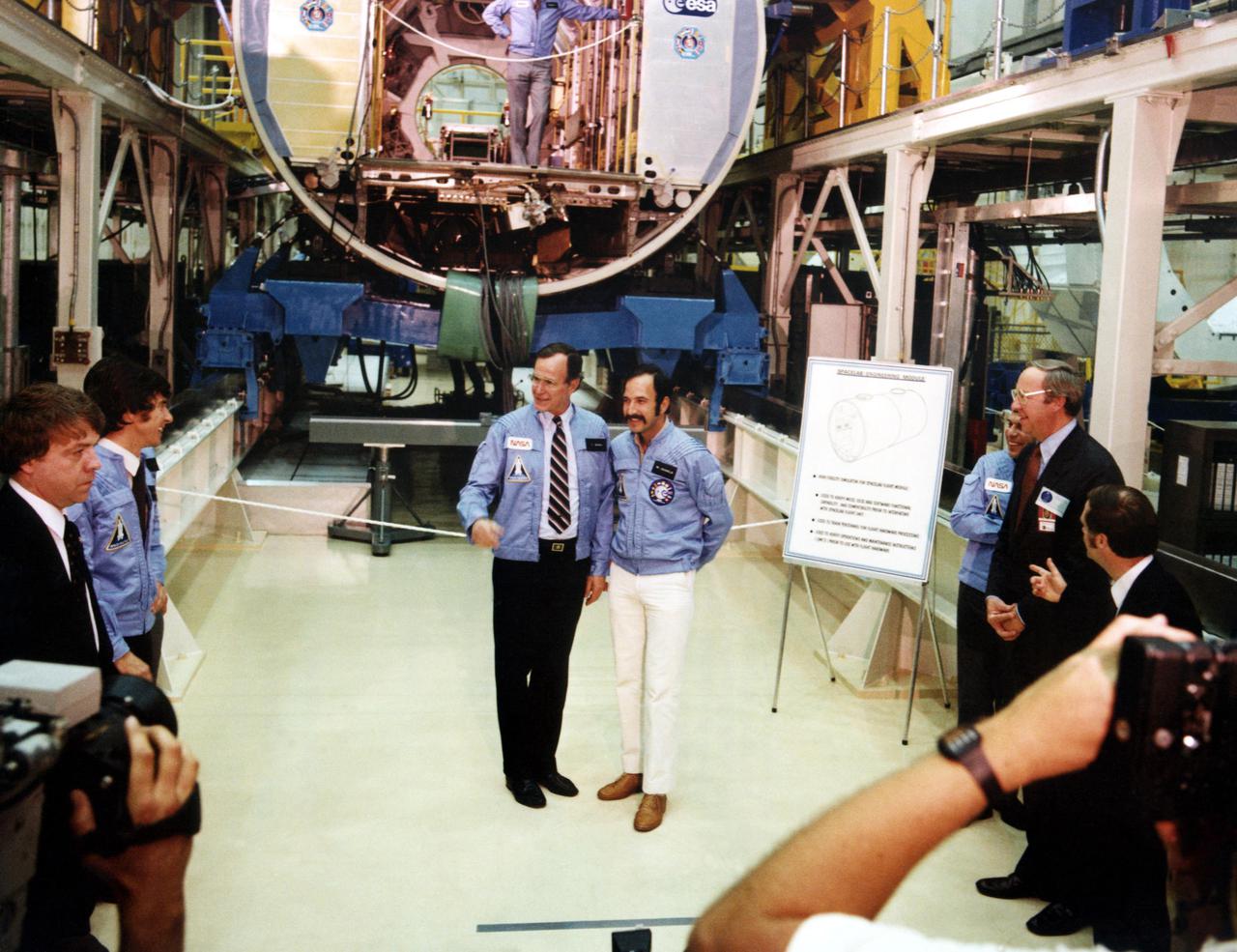
KENNEDY SPACE CENTER, FLA. -- Vice President George F. Bush, center left, is pictured with Payload Specialist Wubbo Ockels of the Netherlands during the Spacelab Arrival Ceremony. Second from left is Payload Specialist Ulf Merbold, Germany. At far right are James McCulls, chief, Special Services Branch, NASA Headquarters; and James C. Harrington, director, Spacelab Program, NASA. Overhead, astronaut Owen K. Garriott, U.S.A., stands in the Spacelab Engineering Module.
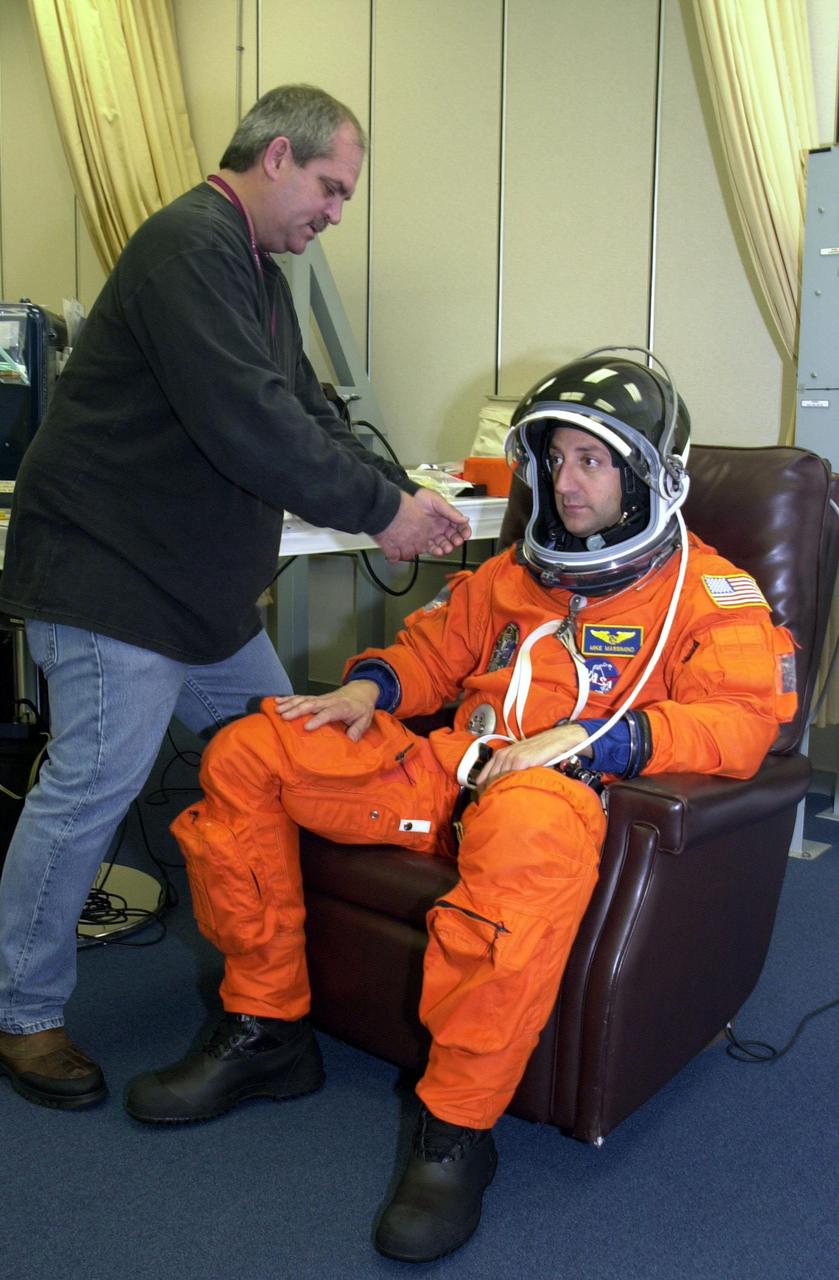
KENNEDY SPACE CENTER, Fla. - STS-109 Mission Specialist Michael J. Massimino gets a final fitting on his launch and entry suit two days before launch. On mission STS-109, the seven-member crew will capture the Hubble Space Telescope using the Shuttle's robotic arm and secure it on a workstand in Columbia's payload bay. Four mission specialists will perform five scheduled spacewalks to complete system upgrades to the telescope. More durable solar arrays, a large gyroscopic assembly to help point the telescope properly, a new telescope power control unit, and a cooling system to restore the use of a key infrared camera and spectrometer unit, which has been dormant since 1999, will all be installed. In addition, the telescope’s view of the Universe will be improved with the addition of the Advanced Camera for Surveys (ACS), which replaces the Faint Object Camera, the last of Hubble's original instruments. The STS-109 crew also includes Commander Scott D. Altman, Pilot Duane G. Carey, and Mission Specialists John M. Grunsfeld, James H. Newman, Nancy J. Currie and Richard M. Linnehan. Launch is scheduled for Feb. 28, 2002, at 6:48 a.m. EST (11:48 GMT)
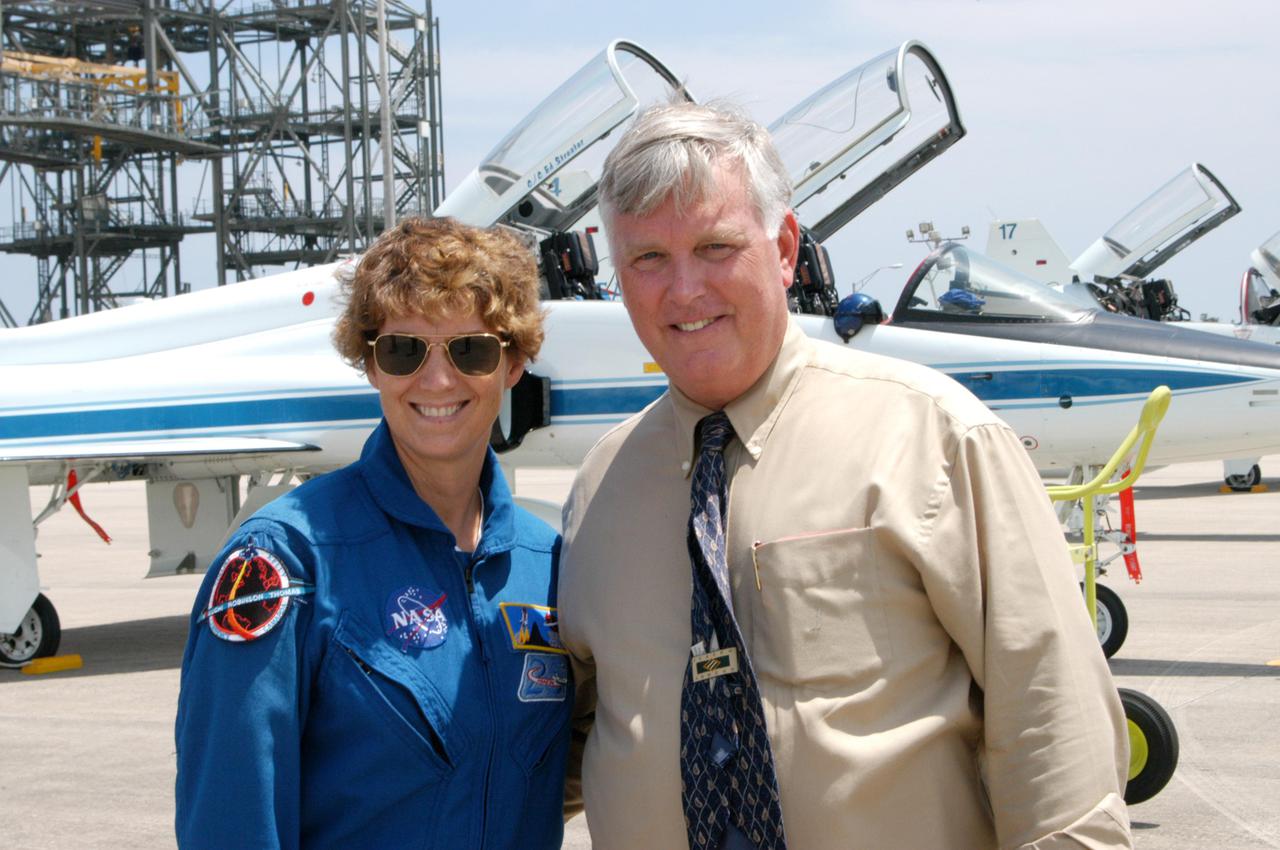
KENNEDY SPACE CENTER, FLA. - Center Director Jim Kennedy (right) greets STS-114 Mission Commander Eileen Collins after her arrival at NASA Kennedy Space Center aboard a T-38 jet aircraft. The Return to Flight STS-114 crew has returned to KSC to get ready for a second launch attempt aboard Space Shuttle Discovery. Collins later told the media who waited nearby that since the scrub on July 13, the crew has focused on the on-orbit part of the mission and training for night landings using the Shuttle Training Aircraft. She praised the engineers and technicians who have been troubleshooting the elusive sensor problem and thanked them. STS-114 is scheduled to launch July 26 at 10:39 a.m. EDT from Launch Pad 39B.
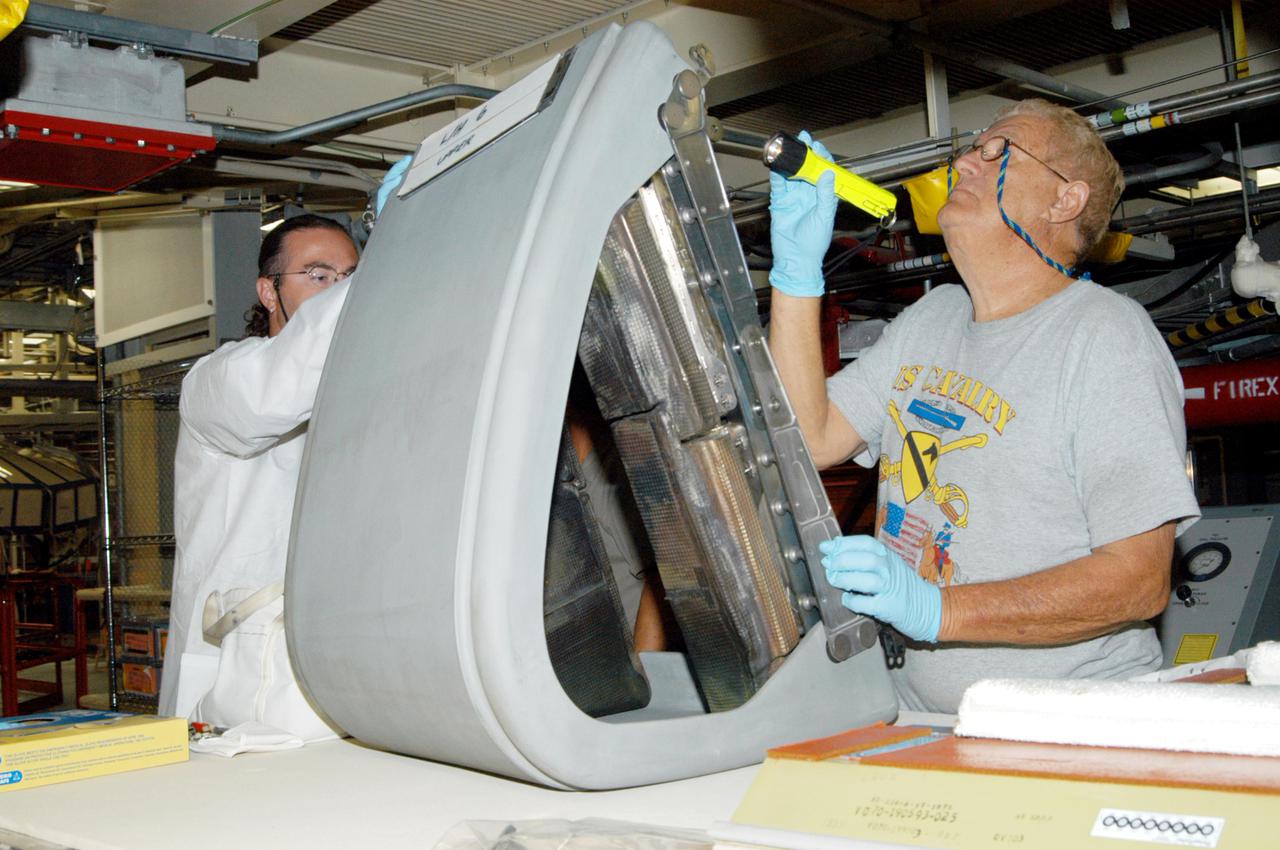
KENNEDY SPACE CENTER, FLA. - In the Orbiter Processing Facility, Matt Scott and Mel Romans (left and right), with United Space Alliance, closely inspect the final Reinforced Carbon-Carbon (RCC) panel to be installed on orbiter Discovery’s left wing. The leading edges of each of an orbiter’s wings have 22 RCC panels. They are light gray and made entirely of carbon composite material, which protect the orbiter during re-entry. The molded components are approximately 0.25- to 0.5-inch thick and capable of withstanding temperatures up to 3,220 degrees F. Following the Columbia accident in February 2002, which was caused by a breach in an RCC panel that allowed hot gases into the vehicle, each panel on Discovery was removed and thoroughly inspected before final reinstallation. Discovery is the designated orbiter to fly on the Return to Flight mission STS-114, the first Space Shuttle to launch since the accident. The launch window for the mission is May 12 to June 3, 2005.
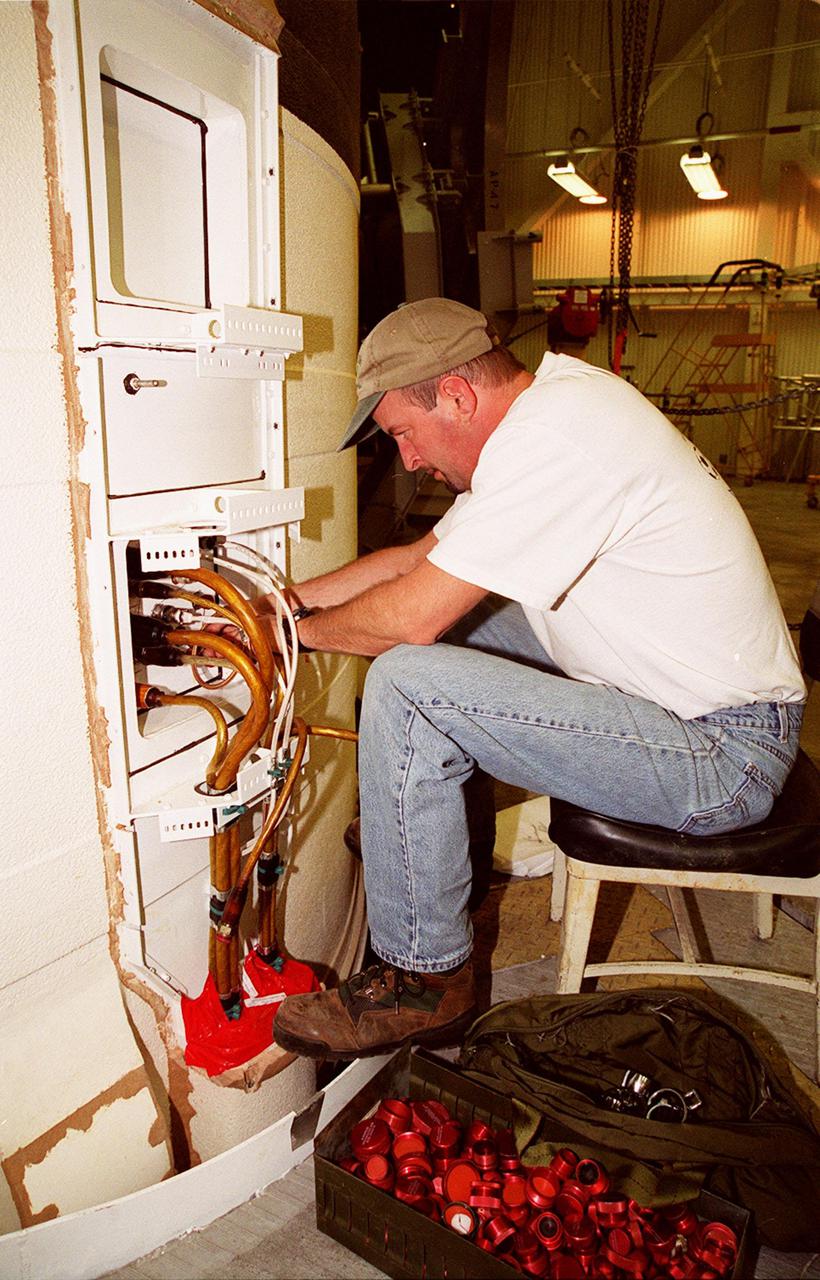
KENNEDY SPACE CENTER, FLA. -- In the Vehicle Assembly Building, United Space Alliance SRB technician Frank Meyer pulls cables out of the solid rocket booster system tunnel. Cable end covers are in a box near his feet. The SRB is part of Space Shuttle Atlantis, rolled back from Launch Pad 39A in order to conduct tests on the cables. A prior extensive evaluation of NASA’s SRB cable inventory on the shelf revealed conductor damage in four (of about 200) cables. Shuttle managers decided to prove the integrity of the system tunnel cables already on Atlantis before launching. Workers are conducting inspections, making continuity checks and conducting X-ray analysis on the cables. The launch has been rescheduled no earlier than Feb. 6. <br
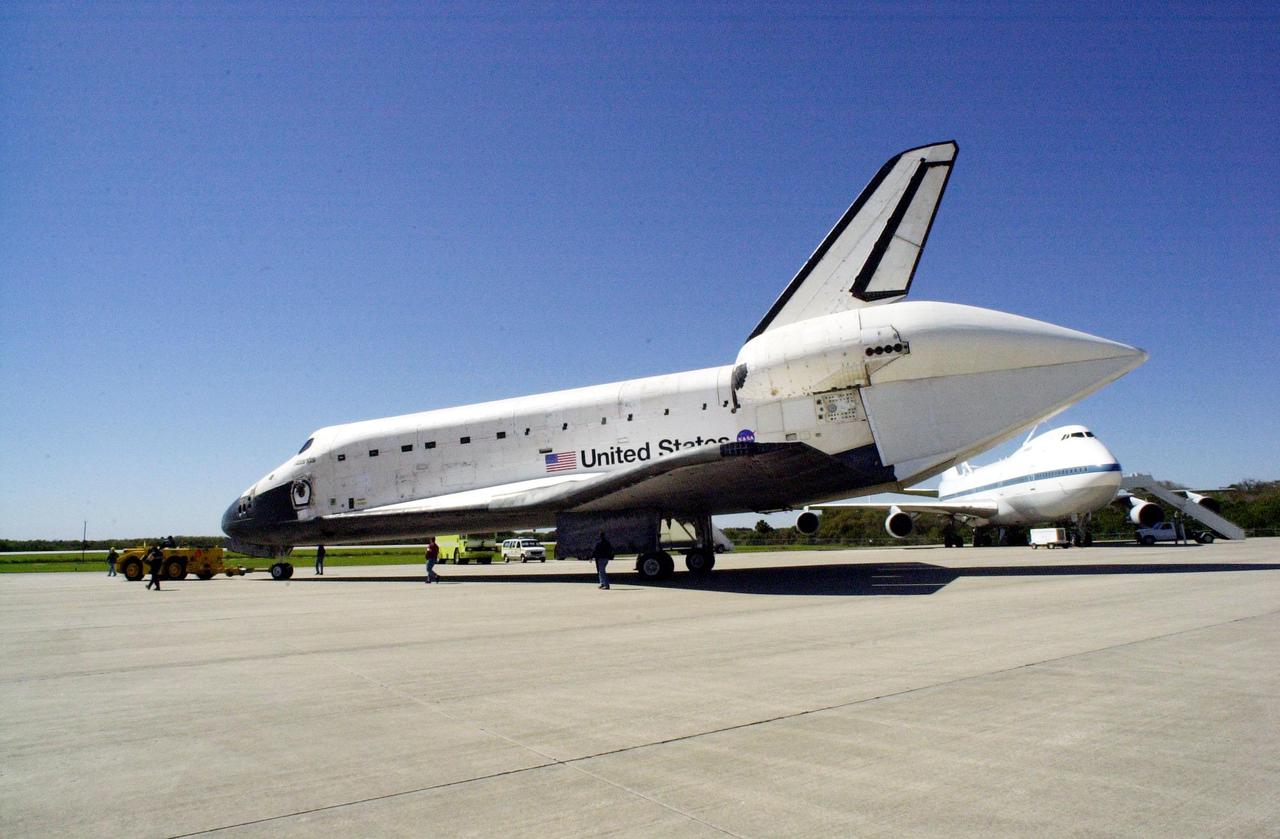
KENNEDY SPACE CENTER, FLA. -- At the Shuttle Landing Facility, orbiter Atlantis is towed from the mate_demate device to the Orbiter Processing Facility. A tail cone covers its aft engines. In the background is the Shuttle Carrier Aircraft, a modified Boeing 747, that carried it piggyback known as a ferry flight from California. Atlantis landed Feb. 19 at Edwards Air Force Base concluding mission STS-98. The ferry flight back to KSC began March 1; unfavorable weather conditions kept it on the ground at Altus AFB, Okla., until it could return to Florida March 5. Atlantis will be prepared in the OPF for mission STS-104, the 10th construction flight to the International Space Station, scheduled to launch June 8
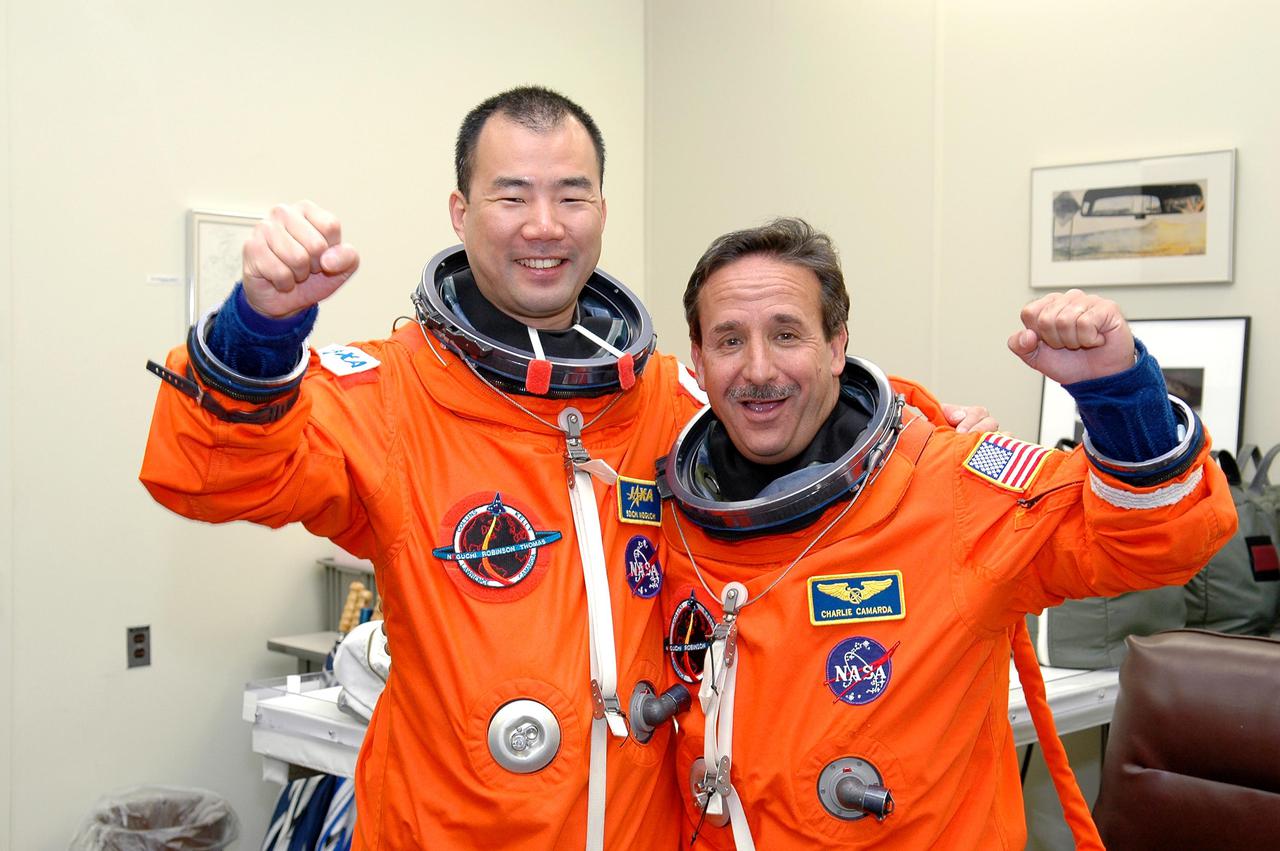
KENNEDY SPACE CENTER, FLA. - STS-114 Mission Specialists Soichi Noguchi (left) and Charles Camarda are suited up in the Operations and Checkout Building and ready for the trip to Launch Pad 39B for a mock launch countdown culminating in a simulated main engine cutoff. Noguchi is with the Japan Aerospace Exploration Agency. The dress rehearsal is part of Terminal Countdown Demonstration Test (TCDT) activities held prior to each Space Shuttle flight. It provides the crew of each mission an opportunity to participate in various simulated countdown activities, including equipment familiarization and emergency egress training. STS-114 is the first Return to Flight mission to the International Space Station. The launch window extends July 13 through July 31.
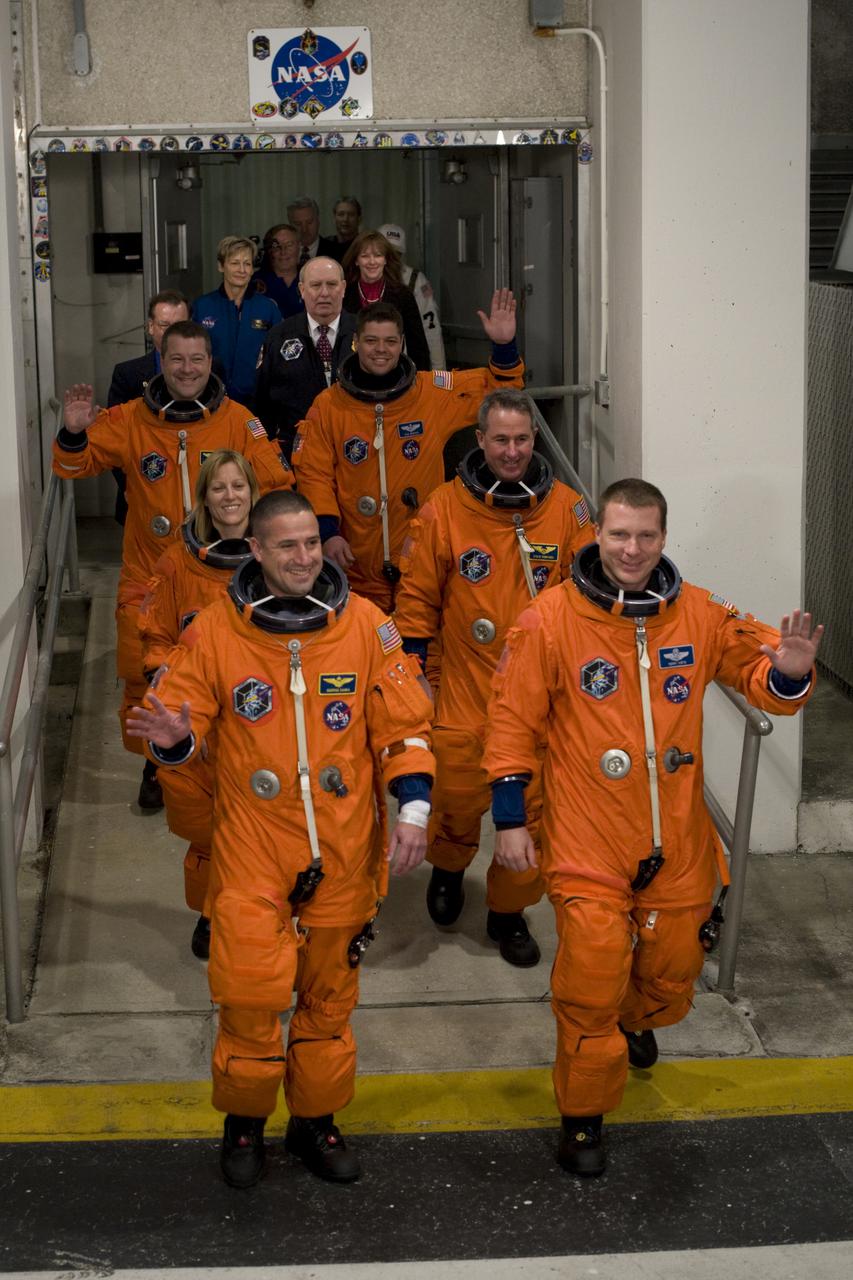
CAPE CANAVERAL, Fla. - At NASA's Kennedy Space Center in Florida, the astronauts on space shuttle Endeavour's STS-130 crew, dressed in their orange launch-and-entry suits, wave to spectators as they walk out of the Operations and Checkout Building for the ride in the Astrovan to Launch Pad 39A. In the left column, from the front, are Commander George Zamka and Mission Specialists Kathryn Hire and Nicholas Patrick. In the right column, from the front, are Pilot Terry Virts and Mission Specialists Stephen Robinson and Robert Behnken. This is the second launch attempt for space shuttle Endeavour's STS-130 crew. The first attempt on Feb. 7 was scrubbed due to unfavorable weather. The primary payload for the STS-130 mission to the International Space Station is the Tranquility node, a pressurized module that will provide additional room for crew members and many of the station's life support and environmental control systems. Attached to one end of Tranquility is a cupola, a unique work area with six windows on its sides and one on top. The cupola resembles a circular bay window and will provide a vastly improved view of the station's exterior. The multi-directional view will allow the crew to monitor spacewalks and docking operations, as well as provide a spectacular view of Earth and other celestial objects. The module was built in Turin, Italy, by Thales Alenia Space for the European Space Agency. Endeavour's launch is set for Feb. 8 at 4:14 a.m. EST. For information on the STS-130 mission and crew, visit http:__www.nasa.gov_mission_pages_shuttle_shuttlemissions_sts130_index.html. Photo courtesy of Scott Andrews
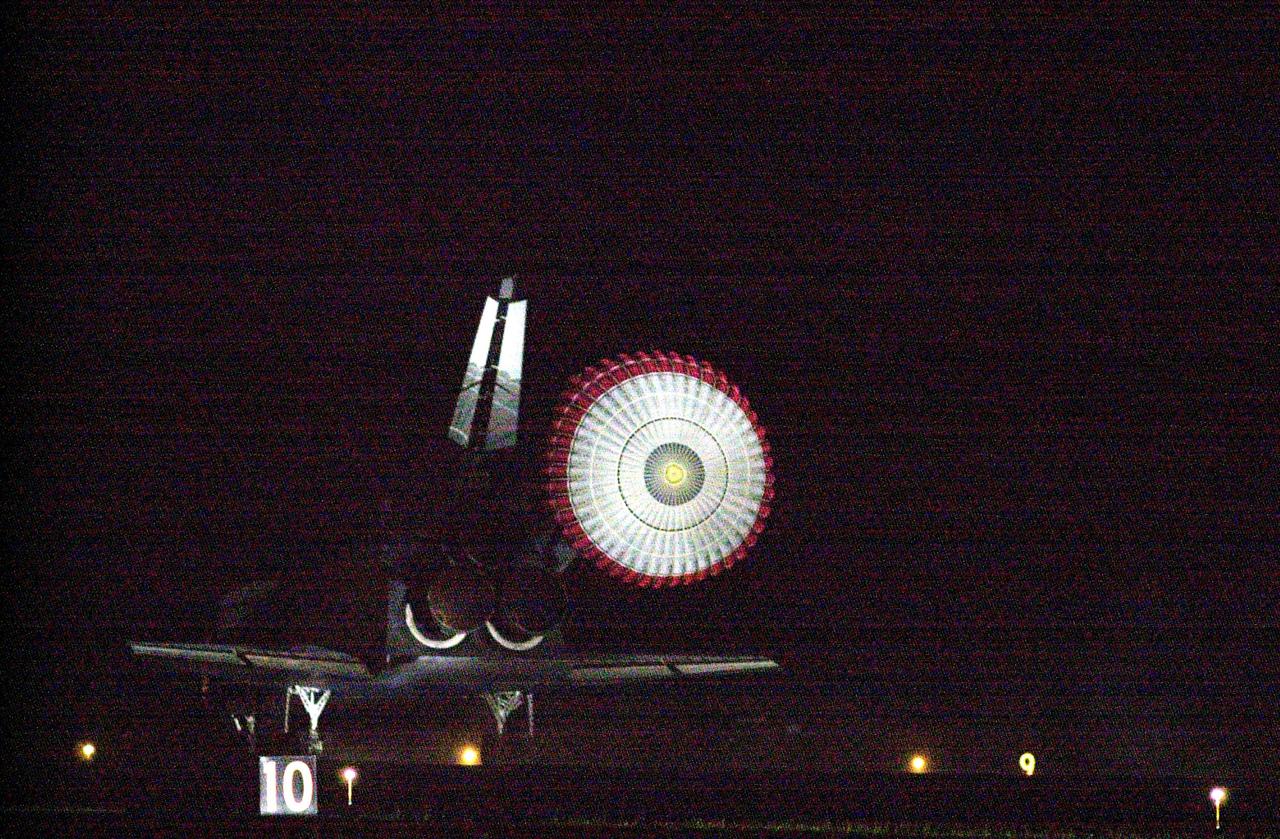
KENNEDY SPACE CENTER, Fla. -- With the drag chute slowing its speed, Atlantis prepares to land on Runway 15 at the Shuttle Landing Facility to complete a 12-day, 18-hour, 34-minute-long STS-104 mission. Main gear touchdown occurred at 11:38:55 p.m. EDT. At the controls is Commander Steven W. Lindsey. Other crew members on board are Pilot Charles Hobaugh and Mission Specialists Michael Gernhardt, Janet Lynn Kavandi and James F. Reilly. This is the 18th nighttime landing for a Space Shuttle, the 13th at Kennedy Space Center. The mission delivered the Joint Airlock Module to the International Space Station, completing the second phase of the assembly of the Space Station
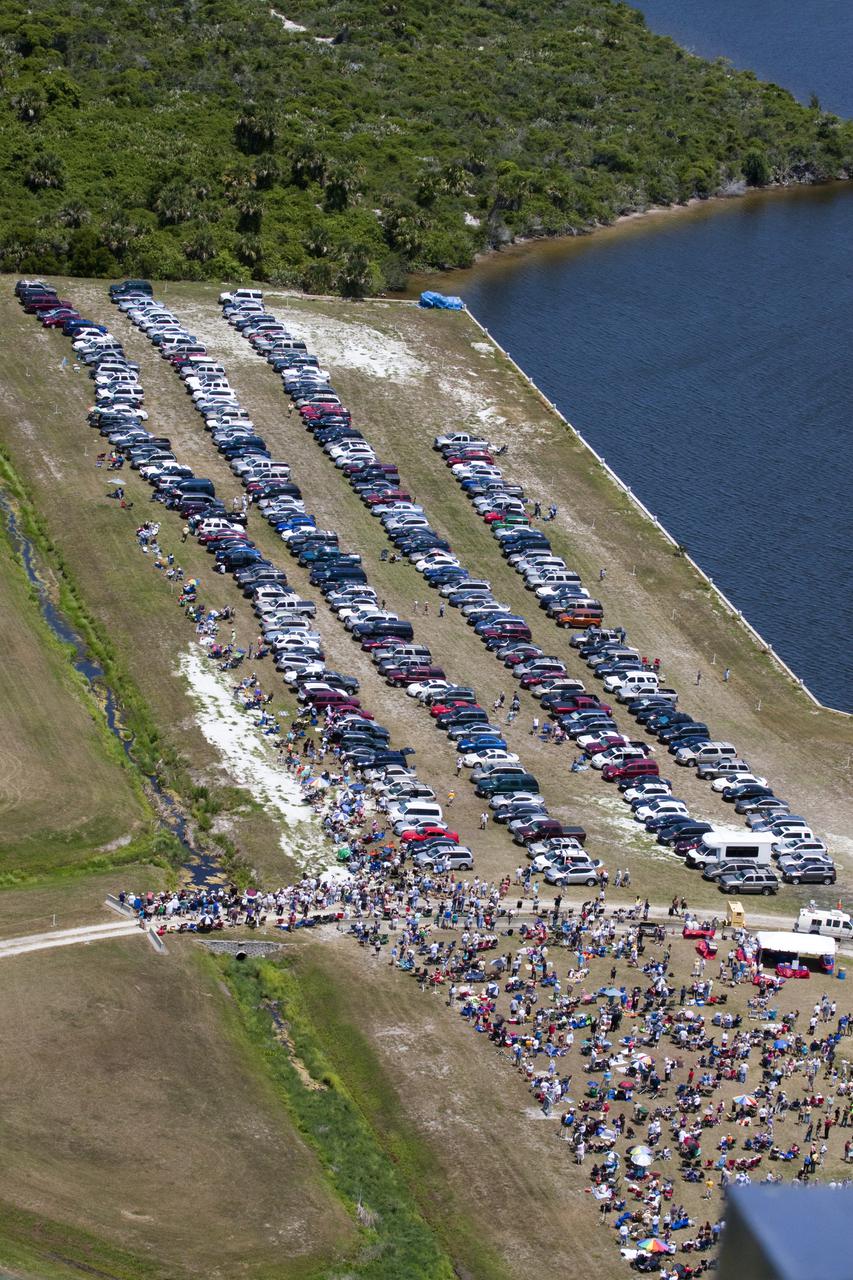
CAPE CANAVERAL, Fla. - Employees and their families gather at the Turn Basin at NASA's Kennedy Space Center in Florida to watch space shuttle Atlantis lift off from Launch Pad 39A. Launch of the STS-132 mission to the International Space Station occurred right on time at 2:20 p.m. on May 14. The Russian-built Mini Research Module-1 known as Rassvet, or 'dawn,' is inside the shuttle's cargo bay. It will provide additional storage space and a new docking port for Russian Soyuz and Progress spacecraft. The laboratory will be attached to the bottom port of the station's Zarya module. The mission's three spacewalks will focus on storing spare components outside the station, including six batteries, a communications antenna and parts for the Canadian Dextre robotic arm. STS-132 is the 132nd shuttle flight, the 32nd for Atlantis and the 34th shuttle mission dedicated to station assembly and maintenance. For more information on the STS-132 mission objectives, payload and crew, visit www.nasa.gov_mission_pages_shuttle_shuttlemissions_sts132_index.html. Photo Credit: NASA_Jack Pfaller
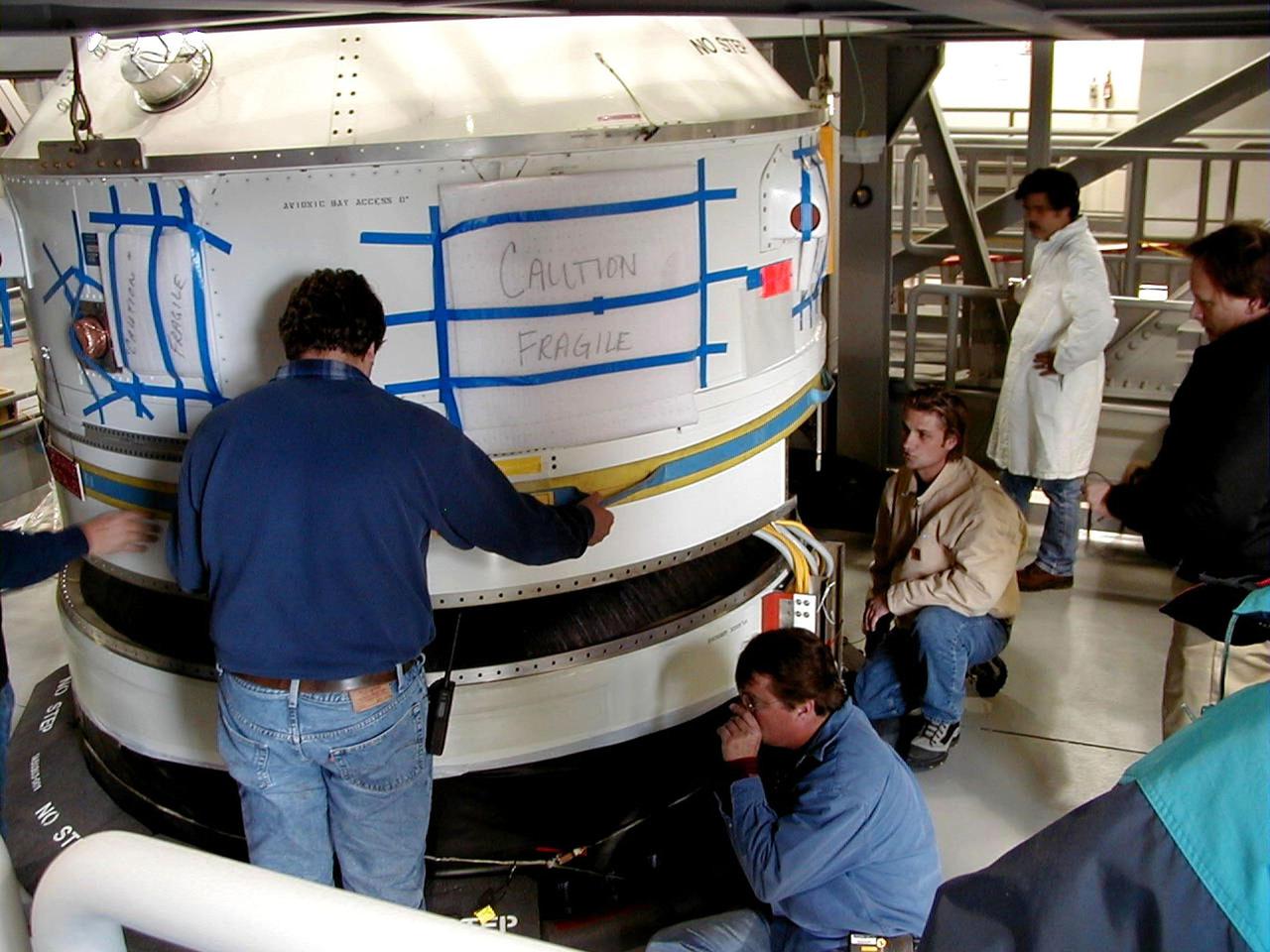
KODIAK ISLAND, Alaska -- Technicians align the fueled Orbit Adjust Model (OAM), which navigates payloads into the correct orbit, onto Orbis 21D Equipment Section Boost Motor, the second stage of the Athena 1 launch vehicle, at the launch pad at Kodiak Island, Alaska, as preparations to launch Kodiak Star proceed. The first orbital launch to take place from Alaska's Kodiak Launch Complex, Kodiak Star is scheduled to lift off on a Lockheed Martin Athena I launch vehicle on Sept. 17 during a two-hour window that extends from 5:00 to 7:00 p.m. ADT. The payloads aboard include the Starshine 3, sponsored by NASA, and the PICOSat, PCSat and Sapphire, sponsored by the Department of Defense (DoD) Space Test Program.

KENNEDY SPACE CENTER, FLA. - The newly redesigned External Tank, designated for use on Return to Flight mission STS-114, moves slowly toward its destination, the dock at the Launch Complex 39 Area Turn Basin, propelled by two tugboats. At left in the background is Launch Pad 39A. The External Tank arrived safely early this morning at Port Canaveral, Fla., after an approximately 900-mile journey at sea. It departed from the Michoud Assembly Facility in New Orleans Dec. 31 and was transported on the Pegasus, NASA’s specially designed barge, pulled by Solid Rocket Booster retrieval ship Liberty Star. At the port, the barge was then hooked up to the tugs for the last part of the journey to the Turn Basin. Next, the External Tank will be off-loaded from the barge and transported to the Vehicle Assembly Building for its final checkout and mating to the twin Solid Rocket Boosters and orbiter Discovery. NASA and Lockheed Martin Corp. spent nearly two years modifying the 15-story, bronze-colored tank to make it safer for liftoff. Among dozens of changes is a redesigned forward bipod fitting -- a design that meets the recommendation of the Columbia Accident Investigation Board to reduce the risk to the Space Shuttle from falling debris during ascent. STS-114 is targeted for a launch opportunity beginning in May. The seven-member Discovery crew will fly to the International Space Station primarily to test and evaluate new procedures for flight safety, including Space Shuttle inspection and repair techniques.

KENNEDY SPACE CENTER, FLA. -- In the transfer aisle of the Vehicle Assembly Building, the orbiter Atlantis is suspended vertically via overhead cranes. The orbiter will be rotated and lifted into high bay 1 where it will be stacked with its external tank and solid rocket boosters. Space Shuttle Atlantis is scheduled to launch on mission STS-104 in early July
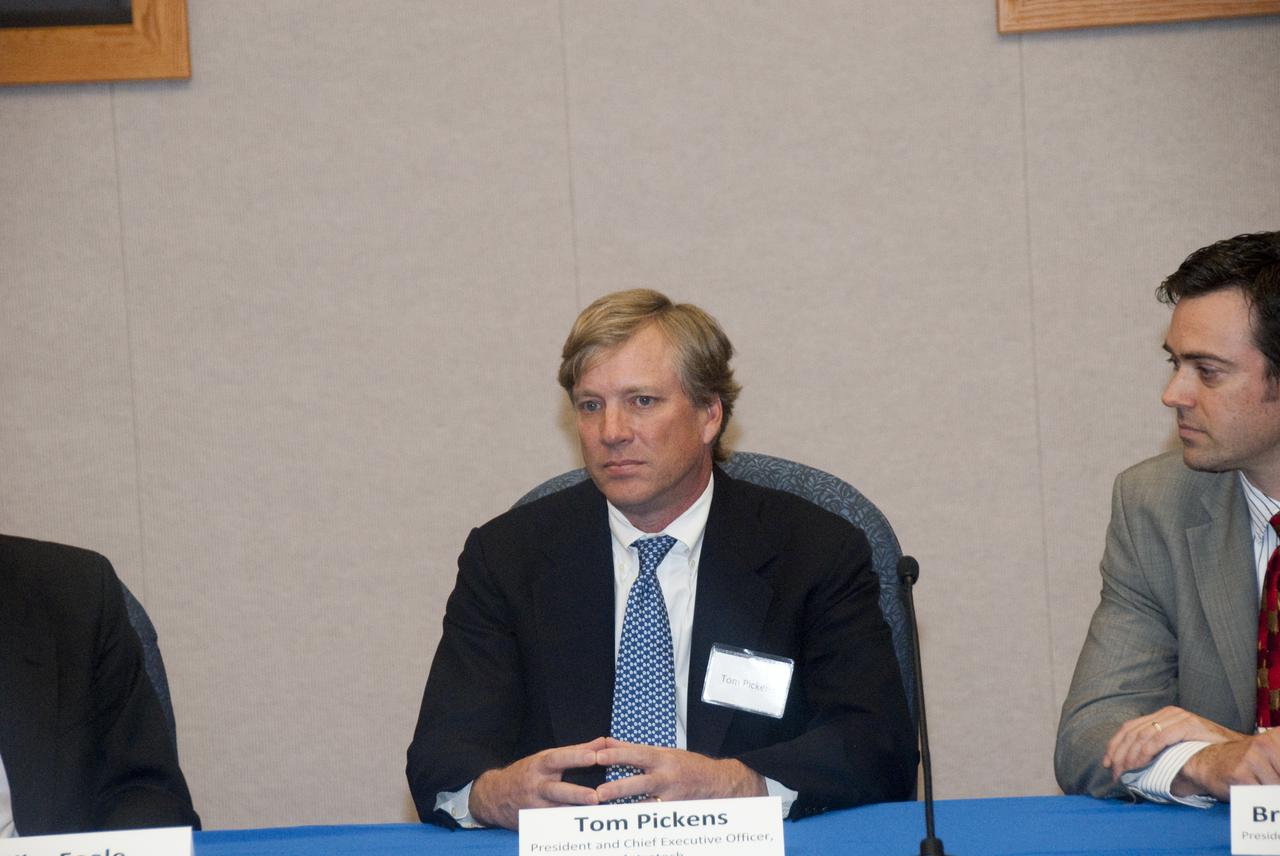
CAPE CANAVERAL, Fla. - In the mission briefing room of the Operations and Checkout Building at NASA's Kennedy Space Center in Florida, Tom Pickens, President and Chief Executive Officer of Astrotech Space Operations (center), Bretton Alexander, President of the Commercial Spaceflight Federation (right); Miles O'Brien, a member of the NASA Advisory Council and panel moderator and NASA Astronaut Mike Foale (both out of frame) participate in the second break-out session, 'Increasing Access To and Utilization of the International Space Station,' that is part of the Conference on the American Space Program for the 21st Century. Photo Credit: NASA_Jim Grossmann

KENNEDY SPACE CENTER, FLA. -- The Shuttle Carrier Aircraft, carrying the orbiter Columbia on its back, touches down on runway 33 at KSC’s Shuttle Landing Facility after a protracted trip from California that began March 1. Unfavorable weather conditions kept it on the ground at Dyess AFB, Texas, until it could return to Florida on March 5 when it landed at the Cape Canaveral Air Force Station Skid Strip. Columbia had to wait for the orbiter Atlantis which had completed a ferry flight to KSC on March 5 to be towed from the SLF before making the final hop to KSC. Columbia is returning from a 17-month-long modification and refurbishment process as part of a routine maintenance plan. The orbiter will next fly on mission STS-107, scheduled Oct. 25
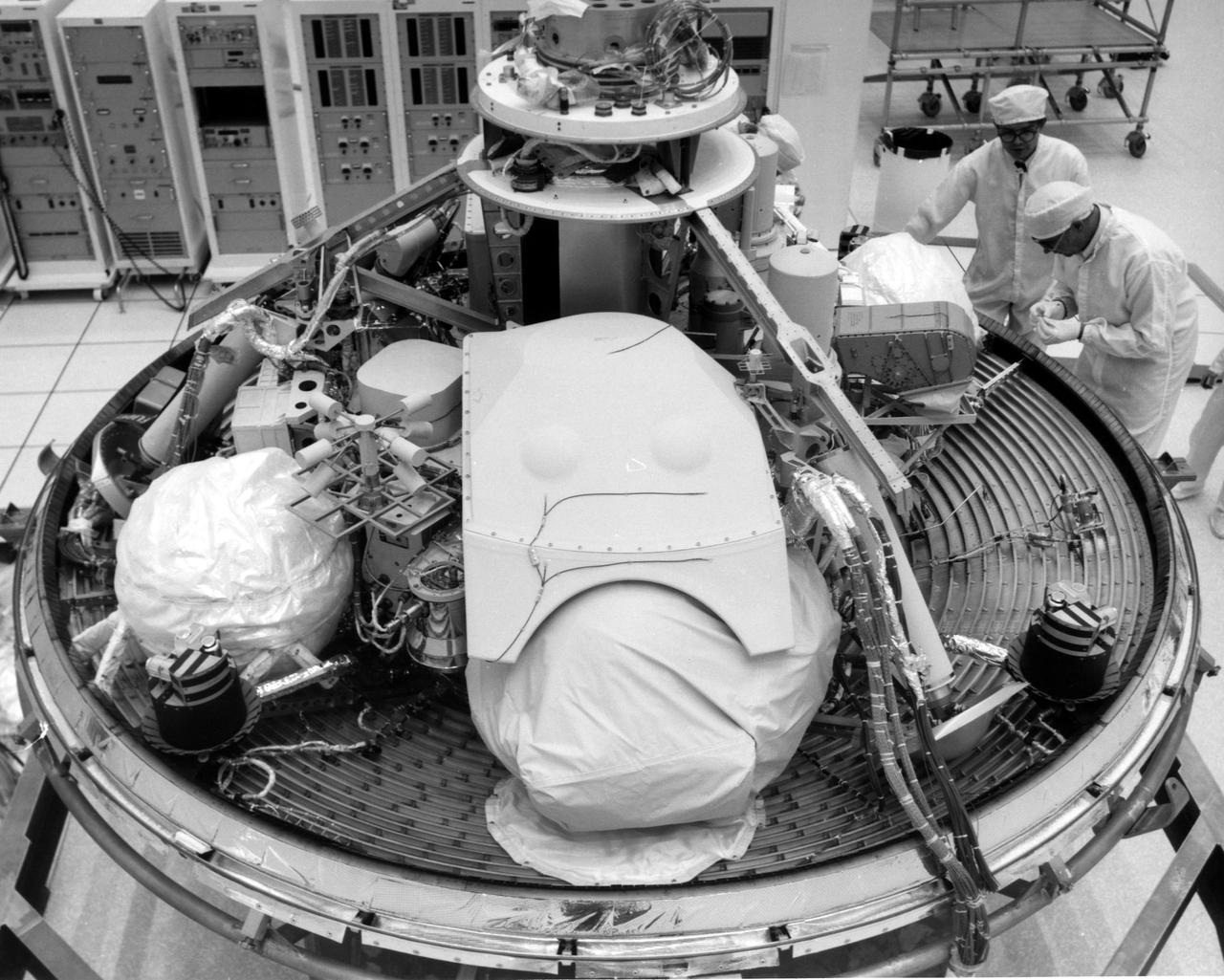
CAPE CANAVERAL, Fla. -- At the Kennedy Space Center in Florida, technicians inspect the Viking Lander 2 in Kennedy's Spacecraft Assembly and Encapsulation Facility 1. The first Viking is scheduled for launch from Launch Complex 41 no earlier than Aug. 11, 1975, the second, no earlier than Aug. 21, 1975. Once in orbit around Mars, the lander will detach and descend to the planet's surface to conduct further investigation. The Viking's 440-million-mile journey to the Red Planet will take about 11 months. Photo Credit: NASA
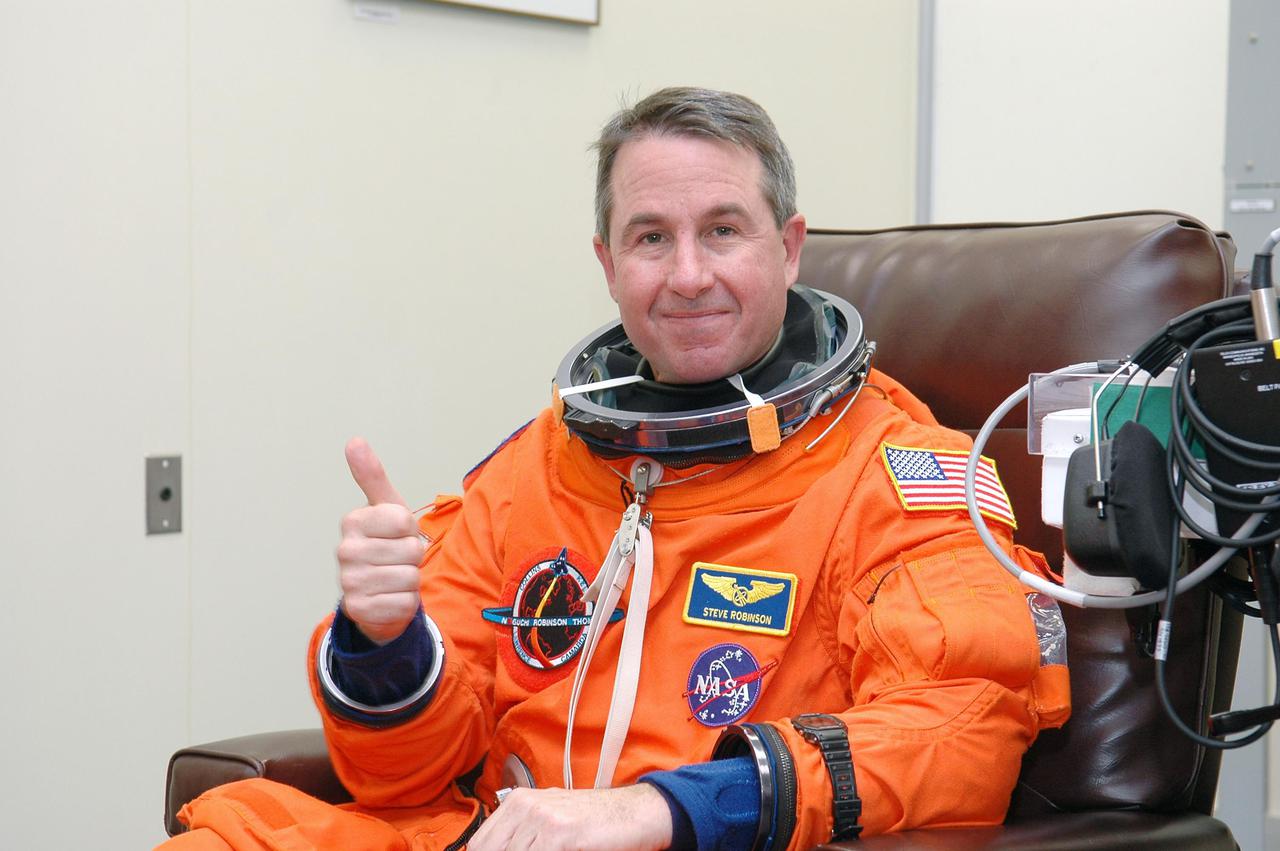
KENNEDY SPACE CENTER, FLA. - As part of pre-pack and fit check for Terminal Countdown Demonstration Test (TCDT) activities, STS-114 Mission Specialist Stephen Robinson signals okay for his launch suit check. The TCDT is held at KSC prior to each Space Shuttle flight. It provides the crew of each mission an opportunity to participate in simulated countdown activities. The test ends with a mock launch countdown culminating in a simulated main engine cutoff. The crew also spends time undergoing emergency egress training exercises at the launch pad. STS-114 is the first Return to Flight mission to the International Space Station. The launch window extends July 13 through July 31.

KENNEDY SPACE CENTER, FLA. - After their arrival at NASA’s Kennedy Space Center, the Return to Flight mission STS-114 crew talked briefly to media. At the microphone is an enthusiastic Soichi Noguchi, mission specialist, who is with the Japan Aerospace Exploration Agency, JAXA. He also spoke in Japanese to the Japanese media who were present. The rest of the crew members are Mission Commander Eileen Collins, Pilot James Kelly, and Mission Specialists Andrew Thomas, Charles Camarda, Wendy Lawrence and Stephen Robinson. The crew arrived a day early due to weather concerns associated with Hurricane Dennis. This historic mission is the 114th Space Shuttle flight and the 17th U.S. flight to the International Space Station. STS-114 is scheduled to launch at 3:51 p.m. July 13 and last about 12 days with a planned KSC landing at about 11:01 a.m. EDT on July 25. On mission STS-114, the crew will perform inspections on orbit for the first time of all of the Reinforced Carbon-Carbon (RCC) panels on the leading edge of the wings and the Thermal Protection System tiles using the new Canadian-built Orbiter Boom Sensor System and the data from 176 impact and temperature sensors. Mission Specialists will also practice repair techniques on RCC and tile samples during a spacewalk in the payload bay. During two additional spacewalks, the crew will install the External Stowage Platform-2, equipped with spare part assemblies, and a replacement Control Moment Gyroscope contained in the Lightweight Multi-Purpose Experiment Support Structure.
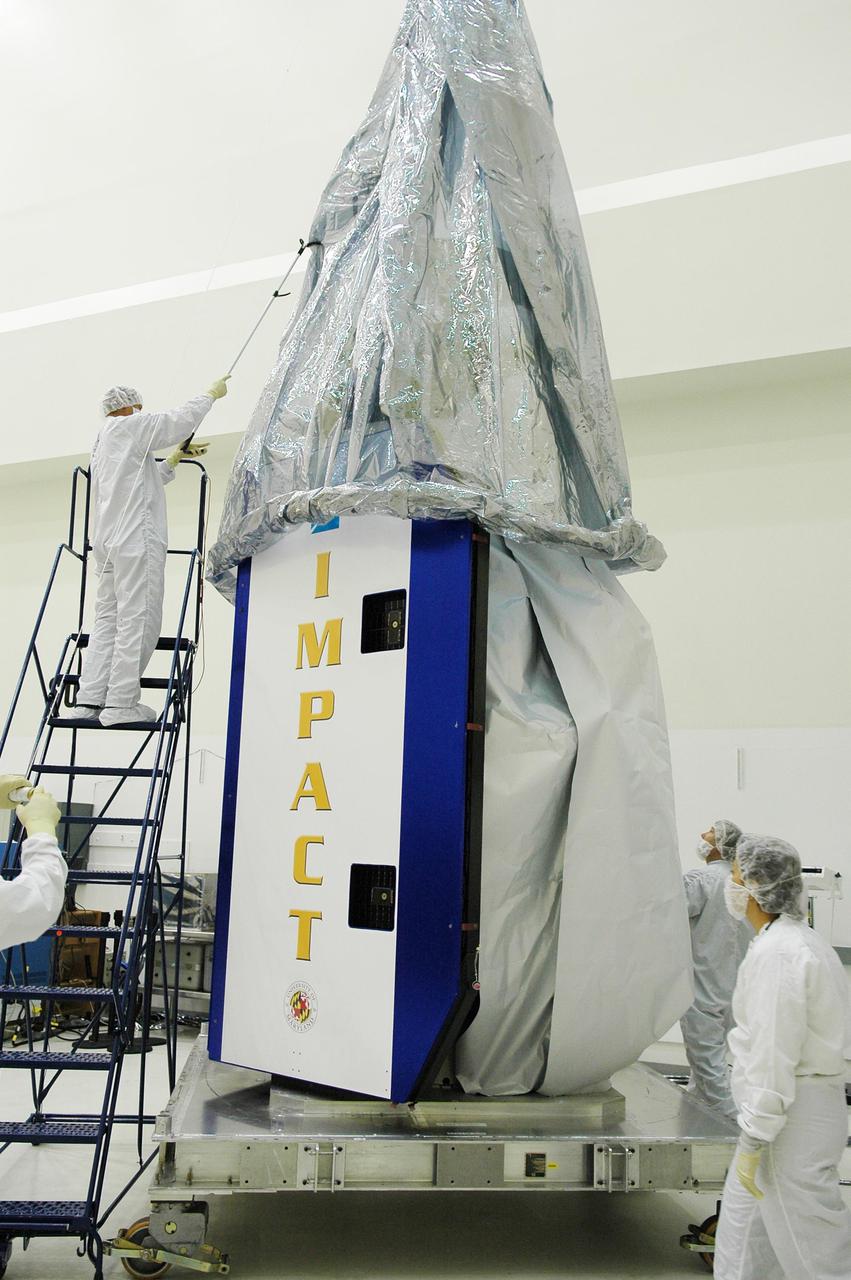
KENNEDY SPACE CENTER, FLA. - At Astrotech Space Operations in Titusville, Fla., workers help guide the protective cover into place over the Deep Impact spacecraft below. Deep Impact is being prepared for a move to the Hazardous Fuel Building and eventually shipment to Launch Pad 17-B, Cape Canaveral Air Force Station. Launch of Deep Impact is scheduled no earlier than Jan. 12. A NASA Discovery mission, Deep Impact will probe beneath the surface of Comet Tempel 1 on July 4, 2005, when the comet is 83 million miles from Earth, and reveal the secrets of its interior. After releasing a 3- by 3-foot projectile to crash onto the surface, Deep Impact’s flyby spacecraft will collect pictures and data of how the crater forms, measuring the crater’s depth and diameter, as well as the composition of the interior of the crater and any material thrown out, and determining the changes in natural outgassing produced by the impact. It will send the data back to Earth through the antennas of the Deep Space Network.
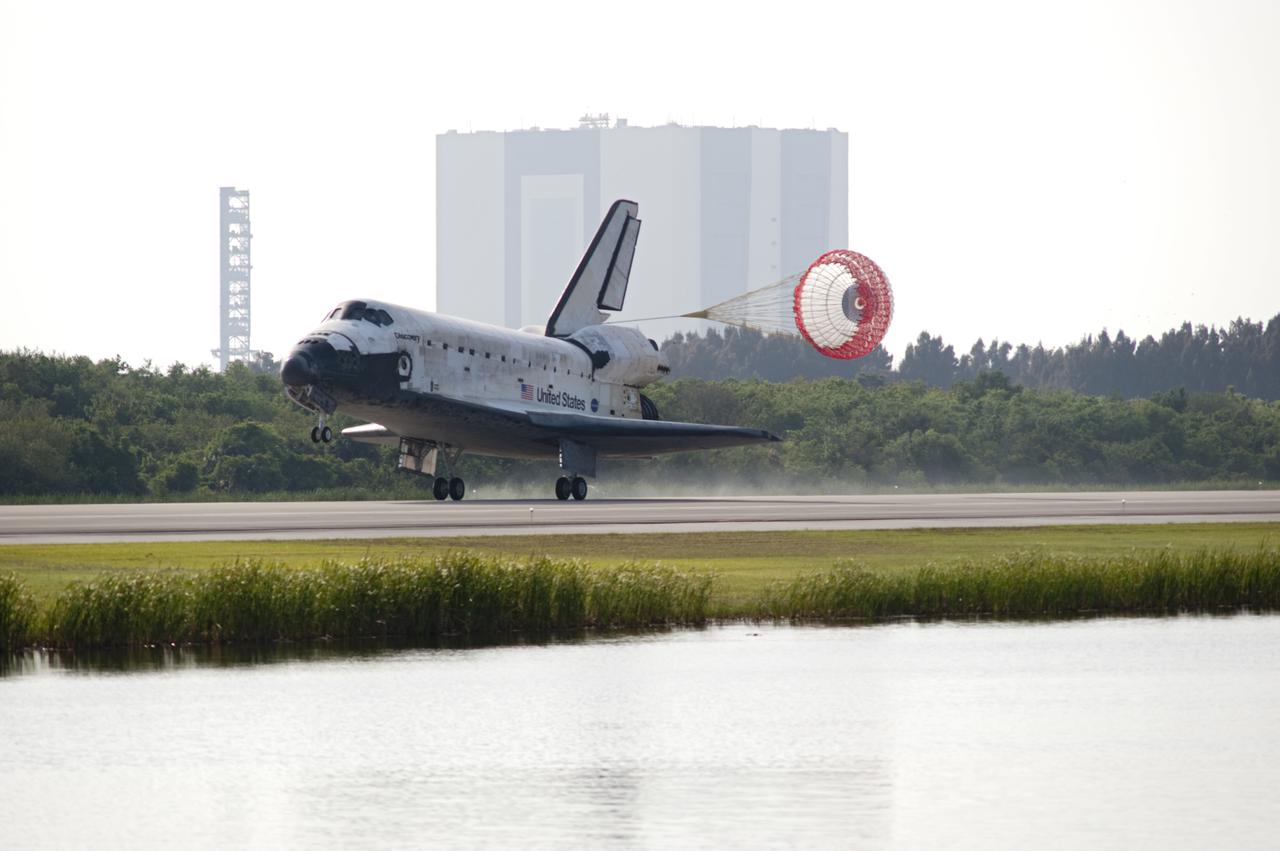
CAPE CANAVERAL, Fla. - With drag chute unfurled, space shuttle Discovery lands on Runway 33 at the Shuttle Landing Facility at NASA's Kennedy Space Center in Florida after 15 days in space, completing the more than 6.2-million-mile STS-131 mission on orbit 238. Main gear touchdown was at 9:08:35 a.m. EDT followed by nose gear touchdown at 9:08:47 a.m. and wheelstop at 9:09:33 a.m. Aboard are Commander Alan Poindexter; Pilot James P. Dutton Jr.; and Mission Specialists Rick Mastracchio, Clayton Anderson, Dorothy Metcalf-Lindenburger, Stephanie Wilson and Naoko Yamazaki of the Japan Aerospace Exploration Agency. The seven-member STS-131 crew carried the multi-purpose logistics module Leonardo, filled with supplies, a new crew sleeping quarters and science racks that were transferred to the International Space Station's laboratories. The crew also switched out a gyroscope on the station’s truss, installed a spare ammonia storage tank and retrieved a Japanese experiment from the station’s exterior. STS-131 is the 33rd shuttle mission to the station and the 131st shuttle mission overall. For information on the STS-131 mission and crew, visit http:__www.nasa.gov_mission_pages_shuttle_shuttlemissions_sts131_index.html. Photo Credit: NASA_Tim Powers
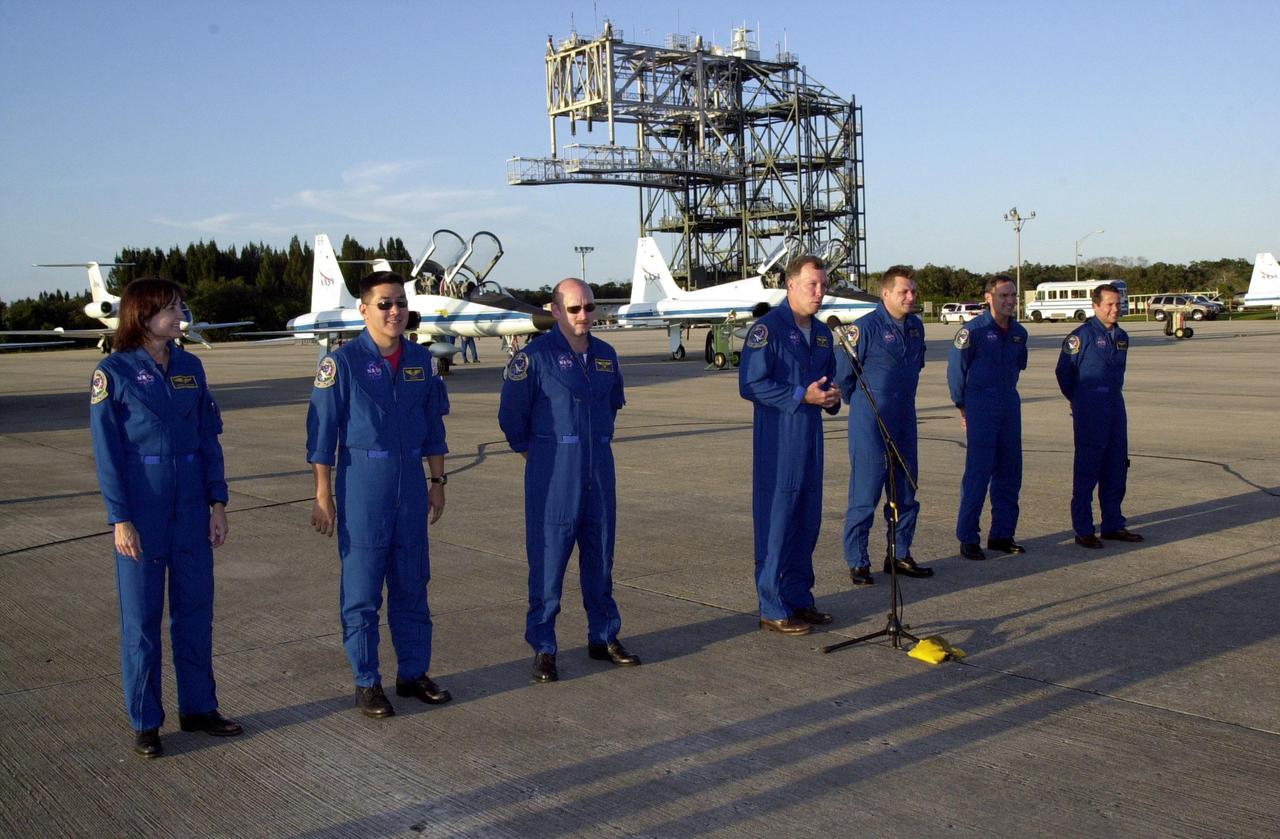
KENNEDY SPACE CENTER, Fla. -- On the parking apron at KSC's Shuttle Landing Facility, the STS-108 and Expedition 4 crews pause after their arrival to greet the media. Standing, left to right, are Mission Specialists Linda A. Godwin and Daniel M. Tani, Pilot Mark E. Kelly, and Commander Dominic L. Gorie; Expedition 4 Commander Yuri Onufrienko and crew members Carl E. Walz and Daniel W. Bursch. Top priorities for the STS-108 (UF-1) mission of Endeavour are rotation of the International Space Station Expedition Three and Expedition Four crews, bringing water, equipment and supplies to the station in the Multi-Purpose Logistics Module Raffaello, and completion of spacewalk and robotics tasks. Tani and Godwin will take part in the spacewalk to install thermal blankets over two pieces of equipment at the bases of the Space Station's solar wings. Liftoff is scheduled for 7:41 p.m. EST
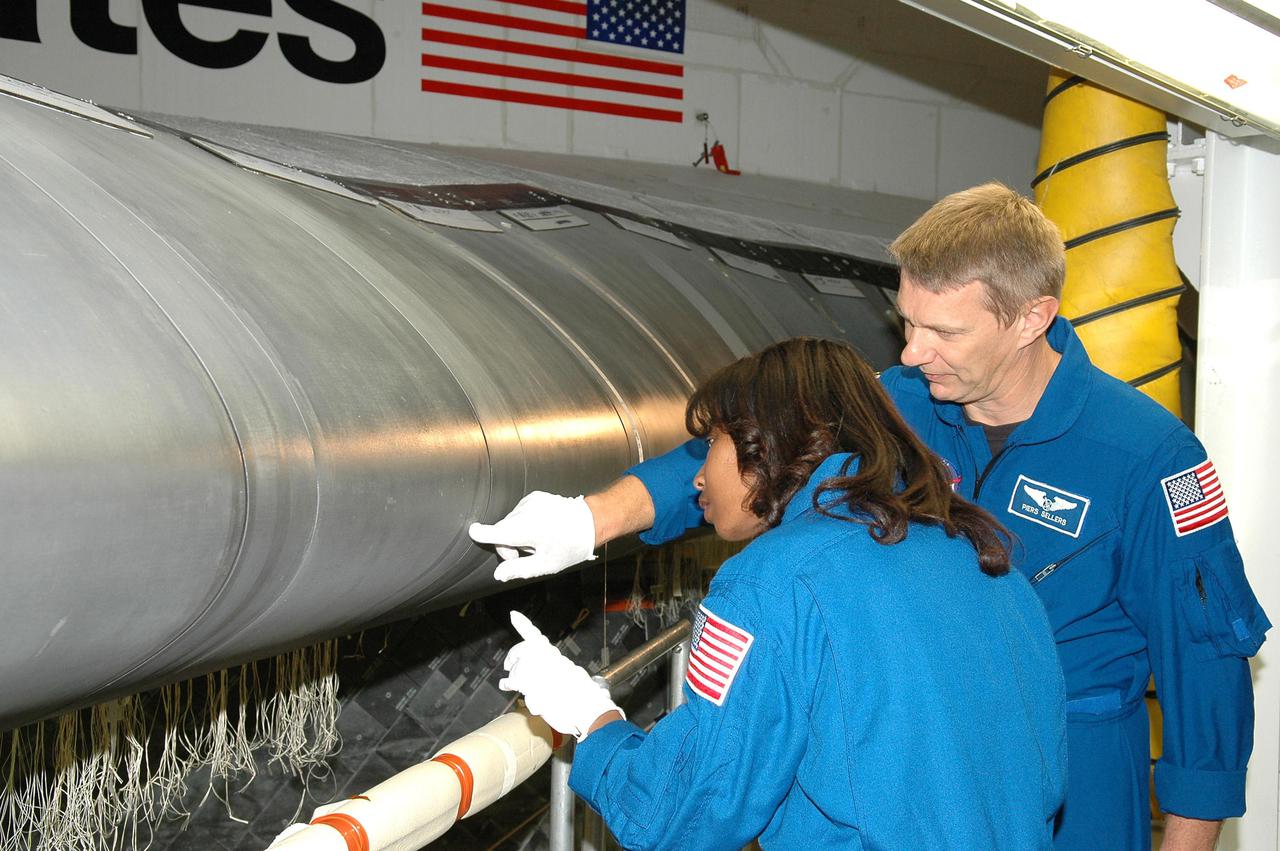
KENNEDY SPACE CENTER, FLA. - In the Orbiter Processing Facility, STS-121 Mission Specialists Stephanie D. Wilson (left) and Piers J. Sellers receive a briefing and up-close look at the wing leading edge of Space Shuttle Atlantis, the orbiter that will take them into space. The leading edge of each of the orbiters’ wings has 22 Reinforced Carbon-Carbon panels, made entirely of carbon composite material. The molded components are approximately 0.25-inch to 0.5-inch thick. The astronauts of the second Return to Flight mission, STS-121, are at Kennedy Space Center to participate in the Crew Equipment Interface Test (CEIT). During CEIT, the crew has an opportunity to get a hands-on look at the orbiter and equipment they will be working with on their mission. Mission STS-121 is scheduled to launch in July.
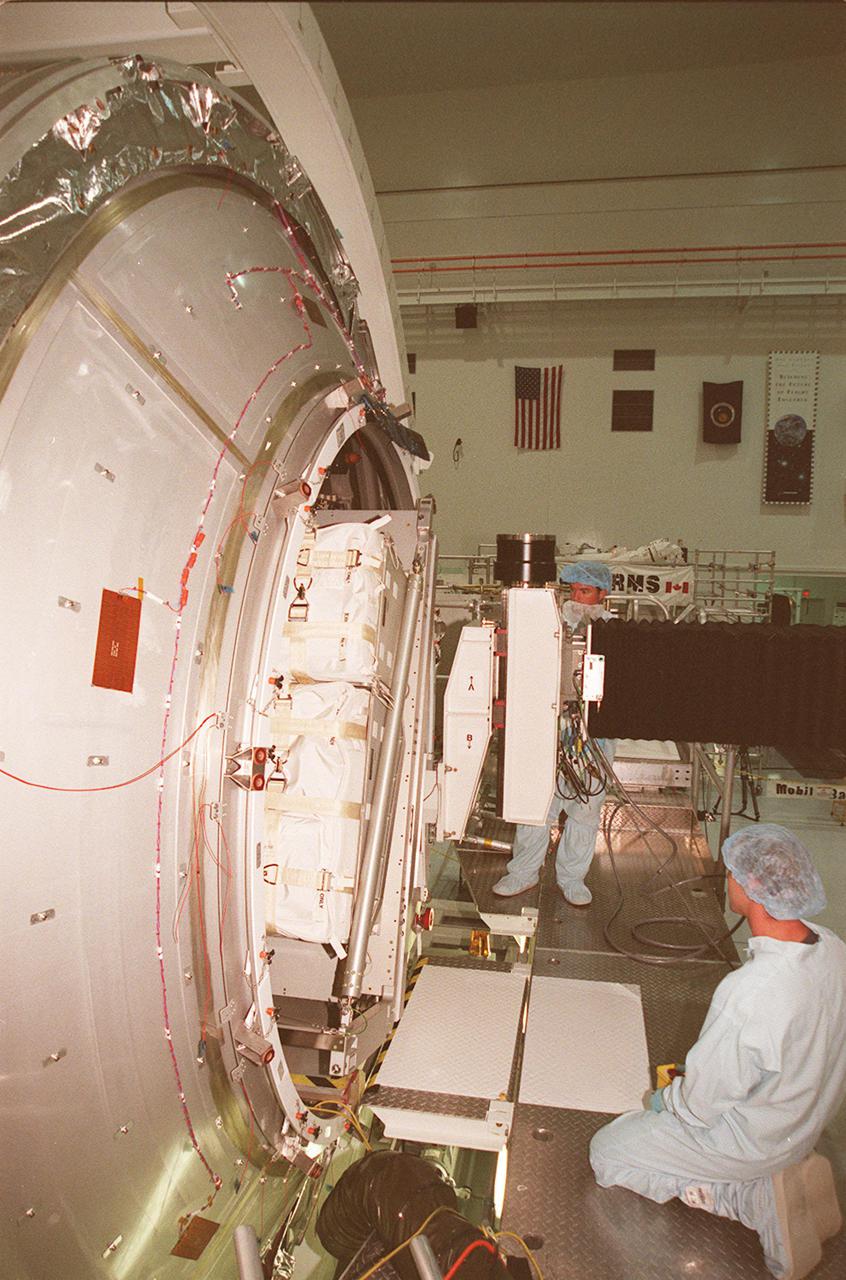
KENNEDY SPACE CENTER, FLA. -- Workers in the Space Station Processing Facility watch as a laboratory rack moves into the Multi-Purpose Logistics Module Leonardo. The MPLM is the first of three such pressurized modules that will serve as the International Space Station’s “moving vans,” carrying laboratory racks filled with equipment, experiments and supplies to and from the Space Station aboard the Space Shuttle. Leonardo will be launched March 1, 2001, on Shuttle mission STS-102 On that flight, Leonardo will be filled with equipment and supplies to outfit the U.S. laboratory module, being carried to the ISS on the Jan. 19, 2001, launch of STS-98
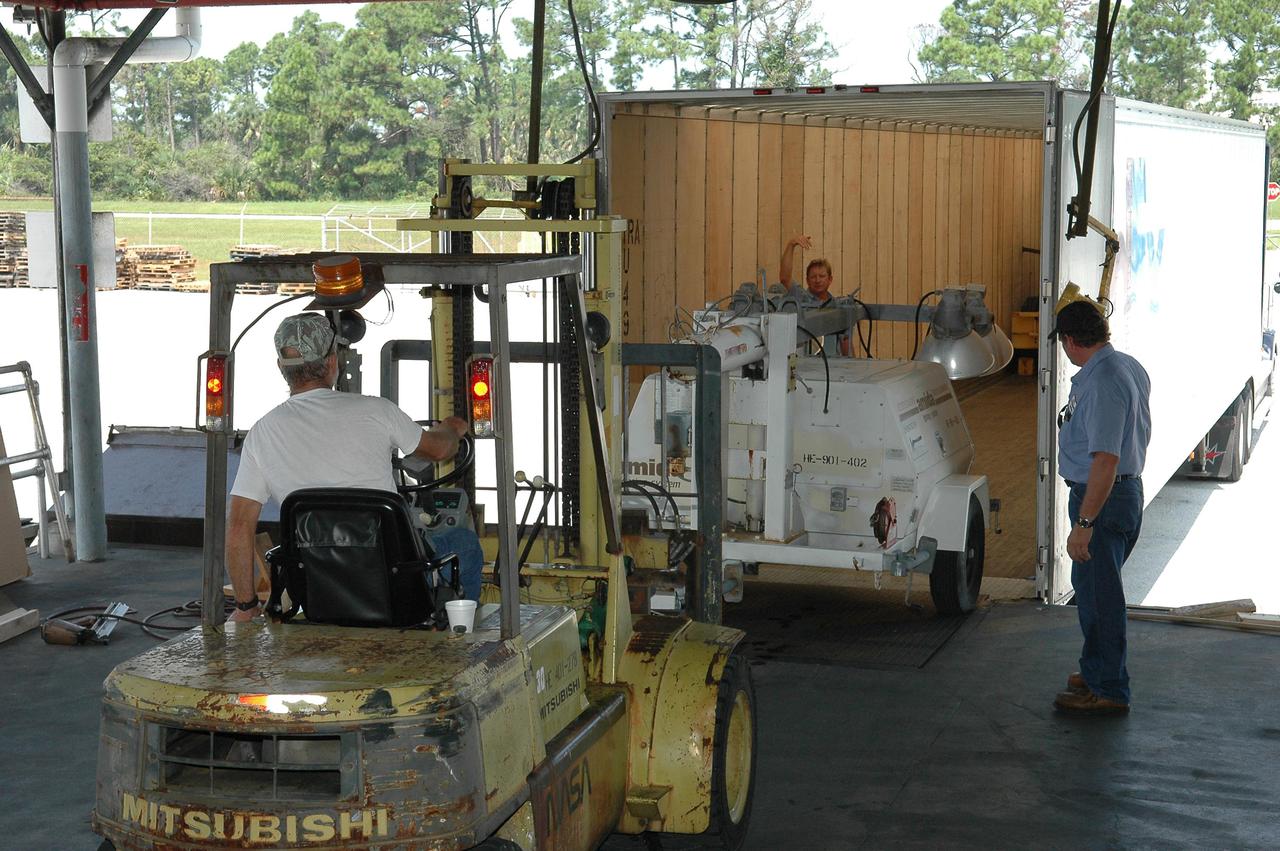
KENNEDY SPACE CENTER, FLA. - A lighting system is loaded onto a truck for a trip to Michoud Assembly Facility near New Orleans. Michoud was left without power following Hurricane Katrina. A NASA plane is carrying medical supplies, food and chain saws, as well as a physician and two high voltage technicians to Michoud to ensure the facility can safely receive power when the main electricity grid comes online. In addition, a 14-person security team is also going to Michoud to relieve the security professionals at that location. Stennis Space Center also suffered damage and power outages from Hurricane Katrina. KSC is sending a helicopter with medical supplies and an Emergency Medical Technician to Stennis, plus a 1-megawatt generator and 125- and 225-kilowatt generators, and 1,000 gallons of diesel fuel.
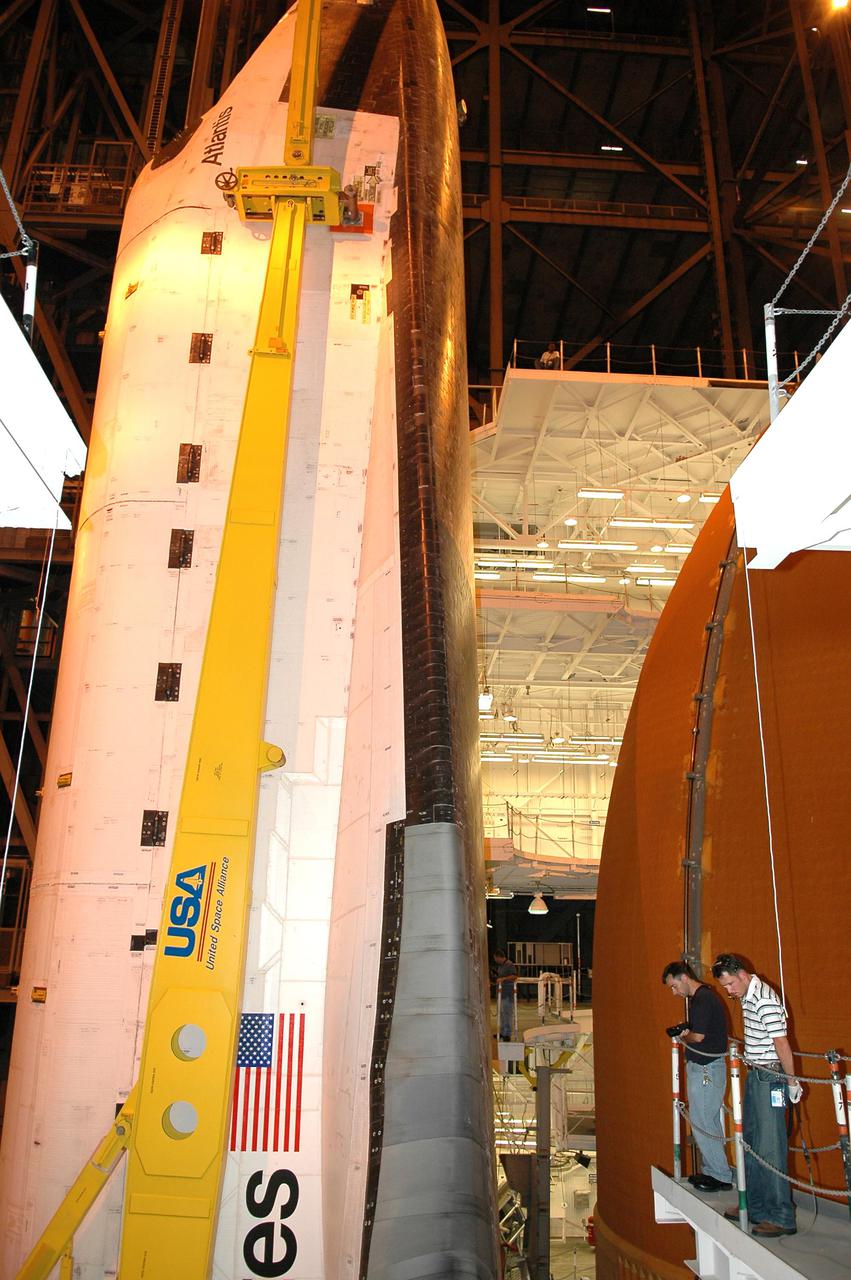
KENNEDY SPACE CENTER, FLA. - In the Vehicle Assembly Building, technicians spot for Space Shuttle Atlantis as it is demated from its External Tank_Solid Rocket Booster stack. The orbiter will be lowered into the transfer aisle and rolled back to Orbiter Processing Facility (OPF) bay 1. Once in the OPF, processing will begin for mission STS-115, the 19th flight to the International Space Station. The tank, ET-120, is the first redesigned ET to arrive at KSC and will undergo further testing before Return to Flight mission STS-121 next year.
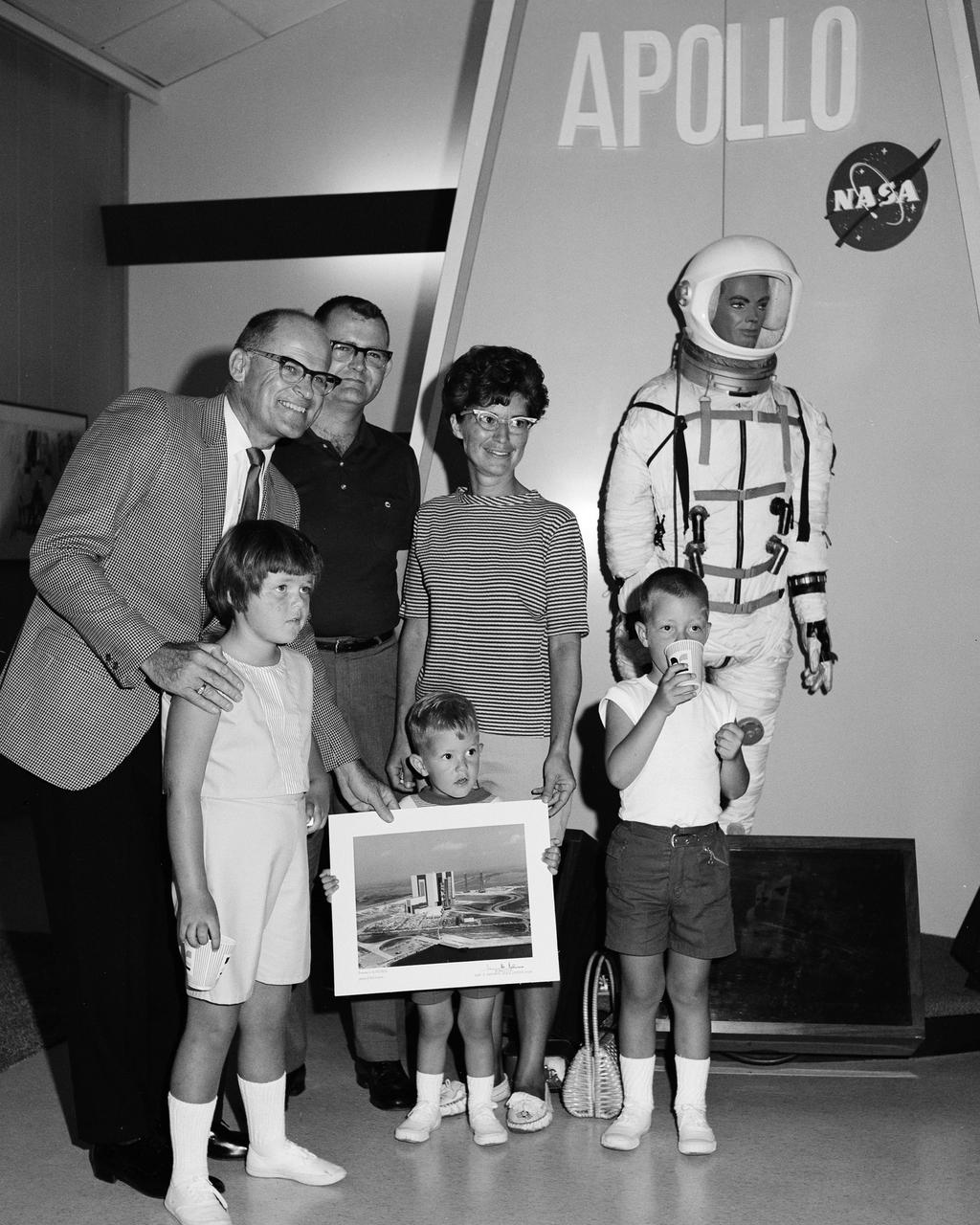
CAPE KENNEDY, Fla. -- At the Kennedy Space Center in Florida, the 500,000th visitor to take a NASA escorted bus tour, Donald A. Jackson of Sabina, Ohio, was welcomed at the new Visitor Information Center on Merritt Island by deputy center director Albert F. Siepert, left. Jackson toured the center with his wife, Sue, and their three children, Cheryl, Craig and Doug. Jackson works for the National Cash Register Co. The 500,000th visitor was recorded less than an hour after the Visitor Information Center was officially opened to the public at 8:45 a.m. The NASA tours were begun July 22, 1966, and since that time visitors from every state in the nation and more than 60 nations have toured the space center. Photo Credit: NASA
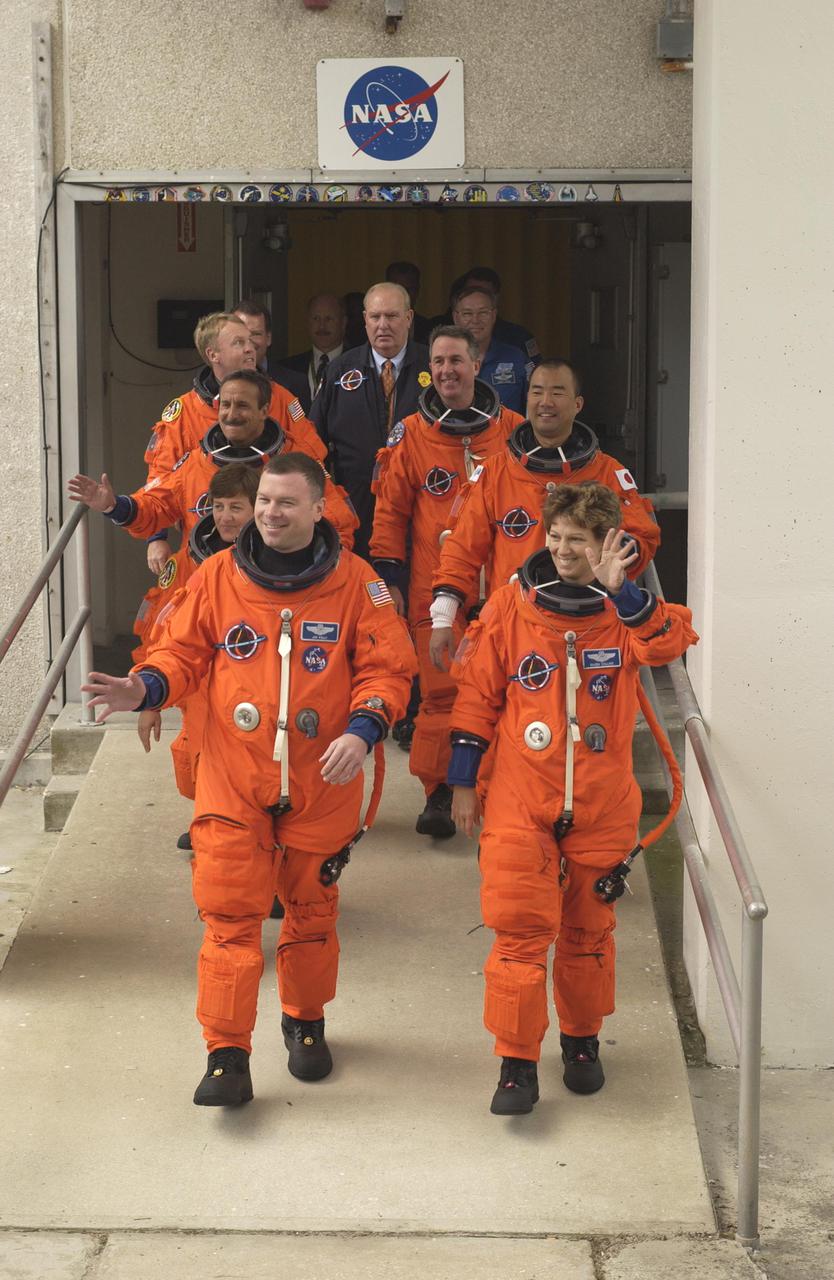
KENNEDY SPACE CENTER, FLA. - The Return to Flight STS-114 crew exits the Operations and Checkout Building for their ride to Launch Pad 39B. On the left column, front to back, are Pilot James Kelly and Mission Specialists Wendy Lawrence, Charles Camarda and Andrew Thomas. On the right column are Mission Commander Eileen Collins and Mission Specialists Soichi Noguchi and Stephen Robinson. The crew is scheduled to launch on this historic mission at 3:51 p.m. EDT today from Launch Pad 39B. It is the 114th Space Shuttle flight and the 31st for Discovery. The 12-day mission is expected to end with touchdown at the Shuttle Landing Facility at 11:06 a.m. July 25.
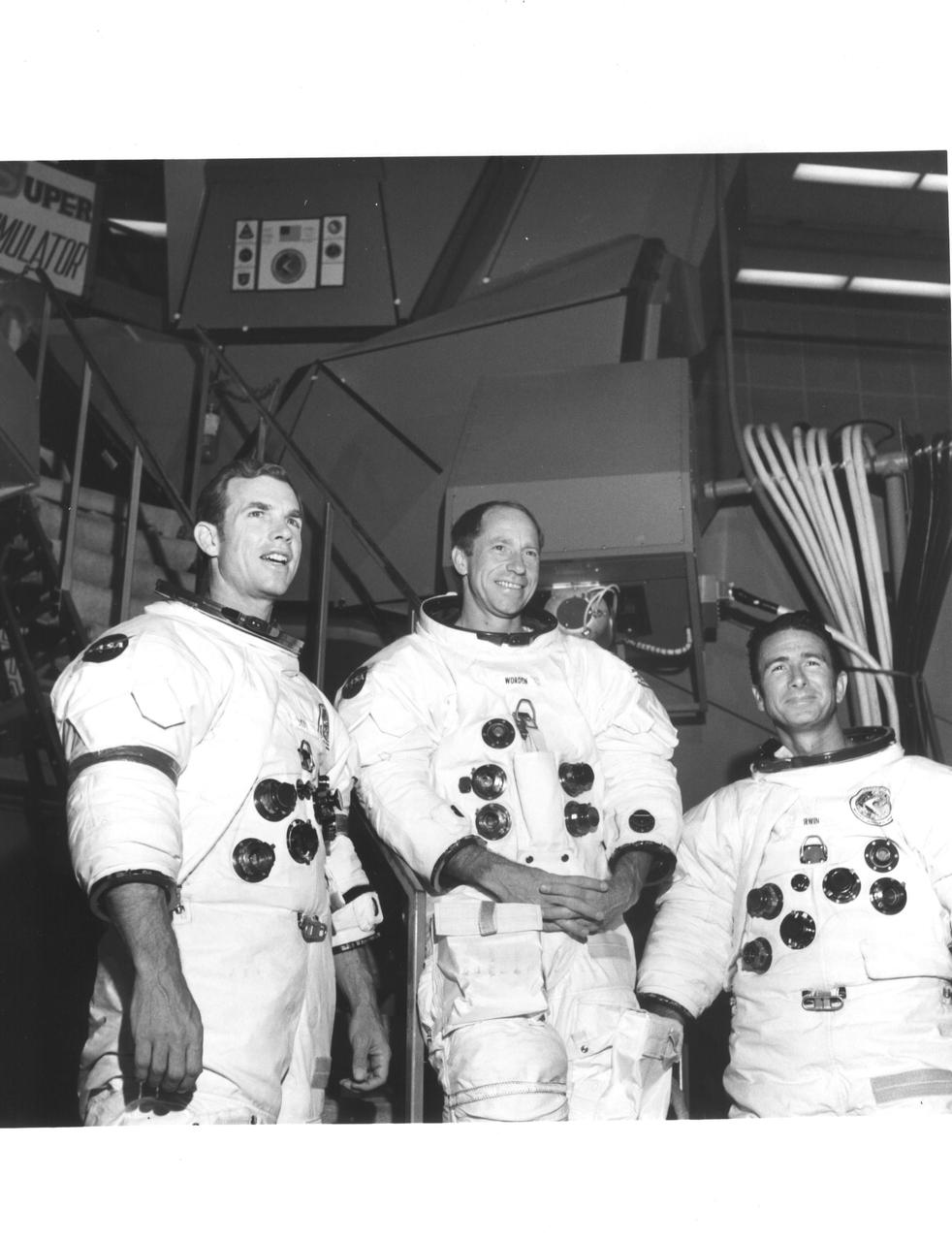
KENNEDY SPACE CENTER, FLA. -- The Apollo 15 astronauts pause in front of a mission simulator during a training exercise at the Kennedy Space Center. The trio will be launched to the Moon no earlier than July 26, 1971. They are, left to right, David R. Scott, commander; Alfred N. Worden, command module pilot; and James B. Irwin, lunar module pilot.
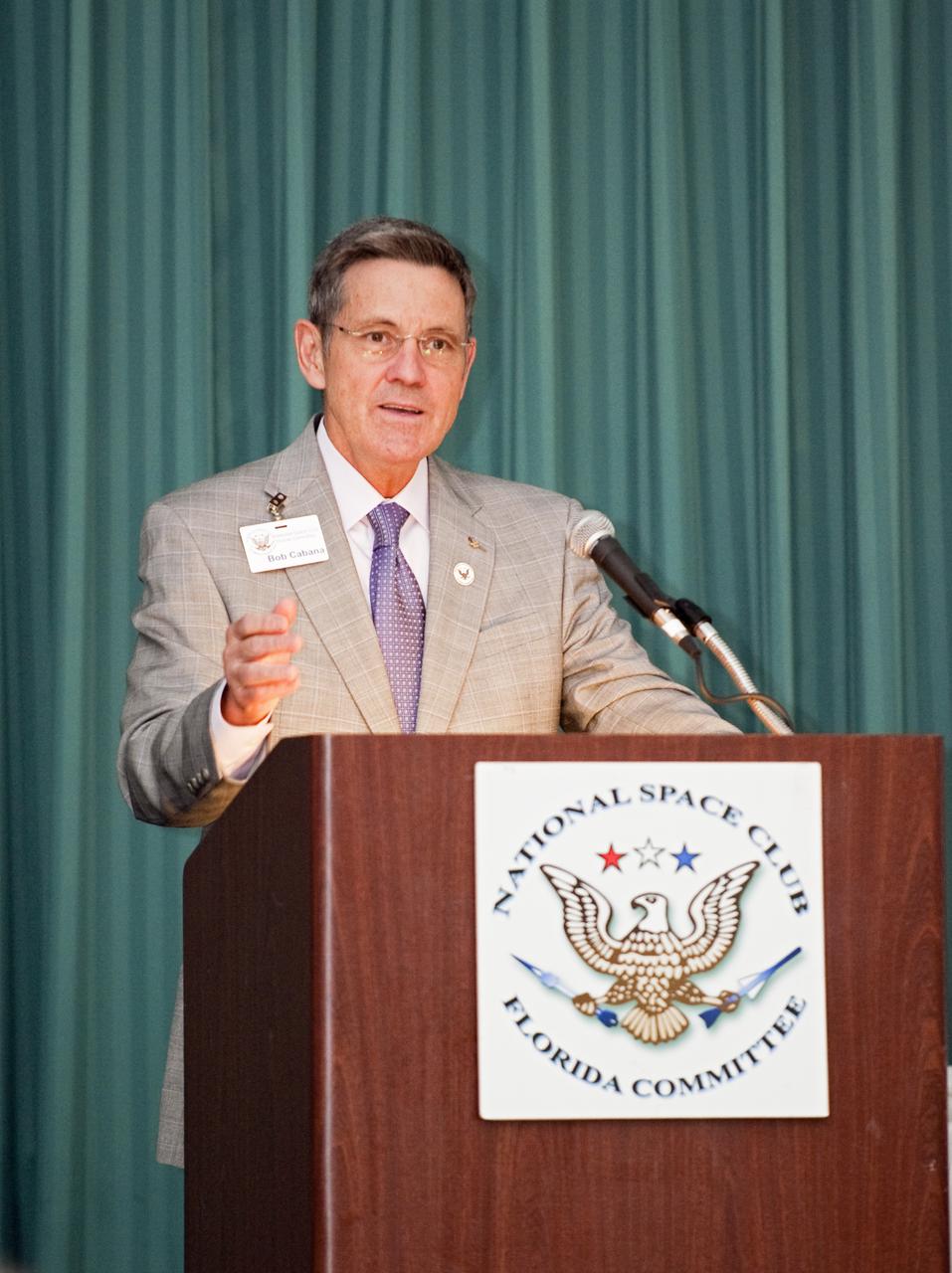
CAPE CANAVERAL, Fla. -- NASA Kennedy Space Center Director Bob Cabana addresses the National Space Club Florida Committee during its monthly meeting at the Radisson at the Port in Cape Canaveral, Fla. His speech, titled “KSC -- Today and Tomorrow,” addressed the future of NASA and possible changes to the space shuttle launch schedule later this month. The committee, headquartered on Florida's Space Coast, is a non-profit corporation composed of private individuals representing industry, government, regional educational institutions and the media. NASA_Kim Shiflett
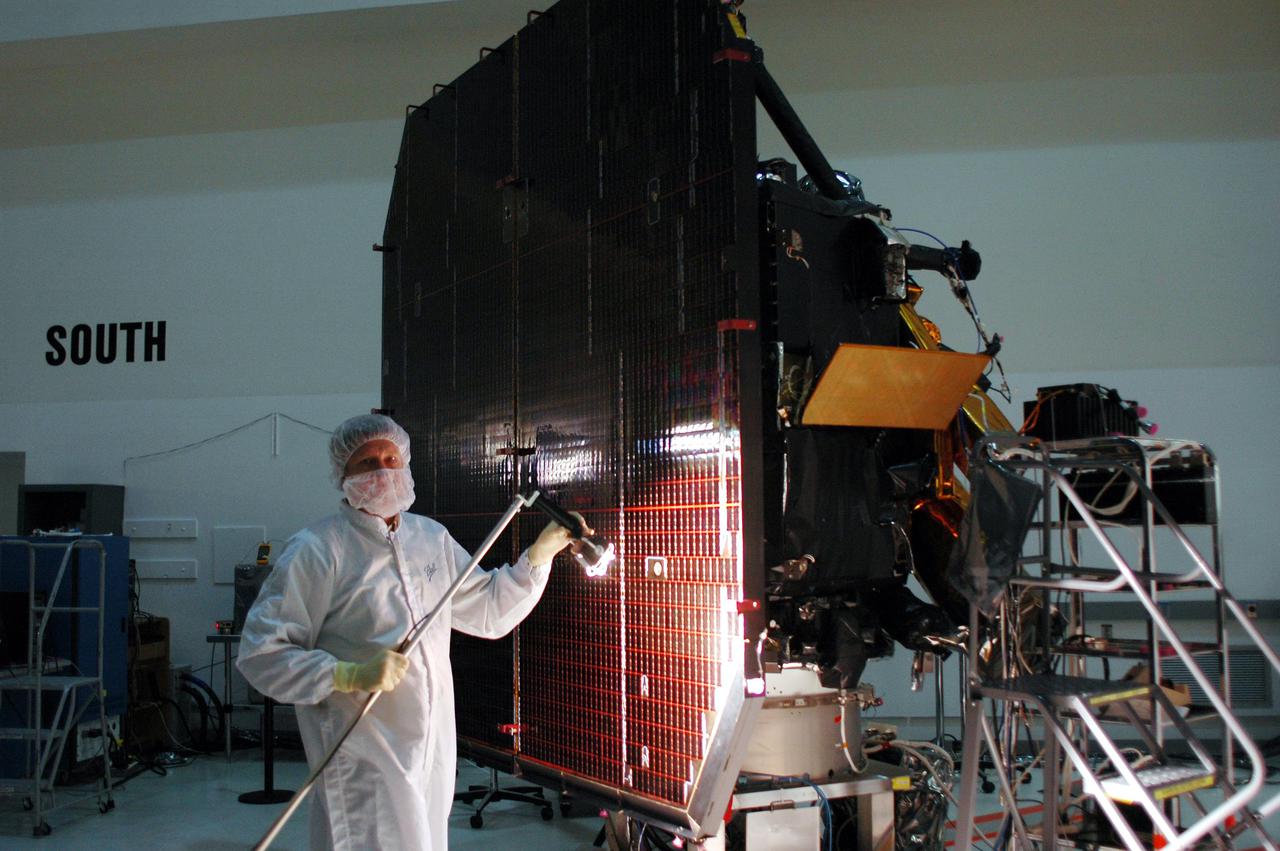
KENNEDY SPACE CENTER, FLA. - A technician at Astrotech in Titusville, Fla., conducts an illumination test on the Deep Impact spacecraft as a final check of performance. Launch aboard a Boeing Delta II rocket from Pad 17-B, Cape Canaveral Air Force Station, Fla., is scheduled for Jan. 8. The Deep Impact mission is the first to explore a comet's interior by using a spacecraft to create a crater, allowing us to look deep inside. Dramatic images from both the flyby spacecraft and the impactor will be sent back to distant Earth as data in near-realtime. These first-ever views deep beneath a comet’s surface, and additional scientific measurements will provide clues to the formation of the solar system. Amateur astronomers will combine efforts with astronomers at larger telescopes to offer the public an earth-based look at this incredible July 2005 encounter with a comet.
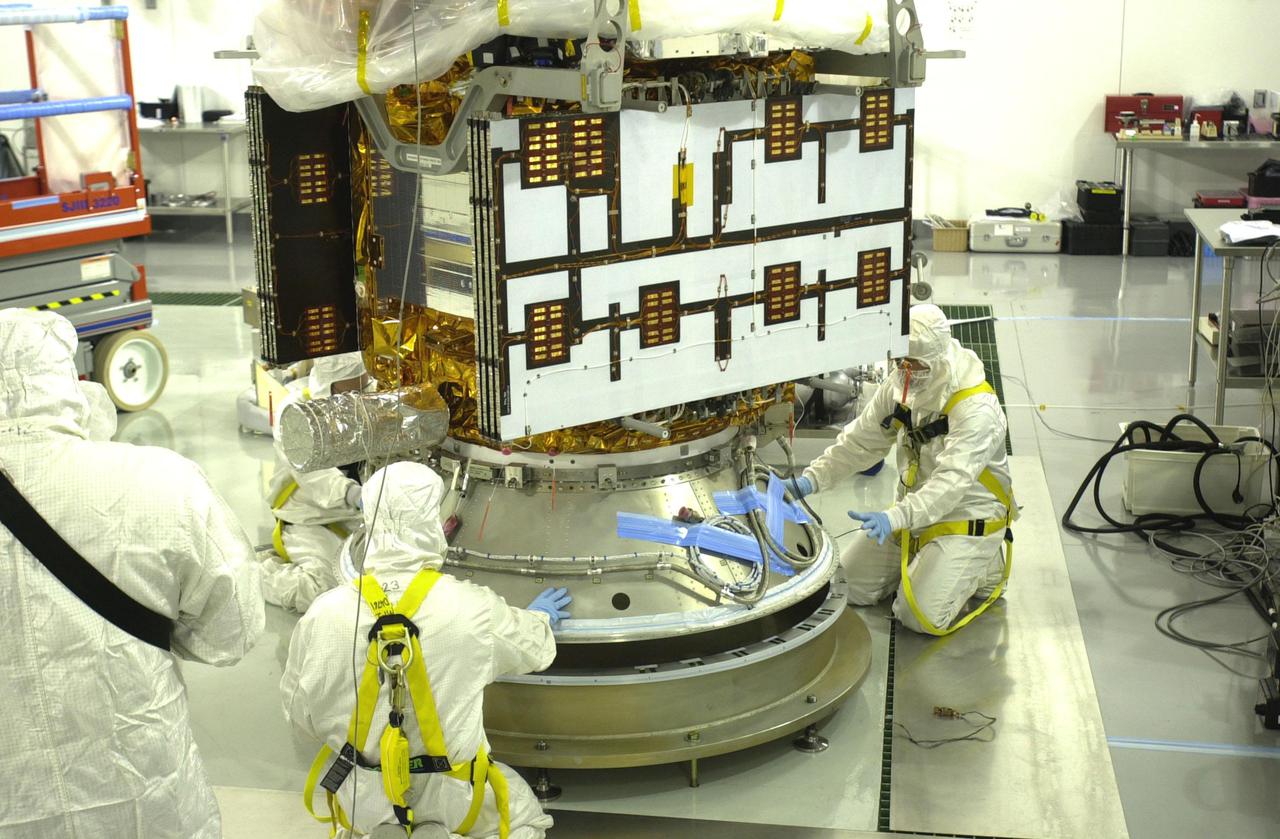
VANDENBERG AIR FORCE BASE, CALIF. - Inside the Astrotech Payload Processing Facility on Vandenberg Air Force Base in California, workers help guide the CALIPSO spacecraft as it is lowered onto a payload attach fitting. CALIPSO will be mated to the Lower Delta Payload Attach Fitting (LDPAF) that contains the CloudSat satellite. The PAF is the interface between the spacecraft and the second stage of the rocket. CALIPSO stands for Cloud-Aerosol Lidar and Infrared Pathfinder Satellite Observation. CALIPSO and CloudSat are highly complementary satellites that will provide never-before-seen 3-D perspectives of how clouds and aerosols form, evolve, and affect weather and climate. CALIPSO and CloudSat will fly in formation with three other satellites in the A-train constellation to enhance understanding of our climate system. Launch of CALIPSO_CloudSat aboard a Boeing Delta II rocket is scheduled for 3:01 a.m. PDT Sept. 29.
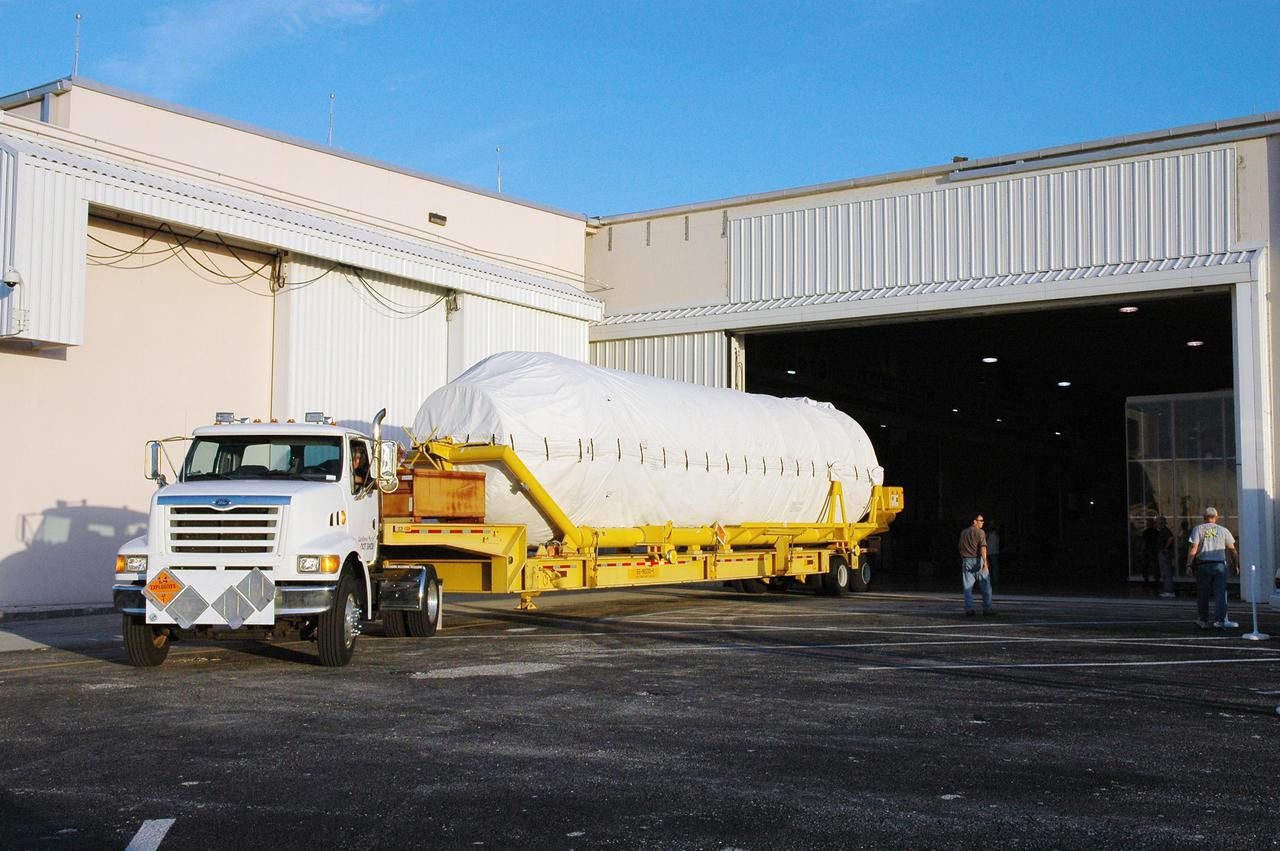
KENNEDY SPACE CENTER, FLA. - The Centaur (Block I) upper stage is rolled into the hangar of the Atlas Space Operations Center where it will be processed for mating with the Lockheed Martin Atlas V, designated AV-007, that is the launch vehicle for the Mars Reconnaissance Orbiter (MRO). The MRO is designed for a series of global mapping, regional survey and targeted observations from a near-polar, low-altitude Mars orbit. These observations will be unprecedented in terms of the spatial resolution and coverage achieved by the orbiter’s instruments as they observe the atmosphere and surface of Mars while probing its shallow subsurface as part of a “follow the water” strategy. The orbiter is undergoing environmental tests in facilities at Lockheed Martin Space Systems in Denver, Colo., and is on schedule for a launch window that begins Aug. 10. Launch will be from Launch Complex 41 at Cape Canaveral Air Force Station in Florida.
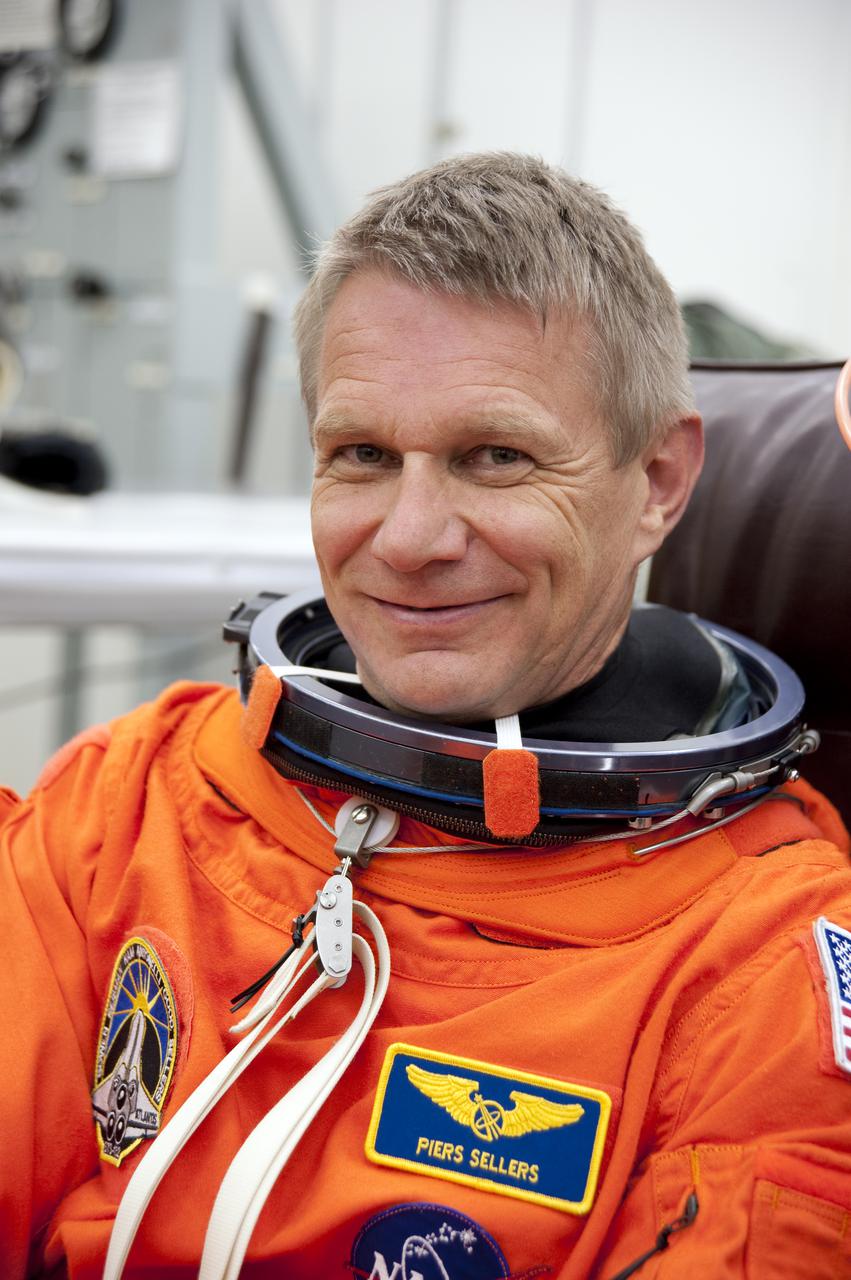
CAPE CANAVERAL, Fla. - In the Operations and Checkout Building at NASA's Kennedy Space Center in Florida, the astronauts of space shuttle Atlantis' STS-132 crew put on their launch-and-entry suits before heading to the Astrovan for the ride to Launch Pad 39A. Mission Specialist Piers Sellers, seen here, is making his third spaceflight. Liftoff of the STS-132 mission is set for 2:20 p.m. EDT on May 14. The six-member STS-132 crew will deliver the Russian-built Mini Research Module-1 to the International Space Station. Named Rassvet, Russian for 'dawn,' the module is the second in a series of new pressurized components for Russia and will be permanently attached to the Earth-facing port of the Zarya control module. Rassvet will be used for cargo storage and will provide an additional docking port to the station. Also aboard Atlantis is an Integrated Cargo Carrier, or ICC, an unpressurized flat bed pallet and keel yoke assembly used to support the transfer of exterior cargo from the shuttle to the station. STS-132 is the 34th mission to the station and the last scheduled flight for Atlantis. For more information on the STS-132 mission objectives, payload and crew, visit http:__www.nasa.gov_mission_pages_shuttle_shuttlemissions_sts132_index.html. Photo Credit: NASA_Kim Shiflett

KENNEDY SPACE CENTER, FLA. -- Astronaut Donn F. Eisele adjusts communications carrier prior to the start of an 11-day Earth orbital mission in the Apollo 7 spacecraft. The communications carrier contains microphones and earphones. Flying with Eisele aboard Apollo 7 are astronauts Walter M. Schirra Jr. and Walter Cunningham. Purpose of the flight, conducted by the National Aeronautics and Space Administration, is to qualify the Apollo spacecraft for a future flight to the moon.
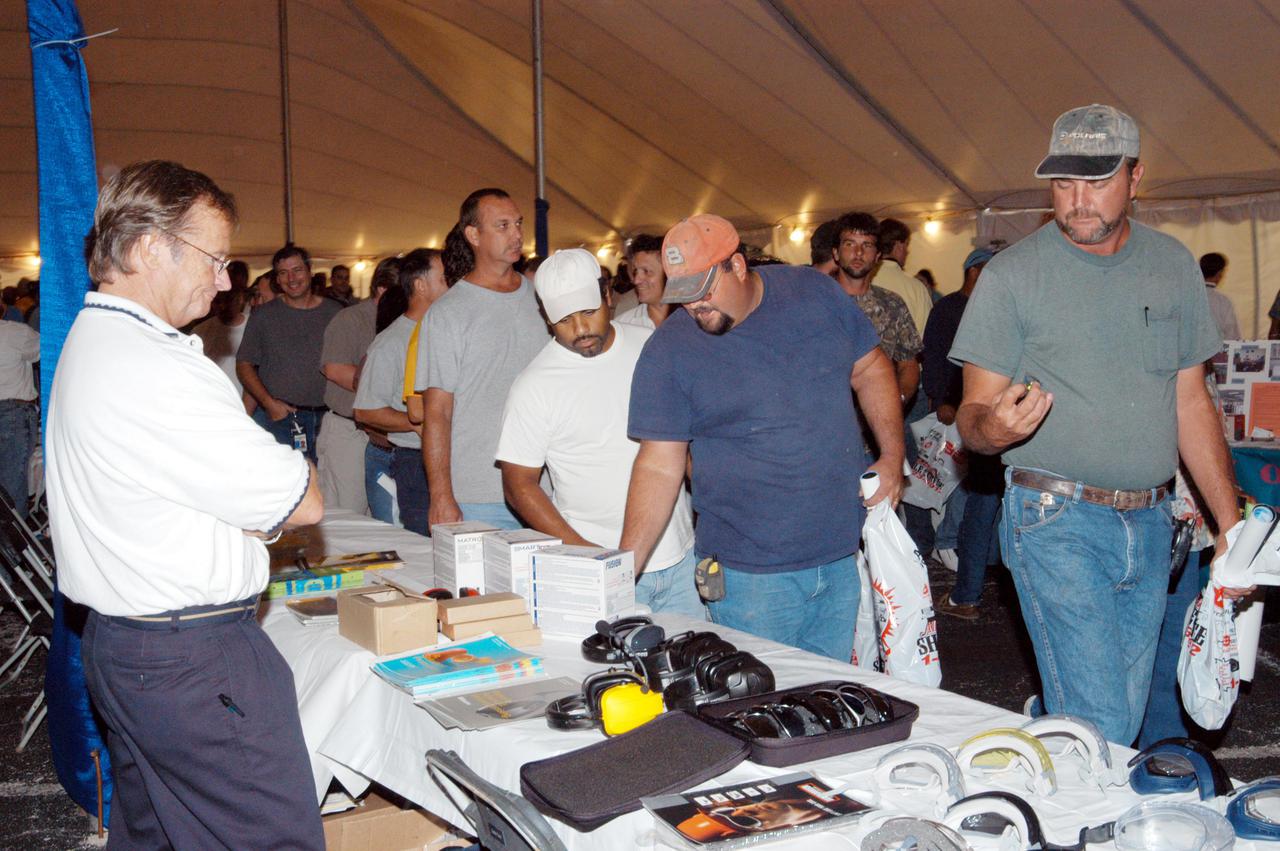
KENNEDY SPACE CENTER, FLA. - Inside a tent, employees look over an exhibit of safety equipment. The exhibits were part of Spaceport Super Safety and Health Day, which also featured presentations by guest speakers Dr. Pamela Peeke, Navy Com. Stephen E. Iwanowicz, NASA’s Dr. Kristine Calderon and Olympic-great Bruce Jenner. Vendors’ exhibits were set up in the parking areas outside the Vehicle Assembly Building and the OandC Building. The annual event was initiated at KSC in 1998 to increase awareness of the importance of safety and health among the government and contractor workforce. The theme for this year’s event was “Safety and Health: A Winning Combination.”
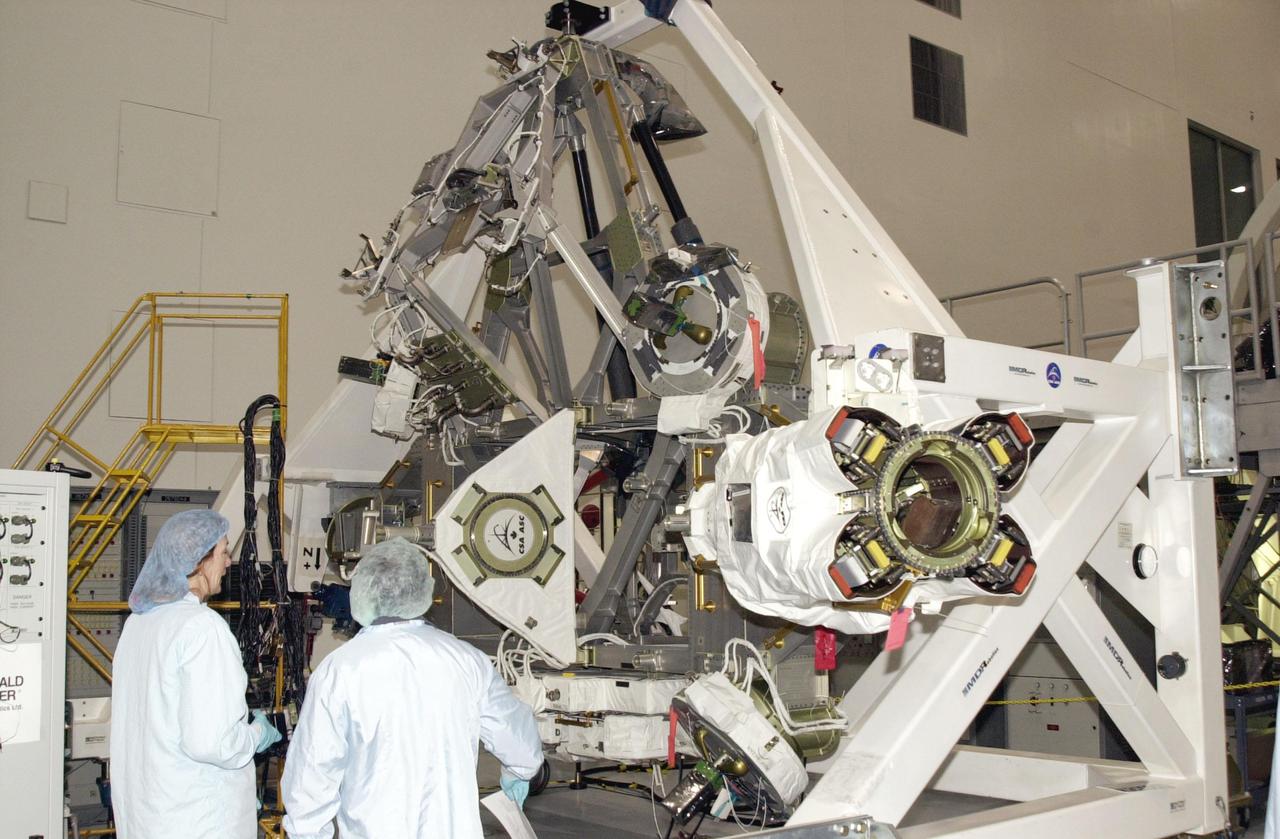
KENNEDY SPACE CENTER, FLA. -- Workers in the Space Station Processing Facility look over the Mobile Base System (MBS), part of the payload on mission STS-111 to the International Space Station. The MBS will be installed on the Mobile Transporter to complete the Canadian Mobile Servicing System, or MSS. The mechanical arm will then have the capability to 'inchworm' from the U.S. Lab Destiny to the MSS and travel along the truss to work sites. STS-111 is the second utilization flight (UF-2) to the Space Station and will also carry the Expedition 5 crew to replace Expedition 4. Launch is scheduled for May 2, 2002
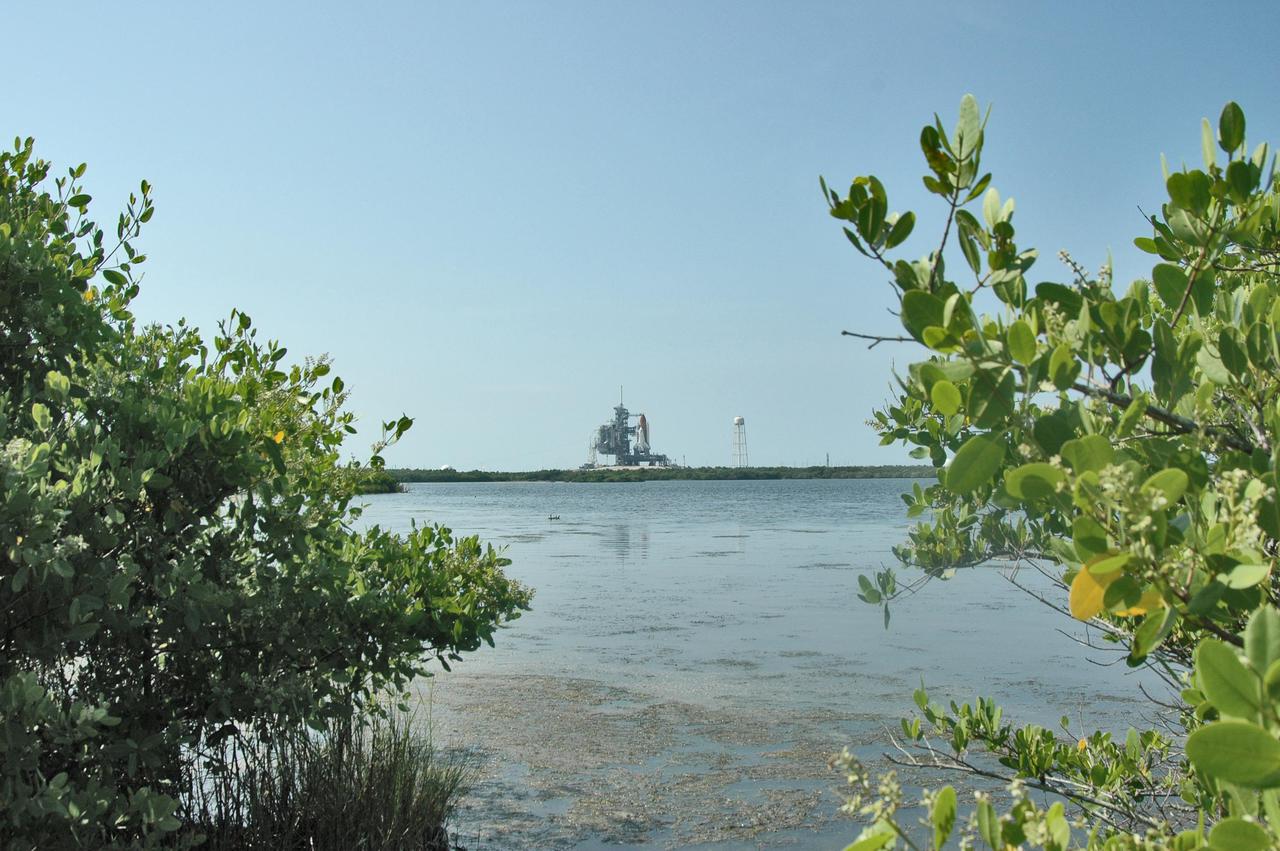
KENNEDY SPACE CENTER, FLA. - Seen after rollback of the Rotating Service Structure, and framed by marsh greenery, a fully revealed Space Shuttle Discovery on NASA Kennedy Space Center’s Launch Pad 39B rises from the horizon beyond the pond. Discovery is scheduled to lift off on the historic Return to Flight mission STS-114 at 10:39 a.m. EDT July 26 with a crew of seven. On the mission to the International Space Station the crew will perform inspections on orbit for the first time of all of the Reinforced Carbon-Carbon (RCC) panels on the leading edge of the wings and the Thermal Protection System tiles using the new Canadian-built Orbiter Boom Sensor System and the data from 176 impact and temperature sensors. Mission Specialists will also practice repair techniques on RCC and tile samples during a spacewalk in the payload bay. During two additional spacewalks, the crew will install the External Stowage Platform-2, equipped with spare part assemblies, and a replacement Control Moment Gyroscope contained in the Lightweight Multi-Purpose Experiment Support Structure.
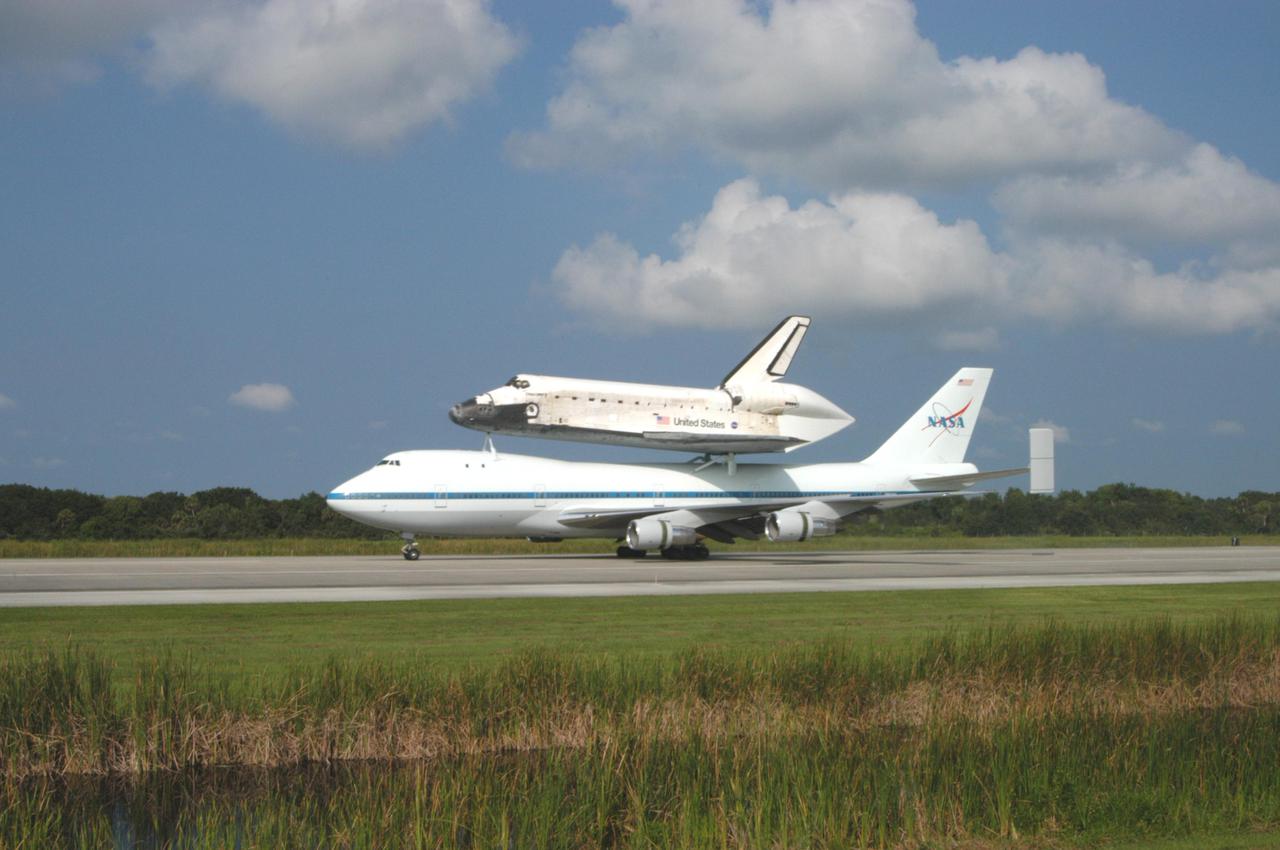
KENNEDY SPACE CENTER, FLA. - Space Shuttle Discovery, atop a modified Boeing 747 Shuttle Carrier Aircraft (SCA), lands on runway 15 at NASA Kennedy Space Center's Shuttle Landing Facility (SLF) at about 10:00 a.m. EDT. The cross-country ferry flight became necessary when two days of unfavorable weather conditions at KSC forced Discovery to land on runway 22 at Edwards Air Force Base, Calif., on Aug. 9 following mission STS-114. On the return trip, stops were made at Altus Air Force Base, Okla., and Barksdale Air Force Base, La., where Discovery stayed for two nights. The SCA and Discovery will be towed to the Mate_Demate Device at the SLF where a crane will lift Discovery from the SCA and place it on solid ground. Discovery will then be towed to the Orbiter Processing Facility where preparations will begin for its next flight, STS-121.
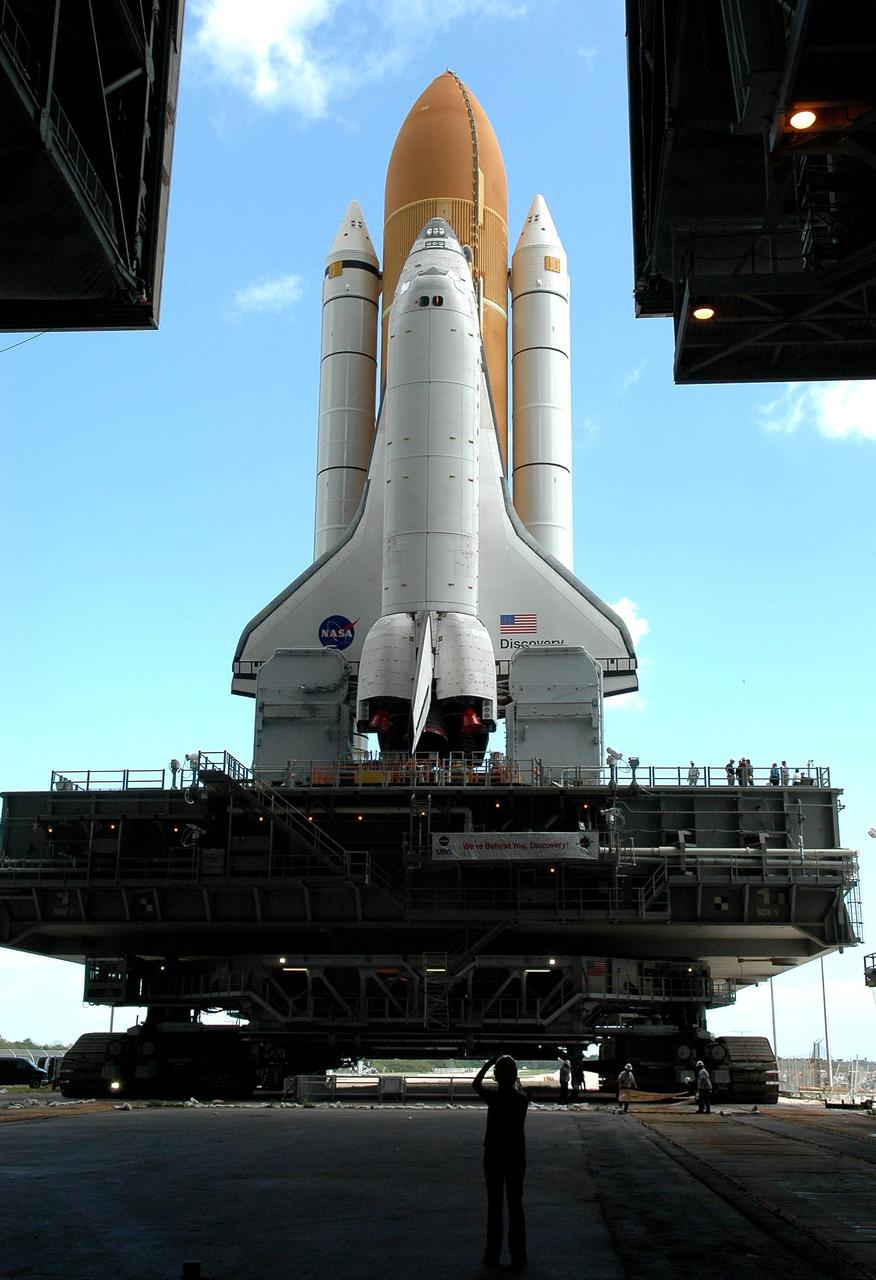
KENNEDY SPACE CENTER, FLA. - Framed in the open doors of the Vehicle Assembly Building (VAB) at NASA’s Kennedy Space Center, Space Shuttle Discovery is bathed in light as it begins its long, slow journey to Launch Pad 39B. The Space Shuttle rests on the Mobile Launcher Platform, which is moved by the Crawler-Transporter underneath. The Crawler is 20 feet high, 131 feet long and 114 feet wide. It moves on eight tracks, each containing 57 shoes, or cleats, weighing one ton each. Loaded with the Space Shuttle, the Crawler can move at a maximum speed of approximately 1 mile an hour. A leveling system in the Crawler keeps the Shuttle vertical while negotiating the 5 percent grade leading to the top of the launch pad. Launch of Discovery on its Return to Flight mission, STS-114, is targeted for May 15 with a launch window that extends to June 3. During its 12-day mission, Discovery’s seven-person crew will test new hardware and techniques to improve Shuttle safety, as well as deliver supplies to the International Space Station. Discovery was moved on March 29 from the Orbiter Processing Facility to the VAB and attached to its propulsion elements, a redesigned ET and twin SRBs.

KENNEDY SPACE CENTER, FLA. - In the Remote Manipulator System lab in the Vehicle Assembly Building (VAB), Kennedy workers remove the shipping container surrounding part of the new Orbiter Boom Sensor System (OBSS). Once the entire structure has arrived, the OBSS will be assembled and undergo final checkout and testing in the lab prior to being transferred to the Orbiter Processing Facility (OPF) for installation on Space Shuttle Discovery. The 50-foot-long OBSS will be attached to the Remote Manipulator System, or Shuttle arm, and is one of the new safety measures for Return to Flight, equipping the orbiter with cameras and laser systems to inspect the Shuttle's Thermal Protection System while in space. Discovery is slated to fly mission STS-114 once Space Shuttle launches resume. The launch planning window is May 12 to June 3, 2005.
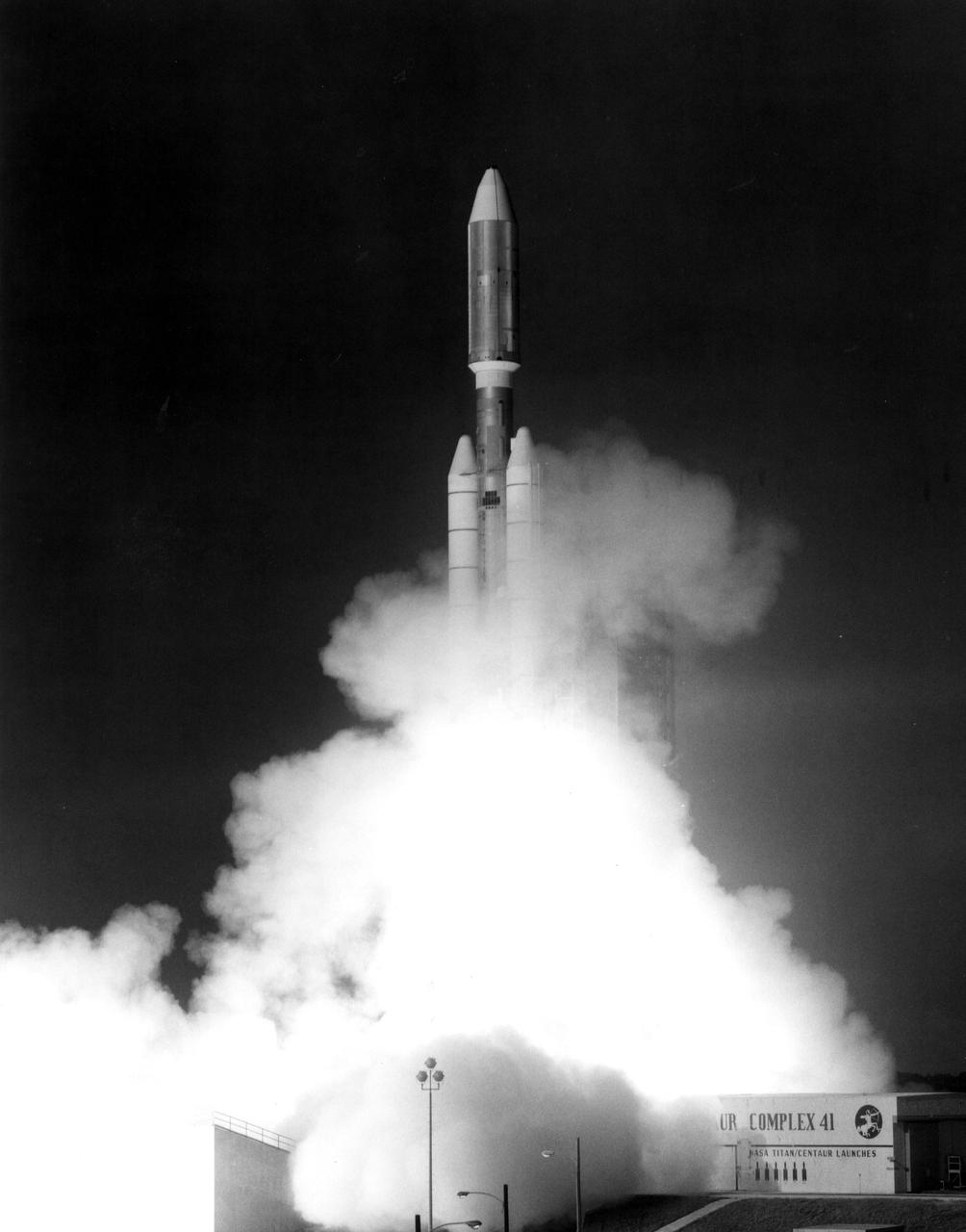
KENNEDY SPACE CENTER, FLA. -- Voyager-1 was launched atop Titan_Centaur-6 at Launch Complex 41 at 8:56 a.m. EDT today, joining its sister spacecraft, Voyager-2, on a mission to the outer planets.
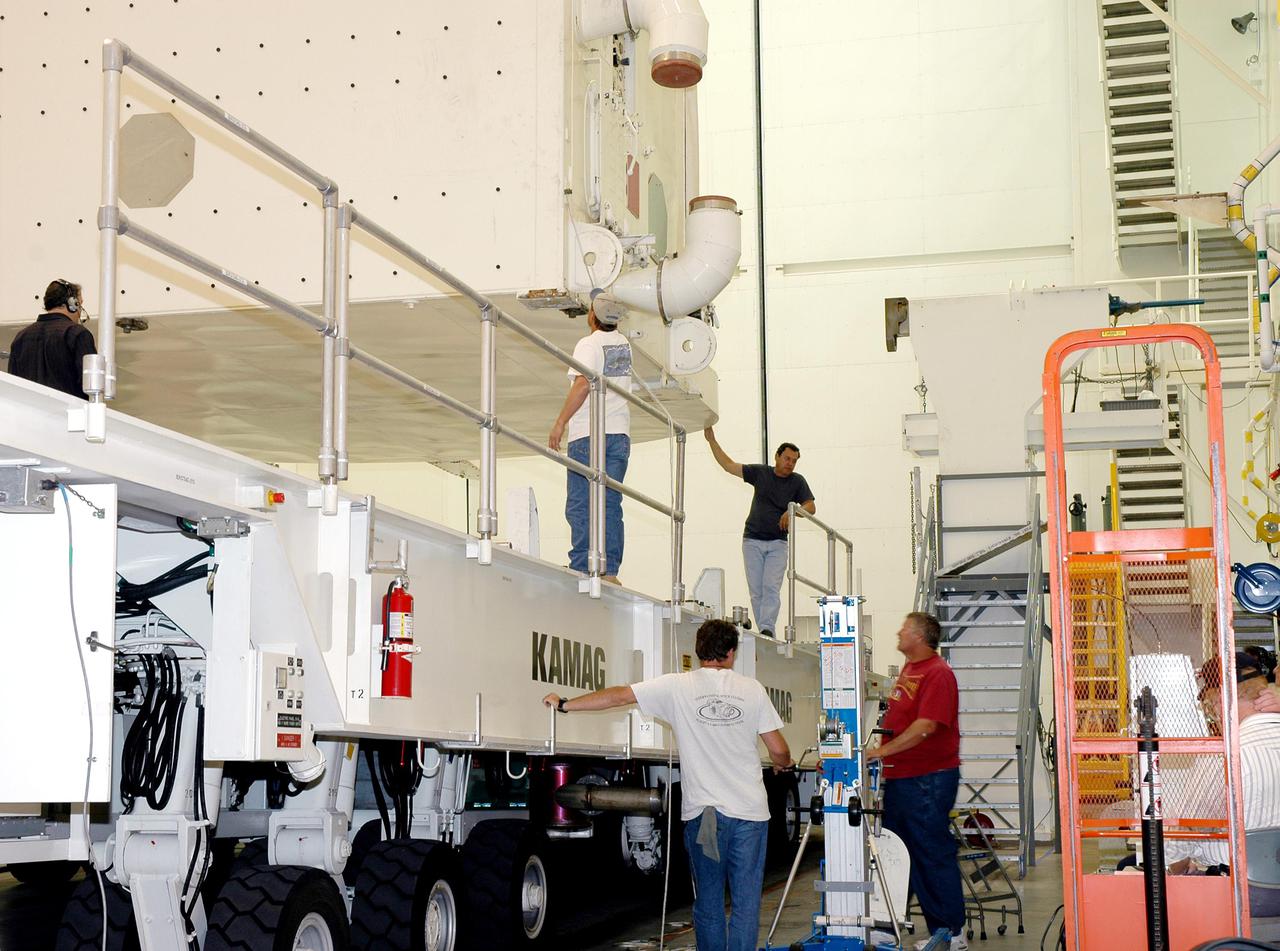
KENNEDY SPACE CENTER, FLA. - Workers in the Canister Rotation Facility at NASA’s Kennedy Space Center observe the Payload Canister after its rotation to a vertical position. The canister will be transported to Launch Pad 39B. The payloads inside, including the Multi-Purpose Logistics Module Raffaello and External Stowage Platform-2, will be moved into the Payload Changeout Room in the Rotating Service Structure and then installed in Discovery’s payload bay. Space Shuttle Discovery is scheduled to launch on Return to Flight mission STS-114 to the International Space Station. The launch window extends from May 22 to June 3.
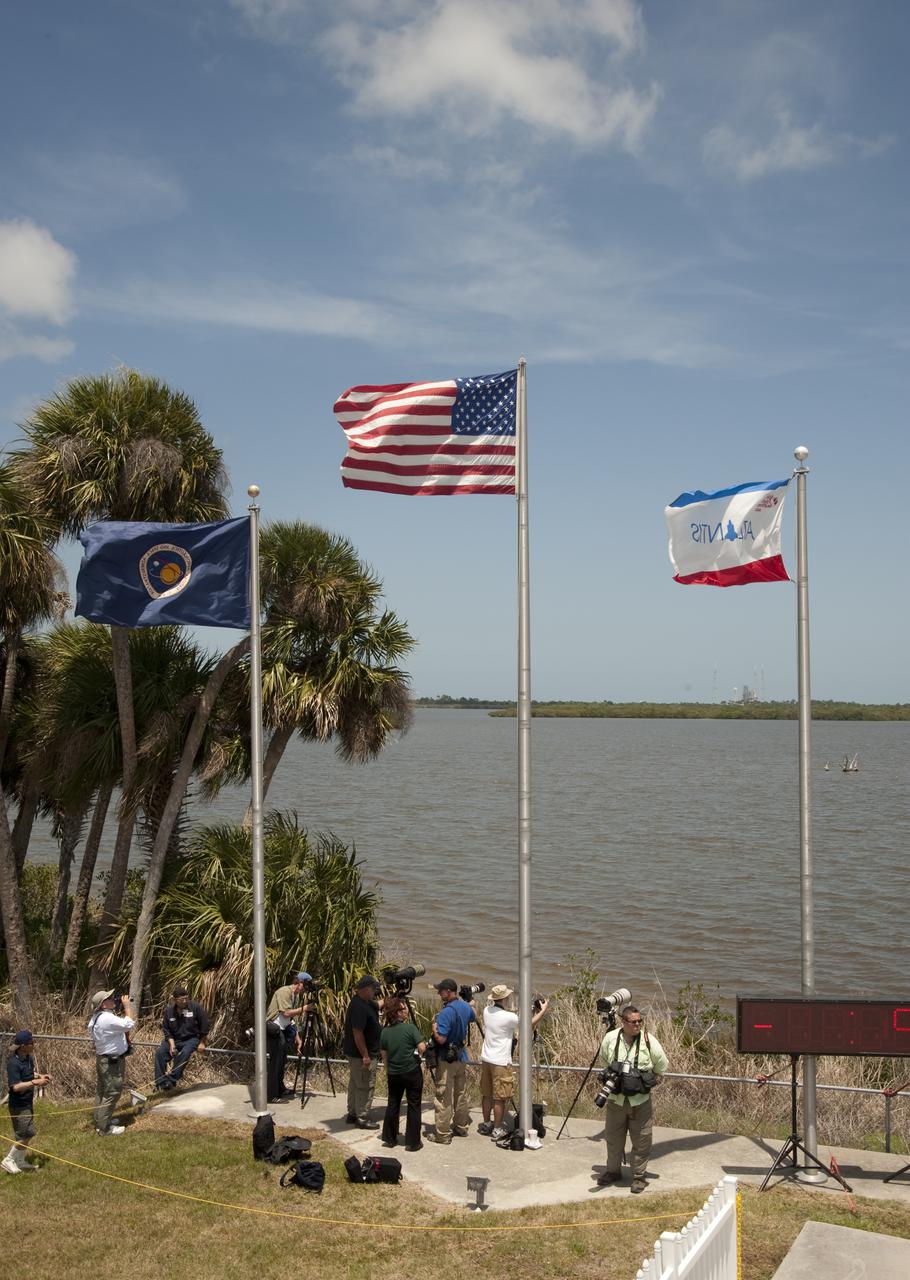
CAPE CANAVERAL, Fla. - Spectators at the Banana Creek Viewing Site near the Saturn V Center at NASA's Kennedy Space Center in Florida set their cameras up for the launch of space shuttle Atlantis from Launch Pad 39A. Liftoff of the STS-132 mission to the International Space Station occurred on time at 2:20 p.m. EDT on May 14. The Russian-built Mini Research Module-1 known as Rassvet, or 'dawn,' is inside the shuttle's cargo bay. It will provide additional storage space and a new docking port for Russian Soyuz and Progress spacecraft. The laboratory will be attached to the bottom port of the station's Zarya module. The mission's three spacewalks will focus on storing spare components outside the station, including six batteries, a communications antenna and parts for the Canadian Dextre robotic arm. STS-132 is the 132nd shuttle flight, the 32nd for Atlantis and the 34th shuttle mission dedicated to station assembly and maintenance. For more information on the STS-132 mission objectives, payload and crew, visit www.nasa.gov_mission_pages_shuttle_shuttlemissions_sts132_index.html. Photo Credit: NASA_Ben Cooper
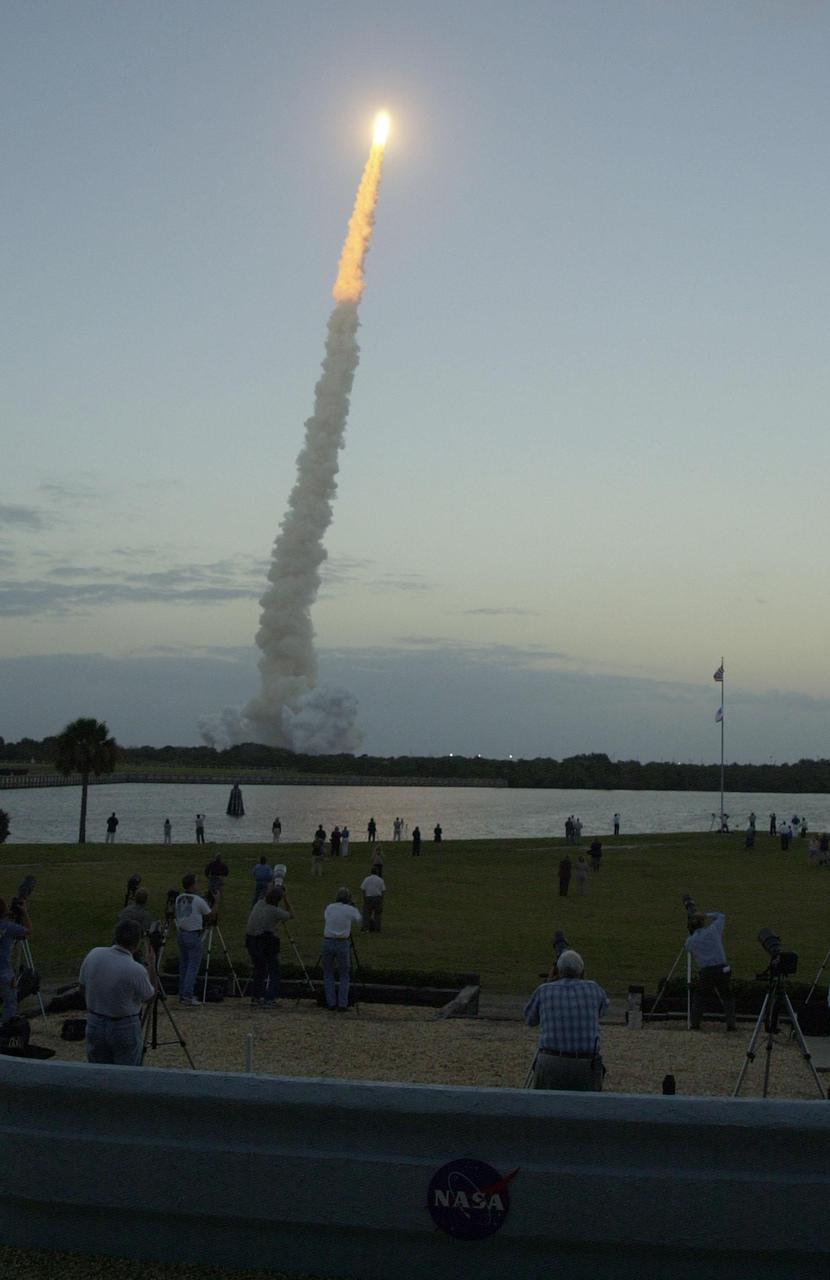
KENNEDY SPACE CENTER, Fla. -- Space Shuttle Endeavour soars into a twilight sky on mission STS-108, the second attempt over two days. Liftoff occurred at 5:19:28 p.m. EST (22:19 GMT). Endeavour will dock with the International Space Station on Dec. 7. STS-108 is the final Shuttle mission of 2001and the 107th Shuttle flight overall. It is the 12th flight to the Space Station. Landing of the orbiter at KSC's Shuttle Landing Facility is targeted for 1:05 p.m. EST (18:05 p.m. GMT) Dec. 16
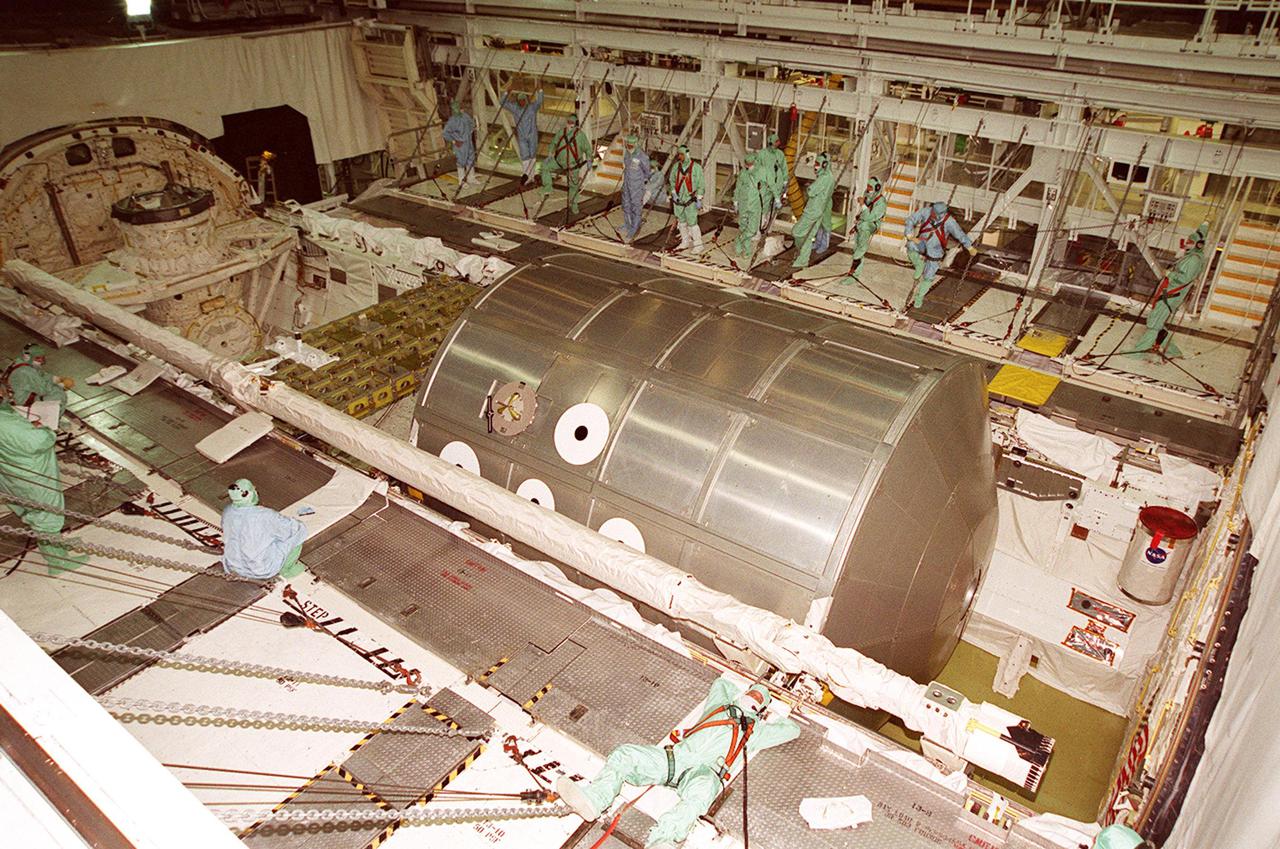
KENNEDY SPACE CENTER, FLA. -- In the Orbiter Processing Facility bay 2, Discovery’s payload bay doors are open to reveal the Multi-Purpose Logistics Module Leonardo, which has just returned from its first round trip to the International Space Station on mission STS-102. Behind it to the left is the integrated cargo carrier. Attached to the length of the payload bay, in front of Leonardo, is the robotic arm that was used to remove and position Leonardo on the ISS. Leonardo will be lifted from the payload bay and transferred to the SSPF to prepare it for future missions. The MPLM serves as a cargo van, carrying equipment and supplies to the Space Station
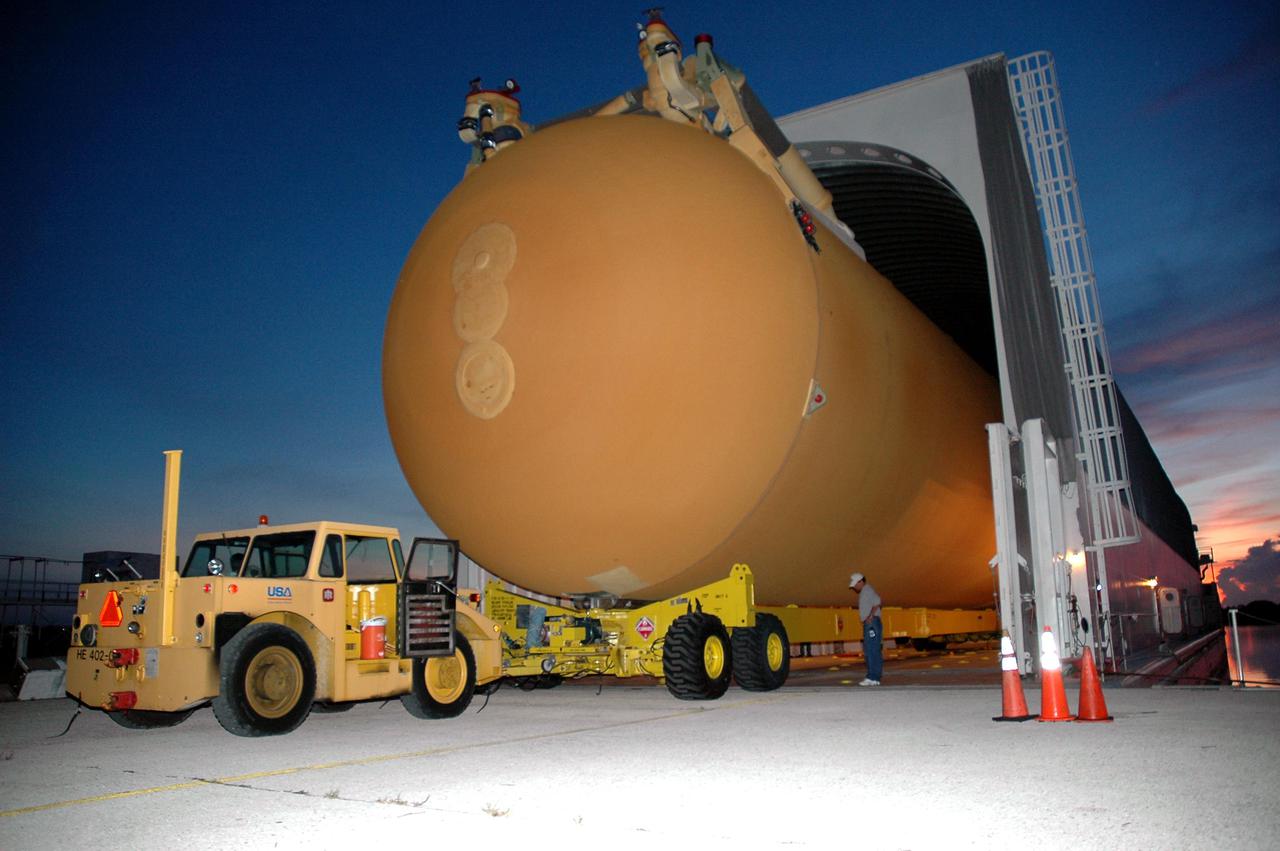
KENNEDY SPACE CENTER, FLA. - Under pre-dawn skies of blue and red, External Tank 119 is loaded onto the barge at the Turn Basin. The tank will embark on a voyage around the Florida peninsula to the Michoud Assembly Facility in New Orleans. Delivered to KSC in June, ET-119 is the third newly redesigned tank.
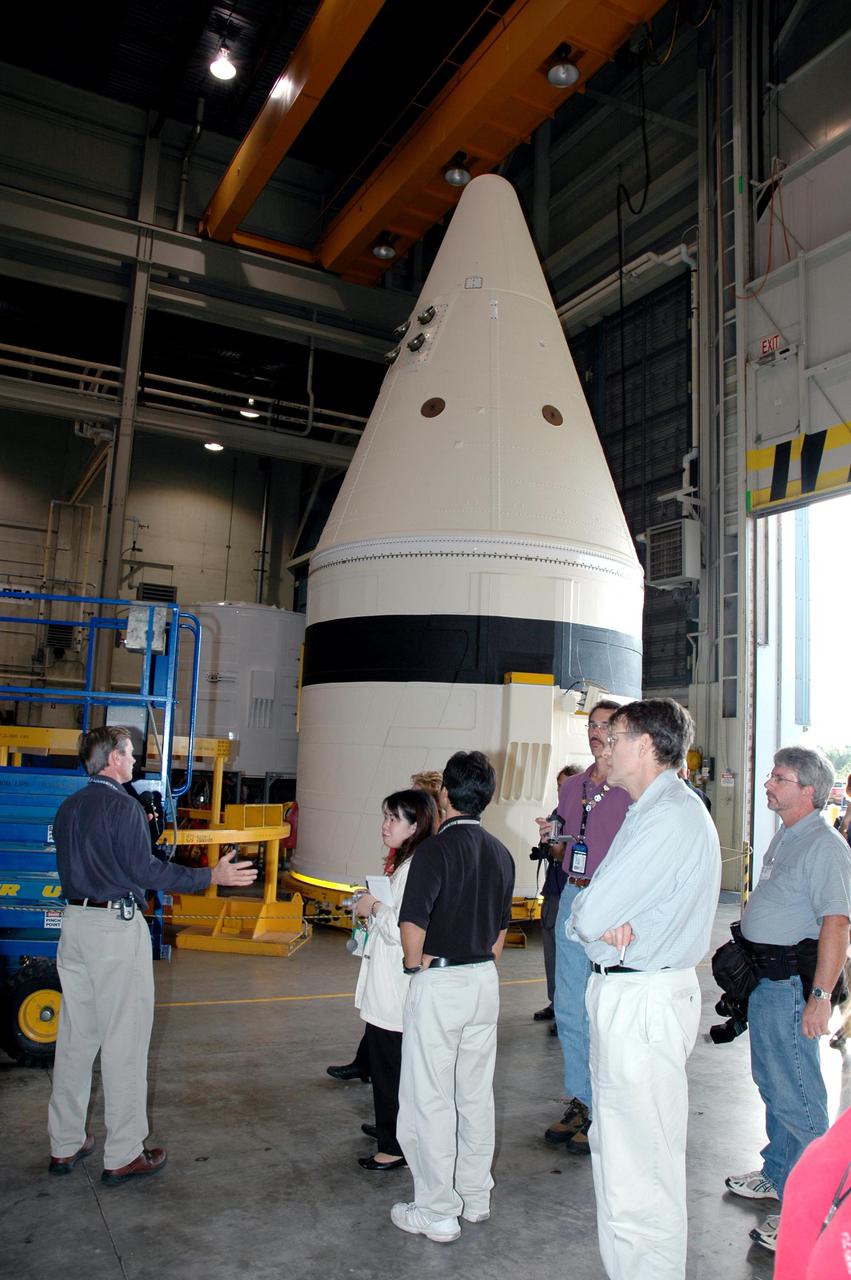
KENNEDY SPACE CENTER, FLA. - The media tour the Solid Rocket Booster (SRB) Assembly and Refurbishment Facility where SRB segments are refurbished. In the background can be seen the frustum and nose cap of an SRB. The media event featured the movement of the first SRB segments to the Vehicle Assembly Building for stacking for Return to Flight mission STS-114. Two SRBs support the liftoff of the Space Shuttle on a launch. The twin 149-foot tall, 12-foot diameter SRBs provide the main propulsion system during launch to place the orbiters in the proper orbit around the Earth. They operate parallel with the Space Shuttle main engines for the first two minutes of flight and jettison away from the orbiter, with help from the Booster Separation Motors, about 26.3 nautical miles above the Earth’s surface.

KENNEDY SPACE CENTER, FLA. -- Space Shuttle Atlantis is framed by palms and winter-stripped branches as it wends its way from Launch Pad 39A back to the Vehicle Assembly Building. Atlantis is rolling back to the VAB so that workers can conduct inspections, make continuity checks and conduct X-ray analysis on the 36 solid rocket booster cables located inside each booster’s system tunnel. An extensive evaluation of NASA’s SRB cable inventory revealed conductor damage in four (of about 200) cables on the shelf. Shuttle managers decided to prove the integrity of the system tunnel cables already on Atlantis before launching Jan. 19. The launch has been rescheduled no earlier than Feb. 6
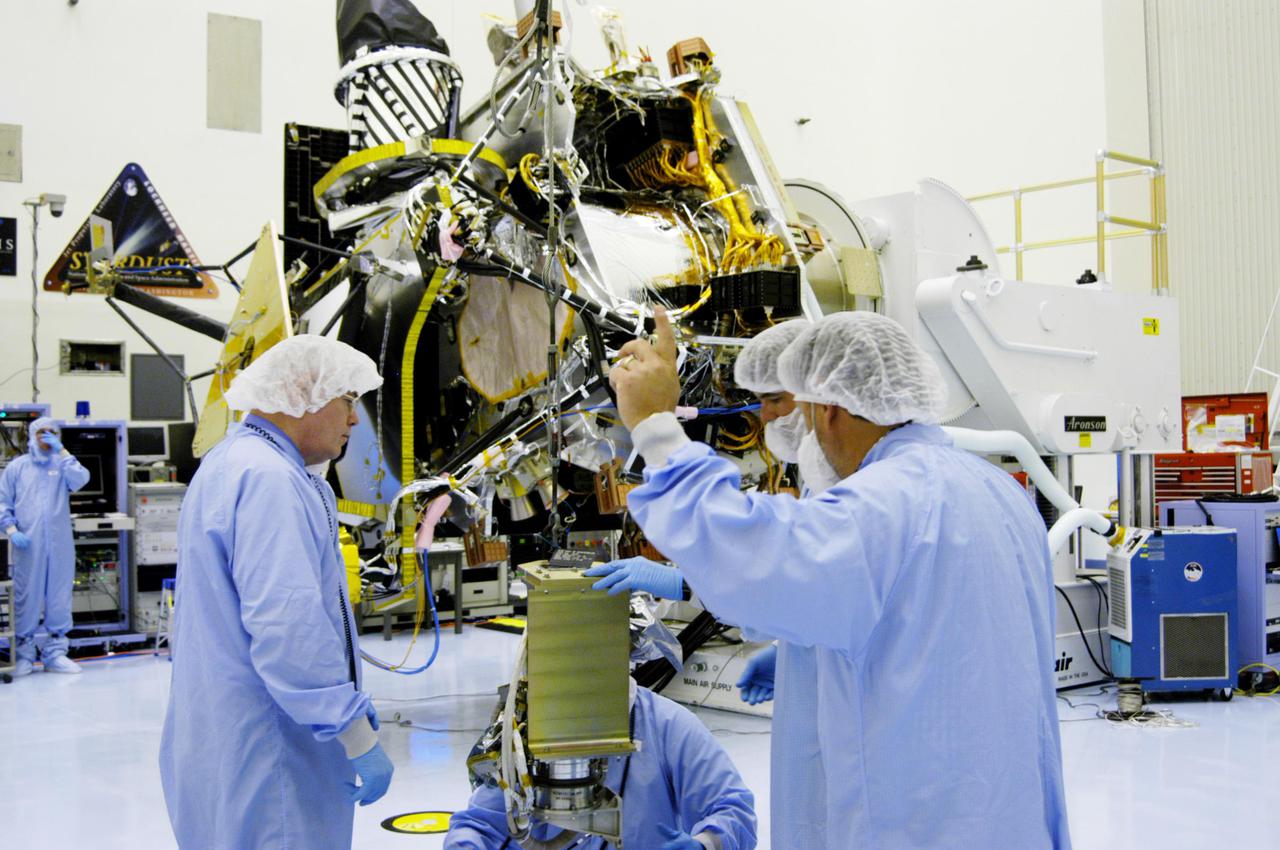
KENNEDY SPACE CENTER, FLA. - In the Payload Hazardous Servicing Facility at NASA’s Kennedy Space Center, engineers prepare to install the gimbal on the Mars Reconnaissance Orbiter (MRO) solar panel. A gimbal is an appliance that allows an object to remain horizontal even as its support tips. In the background is the orbiter. In the PHSF, the spacecraft will undergo multiple mechanical assembly operations and electrical tests to verify its readiness for launch. A major deployment test will check out the spacecraft’s large solar arrays. The MRO was built by Lockheed Martin for NASA’s Jet Propulsion Laboratory in California. It is the next major step in Mars exploration and scheduled for launch from Cape Canaveral Air Force Station in a window opening Aug. 10. The MRO is an important next step in fulfilling NASA’s vision of space exploration and ultimately sending human explorers to Mars and beyond.
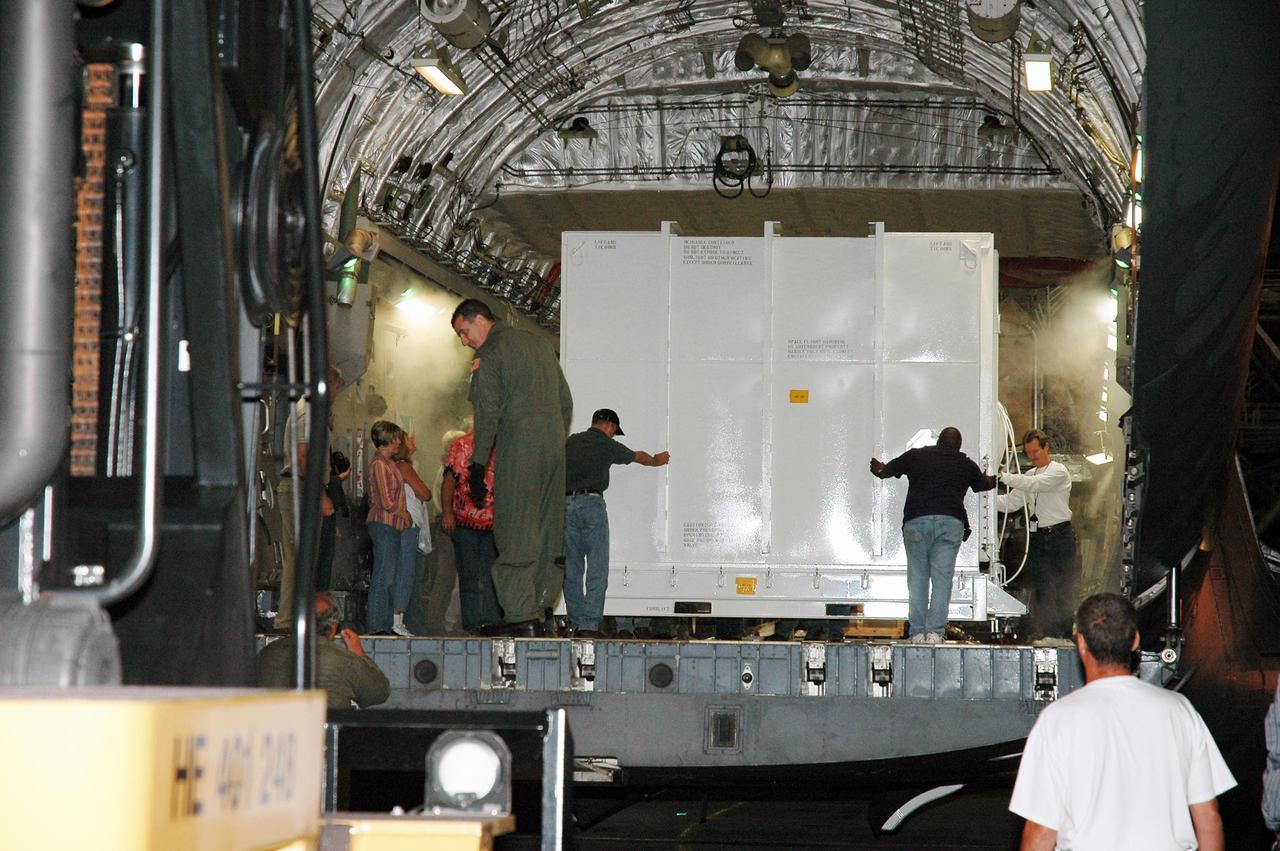
KENNEDY SPACE CENTER, FLA. - In the U.S. Air Force C-17 cargo plane at NASA Kennedy Space Center’s Shuttle Landing Facility, workers move the large shipping container with the New Horizons spacecraft inside. After it is unloaded, the spacecraft will be transported to the Payload Hazardous Servicing Facility. New Horizons is designed to help us understand worlds at the edge of our solar system by making the first reconnaissance of Pluto and Charon - a 'double planet' and the last planet in our solar system to be visited by spacecraft. The mission will then visit one or more objects in the Kuiper Belt region beyond Neptune. New Horizons is scheduled to launch in January 2006, swing past Jupiter for a gravity boost and scientific studies in February or March 2007, and reach Pluto and its moon, Charon, in July 2015.
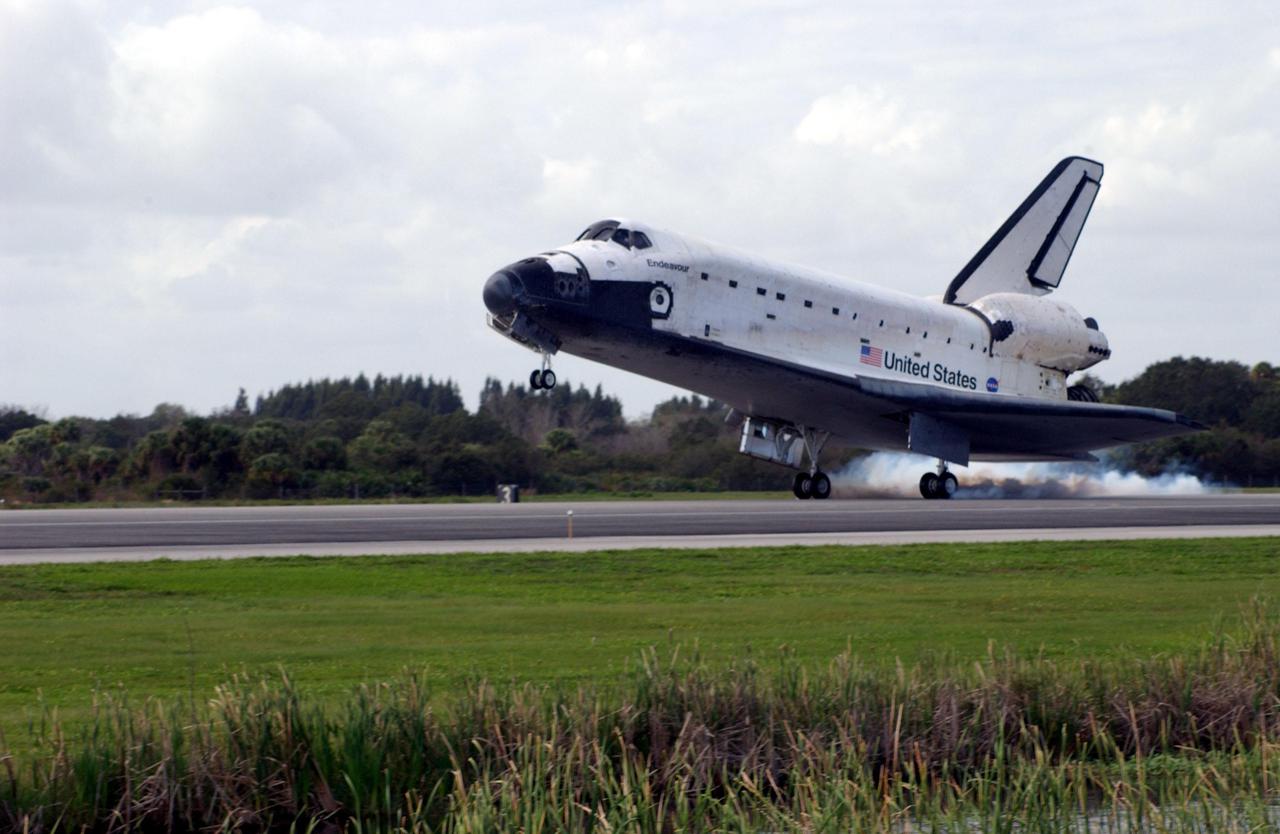
KENNEDY SPACE CENTER, FLA. -- Orbiter Endeavour kicks up dust as it touches down on Runway 15 at the KSC Shuttle Landing Facility, completing mission STS-108. Endeavour carries both the mission crew and the Expedition 3 crew - Commander Frank Culbertson and cosmonauts Vladimir Dezhurov and Mikhail Tyurin - who are returning to Earth after 129 days in space on the International Space Station. After a mission-elapsed time of 11 days, 19 hours and 35 minutes, Endeavour had main gear touchdown at 12:55:10 p.m. EST (17:55:10 GMT). Nose gear touchdown occurred at 12:55:23 p.m. (17:55:23 GMT); wheel stop at 12:56:13 p.m. (17:56:13 GMT). Rollout distance was 8,941 feet. The landing is the 57th at KSC in the history of the program STS-108 was the 12th mission to the Space Station. This mission was the 107th flight in the Shuttle program and the 17th flight for the orbiter
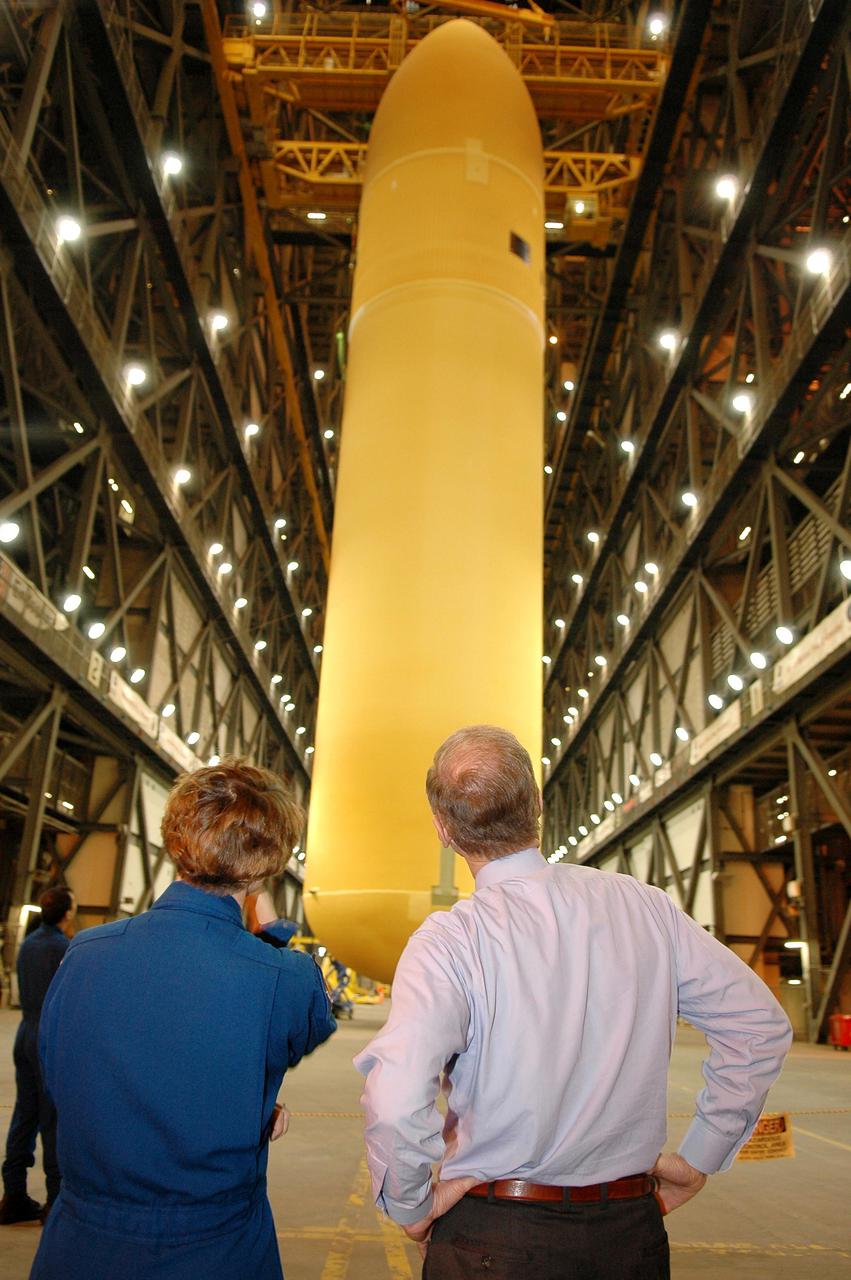
KENNEDY SPACE CENTER, FLA. - Mission STS-114 Commander Eileen Collins and Sen. Bill Nelson watch as the newly redesigned External Tank is lifted in the Vehicle Assembly Building to a “checkout cell” where the tank’s mechanical, electrical and thermal protection systems are inspected. The mission crew and Nelson are at Kennedy to observe tank activities. The tank will also undergo new processes resulting from its redesign, including inspection of the bipod heater and External Tank separation camera. The tank is designated to fly with Shuttle Discovery on Return to Flight mission STS-114. The launch window is May 12 to June 3, 2005.
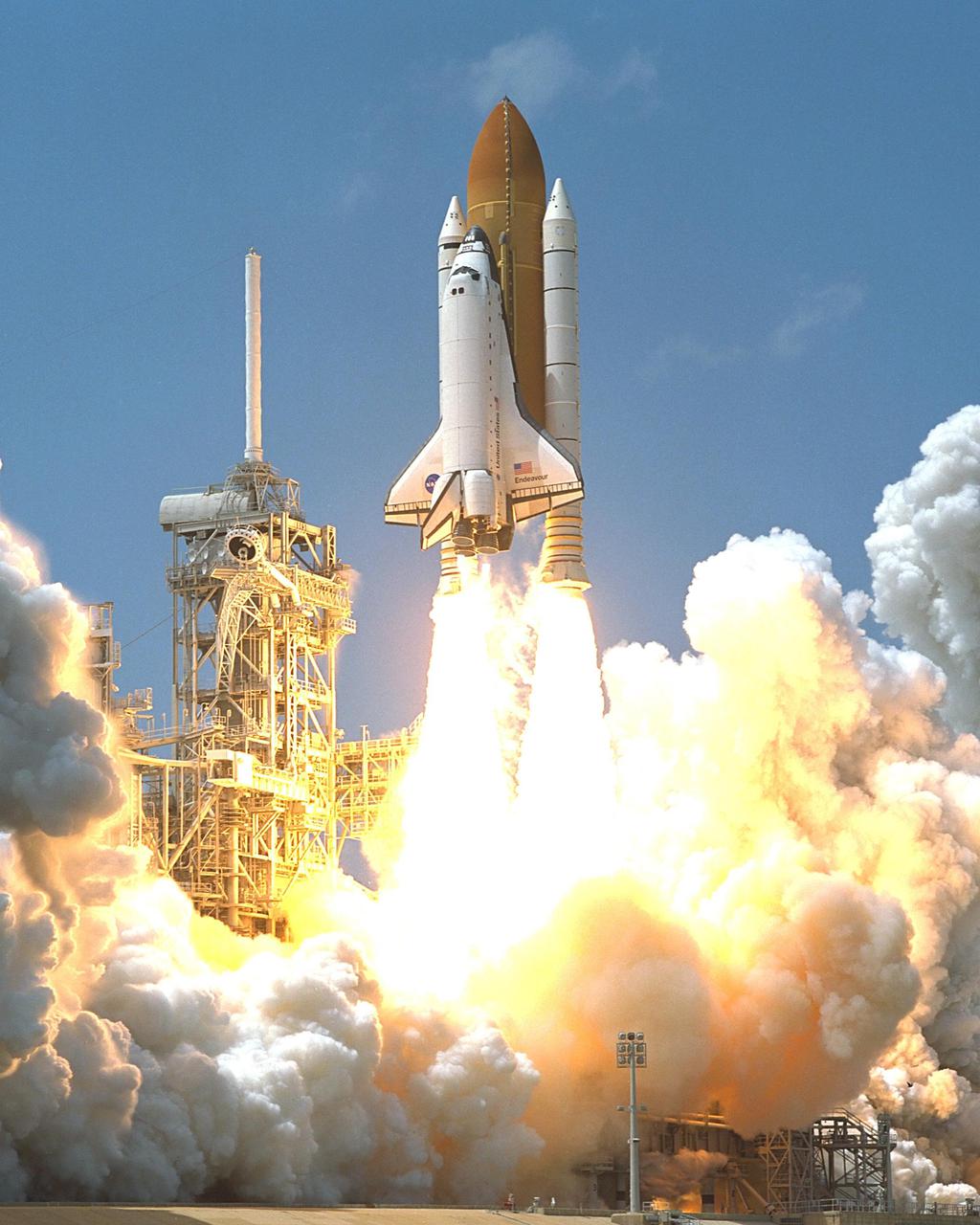
KENNEDY SPACE CENTER, FLA. -- Space Shuttle Endeavour races into space, springing forth from clouds of smoke and steam, on mission STS-100. Liftoff of the ninth flight to the International Space Station occurred at 2:40:42 p.m. EDT. The 11-day mission will deliver and integrate the Spacelab Logistics Pallet_Launch Deployment Assembly, which includes the Space Station Remote Manipulator System and the UHF Antenna. The mission includes two planned spacewalks for installation of the SSRMS on the Station. Also onboard is the Multi-Purpose Logistics Module Raffaello, carrying resupply stowage racks and resupply_return stowage platforms
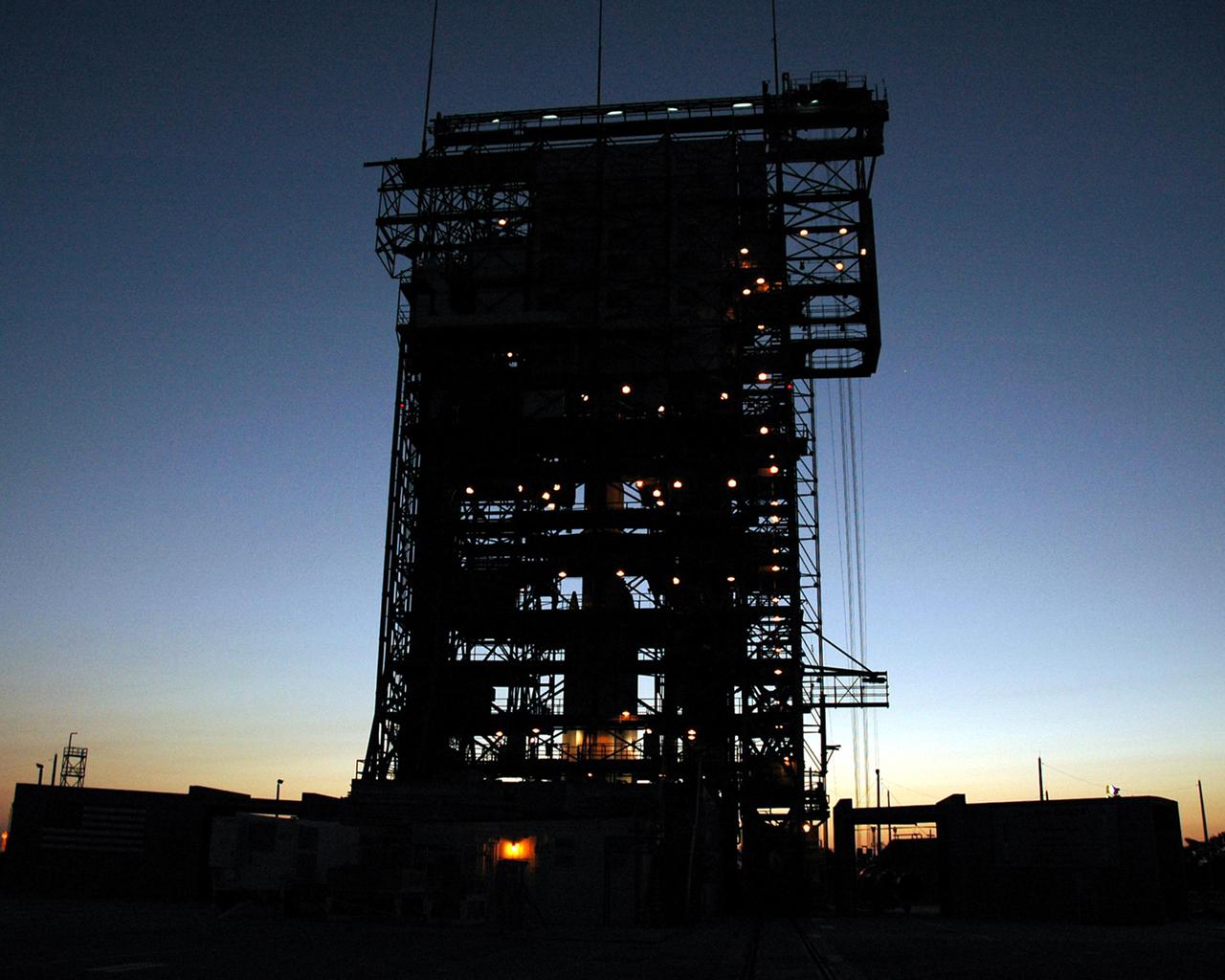
KENNEDY SPACE CENTER, FLA. - In the pre-dawn hours on Launch Pad 17-B at Cape Canaveral Air Force Station, the mobile service tower is silhouetted with the Boeing Delta II rocket that will launch NASA’s Deep Impact spacecraft. The Delta II waits for the arrival and mating of the second stage. A NASA Discovery mission, Deep Impact will probe beneath the surface of Comet Tempel 1 on July 4, 2005, when the comet is 83 million miles from Earth, and reveal the secrets of its interior. After releasing an impactor on a course to hit the comet’s sunlit side, Deep Impact’s flyby spacecraft will collect pictures and data of how the crater forms, measure the crater’s depth and diameter, as well as the composition of the interior of the crater and any material thrown out, and determine the changes in natural outgassing produced by the impact. It will send the data back to Earth through the antennas of the Deep Space Network.
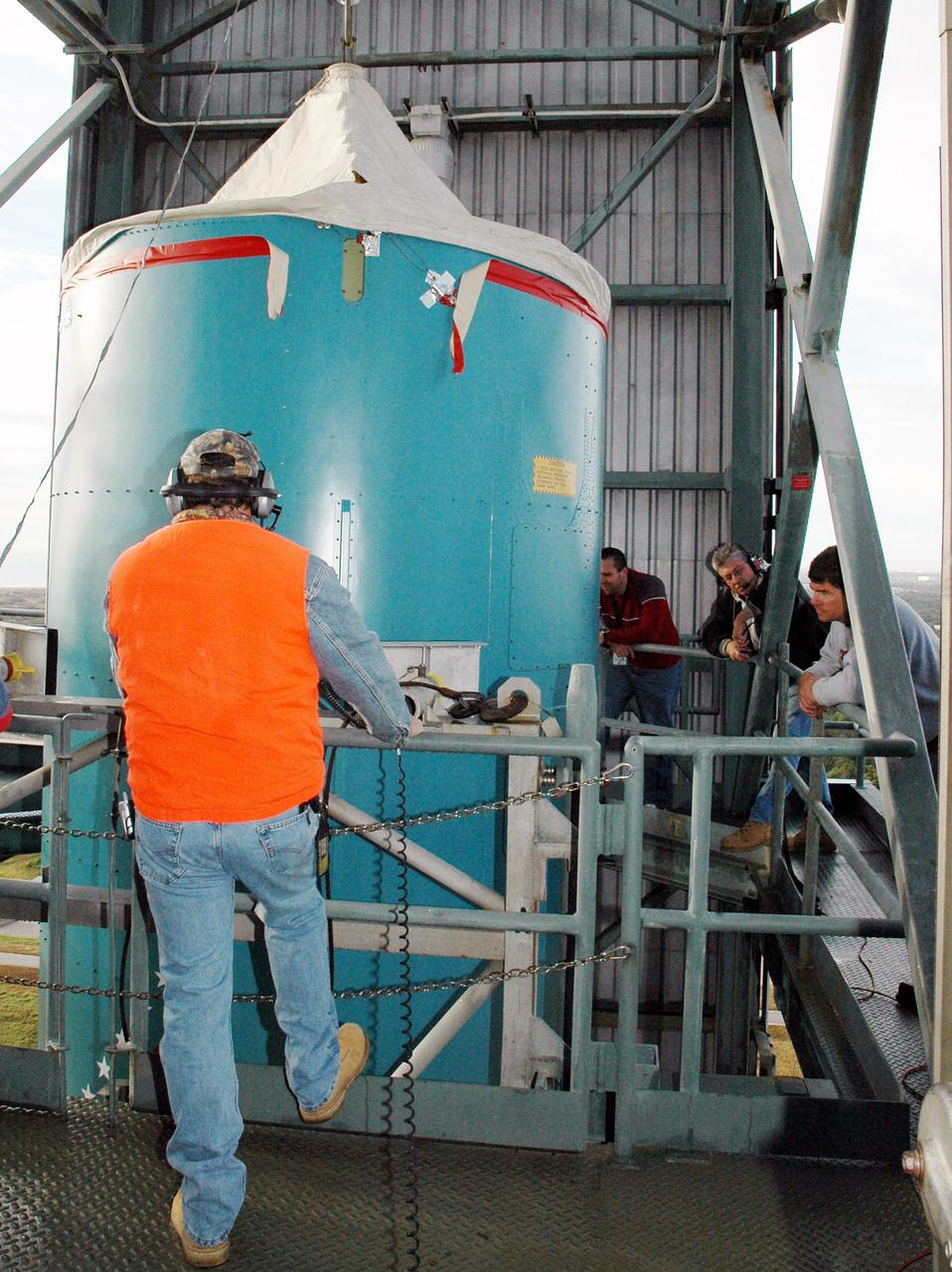
KENNEDY SPACE CENTER, FLA. - On the mobile service tower on Launch Pad 17-B, Cape Canaveral Air Force Station, Fla., Boeing workers stand by as the replacement interstage adapter for the Boeing Delta II is lowered. Boeing workers will attach the adapter to the rocket’s center body section. Later the second stage, which was removed to allow access to the previous adapter, will be reattached. The first adapter was removed after it was found to be faulty during a review of launch vehicle hardware. Launch of Deep Impact is now scheduled no earlier than Jan. 12.
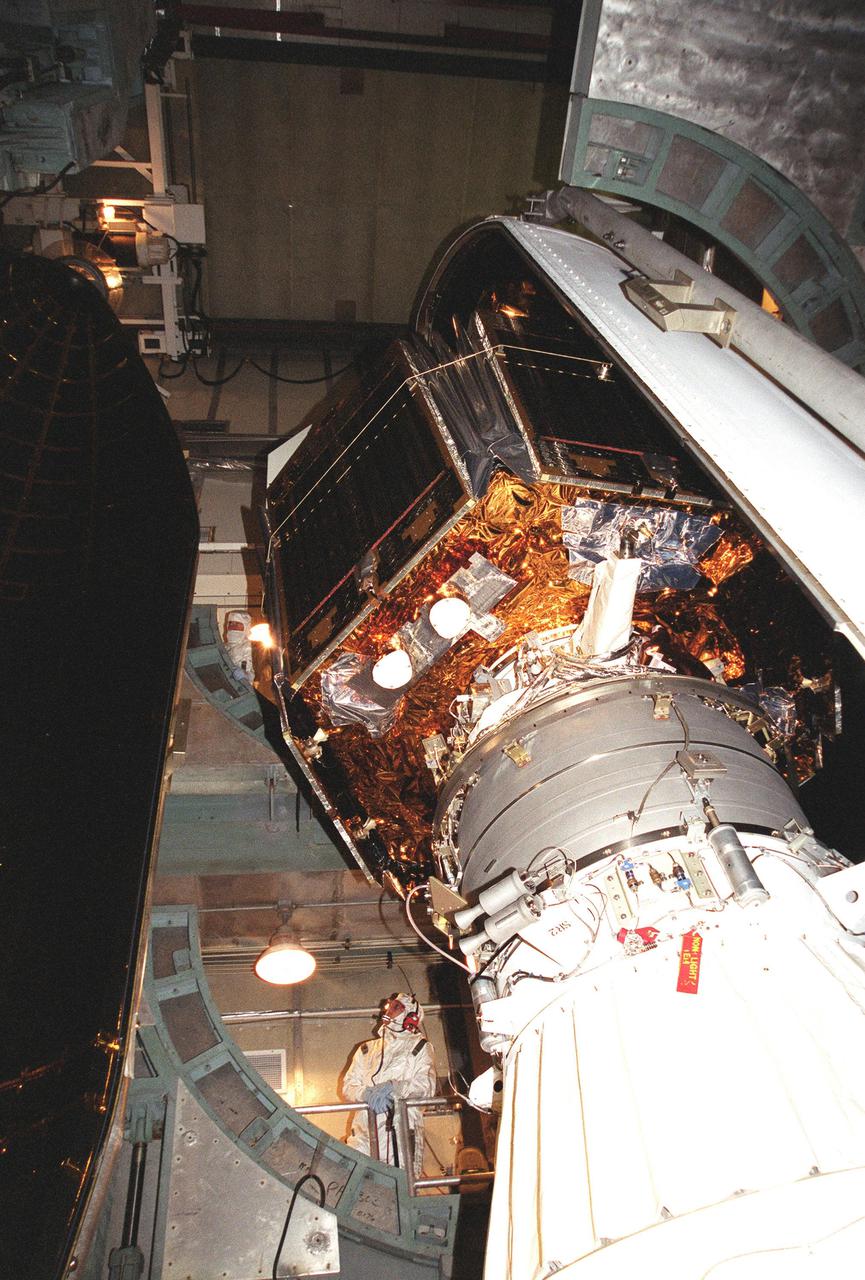
KENNEDY SPACE CENTER, Fla. -- At Launch Complex 17-B, Cape Canaveral Air Force Station, the Microwave Anisotropy Probe (MAP) spacecraft is encapsulated with the fairing. With one half already in place (right), the second half (left) moves into position. MAP is scheduled for launch on June 30 aboard a Boeing Delta II rocket. The launch will place MAP into a lunar-assisted trajectory to the Sun-Earth for a 27-month mission. The probe will measure small fluctuations in the temperature of the cosmic microwave background radiation to an accuracy of one millionth of a degree. These measurements should reveal the size, matter content, age, geometry and fate of the universe. They will also reveal the primordial structure that grew to form galaxies and will test ideas about the origins of these primordial structures. The MAP instrument will be continuously shaded from the Sun, Earth, and Moon by the spacecraft
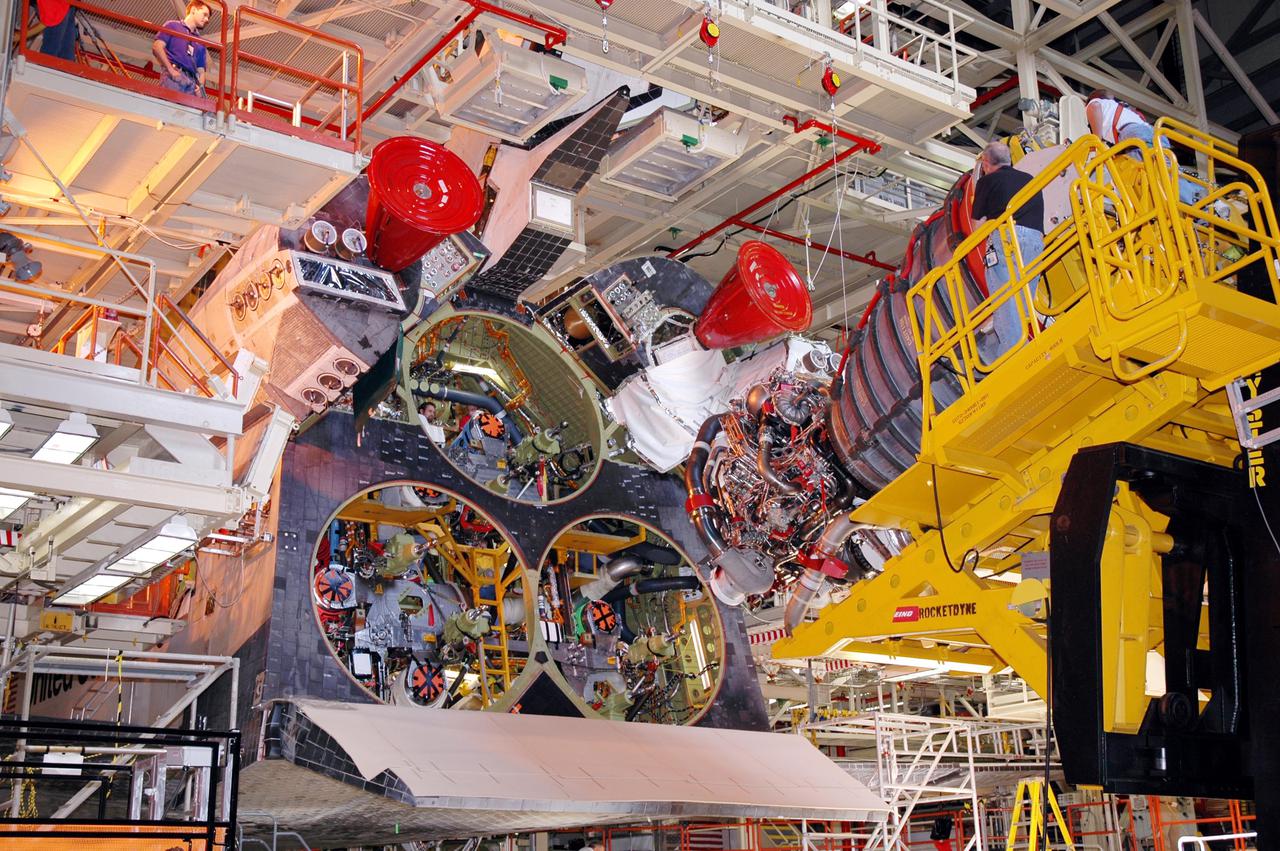
KENNEDY SPACE CENTER, FLA. - In the Orbiter Processing Facility, Discovery waits as the first of three Space Shuttle Main Engines (SSME) moves into position for installation on Discovery, the vehicle designated for the Return to Flight mission STS-114. Overall, an SSME weighs approximately 7,000 pounds. An SSME operates at greater temperature extremes than any mechanical system in common use today. The liquid hydrogen fuel is -423 degrees Fahrenheit, the second coldest liquid on Earth. When the hydrogen is burned with liquid oxygen, the temperature in the engine's combustion chamber reaches +6000 degrees Fahrenheit -- that's higher than the boiling point of Iron. The maximum equivalent horsepower developed by the three SSMEs is just over 37 million horsepower. The energy released by the three SSMEs is equivalent to the output of 23 Hoover Dams.
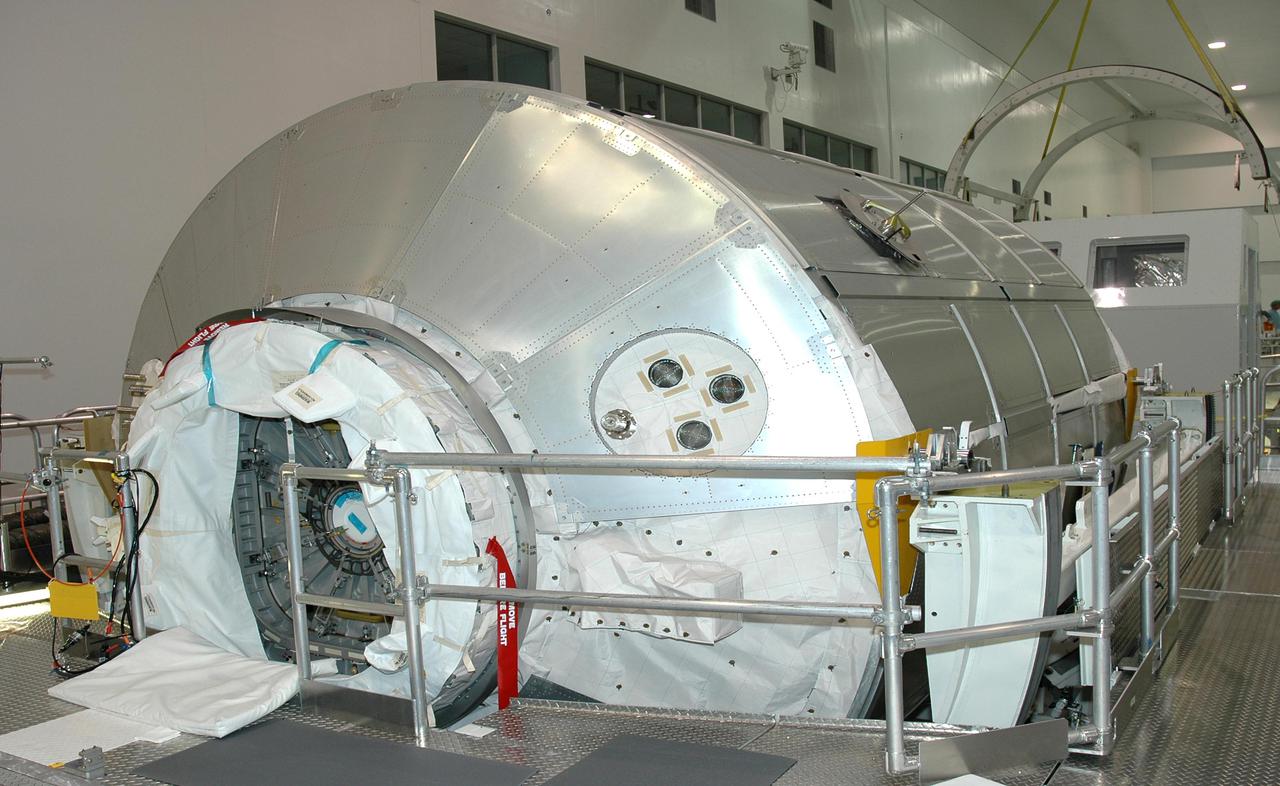
KENNEDY SPACE CENTER, FLA. -- In the Space Station Processing Facility, Italian-built Multi-Purpose Logistics Module Raffaello is closed and ready for transfer to a payload canister and trip to Launch Complex 39B for transfer to Space Shuttle Discovery. The module will travel to the International Space Station aboard Space Shuttle Discovery’s Return to Flight mission STS-114. Raffaello carries 12 racks of cargo, including food, clothing, spare parts and research equipment, to the Station. Shuttle Discovery is targeted for launch in a window extending May 15 through June 3.
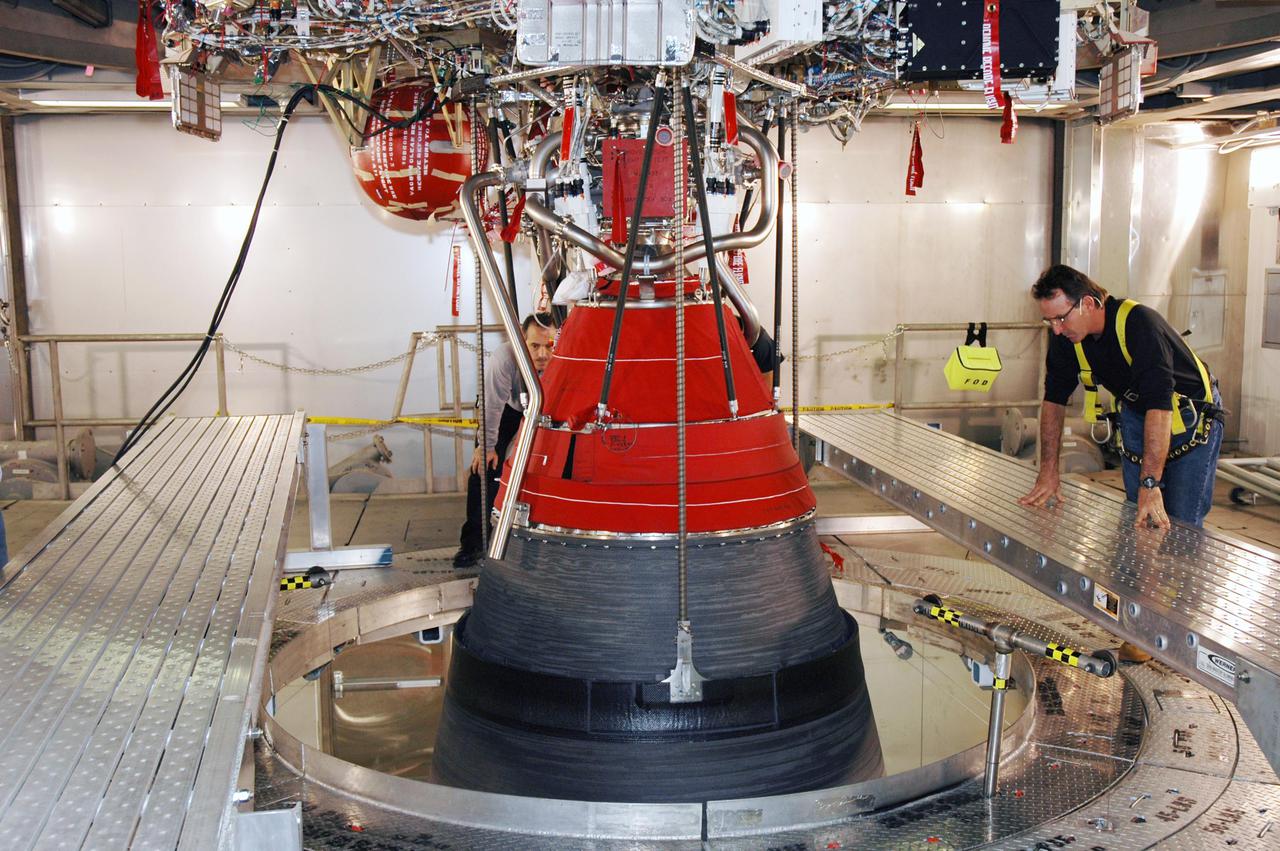
KENNEDY SPACE CENTER, FLA. - At the Delta Operations Center on Cape Canaveral Air Force Station, Fla., a technician monitors the Boeing Delta IV second stage nozzle extension during testing. The Delta IV is the launch vehicle for the GOES-N satellite. The Delta IV is the launch vehicle for GOES-N satellite. Geostationary Operational Environmental Satellites (GOES) are sponsored by the National Aeronautics and Space Administration (NASA) and the National Oceanic and Atmospheric Administration (NOAA). GOES-N is the first in the next series of GOES satellites, N-P. The multi-mission GOES series N-P will be a vital contributor to weather, solar and space operations and science. The GOES N-P series will aid activities ranging from severe storm warnings to resource management and advances in science. GOES-N is scheduled to launch May 4 from Cape Canaveral Air Force Station, Fla.

KENNEDY SPACE CENTER, FLA. - Ball Aerospace technicians prepare the Deep Impact flyby spacecraft for installation of the flight battery at Astrotech Space Operations in Titusville, Fla. About the size of a Ford Explorer, the flyby spacecraft is three-axis stabilized and uses a fixed solar array and a small NiH2 battery for its power system. A NASA Discovery mission, Deep Impact will probe beneath the surface of Comet Tempel 1 on July 4, 2005, when the comet is 83 million miles from Earth. During the encounter phase when the comet collides with the impactor projectile propelled into its path, the spacecraft’s high-gain antenna will transmit near-real-time images of the impact back to Earth. The spacecraft is scheduled to launch Jan. 8 aboard a Boeing Delta II rocket from Launch Complex 17-B at Cape Canaveral Air Force Station, Fla.
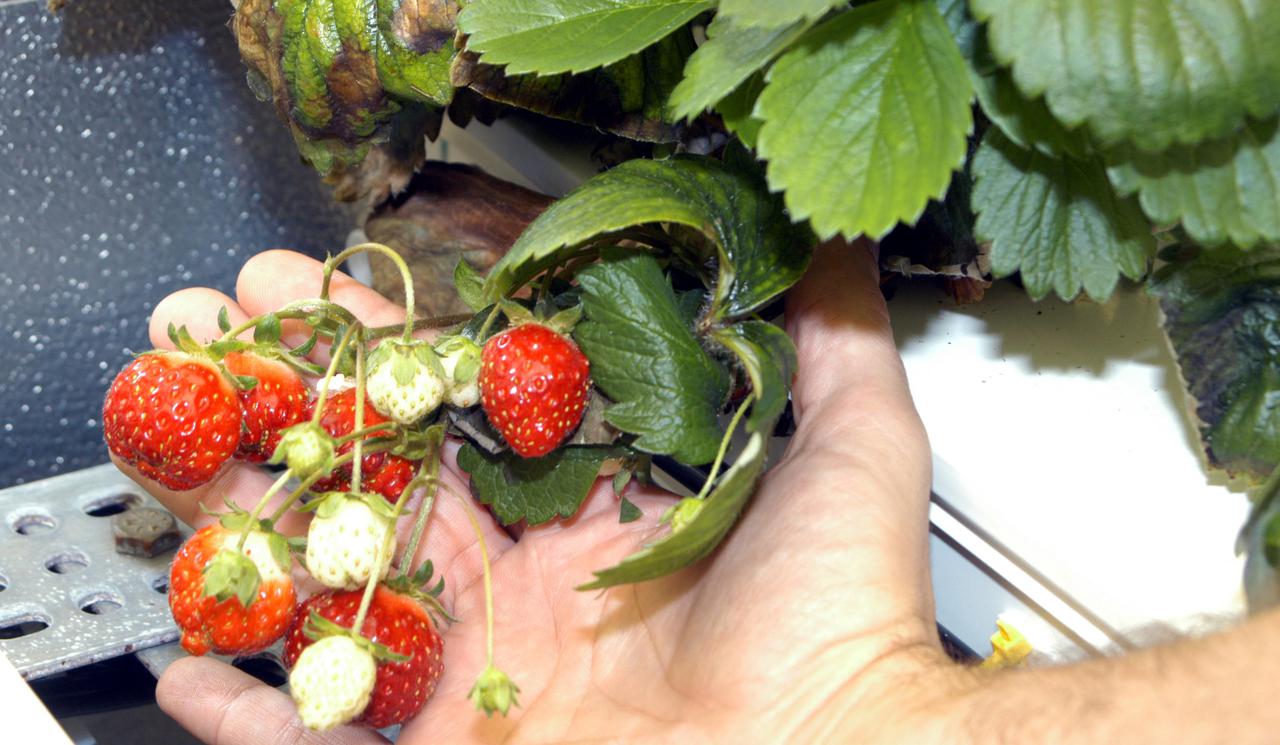
KENNEDY SPACE CENTER, FLA. - A crop of strawberries grown in a controlled environment chamber at the Space Life Sciences Lab is displayed during a tour of the facility for members of the news media. In missions to the International Space Station or early planetary outposts, plant production systems will likely be small and rely upon the spacecraft or habitat environment to regulate temperature, relative humidity, and carbon dioxide concentrations. Various crops are being grown in conditions that might be experienced in a spacecraft to evaluate the effects of different environmental conditions on plant growth, crop yield, and product quality.
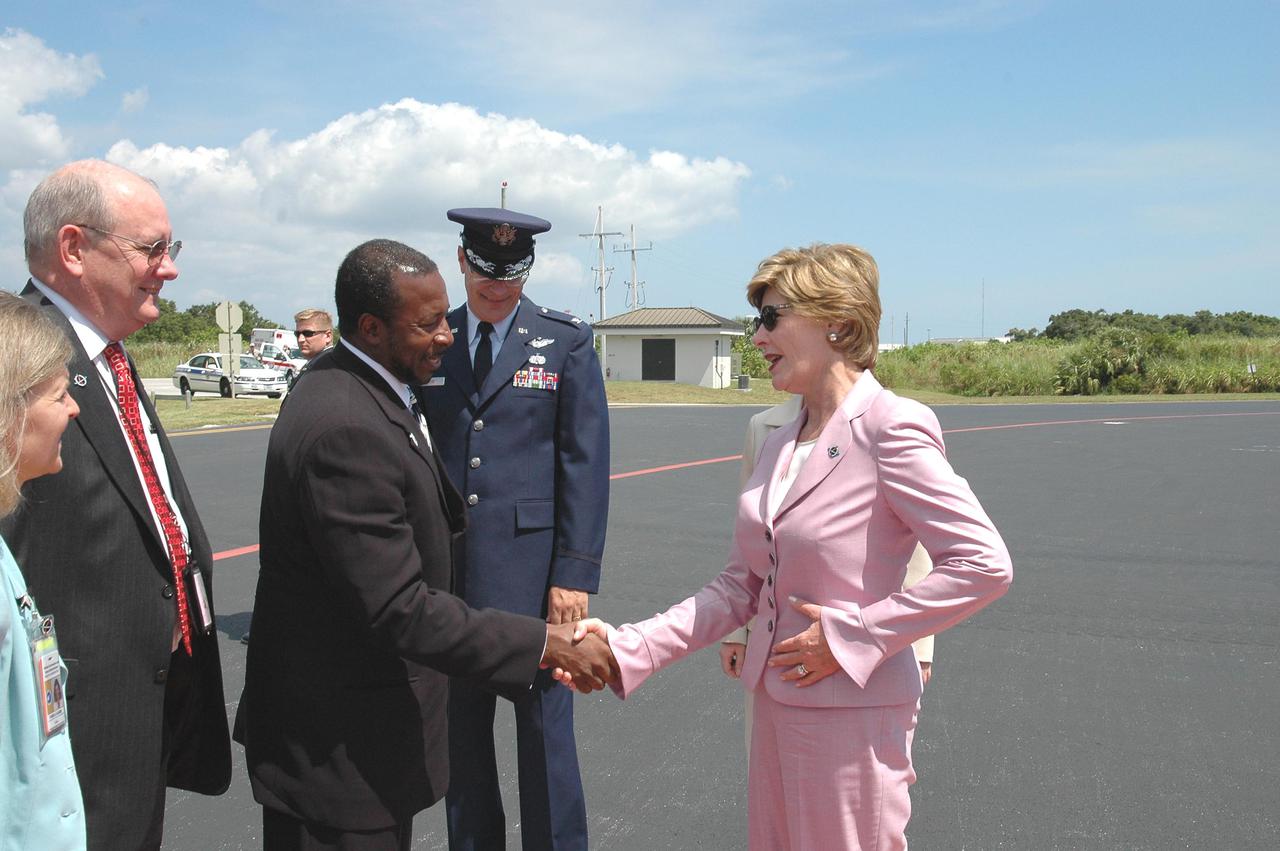
KENNEDY SPACE CENTER, FLA. - At the Skid Strip on Cape Canaveral Air Force Station, First Lady Laura Bush says farewell to KSC Deputy Director Woodrow Whitlow Jr. At left is Associate Director Jim Hattaway. Mrs. Bush witnessed the historic launch of Space Shuttle Discovery on Return to Flight mission STS-114. She is only the third First Lady to witness a Space Shuttle launch at KSC. On this mission to the International Space Station the crew will perform inspections on-orbit for the first time of all of the Reinforced Carbon-Carbon (RCC) panels on the leading edge of the wings and the Thermal Protection System tiles using the new Canadian-built Orbiter Boom Sensor System and the data from 176 impact and temperature sensors. Mission Specialists will also practice repair techniques on RCC and tile samples during a spacewalk in the payload bay. During two additional spacewalks, the crew will install the External Stowage Platform-2, equipped with spare part assemblies, and a replacement Control Moment Gyroscope contained in the Lightweight Multi-Purpose Experiment Support Structure. The 12-day mission is expected to end with touchdown at the Shuttle Landing Facility on Aug. 7.
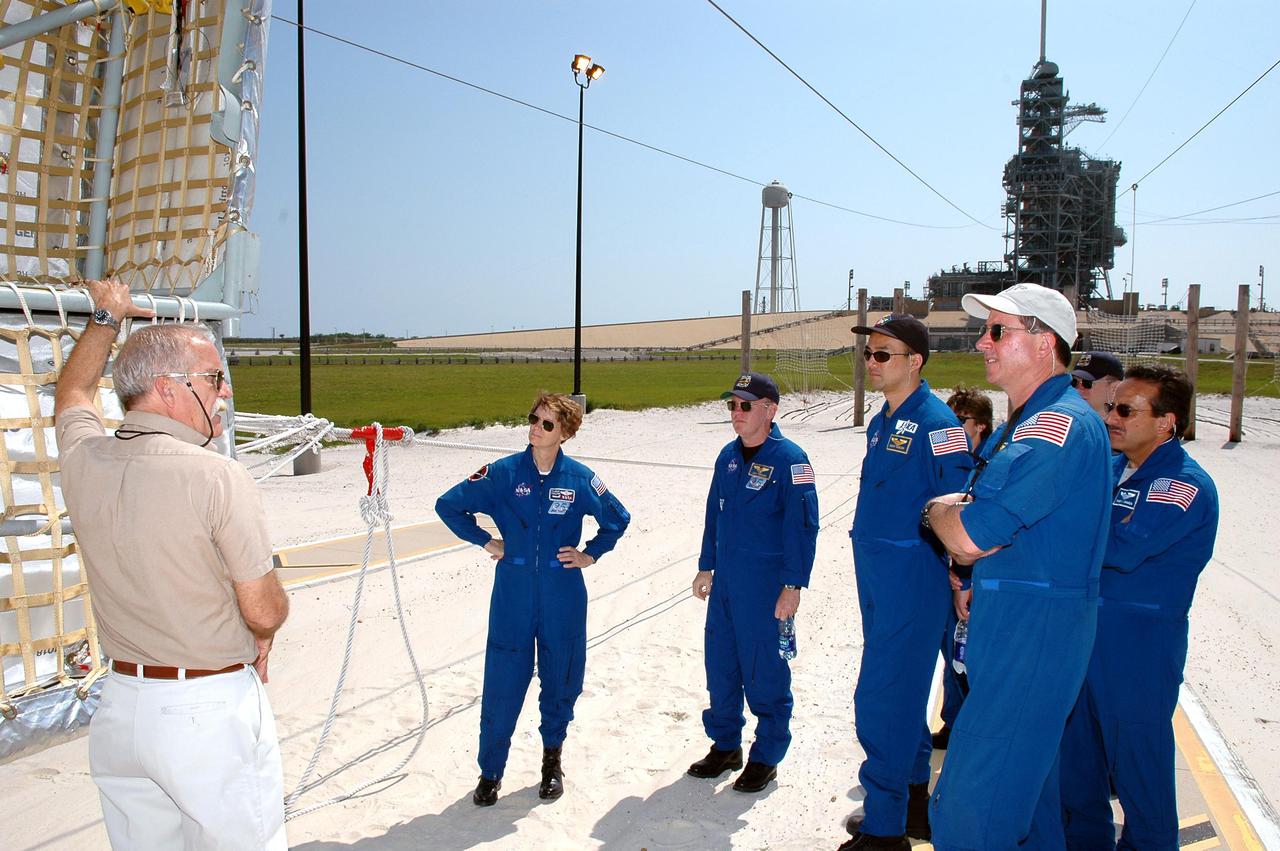
KENNEDY SPACE CENTER, FLA. - The STS-114 crew learn about exiting the slidewire basket at this landing area should they need to leave the Space Shuttle in an emergency situation while on the pad. Crew members seen here are (from left) Commander Eileen Collins and Mission Specialists Andrew Thomas, Soichi Noguchi, Wendy Lawrence, Stephen Robinson and Charles Camarda. Not pictured is Pilot James Kelly. Noguchi is with the Japan Aerospace Exploration Agency. The training is part of Terminal Countdown Demonstration Test activities. The TCDT is held at KSC prior to each Space Shuttle flight. It provides the crew of each mission an opportunity to participate in simulated countdown activities. The test ends with a mock launch countdown culminating in a simulated main engine cutoff. The crew also spends time undergoing emergency egress training exercises at the launch pad. STS-114 is designated the first Return to Flight mission, with a launch window extending from July 13 to July 31.
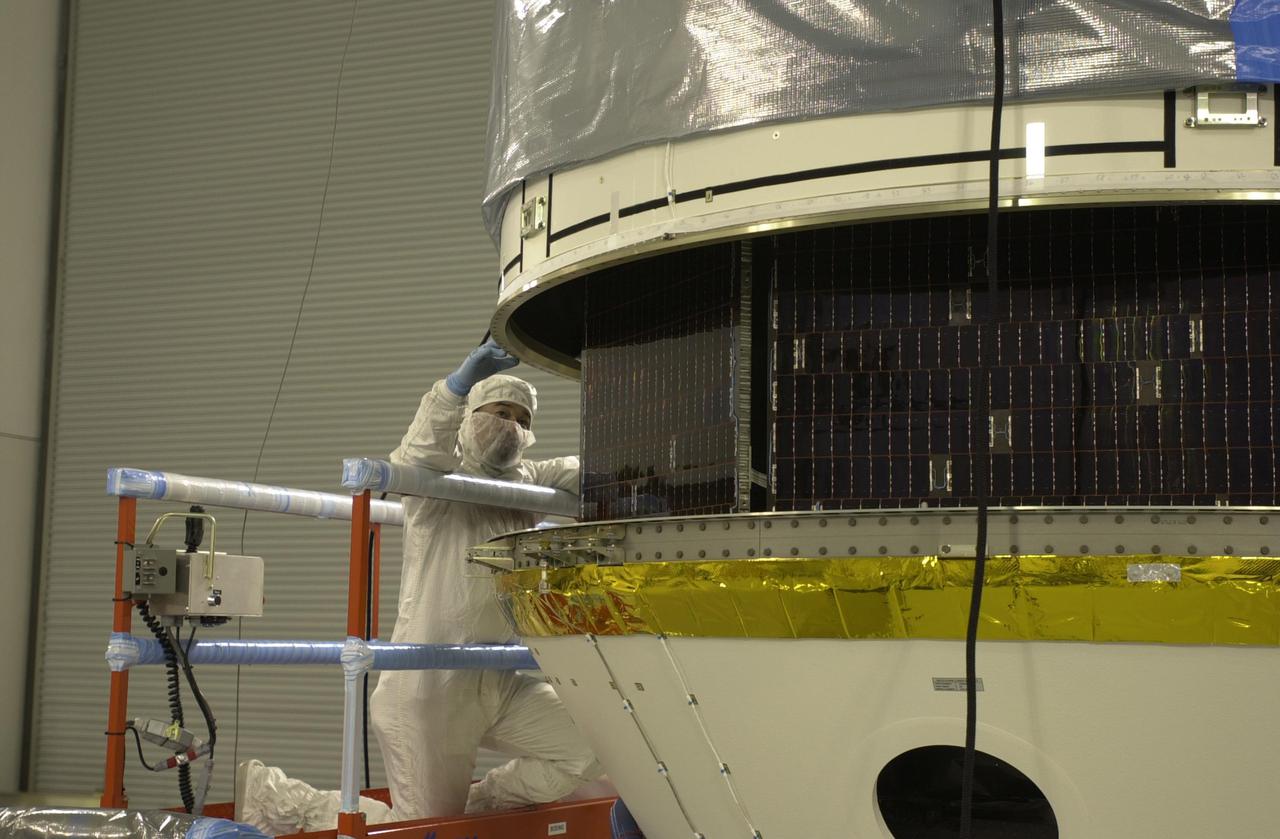
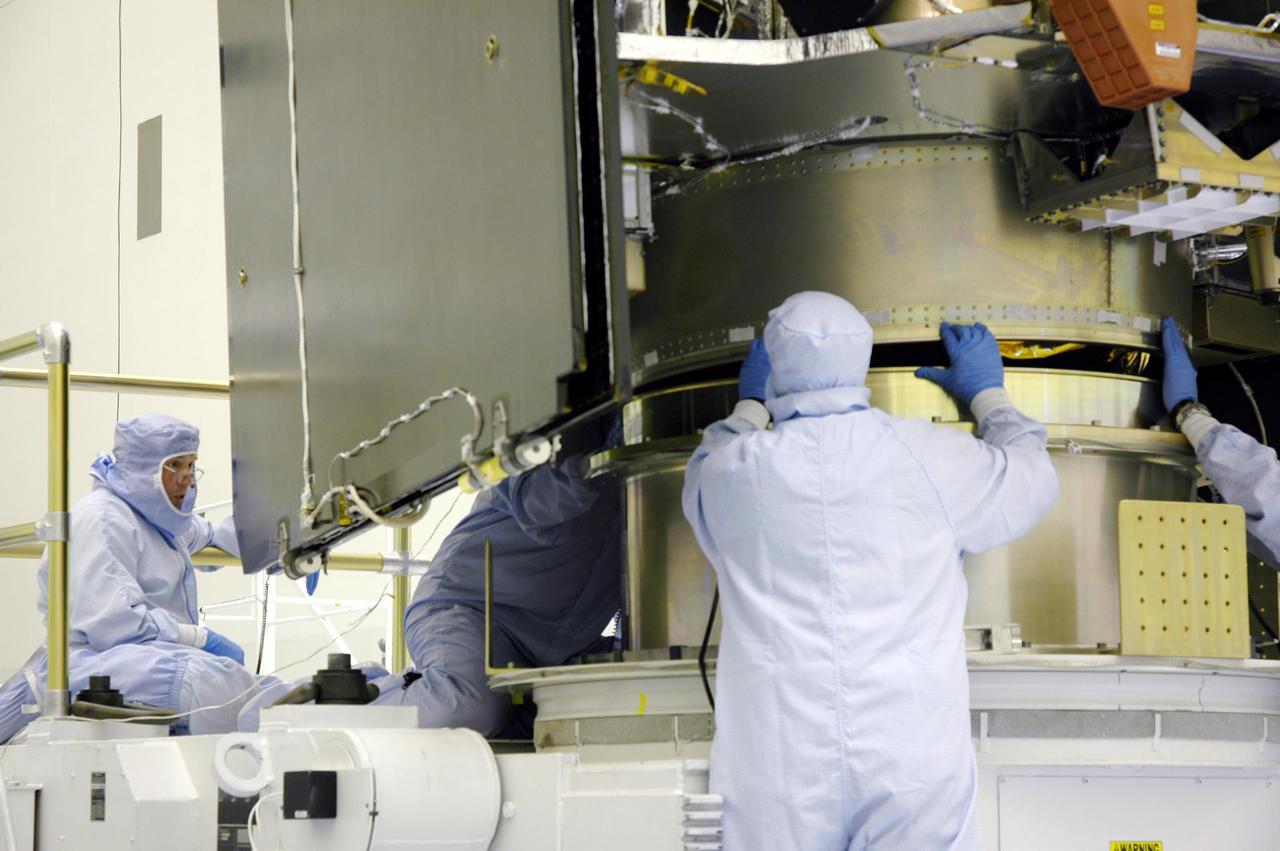
VANDENBERG AIR FORCE BASE, CALIF. - Inside the Astrotech Payload Processing Facility on Vandenberg Air Force Base in California, the upper Delta Payload Attach Fitting (UDPAF) is lowered toward the lower Delta Payload Attach Fitting (LDPAF). The LDPAF holds the CloudSat satellite and the UDPAF will hold the CALIPSO satellite. The two sections will be mated. CALIPSO stands for Cloud-Aerosol Lidar and Infrared Pathfinder Satellite Observation. CALIPSO and CloudSat are highly complementary satellites that will provide never-before-seen 3-D perspectives of how clouds and aerosols form, evolve, and affect weather and climate. CALIPSO and CloudSat will fly in formation with three other satellites in the A-train constellation to enhance understanding of our climate system. Launch of CALIPSO_CloudSat aboard a Boeing Delta II rocket is scheduled for 3:01 a.m. PDT Sept. 29.
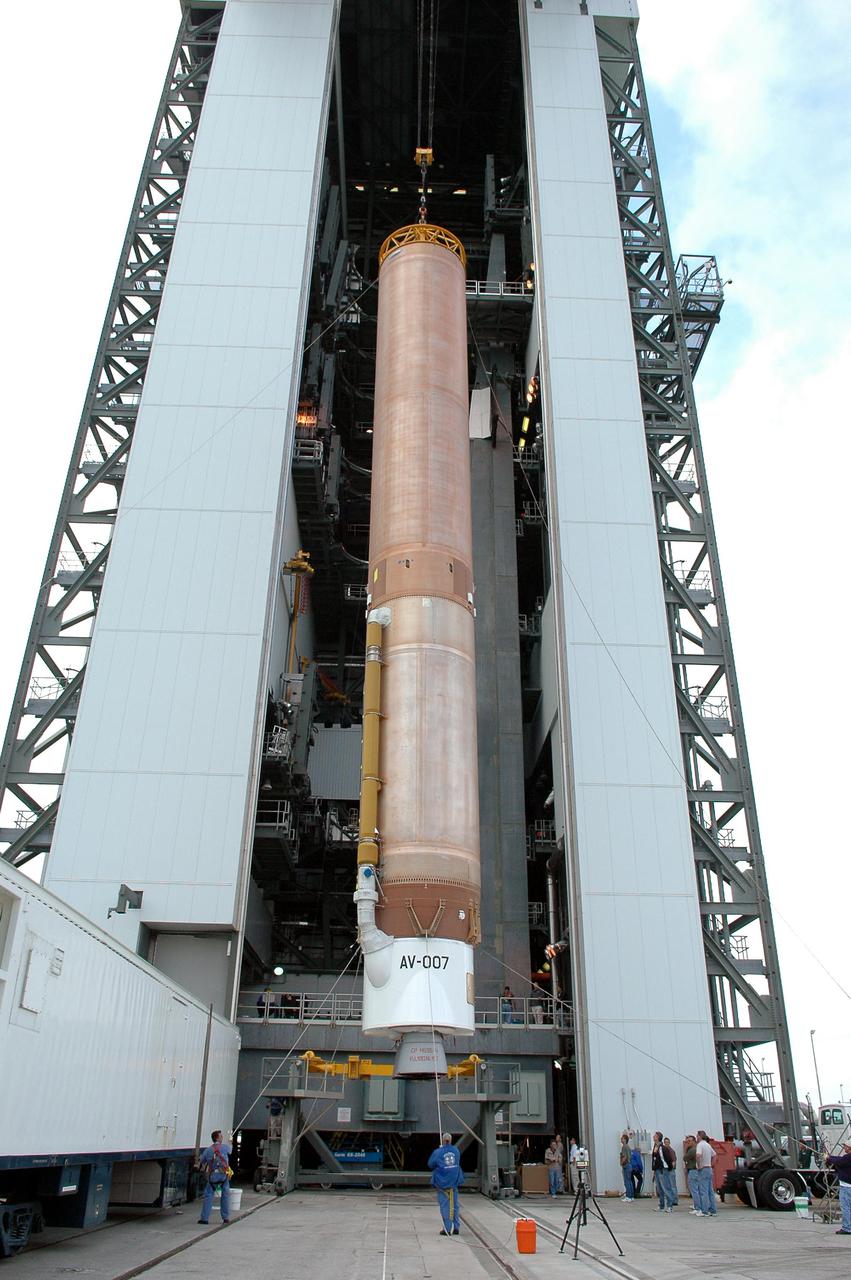
KENNEDY SPACE CENTER, FLA. - At Launch Complex 41 at Cape Canaveral Air Force Station in Florida, the first stage of the Atlas V rocket has been raised to vertical and will be lifted into the launch service tower and mated with the second stage, the Centaur. Designated AV-007, the Atlas V is the launch vehicle for the Mars Reconnaissance Orbiter (MRO). The MRO is designed for a series of global mapping, regional survey and targeted observations from a near-polar, low-altitude Mars orbit. These observations will be unprecedented in terms of the spatial resolution and coverage achieved by the orbiter’s instruments as they observe the atmosphere and surface of Mars while probing its shallow subsurface as part of a “follow the water” strategy. The orbiter is in KSC’s Payload Hazardous Servicing Facility for final assembly and testing. The launch window begins Aug. 10.
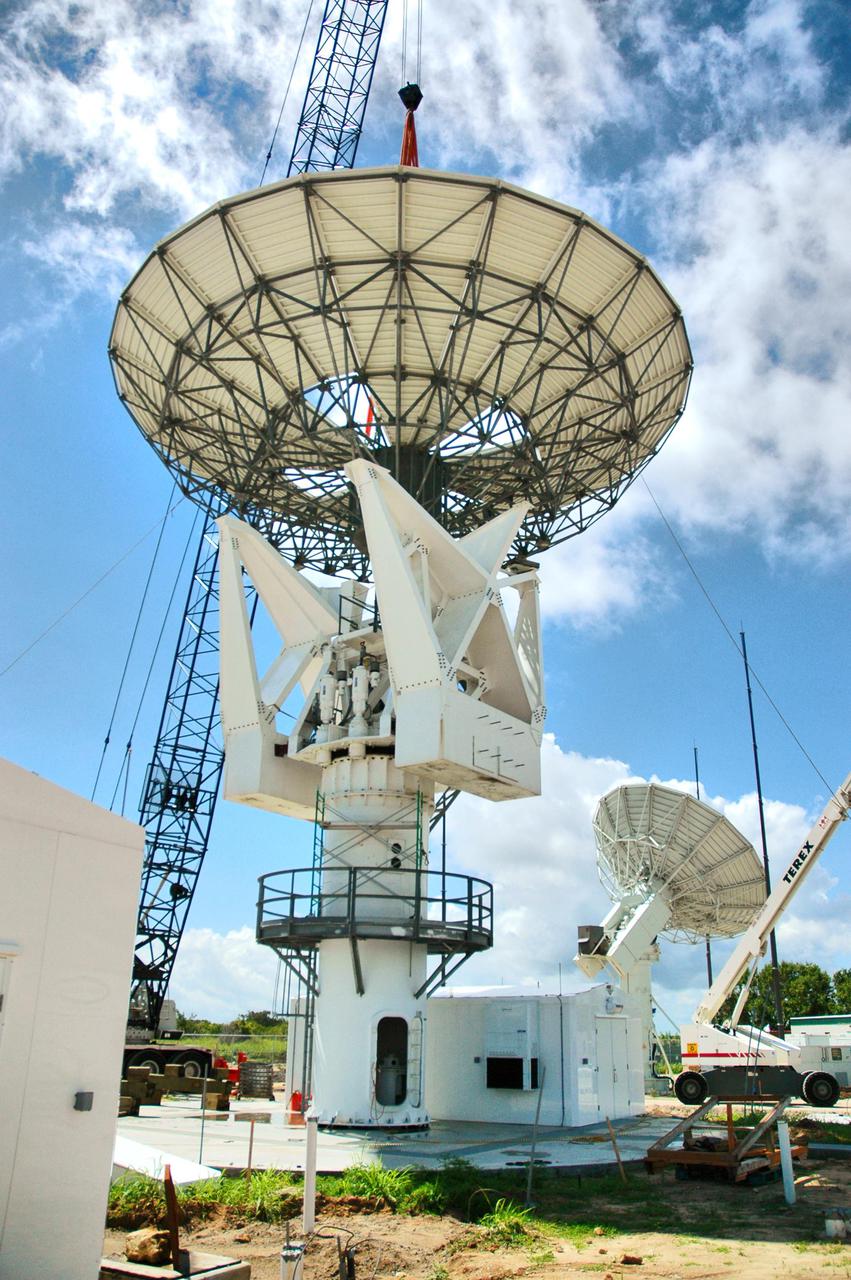
KENNEDY SPACE CENTER, FLA. - At a radar site on North Merritt Island, Fla., the 50-foot C-band radar antenna dish is lowered toward the top of the support structure. It will be placed on the counterweights installed there. The radar will be used for Shuttle missions to track the launches and observe possible debris coming from the Shuttle. It will be used for the first time on STS-114. The launch window for the first Return to Flight mission is July 13 to July 31.
KENNEDY SPACE CENTER, FLA. - In a clean room inside the Payload Hazardous Servicing Facility (PHSF) at NASA's Kennedy Space Center, Lockheed Martin workers help guide the Mars Reconnaissance Orbiter onto the workstand for final assembly and testing. In the PHSF, the spacecraft will undergo multiple mechanical assembly operations and electrical tests to verify its readiness for launch. A test this month will verify the spacecraft's ability to communicate through NASA's Deep Space Network tracking stations. A June test will check the deployment of the spacecraft's high gain communications antenna. Another major deployment test will check out the spacecraft's large solar arrays. The MRO was built for NASA's Jet Propulsion Laboratory in California. It is the next major step in Mars exploration and scheduled for launch from Cape Canaveral Air Force Station in a window opening Aug. 10. The MRO is an important next step in fulfilling NASA's vision of space exploration and ultimately sending human explorers to Mars and beyond.
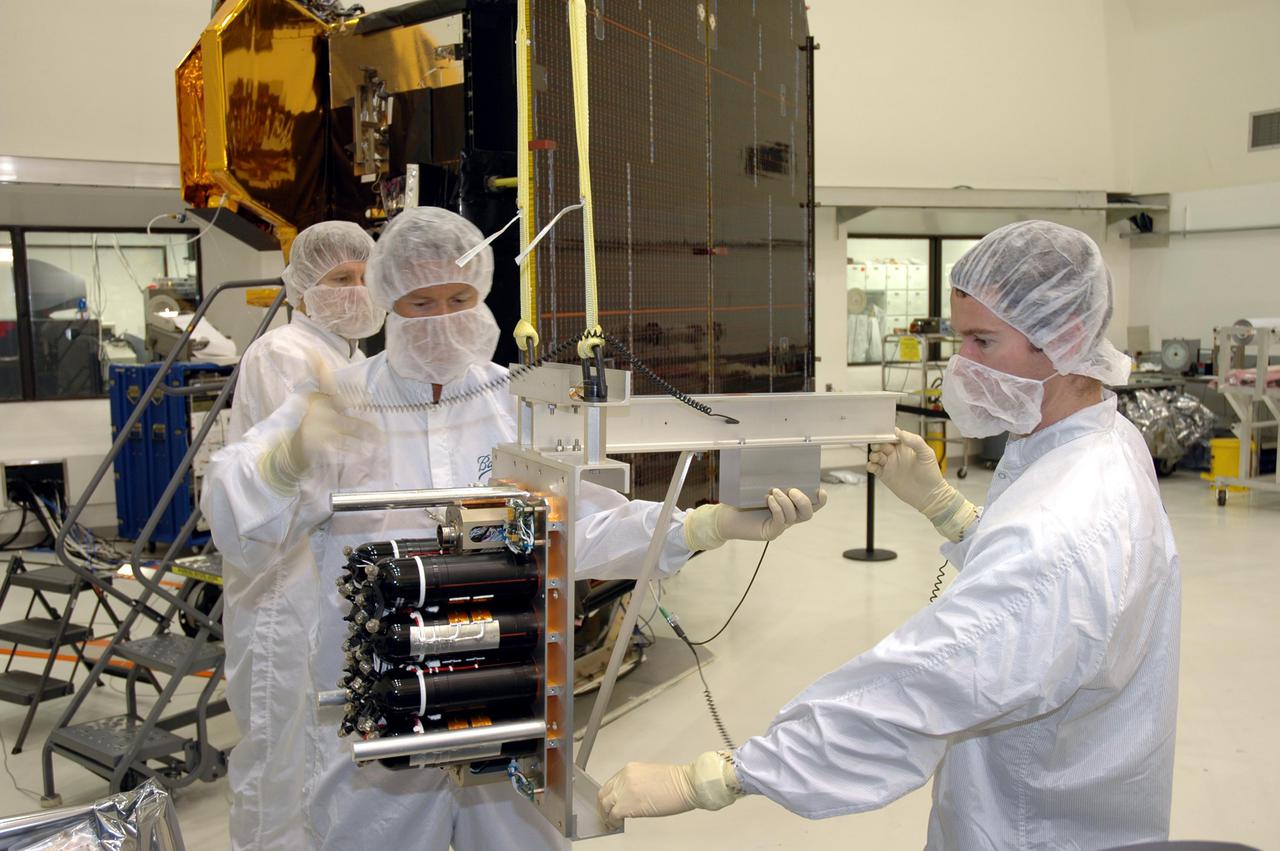
KENNEDY SPACE CENTER, FLA. - Ball Aerospace technicians at Astrotech Space Operations in Titusville, Fla., attach equipment to the flight battery to move it to the Deep Impact flyby spacecraft for installation. About the size of a Ford Explorer, the flyby spacecraft is three-axis stabilized and uses a fixed solar array and a small NiH2 battery for its power system. A NASA Discovery mission, Deep Impact will probe beneath the surface of Comet Tempel 1 on July 4, 2005, when the comet is 83 million miles from Earth. During the encounter phase when the comet collides with the impactor projectile propelled into its path, the spacecraft’s high-gain antenna will transmit near-real-time images of the impact back to Earth. The spacecraft is scheduled to launch Jan. 8 aboard a Boeing Delta II rocket from Launch Complex 17-B at Cape Canaveral Air Force Station, Fla.
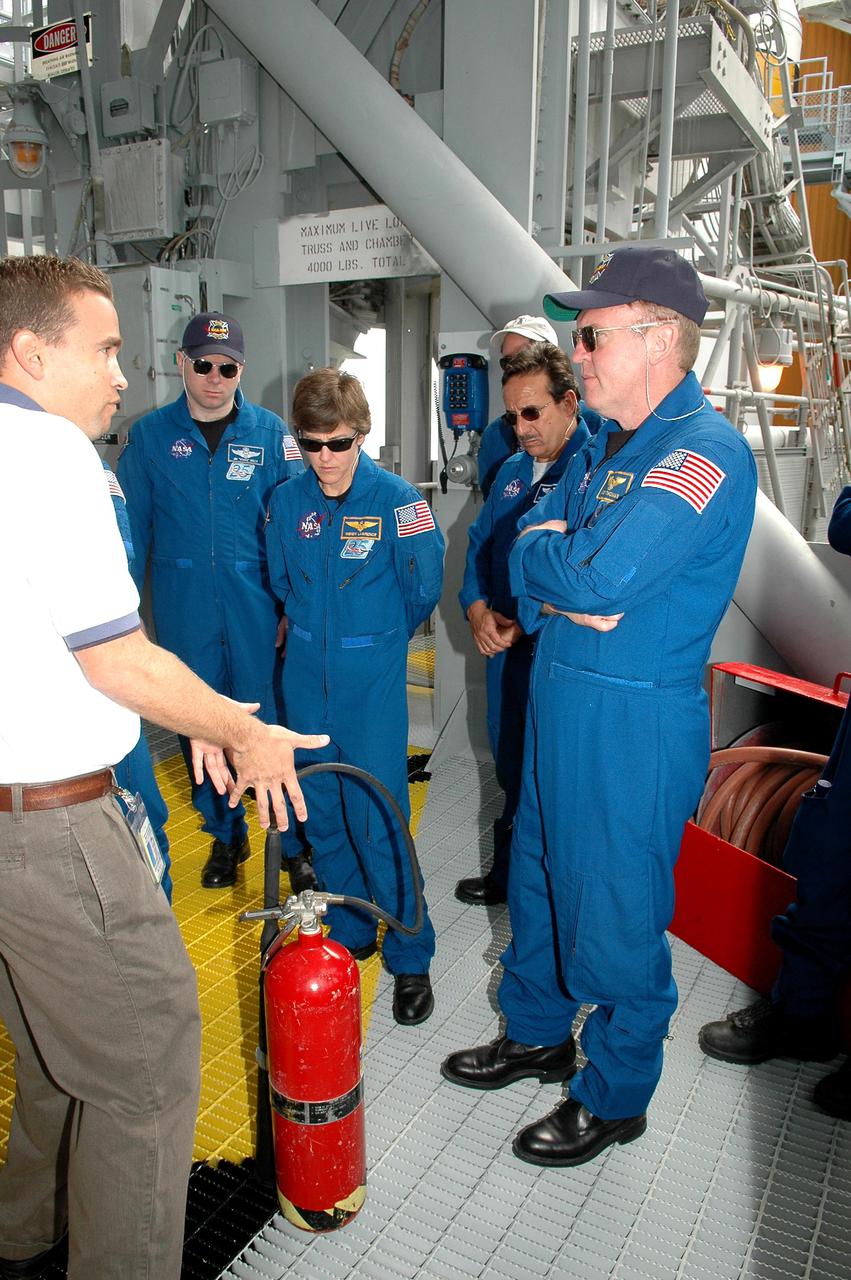
KENNEDY SPACE CENTER, FLA. - On the Fixed Service Structure at Launch Pad 39B, the STS-114 crew gets instructions about fire extinguisher use. The astronauts seen here are (from left) Pilot James Kelly, Commander Eileen Collins, and Mission Specialists Charles Camarda and Andrew Thomas. The training is part of Terminal Countdown Demonstration Test activities. The TCDT is held at KSC prior to each Space Shuttle flight. It provides the crew of each mission an opportunity to participate in simulated countdown activities. The test ends with a mock launch countdown culminating in a simulated main engine cutoff. The crew also spends time undergoing emergency egress training exercises at the launch pad. STS-114 is designated the first Return to Flight mission, with a launch window extending from July 13 to July 31.
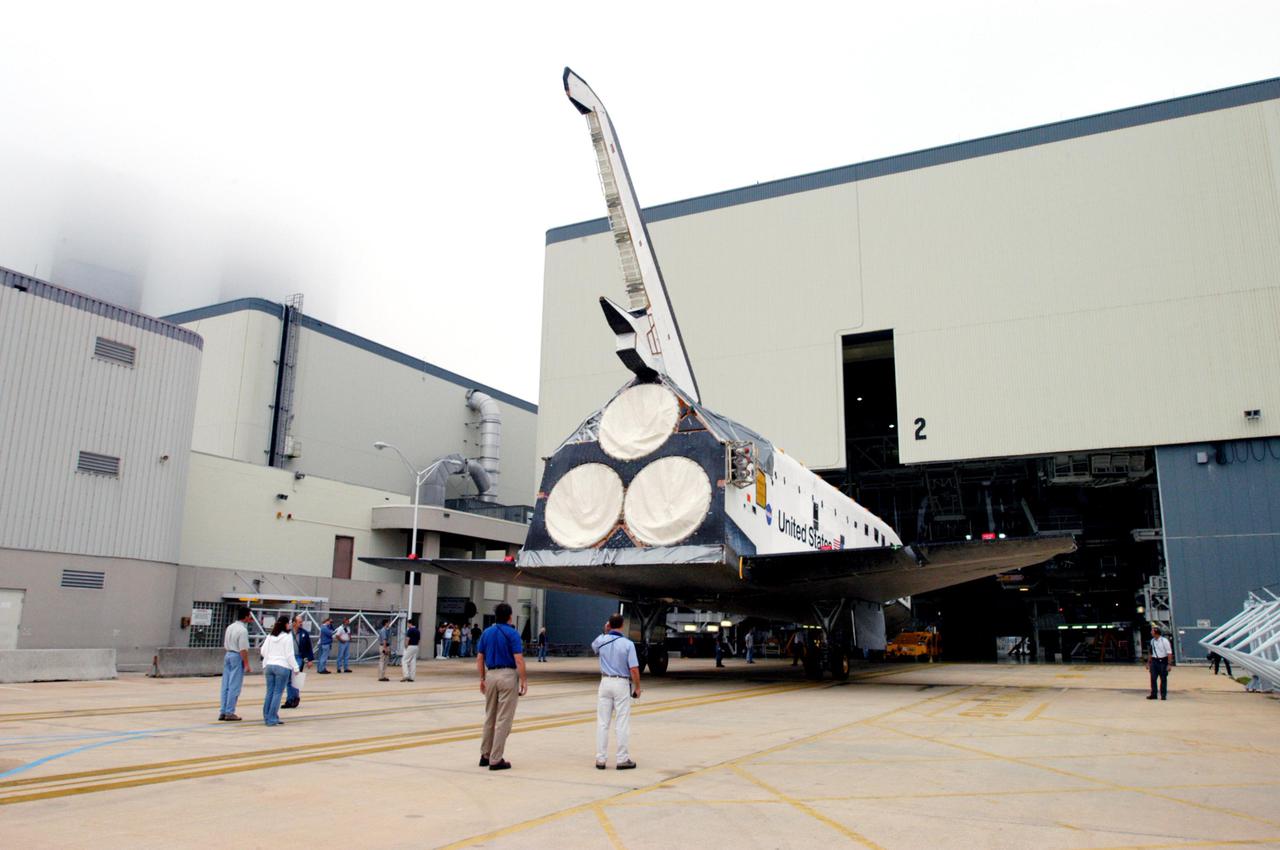
KENNEDY SPACE CENTER, FLA. - The orbiter Endeavour rolls out of the Orbiter Processing Facility. It is being moved to Florida Space Authority’s Reusable Launch Vehicle hangar for temporary storage. It left the Orbiter Processing Facility (OPF) to allow work to be performed in the OPF that can only be accomplished while the bay is empty. Work scheduled in the OPF includes modifications to the bay and platform validation in the bay. Endeavour will remain in the hangar for approximately 30 days, then return to the OPF. Endeavour was pulled out of service in December 2003 for Orbiter Major Modification (OMM). OMMs are scheduled at regular intervals to enhance safety and performance, infuse new technology, and, in this case, perform RTF modifications.
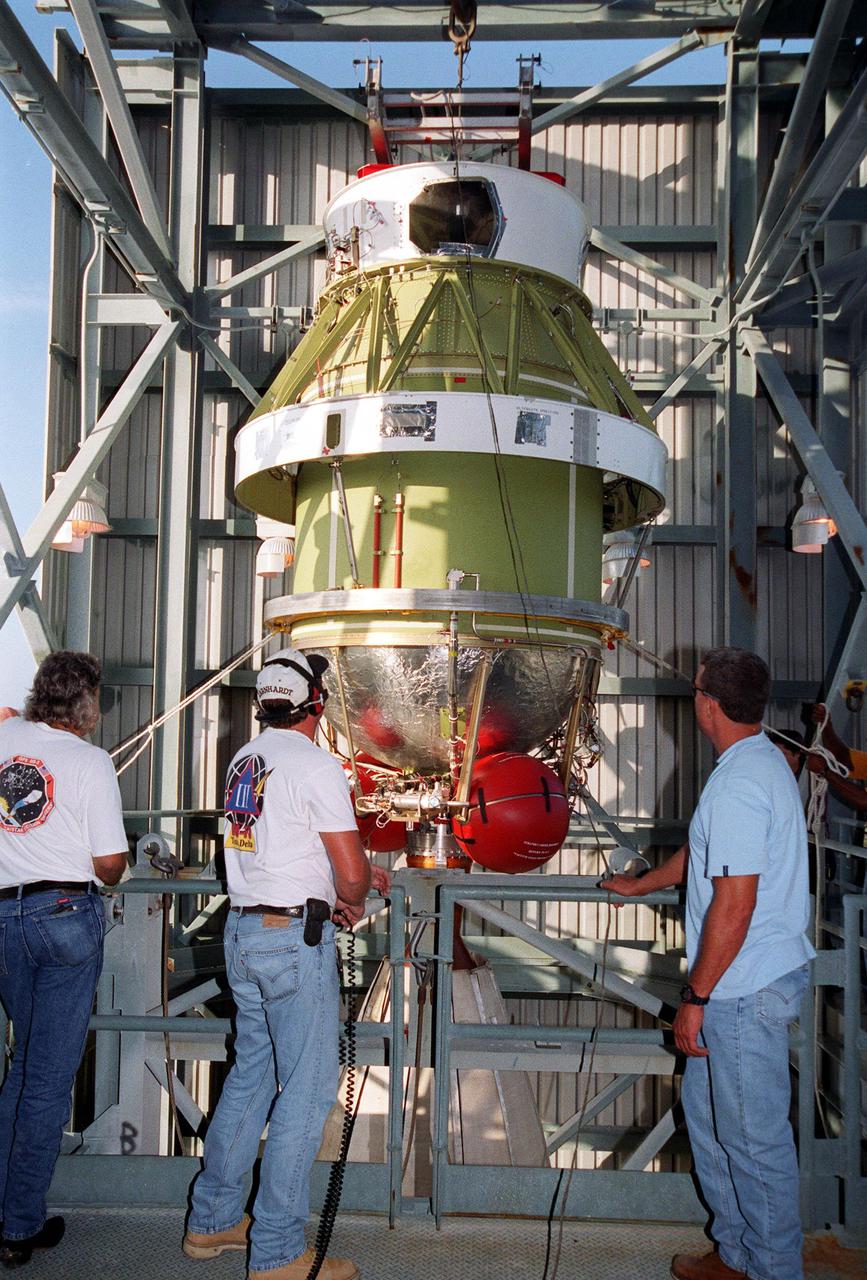
KENNEDY SPACE CENTER, Fla. -- The second stage of a Delta II rocket arrives near the top of the gantry on Launch Complex 17-A, Cape Canaveral Air Force Station, for mating with the first stage. The Delta II will propel the Genesis spacecraft on a journey to capture samples of the ions and elements in the solar wind and return them to Earth for scientists to use to determine the exact composition of the Sun and the solar system’s origin. NASA’s Genesis project in managed by the Jet Propulsion Laboratory in Pasadena, Calif. Lockheed Martin Astronautics built the Genesis spacecraft for NASA in Denver, Colo. The launch is scheduled for July 30 at 12:36 p.m. EDT
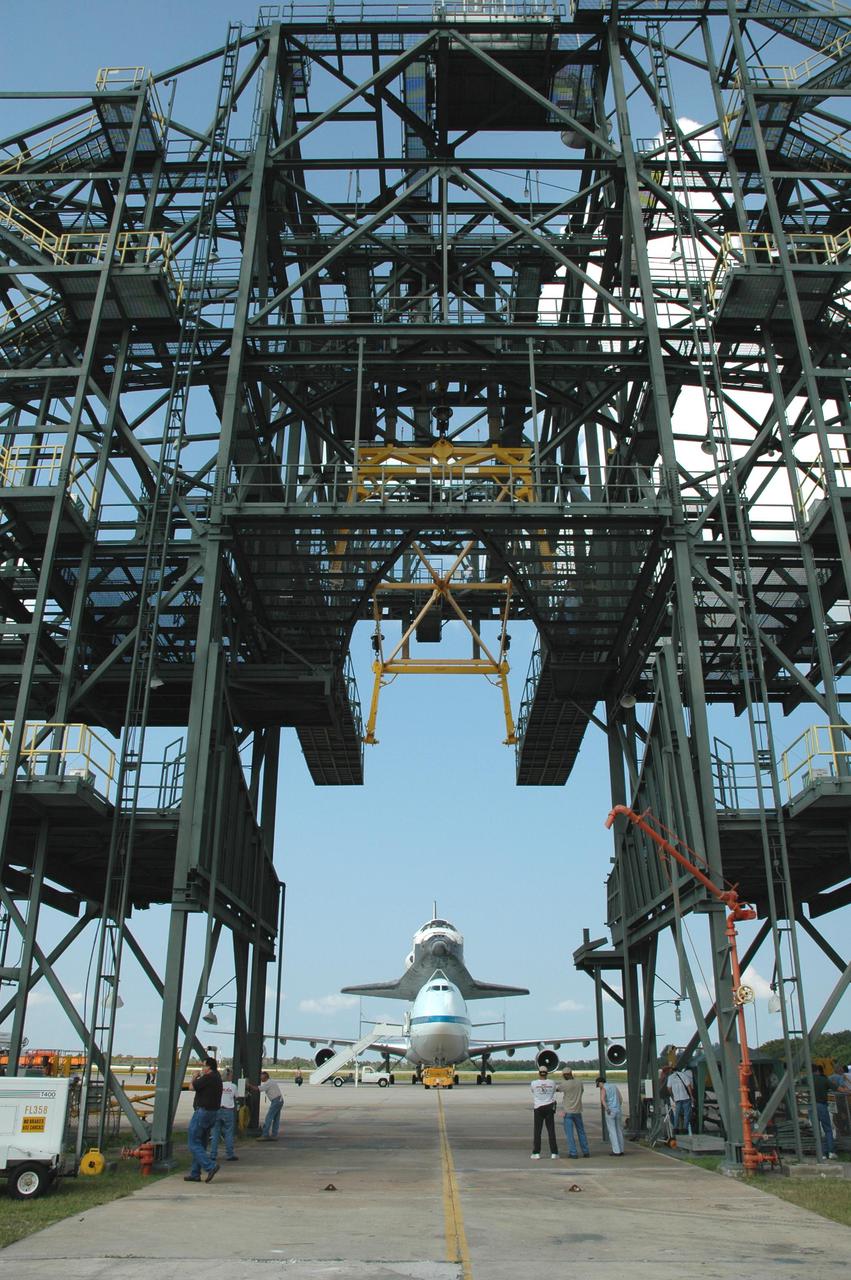
KENNEDY SPACE CENTER, FLA. - Space Shuttle Discovery, atop a modified Boeing 747 Shuttle Carrier Aircraft (SCA), is towed toward the Mate_Demate Device (MDD), in the foreground, at NASA Kennedy Space Center's Shuttle Landing Facility (SLF) following touchdown on runway 15 at about 10:00 a.m. EDT. The cross-country ferry flight became necessary when two days of unfavorable weather conditions at KSC forced Discovery to land on runway 22 at Edwards Air Force Base, Calif., on Aug. 9 following mission STS-114. On the return trip, stops were made at Altus Air Force Base, Okla., and Barksdale Air Force Base, La., where Discovery stayed for two nights. A crane on the MDD will lift Discovery from the SCA and place it on solid ground. Discovery will then be towed to the Orbiter Processing Facility where preparations will begin for its next flight, STS-121.

KENNEDY SPACE CENTER, FLA. - Workers on Launch Pad 17-B, Cape Canaveral Air Force Station, control the motion of the Solid Rocket Booster (SRB) as it is lifted up the mobile service tower. It will be mated to the Boeing Delta II rocket, joining others for a complement of nine, to launch the Deep Impact spacecraft, scheduled for no earlier than Jan. 8, 2005. A NASA Discovery mission, Deep Impact will probe beneath the surface of Comet Tempel 1 on July 4, 2005, when the comet is 83 million miles from Earth, and reveal the secrets of its interior. After releasing an impactor on a course to hit the comet’s sunlit side, Deep Impact’s flyby spacecraft will collect pictures and data of how the crater forms, measure the crater’s depth and diameter, as well as the composition of the interior of the crater and any material thrown out, and determine the changes in natural outgassing produced by the impact. It will send the data back to Earth through the antennas of the Deep Space Network.
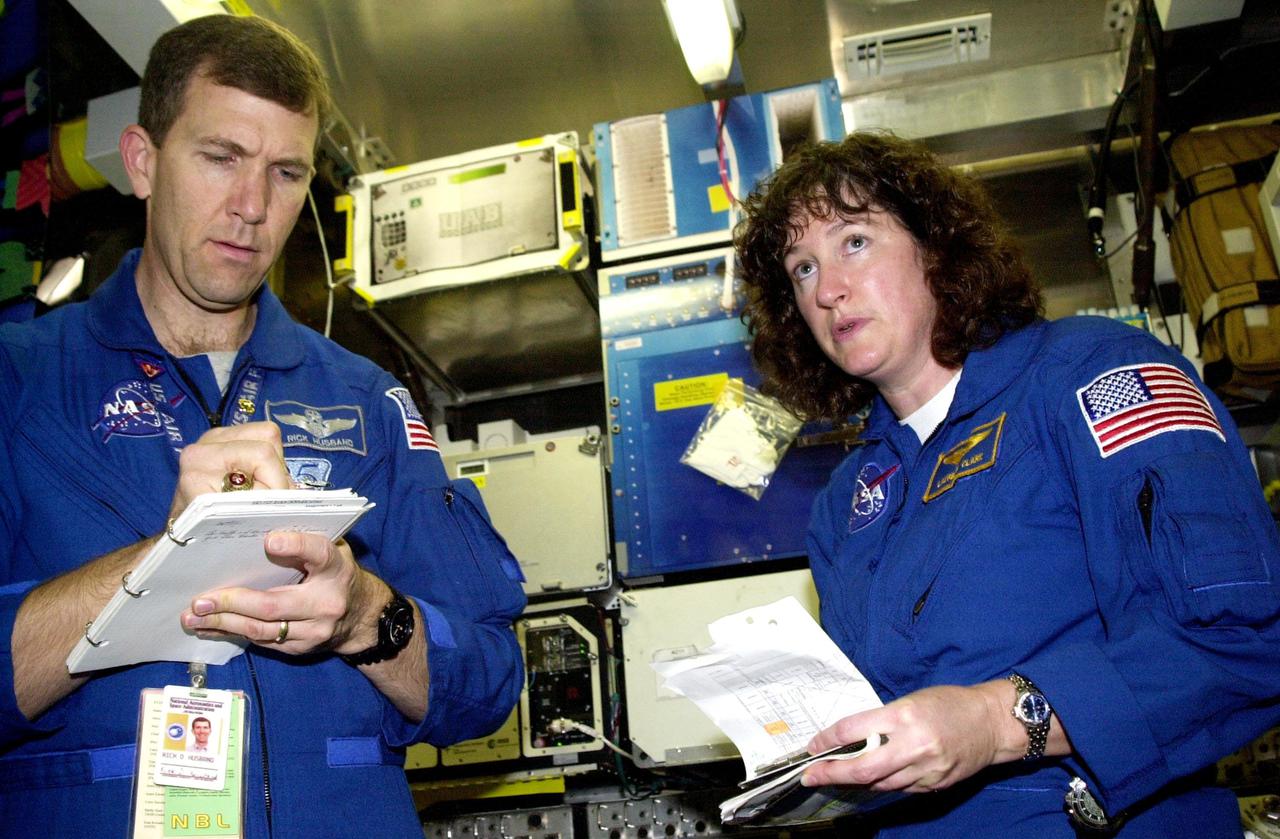
KENNEDY SPACE CENTER, FLA. -- STS-107 Commander Rick Husband and Mission Specialist Laurel Clark learn to work with mission-related equipment at SPACEHAB, Cape Canaveral, Fla. STS-107 is a research mission. The primary payload is the first flight of the SHI Research Double Module (SHI_RDM). The experiments range from material sciences to life sciences (many rats). Also part of the payload is the Fast Reaction Experiments Enabling Science, Technology, Applications and Research (FREESTAR) that incorporates eight high priority secondary attached shuttle experiments: Mediterranean Israeli Dust Experiment (MEIDEX), Shuttle Ozone Limb Sounding Experiment (SOLSE-2), Student Tracked Atmospheric Research Satellite for Heuristic International Networking Experiment (STARSHINE), Critical Viscosity of Xenon-2 (CVX-2), Solar Constant Experiment-3 (SOLOCON-3), Prototype Synchrotron Radiation Detector (PSRD), Low Power Transceiver (LPT), and Collisions Into Dust Experiment -2 (COLLIDE-2). STS-107 is scheduled to launch in July 2002

KENNEDY SPACE CENTER, FLA. -- Space Shuttle Atlantis nears the Vehicle Assembly Building (left) and Launch Control Center on its way back from Launch Pad 39A. Atlantis is rolling back to the VAB so that workers can conduct inspections, make continuity checks and conduct X-ray analysis on the 36 solid rocket booster cables located inside each booster’s system tunnel. An extensive evaluation of NASA’s SRB cable inventory revealed conductor damage in four (of about 200) cables on the shelf. Shuttle managers decided to prove the integrity of the system tunnel cables already on Atlantis before launching Jan. 19. The launch has been rescheduled no earlier than Feb. 6
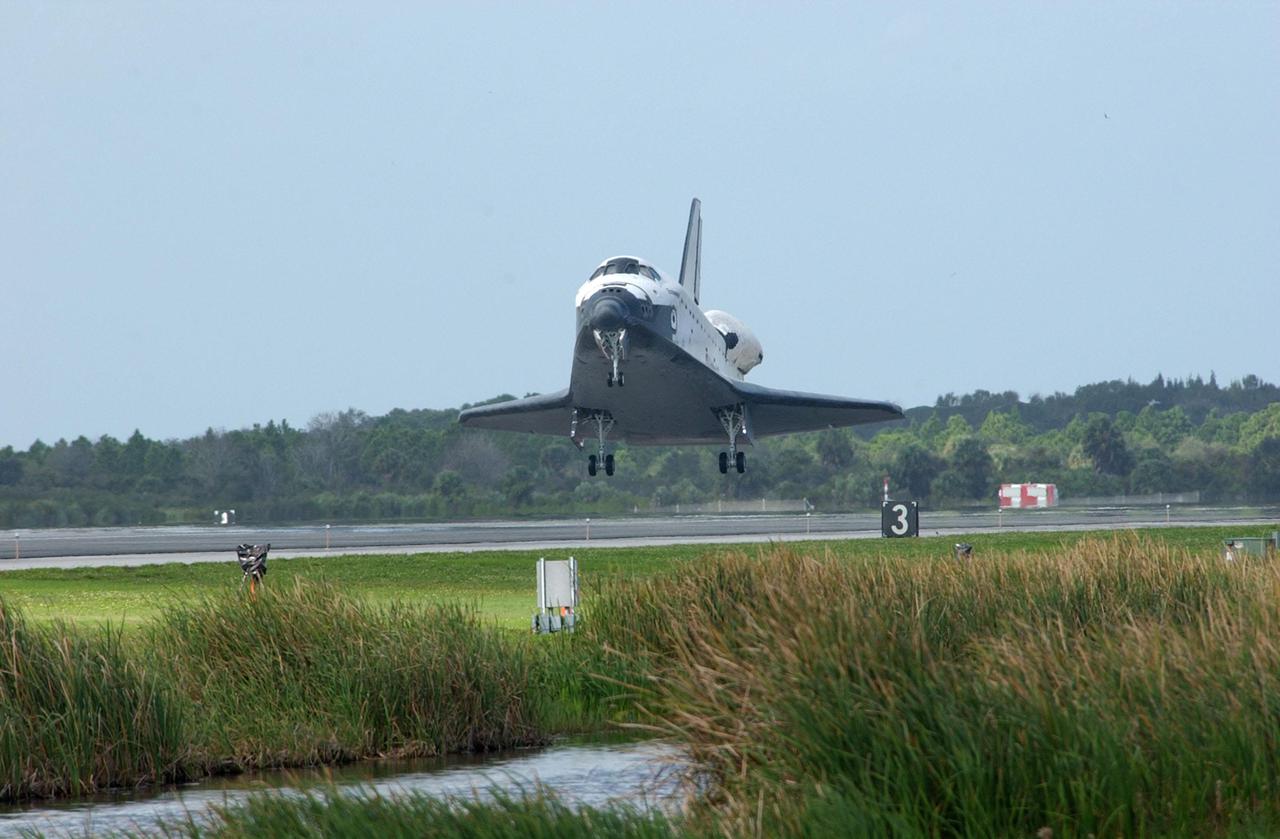
KENNEDY SPACE CENTER, FLA. - After dropping through cloud cover, Orbiter Endeavour approaches Runway 15 at the KSC Shuttle Landing Facility, with a mission elapsed time of 11 days, 19 hours, 35 minutes. Main gear touchdown occurred at 12:55:10 p.m. EST, nose gear touchdown at 12:55:23 p.m. , wheel stop at 12:56:13 p.m. The landing, the 57th at KSC in the history of the program completed the STS-108 mission known as Utilization Flight 1, which was the 12th mission to the International Space Station. This mission was the 107th flight in the Shuttle program and the 17th flight for the orbiter. Endeavour carries both the mission crew and the Expedition 3 crew - Commander Frank Culbertson and cosmonauts Vladimir Dezhurov and Mikhail Tyurin - who are returning to Earth after 129 days in space on the Space Station
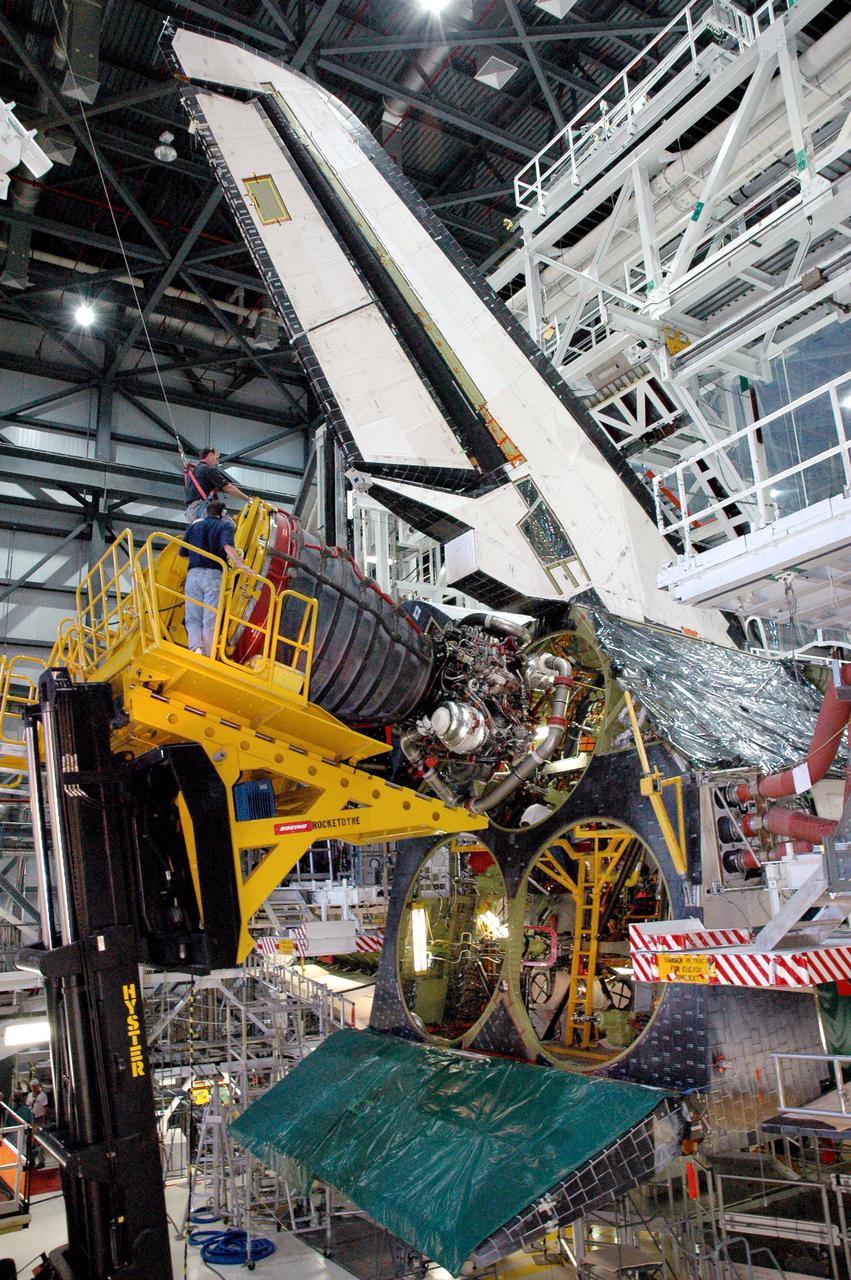
KENNEDY SPACE CENTER, FLA. - In the Orbiter Processing Facility bay 1 at NASA’s Kennedy Space Center, a Space Shuttle Main Engine (SSME), held by a Hyster fork lift, is maneuvered into place in position number one (upper chamber) in Atlantis. Overall, an SSME weighs approximately 7,000 pounds. Three engines provide the thrust, along with the two Solid Rocket Boosters, for liftoff. After about 2 minutes, the two boosters are spent and are separated from the external tank. The SSMEs continue firing for about 8 minutes. They shut down just before the craft is inserted into orbit. The SSMEs are tested at Stennis Space Center in Mississippi. Atlantis is being processed for the second Return to Flight mission, STS-121, scheduled for launch in a window from July 12 through July 31.
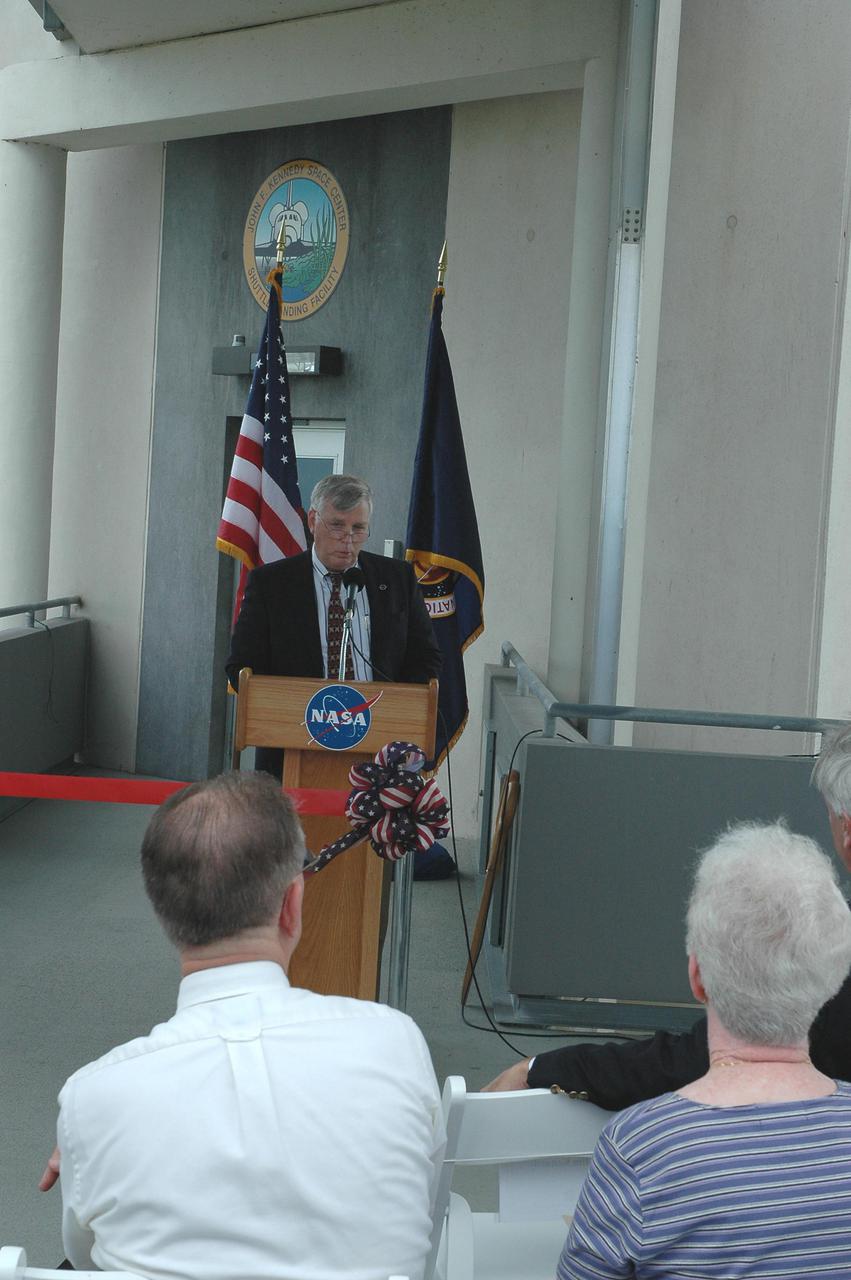
KENNEDY SPACE CENTER, FLA. - At the Shuttle Landing Facility on NASA’s Kennedy Space Center, KSC Director Jim Kennedy talks to attendees at the ribbon-cutting ceremony for the new NASA Air Traffic Control Tower. The dedication took place in the SLF’s new media facilities, which were built for the Return to Flight mission STS-114 and the landing of Shuttle Discovery. The facilities are co-located with the new control tower. The dedication and ribbon cutting were held at the base of the tower and included Center Director Jim Kennedy, Space Gateway Support President William A. Sample, External Relations Director Lisa Malone, Center Operations Director Scott D. Kerr, and KSC Safety Aviation Officer Albert E. Taff. The structure rises 110 feet over the midpoint of the runway and offers air traffic controllers a magnificent 360-degree view of Kennedy Space Center, Cape Canaveral Air Force Station and north Brevard County. It replaces the small, portable tower installed at the edge of the runway in 1986. The new control tower will manage all landings and departures from the SLF, including air traffic within the Kennedy Space Center-Cape Canaveral restricted airspace. The facility provides a 24-hour weather-observing facility providing official hourly weather observations for the SLF and the Cape Canaveral vicinity, including special observations for all launches and landings. State-of-the-art, weather-observing equipment has been installed for Space Shuttle landings and for serving conventional aircraft landing at the SLF. At this location, weather observers will have a multi-directional view of the weather conditions at the runway and Launch Complex 39.
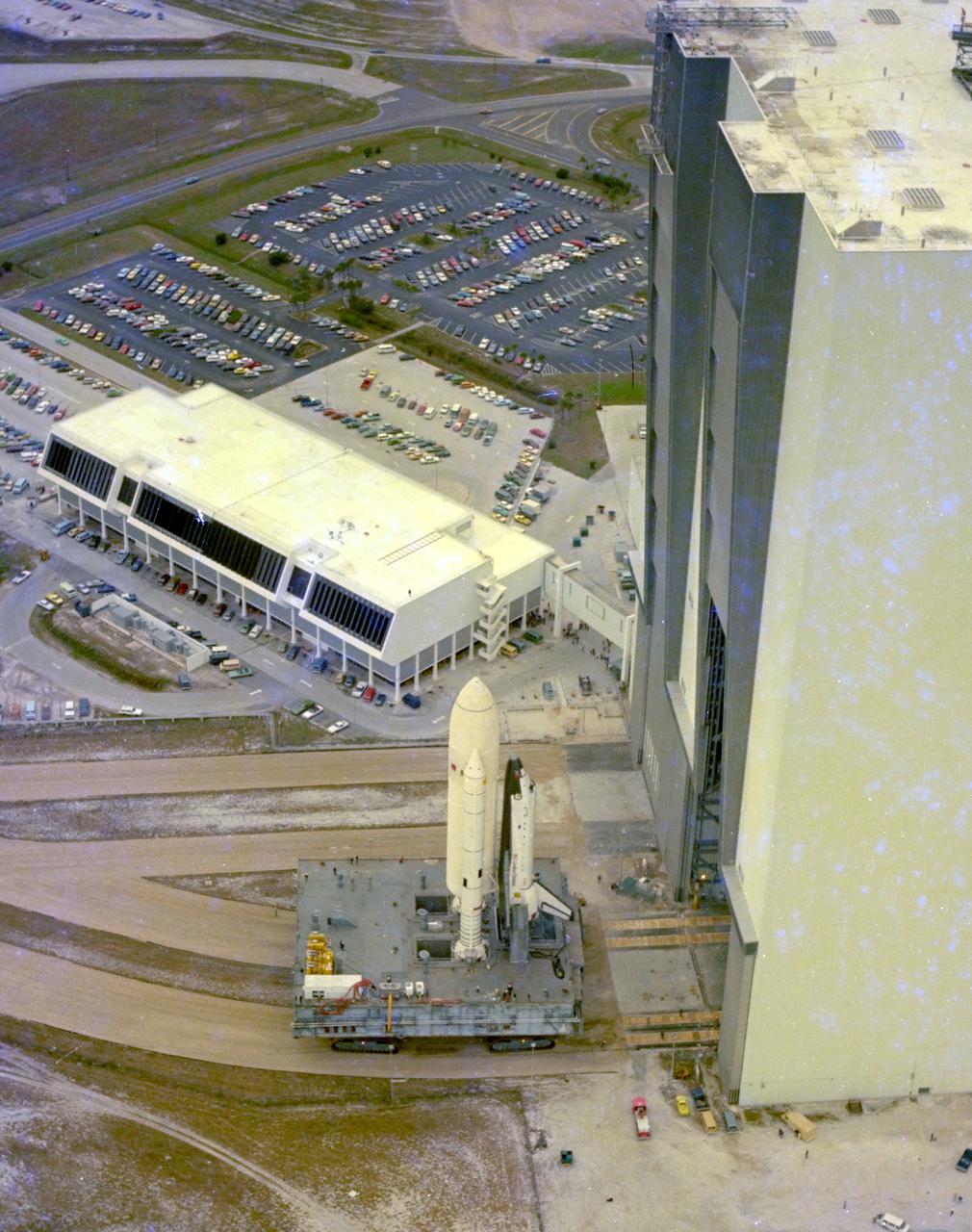
KENNEDY SPACE CENTER, FLA. - This aerial view of STS-1 shows the space vehicle for the first Space Shuttle mission shortly after it was moved out of the Vehicle Assembly Builidng's High Bay 3 for the 3.5-mile journey to Pad A at Launch Complex 39. In the center background is the Launch Control Center from which countdowns for Space Shuttle missions will be conducted. The rollout to the pad took place little more than a month after the Space Shuttle Orbiter Columbia was rolled from the Orbiter Processing Facility to the VAB for mating on a Mobile Launcher Platform with the STS-1 external tank and solid rocket boosters.

KENNEDY SPACE CENTER, FLA. - Gathered in the NASA News Center, the media ask Public Information Officer Bruce Buckingham about the landing of Space Shuttle Discovery at Edwards Air Force Base in California. Due to weather concerns, the landing was deferred to the alternate site. The 13-day, 21-hour Return to Flight STS-114 mission ended on Runway 22 at 8:11:22 a.m. EDT with Mission Commander Eileen Collins on the controls. Discovery spent two weeks in space, where the crew demonstrated new methods to inspect and repair the Shuttle in orbit. The crew also delivered supplies, outfitted and performed maintenance on the International Space Station. A number of these tasks were conducted during three spacewalks.
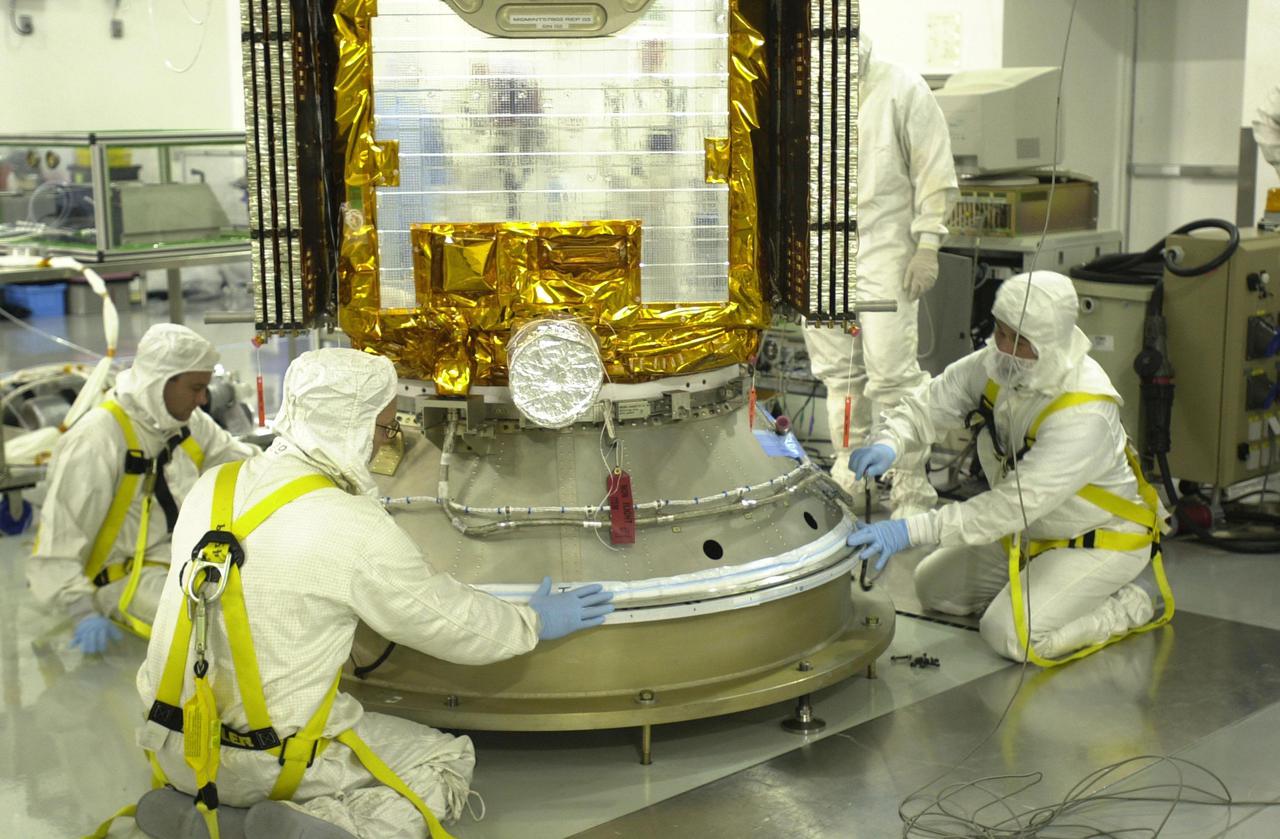
VANDENBERG AIR FORCE BASE, CALIF. — Inside the Astrotech Payload Processing Facility on Vandenberg Air Force Base in California, workers attach the CALIPSO spacecraft onto another payload attach fitting. CALIPSO will be mated with the Lower Delta Payload Attach Fitting (LDPAF) that contains the CloudSat satellite. Later the UDPAF will be mated with the lower Delta Payload Attach Fitting, which contains the CloudSat satellite. The PAF is the interface between the spacecraft and the second stage of the rocket. CALIPSO stands for Cloud-Aerosol Lidar and Infrared Pathfinder Satellite Observation.
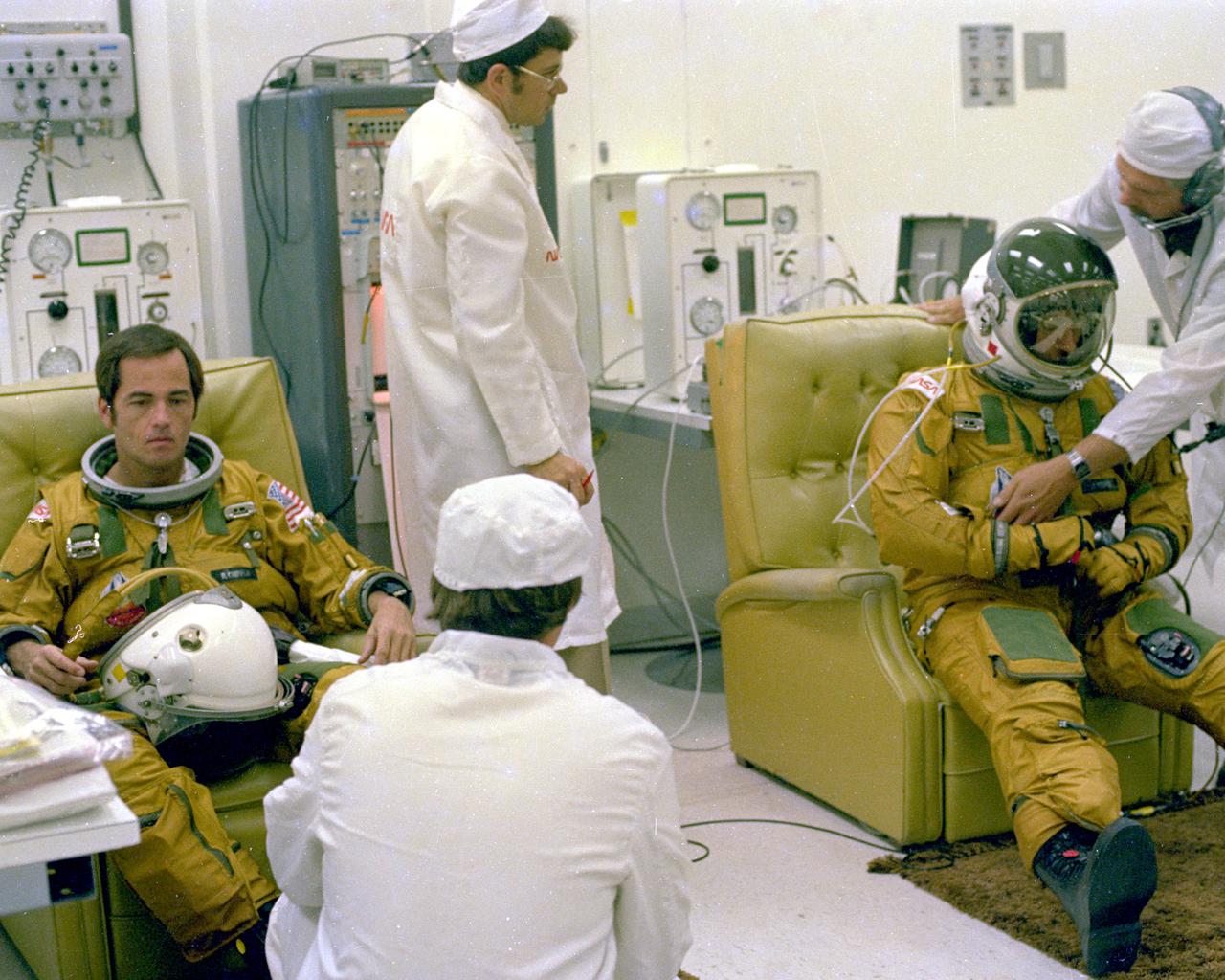
KENNEDY SPACE CENTER, FLA. - Pilot Robert Crippen watches intently as a technician adjusts the lens of his space suit, while Crew Commander John Young's suit is connected to life support system lines, during simulated countdown and launch. The two astronauts, prime crewmen for the maiden flight of the Space Shuttle scheduled no sooner than the week of April 5, are pictured in the suiting room of the Operations and Checkout Building at KSC prior to boarding their transport van for the trip to Launch Pad 39A.
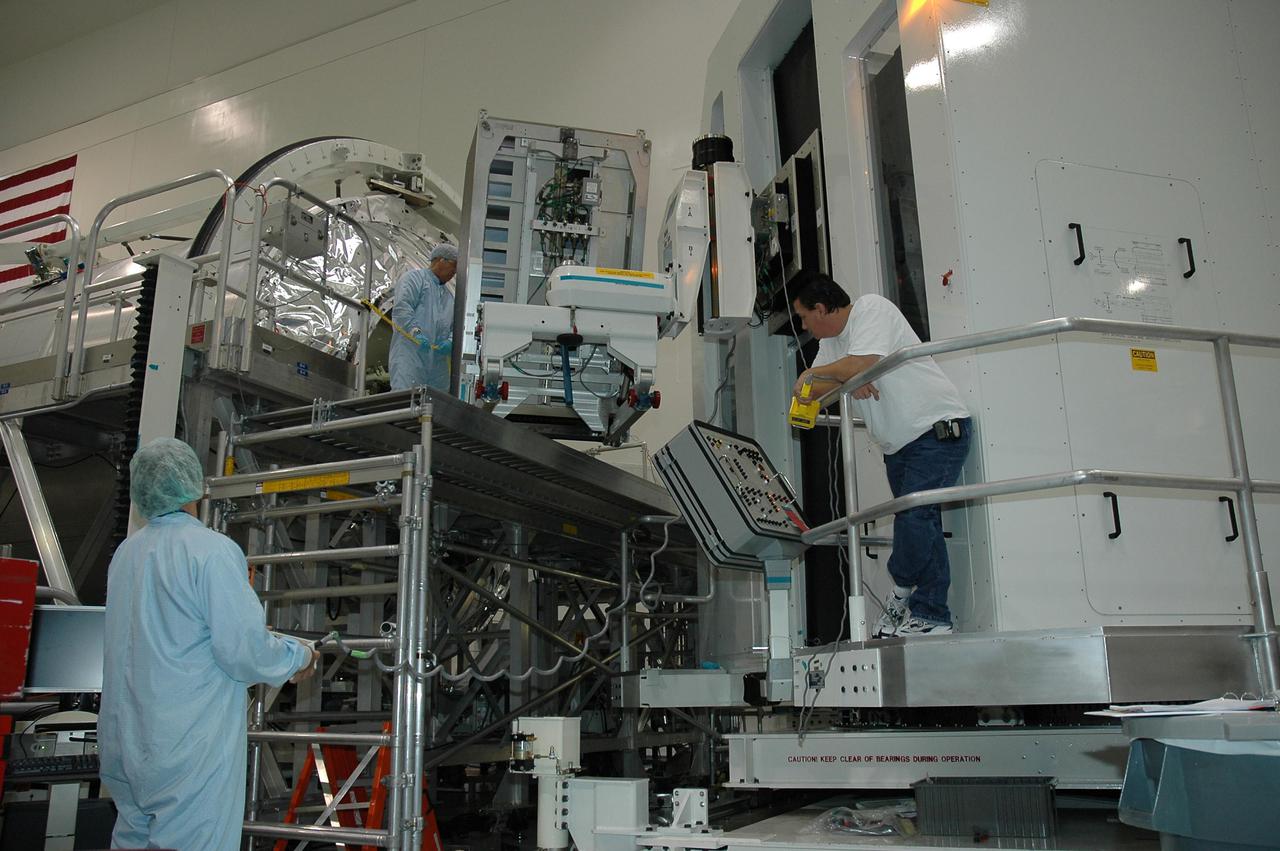
KENNEDY SPACE CENTER, FLA. - In NASA Kennedy Space Center’s Space Station Processing Facility, workers wait for a rack of storage material taken from inside the multi-purpose logistics module Raffaello to be lowered. Raffaello flew on return to flight mission STS-114. During the mission, the crews of Discovery and Expedition 11 transferred more than a ton of material from the International Space Station to be returned to Earth. The workers are unloading the storage racks.
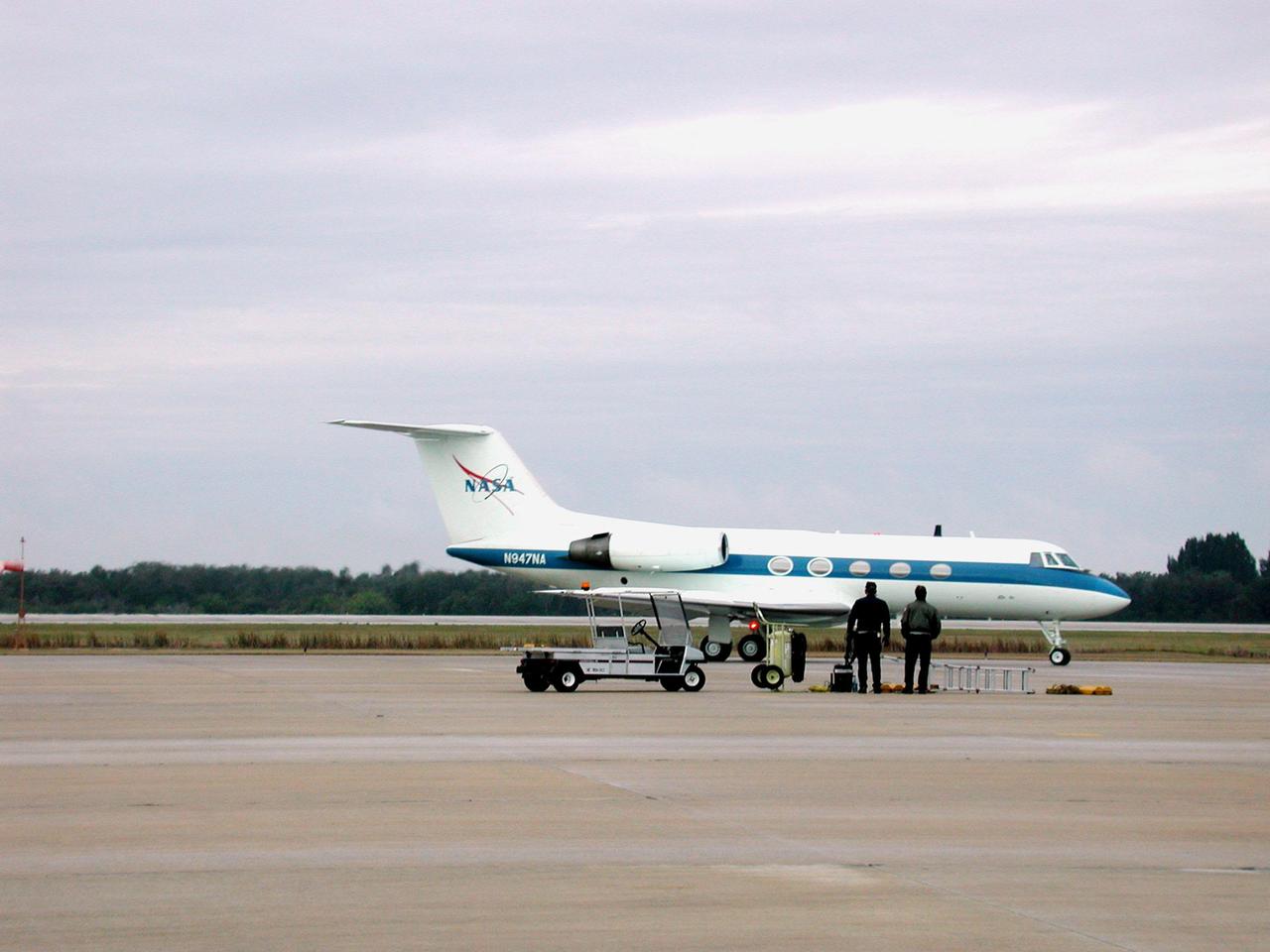
KENNEDY SPACE CENTER, FLA. -- A Shuttle Training Aircraft, piloted by STS-98 Commander Ken Cockrell, taxis into line at the KSC Shuttle Landing Facility. The cockpit of the plane is outfitted like the Shuttle, which provides practice at the controls, especially for landing. The STS-98 crew recently arrived at KSC to prepare for their launch Feb. 7 to the International Space Station. The seventh construction flight to the Space Station, it will carry the U.S. Laboratory Destiny, a key module for space experiments
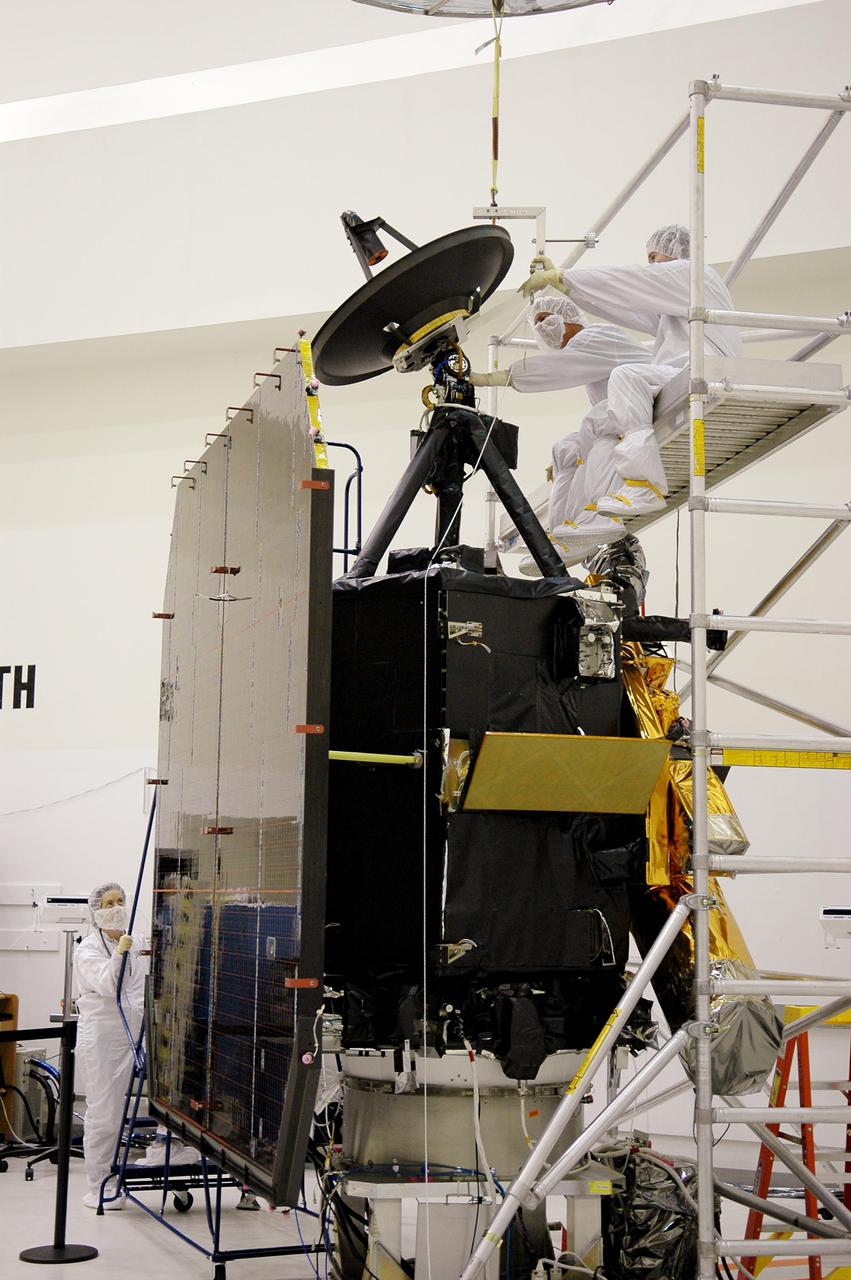
KENNEDY SPACE CENTER, FLA. - Ball Aerospace technicians at Astrotech in Titusville, Fla., attach the high-gain communications antenna onto the Deep Impact spacecraft. A NASA Discovery mission, Deep Impact will probe beneath the surface of Comet Tempel 1 on July 4, 2005, when the comet is 83 million miles from Earth, and reveal the secrets of its interior. During the encounter phase, the high-gain antenna transmits near-real-time images of the impact back to Earth. The spacecraft is scheduled to launch Jan. 8 aboard a Boeing Delta II rocket from Launch Complex 17-B at Cape Canaveral Air Force Station, Fla.
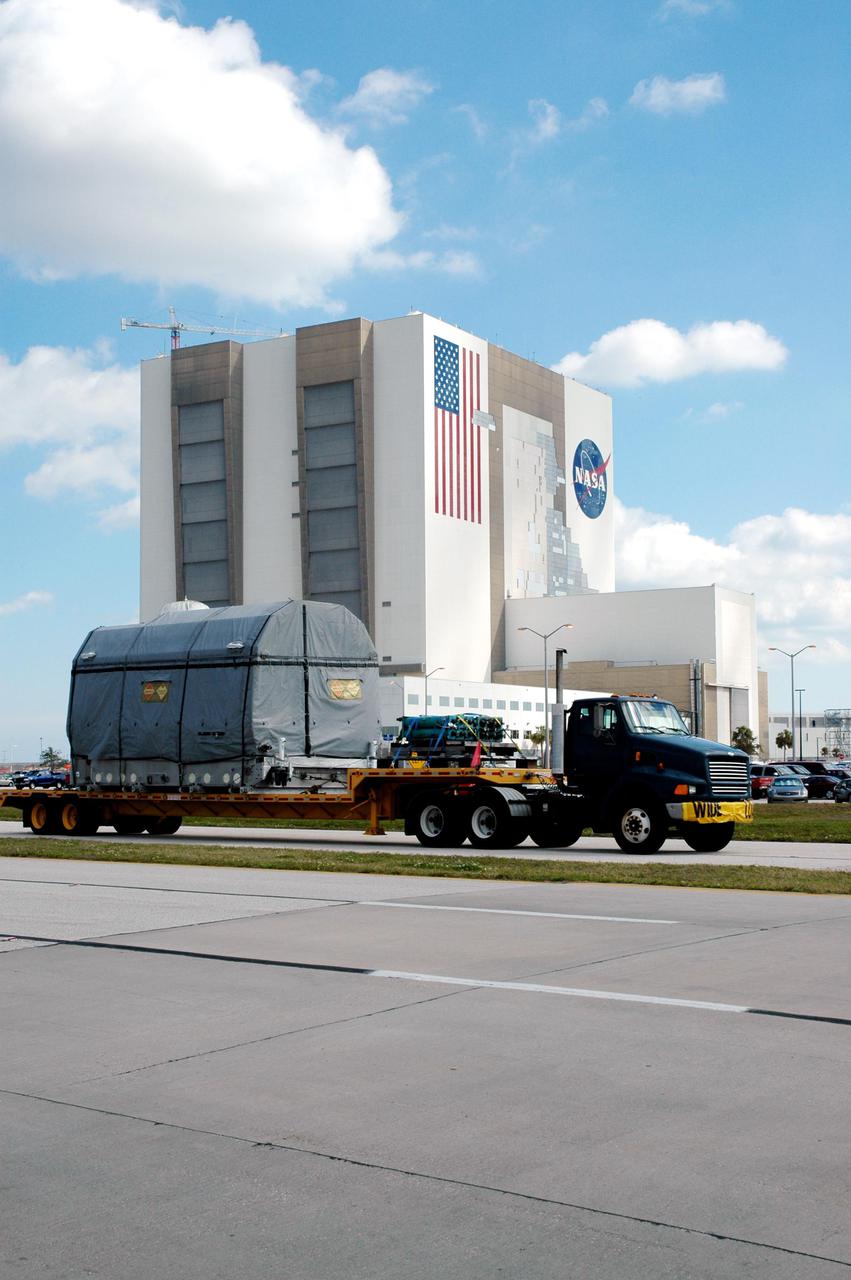
KENNEDY SPACE CENTER, FLA. - The latest Geostationary Operational Environmental Satellite (GOES) developed by NASA for the National Oceanic and Atmospheric Administration (NOAA) travels past the Vehicle Assembly Building at KSC. The satellite is being transported to Astrotech in Titusville, Fla., where final testing of the imaging system, instrumentation, communications and power systems will be performed over the next two months by Boeing Satellite Systems. The satellite arrived earlier at KSC’s Shuttle Landing Facility aboard a C17 military cargo aircraft. Called GOES-N, the satellite is targeted to launch May 4 onboard a Boeing expendable launch vehicle Delta IV (4,2). Once in orbit GOES-N will be designated GOES-13 and will complete checkout and be placed in on-orbit storage as a replacement for an older GOES satellite.
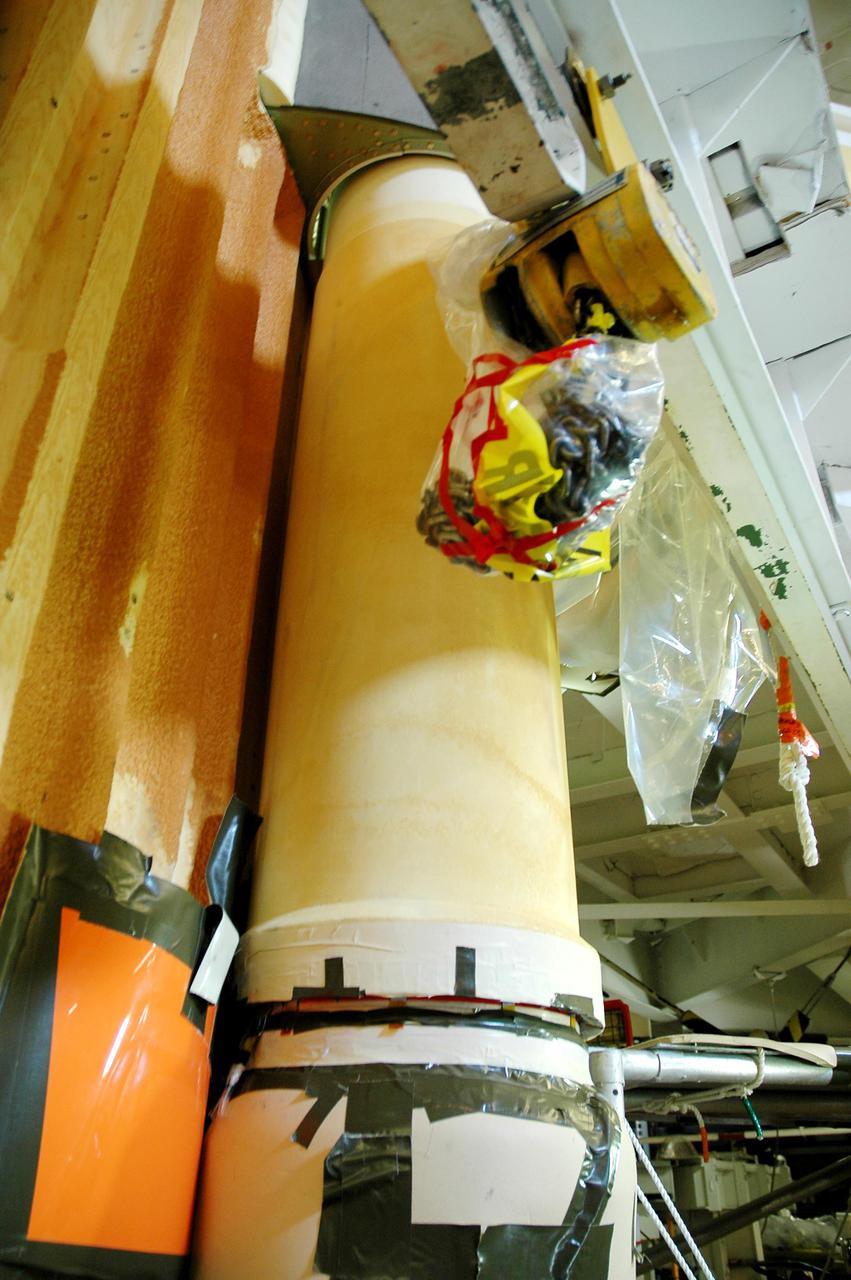
KENNEDY SPACE CENTER, FLA. - In the Vehicle Assembly Building at NASA’s Kennedy Space Center, a new heater has been added to the feedline bellows to minimize the potential for ice and frost buildup. The tank has been designated to fly on Discovery for Return to Flight mission STS-114, which has a launch window extending from July 13 to July 31.

KENNEDY SPACE CENTER, FLA. - In a clean room inside the Payload Hazardous Servicing Facility (PHSF) at NASA's Kennedy Space Center, Lockheed Martin workers begin removing the protective cover from one of the boxes containing NASA's Mars Reconnaissance Orbiter to a clean room. Here in the PHSF, the spacecraft will undergo multiple mechanical assembly operations and electrical tests to verify its readiness for launch. A test this month will verify the spacecraft's ability to communicate through NASA's Deep Space Network tracking stations. A June test will check the deployment of the spacecraft's high gain communications antenna. Another major deployment test will check out the spacecraft's large solar arrays. The MRO was built by Lockheed Martin for NASA's Jet Propulsion Laboratory in California. It is the next major step in Mars exploration and scheduled for launch from Cape Canaveral Air Force Station in a window opening Aug. 10. The MRO is an important next step in fulfilling NASA's vision of space exploration and ultimately sending human explorers to Mars and beyond.
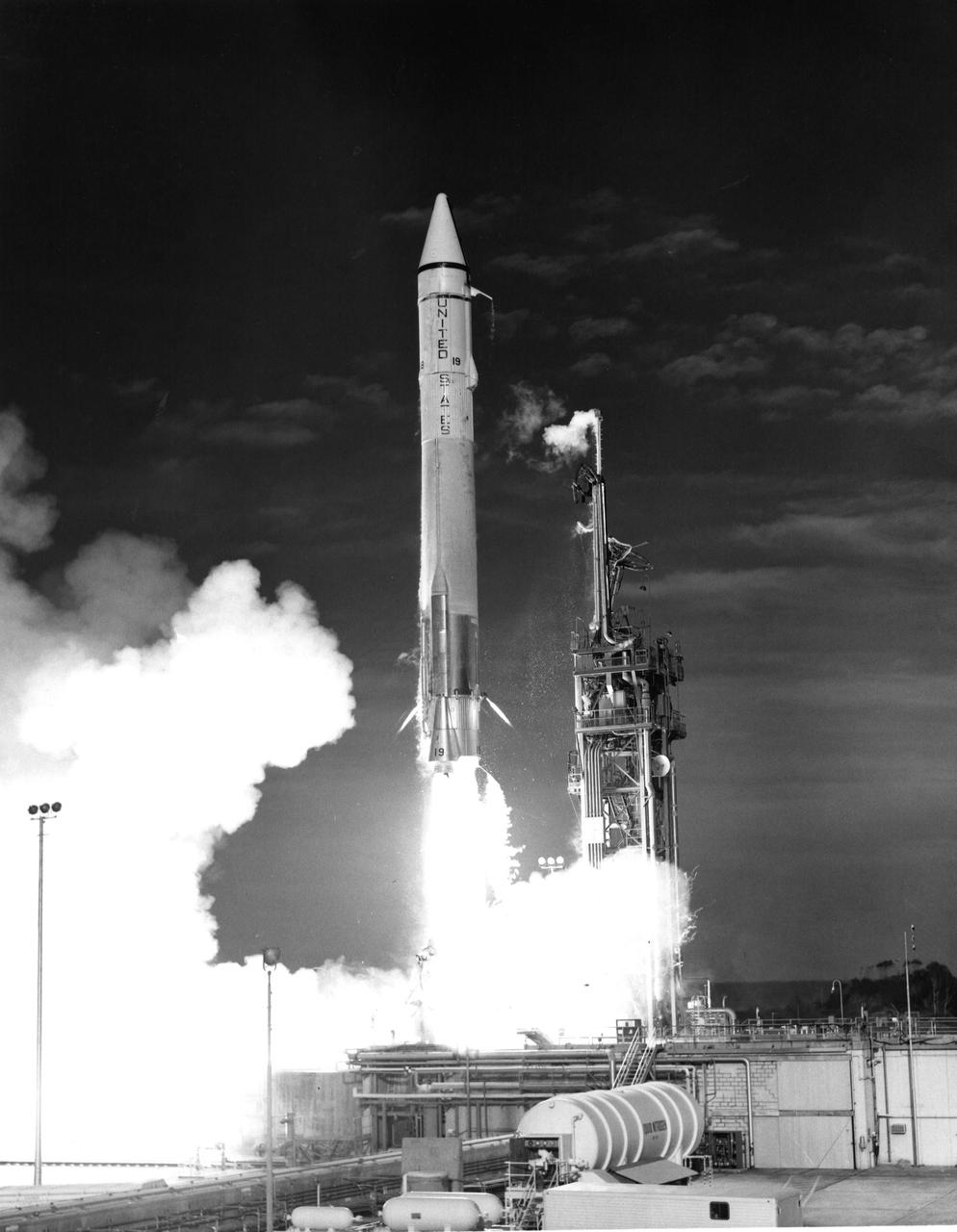
KENNEDY SPACE CENTER, FLA. - An Atlas-Centaur was launched at 5:22 p.m. EST today to send Mariner 7 on its way to Mars. The second Mars probe to be launched by the KSC Unmanned Launch Operations Directorate this year, Mariner 7 will join a sister spacecraft on a journey that will carry them within 2,000 miles of the red planet this summer. Mariner 6 was launched from Cape Kennedy on Feb. 24 and is to investigate the Martian equatorial area while Mariner 7 will concentrate on the South Polar Cap.
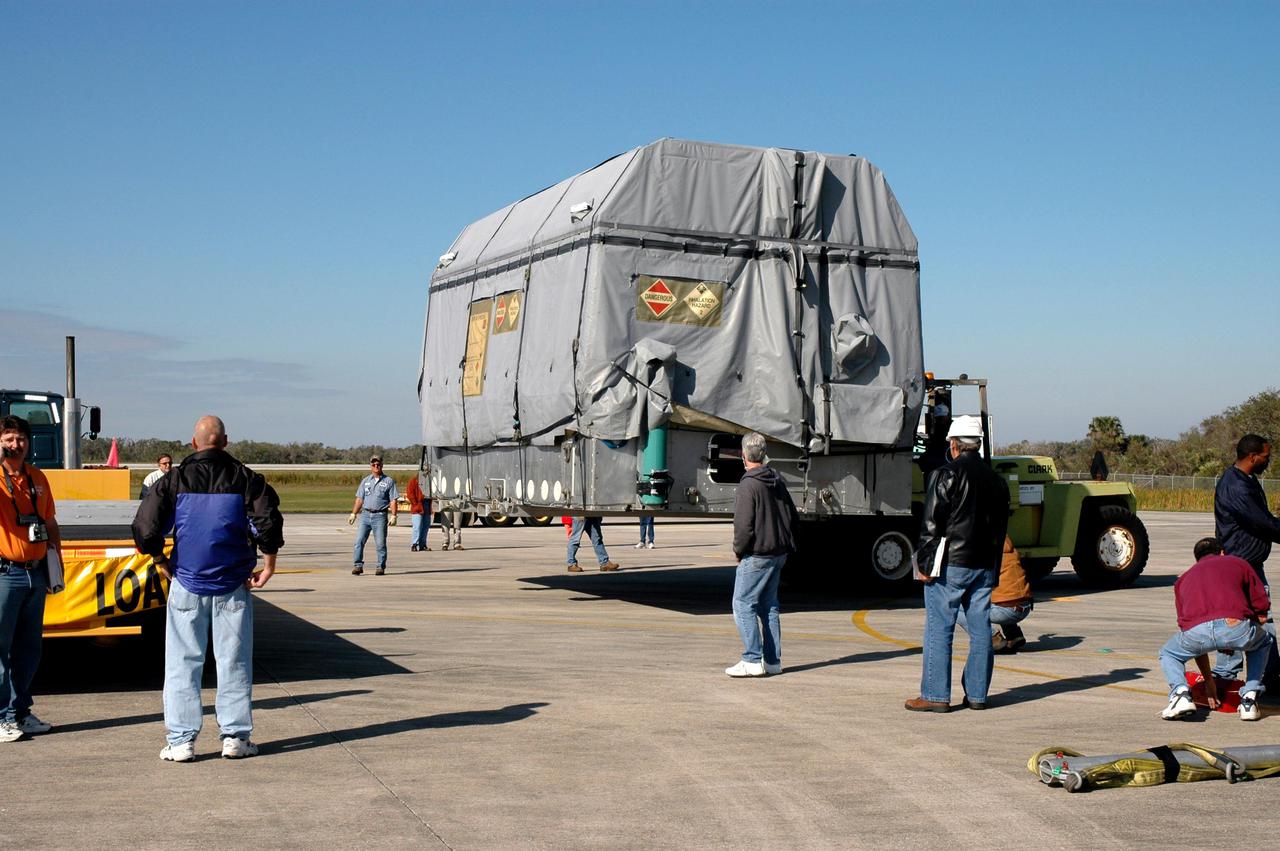
KENNEDY SPACE CENTER, FLA. - At KSC’s Shuttle Landing Facility, the latest Geostationary Operational Environmental Satellite (GOES) developed by NASA for the National Oceanic and Atmospheric Administration (NOAA) is lifted so it can be placed on a transporter. The satellite is being transported to Astrotech in Titusville, Fla., where final testing of the imaging system, instrumentation, communications and power systems will be performed over the next two months by Boeing Satellite Systems. Called GOES-N, the satellite is targeted to launch May 4 onboard a Boeing expendable launch vehicle Delta IV (4,2). Once in orbit GOES-N will be designated GOES-13 and will complete checkout and be placed in on-orbit storage as a replacement for an older GOES satellite.
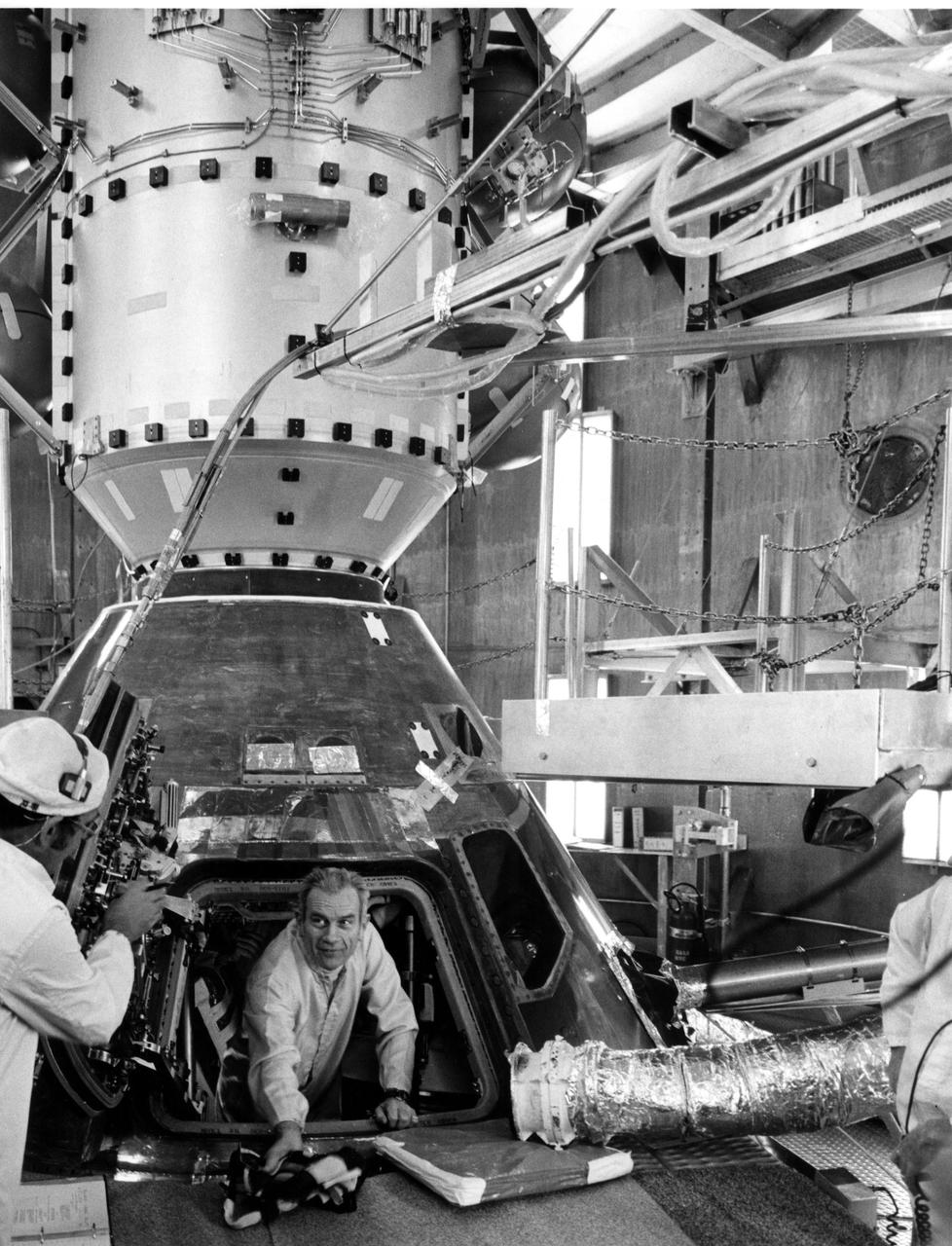
KENNEDY SPACE CENTER, FLA. -- Astronaut Donald Slayton is shown in the Apollo Command Module for July's Apollo-Soyuz Test Project space mission. Slayton was at KSC for fit checks between the Apollo and the Docking Module, which will be used during the mission as a link between the Soviet Soyuz and American Apollo.
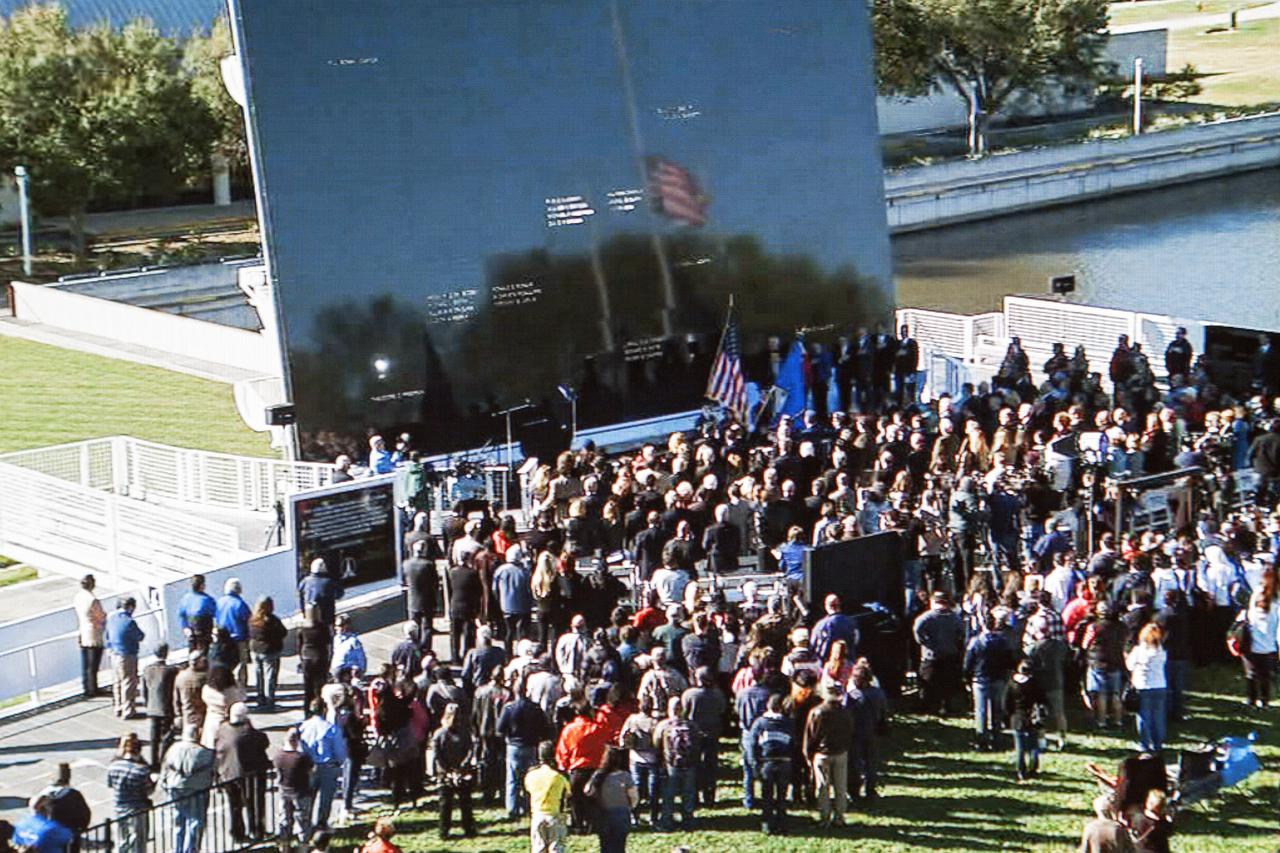
CAPE CANAVERAL, Fla. -- Kennedy Space Center employees and guests stand for the singing of the national anthem by gospel singer BeBe Winans during the Day of Remembrance ceremony at the Kennedy Space Center Visitor Complex. The annual event took place on the 10th anniversary of the loss of the space shuttle Columbia and its crew. Space center Employees and guests gathered at the Space Mirror Memorial at the spaceport's visitor complex for the annual event which took place on the 10th anniversary of the loss of the space shuttle Columbia and its crew. The ceremony also honored the astronauts of Apollo 1 and the shuttle Challenger. Dedicated in 1991, the names of fallen astronauts are emblazoned the Space Mirror Memorial's 4.5-foot-high-by-50-foot-wide polished black granite surface which reflects the sky and has been designated by Congress as a National Memorial. Image credit: NASA Television
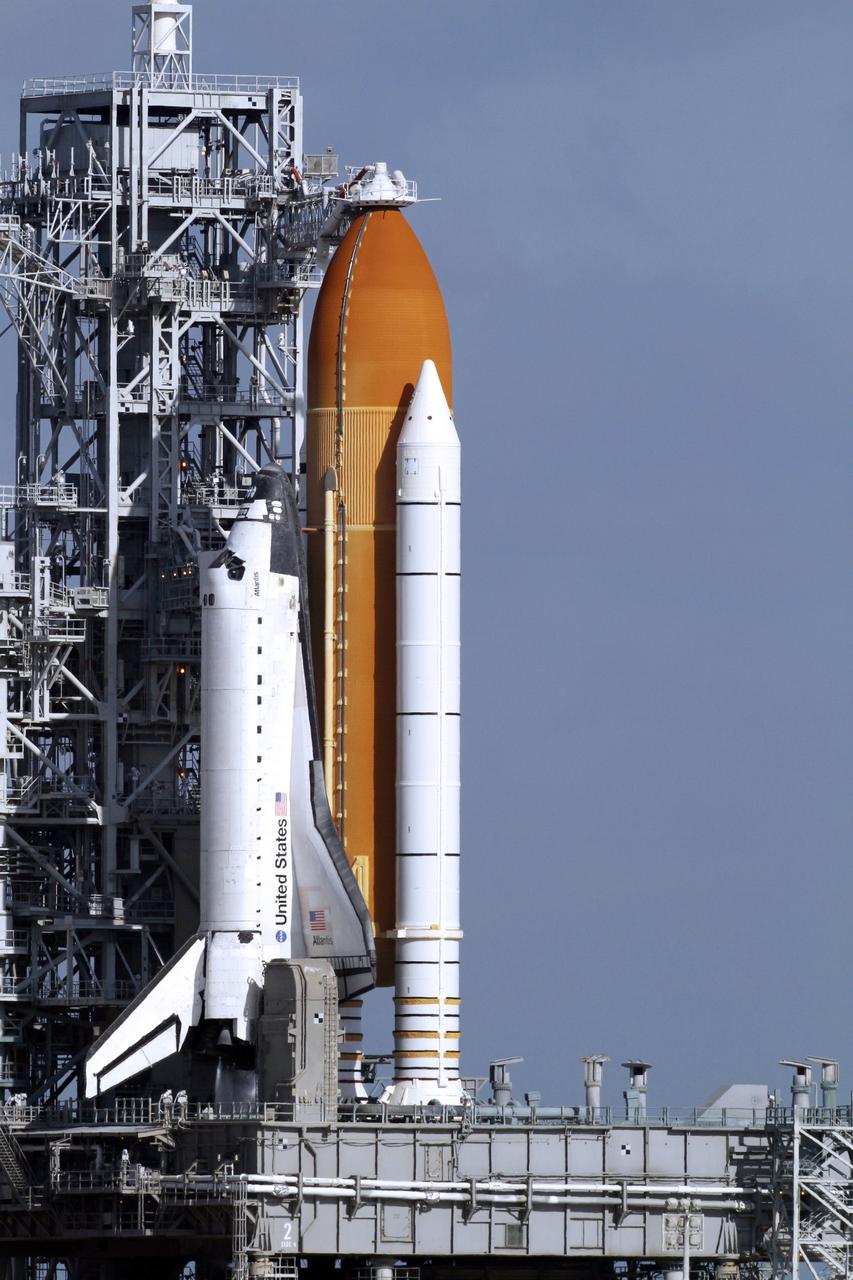
CAPE CANAVERAL, Fla. - At Launch Pad 39A at NASA's Kennedy Space Center in Florida, space shuttle Atlantis, secured to its external fuel tank and solid rocket boosters atop a mobile launcher platform, awaits liftoff on the STS-132 mission. Launch is set for 2:20 p.m. EDT on May 14. The six-member STS-132 crew will deliver the Russian-built Mini Research Module-1 to the International Space Station. Named Rassvet, Russian for 'dawn,' the module is the second in a series of new pressurized components for Russia and will be permanently attached to the Earth-facing port of the Zarya control module. Rassvet will be used for cargo storage and will provide an additional docking port to the station. Also aboard Atlantis is an Integrated Cargo Carrier, or ICC, an unpressurized flat bed pallet and keel yoke assembly used to support the transfer of exterior cargo from the shuttle to the station. STS-132 is the 34th mission to the station and the last scheduled flight for Atlantis. For more information on the STS-132 mission objectives, payload and crew, visit http:__www.nasa.gov_mission_pages_shuttle_shuttlemissions_sts132_index.html. Photo Credit: NASA_Kenny Allen