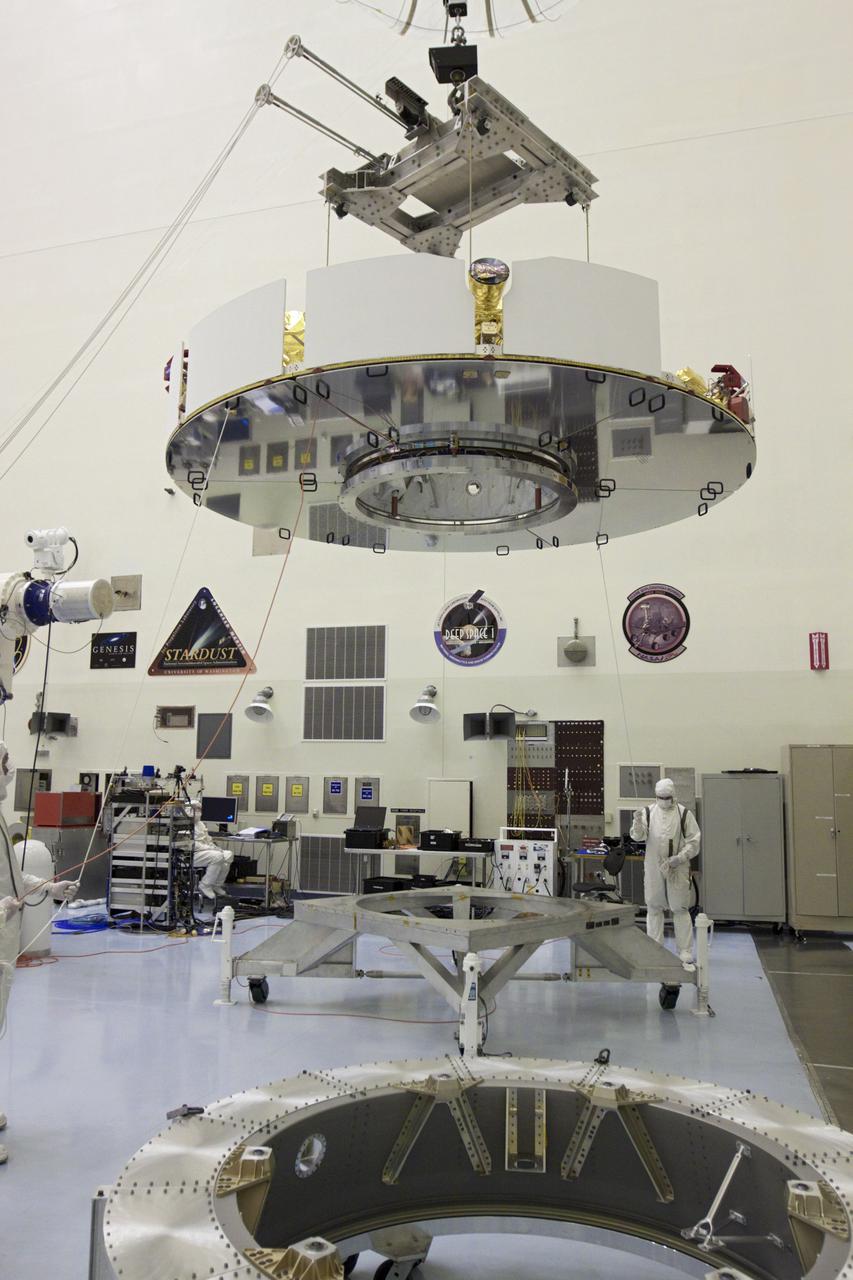
CAPE CANAVERAL, Fla. – In the Payload Hazardous Servicing Facility at NASA’s Kennedy Space Center in Florida, technicians, using an overhead crane, lift NASA's Mars Science Laboratory (MSL) mission cruise stage for placement onto a rotation stand. The cruise stage provides solar power, thrusters for navigation, and heat exchangers to the rover during its flight from Earth to Mars. MSL's components include a car-sized rover, Curiosity, which has 10 science instruments designed to search for evidence on whether Mars has had environments favorable to microbial life, including chemical ingredients for life. The unique rover will use a laser to look inside rocks and release its gasses so that the rover’s spectrometer can analyze and send the data back to Earth. Launch of MSL aboard a United Launch Alliance Atlas V rocket is scheduled for Nov. 25 from Space Launch Complex 41 on Cape Canaveral Air Force Station in Florida. For more information, visit http:__www.nasa.gov_msl. Photo credit: NASA_Glenn Benson
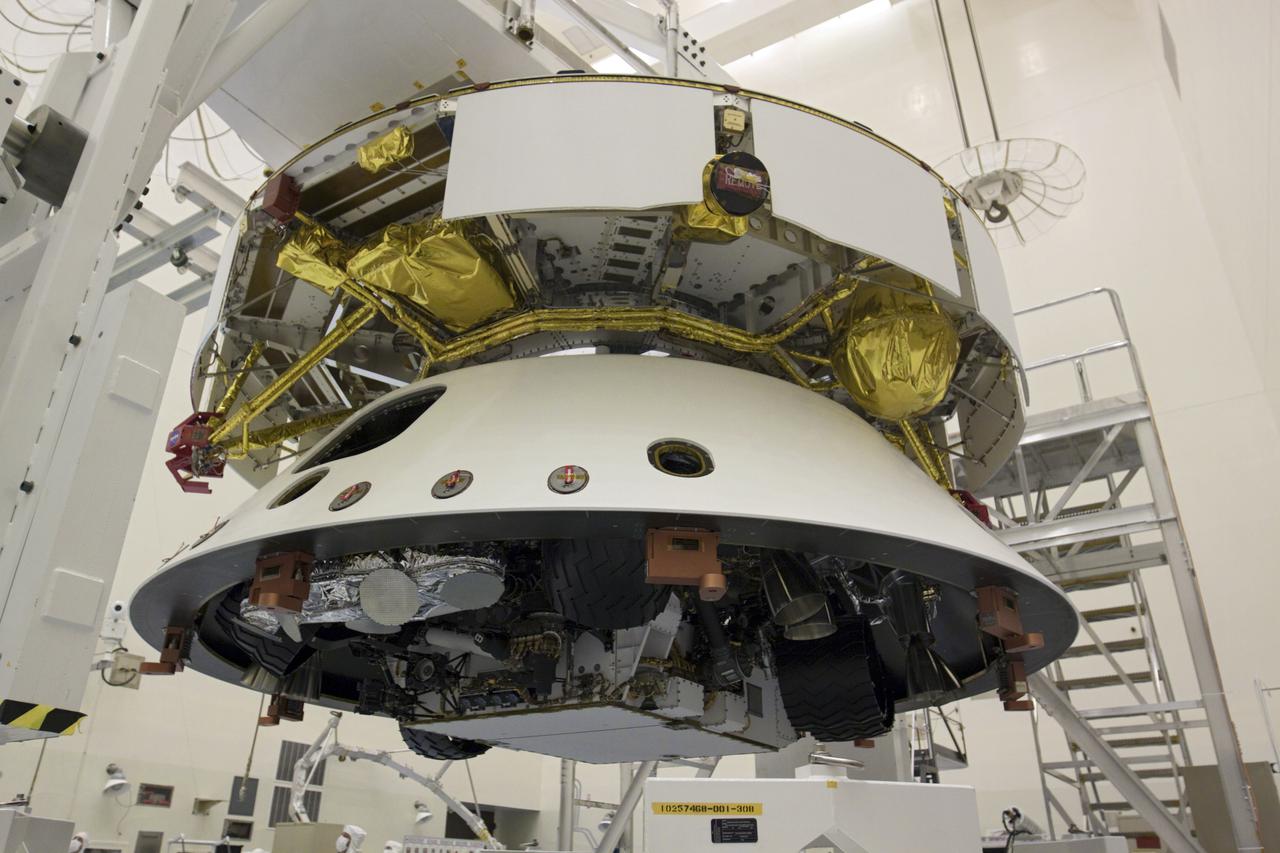
CAPE CANAVERAL, Fla. – In the Payload Hazardous Servicing Facility at NASA’s Kennedy Space Center in Florida, NASA's Mars Science Laboratory (MSL) mission aeroshell, (containing the compact car-sized rover Curiosity), has been mated to the cruise stage. The cruise stage provides solar power, thrusters for navigation, and heat exchangers to the rover during its flight from Earth to Mars. The rover Curiosity has 10 science instruments designed to search for evidence on whether Mars has had environments favorable to microbial life, including chemical ingredients for life. The unique rover will use a laser to look inside rocks and release its gasses so that the rover’s spectrometer can analyze and send the data back to Earth. Launch of MSL aboard a United Launch Alliance Atlas V rocket is scheduled for Nov. 25 from Space Launch Complex 41 on Cape Canaveral Air Force Station in Florida. For more information, visit http:__www.nasa.gov_msl. Photo credit: NASA_Glenn Benson
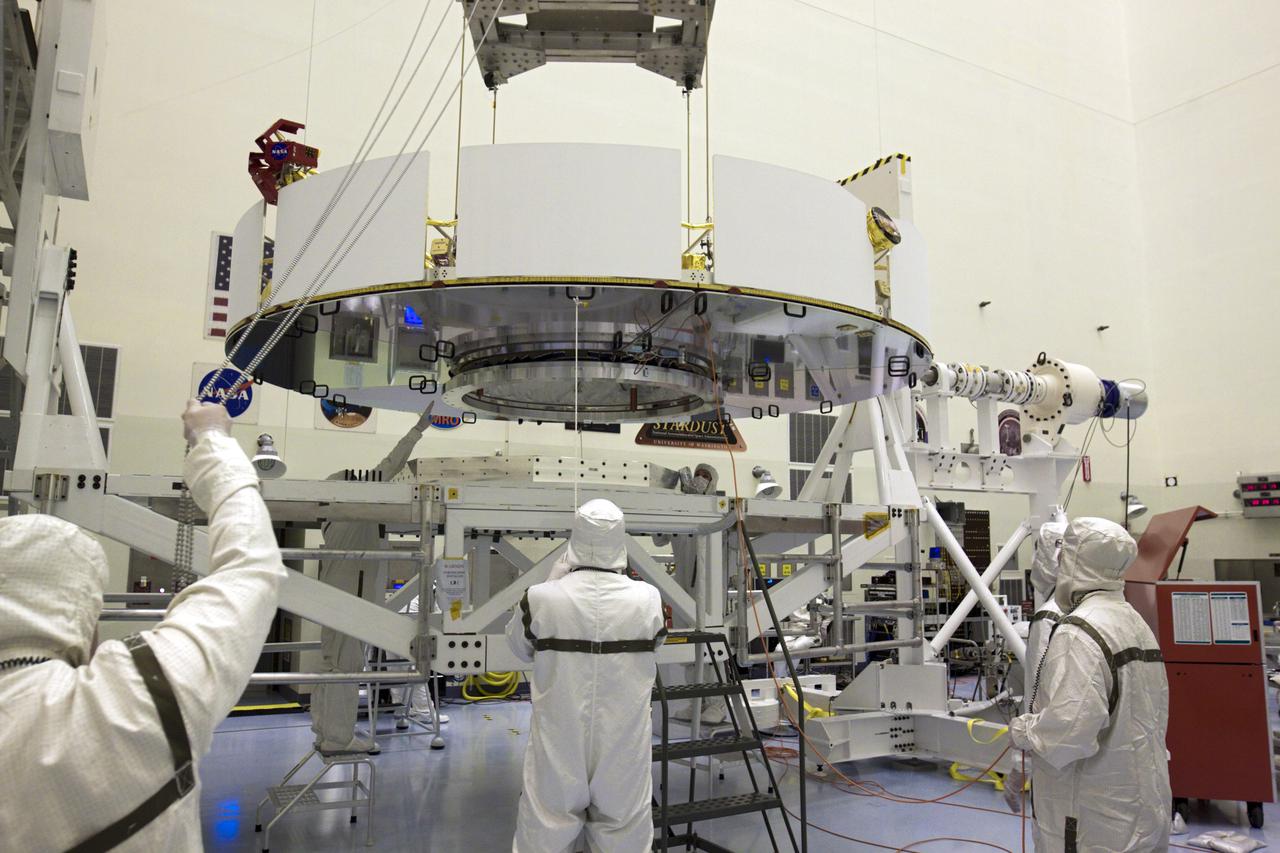
CAPE CANAVERAL, Fla. – In the Payload Hazardous Servicing Facility at NASA’s Kennedy Space Center in Florida, technicians, using an overhead crane, lower NASA's Mars Science Laboratory (MSL) mission cruise stage onto a rotation stand. The cruise stage provides solar power, thrusters for navigation, and heat exchangers to the rover during its flight from Earth to Mars. MSL's components include a car-sized rover, Curiosity, which has 10 science instruments designed to search for evidence on whether Mars has had environments favorable to microbial life, including chemical ingredients for life. The unique rover will use a laser to look inside rocks and release its gasses so that the rover’s spectrometer can analyze and send the data back to Earth. Launch of MSL aboard a United Launch Alliance Atlas V rocket is scheduled for Nov. 25 from Space Launch Complex 41 on Cape Canaveral Air Force Station in Florida. For more information, visit http:__www.nasa.gov_msl. Photo credit: NASA_Glenn Benson
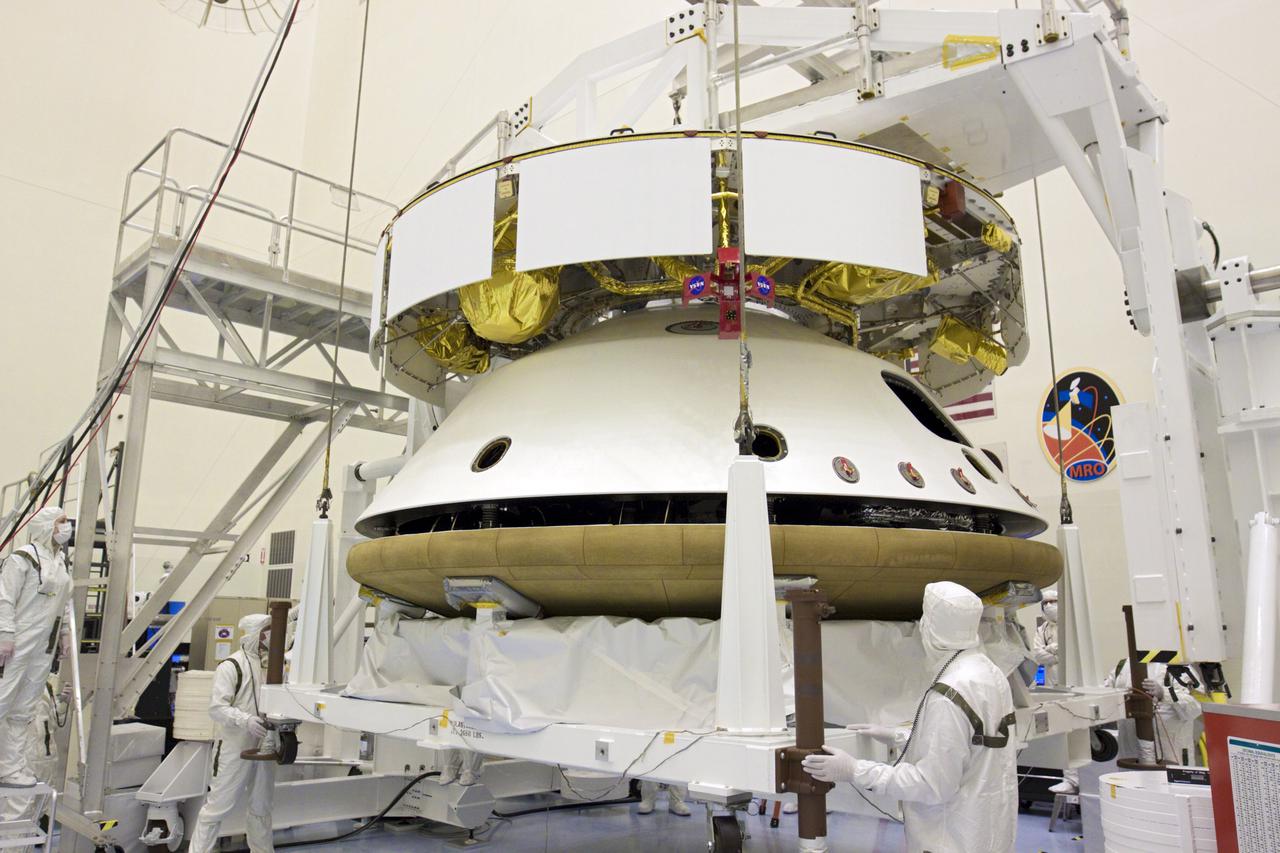
CAPE CANAVERAL, Fla. – In the Payload Hazardous Servicing Facility at NASA’s Kennedy Space Center in Florida, under the watchful eyes of technicians, an overhead crane lifts the heat shield for integration with NASA's Mars Science Laboratory (MSL) mission aeroshell, (containing the compact car-sized rover Curiosity). Earlier, the aeroshell was mated to the cruise stage, which provides solar power, thrusters for navigation, and heat exchangers to the rover during its flight from Earth to Mars. The rover Curiosity has 10 science instruments designed to search for evidence on whether Mars has had environments favorable to microbial life, including chemical ingredients for life. The unique rover will use a laser to look inside rocks and release its gasses so that the rover’s spectrometer can analyze and send the data back to Earth. Launch of MSL aboard a United Launch Alliance Atlas V rocket is scheduled for Nov. 25 from Space Launch Complex 41 on Cape Canaveral Air Force Station in Florida. For more information, visit http:__www.nasa.gov_msl. Photo credit: NASA_Glenn Benson
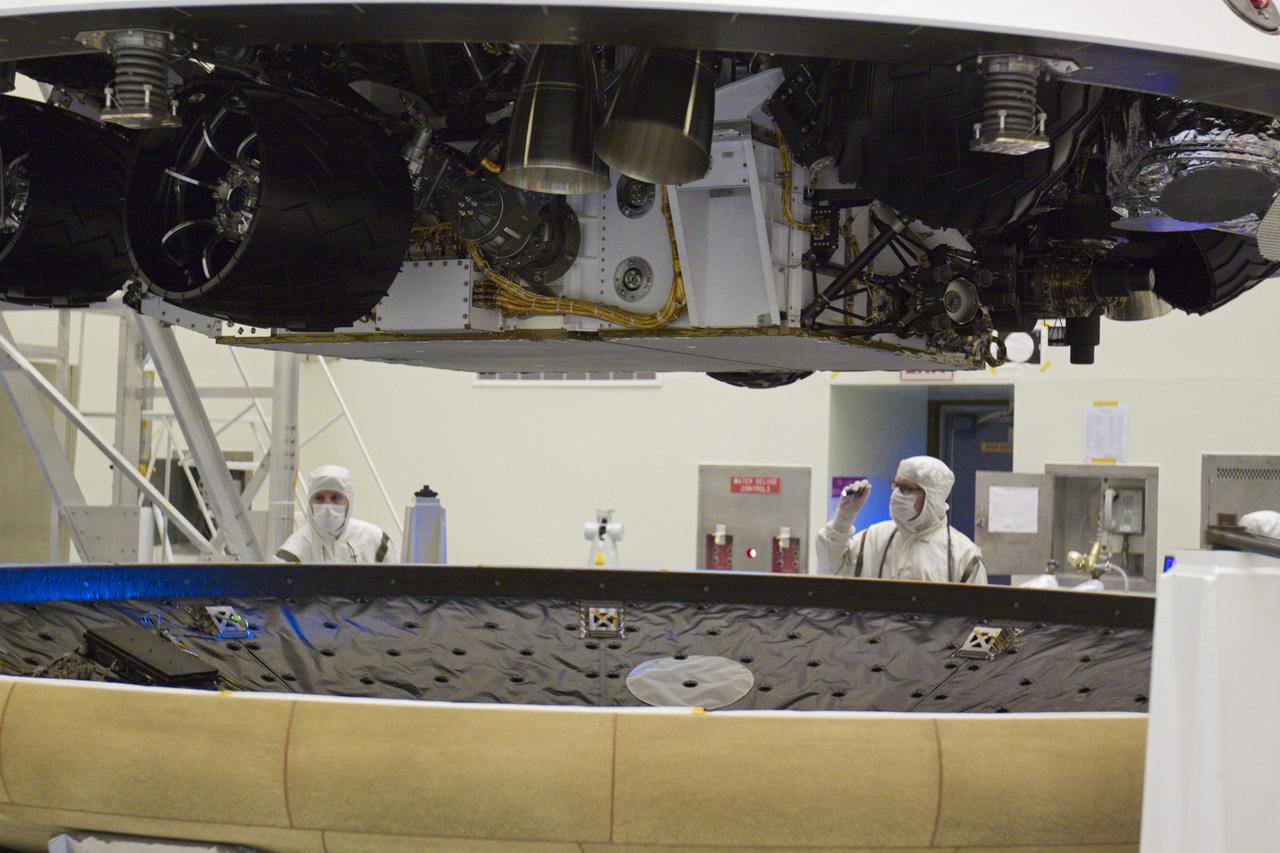
CAPE CANAVERAL, Fla. – In the Payload Hazardous Servicing Facility at NASA’s Kennedy Space Center in Florida, technicians inspect the heat shield in preparation for integration with NASA's Mars Science Laboratory (MSL) mission aeroshell, (containing the compact car-sized rover Curiosity). Earlier, the aeroshell was mated to the cruise stage, which provides solar power, thrusters for navigation, and heat exchangers to the rover during its flight from Earth to Mars. The rover Curiosity has 10 science instruments designed to search for evidence on whether Mars has had environments favorable to microbial life, including chemical ingredients for life. The unique rover will use a laser to look inside rocks and release its gasses so that the rover’s spectrometer can analyze and send the data back to Earth. Launch of MSL aboard a United Launch Alliance Atlas V rocket is scheduled for Nov. 25 from Space Launch Complex 41 on Cape Canaveral Air Force Station in Florida. For more information, visit http:__www.nasa.gov_msl. Photo credit: NASA_Glenn Benson
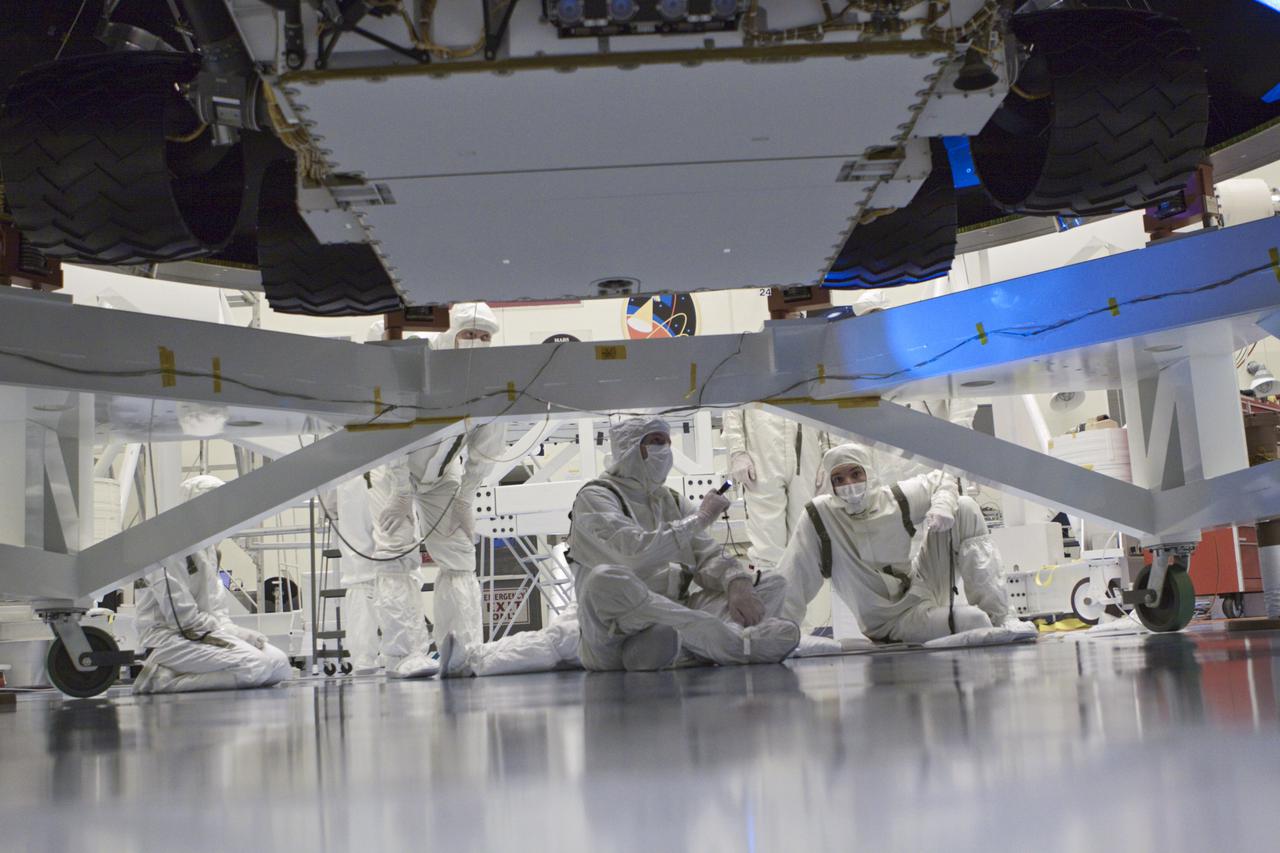
CAPE CANAVERAL, Fla. – In the Payload Hazardous Servicing Facility at NASA’s Kennedy Space Center in Florida, technicians inspect under NASA's Mars Science Laboratory (MSL) mission aeroshell, where the wheels of the rover Curiosity can be seen. MSL's components include a car-sized rover, Curiosity, which has 10 science instruments designed to search for evidence on whether Mars has had environments favorable to microbial life, including chemical ingredients for life. The unique rover will use a laser to look inside rocks and release its gasses so that the rover’s spectrometer can analyze and send the data back to Earth. Launch of MSL aboard a United Launch Alliance Atlas V rocket is scheduled for Nov. 25 from Space Launch Complex 41 on Cape Canaveral Air Force Station in Florida. For more information, visit http:__www.nasa.gov_msl. Photo credit: NASA_Glenn Benson
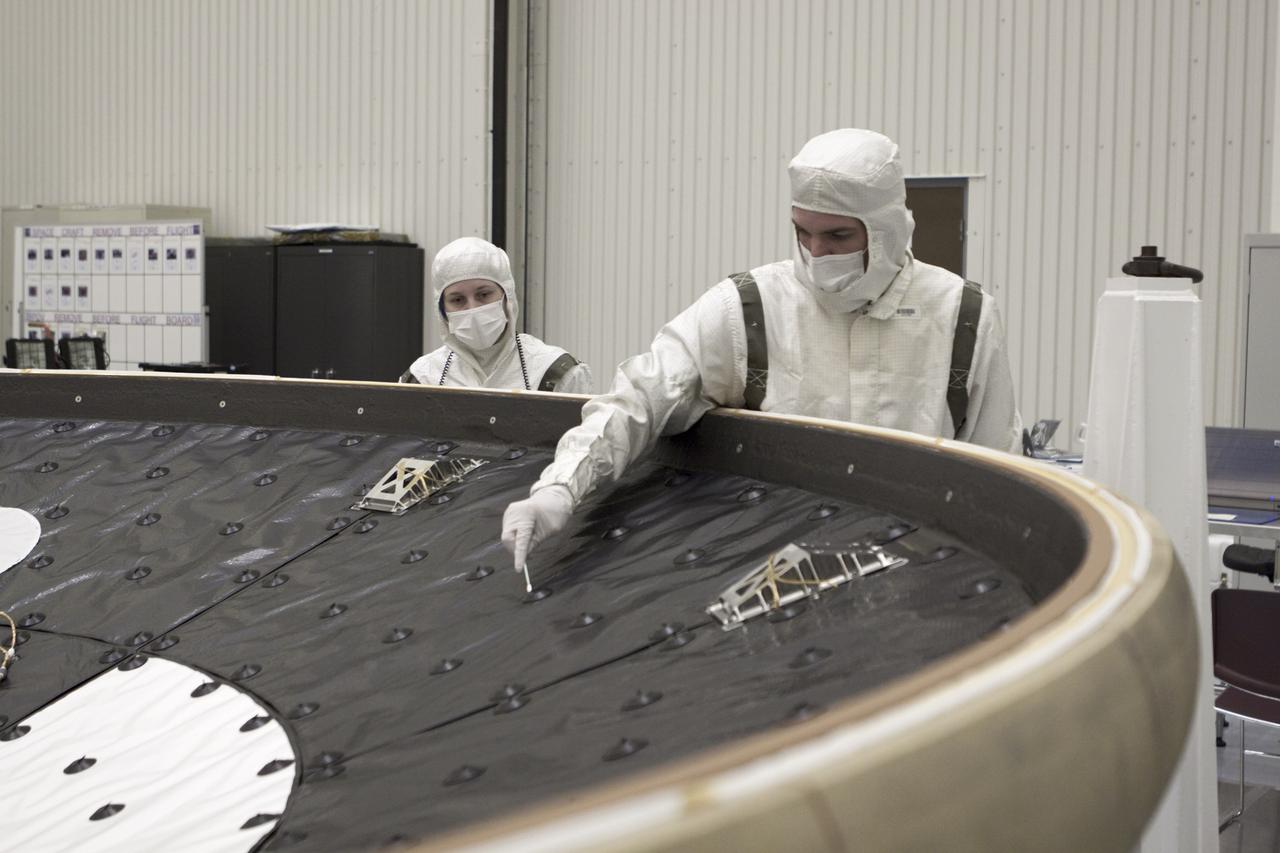
CAPE CANAVERAL, Fla. – In the Payload Hazardous Servicing Facility at NASA’s Kennedy Space Center in Florida, a technician cleans along the edge of NASA's Mars Science Laboratory (MSL) mission heat shield. MSL's components include a car-sized rover, Curiosity, which has 10 science instruments designed to search for evidence on whether Mars has had environments favorable to microbial life, including chemical ingredients for life. The unique rover will use a laser to look inside rocks and release its gasses so that the rover’s spectrometer can analyze and send the data back to Earth. Launch of MSL aboard a United Launch Alliance Atlas V rocket is scheduled for Nov. 25 from Space Launch Complex 41 on Cape Canaveral Air Force Station in Florida. For more information, visit http:__www.nasa.gov_msl. Photo credit: NASA_Glenn Benson
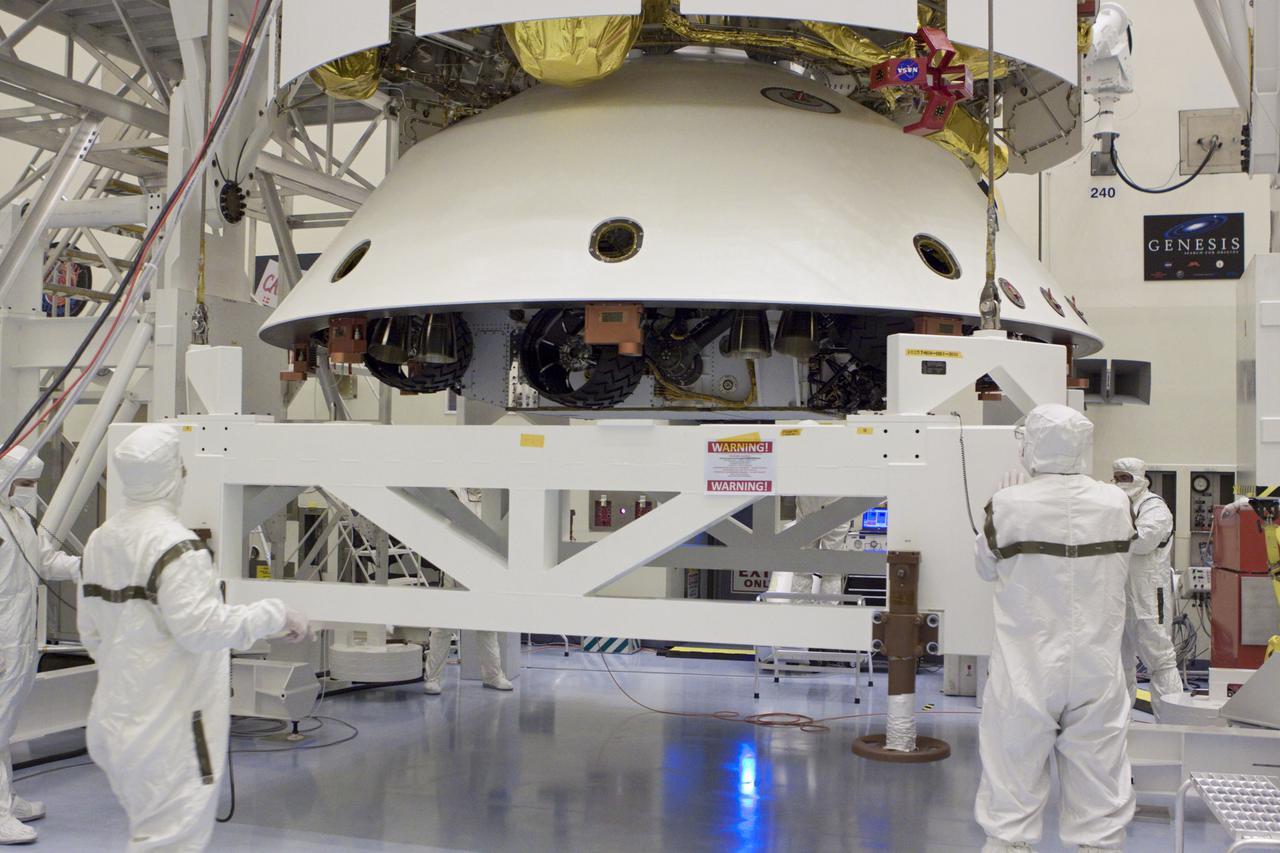
CAPE CANAVERAL, Fla. – In the Payload Hazardous Servicing Facility at NASA’s Kennedy Space Center in Florida, technicians, using an overhead crane, lift NASA's Mars Science Laboratory (MSL) mission aeroshell, (containing the compact car-sized rover Curiosity), for mating to the cruise stage. The cruise stage provides solar power, thrusters for navigation, and heat exchangers to the rover during its flight from Earth to Mars. The rover Curiosity has 10 science instruments designed to search for evidence on whether Mars has had environments favorable to microbial life, including chemical ingredients for life. The unique rover will use a laser to look inside rocks and release its gasses so that the rover’s spectrometer can analyze and send the data back to Earth. Launch of MSL aboard a United Launch Alliance Atlas V rocket is scheduled for Nov. 25 from Space Launch Complex 41 on Cape Canaveral Air Force Station in Florida. For more information, visit http:__www.nasa.gov_msl. Photo credit: NASA_Glenn Benson
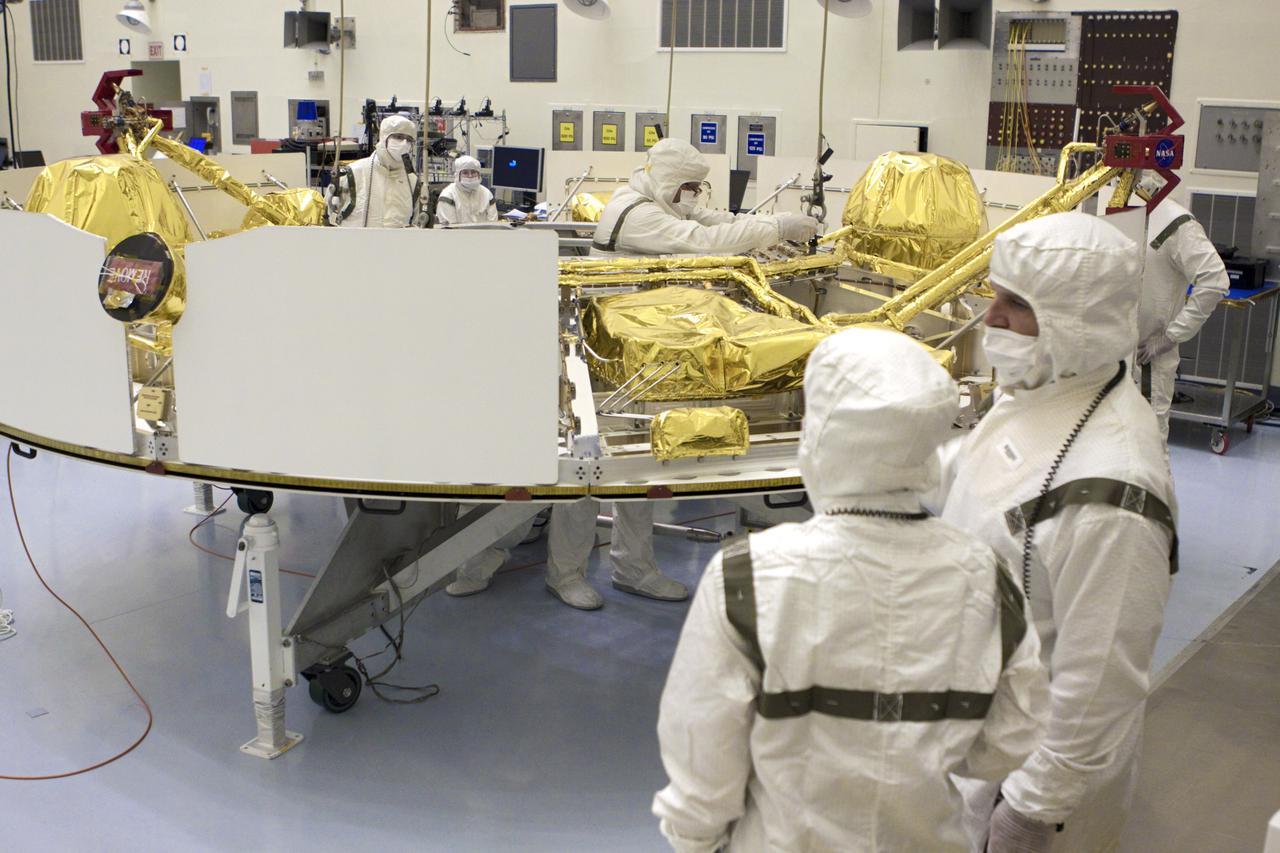
CAPE CANAVERAL, Fla. – In the Payload Hazardous Servicing Facility at NASA’s Kennedy Space Center in Florida, technicians prepare to attach an overhead crane to NASA's Mars Science Laboratory (MSL) mission cruise stage. The cruise stage, which will be lifted onto a rotation stand, provides solar power, thrusters for navigation, and heat exchangers to the rover during its flight from Earth to Mars. MSL's components include a car-sized rover, Curiosity, which has 10 science instruments designed to search for evidence on whether Mars has had environments favorable to microbial life, including chemical ingredients for life. The unique rover will use a laser to look inside rocks and release its gasses so that the rover’s spectrometer can analyze and send the data back to Earth. Launch of MSL aboard a United Launch Alliance Atlas V rocket is scheduled for Nov. 25 from Space Launch Complex 41 on Cape Canaveral Air Force Station in Florida. For more information, visit http:__www.nasa.gov_msl. Photo credit: NASA_Glenn Benson
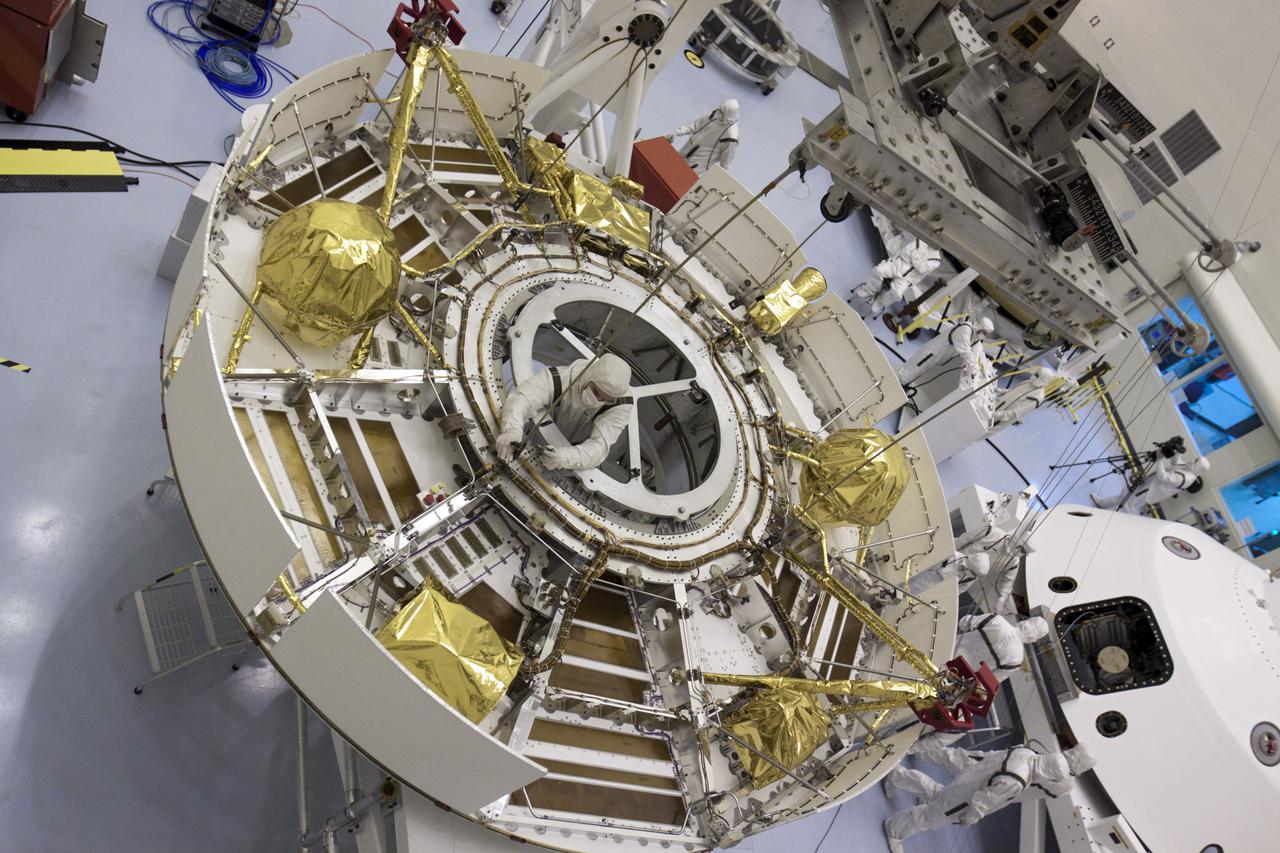
CAPE CANAVERAL, Fla. – In the Payload Hazardous Servicing Facility at NASA’s Kennedy Space Center in Florida, the camera captures a unique view of NASA's Mars Science Laboratory (MSL) mission as a technician separates the overhead crane from the cruise stage after it was lifted onto a rotation stand. The cruise stage provides solar power, thrusters for navigation, and heat exchangers to the rover during its flight from Earth to Mars. MSL's components include a car-sized rover, Curiosity, which has 10 science instruments designed to search for evidence on whether Mars has had environments favorable to microbial life, including chemical ingredients for life. The unique rover will use a laser to look inside rocks and release its gasses so that the rover’s spectrometer can analyze and send the data back to Earth. Launch of MSL aboard a United Launch Alliance Atlas V rocket is scheduled for Nov. 25 from Space Launch Complex 41 on Cape Canaveral Air Force Station in Florida. For more information, visit http:__www.nasa.gov_msl. Photo credit: NASA_Glenn Benson
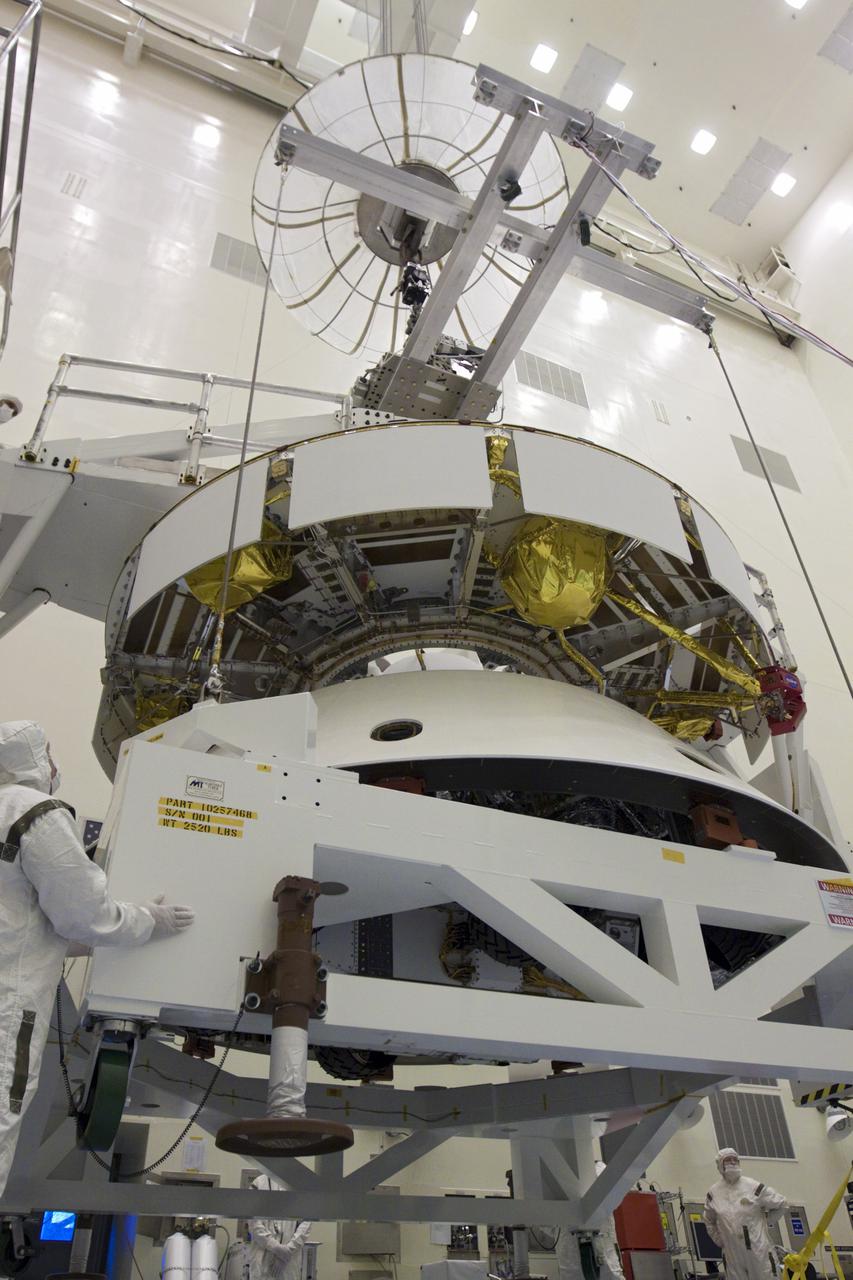
CAPE CANAVERAL, Fla. – In the Payload Hazardous Servicing Facility at NASA’s Kennedy Space Center in Florida, technicians, using an overhead crane, lift NASA's Mars Science Laboratory (MSL) mission aeroshell, (containing the compact car-sized rover Curiosity), for mating to the cruise stage. The cruise stage provides solar power, thrusters for navigation, and heat exchangers to the rover during its flight from Earth to Mars. The rover Curiosity has 10 science instruments designed to search for evidence on whether Mars has had environments favorable to microbial life, including chemical ingredients for life. The unique rover will use a laser to look inside rocks and release its gasses so that the rover’s spectrometer can analyze and send the data back to Earth. Launch of MSL aboard a United Launch Alliance Atlas V rocket is scheduled for Nov. 25 from Space Launch Complex 41 on Cape Canaveral Air Force Station in Florida. For more information, visit http:__www.nasa.gov_msl. Photo credit: NASA_Glenn Benson
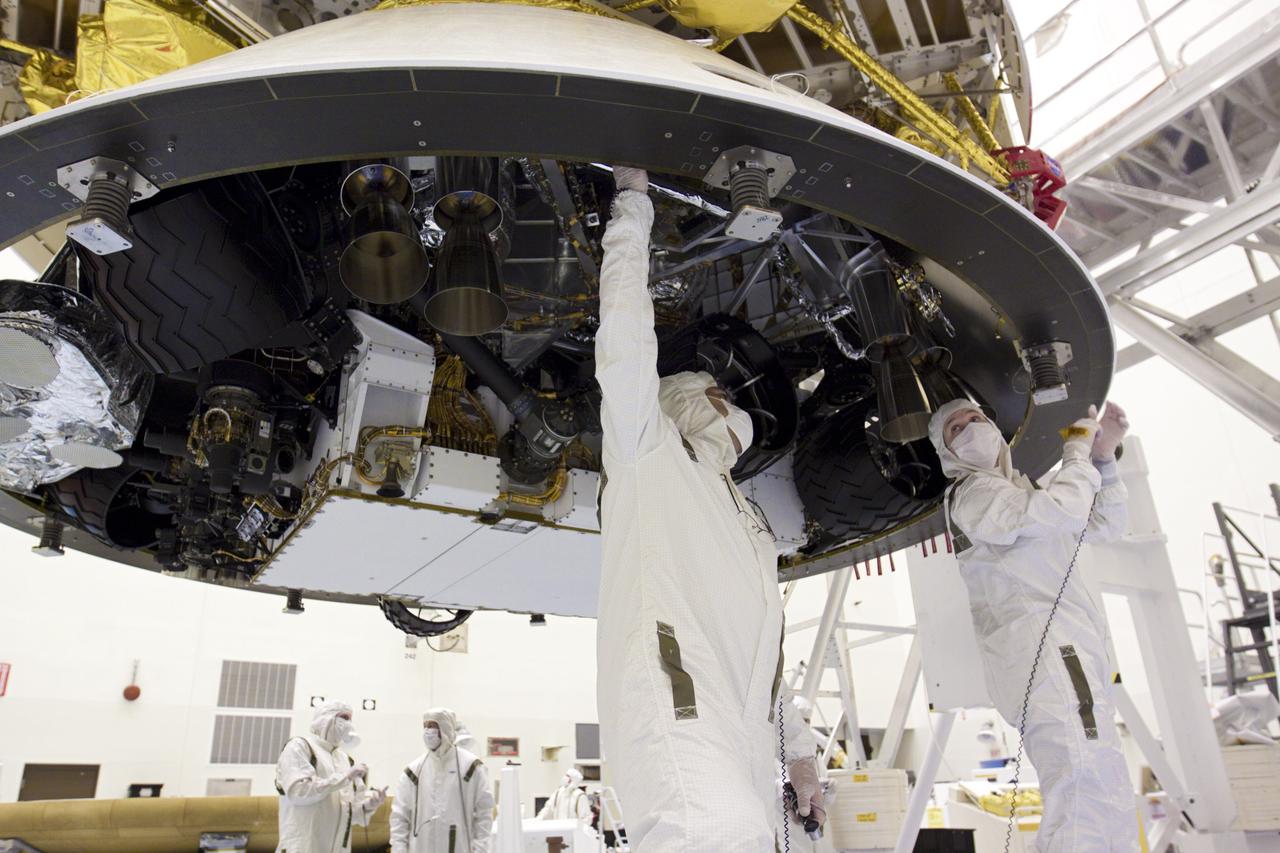
CAPE CANAVERAL, Fla. – In the Payload Hazardous Servicing Facility at NASA’s Kennedy Space Center in Florida, technicians work beneath NASA's Mars Science Laboratory (MSL) mission aeroshell, (containing the compact car-sized rover Curiosity), which has been mated to the cruise stage. The cruise stage provides solar power, thrusters for navigation, and heat exchangers to the rover during its flight from Earth to Mars. The rover Curiosity has 10 science instruments designed to search for evidence on whether Mars has had environments favorable to microbial life, including chemical ingredients for life. The unique rover will use a laser to look inside rocks and release its gasses so that the rover’s spectrometer can analyze and send the data back to Earth. Launch of MSL aboard a United Launch Alliance Atlas V rocket is scheduled for Nov. 25 from Space Launch Complex 41 on Cape Canaveral Air Force Station in Florida. For more information, visit http:__www.nasa.gov_msl. Photo credit: NASA_Glenn Benson
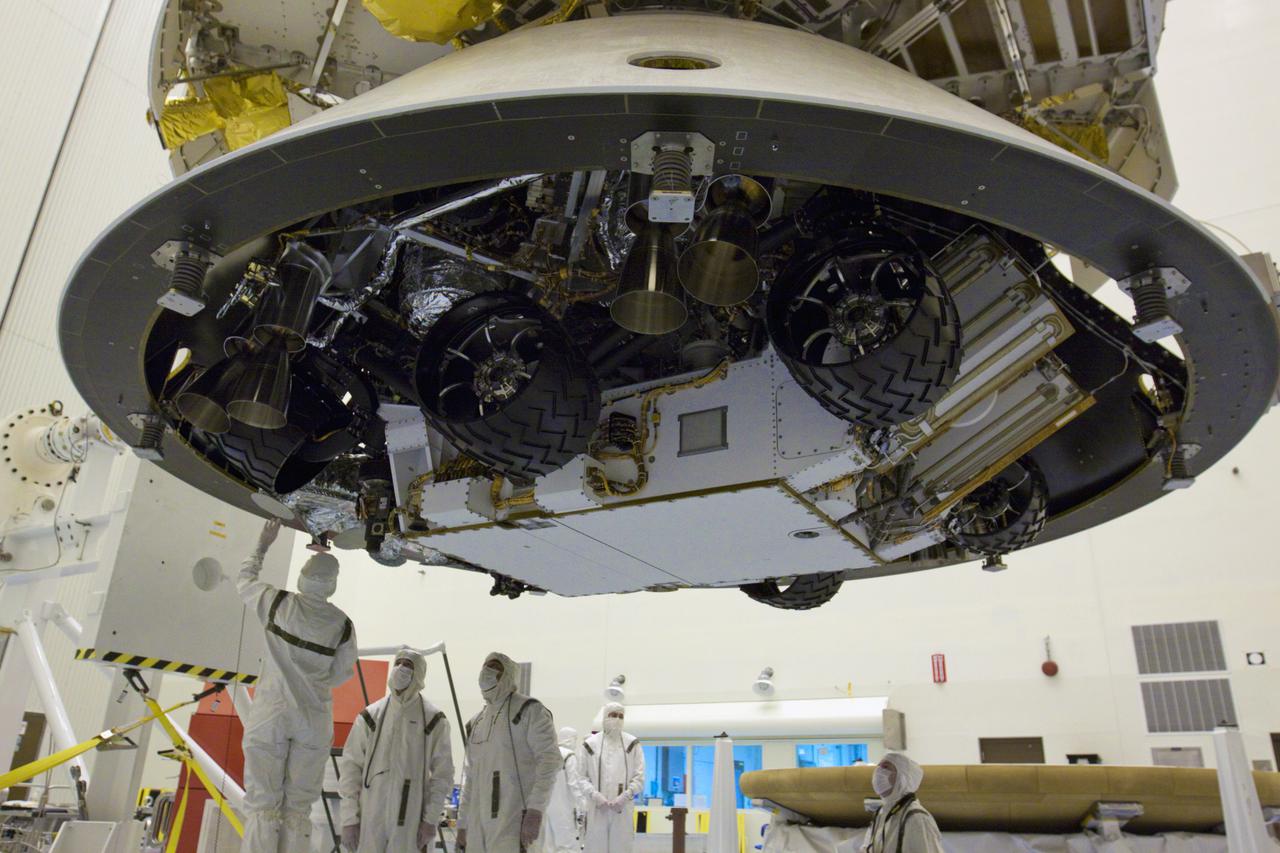
CAPE CANAVERAL, Fla. – In the Payload Hazardous Servicing Facility at NASA’s Kennedy Space Center in Florida, technicians work beneath NASA's Mars Science Laboratory (MSL) mission aeroshell, (containing the compact car-sized rover Curiosity), which has been mated to the cruise stage. The cruise stage provides solar power, thrusters for navigation, and heat exchangers to the rover during its flight from Earth to Mars. The rover Curiosity has 10 science instruments designed to search for evidence on whether Mars has had environments favorable to microbial life, including chemical ingredients for life. The unique rover will use a laser to look inside rocks and release its gasses so that the rover’s spectrometer can analyze and send the data back to Earth. Launch of MSL aboard a United Launch Alliance Atlas V rocket is scheduled for Nov. 25 from Space Launch Complex 41 on Cape Canaveral Air Force Station in Florida. For more information, visit http:__www.nasa.gov_msl. Photo credit: NASA_Glenn Benson
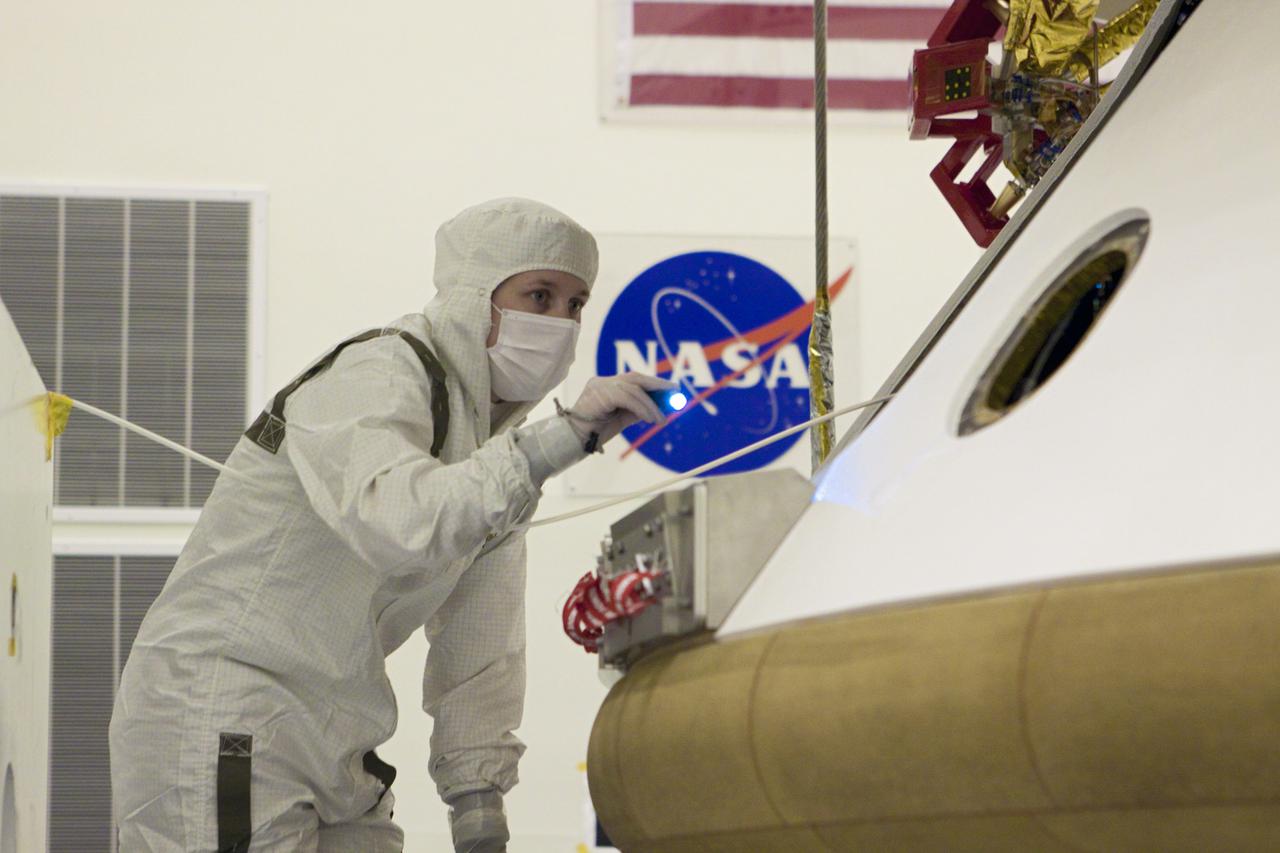
CAPE CANAVERAL, Fla. – In the Payload Hazardous Servicing Facility at NASA’s Kennedy Space Center in Florida, a technician inspects the alignment of the heat shield after integration with NASA's Mars Science Laboratory (MSL) mission aeroshell, (containing the compact car-sized rover Curiosity). Earlier, the aeroshell was mated to the cruise stage, which provides solar power, thrusters for navigation, and heat exchangers to the rover during its flight from Earth to Mars. The rover Curiosity has 10 science instruments designed to search for evidence on whether Mars has had environments favorable to microbial life, including chemical ingredients for life. The unique rover will use a laser to look inside rocks and release its gasses so that the rover’s spectrometer can analyze and send the data back to Earth. Launch of MSL aboard a United Launch Alliance Atlas V rocket is scheduled for Nov. 25 from Space Launch Complex 41 on Cape Canaveral Air Force Station in Florida. For more information, visit http:__www.nasa.gov_msl. Photo credit: NASA_Glenn Benson
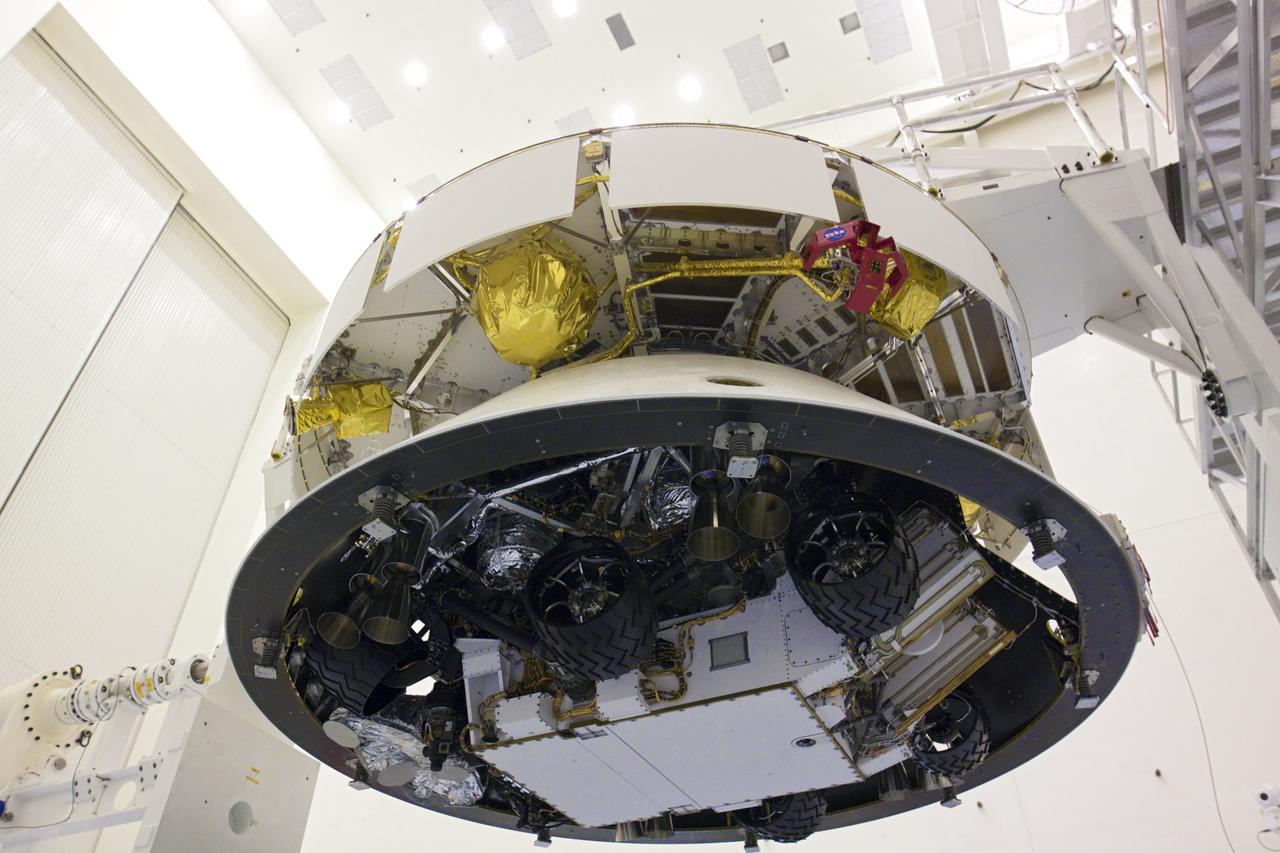
CAPE CANAVERAL, Fla. – In the Payload Hazardous Servicing Facility at NASA’s Kennedy Space Center in Florida, the camera captures a unique view of NASA's Mars Science Laboratory (MSL) mission aeroshell, (containing the compact car-sized rover Curiosity), which has been mated to the cruise stage. The cruise stage provides solar power, thrusters for navigation, and heat exchangers to the rover during its flight from Earth to Mars. The rover Curiosity has 10 science instruments designed to search for evidence on whether Mars has had environments favorable to microbial life, including chemical ingredients for life. The unique rover will use a laser to look inside rocks and release its gasses so that the rover’s spectrometer can analyze and send the data back to Earth. Launch of MSL aboard a United Launch Alliance Atlas V rocket is scheduled for Nov. 25 from Space Launch Complex 41 on Cape Canaveral Air Force Station in Florida. For more information, visit http:__www.nasa.gov_msl. Photo credit: NASA_Glenn Benson
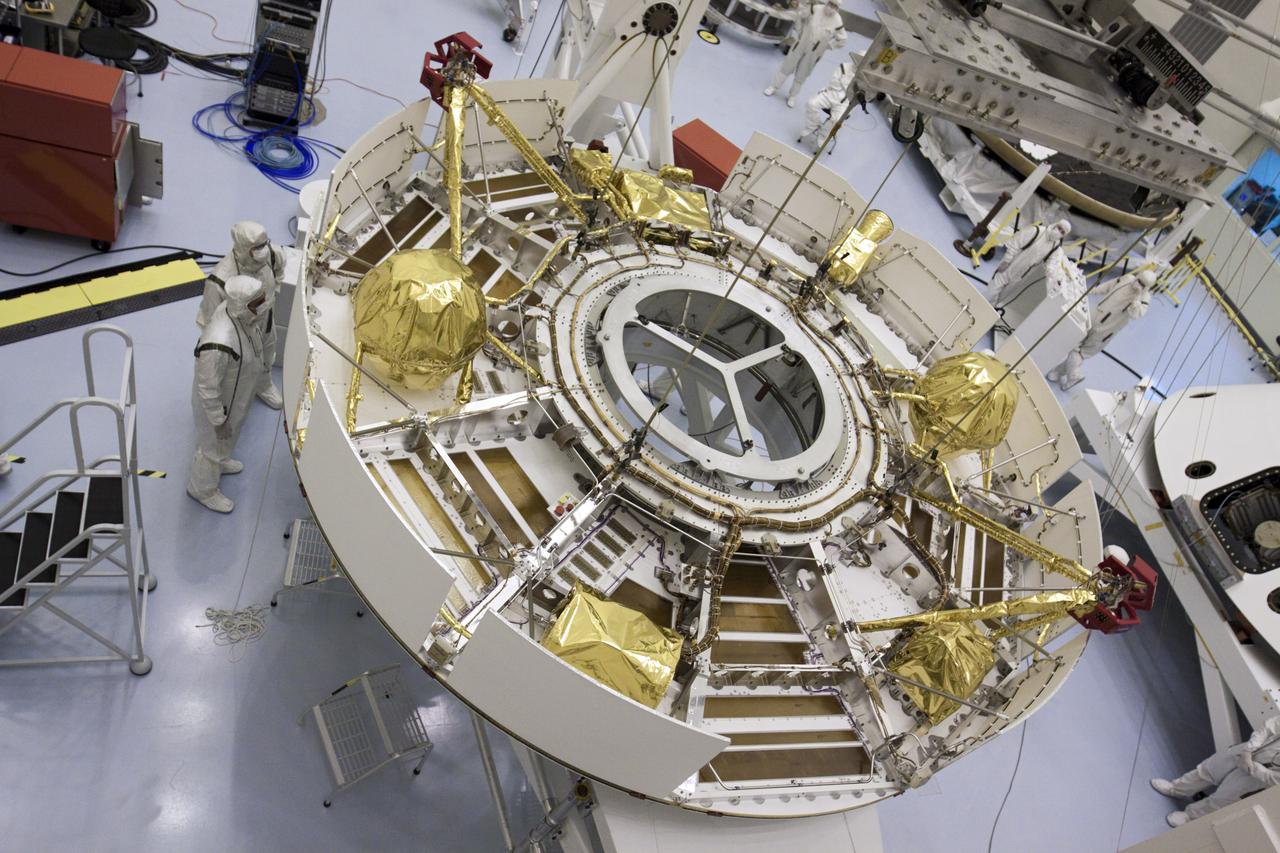
CAPE CANAVERAL, Fla. – In the Payload Hazardous Servicing Facility at NASA’s Kennedy Space Center in Florida, the camera captures a unique view of NASA's Mars Science Laboratory (MSL) mission cruise stage as technicians guide it onto a rotation stand using an overhead crane. The cruise stage provides solar power, thrusters for navigation, and heat exchangers to the rover during its flight from Earth to Mars. MSL's components include a car-sized rover, Curiosity, which has 10 science instruments designed to search for evidence on whether Mars has had environments favorable to microbial life, including chemical ingredients for life. The unique rover will use a laser to look inside rocks and release its gasses so that the rover’s spectrometer can analyze and send the data back to Earth. Launch of MSL aboard a United Launch Alliance Atlas V rocket is scheduled for Nov. 25 from Space Launch Complex 41 on Cape Canaveral Air Force Station in Florida. For more information, visit http:__www.nasa.gov_msl. Photo credit: NASA_Glenn Benson
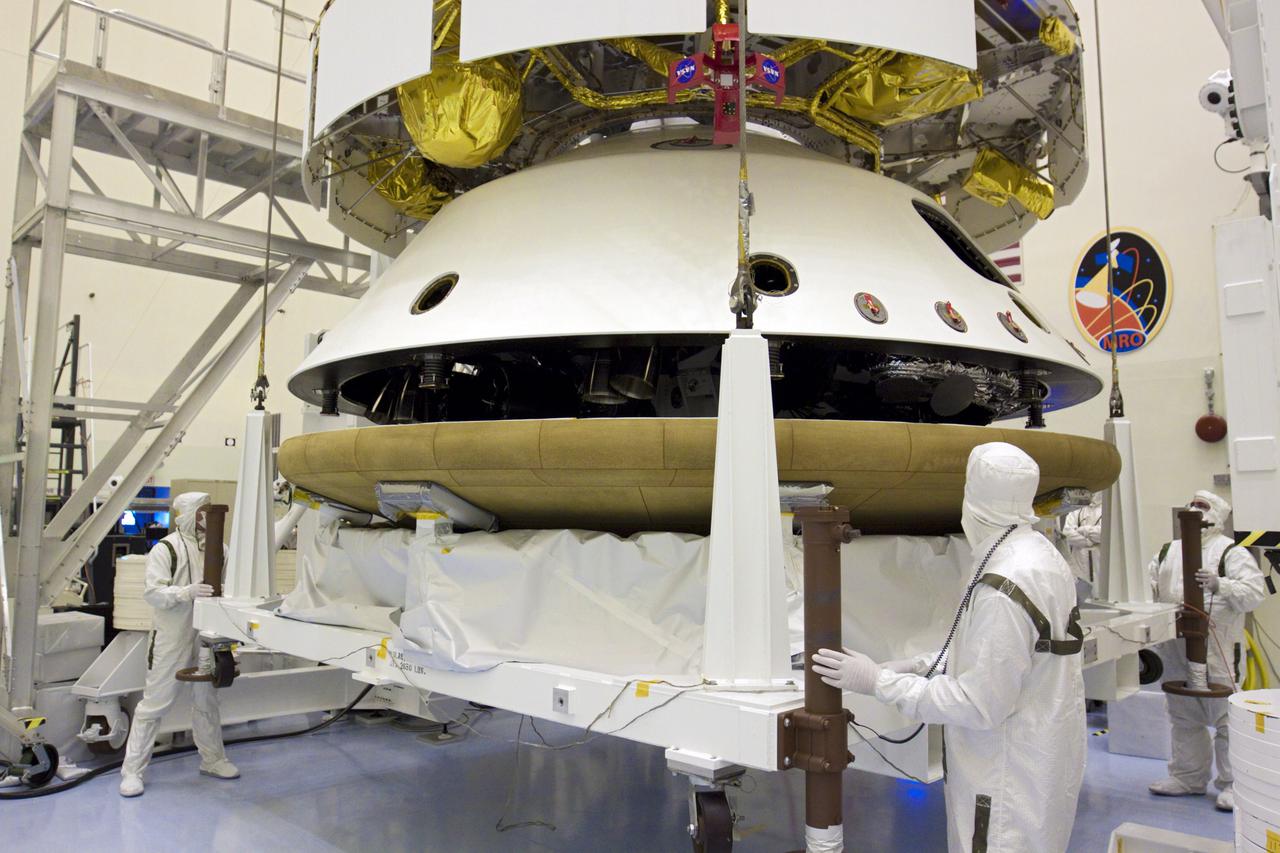
CAPE CANAVERAL, Fla. – In the Payload Hazardous Servicing Facility at NASA’s Kennedy Space Center in Florida, under the watchful eyes of technicians, an overhead crane lifts the heat shield for integration with NASA's Mars Science Laboratory (MSL) mission aeroshell, (containing the compact car-sized rover Curiosity). Earlier, the aeroshell was mated to the cruise stage, which provides solar power, thrusters for navigation, and heat exchangers to the rover during its flight from Earth to Mars. The rover Curiosity has 10 science instruments designed to search for evidence on whether Mars has had environments favorable to microbial life, including chemical ingredients for life. The unique rover will use a laser to look inside rocks and release its gasses so that the rover’s spectrometer can analyze and send the data back to Earth. Launch of MSL aboard a United Launch Alliance Atlas V rocket is scheduled for Nov. 25 from Space Launch Complex 41 on Cape Canaveral Air Force Station in Florida. For more information, visit http:__www.nasa.gov_msl. Photo credit: NASA_Glenn Benson
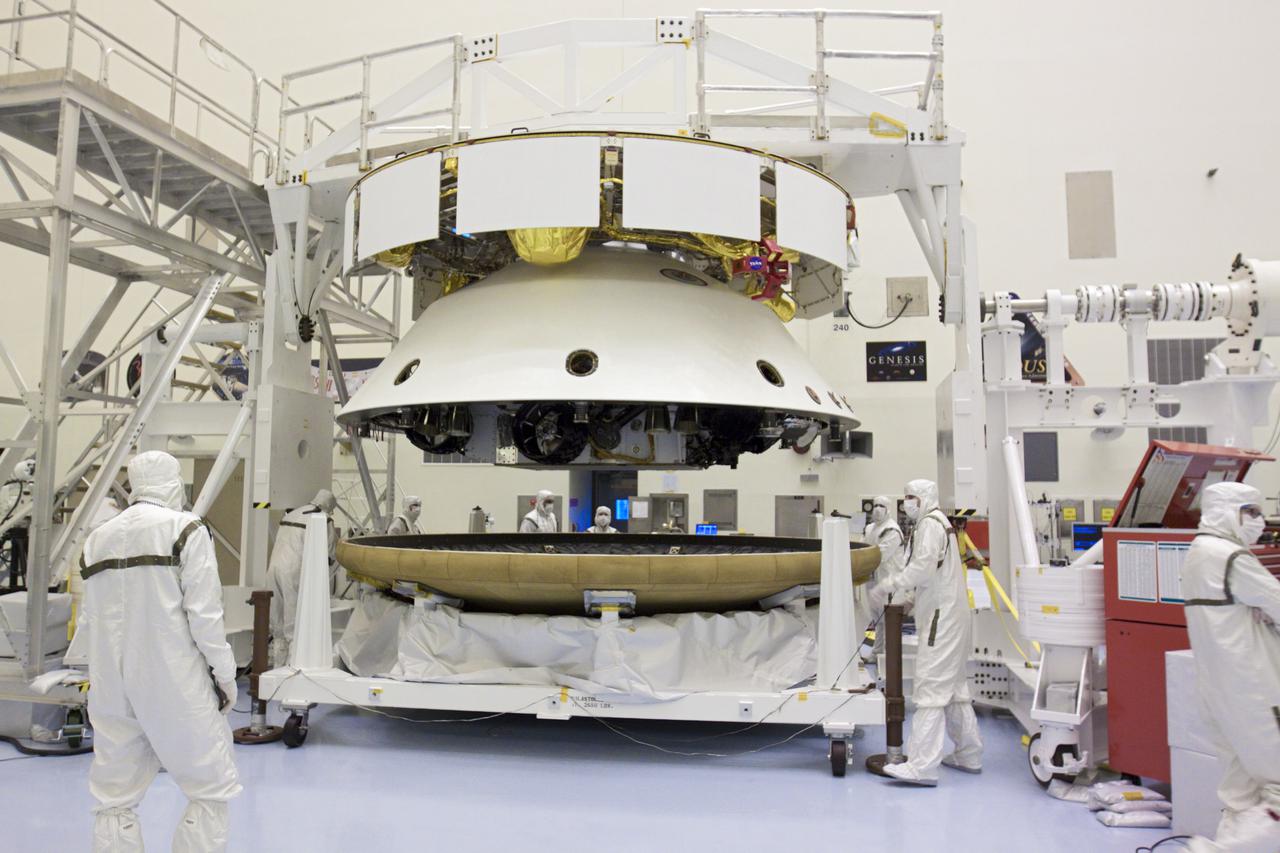
CAPE CANAVERAL, Fla. – In the Payload Hazardous Servicing Facility at NASA’s Kennedy Space Center in Florida, technicians prepare the heat shield for integration with NASA's Mars Science Laboratory (MSL) mission aeroshell, (containing the compact car-sized rover Curiosity). Earlier, the aeroshell was mated to the cruise stage, which provides solar power, thrusters for navigation, and heat exchangers to the rover during its flight from Earth to Mars. The rover Curiosity has 10 science instruments designed to search for evidence on whether Mars has had environments favorable to microbial life, including chemical ingredients for life. The unique rover will use a laser to look inside rocks and release its gasses so that the rover’s spectrometer can analyze and send the data back to Earth. Launch of MSL aboard a United Launch Alliance Atlas V rocket is scheduled for Nov. 25 from Space Launch Complex 41 on Cape Canaveral Air Force Station in Florida. For more information, visit http:__www.nasa.gov_msl. Photo credit: NASA_Glenn Benson
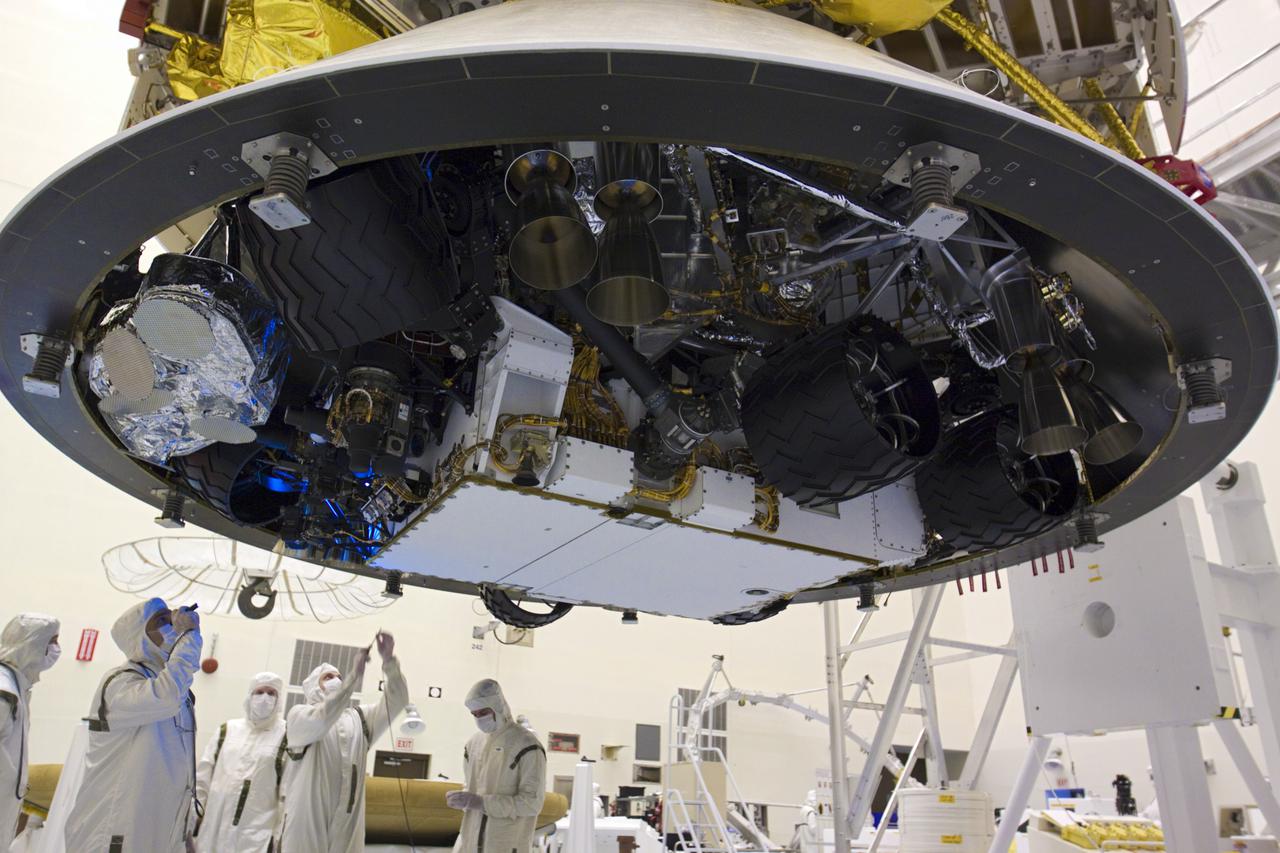
CAPE CANAVERAL, Fla. – In the Payload Hazardous Servicing Facility at NASA’s Kennedy Space Center in Florida, technicians inspect beneath NASA's Mars Science Laboratory (MSL) mission aeroshell, (containing the compact car-sized rover Curiosity), which has been mated to the cruise stage. The cruise stage provides solar power, thrusters for navigation, and heat exchangers to the rover during its flight from Earth to Mars. The rover Curiosity has 10 science instruments designed to search for evidence on whether Mars has had environments favorable to microbial life, including chemical ingredients for life. The unique rover will use a laser to look inside rocks and release its gasses so that the rover’s spectrometer can analyze and send the data back to Earth. Launch of MSL aboard a United Launch Alliance Atlas V rocket is scheduled for Nov. 25 from Space Launch Complex 41 on Cape Canaveral Air Force Station in Florida. For more information, visit http:__www.nasa.gov_msl. Photo credit: NASA_Glenn Benson
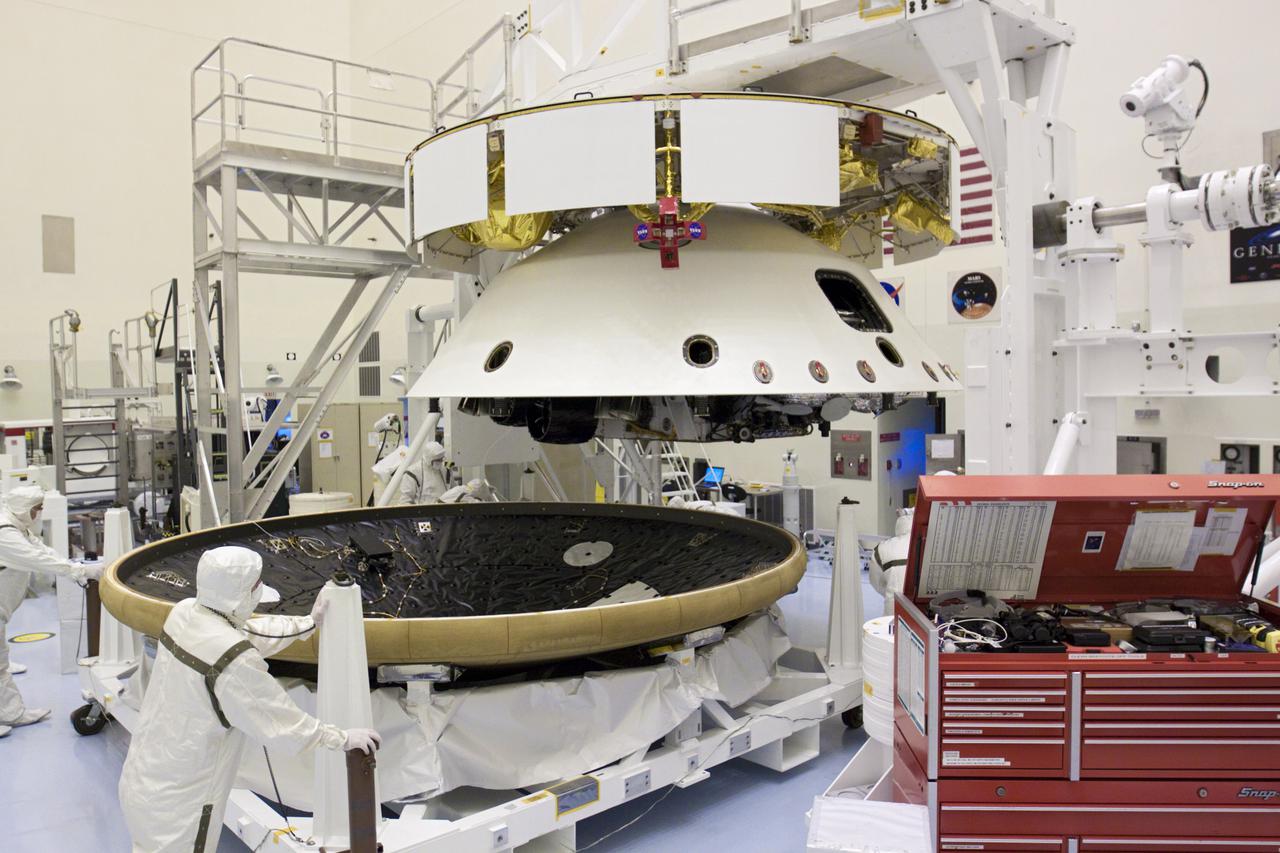
CAPE CANAVERAL, Fla. – In the Payload Hazardous Servicing Facility at NASA’s Kennedy Space Center in Florida, technicians roll the heat shield beneath NASA's Mars Science Laboratory (MSL) mission aeroshell, (containing the compact car-sized rover Curiosity), for integration. Earlier, the aeroshell was mated to the cruise stage, which provides solar power, thrusters for navigation, and heat exchangers to the rover during its flight from Earth to Mars. The rover Curiosity has 10 science instruments designed to search for evidence on whether Mars has had environments favorable to microbial life, including chemical ingredients for life. The unique rover will use a laser to look inside rocks and release its gasses so that the rover’s spectrometer can analyze and send the data back to Earth. Launch of MSL aboard a United Launch Alliance Atlas V rocket is scheduled for Nov. 25 from Space Launch Complex 41 on Cape Canaveral Air Force Station in Florida. For more information, visit http:__www.nasa.gov_msl. Photo credit: NASA_Glenn Benson
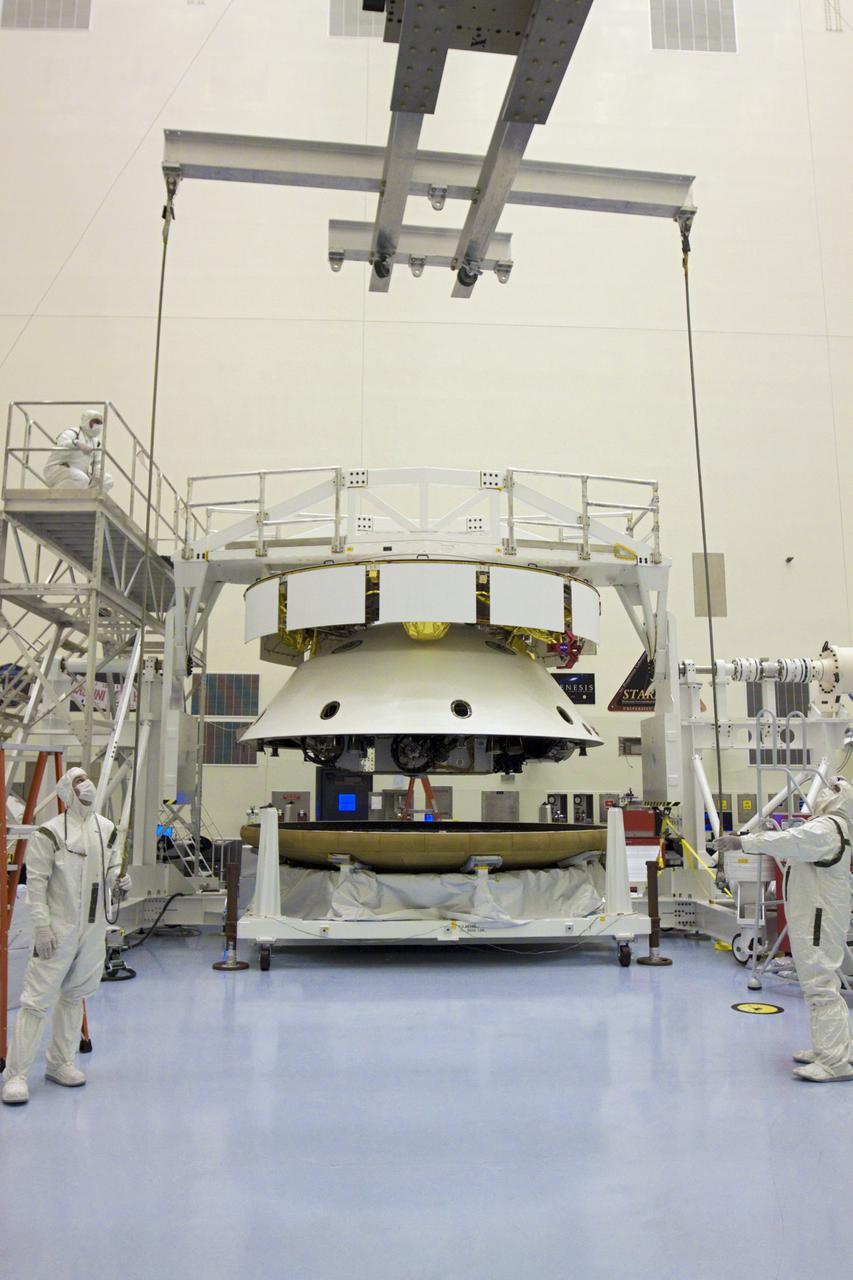
CAPE CANAVERAL, Fla. – In the Payload Hazardous Servicing Facility at NASA’s Kennedy Space Center in Florida, technicians prepare to attach an overhead crane to the heat shield in preparation for integration with NASA's Mars Science Laboratory (MSL) mission aeroshell, (containing the compact car-sized rover Curiosity). Earlier, the aeroshell was mated to the cruise stage, which provides solar power, thrusters for navigation, and heat exchangers to the rover during its flight from Earth to Mars. The rover Curiosity has 10 science instruments designed to search for evidence on whether Mars has had environments favorable to microbial life, including chemical ingredients for life. The unique rover will use a laser to look inside rocks and release its gasses so that the rover’s spectrometer can analyze and send the data back to Earth. Launch of MSL aboard a United Launch Alliance Atlas V rocket is scheduled for Nov. 25 from Space Launch Complex 41 on Cape Canaveral Air Force Station in Florida. For more information, visit http:__www.nasa.gov_msl. Photo credit: NASA_Glenn Benson
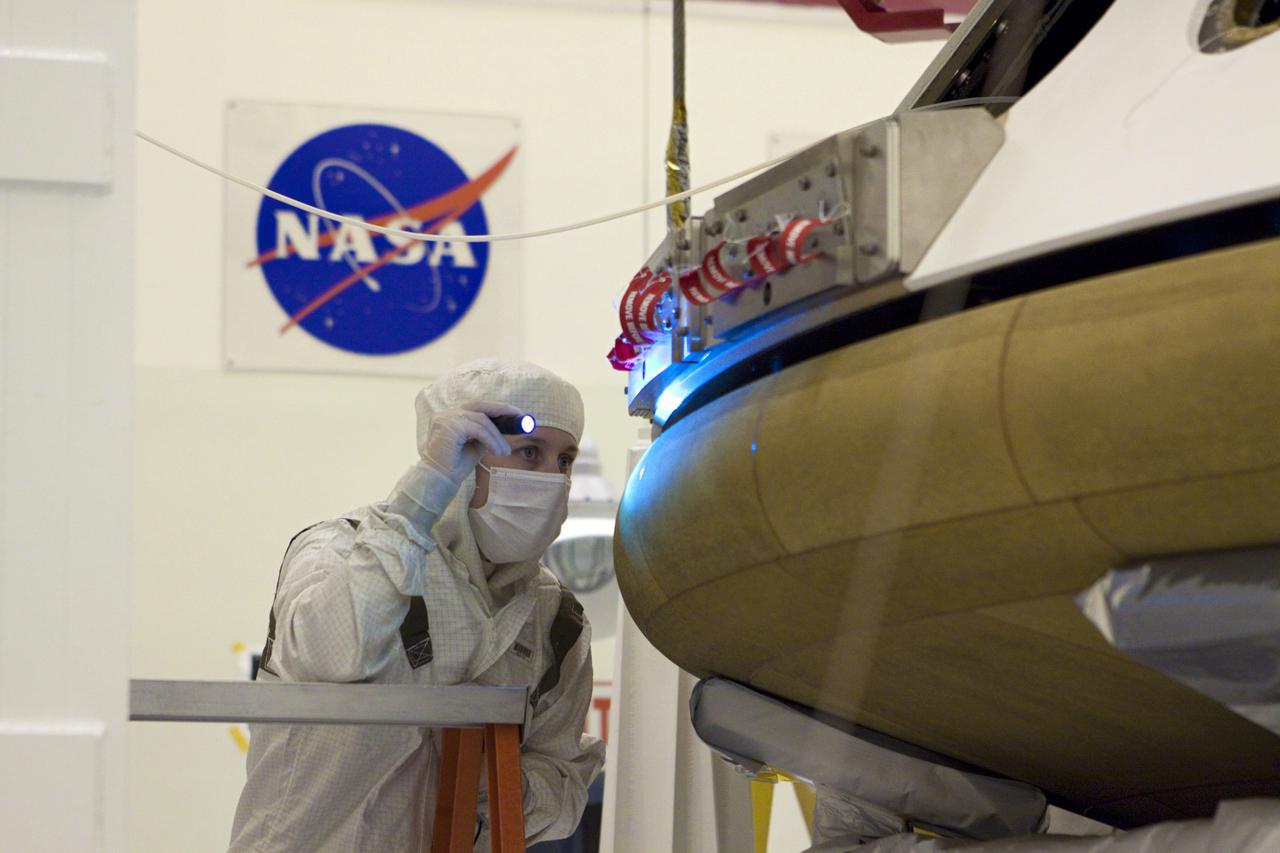
CAPE CANAVERAL, Fla. – In the Payload Hazardous Servicing Facility at NASA’s Kennedy Space Center in Florida, a technician inspects the alignment of the heat shield as an overhead crane lifts it for integration with NASA's Mars Science Laboratory (MSL) mission aeroshell, (containing the compact car-sized rover Curiosity). Earlier, the aeroshell was mated to the cruise stage, which provides solar power, thrusters for navigation, and heat exchangers to the rover during its flight from Earth to Mars. The rover Curiosity has 10 science instruments designed to search for evidence on whether Mars has had environments favorable to microbial life, including chemical ingredients for life. The unique rover will use a laser to look inside rocks and release its gasses so that the rover’s spectrometer can analyze and send the data back to Earth. Launch of MSL aboard a United Launch Alliance Atlas V rocket is scheduled for Nov. 25 from Space Launch Complex 41 on Cape Canaveral Air Force Station in Florida. For more information, visit http:__www.nasa.gov_msl. Photo credit: NASA_Glenn Benson
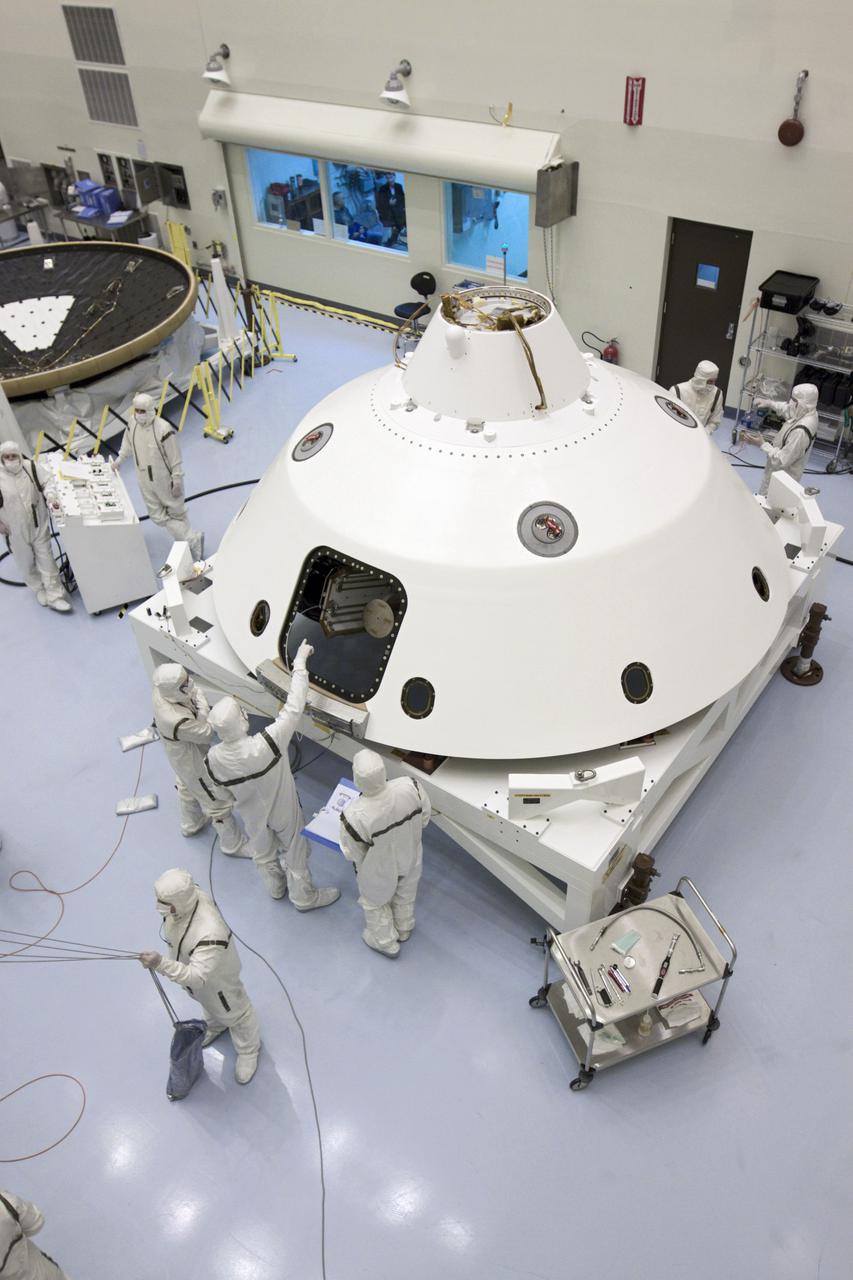
CAPE CANAVERAL, Fla. – In the Payload Hazardous Servicing Facility at NASA’s Kennedy Space Center in Florida, technicians stand next to NASA's Mars Science Laboratory (MSL) mission aeroshell as, in the foreground, a technician guides the cruise stage onto a rotation stand. The cruise stage provides solar power, thrusters for navigation, and heat exchangers to the rover during its flight from Earth to Mars. To the back left is the MSL heat shield. MSL's components include a car-sized rover, Curiosity, which has 10 science instruments designed to search for evidence on whether Mars has had environments favorable to microbial life, including chemical ingredients for life. The unique rover will use a laser to look inside rocks and release its gasses so that the rover’s spectrometer can analyze and send the data back to Earth. Launch of MSL aboard a United Launch Alliance Atlas V rocket is scheduled for Nov. 25 from Space Launch Complex 41 on Cape Canaveral Air Force Station in Florida. For more information, visit http:__www.nasa.gov_msl. Photo credit: NASA_Glenn Benson
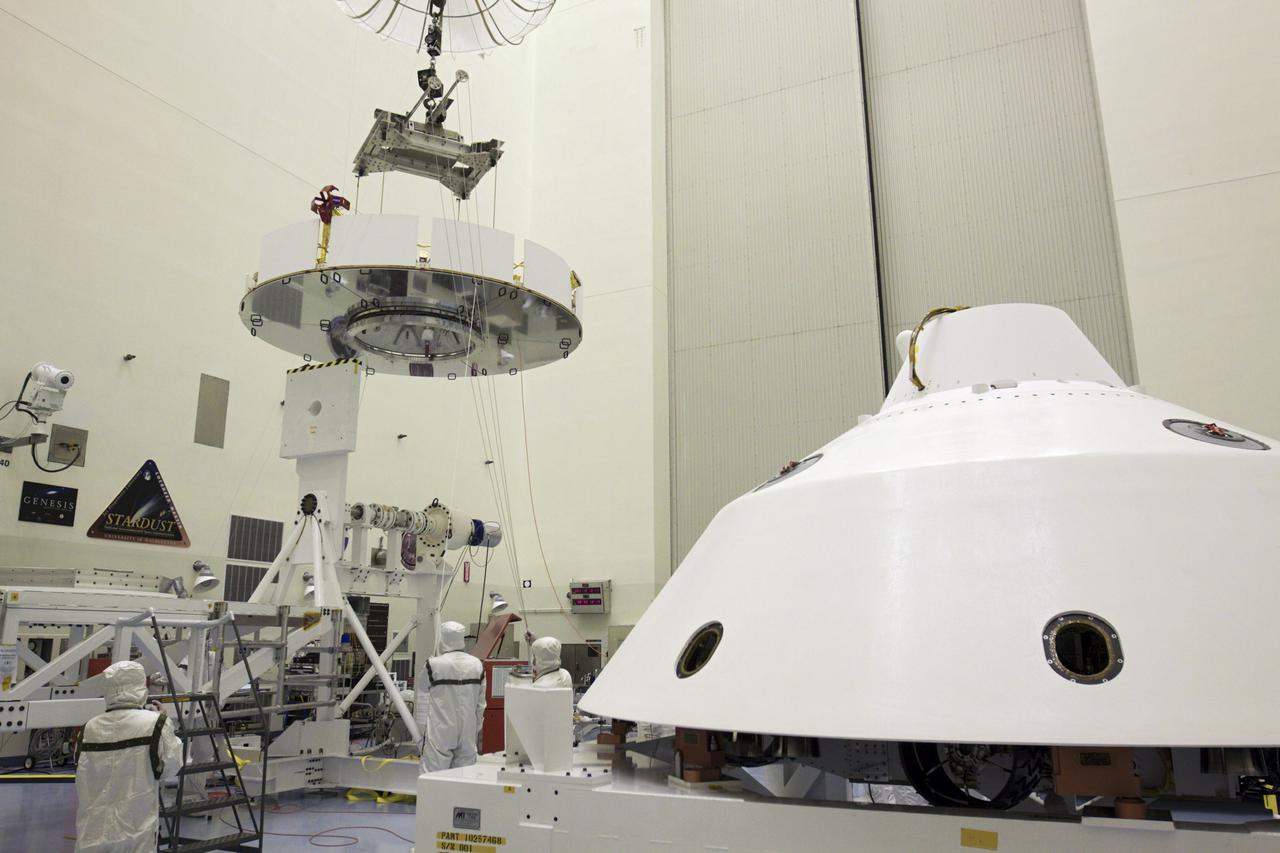
CAPE CANAVERAL, Fla. – In the Payload Hazardous Servicing Facility at NASA’s Kennedy Space Center in Florida, technicians, using an overhead crane, guide NASA's Mars Science Laboratory (MSL) mission cruise stage over a rotation stand. The cruise stage provides solar power, thrusters for navigation, and heat exchangers to the rover during its flight from Earth to Mars. To the right is the MSL aeroshell. MSL's components include a car-sized rover, Curiosity, which has 10 science instruments designed to search for evidence on whether Mars has had environments favorable to microbial life, including chemical ingredients for life. The unique rover will use a laser to look inside rocks and release its gasses so that the rover’s spectrometer can analyze and send the data back to Earth. Launch of MSL aboard a United Launch Alliance Atlas V rocket is scheduled for Nov. 25 from Space Launch Complex 41 on Cape Canaveral Air Force Station in Florida. For more information, visit http:__www.nasa.gov_msl. Photo credit: NASA_Glenn Benson
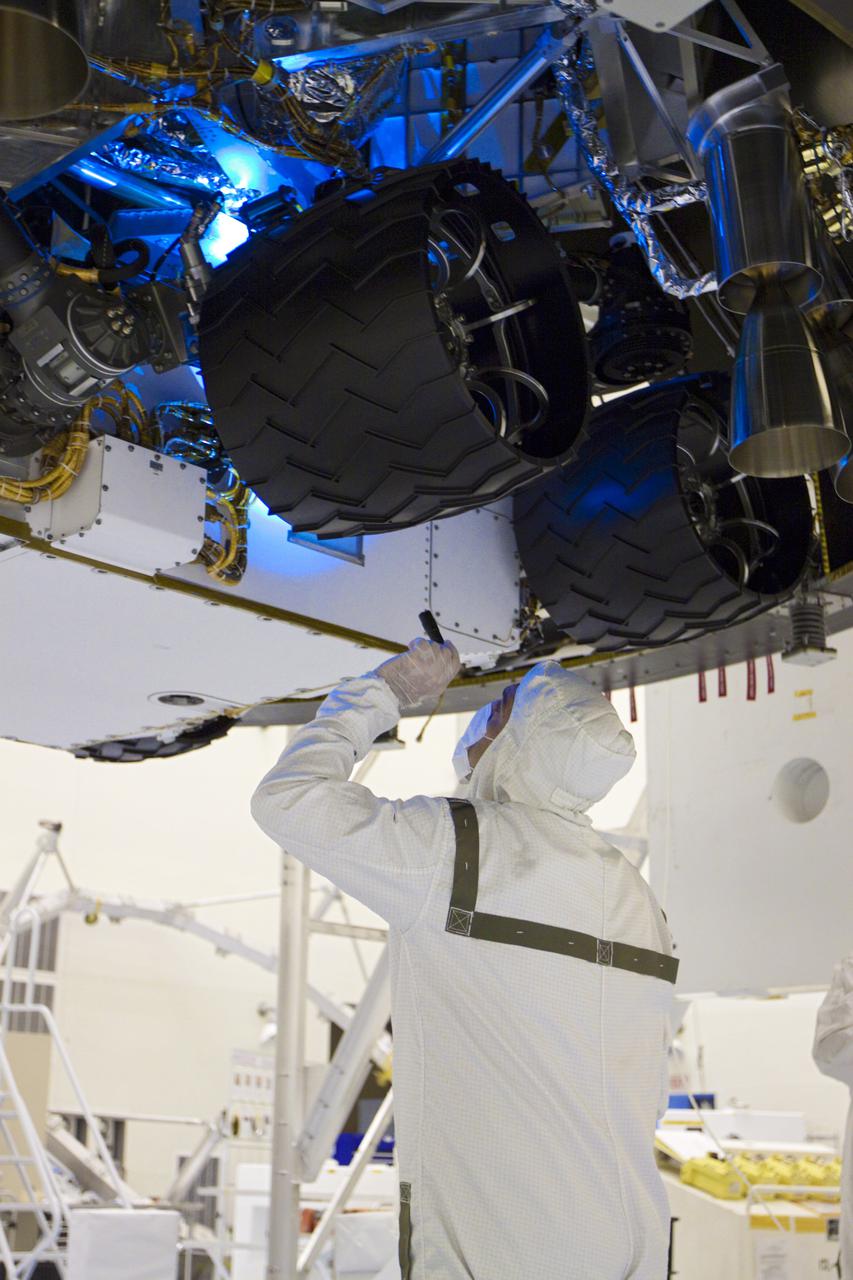
CAPE CANAVERAL, Fla. – In the Payload Hazardous Servicing Facility at NASA’s Kennedy Space Center in Florida, a technician inspects beneath NASA's Mars Science Laboratory (MSL) mission aeroshell, (containing the compact car-sized rover Curiosity), which has been mated to the cruise stage. The cruise stage provides solar power, thrusters for navigation, and heat exchangers to the rover during its flight from Earth to Mars. The rover Curiosity has 10 science instruments designed to search for evidence on whether Mars has had environments favorable to microbial life, including chemical ingredients for life. The unique rover will use a laser to look inside rocks and release its gasses so that the rover’s spectrometer can analyze and send the data back to Earth. Launch of MSL aboard a United Launch Alliance Atlas V rocket is scheduled for Nov. 25 from Space Launch Complex 41 on Cape Canaveral Air Force Station in Florida. For more information, visit http:__www.nasa.gov_msl. Photo credit: NASA_Glenn Benson
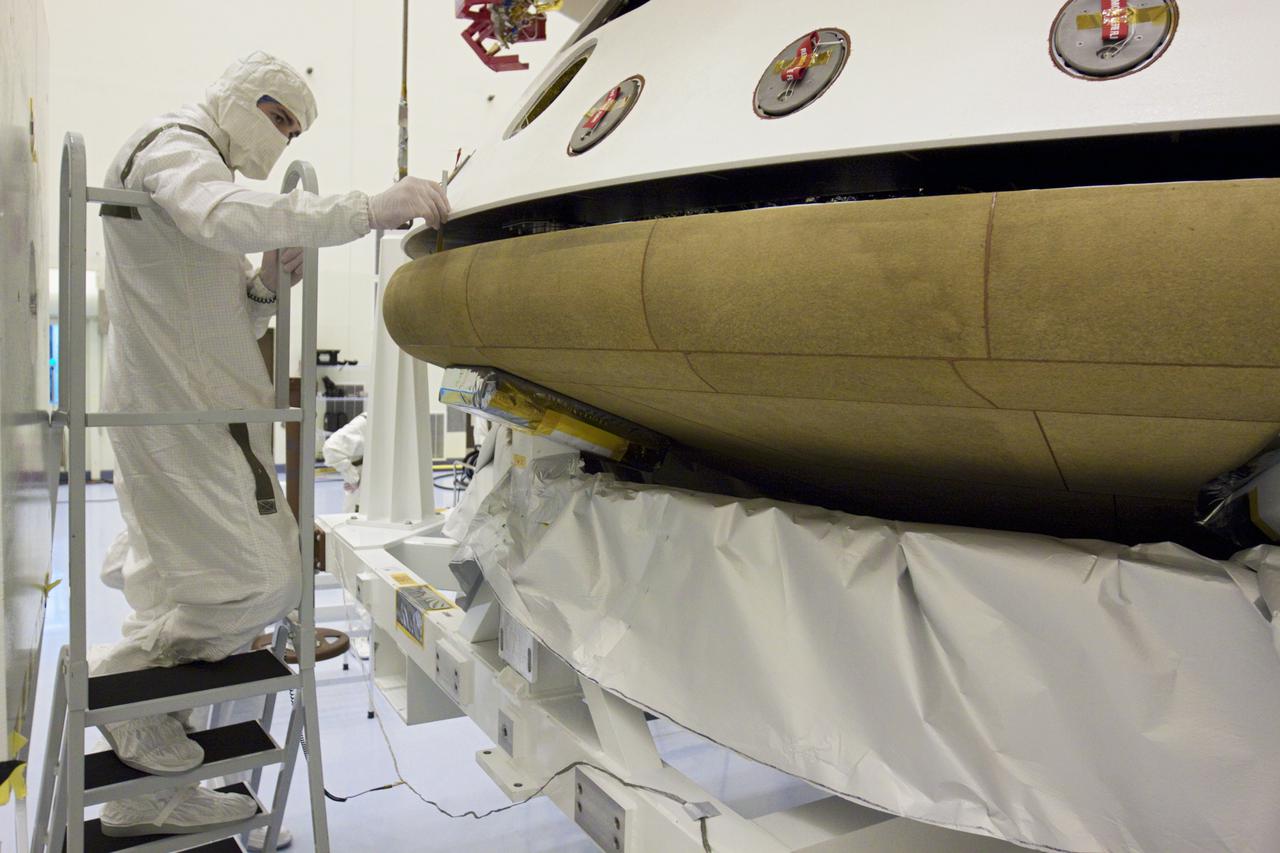
CAPE CANAVERAL, Fla. – In the Payload Hazardous Servicing Facility at NASA’s Kennedy Space Center in Florida, a technician inspects the alignment of the heat shield as an overhead crane lifts it for integration with NASA's Mars Science Laboratory (MSL) mission aeroshell, (containing the compact car-sized rover Curiosity). Earlier, the aeroshell was mated to the cruise stage, which provides solar power, thrusters for navigation, and heat exchangers to the rover during its flight from Earth to Mars. The rover Curiosity has 10 science instruments designed to search for evidence on whether Mars has had environments favorable to microbial life, including chemical ingredients for life. The unique rover will use a laser to look inside rocks and release its gasses so that the rover’s spectrometer can analyze and send the data back to Earth. Launch of MSL aboard a United Launch Alliance Atlas V rocket is scheduled for Nov. 25 from Space Launch Complex 41 on Cape Canaveral Air Force Station in Florida. For more information, visit http:__www.nasa.gov_msl. Photo credit: NASA_Glenn Benson
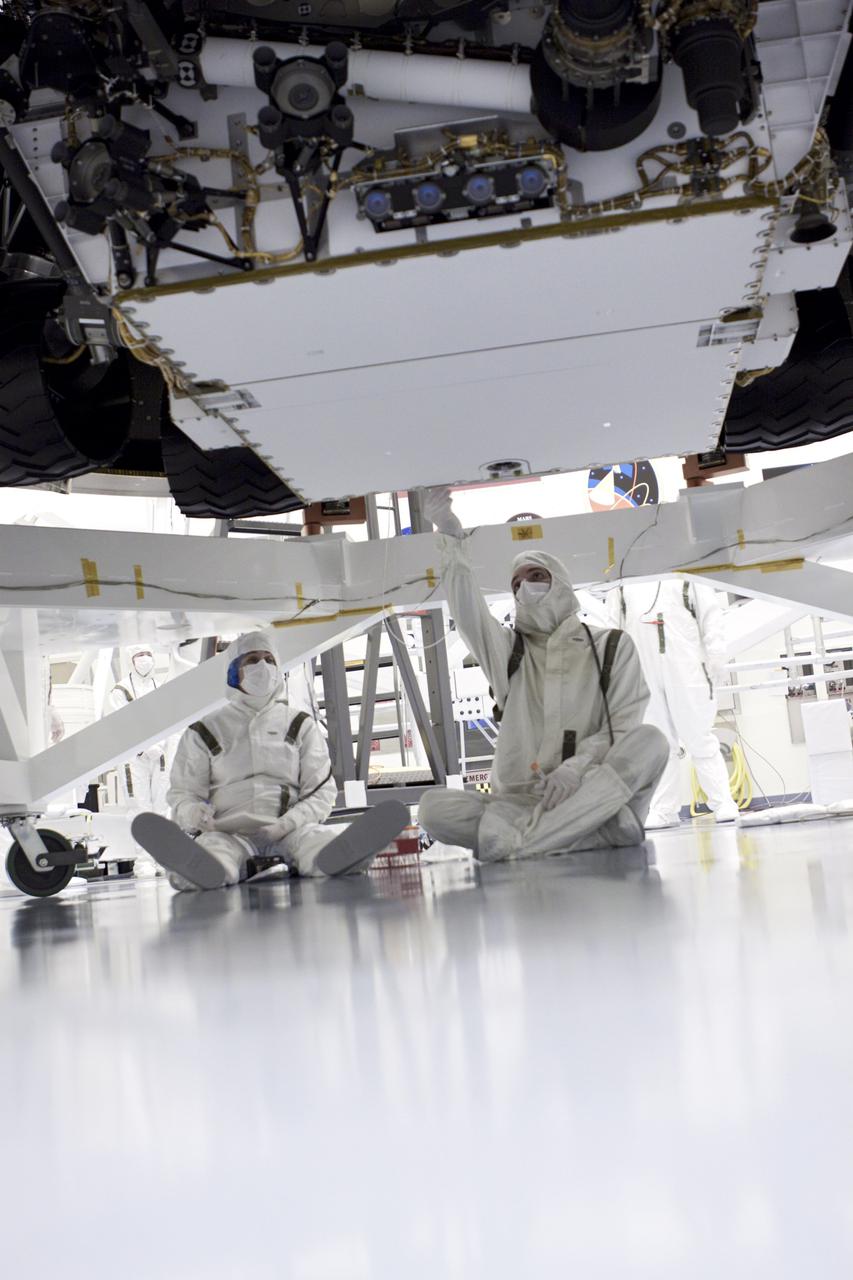
CAPE CANAVERAL, Fla. – In the Payload Hazardous Servicing Facility at NASA’s Kennedy Space Center in Florida, technicians inspect under NASA's Mars Science Laboratory (MSL) mission aeroshell, where the wheels of the rover Curiosity can be seen. MSL's components include a car-sized rover, Curiosity, which has 10 science instruments designed to search for evidence on whether Mars has had environments favorable to microbial life, including chemical ingredients for life. The unique rover will use a laser to look inside rocks and release its gasses so that the rover’s spectrometer can analyze and send the data back to Earth. Launch of MSL aboard a United Launch Alliance Atlas V rocket is scheduled for Nov. 25 from Space Launch Complex 41 on Cape Canaveral Air Force Station in Florida. For more information, visit http:__www.nasa.gov_msl. Photo credit: NASA_Glenn Benson
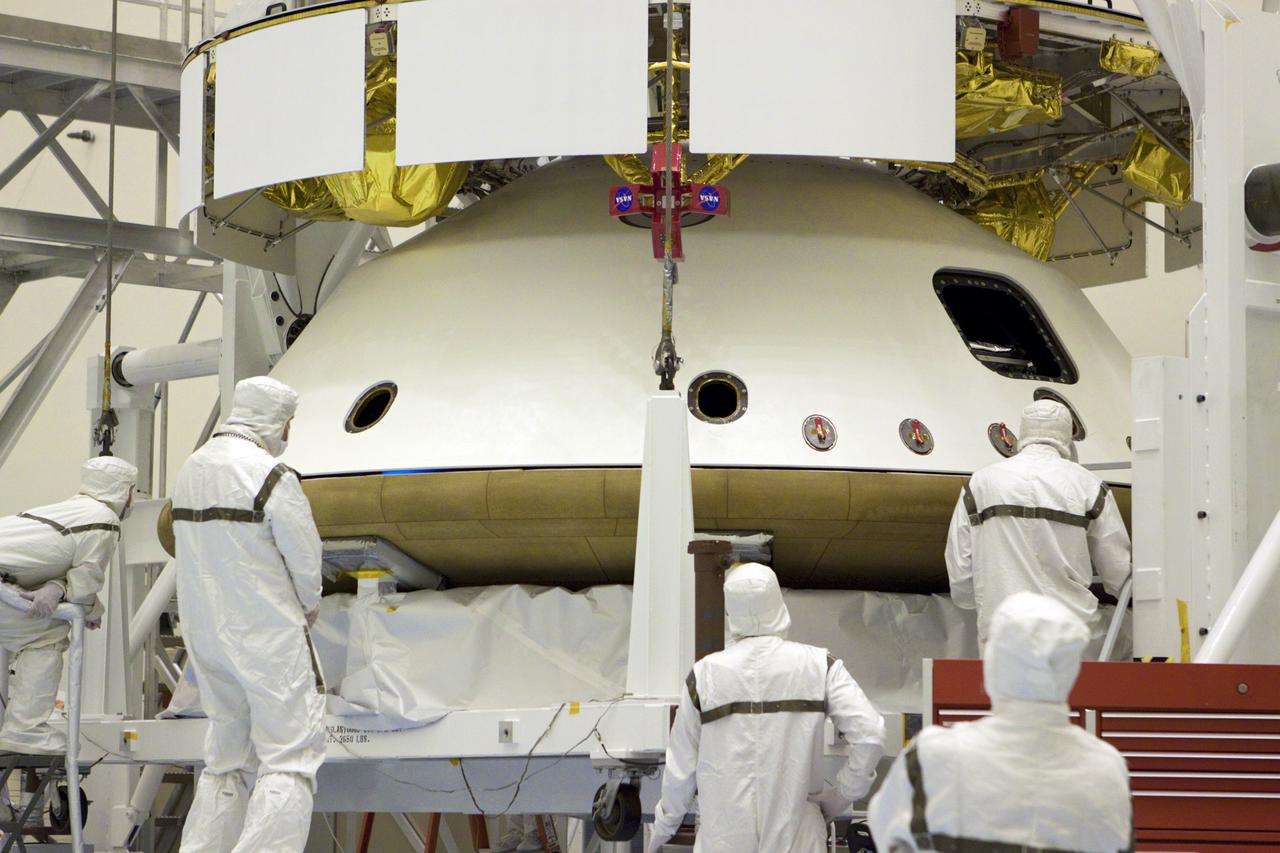
CAPE CANAVERAL, Fla. – In the Payload Hazardous Servicing Facility at NASA’s Kennedy Space Center in Florida, technicians monitor the alignment of the heat shield as an overhead crane lifts it for integration with NASA's Mars Science Laboratory (MSL) mission aeroshell, (containing the compact car-sized rover Curiosity). Earlier, the aeroshell was mated to the cruise stage, which provides solar power, thrusters for navigation, and heat exchangers to the rover during its flight from Earth to Mars. The rover Curiosity has 10 science instruments designed to search for evidence on whether Mars has had environments favorable to microbial life, including chemical ingredients for life. The unique rover will use a laser to look inside rocks and release its gasses so that the rover’s spectrometer can analyze and send the data back to Earth. Launch of MSL aboard a United Launch Alliance Atlas V rocket is scheduled for Nov. 25 from Space Launch Complex 41 on Cape Canaveral Air Force Station in Florida. For more information, visit http:__www.nasa.gov_msl. Photo credit: NASA_Glenn Benson
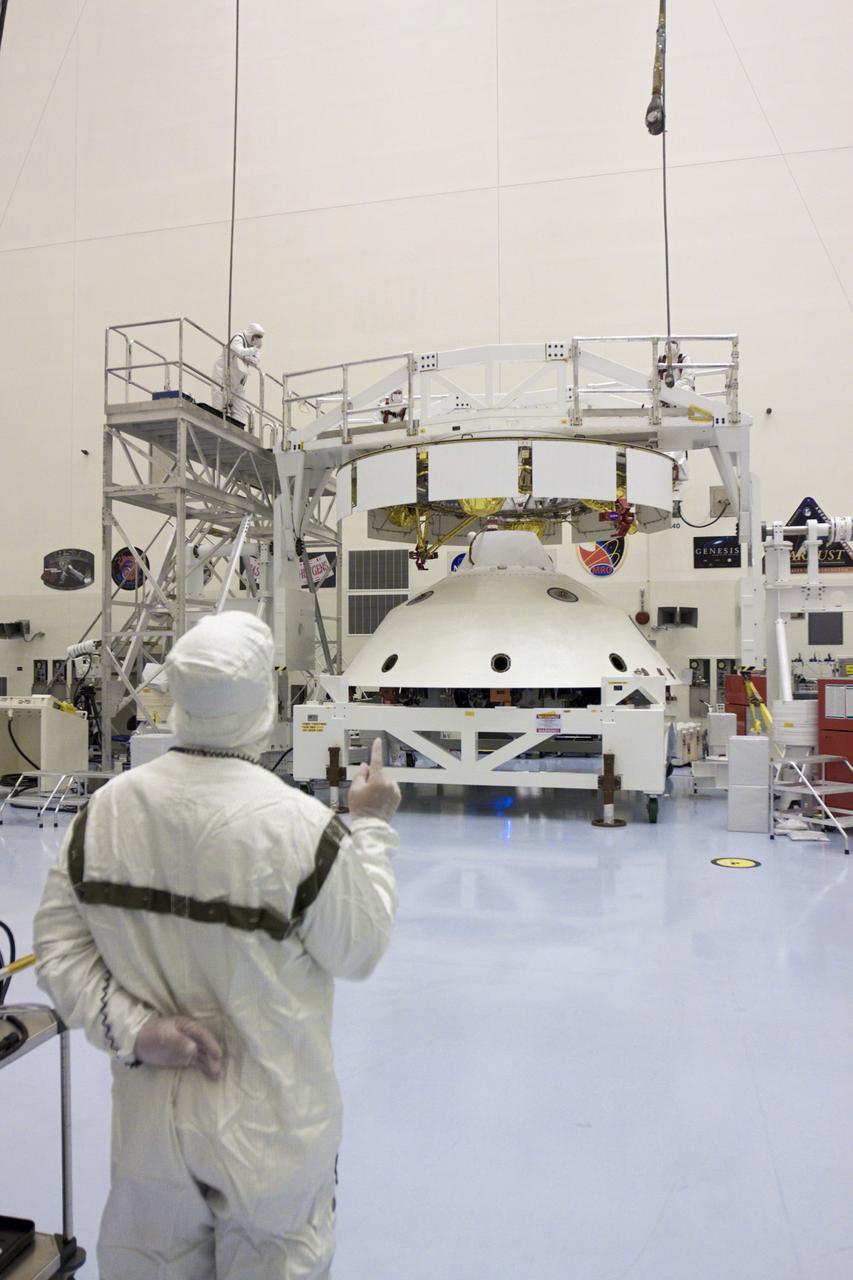
CAPE CANAVERAL, Fla. – In the Payload Hazardous Servicing Facility at NASA’s Kennedy Space Center in Florida, technicians begin the process of mating NASA's Mars Science Laboratory (MSL) mission cruise stage to the aeroshell, which contains the compact car-sized rover Curiosity. The cruise stage provides solar power, thrusters for navigation, and heat exchangers to the rover during its flight from Earth to Mars. The rover Curiosity has 10 science instruments designed to search for evidence on whether Mars has had environments favorable to microbial life, including chemical ingredients for life. The unique rover will use a laser to look inside rocks and release its gasses so that the rover’s spectrometer can analyze and send the data back to Earth. Launch of MSL aboard a United Launch Alliance Atlas V rocket is scheduled for Nov. 25 from Space Launch Complex 41 on Cape Canaveral Air Force Station in Florida. For more information, visit http:__www.nasa.gov_msl. Photo credit: NASA_Glenn Benson
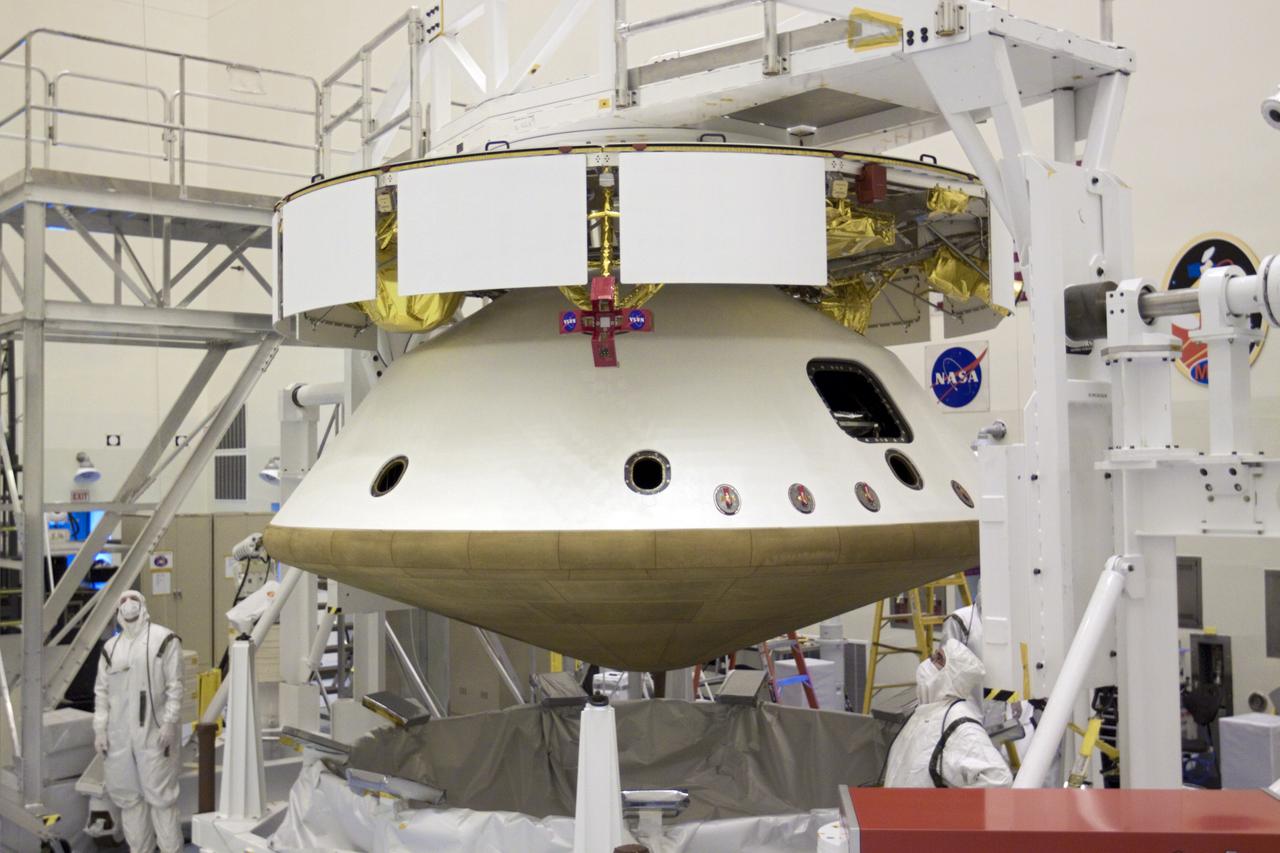
CAPE CANAVERAL, Fla. – In the Payload Hazardous Servicing Facility at NASA’s Kennedy Space Center in Florida, technicians observe the raising of an overhead crane. The crane was used to integrate the heat shield with NASA's Mars Science Laboratory (MSL) mission aeroshell, (containing the compact car-sized rover Curiosity). Earlier, the aeroshell was mated to the cruise stage, which provides solar power, thrusters for navigation, and heat exchangers to the rover during its flight from Earth to Mars. The rover Curiosity has 10 science instruments designed to search for evidence on whether Mars has had environments favorable to microbial life, including chemical ingredients for life. The unique rover will use a laser to look inside rocks and release its gasses so that the rover’s spectrometer can analyze and send the data back to Earth. Launch of MSL aboard a United Launch Alliance Atlas V rocket is scheduled for Nov. 25 from Space Launch Complex 41 on Cape Canaveral Air Force Station in Florida. For more information, visit http:__www.nasa.gov_msl. Photo credit: NASA_Glenn Benson
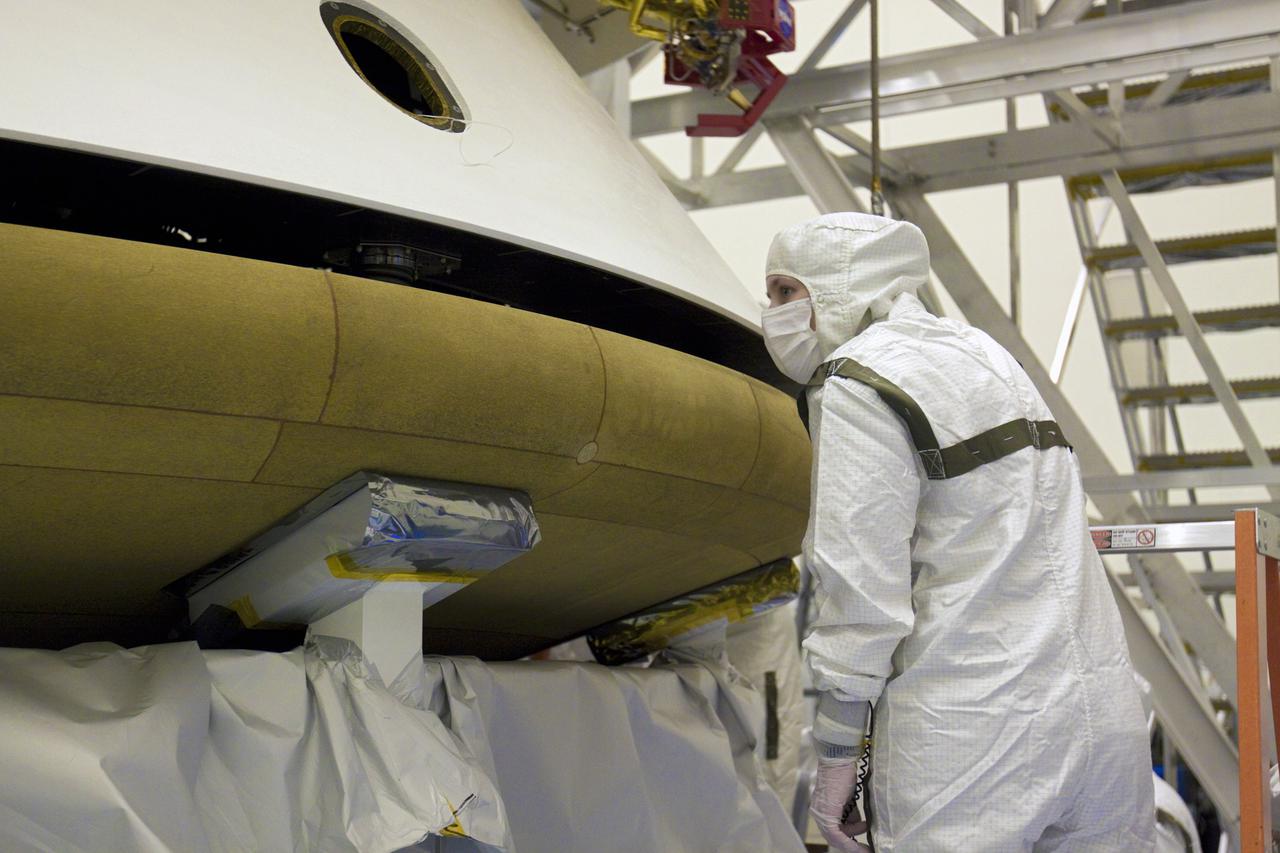
CAPE CANAVERAL, Fla. – In the Payload Hazardous Servicing Facility at NASA’s Kennedy Space Center in Florida, a technician inspects the alignment of the heat shield as an overhead crane lifts it for integration with NASA's Mars Science Laboratory (MSL) mission aeroshell, (containing the compact car-sized rover Curiosity). Earlier, the aeroshell was mated to the cruise stage, which provides solar power, thrusters for navigation, and heat exchangers to the rover during its flight from Earth to Mars. The rover Curiosity has 10 science instruments designed to search for evidence on whether Mars has had environments favorable to microbial life, including chemical ingredients for life. The unique rover will use a laser to look inside rocks and release its gasses so that the rover’s spectrometer can analyze and send the data back to Earth. Launch of MSL aboard a United Launch Alliance Atlas V rocket is scheduled for Nov. 25 from Space Launch Complex 41 on Cape Canaveral Air Force Station in Florida. For more information, visit http:__www.nasa.gov_msl. Photo credit: NASA_Glenn Benson
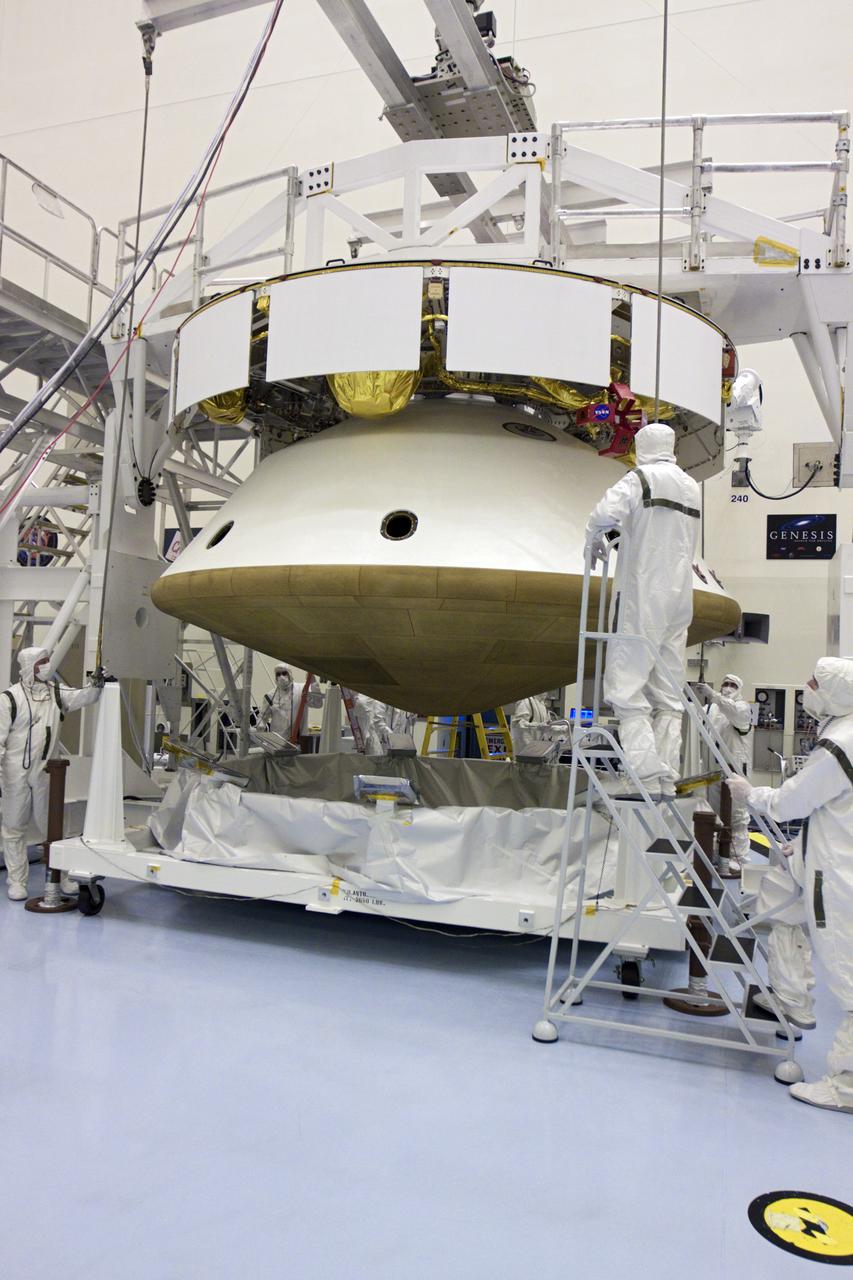
CAPE CANAVERAL, Fla. – In the Payload Hazardous Servicing Facility at NASA’s Kennedy Space Center in Florida, technicians detach the overhead crane from the heat shield after integration with NASA's Mars Science Laboratory (MSL) mission aeroshell, (containing the compact car-sized rover Curiosity). Earlier, the aeroshell was mated to the cruise stage, which provides solar power, thrusters for navigation, and heat exchangers to the rover during its flight from Earth to Mars. The rover Curiosity has 10 science instruments designed to search for evidence on whether Mars has had environments favorable to microbial life, including chemical ingredients for life. The unique rover will use a laser to look inside rocks and release its gasses so that the rover’s spectrometer can analyze and send the data back to Earth. Launch of MSL aboard a United Launch Alliance Atlas V rocket is scheduled for Nov. 25 from Space Launch Complex 41 on Cape Canaveral Air Force Station in Florida. For more information, visit http:__www.nasa.gov_msl. Photo credit: NASA_Glenn Benson
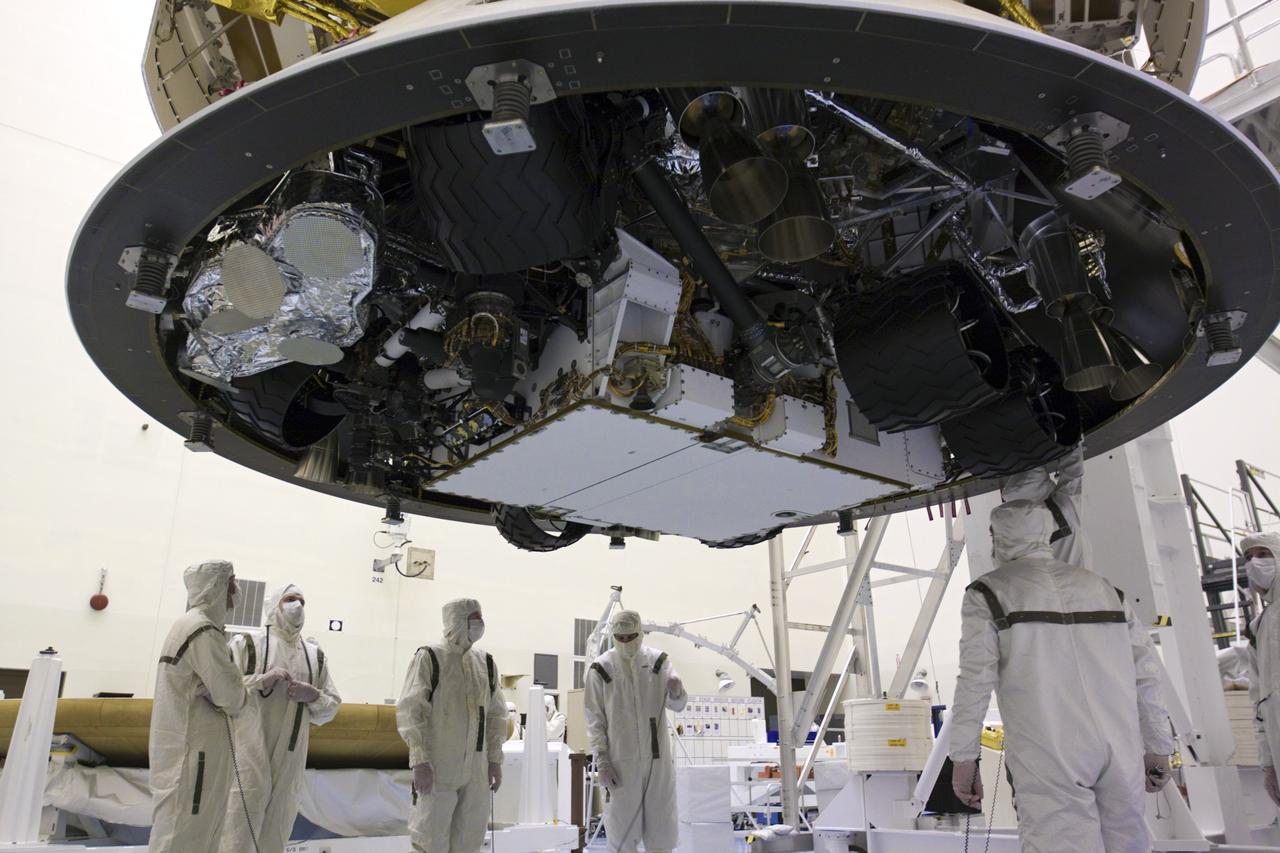
CAPE CANAVERAL, Fla. – In the Payload Hazardous Servicing Facility at NASA’s Kennedy Space Center in Florida, technicians work beneath NASA's Mars Science Laboratory (MSL) mission aeroshell, (containing the compact car-sized rover Curiosity), which has been mated to the cruise stage. The cruise stage provides solar power, thrusters for navigation, and heat exchangers to the rover during its flight from Earth to Mars. The rover Curiosity has 10 science instruments designed to search for evidence on whether Mars has had environments favorable to microbial life, including chemical ingredients for life. The unique rover will use a laser to look inside rocks and release its gasses so that the rover’s spectrometer can analyze and send the data back to Earth. Launch of MSL aboard a United Launch Alliance Atlas V rocket is scheduled for Nov. 25 from Space Launch Complex 41 on Cape Canaveral Air Force Station in Florida. For more information, visit http:__www.nasa.gov_msl. Photo credit: NASA_Glenn Benson
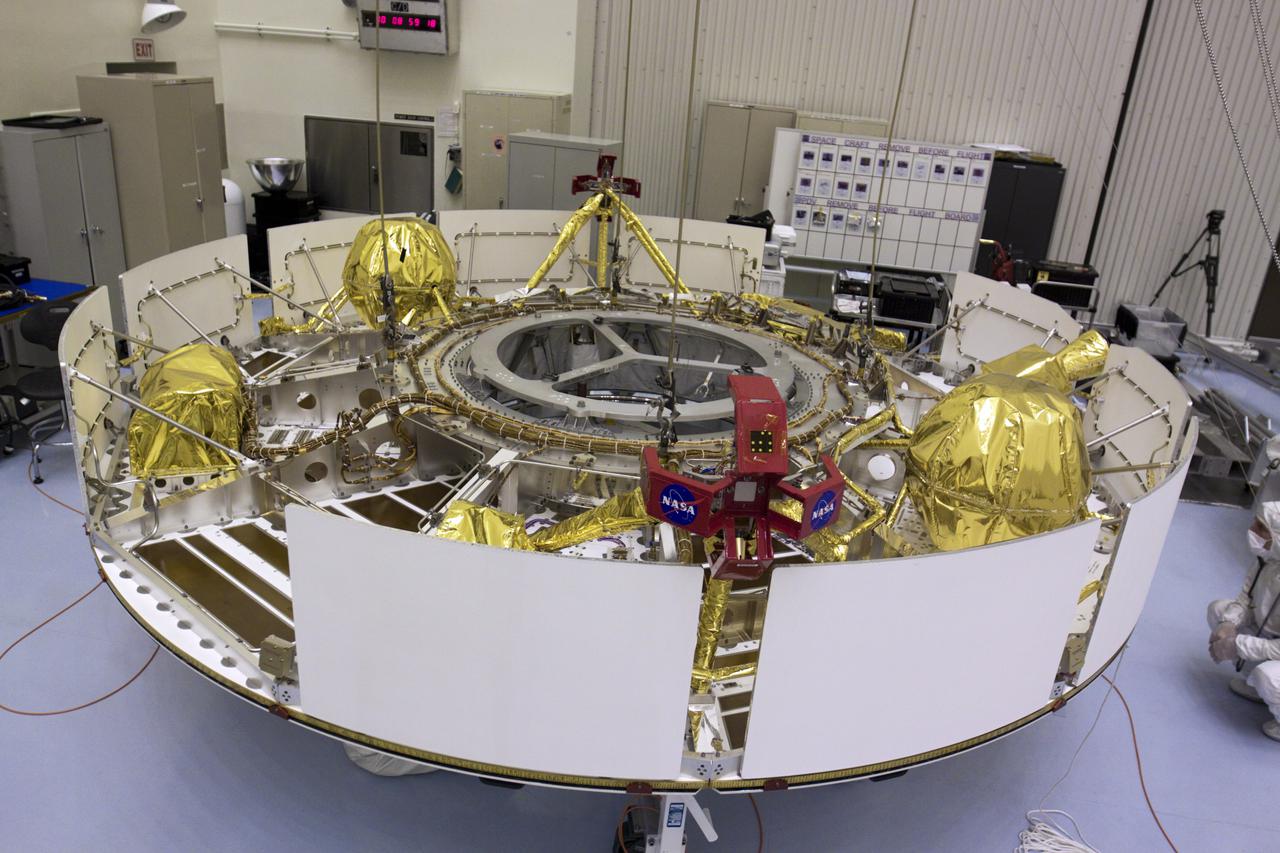
CAPE CANAVERAL, Fla. – In the Payload Hazardous Servicing Facility at NASA’s Kennedy Space Center in Florida, an overhead crane has been attached to NASA's Mars Science Laboratory (MSL) mission cruise stage. The cruise stage, which will be lifted onto a rotation stand, provides solar power, thrusters for navigation, and heat exchangers to the rover during its flight from Earth to Mars. MSL's components include a car-sized rover, Curiosity, which has 10 science instruments designed to search for evidence on whether Mars has had environments favorable to microbial life, including chemical ingredients for life. The unique rover will use a laser to look inside rocks and release its gasses so that the rover’s spectrometer can analyze and send the data back to Earth. Launch of MSL aboard a United Launch Alliance Atlas V rocket is scheduled for Nov. 25 from Space Launch Complex 41 on Cape Canaveral Air Force Station in Florida. For more information, visit http:__www.nasa.gov_msl. Photo credit: NASA_Glenn Benson
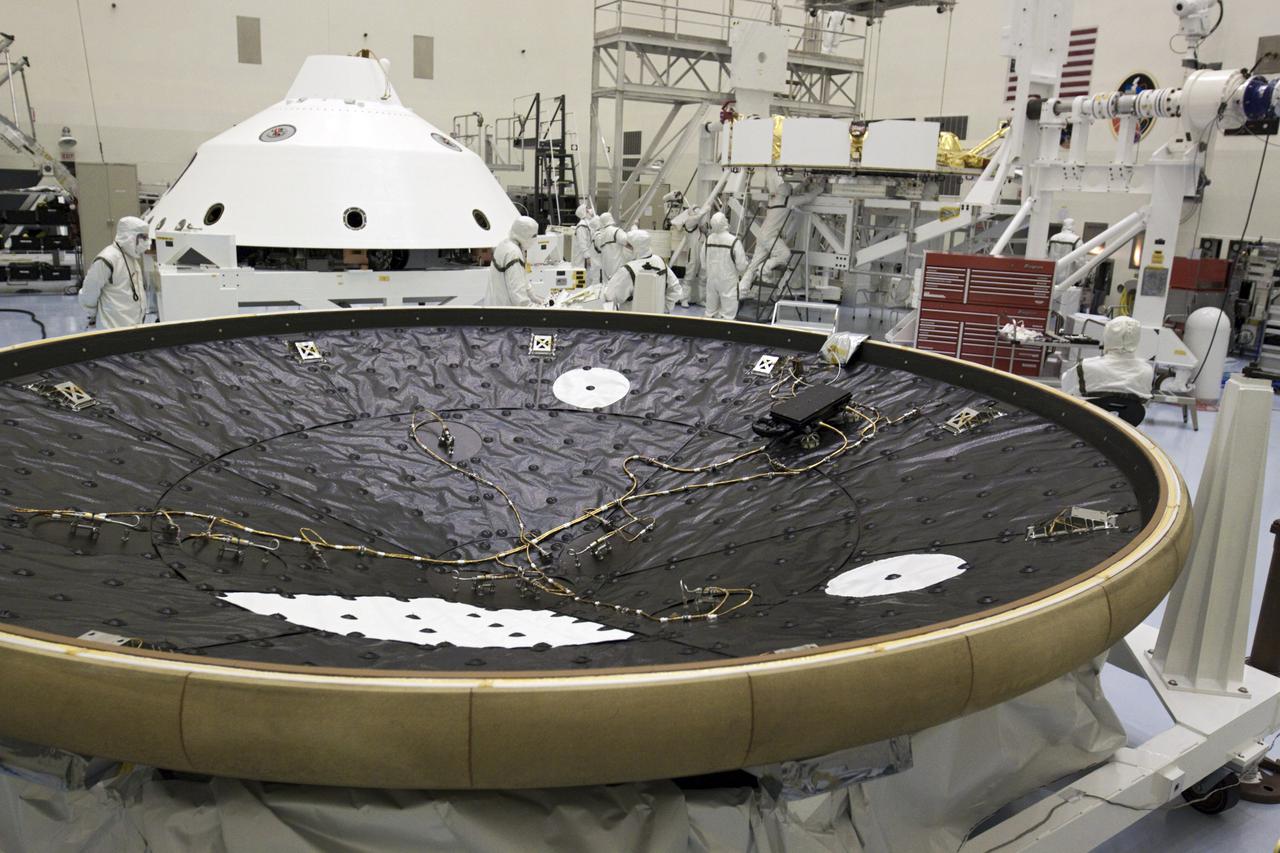
CAPE CANAVERAL, Fla. – In the Payload Hazardous Servicing Facility at NASA’s Kennedy Space Center in Florida, technicians inspect NASA's Mars Science Laboratory (MSL) mission cruise stage as it is guided onto a rotation stand. The cruise stage provides solar power, thrusters for navigation, and heat exchangers to the rover during its flight from Earth to Mars. In the foreground is the MSL heat shield and to the left, the aeroshell. MSL's components include a car-sized rover, Curiosity, which has 10 science instruments designed to search for evidence on whether Mars has had environments favorable to microbial life, including chemical ingredients for life. The unique rover will use a laser to look inside rocks and release its gasses so that the rover’s spectrometer can analyze and send the data back to Earth. Launch of MSL aboard a United Launch Alliance Atlas V rocket is scheduled for Nov. 25 from Space Launch Complex 41 on Cape Canaveral Air Force Station in Florida. For more information, visit http:__www.nasa.gov_msl. Photo credit: NASA_Glenn Benson
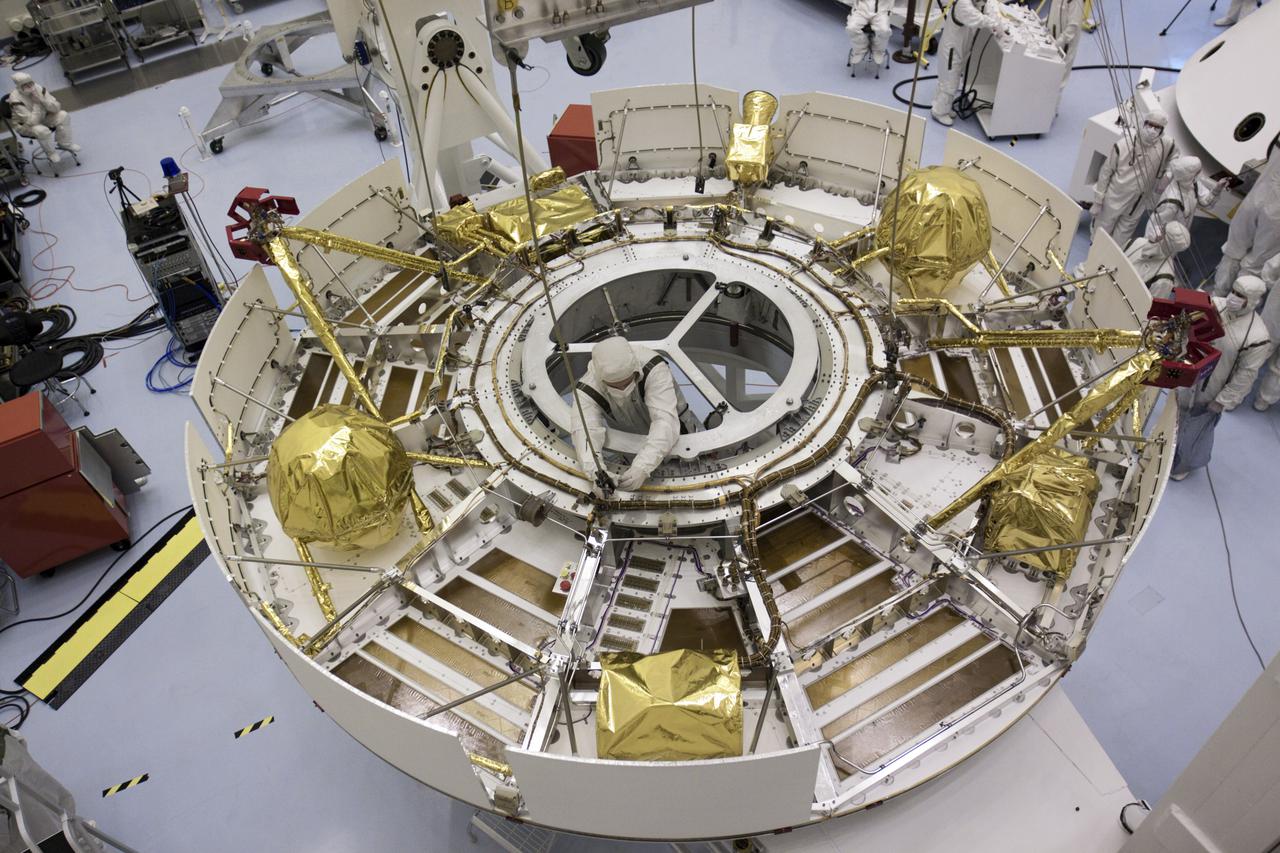
CAPE CANAVERAL, Fla. – In the Payload Hazardous Servicing Facility at NASA’s Kennedy Space Center in Florida, the camera captures a unique view of NASA's Mars Science Laboratory (MSL) mission as a technician separates the overhead crane from the cruise stage after it was lifted onto a rotation stand. The cruise stage provides solar power, thrusters for navigation, and heat exchangers to the rover during its flight from Earth to Mars. MSL's components include a car-sized rover, Curiosity, which has 10 science instruments designed to search for evidence on whether Mars has had environments favorable to microbial life, including chemical ingredients for life. The unique rover will use a laser to look inside rocks and release its gasses so that the rover’s spectrometer can analyze and send the data back to Earth. Launch of MSL aboard a United Launch Alliance Atlas V rocket is scheduled for Nov. 25 from Space Launch Complex 41 on Cape Canaveral Air Force Station in Florida. For more information, visit http:__www.nasa.gov_msl. Photo credit: NASA_Glenn Benson

CAPE CANAVERAL, Fla. – In the Payload Hazardous Servicing Facility at NASA’s Kennedy Space Center in Florida, technicians move the heat shield carrier away from under the heat shield after integration with NASA's Mars Science Laboratory (MSL) mission aeroshell, (containing the compact car-sized rover Curiosity). Earlier, the aeroshell was mated to the cruise stage, which provides solar power, thrusters for navigation, and heat exchangers to the rover during its flight from Earth to Mars. The rover Curiosity has 10 science instruments designed to search for evidence on whether Mars has had environments favorable to microbial life, including chemical ingredients for life. The unique rover will use a laser to look inside rocks and release its gasses so that the rover’s spectrometer can analyze and send the data back to Earth. Launch of MSL aboard a United Launch Alliance Atlas V rocket is scheduled for Nov. 25 from Space Launch Complex 41 on Cape Canaveral Air Force Station in Florida. For more information, visit http:__www.nasa.gov_msl. Photo credit: NASA_Glenn Benson
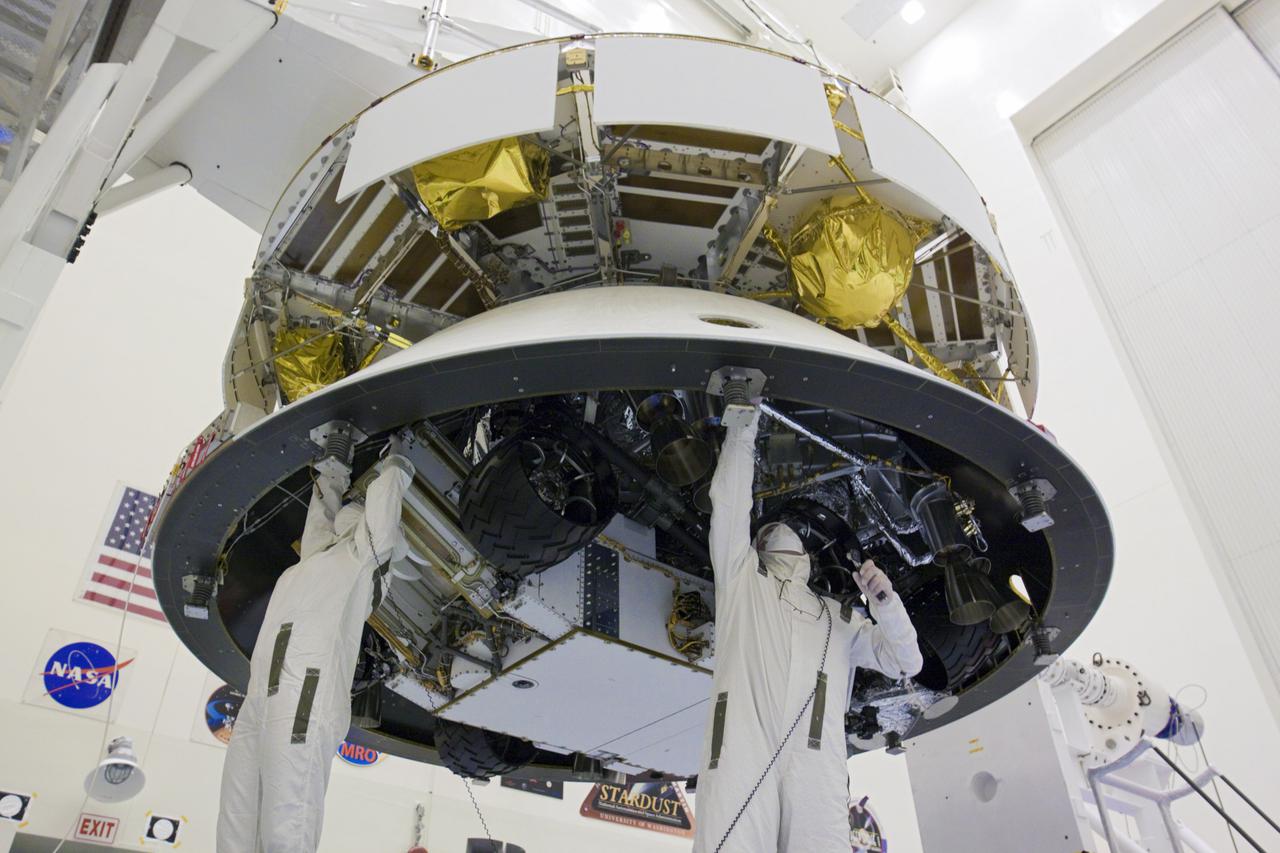
CAPE CANAVERAL, Fla. – In the Payload Hazardous Servicing Facility at NASA’s Kennedy Space Center in Florida, technicians work beneath NASA's Mars Science Laboratory (MSL) mission aeroshell, (containing the compact car-sized rover Curiosity), which has been mated to the cruise stage. The cruise stage provides solar power, thrusters for navigation, and heat exchangers to the rover during its flight from Earth to Mars. The rover Curiosity has 10 science instruments designed to search for evidence on whether Mars has had environments favorable to microbial life, including chemical ingredients for life. The unique rover will use a laser to look inside rocks and release its gasses so that the rover’s spectrometer can analyze and send the data back to Earth. Launch of MSL aboard a United Launch Alliance Atlas V rocket is scheduled for Nov. 25 from Space Launch Complex 41 on Cape Canaveral Air Force Station in Florida. For more information, visit http:__www.nasa.gov_msl. Photo credit: NASA_Glenn Benson
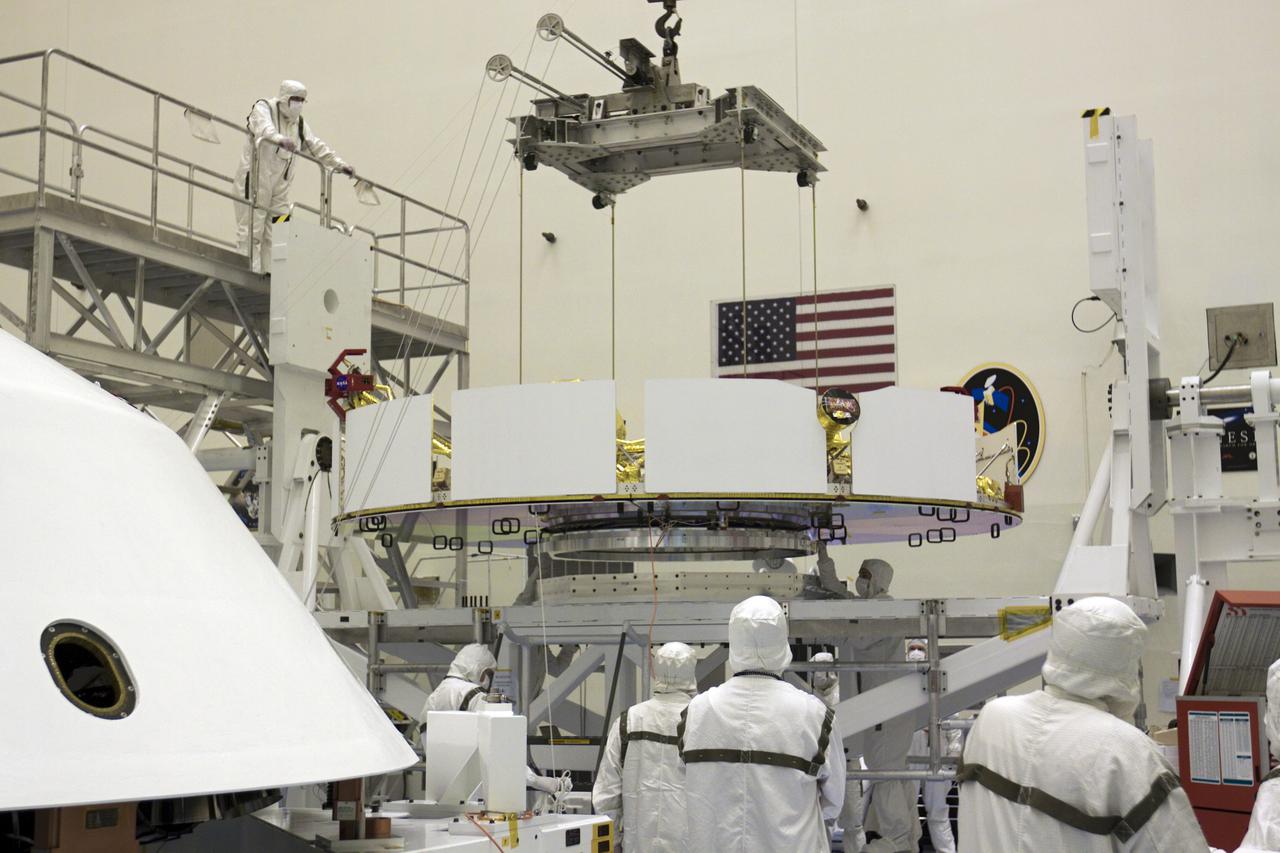
CAPE CANAVERAL, Fla. – In the Payload Hazardous Servicing Facility at NASA’s Kennedy Space Center in Florida, technicians inspect NASA's Mars Science Laboratory (MSL) mission cruise stage as it is guided onto a rotation stand. The cruise stage provides solar power, thrusters for navigation, and heat exchangers to the rover during its flight from Earth to Mars. MSL's components include a car-sized rover, Curiosity, which has 10 science instruments designed to search for evidence on whether Mars has had environments favorable to microbial life, including chemical ingredients for life. The unique rover will use a laser to look inside rocks and release its gasses so that the rover’s spectrometer can analyze and send the data back to Earth. Launch of MSL aboard a United Launch Alliance Atlas V rocket is scheduled for Nov. 25 from Space Launch Complex 41 on Cape Canaveral Air Force Station in Florida. For more information, visit http:__www.nasa.gov_msl. Photo credit: NASA_Glenn Benson
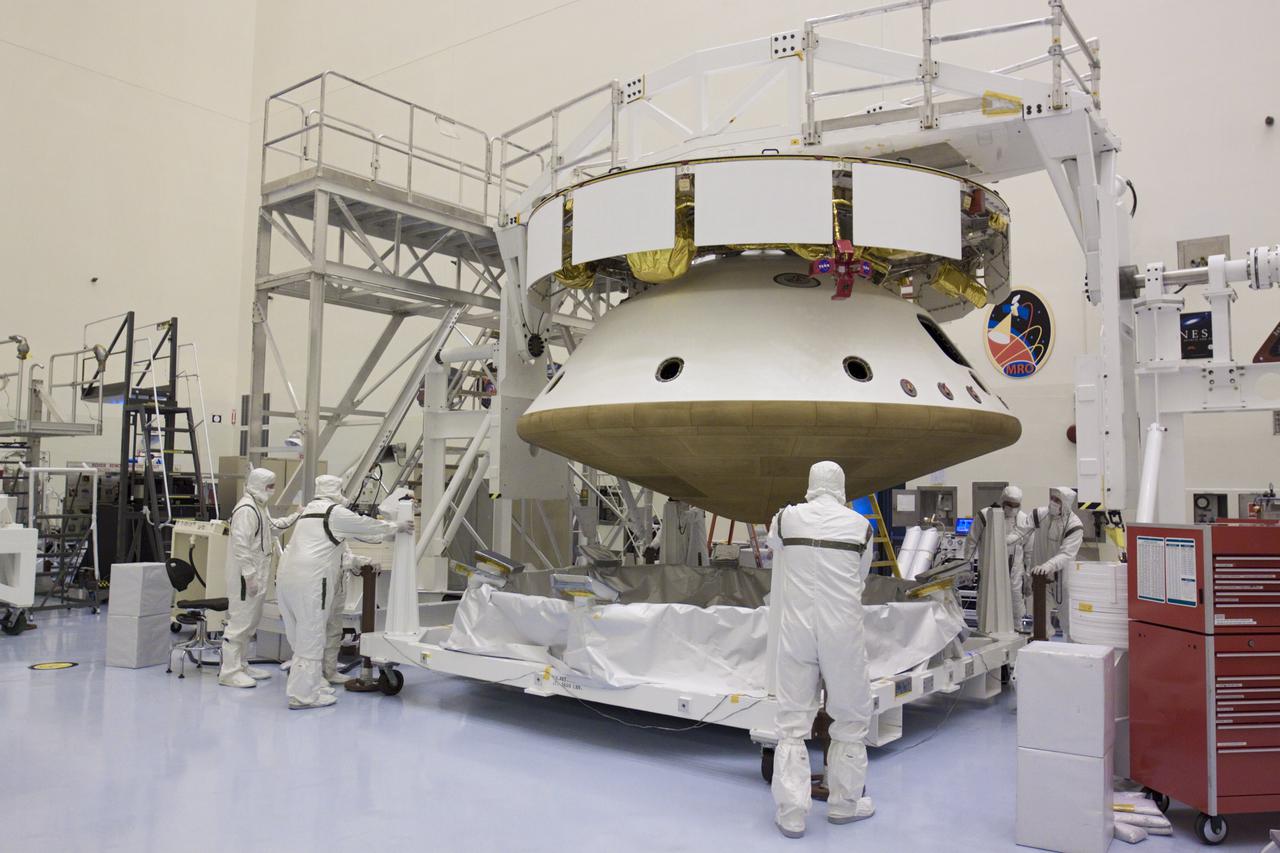
CAPE CANAVERAL, Fla. – In the Payload Hazardous Servicing Facility at NASA’s Kennedy Space Center in Florida, technicians move the heat shield carrier away from under the heat shield after integration with NASA's Mars Science Laboratory (MSL) mission aeroshell, (containing the compact car-sized rover Curiosity). Earlier, the aeroshell was mated to the cruise stage, which provides solar power, thrusters for navigation, and heat exchangers to the rover during its flight from Earth to Mars. The rover Curiosity has 10 science instruments designed to search for evidence on whether Mars has had environments favorable to microbial life, including chemical ingredients for life. The unique rover will use a laser to look inside rocks and release its gasses so that the rover’s spectrometer can analyze and send the data back to Earth. Launch of MSL aboard a United Launch Alliance Atlas V rocket is scheduled for Nov. 25 from Space Launch Complex 41 on Cape Canaveral Air Force Station in Florida. For more information, visit http:__www.nasa.gov_msl. Photo credit: NASA_Glenn Benson
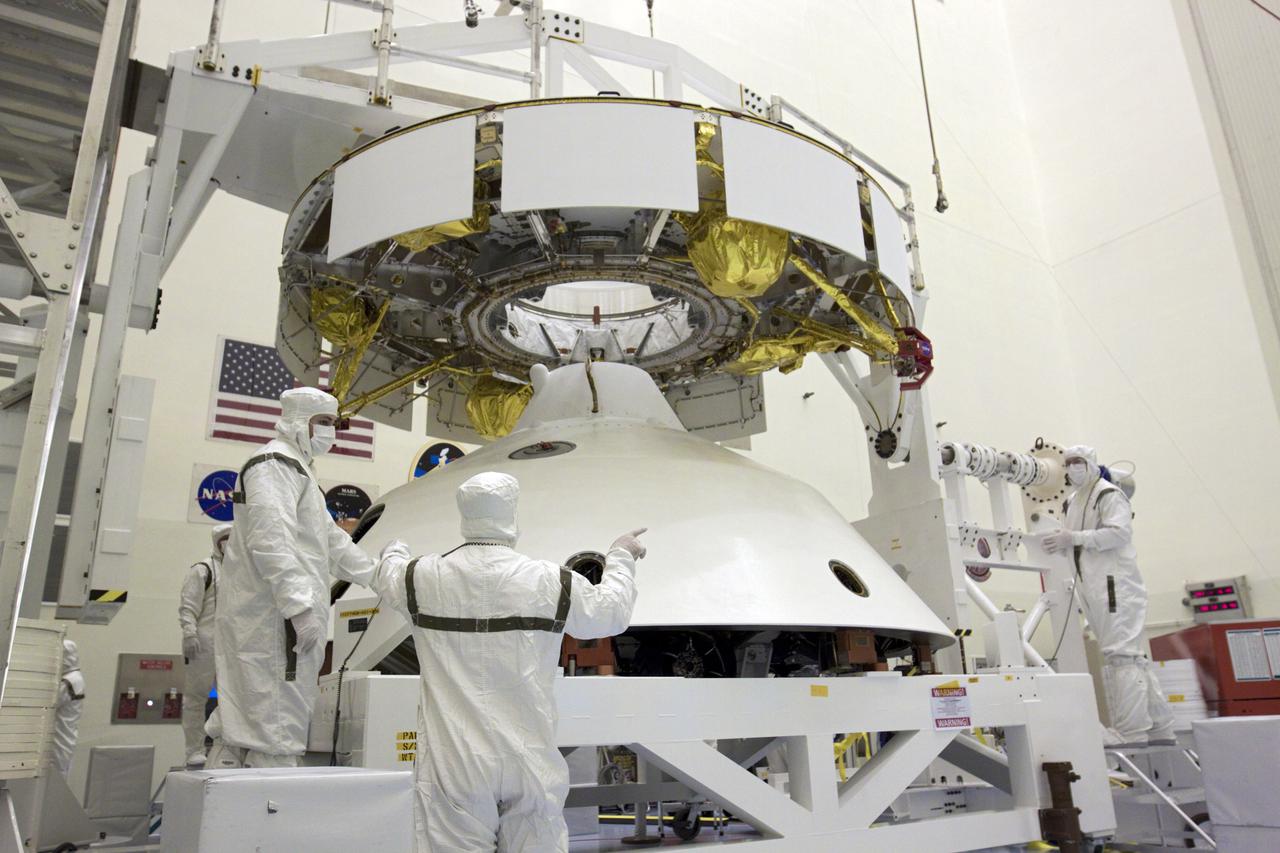
CAPE CANAVERAL, Fla. – In the Payload Hazardous Servicing Facility at NASA’s Kennedy Space Center in Florida, technicians prepare to attach an overhead crane to NASA's Mars Science Laboratory (MSL) mission aeroshell, (containing the compact car-sized rover Curiosity), which will be mated to the cruise stage. The cruise stage provides solar power, thrusters for navigation, and heat exchangers to the rover during its flight from Earth to Mars. The rover Curiosity has 10 science instruments designed to search for evidence on whether Mars has had environments favorable to microbial life, including chemical ingredients for life. The unique rover will use a laser to look inside rocks and release its gasses so that the rover’s spectrometer can analyze and send the data back to Earth. Launch of MSL aboard a United Launch Alliance Atlas V rocket is scheduled for Nov. 25 from Space Launch Complex 41 on Cape Canaveral Air Force Station in Florida. For more information, visit http:__www.nasa.gov_msl. Photo credit: NASA_Glenn Benson
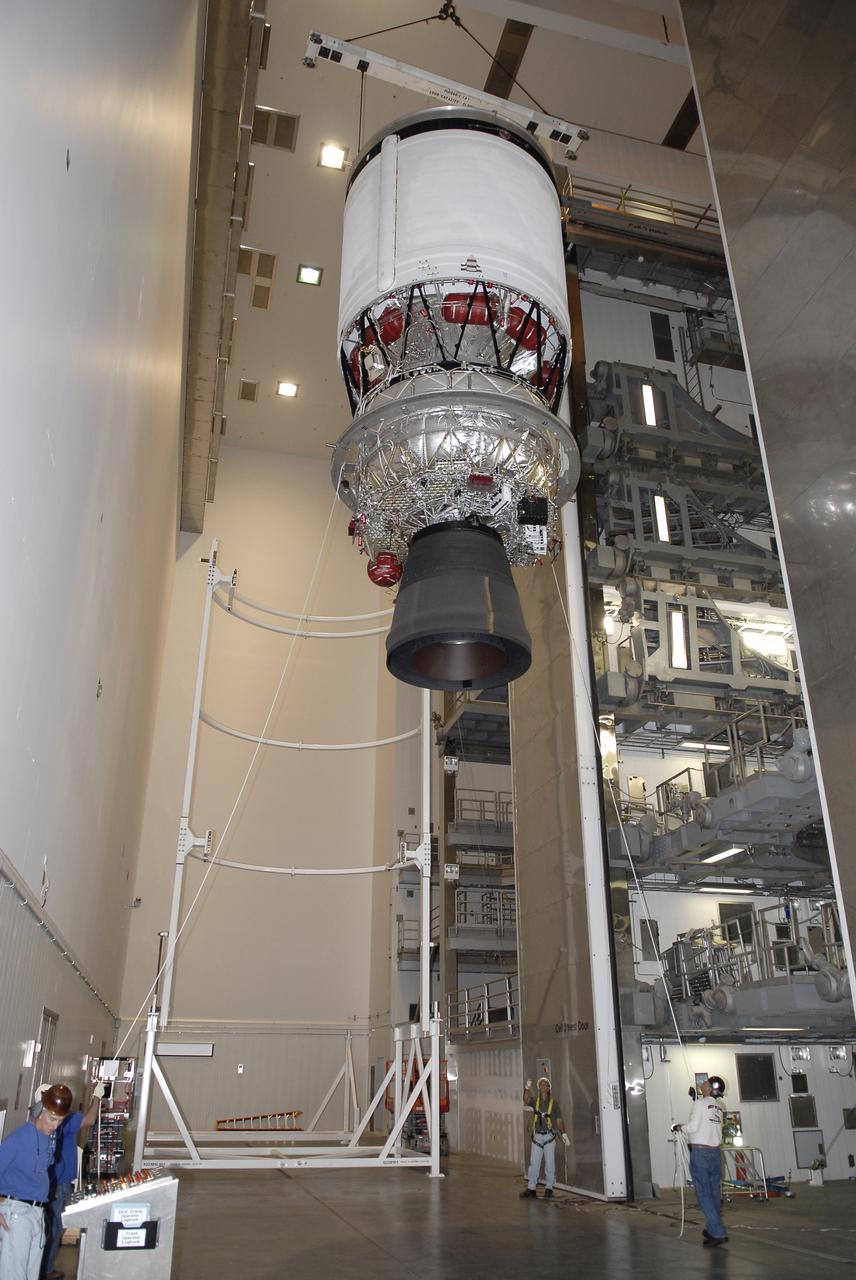
CAPE CANAVERAL, Fla. – Workers lower the second stage of a Delta IV rocket from a test cell in the hangar of the Delta Operations Center at Cape Canaveral Air Force Station in Florida toward a turnover stand following the completion of nozzle extension deployment system testing. The United Launch Alliance Delta IV rocket is slated to launch GOES-P, the latest Geostationary Operational Environmental Satellite developed by NASA for the National Oceanic and Atmospheric Administration, or NOAA. Next, the second stage will be transported to the Horizontal Integration Facility where it will be inspected and prepared for mating with the Delta IV rocket's first stage. GOES-P, a meteorological satellite, is designed to watch for storm development and observed current weather conditions on Earth. Launch of GOES-P is scheduled for no earlier than Feb. 25, 2010, from Launch Complex 37. For information on GOES-P, visit http:__goespoes.gsfc.nasa.gov_goes_spacecraft_n_p_spacecraft.html. Photo credit: NASA_Glenn Benson
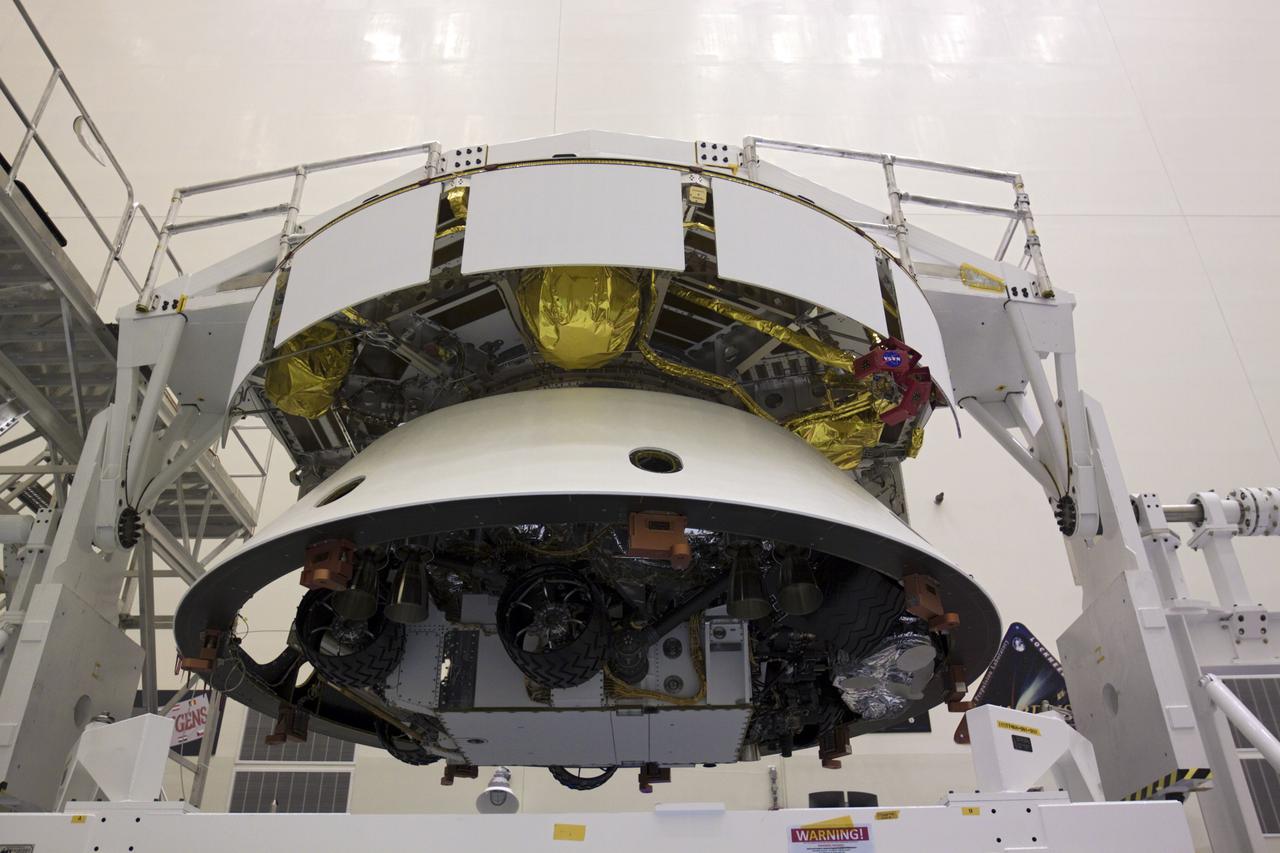
CAPE CANAVERAL, Fla. – In the Payload Hazardous Servicing Facility at NASA’s Kennedy Space Center in Florida, NASA's Mars Science Laboratory (MSL) mission aeroshell, (containing the compact car-sized rover Curiosity), has been mated to the cruise stage. The cruise stage provides solar power, thrusters for navigation, and heat exchangers to the rover during its flight from Earth to Mars. The rover Curiosity has 10 science instruments designed to search for evidence on whether Mars has had environments favorable to microbial life, including chemical ingredients for life. The unique rover will use a laser to look inside rocks and release its gasses so that the rover’s spectrometer can analyze and send the data back to Earth. Launch of MSL aboard a United Launch Alliance Atlas V rocket is scheduled for Nov. 25 from Space Launch Complex 41 on Cape Canaveral Air Force Station in Florida. For more information, visit http:__www.nasa.gov_msl. Photo credit: NASA_Glenn Benson
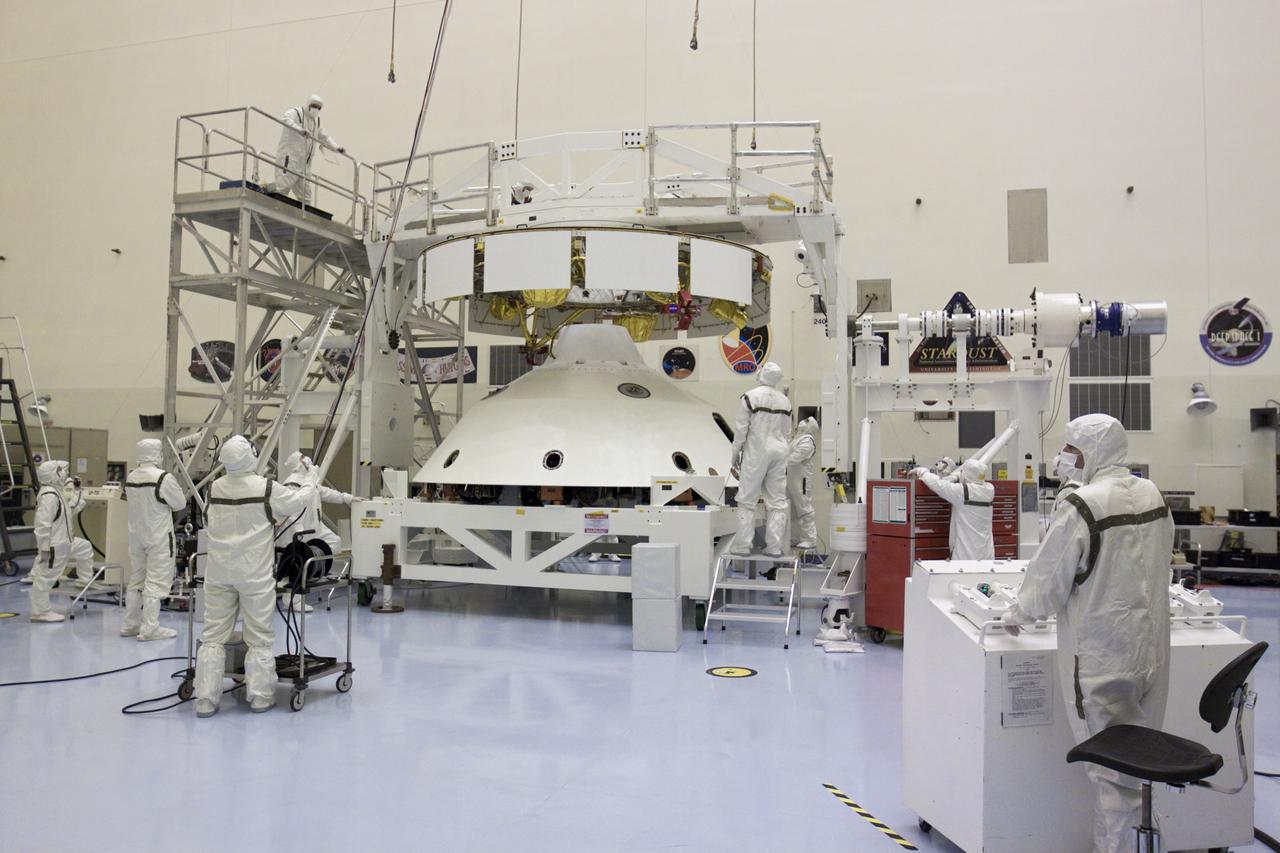
CAPE CANAVERAL, Fla. – In the Payload Hazardous Servicing Facility at NASA’s Kennedy Space Center in Florida, technicians prepare to attach an overhead crane to NASA's Mars Science Laboratory (MSL) mission aeroshell, (containing the compact car-sized rover Curiosity), which will be mated to the cruise stage. The cruise stage provides solar power, thrusters for navigation, and heat exchangers to the rover during its flight from Earth to Mars. The rover Curiosity has 10 science instruments designed to search for evidence on whether Mars has had environments favorable to microbial life, including chemical ingredients for life. The unique rover will use a laser to look inside rocks and release its gasses so that the rover’s spectrometer can analyze and send the data back to Earth. Launch of MSL aboard a United Launch Alliance Atlas V rocket is scheduled for Nov. 25 from Space Launch Complex 41 on Cape Canaveral Air Force Station in Florida. For more information, visit http:__www.nasa.gov_msl. Photo credit: NASA_Glenn Benson
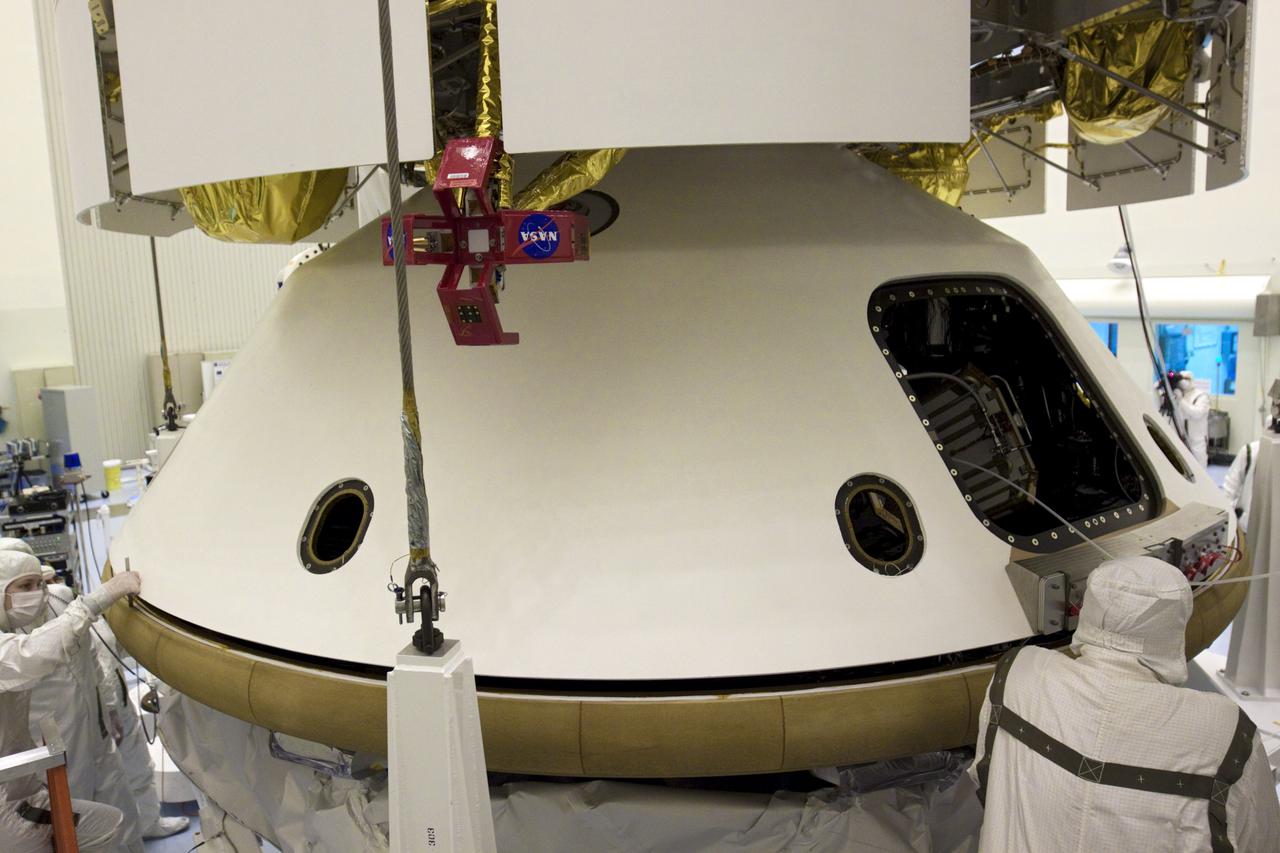
CAPE CANAVERAL, Fla. – In the Payload Hazardous Servicing Facility at NASA’s Kennedy Space Center in Florida, technicians inspect the alignment of the heat shield as an overhead crane lifts it for integration with NASA's Mars Science Laboratory (MSL) mission aeroshell, (containing the compact car-sized rover Curiosity). Earlier, the aeroshell was mated to the cruise stage, which provides solar power, thrusters for navigation, and heat exchangers to the rover during its flight from Earth to Mars. The rover Curiosity has 10 science instruments designed to search for evidence on whether Mars has had environments favorable to microbial life, including chemical ingredients for life. The unique rover will use a laser to look inside rocks and release its gasses so that the rover’s spectrometer can analyze and send the data back to Earth. Launch of MSL aboard a United Launch Alliance Atlas V rocket is scheduled for Nov. 25 from Space Launch Complex 41 on Cape Canaveral Air Force Station in Florida. For more information, visit http:__www.nasa.gov_msl. Photo credit: NASA_Glenn Benson
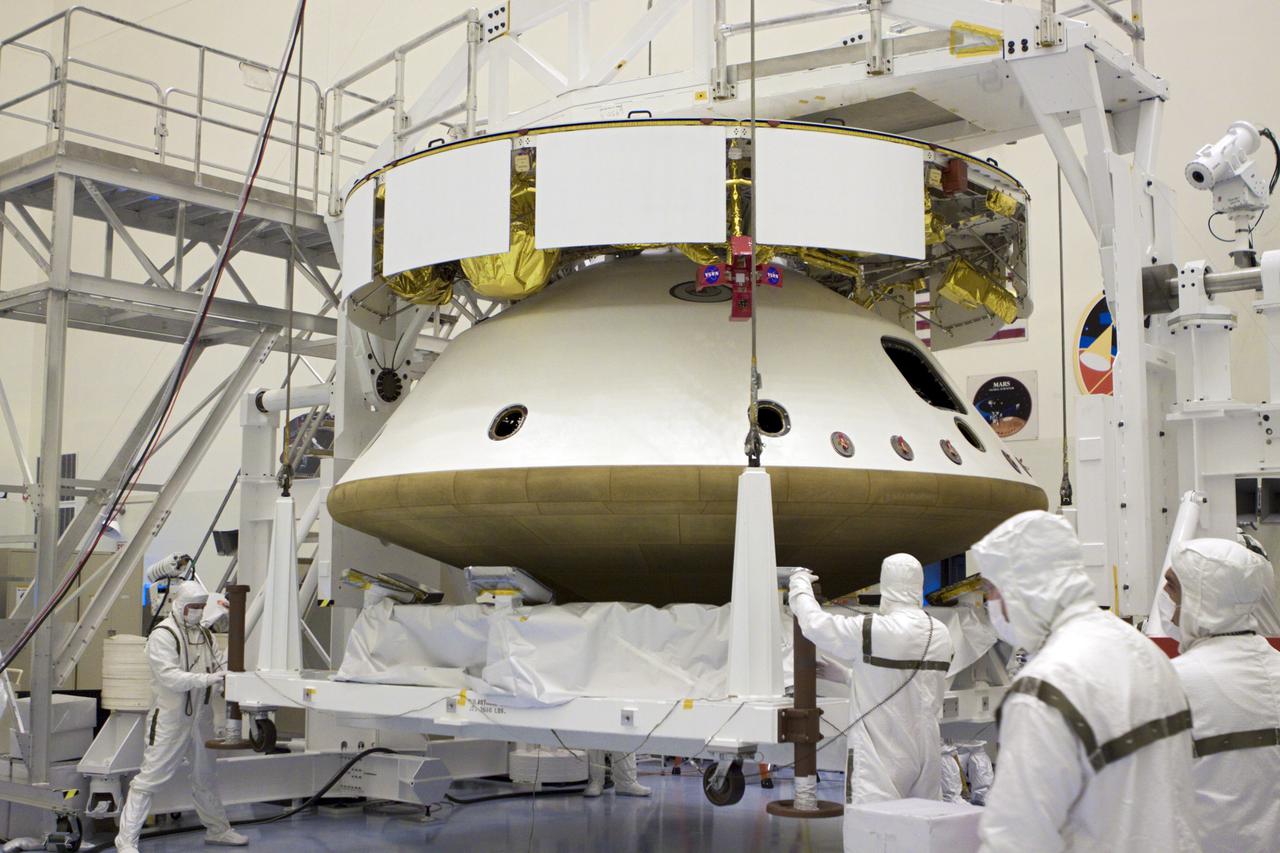
CAPE CANAVERAL, Fla. – In the Payload Hazardous Servicing Facility at NASA’s Kennedy Space Center in Florida, using an overhead crane, technicians lower a carrier which housed the heat shield, after integration with NASA's Mars Science Laboratory (MSL) mission aeroshell, (containing the compact car-sized rover Curiosity). Earlier, the aeroshell was mated to the cruise stage, which provides solar power, thrusters for navigation, and heat exchangers to the rover during its flight from Earth to Mars. The rover Curiosity has 10 science instruments designed to search for evidence on whether Mars has had environments favorable to microbial life, including chemical ingredients for life. The unique rover will use a laser to look inside rocks and release its gasses so that the rover’s spectrometer can analyze and send the data back to Earth. Launch of MSL aboard a United Launch Alliance Atlas V rocket is scheduled for Nov. 25 from Space Launch Complex 41 on Cape Canaveral Air Force Station in Florida. For more information, visit http:__www.nasa.gov_msl. Photo credit: NASA_Glenn Benson
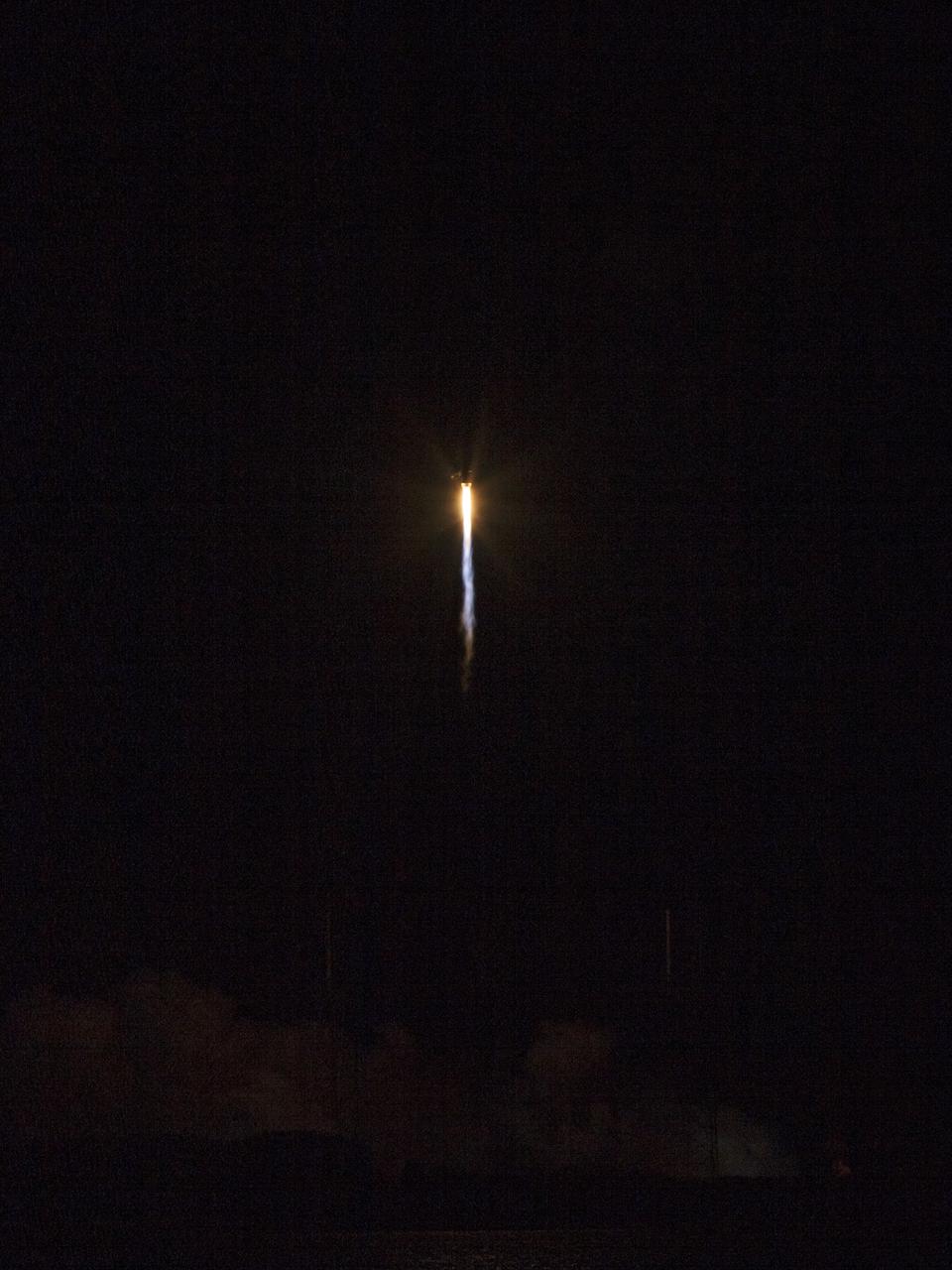
CAPE CANAVERAL, Fla. -- A United Launch Alliance Atlas V 401 rocket cuts its way through the night sky over Space Launch Complex 41 on Cape Canaveral Air Force Station in Florida carrying NASA's Tracking and Data Relay Satellite-K, TDRS-K, to orbit. Launch was at 8:48 p.m. EST. The TDRS-K spacecraft is part of the next-generation series in the Tracking and Data Relay Satellite System, a constellation of space-based communication satellites providing tracking, telemetry, command and high-bandwidth data return services. For more information, visit http:__www.nasa.gov_mission_pages_tdrs_index.html. Photo credit: NASA_Glenn Benson
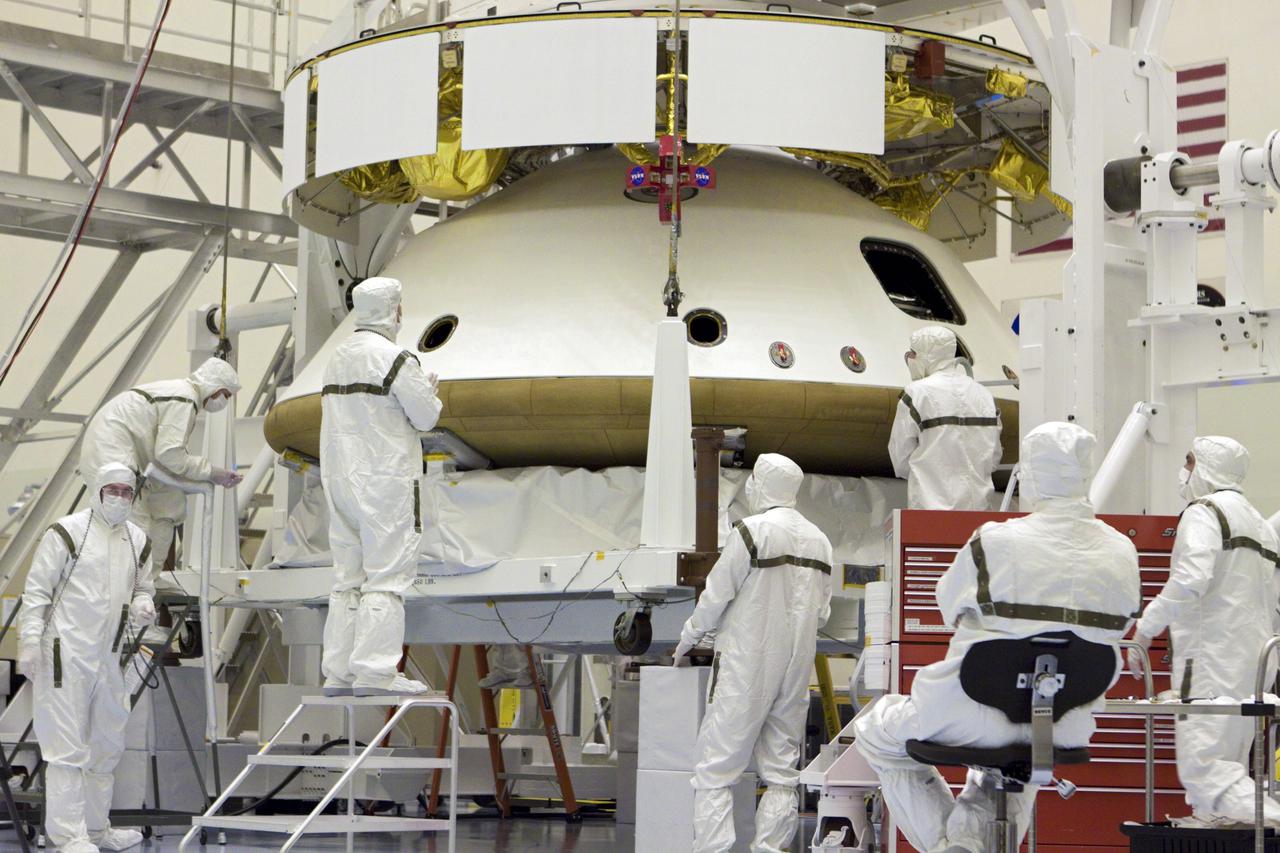
CAPE CANAVERAL, Fla. – In the Payload Hazardous Servicing Facility at NASA’s Kennedy Space Center in Florida, technicians monitor the alignment of the heat shield as an overhead crane lifts it for integration with NASA's Mars Science Laboratory (MSL) mission aeroshell, (containing the compact car-sized rover Curiosity). Earlier, the aeroshell was mated to the cruise stage, which provides solar power, thrusters for navigation, and heat exchangers to the rover during its flight from Earth to Mars. The rover Curiosity has 10 science instruments designed to search for evidence on whether Mars has had environments favorable to microbial life, including chemical ingredients for life. The unique rover will use a laser to look inside rocks and release its gasses so that the rover’s spectrometer can analyze and send the data back to Earth. Launch of MSL aboard a United Launch Alliance Atlas V rocket is scheduled for Nov. 25 from Space Launch Complex 41 on Cape Canaveral Air Force Station in Florida. For more information, visit http:__www.nasa.gov_msl. Photo credit: NASA_Glenn Benson
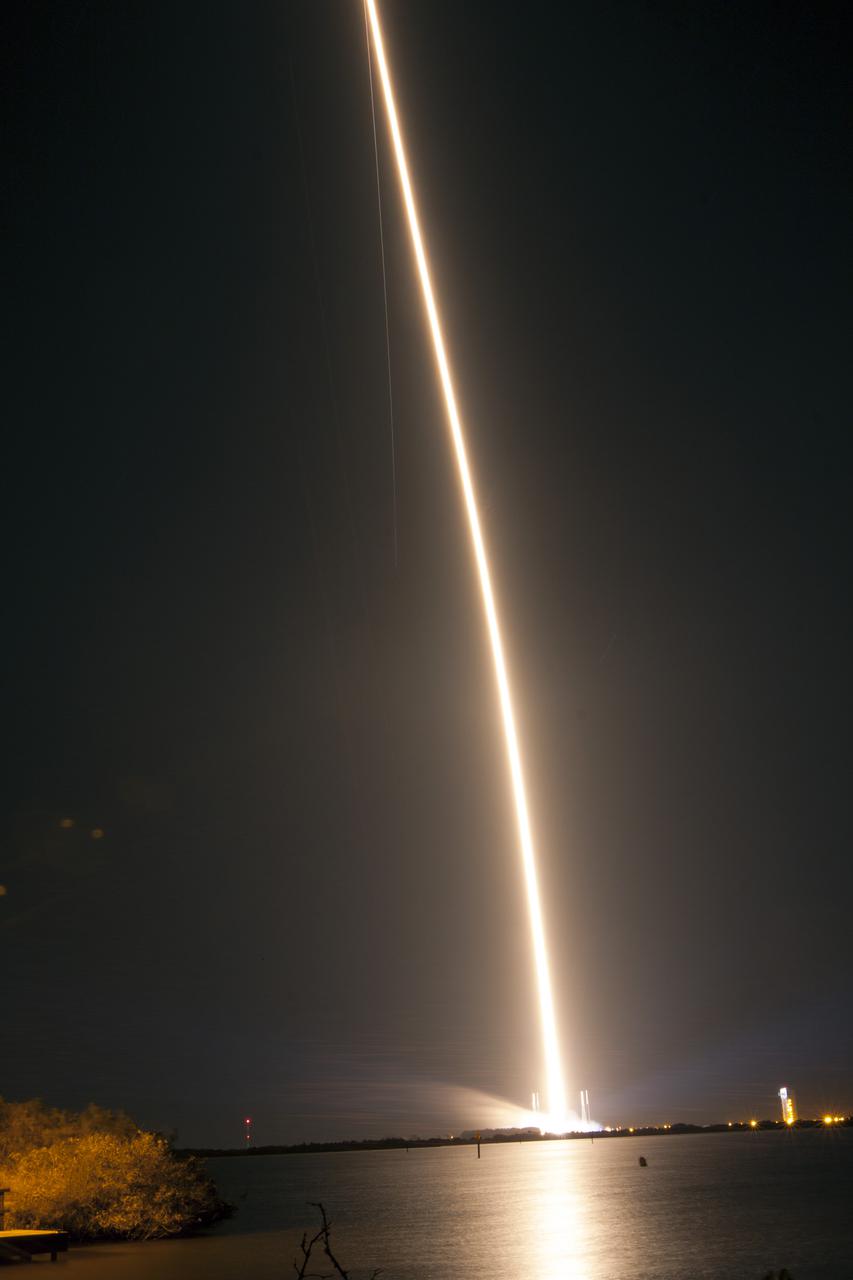
CAPE CANAVERAL, Fla. -- A United Launch Alliance Atlas V 401 rocket streaks away from Space Launch Complex 41 into the night sky over Cape Canaveral Air Force Station in Florida, carrying NASA's Tracking and Data Relay Satellite-K, TDRS-K, to orbit. Launch was at 8:48 p.m. EST. The TDRS-K spacecraft is part of the next-generation series in the Tracking and Data Relay Satellite System, a constellation of space-based communication satellites providing tracking, telemetry, command and high-bandwidth data return services. For more information, visit http:__www.nasa.gov_mission_pages_tdrs_index.html. Photo credit: NASA_Glenn Benson
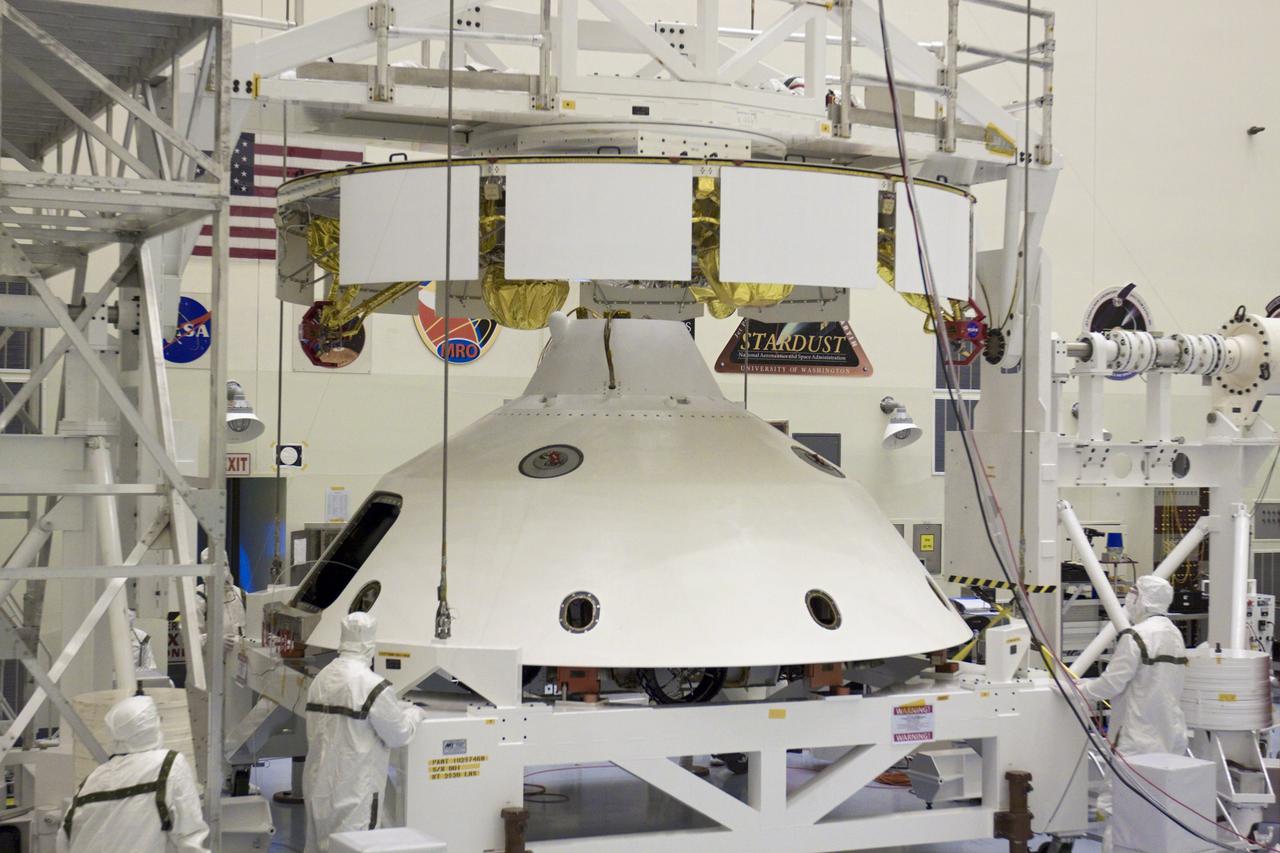
CAPE CANAVERAL, Fla. – In the Payload Hazardous Servicing Facility at NASA’s Kennedy Space Center in Florida, technicians, using an overhead crane, lift NASA's Mars Science Laboratory (MSL) mission aeroshell, (containing the compact car-sized rover Curiosity), for mating to the cruise stage. The cruise stage provides solar power, thrusters for navigation, and heat exchangers to the rover during its flight from Earth to Mars. The rover Curiosity has 10 science instruments designed to search for evidence on whether Mars has had environments favorable to microbial life, including chemical ingredients for life. The unique rover will use a laser to look inside rocks and release its gasses so that the rover’s spectrometer can analyze and send the data back to Earth. Launch of MSL aboard a United Launch Alliance Atlas V rocket is scheduled for Nov. 25 from Space Launch Complex 41 on Cape Canaveral Air Force Station in Florida. For more information, visit http:__www.nasa.gov_msl. Photo credit: NASA_Glenn Benson
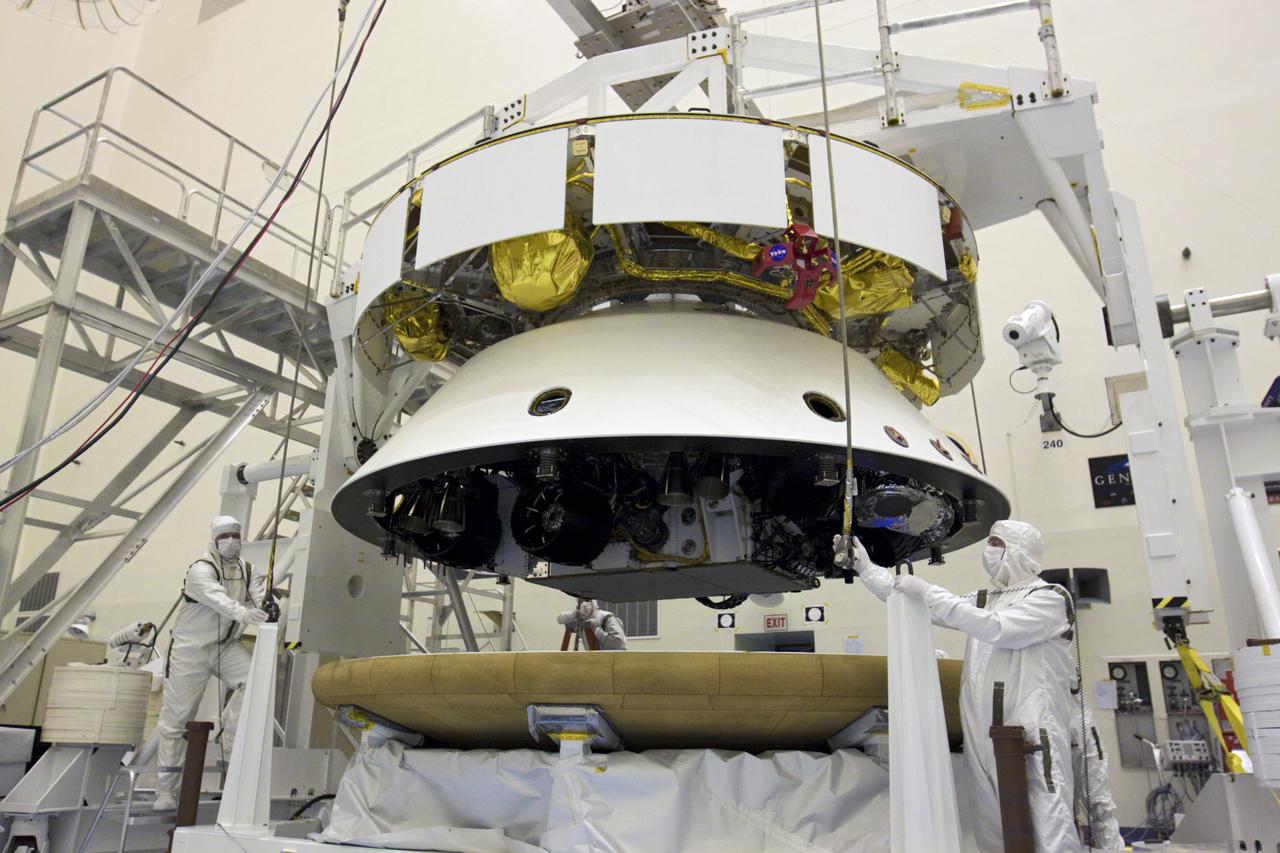
CAPE CANAVERAL, Fla. – In the Payload Hazardous Servicing Facility at NASA’s Kennedy Space Center in Florida, technicians attach an overhead crane to the heat shield in preparation for integration with NASA's Mars Science Laboratory (MSL) mission aeroshell, (containing the compact car-sized rover Curiosity). Earlier, the aeroshell was mated to the cruise stage, which provides solar power, thrusters for navigation, and heat exchangers to the rover during its flight from Earth to Mars. The rover Curiosity has 10 science instruments designed to search for evidence on whether Mars has had environments favorable to microbial life, including chemical ingredients for life. The unique rover will use a laser to look inside rocks and release its gasses so that the rover’s spectrometer can analyze and send the data back to Earth. Launch of MSL aboard a United Launch Alliance Atlas V rocket is scheduled for Nov. 25 from Space Launch Complex 41 on Cape Canaveral Air Force Station in Florida. For more information, visit http:__www.nasa.gov_msl. Photo credit: NASA_Glenn Benson
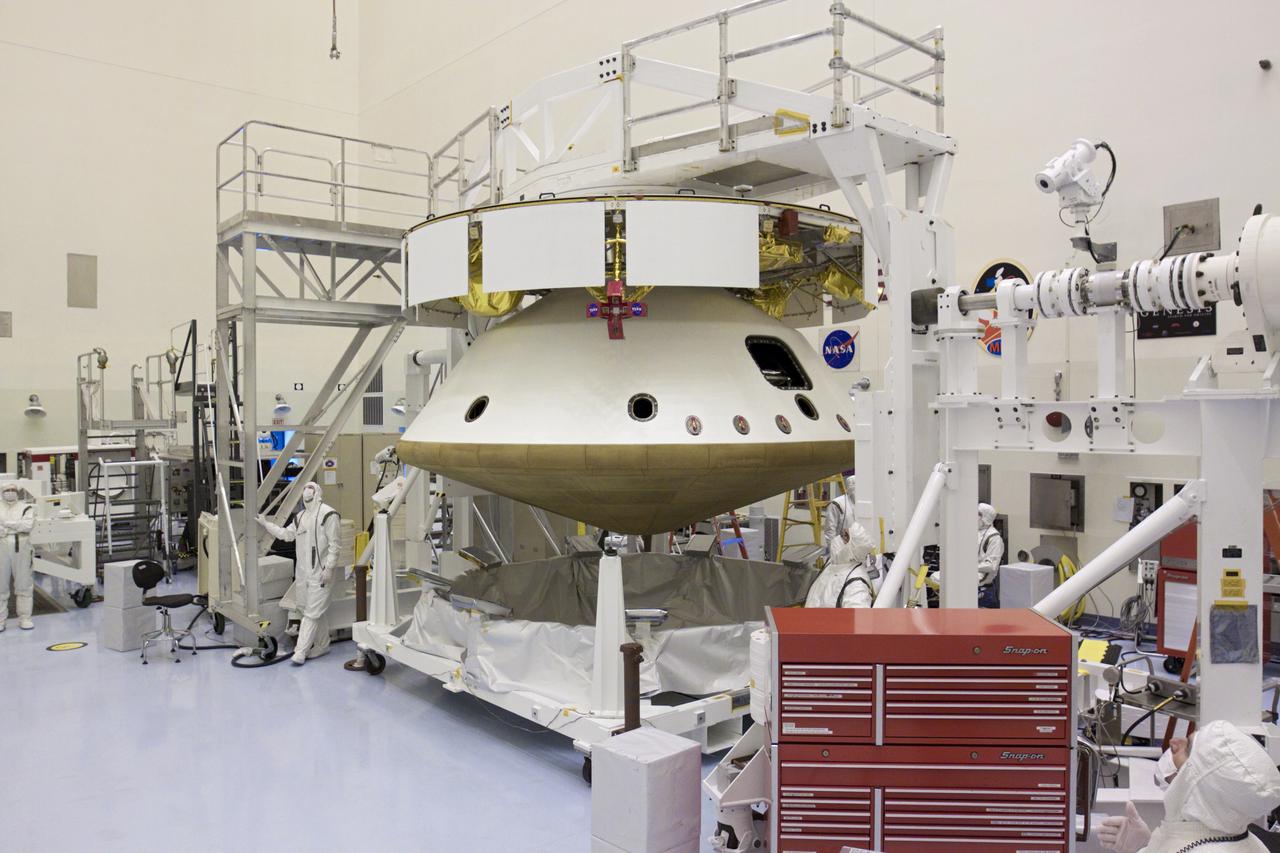
CAPE CANAVERAL, Fla. – In the Payload Hazardous Servicing Facility at NASA’s Kennedy Space Center in Florida, technicians observe the raising of an overhead crane. The crane was used to integrate the heat shield with NASA's Mars Science Laboratory (MSL) mission aeroshell, (containing the compact car-sized rover Curiosity). Earlier, the aeroshell was mated to the cruise stage, which provides solar power, thrusters for navigation, and heat exchangers to the rover during its flight from Earth to Mars. The rover Curiosity has 10 science instruments designed to search for evidence on whether Mars has had environments favorable to microbial life, including chemical ingredients for life. The unique rover will use a laser to look inside rocks and release its gasses so that the rover’s spectrometer can analyze and send the data back to Earth. Launch of MSL aboard a United Launch Alliance Atlas V rocket is scheduled for Nov. 25 from Space Launch Complex 41 on Cape Canaveral Air Force Station in Florida. For more information, visit http:__www.nasa.gov_msl. Photo credit: NASA_Glenn Benson
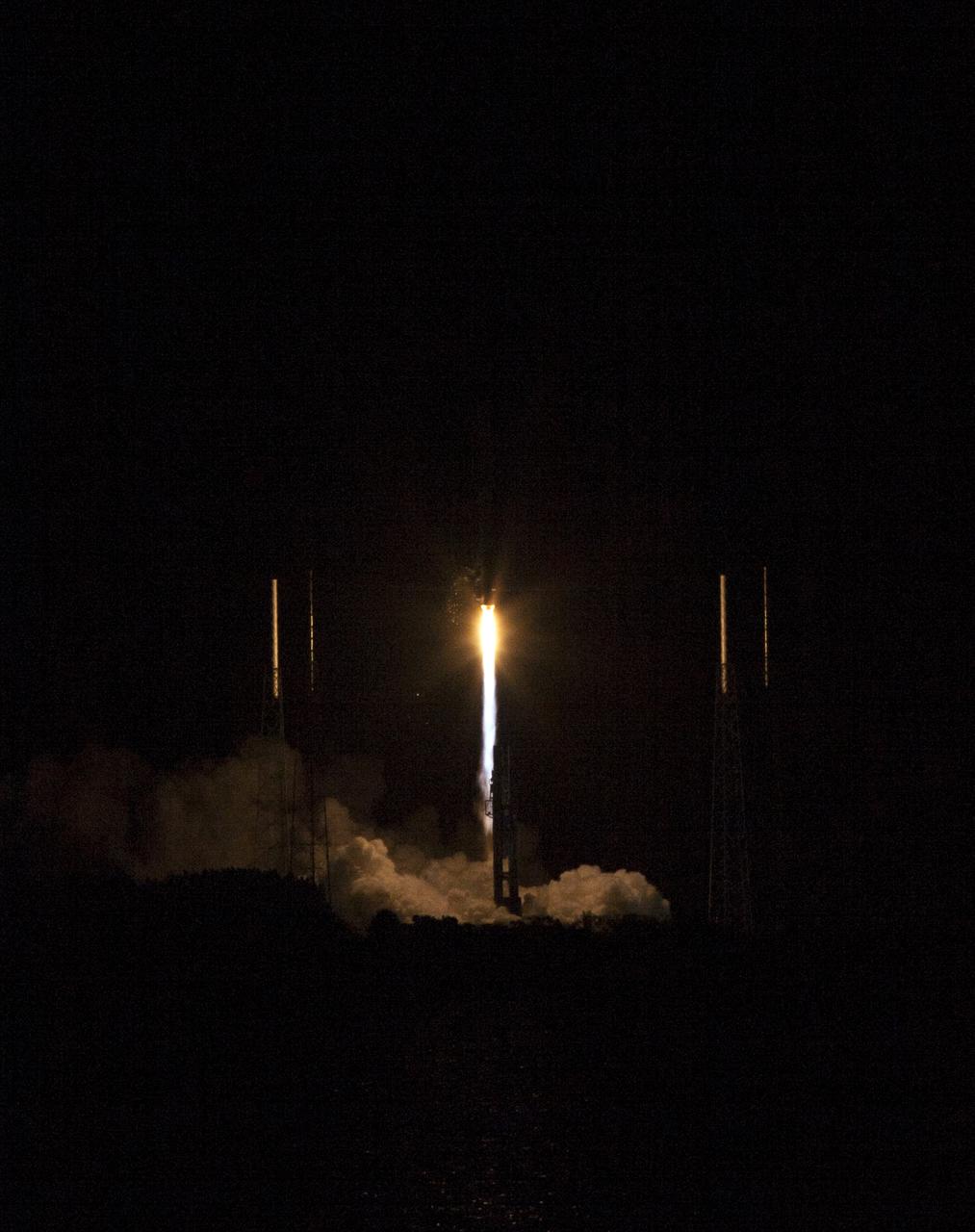
CAPE CANAVERAL, Fla. -- A rumble is heard across the Space Coast as a United Launch Alliance Atlas V 401 rocket lifts off Space Launch Complex 41 on Cape Canaveral Air Force Station in Florida at 8:48 p.m. EST, carrying NASA's Tracking and Data Relay Satellite-K, TDRS-K, to orbit. The TDRS-K spacecraft is part of the next-generation series in the Tracking and Data Relay Satellite System, a constellation of space-based communication satellites providing tracking, telemetry, command and high-bandwidth data return services. For more information, visit http:__www.nasa.gov_mission_pages_tdrs_index.html. Photo credit: NASA_Glenn Benson
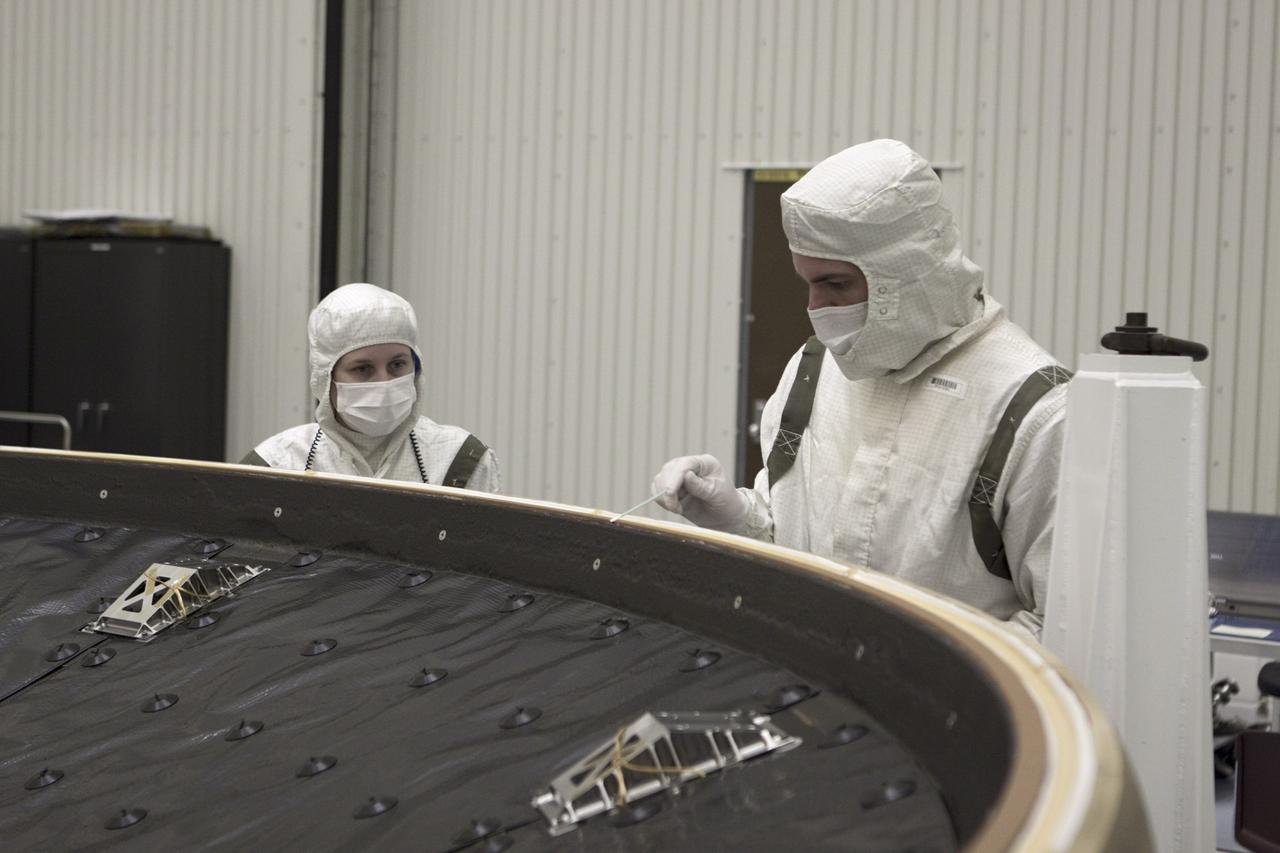
CAPE CANAVERAL, Fla. – In the Payload Hazardous Servicing Facility at NASA’s Kennedy Space Center in Florida, a technician cleans along the edge of NASA's Mars Science Laboratory (MSL) mission heat shield. MSL's components include a car-sized rover, Curiosity, which has 10 science instruments designed to search for evidence on whether Mars has had environments favorable to microbial life, including chemical ingredients for life. The unique rover will use a laser to look inside rocks and release its gasses so that the rover’s spectrometer can analyze and send the data back to Earth. Launch of MSL aboard a United Launch Alliance Atlas V rocket is scheduled for Nov. 25 from Space Launch Complex 41 on Cape Canaveral Air Force Station in Florida. For more information, visit http:__www.nasa.gov_msl. Photo credit: NASA_Glenn Benson
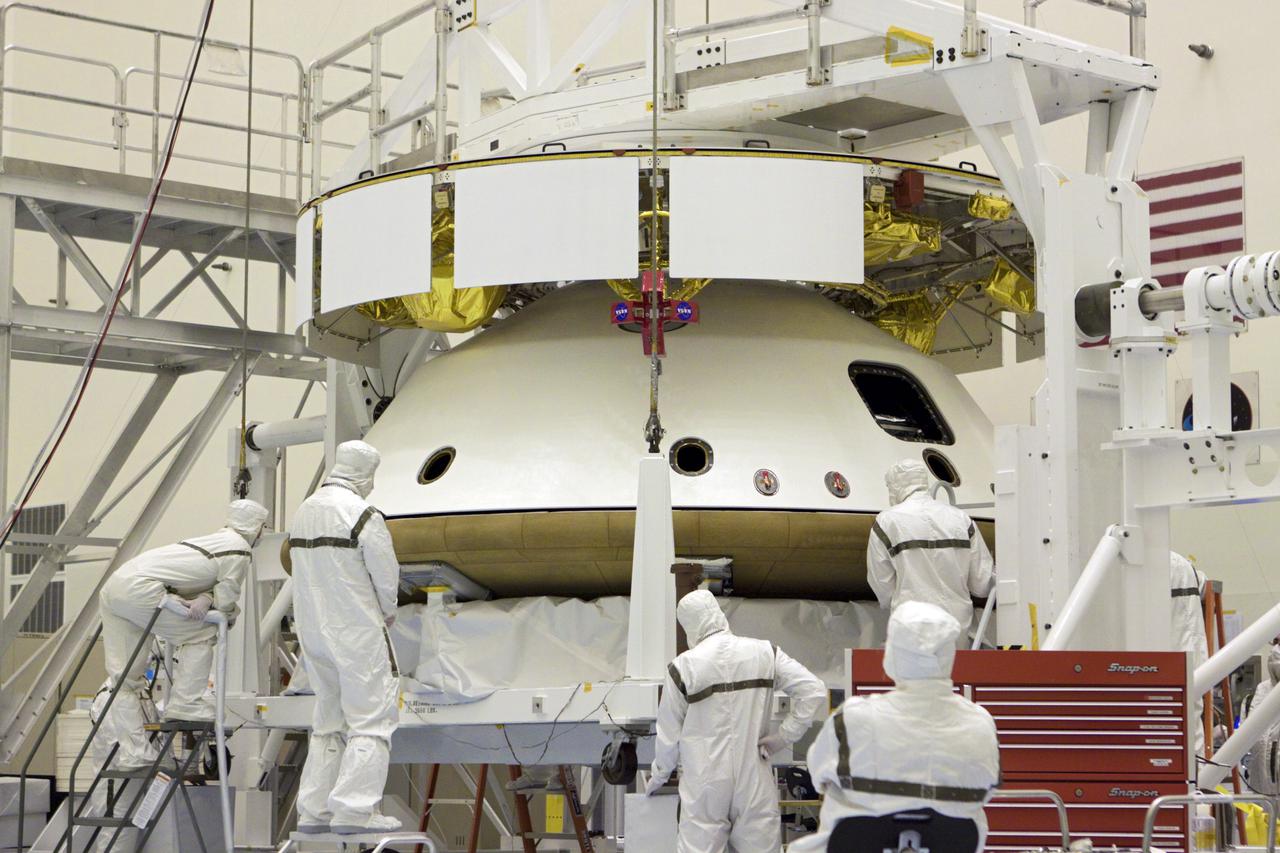
CAPE CANAVERAL, Fla. – In the Payload Hazardous Servicing Facility at NASA’s Kennedy Space Center in Florida, technicians monitor the alignment of the heat shield as an overhead crane lifts it for integration with NASA's Mars Science Laboratory (MSL) mission aeroshell, (containing the compact car-sized rover Curiosity). Earlier, the aeroshell was mated to the cruise stage, which provides solar power, thrusters for navigation, and heat exchangers to the rover during its flight from Earth to Mars. The rover Curiosity has 10 science instruments designed to search for evidence on whether Mars has had environments favorable to microbial life, including chemical ingredients for life. The unique rover will use a laser to look inside rocks and release its gasses so that the rover’s spectrometer can analyze and send the data back to Earth. Launch of MSL aboard a United Launch Alliance Atlas V rocket is scheduled for Nov. 25 from Space Launch Complex 41 on Cape Canaveral Air Force Station in Florida. For more information, visit http:__www.nasa.gov_msl. Photo credit: NASA_Glenn Benson
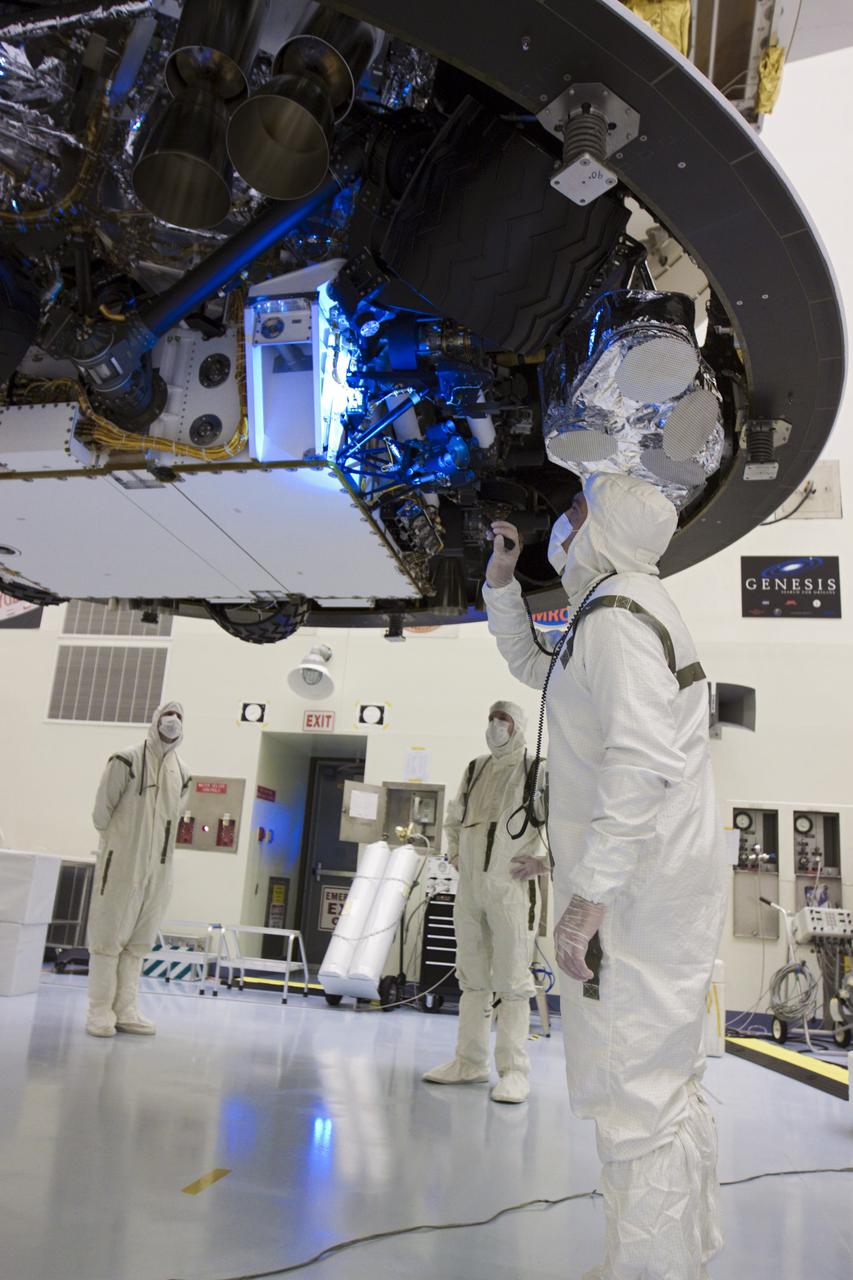
CAPE CANAVERAL, Fla. – In the Payload Hazardous Servicing Facility at NASA’s Kennedy Space Center in Florida, a technician inspects beneath NASA's Mars Science Laboratory (MSL) mission aeroshell, (containing the compact car-sized rover Curiosity), which has been mated to the cruise stage. The cruise stage provides solar power, thrusters for navigation, and heat exchangers to the rover during its flight from Earth to Mars. The rover Curiosity has 10 science instruments designed to search for evidence on whether Mars has had environments favorable to microbial life, including chemical ingredients for life. The unique rover will use a laser to look inside rocks and release its gasses so that the rover’s spectrometer can analyze and send the data back to Earth. Launch of MSL aboard a United Launch Alliance Atlas V rocket is scheduled for Nov. 25 from Space Launch Complex 41 on Cape Canaveral Air Force Station in Florida. For more information, visit http:__www.nasa.gov_msl. Photo credit: NASA_Glenn Benson
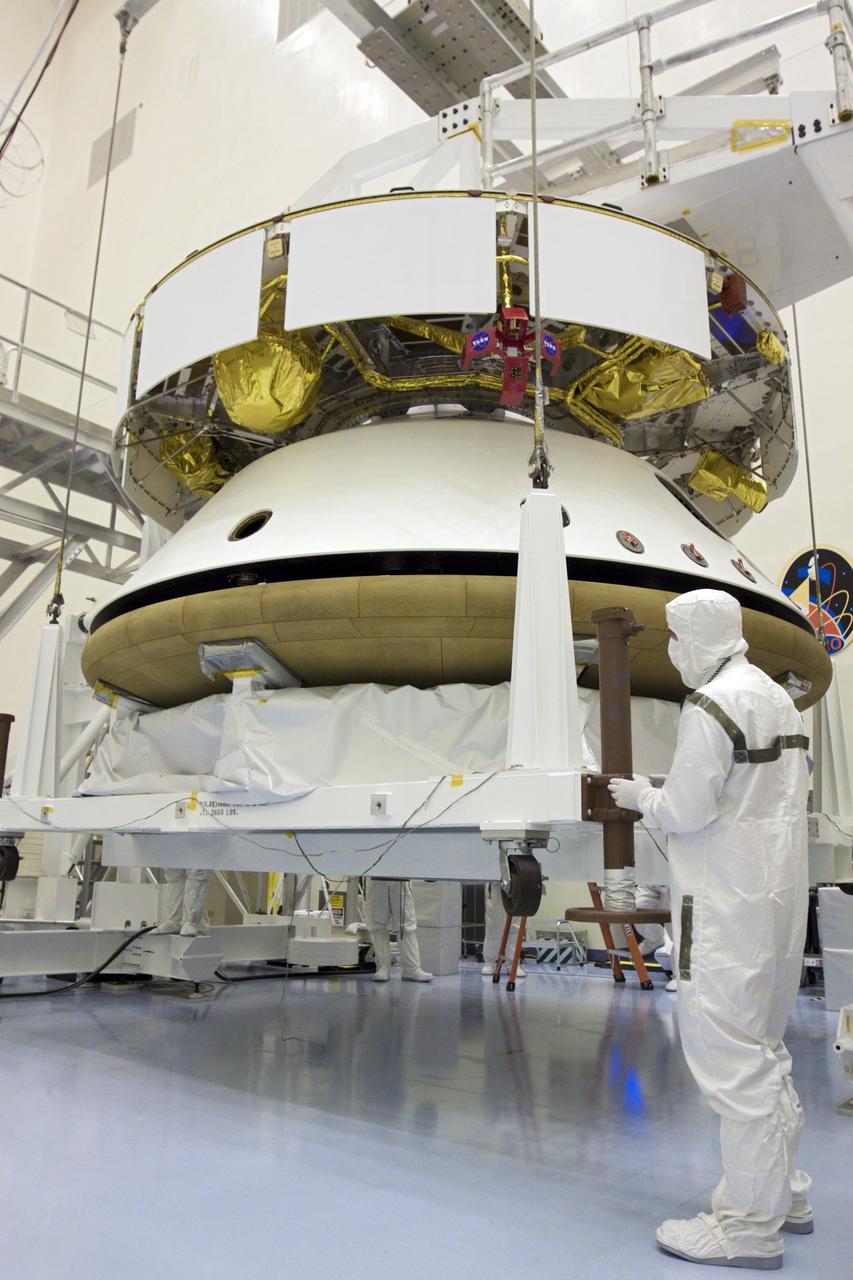
CAPE CANAVERAL, Fla. – In the Payload Hazardous Servicing Facility at NASA’s Kennedy Space Center in Florida, a technician watches as an overhead crane lifts the heat shield for integration with NASA's Mars Science Laboratory (MSL) mission aeroshell, (containing the compact car-sized rover Curiosity). Earlier, the aeroshell was mated to the cruise stage, which provides solar power, thrusters for navigation, and heat exchangers to the rover during its flight from Earth to Mars. The rover Curiosity has 10 science instruments designed to search for evidence on whether Mars has had environments favorable to microbial life, including chemical ingredients for life. The unique rover will use a laser to look inside rocks and release its gasses so that the rover’s spectrometer can analyze and send the data back to Earth. Launch of MSL aboard a United Launch Alliance Atlas V rocket is scheduled for Nov. 25 from Space Launch Complex 41 on Cape Canaveral Air Force Station in Florida. For more information, visit http:__www.nasa.gov_msl. Photo credit: NASA_Glenn Benson
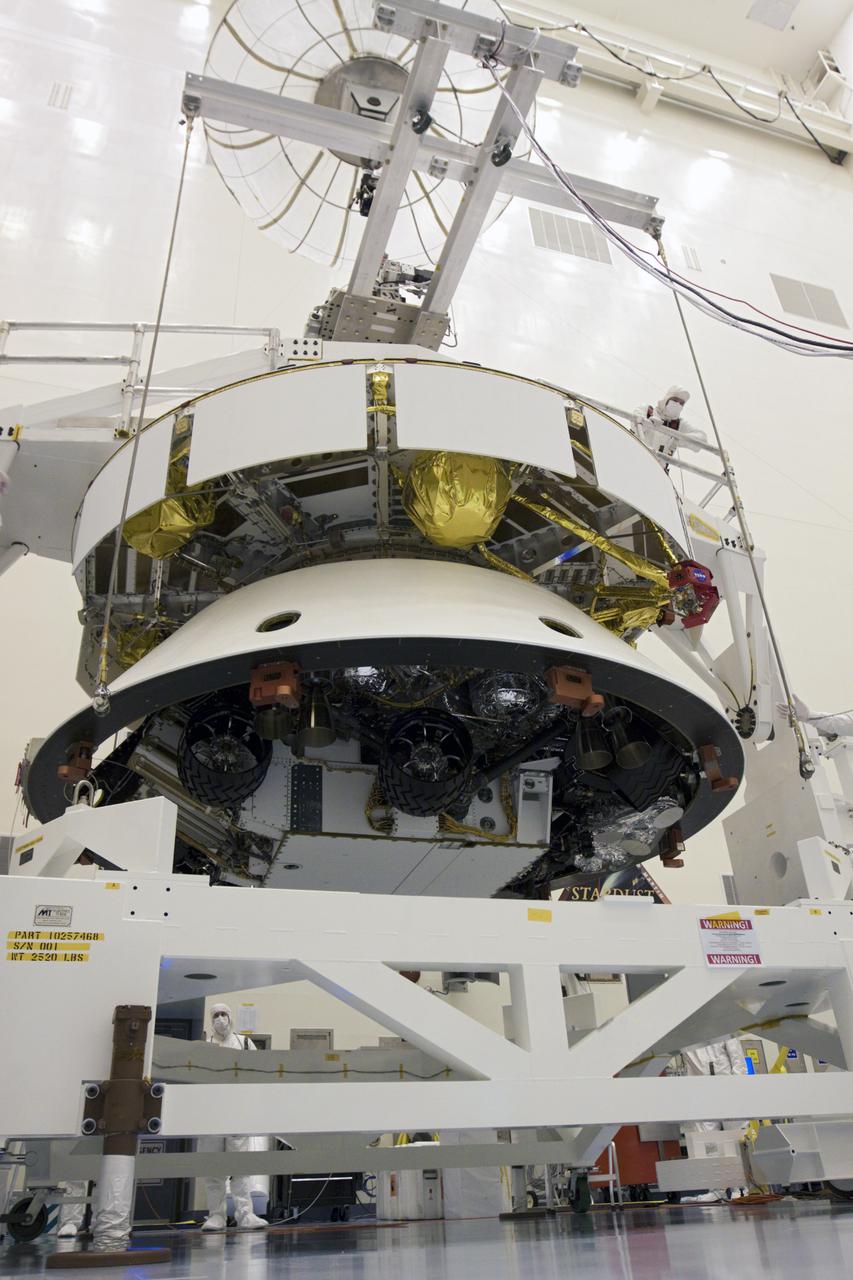
CAPE CANAVERAL, Fla. – In the Payload Hazardous Servicing Facility at NASA’s Kennedy Space Center in Florida, technicians, using an overhead crane, lift NASA's Mars Science Laboratory (MSL) mission aeroshell, (containing the compact car-sized rover Curiosity), for mating to the cruise stage. The cruise stage provides solar power, thrusters for navigation, and heat exchangers to the rover during its flight from Earth to Mars. The rover Curiosity has 10 science instruments designed to search for evidence on whether Mars has had environments favorable to microbial life, including chemical ingredients for life. The unique rover will use a laser to look inside rocks and release its gasses so that the rover’s spectrometer can analyze and send the data back to Earth. Launch of MSL aboard a United Launch Alliance Atlas V rocket is scheduled for Nov. 25 from Space Launch Complex 41 on Cape Canaveral Air Force Station in Florida. For more information, visit http:__www.nasa.gov_msl. Photo credit: NASA_Glenn Benson

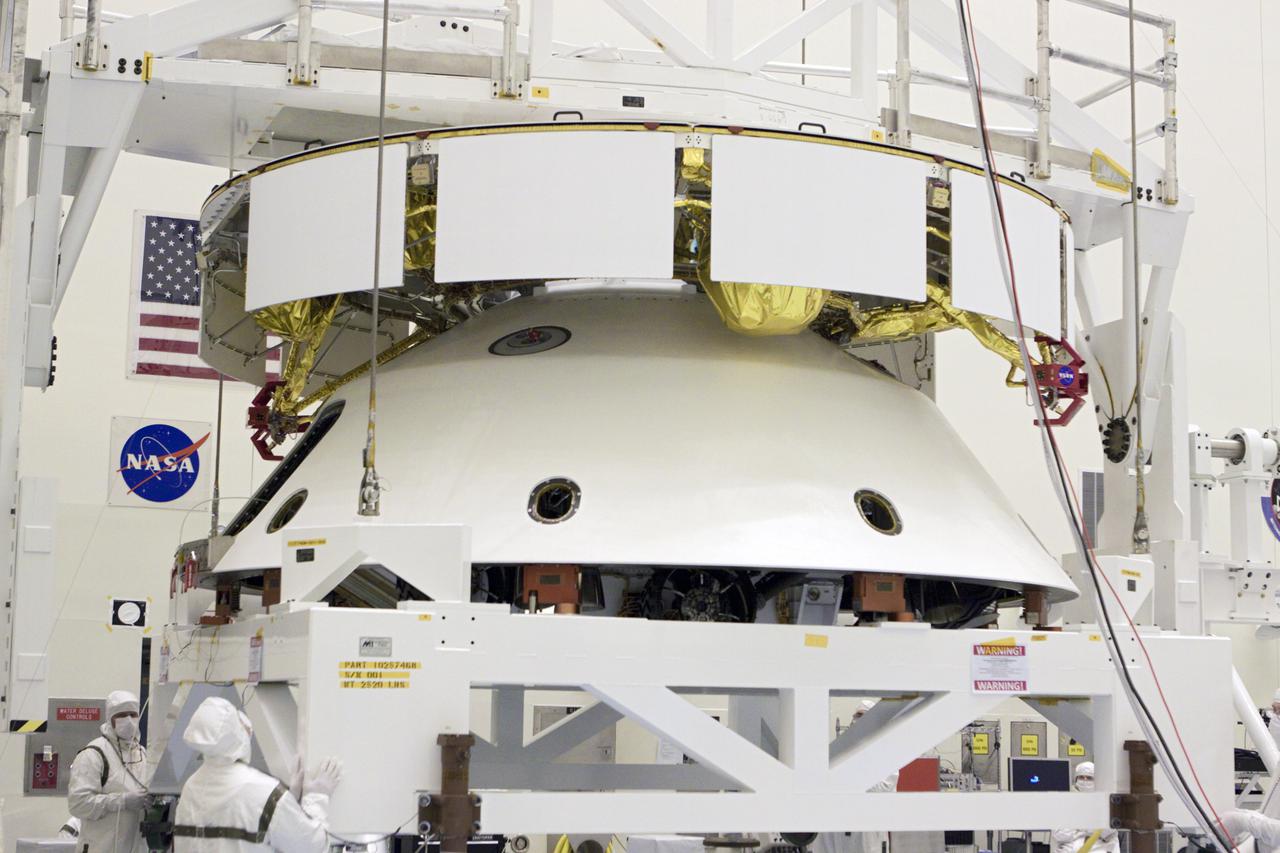
CAPE CANAVERAL, Fla. – In the Payload Hazardous Servicing Facility at NASA’s Kennedy Space Center in Florida, the heat shield has been integrated with NASA's Mars Science Laboratory (MSL) mission aeroshell, (containing the compact car-sized rover Curiosity). Earlier, the aeroshell was mated to the cruise stage, which provides solar power, thrusters for navigation, and heat exchangers to the rover during its flight from Earth to Mars. The rover Curiosity has 10 science instruments designed to search for evidence on whether Mars has had environments favorable to microbial life, including chemical ingredients for life. The unique rover will use a laser to look inside rocks and release its gasses so that the rover’s spectrometer can analyze and send the data back to Earth. Launch of MSL aboard a United Launch Alliance Atlas V rocket is scheduled for Nov. 25 from Space Launch Complex 41 on Cape Canaveral Air Force Station in Florida. For more information, visit http:__www.nasa.gov_msl. Photo credit: NASA_Glenn Benson
CAPE CANAVERAL, Fla. – In the Payload Hazardous Servicing Facility at NASA’s Kennedy Space Center in Florida, technicians, using an overhead crane, lift NASA's Mars Science Laboratory (MSL) mission aeroshell, (containing the compact car-sized rover Curiosity), for mating to the cruise stage. The cruise stage provides solar power, thrusters for navigation, and heat exchangers to the rover during its flight from Earth to Mars. The rover Curiosity has 10 science instruments designed to search for evidence on whether Mars has had environments favorable to microbial life, including chemical ingredients for life. The unique rover will use a laser to look inside rocks and release its gasses so that the rover’s spectrometer can analyze and send the data back to Earth. Launch of MSL aboard a United Launch Alliance Atlas V rocket is scheduled for Nov. 25 from Space Launch Complex 41 on Cape Canaveral Air Force Station in Florida. For more information, visit http:__www.nasa.gov_msl. Photo credit: NASA_Glenn Benson
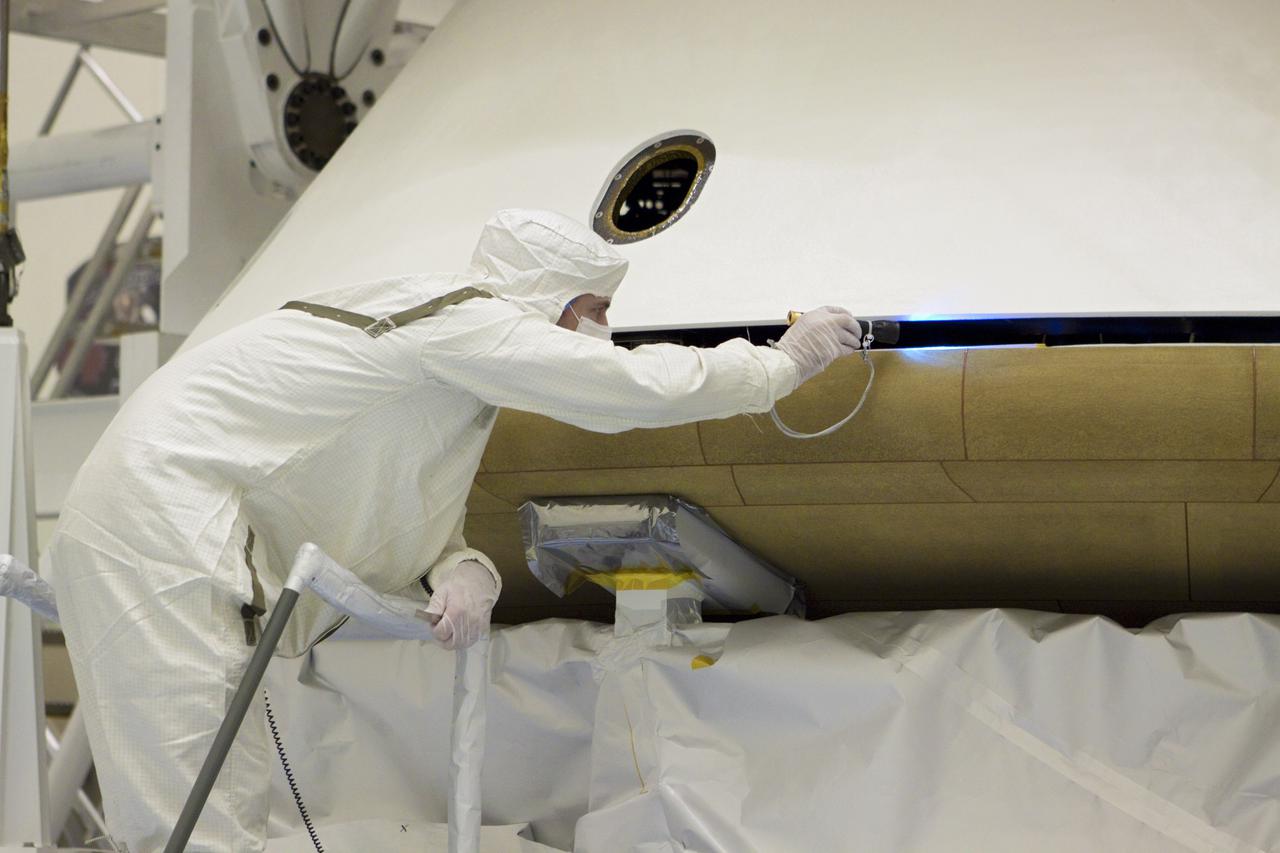
CAPE CANAVERAL, Fla. – In the Payload Hazardous Servicing Facility at NASA’s Kennedy Space Center in Florida, a technician inspects the alignment of the heat shield as an overhead crane lifts it for integration with NASA's Mars Science Laboratory (MSL) mission aeroshell, (containing the compact car-sized rover Curiosity). Earlier, the aeroshell was mated to the cruise stage, which provides solar power, thrusters for navigation, and heat exchangers to the rover during its flight from Earth to Mars. The rover Curiosity has 10 science instruments designed to search for evidence on whether Mars has had environments favorable to microbial life, including chemical ingredients for life. The unique rover will use a laser to look inside rocks and release its gasses so that the rover’s spectrometer can analyze and send the data back to Earth. Launch of MSL aboard a United Launch Alliance Atlas V rocket is scheduled for Nov. 25 from Space Launch Complex 41 on Cape Canaveral Air Force Station in Florida. For more information, visit http:__www.nasa.gov_msl. Photo credit: NASA_Glenn Benson
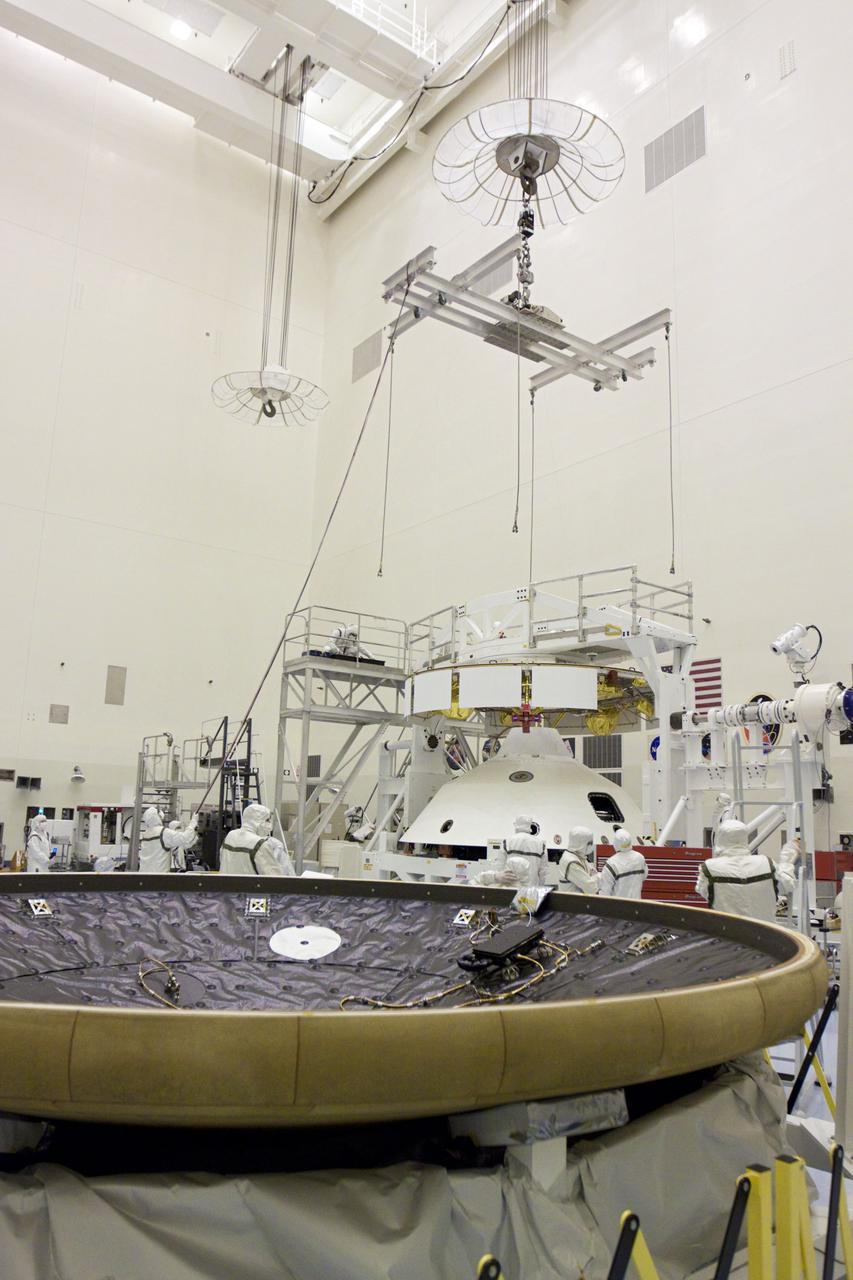
CAPE CANAVERAL, Fla. – In the Payload Hazardous Servicing Facility at NASA’s Kennedy Space Center in Florida, technicians prepare to attach an overhead crane to NASA's Mars Science Laboratory (MSL) mission aeroshell, (containing the compact car-sized rover Curiosity), which will be mated to the cruise stage. The cruise stage provides solar power, thrusters for navigation, and heat exchangers to the rover during its flight from Earth to Mars. In the foreground is the MSL heat shield. The rover Curiosity has 10 science instruments designed to search for evidence on whether Mars has had environments favorable to microbial life, including chemical ingredients for life. The unique rover will use a laser to look inside rocks and release its gasses so that the rover’s spectrometer can analyze and send the data back to Earth. Launch of MSL aboard a United Launch Alliance Atlas V rocket is scheduled for Nov. 25 from Space Launch Complex 41 on Cape Canaveral Air Force Station in Florida. For more information, visit http:__www.nasa.gov_msl. Photo credit: NASA_Glenn Benson
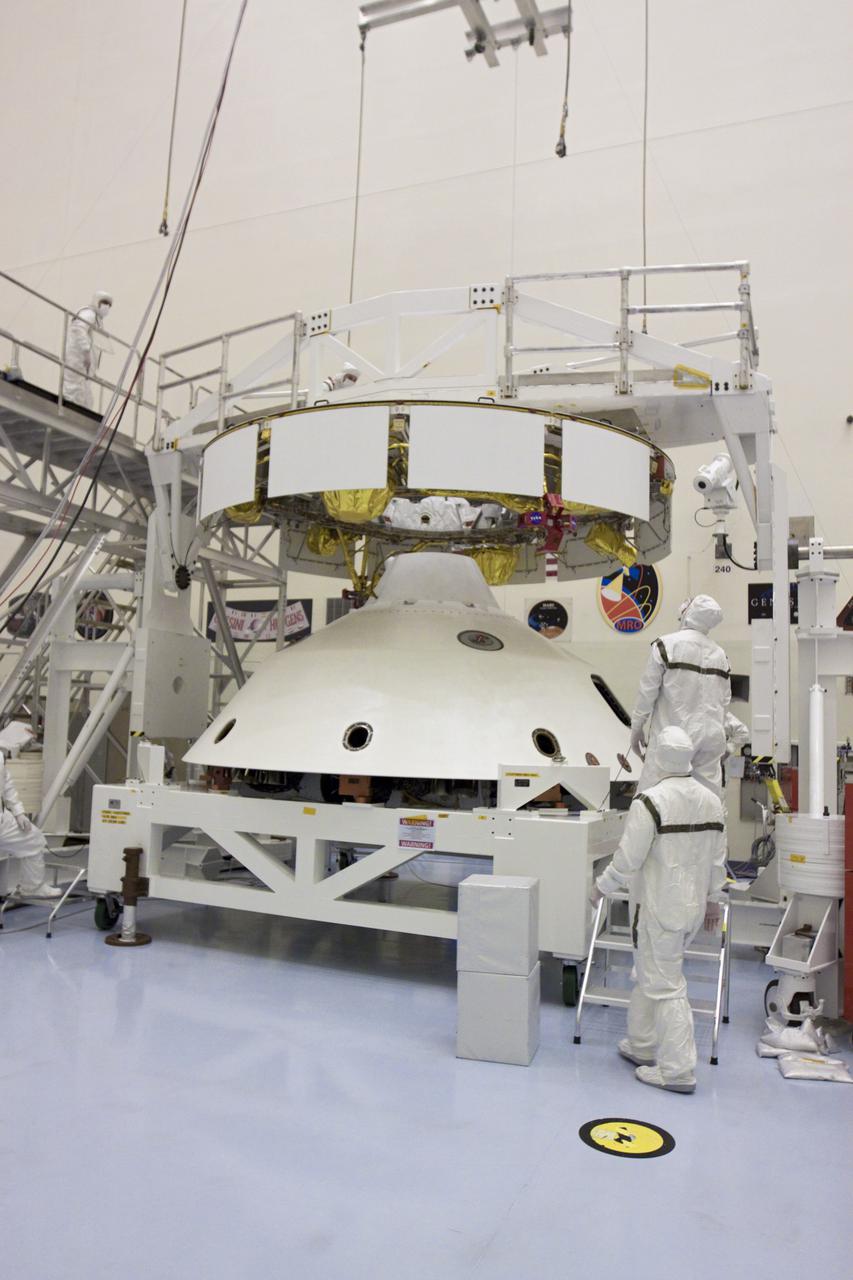
CAPE CANAVERAL, Fla. – In the Payload Hazardous Servicing Facility at NASA’s Kennedy Space Center in Florida, technicians prepare to attach an overhead crane to NASA's Mars Science Laboratory (MSL) mission aeroshell, (containing the compact car-sized rover Curiosity), which will be mated to the cruise stage. The cruise stage provides solar power, thrusters for navigation, and heat exchangers to the rover during its flight from Earth to Mars. The rover Curiosity has 10 science instruments designed to search for evidence on whether Mars has had environments favorable to microbial life, including chemical ingredients for life. The unique rover will use a laser to look inside rocks and release its gasses so that the rover’s spectrometer can analyze and send the data back to Earth. Launch of MSL aboard a United Launch Alliance Atlas V rocket is scheduled for Nov. 25 from Space Launch Complex 41 on Cape Canaveral Air Force Station in Florida. For more information, visit http:__www.nasa.gov_msl. Photo credit: NASA_Glenn Benson
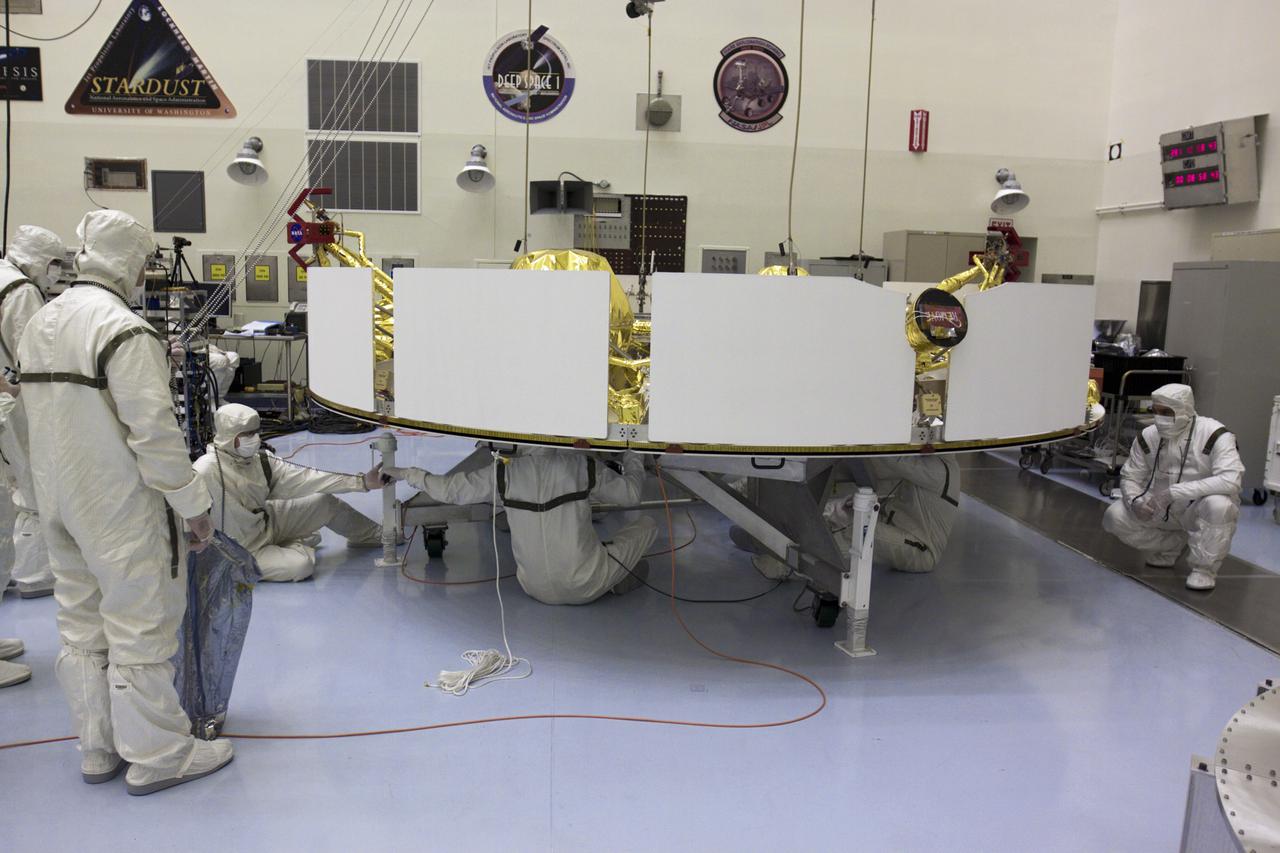
CAPE CANAVERAL, Fla. – In the Payload Hazardous Servicing Facility at NASA’s Kennedy Space Center in Florida, technicians attach an overhead crane to NASA's Mars Science Laboratory (MSL) mission cruise stage. The cruise stage, which will be lifted onto a rotation stand, provides solar power, thrusters for navigation, and heat exchangers to the rover during its flight from Earth to Mars. MSL's components include a car-sized rover, Curiosity, which has 10 science instruments designed to search for evidence on whether Mars has had environments favorable to microbial life, including chemical ingredients for life. The unique rover will use a laser to look inside rocks and release its gasses so that the rover’s spectrometer can analyze and send the data back to Earth. Launch of MSL aboard a United Launch Alliance Atlas V rocket is scheduled for Nov. 25 from Space Launch Complex 41 on Cape Canaveral Air Force Station in Florida. For more information, visit http:__www.nasa.gov_msl. Photo credit: NASA_Glenn Benson
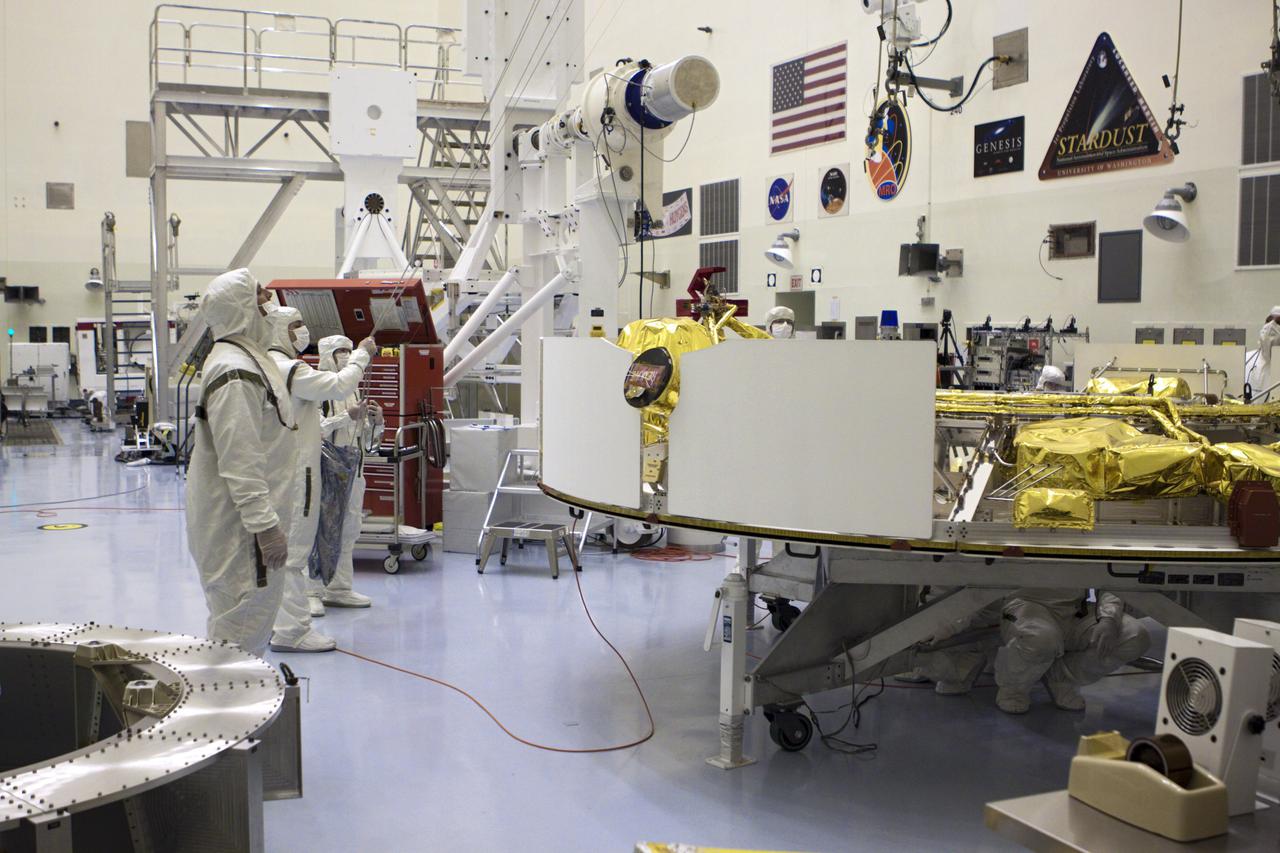
CAPE CANAVERAL, Fla. – In the Payload Hazardous Servicing Facility at NASA’s Kennedy Space Center in Florida, technicians prepare to attach an overhead crane to NASA's Mars Science Laboratory (MSL) mission cruise stage. The cruise stage, which will be lifted onto a rotation stand, provides solar power, thrusters for navigation, and heat exchangers to the rover during its flight from Earth to Mars. MSL's components include a car-sized rover, Curiosity, which has 10 science instruments designed to search for evidence on whether Mars has had environments favorable to microbial life, including chemical ingredients for life. The unique rover will use a laser to look inside rocks and release its gasses so that the rover’s spectrometer can analyze and send the data back to Earth. Launch of MSL aboard a United Launch Alliance Atlas V rocket is scheduled for Nov. 25 from Space Launch Complex 41 on Cape Canaveral Air Force Station in Florida. For more information, visit http:__www.nasa.gov_msl. Photo credit: NASA_Glenn Benson
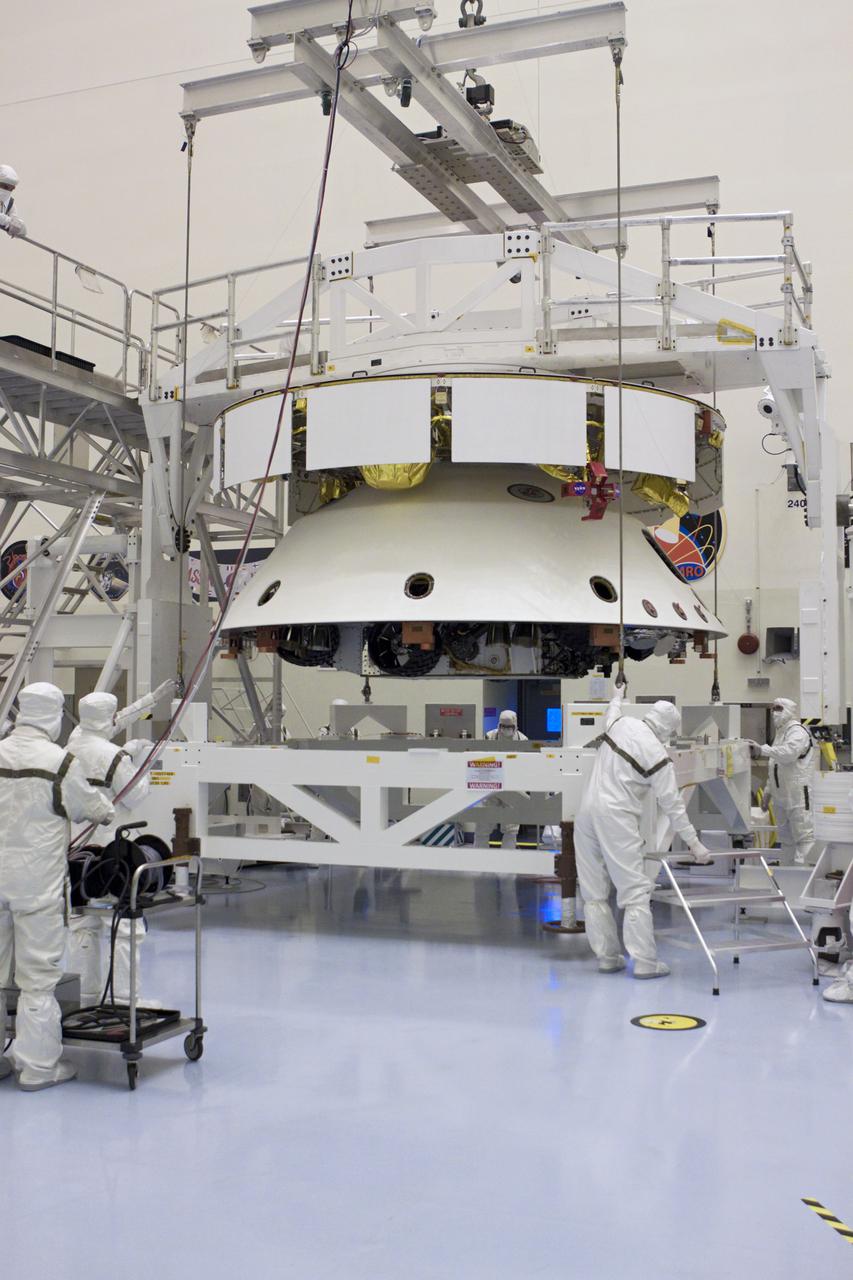
CAPE CANAVERAL, Fla. – In the Payload Hazardous Servicing Facility at NASA’s Kennedy Space Center in Florida, technicians, using an overhead crane, lift NASA's Mars Science Laboratory (MSL) mission aeroshell, (containing the compact car-sized rover Curiosity), for mating to the cruise stage. The cruise stage provides solar power, thrusters for navigation, and heat exchangers to the rover during its flight from Earth to Mars. The rover Curiosity has 10 science instruments designed to search for evidence on whether Mars has had environments favorable to microbial life, including chemical ingredients for life. The unique rover will use a laser to look inside rocks and release its gasses so that the rover’s spectrometer can analyze and send the data back to Earth. Launch of MSL aboard a United Launch Alliance Atlas V rocket is scheduled for Nov. 25 from Space Launch Complex 41 on Cape Canaveral Air Force Station in Florida. For more information, visit http:__www.nasa.gov_msl. Photo credit: NASA_Glenn Benson
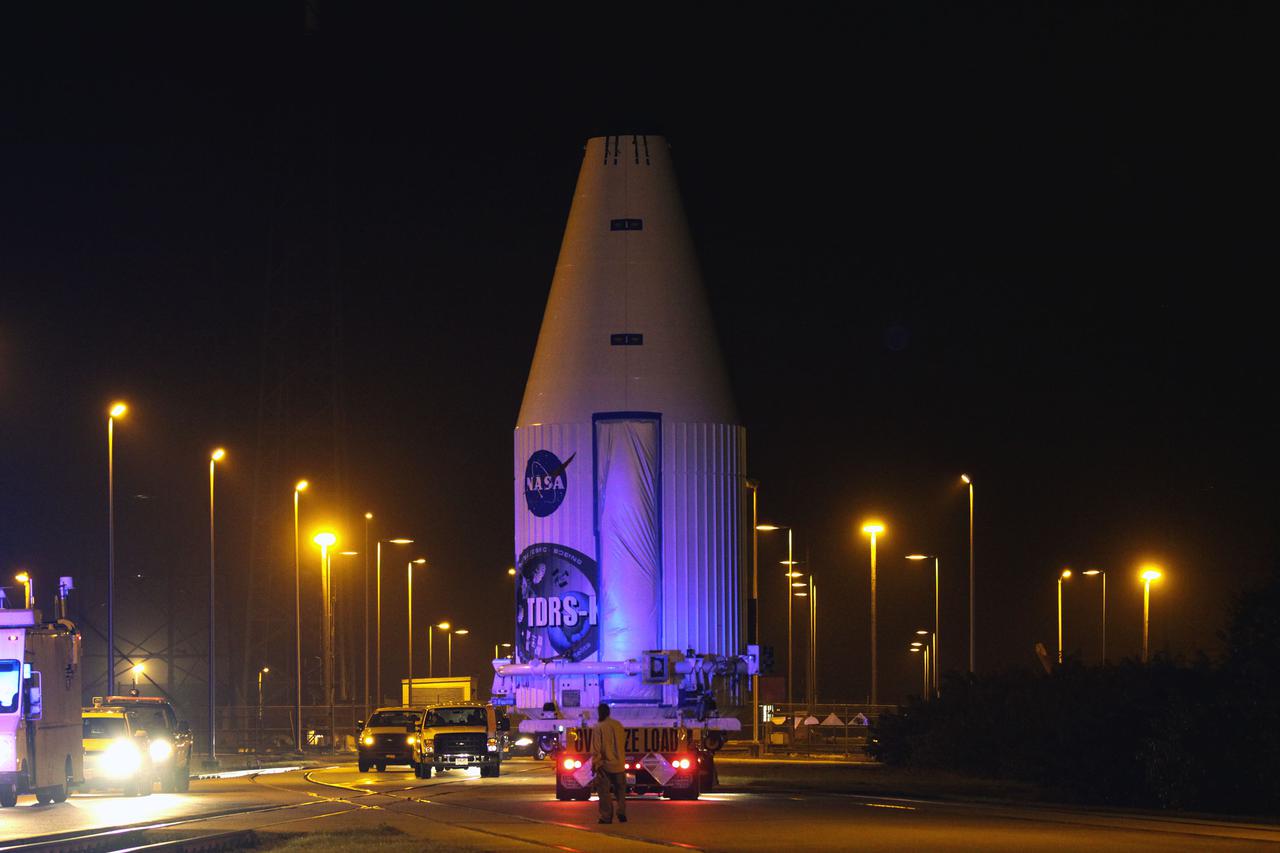
CAPE CANAVERAL, Fla. –NASA's Tracking and Data Relay Satellite, TDRS-K, enclosed in its payload fairing, passes through the Launch Complex 39 area at NASA's Kennedy Space Center as it travels from the Astrotech payload processing facility in Titusville, Fla., to its launch site. TDRS-K will lift off atop a United Launch Alliance Atlas V rocket from Cape Canaveral Air Force Station's Space Launch Complex 41. The TDRS-K spacecraft is part of the next-generation series in the Tracking and Data Relay Satellite System, a constellation of space-based communication satellites providing tracking, telemetry, command and high-bandwidth data return services. For more information, go to http:__www.nasa.gov_tdrs Photo credit: NASA_Glenn Benson
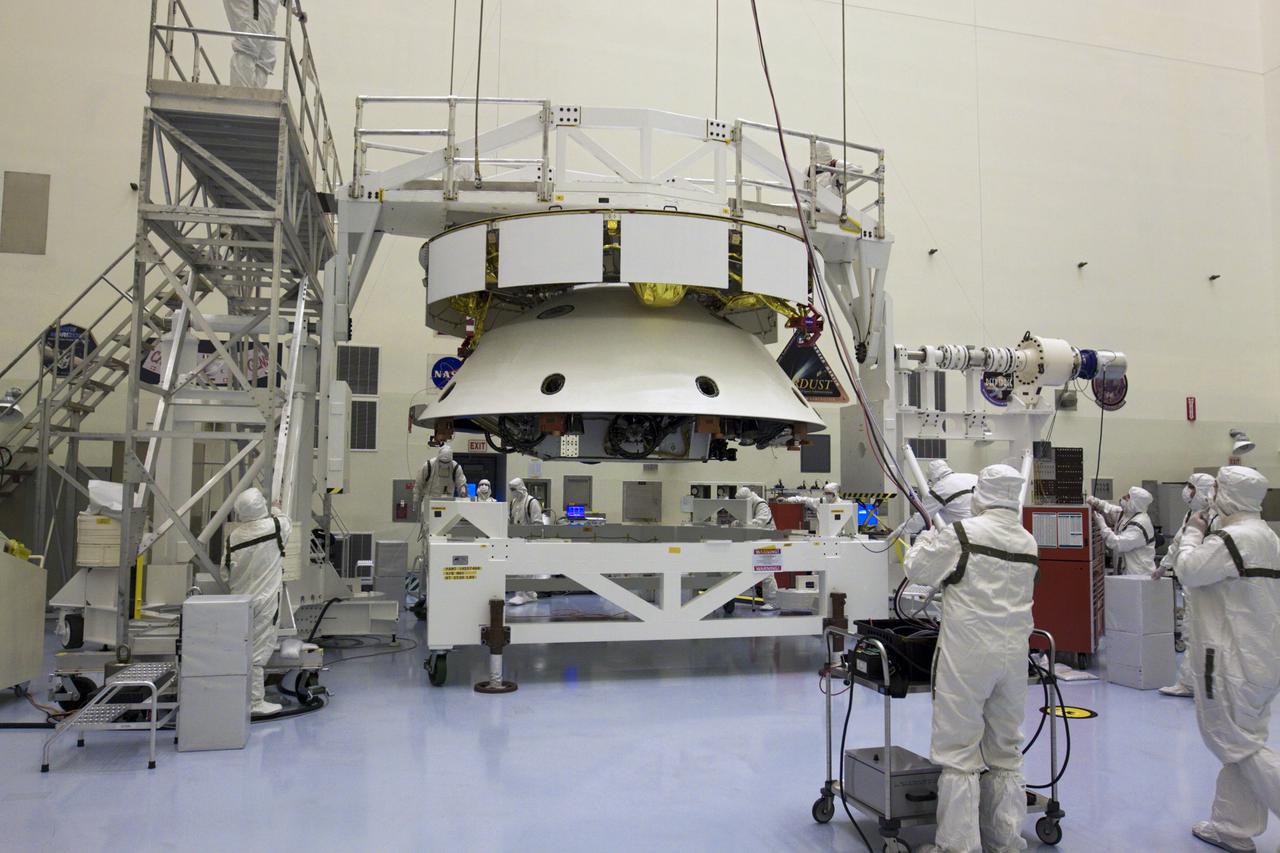
CAPE CANAVERAL, Fla. – In the Payload Hazardous Servicing Facility at NASA’s Kennedy Space Center in Florida, technicians, using an overhead crane, lift NASA's Mars Science Laboratory (MSL) mission aeroshell, (containing the compact car-sized rover Curiosity), for mating to the cruise stage. The cruise stage provides solar power, thrusters for navigation, and heat exchangers to the rover during its flight from Earth to Mars. The rover Curiosity has 10 science instruments designed to search for evidence on whether Mars has had environments favorable to microbial life, including chemical ingredients for life. The unique rover will use a laser to look inside rocks and release its gasses so that the rover’s spectrometer can analyze and send the data back to Earth. Launch of MSL aboard a United Launch Alliance Atlas V rocket is scheduled for Nov. 25 from Space Launch Complex 41 on Cape Canaveral Air Force Station in Florida. For more information, visit http:__www.nasa.gov_msl. Photo credit: NASA_Glenn Benson
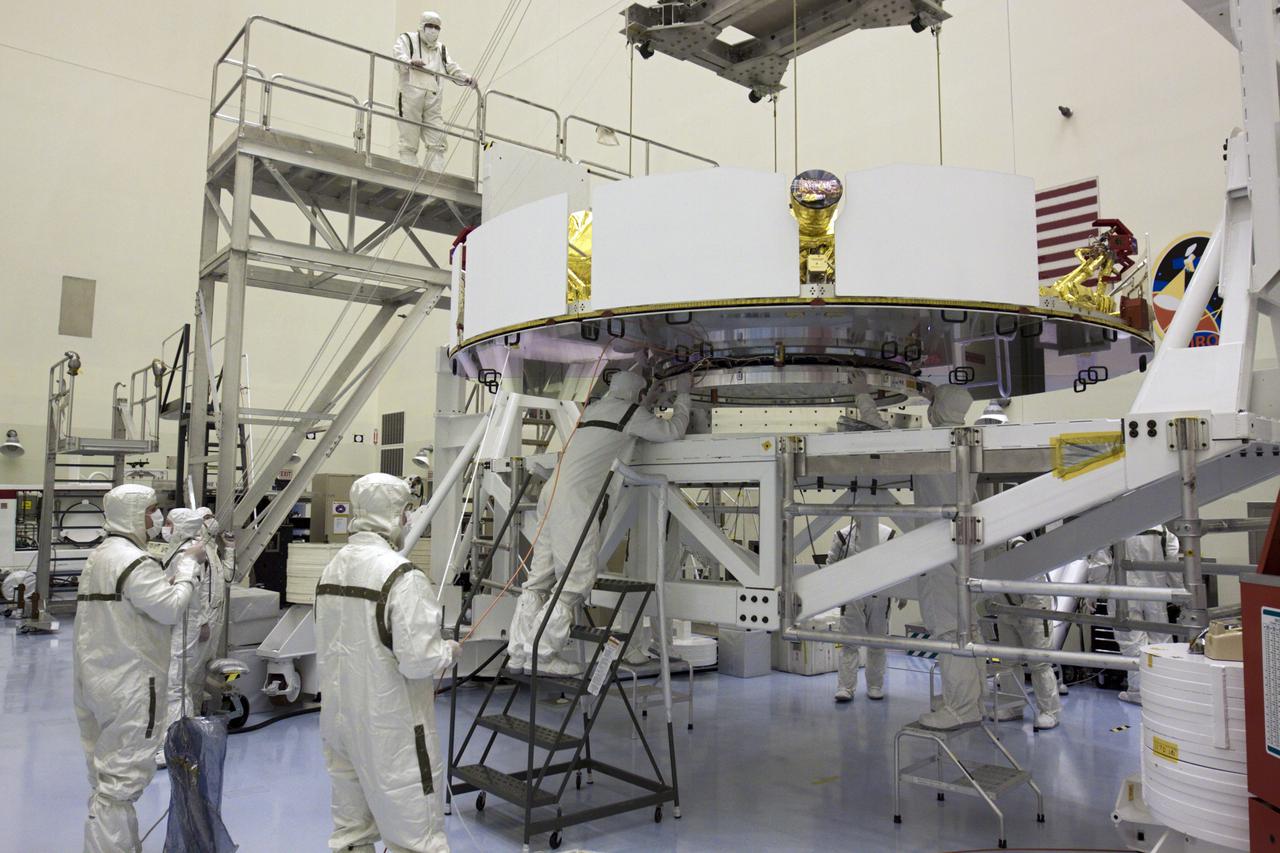
CAPE CANAVERAL, Fla. – In the Payload Hazardous Servicing Facility at NASA’s Kennedy Space Center in Florida, technicians inspect NASA's Mars Science Laboratory (MSL) mission cruise stage as it is guided onto a rotation stand. The cruise stage provides solar power, thrusters for navigation, and heat exchangers to the rover during its flight from Earth to Mars. MSL's components include a car-sized rover, Curiosity, which has 10 science instruments designed to search for evidence on whether Mars has had environments favorable to microbial life, including chemical ingredients for life. The unique rover will use a laser to look inside rocks and release its gasses so that the rover’s spectrometer can analyze and send the data back to Earth. Launch of MSL aboard a United Launch Alliance Atlas V rocket is scheduled for Nov. 25 from Space Launch Complex 41 on Cape Canaveral Air Force Station in Florida. For more information, visit http:__www.nasa.gov_msl. Photo credit: NASA_Glenn Benson
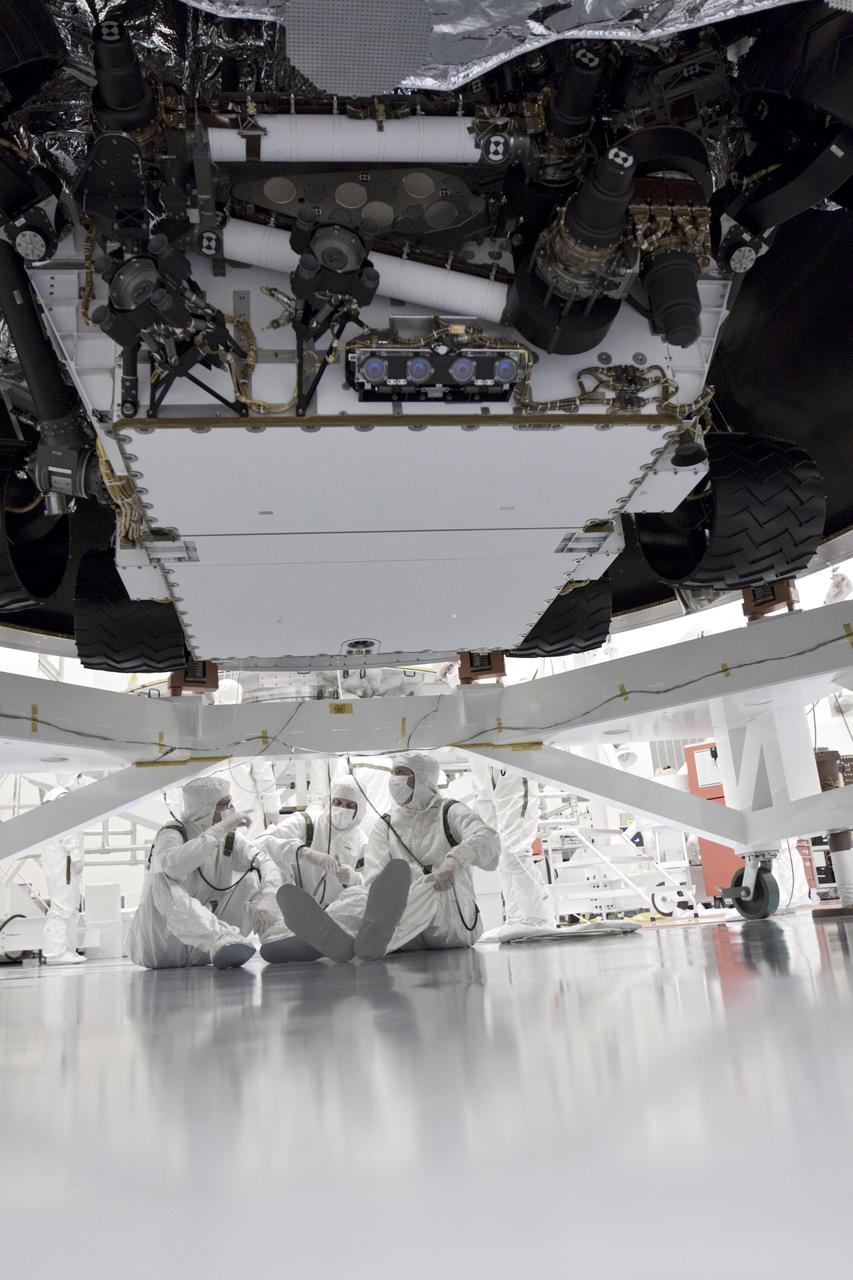
CAPE CANAVERAL, Fla. – In the Payload Hazardous Servicing Facility at NASA’s Kennedy Space Center in Florida, technicians consult with one another under NASA's Mars Science Laboratory (MSL) mission aeroshell, where the wheels of the rover Curiosity can be seen. MSL's components include a car-sized rover, Curiosity, which has 10 science instruments designed to search for evidence on whether Mars has had environments favorable to microbial life, including chemical ingredients for life. The unique rover will use a laser to look inside rocks and release its gasses so that the rover’s spectrometer can analyze and send the data back to Earth. Launch of MSL aboard a United Launch Alliance Atlas V rocket is scheduled for Nov. 25 from Space Launch Complex 41 on Cape Canaveral Air Force Station in Florida. For more information, visit http:__www.nasa.gov_msl. Photo credit: NASA_Glenn Benson
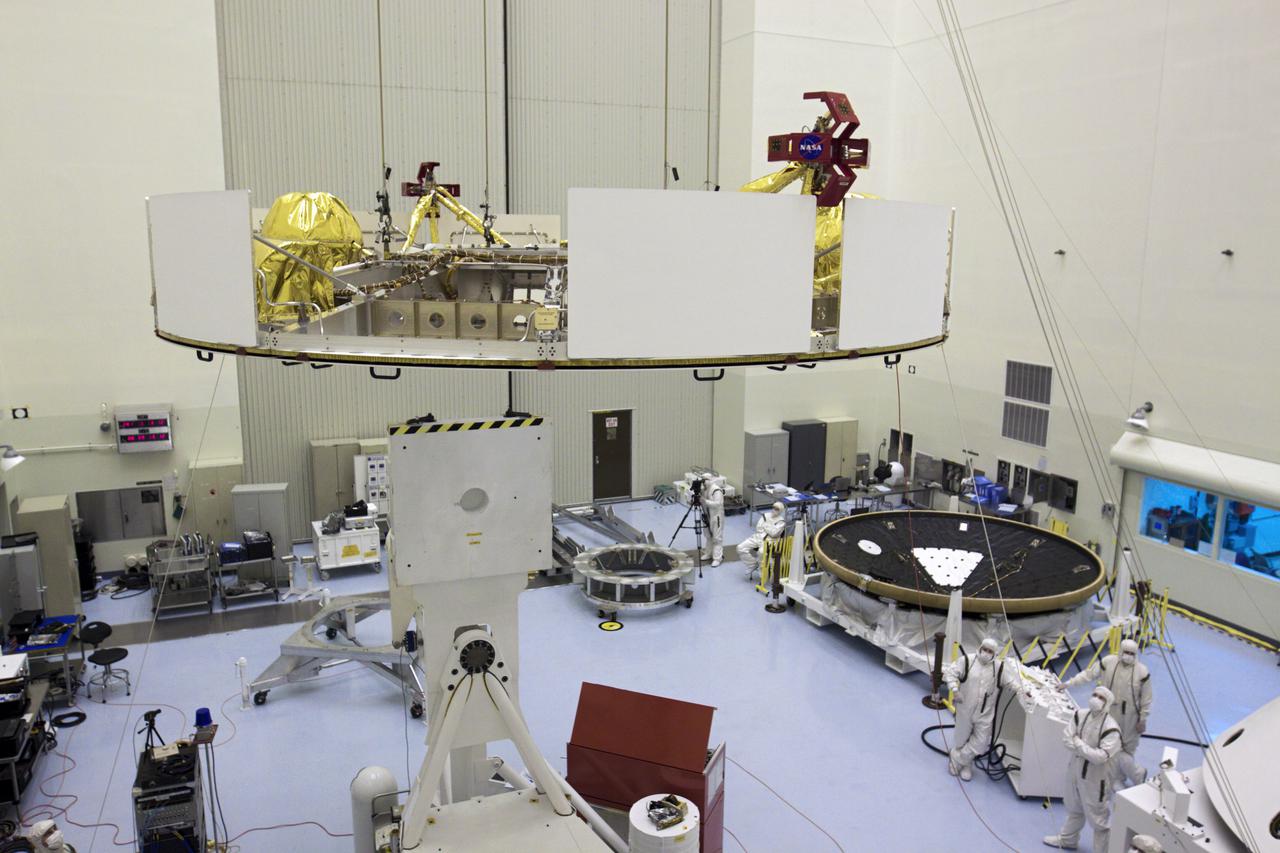
CAPE CANAVERAL, Fla. – In the Payload Hazardous Servicing Facility at NASA’s Kennedy Space Center in Florida, technicians, using an overhead crane, guide NASA's Mars Science Laboratory (MSL) mission cruise stage over a rotation stand. The cruise stage provides solar power, thrusters for navigation, and heat exchangers to the rover during its flight from Earth to Mars. To the right is the MSL heat shield. MSL's components include a car-sized rover, Curiosity, which has 10 science instruments designed to search for evidence on whether Mars has had environments favorable to microbial life, including chemical ingredients for life. The unique rover will use a laser to look inside rocks and release its gasses so that the rover’s spectrometer can analyze and send the data back to Earth. Launch of MSL aboard a United Launch Alliance Atlas V rocket is scheduled for Nov. 25 from Space Launch Complex 41 on Cape Canaveral Air Force Station in Florida. For more information, visit http:__www.nasa.gov_msl. Photo credit: NASA_Glenn Benson
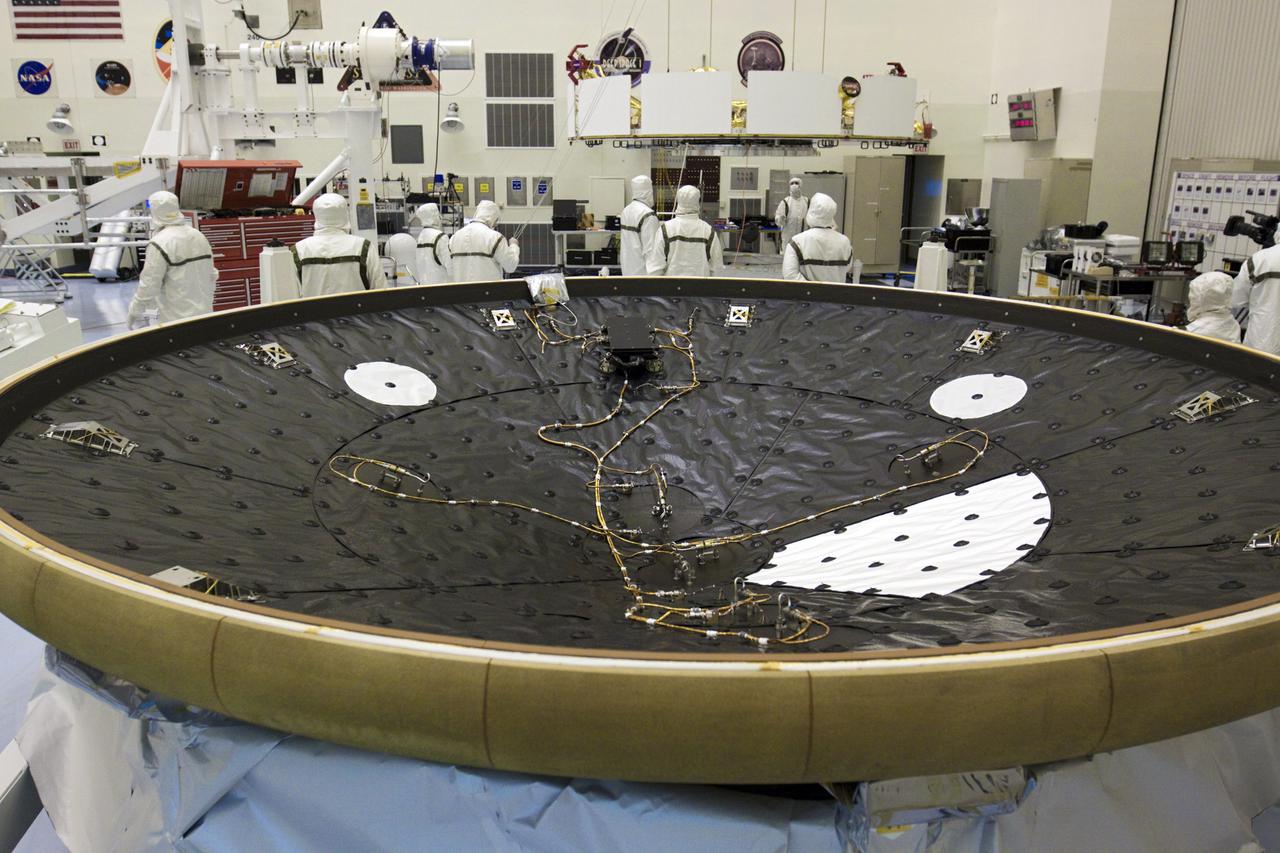
CAPE CANAVERAL, Fla. – In the Payload Hazardous Servicing Facility at NASA’s Kennedy Space Center in Florida, technicians, using an overhead crane, lift NASA's Mars Science Laboratory (MSL) mission cruise stage for placement onto a rotation stand. The cruise stage provides solar power, thrusters for navigation, and heat exchangers to the rover during its flight from Earth to Mars. In the foreground is the heat shield for MSL. MSL's components include a car-sized rover, Curiosity, which has 10 science instruments designed to search for evidence on whether Mars has had environments favorable to microbial life, including chemical ingredients for life. The unique rover will use a laser to look inside rocks and release its gasses so that the rover’s spectrometer can analyze and send the data back to Earth. Launch of MSL aboard a United Launch Alliance Atlas V rocket is scheduled for Nov. 25 from Space Launch Complex 41 on Cape Canaveral Air Force Station in Florida. For more information, visit http:__www.nasa.gov_msl. Photo credit: NASA_Glenn Benson
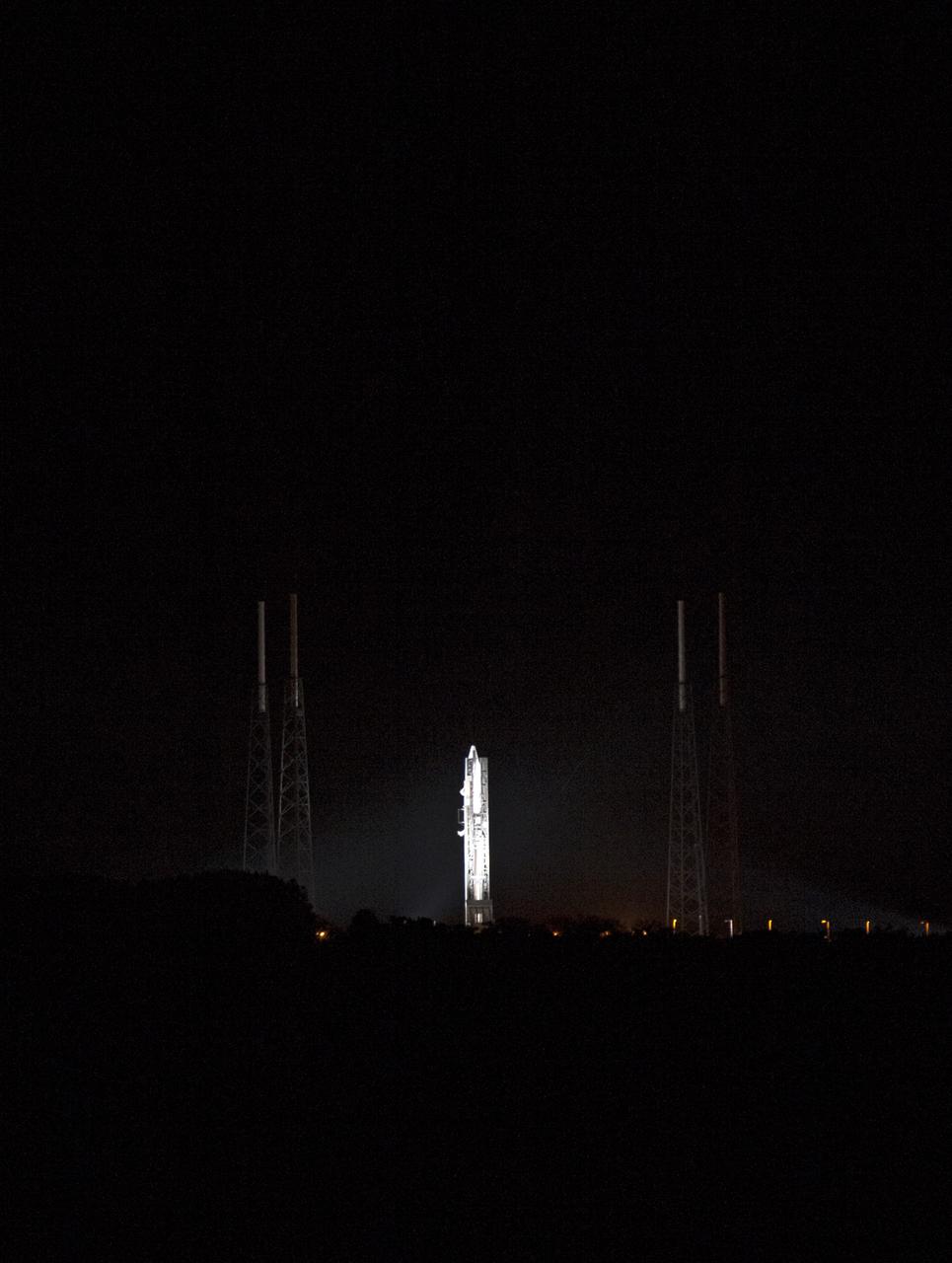
CAPE CANAVERAL, Fla. -- A United Launch Alliance Atlas V 401 rocket is poised for liftoff from Space Launch Complex 41 on Cape Canaveral Air Force Station in Florida, carrying NASA's Tracking and Data Relay Satellite-K, TDRS-K, to orbit. Launch is set for 8:48 p.m. EST. The TDRS-K spacecraft is part of the next-generation series in the Tracking and Data Relay Satellite System, a constellation of space-based communication satellites providing tracking, telemetry, command and high-bandwidth data return services. For more information, visit http:__www.nasa.gov_mission_pages_tdrs_index.html. Photo credit: NASA_Glenn Benson
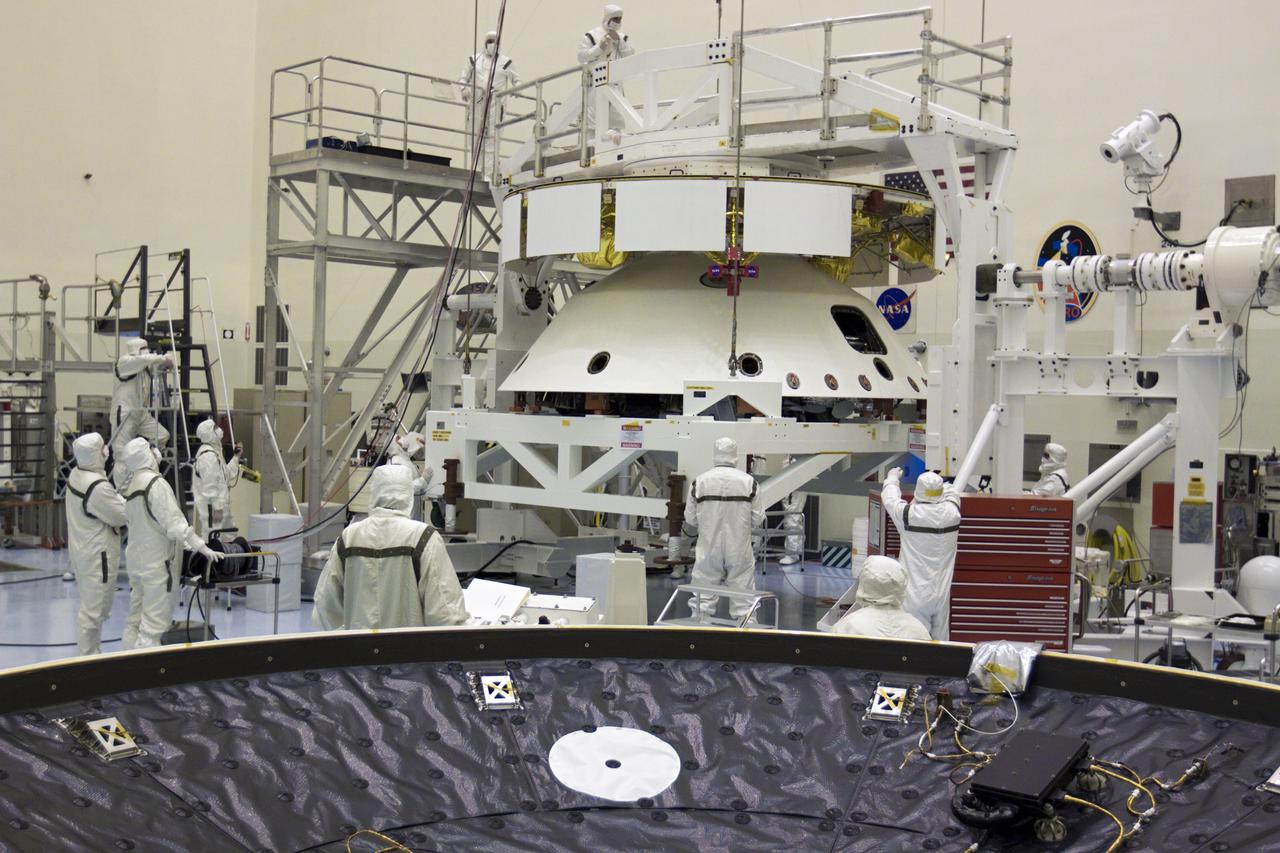
CAPE CANAVERAL, Fla. – In the Payload Hazardous Servicing Facility at NASA’s Kennedy Space Center in Florida, technicians, using an overhead crane, lift NASA's Mars Science Laboratory (MSL) mission aeroshell, (containing the compact car-sized rover Curiosity), for mating to the cruise stage. The cruise stage provides solar power, thrusters for navigation, and heat exchangers to the rover during its flight from Earth to Mars. In the foreground is the MSL heat shield. The rover Curiosity has 10 science instruments designed to search for evidence on whether Mars has had environments favorable to microbial life, including chemical ingredients for life. The unique rover will use a laser to look inside rocks and release its gasses so that the rover’s spectrometer can analyze and send the data back to Earth. Launch of MSL aboard a United Launch Alliance Atlas V rocket is scheduled for Nov. 25 from Space Launch Complex 41 on Cape Canaveral Air Force Station in Florida. For more information, visit http:__www.nasa.gov_msl. Photo credit: NASA_Glenn Benson