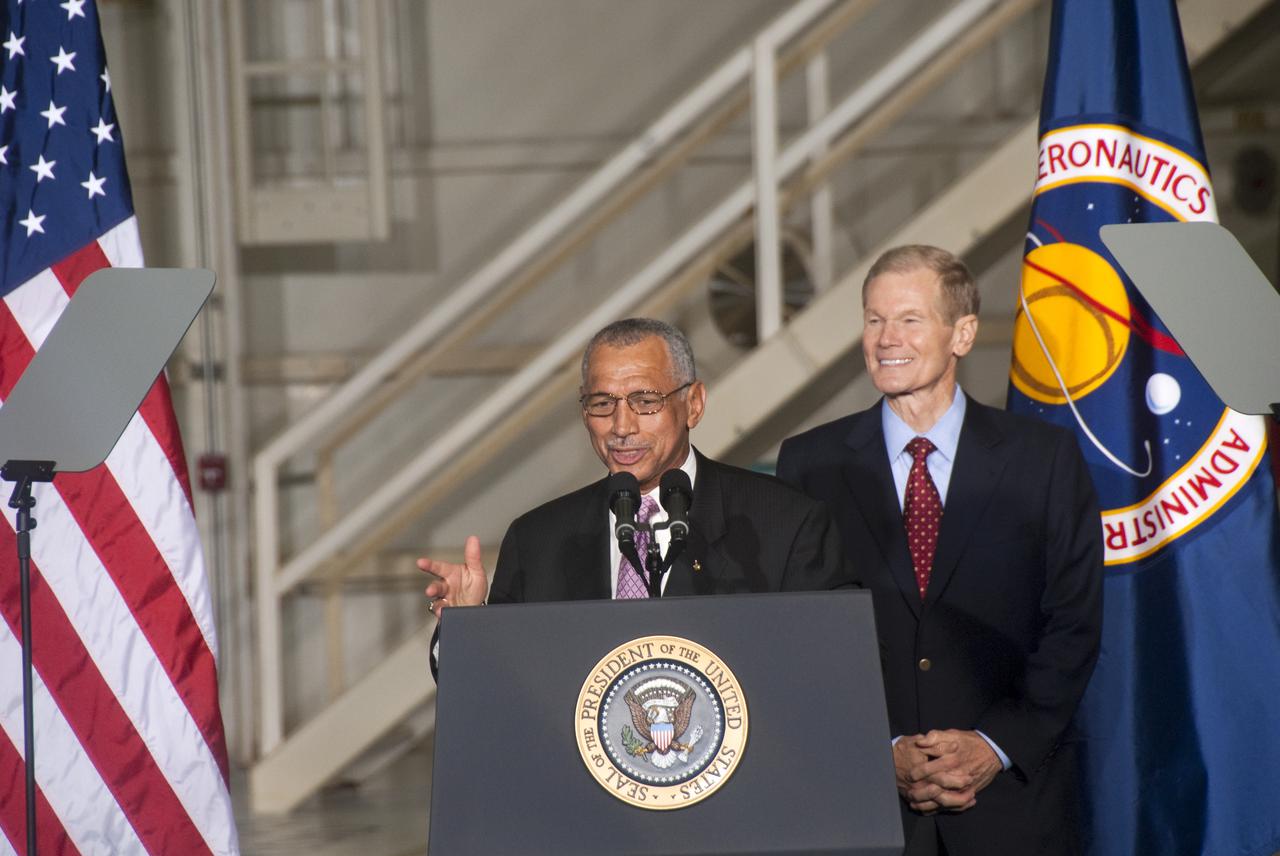
CAPE CANAVERAL, Fla. - In the Operations and Checkout Building at NASA's Kennedy Space Center in Florida, NASA Administrator Charles Bolden, at the podium, introduces President Barack Obama to the participants of the Conference on the American Space Program for the 21st Century. Behind him is U. S. Sen. Bill Nelson. President Obama opened the conference with remarks on the new course his administration is charting for NASA and the future of U.S. leadership in human spaceflight. Photo credit: NASA_Jim Grossmann
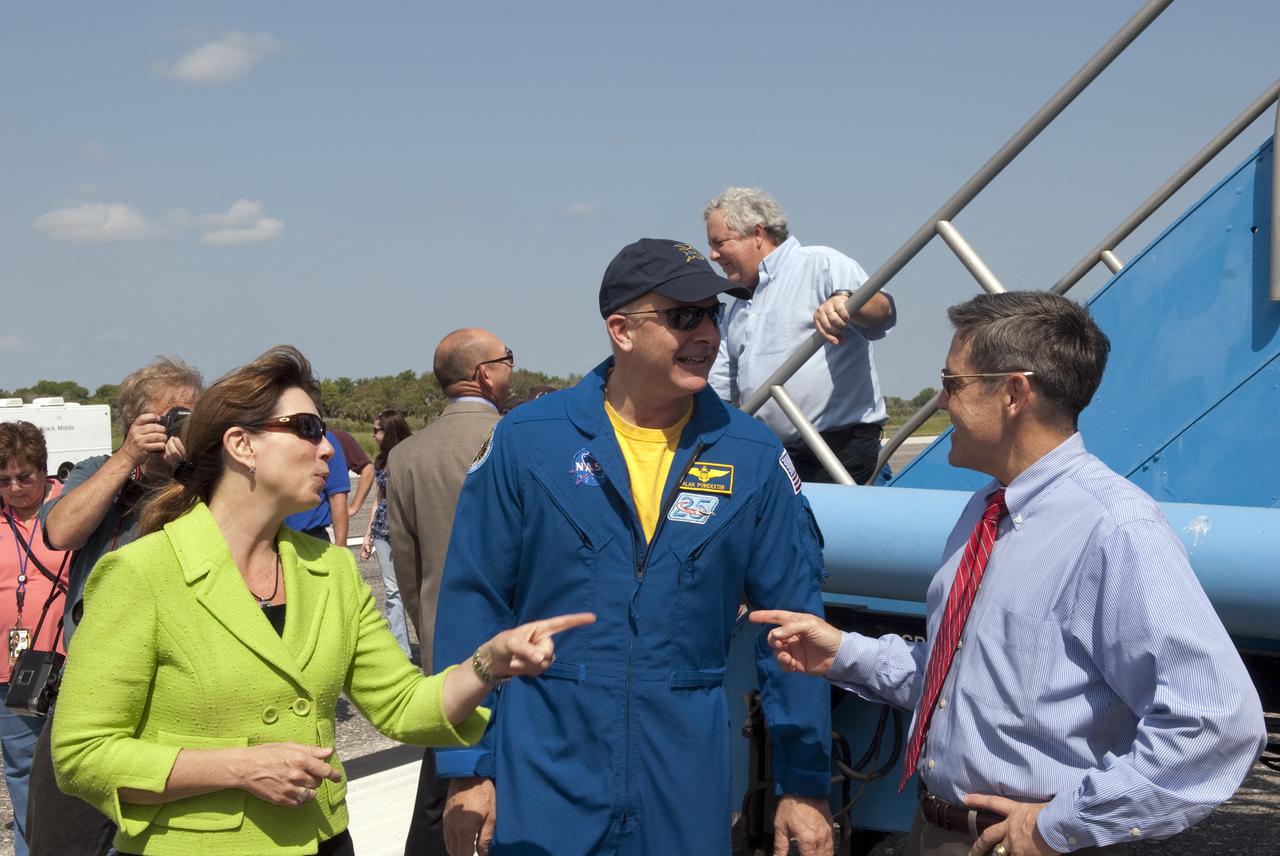
CAPE CANAVERAL, Fla. - At the Shuttle Landing Facility at NASA's Kennedy Space Center in Florida, NASA Deputy Administrator Lori Garver, left, and Kennedy Director Bob Cabana, right, welcome STS-131 Commander Alan Poindexter back to Florida following the landing of space shuttle Discovery on Runway 33. Discovery landed at Kennedy after 15 days in space, completing the more than 6.2-million-mile STS-131 mission on orbit 238. Main gear touchdown was at 9:08:35 a.m. EDT followed by nose gear touchdown at 9:08:47 a.m. and wheelstop at 9:09:33 a.m. The seven-member STS-131 crew carried the multi-purpose logistics module Leonardo, filled with supplies, a new crew sleeping quarters and science racks that were transferred to the International Space Station's laboratories. The crew also switched out a gyroscope on the station’s truss, installed a spare ammonia storage tank and retrieved a Japanese experiment from the station’s exterior. STS-131 is the 33rd shuttle mission to the station and the 131st shuttle mission overall. For information on the STS-131 mission and crew, visit http:__www.nasa.gov_mission_pages_shuttle_shuttlemissions_sts131_index.html. Photo credit: NASA_Jim Grossmann
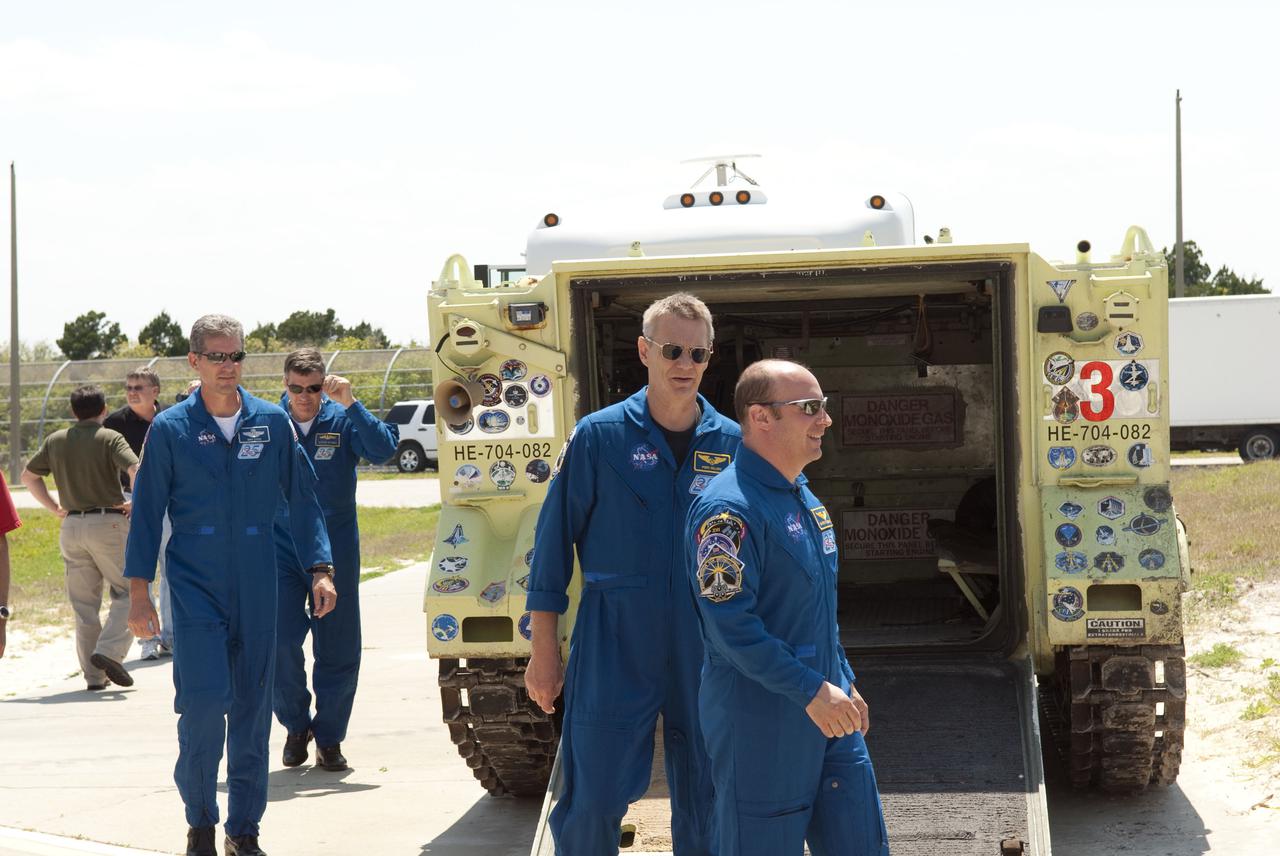
CAPE CANAVERAL, Fla. - At Launch Pad 39A at NASA's Kennedy Space Center, the members of space shuttle Atlantis' STS-132 crew receive instruction on the location and operation of an M-113 armored personnel carrier during emergency exit training. The M-113 is stationed at the base of the pad. In the blue flight suits, from left, are Mission Specialists Michael Good, Steve Bowen, Piers Sellers and Garrett Reisman. The crew is participating in training in preparation for their Terminal Countdown Demonstration Test, or TCDT, a dress rehearsal for launch. TCDT provides each shuttle crew and launch team the opportunity to participate in various simulated countdown activities, including equipment familiarization and emergency procedures. On the STS-132 mission, the six-member crew will deliver an Integrated Cargo Carrier, or ICC, and the Russian-built Mini-Research Module-1, or MRM-1, to the International Space Station aboard space shuttle Atlantis. The ICC is an unpressurized flat bed pallet and keel yoke assembly used to support the transfer of exterior cargo from the shuttle to the space station. The MRM-1, known as Rassvet, is the second in a series of new pressurized components for Russia and will be permanently attached to the Earth-facing port of the Zarya control module. Rassvet, which translates to 'dawn,' will be used for cargo storage and will provide an additional docking port to the station. STS-132 is the 34th mission to the station and the 132nd shuttle mission overall. Atlantis is targeted to launch on May 14 at 2:19 p.m. For information on the STS-132 mission, visit http:__www.nasa.gov_mission_pages_shuttle_shuttlemissions_sts132_index.html. Photo credit: NASA_Jim Grossmann
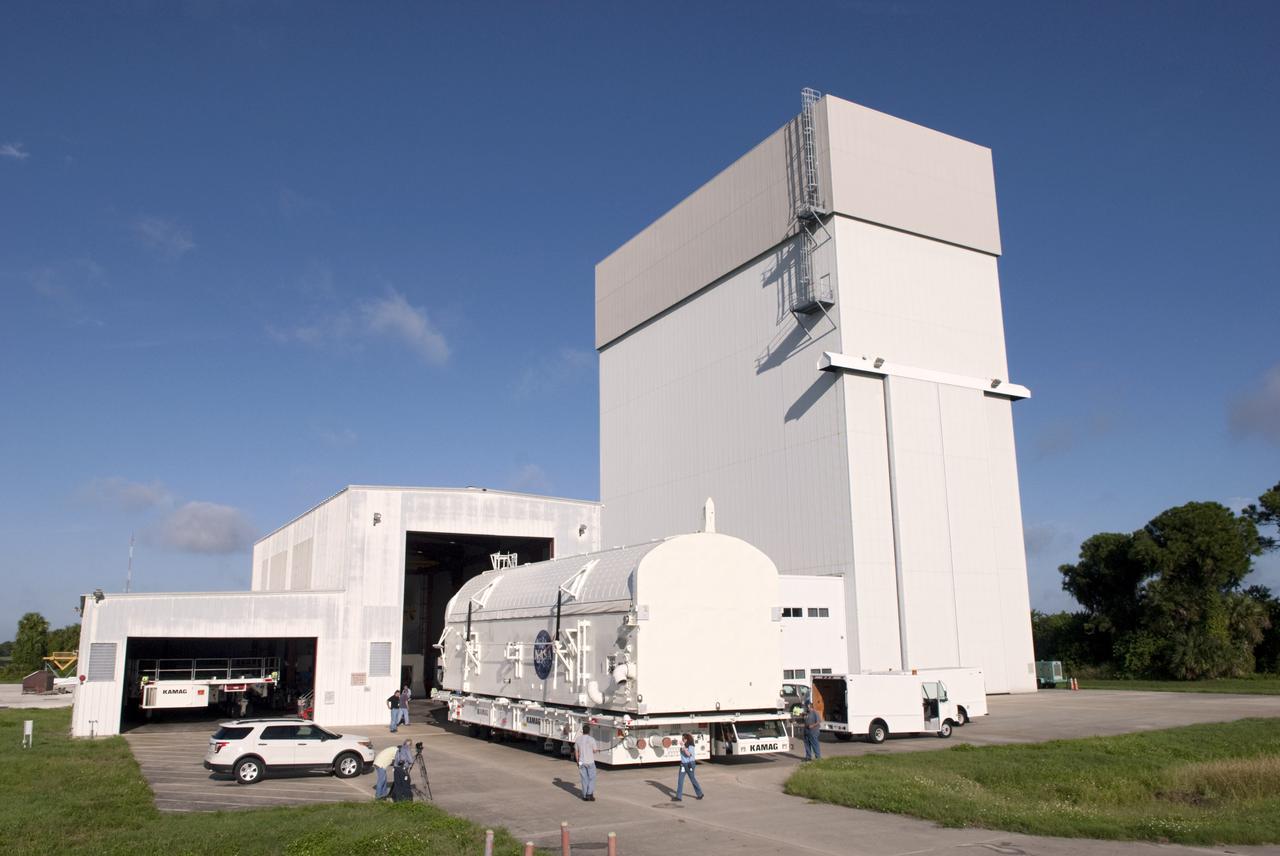
CAPE CANAVERAL, Fla. -- Employees monitor payload canister #2 as it rolls out of the high bay of the Canister Rotation Facility at NASA's Kennedy Space Center in Florida for its trip to the Reutilization, Recycling and Marketing Facility on Ransom Road. The two payload canisters used to transport space shuttle payloads to the launch pad for installation in the shuttles' cargo bays are being decommissioned following the end of the Space Shuttle Program. Each canister weighs 110,000 pounds and is 65 feet long, 22 feet wide, and 18 feet, 7 inches high. The canisters were prescreened through NASA Headquarters as possible artifacts, but their size makes them difficult to transport to locations off the center. Federal and state agencies now will be given the opportunity to screen the canisters for potential use before a final decision is made on their disposition. For more information, visit http:__www.nasa.gov_centers_kennedy_pdf_167403main_CRF-06.pdf. Photo credit: NASA_Jim Grossmann

CAPE CANAVERAL, Fla. - In the Operations and Checkout Building at NASA's Kennedy Space Center in Florida, President Barack Obama addresses the participants of the Conference on the American Space Program for the 21st Century. Behind him is a space shuttle main engine; a mock-up of an Orion capsule is in the background, at right. In his remarks, President Obama outlined the new course his administration is charting for NASA and the future of U.S. leadership in human spaceflight. Photo credit: NASA_Jim Grossmann
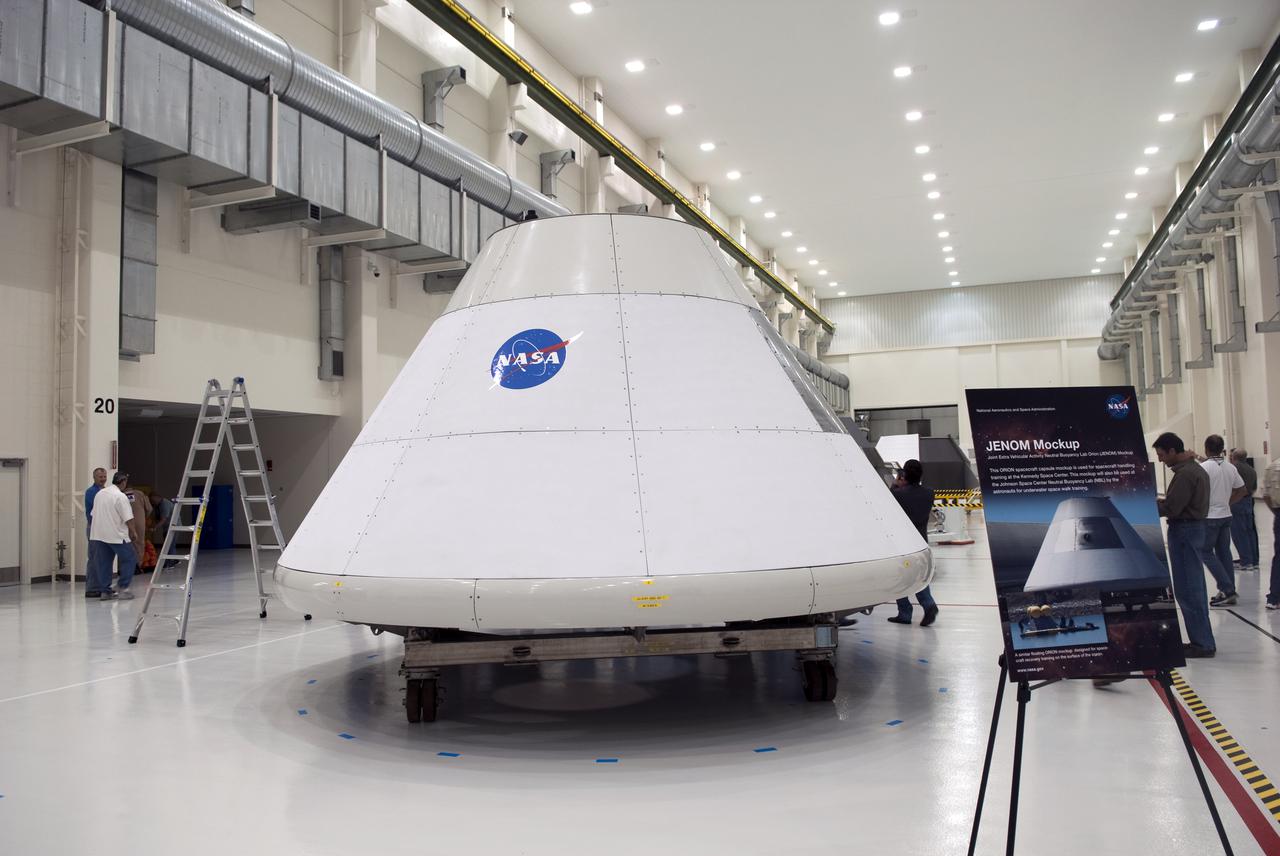
CAPE CANAVERAL, Fla. – In the Operations and Checkout Building at NASA's Kennedy Space Center in Florida, Joint Extravehicular NBL ORION Mockup, or JENOM, is on display. The mock-up details the interior components of the vehicle including seat layout and the subsystem components on the outside of the pressure vessel. Orion mock-ups also have been used to verify accessibility of the servicing locations at the launch pad and in the Vehicle Assembly Building. For information on the development of the Orion capsule, visit www.nasa.gov_orion. Photo credit: NASA_Jim Grossmann
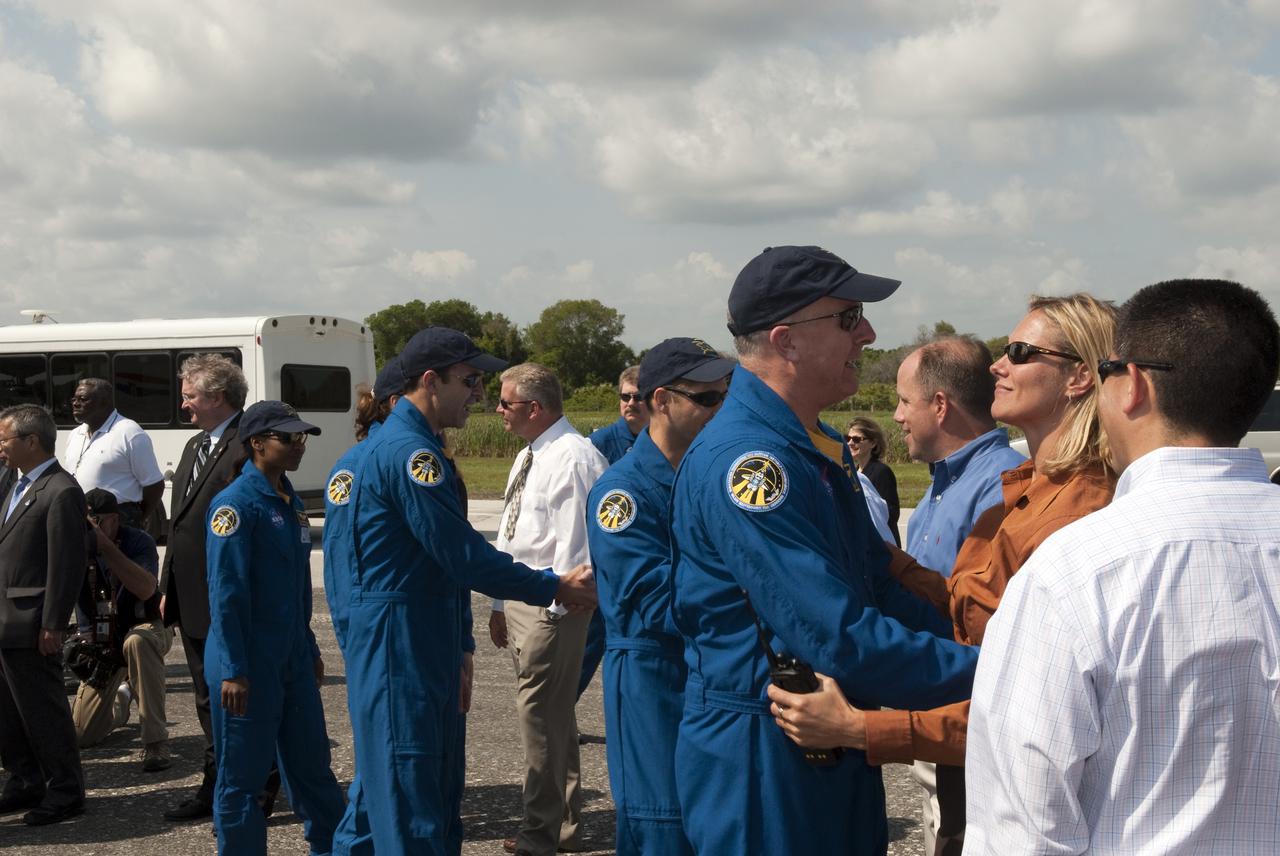
CAPE CANAVERAL, Fla. - At the Shuttle Landing Facility at NASA's Kennedy Space Center in Florida, members of the STS-131 crew are congratulated on a successful mission by NASA managers and invited guests on hand for the landing of space shuttle Discovery on Runway 33. The astronauts are, from left, Mission Specialists Stephanie Wilson, Dorothy Metcalf-Lindenburger and Rick Mastracchio; Pilot James P. Dutton Jr.; and Commander Alan Poindexter, talking with Discovery Flow Director Stephanie Stilson. Discovery landed at Kennedy after 15 days in space, completing the more than 6.2-million-mile STS-131 mission on orbit 238. Main gear touchdown was at 9:08:35 a.m. EDT followed by nose gear touchdown at 9:08:47 a.m. and wheelstop at 9:09:33 a.m. The seven-member STS-131 crew carried the multi-purpose logistics module Leonardo, filled with supplies, a new crew sleeping quarters and science racks that were transferred to the International Space Station's laboratories. The crew also switched out a gyroscope on the station’s truss, installed a spare ammonia storage tank and retrieved a Japanese experiment from the station’s exterior. STS-131 is the 33rd shuttle mission to the station and the 131st shuttle mission overall. For information on the STS-131 mission and crew, visit http:__www.nasa.gov_mission_pages_shuttle_shuttlemissions_sts131_index.html. Photo credit: NASA_Jim Grossmann
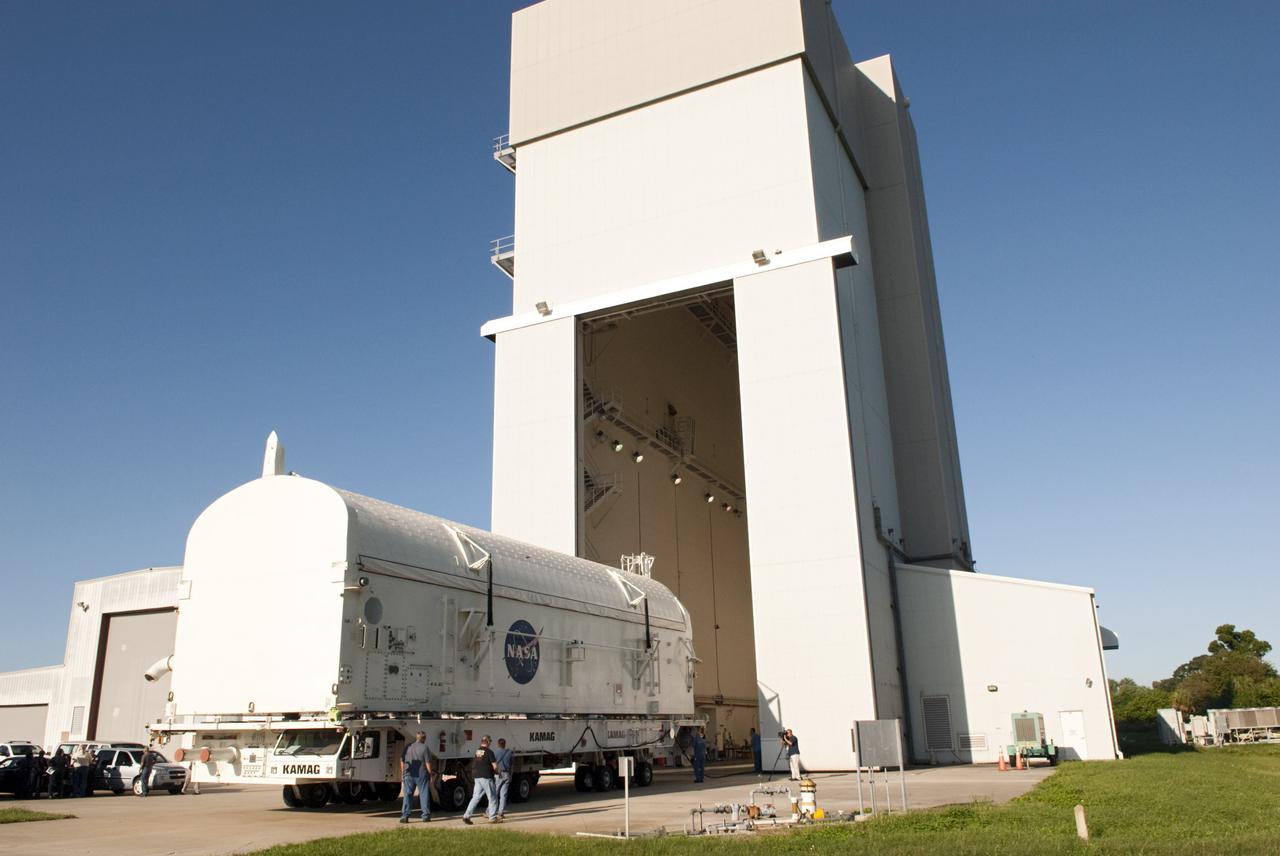
CAPE CANAVERAL, Fla. -- Payload canister #1 departs the high bay of the Canister Rotation Facility at NASA's Kennedy Space Center in Florida for the last time. The canister is being moved to the Reutilization, Recycling and Marketing Facility on Ransom Road. The two payload canisters used to transport space shuttle payloads to the launch pad for installation in the shuttles' cargo bays are being decommissioned following the end of the Space Shuttle Program. Each canister weighs 110,000 pounds and is 65 feet long, 22 feet wide, and 18 feet, 7 inches high. The canisters were prescreened through NASA Headquarters as possible artifacts, but their size makes them difficult to transport to locations off the center. Federal and state agencies now will be given the opportunity to screen the canisters for potential use before a final decision is made on their disposition. For more information, visit http:__www.nasa.gov_centers_kennedy_pdf_167403main_CRF-06.pdf. Photo credit: NASA_Jim Grossmann
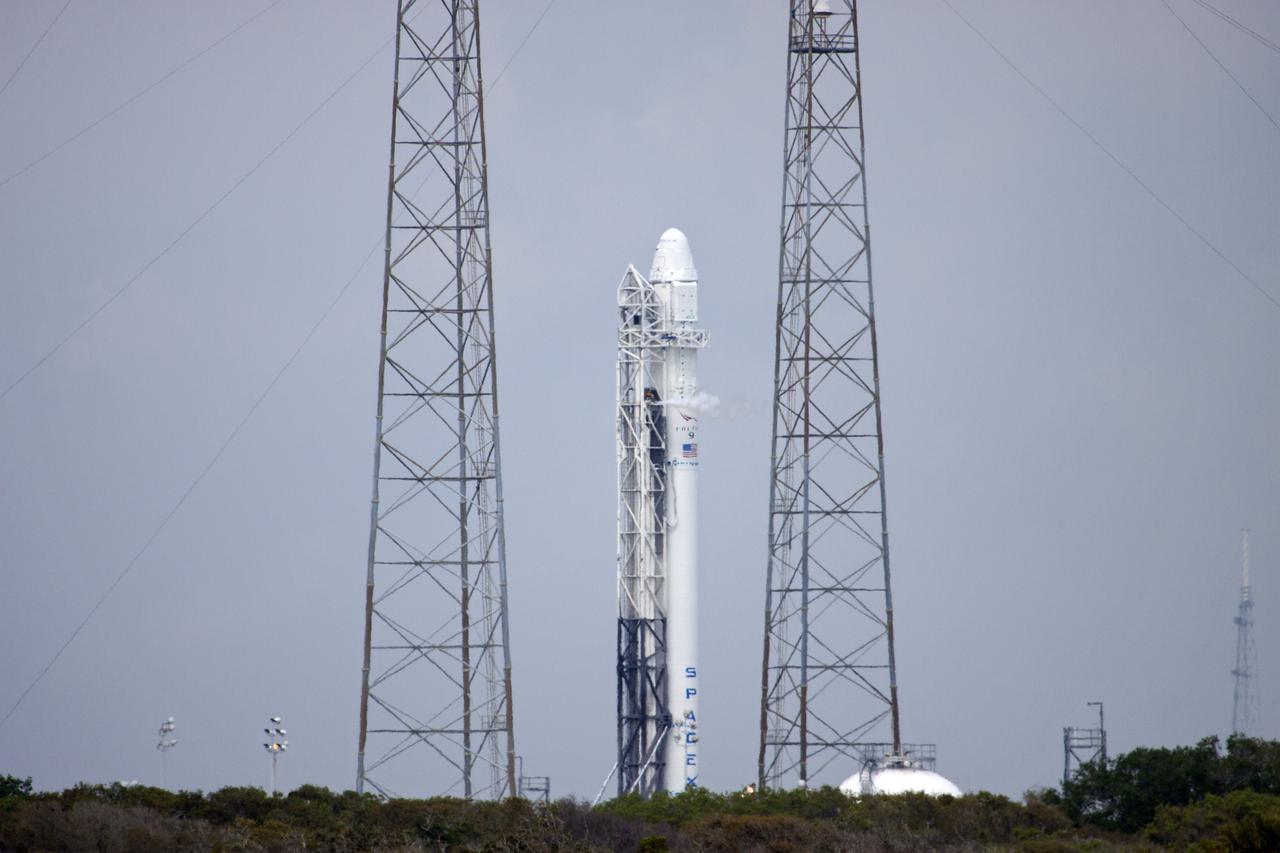
CAPE CANAVERAL, Fla. - Flanked by lightning protection catenary towers at Launch Complex 40, the SpaceX Falcon 9 rocket, topped by the Dragon spacecraft, awaits a test firing of the vehicle's nine Merlin first-stage engines. The test is part of SpaceX 2 prelaunch preparations at Cape Canaveral Air Force Station in Florida. Liftoff of the SpaceX Falcon 9 rocket and Dragon spacecraft is planned for March 1, 2013, at 10:10 a.m. EST, from Space Launch Complex-40 at Cape Canaveral Air Force Station, Fla. Dragon will be making its third trip to the space station. It will carry supplies and experiments to the orbiting laboratory. The mission is the second of 12 SpaceX flights contracted by NASA to resupply the space station. For more information, visit http:__www.nasa.gov_mission_pages_station_structure_launch_spacex2-feature.html Photo credit: NASA_Jim Grossmann
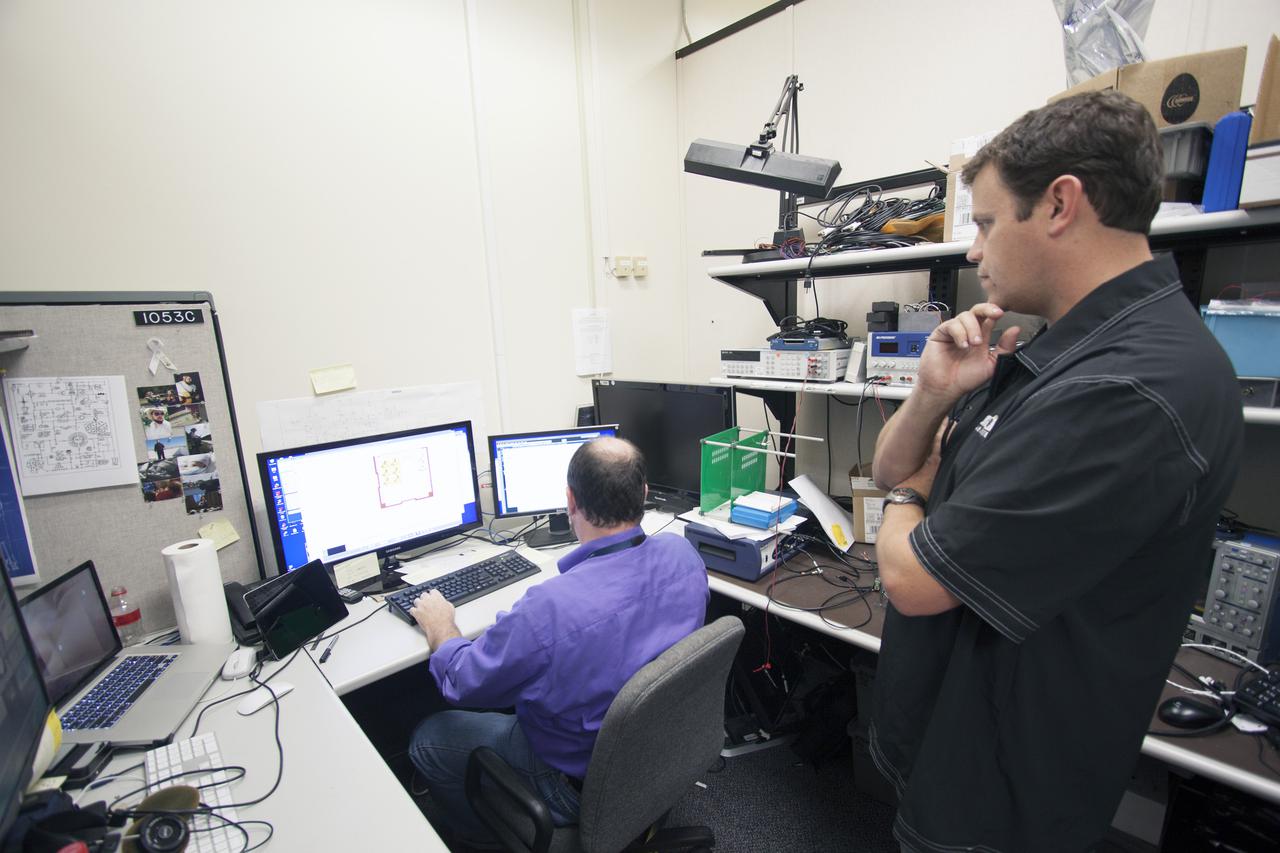
CAPE CANAVERAL, Fla. – Shaun Daly, right, and Robert Olsen test elements of a prototype of the StangSat at Kennedy Space Center before final assembly. The satellite is a small cube measuring 10 inches on all sides and will be launched on a rocket that will carry it on a suborbital mission in Mojave, Calif. Photo credit: NASA_Jim Grossmann

CAPE CANAVERAL, Fla. - At Launch Pad 39A at NASA's Kennedy Space Center in Florida, the members of space shuttle Atlantis' STS-132 crew continue their emergency exit training by the catch nets for the slidewire baskets at the base of the pad. The pad's escape system includes seven baskets suspended from seven slidewires that extend from the fixed service structure to a landing zone 1,200 feet west of the pad. In the blue flight suits, from left, are Commander Ken Ham; Mission Specialist Piers Sellers; Pilot Tony Antonelli; and Mission Specialists Steve Bowen, Garrett Reisman and Michael Good. The crew is participating in training in preparation for their Terminal Countdown Demonstration Test, or TCDT, a dress rehearsal for launch. TCDT provides each shuttle crew and launch team the opportunity to participate in various simulated countdown activities, including equipment familiarization and emergency procedures. On the STS-132 mission, the six-member crew will deliver an Integrated Cargo Carrier, or ICC, and the Russian-built Mini-Research Module-1, or MRM-1, to the International Space Station aboard space shuttle Atlantis. The ICC is an unpressurized flat bed pallet and keel yoke assembly used to support the transfer of exterior cargo from the shuttle to the space station. The MRM-1, known as Rassvet, is the second in a series of new pressurized components for Russia and will be permanently attached to the Earth-facing port of the Zarya control module. Rassvet, which translates to 'dawn,' will be used for cargo storage and will provide an additional docking port to the station. STS-132 is the 34th mission to the station and the 132nd shuttle mission overall. Atlantis is targeted to launch on May 14 at 2:19 p.m. For information on the STS-132 mission, visit http:__www.nasa.gov_mission_pages_shuttle_shuttlemissions_sts132_index.html. Photo credit: NASA_Jim Grossmann

CAPE CANAVERAL, Fla. - In the Atlas_Redstone Room of the Debus Center at NASA's Kennedy Space Center Visitor Complex in Florida, Dr. Edward F. Crawley, Ford professor of engineering at MIT, speaks to the audience at the 'Expanding our Reach into the Solar System' break-out session, part of the Conference on the American Space Program for the 21st Century. The panel includes Scott Hubbard, former director of NASA's Ames Research Center (back to camera); John Holdren, assistant to the President for science and technology and director of the White House Office of Science and Technology Policy, panel moderator, and NASA Astronaut John Grunsfeld (obscured). Photo credit: NASA_Jim Grossmann

CAPE CANAVERAL, Fla. - At Launch Pad 39A at NASA's Kennedy Space Center in Florida, one of space shuttle Discovery's payload bay doors close around the orbiter docking system, seen here, as well as the multi-purpose logistics module Leonardo and other cargo that will fly on the STS-131 mission. Payload bay door closure for launch is a significant milestone in processing activities. The countdown for Discovery's launch on April 5 is set to begin at 3 a.m. EDT on April 2. The seven-member STS-131 crew will deliver Leonardo to the International Space Station. The module is filled with supplies, a new crew sleeping quarters and science racks that will be transferred to the station's laboratories. The crew also will switch out a gyroscope on the station’s truss, install a spare ammonia storage tank and retrieve a Japanese experiment from the station’s exterior. STS-131 is the 33rd shuttle mission to the station and the 131st shuttle mission overall. For information on the STS-131 mission and crew, visit http:__www.nasa.gov_mission_pages_shuttle_shuttlemissions_sts131_index.html. Photo credit: NASA_Jim Grossmann
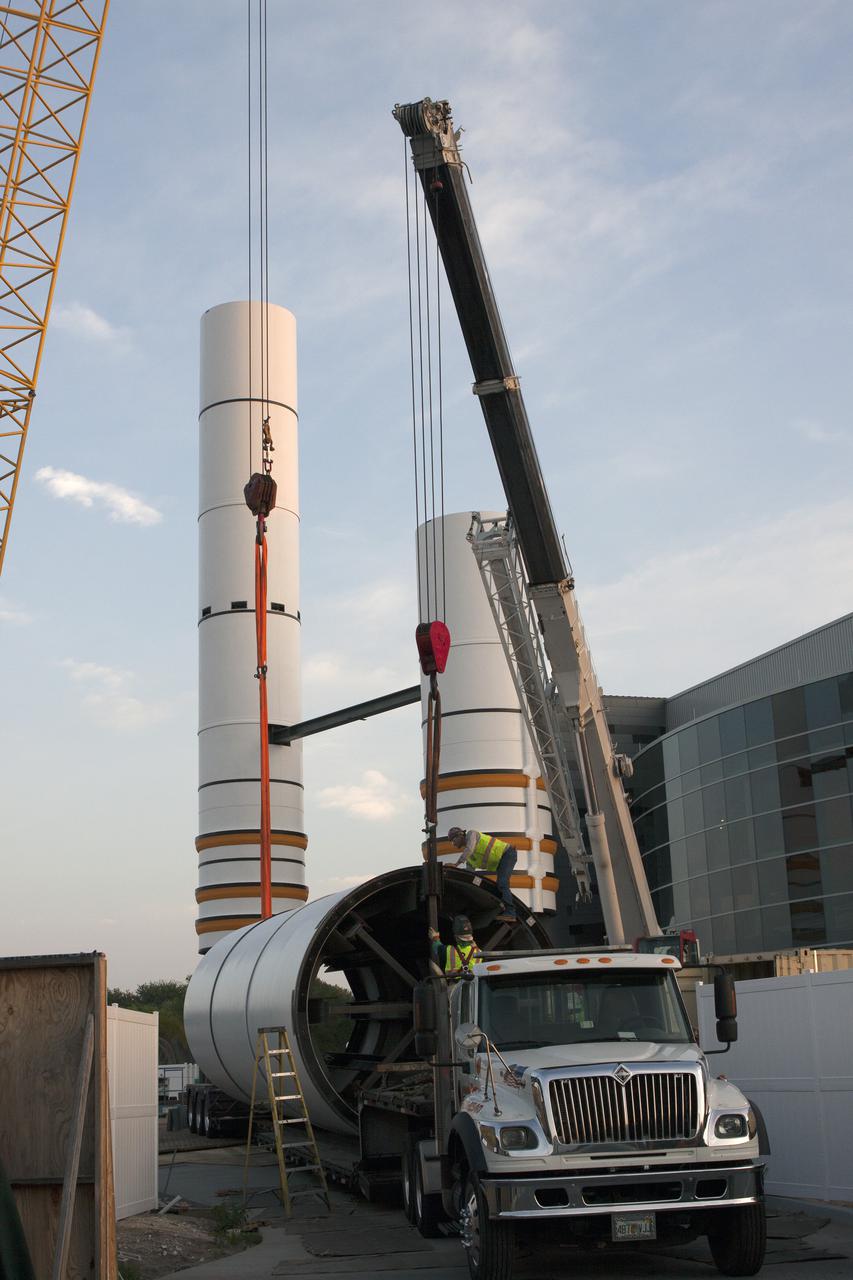
CAPE CANAVERAL, Fla. – Workers prepare to lift a segment for a set of twin, full-size replica Solid Rocket Boosters SRBs in front of the Space Shuttle Atlantis exhibit under construction at the Kennedy Space Center Visitor Complex in Florida. Atlantis is housed in the building behind the SRB stack. An external tank replica will be added later to the middle of the SRBs to complete the display. The SRBs stand 150 feet tall, while the external tank will reach 184 feet when it is finished. The shuttle was mounted to the stack and depended on the power of the SRBs to lift it off the launch pad and start it on its way to space. The external tank was loaded with liquid propellants for the shuttle's three main engines. Photo credit: NASA_Jim Grossmann

CAPE CANAVERAL, Fla. - Space shuttle Endeavour lights up the night sky as it lifts off Launch Pad 39A at NASA's Kennedy Space Center in Florida. Launch on the STS-130 mission to the International Space Station was at 4:14 a.m. EST. This was the second launch attempt for space shuttle Endeavour's STS-130 crew and the final scheduled space shuttle night launch. The first attempt on Feb. 7 was scrubbed due to unfavorable weather. The primary payload for the STS-130 mission to the International Space Station is the Tranquility node, a pressurized module that will provide additional room for crew members and many of the station's life support and environmental control systems. Attached to one end of Tranquility is a cupola, a unique work area with six windows on its sides and one on top. The cupola resembles a circular bay window and will provide a vastly improved view of the station's exterior. The multi-directional view will allow the crew to monitor spacewalks and docking operations, as well as provide a spectacular view of Earth and other celestial objects. The module was built in Turin, Italy, by Thales Alenia Space for the European Space Agency. For information on the STS-130 mission and crew, visit http:__www.nasa.gov_mission_pages_shuttle_shuttlemissions_sts130_index.html. Photo credit: NASA_Jim Grossmann
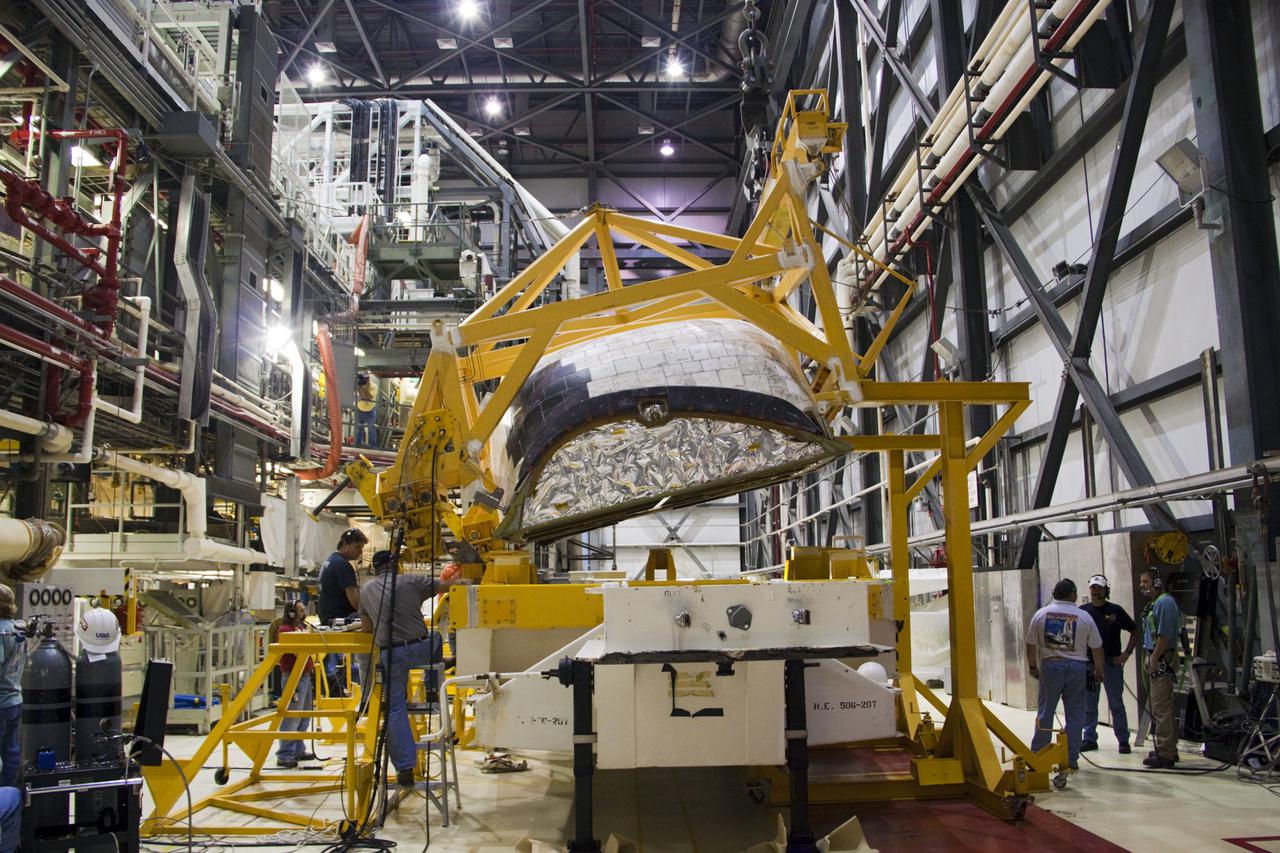
CAPE CANAVERAL, Fla. – – Inside Orbiter Processing Facility-1 at NASA’s Kennedy Space Center in Florida, a crane is used to lift a sling holding one of two orbital maneuvering system (OMS) pods that will be re-installed on space shuttle Discovery. The OMS pods were returned from White Sands Space Harbor in New Mexico where they underwent a complete deservicing and cleaning. The work is part of the Space Shuttle Program’s transition and retirement processing of shuttle Discovery. Discovery is being prepared for display at Smithsonian’s National Air and Space Museum, Steven F. Udvar-Hazy Center in Chantilly, Va. For more information, visit http:__www.nasa.gov_shuttle. Photo credit: NASA_Jim Grossmann
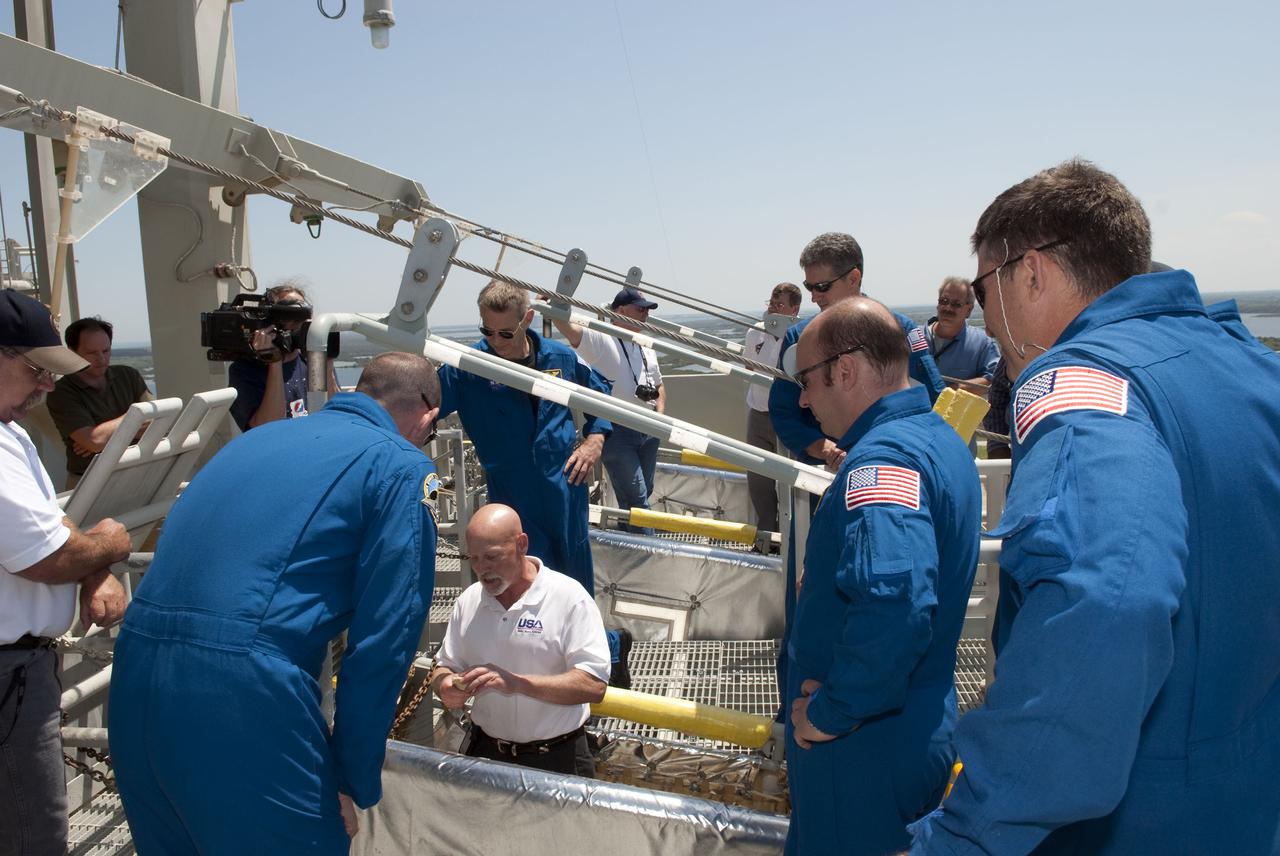
CAPE CANAVERAL, Fla. - On Launch Pad 39A at NASA's Kennedy Space Center, the members of space shuttle Atlantis' STS-132 crew receive instruction on the operation of the pad's slidewire basket system during emergency exit training. In the blue flight suits, from left, facing the camera, are Mission Specialists Piers Sellers, left, and Michael Good. Facing away from the camera are, from left, Pilot Tony Antonelli and Mission Specialists Garrett Reisman and Steve Bowen. The pad's escape system includes seven baskets suspended from seven slidewires that extend from the fixed service structure to a landing zone 1,200 feet west of the pad. The crew is participating in training in preparation for their Terminal Countdown Demonstration Test, or TCDT, a dress rehearsal for launch. TCDT provides each shuttle crew and launch team the opportunity to participate in various simulated countdown activities, including equipment familiarization and emergency procedures. On the STS-132 mission, the six-member crew will deliver an Integrated Cargo Carrier, or ICC, and the Russian-built Mini-Research Module-1, or MRM-1, to the International Space Station aboard space shuttle Atlantis. The ICC is an unpressurized flat bed pallet and keel yoke assembly used to support the transfer of exterior cargo from the shuttle to the space station. The MRM-1, known as Rassvet, is the second in a series of new pressurized components for Russia and will be permanently attached to the Earth-facing port of the Zarya control module. Rassvet, which translates to 'dawn,' will be used for cargo storage and will provide an additional docking port to the station. STS-132 is the 34th mission to the station and the 132nd shuttle mission overall. Atlantis is targeted to launch on May 14 at 2:19 p.m. For information on the STS-132 mission, visit http:__www.nasa.gov_mission_pages_shuttle_shuttlemissions_sts132_index.html. Photo credit: NASA_Jim Grossmann
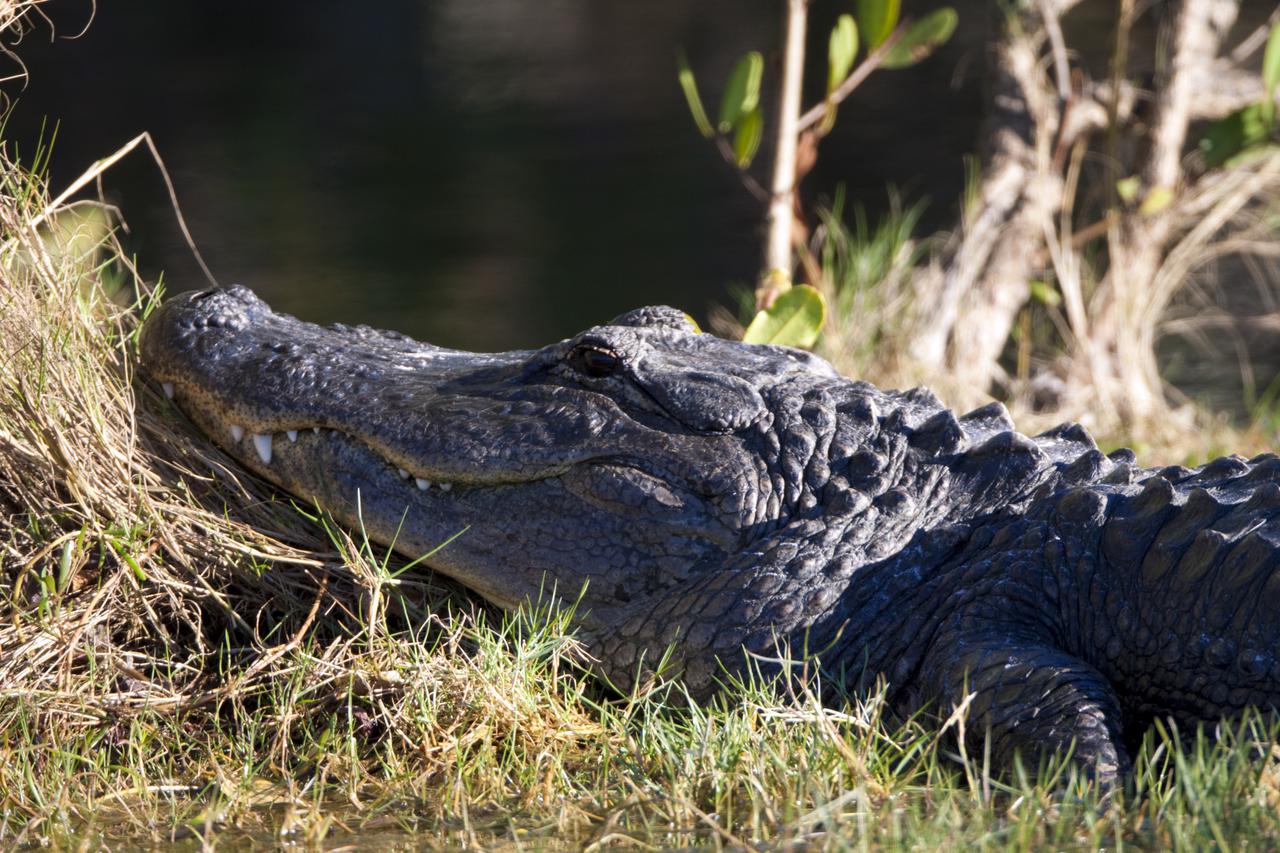
CAPE CANAVERAL, Fla. – An alligator in the marsh at the Blackpoint Wildlife Drive in the Merritt Island National Wildlife Refuge, northwest of NASA's Kennedy Space Center in Florida. Kennedy Space Center shares a boundary with the Merritt Island National Wildlife Refuge. The Refuge encompasses 92,000 acres that are a habitat for more than 331 species of birds, 31 mammals, 117 fishes, and 65 amphibians and reptiles. The marshes and open water of the refuge provide wintering areas for 23 species of migratory waterfowl, as well as a year-round home for great blue herons, great egrets, wood storks, cormorants, brown pelicans and other species of marsh and shore birds, as well as a variety of insects. For more information, visit: http:__www.nasa.gov_centers_kennedy_shuttleoperations_alligators_kscovr.html Photo credit: NASA_Jim Grossmann
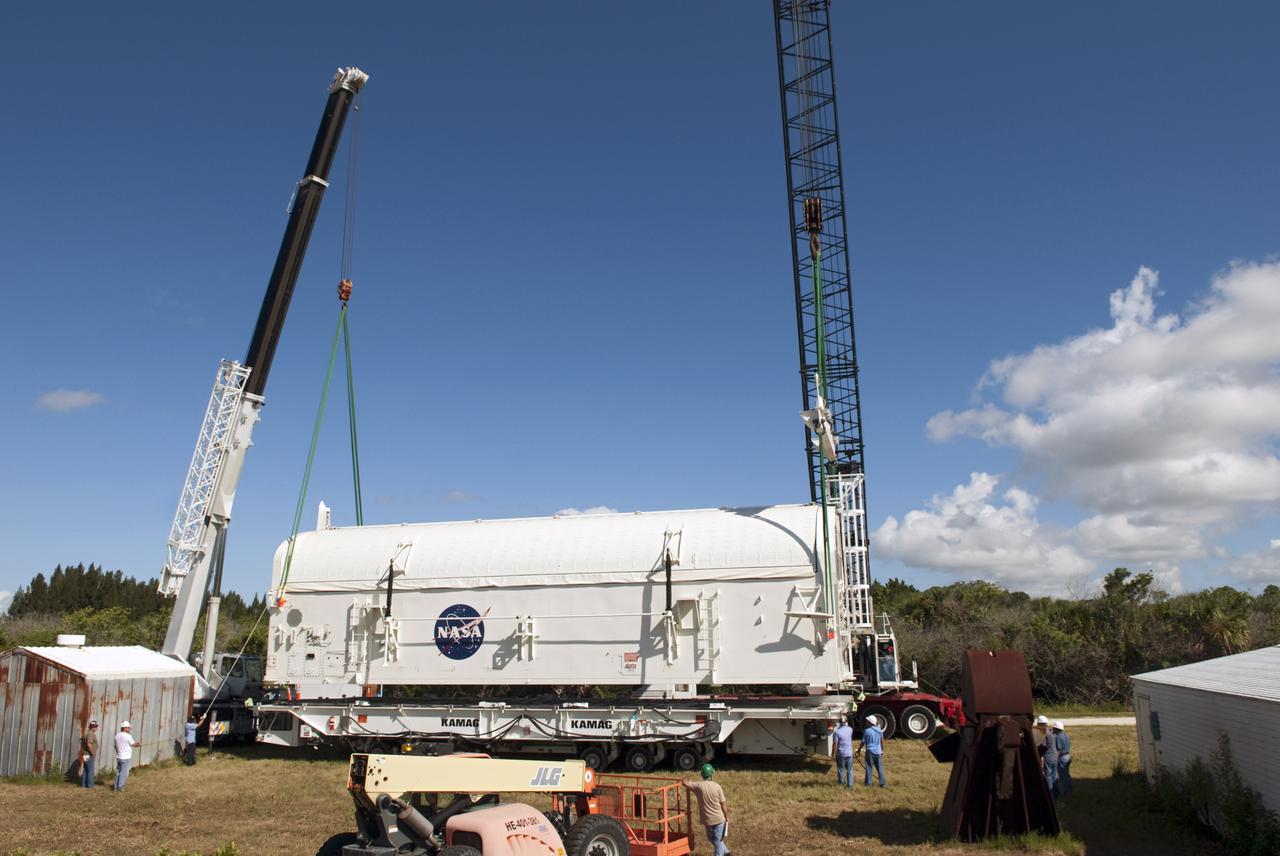
CAPE CANAVERAL, Fla. -- Cranes are attached to payload canister #1 to lift it from the transporter that delivered it to the Reutilization, Recycling and Marketing Facility on Ransom Road at NASA's Kennedy Space Center in Florida. The two payload canisters used to transport space shuttle payloads to the launch pad for installation in the shuttles' cargo bays are being decommissioned following the end of the Space Shuttle Program. Each canister weighs 110,000 pounds and is 65 feet long, 22 feet wide, and 18 feet, 7 inches high. The canisters were prescreened through NASA Headquarters as possible artifacts, but their size makes them difficult to transport to locations off the center. Federal and state agencies now will be given the opportunity to screen the canisters for potential use before a final decision is made on their disposition. For more information, visit http:__www.nasa.gov_centers_kennedy_pdf_167403main_CRF-06.pdf. Photo credit: NASA_Jim Grossmann
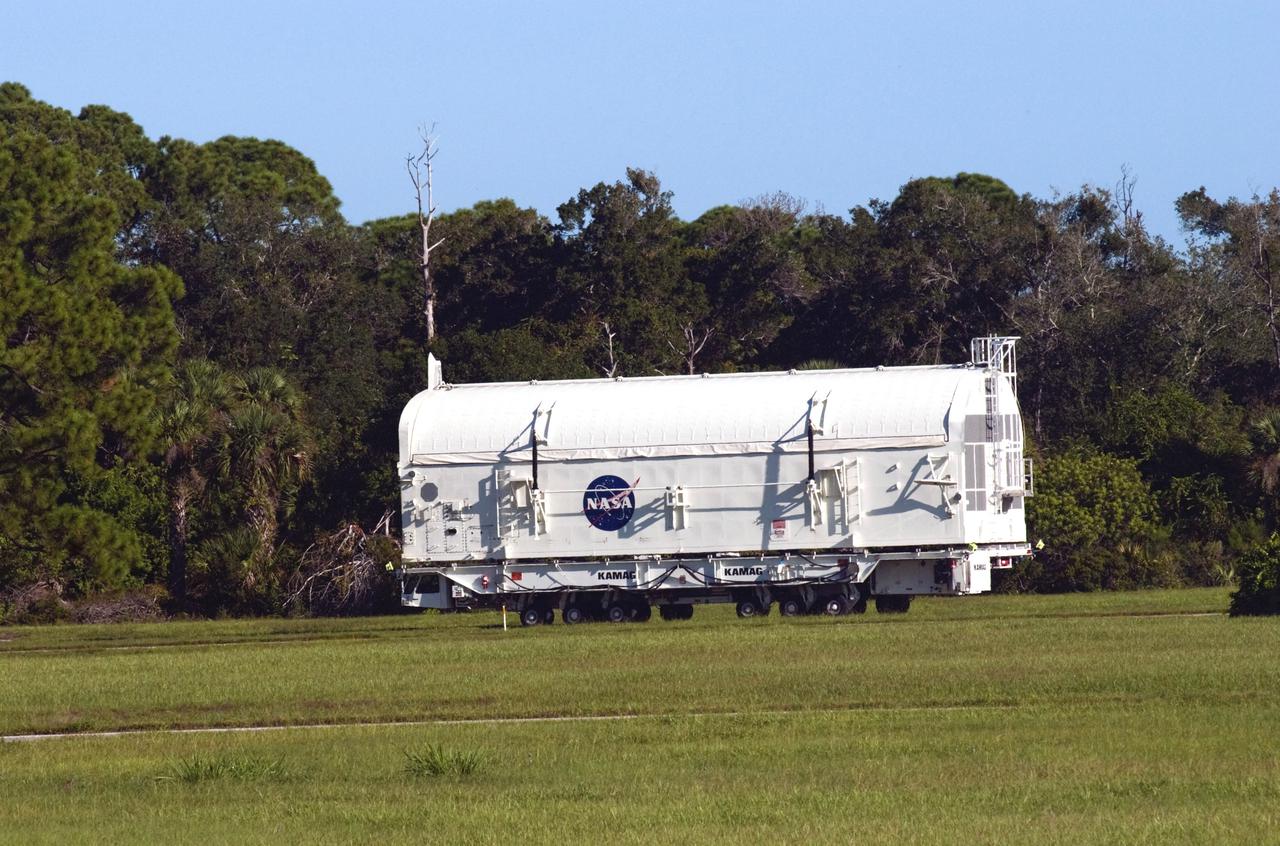
CAPE CANAVERAL, Fla. -- At NASA's Kennedy Space Center in Florida, payload canister #1 travels at a slow, steady 5 mph from the Canister Rotation Facility to the Reutilization, Recycling and Marketing Facility on Ransom Road. The two payload canisters used to transport space shuttle payloads to the launch pad for installation in the shuttles' cargo bays are being decommissioned following the end of the Space Shuttle Program. Each canister weighs 110,000 pounds and is 65 feet long, 22 feet wide, and 18 feet, 7 inches high. The canisters were prescreened through NASA Headquarters as possible artifacts, but their size makes them difficult to transport to locations off the center. Federal and state agencies now will be given the opportunity to screen the canisters for potential use before a final decision is made on their disposition. For more information, visit http:__www.nasa.gov_centers_kennedy_pdf_167403main_CRF-06.pdf. Photo credit: NASA_Jim Grossmann
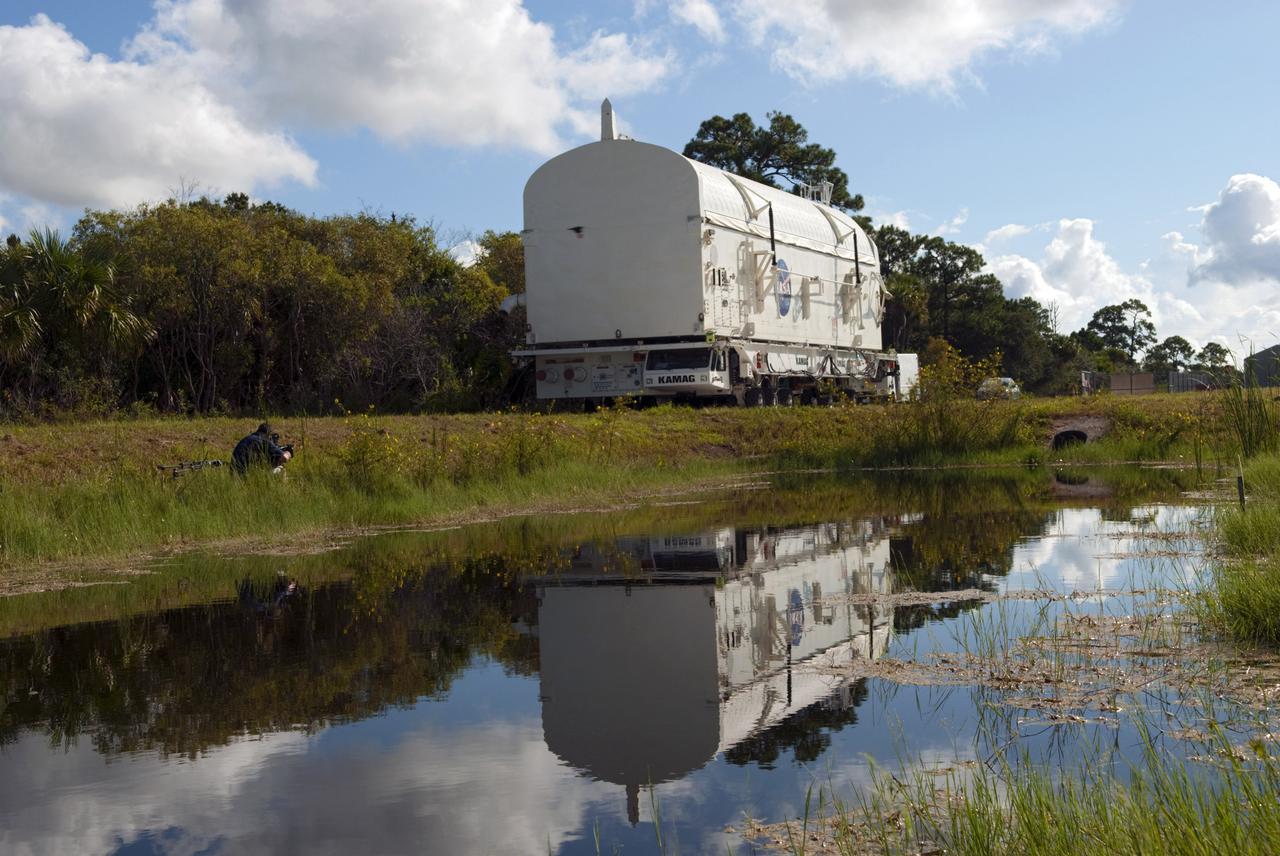
CAPE CANAVERAL, Fla. -- At NASA's Kennedy Space Center in Florida, payload canister #1 is reflected in the water standing beside the roadway leading to the Reutilization, Recycling and Marketing Facility on Ransom Road. The two payload canisters used to transport space shuttle payloads to the launch pad for installation in the shuttles' cargo bays are being decommissioned following the end of the Space Shuttle Program. Each canister weighs 110,000 pounds and is 65 feet long, 22 feet wide, and 18 feet, 7 inches high. The canisters were prescreened through NASA Headquarters as possible artifacts, but their size makes them difficult to transport to locations off the center. Federal and state agencies now will be given the opportunity to screen the canisters for potential use before a final decision is made on their disposition. For more information, visit http:__www.nasa.gov_centers_kennedy_pdf_167403main_CRF-06.pdf. Photo credit: NASA_Jim Grossmann
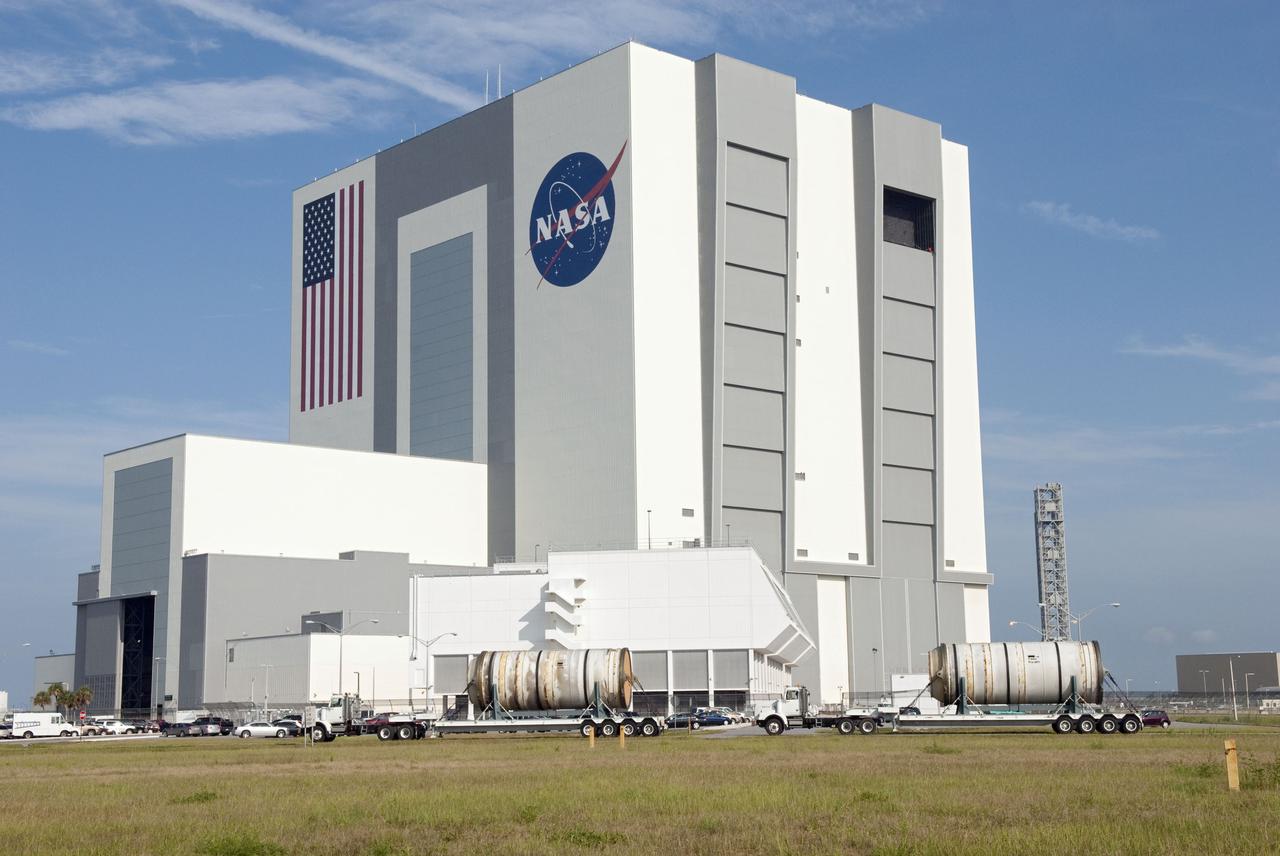
CAPE CANAVERAL, Fla. -- At NASA's Kennedy Space Center in Florida, spent solid rocket booster segments used for the STS-132 mission are being transported from Hangar AF to the Locomotive Maintenance Facility. They will be loaded onto railcars and returned to the ATK solid rocket booster plant in Promontory, Utah. Photo credit: NASA_Jim Grossmann
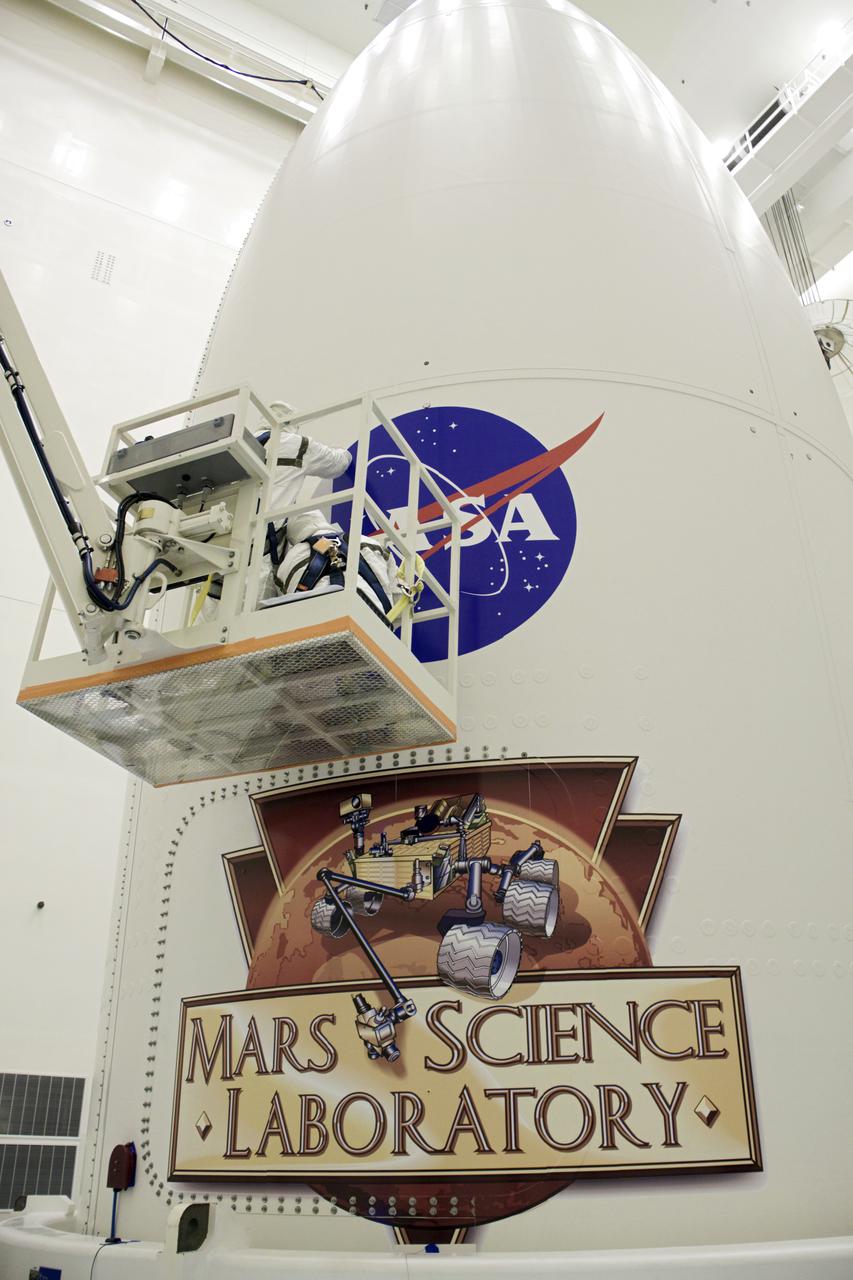
CAPE CANAVERAL, Fla. -- In the Payload Hazardous Servicing Facility at NASA's Kennedy Space Center in Florida, technicians use a lift to reach the upper region of an Atlas V rocket's payload fairing, where the NASA logo is being installed. Below is the Mars Science Laboratory (MSL) mission logo. Tucked inside the fairing is the MSL spacecraft, including a compact car-sized rover, Curiosity, which has 10 science instruments designed to search for evidence on whether Mars has had environments favorable to microbial life, including the chemical ingredients for life. The unique rover will use a laser to look inside rocks and release its gasses so that the rover’s spectrometer can analyze and send the data back to Earth. Launch of MSL aboard a United Launch Alliance Atlas V rocket is planned for Nov. 25 from Space Launch Complex-41 on Cape Canaveral Air Force Station. For more information, visit http:__www.nasa.gov_msl. Photo credit: NASA_Jim Grossmann
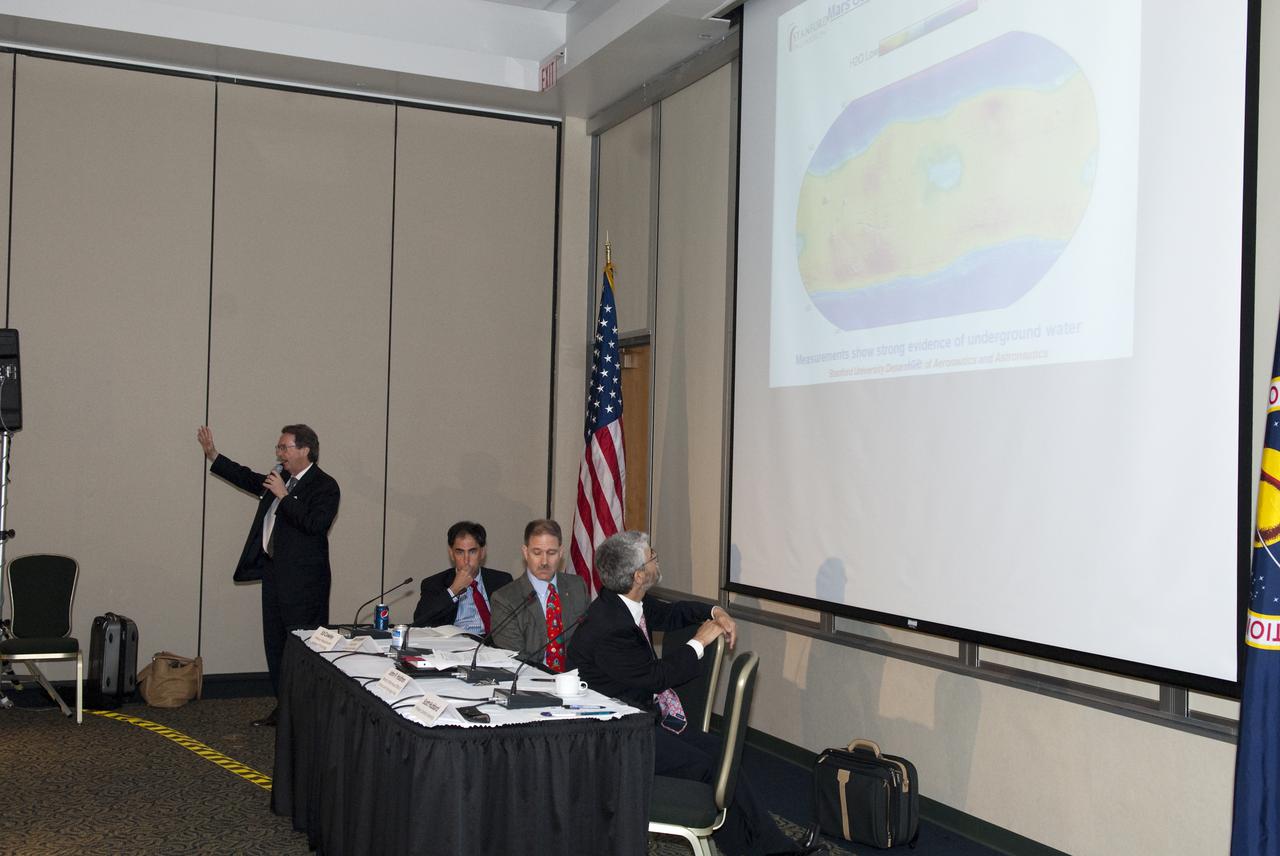
CAPE CANAVERAL, Fla. - In the Atlas_Redstone Room of the Debus Center at NASA's Kennedy Space Center Visitor Complex in Florida, Scott Hubbard, former director of NASA's Ames Research Center, addresses the participants at the 'Expanding our Reach into the Solar System' break-out session, part of the Conference on the American Space Program for the 21st Century. The panel, moderated by John Holdren, assistant to the President for science and technology and director of the White House Office of Science and Technology Policy (right), included Hubbard, Dr. Edward F. Crawley, Ford professor of engineering at MIT and NASA Astronaut John Grunsfeld. Photo credit: NASA_Jim Grossmann

CAPE CANAVERAL, Fla. - In the Space Station Processing Facility at NASA's Kennedy Space Center in Florida, preparations are under way to close the hatch of the multi-purpose logistics module Leonardo for its upcoming flight. The seven-member STS-131 crew will deliver Leonardo, filled with resupply stowage platforms and racks, to the International Space Station aboard space shuttle Discovery. Targeted for launch on April 5, STS-131 will be the 33rd shuttle mission to the station and the 131st shuttle mission overall. For information on the STS-131 mission and crew, visit http:__www.nasa.gov_mission_pages_shuttle_shuttlemissions_sts131_index.html. Photo credit: NASA_Jim Grossmann
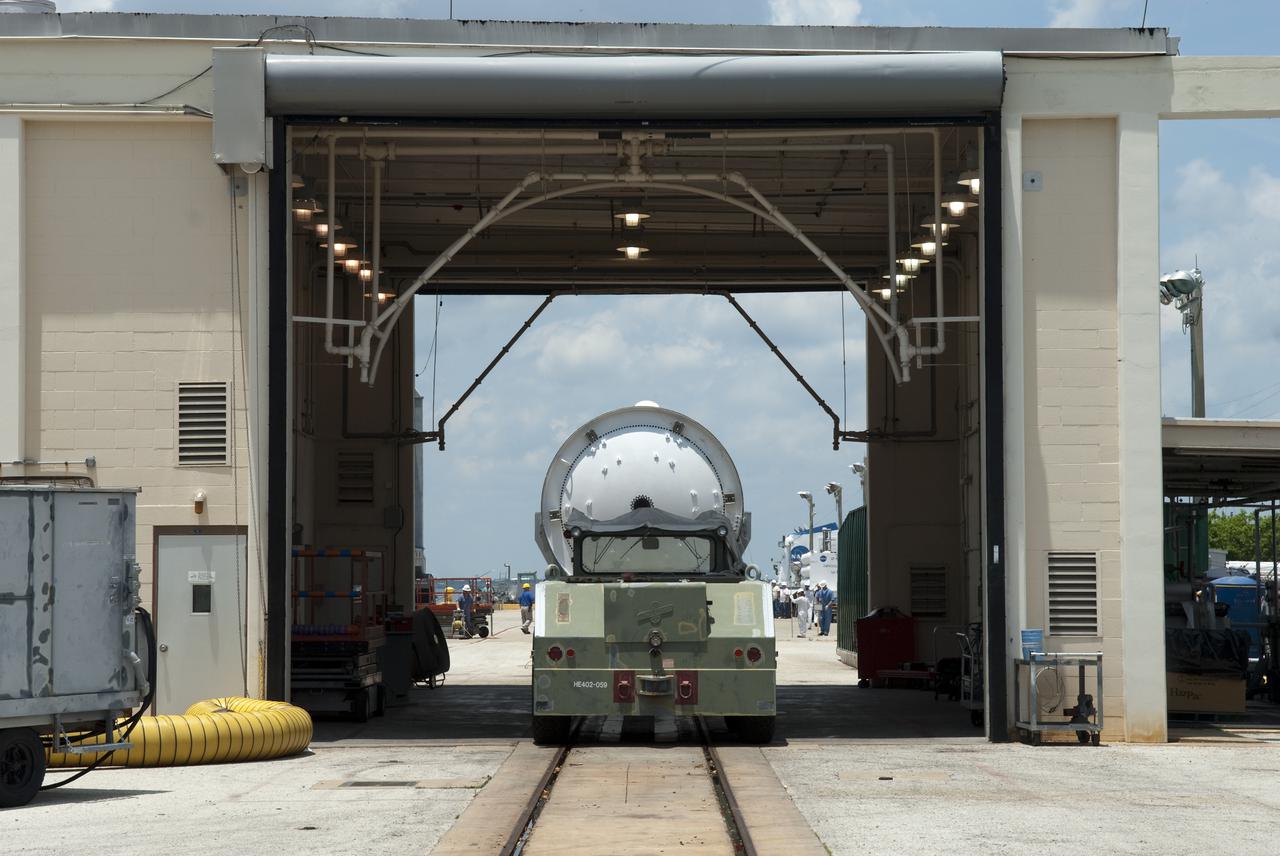
CAPE CANAVERAL, Fla. – At the Solid Rocket Booster Disassembly Facility at Hangar AF on Cape Canaveral Air Force Station in Florida, one of the solid rocket boosters used during space shuttle Atlantis' STS-132 launch, atop a tracked dolly, undergoes its first washing. The booster was used during space shuttle Atlantis' STS-132 launch from NASA Kennedy Space Center's Launch Pad 39A on May 14. The shuttle’s two solid rocket boosters' casings and associated flight hardware are recovered from the Atlantic Ocean shortly after launch by special recovery ships, the Liberty Star and Freedom Star, and returned for refurbishment and reuse on future shuttle flights, if needed. Hangar AF was originally used to support Project Mercury, the first U.S. human space program. Photo credit: NASA_Jim Grossmann
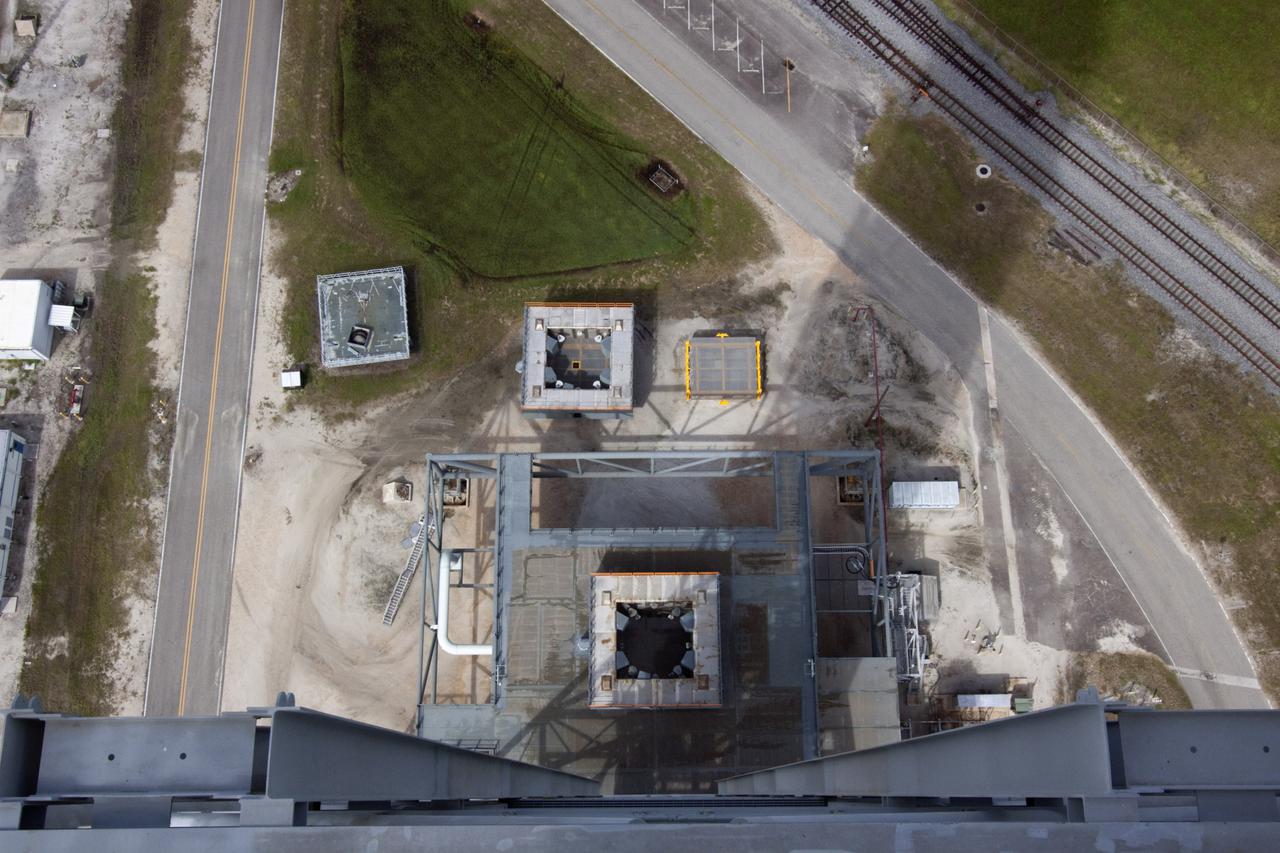
CAPE CANAVERAL, Fla. – The camera captures a unique view looking down from the top of NASA’s mobile launcher (ML) support structure at Kennedy Space Center in Florida. A media event was held on the grounds to detail ML’s use with NASA’s Space Launch System (SLS) heavy-lift rocket, which will take astronauts into deep space on missions to asteroids, the moon or Mars. NASA Administrator Charlie Bolden and Center Director Bob Cabana also were in attendance for the event. It took about two years to construct the 355-foot-tall ML structure, which will support NASA's future human spaceflight program. The ML can be outfitted with ground support equipment, such as umbilicals and access arms, for future rocket launches. Photo credit: NASA_Jim Grossmann
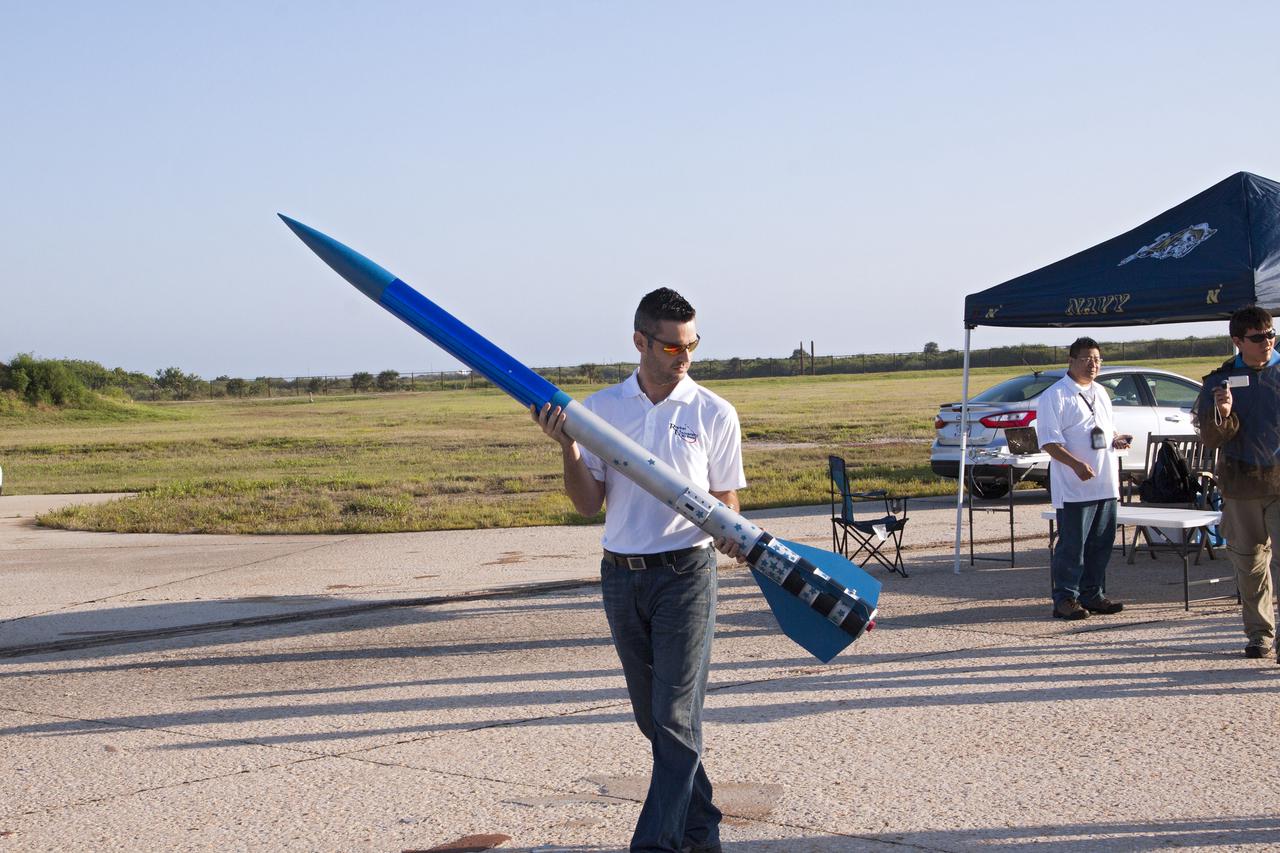
CAPE CANAVERAL, Fla. -- At NASA's Kennedy Space Center in Florida, Leandro James of Systems Hardware Engineering carries a small test rocket to the launch stand. The activity was part of Rocket University with the goal to test its systems and to verify that it performed as designed. As part of Rocket University, the engineers are given an opportunity to work a fast-track project to develop skills in developing spacecraft systems of the future. As NASA plans for future spaceflight programs to low-Earth orbit and beyond, teams of engineers at Kennedy are gaining experience in designing and flying launch vehicle systems on a small scale. Four teams of five to eight members from Kennedy are designing rockets complete with avionics and recovery systems. Launch operations require coordination with federal agencies, just as they would with rockets launched in support of a NASA mission. Photo credit: NASA_Jim Grossmann
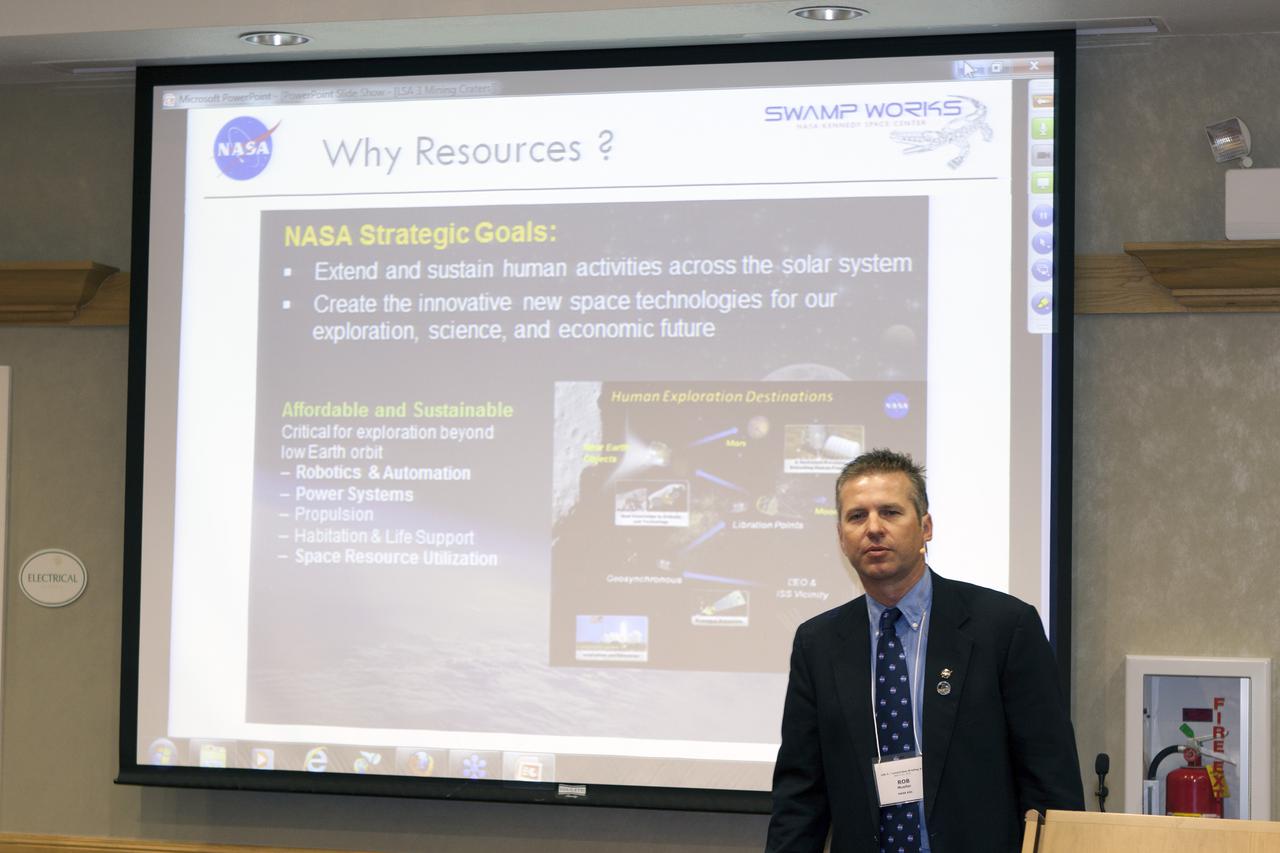
CAPE CANAVERAL, Fla. – At the Courtyard by Marriott hotel in Cocoa Beach, Fla., Rob Mueller, senior technologist in the Surface Systems Office of the Engineering and Technology Directorate at Kennedy Space Center, talks to participants in the room and those participating online during the Third International Workshop on Lunar Superconductor Applications. The workshop included presentations from several engineers and researchers at Kennedy Space Center. The three-day workshop included presentations from speakers throughout the country and focused on Lunar in-situ resource utilization, NASA’s Lunar Ice Prospector called RESOLVE, CubeSats, cryogenic storage and many other topics related to lunar exploration. Photo credit: NASA_Jim Grossmann
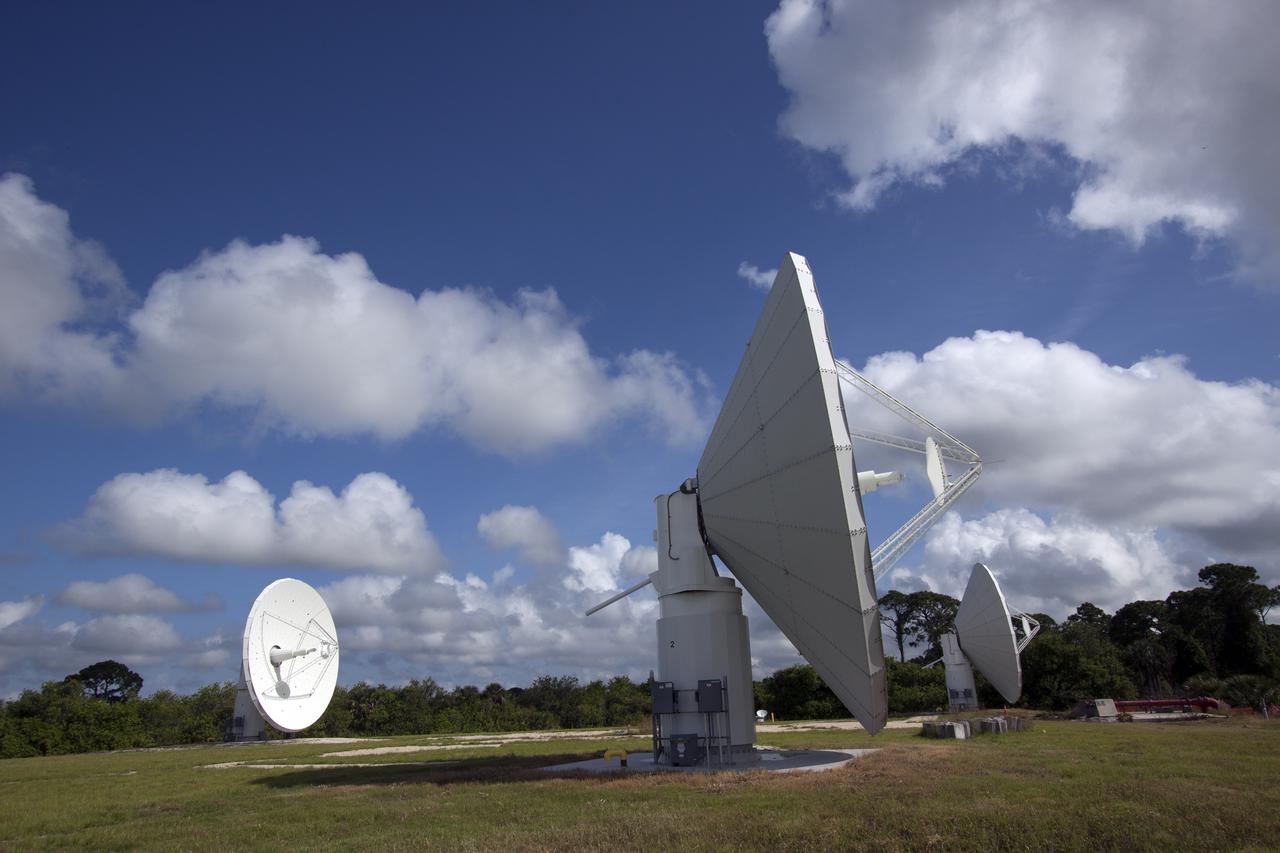
CAPE CANAVERAL, Fla. -- At NASA’s Kennedy Space Center in Florida, the three Ka-Band Objects Observation and Monitoring, or Ka-BOOM, testbed antennas are used to track the pattern of the sun during initial testing of the new system. The goal of Ka-BOOM is to prove technologies that will allow future systems to characterize near-Earth objects in terms of size, shape, rotation_tumble rate and to determine the trajectory of those objects. Radar studies can determine the trajectory 100,000 times more precisely than can optical methods. While also capable of space communication and radio science experiments, developing radar applications is the primary focus of the arrays. The 40-foot-diameter dish antenna arrays are at the site of the former Vertical Processing Facility, which has been demolished. Photo credit: NASA_Jim Grossmann
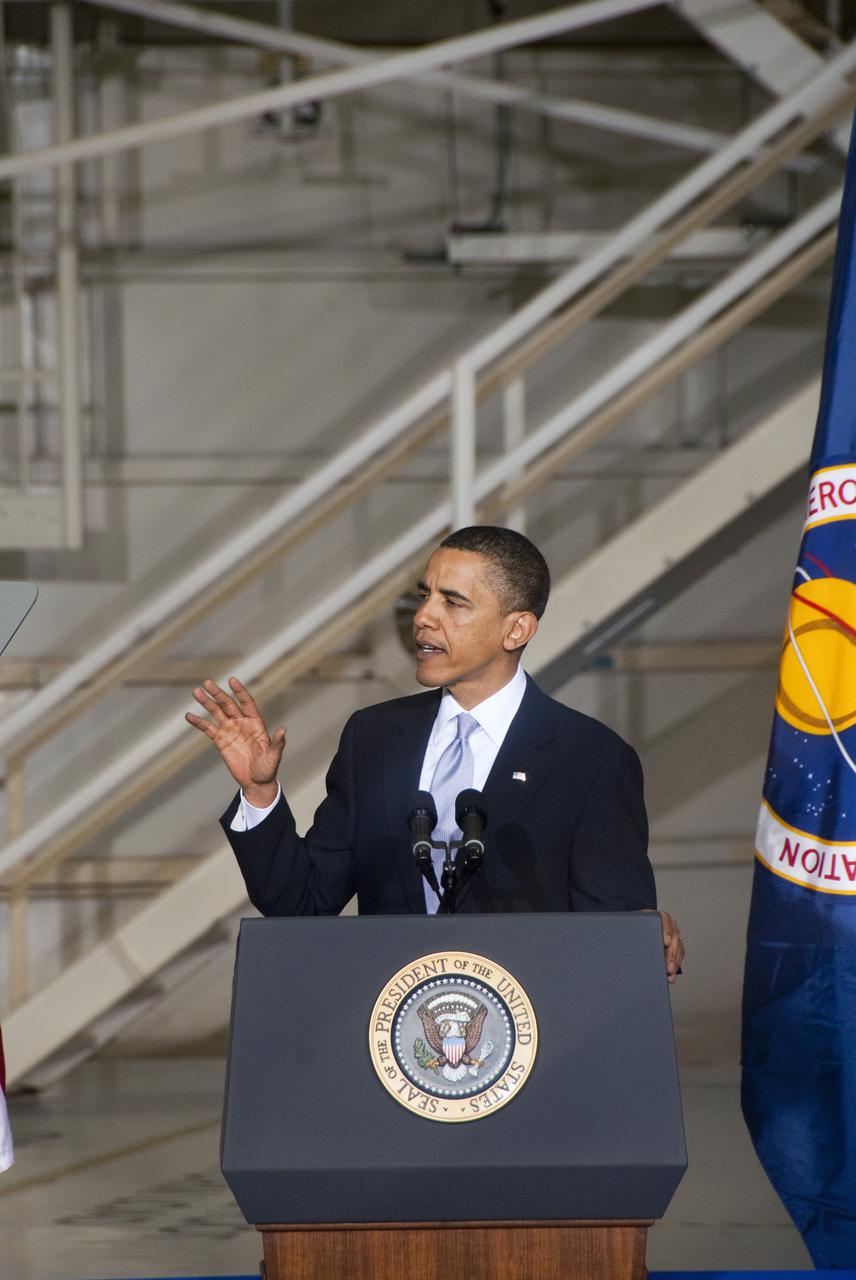
CAPE CANAVERAL, Fla. - In the Operations and Checkout Building at NASA's Kennedy Space Center in Florida, President Barack Obama addresses the participants of the Conference on the American Space Program for the 21st Century. In his remarks, he outlined the new course his administration is charting for NASA and the future of U.S. leadership in human spaceflight. Photo credit: NASA_Jim Grossmann
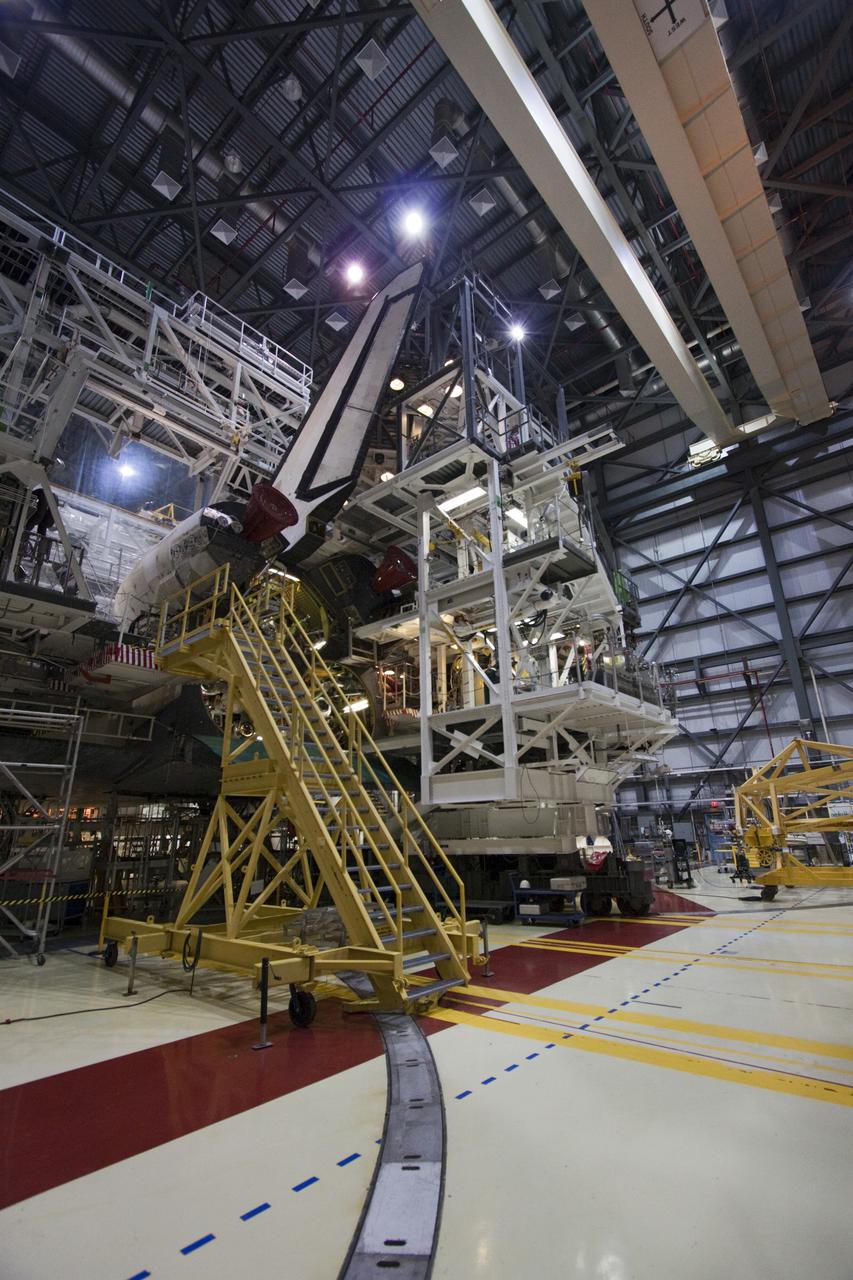
CAPE CANAVERAL, Fla. – Inside Orbiter Processing Facility-2 at NASA’s Kennedy Space Center in Florida, large access platforms are being moved into place around space shuttle Atlantis in preparation for removal of the left orbital maneuvering system (OMS) pod. The work is part of the Space Shuttle Program’s transition and retirement processing of shuttle Atlantis. The OMS pods will be sent to White Sands Space Harbor in New Mexico where they will undergo a complete deservicing and cleaning and then be returned to Kennedy for reinstallation on Atlantis. Atlantis is being prepared for display at the Kennedy Space Center Visitor Complex in Florida. Photo credit: NASA_Jim Grossmann

CAPE CANAVERAL, Fla. – Inside Orbiter Processing Facility-2 at NASA’s Kennedy Space Center in Florida, one of space shuttle Atlantis’ two orbital maneuvering system (OMS) pods can be seen. Large access platforms are being moved into place around Atlantis in preparation for removal of the left OMS pod. The work is part of the Space Shuttle Program’s transition and retirement processing of shuttle Atlantis. The OMS pods will be sent to White Sands Space Harbor in New Mexico where they will undergo a complete deservicing and cleaning and then be returned to Kennedy for reinstallation on Atlantis. Atlantis is being prepared for display at the Kennedy Space Center Visitor Complex in Florida. Photo credit: NASA_Jim Grossmann
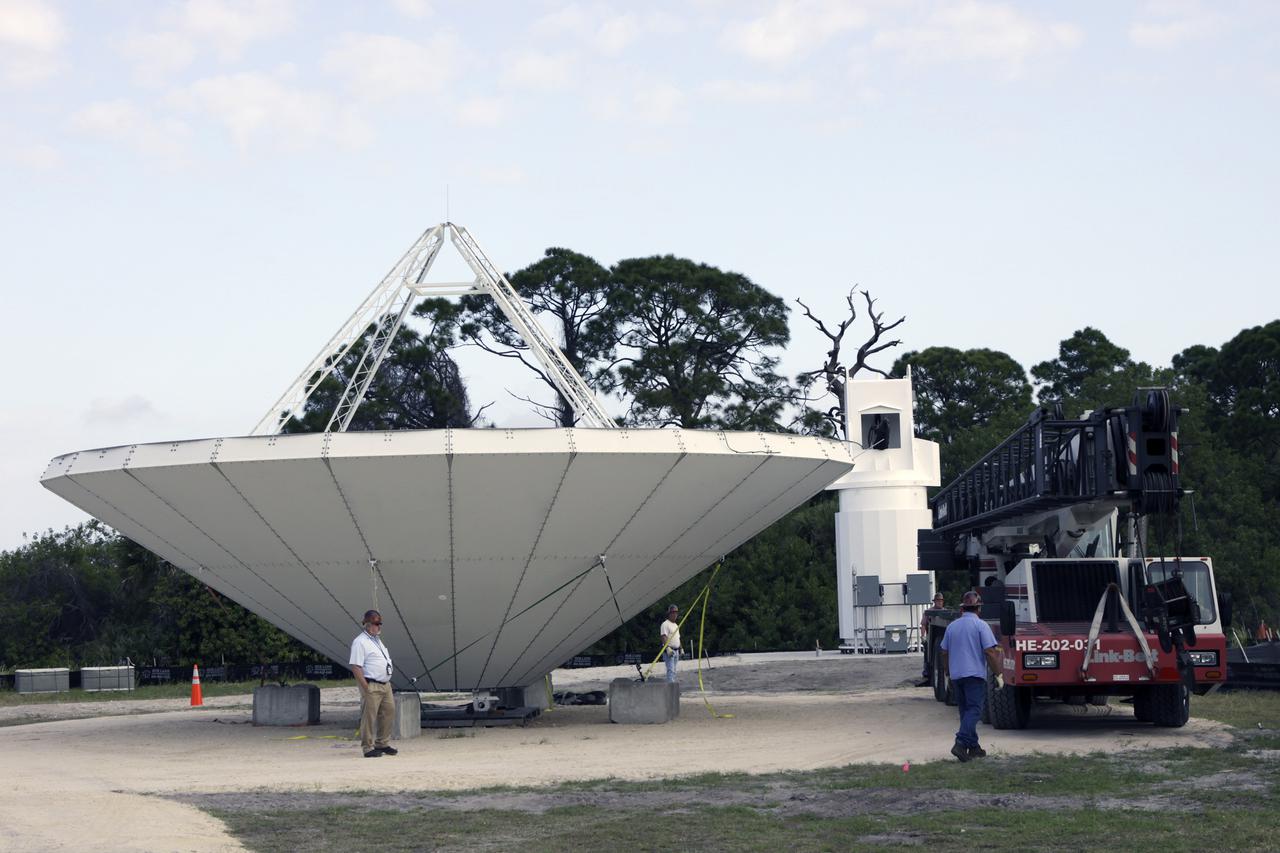
CAPE CANAVERAL, Fla. – At NASA’s Kennedy Space Center in Florida, 40-foot-diameter dish antenna arrays are being constructed as part of the Antenna Test Bed Array for the Ka-Band Objects Observation and Monitoring, or Ka-BOOM system. The antennas will be part of the operations command center facility. The construction site is near the former Vertical Processing Facility, which has been demolished. The Ka-BOOM project is one of the final steps in developing the techniques to build a high power, high resolution radar system capable of becoming a Near Earth Object Early Warning System. While also capable of space communication and radio science experiments, developing radar applications is the primary focus of the arrays. Photo credit: NASA_Jim Grossmann
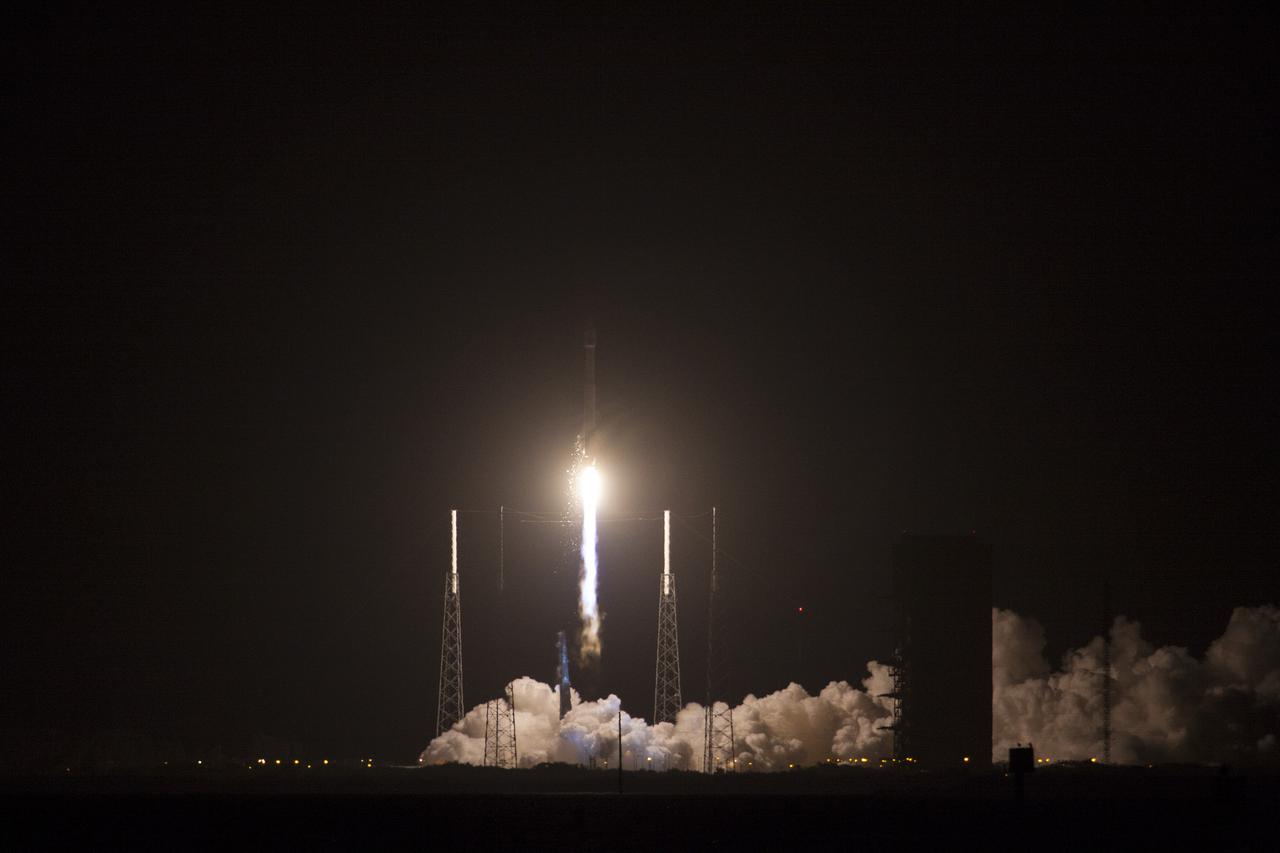
CAPE CANAVERAL, Fla. -- A United Launch Alliance Atlas V 401 rocket rises above the lightning masts on Space Launch Complex 41 on Cape Canaveral Air Force Station in Florida, carrying NASA's Tracking and Data Relay Satellite-K, TDRS-K, to orbit. Liftoff was at 8:48 p.m. EST. The TDRS-K spacecraft is part of the next-generation series in the Tracking and Data Relay Satellite System, a constellation of space-based communication satellites providing tracking, telemetry, command and high-bandwidth data return services. For more information, visit http:__www.nasa.gov_mission_pages_tdrs_index.html. Photo credit: NASA_Jim Grossmann
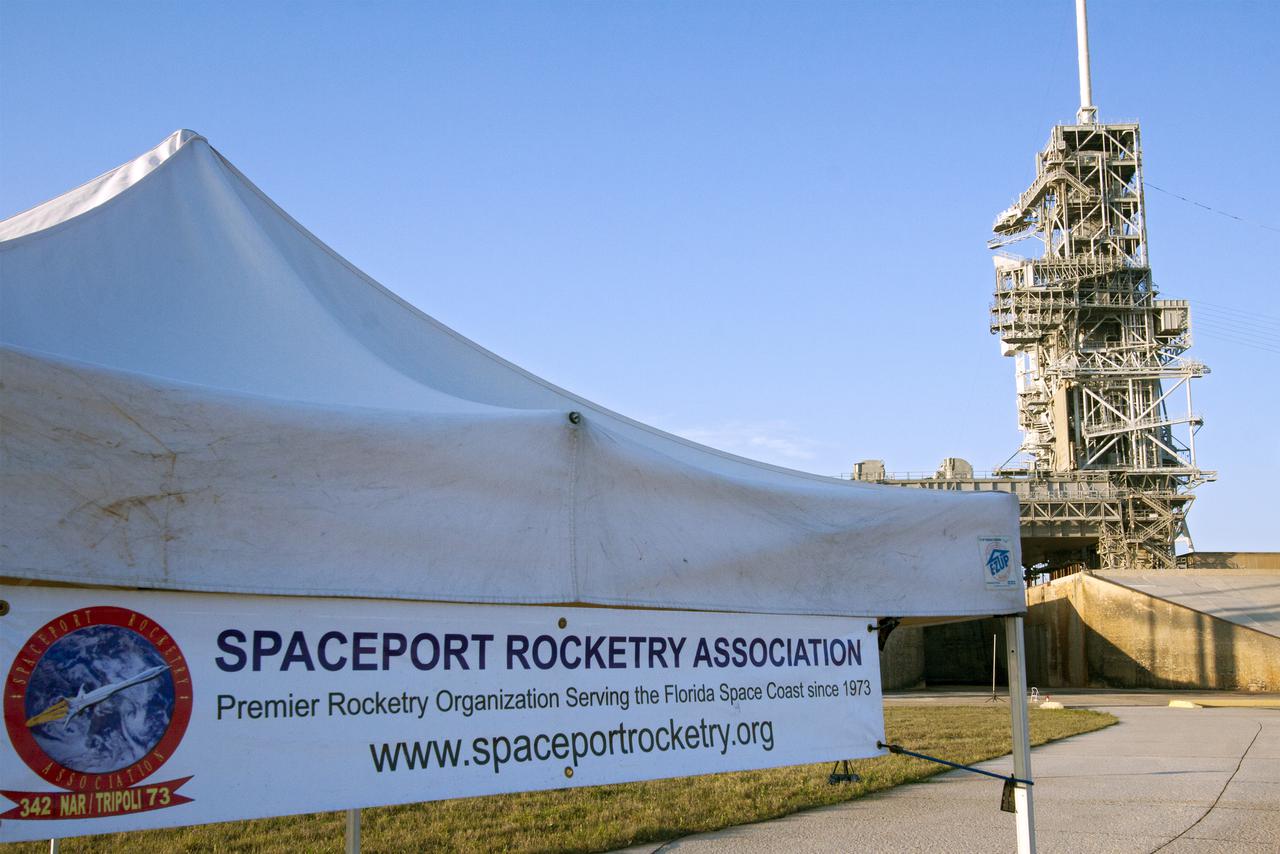
CAPE CANAVERAL, Fla. -- At NASA's Kennedy Space Center in Florida, engineers launched a small rocket as part of Rocket University. The goal was to test its systems and to verify that it performed as designed. The event was supported by the Spaceport Rocketry Association, a 40-year-old organization that provides launch demonstrations and educational programs. As part of Rocket University, the engineers are given an opportunity to work a fast-track project to develop skills in developing spacecraft systems of the future. As NASA plans for future spaceflight programs to low-Earth orbit and beyond, teams of engineers at Kennedy are gaining experience in designing and flying launch vehicle systems on a small scale. Four teams of five to eight members from Kennedy are designing rockets complete with avionics and recovery systems. Launch operations require coordination with federal agencies, just as they would with rockets launched in support of a NASA mission. Photo credit: NASA_Jim Grossmann
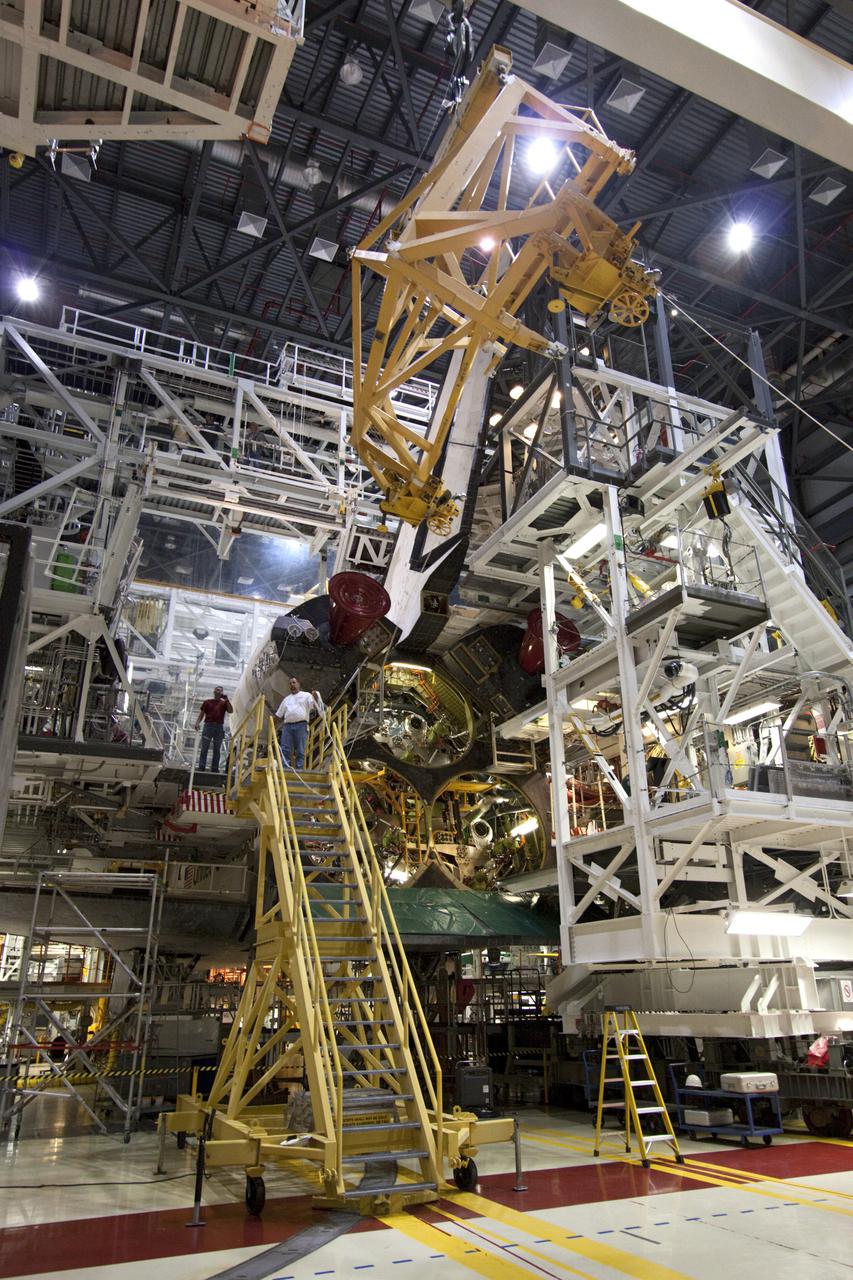
CAPE CANAVERAL, Fla. – Inside Orbiter Processing Facility-2 at NASA’s Kennedy Space Center in Florida, technicians monitor the progress as a large crane and support equipment are lifted high and moved toward space shuttle Atlantis to aid in removal of the left orbital maneuvering system (OMS) pod. The work is part of the Space Shuttle Program’s transition and retirement processing of shuttle Atlantis. The OMS pods will be sent to White Sands Space Harbor in New Mexico where they will undergo a complete deservicing and cleaning and then be returned to Kennedy for reinstallation on Atlantis. Atlantis is being prepared for display at the Kennedy Space Center Visitor Complex in Florida. Photo credit: NASA_Jim Grossmann
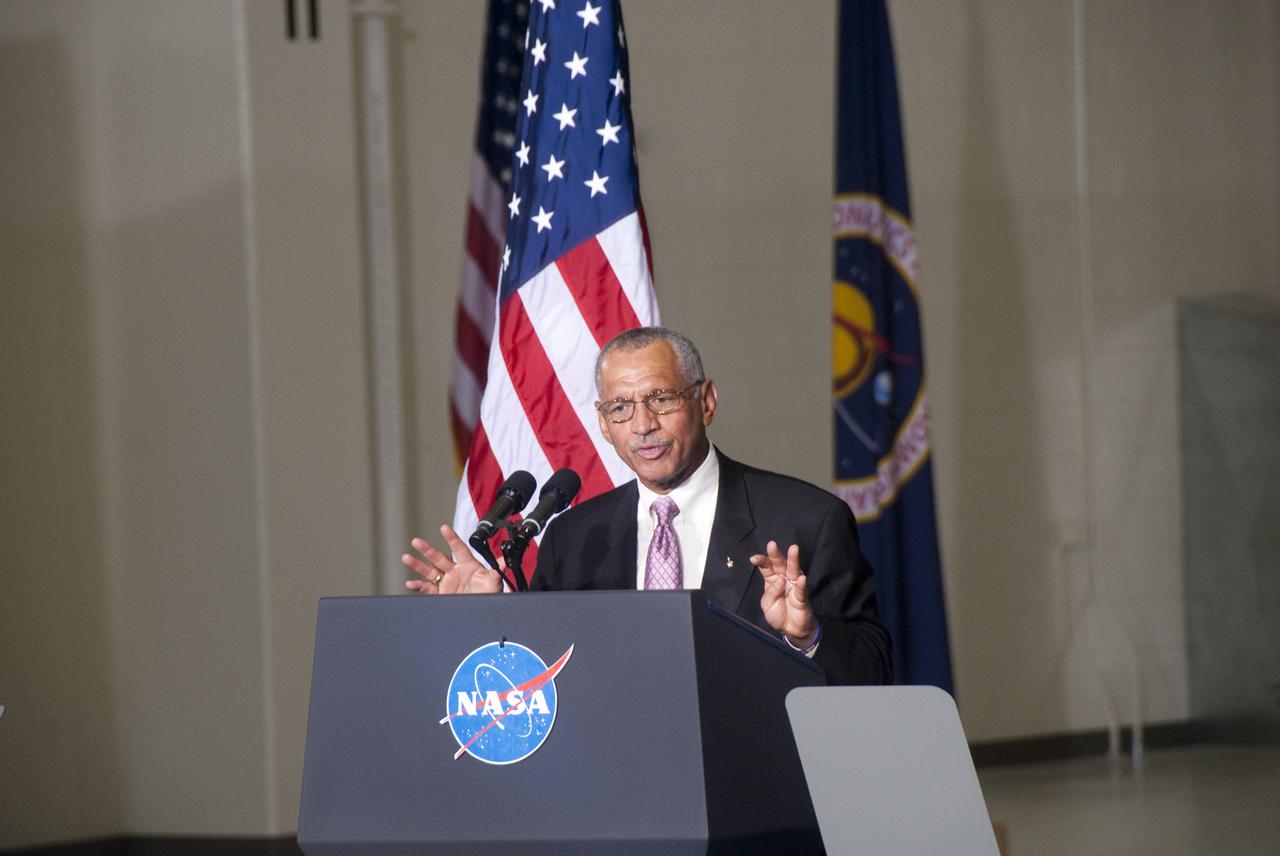
CAPE CANAVERAL, Fla. - In the Operations and Checkout Building at NASA's Kennedy Space Center in Florida, NASA Administrator Charles Bolden, speaks at the opening of the Conference on the American Space Program for the 21st Century following President Barack Obama's remarks describing the new course his administration is charting for NASA and the future of U.S. leadership in human spaceflight. The four break-out conference sessions that will take place in the Operations and Checkout Building and in the Kennedy Space Center Visitor Complex will include these topics: Increasing Access to and Utilization of the International Space Station; Jumpstarting the New Technologies to Take Us Beyond; Expanding our Reach into the Solar System and Harnessing Space to Expand Economic Opportunity. Photo credit: NASA_Jim Grossmann
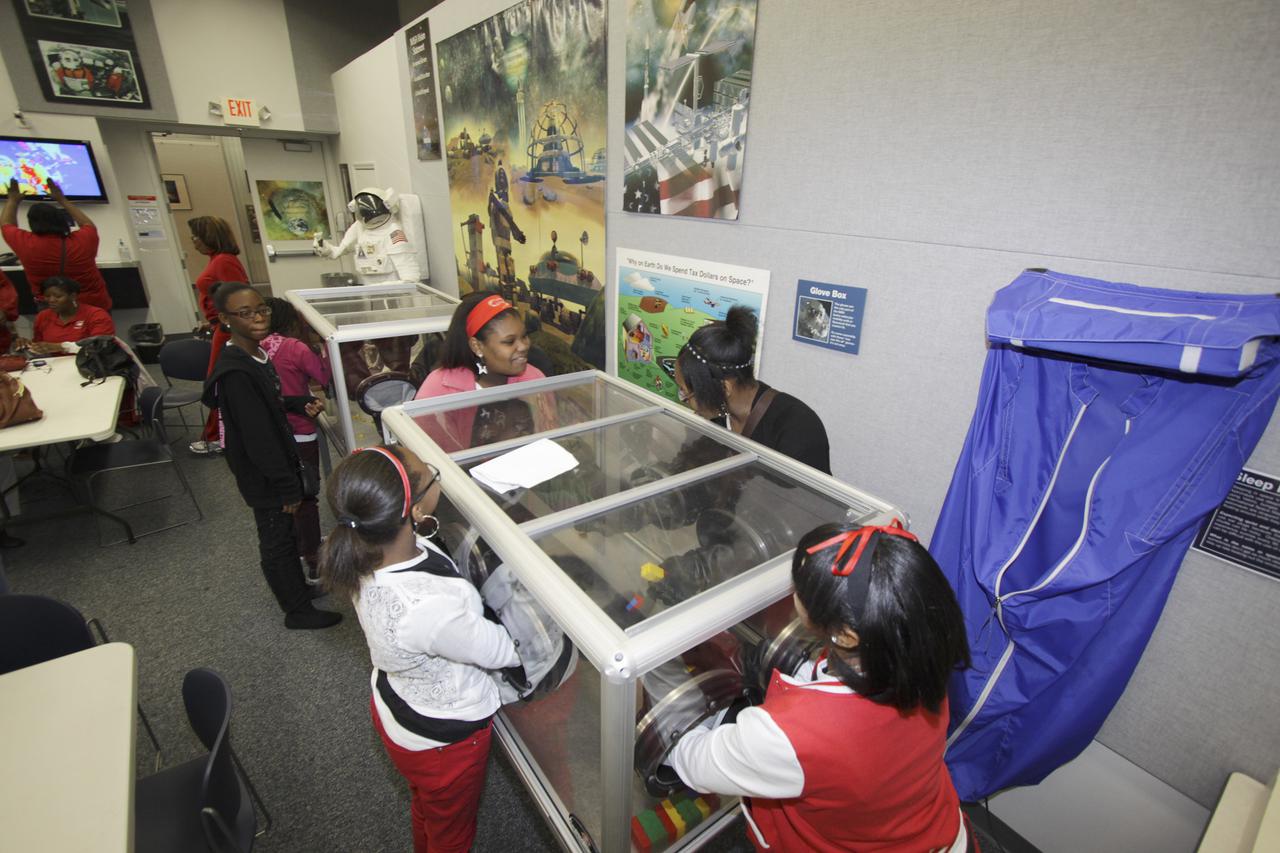
CAPE CANAVERAL, Fla. – Middle and High school students from Florida's Putnam and Volusia counties use a glove box practice working with materials with protected hands during a science demonstration at the NASA's Center for Space at the Kennedy Space Center. The 11 to 18-year-old students are part of Delta Academy and Delta GEMS, an African American women’s mentoring program affiliated with Delta Sigma Theta. The sorority uses their collective efforts to promote academic excellence, provide scholarships and support underserved students. As a part of the science program, the young scholars participated in a presentation by professional women who work at Kennedy discussing career choices and encouraging interest in science, technology, engineering and mathematics STEM careers. Photo credit: NASA_Jim Grossmann
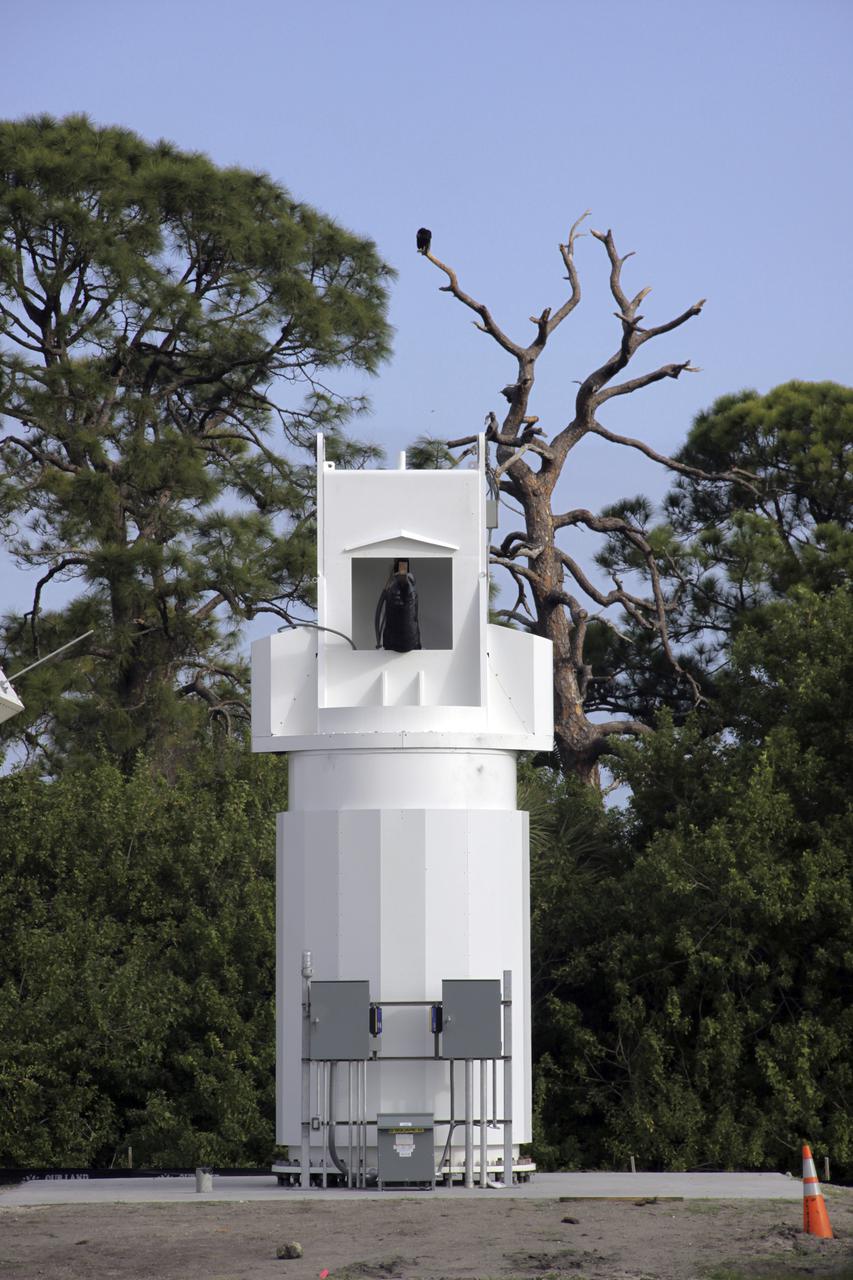
CAPE CANAVERAL, Fla. – At NASA’s Kennedy Space Center in Florida, 40-foot-diameter dish antenna arrays are being constructed as part of the Antenna Test Bed Array for the Ka-Band Objects Observation and Monitoring, or Ka-BOOM system. The antennas will be part of the operations command center facility. The construction site is near the former Vertical Processing Facility, which has been demolished. The Ka-BOOM project is one of the final steps in developing the techniques to build a high power, high resolution radar system capable of becoming a Near Earth Object Early Warning System. While also capable of space communication and radio science experiments, developing radar applications is the primary focus of the arrays. Photo credit: NASA_Jim Grossmann
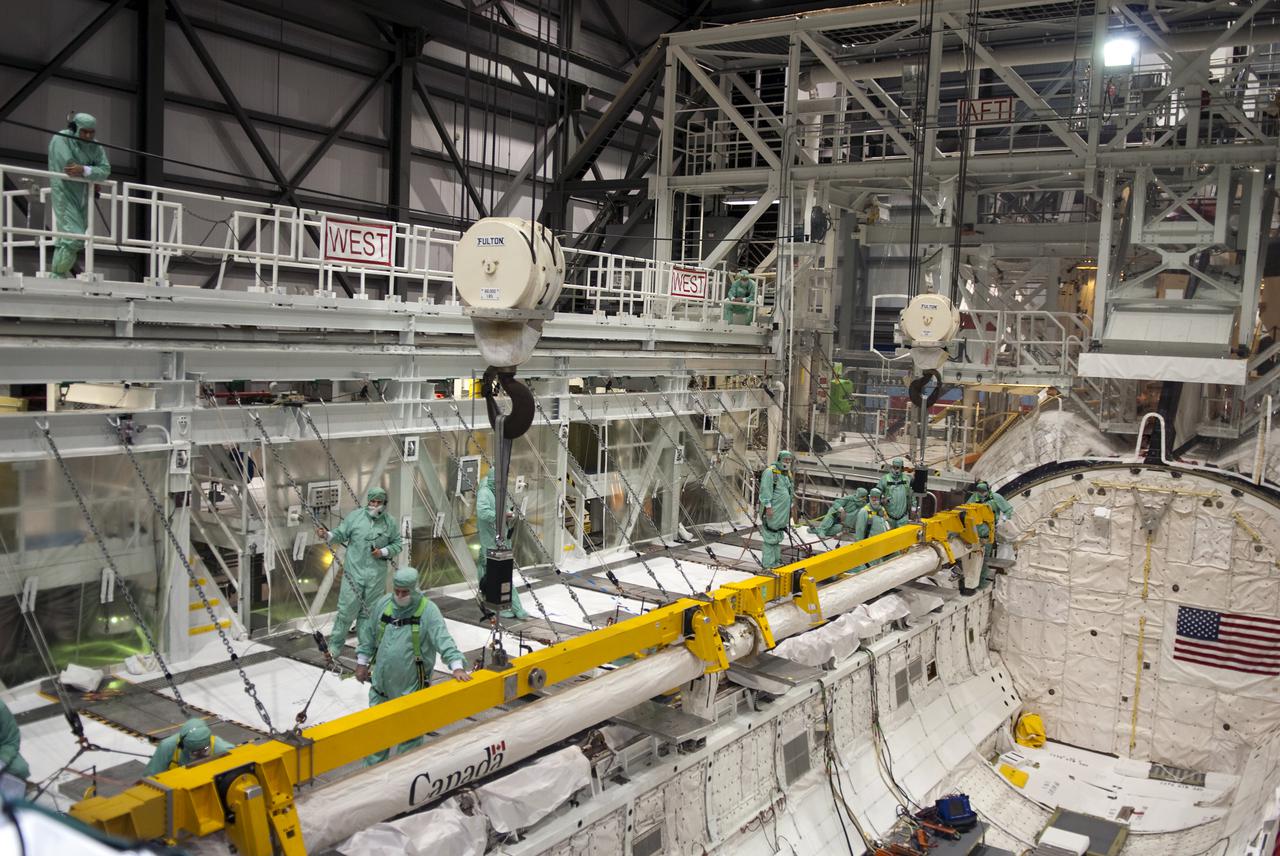
CAPE CANAVERAL, Fla. - Inside Orbiter Processing Facility-2 at Kennedy Space Center in Florida, technicians begin to detach the Orbiter Boom Sensor System, or OBSS, from the payload bay of space shuttle Endeavour. The OBSS will be transported to the Vehicle Assembly Building for refurbishment. After refurbishment, the boom will be reinstalled in Endeavour for use during the STS-134 mission, currently targeted for launch in July. Photo credit: NASA_Jim Grossmann
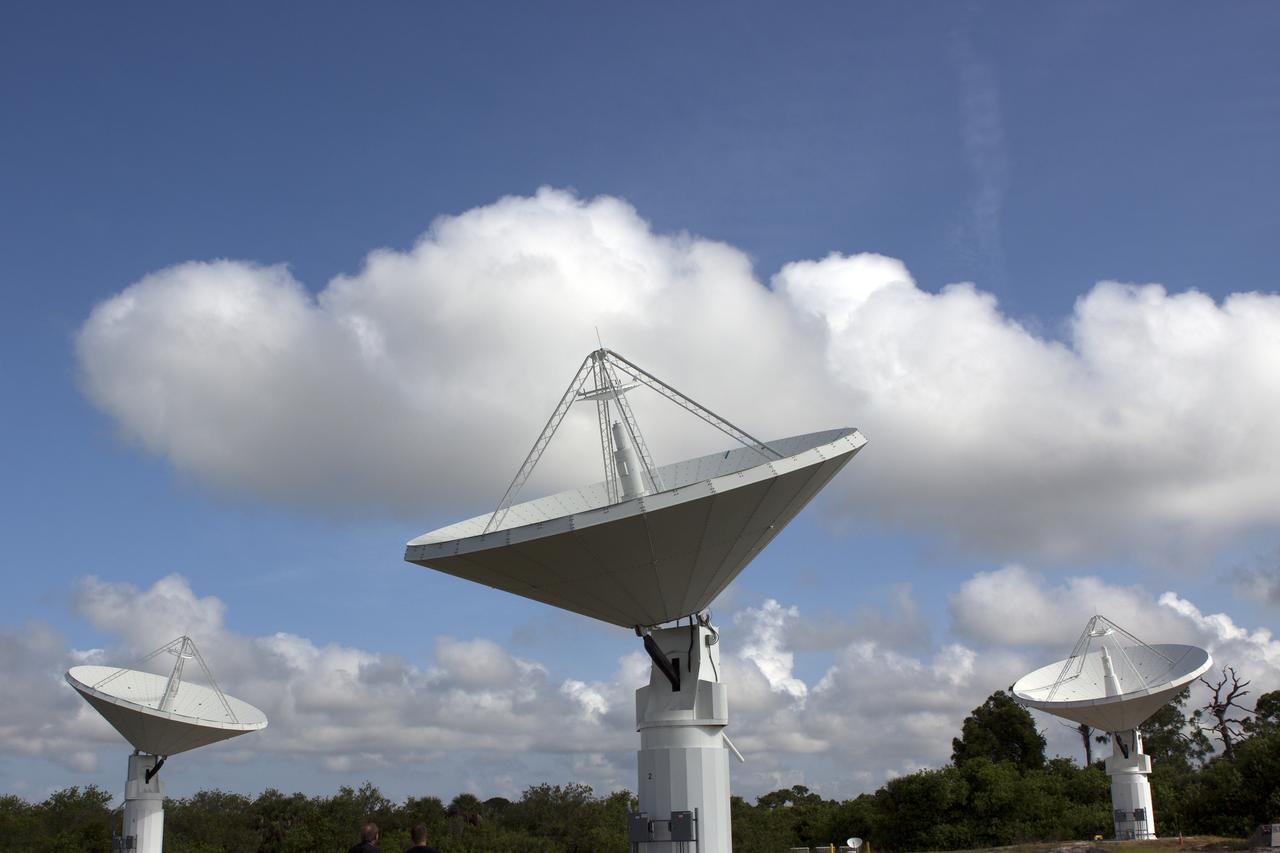
CAPE CANAVERAL, Fla. -- At NASA’s Kennedy Space Center in Florida, the three Ka-Band Objects Observation and Monitoring, or Ka-BOOM, testbed antennas are used to track the pattern of the sun during initial testing of the new system. The goal of Ka-BOOM is to prove technologies that will allow future systems to characterize near-Earth objects in terms of size, shape, rotation_tumble rate and to determine the trajectory of those objects. Radar studies can determine the trajectory 100,000 times more precisely than can optical methods. While also capable of space communication and radio science experiments, developing radar applications is the primary focus of the arrays. The 40-foot-diameter dish antenna arrays are at the site of the former Vertical Processing Facility, which has been demolished. Photo credit: NASA_Jim Grossmann
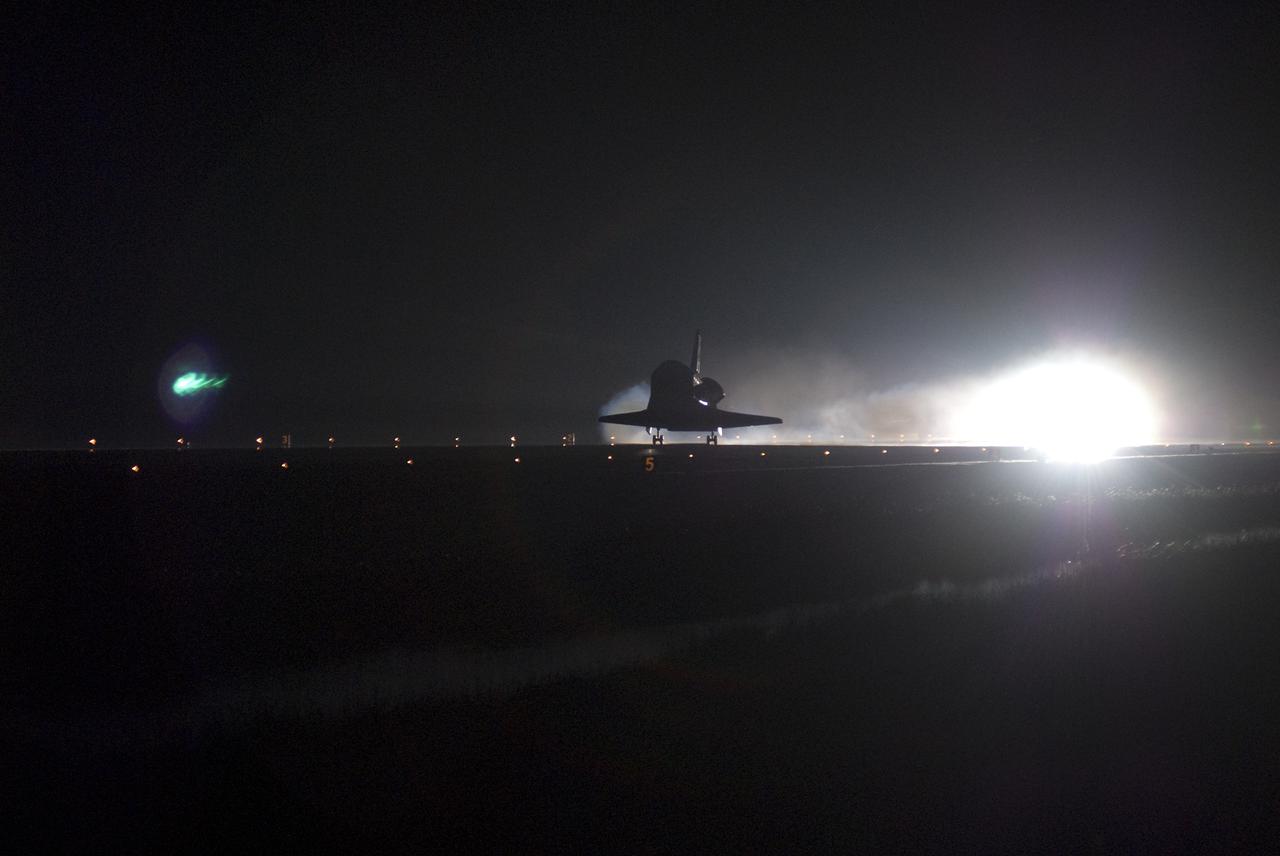
CAPE CANAVERAL, Fla. - STS-130 Commander George Zamka sets space shuttle Endeavour down in the middle of Runway 15 at the Shuttle Landing Facility at NASA's Kennedy Space Center in Florida. After 14 days in space, Endeavour's 5.7-million-mile STS-130 mission is completed on orbit 217. Main gear touchdown was at 10:20:31 p.m. EST followed by nose gear touchdown at 10:20:39 p.m. and wheels stop at 10:22:10 p.m. It was the 23rd night landing in shuttle history and the 17th at Kennedy. Aboard are Commander George Zamka; Pilot Terry Virts; and Mission Specialists Robert Behnken, Nicholas Patrick, Kathryn Hire and Stephen Robinson. During Endeavour's STS-130 mission, astronauts installed the Tranquility node, a module that provides additional room for crew members and many of the station's life support and environmental control systems. Attached to Tranquility is a cupola with seven windows that provide a panoramic view of Earth, celestial objects and visiting spacecraft. The module was built in Turin, Italy, by Thales Alenia Space for the European Space Agency. The orbiting laboratory is approximately 90 percent complete now in terms of mass. STS-130 was the 24th flight for Endeavour, the 32nd shuttle mission devoted to ISS assembly and maintenance, and the 130th shuttle mission to date. For information on the STS-130 mission and crew, visit http:__www.nasa.gov_mission_pages_shuttle_shuttlemissions_sts130_index.html. Photo credit: NASA_Jim Grossmann
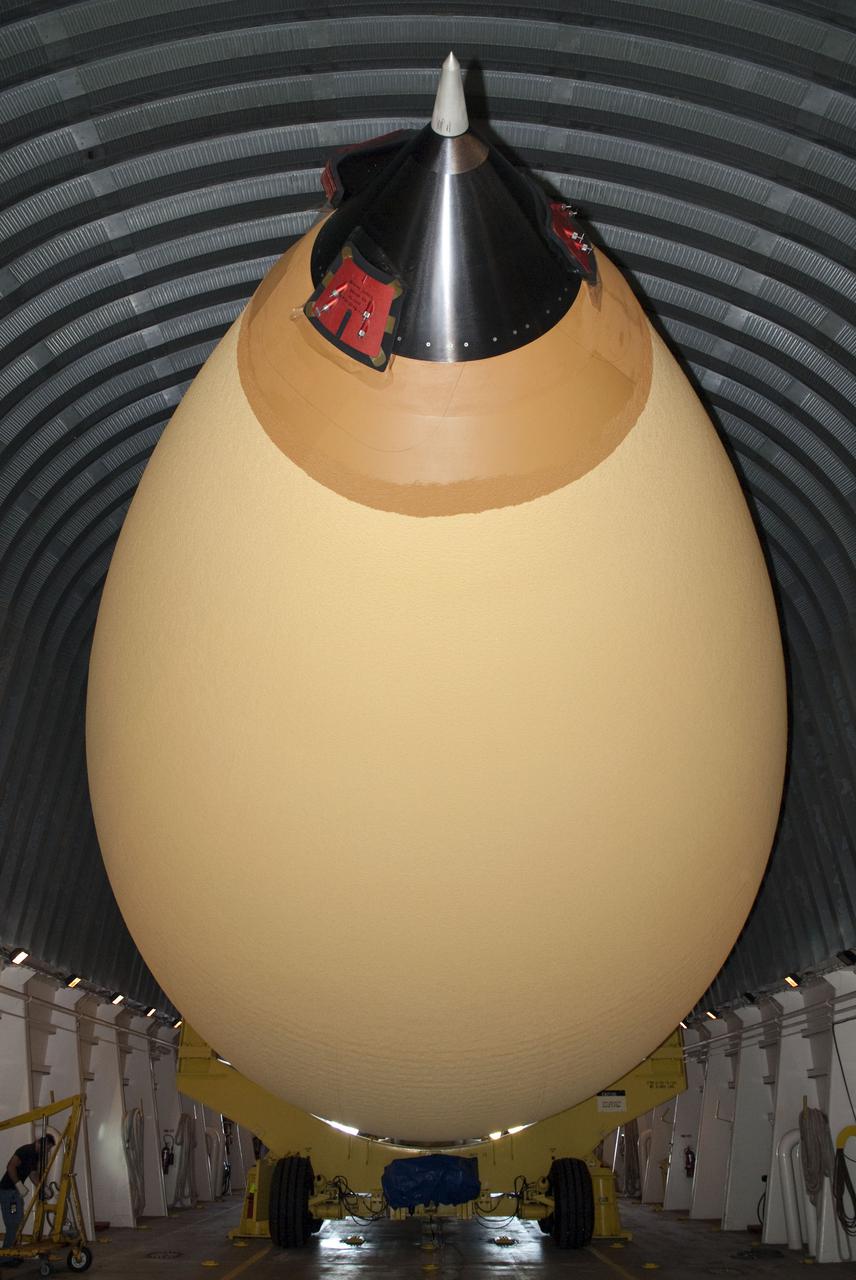
CAPE CANAVERAL, Fla. -- At NASA's Kennedy Space Center in Florida, preparations are under way to offload External Tank-138 from the Pegasus barge docked in the turn basin near the Vehicle Assembly Building. The external fuel tank arrived in Florida on July 13, from NASA's Michoud Assembly Facility near New Orleans. ET-138, the last newly manufactured tank, was originally designated to fly on Endeavour's STS-134 mission to the International Space Station, but later reassigned to fly on space shuttle Atlantis' final mission, STS-135. For information, visit www.nasa.gov_shuttle. Photo credit: NASA_Jim Grossmann
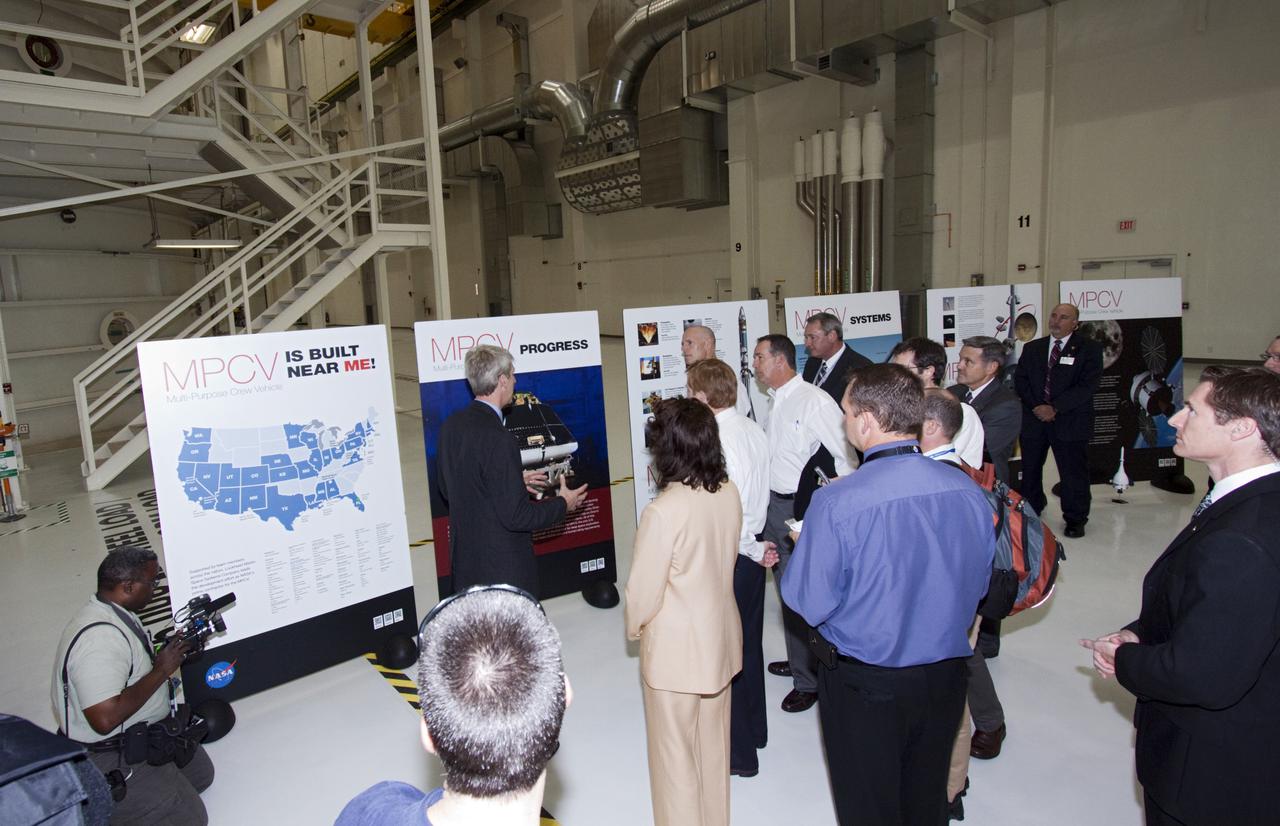
CAPE CANAVERAL, Fla. – In the Operations and Checkout Building at NASA's Kennedy Space Center in Florida, NASA’s Orion Production Manager Scott Wilson, (left), briefs Florida Gov. Rick Scott, (center), and Florida Lt. Gov. Jennifer Carroll, chairwoman of Space Florida on the processing of the Orion Multi-Purpose Crew Vehicle. The governor and other state officials were at Kennedy for a Florida cabinet meeting and a space industry roundtable at the Kennedy Space Center Visitor Complex’s Debus Conference Center. They also toured selected facilities around the center. Photo credit: NASA_Jim Grossmann
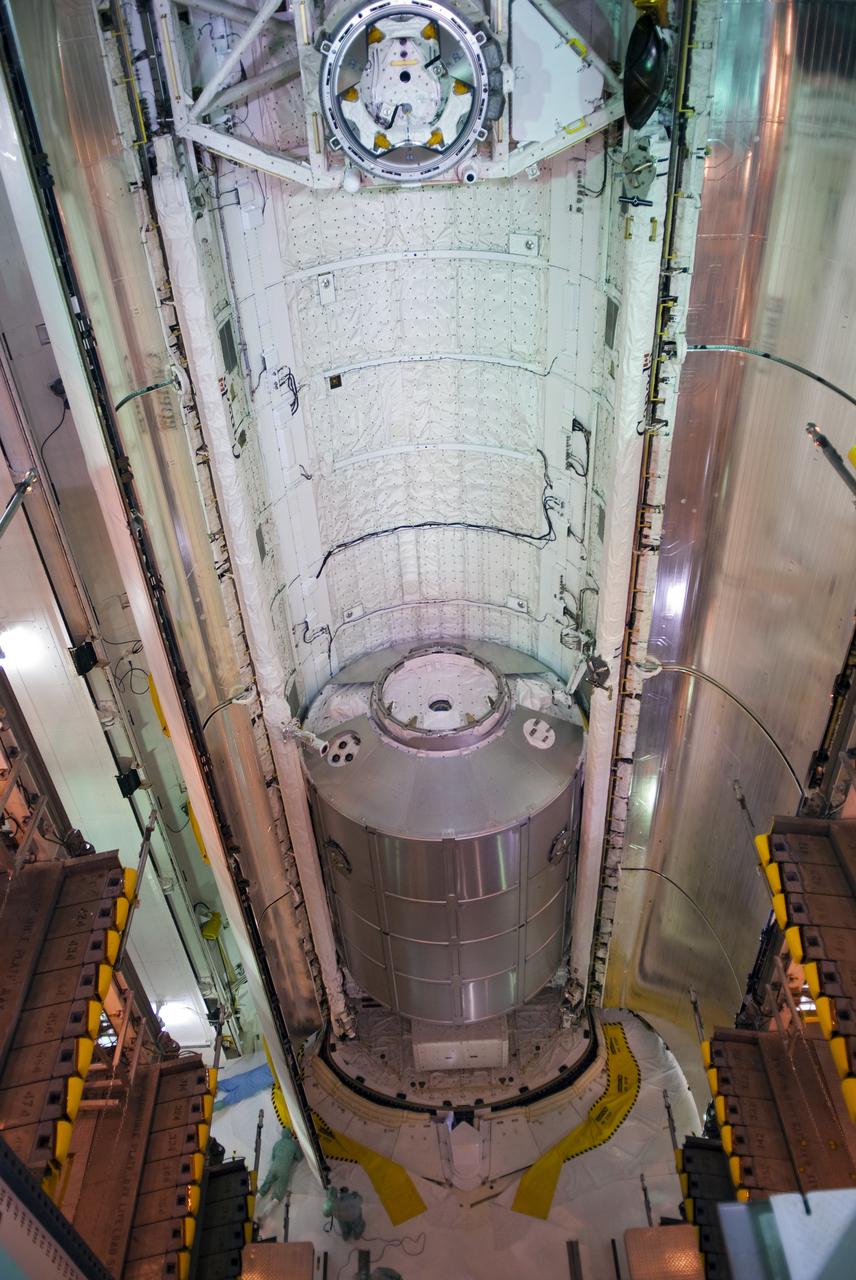
CAPE CANAVERAL, Fla. - At Launch Pad 39A at NASA's Kennedy Space Center in Florida, space shuttle Discovery's payload bay doors begin to close around the multi-purpose logistics module Leonardo and other cargo that will fly on the STS-131 mission. Payload bay door closure for launch is a significant milestone in processing activities. The countdown for Discovery's launch on April 5 is set to begin at 3 a.m. EDT on April 2. The seven-member STS-131 crew will deliver Leonardo to the International Space Station. The module is filled with supplies, a new crew sleeping quarters and science racks that will be transferred to the station's laboratories. The crew also will switch out a gyroscope on the station’s truss, install a spare ammonia storage tank and retrieve a Japanese experiment from the station’s exterior. STS-131 is the 33rd shuttle mission to the station and the 131st shuttle mission overall. For information on the STS-131 mission and crew, visit http:__www.nasa.gov_mission_pages_shuttle_shuttlemissions_sts131_index.html. Photo credit: NASA_Jim Grossmann
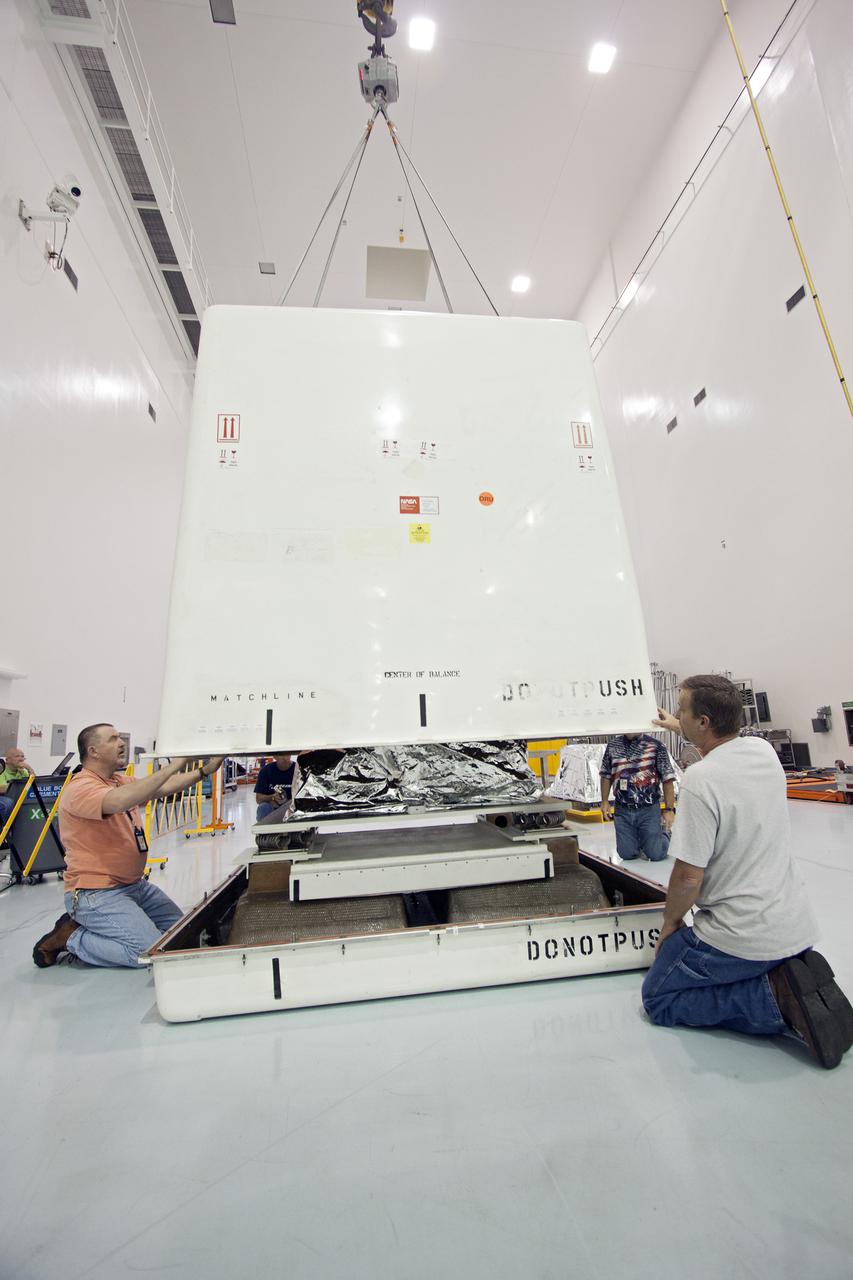
CAPE CANAVERAL, Fla. -- Inside the Space Station Processing Facility at NASA's Kennedy Space Center in Florida, technicians finish lowering the cover of a shipping container that will enclose the orbital replacement unit for the space station's utility transfer assembly. The unit is one of the payloads processed at Kennedy that will be flown to Japan for the HTV-4 launch to the station, which is currently scheduled for this summer. Photo credit: NASA_Jim Grossmann
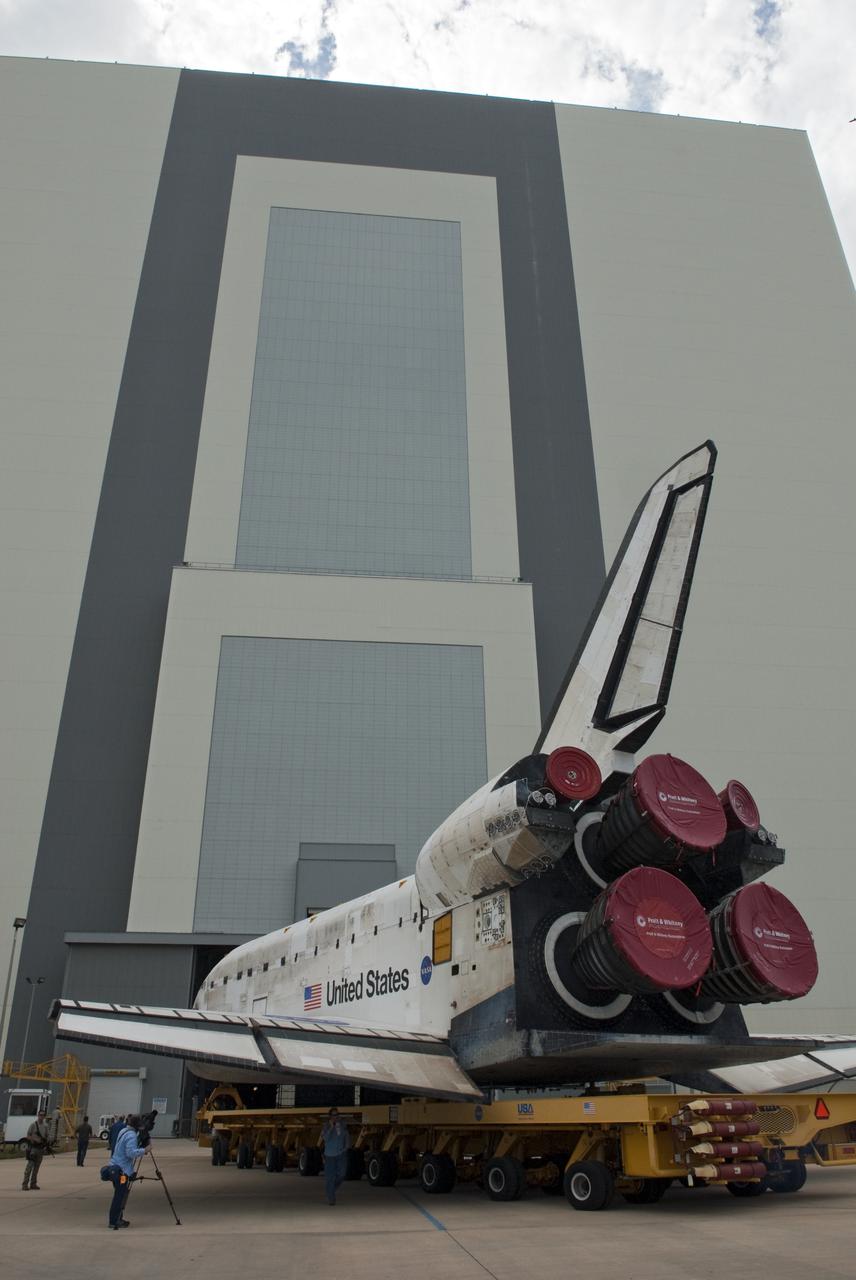
CAPE CANAVERAL, Fla. - At NASA's Kennedy Space Center in Florida, space shuttle Discovery is moved toward the Vehicle Assembly Building, or VAB, transfer aisle entrance. In the VAB, Discovery will be lifted into a high bay where it will be mated to its external tank and solid rocket boosters. The seven-member STS-131 crew will deliver the Multi-Purpose Logistics Module Leonardo, filled with resupply stowage platforms and racks, to the International Space Station aboard space shuttle Discovery. Work to attach a spare ammonia tank assembly to the station's exterior and return a European experiment from outside the station's Columbus module will be conducted during three spacewalks. STS-131, targeted for launch on April 5, will be the 33rd shuttle mission to the station and the 131st shuttle mission overall. For information on the STS-131 mission and crew, visit http:__www.nasa.gov_mission_pages_shuttle_shuttlemissions_sts131_index.html. Photo credit: NASA_Jim Grossmann

CAPE CANAVERAL, Fla. - In the Operations and Checkout Building at NASA's Kennedy Space Center in Florida, President Barack Obama addresses the participants of the Conference on the American Space Program for the 21st Century. In his remarks, he outlined the new course his administration is charting for NASA and the future of U.S. leadership in human spaceflight. Photo credit: NASA_Jim Grossmann
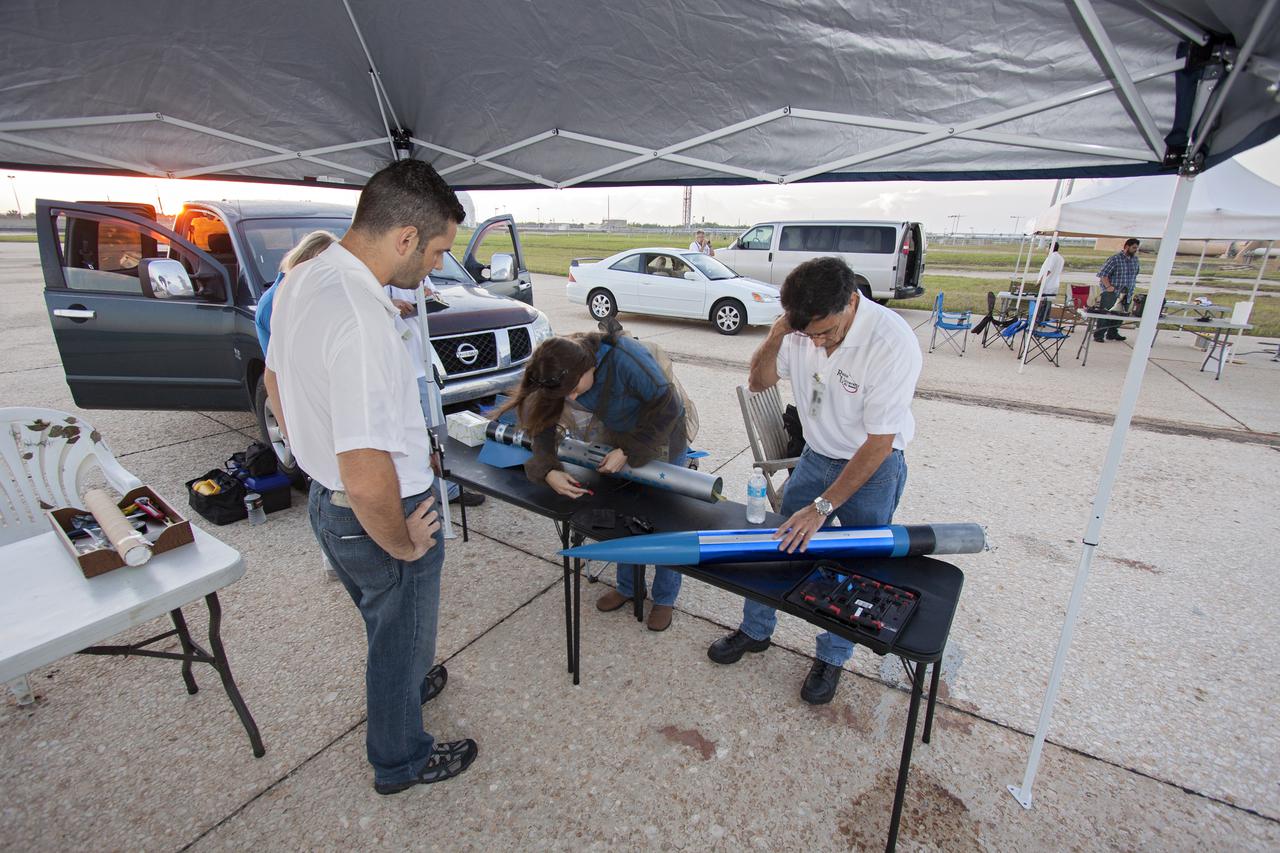
CAPE CANAVERAL, Fla. -- At NASA's Kennedy Space Center in Florida, engineers make final adjustments to a small rocket prior to launch as part of Rocket University. The goal was to test its systems and to verify that it performed as designed. As part of Rocket University, the engineers are given an opportunity to work a fast-track project to develop skills in developing spacecraft systems of the future. As NASA plans for future spaceflight programs to low-Earth orbit and beyond, teams of engineers at Kennedy are gaining experience in designing and flying launch vehicle systems on a small scale. Four teams of five to eight members from Kennedy are designing rockets complete with avionics and recovery systems. Launch operations require coordination with federal agencies, just as they would with rockets launched in support of a NASA mission. Photo credit: NASA_Jim Grossmann
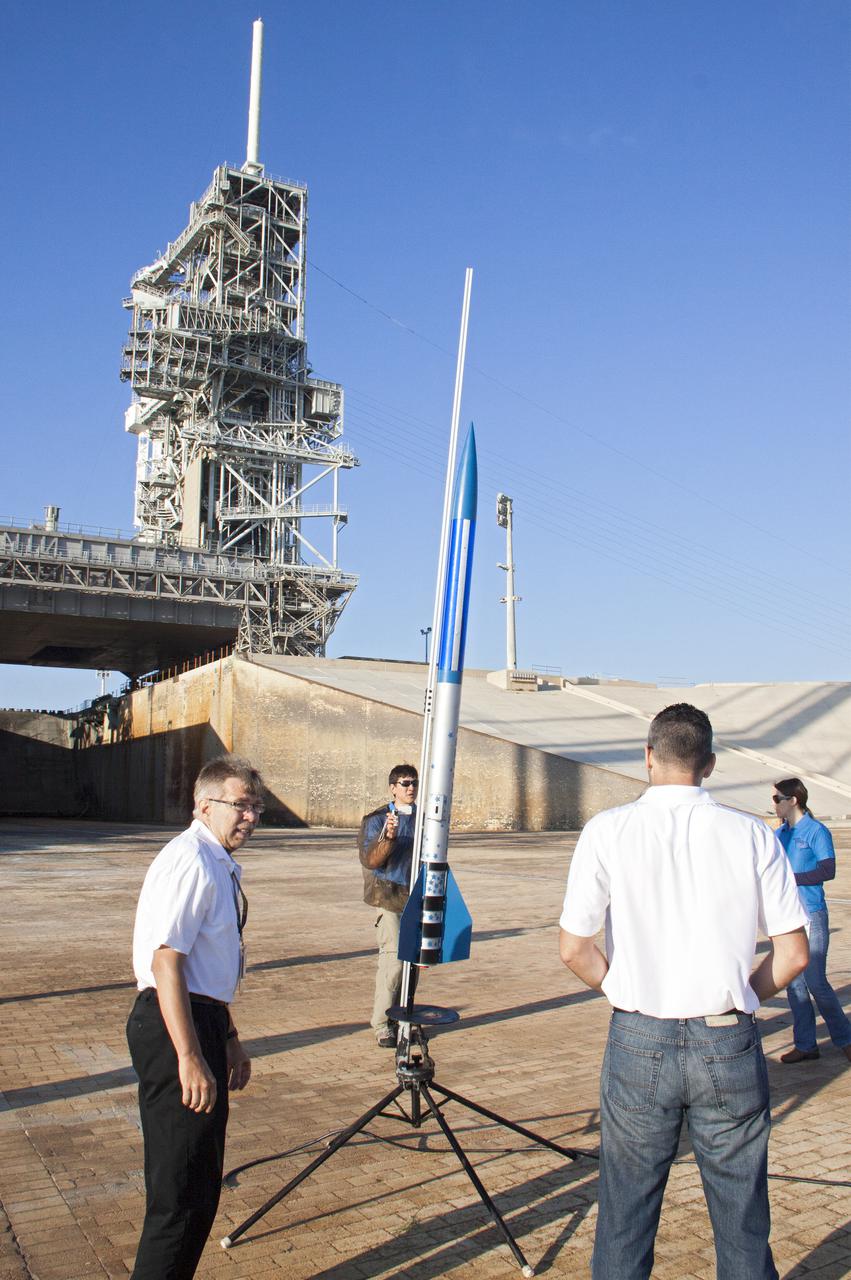
CAPE CANAVERAL, Fla. -- At NASA's Kennedy Space Center in Florida, engineers complete final checkouts of a small rocket on its launch stand as part of Rocket University. The goal was to test its systems and to verify that it performed as designed. As part of Rocket University, the engineers are given an opportunity to work a fast-track project to develop skills in developing spacecraft systems of the future. As NASA plans for future spaceflight programs to low-Earth orbit and beyond, teams of engineers at Kennedy are gaining experience in designing and flying launch vehicle systems on a small scale. Four teams of five to eight members from Kennedy are designing rockets complete with avionics and recovery systems. Launch operations require coordination with federal agencies, just as they would with rockets launched in support of a NASA mission. Photo credit: NASA_Jim Grossmann
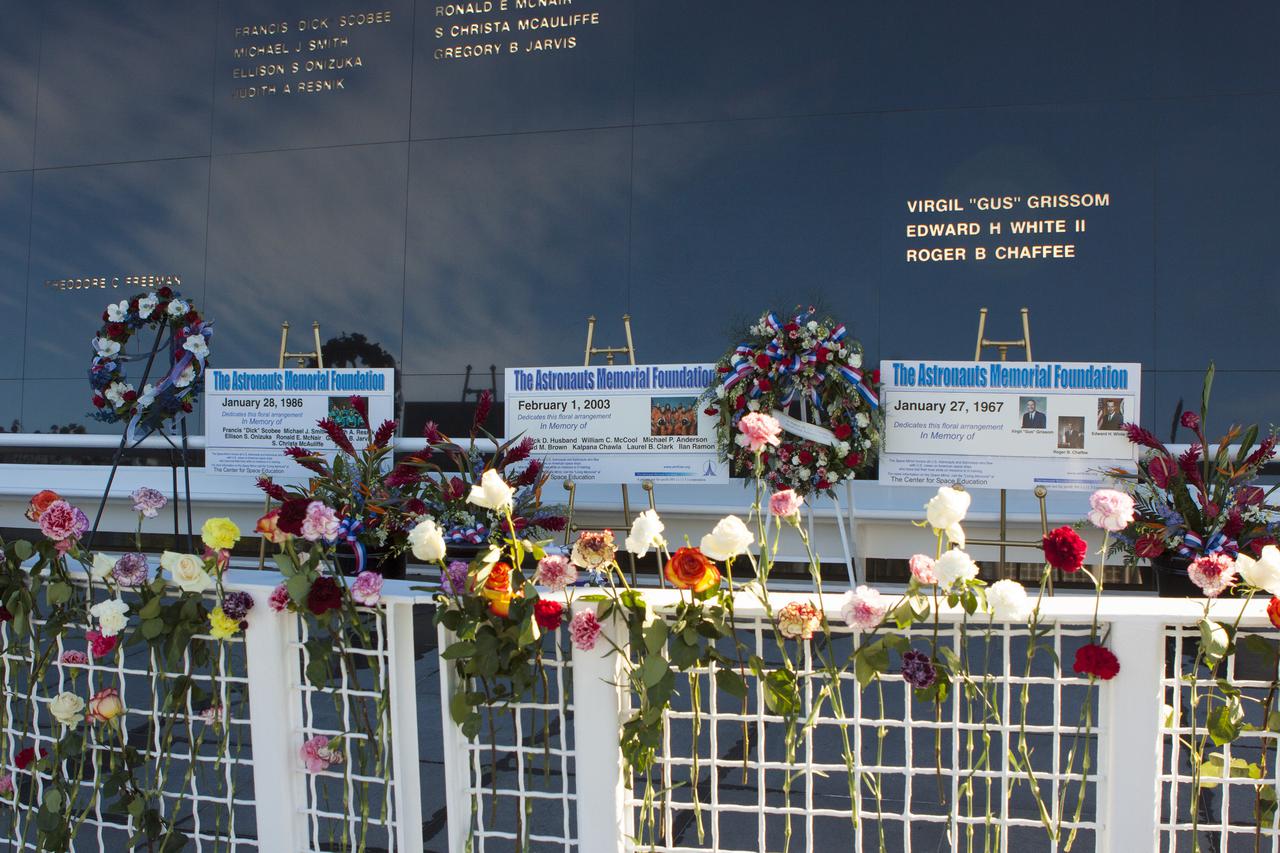
CAPE CANAVERAL, Fla. -- Kennedy Space Center Employees and guests placed wreaths and flowers at the Space Mirror Memorial at the spaceport's Visitor Complex during NASA's Day of Remembrance. The annual event took place on the 10th anniversary of the loss of the space shuttle Columbia and its crew and was hosted by the Astronauts Memorial Foundation. The ceremony also honored the astronauts of Apollo 1, who perished in 1967, and the shuttle Challenger, lost in 1986, as well as other astronauts who lost their lives while furthering the cause of exploration and discovery. Dedicated in 1991, the names of fallen astronauts are emblazoned the monument's 4.5-foot-high-by-50-foot-wide polished black granite surface which reflects the sky and has been designated by Congress as a National Memorial. Photo credit: NASA_Jim Grossmann

CAPE CANAVERAL, Fla. – At NASA’s Kennedy Space Center in Florida, Robert Lightfoot, NASA associate director, at left, learns about the Regolith and Environment Science and Oxygen and Lunar Volatile Extraction, or RESOLVE, rover during a tour of the Swamp Works laboratories. To the right of Lightfoot is Kennedy Director Bob Cabana. Kennedy’s Swamp Works provides rapid, innovative and cost-effective exploration mission solutions, leveraging partnerships across NASA, industry and academia. Kennedy’s research and technology mission is to improve spaceports on Earth, as well as lay the groundwork for establishing spaceports at destinations in space. For more information, visit http:__www.nasa.gov_centers_kennedy_exploration_researchtech_index.html. Photo credit: NASA_Jim Grossmann
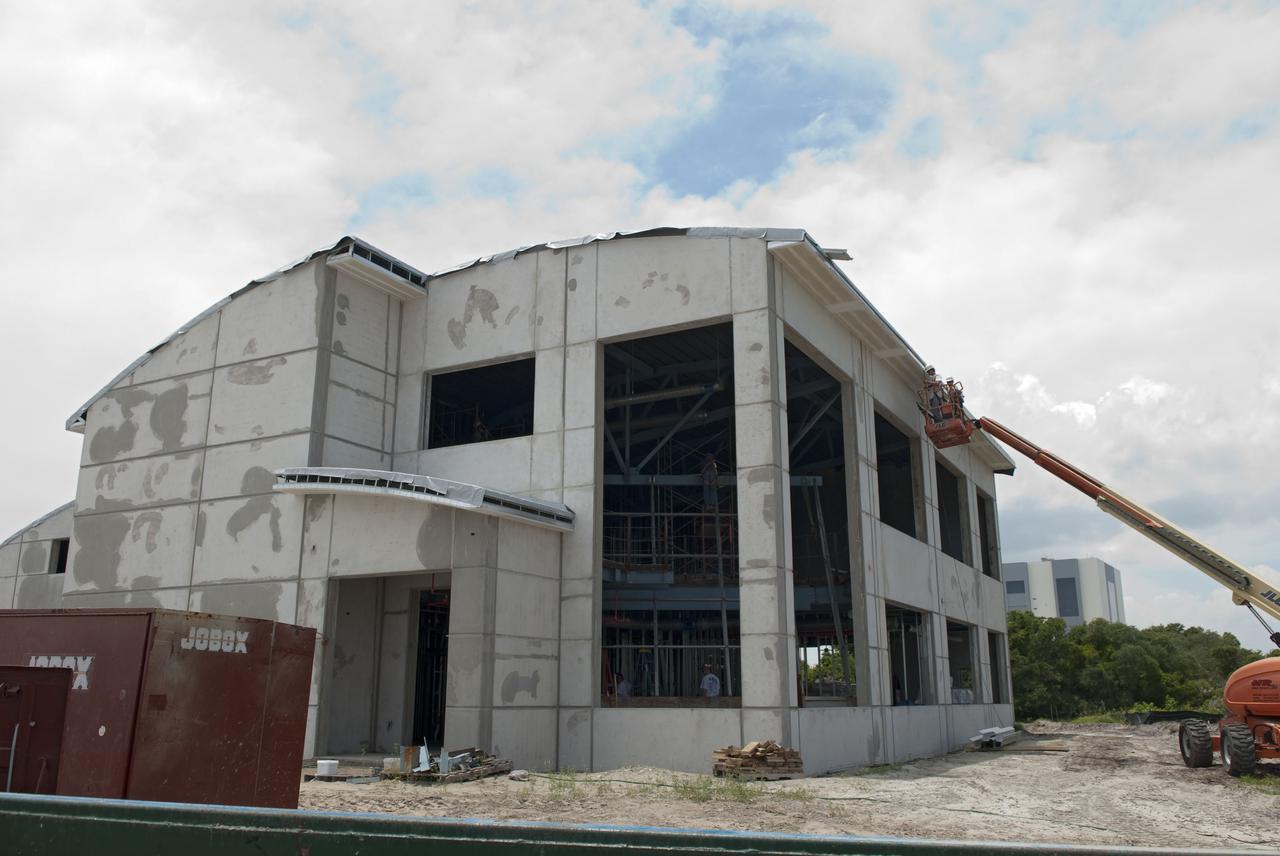
CAPE CANAVERAL, Fla. - At the Propellants North Administrative and Maintenance Facility at NASA's Kennedy Space Center in Florida, workers prepare to install window glazing and framing recycled from the iconic firing rooms of the Launch Control Center. New energy-efficient windows will be set at the same orientation and angle as the old windows were at the control center, looking out toward Launch Complex 39. The green facility will have a two-story administrative building to house managers, mechanics and technicians who fuel spacecraft at Kennedy adjacent to a single-story shop to store cryogenic fuel transfer equipment. The facility is striving to qualify for the U.S. Green Building Council’s Leadership in Energy and Environmental Design, or LEED, Platinum certification. If successful, it will be the first NASA facility to achieve this highest of LEED ratings after it is completed in December 2010. The facility was designed for NASA by Jones Edmunds and Associates. H. W. Davis Construction is the construction contractor. Photo credit: NASA_Jim Grossmann
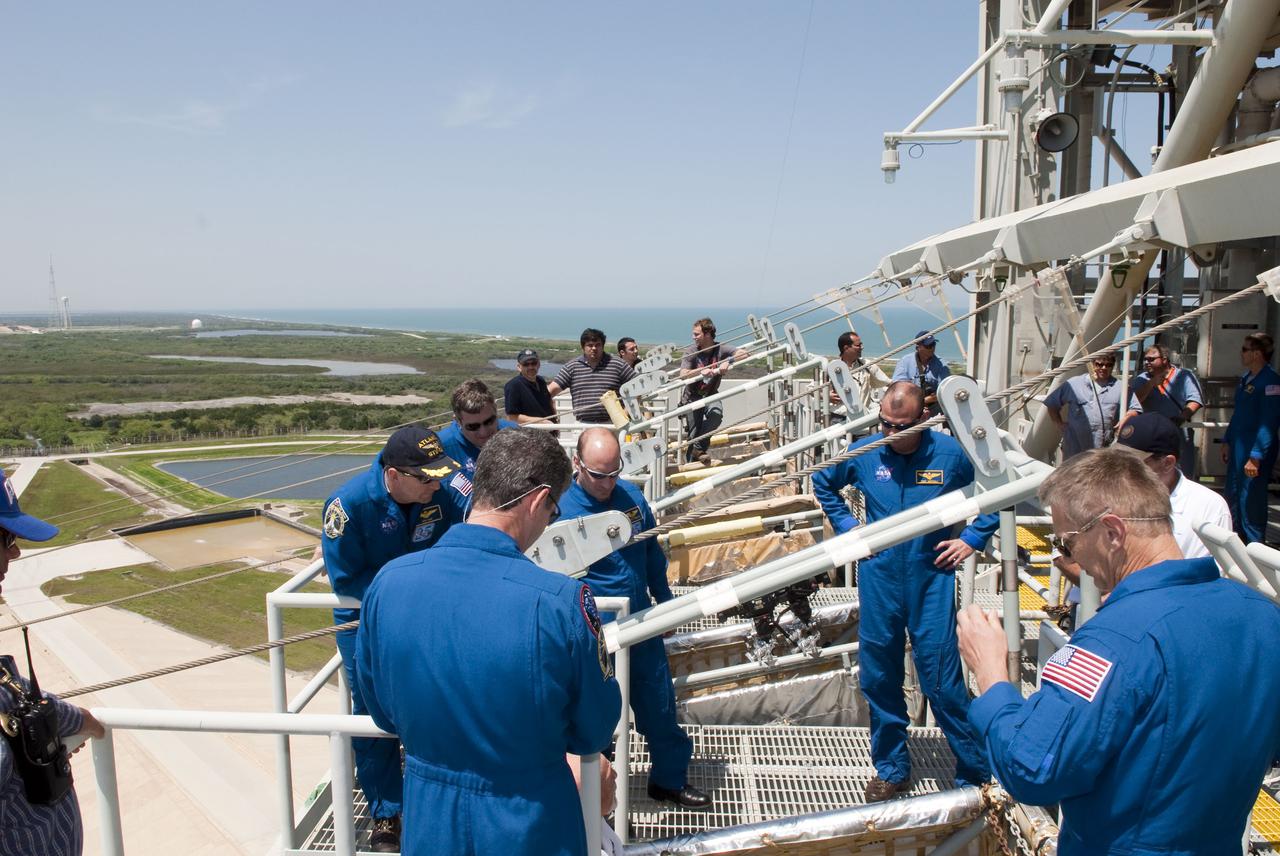
CAPE CANAVERAL, Fla. - On Launch Pad 39A at NASA's Kennedy Space Center, the members of space shuttle Atlantis' STS-132 crew receive instruction on the operation of the pad's slidewire basket system during emergency exit training. The pad's escape system includes seven baskets suspended from seven slidewires that extend from the fixed service structure to a landing zone 1,200 feet west of the pad. In the blue flight suits, from left, facing the camera, are Commander Ken Ham; Mission Specialists Steve Bowen and Garrett Reisman; and Pilot Tony Antonelli. Facing away from the camera are Mission Specialists Michael Good, left, and Piers Sellers. The crew is participating in training in preparation for their Terminal Countdown Demonstration Test, or TCDT, a dress rehearsal for launch. TCDT provides each shuttle crew and launch team the opportunity to participate in various simulated countdown activities, including equipment familiarization and emergency procedures. On the STS-132 mission, the six-member crew will deliver an Integrated Cargo Carrier, or ICC, and the Russian-built Mini-Research Module-1, or MRM-1, to the International Space Station aboard space shuttle Atlantis. The ICC is an unpressurized flat bed pallet and keel yoke assembly used to support the transfer of exterior cargo from the shuttle to the space station. The MRM-1, known as Rassvet, is the second in a series of new pressurized components for Russia and will be permanently attached to the Earth-facing port of the Zarya control module. Rassvet, which translates to 'dawn,' will be used for cargo storage and will provide an additional docking port to the station. STS-132 is the 34th mission to the station and the 132nd shuttle mission overall. Atlantis is targeted to launch on May 14 at 2:19 p.m. For information on the STS-132 mission, visit http:__www.nasa.gov_mission_pages_shuttle_shuttlemissions_sts132_index.html. Photo credit: NASA_Jim Grossmann

CAPE CANAVERAL, Fla. - In the Operations and Checkout Building at NASA's Kennedy Space Center in Florida, President Barack Obama addresses the participants of the Conference on the American Space Program for the 21st Century. In his remarks, he outlined the new course his administration is charting for NASA and the future of U.S. leadership in human spaceflight. Photo credit: NASA_Jim Grossmann
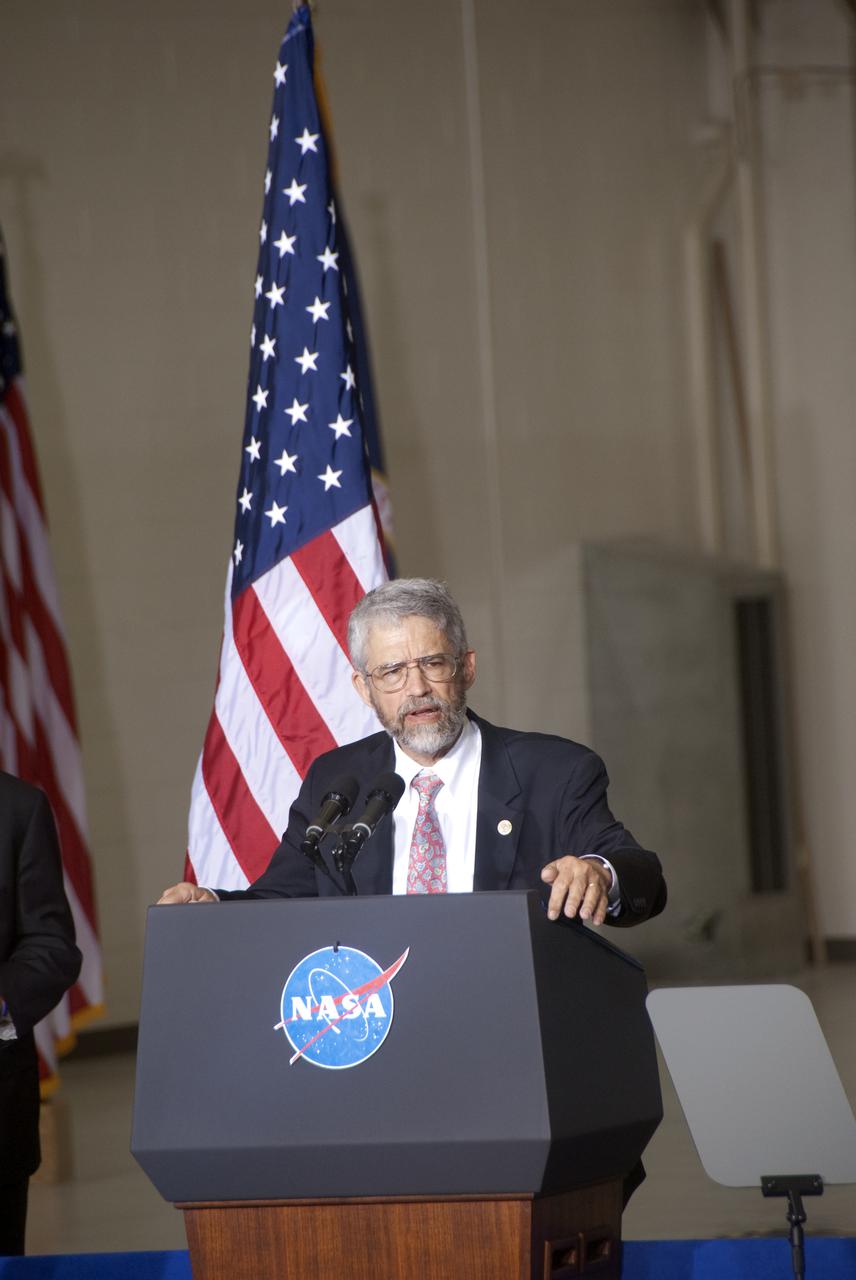
CAPE CANAVERAL, Fla. - In the Operations and Checkout Building at NASA's Kennedy Space Center in Florida, John Holdren, assistant to the President for science and technology and director of the White House Office of Science and Technology Policy, co-hosts the official opening of the Conference on the American Space Program for the 21st Century following President Barack Obama's remarks describing the new course his administration is charting for NASA and the future of U.S. leadership in human spaceflight. The four break-out conference sessions that will take place in the Operations and Checkout Building and in the Kennedy Space Center Visitor Complex will include these topics: Increasing Access to and Utilization of the International Space Station; Jumpstarting the New Technologies to Take Us Beyond; Expanding our Reach into the Solar System and Harnessing Space to Expand Economic Opportunity. Photo credit: NASA_Jim Grossmann
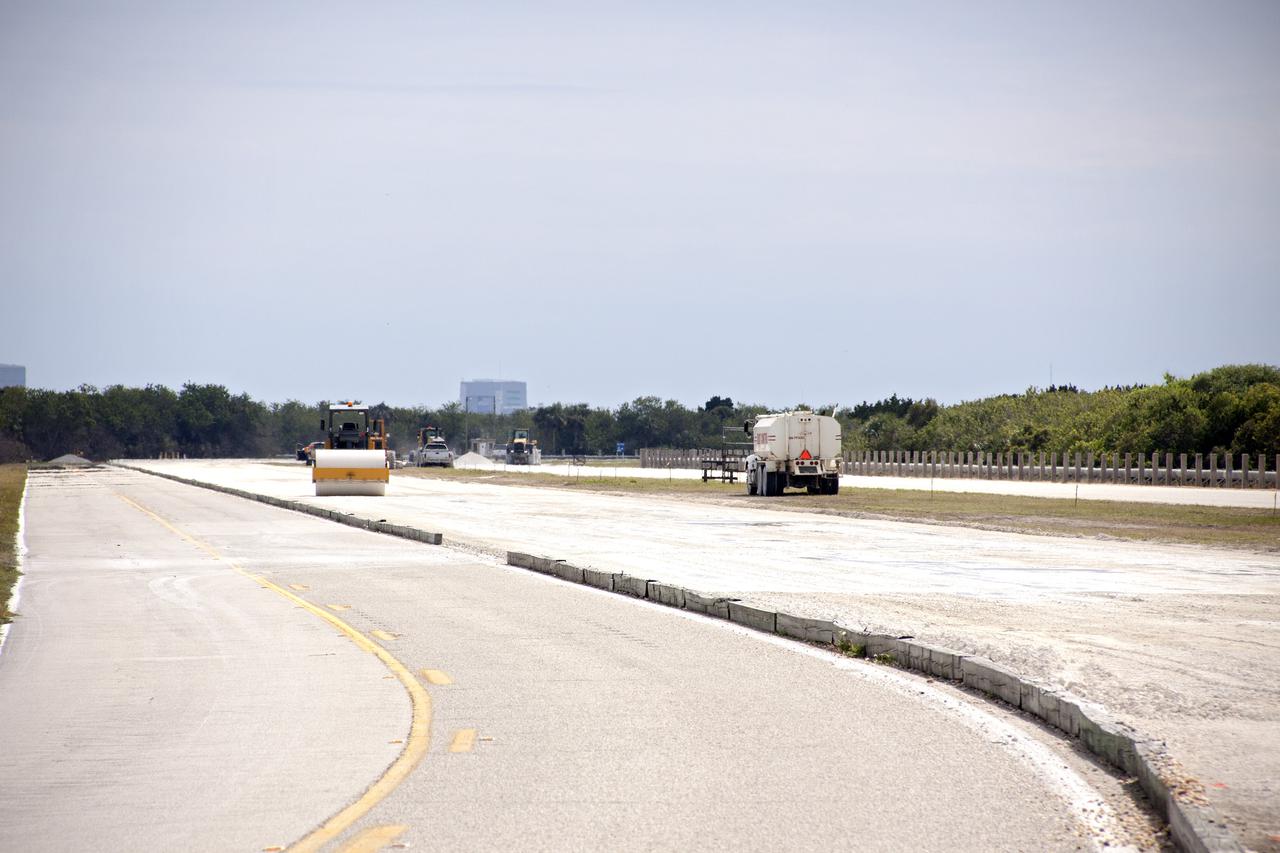
CAPE CANAVERAL, Fla. --Workers from Canaveral Construction in Mims, Fla., continue to re-grade the lime rock on the crawlerway near Launch Pad 39B at NASA’s Kennedy Space Center in Florida. The crawlerway is being upgraded to improve the foundation and prepare it to support the weight of NASA’s Space Launch System, or SLS, and mobile launcher on the crawler-transporter during rollout. Workers are removing the original Alabama river rock and restoring the layer of lime rock below to its original depth. Then new river rock will be added on top. The Ground Systems Development and Operations, or GSDO, Program office at Kennedy is leading the center’s transformation to safely handle a variety of rockets and spacecraft. For more information about GSDO, visit: http:__go.nasa.gov_groundsystems. Photo credit: NASA_Jim Grossmann
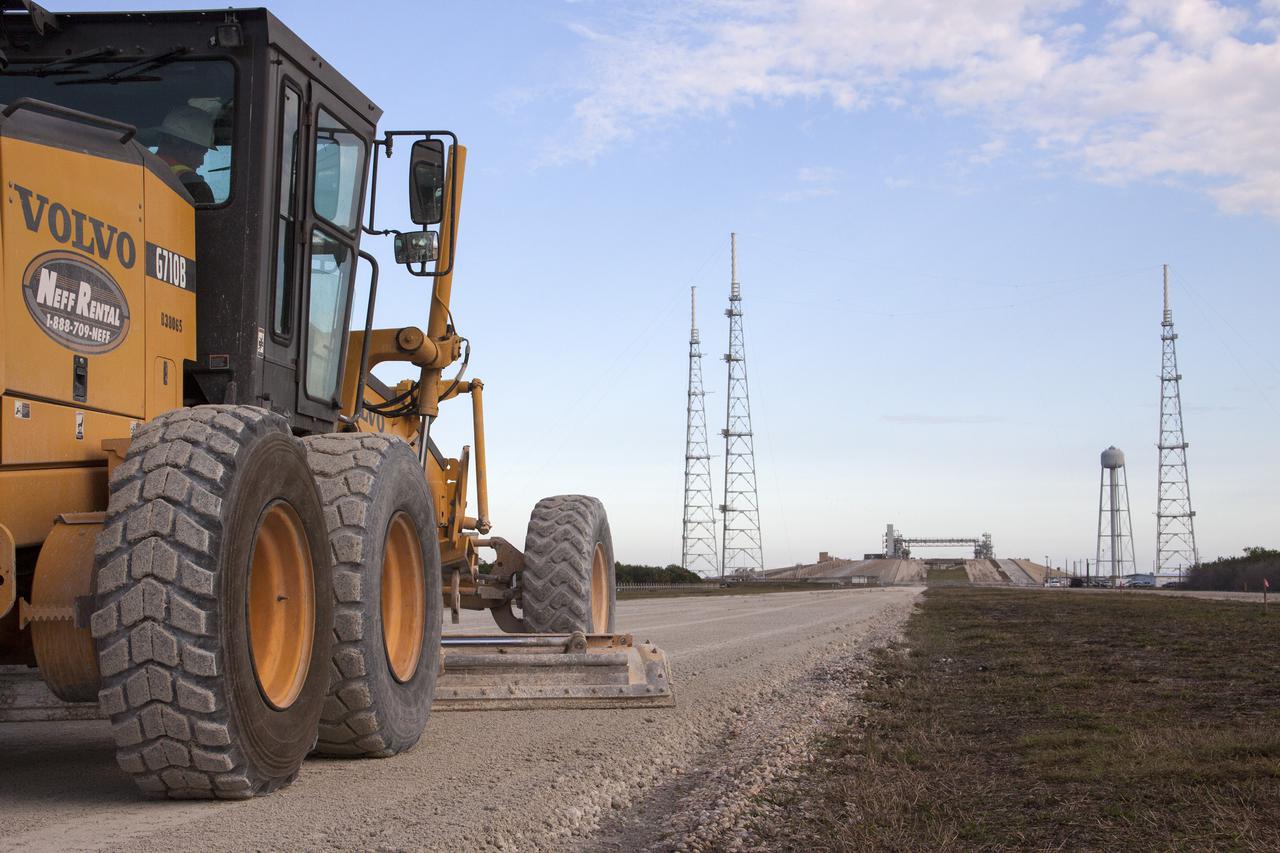
CAPE CANAVERAL, Fla. – A worker from Canaveral Construction in Mims, Fla., re-grades a section of the crawlerway near Launch Pad 39B at NASA’s Kennedy Space Center in Florida. The crawlerway is being upgraded to improve the foundation and prepare it to support the weight of NASA’s Space Launch System, or SLS, and mobile launcher on the crawler-transporter during rollout. Workers are removing the original Alabama river rock and restoring the layer of lime rock below to its original depth of three feet. Then new river rock will be added on top. The Ground Systems Development and Operations, or GSDO, Program office at Kennedy is leading the center’s transformation to safely handle a variety of rockets and spacecraft. For more information about GSDO, visit: http:__go.nasa.gov_groundsystems. Photo credit: NASA_Jim Grossmann
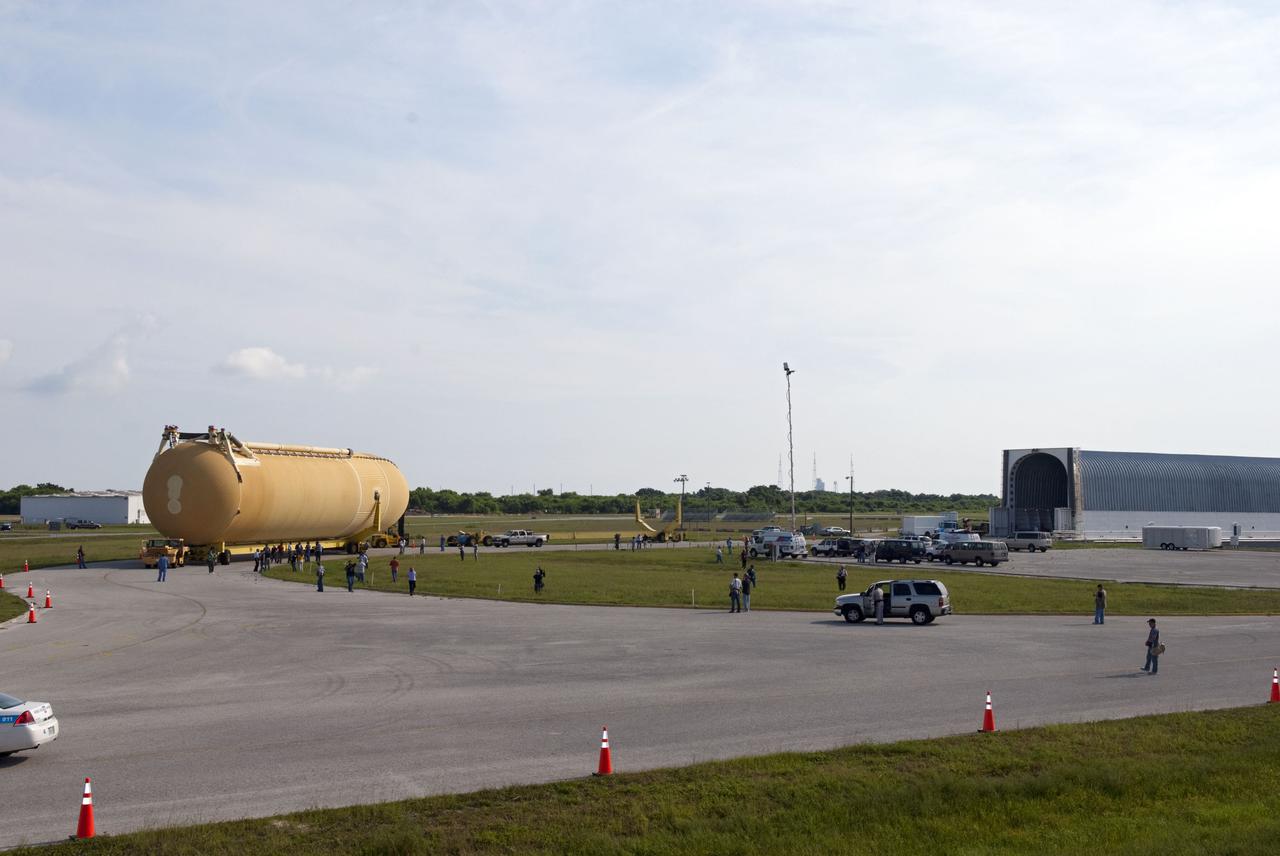
CAPE CANAVERAL, Fla. -- At NASA's Kennedy Space Center in Florida, workers accompany the newly offloaded External Tank-138 from the Pegasus barge docked in the turn basin. The external fuel tank arrived in Florida on July 13, from NASA's Michoud Assembly Facility near New Orleans. ET-138, the last newly manufactured tank, was originally designated to fly on Endeavour's STS-134 mission to the International Space Station, but later reassigned to fly on space shuttle Atlantis' final mission, STS-135. For information, visit www.nasa.gov_shuttle. Photo credit: NASA_Jim Grossmann

CAPE CANAVERAL, Fla. - At Launch Pad 39A at NASA's Kennedy Space Center in Florida, one of space shuttle Discovery's payload bay doors closes around the multi-purpose logistics module Leonardo and other cargo that will fly on the STS-131 mission. Payload bay door closure for launch is a significant milestone in processing activities. The countdown for Discovery's launch on April 5 is set to begin at 3 a.m. EDT on April 2. The seven-member STS-131 crew will deliver Leonardo to the International Space Station. The module is filled with supplies, a new crew sleeping quarters and science racks that will be transferred to the station's laboratories. The crew also will switch out a gyroscope on the station’s truss, install a spare ammonia storage tank and retrieve a Japanese experiment from the station’s exterior. STS-131 is the 33rd shuttle mission to the station and the 131st shuttle mission overall. For information on the STS-131 mission and crew, visit http:__www.nasa.gov_mission_pages_shuttle_shuttlemissions_sts131_index.html. Photo credit: NASA_Jim Grossmann
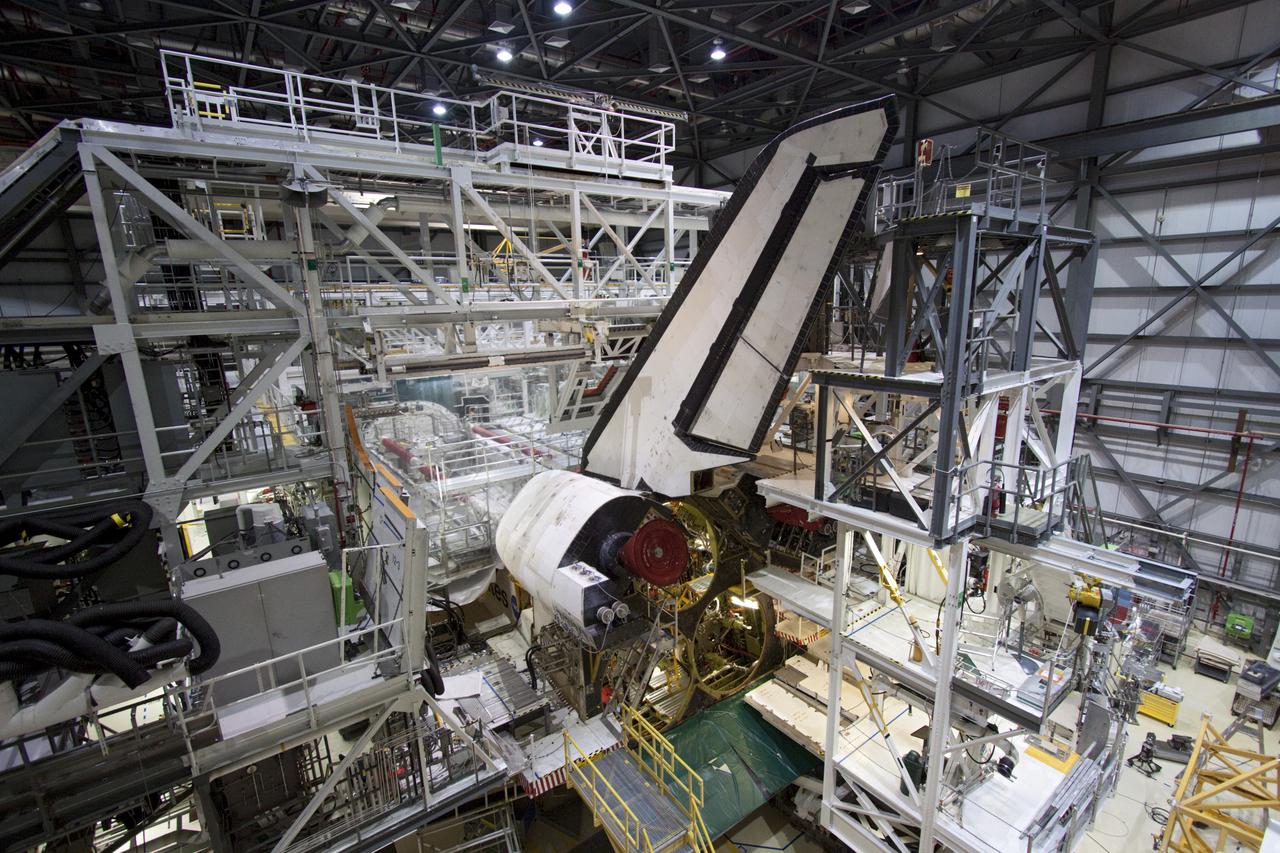
CAPE CANAVERAL, Fla. – Inside Orbiter Processing Facility-2 at NASA’s Kennedy Space Center in Florida, large access platforms are being moved into place around space shuttle Atlantis in preparation for removal of the left orbital maneuvering system (OMS) pod. The work is part of the Space Shuttle Program’s transition and retirement processing of shuttle Atlantis. The OMS pods will be sent to White Sands Space Harbor in New Mexico where they will undergo a complete deservicing and cleaning and then be returned to Kennedy for reinstallation on Atlantis. Atlantis is being prepared for display at the Kennedy Space Center Visitor Complex in Florida. Photo credit: NASA_Jim Grossmann
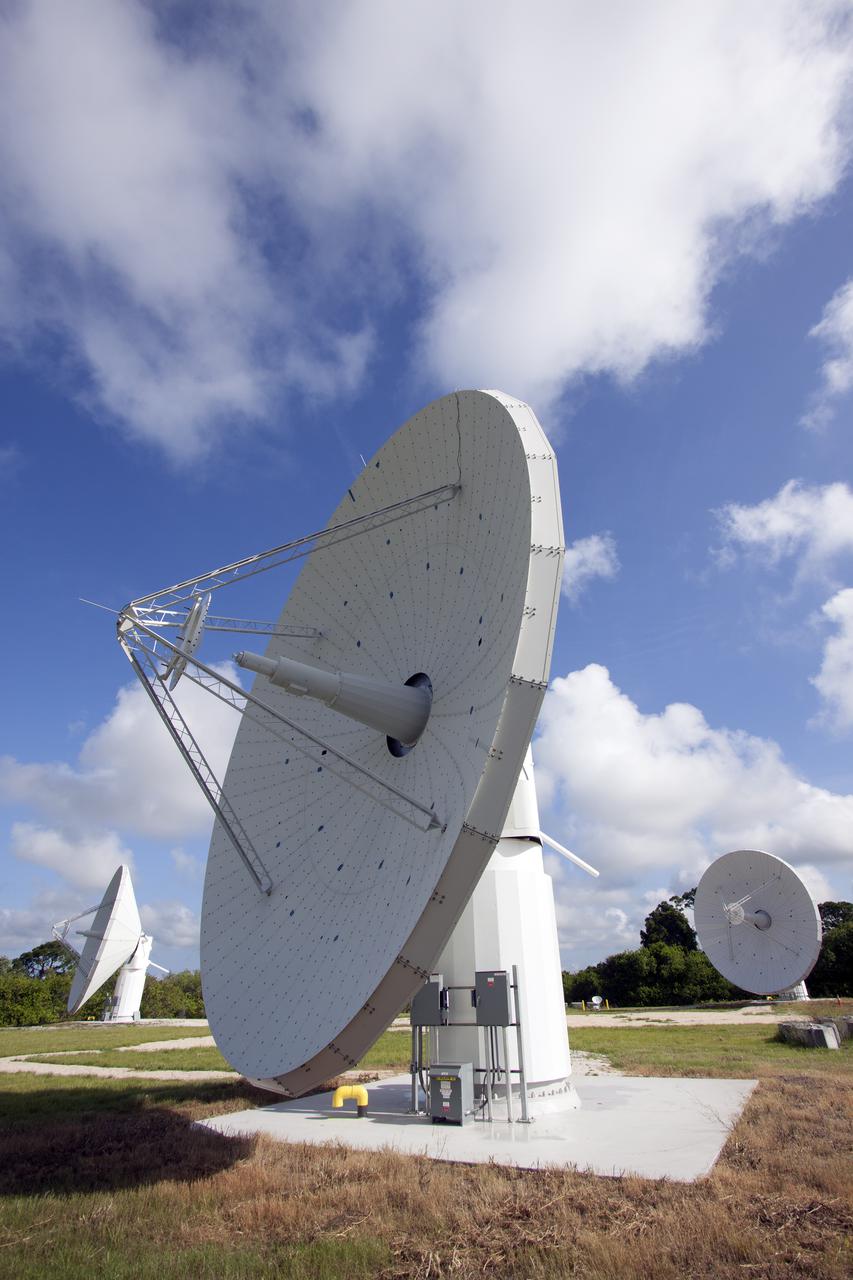
CAPE CANAVERAL, Fla. -- At NASA’s Kennedy Space Center in Florida, one of the three Ka-Band Objects Observation and Monitoring, or Ka-BOOM, testbed antennas is used to track the sun during initial testing of the new system. The goal of Ka-BOOM is to prove technologies that will allow future systems to characterize near-Earth objects in terms of size, shape, rotation_tumble rate and to determine the trajectory of those objects. Radar studies can determine the trajectory 100,000 times more precisely than can optical methods. While also capable of space communication and radio science experiments, developing radar applications is the primary focus of the arrays. The 40-foot-diameter dish antenna arrays are at the site of the former Vertical Processing Facility, which has been demolished. Photo credit: NASA_Jim Grossmann
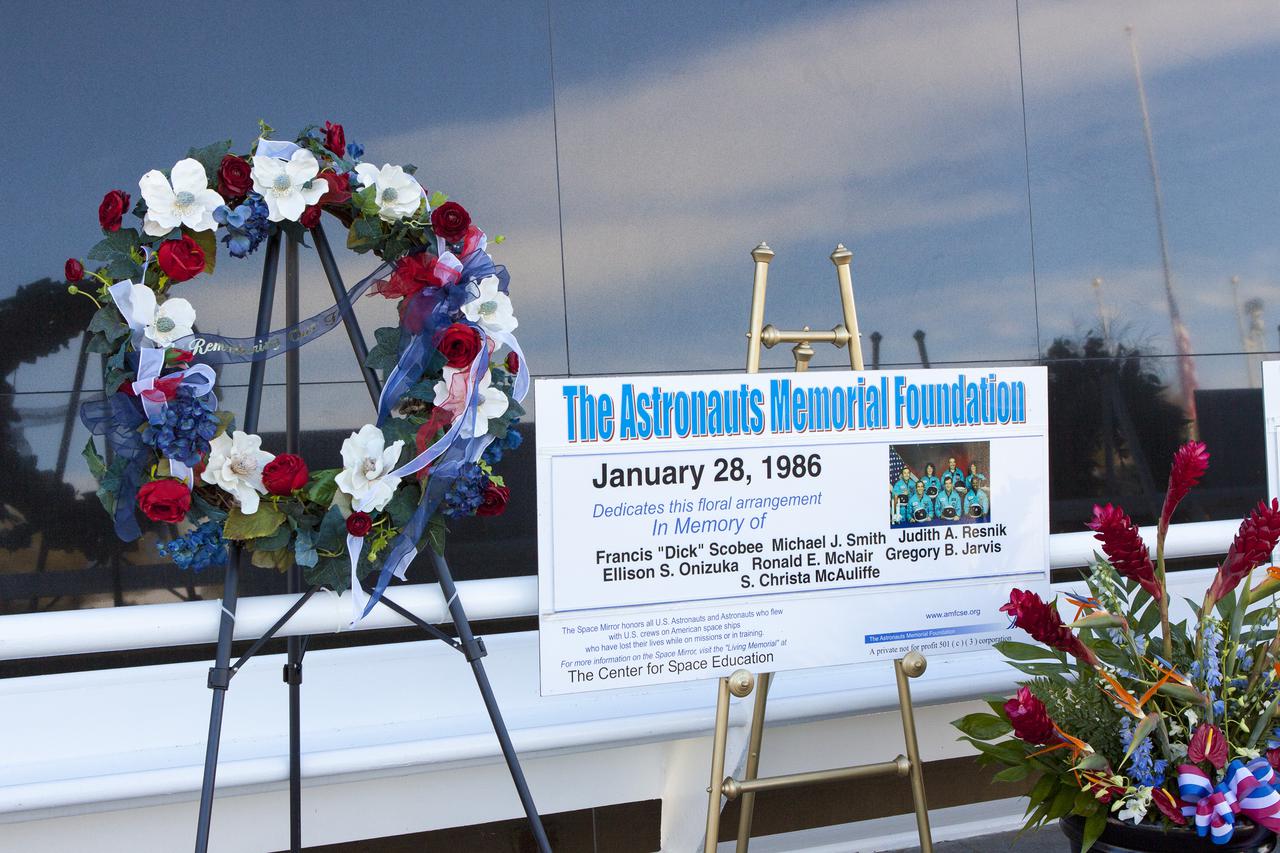
CAPE CANAVERAL, Fla. -- Kennedy Space Center Employees and guests placed wreaths and flowers at the Space Mirror Memorial at the spaceport's Visitor Complex during NASA's Day of Remembrance. The annual event took place on the 10th anniversary of the loss of the space shuttle Columbia and its crew and was hosted by the Astronauts Memorial Foundation. The ceremony also honored the astronauts of Apollo 1, who perished in 1967, and the shuttle Challenger, lost in 1986, as well as other astronauts who lost their lives while furthering the cause of exploration and discovery. Dedicated in 1991, the names of fallen astronauts are emblazoned the monument's 4.5-foot-high-by-50-foot-wide polished black granite surface which reflects the sky and has been designated by Congress as a National Memorial. Photo credit: NASA_Jim Grossmann
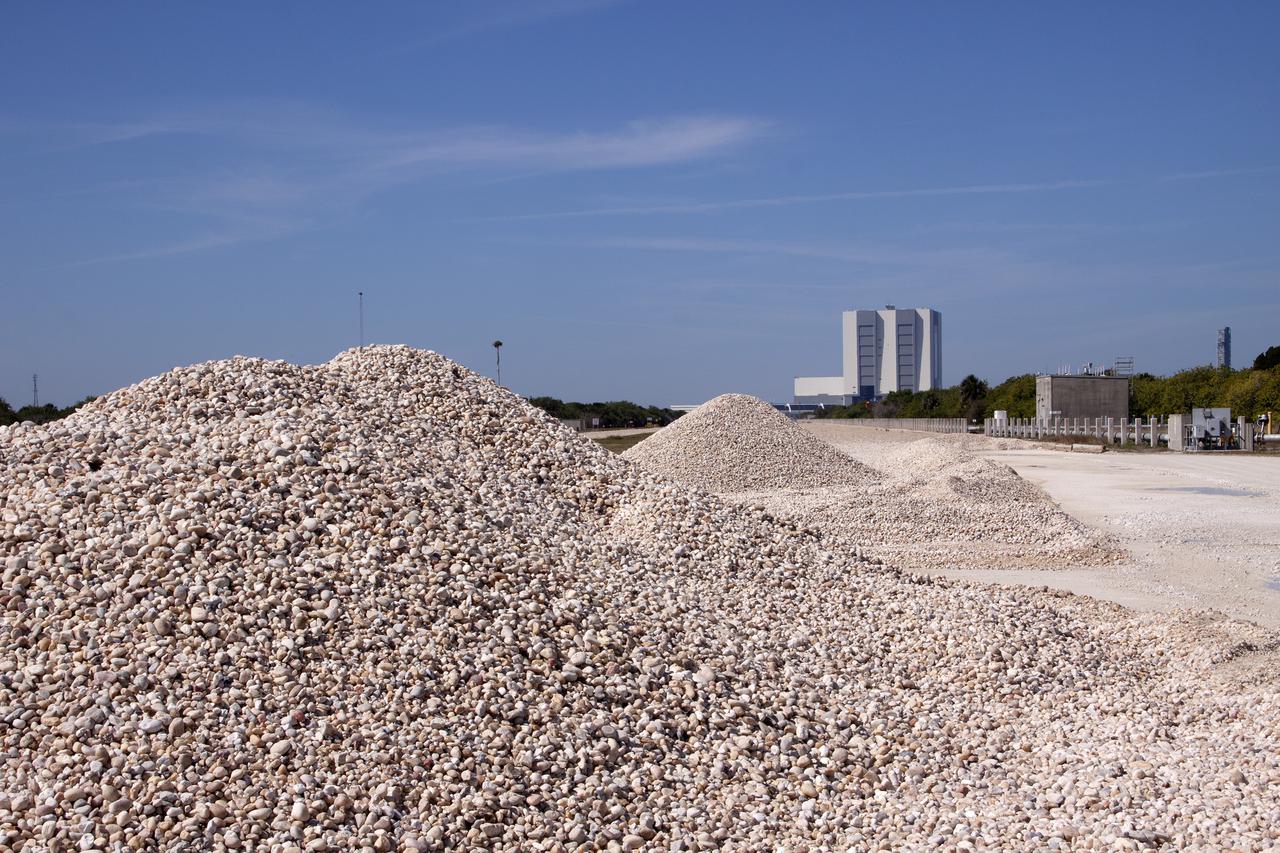
CAPE CANAVERAL, Fla. -- On the crawlerway leading to Launch Pad 39B at NASA’s Kennedy Space Center in Florida, workers from Canaveral Construction in Mims, Fla., continue to remove sections of the Alabama river rock in order to re-grade the lime rock below. The crawlerway is being upgraded to improve the foundation and prepare it to support the weight of NASA’s Space Launch System, or SLS, and mobile launcher on the crawler-transporter during rollout. Workers are removing the original Alabama river rock and restoring the layer of lime rock below to its original depth. Then new river rock will be added on top. The Ground Systems Development and Operations, or GSDO, Program office at Kennedy is leading the center’s transformation to safely handle a variety of rockets and spacecraft. For more information about GSDO, visit: http:__go.nasa.gov_groundsystems. Photo credit: NASA_Jim Grossmann

CAPE CANAVERAL, Fla. – During a visit to NASA's Kennedy Space Center in Florida, NASA Associate Administrator Robert Lightfoot tours the Operations and Checkout Building high bay where the first Orion capsule, NASA's multi-purpose crew vehicle, is being prepared for flight on Exploration Flight Test 1, or EFT-1, in 2014. From left are Lockheed Martin's Orion Assembly, Integration and Production Senior Manager Jules Schneider, Kennedy's manager of Orion Production Operations Scott Wilson, Lightfoot, and Kennedy Director Bob Cabana. Orion is NASA's next-generation transport for astronauts to destinations beyond Earth orbit. NASA's FY2014 budget proposal includes a plan to robotically capture a small near-Earth asteroid and redirect it safely to a stable orbit in the Earth-moon system where astronauts can visit and explore it. Performing these elements for the proposed asteroid initiative integrates the best of NASA's science, technology and human exploration capabilities and draws on the innovation of America's brightest scientists and engineers. It uses current and developing capabilities to find both large asteroids that pose a hazard to Earth and small asteroids that could be candidates for the initiative, accelerates our technology development activities in high-powered solar electric propulsion and takes advantage of our hard work on the Space Launch System rocket and Orion spacecraft, helping to keep NASA on target to reach the President's goal of sending humans to Mars in the 2030s. Photo credit: NASA_Jim Grossmann
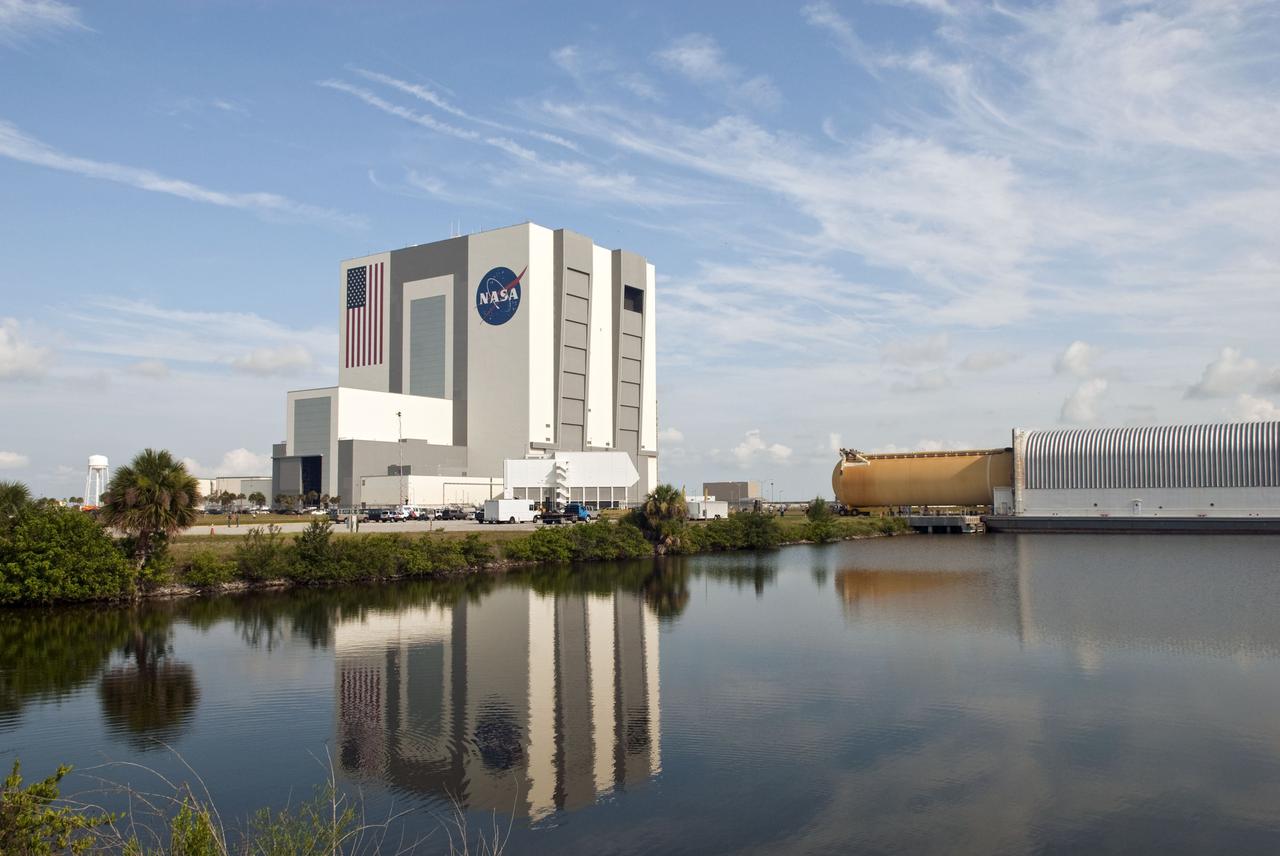
CAPE CANAVERAL, Fla. -- Viewed from across the turn basin in the Launch Complex 39 area at NASA's Kennedy Space Center in Florida, External Tank-138 is being offloaded from the Pegasus barge near the Vehicle Assembly Building. The external fuel tank arrived in Florida on July 13, from NASA's Michoud Assembly Facility near New Orleans. ET-138, the last newly manufactured tank, was originally designated to fly on Endeavour's STS-134 mission to the International Space Station, but later reassigned to fly on space shuttle Atlantis' final mission, STS-135. For information, visit www.nasa.gov_shuttle. Photo credit: NASA_Jim Grossmann
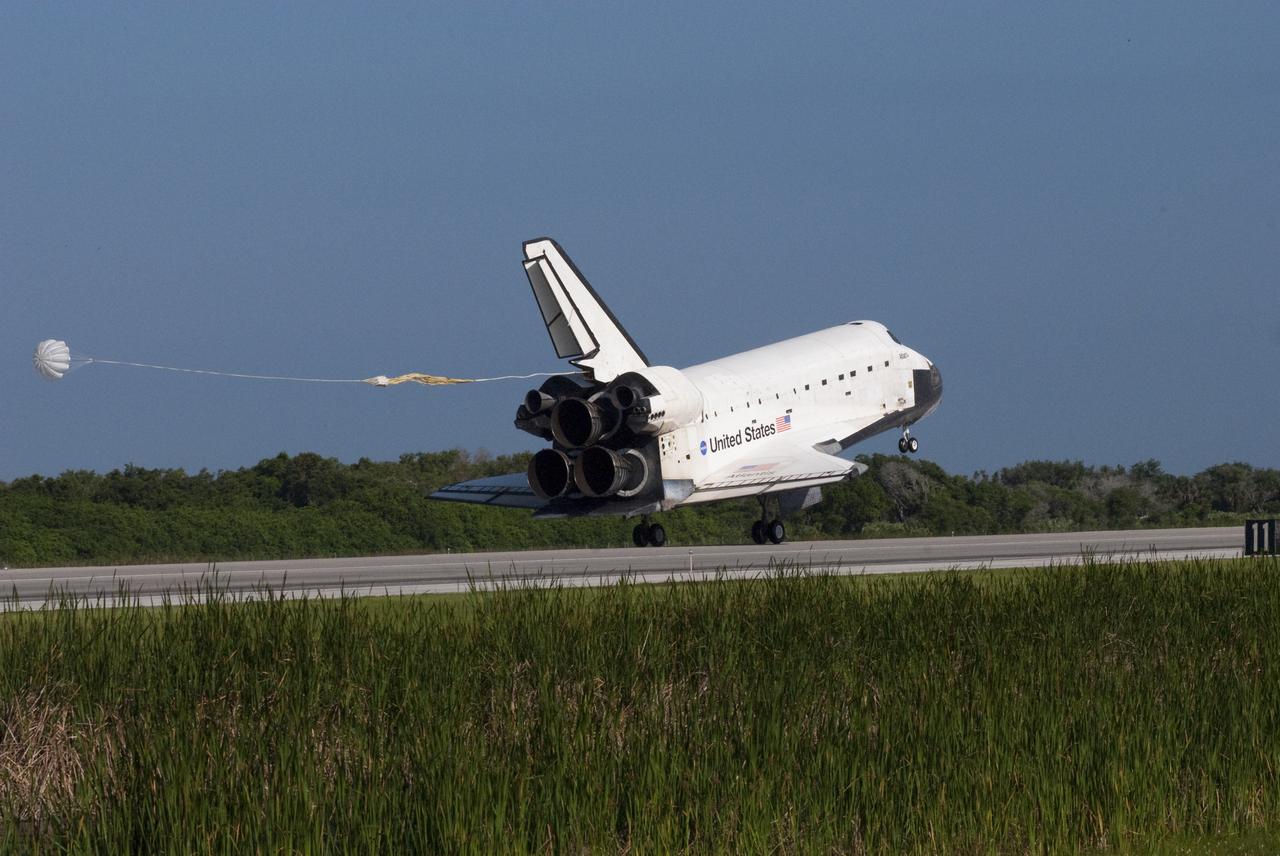
CAPE CANAVERAL, Fla. - Space shuttle Atlantis' drag chute deploys as the main gear touches down on Runway 33 at the Shuttle Landing Facility at NASA's Kennedy Space Center in Florida. Landing was at 8:48 a.m. EDT, completing the 12-day STS-132 mission to the International Space Station. Main gear touchdown was at 8:48:11 a.m. EDT, followed by nose gear touchdown at 8:48:21 a.m. and wheelstop at 8:49:18 a.m. On board are Commander Ken Ham, Pilot Tony Antonelli, Mission Specialists Garrett Reisman, Michael Good, Steve Bowen and Piers Sellers. The six-member STS-132 crew carried the Russian-built Mini Research Module-1 to the International Space Station. STS-132 is the 34th shuttle mission to the station, the 132nd shuttle mission overall and the last planned flight for Atlantis. For information on the STS-132 mission and crew, visit www.nasa.gov_mission_pages_shuttle_shuttlemissions_sts132_index.html. Photo credit: NASA_Jim Grossmann

CAPE CANAVERAL, Fla. - In the Operations and Checkout Building at NASA's Kennedy Space Center in Florida, President Barack Obama addresses the participants of the Conference on the American Space Program for the 21st Century. In his remarks, he outlined the new course his administration is charting for NASA and the future of U.S. leadership in human spaceflight. Photo credit: NASA_Jim Grossmann

CAPE CANAVERAL, Fla. – Inside the Educator Resource Center at NASA’s Kennedy Space Center Visitor Complex in Florida, science teacher April Lanotte displays materials used for the Museum in a Box activities for K-12 students. Lanotte, who is an Albert Einstein Distinguished Educator Fellow working in NASA’s Aeronautics Research Mission Directorate, was at Kennedy to train education specialists and Kennedy Educate to Innovate program volunteers in the new series of lessons and activities. The Museum in a Box is a program designed to teach physical science through aeronautics using hands-on activities and experiments. Photo credit: NASA_Jim Grossmann
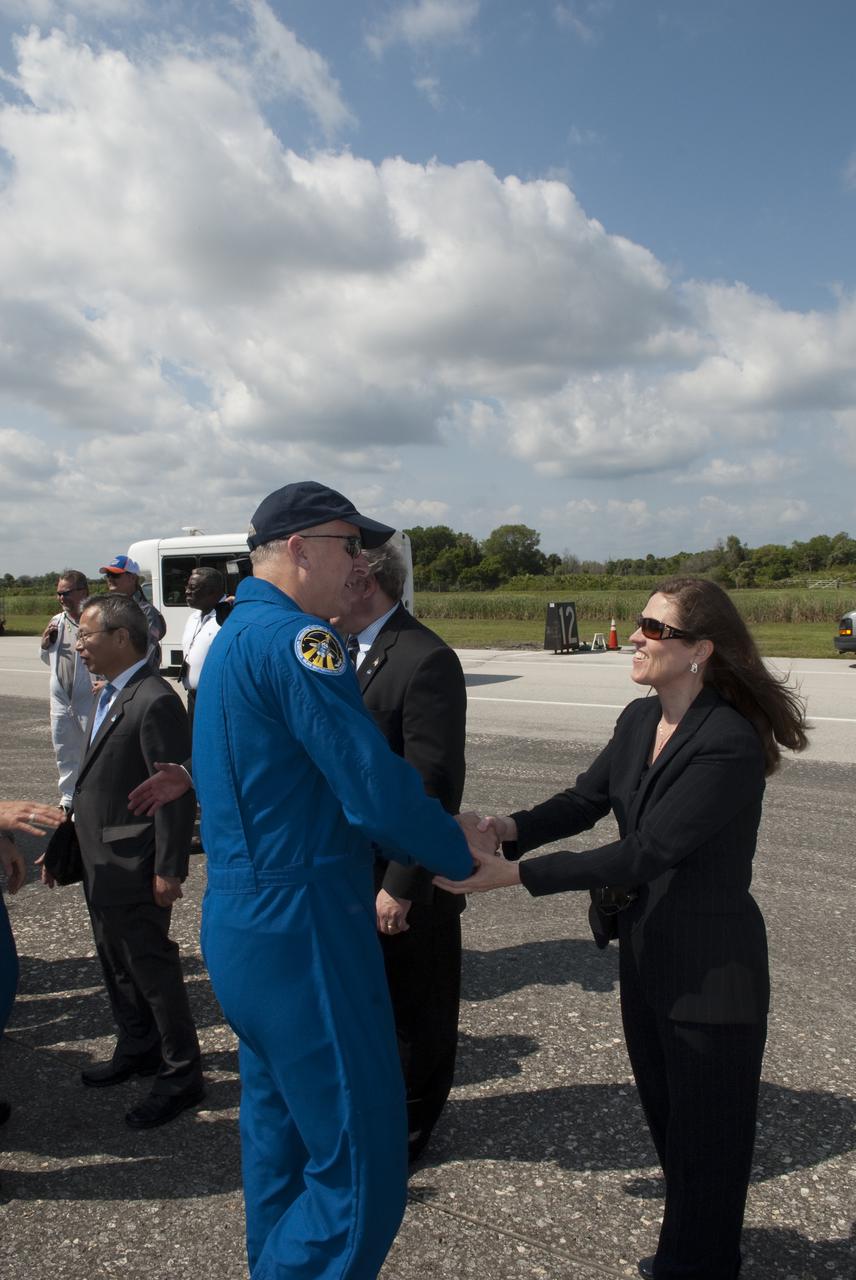
CAPE CANAVERAL, Fla. - At the Shuttle Landing Facility at NASA's Kennedy Space Center in Florida, Rita Willcoxon, director of Launch Vehicle Processing at Kennedy, welcomes STS-131 Commander Alan Poindexter back to Florida following the landing of space shuttle Discovery on Runway 33. Discovery landed on Runway 33 after 15 days in space, completing the more than 6.2-million-mile STS-131 mission on orbit 238. Main gear touchdown was at 9:08:35 a.m. EDT followed by nose gear touchdown at 9:08:47 a.m. and wheelstop at 9:09:33 a.m. The seven-member STS-131 crew carried the multi-purpose logistics module Leonardo, filled with supplies, a new crew sleeping quarters and science racks that were transferred to the International Space Station's laboratories. The crew also switched out a gyroscope on the station’s truss, installed a spare ammonia storage tank and retrieved a Japanese experiment from the station’s exterior. STS-131 is the 33rd shuttle mission to the station and the 131st shuttle mission overall. For information on the STS-131 mission and crew, visit http:__www.nasa.gov_mission_pages_shuttle_shuttlemissions_sts131_index.html. Photo credit: NASA_Jim Grossmann
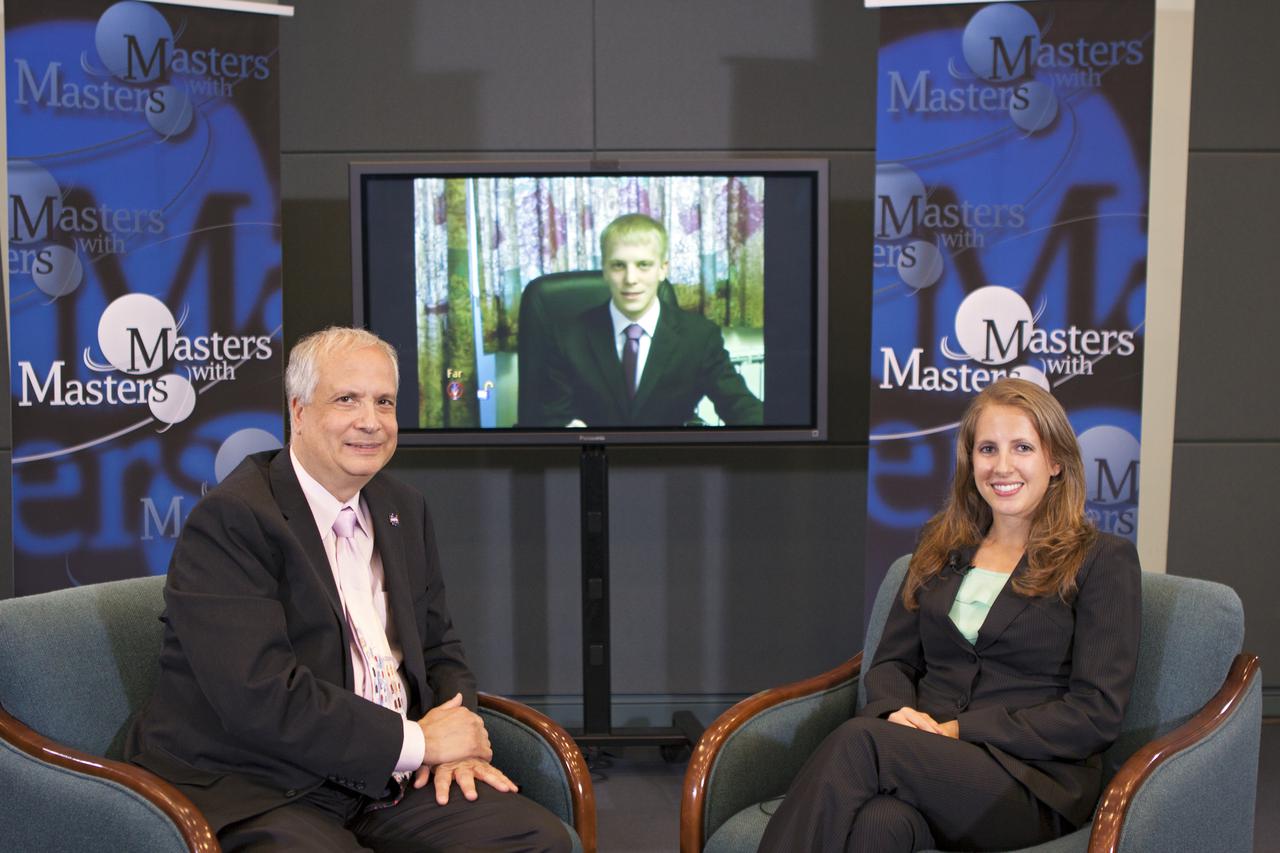
CAPE CANAVERAL, Fla. – At NASA's Kennedy Space Center in Florida, Ed Hoffman and Annie Caraccio discuss the 'Young Professional's Perspective at NASA' during the final day of a weeklong series called 'Masters with Masters.' Hoffman, NASA's chief Knowledge officer, and Caraccio, a chemical engineer in the Engineering and Technology Directorate at Kennedy, were joined by Philip Harris, an International Operations engineer from the Johnson Space Center via a television link with NASA's office in Moscow. Photo credit: NASA_Jim Grossmann
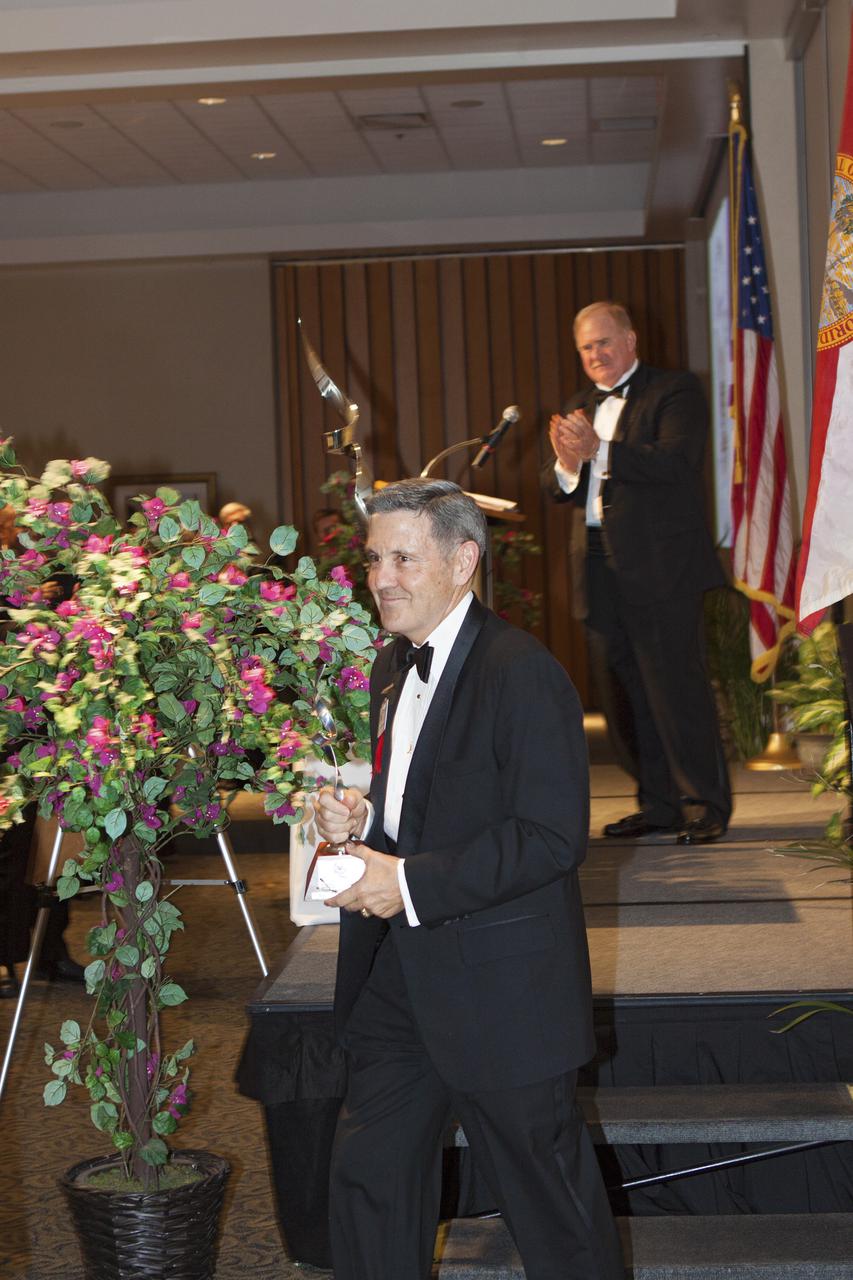
CAPE CANAVERAL, Fla. – At NASA’s Kennedy Space Center Visitor Complex in Florida, National Space Club Florida Committee Chairman Jim McCarthy, at the podium, has just presented the prestigious Dr. Kurt H. Debus Award to Kennedy's director, Bob Cabana. A former U.S. Marine Corps aviator and NASA astronaut, Cabana was honored at the gala Debus Award Dinner. Named for the spaceport’s first director, the Debus Award was created to recognize significant achievements and contributions made in Florida to American aerospace efforts. The Debus Award was created by the space club's Florida committee to recognize significant achievements and contributions made in Florida to American aerospace efforts. Photo credit: NASA_Jim Grossmann
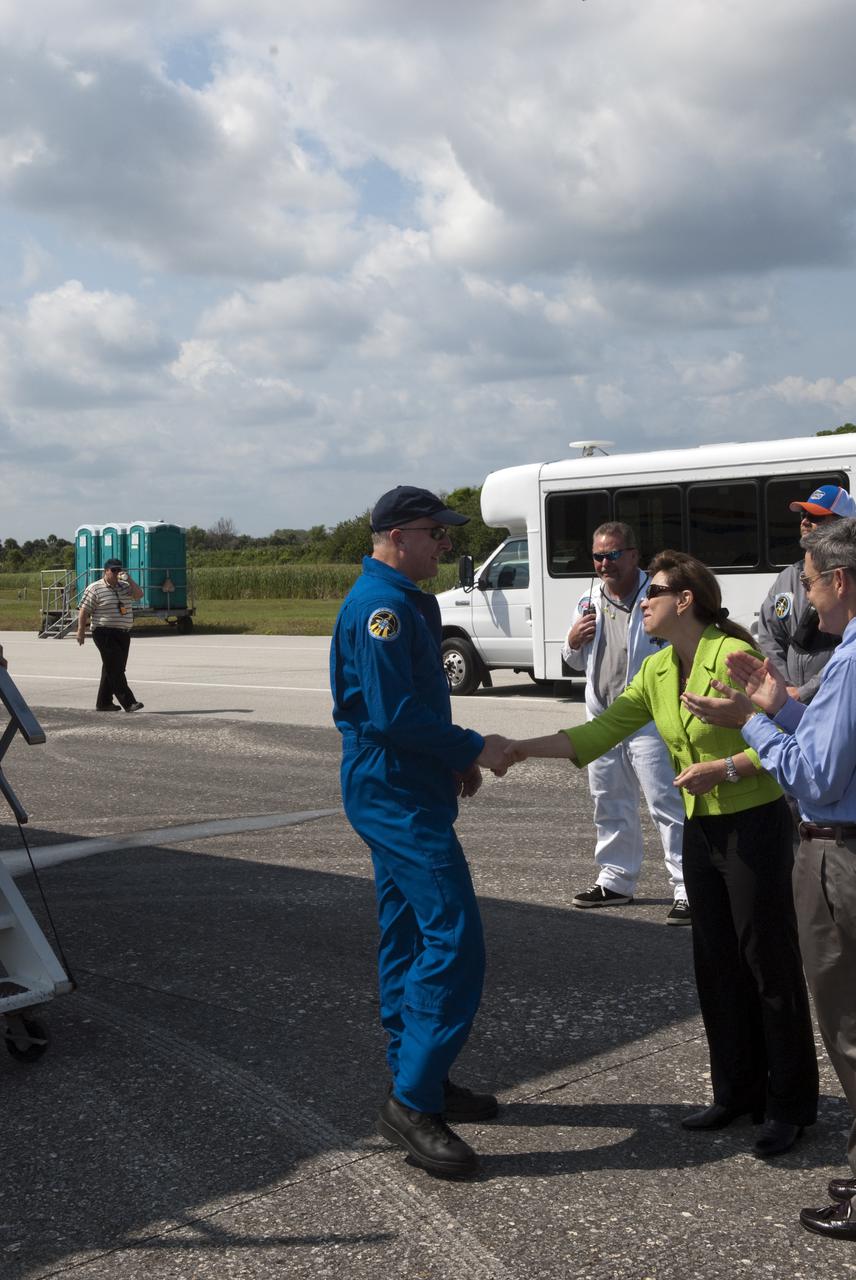
CAPE CANAVERAL, Fla. - At the Shuttle Landing Facility at NASA's Kennedy Space Center in Florida, NASA Deputy Administrator Lori Garver welcomes STS-131 Commander Alan Poindexter back from space following the landing of space shuttle Discovery on Runway 33. Kennedy Director Bob Cabana applauds Cabana for his successful mission, at right. Discovery landed at Kennedy after 15 days in space, completing the more than 6.2-million-mile STS-131 mission on orbit 238. Main gear touchdown was at 9:08:35 a.m. EDT followed by nose gear touchdown at 9:08:47 a.m. and wheelstop at 9:09:33 a.m. The seven-member STS-131 crew carried the multi-purpose logistics module Leonardo, filled with supplies, a new crew sleeping quarters and science racks that were transferred to the International Space Station's laboratories. The crew also switched out a gyroscope on the station’s truss, installed a spare ammonia storage tank and retrieved a Japanese experiment from the station’s exterior. STS-131 is the 33rd shuttle mission to the station and the 131st shuttle mission overall. For information on the STS-131 mission and crew, visit http:__www.nasa.gov_mission_pages_shuttle_shuttlemissions_sts131_index.html. Photo credit: NASA_Jim Grossmann
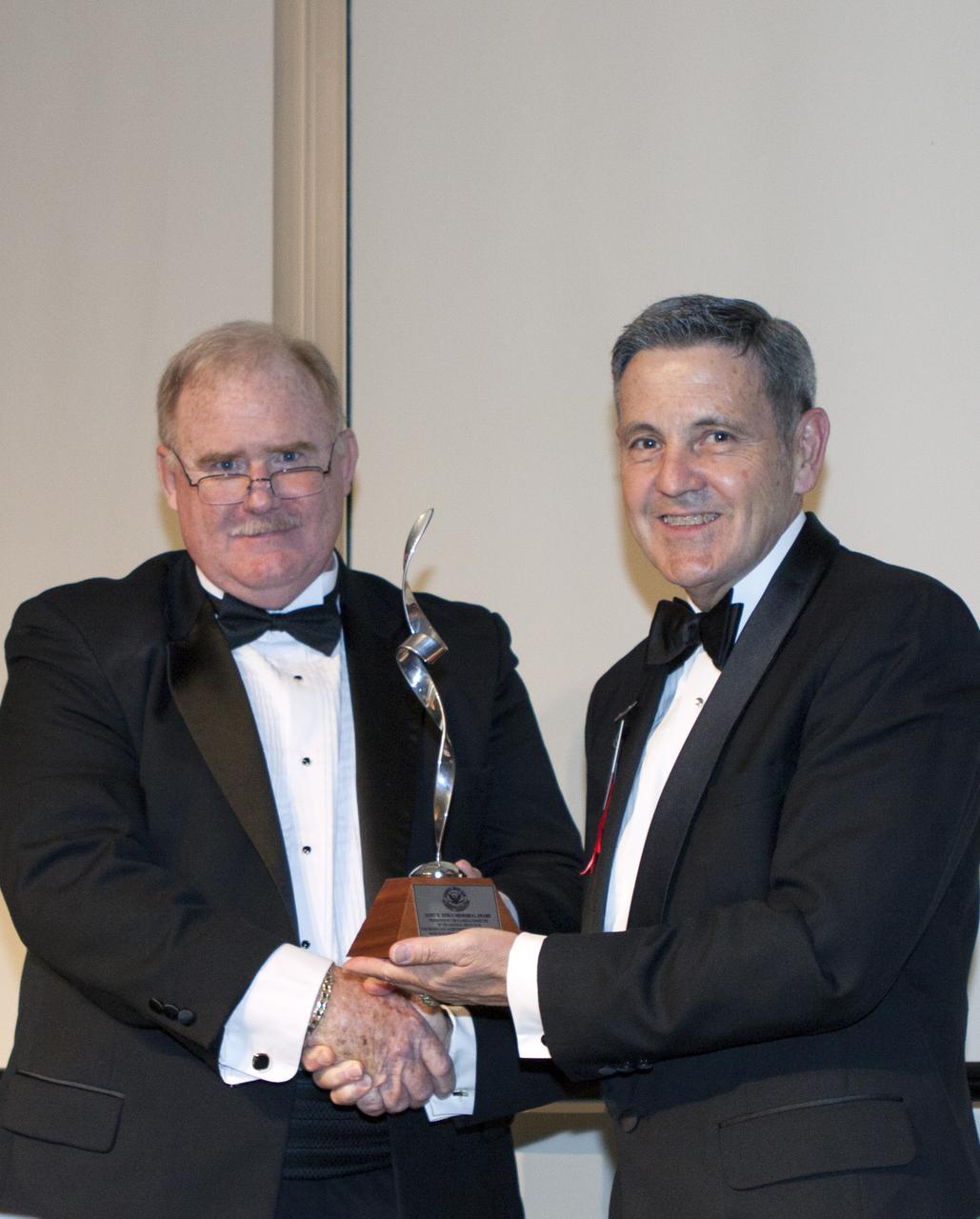
CAPE CANAVERAL, Fla. – At NASA’s Kennedy Space Center Visitor Complex in Florida, National Space Club Florida Committee Chairman Jim McCarthy, left, presents the Dr. Kurt H. Debus Award to Kennedy's director, Bob Cabana. A former U.S. Marine Corps aviator and NASA astronaut, Cabana was honored at the gala Debus Award Dinner. Named for the spaceport’s first director, the Debus Award was created to recognize significant achievements and contributions made in Florida to American aerospace efforts. The Debus Award was created by the space club's Florida committee to recognize significant achievements and contributions made in Florida to American aerospace efforts. Photo credit: NASA_Jim Grossmann
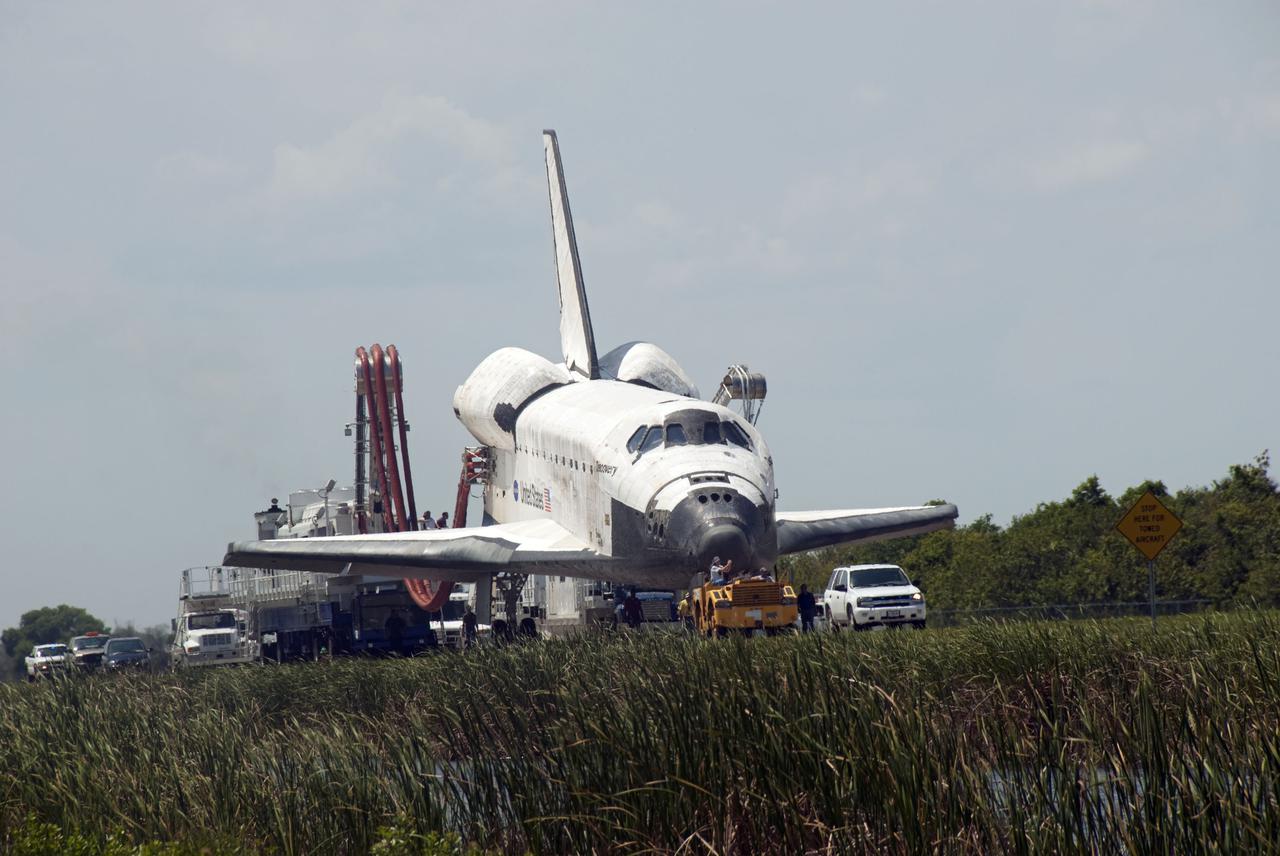
CAPE CANAVERAL, Fla. - At NASA's Kennedy Space Center in Florida, space shuttle Discovery makes its slow trek from the Shuttle Landing Facility to Orbiter Processing Facility-3 following its successful landing on Runway 33. Discovery landed at Kennedy after 15 days in space, completing the more than 6.2-million-mile STS-131 mission on orbit 238. Main gear touchdown was at 9:08:35 a.m. EDT followed by nose gear touchdown at 9:08:47 a.m. and wheelstop at 9:09:33 a.m. Aboard were Commander Alan Poindexter; Pilot James P. Dutton Jr.; and Mission Specialists Rick Mastracchio, Clayton Anderson, Dorothy Metcalf-Lindenburger, Stephanie Wilson and Naoko Yamazaki of the Japan Aerospace Exploration Agency. The seven-member STS-131 crew carried the multi-purpose logistics module Leonardo, filled with supplies, a new crew sleeping quarters and science racks that were transferred to the International Space Station's laboratories. The crew also switched out a gyroscope on the station’s truss, installed a spare ammonia storage tank and retrieved a Japanese experiment from the station’s exterior. STS-131 is the 33rd shuttle mission to the station and the 131st shuttle mission overall. For information on the STS-131 mission and crew, visit http:__www.nasa.gov_mission_pages_shuttle_shuttlemissions_sts131_index.html. Photo credit: NASA_Jim Grossmann
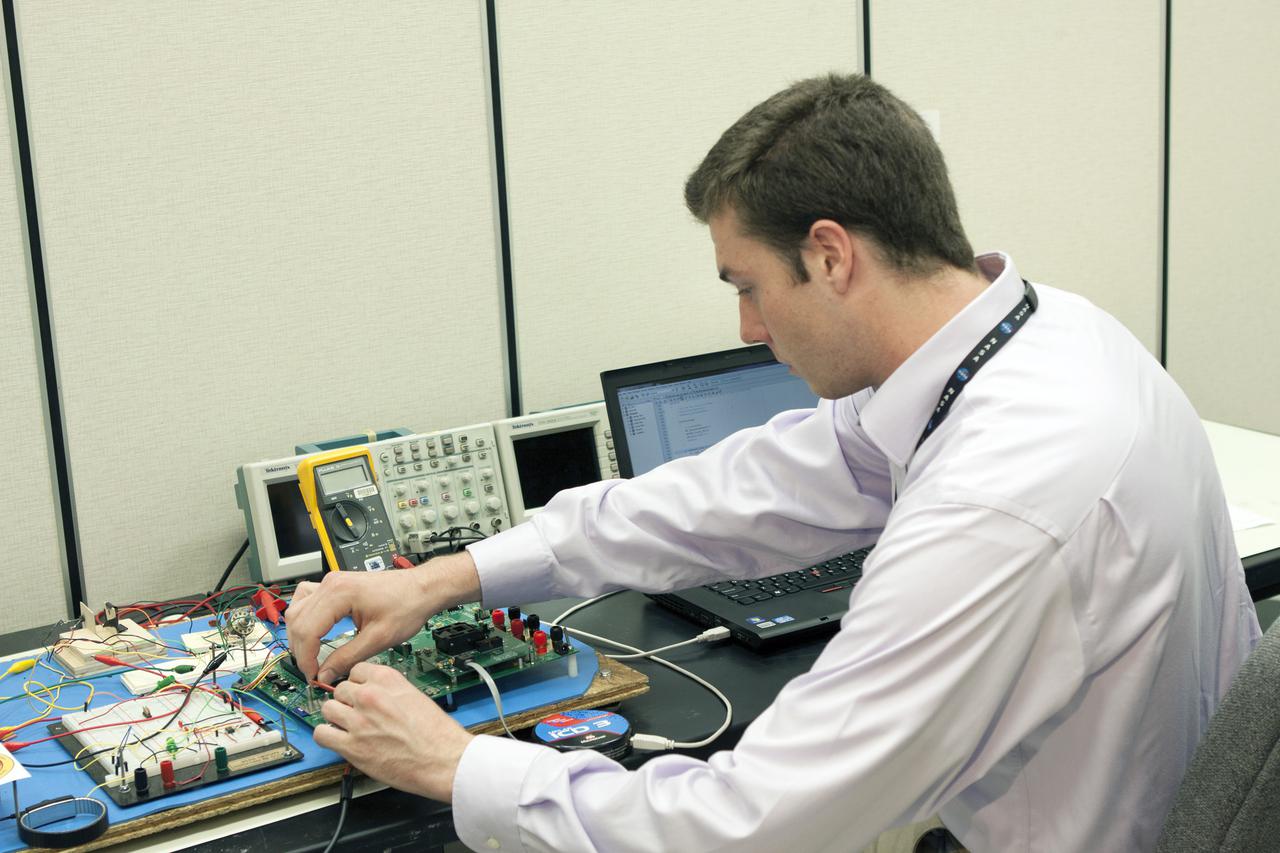
CAPE CANAVERAL, Fla. – Benjamin Plotner, an engineering intern, tests elements of a prototype of the StangSat at Kennedy Space Center before final assembly. The satellite is a small cube measuring 10 inches on all sides and will be launched on a rocket that will carry it on a suborbital mission in Mojave, Calif. Photo credit: NASA_Jim Grossmann
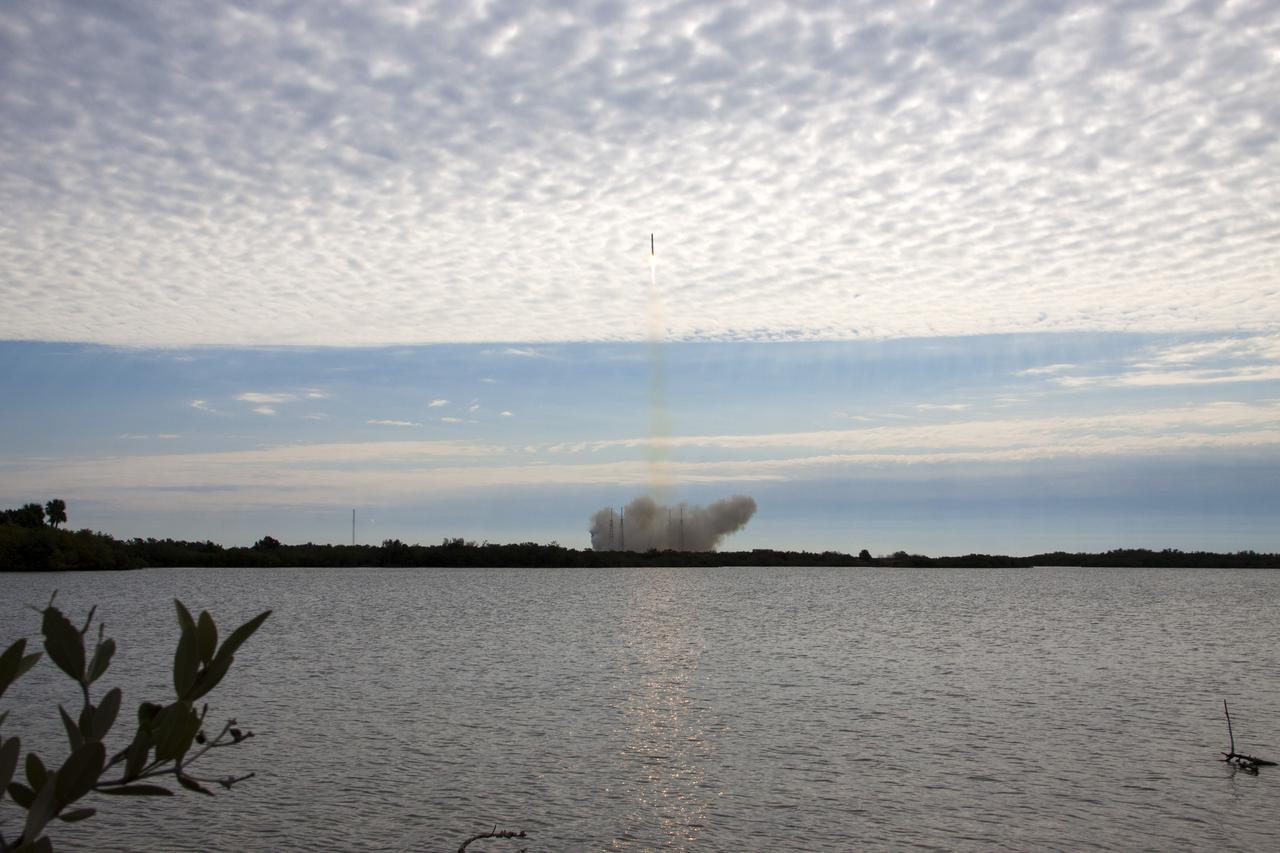
CAPE CANAVERAL, Fla. -- A Space Exploration Technologies, or SpaceX, Falcon 9 rocket pierces the dimpled cloud layer over Space Launch Complex 40 on Cape Canaveral Air Force Station in Florida, carrying a Dragon capsule filled with cargo to orbit. Launch was at 10:10 a.m. EST. The SpaceX Dragon capsule is making its third trip to the International Space Station, following a demonstration flight in May 2012 and the first resupply mission in October 2012. The mission is the second of 12 SpaceX flights contracted by NASA to resupply the orbiting laboratory. For more information, visit http:__www.nasa.gov_mission_pages_station_structure_launch_spacex2-feature.html. Photo credit: NASA_Jim Grossmann
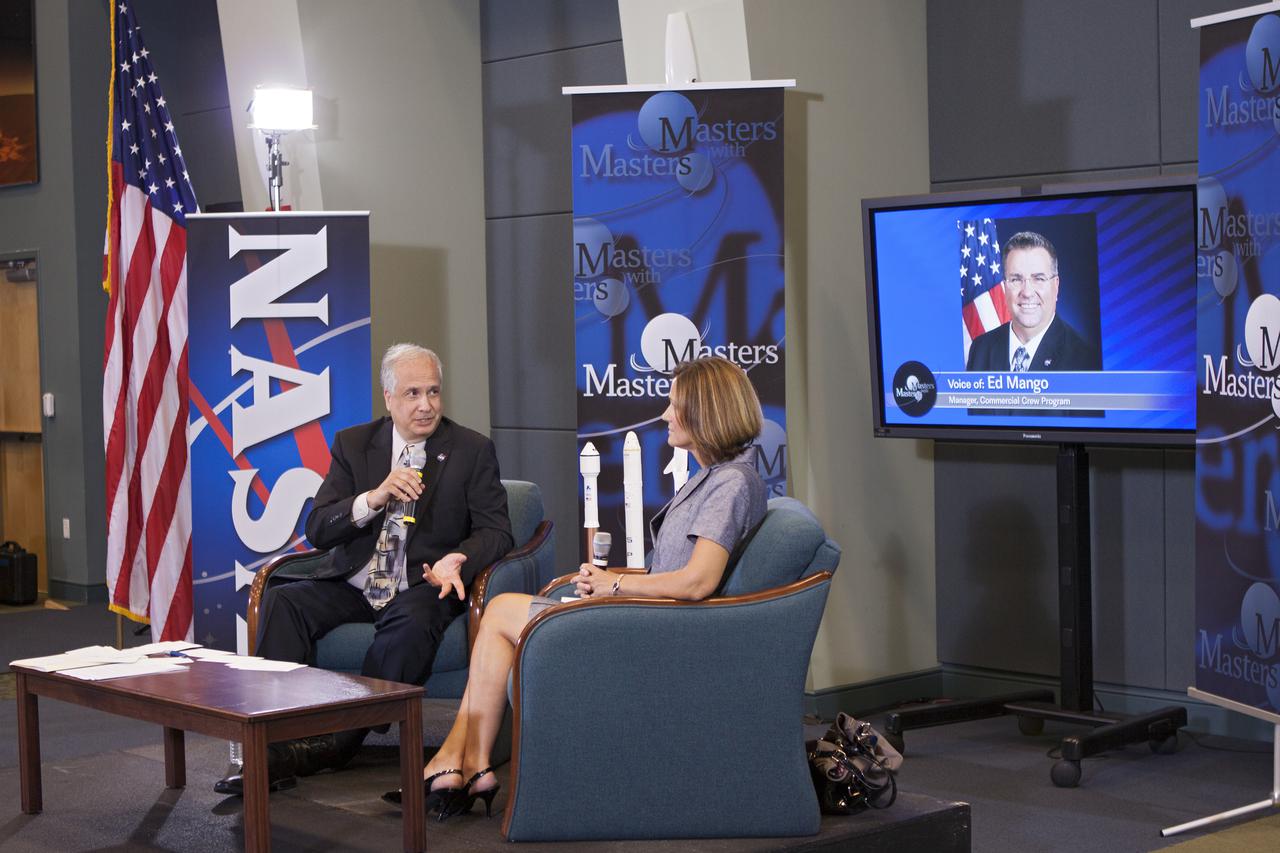
CAPE CANAVERAL, Fla. – Ed Hoffman and Lisa Colloredo discuss NASA's Commercial Crew Program during the first of a weeklong series called 'Masters with Masters' at the agency's Kennedy Space Center in Florida. Hoffman, NASA's chief Knowledge officer, and Colloredo, associate program manager at Kennedy, were joined by phone by Ed Mango, program manager for CCP. Photo credit: NASA_Jim Grossmann
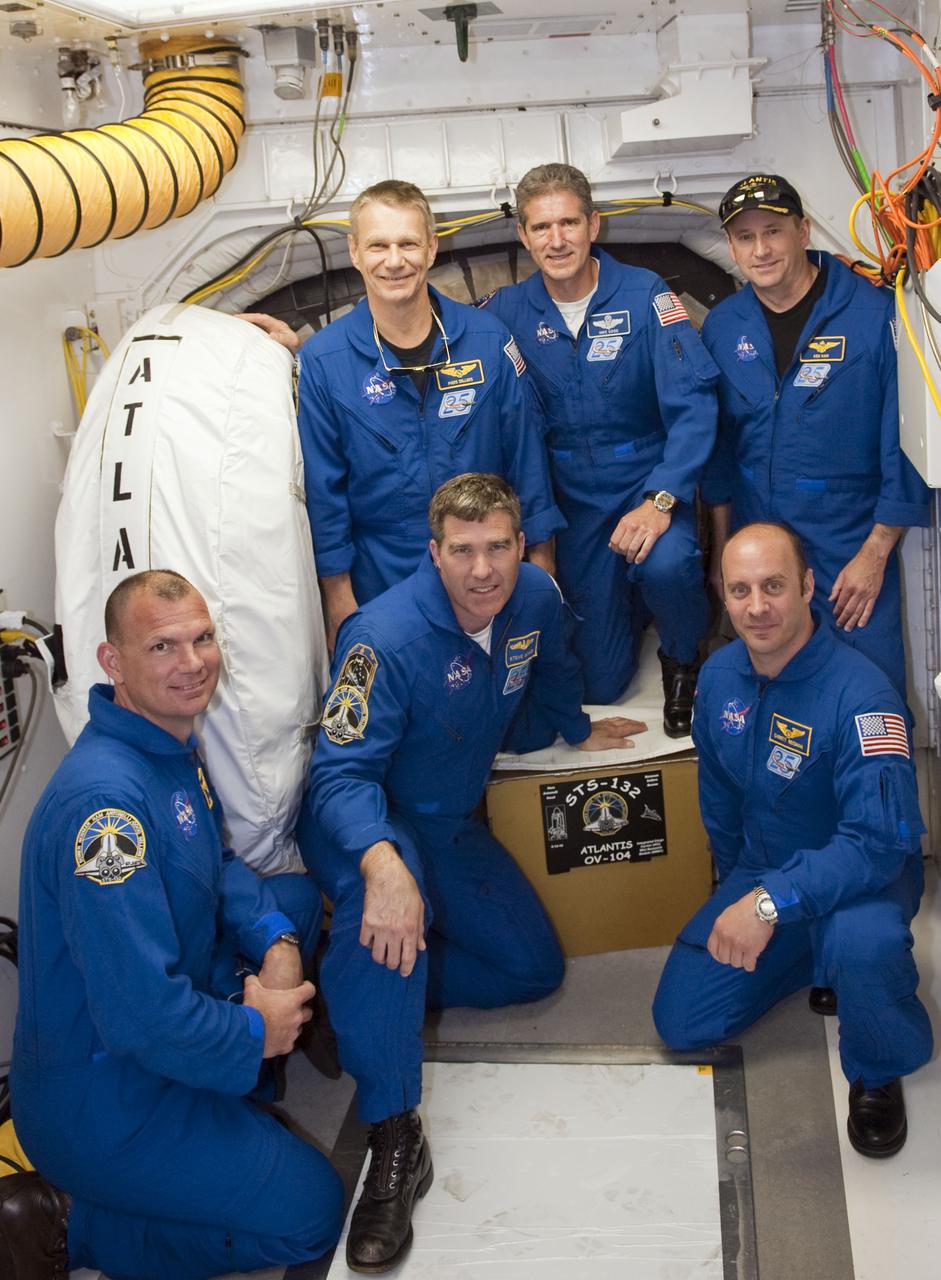
CAPE CANAVERAL, Fla. - At Launch Pad 39A at NASA's Kennedy Space Center in Florida, the members of space shuttle Atlantis' STS-132 crew take time out from their training to pose for a group portrait in the pad's White Room. Standing, from left, are Mission Specialists Piers Sellers and Michael Good, and Commander Ken Ham. Kneeling, from left, are Pilot Tony Antonelli, and Mission Specialists Steve Bowen and Garrett Reisman. Behind them is the hatch which provides access to Atlantis' crew compartment. The crew is participating in training in preparation for their Terminal Countdown Demonstration Test, or TCDT, a dress rehearsal for launch. TCDT provides each shuttle crew and launch team the opportunity to participate in various simulated countdown activities, including equipment familiarization and emergency procedures. On the STS-132 mission, the six-member crew will deliver an Integrated Cargo Carrier, or ICC, and the Russian-built Mini-Research Module-1, or MRM-1, to the International Space Station aboard space shuttle Atlantis. The ICC is an unpressurized flat bed pallet and keel yoke assembly used to support the transfer of exterior cargo from the shuttle to the space station. The MRM-1, known as Rassvet, is the second in a series of new pressurized components for Russia and will be permanently attached to the Earth-facing port of the Zarya control module. Rassvet, which translates to 'dawn,' will be used for cargo storage and will provide an additional docking port to the station. STS-132 is the 34th mission to the station and the 132nd shuttle mission overall. Atlantis is targeted to launch on May 14 at 2:19 p.m. For information on the STS-132 mission, visit http:__www.nasa.gov_mission_pages_shuttle_shuttlemissions_sts132_index.html. Photo credit: NASA_Jim Grossmann
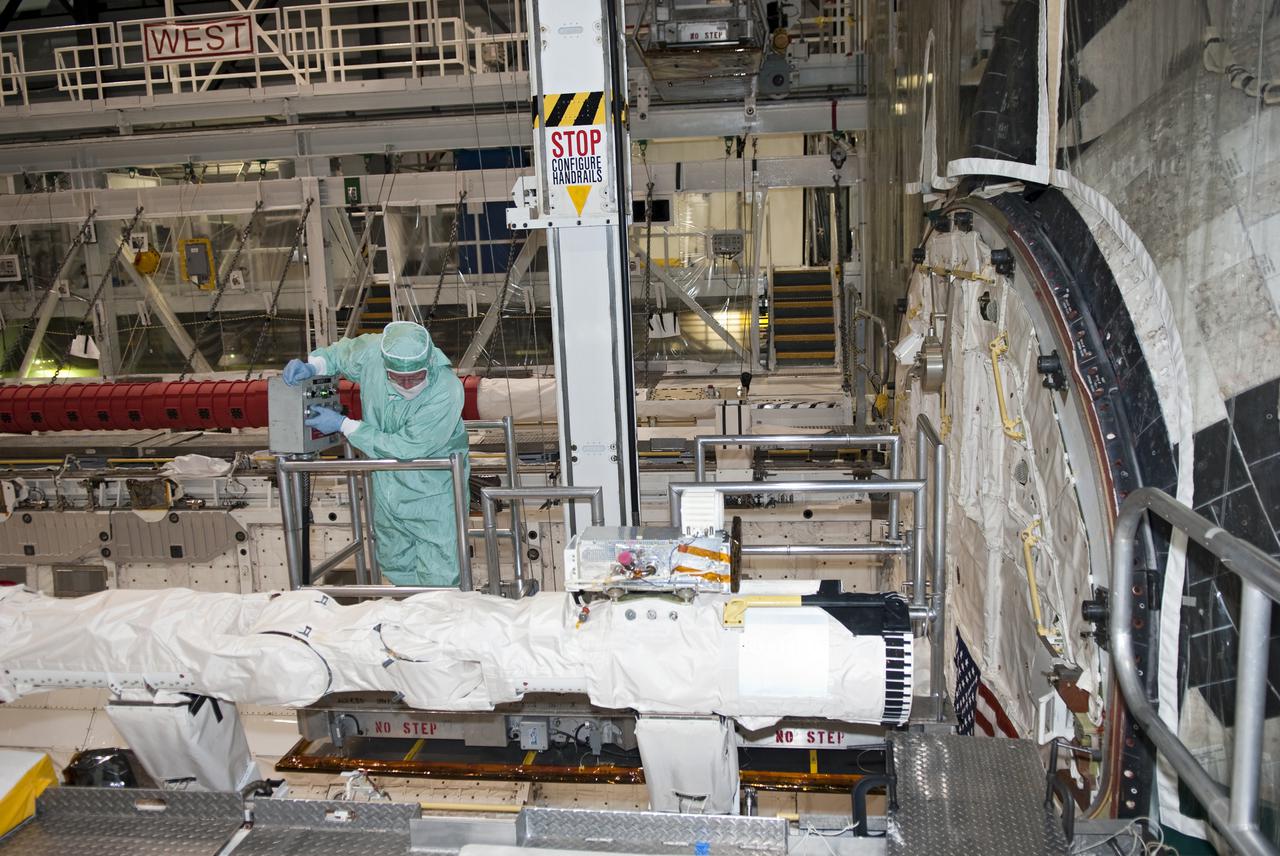
CAPE CANAVERAL, Fla. - In Orbiter Processing Facility-1 at NASA's Kennedy Space Center in Florida, United Space Alliance mid-body mechanic Mike Hyatt positions the aft bridge bucket to support the installation of a wrist camera on the orbiter boom sensor system, or OBSS, in space shuttle Atlantis' payload bay. Atlantis is being prepared for its upcoming STS-132 mission. The 50-foot-long OBSS attaches to the end of the shuttle’s robotic arm and supports the cameras and laser systems used to inspect the shuttle’s thermal protection system while in space. Atlantis will deliver an Integrated Cargo Carrier and Russian-built Mini Research Module to the International Space Station on STS-132. Launch is targeted for May 14. Photo credit: NASA_Jim Grossmann

CAPE CANAVERAL, Fla. - In the Operations and Checkout Building at NASA's Kennedy Space Center in Florida, President Barack Obama addresses the participants of the Conference on the American Space Program for the 21st Century. In his remarks, he outlined the new course his administration is charting for NASA and the future of U.S. leadership in human spaceflight. Photo credit: NASA_Jim Grossmann
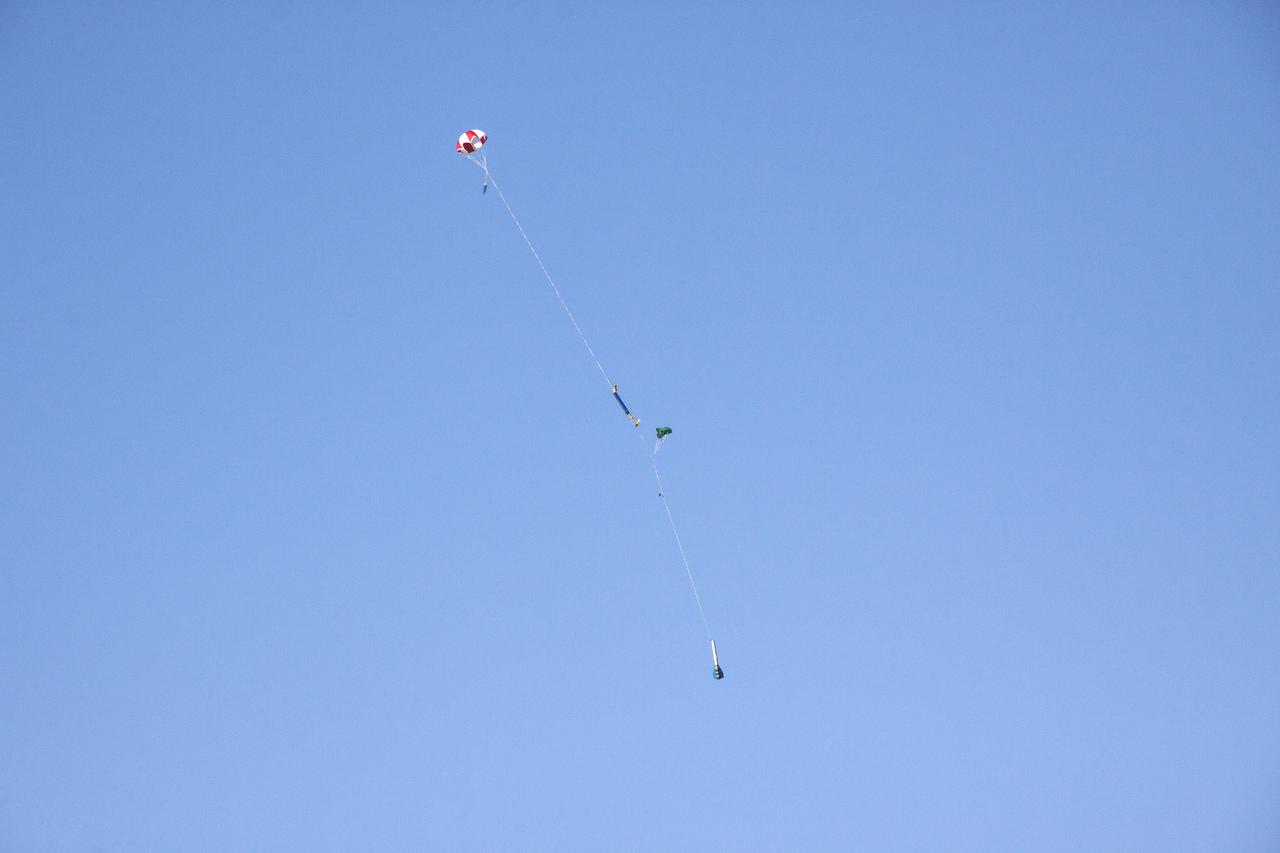
CAPE CANAVERAL, Fla. -- At NASA's Kennedy Space Center in Florida, a small rocket descends under a parachute after liftoff from Launch Pad 39A as part of Rocket University. The goal was to test its systems and to verify that it performed as designed. As part of Rocket University, the engineers are given an opportunity to work a fast-track project to develop skills in developing spacecraft systems of the future. As NASA plans for future spaceflight programs to low-Earth orbit and beyond, teams of engineers at Kennedy are gaining experience in designing and flying launch vehicle systems on a small scale. Four teams of five to eight members from Kennedy are designing rockets complete with avionics and recovery systems. Launch operations require coordination with federal agencies, just as they would with rockets launched in support of a NASA mission. Photo credit: NASA_Jim Grossmann
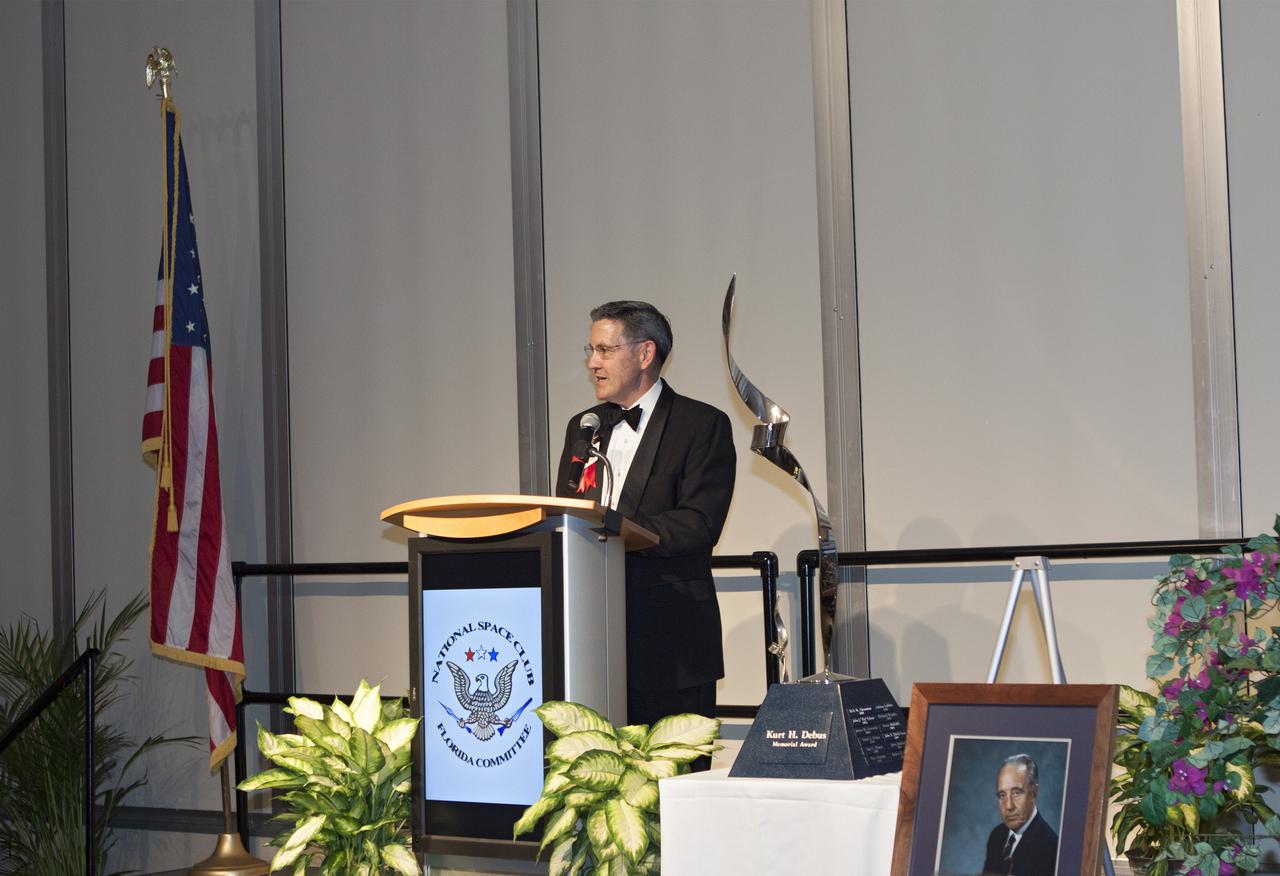
CAPE CANAVERAL, Fla. – At NASA’s Kennedy Space Center Visitor Complex in Florida, center director Bob Cabana speaks after being presented the prestigious Dr. Kurt H. Debus Award. A former U.S. Marine Corps aviator and NASA astronaut, Cabana was honored at the gala Debus Award Dinner. Named for the spaceport’s first director, the Debus Award was created to recognize significant achievements and contributions made in Florida to American aerospace efforts. The Debus Award was created by the space club's Florida committee to recognize significant achievements and contributions made in Florida to American aerospace efforts. Photo credit: NASA_Jim Grossmann
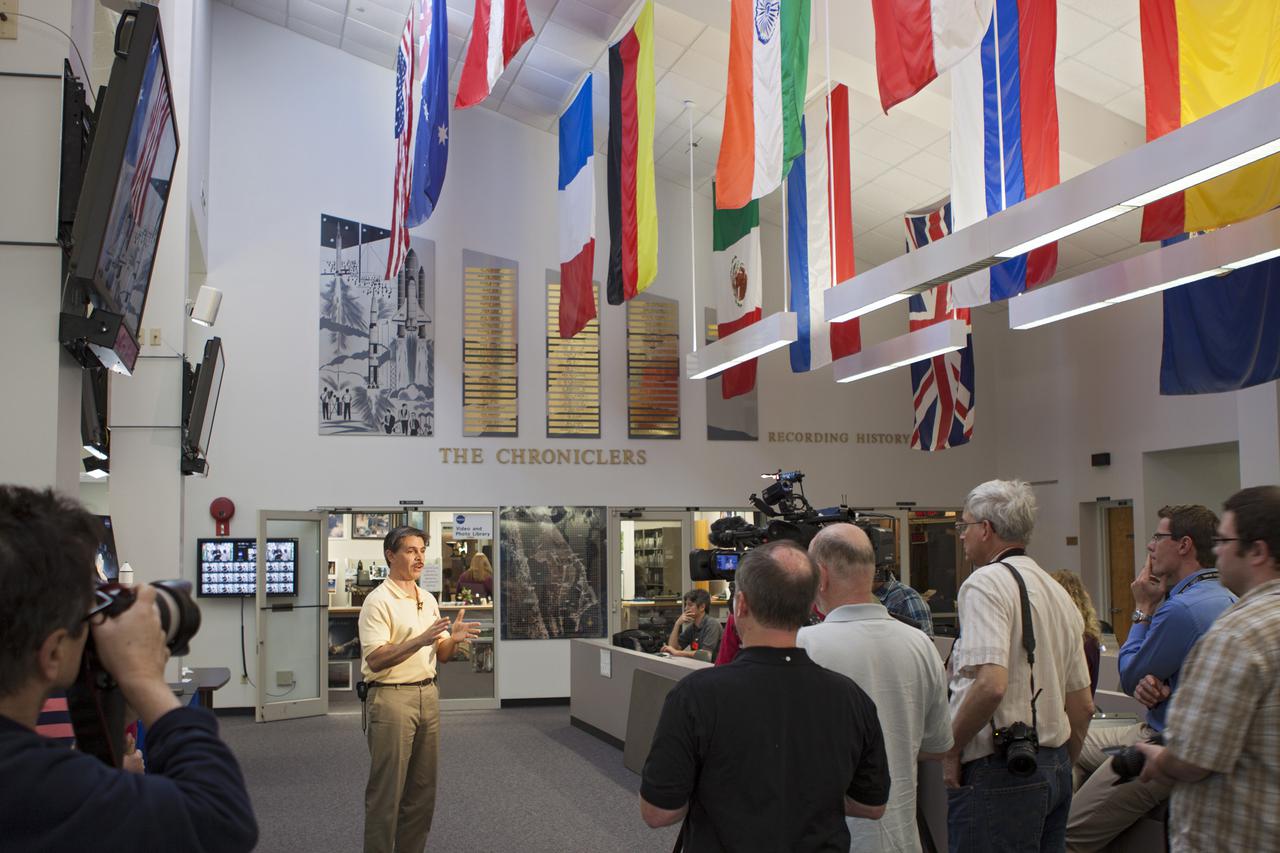
CAPE CANAVERAL, Fla. – NASA's Jon Cowart talks to media about the progress of the agency's Commercial Crew Program CCP and its partners in Kennedy Space Center’s Press Site on Feb. 28 ahead of the second commercial resupply services mission for Space Exploration Technologies SpaceX to the International Space Station. Cowart is the deputy partner manager working with SpaceX as the company develops its Falcon 9 rocket and Dragon capsule for crewed missions. Under a contract with NASA, SpaceX is targeted to fly at least 12 cargo missions to the space station through 2016. The company also is working with CCP to return America's capability to safely launch crews to low-Earth orbit destinations, including the space station, from U.S. soil around the middle of the decade. To learn more about CCP and its partners, go to www.nasa.gov_commercialcrew. Photo credit: NASA_Jim Grossmann
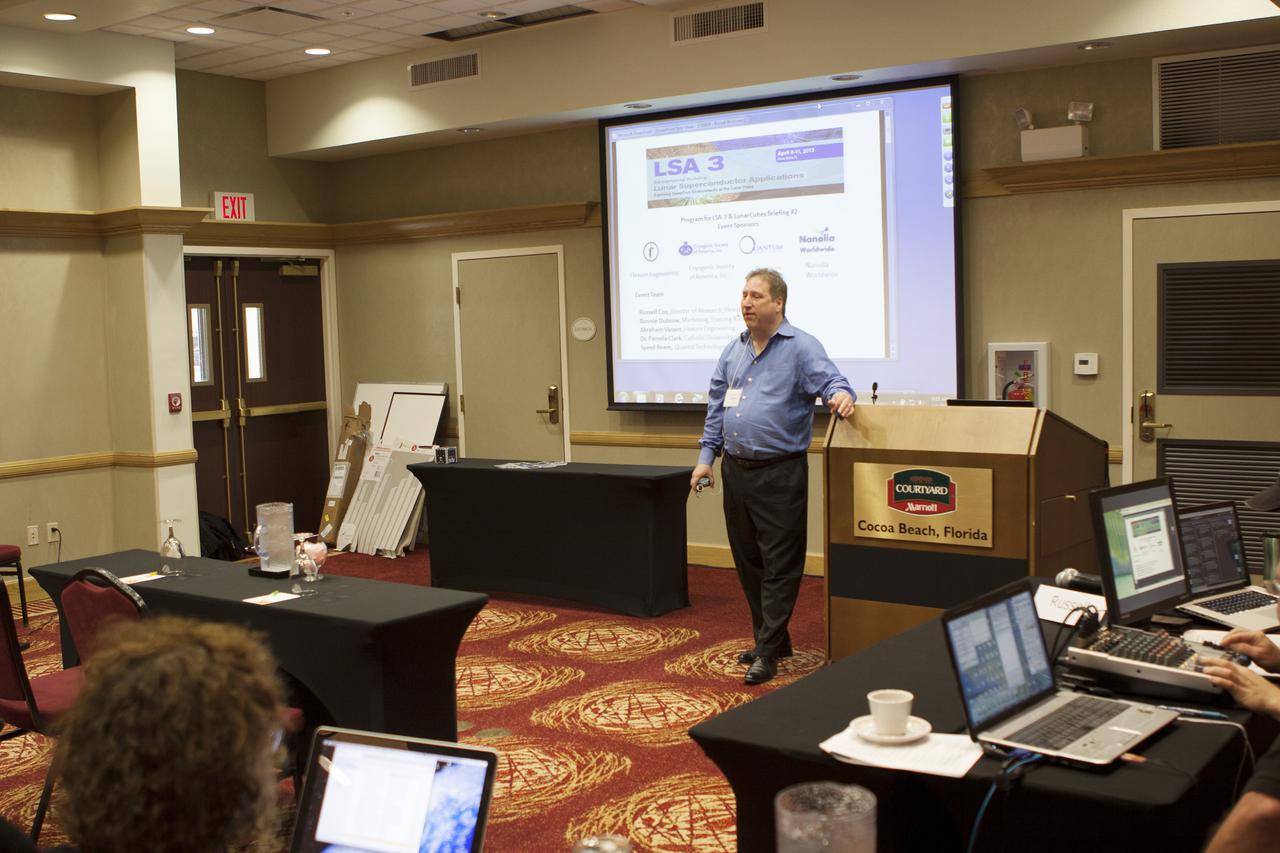
CAPE CANAVERAL, Fla. – At the Courtyard by Marriott hotel in Cocoa Beach, Fla., Russell Cox, director of research with Flexure Engineering, welcomes participants in the room and those participating online to the Third International Workshop on Lunar Superconductor Applications. The workshop included presentations from several engineers and researchers at Kennedy Space Center. The three-day workshop included presentations from speakers throughout the country and focused on Lunar in-situ resource utilization, NASA’s Lunar Ice Prospector called RESOLVE, CubeSats, cryogenic storage and many other topics related to lunar exploration. Photo credit: NASA_Jim Grossmann
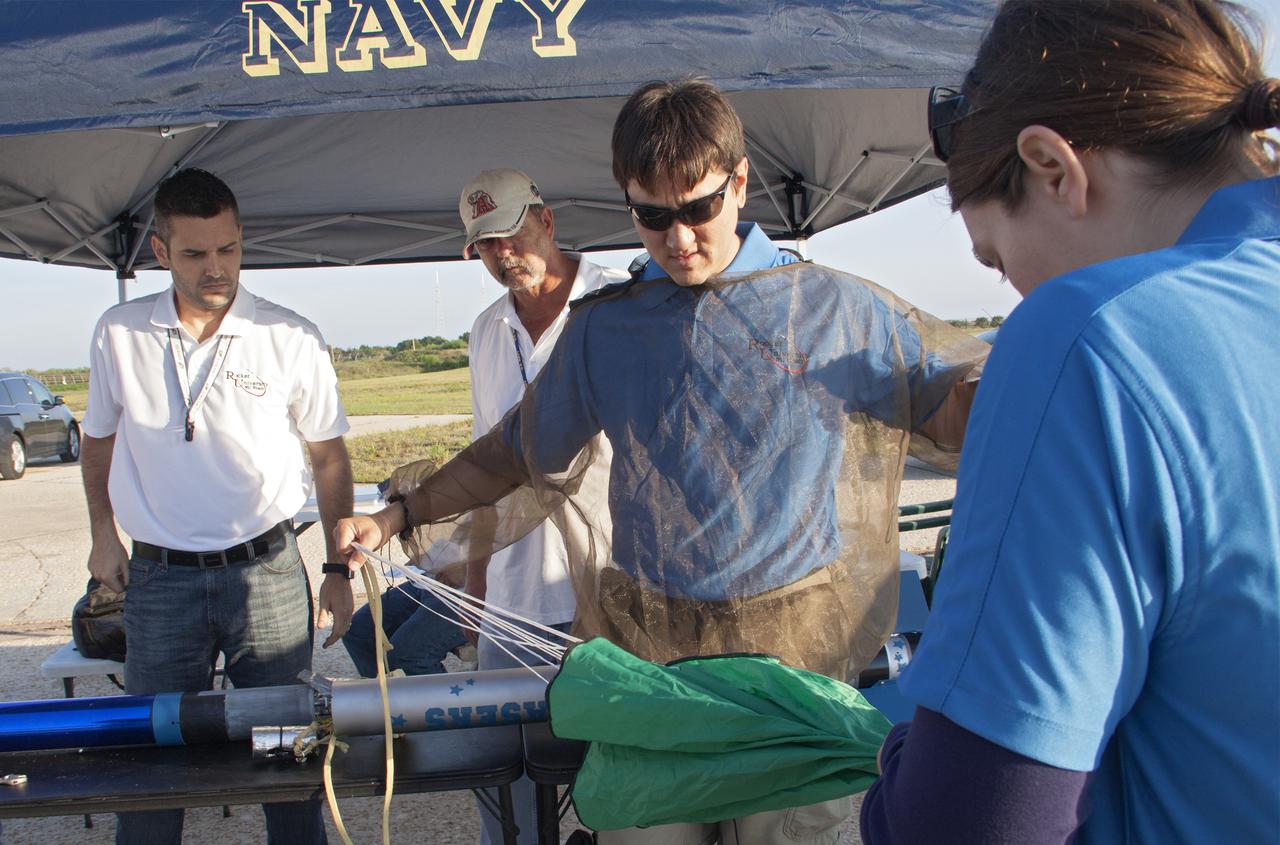
CAPE CANAVERAL, Fla. -- At NASA's Kennedy Space Center in Florida, from the left, Leandro James of Systems Hardware Engineering, George Mizell of Quality Assurance, Morgan Simpson of Flight Hardware Processing and Kim Simpson of Fluids, Mechanical and Structural Systems prepare a parachute for a small rocket prior to launch as part of Rocket University. The goal was to test its systems and to verify that it performed as designed. As part of Rocket University, the engineers are given an opportunity to work a fast-track project to develop skills in developing spacecraft systems of the future. As NASA plans for future spaceflight programs to low-Earth orbit and beyond, teams of engineers at Kennedy are gaining experience in designing and flying launch vehicle systems on a small scale. Four teams of five to eight members from Kennedy are designing rockets complete with avionics and recovery systems. Launch operations require coordination with federal agencies, just as they would with rockets launched in support of a NASA mission. Photo credit: NASA_Jim Grossmann
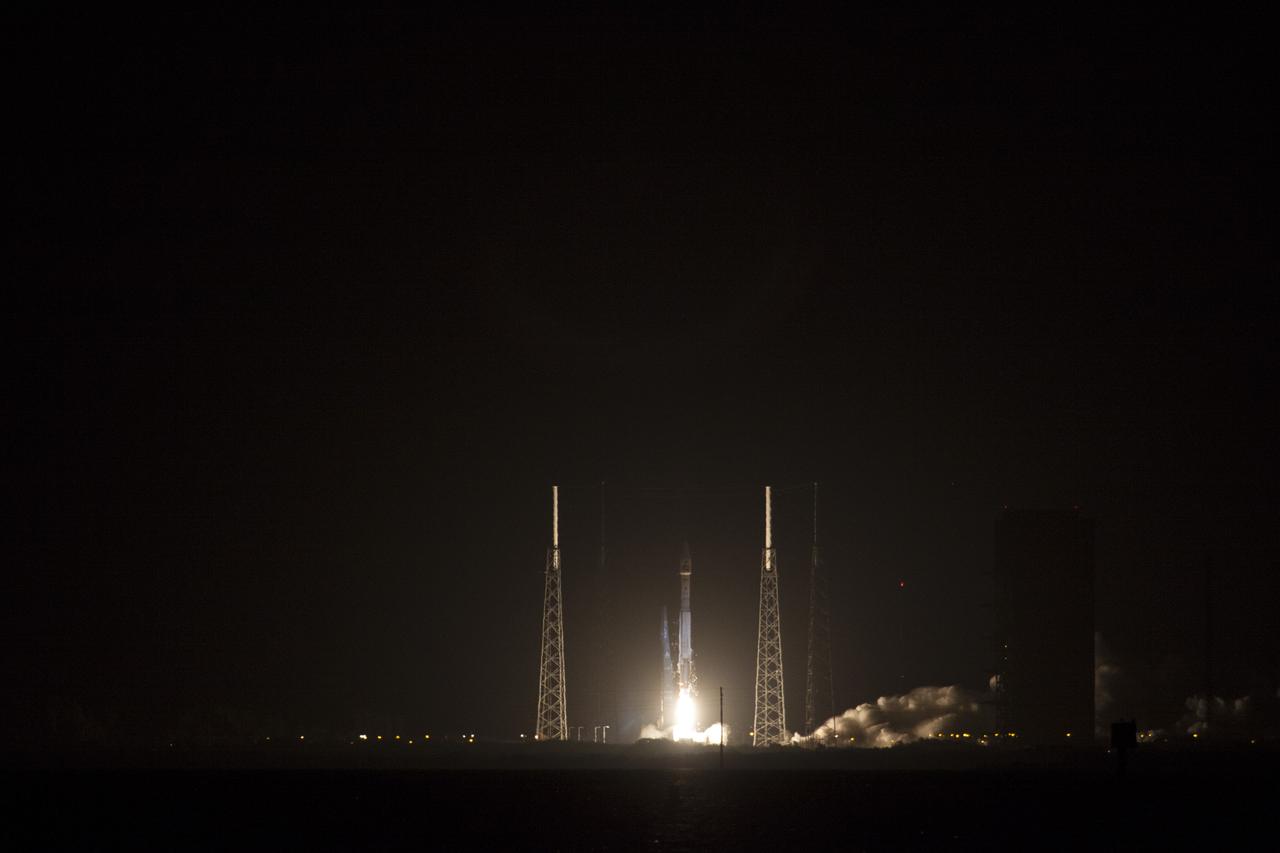
CAPE CANAVERAL, Fla. -- Space Launch Complex 41 on Cape Canaveral Air Force Station in Florida is illuminated by a United Launch Alliance Atlas V 401 rocket as it lifts off at 8:48 p.m. EST, carrying NASA's Tracking and Data Relay Satellite-K, TDRS-K, to orbit. The TDRS-K spacecraft is part of the next-generation series in the Tracking and Data Relay Satellite System, a constellation of space-based communication satellites providing tracking, telemetry, command and high-bandwidth data return services. For more information, visit http:__www.nasa.gov_mission_pages_tdrs_index.html. Photo credit: NASA_Jim Grossmann
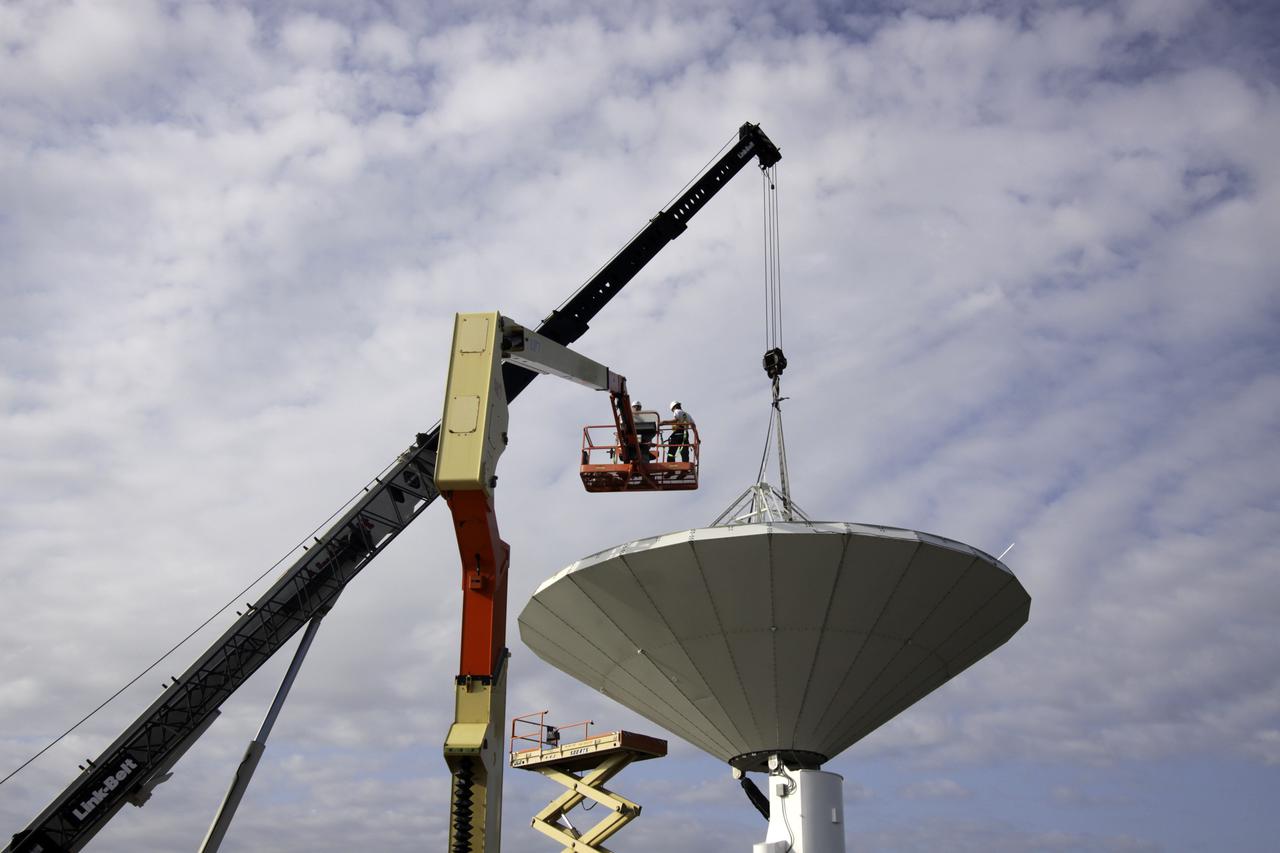
CAPE CANAVERAL, Fla. – At NASA’s Kennedy Space Center in Florida, 40-foot-diameter dish antenna arrays are being constructed as part of the Antenna Test Bed Array for the Ka-Band Objects Observation and Monitoring, or Ka-BOOM system. The antennas will be part of the operations command center facility. The construction site is near the former Vertical Processing Facility, which has been demolished. The Ka-BOOM project is one of the final steps in developing the techniques to build a high power, high resolution radar system capable of becoming a Near Earth Object Early Warning System. While also capable of space communication and radio science experiments, developing radar applications is the primary focus of the arrays. Photo credit: NASA_Jim Grossmann
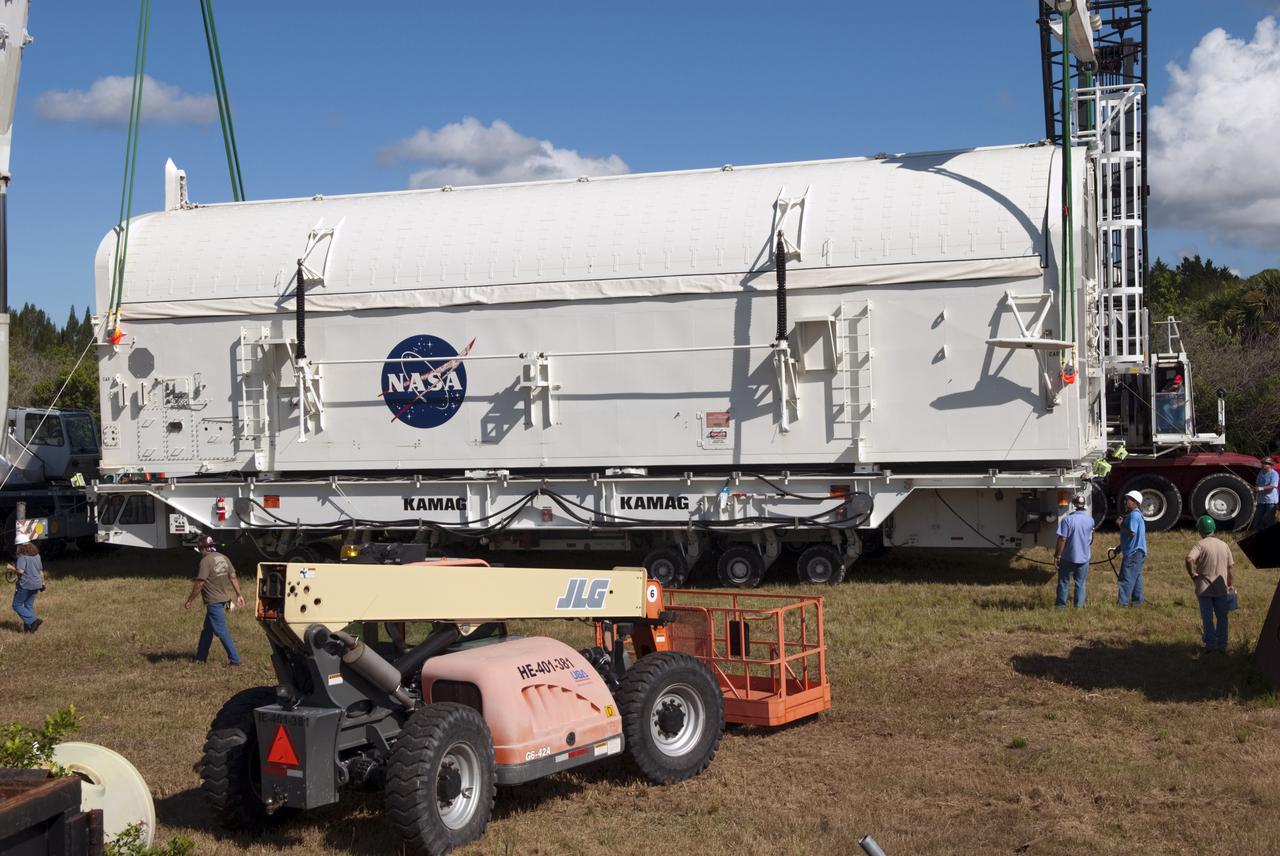
CAPE CANAVERAL, Fla. -- Preparations are under way to lift payload canister #1 from the transporter that delivered it to the Reutilization, Recycling and Marketing Facility on Ransom Road at NASA's Kennedy Space Center in Florida. The two payload canisters used to transport space shuttle payloads to the launch pad for installation in the shuttles' cargo bays are being decommissioned following the end of the Space Shuttle Program. Each canister weighs 110,000 pounds and is 65 feet long, 22 feet wide, and 18 feet, 7 inches high. The canisters were prescreened through NASA Headquarters as possible artifacts, but their size makes them difficult to transport to locations off the center. Federal and state agencies now will be given the opportunity to screen the canisters for potential use before a final decision is made on their disposition. For more information, visit http:__www.nasa.gov_centers_kennedy_pdf_167403main_CRF-06.pdf. Photo credit: NASA_Jim Grossmann

CAPE CANAVERAL, Fla. - At the Shuttle Landing Facility at NASA's Kennedy Space Center in Florida, the members of space shuttle Discovery’s STS-131 crew comment on their successful mission to the International Space Station following Discovery's landing on Runway 33. At the microphone is Pilot James P. Dutton Jr. Behind him, from left, are Mission Specialists Clayton Anderson (not in view), Naoko Yamazaki of the Japan Aerospace Exploration Agency, Stephanie Wilson, Dorothy Metcalf-Lindenburger (not in view) and Rick Mastracchio and Commander Alan Poindexter. Discovery landed on Runway 33 after 15 days in space, completing the more than 6.2-million-mile STS-131 mission on orbit 238. Main gear touchdown was at 9:08:35 a.m. EDT followed by nose gear touchdown at 9:08:47 a.m. and wheelstop at 9:09:33 a.m. The seven-member STS-131 crew carried the multi-purpose logistics module Leonardo, filled with supplies, a new crew sleeping quarters and science racks that were transferred to the International Space Station's laboratories. The crew also switched out a gyroscope on the station’s truss, installed a spare ammonia storage tank and retrieved a Japanese experiment from the station’s exterior. STS-131 is the 33rd shuttle mission to the station and the 131st shuttle mission overall. For information on the STS-131 mission and crew, visit http:__www.nasa.gov_mission_pages_shuttle_shuttlemissions_sts131_index.html. Photo credit: NASA_Jim Grossmann

CAPE CANAVERAL, Fla. - At NASA's Kennedy Space Center in Florida, a Florida scrub jay is caught taking a break from his daily routine. The birds are one of several threatened species that reside on the Merritt Island National Wildlife Refuge which coexists with Kennedy Space Center. Scrub is a habitat unique to Florida, and one of the most important habitats for endangered species in the state. Species like the scrub jay, gopher tortoise and indigo snake rely on this habitat for food and shelter. The scrub oak acorn, for example, is a primary food source for the Florida scrub jay. Photo credit: NASA_Jim Grossmann
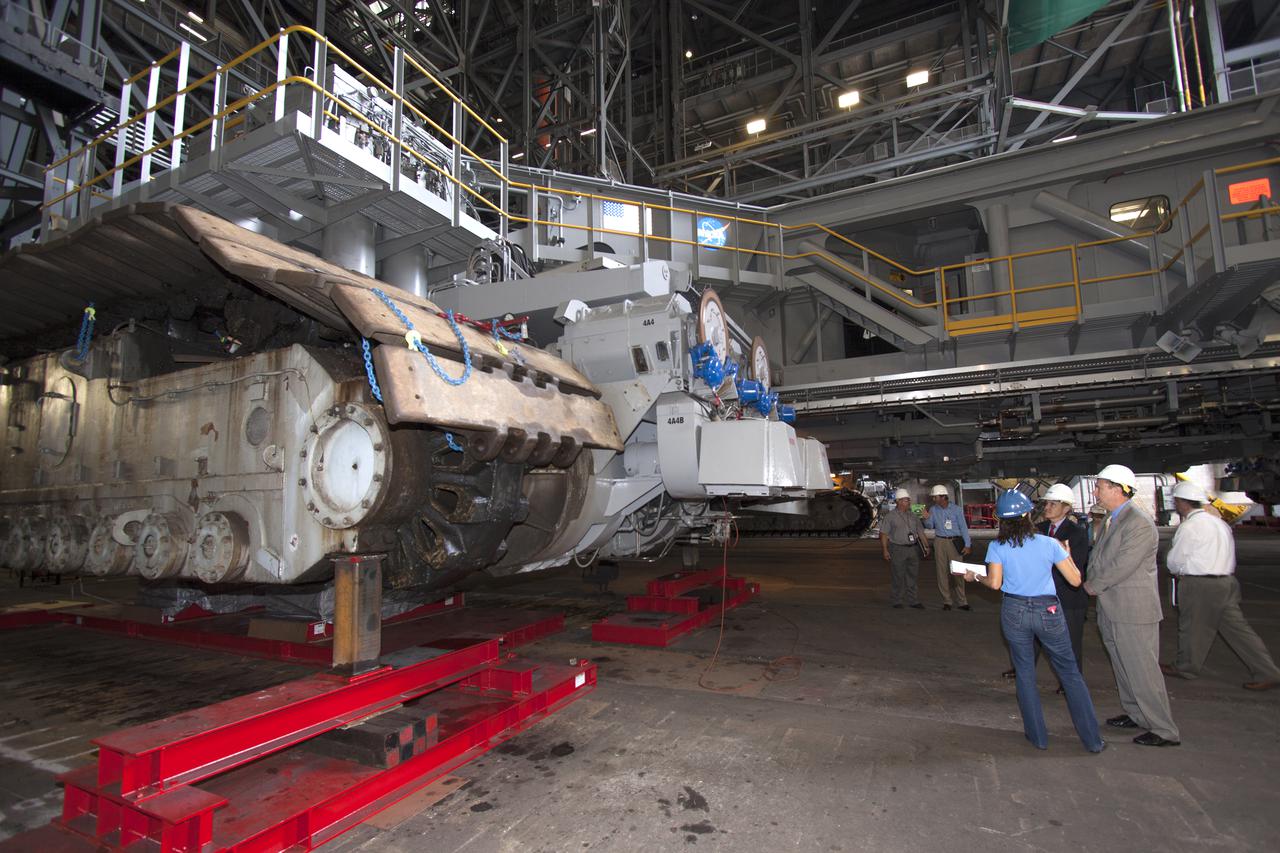
CAPE CANAVERAL, Fla. – NASA Associate Administrator Robert Lightfoot, second from right, is briefed on the modifications to crawler-transporter 2 in the Vehicle Assembly Building, or VAB, during a visit to NASA's Kennedy Space Center in Florida. From left are Mary Hanna, crawler-transporter project manager, Kennedy Director Bob Cabana, Lightfoot, and Shawn Quinn, Vehicle Integration and Launch Integration Product Team, or IPT, manager. Crawler-transporter 2 is being readied to support NASA's new Orion spacecraft and Space Launch System heavy-lift rocket, the SLS. NASA's FY2014 budget proposal includes a plan to robotically capture a small near-Earth asteroid and redirect it safely to a stable orbit in the Earth-moon system where astronauts can visit and explore it. Performing these elements for the proposed asteroid initiative integrates the best of NASA's science, technology and human exploration capabilities and draws on the innovation of America's brightest scientists and engineers. It uses current and developing capabilities to find both large asteroids that pose a hazard to Earth and small asteroids that could be candidates for the initiative, accelerates our technology development activities in high-powered solar electric propulsion and takes advantage of our hard work on the Space Launch System rocket and Orion spacecraft, helping to keep NASA on target to reach the President's goal of sending humans to Mars in the 2030s. Photo credit: NASA_Jim Grossmann
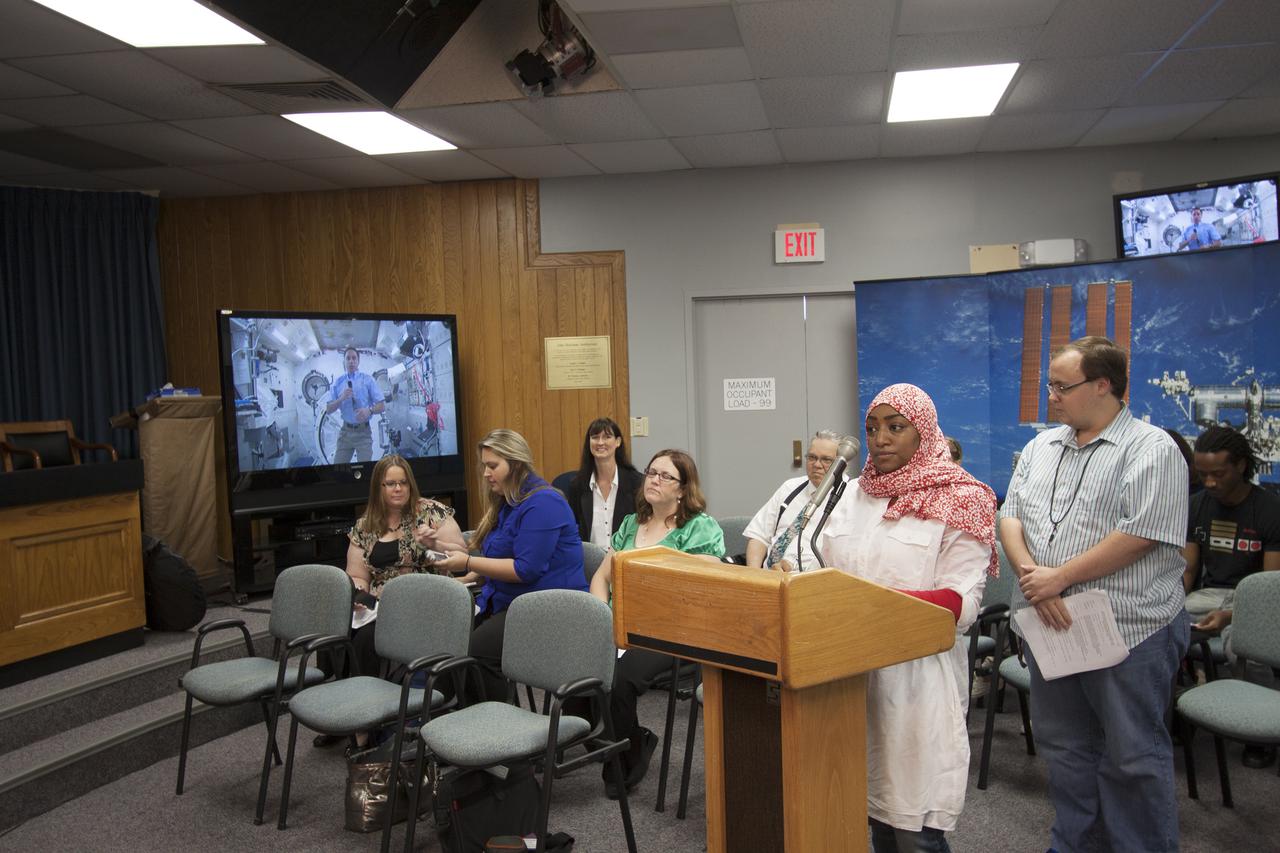
CAPE CANAVERAL, Fla. – Eman Mareh, one of nine Florida Institute of Technology aspiring journalists visiting Kennedy Space Center in Florida on May 22, interviews astronaut and Expedition 35 flight engineer Chris Cassidy during an International Space Station downlink in the Press Site auditorium. The journalists, in collaboration with Florida Today, are working on a multimedia project that examines health in zero gravity and how life in space can help people live better on Earth. These multimedia stories will be published for the print and online versions of Florida Today. During their visit, they worked on multimedia deadline news assignments at the Press Site. They also met with Kennedy Director Bob Cabana who talked about NASA's goals for the future and his own experience in space, answering questions about health effects of spaceflight. The journalists toured the Vehicle Assembly Building and the Apollo Saturn V Center. Learn about the Florida Institute of Technology journalists' findings on their Facebook page at http:__www.facebook.com_FT3atFIT or Twitter at #SpaceHealth. Photo credit: NASA_Jim Grossmann
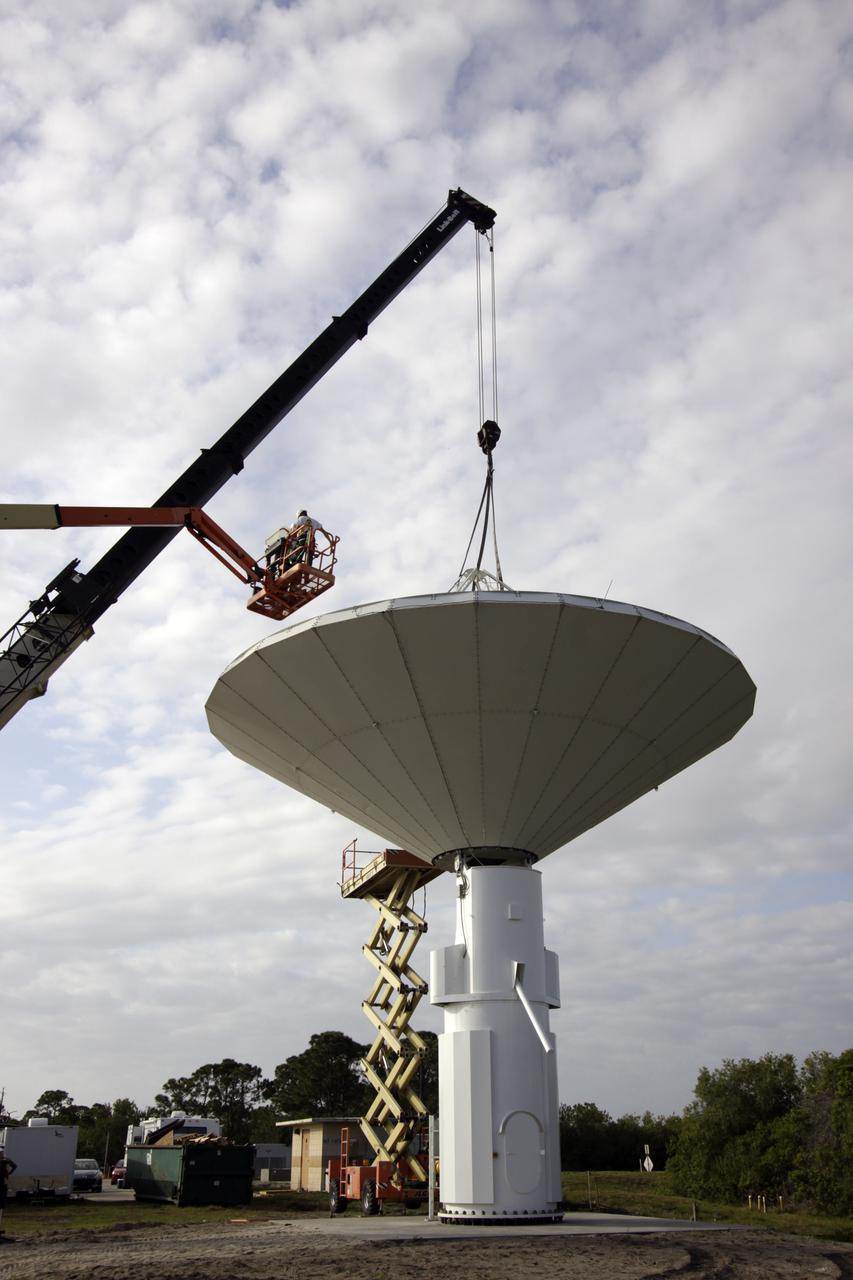
CAPE CANAVERAL, Fla. – At NASA’s Kennedy Space Center in Florida, 40-foot-diameter dish antenna arrays are being constructed as part of the Antenna Test Bed Array for the Ka-Band Objects Observation and Monitoring, or Ka-BOOM system. The antennas will be part of the operations command center facility. The construction site is near the former Vertical Processing Facility, which has been demolished. The Ka-BOOM project is one of the final steps in developing the techniques to build a high power, high resolution radar system capable of becoming a Near Earth Object Early Warning System. While also capable of space communication and radio science experiments, developing radar applications is the primary focus of the arrays. Photo credit: NASA_Jim Grossmann
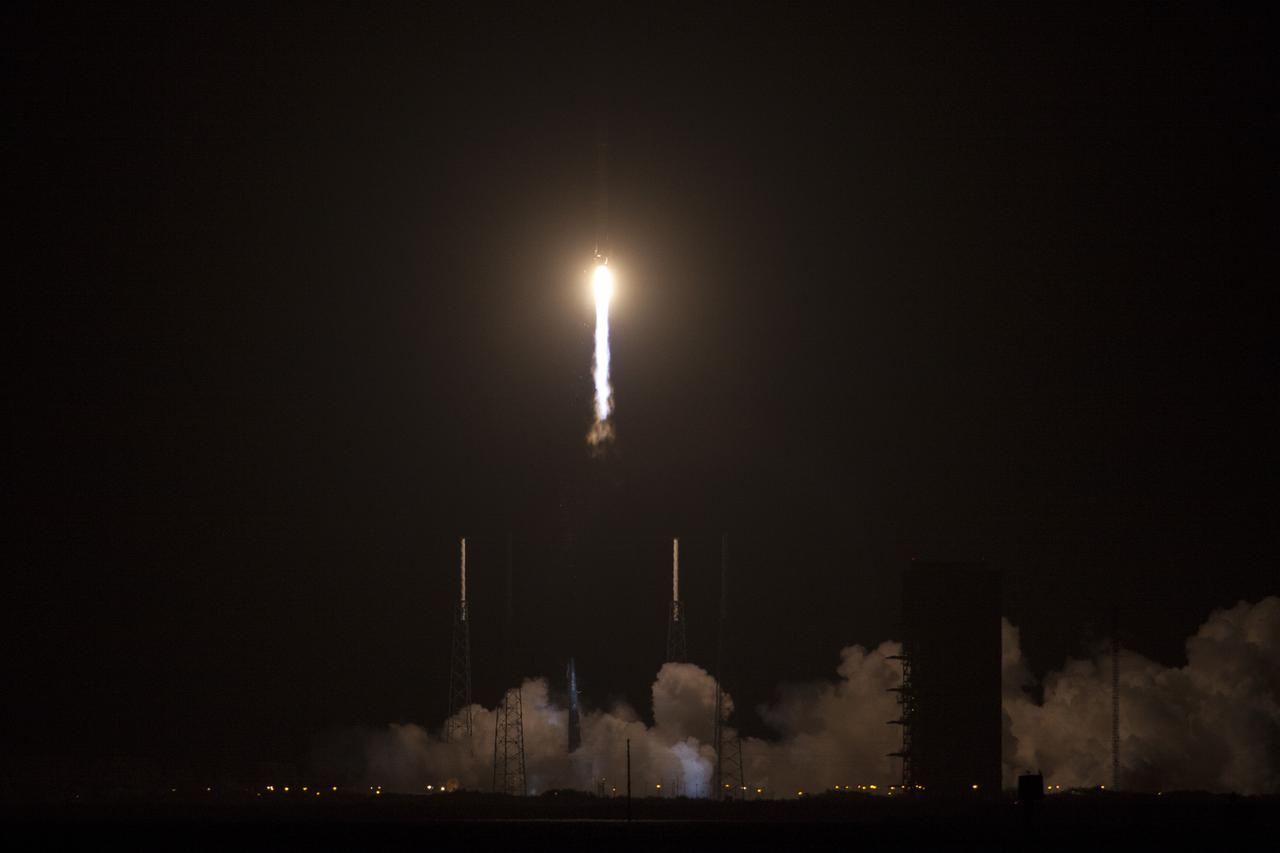
CAPE CANAVERAL, Fla. -- NASA's Tracking and Data Relay Satellite-K, TDRS-K, begins its journey to orbit at 8:48 p.m. EST atop a United Launch Alliance Atlas V 401 rocket from Space Launch Complex 41 on Cape Canaveral Air Force Station in Florida. The TDRS-K spacecraft is part of the next-generation series in the Tracking and Data Relay Satellite System, a constellation of space-based communication satellites providing tracking, telemetry, command and high-bandwidth data return services. For more information, visit http:__www.nasa.gov_mission_pages_tdrs_index.html. Photo credit: NASA_Jim Grossmann
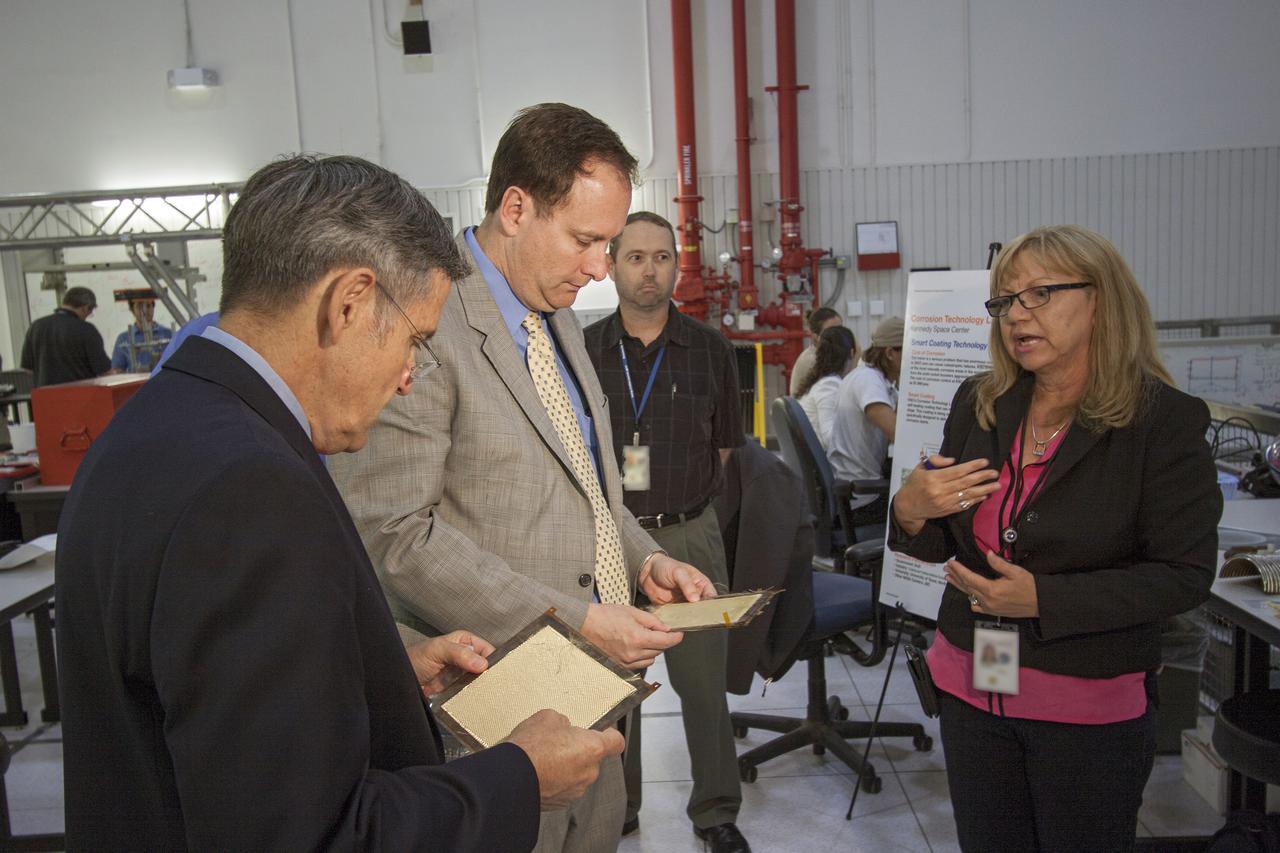
CAPE CANAVERAL, Fla. – At NASA’s Kennedy Space Center in Florida, Robert Lightfoot, NASA associate director, second from left, learns about smart coatings technology in the Corrosion Lab during a tour of the Swamp Works laboratories. Kennedy’s Swamp Works provides rapid, innovative and cost-effective exploration mission solutions, leveraging partnerships across NASA, industry and academia. Kennedy’s research and technology mission is to improve spaceports on Earth, as well as lay the groundwork for establishing spaceports at destinations in space. For more information, visit http:__www.nasa.gov_centers_kennedy_exploration_researchtech_index.html. Photo credit: NASA_Jim Grossmann

CAPE CANAVERAL, Fla. - At the Shuttle Landing Facility at NASA's Kennedy Space Center in Florida, the members of space shuttle Discovery’s STS-131 crew comment on their successful mission to the International Space Station following Discovery's landing on Runway 33. At the microphone is Mission Specialist Stephanie Wilson. Behind her, from left, are Mission Specialists Clayton Anderson, Naoko Yamazaki of the Japan Aerospace Exploration Agency, Dorothy Metcalf-Lindenburger (not in view) and Rick Mastracchio; Pilot James P. Dutton Jr.; and Commander Alan Poindexter. Discovery landed on Runway 33 after 15 days in space, completing the more than 6.2-million-mile STS-131 mission on orbit 238. Main gear touchdown was at 9:08:35 a.m. EDT followed by nose gear touchdown at 9:08:47 a.m. and wheelstop at 9:09:33 a.m. The seven-member STS-131 crew carried the multi-purpose logistics module Leonardo, filled with supplies, a new crew sleeping quarters and science racks that were transferred to the International Space Station's laboratories. The crew also switched out a gyroscope on the station’s truss, installed a spare ammonia storage tank and retrieved a Japanese experiment from the station’s exterior. STS-131 is the 33rd shuttle mission to the station and the 131st shuttle mission overall. For information on the STS-131 mission and crew, visit http:__www.nasa.gov_mission_pages_shuttle_shuttlemissions_sts131_index.html. Photo credit: NASA_Jim Grossmann
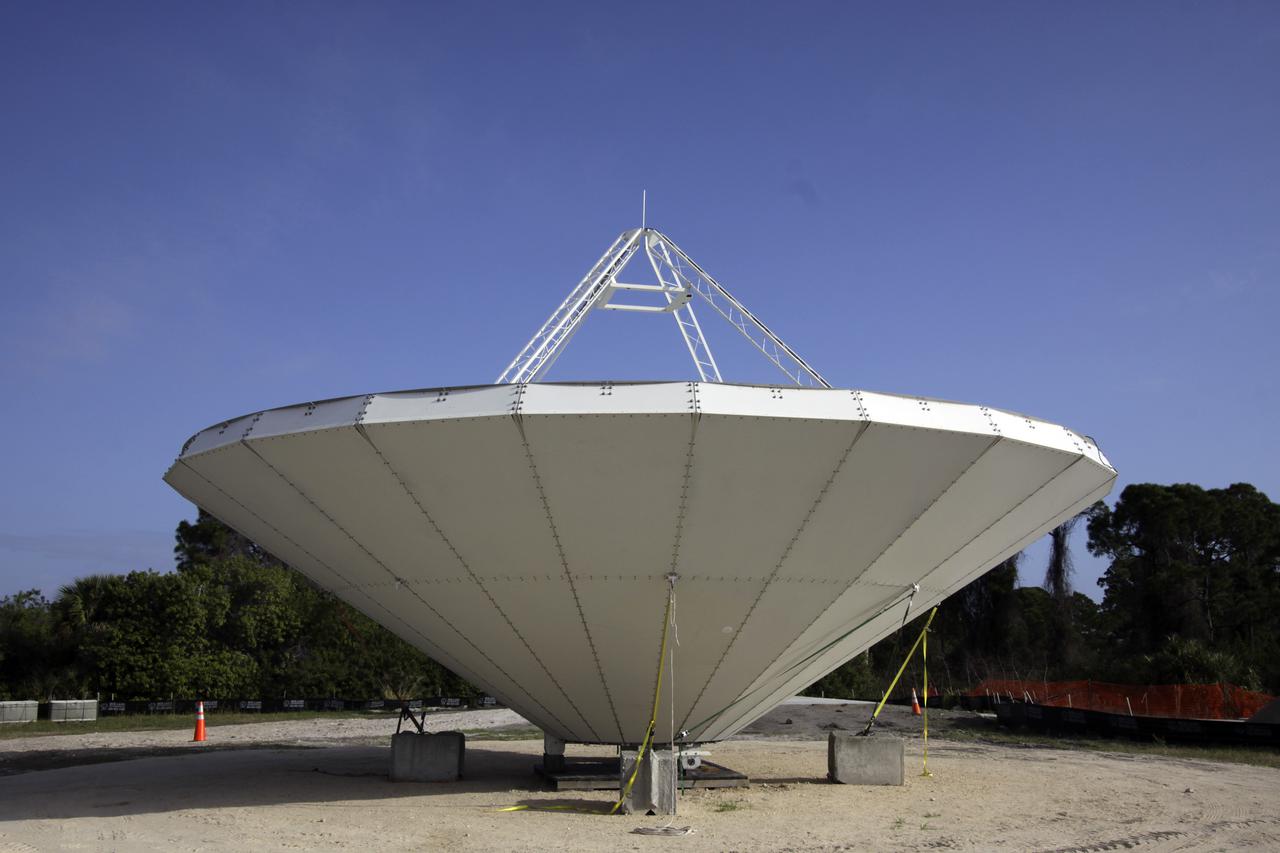
CAPE CANAVERAL, Fla. – At NASA’s Kennedy Space Center in Florida, 40-foot-diameter dish antenna arrays are being constructed as part of the Antenna Test Bed Array for the Ka-Band Objects Observation and Monitoring, or Ka-BOOM system. The antennas will be part of the operations command center facility. The construction site is near the former Vertical Processing Facility, which has been demolished. The Ka-BOOM project is one of the final steps in developing the techniques to build a high power, high resolution radar system capable of becoming a Near Earth Object Early Warning System. While also capable of space communication and radio science experiments, developing radar applications is the primary focus of the arrays. Photo credit: NASA_Jim Grossmann

CAPE CANAVERAL, Fla. -- Payload canister #2 arrives outside the Reutilization, Recycling and Marketing Facility on Ransom Road at NASA's Kennedy Space Center in Florida. The two payload canisters used to transport space shuttle payloads to the launch pad for installation in the shuttles' cargo bays are being decommissioned following the end of the Space Shuttle Program. Each canister weighs 110,000 pounds and is 65 feet long, 22 feet wide, and 18 feet, 7 inches high. The canisters were prescreened through NASA Headquarters as possible artifacts, but their size makes them difficult to transport to locations off the center. Federal and state agencies now will be given the opportunity to screen the canisters for potential use before a final decision is made on their disposition. For more information, visit http:__www.nasa.gov_centers_kennedy_pdf_167403main_CRF-06.pdf. Photo credit: NASA_Jim Grossmann