
CAPE CANAVERAL, Fla. - Space shuttle Atlantis touches down on Runway 33 at the Shuttle Landing Facility at NASA's Kennedy Space Center in Florida. Landing was at 8:48 a.m. EDT, completing the 12-day STS-132 mission to the International Space Station. The six-member STS-132 crew carried the Russian-built Mini Research Module-1 to the space station. STS-132 is the 34th shuttle mission to the station, the 132nd shuttle mission overall and the last planned flight for Atlantis. For information on the STS-132 mission and crew, visit www.nasa.gov_mission_pages_shuttle_shuttlemissions_sts132_index.html. Photo credit: NASA_Sandra Joseph
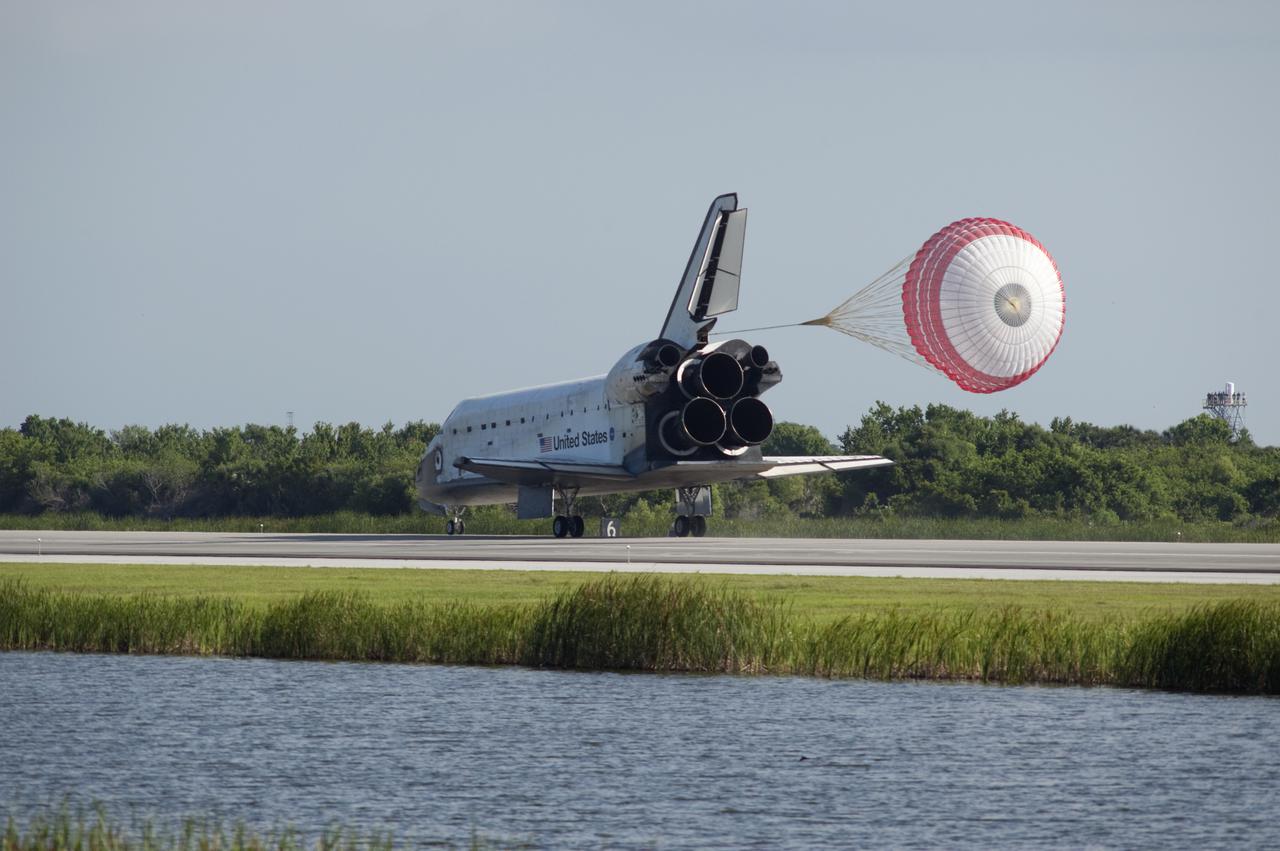
CAPE CANAVERAL, Fla. - Space shuttle Atlantis' drag chute slows the vehicle as it rolls down Runway 33 at the Shuttle Landing Facility at NASA's Kennedy Space Center in Florida. Landing was at 8:48 a.m. EDT, completing the 12-day STS-132 mission to the International Space Station. The six-member STS-132 crew carried the Russian-built Mini Research Module-1 to the space station. STS-132 is the 34th shuttle mission to the station, the 132nd shuttle mission overall and the last planned flight for Atlantis. For information on the STS-132 mission and crew, visit www.nasa.gov_mission_pages_shuttle_shuttlemissions_sts132_index.html. Photo credit: NASA_Sandra Joseph
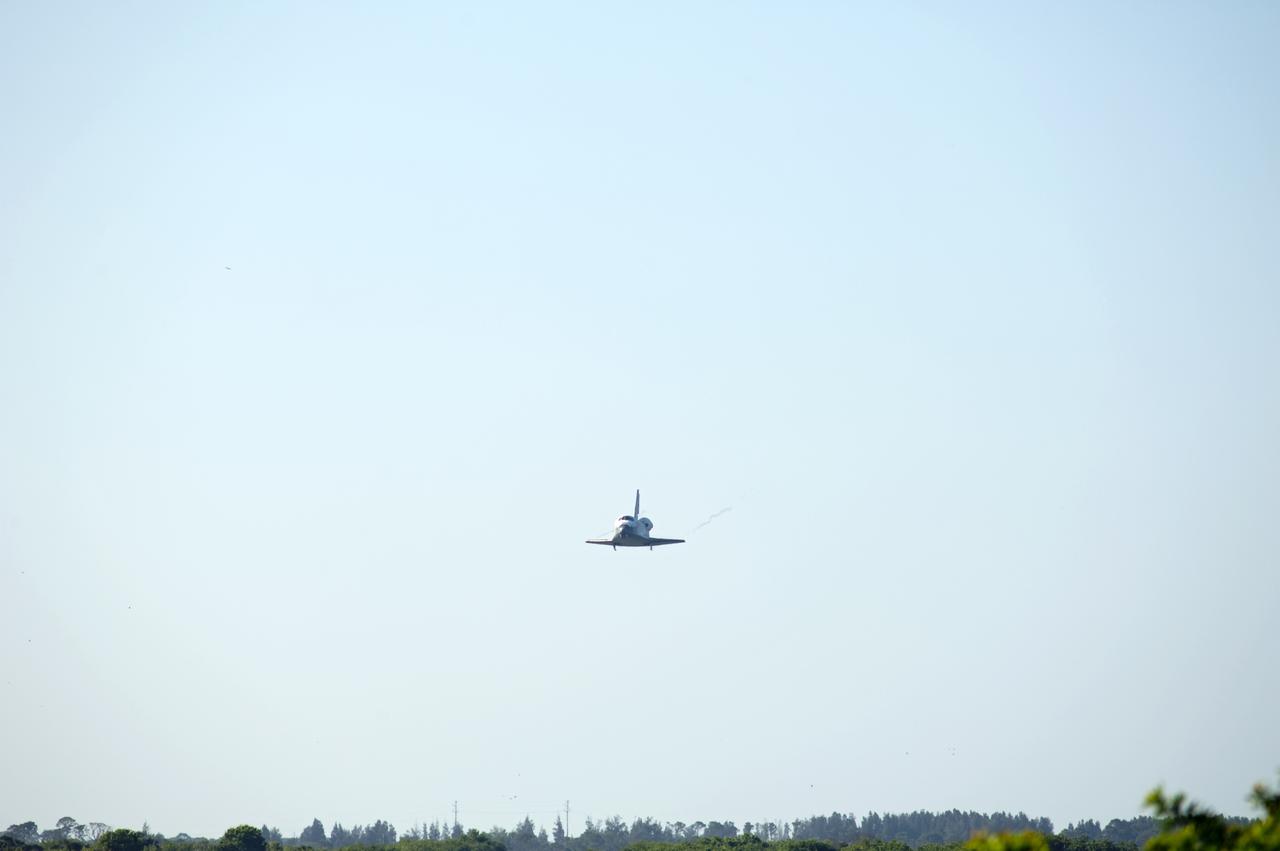
CAPE CANAVERAL, Fla. - Coming in from the southeast, space shuttle Atlantis approaches Runway 33 at the Shuttle Landing Facility at NASA's Kennedy Space Center in Florida. Landing was at 8:48 a.m. EDT, completing the 12-day STS-132 mission to the International Space Station. The six-member STS-132 crew carried the Russian-built Mini Research Module-1 to the space station. STS-132 is the 34th shuttle mission to the station, the 132nd shuttle mission overall and the last planned flight for Atlantis. For information on the STS-132 mission and crew, visit www.nasa.gov_mission_pages_shuttle_shuttlemissions_sts132_index.html. Photo credit: NASA_Sandra Joseph
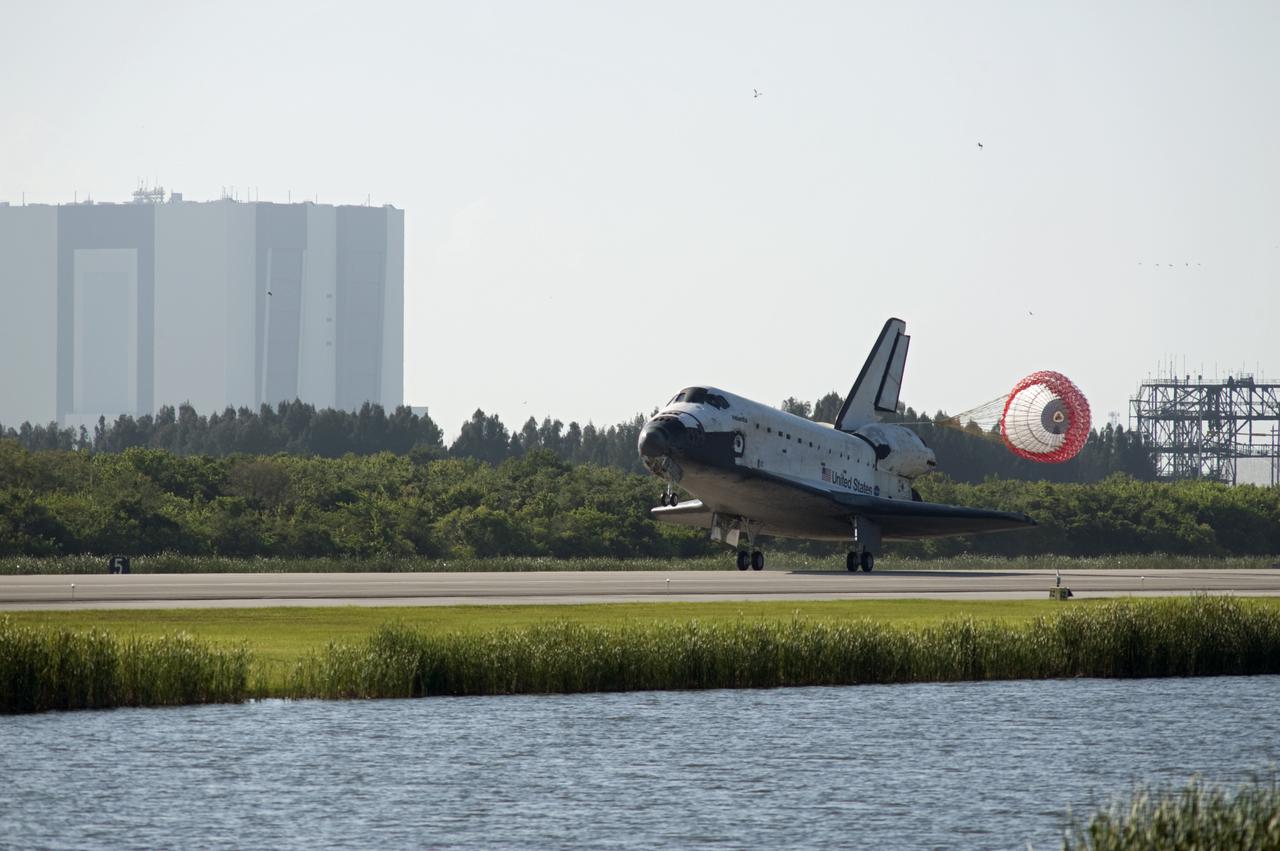
CAPE CANAVERAL, Fla. - Space shuttle Atlantis' drag chute slows the vehicle as it rolls down Runway 33 at the Shuttle Landing Facility at NASA's Kennedy Space Center in Florida. Landing was at 8:48 a.m. EDT, completing the 12-day STS-132 mission to the International Space Station. The six-member STS-132 crew carried the Russian-built Mini Research Module-1 to the space station. STS-132 is the 34th shuttle mission to the station, the 132nd shuttle mission overall and the last planned flight for Atlantis. For information on the STS-132 mission and crew, visit www.nasa.gov_mission_pages_shuttle_shuttlemissions_sts132_index.html. Photo credit: NASA_Sandra Joseph
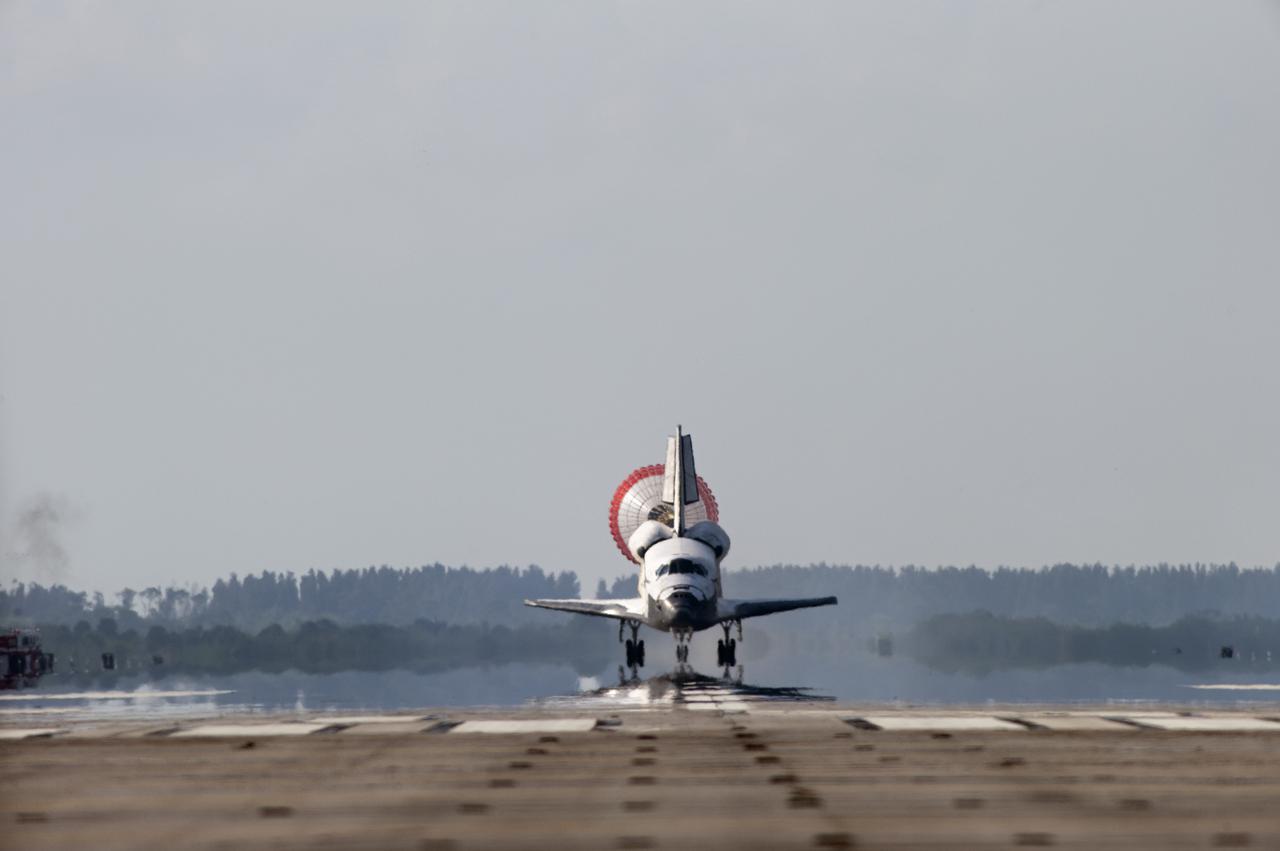
CAPE CANAVERAL, Fla. - With drag chute unfurled, space shuttle Discovery lands on Runway 33 at the Shuttle Landing Facility at NASA's Kennedy Space Center in Florida after 15 days in space, completing the more than 6.2-million-mile STS-131 mission on orbit 238. Main gear touchdown was at 9:08:35 a.m. EDT followed by nose gear touchdown at 9:08:47 a.m. and wheelstop at 9:09:33 a.m. Aboard are Commander Alan Poindexter; Pilot James P. Dutton Jr.; and Mission Specialists Rick Mastracchio, Clayton Anderson, Dorothy Metcalf-Lindenburger, Stephanie Wilson and Naoko Yamazaki of the Japan Aerospace Exploration Agency. The seven-member STS-131 crew carried the multi-purpose logistics module Leonardo, filled with supplies, a new crew sleeping quarters and science racks that were transferred to the International Space Station's laboratories. The crew also switched out a gyroscope on the station’s truss, installed a spare ammonia storage tank and retrieved a Japanese experiment from the station’s exterior. STS-131 is the 33rd shuttle mission to the station and the 131st shuttle mission overall. For information on the STS-131 mission and crew, visit http:__www.nasa.gov_mission_pages_shuttle_shuttlemissions_sts131_index.html. Photo credit: NASA_Sandra Joseph and Kevin O'Connell
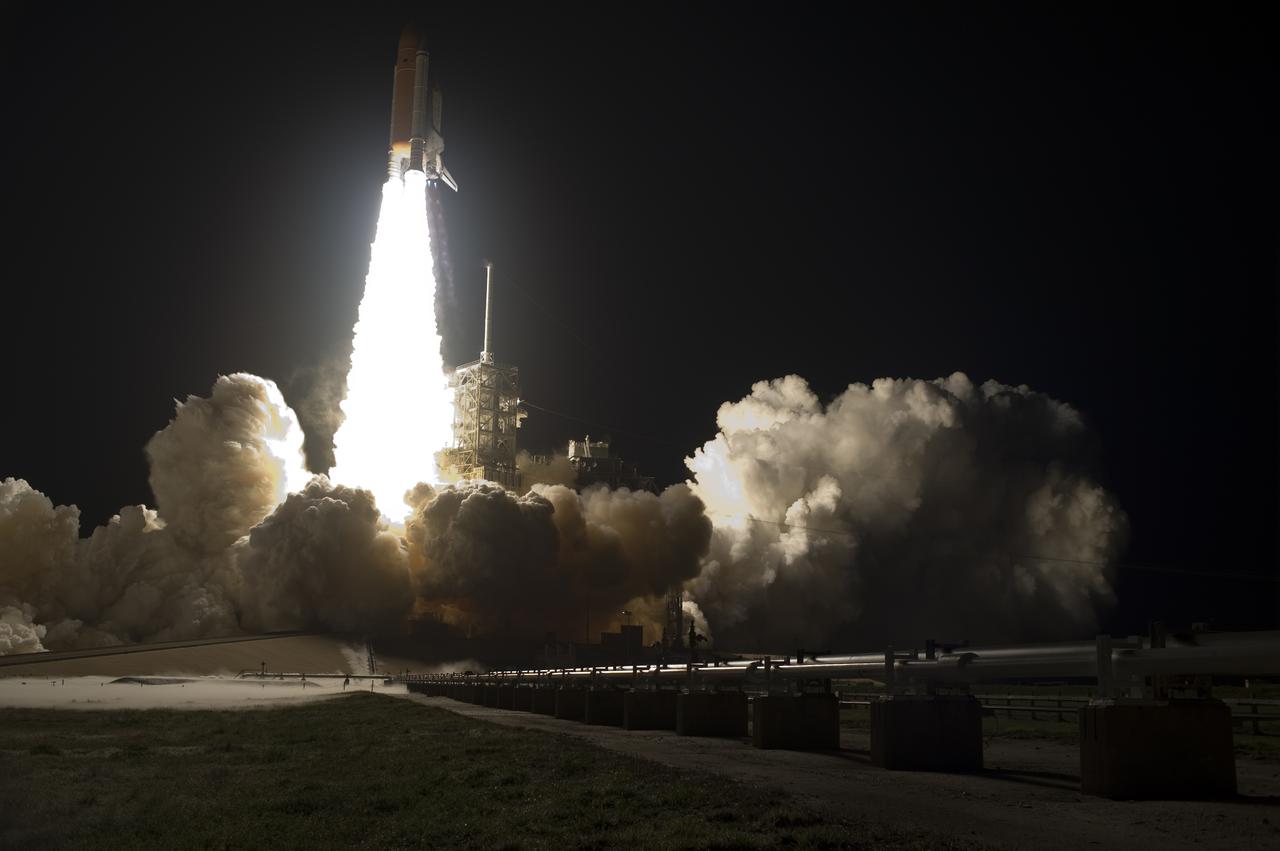
CAPE CANAVERAL, Fla. - Rising on a column of fire, space shuttle Discovery hurtles toward space after liftoff from Launch Pad 39A at NASA's Kennedy Space Center in Florida. Liftoff on the STS-131 mission was on time at 6:21 a.m. EDT. The seven-member crew will deliver the multi-purpose logistics module Leonardo, filled with supplies, a new crew sleeping quarters and science racks that will be transferred to the International Space Station's laboratories. The crew also will switch out a gyroscope on the station’s truss, install a spare ammonia storage tank and retrieve a Japanese experiment from the station’s exterior. STS-131 is the 33rd shuttle mission to the station and the 131st shuttle mission overall. For information on the STS-131 mission and crew, visit http:__www.nasa.gov_mission_pages_shuttle_shuttlemissions_sts131_index.html. Photo credit: NASA_Sandra Joseph and Kevin O'Connell
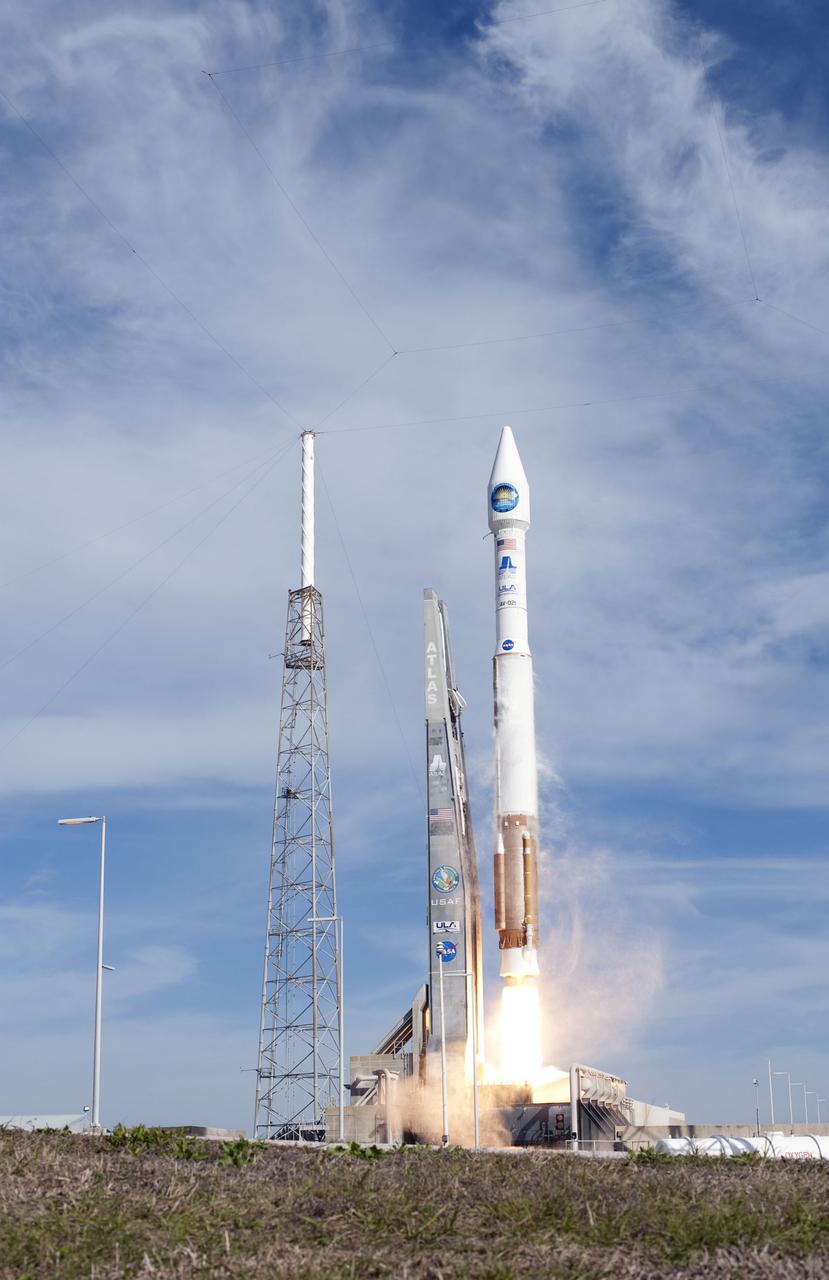
CAPE CANAVERAL, Fla. – The United Launch Alliance Atlas V rocket carrying NASA's Solar Dynamics Observatory lifts off into thin upper-level clouds over Launch Complex 41 on Cape Canaveral Air Force Station to deliver its payload to orbit. Launch was at 10:23 a.m. EST Feb. 11. This is the 100th launch of a commercial Atlas_Centaur rocket. The observatory, known as SDO, is the first mission in NASA's Living With a Star Program and is designed to study the causes of solar variability and its impacts on Earth. The spacecraft's long-term measurements will give solar scientists in-depth information to help characterize the interior of the Sun, the Sun's magnetic field, the hot plasma of the solar corona, and the density of radiation that creates the ionosphere of the planets. The information will be used to create better forecasts of space weather needed to protect the aircraft, satellites and astronauts living and working in space. For information on SDO, visit http:__www.nasa.gov_sdo. Photo credit: NASA_Sandra Joseph and Tony Gray
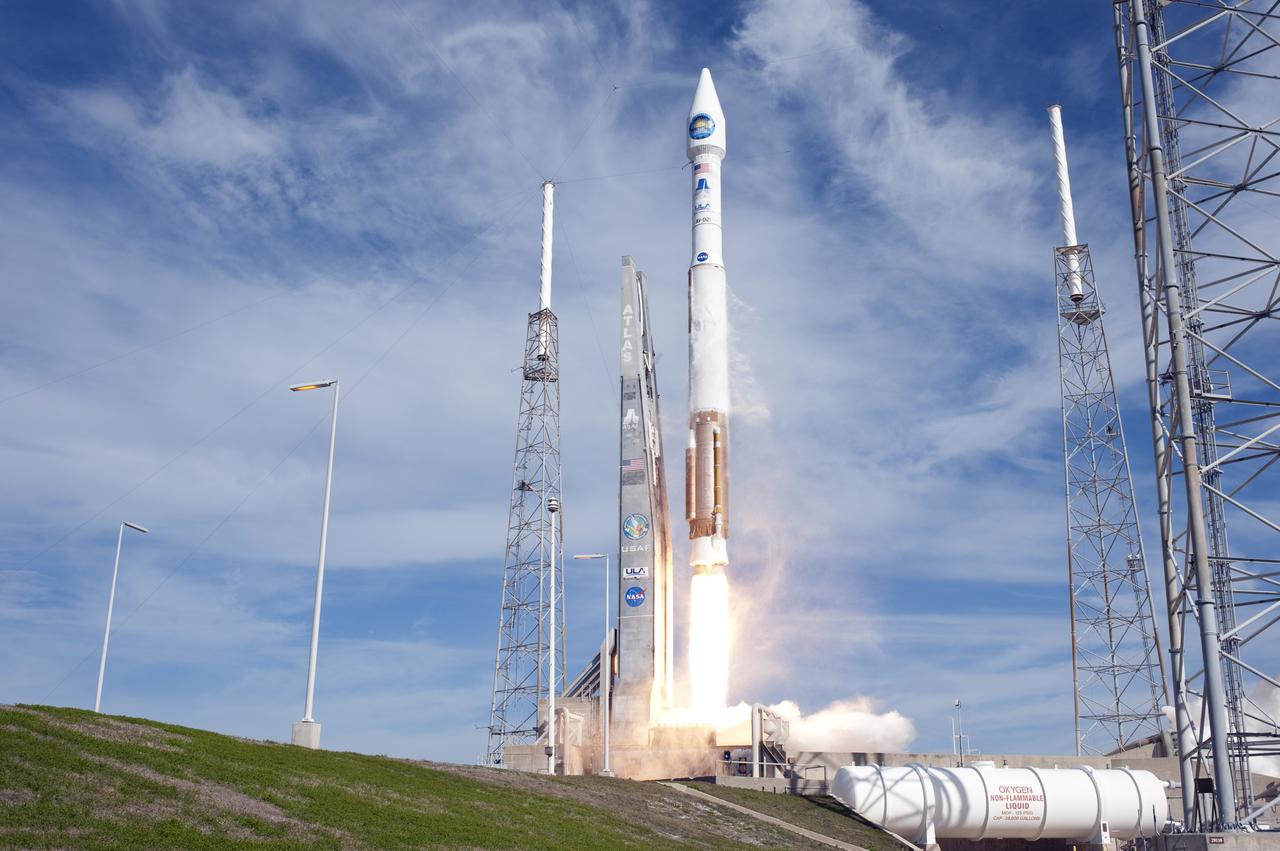
CAPE CANAVERAL, Fla. – With a blinding flash, the United Launch Alliance Atlas V rocket carrying NASA's Solar Dynamics Observatory lifts off Launch Complex 41 on Cape Canaveral Air Force Station. Launch was at 10:23 a.m. EST Feb. 11. This is the 100th launch of a commercial Atlas_Centaur rocket. The observatory, known as SDO, is the first mission in NASA's Living With a Star Program and is designed to study the causes of solar variability and its impacts on Earth. The spacecraft's long-term measurements will give solar scientists in-depth information to help characterize the interior of the Sun, the Sun's magnetic field, the hot plasma of the solar corona, and the density of radiation that creates the ionosphere of the planets. The information will be used to create better forecasts of space weather needed to protect the aircraft, satellites and astronauts living and working in space. For information on SDO, visit http:__www.nasa.gov_sdo. Photo credit: NASA_Sandra Joseph and Tony Gray
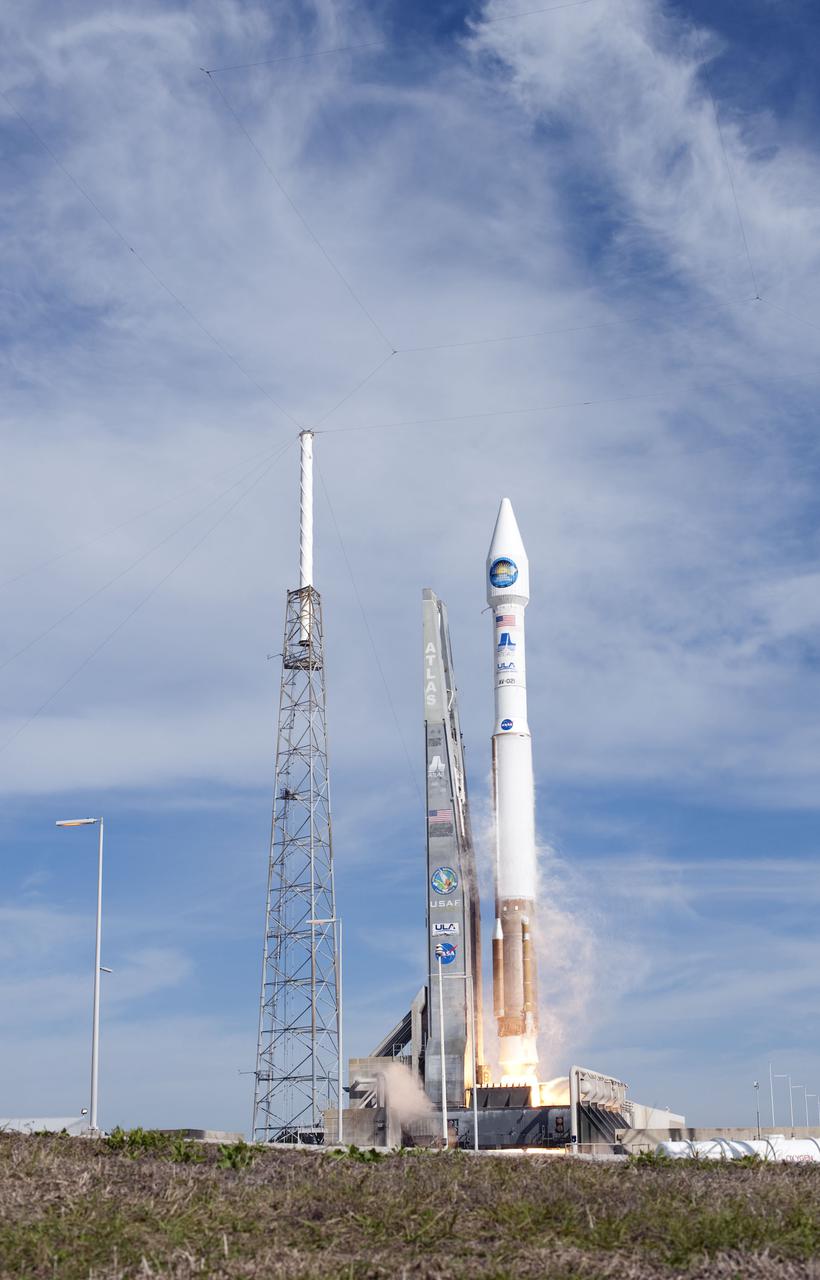
CAPE CANAVERAL, Fla. – The countdown to launch of the United Launch Alliance Atlas V rocket carrying NASA's Solar Dynamics Observatory comes to a successful conclusion with liftoff from Launch Complex 41 on Cape Canaveral Air Force Station at 10:23 a.m. EST Feb. 11. This is the 100th launch of a commercial Atlas_Centaur rocket. The observatory, known as SDO, is the first mission in NASA's Living With a Star Program and is designed to study the causes of solar variability and its impacts on Earth. The spacecraft's long-term measurements will give solar scientists in-depth information to help characterize the interior of the Sun, the Sun's magnetic field, the hot plasma of the solar corona, and the density of radiation that creates the ionosphere of the planets. The information will be used to create better forecasts of space weather needed to protect the aircraft, satellites and astronauts living and working in space. For information on SDO, visit http:__www.nasa.gov_sdo. Photo credit: NASA_Sandra Joseph and Tony Gray
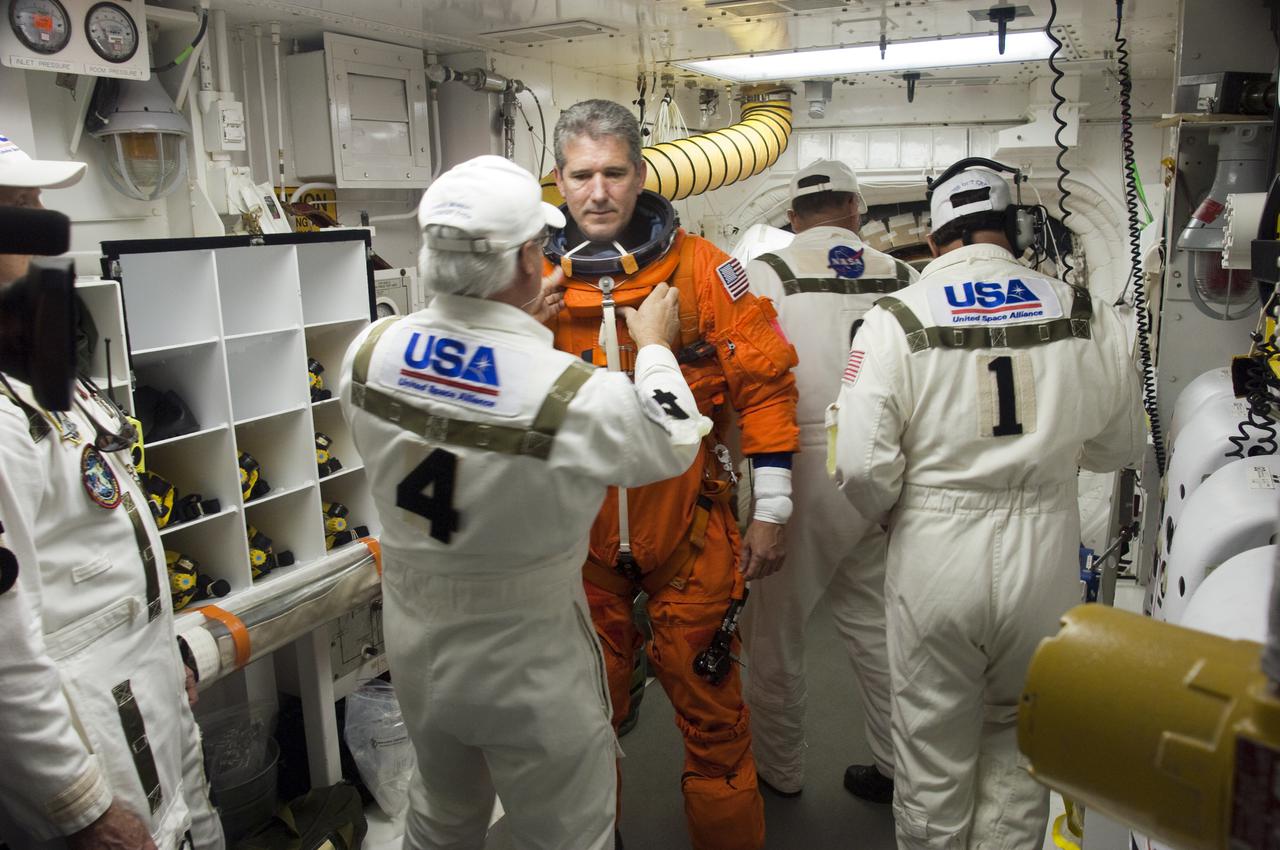
CAPE CANAVERAL, Fla. - At Launch Pad 39A at NASA's Kennedy Space Center in Florida, STS-132 Mission Specialist Michael Good prepares to enter space shuttle Atlantis from the pad's White Room. STS-132 is Good's second spaceflight. The six-member STS-132 crew is participating in a dress rehearsal for launch, known as the Terminal Countdown Demonstration Test, from their seats in the crew compartment of Atlantis. Launch is targeted for 2:19 p.m. EDT on May 14. On the STS-132 mission, the crew will deliver an Integrated Cargo Carrier, or ICC, and the Russian-built Mini-Research Module-1, or MRM-1, to the International Space Station. The ICC is an unpressurized flat bed pallet and keel yoke assembly used to support the transfer of exterior cargo from the shuttle to the space station. The MRM-1, known as Rassvet, is the second in a series of new pressurized components for Russia and will be permanently attached to the Earth-facing port of the Zarya control module. Rassvet, which translates to 'dawn,' will be used for cargo storage and provide an additional docking port to the station. STS-132 is the 34th mission to the station and the 132nd shuttle mission overall. For information on the STS-132 mission, visit http:__www.nasa.gov_mission_pages_shuttle_shuttlemissions_sts132_index.html. Photo credit: NASA_Sandra Joseph and Kevin O'Connell
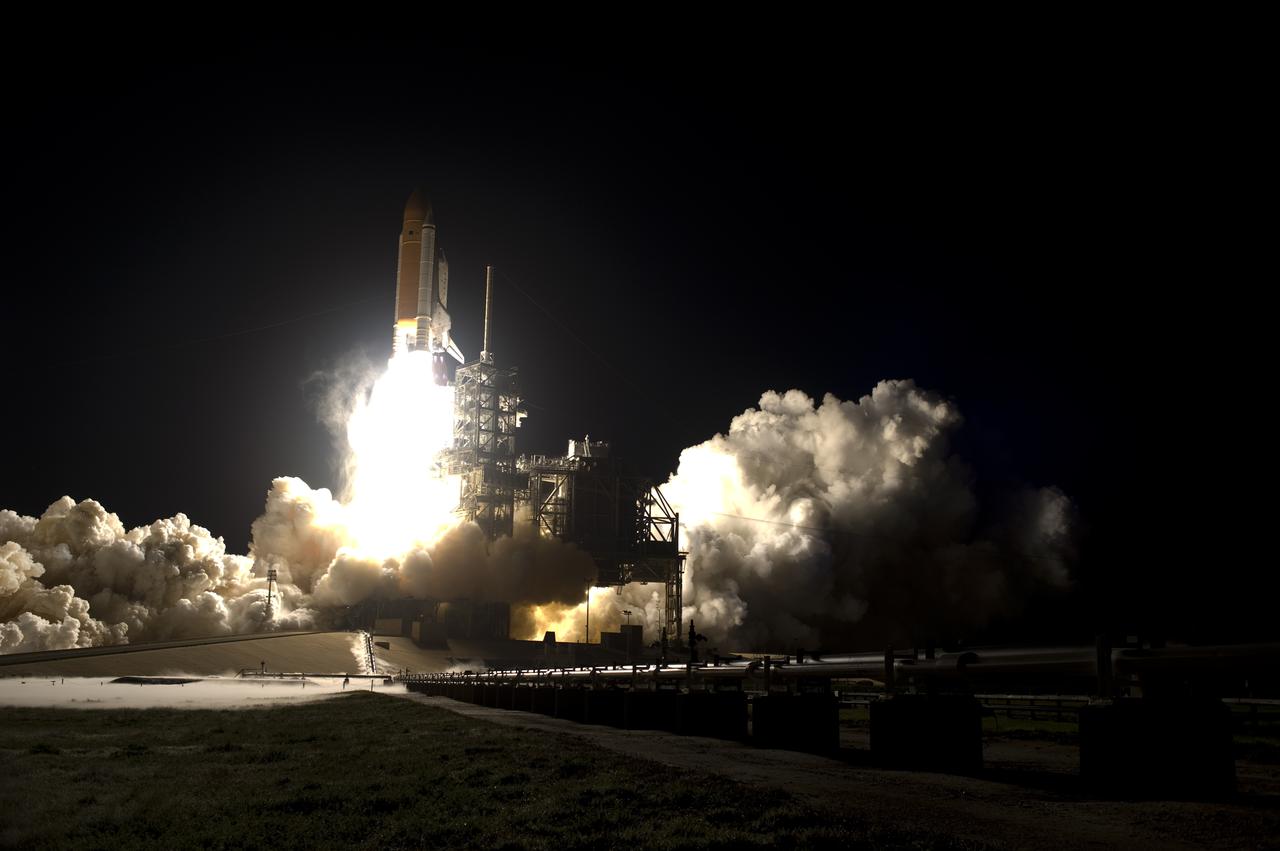
CAPE CANAVERAL, Fla. - Space shuttle Discovery begins its ascent into the predawn sky over Launch Pad 39A at NASA's Kennedy Space Center in Florida at 6:21 a.m. EDT April 5, a brilliant start for the STS-131 mission. The seven-member crew will deliver the multi-purpose logistics module Leonardo, filled with supplies, a new crew sleeping quarters and science racks that will be transferred to the International Space Station's laboratories. The crew also will switch out a gyroscope on the station’s truss, install a spare ammonia storage tank and retrieve a Japanese experiment from the station’s exterior. STS-131 is the 33rd shuttle mission to the station and the 131st shuttle mission overall. For information on the STS-131 mission and crew, visit http:__www.nasa.gov_mission_pages_shuttle_shuttlemissions_sts131_index.html. Photo credit: NASA_Sandra Joseph and Kevin O'Connell
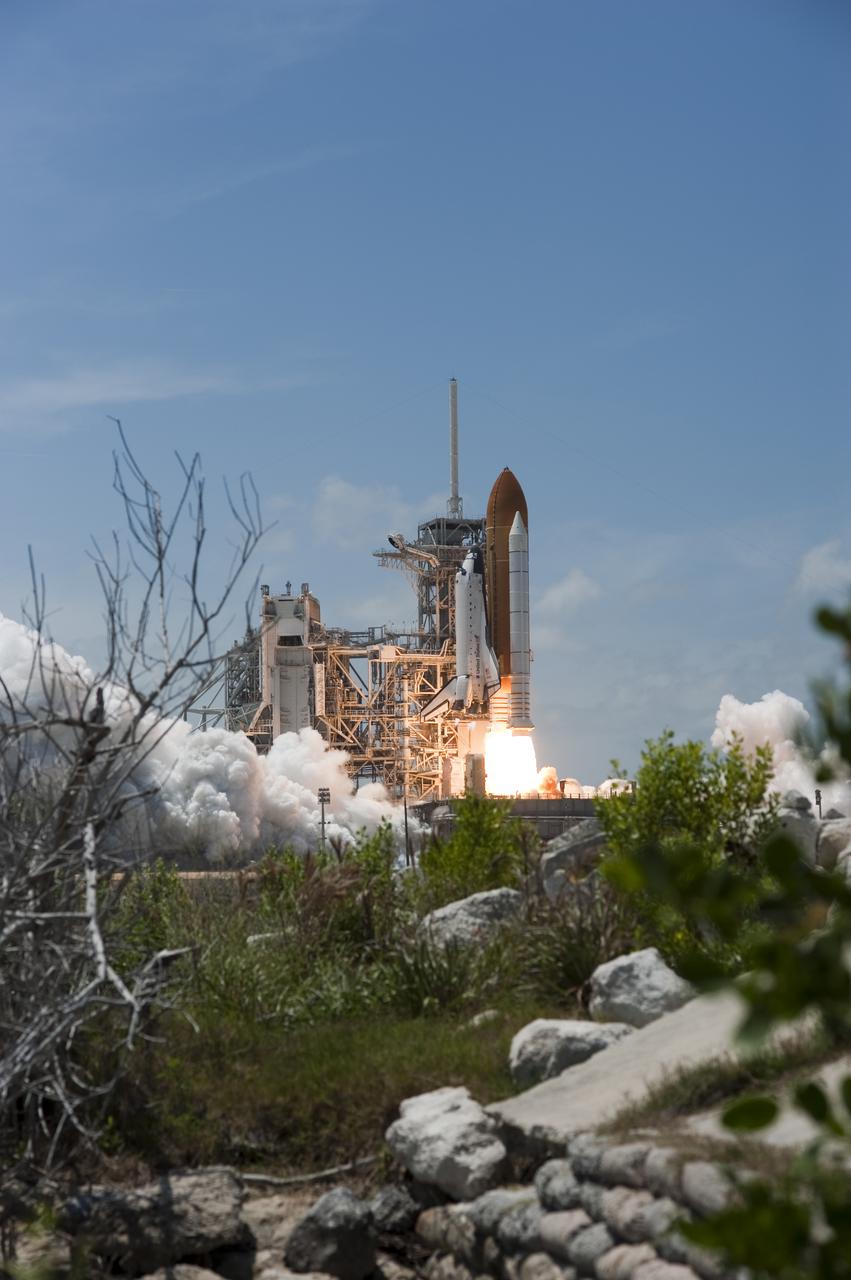
CAPE CANAVERAL, Fla. - Space shuttle Atlantis rumbles the Space Coast as it begins to clear the tower at its pristine launch complex, which is home to the Merritt Island National Wildlife Refuge. Liftoff from NASA Kennedy Space Center's Launch Pad 39A occurred right on time at 2:20 p.m. EDT on May 14. Atlantis' primary payload for the STS-132 mission is the Russian-built Mini Research Module-1, which will provide additional storage space and a new docking port for Russian Soyuz and Progress spacecraft aboard the International Space Station. STS-132 is the 132nd shuttle flight, the 32nd for Atlantis and the 34th shuttle mission dedicated to station assembly and maintenance. For more information on the STS-132 mission objectives, payload and crew, visit www.nasa.gov_mission_pages_shuttle_shuttlemissions_sts132_index.html. Photo credit: NASA_Sandra Joseph and Kevin O'Connell
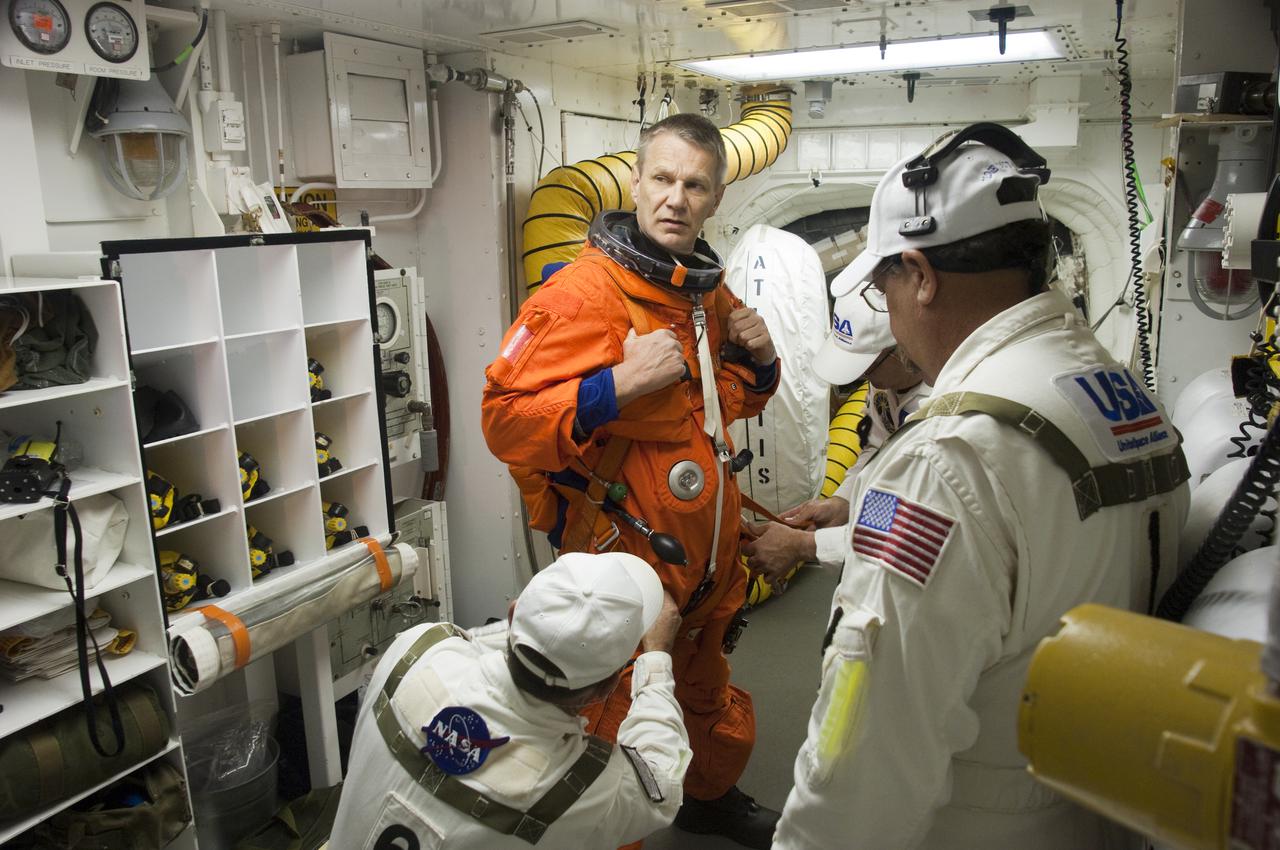
CAPE CANAVERAL, Fla. - At Launch Pad 39A at NASA's Kennedy Space Center in Florida, STS-132 Mission Specialist Piers Sellers prepares to enter space shuttle Atlantis from the pad's White Room. STS-132 is Seller's third spaceflight. The six-member STS-132 crew is participating in a dress rehearsal for launch, known as the Terminal Countdown Demonstration Test, from their seats in the crew compartment of Atlantis. Launch is targeted for 2:19 p.m. EDT on May 14. On the STS-132 mission, the crew will deliver an Integrated Cargo Carrier, or ICC, and the Russian-built Mini-Research Module-1, or MRM-1, to the International Space Station. The ICC is an unpressurized flat bed pallet and keel yoke assembly used to support the transfer of exterior cargo from the shuttle to the space station. The MRM-1, known as Rassvet, is the second in a series of new pressurized components for Russia and will be permanently attached to the Earth-facing port of the Zarya control module. Rassvet, which translates to 'dawn,' will be used for cargo storage and provide an additional docking port to the station. STS-132 is the 34th mission to the station and the 132nd shuttle mission overall. For information on the STS-132 mission, visit http:__www.nasa.gov_mission_pages_shuttle_shuttlemissions_sts132_index.html. Photo credit: NASA_Sandra Joseph and Kevin O'Connell
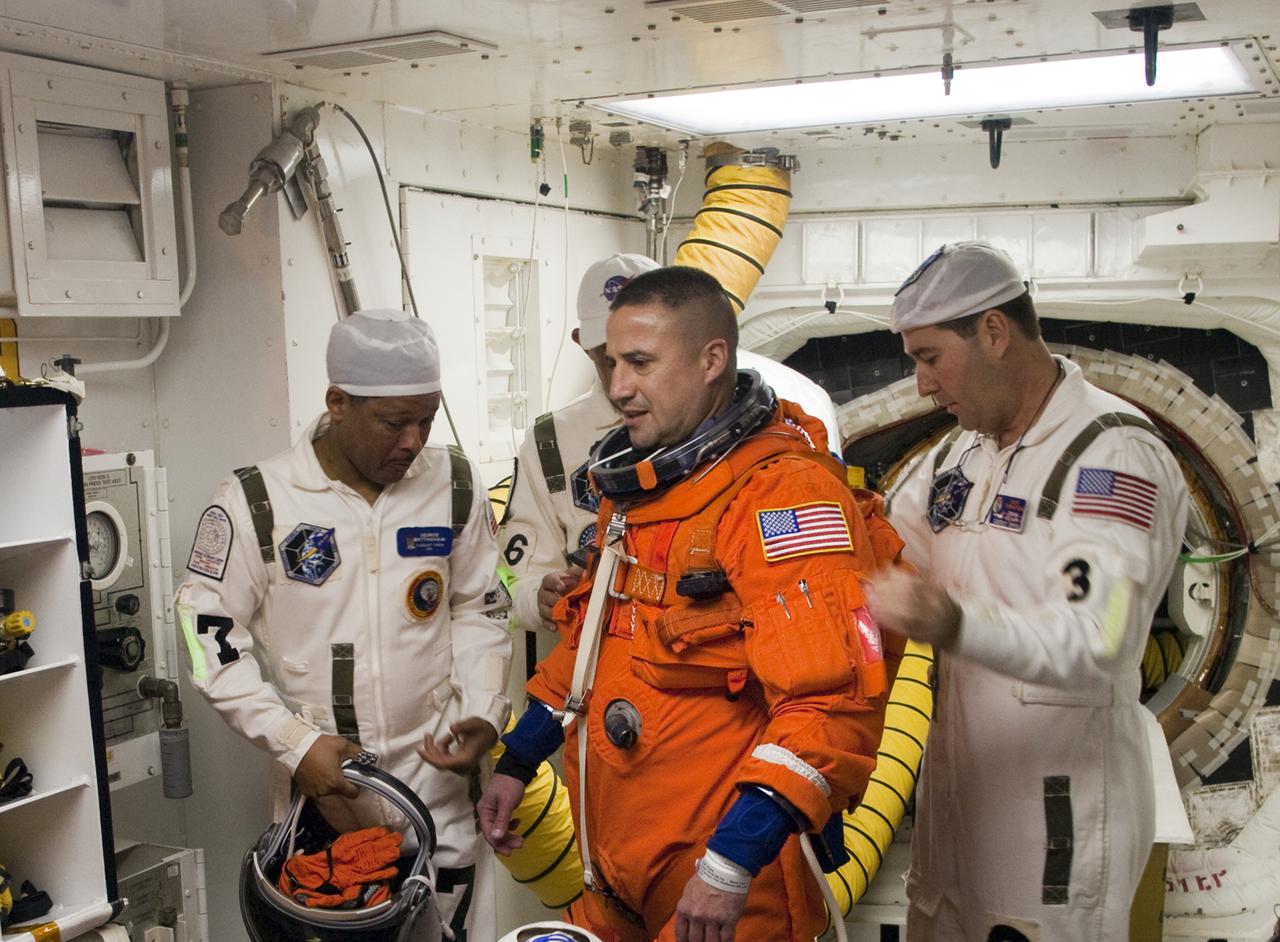
CAPE CANAVERAL, Fla. - At Launch Pad 39A at NASA's Kennedy Space Center in Florida, United Space Alliance suit technicians ensure the proper fit of the launch-and-entry suits of the astronauts on the STS-130 crew. Commander George Zamka, seen here in the White Room, prepares to enter space shuttle Endeavour. The primary payload for the STS-130 mission to the International Space Station is the Tranquility node, a pressurized module that will provide additional room for crew members and many of the station's life support and environmental control systems. Attached to one end of Tranquility is a cupola, a unique work area with six windows on its sides and one on top. The cupola resembles a circular bay window and will provide a vastly improved view of the station's exterior. The multi-directional view will allow the crew to monitor spacewalks and docking operations, as well as provide a spectacular view of Earth and other celestial objects. The module was built in Turin, Italy, by Thales Alenia Space for the European Space Agency. Endeavour's launch is set for Feb. 7 at 4:39 a.m. EST. For information on the STS-130 mission and crew, visit http:__www.nasa.gov_mission_pages_shuttle_shuttlemissions_sts130_index.html. Photo credit: NASA_Sandra Joseph and Kevin O'Connell
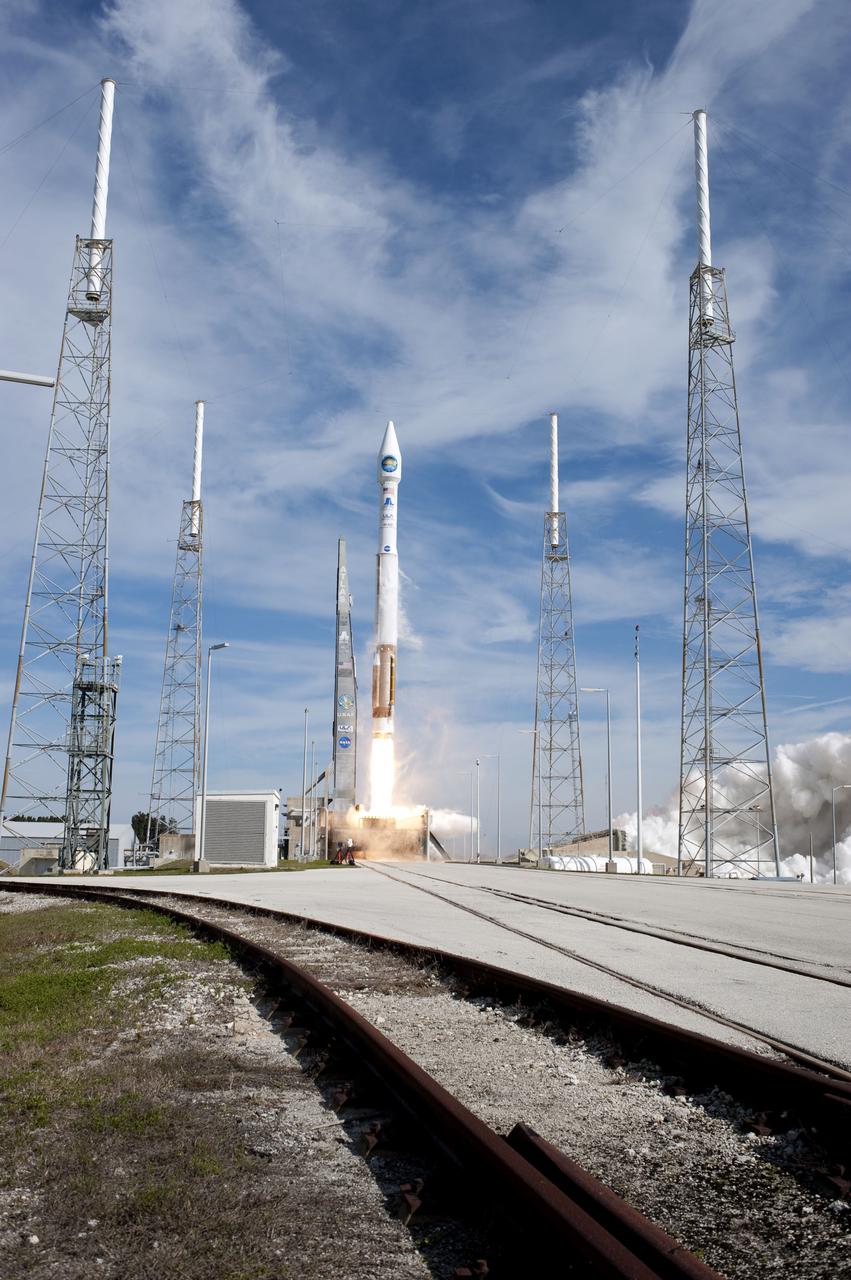
CAPE CANAVERAL, Fla. – NASA's Solar Dynamics Observatory begins its climb to orbit from Launch Complex 41 on Cape Canaveral Air Force Station at 10:23 a.m. EST Feb. 11 atop a United Launch Alliance Atlas V rocket. This is the 100th launch of a commercial Atlas_Centaur rocket. The observatory, known as SDO, is the first mission in NASA's Living With a Star Program and is designed to study the causes of solar variability and its impacts on Earth. The spacecraft's long-term measurements will give solar scientists in-depth information to help characterize the interior of the Sun, the Sun's magnetic field, the hot plasma of the solar corona, and the density of radiation that creates the ionosphere of the planets. The information will be used to create better forecasts of space weather needed to protect the aircraft, satellites and astronauts living and working in space. For information on SDO, visit http:__www.nasa.gov_sdo. Photo credit: NASA_Sandra Joseph and Tony Gray
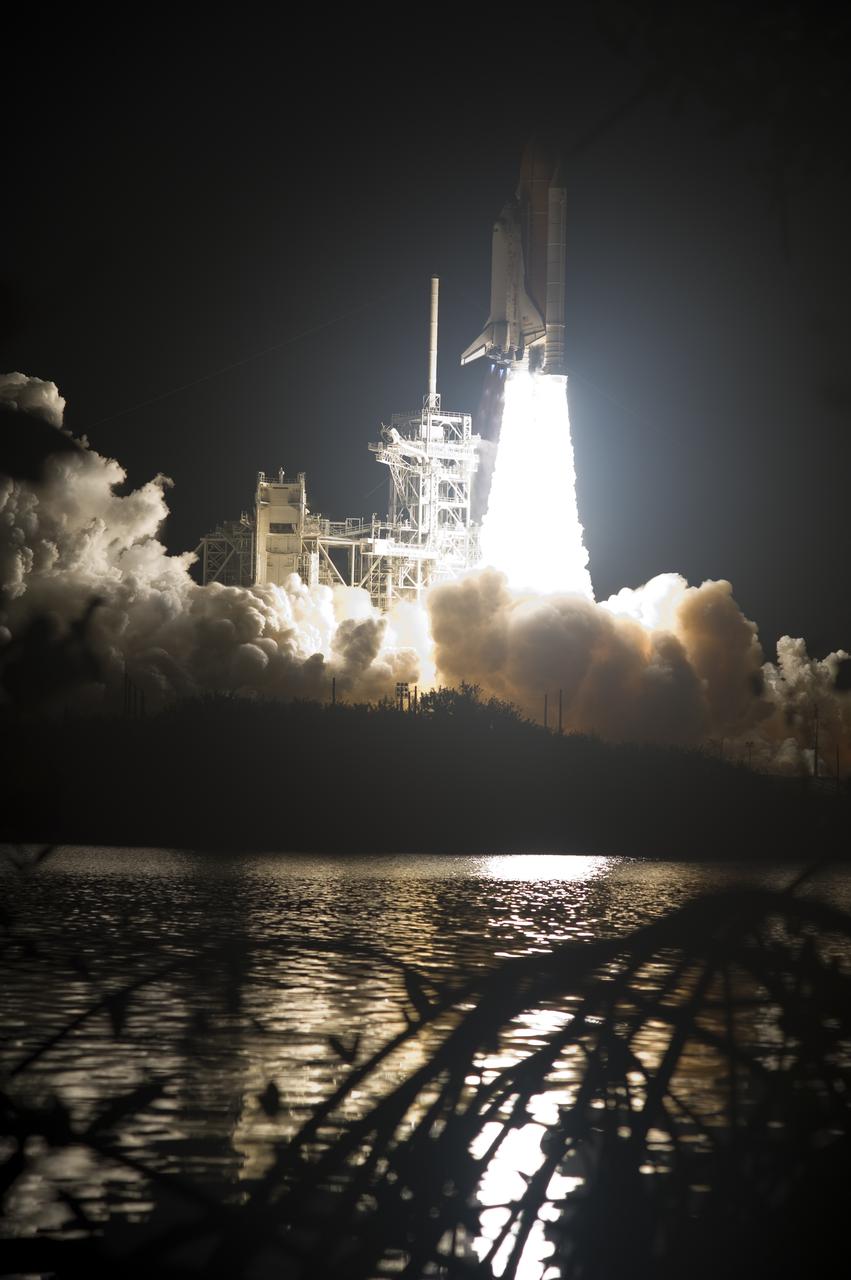
CAPE CANAVERAL, Fla. - Space shuttle Discovery rises above the exhaust cloud forming at Launch Pad 39A at NASA's Kennedy Space Center in Florida as it begins its climb to orbit at 6:21 a.m. EDT April 5 on the STS-131 mission. The seven-member crew will deliver the multi-purpose logistics module Leonardo, filled with supplies, a new crew sleeping quarters and science racks that will be transferred to the International Space Station's laboratories. The crew also will switch out a gyroscope on the station’s truss, install a spare ammonia storage tank and retrieve a Japanese experiment from the station’s exterior. STS-131 is the 33rd shuttle mission to the station and the 131st shuttle mission overall. For information on the STS-131 mission and crew, visit http:__www.nasa.gov_mission_pages_shuttle_shuttlemissions_sts131_index.html. Photo credit: NASA_Sandra Joseph and Kevin O'Connell
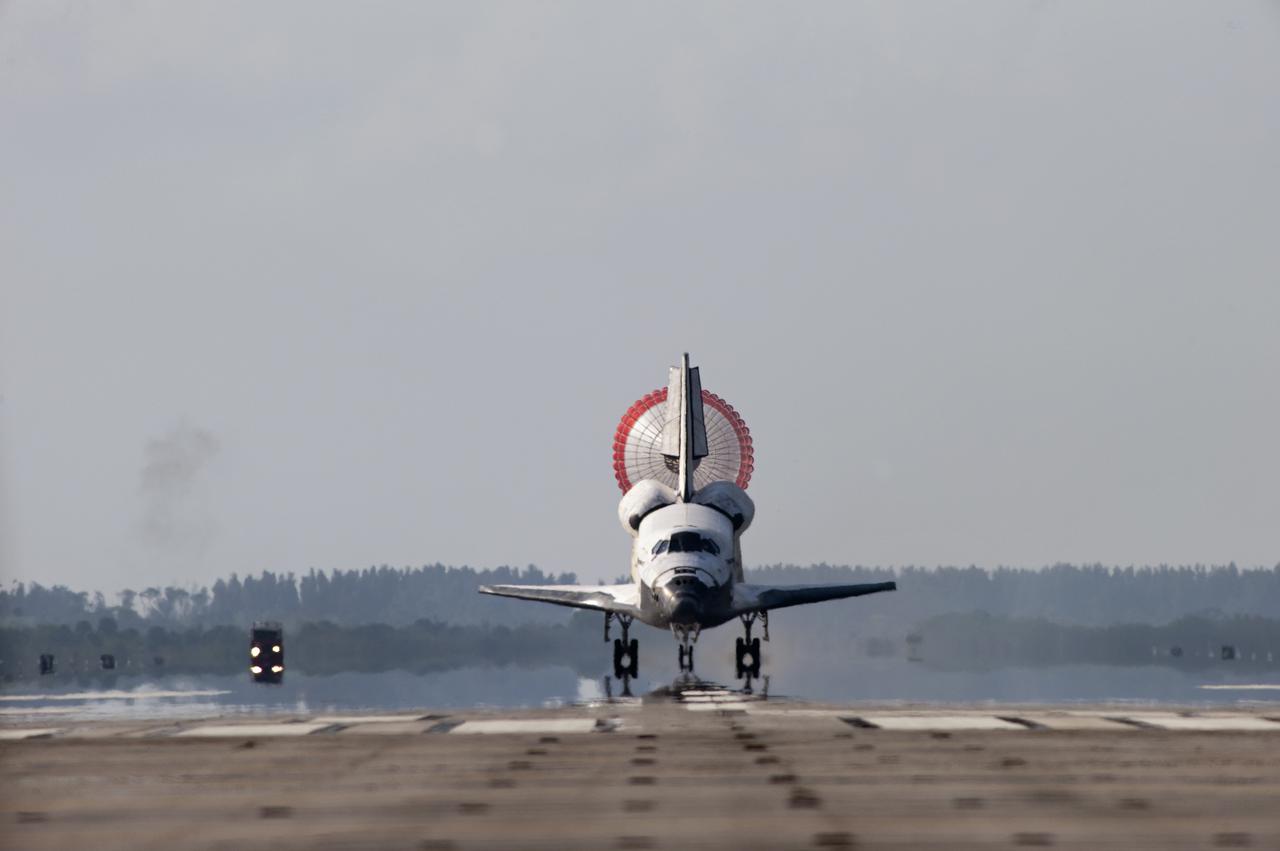
CAPE CANAVERAL, Fla. - With drag chute unfurled, space shuttle Discovery touches down on Runway 33 at the Shuttle Landing Facility at NASA's Kennedy Space Center in Florida after 15 days in space, completing the more than 6.2-million-mile STS-131 mission on orbit 238. Main gear touchdown was at 9:08:35 a.m. EDT followed by nose gear touchdown at 9:08:47 a.m. and wheelstop at 9:09:33 a.m. Aboard are Commander Alan Poindexter; Pilot James P. Dutton Jr.; and Mission Specialists Rick Mastracchio, Clayton Anderson, Dorothy Metcalf-Lindenburger, Stephanie Wilson and Naoko Yamazaki of the Japan Aerospace Exploration Agency. The seven-member STS-131 crew carried the multi-purpose logistics module Leonardo, filled with supplies, a new crew sleeping quarters and science racks that were transferred to the International Space Station's laboratories. The crew also switched out a gyroscope on the station’s truss, installed a spare ammonia storage tank and retrieved a Japanese experiment from the station’s exterior. STS-131 is the 33rd shuttle mission to the station and the 131st shuttle mission overall. For information on the STS-131 mission and crew, visit http:__www.nasa.gov_mission_pages_shuttle_shuttlemissions_sts131_index.html. Photo credit: NASA_Sandra Joseph and Kevin O'Connell
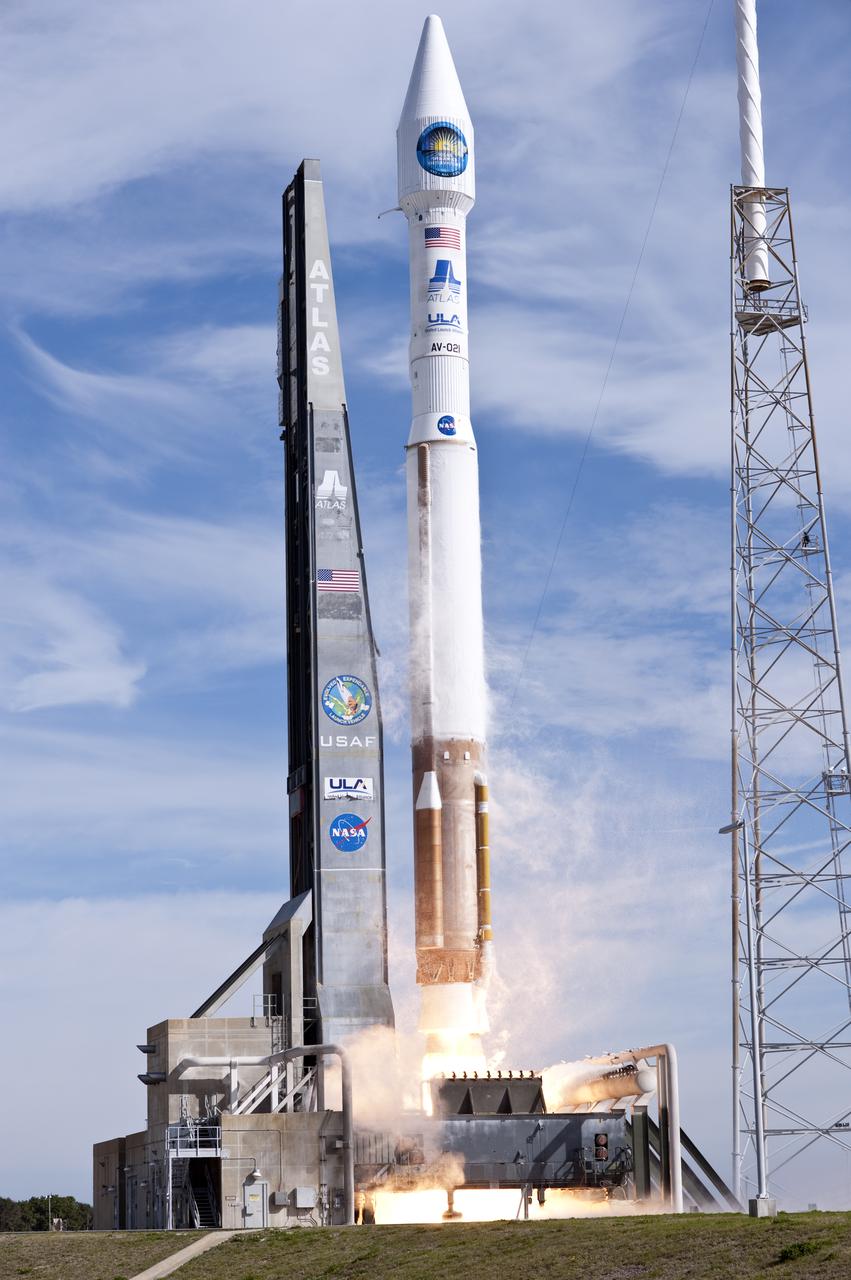
CAPE CANAVERAL, Fla. – Engine ignition lifts the United Launch Alliance Atlas V rocket carrying NASA's Solar Dynamics Observatory off Launch Complex 41 on Cape Canaveral Air Force Station. Liftoff was at 10:23 a.m. EST Feb. 11. This is the 100th launch of a commercial Atlas_Centaur rocket. The observatory, known as SDO, is the first mission in NASA's Living With a Star Program and is designed to study the causes of solar variability and its impacts on Earth. The spacecraft's long-term measurements will give solar scientists in-depth information to help characterize the interior of the Sun, the Sun's magnetic field, the hot plasma of the solar corona, and the density of radiation that creates the ionosphere of the planets. The information will be used to create better forecasts of space weather needed to protect the aircraft, satellites and astronauts living and working in space. For information on SDO, visit http:__www.nasa.gov_sdo. Photo credit: NASA_Sandra Joseph and Tony Gray
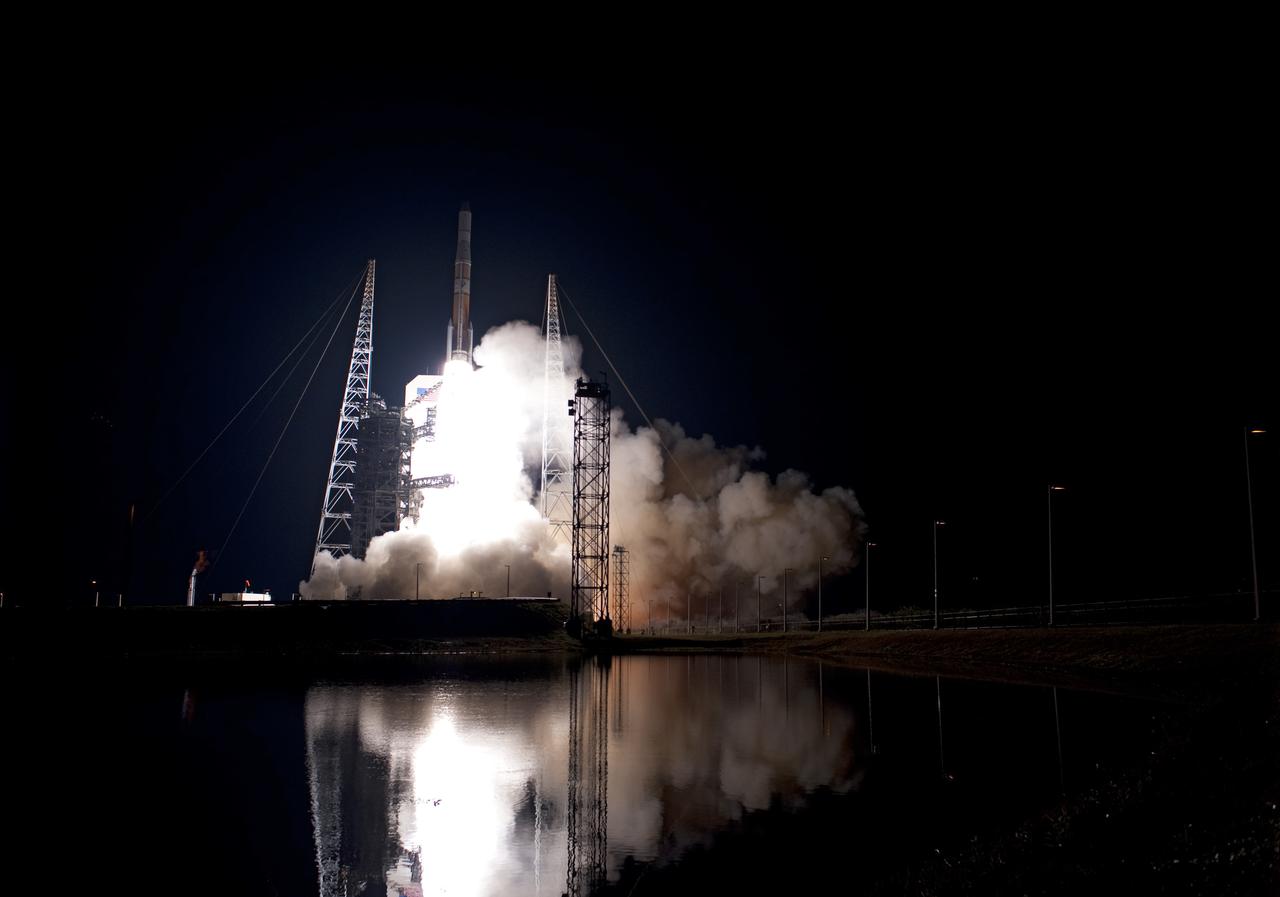
CAPE CANAVERAL, Fla. – Launch of the United Launch Alliance Delta IV rocket carrying NASA's GOES-P meteorological satellite is reflected in the water near Launch Complex 37 on Cape Canaveral Air Force Station in Florida. Liftoff was at 6:57 p.m. EST. GOES-P, the latest Geostationary Operational Environmental Satellite, was developed by NASA for the National Oceanic and Atmospheric Administration, or NOAA. The GOES-P spacecraft will be placed in a 22,300-mile-high geosynchronous orbit where it will appear to hover over a single point on Earth. The spacecraft is outfitted with a complex suite of observation instruments and cameras so it can accurately report on weather and climate conditions on Earth. For information on GOES-P, visit http:__www.nasa.gov_mission_pages_GOES-P_main_index.html. Photo credit: NASA_Sandra Joseph and Tony Gray
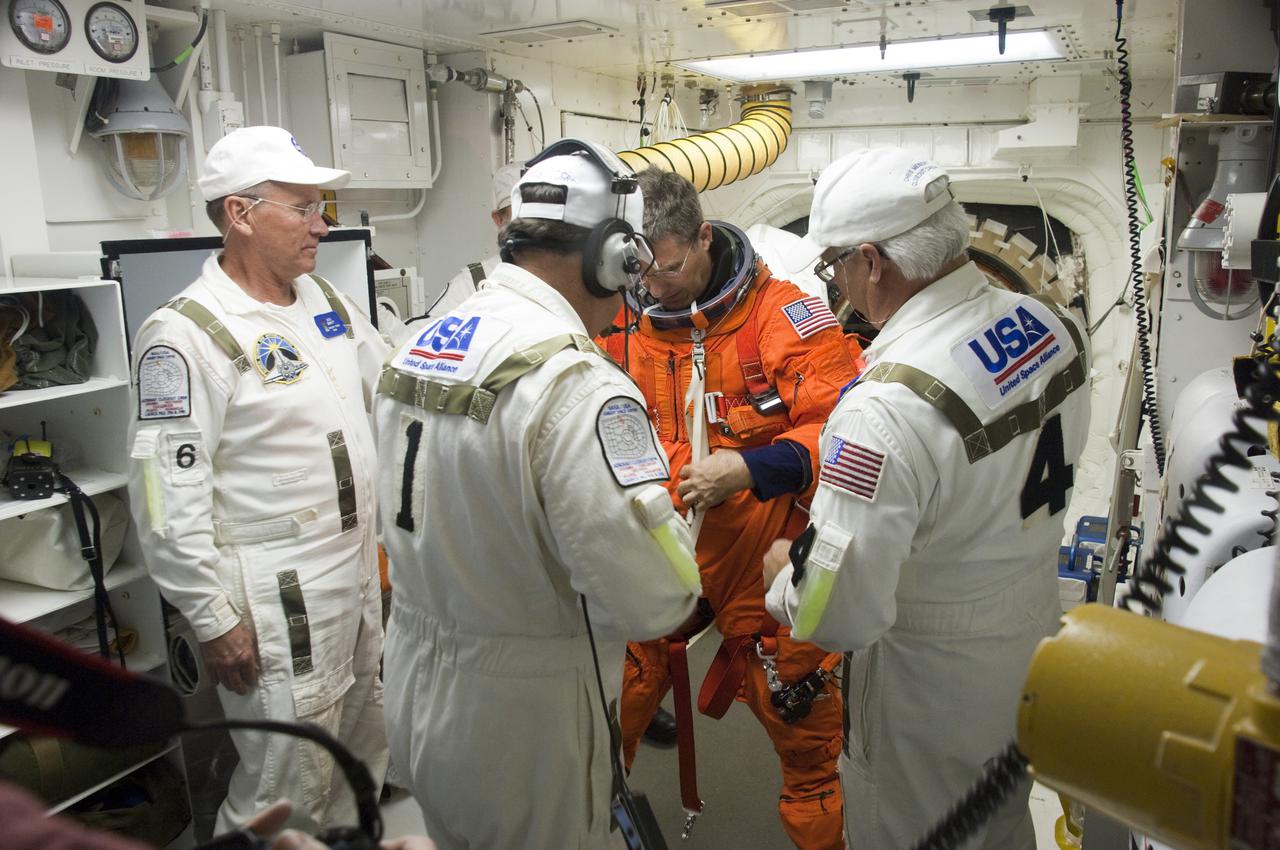
CAPE CANAVERAL, Fla. - At Launch Pad 39A at NASA's Kennedy Space Center in Florida, STS-132 Mission Specialist Steve Bowen prepares to enter space shuttle Atlantis from the pad's White Room. STS-132 is Bowen's second spaceflight. The six-member STS-132 crew is participating in a dress rehearsal for launch, known as the Terminal Countdown Demonstration Test, from their seats in the crew compartment of Atlantis. Launch is targeted for 2:19 p.m. EDT on May 14. On the STS-132 mission, the crew will deliver an Integrated Cargo Carrier, or ICC, and the Russian-built Mini-Research Module-1, or MRM-1, to the International Space Station. The ICC is an unpressurized flat bed pallet and keel yoke assembly used to support the transfer of exterior cargo from the shuttle to the space station. The MRM-1, known as Rassvet, is the second in a series of new pressurized components for Russia and will be permanently attached to the Earth-facing port of the Zarya control module. Rassvet, which translates to 'dawn,' will be used for cargo storage and provide an additional docking port to the station. STS-132 is the 34th mission to the station and the 132nd shuttle mission overall. For information on the STS-132 mission, visit http:__www.nasa.gov_mission_pages_shuttle_shuttlemissions_sts132_index.html. Photo credit: NASA_Sandra Joseph and Kevin O'Connell
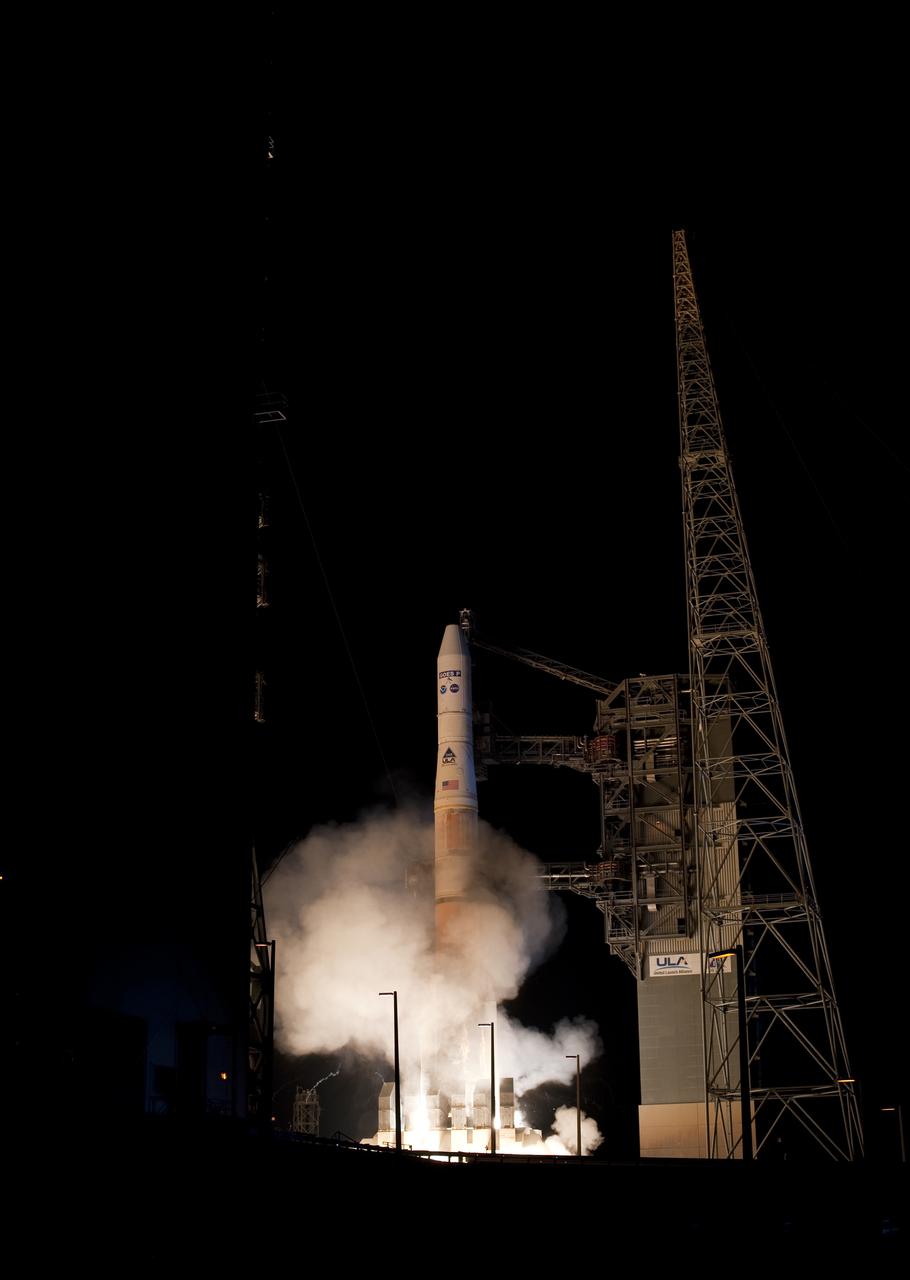
CAPE CANAVERAL, Fla. – The base of the United Launch Alliance Delta IV rocket carrying NASA's GOES-P meteorological satellite is engulfed in its exhaust cloud as it lifts off Launch Complex 37 on Cape Canaveral Air Force Station in Florida at 6:57 p.m. EST. GOES-P, the latest Geostationary Operational Environmental Satellite, was developed by NASA for the National Oceanic and Atmospheric Administration, or NOAA. The GOES-P spacecraft will be placed in a 22,300-mile-high geosynchronous orbit where it will appear to hover over a single point on Earth. The spacecraft is outfitted with a complex suite of observation instruments and cameras so it can accurately report on weather and climate conditions on Earth. For information on GOES-P, visit http:__www.nasa.gov_mission_pages_GOES-P_main_index.html. Photo credit: NASA_Sandra Joseph and Tony Gray
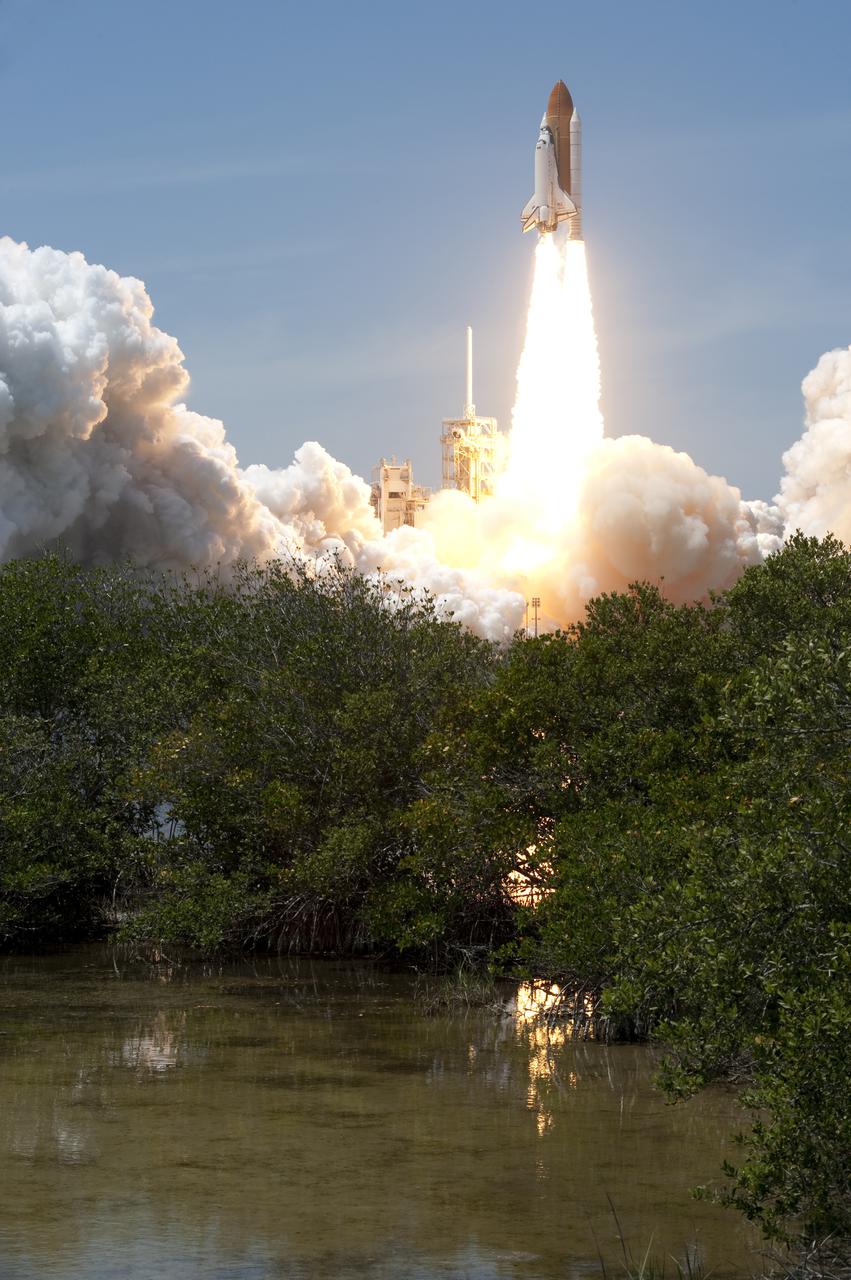
CAPE CANAVERAL, Fla. - Space shuttle Atlantis rumbles the Space Coast as it clears the tower at its pristine launch complex, which is home to the Merritt Island National Wildlife Refuge. Liftoff from NASA Kennedy Space Center's Launch Pad 39A occurred right on time at 2:20 p.m. EDT on May 14. Atlantis' primary payload for the STS-132 mission is the Russian-built Mini Research Module-1, which will provide additional storage space and a new docking port for Russian Soyuz and Progress spacecraft aboard the International Space Station. STS-132 is the 132nd shuttle flight, the 32nd for Atlantis and the 34th shuttle mission dedicated to station assembly and maintenance. For more information on the STS-132 mission objectives, payload and crew, visit www.nasa.gov_mission_pages_shuttle_shuttlemissions_sts132_index.html. Photo credit: NASA_Sandra Joseph and Kevin O'Connell
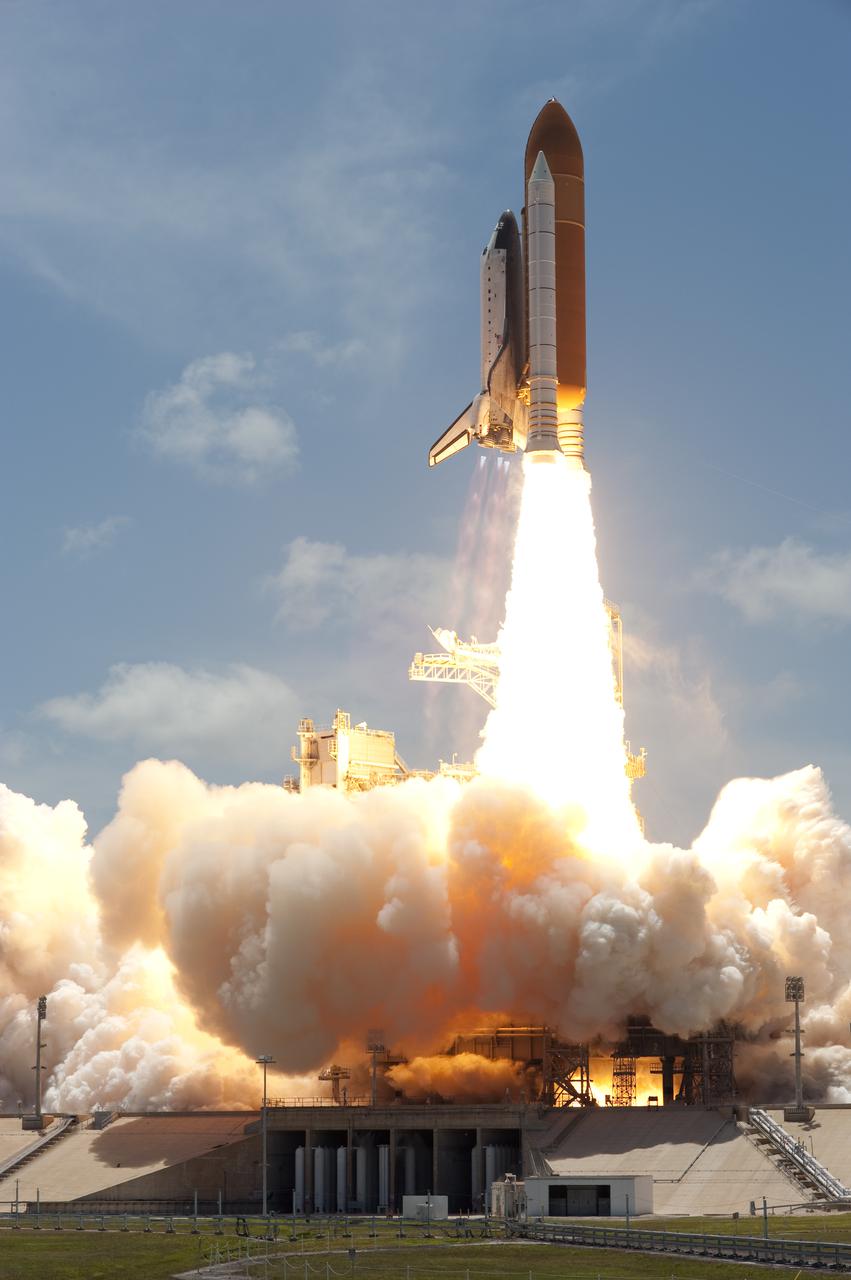
CAPE CANAVERAL, Fla. - Space shuttle Atlantis and its six STS-132 astronauts lift off Launch Pad 39A at NASA's Kennedy Space Center in Florida at 2:20 p.m. EDT on May 14. Atlantis' primary payload for the STS-132 mission is the Russian-built Mini Research Module-1, which will provide additional storage space and a new docking port for Russian Soyuz and Progress spacecraft aboard the International Space Station. STS-132 is the 132nd shuttle flight, the 32nd for Atlantis and the 34th shuttle mission dedicated to station assembly and maintenance. For more information on the STS-132 mission objectives, payload and crew, visit www.nasa.gov_mission_pages_shuttle_shuttlemissions_sts132_index.html. Photo credit: NASA_Sandra Joseph and Kevin O'Connell
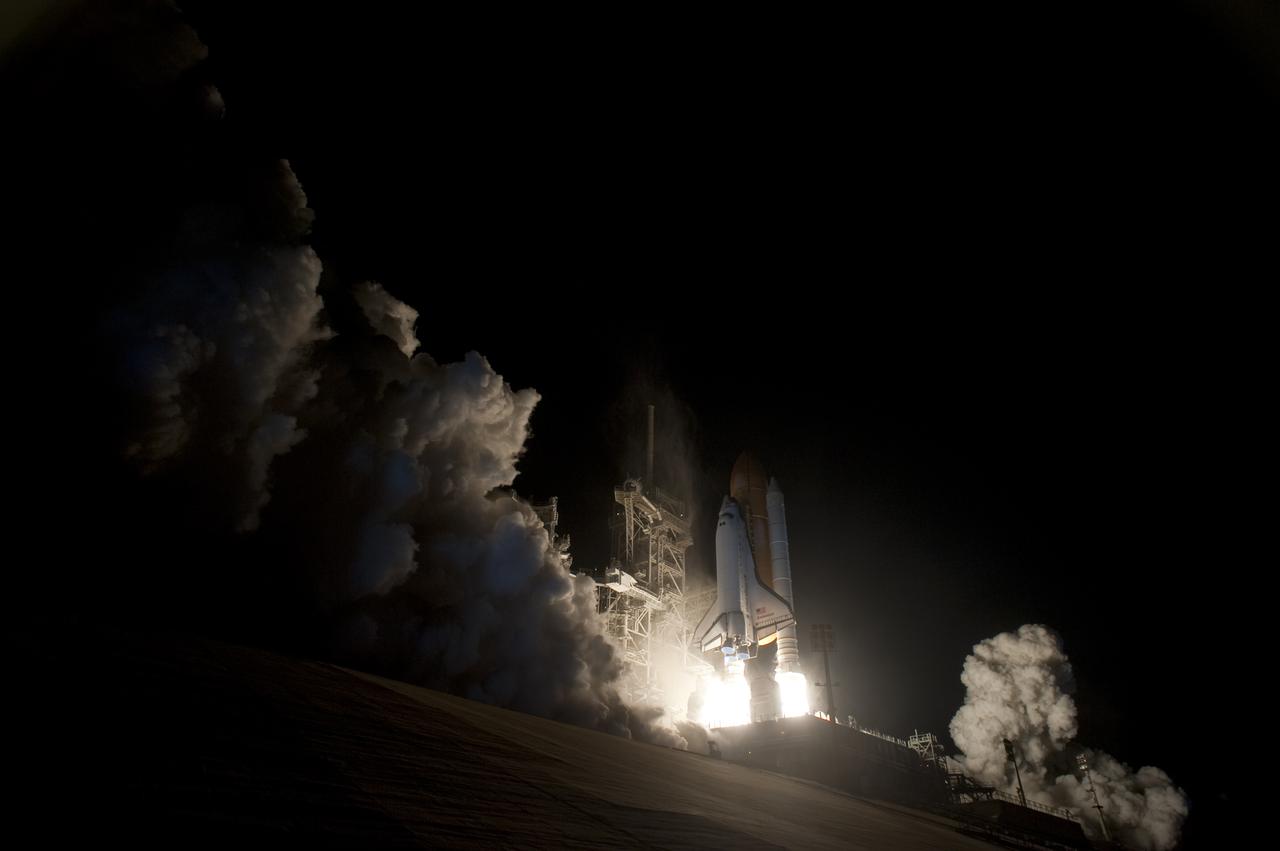
CAPE CANAVERAL, Fla. - An exhaust cloud forms at Launch Pad 39A at NASA's Kennedy Space Center in Florida as space shuttle Endeavour lifts off into the predawn sky. Launch of the STS-130 mission to the International Space Station was at 4:14 a.m. EST. This was the second launch attempt for space shuttle Endeavour's STS-130 crew and the final scheduled space shuttle night launch. The first attempt on Feb. 7 was scrubbed due to unfavorable weather. The primary payload for the STS-130 mission to the International Space Station is the Tranquility node, a pressurized module that will provide additional room for crew members and many of the station's life support and environmental control systems. Attached to one end of Tranquility is a cupola, a unique work area with six windows on its sides and one on top. The cupola resembles a circular bay window and will provide a vastly improved view of the station's exterior. The multi-directional view will allow the crew to monitor spacewalks and docking operations, as well as provide a spectacular view of Earth and other celestial objects. The module was built in Turin, Italy, by Thales Alenia Space for the European Space Agency. For information on the STS-130 mission and crew, visit http:__www.nasa.gov_mission_pages_shuttle_shuttlemissions_sts130_index.html. Photo credit: NASA_Sandra Joseph and Kevin O'Connell
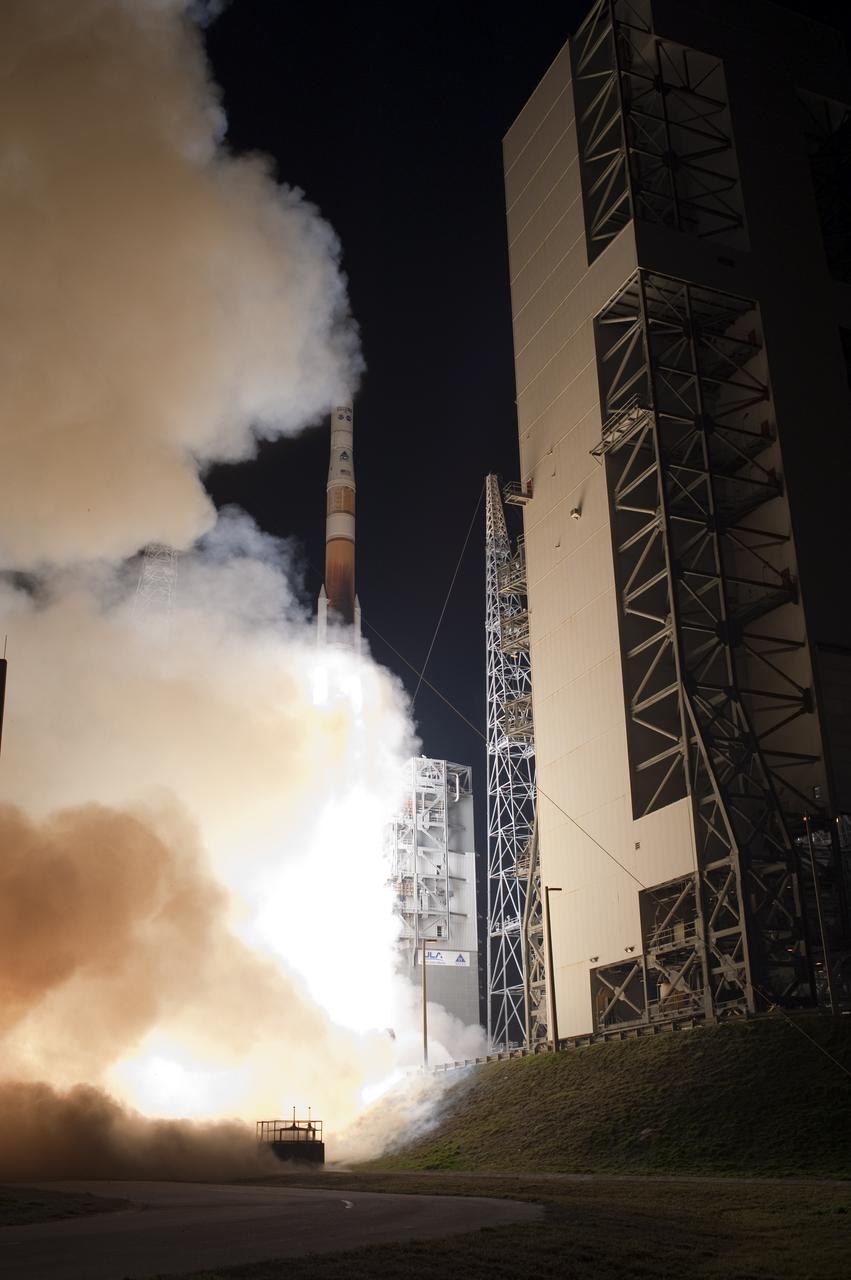
CAPE CANAVERAL, Fla. – An exhaust cloud building at Launch Complex 37 on Cape Canaveral Air Force Station in Florida obscures the United Launch Alliance Delta IV rocket carrying NASA's GOES-P meteorological satellite as it lifts off at 6:57 p.m. EST. GOES-P, the latest Geostationary Operational Environmental Satellite, was developed by NASA for the National Oceanic and Atmospheric Administration, or NOAA. The GOES-P spacecraft will be placed in a 22,300-mile-high geosynchronous orbit where it will appear to hover over a single point on Earth. The spacecraft is outfitted with a complex suite of observation instruments and cameras so it can accurately report on weather and climate conditions on Earth. For information on GOES-P, visit http:__www.nasa.gov_mission_pages_GOES-P_main_index.html. Photo credit: NASA_Sandra Joseph and Tony Gray
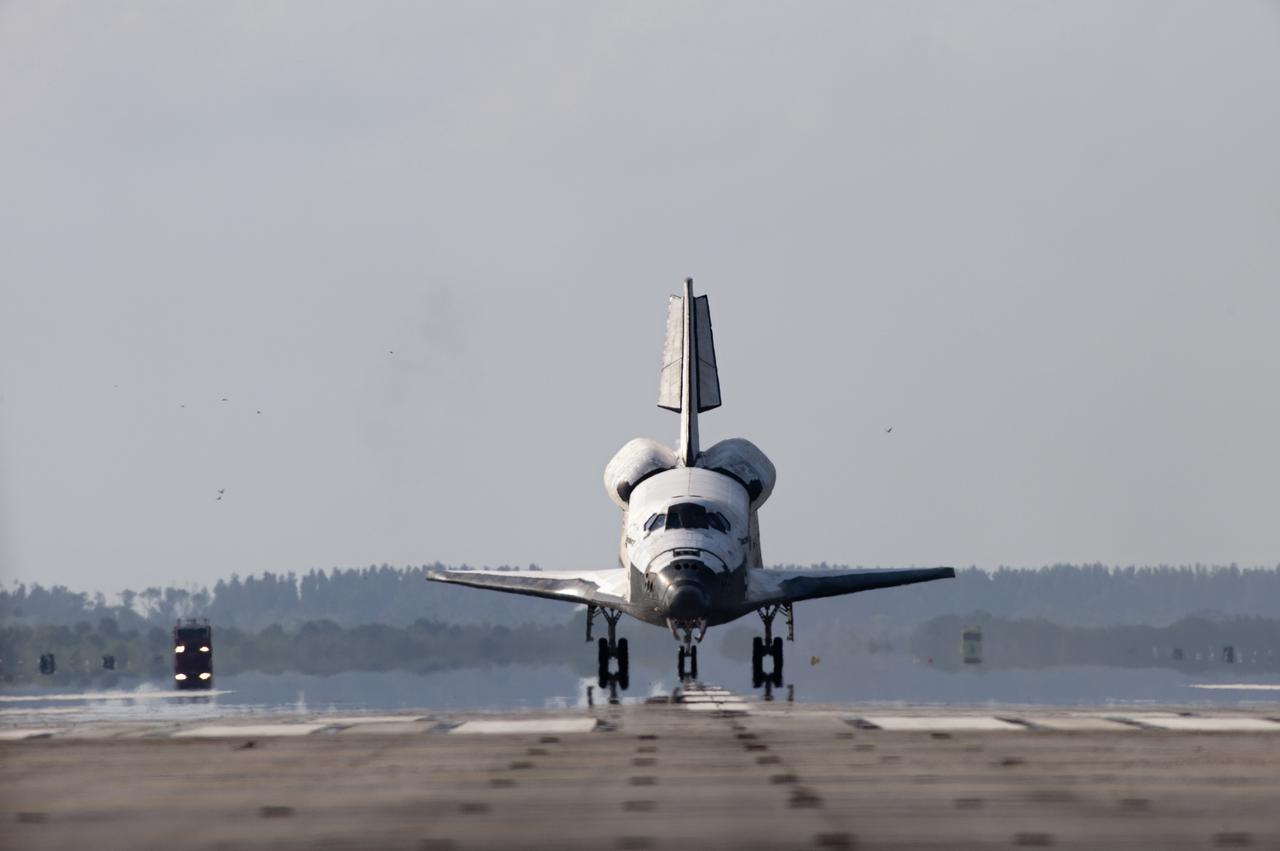
CAPE CANAVERAL, Fla. - Space shuttle Discovery lands on Runway 33 at the Shuttle Landing Facility at NASA's Kennedy Space Center in Florida at 9:08 a.m. EDT, completing the 15-day STS-131 mission to the International Space Station. Main gear touchdown was at 9:08:35 a.m. EDT followed by nose gear touchdown at 9:08:47 a.m. and wheelstop at 9:09:33 a.m. Aboard are Commander Alan Poindexter; Pilot James P. Dutton Jr.; and Mission Specialists Rick Mastracchio, Clayton Anderson, Dorothy Metcalf-Lindenburger, Stephanie Wilson and Naoko Yamazaki of the Japan Aerospace Exploration Agency. The seven-member STS-131 crew carried the multi-purpose logistics module Leonardo, filled with supplies, a new crew sleeping quarters and science racks that were transferred to the International Space Station's laboratories. The crew also switched out a gyroscope on the station’s truss, installed a spare ammonia storage tank and retrieved a Japanese experiment from the station’s exterior. STS-131 is the 33rd shuttle mission to the station and the 131st shuttle mission overall. For information on the STS-131 mission and crew, visit http:__www.nasa.gov_mission_pages_shuttle_shuttlemissions_sts131_index.html. Photo credit: NASA_Sandra Joseph and Kevin O'Connell
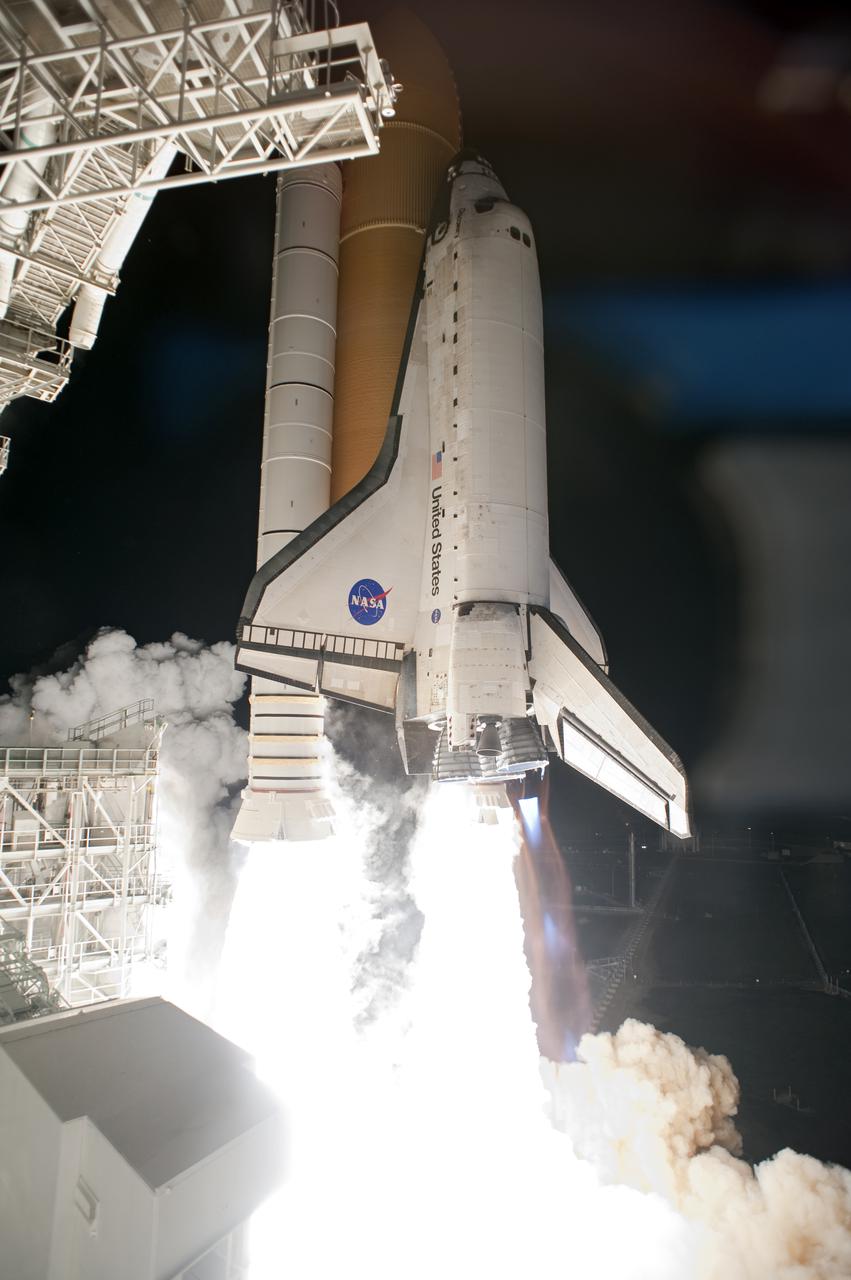
CAPE CANAVERAL, Fla. - Space shuttle Discovery roars off Launch Pad 39A at NASA's Kennedy Space Center in Florida beginning the STS-131 mission. Shuttle Discovery lifted off at 6:21 a.m. EDT on April 5, 2010. The seven-member STS-131 crew will deliver the multi-purpose logistics module Leonardo, filled with supplies, a new crew sleeping quarters and science racks that will be transferred to the International Space Station's laboratories. The crew also will switch out a gyroscope on the station’s truss, install a spare ammonia storage tank and retrieve a Japanese experiment from the station’s exterior. STS-131 is the 33rd shuttle mission to the station and the 131st shuttle mission overall. For information on the STS-131 mission and crew, visit http:__www.nasa.gov_mission_pages_shuttle_shuttlemissions_sts131_index.html. Photo credit: NASA_Sandra Joseph and Kevin O'Connell
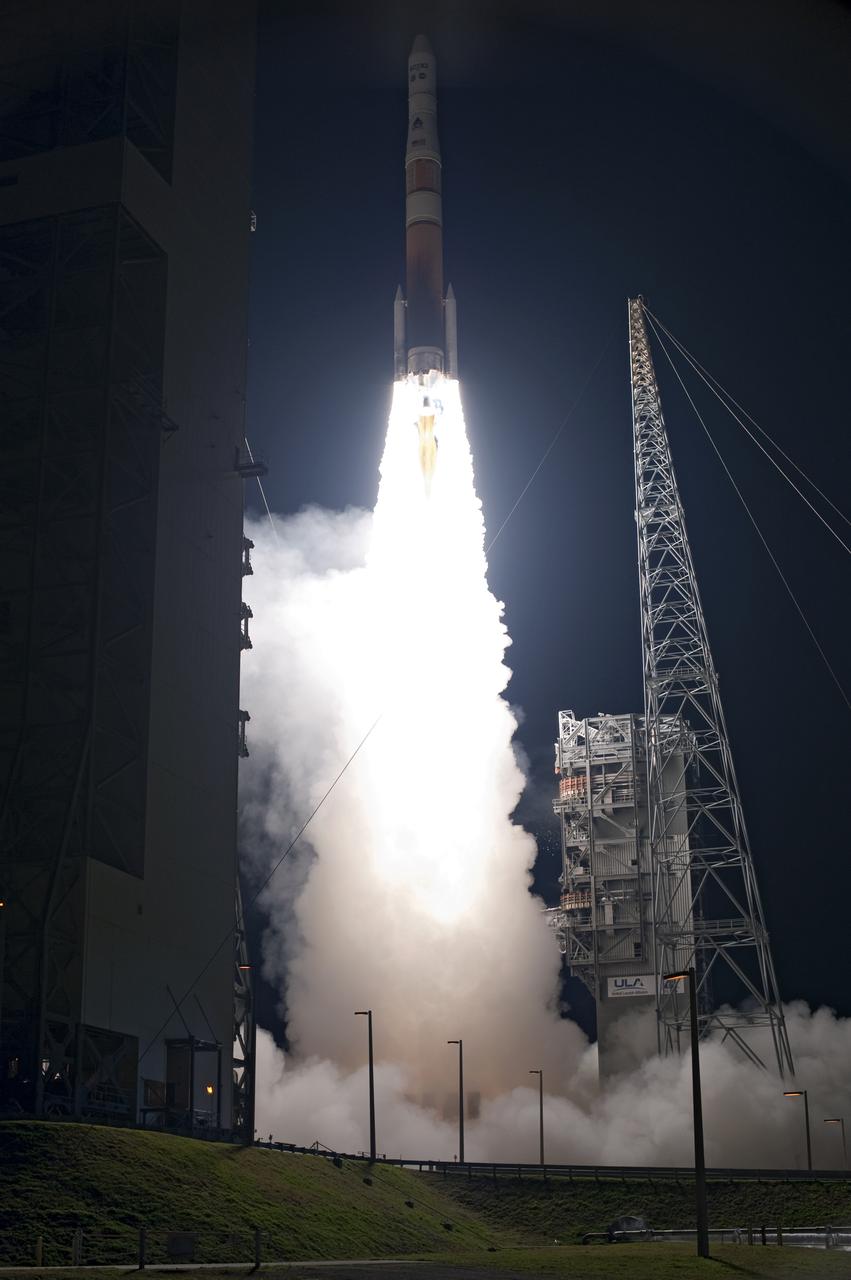
CAPE CANAVERAL, Fla. – The United Launch Alliance Delta IV rocket carrying NASA's GOES-P meteorological satellite rushes to orbit from Launch Complex 37 on Cape Canaveral Air Force Station in Florida. Liftoff was at 6:57 p.m. EST. GOES-P, the latest Geostationary Operational Environmental Satellite, was developed by NASA for the National Oceanic and Atmospheric Administration, or NOAA. The GOES-P spacecraft will be placed in a 22,300-mile-high geosynchronous orbit where it will appear to hover over a single point on Earth. The spacecraft is outfitted with a complex suite of observation instruments and cameras so it can accurately report on weather and climate conditions on Earth. For information on GOES-P, visit http:__www.nasa.gov_mission_pages_GOES-P_main_index.html. Photo credit: NASA_Sandra Joseph and Tony Gray

CAPE CANAVERAL, Fla. - Coming in from the southeast, space shuttle Atlantis touches down on Runway 33 at the Shuttle Landing Facility at NASA's Kennedy Space Center in Florida. Landing was at 8:48 a.m. EDT, completing the 12-day STS-132 mission to the International Space Station. The six-member STS-132 crew carried the Russian-built Mini Research Module-1 to the space station. STS-132 is the 34th shuttle mission to the station, the 132nd shuttle mission overall and the last planned flight for Atlantis. For information on the STS-132 mission and crew, visit www.nasa.gov_mission_pages_shuttle_shuttlemissions_sts132_index.html. Photo credit: NASA_Sandra Joseph and Carl Winebarger
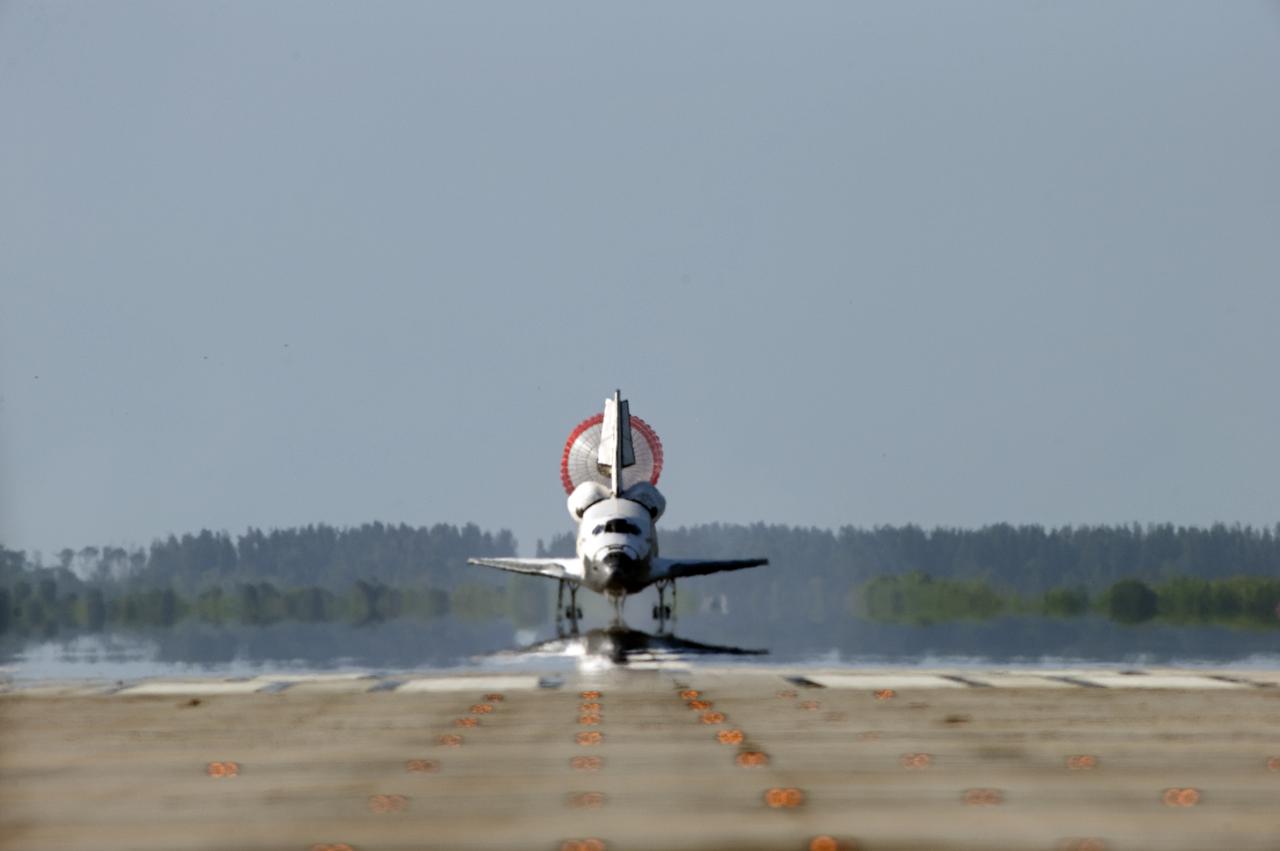
CAPE CANAVERAL, Fla. - With its drag chute unfurled, space shuttle Atlantis rolls down Runway 33 at the Shuttle Landing Facility at NASA's Kennedy Space Center in Florida. Landing was at 8:48 a.m. EDT, completing the 12-day STS-132 mission to the International Space Station. The six-member STS-132 crew carried the Russian-built Mini Research Module-1 to the space station. STS-132 is the 34th shuttle mission to the station, the 132nd shuttle mission overall and the last planned flight for Atlantis. For information on the STS-132 mission and crew, visit www.nasa.gov_mission_pages_shuttle_shuttlemissions_sts132_index.html. Photo credit: NASA_Sandra Joseph and Carl Winebarger
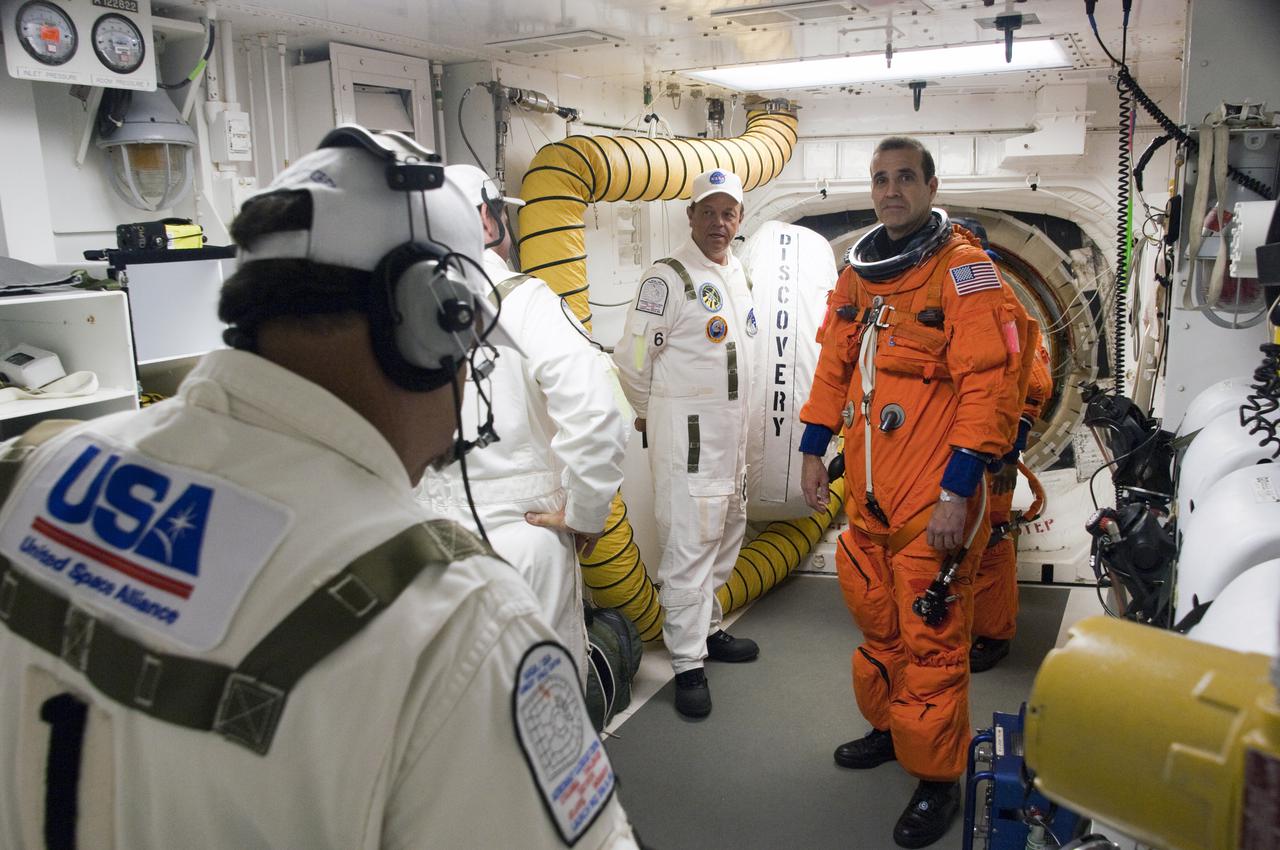
CAPE CANAVERAL, Fla. - In the White Room at Launch Pad 39A at NASA's Kennedy Space Center in Florida, United Space Alliance space suit technicians ensure that the launch-and-entry suit of STS-131 Mission Specialist Rick Mastracchio fits properly before he enters space shuttle Discovery through the crew hatch in the background. Liftoff of the STS-131 mission is set for 6:21 a.m. EDT on April 5. On STS-131, the seven-member crew will deliver the multi-purpose logistics module Leonardo, filled with supplies, a new crew sleeping quarters and science racks that will be transferred to the International Space Station's laboratories. The crew also will switch out a gyroscope on the station’s truss, install a spare ammonia storage tank and retrieve a Japanese experiment from the station’s exterior. STS-131 is the 33rd shuttle mission to the station and the 131st shuttle mission overall. For information on the STS-131 mission and crew, visit http:__www.nasa.gov_mission_pages_shuttle_shuttlemissions_sts131_index.html. Photo credit: NASA_Sandra Joseph and Kevin O'Connell
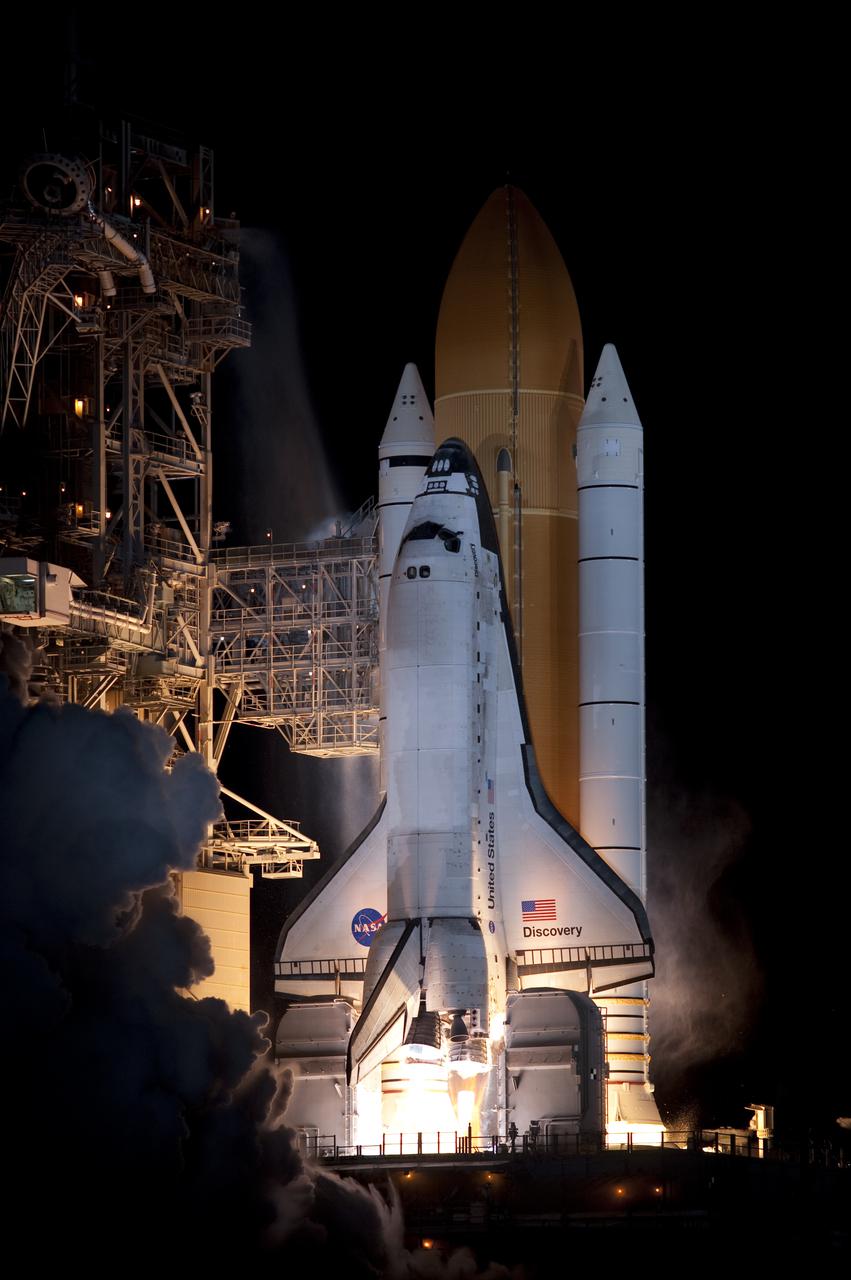
CAPE CANAVERAL, Fla. - Space shuttle Discovery majestically begins its ascent into the predawn sky at Launch Pad 39A at NASA's Kennedy Space Center in Florida. Shuttle Discovery lifted off at 6:21 a.m. EDT on April 5, 2010. The seven-member STS-131 crew will deliver the multi-purpose logistics module Leonardo, filled with supplies, a new crew sleeping quarters and science racks that will be transferred to the International Space Station's laboratories. The crew also will switch out a gyroscope on the station’s truss, install a spare ammonia storage tank and retrieve a Japanese experiment from the station’s exterior. STS-131 is the 33rd shuttle mission to the station and the 131st shuttle mission overall. For information on the STS-131 mission and crew, visit http:__www.nasa.gov_mission_pages_shuttle_shuttlemissions_sts131_index.html. Photo credit: NASA_Sandra Joseph and Kevin O'Connell
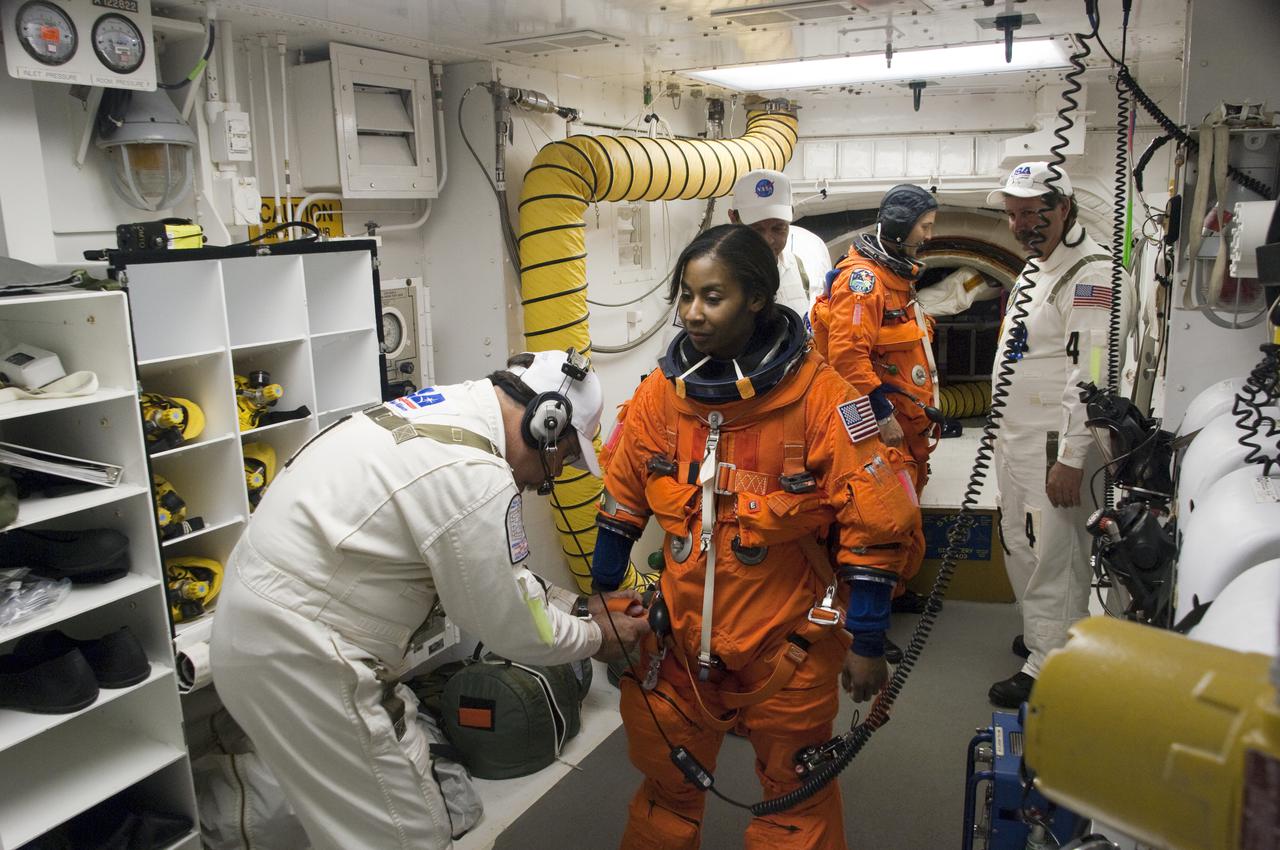
CAPE CANAVERAL, Fla. - In the White Room at Launch Pad 39A at NASA's Kennedy Space Center in Florida, United Space Alliance space suit technicians ensure that the launch-and-entry suit of STS-131 Mission Specialist Stephanie Wilson fits properly before she enters space shuttle Discovery through the crew hatch in the background. Liftoff of the STS-131 mission is set for 6:21 a.m. EDT on April 5. On STS-131, the seven-member crew will deliver the multi-purpose logistics module Leonardo, filled with supplies, a new crew sleeping quarters and science racks that will be transferred to the International Space Station's laboratories. The crew also will switch out a gyroscope on the station’s truss, install a spare ammonia storage tank and retrieve a Japanese experiment from the station’s exterior. STS-131 is the 33rd shuttle mission to the station and the 131st shuttle mission overall. For information on the STS-131 mission and crew, visit http:__www.nasa.gov_mission_pages_shuttle_shuttlemissions_sts131_index.html. Photo credit: NASA_Sandra Joseph and Kevin O'Connell
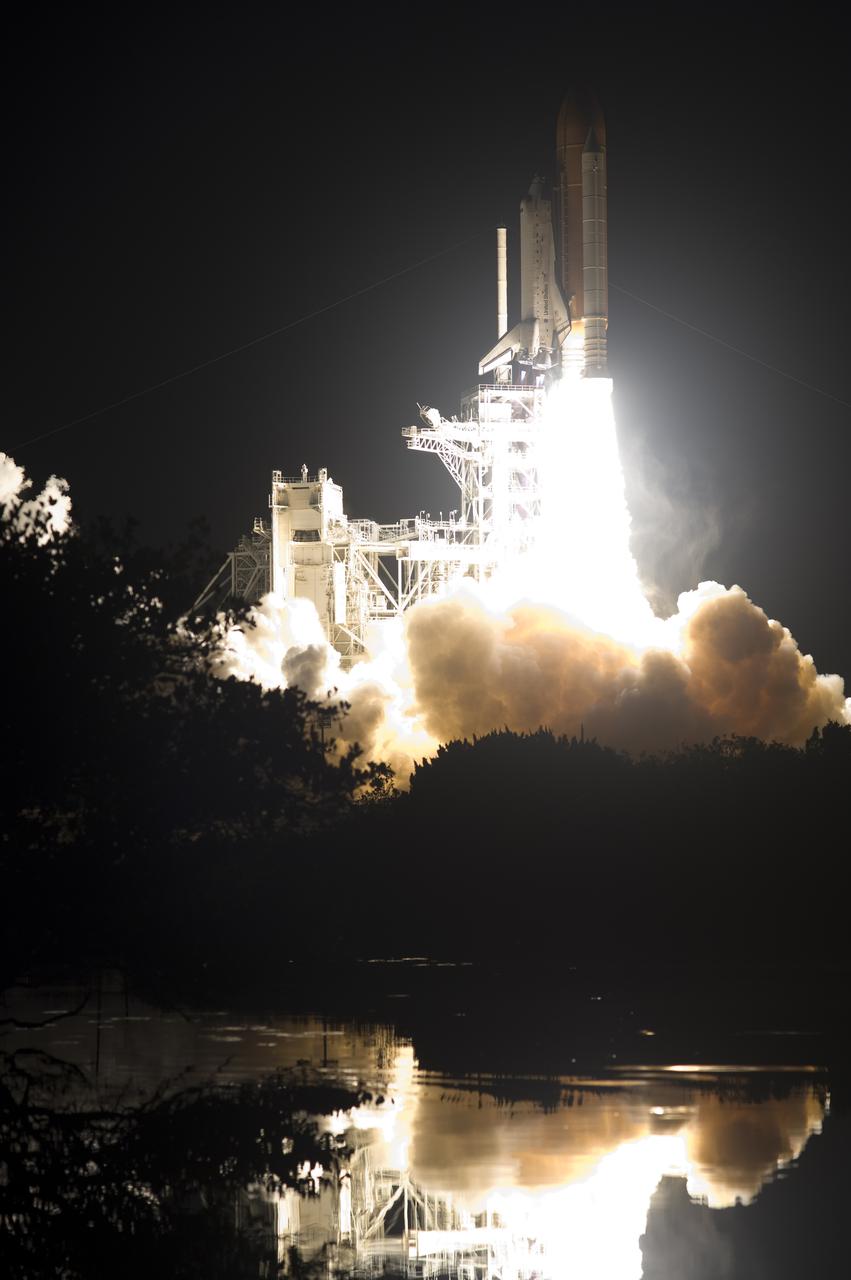
CAPE CANAVERAL, Fla. - The brilliance of space shuttle Discovery's liftoff at NASA's Kennedy Space Center in Florida is reflected in the water near Launch Pad 39A. Liftoff on the STS-131 mission was on time at 6:21 a.m. EDT. The seven-member crew will deliver the multi-purpose logistics module Leonardo, filled with supplies, a new crew sleeping quarters and science racks that will be transferred to the International Space Station's laboratories. The crew also will switch out a gyroscope on the station’s truss, install a spare ammonia storage tank and retrieve a Japanese experiment from the station’s exterior. STS-131 is the 33rd shuttle mission to the station and the 131st shuttle mission overall. For information on the STS-131 mission and crew, visit http:__www.nasa.gov_mission_pages_shuttle_shuttlemissions_sts131_index.html. Photo credit: NASA_Sandra Joseph and Kevin O'Connell
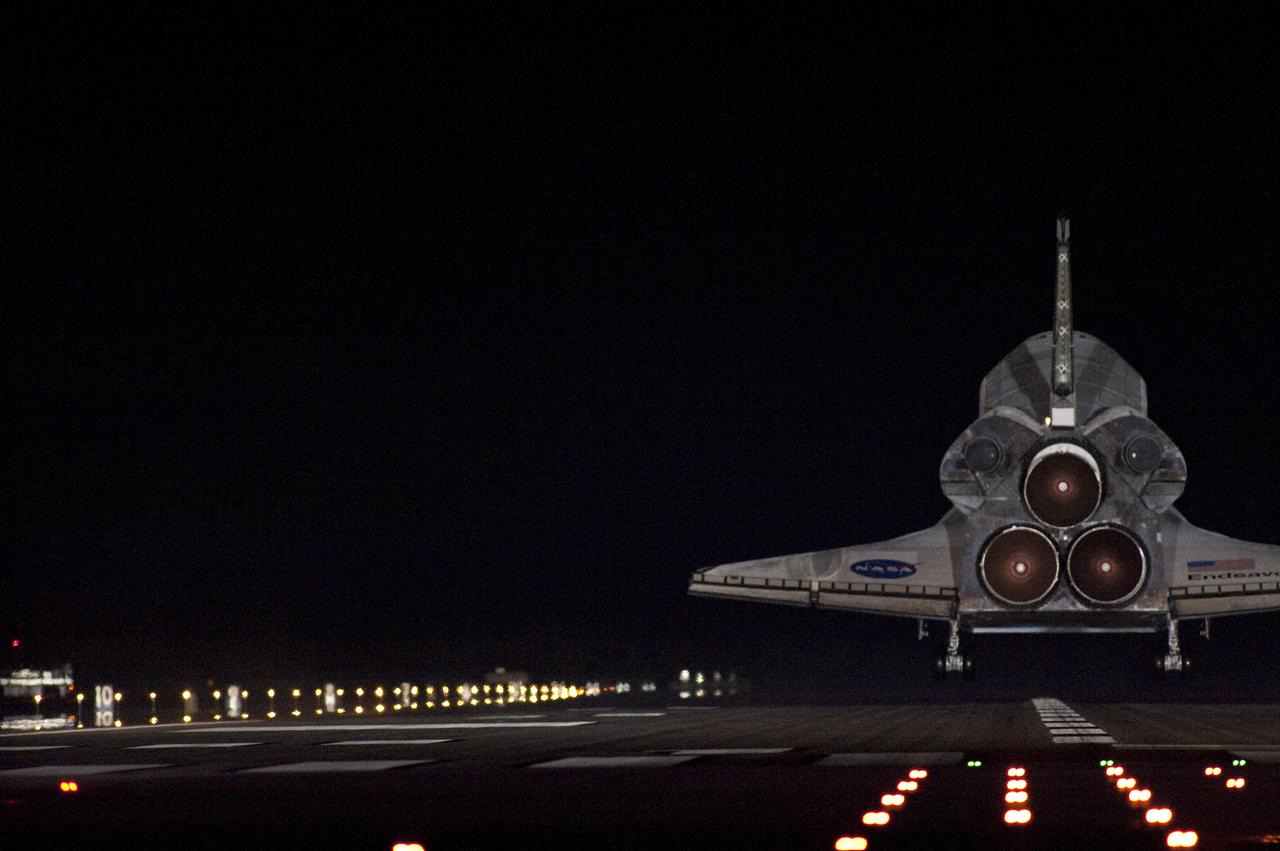
CAPE CANAVERAL, Fla. - Under the veil of darkness, space shuttle Endeavour nears touchdown on Runway 15 at the Shuttle Landing Facility at NASA's Kennedy Space Center in Florida after 14 days in space, completing the 5.7-million-mile STS-130 mission to the International Space Station on orbit 217. Main gear touchdown was at 10:20:31 p.m. EST followed by nose gear touchdown at 10:20:39 p.m. and wheels stop at 10:22:10 p.m. It was the 23rd night landing in shuttle history and the 17th at Kennedy. Aboard are Commander George Zamka; Pilot Terry Virts; and Mission Specialists Robert Behnken, Nicholas Patrick, Kathryn Hire and Stephen Robinson. During Endeavour's STS-130 mission, astronauts installed the Tranquility node, a module that provides additional room for crew members and many of the station's life support and environmental control systems. Attached to Tranquility is a cupola with seven windows that provide a panoramic view of Earth, celestial objects and visiting spacecraft. The module was built in Turin, Italy, by Thales Alenia Space for the European Space Agency. The orbiting laboratory is approximately 90 percent complete now in terms of mass. STS-130 was the 24th flight for Endeavour, the 32nd shuttle mission devoted to ISS assembly and maintenance, and the 130th shuttle mission to date. For information on the STS-130 mission and crew, visit http:__www.nasa.gov_mission_pages_shuttle_shuttlemissions_sts130. Photo credit: NASA_Sandra Joseph and Kevin O'Connell
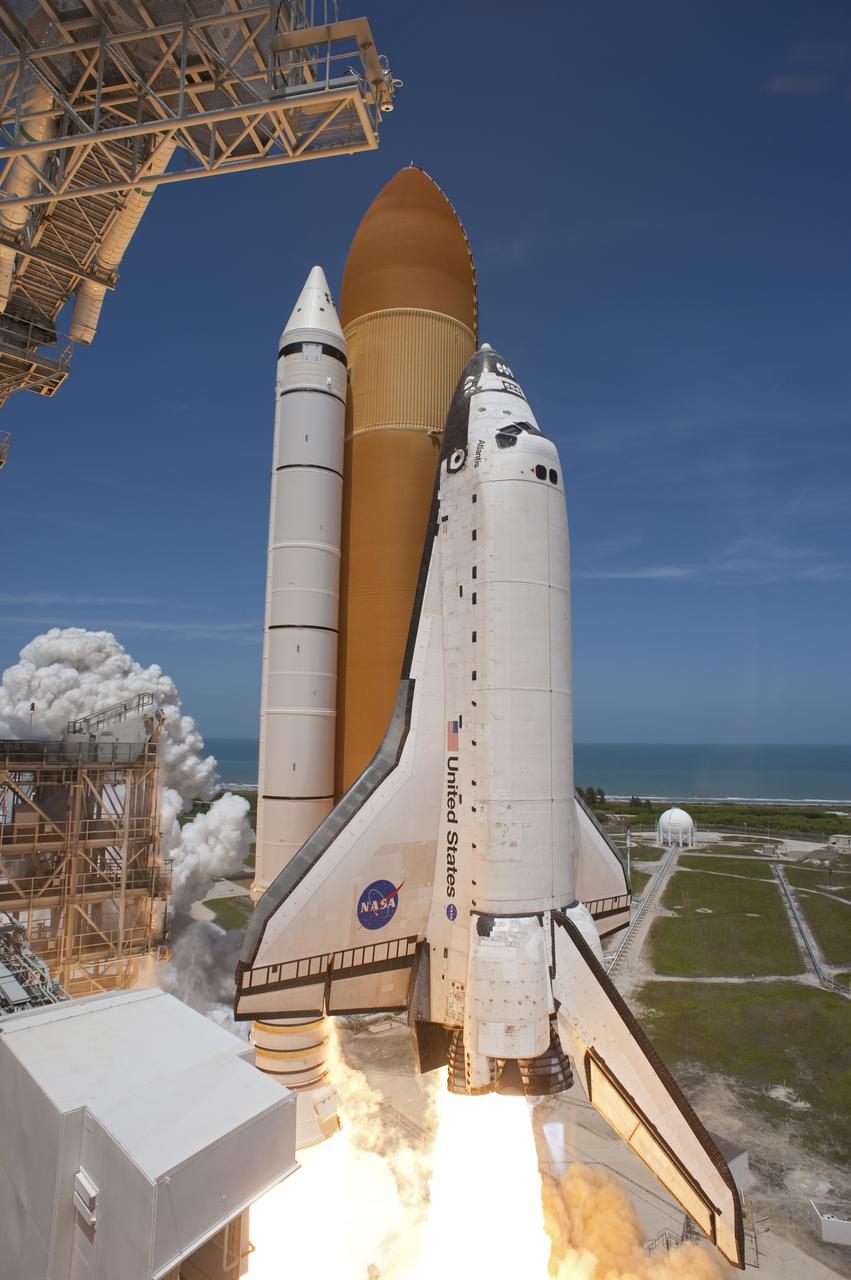
CAPE CANAVERAL, Fla. - Space shuttle Atlantis and its six STS-132 astronauts lift off its seaside launch pad at NASA's Kennedy Space Center in Florida at 2:20 p.m. EDT on May 14. Atlantis' primary payload for the STS-132 mission is the Russian-built Mini Research Module-1, which will provide additional storage space and a new docking port for Russian Soyuz and Progress spacecraft aboard the International Space Station. STS-132 is the 132nd shuttle flight, the 32nd for Atlantis and the 34th shuttle mission dedicated to station assembly and maintenance. For more information on the STS-132 mission objectives, payload and crew, visit www.nasa.gov_mission_pages_shuttle_shuttlemissions_sts132_index.html. Photo credit: NASA_Sandra Joseph and Kevin O'Connell
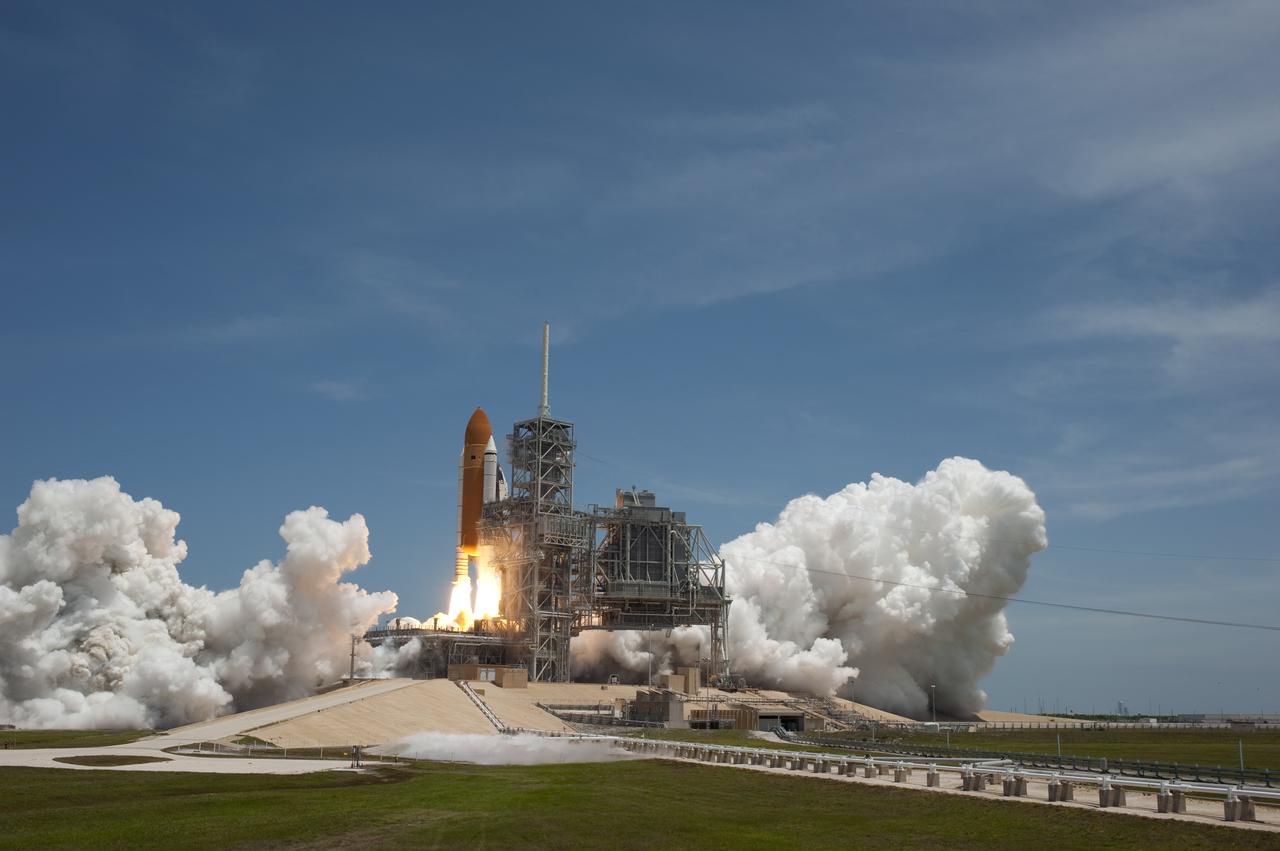
CAPE CANAVERAL, Fla. - At NASA's Kennedy Space Center in Florida, an exhaust plume builds on Launch Pad 39A as space shuttle Atlantis' engines ignite. Liftoff occurred right on time at 2:20 p.m. EDT on May 14. Atlantis' primary payload for the STS-132 mission is the Russian-built Mini Research Module-1, which will provide additional storage space and a new docking port for Russian Soyuz and Progress spacecraft aboard the International Space Station. STS-132 is the 132nd shuttle flight, the 32nd for Atlantis and the 34th shuttle mission dedicated to station assembly and maintenance. For more information on the STS-132 mission objectives, payload and crew, visit www.nasa.gov_mission_pages_shuttle_shuttlemissions_sts132_index.html. Photo credit: NASA_Sandra Joseph and Kevin O'Connell

CAPE CANAVERAL, Fla. – An exhaust cloud forms at Launch Complex 37 on Cape Canaveral Air Force Station in Florida as the United Launch Alliance Delta IV rocket carrying NASA's GOES-P meteorological satellite lifts off at 6:57 p.m. EST. GOES-P, the latest Geostationary Operational Environmental Satellite, was developed by NASA for the National Oceanic and Atmospheric Administration, or NOAA. The GOES-P spacecraft will be placed in a 22,300-mile-high geosynchronous orbit where it will appear to hover over a single point on Earth. The spacecraft is outfitted with a complex suite of observation instruments and cameras so it can accurately report on weather and climate conditions on Earth. For information on GOES-P, visit http:__www.nasa.gov_mission_pages_GOES-P_main_index.html. Photo credit: NASA_Sandra Joseph and Tony Gray
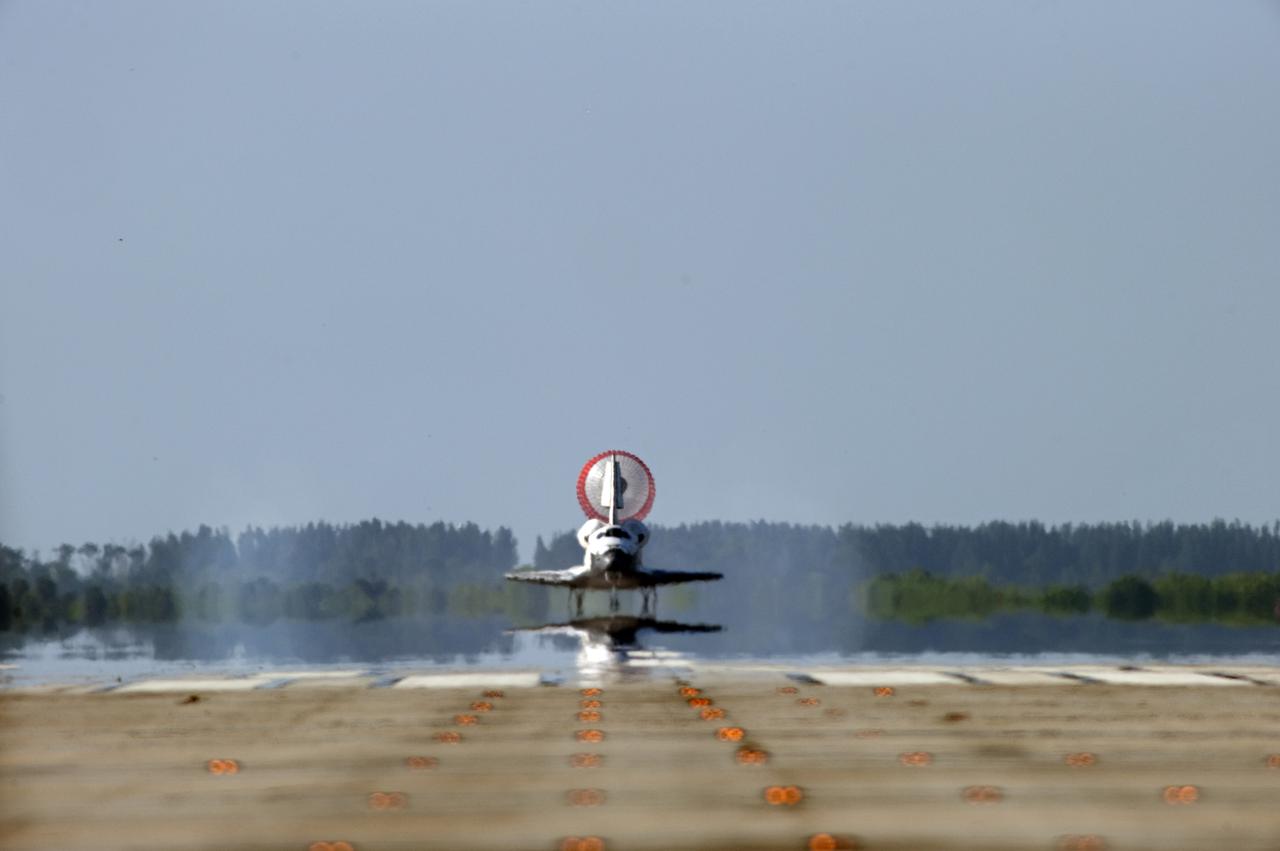
CAPE CANAVERAL, Fla. - With its drag chute unfurled, space shuttle Atlantis rolls down Runway 33 at the Shuttle Landing Facility at NASA's Kennedy Space Center in Florida. Landing was at 8:48 a.m. EDT, completing the 12-day STS-132 mission to the International Space Station. The six-member STS-132 crew carried the Russian-built Mini Research Module-1 to the space station. STS-132 is the 34th shuttle mission to the station, the 132nd shuttle mission overall and the last planned flight for Atlantis. For information on the STS-132 mission and crew, visit www.nasa.gov_mission_pages_shuttle_shuttlemissions_sts132_index.html. Photo credit: NASA_Sandra Joseph and Carl Winebarger

CAPE CANAVERAL, Fla. - Space shuttle Atlantis' twin solid rocket boosters ignite to propel the spacecraft off NASA Kennedy Space Center's Launch Pad 39A and into orbit at 2:20 p.m. EDT on May 14. On board Atlantis, for its last planned flight, are six veteran NASA astronauts. Atlantis' primary payload for the STS-132 mission is the Russian-built Mini Research Module-1, which will provide additional storage space and a new docking port for Russian Soyuz and Progress spacecraft aboard the International Space Station. STS-132 is the 132nd shuttle flight, the 32nd for Atlantis and the 34th shuttle mission dedicated to station assembly and maintenance. For more information on the STS-132 mission objectives, payload and crew, visit www.nasa.gov_mission_pages_shuttle_shuttlemissions_sts132_index.html. Photo credit: NASA_Sandra Joseph and Kevin O'Connell
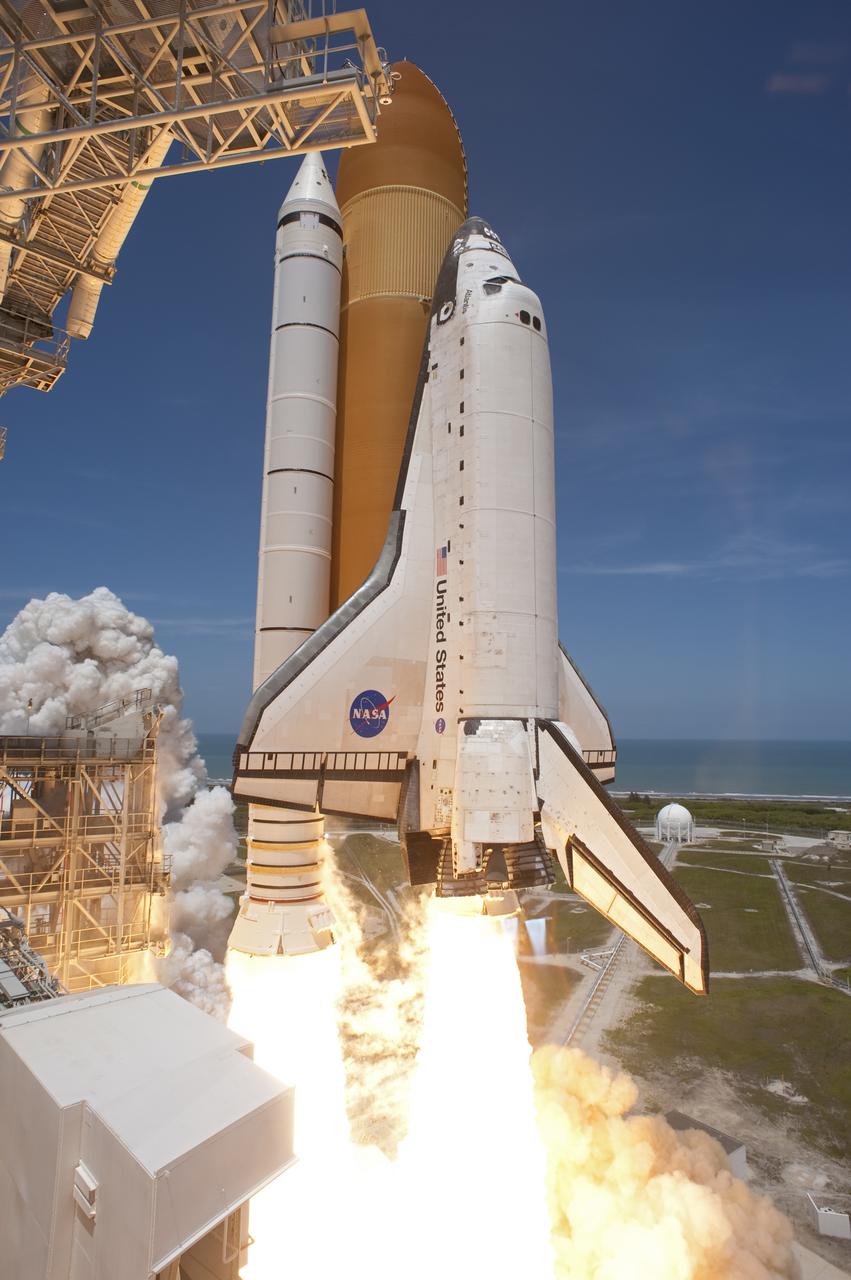
CAPE CANAVERAL, Fla. - Space shuttle Atlantis and its six STS-132 astronauts lift off its seaside launch pad at NASA's Kennedy Space Center in Florida at 2:20 p.m. EDT on May 14. Atlantis' primary payload for the STS-132 mission is the Russian-built Mini Research Module-1, which will provide additional storage space and a new docking port for Russian Soyuz and Progress spacecraft aboard the International Space Station. STS-132 is the 132nd shuttle flight, the 32nd for Atlantis and the 34th shuttle mission dedicated to station assembly and maintenance. For more information on the STS-132 mission objectives, payload and crew, visit www.nasa.gov_mission_pages_shuttle_shuttlemissions_sts132_index.html. Photo credit: NASA_Sandra Joseph and Kevin O'Connell
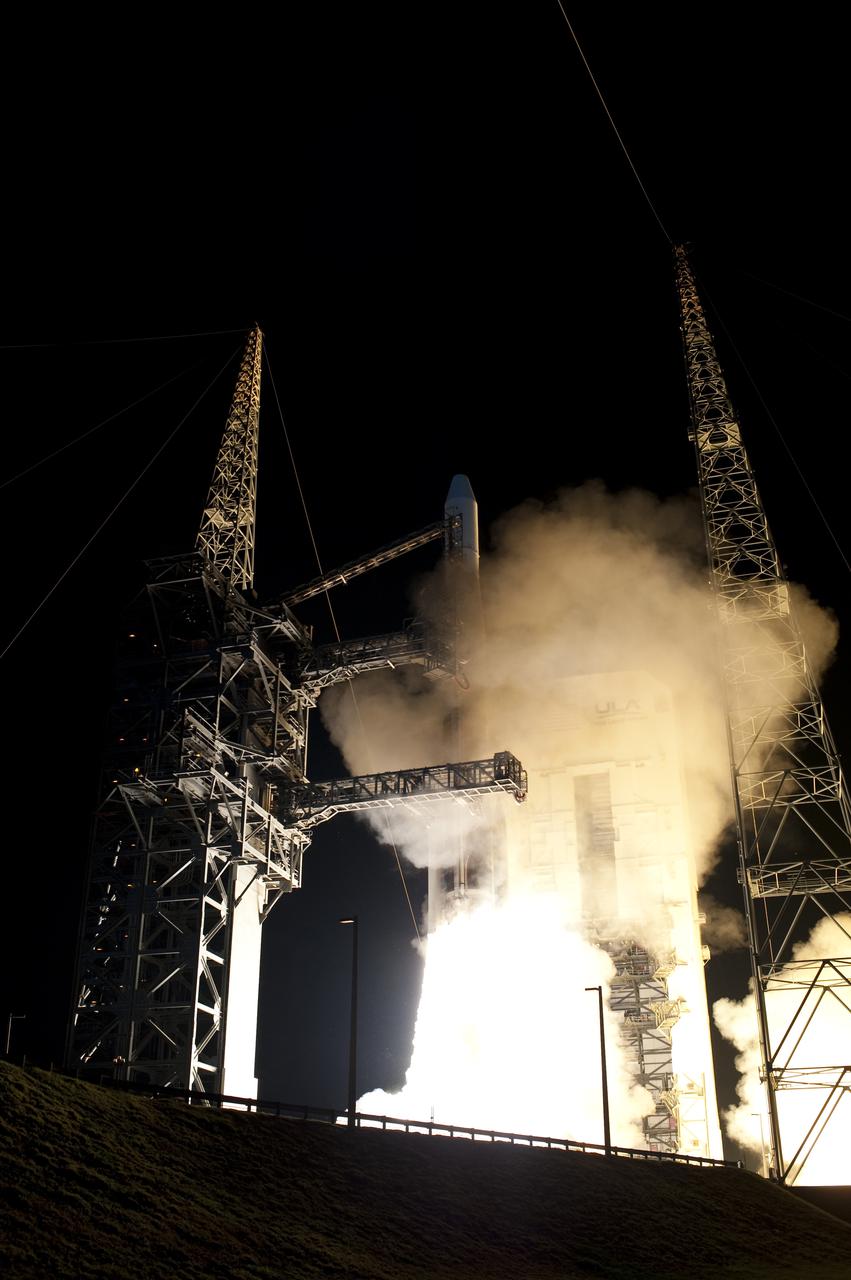
CAPE CANAVERAL, Fla. – A United Launch Alliance Delta IV rocket with the GOES-P satellite aboard roars to life after ignition and liftoff from Launch Complex 37 at Cape Canaveral Air Force Station in Florida at 6:57 p.m. EST. GOES-P, the latest Geostationary Operational Environmental Satellite, was developed by NASA for the National Oceanic and Atmospheric Administration, or NOAA. The GOES-P spacecraft will be placed in a 22,300-mile-high geosynchronous orbit where it will appear to hover over a single point on Earth. The spacecraft is outfitted with a complex suite of observation instruments and cameras so it can accurately report on weather and climate conditions on Earth. For information on GOES-P, visit http:__www.nasa.gov_mission_pages_GOES-P_main_index.html. Photo credit: NASA_Sandra Joseph and Tony Gray
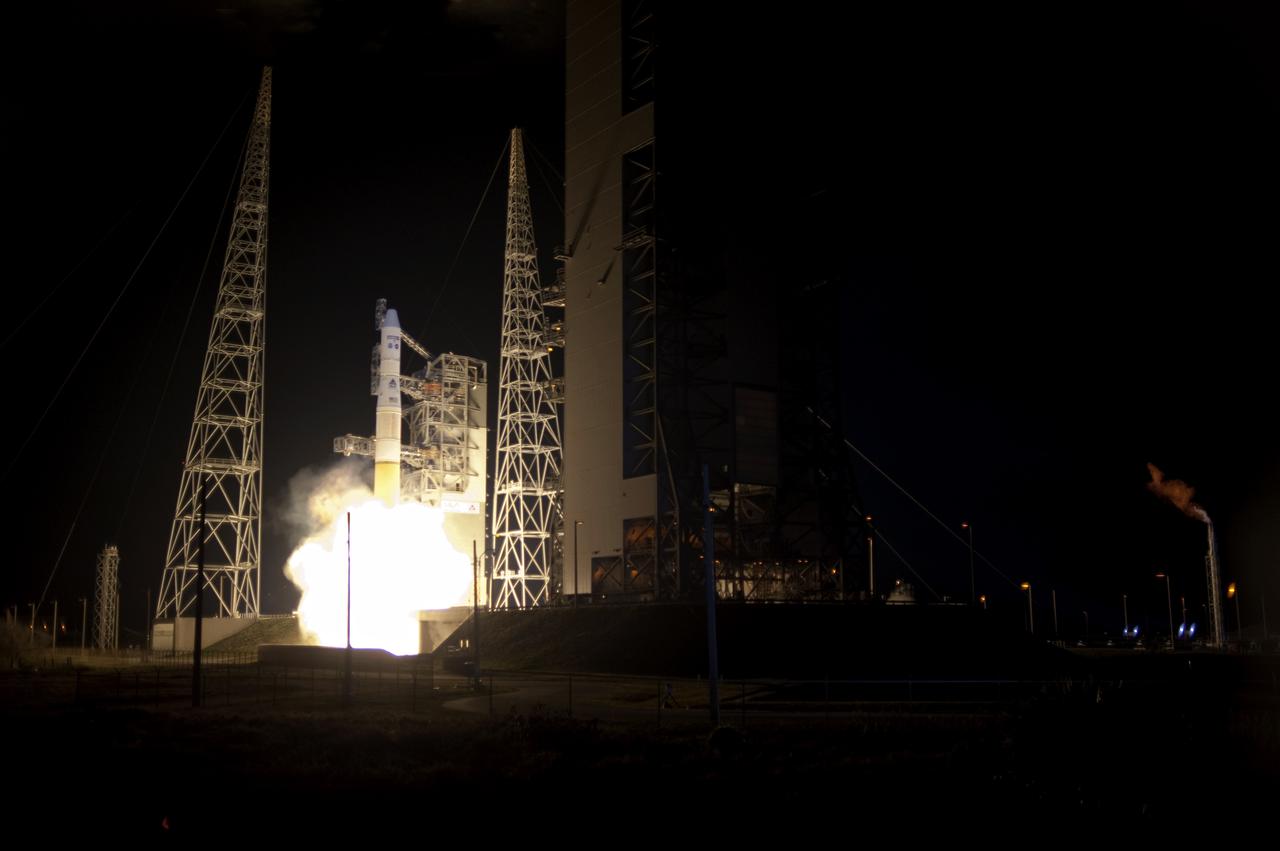
CAPE CANAVERAL, Fla. – Engine ignition on the United Launch Alliance Delta IV rocket carrying NASA's GOES-P meteorological satellite creates a flash of light on Launch Complex 37 on Cape Canaveral Air Force Station in Florida. Liftoff was at 6:57 p.m. EST. GOES-P, the latest Geostationary Operational Environmental Satellite, was developed by NASA for the National Oceanic and Atmospheric Administration, or NOAA. The GOES-P spacecraft will be placed in a 22,300-mile-high geosynchronous orbit where it will appear to hover over a single point on Earth. The spacecraft is outfitted with a complex suite of observation instruments and cameras so it can accurately report on weather and climate conditions on Earth. For information on GOES-P, visit http:__www.nasa.gov_mission_pages_GOES-P_main_index.html. Photo credit: NASA_Sandra Joseph and Tony Gray
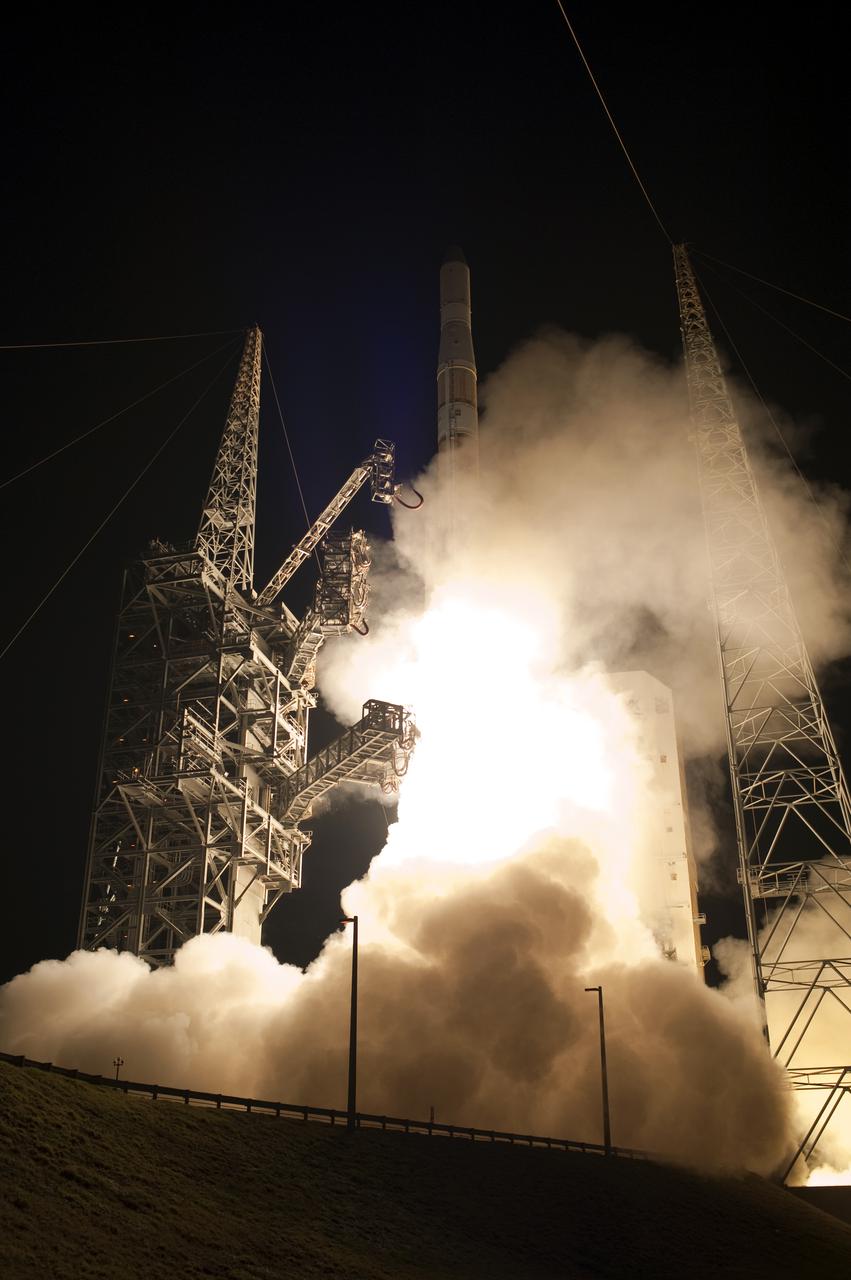
CAPE CANAVERAL, Fla. – The GOES-P spacecraft atop a United Launch Alliance Delta IV rocket begins its climb to orbit from Launch Complex 37 on Cape Canaveral Air Force Station at 6:57 p.m. EST. GOES-P, the latest Geostationary Operational Environmental Satellite, was developed by NASA for the National Oceanic and Atmospheric Administration, or NOAA. The GOES-P spacecraft will be placed in a 22,300-mile-high geosynchronous orbit where it will appear to hover over a single point on Earth. The spacecraft is outfitted with a complex suite of observation instruments and cameras so it can accurately report on weather and climate conditions on Earth. For information on GOES-P, visit http:__www.nasa.gov_mission_pages_GOES-P_main_index.html. Photo credit: NASA_Sandra Joseph and Tony Gray
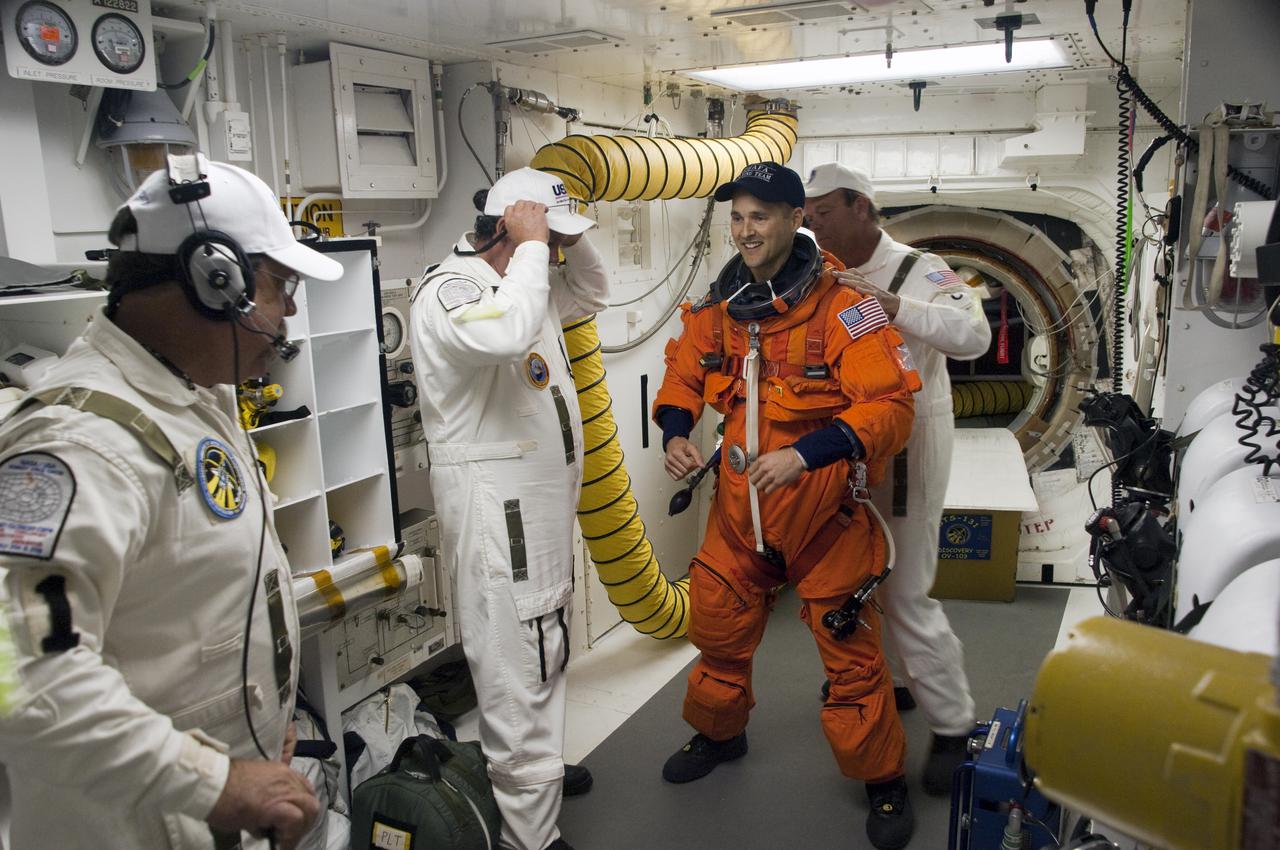
CAPE CANAVERAL, Fla. - In the White Room at Launch Pad 39A at NASA's Kennedy Space Center in Florida, United Space Alliance space suit technicians ensure that the launch-and-entry suit of STS-131 Pilot James P. Dutton Jr. fits properly before he enters space shuttle Discovery through the crew hatch in the background. Liftoff of the STS-131 mission is set for 6:21 a.m. EDT on April 5. On STS-131, the seven-member crew will deliver the multi-purpose logistics module Leonardo, filled with supplies, a new crew sleeping quarters and science racks that will be transferred to the International Space Station's laboratories. The crew also will switch out a gyroscope on the station’s truss, install a spare ammonia storage tank and retrieve a Japanese experiment from the station’s exterior. STS-131 is the 33rd shuttle mission to the station and the 131st shuttle mission overall. For information on the STS-131 mission and crew, visit http:__www.nasa.gov_mission_pages_shuttle_shuttlemissions_sts131_index.html. Photo credit: NASA_Sandra Joseph and Kevin O'Connell
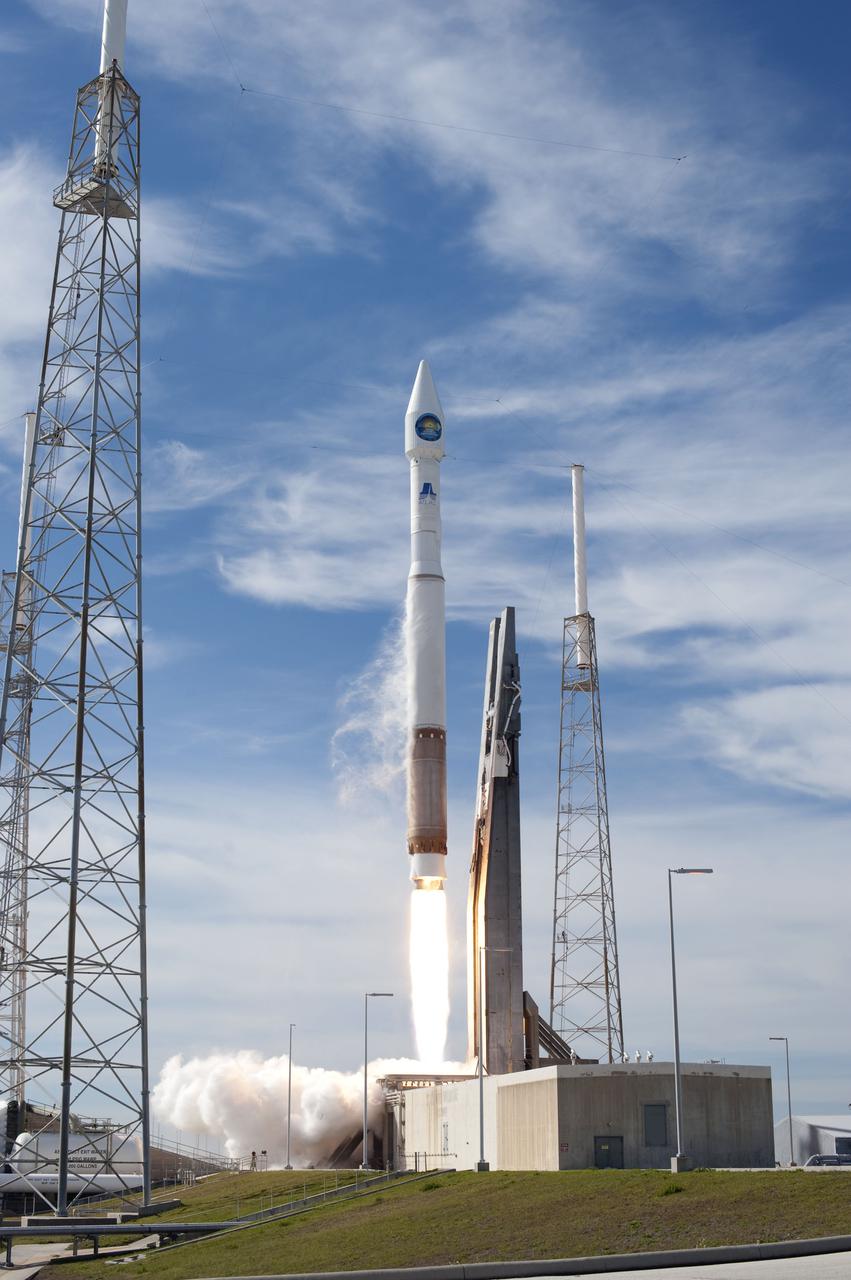
CAPE CANAVERAL, Fla. – The United Launch Alliance Atlas V rocket carrying NASA's Solar Dynamics Observatory defies gravity at Launch Complex 41 on Cape Canaveral Air Force Station as its engines ignite. Liftoff was at 10:23 a.m. EST Feb. 11. This is the 100th launch of a commercial Atlas_Centaur rocket. The observatory, known as SDO, is the first mission in NASA's Living With a Star Program and is designed to study the causes of solar variability and its impacts on Earth. The spacecraft's long-term measurements will give solar scientists in-depth information to help characterize the interior of the Sun, the Sun's magnetic field, the hot plasma of the solar corona, and the density of radiation that creates the ionosphere of the planets. The information will be used to create better forecasts of space weather needed to protect the aircraft, satellites and astronauts living and working in space. For information on SDO, visit http:__www.nasa.gov_sdo. Photo credit: NASA_Sandra Joseph and Tony Gray
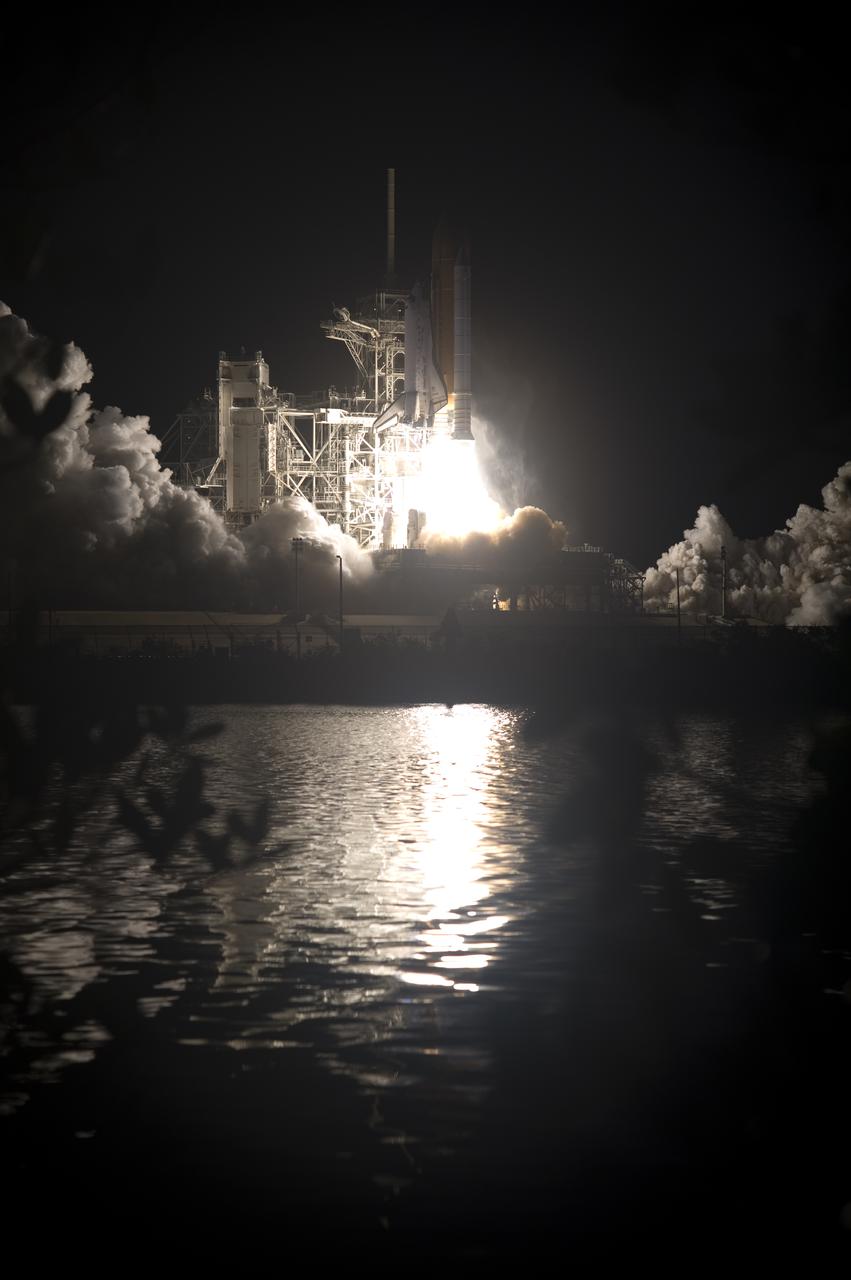
CAPE CANAVERAL, Fla. - Space shuttle Discovery begins its ascent into the predawn sky over Launch Pad 39A at NASA's Kennedy Space Center in Florida at 6:21 a.m. EDT April 5, a brilliant start for the STS-131 mission. The seven-member crew will deliver the multi-purpose logistics module Leonardo, filled with supplies, a new crew sleeping quarters and science racks that will be transferred to the International Space Station's laboratories. The crew also will switch out a gyroscope on the station’s truss, install a spare ammonia storage tank and retrieve a Japanese experiment from the station’s exterior. STS-131 is the 33rd shuttle mission to the station and the 131st shuttle mission overall. For information on the STS-131 mission and crew, visit http:__www.nasa.gov_mission_pages_shuttle_shuttlemissions_sts131_index.html. Photo credit: NASA_Sandra Joseph and Kevin O'Connell
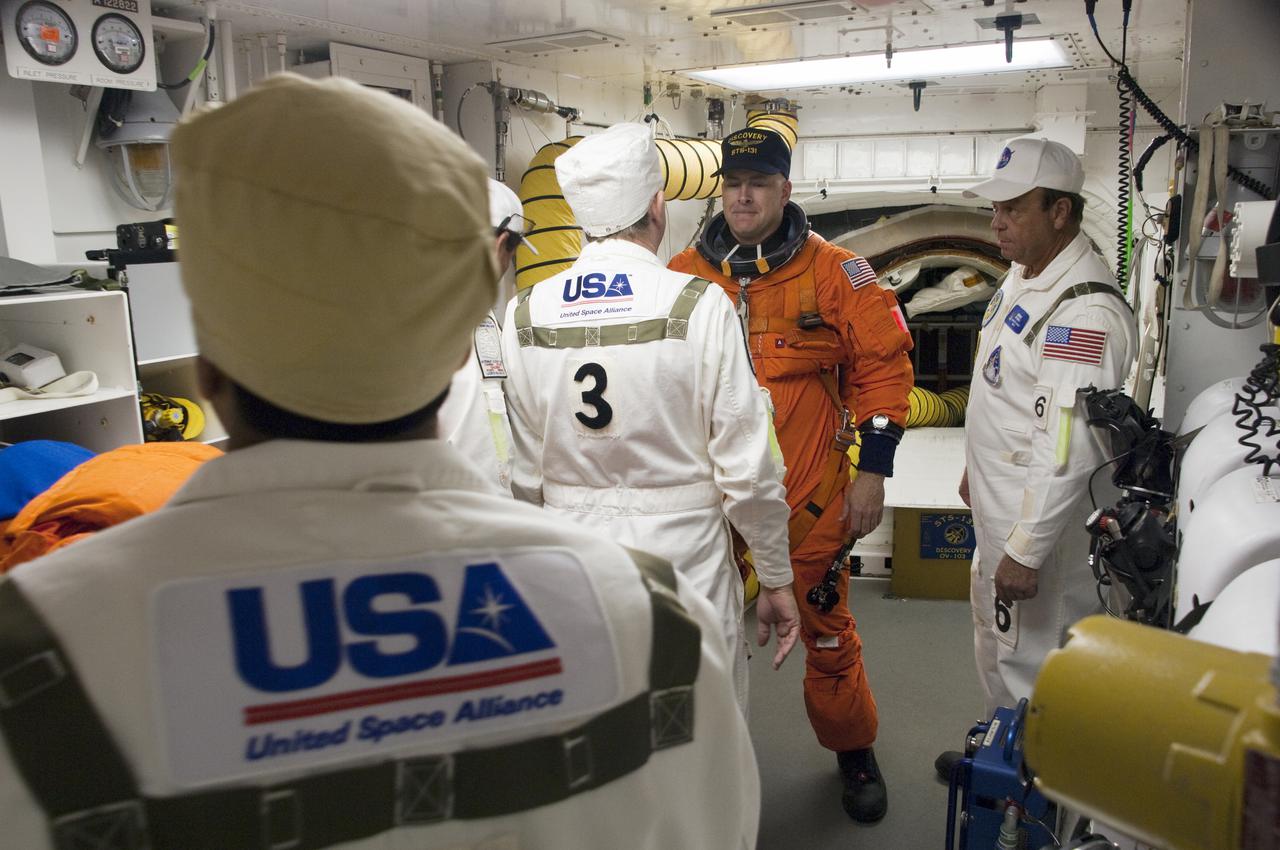
CAPE CANAVERAL, Fla. - In the White Room at Launch Pad 39A at NASA's Kennedy Space Center in Florida, United Space Alliance space suit technicians ensure that the launch-and-entry suit of STS-131 Commander Alan Poindexter fits properly before he enters space shuttle Discovery through the crew hatch in the background. Liftoff of the STS-131 mission is set for 6:21 a.m. EDT on April 5. On STS-131, the seven-member crew will deliver the multi-purpose logistics module Leonardo, filled with supplies, a new crew sleeping quarters and science racks that will be transferred to the International Space Station's laboratories. The crew also will switch out a gyroscope on the station’s truss, install a spare ammonia storage tank and retrieve a Japanese experiment from the station’s exterior. STS-131 is the 33rd shuttle mission to the station and the 131st shuttle mission overall. For information on the STS-131 mission and crew, visit http:__www.nasa.gov_mission_pages_shuttle_shuttlemissions_sts131_index.html. Photo credit: NASA_Sandra Joseph and Kevin O'Connell
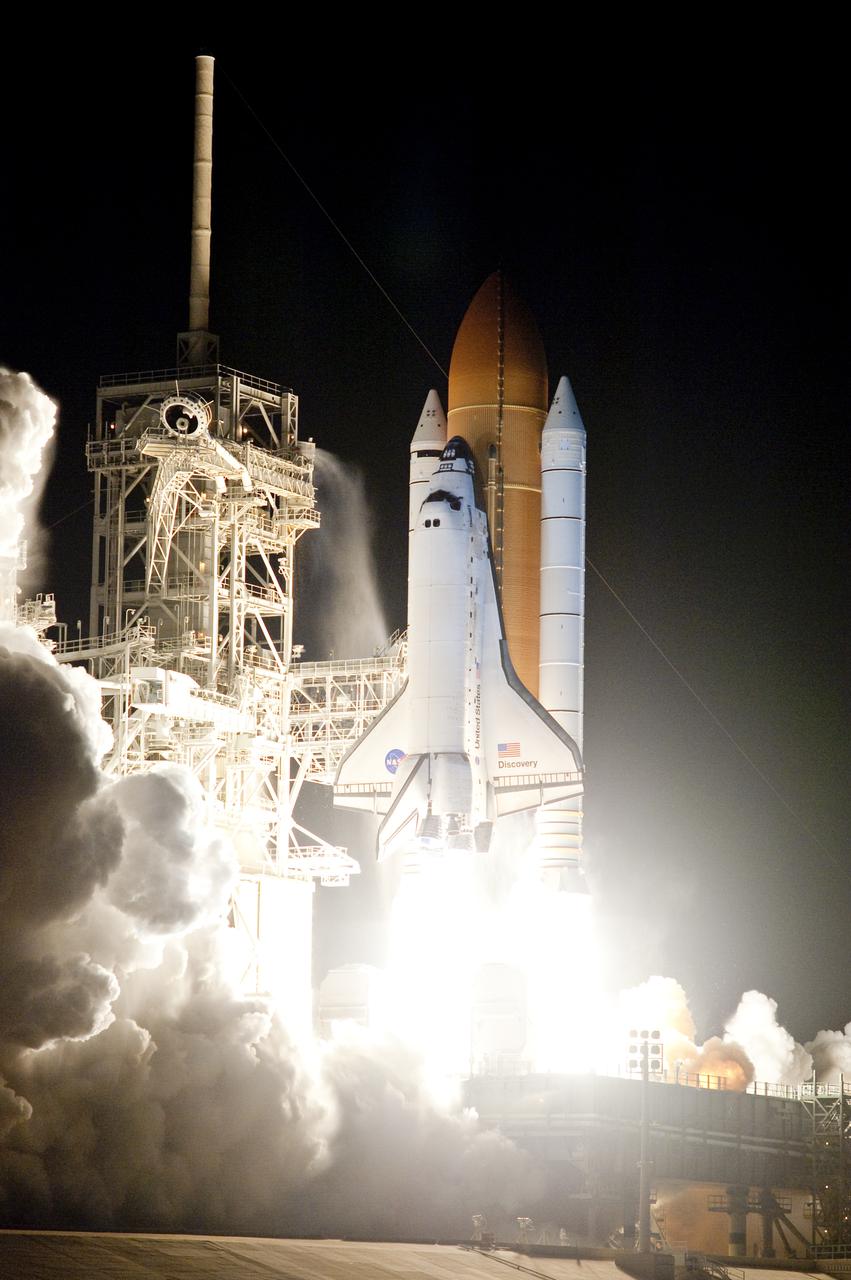
CAPE CANAVERAL, Fla. - The light produced by ignition of the solid rocket boosters and main engines of space shuttle Discovery is dazzling as the shuttle rushes to orbit from Launch Pad 39A at NASA's Kennedy Space Center in Florida. Liftoff on the STS-131 mission was on time at 6:21 a.m. EDT. The seven-member crew will deliver the multi-purpose logistics module Leonardo, filled with supplies, a new crew sleeping quarters and science racks that will be transferred to the International Space Station's laboratories. The crew also will switch out a gyroscope on the station’s truss, install a spare ammonia storage tank and retrieve a Japanese experiment from the station’s exterior. STS-131 is the 33rd shuttle mission to the station and the 131st shuttle mission overall. For information on the STS-131 mission and crew, visit http:__www.nasa.gov_mission_pages_shuttle_shuttlemissions_sts131_index.html. Photo credit: NASA_Sandra Joseph and Kevin O'Connell
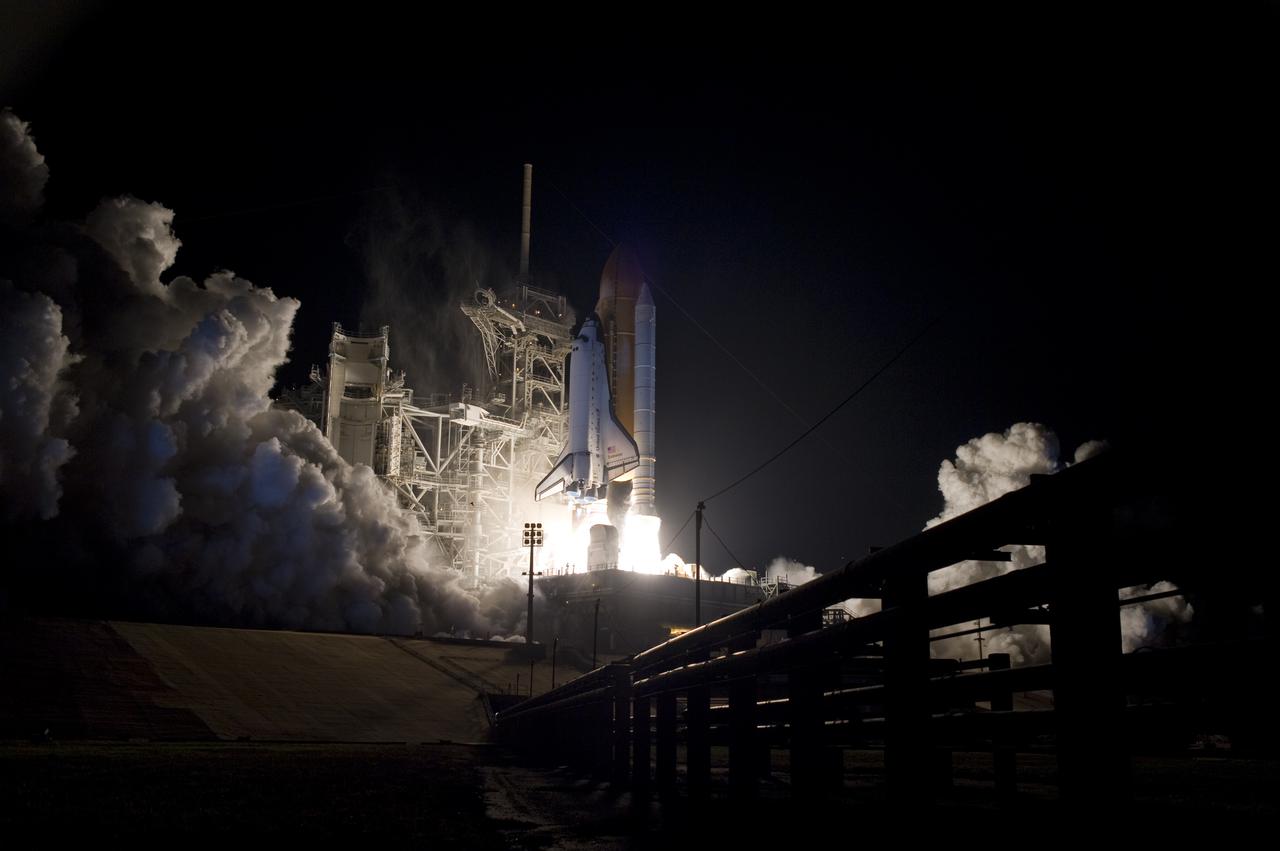
CAPE CANAVERAL, Fla. - An exhaust cloud forms at Launch Pad 39A at NASA's Kennedy Space Center in Florida as space shuttle Endeavour thunders into the night sky. Launch of the STS-130 mission to the International Space Station was at 4:14 a.m. EST. This was the second launch attempt for space shuttle Endeavour's STS-130 crew and the final scheduled space shuttle night launch. The first attempt on Feb. 7 was scrubbed due to unfavorable weather. The primary payload for the STS-130 mission to the International Space Station is the Tranquility node, a pressurized module that will provide additional room for crew members and many of the station's life support and environmental control systems. Attached to one end of Tranquility is a cupola, a unique work area with six windows on its sides and one on top. The cupola resembles a circular bay window and will provide a vastly improved view of the station's exterior. The multi-directional view will allow the crew to monitor spacewalks and docking operations, as well as provide a spectacular view of Earth and other celestial objects. The module was built in Turin, Italy, by Thales Alenia Space for the European Space Agency. For information on the STS-130 mission and crew, visit http:__www.nasa.gov_mission_pages_shuttle_shuttlemissions_sts130_index.html. Photo credit: NASA_Sandra Joseph and Kevin O'Connell
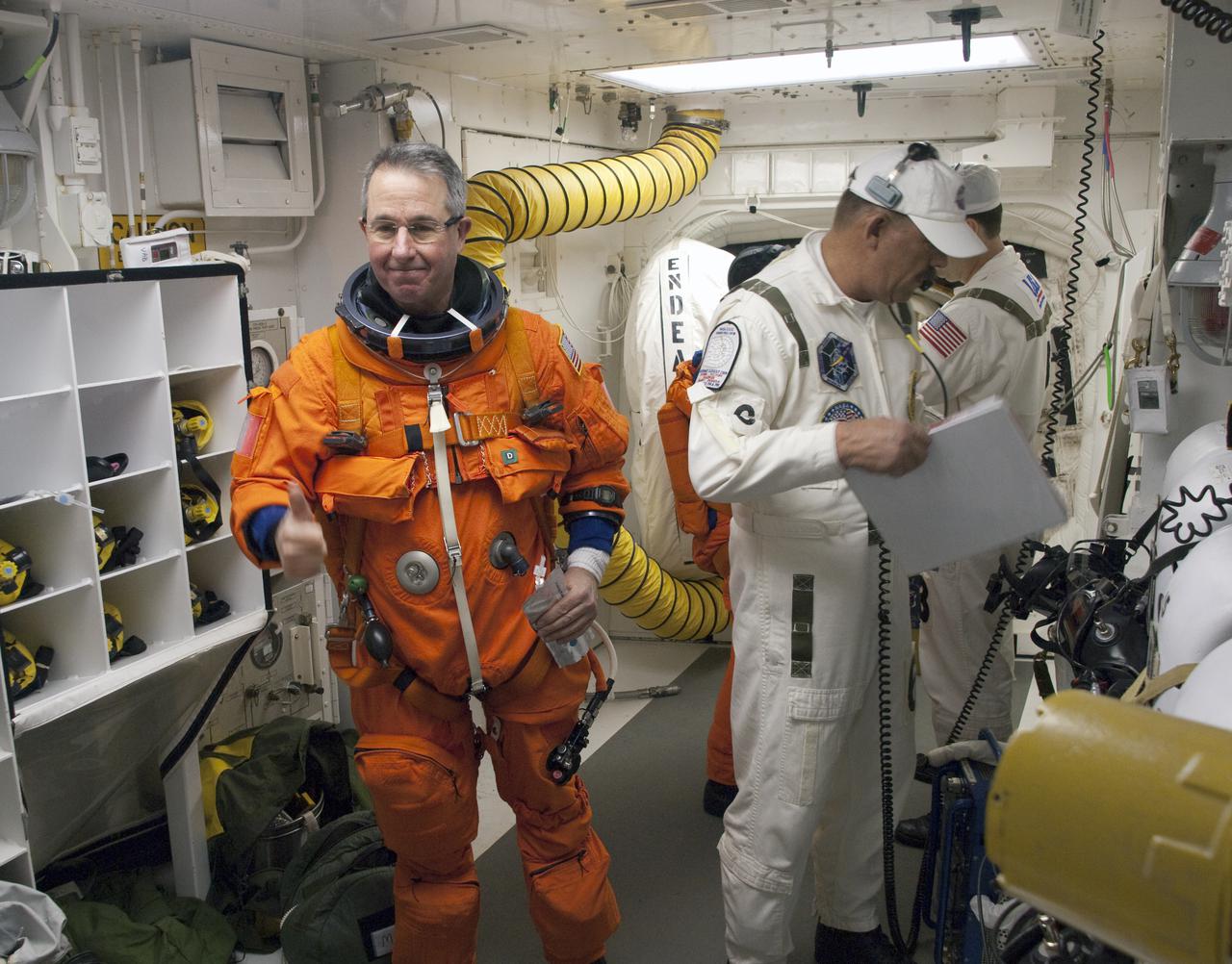
CAPE CANAVERAL, Fla. - In the White Room at Launch Pad 39A on NASA's Kennedy Space Center in Florida, STS-130 Mission Specialist Stephen Robinson signals that he is ready for his mission to begin as he prepares to enter space shuttle Endeavour for launch. This is the second launch attempt for space shuttle Endeavour's STS-130 crew. The first attempt on Feb. 7 was scrubbed due to unfavorable weather. The primary payload for the STS-130 mission to the International Space Station is the Tranquility node, a pressurized module that will provide additional room for crew members and many of the station's life support and environmental control systems. Attached to one end of Tranquility is a cupola, a unique work area with six windows on its sides and one on top. The cupola resembles a circular bay window and will provide a vastly improved view of the station's exterior. The multi-directional view will allow the crew to monitor spacewalks and docking operations, as well as provide a spectacular view of Earth and other celestial objects. The module was built in Turin, Italy, by Thales Alenia Space for the European Space Agency. Endeavour's launch is set for Feb. 8 at 4:14 a.m. EST. For information on the STS-130 mission and crew, visit http:__www.nasa.gov_mission_pages_shuttle_shuttlemissions_sts130_index.html. Photo credit: NASA_Sandra Joseph and Kevin O'Connell

CAPE CANAVERAL, Fla. - In a blinding flash, space shuttle Endeavour roars to life on Launch Pad 39A at NASA's Kennedy Space Center in Florida. Launch of the STS-130 mission to the International Space Station was at 4:14 a.m. EST. This was the second launch attempt for space shuttle Endeavour's STS-130 crew and the final scheduled space shuttle night launch. The first attempt on Feb. 7 was scrubbed due to unfavorable weather. The primary payload for the STS-130 mission to the International Space Station is the Tranquility node, a pressurized module that will provide additional room for crew members and many of the station's life support and environmental control systems. Attached to one end of Tranquility is a cupola, a unique work area with six windows on its sides and one on top. The cupola resembles a circular bay window and will provide a vastly improved view of the station's exterior. The multi-directional view will allow the crew to monitor spacewalks and docking operations, as well as provide a spectacular view of Earth and other celestial objects. The module was built in Turin, Italy, by Thales Alenia Space for the European Space Agency. For information on the STS-130 mission and crew, visit http:__www.nasa.gov_mission_pages_shuttle_shuttlemissions_sts130_index.html. Photo credit: NASA_Sandra Joseph and Kevin O'Connell
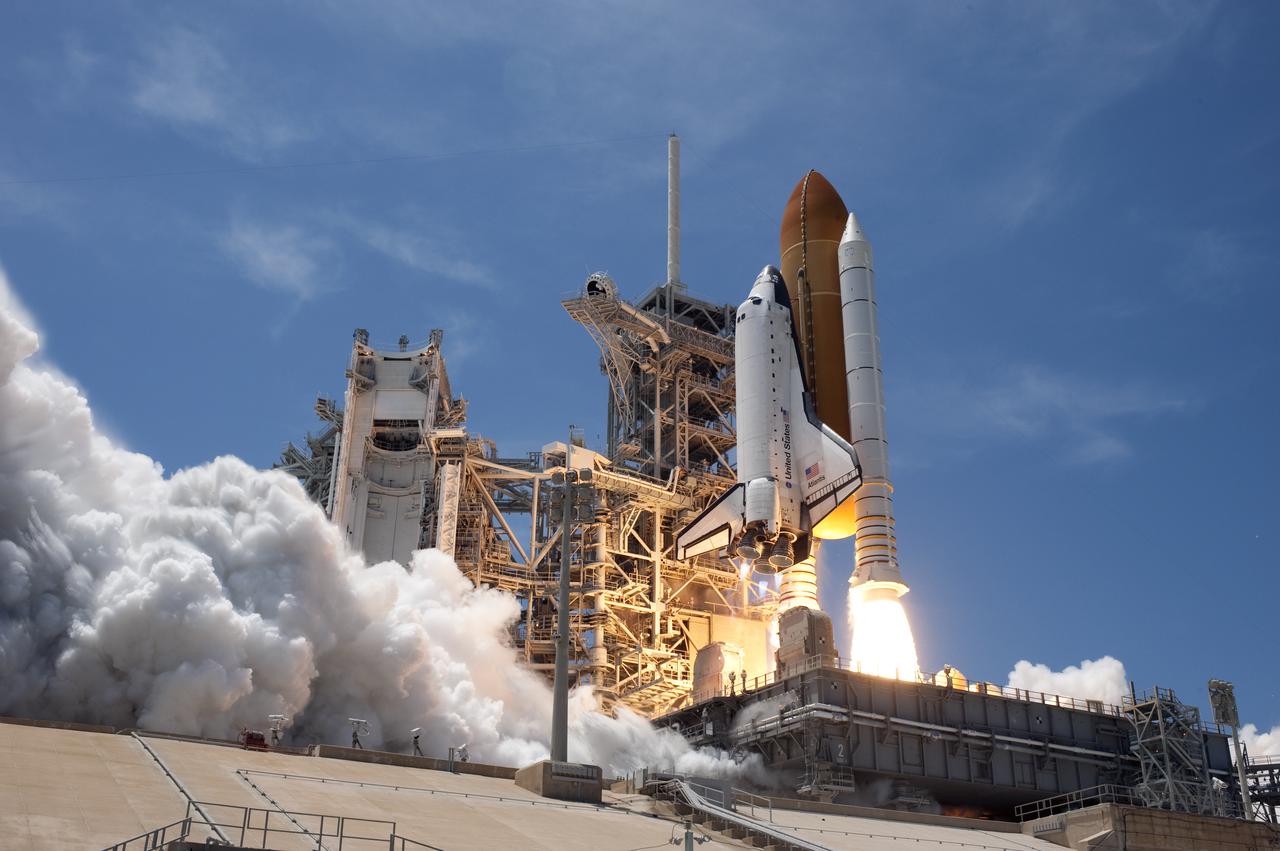
CAPE CANAVERAL, Fla. - Space shuttle Atlantis' twin solid rocket boosters ignite to propel the spacecraft off NASA Kennedy Space Center's Launch Pad 39A and into orbit at 2:20 p.m. EDT on May 14. On board Atlantis, for its last planned flight, are six veteran NASA astronauts. Atlantis' primary payload for the STS-132 mission is the Russian-built Mini Research Module-1, which will provide additional storage space and a new docking port for Russian Soyuz and Progress spacecraft aboard the International Space Station. STS-132 is the 132nd shuttle flight, the 32nd for Atlantis and the 34th shuttle mission dedicated to station assembly and maintenance. For more information on the STS-132 mission objectives, payload and crew, visit www.nasa.gov_mission_pages_shuttle_shuttlemissions_sts132_index.html. Photo credit: NASA_Sandra Joseph and Kevin O'Connell
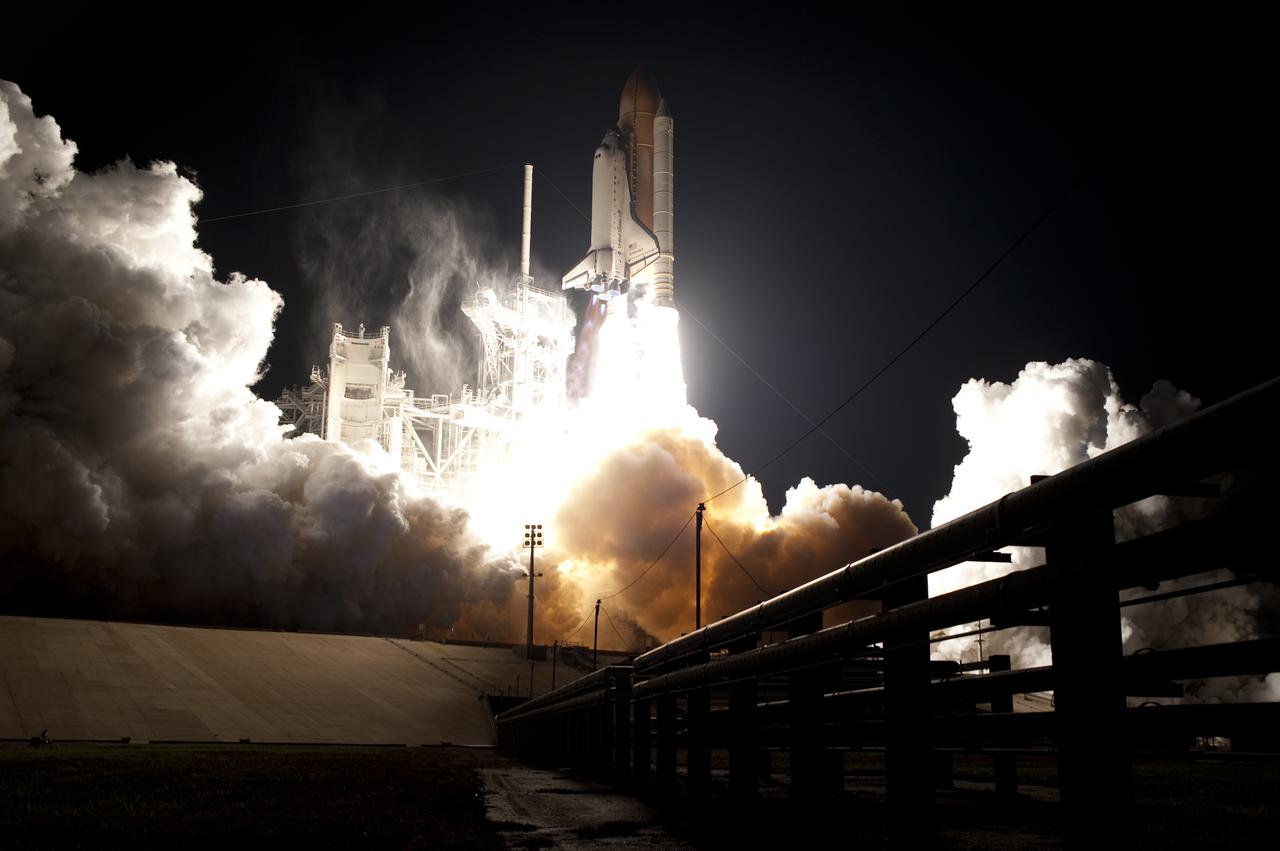
CAPE CANAVERAL, Fla. - An exhaust cloud builds at Launch Pad 39A at NASA's Kennedy Space Center in Florida as space shuttle Endeavour lifts off into the night sky. Launch of the STS-130 mission to the International Space Station was at 4:14 a.m. EST. This was the second launch attempt for space shuttle Endeavour's STS-130 crew and the final scheduled space shuttle night launch. The first attempt on Feb. 7 was scrubbed due to unfavorable weather. The primary payload for the STS-130 mission to the International Space Station is the Tranquility node, a pressurized module that will provide additional room for crew members and many of the station's life support and environmental control systems. Attached to one end of Tranquility is a cupola, a unique work area with six windows on its sides and one on top. The cupola resembles a circular bay window and will provide a vastly improved view of the station's exterior. The multi-directional view will allow the crew to monitor spacewalks and docking operations, as well as provide a spectacular view of Earth and other celestial objects. The module was built in Turin, Italy, by Thales Alenia Space for the European Space Agency. For information on the STS-130 mission and crew, visit http:__www.nasa.gov_mission_pages_shuttle_shuttlemissions_sts130_index.html. Photo credit: NASA_Sandra Joseph and Kevin O'Connell
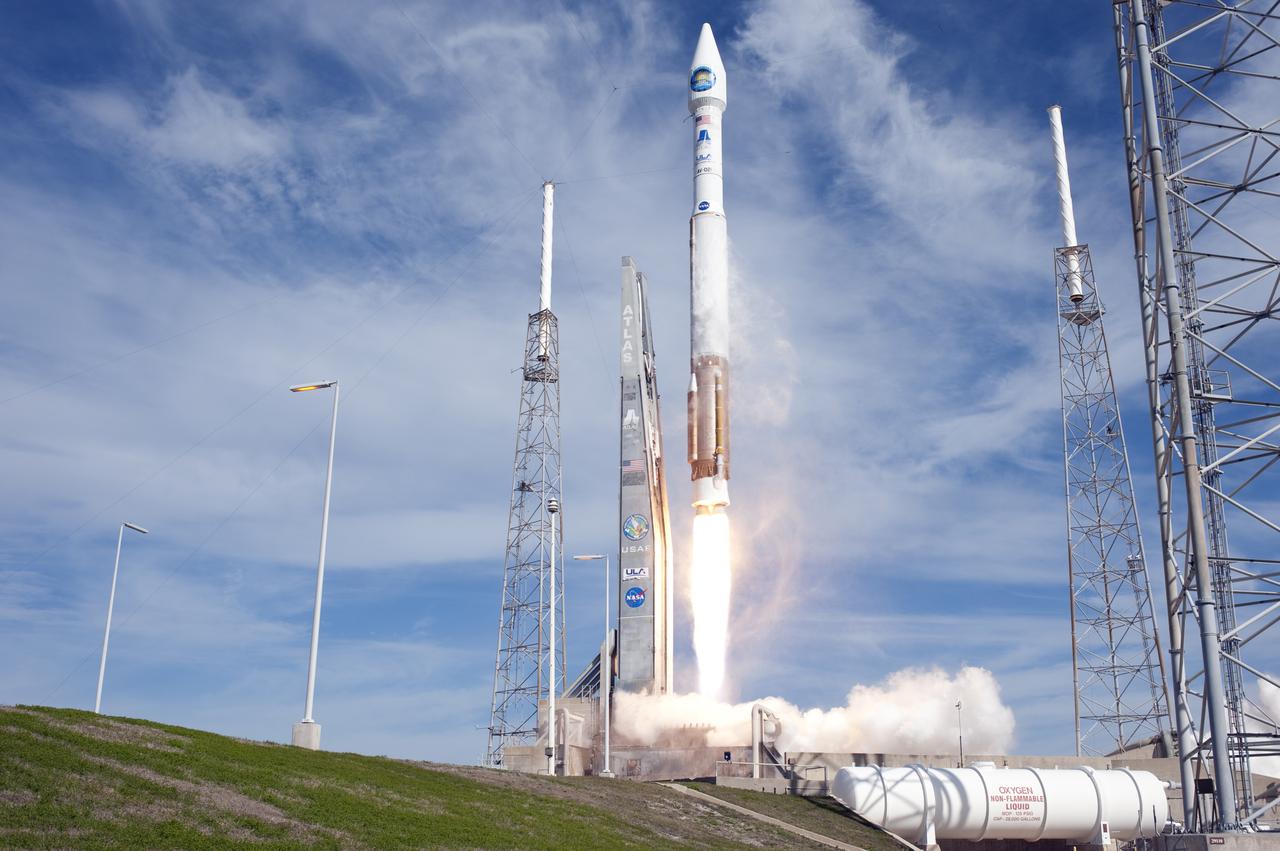
CAPE CANAVERAL, Fla. – The United Launch Alliance Atlas V rocket carrying NASA's Solar Dynamics Observatory heads into the 'wild blue yonder' from Launch Complex 41 on Cape Canaveral Air Force Station. Launch was at 10:23 a.m. EST Feb. 11. This is the 100th launch of a commercial Atlas_Centaur rocket. The observatory, known as SDO, is the first mission in NASA's Living With a Star Program and is designed to study the causes of solar variability and its impacts on Earth. The spacecraft's long-term measurements will give solar scientists in-depth information to help characterize the interior of the Sun, the Sun's magnetic field, the hot plasma of the solar corona, and the density of radiation that creates the ionosphere of the planets. The information will be used to create better forecasts of space weather needed to protect the aircraft, satellites and astronauts living and working in space. For information on SDO, visit http:__www.nasa.gov_sdo. Photo credit: NASA_Sandra Joseph and Tony Gray
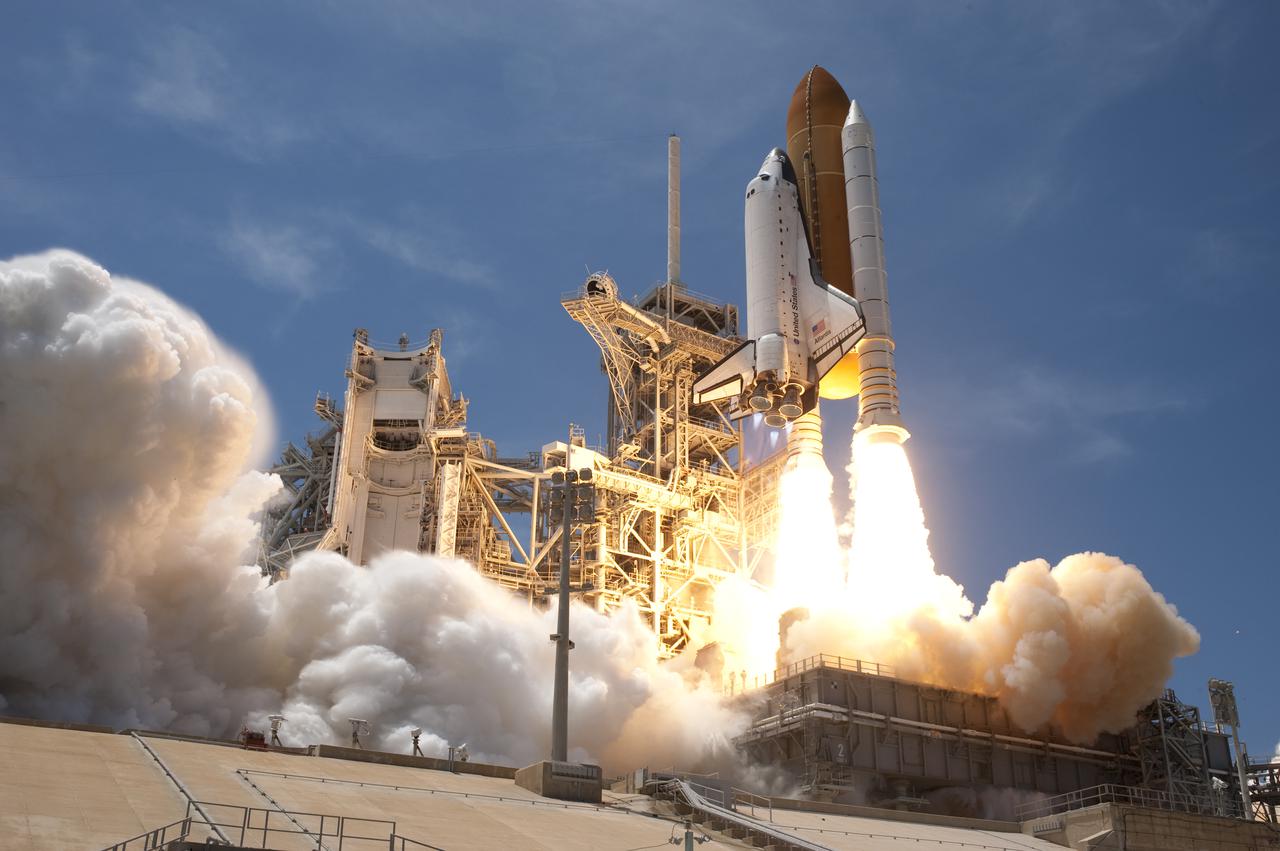
CAPE CANAVERAL, Fla. - Space shuttle Atlantis' twin solid rocket boosters ignite to propel the spacecraft off NASA Kennedy Space Center's Launch Pad 39A and into orbit at 2:20 p.m. EDT on May 14. On board Atlantis, for its last planned flight, are six veteran NASA astronauts. Atlantis' primary payload for the STS-132 mission is the Russian-built Mini Research Module-1, which will provide additional storage space and a new docking port for Russian Soyuz and Progress spacecraft aboard the International Space Station. STS-132 is the 132nd shuttle flight, the 32nd for Atlantis and the 34th shuttle mission dedicated to station assembly and maintenance. For more information on the STS-132 mission objectives, payload and crew, visit www.nasa.gov_mission_pages_shuttle_shuttlemissions_sts132_index.html. Photo credit: NASA_Sandra Joseph and Kevin O'Connell
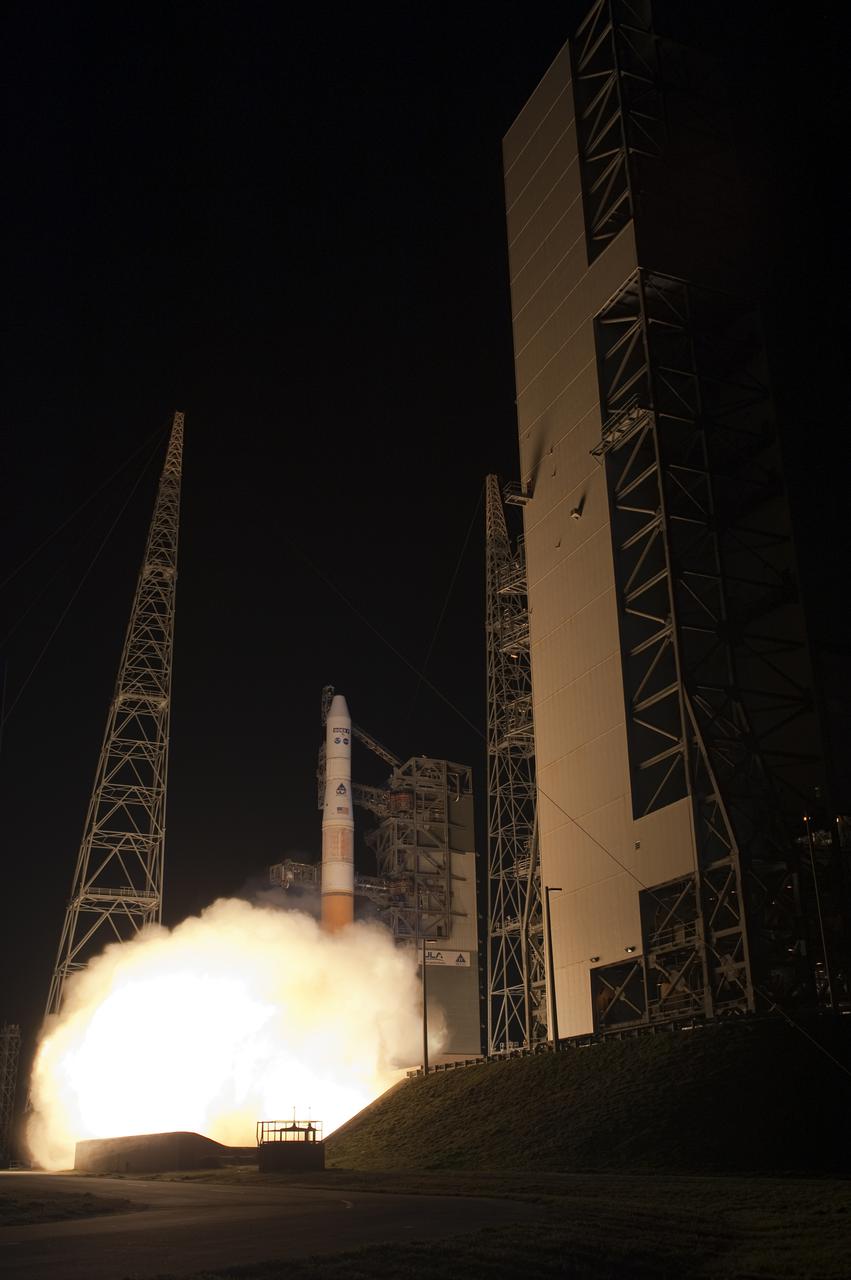
CAPE CANAVERAL, Fla. – In a flash of light, the United Launch Alliance Delta IV rocket carrying NASA's GOES-P meteorological satellite lifts off Launch Complex 37 on Cape Canaveral Air Force Station in Florida at 6:57 p.m. EST. GOES-P, the latest Geostationary Operational Environmental Satellite, was developed by NASA for the National Oceanic and Atmospheric Administration, or NOAA. The GOES-P spacecraft will be placed in a 22,300-mile-high geosynchronous orbit where it will appear to hover over a single point on Earth. The spacecraft is outfitted with a complex suite of observation instruments and cameras so it can accurately report on weather and climate conditions on Earth. For information on GOES-P, visit http:__www.nasa.gov_mission_pages_GOES-P_main_index.html. Photo credit: NASA_Sandra Joseph and Tony Gray
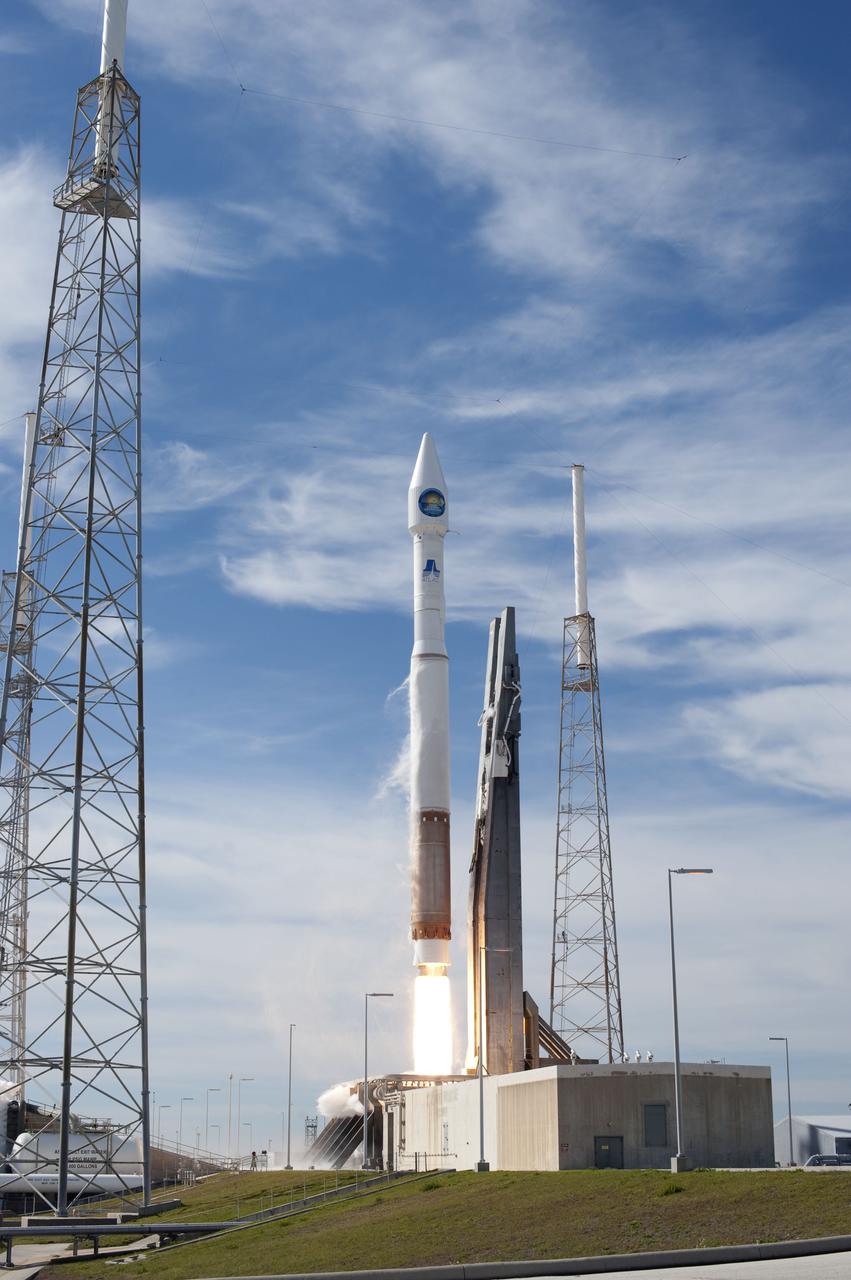
CAPE CANAVERAL, Fla. – The United Launch Alliance Atlas V rocket carrying NASA's Solar Dynamics Observatory levitates off Launch Complex 41 on Cape Canaveral Air Force Station as its engines ignite. Liftoff was at 10:23 a.m. EST Feb. 11. This is the 100th launch of a commercial Atlas_Centaur rocket. The observatory, known as SDO, is the first mission in NASA's Living With a Star Program and is designed to study the causes of solar variability and its impacts on Earth. The spacecraft's long-term measurements will give solar scientists in-depth information to help characterize the interior of the Sun, the Sun's magnetic field, the hot plasma of the solar corona, and the density of radiation that creates the ionosphere of the planets. The information will be used to create better forecasts of space weather needed to protect the aircraft, satellites and astronauts living and working in space. For information on SDO, visit http:__www.nasa.gov_sdo. Photo credit: NASA_Sandra Joseph and Tony Gray
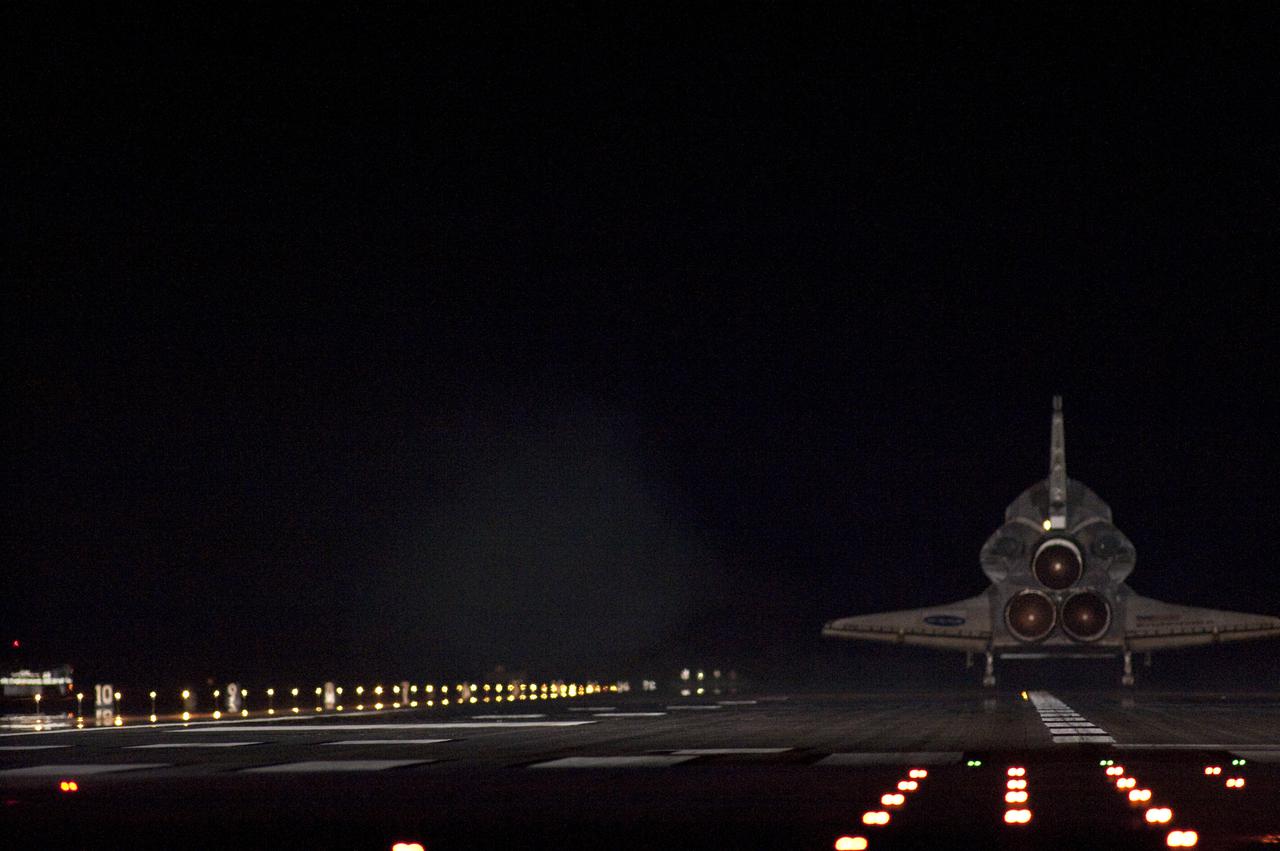
CAPE CANAVERAL, Fla. - STS-130 Commander George Zamka sets space shuttle Endeavour down in the middle of Runway 15 at the Shuttle Landing Facility at NASA's Kennedy Space Center in Florida. After 14 days in space, Endeavour's 5.7-million-mile STS-130 mission is completed on orbit 217. Main gear touchdown was at 10:20:31 p.m. EST followed by nose gear touchdown at 10:20:39 p.m. and wheels stop at 10:22:10 p.m. It was the 23rd night landing in shuttle history and the 17th at Kennedy. Aboard are Commander George Zamka; Pilot Terry Virts; and Mission Specialists Robert Behnken, Nicholas Patrick, Kathryn Hire and Stephen Robinson. During Endeavour's STS-130 mission, astronauts installed the Tranquility node, a module that provides additional room for crew members and many of the station's life support and environmental control systems. Attached to Tranquility is a cupola with seven windows that provide a panoramic view of Earth, celestial objects and visiting spacecraft. The module was built in Turin, Italy, by Thales Alenia Space for the European Space Agency. The orbiting laboratory is approximately 90 percent complete now in terms of mass. STS-130 was the 24th flight for Endeavour, the 32nd shuttle mission devoted to ISS assembly and maintenance, and the 130th shuttle mission to date. For information on the STS-130 mission and crew, visit http:__www.nasa.gov_mission_pages_shuttle_shuttlemissions_sts130. Photo credit: NASA_Sandra Joseph and Kevin O'Connell
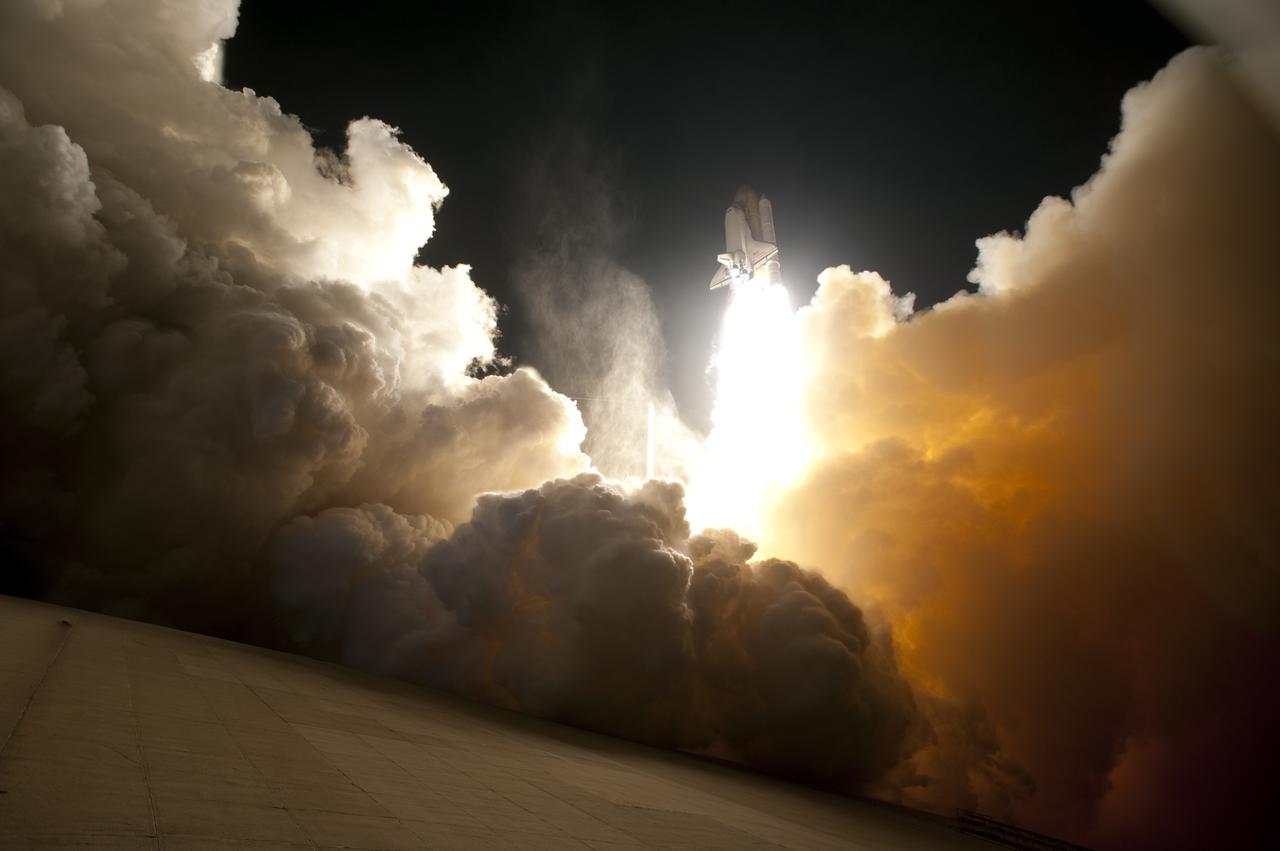
CAPE CANAVERAL, Fla. - An exhaust cloud engulfs Launch Pad 39A at NASA's Kennedy Space Center in Florida as space shuttle Endeavour lifts off into the night sky. Launch of the STS-130 mission to the International Space Station was at 4:14 a.m. EST. This was the second launch attempt for space shuttle Endeavour's STS-130 crew and the final scheduled space shuttle night launch. The first attempt on Feb. 7 was scrubbed due to unfavorable weather. The primary payload for the STS-130 mission to the International Space Station is the Tranquility node, a pressurized module that will provide additional room for crew members and many of the station's life support and environmental control systems. Attached to one end of Tranquility is a cupola, a unique work area with six windows on its sides and one on top. The cupola resembles a circular bay window and will provide a vastly improved view of the station's exterior. The multi-directional view will allow the crew to monitor spacewalks and docking operations, as well as provide a spectacular view of Earth and other celestial objects. The module was built in Turin, Italy, by Thales Alenia Space for the European Space Agency. For information on the STS-130 mission and crew, visit http:__www.nasa.gov_mission_pages_shuttle_shuttlemissions_sts130_index.html. Photo credit: NASA_Sandra Joseph and Kevin O'Connell
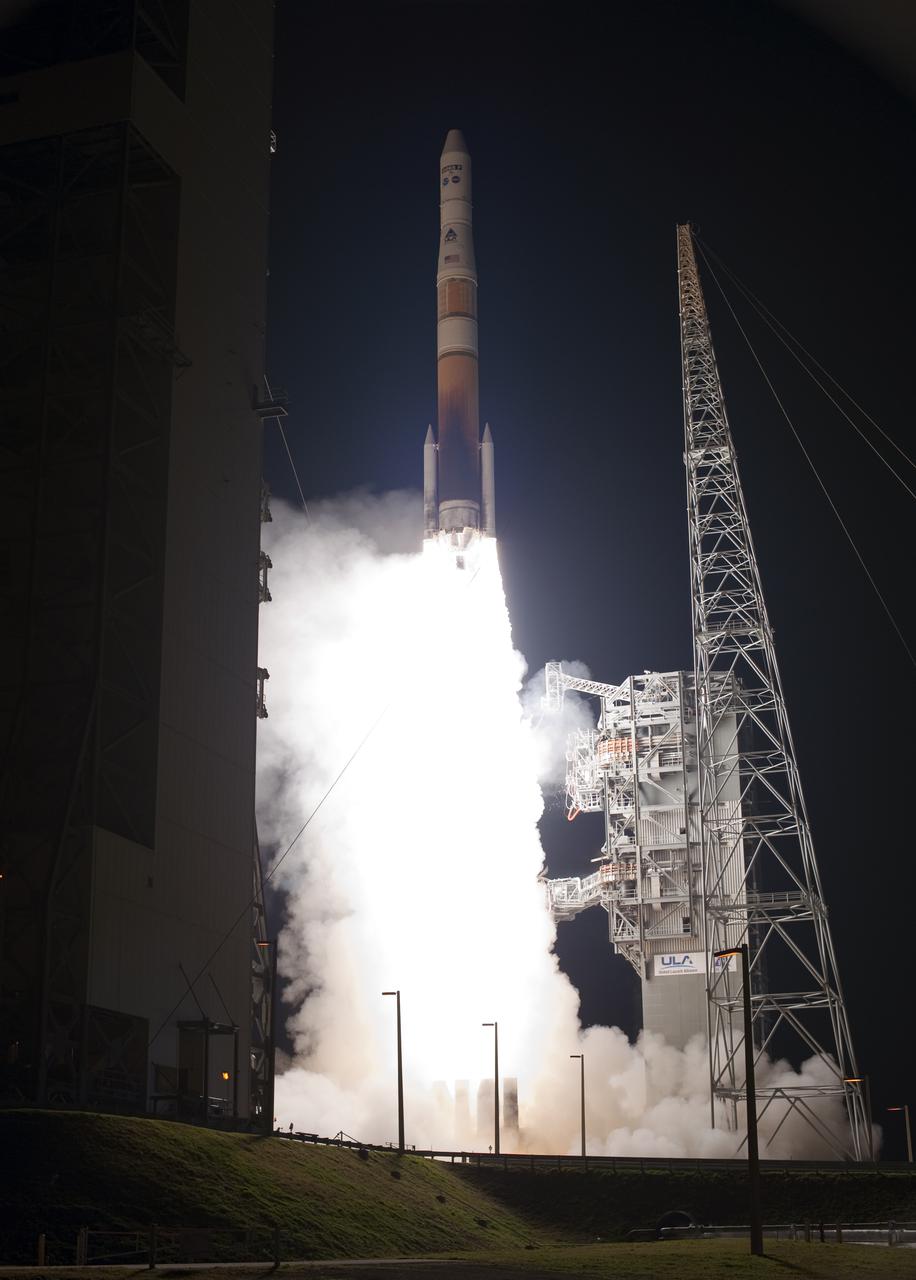
CAPE CANAVERAL, Fla. – The United Launch Alliance Delta IV rocket carrying NASA's GOES-P meteorological satellite begins to rise from Launch Complex 37 on Cape Canaveral Air Force Station in Florida. Liftoff was at 6:57 p.m. EST. GOES-P, the latest Geostationary Operational Environmental Satellite, was developed by NASA for the National Oceanic and Atmospheric Administration, or NOAA. The GOES-P spacecraft will be placed in a 22,300-mile-high geosynchronous orbit where it will appear to hover over a single point on Earth. The spacecraft is outfitted with a complex suite of observation instruments and cameras so it can accurately report on weather and climate conditions on Earth. For information on GOES-P, visit http:__www.nasa.gov_mission_pages_GOES-P_main_index.html. Photo credit: NASA_Sandra Joseph and Tony Gray
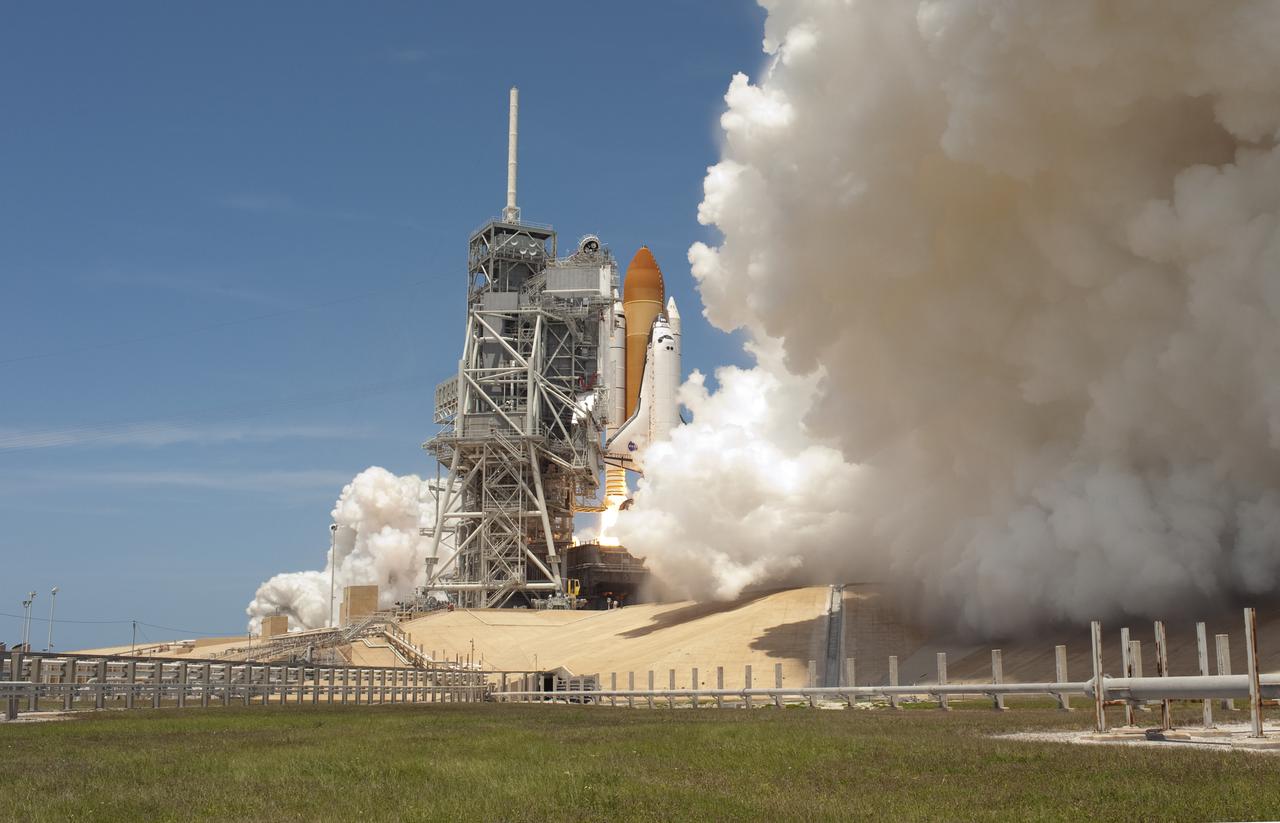
CAPE CANAVERAL, Fla. - At NASA's Kennedy Space Center in Florida, an exhaust plume builds on Launch Pad 39A as space shuttle Atlantis' engines ignite. Liftoff occurred right on time at 2:20 p.m. EDT on May 14. Atlantis' primary payload for the STS-132 mission is the Russian-built Mini Research Module-1, which will provide additional storage space and a new docking port for Russian Soyuz and Progress spacecraft aboard the International Space Station. STS-132 is the 132nd shuttle flight, the 32nd for Atlantis and the 34th shuttle mission dedicated to station assembly and maintenance. For more information on the STS-132 mission objectives, payload and crew, visit www.nasa.gov_mission_pages_shuttle_shuttlemissions_sts132_index.html. Photo credit: NASA_Sandra Joseph and Kevin O'Connell
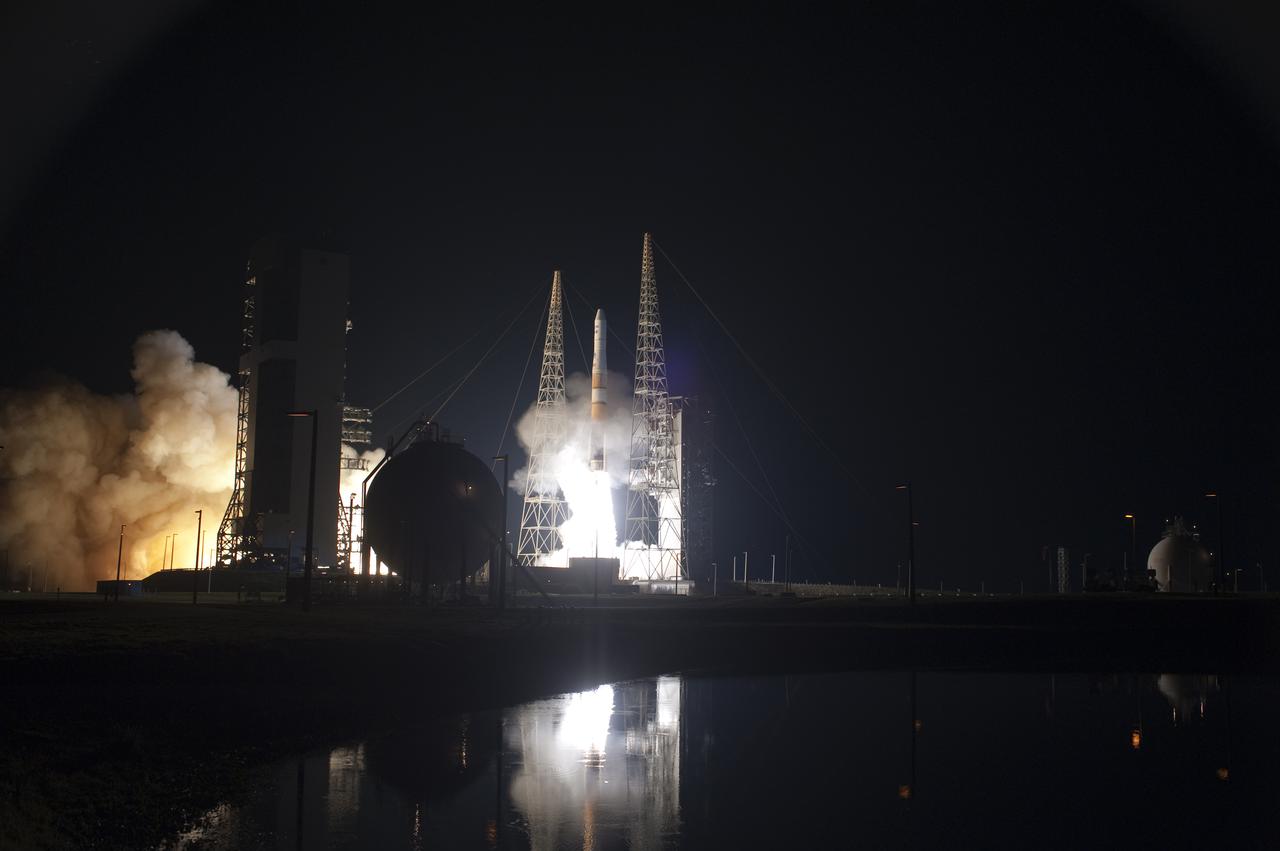
CAPE CANAVERAL, Fla. – The United Launch Alliance Delta IV rocket carrying NASA's GOES-P meteorological satellite begins to rise from Launch Complex 37 on Cape Canaveral Air Force Station in Florida. Liftoff was at 6:57 p.m. EST. GOES-P, the latest Geostationary Operational Environmental Satellite, was developed by NASA for the National Oceanic and Atmospheric Administration, or NOAA. The GOES-P spacecraft will be placed in a 22,300-mile-high geosynchronous orbit where it will appear to hover over a single point on Earth. The spacecraft is outfitted with a complex suite of observation instruments and cameras so it can accurately report on weather and climate conditions on Earth. For information on GOES-P, visit http:__www.nasa.gov_mission_pages_GOES-P_main_index.html. Photo credit: NASA_Sandra Joseph and Tony Gray
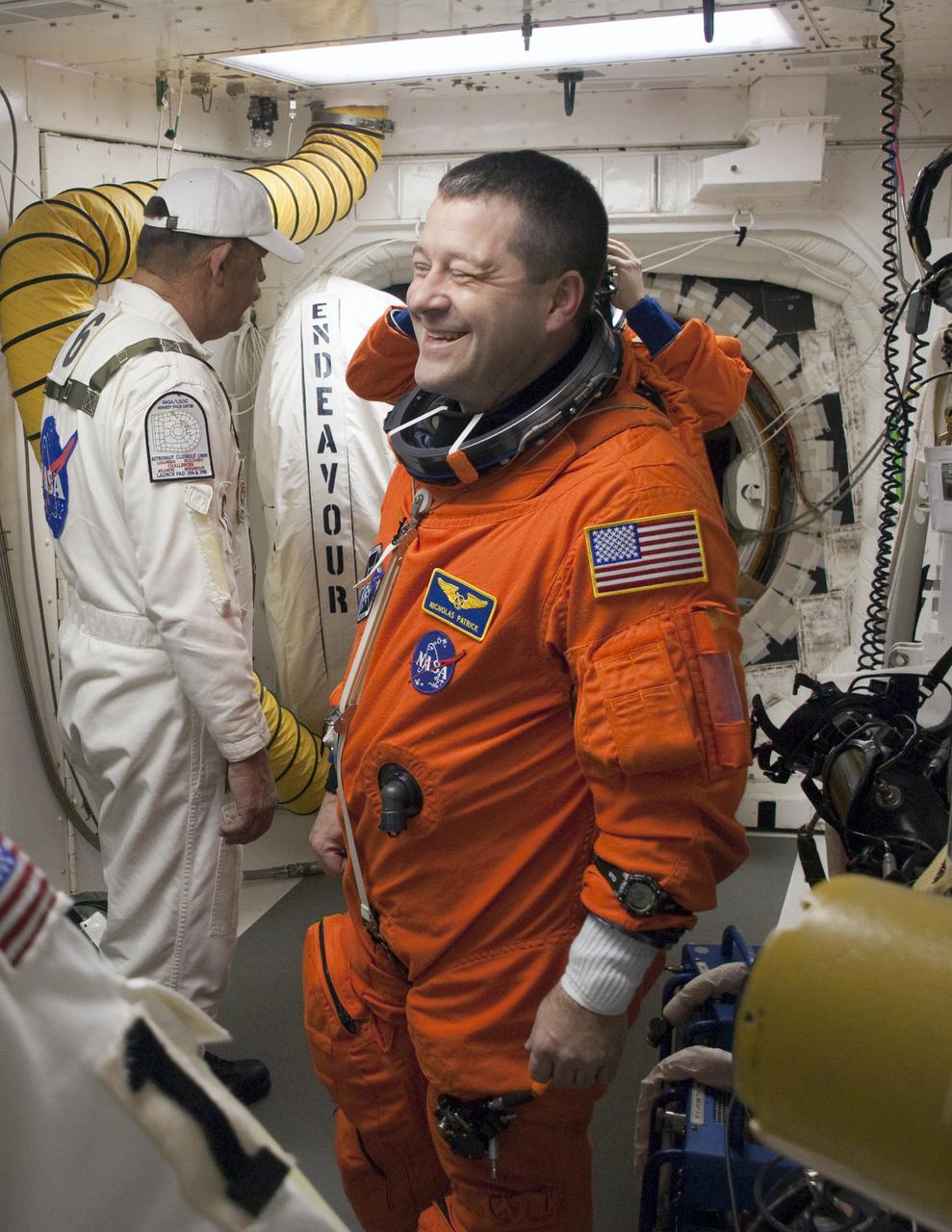
CAPE CANAVERAL, Fla. - In the White Room at Launch Pad 39A on NASA's Kennedy Space Center in Florida, STS-130 Mission Specialist Nicholas Patrick shares a light moment with United Space Alliance suit technicians and NASA quality inspectors as he prepares to enter space shuttle Endeavour for launch. This is the second launch attempt for space shuttle Endeavour's STS-130 crew. The first attempt on Feb. 7 was scrubbed due to unfavorable weather. The primary payload for the STS-130 mission to the International Space Station is the Tranquility node, a pressurized module that will provide additional room for crew members and many of the station's life support and environmental control systems. Attached to one end of Tranquility is a cupola, a unique work area with six windows on its sides and one on top. The cupola resembles a circular bay window and will provide a vastly improved view of the station's exterior. The multi-directional view will allow the crew to monitor spacewalks and docking operations, as well as provide a spectacular view of Earth and other celestial objects. The module was built in Turin, Italy, by Thales Alenia Space for the European Space Agency. Endeavour's launch is set for Feb. 8 at 4:14 a.m. EST. For information on the STS-130 mission and crew, visit http:__www.nasa.gov_mission_pages_shuttle_shuttlemissions_sts130_index.html. Photo credit: NASA_Sandra Joseph and Kevin O'Connell
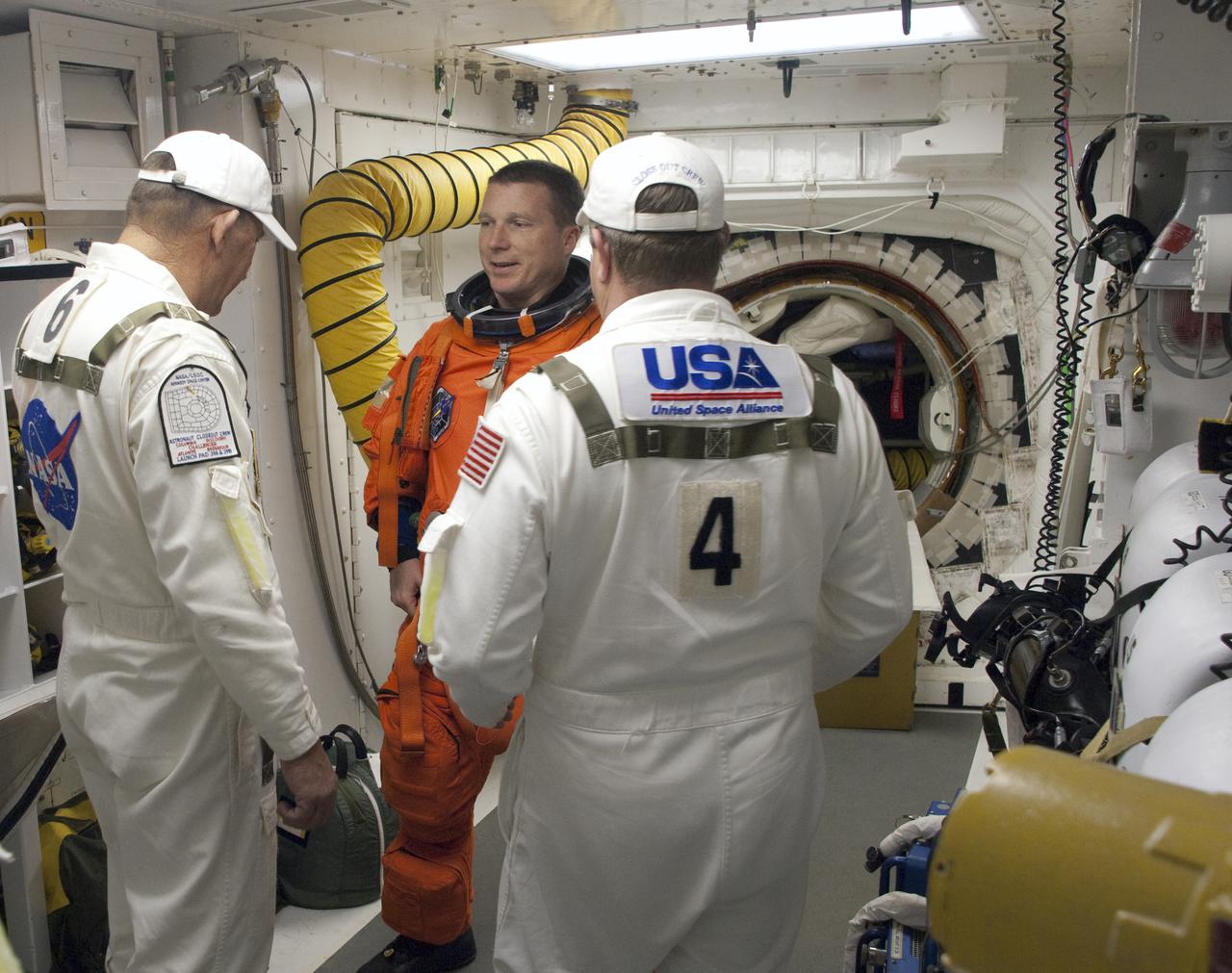
CAPE CANAVERAL, Fla. - In the White Room at Launch Pad 39A on NASA's Kennedy Space Center in Florida, United Space Alliance suit technicians and NASA quality inspectors ensure the proper fit of the launch-and-entry suit of STS-130 Pilot Terry Virts as he prepares to enter space shuttle Endeavour for launch. This is the second launch attempt for space shuttle Endeavour's STS-130 crew. The first attempt on Feb. 7 was scrubbed due to unfavorable weather. The primary payload for the STS-130 mission to the International Space Station is the Tranquility node, a pressurized module that will provide additional room for crew members and many of the station's life support and environmental control systems. Attached to one end of Tranquility is a cupola, a unique work area with six windows on its sides and one on top. The cupola resembles a circular bay window and will provide a vastly improved view of the station's exterior. The multi-directional view will allow the crew to monitor spacewalks and docking operations, as well as provide a spectacular view of Earth and other celestial objects. The module was built in Turin, Italy, by Thales Alenia Space for the European Space Agency. Endeavour's launch is set for Feb. 8 at 4:14 a.m. EST. For information on the STS-130 mission and crew, visit http:__www.nasa.gov_mission_pages_shuttle_shuttlemissions_sts130_index.html. Photo credit: NASA_Sandra Joseph and Kevin O'Connell
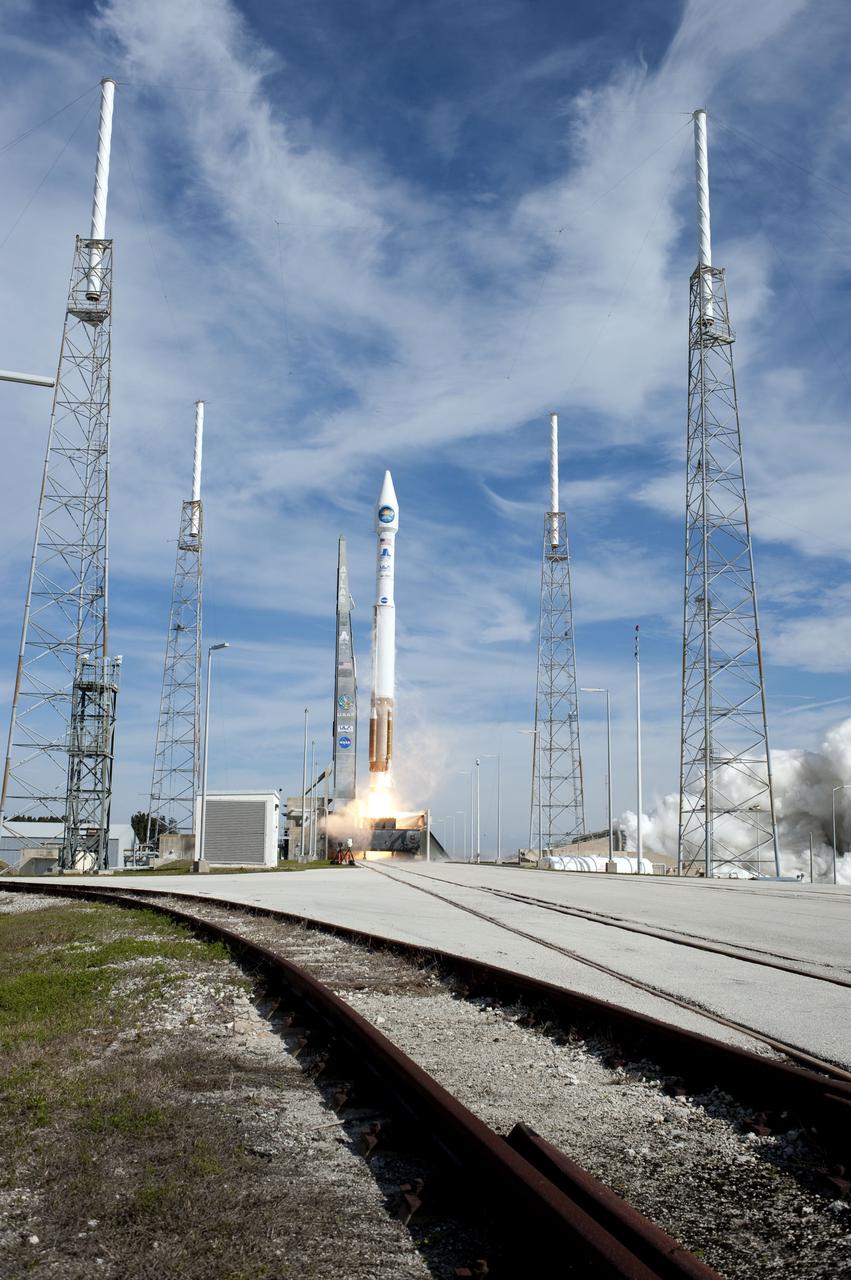
CAPE CANAVERAL, Fla. – The United Launch Alliance Atlas V rocket carrying NASA's Solar Dynamics Observatory begins its slow climb to orbit from Launch Complex 41 on Cape Canaveral Air Force Station. Liftoff was at 10:23 a.m. EST Feb. 11. This is the 100th launch of a commercial Atlas_Centaur rocket. The observatory, known as SDO, is the first mission in NASA's Living With a Star Program and is designed to study the causes of solar variability and its impacts on Earth. The spacecraft's long-term measurements will give solar scientists in-depth information to help characterize the interior of the Sun, the Sun's magnetic field, the hot plasma of the solar corona, and the density of radiation that creates the ionosphere of the planets. The information will be used to create better forecasts of space weather needed to protect the aircraft, satellites and astronauts living and working in space. For information on SDO, visit http:__www.nasa.gov_sdo. Photo credit: NASA_Sandra Joseph and Tony Gray
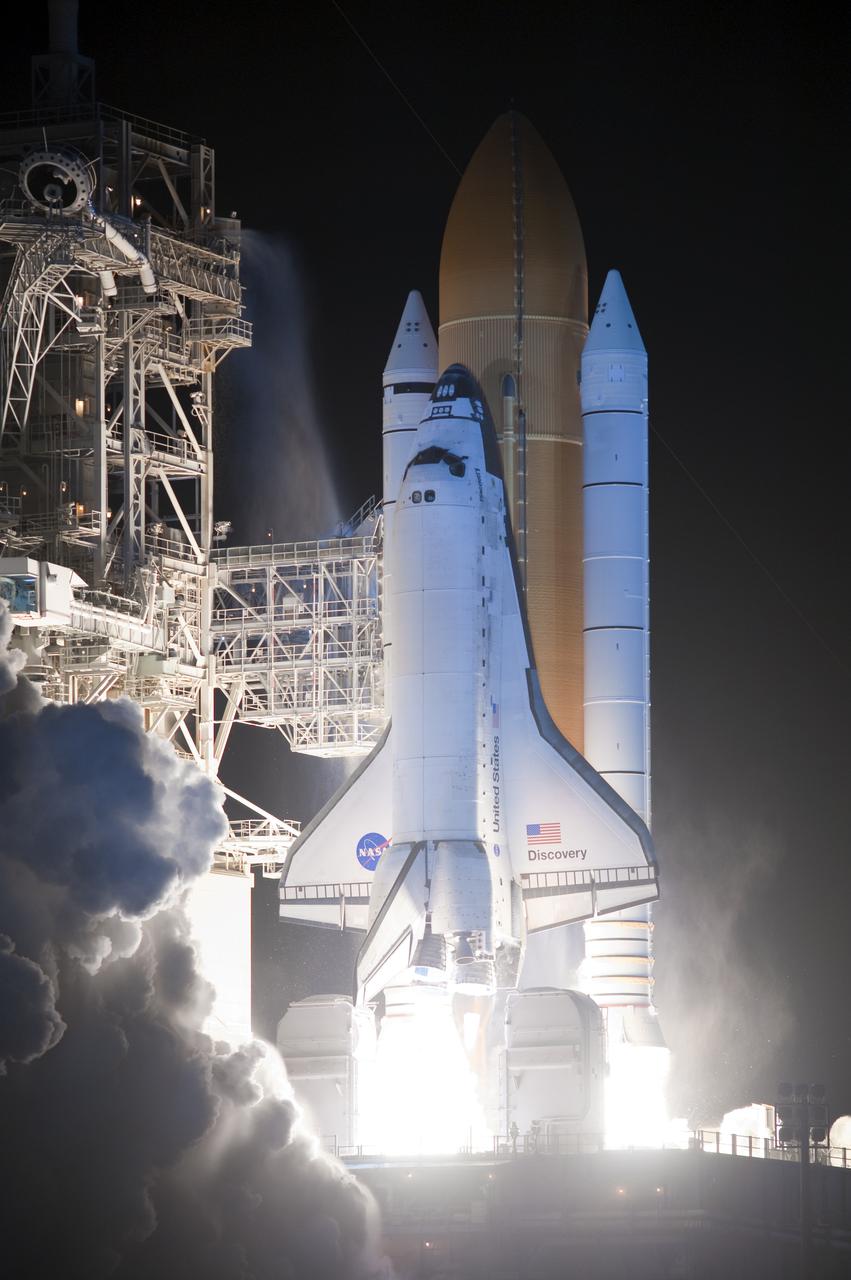
CAPE CANAVERAL, Fla. - On Launch Pad 39A at NASA's Kennedy Space Center in Florida space shuttle Discovery lights up the early morning sky as it lifts off on the STS-131 mission. Shuttle Discovery lifted off at 6:21 a.m. EDT on April 5, 2010. The seven-member STS-131 crew will deliver the multi-purpose logistics module Leonardo, filled with supplies, a new crew sleeping quarters and science racks that will be transferred to the International Space Station's laboratories. The crew also will switch out a gyroscope on the station’s truss, install a spare ammonia storage tank and retrieve a Japanese experiment from the station’s exterior. STS-131 is the 33rd shuttle mission to the station and the 131st shuttle mission overall. For information on the STS-131 mission and crew, visit http:__www.nasa.gov_mission_pages_shuttle_shuttlemissions_sts131_index.html. Photo credit: NASA_Sandra Joseph and Kevin O'Connell
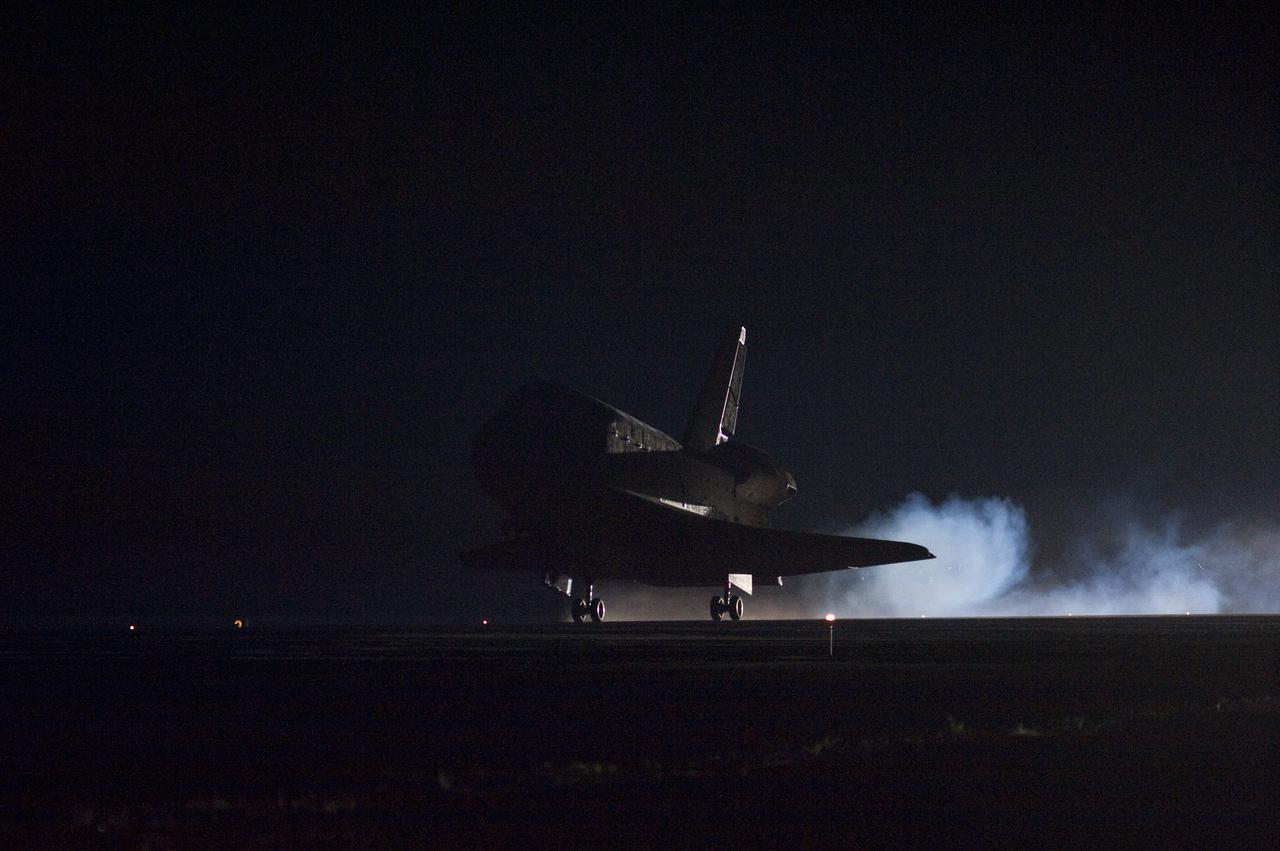
CAPE CANAVERAL, Fla. - Touchdown is evidenced by the streams of smoke trailing space shuttle Endeavour as it makes contact with Runway 15 at the Shuttle Landing Facility at NASA's Kennedy Space Center in Florida. After 14 days in space, Endeavour's 5.7-million-mile STS-130 mission is completed on orbit 217. Main gear touchdown was at 10:20:31 p.m. EST followed by nose gear touchdown at 10:20:39 p.m. and wheels stop at 10:22:10 p.m. It was the 23rd night landing in shuttle history and the 17th at Kennedy. Aboard are Commander George Zamka; Pilot Terry Virts; and Mission Specialists Robert Behnken, Nicholas Patrick, Kathryn Hire and Stephen Robinson. During Endeavour's STS-130 mission, astronauts installed the Tranquility node, a module that provides additional room for crew members and many of the station's life support and environmental control systems. Attached to Tranquility is a cupola with seven windows that provide a panoramic view of Earth, celestial objects and visiting spacecraft. The module was built in Turin, Italy, by Thales Alenia Space for the European Space Agency. The orbiting laboratory is approximately 90 percent complete now in terms of mass. STS-130 was the 24th flight for Endeavour, the 32nd shuttle mission devoted to ISS assembly and maintenance, and the 130th shuttle mission to date. For information on the STS-130 mission and crew, visit http:__www.nasa.gov_mission_pages_shuttle_shuttlemissions_sts130. Photo credit: NASA_Sandra Joseph and Kevin O'Connell
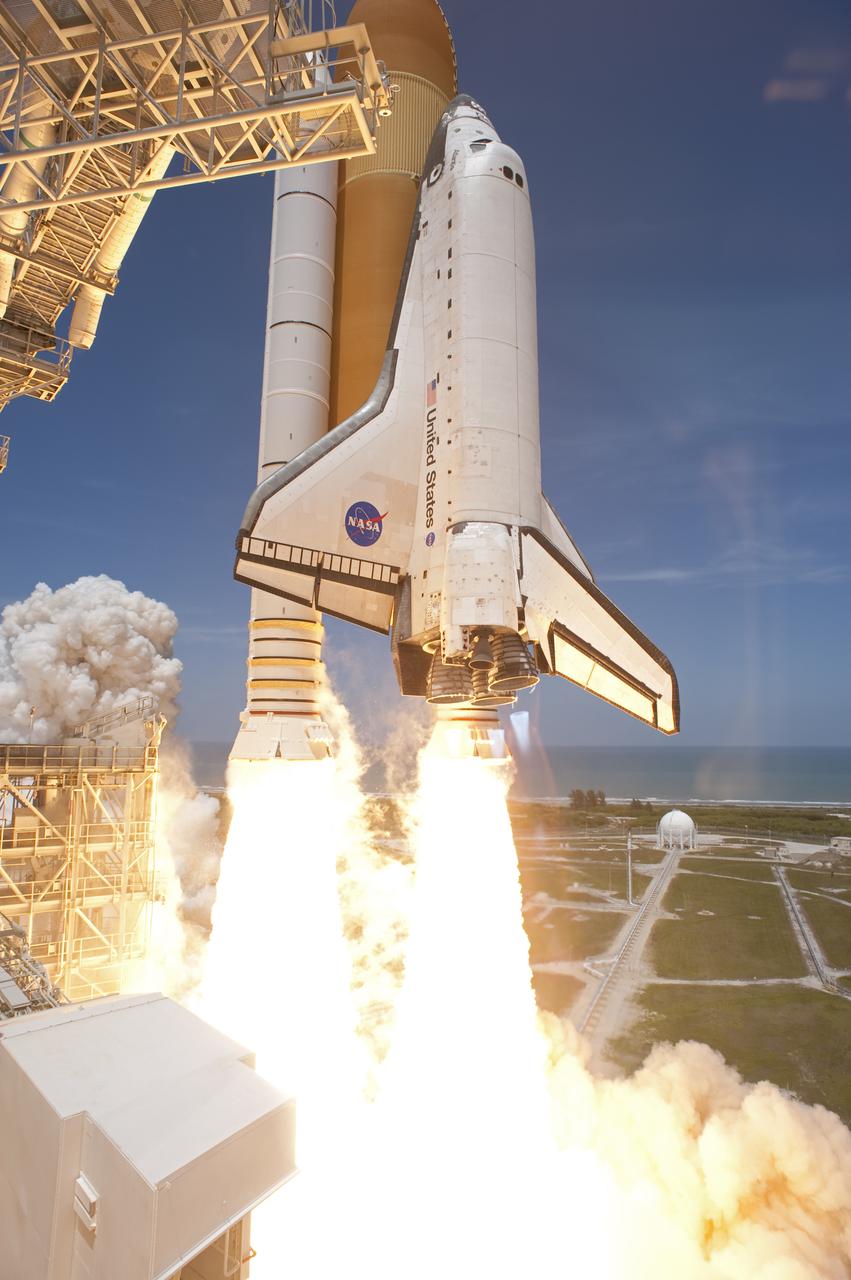
CAPE CANAVERAL, Fla. - Space shuttle Atlantis and its six STS-132 astronauts lift off its seaside launch pad at NASA's Kennedy Space Center in Florida at 2:20 p.m. EDT on May 14. Atlantis' primary payload for the STS-132 mission is the Russian-built Mini Research Module-1, which will provide additional storage space and a new docking port for Russian Soyuz and Progress spacecraft aboard the International Space Station. STS-132 is the 132nd shuttle flight, the 32nd for Atlantis and the 34th shuttle mission dedicated to station assembly and maintenance. For more information on the STS-132 mission objectives, payload and crew, visit www.nasa.gov_mission_pages_shuttle_shuttlemissions_sts132_index.html. Photo credit: NASA_Sandra Joseph and Kevin O'Connell
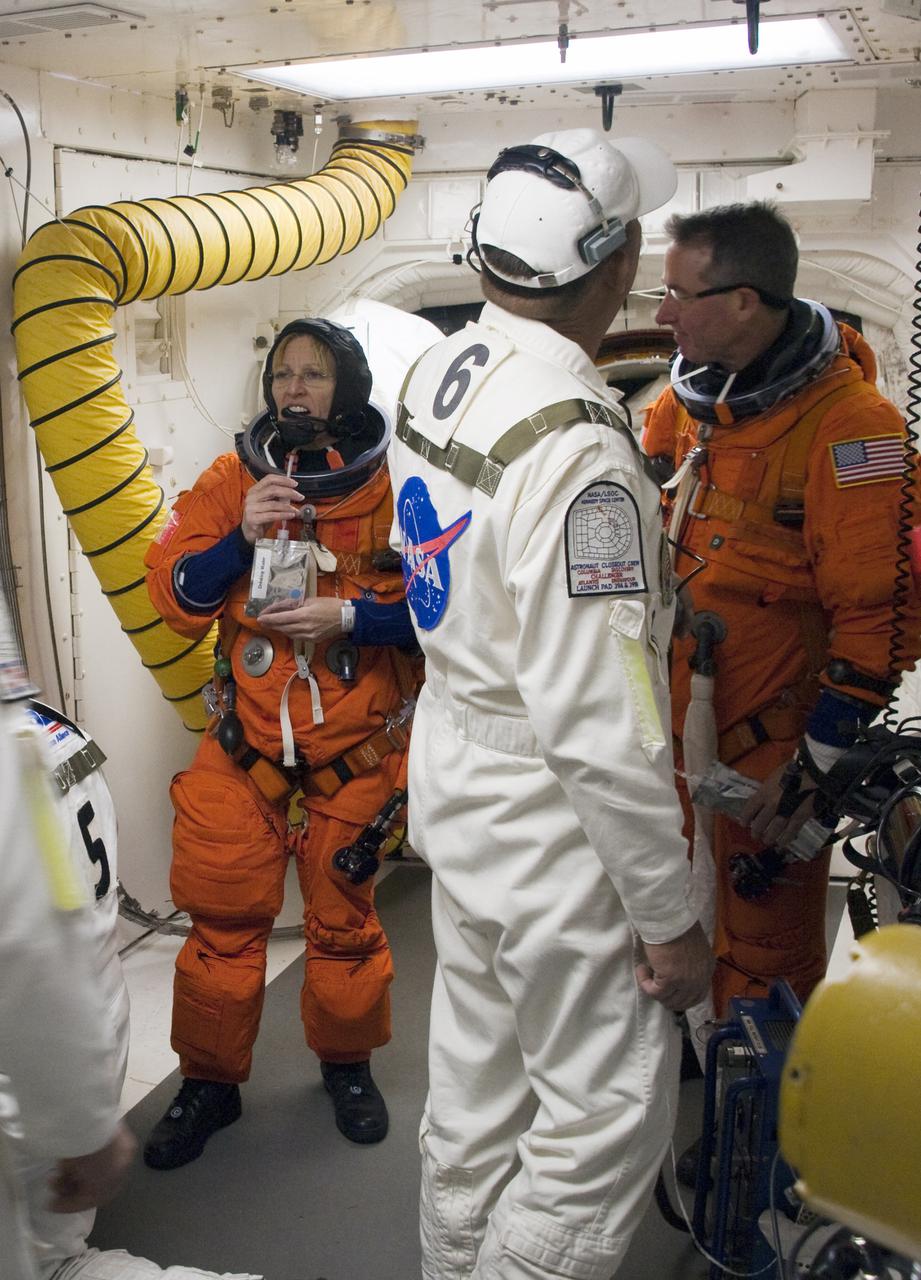
CAPE CANAVERAL, Fla. - In the White Room at Launch Pad 39A on NASA's Kennedy Space Center in Florida, STS-130 Mission Specialist Kathryn Hire (left) prepares to enter space shuttle Endeavour for launch with crewmate Mission Specialist Stephen Robinson looking on. This is the second launch attempt for space shuttle Endeavour's STS-130 crew. The first attempt on Feb. 7 was scrubbed due to unfavorable weather. The primary payload for the STS-130 mission to the International Space Station is the Tranquility node, a pressurized module that will provide additional room for crew members and many of the station's life support and environmental control systems. Attached to one end of Tranquility is a cupola, a unique work area with six windows on its sides and one on top. The cupola resembles a circular bay window and will provide a vastly improved view of the station's exterior. The multi-directional view will allow the crew to monitor spacewalks and docking operations, as well as provide a spectacular view of Earth and other celestial objects. The module was built in Turin, Italy, by Thales Alenia Space for the European Space Agency. Endeavour's launch is set for Feb. 8 at 4:14 a.m. EST. For information on the STS-130 mission and crew, visit http:__www.nasa.gov_mission_pages_shuttle_shuttlemissions_sts130_index.html. Photo credit: NASA_Sandra Joseph and Kevin O'Connell

CAPE CANAVERAL, Fla. In a blaze of smoke and clouds space shuttle Discovery begins its journey on the STS-131 mission from Launch Pad 39A at NASA's Kennedy Space Center in Florida to the International Space. Shuttle Discovery lifted off at 6:21 a.m. EDT on April 5, 2010. The seven-member STS-131 crew will deliver the multi-purpose logistics module Leonardo, filled with supplies, a new crew sleeping quarters and science racks that will be transferred to the International Space Station's laboratories. The crew also will switch out a gyroscope on the station’s truss, install a spare ammonia storage tank and retrieve a Japanese experiment from the station’s exterior. STS-131 is the 33rd shuttle mission to the station and the 131st shuttle mission overall. For information on the STS-131 mission and crew, visit http:__www.nasa.gov_mission_pages_shuttle_shuttlemissions_sts131_index.html. Photo credit: NASA_Sandra Joseph and Kevin O'Connell

CAPE CANAVERAL, Fla. – An exhaust cloud builds at Launch Complex 37 on Cape Canaveral Air Force Station in Florida as the United Launch Alliance Delta IV rocket carrying NASA's GOES-P meteorological satellite lifts off at 6:57 p.m. EST. GOES-P, the latest Geostationary Operational Environmental Satellite, was developed by NASA for the National Oceanic and Atmospheric Administration, or NOAA. The GOES-P spacecraft will be placed in a 22,300-mile-high geosynchronous orbit where it will appear to hover over a single point on Earth. The spacecraft is outfitted with a complex suite of observation instruments and cameras so it can accurately report on weather and climate conditions on Earth. For information on GOES-P, visit http:__www.nasa.gov_mission_pages_GOES-P_main_index.html. Photo credit: NASA_Sandra Joseph and Tony Gray
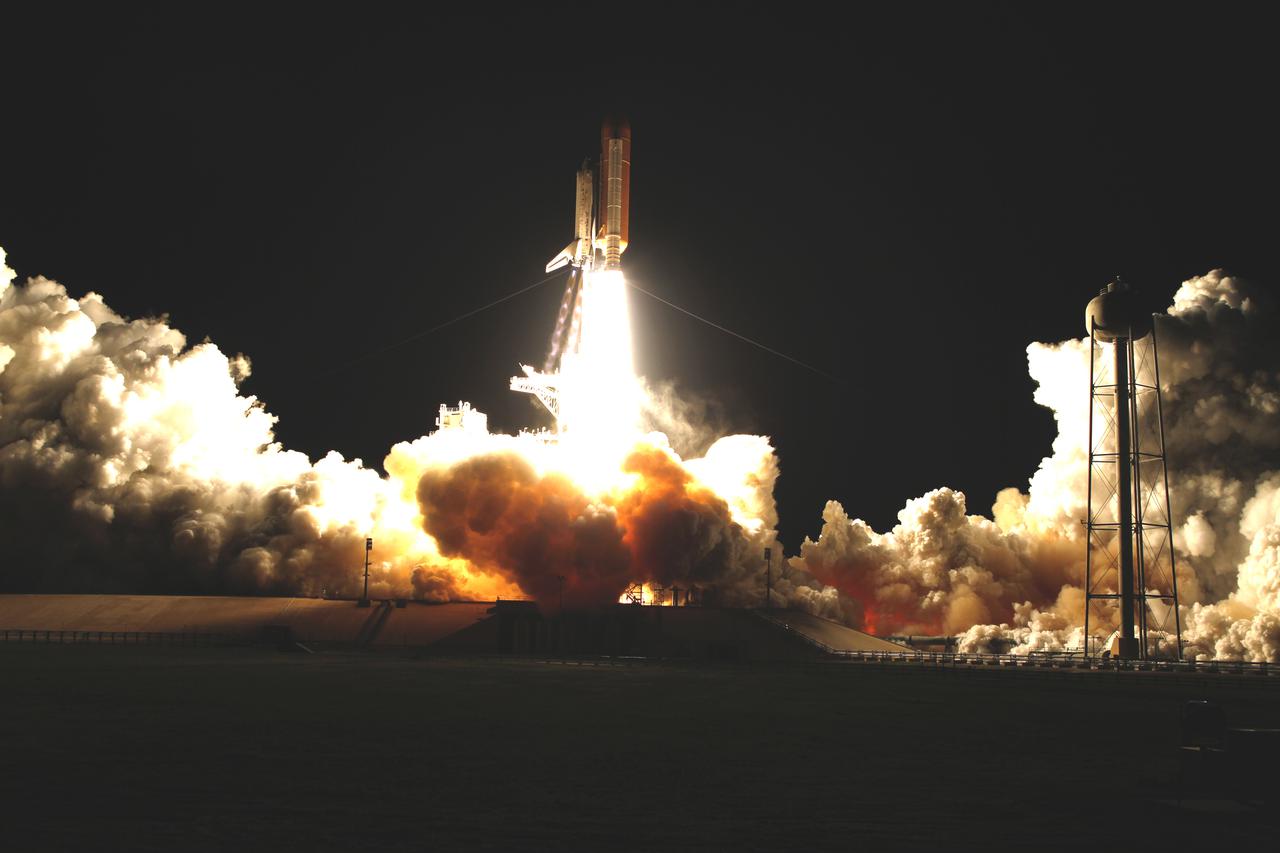
CAPE CANAVERAL, Fla. Clouds billow around Launch Pad 39A at NASA's Kennedy Space Center in Florida as space shuttle Discovery soars upward on its journey headed for the International Space Station on the STS-131 mission. Shuttle Discovery lifted off at 6:21 a.m. EDT on April 5, 2010. The seven-member STS-131 crew will deliver the multi-purpose logistics module Leonardo, filled with supplies, a new crew sleeping quarters and science racks that will be transferred to the International Space Station's laboratories. The crew also will switch out a gyroscope on the station’s truss, install a spare ammonia storage tank and retrieve a Japanese experiment from the station’s exterior. STS-131 is the 33rd shuttle mission to the station and the 131st shuttle mission overall. For information on the STS-131 mission and crew, visit http:__www.nasa.gov_mission_pages_shuttle_shuttlemissions_sts131_index.html. Photo credit: NASA_Sandra Joseph and Kevin O'Connell
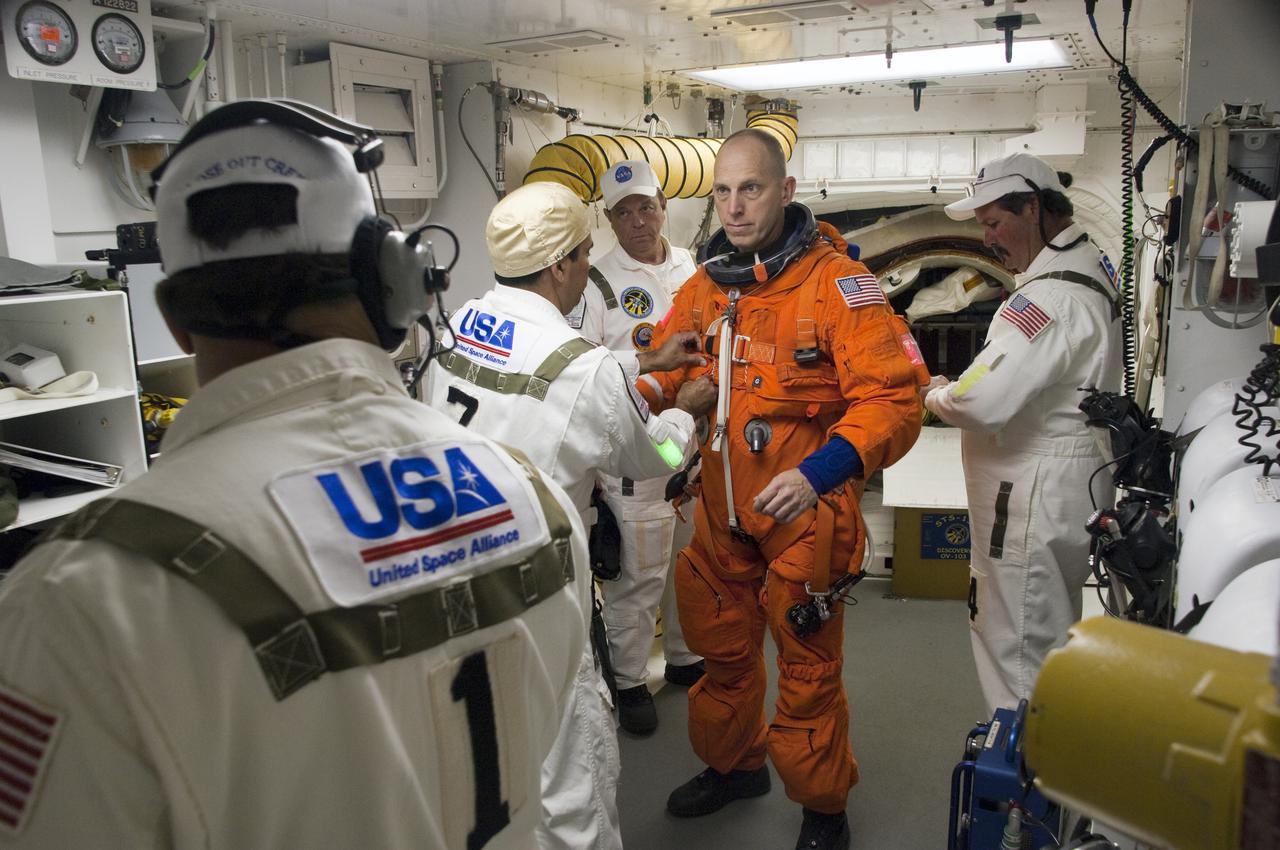
CAPE CANAVERAL, Fla. - In the White Room at Launch Pad 39A at NASA's Kennedy Space Center in Florida, United Space Alliance space suit technicians ensure that the launch-and-entry suit of STS-131 Mission Specialist Clayton Anderson fits properly before he enters space shuttle Discovery through the crew hatch in the background. Liftoff of the STS-131 mission is set for 6:21 a.m. EDT on April 5. On STS-131, the seven-member crew will deliver the multi-purpose logistics module Leonardo, filled with supplies, a new crew sleeping quarters and science racks that will be transferred to the International Space Station's laboratories. The crew also will switch out a gyroscope on the station’s truss, install a spare ammonia storage tank and retrieve a Japanese experiment from the station’s exterior. STS-131 is the 33rd shuttle mission to the station and the 131st shuttle mission overall. For information on the STS-131 mission and crew, visit http:__www.nasa.gov_mission_pages_shuttle_shuttlemissions_sts131_index.html. Photo credit: NASA_Sandra Joseph and Kevin O'Connell
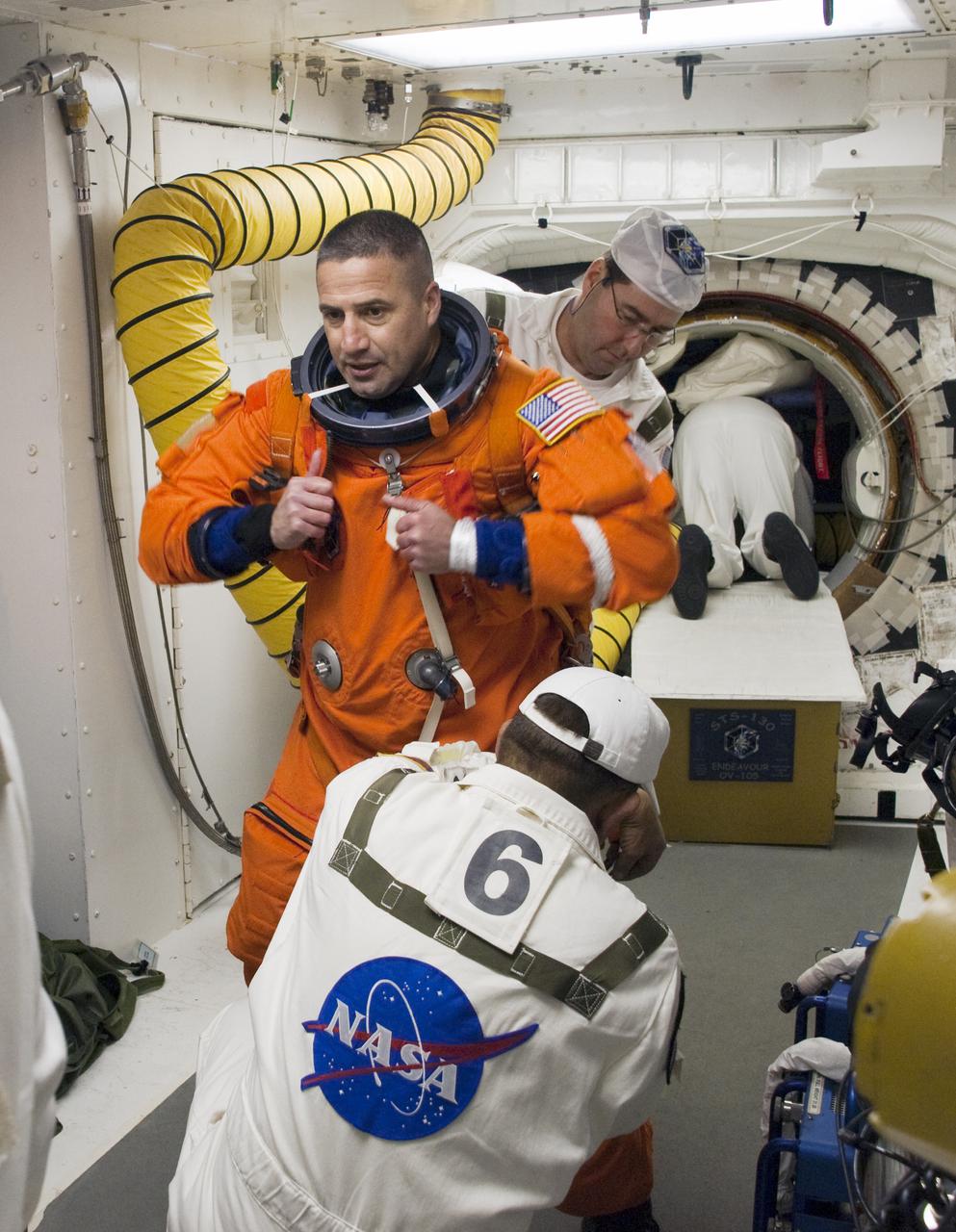
CAPE CANAVERAL, Fla. - In the White Room at Launch Pad 39A on NASA's Kennedy Space Center in Florida, United Space Alliance suit technicians and NASA quality inspectors ensure the proper fit of the launch-and-entry suit of STS-130 Commander George Zamka as he prepares to enter space shuttle Endeavour for launch. This is the second launch attempt for space shuttle Endeavour's STS-130 crew. The first attempt on Feb. 7 was scrubbed due to unfavorable weather. The primary payload for the STS-130 mission to the International Space Station is the Tranquility node, a pressurized module that will provide additional room for crew members and many of the station's life support and environmental control systems. Attached to one end of Tranquility is a cupola, a unique work area with six windows on its sides and one on top. The cupola resembles a circular bay window and will provide a vastly improved view of the station's exterior. The multi-directional view will allow the crew to monitor spacewalks and docking operations, as well as provide a spectacular view of Earth and other celestial objects. The module was built in Turin, Italy, by Thales Alenia Space for the European Space Agency. Endeavour's launch is set for Feb. 8 at 4:14 a.m. EST. For information on the STS-130 mission and crew, visit http:__www.nasa.gov_mission_pages_shuttle_shuttlemissions_sts130_index.html. Photo credit: NASA_Sandra Joseph and Kevin O'Connell
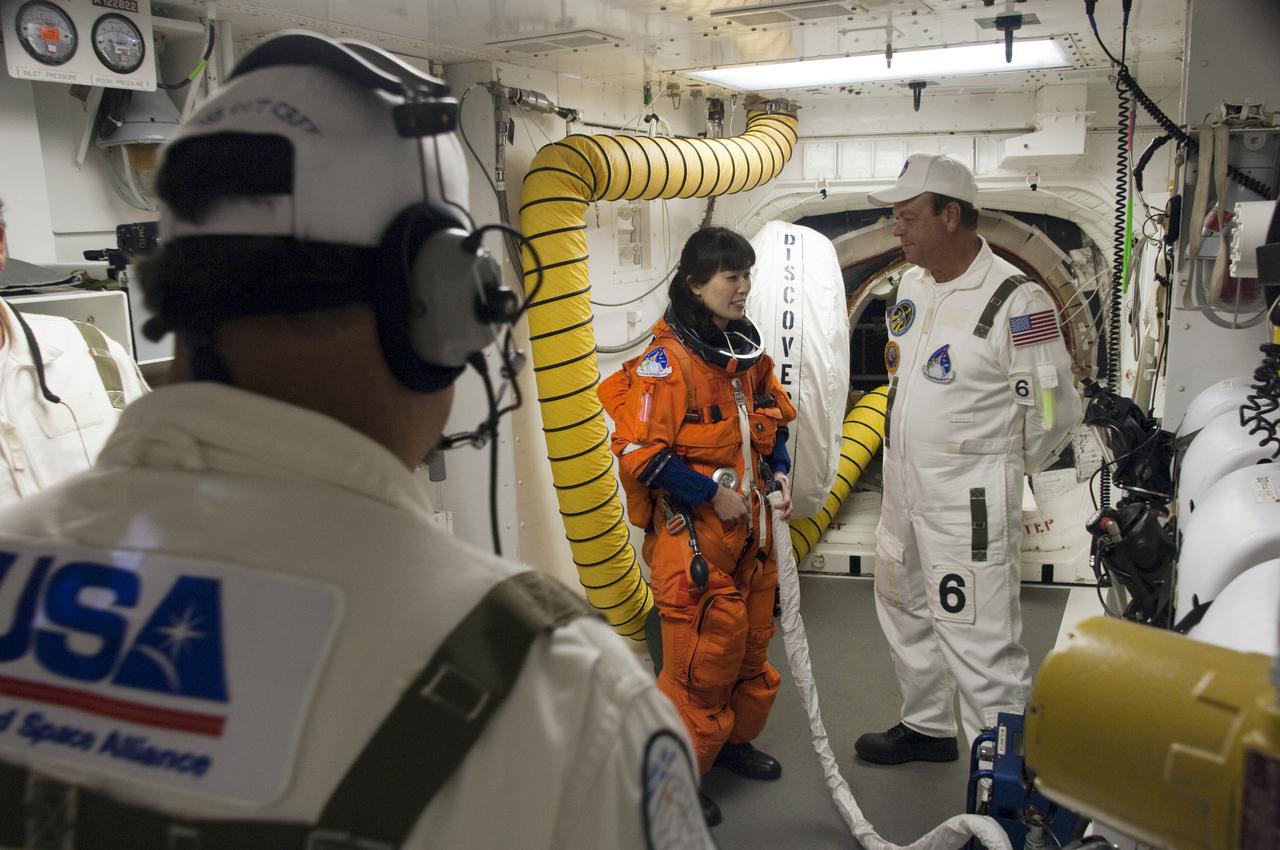
CAPE CANAVERAL, Fla. - In the White Room at Launch Pad 39A at NASA's Kennedy Space Center in Florida, United Space Alliance space suit technicians ensure that the launch-and-entry suit of STS-131 Mission Specialist Naoko Yamazaki, of the Japan Aerospace Exploration Agency, fits properly before she enters space shuttle Discovery through the crew hatch in the background. Liftoff of the STS-131 mission is set for 6:21 a.m. EDT on April 5. On STS-131, the seven-member crew will deliver the multi-purpose logistics module Leonardo, filled with supplies, a new crew sleeping quarters and science racks that will be transferred to the International Space Station's laboratories. The crew also will switch out a gyroscope on the station’s truss, install a spare ammonia storage tank and retrieve a Japanese experiment from the station’s exterior. STS-131 is the 33rd shuttle mission to the station and the 131st shuttle mission overall. For information on the STS-131 mission and crew, visit http:__www.nasa.gov_mission_pages_shuttle_shuttlemissions_sts131_index.html. Photo credit: NASA_Sandra Joseph and Kevin O'Connell
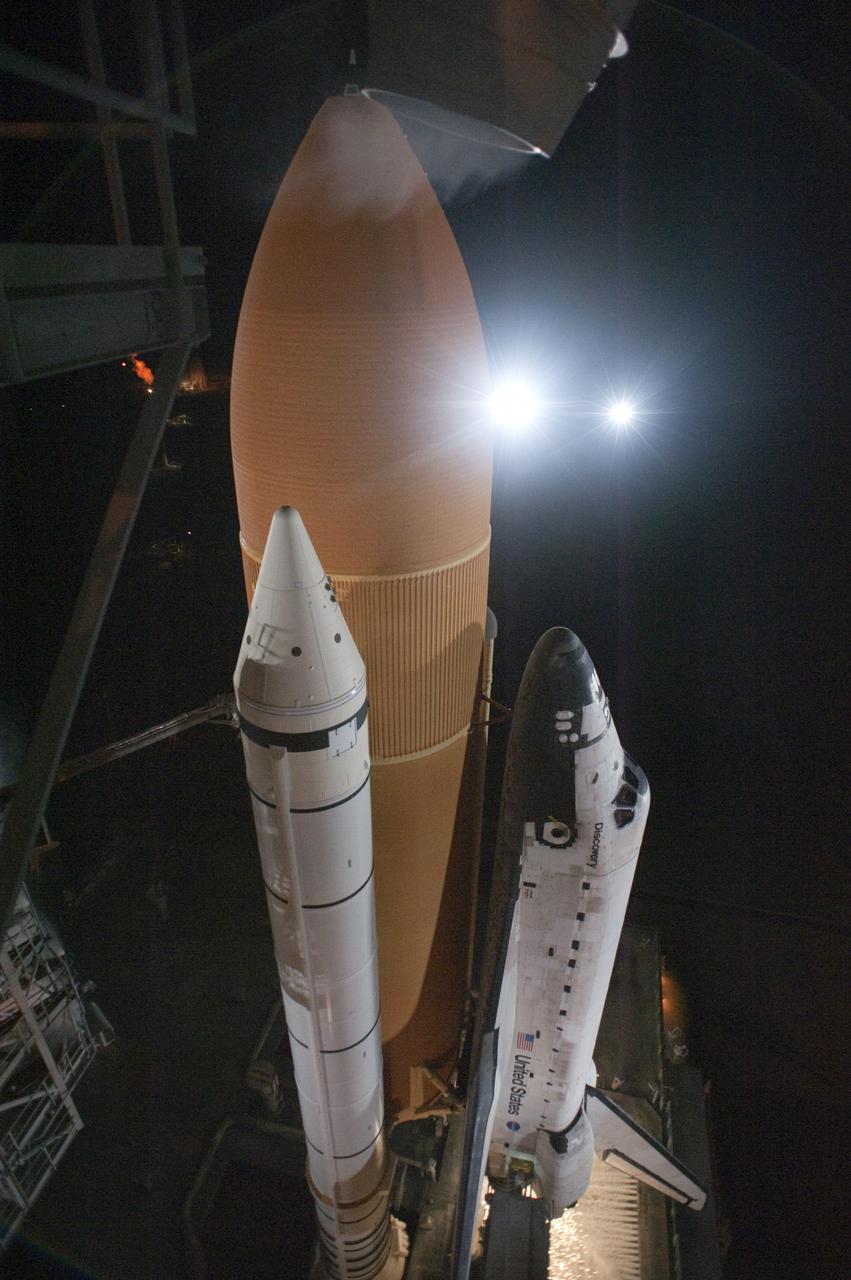
CAPE CANAVERAL, Fla. - Space shuttle Discovery is seen from above at the moment of ignition before it launches off of Launch Pad 39A at NASA's Kennedy Space Center in Florida beginning the STS-131 mission. Shuttle Discovery lifted off at 6:21 a.m. EDT on April 5, 2010. The seven-member STS-131 crew will deliver the multi-purpose logistics module Leonardo, filled with supplies, a new crew sleeping quarters and science racks that will be transferred to the International Space Station's laboratories. The crew also will switch out a gyroscope on the station’s truss, install a spare ammonia storage tank and retrieve a Japanese experiment from the station’s exterior. STS-131 is the 33rd shuttle mission to the station and the 131st shuttle mission overall. For information on the STS-131 mission and crew, visit http:__www.nasa.gov_mission_pages_shuttle_shuttlemissions_sts131_index.html. Photo credit: NASA_Sandra Joseph and Kevin O'Connell
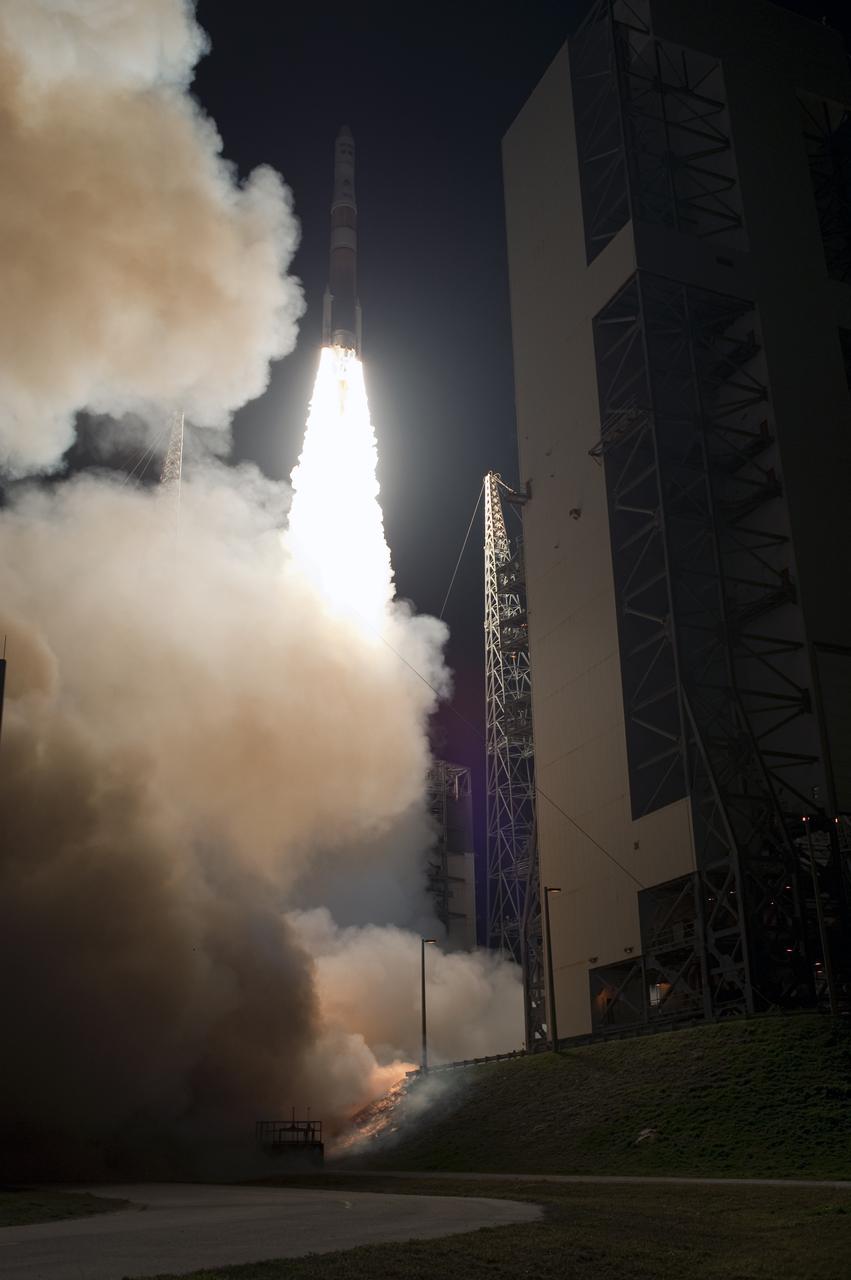
CAPE CANAVERAL, Fla. – The United Launch Alliance Delta IV rocket carrying NASA's GOES-P meteorological satellite races to orbit from Launch Complex 37 on Cape Canaveral Air Force Station in Florida. Liftoff was at 6:57 p.m. EST. GOES-P, the latest Geostationary Operational Environmental Satellite, was developed by NASA for the National Oceanic and Atmospheric Administration, or NOAA. The GOES-P spacecraft will be placed in a 22,300-mile-high geosynchronous orbit where it will appear to hover over a single point on Earth. The spacecraft is outfitted with a complex suite of observation instruments and cameras so it can accurately report on weather and climate conditions on Earth. For information on GOES-P, visit http:__www.nasa.gov_mission_pages_GOES-P_main_index.html. Photo credit: NASA_Sandra Joseph and Tony Gray
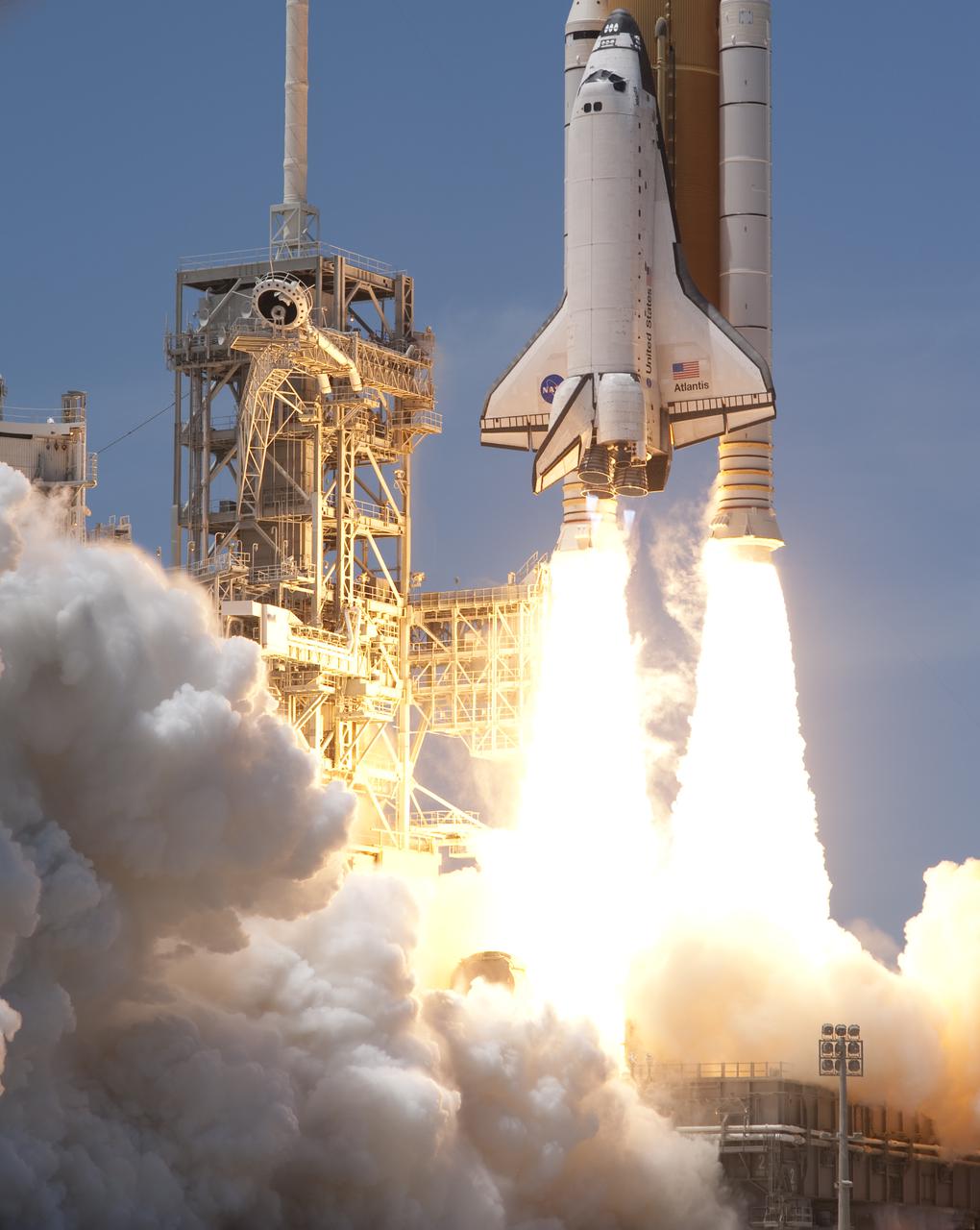
CAPE CANAVERAL, Fla. - A plume of smoke builds at NASA Kennedy Space Center's Launch Pad 39A as space shuttle Atlantis' twin solid rocket boosters ignite to propel the spacecraft skyward at 2:20 p.m. EDT on May 14. On board Atlantis, for its last planned flight, are six veteran NASA astronauts. Atlantis' primary payload for the STS-132 mission is the Russian-built Mini Research Module-1, which will provide additional storage space and a new docking port for Russian Soyuz and Progress spacecraft aboard the International Space Station. STS-132 is the 132nd shuttle flight, the 32nd for Atlantis and the 34th shuttle mission dedicated to station assembly and maintenance. For more information on the STS-132 mission objectives, payload and crew, visit www.nasa.gov_mission_pages_shuttle_shuttlemissions_sts132_index.html. Photo credit: NASA_Sandra Joseph and Kevin O'Connell
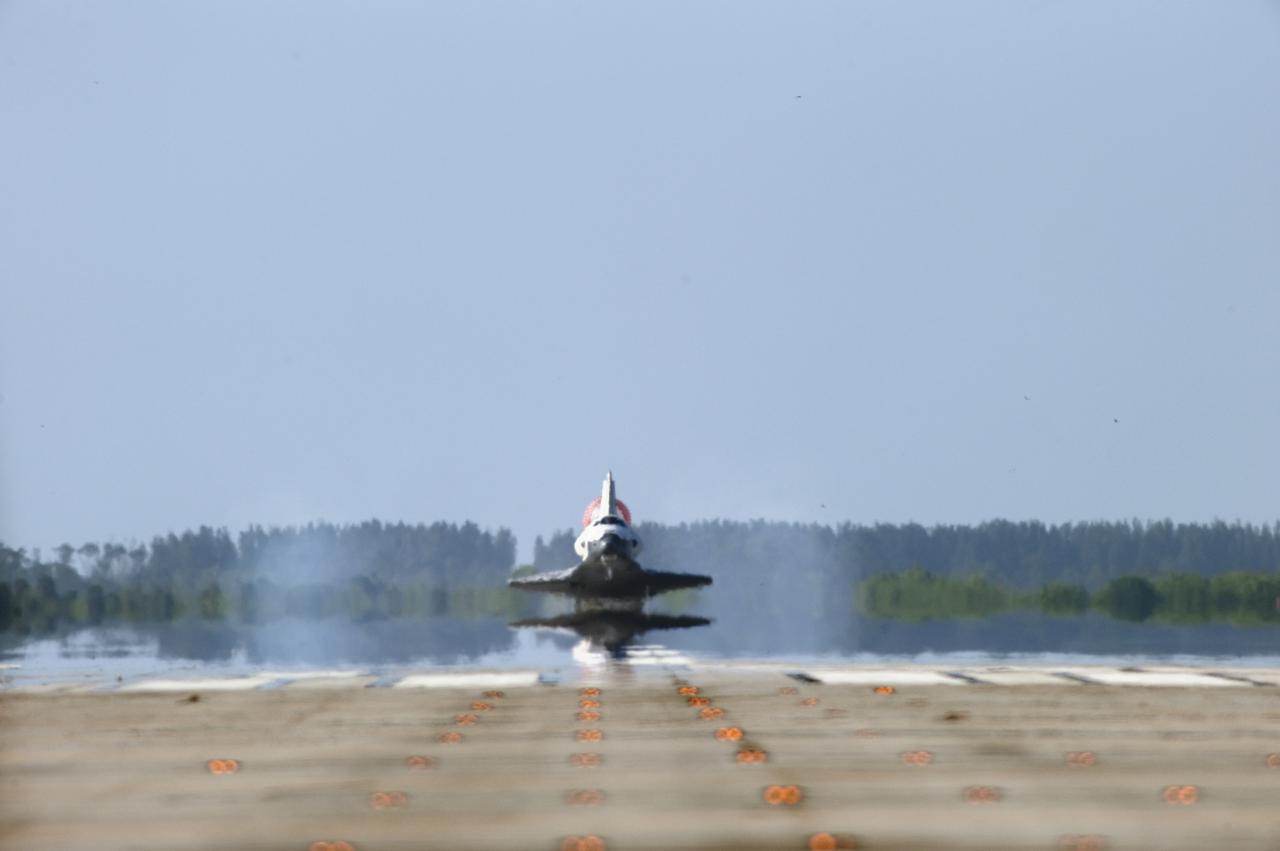
CAPE CANAVERAL, Fla. - Coming in from the southeast, space shuttle Atlantis touches down on Runway 33 at the Shuttle Landing Facility at NASA's Kennedy Space Center in Florida. Landing was at 8:48 a.m. EDT, completing the 12-day STS-132 mission to the International Space Station. The six-member STS-132 crew carried the Russian-built Mini Research Module-1 to the space station. STS-132 is the 34th shuttle mission to the station, the 132nd shuttle mission overall and the last planned flight for Atlantis. For information on the STS-132 mission and crew, visit www.nasa.gov_mission_pages_shuttle_shuttlemissions_sts132_index.html. Photo credit: NASA_Sandra Joseph and Carl Winebarger
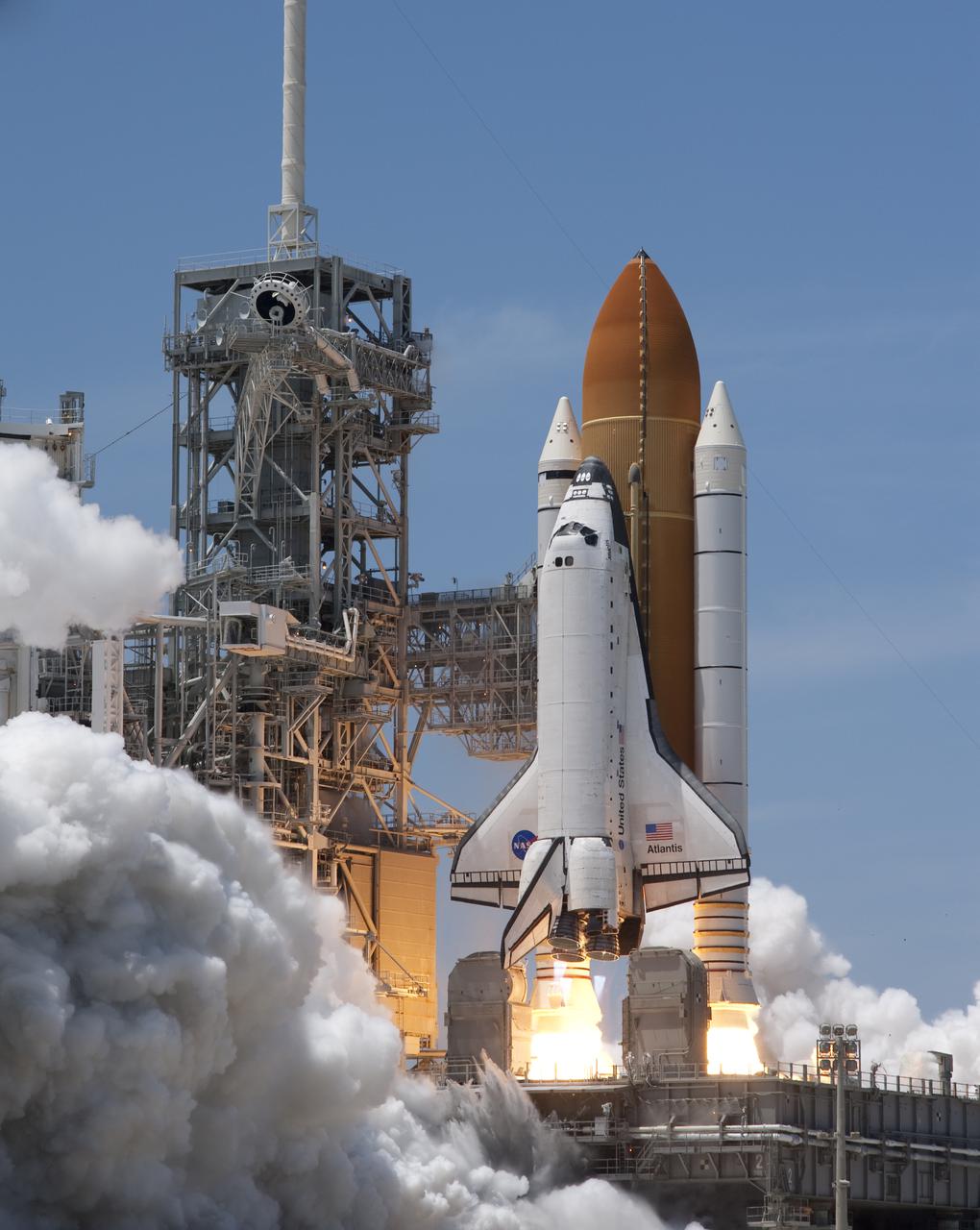
CAPE CANAVERAL, Fla. - A plume of smoke builds at NASA Kennedy Space Center's Launch Pad 39A as space shuttle Atlantis' twin solid rocket boosters ignite to propel the spacecraft skyward at 2:20 p.m. EDT on May 14. On board Atlantis, for its last planned flight, are six veteran NASA astronauts. Atlantis' primary payload for the STS-132 mission is the Russian-built Mini Research Module-1, which will provide additional storage space and a new docking port for Russian Soyuz and Progress spacecraft aboard the International Space Station. STS-132 is the 132nd shuttle flight, the 32nd for Atlantis and the 34th shuttle mission dedicated to station assembly and maintenance. For more information on the STS-132 mission objectives, payload and crew, visit www.nasa.gov_mission_pages_shuttle_shuttlemissions_sts132_index.html. Photo credit: NASA_Sandra Joseph and Kevin O'Connell
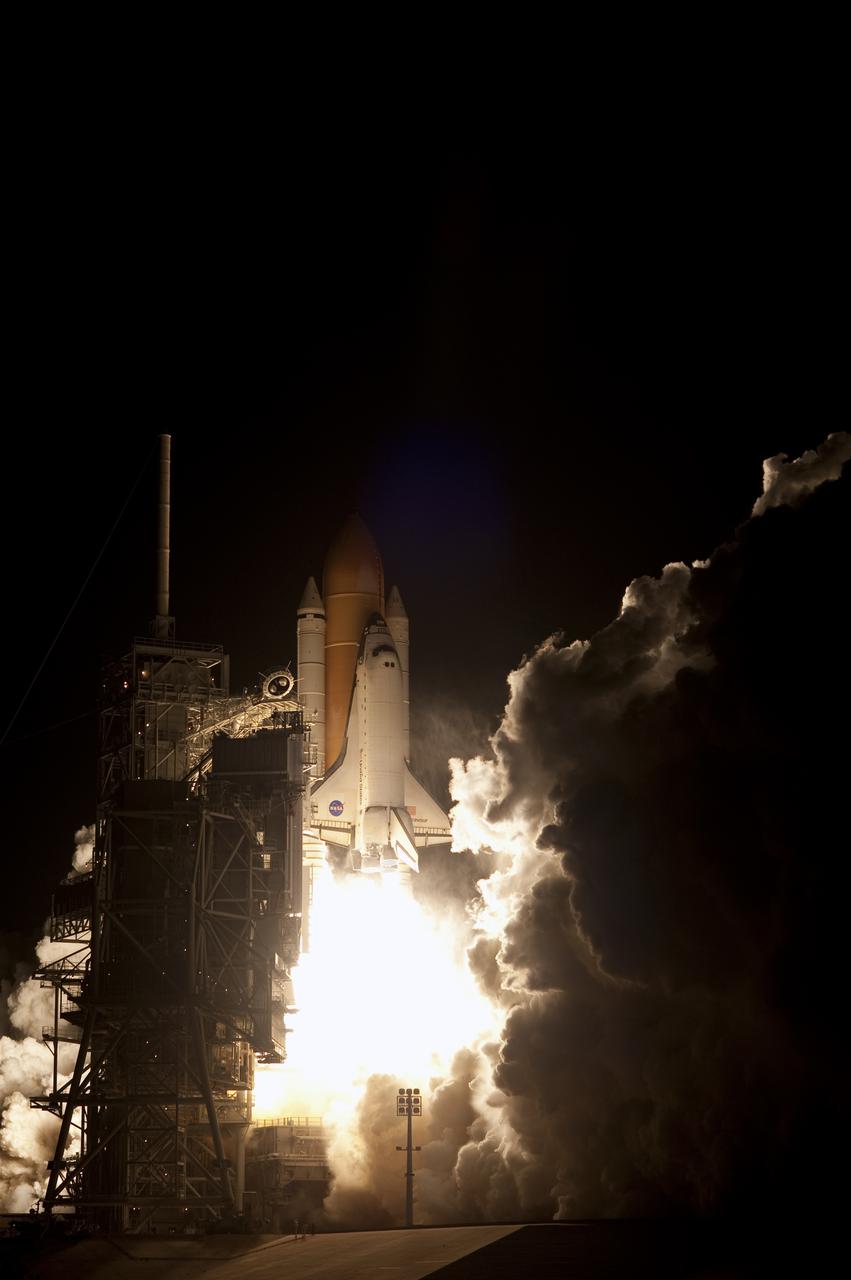
CAPE CANAVERAL, Fla. - Engine ignition on space shuttle Endeavour illuminates Launch Pad 39A at NASA's Kennedy Space Center in Florida. Launch of the STS-130 mission to the International Space Station was at 4:14 a.m. EST. This was the second launch attempt for space shuttle Endeavour's STS-130 crew and the final scheduled space shuttle night launch. The first attempt on Feb. 7 was scrubbed due to unfavorable weather. The primary payload for the STS-130 mission to the International Space Station is the Tranquility node, a pressurized module that will provide additional room for crew members and many of the station's life support and environmental control systems. Attached to one end of Tranquility is a cupola, a unique work area with six windows on its sides and one on top. The cupola resembles a circular bay window and will provide a vastly improved view of the station's exterior. The multi-directional view will allow the crew to monitor spacewalks and docking operations, as well as provide a spectacular view of Earth and other celestial objects. The module was built in Turin, Italy, by Thales Alenia Space for the European Space Agency. For information on the STS-130 mission and crew, visit http:__www.nasa.gov_mission_pages_shuttle_shuttlemissions_sts130_index.html. Photo credit: NASA_Sandra Joseph and Kevin O'Connell
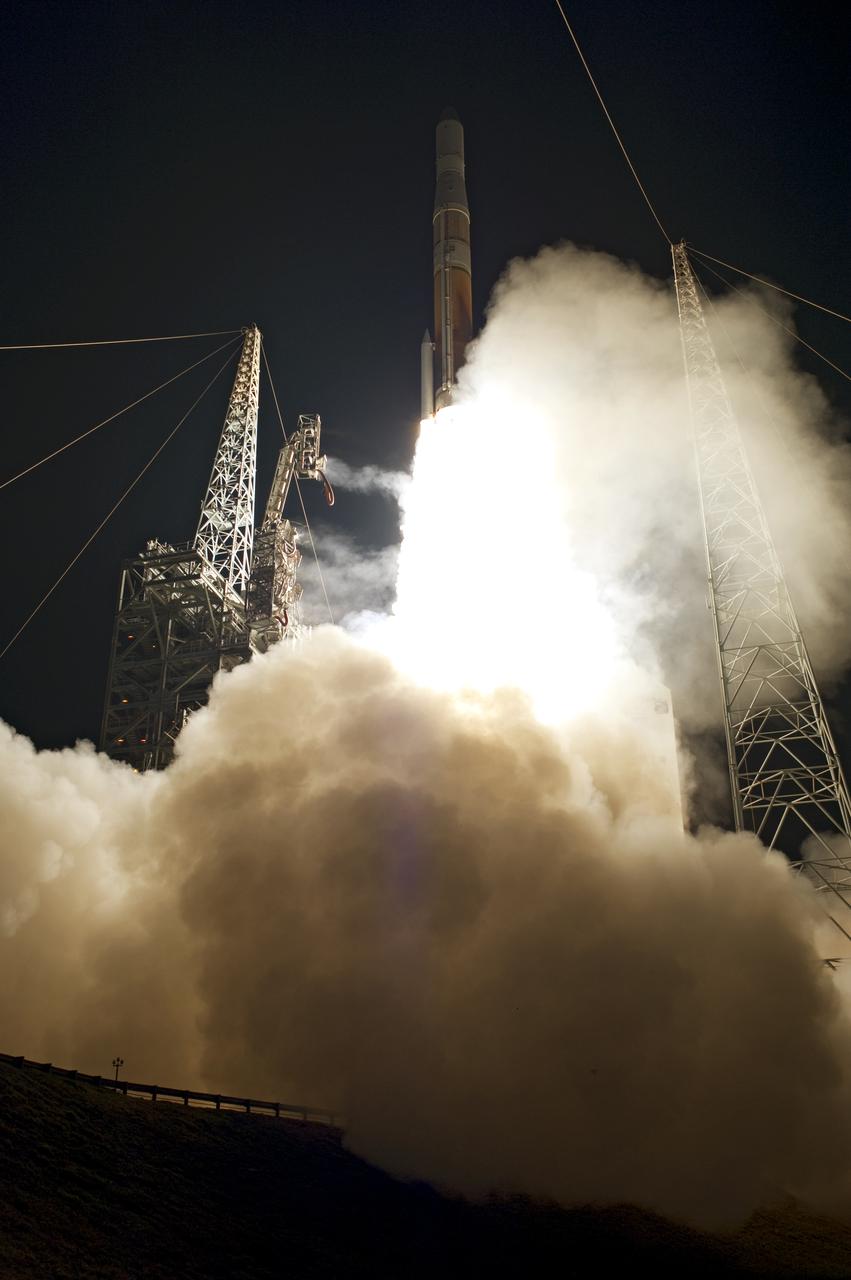
CAPE CANAVERAL, Fla. – A United Launch Alliance Delta IV rocket lifts off between the towers of the lightning protection system at Launch Complex 37 on Cape Canaveral Air Force Station at 6:57 p.m. EST carrying the GOES-P satellite to orbit. GOES-P, the latest Geostationary Operational Environmental Satellite, was developed by NASA for the National Oceanic and Atmospheric Administration, or NOAA. The GOES-P spacecraft will be placed in a 22,300-mile-high geosynchronous orbit where it will appear to hover over a single point on Earth. The spacecraft is outfitted with a complex suite of observation instruments and cameras so it can accurately report on weather and climate conditions on Earth. For information on GOES-P, visit http:__www.nasa.gov_mission_pages_GOES-P_main_index.html. Photo credit: NASA_Sandra Joseph and Tony Gray

CAPE CANAVERAL, Fla. – Liftoff of the United Launch Alliance Delta IV rocket carrying NASA's GOES-P meteorological satellite is reflected in the water near Launch Complex 37 on Cape Canaveral Air Force Station in Florida. Launch was at 6:57 p.m. EST. GOES-P, the latest Geostationary Operational Environmental Satellite, was developed by NASA for the National Oceanic and Atmospheric Administration, or NOAA. The GOES-P spacecraft will be placed in a 22,300-mile-high geosynchronous orbit where it will appear to hover over a single point on Earth. The spacecraft is outfitted with a complex suite of observation instruments and cameras so it can accurately report on weather and climate conditions on Earth. For information on GOES-P, visit http:__www.nasa.gov_mission_pages_GOES-P_main_index.html. Photo credit: NASA_Sandra Joseph and Tony Gray
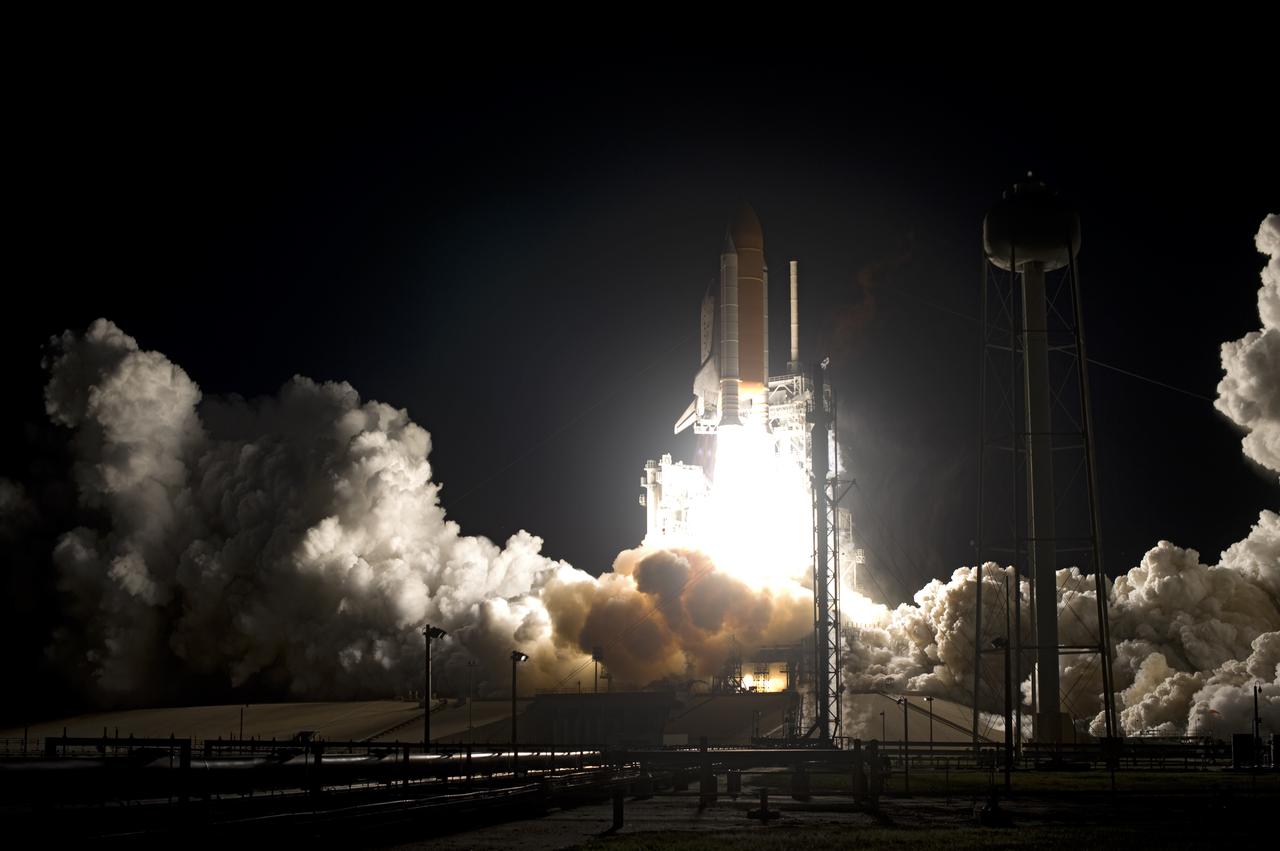
CAPE CANAVERAL, Fla. - Streaking up from a tower of flame and clouds space shuttle Discovery roars off Launch Pad 39A at NASA's Kennedy Space Center in Florida on its STS-131 mission. Shuttle Discovery lifted off at 6:21 a.m. EDT on April 5, 2010. The seven-member STS-131 crew will deliver the multi-purpose logistics module Leonardo, filled with supplies, a new crew sleeping quarters and science racks that will be transferred to the International Space Station's laboratories. The crew also will switch out a gyroscope on the station’s truss, install a spare ammonia storage tank and retrieve a Japanese experiment from the station’s exterior. STS-131 is the 33rd shuttle mission to the station and the 131st shuttle mission overall. For information on the STS-131 mission and crew, visit http:__www.nasa.gov_mission_pages_shuttle_shuttlemissions_sts131_index.html. Photo credit: NASA_Sandra Joseph and Kevin O'Connell
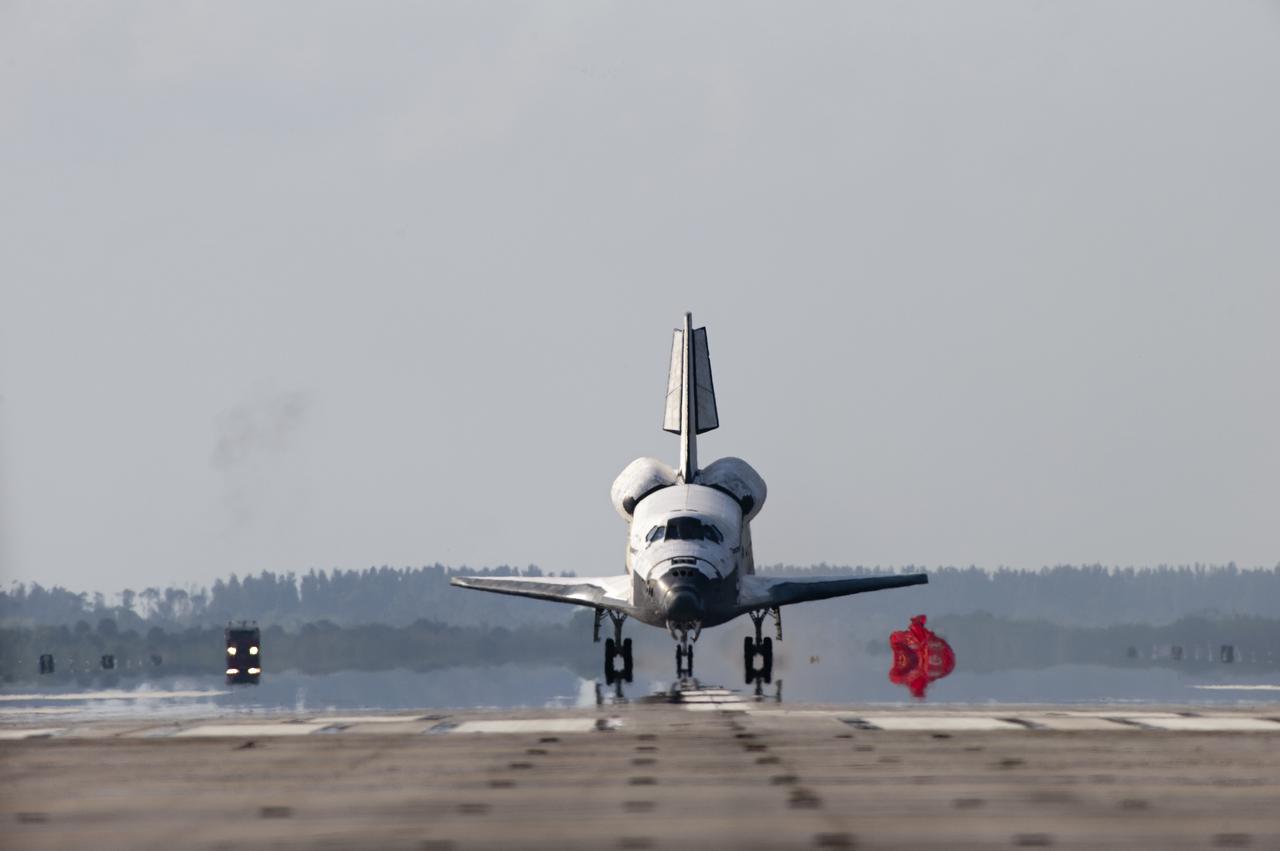
CAPE CANAVERAL, Fla. - Space shuttle Discovery's drag chute is jettisoned after slowing the shuttle for its touch down on Runway 33 at the Shuttle Landing Facility at NASA's Kennedy Space Center in Florida after 15 days in space, completing the more than 6.2-million-mile STS-131 mission on orbit 238. Main gear touchdown was at 9:08:35 a.m. EDT followed by nose gear touchdown at 9:08:47 a.m. and wheelstop at 9:09:33 a.m. Aboard are Commander Alan Poindexter; Pilot James P. Dutton Jr.; and Mission Specialists Rick Mastracchio, Clayton Anderson, Dorothy Metcalf-Lindenburger, Stephanie Wilson and Naoko Yamazaki of the Japan Aerospace Exploration Agency. The seven-member STS-131 crew carried the multi-purpose logistics module Leonardo, filled with supplies, a new crew sleeping quarters and science racks that were transferred to the International Space Station's laboratories. The crew also switched out a gyroscope on the station’s truss, installed a spare ammonia storage tank and retrieved a Japanese experiment from the station’s exterior. STS-131 is the 33rd shuttle mission to the station and the 131st shuttle mission overall. For information on the STS-131 mission and crew, visit http:__www.nasa.gov_mission_pages_shuttle_shuttlemissions_sts131_index.html. Photo credit: NASA_Sandra Joseph and Kevin O'Connell
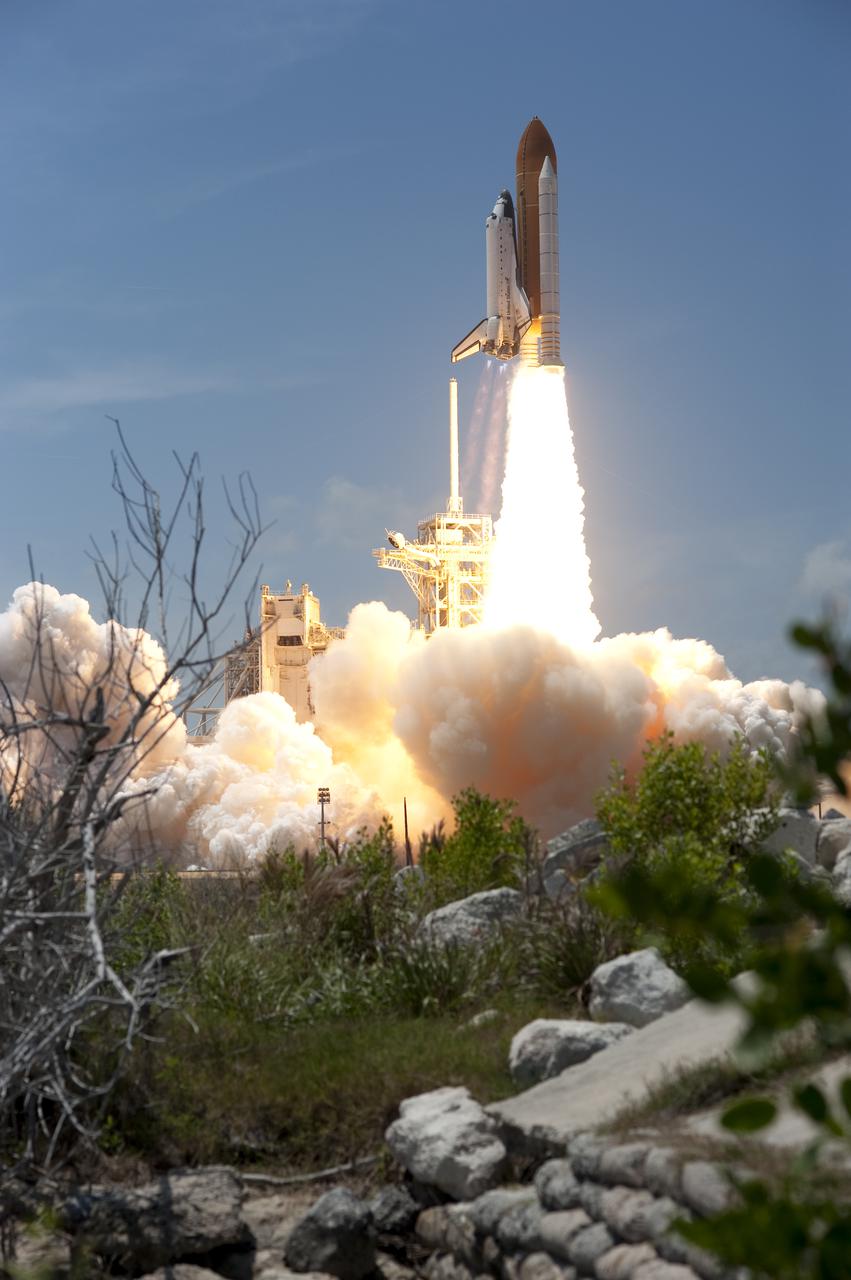
CAPE CANAVERAL, Fla. - Space shuttle Atlantis rumbles the Space Coast as it clears the tower at its pristine launch complex, which is home to the Merritt Island National Wildlife Refuge. Liftoff from NASA Kennedy Space Center's Launch Pad 39A occurred right on time at 2:20 p.m. EDT on May 14. Atlantis' primary payload for the STS-132 mission is the Russian-built Mini Research Module-1, which will provide additional storage space and a new docking port for Russian Soyuz and Progress spacecraft aboard the International Space Station. STS-132 is the 132nd shuttle flight, the 32nd for Atlantis and the 34th shuttle mission dedicated to station assembly and maintenance. For more information on the STS-132 mission objectives, payload and crew, visit www.nasa.gov_mission_pages_shuttle_shuttlemissions_sts132_index.html. Photo credit: NASA_Sandra Joseph and Kevin O'Connell
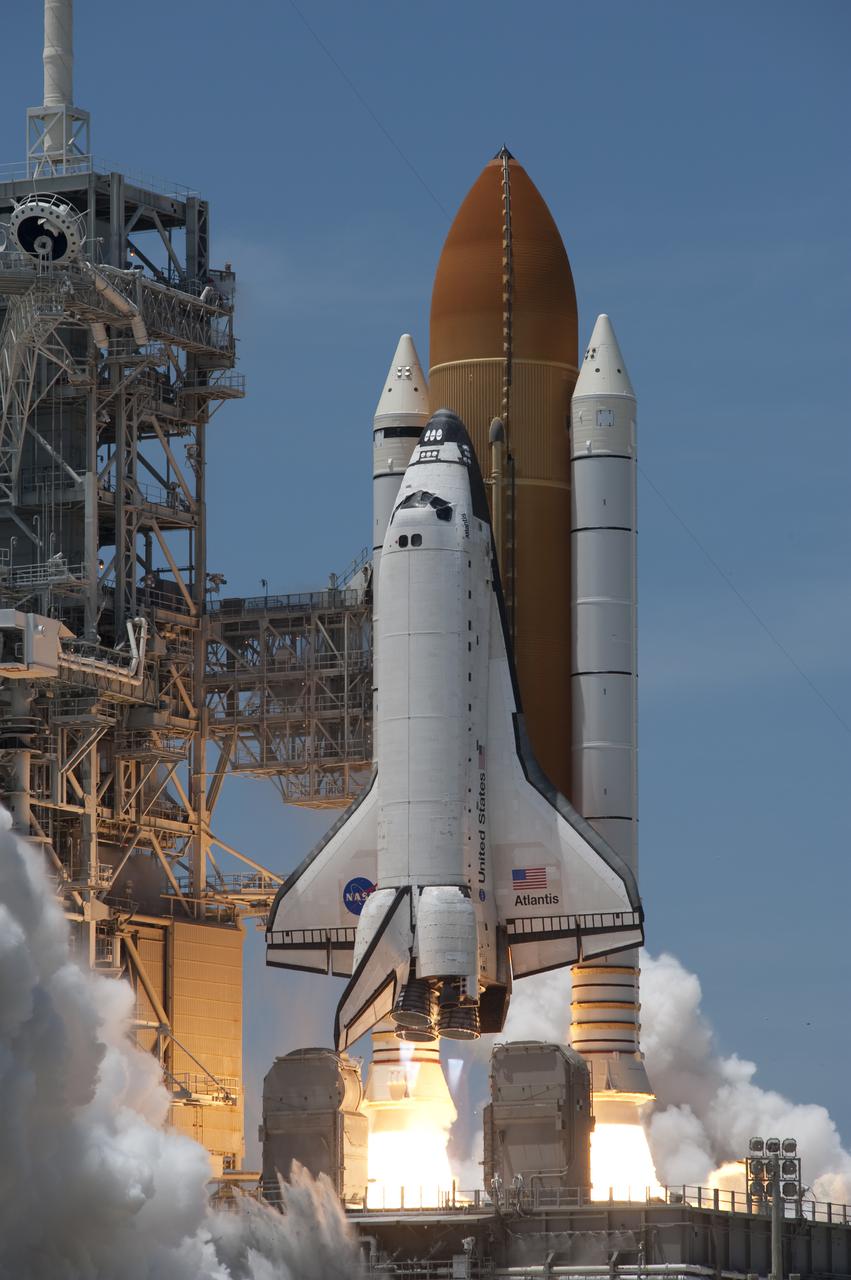
CAPE CANAVERAL, Fla. - Space shuttle Atlantis' twin solid rocket boosters ignite to propel the spacecraft off NASA Kennedy Space Center's Launch Pad 39A and into orbit at 2:20 p.m. EDT on May 14. On board Atlantis, for its last planned flight, are six veteran NASA astronauts. Atlantis' primary payload for the STS-132 mission is the Russian-built Mini Research Module-1, which will provide additional storage space and a new docking port for Russian Soyuz and Progress spacecraft aboard the International Space Station. STS-132 is the 132nd shuttle flight, the 32nd for Atlantis and the 34th shuttle mission dedicated to station assembly and maintenance. For more information on the STS-132 mission objectives, payload and crew, visit www.nasa.gov_mission_pages_shuttle_shuttlemissions_sts132_index.html. Photo credit: NASA_Sandra Joseph and Kevin O'Connell

CAPE CANAVERAL, Fla. – The United Launch Alliance Atlas V rocket carrying NASA's Solar Dynamics Observatory heads into the 'wild blue yonder' from Launch Complex 41 on Cape Canaveral Air Force Station. Launch was at 10:23 a.m. EST Feb. 11. This is the 100th launch of a commercial Atlas_Centaur rocket. The observatory, known as SDO, is the first mission in NASA's Living With a Star Program and is designed to study the causes of solar variability and its impacts on Earth. The spacecraft's long-term measurements will give solar scientists in-depth information to help characterize the interior of the Sun, the Sun's magnetic field, the hot plasma of the solar corona, and the density of radiation that creates the ionosphere of the planets. The information will be used to create better forecasts of space weather needed to protect the aircraft, satellites and astronauts living and working in space. For information on SDO, visit http:__www.nasa.gov_sdo. Photo credit: NASA_Sandra Joseph and Tony Gray
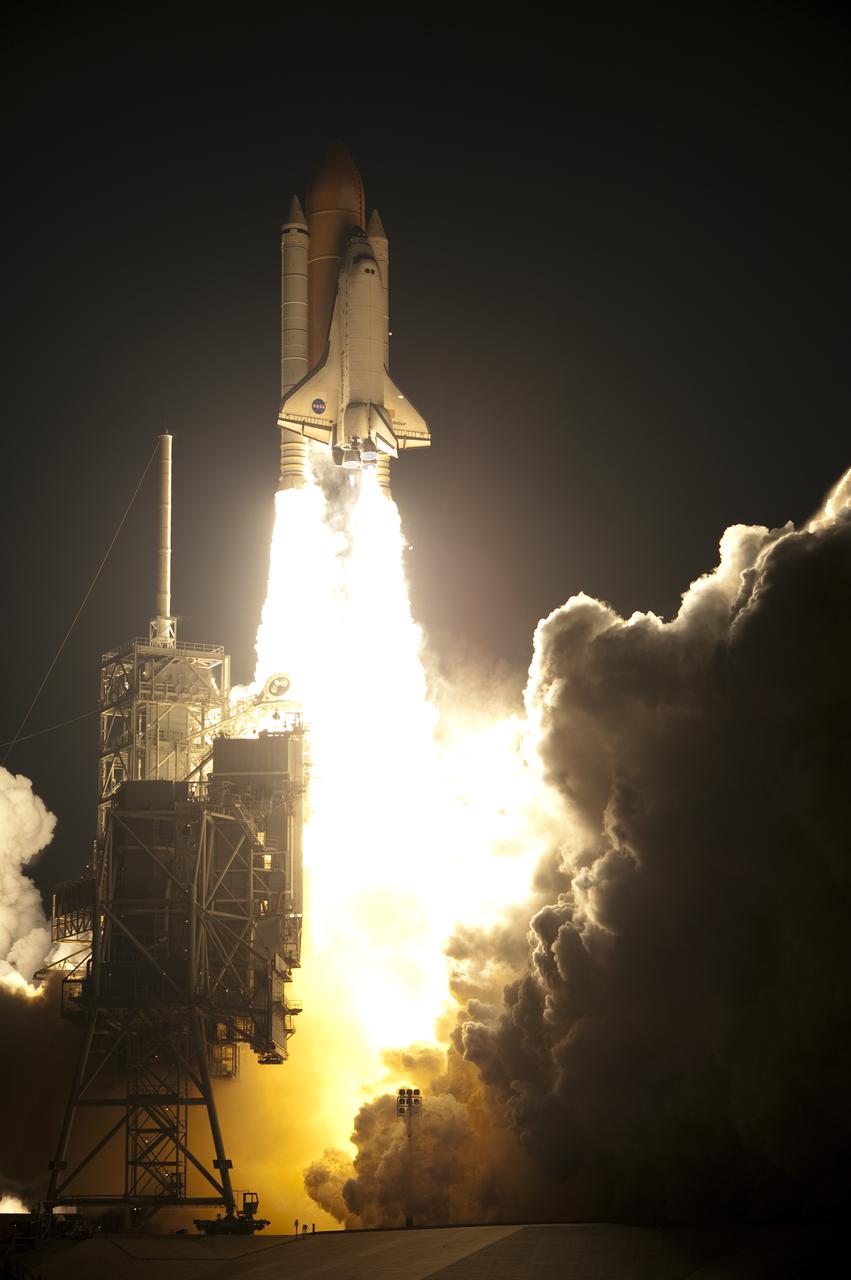
CAPE CANAVERAL, Fla. - Space shuttle Endeavour clears the tower on Launch Pad 39A at NASA's Kennedy Space Center in Florida. Launch of the STS-130 mission to the International Space Station was at 4:14 a.m. EST. This was the second launch attempt for space shuttle Endeavour's STS-130 crew and the final scheduled space shuttle night launch. The first attempt on Feb. 7 was scrubbed due to unfavorable weather. The primary payload for the STS-130 mission to the International Space Station is the Tranquility node, a pressurized module that will provide additional room for crew members and many of the station's life support and environmental control systems. Attached to one end of Tranquility is a cupola, a unique work area with six windows on its sides and one on top. The cupola resembles a circular bay window and will provide a vastly improved view of the station's exterior. The multi-directional view will allow the crew to monitor spacewalks and docking operations, as well as provide a spectacular view of Earth and other celestial objects. The module was built in Turin, Italy, by Thales Alenia Space for the European Space Agency. For information on the STS-130 mission and crew, visit http:__www.nasa.gov_mission_pages_shuttle_shuttlemissions_sts130_index.html. Photo credit: NASA_Sandra Joseph and Kevin O'Connell

CAPE CANAVERAL, Fla. - Soaring into the darkness of an early-morning sky, space shuttle Discovery leaps off Launch Pad 39A at NASA's Kennedy Space Center in Florida beginning the STS-131 mission. Shuttle Discovery lifted off at 6:21 a.m. EDT on April 5, 2010. The seven-member STS-131 crew will deliver the multi-purpose logistics module Leonardo, filled with supplies, a new crew sleeping quarters and science racks that will be transferred to the International Space Station's laboratories. The crew also will switch out a gyroscope on the station’s truss, install a spare ammonia storage tank and retrieve a Japanese experiment from the station’s exterior. STS-131 is the 33rd shuttle mission to the station and the 131st shuttle mission overall. For information on the STS-131 mission and crew, visit http:__www.nasa.gov_mission_pages_shuttle_shuttlemissions_sts131_index.html. Photo credit: NASA_Sandra Joseph and Kevin O'Connell
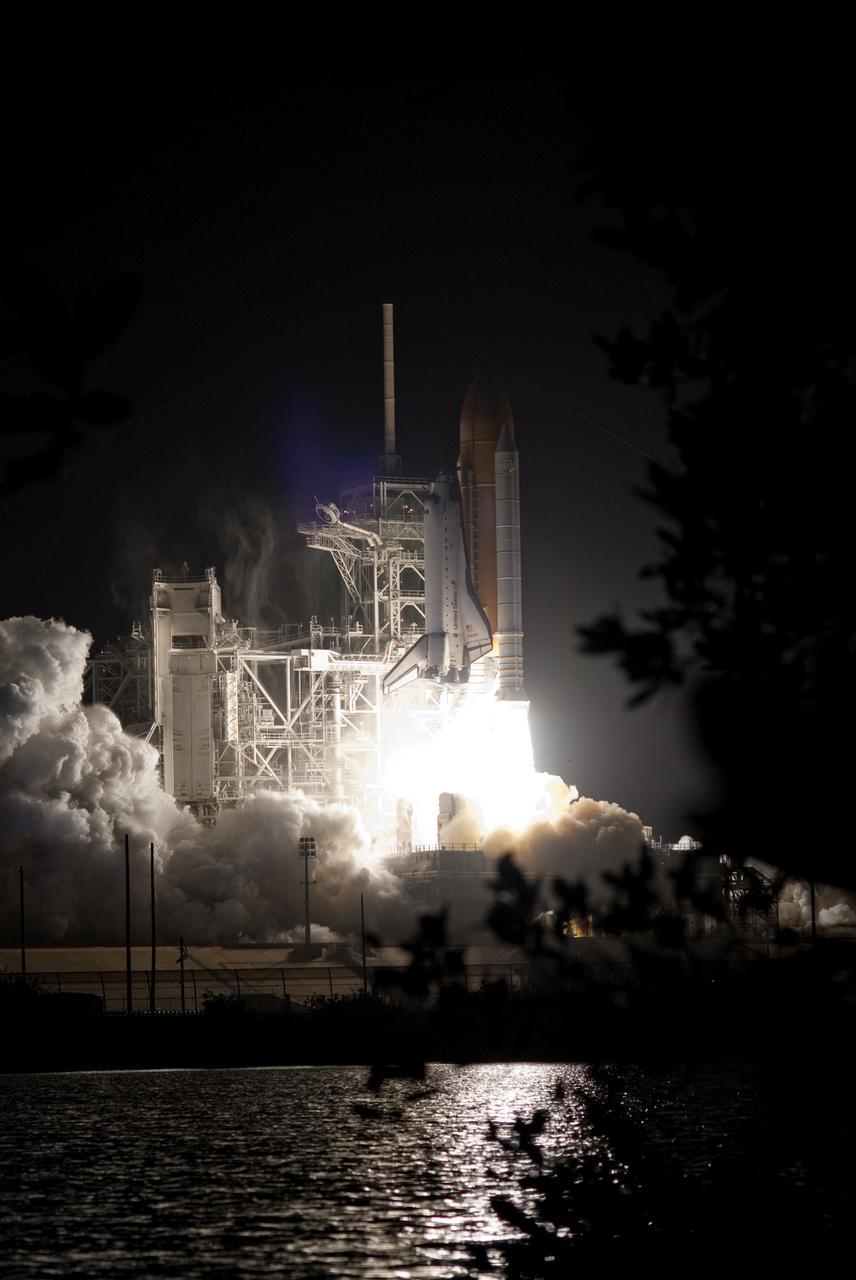
CAPE CANAVERAL, Fla. - Liftoff of space shuttle Endeavour is reflected in the still water near Launch Pad 39A at NASA's Kennedy Space Center in Florida. Launch of the STS-130 mission to the International Space Station was at 4:14 a.m. EST. This was the second launch attempt for space shuttle Endeavour's STS-130 crew and the final scheduled space shuttle night launch. The first attempt on Feb. 7 was scrubbed due to unfavorable weather. The primary payload for the STS-130 mission to the International Space Station is the Tranquility node, a pressurized module that will provide additional room for crew members and many of the station's life support and environmental control systems. Attached to one end of Tranquility is a cupola, a unique work area with six windows on its sides and one on top. The cupola resembles a circular bay window and will provide a vastly improved view of the station's exterior. The multi-directional view will allow the crew to monitor spacewalks and docking operations, as well as provide a spectacular view of Earth and other celestial objects. The module was built in Turin, Italy, by Thales Alenia Space for the European Space Agency. For information on the STS-130 mission and crew, visit http:__www.nasa.gov_mission_pages_shuttle_shuttlemissions_sts130_index.html. Photo credit: NASA_Sandra Joseph and Kevin O'Connell
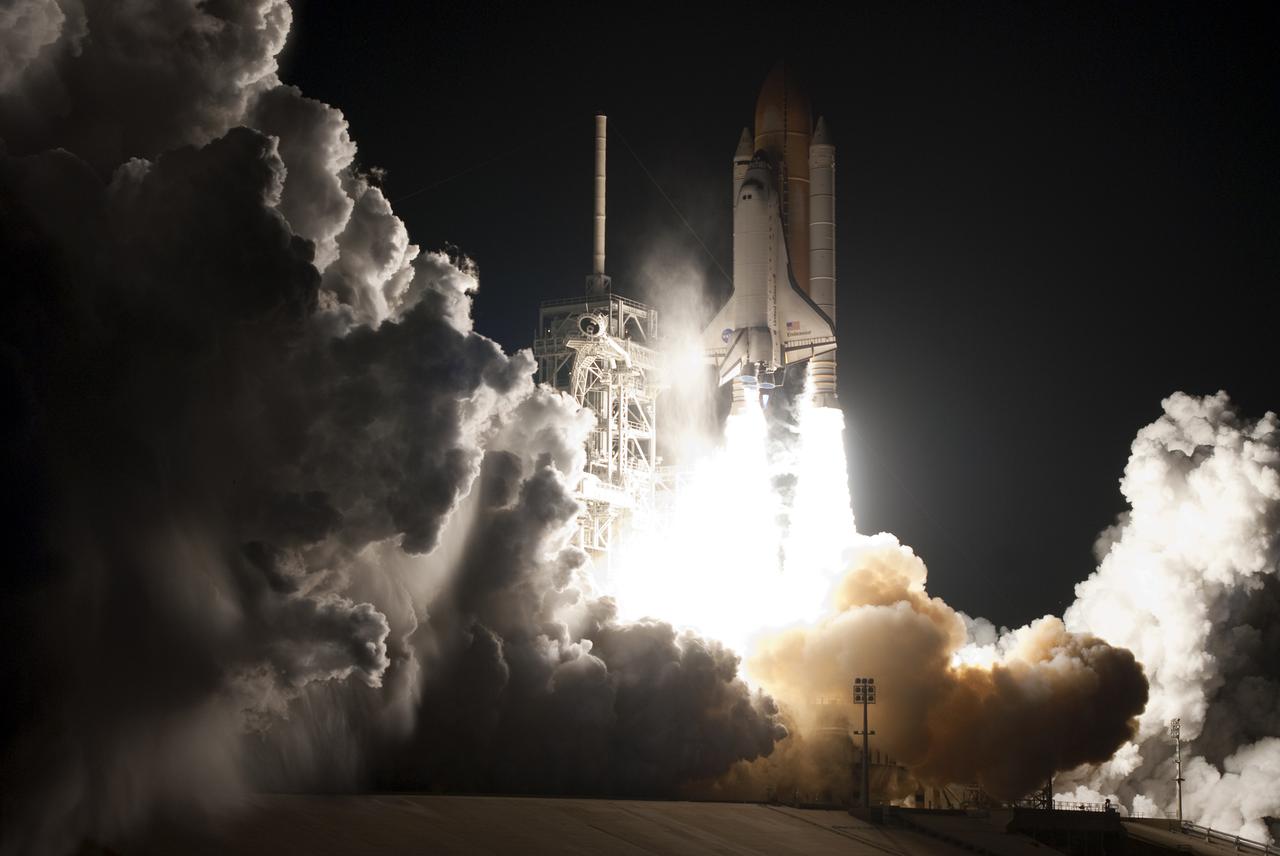
CAPE CANAVERAL, Fla. - An exhaust cloud billows at Launch Pad 39A at NASA's Kennedy Space Center in Florida as space shuttle Endeavour lifts off into the night sky. Launch of the STS-130 mission to the International Space Station was at 4:14 a.m. EST. This was the second launch attempt for space shuttle Endeavour's STS-130 crew and the final scheduled space shuttle night launch. The first attempt on Feb. 7 was scrubbed due to unfavorable weather. The primary payload for the STS-130 mission to the International Space Station is the Tranquility node, a pressurized module that will provide additional room for crew members and many of the station's life support and environmental control systems. Attached to one end of Tranquility is a cupola, a unique work area with six windows on its sides and one on top. The cupola resembles a circular bay window and will provide a vastly improved view of the station's exterior. The multi-directional view will allow the crew to monitor spacewalks and docking operations, as well as provide a spectacular view of Earth and other celestial objects. The module was built in Turin, Italy, by Thales Alenia Space for the European Space Agency. For information on the STS-130 mission and crew, visit http:__www.nasa.gov_mission_pages_shuttle_shuttlemissions_sts130_index.html. Photo credit: NASA_Sandra Joseph and Kevin O'Connell
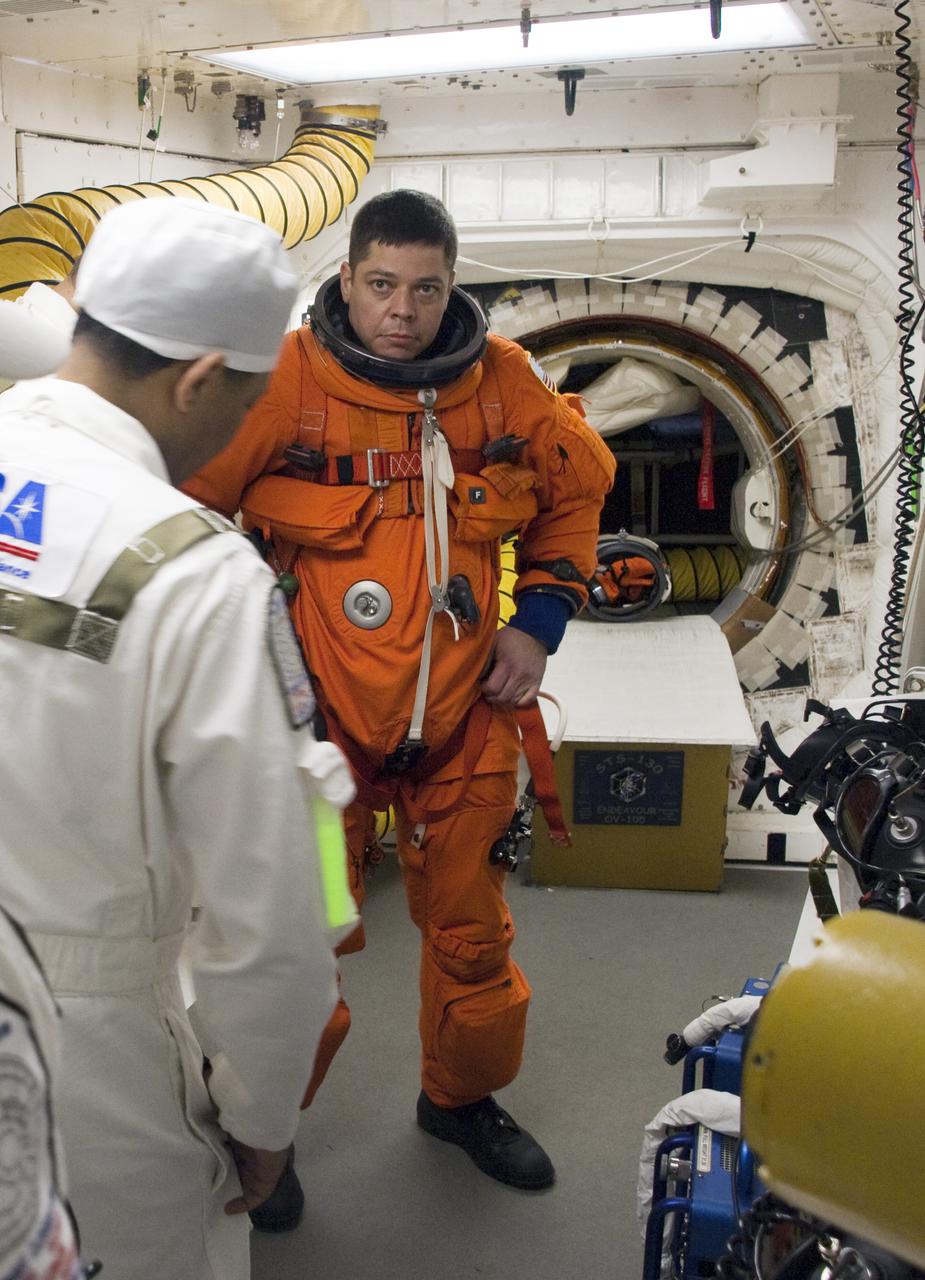
CAPE CANAVERAL, Fla. - In the White Room at Launch Pad 39A on NASA's Kennedy Space Center in Florida, a United Space Alliance suit technician ensures the proper fit of the launch-and-entry suit of STS-130 Mission Specialist Robert Behnken as he prepares to enter space shuttle Endeavour for launch. This is the second launch attempt for space shuttle Endeavour's STS-130 crew. The first attempt on Feb. 7 was scrubbed due to unfavorable weather. The primary payload for the STS-130 mission to the International Space Station is the Tranquility node, a pressurized module that will provide additional room for crew members and many of the station's life support and environmental control systems. Attached to one end of Tranquility is a cupola, a unique work area with six windows on its sides and one on top. The cupola resembles a circular bay window and will provide a vastly improved view of the station's exterior. The multi-directional view will allow the crew to monitor spacewalks and docking operations, as well as provide a spectacular view of Earth and other celestial objects. The module was built in Turin, Italy, by Thales Alenia Space for the European Space Agency. Endeavour's launch is set for Feb. 8 at 4:14 a.m. EST. For information on the STS-130 mission and crew, visit http:__www.nasa.gov_mission_pages_shuttle_shuttlemissions_sts130_index.html. Photo credit: NASA_Sandra Joseph and Kevin O'Connell
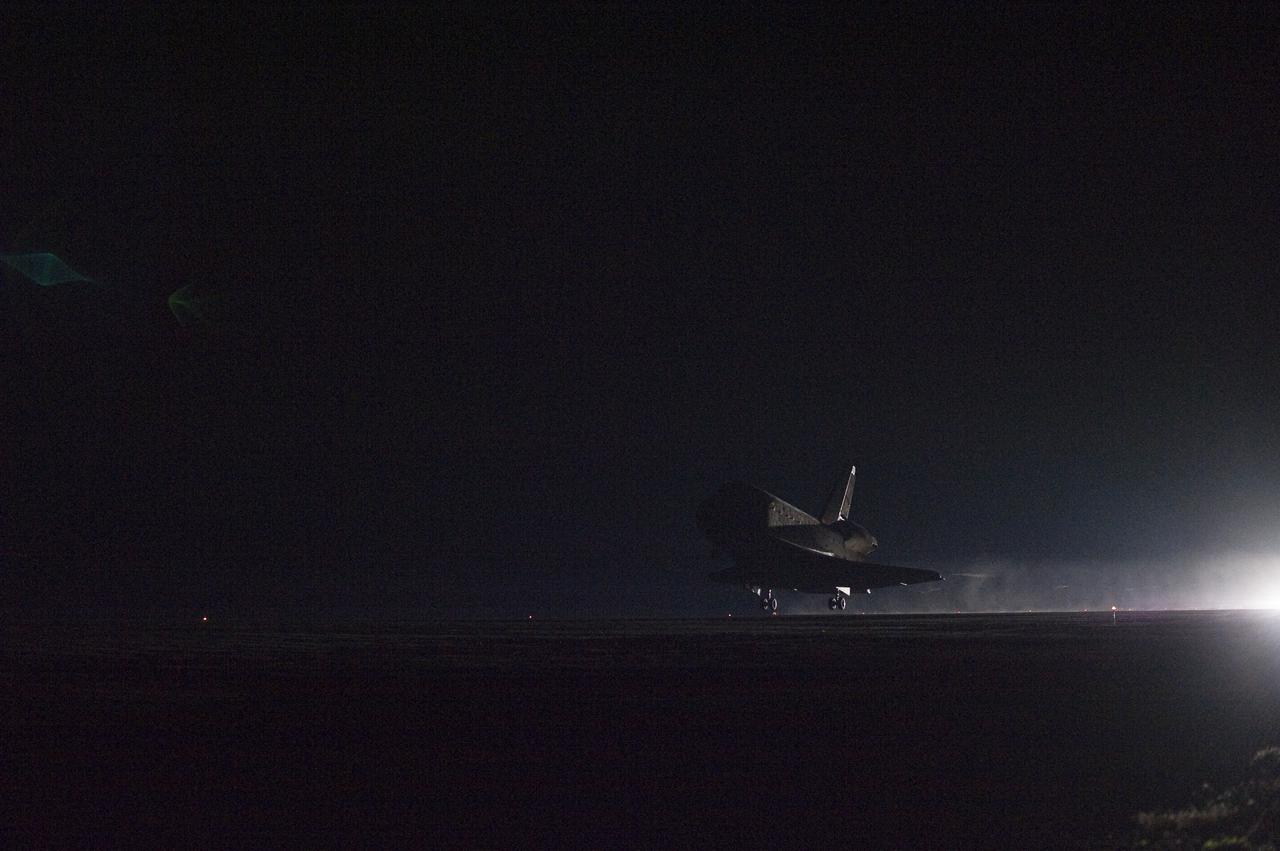
CAPE CANAVERAL, Fla. - Space shuttle Endeavour lands under the cover of night on Runway 15 at the Shuttle Landing Facility at NASA's Kennedy Space Center in Florida after 14 days in space, completing the 5.7-million-mile STS-130 mission to the International Space Station on orbit 217. Main gear touchdown was at 10:20:31 p.m. EST followed by nose gear touchdown at 10:20:39 p.m. and wheels stop at 10:22:10 p.m. It was the 23rd night landing in shuttle history and the 17th at Kennedy. Aboard are Commander George Zamka; Pilot Terry Virts; and Mission Specialists Robert Behnken, Nicholas Patrick, Kathryn Hire and Stephen Robinson. During Endeavour's STS-130 mission, astronauts installed the Tranquility node, a module that provides additional room for crew members and many of the station's life support and environmental control systems. Attached to Tranquility is a cupola with seven windows that provide a panoramic view of Earth, celestial objects and visiting spacecraft. The module was built in Turin, Italy, by Thales Alenia Space for the European Space Agency. The orbiting laboratory is approximately 90 percent complete now in terms of mass. STS-130 was the 24th flight for Endeavour, the 32nd shuttle mission devoted to ISS assembly and maintenance, and the 130th shuttle mission to date. For information on the STS-130 mission and crew, visit http:__www.nasa.gov_mission_pages_shuttle_shuttlemissions_sts130. Photo credit: NASA_Sandra Joseph and Kevin O'Connell
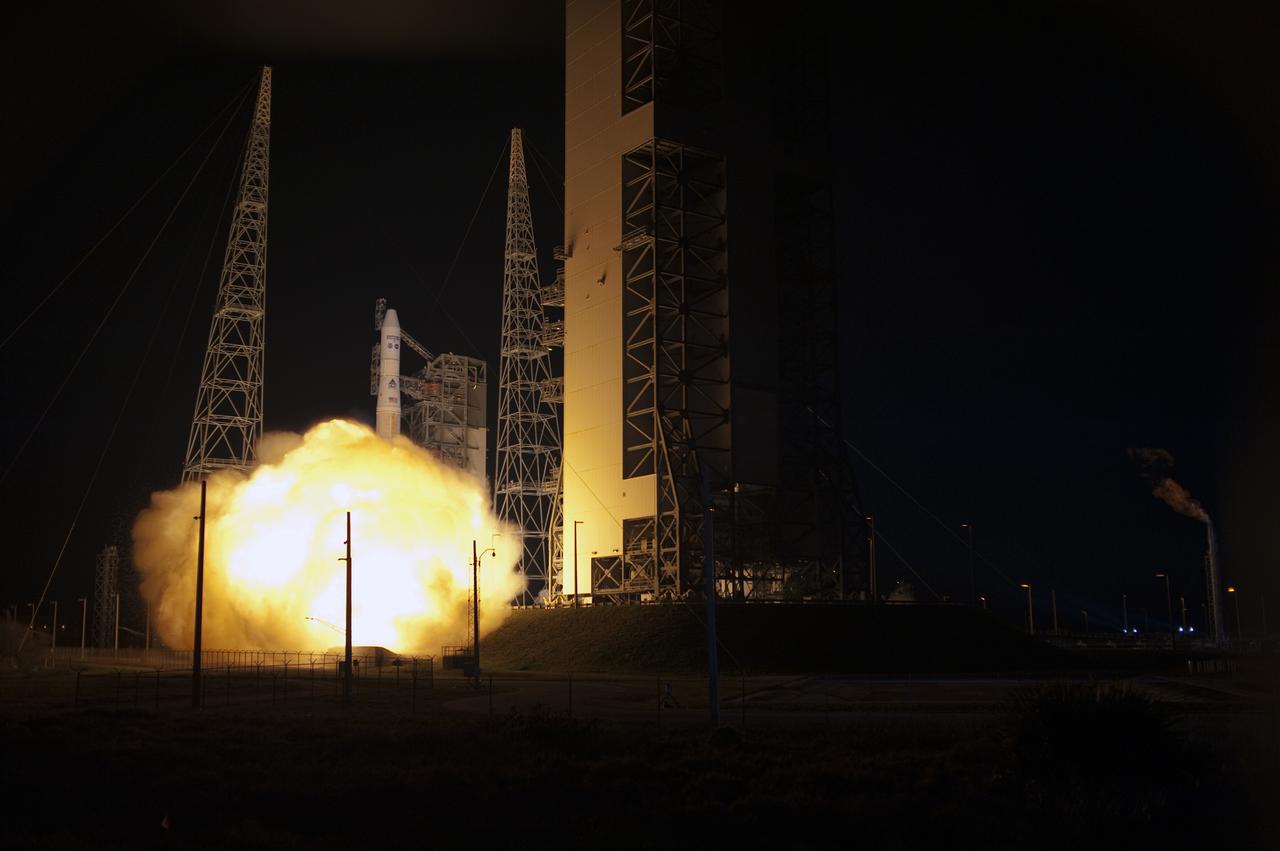
CAPE CANAVERAL, Fla. – The base of the United Launch Alliance Delta IV rocket carrying NASA's GOES-P meteorological satellite is engulfed in a brilliant exhaust cloud as it lifts off Launch Complex 37 on Cape Canaveral Air Force Station in Florida at 6:57 p.m. EST. GOES-P, the latest Geostationary Operational Environmental Satellite, was developed by NASA for the National Oceanic and Atmospheric Administration, or NOAA. The GOES-P spacecraft will be placed in a 22,300-mile-high geosynchronous orbit where it will appear to hover over a single point on Earth. The spacecraft is outfitted with a complex suite of observation instruments and cameras so it can accurately report on weather and climate conditions on Earth. For information on GOES-P, visit http:__www.nasa.gov_mission_pages_GOES-P_main_index.html. Photo credit: NASA_Sandra Joseph and Tony Gray
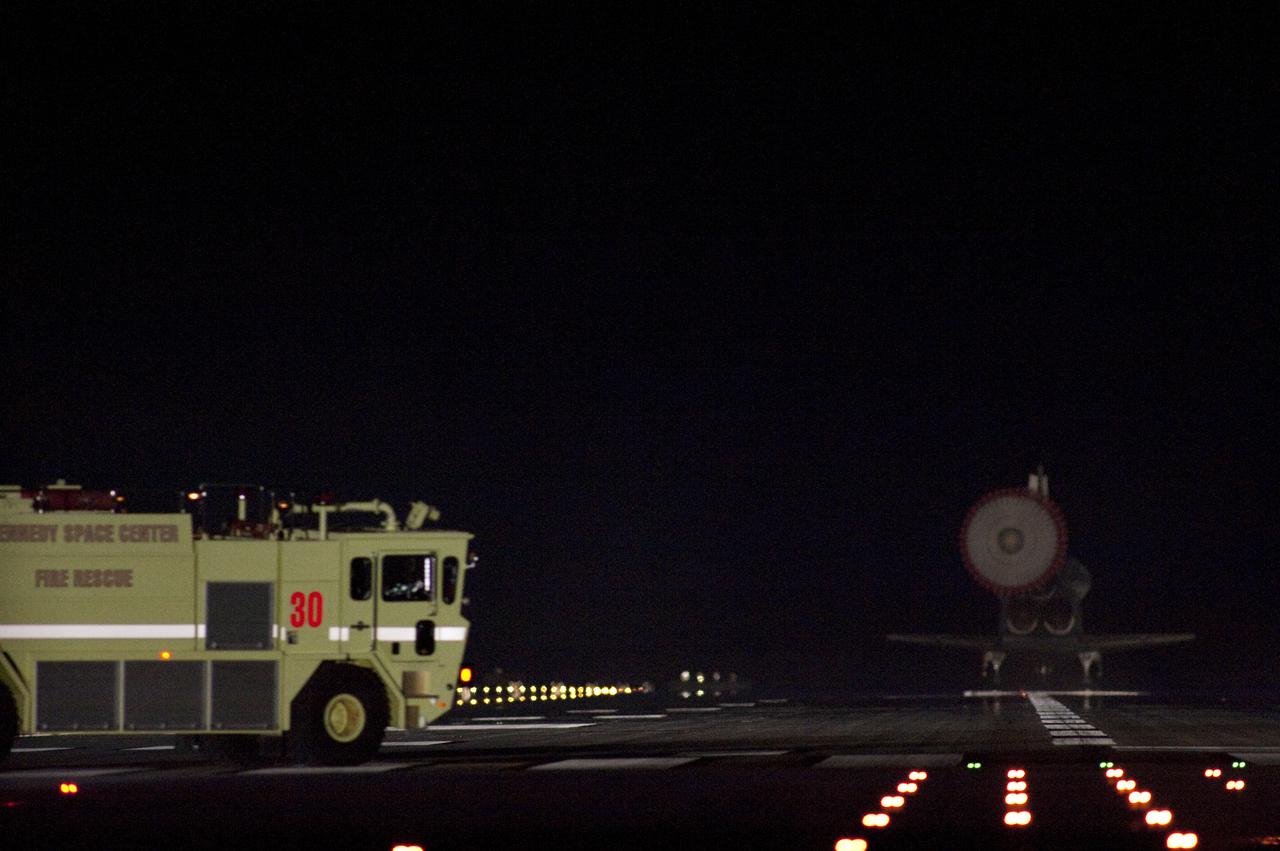
CAPE CANAVERAL, Fla. - A fire and rescue truck is in place beside Runway 15 if needed to support the landing of space shuttle Endeavour at the Shuttle Landing Facility at NASA's Kennedy Space Center in Florida. After 14 days in space, Endeavour's 5.7-million-mile STS-130 mission is completed on orbit 217. Main gear touchdown was at 10:20:31 p.m. EST followed by nose gear touchdown at 10:20:39 p.m. and wheels stop at 10:22:10 p.m. It was the 23rd night landing in shuttle history and the 17th at Kennedy. Aboard are Commander George Zamka; Pilot Terry Virts; and Mission Specialists Robert Behnken, Nicholas Patrick, Kathryn Hire and Stephen Robinson. During Endeavour's STS-130 mission, astronauts installed the Tranquility node, a module that provides additional room for crew members and many of the station's life support and environmental control systems. Attached to Tranquility is a cupola with seven windows that provide a panoramic view of Earth, celestial objects and visiting spacecraft. The module was built in Turin, Italy, by Thales Alenia Space for the European Space Agency. The orbiting laboratory is approximately 90 percent complete now in terms of mass. STS-130 was the 24th flight for Endeavour, the 32nd shuttle mission devoted to ISS assembly and maintenance, and the 130th shuttle mission to date. For information on the STS-130 mission and crew, visit http:__www.nasa.gov_mission_pages_shuttle_shuttlemissions_sts130. Photo credit: NASA_Sandra Joseph and Kevin O'Connell
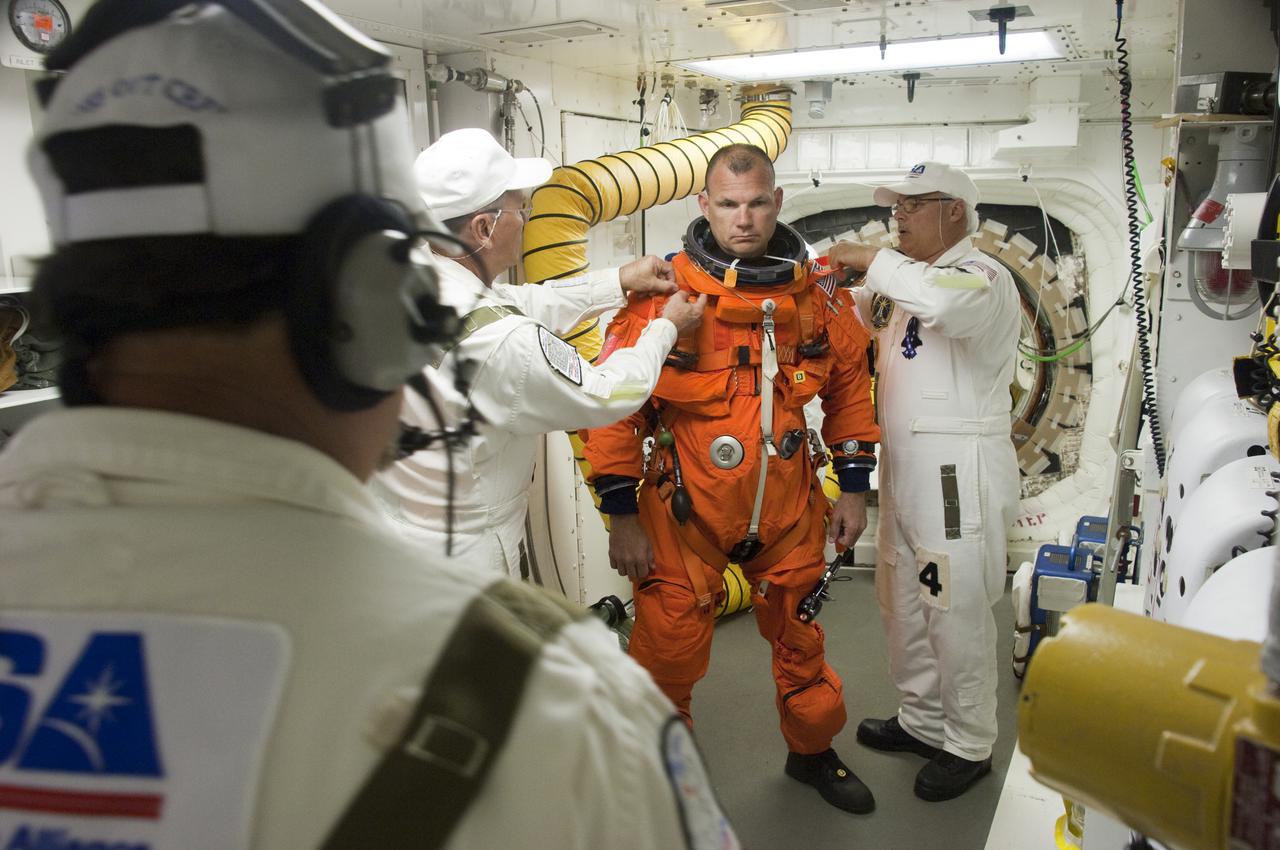
CAPE CANAVERAL, Fla. - At Launch Pad 39A at NASA's Kennedy Space Center in Florida, STS-132 Pilot Tony Antonelli prepares to enter space shuttle Atlantis from the pad's White Room. STS-132 is Antonelli's second spaceflight. The six-member STS-132 crew is participating in a dress rehearsal for launch, known as the Terminal Countdown Demonstration Test, from their seats in the crew compartment of Atlantis. Launch is targeted for 2:19 p.m. EDT on May 14. On the STS-132 mission, the crew will deliver an Integrated Cargo Carrier, or ICC, and the Russian-built Mini-Research Module-1, or MRM-1, to the International Space Station. The ICC is an unpressurized flat bed pallet and keel yoke assembly used to support the transfer of exterior cargo from the shuttle to the space station. The MRM-1, known as Rassvet, is the second in a series of new pressurized components for Russia and will be permanently attached to the Earth-facing port of the Zarya control module. Rassvet, which translates to 'dawn,' will be used for cargo storage and provide an additional docking port to the station. STS-132 is the 34th mission to the station and the 132nd shuttle mission overall. For information on the STS-132 mission, visit http:__www.nasa.gov_mission_pages_shuttle_shuttlemissions_sts132_index.html. Photo credit: NASA_Sandra Joseph and Kevin O'Connell
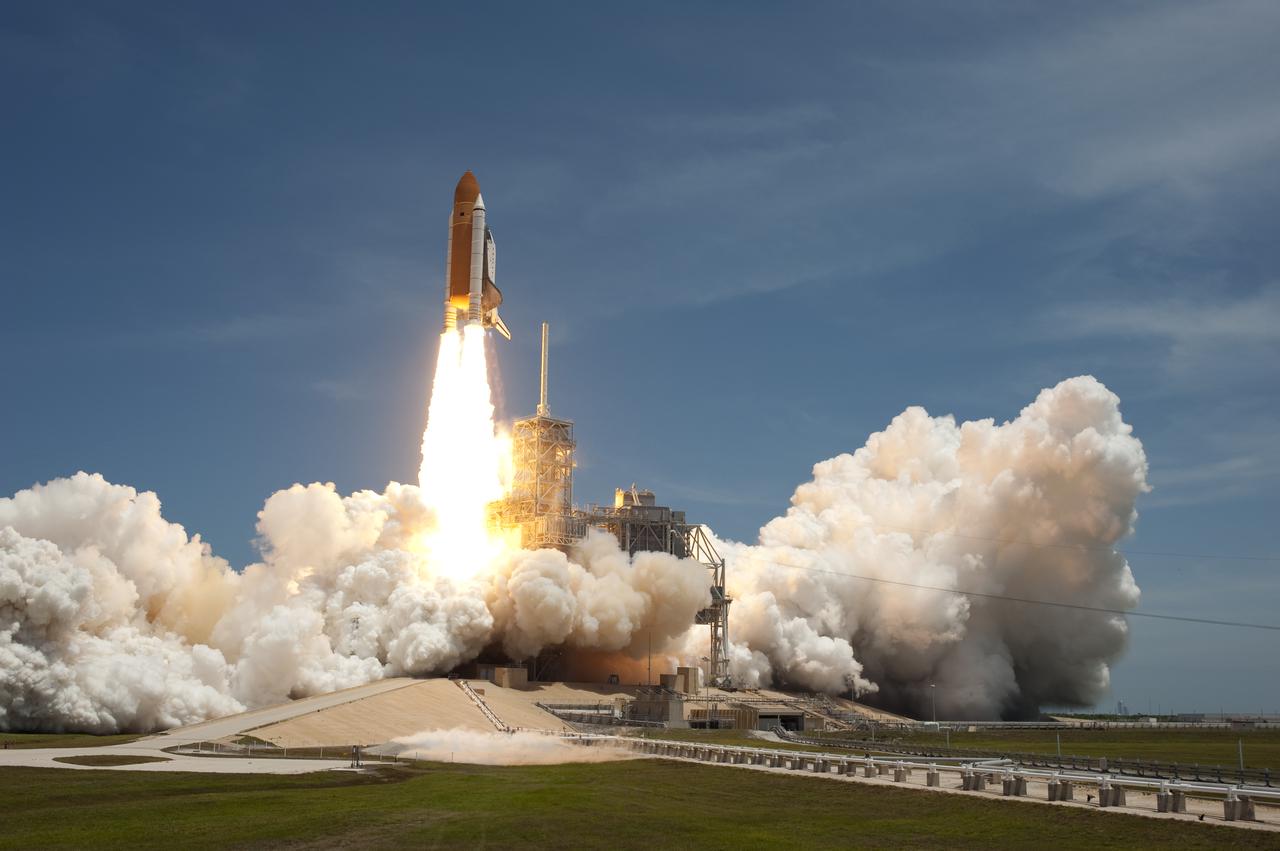
CAPE CANAVERAL, Fla. - Space shuttle Atlantis rumbles the Space Coast as it lifts off from NASA Kennedy Space Center's Launch Pad 39A on the STS-132 mission at 2:20 p.m. EDT on May 14. Atlantis' primary payload for the STS-132 mission is the Russian-built Mini Research Module-1, which will provide additional storage space and a new docking port for Russian Soyuz and Progress spacecraft aboard the International Space Station. STS-132 is the 132nd shuttle flight, the 32nd for Atlantis and the 34th shuttle mission dedicated to station assembly and maintenance. For more information on the STS-132 mission objectives, payload and crew, visit www.nasa.gov_mission_pages_shuttle_shuttlemissions_sts132_index.html. Photo credit: NASA_Sandra Joseph and Kevin O'Connell
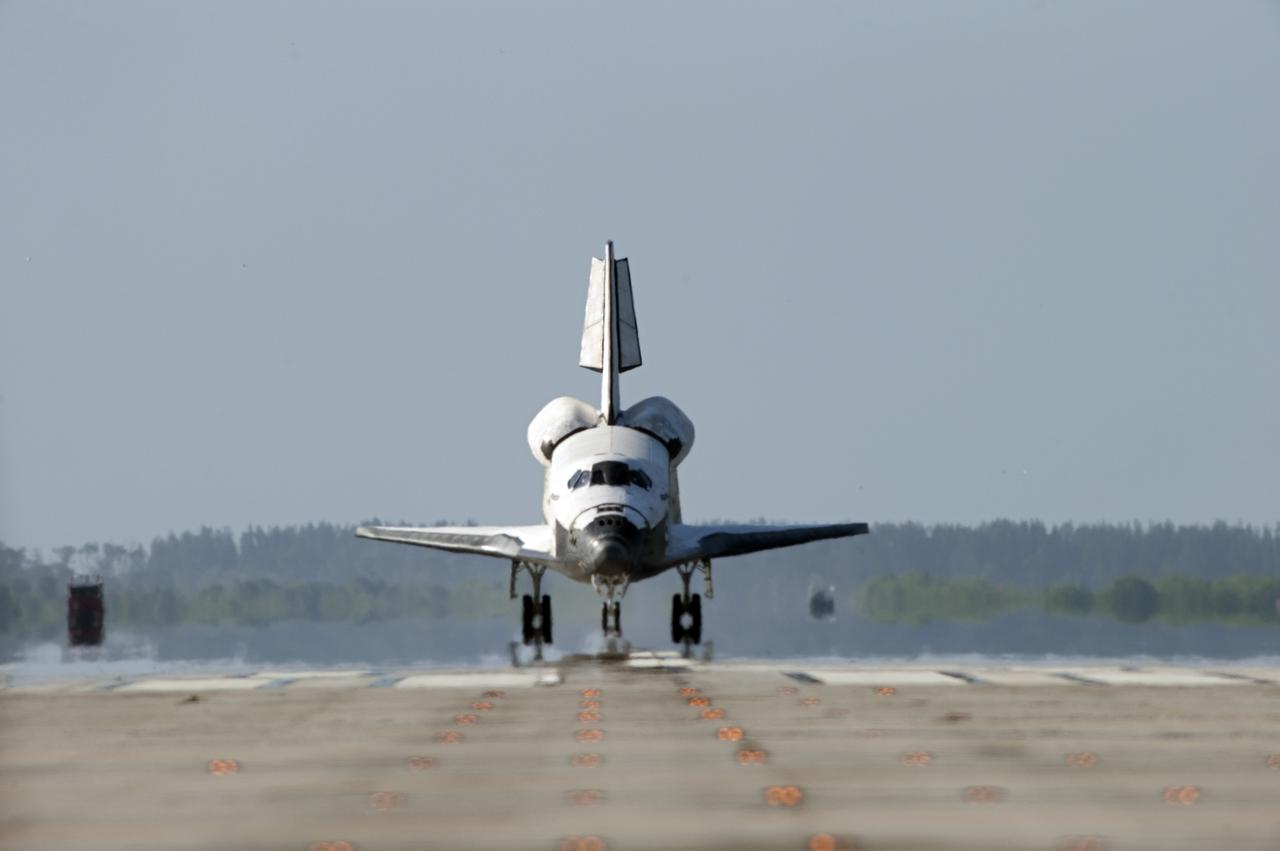
CAPE CANAVERAL, Fla. - Space shuttle Atlantis rolls down Runway 33 at the Shuttle Landing Facility at NASA's Kennedy Space Center in Florida. Landing was at 8:48 a.m. EDT, completing the 12-day STS-132 mission to the International Space Station. The six-member STS-132 crew carried the Russian-built Mini Research Module-1 to the space station. STS-132 is the 34th shuttle mission to the station, the 132nd shuttle mission overall and the last planned flight for Atlantis. For information on the STS-132 mission and crew, visit www.nasa.gov_mission_pages_shuttle_shuttlemissions_sts132_index.html. Photo credit: NASA_Sandra Joseph and Carl Winebarger