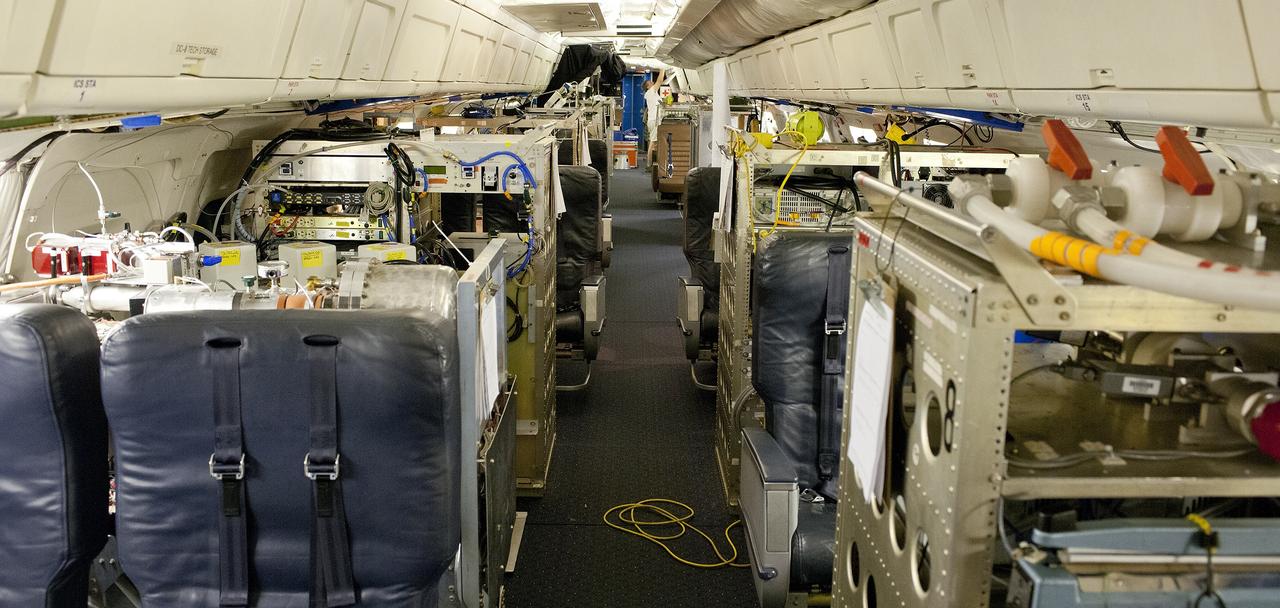
NASA's DC-8 flying laboratory is fully loaded with seats and instrument racks in preparation for NASA's 2013 SEAC4RS climate science mission.
ED13-0225-033
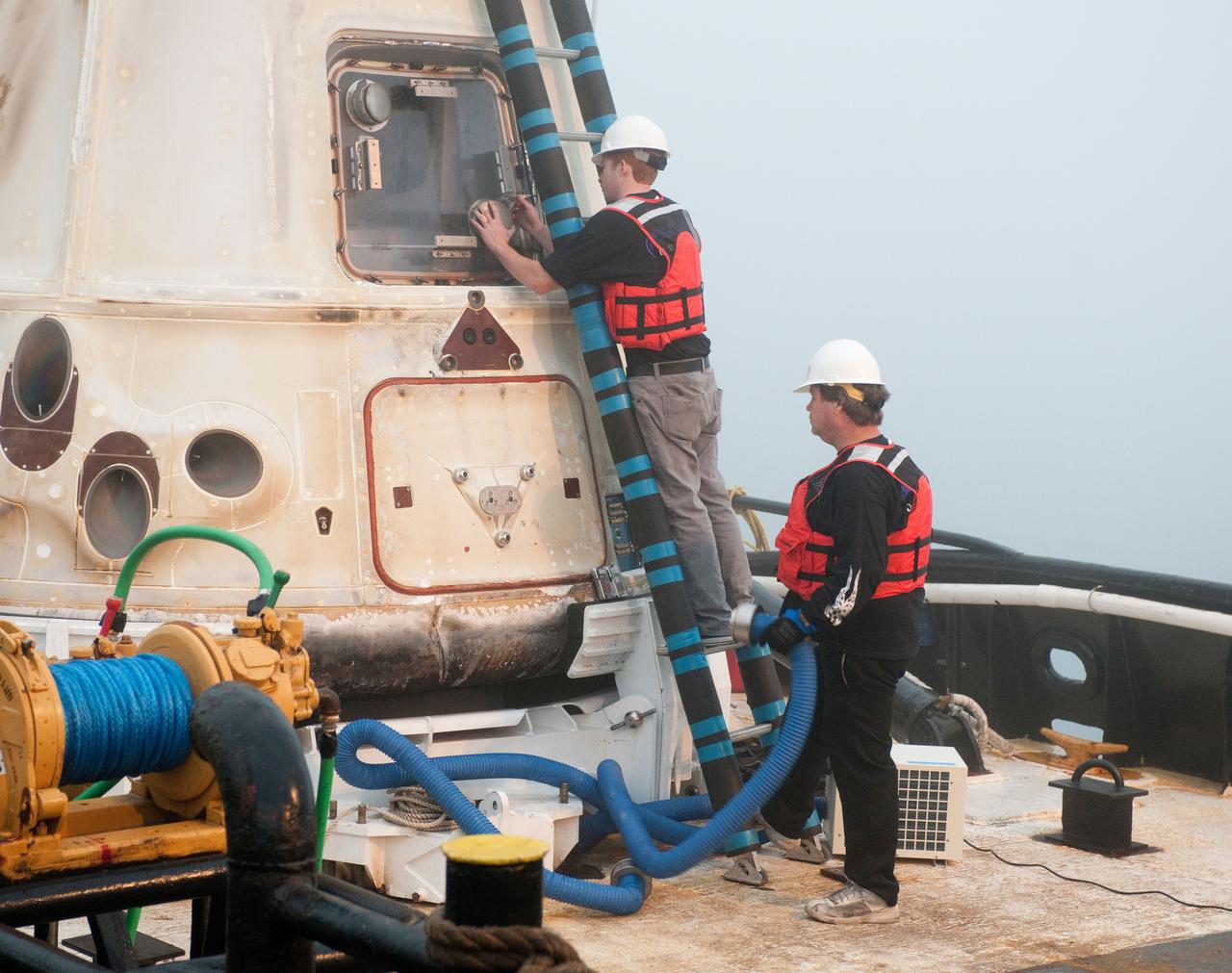
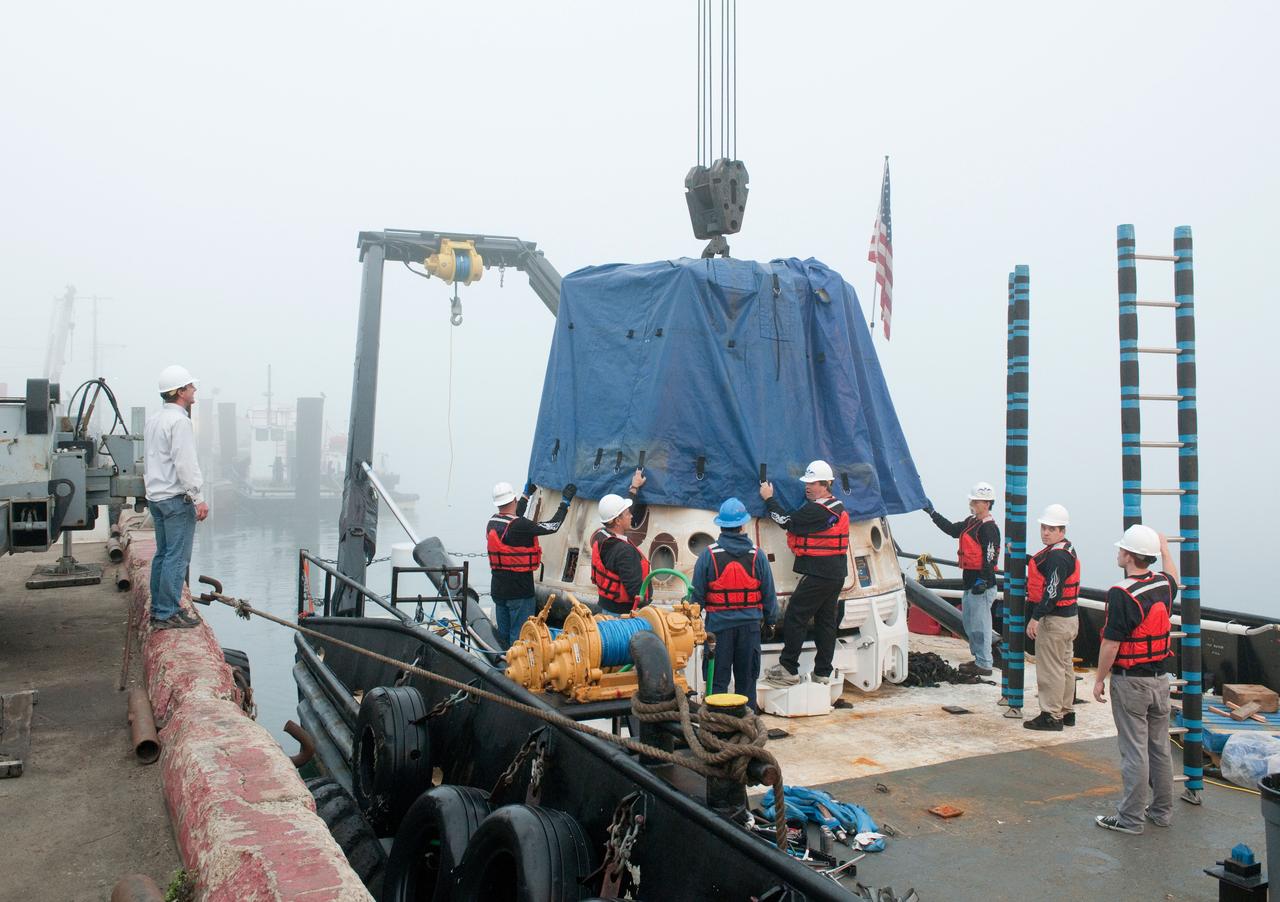
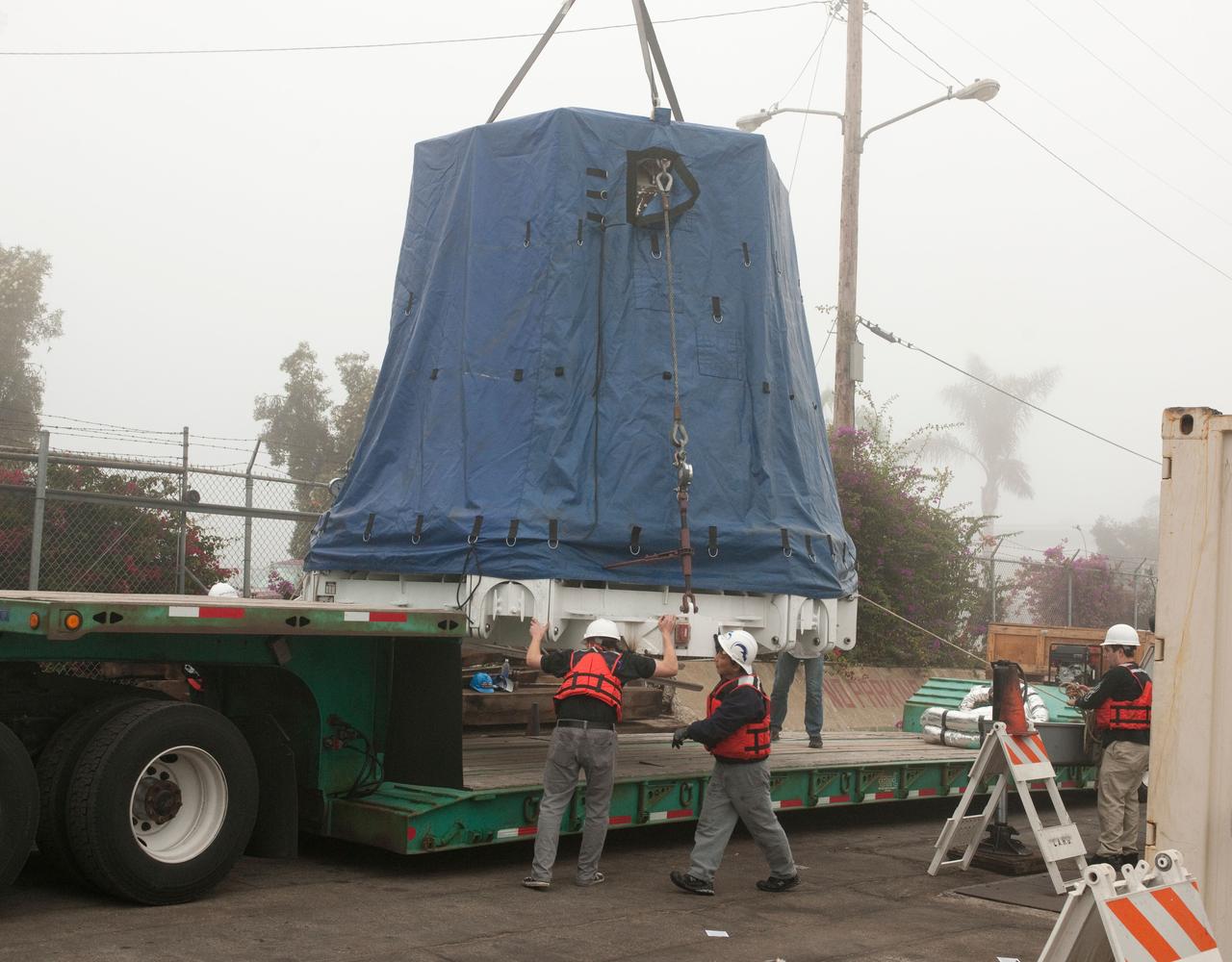
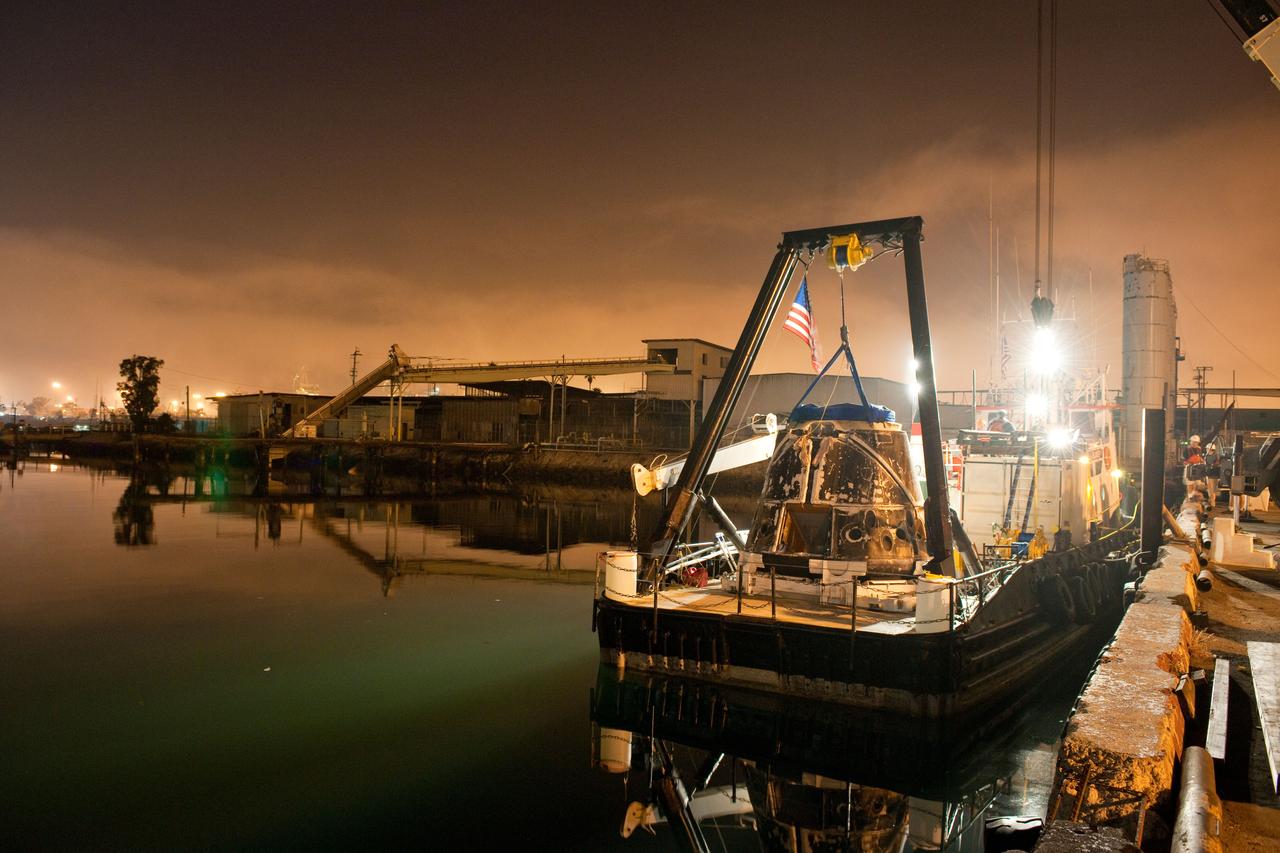
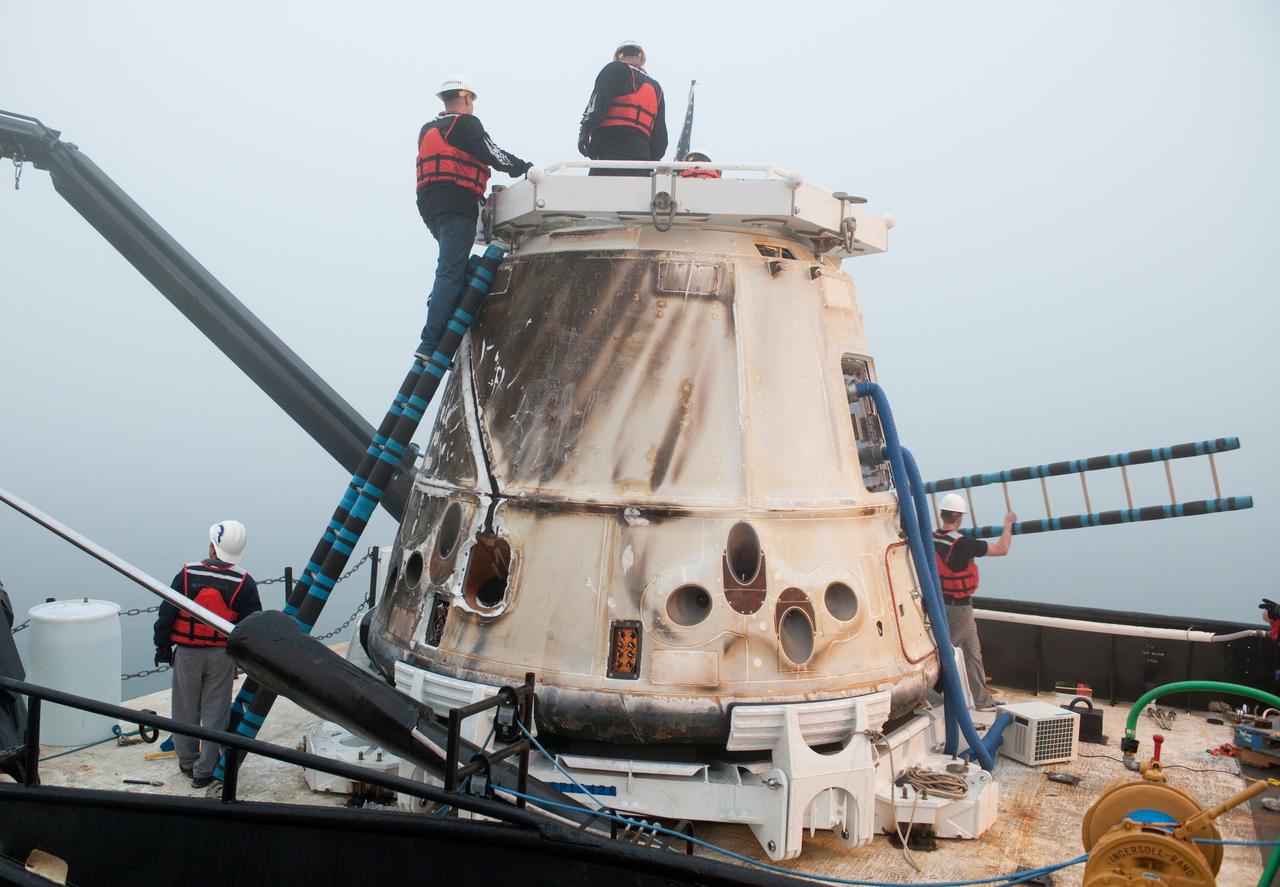
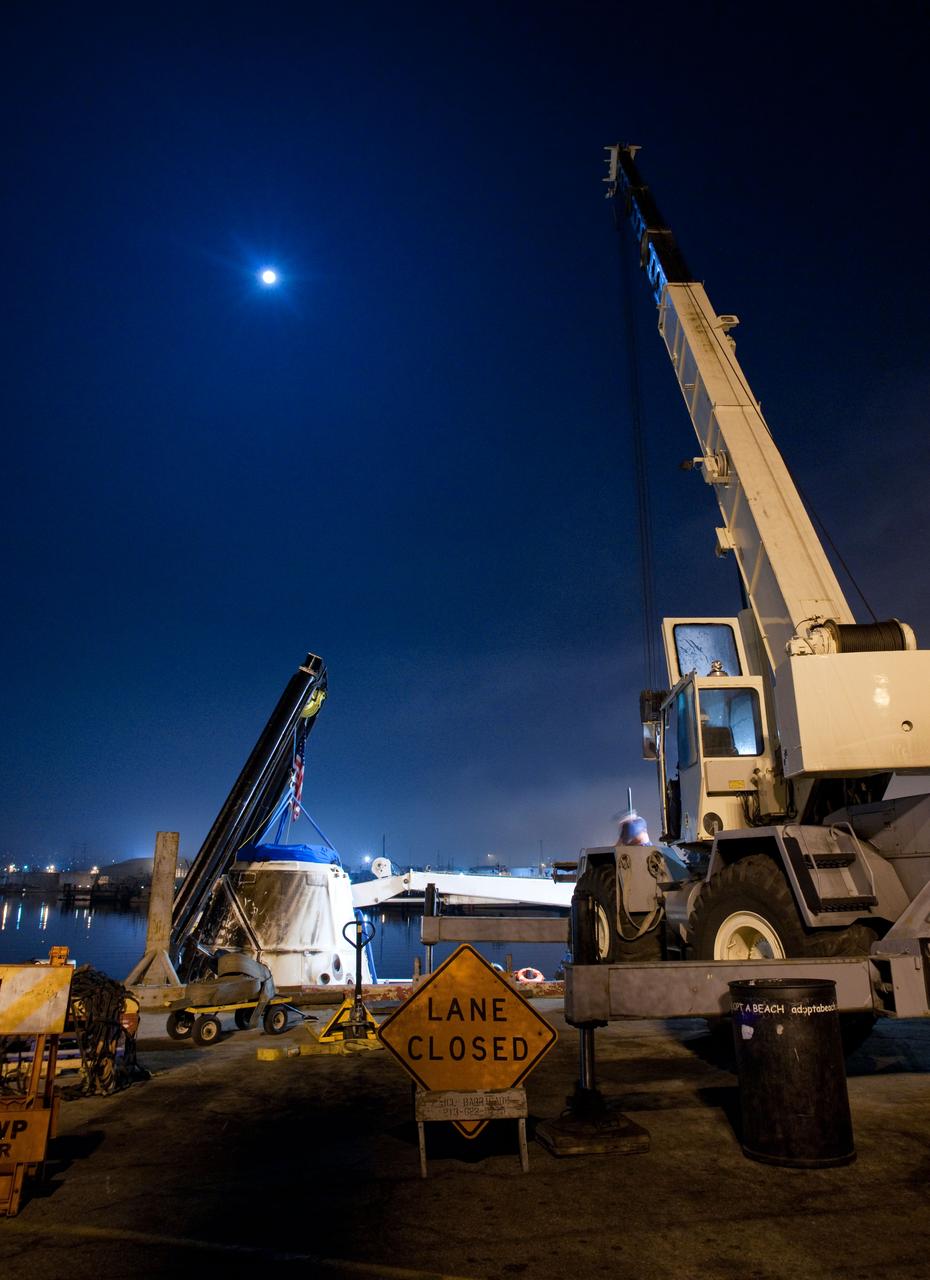
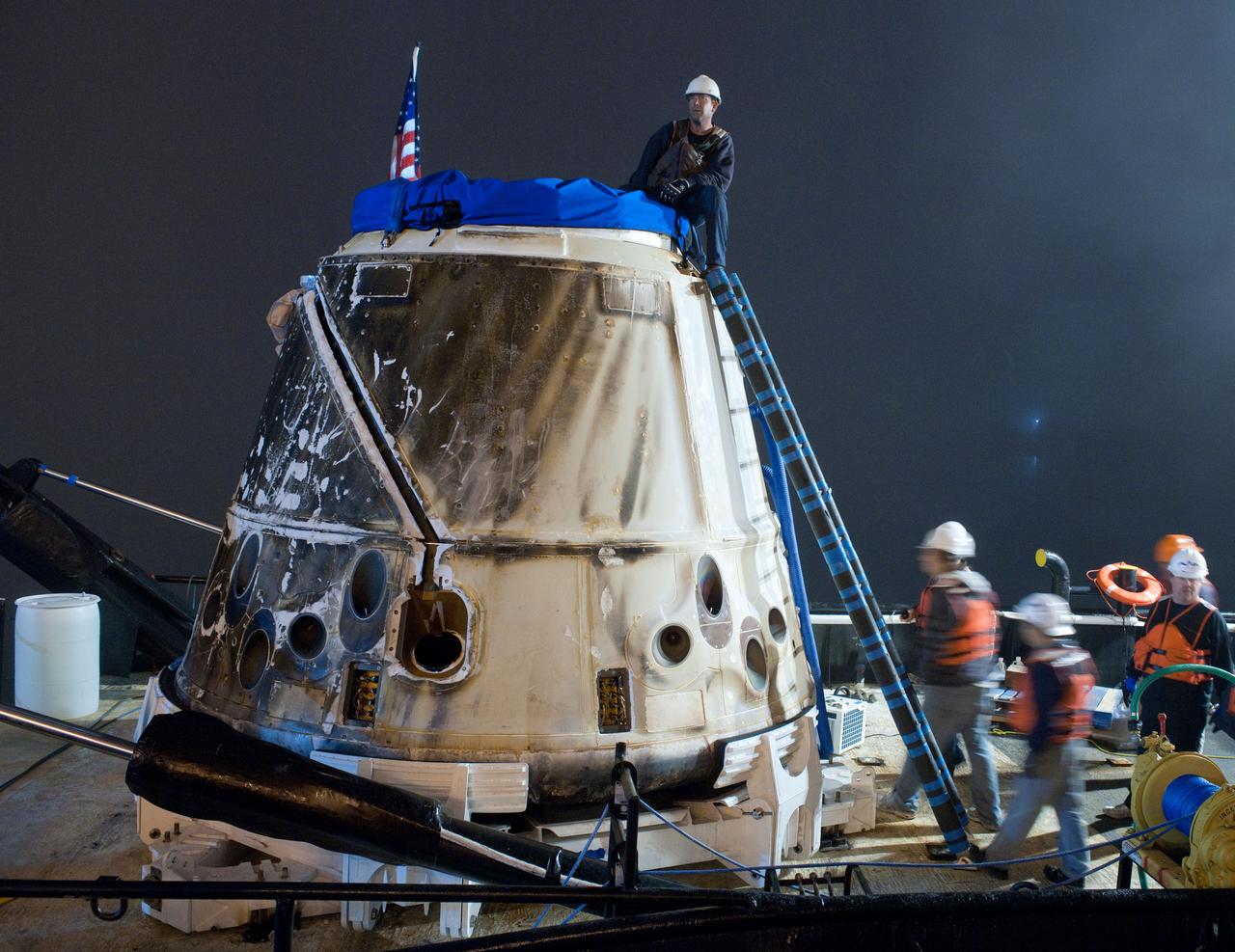
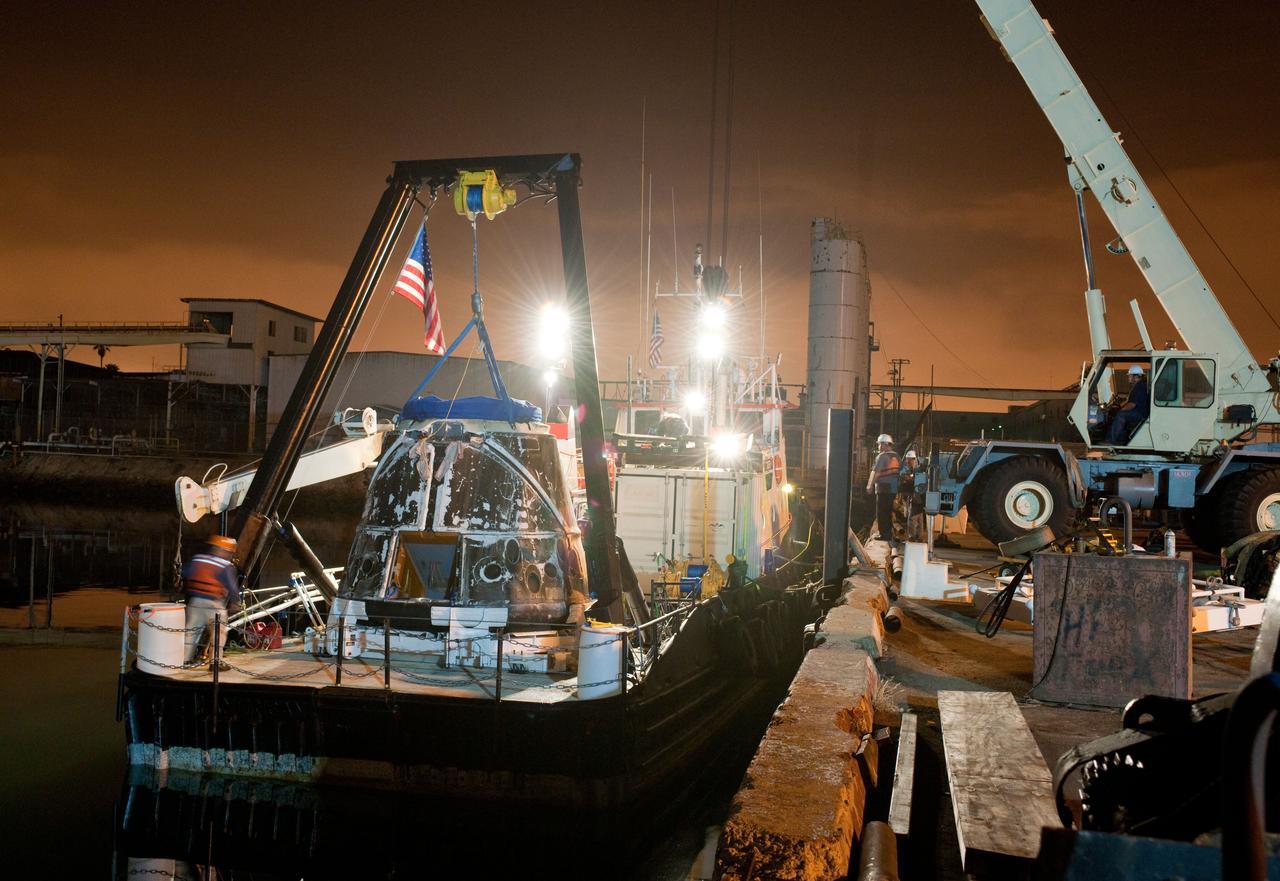
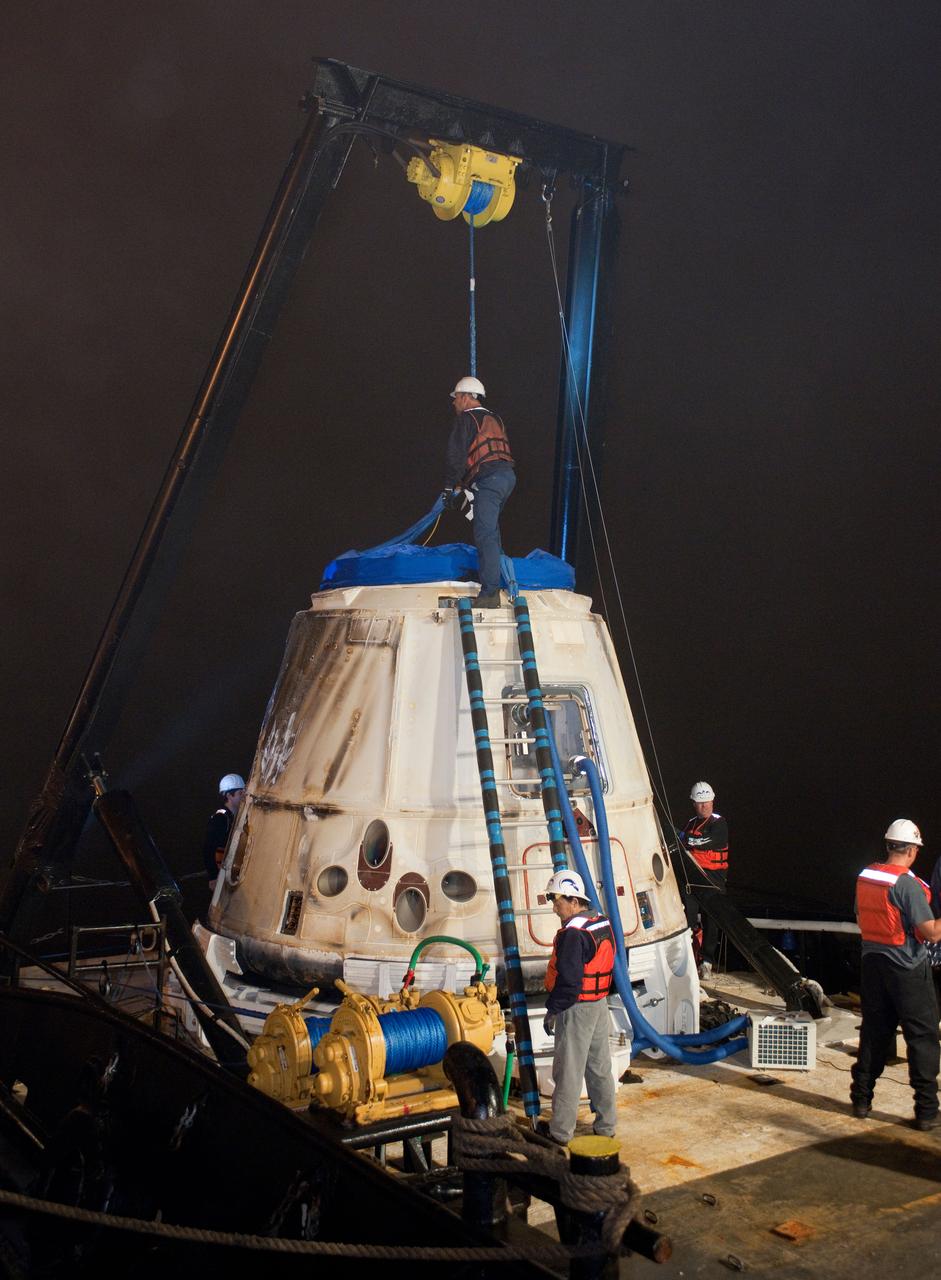
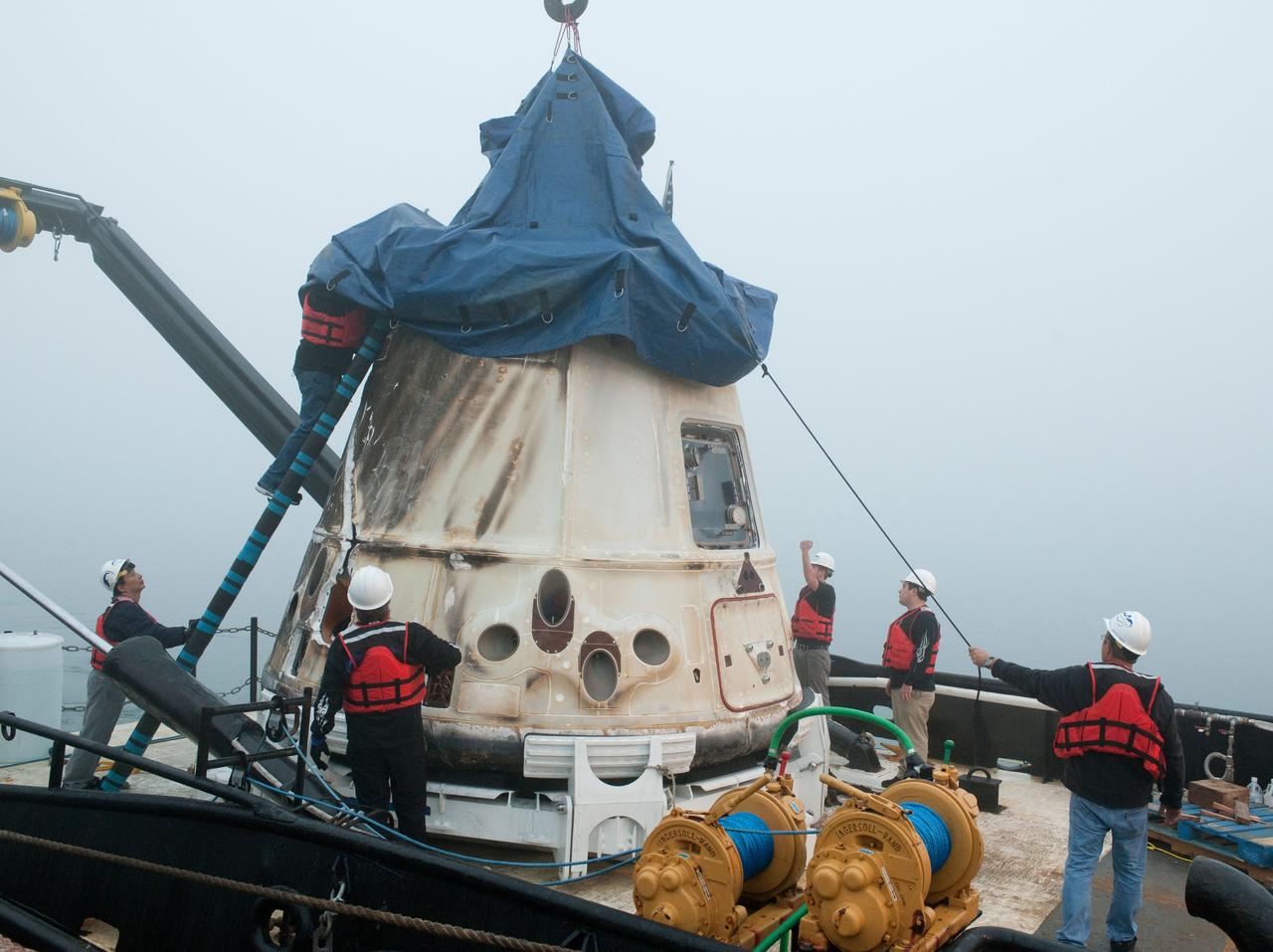
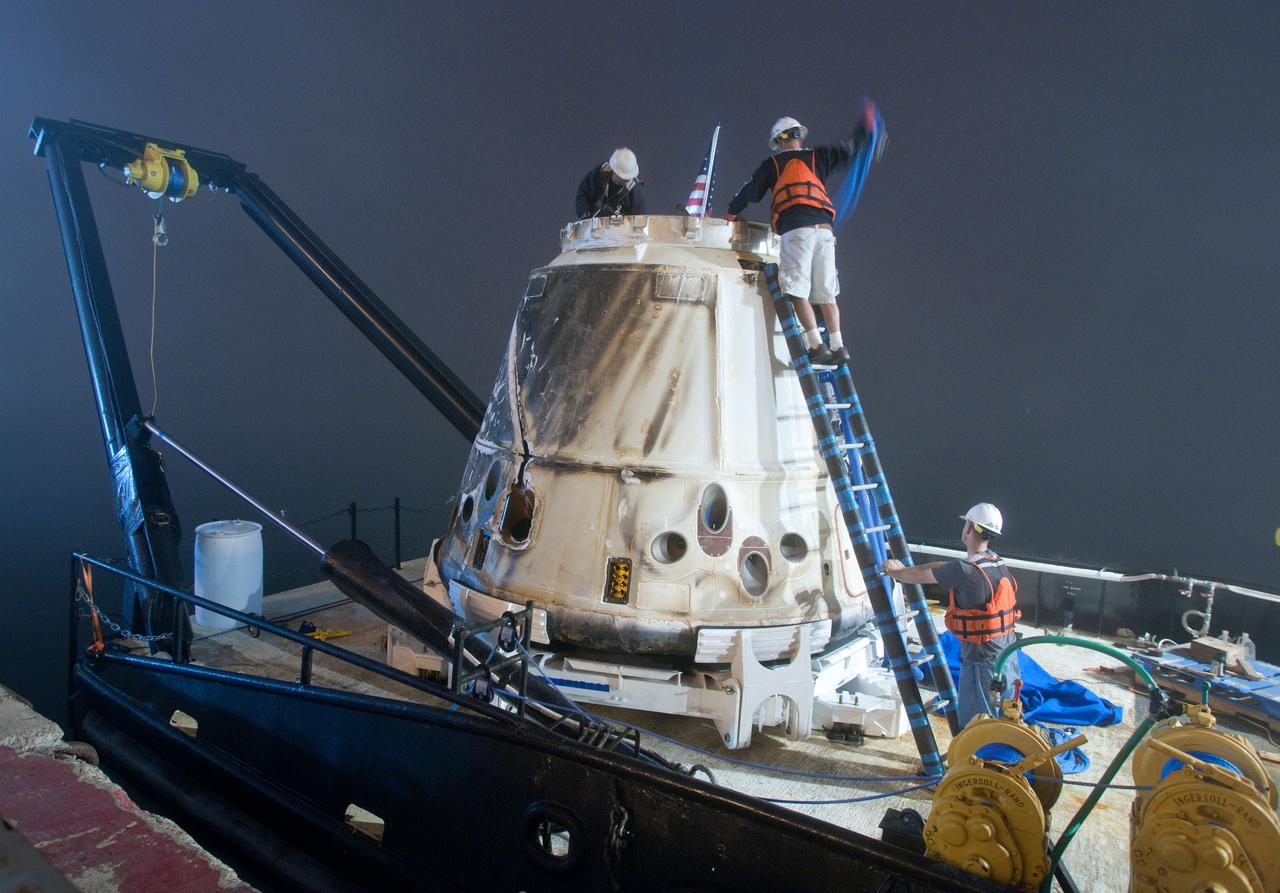
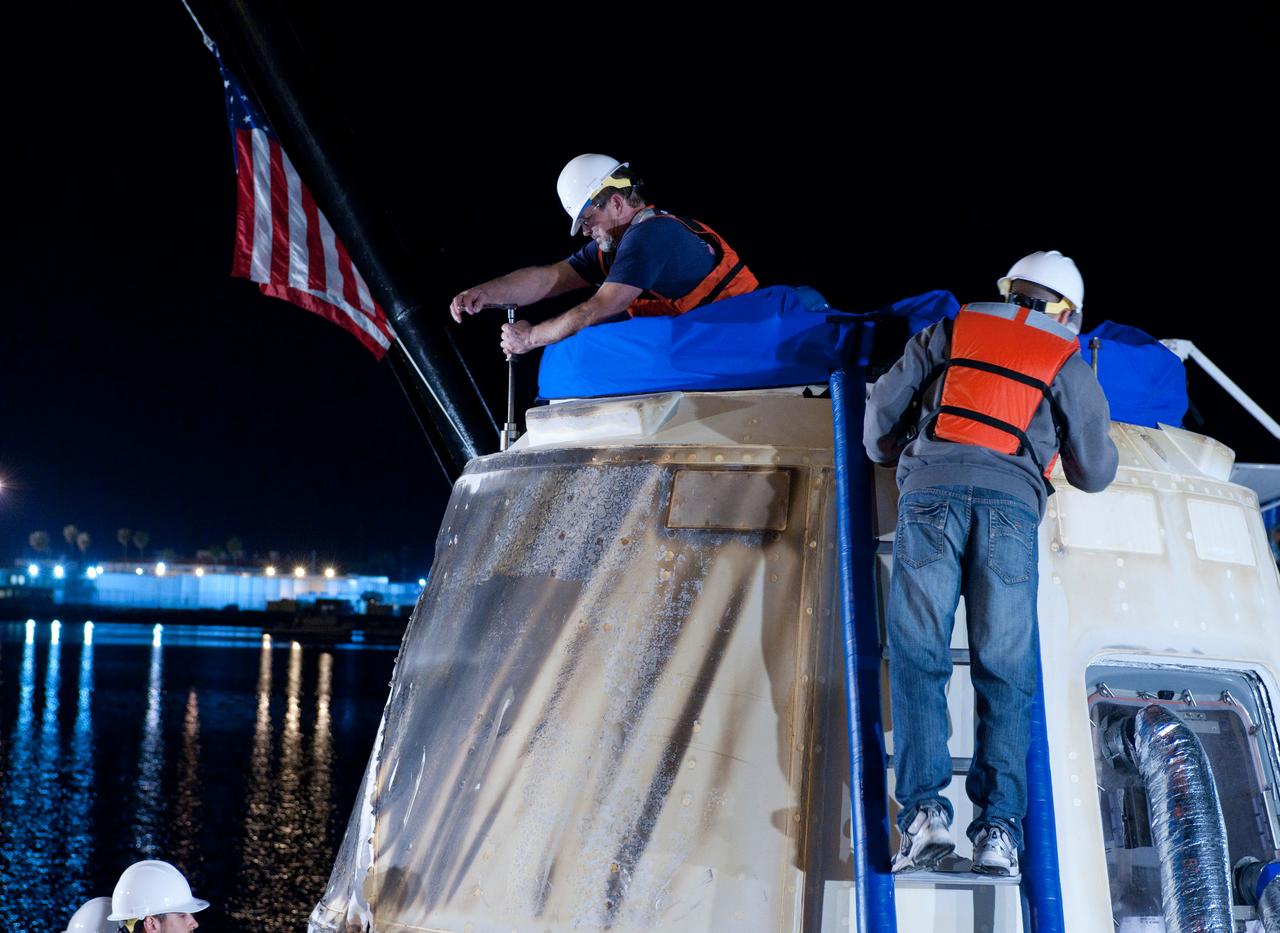
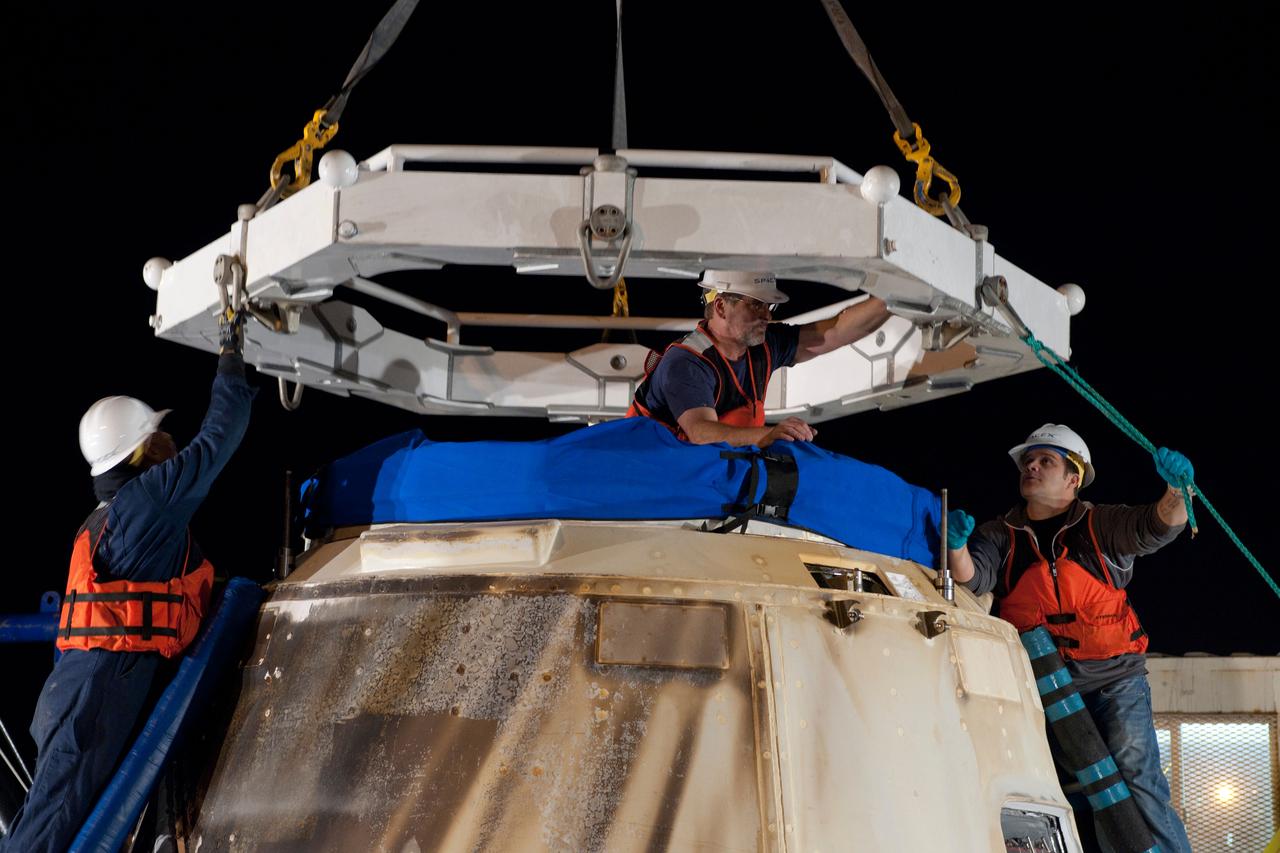
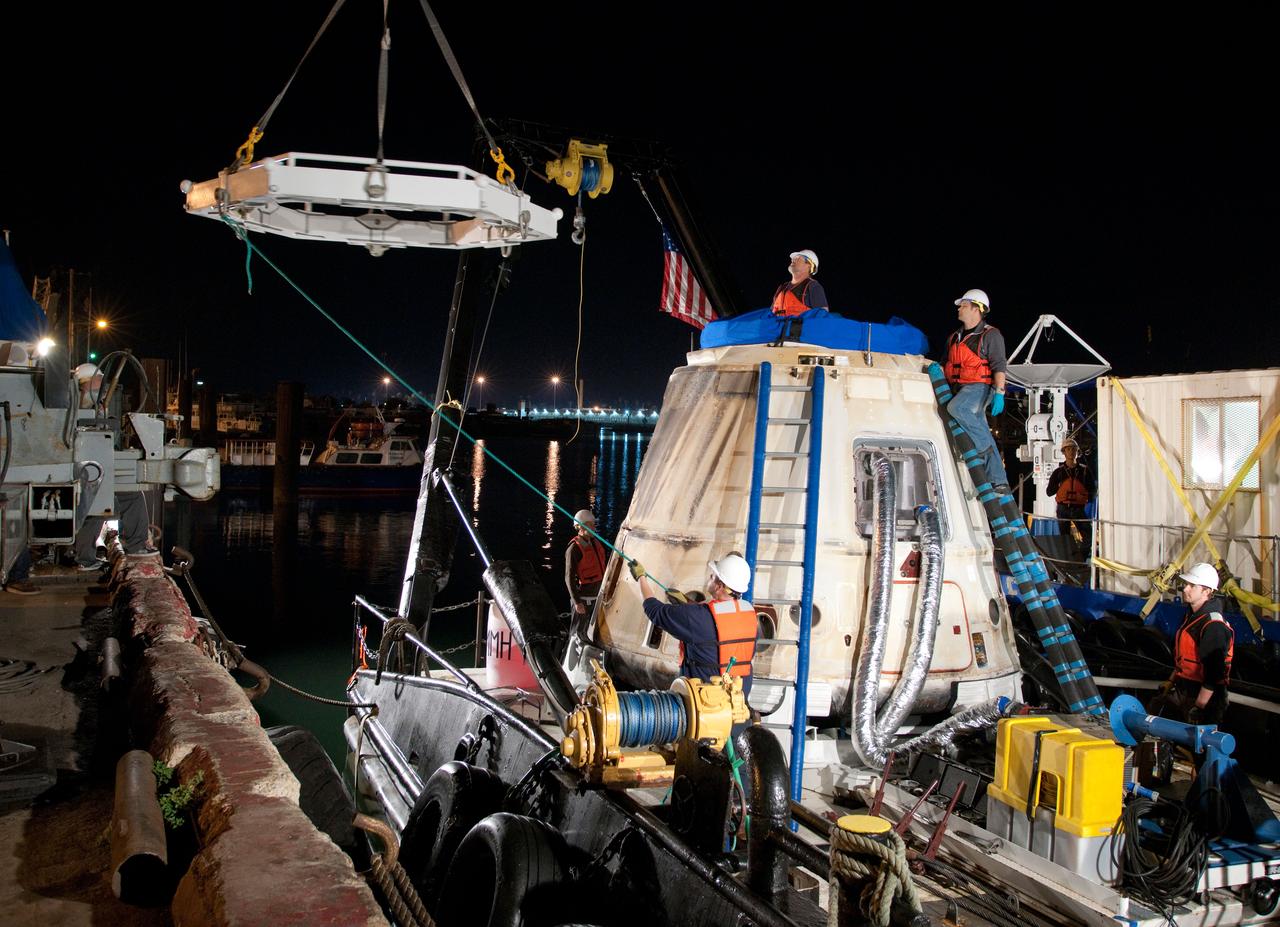
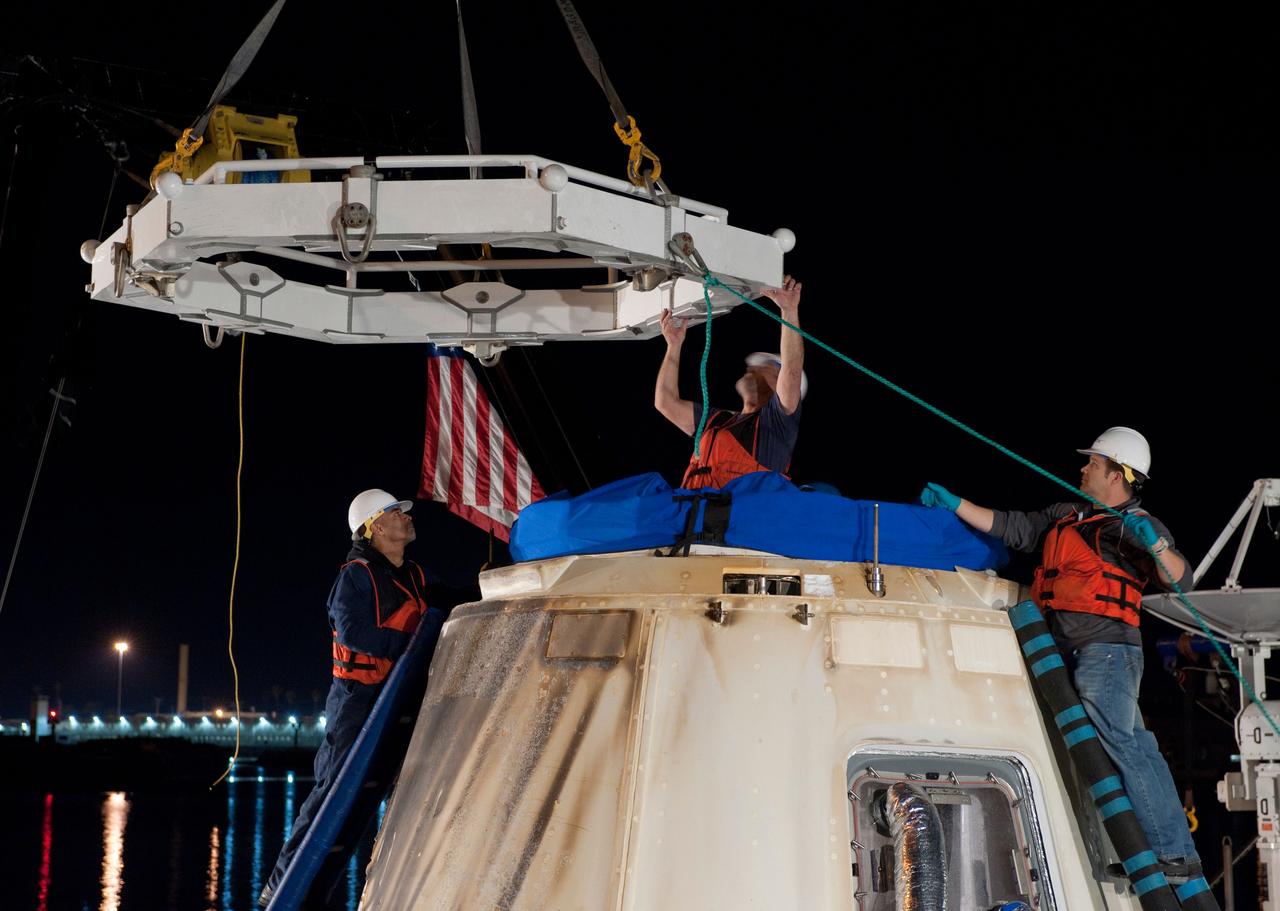
SpaceX’s Dragon capsule is seen shortly after arriving at a port near Los Angeles, Calif on Tuesday, Oct. 30, 2012. Dragon had just completed its first commercial resupply mission to the International Space Station and returned 1,673 pounds of science and supplies back to Earth.   Photo credit: NASA
ed12-0346-27
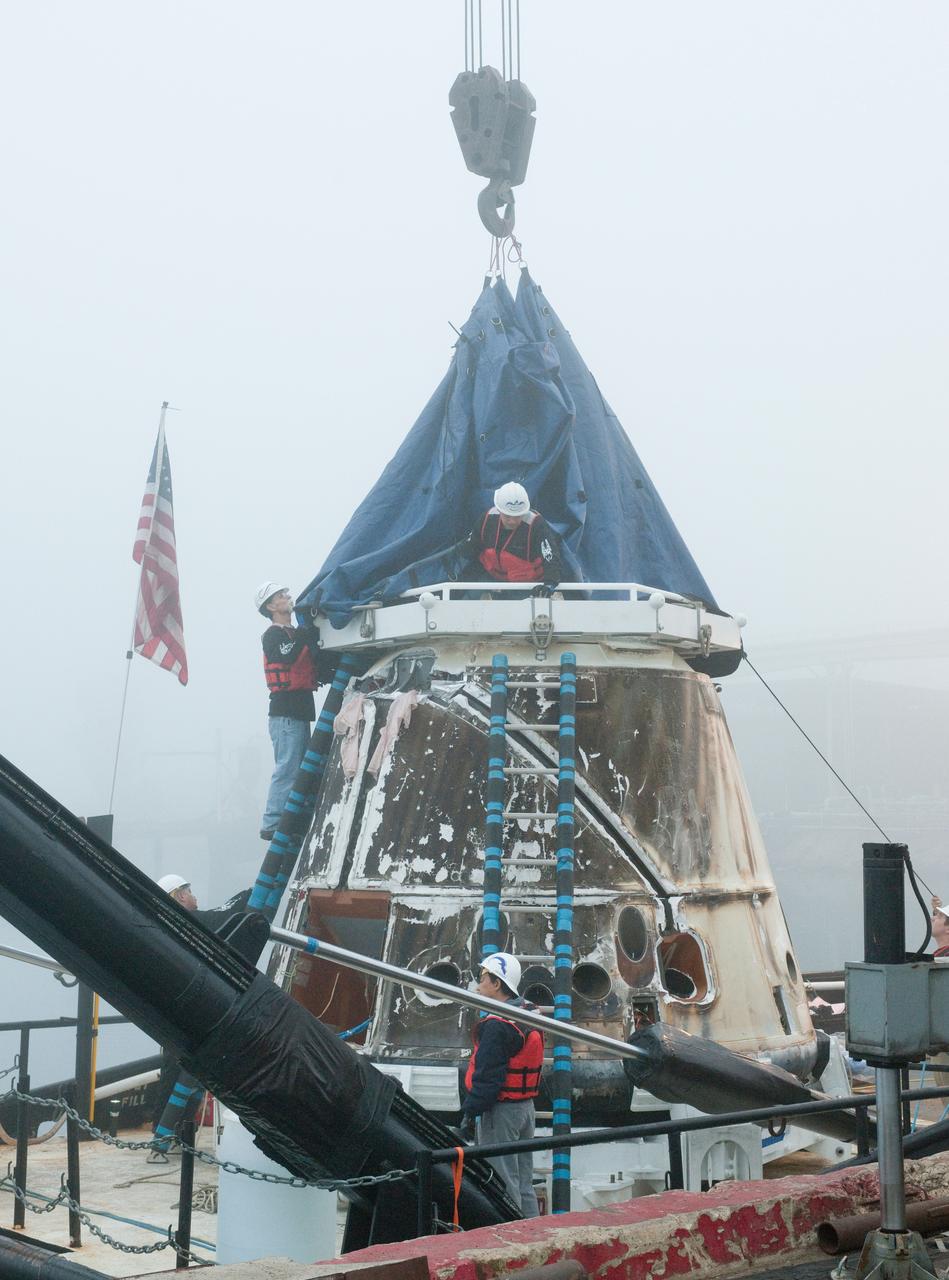
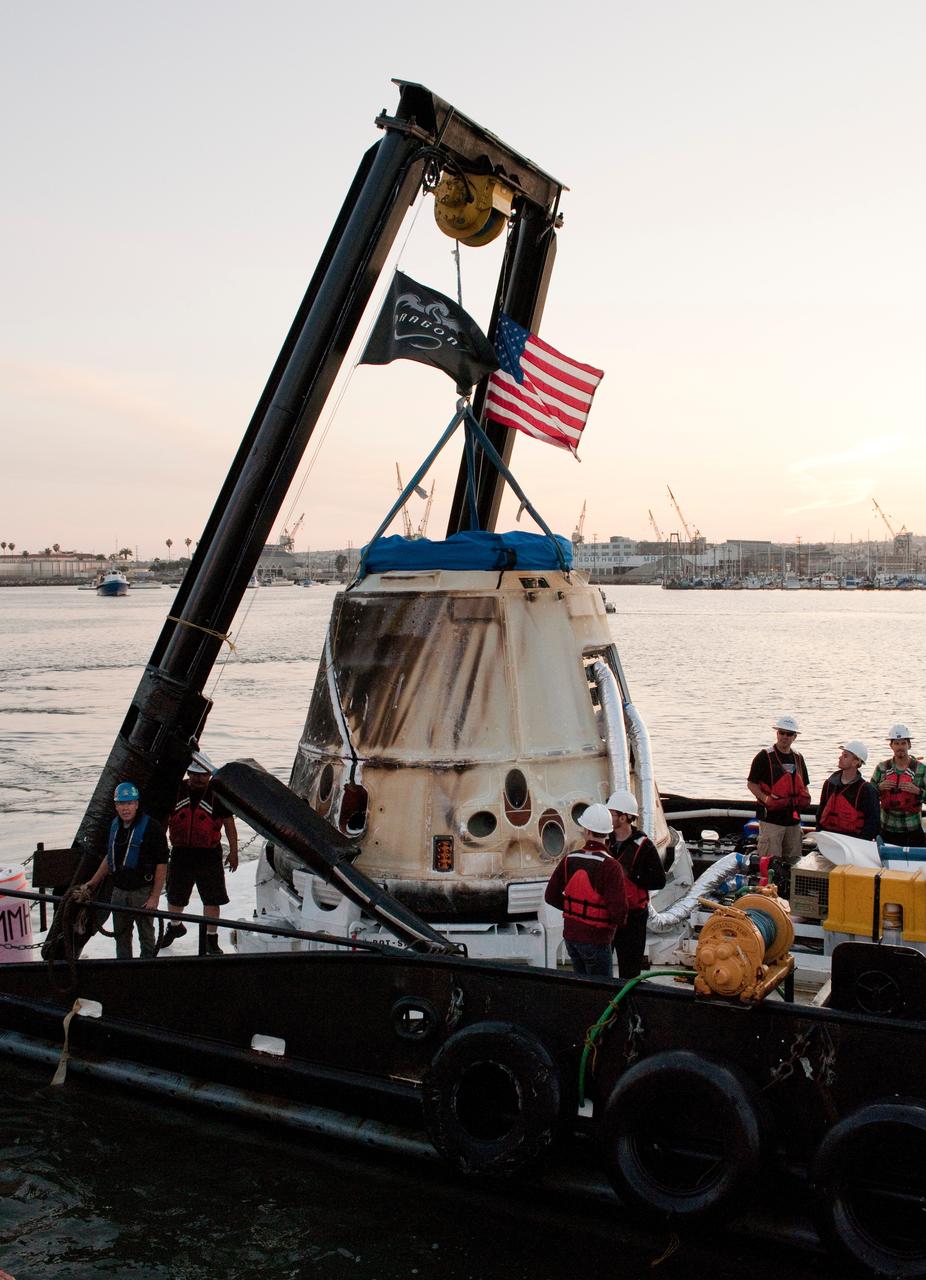
SpaceX’s Dragon capsule is seen shortly after arriving at a port near Los Angeles, Calif on Tuesday, Oct. 30, 2012. Dragon had just completed its first commercial resupply mission to the International Space Station and returned 1,673 pounds of science and supplies back to Earth.   Photo credit: NASA
ed12-0346-16
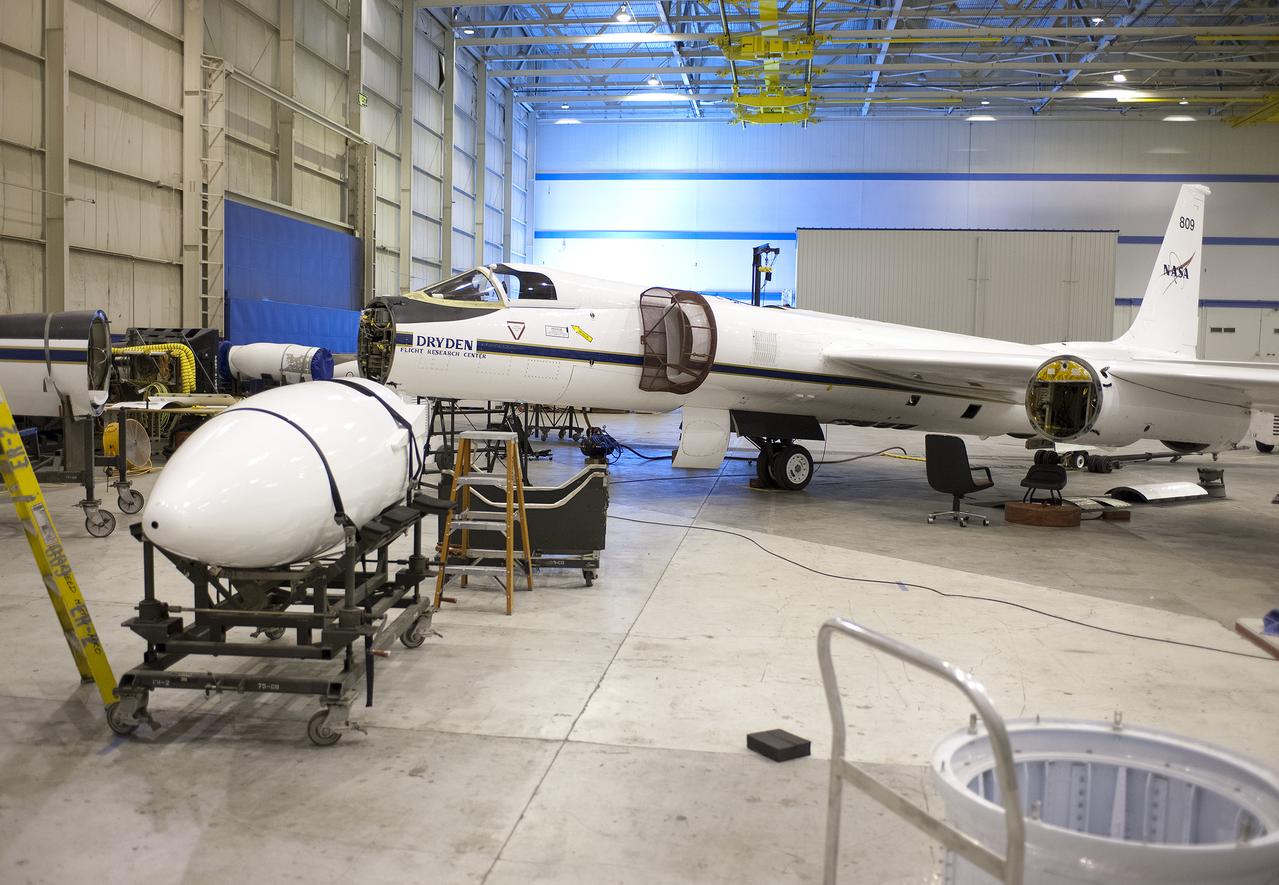
The equipment bays and wing pods of NASA's high-altitude ER-2 will carry 15 specialized instruments to study how the vertical convection of air pollution and natural emissions affect climate change.
ED13-0225-048
SpaceX’s Dragon capsule is seen shortly after arriving at a port near Los Angeles, Calif on Tuesday, Oct. 30, 2012. Dragon had just completed its first commercial resupply mission to the International Space Station and returned 1,673 pounds of science and supplies back to Earth.   Photo credit: NASA
ed12-0346-02
SpaceX’s Dragon capsule is seen shortly after arriving at a port near Los Angeles, Calif on Tuesday, Oct. 30, 2012. Dragon had just completed its first commercial resupply mission to the International Space Station and returned 1,673 pounds of science and supplies back to Earth.   Photo credit: NASA
ed12-0346-28
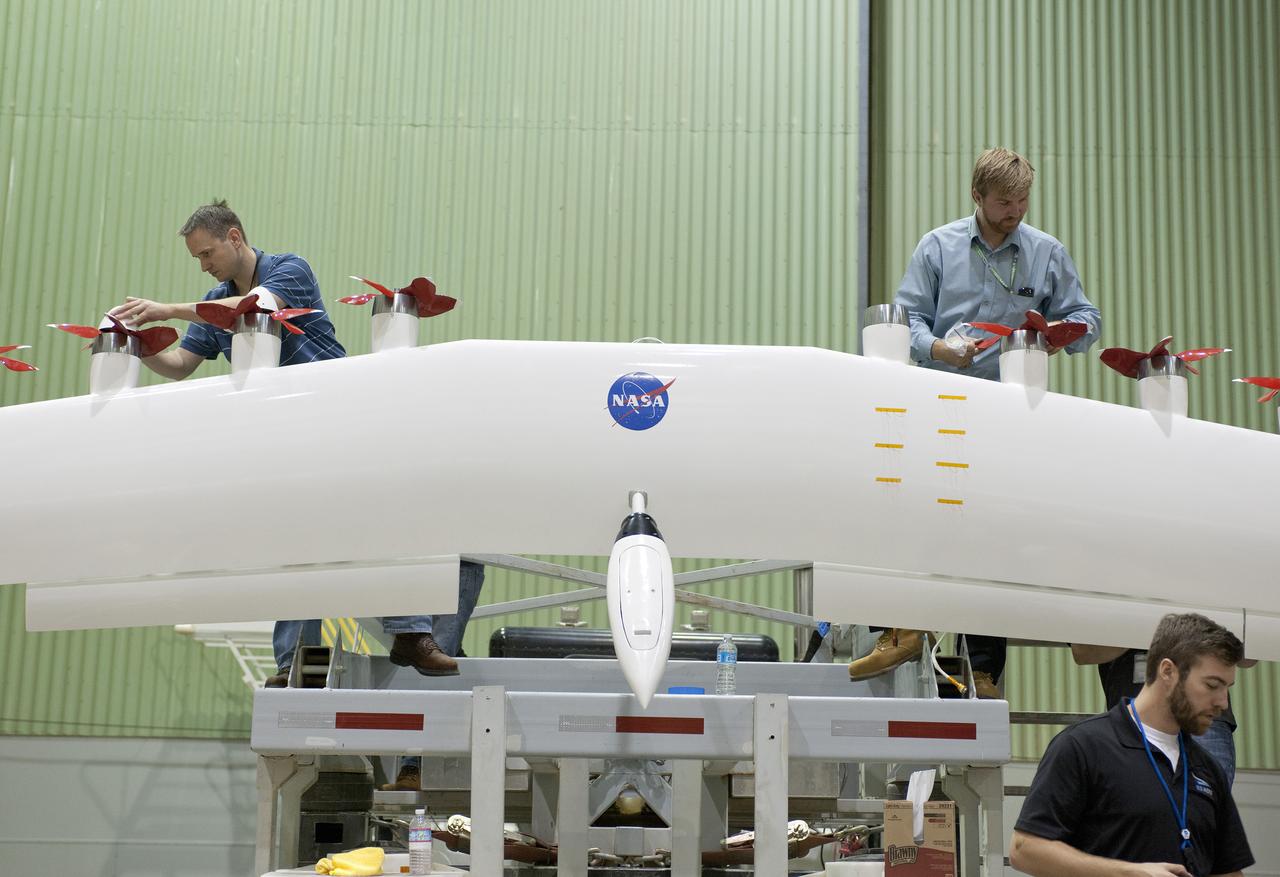
Engineers work on a wing with electric motors that is part of an integrated experimental testbed. From left are Sean Clarke, left, Kurt Papathakis at upper right and Anthony Cash in the foreground.
Piloted, Electric Propulsion-Powered Experimental Aircraft Underway
SpaceX’s Dragon capsule is seen shortly after arriving at a port near Los Angeles, Calif on Tuesday, Oct. 30, 2012. Dragon had just completed its first commercial resupply mission to the International Space Station and returned 1,673 pounds of science and supplies back to Earth.   Photo credit: NASA
ed12-0346-04
SpaceX’s Dragon capsule is seen shortly after arriving at a port near Los Angeles, Calif on Tuesday, Oct. 30, 2012. Dragon had just completed its first commercial resupply mission to the International Space Station and returned 1,673 pounds of science and supplies back to Earth.   Photo credit: NASA
ed12-0346-42
SpaceX’s Dragon capsule is seen shortly after arriving at a port near Los Angeles, Calif on Tuesday, Oct. 30, 2012. Dragon had just completed its first commercial resupply mission to the International Space Station and returned 1,673 pounds of science and supplies back to Earth.   Photo credit: NASA
ed12-0346-34
SpaceX’s Dragon capsule is seen shortly after arriving at a port near Los Angeles, Calif on Tuesday, Oct. 30, 2012. Dragon had just completed its first commercial resupply mission to the International Space Station and returned 1,673 pounds of science and supplies back to Earth.   Photo credit: NASA
ed12-0346-32
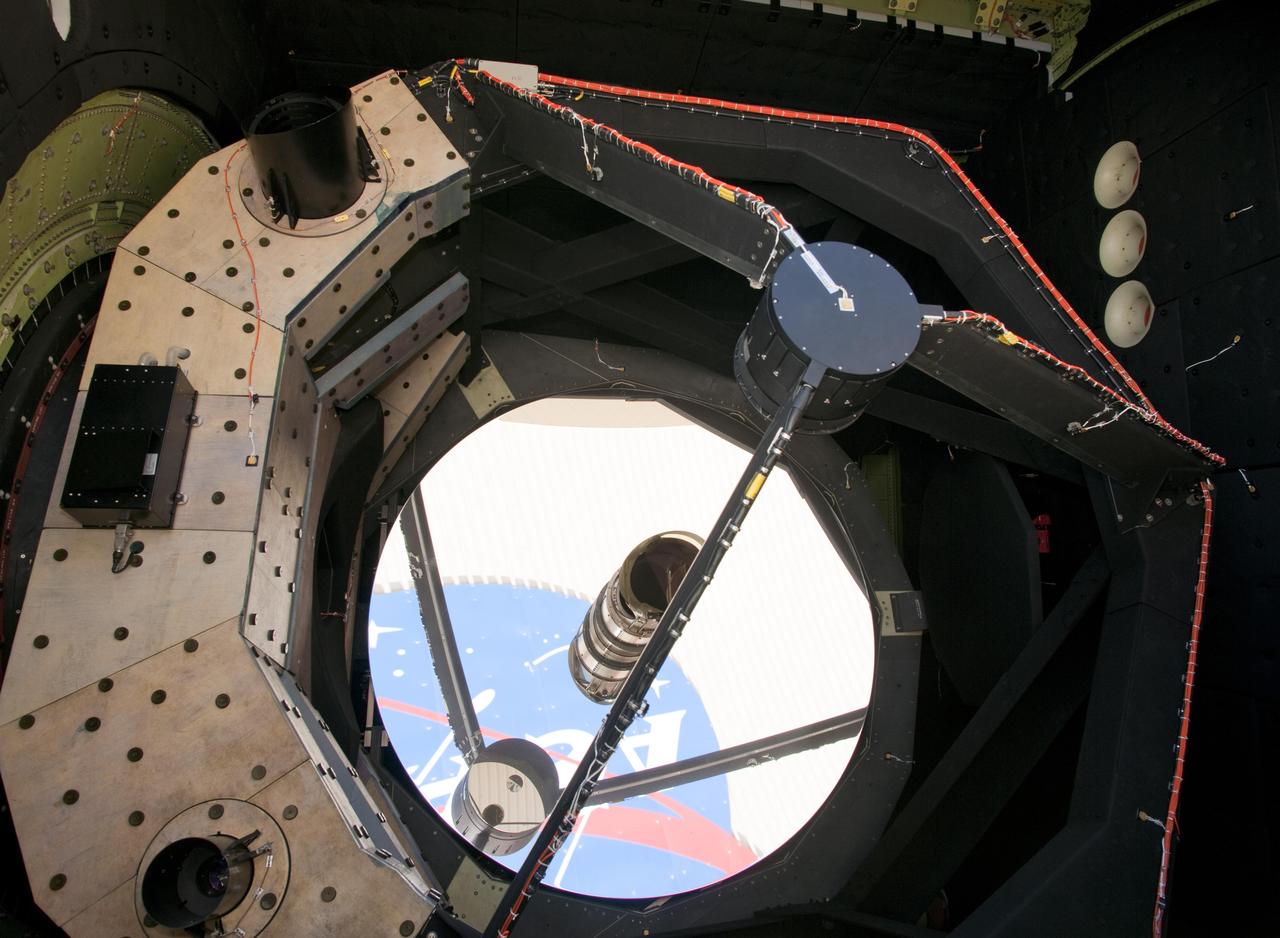
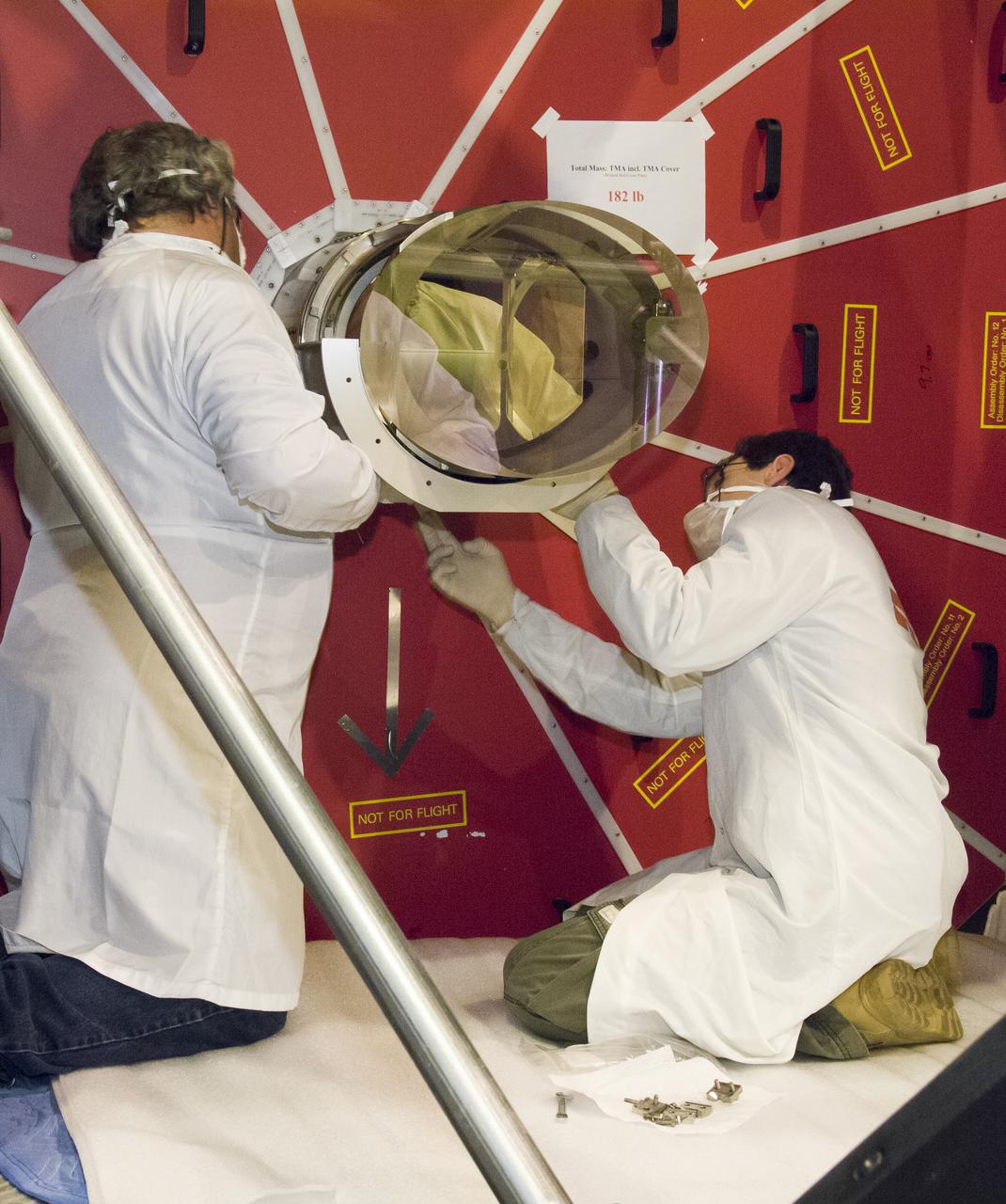
The NASA logo on Bldg. 703 at Armstrong Flight Research Center in Palmdale, Calif., is reflected in the telescope's 2.5-meter primary mirror.
ED11-0173-076
SpaceX’s Dragon capsule is seen shortly after arriving at a port near Los Angeles, Calif on Tuesday, Oct. 30, 2012. Dragon had just completed its first commercial resupply mission to the International Space Station and returned 1,673 pounds of science and supplies back to Earth.   Photo credit: NASA
ed12-0346-03
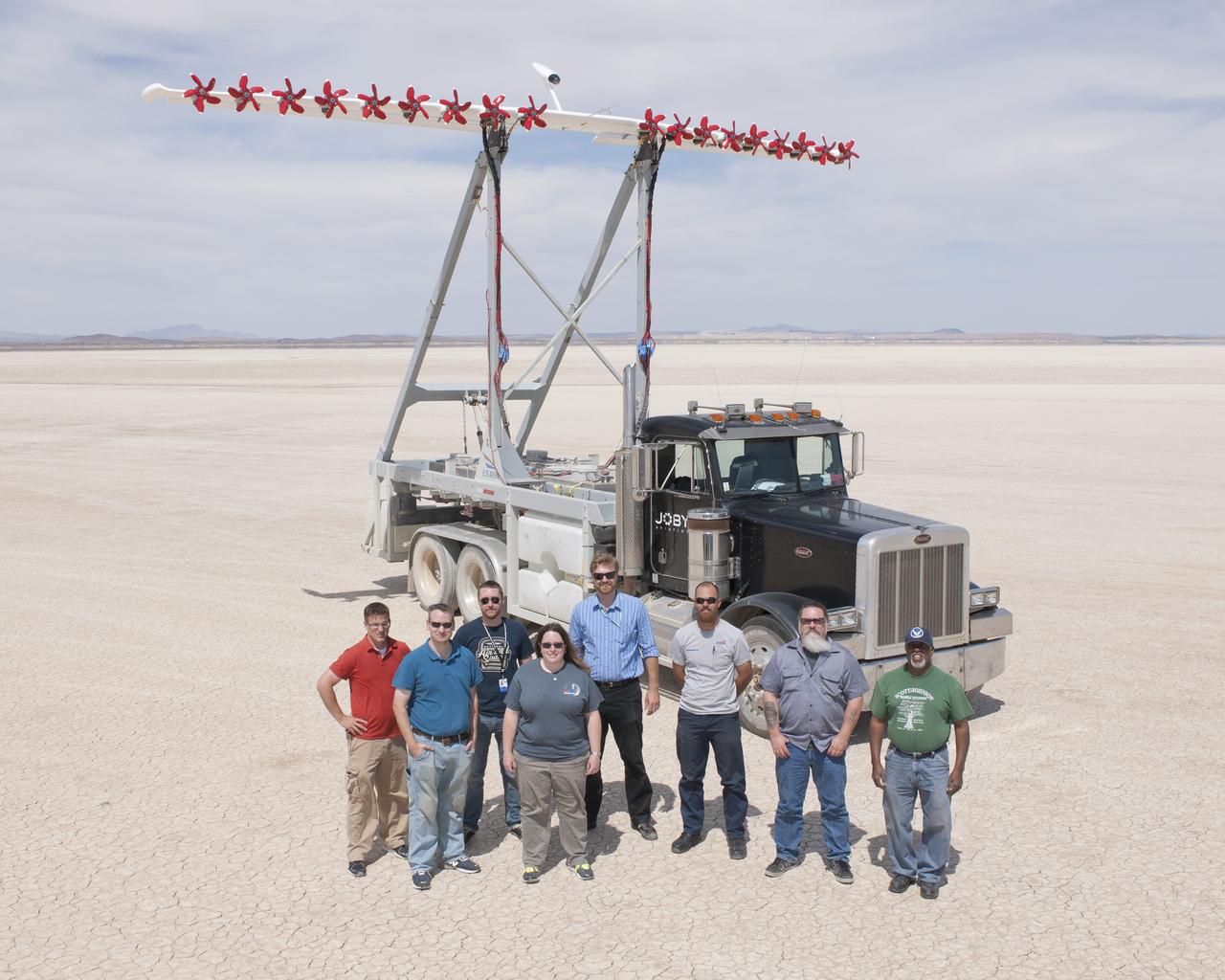
Team members of the Leading Edge Asynchronous Propeller Technology Ground Test team include from left Brian Soukup, Sean Clarke, Douglas Howe, Dena Gruca, Kurt Papathakis, Jason Denman, Vincent Bayne and Freddie Graham.
Piloted, Electric Propulsion-Powered Experimental Aircraft Underway
SpaceX’s Dragon capsule is seen shortly after arriving at a port near Los Angeles, Calif on Tuesday, Oct. 30, 2012. Dragon had just completed its first commercial resupply mission to the International Space Station and returned 1,673 pounds of science and supplies back to Earth.   Photo credit: NASA
ed12-0346-20
SpaceX’s Dragon capsule is seen shortly after arriving at a port near Los Angeles, Calif on Tuesday, Oct. 30, 2012. Dragon had just completed its first commercial resupply mission to the International Space Station and returned 1,673 pounds of science and supplies back to Earth.   Photo credit: NASA
ed12-0346-08
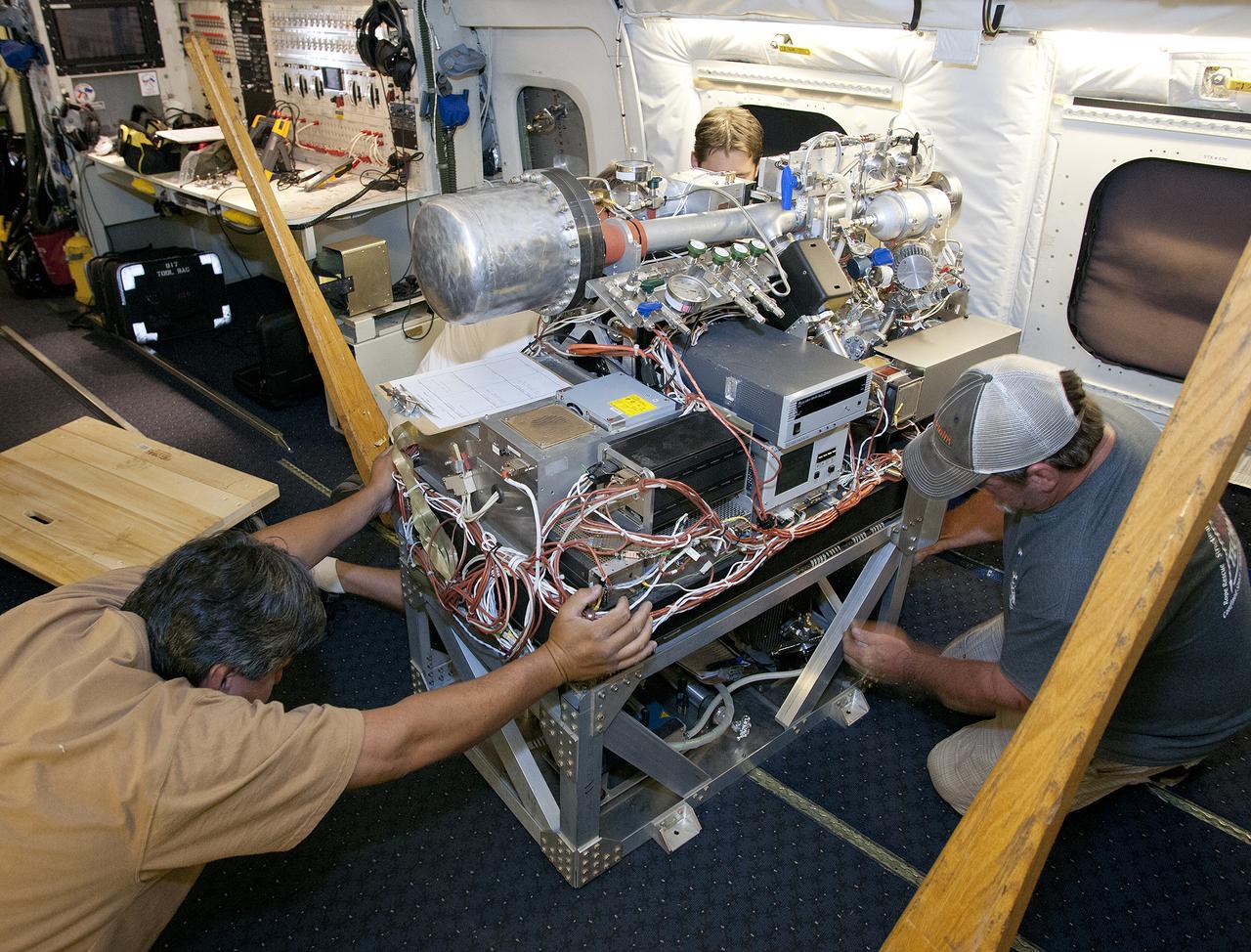
Scientists and technicians ready an instrument rack for mounting in NASA's DC-8 flying laboratory in preparation for a complex mission to study how air pollution and natural emissions affect climate change
ED13-0225-023
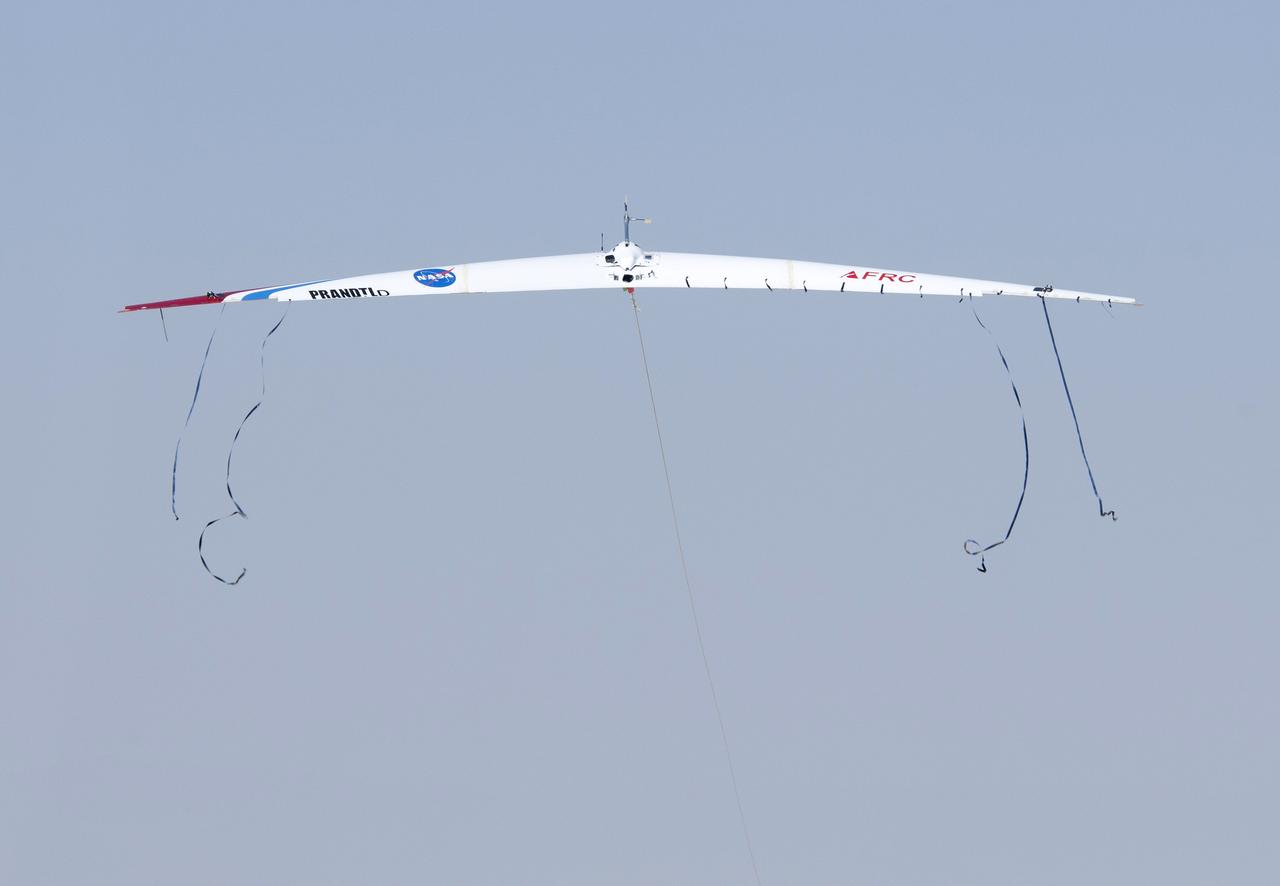
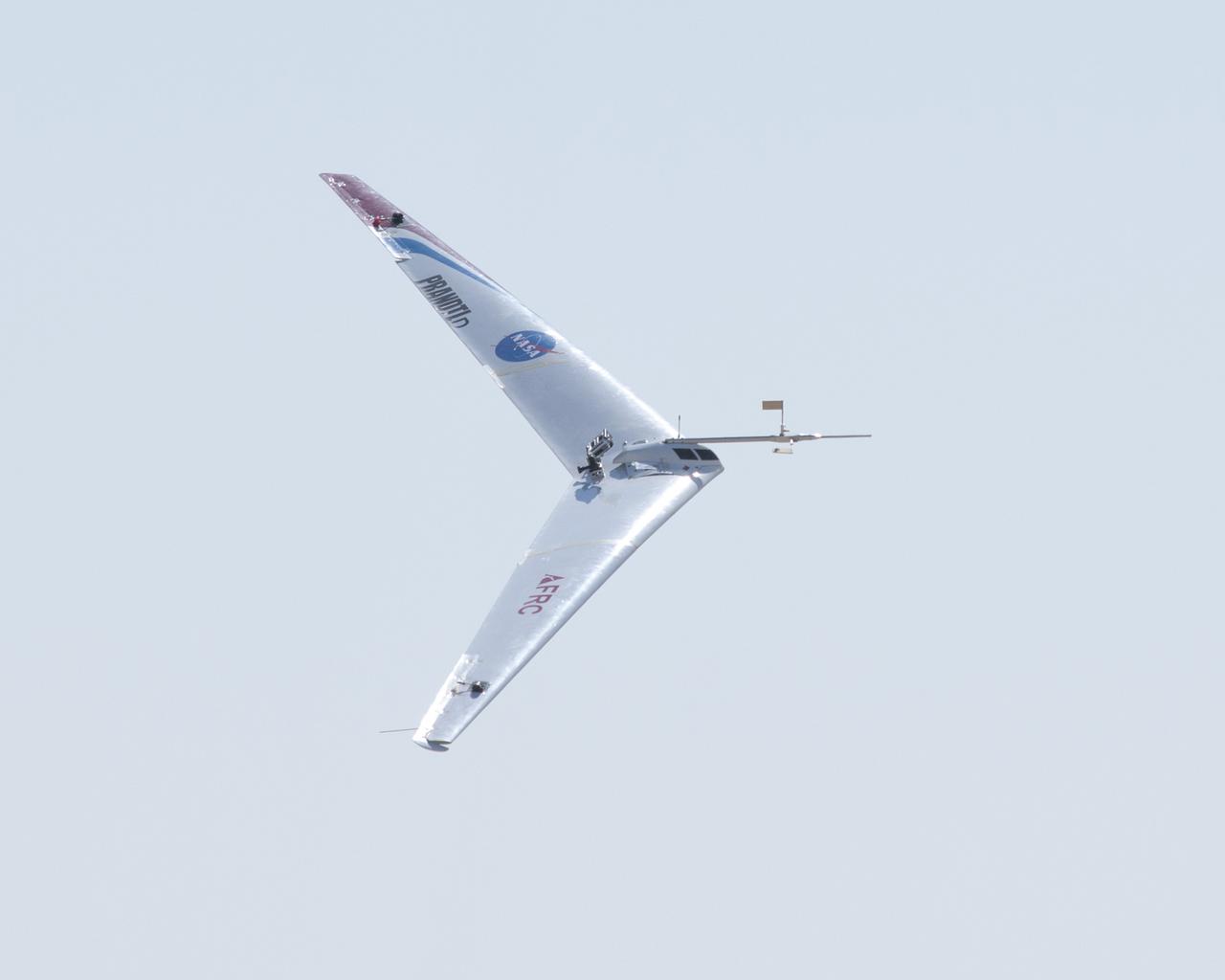
The Prandtl-D makes a test flight in 2014.
New Wing Shape Tested in Wind Tunnel
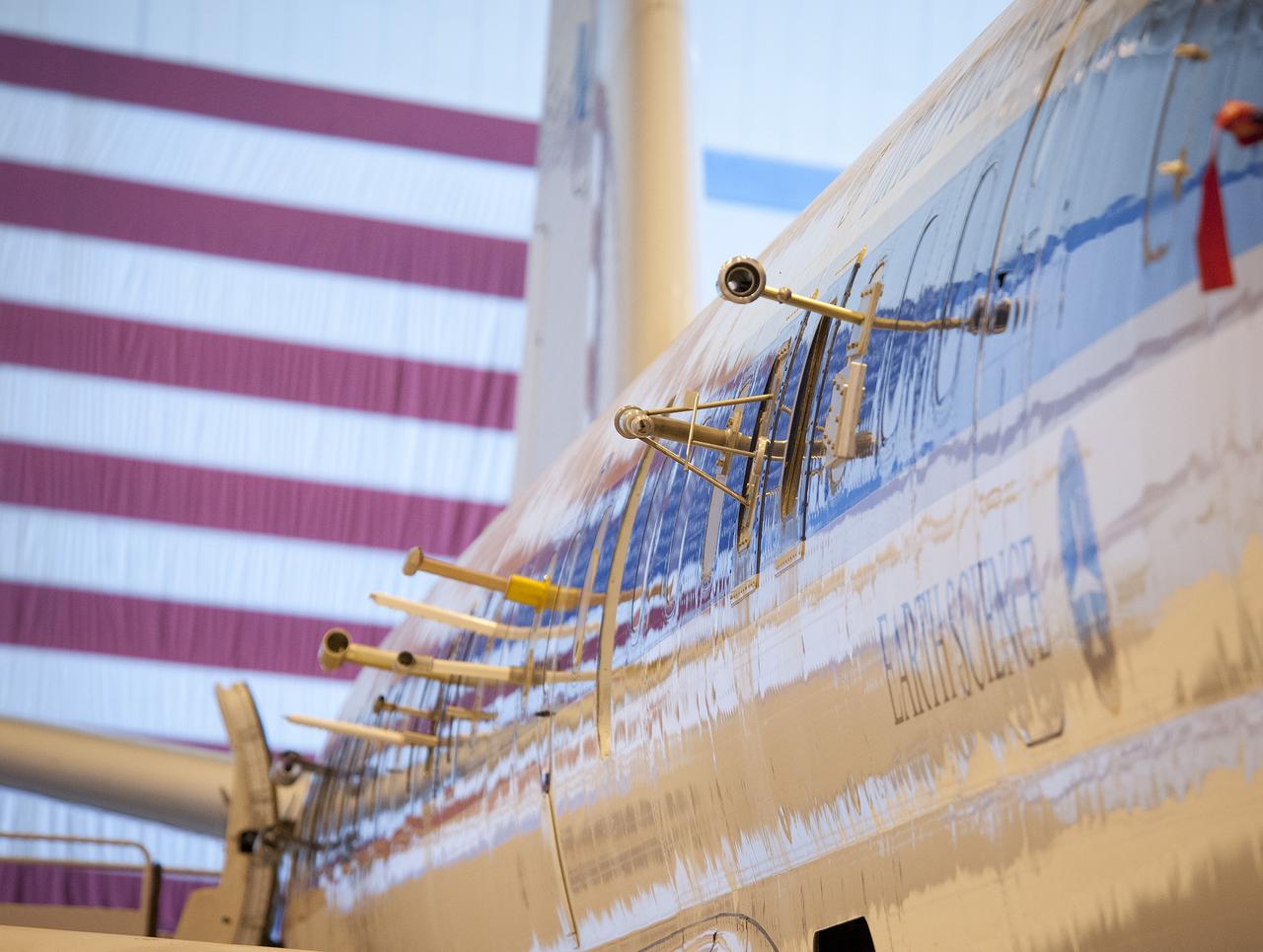
A number of atmospheric probes are installed along the fuselage of NASA's DC-8 in preparation for the SEAC4RS study to learn more about how air pollution and natural emissions affect climate change.
ED13-0225-050
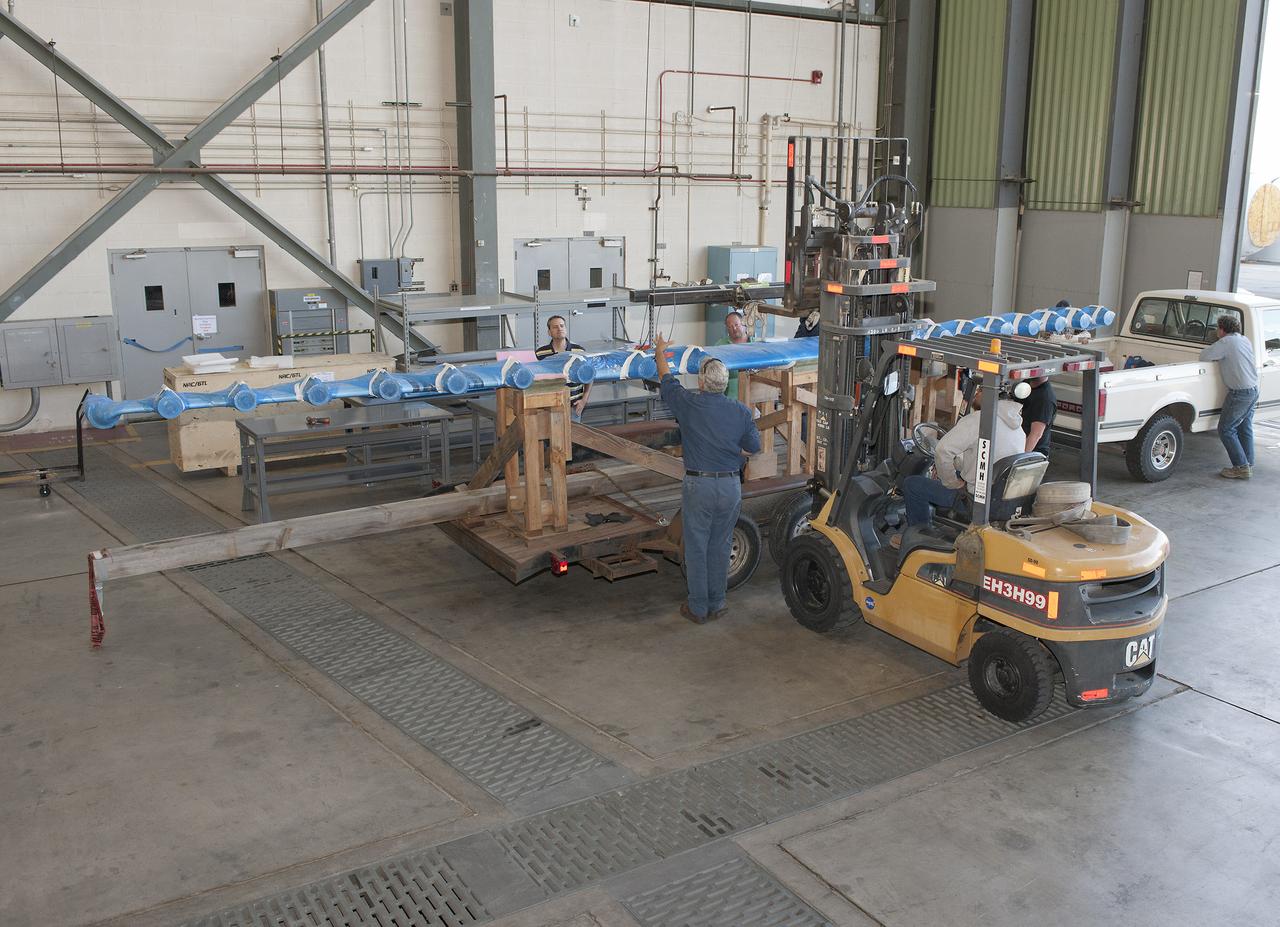
Technicians unload the LEAPTech experimental wing upon its arrival at NASA Armstrong Flight Research Center. Ground testing will begin after the wing is mounted on a specially modified truck.
LEAPTech to Demonstrate Electric Propulsion Technologies
SpaceX’s Dragon capsule is seen shortly after arriving at a port near Los Angeles, Calif on Tuesday, Oct. 30, 2012. Dragon had just completed its first commercial resupply mission to the International Space Station and returned 1,673 pounds of science and supplies back to Earth.   Photo credit: NASA
ed12-0346-05
SpaceX’s Dragon capsule is seen shortly after arriving at a port near Los Angeles, Calif on Tuesday, Oct. 30, 2012. Dragon had just completed its first commercial resupply mission to the International Space Station and returned 1,673 pounds of science and supplies back to Earth.   Photo credit: NASA
ed12-0346-31
The streamers on the Prandtl-D No. 2 as it is launched illustrate how aerodynamic forces are maximized as birds overlap wingtips when flying in formation.
ED14-0222-088
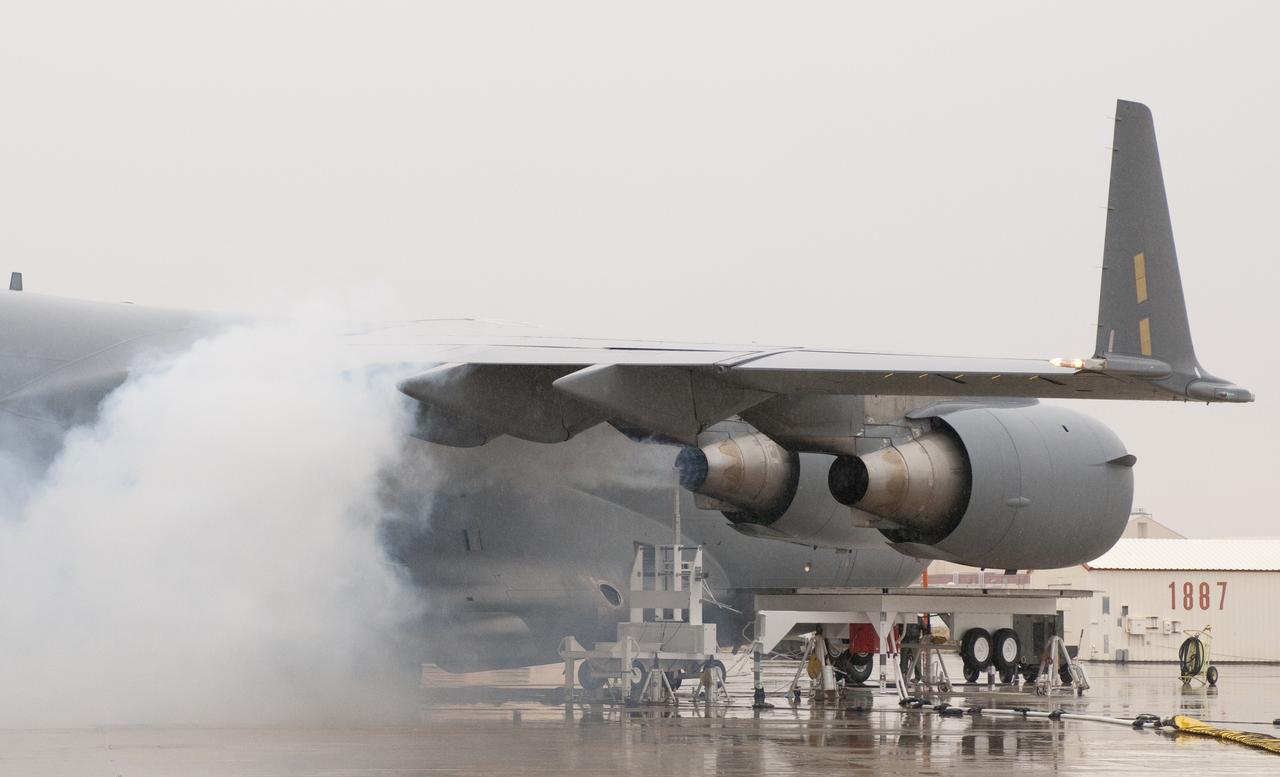
Oil smoke billows from the right inboard engine of the C-17 while a probe collects emissions data during 2011 VIPR engine health monitoring tests.
ED11-0372-011
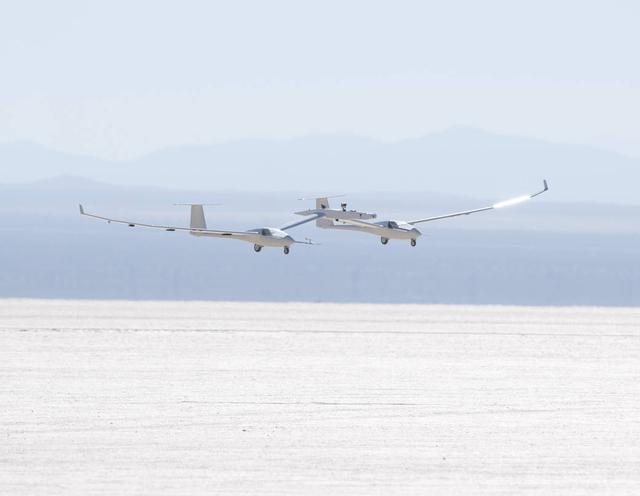
The one-third scale twin-fuselage towed glider glides in for landing on Rogers Dry Lake after its successful first test flight.
Towed Twin-Fuselage Glider Launch System First Test Flight
SpaceX’s Dragon capsule is seen shortly after arriving at a port near Los Angeles, Calif on Tuesday, Oct. 30, 2012. Dragon had just completed its first commercial resupply mission to the International Space Station and returned 1,673 pounds of science and supplies back to Earth.   Photo credit: NASA
ed12-0346-18
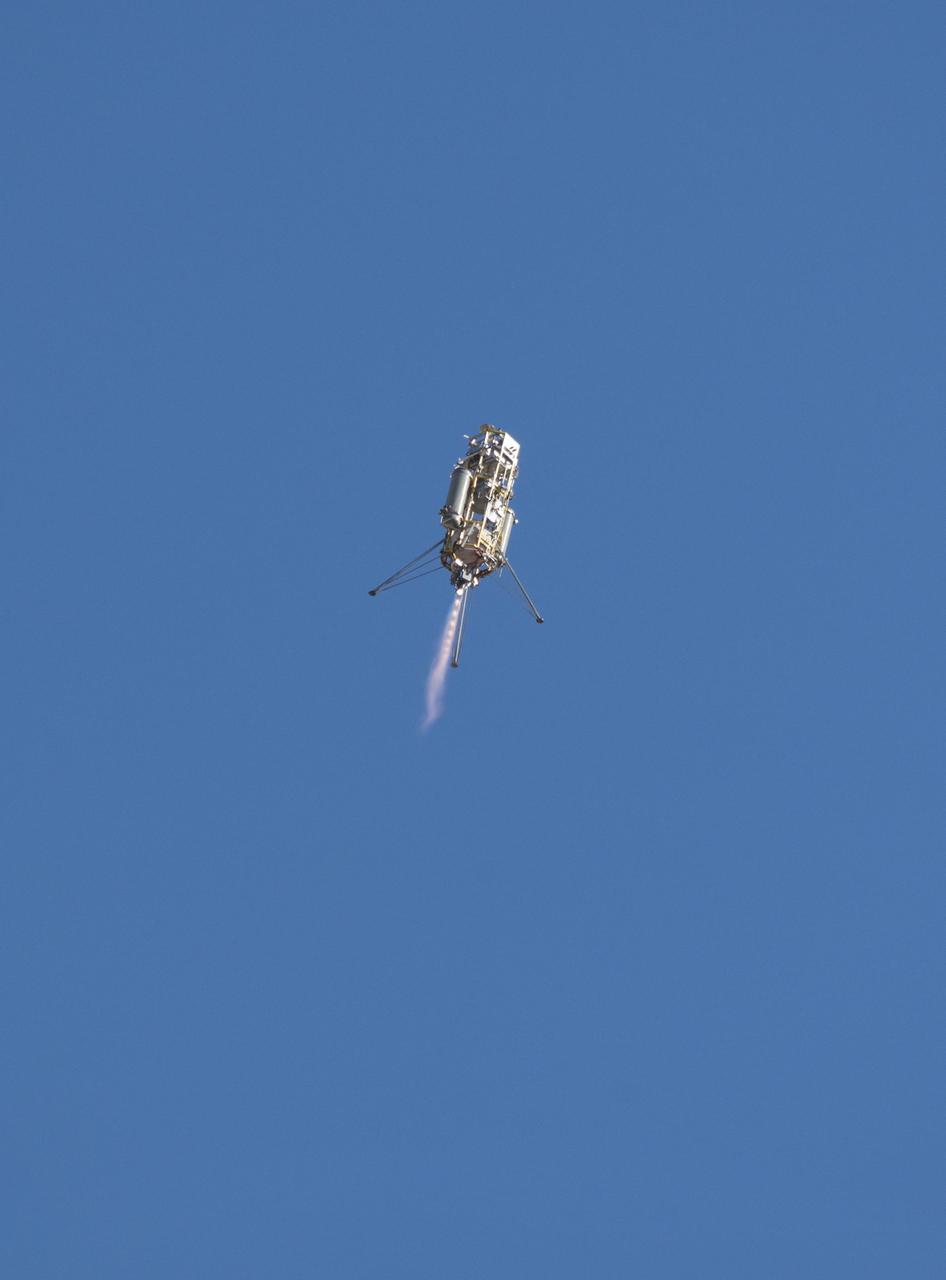
A prototype of the Lander Vision System for NASA Mars 2020 mission was tested in this Dec. 9, 2014, flight of a Masten Space Systems Xombie vehicle at Mojave Air and Space Port in California.  http://photojournal.jpl.nasa.gov/catalog/PIA20848
Test of Lander Vision System for Mars 2020
An ocean color senor, a passive microwave vertical sounder and an electro-optical sensor were mounted on the Altair UAV for the NOAA-NASA flight demonstration.
EC05-0090-03
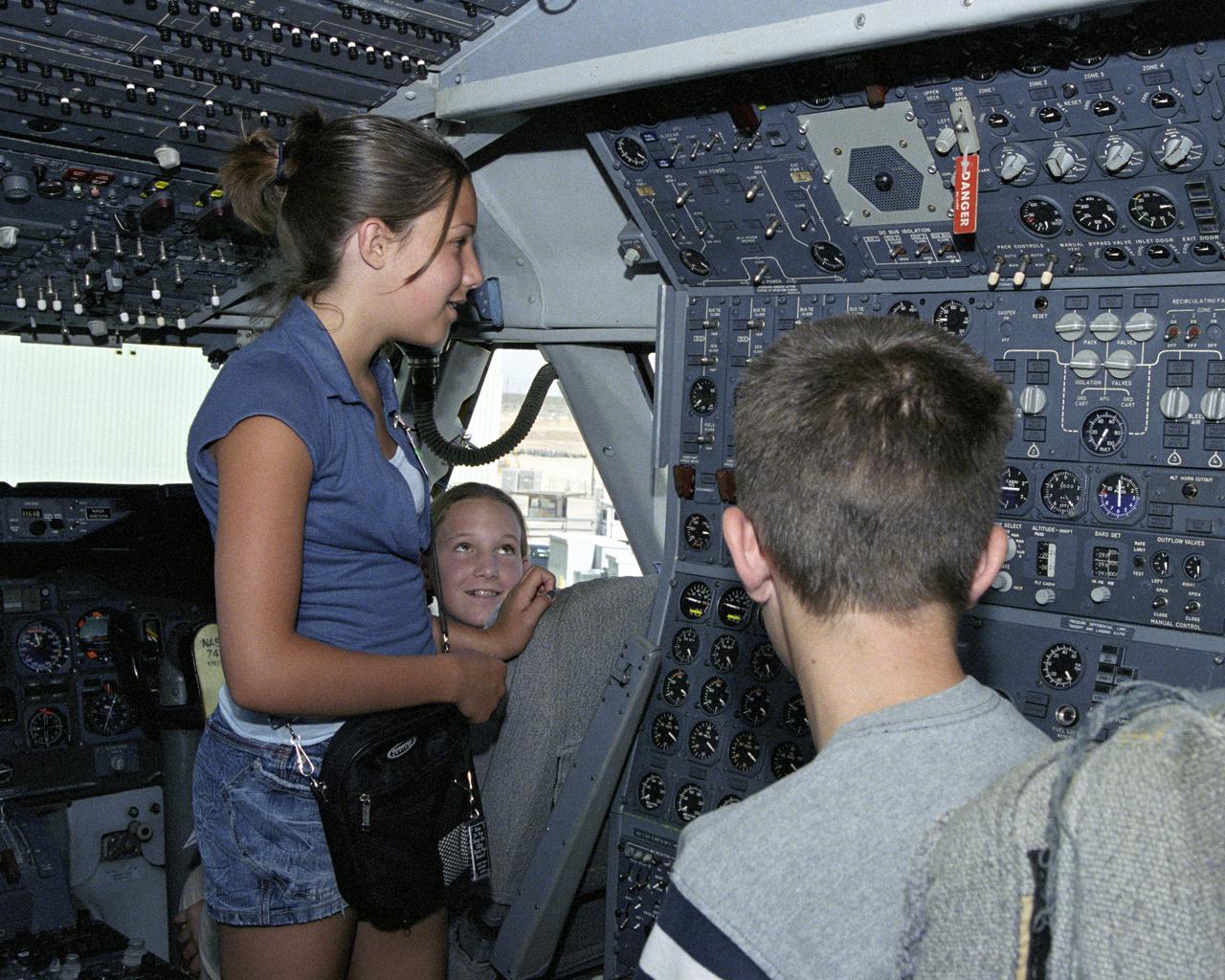
Nicole Schultheiss, a fourth-grader at Ulrich Elementary School in California City, "flew" an F/A-18 simulator with NASA engineer Byron Simpson's coaching during Take Your Children to Work Day June 22 at NASA Dryden Flight Research Center.
Nicole Schultheiss flies an F/A-18 simulator with NASA engineer Byron Simpson's coaching during Take Your Children to Work Day June 22
Two large science aircraft, a DC-8 flying laboratory and the SOFIA 747SP, are based at NASA's Dryden Aircraft Operations Facility in Palmdale, Calif.
Powered by a laser beam directed at it from a center pedestal, a lightweight model plane makes the first flight of an aircraft powered by laser energy inside a building at NASA's Marshall Space Flight Center.
Powered by a laser beam directed at it from a pedestal, a model plane makes the first flight of an aircraft powered by laser energy inside a building at NASA Marshall.
ED13-0079-13 (26 March 2013) ---- SpaceX Dragon's second operational mission ended  on March 26 after three weeks attached to the International Space Station. The unmanned spacecraft splashed down  in the Pacific Ocean about 214 miles off the coast of Baja California to successfully return about 2,670 pounds of science materials from the orbital outpost.  Photo credit:  NASA
ed13-0079-13
The SOFIA telescope team collected baseline operational measurements during several nights of characterization testing in March 2008 while the SOFIA 747SP aircraft that houses the German-built infrared telescope was parked on an unlit ramp next to its hangar at the NASA Dryden Flight Operations Facility in Palmdale, Calif. The primary celestial target was Polaris, the North Star. The activity provided the team with a working knowledge of how telescope operating systems interact and the experience of tracking celestial targets from the ground.
NASA's SOFIA flying observatory was captured in striking relief during nighttime telescope characterization tests in Palmdale, Calif., in March 2008
ED13-0079-01 (26 March 2013) ---- SpaceX Dragon's second operational mission ended  on March 26 after three weeks attached to the International Space Station. The unmanned spacecraft splashed down  in the Pacific Ocean about 214 miles off the coast of Baja California to successfully return about 2,670 pounds of science materials from the orbital outpost.  Photo credit:  NASA
ed13-0079-01
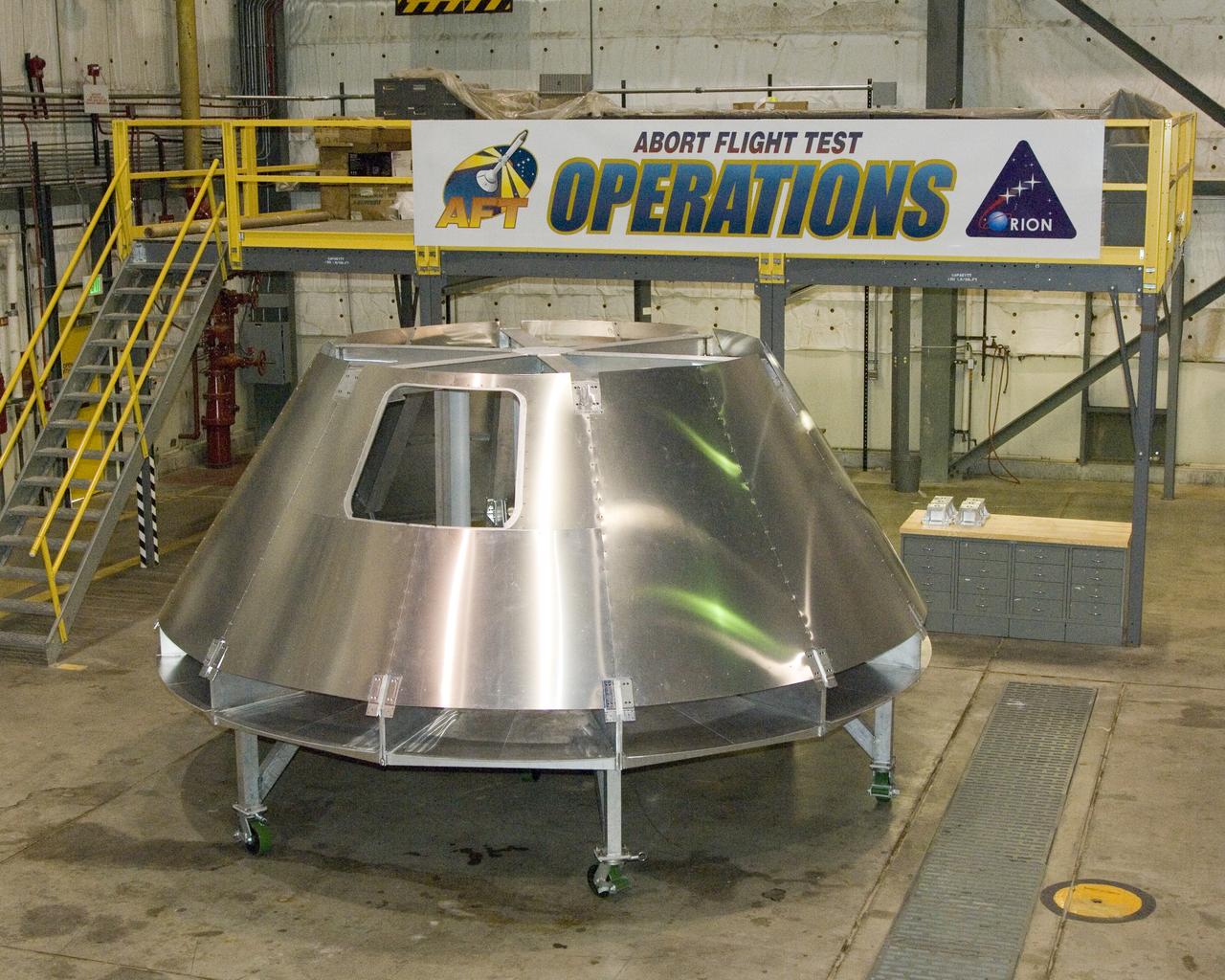
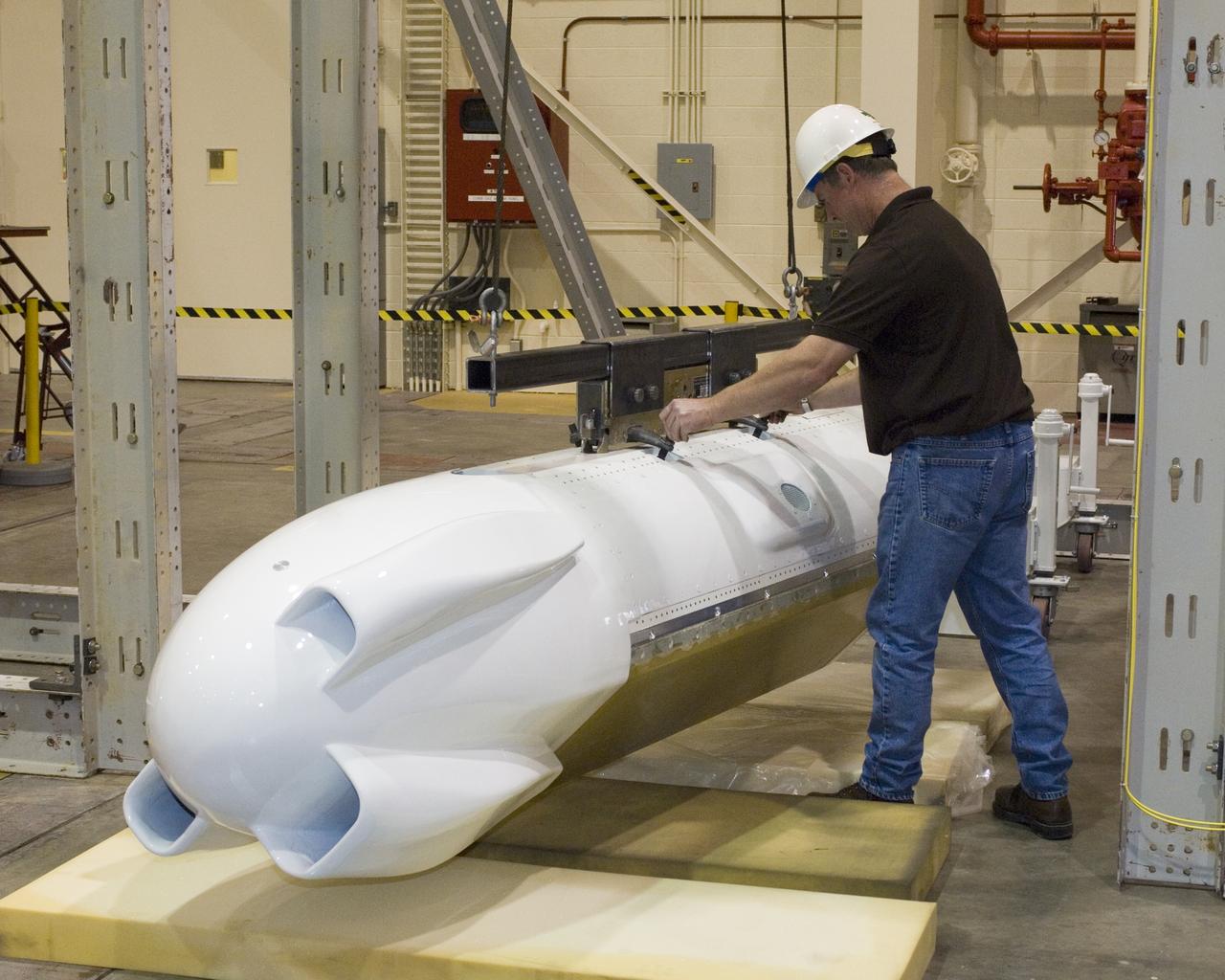
NASA Dryden's mockup Orion crew module is located in Dryden's Shuttle hangar, where abort flight test equipment is being positioned.
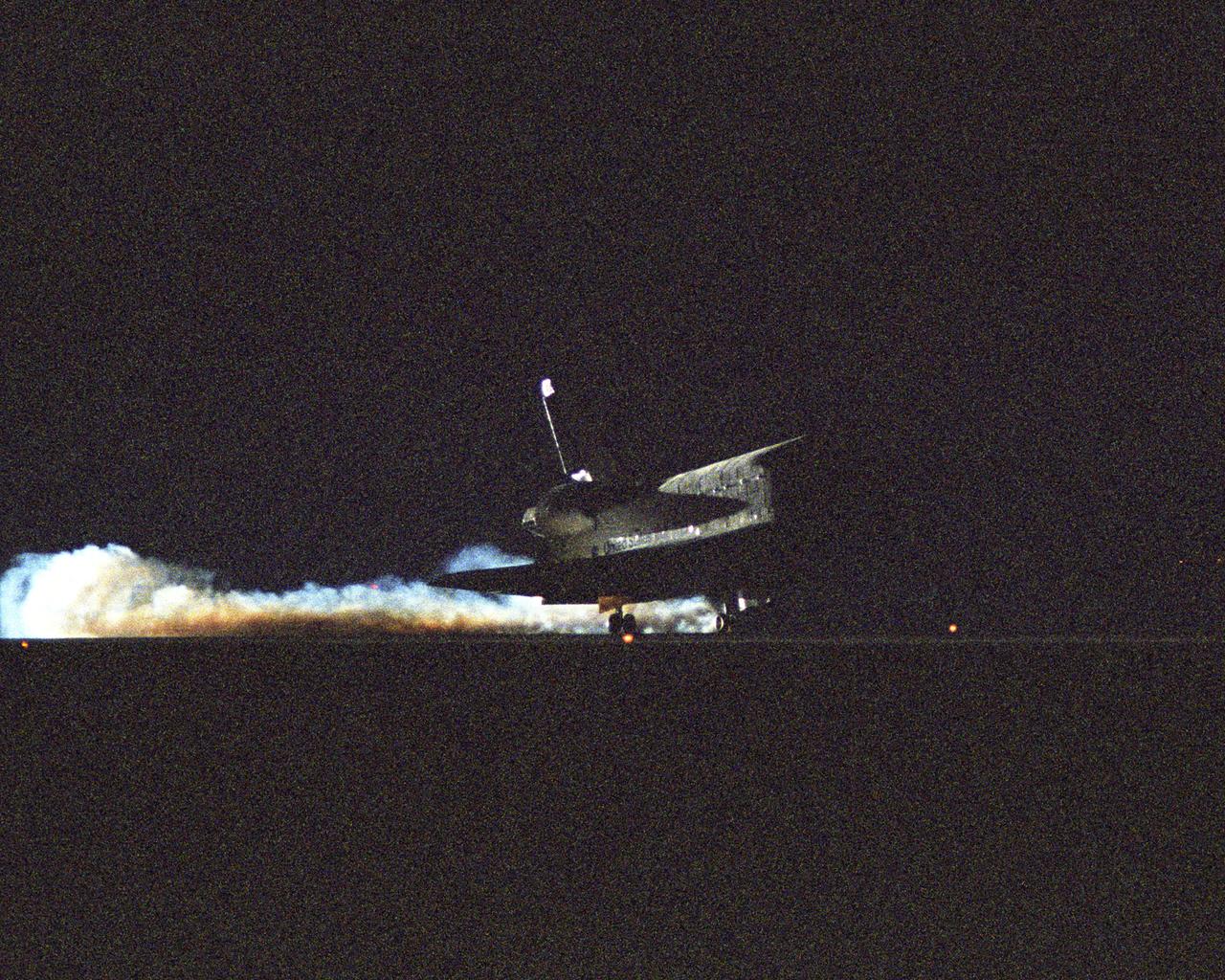
The Space Shuttle Atlantis' drag chute deploys as it rolls out on Runway 22 at Edwards AFB at the conclusion of its 13-day STS-117 mission to the ISS.
The Space Shuttle Atlantis' drag chute deploys as it rolls out on Runway 22 at Edwards AFB at the conclusion of its 13-day STS-117 mission to the ISS
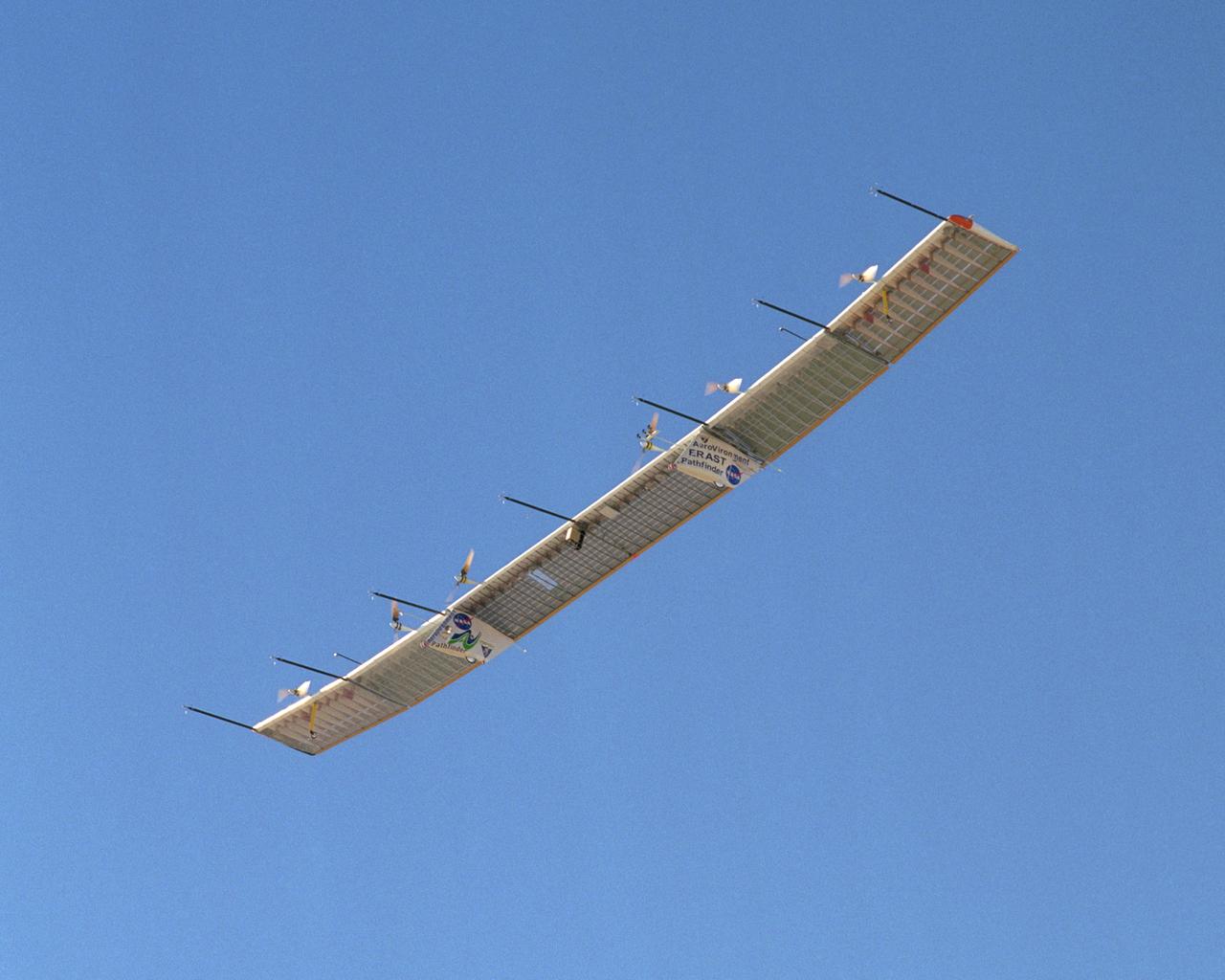
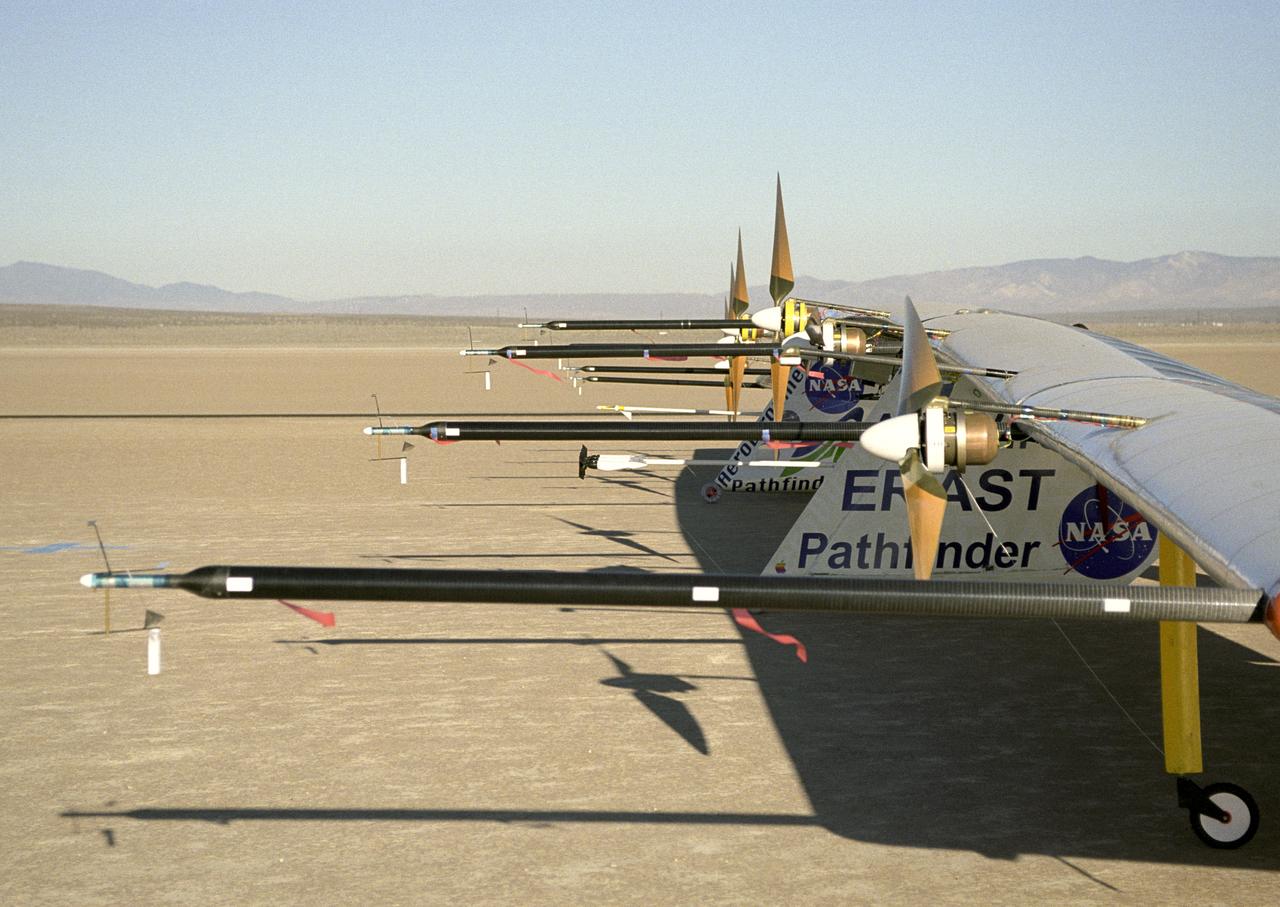
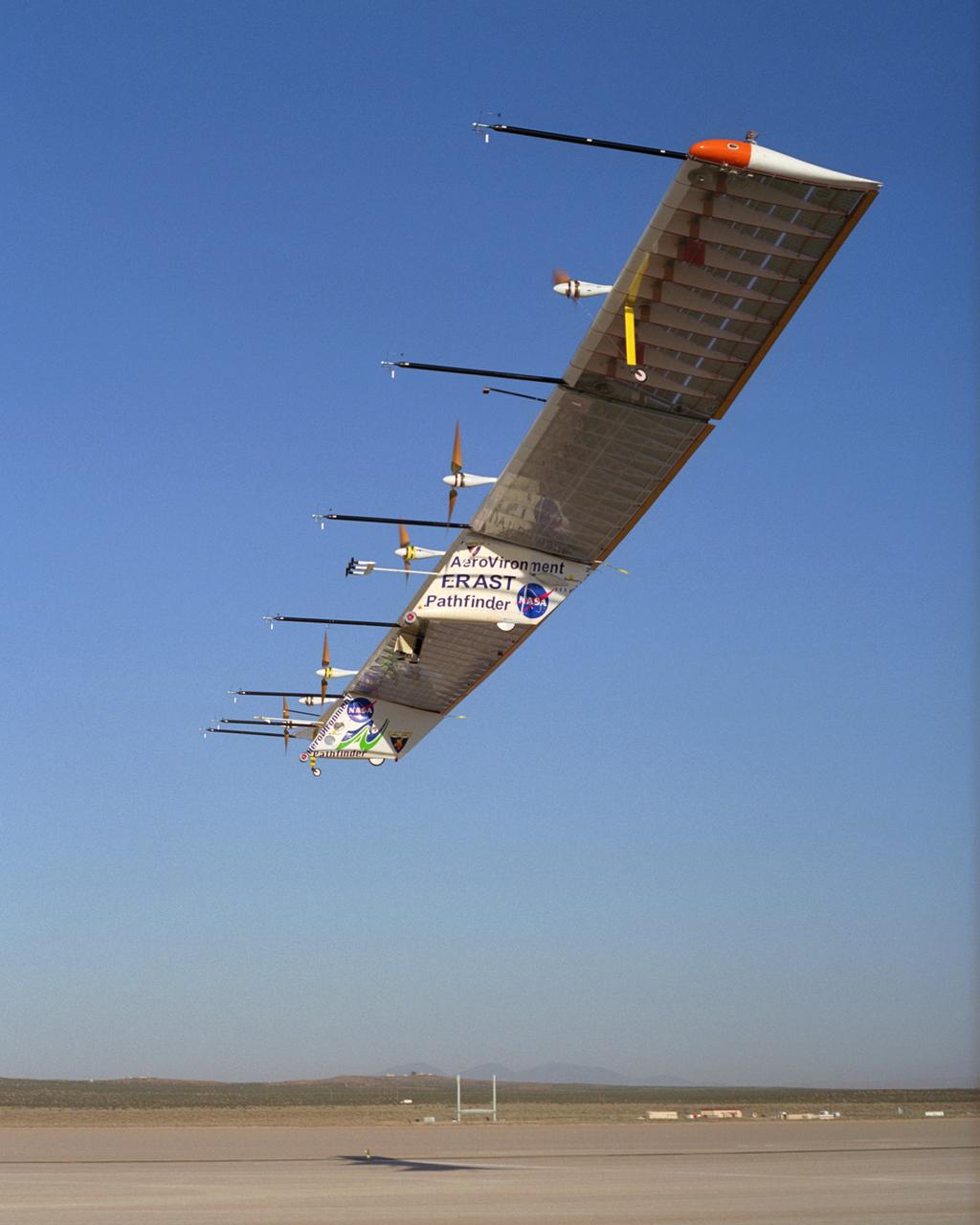
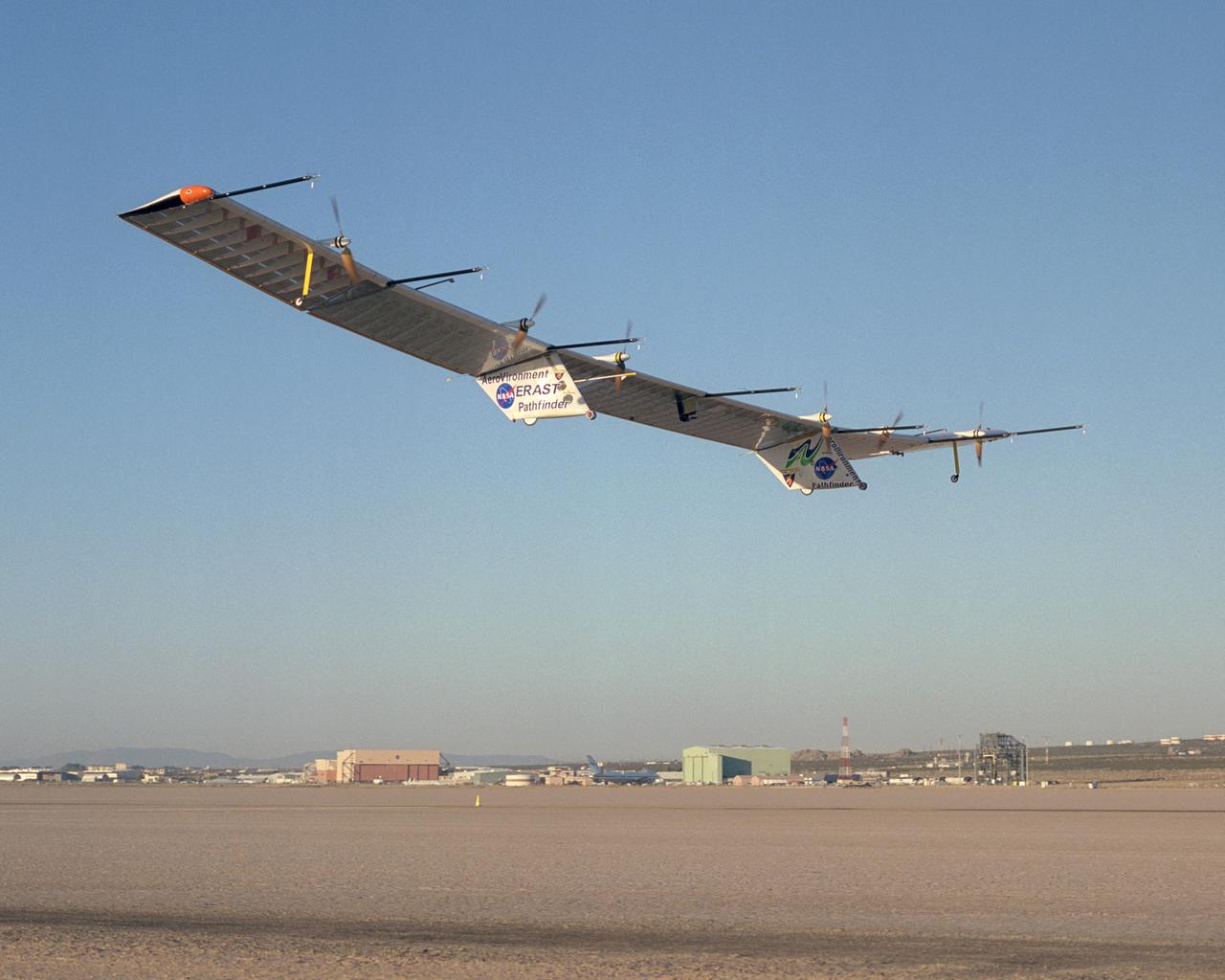
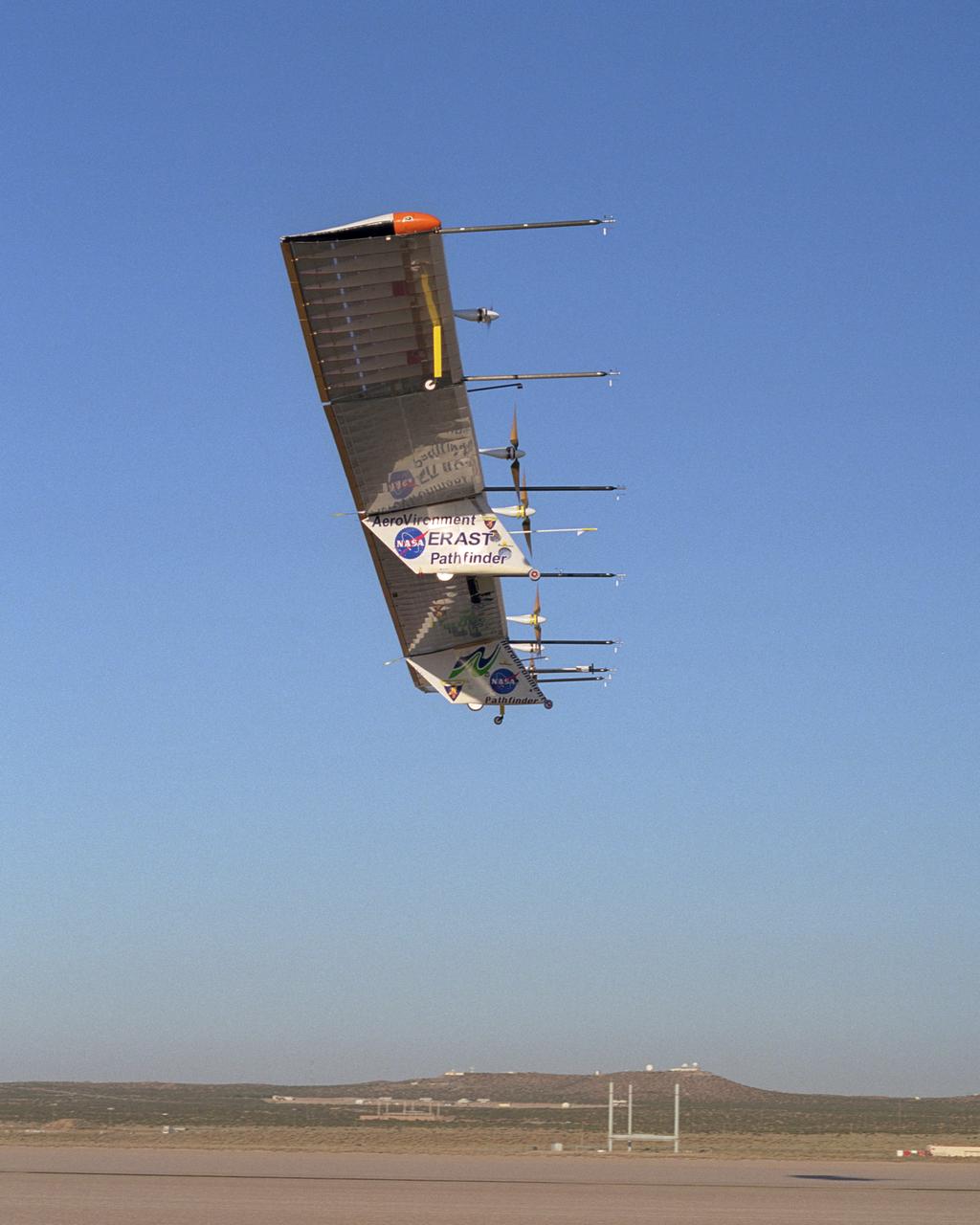
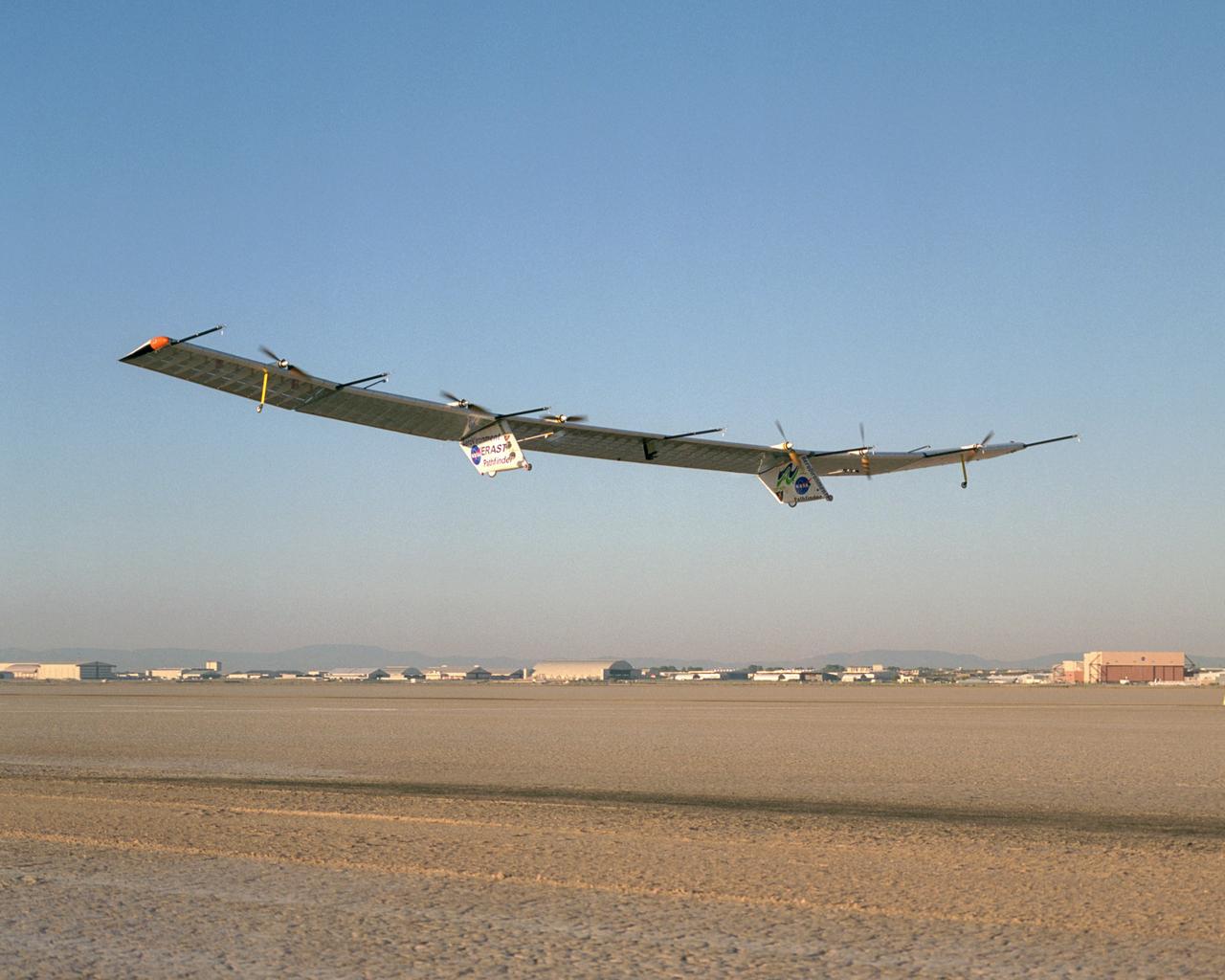
Sensitive instruments mounted on booms extending forward of the wing measure air turbulence and its effect on the stability of the Pathfinder-Plus solar-electric flying wing.
Sensitive instruments on wing-mounted booms measure air turbulence and its effect on the stability of the Pathfinder-Plus solar-electric flying wing.
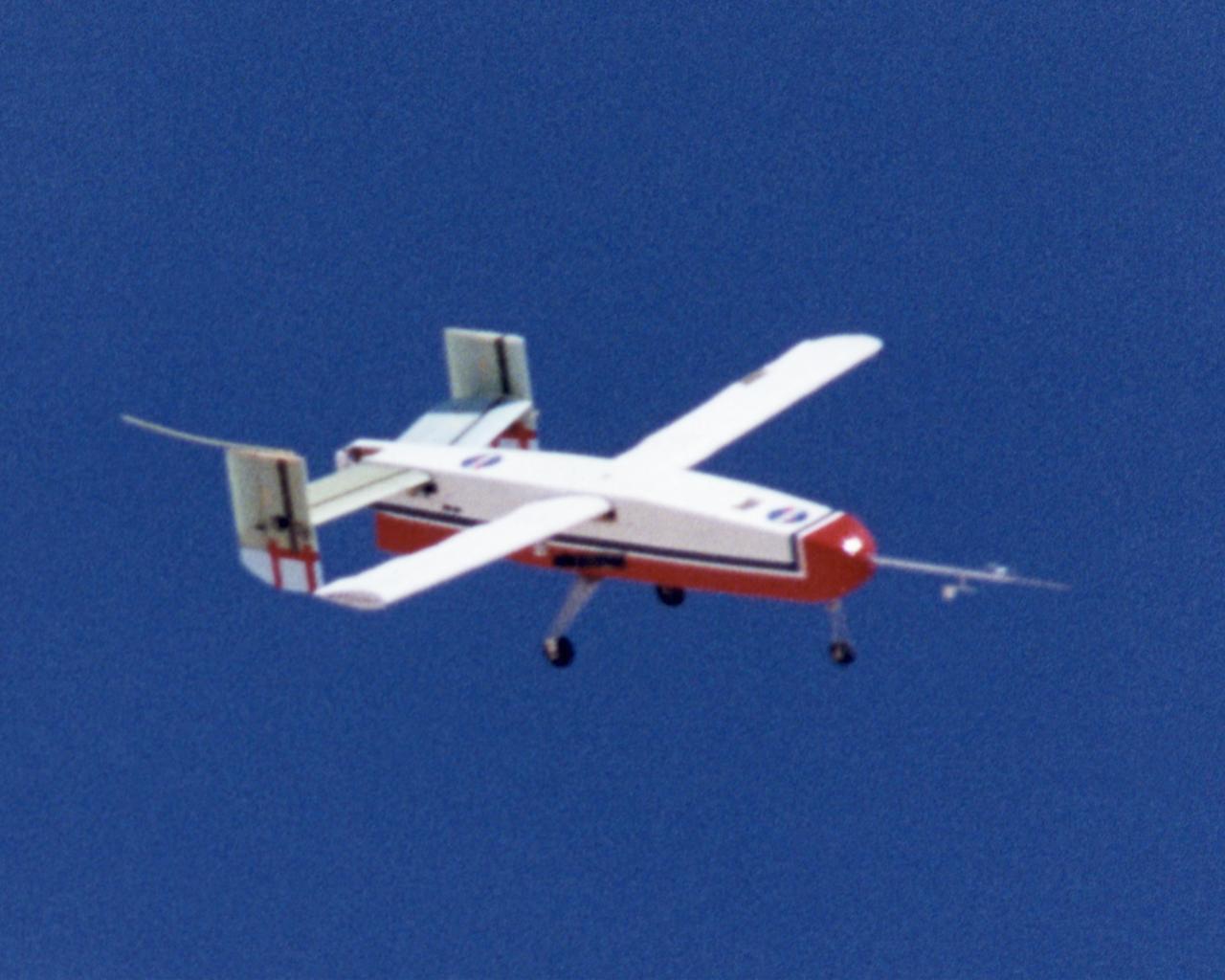
One of two small APV-3 aircraft flown in the joint Ames-Dryden Networked UAV Teaming Experiment flares for landing on a roadway on a remote area of Edwards AFB.
EC05-0043-20
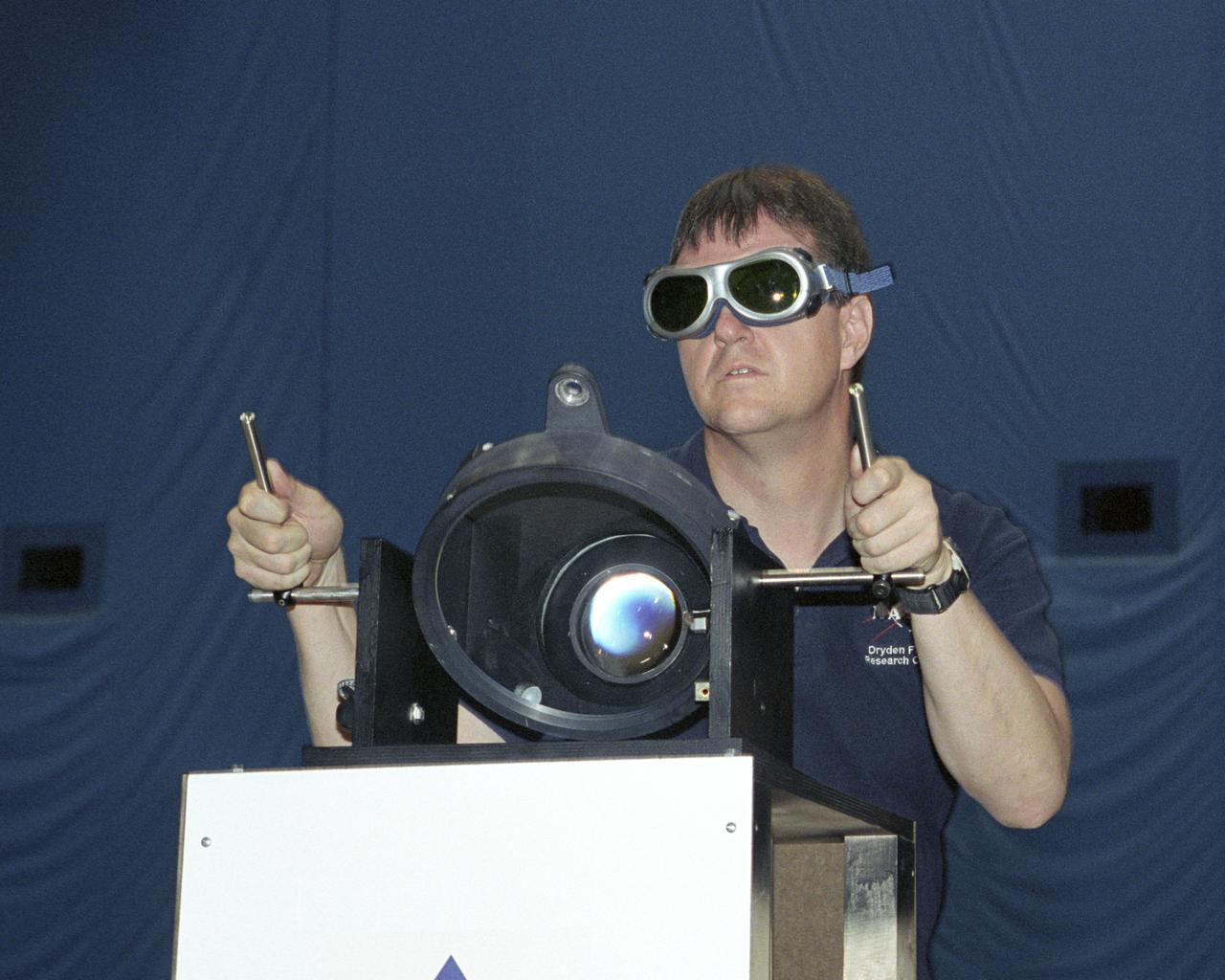
NASA Dryden project engineer Dave Bushman carefully aims the optics of a laser device at a solar cell panel on a model aircraft during the first flight demonstration of an aircraft powered by laser light.
NASA Dryden's Dave Bushman aims the optics of a laser device at a panel on a model aircraft during the first flight demonstration of an aircraft powered by laser light.
ED13-0079-14 (26 March 2013) ---- SpaceX Dragon's second operational mission ended  on March 26 after three weeks attached to the International Space Station. The unmanned spacecraft splashed down  in the Pacific Ocean about 214 miles off the coast of Baja California to successfully return about 2,670 pounds of science materials from the orbital outpost.  Photo credit:  NASA
ed13-0079-14
Space Shuttle Atlantis descended to a smooth landing at Edwards Air Force Base, Calif., concluding a successful assembly mission to the International Space Station. With Commander Rick Sturckow and Pilot Lee Archambault at the controls, Atlantis landed at 12:49 p.m. PDT on June 22, 2007. Atlantis launched June 8, 2007, and arrived at the International Space Station on June 10. While at the orbital outpost, the crew installed the Starboard 3 and 4 truss segment and conducted four spacewalks to activate it. During the third spacewalk, the crew repaired an out of position thermal blanket on the left orbital maneuvering system pod.  Atlantis also delivered a new station crew member, Flight Engineer Clayton Anderson. He replaced astronaut Suni Williams, who is the new record holder for a long-duration single spaceflight for a woman. She arrived at the station in December of 2006 with STS-116.  STS-117 is the 118th shuttle mission and 21st mission to visit the space station.
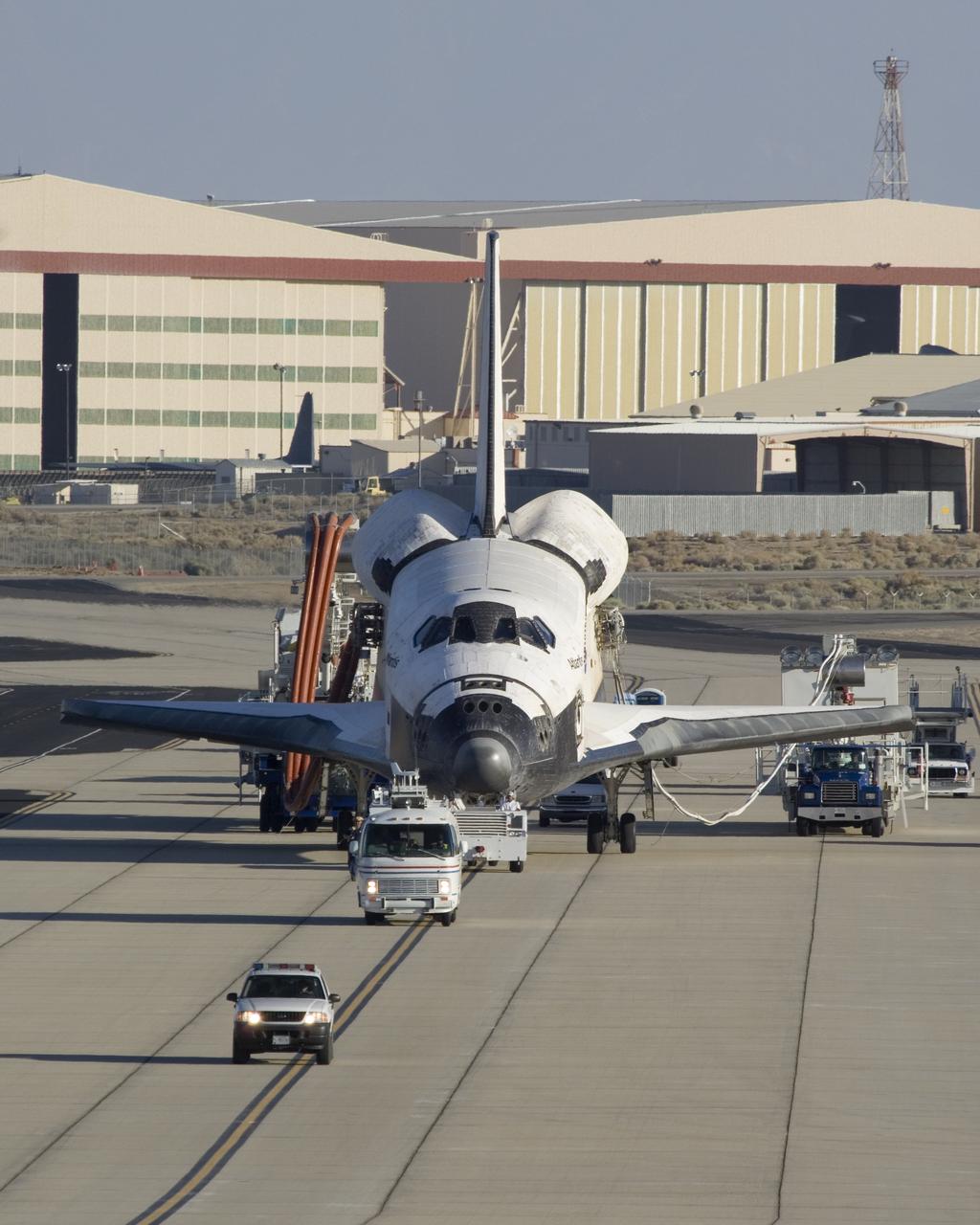
Accompanied by a convoy of recovery vehicles, the Space Shuttle Atlantis is towed up the taxiway at NASA Dryden following its landing on June 22, 2007
The Space Shuttle Discovery, accompanied by a convoy of recovery vehicles, is towed up the taxiway at NASA's Dryden Flight Research Center at Edwards Air Force Base, California, following its landing on August 9, 2005. Space Shuttle Discovery landed safely at NASA's Dryden Flight Research Center at Edwards Air Force Base in California at 5:11:22 a.m. PDT this morning, following the very successful 14-day STS-114 return to flight mission.  During their two weeks in space, Commander Eileen Collins and her six crewmates tested out new safety procedures and delivered supplies and equipment the International Space Station.  Discovery spent two weeks in space, where the crew demonstrated new methods to inspect and repair the Shuttle in orbit. The crew also delivered supplies, outfitted and performed maintenance on the International Space Station. A number of these tasks were conducted during three spacewalks.  In an unprecedented event, spacewalkers were called upon to remove protruding gap fillers from the heat shield on Discovery's underbelly. In other spacewalk activities, astronauts installed an external platform onto the Station's Quest Airlock and replaced one of the orbital outpost's Control Moment Gyroscopes.  Inside the Station, the STS-114 crew conducted joint operations with the Expedition 11 crew. They unloaded fresh supplies from the Shuttle and the Raffaello Multi-Purpose Logistics Module. Before Discovery undocked, the crews filled Raffeallo with unneeded items and returned to Shuttle payload bay.  Discovery launched on July 26 and spent almost 14 days on orbit.
Shuttle Discovery, accompanied by recovery vehicles, is towed up the taxiway at NASA's Dryden Flight Research Center following its landing on August 9, 2005
Scott Crossfield speaking at the Centennial of Flight Colloquium held at the NASA Dryden Flight Research Center in October, 2003.
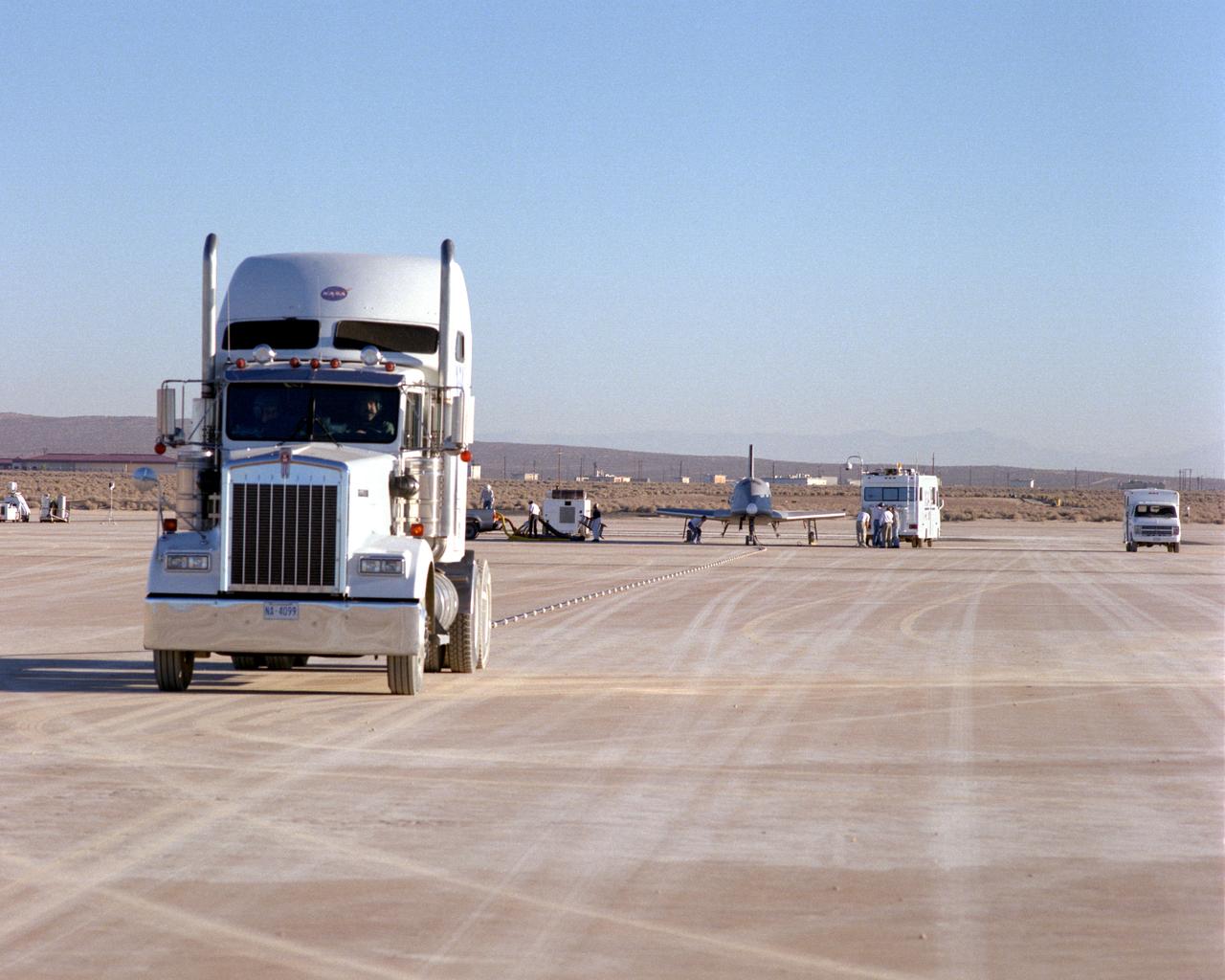
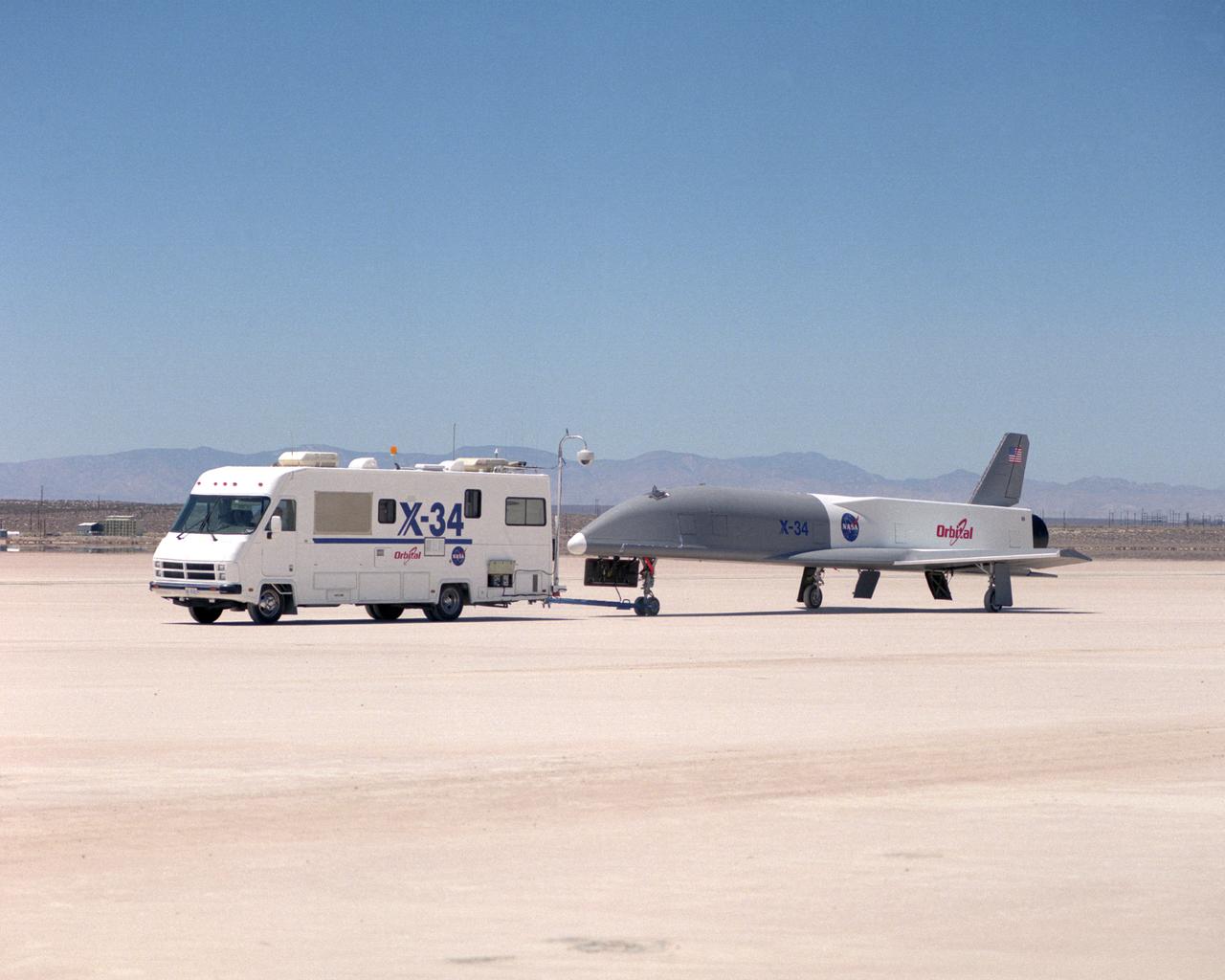
Following initial captive flight tests last year at NASA's Dryden Flight Research Center, Edwards Air Force Base, California, the X-34 technology demonstrator began a new series of tests last week in which it is being towed behind a semi-truck and released to coast on the Edwards dry lakebed.  On July 20, 2000, it was towed and released twice at speeds of five and 10 miles per hour. On July 24, 2000, it was towed and released twice at 10 and 30 miles per hour.  Twelve tests are planned during which the X-34 will be towed for distances up to 10,000 feet and released at speeds up to 80 miles per hour. The test series is expected to last at least six weeks.
X-34 on lakebed prior to tow tests
A mockup Orion crew module built by NASA Dryden Flight Research Center's Fabrication Branch gets a lift from its construction site to its new home in Dryden's Shuttle hangar.
A mockup Orion crew module built by NASA Dryden's Fabrication Branch gets a lift from its construction site to its new home in Dryden's Shuttle hangar.
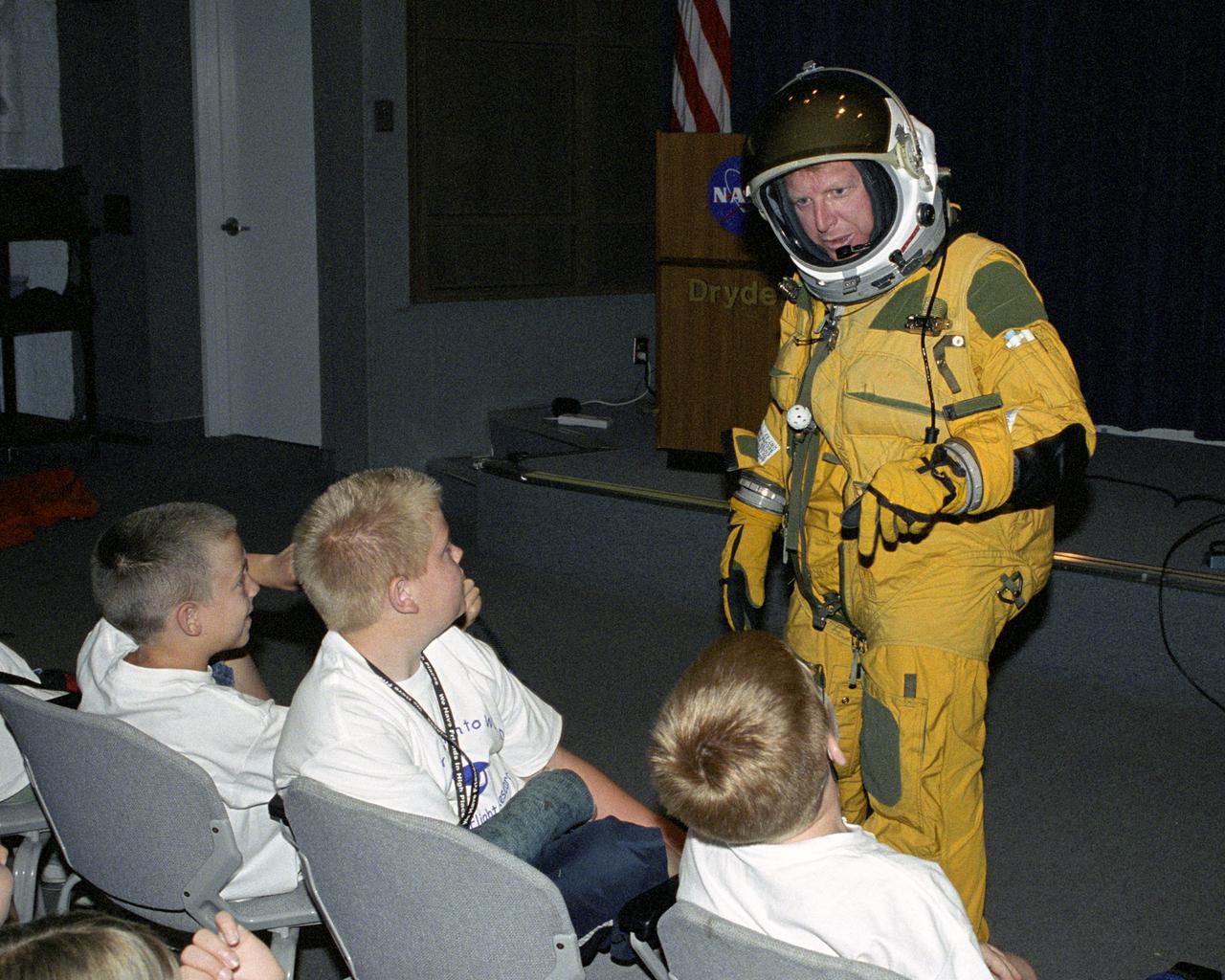
NASA Dryden historian Christian Gelzer explains functions of the high-altitude pressure suit he is wearing to (left to right) Brandon Blankenship and Garrett Clay of Lancaster and Eddie Patterson of Tehachapi during Take Your Children to Work Day activities at NASA Dryden Flight Research Center June 22.
Dryden historian Christian Gelzer explains functions of a high-altitude pressure suit to (left to right) Brandon Blankenship, Garrett Clay and Eddie Patterson
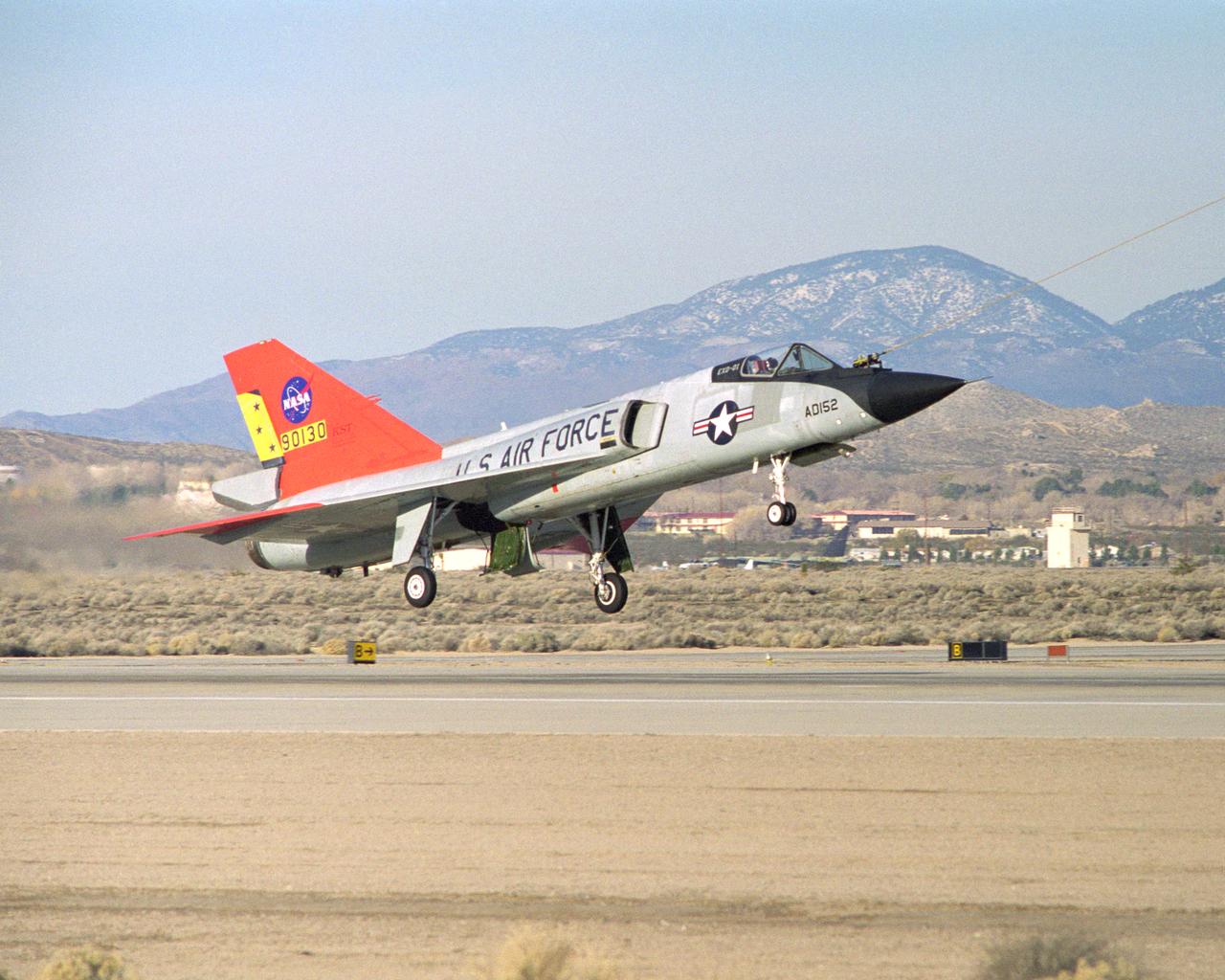
Eclipse project QF-106 and C-141A takeoff on first tethered flight December 20, 1997
EC97-44357-8
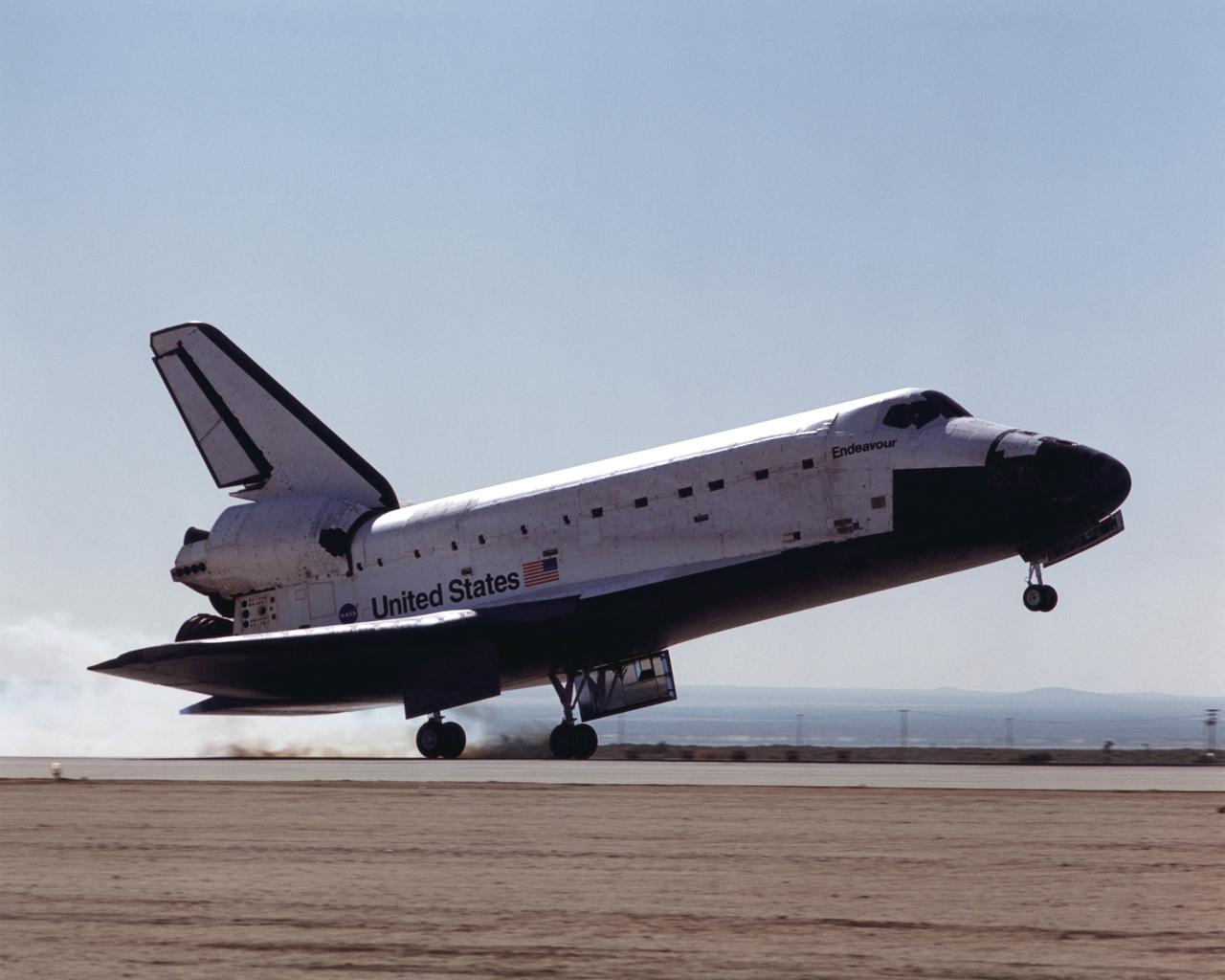
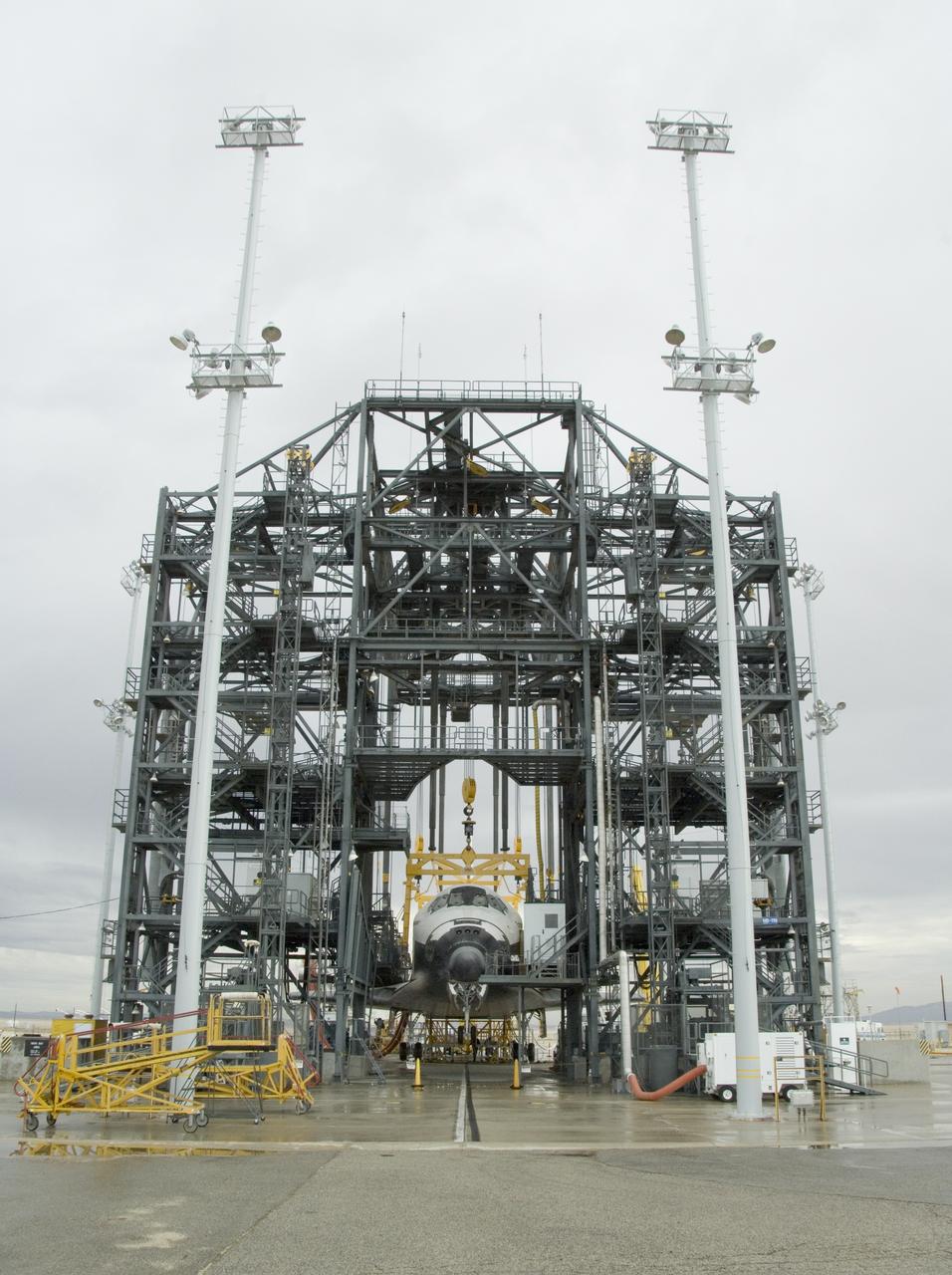
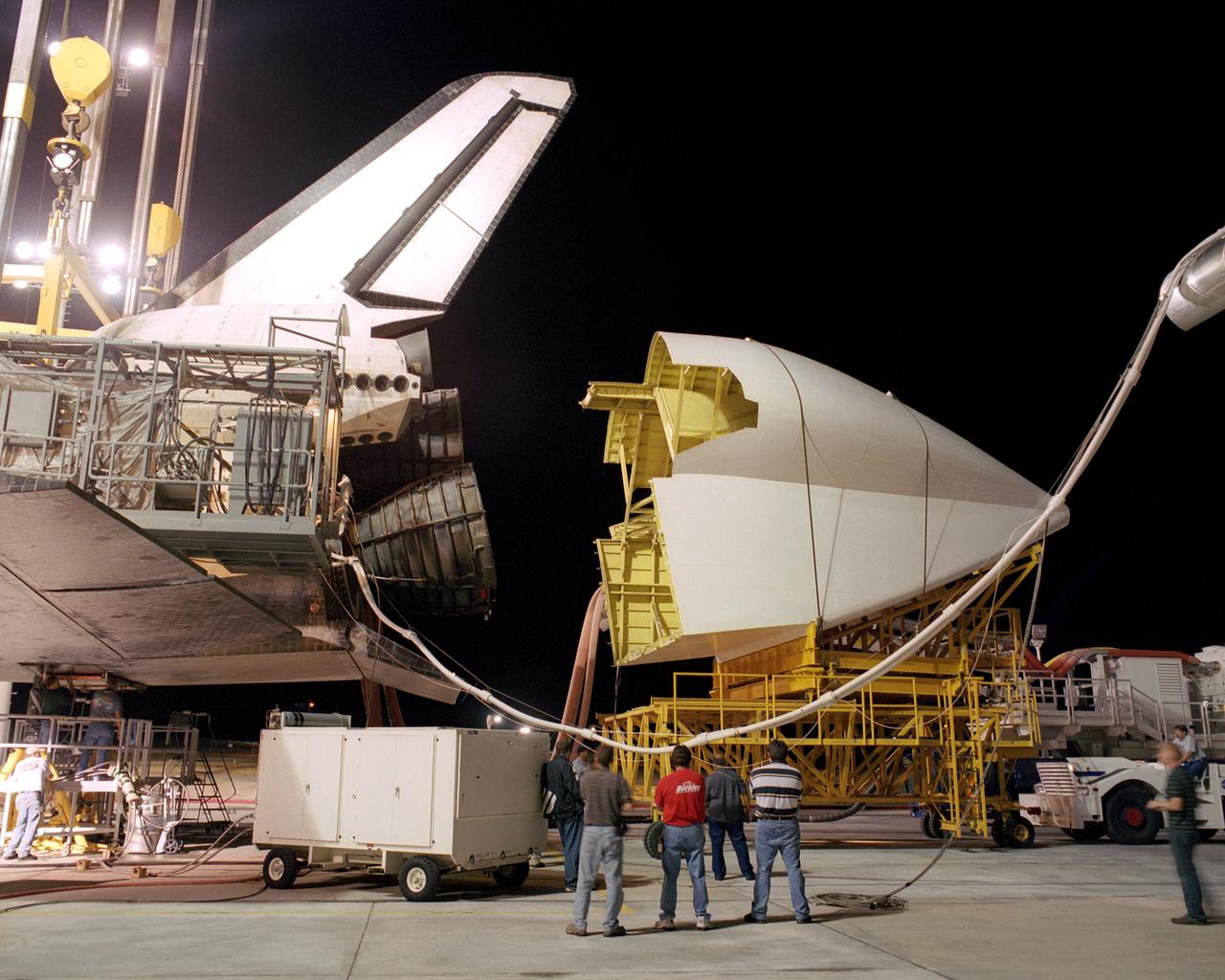
Under soggy skies on a Sunday morning, the Space Shuttle Endeavour is encased in the Mate-DeMate gantry during turnaround processing at NASA's Dryden Flight Research Center following its STS-126 landing at Edwards Air Force Base a week earlier.
Under soggy skies on a Sunday morning, the Space Shuttle Endeavour is encased in the Mate-DeMate gantry during turnaround processing at NASA DFRC
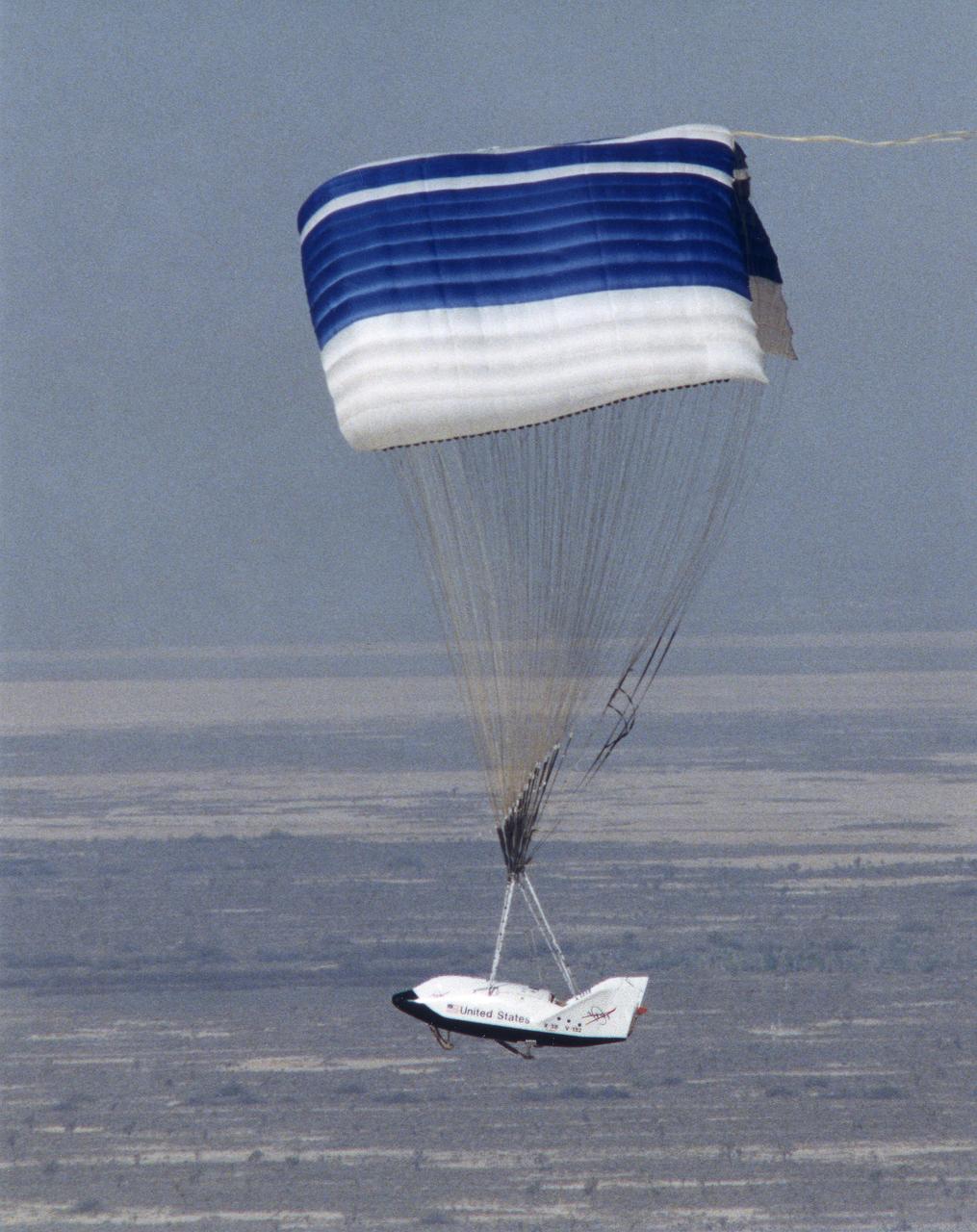
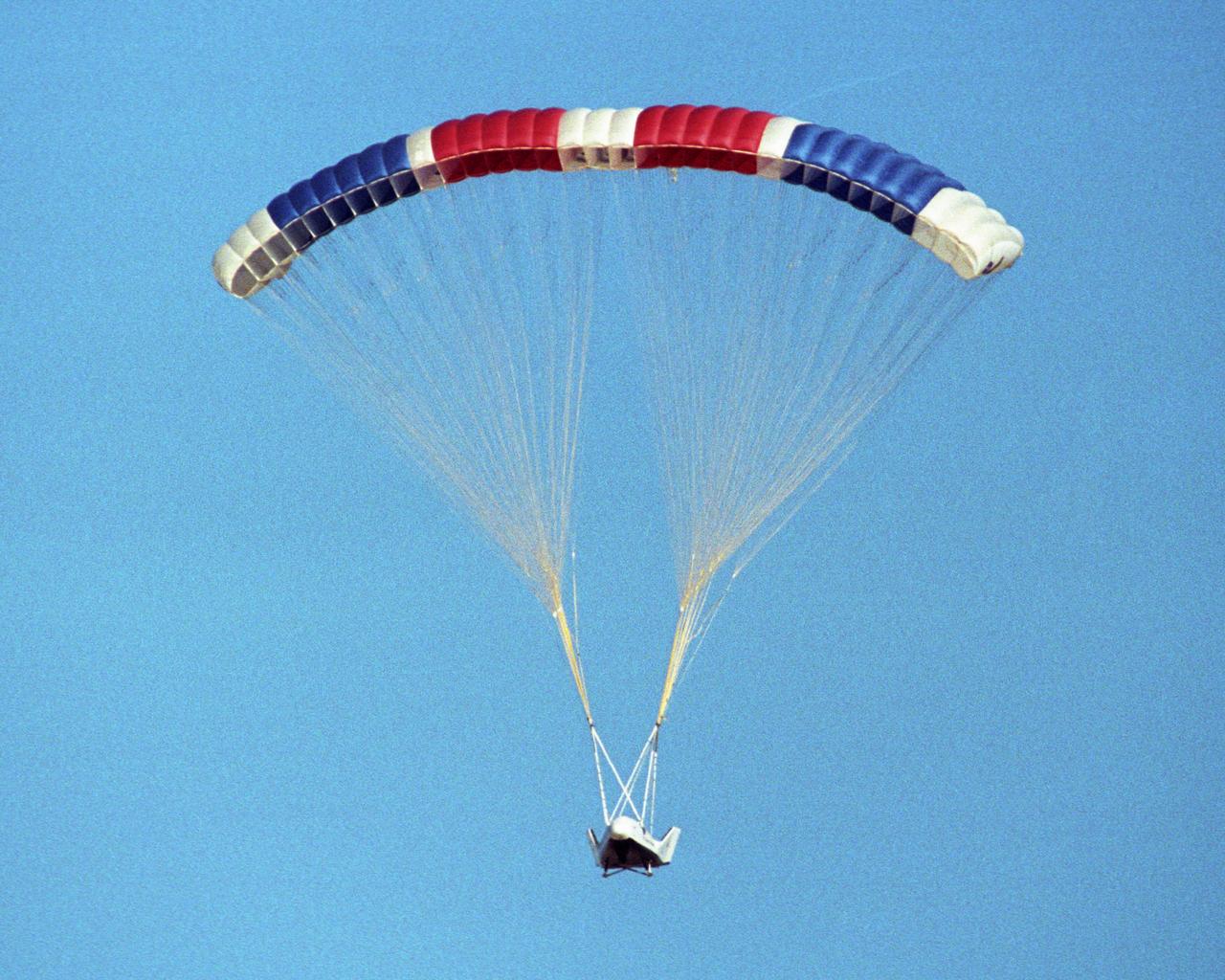
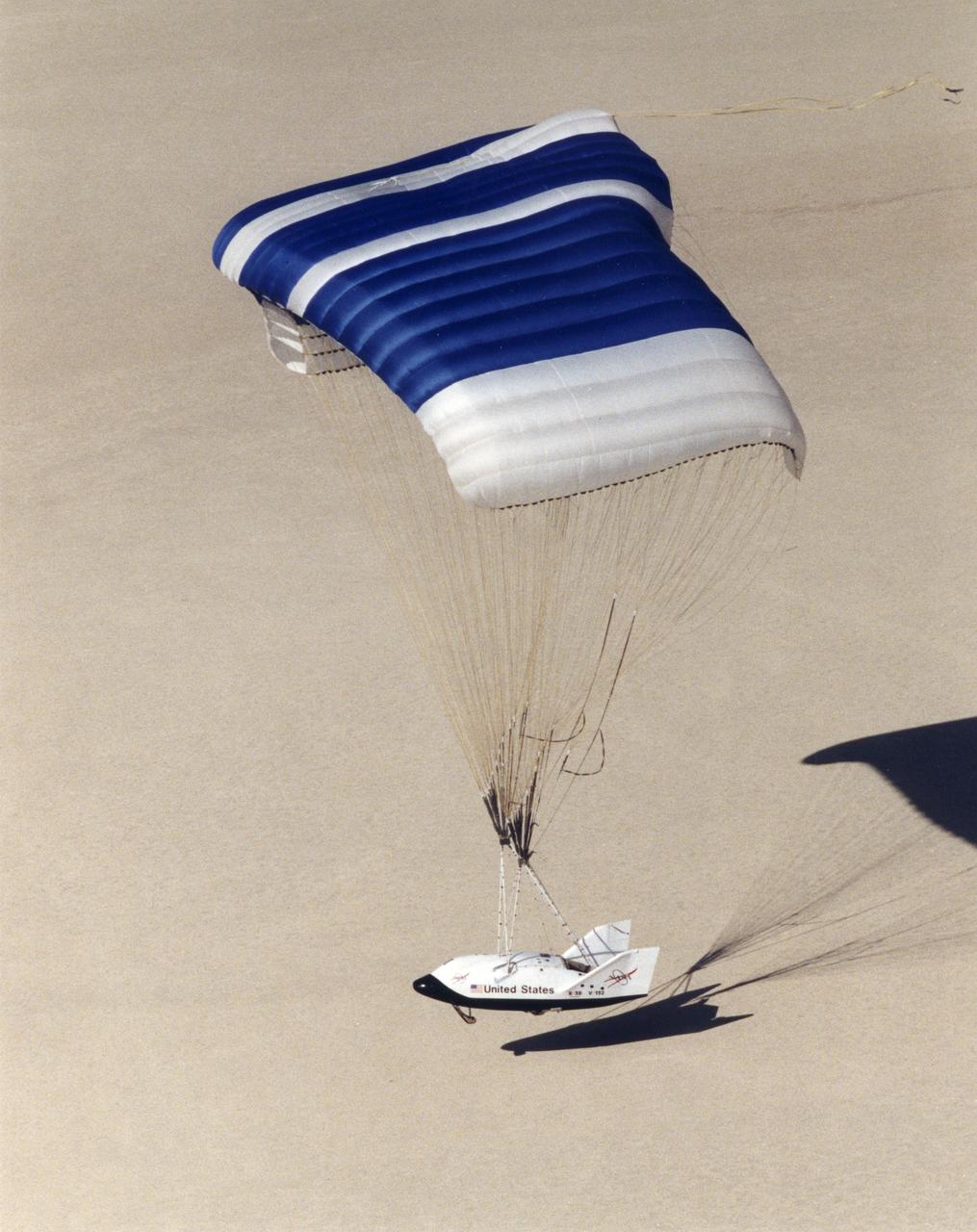
The X-38 technology demonstrator descends under its steerable parafoil toward a lakebed landing in a March 2000 test flight.
The X-38 Second Prototype Glides to a Landing over the Lakebed at the End of Its Fifth Flight at Edwards Air Force Base
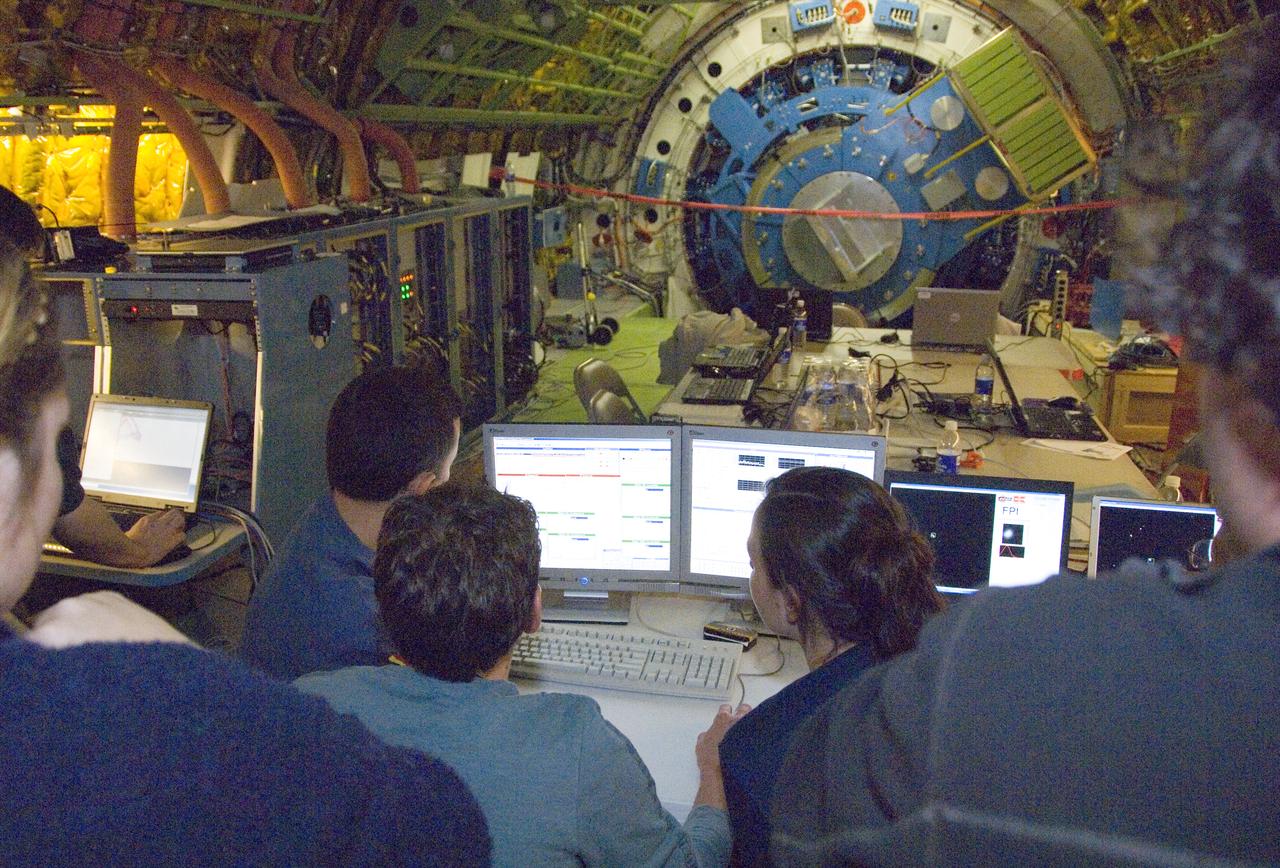
The SOFIA telescope team collected baseline operational measurements during several nights of characterization testing in March 2008 while the SOFIA 747SP aircraft that houses the German-built infrared telescope was parked on an unlit ramp next to its hangar at the NASA Dryden Flight Operations Facility in Palmdale, Calif. The primary celestial target was Polaris, the North Star. The activity provided the team with a working knowledge of how telescope operating systems interact and the experience of tracking celestial targets from the ground.
Scientists and telescope operators focus on data readouts set up inside NASA's SOFIA airborne observatory during telescope characterization tracking tests
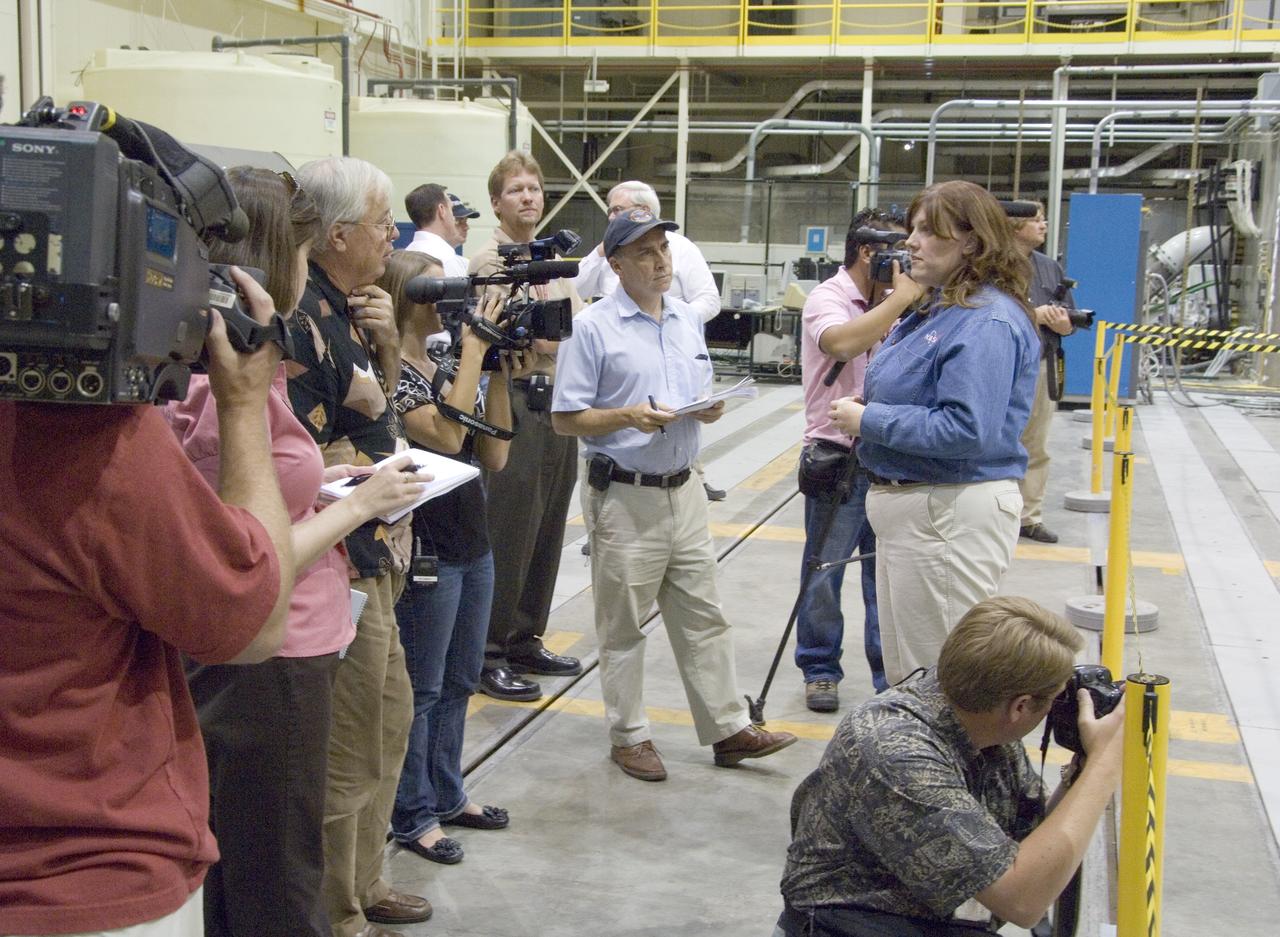
Cathy Bahm, Orion Abort Flight Test integration deputy project manager, briefs news media on the progress of testing in NASA Dryden's Flight Loads Laboratory.
Following initial captive flight tests last year at NASA's Dryden Flight Research Center, Edwards Air Force Base, California, the X-34 technology demonstrator began a new series of tests last week in which it is being towed behind a semi-truck and released to coast on the Edwards dry lakebed.  On July 20, 2000, it was towed and released twice at speeds of five and 10 miles per hour. On July 24, 2000, it was towed and released twice at 10 and 30 miles per hour.  Twelve tests are planned during which the X-34 will be towed for distances up to 10,000 feet and released at speeds up to 80 miles per hour. The test series is expected to last at least six weeks.
X-34 being towed by the Mobile Operations Module during navigational tests on the Rogers Dry Lakebed
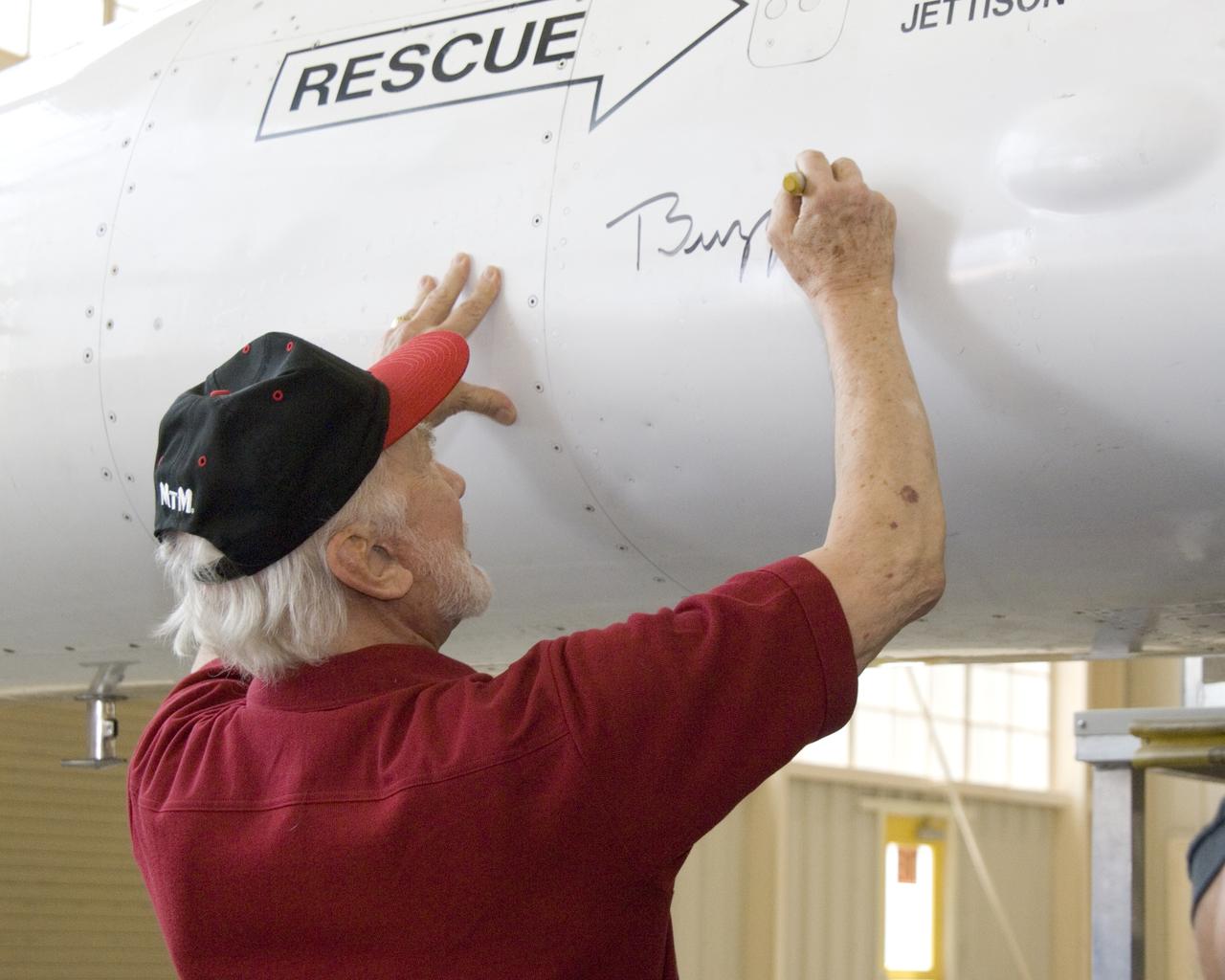
Apollo 11 astronaut Buzz Aldrin and tour guide Mary Ann Harness check out models of the Ares 1 and Ares 5 space vehicles during Aldrin's tour of NASA Dryden.
Apollo 11 astronaut Buzz Aldrin and tour guide Mary Ann Harness check out models of the Ares 1 and Ares 5 space vehicles during Aldrin's tour of NASA Dryden
The SOFIA telescope team collected baseline operational measurements during several nights of characterization testing in March 2008 while the SOFIA 747SP aircraft that houses the German-built infrared telescope was parked on an unlit ramp next to its hangar at the NASA Dryden Flight Operations Facility in Palmdale, Calif. The primary celestial target was Polaris, the North Star. The activity provided the team with a working knowledge of how telescope operating systems interact and the experience of tracking celestial targets from the ground.
The 2.5-meter infrared telescope in the rear fuselage of NASA's SOFIA flying observatory tracked the star Polaris during characterization tests in March 2008
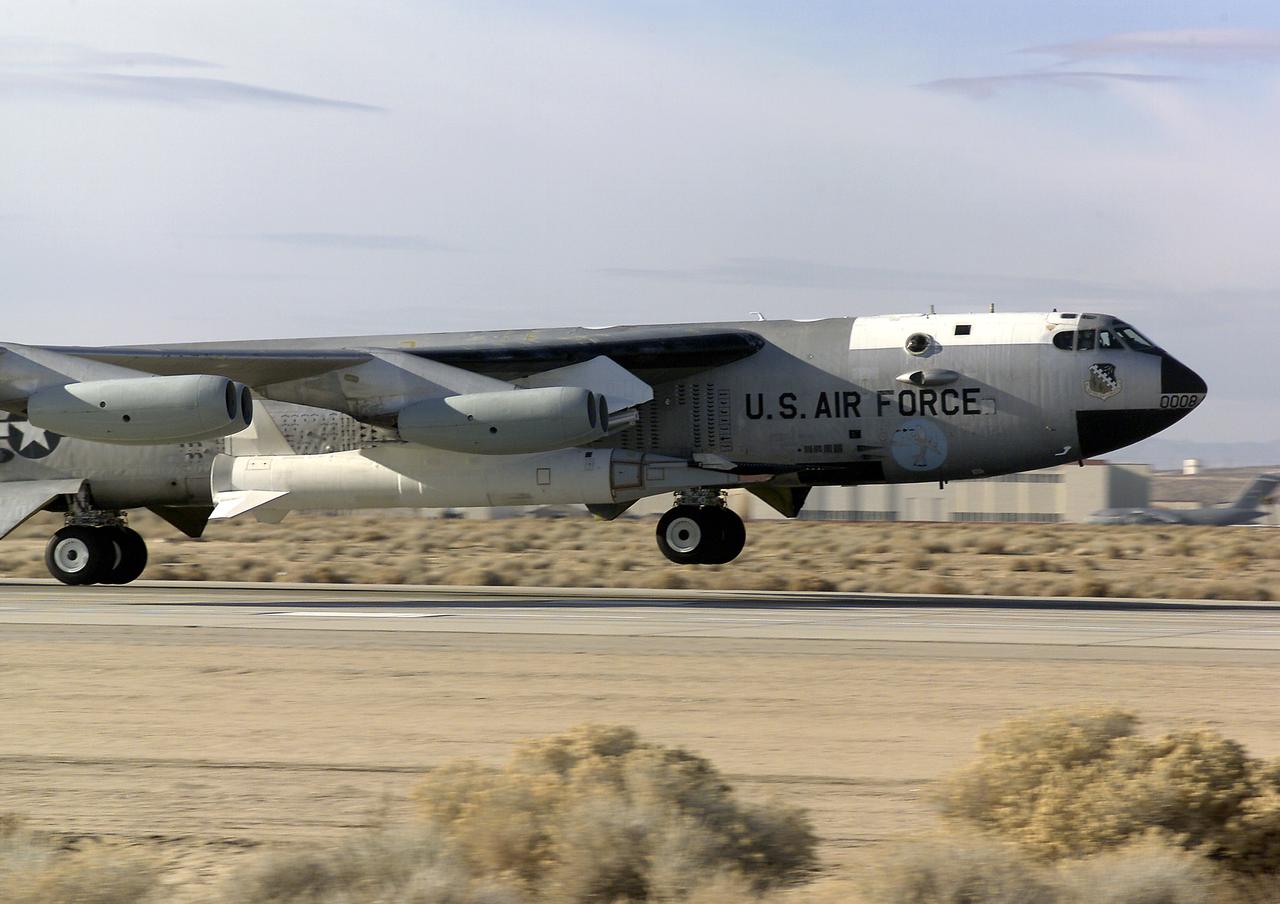
Hitching a ride on the same B-52 mother ship that once launched X-15 research aircraft in the 1960s, NASA's X-43A scramjet and it's Pegasus booster rocket performed a captive carry evaluation flight from Edwards Air Force Base, California, January 26, 2004. The X-43 and it's booster remained mated to the B-52 throughout this mission, intended to check its readiness for launch. The hydrogen-fueled aircraft is autonomous and has a wingspan of approximately 5 feet, measures 12 feet long and weighs about 2,800 pounds.
Hitching a ride on NASA's B-52 mother ship, the X-43A scramjet performed a captive carry evaluation flight from Edwards Air Force Base, California, January 26, 2004
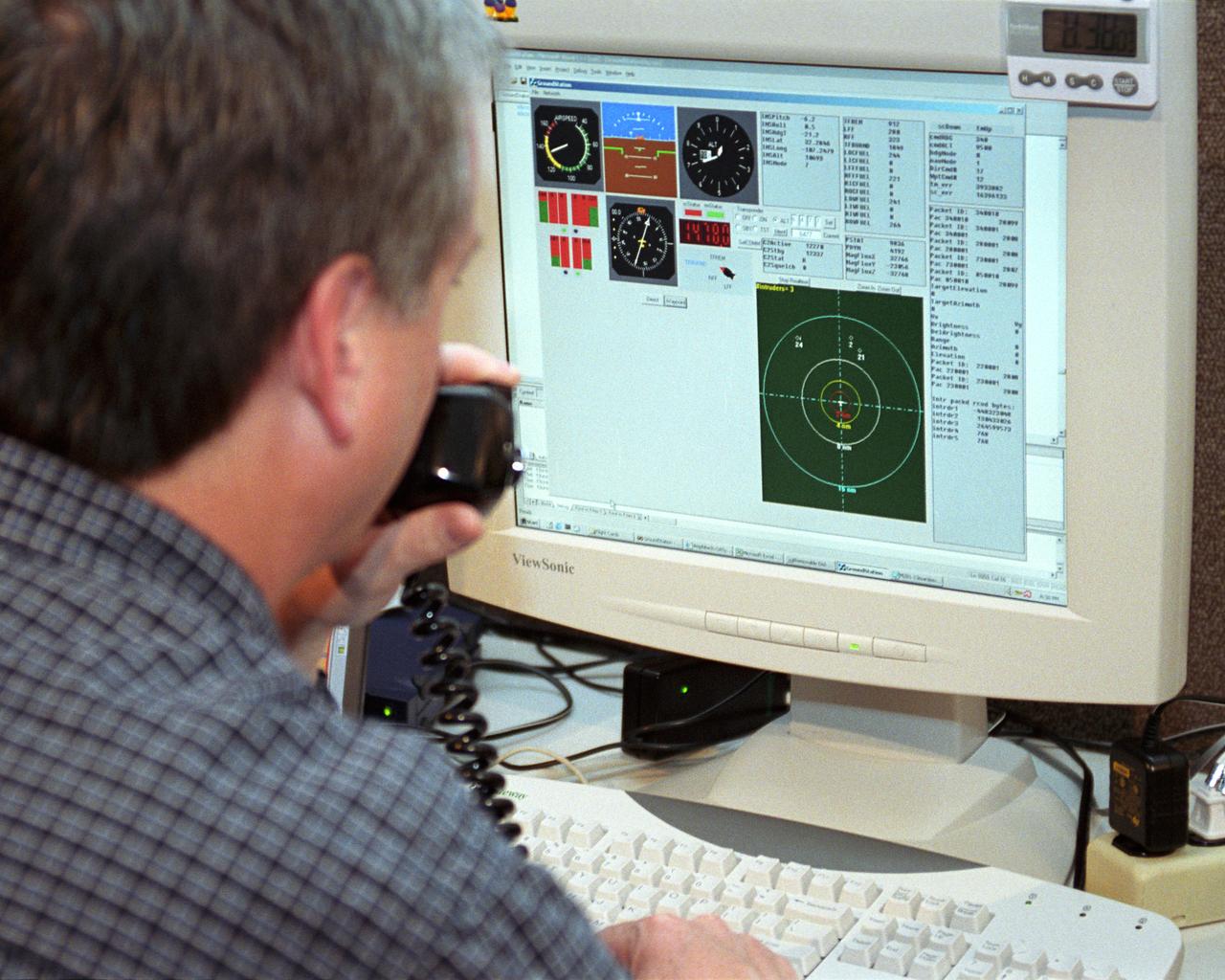
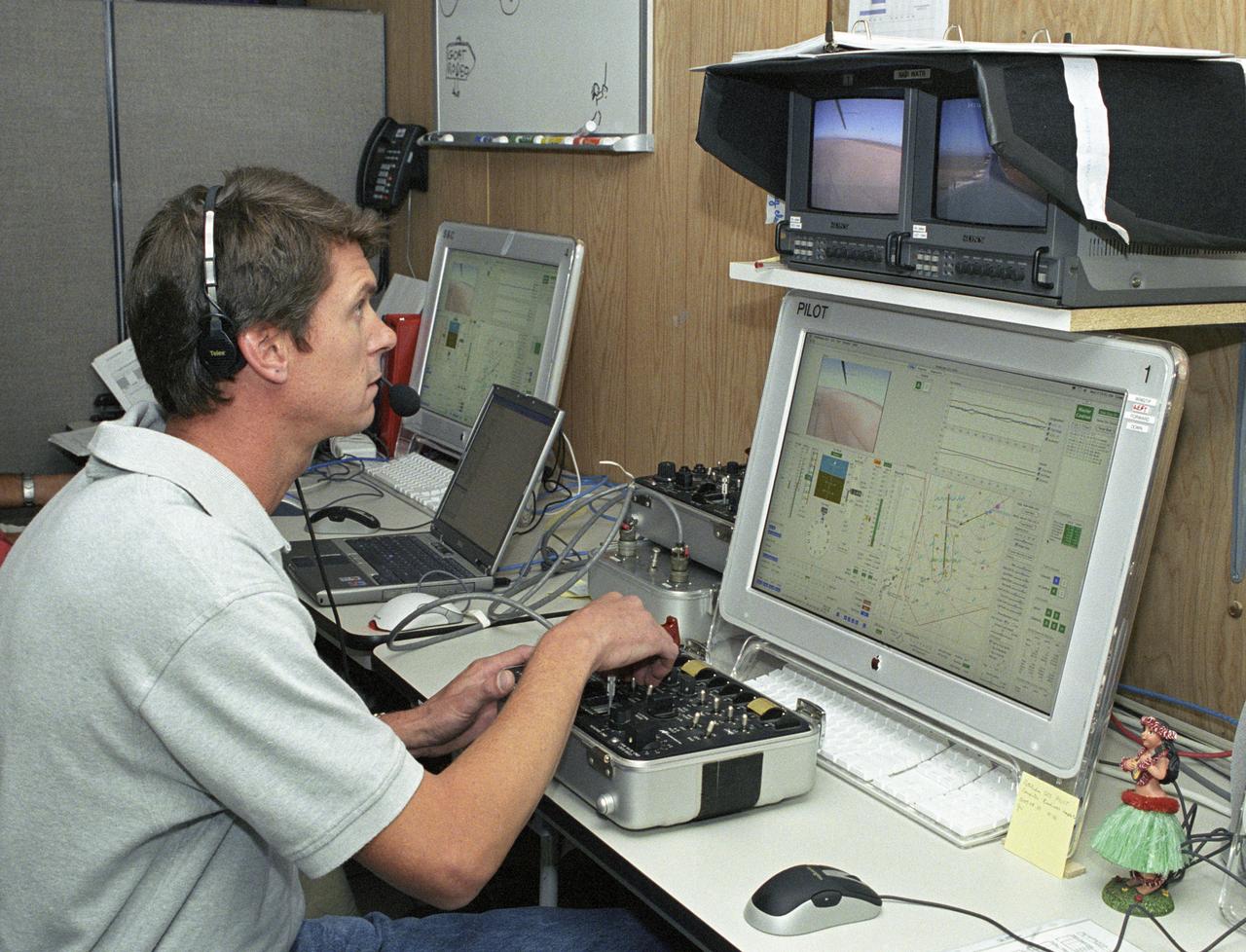
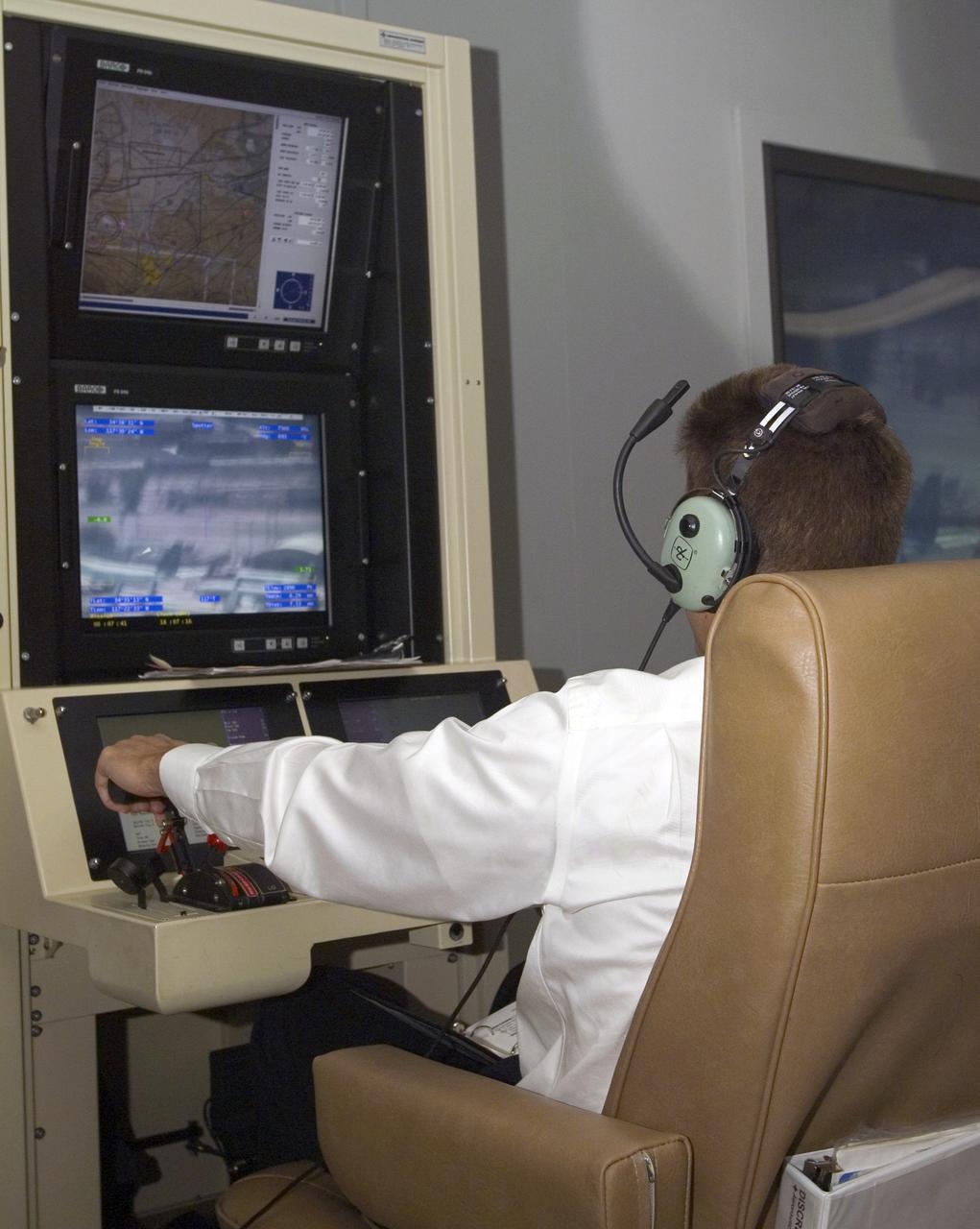
A pilot for General Atomics guides the Altair remotely operated aircraft from a ground control station using both visual and telemetered data.
ED05-0082-04
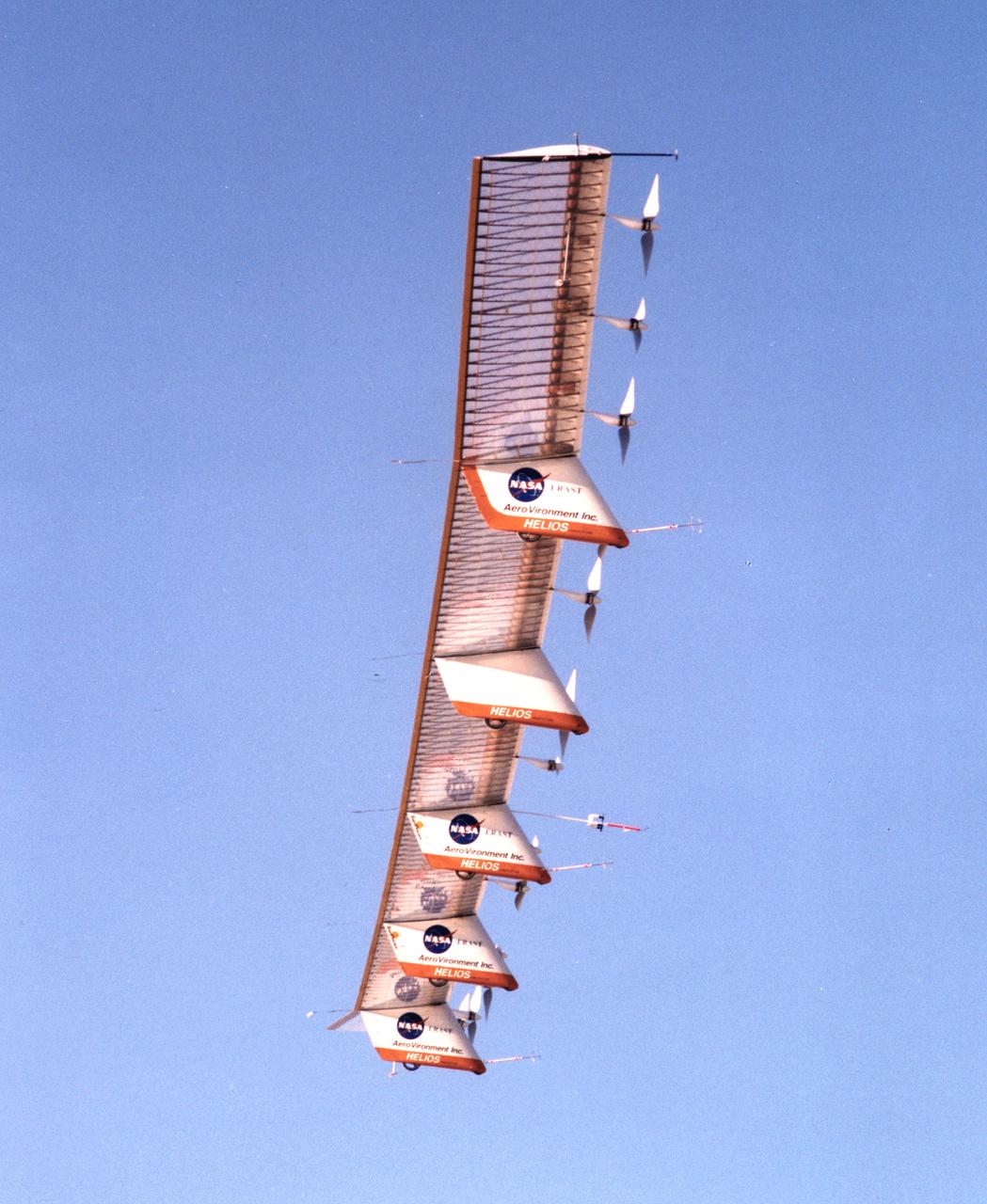
Closeup of the Helios Prototype, the latest and largest example of a slow-flying ultralight flying wing designed for high-altitude, long-duration Earth science or telecommunications relay missions.
EC99-45140-11
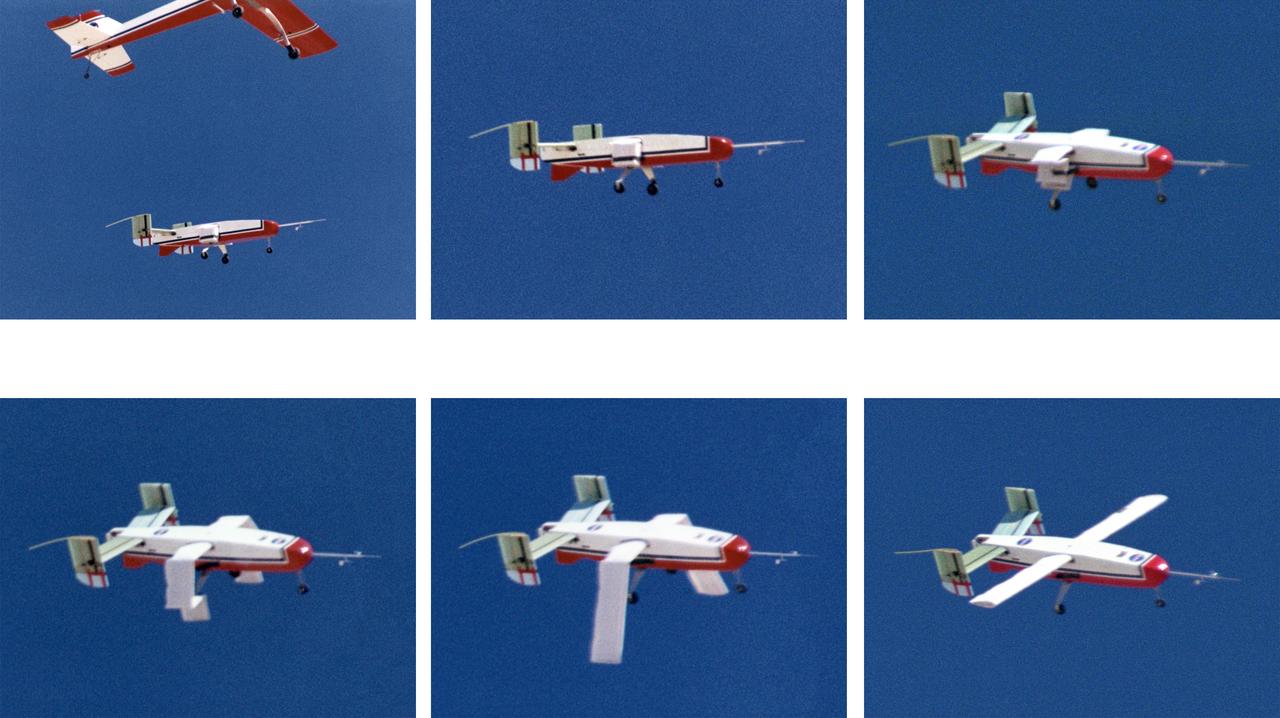
The deployable, inflatable wing technology demonstrator aircraft's wings begin deploying following separation from its carrier aircraft during a flight experiment conducted by the NASA Dryden Flight Research Center, Edwards, California. Wing deployment time is typically on the order of a third of a second, almost faster than the human eye can see. Three successful flights of the I2000 inflatable wing aircraft occurred. During the flights, the team air-launched the radio-controlled (R/C) I2000 from an R/C utility airplane at an altitude of 800-1000 feet.  As the I2000 separated from the carrier aircraft, its inflatable wings "popped-out," deploying rapidly via an on-board nitrogen bottle. The aircraft remained stable as it transitioned from wingless to winged flight. The unpowered I2000 glided down to a smooth landing under complete control.
ED01-0273-1
Puffy pink clouds form a canopy over the Space Shuttle Endeavour as processing continues in the Mate-Demate Device at NASA Dryden Flight Research Center in preparation for its ferry flight back to the Kennedy Space Center.
Puffy pink clouds form a canopy over the Space Shuttle Endeavour as processing continues in the Mate-Demate Device at NASA's Dryden Flight Research Center
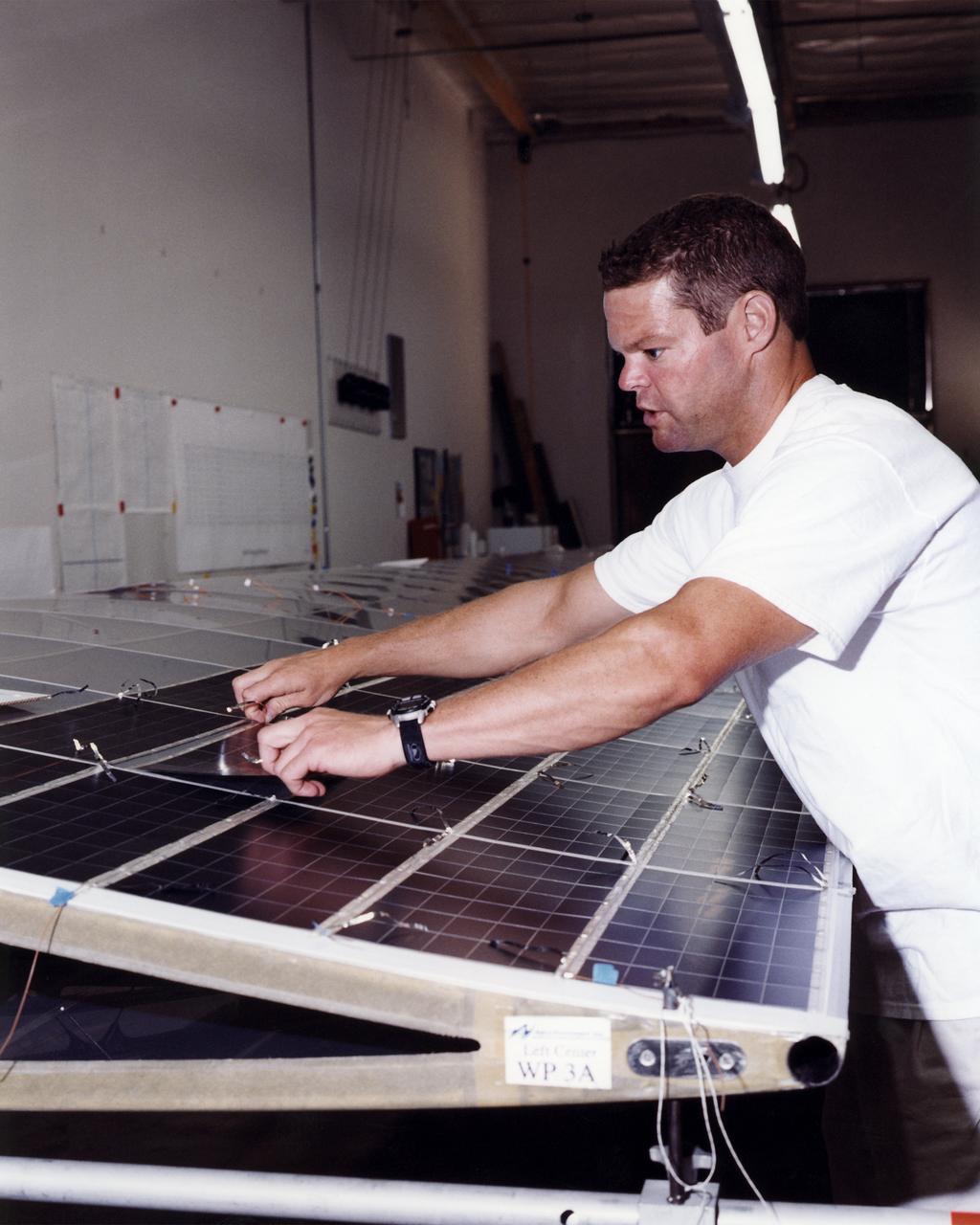
Technician Marshall MacCready carefully lays a panel of solar cells into place on a wing section of the Helios Prototype flying wing at AeroVironment's Design Development Center in Simi Valley, California. The bi-facial cells, manufactured by SunPower, Inc., of Sunnyvale, California, are among 64,000 solar cells which have been installed on the solar-powered aircraft to provide electricity to its 14 motors and operating systems.
EC00-0283-4
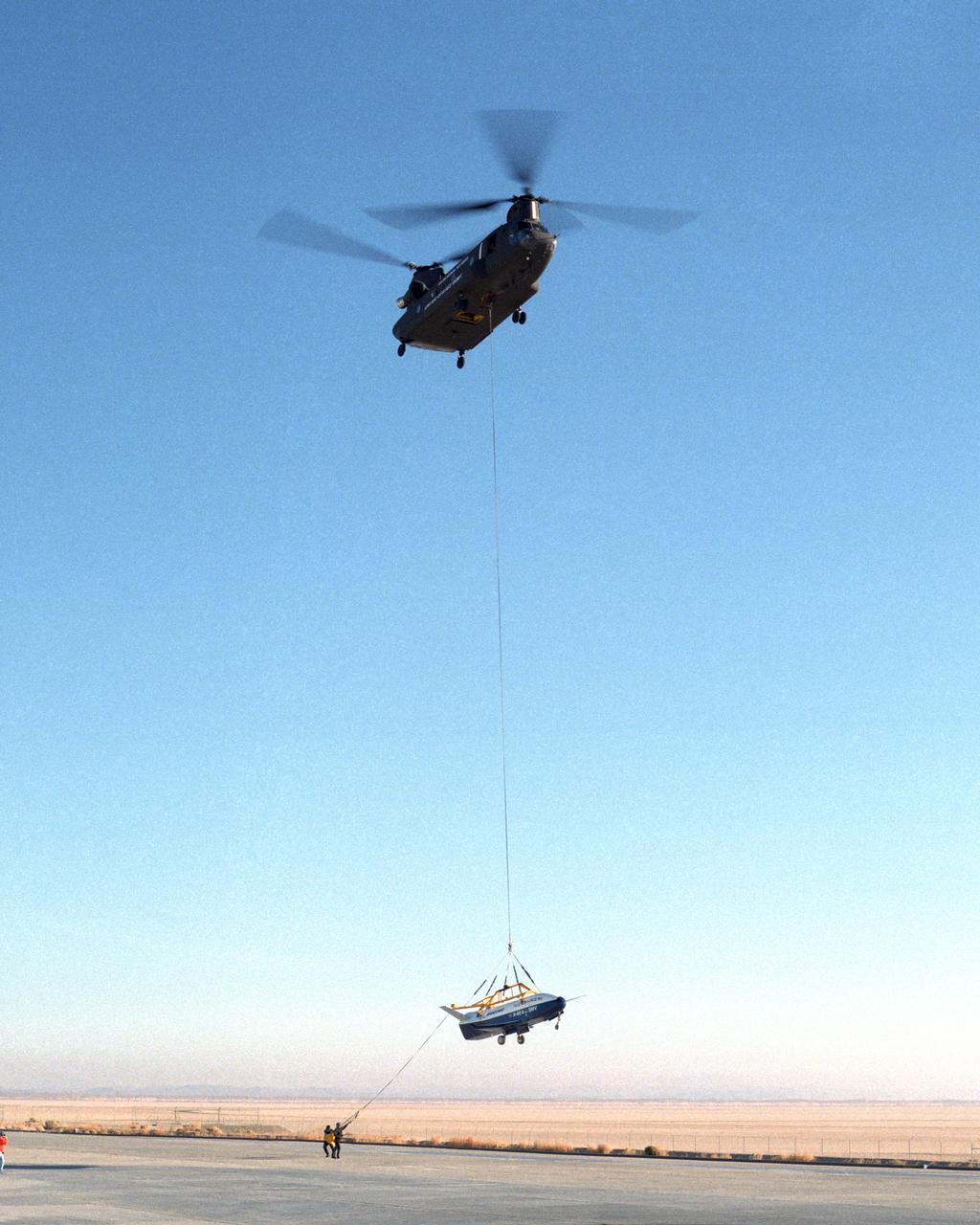
The X-38, mounted beneath the right wing of NASA's B-52, climbed from the runway at Edwards Air Force Base for the seventh free flight test of the X-38, July 10, 2001. The X-38 was released at 37,500 feet and completed a thirteen minute glide flight to a landing on Rogers Dry Lake.
NASA's B-52 takes the X-38 aloft for the seventh free flight of the program, July 10, 2001
With a laser beam centered on its panel of photovoltaic cells, a lightweight model plane makes the first flight of an aircraft powered by a laser beam inside a building at NASA Marshall Space Flight Center.
With a laser beam centered on its panel of photovoltaic cells, a model plane makes the first flight of an aircraft powered by a laser beam inside a building at NASA Marshall.
ED13-0079-12 (26 March 2013) ---- SpaceX Dragon's second operational mission ended  on March 26 after three weeks attached to the International Space Station. The unmanned spacecraft splashed down  in the Pacific Ocean about 214 miles off the coast of Baja California to successfully return about 2,670 pounds of science materials from the orbital outpost.  Photo credit:  NASA
ed13-0079-12
The SOFIA telescope team collected baseline operational measurements during several nights of characterization testing in March 2008 while the SOFIA 747SP aircraft that houses the German-built infrared telescope was parked on an unlit ramp next to its hangar at the NASA Dryden Flight Operations Facility in Palmdale, Calif. The primary celestial target was Polaris, the North Star. The activity provided the team with a working knowledge of how telescope operating systems interact and the experience of tracking celestial targets from the ground.
Wispy clouds are illuminated by a bright quarter moon behind the tail of NASA's SOFIA flying observatory during telescope characterization testing in 2008
2004 NASA Dryden Research Pilots. Left to Right: Edwin W. Lewis, Jr., David A. Wright (Director of Flight Operations), William Frederick Brockett, Frank Batteas, Craig R. Bomben, Richard G. Ewers, James W. Smolka, Douglas H. Baker, C. Gordon Fullerton (Chief Pilot), James Barrilleaux, Martin J. Trout, and Mark Pestana. (not pictured: Dana Purifoy)
2004 NASA Dryden Research Pilots
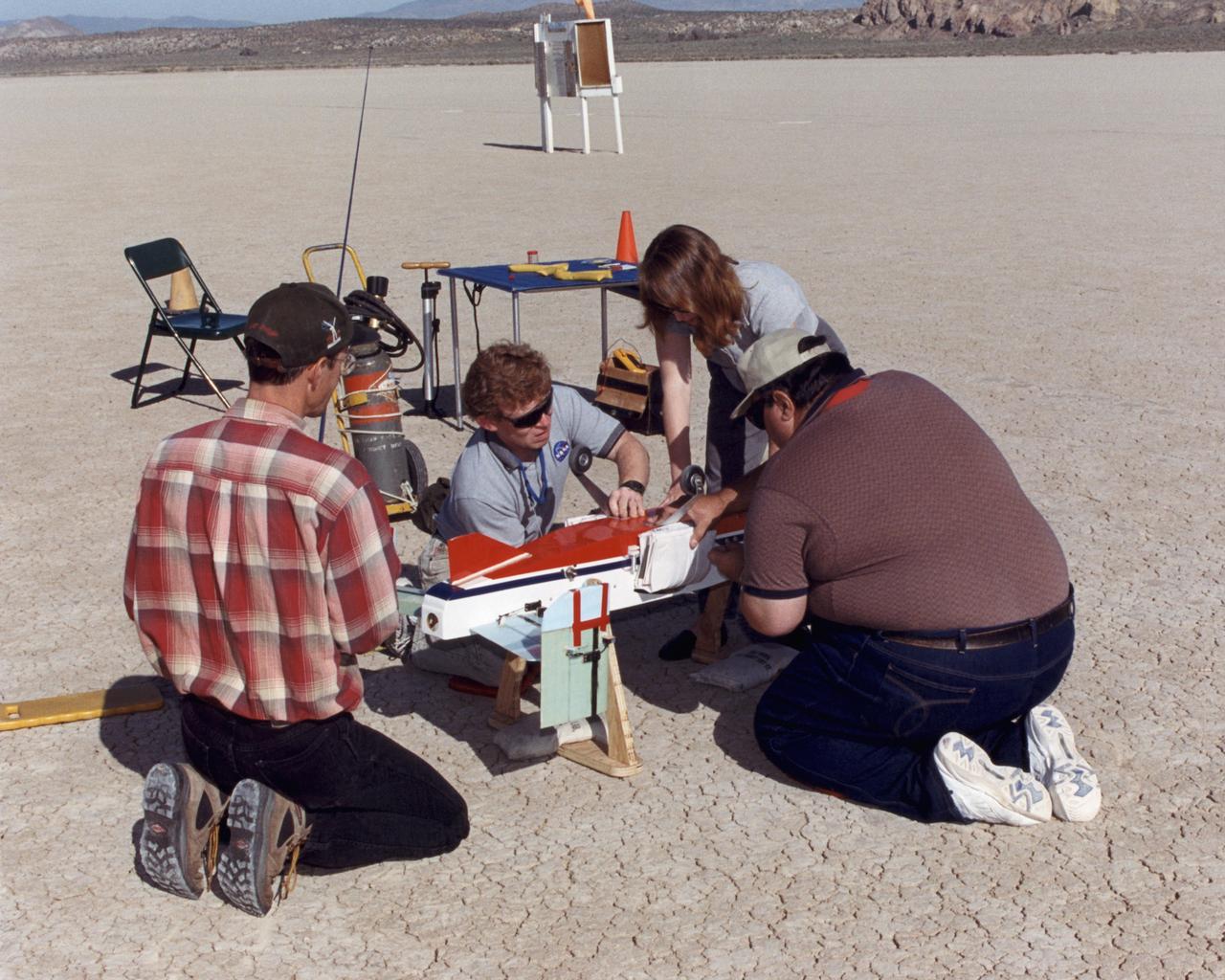
Engineers Jim Murray and Joe Pahle prepare a deployable, inflatable wing technology demonstrator experiment flown by the NASA Dryden Flight Research Center, Edwards, California. The inflatable wing project represented a basic flight research effort by Dryden personnel. Three successful flights of the I2000 inflatable wing aircraft occurred. During the flights, the team air-launched the radio-controlled (R/C) I2000 from an R/C utility airplane at an altitude of 800-1000 feet.  As the I2000 separated from the carrier aircraft, its inflatable wings "popped-out," deploying rapidly via an on-board nitrogen bottle. The aircraft remained stable as it transitioned from wingless to winged flight. The unpowered I2000 glided down to a smooth landing under complete control.
EC01-0136-2
Technicians for AeroVironment, Inc., jack up a pressure tank to the wing of the Helios Prototype solar-electric flying wing. The tank carries pressurized hydrogen to fuel an experimental fuel cell system that powered the aircraft at night during an almost two-day long-endurance flight demonstration in the summer of 2003.
EC03-0058-6
The 5 KW, state-of-the-art solar demonstration site at NASA Dryden is validating earthly use of solar cells developed for NASA's Helios solar-electric aircraft.
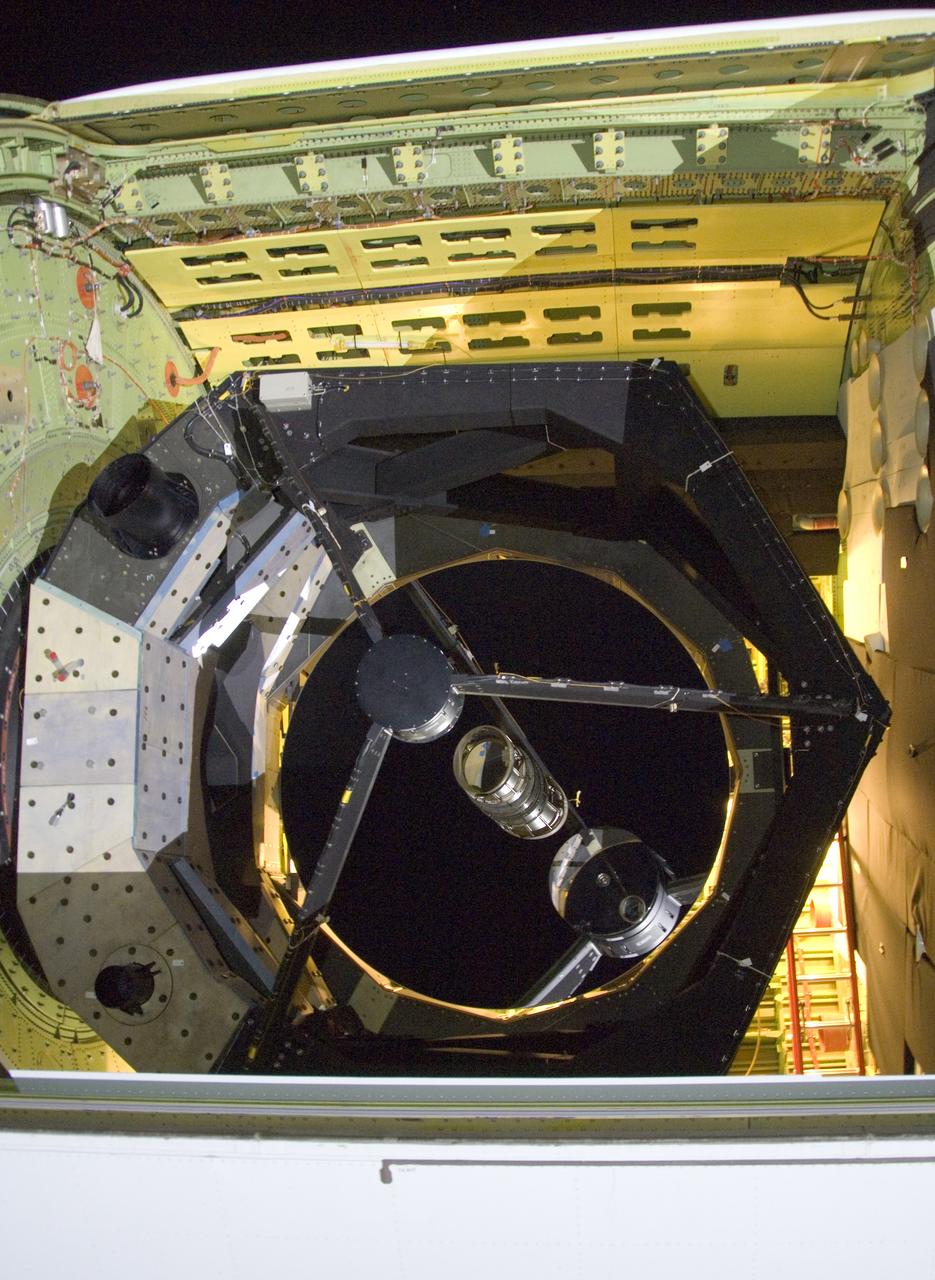
he SOFIA airborne observatory's 2.5-meter infrared telescope peers out from its cavity in the SOFIA rear fuselage during nighttime line operations testing.
he SOFIA airborne observatory's 2.5-meter infrared telescope peers out from its cavity in the SOFIA rear fuselage during nighttime line operations testing
An inert AIM-54 Phoenix missile nestled under the fuselage of NASA Dryden's F-15B aircraft is being studied as a possible test vehicle to obtain hypersonic data.
An inert Phoenix missile nestled under the fuselage of NASA Dryden's F-15B aircraft is being studied as a possible test vehicle to obtain hypersonic data.
NASA's Super Guppy transport aircraft landed at Edwards Air Force Base, Calif. on July 11, 2000, to deliver the latest version of the X-38 drop vehicle to Dryden. The X-38s are intended as prototypes for a possible "crew lifeboat" for the International Space Station. The X-38 vehicle 131R will demonstrate a huge 7,500 square-foot parafoil that will that will enable the potential crew return vehicle to land on the length of a football field after returning from space. The crew return vehicle is intended to serve as a possible emergency transport to carry a crew to safety in the event of problems with the International Space Station. The Super Guppy evolved from the 1960s-vintage Pregnant Guppy, used for transporting outsized sections of the Apollo moon rocket. The Super Guppy was modified from 1950s-vintage Boeing C-97. NASA acquired its Super Guppy from the European Space Agency in 1997.
X-38 vehicle #131R arrives at NASA Dryden via NASA'S Super Guppy transport aircraft
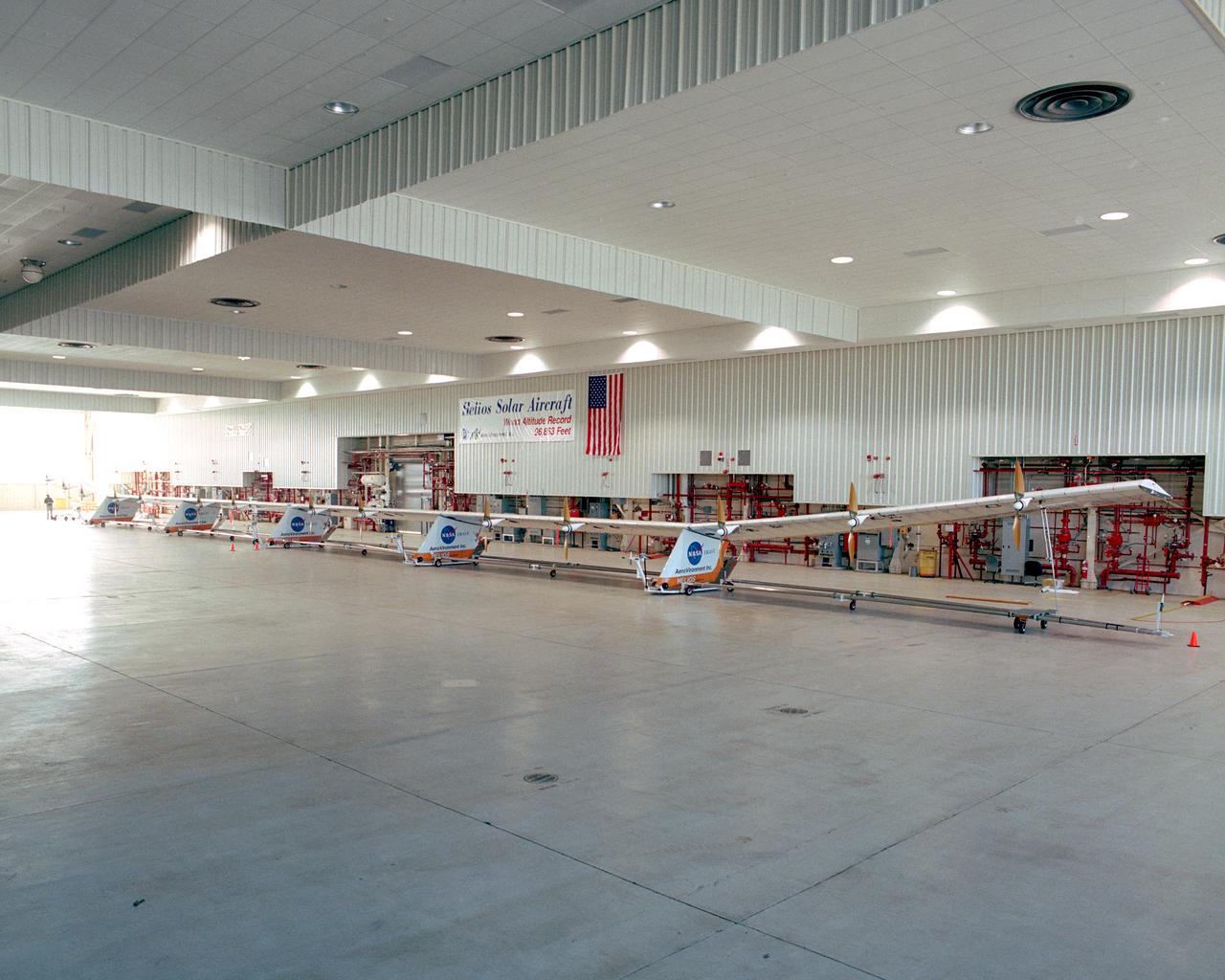
The Helios Prototype is an enlarged version of the Centurion flying wing, which flew a series of test flights at Dryden in late 1998. The craft has a wingspan of 247 feet, 41 feet greater than the Centurion, 2 1/2 times that of its solar-powered Pathfinder flying wing, and longer than either the Boeing 747 jetliner or Lockheed C-5 transport aircraft.
EC99-45140-2
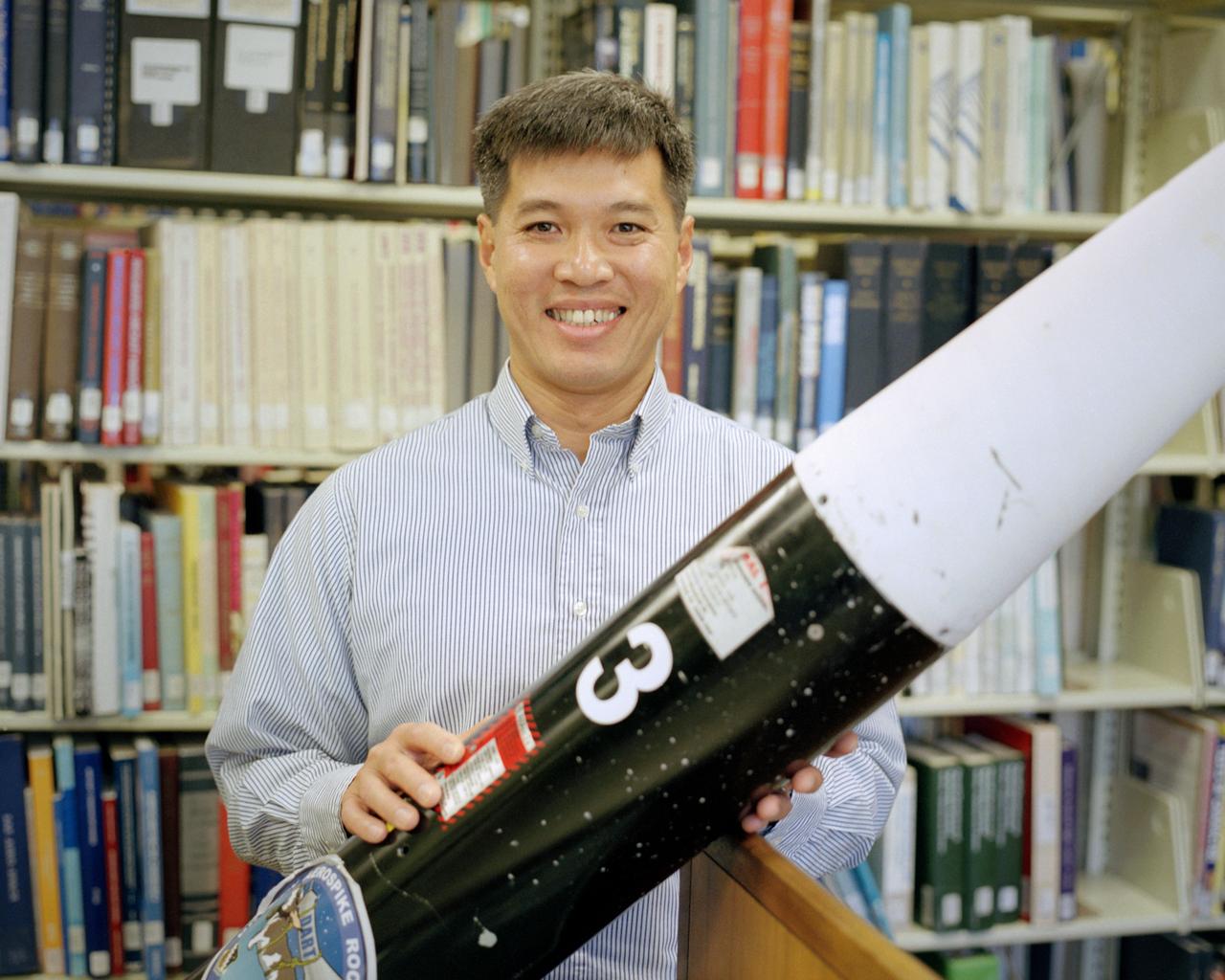
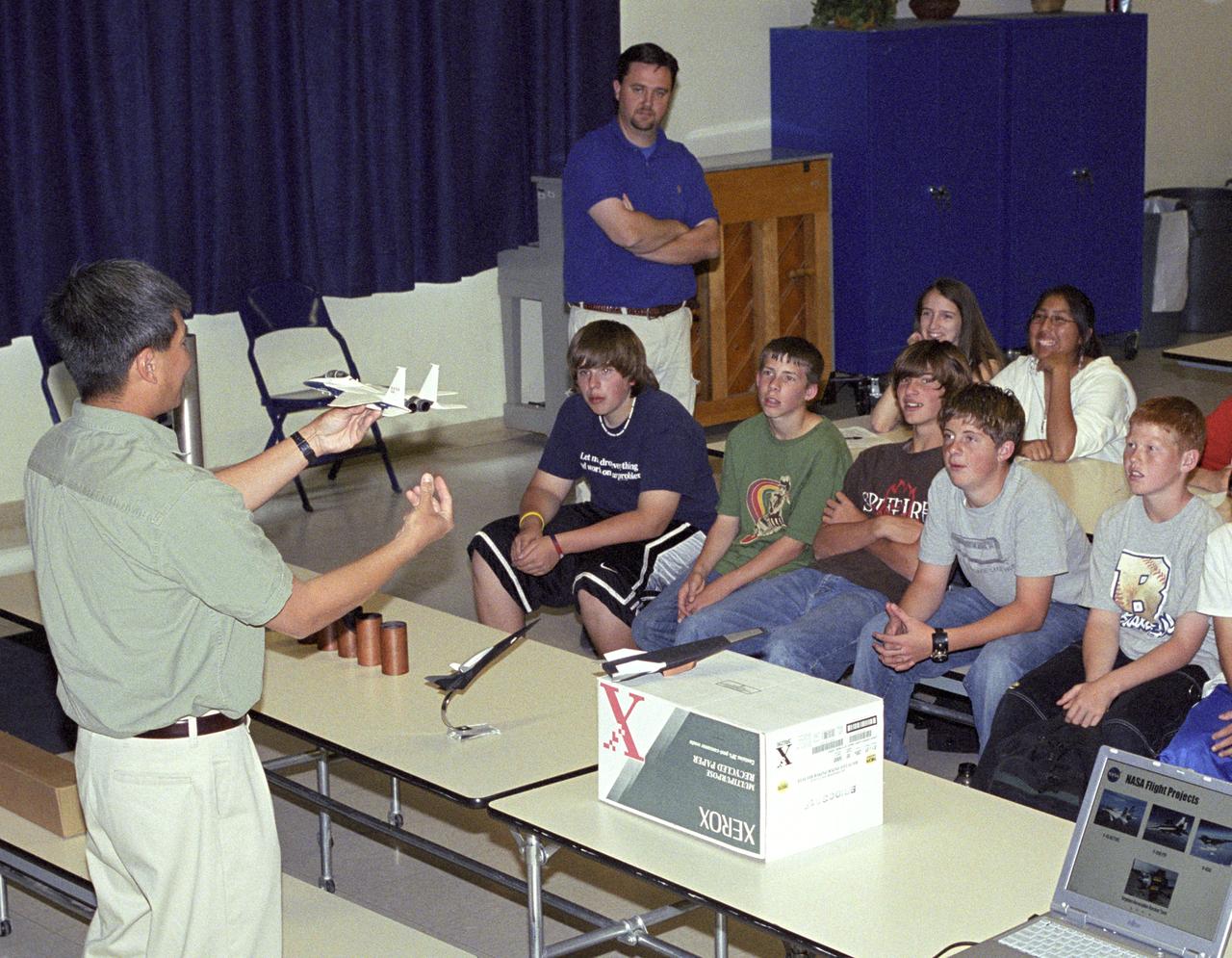
NASA Dryden aerospace engineer Trong Bui explains the dynamics of flight to a group of Edwards Middle School students during a recent Career Day presentation.
Following initial captive flight tests last year at NASA's Dryden Flight Research Center, Edwards Air Force Base, California, the X-34 technology demonstrator began a new series of tests last week in which it is being towed behind a semi-truck and released to coast on the Edwards dry lakebed.  On July 20, 2000, it was towed and released twice at speeds of five and 10 miles per hour. On July 24, 2000, it was towed and released twice at 10 and 30 miles per hour.  Twelve tests are planned during which the X-34 will be towed for distances up to 10,000 feet and released at speeds up to 80 miles per hour. The test series is expected to last at least six weeks.
X-34 and HSTV tow vehicle on lakebed prior to tow test
Scaled Composites' Proteus aircraft and an F/A-18 Hornet from NASA's Dryden Flight Research Center at Mojave Airport in Southern California.  The unique tandem-wing Proteus was the testbed for a series of UAV collision-avoidance flight demonstrations. An Amphitech 35GHz radar unit installed below Proteus' nose was the primary sensor for the Detect, See and Avoid tests. NASA Dryden's F/A-18 Hornet was one of many different aircraft used in the tests.
Scaled Composites' Proteus aircraft and an F/A-18 Hornet from NASA's Dryden Flight Research Center at Mojave Airport in Southern California.
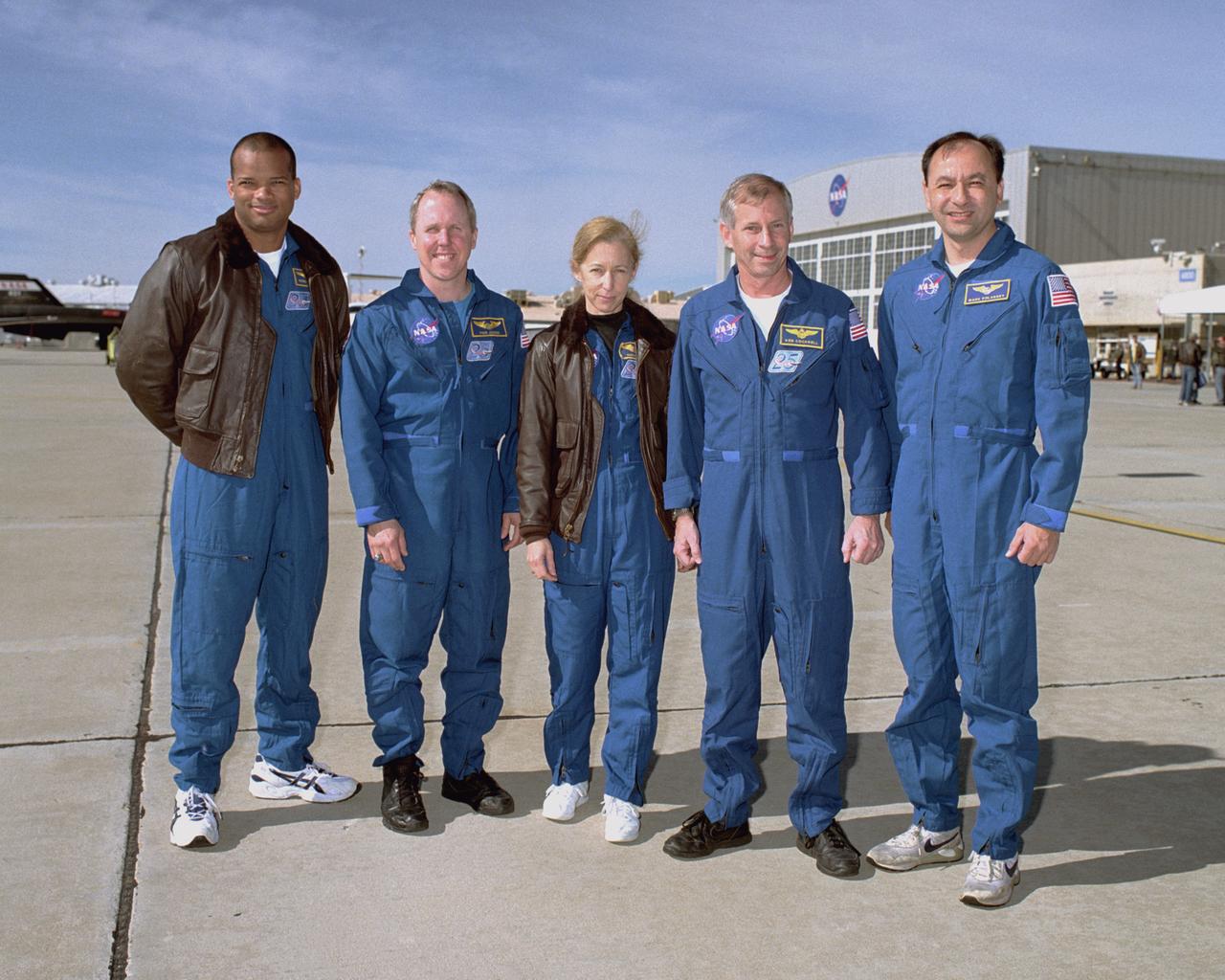
The crew of STS-98 poses for a group photo shortly before leaving NASA's Dryden Flight Research Center after a successful landing of the Space Shuttle Atlantis the day before. L to R: Mission Specialists Robert L. Curbeam, Thomas D. Jones, and Marsha S. Ivins, Commander Kenneth D. Cockrell, and Pilot Mark L. Polansky.
Crew of STS-98, L to R: Mission Specialists Robert L. Curbeam, Thomas D. Jones, and Marsha S. Ivins, Commander Kenneth D. Cockrell, and Pilot Mark L. Polansky
NASA engineer Wayne Peterson from the Johnson Space Center reviews postflight checklists following a spectacular flight of the X-38 prototype for a crew recovery vehicle that may be built for the International Space Station. The X-38 tested atmospheric flight characteristics on December 13, 2001, in a descent from 45,000 feet to Rogers Dry Lake at the NASA Dryden Flight Research Center/Edwards Air Force Base complex in California.
NASA engineer Wayne Peterson from the Johnson Space Center reviews postflight checklists following a spectacular flight of the X-38 Vehicle 131R
SOFIA’s telescope mirror is seen as it appears during a science mission.
Through the Eyes of SOFIA
An experimental radio-controlled model aircraft is seen here in flight powered only by light energy beamed to it by a spotlight.
An experimental radio-controlled model aircraft is seen here in flight, powered only by light energy beamed to it by a spotlight.
With its sensor booms projecting ahead of the wing, the Pathfinder-Plus solar wing soars under a blue sky on its final turbulence measurement research flight.
With sensor booms projecting ahead of the wing, the Pathfinder-Plus soars under a blue sky on its final turbulence measurement research flight.
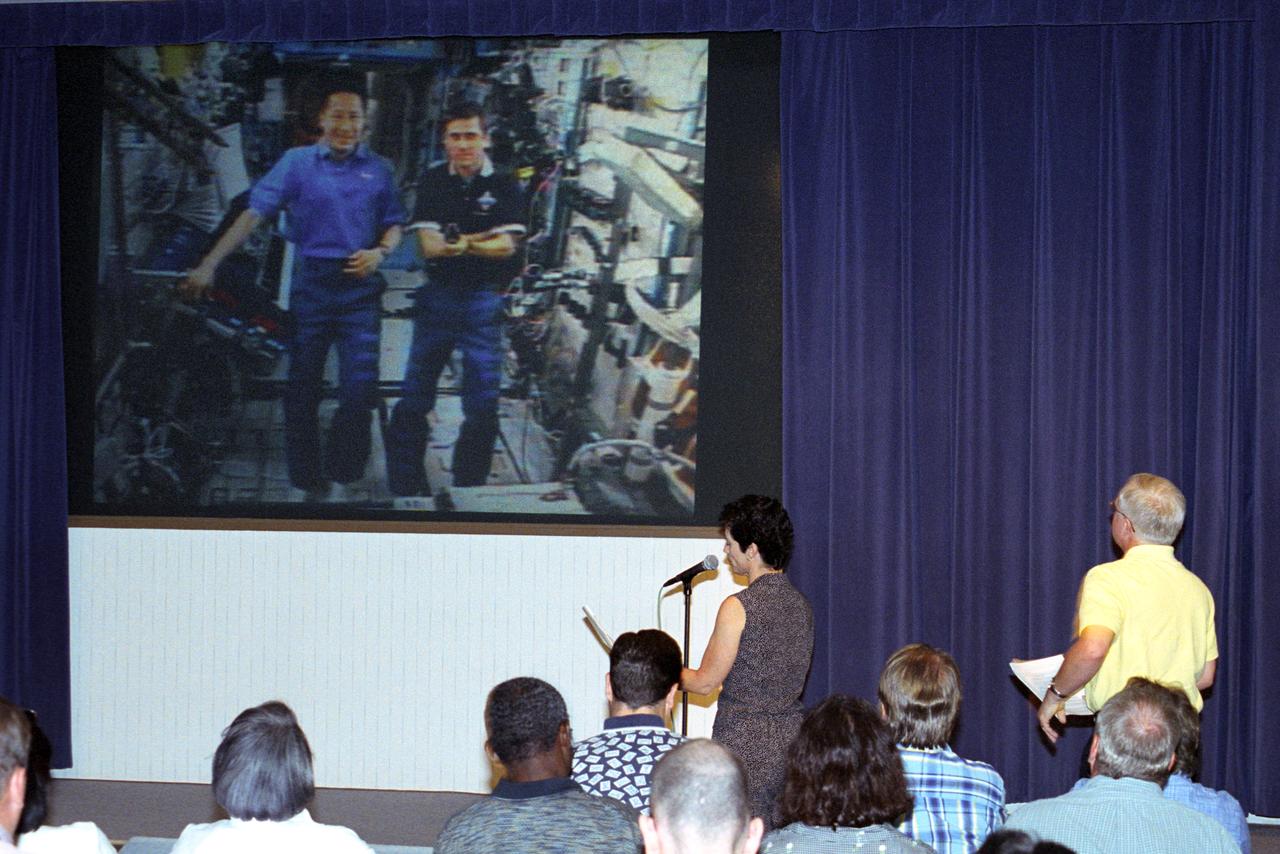
Teacher Kim Cantrell from the Edwards Air Force Base Middle School, Edwards, Calif., participating in a live uplink at NASA Dryden as part of NASA's Explorer Schools program, asks the crew of the International Space Station a question.
Teacher Kim Cantrell from the Edwards Air Force Base Middle School, Edwards, Calif., participating in a live uplink at NASA Dryden as part of NASA's Explorer Schools program, asks the crew of the International Space Station a question
Erik Lindbergh christens NASA's 747 Clipper Lindbergh, the Stratospheric Observatory for Infrared Astronomy, with a special commemorative concoction representing local, NASA, and industry partners. The liquid consisted of a small amount of California wine representing NASA Dryden where the aircraft will be stationed, a small amount of Dr. Pepper (a Waco, TX invention), a quantity of French bottled water (to symbolize Charles Lindbergh's flight to Paris on this date), and a dash of German beer to represent the SOFIA German industry partners.
Erik Lindbergh christens NASA's 747 Clipper Lindbergh with a special commemorative concoction representing local, NASA, and industry partners
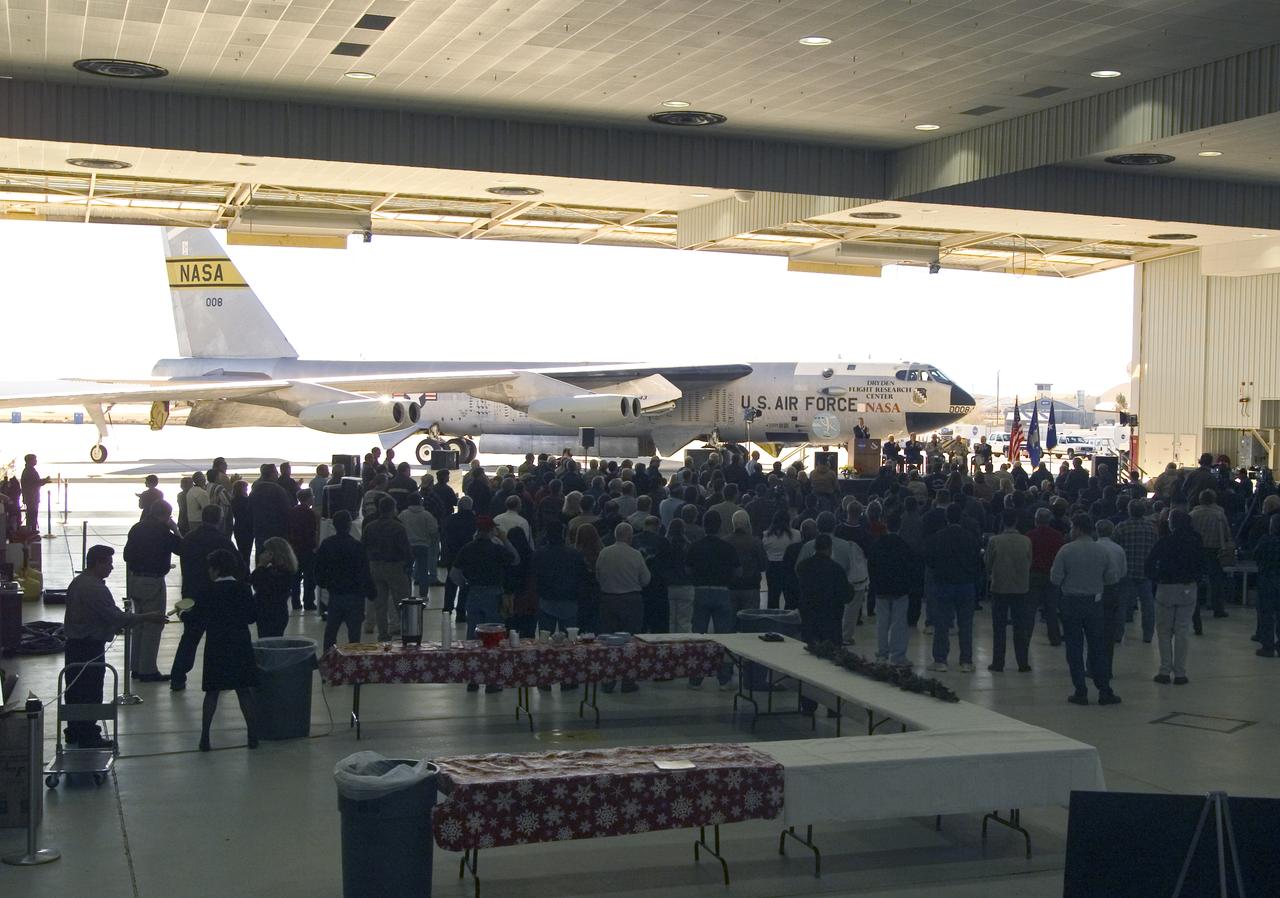
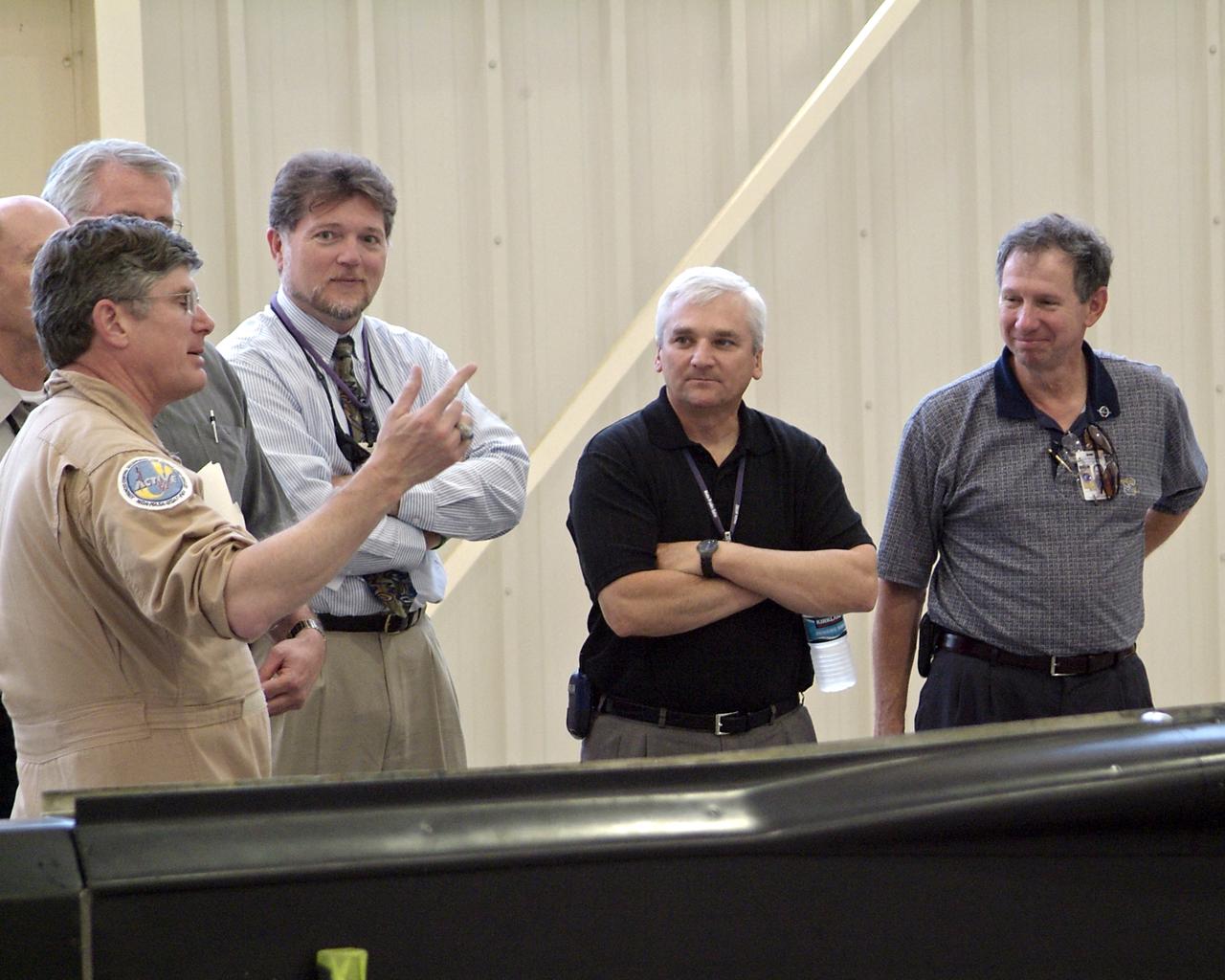
NASA Dryden research pilot Jim Smolka (left) details a recent flight experiment on a modified F-15B research aircraft to test range program manager Jerry McKee, center director Kevin Petersen and NASA Administrator Michael Griffin (right) during Griffin's initial visit to NASA's Dryden Flight Research Center on Tuesday, May 24.
Jim Smolka (left) details a flight experiment to Jerry McKee, Kevin Petersen and NASA Administrator Mike Griffin (right) during Griffin's initial visit to DFRC
Students from the Our Lady of Perpetual Help School in Bakersfield, CA, pass by one of NASA Dryden's F-18 chase aircraft during a tour.
Students from the Our Lady of Perpetual Help School in Bakersfield, CA, pass by one of NASA Dryden's F-18 chase aircraft during a tour
The C-17 simulator at NASA's Dryden Flight Research Center, Edwards, California. Simulators offer a safe and economical alternative to actual flights to gather data, as well as being excellent facilities for pilot practice and training.
The C-17 simulator at NASA's Dryden Flight Research Center, Edwards, California
NASA X-43A Monitor Station Operator Brad Neal performs final checks and pre-flight preparations aboard the B-52 for the third X-43A research vehicle Mach 10 flight on November 16, 2004. Takeoff of the B-52B mothership carrying the X-43A took place at 1 p.m., PST, with launch of the booster rocket/X-43A approximately an hour later.
NASA's Brad Neal, X-43A Monitor Station Operator aboard NASA's B-52B mothership, performing pre-flight checks on November 16, 2004
With its sensor booms projecting ahead of the wing, the Pathfinder-Plus solar-electric aircraft soars under a blue sky on a turbulence measurement research flight.
With sensor booms projecting ahead of the wing, the Pathfinder-Plus soars under a blue sky on a turbulence measurement research flight.
Space Shuttle Discovery landed safely at NASA's Dryden Flight Research Center at Edwards Air Force Base in Calif. at 5:11:22 a.m. PDT this morning, following the very successful 14-day STS-114 return to flight mission. During their two weeks in space, Commander Eileen Collins and her six crewmates tested out new safety procedures and delivered supplies and equipment the International Space Station.  Discovery spent two weeks in space, where the crew demonstrated new methods to inspect and repair the Shuttle in orbit. The crew also delivered supplies, outfitted and performed maintenance on the International Space Station. A number of these tasks were conducted during three spacewalks.  In an unprecedented event, spacewalkers were called upon to remove protruding gap fillers from the heat shield on Discovery's underbelly. In other spacewalk activities, astronauts installed an external platform onto the Station's Quest Airlock and replaced one of the orbital outpost's Control Moment Gyroscopes.  Inside the Station, the STS-114 crew conducted joint operations with the Expedition 11 crew. They unloaded fresh supplies from the Shuttle and the Raffaello Multi-Purpose Logistics Module. Before Discovery undocked, the crews filled Raffeallo with unneeded items and returned to Shuttle payload bay.  Discovery launched on July 26 and spent almost 14 days on orbit.
Space Shuttle Discovery landed at NASA's Dryden Flight Research Center at 5:11 a.m., following the very successful 14-day STS-114 return to flight mission
Brig. Gen. Curtis Bedke, commander of the Air Force Flight Test Center at Edwards Air Force Base, received some first-hand insight on how to fly a Space Shuttle approach and landing, courtesy of NASA astronaut and STS-114 mission commander Eileen Collins. The series of proficiency flights in NASA's modified Grumman Gulfstream-II Shuttle Training Aircraft were in preparation for the STS-114 mission with the shuttle Discovery. Although NASA's Kennedy Space Center in Florida is the primary landing site for Space Shuttle missions, flight crews also practice the shuttle's steep approach and landing at Edwards in case weather or other situations preclude a landing at the Florida site and force a diversion to Edwards AFB.
AFFTC commander Brig. Gen. Curtis Bedke experienced a Shuttle approach and landing in NASA's Shuttle Training Aircraft from STS-114 commander Eileen Collins
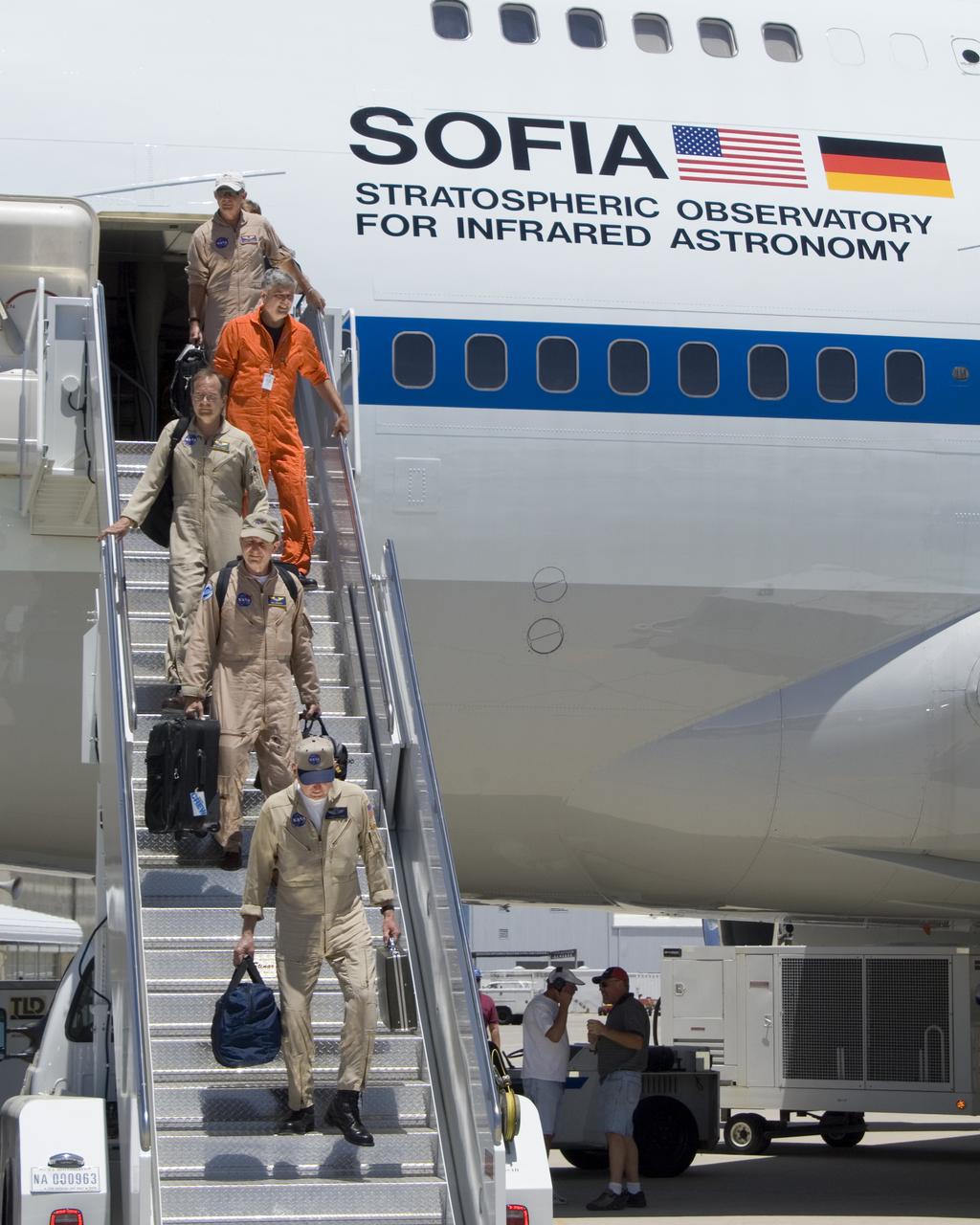
NASA'S SOFIA infrared observatory 747SP (front) and DC-8 flying laboratory (rear) are now housed at the Dryden Aircraft Operations Facility in Palmdale, Calif.
A technician leaves the 'white room', the access point for entering the Space Shuttle Discovery during post-flight processing in the Mate-Demate Device (MDD) at NASA's Dryden Flight Research Center in California. The gantry-like MDD structure is used for servicing the shuttle orbiters in preparation for their ferry flight back to the Kennedy Space Center in Florida, including mounting the shuttle atop NASA's modified Boeing 747 Shuttle Carrier Aircraft.  Space Shuttle Discovery landed safely at NASA's Dryden Flight Research Center at Edwards Air Force Base in California at 5:11:22 a.m. PDT, August 9, 2005, following the very successful 14-day STS-114 return to flight mission.  During their two weeks in space, Commander Eileen Collins and her six crewmates tested out new safety procedures and delivered supplies and equipment the International Space Station.  Discovery spent two weeks in space, where the crew demonstrated new methods to inspect and repair the Shuttle in orbit. The crew also delivered supplies, outfitted and performed maintenance on the International Space Station. A number of these tasks were conducted during three spacewalks.  In an unprecedented event, spacewalkers were called upon to remove protruding gap fillers from the heat shield on Discovery's underbelly. In other spacewalk activities, astronauts installed an external platform onto the Station's Quest Airlock and replaced one of the orbital outpost's Control Moment Gyroscopes.  Inside the Station, the STS-114 crew conducted joint operations with the Expedition 11 crew. They unloaded fresh supplies from the Shuttle and the Raffaello Multi-Purpose Logistics Module. Before Discovery undocked, the crews filled Raffeallo with unneeded items and returned to Shuttle payload bay.  Discovery launched on July 26 and spent almost 14 days on orbit.
A technician leaves the 'white room,' the access point for entering the Space Shuttle Discovery during post-flight processing at NASA DFRC in California
Rogers Dry Lake serves as a backdrop for a mockup Orion crew module built by NASA Dryden Flight Research Center's Fabrication Branch. The module was relocated to Dryden's Shuttle hangar on Sept. 25, 2007.
Rogers Dry Lake served as a backdrop for a mockup Orion crew module built by NASA Dryden's Fabrication Branch as it was relocated to Dryden's Shuttle hangar.
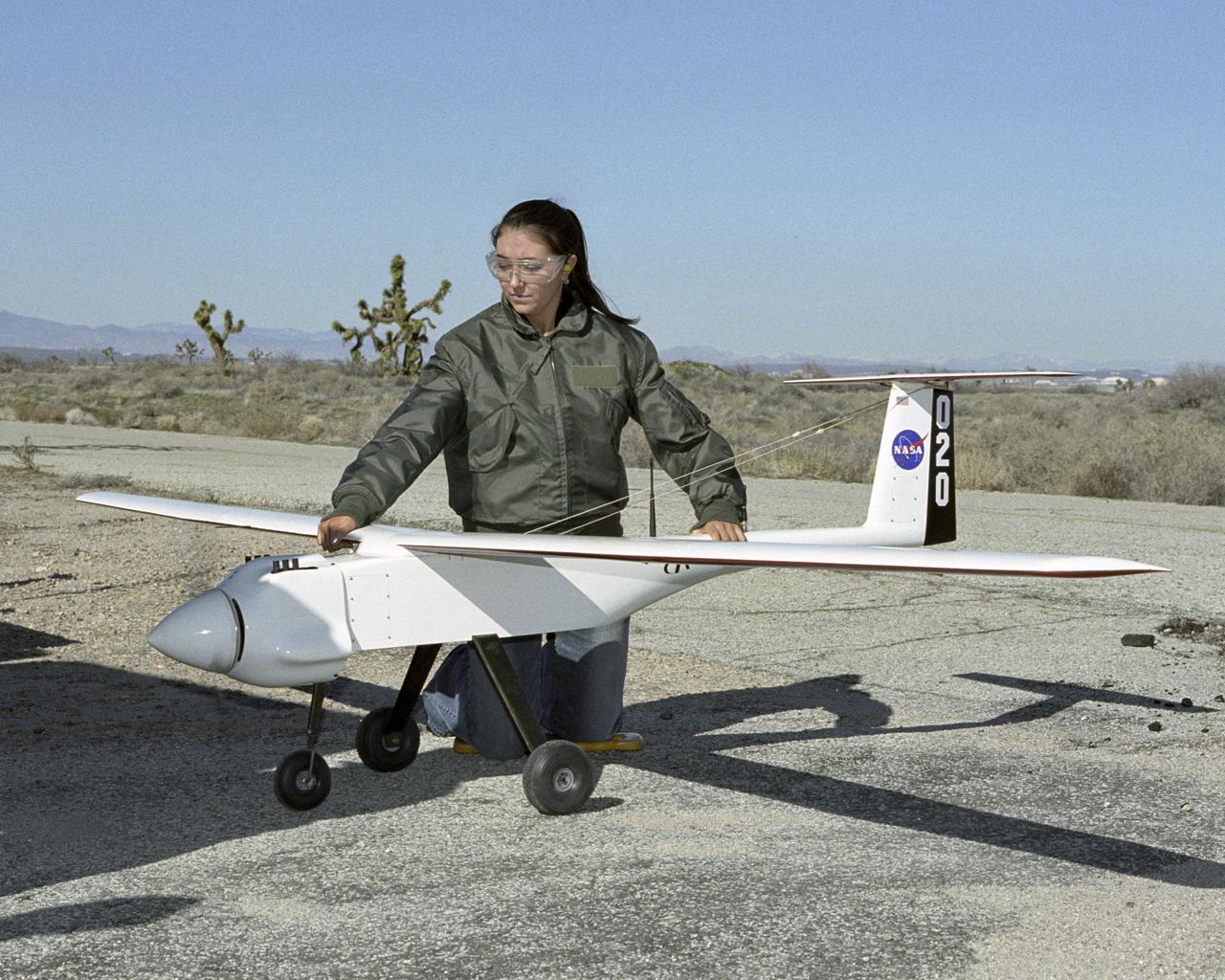
NASA Dryden Operations co-op student Shannon Kolensky holds one of the APV-3 UAVs flown in the Networked UAV Teaming Experiment steady during an engine runup.
EC05-0043-09
Group photo following the 300th NASA Dryden flight of F-15B #836.
Group photo following the 300th NASA Dryden flight of F-15B #836
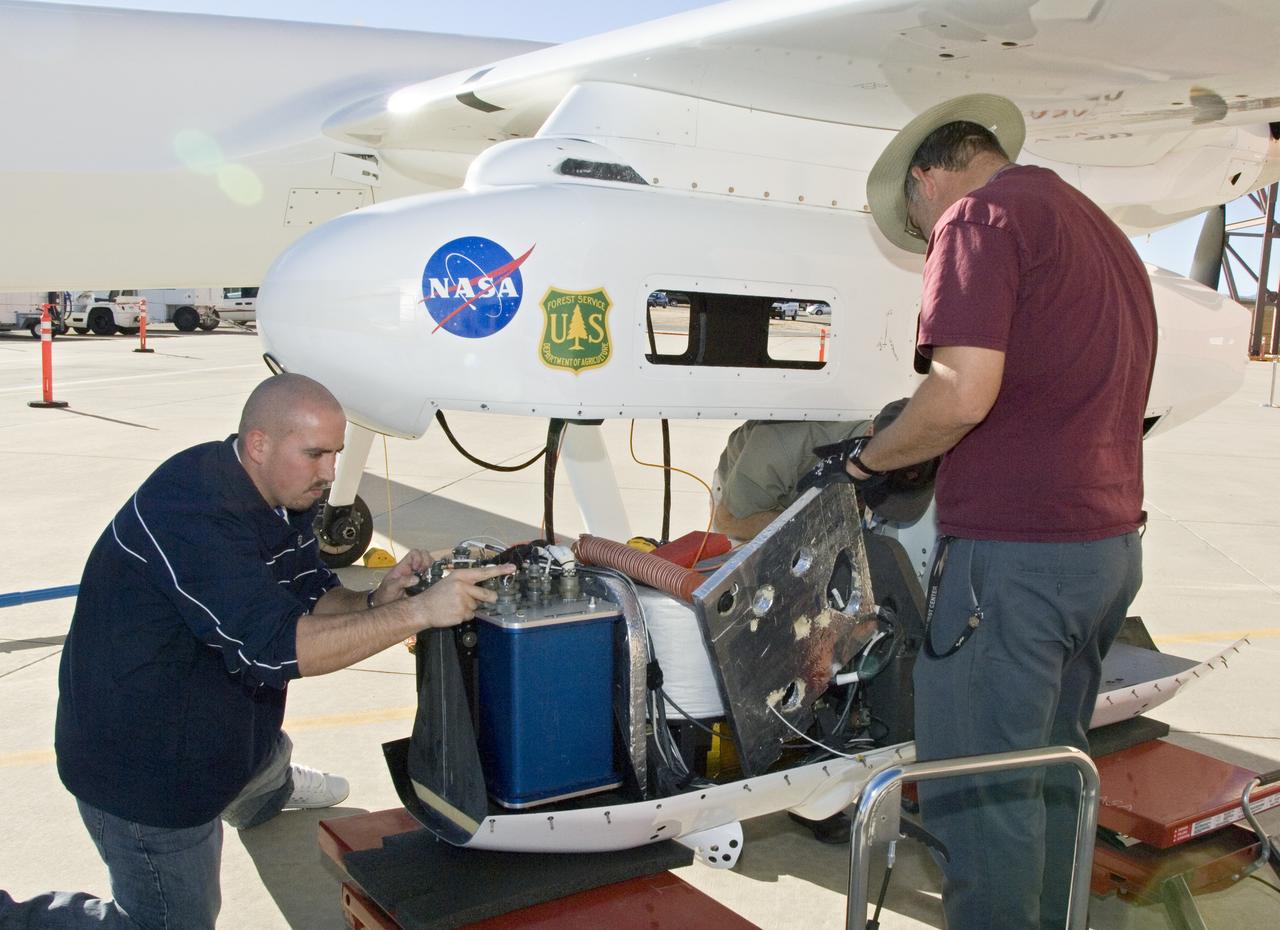
Technicians at General Atomics Aeronautical Systems, Inc., (GA-ASI) facility at Adelanto, Calif., carefully install a turboprop engine to the rear fuselage of NASA's Altair aircraft during final assembly operations.
EC02-0188-18
The Proteus high-altitude aircraft at Sunset
Proteus at Sunset
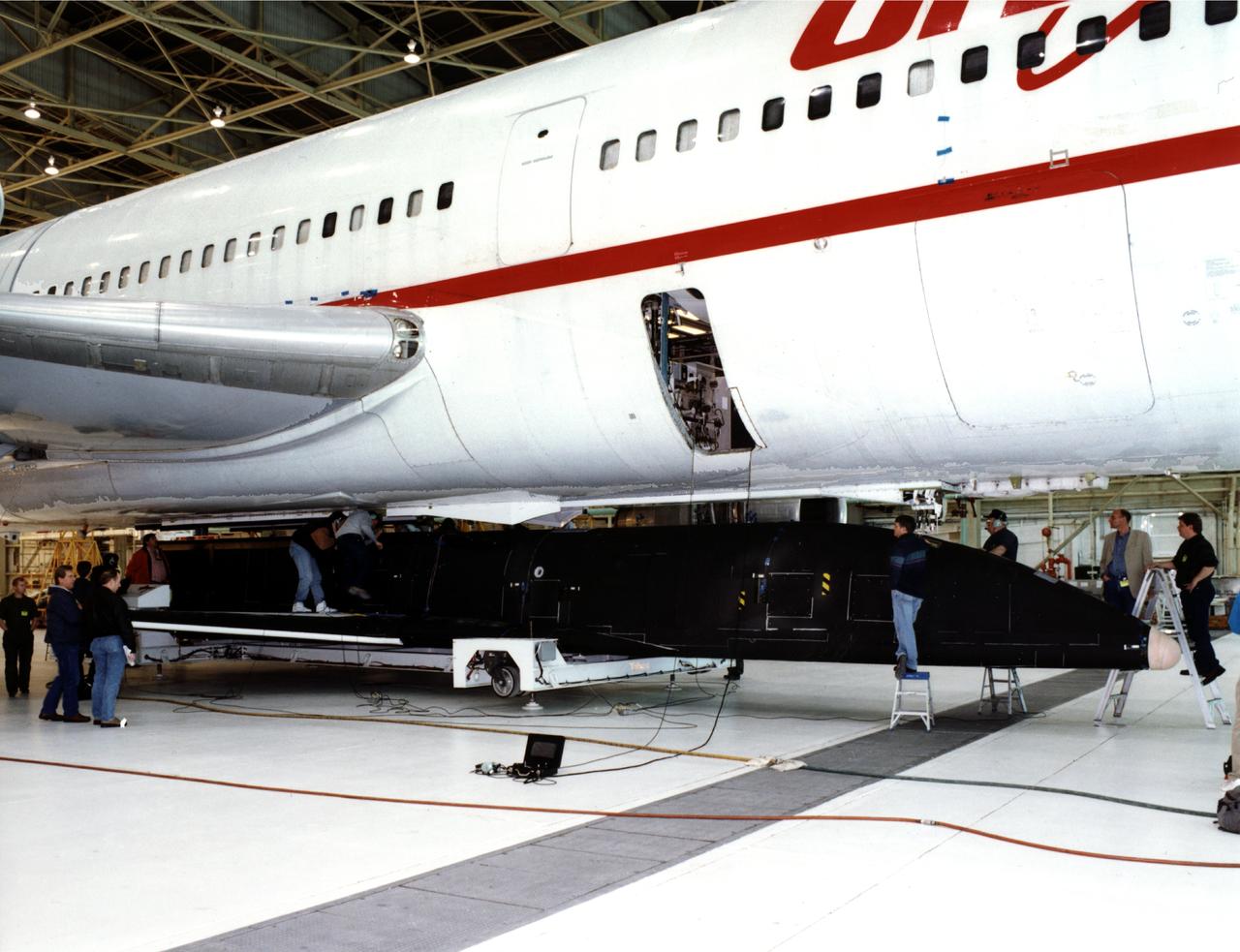
This is the X-34 Technology Testbed Demonstrator being mated with the L-1011 mothership. The X-34 will demonstrate key vehicle and operational technologies applicable to future low-cost resuable launch vehicles.
X-34 Technology Testbed Demonstrator being mated with the L-1011 mothership
Shimmering heat waves trail behind NASA's Gulfstream-III research aircraft as it departs the Edwards AFB runway on a UAVSAR pod checkout test flight.
ED07-0027-68
The X-38 prototype of the Crew Return Vehicle for the International Space Station is suspended under its giant 7,500-square-foot parafoil during its eighth free flight on Thursday, Dec. 13, 2001. A portion of the descent was flown by remote control by a NASA astronaut from a ground vehicle configured like the CRV's interior before the X-38 made an autonomous landing on Rogers Dry Lake.
The X-38 prototype of the Crew Return Vehicle is suspended under its giant 7,500-square-foot parafoil during its eighth free flight on Thursday, December 13, 2001
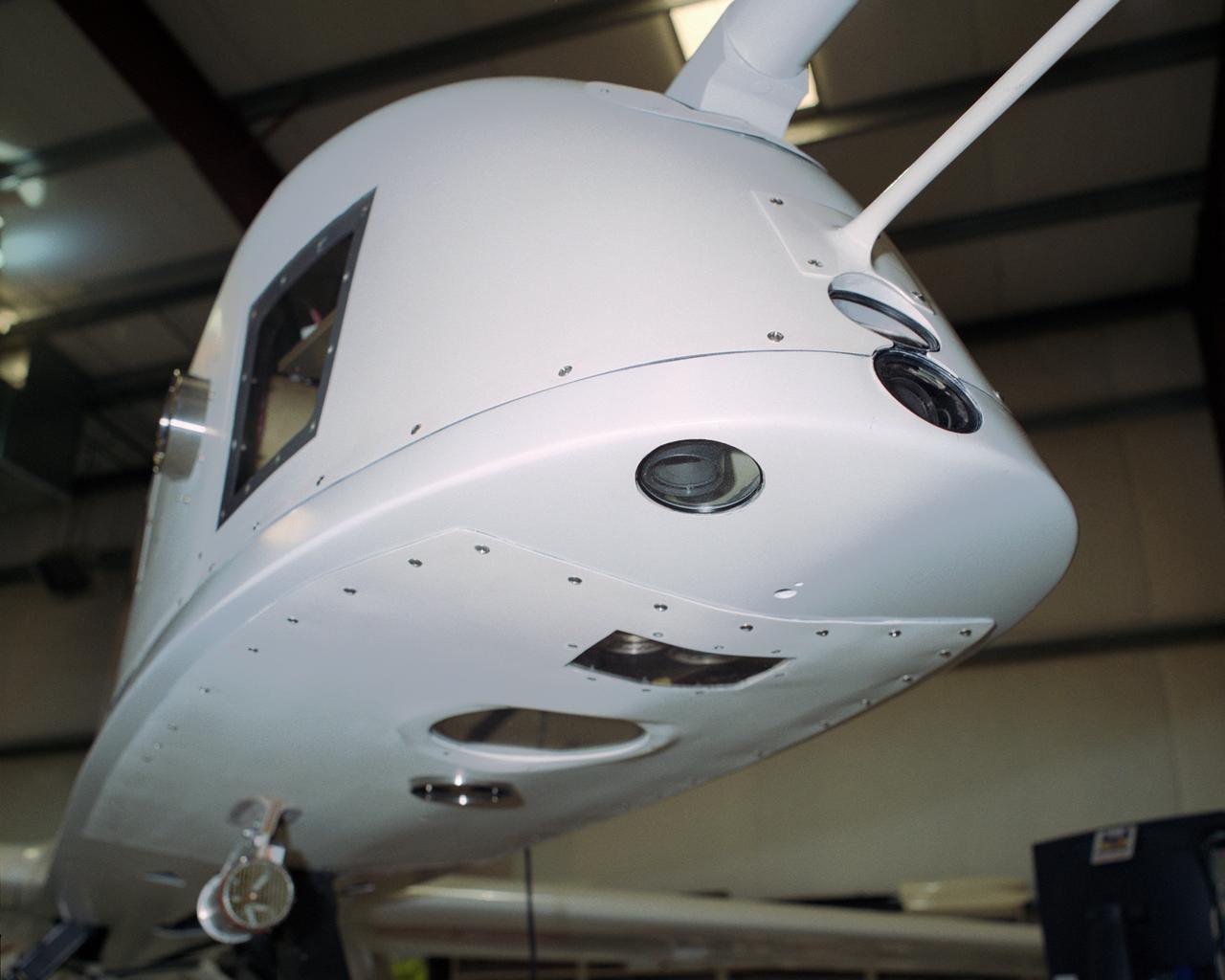
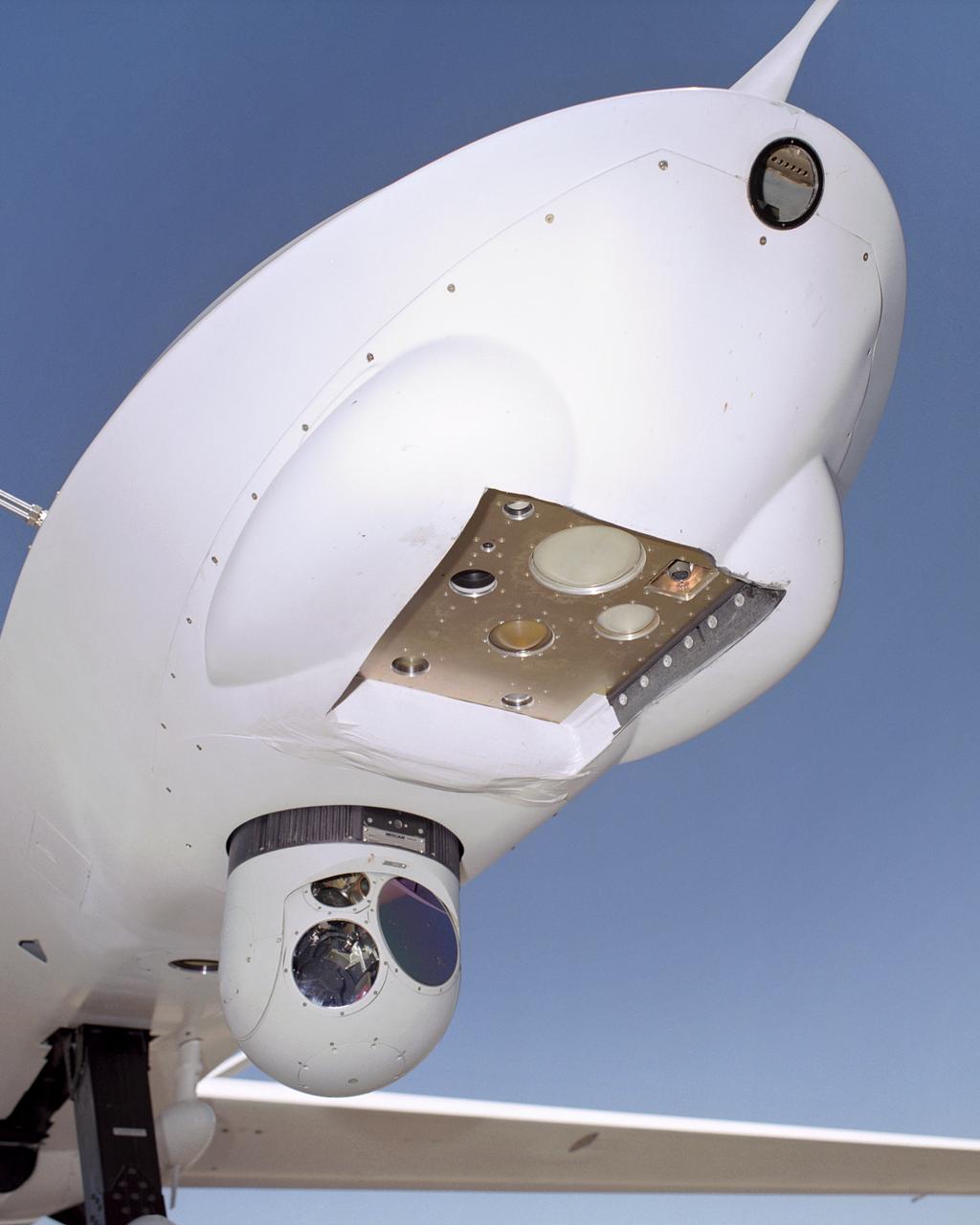
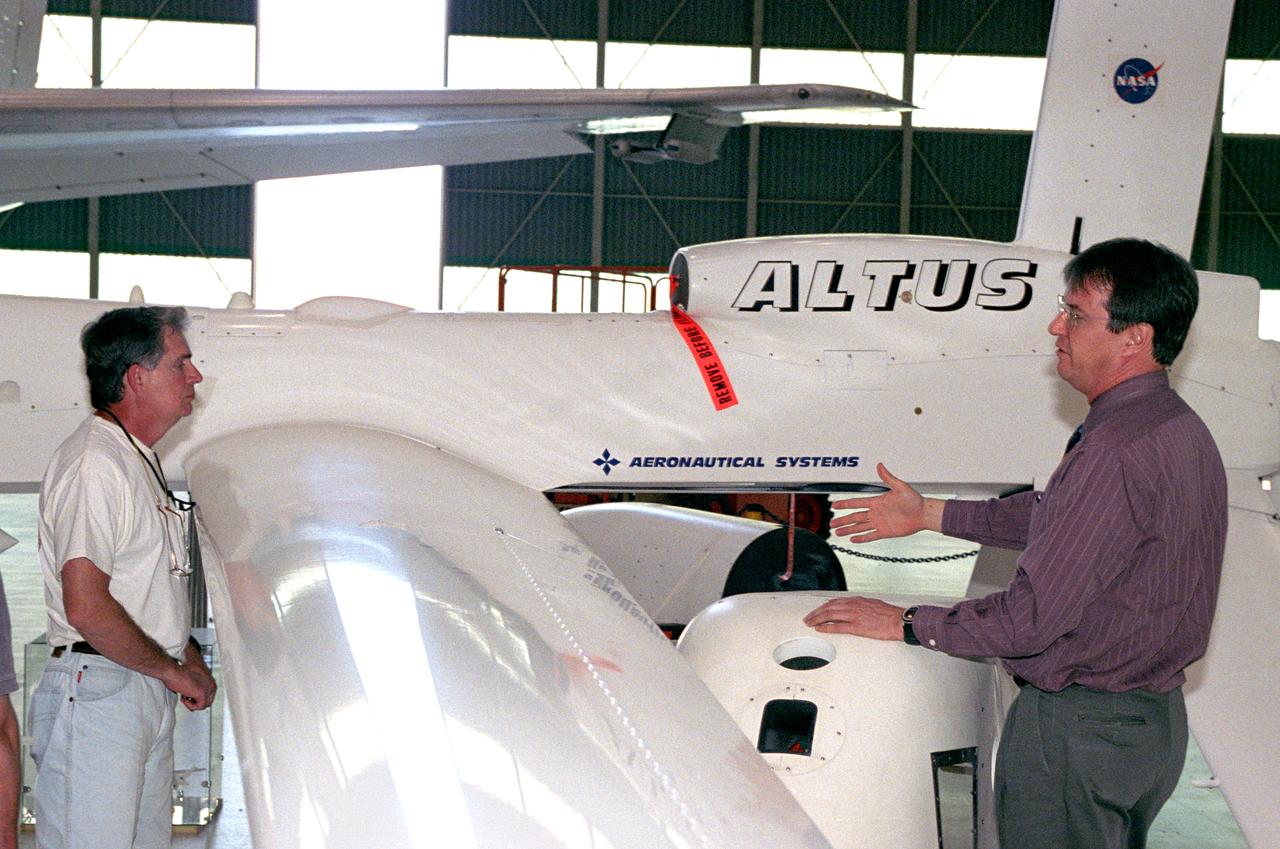
Looking ever so much like an alien spacecraft, the Altus II remotely piloted aircraft shows off some of the instruments and camera lenses mounted in its nose for a lightning study over Florida flown during the summer of 2002.
EC02-0162-22