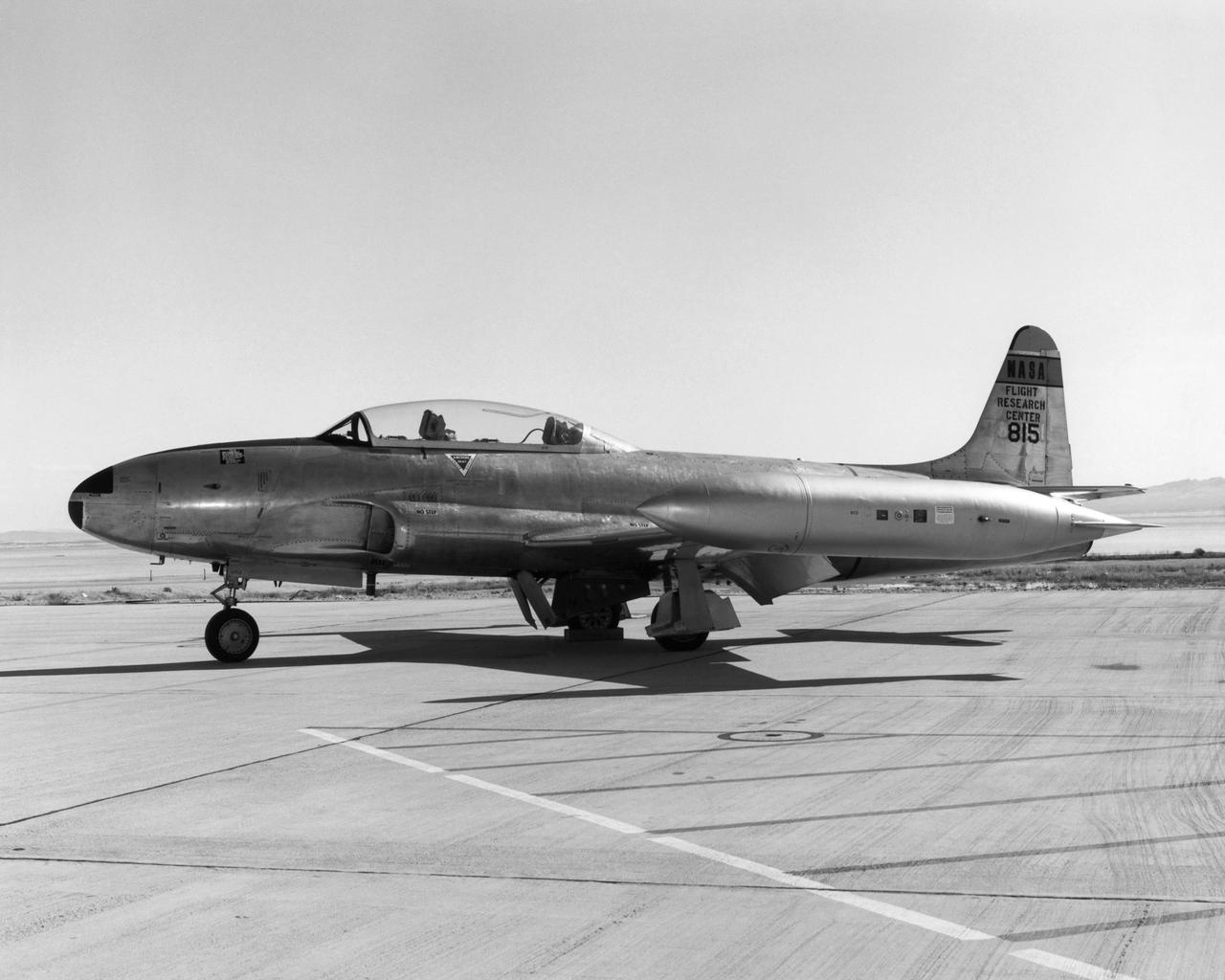
T-33A (55-4351/NASA 815) arrived at NASA FRC January 9, 1963 departed September 10, 1973 to Redding, California. This aircraft, one of four T-33A jet trainers which NASA Dryden used from 1958 to 1973, was used in a monocular vision landing study.

Arrived at NASA FRC January 9, 1963 Departed September 10, 1973 to Redding, California This aircraft, one of four T-33A jet trainers which NASA Dryden used from 1958 to 1973, was used in a monocular vision landing study. The T-33 was the first U.S. Air Force jet trainer, and was originally developed as a two-seat version of the F-80. The T-33 was used by not only the U.S. military, but also by foreign air forces as a trainer, fighter, and reconnaissance aircraft.
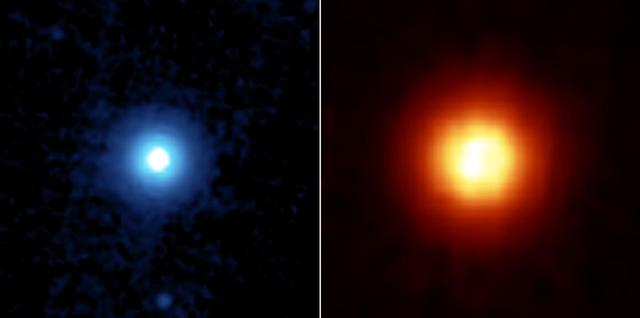
NASA's Spitzer Space Telescope recently captured these images of the star Vega, located 25 light years away in the constellation Lyra. Spitzer was able to detect the heat radiation from the cloud of dust around the star and found that the debris disc is much larger than previously thought. This side by side comparison, taken by Spitzer's multiband imaging photometer, shows the warm infrared glows from dust particles orbiting the star at wavelengths of 24 microns (figure 2 in blue) and 70 microns (figure 3 in red). Both images show a very large, circular and smooth debris disc. The disc radius extends to at least 815 astronomical units. (One astronomical unit is the distance from Earth to the Sun, which is 150-million kilometers or 93-million miles). Scientists compared the surface brightness of the disc in the infrared wavelengths to determine the temperature distribution of the disc and then infer the corresponding particle size in the disc. Most of the particles in the disc are only a few microns in size, or 100 times smaller than a grain of Earth sand. These fine dust particles originate from collisions of embryonic planets near the star at a radius of approximately 90 astronomical units, and are then blown away by Vega's intense radiation. The mass and short lifetime of these small particles indicate that the disc detected by Spitzer is the aftermath of a large and relatively recent collision, involving bodies perhaps as big as the planet Pluto. The images are 3 arcminutes on each side. North is oriented upward and east is to the left. http://photojournal.jpl.nasa.gov/catalog/PIA07218