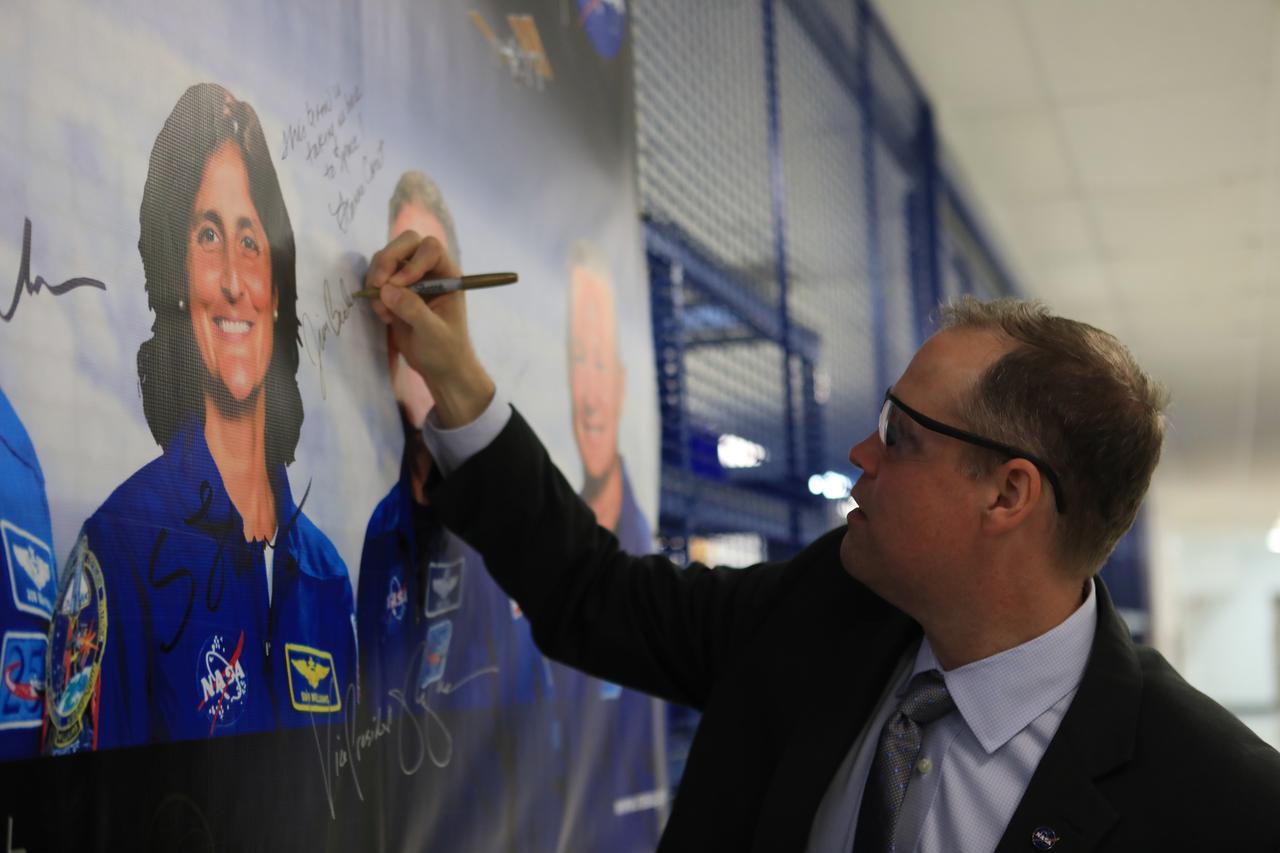
During a tour of Boeing's Commercial Crew and Cargo Processing Facility (C3PF), NASA Administrator Jim Bridenstine signs a banner with photos of astronauts chosen for the first Commercial Crew Program flights. The C3PF is the production and processing home of Boeing’s CST-100 Starliner spacecraft. Bridenstine made his first official visit to NASA's Kennedy Space Center on Aug. 6 and 7, 2018.
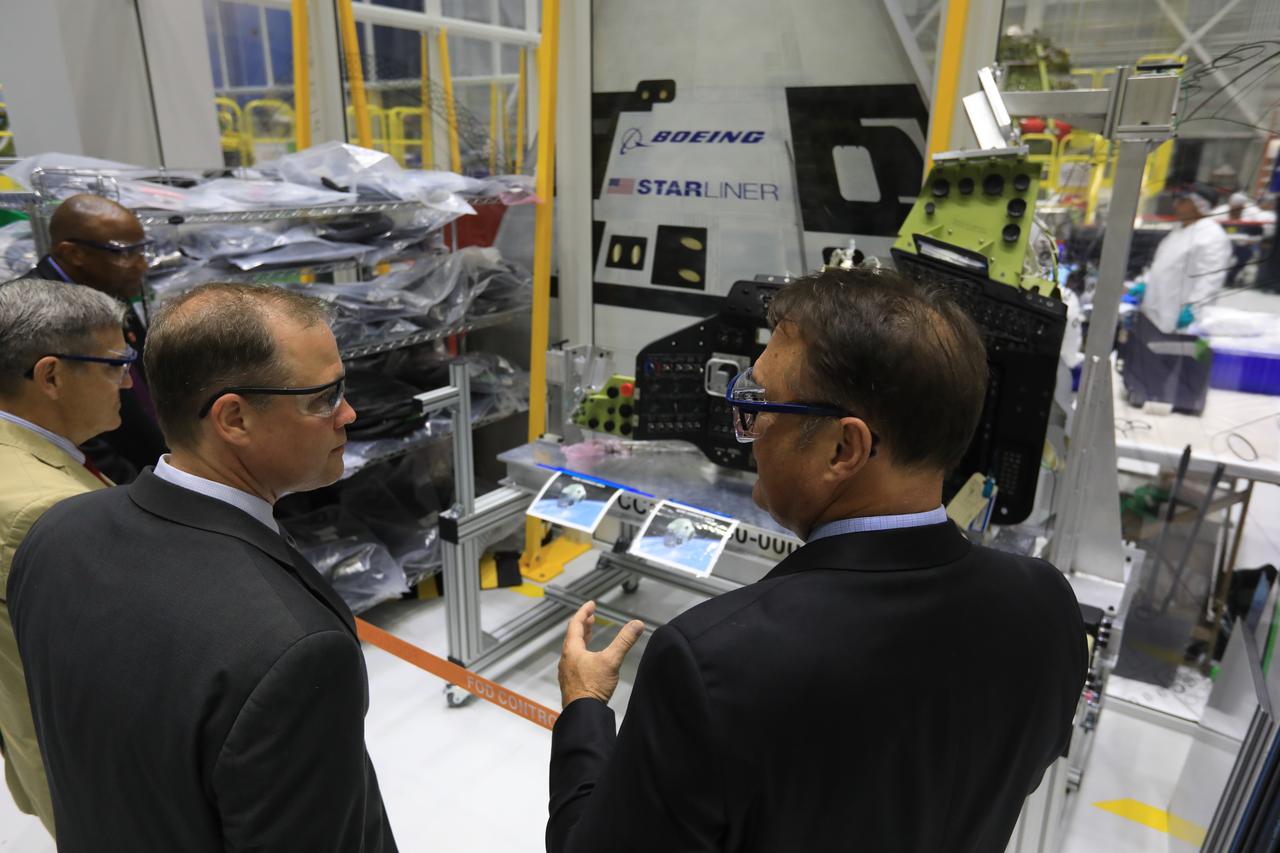
In the Commercial Crew and Cargo Processing Facility at NASA's Kennedy Space Center, agency Administrator Jim Bridenstine (center) is briefed Center Director Bob Cabana (left), and John Mulholland, vice president and manager of Boeing's CST-100 Starliner Program (center), and. The C3PF is the production and processing home of Boeing’s Starliner spacecraft. Bridenstine made his first official visit to NASA's Kennedy Space Center on Aug. 6 and 7, 2018.
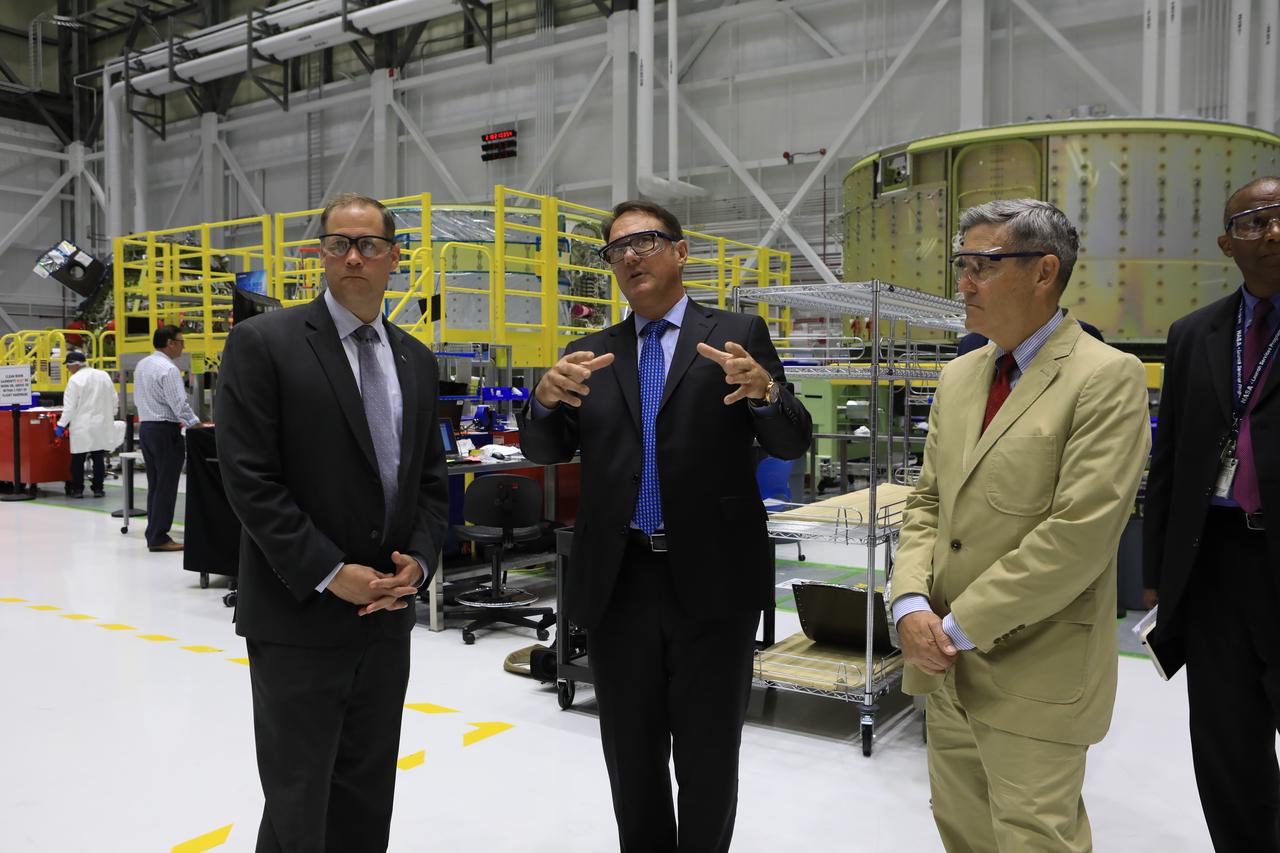
In the Commercial Crew and Cargo Processing Facility at NASA's Kennedy Space Center, agency Administrator Jim Bridenstine (right) is briefed by John Mulholland, vice president and manager of Boeing's CST-100 Starliner Program. The C3PF is the production and processing home of Boeing’s Starliner spacecraft. Bridenstine made his first official visit to NASA's Kennedy Space Center on Aug. 6 and 7, 2018.
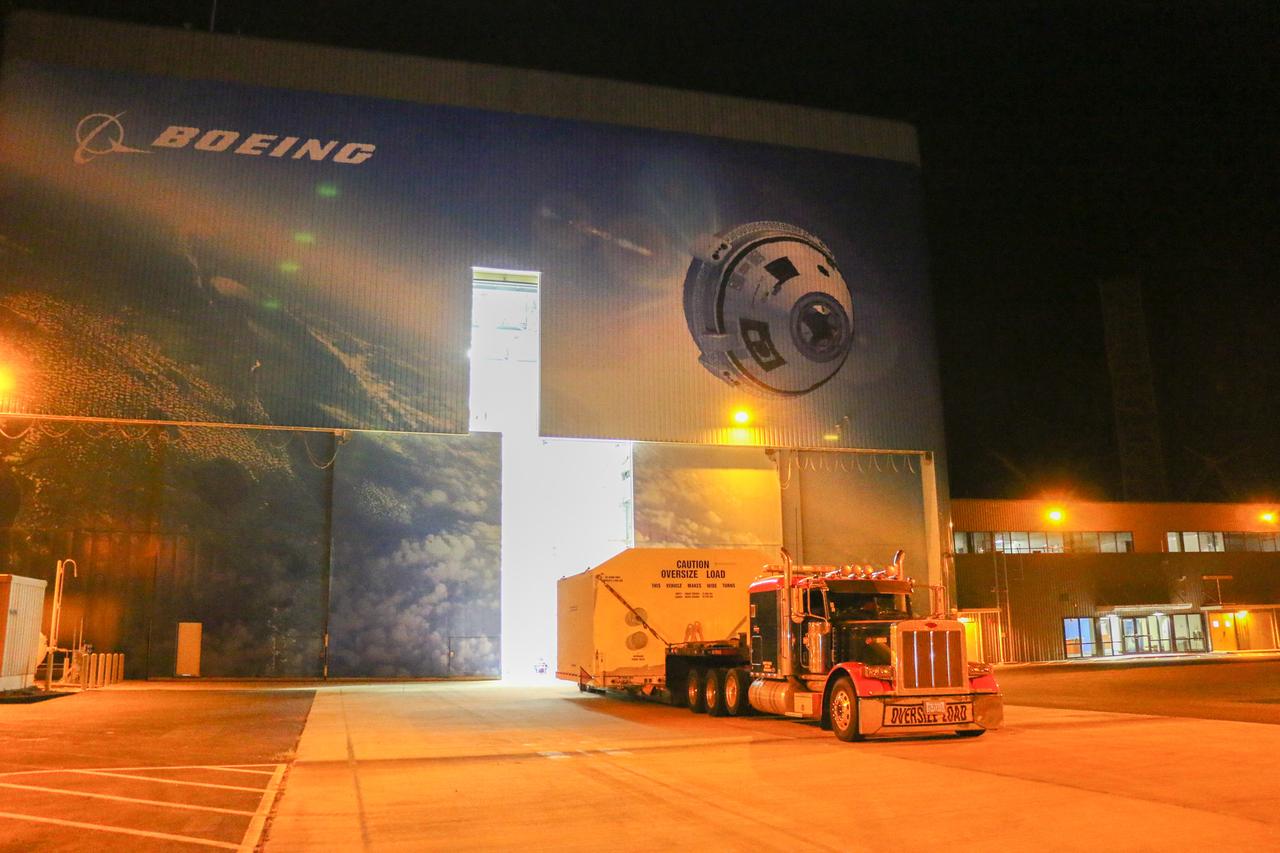
Boeing’s Structural Test Article of its CST-100 Starliner spacecraft is moved out of the company’s Commercial Crew and Cargo Processing Facility at NASA’s Kennedy Space Center on its way to Huntington Beach, California, for evaluations. Built to the specifications of an operational spacecraft, the STA is intended to be evaluated through a series of thorough testing conditions.
NASA astronauts Barry “Butch” Wilmore and Sunita "Suni" Williams visit the Commercial Crew and Cargo Processing Facility at Kennedy Space Center in Florida on Dec. 17, 2020. The astronauts are at Kennedy to prepare for their flights to the International Space Station on Boeing’s CST-100 Starliner, as part of the agency’s Commercial Crew Program. Wilmore and Williams will command the Crew Flight Test and the Starliner-1 mission, respectively.

NASA astronauts Barry “Butch” Wilmore, left, and Sunita "Suni" Williams visit the Commercial Crew and Cargo Processing Facility at Kennedy Space Center in Florida on Dec. 17, 2020. The astronauts are at Kennedy to prepare for their flights to the International Space Station on Boeing’s CST-100 Starliner, as part of the agency’s Commercial Crew Program. Wilmore and Williams will command the Crew Flight Test and the Starliner-1 mission, respectively.

NASA astronaut Barry "Butch" Wilmore, at left, tours Boeing's Commercial Crew and Cargo Processing Facility (C3PF) on Oct. 25, 2018, at NASA's Kennedy Space Center in Florida. Boeing's CST-100 Starliner will launch on its first uncrewed flight test on a United Launch Alliance Atlas V rocket. The Starliner is being developed and manufactured in partnership with NASA's Commercial Crew Program to return human spaceflight capabilities to the U.S.

NASA astronaut Barry "Butch" Wilmore, center, tours Boeing's Commercial Crew and Cargo Processing Facility (C3PF) on Oct. 25, 2018, at NASA's Kennedy Space Center in Florida. Boeing's CST-100 Starliner will launch on its first uncrewed flight test on a United Launch Alliance Atlas V rocket. The Starliner is being developed and manufactured in partnership with NASA's Commercial Crew Program to return human spaceflight capabilities to the U.S.
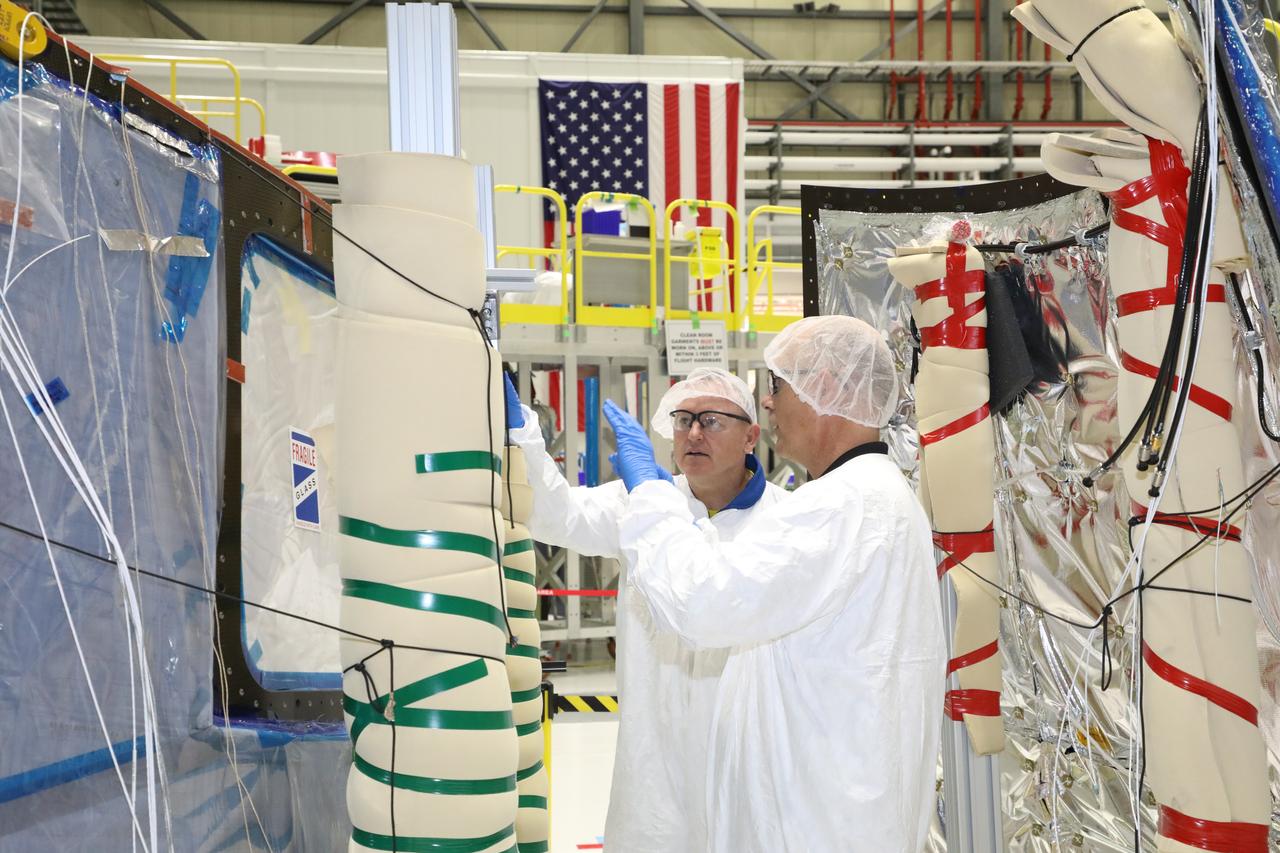
NASA astronaut Barry "Butch" Wilmore, at left, tours Boeing's Commercial Crew and Cargo Processing Facility (C3PF) on Oct. 25, 2018, at NASA's Kennedy Space Center in Florida. Boeing's CST-100 Starliner will launch on its first uncrewed flight test on a United Launch Alliance Atlas V rocket. The Starliner is being developed and manufactured in partnership with NASA's Commercial Crew Program to return human spaceflight capabilities to the U.S.
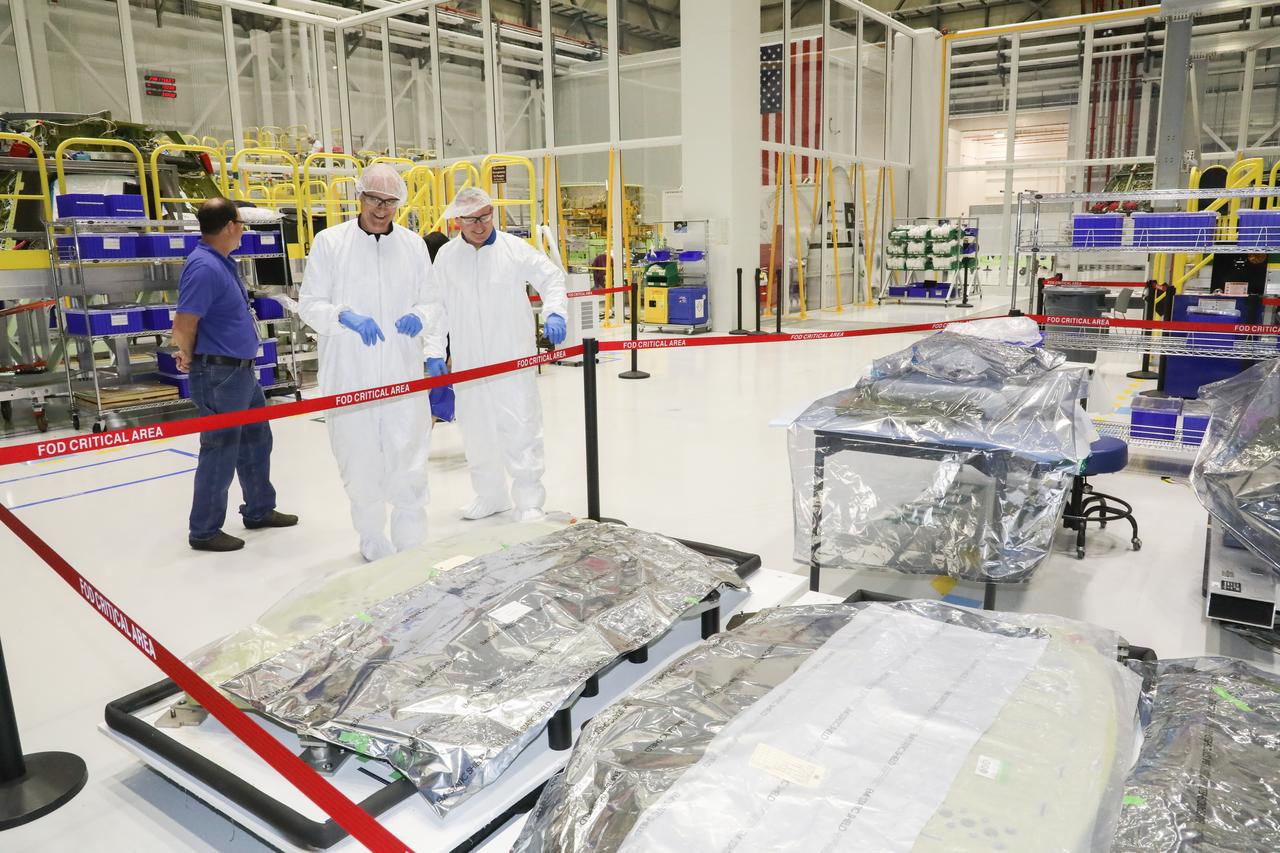
NASA astronaut Barry "Butch" Wilmore, center, tours Boeing's Commercial Crew and Cargo Processing Facility (C3PF) on Oct. 25, 2018, at NASA's Kennedy Space Center in Florida. Boeing's CST-100 Starliner will launch on its first uncrewed flight test on a United Launch Alliance Atlas V rocket. The Starliner is being developed and manufactured in partnership with NASA's Commercial Crew Program to return human spaceflight capabilities to the U.S.
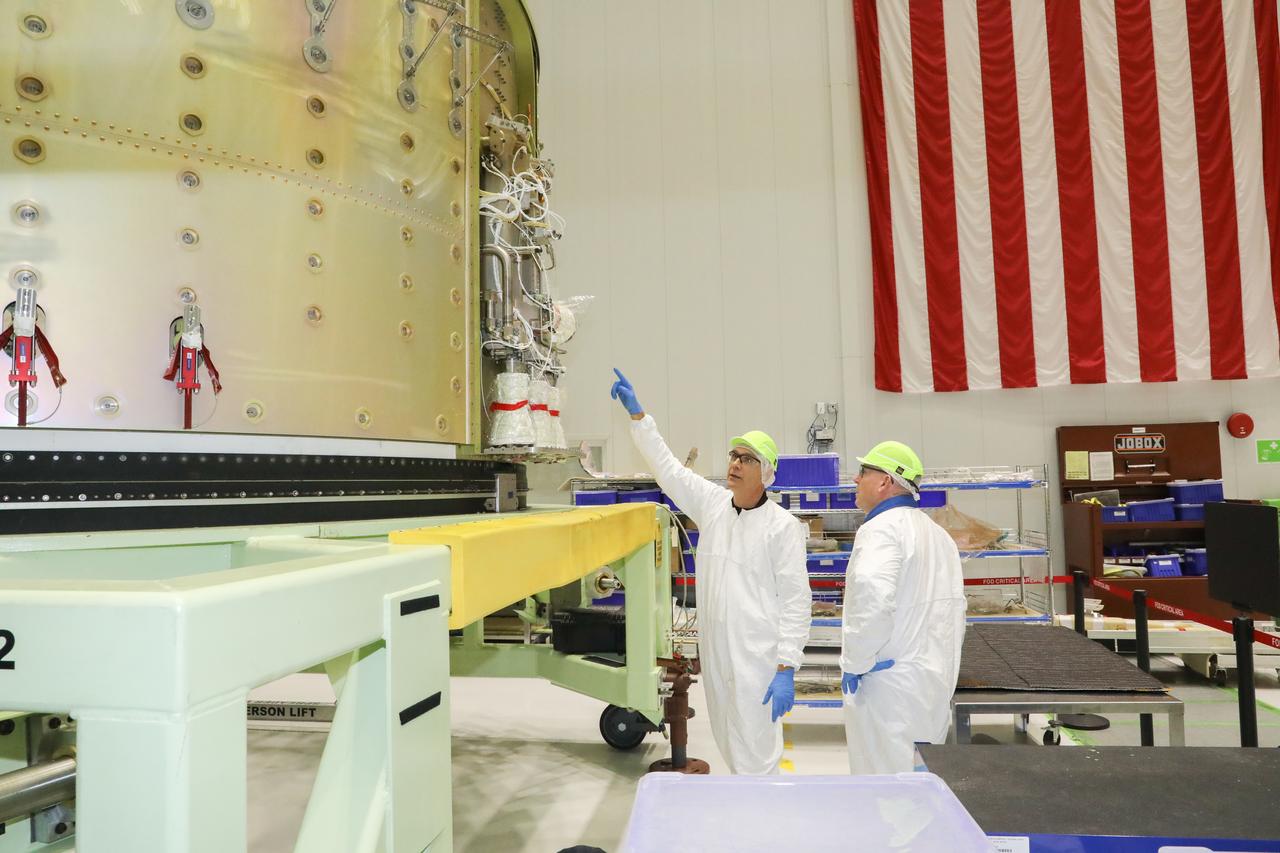
NASA astronaut Barry "Butch" Wilmore, at right, tours Boeing's Commercial Crew and Cargo Processing Facility (C3PF) on Oct. 25, 2018, at NASA's Kennedy Space Center in Florida. Boeing's CST-100 Starliner will launch on its first uncrewed flight test on a United Launch Alliance Atlas V rocket. The Starliner is being developed and manufactured in partnership with NASA's Commercial Crew Program to return human spaceflight capabilities to the U.S.
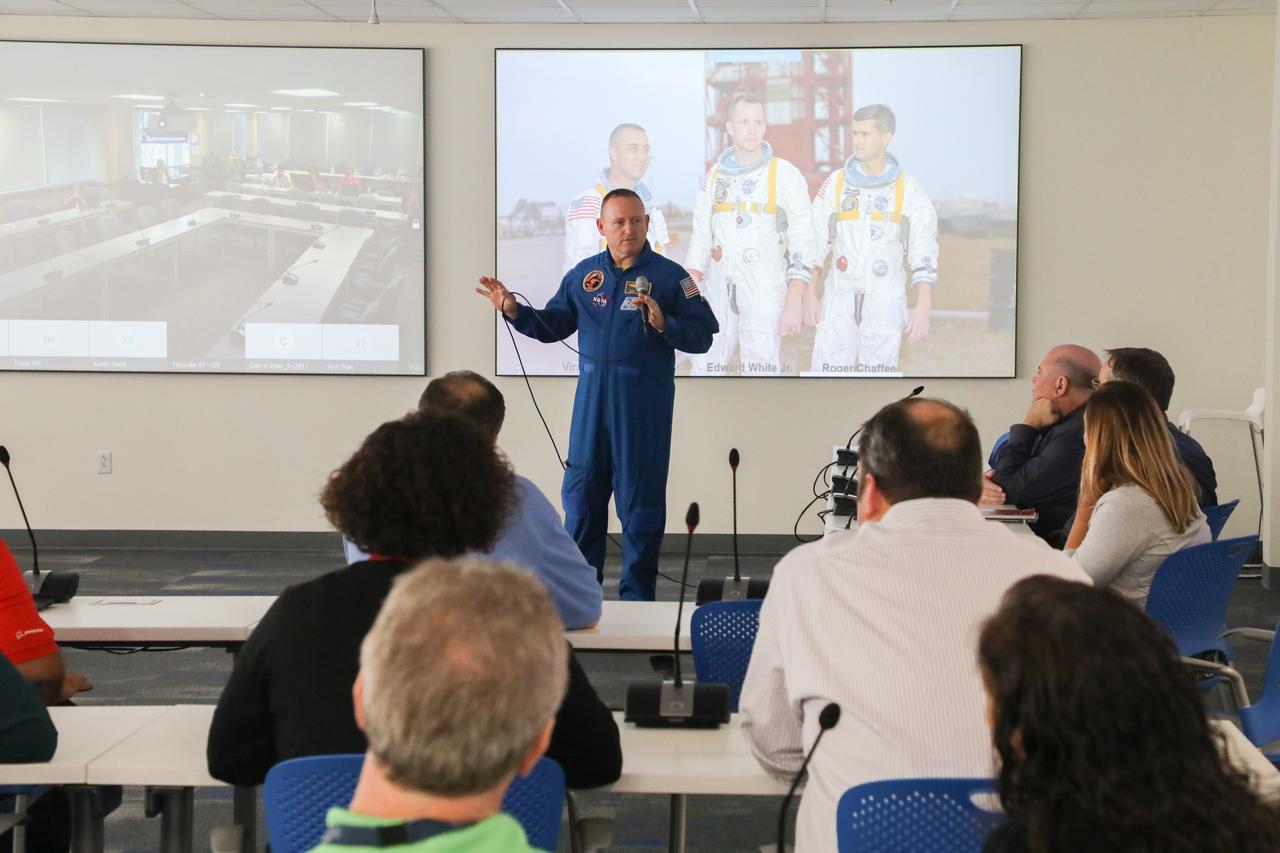
NASA astronaut Barry "Butch" Wilmore, speaks to workers during a tour of Boeing's Commercial Crew and Cargo Processing Facility (C3PF) on Oct. 25, 2018, at NASA's Kennedy Space Center in Florida. Boeing's CST-100 Starliner will launch on its first uncrewed flight test on a United Launch Alliance Atlas V rocket. The Starliner is being developed and manufactured in partnership with NASA's Commercial Crew Program to return human spaceflight capabilities to the U.S.
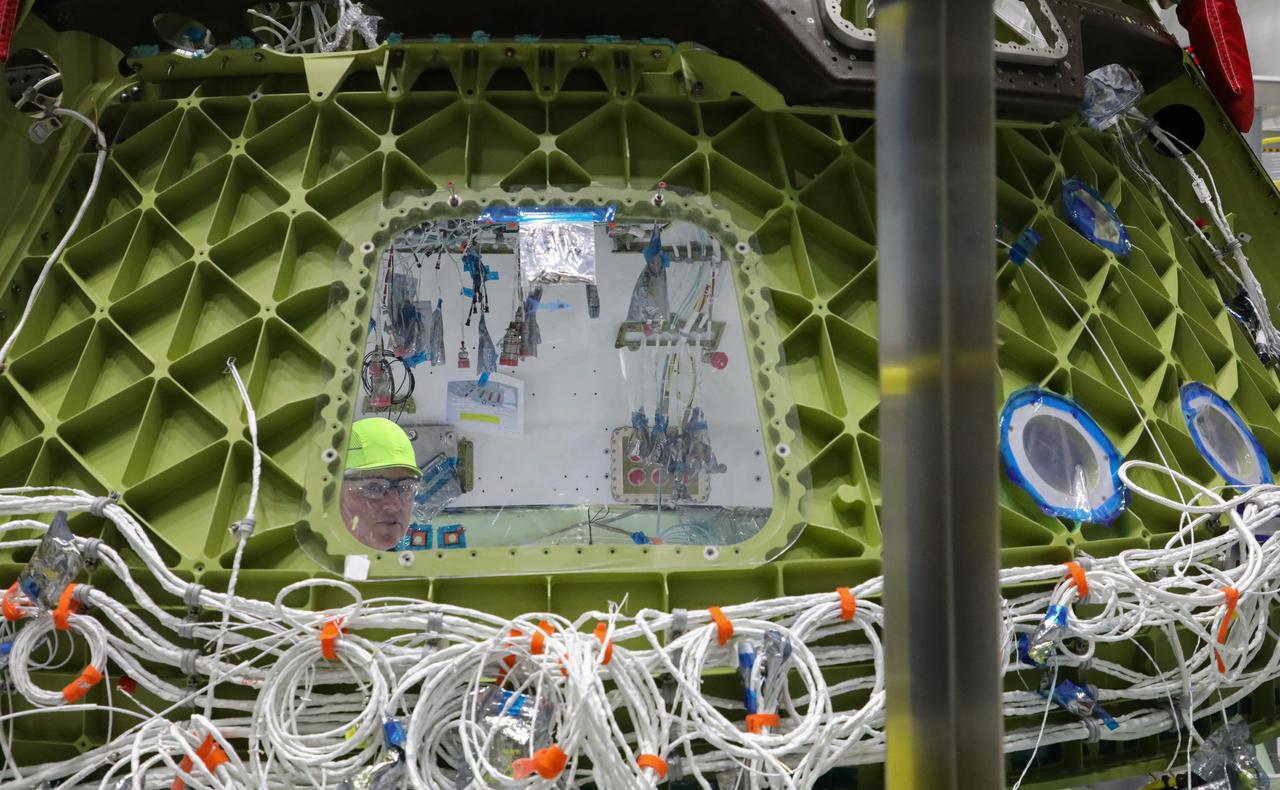
NASA astronaut Barry "Butch" Wilmore, center, tours Boeing's Commercial Crew and Cargo Processing Facility (C3PF) on Oct. 25, 2018, at NASA's Kennedy Space Center in Florida. Wilmore is looking over Boeing's CST-100 Starliner that will launch on its first uncrewed flight test on a United Launch Alliance Atlas V rocket. The Starliner is being developed and manufactured in partnership with NASA's Commercial Crew Program to return human spaceflight capabilities to the U.S.
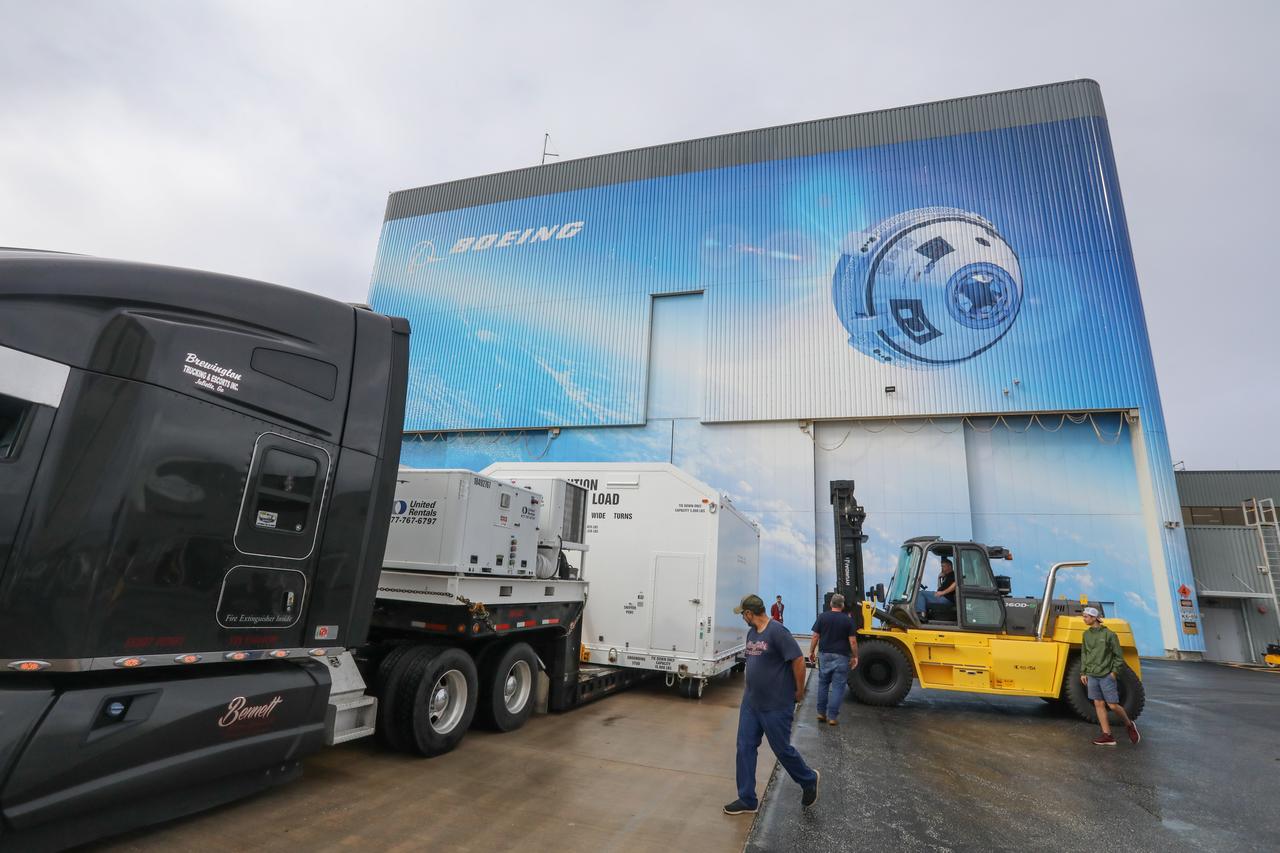
On Nov. 12, 2018, the crated spacecraft destined to fly astronauts to the International Space Station in Boeing's Crew Flight Test (CFT) departs the Commercial Crew and Cargo Processing Facility (C3PF) at NASA's Kennedy Space Center in Florida in preparation for transport to the company's testing facilities in El Segundo, California. The company's CST-100 Starliner will be undergoing a series of environmental tests designed to simulate what the spacecraft will experience during different stages of flight as part of NASA's Commercial Crew Program (CCP). The agency's CCP will return human spaceflight launches to U.S. soil, providing safe, reliable and cost-effective access to low-Earth orbit on systems that meet our safety and mission requirements.
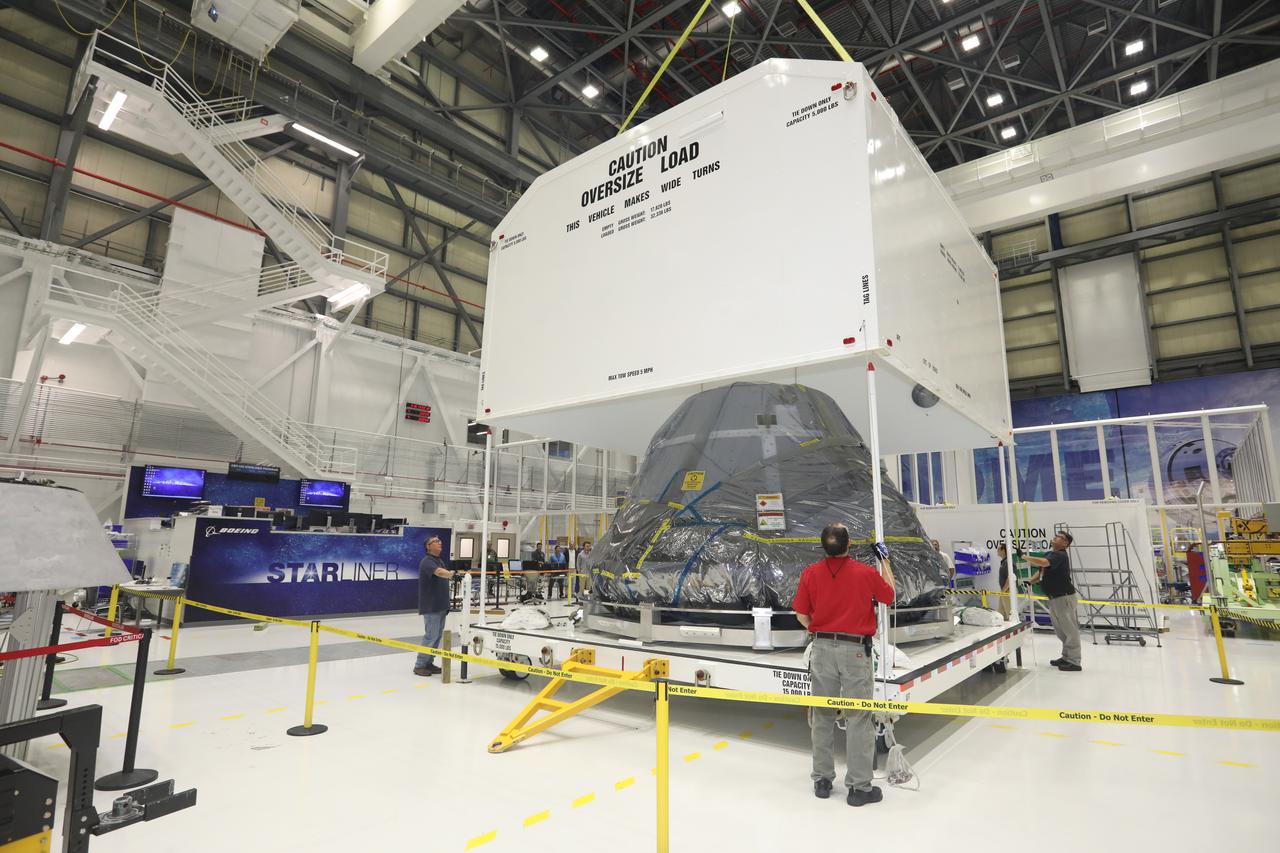
Inside the Commercial Crew and Cargo Processing Facility (C3PF) at NASA's Kennedy Space Center in Florida on Nov. 11, 2018, the spacecraft destined to fly astronauts to the International Space Station in Boeing's Crew Flight Test (CFT) is crated in preparation for transport to the company's testing facilities in El Segundo, California. The company's CST-100 Starliner will be undergoing a series of environmental tests designed to simulate what the spacecraft will experience during different stages of flight as part of NASA's Commercial Crew Program (CCP). The agency's CCP will return human spaceflight launches to U.S. soil, providing safe, reliable and cost-effective access to low-Earth orbit on systems that meet our safety and mission requirements.
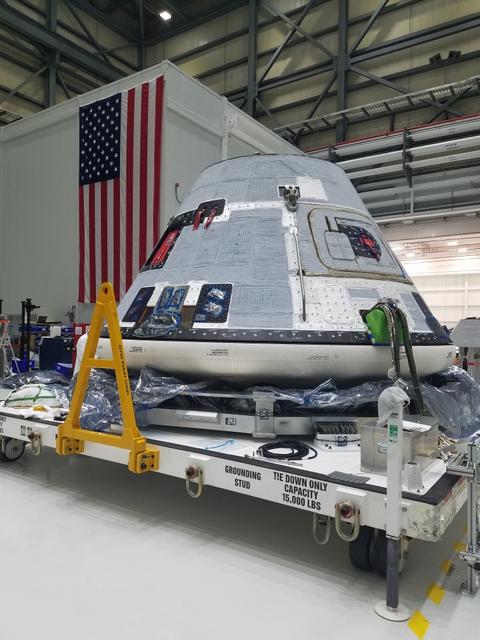
Inside the Commercial Crew and Cargo Processing Facility (C3PF) at NASA's Kennedy Space Center in Florida on Nov. 11, 2018, the spacecraft destined to fly astronauts to the International Space Station in Boeing's Crew Flight Test (CFT) is prepared for transport to the company's testing facilities in El Segundo, California. The company's CST-100 Starliner will be undergoing a series of environmental tests designed to simulate what the spacecraft will experience during different stages of flight as part of NASA's Commercial Crew Program (CCP). The agency's CCP will return human spaceflight launches to U.S. soil, providing safe, reliable and cost-effective access to low-Earth orbit on systems that meet our safety and mission requirements.
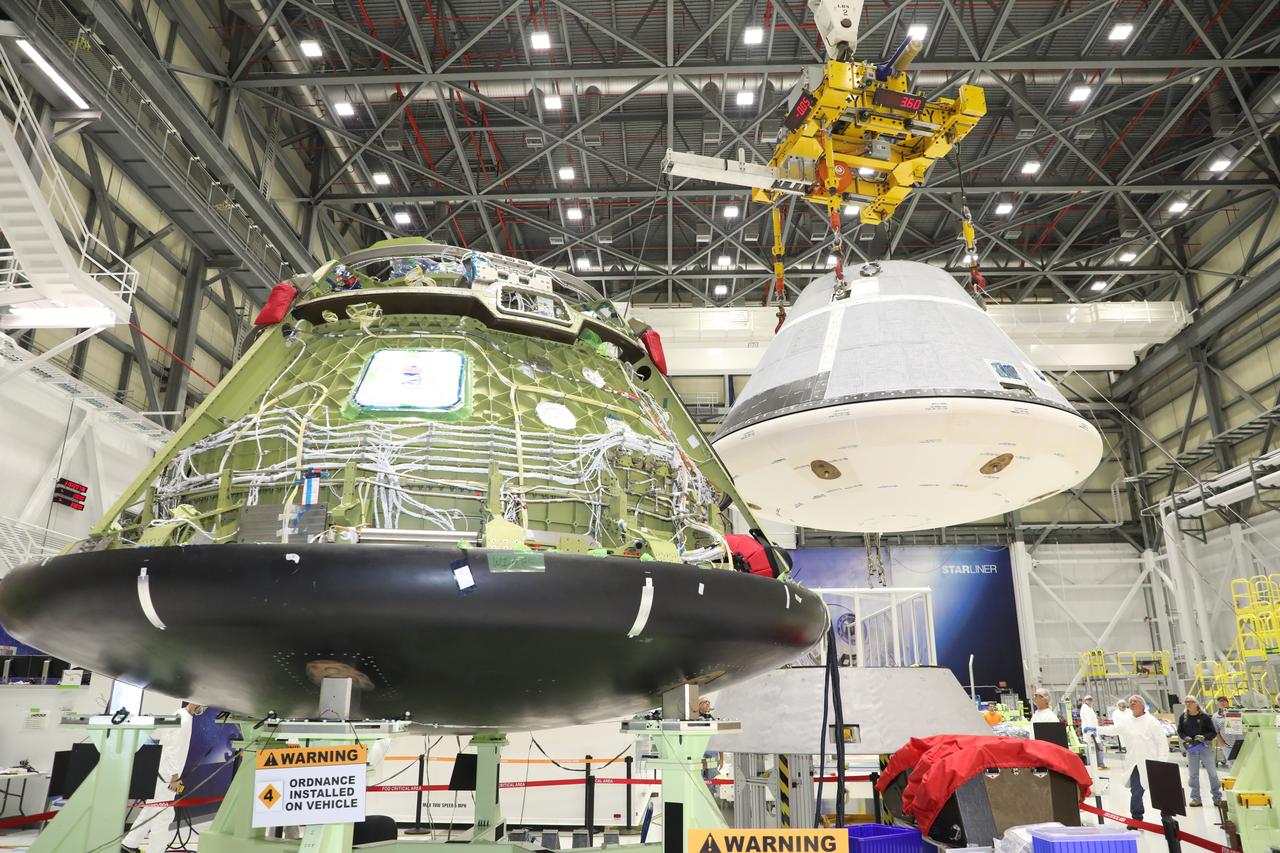
Seen in the foreground inside the Commercial Crew and Cargo Processing Facility (C3PF) at NASA's Kennedy Space Center in Florida on Nov. 11, 2018, the spacecraft destined to fly astronauts to the International Space Station in Boeing's Crew Flight Test (CFT) is prepared for transport to the company's testing facilities in El Segundo, California. The company's CST-100 Starliner will be undergoing a series of environmental tests designed to simulate what the spacecraft will experience during different stages of flight as part of NASA's Commercial Crew Program (CCP). The agency's CCP will return human spaceflight launches to U.S. soil, providing safe, reliable and cost-effective access to low-Earth orbit on systems that meet our safety and mission requirements.
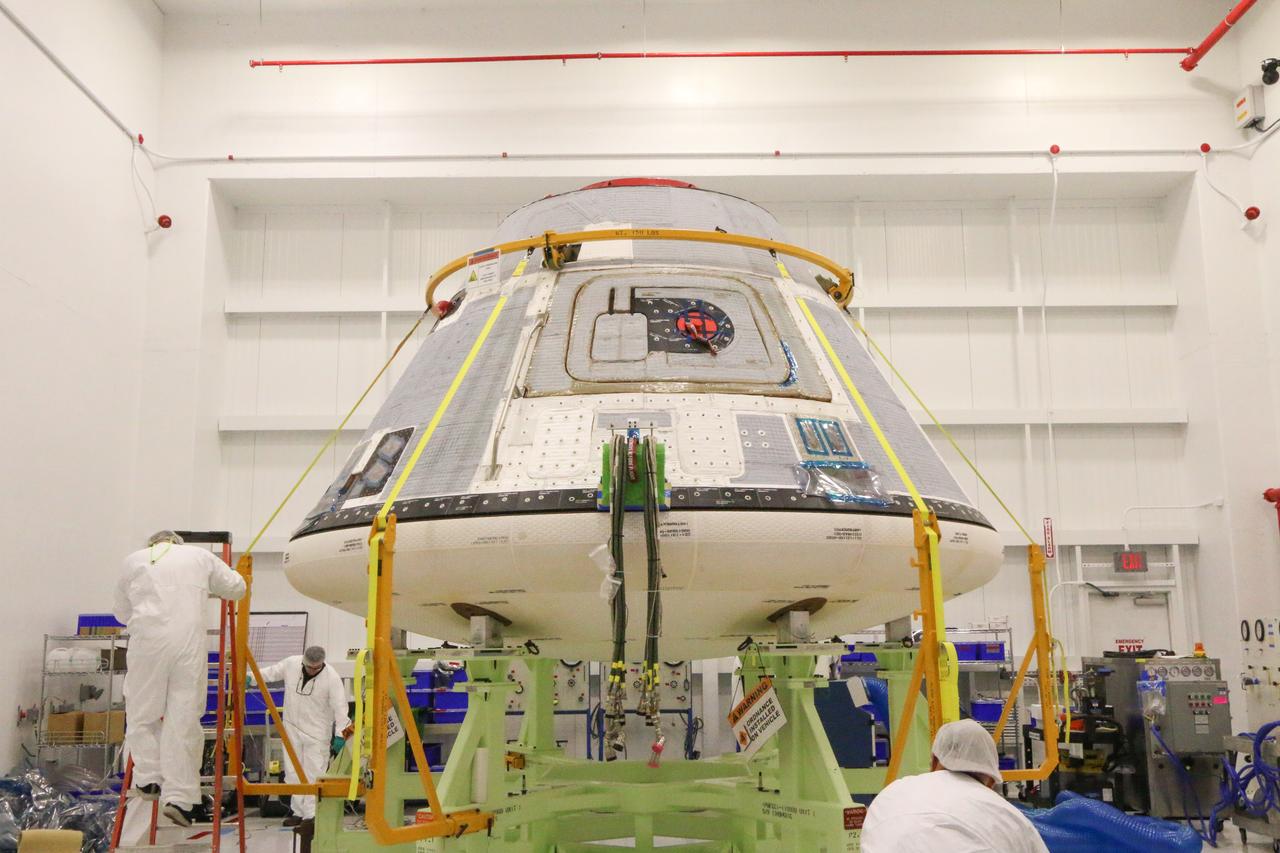
Inside the Commercial Crew and Cargo Processing Facility (C3PF) at NASA's Kennedy Space Center in Florida on Nov. 11, 2018, the spacecraft destined to fly astronauts to the International Space Station in Boeing's Crew Flight Test (CFT) is prepared for transport to the company's testing facilities in El Segundo, California. The company's CST-100 Starliner will be undergoing a series of environmental tests designed to simulate what the spacecraft will experience during different stages of flight as part of NASA's Commercial Crew Program (CCP). The agency's CCP will return human spaceflight launches to U.S. soil, providing safe, reliable and cost-effective access to low-Earth orbit on systems that meet our safety and mission requirements.
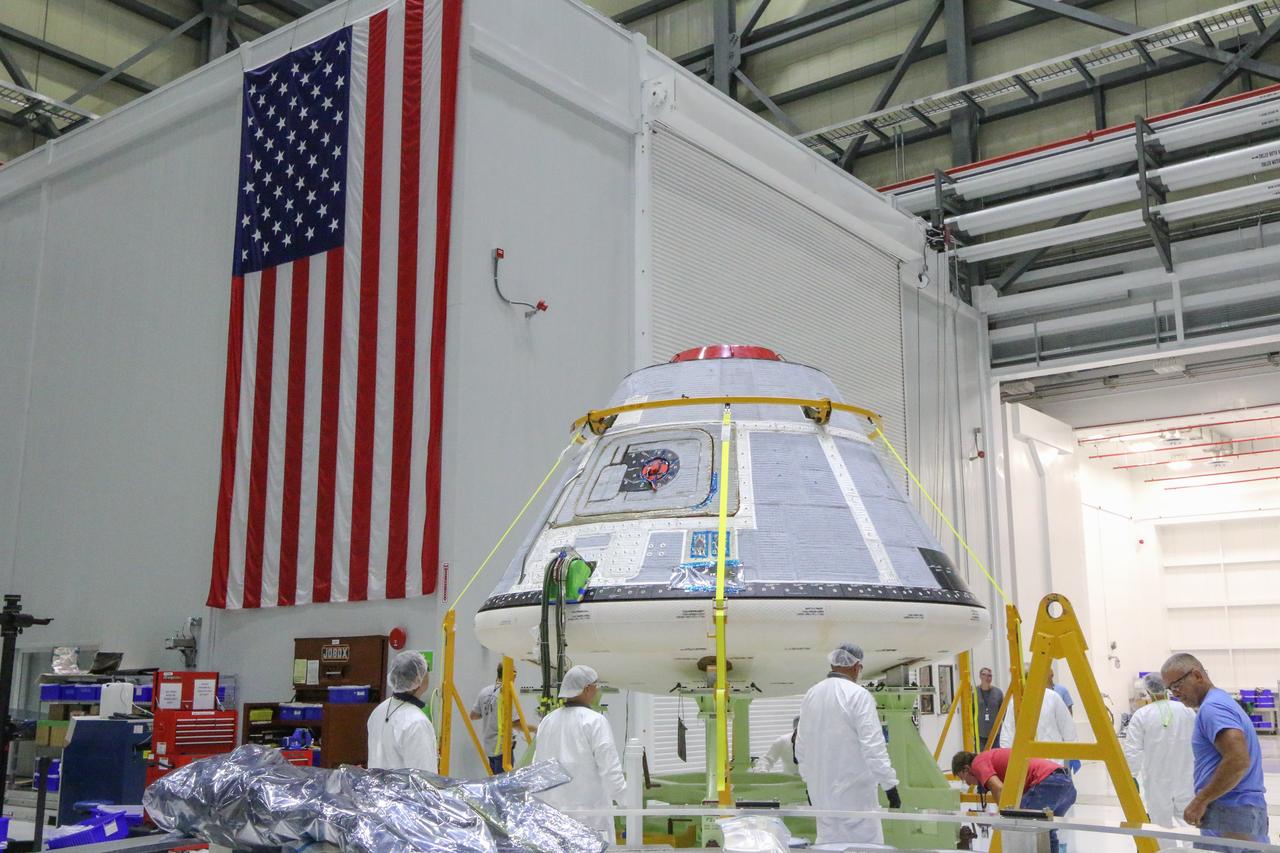
On Nov. 12, 2018, inside the Commercial Crew and Cargo Processing Facility (C3PF) at NASA's Kennedy Space Center in Florida, technicians and engineers prepare the company's CST-100 Starliner for transport to the company's testing facilities in El Segundo, California. The spacecraft is destined to fly astronauts to the International Space Station in Boeing's Crew Flight Test (CFT) as part of NASA's Commercial Crew Program (CCP). The Starliner will be undergoing a series of environmental tests designed to simulate what the spacecraft will experience during different stages of flight. The agency's CCP will return human spaceflight launches to U.S. soil, providing safe, reliable and cost-effective access to low-Earth orbit on systems that meet our safety and mission requirements.
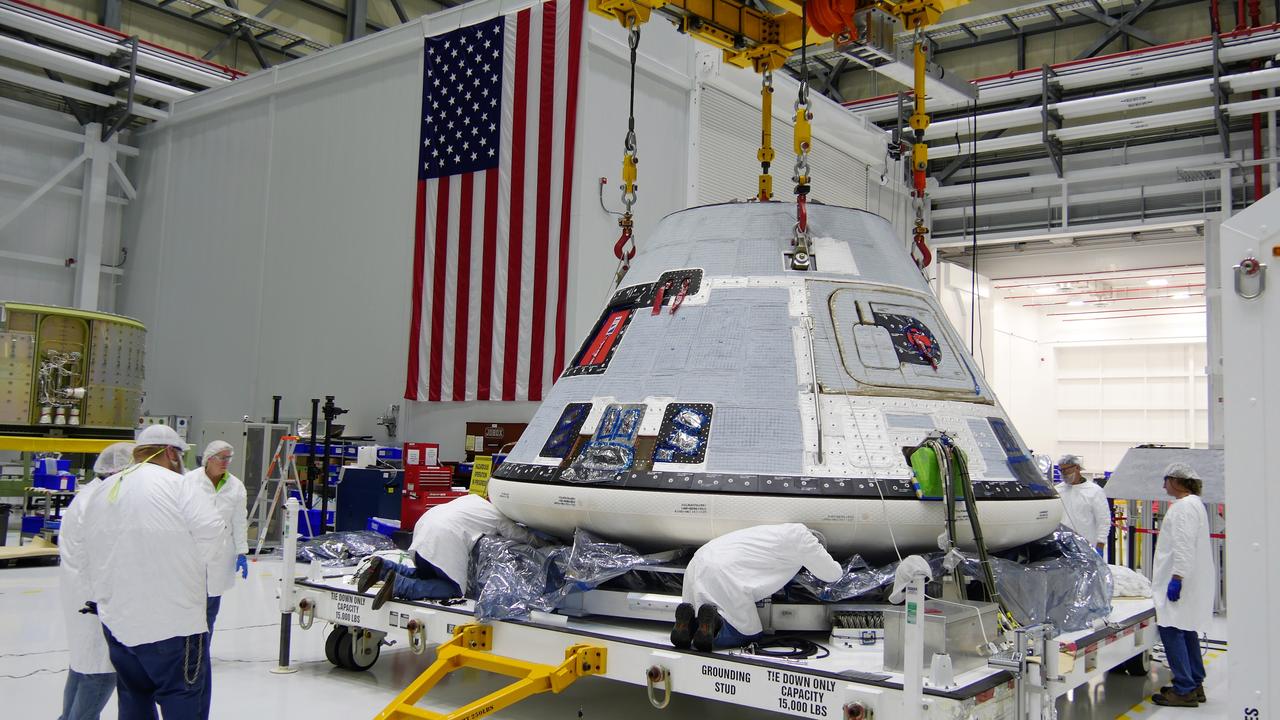
On Nov. 12, 2018, inside the Commercial Crew and Cargo Processing Facility (C3PF) at NASA's Kennedy Space Center in Florida, technicians and engineers prepare Boeing's CST-100 Starliner for transport to the company's testing facilities in El Segundo, California. The spacecraft is destined to fly astronauts to the International Space Station in Boeing's Crew Flight Test (CFT) as part of NASA's Commercial Crew Program (CCP). The Starliner will be undergoing a series of environmental tests designed to simulate what the spacecraft will experience during different stages of flight. The agency's CCP will return human spaceflight launches to U.S. soil, providing safe, reliable and cost-effective access to low-Earth orbit on systems that meet our safety and mission requirements.
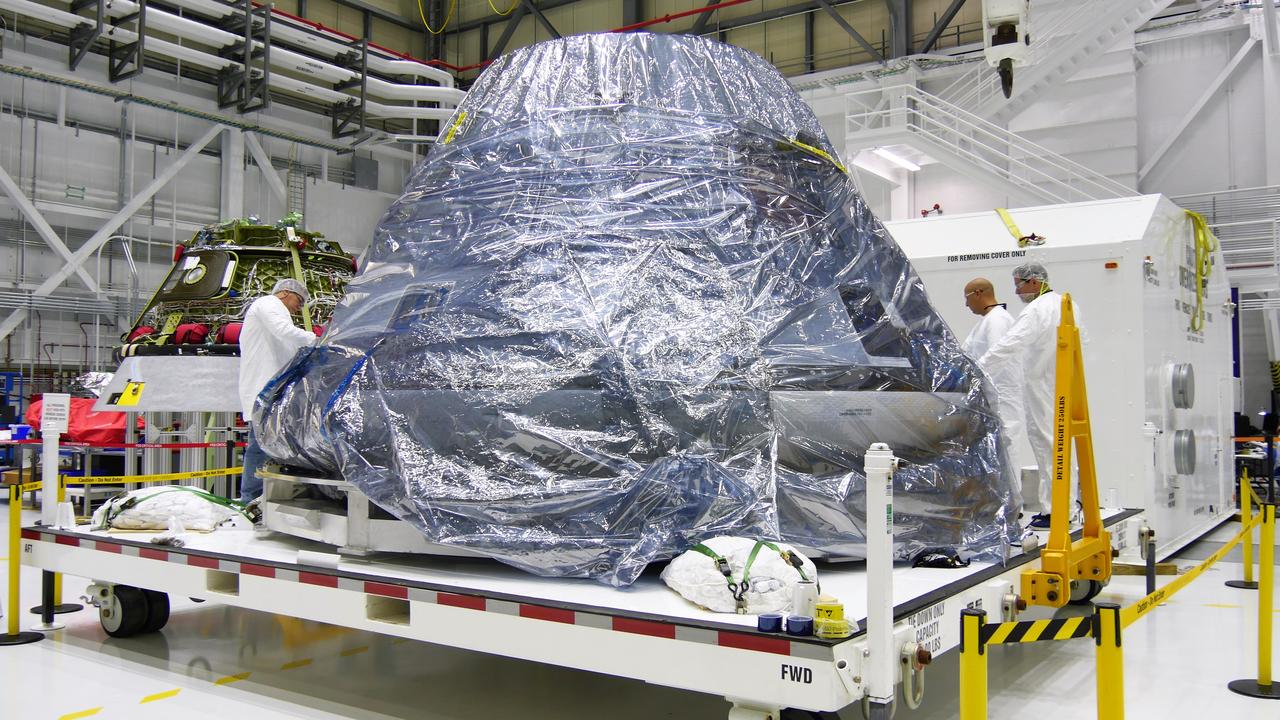
The spacecraft destined to fly astronauts to the International Space Station in Boeing's Crew Flight Test (CFT) is seen Inside the Commercial Crew and Cargo Processing Facility (C3PF) at NASA's Kennedy Space Center in Florida on Nov. 12, 2018. It is surrounded by protective wrapping in preparation for transport to Boeing's testing facilities in El Segundo, California. The company's CST-100 Starliner will be undergoing a series of environmental tests designed to simulate what the spacecraft will experience during different stages of flight as part of NASA's Commercial Crew Program (CCP). The agency's CCP will return human spaceflight launches to U.S. soil, providing safe, reliable and cost-effective access to low-Earth orbit on systems that meet our safety and mission requirements.
On Nov. 12, 2018, inside the Commercial Crew and Cargo Processing Facility (C3PF) at NASA's Kennedy Space Center in Florida, technicians and engineers prepare the company's CST-100 Starliner for transport to the company's testing facilities in El Segundo, California. The spacecraft is destined to fly astronauts to the International Space Station in Boeing's Crew Flight Test (CFT) as part of NASA's Commercial Crew Program (CCP). The Starliner will be undergoing a series of environmental tests designed to simulate what the spacecraft will experience during different stages of flight. The agency's CCP will return human spaceflight launches to U.S. soil, providing safe, reliable and cost-effective access to low-Earth orbit on systems that meet our safety and mission requirements.
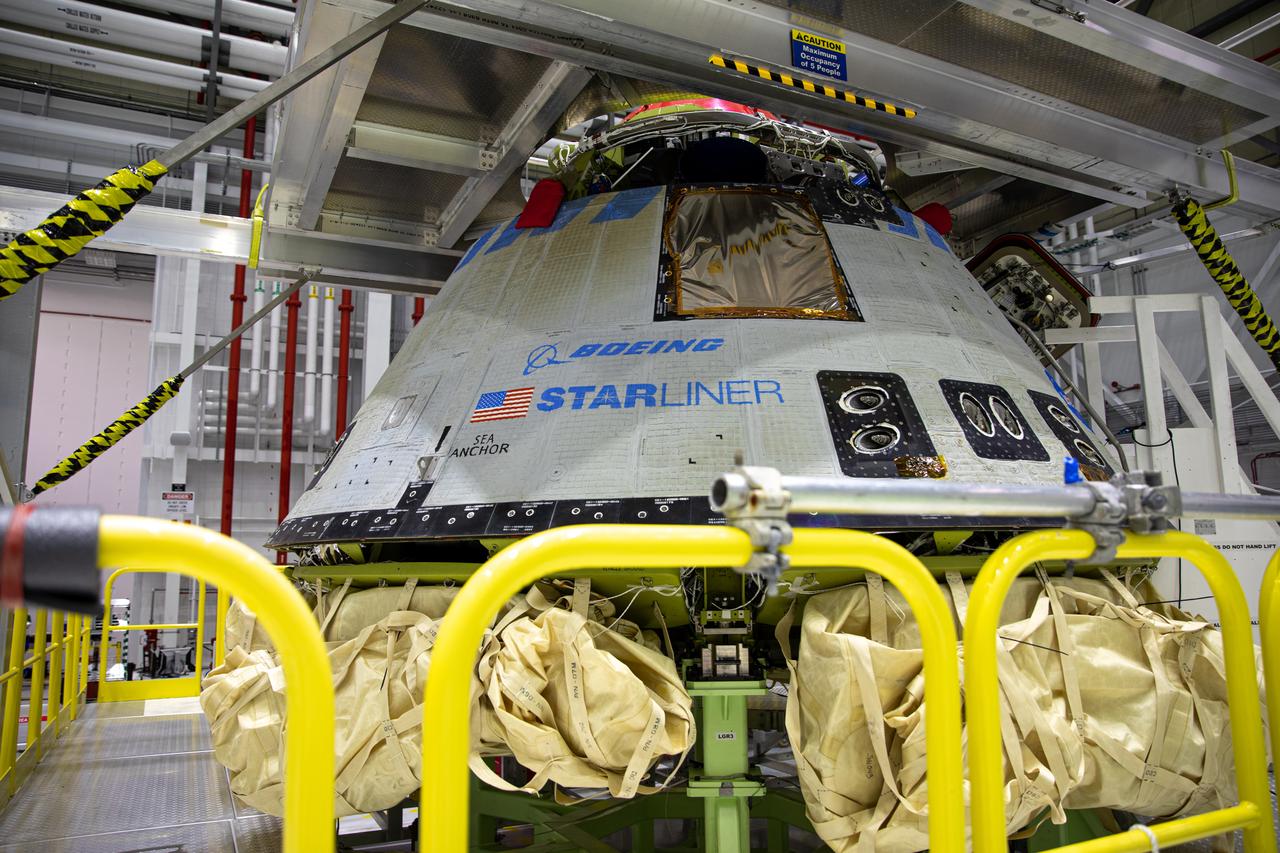
The Boeing CST-100 Starliner spacecraft is back home at the company's Commercial Crew and Cargo Processing Facility, undergoing inspection after its first flight as part of NASA's Commercial Crew Program, known as the Orbital Flight Test. Starliner launched atop a United Launch Alliance Atlas V rocket from Space Launch Complex 41 at Cape Canaveral Air Force Station (CCAFS) in Florida, Friday, Dec. 20, 2019. The mission successfully landed two days later on Sunday, Dec. 22, completing an abbreviated test that performed several mission objectives before returning to Earth as the first orbital land touchdown of a human-rated capsule in U.S. history.
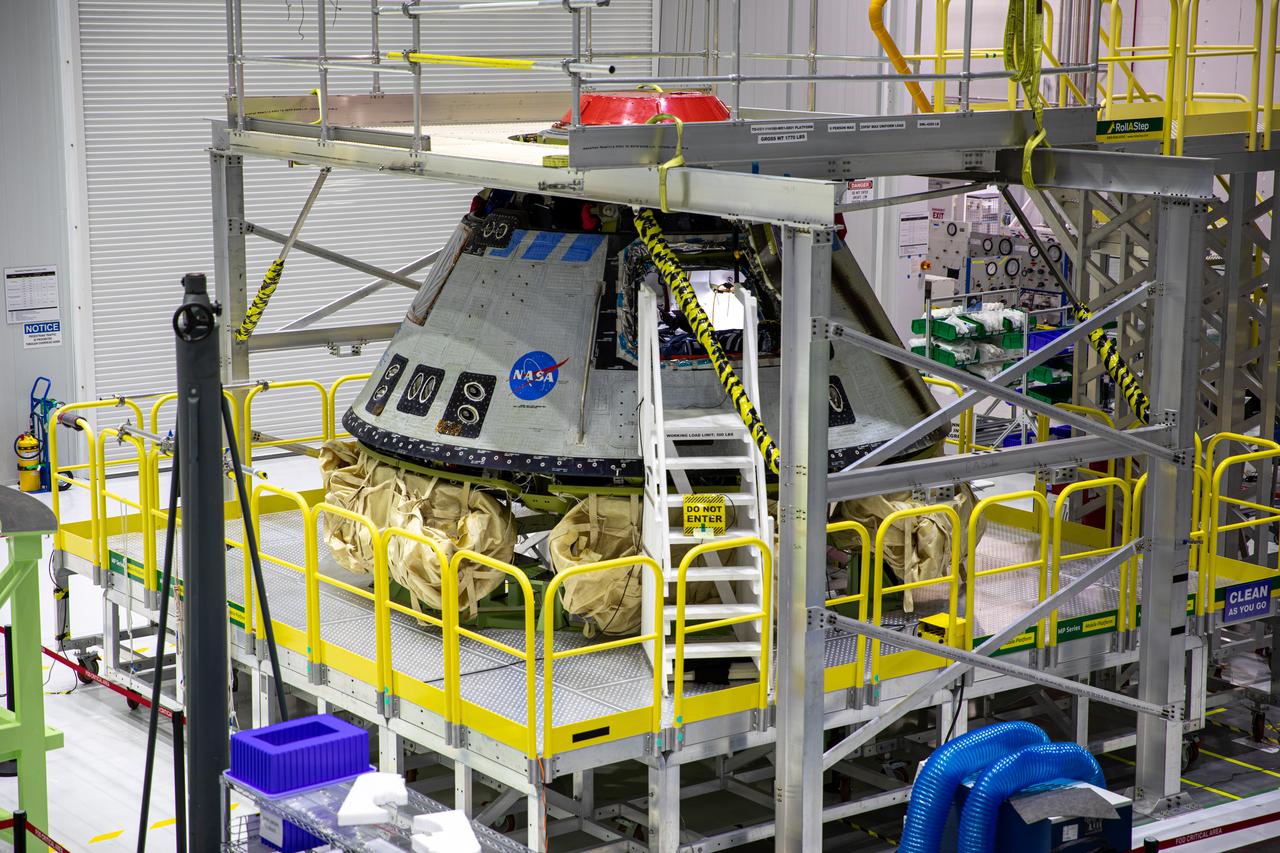
The Boeing CST-100 Starliner spacecraft is back home at the company's Commercial Crew and Cargo Processing Facility, undergoing inspection after its first flight as part of NASA's Commercial Crew Program, known as the Orbital Flight Test. Starliner launched atop a United Launch Alliance Atlas V rocket from Space Launch Complex 41 at Cape Canaveral Air Force Station (CCAFS) in Florida, Friday, Dec. 20, 2019. The mission successfully landed two days later on Sunday, Dec. 22, completing an abbreviated test that performed several mission objectives before returning to Earth as the first orbital land touchdown of a human-rated capsule in U.S. history.
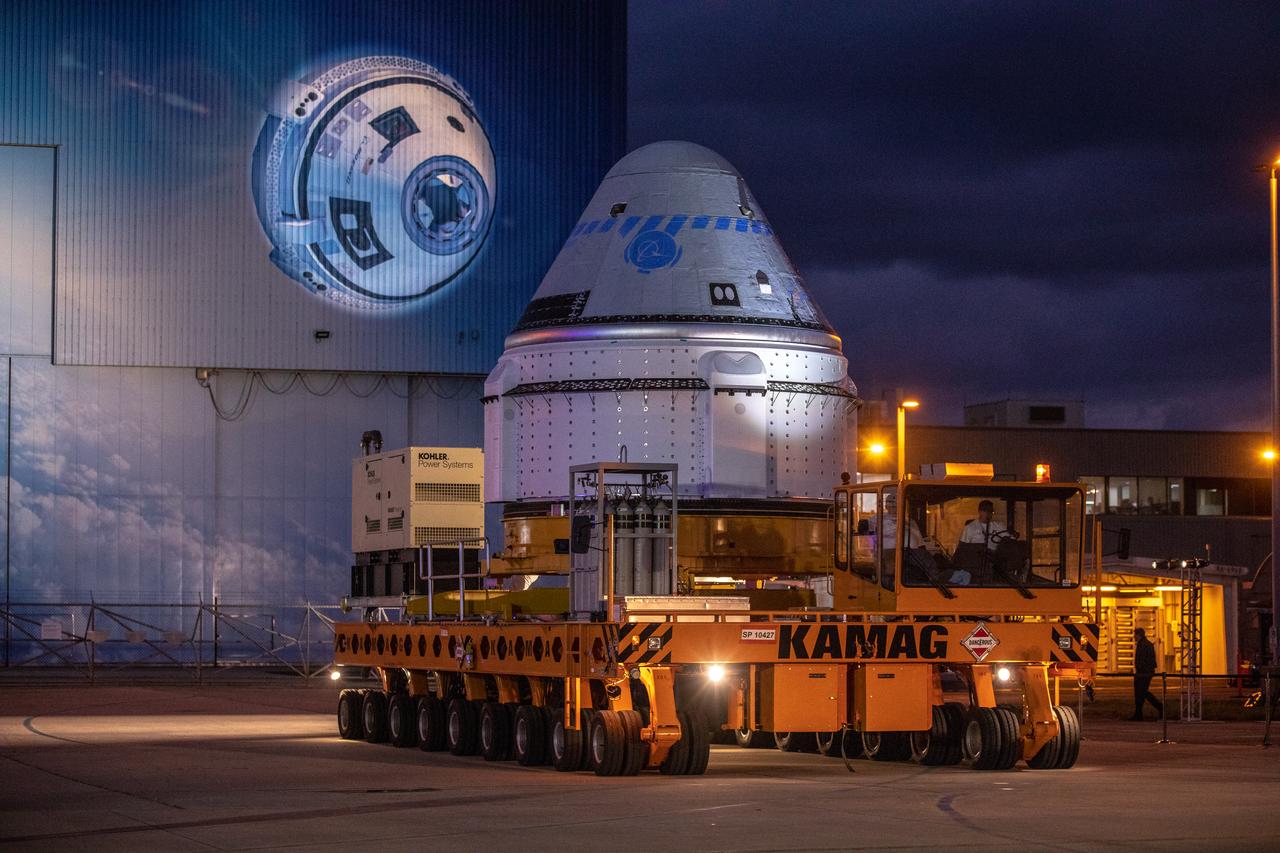
The Boeing CST-100 Starliner spacecraft rolls out from the company’s Commercial Crew and Cargo Processing Facility at NASA’s Kennedy Space Center in Florida on Nov. 21, 2019. The spacecraft will make the trip to Space Launch Complex 41 at Cape Canaveral Air Force Station where it will be secured atop a United Launch Alliance Atlas V rocket for Boeing’s Orbital Flight Test to the International Space Station for NASA’s Commercial Crew Program.
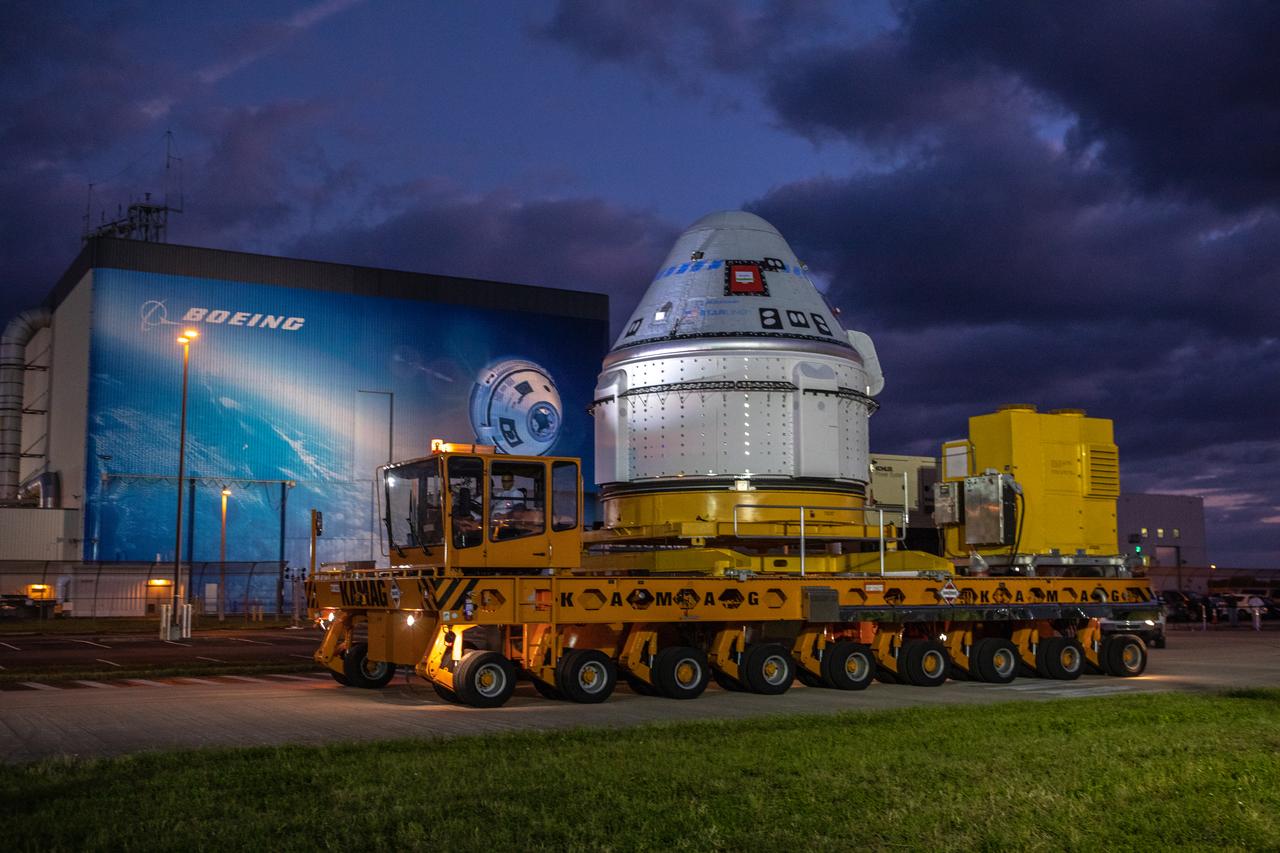
The Boeing CST-100 Starliner spacecraft rolls out from the company’s Commercial Crew and Cargo Processing Facility at NASA’s Kennedy Space Center in Florida on Nov. 21, 2019. The spacecraft will make the trip to Space Launch Complex 41 at Cape Canaveral Air Force Station where it will be secured atop a United Launch Alliance Atlas V rocket for Boeing’s Orbital Flight Test to the International Space Station for NASA’s Commercial Crew Program.
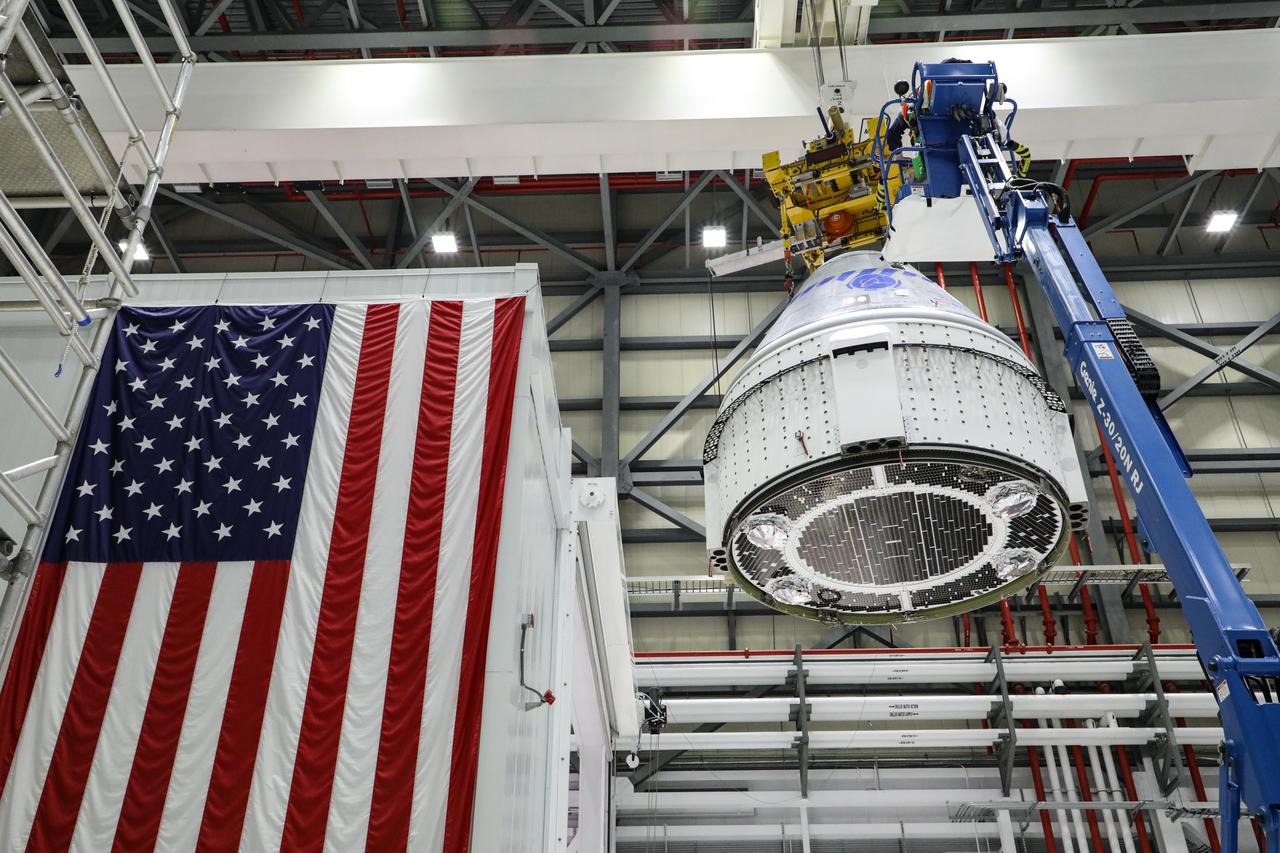
On July 13, 2021, inside the Commercial Crew and Cargo Processing Facility at Kennedy Space Center in Florida, Boeing’s CST-100 Starliner spacecraft moved from Hazardous Processing Area to the Weight and Center of Gravity machine and then transferred to the KMAG. The operations are in preparation for the company’s second Orbital Flight Test (OFT-2), as part of NASA’s Commercial Crew Program.
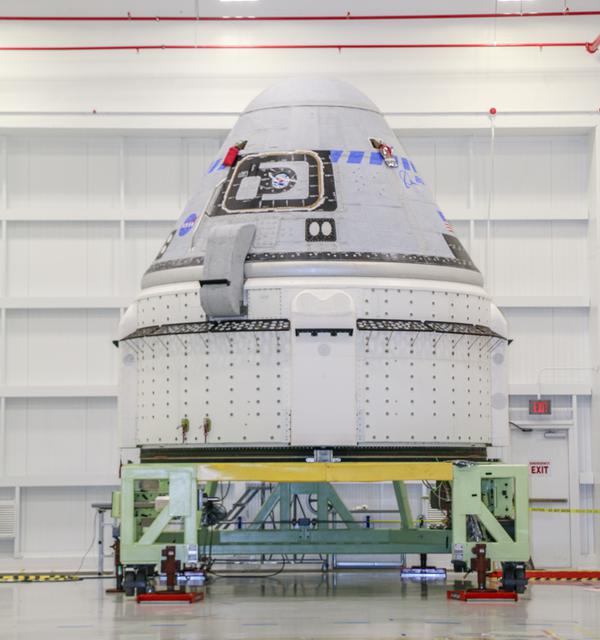
The Boeing CST-100 Starliner spacecraft to be flown on Orbital Flight Test-2 (OFT-2) is seen in the Commercial Crew and Cargo Processing Facility at NASA’s Kennedy Space Center in Florida on July 12, 2021. Part of the agency’s Commercial Crew Program, OFT-2 is a critical developmental milestone on the company’s path to fly crew missions for NASA.
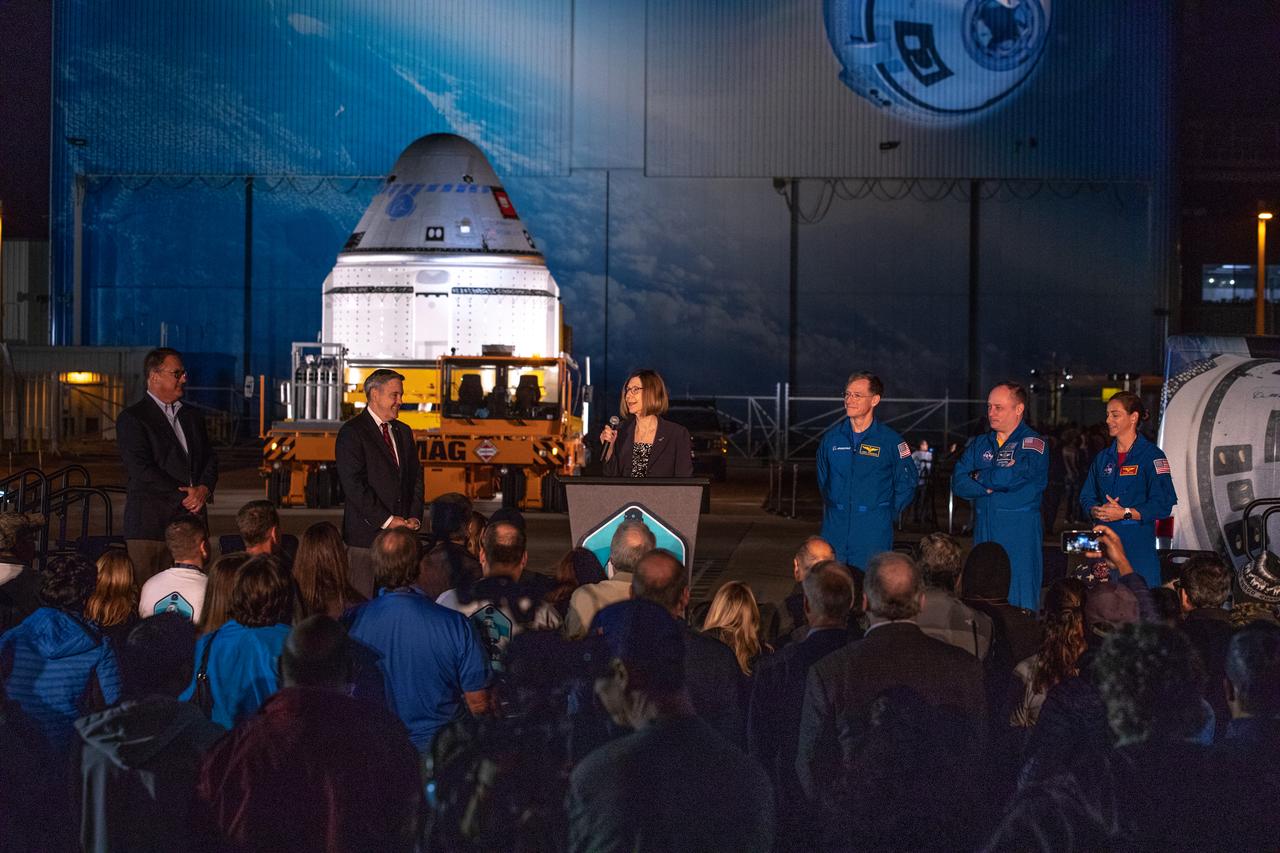
Kathy Lueders, program manager, NASA’s Commercial Crew Program, speaks during the Boeing CST-100 Starliner spacecraft rollout from the company’s Commercial Crew and Cargo Processing Facility at Kennedy Space Center in Florida on Nov. 21, 2019. Starliner will make the trip to Space Launch Complex 41 at Cape Canaveral Air Force Station where it will be secured atop a United Launch Alliance Atlas V rocket for Boeing’s Orbital Flight Test to the International Space Station for NASA’s Commercial Crew Program.
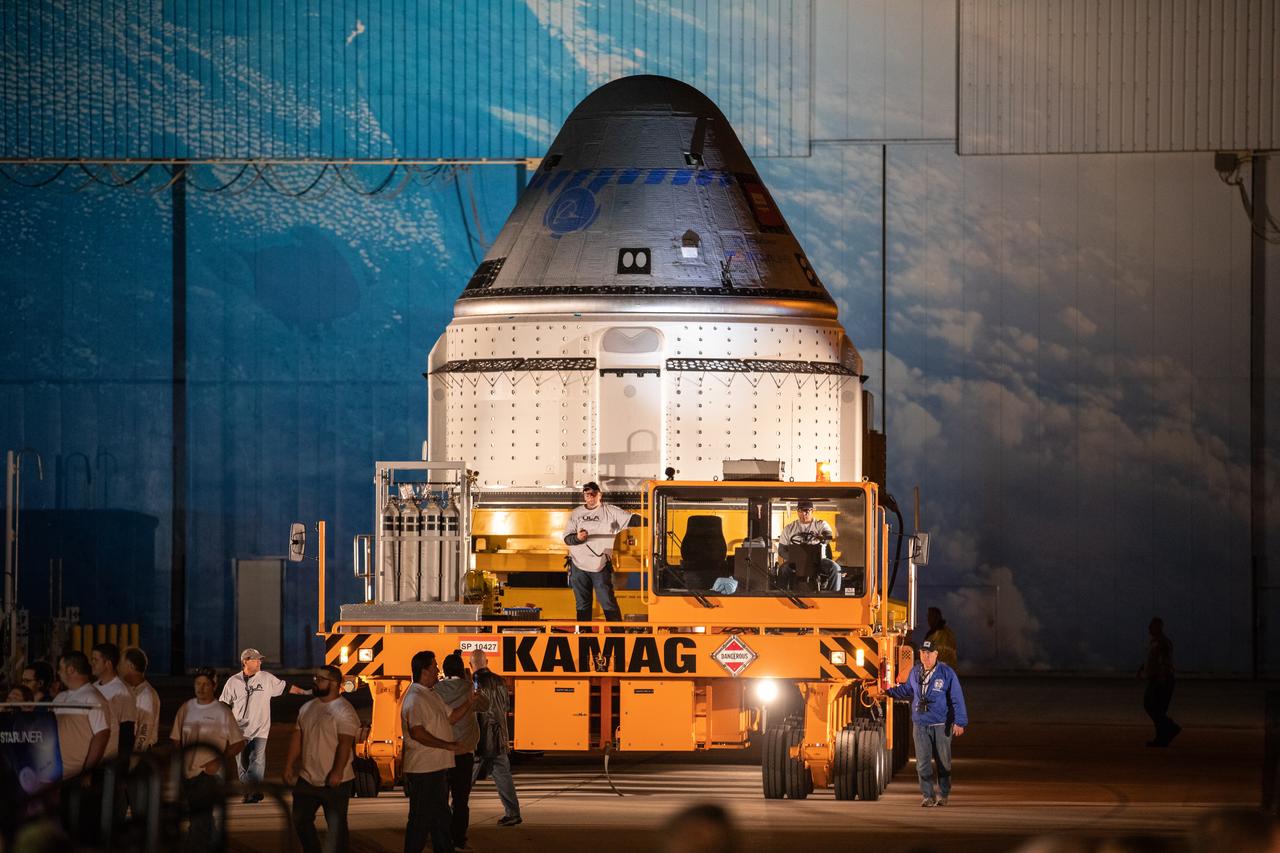
The Boeing CST-100 Starliner spacecraft rolls out from the company’s Commercial Crew and Cargo Processing Facility at NASA’s Kennedy Space Center in Florida on Nov. 21, 2019. The spacecraft will make the trip to Space Launch Complex 41 at Cape Canaveral Air Force Station where it will be secured atop a United Launch Alliance Atlas V rocket for Boeing’s Orbital Flight Test to the International Space Station for NASA’s Commercial Crew Program.
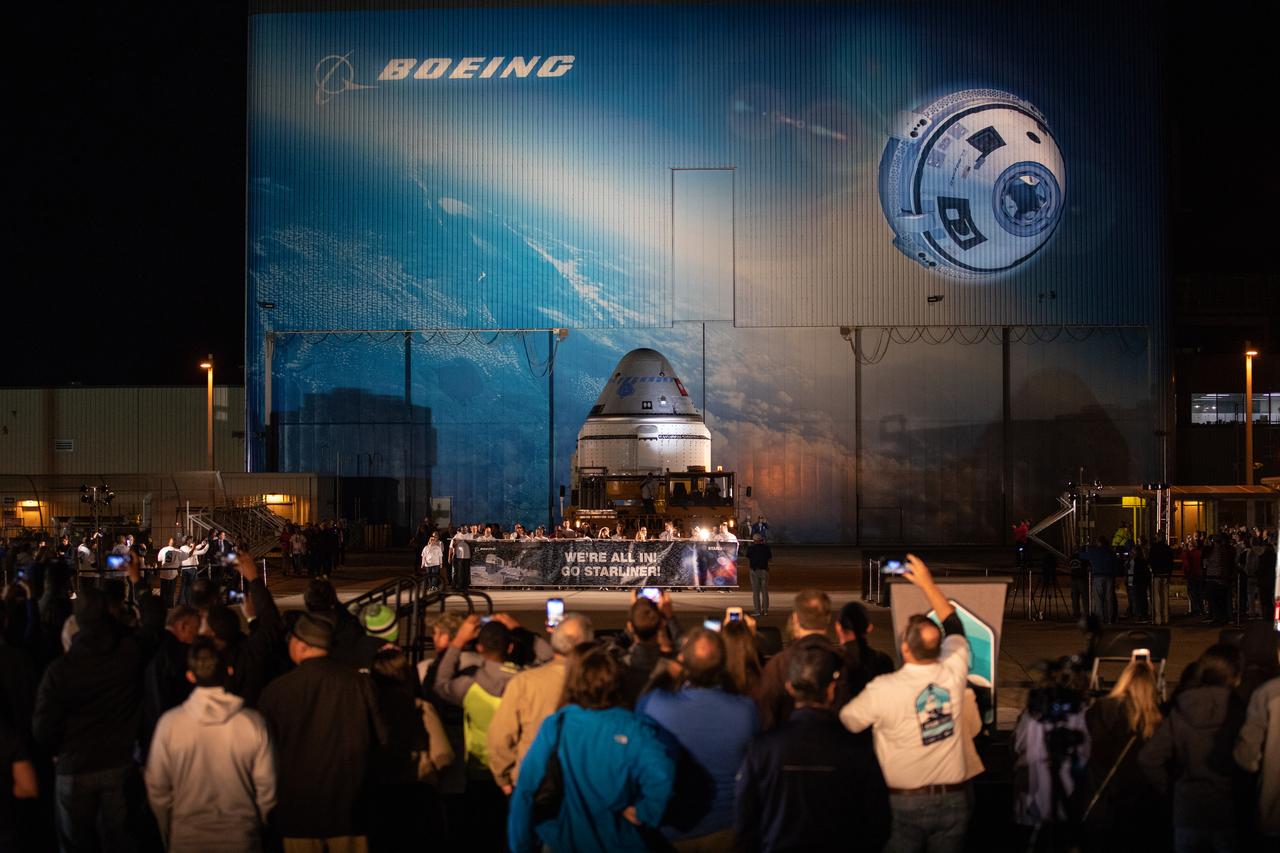
The Boeing CST-100 Starliner spacecraft rolls out from the company’s Commercial Crew and Cargo Processing Facility at NASA’s Kennedy Space Center in Florida on Nov. 21, 2019. The spacecraft will make the trip to Space Launch Complex 41 at Cape Canaveral Air Force Station where it will be secured atop a United Launch Alliance Atlas V rocket for Boeing’s Orbital Flight Test to the International Space Station for NASA’s Commercial Crew Program.
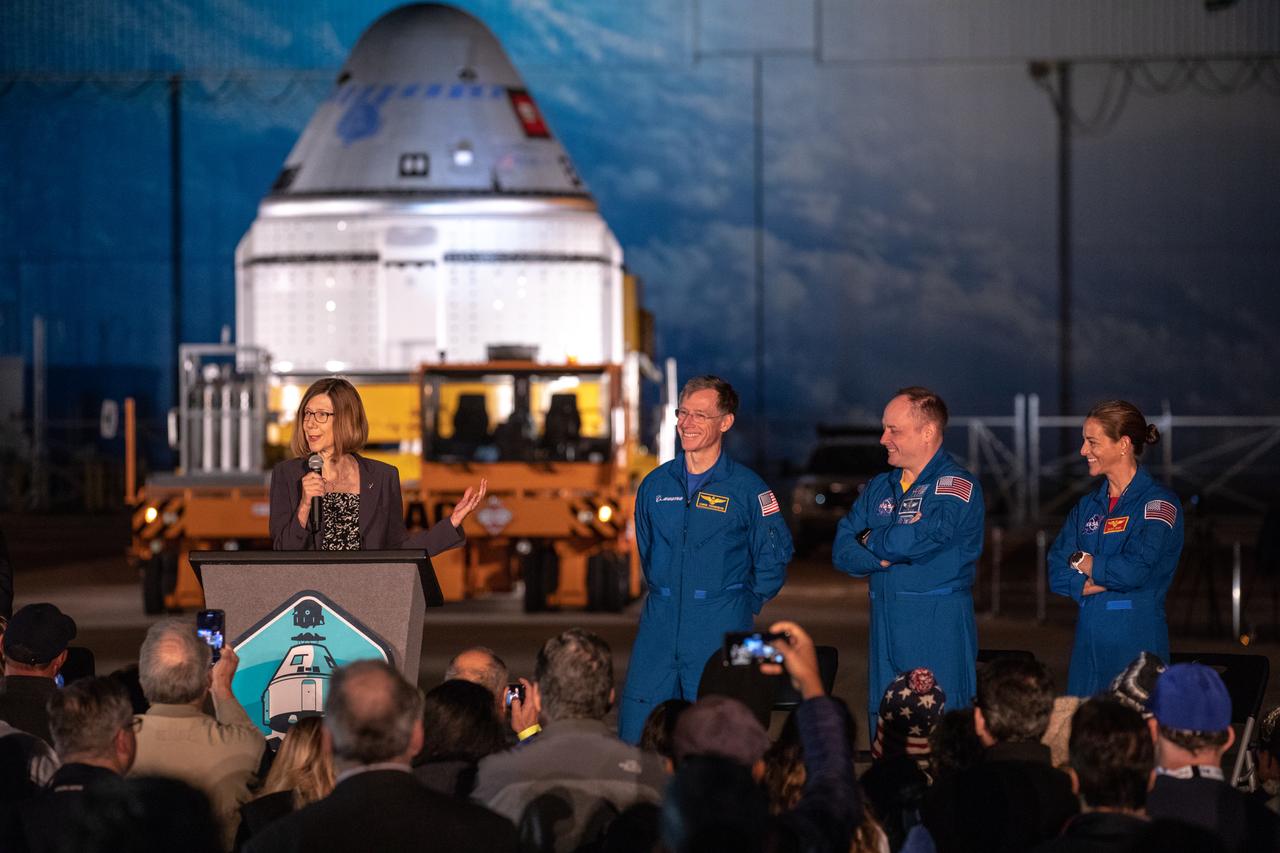
Kathy Lueders, program manager, NASA’s Commercial Crew Program, speaks during the Boeing CST-100 Starliner spacecraft rollout from the company’s Commercial Crew and Cargo Processing Facility at Kennedy Space Center in Florida on Nov. 21, 2019. To her left (from left to right) are Boeing astronaut Chris Ferguson and NASA astronauts Mike Fincke and Nicole Mann. Starliner will make the trip to Space Launch Complex 41 at Cape Canaveral Air Force Station where it will be secured atop a United Launch Alliance Atlas V rocket for Boeing’s Orbital Flight Test to the International Space Station for NASA’s Commercial Crew Program.
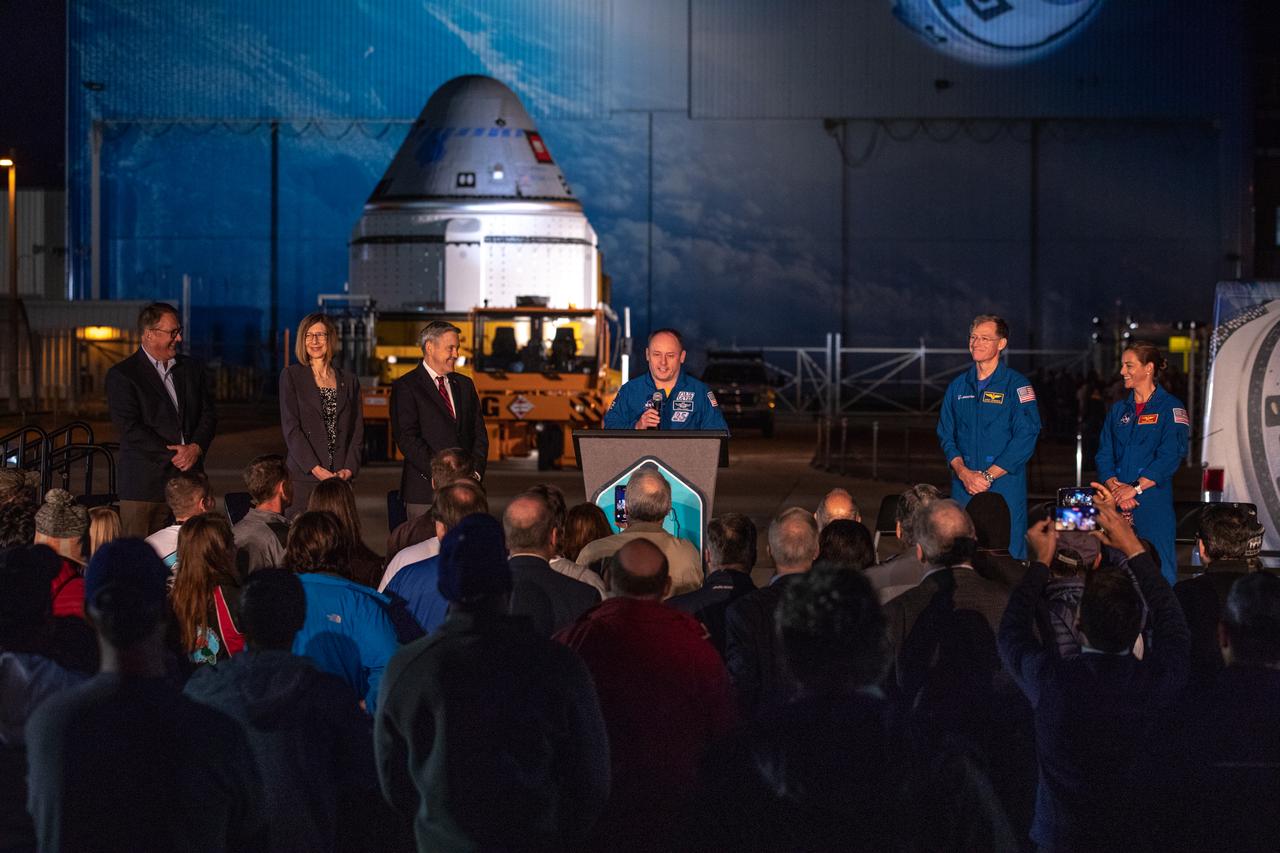
NASA astronaut Mike Fincke speaks during the Boeing CST-100 Starliner spacecraft rollout from the company’s Commercial Crew and Cargo Processing Facility at Kennedy Space Center in Florida on Nov. 21, 2019. To his left are Boeing astronaut Chris Ferguson and NASA astronaut Nicole Mann. To Fincke’s right (from left to right) are John Mulholland, Boeing vice president and program manager, Commercial Crew Program; NASA’s Commercial Crew Program Manager Kathy Lueders and Kennedy Space Center Director Bob Cabana. Starliner will make the trip to Space Launch Complex 41 at Cape Canaveral Air Force Station where it will be secured atop a United Launch Alliance Atlas V rocket for Boeing’s Orbital Flight Test to the International Space Station for NASA’s Commercial Crew Program.
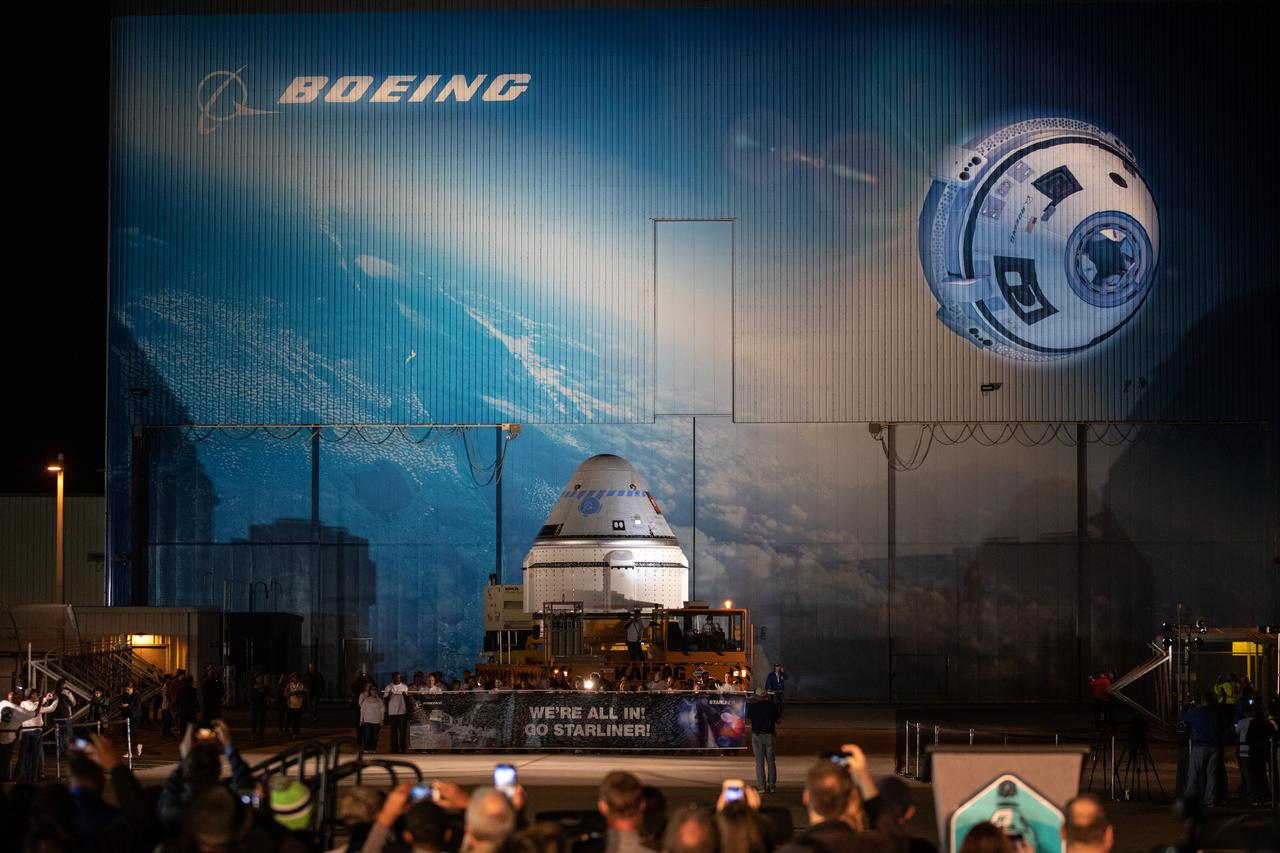
The Boeing CST-100 Starliner spacecraft rolls out from the company’s Commercial Crew and Cargo Processing Facility at NASA’s Kennedy Space Center in Florida on Nov. 21, 2019. The spacecraft will make the trip to Space Launch Complex 41 at Cape Canaveral Air Force Station where it will be secured atop a United Launch Alliance Atlas V rocket for Boeing’s Orbital Flight Test to the International Space Station for NASA’s Commercial Crew Program.
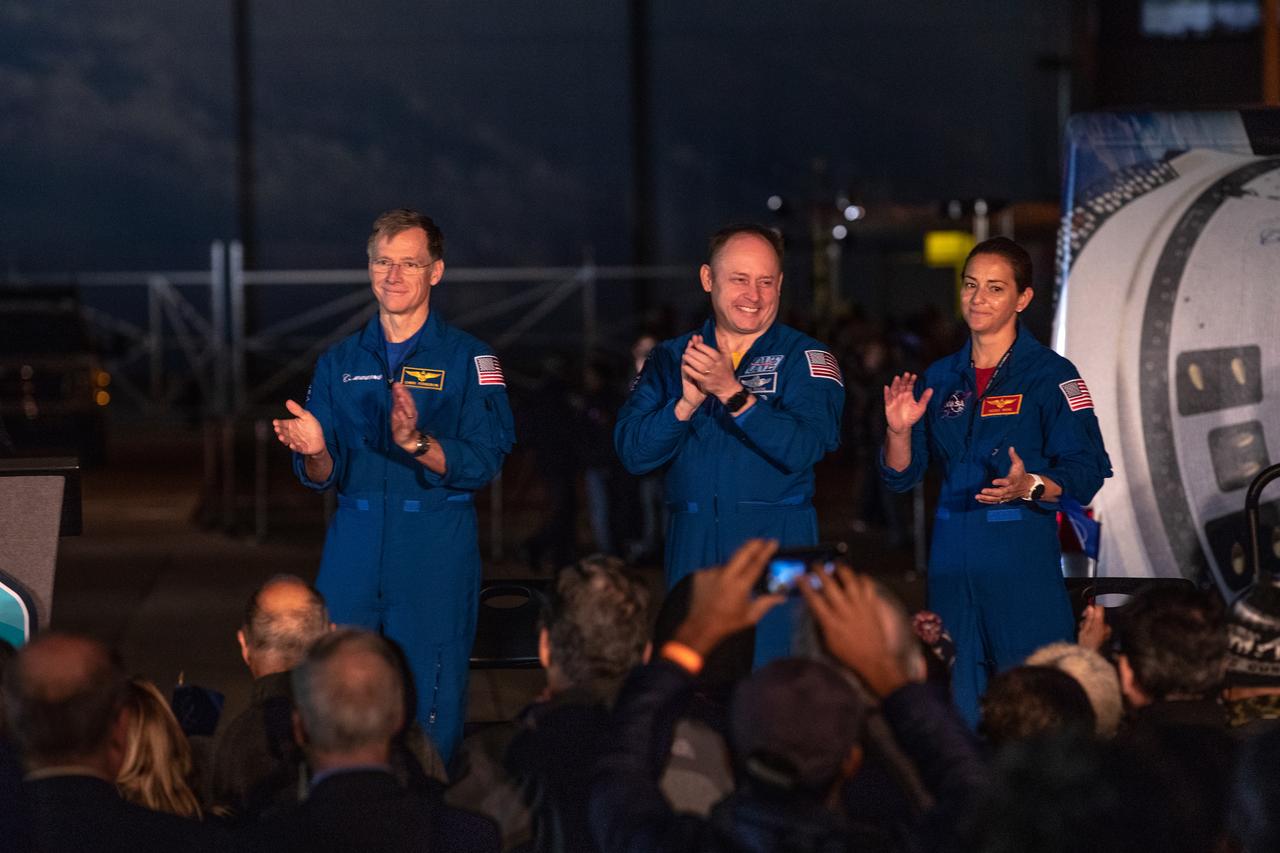
From left to right: Boeing astronaut Chris Ferguson and NASA astronauts Mike Fincke and Nicole Mann applaud during the Boeing CST-100 Starliner spacecraft rollout from the company’s Commercial Crew and Cargo Processing Facility at Kennedy Space Center in Florida on Nov. 21, 2019. Starliner will make the trip to Space Launch Complex 41 at Cape Canaveral Air Force Station where it will be secured atop a United Launch Alliance Atlas V rocket for Boeing’s Orbital Flight Test to the International Space Station for NASA’s Commercial Crew Program.
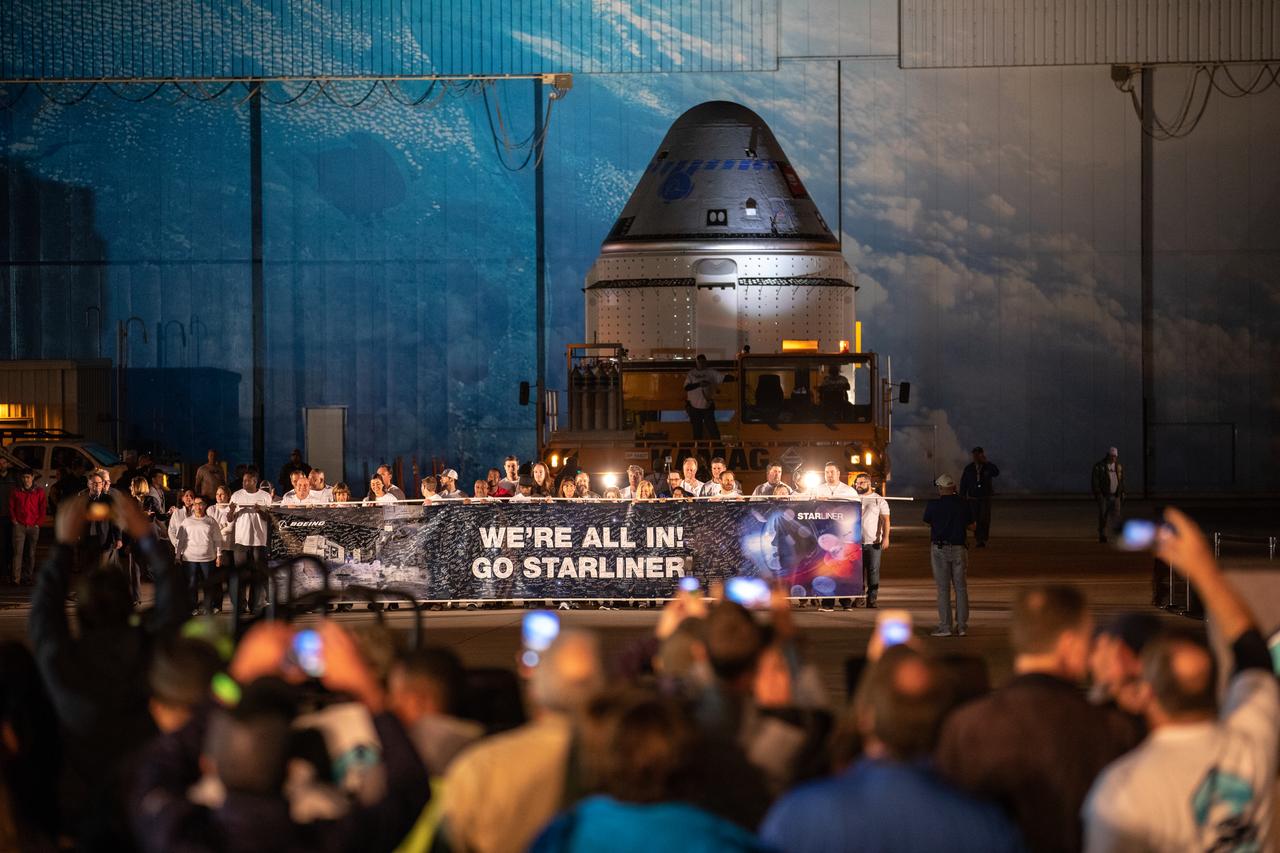
The Boeing CST-100 Starliner spacecraft rolls out from the company’s Commercial Crew and Cargo Processing Facility at NASA’s Kennedy Space Center in Florida on Nov. 21, 2019. The spacecraft will make the trip to Space Launch Complex 41 at Cape Canaveral Air Force Station where it will be secured atop a United Launch Alliance Atlas V rocket for Boeing’s Orbital Flight Test to the International Space Station for NASA’s Commercial Crew Program.
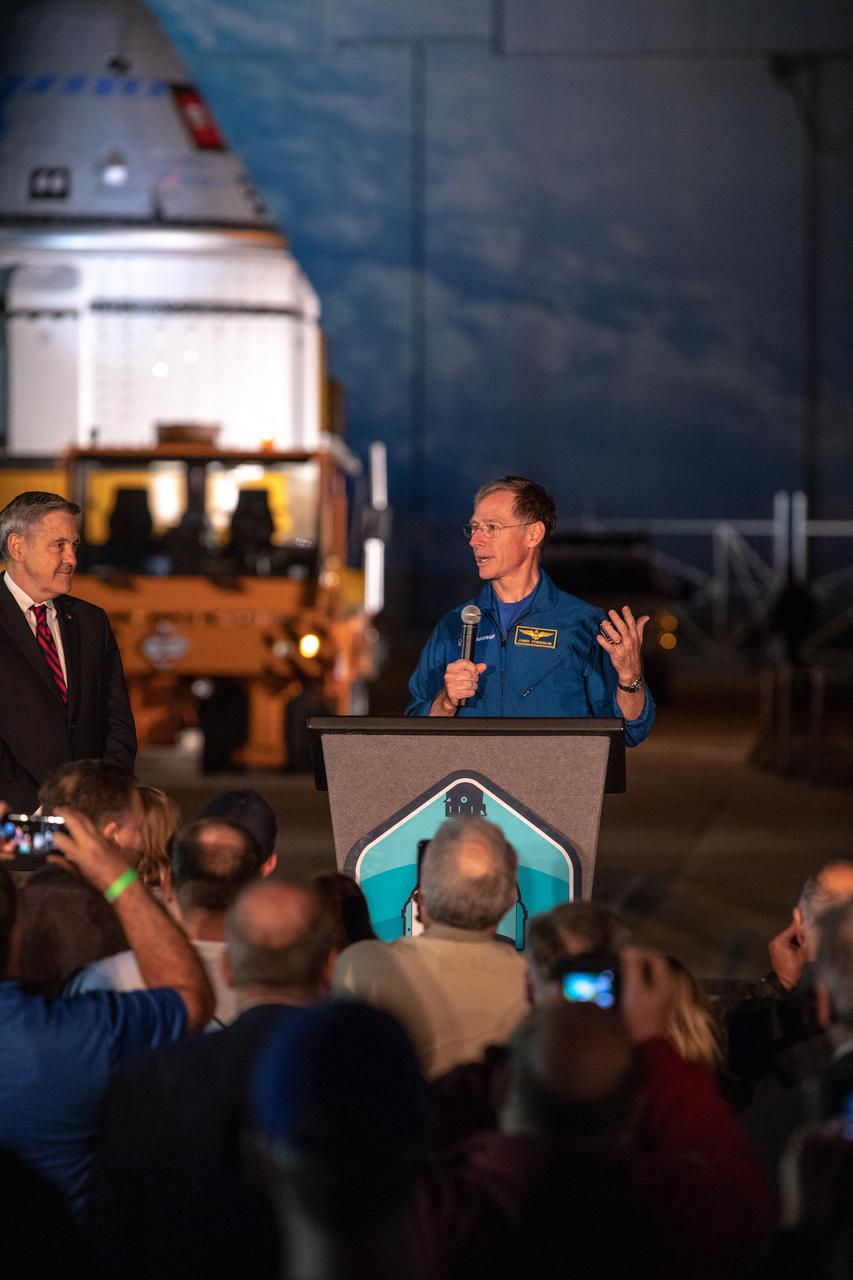
Boeing astronaut Chris Ferguson speaks during the Boeing CST-100 Starliner spacecraft rollout from the company’s Commercial Crew and Cargo Processing Facility at Kennedy Space Center in Florida on Nov. 21, 2019. To his right is Kennedy Space Center Director Bob Cabana. Starliner will make the trip to Space Launch Complex 41 at Cape Canaveral Air Force Station where it will be secured atop a United Launch Alliance Atlas V rocket for Boeing’s Orbital Flight Test to the International Space Station for NASA’s Commercial Crew Program.
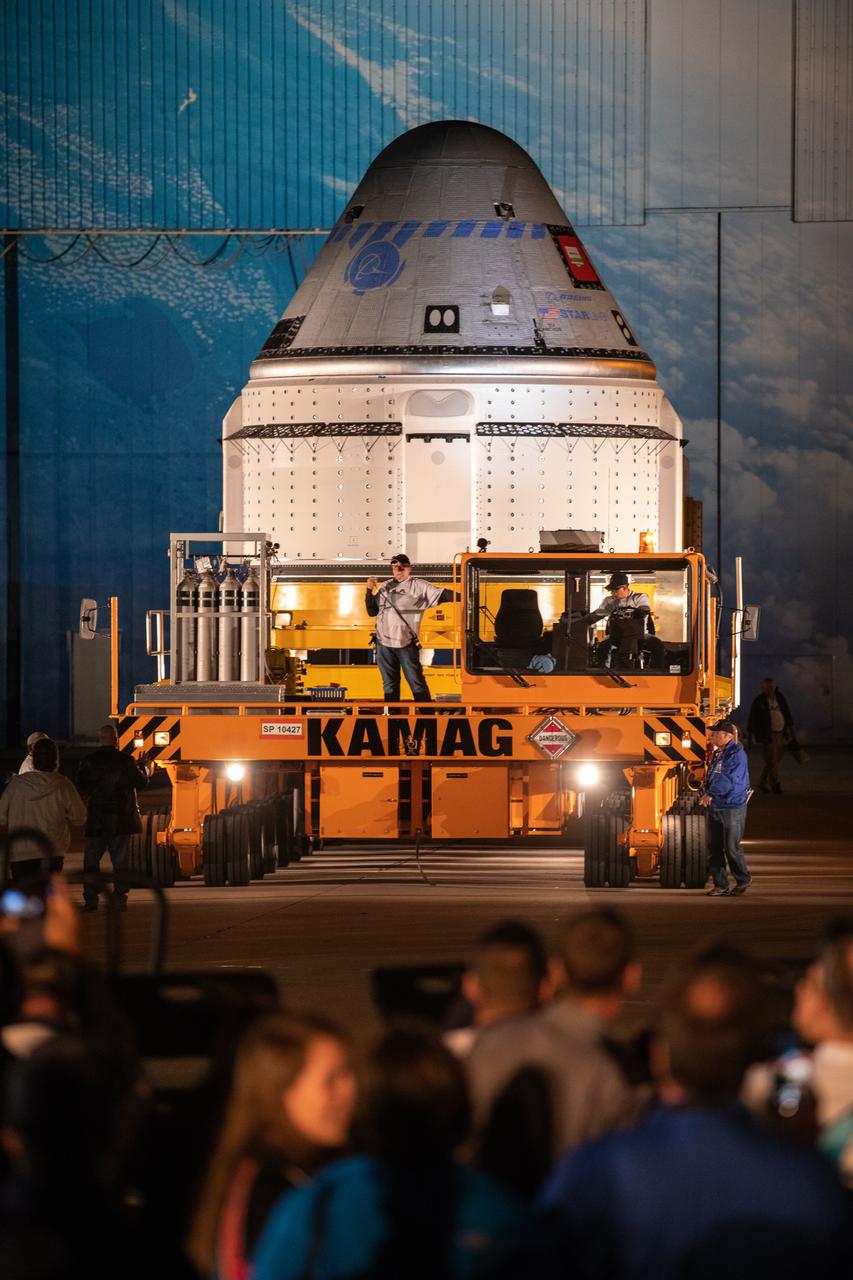
The Boeing CST-100 Starliner spacecraft rolls out from the company’s Commercial Crew and Cargo Processing Facility at NASA’s Kennedy Space Center in Florida on Nov. 21, 2019. The spacecraft will make the trip to Space Launch Complex 41 at Cape Canaveral Air Force Station where it will be secured atop a United Launch Alliance Atlas V rocket for Boeing’s Orbital Flight Test to the International Space Station for NASA’s Commercial Crew Program.
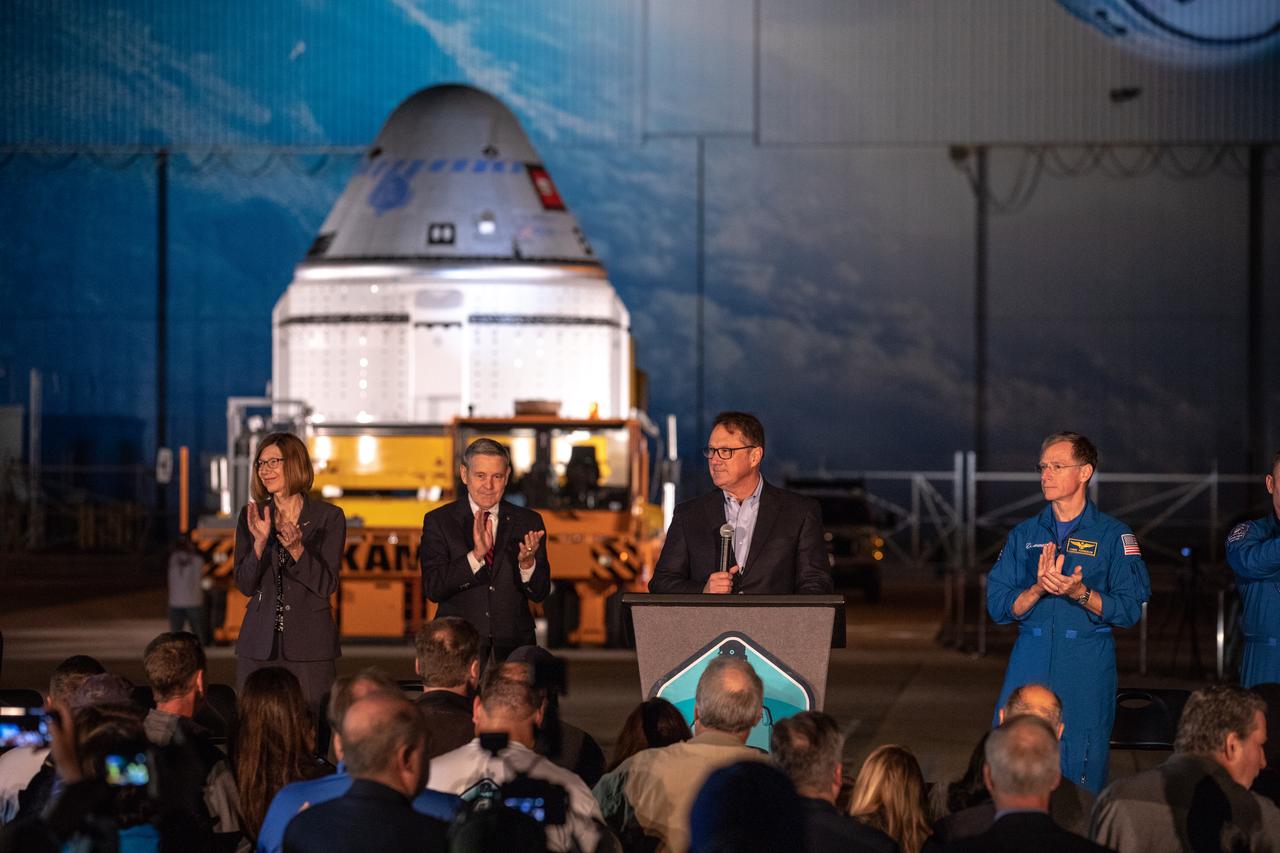
John Mulholland, Boeing vice president and program manager, Commercial Crew Program, speaks during the Boeing CST-100 Starliner spacecraft rollout from the company’s Commercial Crew and Cargo Processing Facility at Kennedy Space Center in Florida on Nov. 21, 2019. Starliner will make the trip to Space Launch Complex 41 at Cape Canaveral Air Force Station where it will be secured atop a United Launch Alliance Atlas V rocket for Boeing’s Orbital Flight Test to the International Space Station for NASA’s Commercial Crew Program.
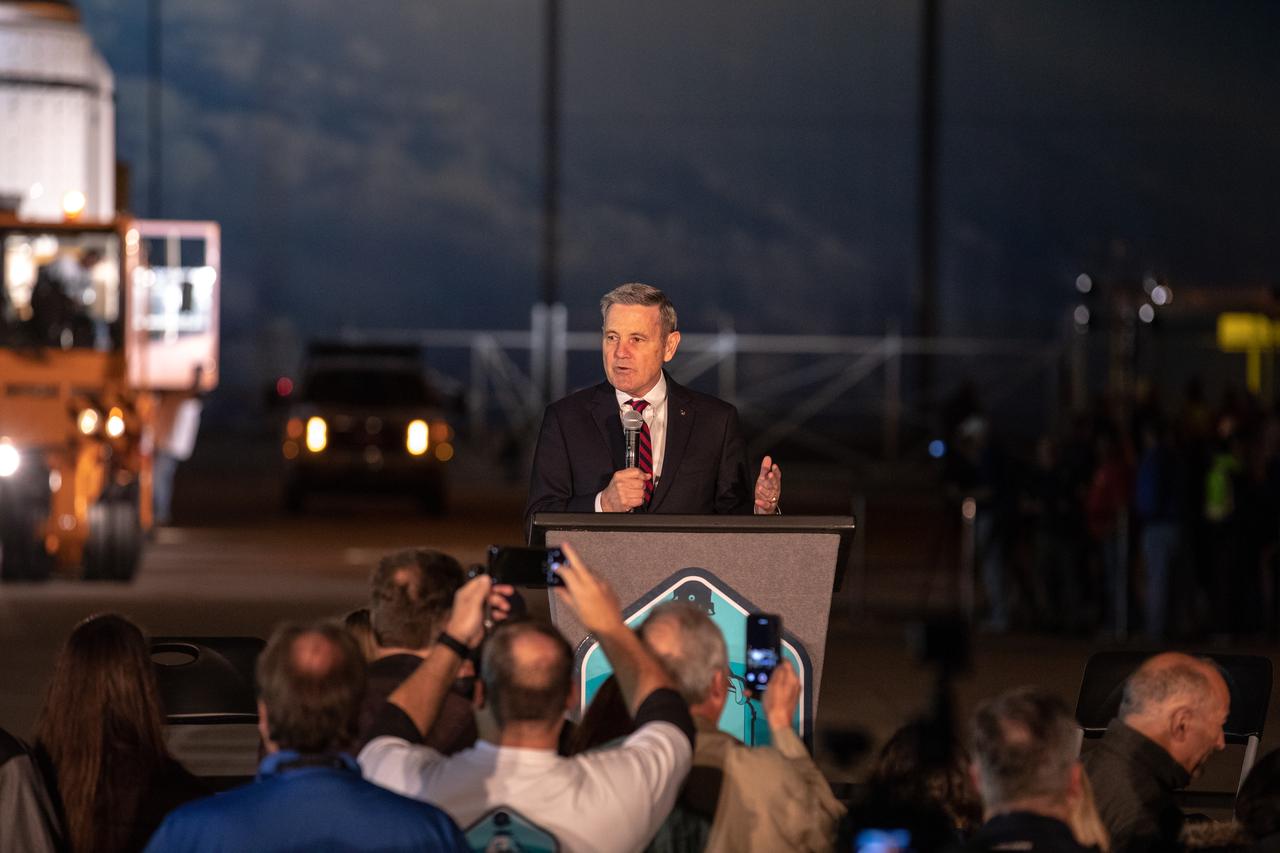
Kennedy Space Center Director Bob Cabana speaks during the Boeing CST-100 Starliner spacecraft rollout from the company’s Commercial Crew and Cargo Processing Facility at the Florida spaceport on Nov. 21, 2019. The spacecraft will make the trip to Space Launch Complex 41 at Cape Canaveral Air Force Station where it will be secured atop a United Launch Alliance Atlas V rocket for Boeing’s Orbital Flight Test to the International Space Station for NASA’s Commercial Crew Program.

Boeing astronaut Chris Ferguson speaks during the Boeing CST-100 Starliner spacecraft rollout from the company’s Commercial Crew and Cargo Processing Facility at Kennedy Space Center in Florida on Nov. 21, 2019. To his right is Kennedy Space Center Director Bob Cabana. Starliner will make the trip to Space Launch Complex 41 at Cape Canaveral Air Force Station where it will be secured atop a United Launch Alliance Atlas V rocket for Boeing’s Orbital Flight Test to the International Space Station for NASA’s Commercial Crew Program.
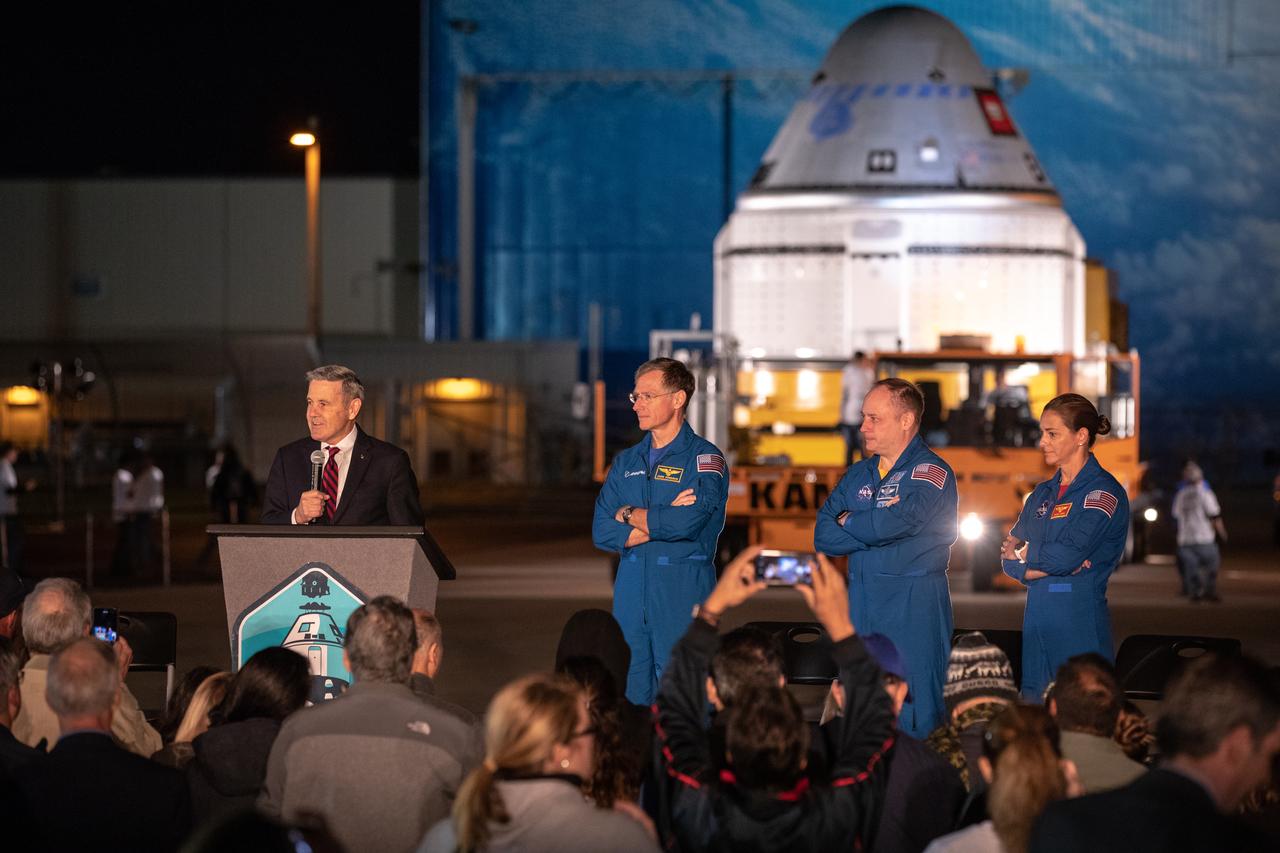
Kennedy Space Center Director Bob Cabana speaks during the Boeing CST-100 Starliner spacecraft rollout from the company’s Commercial Crew and Cargo Processing Facility at the Florida spaceport on Nov. 21, 2019. To Cabana’s left (from left to right) are Boeing astronaut Chris Ferguson and NASA astronauts Mike Fincke and Nicole Mann. Starliner will make the trip to Space Launch Complex 41 at Cape Canaveral Air Force Station where it will be secured atop a United Launch Alliance Atlas V rocket for Boeing’s Orbital Flight Test to the International Space Station for NASA’s Commercial Crew Program.
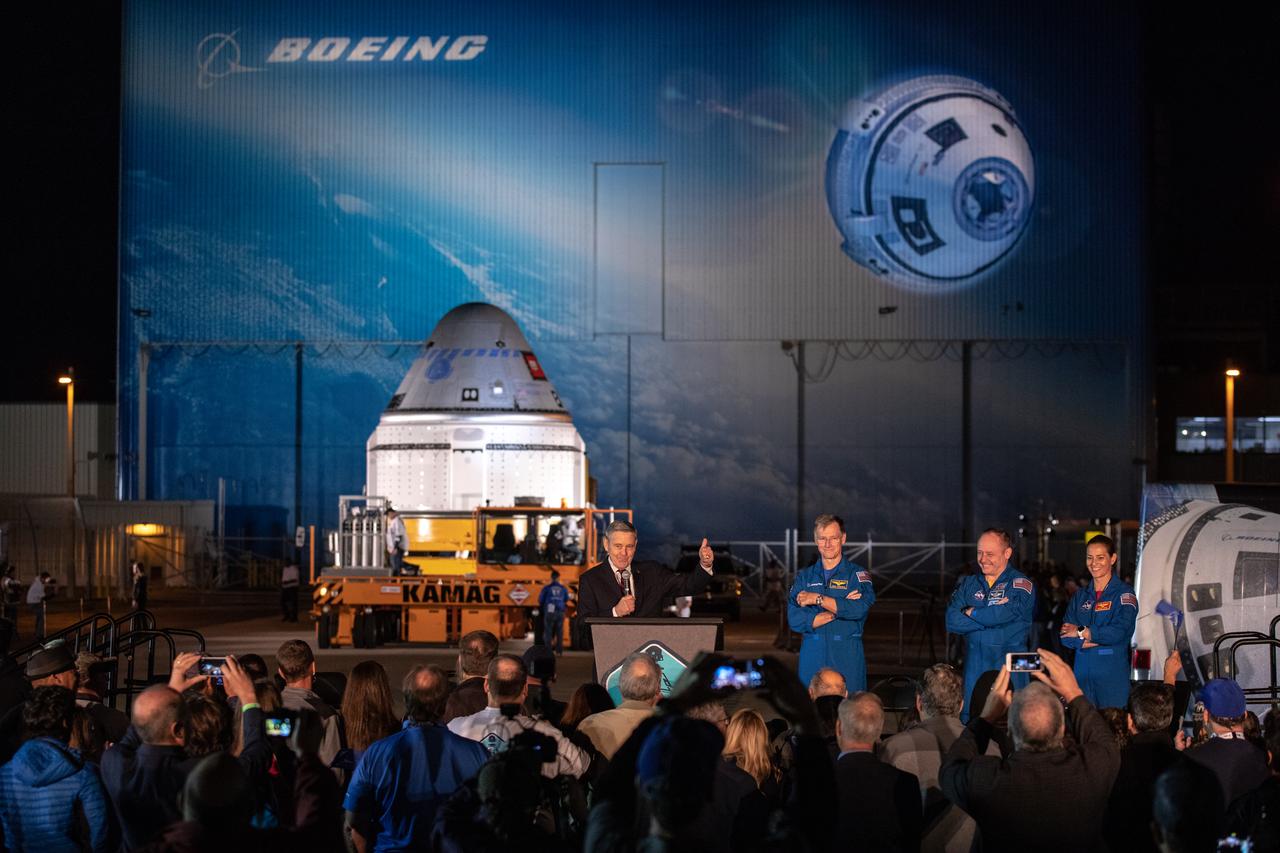
Kennedy Space Center Director Bob Cabana speaks during the Boeing CST-100 Starliner spacecraft rollout from the company’s Commercial Crew and Cargo Processing Facility at the Florida spaceport on Nov. 21, 2019. To Cabana’s left (from left to right) are Boeing astronaut Chris Ferguson and NASA astronauts Mike Fincke and Nicole Mann. Starliner will make the trip to Space Launch Complex 41 at Cape Canaveral Air Force Station where it will be secured atop a United Launch Alliance Atlas V rocket for Boeing’s Orbital Flight Test to the International Space Station for NASA’s Commercial Crew Program.
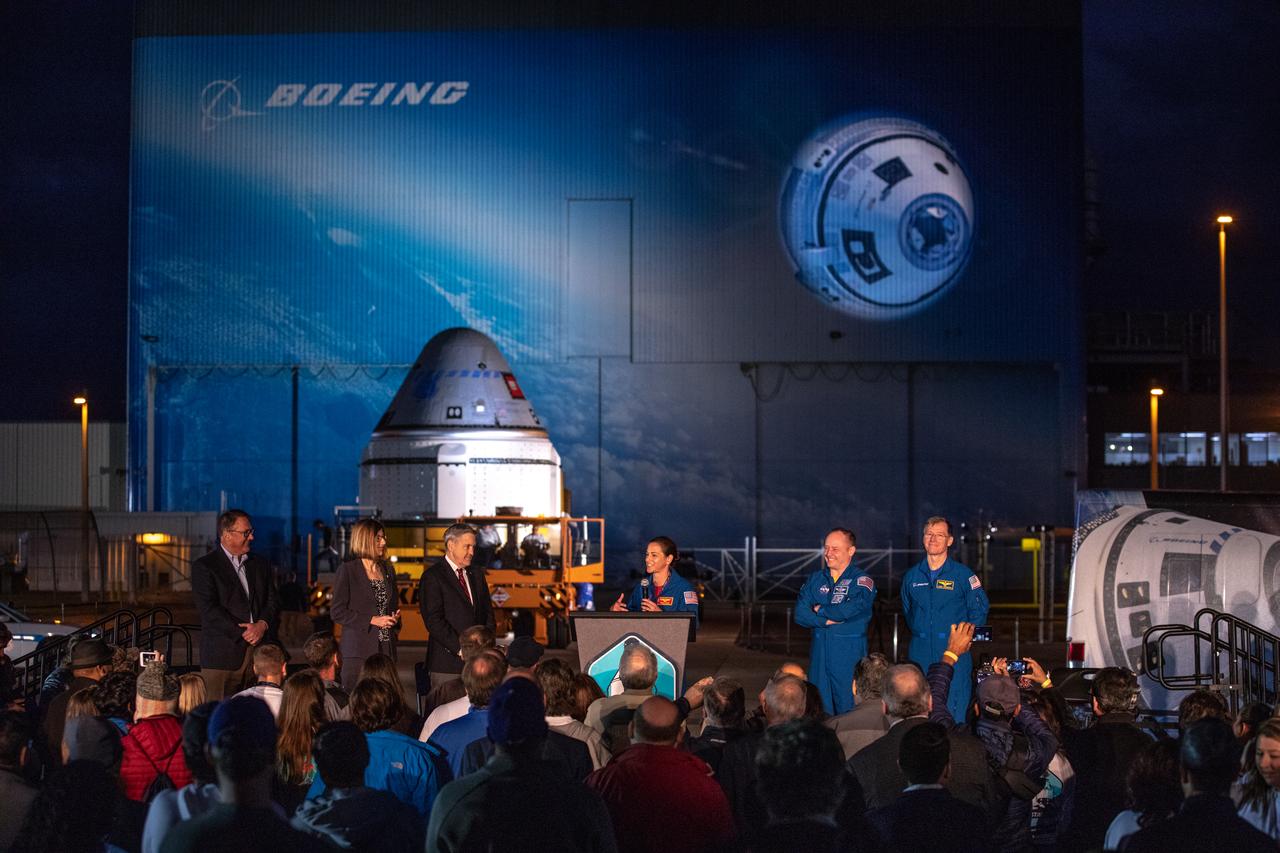
NASA astronaut Nicole Mann speaks during the Boeing CST-100 Starliner spacecraft rollout from the company’s Commercial Crew and Cargo Processing Facility at Kennedy Space Center in Florida on Nov. 21, 2019. To her left (from left to right) are NASA astronaut Mike Fincke and Boeing astronaut Chris Ferguson. To Mann’s right (from left to right) are John Mulholland, Boeing vice president and program manager, Commercial Crew Program; NASA’s Commercial Crew Program Manager Kathy Lueders and Kennedy Director Bob Cabana. Starliner will make the trip to Space Launch Complex 41 at Cape Canaveral Air Force Station where it will be secured atop a United Launch Alliance Atlas V rocket for Boeing’s Orbital Flight Test to the International Space Station for NASA’s Commercial Crew Program.
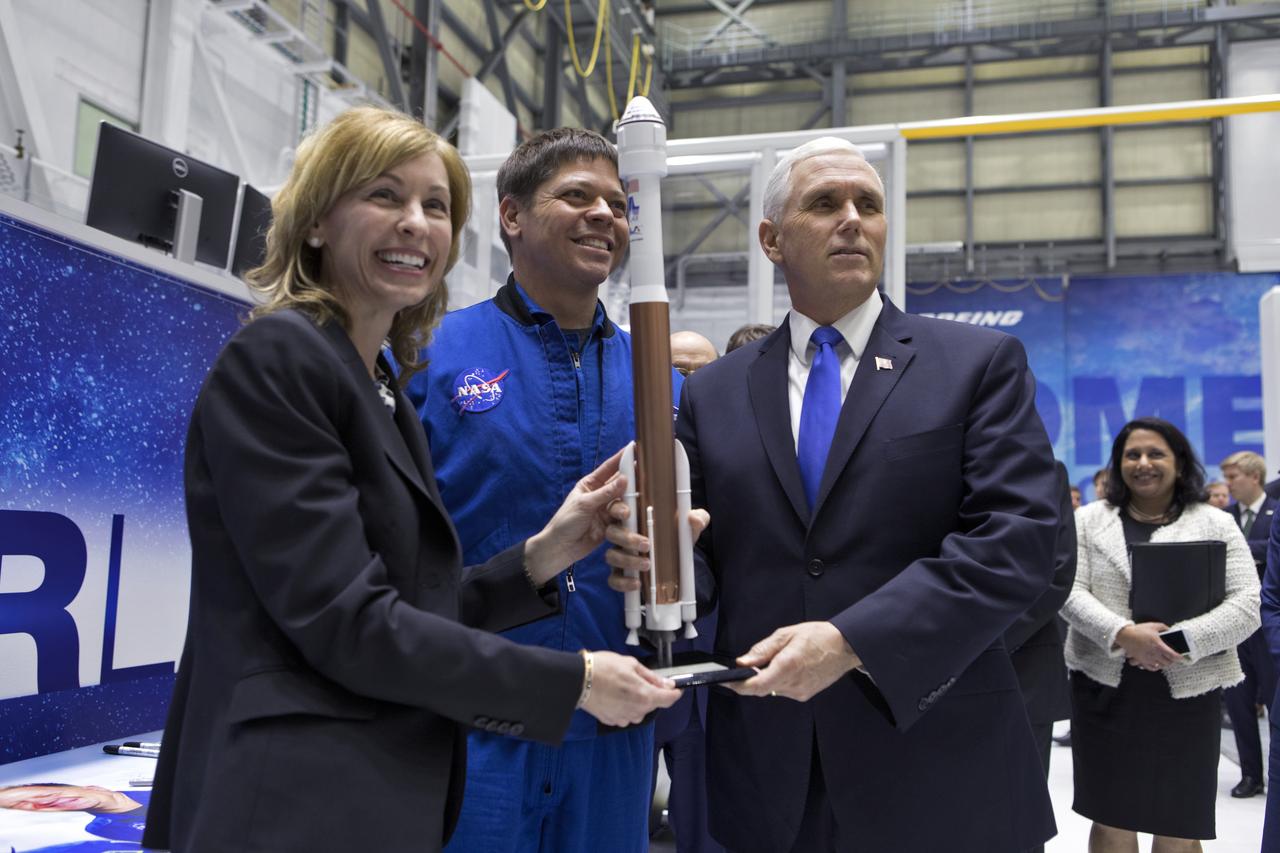
Vice President Mike Pence, right, Boeing President and CEO Leanne Caret, left, and NASA astronaut Bob Behnken, center, view a model of the Boeing Starliner spacecraft and United Launch Alliance Atlas V rocket during a tour of the company’s Commercial Crew and Cargo Processing Facility at NASA's Kennedy Space Center in Florida, on Feb. 21, 2018. During his visit, Pence chaired a meeting of the National Space Council in the high bay of the center's Space Station Processing Facility. The council's role is to advise the president regarding national space policy and strategy, and review the nation's long-range goals for space activities.
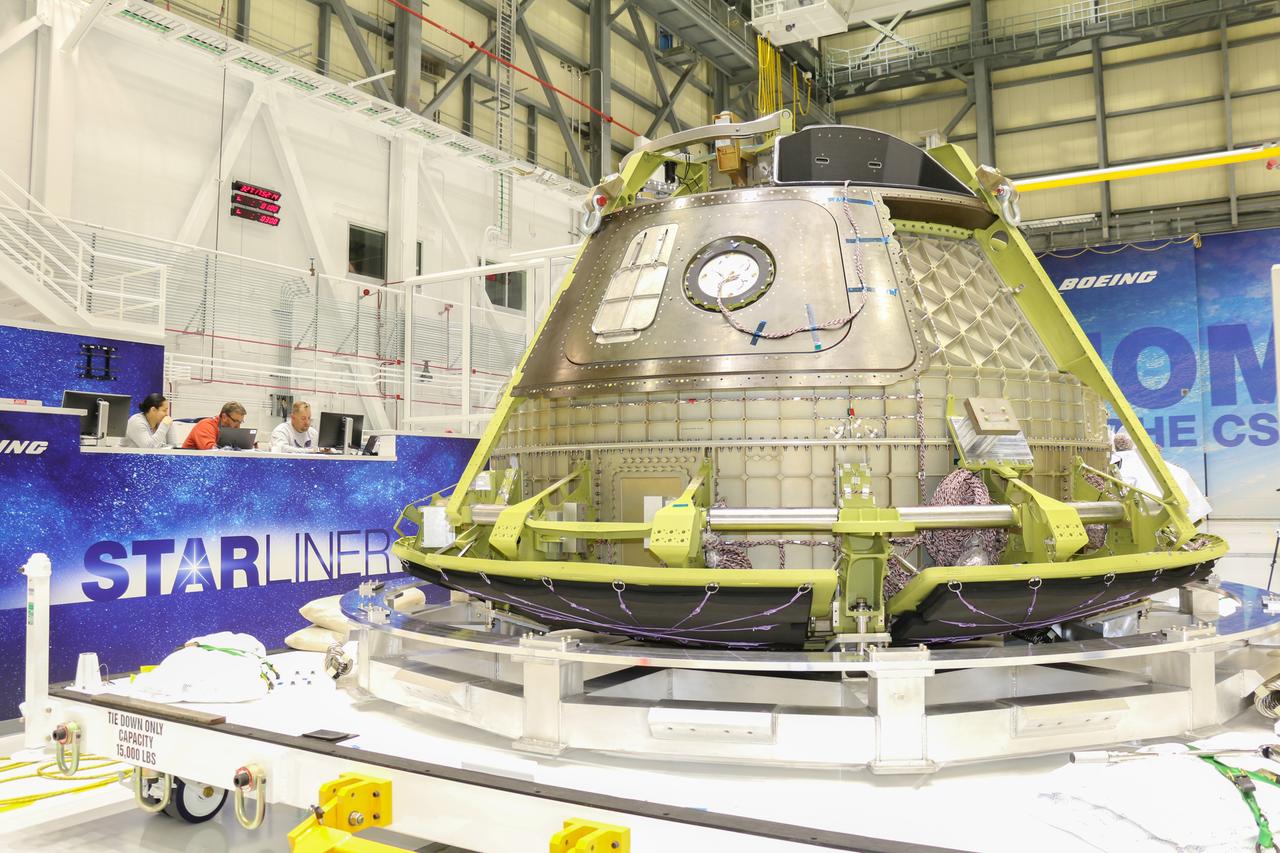
Boeing’s Structural Test Article of its CST-100 Starliner spacecraft is readied inside the company’s Commercial Crew and Cargo Processing Facility at NASA’s Kennedy Space Center. Built to the specifications of an operational spacecraft, the STA is intended to be evaluated through a series of thorough testing conditions at facilities in Huntington Beach, California.
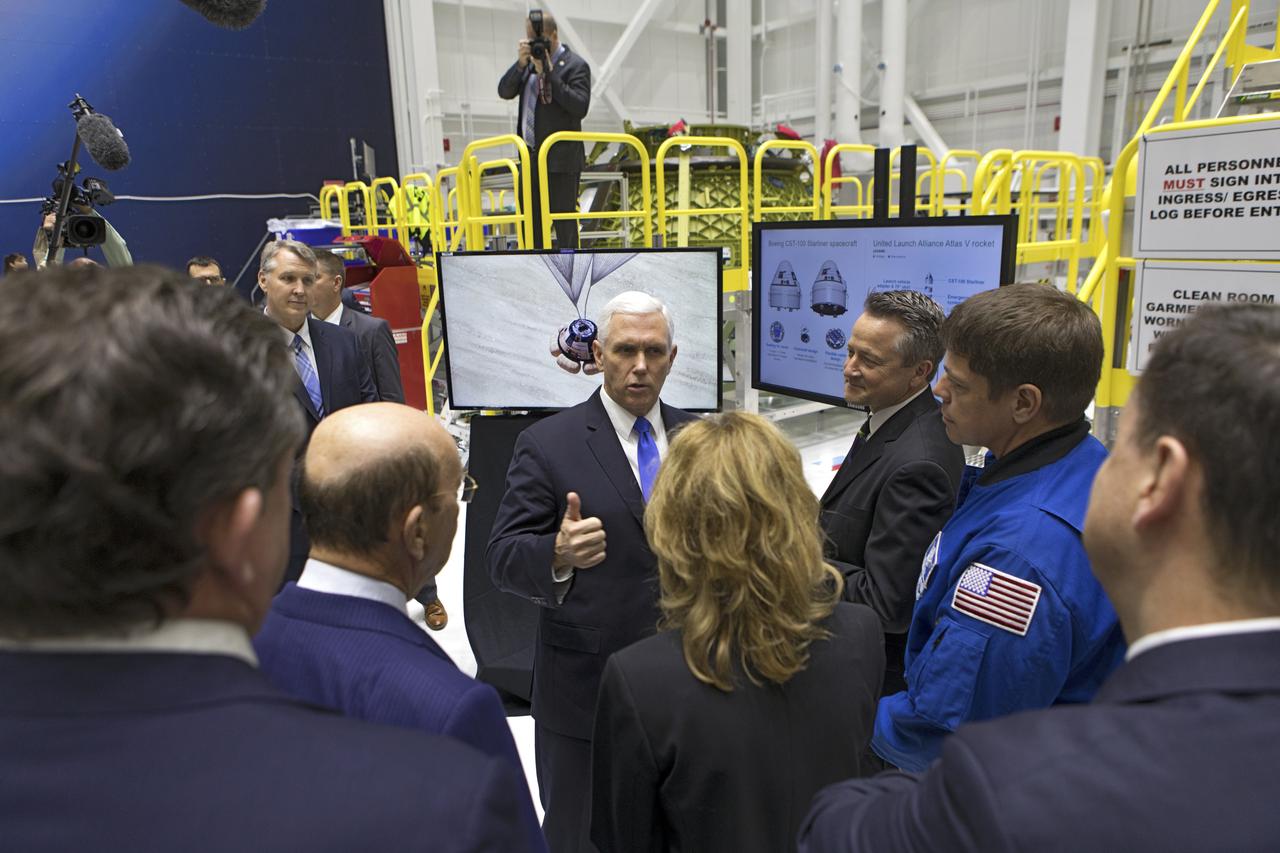
Vice President Mike Pence, center, speaks to Boeing executives and members of the National Space Council during a tour of the Boeing Commercial Crew and Cargo Processing Facility at NASA's Kennedy Space Center in Florida, on Feb. 21, 2018. During his visit, Pence chaired a meeting of the council in the high bay of the center's Space Station Processing Facility. The council's role is to advise the president regarding national space policy and strategy, and review the nation's long-range goals for space activities.
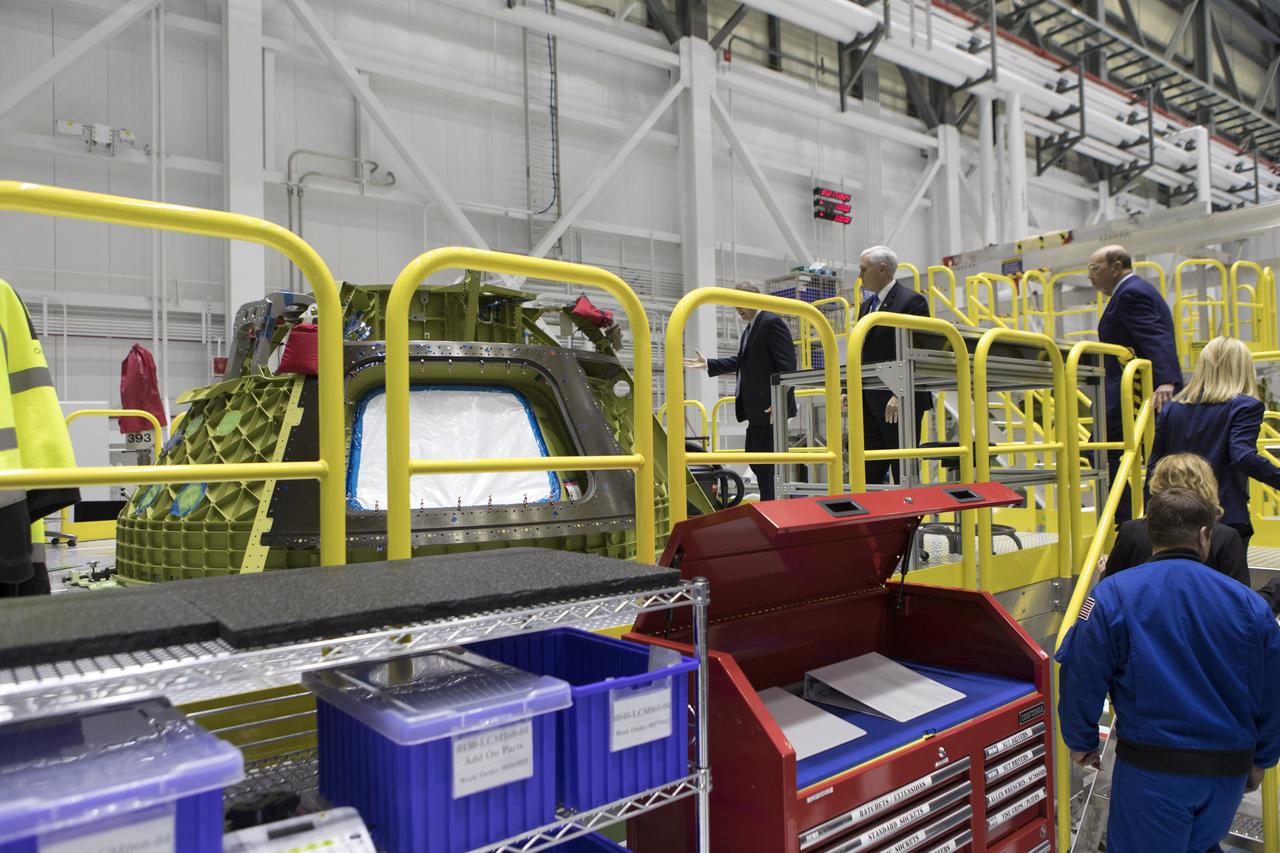
Vice President Mike Pence views Boeing’s Starliner spacecraft for the Crew Flight Test during a tour of the company’s Commercial Crew and Cargo Processing Facility at NASA's Kennedy Space Center in Florida, on Feb. 21, 2018. During his visit, Pence chaired a meeting of the National Space Council in the high bay of the center's Space Station Processing Facility. The council's role is to advise the president regarding national space policy and strategy, and review the nation's long-range goals for space activities.
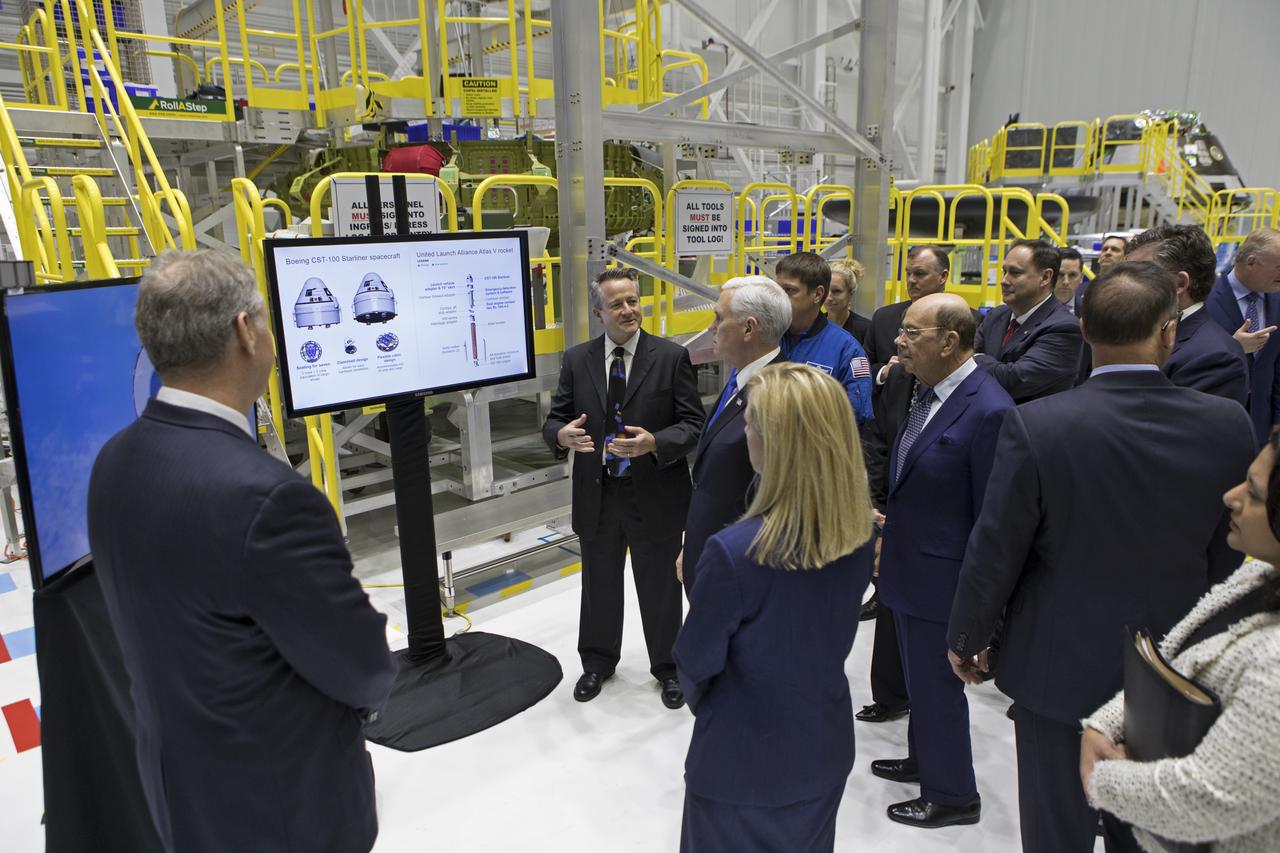
Vice President Mike Pence, center, and members of the National Space Council hear from a Boeing employee during a tour of the Boeing Commercial Crew and Cargo Processing Facility at NASA's Kennedy Space Center in Florida, on Feb. 21, 2018. During his visit, Pence chaired a meeting of the council in the high bay of the center's Space Station Processing Facility. The council's role is to advise the president regarding national space policy and strategy, and review the nation's long-range goals for space activities.
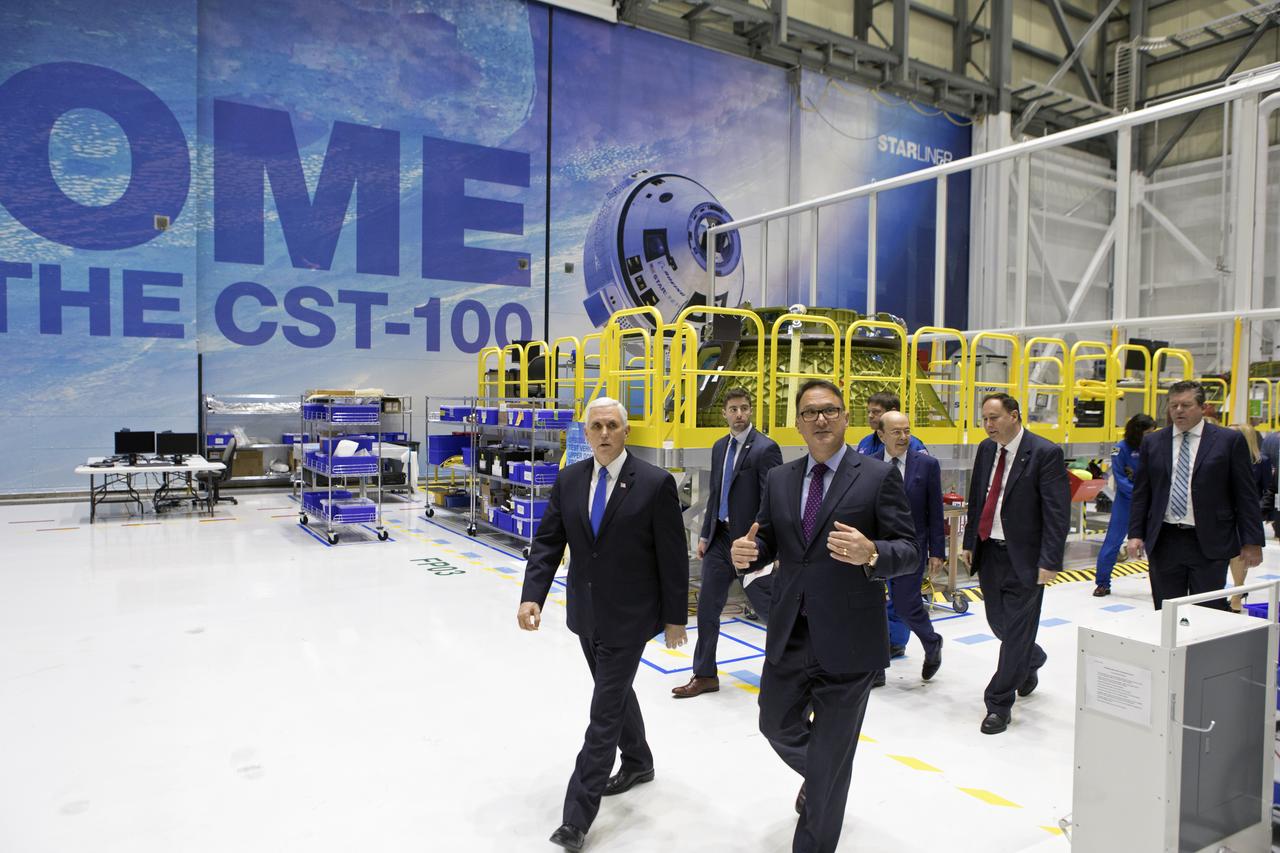
Vice President Mike Pence, left, and John Mulholland, Boeing vice president and program manager for Commercial Crew Programs, walk with members of the National Space Council during a tour of the Boeing Commercial Crew and Cargo Processing Facility at NASA's Kennedy Space Center in Florida, on Feb. 21, 2018. During his visit, Pence chaired a meeting of the council in the high bay of the center's Space Station Processing Facility. The council's role is to advise the president regarding national space policy and strategy, and review the nation's long-range goals for space activities.
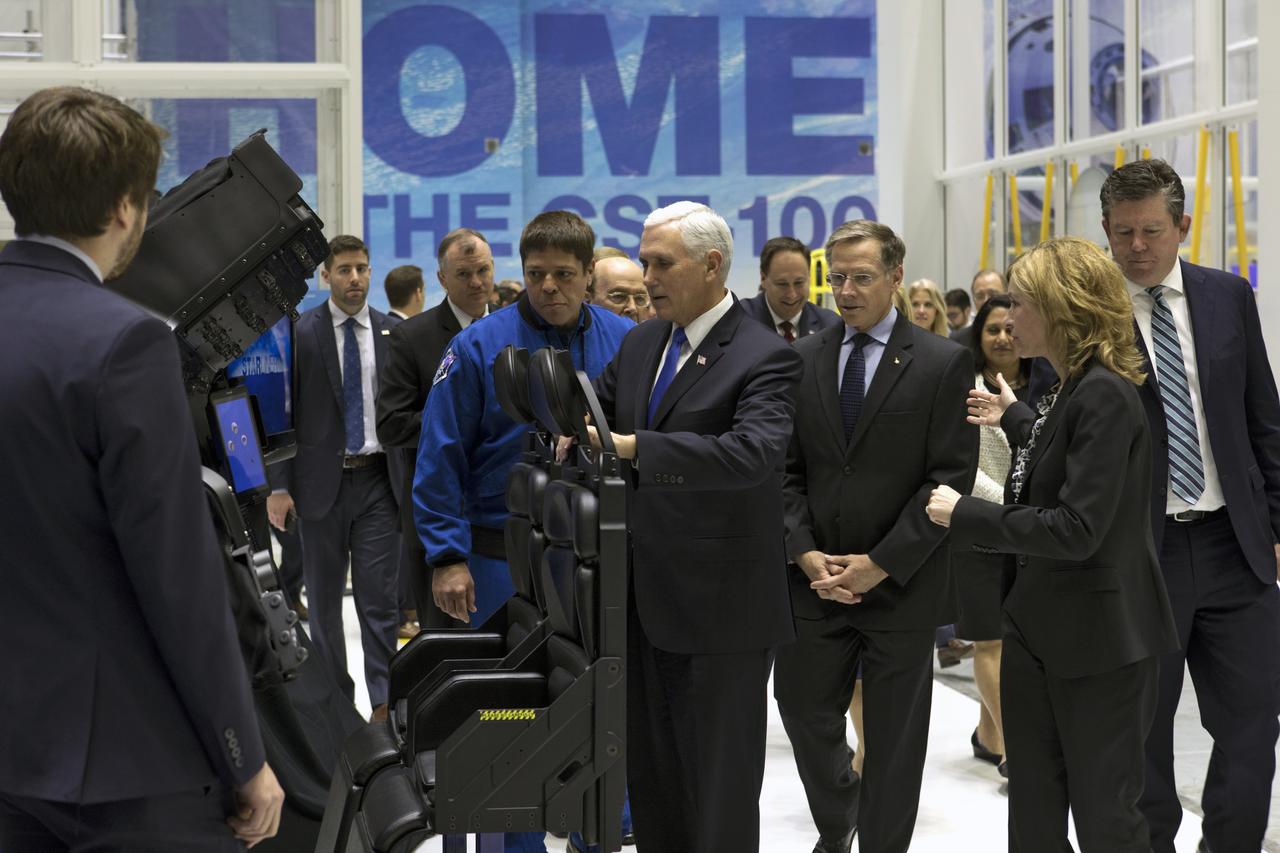
Vice President Mike Pence, center, NASA astronaut Bob Behnken, left, and Chris Ferguson, Boeing’s director of Crew and Mission Systems, tour the company’s Commercial Crew and Cargo Processing Facility at NASA's Kennedy Space Center in Florida, on Feb. 21, 2018. During his visit, Pence chaired a meeting of the National Space Council in the high bay of the center's Space Station Processing Facility. The council's role is to advise the president regarding national space policy and strategy, and review the nation's long-range goals for space activities.
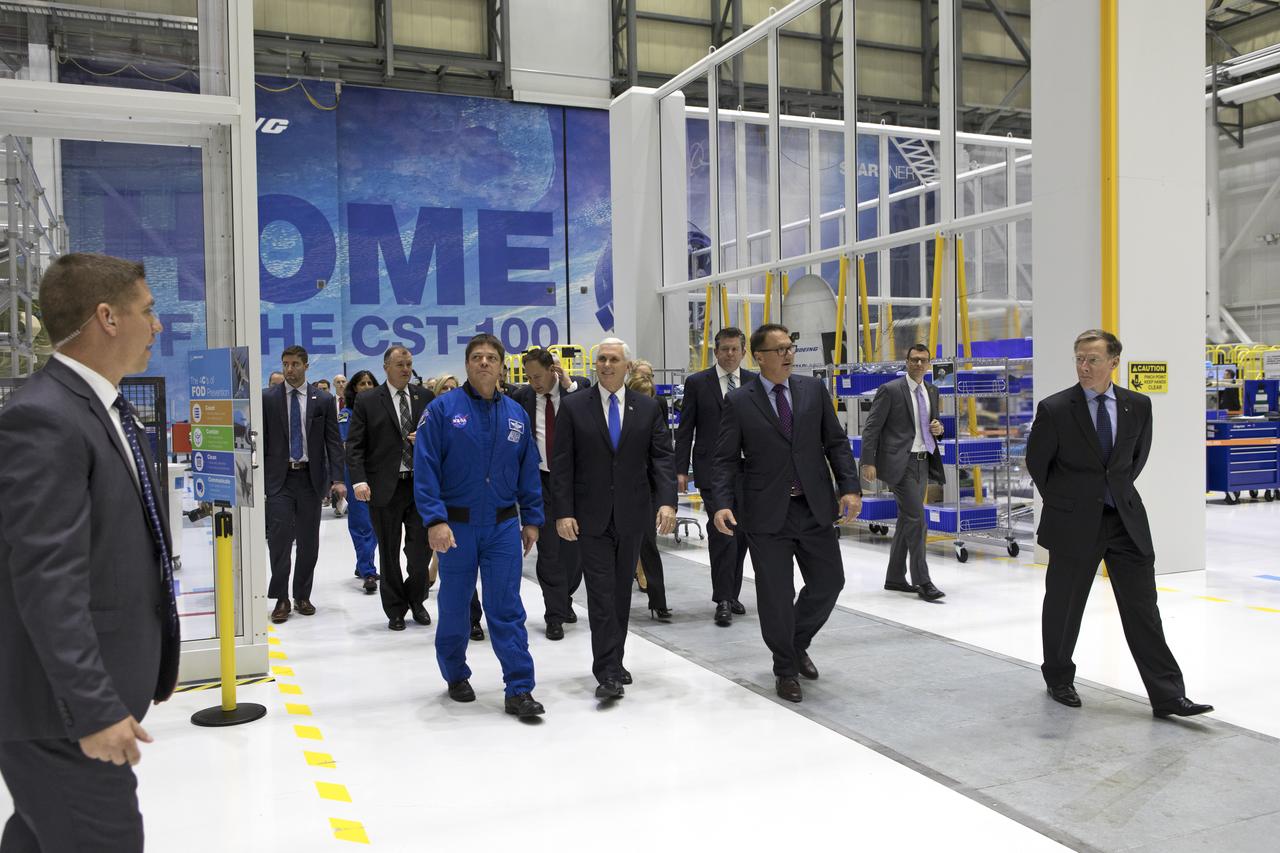
Vice President Mike Pence, left, is flanked by NASA astronaut Bob Behnken, left, John Mulholland, Boeing vice president and program manager for Commercial Crew Programs, and Chris Ferguson, Boeing’s director of Crew and Mission Systems, during a tour of the company’s Commercial Crew and Cargo Processing Facility at NASA's Kennedy Space Center in Florida, on Feb. 21, 2018. During his visit, Pence chaired a meeting of the National Space Council in the high bay of the center's Space Station Processing Facility. The council's role is to advise the president regarding national space policy and strategy, and review the nation's long-range goals for space activities.
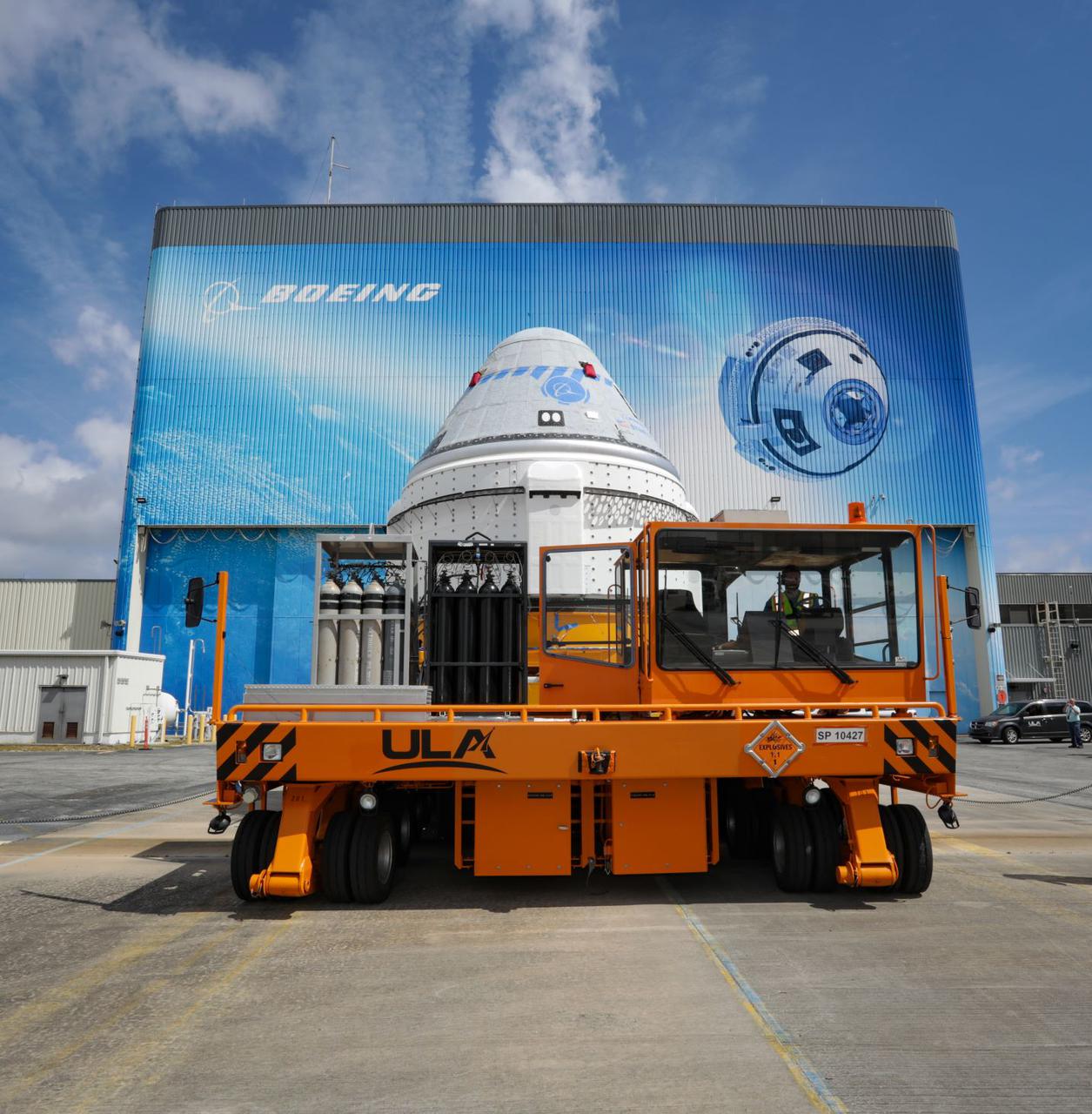
Boeing’s CST-100 Starliner spacecraft rolls out from the company’s Commercial Crew and Cargo Processing Facility at NASA’s Kennedy Space Center in Florida on May 4, 2022. The spacecraft will make the trip to the Vertical Integration Facility at Space Launch Complex-41 at Cape Canaveral Space Force Station where it will be secured atop a United Launch Alliance Atlas V rocket for Boeing’s second Orbital Flight Test (OFT-2) to the International Space Station for NASA’s Commercial Crew Program.
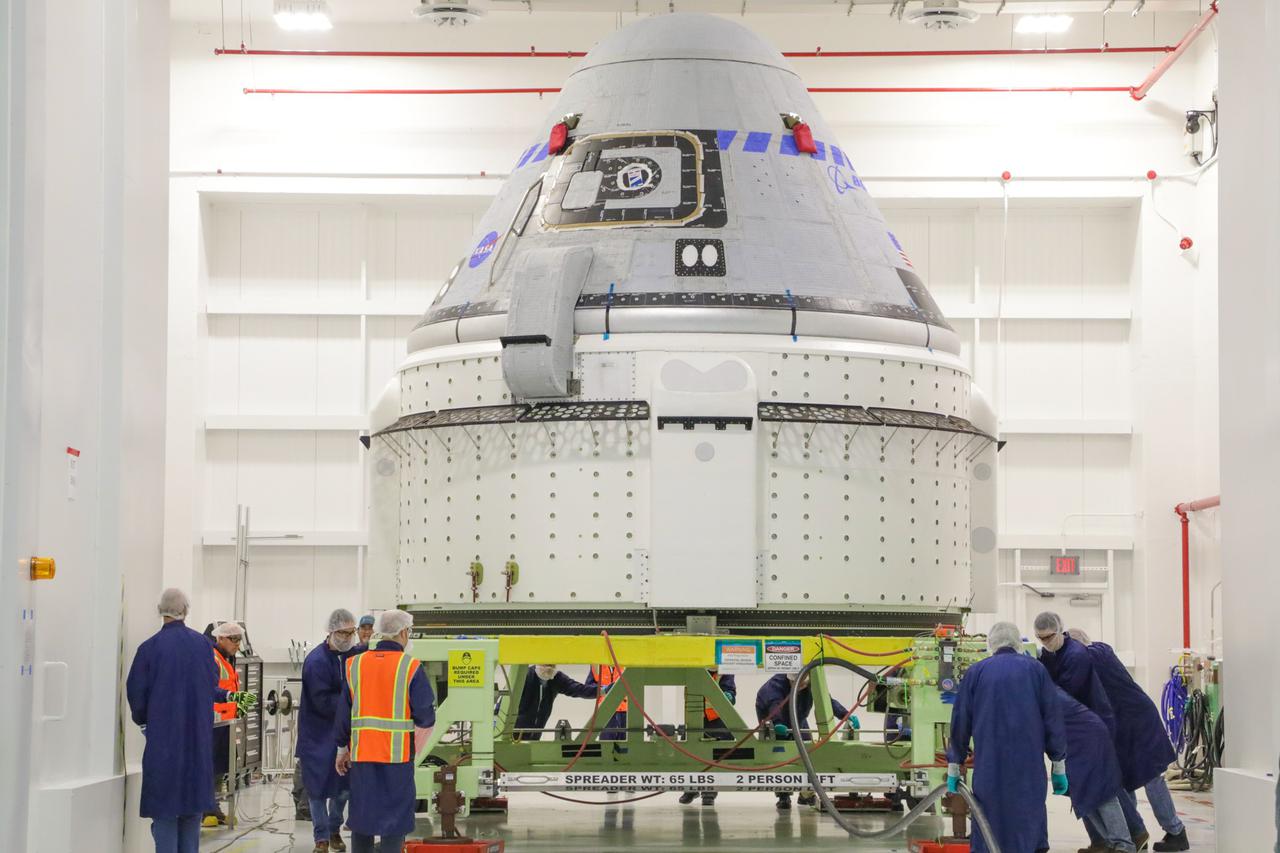
On May 3, 2022, inside the Commercial Crew and Cargo Processing Facility at Kennedy Space Center in Florida, Boeing’s CST-100 Starliner spacecraft moved from the Hazardous Processing Area to the Weight and Center of Gravity machine. The operations are in preparation for the company’s second Orbital Flight Test (OFT-2), as part of NASA’s Commercial Crew Program.

The CST-100 Starliner spacecraft to be flown on Boeing’s Orbital Flight Test (OFT) is viewed Nov. 2, 2019, while undergoing launch preparations inside the Commercial Crew and Cargo Processing Facility at Kennedy Space Center in Florida. During the OFT mission, the uncrewed Starliner spacecraft will fly to the International Space Station for NASA’s Commercial Crew Program.
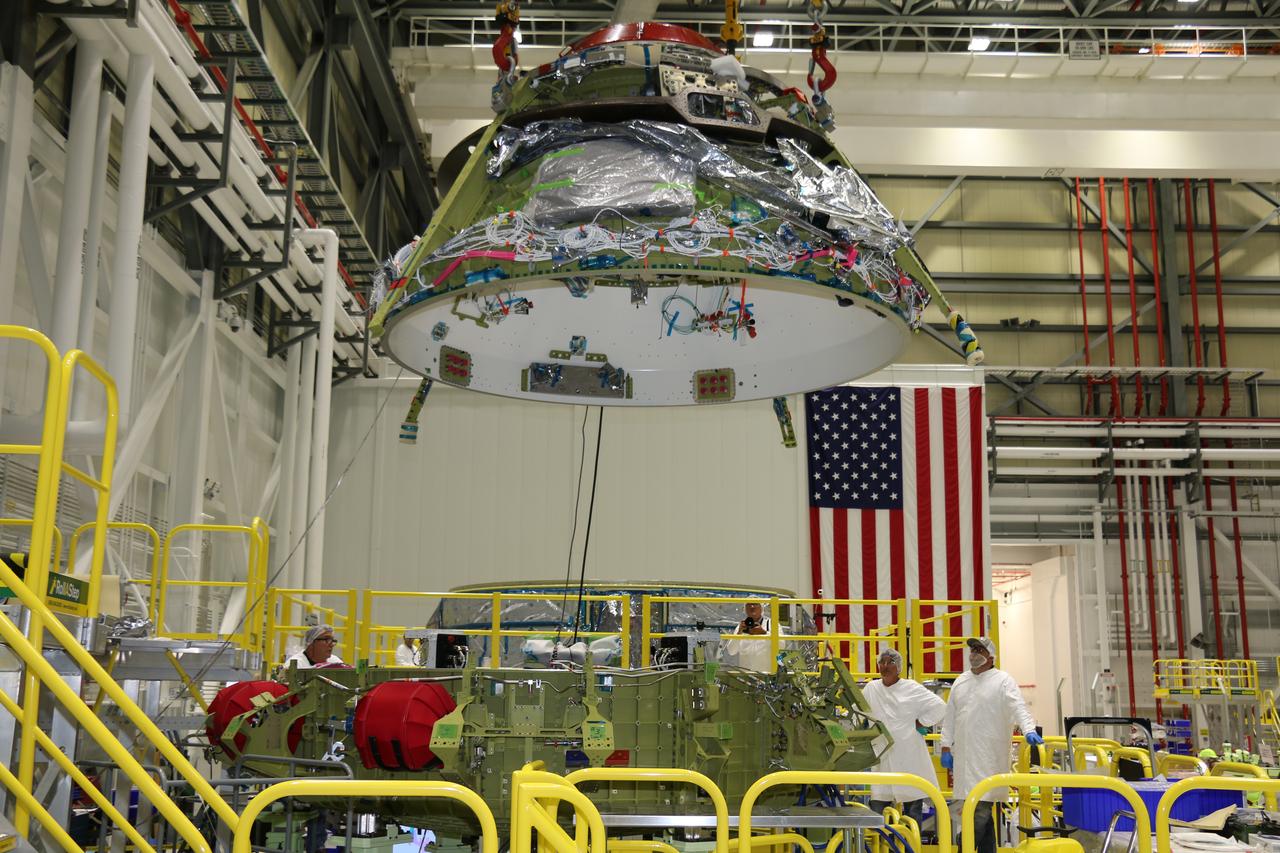
The upper and lower domes of the Boeing CST-100 Starliner Spacecraft 2 Crew Flight Test Vehicle were mated June 19, 2018, inside the Commercial Crew and Cargo Processing Facility (C3PF) at Kennedy Space Center in Florida. The Starliner will launch astronauts on a United Launch Alliance Atlas V rocket to the International Space Station as part of NASA’s Commercial Crew Program.
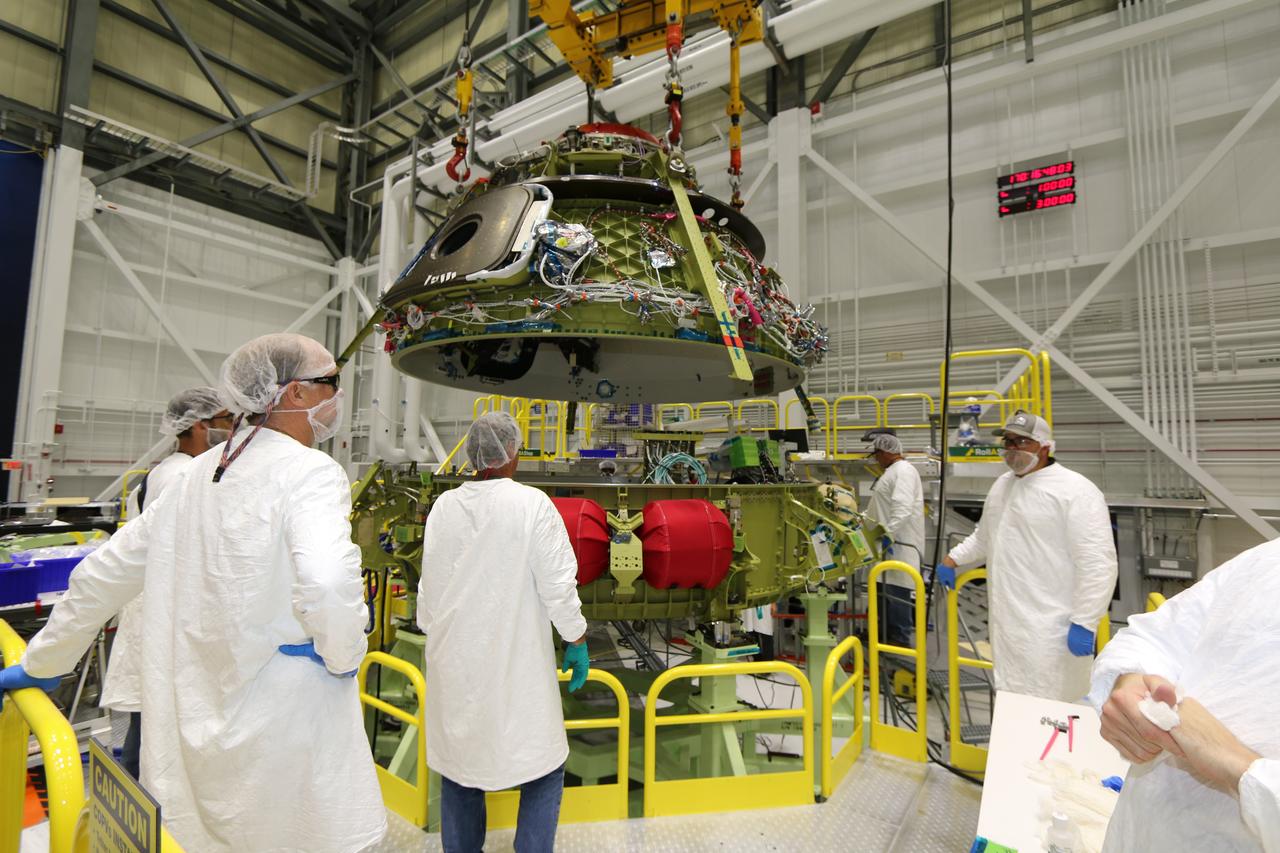
The upper and lower domes of the Boeing CST-100 Starliner Spacecraft 2 Crew Flight Test Vehicle were mated June 19, 2018, inside the Commercial Crew and Cargo Processing Facility (C3PF) at Kennedy Space Center in Florida. The Starliner will launch astronauts on a United Launch Alliance Atlas V rocket to the International Space Station as part of NASA’s Commercial Crew Program.
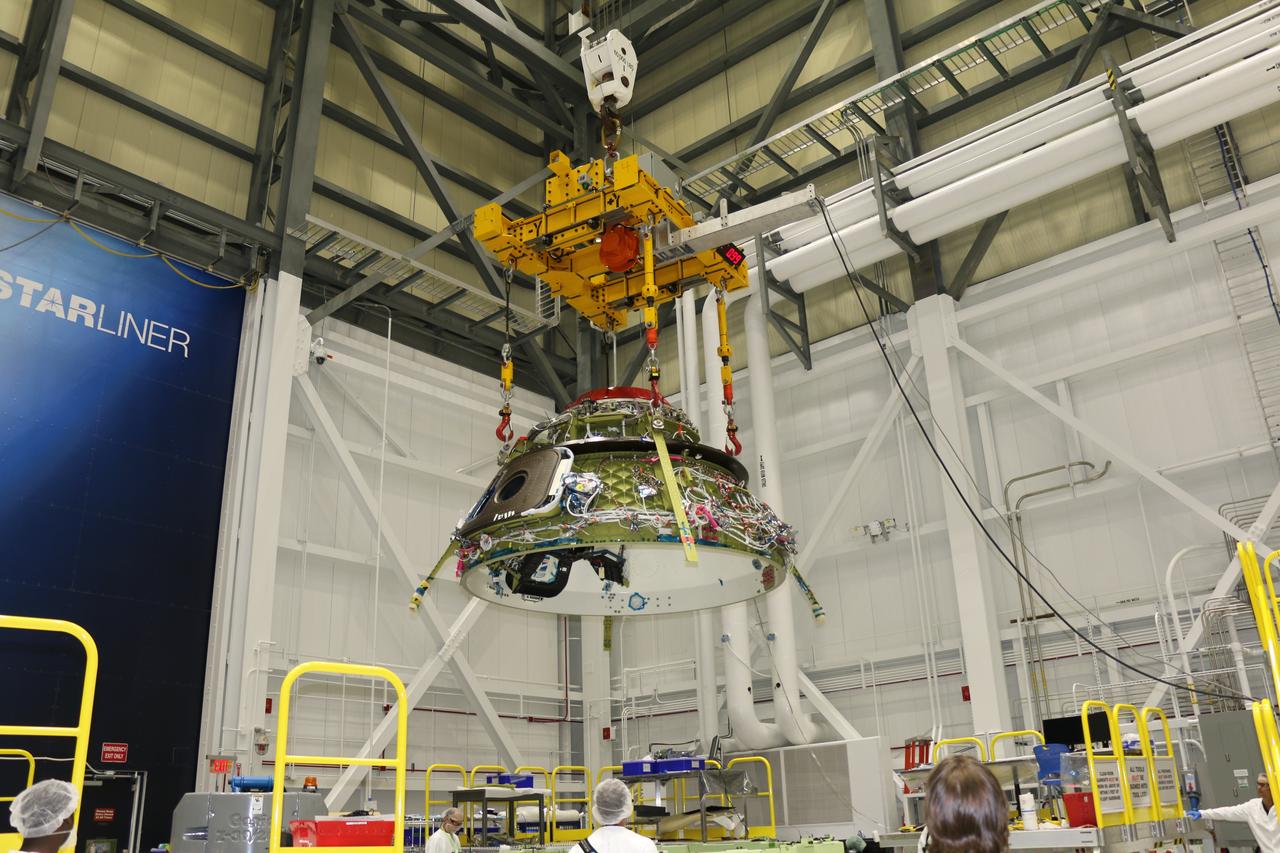
The upper and lower domes of the Boeing CST-100 Starliner Spacecraft 2 Crew Flight Test Vehicle were mated June 19, 2018, inside the Commercial Crew and Cargo Processing Facility (C3PF) at Kennedy Space Center in Florida. The Starliner will launch astronauts on a United Launch Alliance Atlas V rocket to the International Space Station as part of NASA’s Commercial Crew Program.
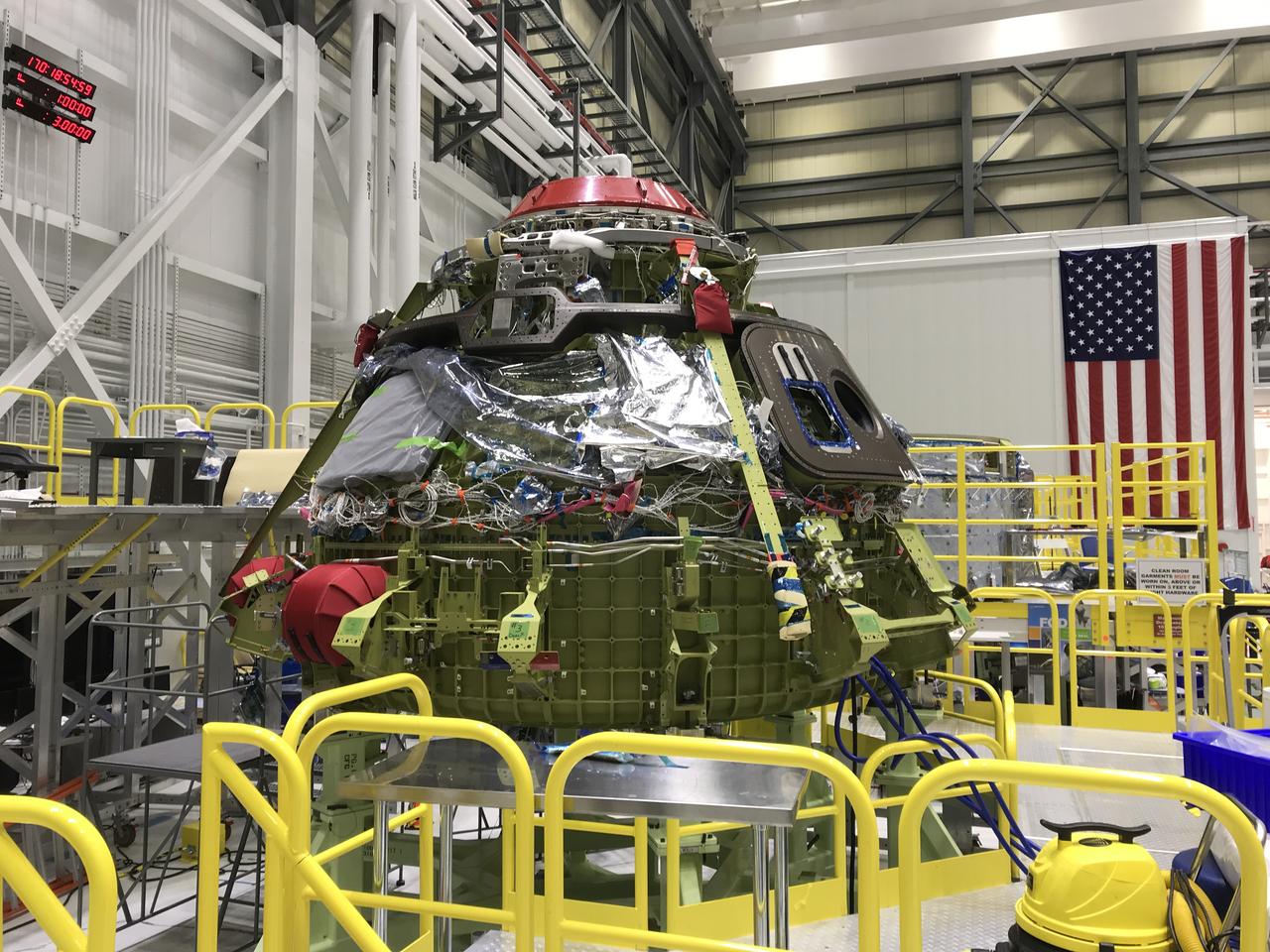
The upper and lower domes of the Boeing CST-100 Starliner Spacecraft 2 Crew Flight Test Vehicle were mated June 19, 2018, inside the Commercial Crew and Cargo Processing Facility (C3PF) at Kennedy Space Center in Florida. The Starliner will launch astronauts on a United Launch Alliance Atlas V rocket to the International Space Station as part of NASA’s Commercial Crew Program.
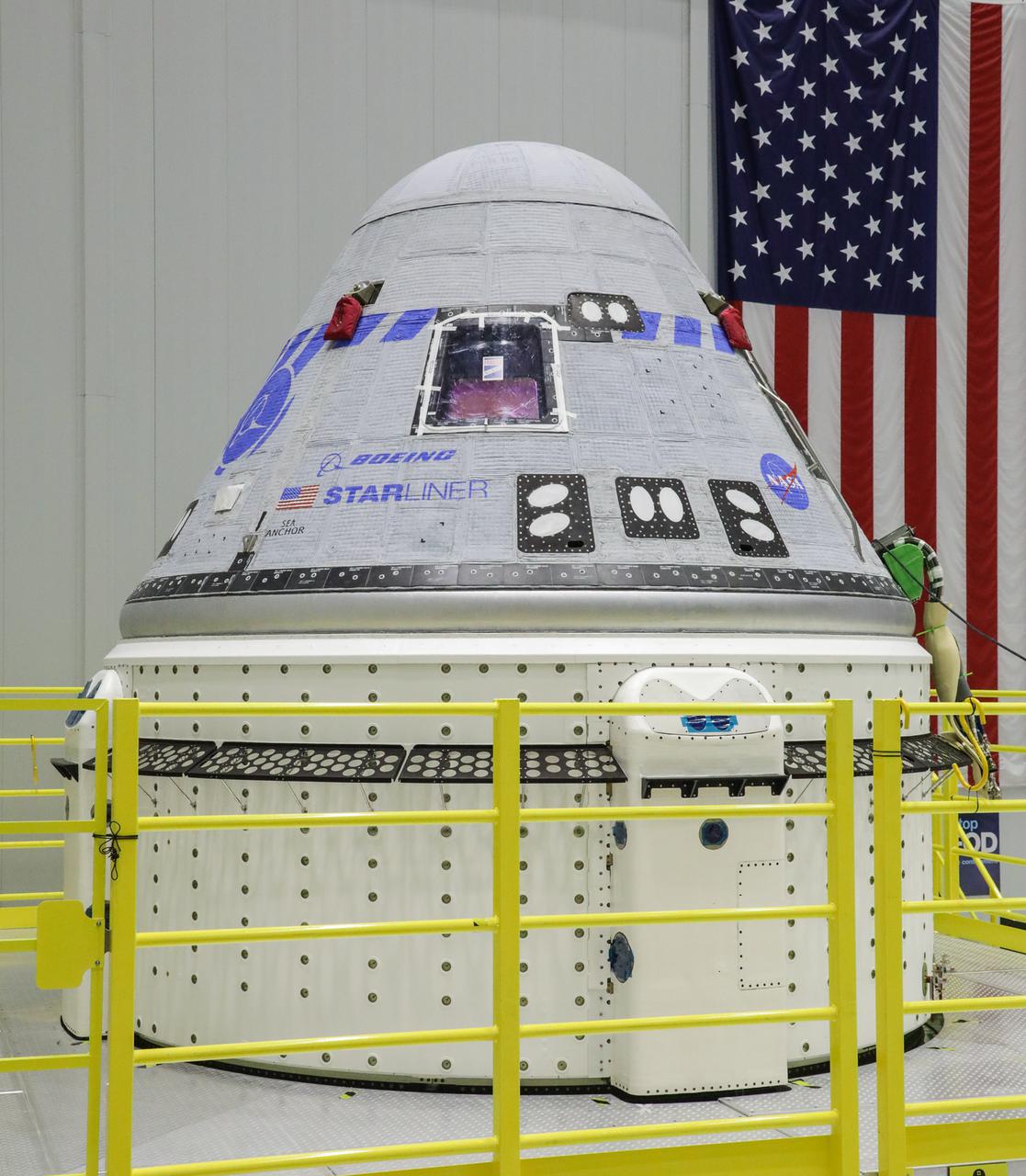
A new service module was mated to a Boeing CST-100 Starliner crew module to form a complete spacecraft on March 12, 2022, in Boeing’s Commercial Crew and Cargo Processing Facility at NASA’s Kennedy Space Center in Florida. Starliner will launch on a United Launch Alliance Atlas V rocket for Boeing’s second uncrewed Orbital Flight Test-2 (OFT-2) for NASA’s Commercial Crew Program.

On March 15, the base heat shield for Boeing’s CST-100 Starliner was freshly installed on the bottom of Spacecraft 1 in the High Bay of the Commercial Crew and Cargo Processing Facility at Kennedy Space Center. This is the spacecraft that will fly during the Pad Abort Test. The next step involves installation of the back shells and forward heat shield, and then the crew module will be mated to the service module for a fit check. Finally, the vehicle will head out to White Sands Missile Range in New Mexico for testing.
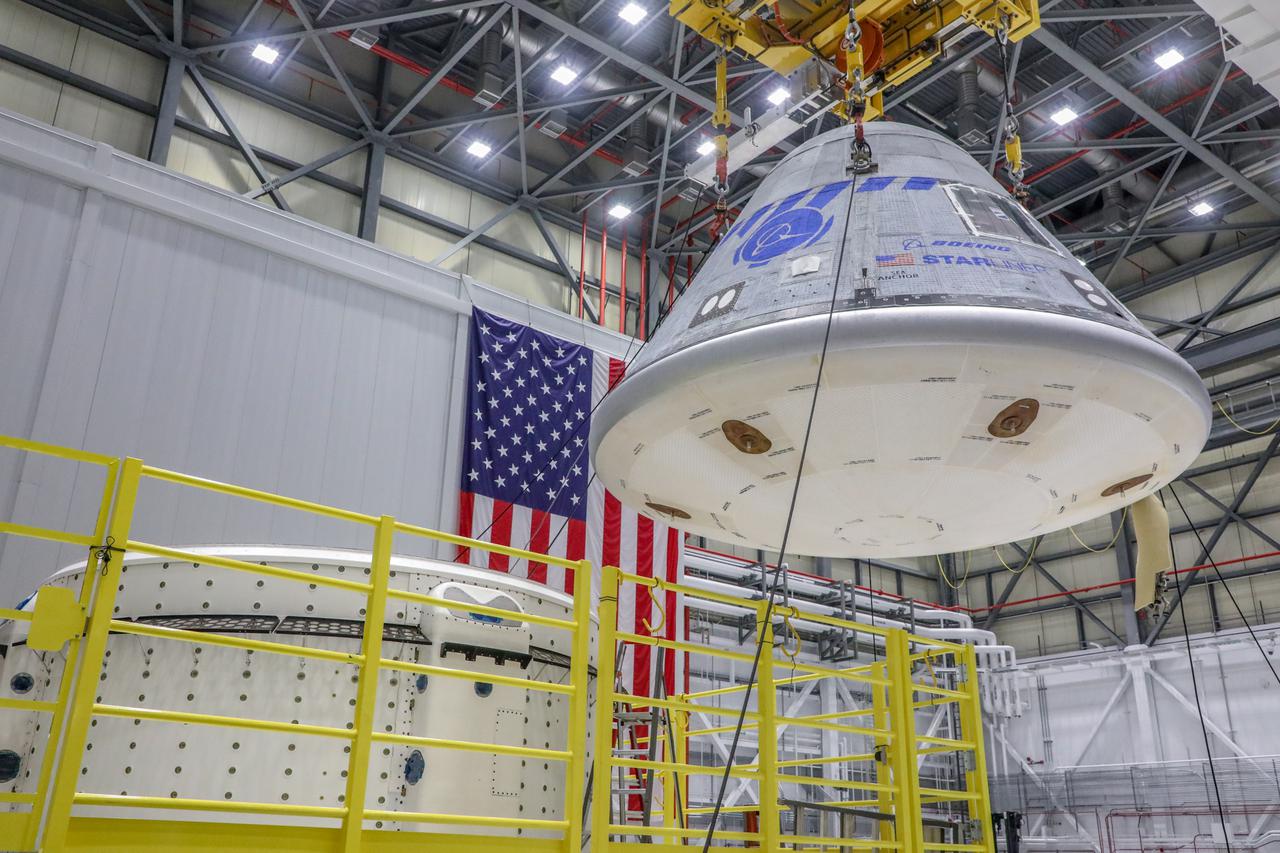
A new service module was mated to a Boeing CST-100 Starliner crew module to form a complete spacecraft on March 12, 2022, in Boeing’s Commercial Crew and Cargo Processing Facility at NASA’s Kennedy Space Center in Florida. Starliner will launch on a United Launch Alliance Atlas V rocket for Boeing’s second uncrewed Orbital Flight Test-2 (OFT-2) for NASA’s Commercial Crew Program.
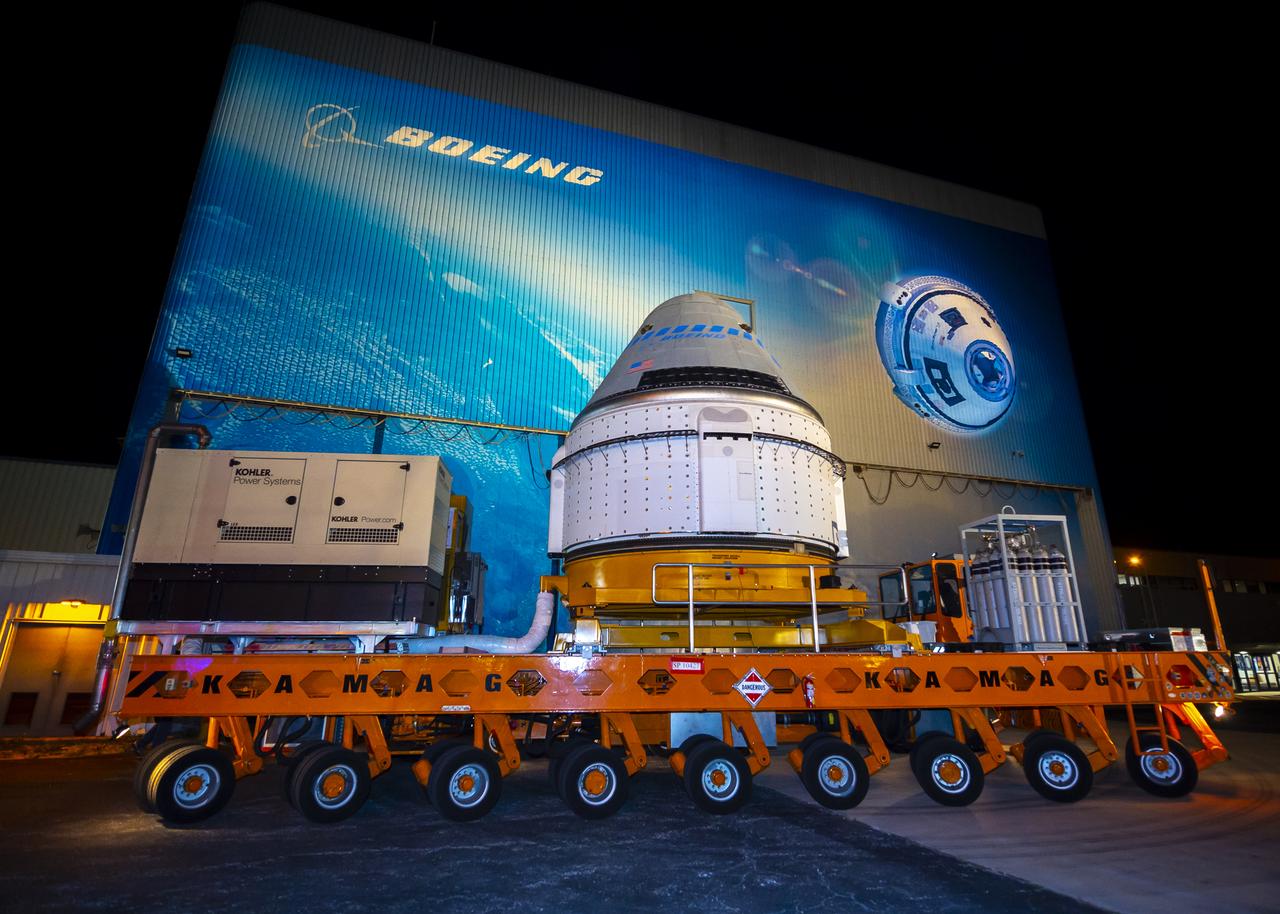
The Boeing CST-100 Starliner spacecraft rolls out from the company’s Commercial Crew and Cargo Processing Facility at NASA’s Kennedy Space Center in Florida on Nov. 21, 2019. The spacecraft will make the trip to Space Launch Complex 41 at Cape Canaveral Air Force Station where it will be secured atop a United Launch Alliance Atlas V rocket for Boeing’s Orbital Flight Test to the International Space Station for NASA’s Commercial Crew Program.
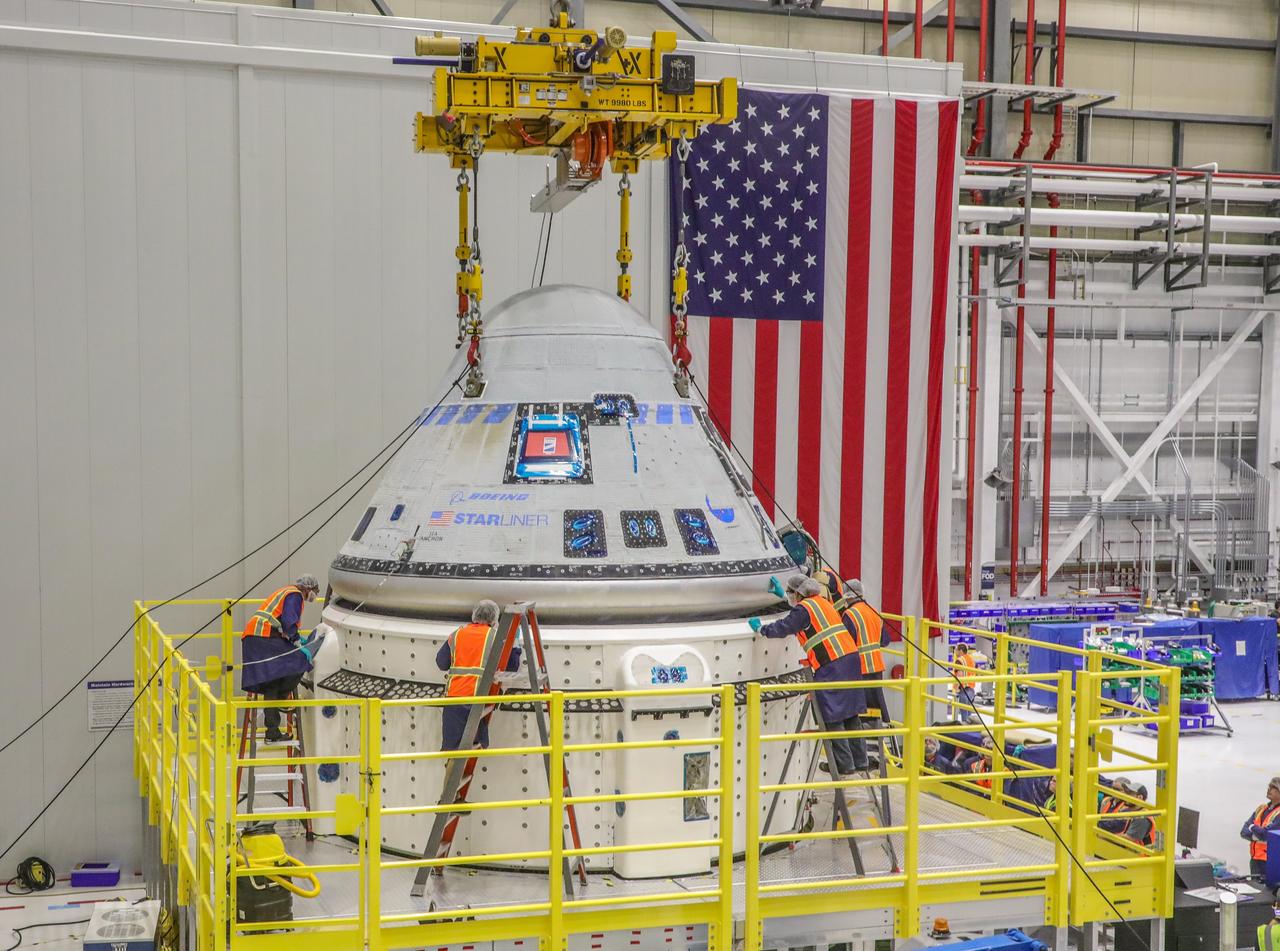
The Starliner team works to finalize the mate of the crew module and new service module for NASA's Boeing Crew Flight Test that will take NASA astronauts Barry “Butch” Wilmore and Sunita “Suni” Williams to and from the International Space Station.
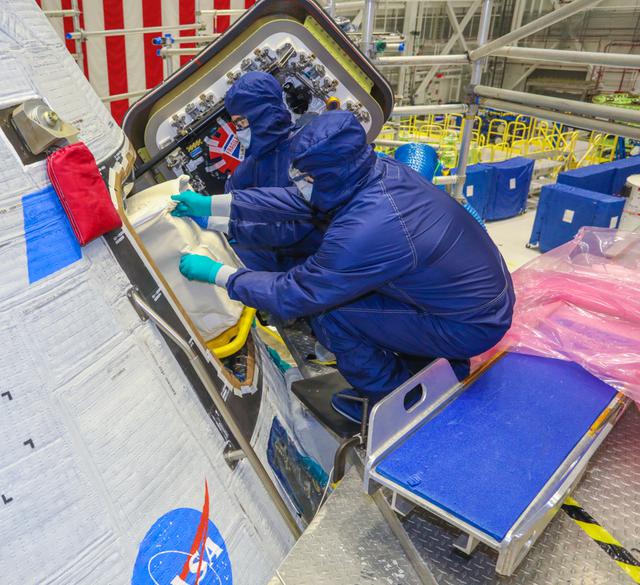
Technicians place cargo inside Boeing’s CST-100 Starliner ahead of Orbital Flight Test-2 (OFT-2) in the Commercial Crew and Cargo Processing Facility at NASA’s Kennedy Space Center in Florida on May 28, 2021. Part of the agency’s Commercial Crew Program, OFT-2 is a critical developmental milestone on the company’s path to fly crew missions for NASA.
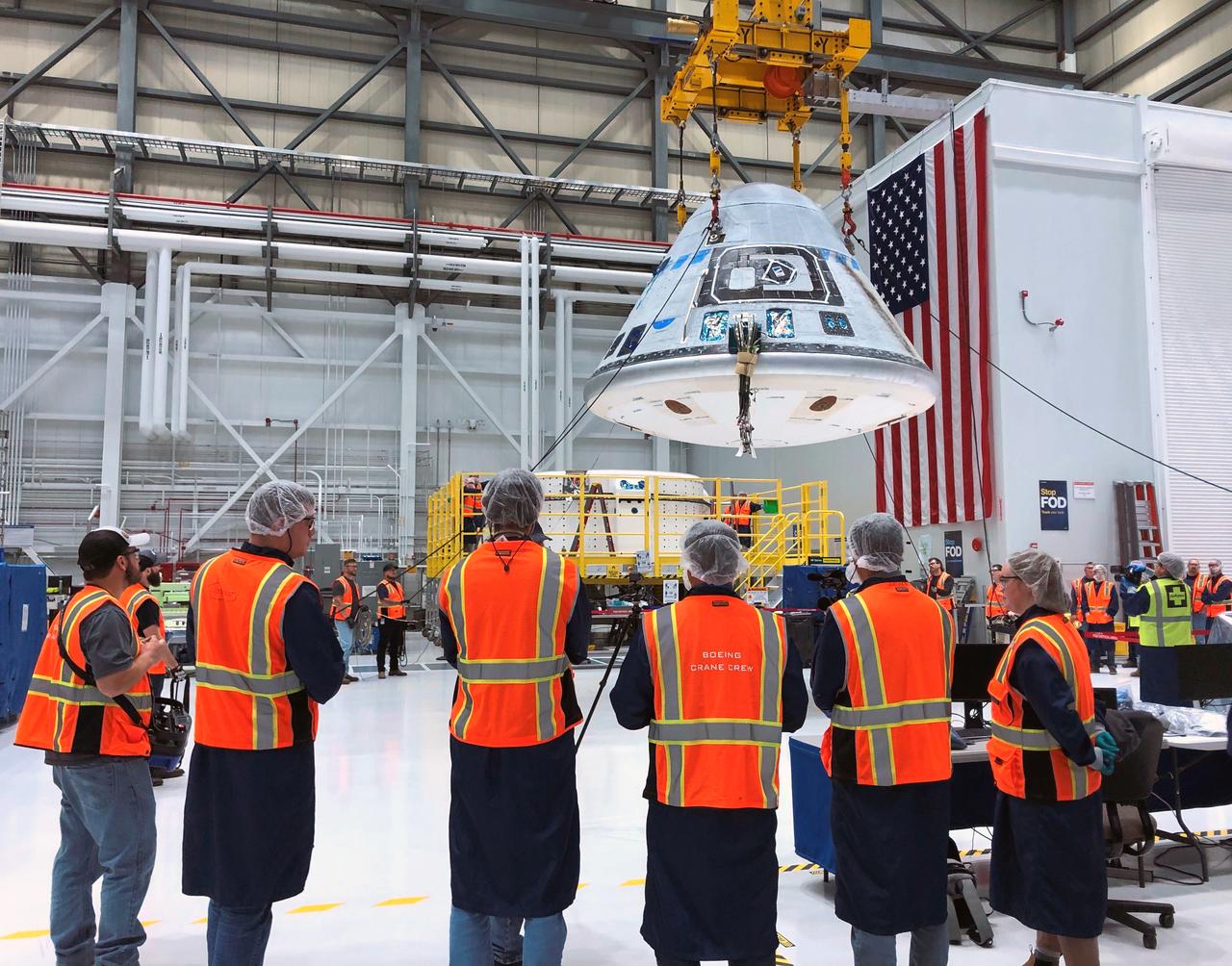
The Starliner team, including the crane crew, monitors the lift of the crew module on Jan. 19, 2023, at Boeing’s Commercial Crew and Cargo Processing Facility before it is mated onto the new service module ahead of NASA’s Boeing Crew Flight Test.
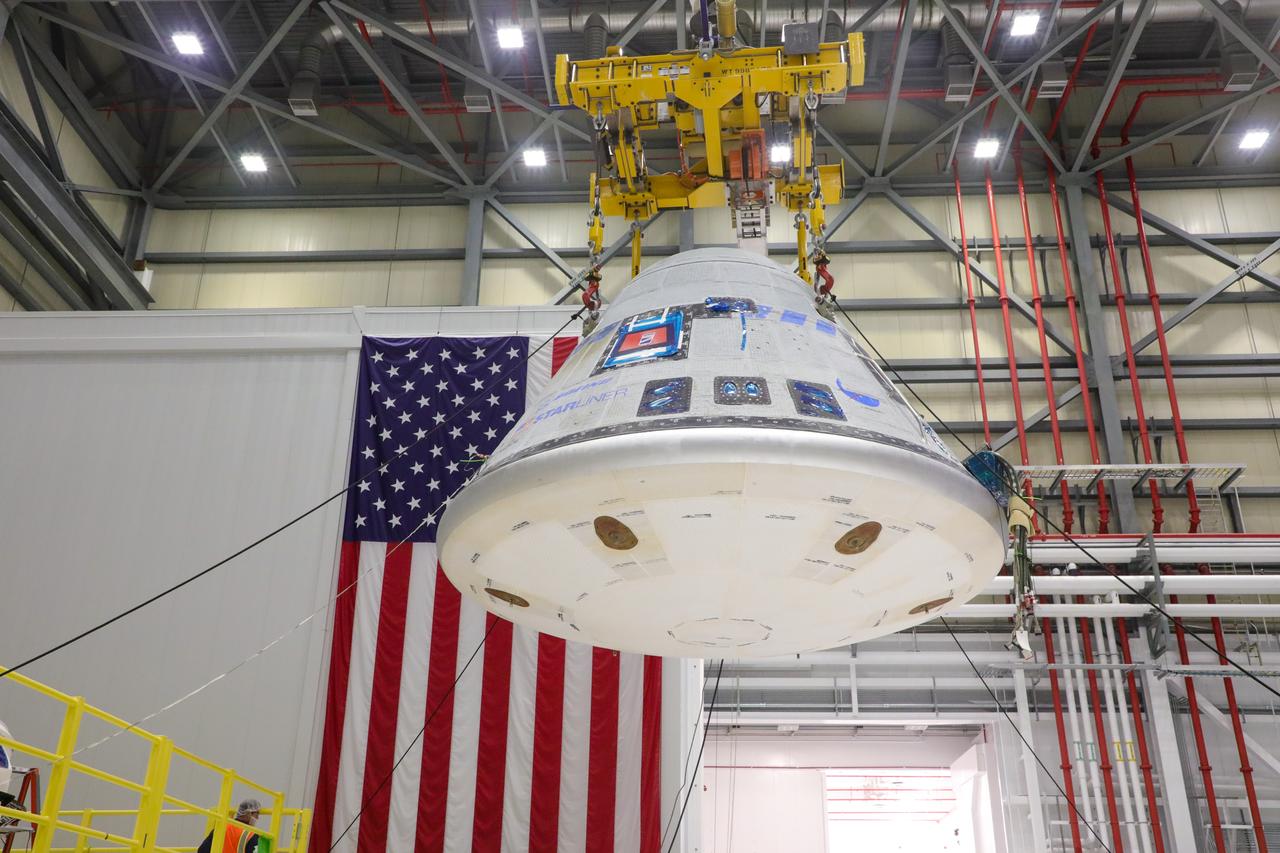
The Starliner crew module is hoisted in Boeing’s Commercial Crew and Cargo Processing Facility on Jan. 19, 2023 before being mated to a new service module for NASA’s Boeing Crew Flight Test.
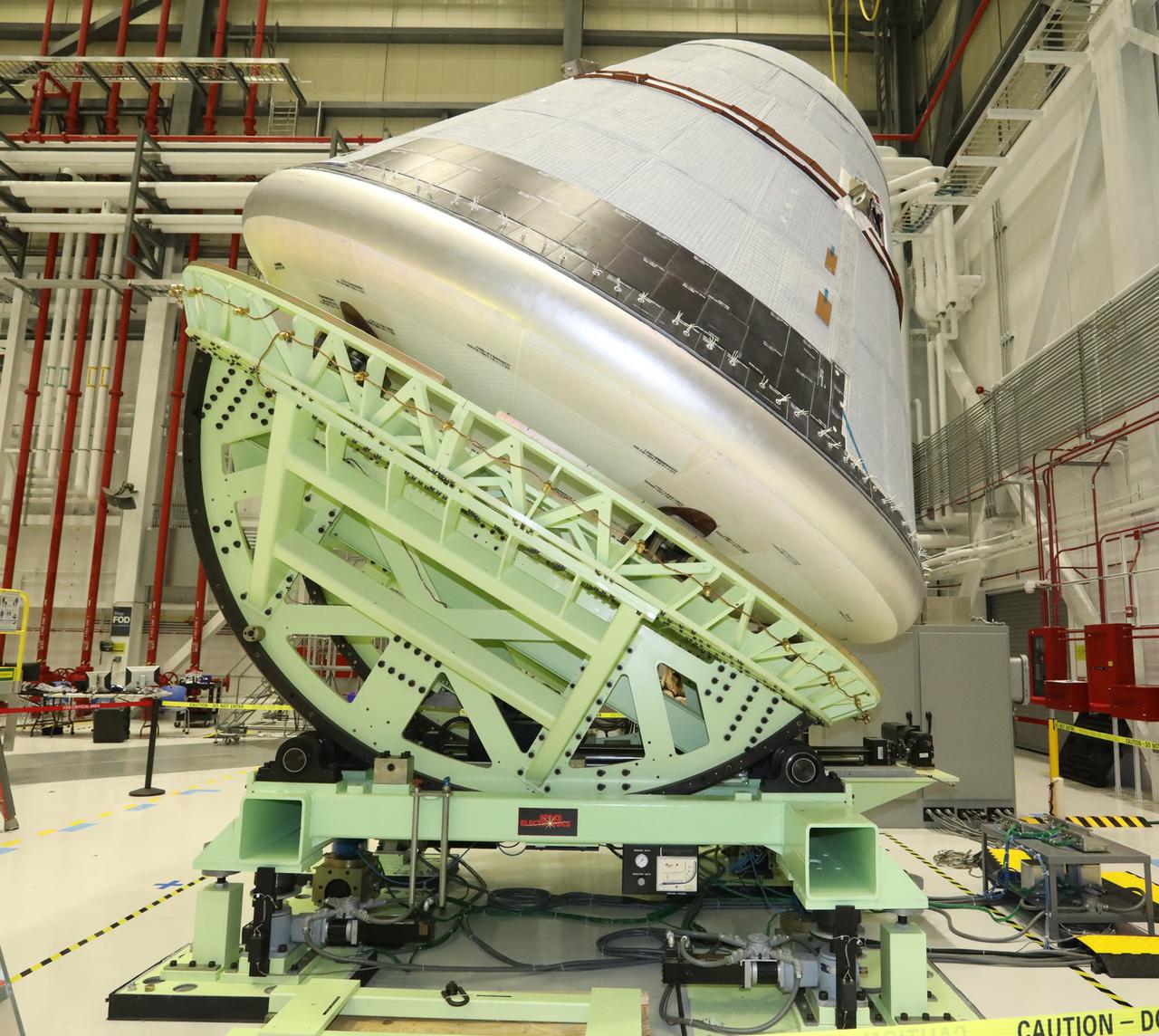
Boeing’s Starliner crew module is weighed in the Commercial Crew and Cargo Processing Facility at Kennedy Space Center in Florida on Jan. 14, 2021, in preparation for the company’s second Orbital Flight Test (OFT-2), as part of NASA’s Commercial Crew Program.. The Weight and Center of Gravity test measures the weight and balance of the spacecraft to ensure optimal performance during launch and re-entry. The test helps to validate parameters required for launching on United Launch Alliance’s Atlas V rocket, docking to the International Space Station and for navigation of the vehicle, among others.
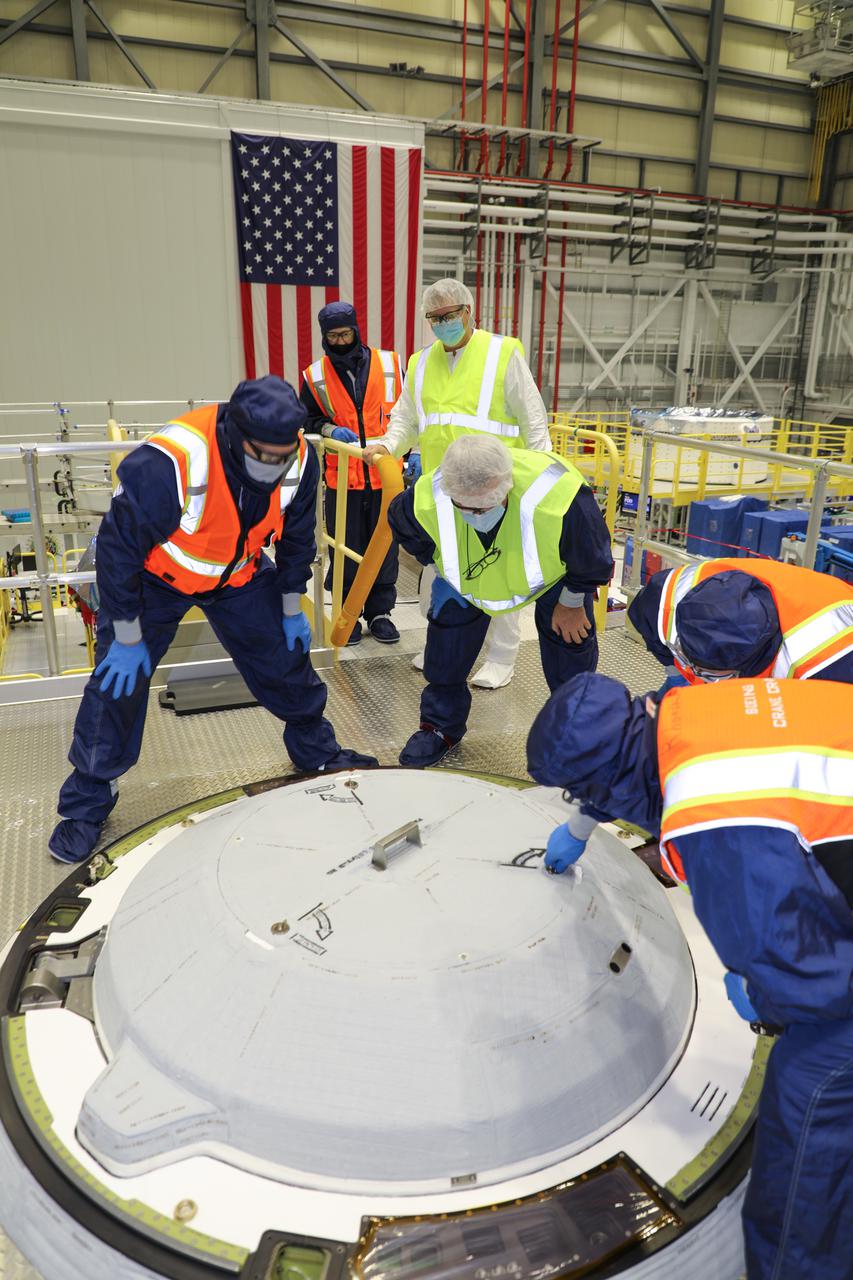
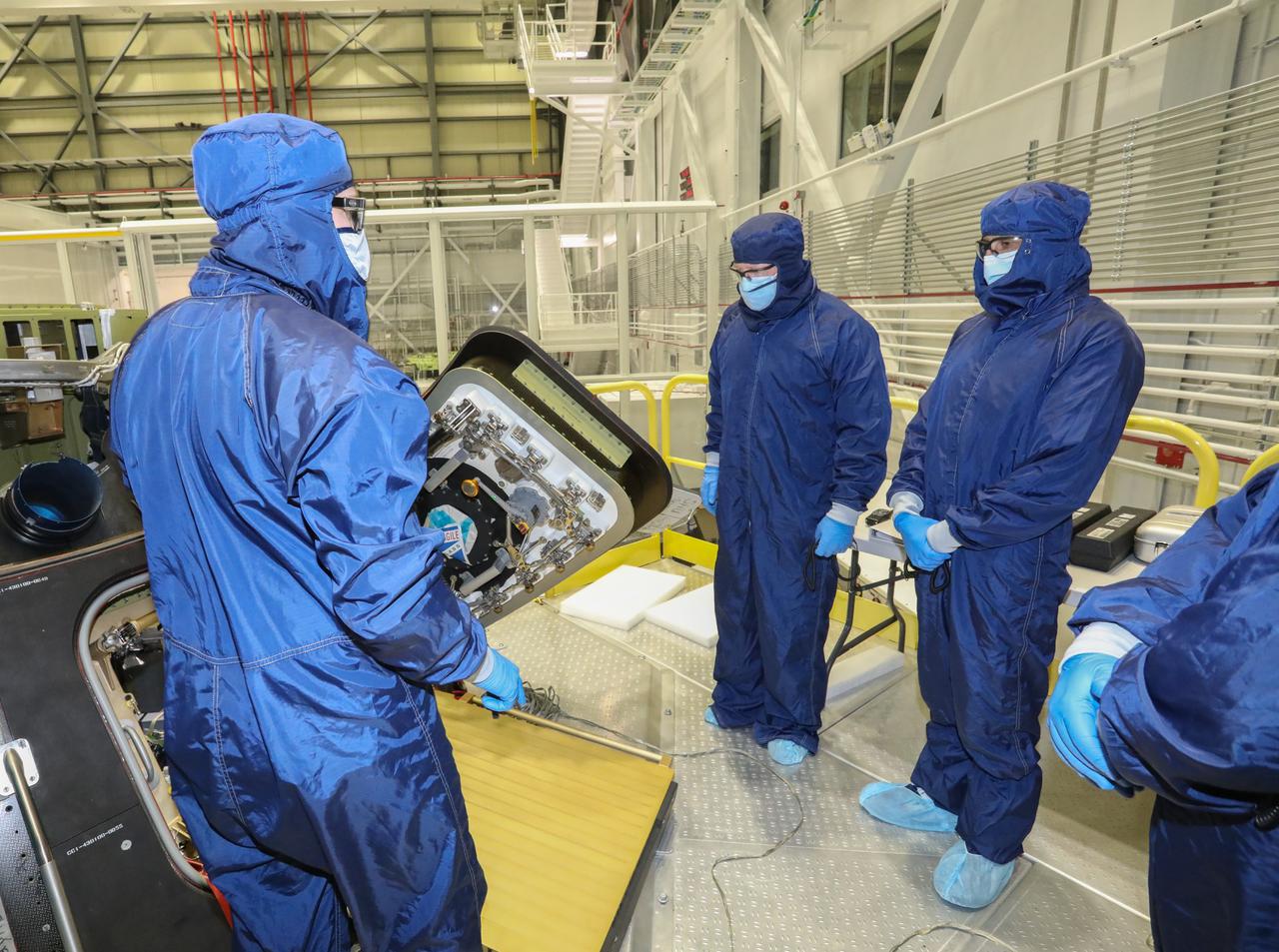
Technicians work on the NASA Docking System (NDS) hatch installation in the Commercial Crew and Cargo Processing Facility at Kennedy Space Center in Florida on Jan. 2, 2021. The NDS cover was installed on Boeing’s Starliner spacecraft in preparation for the company’s second Orbital Flight Test (OFT-2), as part of NASA’s Commercial Crew Program. The cover is designed to protect the components that connect the spacecraft to the International Space Station.
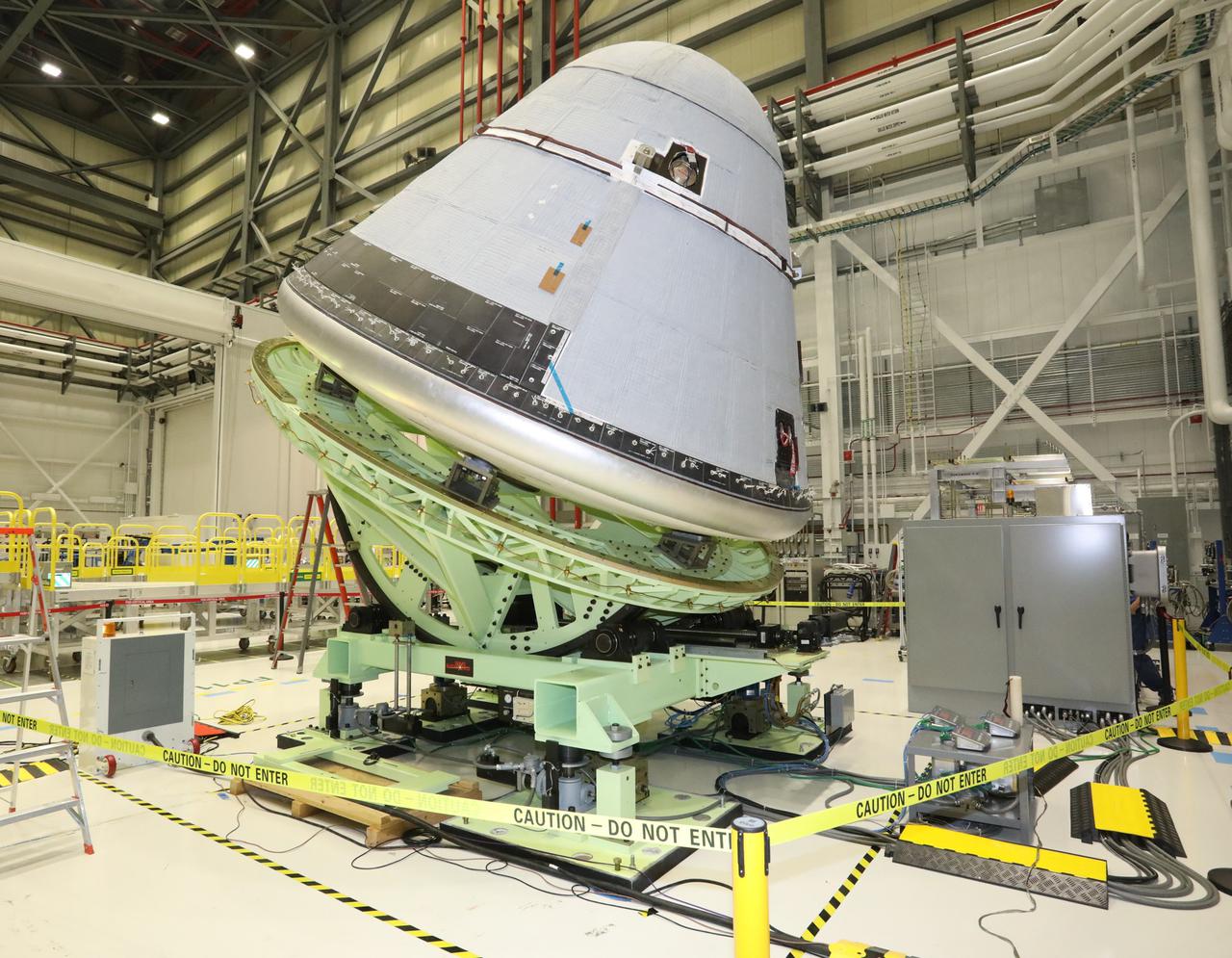
Boeing’s Starliner crew module is weighed in the Commercial Crew and Cargo Processing Facility at Kennedy Space Center in Florida on Jan. 14, 2021, in preparation for the company’s second Orbital Flight Test (OFT-2), as part of NASA’s Commercial Crew Program.. The Weight and Center of Gravity test measures the weight and balance of the spacecraft to ensure optimal performance during launch and re-entry. The test helps to validate parameters required for launching on United Launch Alliance’s Atlas V rocket, docking to the International Space Station and for navigation of the vehicle, among others.
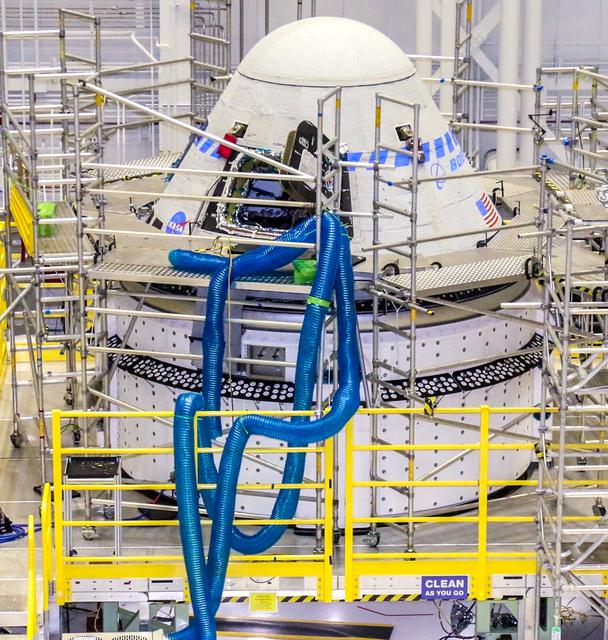
Boeing’s CST-100 Starliner spacecraft undergoes preparations for the company’s Orbital Flight Test-2 (OFT-2) in the Commercial Crew and Cargo Processing Facility at NASA’s Kennedy Space Center in Florida, Wednesday, April 28, 2021. As part of NASA’s Commercial Crew Program, OFT-2 is a critical developmental milestone on Boeing’s path to fly crew missions for NASA.
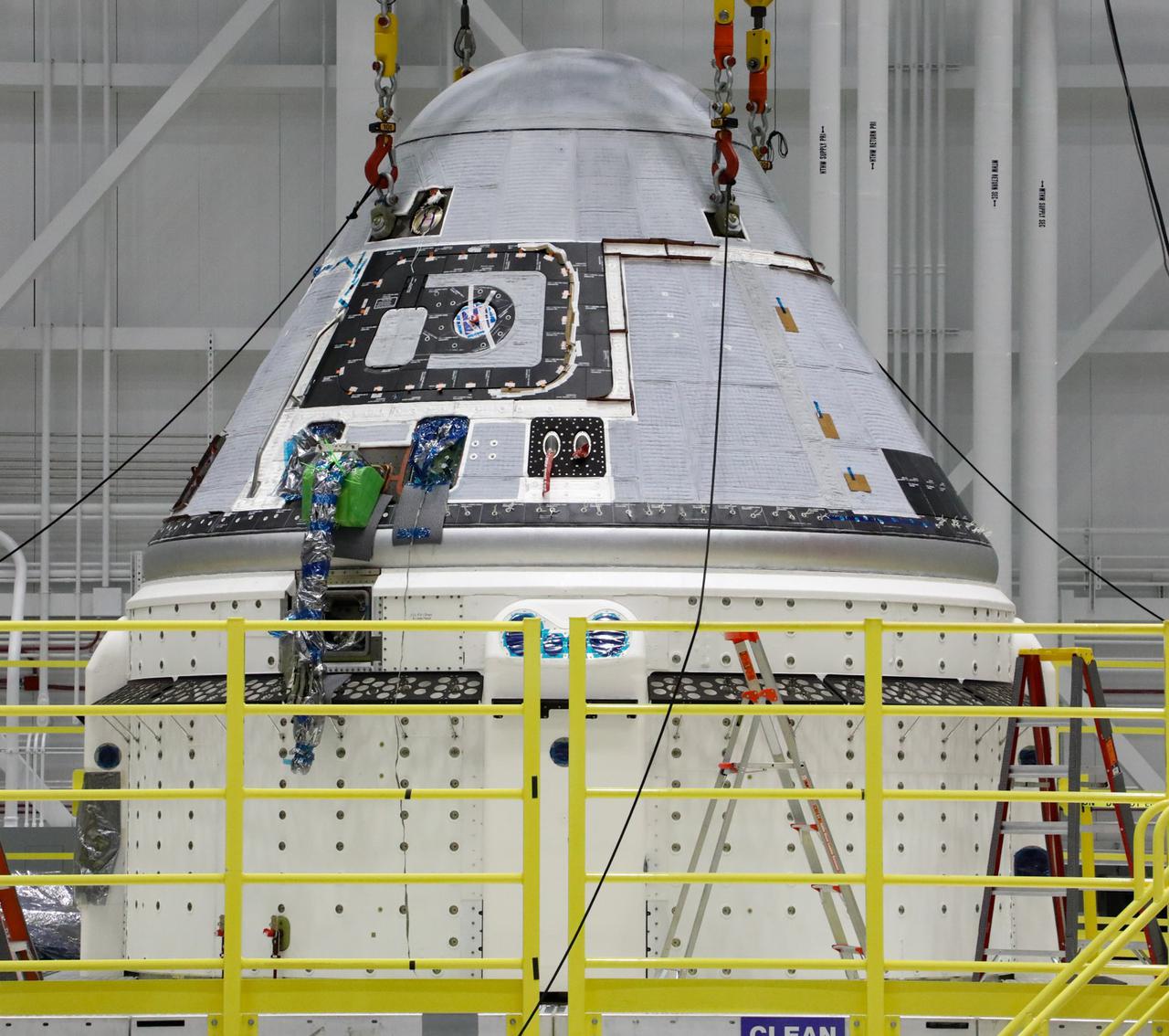
The completed Boeing Starliner vehicle for the second Orbital Flight Test (OFT-2) is seen in the Commercial Crew and Cargo Processing Facility at NASA’s Kennedy Space Center in Florida following the mating of the crew module and service module on Jan. 14, 2021. As part of the agency’s Commercial Crew Program, OFT-2 is a critical developmental milestone on the company’s path to fly crew missions for NASA.
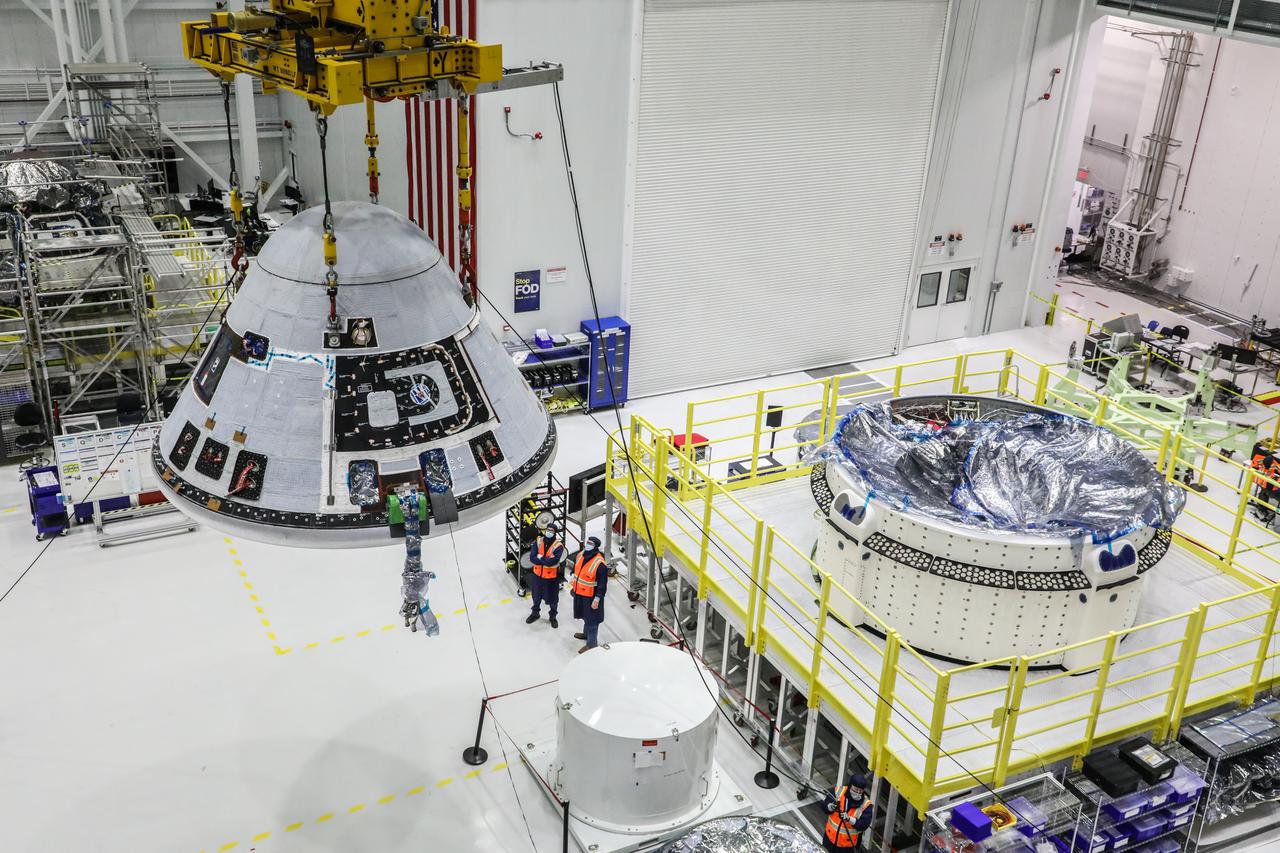
Boeing’s Starliner crew module is hoisted and moves past the service module in the Commercial Crew and Cargo Processing Facility at Kennedy Space Center in Florida on Wednesday, Jan. 13, 2021, prior to the weight and center of gravity test. The crew module and service module will soon be mated, making the spacecraft complete for the company’s second Orbital Flight Test (OFT-2) for NASA’s Commercial Crew Program. OFT-2 is a critical developmental milestone on the company’s path toward flying crew missions for NASA.
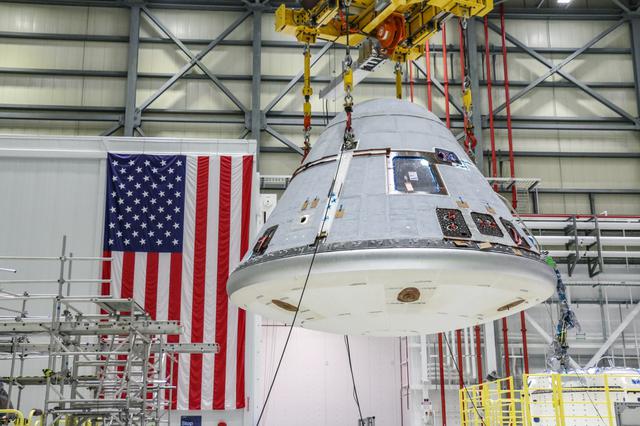
Boeing’s Starliner crew module for the company’s second Orbital Flight Test (OFT-2) is lifted Wednesday, Jan. 13, 2021, in the Commercial Crew and Cargo Processing Facility at Kennedy Space Center in Florida prior to the vehicle having a weight and center of gravity test. OFT-2 is a critical developmental milestone on the company’s path toward flying crew missions for NASA, as part of the agency’s Commercial Crew Program.
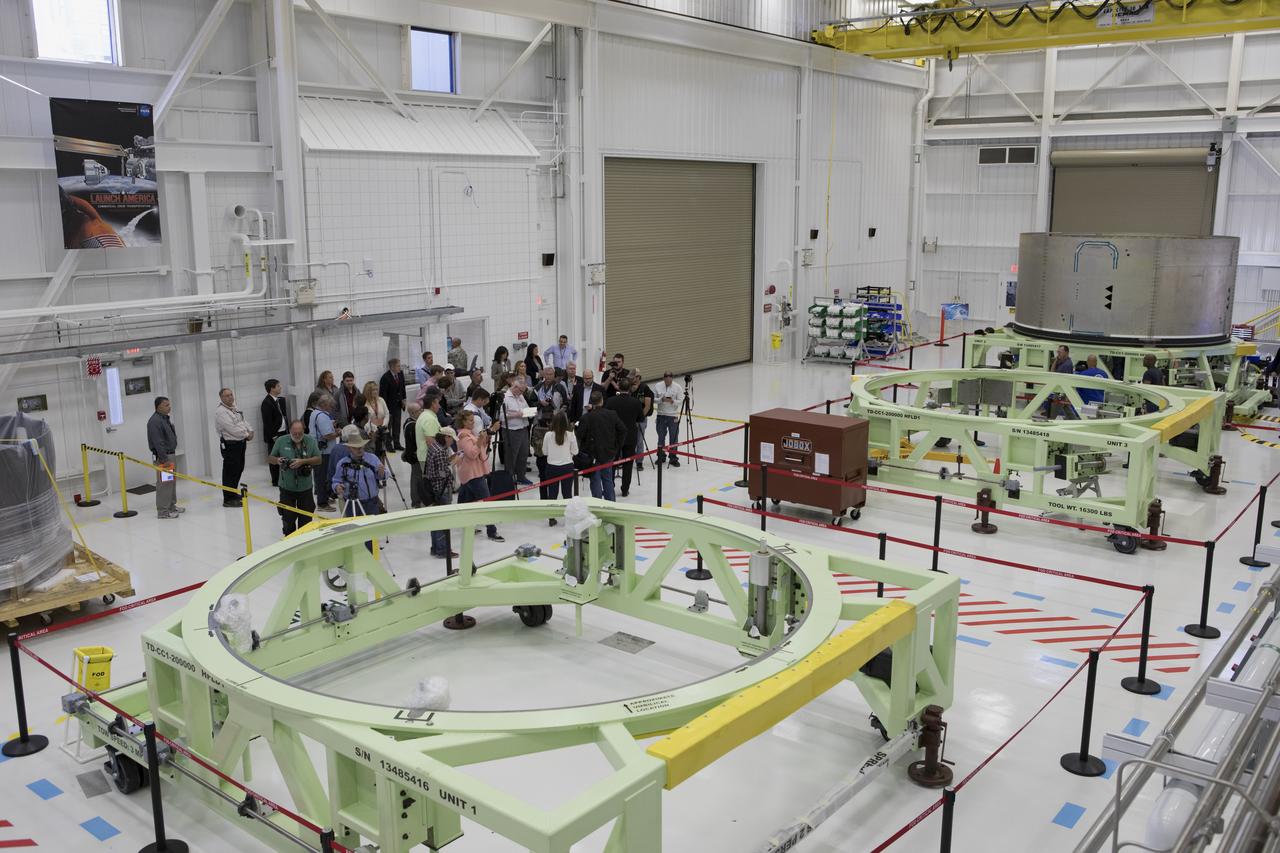
Inside Boeing’s Commercial Crew and Cargo Processing Facility at NASA's Kennedy Space Center in Florida members of the news media view work platforms that will be used in manufacturing Boeing's CST-100 Starliner spacecraft for flight tests and crew rotation missions to the International Space Station as part of the agency's Commercial Crew Program.
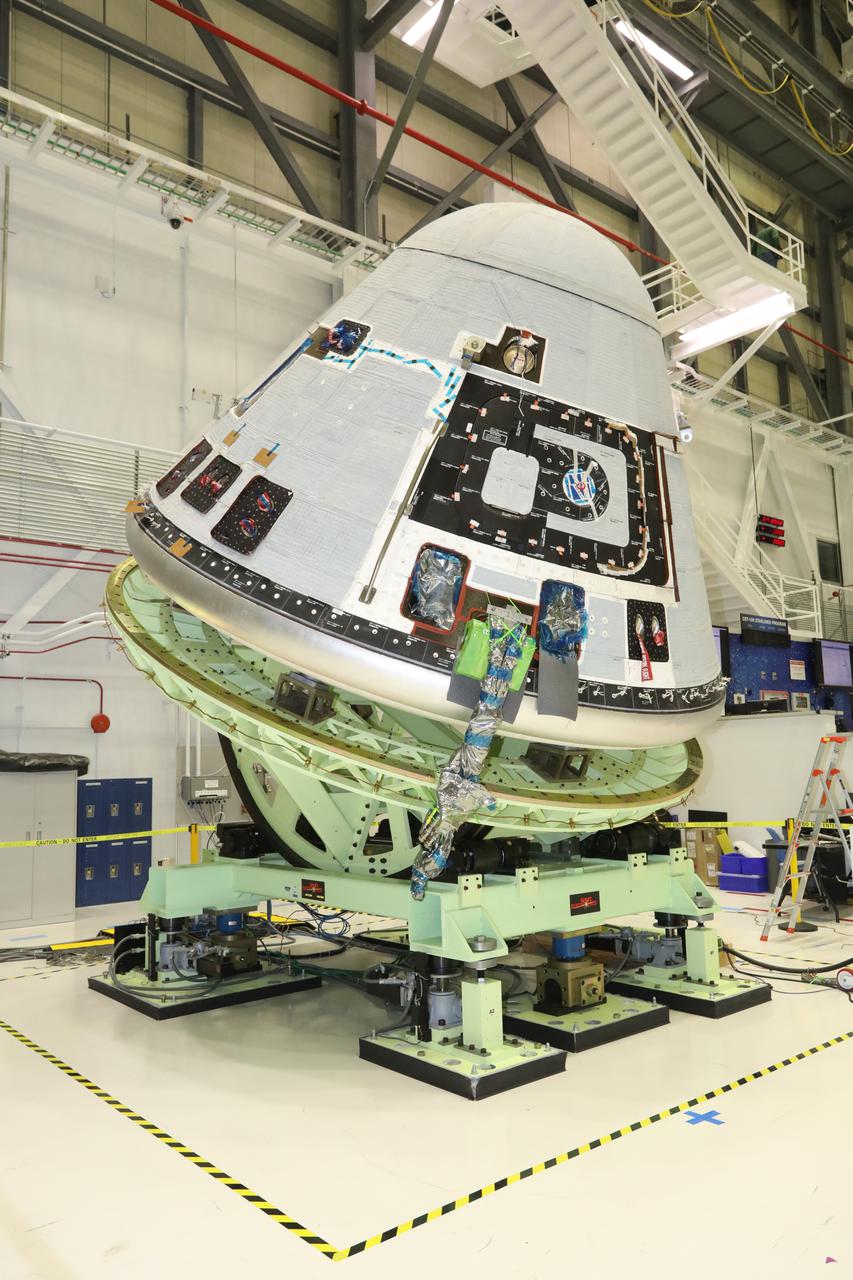
Boeing’s Starliner crew module is weighed in the Commercial Crew and Cargo Processing Facility at Kennedy Space Center in Florida on Jan. 14, 2021, in preparation for the company’s second Orbital Flight Test (OFT-2), as part of NASA’s Commercial Crew Program.. The Weight and Center of Gravity test measures the weight and balance of the spacecraft to ensure optimal performance during launch and re-entry. The test helps to validate parameters required for launching on United Launch Alliance’s Atlas V rocket, docking to the International Space Station and for navigation of the vehicle, among others.
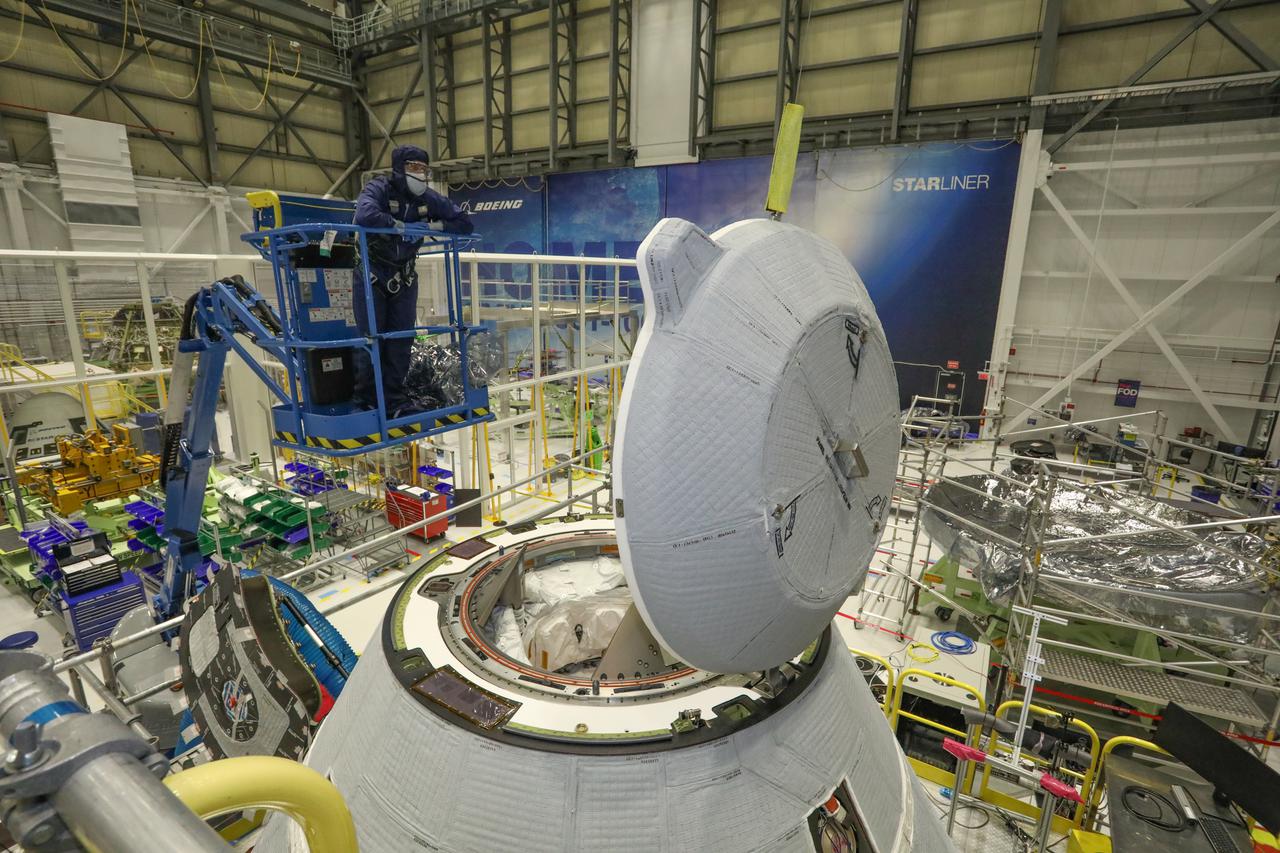
A technician observes the functional test of the NASA Docking System (NDS) cover in the Commercial Crew and Cargo Processing Facility at Kennedy Space Center in Florida on Jan. 2, 2021. The test was conducted in preparation for Boeing’s second Orbital Flight Test (OFT-2), as part of NASA’s Commercial Crew Program. The cover is designed to protect the components that connect the spacecraft to the International Space Station.
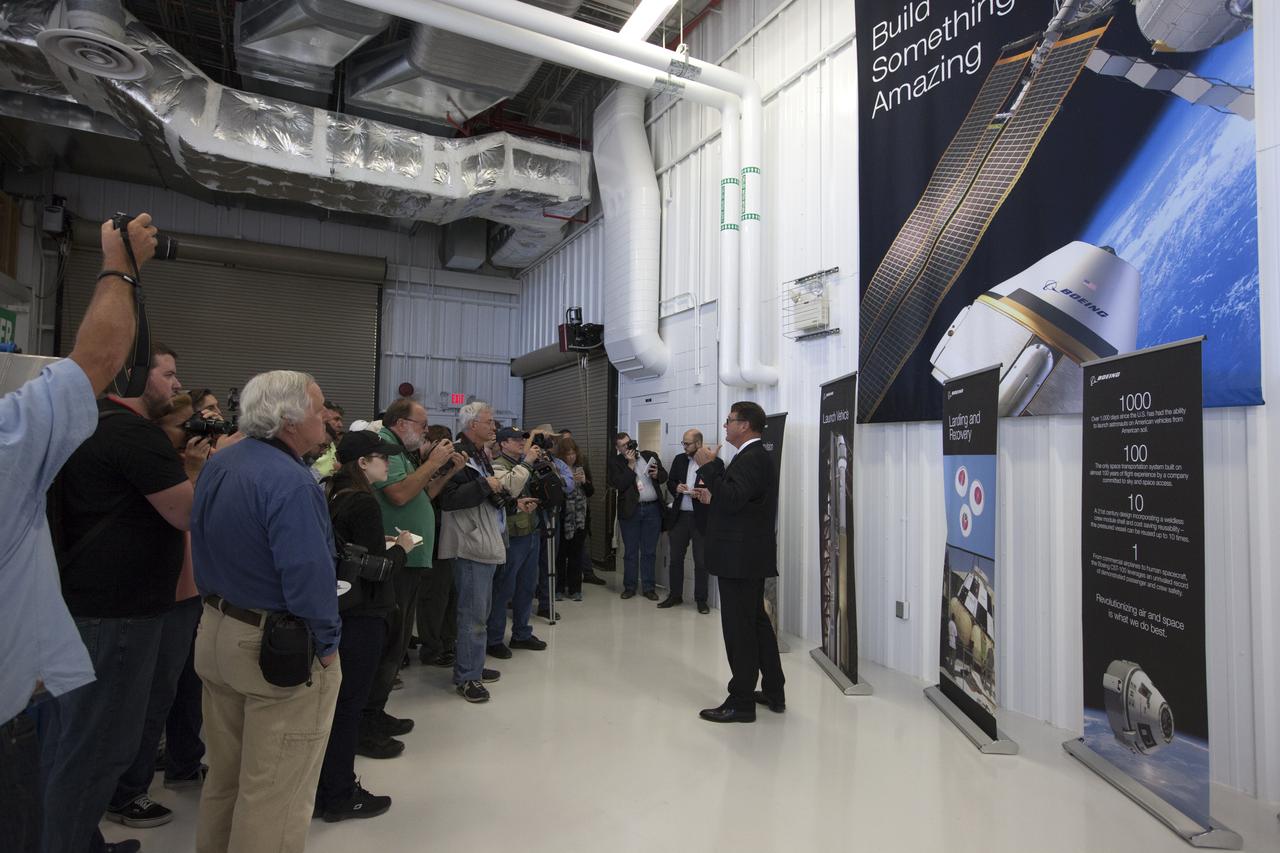
John Mulholland, Boeing vice president and program manager for Commercial Programs, speaks to members of the news media inside the Boeing’s Commercial Crew and Cargo Processing Facility at the Florida spaceport. The facility will be used in manufacturing Boeing's CST-100 Starliner spacecraft for flight tests and crew rotation missions to the International Space Station as part of the agency's Commercial Crew Program.
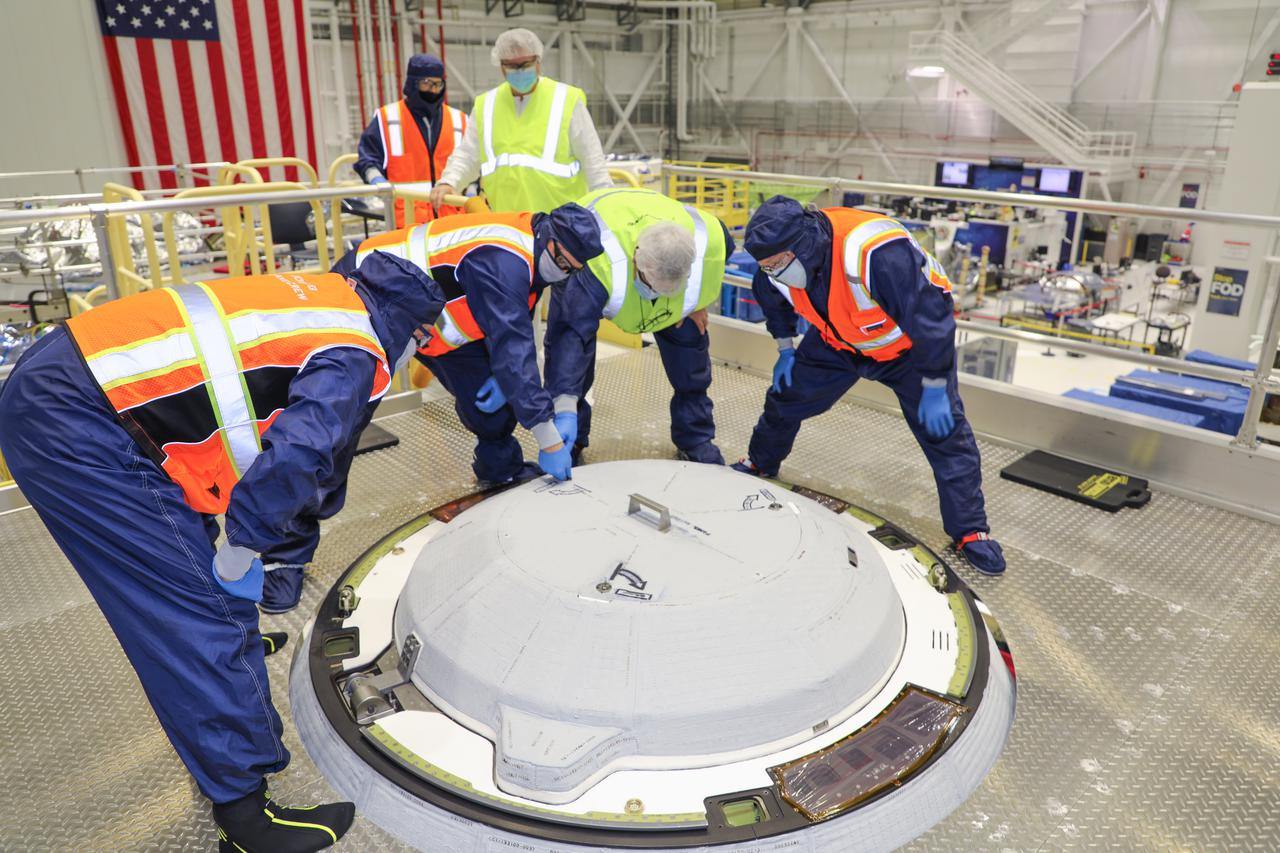
Technicians work on the NASA Docking System (NDS) cover hatch installation in the Commercial Crew and Cargo Processing Facility at Kennedy Space Center in Florida on Jan. 2, 2021. The NDS cover was installed on Boeing’s Starliner spacecraft in preparation for the company’s second Orbital Flight Test (OFT-2), as part of NASA’s Commercial Crew Program. The cover is designed to protect the components that connect the spacecraft to the International Space Station.
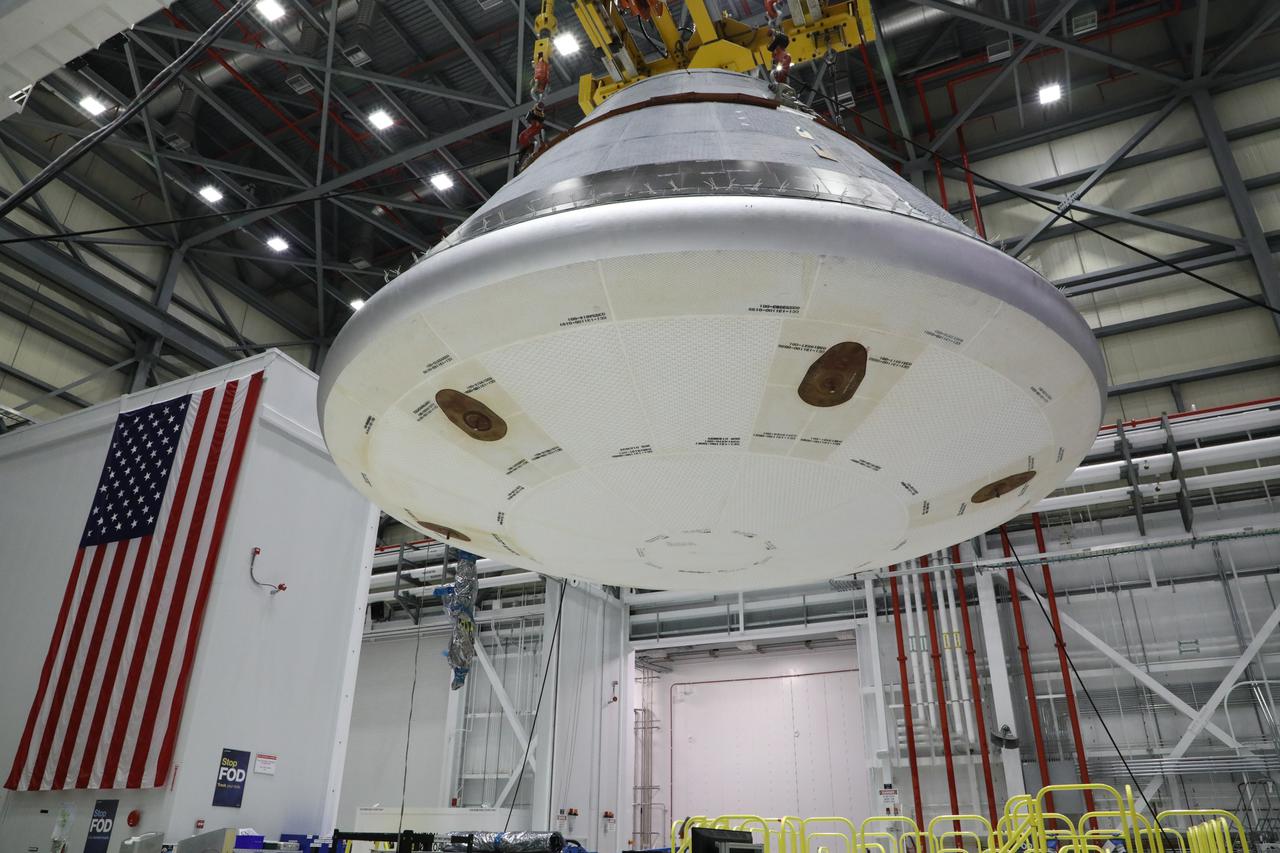
The Boeing Starliner crew module is hoisted across the Commercial Crew and Cargo Processing Facility at NASA’s Kennedy Space Center in Florida on Jan. 14, 2021, to be mated with the service module. The Starliner spacecraft is being prepared for Boeing’s second Orbital Flight Test (OFT-2). As part of the agency’s Commercial Crew Program, OFT-2 is a critical developmental milestone on the company’s path to fly crew missions for NASA.
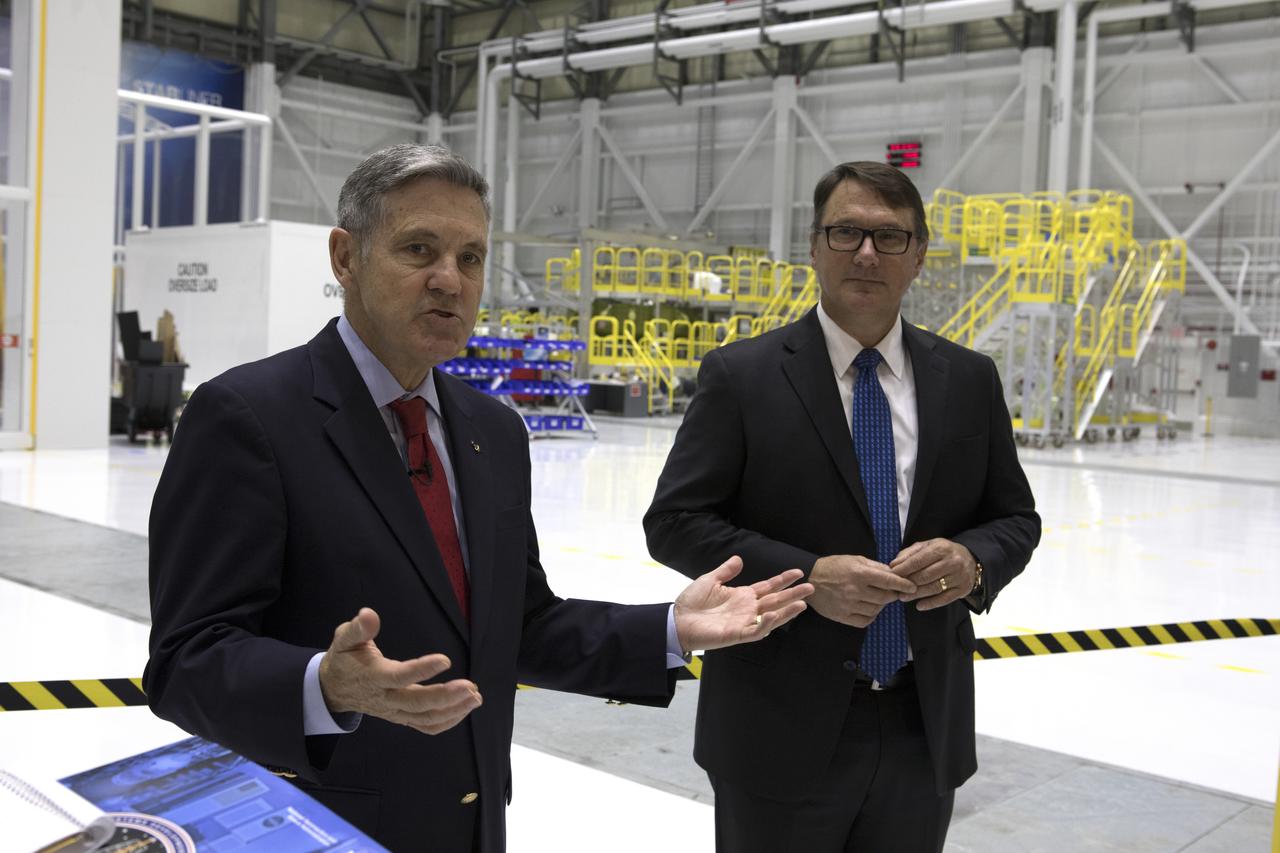
Kennedy Space Center Director Bob Cabana, left, and John Mulholland, Boeing vice president and program manager for Commercial Programs, speak to members of the news media inside the Boeing’s Commercial Crew and Cargo Processing Facility at the Florida spaceport. The facility will be used in manufacturing Boeing's CST-100 Starliner spacecraft for flight tests and crew rotation missions to the International Space Station as part of the agency's Commercial Crew Program.
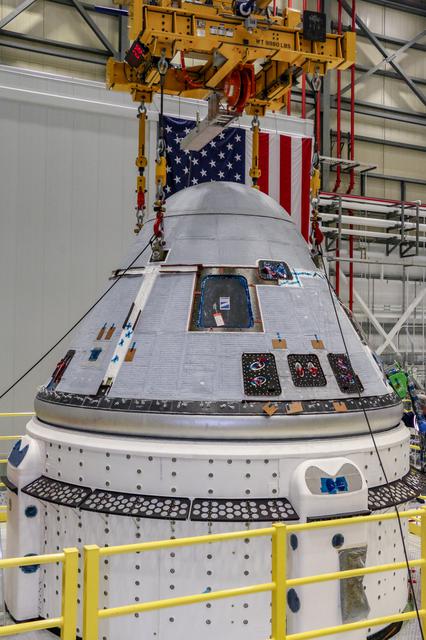
The completed Boeing Starliner vehicle for the second Orbital Flight Test (OFT-2) is seen in the Commercial Crew and Cargo Processing Facility at NASA’s Kennedy Space Center in Florida following the mating of the crew module and service module on Jan. 14, 2021. As part of the agency’s Commercial Crew Program, OFT-2 is a critical developmental milestone on the company’s path to fly crew missions for NASA.
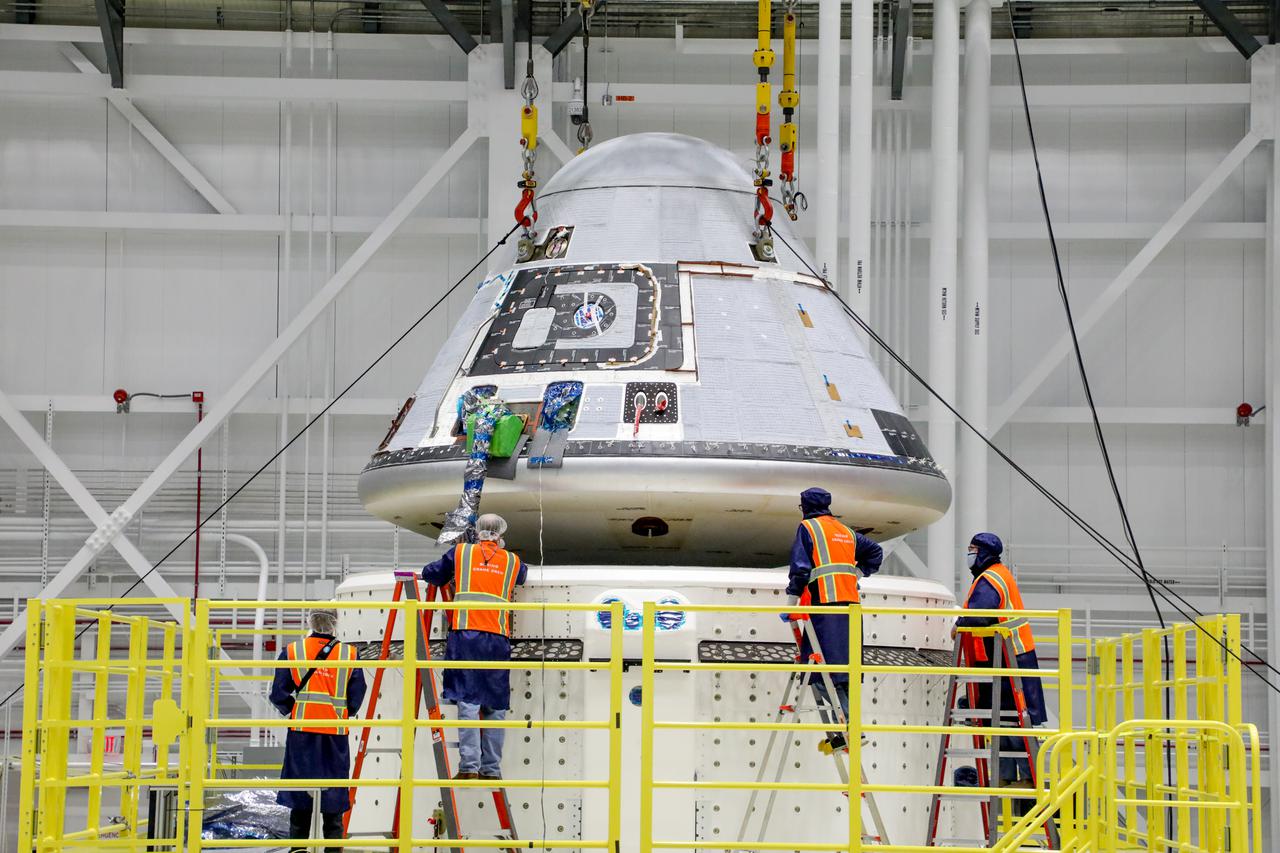
Technicians observe Boeing’s Starliner crew module being placed on top of the service module in the Commercial Crew and Cargo Processing Facility at NASA’s Kennedy Space Center in Florida on Jan. 14, 2021. The Starliner spacecraft is being prepared for Boeing’s second Orbital Flight Test (OFT-2). As part of the agency’s Commercial Crew Program, OFT-2 is a critical developmental milestone on the company’s path to fly crew missions for NASA.
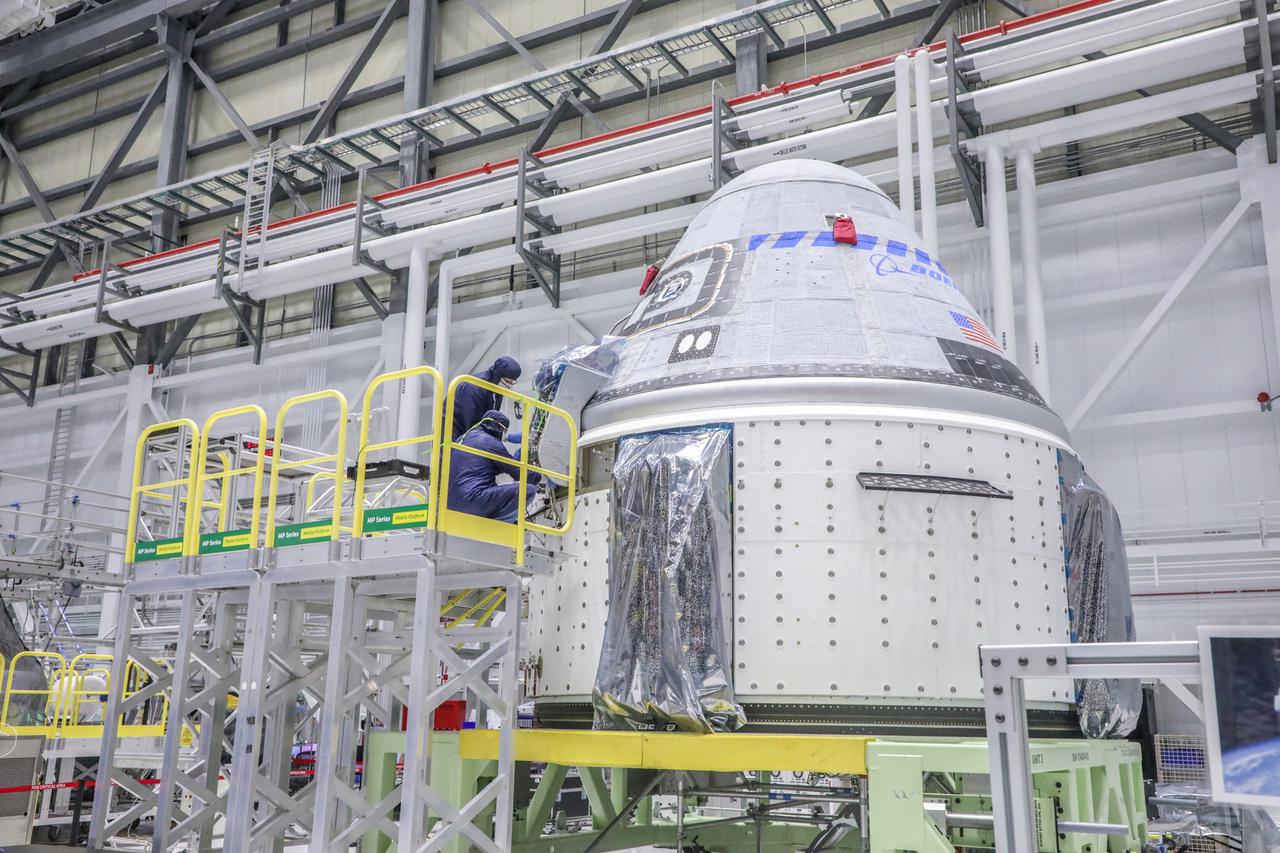
Starliner technicians work on the Orbital Flight Test-2 spacecraft in the high bay of Boeing’s Commercial Crew and Cargo Processing Facility at NASA’s Kennedy Space Center in Florida on Jan. 13, 2022.
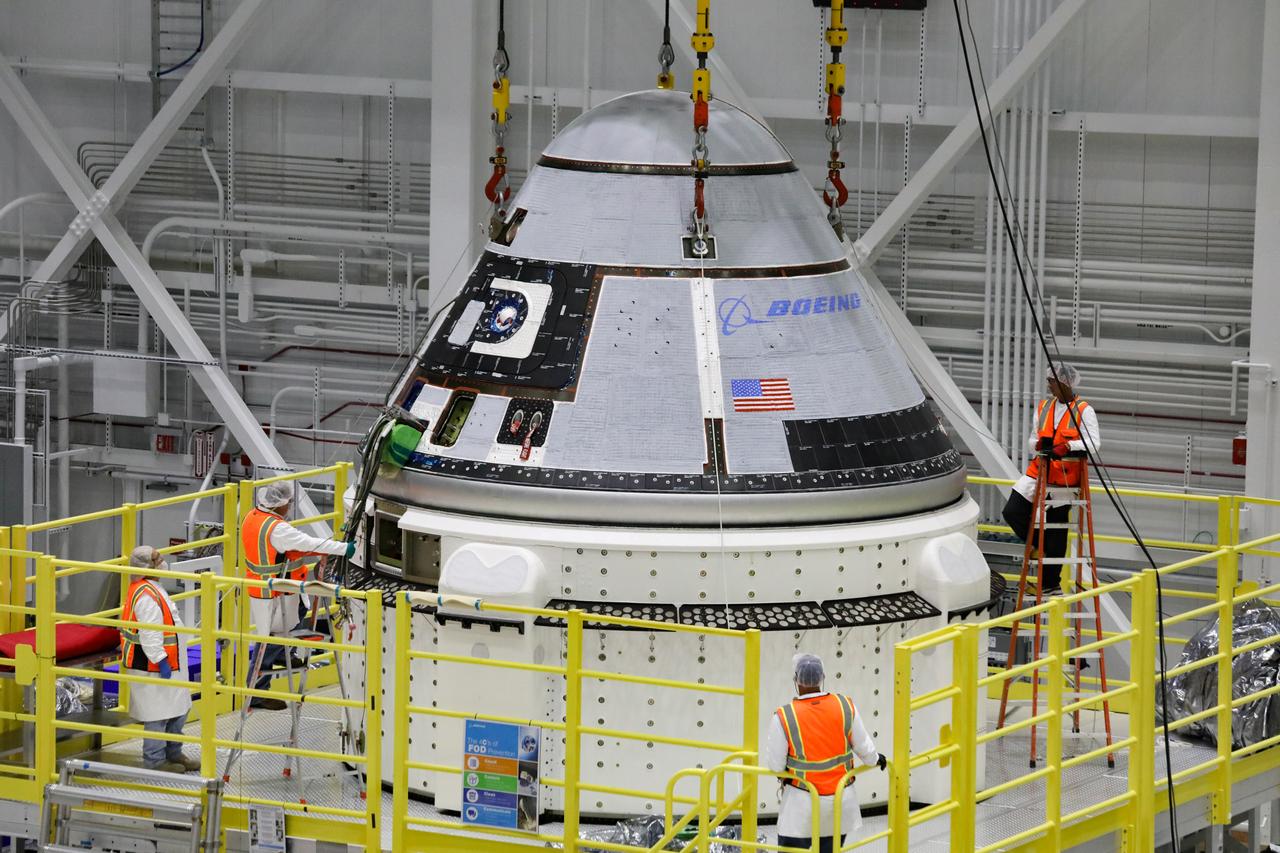
The crew module of Boeing's CST-100 Starliner spacecraft is lifted onto its service module on Oct. 16, 2019, inside the Commercial Crew and Cargo Processing Facility (C3PF) at Kennedy Space Center in Florida ahead of the company's Orbital Flight Test to the International Space Station as part of NASA's Commercial Crew Program.
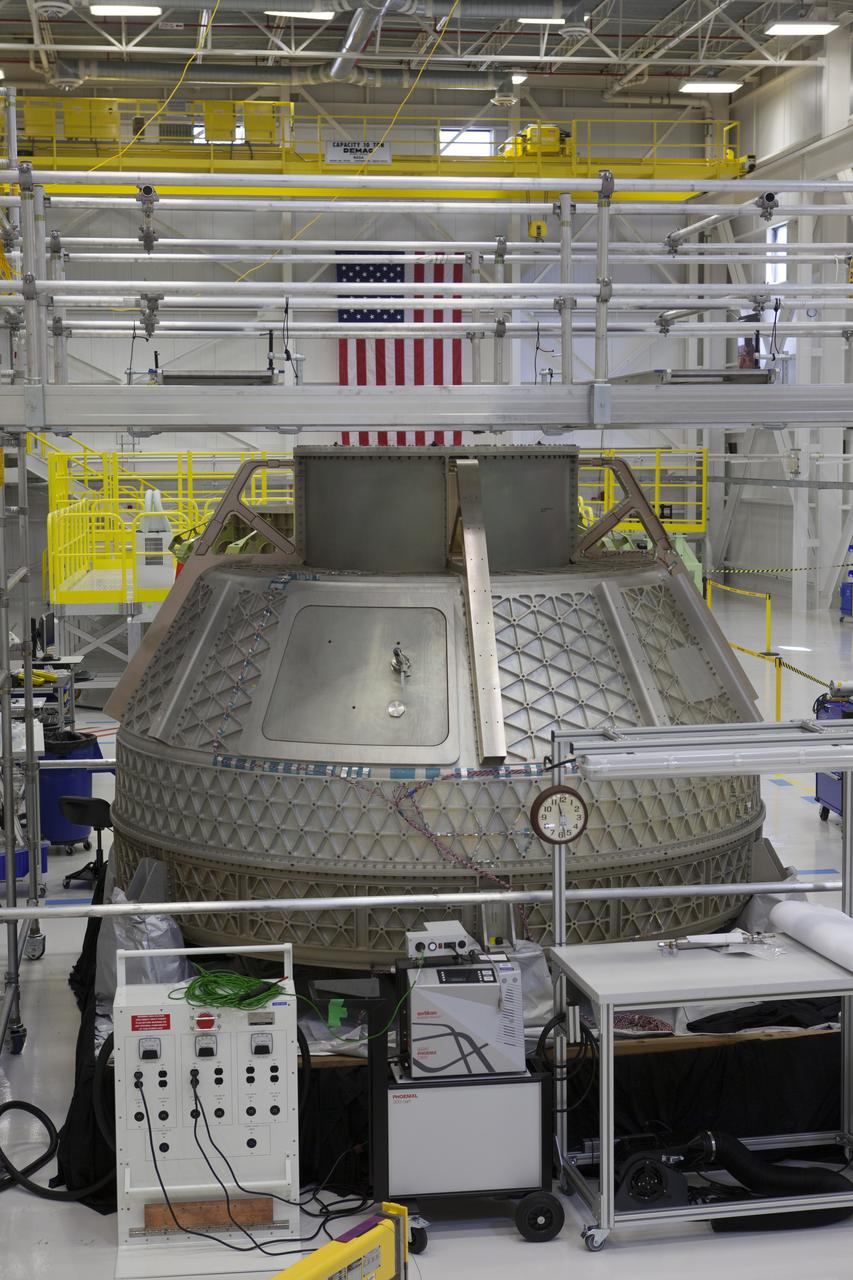
The Boeing CST-100 Structural Test Article awaits testing inside the Commercial Crew and Cargo Processing Facility, or C3PF, at NASA’s Kennedy Space Center in Florida. The test article will serve as a pathfinder for assembling and processing operational CST-100 spacecraft inside the revitalized facility, which for 20 years served as a shuttle processing hangar.
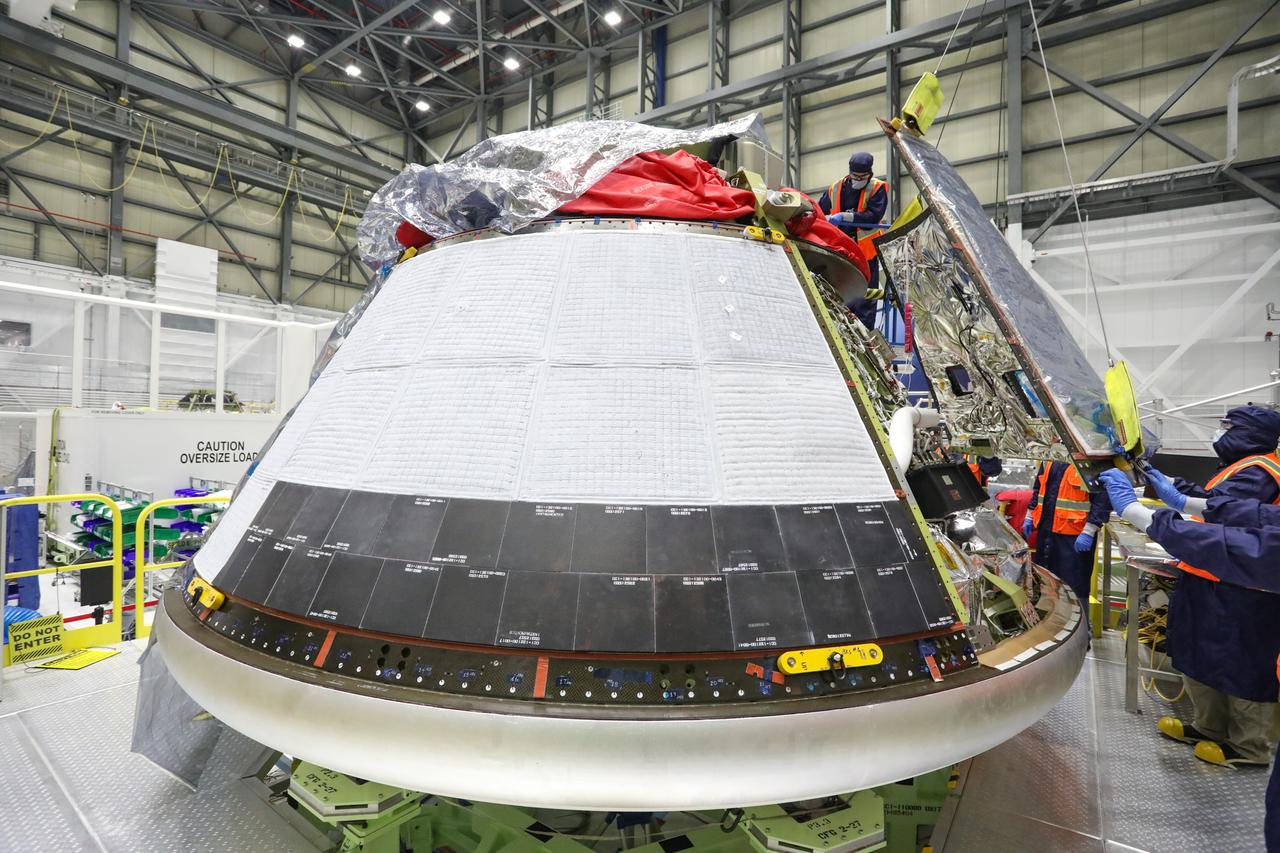
Boeing technicians install back shells on the Orbital Flight Test-2 (OFT-2) Starliner crew module inside the company’s Commercial Crew and Cargo Processing Facility at NASA’s Kennedy Space Center in Florida on December 2, 2020. During the OFT-2 mission, the uncrewed Starliner spacecraft will fly to the International Space Station for NASA’s Commercial Crew Program.
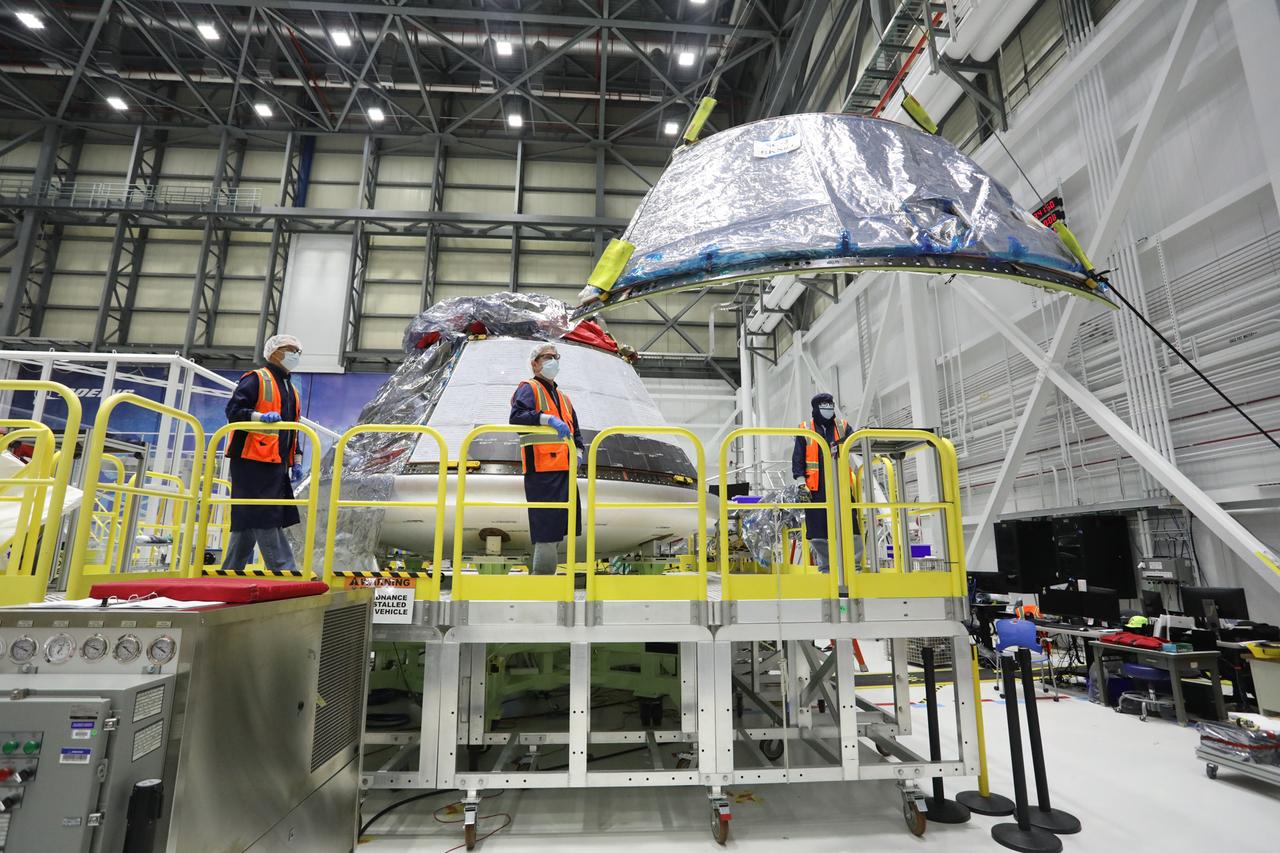
Boeing technicians install back shells on the Orbital Flight Test-2 (OFT-2) Starliner crew module inside the company’s Commercial Crew and Cargo Processing Facility at NASA’s Kennedy Space Center in Florida on December 2, 2020. During the OFT-2 mission, the uncrewed Starliner spacecraft will fly to the International Space Station for NASA’s Commercial Crew Program.
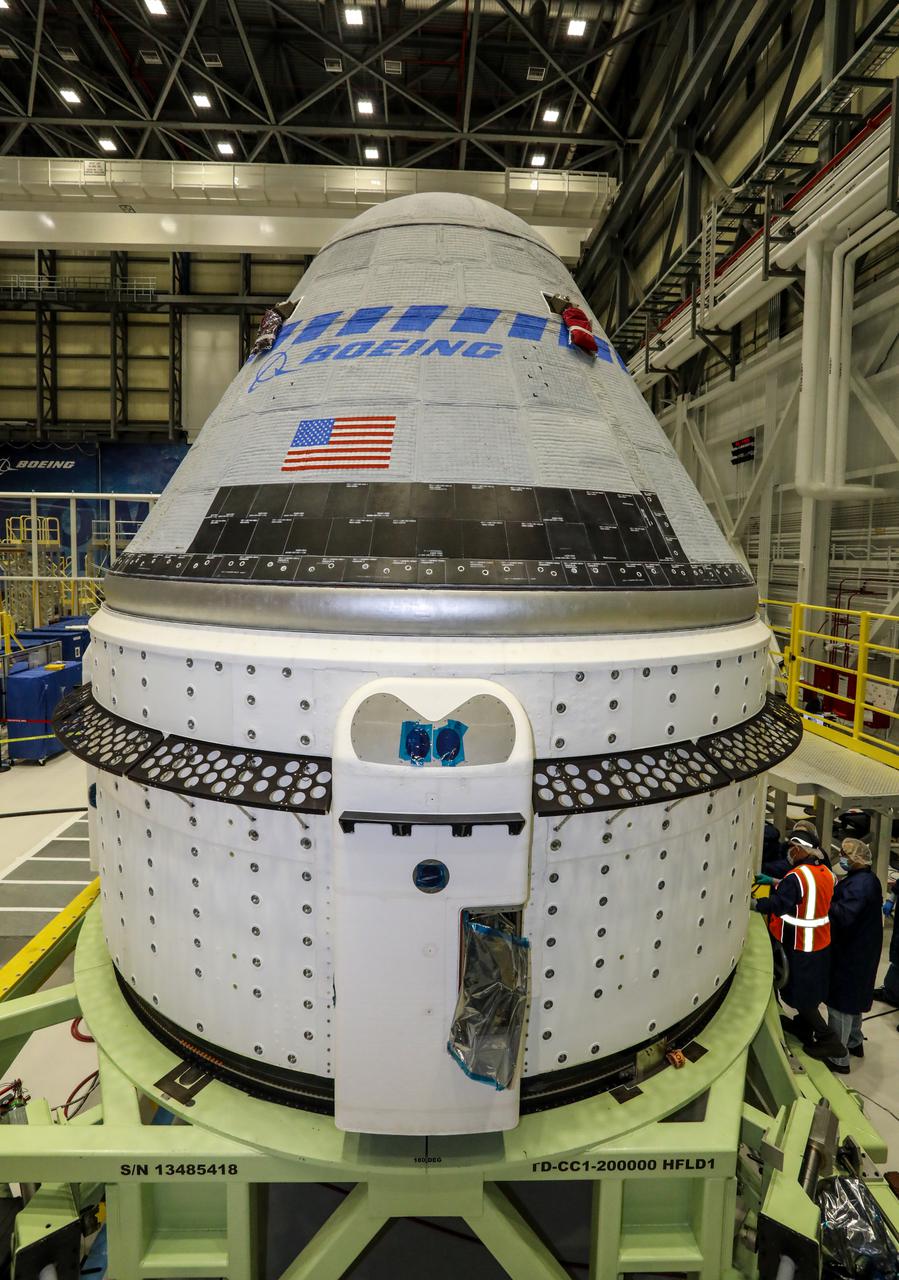
The Boeing CST-100 Starliner spacecraft to be flown on Orbital Flight Test-2 (OFT-2) is seen in the Commercial Crew and Cargo Processing Facility at NASA’s Kennedy Space Center in Florida on June 2. Part of the agency’s Commercial Crew Program, OFT-2 is a critical developmental milestone on the company’s path to fly crew missions for NASA.
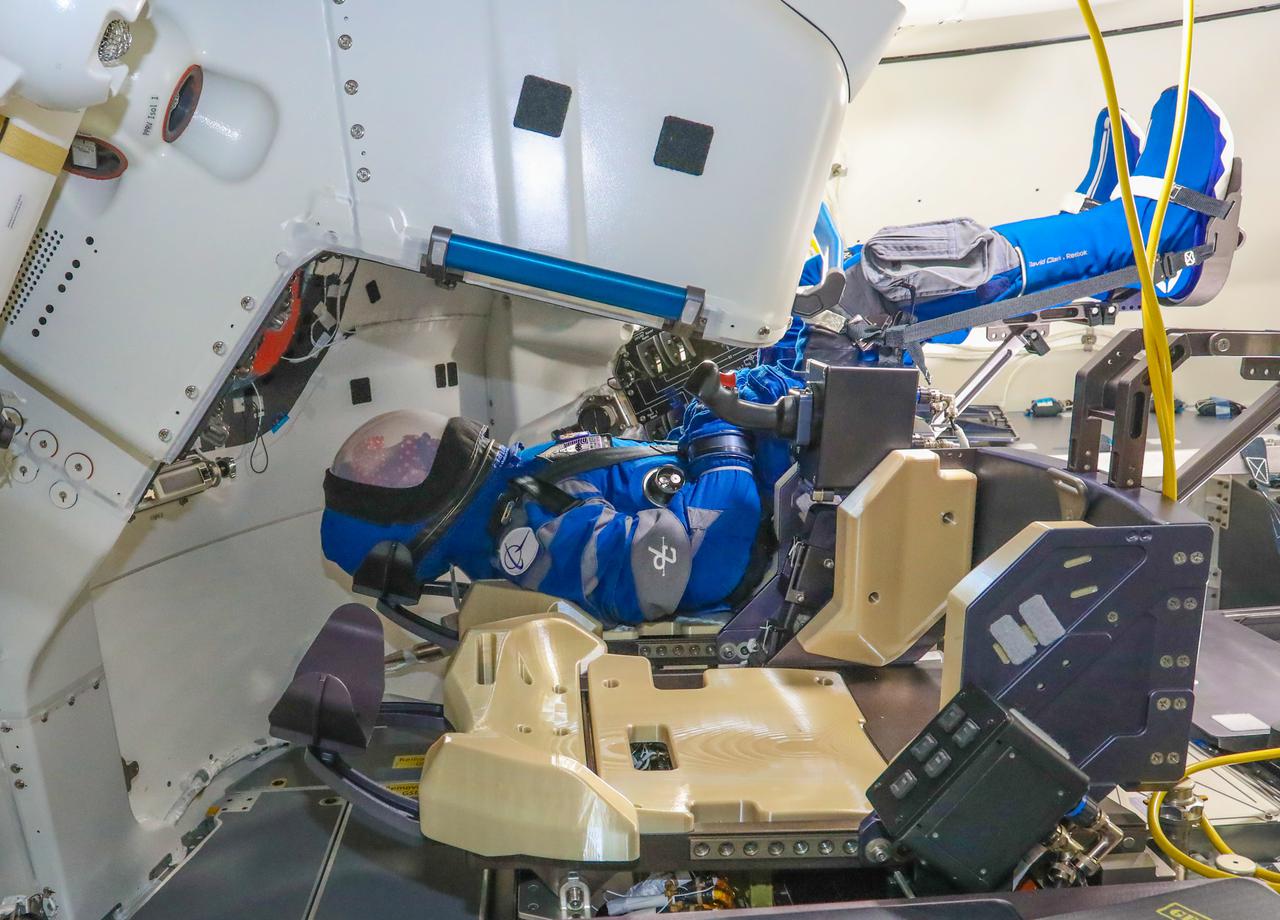
Rosie the Rocketeer, Boeing’s anthropometric test device, claimed her spot once again in the commander’s seat inside the company’s CST-100 Starliner spacecraft for its second uncrewed Orbital Flight Test (OFT-2) for NASA’s Commercial Crew Program. Rosie’s first flight, OFT, provided hundreds of data points about what astronauts will experience during flight. For OFT-2, she will help maintain Starliner’s center of gravity during ascent, docking, undocking and landing. OFT-2 is scheduled to lift off at 2:53 p.m. ET Friday, July 30, from Space Launch Complex 41 at Cape Canaveral Space Force Station in Florida bound for the International Space Station.
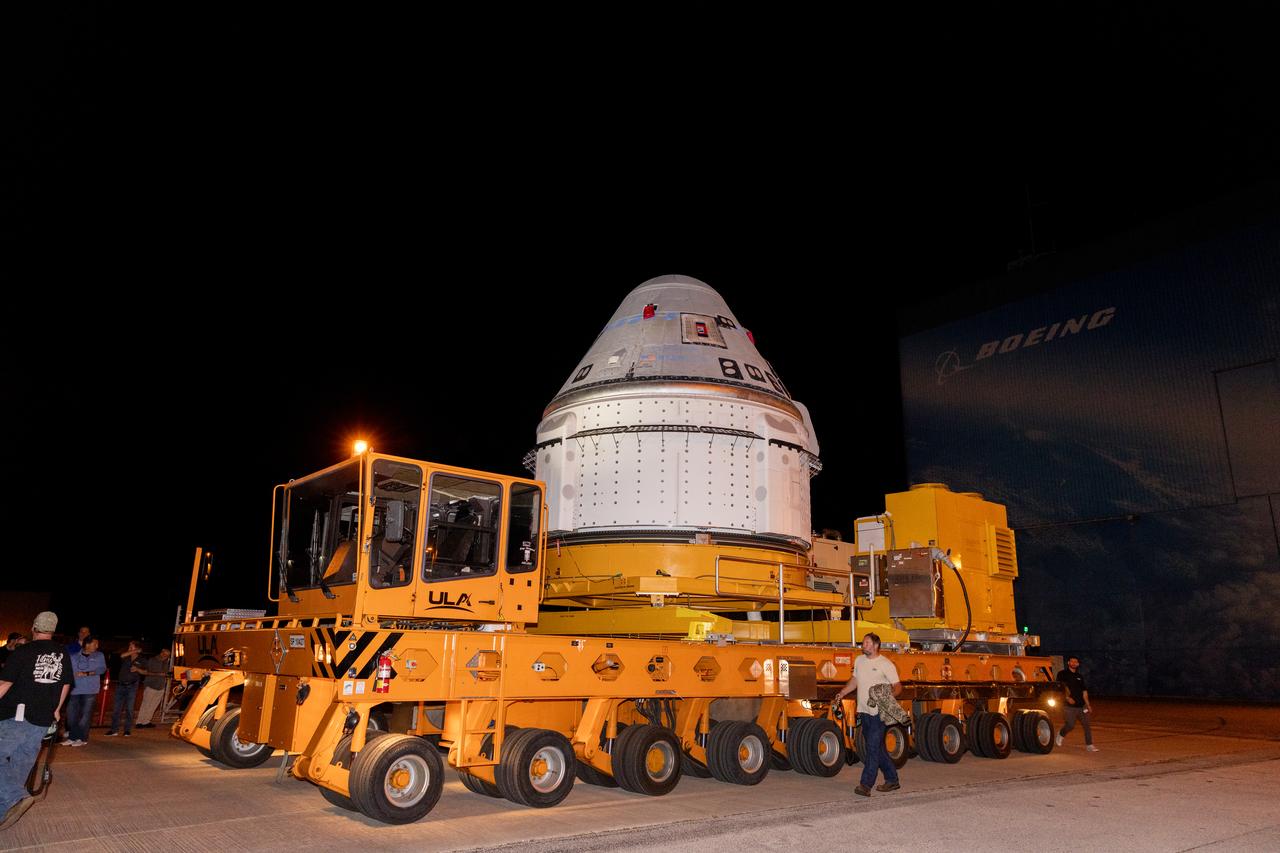
Boeing’s Starliner spacecraft, set to carry NASA astronauts Butch Wilmore and Suni Williams on the agency’s Boeing Crew Flight Test to the International Space Station, rolls out of the company’s Commercial Crew and Cargo Processing Facility at NASA’s Kennedy Space Center in Florida on Tuesday, April 16, 2024. The spacecraft will be transported to ULA’s (United Launch Alliance) Vertical Integration Facility at Space Launch Complex-41 at Cape Canaveral Space Force Station to be lifted and connected to the Atlas V rocket for launch no earlier than Monday, May 6, 2024.
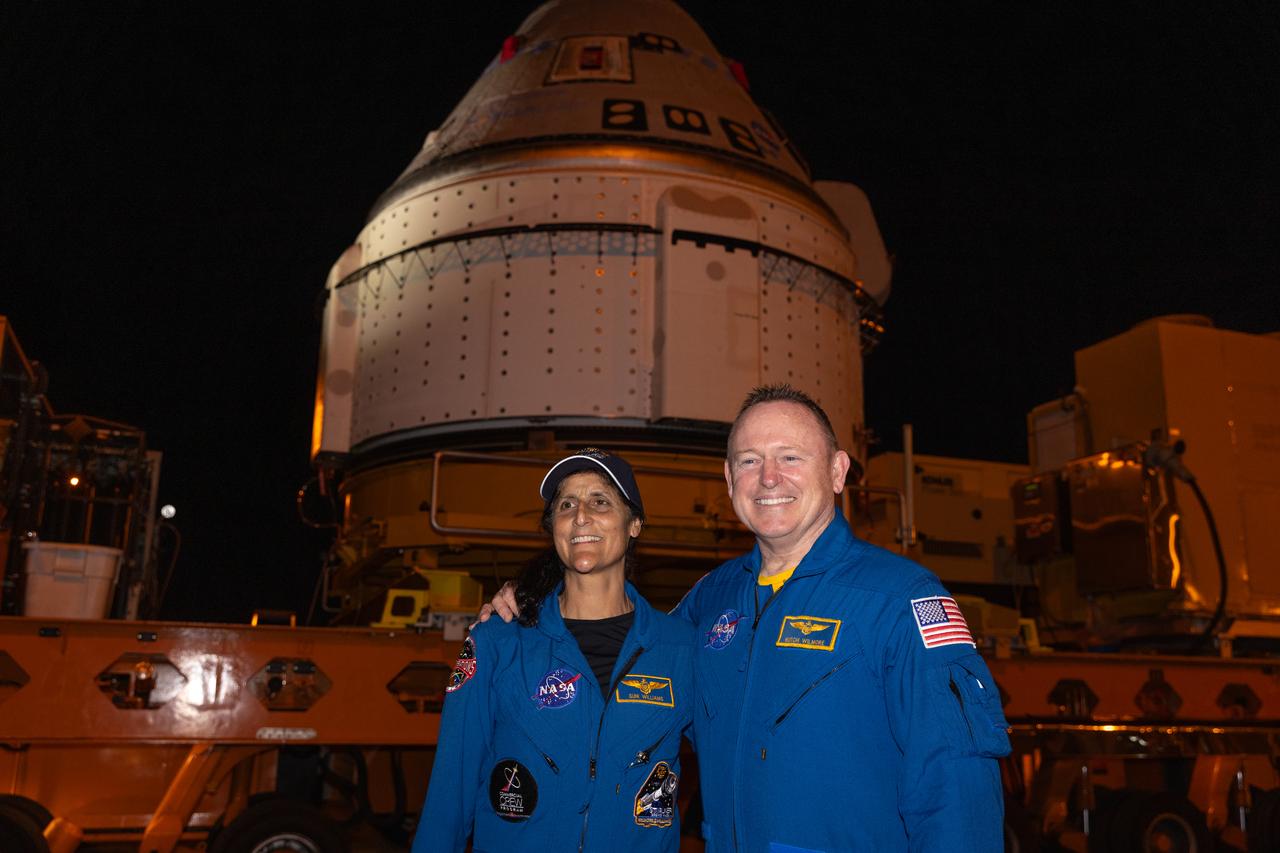
From left to right, NASA astronauts Suni Williams and Butch Wilmore pose in front of Boeing’s Starliner spacecraft in the early morning of Tuesday, April 16, 2024, outside the company’s Commercial Crew and Cargo Processing Facility at the agency’s Kennedy Space Center in Florida. The spacecraft will take the astronauts to the International Space Station as part of the agency’s Boeing Crew Flight Test no earlier than Monday, May 6, 2024.
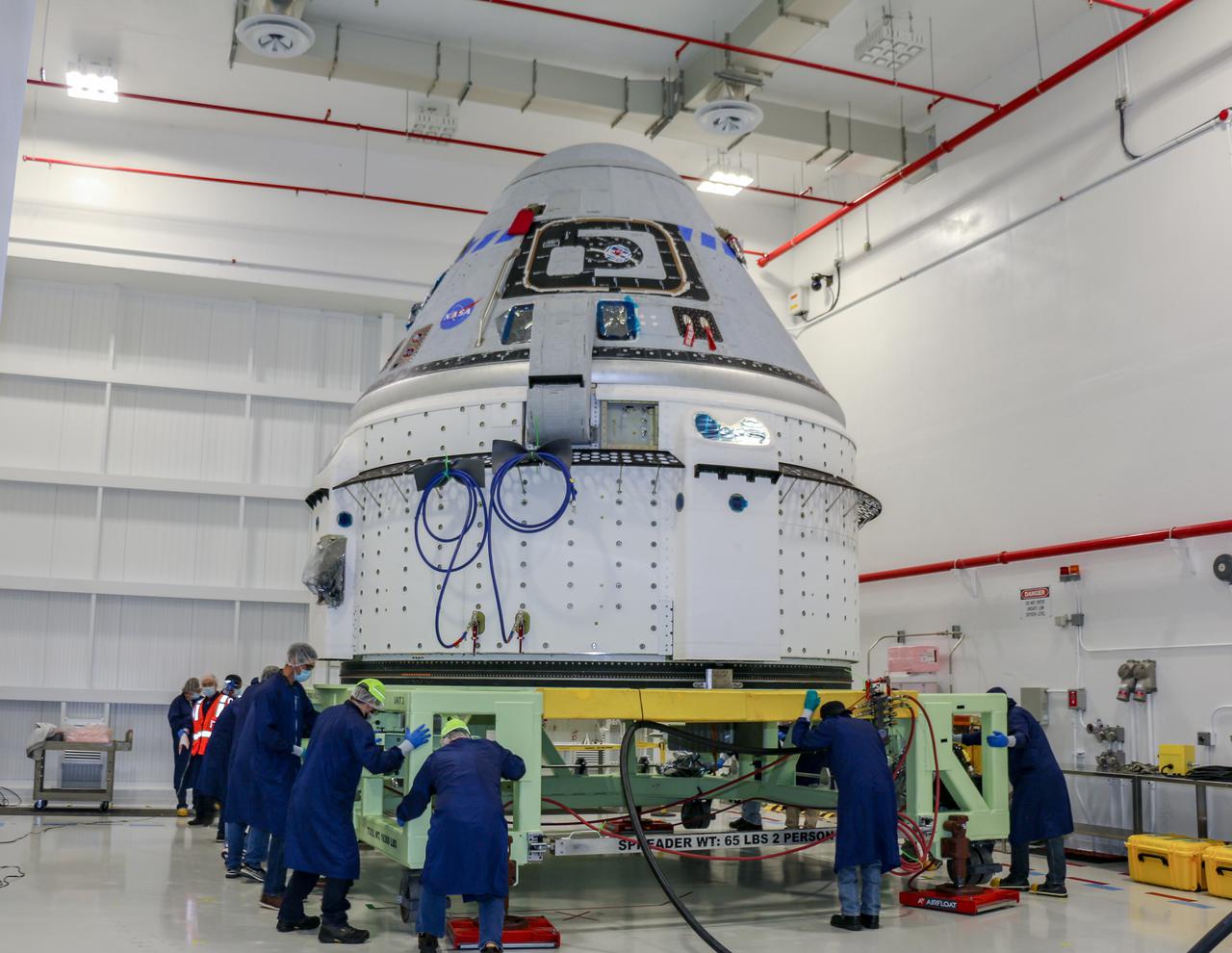
Technicians prepare Boeing’s CST-100 Starliner for the company’s Orbital Flight Test-2 (OFT-2) in the Commercial Crew and Cargo Processing Facility at NASA’s Kennedy Space Center in Florida on June 2. Part of the agency’s Commercial Crew Program, OFT-2 is a critical developmental milestone on the company’s path to fly crew missions for NASA.

Boeing’s Starliner spacecraft, set to carry NASA astronauts Butch Wilmore and Suni Williams on the agency’s Boeing Crew Flight Test to the International Space Station, rolls out of the company’s Commercial Crew and Cargo Processing Facility at NASA’s Kennedy Space Center in Florida on Tuesday, April 16, 2024. The spacecraft will be transported to ULA’s (United Launch Alliance) Vertical Integration Facility at Space Launch Complex-41 at Cape Canaveral Space Force Station to be lifted and connected to the Atlas V rocket for launch no earlier than Monday, May 6, 2024.
Boeing’s Starliner spacecraft, set to carry NASA astronauts Butch Wilmore and Suni Williams on the agency’s Boeing Crew Flight Test to the International Space Station, rolls out of the company’s Commercial Crew and Cargo Processing Facility at NASA’s Kennedy Space Center in Florida on Tuesday, April 16, 2024. The spacecraft will be transported to ULA’s (United Launch Alliance) Vertical Integration Facility at Space Launch Complex-41 at Cape Canaveral Space Force Station to be lifted and connected to the Atlas V rocket for launch no earlier than Monday, May 6, 2024.
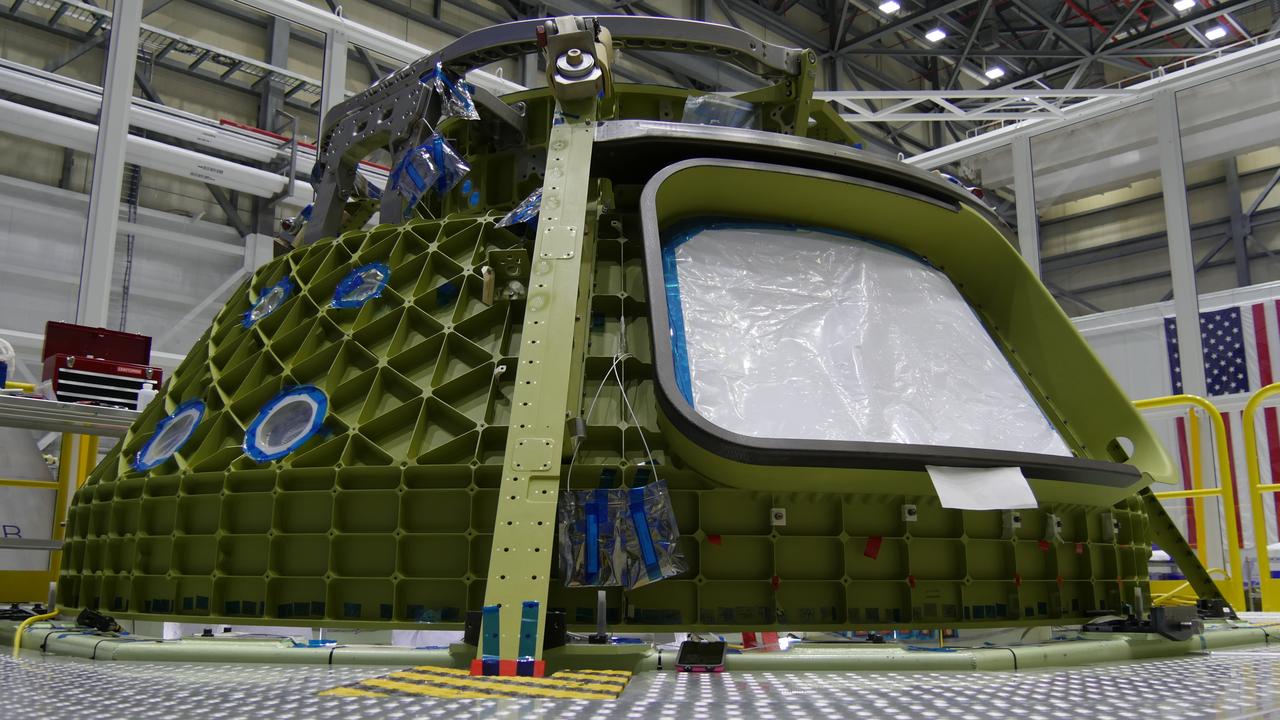
Boeing’s CST-100 Starliner Orbital Flight Test vehicle will fly the first test flight to space on an uncrewed mission to the International Space Station. Here you see the spacecraft’s upper dome undergoing the final preparations before the upper and lower dome are mated for a pressure test, and then the two domes will move on to be populated with avionics, life support and other critical hardware.
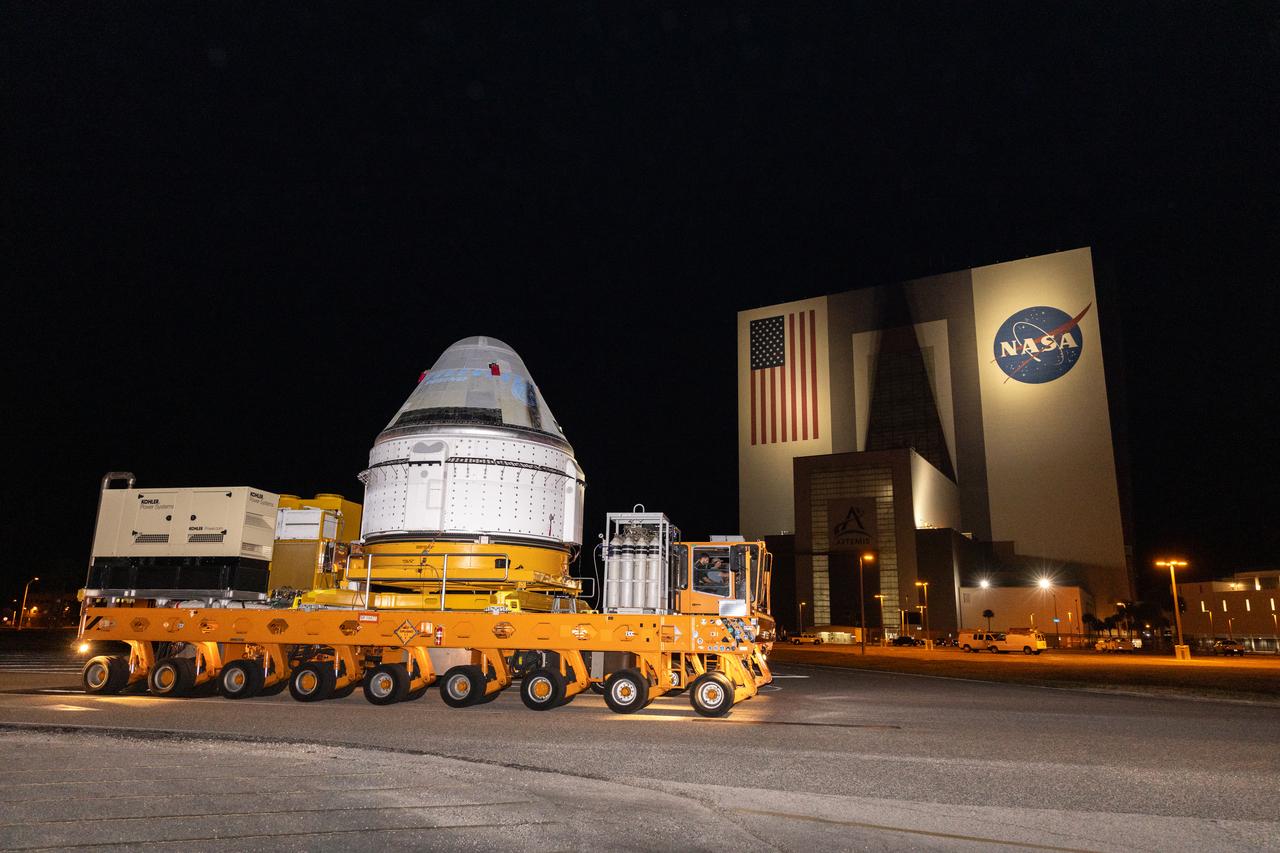
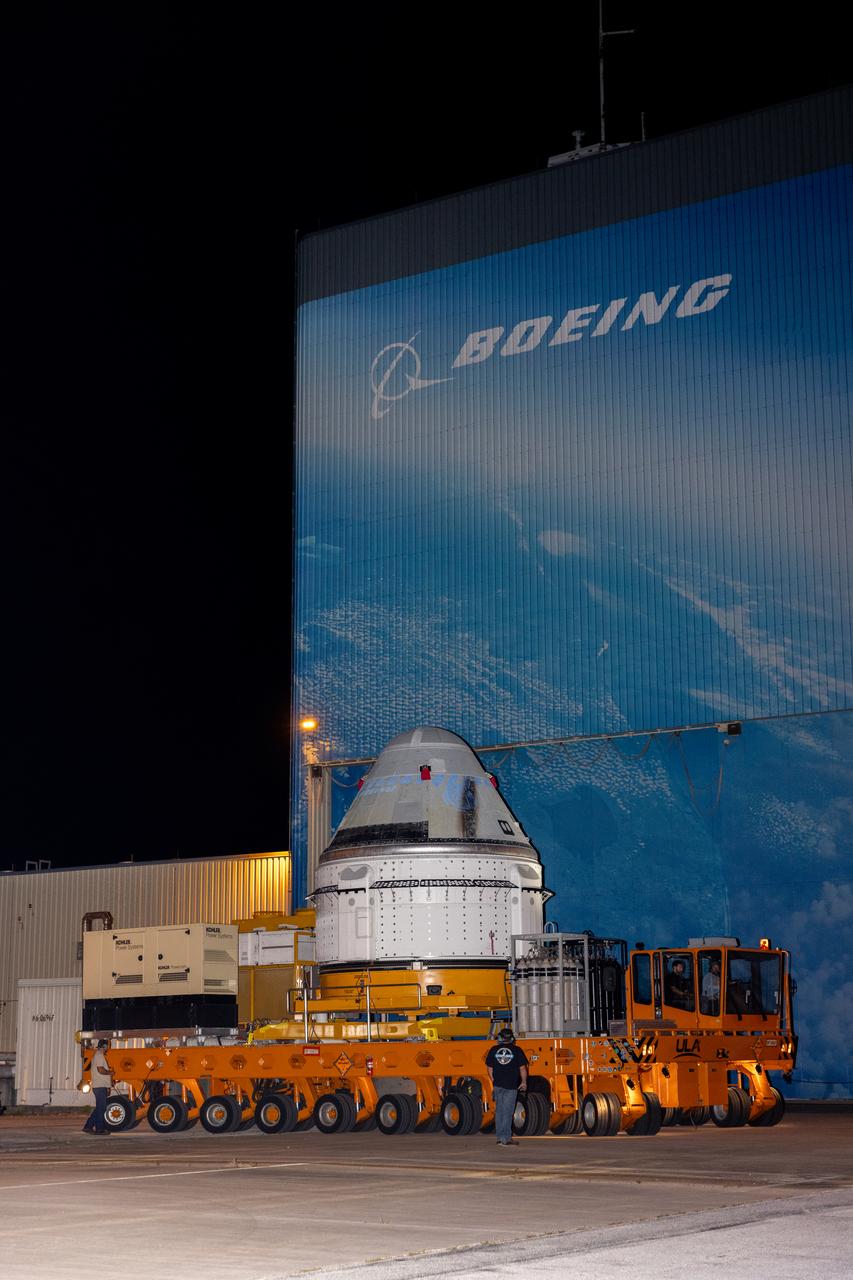
Boeing’s Starliner spacecraft, set to carry NASA astronauts Butch Wilmore and Suni Williams on the agency’s Boeing Crew Flight Test to the International Space Station, passes in front of the iconic Vehicle Assembly Building at NASA’s Kennedy Space Center in Florida on Tuesday, April 16, 2024. The spacecraft began its journey from the company’s Commercial Crew and Cargo Processing Facility and will be transported to ULA’s (United Launch Alliance) Vertical Integration Facility at Space Launch Complex-41 at Cape Canaveral Space Force Station prior to being lifted and connected to the Atlas V rocket, which is slated to launch no earlier than Monday, May 6, 2024.
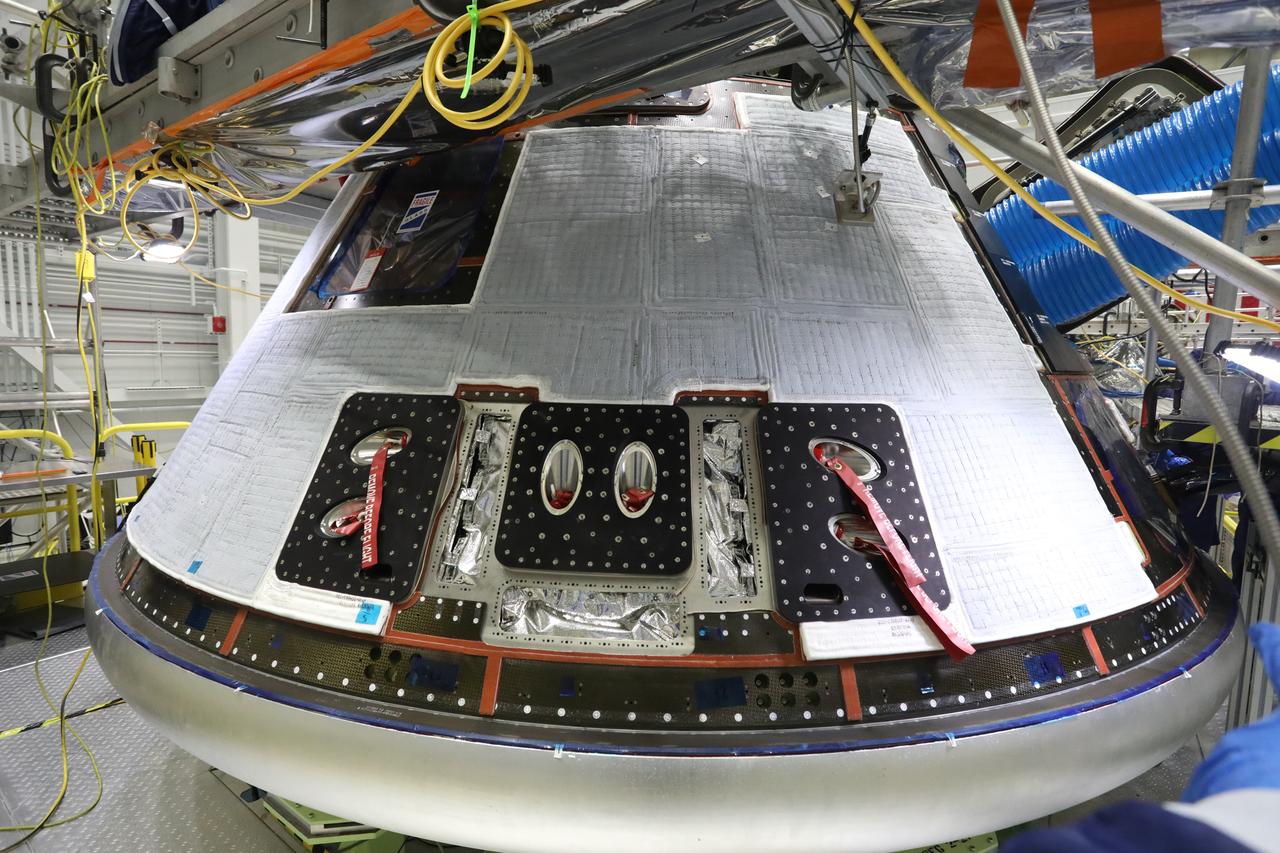
Boeing’s Starliner crew module, with back shells installed, is inside the company’s Commercial Crew and Cargo Processing Facility at Kennedy Space Center on December 8, 2020, in preparation for the Orbital Flight Test-2 (OFT-2). During the OFT-2 mission, the uncrewed Starliner spacecraft will fly to the International Space Station for NASA’s Commercial Crew Program.
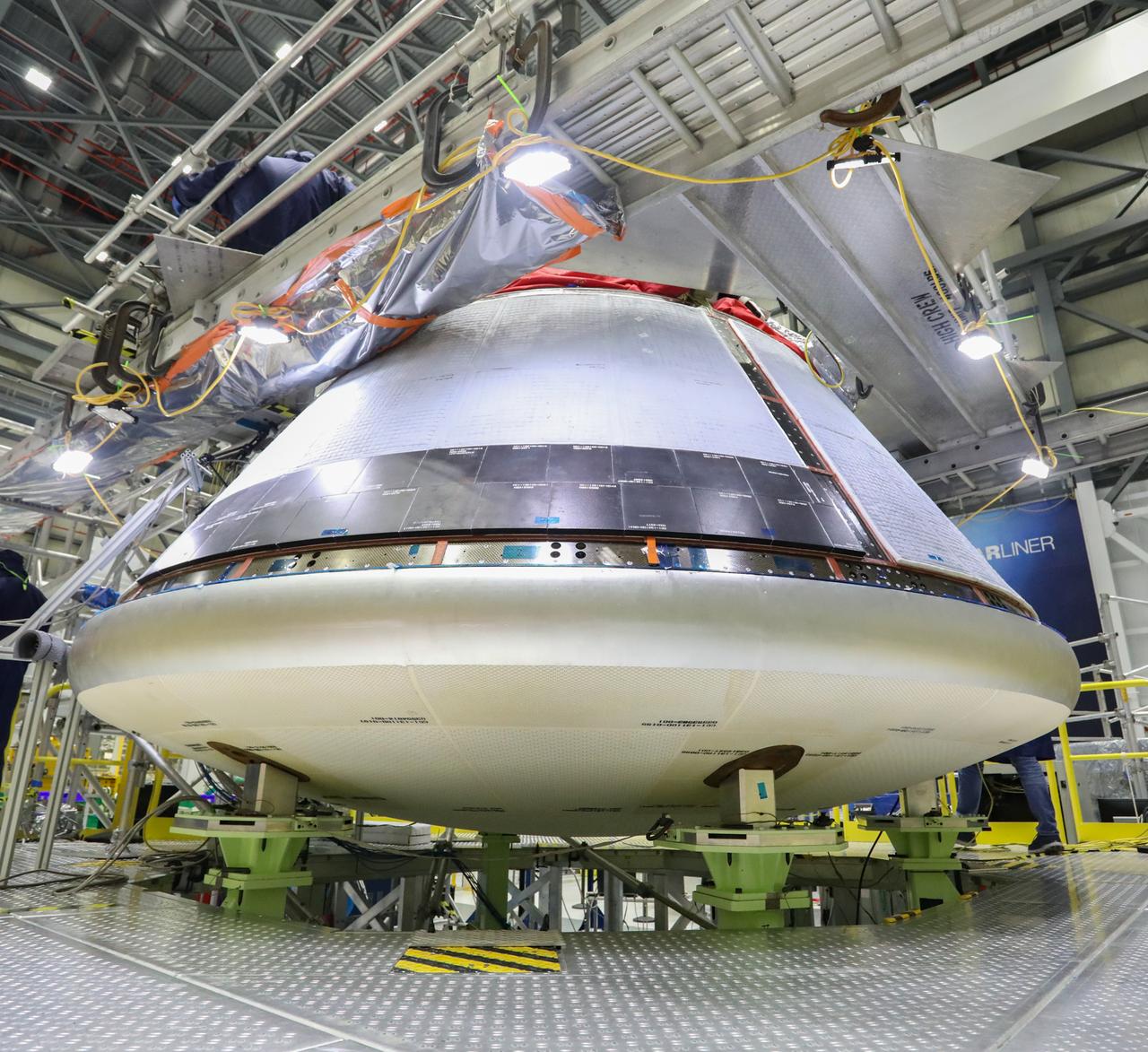
Boeing’s Starliner crew module, with back shells installed, is inside the company’s Commercial Crew and Cargo Processing Facility at Kennedy Space Center on December 8, 2020, in preparation for the Orbital Flight Test-2 (OFT-2). During the OFT-2 mission, the uncrewed Starliner spacecraft will fly to the International Space Station for NASA’s Commercial Crew Program.

An engineer monitors a Boeing CST-100 Starliner spacecraft inside Boeing's Commercial Crew and Cargo Processing Facility at NASA's Kennedy Space Center in Florida. This was the first time "Spacecraft 1," as the individual Starliner is known, was powered up. It is being assembled for use during a pad abort test that will demonstrate the Starliners' ability to lift astronauts out of danger in the unlikely event of an emergency. Later flight tests will demonstrate Starliners in orbital missions to the station without a crew, and then with astronauts aboard. The flight tests will preview the crew rotation missions future Starliners will perform as they take up to four astronauts at a time to the orbiting laboratory in order to enhance the research taking place there