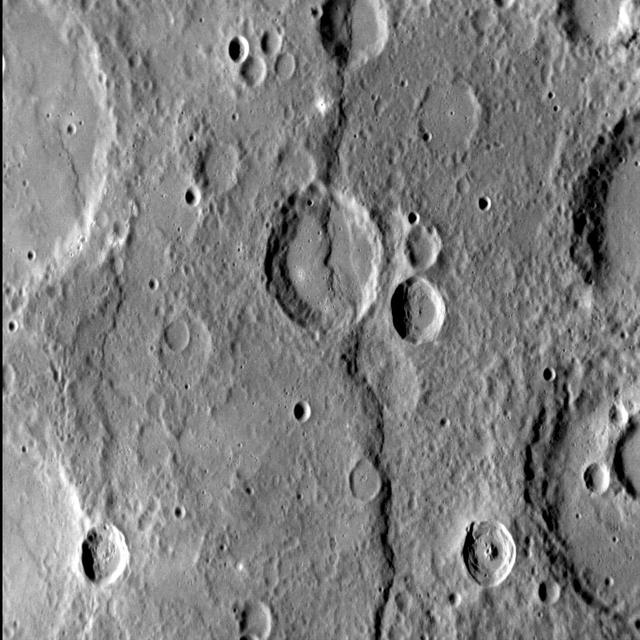
Deformation: Discovery

Discovery of the Wavemaker
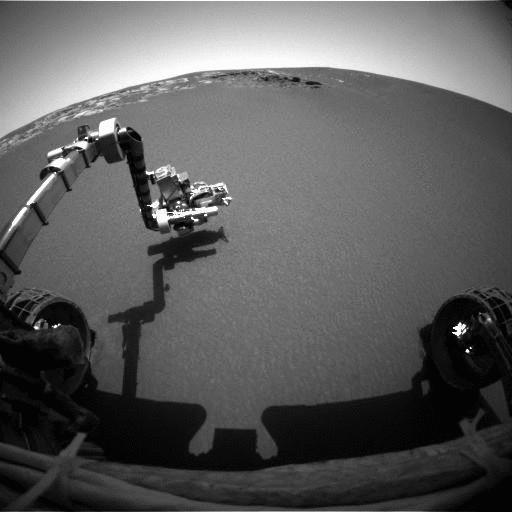
Poised for Discovery
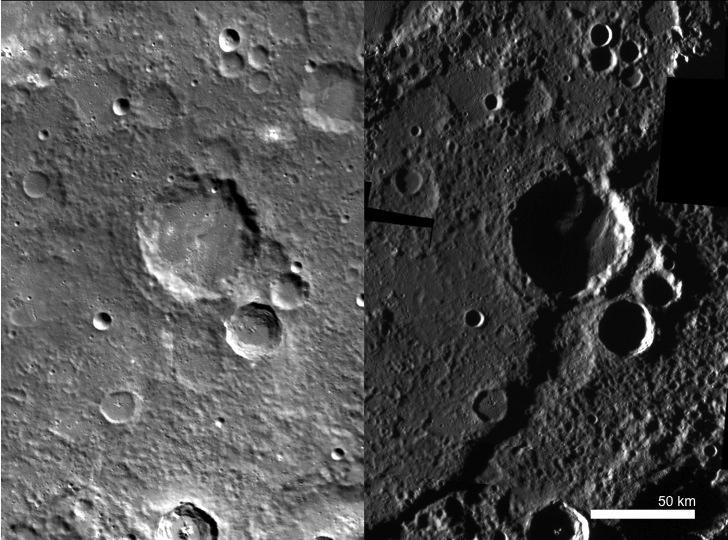
A Shocking Discovery

In this view are solar panels that are part of Florida Power and Light’s (FPL) new Discovery Solar Energy Center – a 74.5-megawatt solar site, spanning 491 acres at NASA’s Kennedy Space Center in Florida. The site contains about 250,000 solar panels in total, producing enough energy to power approximately 15,000 homes. Harnessing energy from the Sun, the panels do not directly power anything at Kennedy, but rather, send energy directly to FPL's electricity grid for distribution to existing customers. Construction began in spring 2020, and the energy center became fully operational on May 30, 2021.

Seen here is an up-close view of solar panels that are part of Florida Power and Light’s (FPL) new Discovery Solar Energy Center – a 74.5-megawatt solar site, spanning 491 acres at NASA’s Kennedy Space Center in Florida. The site contains about 250,000 solar panels in total, producing enough energy to power approximately 15,000 homes. Harnessing energy from the Sun, the panels do not directly power anything at Kennedy, but rather, send energy directly to FPL's electricity grid for distribution to existing customers. Construction began in spring 2020, and the energy center became fully operational on May 30, 2021.

Seen here is an up-close view of solar panels that are part of Florida Power and Light’s (FPL) new Discovery Solar Energy Center – a 74.5-megawatt solar site, spanning 491 acres at NASA’s Kennedy Space Center in Florida. The site contains about 250,000 solar panels in total, producing enough energy to power approximately 15,000 homes. Harnessing energy from the Sun, the panels do not directly power anything at Kennedy, but rather, send energy directly to FPL's electricity grid for distribution to existing customers. Construction began in spring 2020, and the energy center became fully operational on May 30, 2021.

Seen here, with the iconic Vehicle Assembly Building in the background, is an up-close view of solar panels that are part of Florida Power and Light’s (FPL) new Discovery Solar Energy Center at NASA’s Kennedy Space Center in Florida. The 74.5-megawatt solar site spans 491 acres at Kennedy and contains about 250,000 solar panels. Harnessing energy from the Sun, the panels produce enough energy to power approximately 15,000 homes. The panels do not directly power anything at Kennedy, and instead, send energy directly to FPL’s electricity grid for distribution to existing customers. Construction began in spring 2020, and the energy center became fully operational on May 30, 2021.
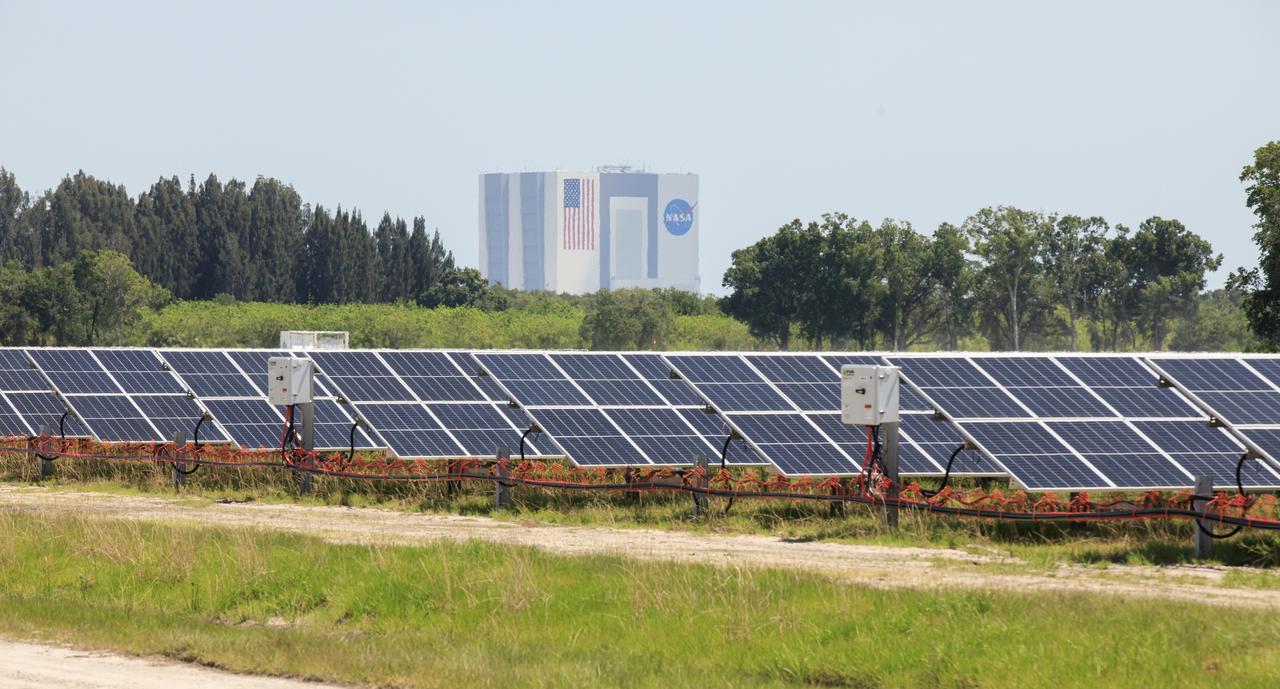
With the iconic Vehicle Assembly Building serving as the backdrop, a portion of the solar panels that make up Florida Power and Light’s (FPL) new Discovery Solar Energy Center is seen at NASA’s Kennedy Space Center in Florida. The 74.5-megawatt solar site spans 491 acres at Kennedy and contains about 250,000 solar panels. Harnessing energy from the Sun, the panels produce enough energy to power approximately 15,000 homes. The panels do not directly power anything at Kennedy, and instead, send energy directly to FPL’s electricity grid for distribution to existing customers. Construction began in spring 2020, and the energy center became fully operational on May 30, 2021.

Seen here is an up-close view of solar panels that are part of Florida Power and Light’s (FPL) new Discovery Solar Energy Center – a 74.5-megawatt solar site, spanning 491 acres at NASA’s Kennedy Space Center in Florida. The site contains about 250,000 solar panels in total, producing enough energy to power approximately 15,000 homes. Harnessing energy from the Sun, the panels do not directly power anything at Kennedy, but rather, send energy directly to FPL's electricity grid for distribution to existing customers. Construction began in spring 2020, and the energy center became fully operational on May 30, 2021.
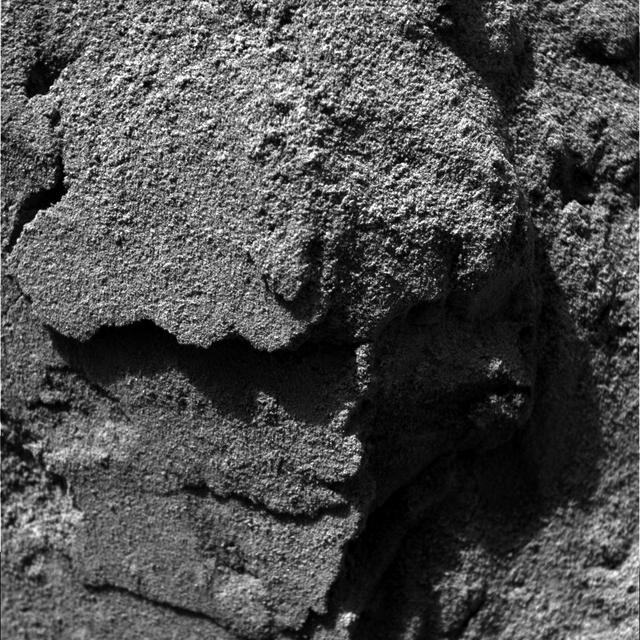
Wiggling Its Way to Discovery
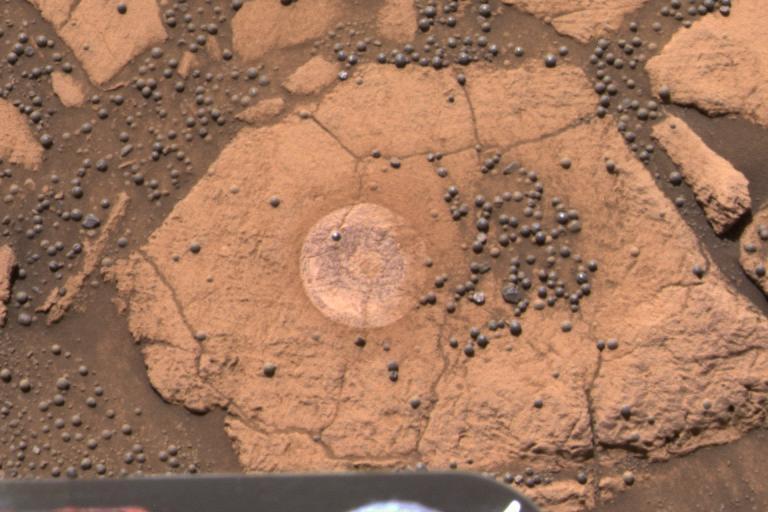
Discovery Served Up in a Bowl
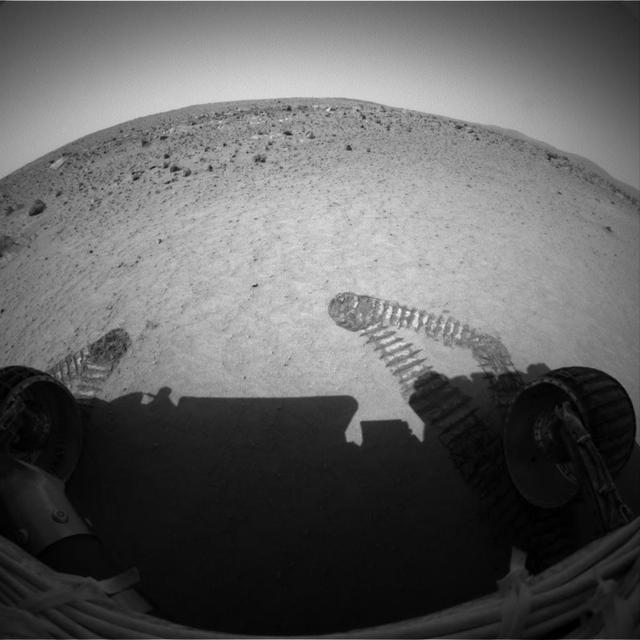
Wiggling Its Way to Discovery
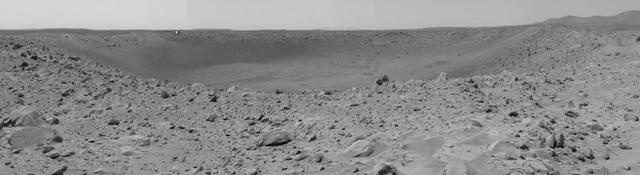
A Deep Dish for Discovery
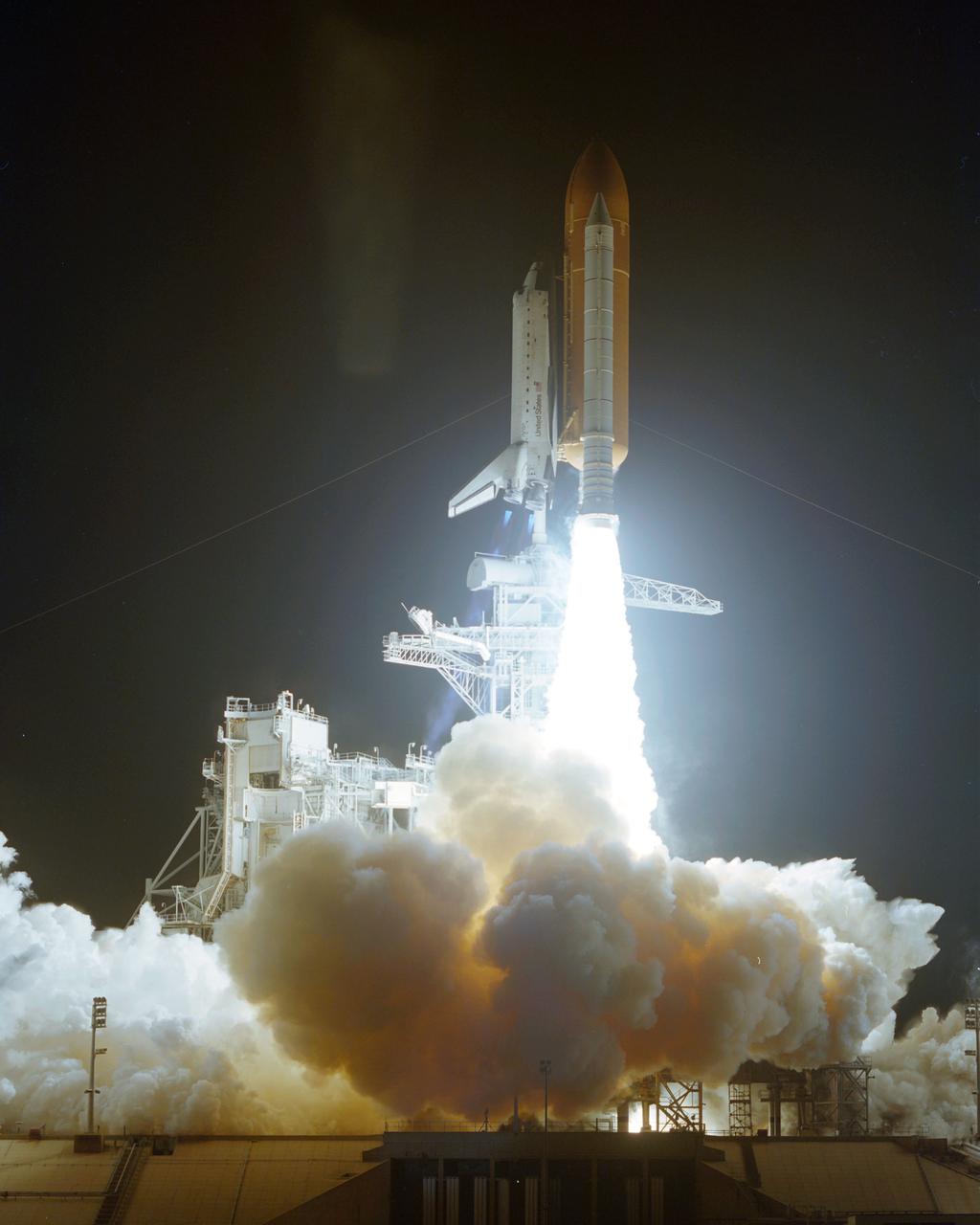
STS063-S-007 (3 Feb 1995) --- The race to catch up with the Russia's Mir gets underway as the Space Shuttle Discovery launches from Pad 39B, Kennedy Space Center (KSC) at 12:22:04 (EST), February 3, 1995. Discovery is the first in the current fleet of four Space Shuttle vehicles to make 20 launches. Onboard for the 67th (STS-63 is out of sequence) Shuttle flight are astronauts James D. Wetherbee, mission commander; Eileen M. Collins, pilot; Bernard A. Harris Jr., payload commander; mission specialists Janice Voss and C. Michael Foale; along with Russian cosmonaut Vladimir G. Titov.
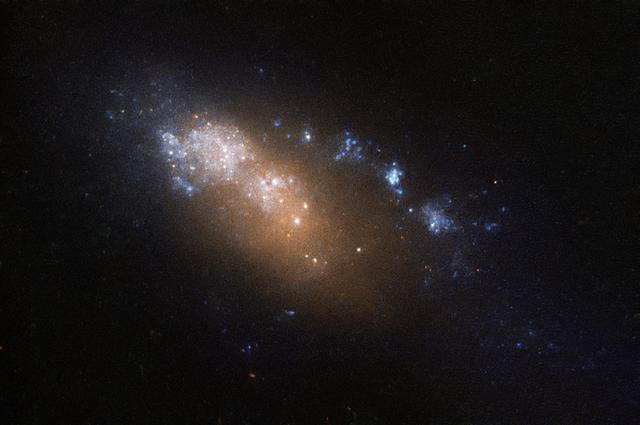
The galaxy, NGC 178 may be small, but it packs quite a punch. Measuring around 40,000 light-years across, its diameter is less than half that of the Milky Way, and it is accordingly classified as a dwarf galaxy. Despite its diminutive size, NGC 178 is busy forming new stars. On average, the galaxy forms stars totaling around half the mass of the Sun per year — enough to label it a starburst galaxy. The galaxy’s discovery is an interesting, and somewhat confusing, story. It was originally discovered by American astronomer Ormond Stone in 1885 and dubbed NGC 178, but its position in the sky was recorded incorrectly — by accident the value for the galaxy’s right ascension (which can be thought of as the celestial equivalent of terrestrial longitude) was off by a considerable amount. In the years that followed NGC 178 was spotted again, this time by French astronomer Stéphane Javelle. As no cataloged object occupied that position in the sky, Javelle believed he had discovered a new galaxy and entered it into the expanded Index Catalog under the name IC 39. Later, American astronomer Herbert Howe also observed the object and corrected Stone’s initial mistake. Many years later, astronomers finally noticed that NGC 178 and IC 39 were actually the same object! This image of NGC 178 comprises data gathered by the Wide Field Planetary Camera 2 aboard the NASA/ESA Hubble Space Telescope. Credit: ESA/Hubble & NASA
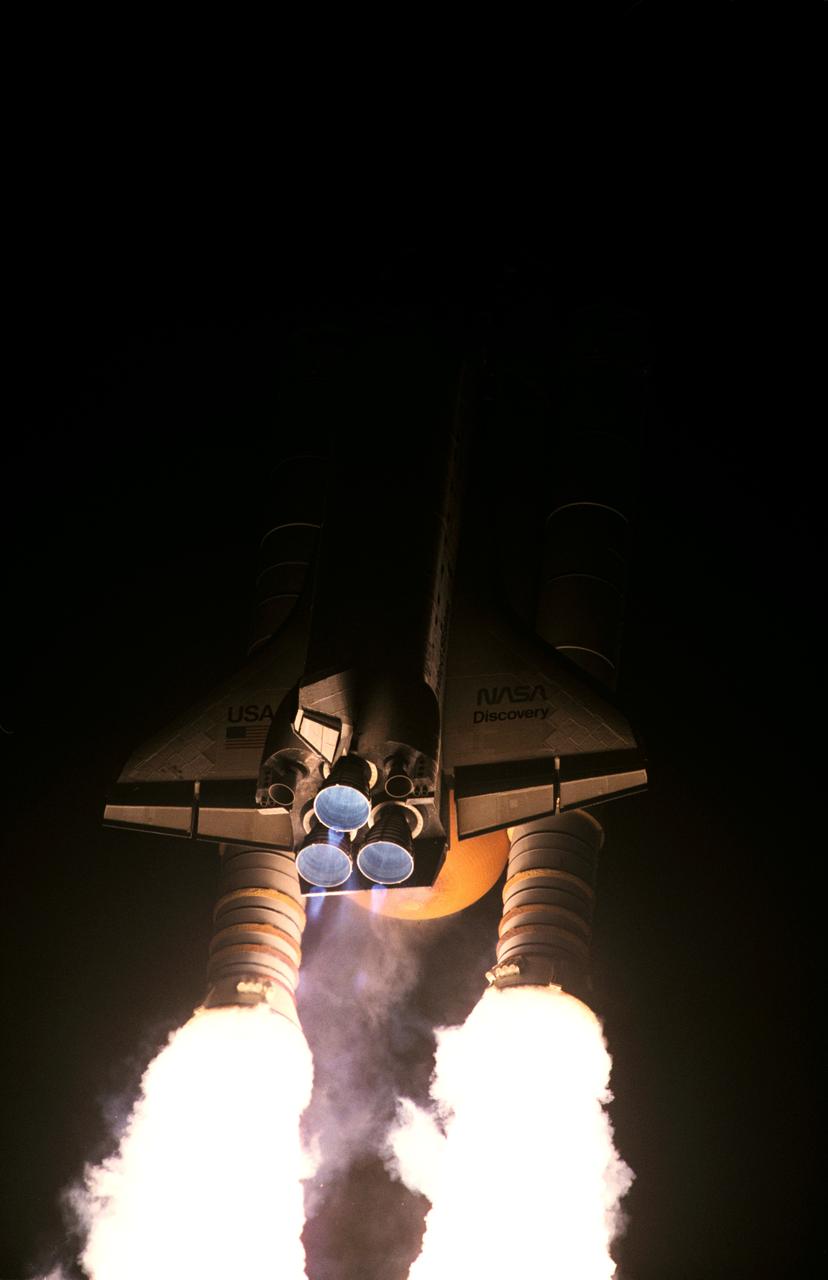
STS063-S-003 (3 Feb. 1995) --- A 35mm camera was used to expose this image of the space shuttle Discovery as it began its race to catch up with the Russia's Mir Space Station. Liftoff from Launch Pad 39B, Kennedy Space Center (KSC) occurred at 12:22:04 (EST), Feb. 3, 1995. Discovery is the first in the current fleet of four space shuttle vehicles to make 20 launches. Onboard for the 67th (STS-63 is out of sequence) shuttle flight are astronauts James D. Wetherbee, commander; Eileen M. Collins, pilot; Bernard A. Harris Jr., payload commander; and mission specialists Janice Voss and C. Michael Foale; along with Russian cosmonaut Vladimir G. Titov. Photo credit: NASA

NASA Shuttle Launch Director Michael Leinbach, left, STS-124 Assistant Launch Director Ed Mango, center, and Flow Director for Space Shuttle Discovery Stephanie Stilson clap in the the Launch Control Center after the main engine cut off and successful launch of the Space Shuttle Discovery (STS-124) Saturday, May 31, 2008, at the Kennedy Space Center in Cape Canaveral, Fla. The Shuttle lifted off from launch pad 39A at 5:02 p.m. EDT. Photo Credit: (NASA/Bill Ingalls)

Hubble Discovery Image of New Moon Orbiting Saturn
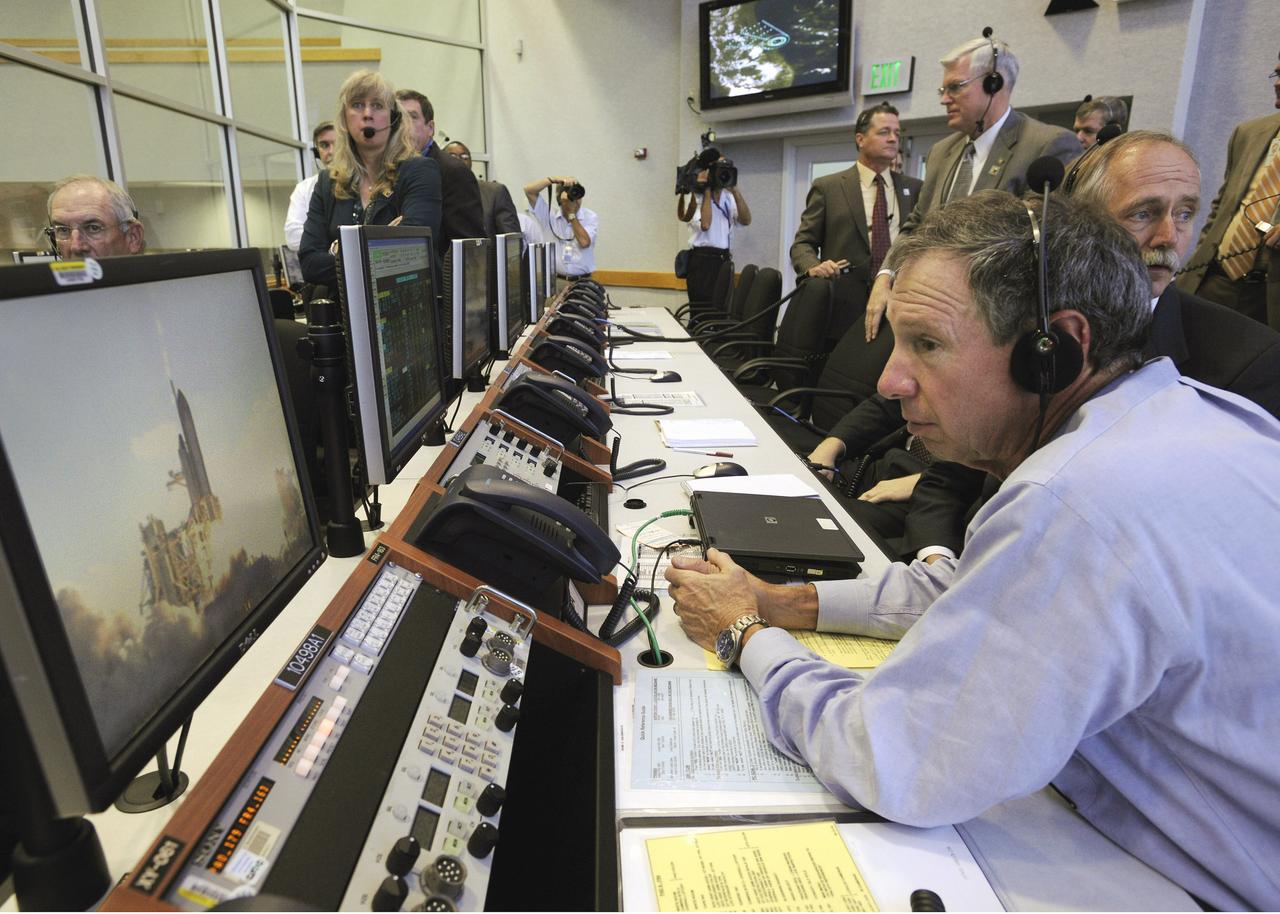
NASA Administrator, Michael Griffin watches the launch of the Space Shuttle Discovery (STS-124) from the Launch Control Center Saturday, May 31, 2008, at the Kennedy Space Center in Cape Canaveral, Fla. The Shuttle lifted off from launch pad 39A at 5:02 p.m. EDT. Photo Credit: (NASA/Bill Ingalls)
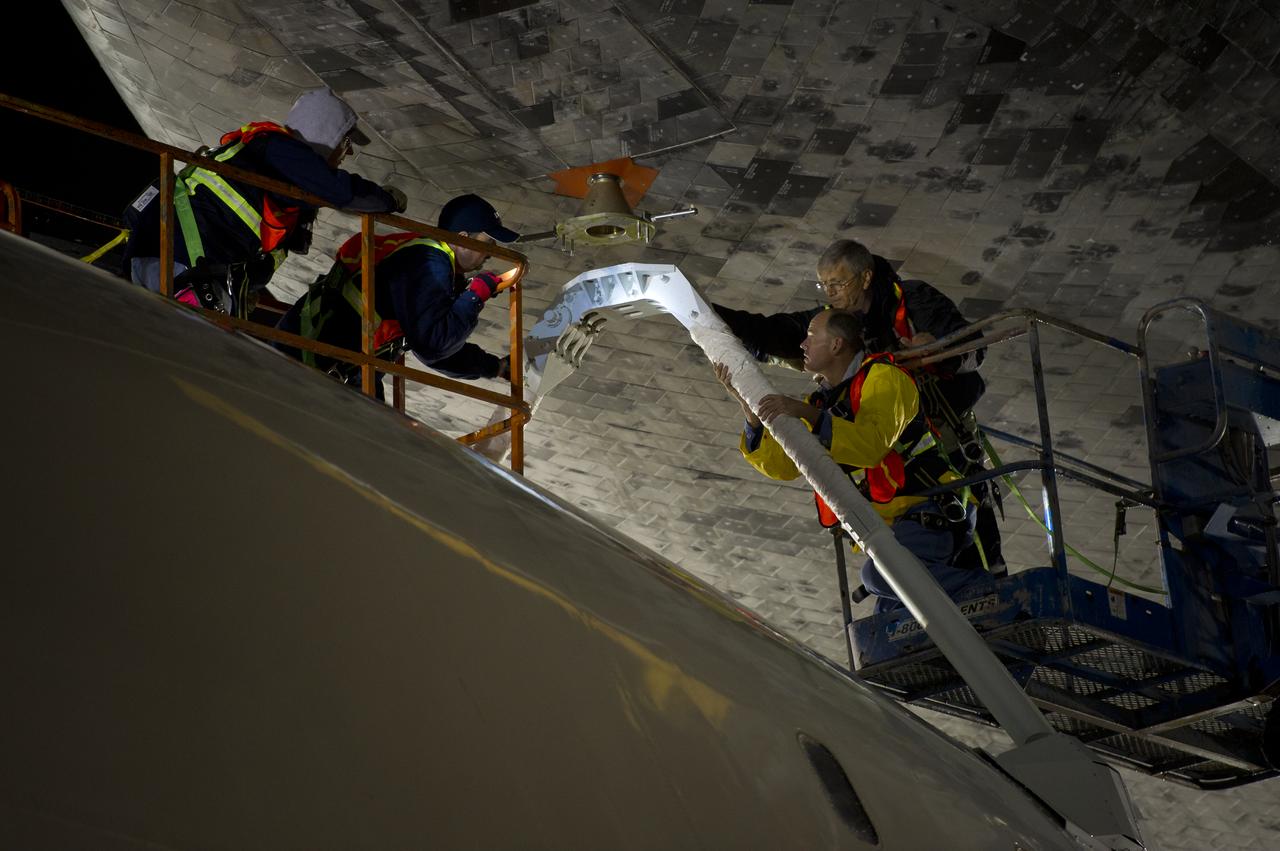
Workers monitor the lift of the space shuttle Discovery from the top of the NASA 747 Shuttle Carrier Aircraft (SCA) at Washington Dulles International Airport, Thursday, April 19, 2012, in Sterling, VA. Discovery, the first orbiter retired from NASA’s shuttle fleet, completed 39 missions, spent 365 days in space, orbited the Earth 5,830 times, and traveled 148,221,675 miles. NASA will transfer Discovery to the National Air and Space Museum to begin its new mission to commemorate past achievements in space and to educate and inspire future generations of explorers. Photo Credit: (NASA/Bill Ingalls)
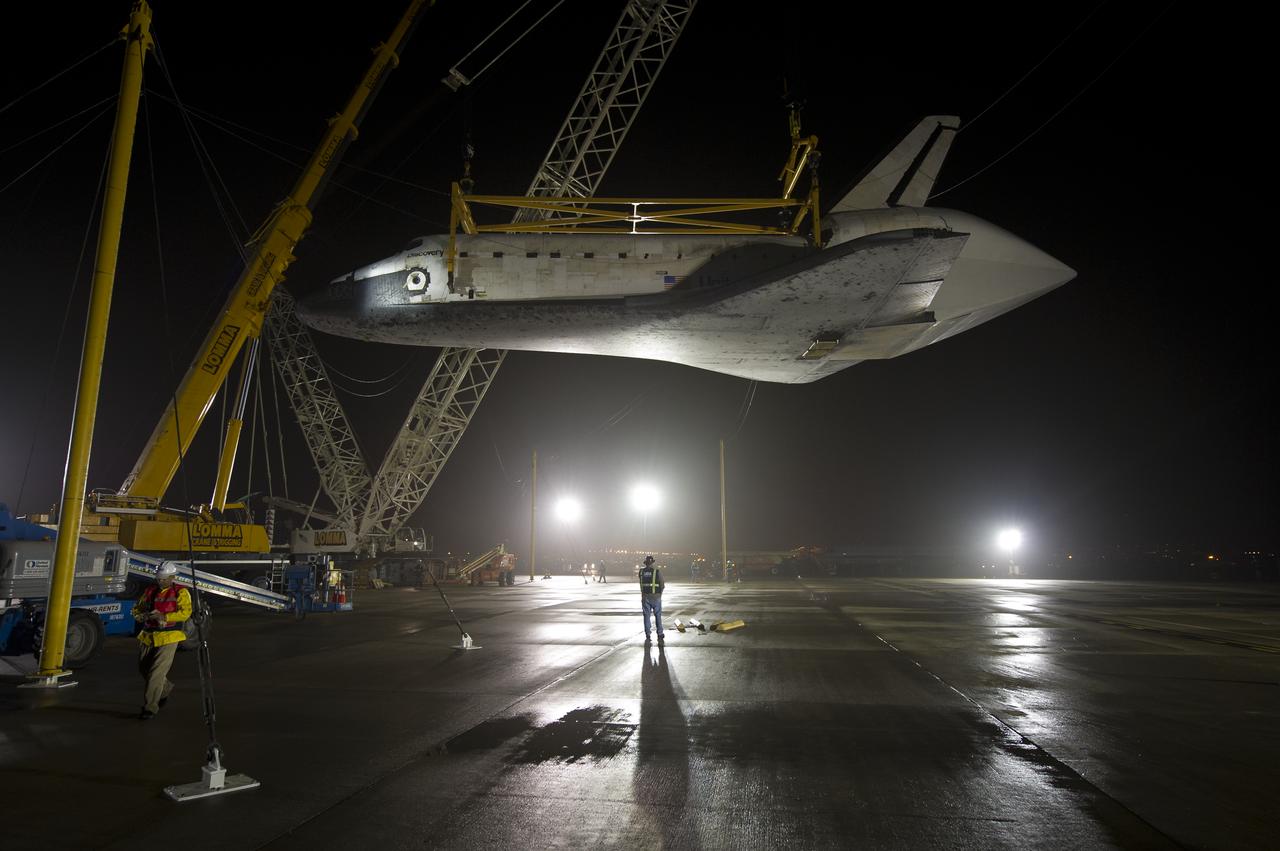
The space shuttle Discovery is suspended from a sling held by two cranes shortly after the NASA 747 Shuttle Carrier Aircraft (SCA) was pushed back from underneath at Washington Dulles International Airport, Thursday, April 19, 2012, in Sterling, VA. Discovery, the first orbiter retired from NASA’s shuttle fleet, completed 39 missions, spent 365 days in space, orbited the Earth 5,830 times, and traveled 148,221,675 miles. NASA will transfer Discovery to the National Air and Space Museum to begin its new mission to commemorate past achievements in space and to educate and inspire future generations of explorers. Photo Credit: (NASA/Bill Ingalls)
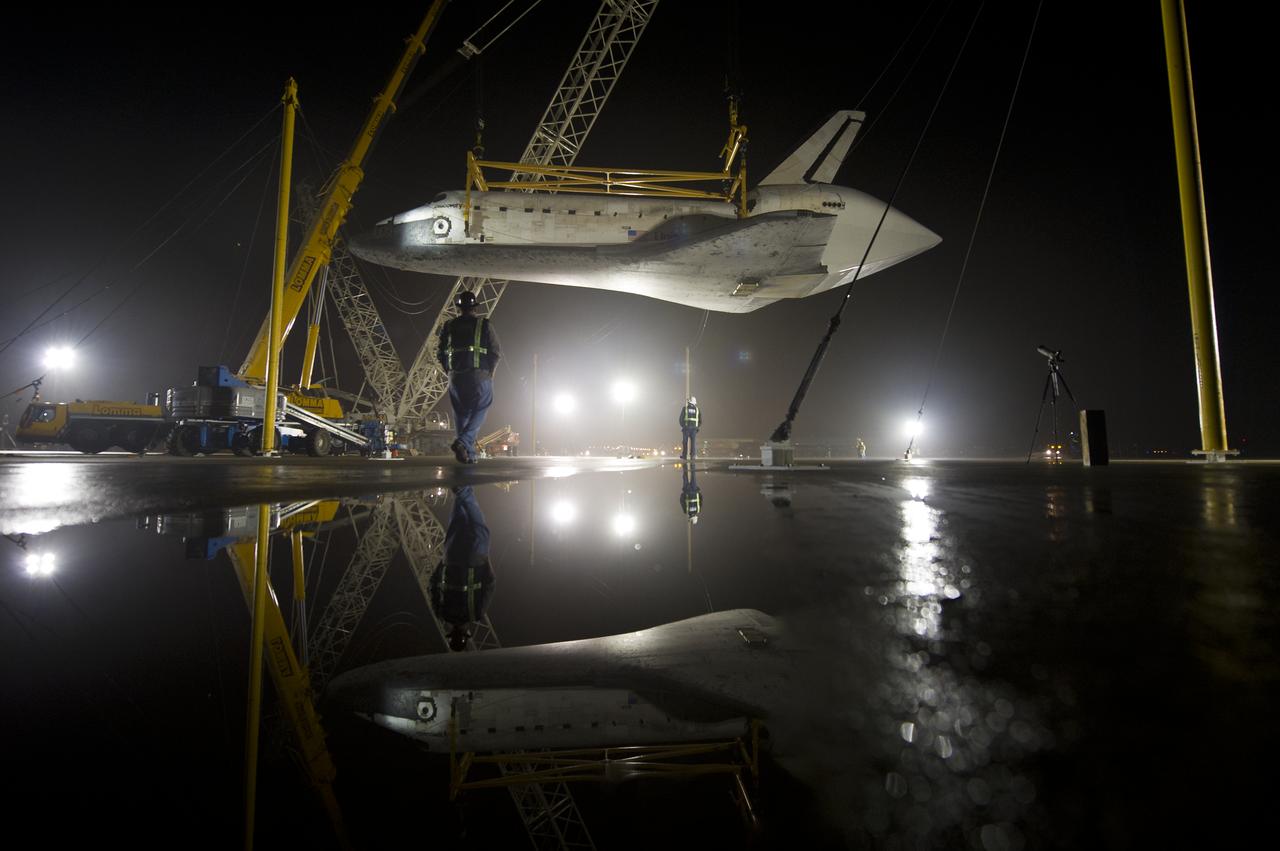
The space shuttle Discovery is suspended from a sling held by two cranes shortly after the NASA 747 Shuttle Carrier Aircraft (SCA) was pushed back from underneath at Washington Dulles International Airport, Thursday, April 19, 2012, in Sterling, VA. Discovery, the first orbiter retired from NASA’s shuttle fleet, completed 39 missions, spent 365 days in space, orbited the Earth 5,830 times, and traveled 148,221,675 miles. NASA will transfer Discovery to the National Air and Space Museum to begin its new mission to commemorate past achievements in space and to educate and inspire future generations of explorers. Photo Credit: (NASA/Bill Ingalls)
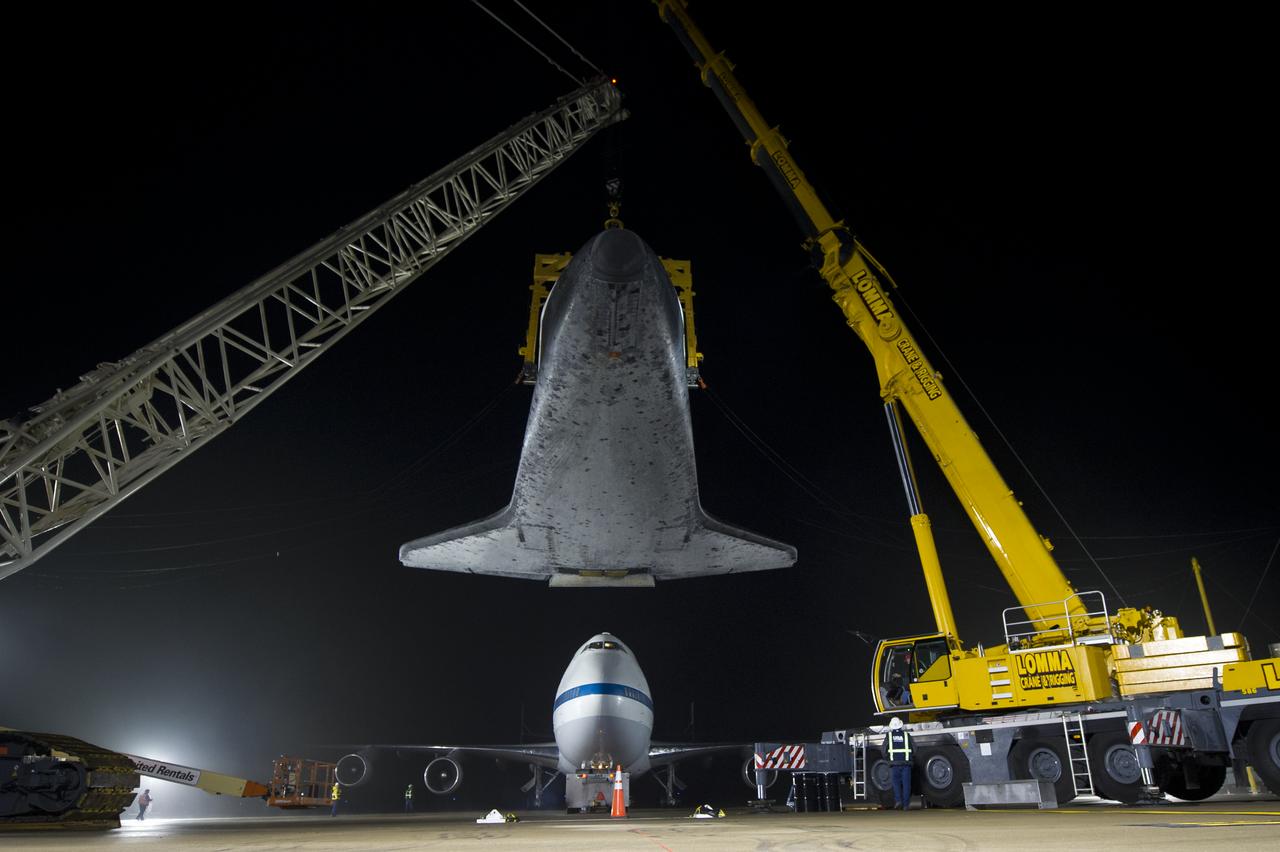
The space shuttle Discovery is suspended from a sling held by two cranes as the NASA 747 Shuttle Carrier Aircraft (SCA) is pushed back from underneath at Washington Dulles International Airport, Thursday, April 19, 2012, in Sterling, VA. Discovery, the first orbiter retired from NASA’s shuttle fleet, completed 39 missions, spent 365 days in space, orbited the Earth 5,830 times, and traveled 148,221,675 miles. NASA will transfer Discovery to the National Air and Space Museum to begin its new mission to commemorate past achievements in space and to educate and inspire future generations of explorers. Photo Credit: (NASA/Bill Ingalls)
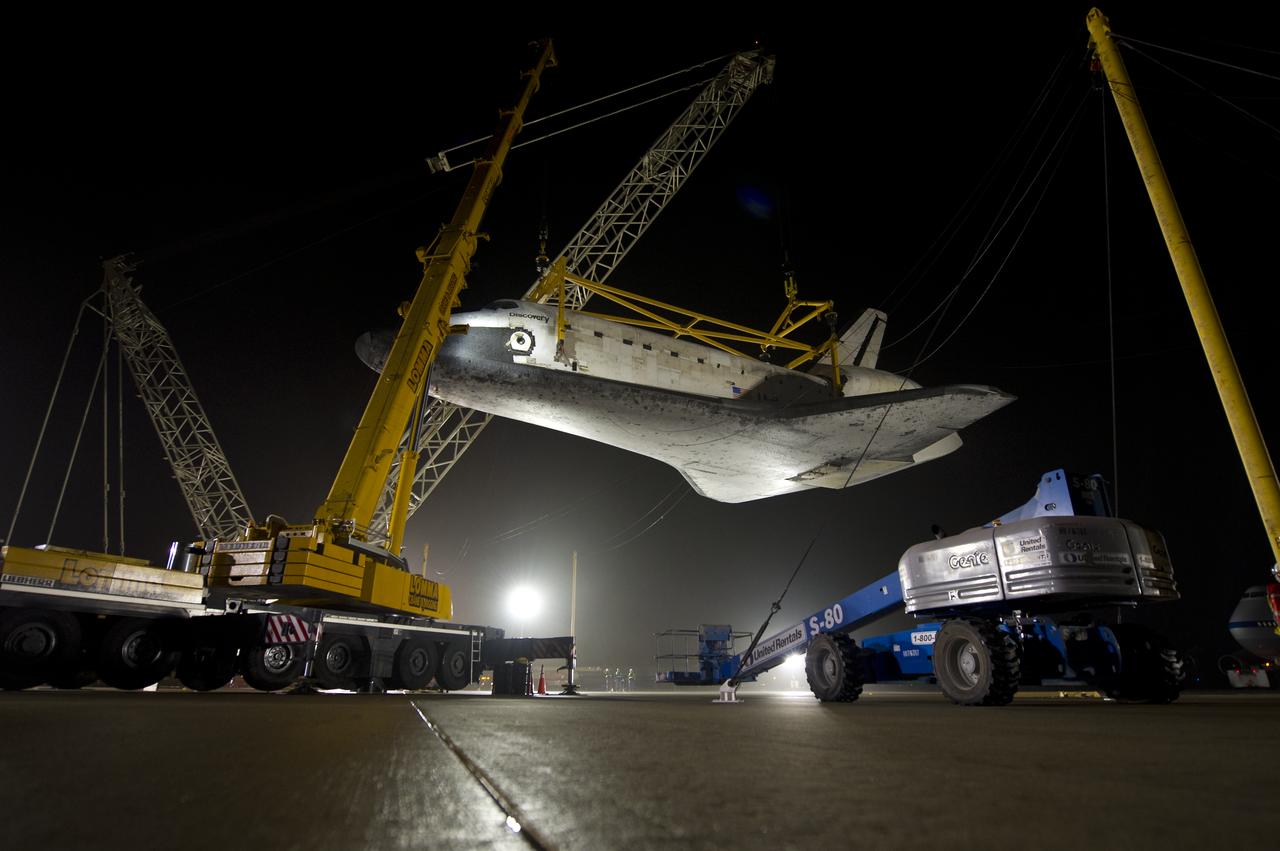
The space shuttle Discovery is suspended from a sling held by two cranes shortly after the NASA 747 Shuttle Carrier Aircraft (SCA) was pushed back from underneath at Washington Dulles International Airport, Thursday, April 19, 2012, in Sterling, VA. Discovery, the first orbiter retired from NASA’s shuttle fleet, completed 39 missions, spent 365 days in space, orbited the Earth 5,830 times, and traveled 148,221,675 miles. NASA will transfer Discovery to the National Air and Space Museum to begin its new mission to commemorate past achievements in space and to educate and inspire future generations of explorers. Photo Credit: (NASA/Bill Ingalls)
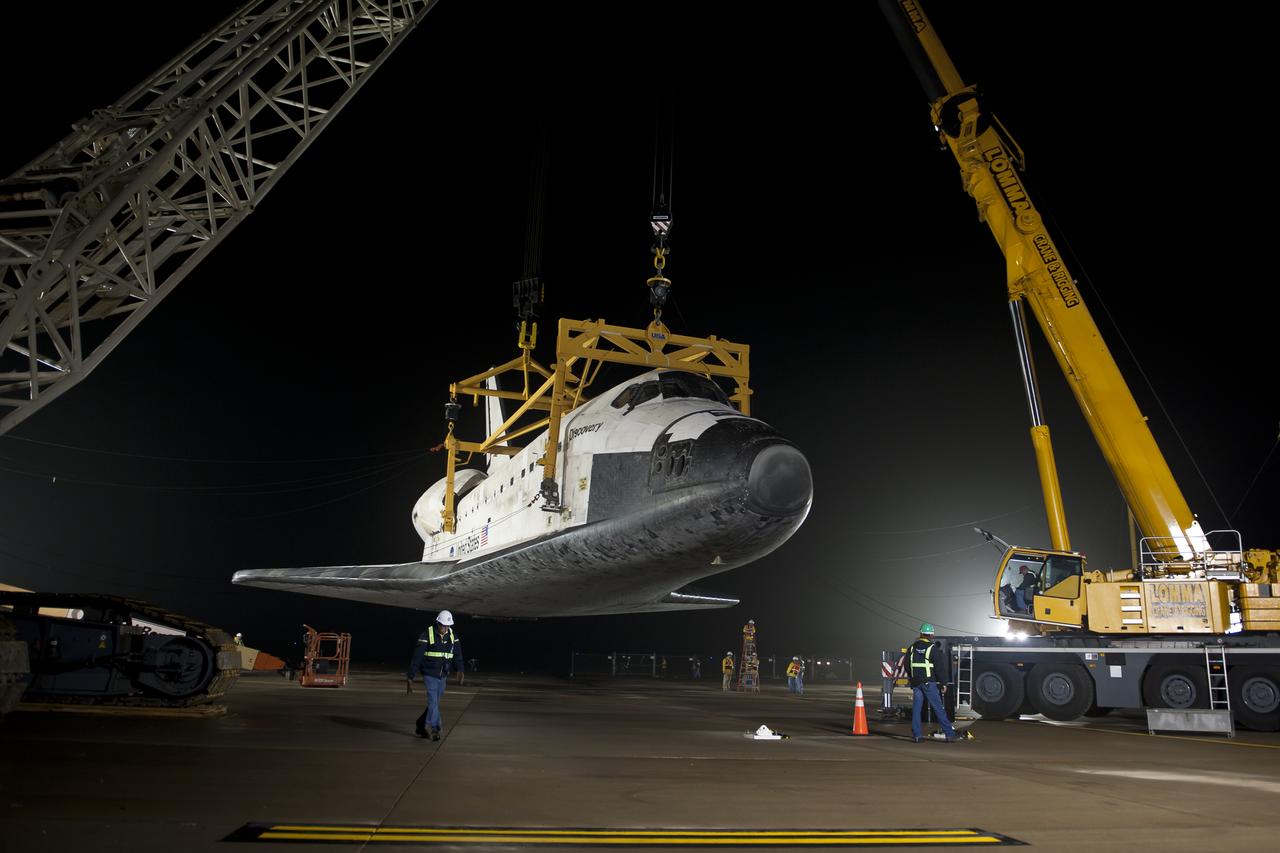
The space shuttle Discovery is suspended from a sling held by two cranes after the NASA 747 Shuttle Carrier Aircraft (SCA) was pushed back from underneath at Washington Dulles International Airport, Thursday, April 19, 2012, in Sterling, VA. Discovery, the first orbiter retired from NASA’s shuttle fleet, completed 39 missions, spent 365 days in space, orbited the Earth 5,830 times, and traveled 148,221,675 miles. NASA will transfer Discovery to the National Air and Space Museum to begin its new mission to commemorate past achievements in space and to educate and inspire future generations of explorers. Photo Credit: (NASA/Bill Ingalls)
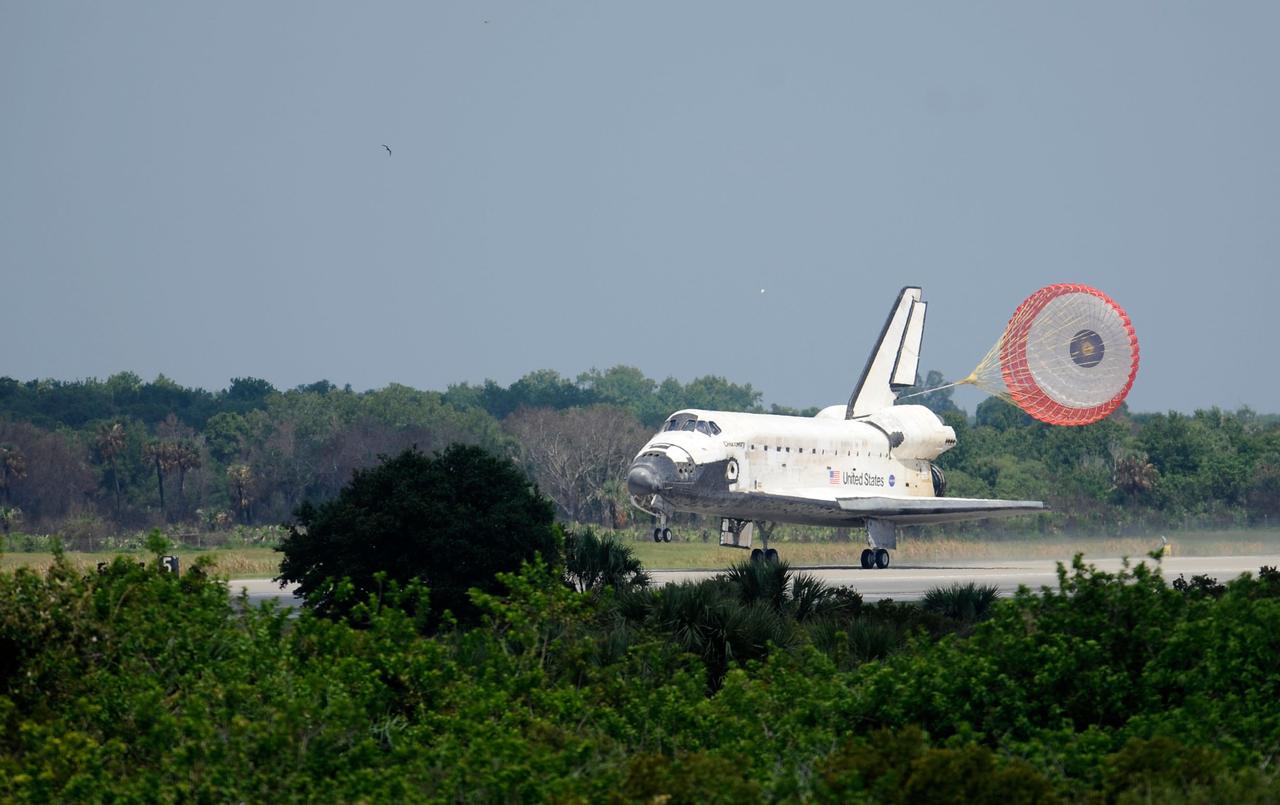
The space shuttle Discovery touches down at 11:15 a.m. EDT, Saturday, June 14, 2008, at the Kennedy Space Center in Florida. During the 13-day mission, Discovery and the crew of STS-124 delivered new components of the Japanese Experiment Module, or Kibo, to the International Space Station and the Canadian-built Special Purpose Dextrous Manipulator to the International Space Station. Photo Credit: (NASA/Bill Ingalls)
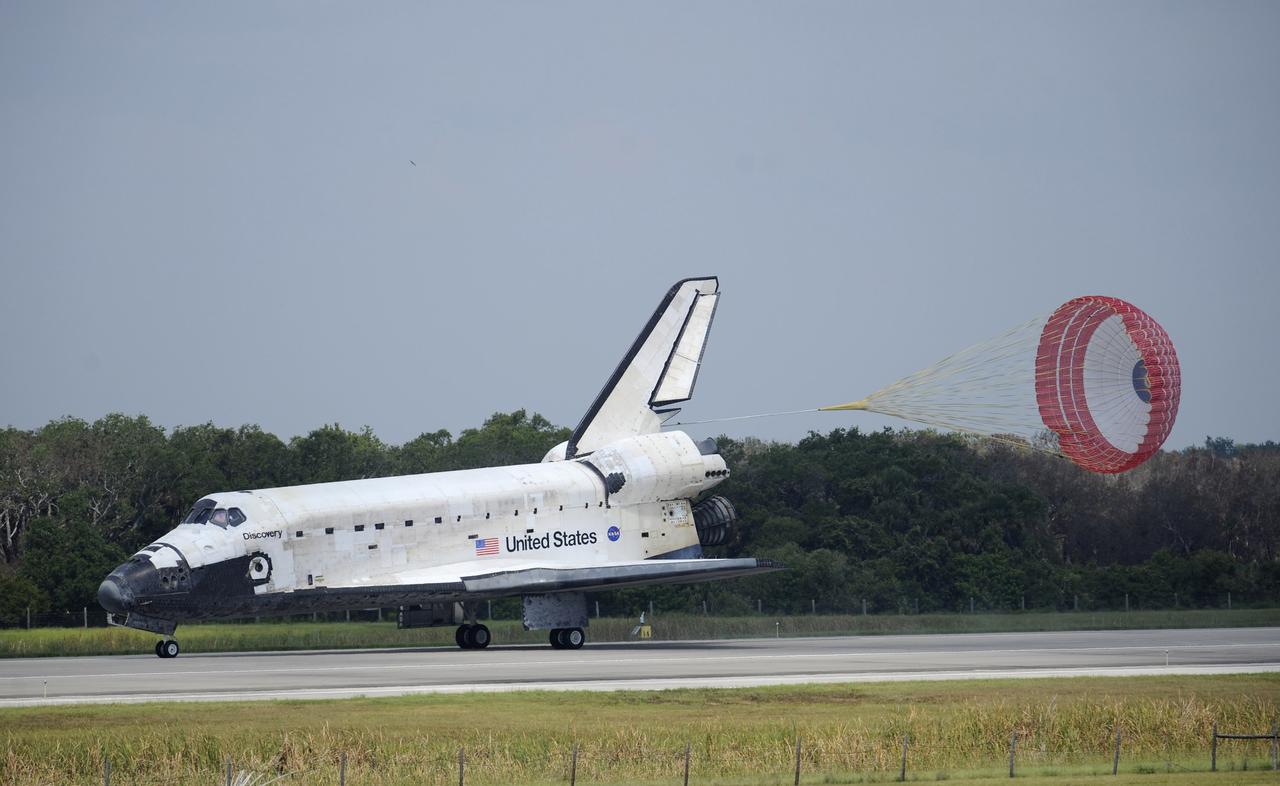
The space shuttle Discovery touches down at 11:15 a.m. EDT, Saturday, June 14, 2008, at the Kennedy Space Center in Florida. During the 13-day mission, Discovery and the crew of STS-124 delivered new components of the Japanese Experiment Module, or Kibo, to the International Space Station and the Canadian-built Special Purpose Dextrous Manipulator to the International Space Station. Photo Credit: (NASA/Bill Ingalls)
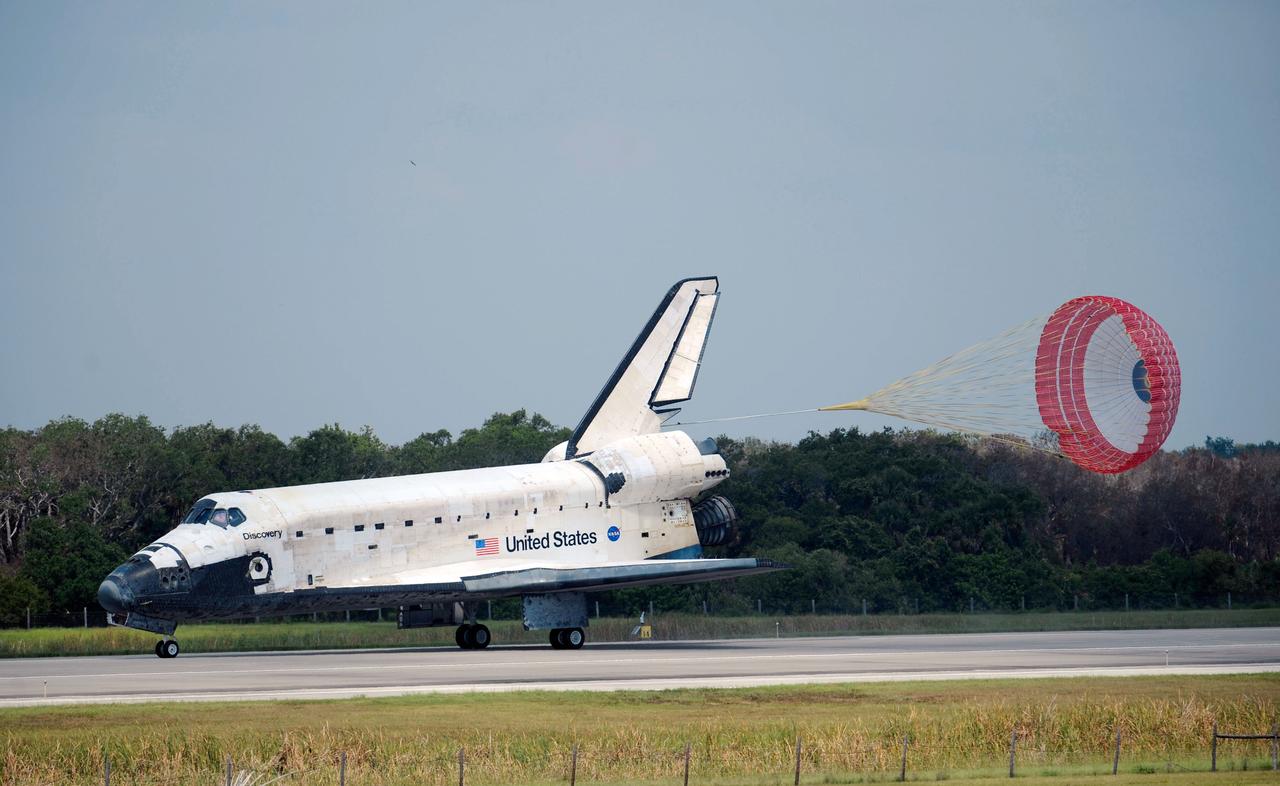
The space shuttle Discovery touches down at 11:15 a.m. EDT, Saturday, June 14, 2008, at the Kennedy Space Center in Florida. During the 13-day mission, Discovery and the crew of STS-124 delivered new components of the Japanese Experiment Module, or Kibo, to the International Space Station and the Canadian-built Special Purpose Dextrous Manipulator to the International Space Station. Photo Credit: (NASA/Bill Ingalls)

Space Shuttle Discovery mounted atop a 747 Shuttle Carrier Aircraft (SCA) approaches the runway for landing at Washington Dulles International Airport, Tuesday April 17, 2012, in Sterling, Va. Discovery, the first orbiter retired from NASA’s shuttle fleet, completed 39 missions, spent 365 days in space, orbited the Earth 5,830 times, and traveled 148,221,675 miles. NASA will transfer Discovery to the National Air and Space Museum to begin its new mission to commemorate past achievements in space and to educate and inspire future generations of explorers. Photo Credit: (NASA/Paul E. Alers)

Space shuttle Discovery, mounted atop a NASA 747 Shuttle Carrier Aircraft (SCA) lands at Washington Dulles International Airport, Tuesday, April 17, 2012, in Sterling, Va. Discovery, the first orbiter retired from NASA’s shuttle fleet, completed 39 missions, spent 365 days in space, orbited the Earth 5,830 times, and traveled 148,221,675 miles. NASA will transfer Discovery to the National Air and Space Museum to begin its new mission to commemorate past achievements in space and to educate and inspire future generations of explorers. Photo Credit: (NASA/Smithsonian Institution/Eric Long)

Space shuttle Discovery, mounted atop a NASA 747 Shuttle Carrier Aircraft (SCA) taxis in front of the main terminal at Washington Dulles International Airport, Tuesday, April 17, 2012, in Sterling, Va. Discovery, the first orbiter retired from NASA’s shuttle fleet, completed 39 missions, spent 365 days in space, orbited the Earth 5,830 times, and traveled 148,221,675 miles. NASA will transfer Discovery to the National Air and Space Museum to begin its new mission to commemorate past achievements in space and to educate and inspire future generations of explorers. Photo Credit: (NASA/Smithsonian Institution/Eric Long)

Space shuttle Discovery, mounted atop a NASA 747 Shuttle Carrier Aircraft (SCA) lands at Washington Dulles International Airport, Tuesday, April 17, 2012, in Sterling, Va. Discovery, the first orbiter retired from NASA’s shuttle fleet, completed 39 missions, spent 365 days in space, orbited the Earth 5,830 times, and traveled 148,221,675 miles. NASA will transfer Discovery to the National Air and Space Museum to begin its new mission to commemorate past achievements in space and to educate and inspire future generations of explorers. Photo Credit: (NASA/Smithsonian Institution/Eric Long)

Space shuttle Discovery, mounted atop a NASA 747 Shuttle Carrier Aircraft (SCA) lands at Washington Dulles International Airport, Tuesday, April 17, 2012, in Sterling, Va. The Steven F. Udvar-Hazy Center is seen in the background. Discovery, the first orbiter retired from NASA’s shuttle fleet, completed 39 missions, spent 365 days in space, orbited the Earth 5,830 times, and traveled 148,221,675 miles. NASA will transfer Discovery to the National Air and Space Museum to begin its new mission to commemorate past achievements in space and to educate and inspire future generations of explorers. Photo Credit: (NASA/Smithsonian Institution/Eric Long)
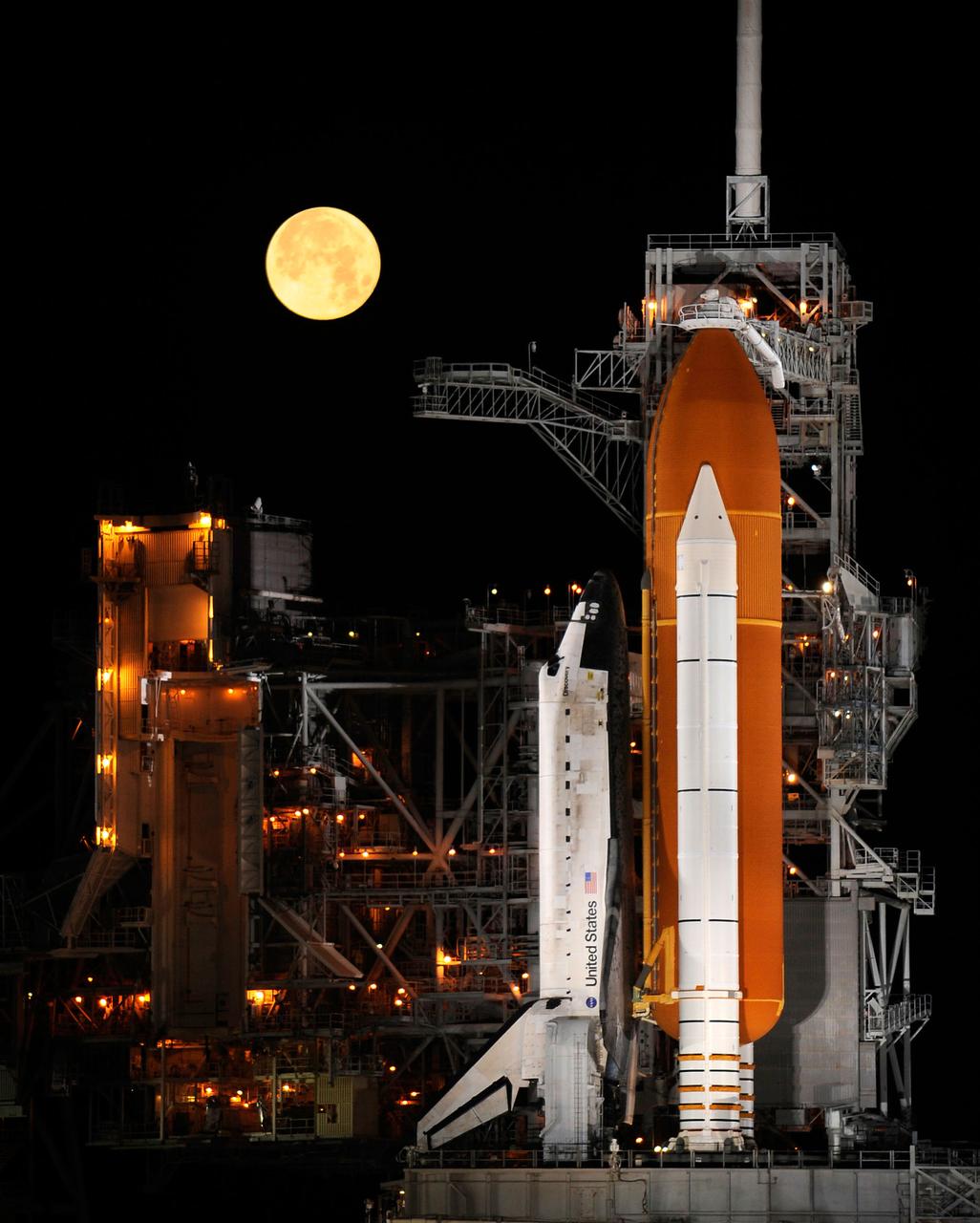
A nearly full Moon sets as the space shuttle Discovery sits atop Launch pad 39A at the Kennedy Space Center in Cape Canaveral, Florida, Wednesday, March 11, 2009. Photo Credit: (NASA/Bill Ingalls)
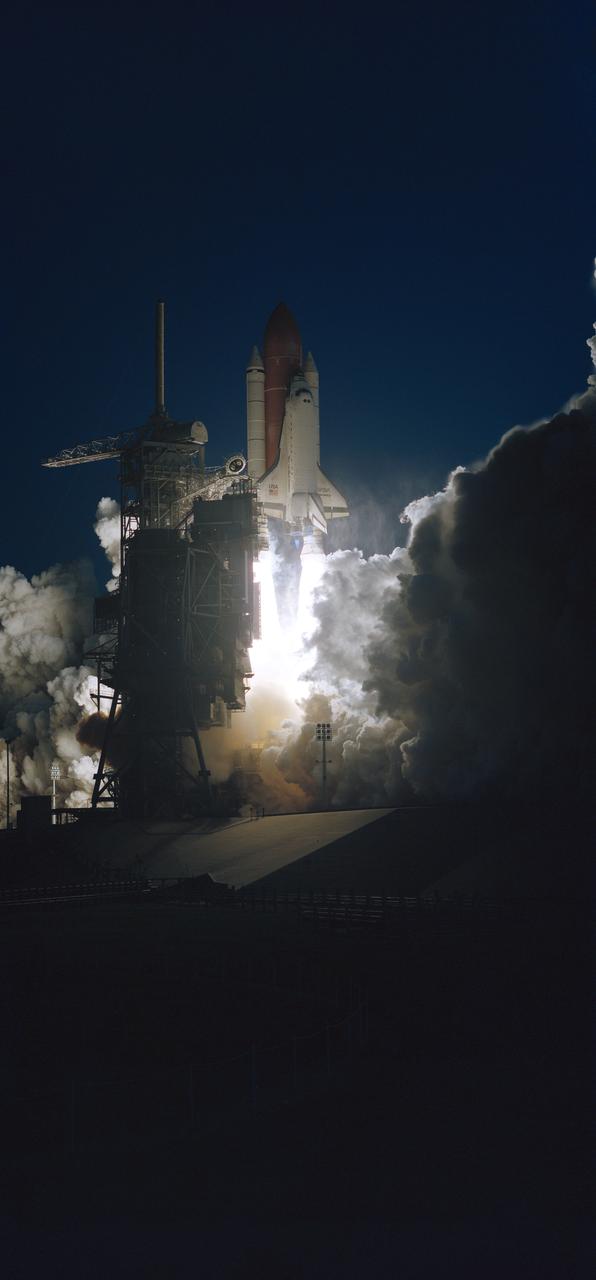
Launch Complex 39 is in partial darkness as the Space Shuttle Discovery heads toward an eight-day mission in Earth orbit. Liftoff occurred as scheduled at 7:10 a.m., February 3, 1994.

Space Shuttle Discovery mounted atop a NASA 747 Shuttle Carrier Aircraft at Washington Dulles Airport the first orbiter retired from NASA's shuttle fleet

Space Shuttle Discovery mounted atop a NASA 747 Shuttle Carrier Aircraft at Washington Dulles Airport the first orbiter retired from NASA's shuttle fleet

Space Shuttle Discovery mounted atop a NASA 747 Shuttle Carrier Aircraft at Washington Dulles Airport the first orbiter retired from NASA's shuttle fleet

Space Shuttle Discovery mounted atop a NASA 747 Shuttle Carrier Aircraft at Washington Dulles Airport the first orbiter retired from NASA's shuttle fleet

Space Shuttle Discovery mounted atop a NASA 747 Shuttle Carrier Aircraft at Washington Dulles Airport the first orbiter retired from NASA's shuttle fleet

Space Shuttle Discovery mounted atop a NASA 747 Shuttle Carrier Aircraft at Washington Dulles Airport the first orbiter retired from NASA's shuttle fleet
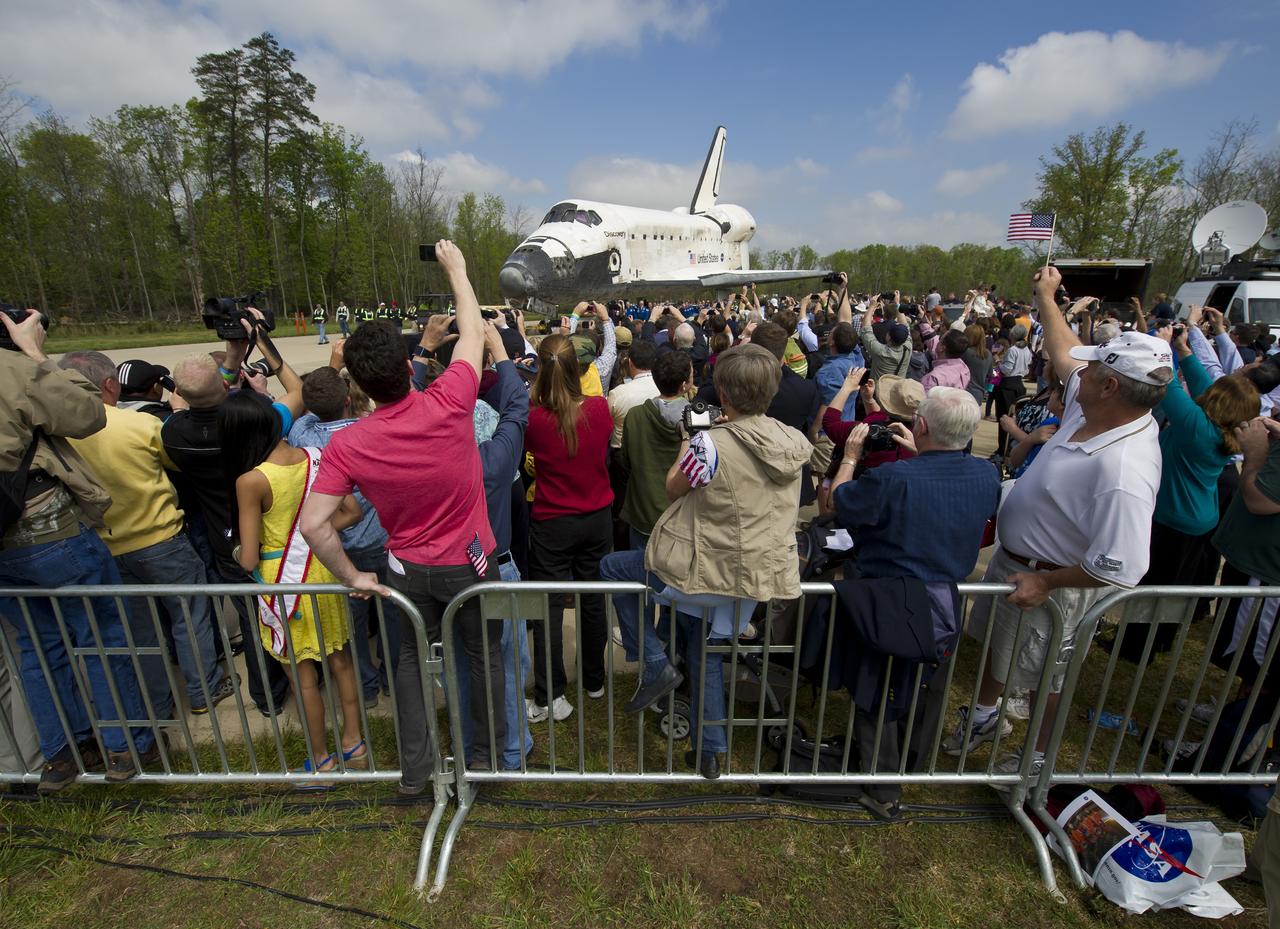
Space shuttle Discovery is rolled toward the transfer ceremony at the Steven F. Udvar-Hazy Center Thursday, April 19, 2012 in Chantilly, Va. Discovery will be permanently housed at the Udvar-Hazy Center, part of the Smithsonian Institution’s Air and Space Museum. Discovery, the first orbiter retired from NASA’s shuttle fleet, completed 39 missions, spent 365 days in space, orbited the Earth 5,830 times, and traveled 148,221,675 miles. NASA will transfer Discovery to the National Air and Space Museum to begin its new mission to commemorate past achievements in space and to educate and inspire future generations of explorers. Photo Credit: (NASA/Carla Cioffi)
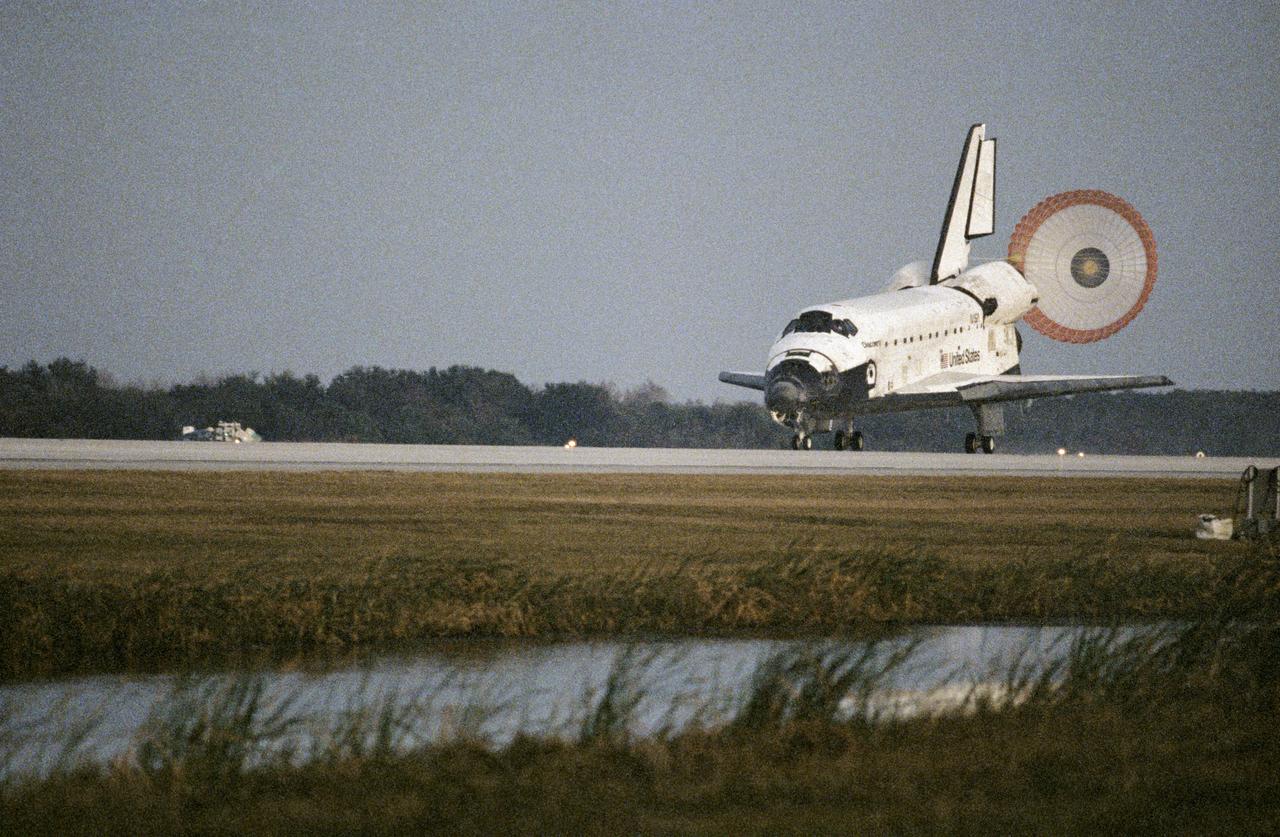
STS063-S-015 (11 Feb. 1995) --- The Space Shuttle Discovery deploys its drag chute on Runway 15 at the Kennedy Space Center's (KSC) Shuttle Landing Facility as it wraps up an eight-day mission. Touchdown occurred at 6:50:19 a.m. (EST), February 11, 1995. Onboard the Space Shuttle Discovery were astronauts James D. Wetherbee, mission commander; Eileen M. Collins, pilot; Bernard A. Harris Jr., payload commander; mission specialists C. Michael Foale, Janice E. Voss, and cosmonaut Vladimir G. Titov.
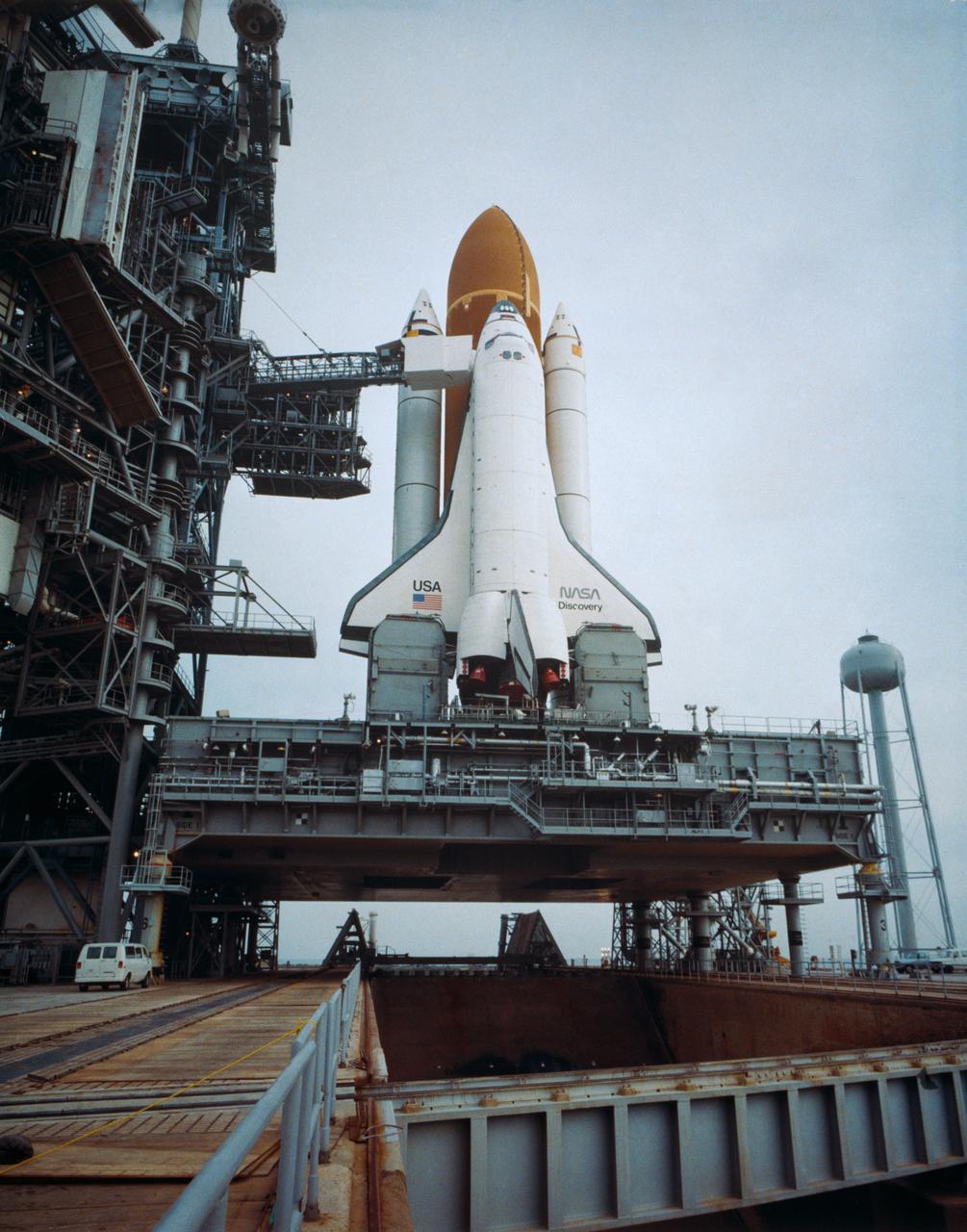
Shuttle Discovery on the launch pad for the STS 51-D mission.
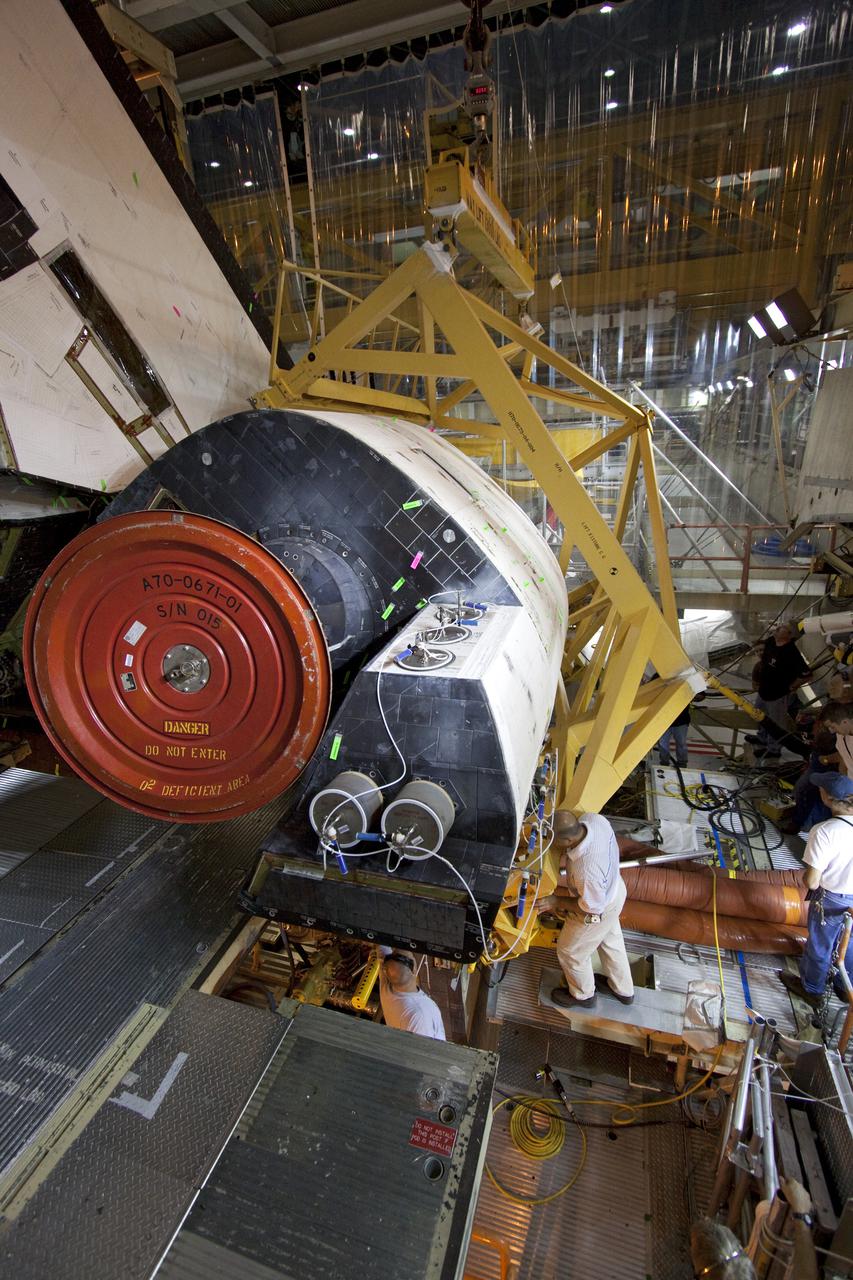
CAPE CANAVERAL, Fla. – Inside Orbiter Processing Facility-3 at Kennedy Space Center in Florida, United Space Alliance technicians prepare to remove the right-hand orbital maneuvering system, or OMS, pod from Discovery. Removal of the OMS pods is part of the orbiter processing activities to prepare Discovery for its next launch, the STS-133 mission. The STS-133 mission to the International Space Station is targeted for launch in the fall of 2010. Discovery’s six-person crew will take important spare parts to the International Space Station along with the Express Logistics Carrier 4. Photo credit: NASA_Jack Pfaller
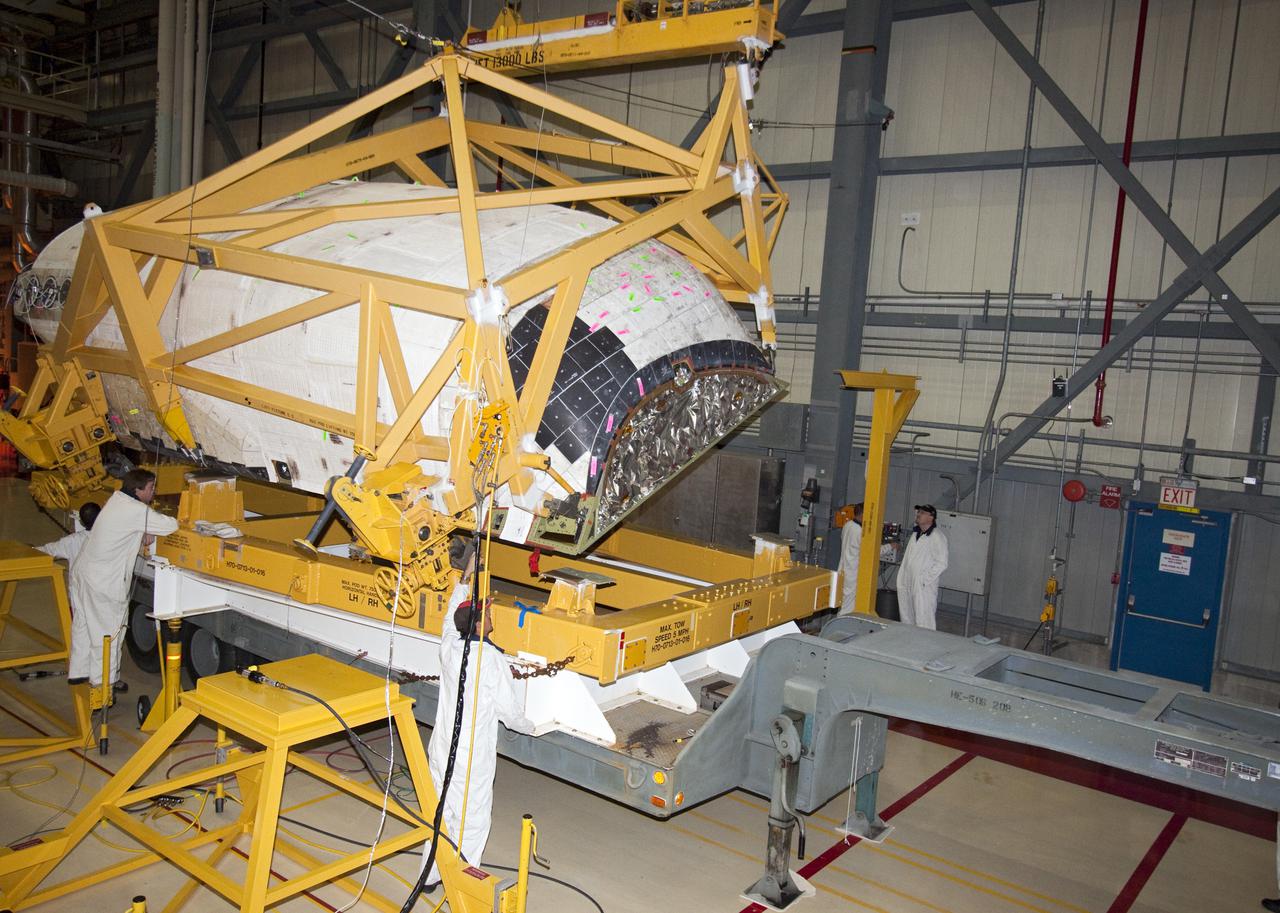
CAPE CANAVERAL, Fla. – Inside Orbiter Processing Facility-3 at Kennedy Space Center in Florida, United Space Alliance technicians place the right-hand orbital maneuvering system, or OMS, pod from Discovery on a pallet to be transferred to the Hypergolic Maintenance Facility. Removal of the OMS pods is part of the orbiter processing activities to prepare Discovery for its next launch, the STS-133 mission. The STS-133 mission to the International Space Station is targeted for launch in the fall of 2010. Discovery’s six-person crew will take important spare parts to the International Space Station along with the Express Logistics Carrier 4. Photo credit: NASA_Jack Pfaller
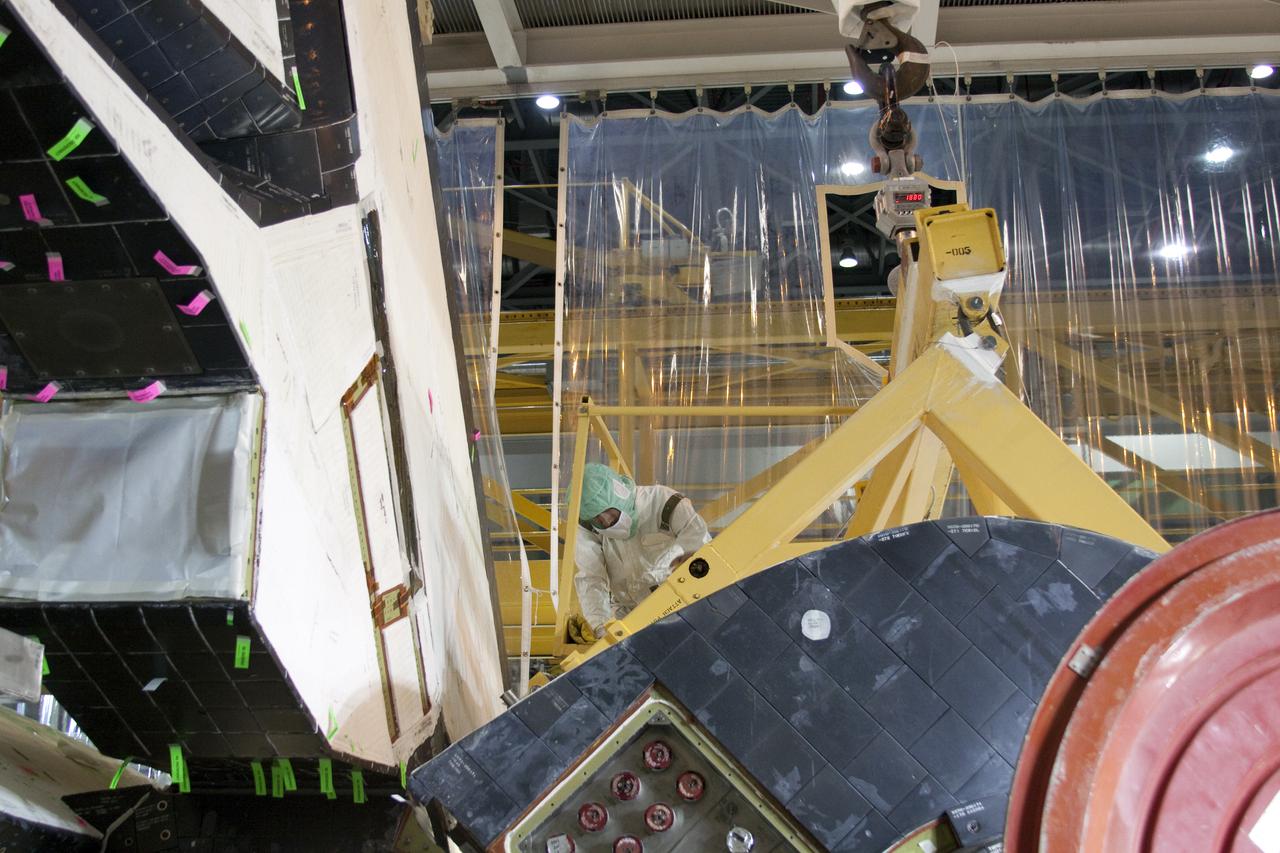
CAPE CANAVERAL, Fla. – Inside Orbiter Processing Facility-3 at Kennedy Space Center in Florida, a United Space Alliance technician prepares the right-hand orbital maneuvering system, or OMS, pod for removal from Discovery. Removal of the OMS pods is part of the orbiter processing activities to prepare Discovery for its next launch, the STS-133 mission. The STS-133 mission to the International Space Station is targeted for launch in the fall of 2010. Discovery’s six-person crew will take important spare parts to the International Space Station along with the Express Logistics Carrier 4. Photo credit: NASA_Jack Pfaller
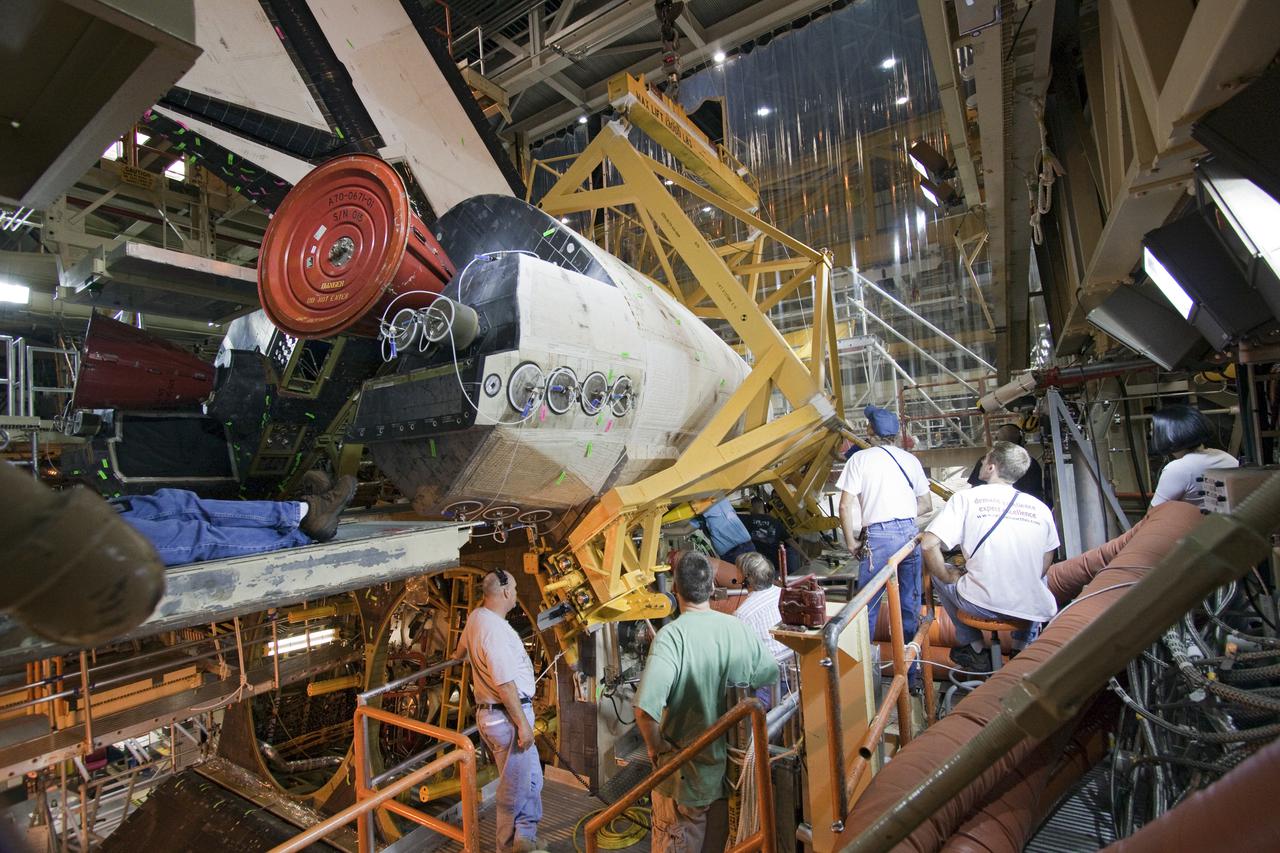
CAPE CANAVERAL, Fla. – Inside Orbiter Processing Facility-3 at Kennedy Space Center in Florida, United Space Alliance technicians prepare to remove the right-hand orbital maneuvering system, or OMS, pod from Discovery. Removal of the OMS pods is part of the orbiter processing activities to prepare Discovery for its next launch, the STS-133 mission. The STS-133 mission to the International Space Station is targeted for launch in the fall of 2010. Discovery’s six-person crew will take important spare parts to the International Space Station along with the Express Logistics Carrier 4. Photo credit: NASA_Jack Pfaller
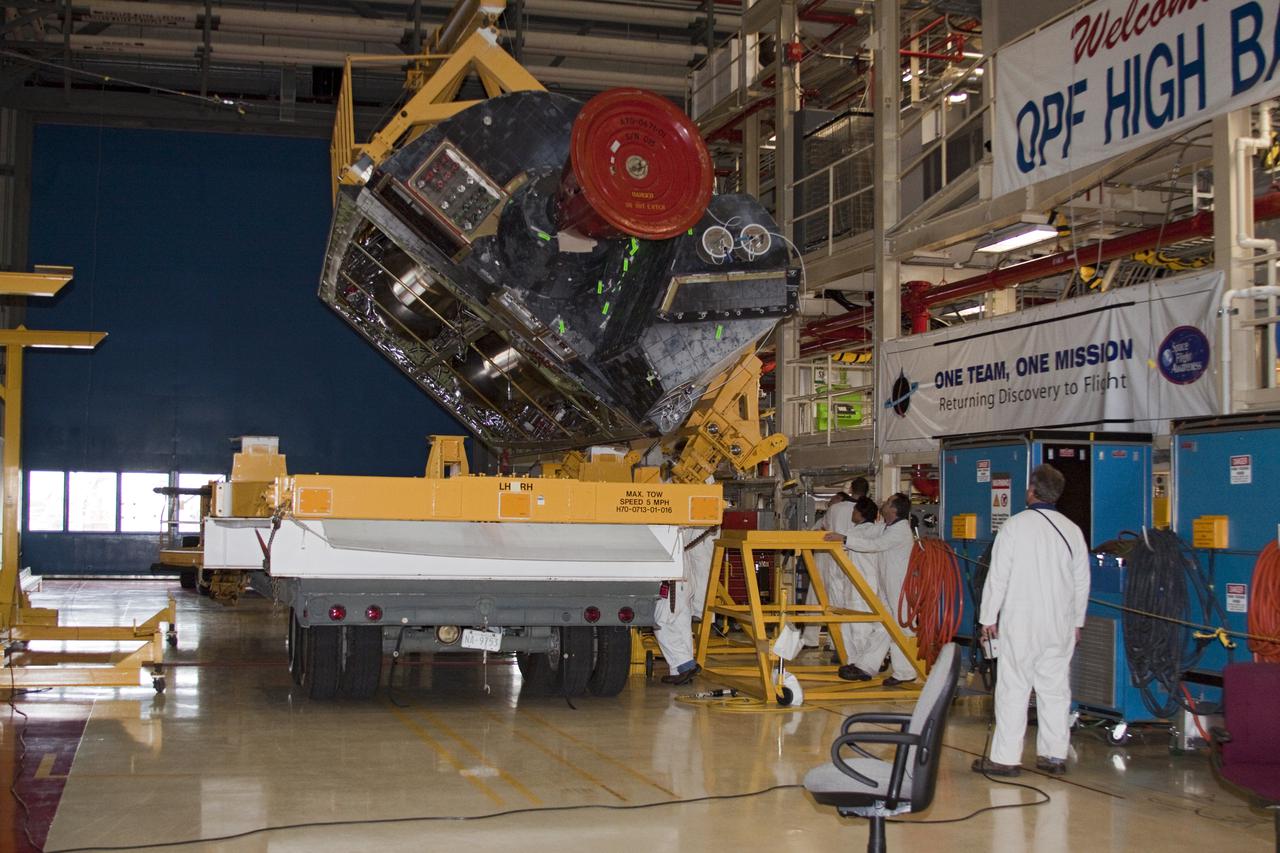
CAPE CANAVERAL, Fla. – Inside Orbiter Processing Facility-3 at Kennedy Space Center in Florida, United Space Alliance technicians have removed the right-hand orbital maneuvering system, or OMS, pod from Discovery. Removal of the OMS pods is part of the orbiter processing activities to prepare Discovery for its next launch, the STS-133 mission. The STS-133 mission to the International Space Station is targeted for launch in the fall of 2010. Discovery’s six-person crew will take important spare parts to the International Space Station along with the Express Logistics Carrier 4. Photo credit: NASA_Jack Pfaller
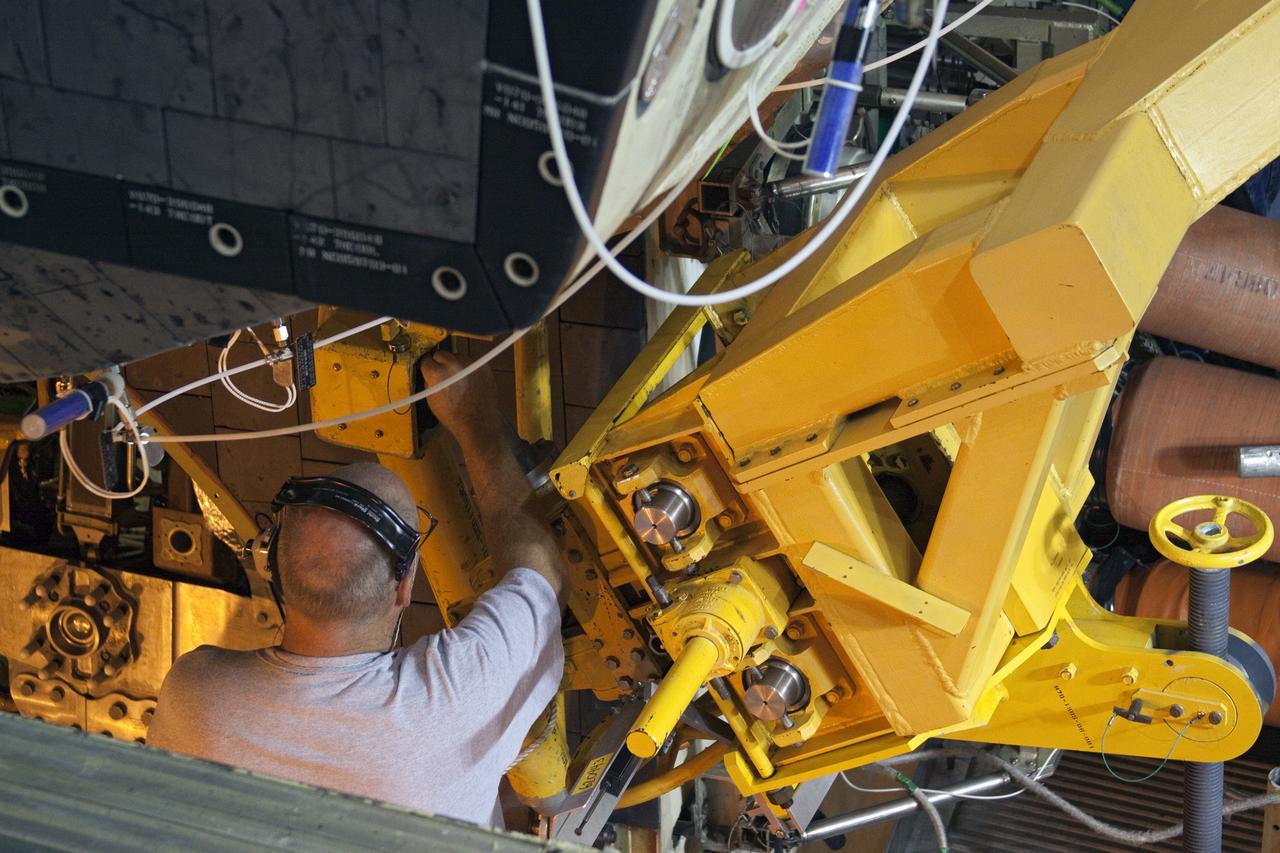
CAPE CANAVERAL, Fla. – Inside Orbiter Processing Facility-3 at Kennedy Space Center in Florida, a United Space Alliance technician makes preparations to remove the right-hand orbital maneuvering system, or OMS, pod from Discovery. Removal of the OMS pods is part of the orbiter processing activities to prepare Discovery for its next launch, the STS-133 mission. The STS-133 mission to the International Space Station is targeted for launch in the fall of 2010. Discovery’s six-person crew will take important spare parts to the International Space Station along with the Express Logistics Carrier 4. Photo credit: NASA_Jack Pfaller
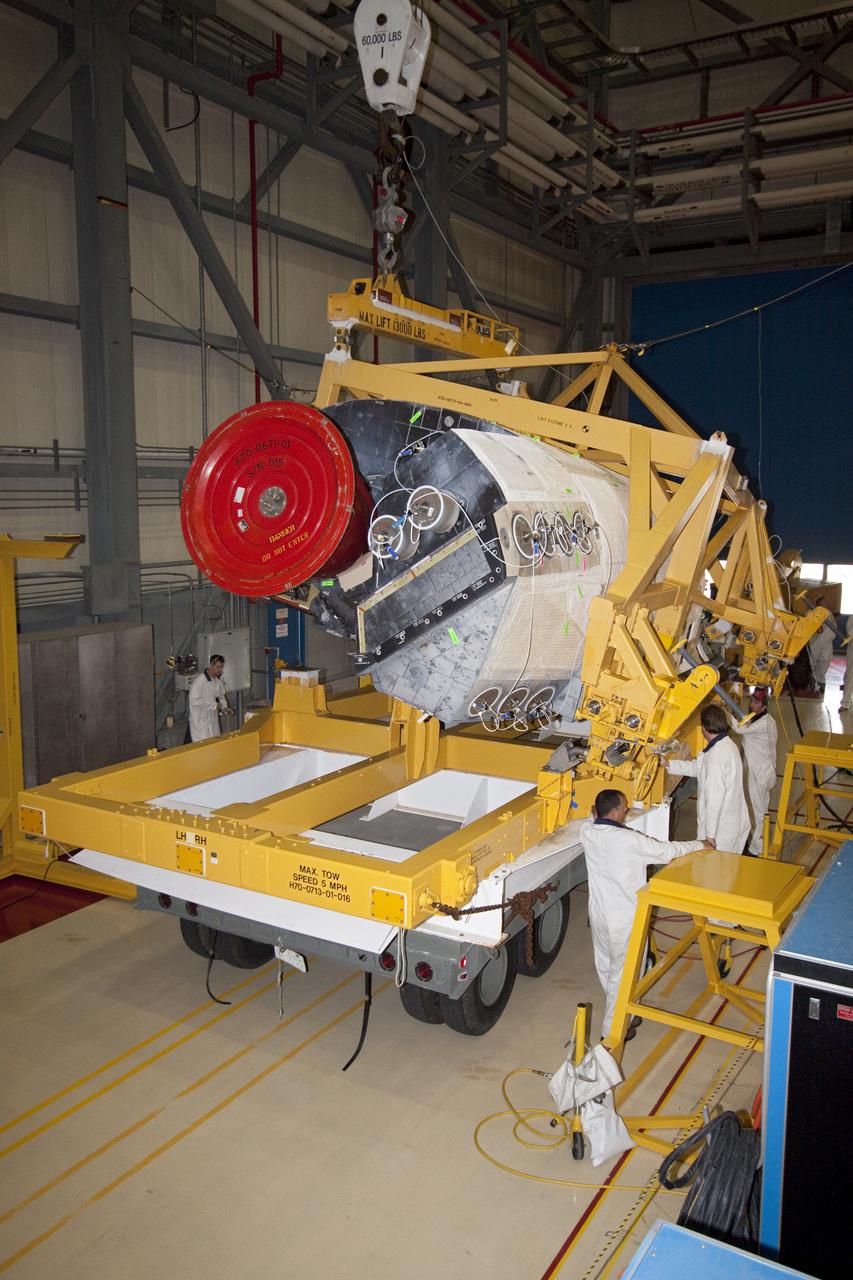
CAPE CANAVERAL, Fla. – Inside Orbiter Processing Facility-3 at Kennedy Space Center in Florida, United Space Alliance technicians place the right-hand orbital maneuvering system, or OMS, pod from Discovery on a pallet to be transferred to the Hypergolic Maintenance Facility. Removal of the OMS pods is part of the orbiter processing activities to prepare Discovery for its next launch, the STS-133 mission. The STS-133 mission to the International Space Station is targeted for launch in the fall of 2010. Discovery’s six-person crew will take important spare parts to the International Space Station along with the Express Logistics Carrier 4. Photo credit: NASA_Jack Pfaller
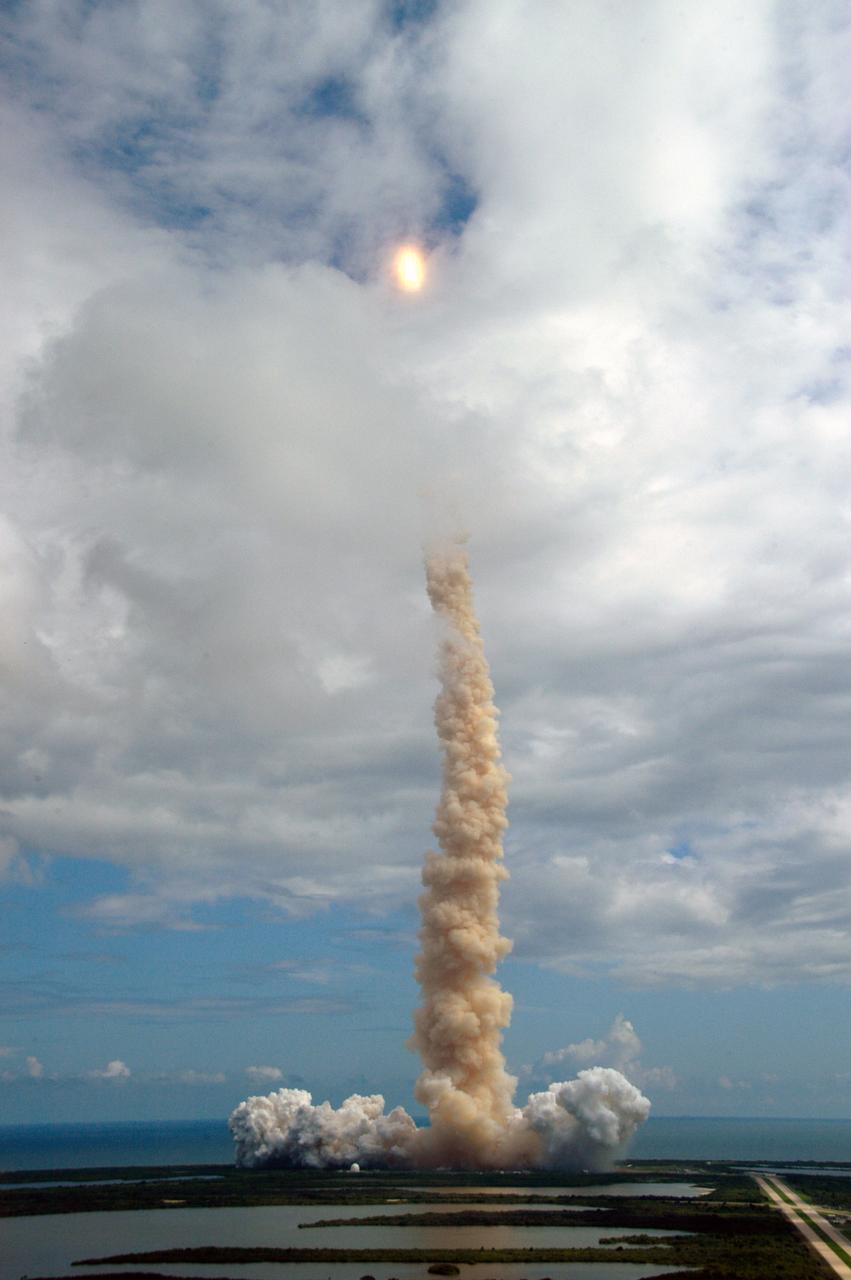
From the roof of the Vehicle Assembly Building at NASA's Kennedy Space Center, space shuttle Discovery rivals the sun as it soars through the clouds toward space. Liftoff was on time at 11:38:19 a.m. EDT. Discovery carries the Italian-built U.S. Node 2, called Harmony. During the 14-day STS-120 mission, the crew will install Harmony and move the P6 solar arrays to their permanent position and deploy them. Discovery is expected to complete its mission and return home at 4:47 a.m. EST on Nov. 6.

NASA Deputy Administrator Lori Garver, at podium, speaks to those in attendance at Apron W after the 747 Shuttle Carrier Aircraft (SCA) with space shuttle Discovery mounted on top rolled to a halt at Washington Dulles International Airport, Tuesday, April 17, 2012 in Sterling, Va. Discovery, the first orbiter retired from NASA’s shuttle fleet, completed 39 missions, spent 365 days in space, orbited the Earth 5,830 times, and traveled 148,221,675 miles. NASA will transfer Discovery to the National Air and Space Museum to begin its new mission to commemorate past achievements in space and to educate and inspire future generations of explorers. Photo Credit: (NASA/Smithsonian Institution/Dane Penland)

Space shuttle Discovery, mounted atop a NASA 747 Shuttle Carrier Aircraft (SCA) flies over the Steven F. Udvar-Hazy Center, Tuesday, April 17, 2012, in Washington. Discovery, the first orbiter retired from NASA’s shuttle fleet, completed 39 missions, spent 365 days in space, orbited the Earth 5,830 times, and traveled 148,221,675 miles. NASA will transfer Discovery to the National Air and Space Museum to begin its new mission to commemorate past achievements in space and to educate and inspire future generations of explorers. Photo Credit: (NASA/Smithsonian Institution/Eric Long)
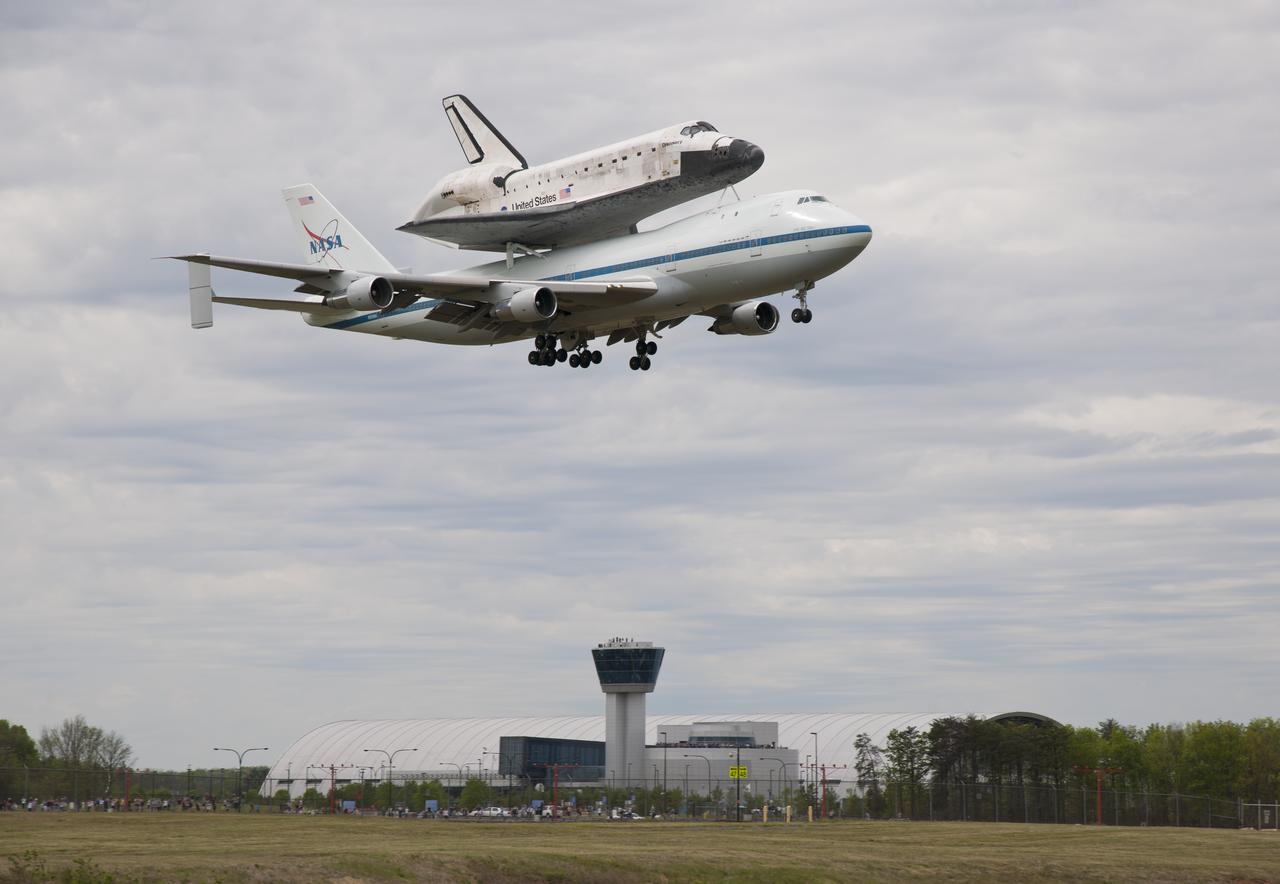
Space shuttle Discovery, mounted atop a NASA 747 Shuttle Carrier Aircraft (SCA) flies over the Steven F. Udvar-Hazy Center, Tuesday, April 17, 2012, in Washington. Discovery, the first orbiter retired from NASA’s shuttle fleet, completed 39 missions, spent 365 days in space, orbited the Earth 5,830 times, and traveled 148,221,675 miles. NASA will transfer Discovery to the National Air and Space Museum to begin its new mission to commemorate past achievements in space and to educate and inspire future generations of explorers. Photo Credit: (NASA/Smithsonian Institution/Dane Penland)
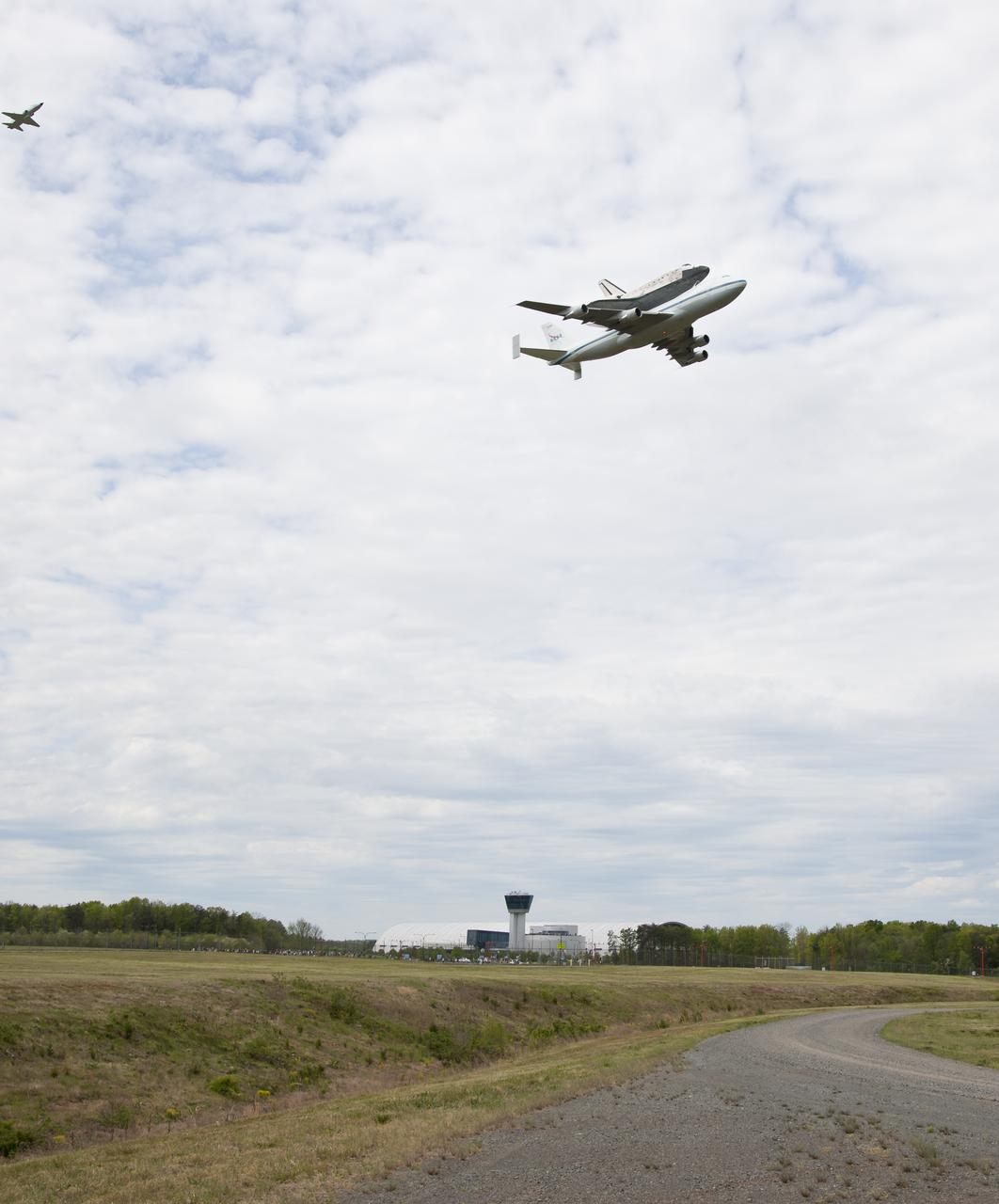
Space shuttle Discovery, mounted atop a NASA 747 Shuttle Carrier Aircraft (SCA) flies over the Steven F. Udvar-Hazy Center, Tuesday, April 17, 2012, in Washington. Discovery, the first orbiter retired from NASA’s shuttle fleet, completed 39 missions, spent 365 days in space, orbited the Earth 5,830 times, and traveled 148,221,675 miles. NASA will transfer Discovery to the National Air and Space Museum to begin its new mission to commemorate past achievements in space and to educate and inspire future generations of explorers. Photo Credit: (NASA/Smithsonian Institution/Dane Penland)
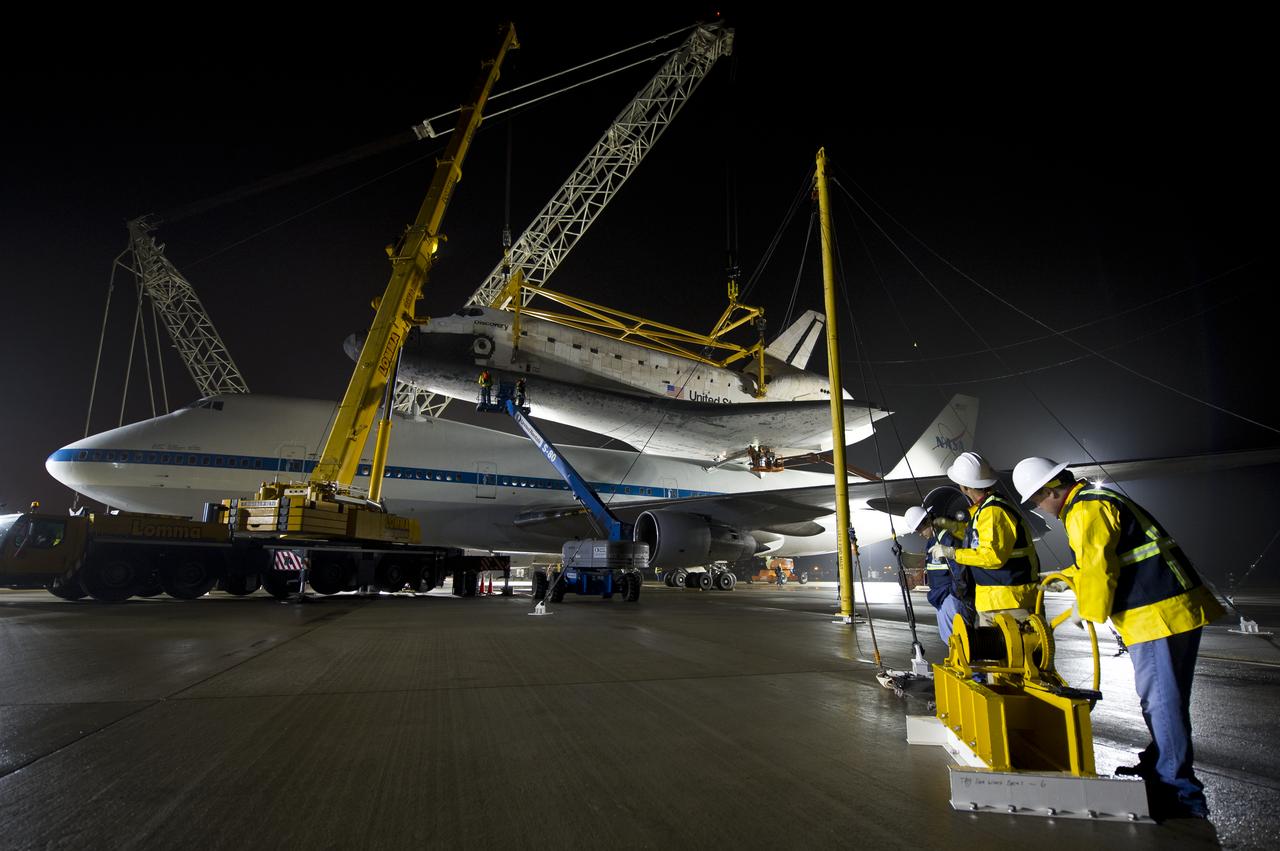
Workers monitor the lift of the space shuttle Discovery from the the NASA 747 Shuttle Carrier Aircraft (SCA) at Washington Dulles International Airport, Thursday, April 19, 2012, in Sterling, VA. Discovery, the first orbiter retired from NASA’s shuttle fleet, completed 39 missions, spent 365 days in space, orbited the Earth 5,830 times, and traveled 148,221,675 miles. NASA will transfer Discovery to the National Air and Space Museum to begin its new mission to commemorate past achievements in space and to educate and inspire future generations of explorers. Photo Credit: (NASA/Bill Ingalls)
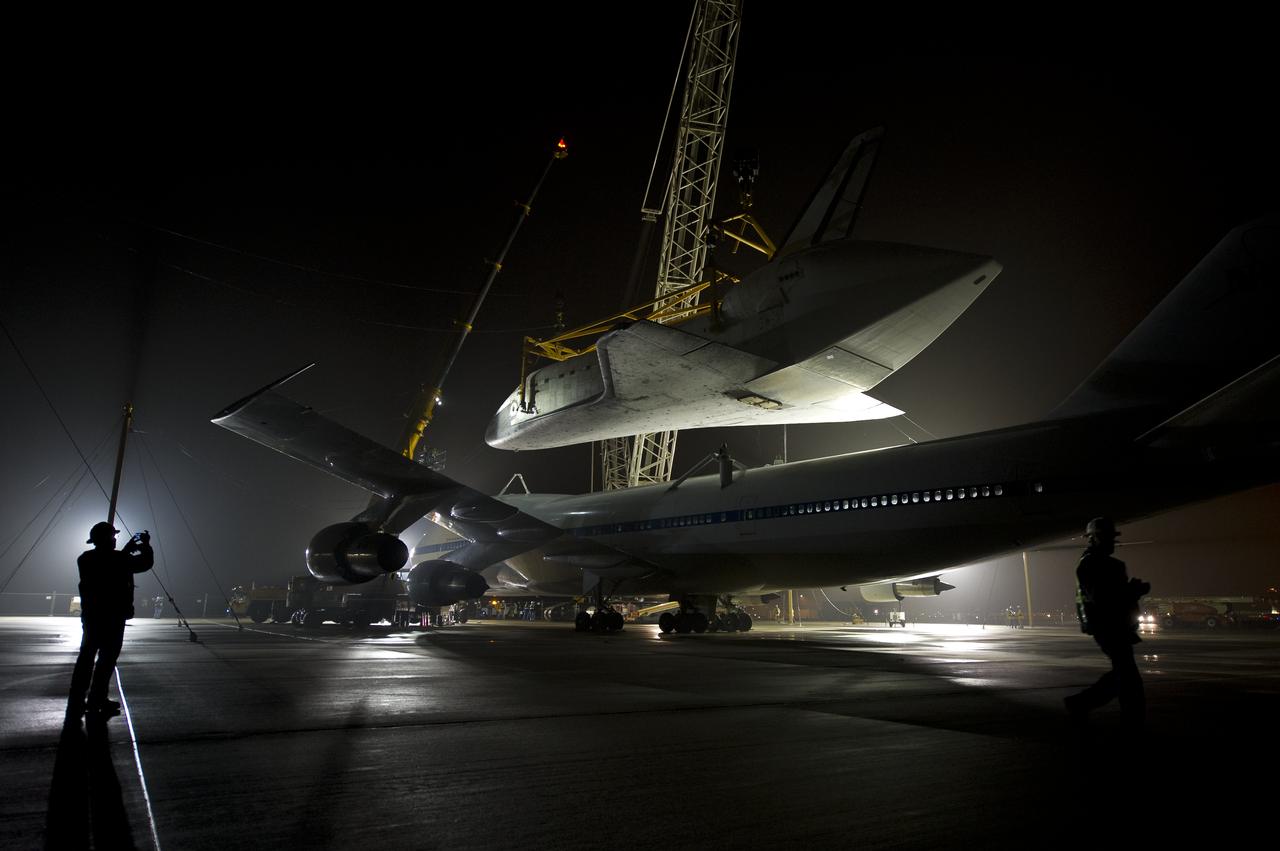
Workers monitor the lift of the space shuttle Discovery from the top of the NASA 747 Shuttle Carrier Aircraft (SCA) at Washington Dulles International Airport, Thursday, April 19, 2012, in Sterling, VA. Discovery, the first orbiter retired from NASA’s shuttle fleet, completed 39 missions, spent 365 days in space, orbited the Earth 5,830 times, and traveled 148,221,675 miles. NASA will transfer Discovery to the National Air and Space Museum to begin its new mission to commemorate past achievements in space and to educate and inspire future generations of explorers. Photo Credit: (NASA/Bill Ingalls)
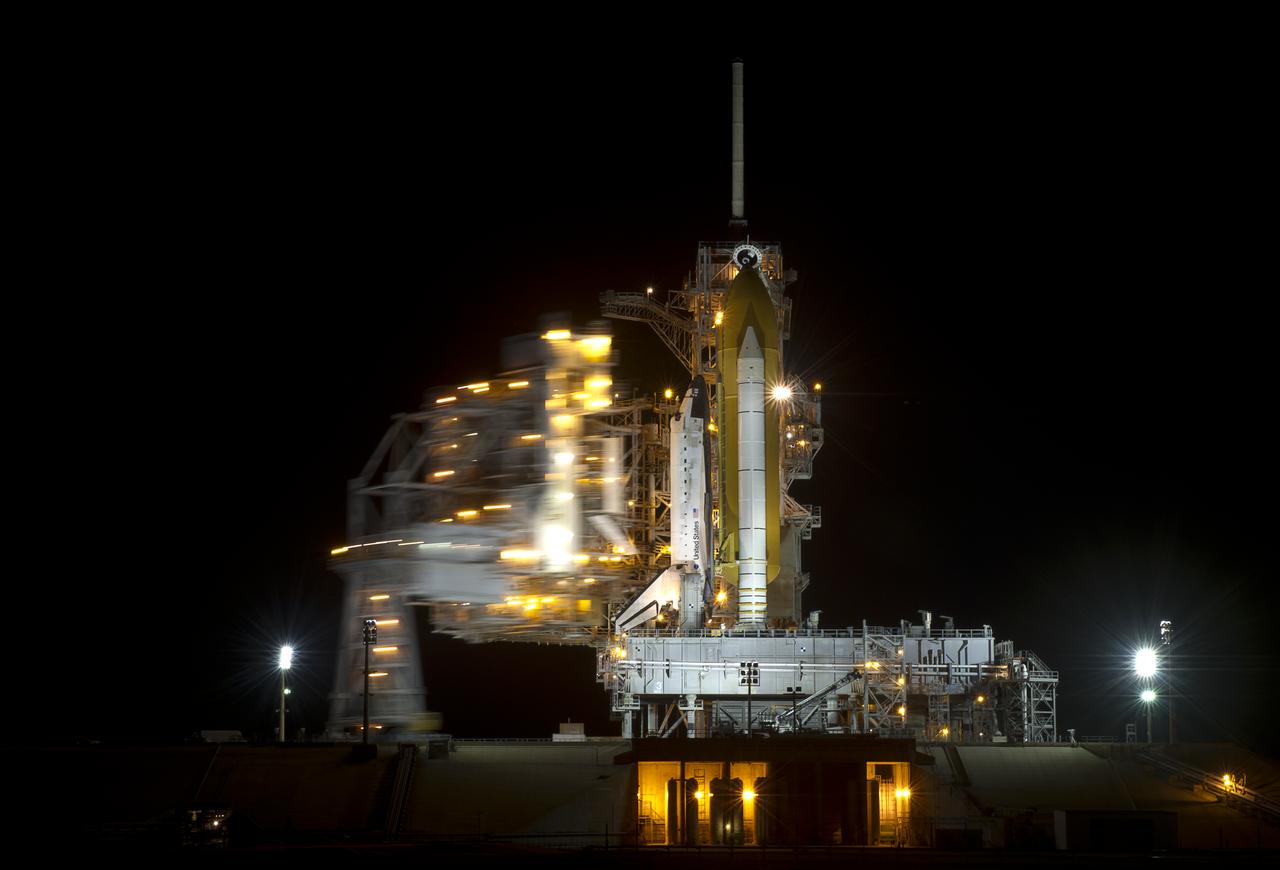
The space shuttle Discovery is seen on launch Pad 39a as the Rotating Service Structure (RSS) is rolled back on Wednesday, Nov. 3, 2010 at the NASA Kennedy Space Center in Cape Canaveral, Fla. During space shuttle Discovery's final spaceflight, the STS-133 crew members will take important spare parts to the International Space Station along with the Express Logistics Carrier-4. Photo Credit: (NASA/Bill Ingalls)
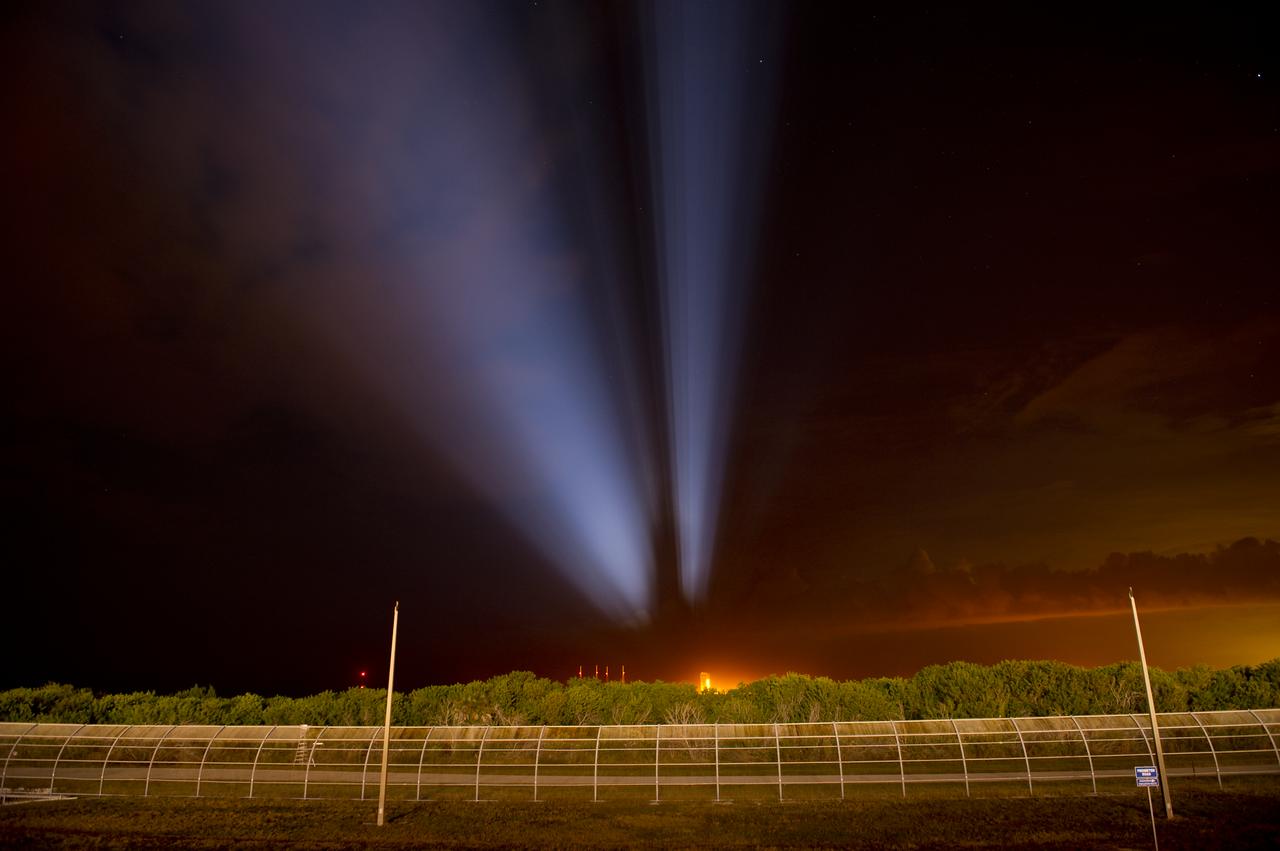
An faint profile outline of the space shuttle Discovery and launch pad 39a are seen projected in the sky as powerful xenon lights illuminate launch pad 39a on Wednesday, Nov. 3, 2010 at the NASA Kennedy Space Center in Cape Canaveral, Fla. During space shuttle Discovery's final spaceflight, the STS-133 crew members will take important spare parts to the International Space Station along with the Express Logistics Carrier-4. Photo Credit: (NASA/Bill Ingalls)
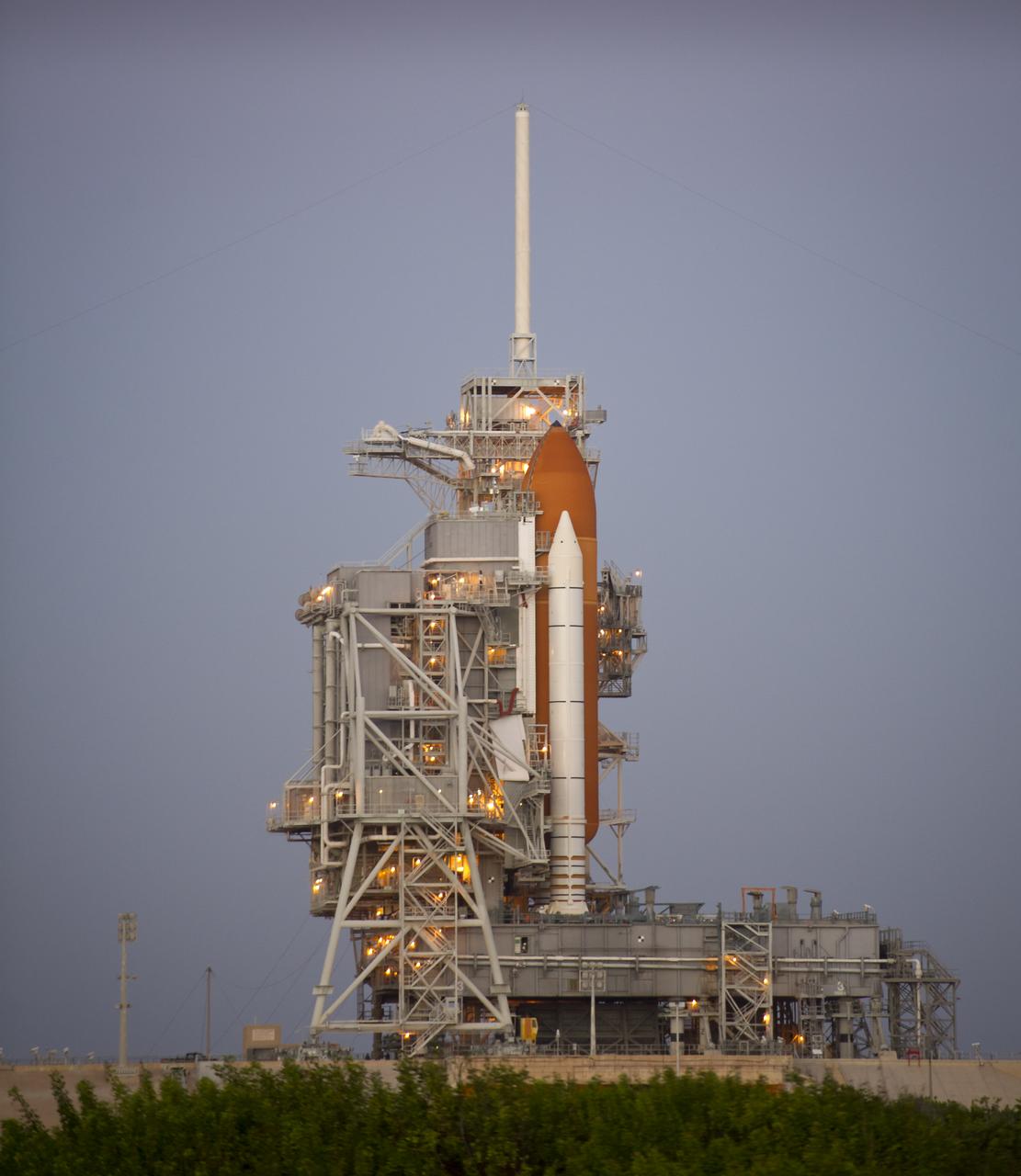
The space shuttle Discovery is seen on launch pad 39a early in the morning of Sunday, Oct. 31, 2010 at the NASA Kennedy Space Center in Cape Canaveral, Fla. During Space Shuttle Discovery's final spaceflight, the STS-133 crew members will take important spare parts to the International Space Station along with the Express Logistics Carrier-4. Discovery is targeted for launch at 3:52 p.m. Wednesday, Nov. 3, 2010. Photo Credit: (NASA/Bill Ingalls)
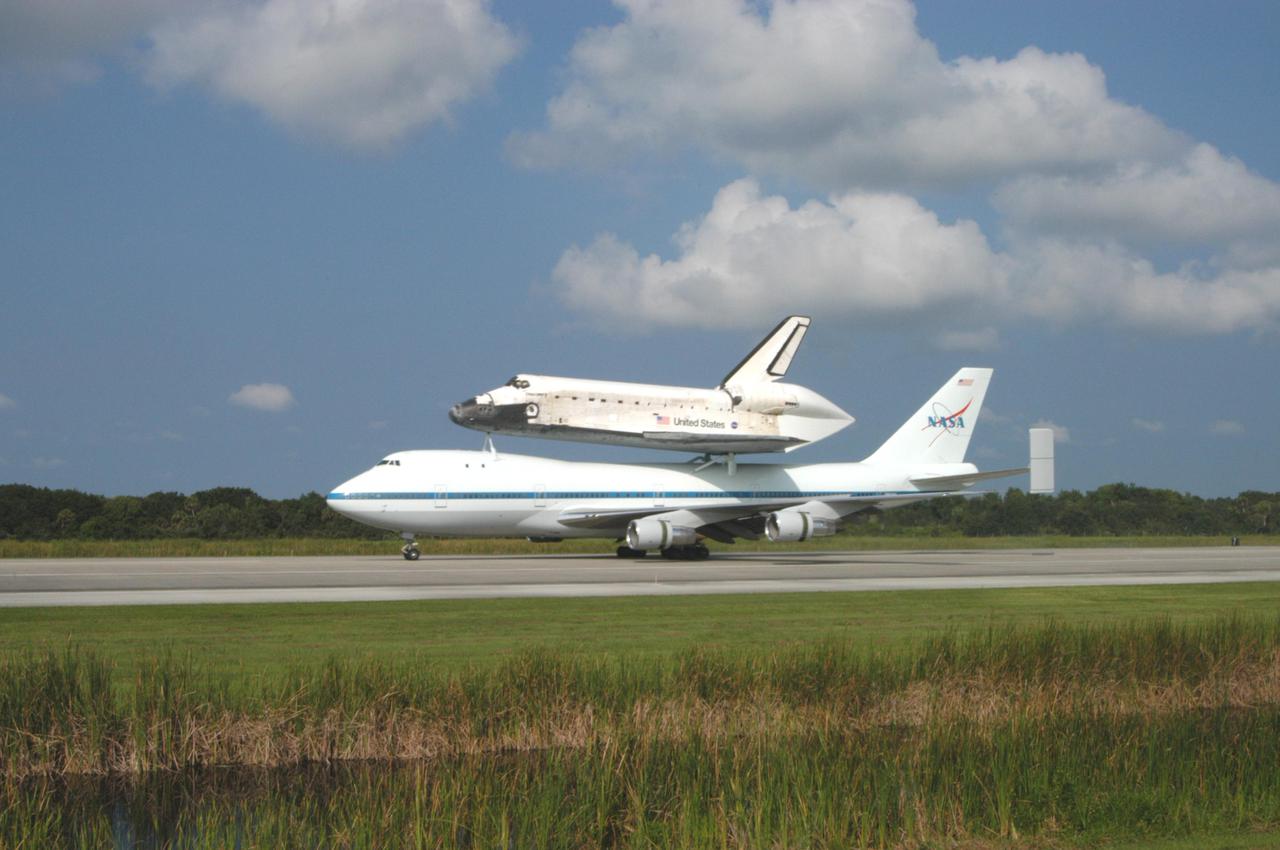
KENNEDY SPACE CENTER, FLA. - Space Shuttle Discovery, atop a modified Boeing 747 Shuttle Carrier Aircraft (SCA), lands on runway 15 at NASA Kennedy Space Center's Shuttle Landing Facility (SLF) at about 10:00 a.m. EDT. The cross-country ferry flight became necessary when two days of unfavorable weather conditions at KSC forced Discovery to land on runway 22 at Edwards Air Force Base, Calif., on Aug. 9 following mission STS-114. On the return trip, stops were made at Altus Air Force Base, Okla., and Barksdale Air Force Base, La., where Discovery stayed for two nights. The SCA and Discovery will be towed to the Mate_Demate Device at the SLF where a crane will lift Discovery from the SCA and place it on solid ground. Discovery will then be towed to the Orbiter Processing Facility where preparations will begin for its next flight, STS-121.
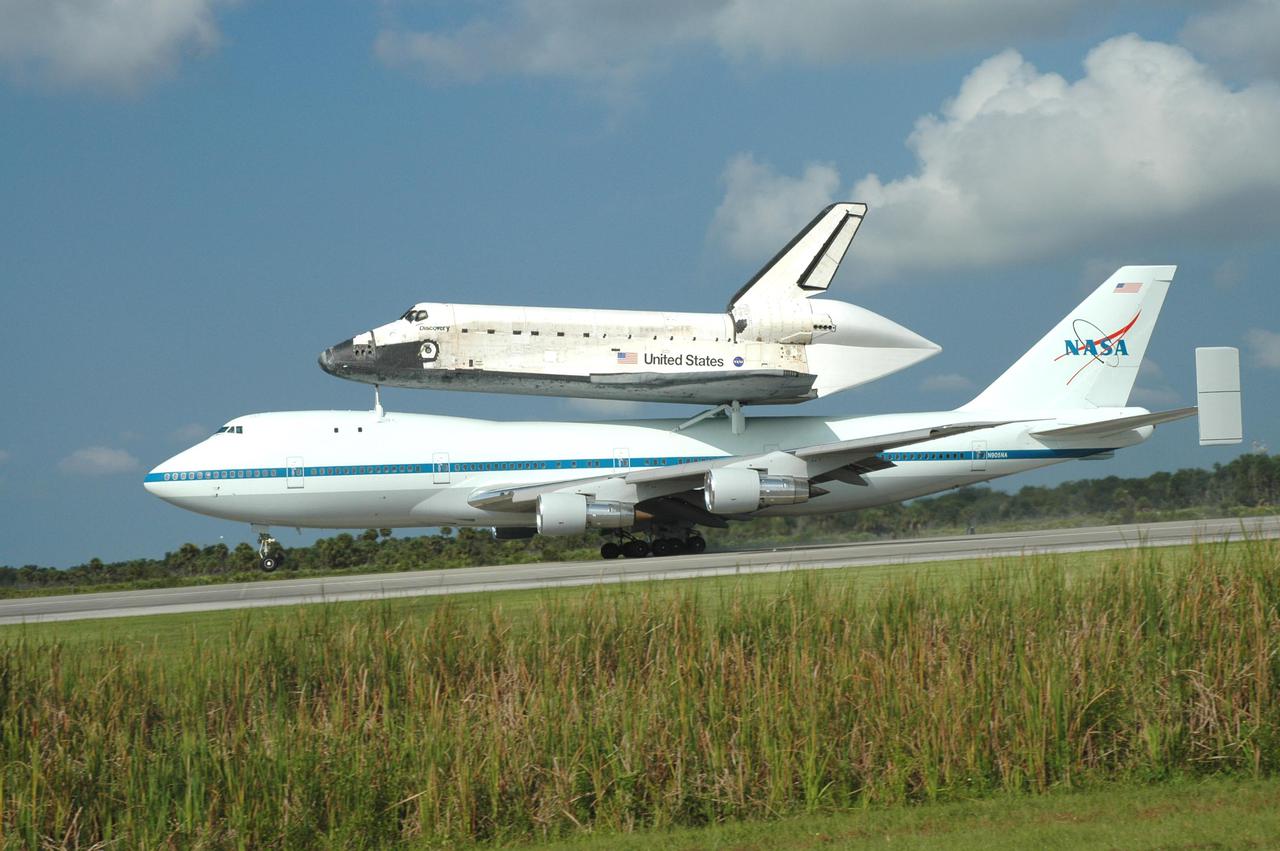
KENNEDY SPACE CENTER, FLA. - Space Shuttle Discovery, atop a modified Boeing 747 Shuttle Carrier Aircraft (SCA), touches down on runway 15 at NASA Kennedy Space Center's Shuttle Landing Facility (SLF) at about 10:00 a.m. EDT. The cross-country ferry flight became necessary when two days of unfavorable weather conditions at KSC forced Discovery to land on runway 22 at Edwards Air Force Base, Calif., on Aug. 9 following mission STS-114. On the return trip, stops were made at Altus Air Force Base, Okla., and Barksdale Air Force Base, La., where Discovery stayed for two nights. The SCA and Discovery will be towed to the Mate_Demate Device at the SLF where a crane will lift Discovery from the SCA and place it on solid ground. Discovery will then be towed to the Orbiter Processing Facility where preparations will begin for its next flight, STS-121.
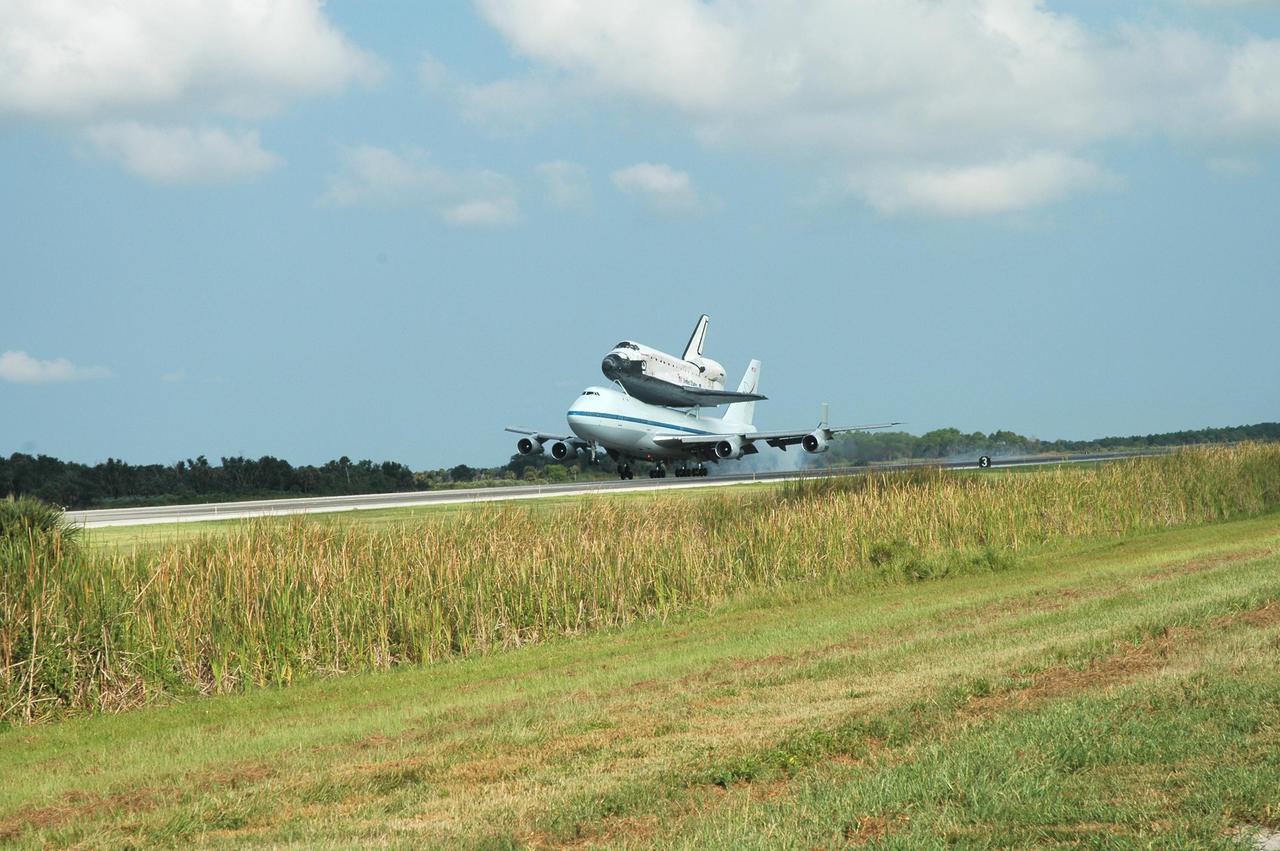
KENNEDY SPACE CENTER, FLA. - Space Shuttle Discovery, atop a modified Boeing 747 Shuttle Carrier Aircraft (SCA), touches down on runway 15 at NASA Kennedy Space Center's Shuttle Landing Facility (SLF) at about 10:00 a.m. EDT. The cross-country ferry flight became necessary when two days of unfavorable weather conditions at KSC forced Discovery to land on runway 22 at Edwards Air Force Base, Calif., on Aug. 9 following mission STS-114. On the return trip, stops were made at Altus Air Force Base, Okla., and Barksdale Air Force Base, La., where Discovery stayed for two nights. The SCA and Discovery will be towed to the Mate_Demate Device at the SLF where a crane will lift Discovery from the SCA and place it on solid ground. Discovery will then be towed to the Orbiter Processing Facility where preparations will begin for its next flight, STS-121.
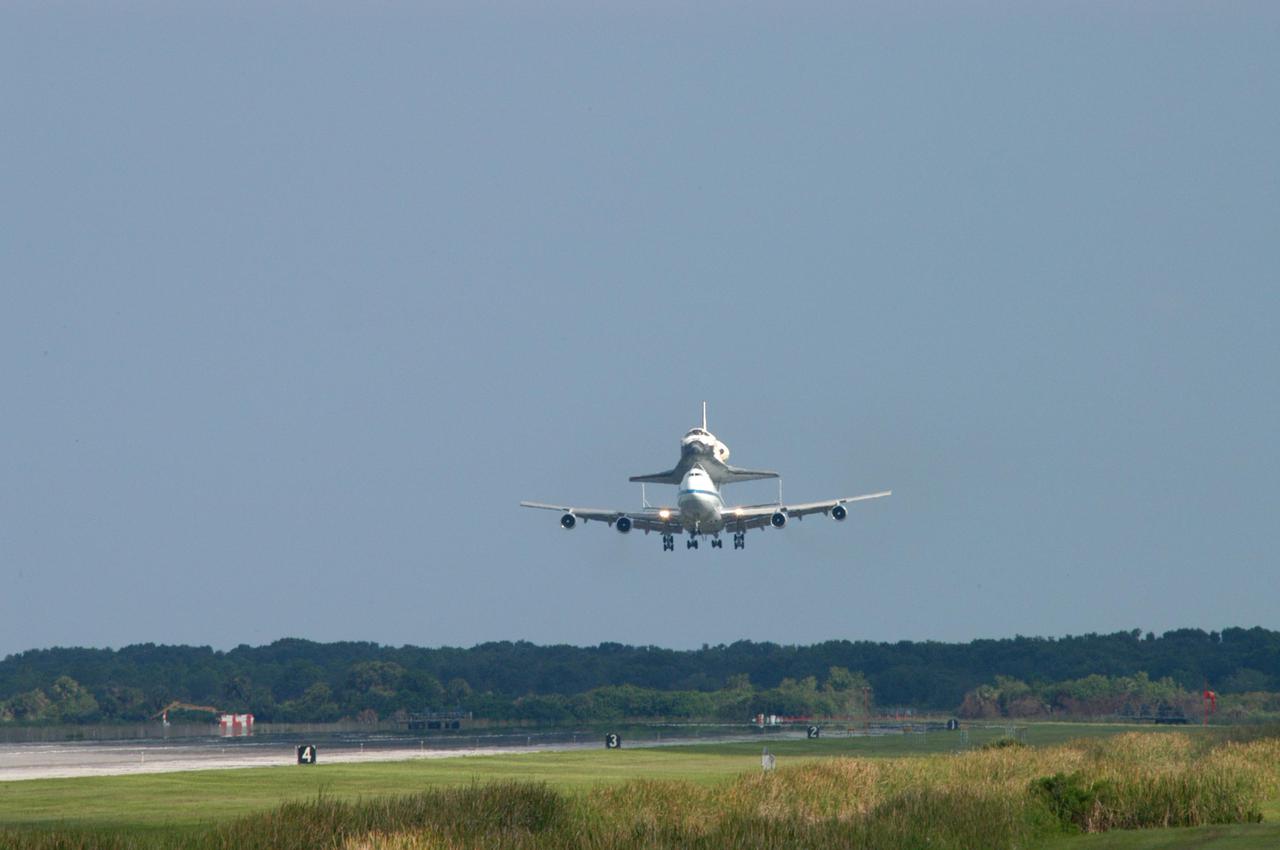
KENNEDY SPACE CENTER, FLA. - Space Shuttle Discovery, atop a modified Boeing 747 Shuttle Carrier Aircraft (SCA), is on its final approach to land on runway 15 at NASA Kennedy Space Center's Shuttle Landing Facility (SLF) at about 10:00 a.m. EDT. The cross-country ferry flight became necessary when two days of unfavorable weather conditions at KSC forced Discovery to land on runway 22 at Edwards Air Force Base, Calif., on Aug. 9 following mission STS-114. On the return trip, stops were made at Altus Air Force Base, Okla., and Barksdale Air Force Base, La., where Discovery stayed for two nights. The SCA and Discovery will be towed to the Mate_Demate Device at the SLF where a crane will lift Discovery from the SCA and place it on solid ground. Discovery will then be towed to the Orbiter Processing Facility where preparations will begin for its next flight, STS-121.
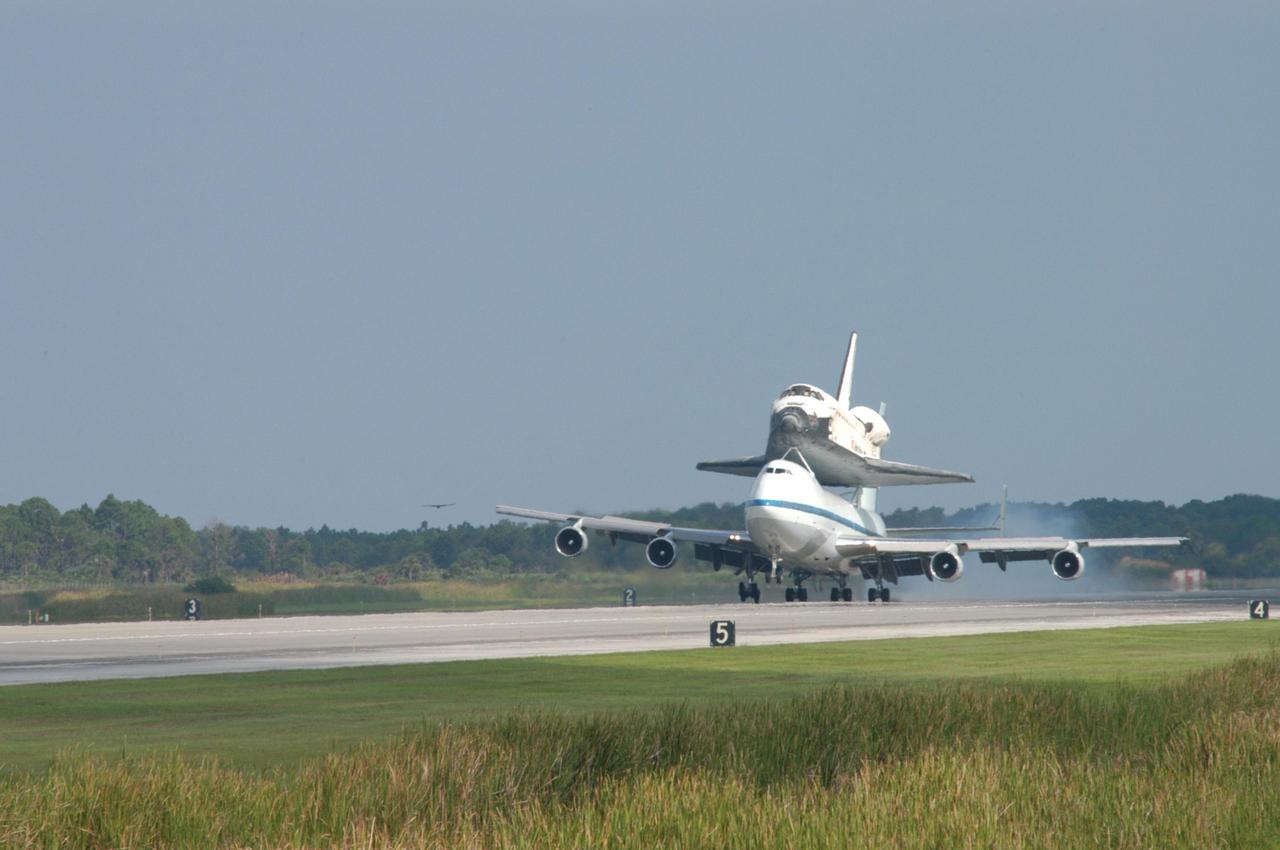
KENNEDY SPACE CENTER, FLA. - Space Shuttle Discovery, atop a modified Boeing 747 Shuttle Carrier Aircraft (SCA), lands on runway 15 at NASA Kennedy Space Center's Shuttle Landing Facility (SLF) at about 10:00 a.m. EDT. The cross-country ferry flight became necessary when two days of unfavorable weather conditions at KSC forced Discovery to land on runway 22 at Edwards Air Force Base, Calif., on Aug. 9 following mission STS-114. On the return trip, stops were made at Altus Air Force Base, Okla., and Barksdale Air Force Base, La., where Discovery stayed for two nights. The SCA and Discovery will be towed to the Mate_Demate Device at the SLF where a crane will lift Discovery from the SCA and place it on solid ground. Discovery will then be towed to the Orbiter Processing Facility where preparations will begin for its next flight, STS-121.
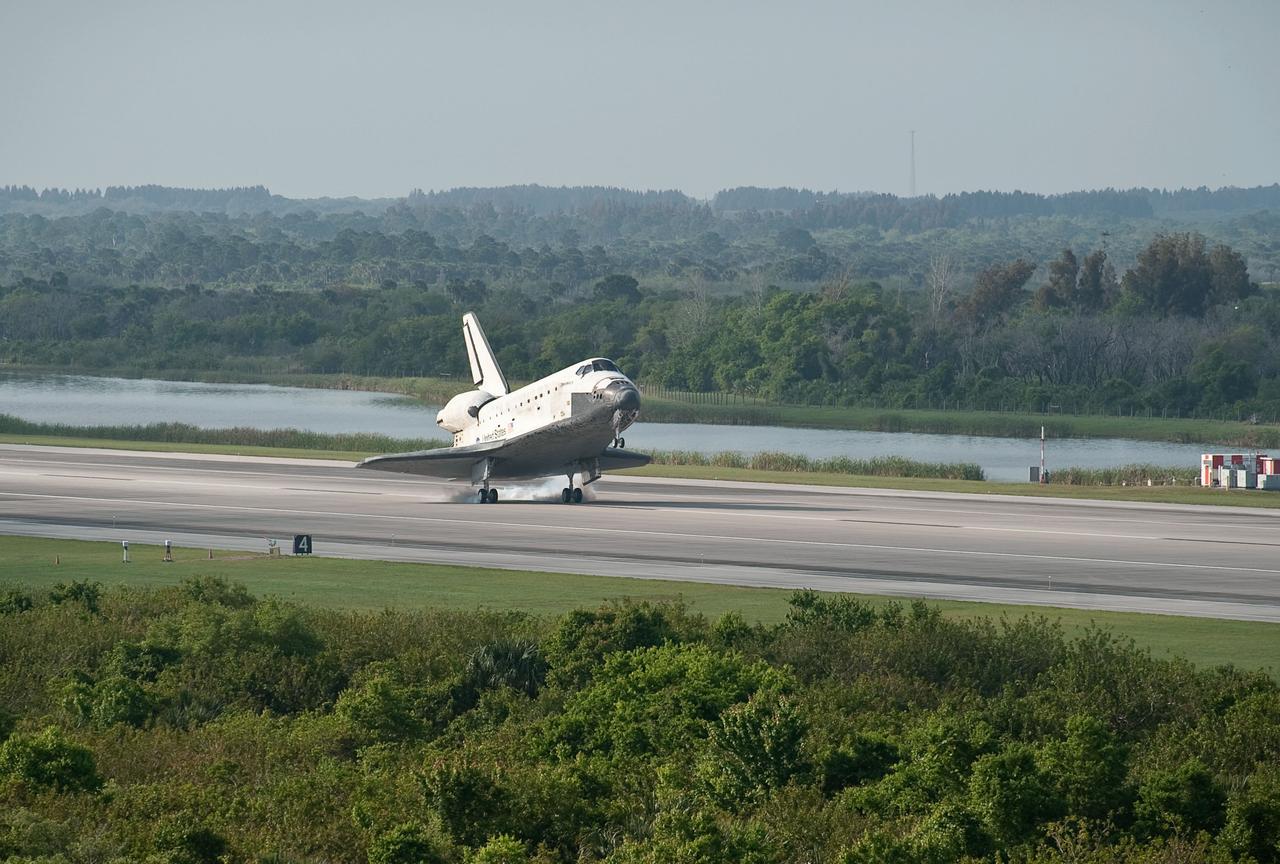
STS131-S-086 (20 April 2010) --- The space shuttle Discovery is seen as it lands at the Kennedy Space Center in Cape Canaveral, Florida, on April 20, 2010. Discovery and the STS-131 mission crew, NASA astronauts Alan Poindexter, commander; James P. Dutton Jr., pilot; Dorothy Metcalf-Lindenburger, Rick Mastracchio, Stephanie Wilson, Clayton Anderson and Japanese astronaut Naoko Yamazaki, all mission specialists, returned from their mission to the International Space Station. Photo credit: NASA/Bill Ingalls
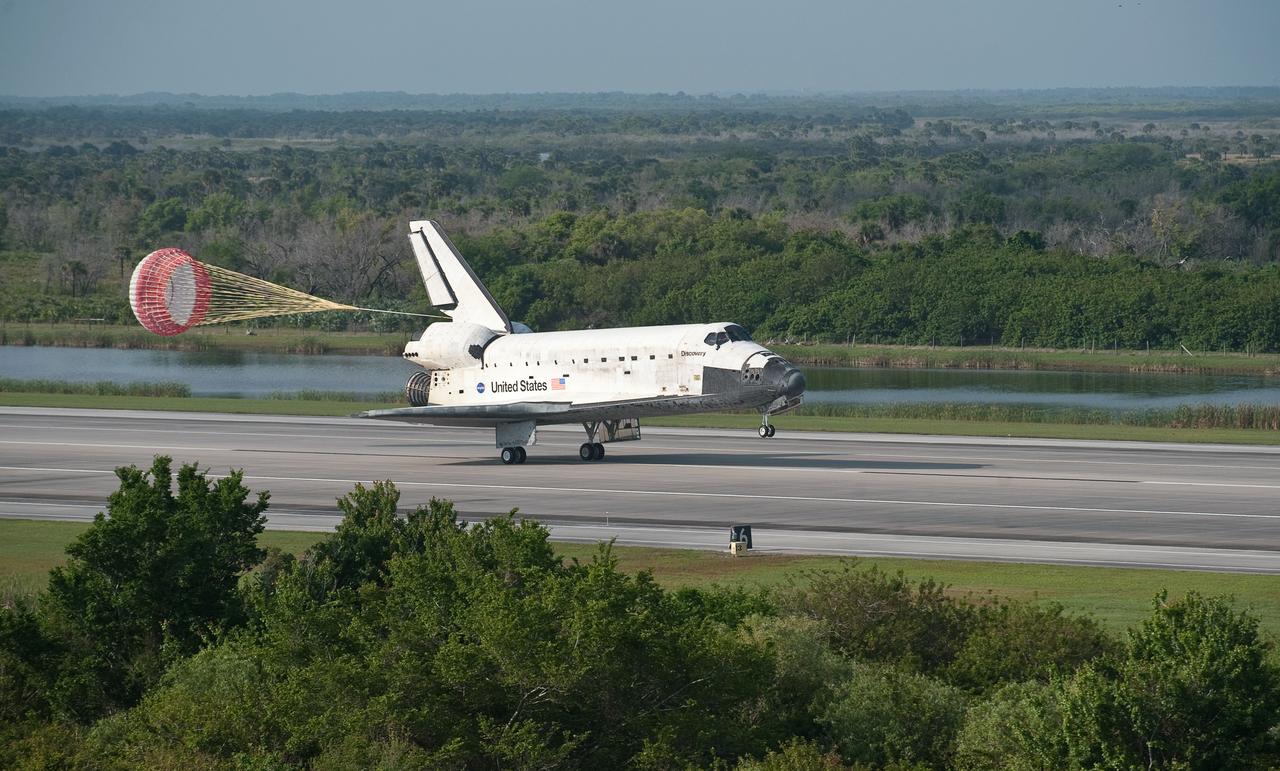
STS131-S-088 (20 April 2010) --- The space shuttle Discovery is seen as it lands at the Kennedy Space Center in Cape Canaveral, Florida, on April 20, 2010. Discovery and the STS-131 mission crew, NASA astronauts Alan Poindexter, commander; James P. Dutton Jr., pilot; Dorothy Metcalf-Lindenburger, Rick Mastracchio, Stephanie Wilson, Clayton Anderson and Japanese astronaut Naoko Yamazaki, all mission specialists, returned from their mission to the International Space Station. Photo credit: NASA/Bill Ingalls

The space shuttle Discovery is seen as it lands at the Kennedy Space Center in Cape Canaveral, Florida, Tuesday, April 20, 2010. Discovery and the STS-131 mission crew, Commander Alan G. Poindexter, Pilot James P. Dutton Jr. and Mission Specialists Dorothy Metcalf-Lindenburger, Rick Mastracchio, Stephanie Wilson, Clayton Anderson and Japanese astronaut Naoko Yamazaki returned from their mission to the International Space Station. Photo credit: (NASA/Bill Ingalls)
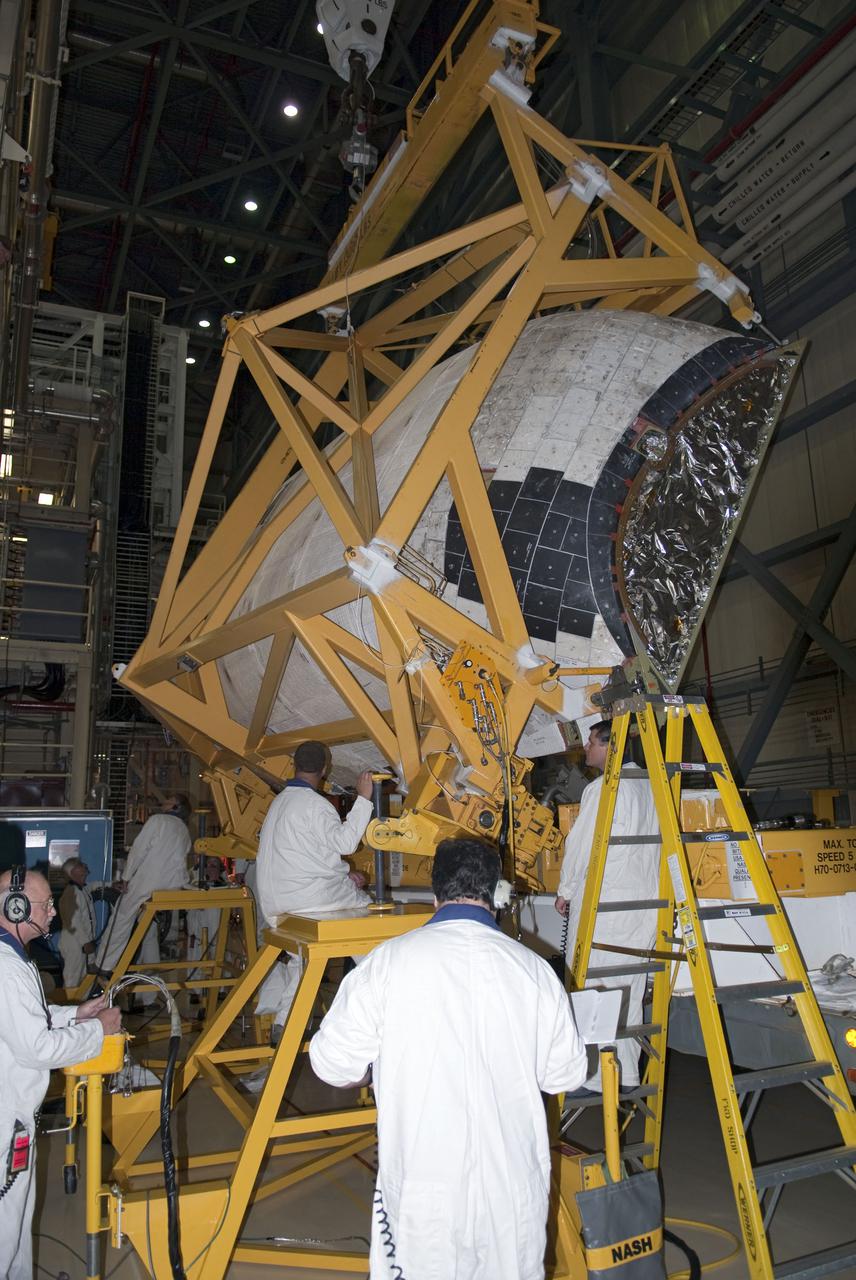
CAPE CANAVERAL, Fla. -- In Orbiter Processing Facility-3 at NASA's Kennedy Space Center in Florida, technicians assisted by an overhead crane prepare to install the right-hand orbital maneuvering system, or OMS, pod on space shuttle Discovery. Discovery and its crew will deliver the Permanent Multipurpose Module, or PMM, which will carry supplies and critical spare parts on the STS-133 mission to the International Space Station. The module will be left behind so it can be used for microgravity experiments in fluid physics, materials science, biology and biotechnology. For more information go to www.nasa.gov_shuttle. Photo credit: NASA_Ben Smegelsky
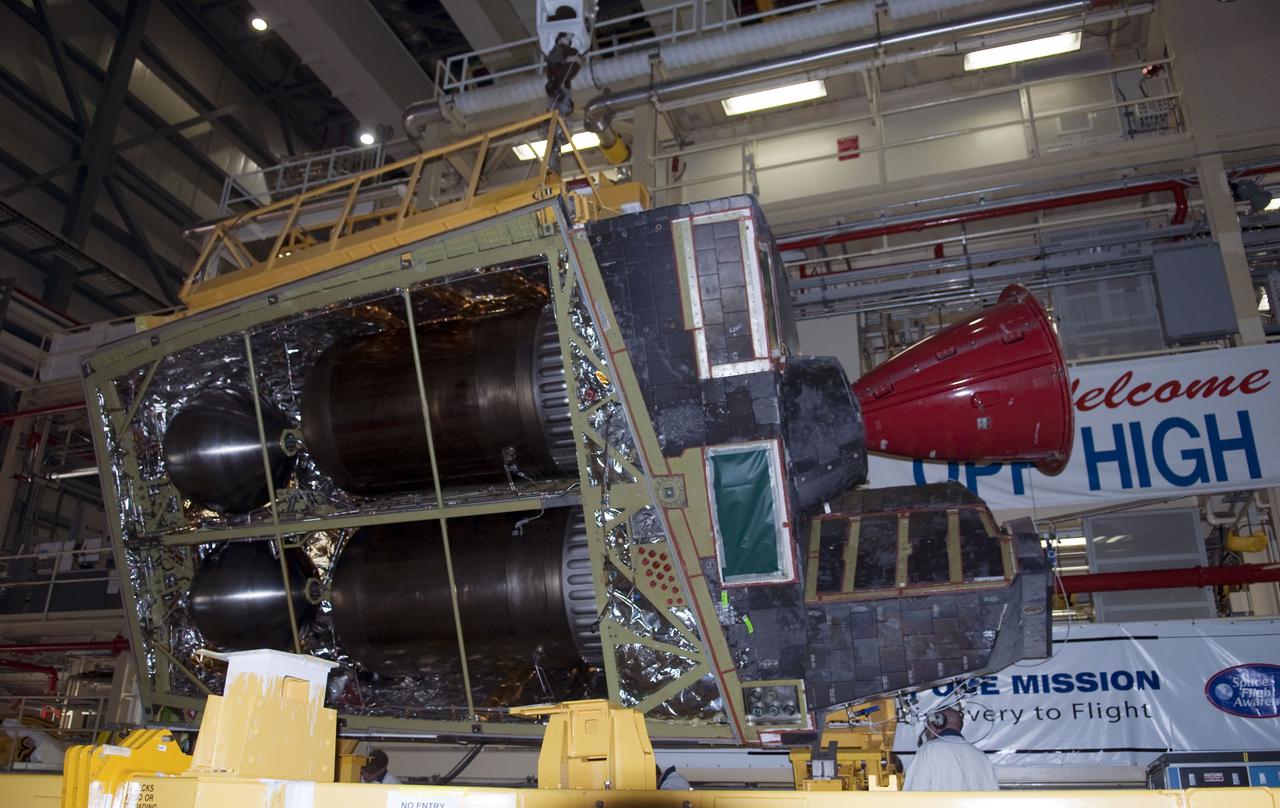
CAPE CANAVERAL, Fla. -- In Orbiter Processing Facility-3 at NASA's Kennedy Space Center in Florida, the right-hand orbital maneuvering system, or OMS, pod is being lifted by an overhead crane for installation on space shuttle Discovery. Discovery and its crew will deliver the Permanent Multipurpose Module, or PMM, which will carry supplies and critical spare parts on the STS-133 mission to the International Space Station. The module will be left behind so it can be used for microgravity experiments in fluid physics, materials science, biology and biotechnology. For more information go to www.nasa.gov_shuttle. Photo credit: NASA_Ben Smegelsky
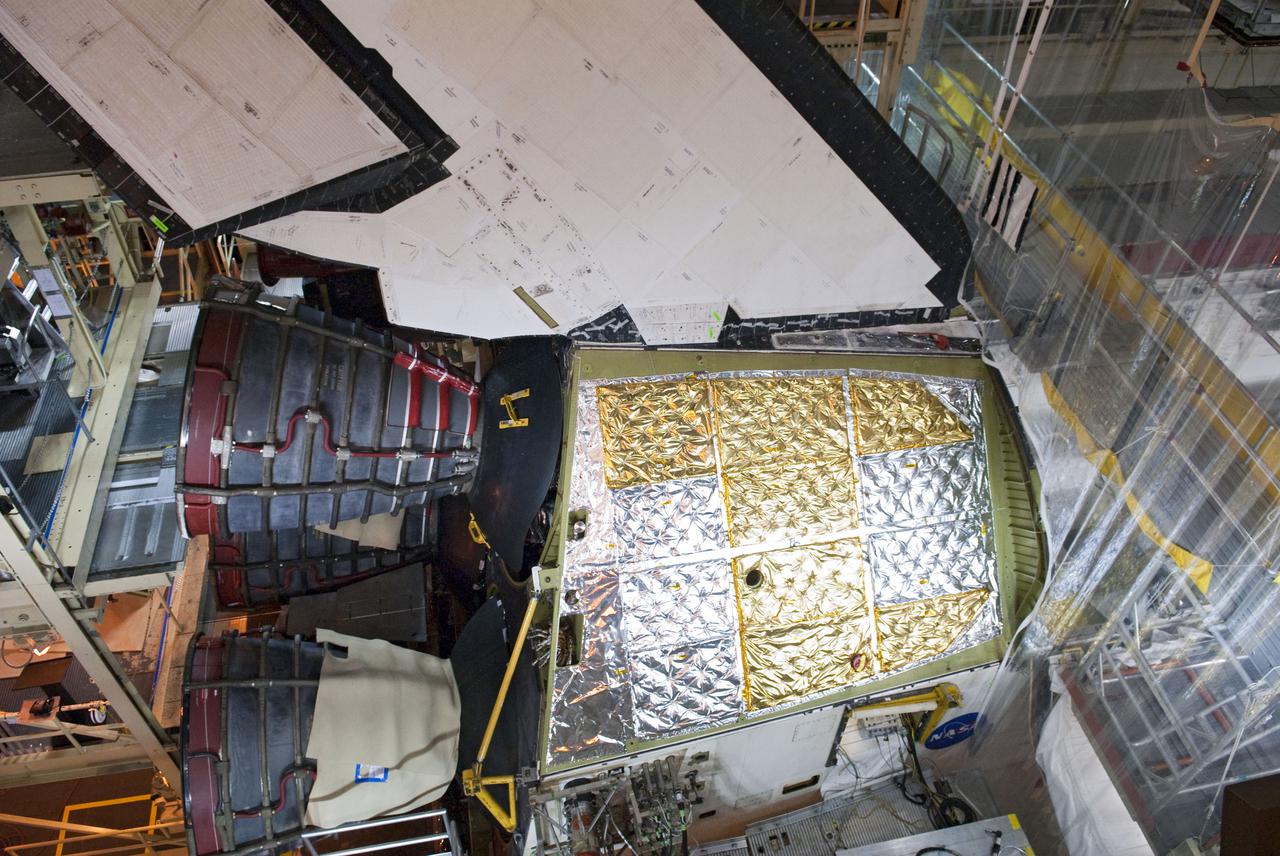
CAPE CANAVERAL, Fla. -- In Orbiter Processing Facility-3 at NASA's Kennedy Space Center in Florida, the aft section on space shuttle Discovery is set to accept the installation of the right-hand orbital maneuvering system, or OMS, pod. Discovery and its crew will deliver the Permanent Multipurpose Module, or PMM, which will carry supplies and critical spare parts on the STS-133 mission to the International Space Station. The module will be left behind so it can be used for microgravity experiments in fluid physics, materials science, biology and biotechnology. For more information go to www.nasa.gov_shuttle. Photo credit: NASA_Ben Smegelsky
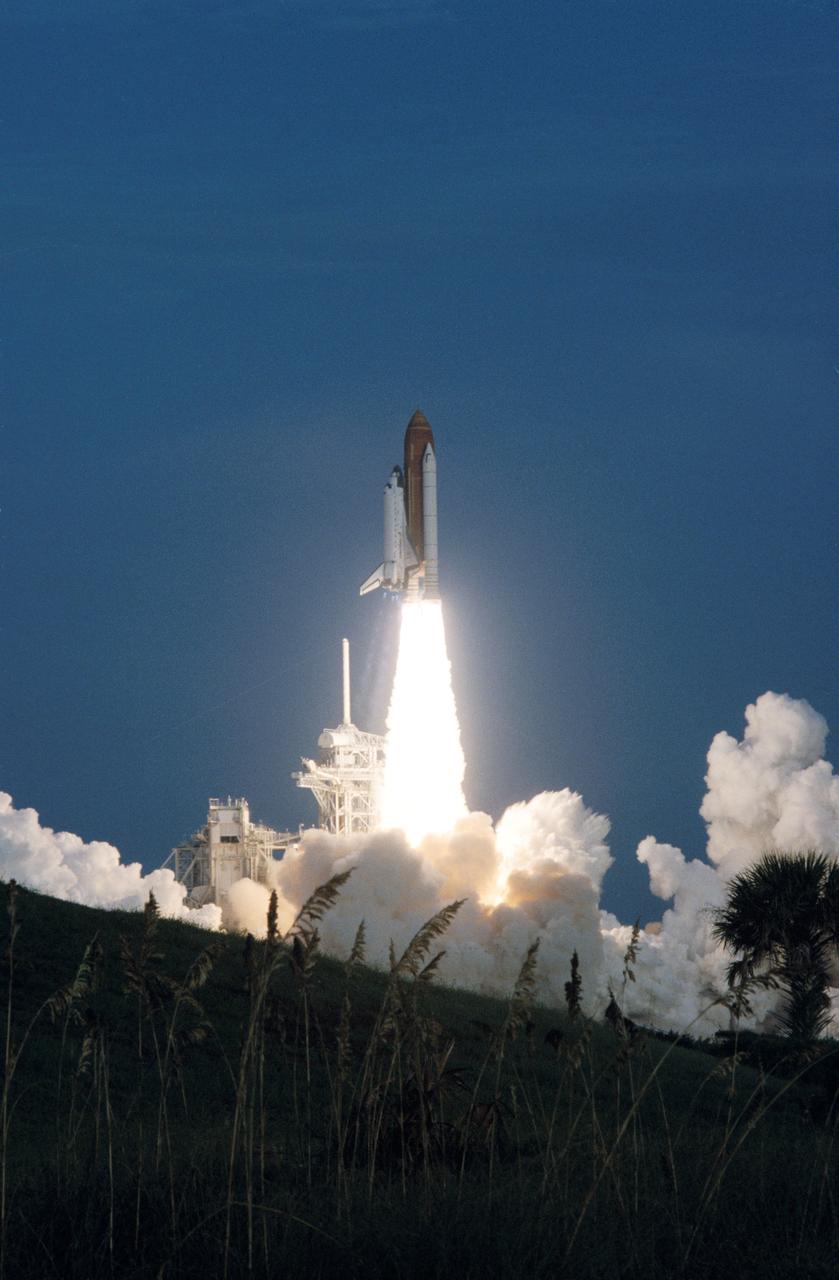
STS051-S-108 (12 Sept. 1993) --- The Space Shuttle Discovery soars toward a nine-day stay in Earth-orbit to support the mission. Launch occurred at 7:45 a.m. (EDT) September 12, 1993. Note the diamond shock effect coming from the thrust of the three main engines. Onboard the shuttle were astronauts Frank L. Culbertson, Jr., William F. Readdy, Daniel W. Bursch, James H. Newman and Carl E. Walz, along with a number of payloads. The payloads included the Advanced Communications Technology Satellite (ACTS) with its Transfer Orbit Stage (TOS), the Orbiting Retrievable Far and Extreme Ultraviolet Spectrometer (ORFEUS) and its Shuttle Pallet Satellite (SPAS) carrier. This photograph was taken with a 35mm camera.
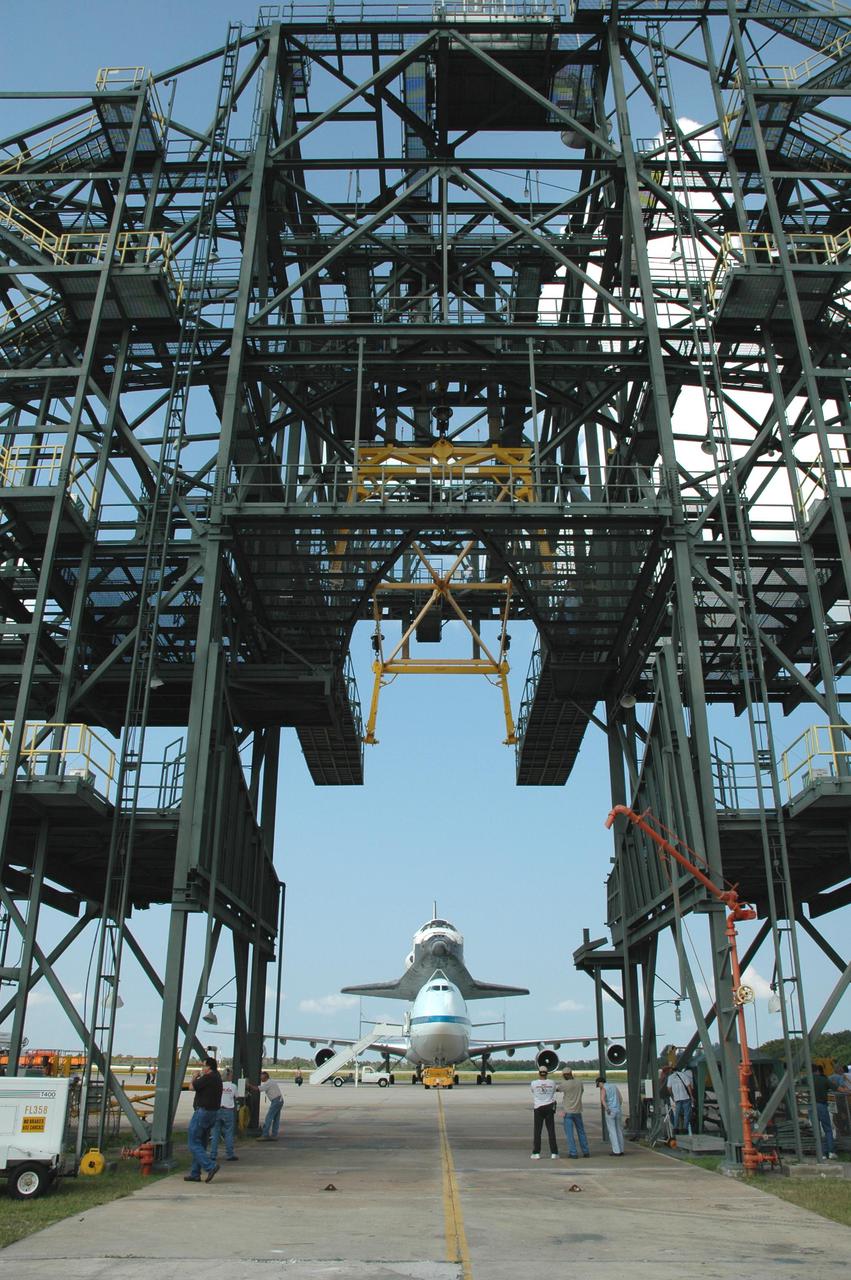
KENNEDY SPACE CENTER, FLA. - Space Shuttle Discovery, atop a modified Boeing 747 Shuttle Carrier Aircraft (SCA), is towed toward the Mate_Demate Device (MDD), in the foreground, at NASA Kennedy Space Center's Shuttle Landing Facility (SLF) following touchdown on runway 15 at about 10:00 a.m. EDT. The cross-country ferry flight became necessary when two days of unfavorable weather conditions at KSC forced Discovery to land on runway 22 at Edwards Air Force Base, Calif., on Aug. 9 following mission STS-114. On the return trip, stops were made at Altus Air Force Base, Okla., and Barksdale Air Force Base, La., where Discovery stayed for two nights. A crane on the MDD will lift Discovery from the SCA and place it on solid ground. Discovery will then be towed to the Orbiter Processing Facility where preparations will begin for its next flight, STS-121.
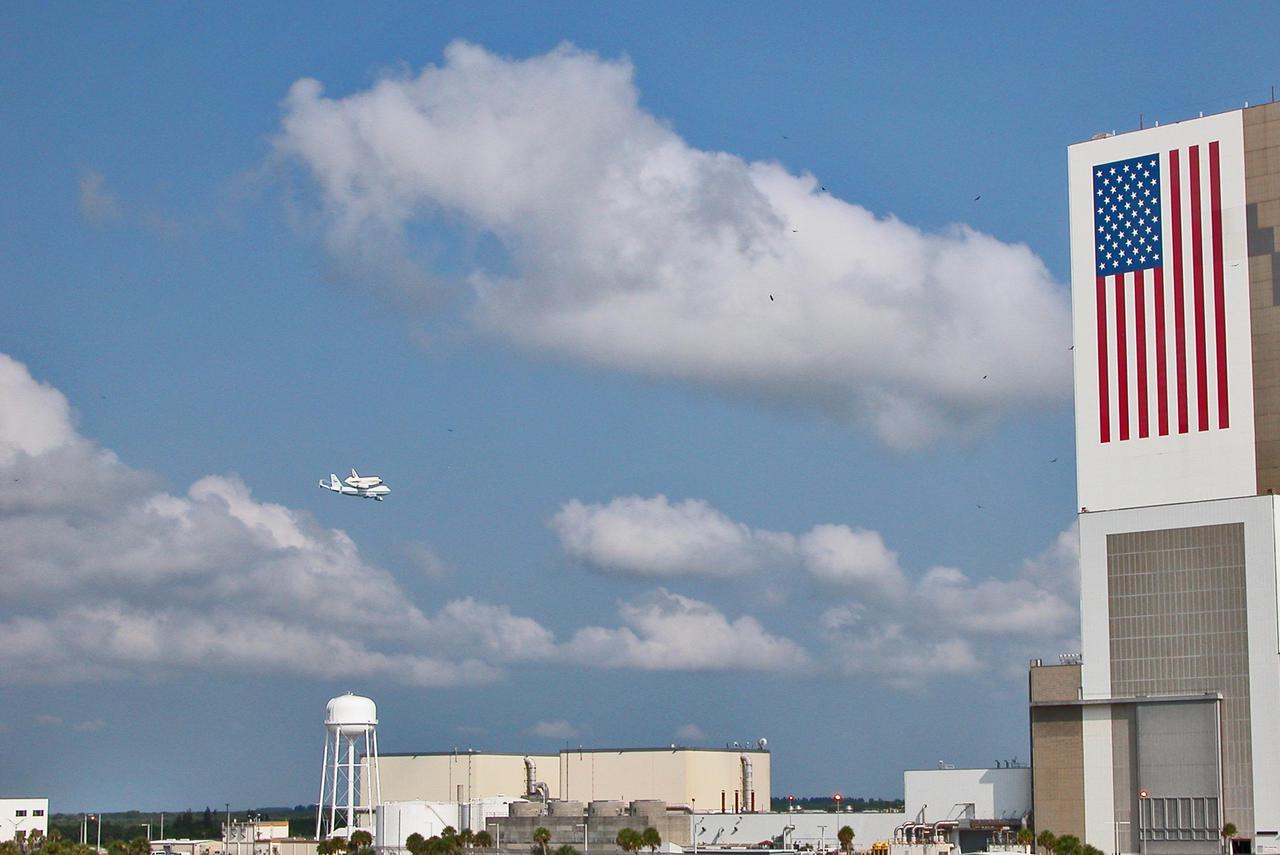
KENNEDY SPACE CENTER, FLA. -- Space Shuttle Discovery, atop a modified Boeing 747 Shuttle Carrier Aircraft (SCA), flies past the Vehicle Assembly Building at Kennedy Space Center on its final approach to runway 15 at the Shuttle Landing Facility (SLF). Landing was at about 10:00 a.m. EDT. The cross-country ferry flight became necessary when two days of unfavorable weather conditions at KSC forced Discovery to land on runway 22 at Edwards Air Force Base, Calif., on Aug. 9 following mission STS-114. The SCA and Discovery will be towed to the Mate_Demate Device at the SLF where a crane will lift Discovery from the SCA and place it on solid ground. Discovery will then be towed to the Orbiter Processing Facility where preparations will begin for its next flight, STS-121.
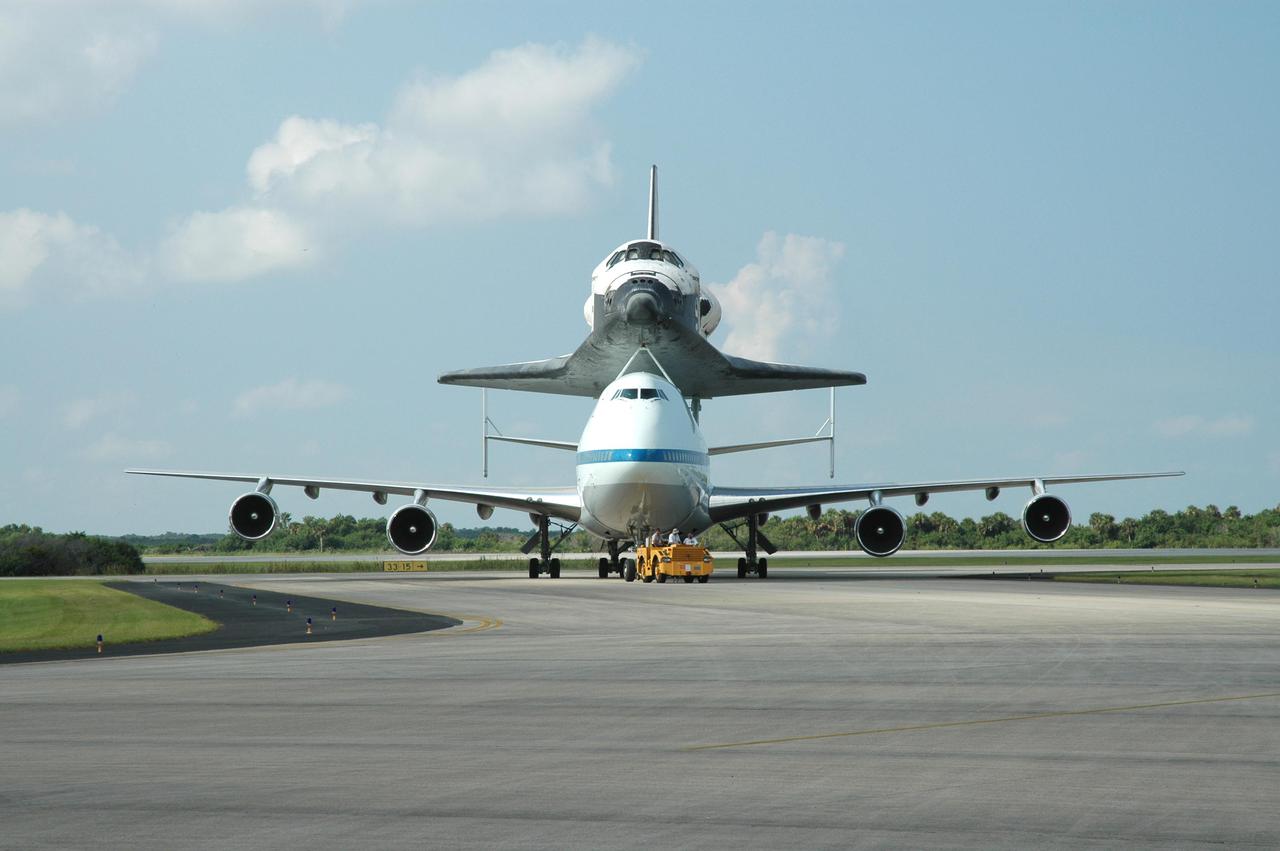
KENNEDY SPACE CENTER, FLA. - Space Shuttle Discovery, atop a modified Boeing 747 Shuttle Carrier Aircraft (SCA), is towed to the Mate_Demate Device (MDD) at NASA Kennedy Space Center's Shuttle Landing Facility (SLF) following touchdown on runway 15 at about 10:00 a.m. EDT. The cross-country ferry flight became necessary when two days of unfavorable weather conditions at KSC forced Discovery to land on runway 22 at Edwards Air Force Base, Calif., on Aug. 9 following mission STS-114. On the return trip, stops were made at Altus Air Force Base, Okla., and Barksdale Air Force Base, La., where Discovery stayed for two nights. A crane on the MDD will lift Discovery from the SCA and place it on solid ground. Discovery will then be towed to the Orbiter Processing Facility where preparations will begin for its next flight, STS-121.
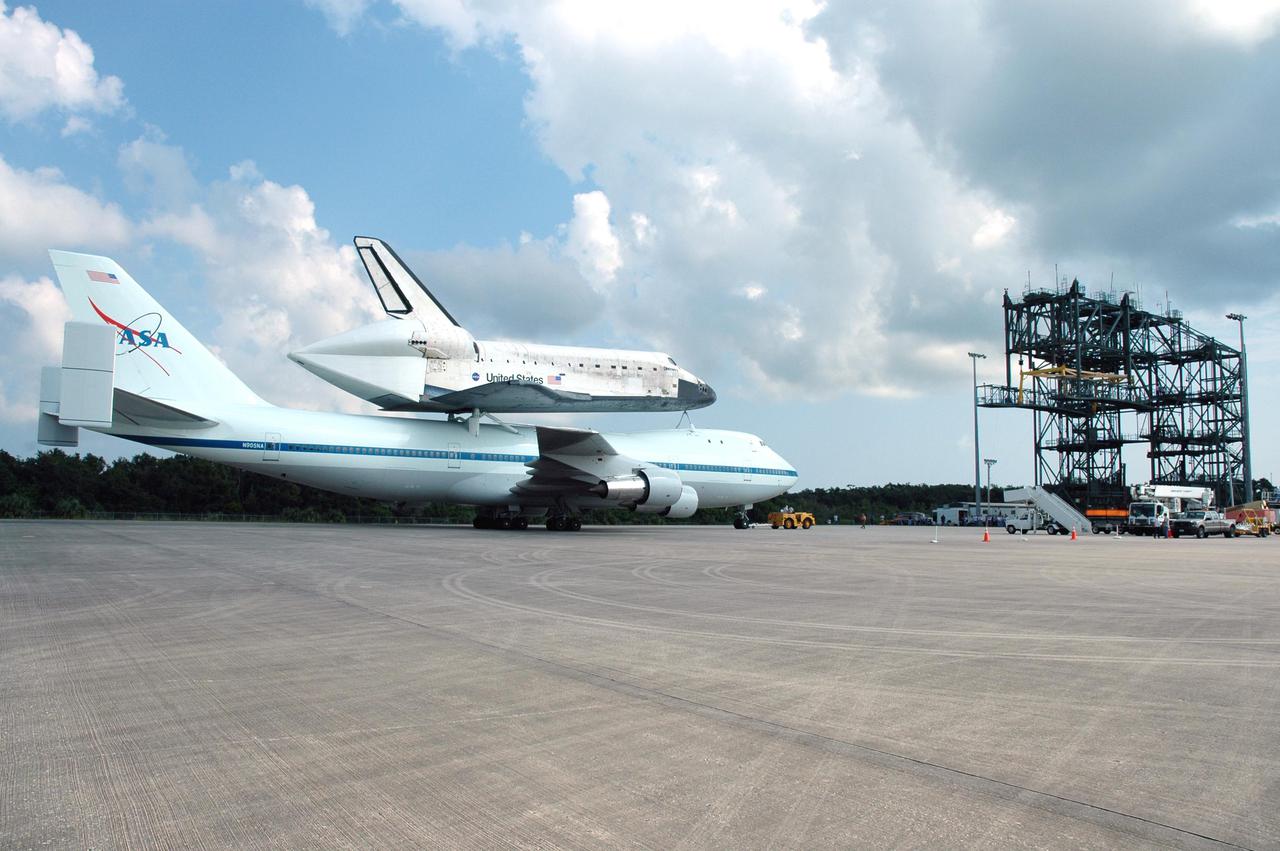
KENNEDY SPACE CENTER, FLA. - Space Shuttle Discovery, atop a modified Boeing 747 Shuttle Carrier Aircraft (SCA), is towed to the Mate_Demate Device (MDD), at right, at NASA Kennedy Space Center's Shuttle Landing Facility (SLF) following touchdown on runway 15 at about 10:00 a.m. EDT. The cross-country ferry flight became necessary when two days of unfavorable weather conditions at KSC forced Discovery to land on runway 22 at Edwards Air Force Base, Calif., on Aug. 9 following mission STS-114. On the return trip, stops were made at Altus Air Force Base, Okla., and Barksdale Air Force Base, La., where Discovery stayed for two nights. A crane on the MDD will lift Discovery from the SCA and place it on solid ground. Discovery will then be towed to the Orbiter Processing Facility where preparations will begin for its next flight, STS-121.
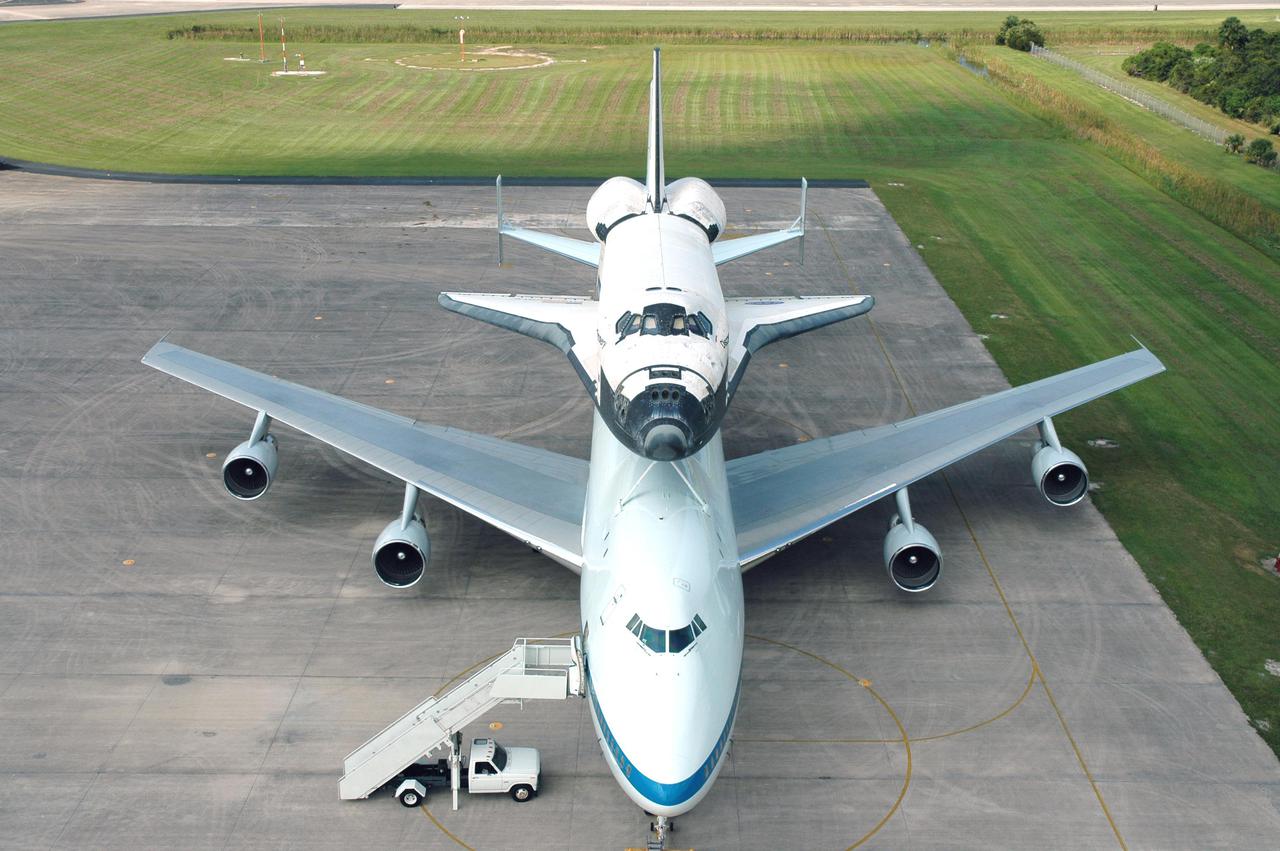
KENNEDY SPACE CENTER, FLA. - Space Shuttle Discovery, atop a modified Boeing 747 Shuttle Carrier Aircraft (SCA), has arrived at the Mate_Demate Device (MDD) at NASA Kennedy Space Center's Shuttle Landing Facility (SLF) following touchdown on runway 15 at about 10:00 a.m. EDT. The cross-country ferry flight became necessary when two days of unfavorable weather conditions at KSC forced Discovery to land on runway 22 at Edwards Air Force Base, Calif., on Aug. 9 following mission STS-114. On the return trip, stops were made at Altus Air Force Base, Okla., and Barksdale Air Force Base, La., where Discovery stayed for two nights. A crane on the MDD will lift Discovery from the SCA and place it on solid ground. Discovery will then be towed to the Orbiter Processing Facility where preparations will begin for its next flight, STS-121.
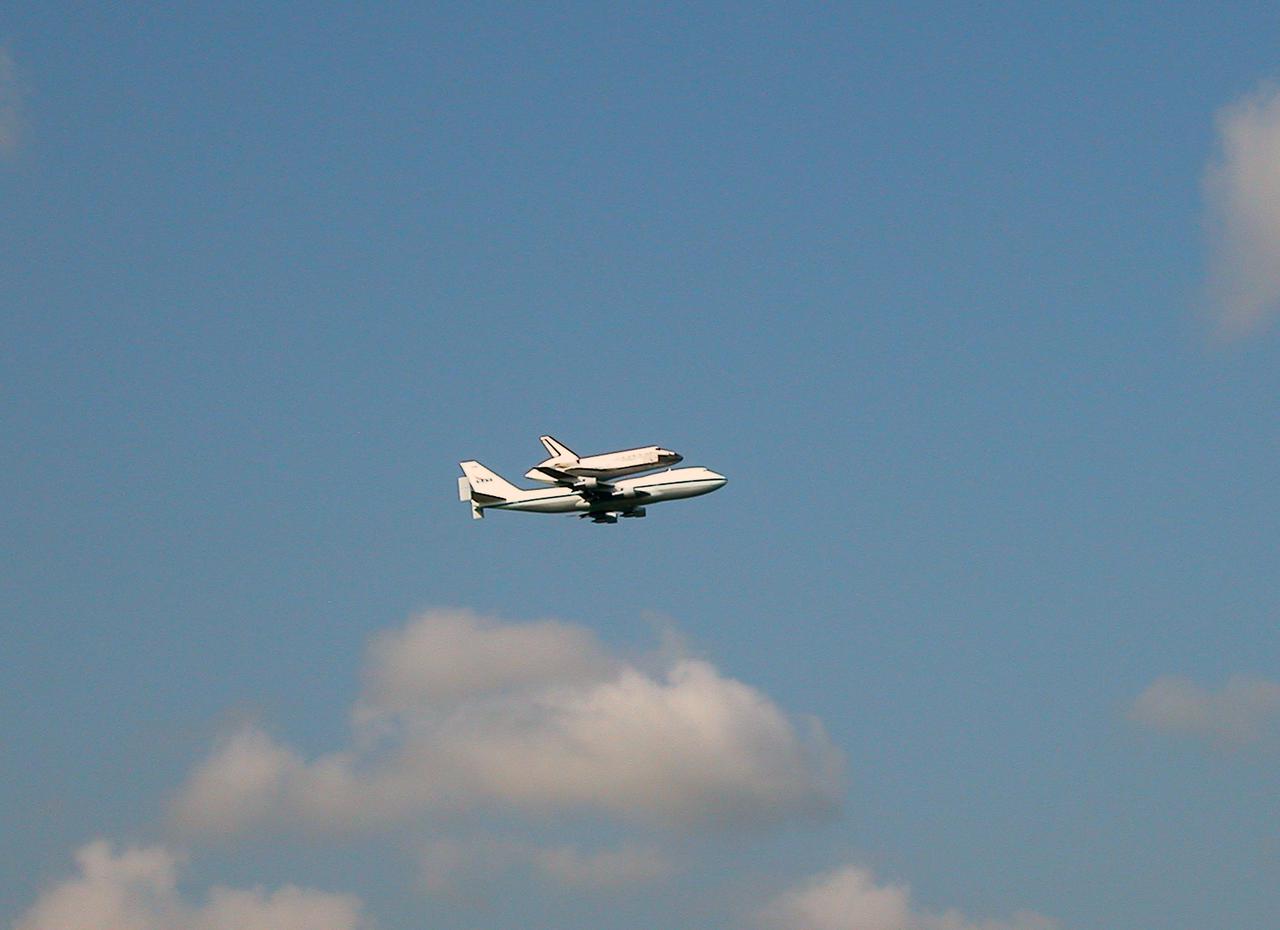
KENNEDY SPACE CENTER, FLA. -- Space Shuttle Discovery, atop a modified Boeing 747 Shuttle Carrier Aircraft (SCA), flies over Launch Complex 39 at Kennedy Space Center on its final approach to runway 15 at the Shuttle Landing Facility (SLF). Landing was at about 10:00 a.m. EDT. The cross-country ferry flight became necessary when two days of unfavorable weather conditions at KSC forced Discovery to land on runway 22 at Edwards Air Force Base, Calif., on Aug. 9 following mission STS-114. The SCA and Discovery will be towed to the Mate_Demate Device at the SLF where a crane will lift Discovery from the SCA and place it on solid ground. Discovery will then be towed to the Orbiter Processing Facility where preparations will begin for its next flight, STS-121.
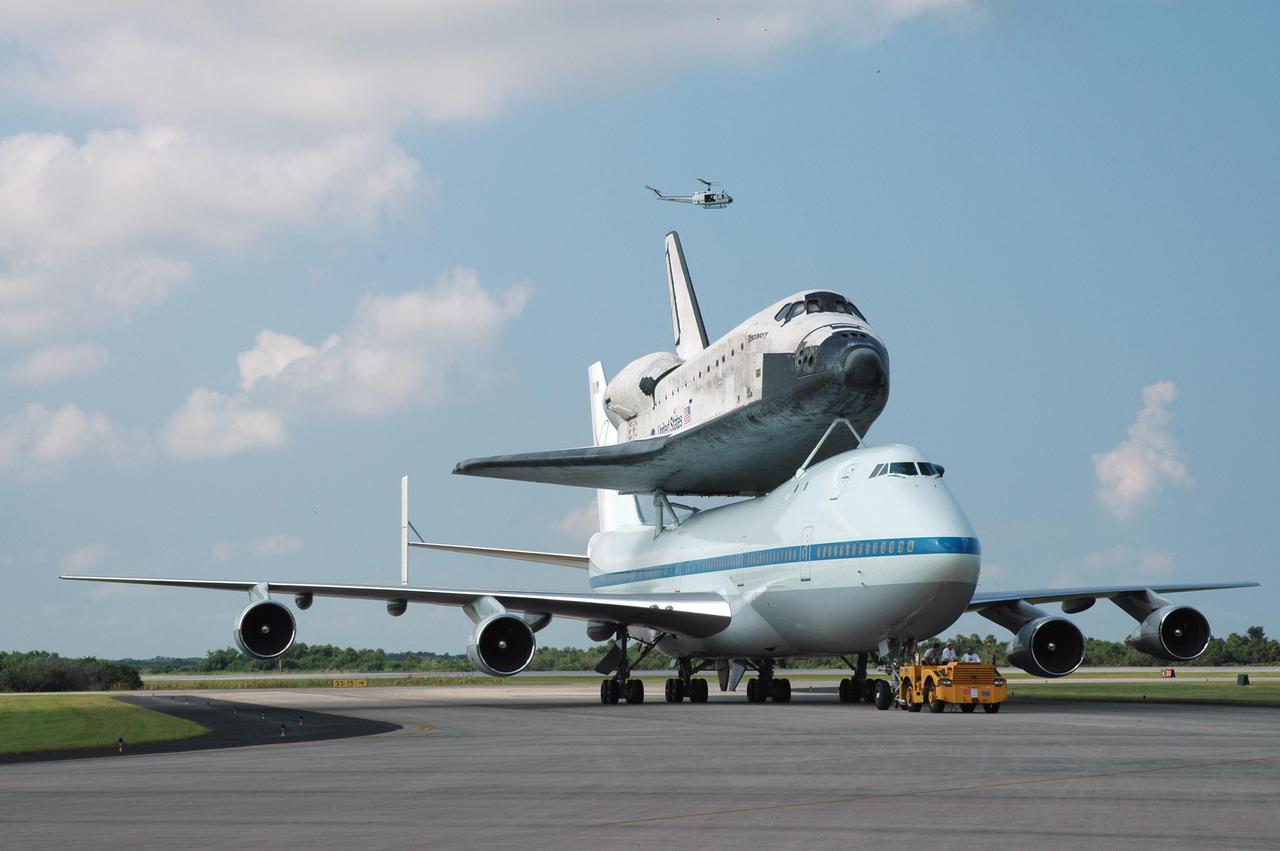
KENNEDY SPACE CENTER, FLA. - Space Shuttle Discovery, atop a modified Boeing 747 Shuttle Carrier Aircraft (SCA), is towed to the Mate_Demate Device (MDD) at NASA Kennedy Space Center's Shuttle Landing Facility (SLF) following touchdown on runway 15 at about 10:00 a.m. EDT. The cross-country ferry flight became necessary when two days of unfavorable weather conditions at KSC forced Discovery to land on runway 22 at Edwards Air Force Base, Calif., on Aug. 9 following mission STS-114. On the return trip, stops were made at Altus Air Force Base, Okla., and Barksdale Air Force Base, La., where Discovery stayed for two nights. A crane on the MDD will lift Discovery from the SCA and place it on solid ground. Discovery will then be towed to the Orbiter Processing Facility where preparations will begin for its next flight, STS-121.
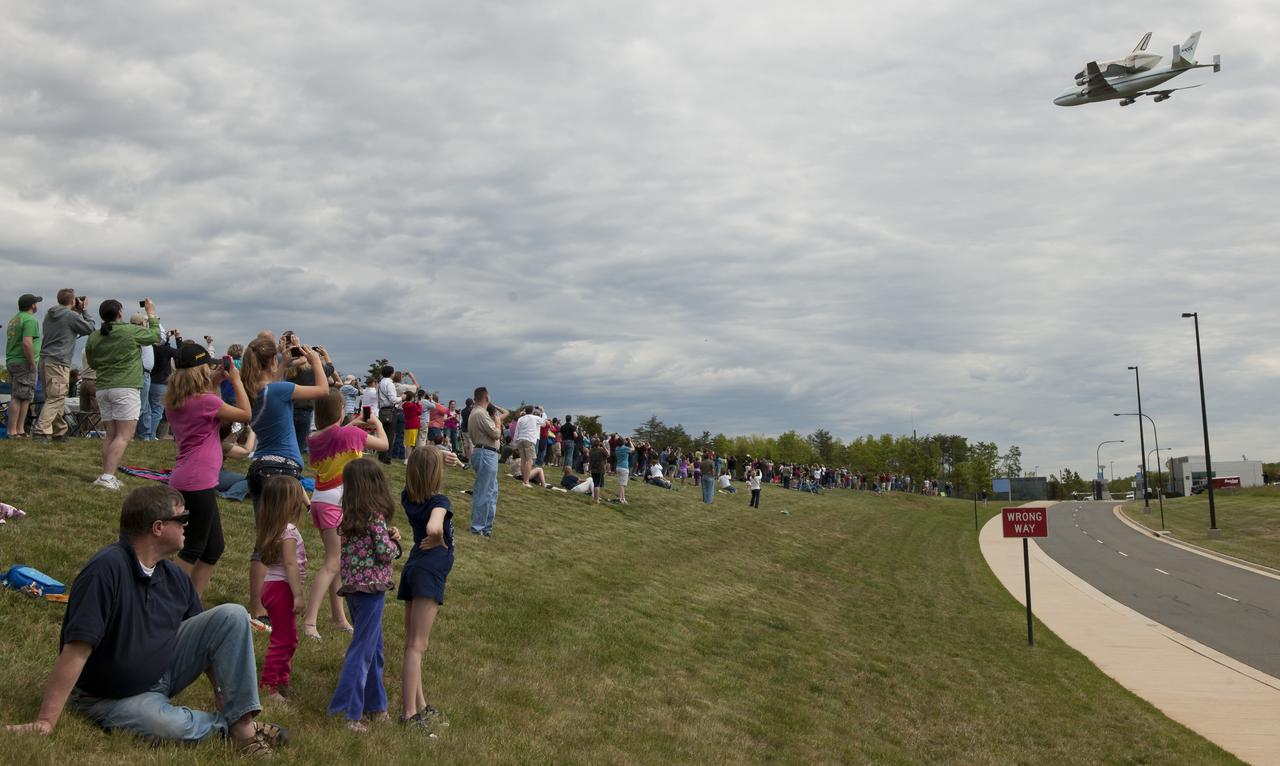
Spectators watch as space shuttle Discovery, mounted atop a NASA 747 Shuttle Carrier Aircraft (SCA) flies over the National Air and Space Museum’s Steven F. Udvar-Hazy Center, Tuesday, April 17, 2012, in Chantilly, Va. Discovery, the first orbiter retired from NASA’s shuttle fleet, completed 39 missions, spent 365 days in space, orbited the Earth 5,830 times, and traveled 148,221,675 miles. NASA will transfer Discovery to the National Air and Space Museum to begin its new mission to commemorate past achievements in space and to educate and inspire future generations of explorers. Photo Credit: (NASA/Carla Cioffi)
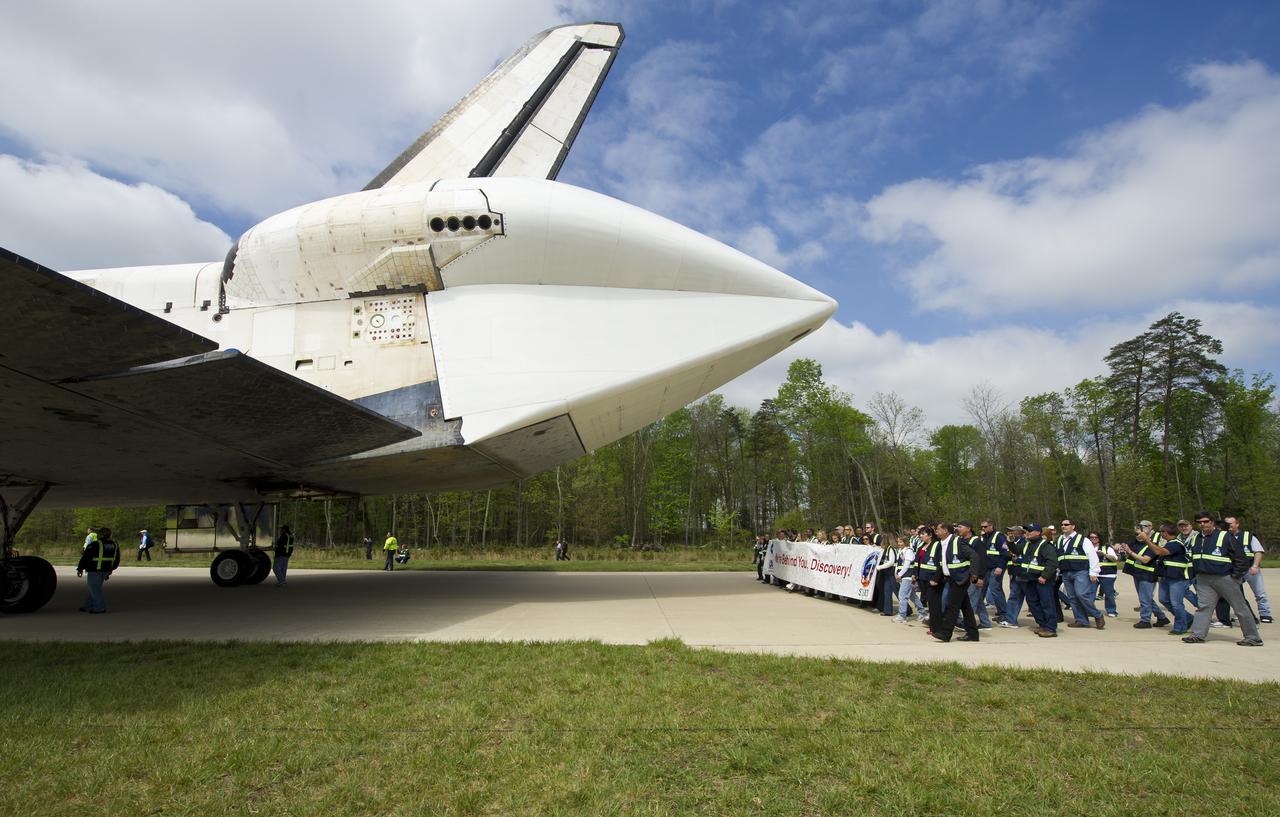
Workers from NASA Kennedy Space Center and United Space Alliance follow space shuttle Discovery as it arrives at the Steven F. Udvar-Hazy Center, Thursday, April 19, 2012 in Chantilly, Va. Discovery, the first orbiter retired from NASA’s shuttle fleet, which completed 39 missions, spent 365 days in space, orbited the Earth 5,830 times, and traveled 148,221,675 miles will take the place of Enterprise at the center to commemorate past achievements in space and to educate and inspire future generations of explorers at the center. Photo Credit: (NASA/Carla Cioffi)
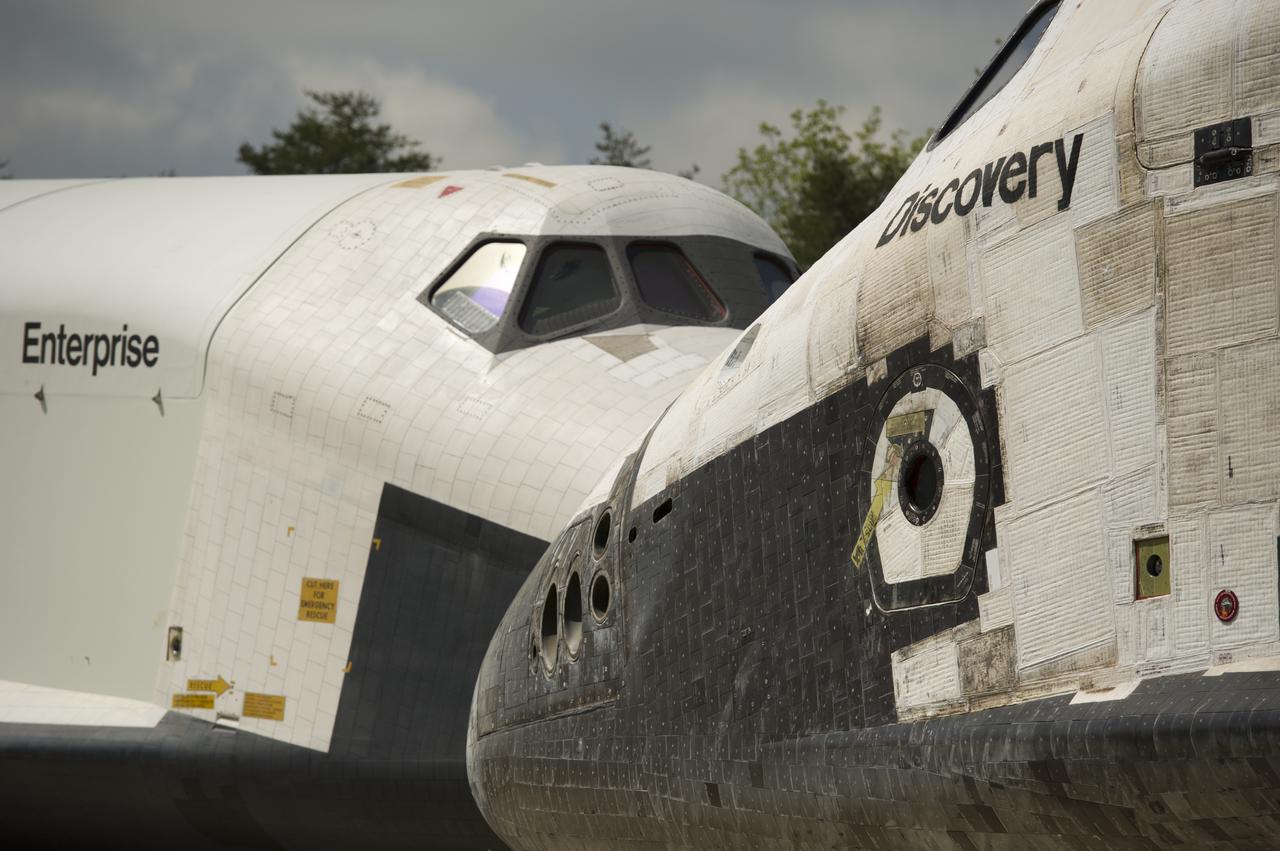
Space Shuttles Enterprise, left, and Discovery meet nose-to-nose during the a transfer ceremony at the Smithsonian's Steven F. Udvar-Hazy Center, Thursday, April 19, 2012, in Chantilly, Va. Space shuttle Discovery, the first orbiter retired from NASA’s shuttle fleet, completed 39 missions, spent 365 days in space, orbited the Earth 5,830 times, and traveled 148,221,675 miles will take the place of Enterprise at the center to commemorate past achievements in space and to educate and inspire future generations of explorers at the center. Photo Credit: (NASA/Carla Cioffi)
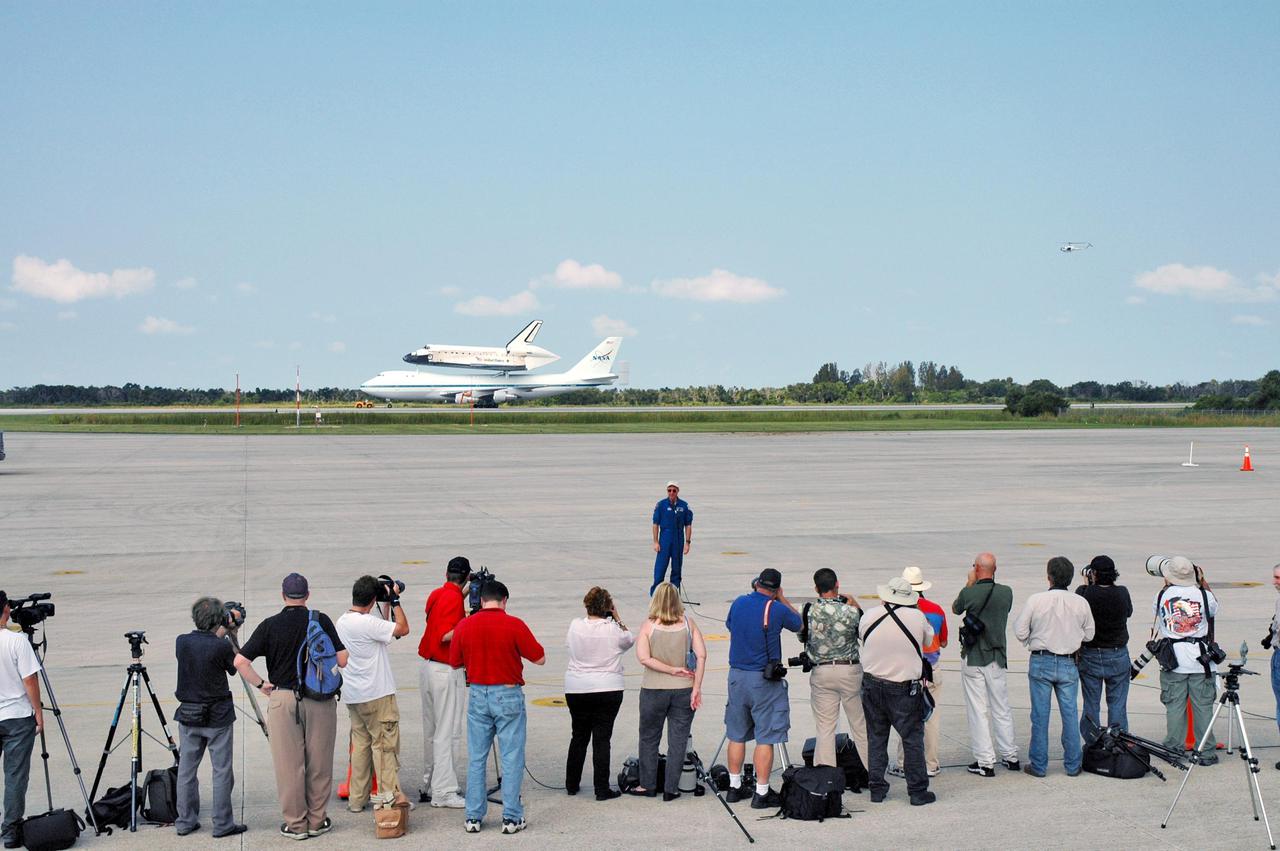
KENNEDY SPACE CENTER, FLA. - Representatives from the news media are on hand to view the touchdown of Space Shuttle Discovery, atop a modified Boeing 747 Shuttle Carrier Aircraft (SCA), on runway 15 at NASA Kennedy Space Center's Shuttle Landing Facility (SLF) at about 10:00 a.m. EDT. The cross-country ferry flight became necessary when two days of unfavorable weather conditions at KSC forced Discovery to land on runway 22 at Edwards Air Force Base, Calif., on Aug. 9 following mission STS-114. On the return trip, stops were made at Altus Air Force Base, Okla., and Barksdale Air Force Base, La., where Discovery stayed for two nights. The SCA and Discovery will be towed to the Mate_Demate Device at the SLF where a crane will lift Discovery from the SCA and place it on solid ground. Discovery will then be towed to the Orbiter Processing Facility where preparations will begin for its next flight, STS-121.
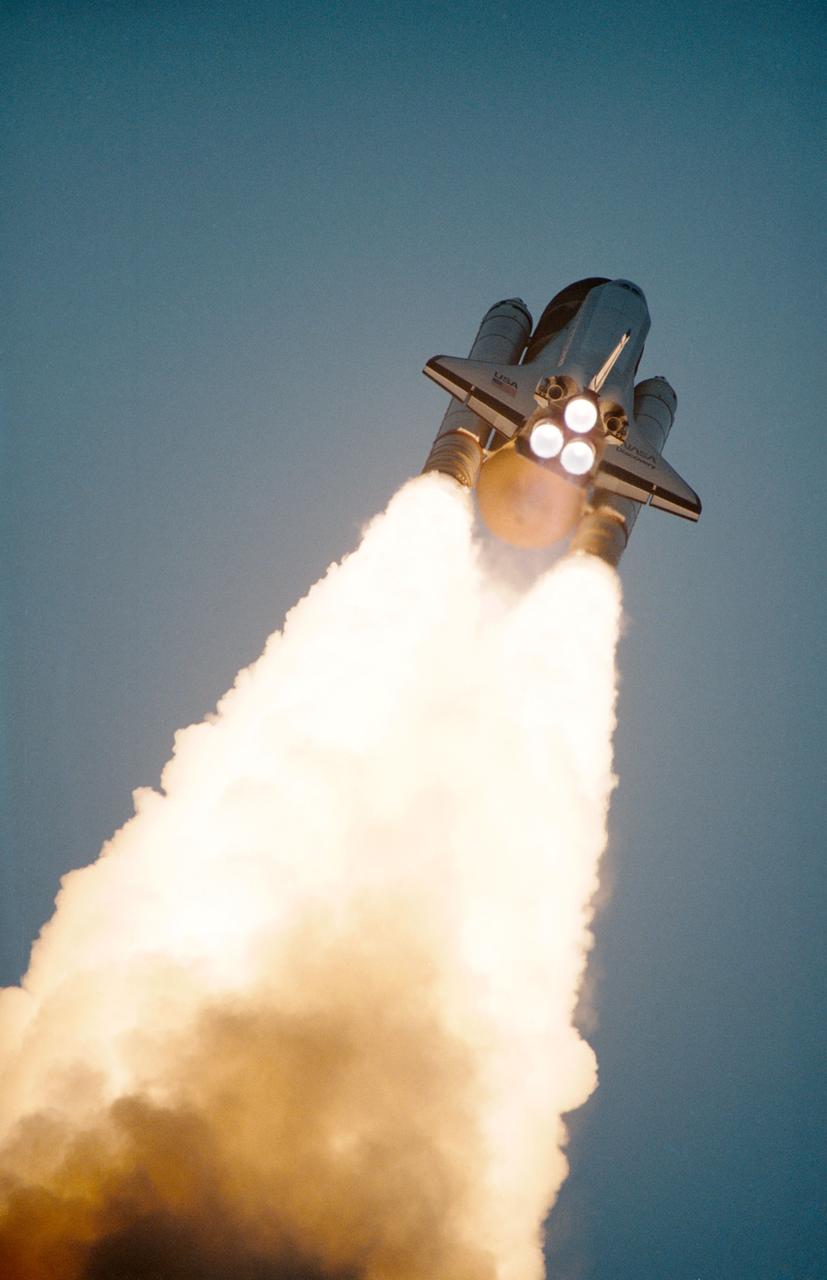
51D-9092 (12 April 1985) --- The Space Shuttle Discovery ascends the launch complex in Florida and heads through Atlantic skies toward its 51-D mission. The seven member crew lifted off at 8:59 a.m. (EST), April 12, 1985. This picture was made with a 35mm camera.
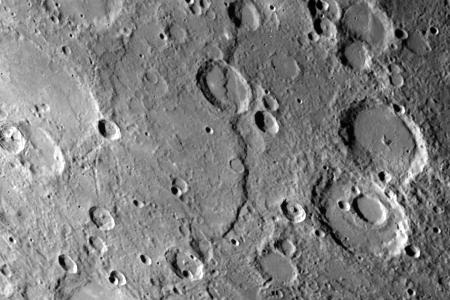
One of the most prominent lobate scarps Discovery Scarp, photographed by NASA Mariner 10 during it first encounter with Mercury, is located at the center of this image extending from the top to near bottom.
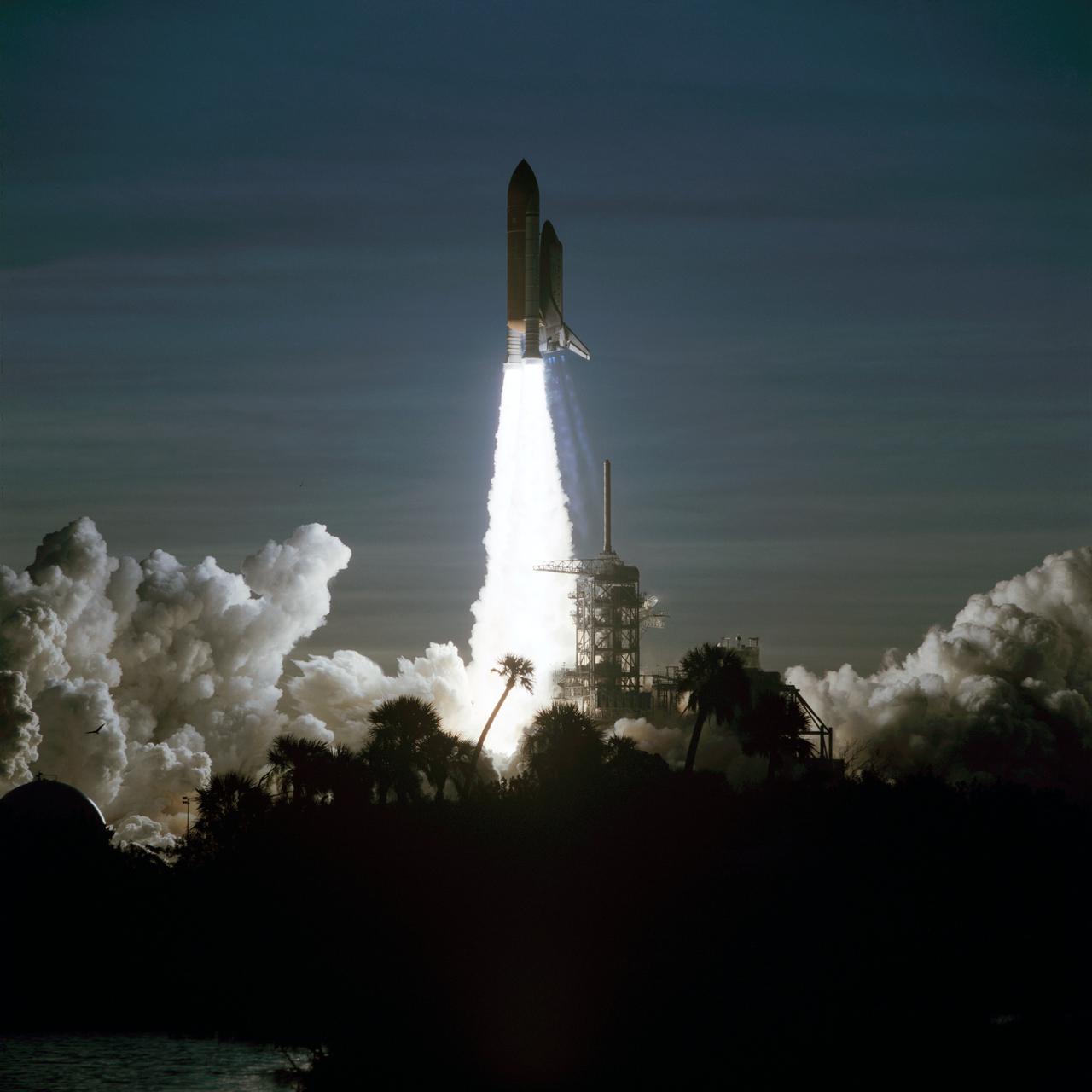
STS060-S-106 (3 Feb 1994) --- Palm trees are silhouetted in the foreground of this 70mm image as the Space Shuttle Discovery heads toward an eight-day mission in Earth orbit. Liftoff occurred as scheduled at 7:10 a.m. (EST), February 3, 1994. Aboard the spacecraft were astronauts Charles F. Bolden Jr., commander; Kenneth S. Reightler Jr., pilot; Franklin R. Chang-Diaz, payload commander; and N. Jan Davis and Ronald M. Sega, mission specialists, along with Russian cosmonaut Sergei K. Krikalev, also a mission specialist.
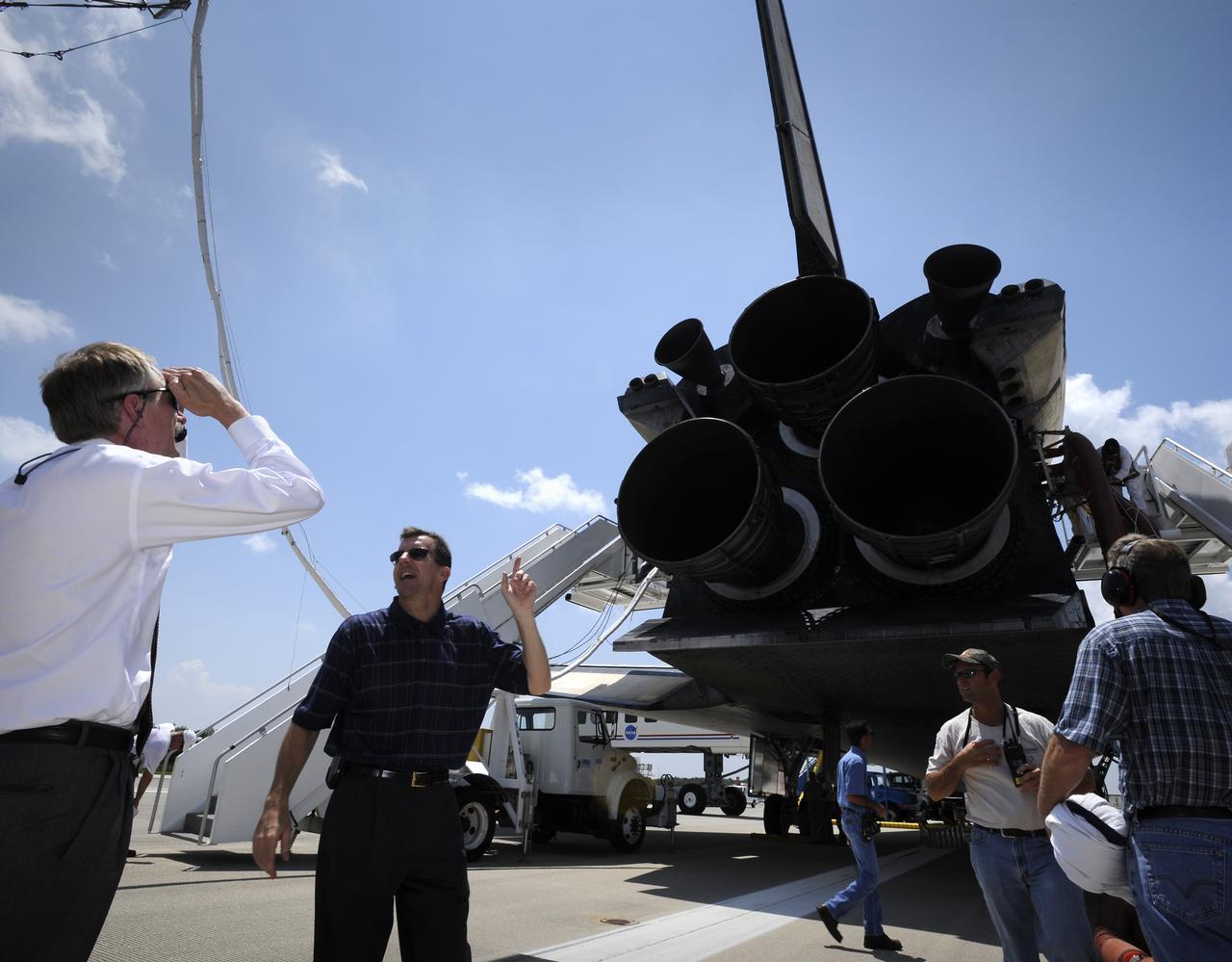
NASA Deputy Shuttle Program Manager LeRoy Cain points out a portion of the space shuttle Discovery to NASA Associate Administrator for Space Operations Bill Gerstenmaier, left, during a walk around shortly after Discovery touched down at 11:15 a.m., Saturday, June 14, 2008, at the Kennedy Space Center in Cape Canaveral, Florida. During the 14-day STS-124 mission Discovery's crew installed the Japan Aerospace Exploration Agency's large Kibo laboratory and its remote manipulator system leaving a larger space station and one with increased science capabilities. Discovery also brought home NASA astronaut Garrett Reisman after his 3 month mission onboard the International Space Station. Photo Credit: (NASA/Bill Ingalls)
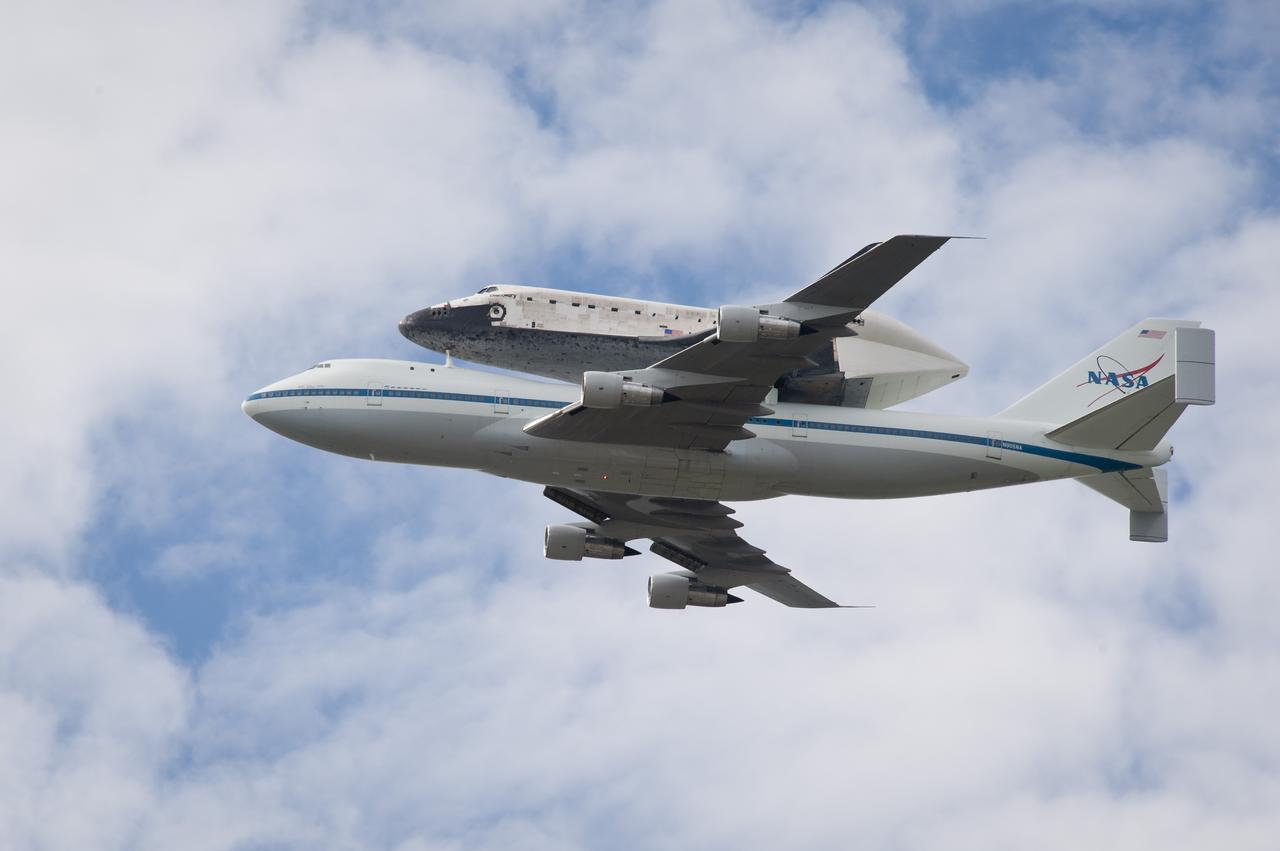
Space shuttle Discovery, mounted atop a NASA 747 Shuttle Carrier Aircraft (SCA) flies near the U.S. Capitol, Tuesday, April 17, 2012, in Washington. Discovery, the first orbiter retired from NASA’s shuttle fleet, completed 39 missions, spent 365 days in space, orbited the Earth 5,830 times, and traveled 148,221,675 miles. NASA will transfer Discovery to the National Air and Space Museum to begin its new mission to commemorate past achievements in space and to educate and inspire future generations of explorers. Photo Credit: (NASA/Michael Porterfield)
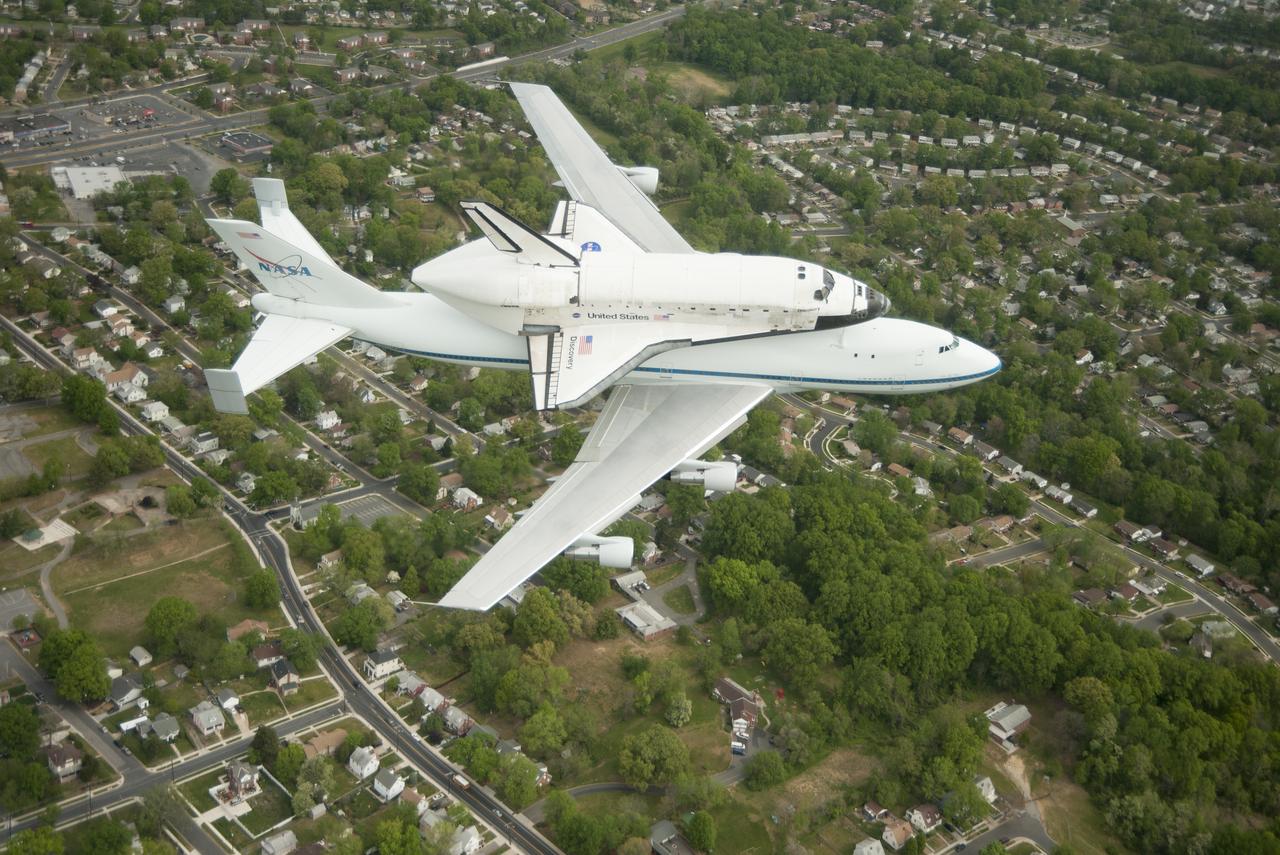
Space shuttle Discovery, mounted atop a NASA 747 Shuttle Carrier Aircraft (SCA), flies over the Washington skyline as seen from a NASA T-38 aircraft, Tuesday, April 17, 2012. Discovery, the first orbiter retired from NASA’s shuttle fleet, completed 39 missions, spent 365 days in space, orbited the Earth 5,830 times, and traveled 148,221,675 miles. NASA will transfer Discovery to the National Air and Space Museum to begin its new mission to commemorate past achievements in space and to educate and inspire future generations of explorers. Photo Credit: (NASA/Robert Markowitz)
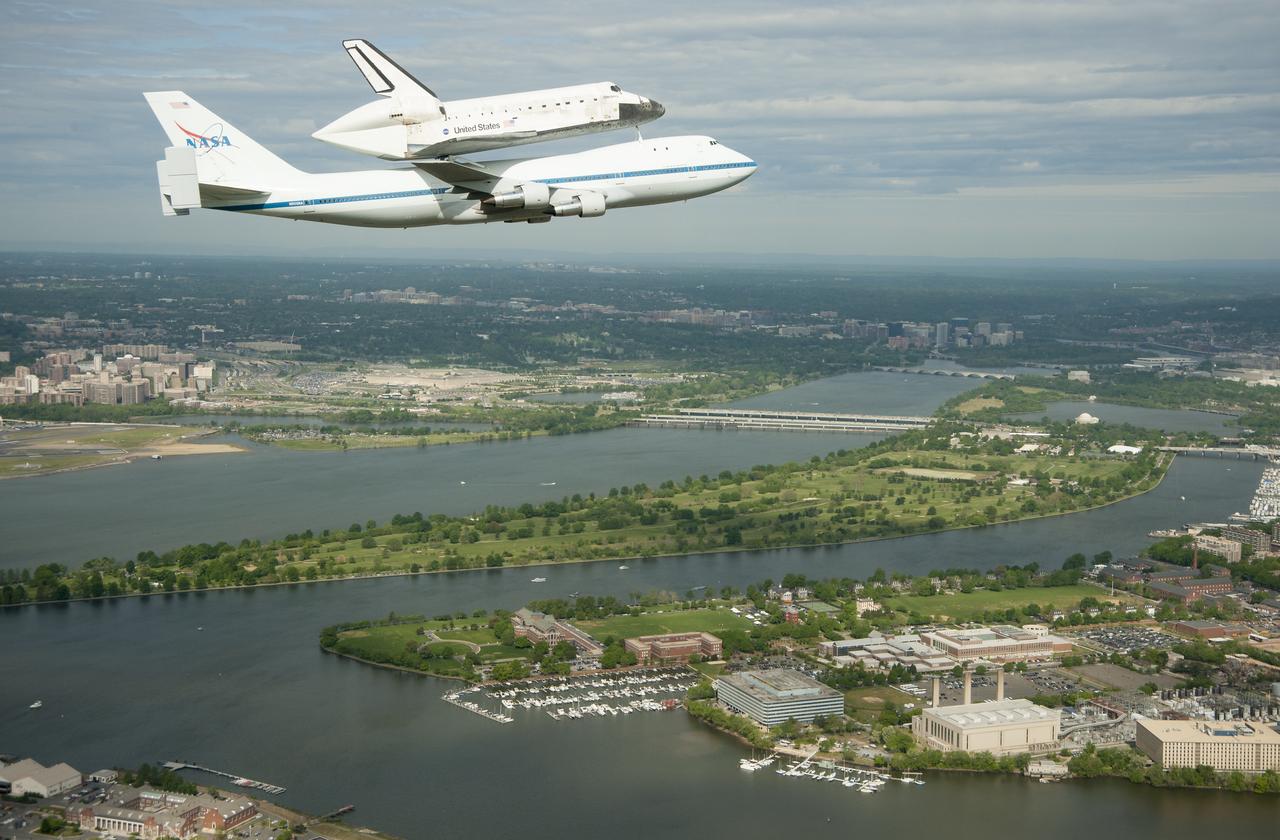
Space shuttle Discovery, mounted atop a NASA 747 Shuttle Carrier Aircraft (SCA), flies over the Washington skyline as seen from a NASA T-38 aircraft, Tuesday, April 17, 2012. Discovery, the first orbiter retired from NASA’s shuttle fleet, completed 39 missions, spent 365 days in space, orbited the Earth 5,830 times, and traveled 148,221,675 miles. NASA will transfer Discovery to the National Air and Space Museum to begin its new mission to commemorate past achievements in space and to educate and inspire future generations of explorers. Photo Credit: (NASA/Robert Markowitz)
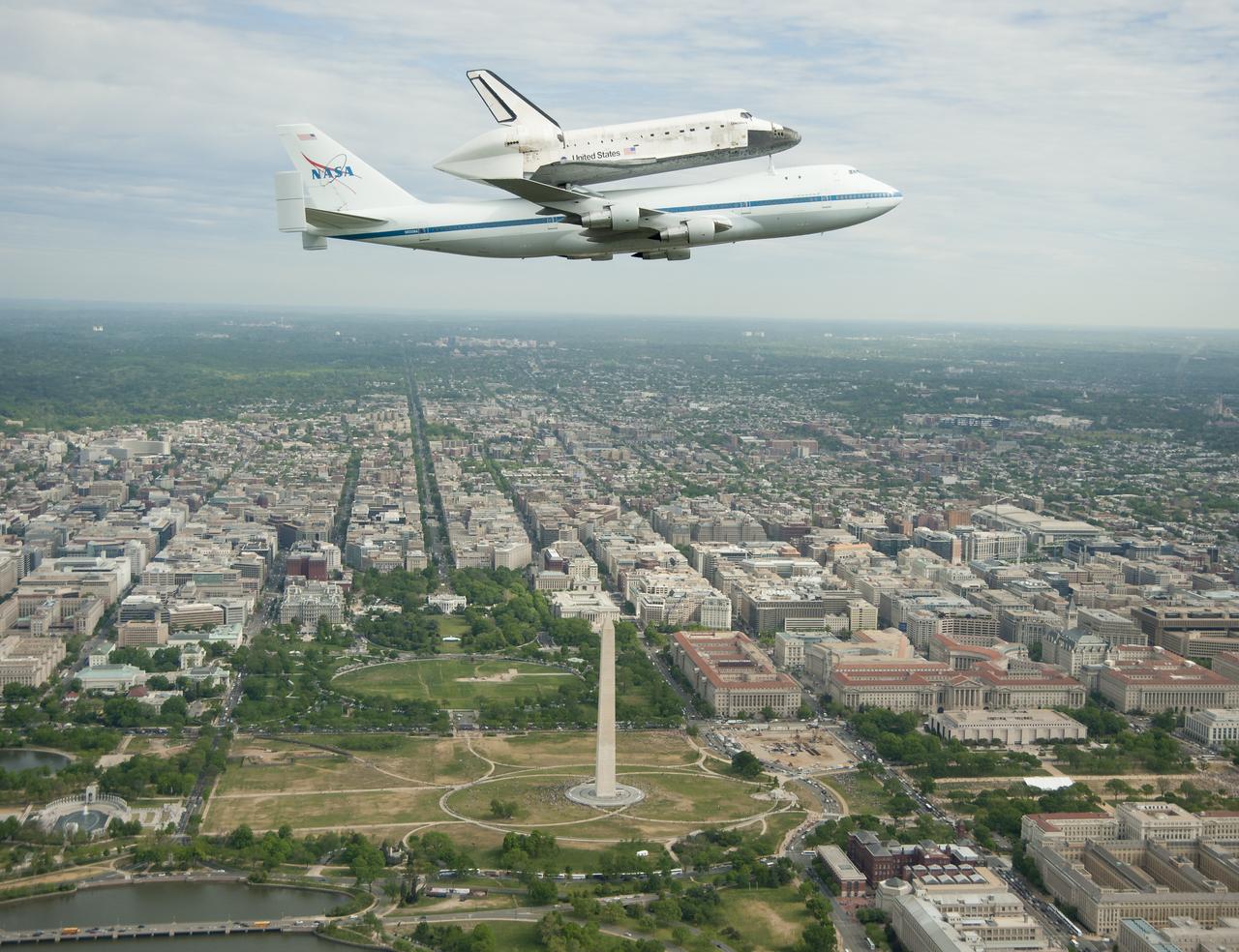
Space shuttle Discovery, mounted atop a NASA 747 Shuttle Carrier Aircraft (SCA), flies over the Washington skyline as seen from a NASA T-38 aircraft, Tuesday, April 17, 2012. Discovery, the first orbiter retired from NASA’s shuttle fleet, completed 39 missions, spent 365 days in space, orbited the Earth 5,830 times, and traveled 148,221,675 miles. NASA will transfer Discovery to the National Air and Space Museum to begin its new mission to commemorate past achievements in space and to educate and inspire future generations of explorers. Photo Credit: (NASA/Robert Markowitz)
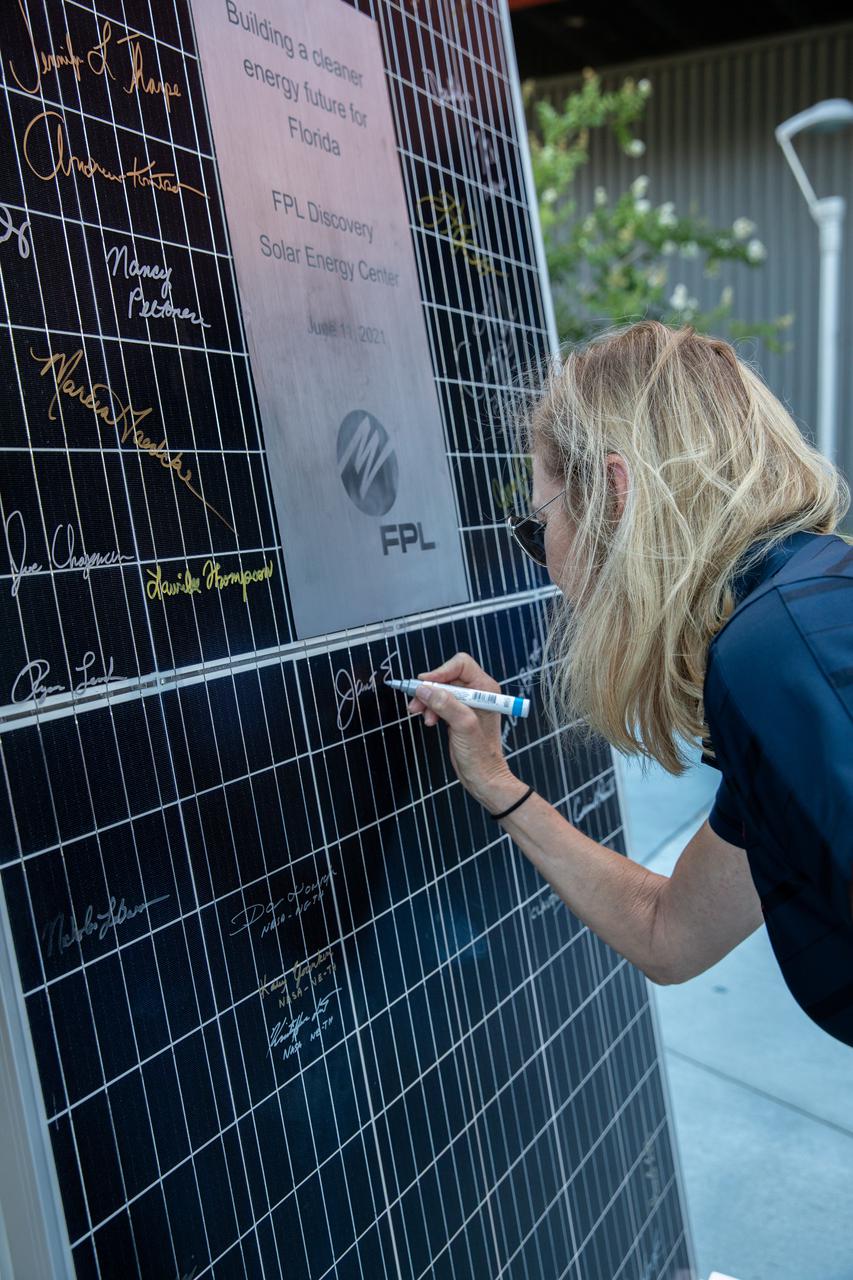
As part of a ribbon-cutting ceremony held on June 11, 2021, Janet Petro, acting director of NASA’s Kennedy Space Center in Florida, signs a solar panel which will be put on display at the Visitor Complex to commemorate the Florida Power and Light’s (FPL) Discovery Solar Energy Center becoming operational at the center. Discovery Solar Energy Center is a 74.5-megawatt solar site, spanning 491 acres at the spaceport. The site contains about 250,000 solar panels in total, producing enough energy to power approximately 15,000 homes. Harnessing energy from the Sun, the panels do not directly power anything at Kennedy, but rather, send energy directly to FPL's electricity grid for distribution to existing customers. Construction began in spring 2020, and the energy center became fully operational on May 30, 2021.
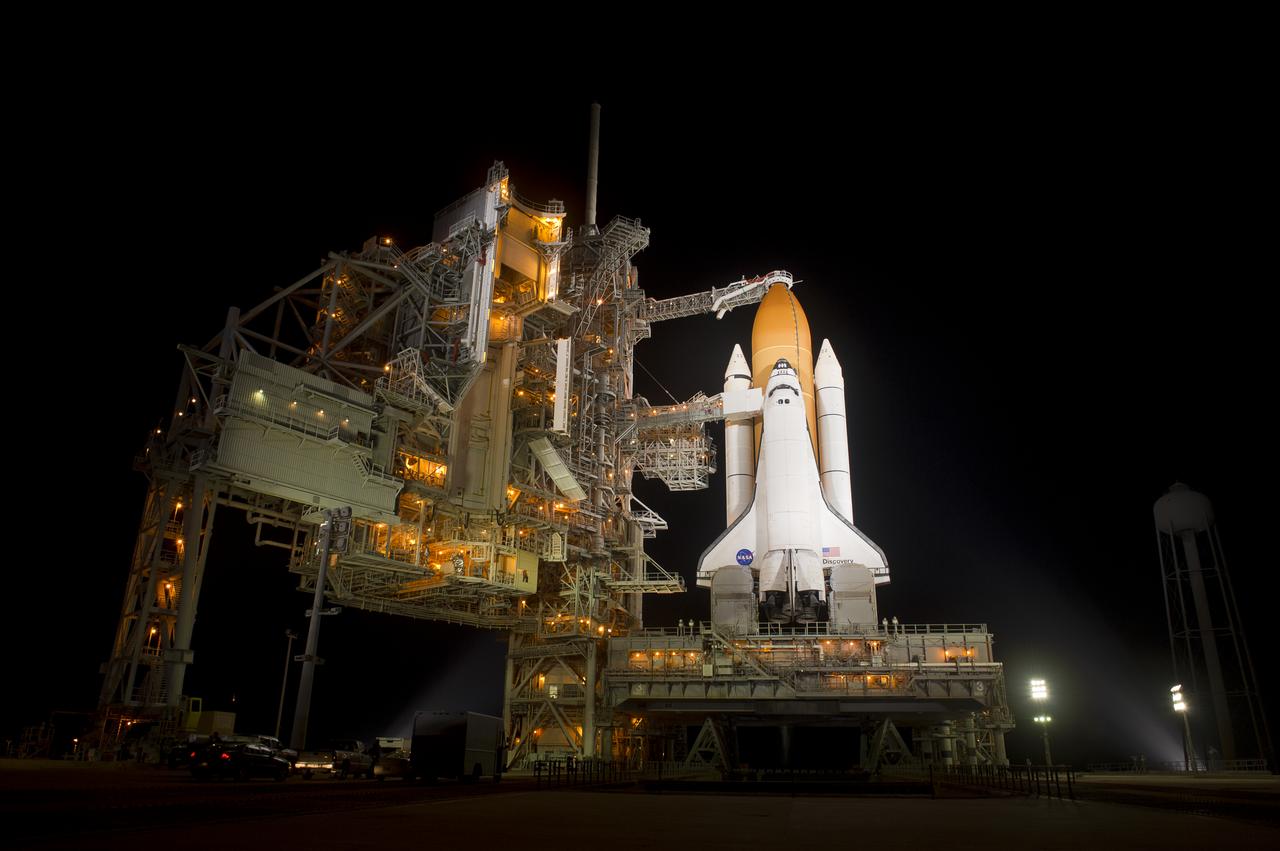
The space shuttle Discovery is seen on launch Pad 39a after the Rotating Service Structure (RSS) is rolled back on Wednesday, Nov. 3, 2010 at the NASA Kennedy Space Center in Cape Canaveral, Fla. During space shuttle Discovery's final spaceflight, the STS-133 crew members will take important spare parts to the International Space Station along with the Express Logistics Carrier-4. Photo Credit: (NASA/Bill Ingalls)
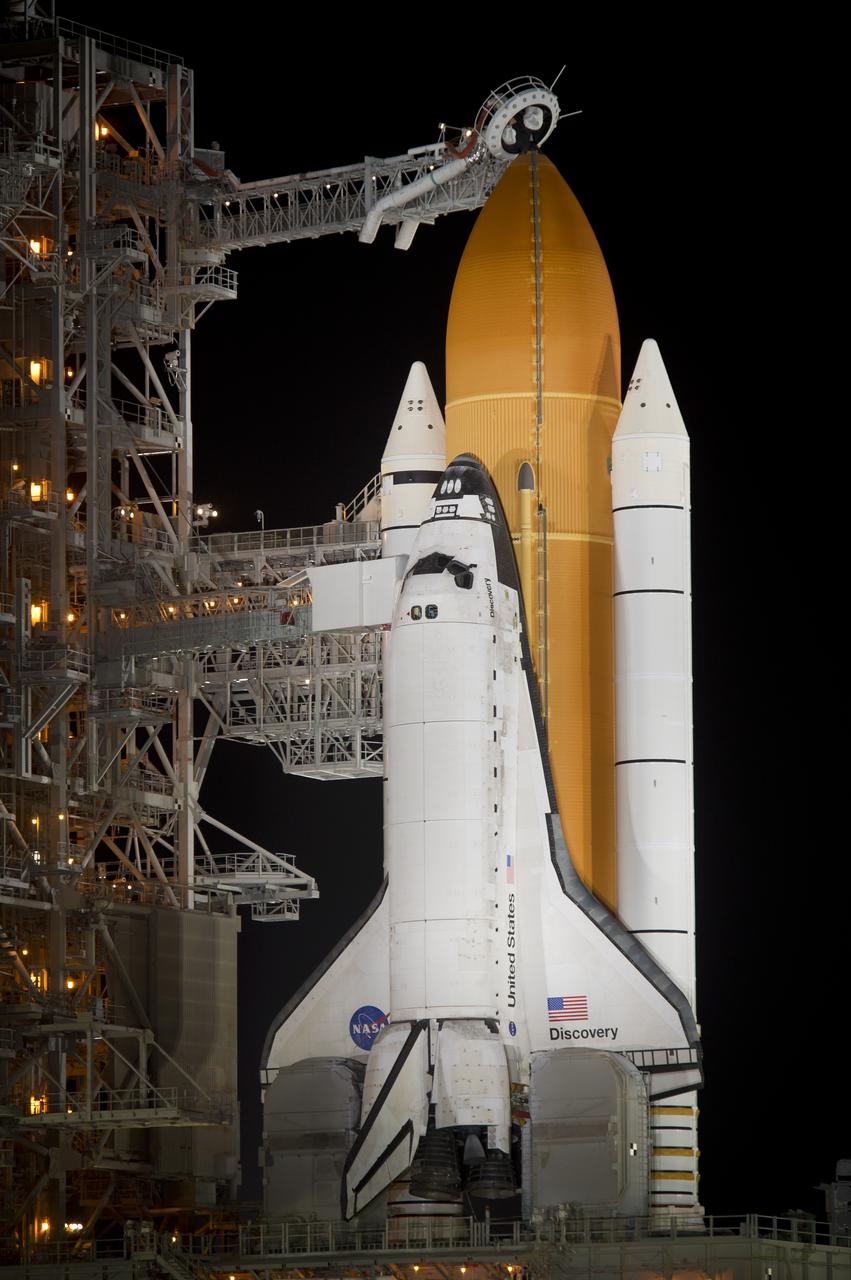
The space shuttle Discovery is seen on launch Pad 39a after the Rotating Service Structure (RSS) is rolled back on Wednesday, Nov. 3, 2010 at the NASA Kennedy Space Center in Cape Canaveral, Fla. During space shuttle Discovery's final spaceflight, the STS-133 crew members will take important spare parts to the International Space Station along with the Express Logistics Carrier-4. Photo Credit: (NASA/Bill Ingalls)
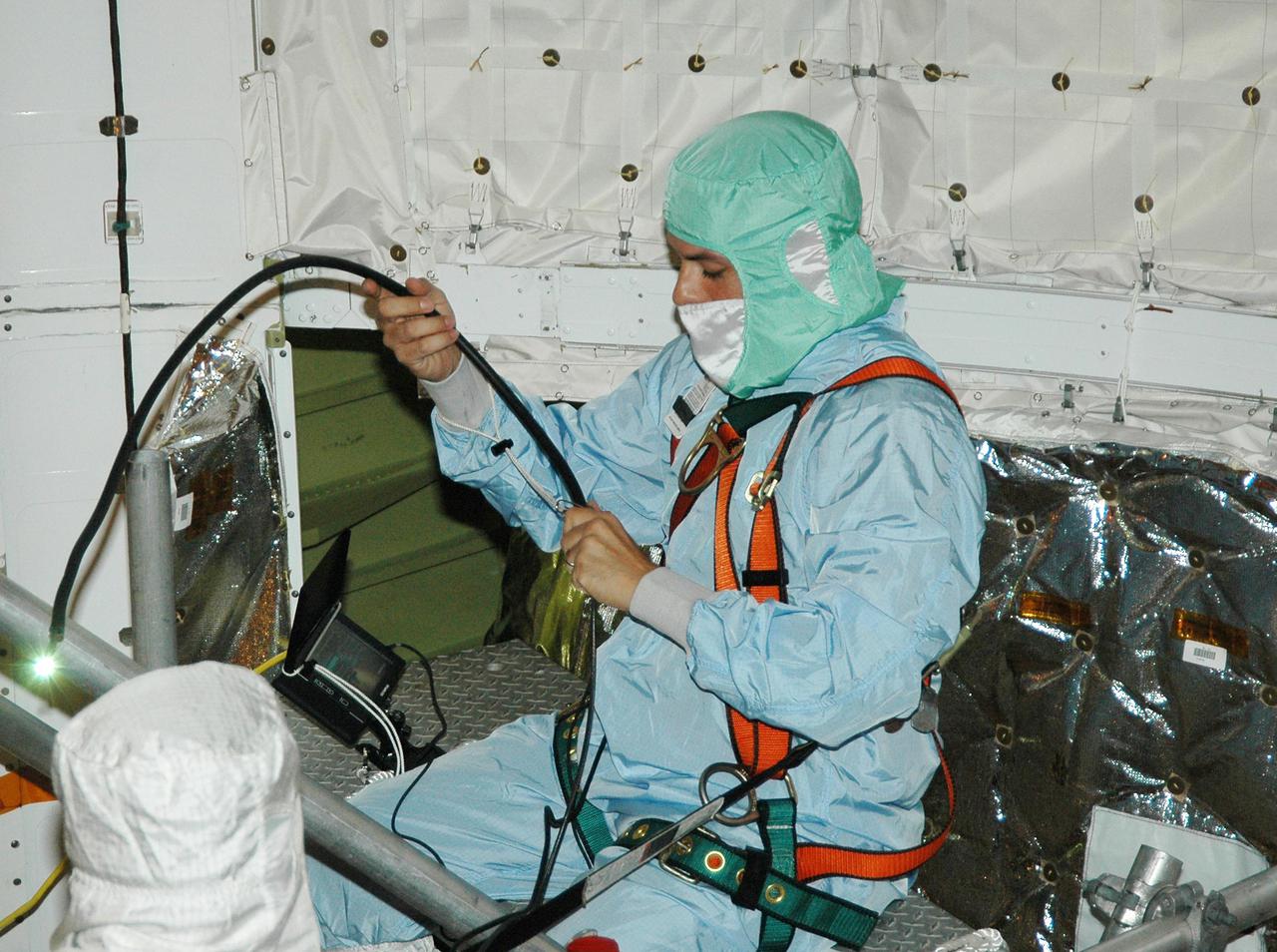
KENNEDY SPACE CENTER, FLA. - At Launch Complex 39B, a technician in Space Shuttle Discovery's payload bay prepares a borescope for an inspection of the retract link assembly on the orbiter's main landing gear door. The inspection is a precautionary measure after a small crack was found in a retract link assembly on the right-hand main landing gear on orbiter Atlantis. An initial review of the closeout photos of the link assembly on Discovery did not reveal any cracks. Discovery is scheduled to return the Space Shuttle fleet to operational status on mission STS-114. This additional work does not impact the launch planning window of July 13-31.
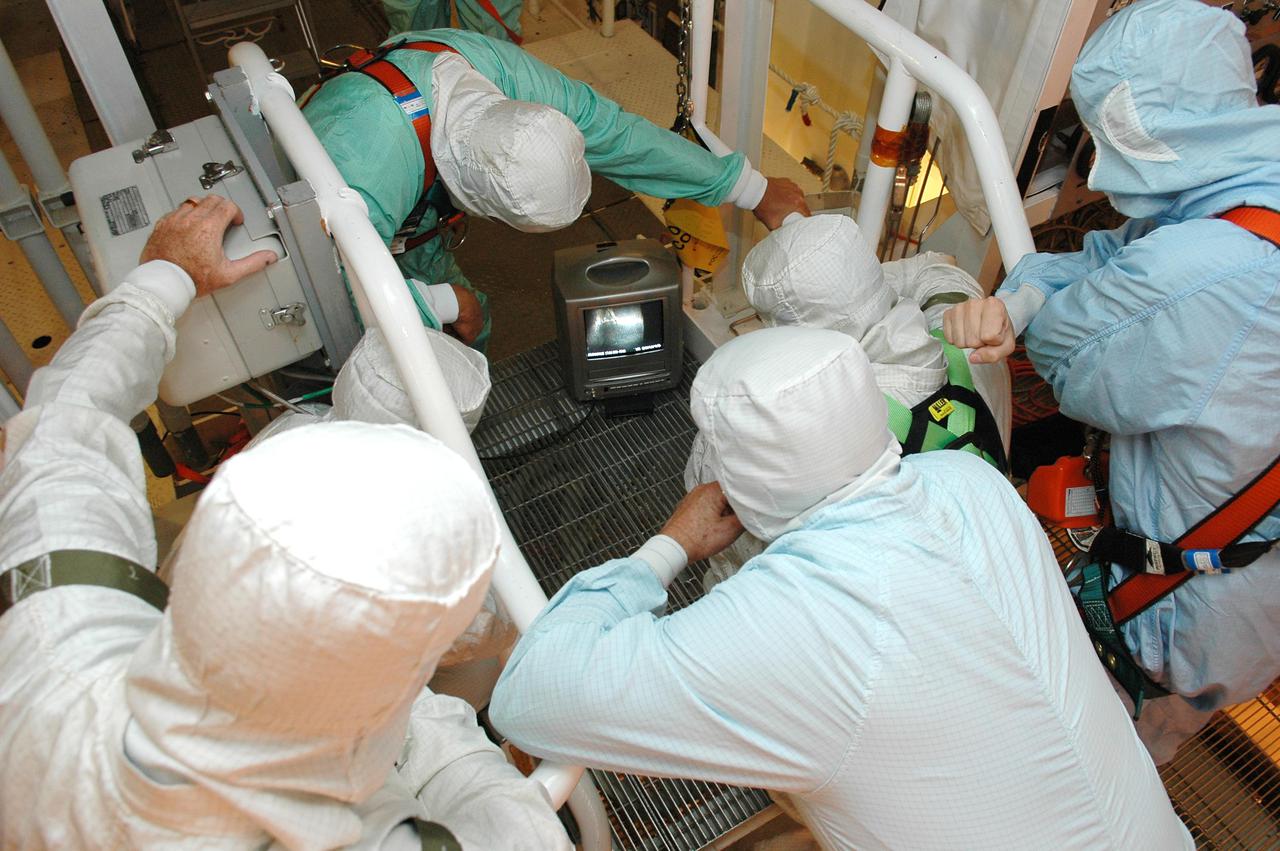
KENNEDY SPACE CENTER, FLA. - At Launch Complex 39B, technicians in Space Shuttle Discovery's payload bay perform a borescope inspection of the retract link assembly on the orbiter's main landing gear door. The inspection is a precautionary measure after a small crack was found in a retract link assembly on the right-hand main landing gear on orbiter Atlantis. An initial review of the closeout photos of the link assembly on Discovery did not reveal any cracks. Discovery is scheduled to return the Space Shuttle fleet to operational status on mission STS-114. This additional work does not impact the launch planning window of July 13-31.
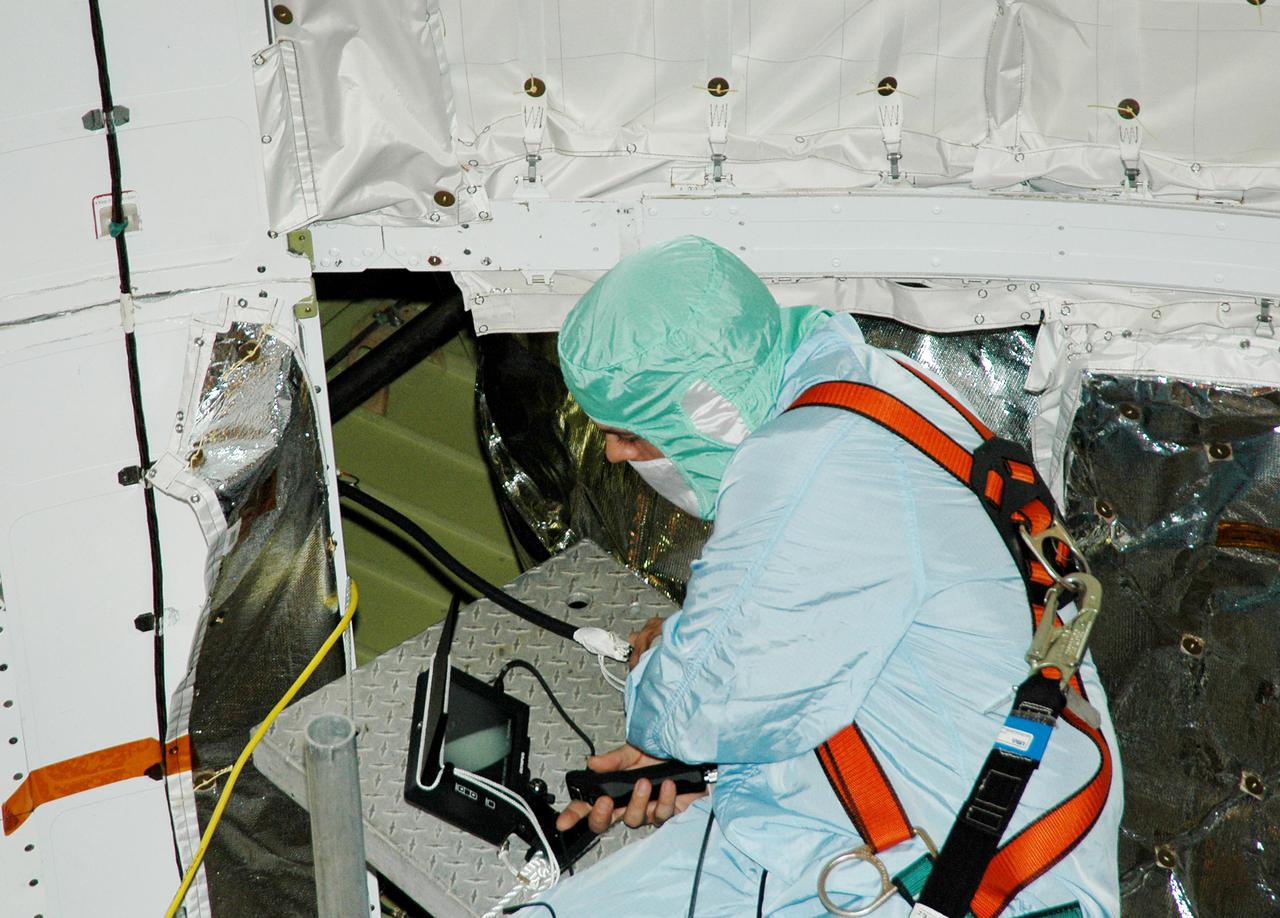
KENNEDY SPACE CENTER, FLA. - At Launch Complex 39B, a technician in Space Shuttle Discovery's payload bay performs a borescope inspection of the retract link assembly on the orbiter's main landing gear door. The inspection is a precautionary measure after a small crack was found in a retract link assembly on the right-hand main landing gear on orbiter Atlantis. An initial review of the closeout photos of the link assembly on Discovery did not reveal any cracks. Discovery is scheduled to return the Space Shuttle fleet to operational status on mission STS-114. This additional work does not impact the launch planning window of July 13-31.
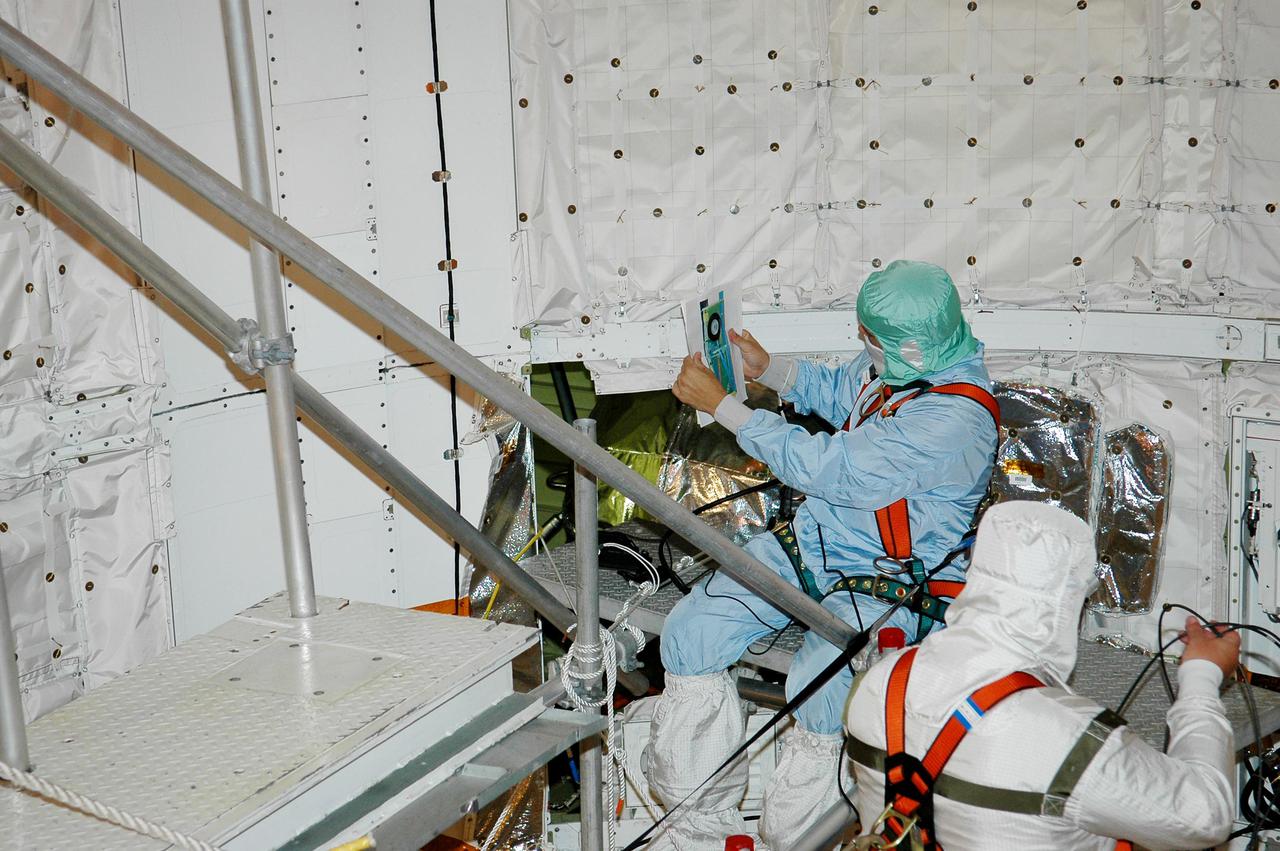
KENNEDY SPACE CENTER, FLA. - At Launch Complex 39B, a technician in Space Shuttle Discovery's payload bay studies a photo of the retract link assembly on the orbiter's main landing gear door prior to conducting a borescope inspection. The inspection is a precautionary measure after a small crack was found in a retract link assembly on the right-hand main landing gear on orbiter Atlantis. An initial review of the closeout photos of the link assembly on Discovery did not reveal any cracks. Discovery is scheduled to return the Space Shuttle fleet to operational status on mission STS-114. This additional work does not impact the launch planning window of July 13-31.