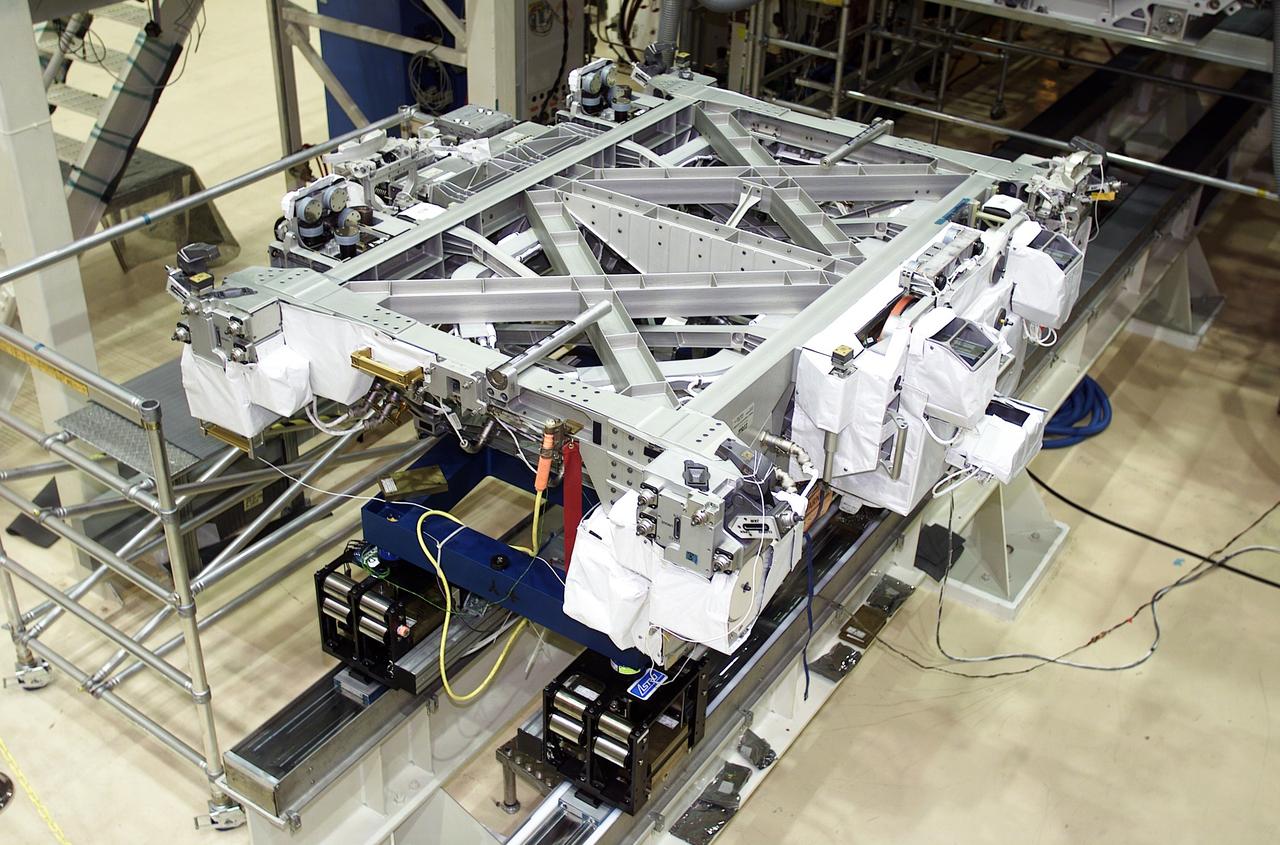
The Space Shuttle Atlantis, STS-110 mission, deployed this railcar, called the Mobile Transporter, and an initial 43-foot section of track, the S0 (S-zero) truss, preparing the International Space Station (ISS) for future spacewalks. The first railroad in space, the Mobile Transporter will allow the Station's robotic arm to travel up and down the finished truss for future assembly and maintenance. The 27,000-pound S0 truss is the first of 9 segments that will make up the Station's external framework that will eventually stretch 356 feet (109 meters), or approximately the length of a football field. The completed truss structure will hold solar arrays and radiators to provide power and cooling for additional international research laboratories from Japan and Europe that will be attached to the Station. The Space Shuttle Orbiter Atlantis, STS-110 mission, was launched April 8, 2002 and returned to Earth April 19, 2002. STS-110's Extravehicular Activity (EVA) marked the first use of the Station's robotic arm to maneuver spacewalkers around the Station.
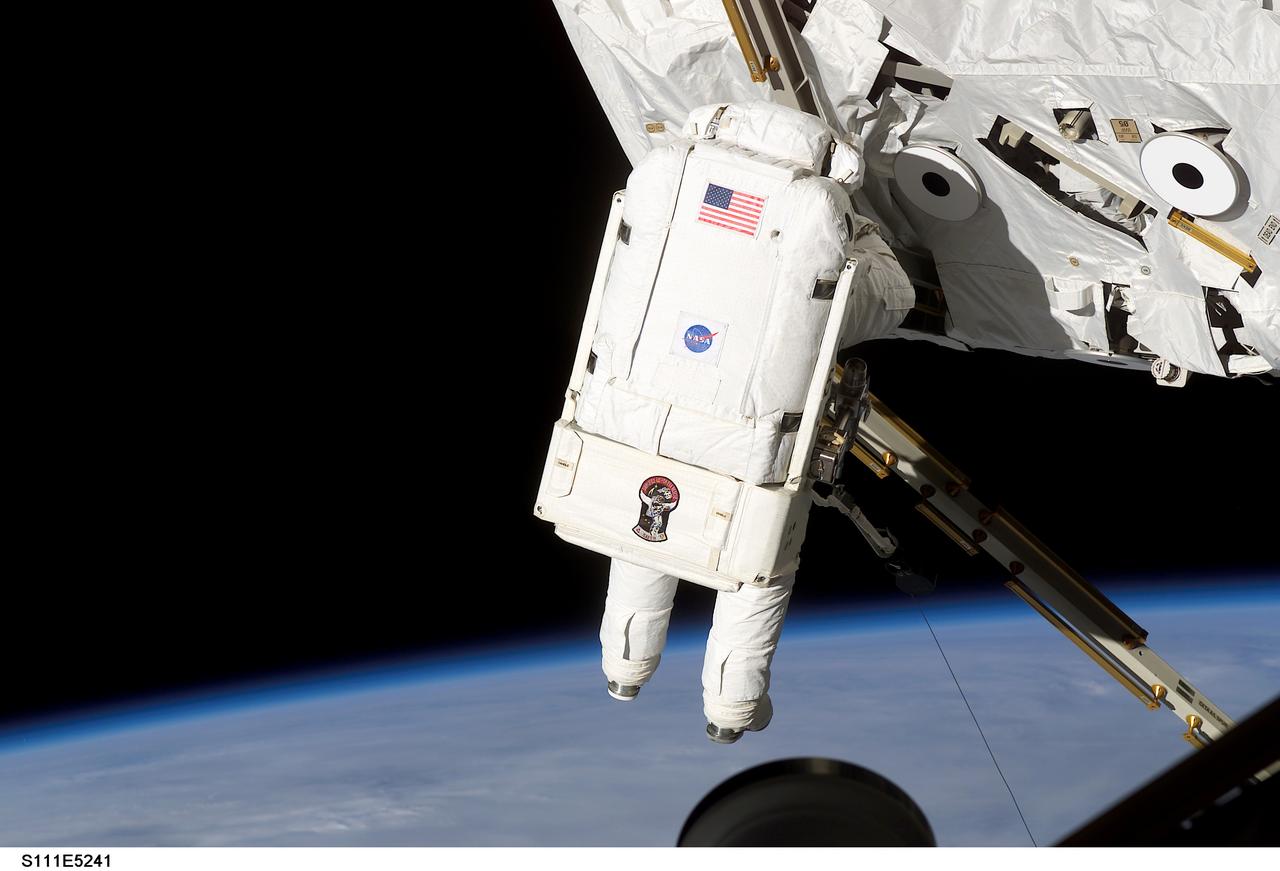
STS111-E-5241 (11 June 2002) --- Astronaut Philippe Perrin, STS-111 mission specialist, photographed near the S0 (S-Zero) Truss on the International Space Station (ISS), participates in the second scheduled session of extravehicular activity (EVA) for the STS-111 mission. During the 5-hour spacewalk, Perrin and Chang-Diaz completed installation of the Mobile Remote Servicer Base System (MBS) on the station’s railcar, the Mobile Transporter. Perrin represents CNES, the French Space Agency.
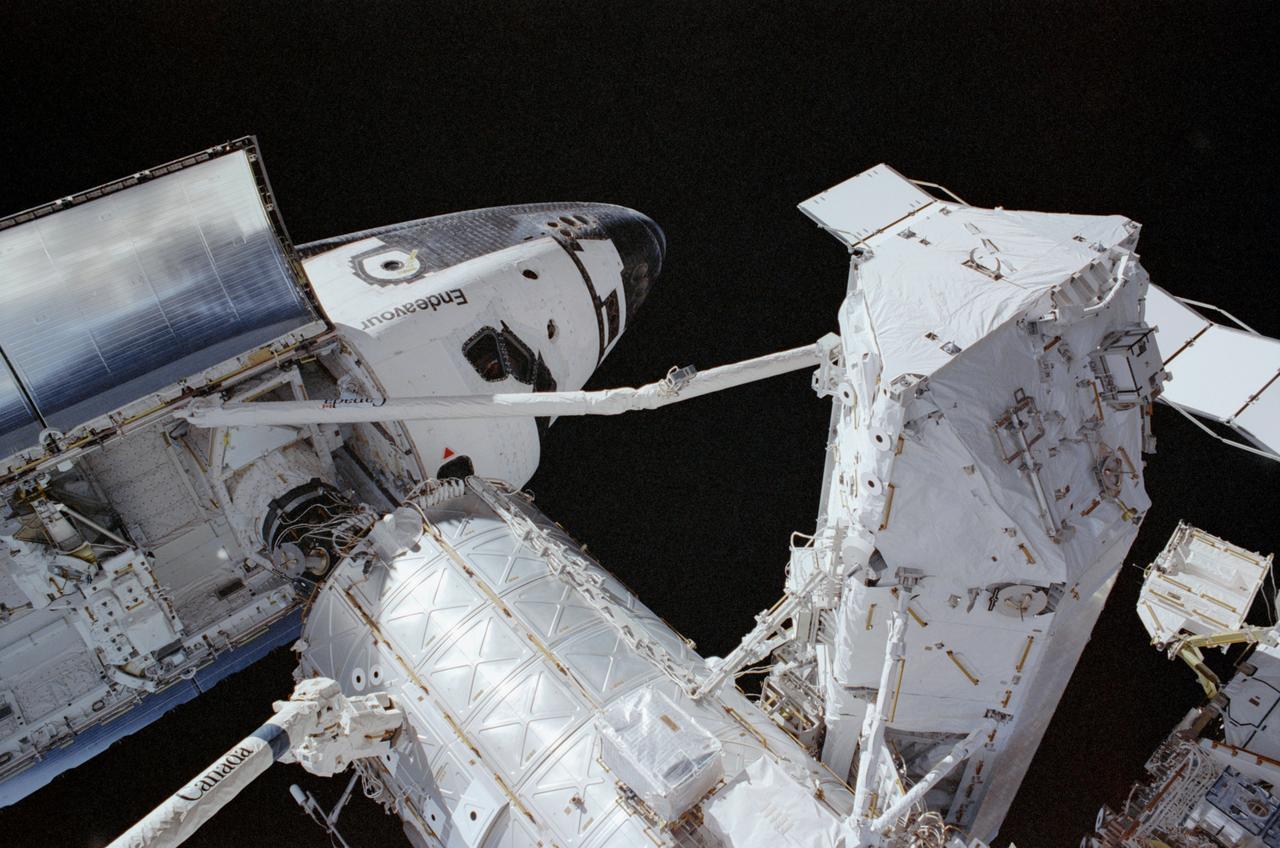
STS111-310-011 (9 June 2002) --- Backdropped by the blackness of space, the Space Shuttle Endeavour is pictured while docked to the Pressurized Mating Adapter (PMA-2) at the forward end of the Destiny laboratory on the International Space Station (ISS). A portion of the Canadarm2 is visible in the lower left corner and Endeavour’s robotic arm is in full view as it is stretched out with the S0 (S-zero) Truss at its end.
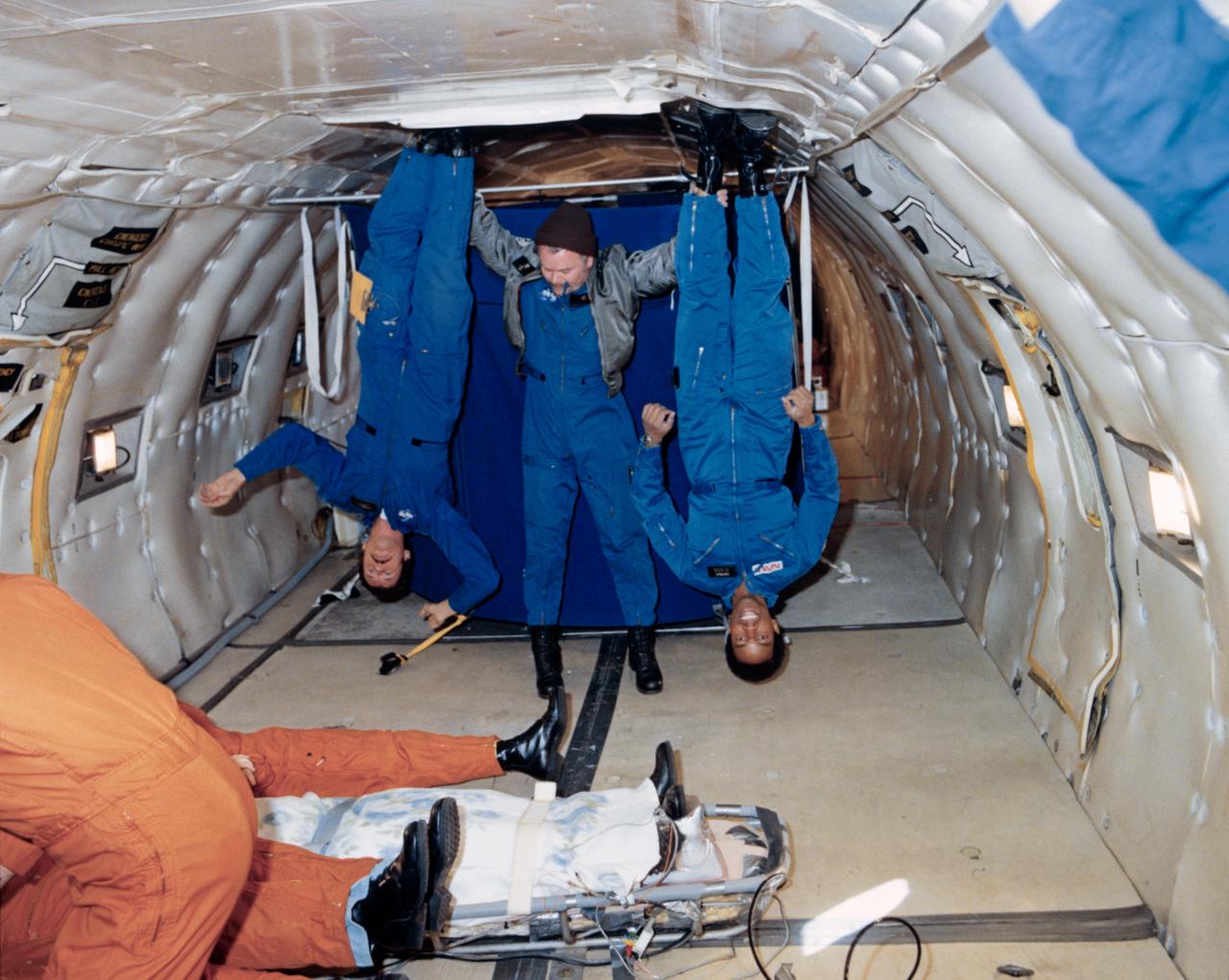
S79-28602 (2 March 1979) --- Astronaut candidate Guion S. Bluford and Aviation Safety Officer Charles F. Hayes got a unique perspective of their environment during a zero gravity flight. They are aboard a KC-135 aircraft, which flies a special pattern repeatedly to afford a series of 30-seconds-of-weightlessness sessions. Bluford and Hayes are being assisted by C. P. Stanley of the photography branch of the photographic technology division at Johnson Space Center (JSC). Some medical studies and a motion sickness experiment were conducted on this particular flight. Bluford is one of 20 scientist-astronaut candidates who began training at JSC in July of 1978. Photo credit: NASA
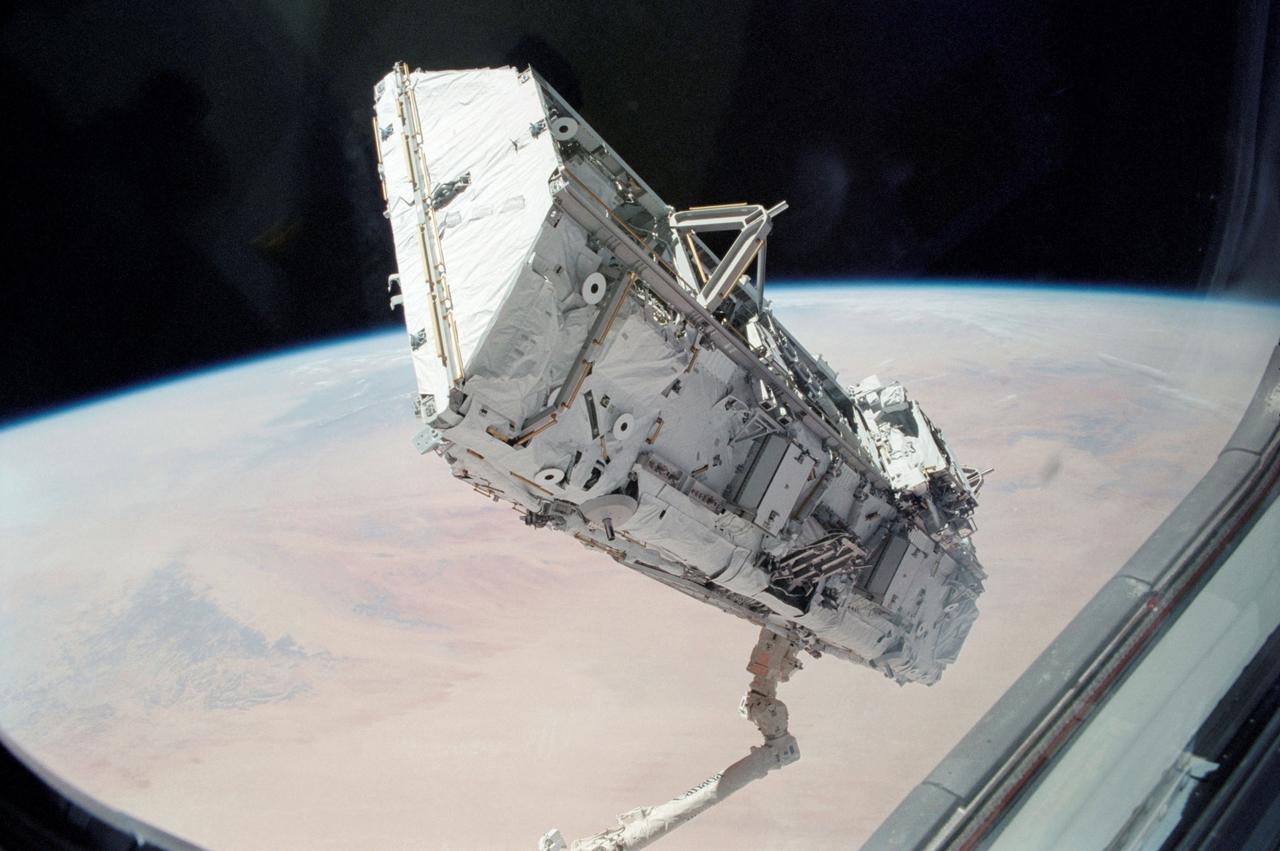
Backdropped against the blackness of space and the Earth's horizon, the S0 (S-zero) truss is removed from Atlantis' cargo bay and onto the Destiny laboratory of the International Space Station (ISS) by Astronauts Ellen Ochoa, STS-110 mission specialist, and Daniel W. Bursch, Expedition Four flight engineer, using the ISS' Canadarm2. Space Shuttle Orbiter Atlantis, STS-110 mission, prepared the International Space Station (ISS) for future spacewalks by installing and outfitting the 43-foot-long S0 truss and preparing the first railroad in space, the Mobile Transporter. The 27,000-pound S0 truss was the first of 9 segments that will make up the Station's external framework that will eventually stretch 356 feet (109 meters), or approximately the length of a football field. This central truss segment also includes a flatcar called the Mobile Transporter and rails that will become the first "space railroad," which will allow the Station's robotic arm to travel up and down the finished truss for future assembly and maintenance. The completed truss structure will hold solar arrays and radiators to provide power and cooling for additional international research laboratories from Japan and Europe that will be attached to the Station. Milestones of the STS-110 mission included the first use of the Station's robotic arm to maneuver spacewalkers around the Station and it was the first time all of a Shuttle crew's spacewalks were based out of the Station's Quest Airlock. It was also the first Shuttle to use three Block II Main Engines. The Space Shuttle Orbiter Atlantis, STS-110 mission, was launched April 8, 2002 and returned to Earth April 19, 2002.
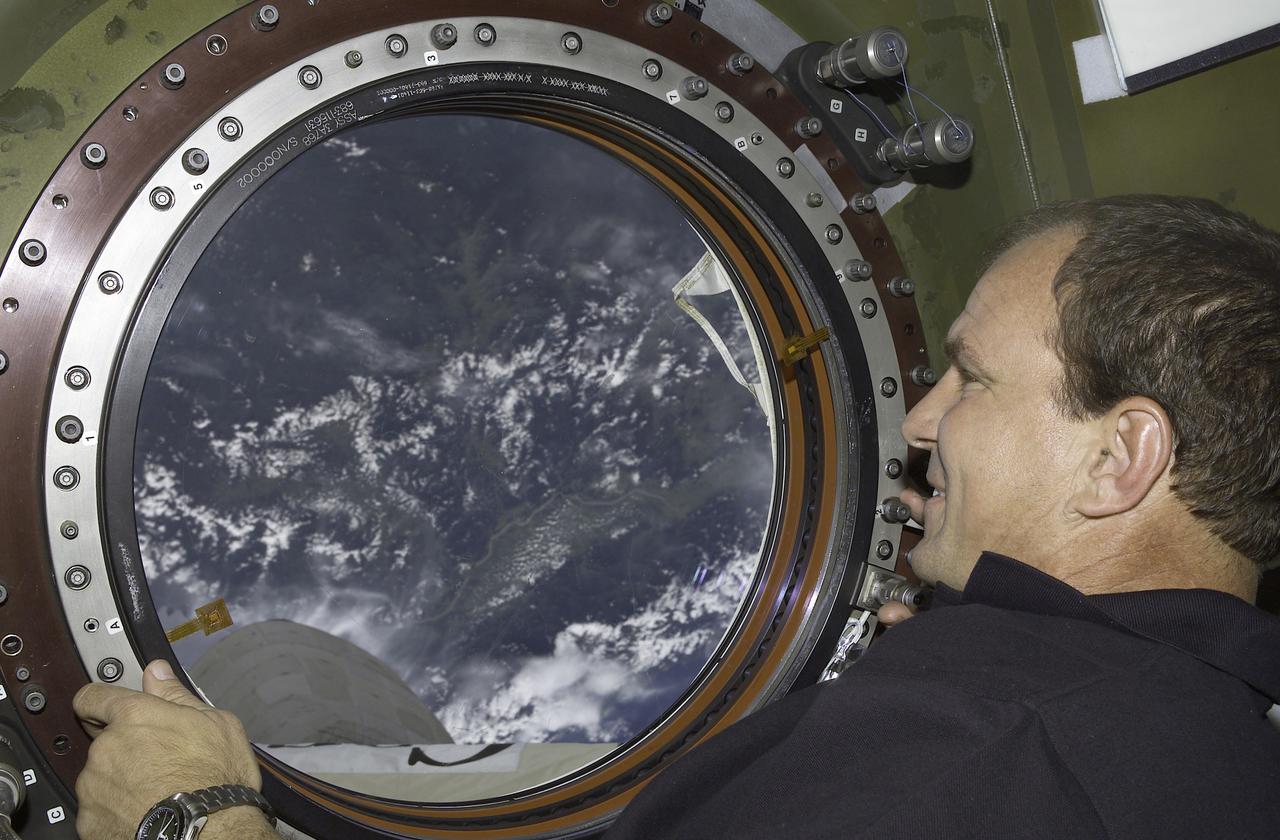
Astronaut Michael J. Bloomfield, STS-110 mission commander, looks through the Earth observation window in the Destiny laboratory aboard the International Space Station (ISS). The STS-110 mission prepared the ISS for future spacewalks by installing and outfitting the S0 (S-zero) truss and the Mobile Transporter. The 43-foot-long S0 Truss, weighing in at 27,000 pounds, was the first of 9 segments that will make up the Station's external framework that will eventually stretch 356 feet (109 meters), or approximately the length of a football field. This central truss segment also includes a flatcar called the Mobile Transporter and rails that will become the first "space railroad," which will allow the Station's robotic arm to travel up and down the finished truss for future assembly and maintenance. The completed truss structure will hold solar arrays and radiators to provide power and cooling for additional international research laboratories from Japan and Europe that will be attached to the Station. Milestones of the STS-110 mission included the first time the ISS robotic arm was used to maneuver spacewalkers around the Station and marked the first time all spacewalks were based out of the Station's Quest Airlock. It was also the first Shuttle to use three Block II Main Engines. The Space Shuttle Orbiter Atlantis, STS-110 mission, was launched April 8, 2002 and returned to Earth April 19, 2002.
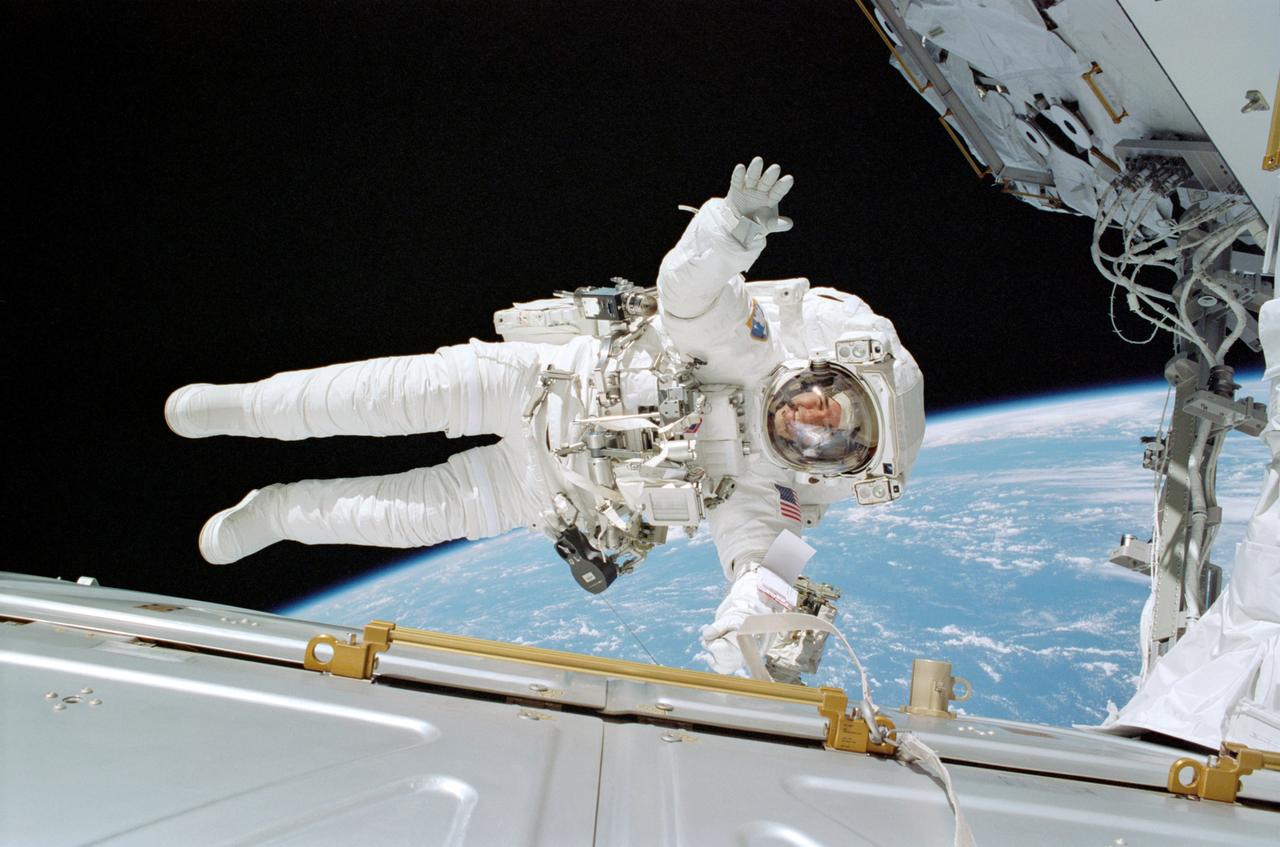
STS-110 Mission astronaut Rex J. Walheim, accompanied by astronaut Steven L. Smith (out of frame) translates along the Destiny laboratory on the International Space Station (ISS) during the third scheduled EVA session. The duo released the locking bolts on the Mobile Transporter and rewired the Station's robotic arm. The STS-110 mission prepared the ISS for future space walks by installing and outfitting the S0 (S-Zero) Truss and the Mobile Transporter. The 43-foot-long S0 truss weighing in at 27,000 pounds was the first of 9 segments that will make up the Station's external framework that will eventually stretch 356 feet (109 meters), or approximately the length of a football field. This central truss segment also includes a flatcar called the Mobile Transporter and rails that will become the first "space railroad," which will allow the Station's robotic arm to travel up and down the finished truss for future assembly and maintenance. The completed truss structure will hold solar arrays and radiators to provide power and cooling for additional international research laboratories from Japan and Europe that will be attached to the Station. Milestones of the S-110 mission included the first time the ISS robotic arm was used to maneuver space walkers around the Station and marked the first time all space walks were based out of the Station's Quest Airlock. It was also the first Shuttle to use three Block II Main Engines. The Space Shuttle Orbiter Atlantis, STS-110 mission, was launched April 8, 2002 and returned to Earth April 19, 2002.
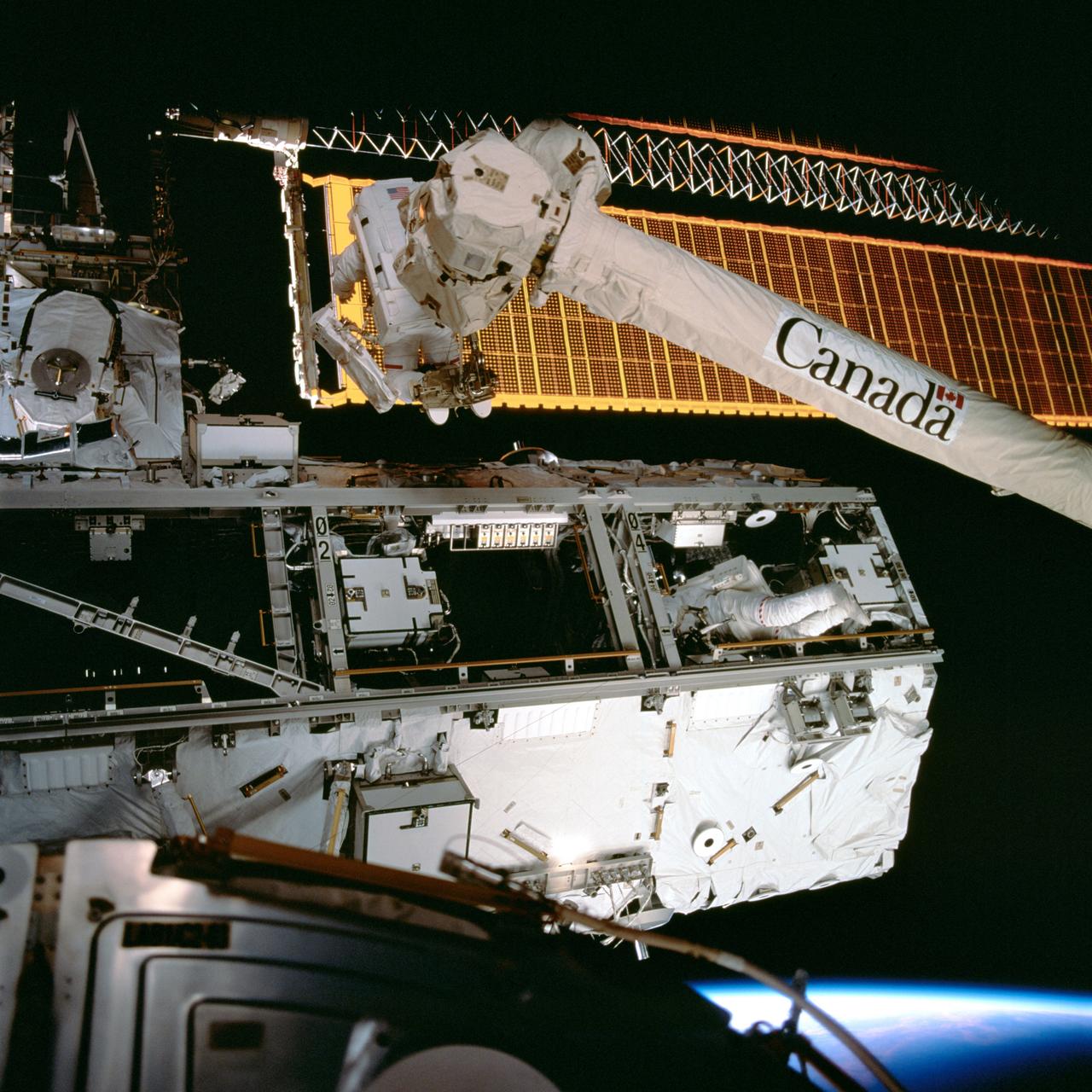
STS-110 Mission Specialists Jerry L. Ross and Lee M.E. Morin work in tandem on the fourth scheduled EVA session for the STS-110 mission aboard the Space Shuttle Orbiter Atlantis. Ross is anchored on the mobile foot restraint on the International Space Station's (ISS) Canadarm2, while Morin works inside the S0 (S-zero) truss. The STS-110 mission prepared the Station for future spacewalks by installing and outfitting a 43-foot-long S0 truss and preparing the Mobile Transporter. The 27,000 pound S0 Truss was the first of 9 segments that will make up the Station's external framework that will eventually stretch 356 feet (109 meters), or approximately the length of a football field. This central truss segment also includes a flatcar called the Mobile Transporter and rails that will become the first "space railroad," which will allow the Station's robotic arm to travel up and down the finished truss for future assembly and maintenance. The completed truss structure will hold solar arrays and radiators to provide power and cooling for additional international research laboratories from Japan and Europe that will be attached to the Station. Milestones of the S-110 mission included the first time the ISS robotic arm was used to maneuver spacewalkers around the Station and marked the first time all spacewalks were based out of the Station's Quest Airlock. It was also the first Shuttle to use three Block II Main Engines. The Space Shuttle Orbiter Atlantis, STS-110 mission, was launched April 8, 2002 and returned to Earth April 19, 2002.
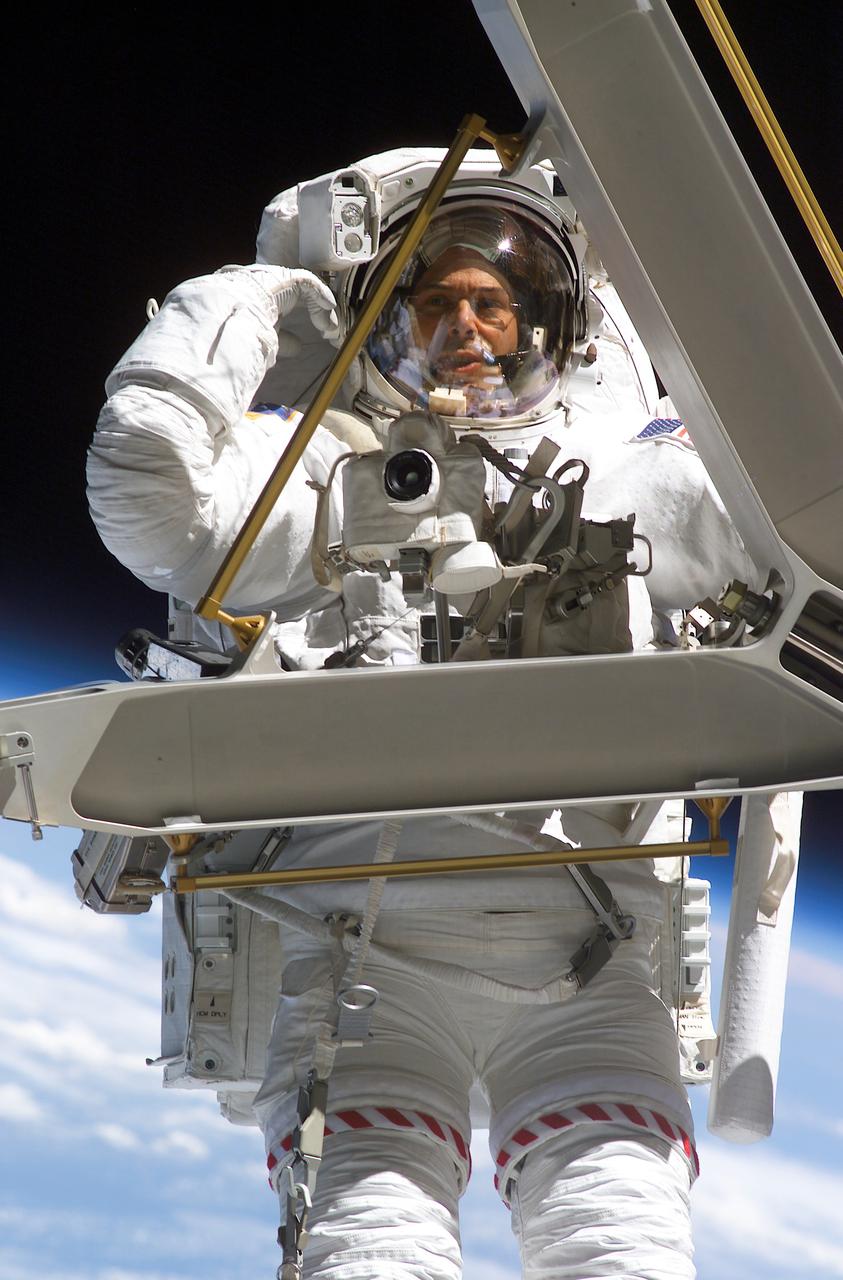
STS-110 mission specialist Lee M.E. Morin carries an affixed 35 mm camera to record work which is being performed on the International Space Station (ISS). Working with astronaut Jerry L. Ross (out of frame), the duo completed the structural attachment of the S0 (s-zero) truss, mating two large tripod legs of the 13 1/2 ton structure to the station's main laboratory during a 7-hour, 30-minute space walk. The STS-110 mission prepared the Station for future space walks by installing and outfitting the 43-foot-long S0 truss and preparing the Mobile Transporter. The S0 Truss was the first of 9 segments that will make up the Station's external framework that will eventually stretch 356 feet (109 meters), or approximately the length of a football field. This central truss segment also includes a flatcar called the Mobile Transporter and rails that will become the first "space railroad," which will allow the Station's robotic arm to travel up and down the finished truss for future assembly and maintenance. The completed truss structure will hold solar arrays and radiators to provide power and cooling for additional international research laboratories from Japan and Europe that will be attached to the Station. Milestones of the S-110 mission included the first time the ISS robotic arm was used to maneuver space walkers around the Station and marked the first time all space walks were based out of the Station's Quest Airlock. It was also the first Shuttle to use three Block II Main Engines. The Space Shuttle Orbiter Atlantis, STS-110 mission, was launched April 8, 2002 and returned to Earth April 19, 2002.
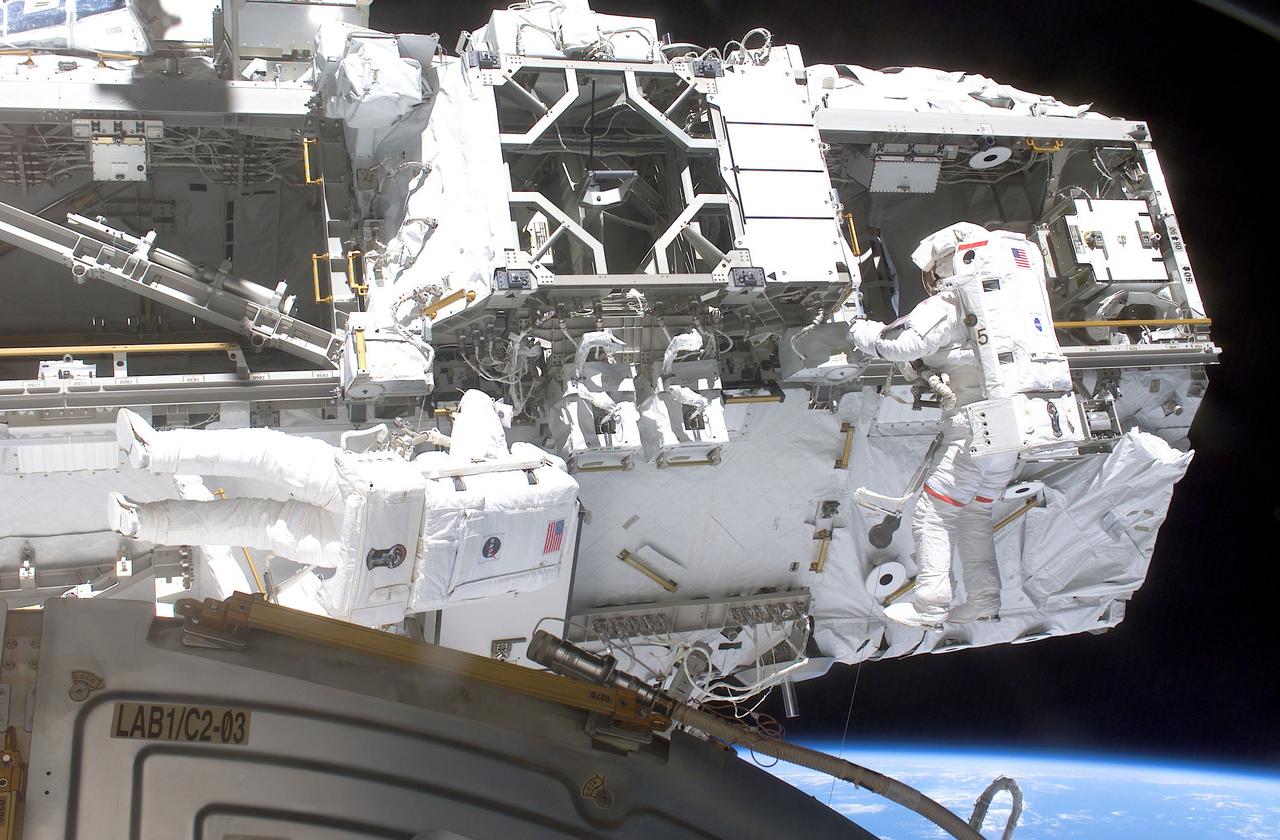
STS-110 Mission astronauts Steven L. Smith (right) and Rex J. Walheim work in tandem on the third scheduled EVA session in which they released the locking bolts on the Mobile Transporter and rewired the Station's robotic arm (out of frame). Part of the Destiny laboratory and a glimpse of the Earth's horizon are seen in the lower portion of this digital image. The STS-110 mission prepared the International Space Station (ISS) for future spacewalks by installing and outfitting the S0 (S-zero) Truss and the Mobile Transporter. The 43-foot-long S0 truss weighing in at 27,000 pounds was the first of 9 segments that will make up the Station's external framework that will eventually stretch 356 feet (109 meters), or approximately the length of a football field. This central truss segment also includes a flatcar called the Mobile Transporter and rails that will become the first "space railroad," which will allow the Station's robotic arm to travel up and down the finished truss for future assembly and maintenance. The completed truss structure will hold solar arrays and radiators to provide power and cooling for additional international research laboratories from Japan and Europe that will be attached to the Station. Milestones of the S-110 mission included the first time the ISS robotic arm was used to maneuver spacewalkers around the Station and marked the first time all spacewalks were based out of the Station's Quest Airlock. It was also the first Shuttle to use three Block II Main Engines. The Space Shuttle Orbiter Atlantis, STS-110 mission, was launched April 8, 2002 and returned to Earth April 19, 2002.
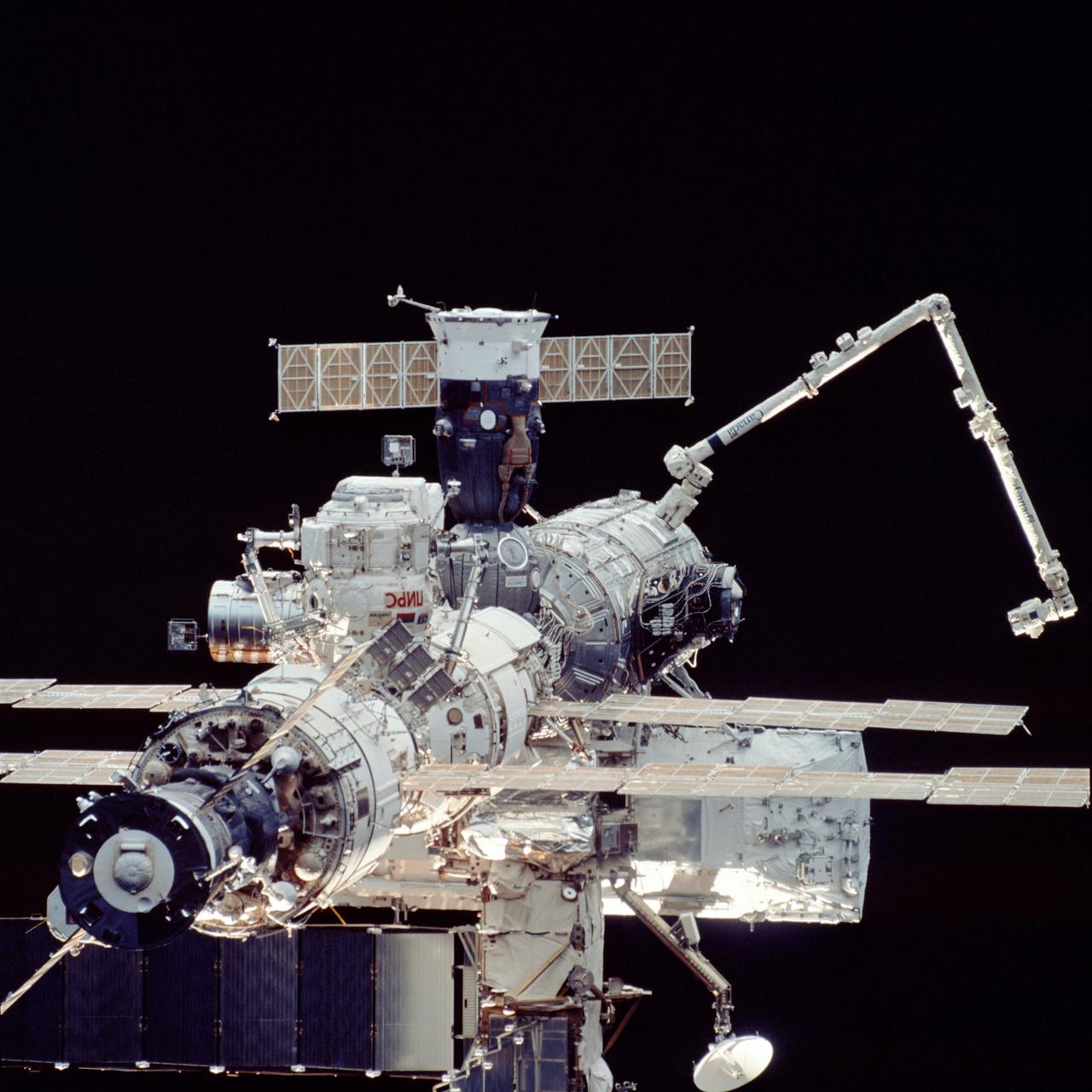
This close-up view of the International Space Station (ISS), newly equipped with its new 27,000 pound S0 (S-zero) truss, was photographed by an astronaut aboard the Space Shuttle Atlantis STS-110 during its ISS fly-around mission while pulling away from the ISS. The STS-110 mission prepared the Station for future spacewalks by installing and outfitting the 43-foot-long S0 truss and preparing the first railroad in space, the Mobile Transporter. The 27,000 pound S0 truss was the first of 9 segments that will make up the Station's external framework that will eventually stretch 356 feet (109 meters), or approximately the length of a football field. This central truss segment also includes a flatcar called the Mobile Transporter and rails that will become the first "space railroad," which will allow the Station's robotic arm to travel up and down the finished truss for future assembly and maintenance. The completed truss structure will hold solar arrays and radiators to provide power and cooling for additional international research laboratories from Japan and Europe that will be attached to the Station. STS-110 Extravehicular Activity (EVA) marked the first use of the Station's robotic arm to manuever spacewalkers around the Station and was the first time all of a shuttle crew's spacewalks were based out of the Station's Quest Airlock. It was also the first Shuttle to use three Block II Main Engines. The Space Shuttle Orbiter Atlantis STS-110 mission, was launched April 8, 2002 and returned to Earth April 19, 2002.
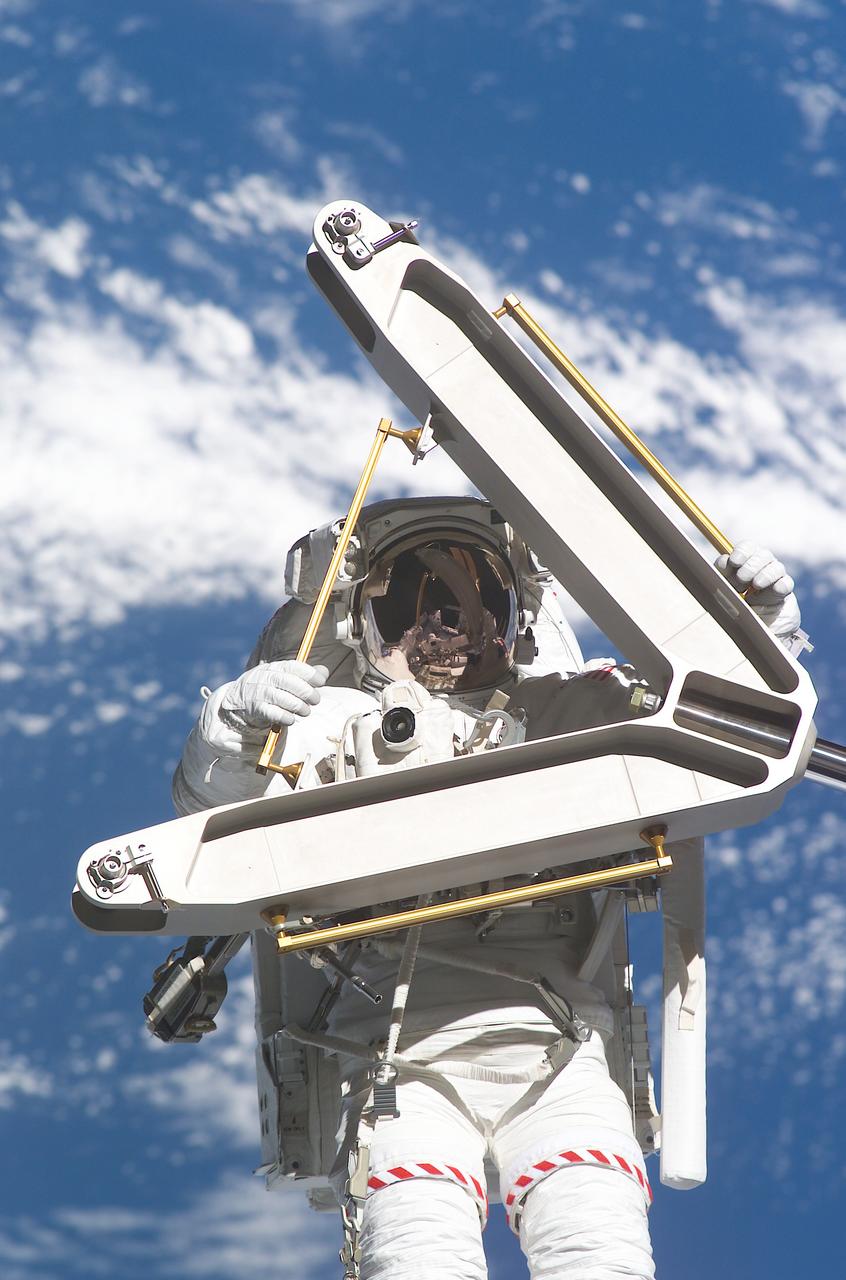
Hovering in space some 240 miles above the blue and white Earth, STS-110 astronaut M.E. Morin participates in his first ever and second of four scheduled space walks for the STS-110 mission. He is seen toting one of the S0 (S-Zero) keel pins which were removed from their functional position on the truss and attached on the truss' exterior for long term stowage. The 43-foot-long, 27,000 pound S0 truss was the first of 9 segments that will make up the International Space Station's external framework that will eventually stretch 356 feet (109 meters), or approximately the length of a football field. This central truss segment also includes a flatcar called the Mobile Transporter and rails that will become the first "space railroad," which will allow the Station's robotic arm to travel up and down the finished truss for future assembly and maintenance. The completed truss structure will hold solar arrays and radiators to provide power and cooling for additional international research laboratories from Japan and Europe that will be attached to the Station. The mission completed the installations and preparations of the S0 truss and the Mobile Transporter within four space walks. STS-110 Extravehicular Activity (EVA) marked the first use of the Station's robotic arm to maneuver space walkers around the Station and was the first time all of a shuttle crew's space walks were based out of the Station's Quest Airlock. It was also the first Shuttle to use three Block II Main Engines. The Space Shuttle Orbiter Atlantis STS-110 mission was launched April 8, 2002 and returned to Earth April 19, 2002.
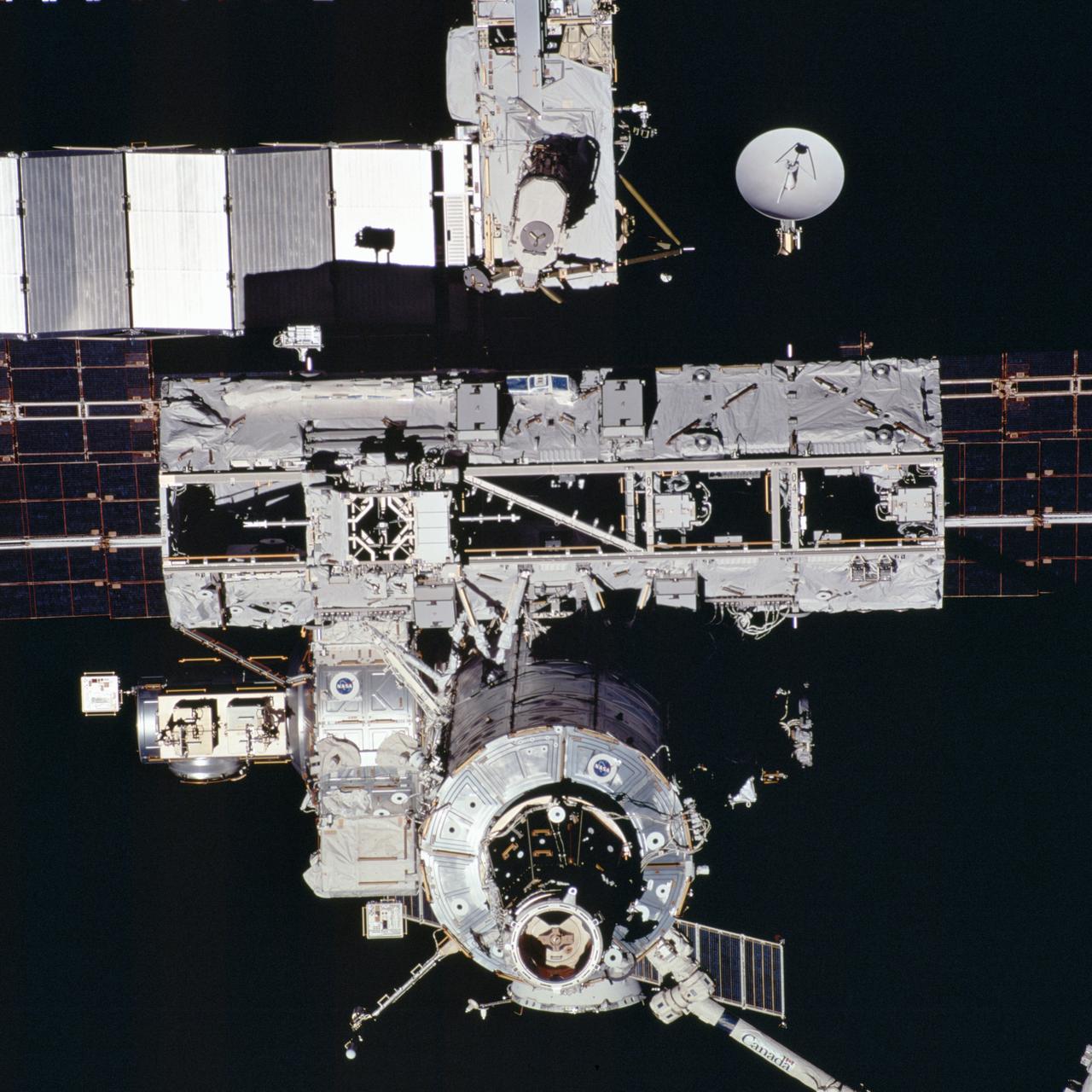
This close-up view of the International Space Station (ISS), newly equipped with its new 27,000-pound S0 (S-zero) truss, was photographed by an astronaut aboard the Space Shuttle Atlantis STS-110 during its ISS flyaround mission while pulling away from the ISS. The STS-110 mission prepared the Station for future spacewalks by installing and outfitting the 43-foot-long S0 truss and preparing the first railroad in space, the Mobile Transporter. The 27,000 pound S0 truss was the first of 9 segments that will make up the Station's external framework that will eventually stretch 356 feet (109 meters), or approximately the length of a football field. This central truss segment also includes a flatcar called the Mobile Transporter and rails that will become the first "space railroad," which will allow the Station's robotic arm to travel up and down the finished truss for future assembly and maintenance. The completed truss structure will hold solar arrays and radiators to provide power and cooling for additional international research laboratories from Japan and Europe that will be attached to the Station. STS-110 Extravehicular Activity (EVA) marked the first use of the Station's robotic arm to maneuver spacewalkers around the Station and was the first time all of a shuttle crew's spacewalks were based out of the Station's Quest Airlock. It was also the first Shuttle to use three Block II Main Engines. The Space Shuttle Orbiter Atlantis STS-110 mission, was launched April 8, 2002 and returned to Earth April 19, 2002.

This close-up view of the International Space Station (ISS), newly equipped with its new 27,000-pound S0 (S-zero) truss, was photographed by an astronaut aboard the Space Shuttle Atlantis STS-110 upon its ISS flyaround mission while pulling away from the ISS. The STS-110 mission prepared the Station for future spacewalks by installing and outfitting the 43-foot-long S0 truss and preparing the first railroad in space, the Mobile Transporter. The 27,000 pound S0 truss was the first of 9 segments that will make up the Station's external framework that will eventually stretch 356 feet (109 meters), or approximately the length of a football field. This central truss segment also includes a flatcar called the Mobile Transporter and rails that will become the first "space railroad," which will allow the Station's robotic arm to travel up and down the finished truss for future assembly and maintenance. The completed truss structure will hold solar arrays and radiators to provide power and cooling for additional international research laboratories from Japan and Europe that will be attached to the Station. STS-110 Extravehicular Activity (EVA) marked the first use of the Station's robotic arm to maneuver spacewalkers around the station and was the first time all of a Shuttle crew's spacewalks were based out of the Station's Quest Airlock. It was also the first Shuttle to use three Block II Main Engines. The Space Shuttle Orbiter Atlantis STS-110 mission, was launched April 8, 2002 and returned to Earth April 19, 2002.
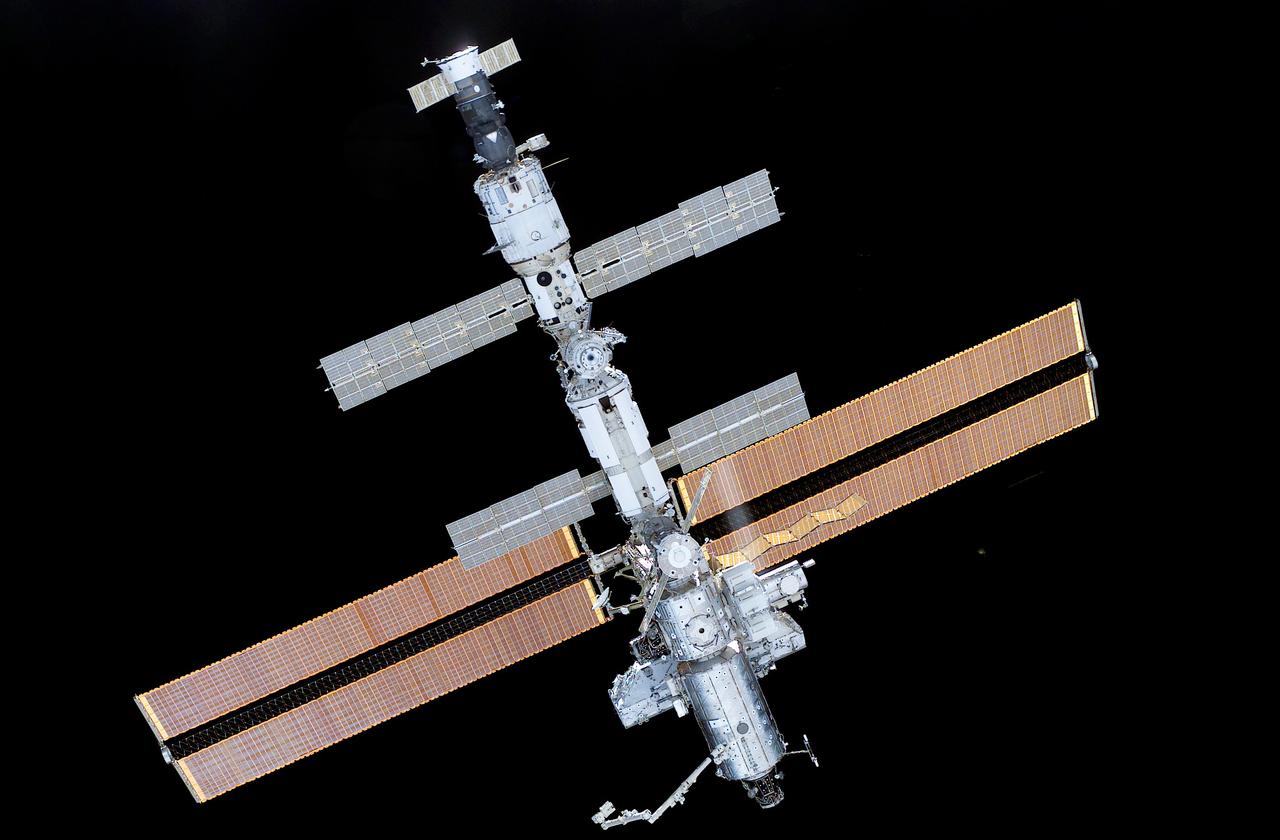
This close-up view of the International Space Station (ISS), newly equipped with its new 27,000-pound S0 (S-zero) truss, was photographed by an astronaut aboard the Space Shuttle Atlantis STS-110 mission following its undocking from the ISS. The STS-110 mission prepared the Station for future spacewalks by installing and outfitting the 43-foot-long S0 truss and preparing the first railroad in space, the Mobile Transporter. The 27,000 pound S0 truss was the first of 9 segments that will make up the Station's external framework that will eventually stretch 356 feet (109 meters), or approximately the length of a football field. This central truss segment also includes a flatcar called the Mobile Transporter and rails that will become the first "space railroad," which will allow the Station's robotic arm to travel up and down the finished truss for future assembly and maintenance. The completed truss structure will hold solar arrays and radiators to provide power and cooling for additional international research laboratories from Japan and Europe that will be attached to the Station. STS-110 Extravehicular Activity (EVA) marked the first use of the Station's robotic arm to maneuver spacewalkers around the Station and was the first time all of a Shuttle crew's spacewalks were based out of the Station's Quest Airlock. It was also the first Shuttle to use three Block II Main Engines. The Space Shuttle Orbiter Atlantis STS-110 mission, was launched April 8, 2002 and returned to Earth April 19, 2002.
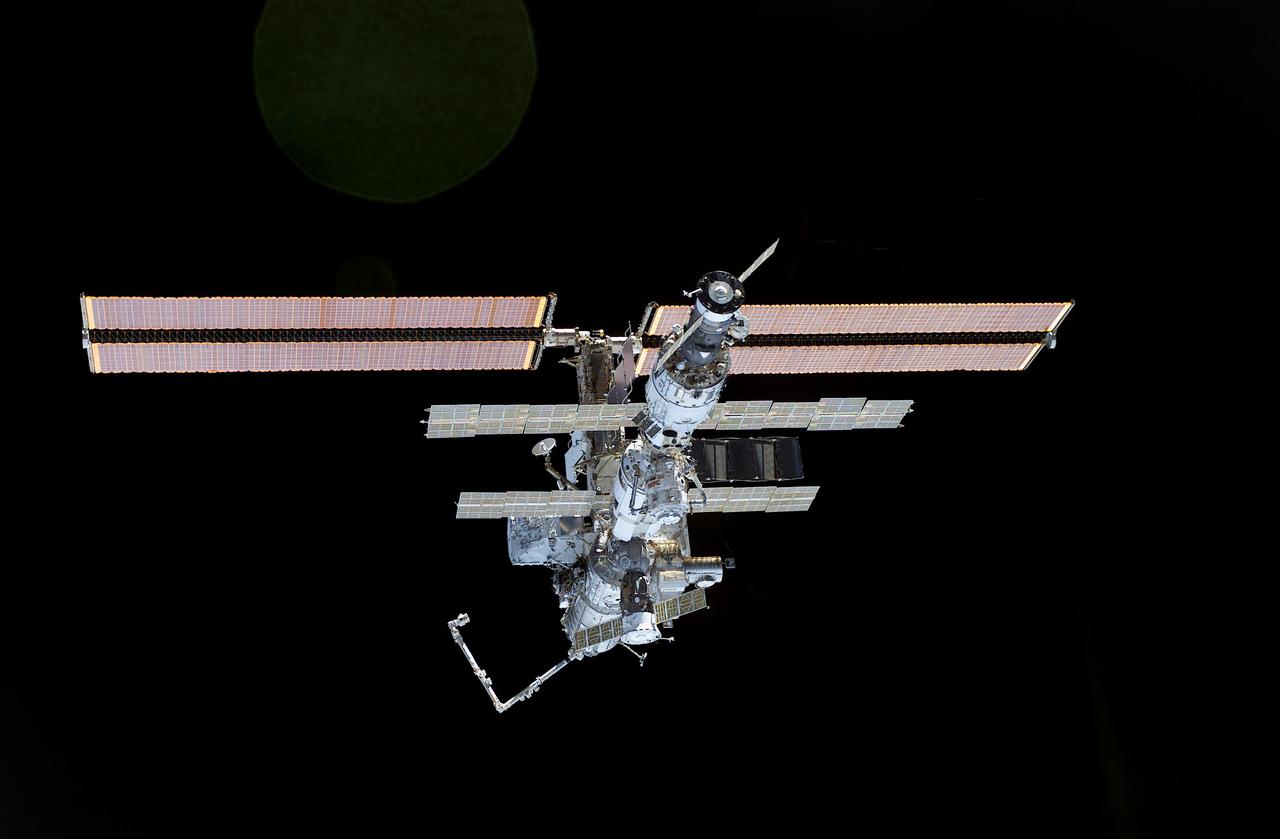
This close-up view of the International Space Station (ISS), newly equipped with its new 27,000- pound S0 (S-zero) truss, was photographed by an astronaut aboard the Space Shuttle Atlantis STS-110 mission following its undocking from the ISS. The STS-110 mission prepared the Station for future spacewalks by installing and outfitting the 43-foot-long S0 truss and preparing the first railroad in space, the Mobile Transporter. The 27,000 pound S0 truss was the first of 9 segments that will make up the Station's external framework that will eventually stretch 356 feet (109 meters), or approximately the length of a football field. This central truss segment also includes a flatcar called the Mobile Transporter and rails that will become the first "space railroad," which will allow the Station's robotic arm to travel up and down the finished truss for future assembly and maintenance. The completed truss structure will hold solar arrays and radiators to provide power and cooling for additional international research laboratories from Japan and Europe that will be attached to the Station. STS-110 Extravehicular Activity (EVA) marked the first use of the Station's robotic arm to maneuver spacewalkers around the Station and was the first time all of a shuttle crew's spacewalks were based out of the Station's Quest Airlock. It was also the first Shuttle to use three Block II Main Engines. The Space Shuttle Orbiter Atlantis STS-110 mission, was launched April 8, 2002 and returned to Earth April 19, 2002.
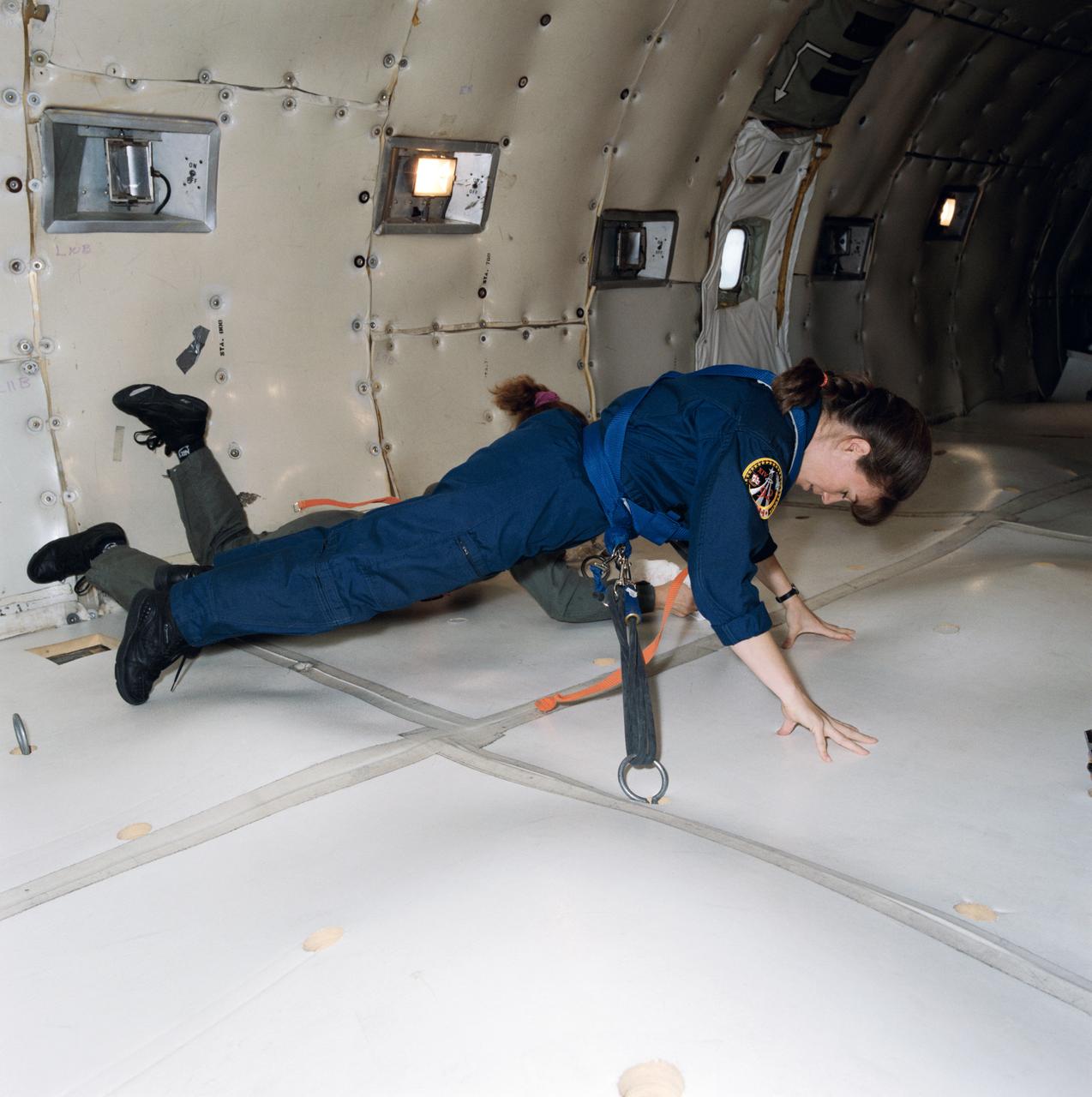
S94-35542 (June 1994) --- Astronaut Catherine G. Coleman, mission specialist, gets a preview of next year?s United States Microgravity Laboratory (USML-2) mission aboard the Space Shuttle Columbia. The weightless experience was afforded by a special parabolic pattern flown by NASA?s KC-135 ?zero gravity? aircraft.
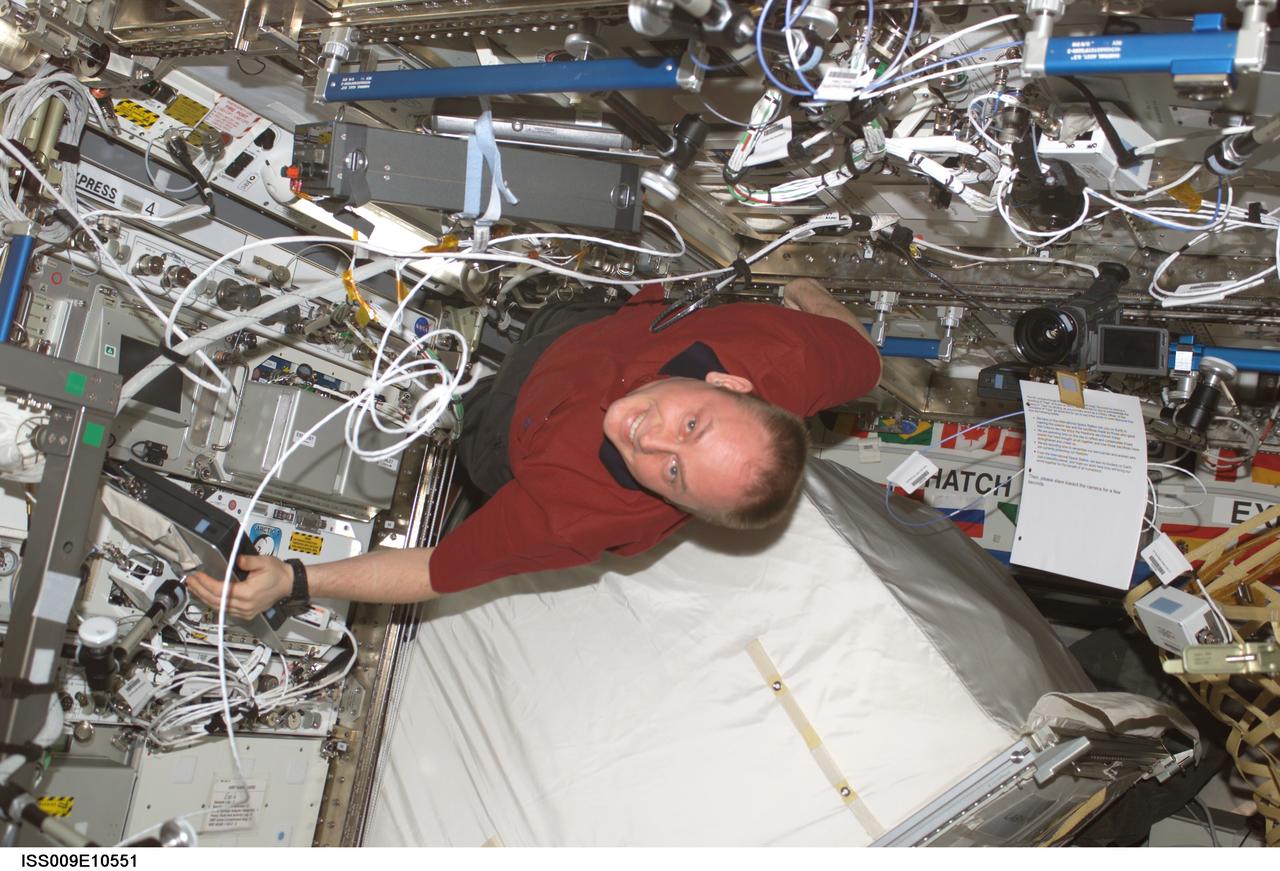
ISS009-E-10551 (4 June 2004) --- Astronaut Edward M. (Mike) Fincke, Expedition 9 NASA ISS science officer and flight engineer, moves the Zero-G Storage Rack (ZSR) in the Destiny laboratory of the International Space Station (ISS) in order to retrieve the spare Remote Power Controller Module (RPCM), scheduled to replace the failed RPCM on the S0 (S-Zero) Truss. Fincke is positioned above the ZSR, which has been pulled from the Express Rack.
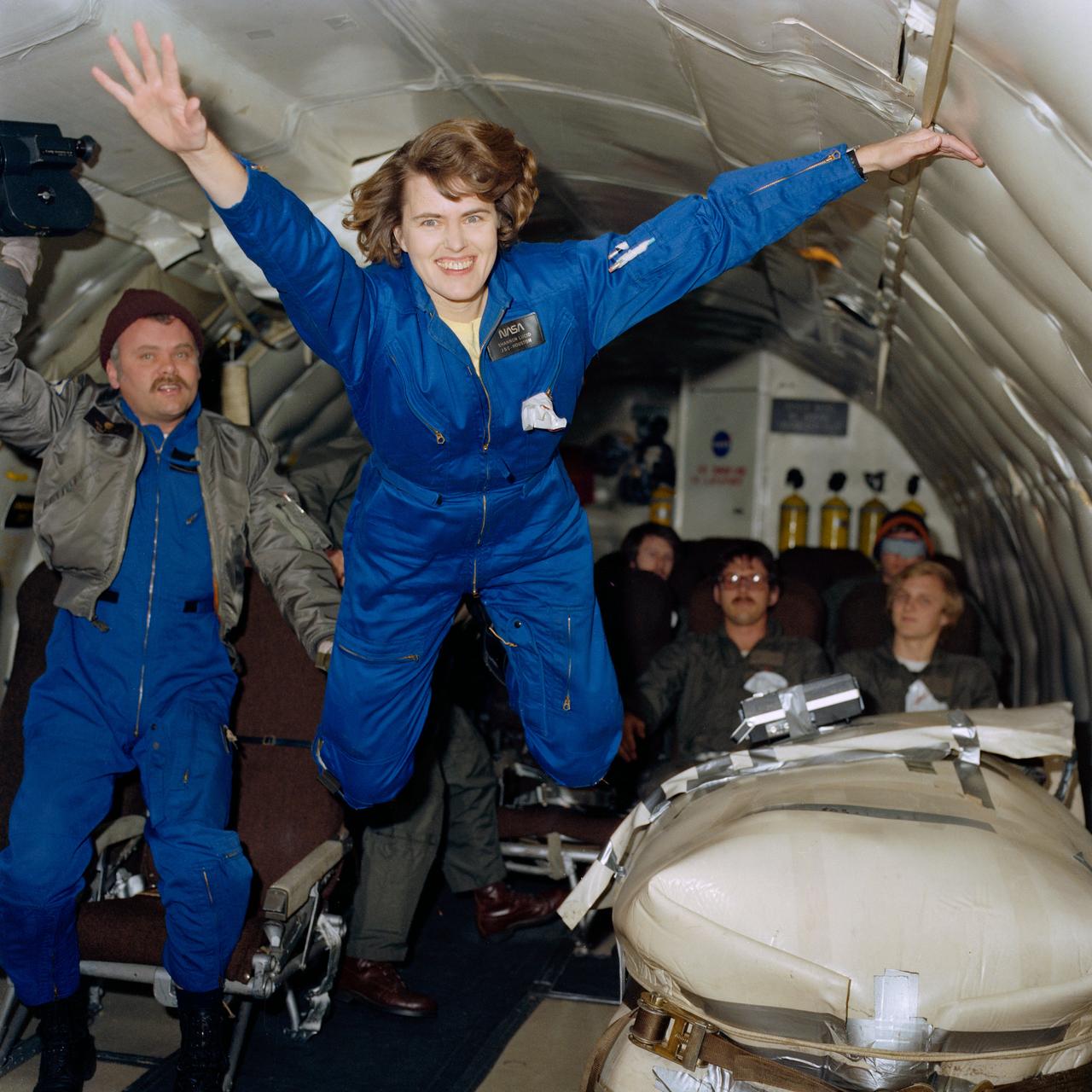
Astronaut -Candidate (ASCAN) Guion S. Bluford and Aviation Safety Officer Charles F. Hayes got a unique perspective of their environment during a zero- gravity flight. They are aboard a KC-135 Aircraft, which flies a special pattern repeatedly to afford a series of 30-seconds-of-weightlessness sessions. Astronauts Bluford and Hayes are being assisted by C. P. Stanley of the Photography Branch of the Photographic Technology Division (PTD) at Johnson Space Center (JSC). Some medical studies and a Motion Sickness Experiment were conducted on this particular flight. Astronaut Bluford is one of 20 Scientist/ASCAN's who began training at JSC, 07/1978. 1. Dr. Jeffrey A. Hoffman - Zero-G 2. ASCAN Shannon Lucid - Zero-G 3. ASCAN Guion Bluford - Zero-G
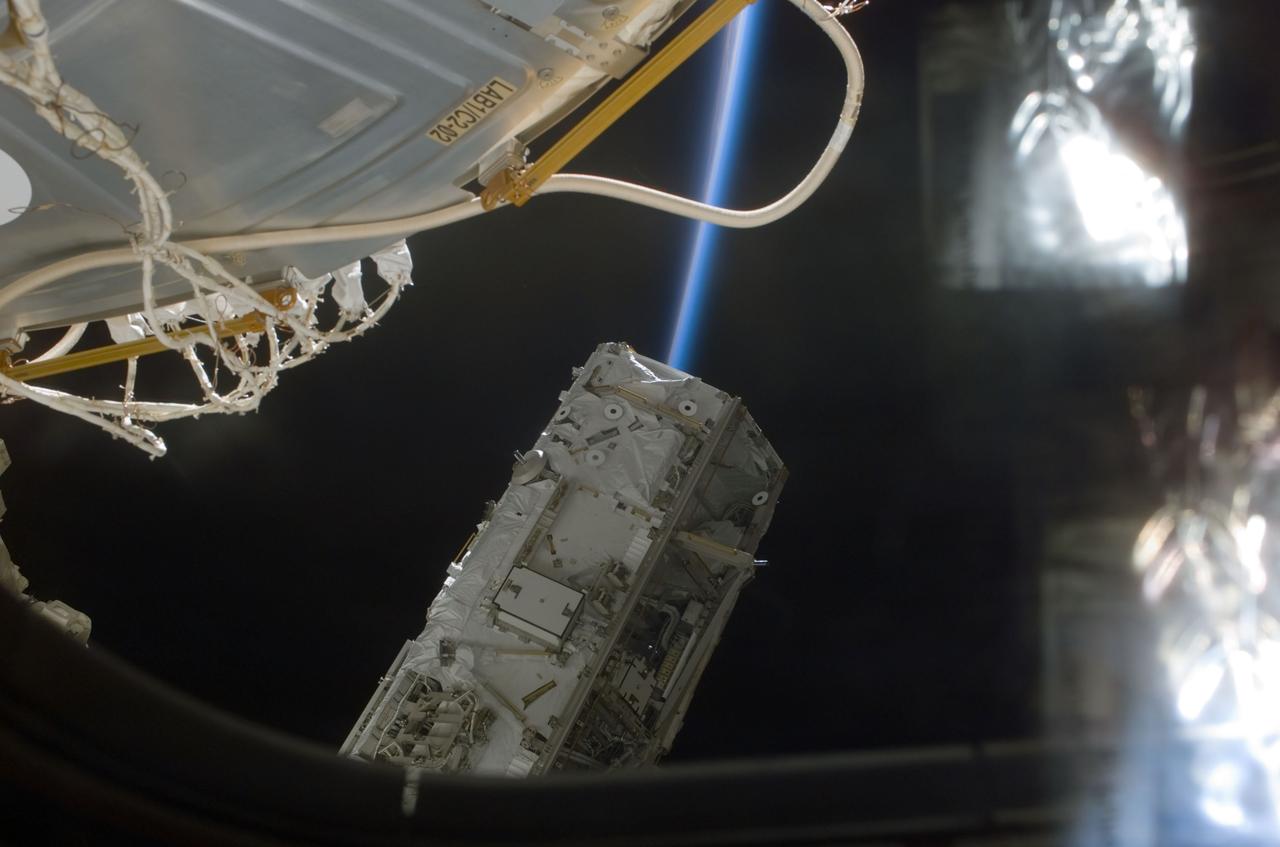
STS110-E-5180 (11 April 2002) --- Backdropped by the blackness of space, the S0 (S-Zero) Truss is moved from the Space Shuttle Atlantis’ cargo bay. Astronauts Ellen Ochoa, STS-110 mission specialist, and Daniel W. Bursch, Expedition Four flight engineer, used the International Space Station’s (ISS) Canadarm2 to lift the S0 Truss out of the orbiter’s payload bay and install it onto the temporary claw fixture on the Destiny laboratory. The image was taken with a digital still camera.
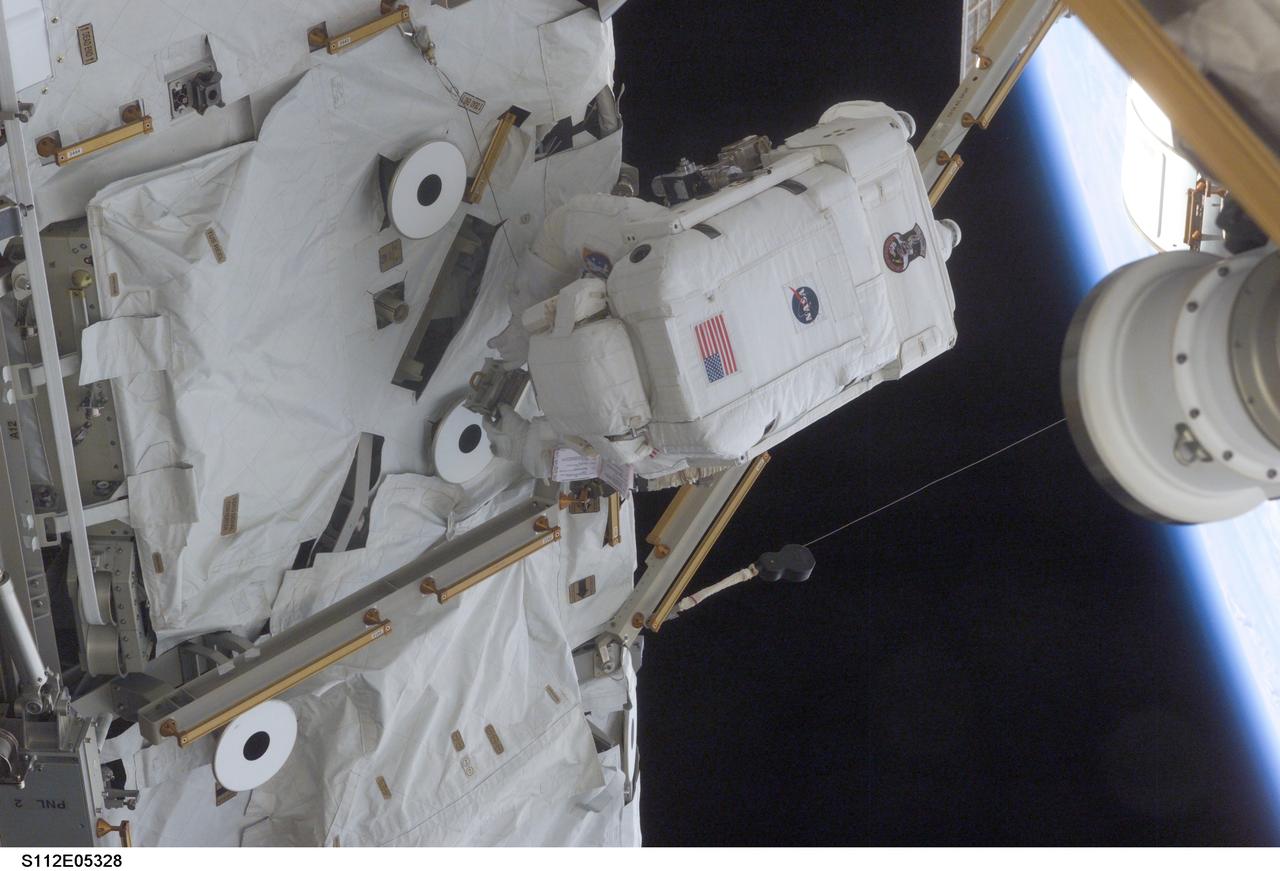
STS112-E-5328 (12 October 2002) --- Astronaut Piers J. Sellers, mission specialist, translates along the S0 (S-Zero) truss on the International Space Station (ISS) during the second of three scheduled STS-112 spacewalks.
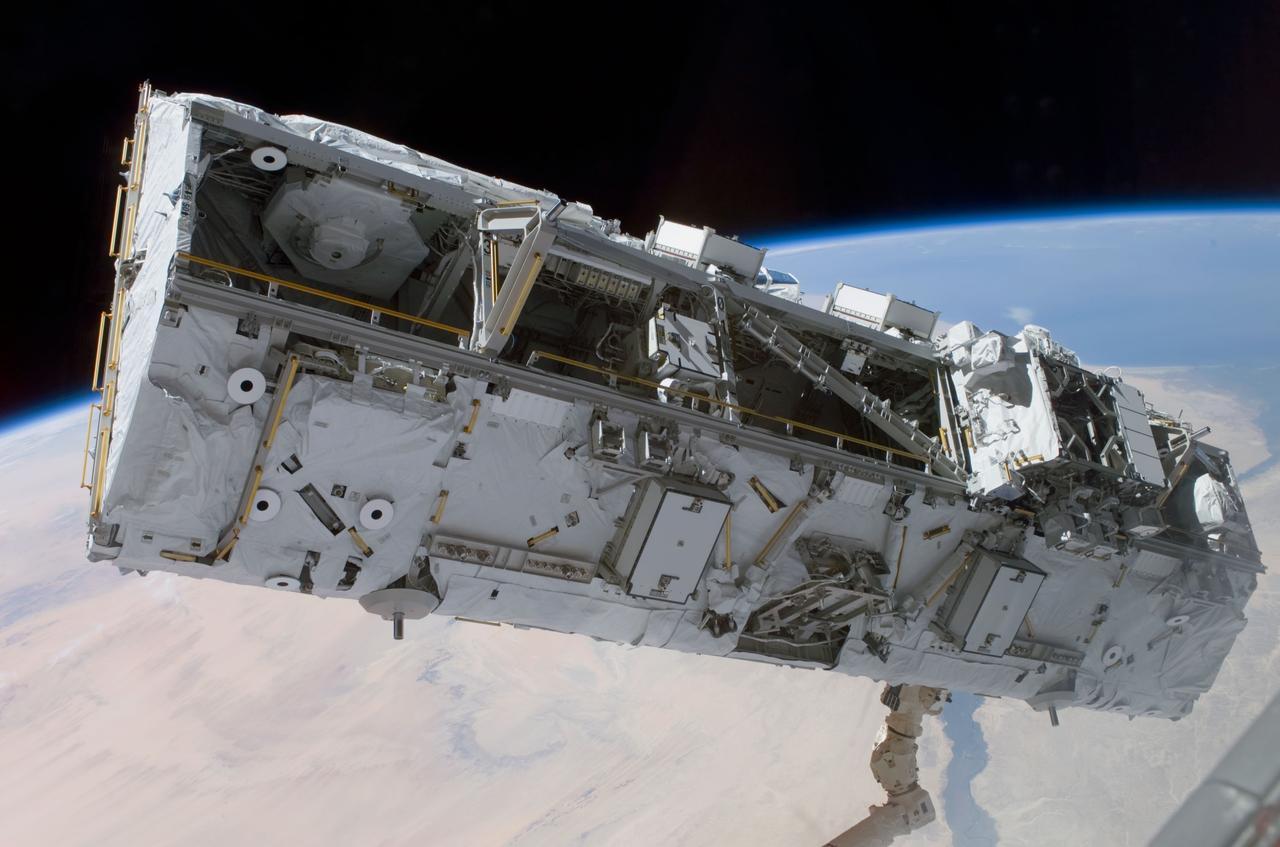
STS110-E-5173 (11 April 2002) --- Backdropped by the blackness of space and Earth’s horizon, the S0 (S-Zero) Truss is moved from the Space Shuttle Atlantis’ cargo bay. Astronauts Ellen Ochoa, STS-110 mission specialist, and Daniel W. Bursch, Expedition Four flight engineer, used the International Space Station’s (ISS) Canadarm2 to lift the S0 Truss out of the orbiter’s payload bay and install it onto the temporary claw fixture on the Destiny laboratory. The image was taken with a digital still camera.
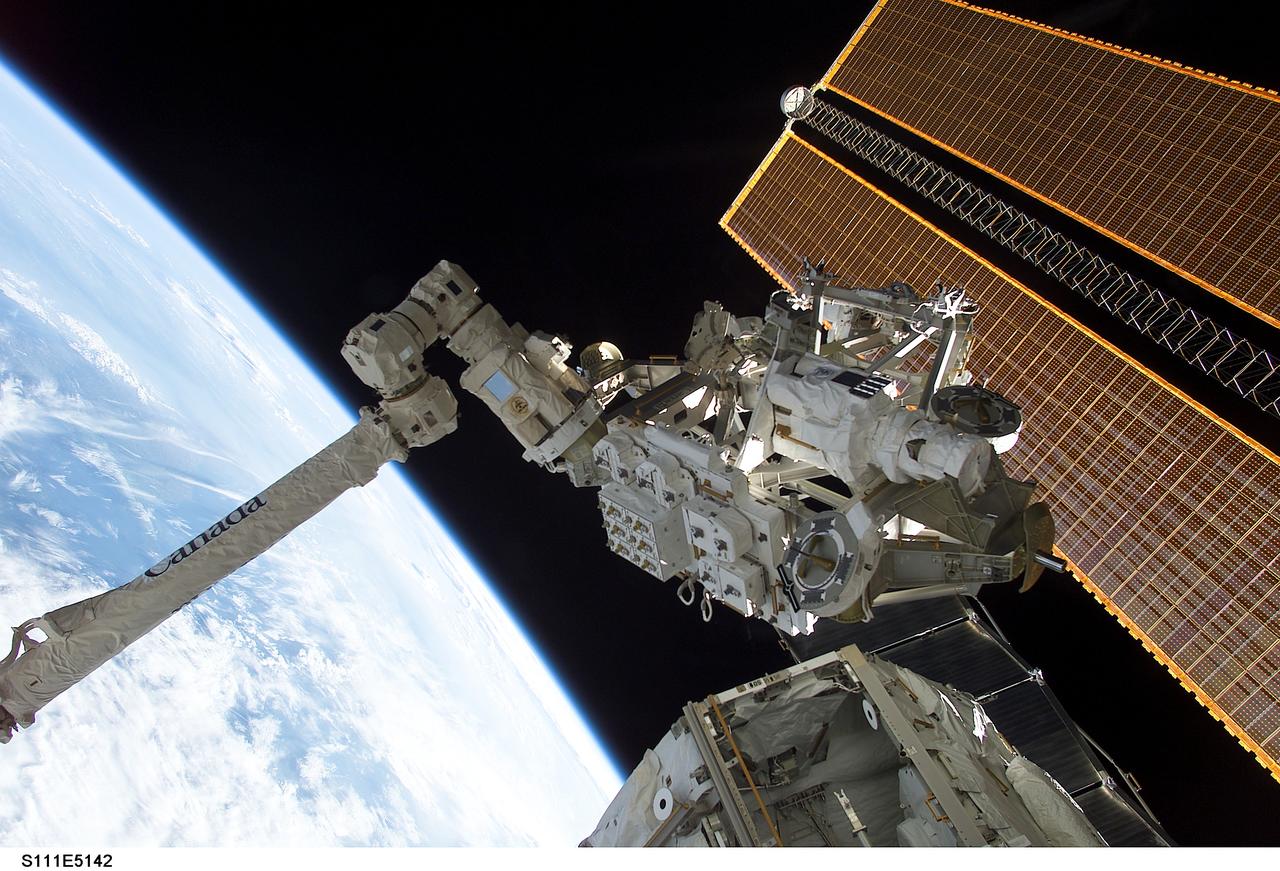
STS111-E-5142 (10 June 2002) --- Backdropped by the blackness of space and Earth’s horizon, the Mobile Remote Servicer Base System (MBS) is moved by the Canadarm2 for installation on the International Space Station (ISS). Astronauts Peggy A. Whitson, Expedition Five flight engineer, and Carl E. Walz, Expedition Four flight engineer, attached the MBS to the Mobile Transporter on the S0 (S-zero) Truss at 8:03 a.m. (CDT) on June 10, 2002. The MBS is an important part of the station’s Mobile Servicing System, which will allow the station’s robotic arm to travel the length of the station to perform construction tasks.
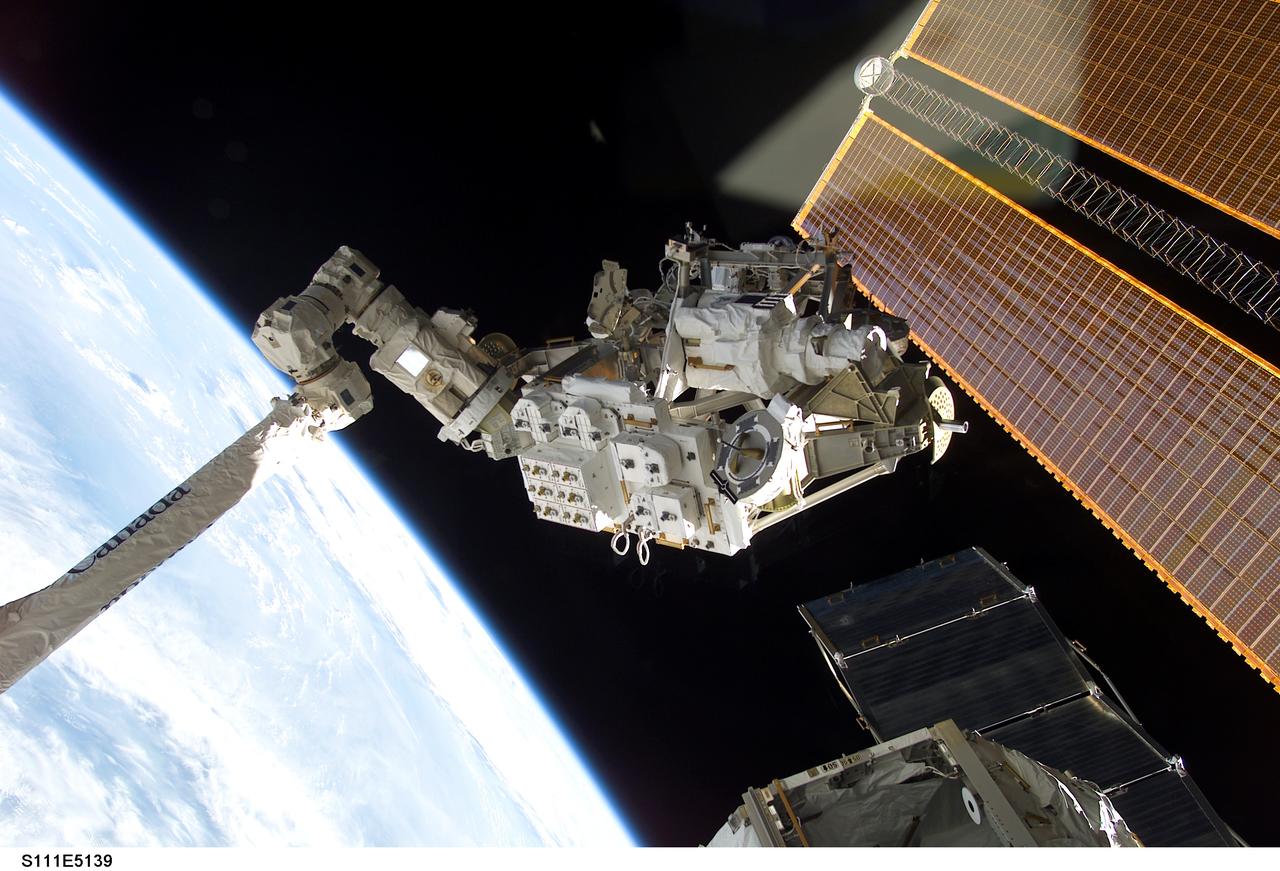
STS111-E-5139 (10 June 2002) --- Backdropped by the blackness of space and Earth’s horizon, the Mobile Remote Servicer Base System (MBS) is moved by the Canadarm2 for installation on the International Space Station (ISS). Astronauts Peggy A. Whitson, Expedition Five flight engineer, and Carl E. Walz, Expedition Four flight engineer, attached the MBS to the Mobile Transporter on the S0 (S-zero) Truss at 8:03 a.m. (CDT) on June 10, 2002. The MBS is an important part of the station’s Mobile Servicing System, which will allow the station’s robotic arm to travel the length of the station to perform construction tasks.
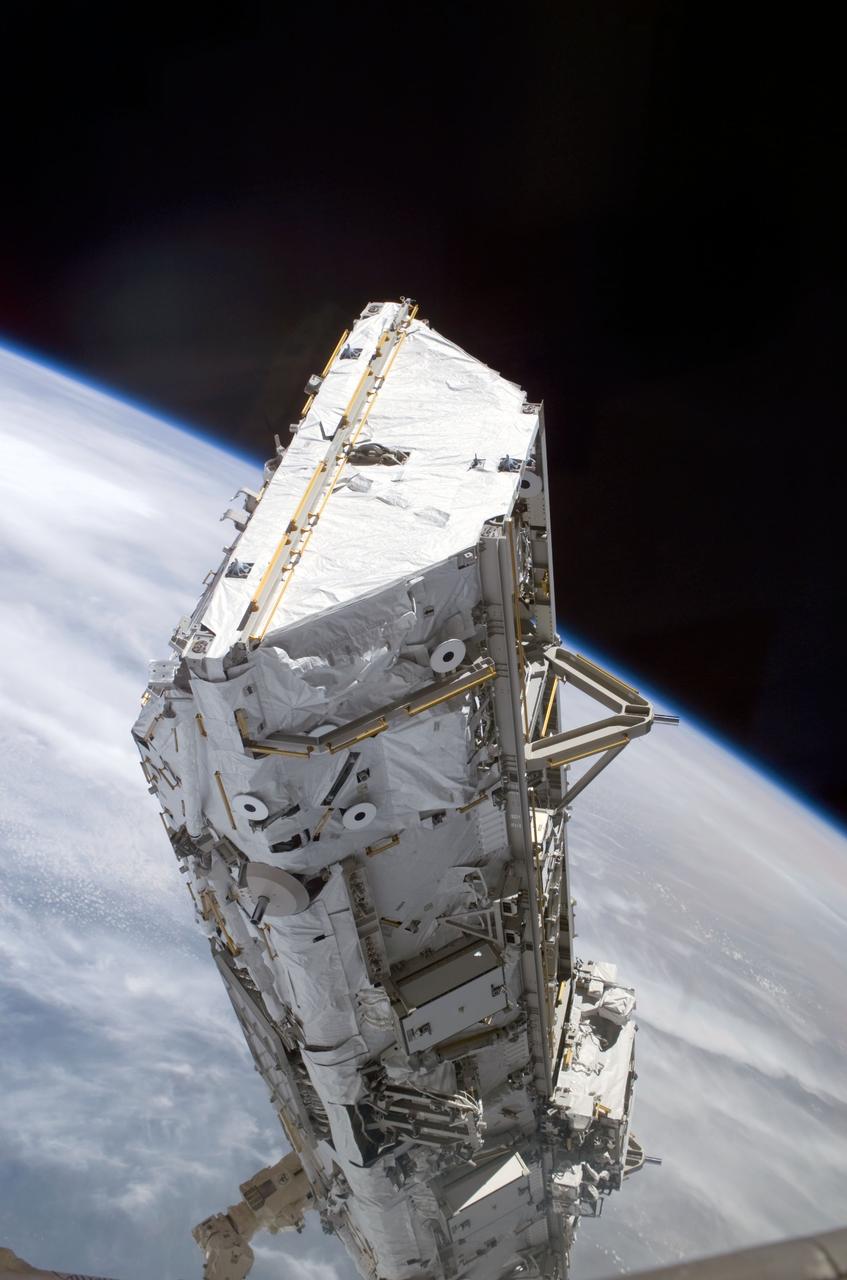
STS110-E-5170 (11 April 2002) --- Backdropped by the blackness of space and Earth’s horizon, the S0 (S-Zero) Truss is moved from the Space Shuttle Atlantis’ cargo bay. Astronauts Ellen Ochoa, STS-110 mission specialist, and Daniel W. Bursch, Expedition Four flight engineer, used the International Space Station’s (ISS) Canadarm2 to lift the S0 Truss out of the orbiter’s payload bay and install it onto the temporary claw fixture on the Destiny laboratory. The image was taken with a digital still camera.
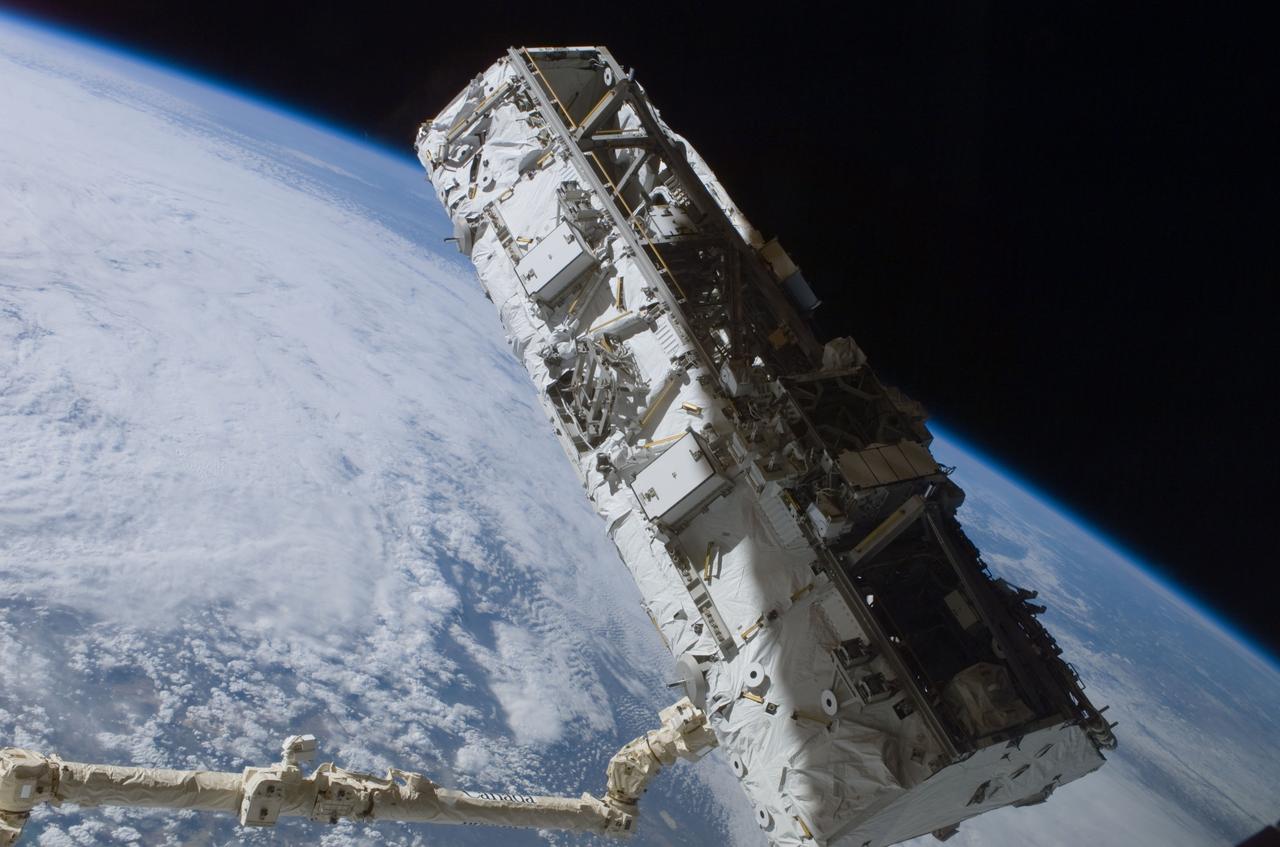
STS110-E-5174 (11 April 2002) --- Backdropped by the blackness of space and Earth’s horizon, the S0 (S-Zero) Truss is moved from the Space Shuttle Atlantis’ cargo bay. Astronauts Ellen Ochoa, STS-110 mission specialist, and Daniel W. Bursch, Expedition Four flight engineer, used the International Space Station’s (ISS) Canadarm2 to lift the S0 Truss out of the orbiter’s payload bay and install it onto the temporary claw fixture on the Destiny laboratory. The image was taken with a digital still camera.
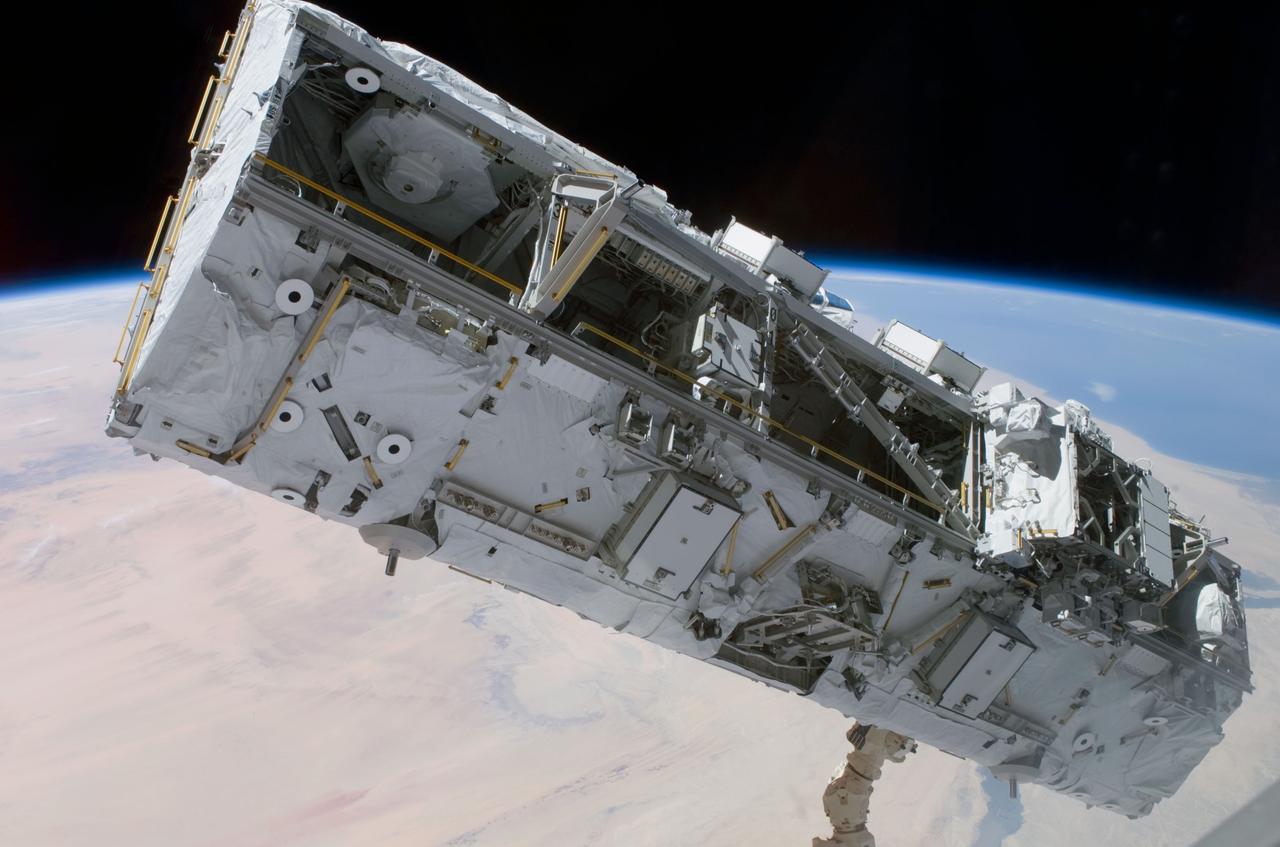
STS110-E-5172 (11 April 2002) --- Backdropped by the blackness of space and Earth’s horizon, the S0 (S-Zero) Truss is moved from the Space Shuttle Atlantis’ cargo bay. Astronauts Ellen Ochoa, STS-110 mission specialist, and Daniel W. Bursch, Expedition Four flight engineer, used the International Space Station’s (ISS) Canadarm2 to lift the S0 Truss out of the orbiter’s payload bay and install it onto the temporary claw fixture on the Destiny laboratory. The image was taken with a digital still camera.
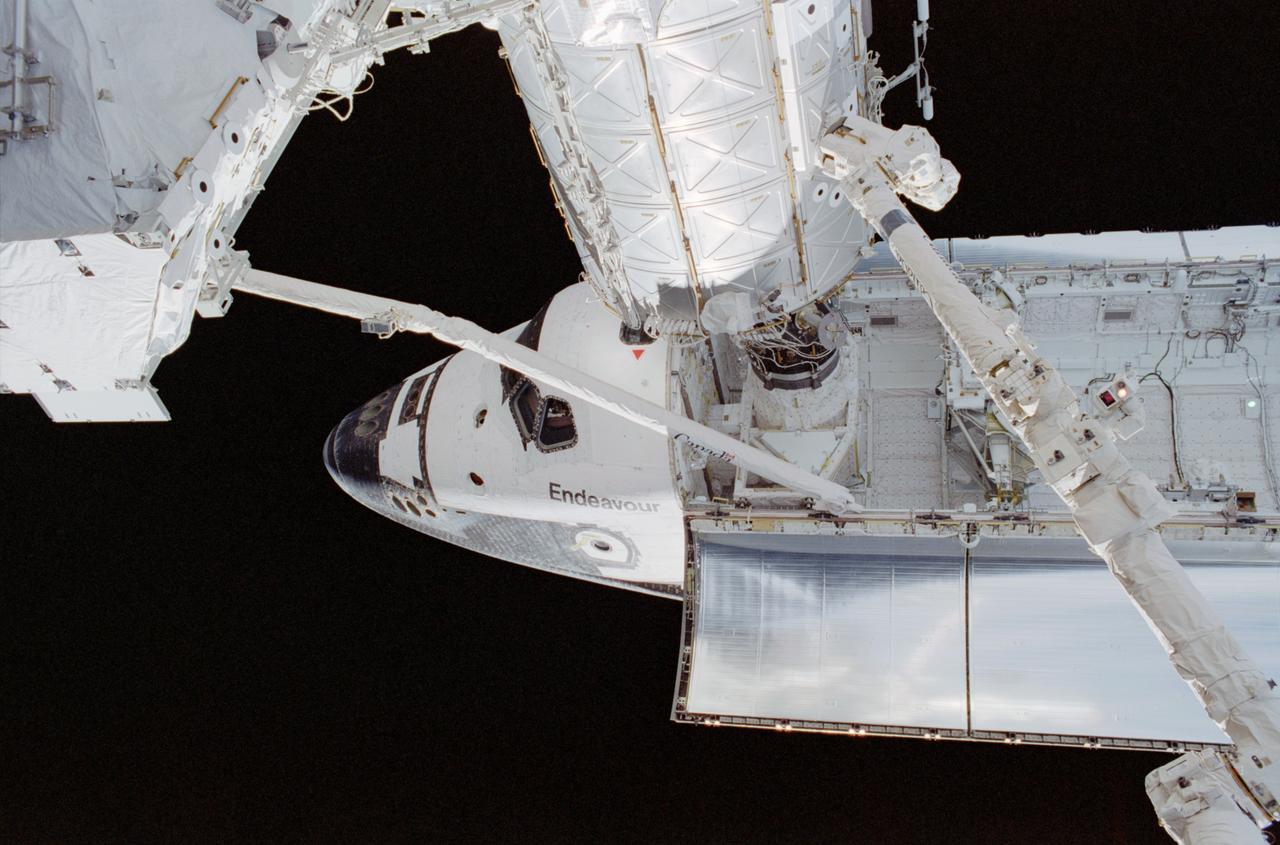
STS111-310-014 (9 June 2002) --- Backdropped by the blackness of space, the Space Shuttle Endeavour is pictured while docked to the Pressurized Mating Adapter (PMA-2) at the forward end of the Destiny laboratory on the International Space Station (ISS). A portion of the Canadarm2 is visible on the right and Endeavour’s robotic arm is in full view as it is stretched out with the S0 (S-zero) Truss at its end.
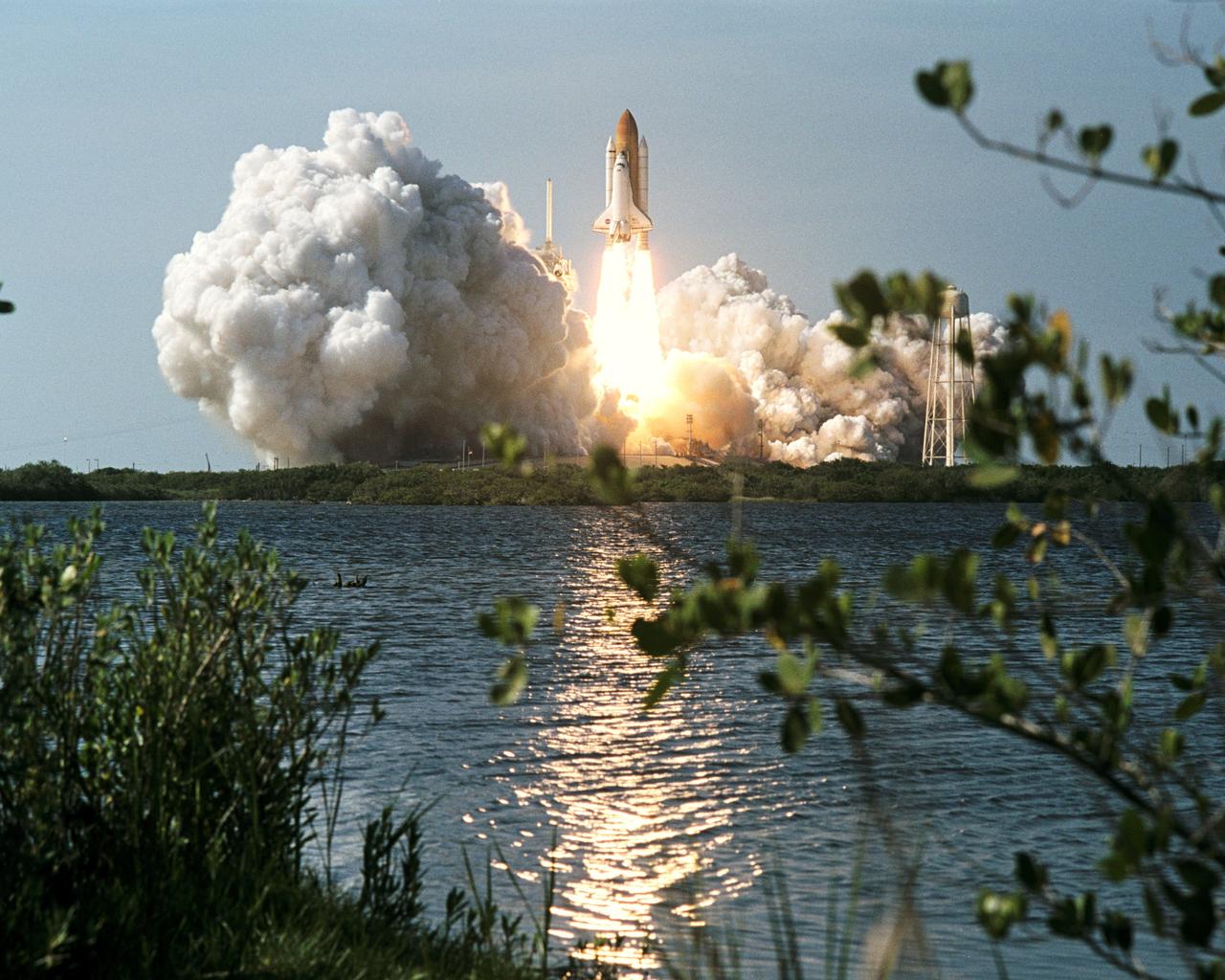
STS110-S-005 (8 April 2002) --- The Space Shuttle Atlantis lifts off from KSC's Launch Complex 39 at 4:44:19 p.m. (EDT), April 8, 2002. Seven astronauts were en route to the International Space Station (ISS) for a week of work on the orbital outpost, including the installation of the S0 (S-zero) truss.
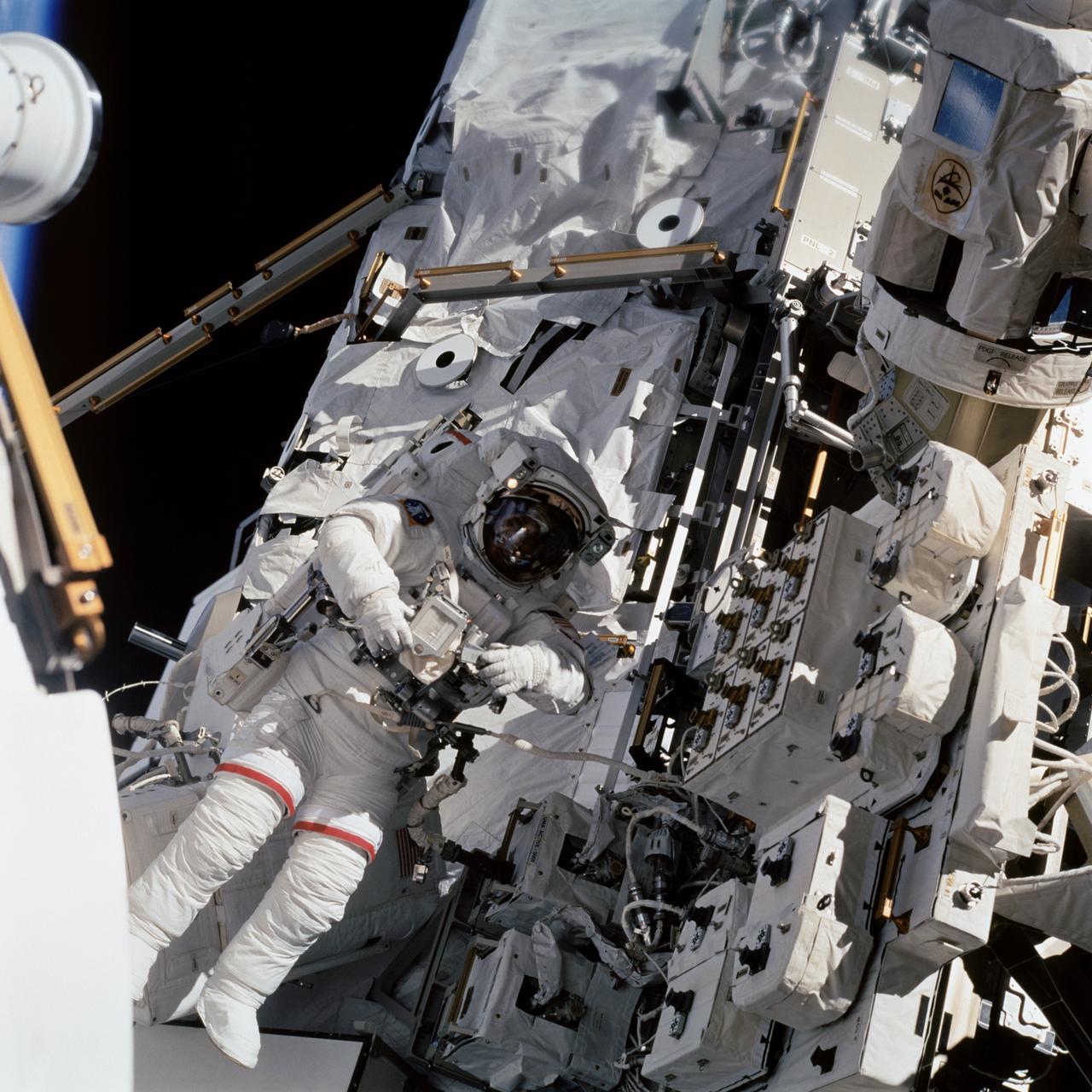
STS112-708-091 (14 October 2002) --- Astronaut David A. Wolf, STS-112 mission specialist, works near the S0 (S-Zero) Truss on the International Space Station (ISS) during the mission’s third and final scheduled session of extravehicular activity (EVA). The airlock spur, a route used by spacewalkers to get from the Quest airlock on the station to the outpost's truss, is visible in the upper left portion of the frame.
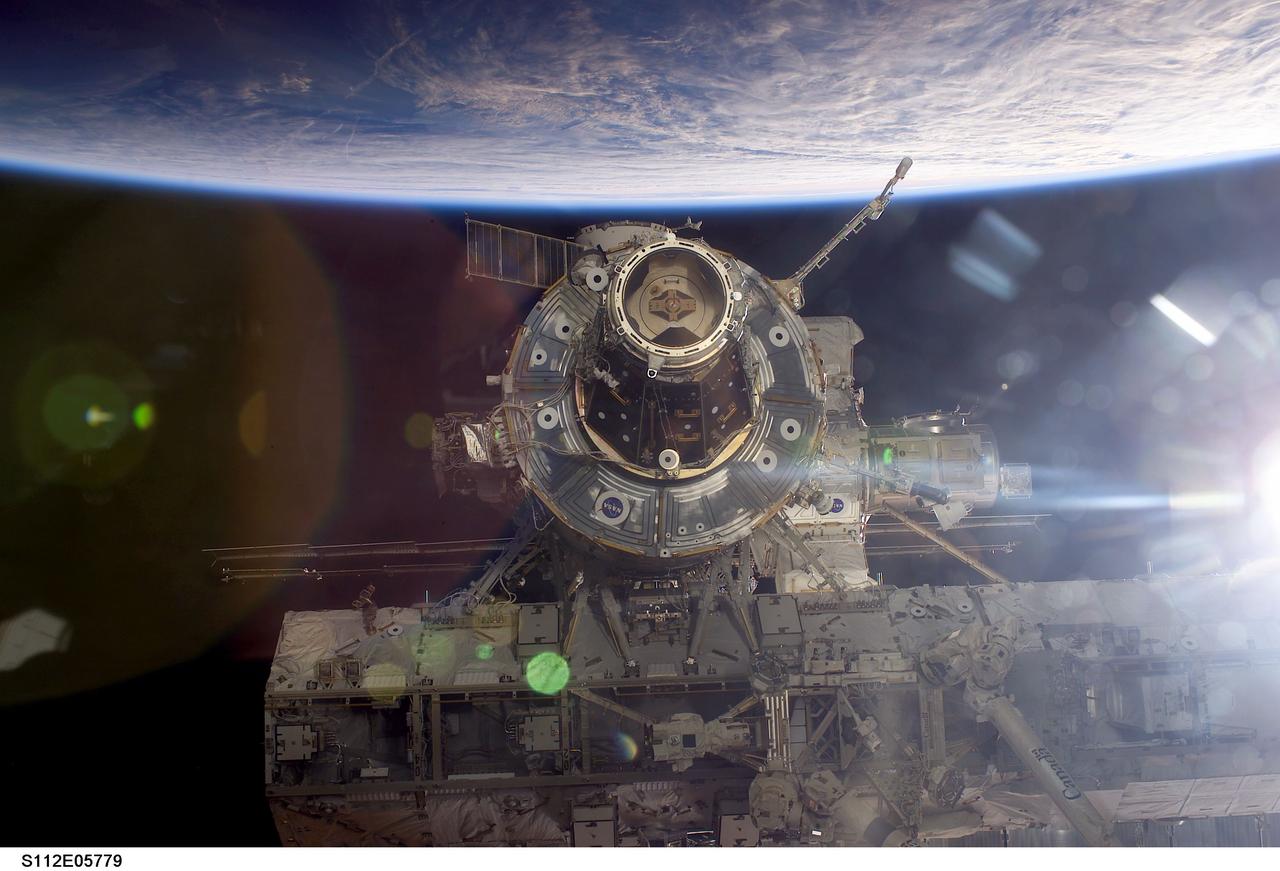
STS112-E-05779 (16 October 2002) --- Backdropped by the blackness of space and Earth’s horizon, this close-up view of the International Space Station (ISS) was photographed by a crewmember on board the Space Shuttle Atlantis following the undocking of the two spacecraft. Atlantis pulled away from the complex at 8:13 a.m. (CDT) on October 16, 2002. The S0 (S-Zero) Truss and a portion of the newly added Starboard One (S1) Truss are visible in lower frame.
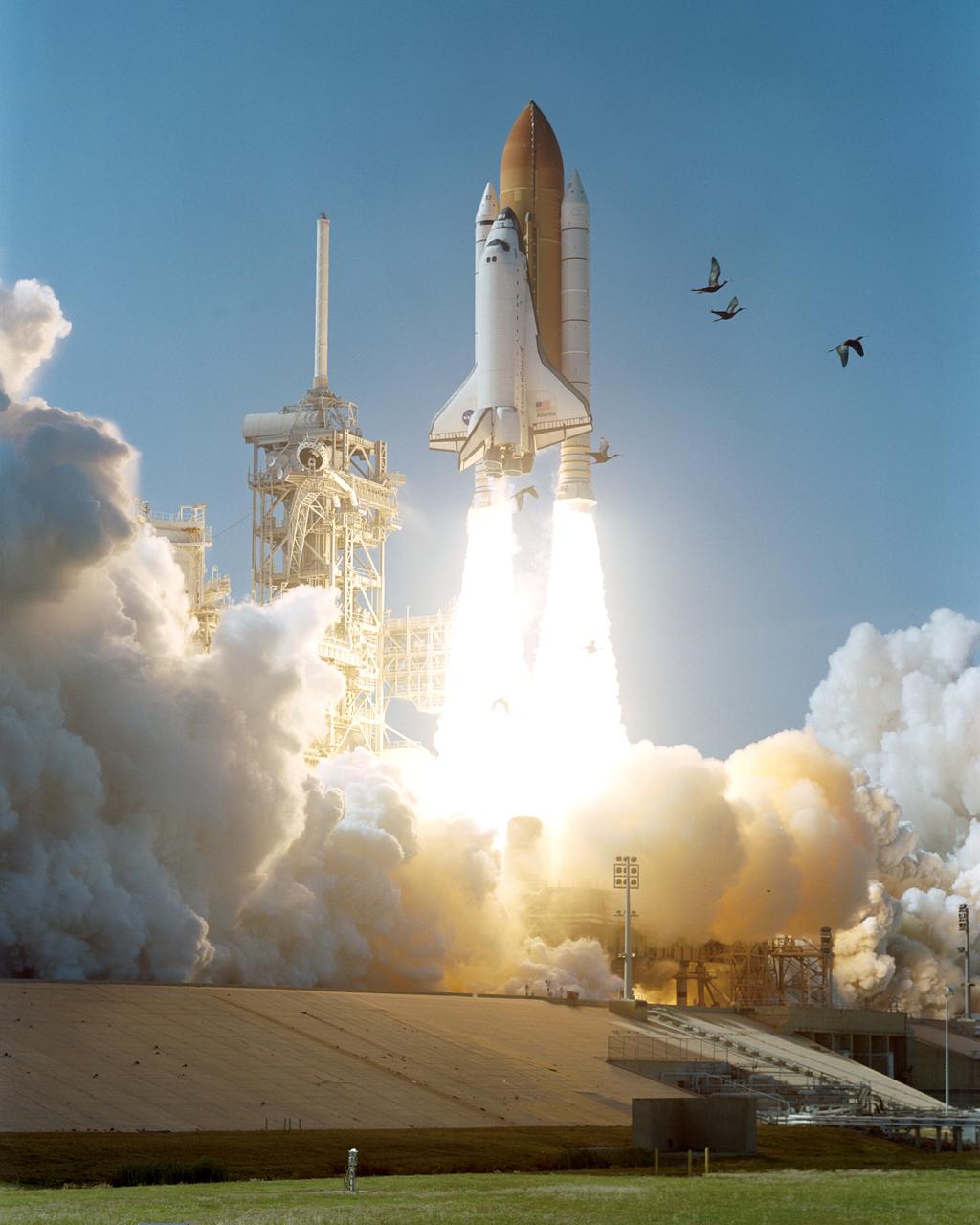
STS110-S-009 (8 April 2002) --- A number of birds take flight as the Space Shuttle Atlantis lifts off from KSC's Launch Complex 39 at 4:44:19 p.m. (EDT), April 8, 2002. Seven astronauts were en route to the International Space Station (ISS) for a week of work on the orbital outpost, including the installation of the S0 (S-zero) truss.
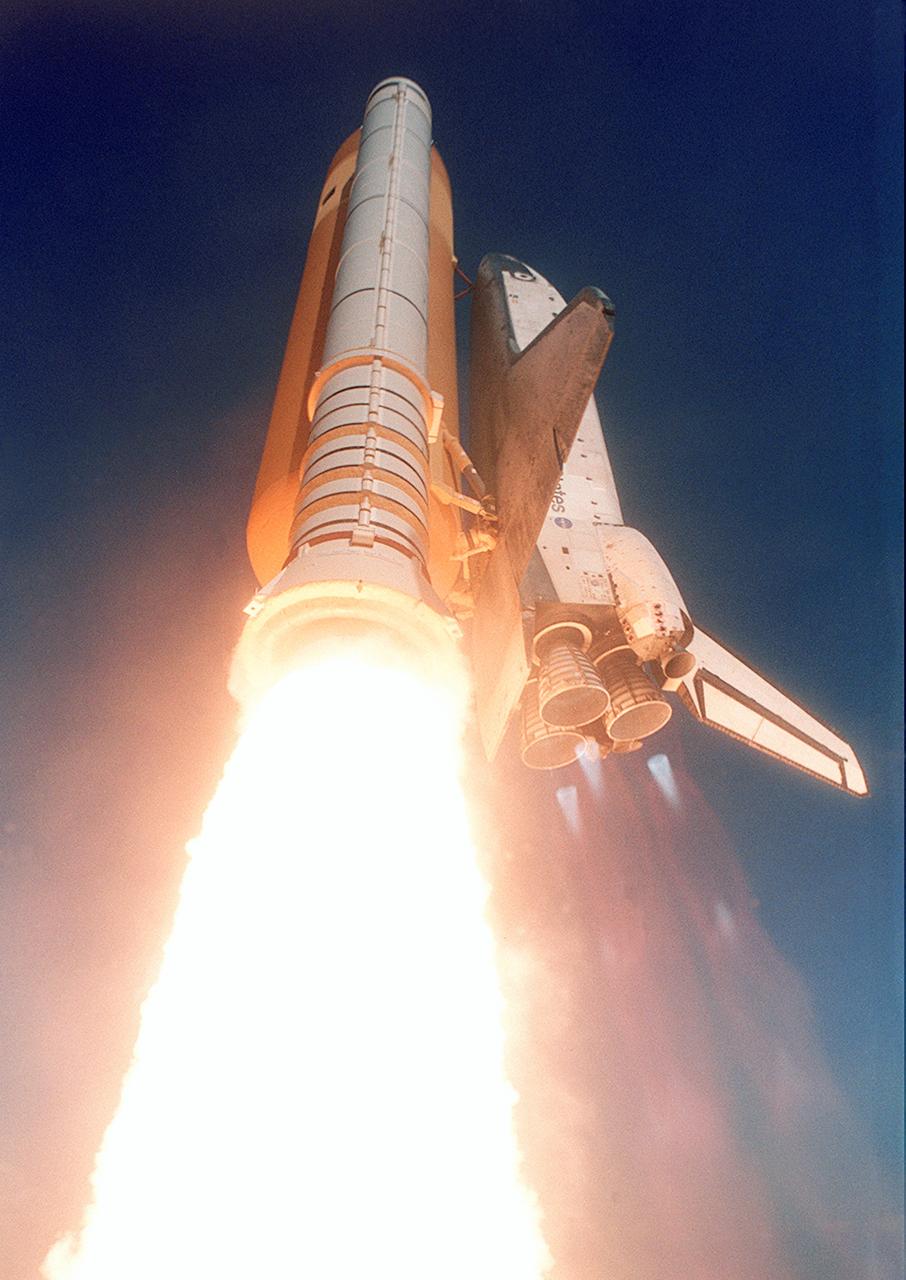
STS110-S-046 (8 April 2002) --- A low-angle still photo captures the Space Shuttle Atlantis lifting off from KSC's Launch Complex 39 at 4:44:19 p.m. (EDT), April 8, 2002. Seven astronauts were en route to the International Space Station (ISS) for a week of work on the orbital outpost, including the installation of the S0 (S-zero) truss--centerpiece of the station's main truss.
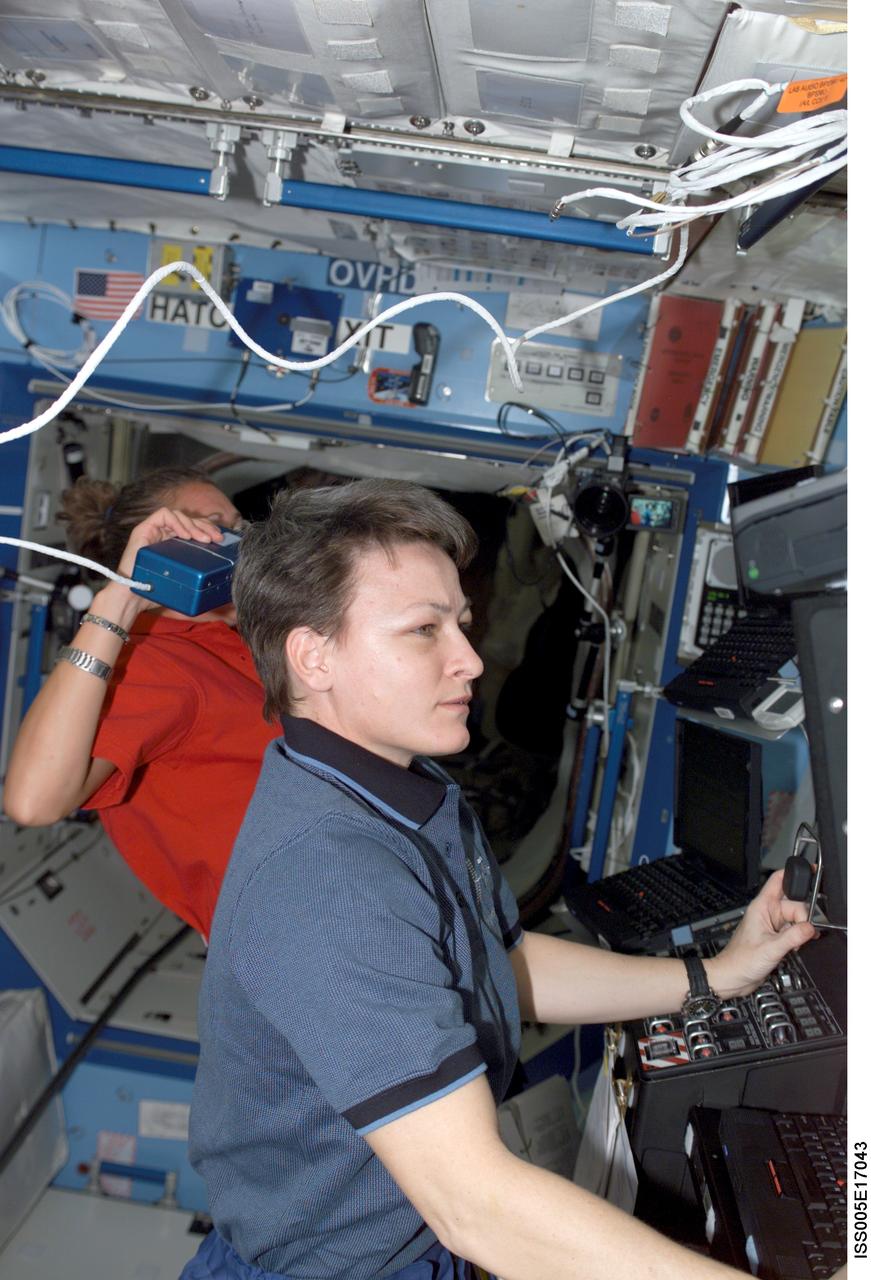
ISS005-E-17043 (10 October 2002) --- Astronauts Peggy A. Whitson (foreground), Expedition Five flight engineer, and Sandra H. Magnus, STS-112 mission specialist, work the controls of the Canadarm2 from inside the Destiny laboratory on the International Space Station (ISS). Whitson and Magnus used the station’s robotic arm to lift the Starboard One (S1) Truss out of the Atlantis’ payload bay and move it into position on the starboard end of the S0 (S-Zero) Truss.

STS110-S-015 (8 April 2002) --- The Space Shuttle Atlantis lifts off from KSC's Launch Complex 39 at 4:44:19 p.m. (EDT), April 8, 2002. Seven astronauts were en route to the International Space Station (ISS) for a week of work on the orbital outpost, including the installation of the S0 (S-zero) truss--centerpiece of the station's main truss.
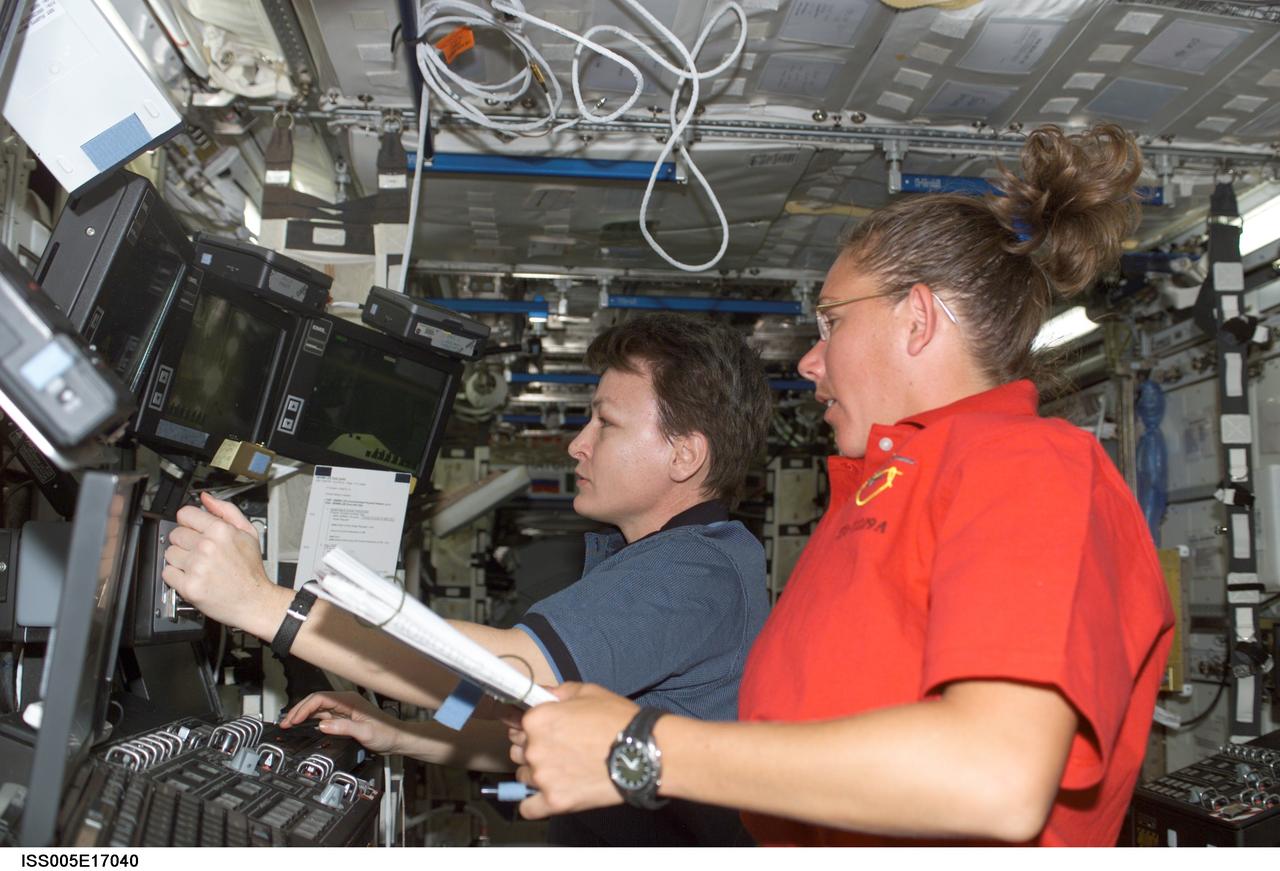
ISS005-E-17040 (10 October 2002) --- Astronauts Peggy A. Whitson (background), Expedition Five flight engineer, and Sandra H. Magnus, STS-112 mission specialist, work the controls of the Canadarm2 from inside the Destiny laboratory on the International Space Station (ISS). Whitson and Magnus used the station’s robotic arm to lift the Starboard One (S1) Truss out of the Atlantis’ payload bay and move it into position on the starboard end of the S0 (S-Zero) Truss.
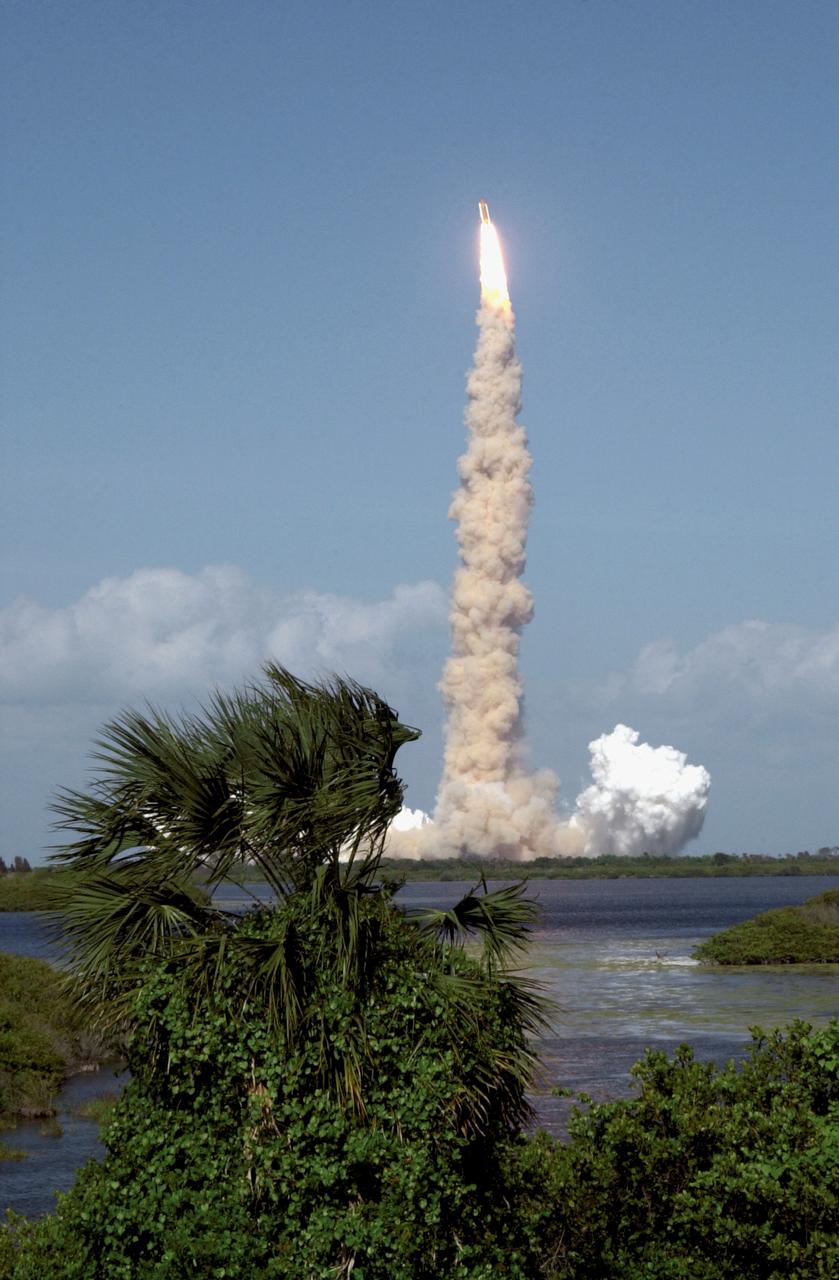
STS110-S-020 (8 April 2002) --- As seen from a few miles away, the Space Shuttle Atlantis lifts off from KSC's Launch Complex 39 at 4:44:19 p.m. (EDT), April 8, 2002. Seven astronauts were en route to the International Space Station (ISS) for a week of work on the orbital outpost, including the installation of the S0 (S-zero) truss--centerpiece of the station's main truss.
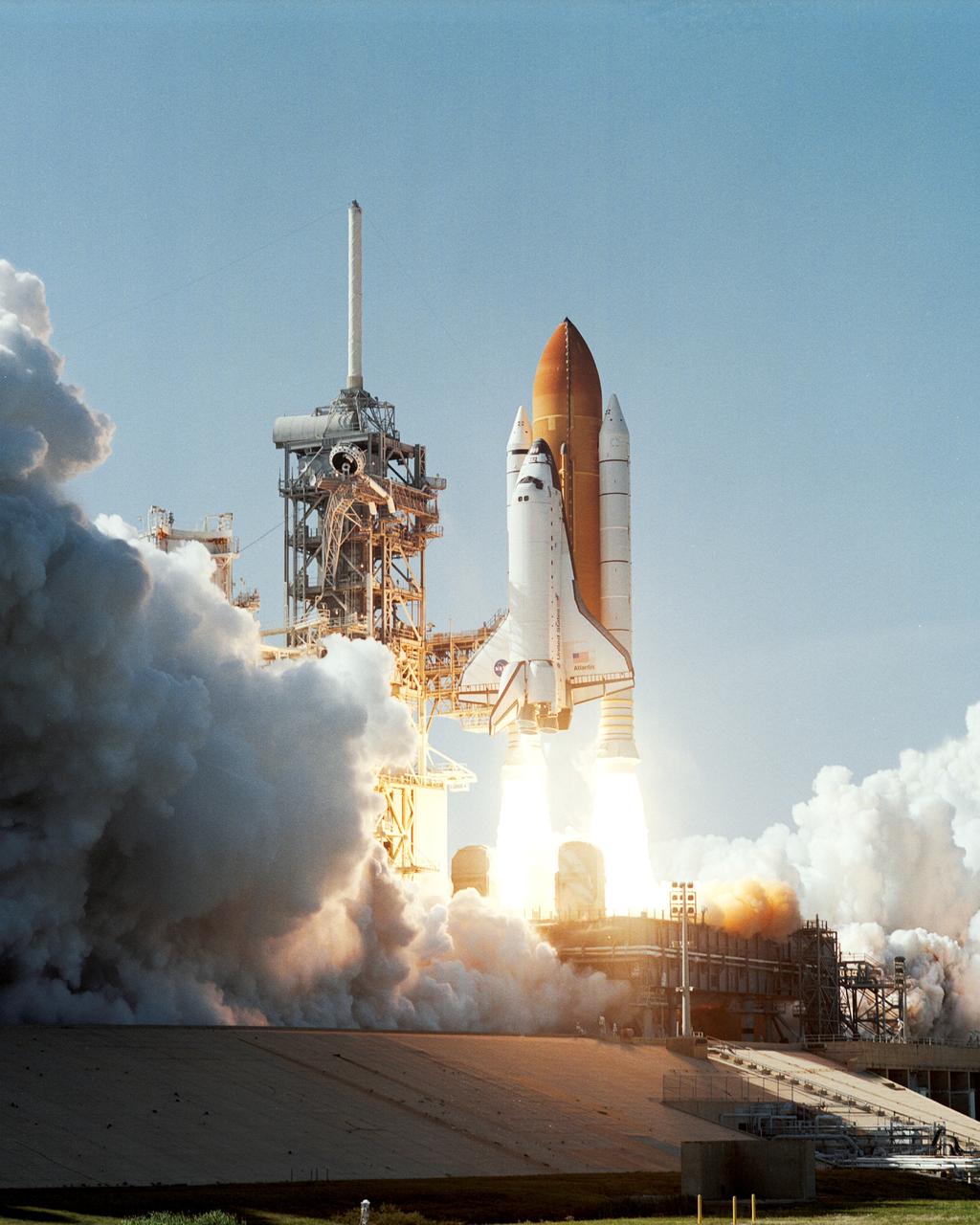
STS110-S-006 (8 April 2002) --- The Space Shuttle Atlantis lifts off from KSC's Launch Complex 39 at 4:44:19 p.m. (EDT), April 8, 2002. Seven astronauts were en route to the International Space Station (ISS) for a week of work on the orbital outpost, including the installation of the S0 (S-zero) truss.
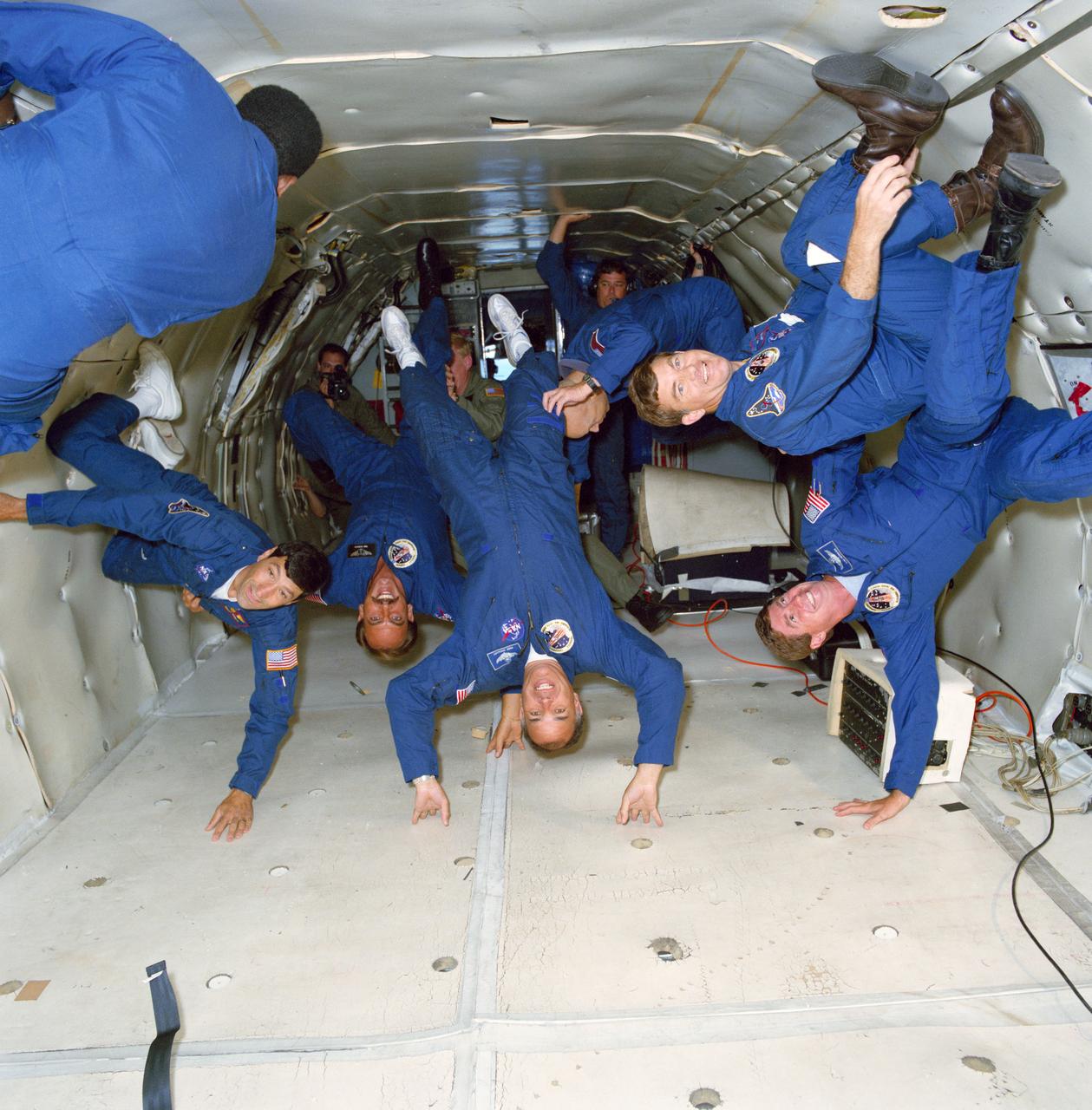
S91-38355 (28 May 1991) --- Seen floating about the vacant spaces of the Johnson Space Center's KC-135 "zero-gravity" aircraft are the six crewmembers for the STS 44 mission. Left to right are Terence T. Henricks, James S. Voss, F. Story Musgrave (partially obscured), Frederick D. Gregory, Thomas J. Hennen and Mario Runco Jr. Gregory is mission commander. Hennen is payload specialist for this flight, dedicated to the Department of Defense. The flight served as a refresher and a preview of the experience of weightlessness, as the special aircraft flew a series of parabolas which provided short sessions of zero-gravity.
S91-38355 (28 May 1991) --- Seen floating about the vacant spaces of the Johnson Space Center's KC-135 "zero-gravity" aircraft are the six crewmembers for the STS 44 mission. Left to right are Terence T. Henricks, James S. Voss, F. Story Musgrave (partially obscured), Frederick D. Gregory, Thomas J. Hennen and Mario Runco Jr. Gregory is mission commander. Hennen is payload specialist for this flight, dedicated to the Department of Defense. The flight served as a refresher and a preview of the experience of weightlessness, as the special aircraft flew a series of parabolas which provided short sessions of zero-gravity.
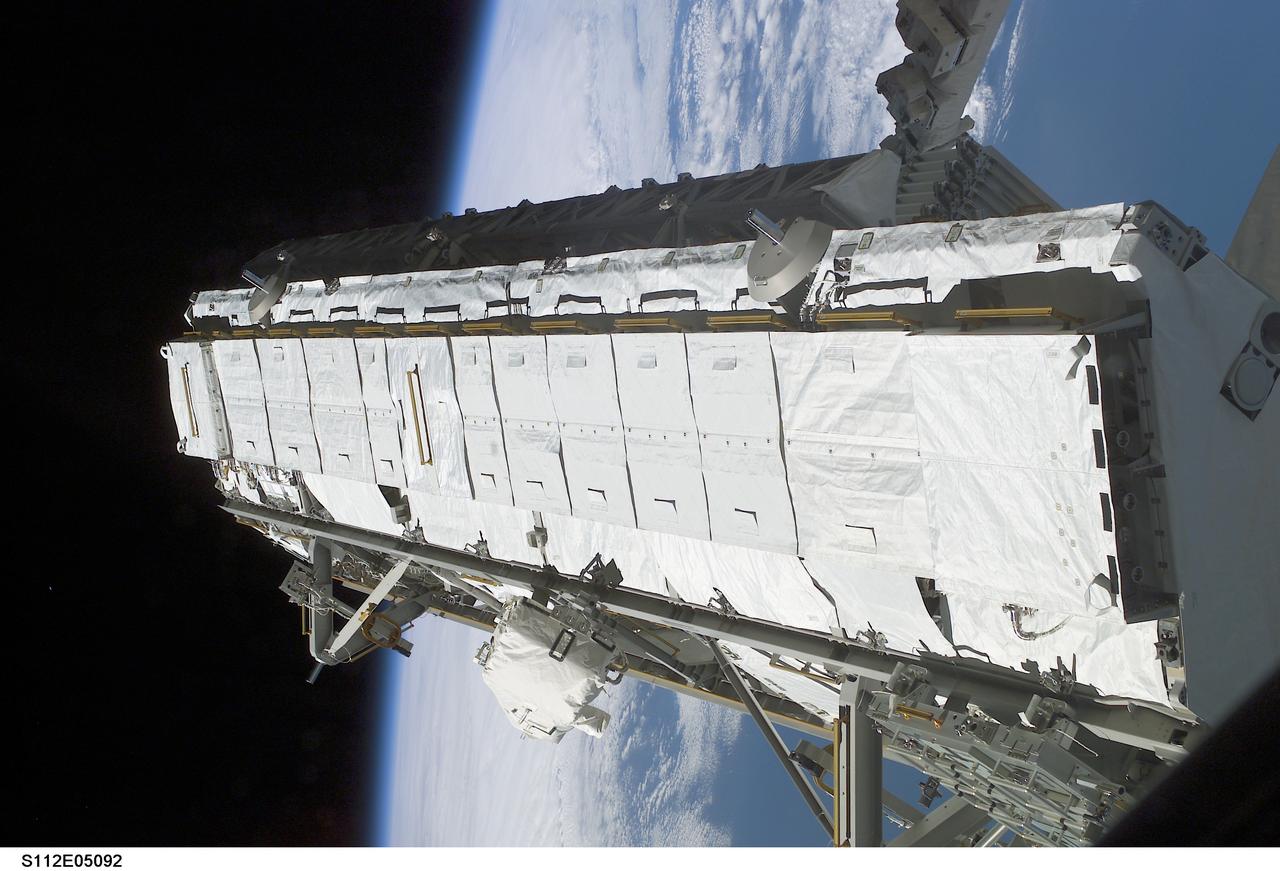
STS112-E-05092 (10 October 2002) --- Backdropped by the blackness of space and Earth’s horizon, the Starboard One (S1) Truss is moved from the Space Shuttle Atlantis’ cargo bay. Astronauts Sandra H. Magnus, STS-112 mission specialist, and Peggy A. Whitson, Expedition Five flight engineer, used the Canadarm2 from inside Destiny laboratory on the International Space Station (ISS) to lift the S1 Truss out of the orbiter’s payload bay and move it into position at the starboard end of the S0 (S-Zero) Truss.
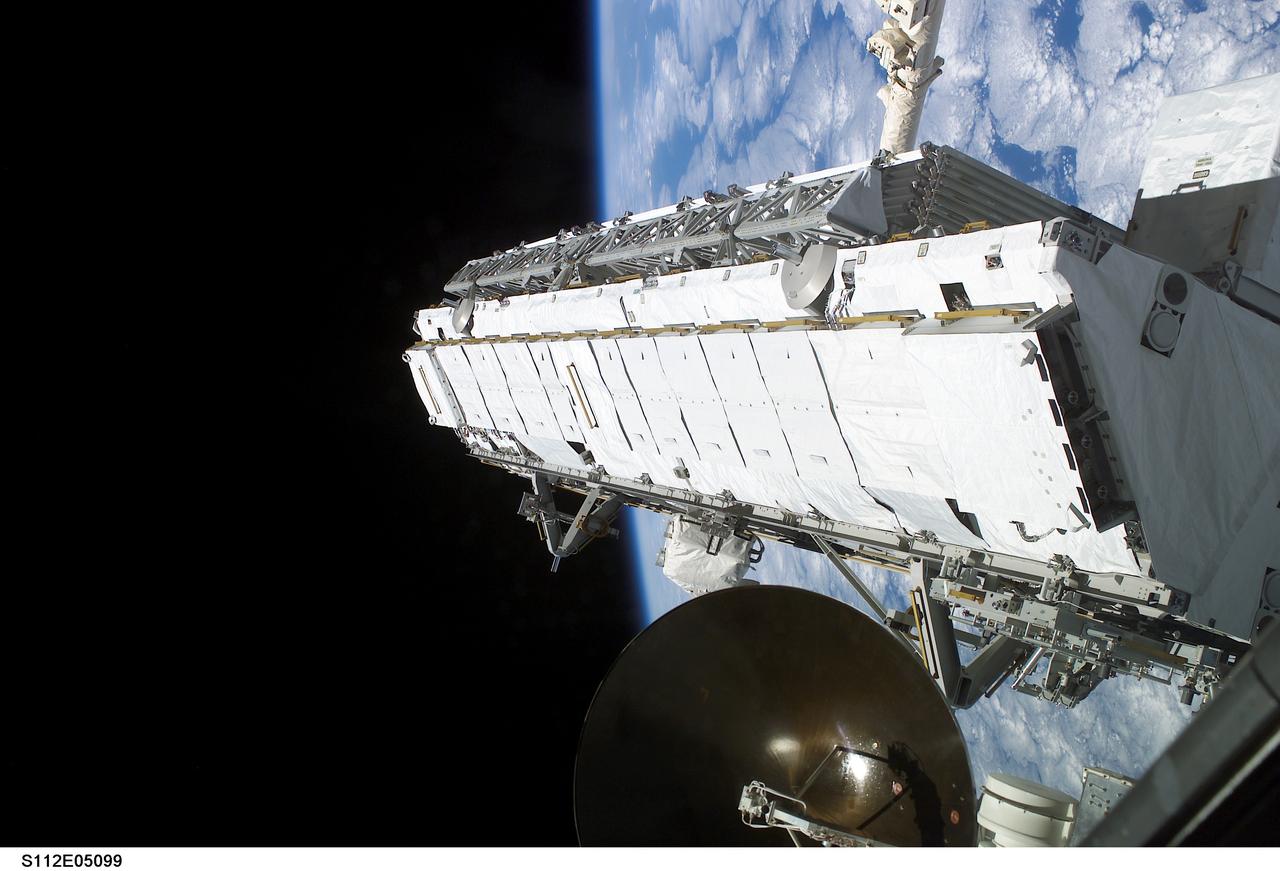
STS112-E-05099 (10 October 2002) --- Backdropped by the blackness of space and Earth’s horizon, the Starboard One (S1) Truss is moved from the Space Shuttle Atlantis’ cargo bay. Astronauts Sandra H. Magnus, STS-112 mission specialist, and Peggy A. Whitson, Expedition Five flight engineer, used the Canadarm2 from inside Destiny laboratory on the International Space Station (ISS) to lift the S1 Truss out of the orbiter’s payload bay and move it into position at the starboard end of the S0 (S-Zero) Truss.
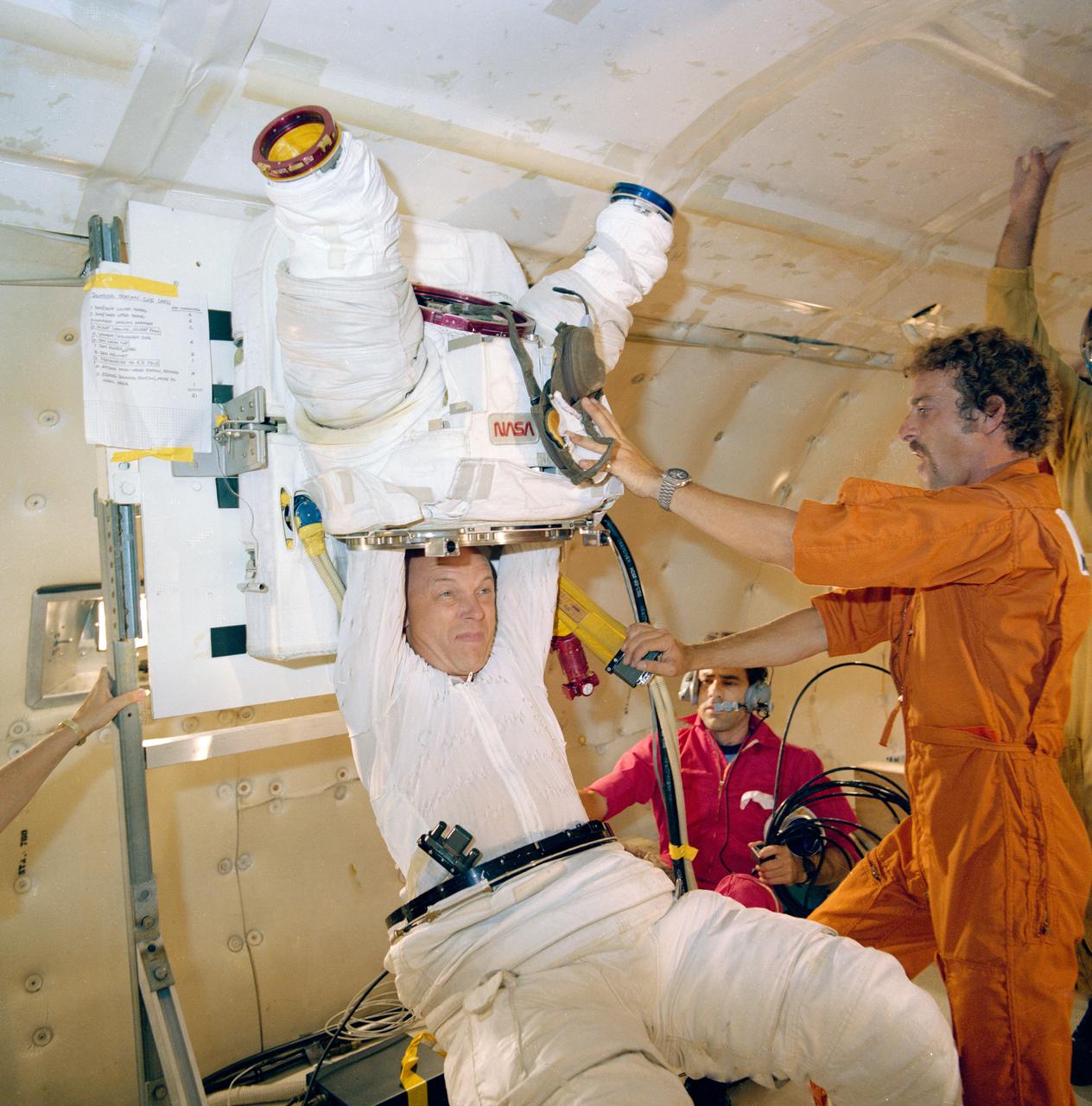
S82-33603 (November 1982) --- Astronaut F. Story Musgrave, STS-6 mission specialist, is assisted in a suit donning and doffing exercise in the weightlessness provided by a KC-135 ?zero-gravity? aircraft. Dr. Musgrave and the next mission?s other mission specialist, astronaut Donald H. Peterson, participated in the donning and doffing as a simulation for their preparations aboard the Challenger when they are called upon to perform an extravehicular activity (EVA) which was postponed from NASA?s first operational STS flight earlier this month. The suit is called an Extravehicular Mobility Unit (EMU). Photo credit: NASA
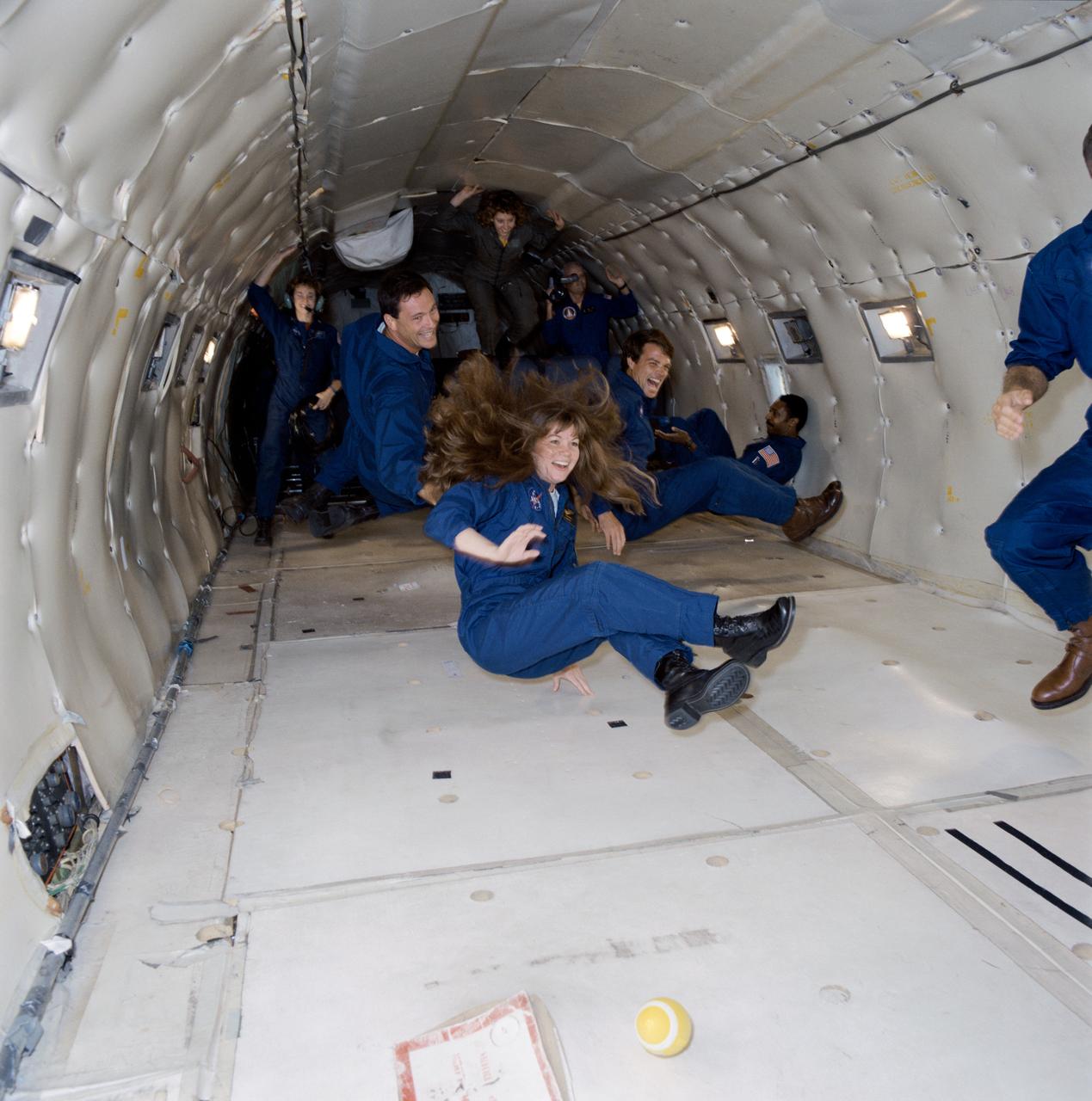
S94-26350 (10 Jan. 1994) --- Astronaut Catherine G. Coleman seems to enjoy the brief period of weightlessness she is sharing with fellow members of the 1992 class of astronauts. The weightless experience was afforded by a special parabolic pattern flown by NASA?s KC-135 ?zero gravity? aircraft. Left to right behind her are astronauts Michael E. Lopez-Alegria, Kevin R. Kregel and Winston E. Scott. EDITOR?S NOTE: Since this photograph was taken the four have been named to flights as follows: Kregel, STS-70; Scott, STS-72.
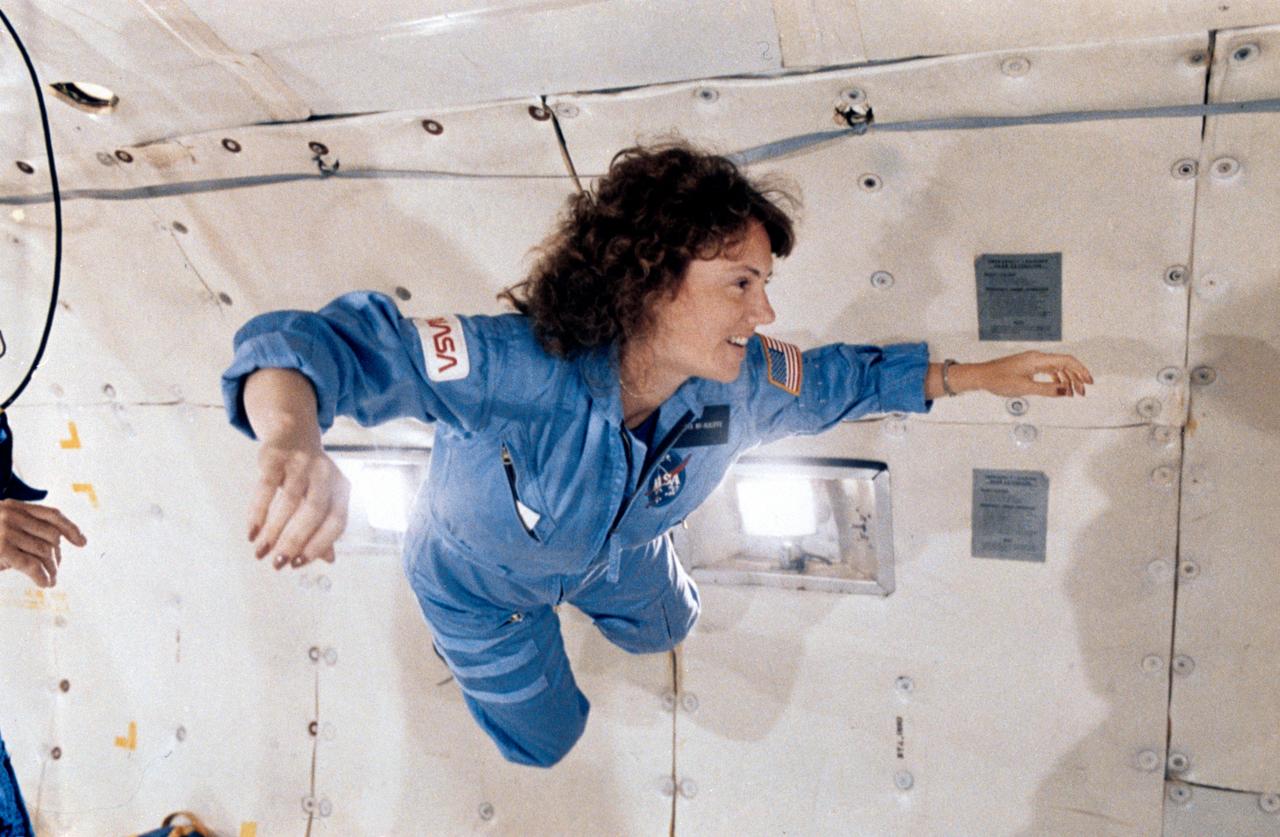
S86-25196 (January 1986) --- Sharon Christa McAuliffe, STS-51L citizen observer/payload specialist, gets a preview of microgravity during a special flight aboard NASA?s KC-135 ?zero gravity? aircraft. McAuliffe will represent the Teacher-in-Space Project aboard the space shuttle Challenger when it launches later this month. This photograph was taken by Keith Meyers of the New York Times. EDITOR?S NOTE: The STS-51L crew members lost their lives in the space shuttle Challenger accident moments after launch on Jan. 28, 1986 from the Kennedy Space Center (KSC). Photo credit: NASA
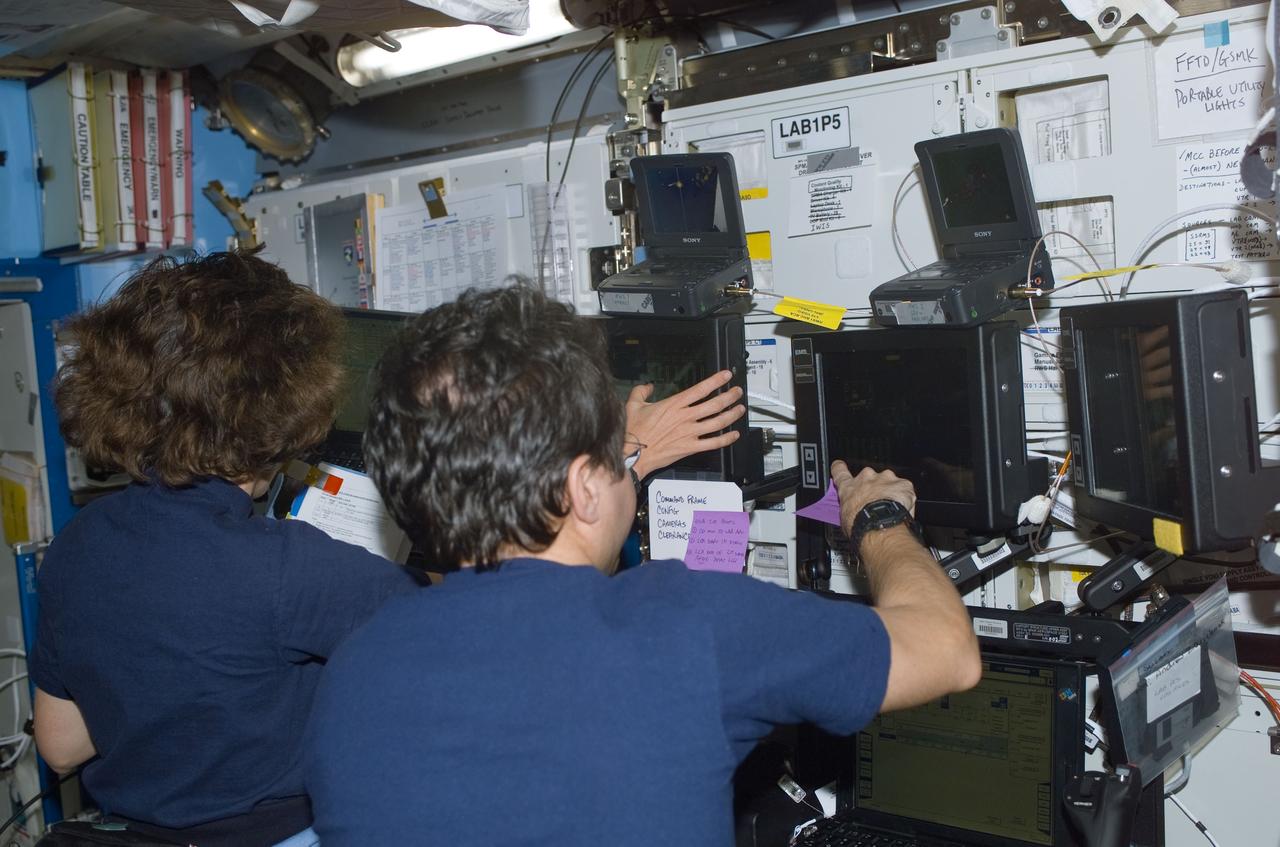
STS110-E-5182 (11 April 2002) --- Astronauts Ellen Ochoa (left), STS-110 mission specialist, and Daniel W. Bursch, Expedition Four flight engineer, work the controls of the Canadarm2 in the Destiny laboratory on the International Space Station (ISS). Ochoa and Bursch used the robotic arm to lift the S0 (S-Zero) Truss out of Space Shuttle Atlantis’ payload bay and installed it onto the temporary claw fixture on the Destiny laboratory. The image was taken with a digital still camera.
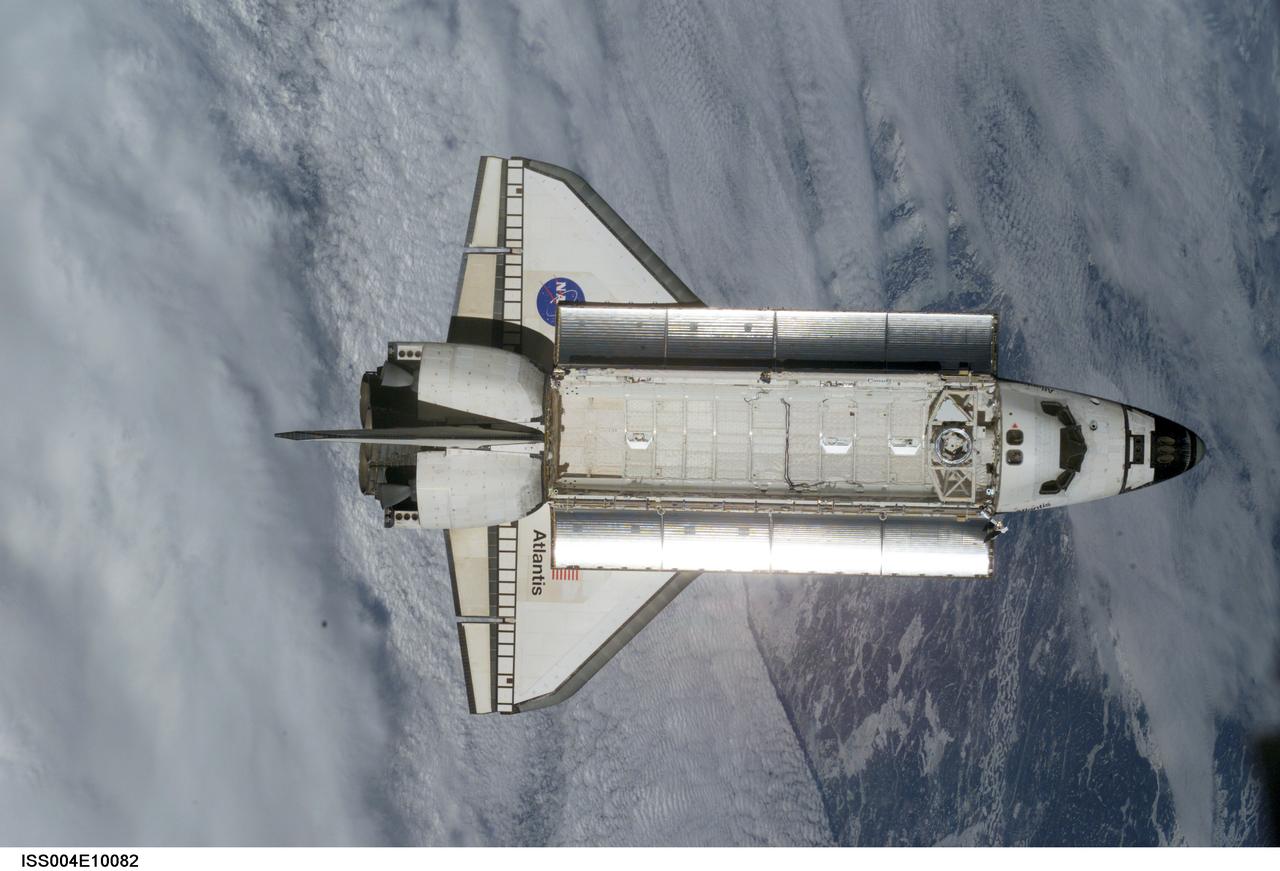
ISS004-E-10082 (17 April 2002) --- Backdropped over clouds some 247 statute miles below, the Space Shuttle Atlantis was photographed with a digital still camera shortly after its separation from the International Space Station (ISS). A big empty space now replaces the "look" in the cargo bay of a scene one and half weeks ago showing the giant S0 (S-zero) truss in the cargo bay as the shuttle prepared to dock with the station. The S0 truss is now part of the orbital outpost.
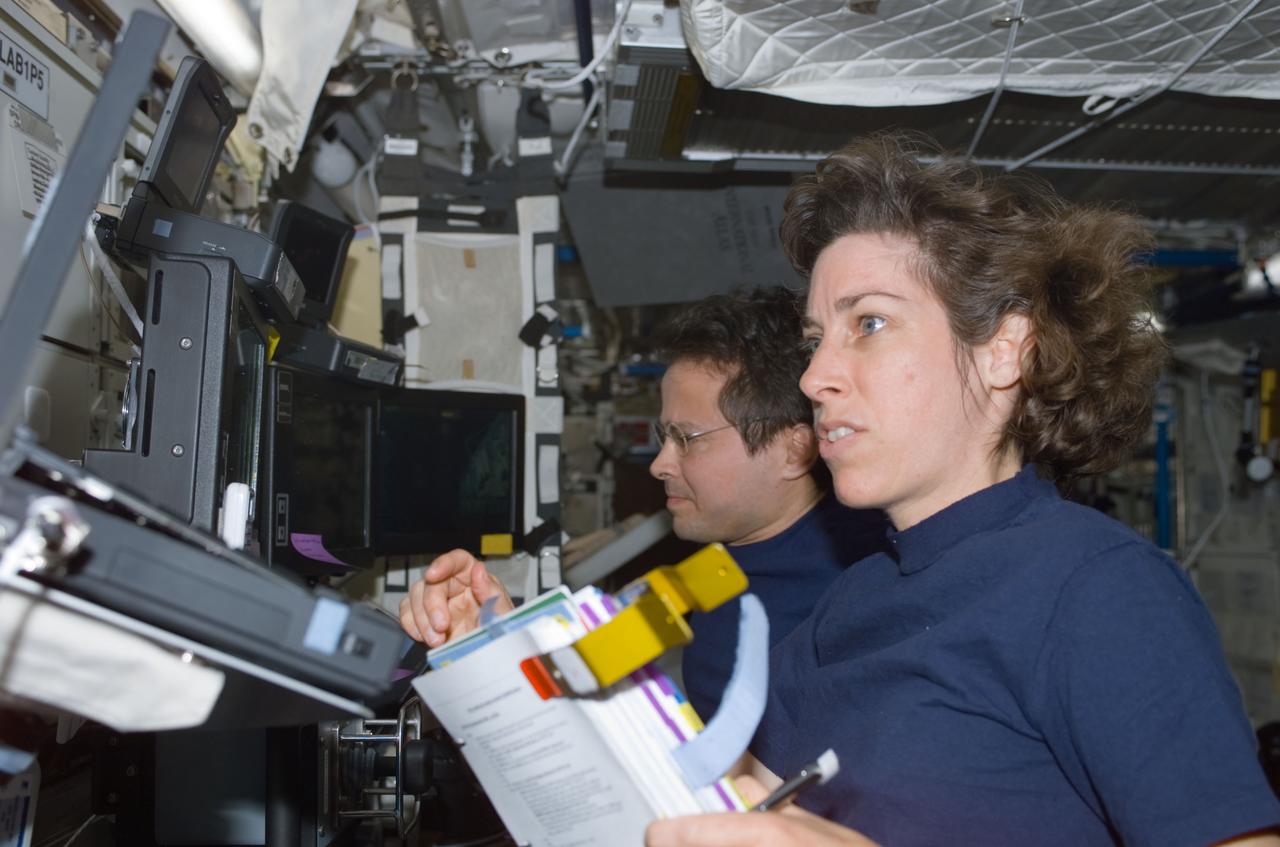
STS110-E-5186 (11 April 2002) --- Astronauts Ellen Ochoa (foreground), STS-110 mission specialist, and Daniel W. Bursch, Expedition Four flight engineer, work the controls of the Canadarm2 in the Destiny laboratory on the International Space Station (ISS). Ochoa and Bursch used the robotic arm to lift the S0 (S-Zero) Truss out of Space Shuttle Atlantis? payload bay and installed it onto the temporary claw fixture on the Destiny laboratory. The image was taken with a digital still camera. Photo credit: NASA

STS112-E-5333 (12 October 2002) --- A high angle view of the S0 (S-zero) truss which was photographed during a six hour, four minute spacewalk, the second of three scheduled for the STS-112 mission. Astronauts Piers J. Sellers and David A. Wolf are the assigned spacewalkers for all three. The airlock spur, a route used by spacewalkers to get from the Quest airlock on the International Space Station (ISS) to the outpost's truss, is visible in the upper right portion of the frame.
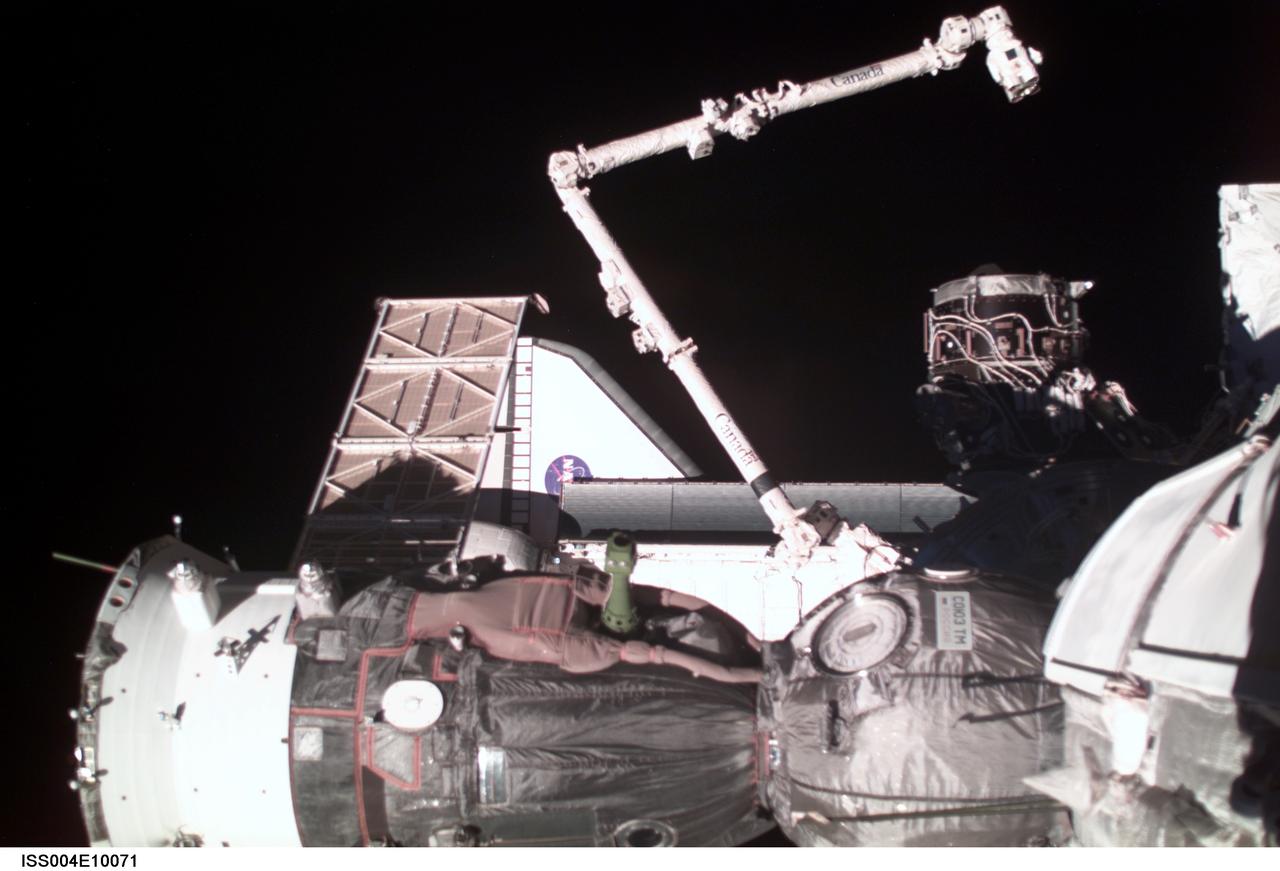
ISS004-E-10071 (17 April 2002) --- Moments prior to the undocking of the Space Shuttle Atlantis from the International Space Station (ISS), an Expedition Four crewmember took this digital still photograph from a window in the Pirs Docking Compartment. The STS-110 crew spent about a week aboard the ISS and successfully installed the S0 (S-zero) truss. Also visible in this image are the Soyuz Spacecraft, Space Station Remote Manipulator System (SSRMS) / Canadarm2 and Pressurized Mating Adapter 3 (PMA3).
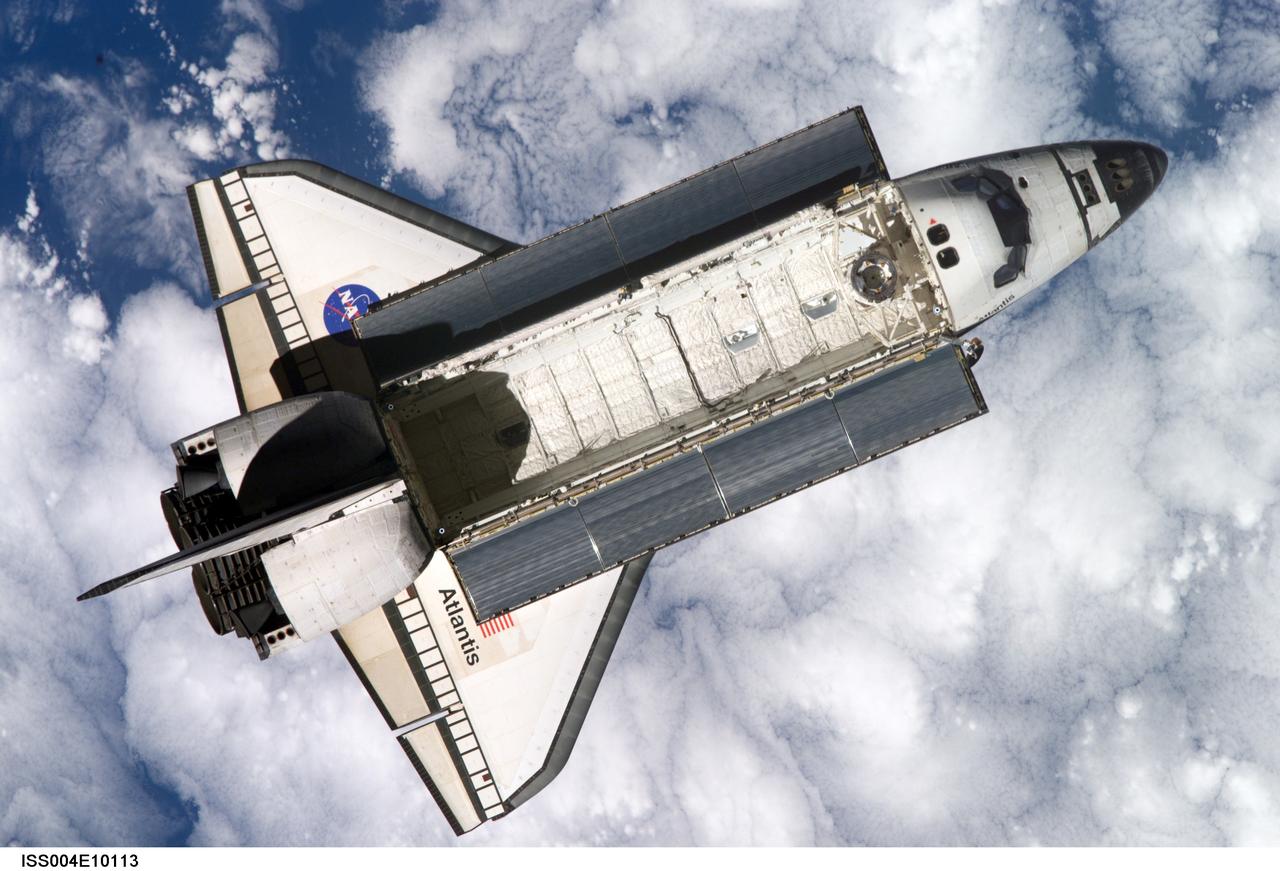
ISS004-E-10113 (17 April 2002) --- Backdropped over clouds some 247 statute miles below, the Space Shuttle Atlantis was photographed with a digital still camera shortly after its separation from the International Space Station (ISS). A big empty space now replaces the "look" in the cargo bay of a scene one and half weeks ago showing the giant S0 (S-zero) truss in the cargo bay as the shuttle prepared to dock with the station. The S0 truss is now part of the orbital outpost.
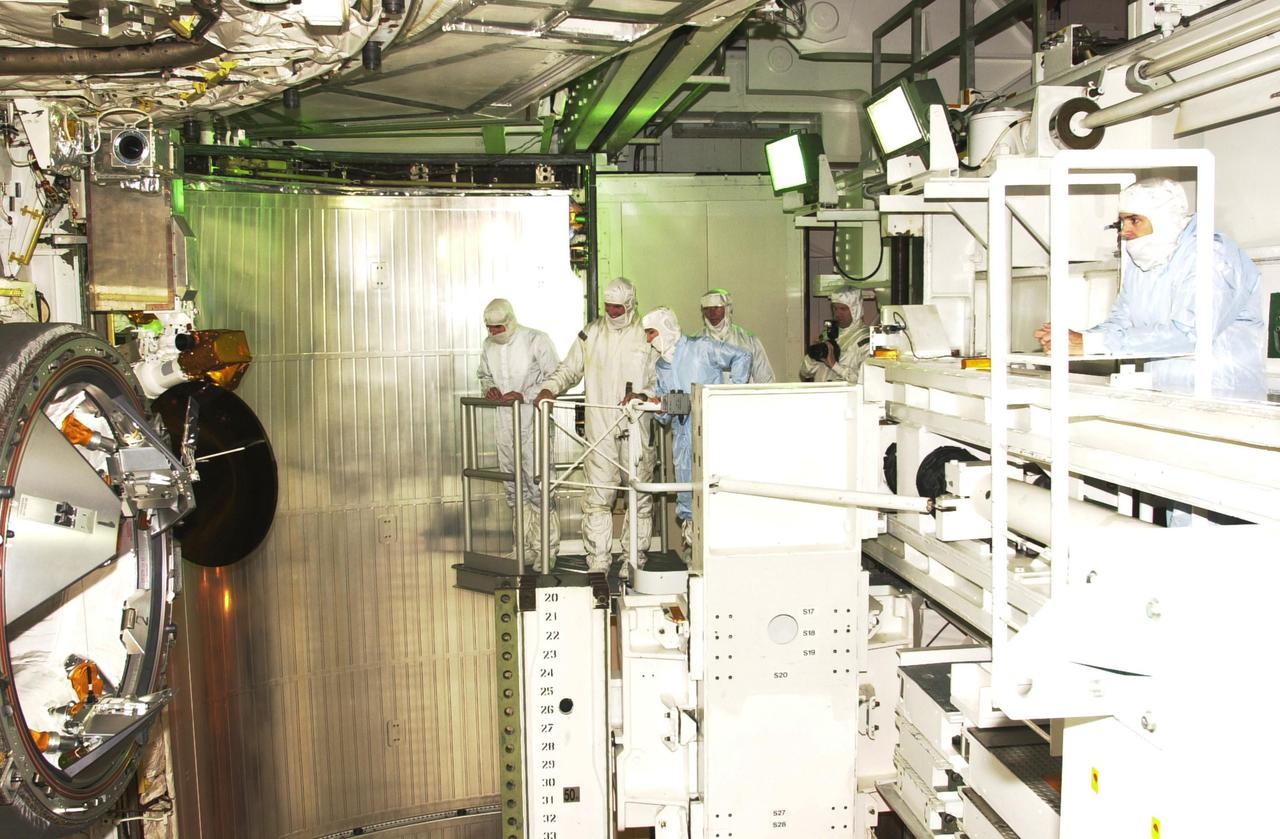
KENNEDY SPACE CENTER, FLA. - STS-110 crew members (center and right) are in the Payload Changeout Room at the pad performing a final inspection of the S-Zero Truss_Mobile Transporter payload and checking for any sharp edges they may encounter during the mission's four scheduled spacewalks. The payload doors were closed after the astronauts departed for their crew quarters
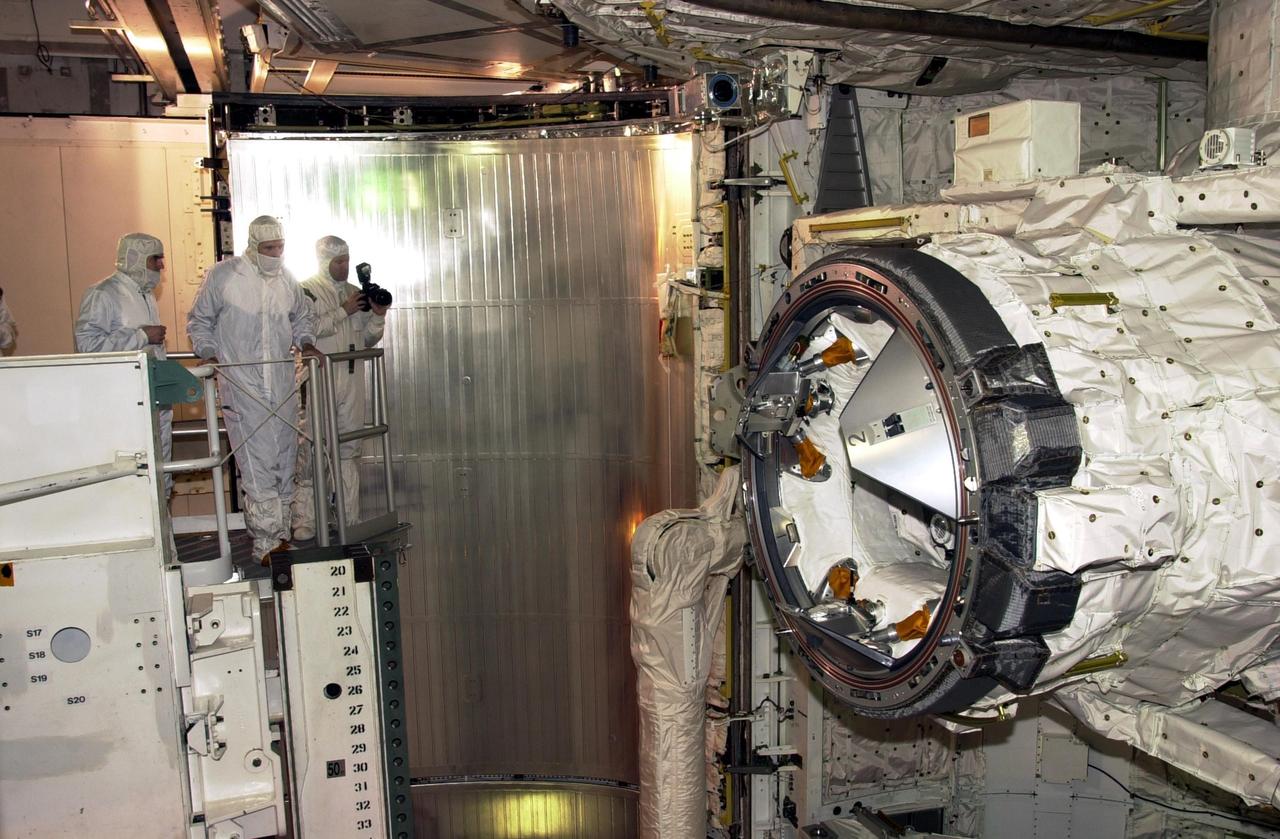
KENNEDY SPACE CENTER, FLA. -- In the Payload Changeout Room at the pad, STS-110 crew members perform a final inspection of the S-Zero Truss/Mobile Transporter payload and check for any sharp edges they may encounter during the mission's four scheduled spacewalks. The payload doors were closed after the astronauts departed for their crew quarters
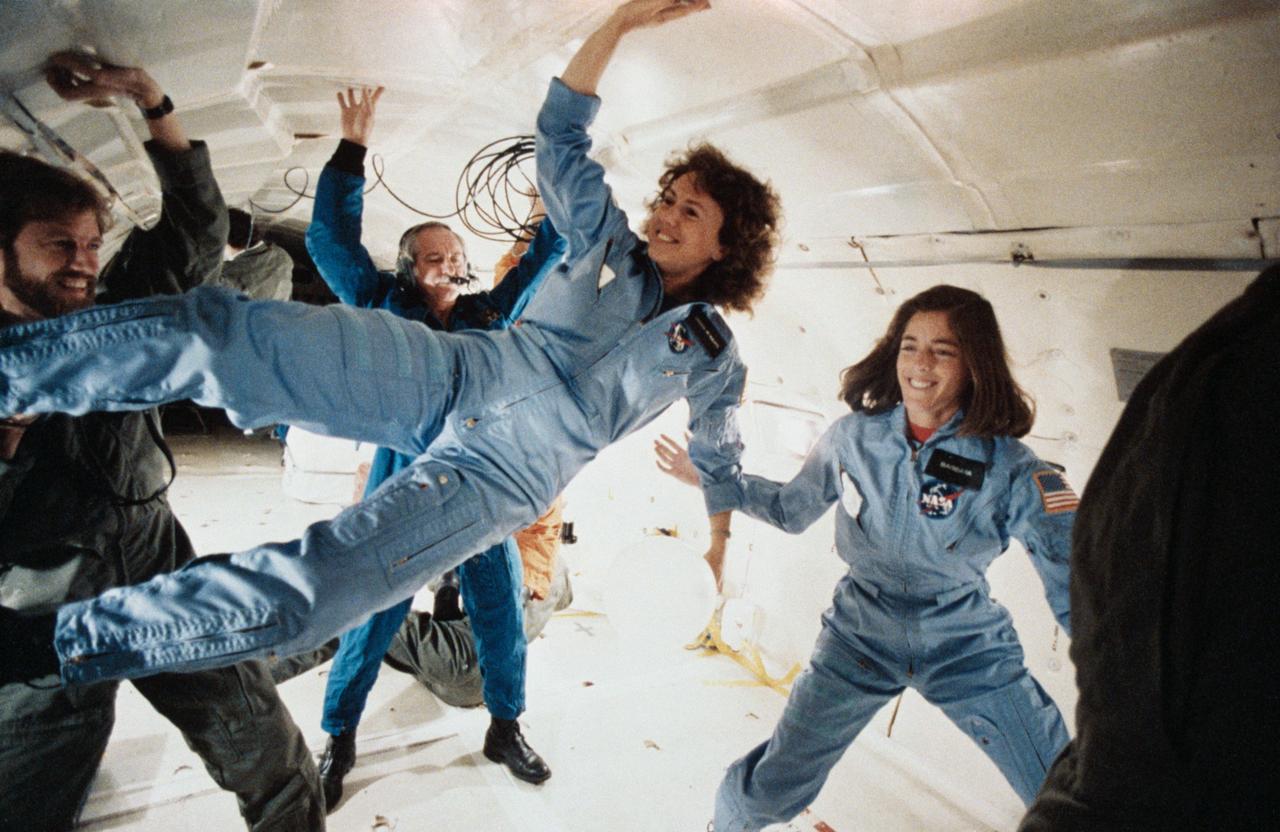
S86-25191 (for release January 1986) --- The two representatives of the Teacher-in-Space Project continue their training program at the Johnson Space Center with an additional flight aboard NASA?s KC-135 ?zero gravity? aircraft. Sharon Christa McAuliffe, left, is prime crew payload specialist, and Barbara R. Morgan is in training as backup payload specialist. The photo was taken by Keith Meyers of New York Times. Photo credit: NASA
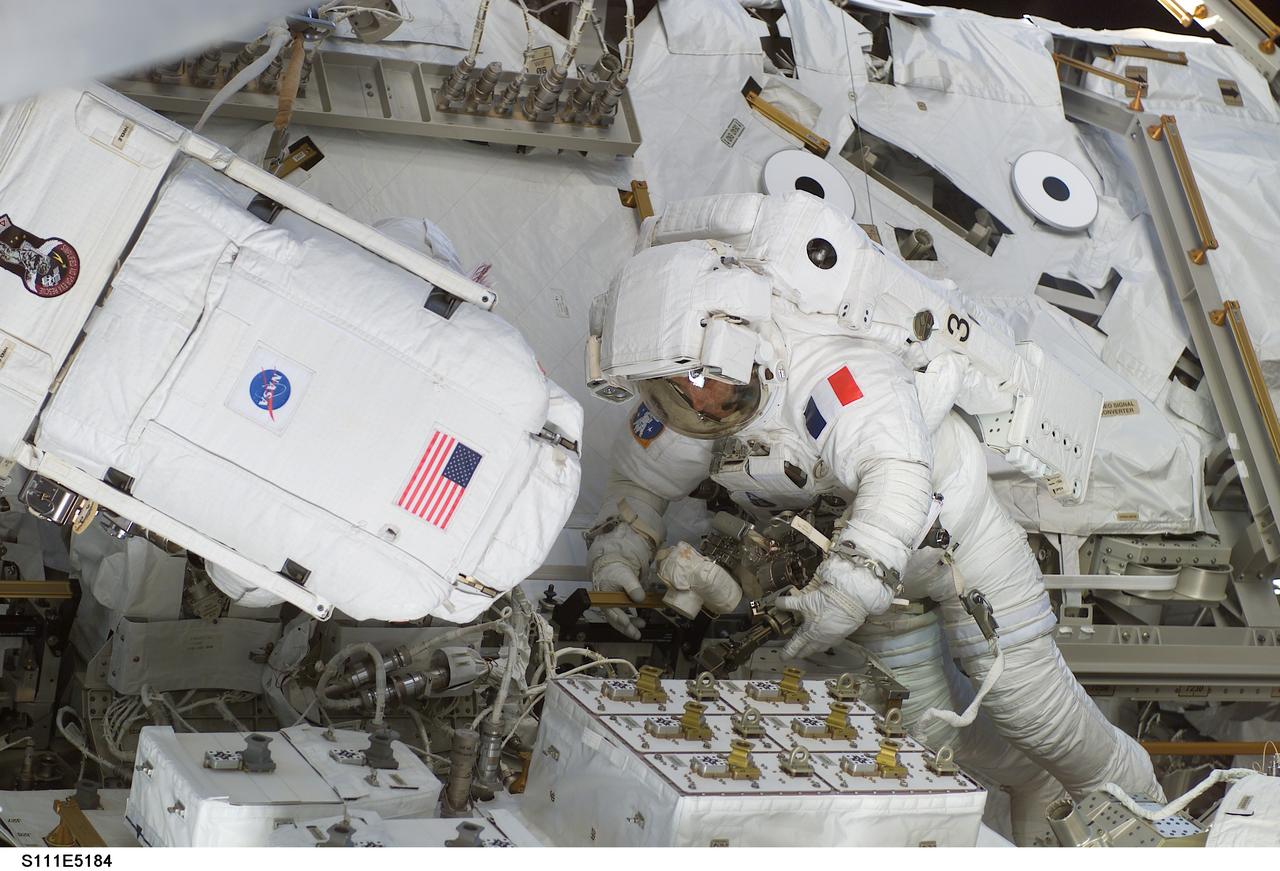
STS111-E-5184 (11 June 2002) --- Astronauts Franklin R. Chang-Diaz (left) and Philippe Perrin, both mission specialists, work on the Mobile Remote Servicer Base System (MBS) and the Mobile Transporter on the International Space Station (ISS) during the second scheduled session of extravehicular activity (EVA) for the STS-111 mission. The boxes in front of the spacewalkers are the Canadian Remote Power Control Modules (RPCM). The S0 (S-zero) Truss is partially visible in the background. Perrin represents CNES, the French Space Agency.
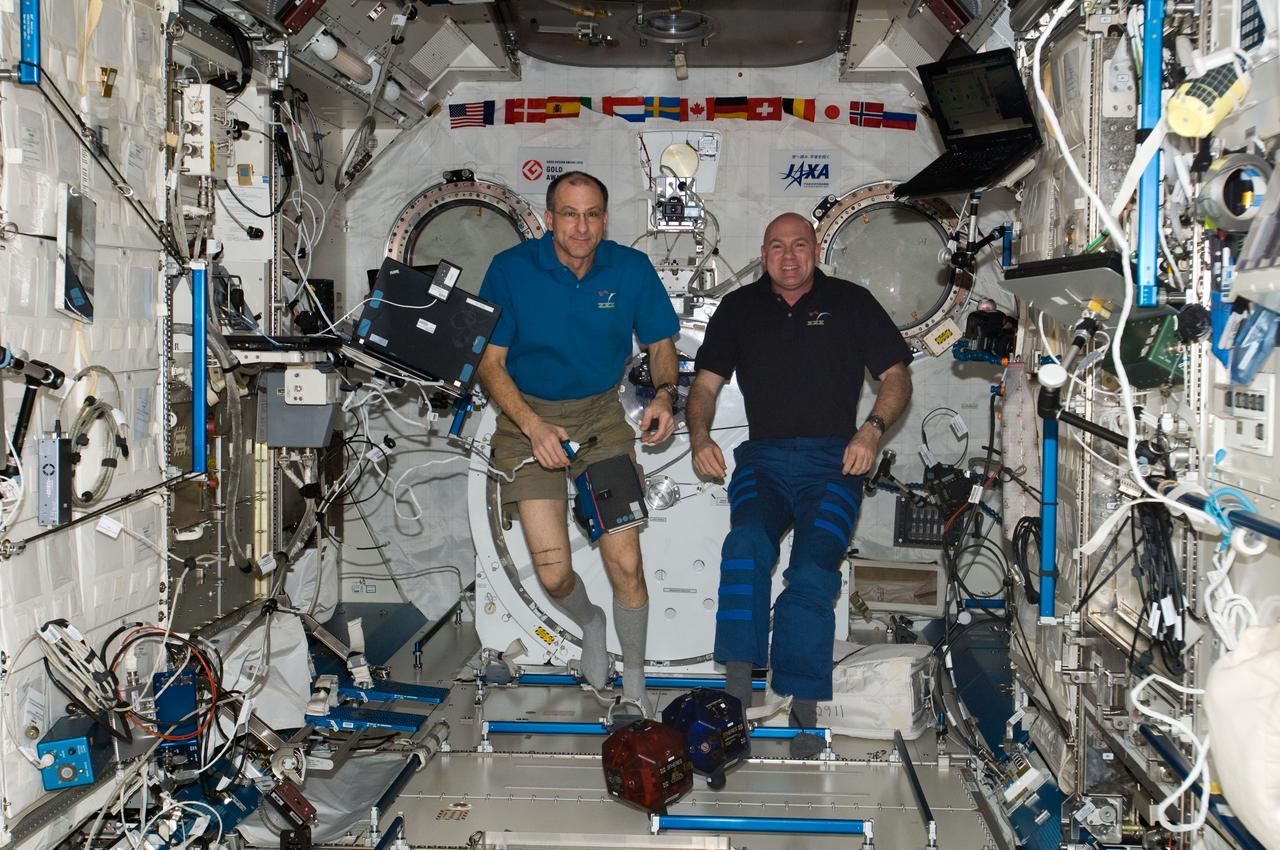
ISS030-E-047176 (23 Jan. 2012) --- In the International Space Station?s Kibo laboratory, NASA astronaut Don Pettit (left) and European Space Agency astronaut Andre Kuipers, both Expedition 30 flight engineers, support competing students on the ground in a run of the Synchronized Position Hold, Engage, Reorient, Experimental Satellites Zero Robotics (SPHERES ZR) experiment.

STS111-E-5183 (11 June 2002) --- Astronauts Franklin R. Chang-Diaz (left) and Philippe Perrin, both mission specialists, work on the Mobile Remote Servicer Base System (MBS) and the Mobile Transporter on the International Space Station (ISS) during the second scheduled session of extravehicular activity (EVA) for the STS-111 mission. The boxes in front of the spacewalkers are the Canadian Remote Power Control Modules (RPCM). The S0 (S-zero) Truss is partially visible in the background. Perrin represents CNES, the French Space Agency.
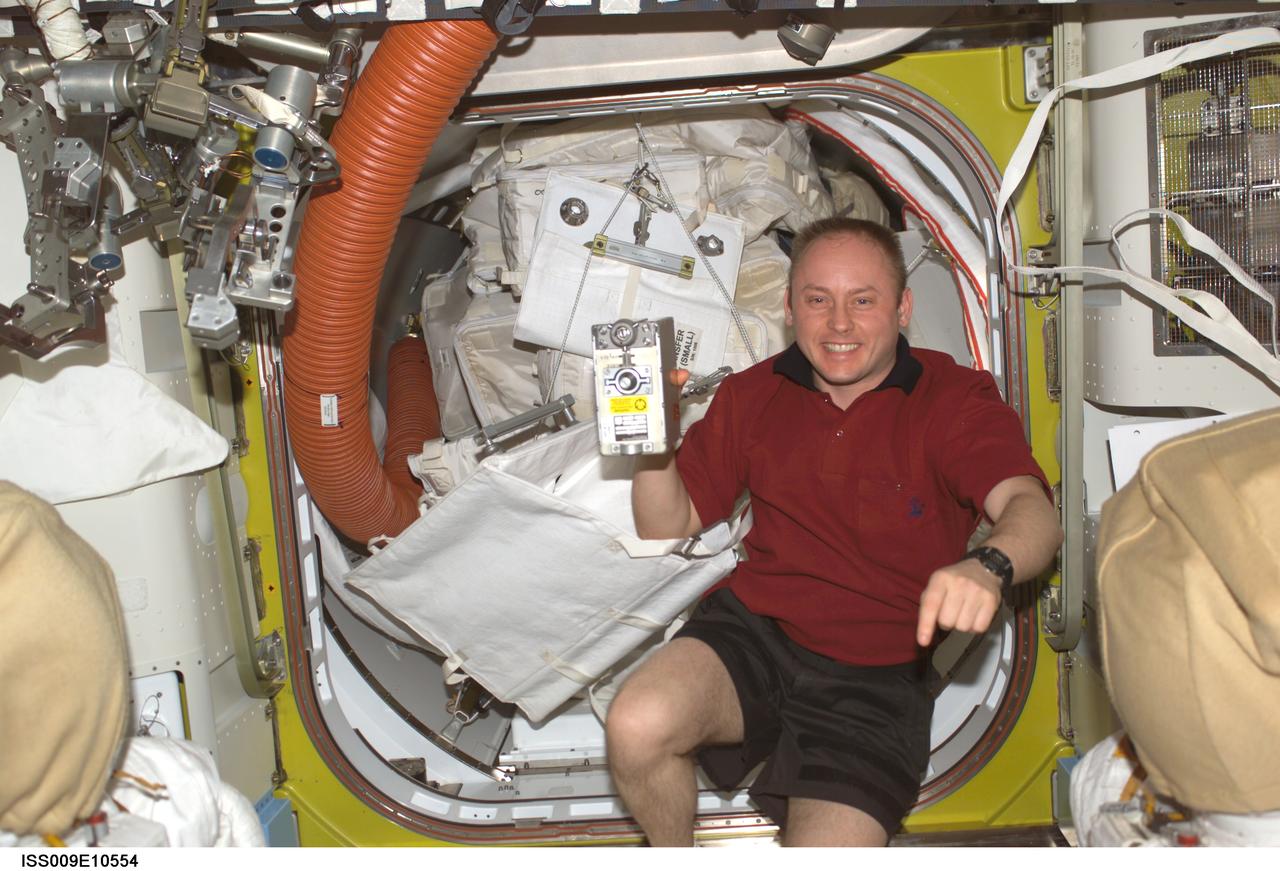
ISS009-E-10554 (4 June 2004) --- Astronaut Edward M. (Mike) Fincke, Expedition 9 NASA ISS science officer and flight engineer, holds the spare Remote Power Controller Module (RPCM) in the Quest airlock of the International Space Station (ISS). The spare is scheduled to replace the failed RPCM on the S0 (S-Zero) Truss.
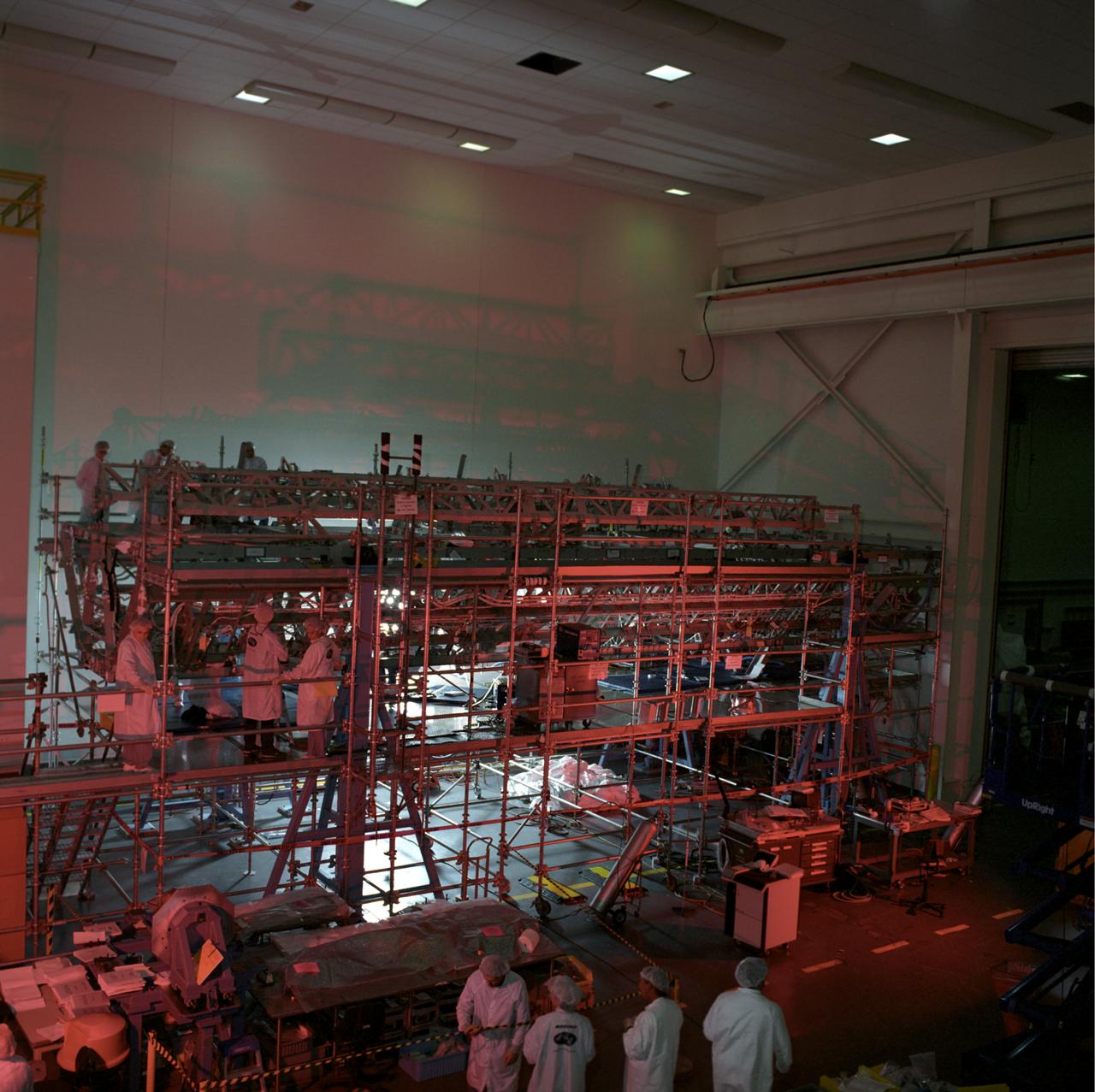
This image shows the Integrated Truss Assembly S-1 (S-One), the Starboard Side Thermal Radiator Truss, for the International Space Station (ISS) undergoing final construction in the Space Station manufacturing facility at the Marshall Space Flight Center. The S1 truss provides structural support for the orbiting research facility's radiator panels, which use ammonia to cool the Station's complex power system. Delivered and installed by the STS-112 mission, the S1 truss, attached to the S0 (S Zero) truss installed by the previous STS-110 mission, flows 637 pounds of anhydrous ammonia through three heat rejection radiators. The truss is 45-feet long, 15-feet wide, 10-feet tall, and weighs approximately 32,000 pounds. Manufactured by the Boeing Company in Huntington Beach, California, the truss primary structure was transferred to the Marshall Space Flight Center in February 1999 for hardware installations and manufacturing acceptance testing.
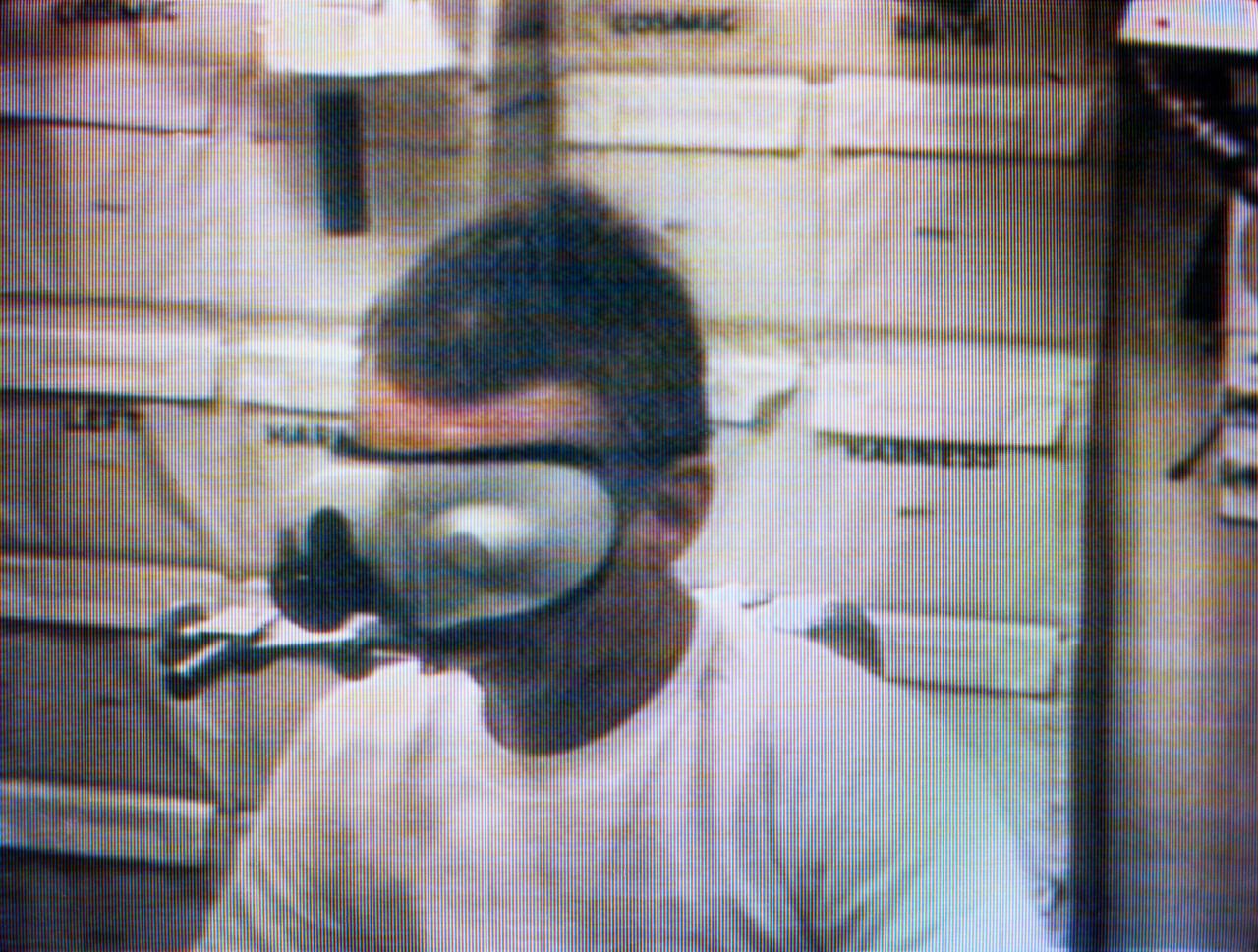
S73-32113 (9 Aug. 1973) --- Scientist-astronaut Owen K. Garriott, Skylab 3 science pilot, serves as test subject for the Skylab ?Human Vestibular Function? M131 Experiment, as seen in this photographic reproduction taken from a television transmission made by a color TV camera aboard the Skylab space station in Earth orbit. The objectives of the Skylab M131 experiment are to obtain data pertinent to establishing the validity of measurements of specific behavioral/physiological responses influenced by vestibular activity under one-g and zero-g conditions; to determine man?s adaptability to unusual vestibular conditions and predict habitability of future spacecraft conditions involving reduced gravity and Coriollis forces; and to measure the accuracy and variability in man?s judgment of spatial coordinates based on atypical gravity receptor cues and inadequate visual cues. Photo credit: NASA
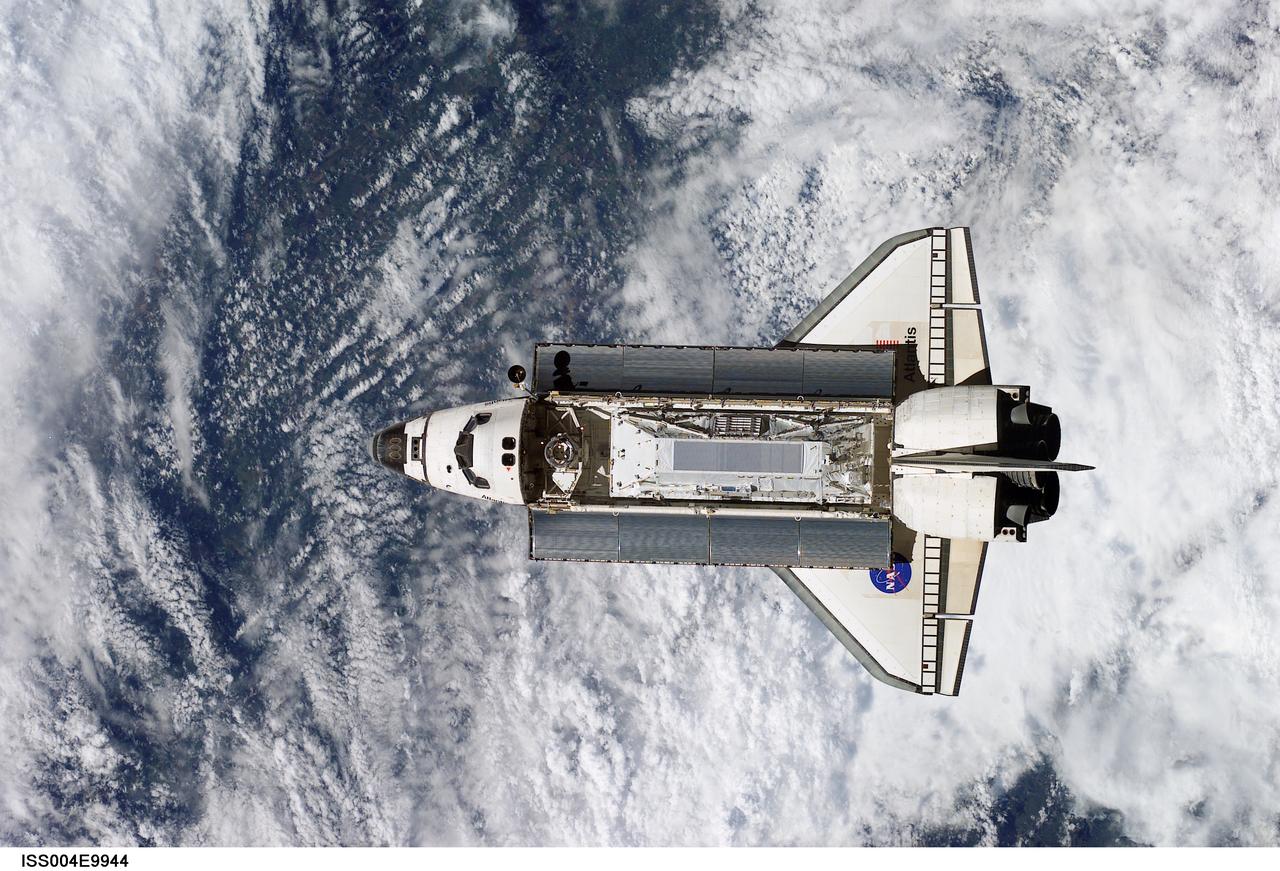
ISS004-E-9944 (10 April 2002) --- The Space Shuttle Atlantis prepares to dock with the International Space Station (ISS) during the STS-110 mission. Aboard Atlantis are astronauts Michael J. Bloomfield, mission commander; Stephen N. Frick, pilot; Rex J. Walheim, Ellen Ochoa, Lee M. E. Morin, Jerry L. Ross, and Steven L. Smith, all mission specialists. The STS-110 crewmembers are delivering the S0 (S-zero) truss, which is visible in Atlantis’ payload bay. This image was taken by an Expedition Four crewmember.
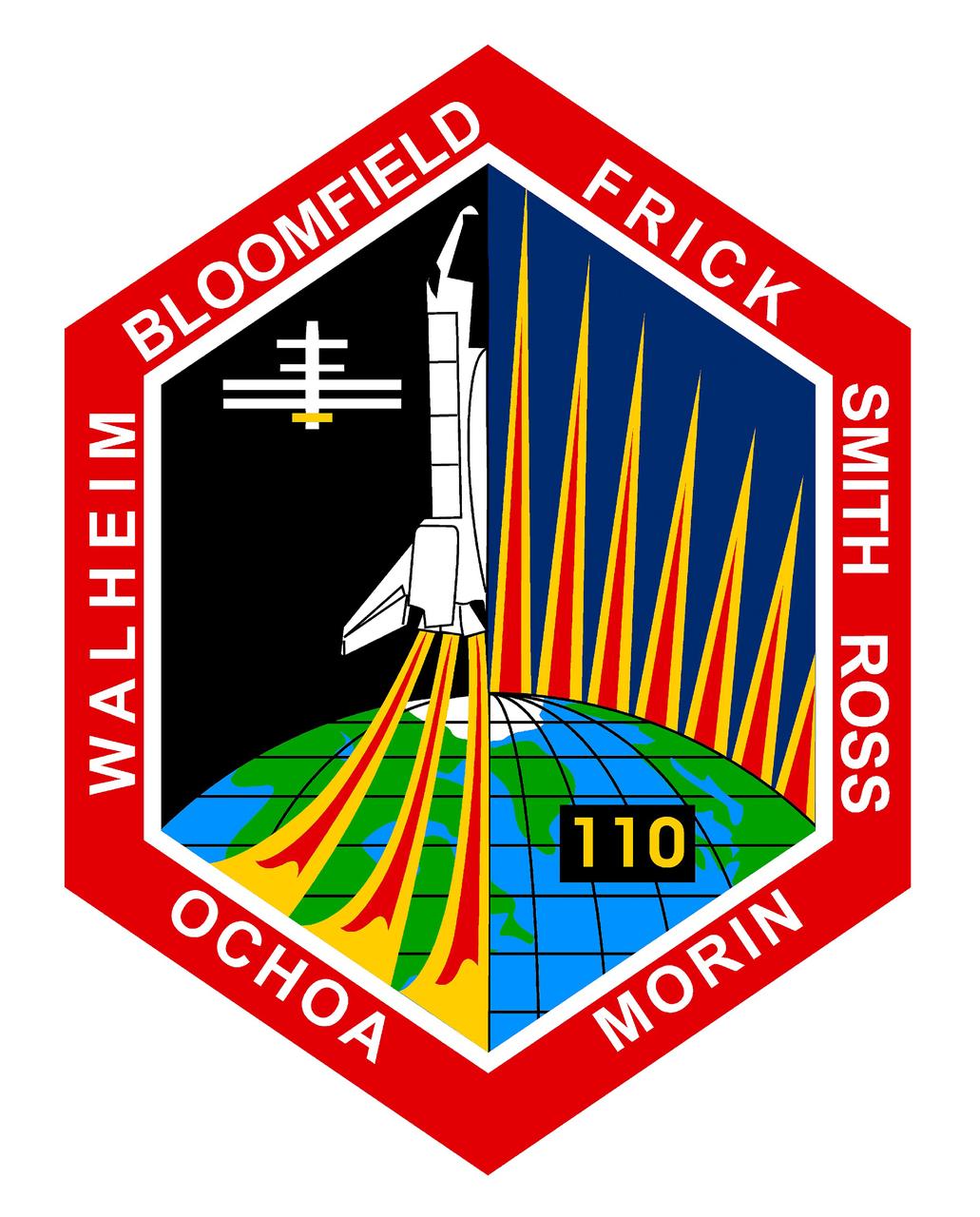
The STS-110 mission began the third and final phase of construction for the International Space Station (ISS) by delivering and installing the Starboard side S0 (S-zero) truss segment that was carried into orbit in the payload bay of the Space Shuttle Atlantis. The STS-110 crew patch is patterned after the cross section of the S0 truss, and encases the launch of the Shuttle Atlantis and a silhouette of the ISS as it will look following mission completion. The successfully installed S0 segment is highlighted in gold. The three prominent flames blasting from the shuttle emphasizes the first shuttle flight to use three Block II Main Engines.
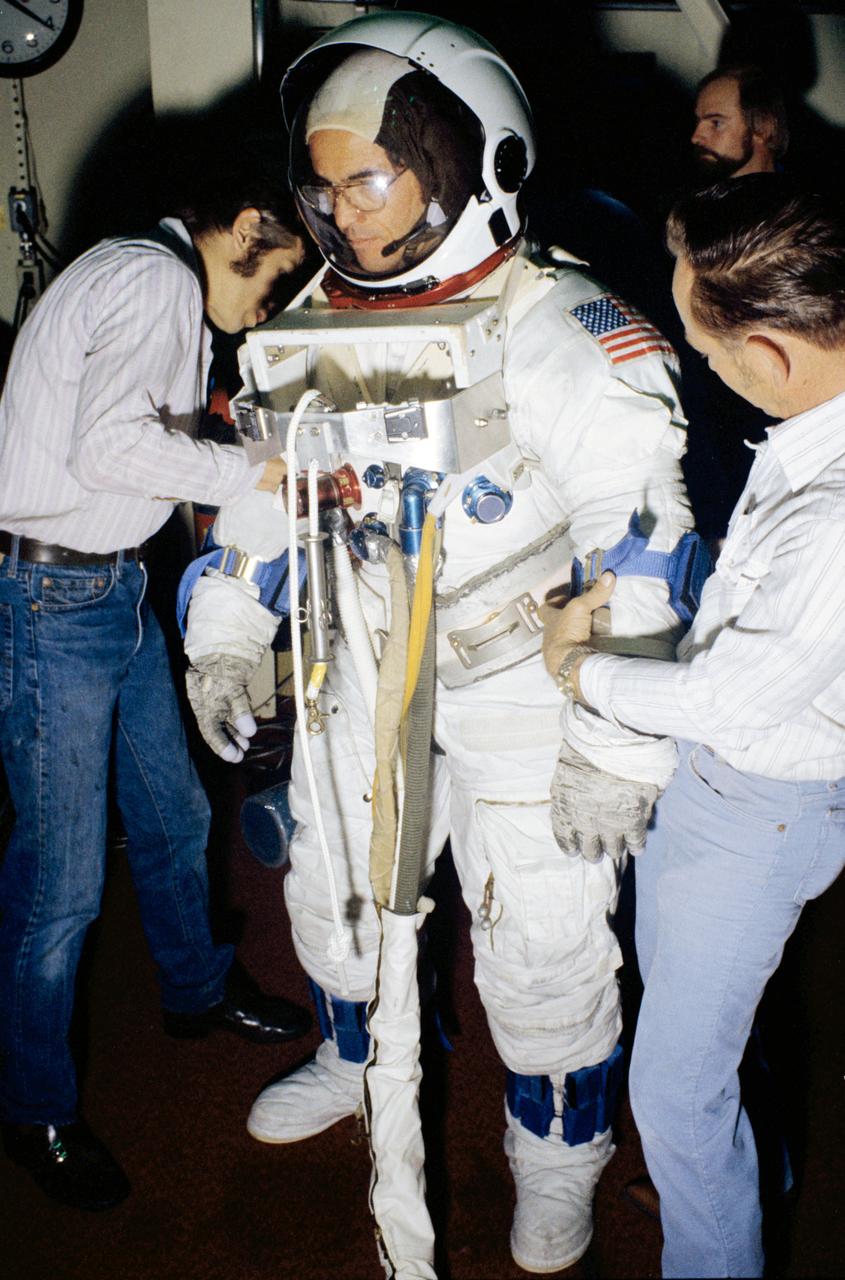
S79-25007 (13 Dec. 1978) --- Astronaut Robert L. Crippen, pilot for the first space shuttle orbital flight test (STS-1), is assisted by technicians prior to entering a water immersion facility (WIF) during a training session. The zero-gravity familiarization took place in the Johnson Space Center?s training and test center (Building 260). The WIF afford one of two ways to simulate the feeling of weightlessness experienced during space extravehicular activity (EVA), the other being inside aircraft flying a parabolic curve. Crippen will be joined by astronaut John W. Young for the STS-1 flight. Photo credit: NASA
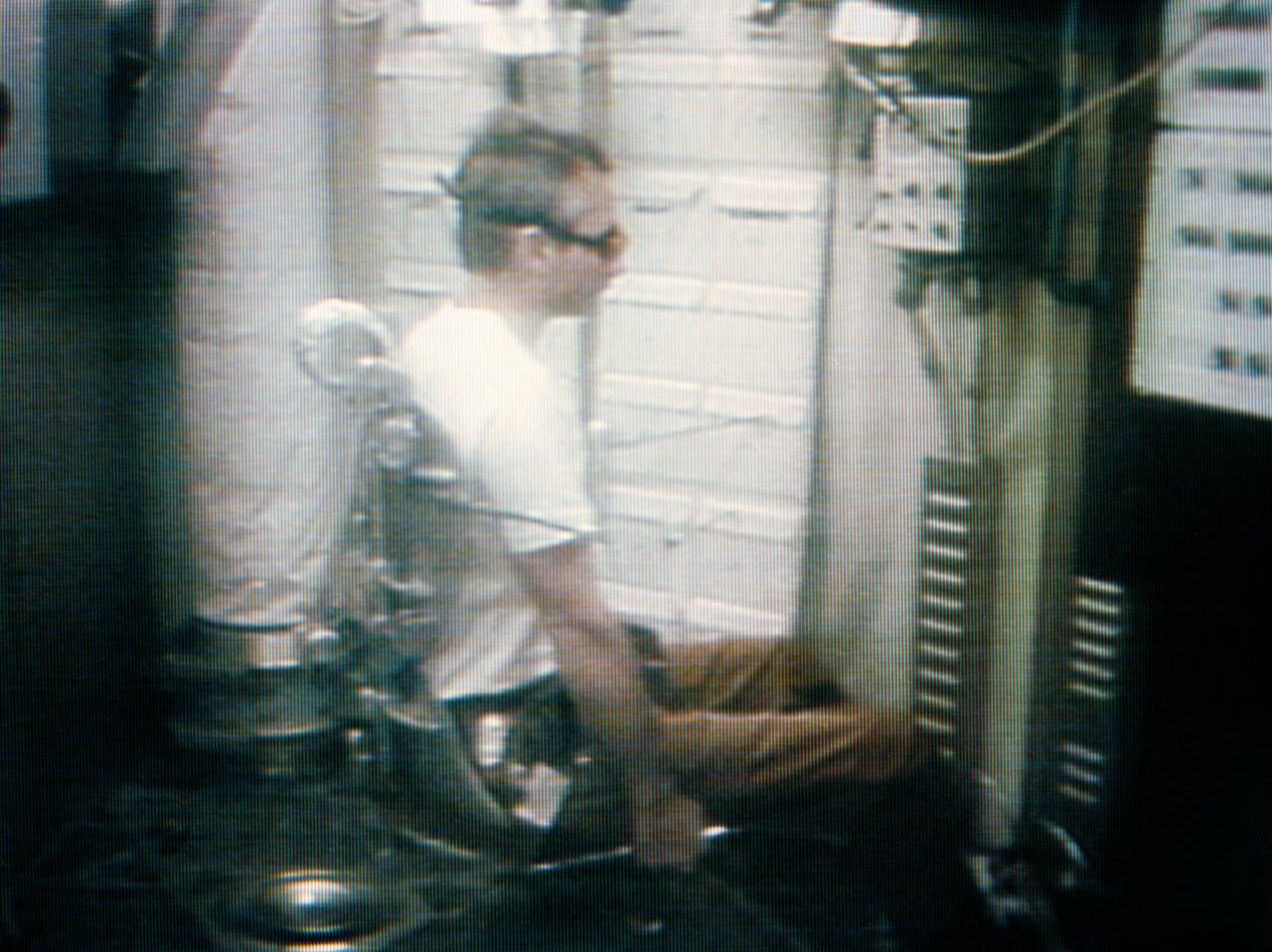
S73-34171 (9 Aug. 1973) --- Scientist-astronaut Owen K. Garriott, Skylab 3 science pilot, serves as test subject for the Skylab ?Human Vestibular Function? M131 Experiment, as seen in this photographic reproduction taken from a television transmission made by a color TV camera aboard the Skylab space station in Earth orbit. The objectives of the Skylab M131 experiment are to obtain data pertinent to establishing the validity of measurements of specific behavioral/physiological responses influenced by vestibular activity under one-g and zero-g conditions; to determine man?s adaptability to unusual vestibular conditions and predict habitability of future spacecraft conditions involving reduced gravity and Coriollis forces; and to measure the accuracy and variability in man?s judgment of spatial coordinates based on atypical gravity receptor cues and inadequate visual cures. Dr. Garriott is seated in the experiment?s litter chair which can rotate the test subject at predetermined rotational velocity or programmed acceleration/decelerational profile. Photo credit: NASA
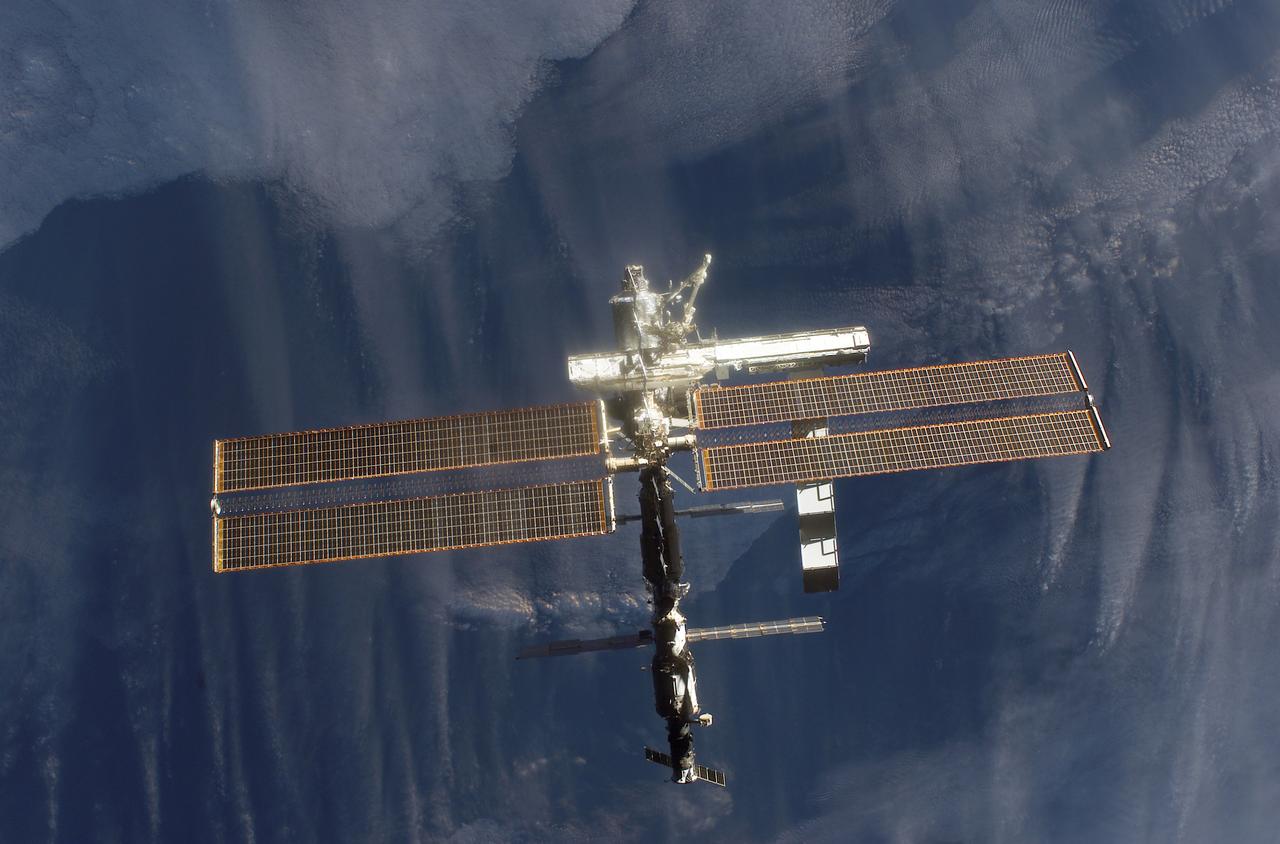
This image of the International Space Station (ISS) was photographed by one of the crewmembers of the STS-112 mission following separation from the Space Shuttle Orbiter Atlantis as the orbiter pulled away from the ISS. The newly added S1 truss is visible in the center frame. The primary payloads of this mission, International Space Station Assembly Mission 9A, were the Integrated Truss Assembly S-1 (S-One), the Starboard Side Thermal Radiator Truss,and the Crew Equipment Translation Aid (CETA) cart to the ISS. The S1 truss provides structural support for the orbiting research facility's radiator panels, which use ammonia to cool the Station's complex power system. The S1 truss was attached to the S0 (S Zero) truss, which was launched on April 8, 2002 aboard the STS-110, and flows 637 pounds of anhydrous ammonia through three heat rejection radiators. The truss is 45-feet long, 15-feet wide, 10-feet tall, and weighs approximately 32,000 pounds. The CETA cart was attached to the Mobil Transporter and will be used by assembly crews on later missions. Manufactured by the Boeing Company in Huntington Beach, California, the truss primary structure was transferred to the Marshall Space Flight Center in February 1999 for hardware installations and manufacturing acceptance testing. The launch of the STS-112 mission occurred on October 7, 2002, and its 11-day mission ended on October 18, 2002.
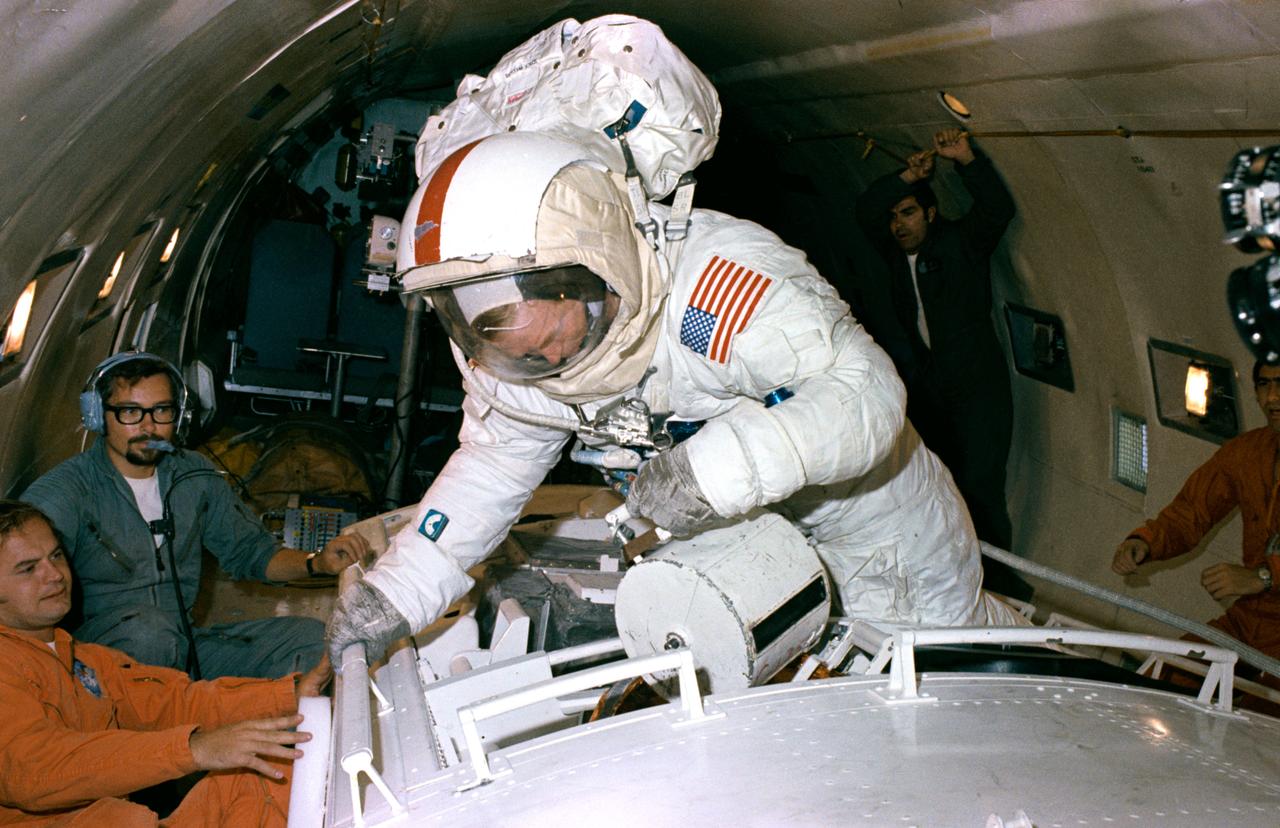
S72-50271 (September 1972) --- Astronaut Stuart A. Roosa, backup crew command module pilot of the Apollo 17 lunar landing mission, participates in extravehicular activity simulation training under zero-gravity conditions aboard a U. S. Air Force KC-135 aircraft. A mock-up of the Scientific Instrument Module (SIM) bay of the Apollo 17 Service Module is used in the exercise. Here, Roosa simulates retrieving the film cassette of the Mapping Camera from the SIM bay. Astronaut Ronald E. Evans, Apollo 17 prime crew command module pilot, is scheduled to receive film cassettes from the Mapping Camera, Panoramic Camera, and Lunar Sounder during Apollo 17 trans-Earth extravehicular activity.
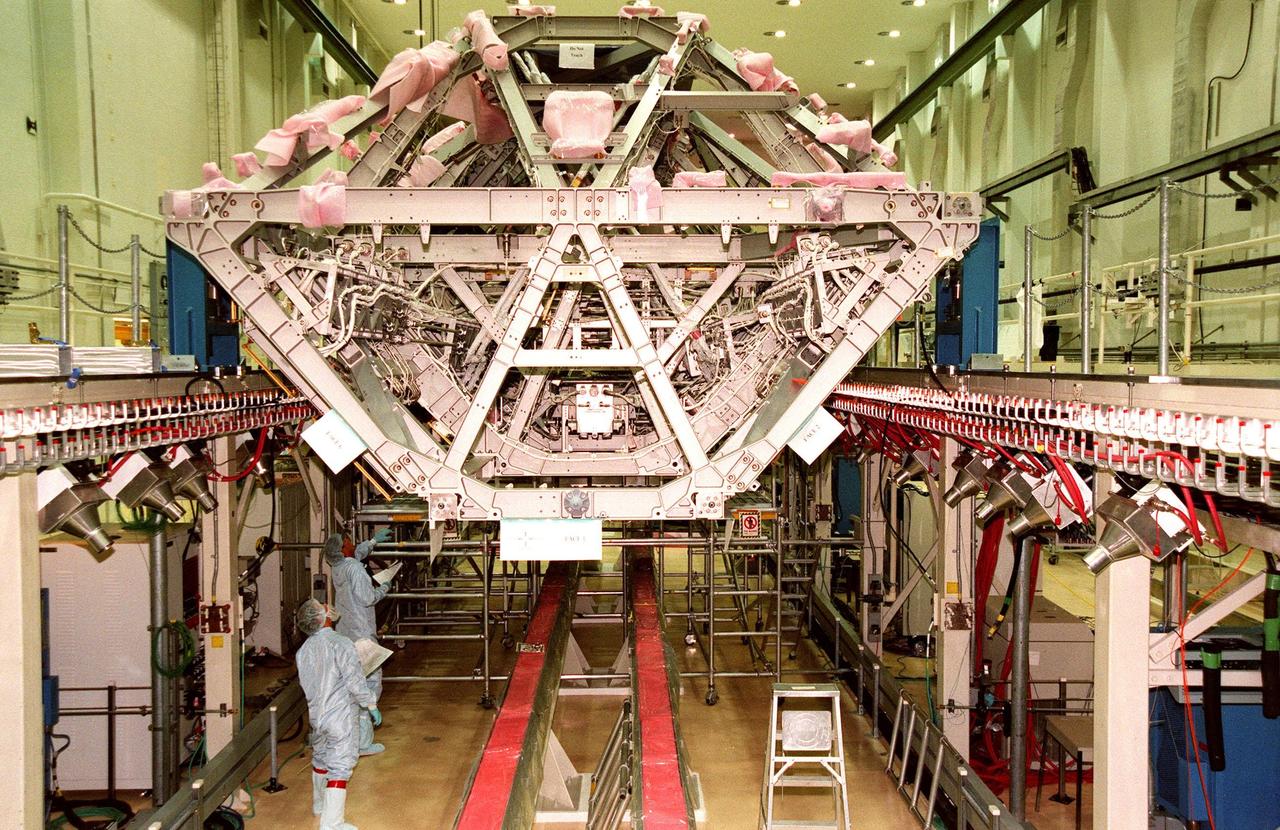
KENNEDY SPACE CENTER, FLA. -- Workers in the Operations & Checkout Bldg. (O&C) look over a central component of the International Space Station (ISS), the S0 (S zero) truss. It is undergoing processing in the O&C during which the Canadian Mobile Transporter, power distribution system modules, a heat pipe radiator for cooling, computers, and a pair of rate gyroscopes are being installed. A 44by 15-foot structure weighing 30,800 pounds when fully outfitted and ready for launch, the truss will ultimately extend the length of a football field. Eventually the S0 truss will be attached to the U.S. Lab, "Destiny," which is scheduled to be added to the ISS in April 2000. Later, other trusses will be attached to the S0 on-orbit. The S0 truss is scheduled to be launched in the spring of 2001
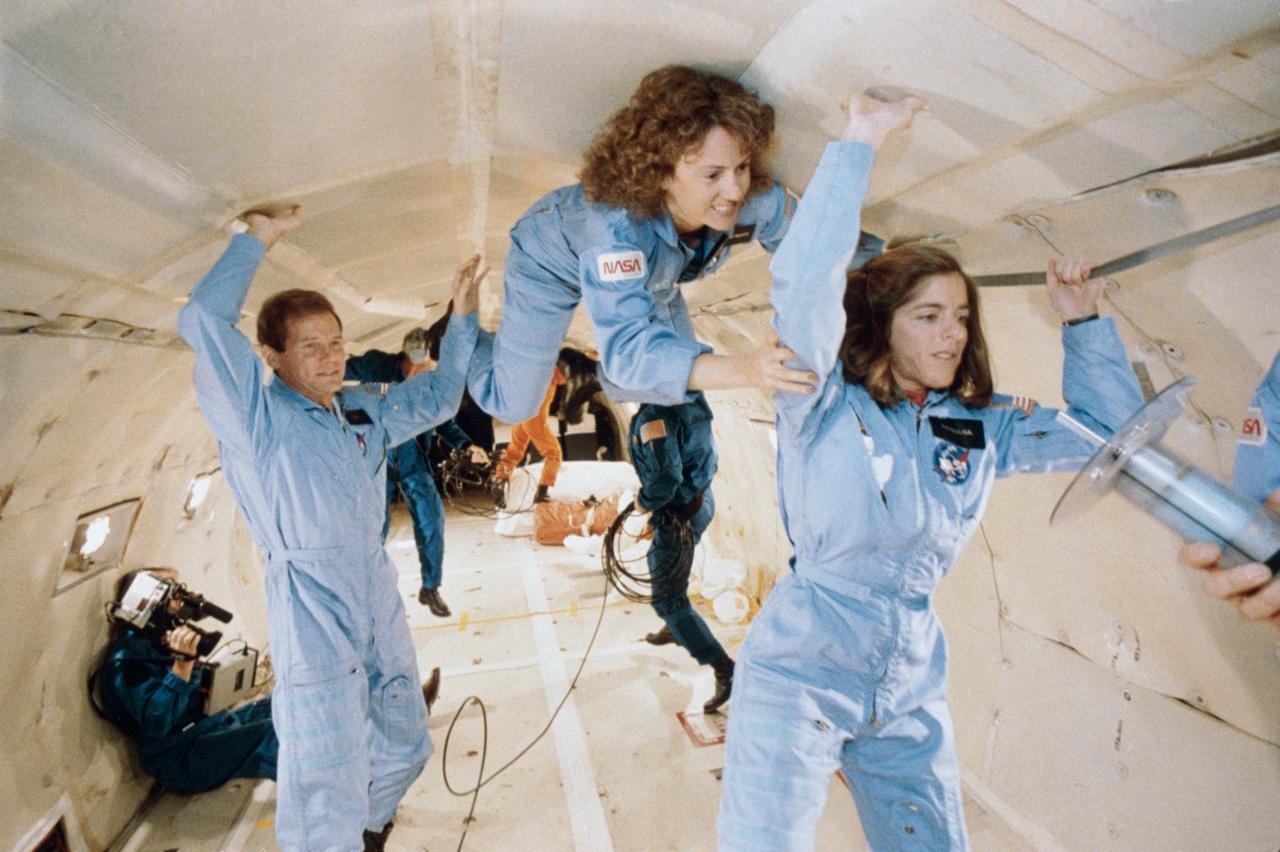
S86-25192 (January 1986) --- Two payload specialists in training for the STS-51L mission, and a payload specialist from STS-61C share a ?zero-gravity? flight aboard a KC-135 aircraft over the Gulf of Mexico. Left to right are United States Representative Bill Nelson (Democrat, Florida), Sharon Christa McAuliffe, and Barbara R. Morgan. The congressman is a payload specialist for the STS-61C mission. McAuliffe is the prime payload specialist for the Teacher-in-Space Project aboard the STS-51L mission; and Morgan is her backup. The photo was taken by Keith meyers of the New York Times. EDITOR?S NOTE: The STS-51L crew members lost their lives in the space shuttle Challenger accident moments after launch on Jan. 28, 1986 from the Kennedy Space Center (KSC). Photo credit: NASA
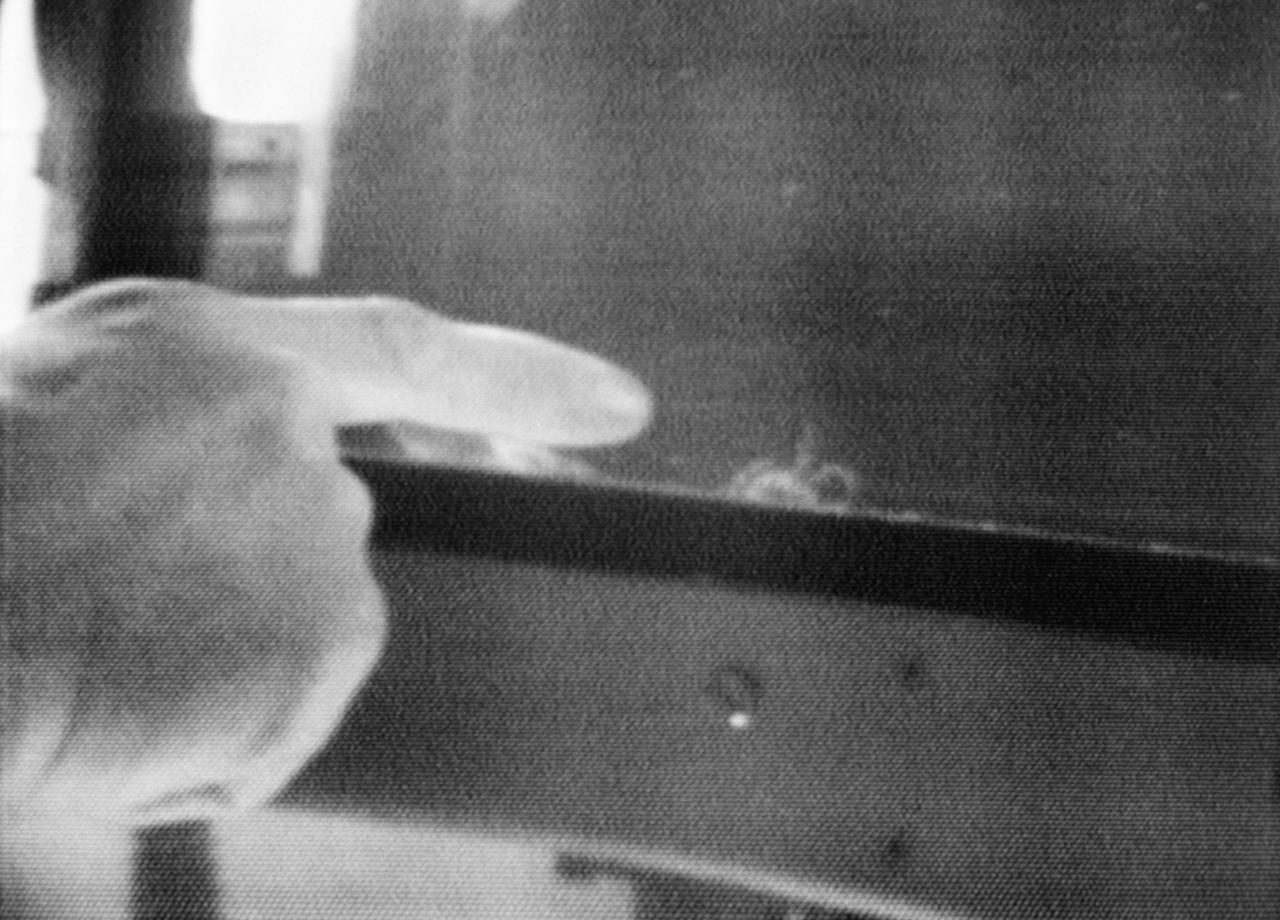
S73-33164 (27 Aug. 1973) --- A close-up view of Anita, one of the two common cross spiders “Araneus diadematus” aboard Skylab, is seen in this photographic reproduction of a color television transmission made by a TV camera aboard the Skylab space station in Earth orbit. A finger of one of the Skylab 3 crewmen points to Anita. The two spiders are housed in an enclosure onto which a motion picture and still camera are attached to record the spider’s attempt to build a web in the zero-gravity of space. The spider experiment (ED52) is one of 25 experiments selected by NASA for Skylab from more than 3,400 experiment proposals submitted by high school students throughout the nation. ED52 was submitted by 17-year old Judith S. Miles of Lexington, Mass. Photo credit: NASA
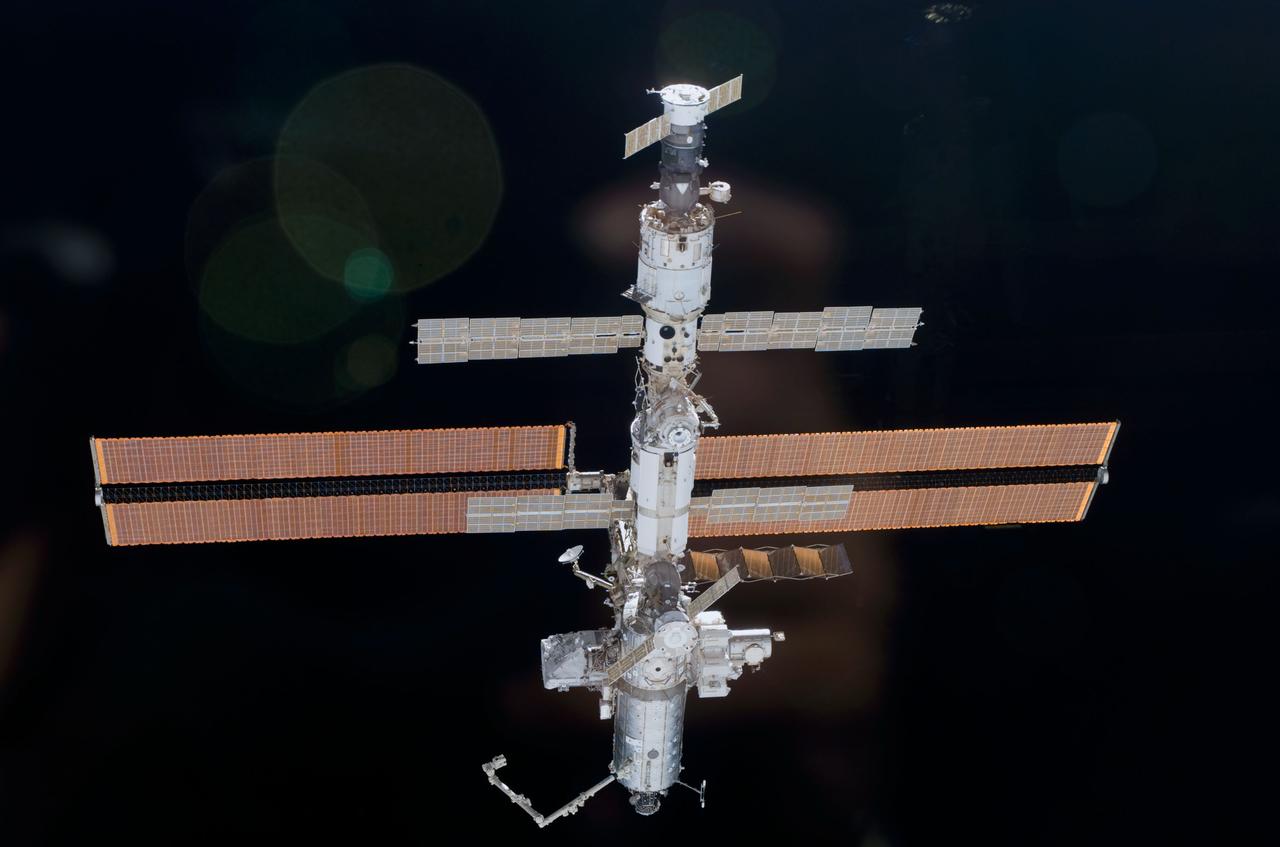
STS110-E-5918 (17 April 2002) --- This is one a series of digital still images of the International Space Station (ISS) recorded by the STS-110 crew members on board the Space Shuttle Atlantis following the undocking of the two spacecraft some 247 statute miles above the North Atlantic. Atlantis pulled away from the complex at 1:31 p.m. (CDT). After more than a week of joint operations between the shuttle and station crews, astronaut Stephen N. Frick, pilot, backed Atlantis away to a distance of about 400 feet in front of the station, where he began a 1 1/4 lap flyaround of the ISS, newly equipped with the 27,000 pound S0 (S-zero) truss, visible in this series of images. S0 is the first segment of a truss structure which will ultimately expand the station to the length of a football field.

JSC2002-E-31360 (23 July 2002) --- Astronaut Jeffrey S. Ashby (left), STS-112 mission commander, and instructor David L. Mumme are pictured near a KC-135 aircraft at Ellington Field near the Johnson Space Center (JSC). Although used primarily for the Zero Gravity program at JSC, the large aircraft also fits the bill for heavy aircraft familiarization. Most training for Shuttle landings takes place in the Shuttle Training Aircraft (STA), which is much lighter in gross weight than the Shuttle. It does a superb job of flying like the Shuttle while on final, but in the flare (right at landing) there are some subtleties to the dynamics of heavy aircraft that only a vehicle of similar weight can demonstrate. Astronauts practice landings in the KC-135 since it is more similar in gross weight to a Shuttle.
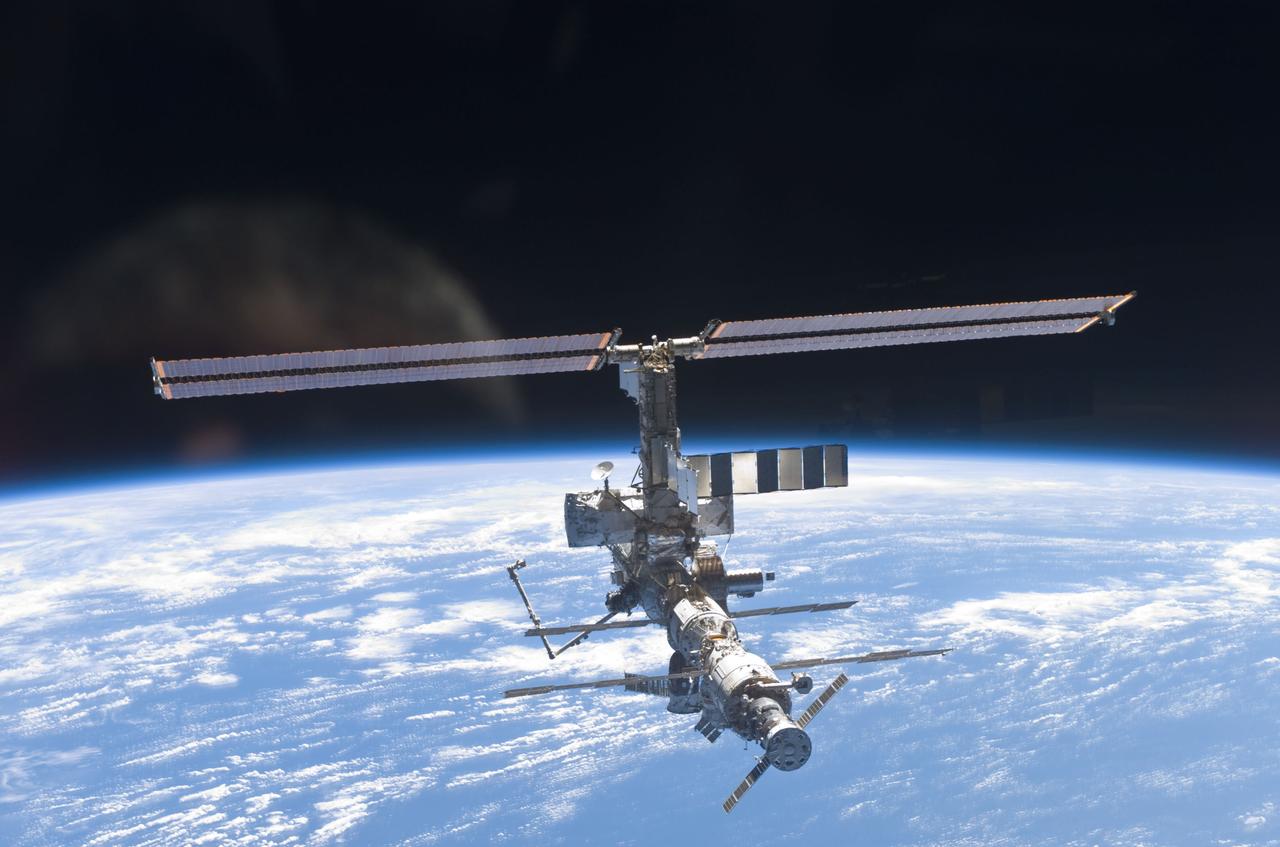
STS110-E-6058 (17 April 2002) --- This is one a series of digital still images of the International Space Station (ISS) recorded by the STS-110 crew members on board the Space Shuttle Atlantis following the undocking of the two spacecraft some 247 statute miles above the North Atlantic. Atlantis pulled away from the complex at 1:31 p.m. (CDT). After more than a week of joint operations between the shuttle and station crews, astronaut Stephen N. Frick, pilot, backed Atlantis away to a distance of about 400 feet in front of the station, where he began a 1 1/4 lap flyaround of the ISS, newly equipped with the 27,000 pound S0 (S-zero) truss, visible in this series of images. S0 is the first segment of a truss structure which will ultimately expand the station to the length of a football field.
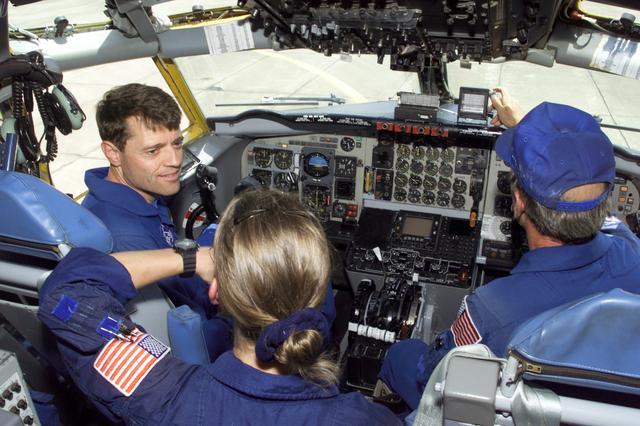
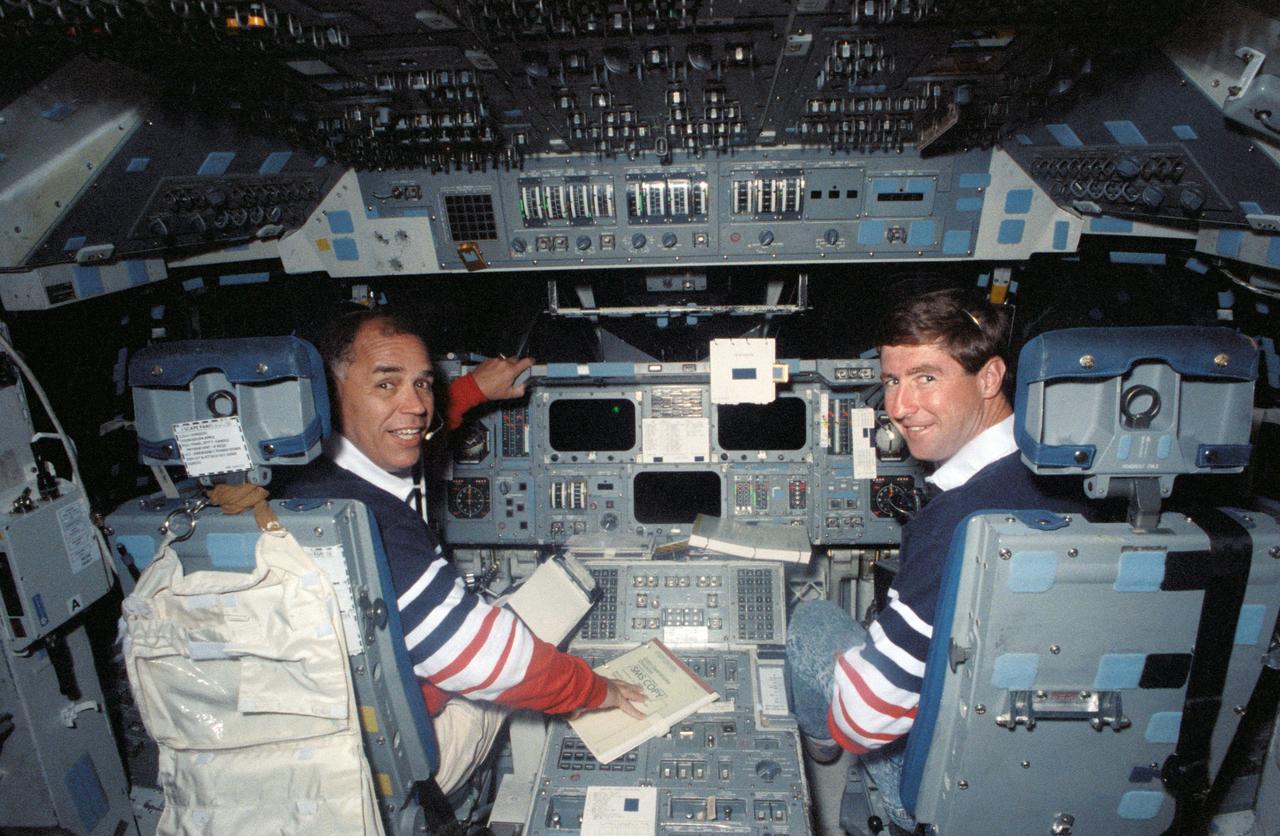
JSC2002-E-31362 (23 July 2002) --- Astronauts Jeffrey S. Ashby (left) and Pamela A. Melroy, STS-112 mission commander and pilot, respectively; along with instructor David L. Mumme, are photographed in the cockpit of a KC-135 aircraft at Ellington Field near the Johnson Space Center (JSC). Although used primarily for the Zero Gravity program at JSC, the large aircraft also fits the bill for heavy aircraft familiarization. Most training for Shuttle landings takes place in the Shuttle Training Aircraft (STA), which is much lighter in gross weight than the Shuttle. It does a superb job of flying like the Shuttle while on final, but in the flare (right at landing) there are some subtleties to the dynamics of heavy aircraft that only a vehicle of similar weight can demonstrate. Astronauts practice landings in the KC-135 since it is more similar in gross weight to a Shuttle.
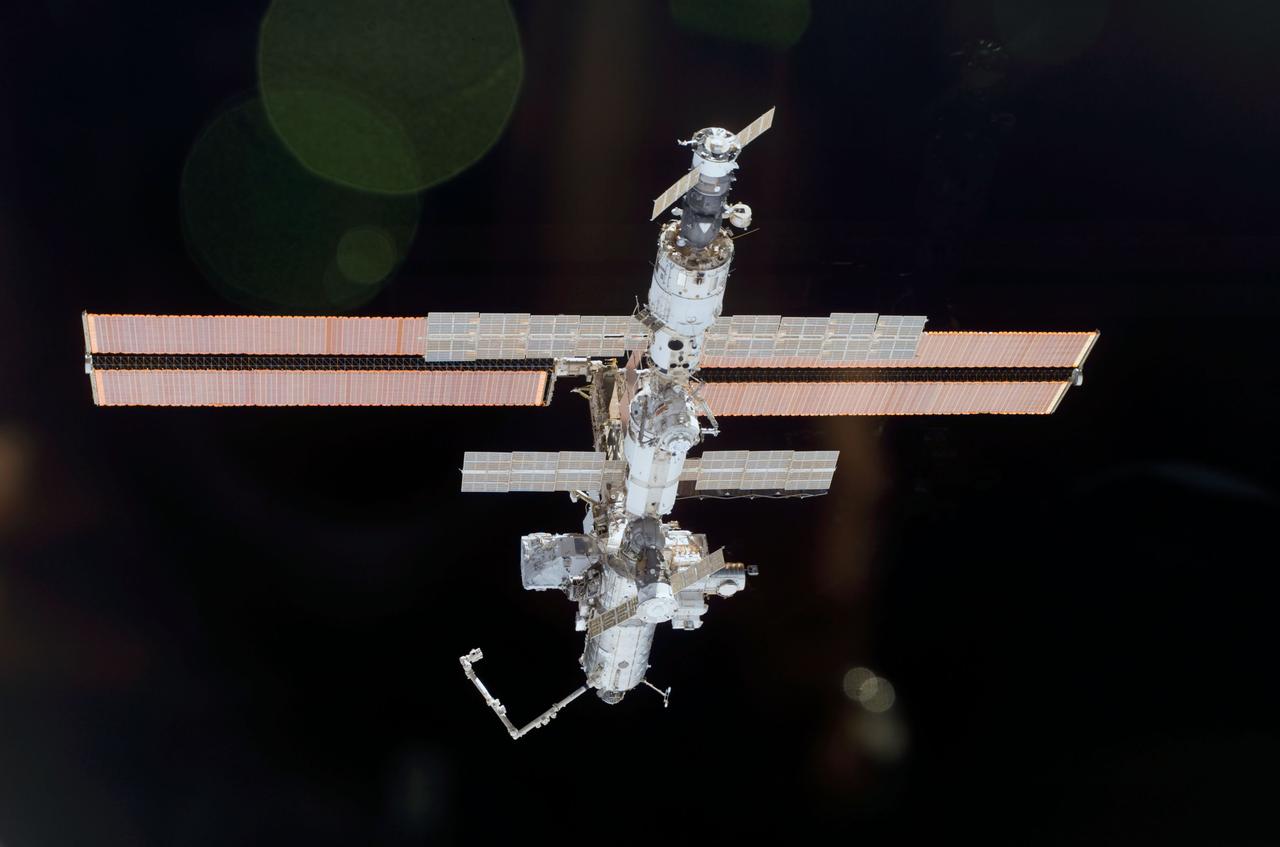
STS110-E-5912 (17 April 2002) --- This is one a series of digital still images of the International Space Station (ISS) recorded by the STS-110 crew members on board the Space Shuttle Atlantis following the undocking of the two spacecraft some 247 statute miles above the North Atlantic. Atlantis pulled away from the complex at 1:31 p.m. (CDT). After more than a week of joint operations between the shuttle and station crews, astronaut Stephen N. Frick, pilot, backed Atlantis away to a distance of about 400 feet in front of the station, where he began a 1 1/4 lap flyaround of the ISS, newly equipped with the 27,000 pound S0 (S-zero) truss, visible in this series of images. S0 is the first segment of a truss structure which will ultimately expand the station to the length of a football field.
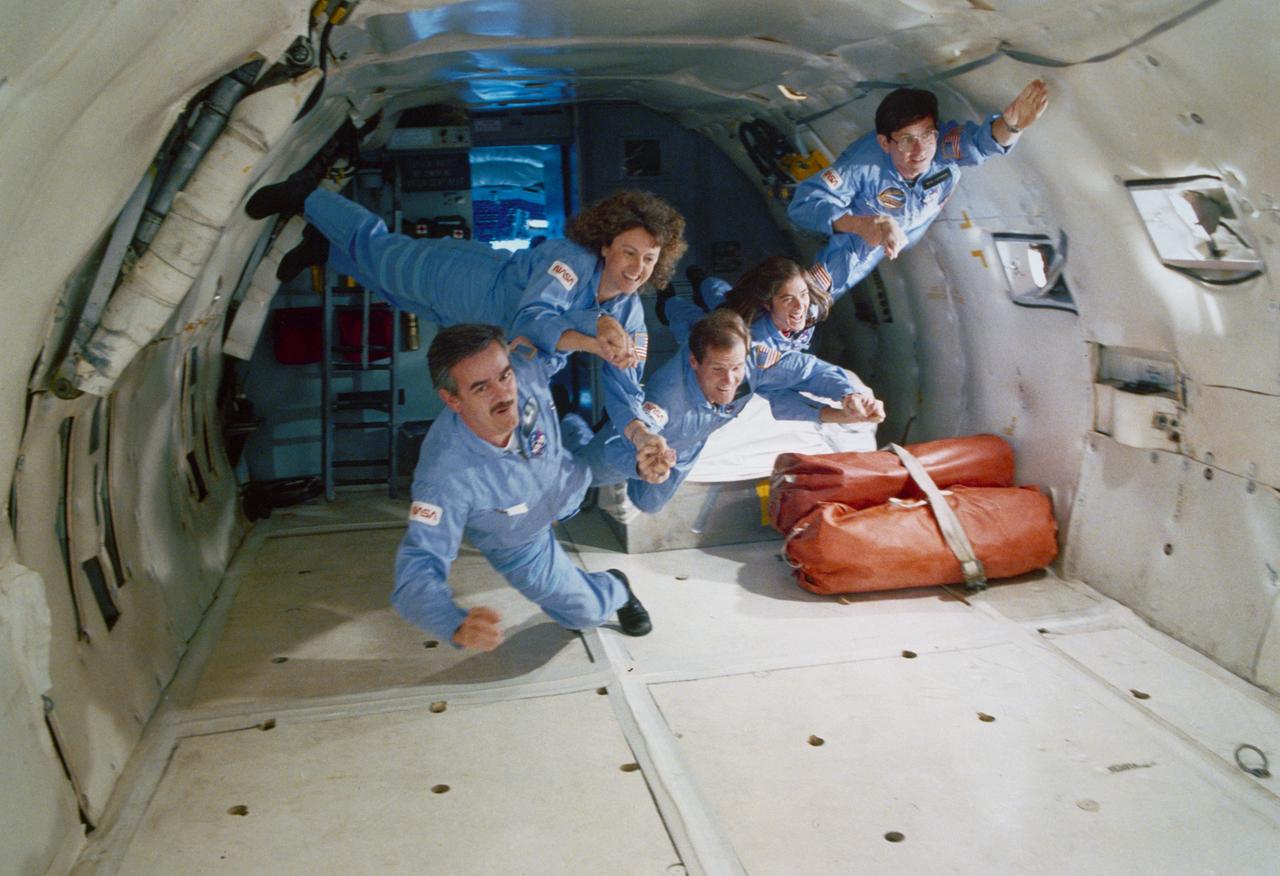
S85-44835 (20 Nov. 1985) --- This flying human chain represents prime and backup payload specialists for two upcoming STS missions. The group, representing trainees for STS-61C later this year and STS-51L early next year, shared some 40 parabolas in NASA?s KSC-135, ?Zero-G? aircraft on Nov. 20. Left to right are Gerard Magilton, RCA backup payload specialist for STS-61C; Sharon Christa McAuliffe, payload specialist/teacher citizen observer for STS-51L; U.S. Rep. Bill Nelson (D., Florida), scheduled for 61-C; Barbara R. Morgan, backup to McAuliffe; and Robert J. Cenker, RCA payload specialist for 61-C. The photo was taken by Keith Meyers, New York Times. Photo credit: NASA
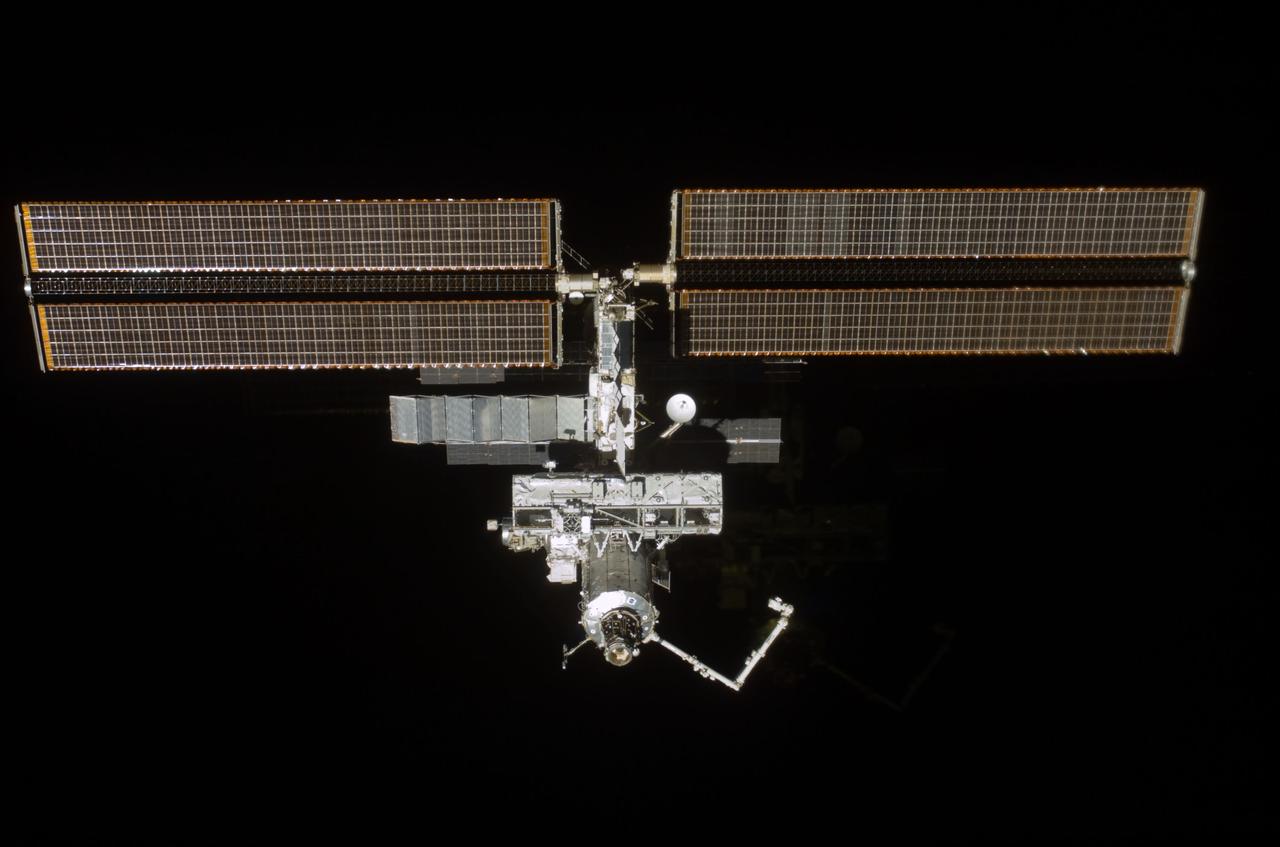
STS110-E-6006 (17 April 2002) --- The International Space Station (ISS), newly equipped with the 27,000 pound S0 (S-zero) truss, was photographed with a digital still camera by one of the astronauts on board the Space Shuttle Atlantis. Seen just above center frame, S0 is the first segment of a truss structure which will ultimately expand the station to the length of a football field. Atlantis pulled away from the complex at 1:31 p.m. (CDT) as two spacecraft flew some 247 statute miles above Earth. After more than a week of joint operations between the shuttle and station crews, astronaut Stephen N. Frick, pilot, backed Atlantis away to a distance of about 400 feet in front of the station, where he began a 1 1/4 lap flyaround of the ISS.
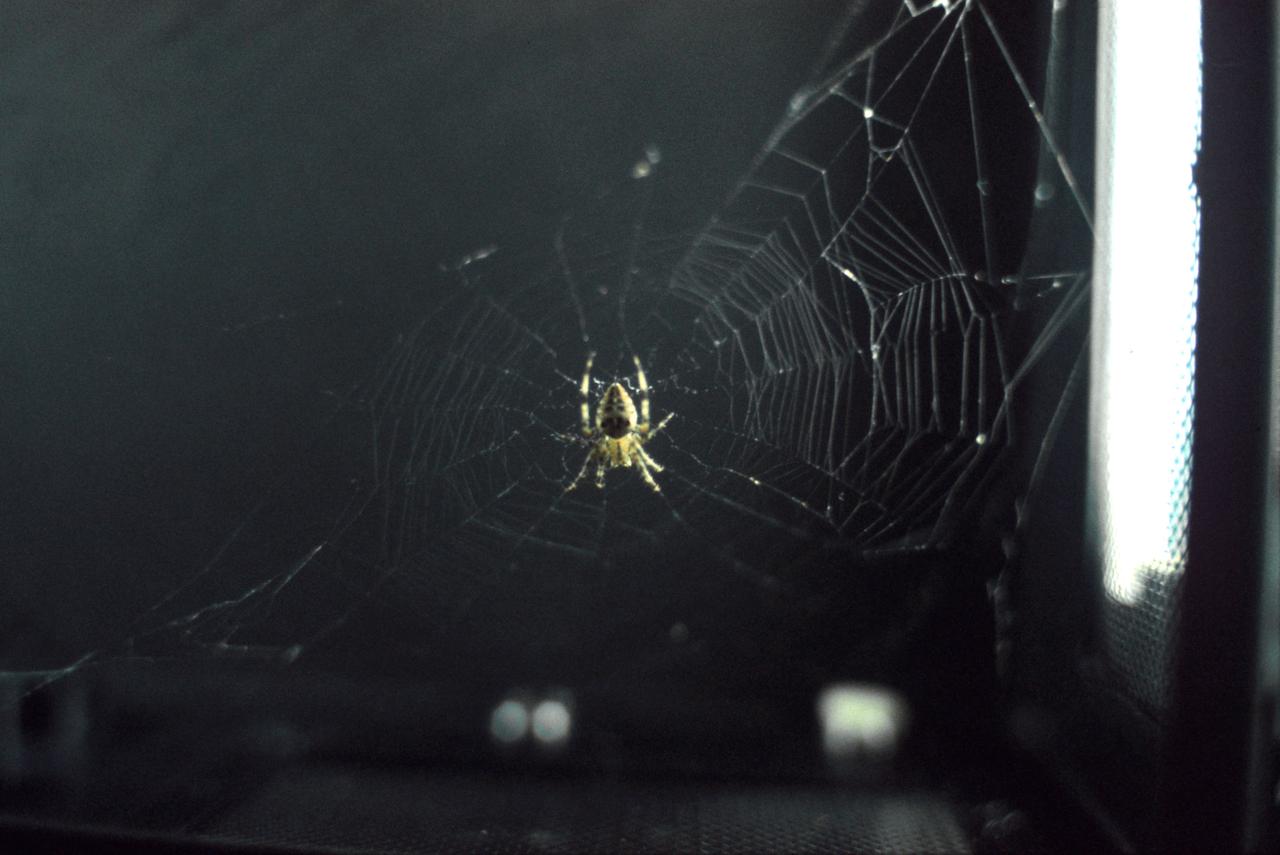
SL3-108-1307 (July-September 1973) --- A close-up view of Arabella, one of the two Skylab 3 common cross spiders "Araneus diadematus," and the web it had spun in the zero-gravity of space aboard the Skylab space station cluster in Earth orbit. This picture was taken with a hand-held 35mm Nikon camera. During the 59-day Skylab 3 mission the two spiders, Arabella and Anita, were housed in an enclosure onto which a motion picture and a still camera were attempts to build a web in the weightless environment. The spider experiment (ED52) was one of 25 experiments selected for Skylab by NASA from more than 3,400 experiment proposals submitted by high school students throughout the nation. ED52 was submitted by 17-year-old Judith S. Miles of Lexington, Massachusetts. Anita died during the last week of the mission. Photo credit: NASA
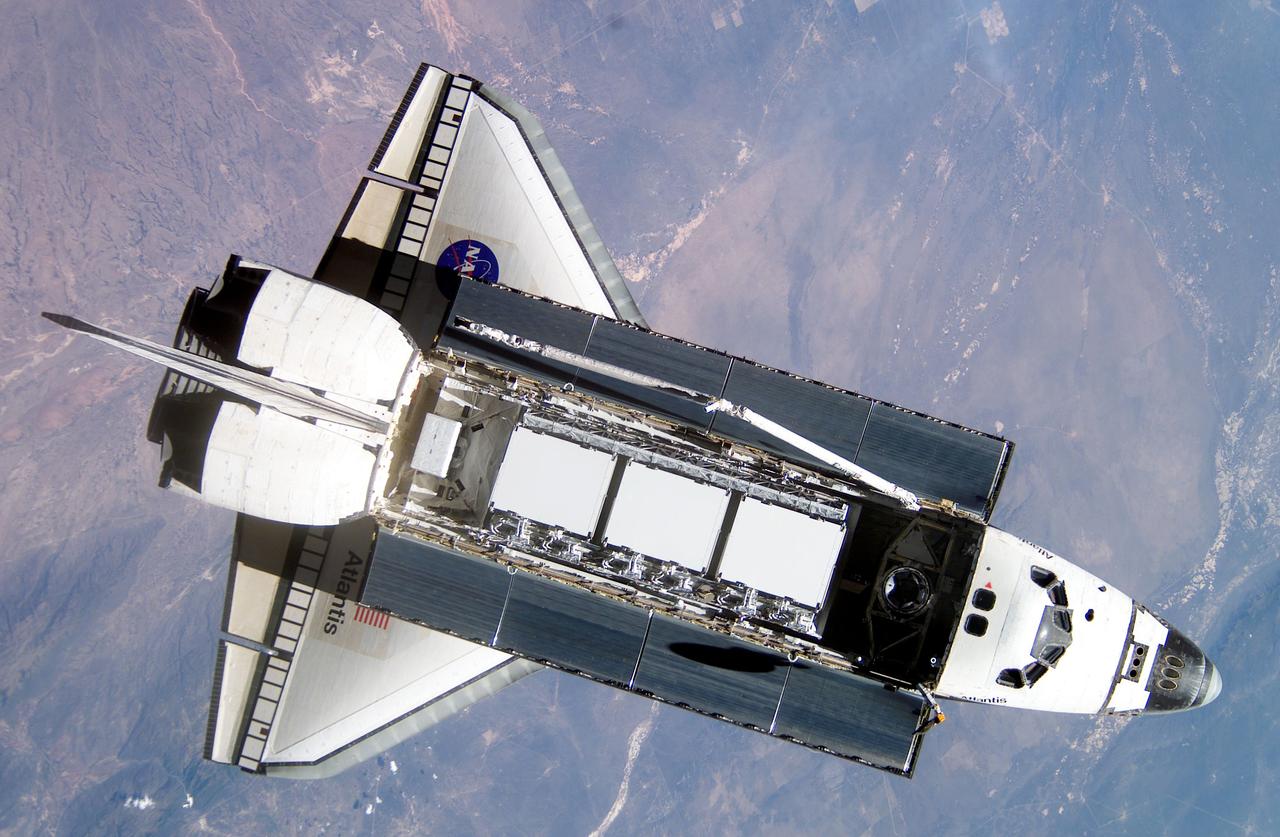
Back dropped against a blue and white Earth, the Space Shuttle Orbiter Atlantis was photographed by an Expedition 5 crew member onboard the International Space Station (ISS) during rendezvous and docking operations. Docking occurred at 10:17 am on October 9, 2002. The Starboard 1 (S1) Integrated Truss Structure, the primary payload of the STS-112 mission, can be seen in Atlantis' cargo bay. Installed and outfitted within 3 sessions of Extravehicular Activity (EVA) during the 11 day mission, the S1 truss provides structural support for the orbiting research facility's radiator panels, which use ammonia to cool the Station's complex power system. The S1 truss, attached to the S0 (S Zero) truss installed by the previous STS-110 mission, flows 637 pounds of anhydrous ammonia through three heat rejection radiators.
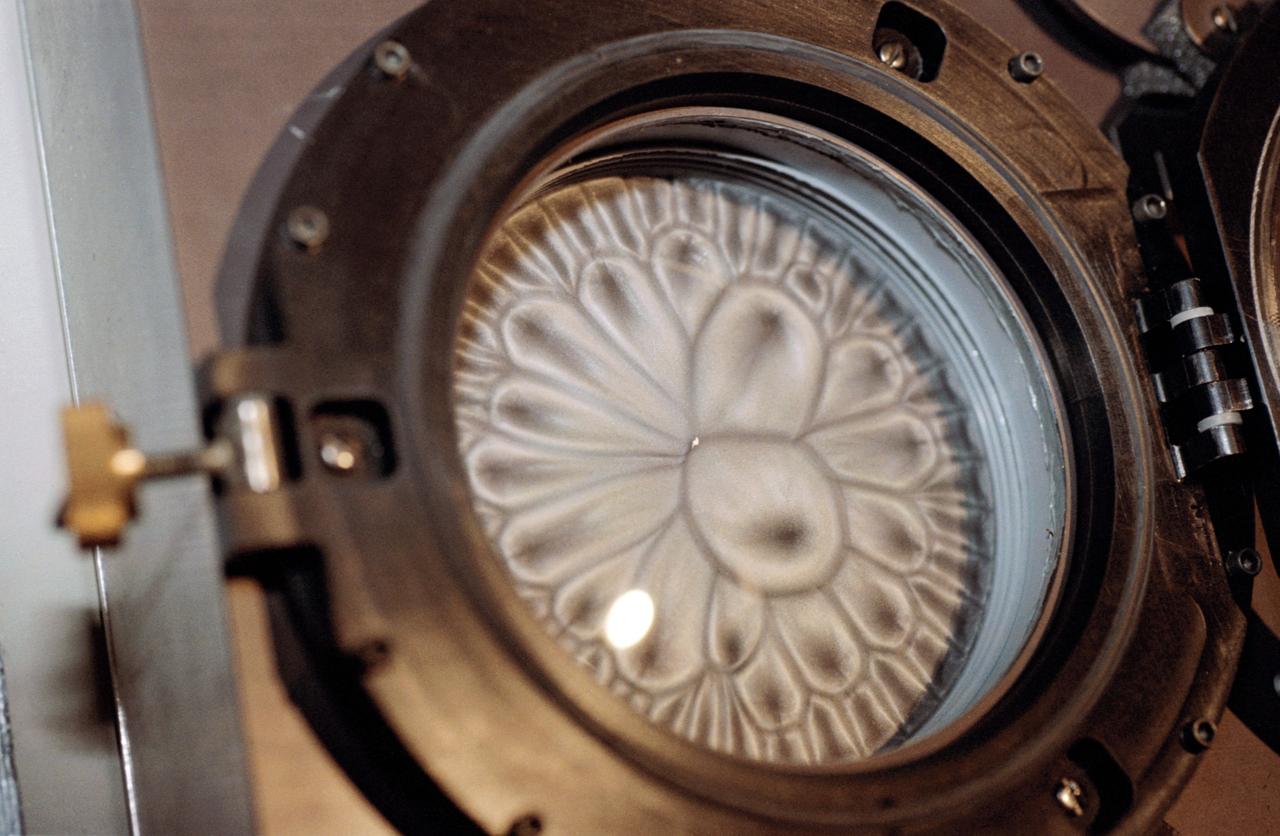
STS-42 closeup view shows Student Experiment 81-09 (SE 81-09), Convection in Zero Gravity experiment, with radial pattern caused by convection induced by heating an oil and aluminum powder mixture in the weightlessness of space. While the STS-42 crewmembers activated the Shuttle Student Involvement Program (SSIP) experiment on Discovery's, Orbiter Vehicle (OV) 103's, middeck, Scott Thomas, the student who designed the experiment, was able to observe the procedures via downlinked television (TV) in JSC's Mission Control Center (MCC). Thomas, now a physics doctoral student at the University of Texas, came up with the experiment while he participated in the SSIP as a student at Richland High School in Johnstown, Pennsylvia.
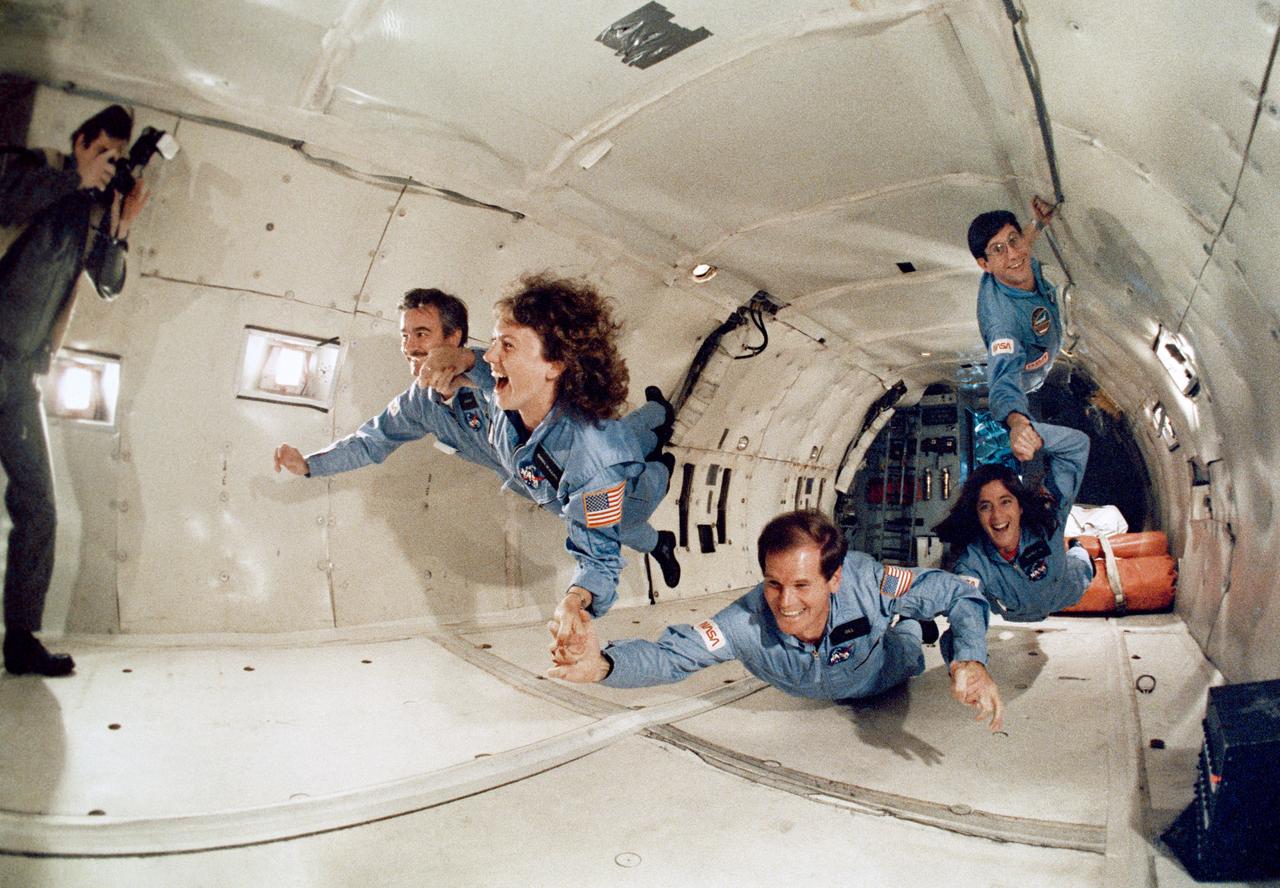
S85-44834 (20 Nov. 1985) --- This flying human chain represents prime and backup payload specialists for two upcoming STS missions. The group, representing trainees for STS-61C later this year and STS-51L early next year, shared some 40 parabolas in NASA?s KC-135, ?Zero-G? aircraft on Nov. 20, 1985. Left to right are Gerard Magilton, RCA backup payload specialist for STS-61C; Sharon Christa McAuliffe, payload specialist/teacher citizen observer for STS-51L; U.S. Representative Bill Nelson (D., Florida), scheduled for 61C; Barbara R. Morgan, backup to McAuliffe; and Robert J. Cenker, RCA payload specialist for 61C. The photo was taken by Otis Imboden. Photo credit: NASA
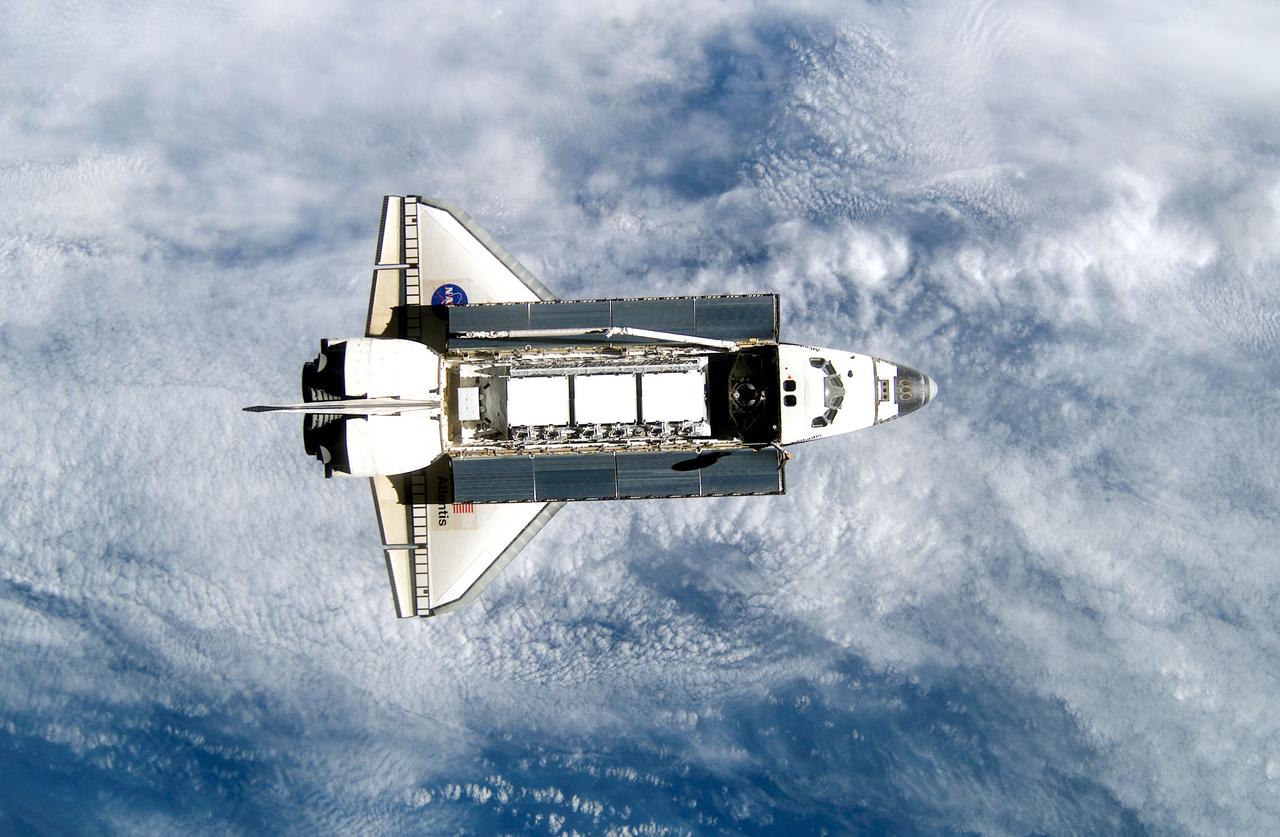
Back dropped against a blue and white Earth, the Space Shuttle Orbiter Atlantis was photographed by an Expedition 5 crew member onboard the International Space Station (ISS) during rendezvous and docking operations. Docking occurred at 10:17 am on October 9, 2002. The Starboard 1 (S1) Integrated Truss Structure, the primary payload of the STS-112 mission, can be seen in Atlantis' cargo bay. Installed and outfitted within 3 sessions of Extravehicular Activity (EVA) during the 11 day mission, the S1 truss provides structural support for the orbiting research facility's radiator panels, which use ammonia to cool the Station's complex power system. The S1 truss, attached to the S0 (S Zero) truss installed by the previous STS-110 mission, flows 637 pounds of anhydrous ammonia through three heat rejection radiators.

This is an illustration of the Space Base concept. In-house work of the Marshall Space Flight Center, as well as a Phase B contract with the McDornel Douglas Astronautics Company, resulted in a preliminary design for a space station in 1969 and l970. The Marshall-McDonnel Douglas approach envisioned the use of two common modules as the core configuration of a 12-man space station. Each common module was 33 feet in diameter and 40 feet in length and provided the building blocks, not only for the space station, but also for a 50-man space base. Coupled together, the two modules would form a four-deck facility: two decks for laboratories and two decks for operations and living quarters. Zero-gravity would be the normal mode of operation, although the station would have an artificial-gravity capability. This general-purpose orbital facility was to provide wide-ranging research capabilities. The design of the facility was driven by the need to accommodate a broad spectrum of activities in support of astronomy, astrophysics, aerospace medicine, biology, materials processing, space physics, and space manufacturing. To serve the needs of Earth observations, the station was to be placed in a 242-nautical-mile orbit at a 55-degree inclination. An Intermediate-21 vehicle (comprised of Saturn S-IC and S-II stages) would have launched the station in 1977.
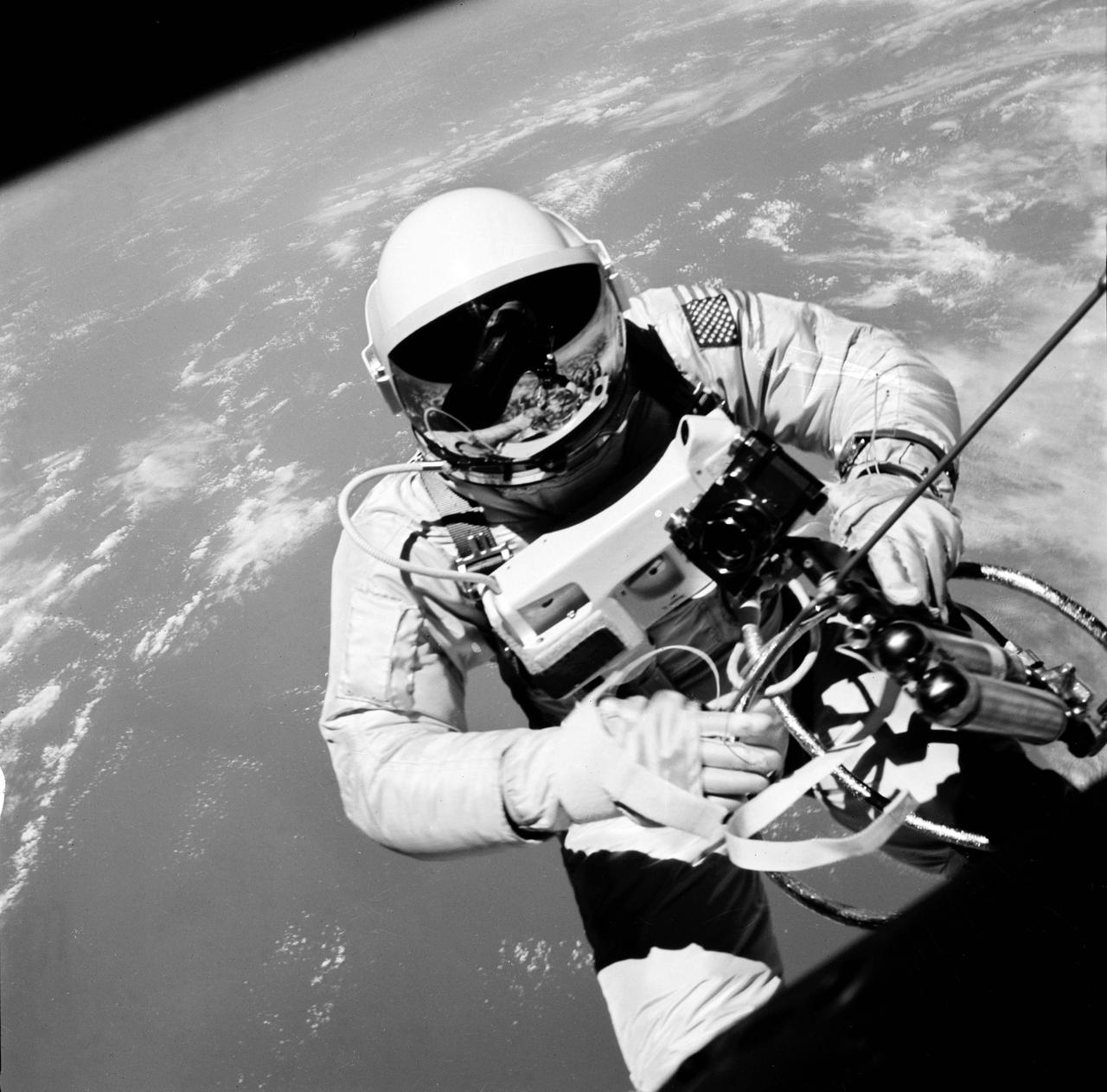
S65-30202 (3 June 1965) --- Astronaut Edward H. White II, pilot on the Gemini-Titan IV (GT-4) spaceflight, floats in the zero gravity of space outside the Gemini IV spacecraft. His face is covered by a shaded visor to protect him from the unfiltered rays of the sun. White became the first American astronaut to walk in space. He remained outside the spacecraft for 21 minutes during the third revolution of the Gemini IV mission. He wears a specially designed spacesuit for the EVA. He?s holding the Hand-Held Self-Maneuvering Unit (HHSMU), with which he controlled his movements while in space, and a camera is attached to the HHSMU. He was attached to the spacecraft by a 25-feet umbilical line and a 23-feet tether line, both wrapped together with gold tape to form one cord. He wears an emergency oxygen supply check pack. Astronaut James A. McDivitt is command pilot for the GT-4 mission. The mission was a four-day, 62-revolution flight, during which McDivitt and White performed a series of scientific and engineering experiments. (This image is black and white) Photo credit: NASA EDITOR?S NOTE: Astronaut Edward H. White II died in the Apollo/Saturn 204 fire at Cape Kennedy, Florida, on Jan. 27, 1967.
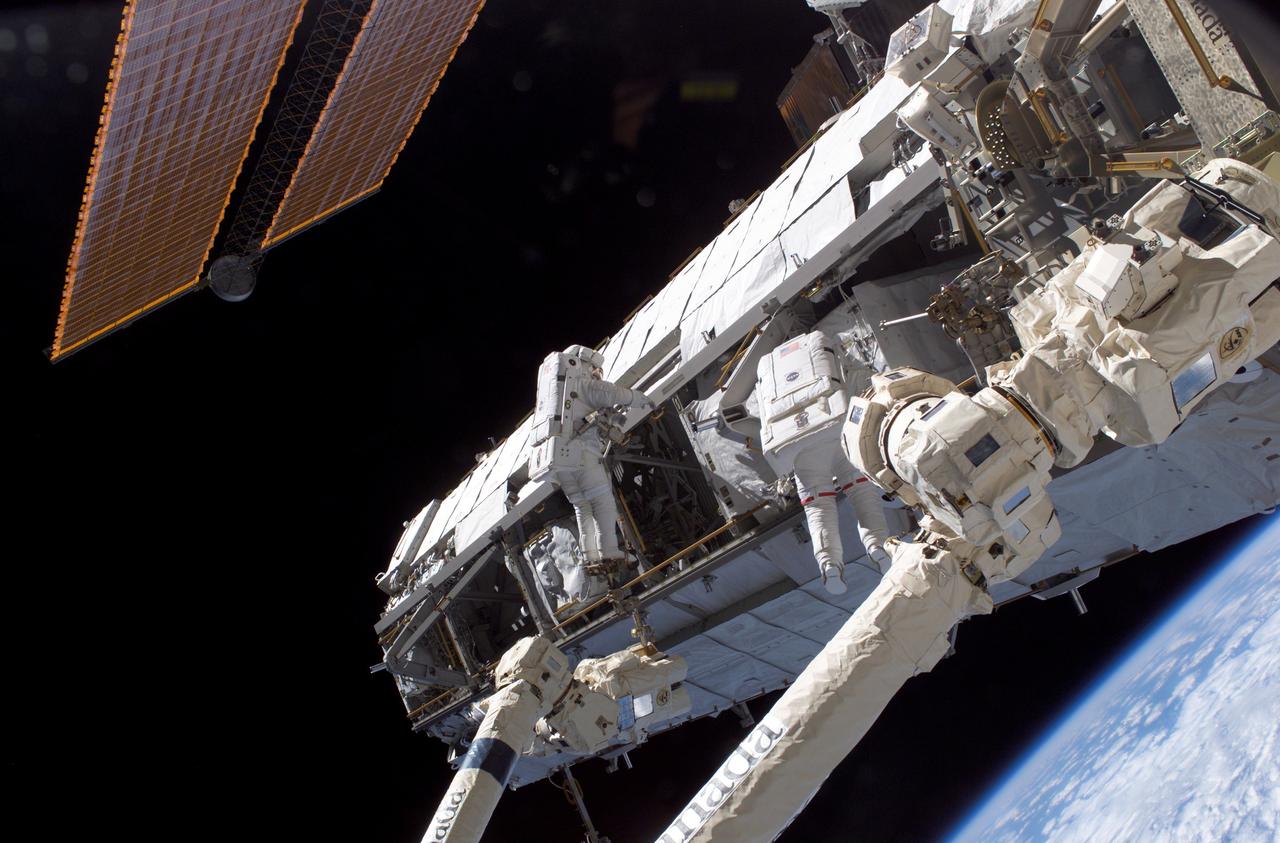
Astronauts Piers J. Sellers (left ) and David A. Wolf work on the newly installed Starboard One (S1) truss to the International Space Station (ISS) during the STS-112 mission. The primary payloads of this mission, ISS Assembly Mission 9A, were the Integrated Truss Assembly S1 (S One), the starboard side thermal radiator truss, and the Crew Equipment Translation Aid (CETA) cart to the ISS. The S1 truss provides structural support for the orbiting research facility's radiator panels, which use ammonia to cool the Station's complex power system. The S1 truss was attached to the S0 (S Zero) truss, which was launched on April 8, 2002 aboard the STS-110, and flows 637 pounds of anhydrous ammonia through three heat-rejection radiators. The truss is 45-feet long, 15-feet wide, 10-feet tall, and weighs approximately 32,000 pounds. The CETA cart was attached to the Mobil Transporter and will be used by assembly crews on later missions. Manufactured by the Boeing Company in Huntington Beach, California, the truss primary structure was transferred to the Marshall Space Flight Center in February 1999 for hardware installations and manufacturing acceptance testing. The launch of the STS-112 mission occurred on October 7, 2002, and its 11-day mission ended on October 18, 2002.
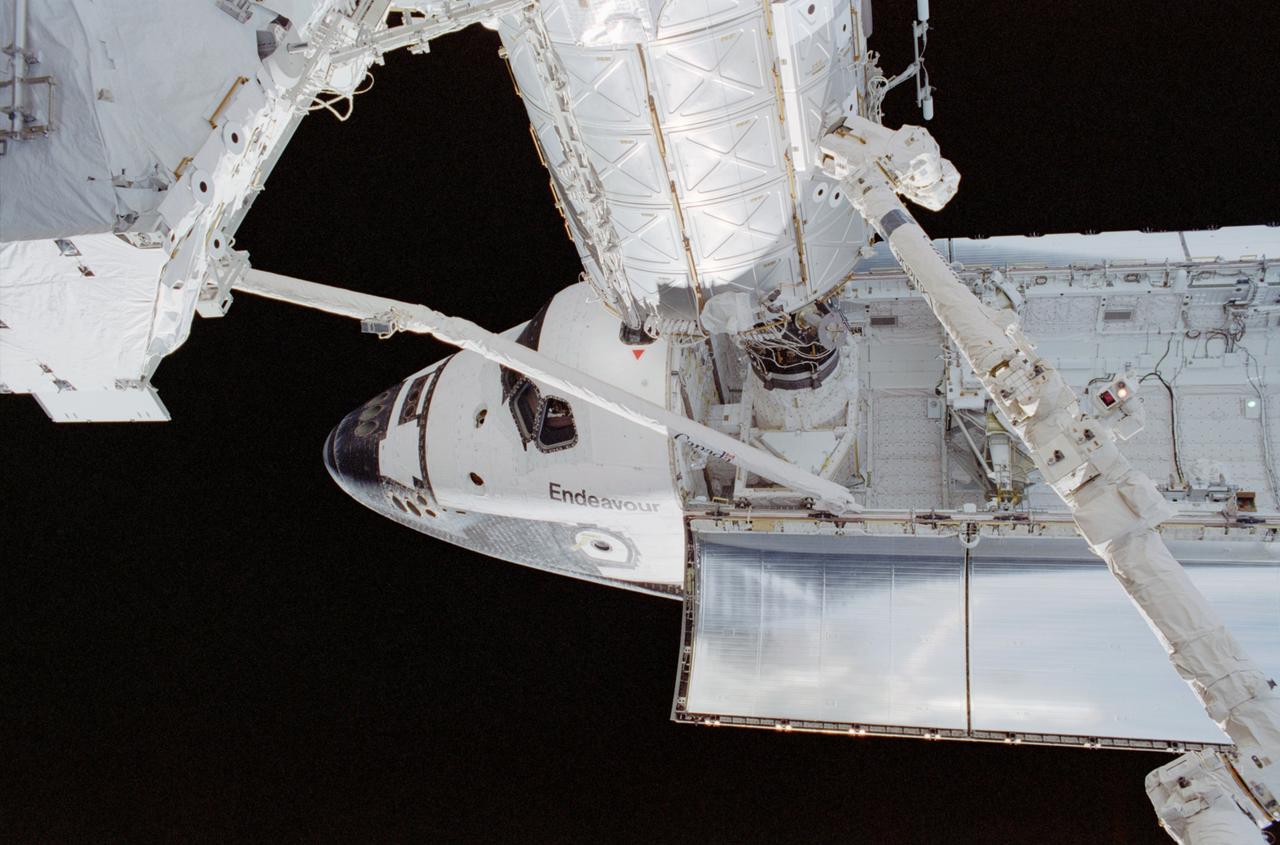
The STS-111 mission, the 14th Shuttle mission to visit the International Space Station (ISS), was launched on June 5, 2002 aboard the Space Shuttle Orbiter Endeavour. On board were the STS-111 and Expedition Five crew members. Astronauts Kerneth D. Cockrell, commander; Paul S. Lockhart, pilot, and mission specialists Franklin R. Chang-Diaz and Philippe Perrin were the STS-111 crew members. Expedition Five crew members included Cosmonaut Valeri G. Korzun, commander, Astronaut Peggy A. Whitson and Cosmonaut Sergei Y. Treschev, flight engineers. Three space walks enabled the STS-111 crew to accomplish the delivery and installation of the Mobile Remote Servicer Base System (MBS), an important part of the Station's Mobile Servicing System that allows the robotic arm to travel the length of the Station, which is necessary for future construction tasks; the replacement of a wrist roll joint on the Station's robotic arm; and the task of unloading supplies and science experiments from the Leonardo multipurpose Logistics Module, which made its third trip to the orbital outpost. In this photograph, the Space Shuttle Endeavour, back dropped by the blackness of space, is docked to the pressurized Mating Adapter (PMA-2) at the forward end of the Destiny Laboratory on the ISS. A portion of the Canadarm2 is visible on the right and Endeavour's robotic arm is in full view as it is stretched out with the S0 (S-zero) Truss at its end.
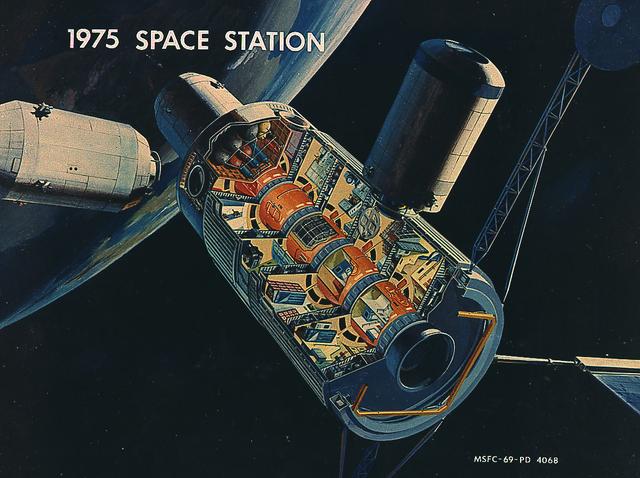
This picture illustrates a concept of a 33-Foot-Diameter Space Station Leading to a Space Base. In-house work of the Marshall Space Flight Center, as well as a Phase B contract with the McDornel Douglas Astronautics Company, resulted in a preliminary design for a space station in 1969 and l970. The Marshall-McDonnel Douglas approach envisioned the use of two common modules as the core configuration of a 12-man space station. Each common module was 33 feet in diameter and 40 feet in length and provided the building blocks, not only for the space station, but also for a 50-man space base. Coupled together, the two modules would form a four-deck facility: two decks for laboratories and two decks for operations and living quarters. Zero-gravity would be the normal mode of operation, although the station would have an artificial gravity capability. This general-purpose orbital facility was to provide wide-ranging research capabilities. The design of the facility was driven by the need to accommodate a broad spectrum of activities in support of astronomy, astrophysics, aerospace medicine, biology, materials processing, space physics, and space manufacturing. To serve the needs of Earth observations, the station was to be placed in a 242-nautical-mile orbit at a 55-degree inclination. An Intermediate-21 vehicle (comprised of Saturn S-IC and S-II stages) would have launched the station in 1977.
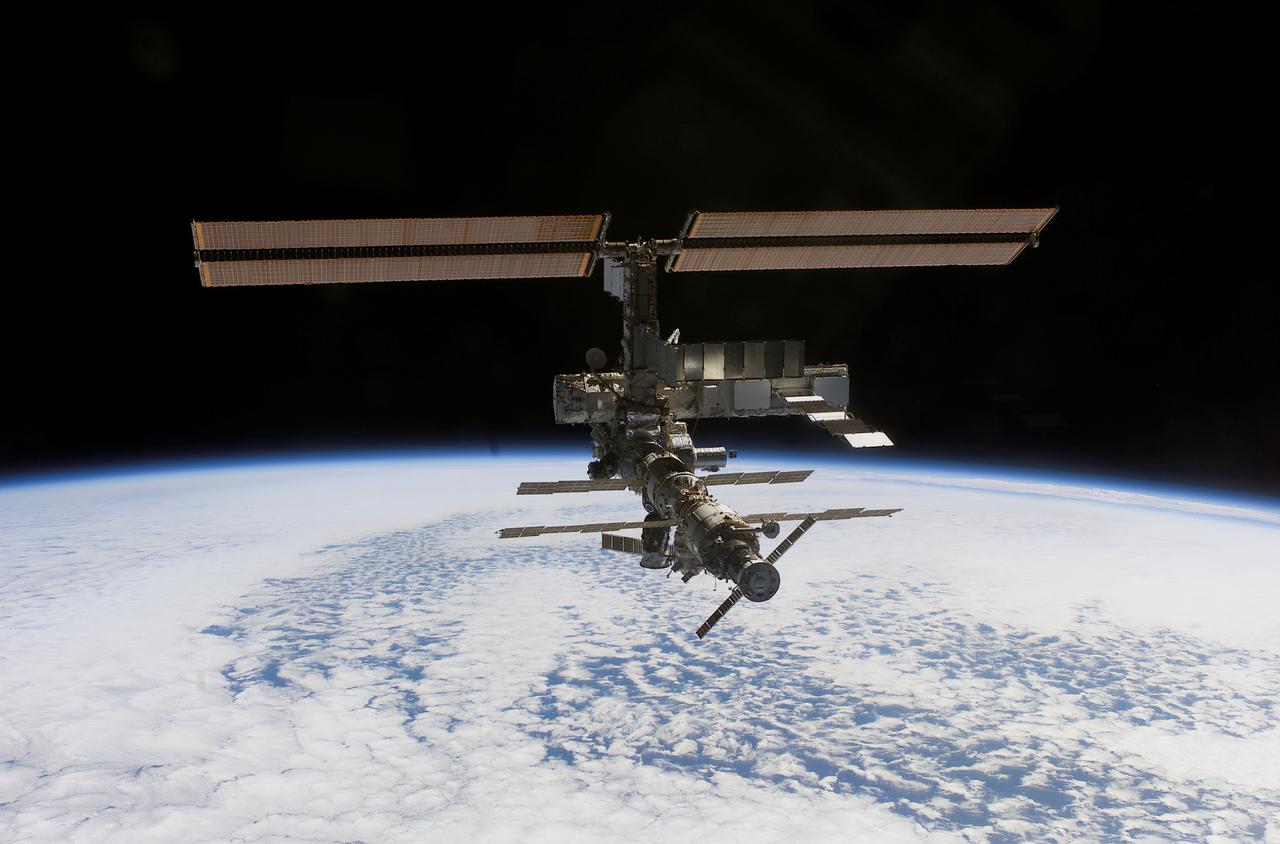
This image of the International Space Station (ISS) was photographed by one of the crewmembers of the STS-112 mission following separation from the Space Shuttle Orbiter Atlantis as the orbiter pulled away from the ISS. The primary payloads of this mission, International Space Station Assembly Mission 9A, were the Integrated Truss Assembly S1 (S-One), the Starboard Side Thermal Radiator Truss, and the Crew Equipment Translation Aid (CETA) cart to the ISS. The S1 truss provides structural support for the orbiting research facility's radiator panels, which use ammonia to cool the Station's complex power system. The S1 truss was attached to the S0 (S Zero) truss, which was launched on April 8, 2002 aboard the STS-110, and flows 637 pounds of anhydrous ammonia through three heat-rejection radiators. The truss is 45-feet long, 15-feet wide, 10-feet tall, and weighs approximately 32,000 pounds. The CETA cart was attached to the Mobil Transporter and will be used by assembly crews on later missions. Manufactured by the Boeing Company in Huntington Beach, California, the truss primary structure was transferred to the Marshall Space Flight Center in February 1999 for hardware installations and manufacturing acceptance testing. The launch of the STS-112 mission occurred on October 7, 2002, and its 11-day mission ended on October 18, 2002.
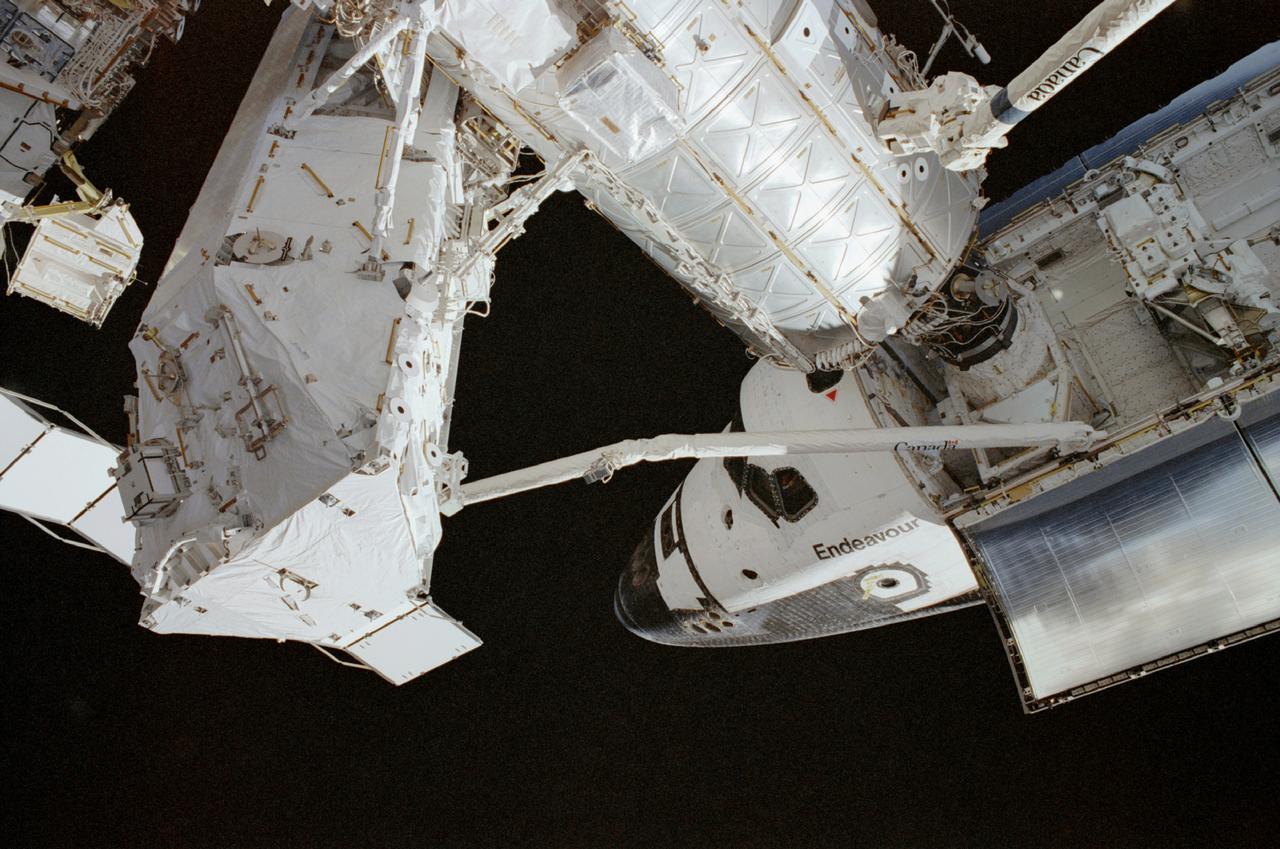
The STS-111 mission, the 14th Shuttle mission to visit the International Space Station (ISS), was launched on June 5, 2002 aboard the Space Shuttle Orbiter Endeavour. On board were the STS-111 and Expedition Five crew members. Astronauts Kerneth D. Cockrell, commander; Paul S. Lockhart, pilot, and mission specialists Franklin R. Chang-Diaz and Philippe Perrin were the STS-111 crew members. Expedition Five crew members included Cosmonaut Valeri G. Korzun, commander, Astronaut Peggy A. Whitson and Cosmonaut Sergei Y. Treschev, flight engineers. Three space walks enabled the STS-111 crew to accomplish mission objectives: The delivery and installation of the Mobile Remote Servicer Base System (MBS), an important part of the Station's Mobile Servicing System that allows the robotic arm to travel the length of the Station, which is necessary for future construction tasks; the replacement of a wrist roll joint on the Station's robotic arm; and the task of unloading supplies and science experiments from the Leonardo multipurpose Logistics Module, which made its third trip to the orbital outpost. In this photograph, the Space Shuttle Endeavour, back dropped by the blackness of space, is docked to the pressurized Mating Adapter (PMA-2) at the forward end of the Destiny Laboratory on the ISS. Endeavour's robotic arm is in full view as it is stretched out with the S0 (S-zero) Truss at its end.
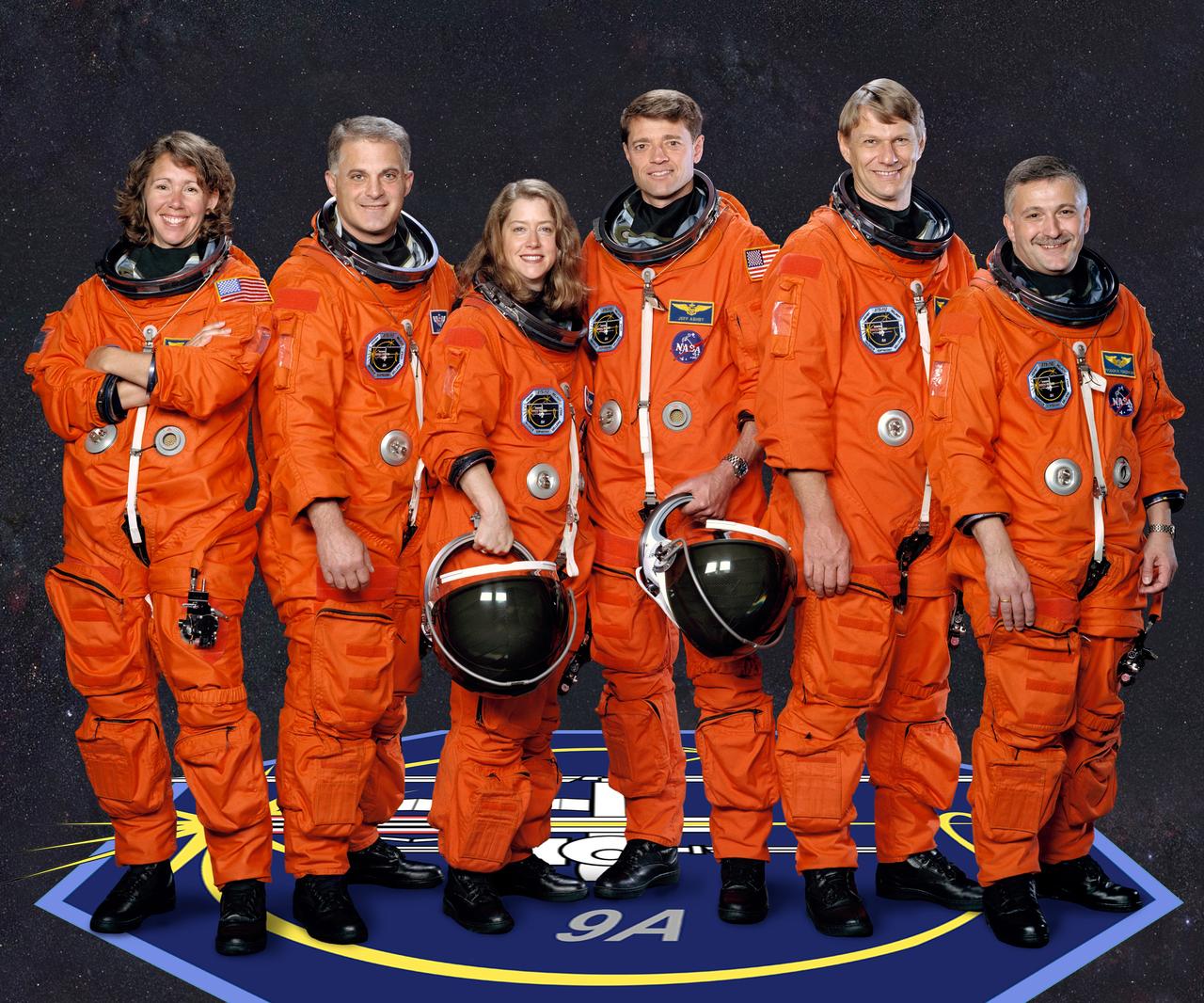
These 5 astronauts and cosmonaut, all members of the STS-112 mission, pose for a crew portrait. Pictured from left to right are: Astronauts Sandra H. Magnus, mission specialist; David A. Wolf, mission specialist; Pamela A. Melroy, pilot; Jeffrey S. Ashby, commander; Piers J. Sellers, mission specialist; and cosmonaut Fyodor Yurchikhin, mission specialist representing Rosaviakosmos. STS-112 launched aboard the Space Shuttle Atlantis October 7, 2002 for an 11-day mission completing three sessions of Extra Vehicular Activity(EVA). Its primary mission was to install the Starboard (S1) Integrated Truss Structure and Equipment Translation Aid (CETA) Cart to the ISS. The S1 truss provides structural support for the orbiting research facility's radiator panels, which use ammonia to cool the Station's complex power system. The S1 truss, attached to the S0 (S Zero) truss installed by the previous STS-110 mission, flows 637 pounds of anhydrous ammonia through three heat rejection radiators. The truss is 45-feet long, 15-feet wide, 10-feet tall, and weighs approximately 32,000 pounds. The CETA is the first of two human-powered carts that will ride along the railway on the ISS providing a mobile work platform for future extravehicular activities by astronauts.
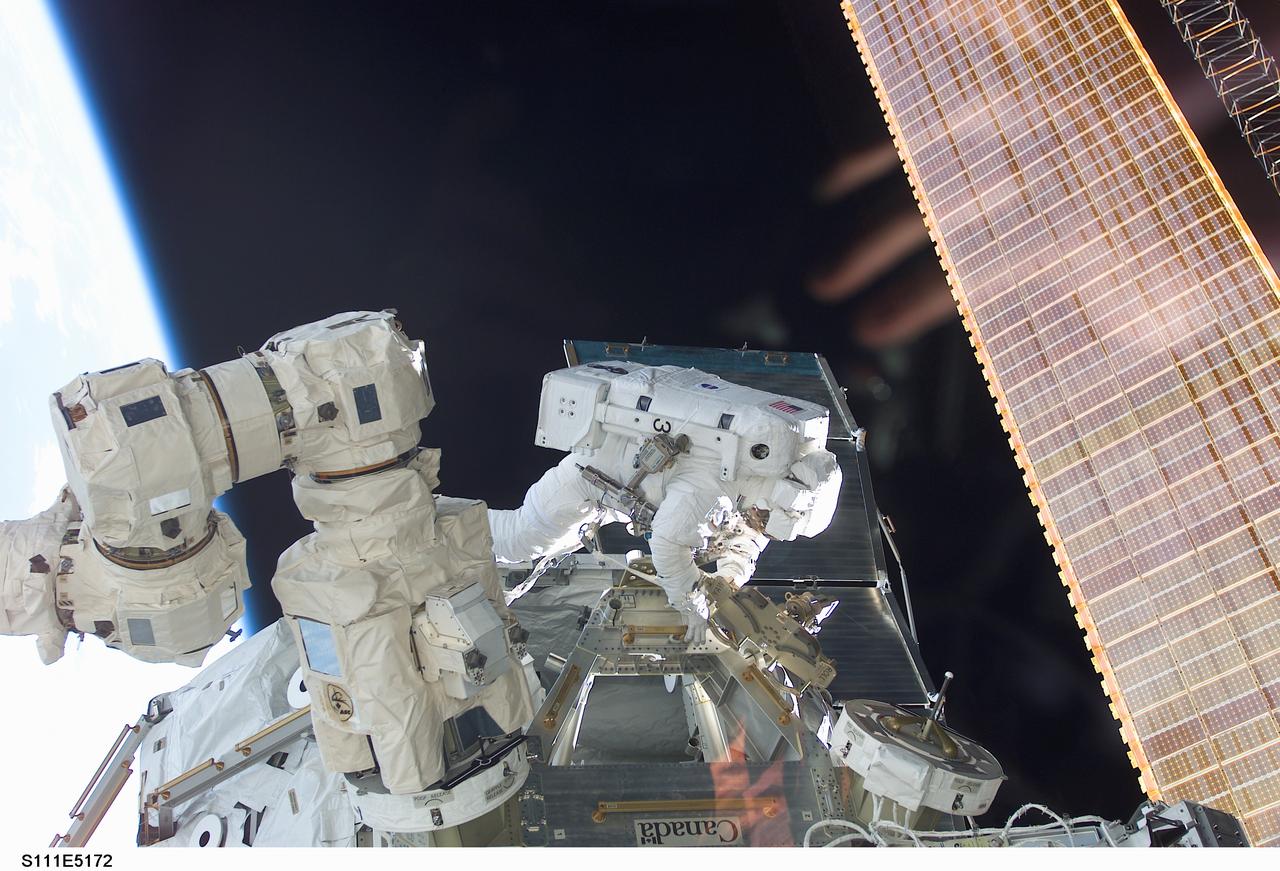
STS111-E-5172 (11 June 2002) --- Astronaut Philippe Perrin, mission specialist representing CNES, the French Space Agency, participates in the second scheduled session of extravehicular activity (EVA) for the STS-111 mission. During the spacewalk, Perrin and Chang-Diaz attached power, data and video cables from the International Space Station (ISS) to the Mobile Base System (MBS) and used a power wrench to complete the attachment of the MBS onto the Mobile Transporter (MT).
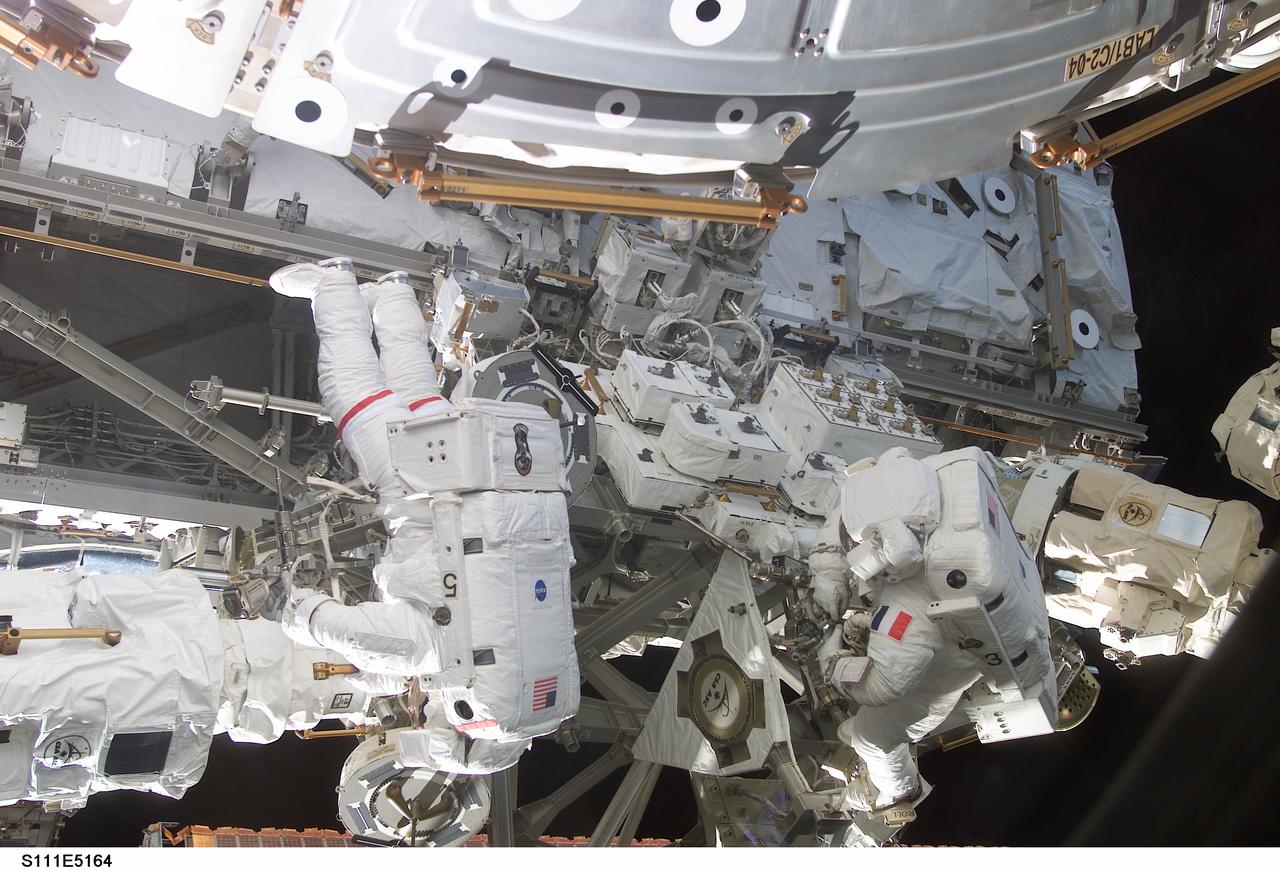
STS111-E-5164 (11 June 2002) --- Astronauts Franklin R. Chang-Diaz (left) and Philippe Perrin, both STS-111 mission specialists, work in tandem on the second scheduled session of extravehicular activity (EVA) for the STS-111 mission. During the spacewalk, Chang-Diaz and Perrin attached power, data and video cables from the International Space Station (ISS) to the Mobile Base System (MBS) and used a power wrench to complete the attachment of the MBS onto the Mobile Transporter (MT). Perrin represents CNES, the French Space Agency.
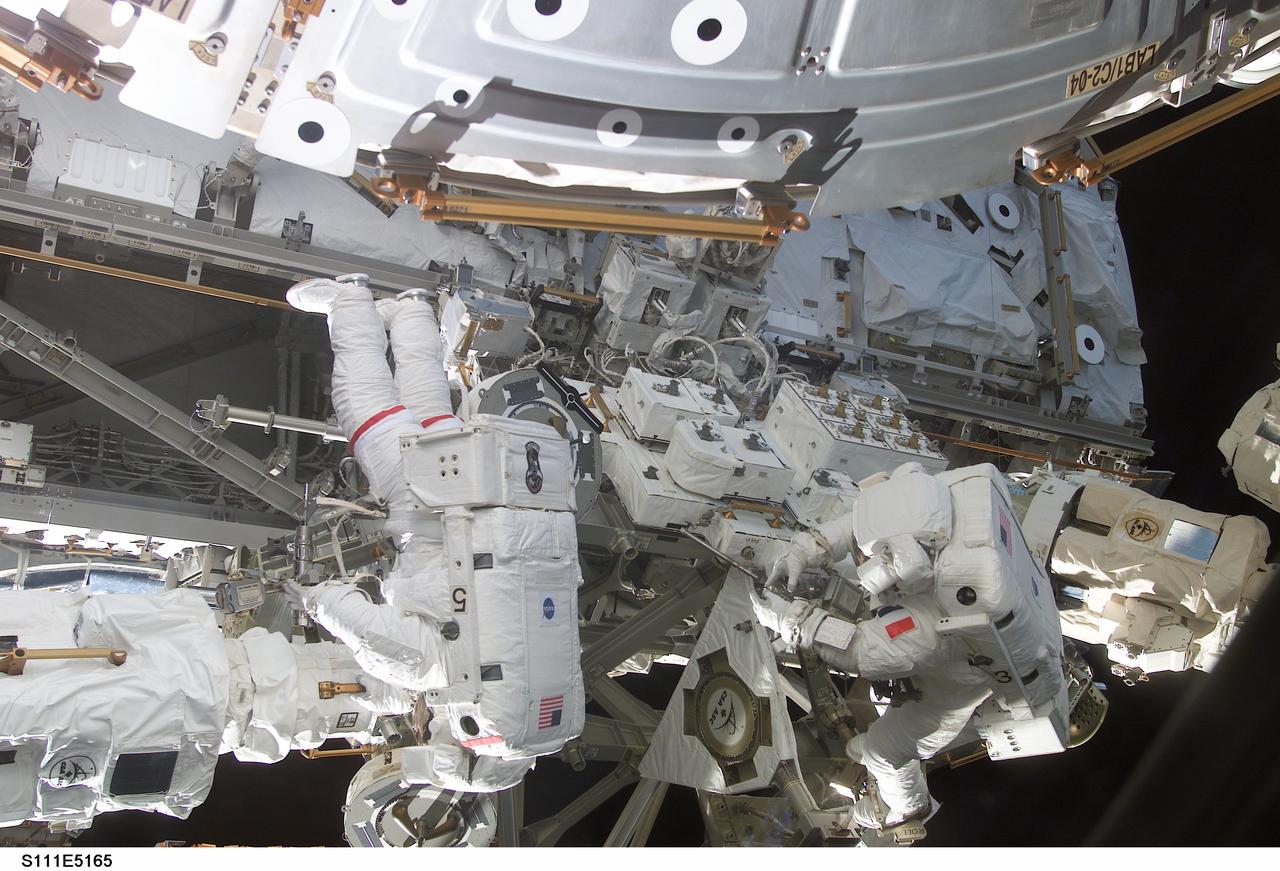
STS111-E-5165 (11 June 2002) --- Astronauts Franklin R. Chang-Diaz (left) and Philippe Perrin, both STS-111 mission specialists, work in tandem on the second scheduled session of extravehicular activity (EVA) for the STS-111 mission. During the spacewalk, Chang-Diaz and Perrin attached power, data and video cables from the International Space Station (ISS) to the Mobile Base System (MBS) and used a power wrench to complete the attachment of the MBS onto the Mobile Transporter (MT). Perrin represents CNES, the French Space Agency.
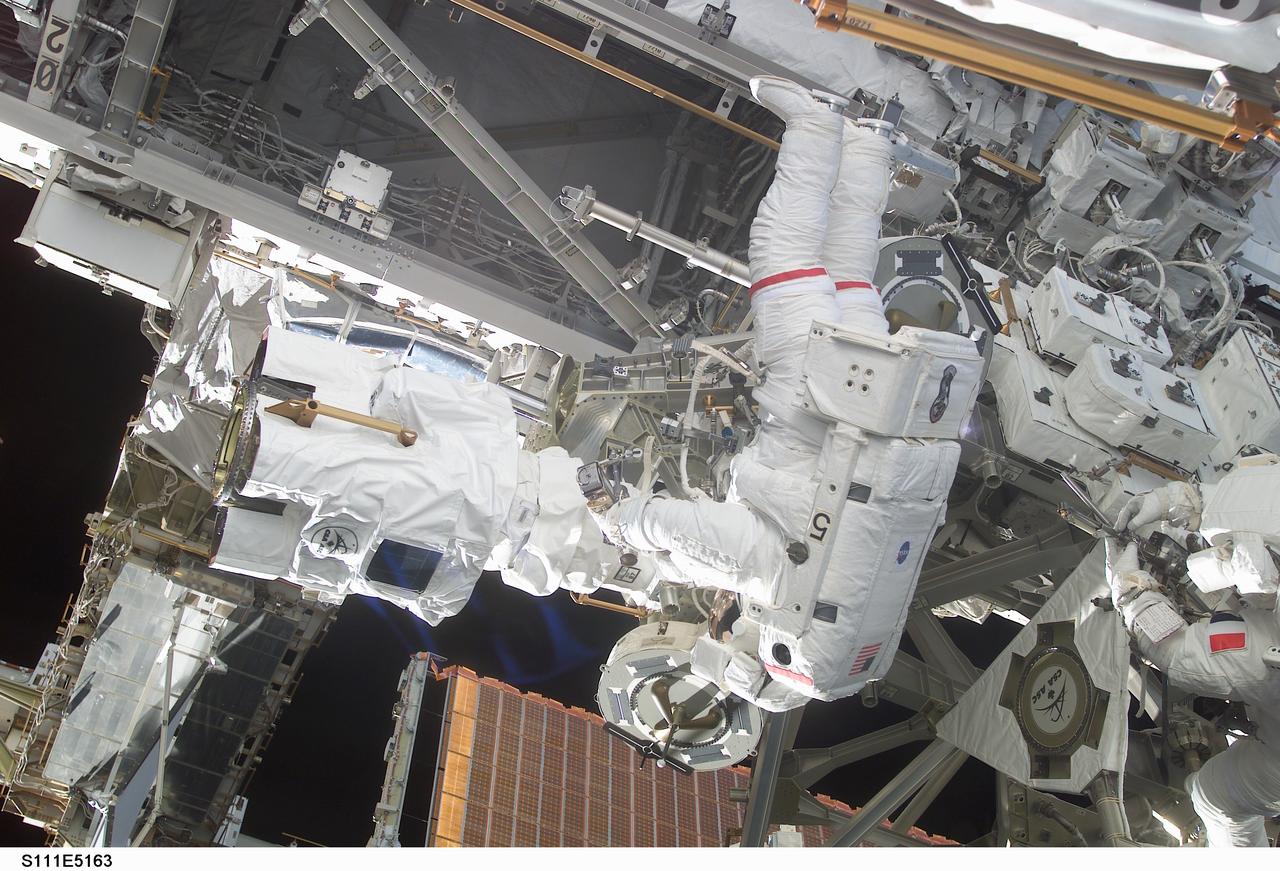
STS111-E-5163 (11 June 2002) --- Astronauts Franklin R. Chang-Diaz (center frame) and Philippe Perrin (partially obscured), both STS-111 mission specialists, work in tandem on the second scheduled session of extravehicular activity (EVA) for the STS-111 mission. During the spacewalk, Chang-Diaz and Perrin attached power, data and video cables from the International Space Station (ISS) to the Mobile Base System (MBS) and used a power wrench to complete the attachment of the MBS onto the Mobile Transporter (MT). Perrin represents CNES, the French Space Agency.
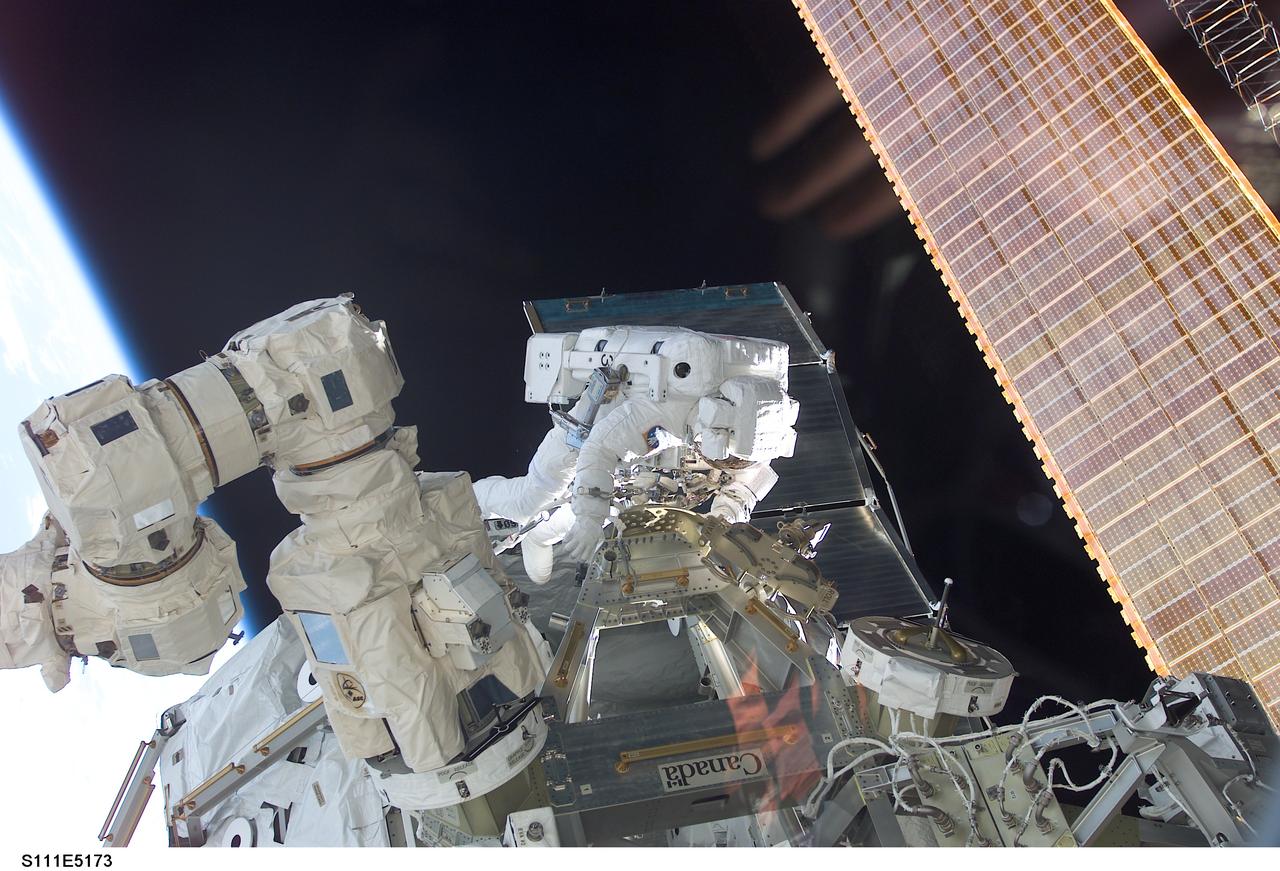
STS111-E-5173 (11 June 2002) --- Astronaut Philippe Perrin, mission specialist representing CNES, the French Space Agency, participates in the second scheduled session of extravehicular activity (EVA) for the STS-111 mission. During the spacewalk, Perrin and Chang-Diaz attached power, data and video cables from the International Space Station (ISS) to the Mobile Base System (MBS) and used a power wrench to complete the attachment of the MBS onto the Mobile Transporter (MT).
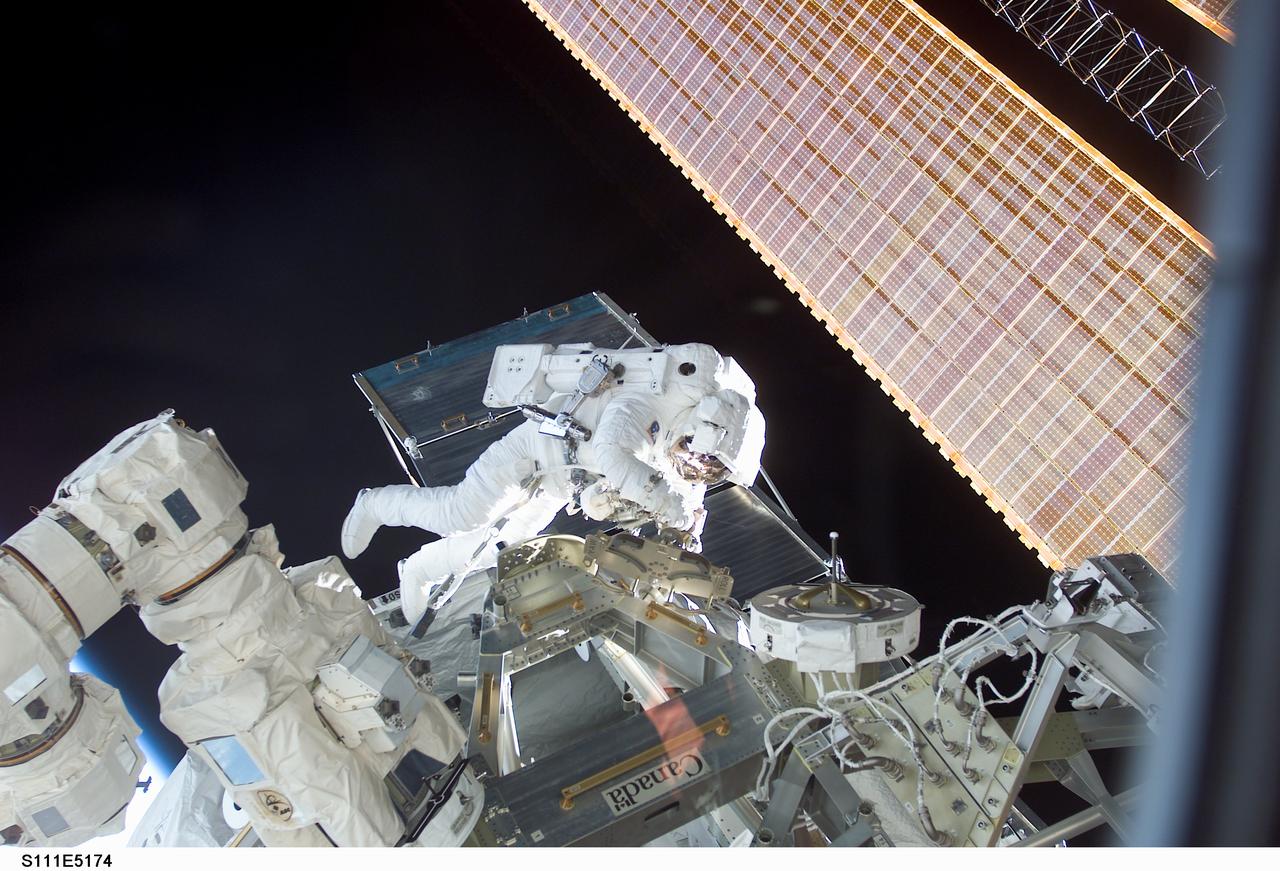
STS111-E-5174 (11 June 2002) --- Astronaut Philippe Perrin, mission specialist representing CNES, the French Space Agency, participates in the second scheduled session of extravehicular activity (EVA) for the STS-111 mission. During the spacewalk, Perrin and Chang-Diaz attached power, data and video cables from the International Space Station (ISS) to the Mobile Base System (MBS) and used a power wrench to complete the attachment of the MBS onto the Mobile Transporter (MT).
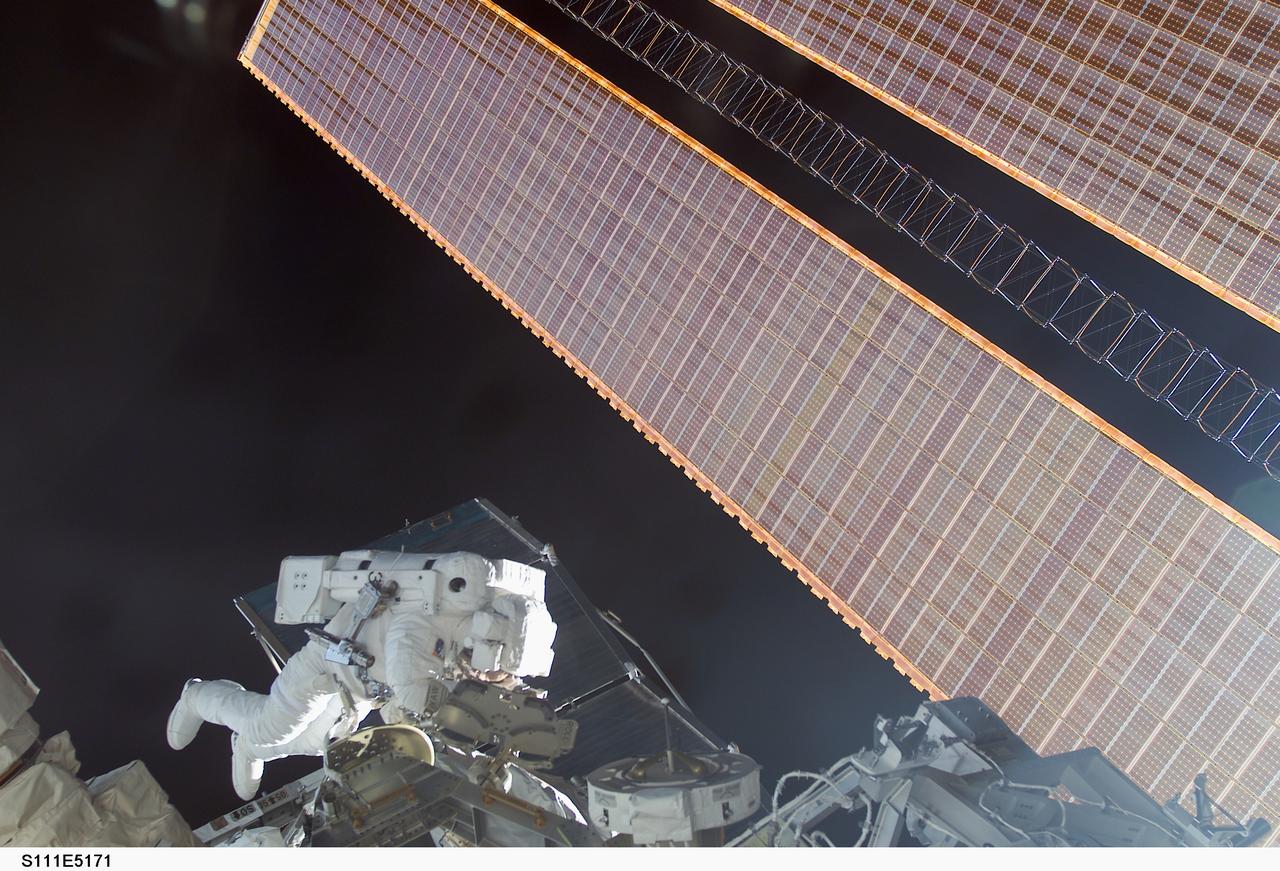
STS111-E-5171 (11 June 2002) --- Astronaut Philippe Perrin, mission specialist representing CNES, the French Space Agency, participates in the second scheduled session of extravehicular activity (EVA) for the STS-111 mission. During the spacewalk, Perrin and Chang-Diaz attached power, data and video cables from the International Space Station (ISS) to the Mobile Base System (MBS) and used a power wrench to complete the attachment of the MBS onto the Mobile Transporter (MT).
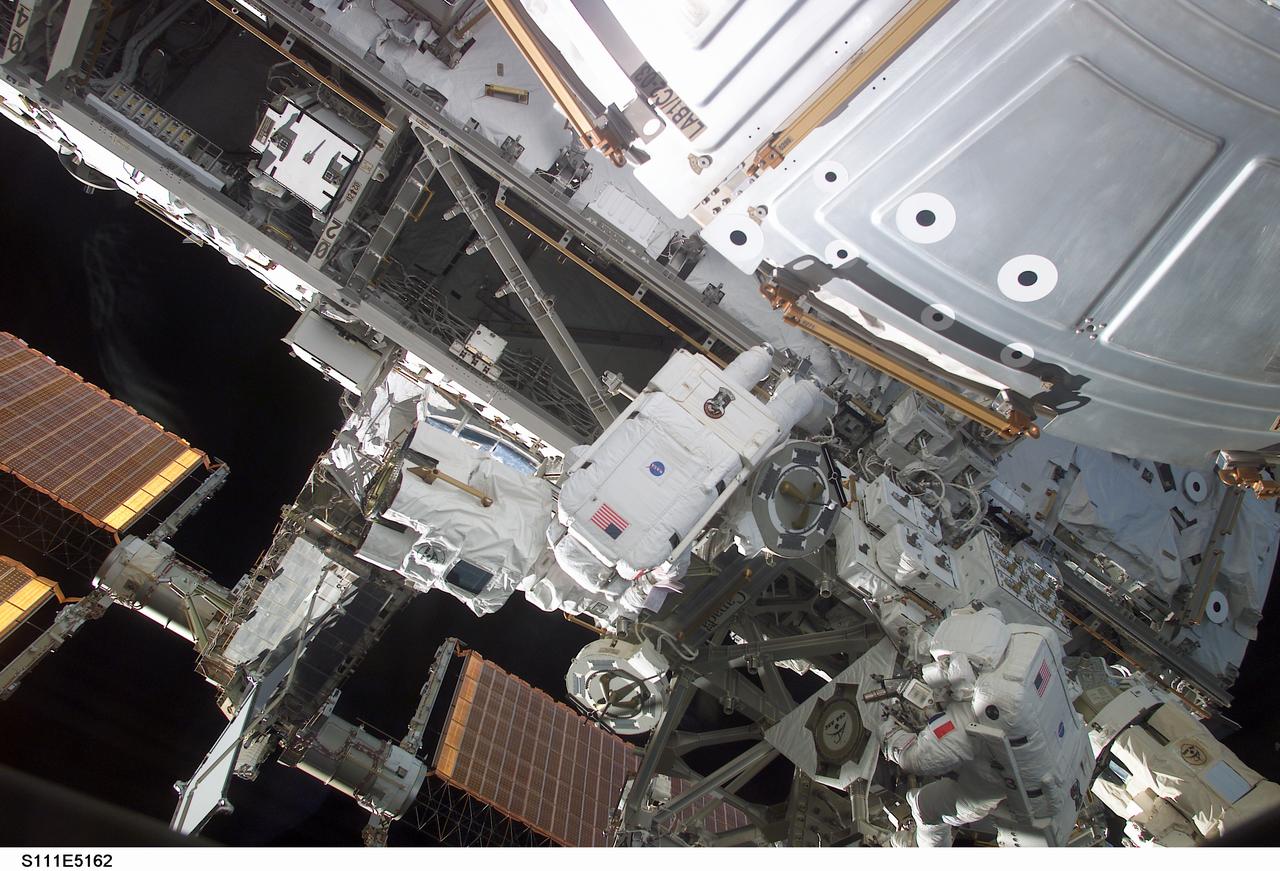
STS111-E-5162 (11 June 2002) --- Astronauts Franklin R. Chang-Diaz (center frame) and Philippe Perrin, both STS-111 mission specialists, work in tandem on the second scheduled session of extravehicular activity (EVA) for the STS-111 mission. During the spacewalk, Chang-Diaz and Perrin attached power, data and video cables from the International Space Station (ISS) to the Mobile Base System (MBS) and used a power wrench to complete the attachment of the MBS onto the Mobile Transporter (MT). Perrin represents CNES, the French Space Agency.
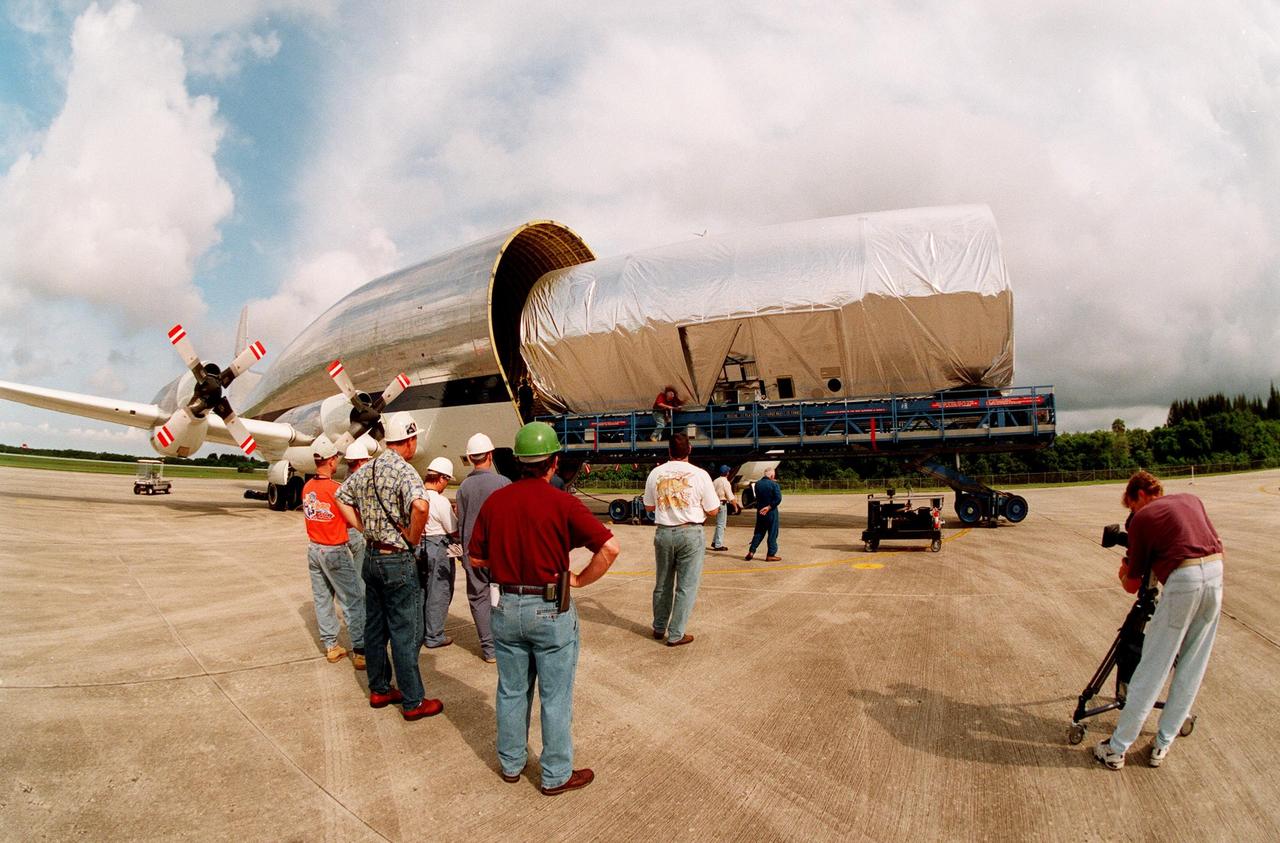
KENNEDY SPACE CENTER, FLA. -- At KSC's Shuttle Landing Facility, workers watch as a S0 (S Zero) truss segment built for the International Space Station (ISS) is moved out of the "Super Guppy" aircraft that brought it to KSC from Boeing in Huntington Beach, Calif. At right a cameraman records the exercise. The truss segment, which will become the backbone of the orbiting ISS, is a 44by 15-foot structure weighing 30,800 pounds when fully outfitted and ready for launch. It will be at the center of the ISS 10-truss, girderlike structure that will ultimately extend the length of a football field. Eventually the S0 truss will be attached to the U.S. Lab, "Destiny," which is scheduled to be added to the ISS in April 2000. Later, other trusses will be attached to the S0 on-orbit. During processing at KSC, the Canadian Mobile Transporter will be installed on the S0 truss, followed by power distribution system modules, a heat pipe radiator for cooling, computers, and a pair of rate gyroscopes. Four Global Positioning System antennas are already installed. The S0 truss is scheduled to be launched in the first quarter of 2001 on mission STS-108
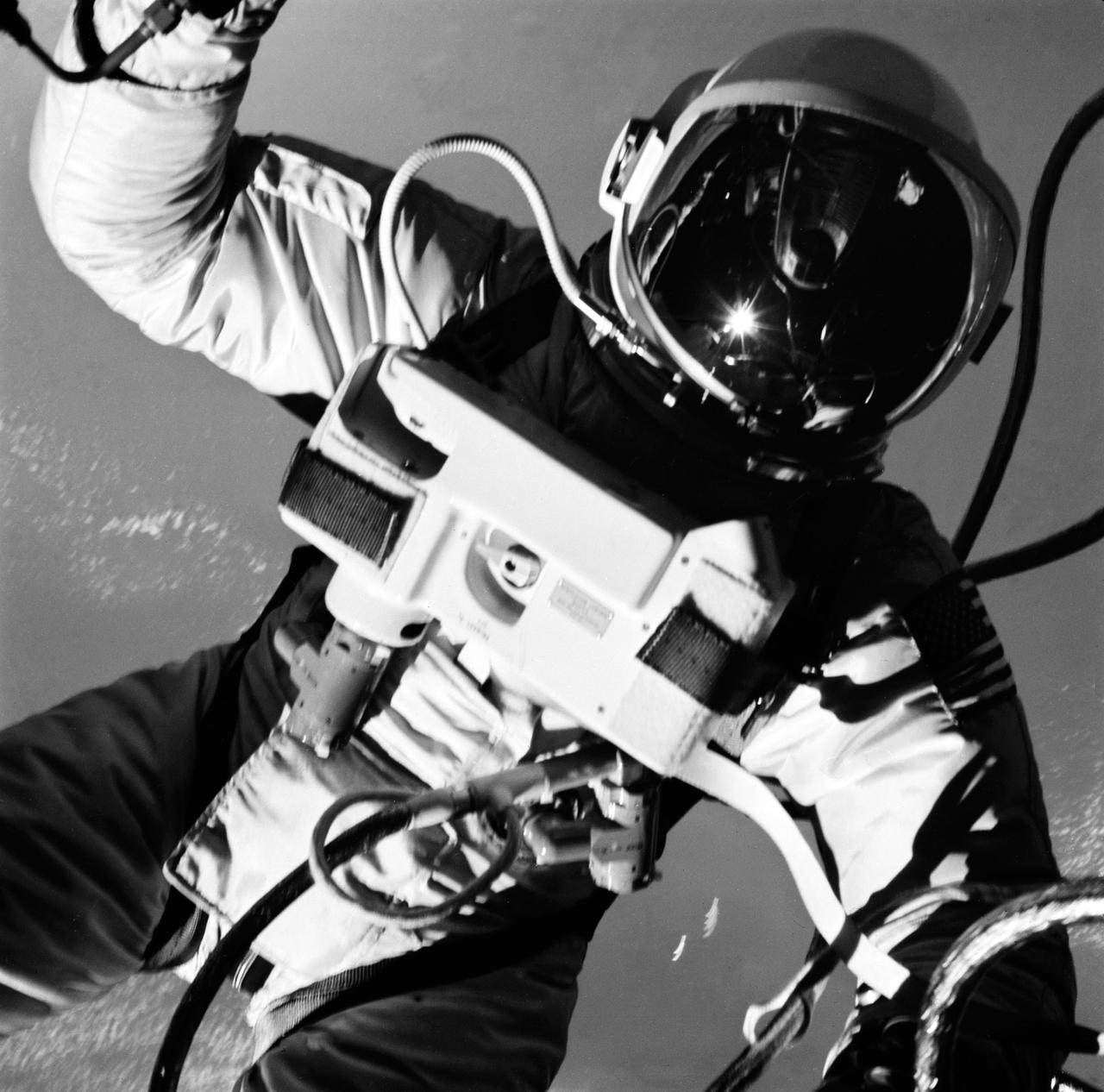
S65-30271 (3 June 1965) --- Astronaut Edward H. White II, pilot on the Gemini-Titan IV (GT-4) spaceflight, floats in the zero gravity of space outside the Gemini IV spacecraft. His face is covered by a shaded visor to protect him from the unfiltered rays of the sun. White became the first American astronaut to walk in space. He remained outside the spacecraft for 21 minutes during the third revolution of the Gemini IV mission. He wears a specially designed spacesuit for the EVA. His right hand (out of frame) is holding the Hand-Held Self-Maneuvering Unit (HHSMU), with which he controlled his movements while in space, and a camera is attached to the HHSMU. He was attached to the spacecraft by a 25-feet umbilical line and a 23-feet tether line, both wrapped together with gold tape to form one cord. He wears an emergency oxygen supply check pack. Astronaut James A. McDivitt is command pilot for the GT-4 mission. The mission was a four-day, 62-revolution flight, during which McDivitt and White performed a series of scientific and engineering experiments. (This image is black and white) Photo credit: NASA EDITOR?S NOTE: Astronaut Edward H. White II died in the Apollo/Saturn 204 fire at Cape Kennedy, Florida, on Jan. 27, 1967.
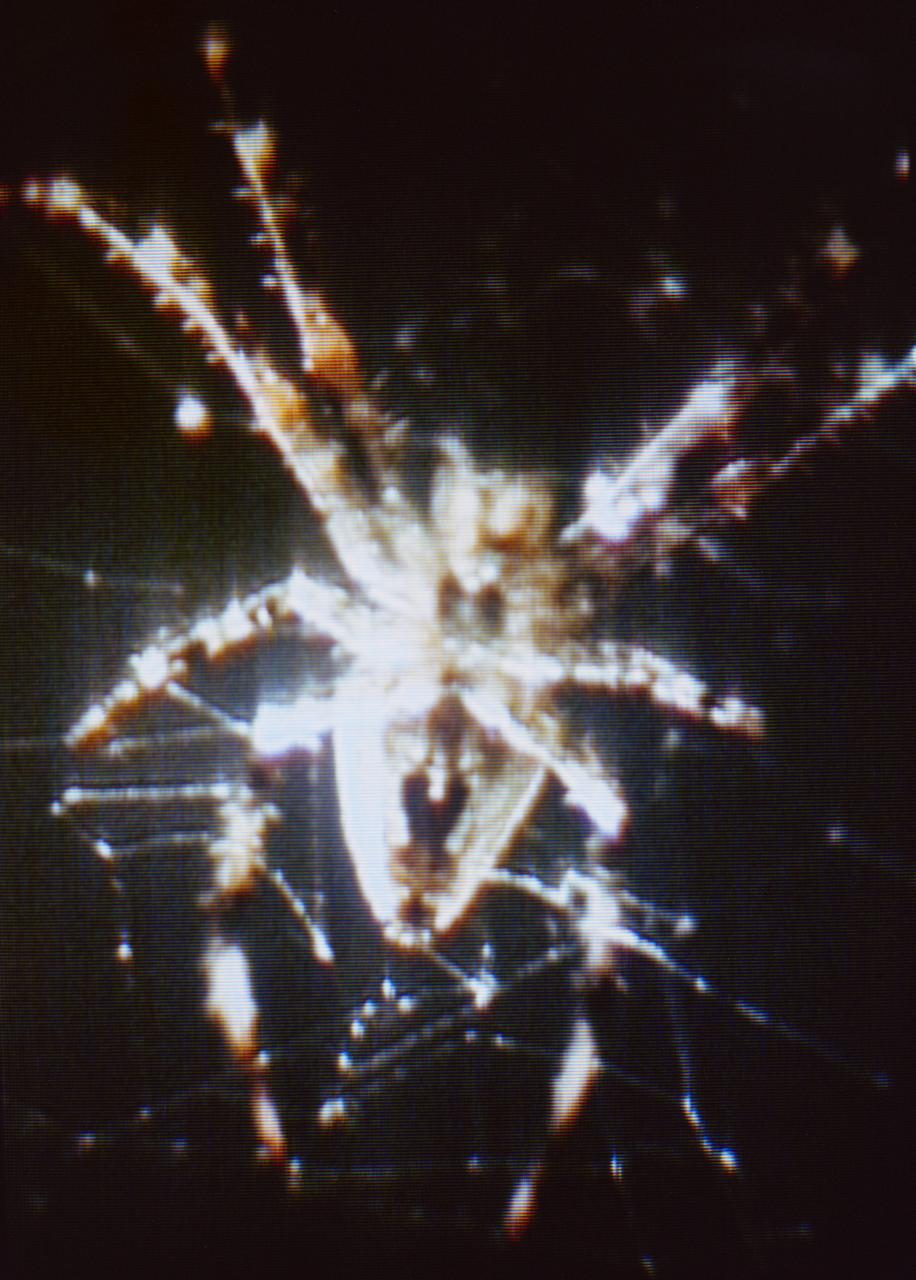
S73-34206 (8 Aug. 1973) --- A closeup view of Arabella, one of two Skylab 3 common cross spiders ?Araneus diadematus,? and the web it had spun in the zero-gravity of space aboard the Skylab space station cluster in Earth orbit. This is a photographic reproduction made a color television transmission aboard Skylab. During the 59-day Skylab 3 mission the two spiders, Arabella and Anita, were housed in an enclosure onto which a motion picture camera and a still camera were attached to record the spiders? attempts to build a web in the weightless environment. The spider experiment (ED52) was one of 25 experiments selected for Skylab by NASA from more than 3,400 experiment proposals submitted by 17-year-old Judith S. Miles of Lexington, Massachusetts. Anita died during the last week of the mission. THIS PHOTOGRAPH IS A GOVERNMENT PUBLICATION ?NOT SUBJECT TO COPYRIGHT. It may not be used to state or imply the endorsement by NASA or by any NASA employee of a commercial product, process or service, or used in any way that might mislead. Accordingly, it is requested that if this photograph is used in advertising and other commercial promotions, layout and copy be submitted to NASA prior to release. Photo credit: NASA