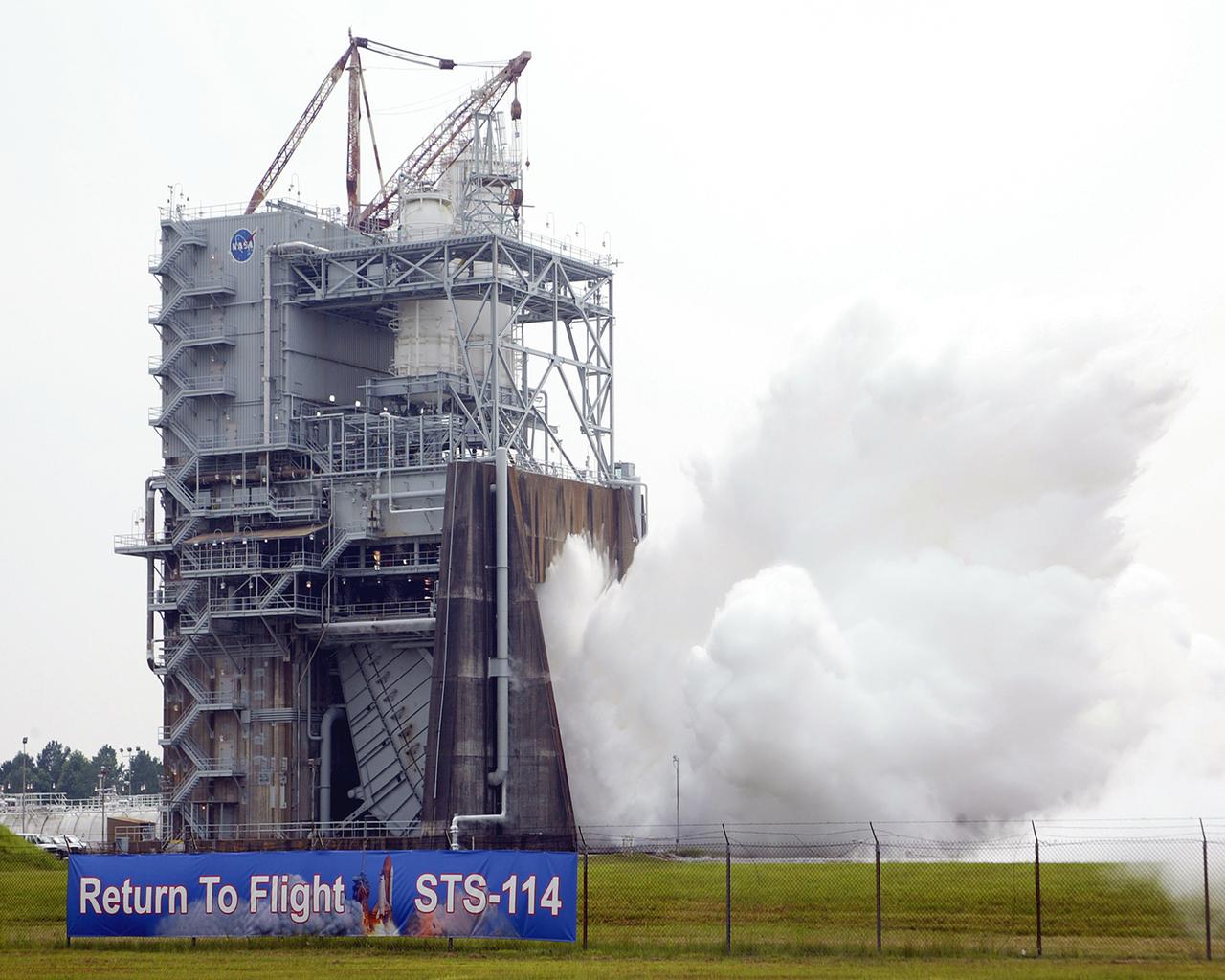
The Space Shuttle Main Engine (SSME) reached a historic milestone July 16, 2004, when a successful flight acceptance test was conducted at NASA Stennis Space Center (SSC). The engine tested today is the first complete engine to be tested and shipped in its entirety to Kennedy Space Center for installation on Space Shuttle Discovery for STS-114, NASA's Return to Flight mission. The engine test, which began about 3:59 p.m. CDT, ran for 520 seconds (8 minutes), the length of time it takes for the Space Shuttle to reach orbit.
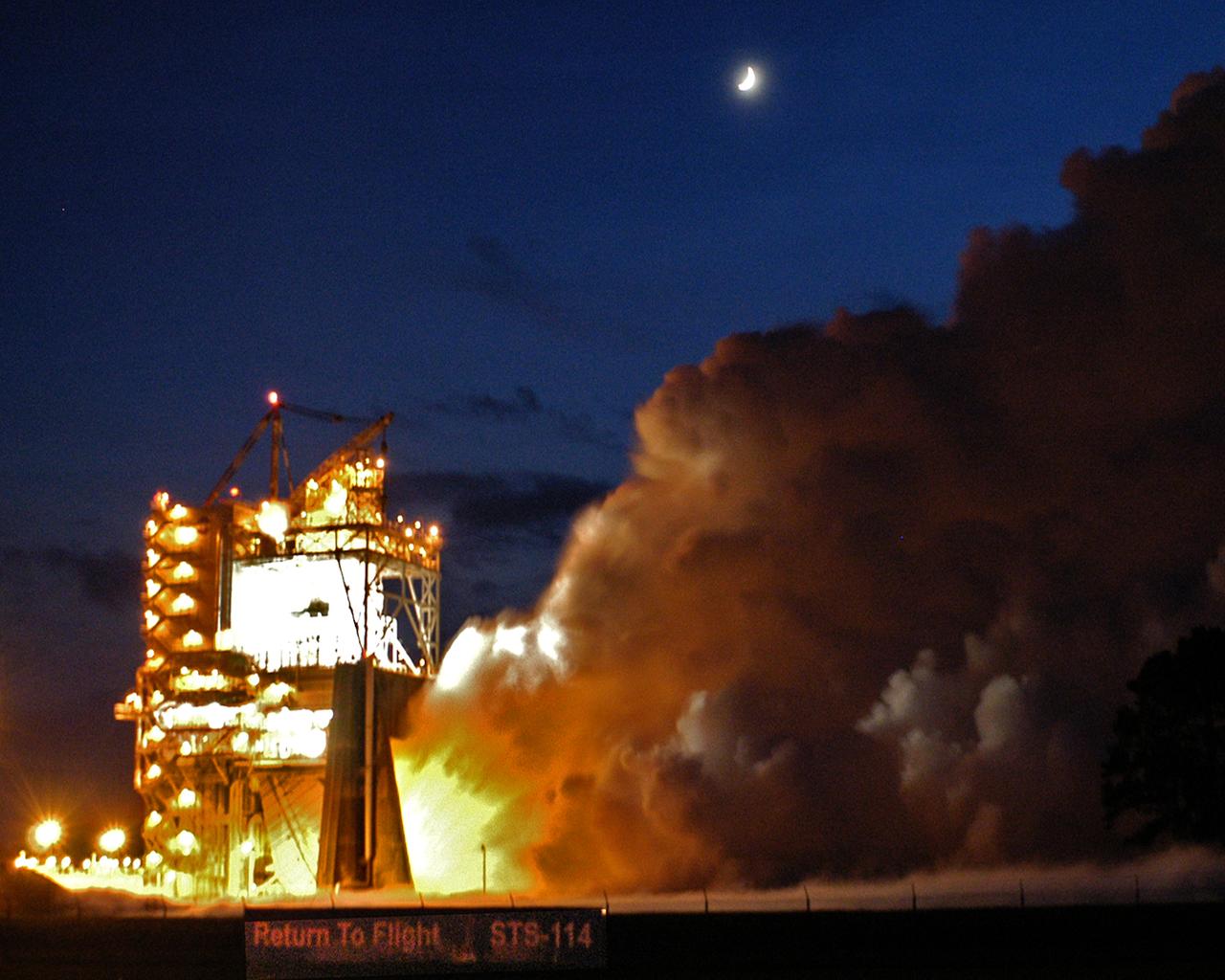
The Space Shuttle's Main Engine (SSME) reached another milestone Aug. 19, 2004, when a successful flight acceptance test was conducted at NASA Stennis Space Center (SSC). The engine tested was the final of three engines that will carry the next Space Shuttle into orbit. The engine will be shipped to NASA Kennedy Space Center in Florida for installation on Space Shuttle Discovery for STS-114, NASA's Return to Flight mission. The engine test, which began about 8:10 p.m. CDT, ran for 520 seconds (8 minutes), the length of time it takes for the Space Shuttle to reach orbit.

SSME Hardware Simulation Laboratory at Marshall Space Flight Center is the facility that verifies the software which controls SSME prior to each Space Shuttle flight

CAPE CANAVERAL, Fla. – Preparations are under way to rotate a Pratt and Whitney Rocketdyne space shuttle main engine, or SSME, inside the SSME Processing Facility, the engine shop at NASA’s Kennedy Space Center in Florida. The engine is one of the last SSMEs remaining at Kennedy and is being prepared for shipment to NASA's Stennis Space Center in Mississippi. The first two groups of engines were shipped from Kennedy to Stennis in November 2011 and January 2012 the remaining engines are scheduled to depart on April 9. Altogether, 15 shuttle-era engines will be stored at Stennis for reuse on NASA’s Space Launch System heavy-lift rocket, under development. Photo credit: NASA/Tim Jacobs
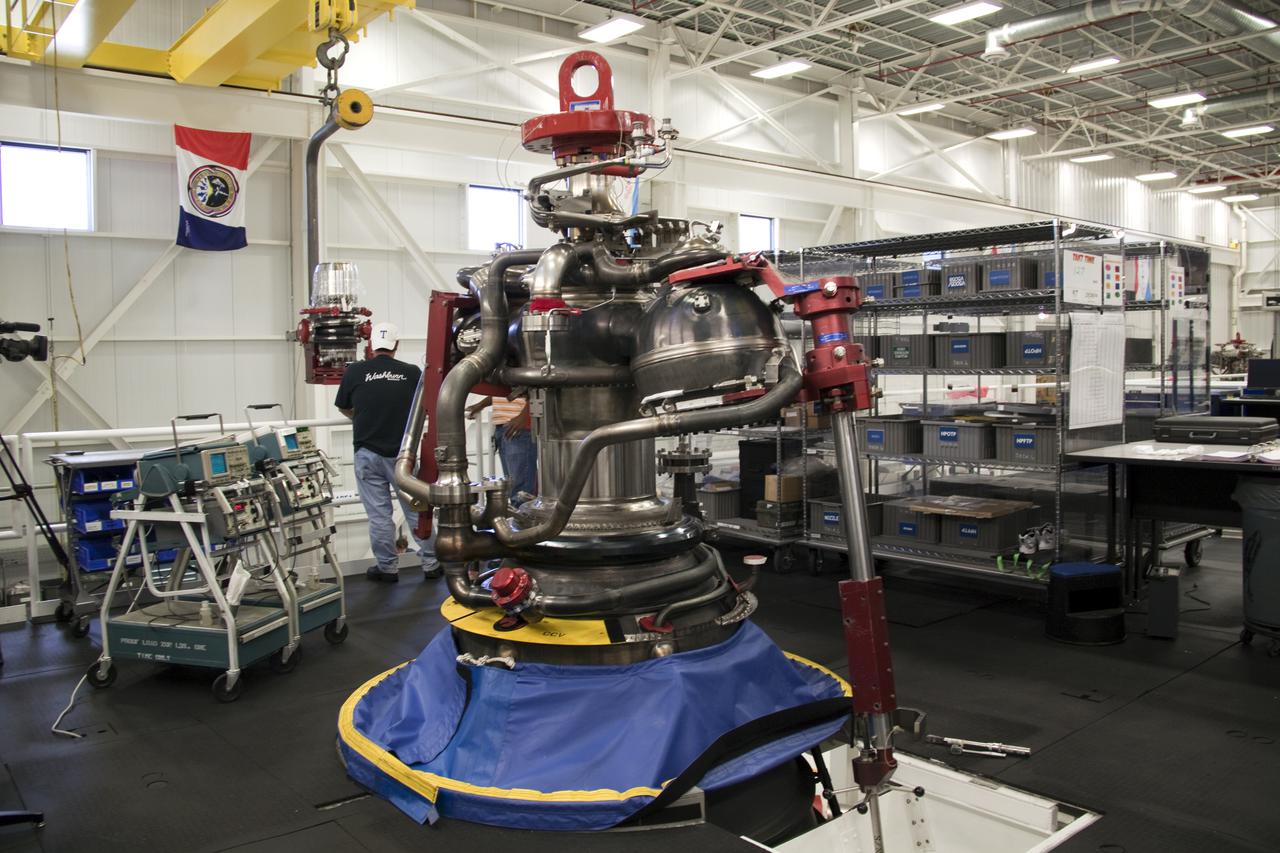
CAPE CANAVERAL, Fla. – In the Space Shuttle Main Engine Processing Facility at NASA's Kennedy Space Center in Florida, preparations are under way to install a high pressure oxidizer turbo pump on space shuttle main engine no. 2062, seen here. The engine, or SSME, is the last one scheduled to be built at Kennedy by Pratt and Whitney Rocketdyne before the end of the Space Shuttle Program. Three main engines are clustered at the aft end of the shuttle and have a combined thrust of more than 1.2 million pounds. Even though an SSME weighs one-seventh as much as a locomotive engine, its high-pressure fuel pump alone delivers as much horsepower as 28 locomotives. Each engine operates during the entire eight-and-a-half minute climb to orbit. Post-flight inspections and maintenance of each engine also are conducted in the SSME Processing Facility between shuttle missions. Photo credit: NASA_Amanda Diller
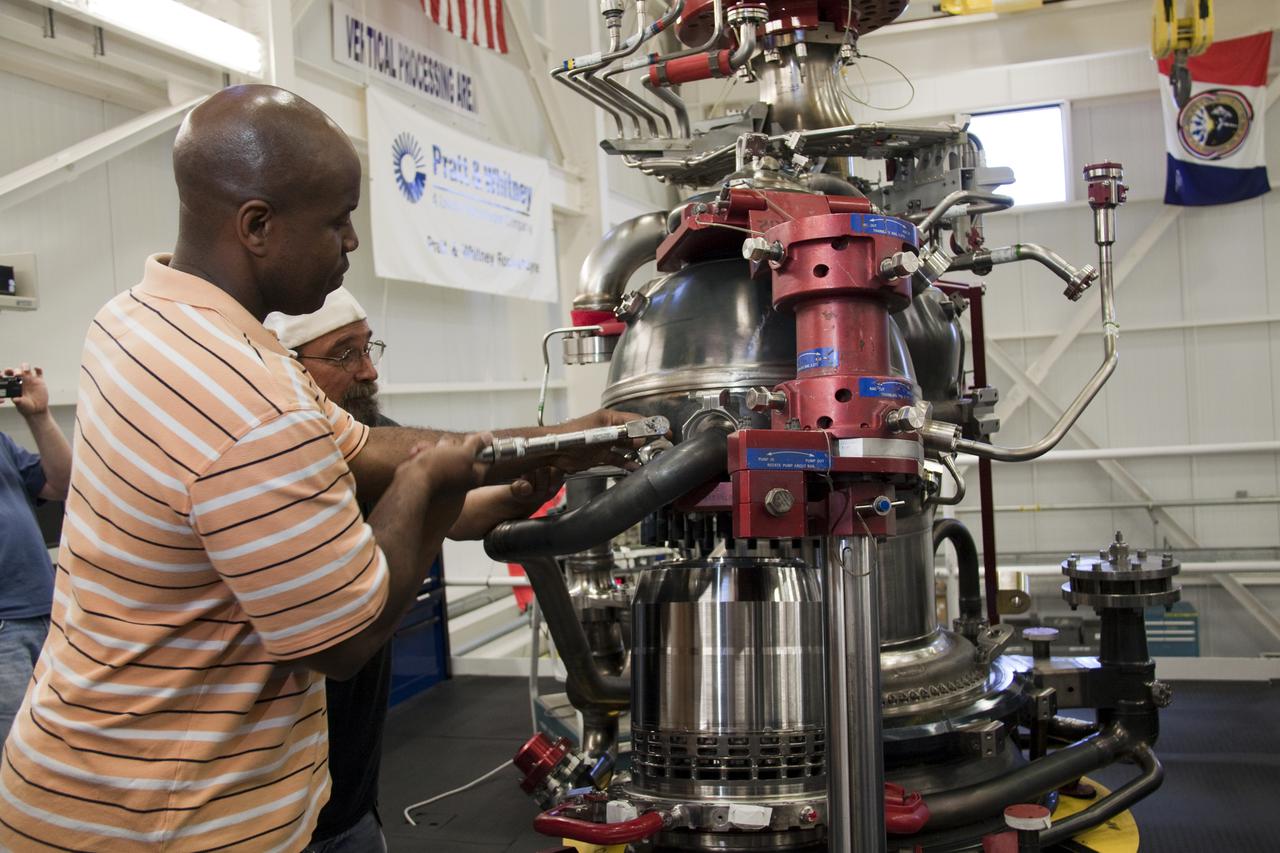
CAPE CANAVERAL, Fla. – In the Space Shuttle Main Engine Processing Facility at NASA's Kennedy Space Center in Florida, Pratt and Whitney Rocketdyne engine technician Teryon Jones, left, and quality inspector Barry Martin install a high pressure oxidizer turbo pump on space shuttle main engine no. 2062. The engine, or SSME, is the last one scheduled to be built at Kennedy before the end of the Space Shuttle Program. Three main engines are clustered at the aft end of the shuttle and have a combined thrust of more than 1.2 million pounds. Even though an SSME weighs one-seventh as much as a locomotive engine, its high-pressure fuel pump alone delivers as much horsepower as 28 locomotives. Each engine operates during the entire eight-and-a-half minute climb to orbit. Post-flight inspections and maintenance of each engine also are conducted in the SSME Processing Facility between shuttle missions. Photo credit: NASA_Amanda Diller
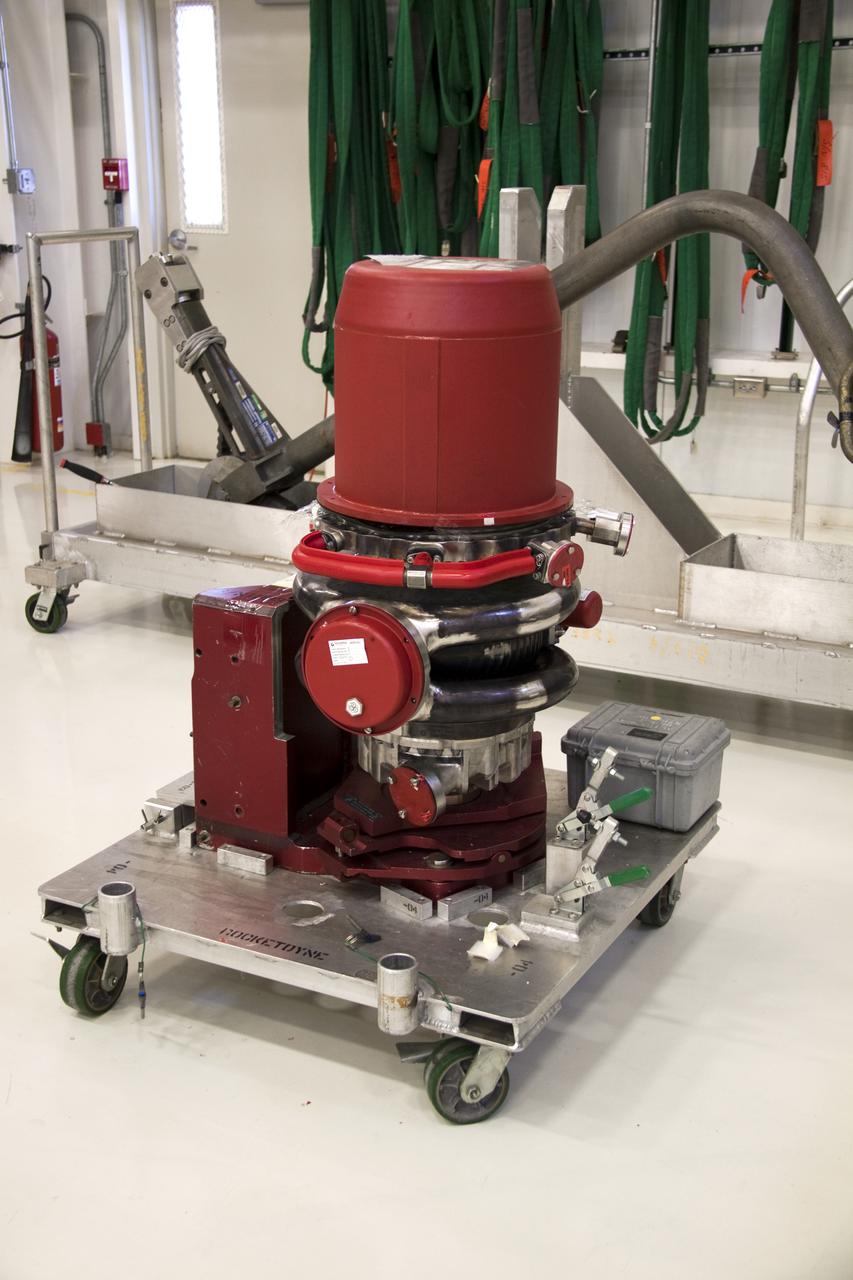
CAPE CANAVERAL, Fla. – In the Space Shuttle Main Engine Processing Facility at NASA's Kennedy Space Center in Florida, preparations are under way to install this high pressure oxidizer turbo pump on space shuttle main engine no. 2062. The engine, or SSME, is the last one scheduled to be built at Kennedy by Pratt and Whitney Rocketdyne before the end of the Space Shuttle Program. Three main engines are clustered at the aft end of the shuttle and have a combined thrust of more than 1.2 million pounds. Even though an SSME weighs one-seventh as much as a locomotive engine, its high-pressure fuel pump alone delivers as much horsepower as 28 locomotives. Each engine operates during the entire eight-and-a-half minute climb to orbit. Post-flight inspections and maintenance of each engine also are conducted in the SSME Processing Facility between shuttle missions. Photo credit: NASA_Amanda Diller
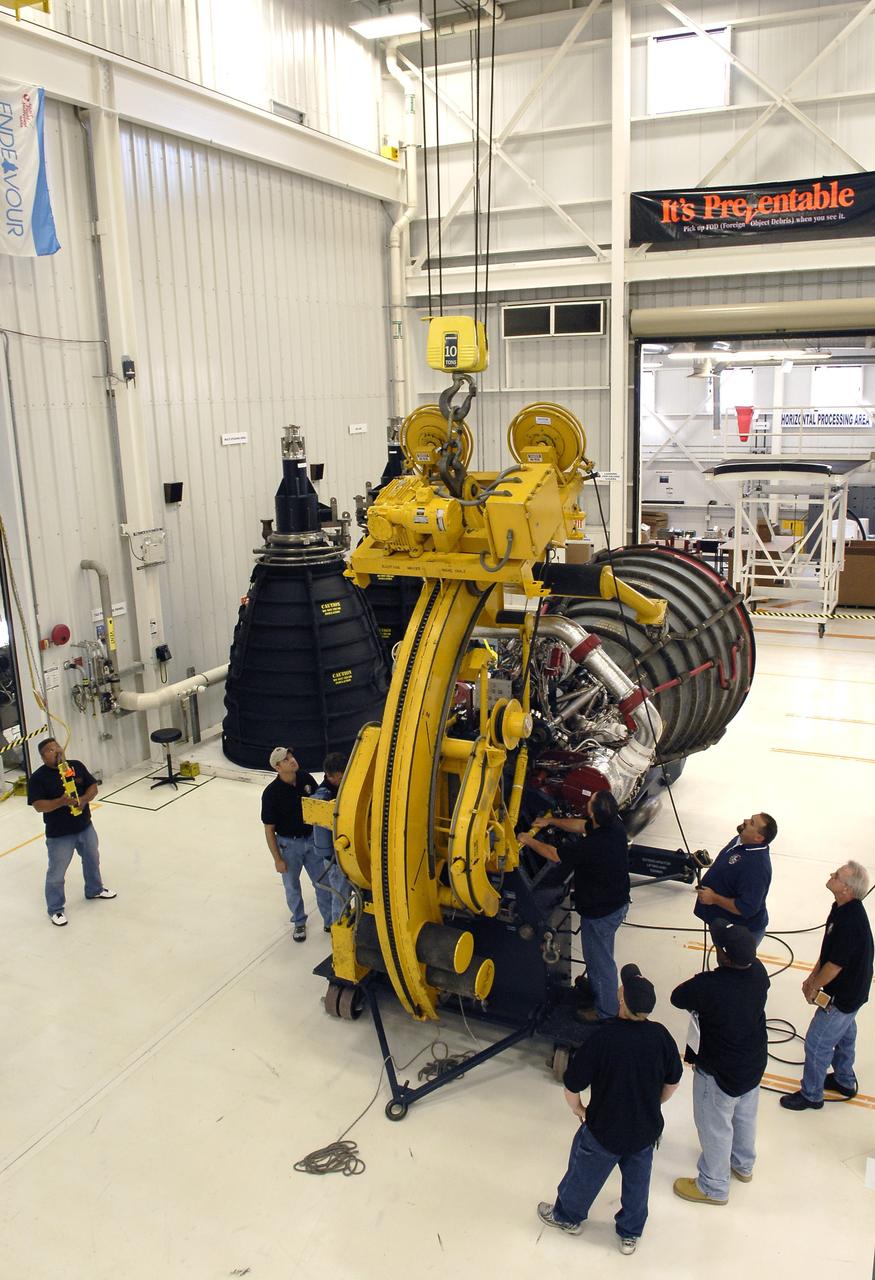
CAPE CANAVERAL, Fla. – Preparations are under way for the crane to release an engine-handling device used to rotate a Pratt and Whitney Rocketdyne space shuttle main engine, or SSME, into a horizontal position inside the SSME Processing Facility, the engine shop at NASA’s Kennedy Space Center in Florida. The engine is secured on a portable workstand before being transferred into a transportation canister. The engine is one of the last SSMEs remaining at Kennedy and is being prepared for shipment to NASA's Stennis Space Center in Mississippi. The first two groups of engines were shipped from Kennedy to Stennis in November 2011 and January 2012 the remaining engines are scheduled to depart on April 9. Altogether, 15 shuttle-era engines will be stored at Stennis for reuse on NASA’s Space Launch System heavy-lift rocket, under development. Photo credit: NASA/Tim Jacobs
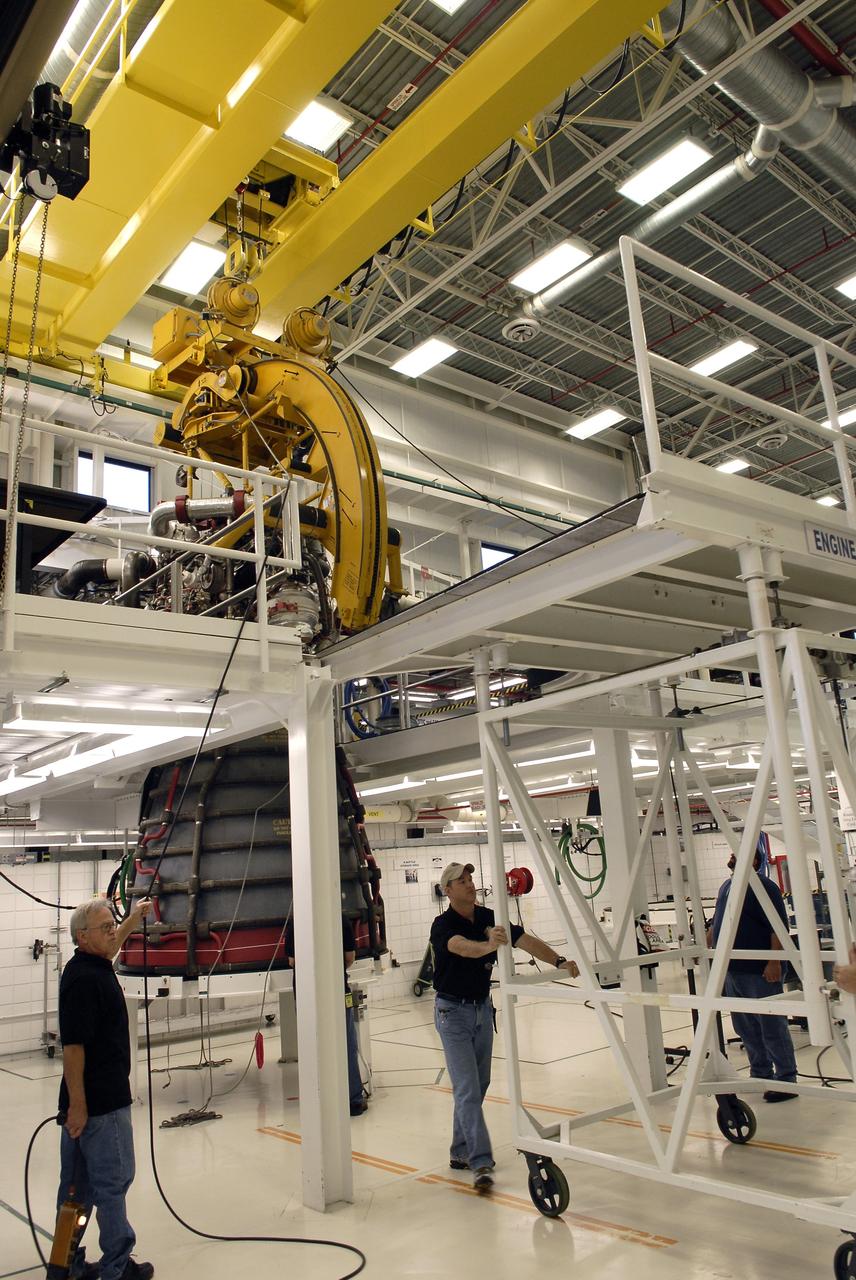
CAPE CANAVERAL, Fla. – Technicians move the work platforms away from a Pratt and Whitney Rocketdyne space shuttle main engine, or SSME, hanging above the floor inside the SSME Processing Facility, the engine shop at NASA’s Kennedy Space Center in Florida. Operations are under way to rotate the engine into a horizontal position on a portable workstand. The engine is one of the last SSMEs remaining at Kennedy and is being prepared for shipment to NASA's Stennis Space Center in Mississippi. The first two groups of engines were shipped from Kennedy to Stennis in November 2011 and January 2012 the remaining engines are scheduled to depart on April 9. Altogether, 15 shuttle-era engines will be stored at Stennis for reuse on NASA’s Space Launch System heavy-lift rocket, under development. Photo credit: NASA/Tim Jacobs
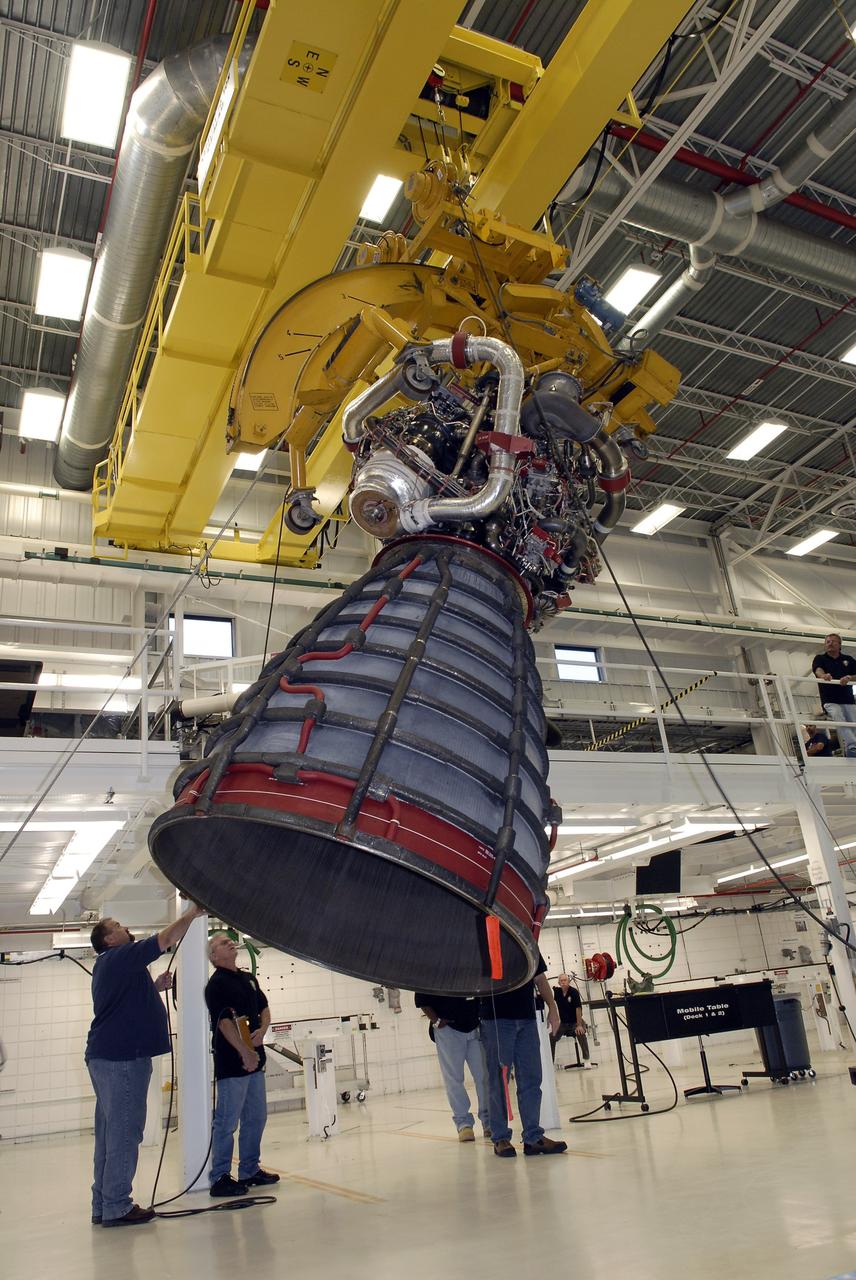
CAPE CANAVERAL, Fla. – A Pratt and Whitney Rocketdyne space shuttle main engine, or SSME, is rotated into a horizontal position with the aid of an engine-handling device attached to a crane inside the SSME Processing Facility, the engine shop at NASA’s Kennedy Space Center in Florida. The engine will be placed in a horizontal position on a portable workstand. The engine is one of the last SSMEs remaining at Kennedy and is being prepared for shipment to NASA's Stennis Space Center in Mississippi. The first two groups of engines were shipped from Kennedy to Stennis in November 2011 and January 2012 the remaining engines are scheduled to depart on April 9. Altogether, 15 shuttle-era engines will be stored at Stennis for reuse on NASA’s Space Launch System heavy-lift rocket, under development. Photo credit: NASA/Tim Jacobs
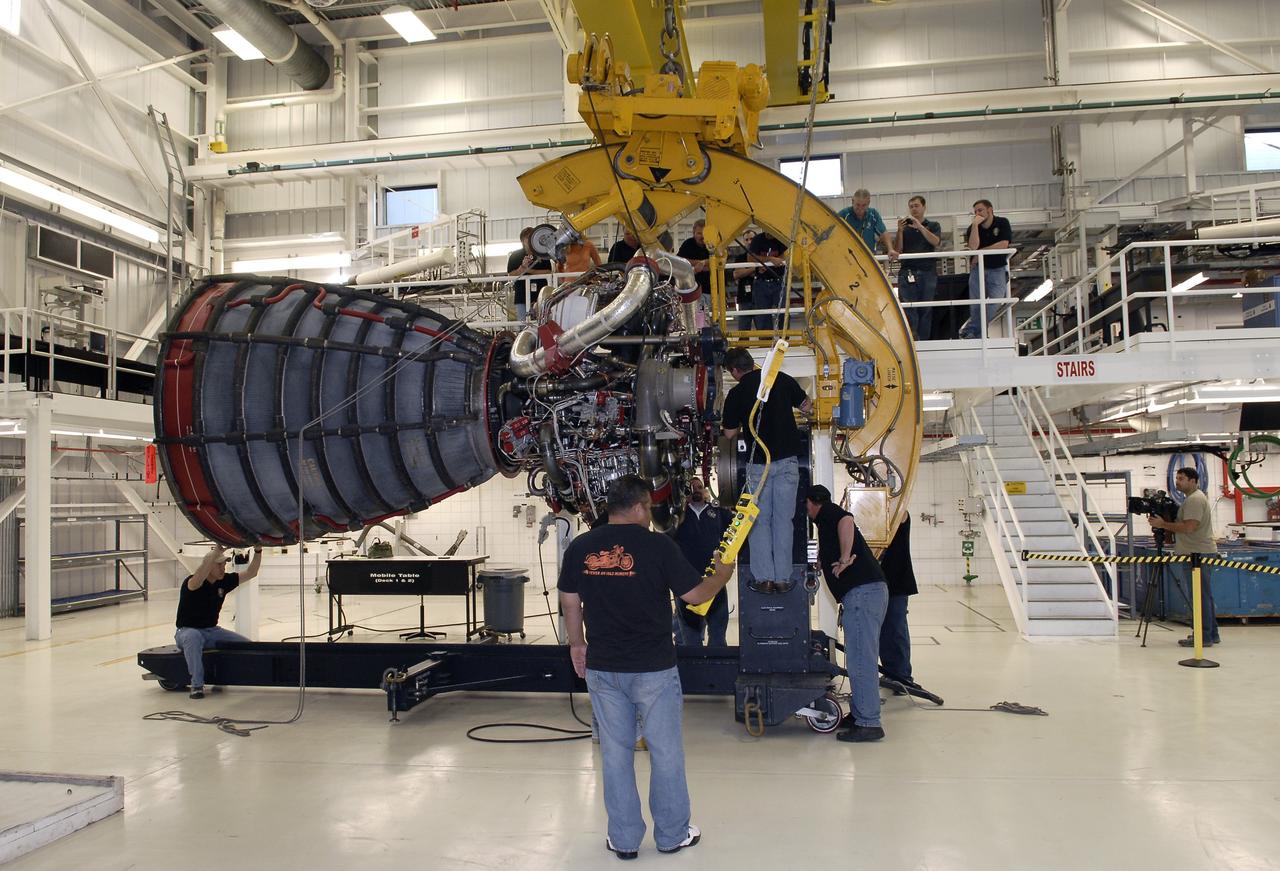
CAPE CANAVERAL, Fla. – Technicians lower a Pratt and Whitney Rocketdyne space shuttle main engine, or SSME, onto a portable workstand inside the SSME Processing Facility, the engine shop at NASA’s Kennedy Space Center in Florida. The engine was rotated into a horizontal position with the aid of an engine-handling device attached to a crane. The engine is one of the last SSMEs remaining at Kennedy and is being prepared for shipment to NASA's Stennis Space Center in Mississippi. The first two groups of engines were shipped from Kennedy to Stennis in November 2011 and January 2012 the remaining engines are scheduled to depart on April 9. Altogether, 15 shuttle-era engines will be stored at Stennis for reuse on NASA’s Space Launch System heavy-lift rocket, under development. Photo credit: NASA/Tim Jacobs
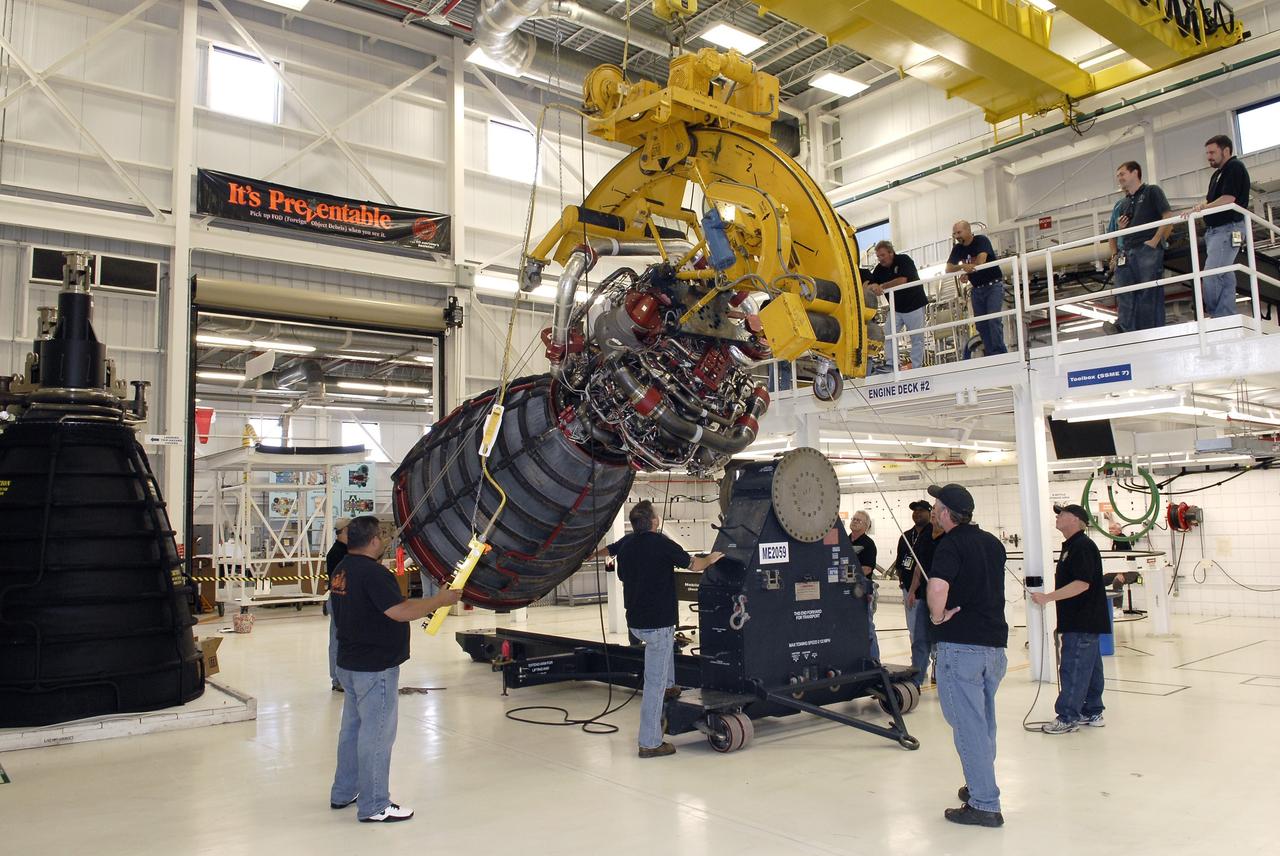
CAPE CANAVERAL, Fla. – Technicians move a portable workstand under a Pratt and Whitney Rocketdyne space shuttle main engine, or SSME, inside the SSME Processing Facility, the engine shop at NASA’s Kennedy Space Center in Florida. The engine is being rotated into a horizontal position with the aid of an engine-handling device attached to a crane. The engine is one of the last SSMEs remaining at Kennedy and is being prepared for shipment to NASA's Stennis Space Center in Mississippi. The first two groups of engines were shipped from Kennedy to Stennis in November 2011 and January 2012 the remaining engines are scheduled to depart on April 9. Altogether, 15 shuttle-era engines will be stored at Stennis for reuse on NASA’s Space Launch System heavy-lift rocket, under development. Photo credit: NASA/Tim Jacobs
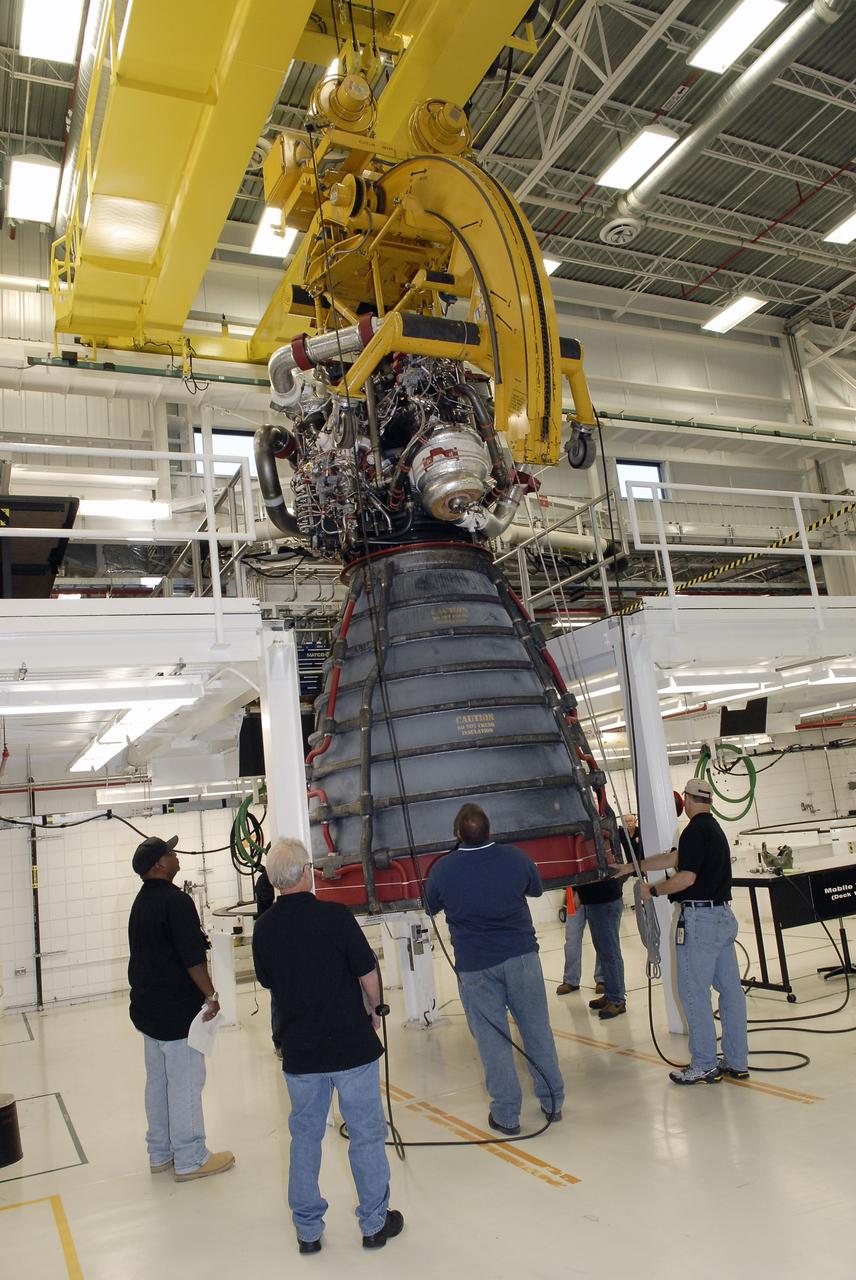
CAPE CANAVERAL, Fla. – A crane moves a Pratt and Whitney Rocketdyne space shuttle main engine, or SSME, across the floor away from the work platforms inside the SSME Processing Facility, the engine shop at NASA’s Kennedy Space Center in Florida. Operations are under way to rotate the engine into a horizontal position on a portable workstand. The engine is one of the last SSMEs remaining at Kennedy and is being prepared for shipment to NASA's Stennis Space Center in Mississippi. The first two groups of engines were shipped from Kennedy to Stennis in November 2011 and January 2012 the remaining engines are scheduled to depart on April 9. Altogether, 15 shuttle-era engines will be stored at Stennis for reuse on NASA’s Space Launch System heavy-lift rocket, under development. Photo credit: NASA/Tim Jacobs
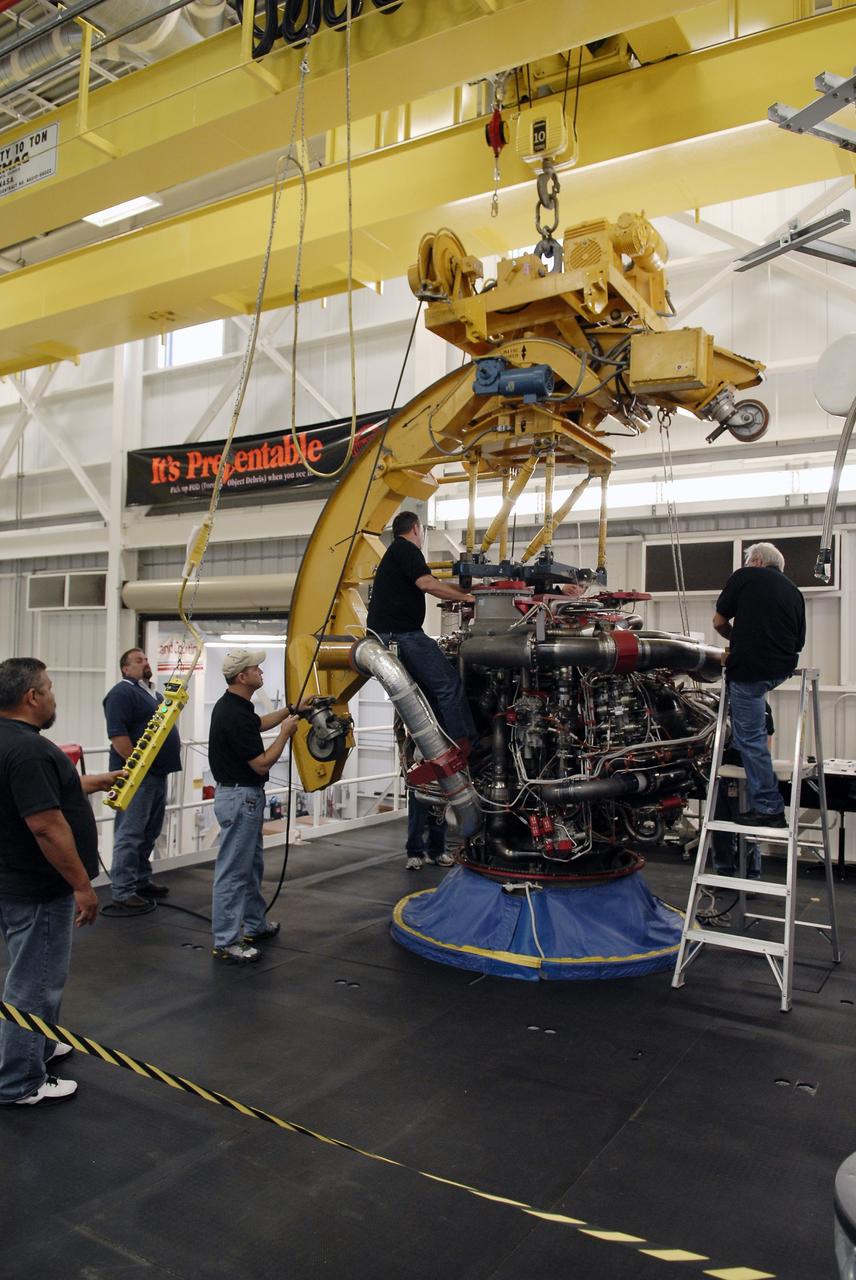
CAPE CANAVERAL, Fla. – Technicians attach a Pratt and Whitney Rocketdyne space shuttle main engine, or SSME, to an engine-handling device inside the SSME Processing Facility, the engine shop at NASA’s Kennedy Space Center in Florida. Preparations are under way to rotate the engine into a horizontal position on a portable workstand. The engine is one of the last SSMEs remaining at Kennedy and is being prepared for shipment to NASA's Stennis Space Center in Mississippi. The first two groups of engines were shipped from Kennedy to Stennis in November 2011 and January 2012 the remaining engines are scheduled to depart on April 9. Altogether, 15 shuttle-era engines will be stored at Stennis for reuse on NASA’s Space Launch System heavy-lift rocket, under development. Photo credit: NASA/Tim Jacobs
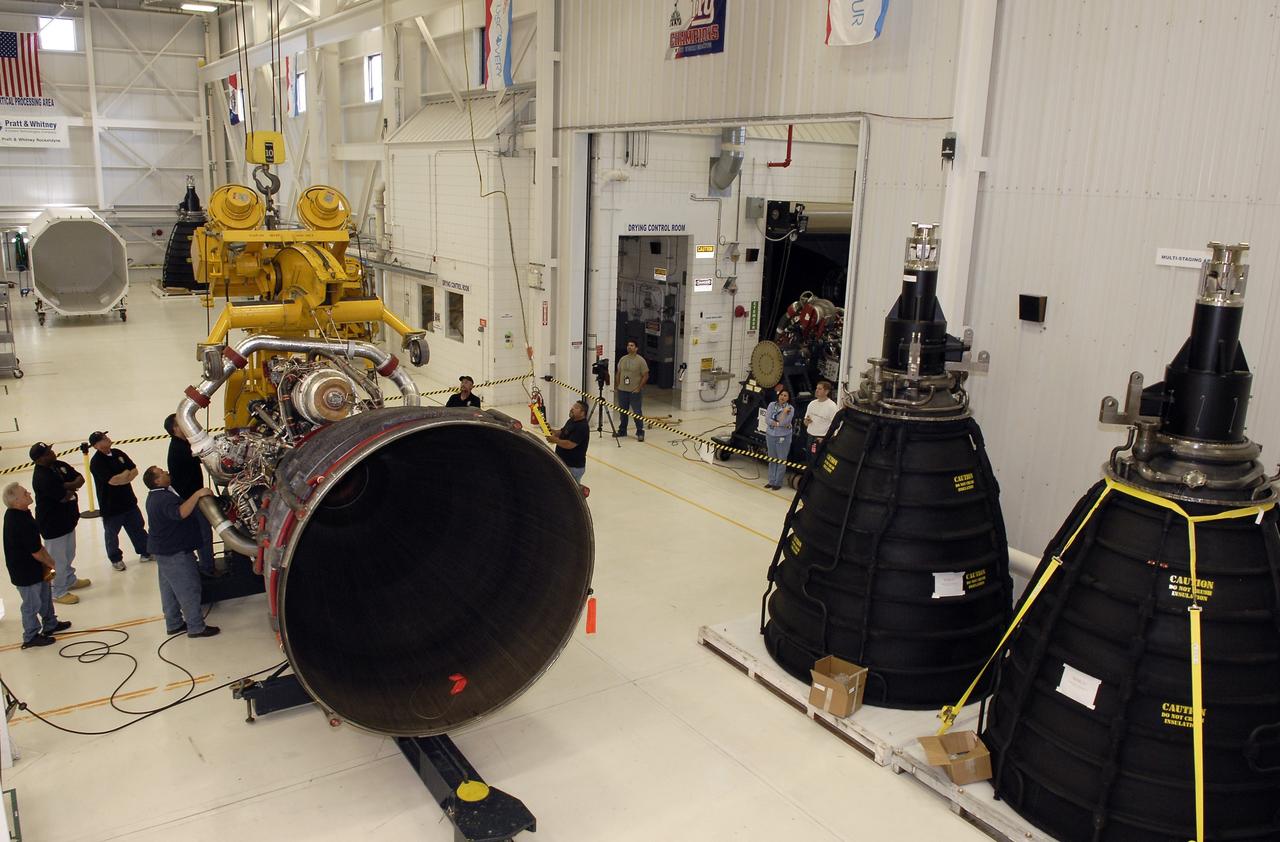
CAPE CANAVERAL, Fla. – Technicians release a crane from an engine-handling device and the Pratt and Whitney Rocketdyne space shuttle main engine, or SSME, that it rotated into a horizontal position inside the SSME Processing Facility, the engine shop at NASA’s Kennedy Space Center in Florida. The engine is secured on a portable workstand before being transferred into a transportation canister. The engine is one of the last SSMEs remaining at Kennedy and is being prepared for shipment to NASA's Stennis Space Center in Mississippi. The first two groups of engines were shipped from Kennedy to Stennis in November 2011 and January 2012 the remaining engines are scheduled to depart on April 9. Altogether, 15 shuttle-era engines will be stored at Stennis for reuse on NASA’s Space Launch System heavy-lift rocket, under development. Photo credit: NASA/Tim Jacobs

CAPE CANAVERAL, Fla. – An engine-handling device is lowered to the floor of the SSME Processing Facility, the engine shop at NASA’s Kennedy Space Center in Florida. The fixture was used to rotate the Pratt and Whitney Rocketdyne space shuttle main engine, or SSME, at right, into a horizontal position. This engine and the one at left are secured on portable workstands before being transferred into transportation canisters. The engine is one of the last SSMEs remaining at Kennedy and is being prepared for shipment to NASA's Stennis Space Center in Mississippi. The first two groups of engines were shipped from Kennedy to Stennis in November 2011 and January 2012 the remaining engines are scheduled to depart on April 9. Altogether, 15 shuttle-era engines will be stored at Stennis for reuse on NASA’s Space Launch System heavy-lift rocket, under development. Photo credit: NASA/Tim Jacobs
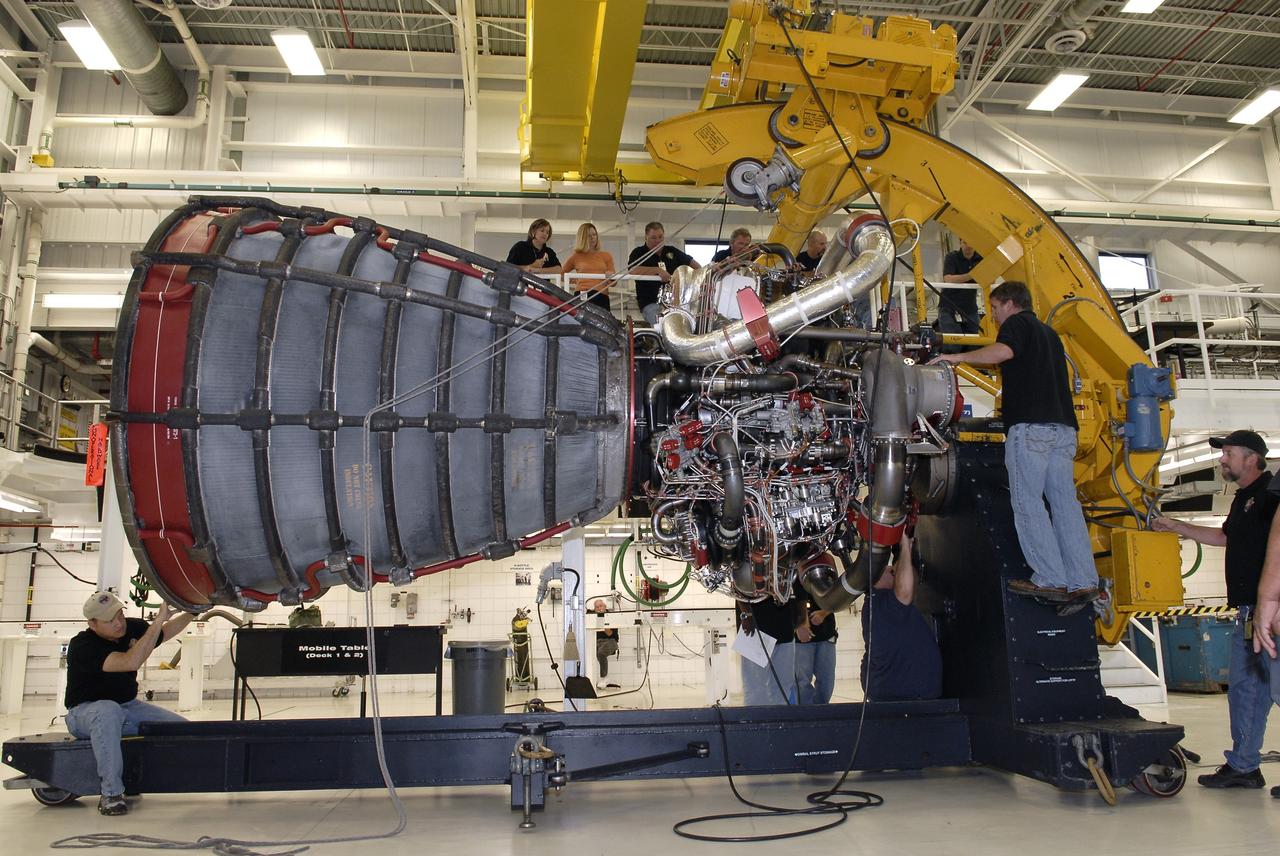
CAPE CANAVERAL, Fla. – Technicians secure a Pratt and Whitney Rocketdyne space shuttle main engine, or SSME, onto a portable workstand inside the SSME Processing Facility, the engine shop at NASA’s Kennedy Space Center in Florida. The engine was rotated into a horizontal position with the aid of an engine-handling device attached to a crane. The engine is one of the last SSMEs remaining at Kennedy and is being prepared for shipment to NASA's Stennis Space Center in Mississippi. The first two groups of engines were shipped from Kennedy to Stennis in November 2011 and January 2012 the remaining engines are scheduled to depart on April 9. Altogether, 15 shuttle-era engines will be stored at Stennis for reuse on NASA’s Space Launch System heavy-lift rocket, under development. Photo credit: NASA/Tim Jacobs
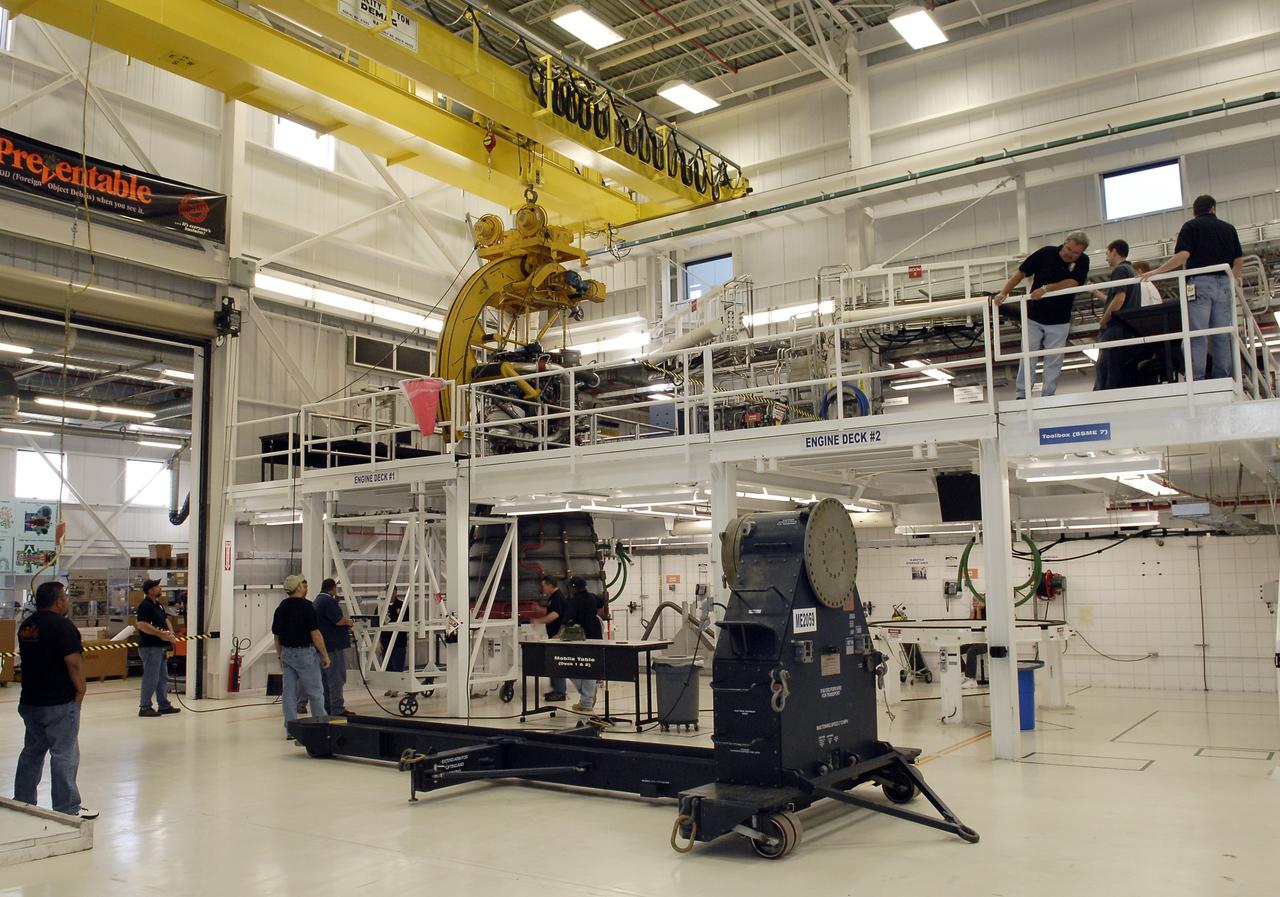
CAPE CANAVERAL, Fla. – Technicians monitor a Pratt and Whitney Rocketdyne space shuttle main engine, or SSME, as a crane lifts it off its base inside the SSME Processing Facility, the engine shop at NASA’s Kennedy Space Center in Florida. Operations are under way to rotate the engine into a horizontal position on a portable workstand. The engine is one of the last SSMEs remaining at Kennedy and is being prepared for shipment to NASA's Stennis Space Center in Mississippi. The first two groups of engines were shipped from Kennedy to Stennis in November 2011 and January 2012 the remaining engines are scheduled to depart on April 9. Altogether, 15 shuttle-era engines will be stored at Stennis for reuse on NASA’s Space Launch System heavy-lift rocket, under development. Photo credit: NASA/Tim Jacobs
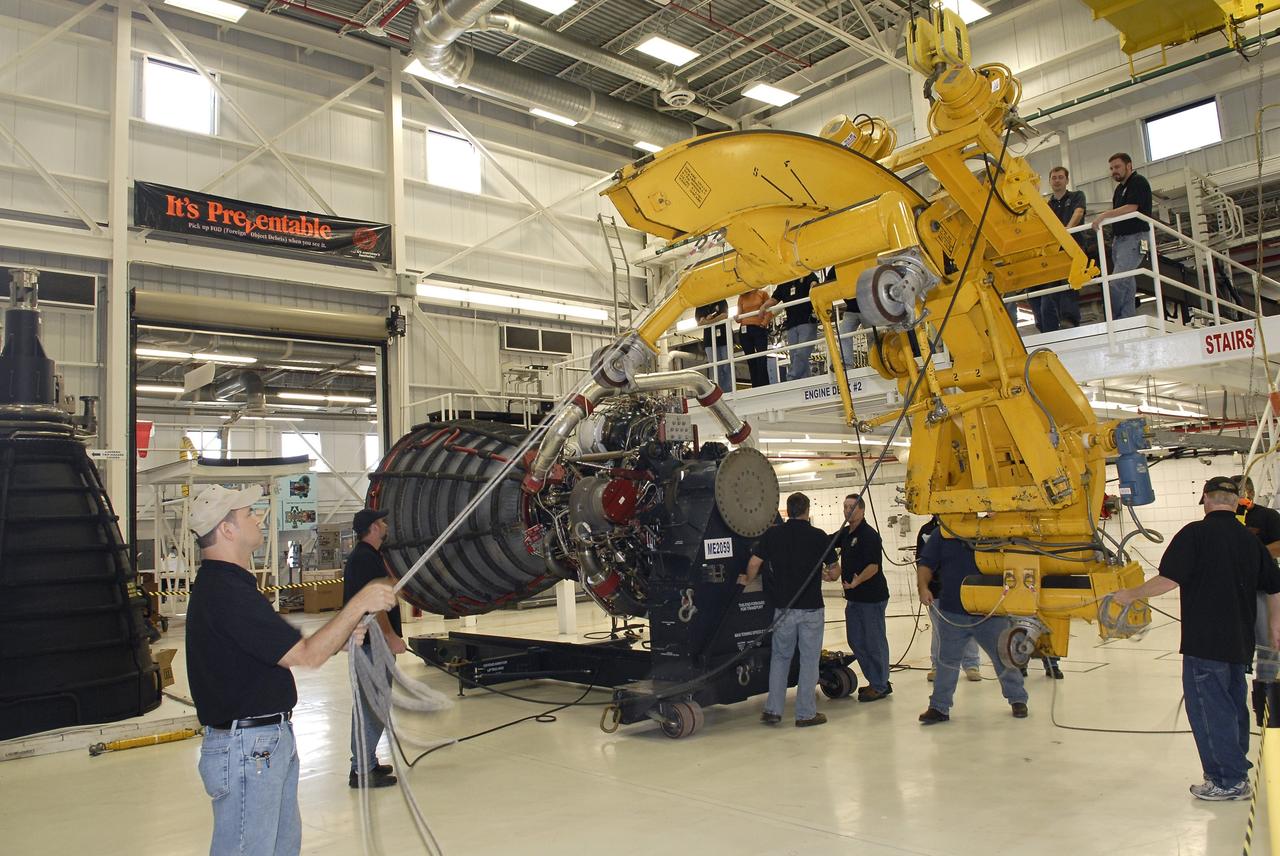
CAPE CANAVERAL, Fla. – A crane moves the engine-handling device away from the Pratt and Whitney Rocketdyne space shuttle main engine, or SSME, that it rotated into a horizontal position inside the SSME Processing Facility, the engine shop at NASA’s Kennedy Space Center in Florida. The engine is secured on a portable workstand before being transferred into a transportation canister. The engine is one of the last SSMEs remaining at Kennedy and is being prepared for shipment to NASA's Stennis Space Center in Mississippi. The first two groups of engines were shipped from Kennedy to Stennis in November 2011 and January 2012 the remaining engines are scheduled to depart on April 9. Altogether, 15 shuttle-era engines will be stored at Stennis for reuse on NASA’s Space Launch System heavy-lift rocket, under development. Photo credit: NASA/Tim Jacobs
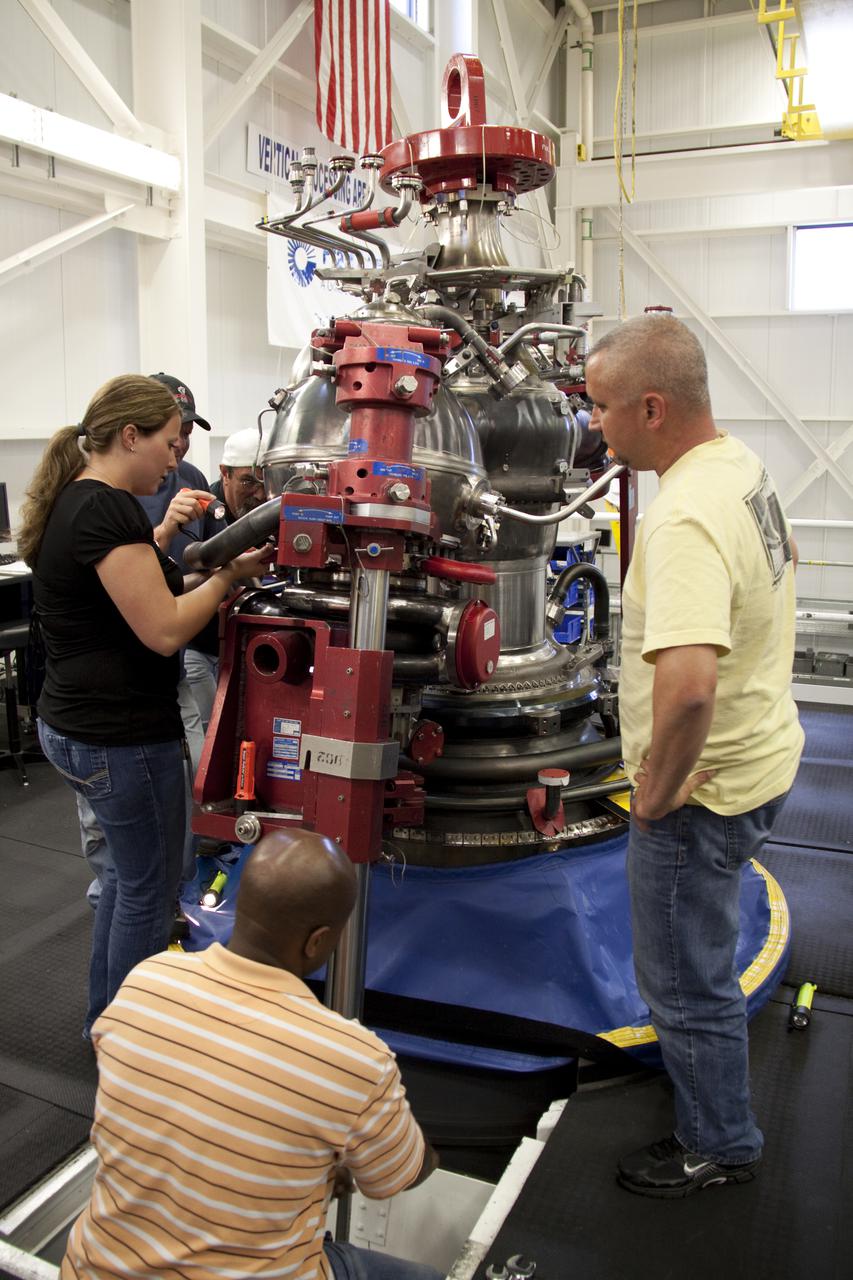
CAPE CANAVERAL, Fla. – In the Space Shuttle Main Engine Processing Facility at NASA's Kennedy Space Center in Florida, a team of Pratt and Whitney Rocketdyne employees installs a high pressure oxidizer turbo pump on space shuttle main engine no. 2062. The engine, or SSME, is the last one scheduled to be built at Kennedy before the end of the Space Shuttle Program. Around the engine, from right to left, are engine technicians Ryan Mahony and Teryon Jones, engineer Jessica Tandy, engine technician Ken Burley and quality inspector Barry Martin. Three main engines are clustered at the aft end of the shuttle and have a combined thrust of more than 1.2 million pounds. Even though an SSME weighs one-seventh as much as a locomotive engine, its high-pressure fuel pump alone delivers as much horsepower as 28 locomotives. Each engine operates during the entire eight-and-a-half minute climb to orbit. Post-flight inspections and maintenance of each engine also are conducted in the SSME Processing Facility between shuttle missions. Photo credit: NASA_Amanda Diller
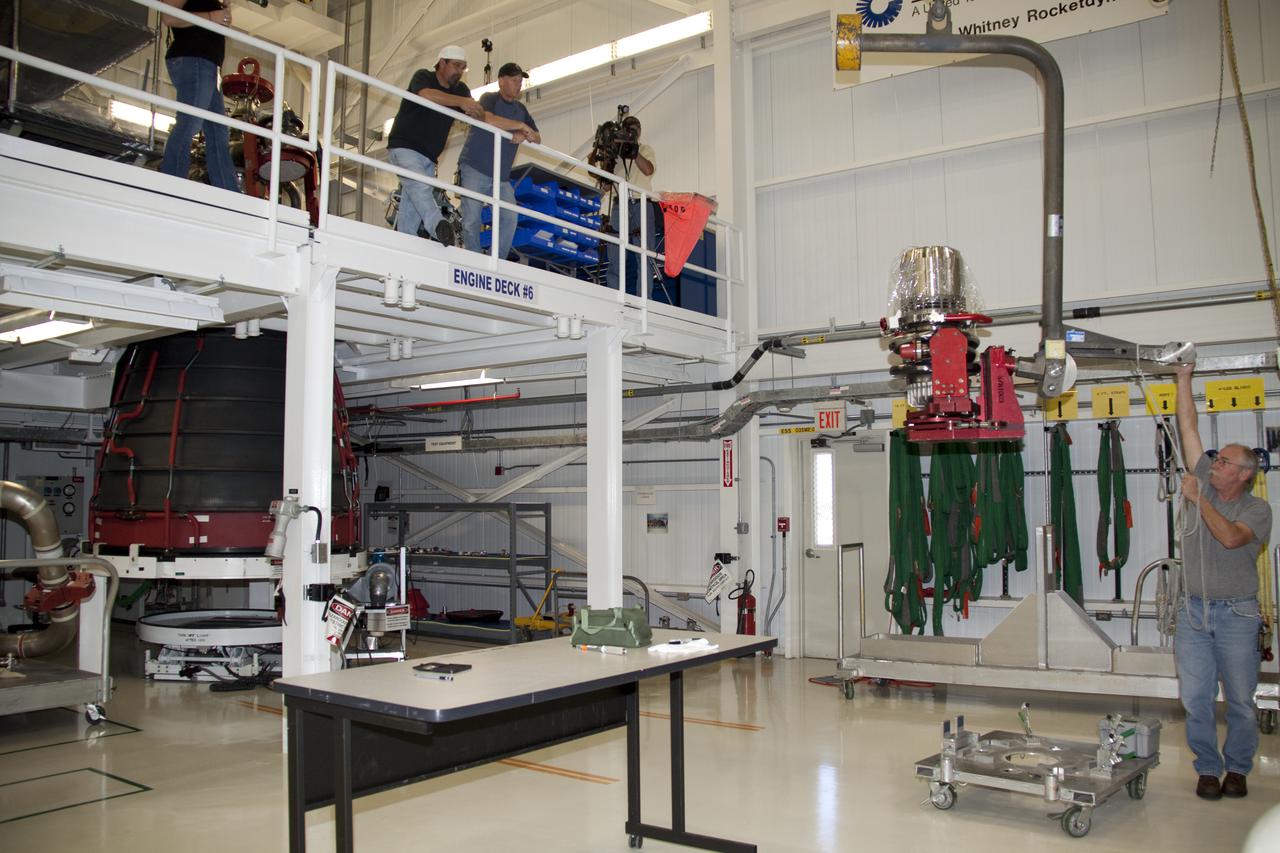
CAPE CANAVERAL, Fla. – On the floor of the Space Shuttle Main Engine Processing Facility at NASA's Kennedy Space Center in Florida, Pratt and Whitney Rocketdyne engine technician Dan Bode lifts a high pressure oxidizer turbo pump off its stand for installation on space shuttle main engine no. 2062. The engine, or SSME, is the last one scheduled to be built at Kennedy by Pratt and Whitney Rocketdyne before the end of the Space Shuttle Program. Three main engines are clustered at the aft end of the shuttle and have a combined thrust of more than 1.2 million pounds. Even though an SSME weighs one-seventh as much as a locomotive engine, its high-pressure fuel pump alone delivers as much horsepower as 28 locomotives. Each engine operates during the entire eight-and-a-half minute climb to orbit. Post-flight inspections and maintenance of each engine also are conducted in the SSME Processing Facility between shuttle missions. Photo credit: NASA_Amanda Diller
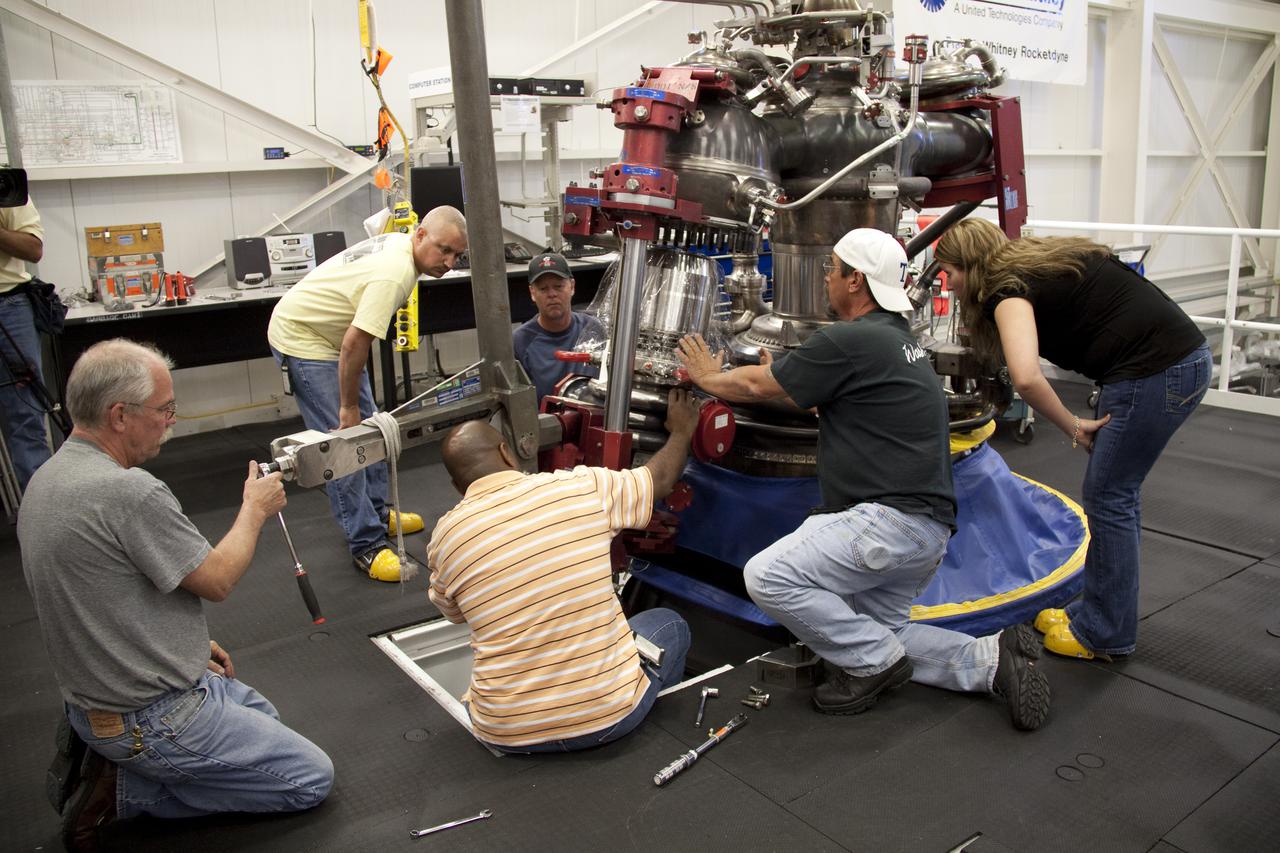
CAPE CANAVERAL, Fla. – In the Space Shuttle Main Engine Processing Facility at NASA's Kennedy Space Center in Florida, Pratt and Whitney Rocketdyne engine technicians install a high pressure oxidizer turbo pump on space shuttle main engine no. 2062. The engine, or SSME, is the last one scheduled to be built at Kennedy before the end of the Space Shuttle Program. In front of the engine, from left, are Dan Bode, Teryon Jones, quality inspector Barry Martin, and engineer Jessica Tandy. Behind the engine, from left, are Ryan Mahony and Ken Burley. Three main engines are clustered at the aft end of the shuttle and have a combined thrust of more than 1.2 million pounds. Even though an SSME weighs one-seventh as much as a locomotive engine, its high-pressure fuel pump alone delivers as much horsepower as 28 locomotives. Each engine operates during the entire eight-and-a-half minute climb to orbit. Post-flight inspections and maintenance of each engine also are conducted in the SSME Processing Facility between shuttle missions. Photo credit: NASA_Amanda Diller
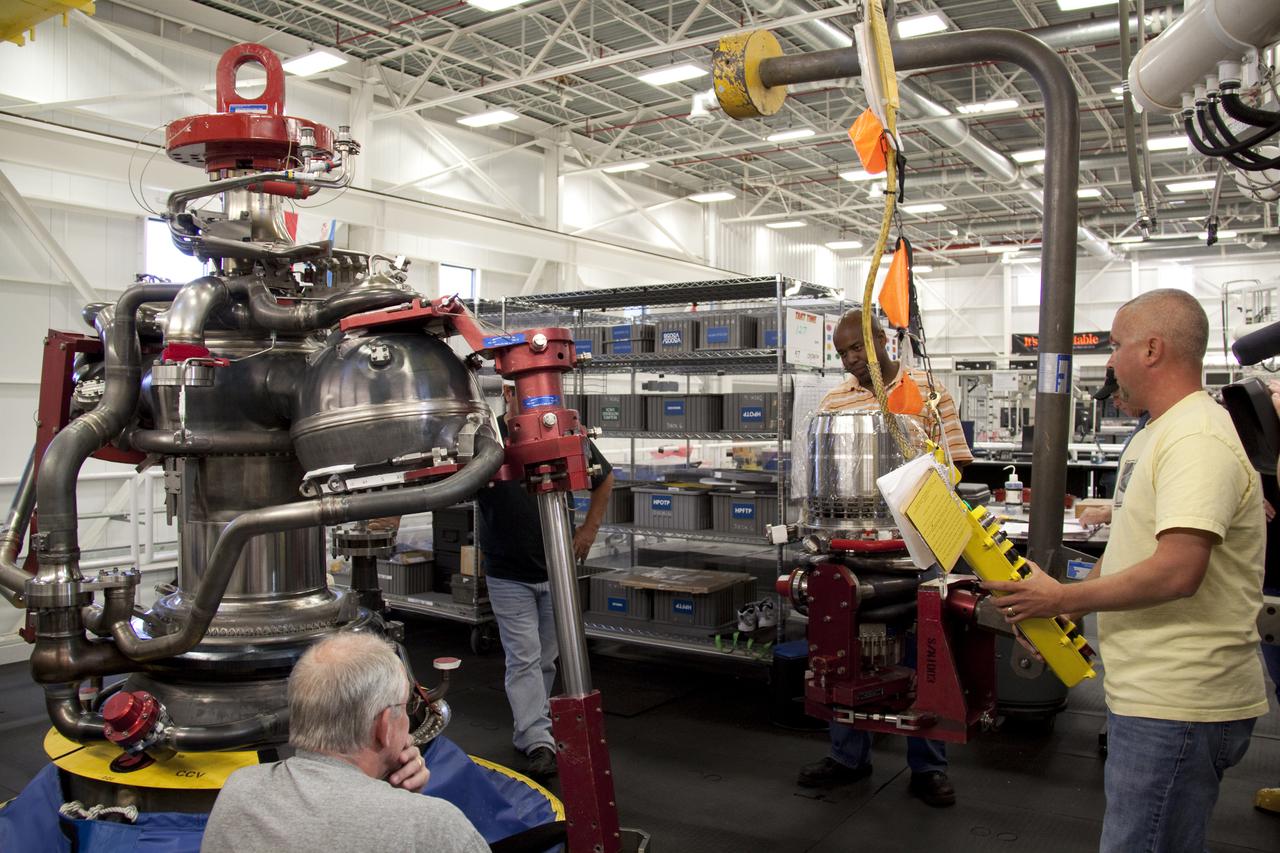
CAPE CANAVERAL, Fla. – In the Space Shuttle Main Engine Processing Facility at NASA's Kennedy Space Center in Florida, Pratt and Whitney Rocketdyne engine technicians prepare to install a high pressure oxidizer turbo pump on space shuttle main engine no. 2062. The engine, or SSME, is the last one scheduled to be built at Kennedy before the end of the Space Shuttle Program. From left are Dan Bode, Teryon Jones, and Ryan Mahony. Quality inspector Barry Martin is standing beside the engine, just out of view. Three main engines are clustered at the aft end of the shuttle and have a combined thrust of more than 1.2 million pounds. Even though an SSME weighs one-seventh as much as a locomotive engine, its high-pressure fuel pump alone delivers as much horsepower as 28 locomotives. Each engine operates during the entire eight-and-a-half minute climb to orbit. Post-flight inspections and maintenance of each engine also are conducted in the SSME Processing Facility between shuttle missions. Photo credit: NASA_Amanda Diller
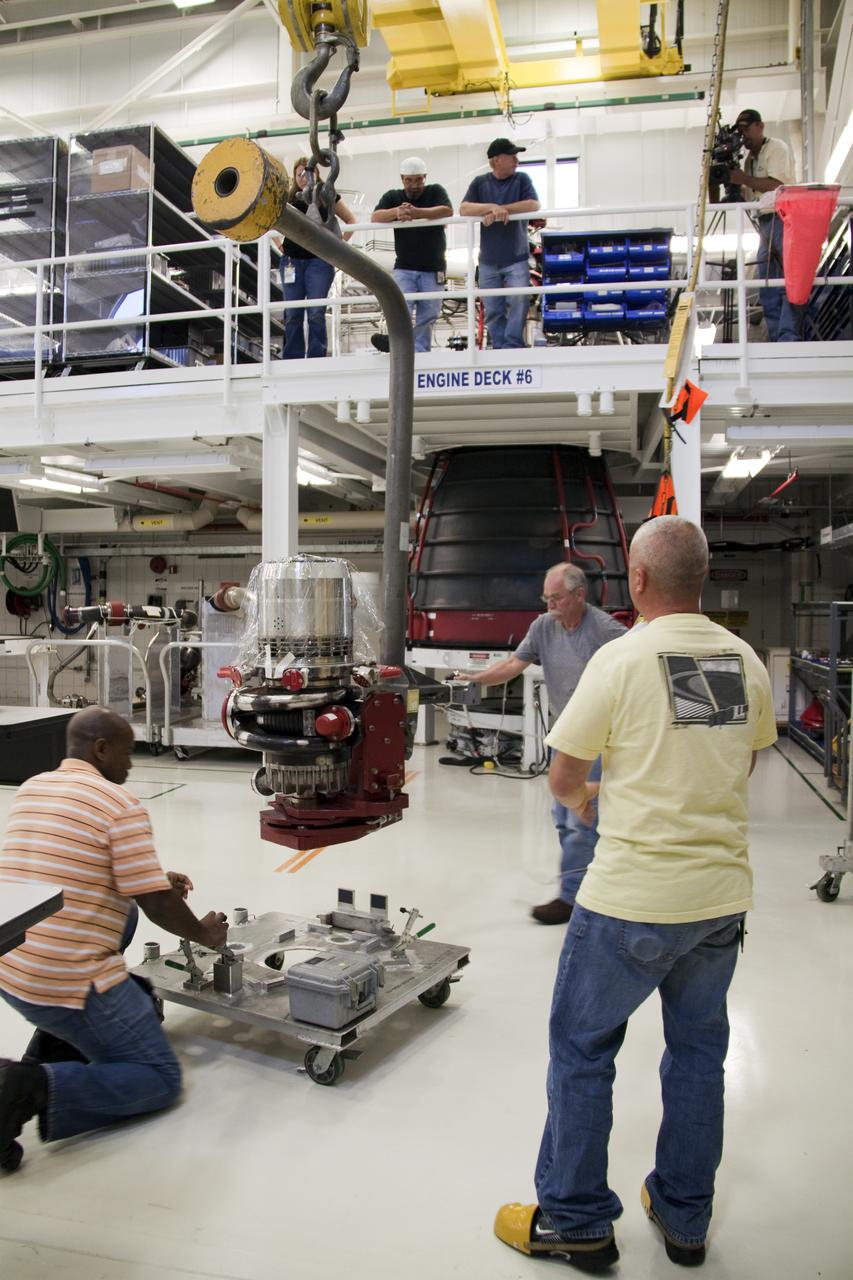
CAPE CANAVERAL, Fla. – On the floor of the Space Shuttle Main Engine Processing Facility at NASA's Kennedy Space Center in Florida, Pratt and Whitney Rocketdyne engine technicians lift a high pressure oxidizer turbo pump off its stand for installation on space shuttle main engine no. 2062. The engine, or SSME, is the last one scheduled to be built at Kennedy by Pratt and Whitney Rocketdyne before the end of the Space Shuttle Program. From left are Teryon Jones, Dan Bode and Ryan Mahony. Three main engines are clustered at the aft end of the shuttle and have a combined thrust of more than 1.2 million pounds. Even though an SSME weighs one-seventh as much as a locomotive engine, its high-pressure fuel pump alone delivers as much horsepower as 28 locomotives. Each engine operates during the entire eight-and-a-half minute climb to orbit. Post-flight inspections and maintenance of each engine also are conducted in the SSME Processing Facility between shuttle missions. Photo credit: NASA_Amanda Diller

CAPE CANAVERAL, Fla. – In the Space Shuttle Main Engine Processing Facility at NASA's Kennedy Space Center in Florida, Pratt and Whitney Rocketdyne engine technicians prepare a high pressure oxidizer turbo pump for installation on space shuttle main engine no. 2062. The engine, or SSME, is the last one scheduled to be built at Kennedy before the end of the Space Shuttle Program. Ryan Mahony is standing; Teryon Jones, left, and Dan Bode are kneeling next to the pump. Three main engines are clustered at the aft end of the shuttle and have a combined thrust of more than 1.2 million pounds. Even though an SSME weighs one-seventh as much as a locomotive engine, its high-pressure fuel pump alone delivers as much horsepower as 28 locomotives. Each engine operates during the entire eight-and-a-half minute climb to orbit. Post-flight inspections and maintenance of each engine also are conducted in the SSME Processing Facility between shuttle missions. Photo credit: NASA_Amanda Diller
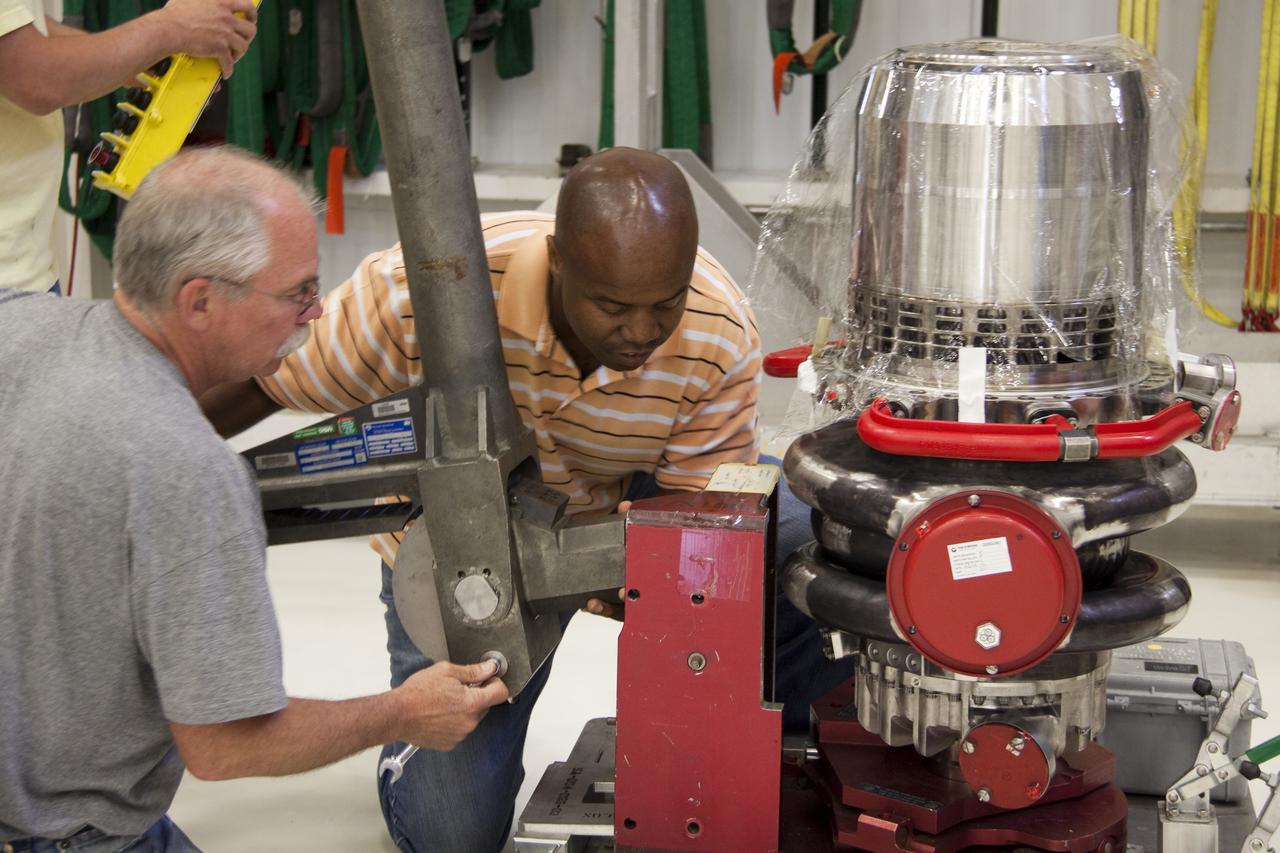
CAPE CANAVERAL, Fla. – In the Space Shuttle Main Engine Processing Facility at NASA's Kennedy Space Center in Florida, Pratt and Whitney Rocketdyne engine technicians prepare a high pressure oxidizer turbo pump for installation on space shuttle main engine no. 2062. The engine, or SSME, is the last one scheduled to be built at Kennedy by Pratt and Whitney Rocketdyne before the end of the Space Shuttle Program. From left are Dan Bode and Teryon Jones. Three main engines are clustered at the aft end of the shuttle and have a combined thrust of more than 1.2 million pounds. Even though an SSME weighs one-seventh as much as a locomotive engine, its high-pressure fuel pump alone delivers as much horsepower as 28 locomotives. Each engine operates during the entire eight-and-a-half minute climb to orbit. Post-flight inspections and maintenance of each engine also are conducted in the SSME Processing Facility between shuttle missions. Photo credit: NASA_Amanda Diller
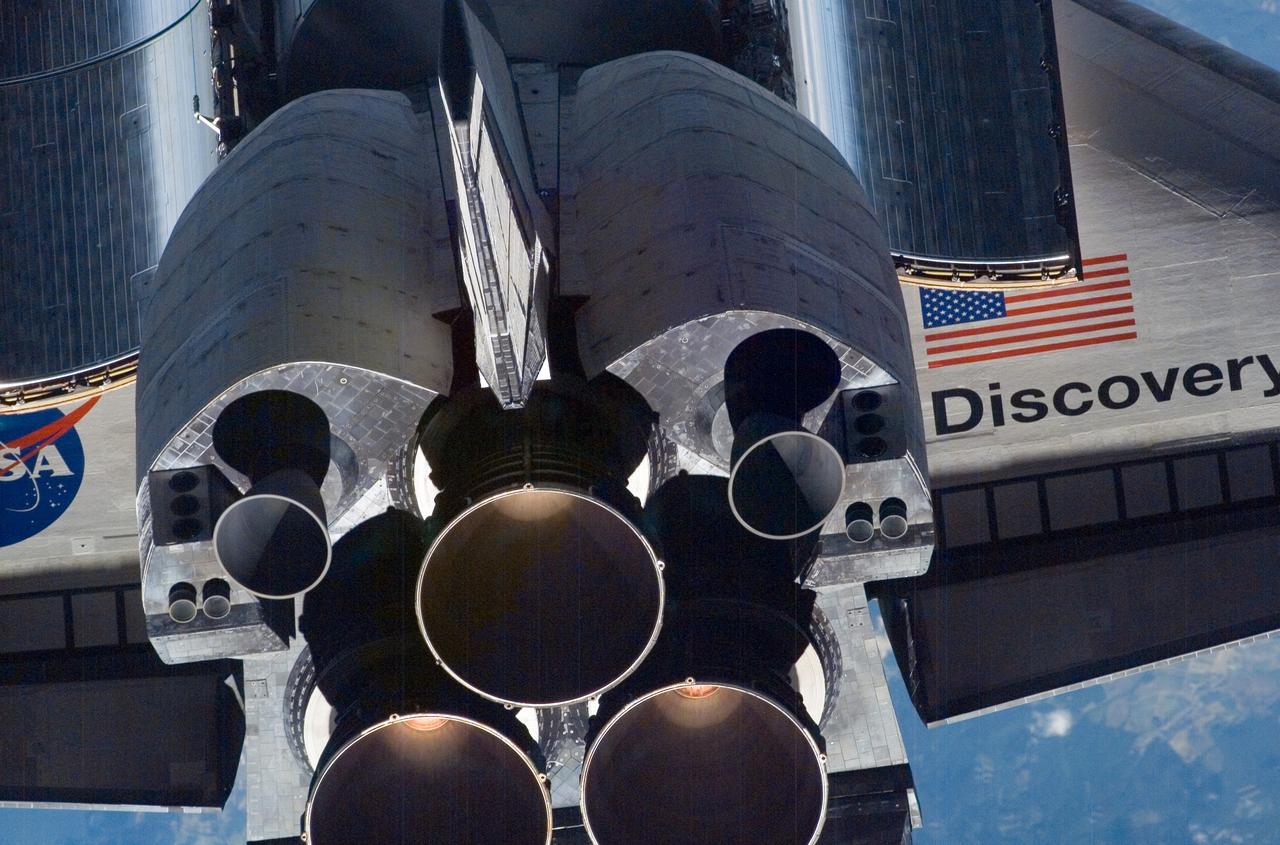
A close-up view of Space Shuttle Discovery's tail section is featured in this image photographed by an Expedition 13 crew member on the International Space Station (ISS) during the STS-121 Rotating Pitch Maneuver (RPM) survey. Visible are the space shuttle's main engines (SSME), vertical stabilizer, orbital maneuvering system (OMS) pods and a portion of the aft cargo bay and wings. The Marshall Space Flight Center (MSFC) has management responsibility for development of the SSME.
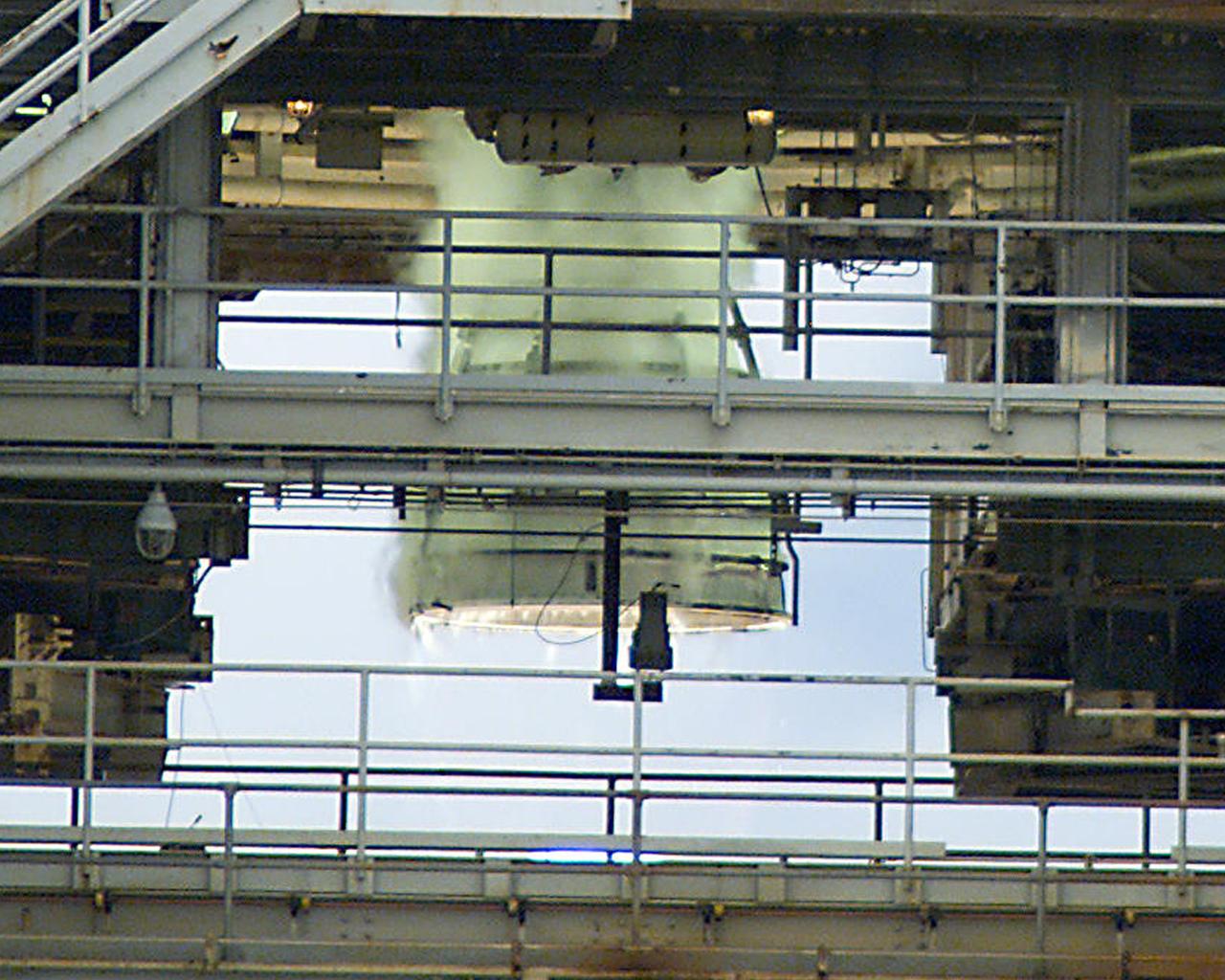
This close-up photo was taken during testing of a Space Shuttle Main Engine on the A-1 Test Stand at Stennis Space Center near Bay St. Louis, Miss. The test was conducted June 19, 2003.

A space shuttle main engine test April 21, 2006, at NASA Stennis Space Center marked the 40th anniversary of the first rocket engine test at the site. The firing also marked the 25th anniversary of NASA's STS-1, the first space shuttle mission. Then called the Mississippi Test Facility, the center conducted its first test on April 23, 1966. That historic test was on an S-II (second) stage, a cluster of five J-2 engines that powered the Saturn V rockets that took America's Apollo missions to the moon.
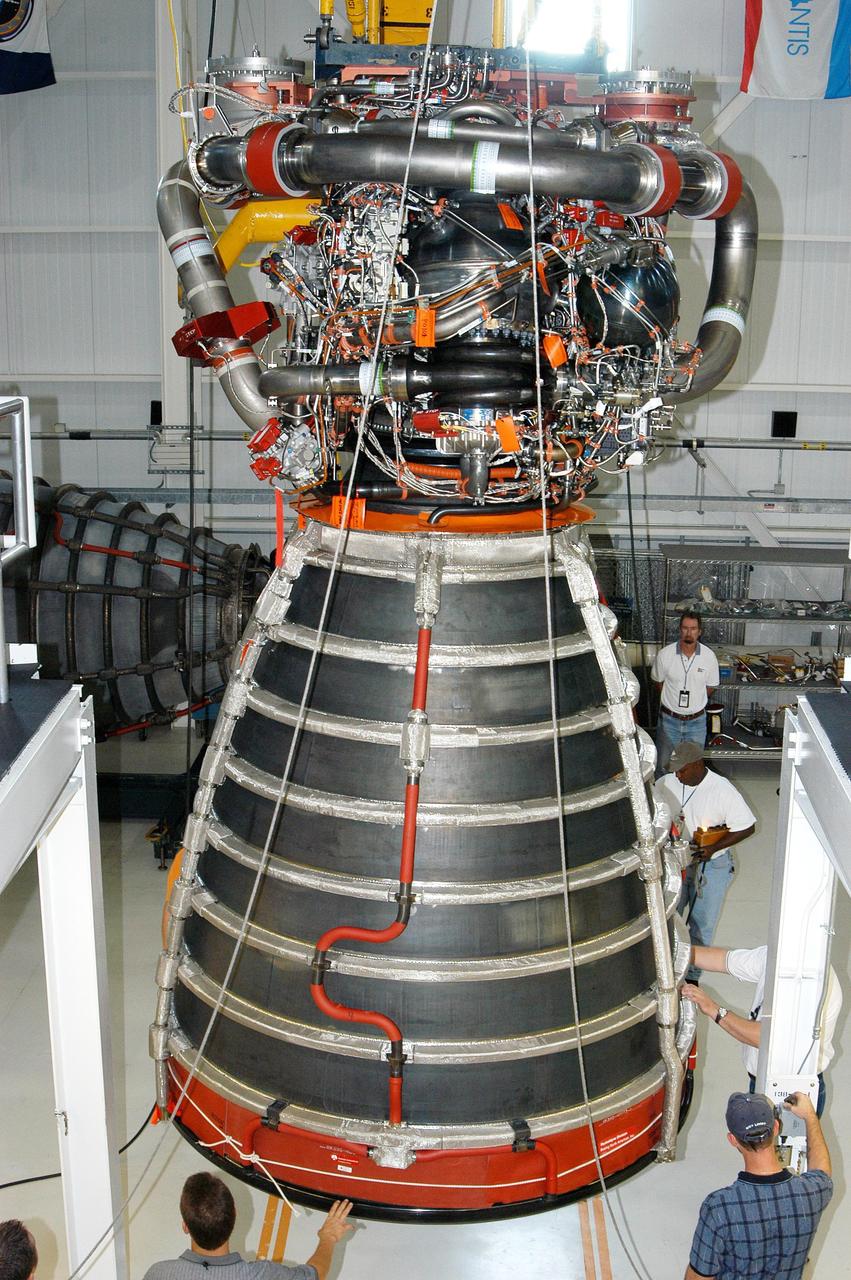
KENNEDY SPACE CENTER, FLA. - In the Space Shuttle Main Engine (SSME) Processing Facility, Boeing-Rocketdyne technicians lift SSME 2058, the first SSME fully assembled at KSC. The engine is being lifted from its vertical work stand into a horizontal position in preparation for shipment to NASA’s Stennis Space Center in Mississippi to undergo a hot fire acceptance test. It is the first of five engines to be fully assembled on site to reach the desired number of 15 engines ready for launch at any given time in the Space Shuttle program. A Space Shuttle has three reusable main engines. Each is 14 feet long, weighs about 7,800 pounds, is seven-and-a-half feet in diameter at the end of its nozzle, and generates almost 400,000 pounds of thrust. Historically, SSMEs were assembled in Canoga Park, Calif., with post-flight inspections performed at KSC. Both functions were consolidated in February 2002. The Rocketdyne Propulsion and Power division of The Boeing Co. manufactures the engines for NASA.
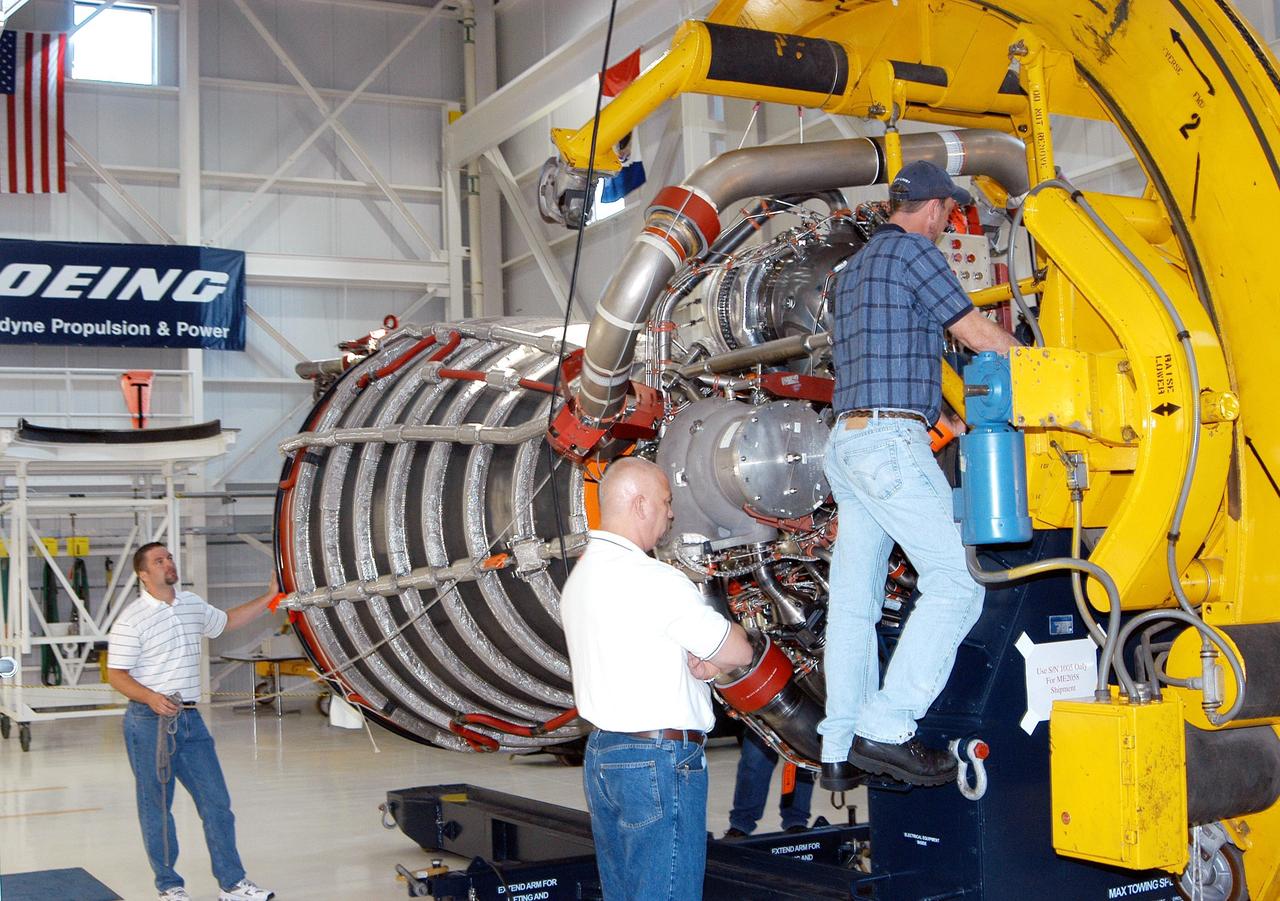
KENNEDY SPACE CENTER, FLA. - In the Space Shuttle Main Engine (SSME) Processing Facility, Boeing-Rocketdyne quality inspector Nick Grimm (center) monitors the work of technicians on his team as they lower SSME 2058, the first SSME fully assembled at KSC, onto an engine stand. The engine is being placed into a horizontal position in preparation for shipment to NASA’s Stennis Space Center in Mississippi to undergo a hot fire acceptance test. It is the first of five engines to be fully assembled on site to reach the desired number of 15 engines ready for launch at any given time in the Space Shuttle program. A Space Shuttle has three reusable main engines. Each is 14 feet long, weighs about 7,800 pounds, is seven-and-a-half feet in diameter at the end of its nozzle, and generates almost 400,000 pounds of thrust. Historically, SSMEs were assembled in Canoga Park, Calif., with post-flight inspections performed at KSC. Both functions were consolidated in February 2002. The Rocketdyne Propulsion and Power division of The Boeing Co. manufactures the engines for NASA.
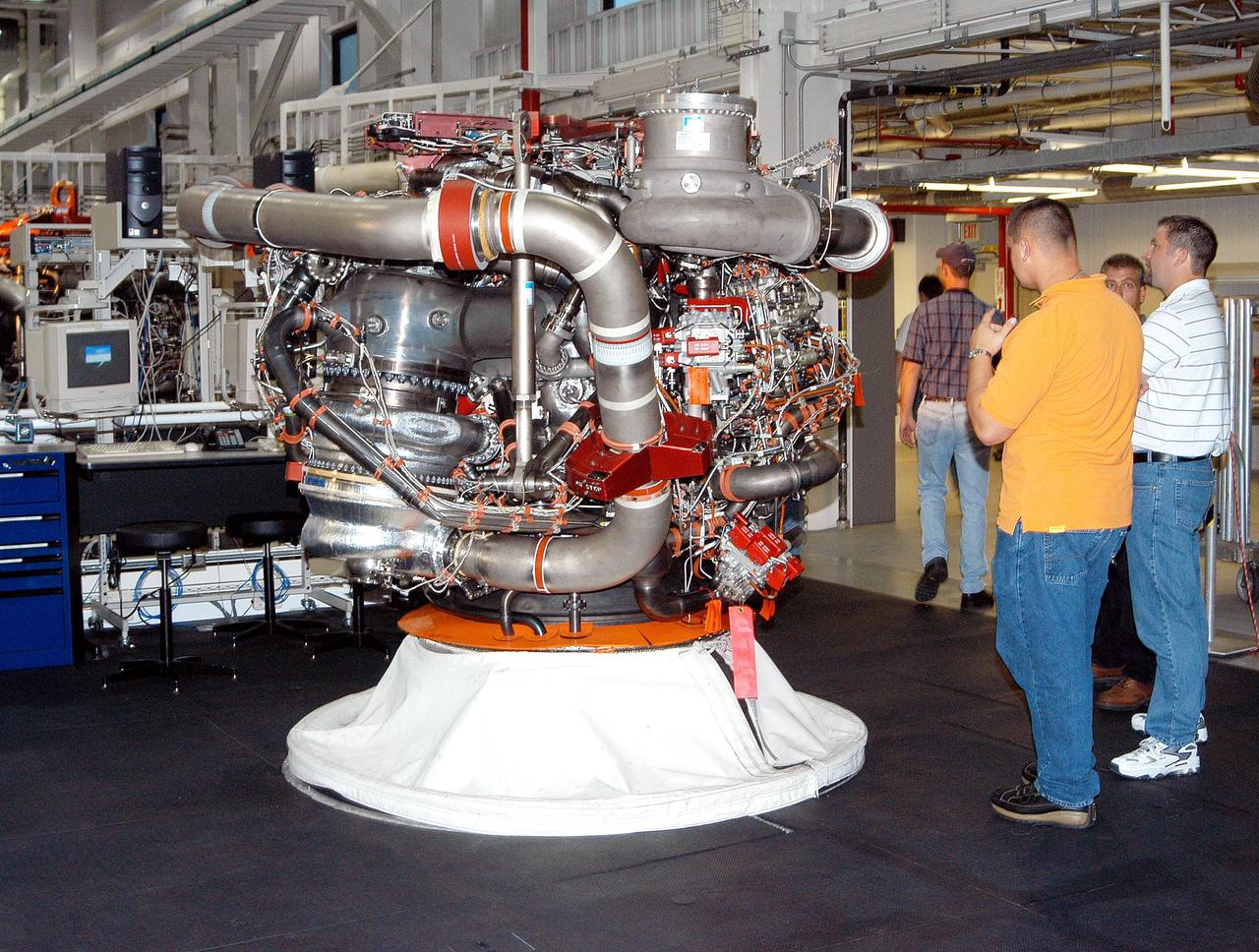
KENNEDY SPACE CENTER, FLA. - In the Space Shuttle Main Engine (SSME) Processing Facility, Boeing-Rocketdyne technicians prepare to move SSME 2058, the first SSME fully assembled at KSC. The engine will be lifted from its vertical work stand into a horizontal position in preparation for shipment to NASA’s Stennis Space Center in Mississippi to undergo a hot fire acceptance test. It is the first of five engines to be fully assembled on site to reach the desired number of 15 engines ready for launch at any given time in the Space Shuttle program. A Space Shuttle has three reusable main engines. Each is 14 feet long, weighs about 7,800 pounds, is seven-and-a-half feet in diameter at the end of its nozzle, and generates almost 400,000 pounds of thrust. Historically, SSMEs were assembled in Canoga Park, Calif., with post-flight inspections performed at KSC. Both functions were consolidated in February 2002. The Rocketdyne Propulsion and Power division of The Boeing Co. manufactures the engines for NASA.
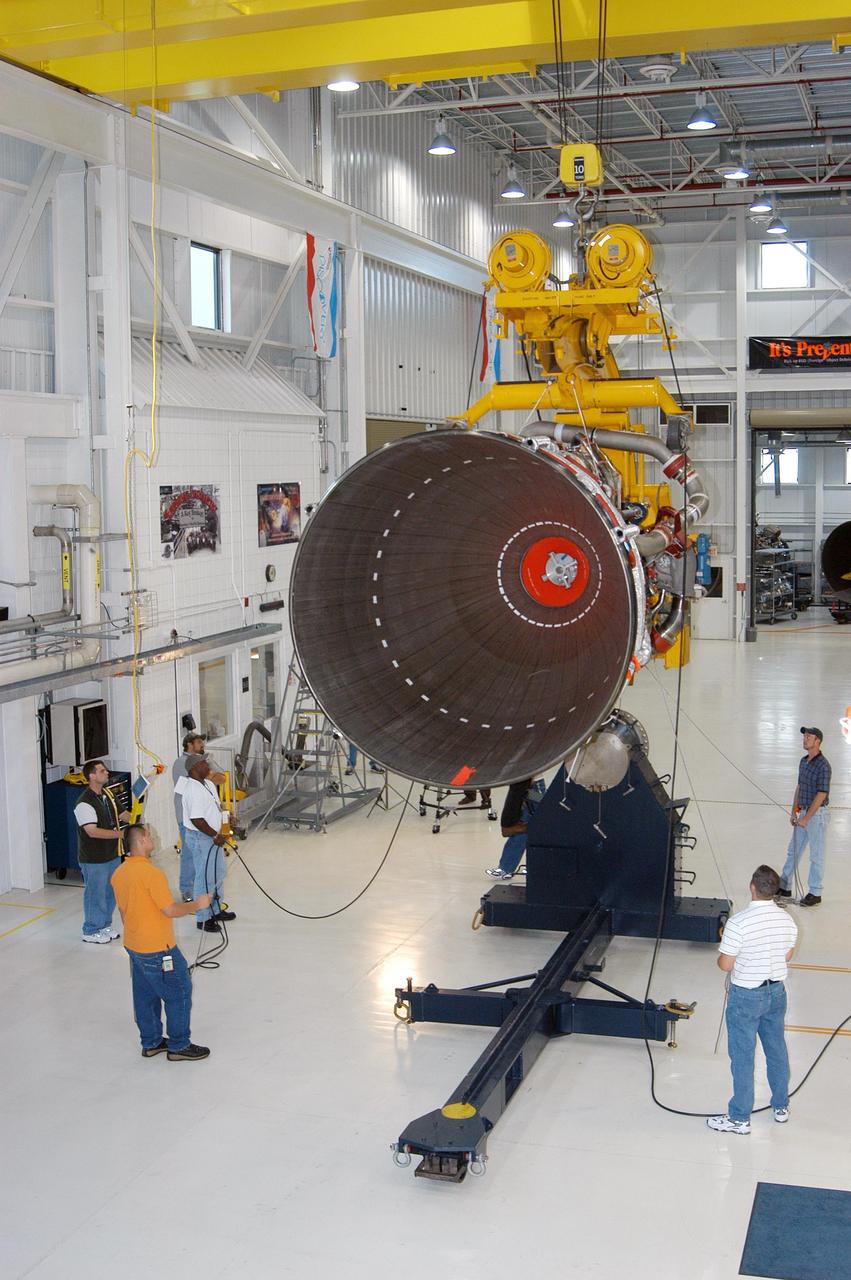
KENNEDY SPACE CENTER, FLA. - In the Space Shuttle Main Engine (SSME) Processing Facility, Boeing-Rocketdyne crane operator Joe Ferrante (left) lowers SSME 2058, the first SSME fully assembled at KSC, onto an engine stand with the assistance of other technicians on his team. The engine is being moved from its vertical work stand into a horizontal position in preparation for shipment to NASA’s Stennis Space Center in Mississippi to undergo a hot fire acceptance test. It is the first of five engines to be fully assembled on site to reach the desired number of 15 engines ready for launch at any given time in the Space Shuttle program. A Space Shuttle has three reusable main engines. Each is 14 feet long, weighs about 7,800 pounds, is seven-and-a-half feet in diameter at the end of its nozzle, and generates almost 400,000 pounds of thrust. Historically, SSMEs were assembled in Canoga Park, Calif., with post-flight inspections performed at KSC. Both functions were consolidated in February 2002. The Rocketdyne Propulsion and Power division of The Boeing Co. manufactures the engines for NASA.
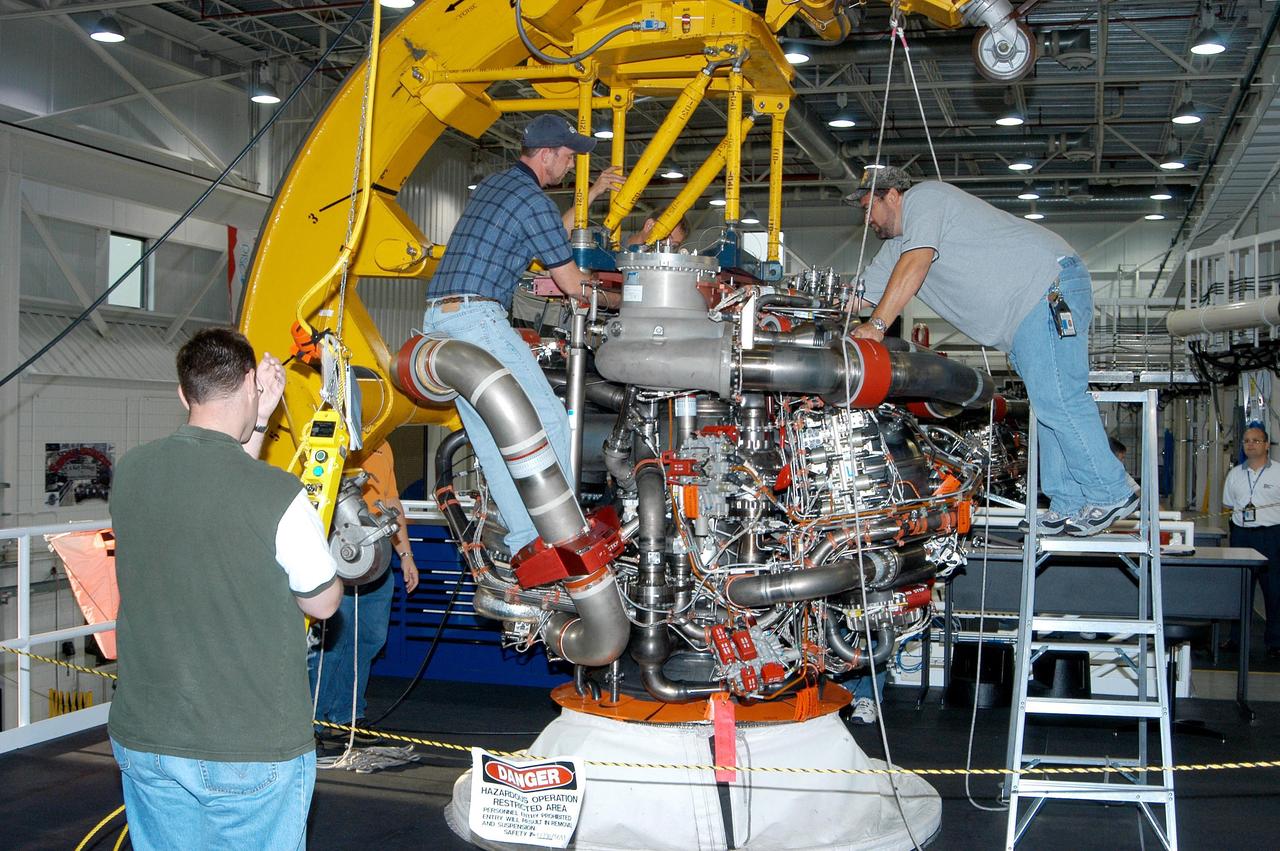
KENNEDY SPACE CENTER, FLA. - In the Space Shuttle Main Engine (SSME) Processing Facility, Boeing-Rocketdyne technicians lower SSME 2058, the first SSME fully assembled at KSC, onto an engine stand. The engine is being moved from its vertical work stand into a horizontal position in preparation for shipment to NASA’s Stennis Space Center in Mississippi to undergo a hot fire acceptance test. It is the first of five engines to be fully assembled on site to reach the desired number of 15 engines ready for launch at any given time in the Space Shuttle program. A Space Shuttle has three reusable main engines. Each is 14 feet long, weighs about 7,800 pounds, is seven-and-a-half feet in diameter at the end of its nozzle, and generates almost 400,000 pounds of thrust. Historically, SSMEs were assembled in Canoga Park, Calif., with post-flight inspections performed at KSC. Both functions were consolidated in February 2002. The Rocketdyne Propulsion and Power division of The Boeing Co. manufactures the engines for NASA.
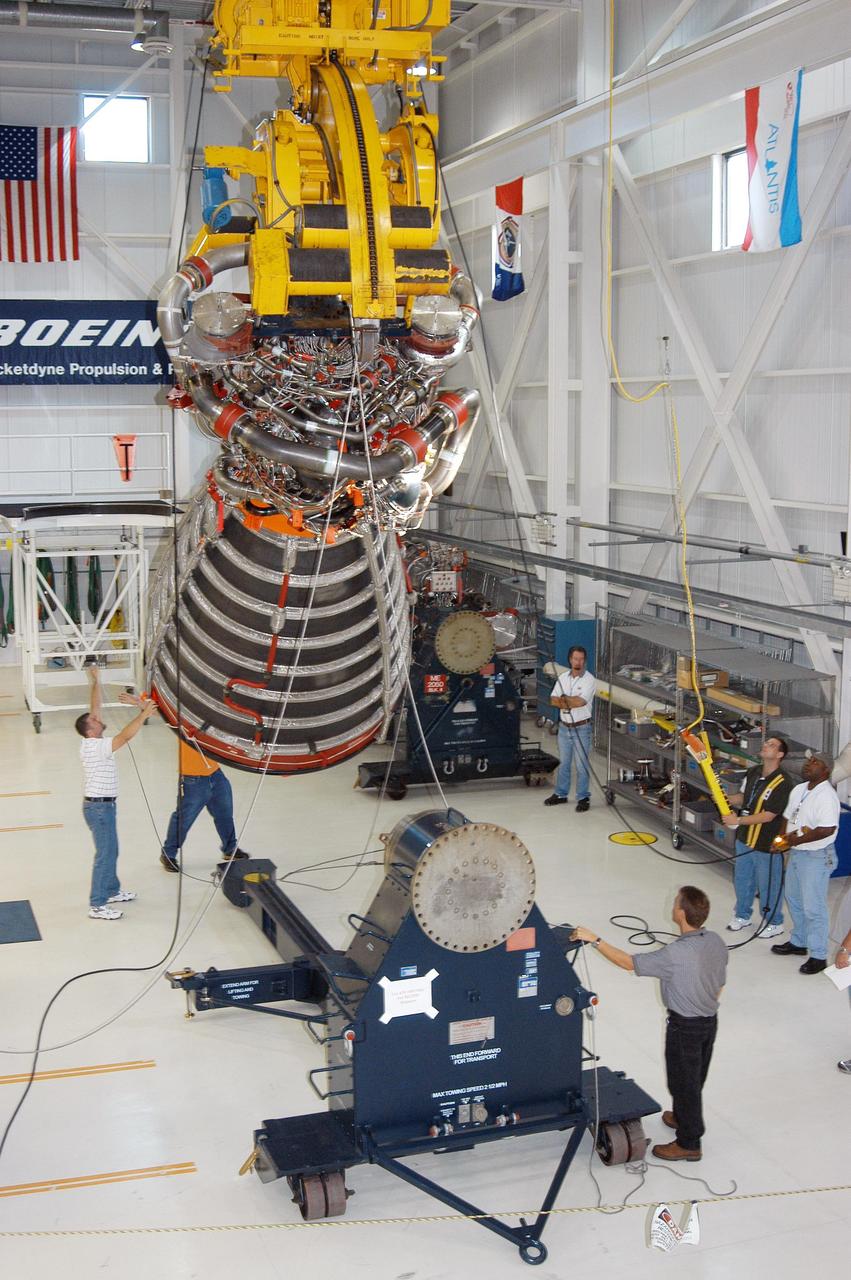
KENNEDY SPACE CENTER, FLA. - In the Space Shuttle Main Engine (SSME) Processing Facility, Boeing-Rocketdyne crane operator Joe Ferrante (second from right) lifts SSME 2058, the first SSME fully assembled at KSC, with the assistance of other technicians on his team. The engine is being lifted from its vertical work stand into a horizontal position in preparation for shipment to NASA’s Stennis Space Center in Mississippi to undergo a hot fire acceptance test. It is the first of five engines to be fully assembled on site to reach the desired number of 15 engines ready for launch at any given time in the Space Shuttle program. A Space Shuttle has three reusable main engines. Each is 14 feet long, weighs about 7,800 pounds, is seven-and-a-half feet in diameter at the end of its nozzle, and generates almost 400,000 pounds of thrust. Historically, SSMEs were assembled in Canoga Park, Calif., with post-flight inspections performed at KSC. Both functions were consolidated in February 2002. The Rocketdyne Propulsion and Power division of The Boeing Co. manufactures the engines for NASA.
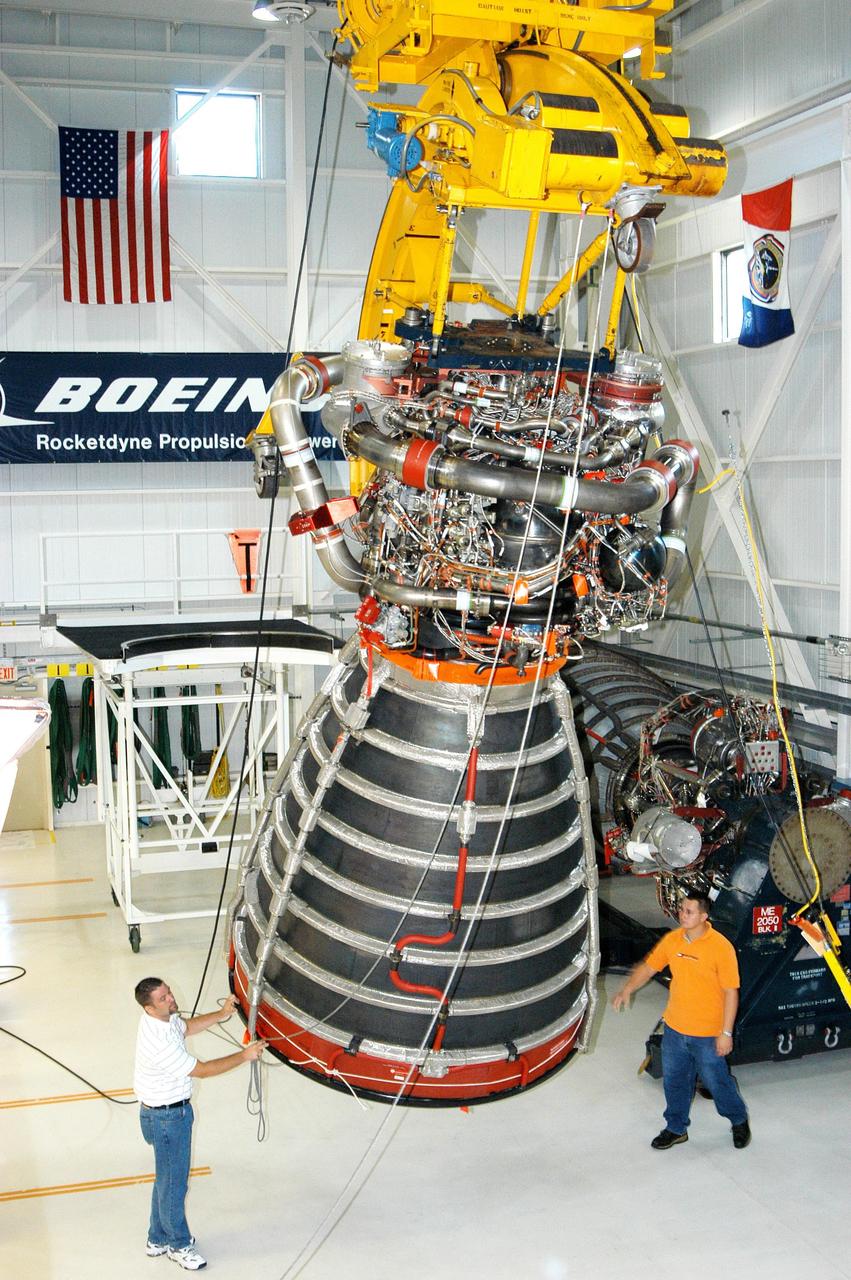
KENNEDY SPACE CENTER, FLA. - In the Space Shuttle Main Engine (SSME) Processing Facility, Boeing-Rocketdyne technicians steady SSME 2058, the first SSME fully assembled at KSC. The engine is being lifted from its vertical work stand into a horizontal position in preparation for shipment to NASA’s Stennis Space Center in Mississippi to undergo a hot fire acceptance test. It is the first of five engines to be fully assembled on site to reach the desired number of 15 engines ready for launch at any given time in the Space Shuttle program. A Space Shuttle has three reusable main engines. Each is 14 feet long, weighs about 7,800 pounds, is seven-and-a-half feet in diameter at the end of its nozzle, and generates almost 400,000 pounds of thrust. Historically, SSMEs were assembled in Canoga Park, Calif., with post-flight inspections performed at KSC. Both functions were consolidated in February 2002. The Rocketdyne Propulsion and Power division of The Boeing Co. manufactures the engines for NASA.
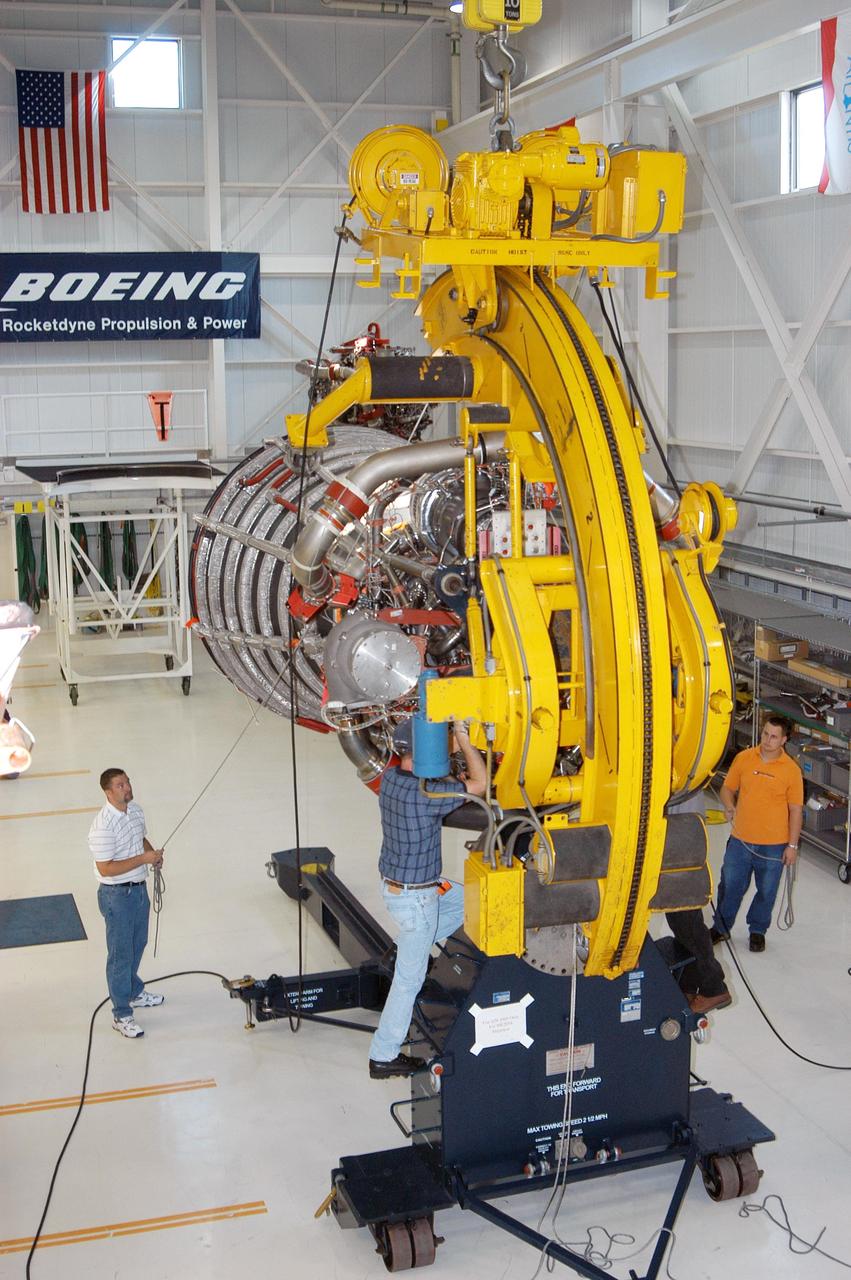
KENNEDY SPACE CENTER, FLA. - In the Space Shuttle Main Engine (SSME) Processing Facility, Boeing-Rocketdyne technicians prepare to move SSME 2058, the first SSME fully assembled at KSC. Move conductor Bob Brackett (on ladder) and technicians secure a sling around the engine under the direction of crane operator Joe Ferrante (left). The engine will be lifted from its vertical work stand into a horizontal position in preparation for shipment to NASA’s Stennis Space Center in Mississippi to undergo a hot fire acceptance test. It is the first of five engines to be fully assembled on site to reach the desired number of 15 engines ready for launch at any given time in the Space Shuttle program. A Space Shuttle has three reusable main engines. Each is 14 feet long, weighs about 7,800 pounds, is seven-and-a-half feet in diameter at the end of its nozzle, and generates almost 400,000 pounds of thrust. Historically, SSMEs were assembled in Canoga Park, Calif., with post-flight inspections performed at KSC. Both functions were consolidated in February 2002. The Rocketdyne Propulsion and Power division of The Boeing Co. manufactures the engines for NASA.
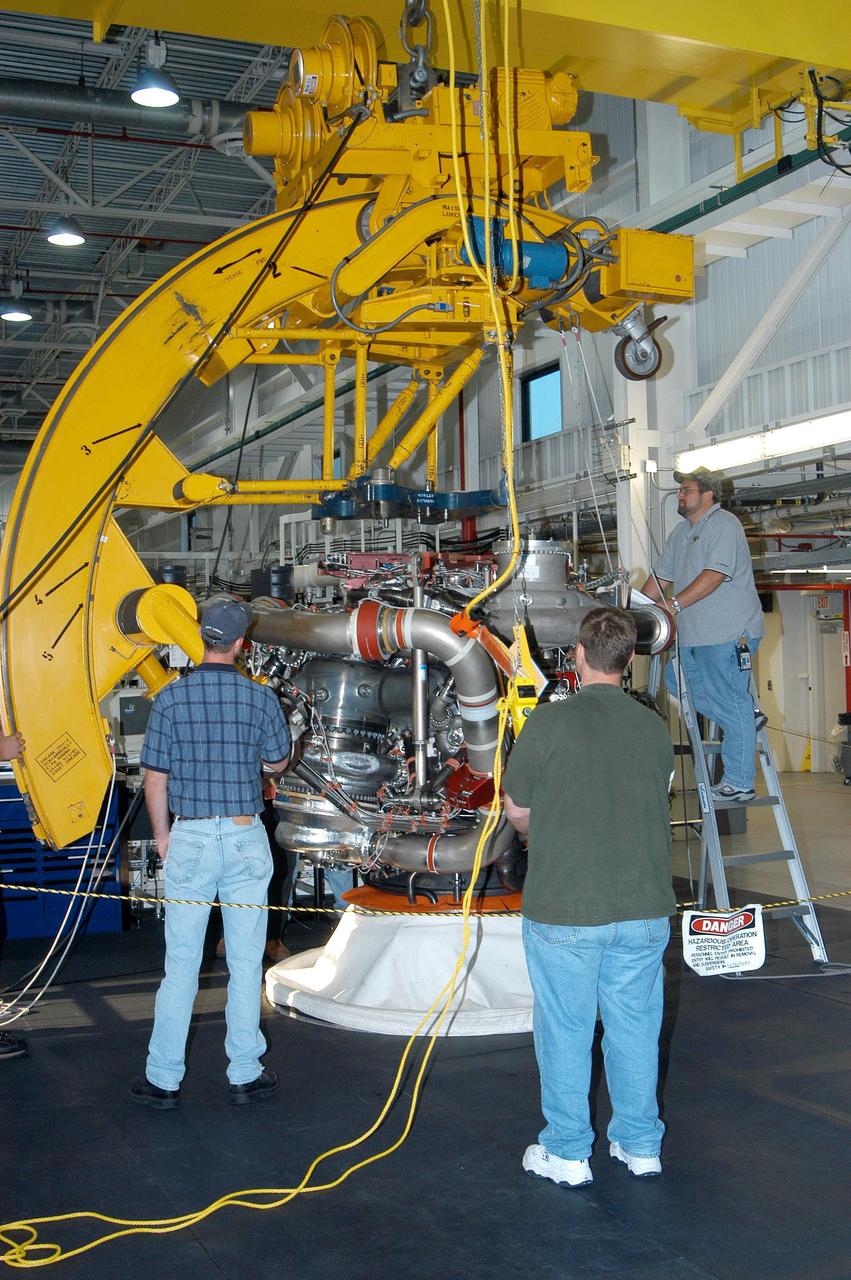
KENNEDY SPACE CENTER, FLA. - In the Space Shuttle Main Engine (SSME) Processing Facility, Boeing-Rocketdyne technicians prepare to move SSME 2058, the first SSME fully assembled at KSC. Move conductor Bob Brackett (on ladder) supervises the placement of a sling around the engine with the assistance of crane operator Joe Ferrante (center) and a technician. The engine will be lifted from its vertical work stand into a horizontal position in preparation for shipment to NASA’s Stennis Space Center in Mississippi to undergo a hot fire acceptance test. It is the first of five engines to be fully assembled on site to reach the desired number of 15 engines ready for launch at any given time in the Space Shuttle program. A Space Shuttle has three reusable main engines. Each is 14 feet long, weighs about 7,800 pounds, is seven-and-a-half feet in diameter at the end of its nozzle, and generates almost 400,000 pounds of thrust. Historically, SSMEs were assembled in Canoga Park, Calif., with post-flight inspections performed at KSC. Both functions were consolidated in February 2002. The Rocketdyne Propulsion and Power division of The Boeing Co. manufactures the engines for NASA.
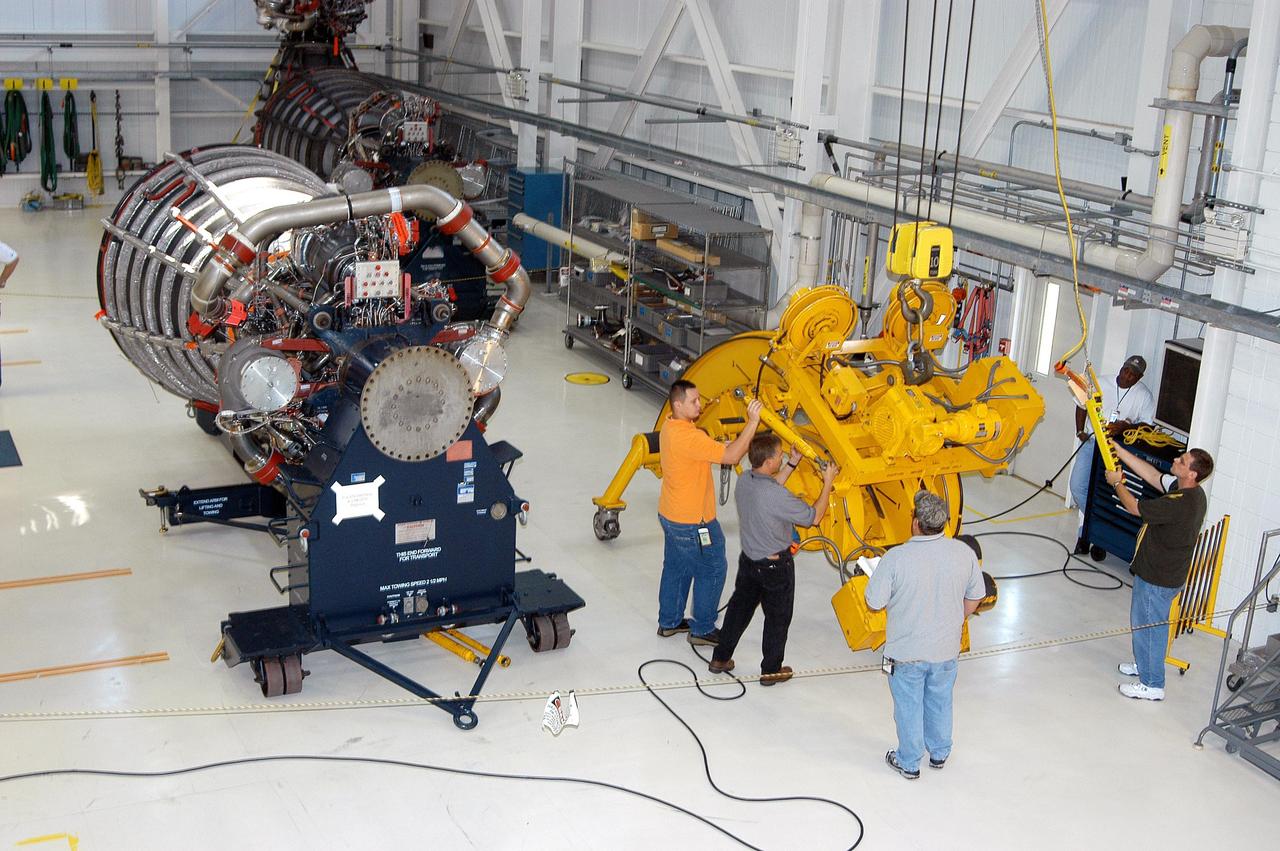
KENNEDY SPACE CENTER, FLA. - In the Space Shuttle Main Engine (SSME) Processing Facility, Boeing-Rocketdyne move conductor Bob Brackett (center) oversees the work of technicians on his team as they remove the crane used to lift SSME 2058, the first SSME fully assembled at KSC, from its vertical work stand. The engine has been placed into a horizontal position in preparation for shipment to NASA’s Stennis Space Center in Mississippi to undergo a hot fire acceptance test. It is the first of five engines to be fully assembled on site to reach the desired number of 15 engines ready for launch at any given time in the Space Shuttle program. A Space Shuttle has three reusable main engines. Each is 14 feet long, weighs about 7,800 pounds, is seven-and-a-half feet in diameter at the end of its nozzle, and generates almost 400,000 pounds of thrust. Historically, SSMEs were assembled in Canoga Park, Calif., with post-flight inspections performed at KSC. Both functions were consolidated in February 2002. The Rocketdyne Propulsion and Power division of The Boeing Co. manufactures the engines for NASA.
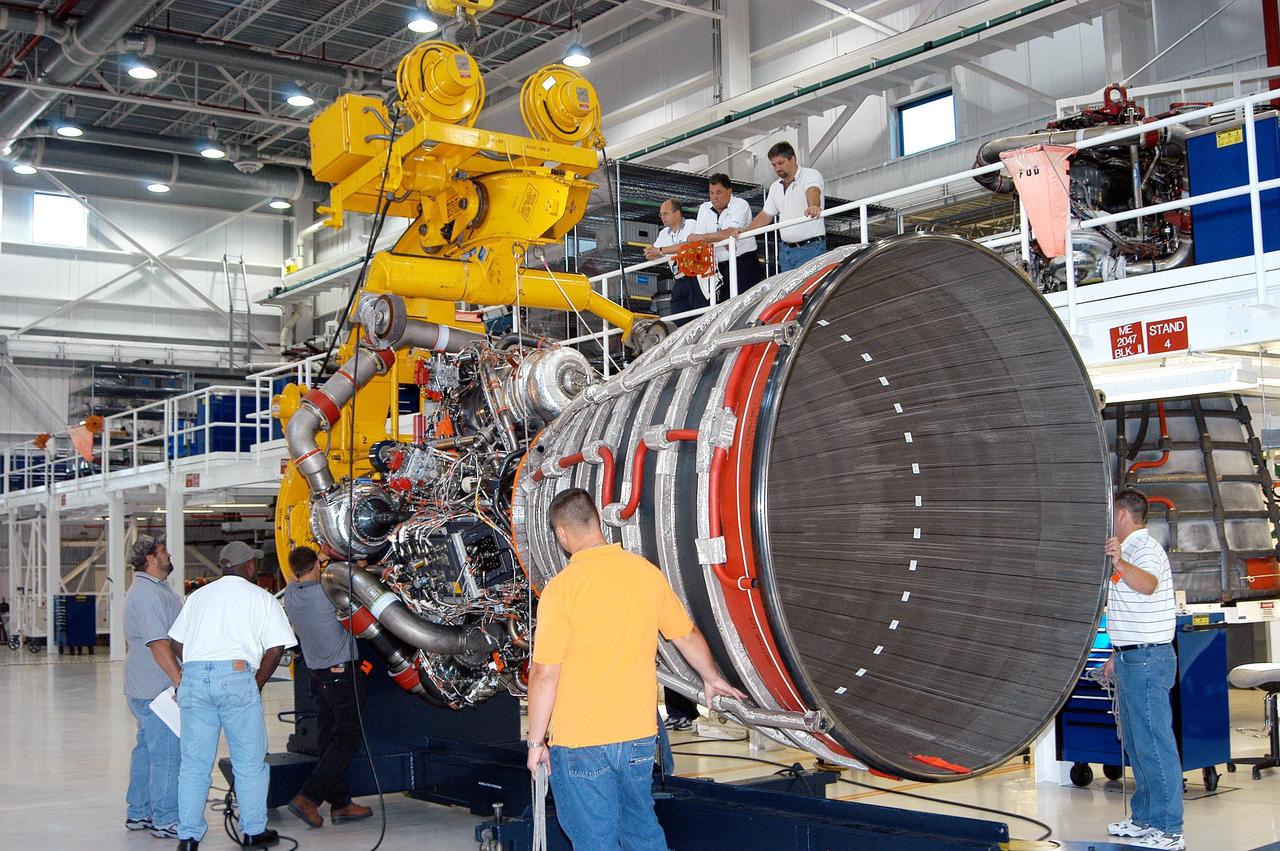
KENNEDY SPACE CENTER, FLA. - In the Space Shuttle Main Engine (SSME) Processing Facility, Boeing-Rocketdyne move conductor Bob Brackett (left) oversees the work of technicians on his team as they secure SSME 2058, the first SSME fully assembled at KSC, onto an engine stand. The engine is being placed into a horizontal position in preparation for shipment to NASA’s Stennis Space Center in Mississippi to undergo a hot fire acceptance test. It is the first of five engines to be fully assembled on site to reach the desired number of 15 engines ready for launch at any given time in the Space Shuttle program. A Space Shuttle has three reusable main engines. Each is 14 feet long, weighs about 7,800 pounds, is seven-and-a-half feet in diameter at the end of its nozzle, and generates almost 400,000 pounds of thrust. Historically, SSMEs were assembled in Canoga Park, Calif., with post-flight inspections performed at KSC. Both functions were consolidated in February 2002. The Rocketdyne Propulsion and Power division of The Boeing Co. manufactures the engines for NASA.
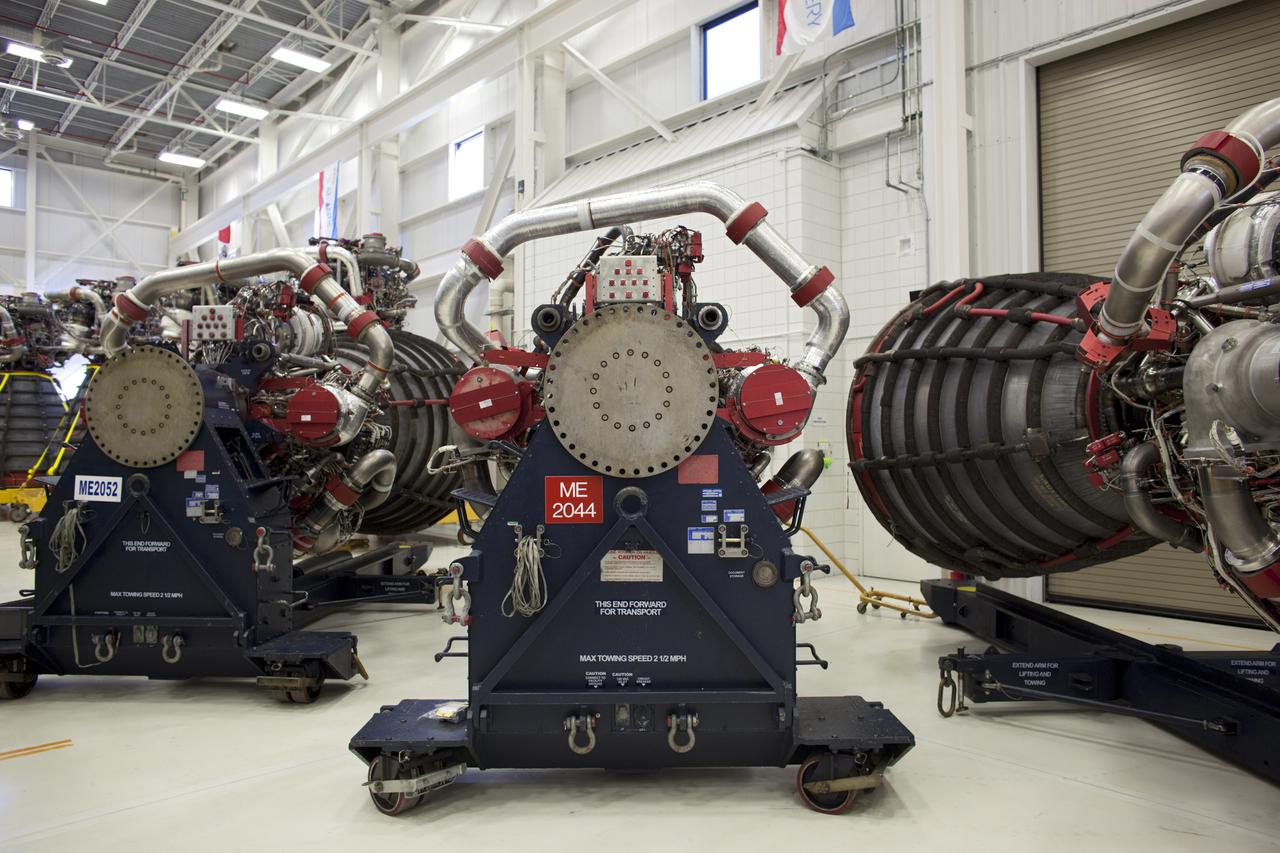
CAPE CANAVERAL, Fla. – Several Pratt Whitney Rocketdyne space shuttle main engines (SSMEs) sit on stands inside the Engine Shop at NASA’s Kennedy Space Center in Florida. For the first time, all 15 main engines are in the Engine Shop at the same time. They are being prepared for shipment to NASA's Stennis Space Center in Mississippi for storage following the completion of the Space Shuttle Program. The engines are being repurposed for use on NASA’s Space Launch System heavy lift rocket. Photo credit: NASA_Dimitri Gerondidakis
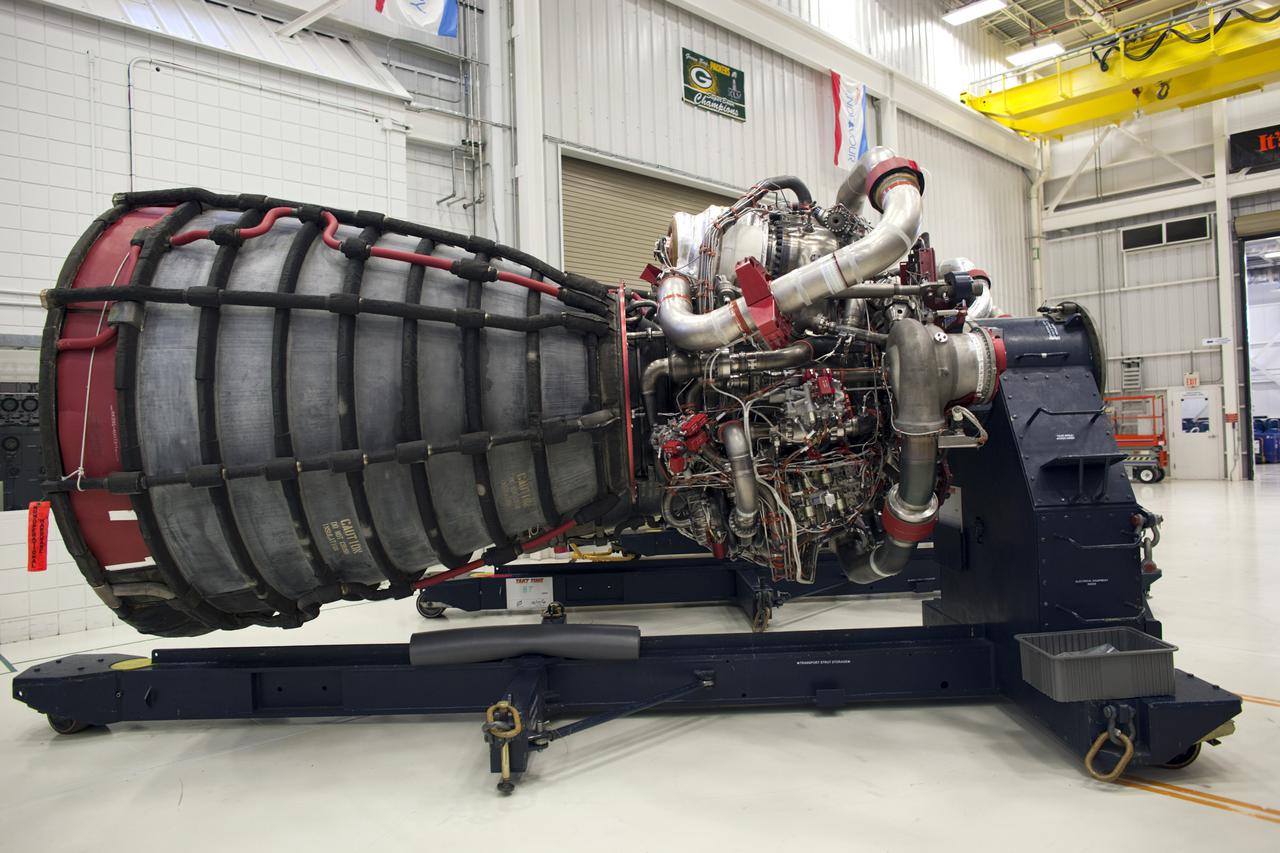
CAPE CANAVERAL, Fla. – At NASA’s Kennedy Space Center in Florida, a Pratt Whitney Rocketdyne space shuttle main engine (SSME) sits on a stand inside the Engine Shop. For the first time, all 15 main engines are in the Engine Shop at the same time. They are being prepared for shipment to NASA's Stennis Space Center in Mississippi for storage following the completion of the Space Shuttle Program. The engines are being repurposed for use on NASA’s Space Launch System heavy lift rocket. Photo credit: NASA_Dimitri Gerondidakis
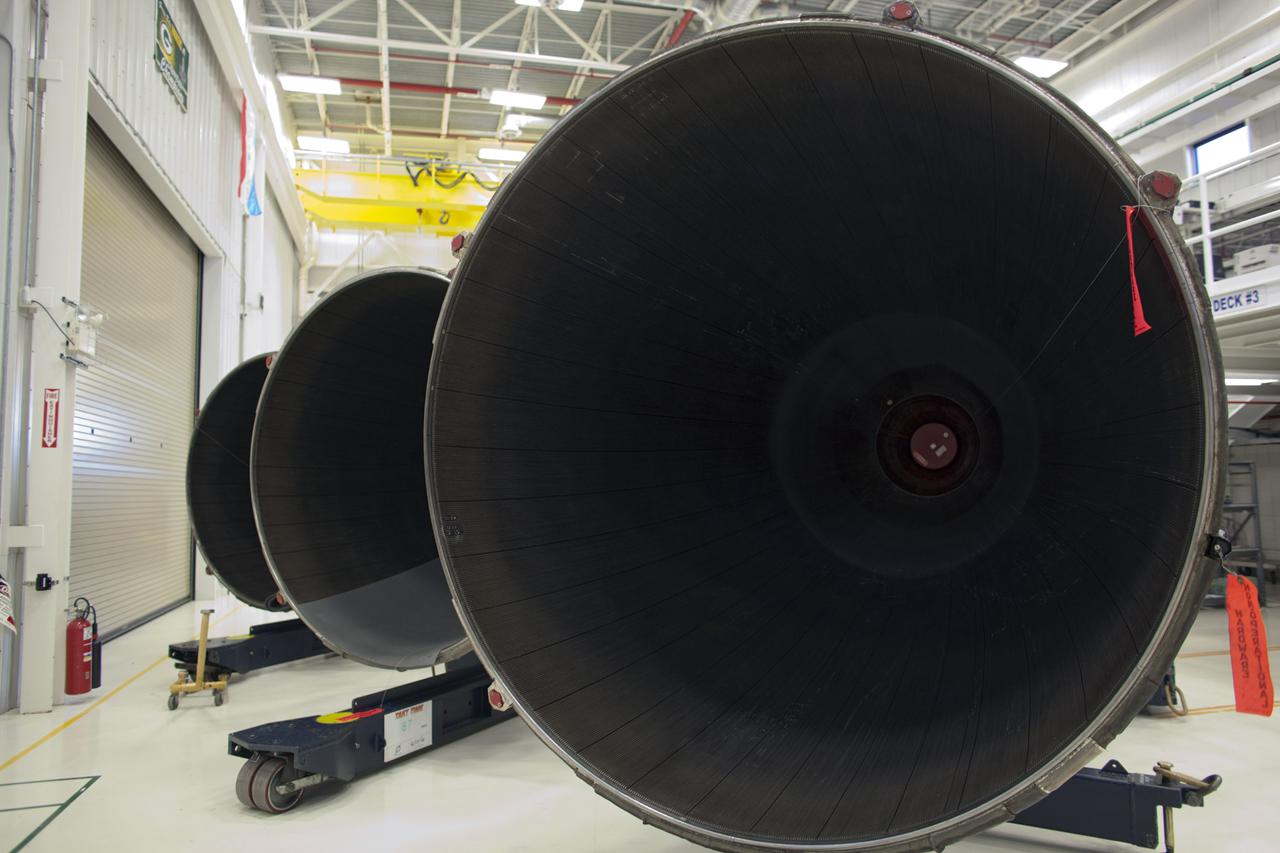
CAPE CANAVERAL, Fla. – At NASA’s Kennedy Space Center in Florida, the large engine bells of several Pratt Whitney Rocketdyne space shuttle main engines (SSMEs) are lined up inside the Engine Shop. For the first time, all 15 main engines are in the Engine Shop at the same time. They are being prepared for shipment to NASA's Stennis Space Center in Mississippi for storage following the completion of the Space Shuttle Program. The engines are being repurposed for use on NASA’s Space Launch System heavy lift rocket. Photo credit: NASA_Dimitri Gerondidakis
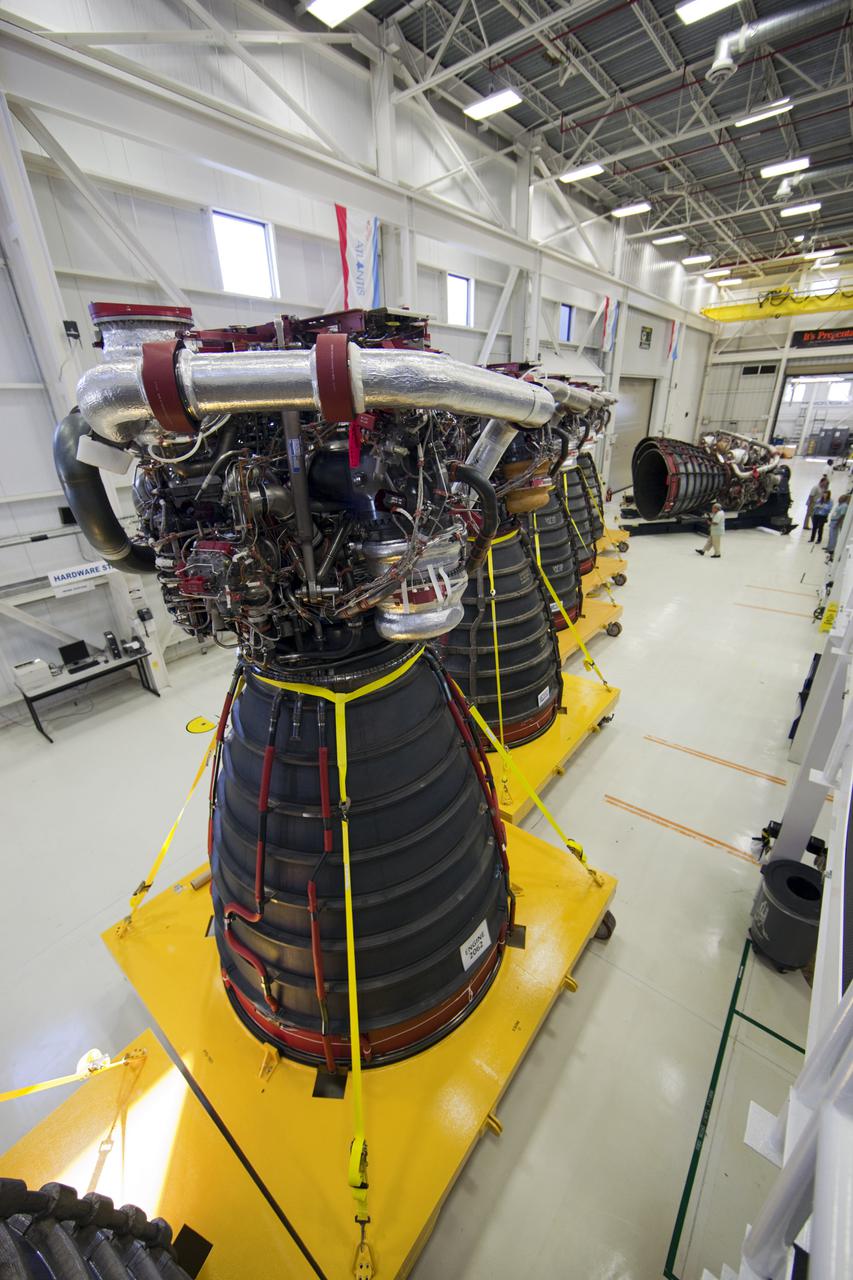
CAPE CANAVERAL, Fla. – Lined up in a row, several Pratt Whitney Rocketdyne space shuttle main engines (SSMEs) sit on stands inside the Engine Shop at NASA’s Kennedy Space Center in Florida. For the first time, all 15 main engines are in the Engine Shop at the same time. They are being prepared for shipment to NASA's Stennis Space Center in Mississippi for storage following the completion of the Space Shuttle Program. The engines are being repurposed for use on NASA’s Space Launch System heavy lift rocket. Photo credit: NASA_Dimitri Gerondidakis
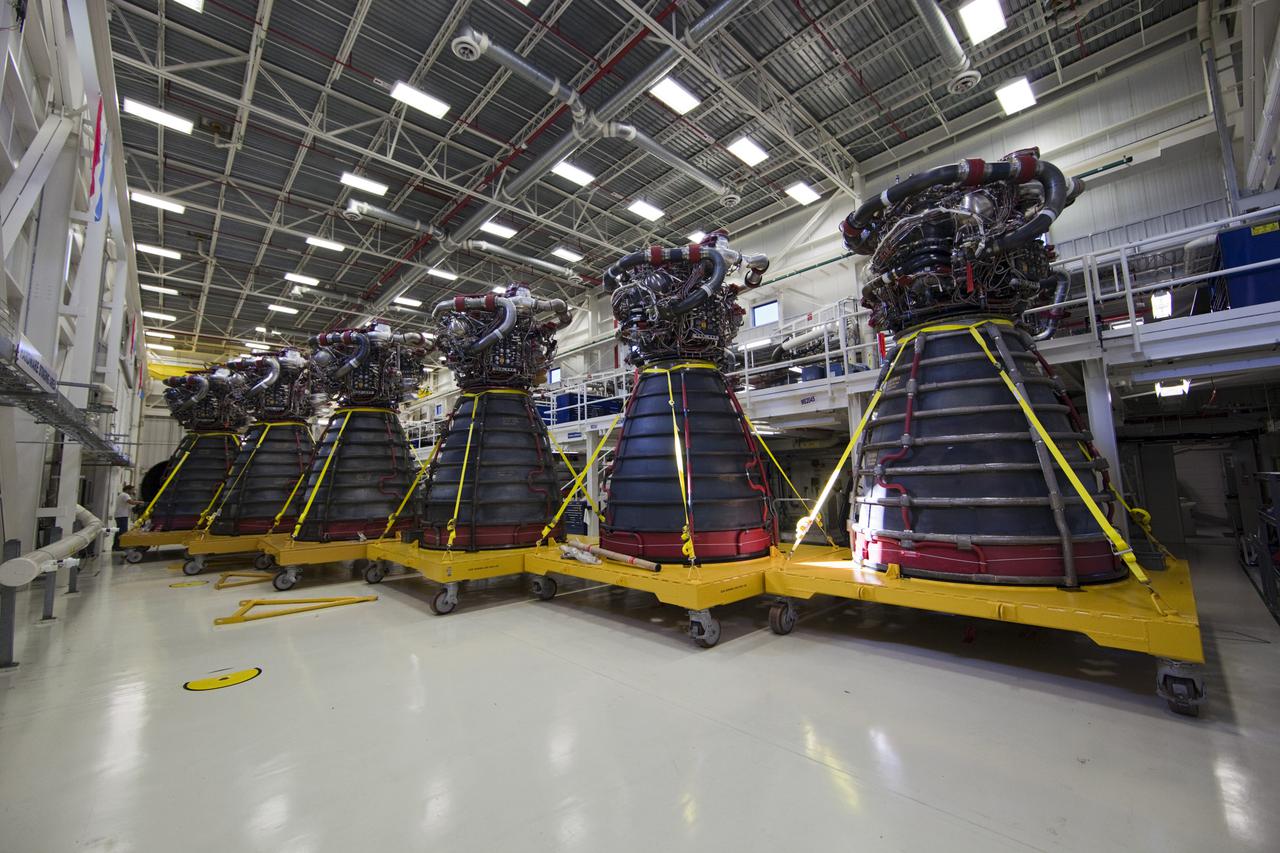
CAPE CANAVERAL, Fla. – Lined up in a row, six Pratt Whitney Rocketdyne space shuttle main engines (SSMEs) sit on stands inside the Engine Shop at NASA’s Kennedy Space Center in Florida. For the first time, all 15 main engines are in the Engine Shop at the same time. They are being prepared for shipment to NASA's Stennis Space Center in Mississippi for storage following the completion of the Space Shuttle Program. The engines are being repurposed for use on NASA’s Space Launch System heavy lift rocket. Photo credit: NASA_Dimitri Gerondidakis
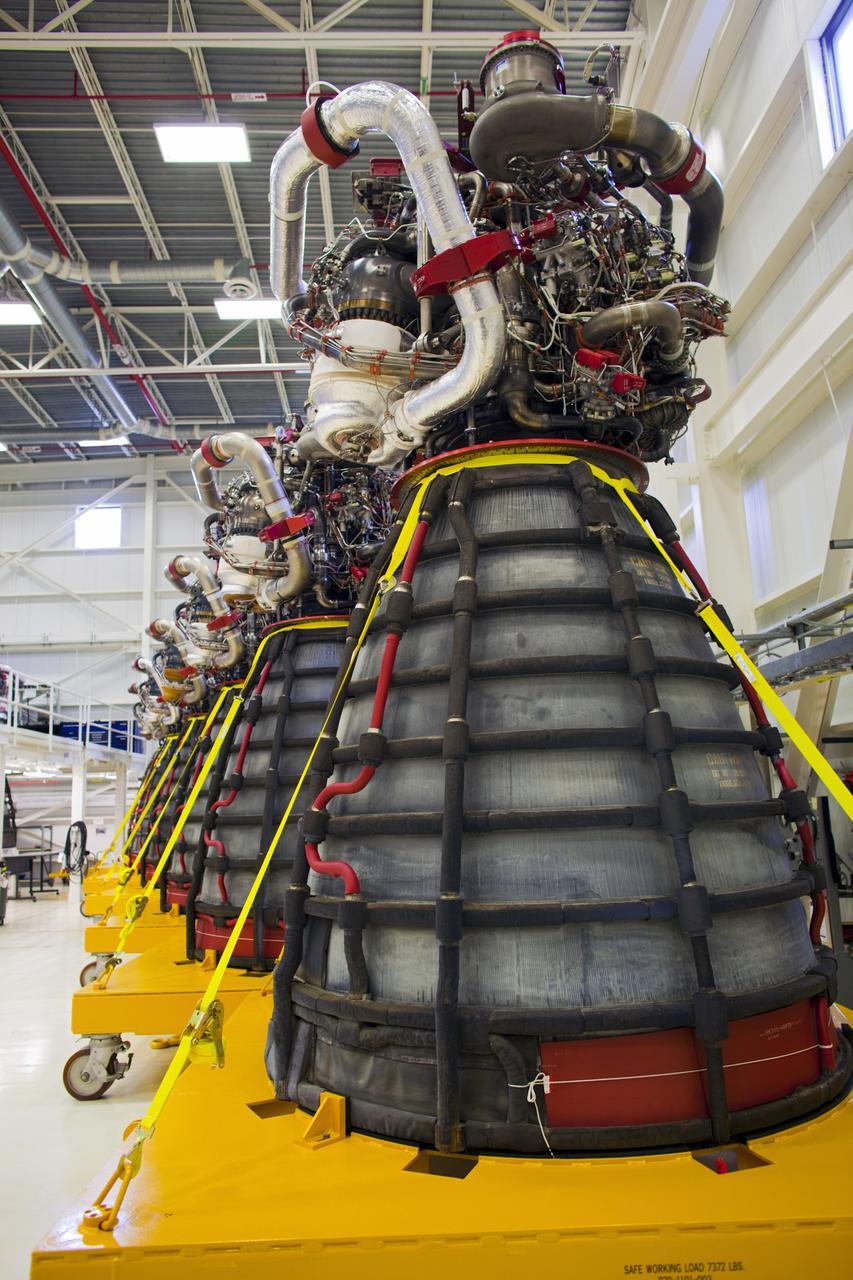
CAPE CANAVERAL, Fla. – Lined up in a row, six Pratt Whitney Rocketdyne space shuttle main engines (SSMEs) sit on stands inside the Engine Shop at NASA’s Kennedy Space Center in Florida. For the first time, all 15 main engines are in the Engine Shop at the same time. They are being prepared for shipment to NASA's Stennis Space Center in Mississippi for storage following the completion of the Space Shuttle Program. The engines are being repurposed for use on NASA’s Space Launch System heavy lift rocket. Photo credit: NASA_Dimitri Gerondidakis
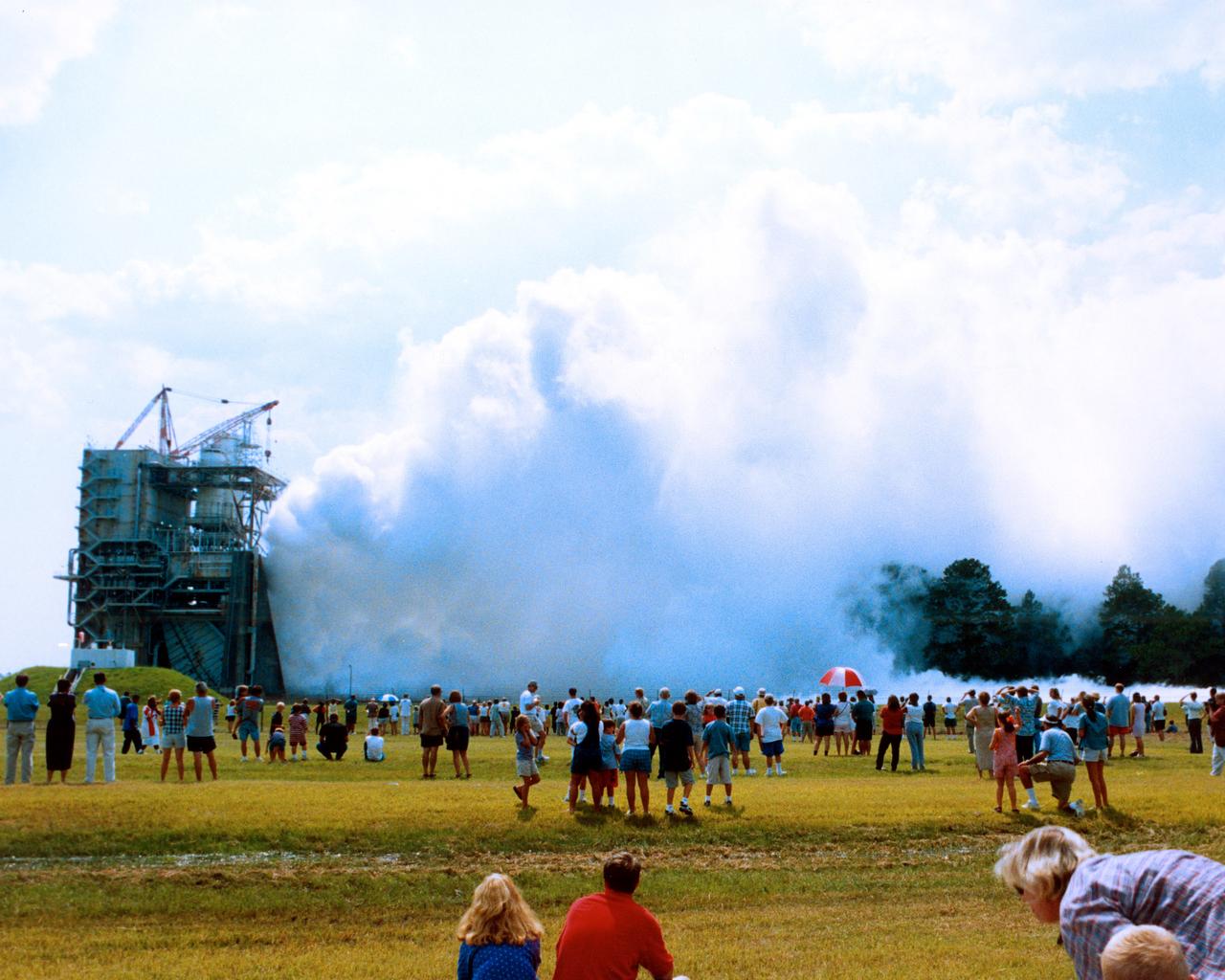
A new NASA Space Shuttle Main Engine (SSME) roars to the approval of more than 2,000 people who came to John C. Stennis Space Center in Hancock County, Miss., on July 25 for a flight-certification test of the SSME Block II configuration. The engine, a new and significantly upgraded shuttle engine, was delivered to NASA's Kennedy Space Center in Florida for use on future shuttle missions. Spectators were able to experience the 'shake, rattle and roar' of the engine, which ran for 520 seconds - the length of time it takes a shuttle to reach orbit.
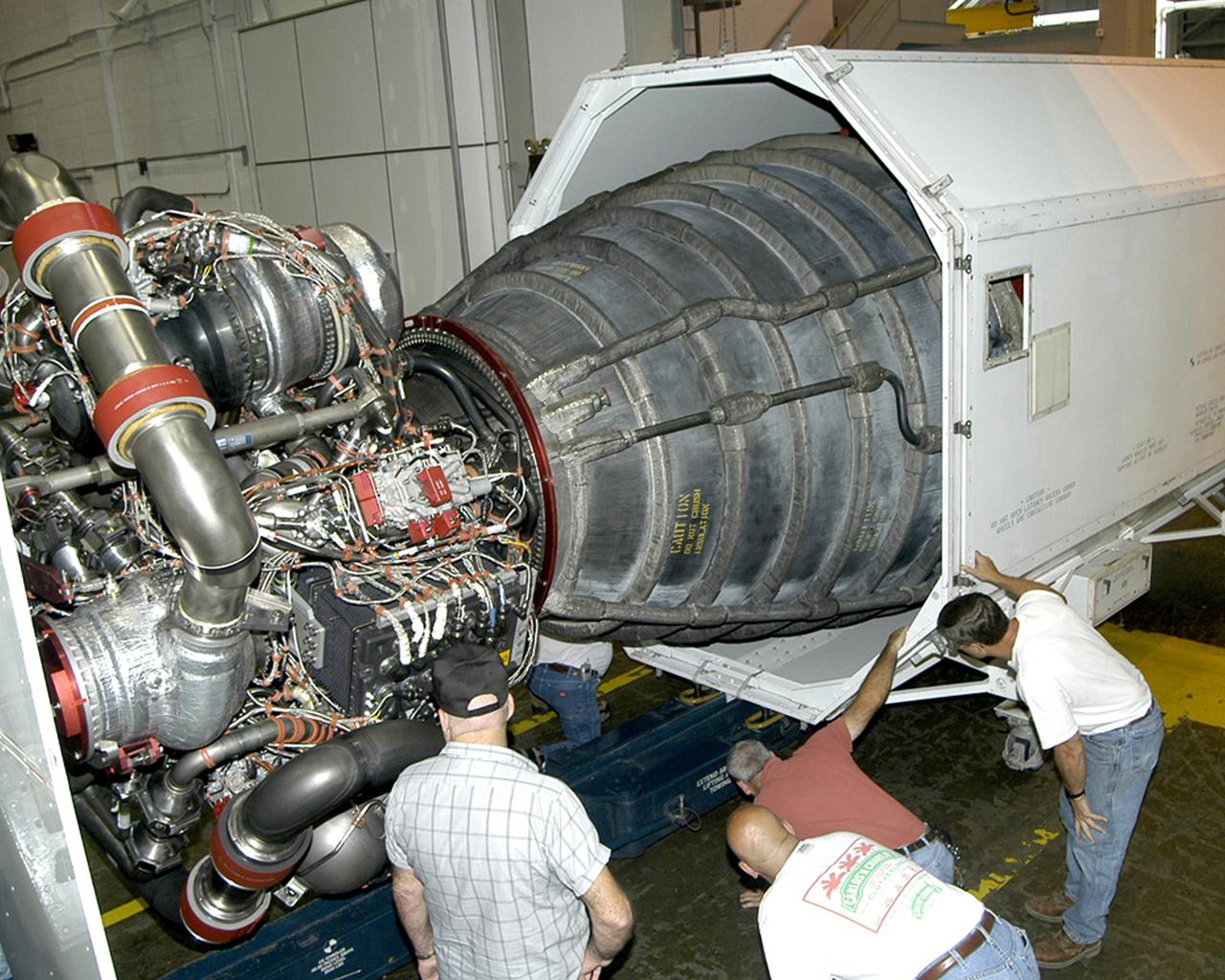
On Oct. 5, 2004, SSC shipped the last of the three Space Shuttle Main Engines to NASA's Kennedy Space Center for installation on Space Shuttle Discovery for STS-114, NASA's Return to Flight mission.
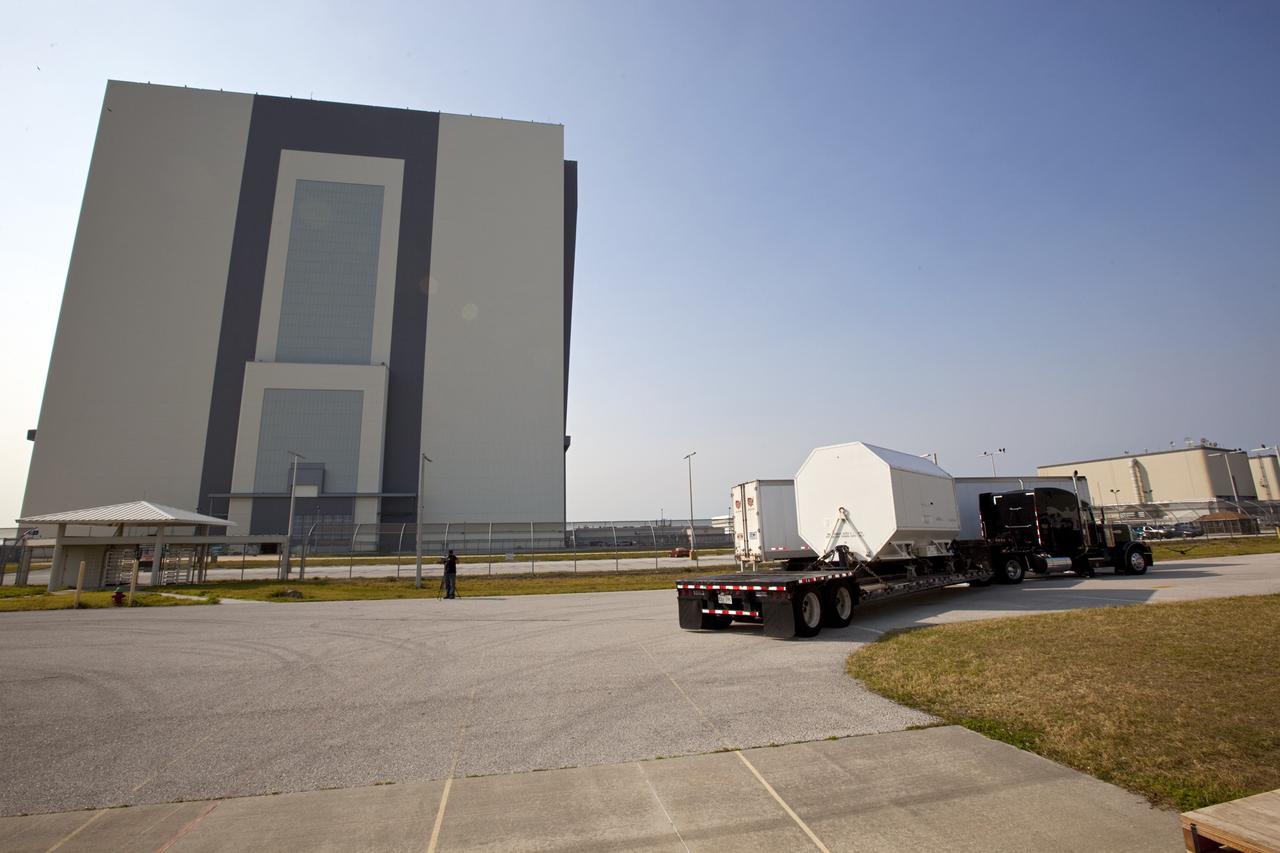
CAPE CANAVERAL, Fla. – A flatbed truck departs from the Orbiter Processing Facility-3 engine shop at NASA's Kennedy Space Center in Florida transporting the last Pratt and Whitney Rocketdyne space shuttle main engine, or SSME, to NASA's Stennis Space Center in Mississippi. The first two groups of engines were shipped from Kennedy to Stennis in November 2011 and January 2012 the remaining engines departed today. Altogether, 15 shuttle-era engines will be stored at Stennis for reuse on NASA’s Space Launch System heavy-lift rocket, under development. Photo credit: NASA/Dimitri Gerondidakis
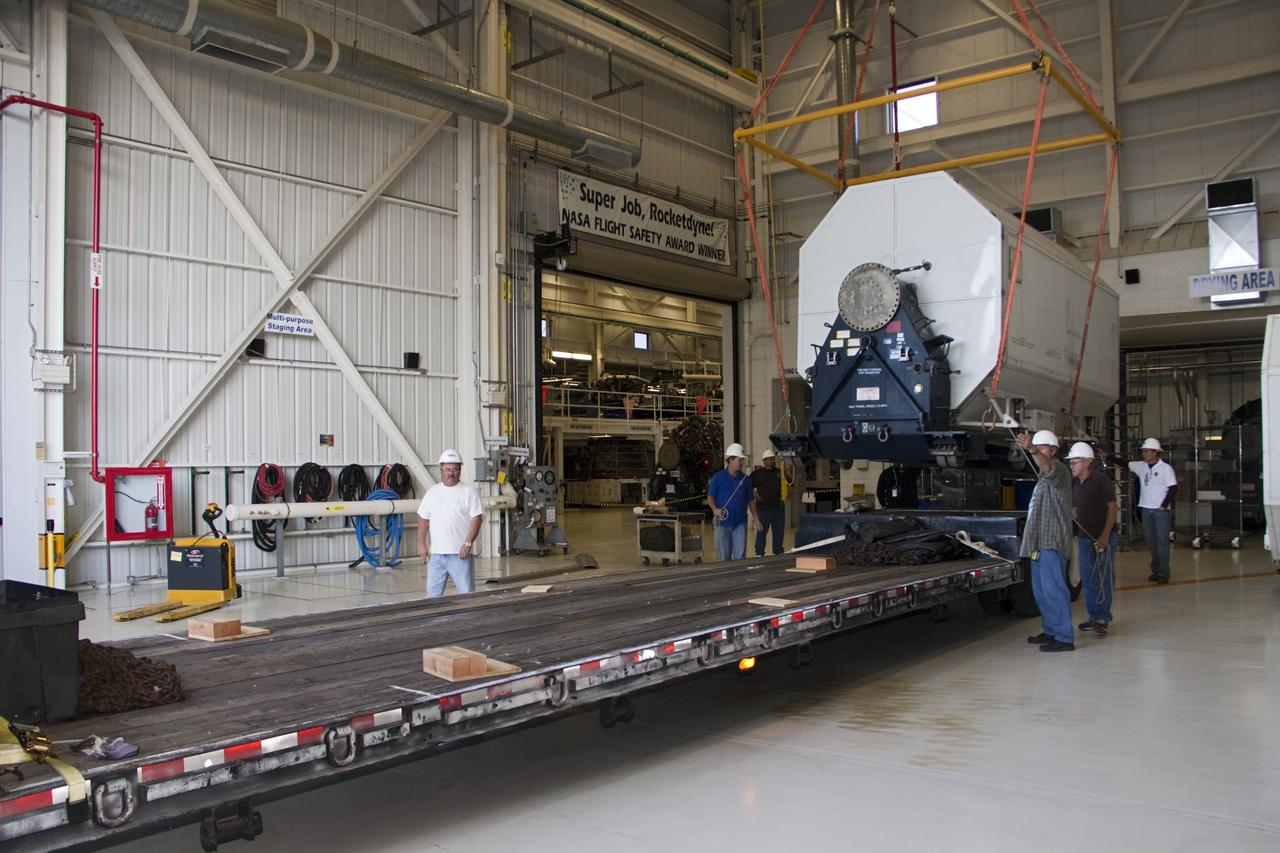
CAPE CANAVERAL, Fla. – In the Space Shuttle Main Engine Processing Facility at NASA’s Kennedy Space Center in Florida, a transportation canister containing a Pratt & Whitney Rocketdyne space shuttle main engine (SSME) is lifted into position onto a flatbed trailer. This is the second of the 15 engines used during the Space Shuttle Program to be transported to NASA's Stennis Space Center in Mississippi. The engines will be stored at Stennis for future use on NASA's new heavy-lift rocket, the Space Launch System (SLS), which will carry NASA's new Orion spacecraft, cargo, equipment and science experiments to space. For more information, visit http://www.nasa.gov/shuttle. Photo credit: NASA/Jim Grossmann
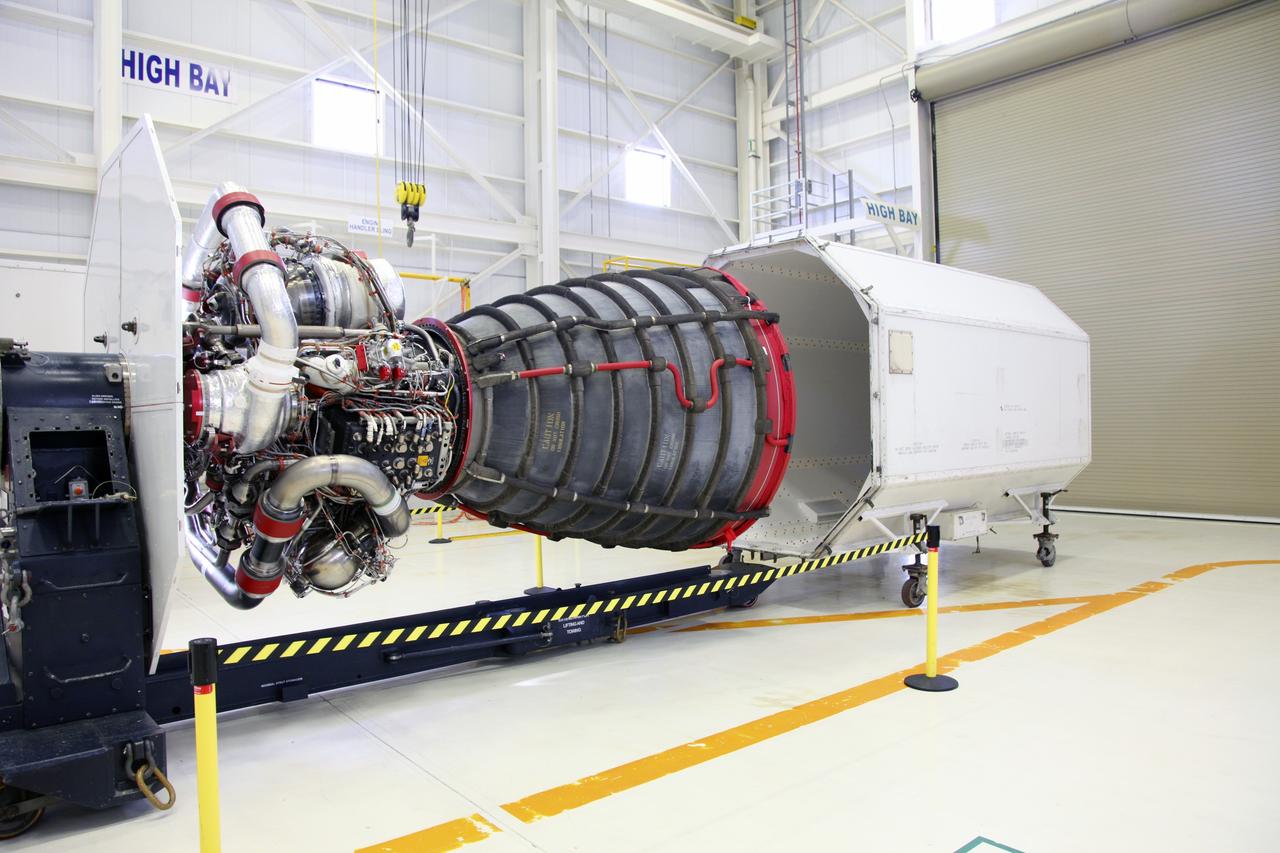
CAPE CANAVERAL, Fla. – In the Space Shuttle Main Engine Processing Facility at NASA’s Kennedy Space Center in Florida, a transportation canister rolls toward a Pratt Whitney Rocketdyne space shuttle main engine (SSME). This is the second of the 15 engines used during the Space Shuttle Program to be prepared for transfer to NASA's Stennis Space Center in Mississippi. The engines will be stored at Stennis for future use on NASA's new heavy-lift rocket, the Space Launch System (SLS), which will carry NASA's new Orion spacecraft, cargo, equipment and science experiments to space. For more information, visit http://www.nasa.gov/shuttle. Photo credit: NASA/Gianni Woods
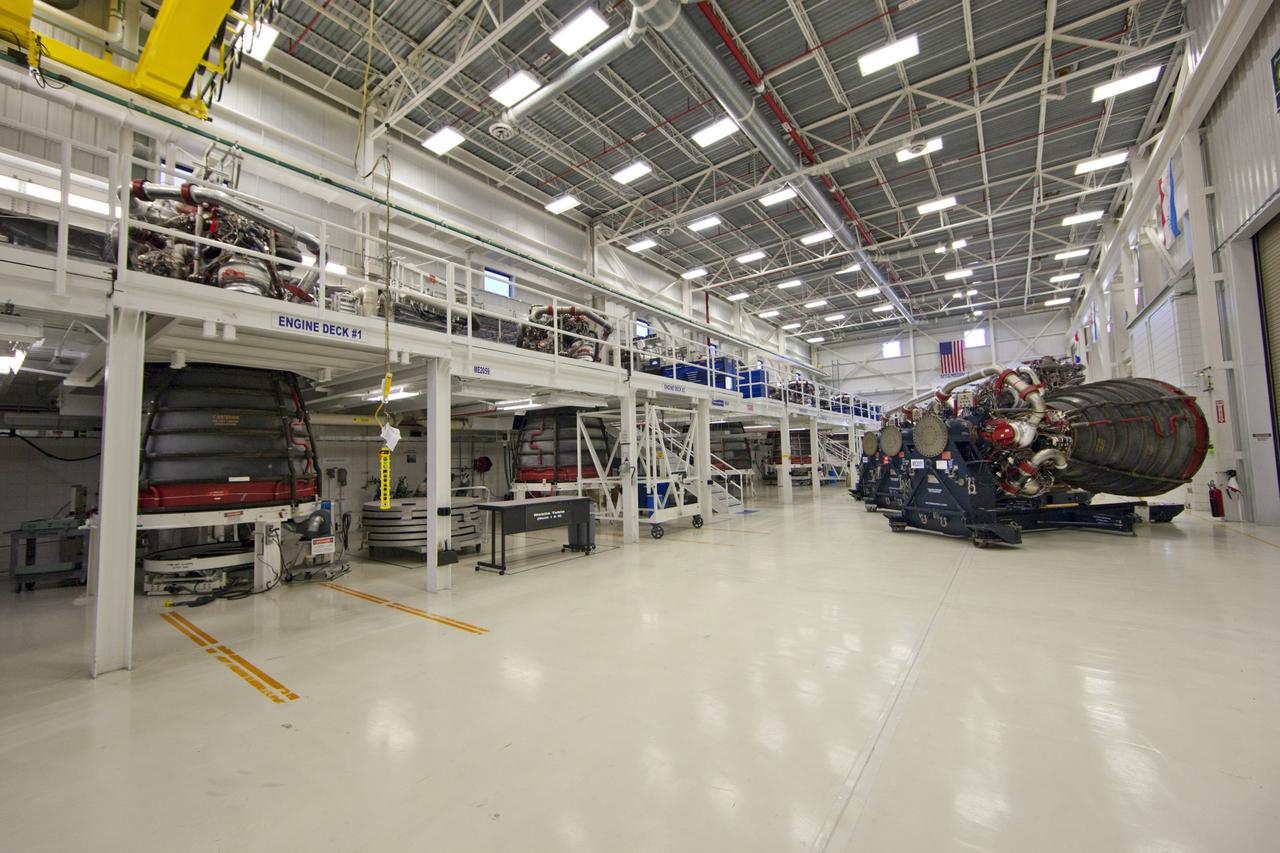
CAPE CANAVERAL, Fla. – At NASA’s Kennedy Space Center in Florida, all six Pratt Whitney Rocketdyne space shuttle main engines (SSMEs) from space shuttle Endeavour's STS-134 and space shuttle Atlantis' STS-135 missions sit in test cells inside the Engine Shop. To the right are three more main engines on platforms. For the first time, all 15 main engines are in the Engine Shop at the same time. They are being prepared for shipment to NASA's Stennis Space Center in Mississippi for storage following the completion of the Space Shuttle Program. The engines are being repurposed for use on NASA’s Space Launch System heavy lift rocket. Photo credit: NASA_Dimitri Gerondidakis
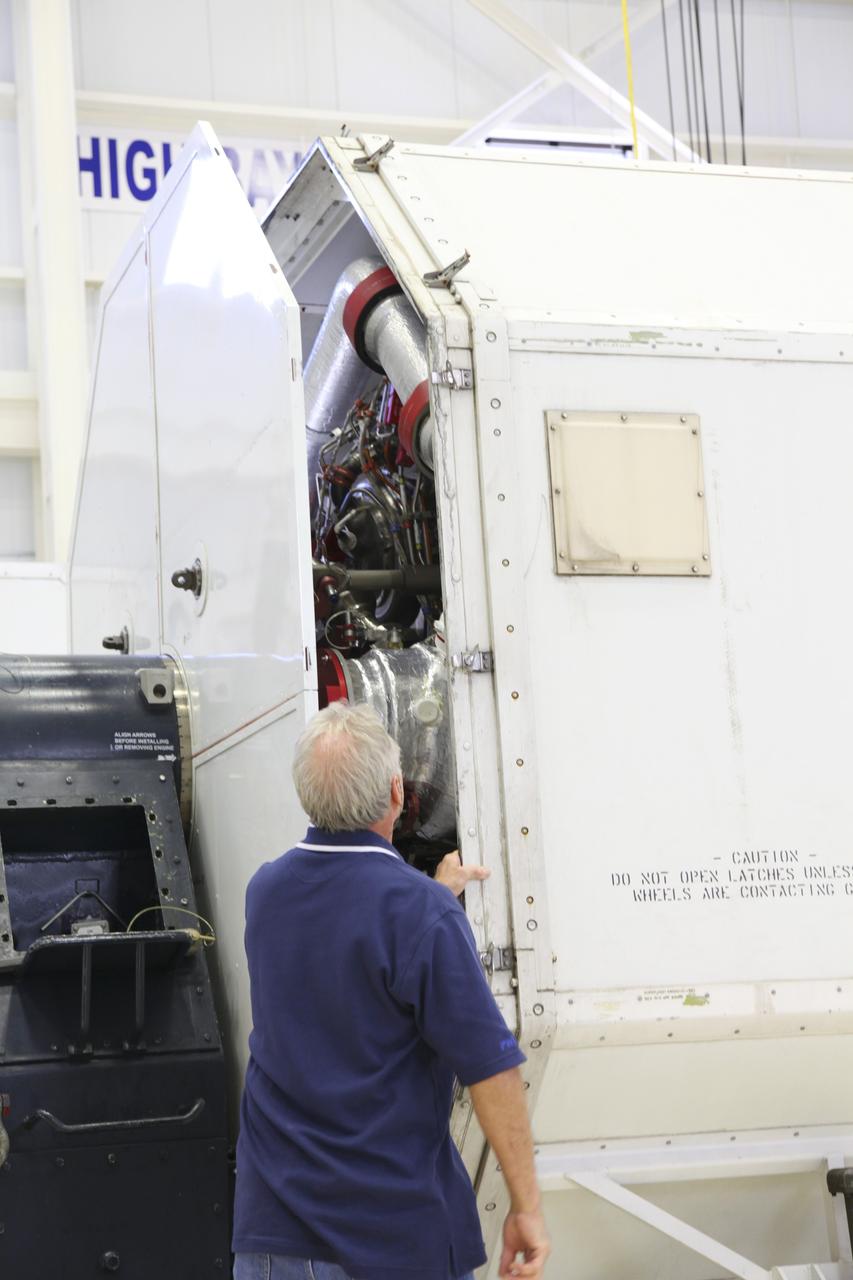
CAPE CANAVERAL, Fla. – In the Space Shuttle Main Engine Processing Facility at NASA’s Kennedy Space Center in Florida, a technician oversees the closure of a transportation canister containing a Pratt Whitney Rocketdyne space shuttle main engine (SSME). This is the second of the 15 engines used during the Space Shuttle Program to be prepared for transfer to NASA's Stennis Space Center in Mississippi. The engines will be stored at Stennis for future use on NASA's new heavy-lift rocket, the Space Launch System (SLS), which will carry NASA's new Orion spacecraft, cargo, equipment and science experiments to space. For more information, visit http://www.nasa.gov/shuttle. Photo credit: NASA/Gianni Woods
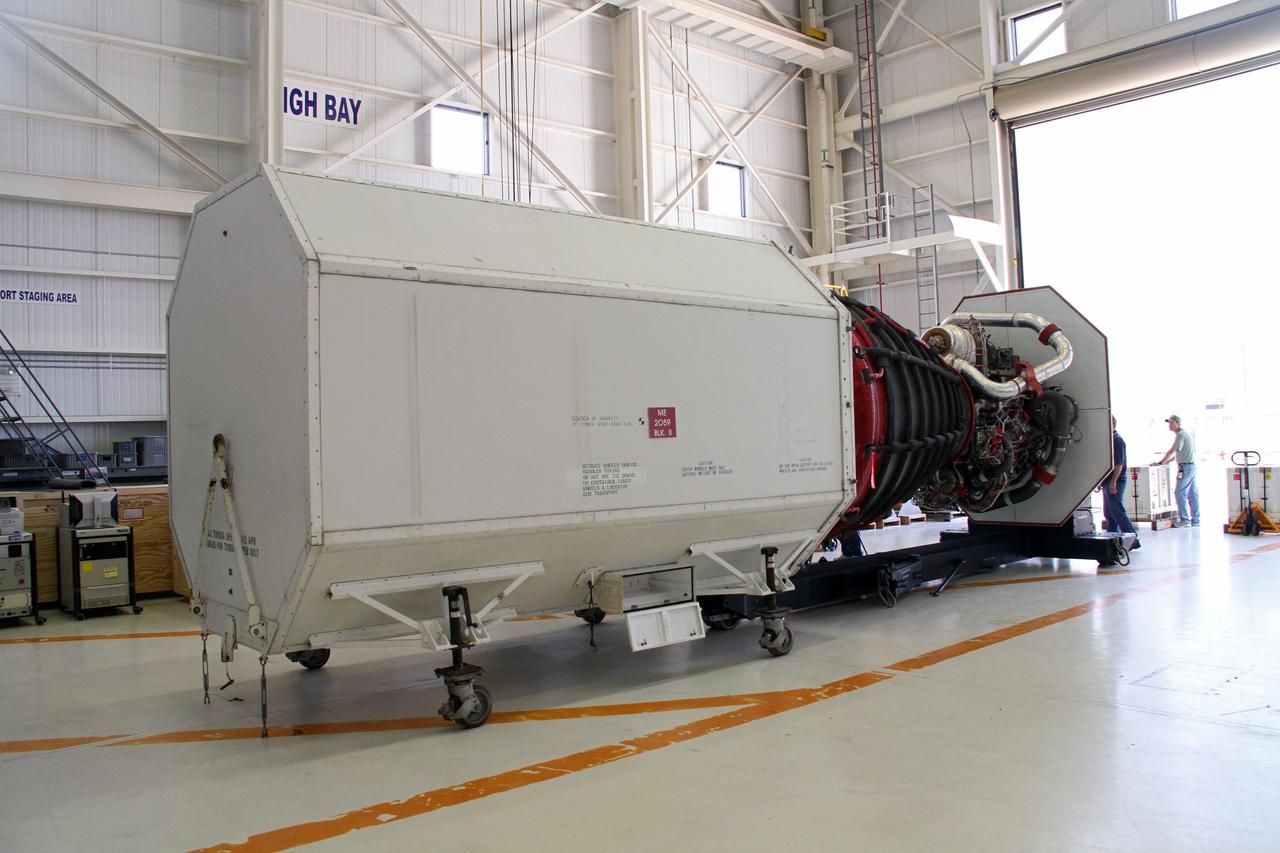
CAPE CANAVERAL, Fla. -- A Pratt and Whitney Rocketdyne space shuttle main engine, or SSME, is aligned with a transportation canister in the Orbiter Processing Facility-3 engine shop at NASA's Kennedy Space Center in Florida. The engine is the last to be packed for shipment to NASA's Stennis Space Center in Mississippi. The first two groups of engines were shipped from Kennedy to Stennis in November 2011 and January 2012, and the remaining engines are scheduled to depart on April 9. Altogether, 15 shuttle-era engines will be stored at Stennis for reuse on NASA’s Space Launch System heavy-lift rocket, under development. Photo credit: NASA/Cory Huston
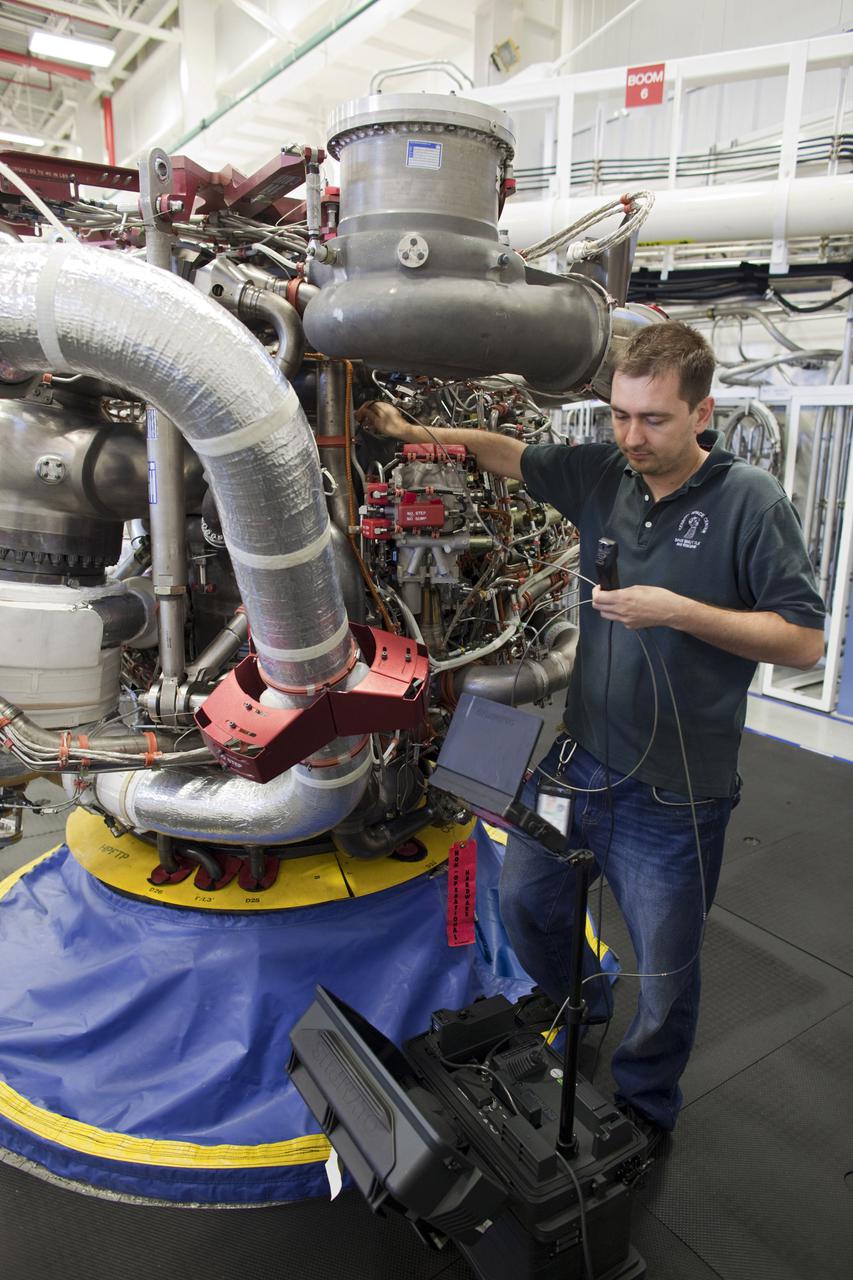
CAPE CANAVERAL, Fla. – Inside the Engine Shop at NASA’s Kennedy Space Center in Florida, a technician performs a boroscope test on a high pressure oxidizer pump on one of the Pratt Whitney Rocketdyne space shuttle main engines (SSMEs) positioned in a test cell. For the first time, all 15 main engines are in the Engine Shop at the same time. They are being prepared for shipment to NASA's Stennis Space Center in Mississippi for storage following the completion of the Space Shuttle Program. The engines are being repurposed for use on NASA’s Space Launch System heavy lift rocket. Photo credit: NASA_Dimitri Gerondidakis
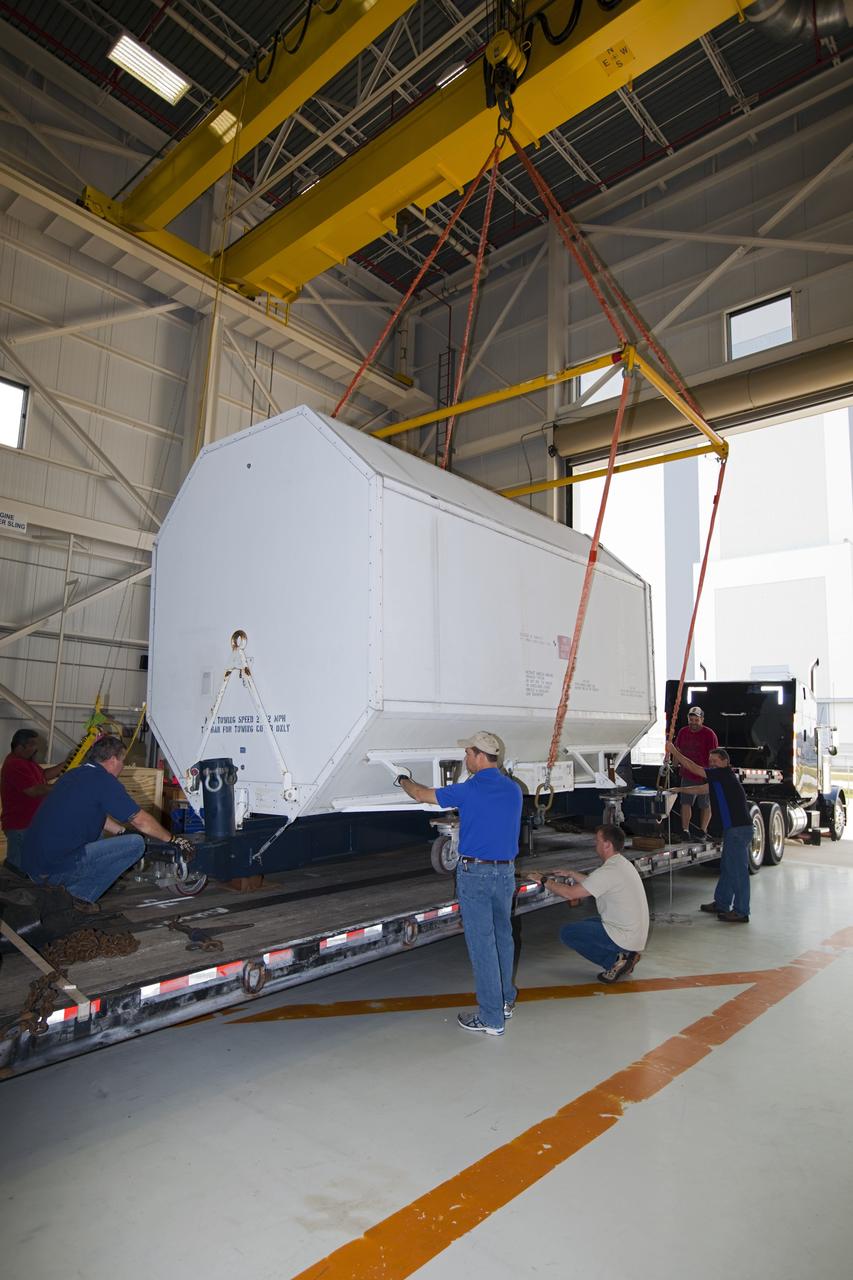
CAPE CANAVERAL, Fla. – In the Orbiter Processing Facility-3 engine shop at NASA's Kennedy Space Center in Florida, a transportation canister containing the last Pratt and Whitney Rocketdyne space shuttle main engine, or SSME, is lowered onto a flatbed truck for shipment to NASA's Stennis Space Center in Mississippi. The first two groups of engines were shipped from Kennedy to Stennis in November 2011 and January 2012 the remaining engines departed today. Altogether, 15 shuttle-era engines will be stored at Stennis for reuse on NASA’s Space Launch System heavy-lift rocket, under development. Photo credit: NASA/Dimitri Gerondidakis
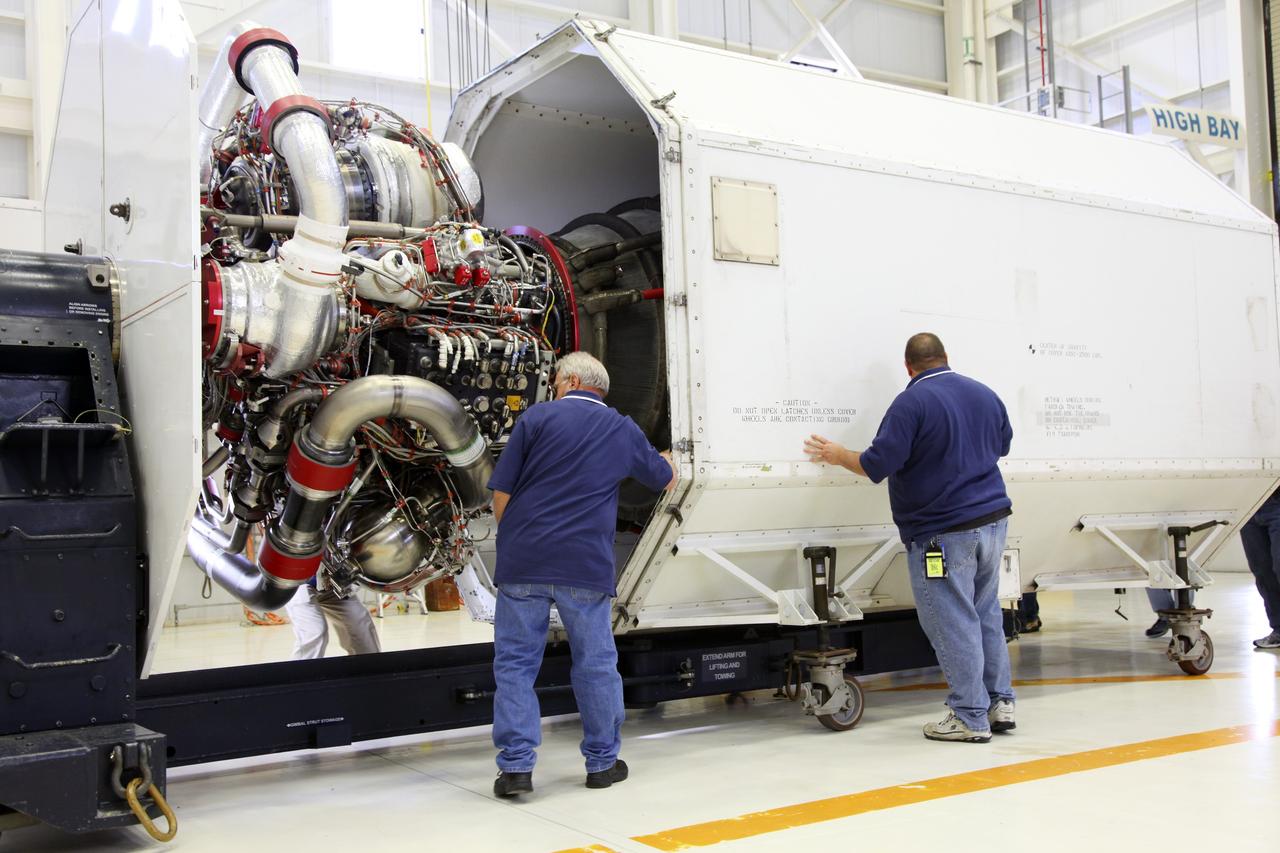
CAPE CANAVERAL, Fla. – In the Space Shuttle Main Engine Processing Facility at NASA’s Kennedy Space Center in Florida, technicians oversee the installation of a Pratt Whitney Rocketdyne space shuttle main engine (SSME) into a transportation canister. This is the second of the 15 engines used during the Space Shuttle Program to be prepared for transfer to NASA's Stennis Space Center in Mississippi. The engines will be stored at Stennis for future use on NASA's new heavy-lift rocket, the Space Launch System (SLS), which will carry NASA's new Orion spacecraft, cargo, equipment and science experiments to space. For more information, visit http://www.nasa.gov/shuttle. Photo credit: NASA/Gianni Woods
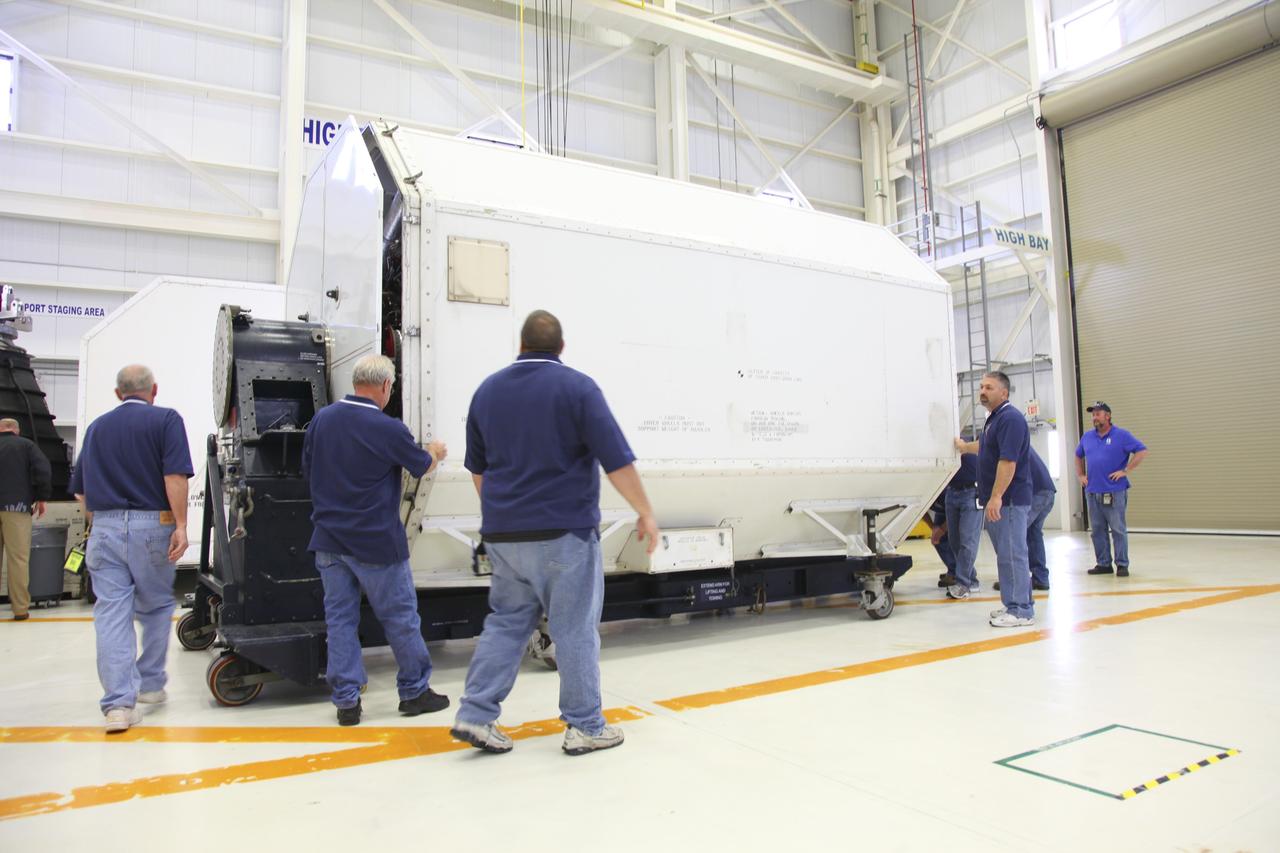
CAPE CANAVERAL, Fla. – In the Space Shuttle Main Engine Processing Facility at NASA’s Kennedy Space Center in Florida, a transportation canister is nearly closed around a Pratt Whitney Rocketdyne space shuttle main engine (SSME). This is the second of the 15 engines used during the Space Shuttle Program to be prepared for transfer to NASA's Stennis Space Center in Mississippi. The engines will be stored at Stennis for future use on NASA's new heavy-lift rocket, the Space Launch System (SLS), which will carry NASA's new Orion spacecraft, cargo, equipment and science experiments to space. For more information, visit http://www.nasa.gov/shuttle. Photo credit: NASA/Gianni Woods
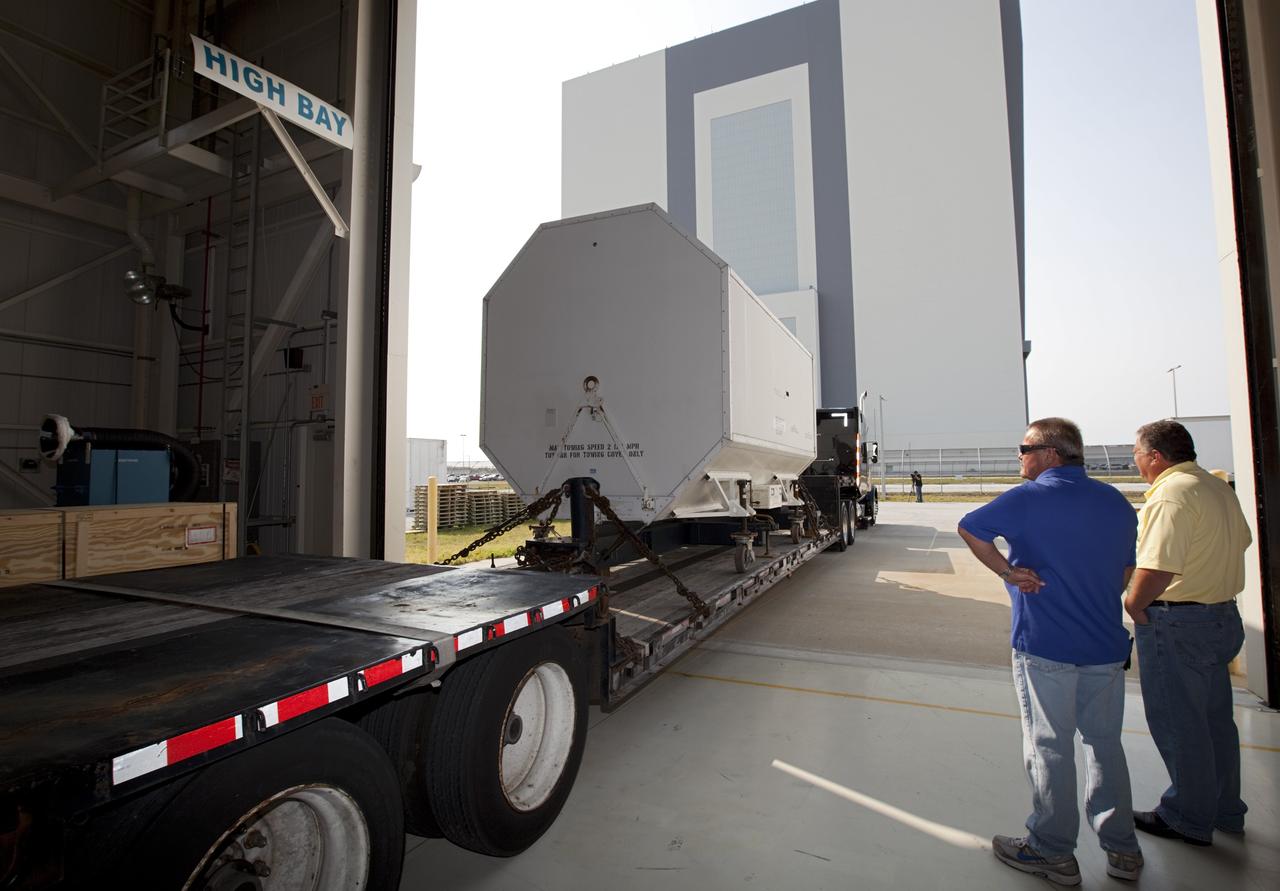
CAPE CANAVERAL, Fla. – In the Orbiter Processing Facility-3 engine shop at NASA's Kennedy Space Center in Florida, a transportation canister containing the last Pratt and Whitney Rocketdyne space shuttle main engine, or SSME, is secured on a flatbed truck and ready for departure to NASA's Stennis Space Center in Mississippi. The first two groups of engines were shipped from Kennedy to Stennis in November 2011 and January 2012 the remaining engines departed today. Altogether, 15 shuttle-era engines will be stored at Stennis for reuse on NASA’s Space Launch System heavy-lift rocket, under development. Photo credit: NASA/Dimitri Gerondidakis
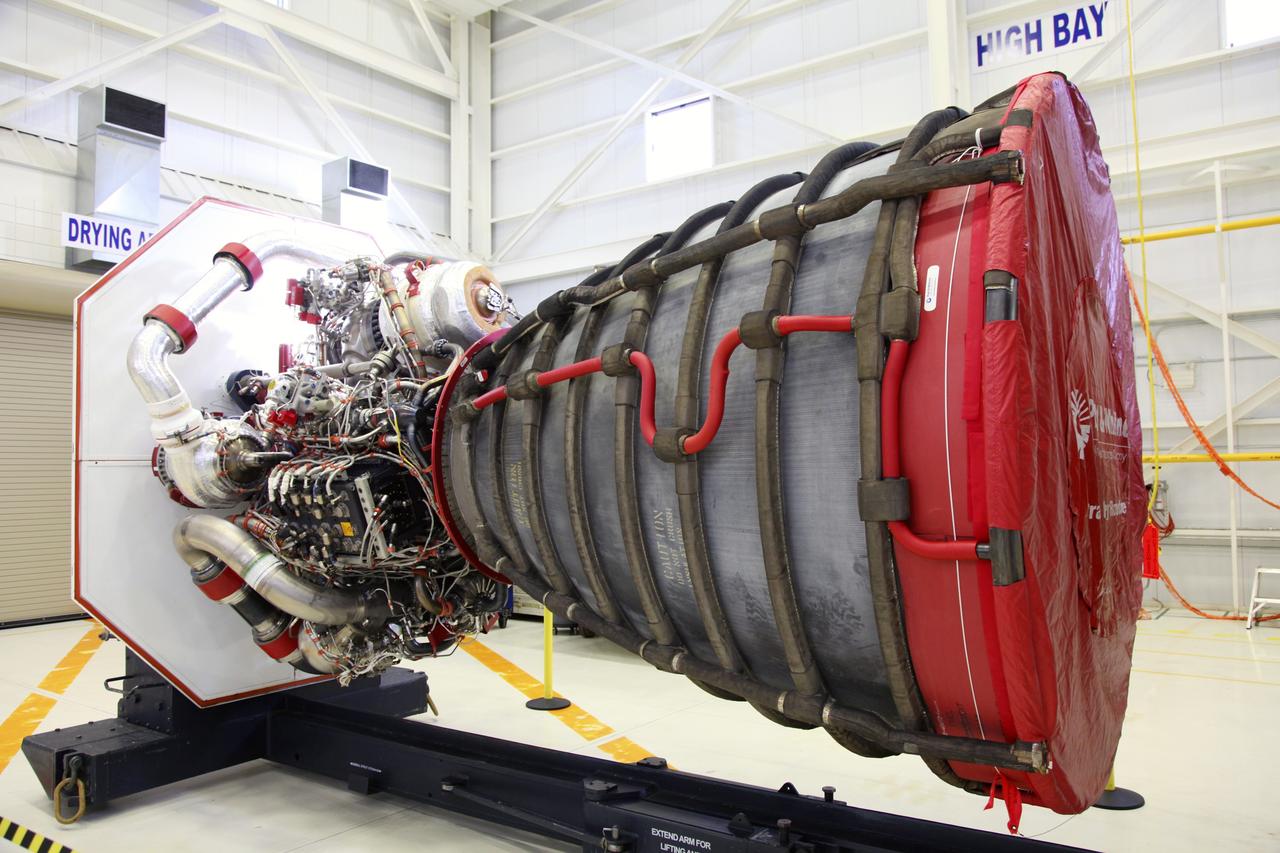
CAPE CANAVERAL, Fla. – In the Space Shuttle Main Engine Processing Facility at NASA’s Kennedy Space Center in Florida, preparations are under way to install a Pratt Whitney Rocketdyne space shuttle main engine (SSME) into a transportation canister. This is the second of the 15 engines used during the Space Shuttle Program to be prepared for transfer to NASA's Stennis Space Center in Mississippi. The engines will be stored at Stennis for future use on NASA's new heavy-lift rocket, the Space Launch System (SLS), which will carry NASA's new Orion spacecraft, cargo, equipment and science experiments to space. For more information, visit http://www.nasa.gov/shuttle. Photo credit: NASA/Gianni Woods
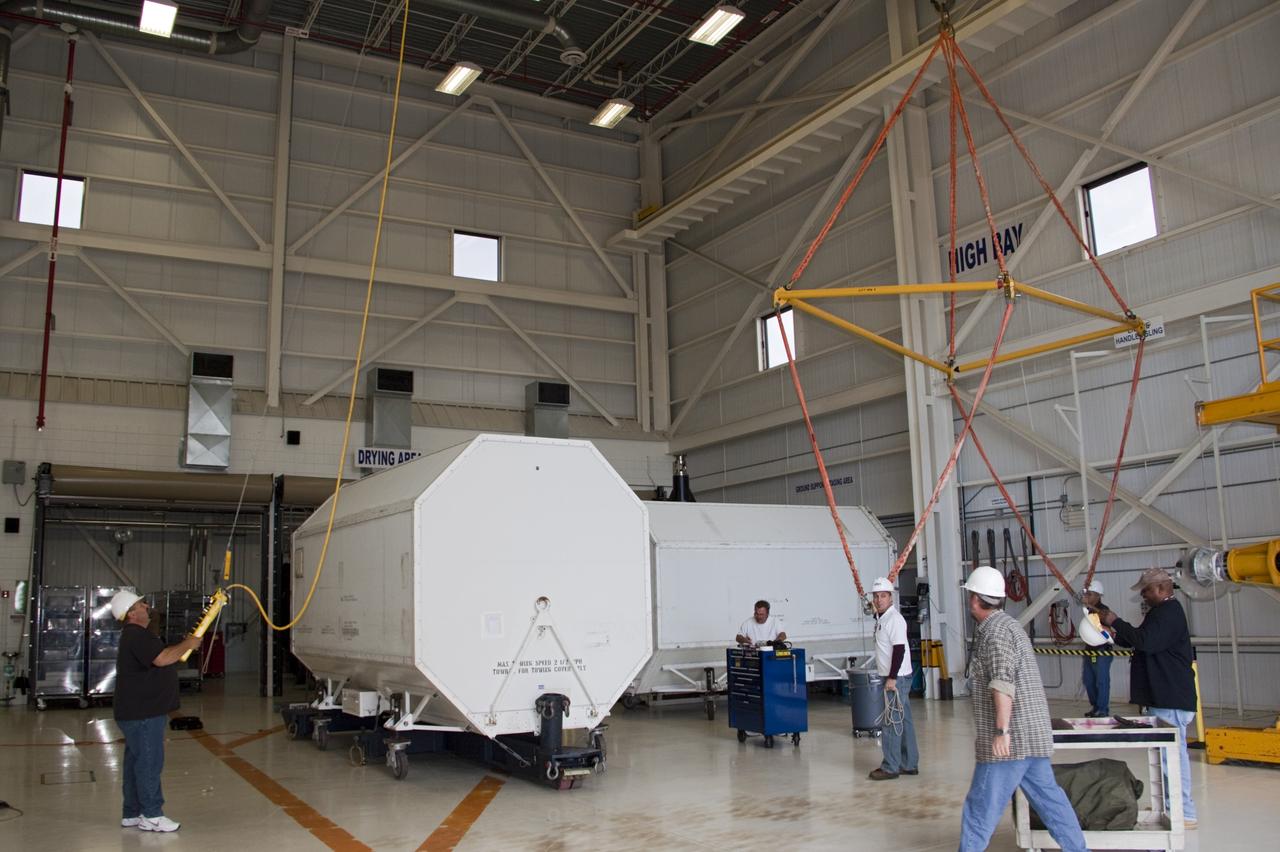
CAPE CANAVERAL, Fla. – In the Space Shuttle Main Engine Processing Facility at NASA’s Kennedy Space Center in Florida, preparations are under way to lift a transportation canister containing a Pratt & Whitney Rocketdyne space shuttle main engine (SSME) onto a flatbed trailer. This is the second of the 15 engines used during the Space Shuttle Program to be transported to NASA's Stennis Space Center in Mississippi. The engines will be stored at Stennis for future use on NASA's new heavy-lift rocket, the Space Launch System (SLS), which will carry NASA's new Orion spacecraft, cargo, equipment and science experiments to space. For more information, visit http://www.nasa.gov/shuttle. Photo credit: NASA/Jim Grossmann
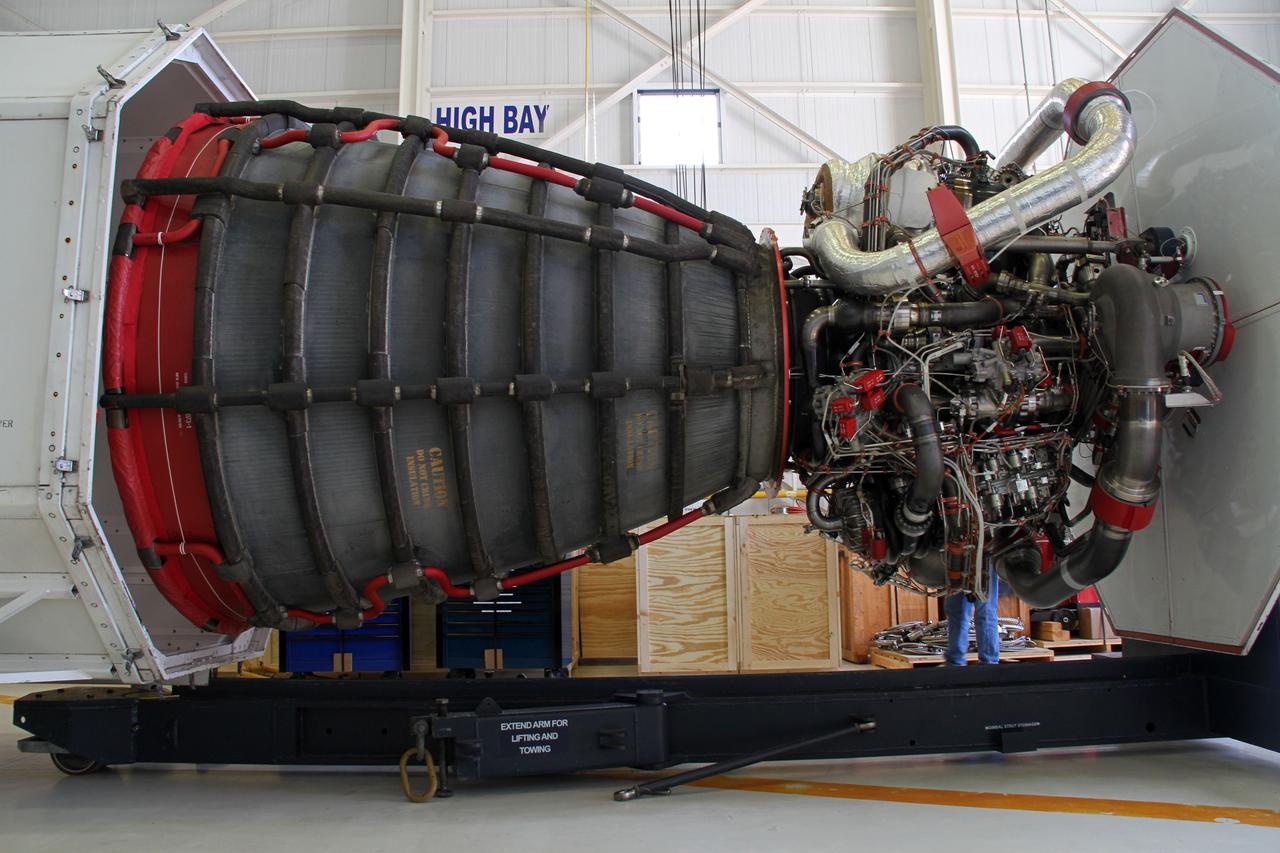
CAPE CANAVERAL, Fla. -- A Pratt and Whitney Rocketdyne space shuttle main engine, or SSME, begins to move into a transportation canister in the Orbiter Processing Facility-3 engine shop at NASA's Kennedy Space Center in Florida. The engine is the last to be packed for shipment to NASA's Stennis Space Center in Mississippi. The first two groups of engines were shipped from Kennedy to Stennis in November 2011 and January 2012, and the remaining engines are scheduled to depart on April 9. Altogether, 15 shuttle-era engines will be stored at Stennis for reuse on NASA’s Space Launch System heavy-lift rocket, under development. Photo credit: NASA/Cory Huston
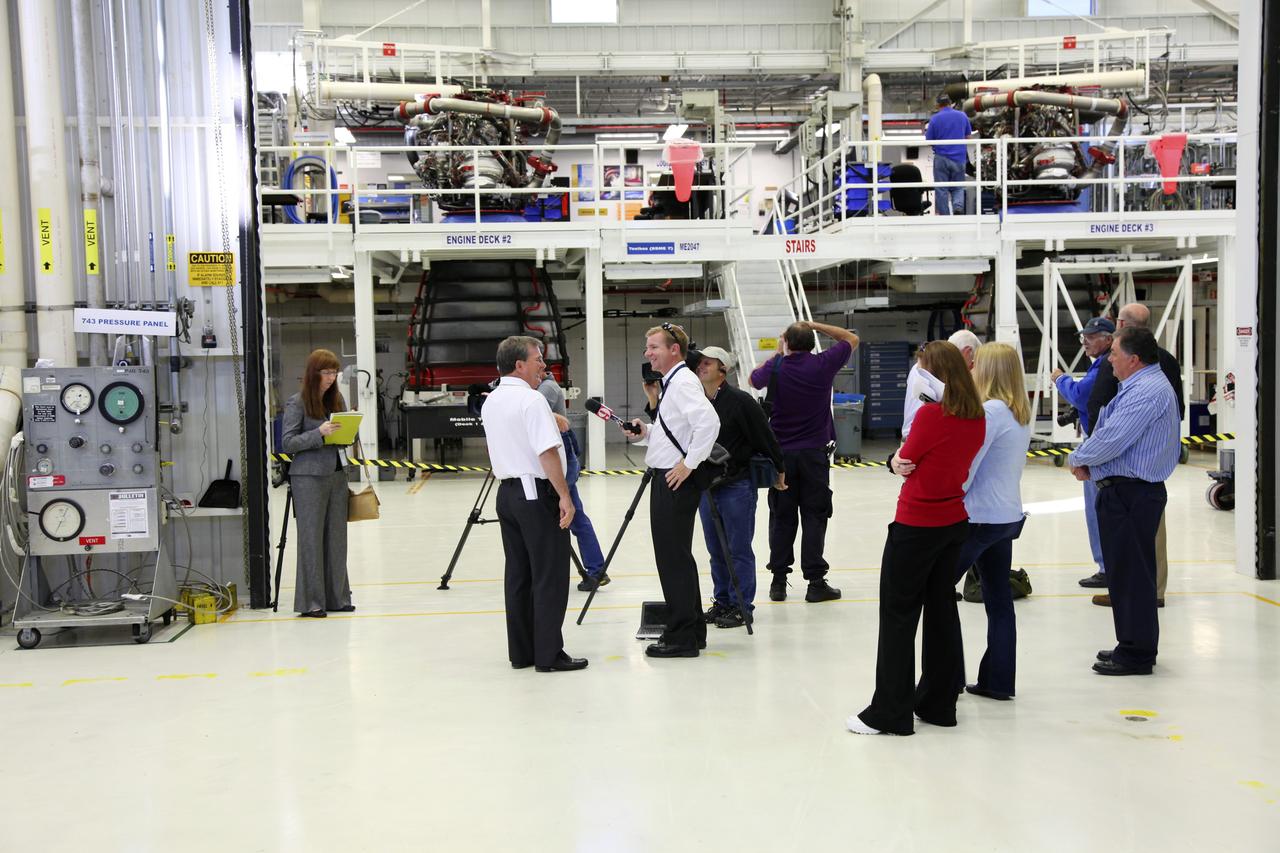
CAPE CANAVERAL, Fla. – In the Space Shuttle Main Engine Processing Facility at NASA’s Kennedy Space Center in Florida, media representatives are on hand for the installation of a Pratt Whitney Rocketdyne space shuttle main engine (SSME) into a transportation canister. This is the second of the 15 engines used during the Space Shuttle Program to be prepared for transfer to NASA's Stennis Space Center in Mississippi. The engines will be stored at Stennis for future use on NASA's new heavy-lift rocket, the Space Launch System (SLS), which will carry NASA's new Orion spacecraft, cargo, equipment and science experiments to space. For more information, visit http://www.nasa.gov/shuttle. Photo credit: NASA/Gianni Woods
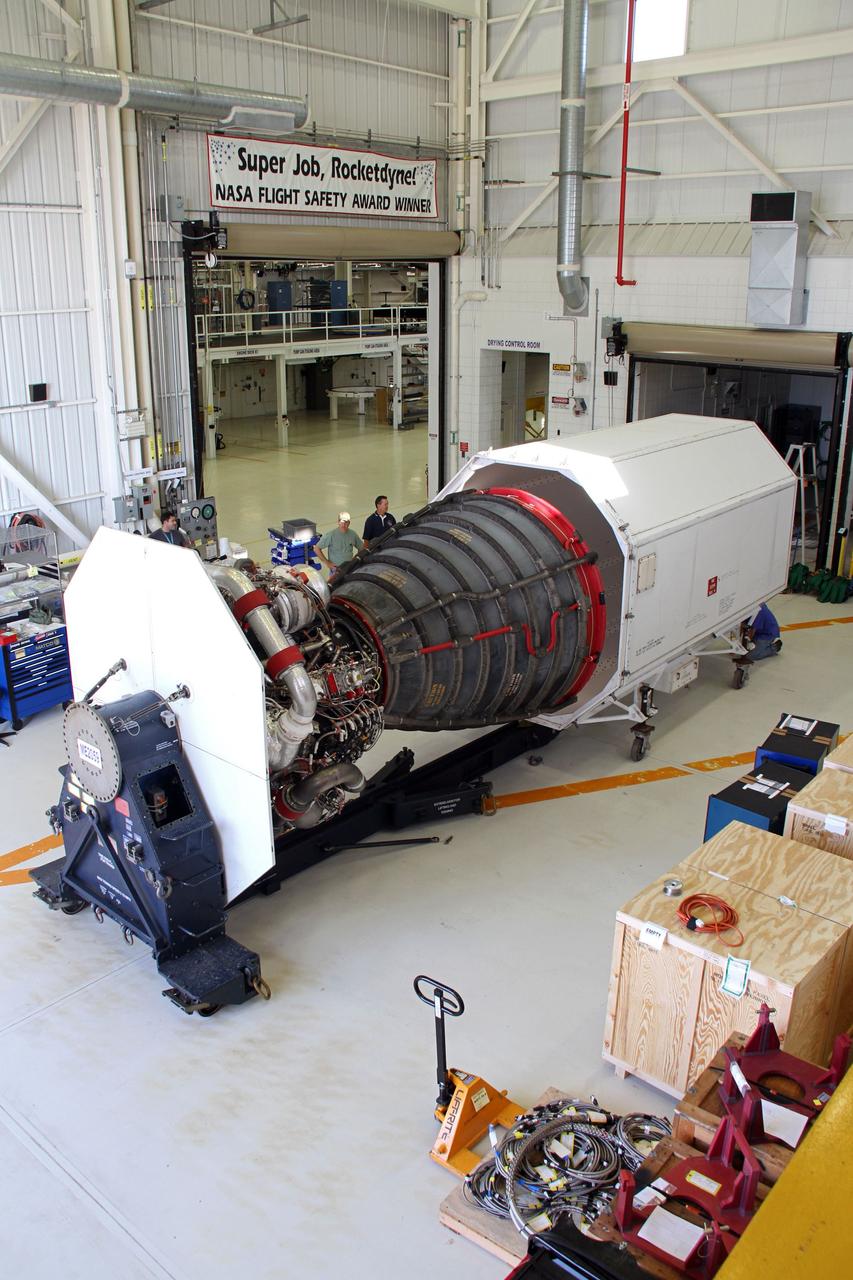
CAPE CANAVERAL, Fla. -- In the Orbiter Processing Facility-3 engine shop at NASA's Kennedy Space Center in Florida, a Pratt and Whitney Rocketdyne space shuttle main engine, or SSME, is prepared for loading into a waiting transportation canister for shipment to NASA's Stennis Space Center in Mississippi. The first two groups of engines were shipped from Kennedy to Stennis in November 2011 and January 2012, and the remaining engines are scheduled to depart on April 9. Altogether, 15 shuttle-era engines will be stored at Stennis for reuse on NASA’s Space Launch System heavy-lift rocket, under development. Photo credit: NASA/Cory Huston
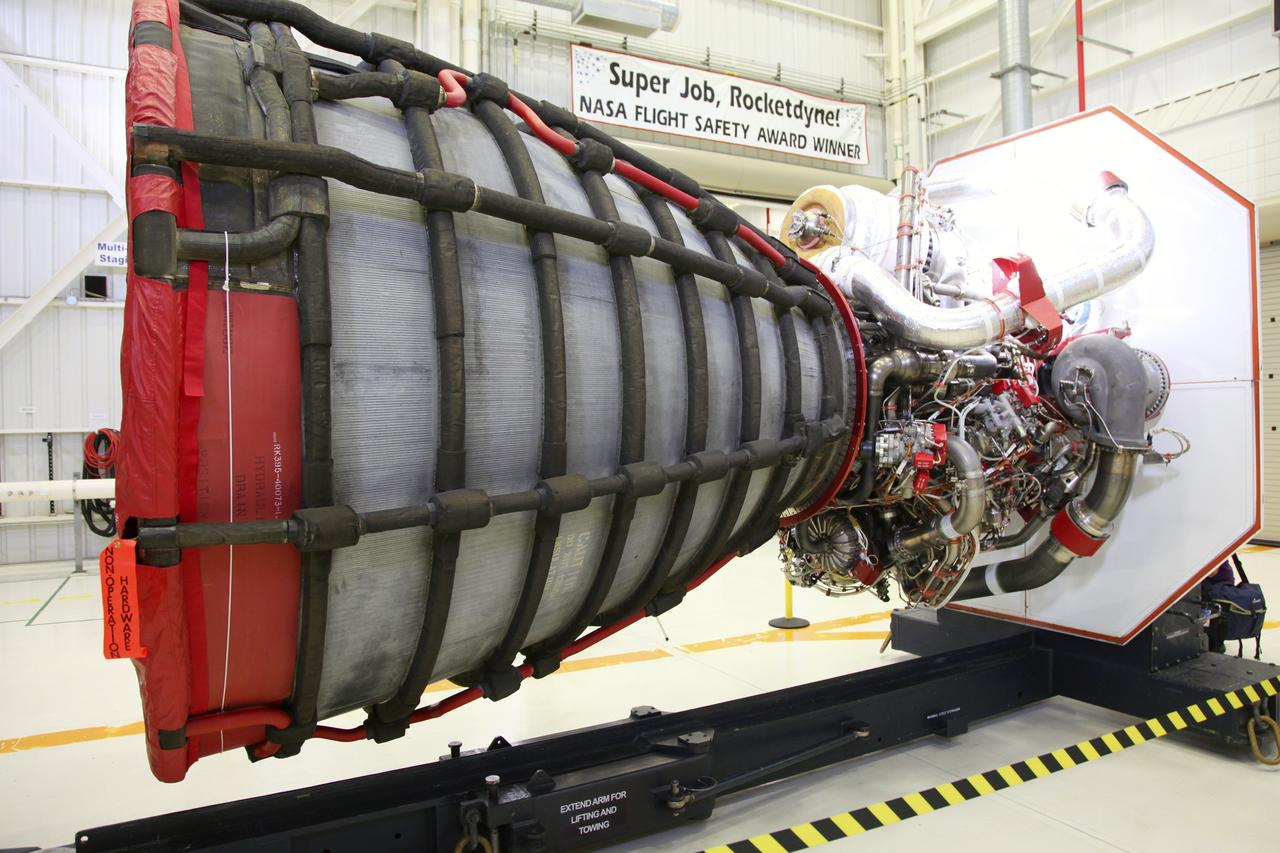
CAPE CANAVERAL, Fla. – In the Space Shuttle Main Engine Processing Facility at NASA’s Kennedy Space Center in Florida, a Pratt Whitney Rocketdyne space shuttle main engine (SSME) is ready for installation in a transportation canister. This is the second of the 15 engines used during the Space Shuttle Program to be prepared for transfer to NASA's Stennis Space Center in Mississippi. The engines will be stored at Stennis for future use on NASA's new heavy-lift rocket, the Space Launch System (SLS), which will carry NASA's new Orion spacecraft, cargo, equipment and science experiments to space. For more information, visit http://www.nasa.gov/shuttle. Photo credit: NASA/Gianni Woods
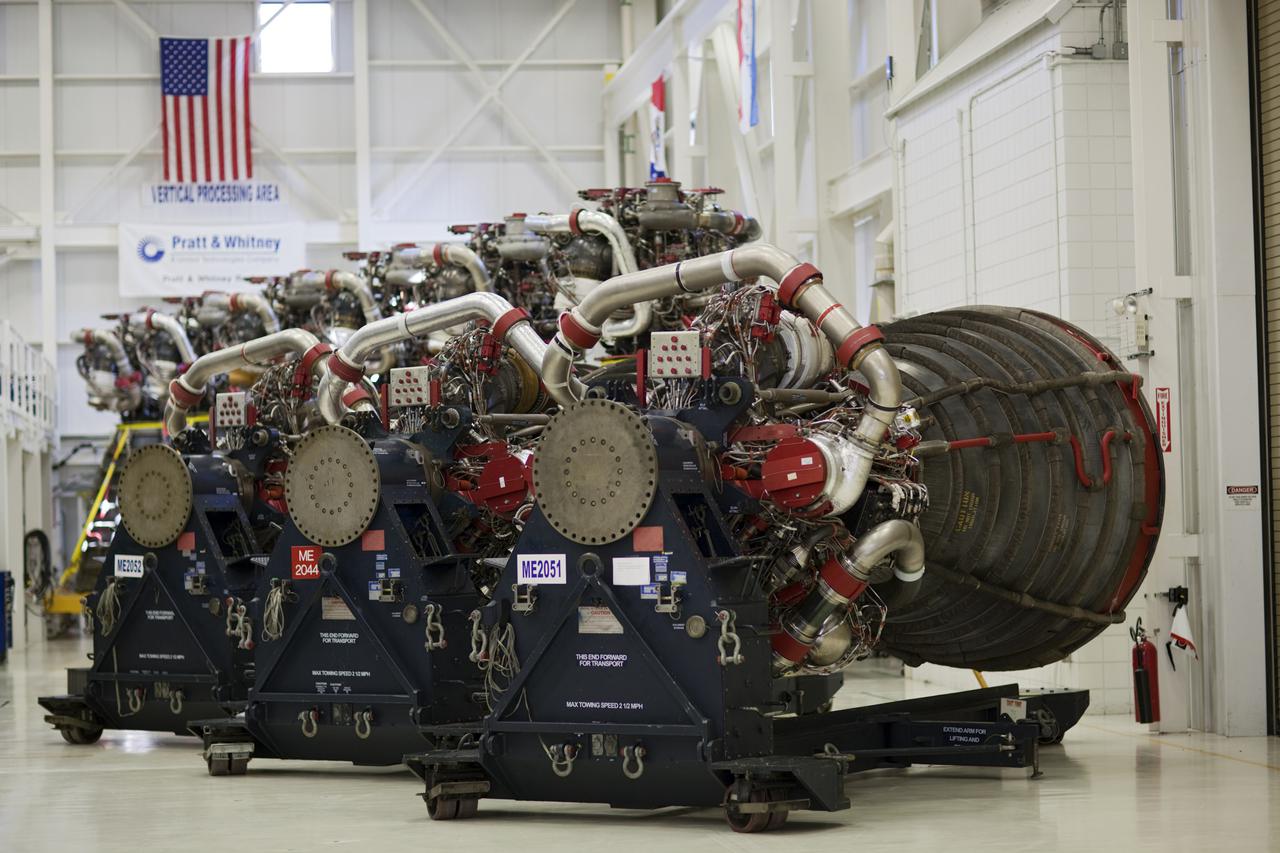
CAPE CANAVERAL, Fla. – At NASA’s Kennedy Space Center in Florida, three Pratt Whitney Rocketdyne space shuttle main engines (SSMEs) sit on stands inside the Engine Shop, with six more engines lined up behind them. For the first time, all 15 main engines are in the Engine Shop at the same time. They are being prepared for shipment to NASA's Stennis Space Center in Mississippi for storage following the completion of the Space Shuttle Program. The engines are being repurposed for use on NASA’s Space Launch System heavy lift rocket. Photo credit: NASA_Dimitri Gerondidakis
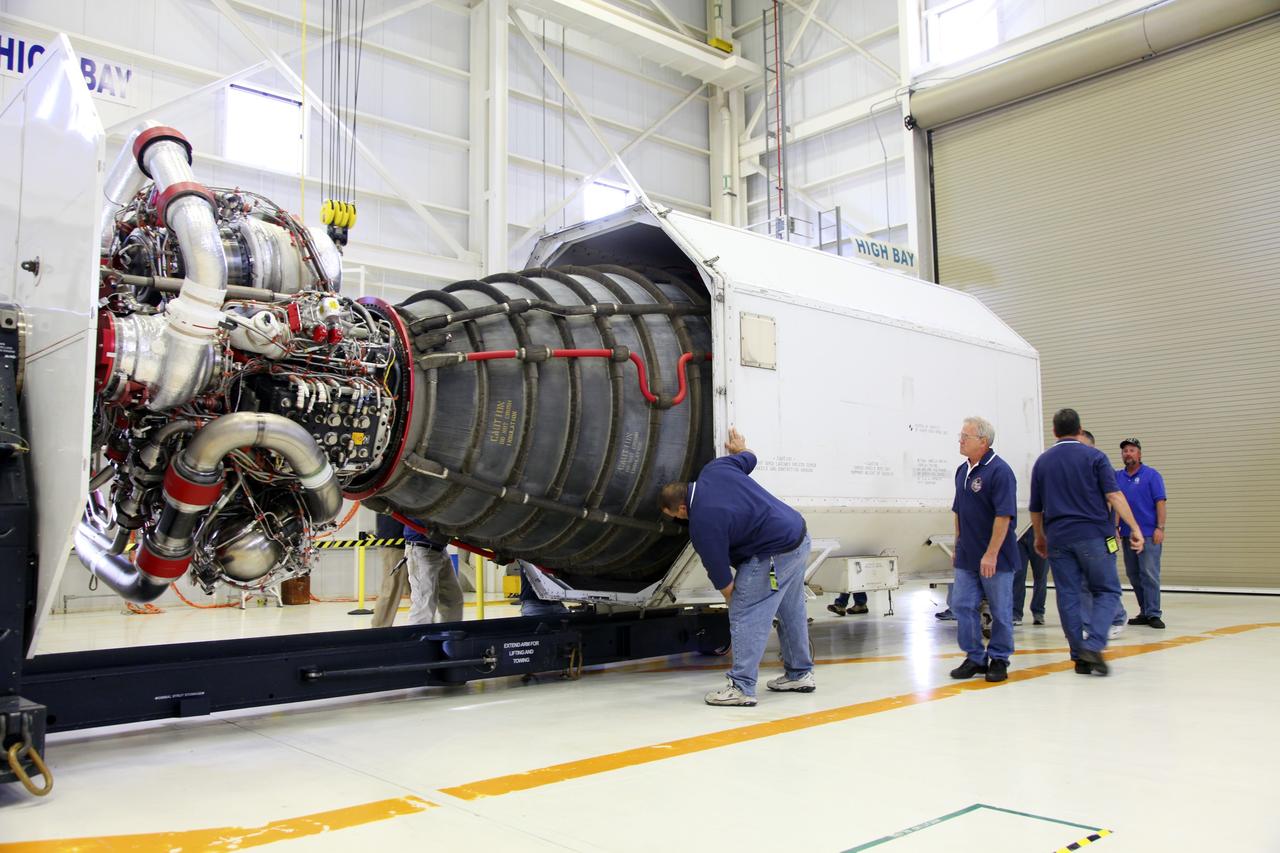
CAPE CANAVERAL, Fla. – In the Space Shuttle Main Engine Processing Facility at NASA’s Kennedy Space Center in Florida, technicians guide a transportation canister as it encloses a Pratt Whitney Rocketdyne space shuttle main engine (SSME). This is the second of the 15 engines used during the Space Shuttle Program to be prepared for transfer to NASA's Stennis Space Center in Mississippi. The engines will be stored at Stennis for future use on NASA's new heavy-lift rocket, the Space Launch System (SLS), which will carry NASA's new Orion spacecraft, cargo, equipment and science experiments to space. For more information, visit http://www.nasa.gov/shuttle. Photo credit: NASA/Gianni Woods
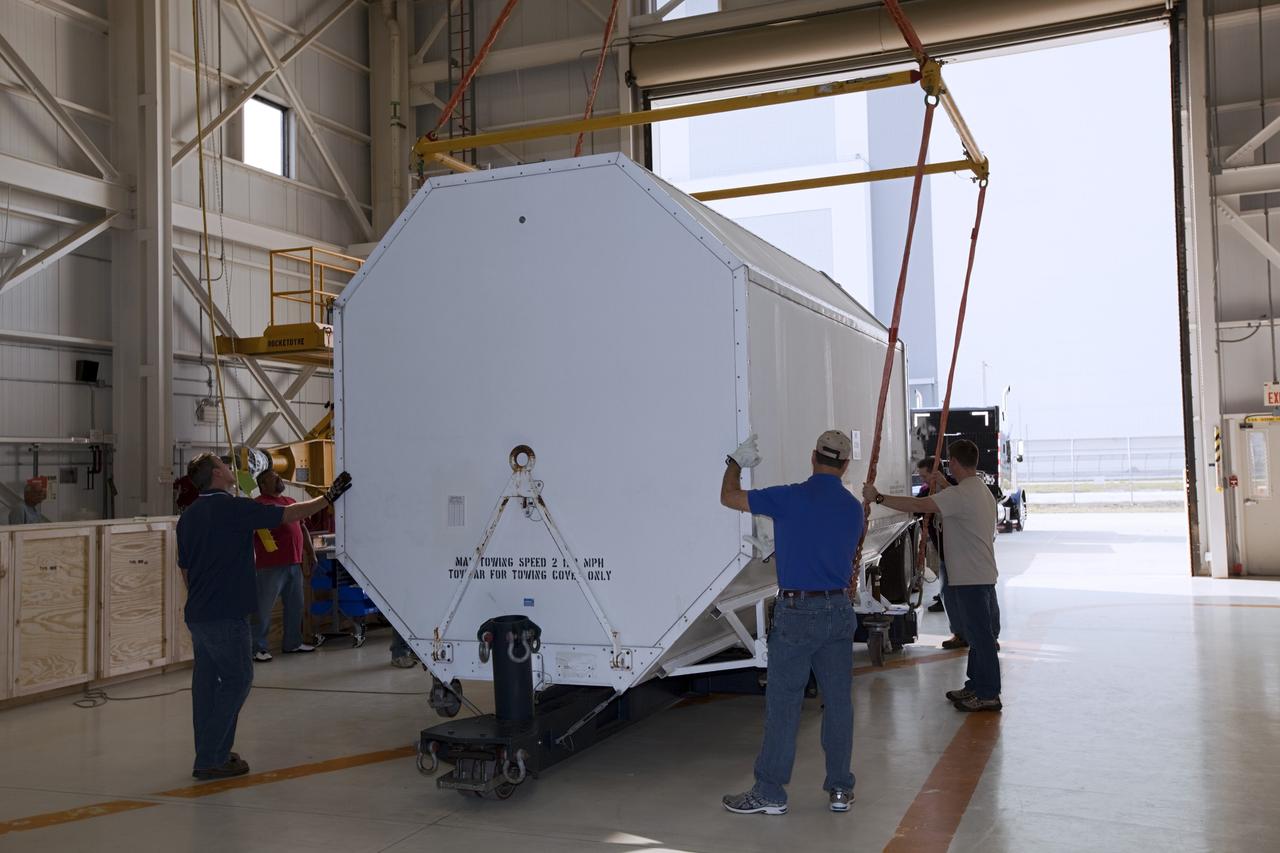
CAPE CANAVERAL, Fla. – In the Orbiter Processing Facility-3 engine shop at NASA's Kennedy Space Center in Florida, preparations are under way to load the transportation canister containing the last Pratt and Whitney Rocketdyne space shuttle main engine, or SSME, onto a flatbed truck for shipment to NASA's Stennis Space Center in Mississippi. The first two groups of engines were shipped from Kennedy to Stennis in November 2011 and January 2012 the remaining engines departed today. Altogether, 15 shuttle-era engines will be stored at Stennis for reuse on NASA’s Space Launch System heavy-lift rocket, under development. Photo credit: NASA/Dimitri Gerondidakis
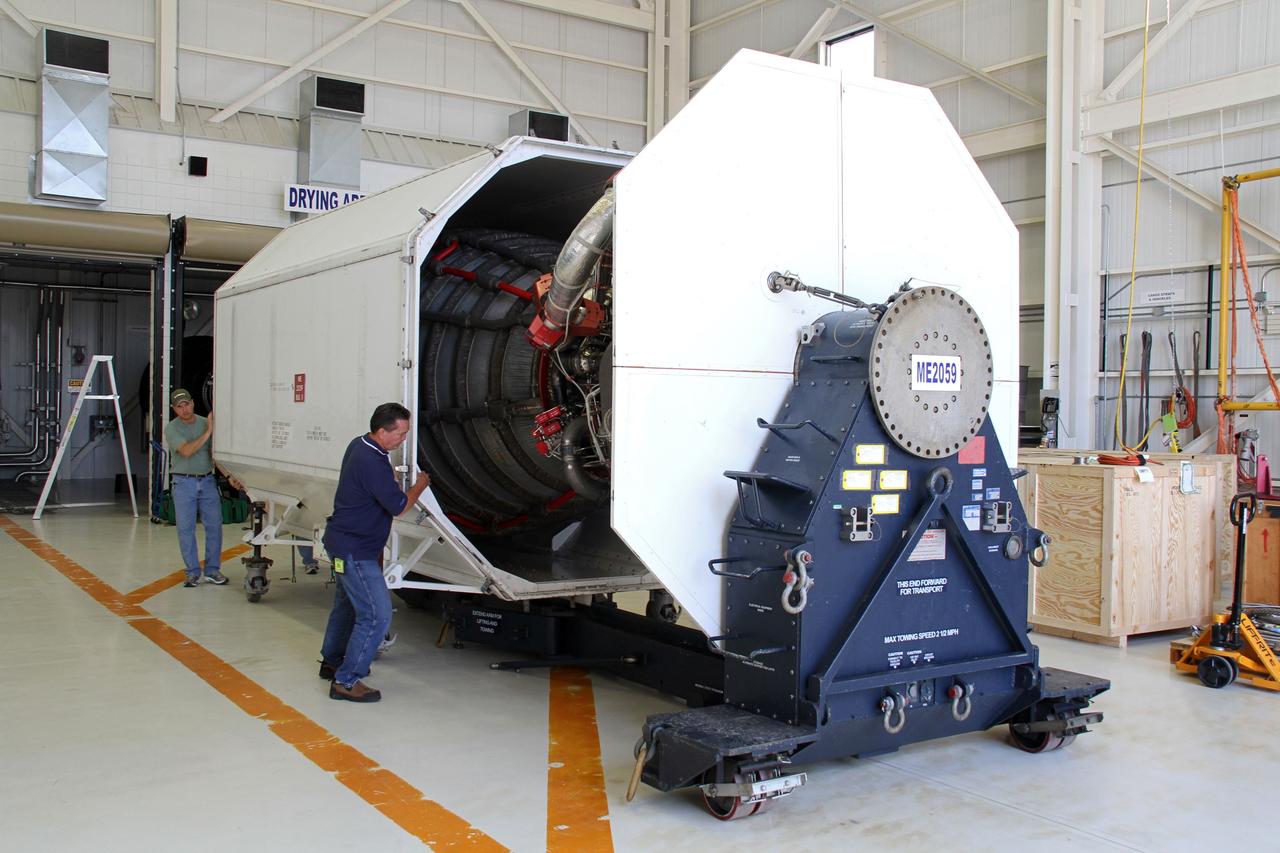
CAPE CANAVERAL, Fla. -- In the Orbiter Processing Facility-3 engine shop at NASA's Kennedy Space Center in Florida, a space shuttle main engine, or SSME, enters a transportation canister under the watchful eyes of Pratt and Whitney Rocketdyne's Jeff Huie. The engine is the last to be packed for shipment to NASA's Stennis Space Center in Mississippi. The first two groups of engines were shipped from Kennedy to Stennis in November 2011 and January 2012, and the remaining engines are scheduled to depart on April 9. Altogether, 15 shuttle-era engines will be stored at Stennis for reuse on NASA’s Space Launch System heavy-lift rocket, under development. Photo credit: NASA/Cory Huston
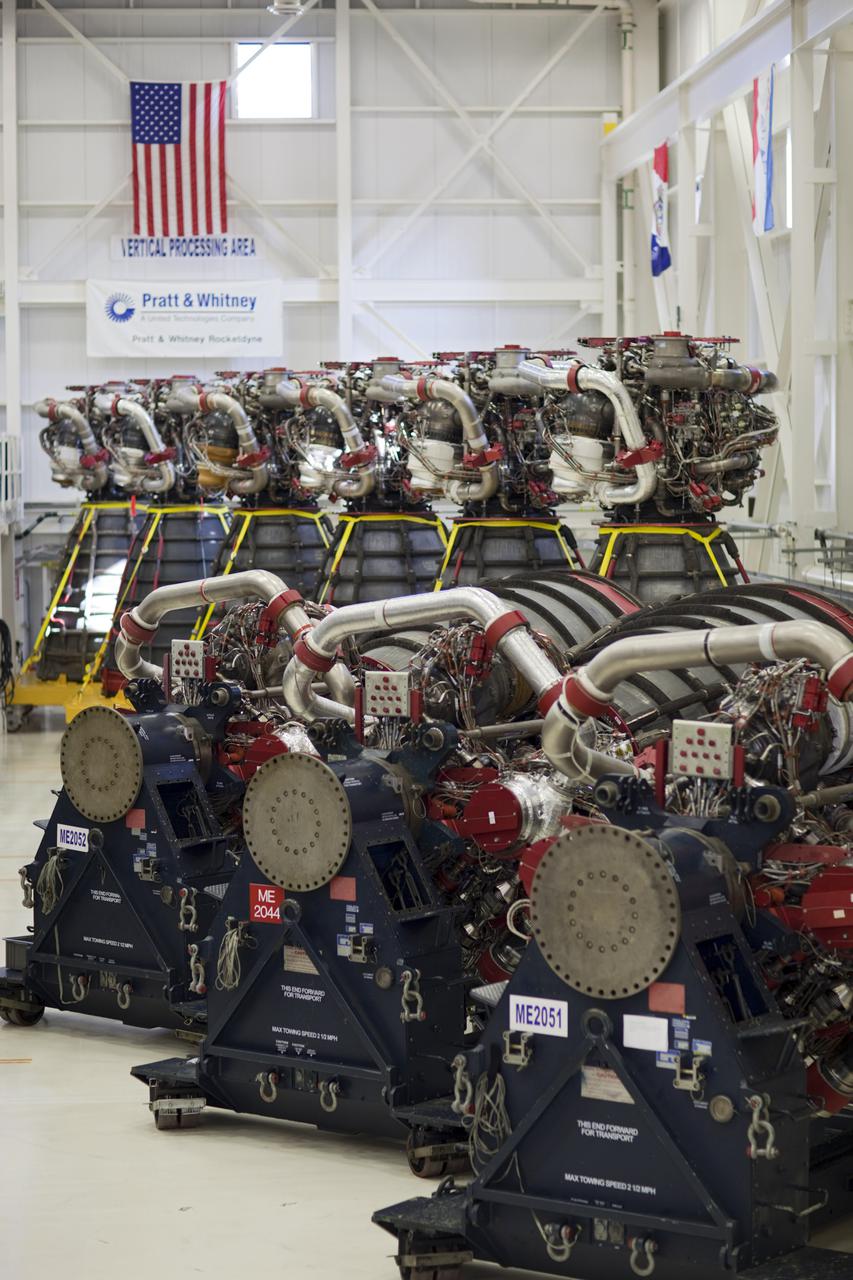
CAPE CANAVERAL, Fla. – At NASA’s Kennedy Space Center in Florida, three Pratt Whitney Rocketdyne space shuttle main engines (SSMEs) sit on stands inside the Engine Shop, with six more engines lined up behind them. For the first time, all 15 main engines are in the Engine Shop at the same time. They are being prepared for shipment to NASA's Stennis Space Center in Mississippi for storage following the completion of the Space Shuttle Program. The engines are being repurposed for use on NASA’s Space Launch System heavy lift rocket. Photo credit: NASA_Dimitri Gerondidakis
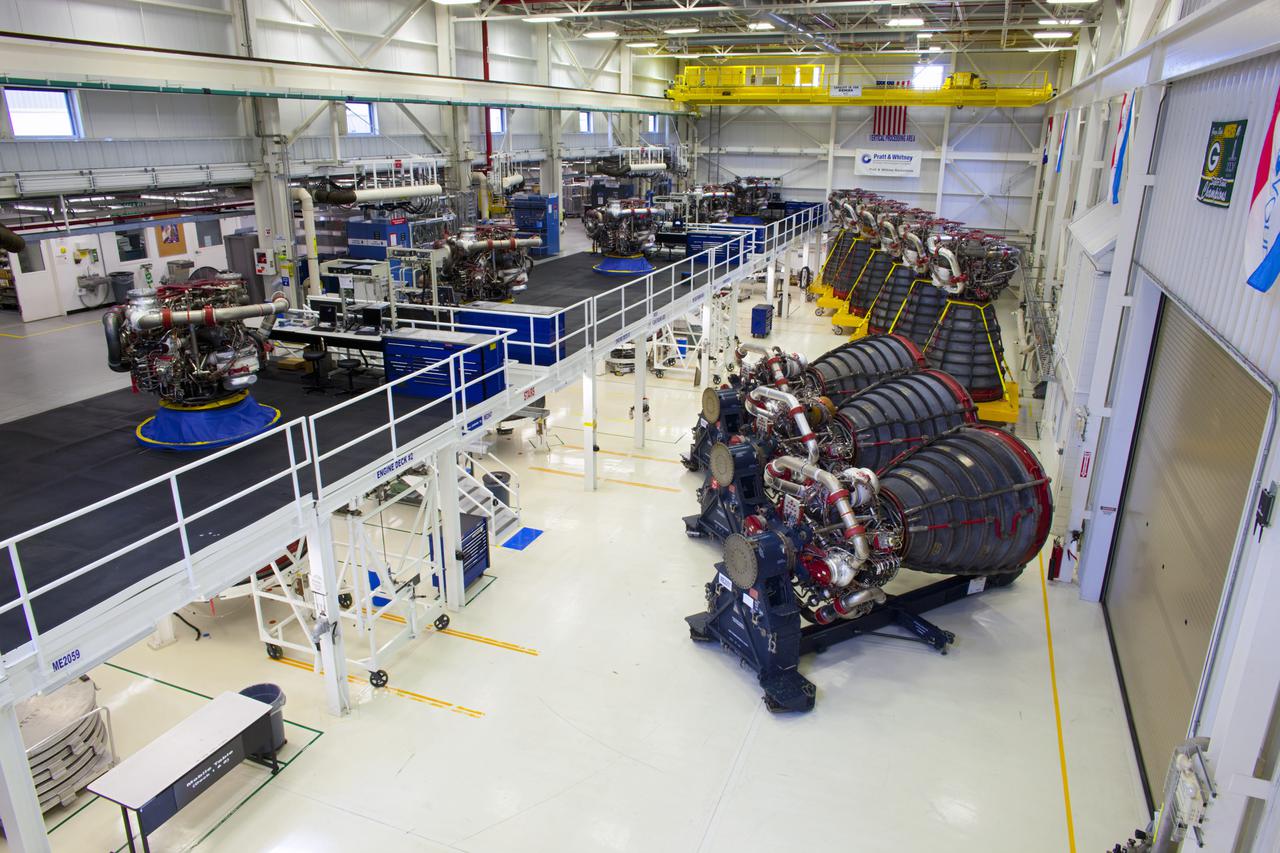
CAPE CANAVERAL, Fla. – At NASA’s Kennedy Space Center in Florida, three Pratt Whitney Rocketdyne space shuttle main engines (SSMEs) sit on stands inside the Engine Shop, with six more engines lined up behind them. For the first time, all 15 main engines are in the Engine Shop at the same time. They are being prepared for shipment to NASA's Stennis Space Center in Mississippi for storage following the completion of the Space Shuttle Program. The engines are being repurposed for use on NASA’s Space Launch System heavy lift rocket. Photo credit: NASA_Dimitri Gerondidakis
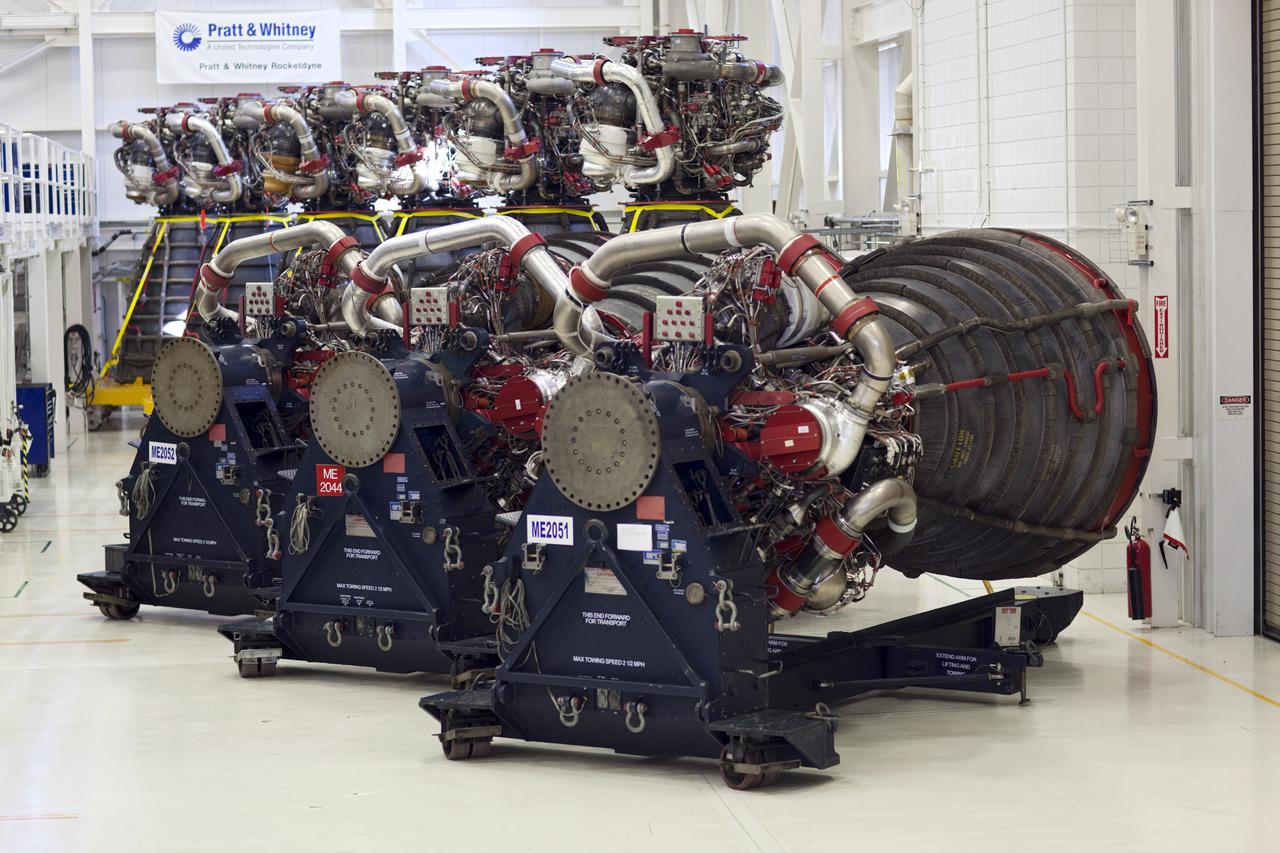
CAPE CANAVERAL, Fla. – At NASA’s Kennedy Space Center in Florida, three Pratt Whitney Rocketdyne space shuttle main engines (SSMEs) sit on stands inside the Engine Shop, with six more engines lined up behind them. For the first time, all 15 main engines are in the Engine Shop at the same time. They are being prepared for shipment to NASA's Stennis Space Center in Mississippi for storage following the completion of the Space Shuttle Program. The engines are being repurposed for use on NASA’s Space Launch System heavy lift rocket. Photo credit: NASA_Dimitri Gerondidakis
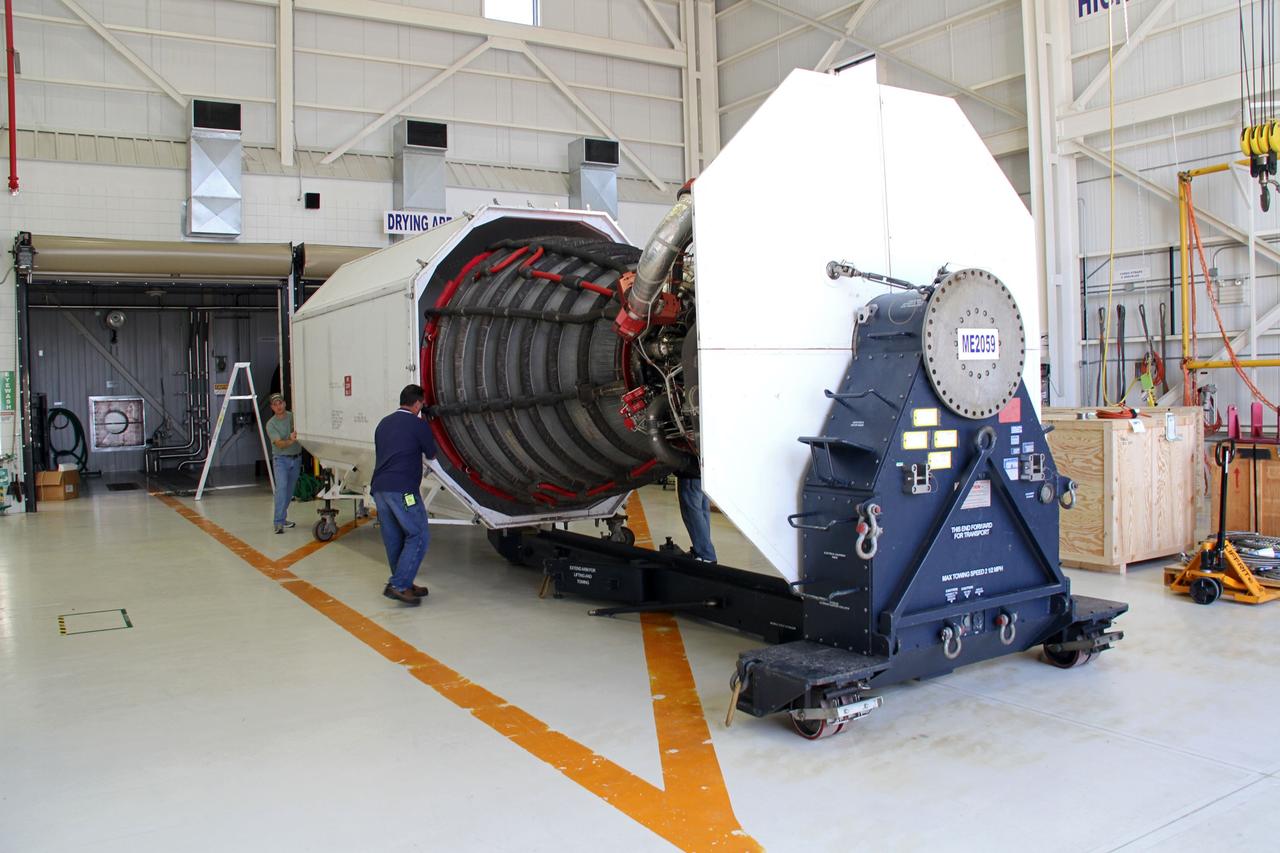
CAPE CANAVERAL, Fla. -- Jeff Huie of Pratt and Whitney Rocketdyne monitors the progress of a space shuttle main engine, or SSME, as it is loaded into a transportation canister in the Orbiter Processing Facility-3 engine shop at NASA's Kennedy Space Center in Florida. The engine is the last to be packed for shipment to NASA's Stennis Space Center in Mississippi. The first two groups of engines were shipped from Kennedy to Stennis in November 2011 and January 2012, and the remaining engines are scheduled to depart on April 9. Altogether, 15 shuttle-era engines will be stored at Stennis for reuse on NASA’s Space Launch System heavy-lift rocket, under development. Photo credit: NASA/Cory Huston
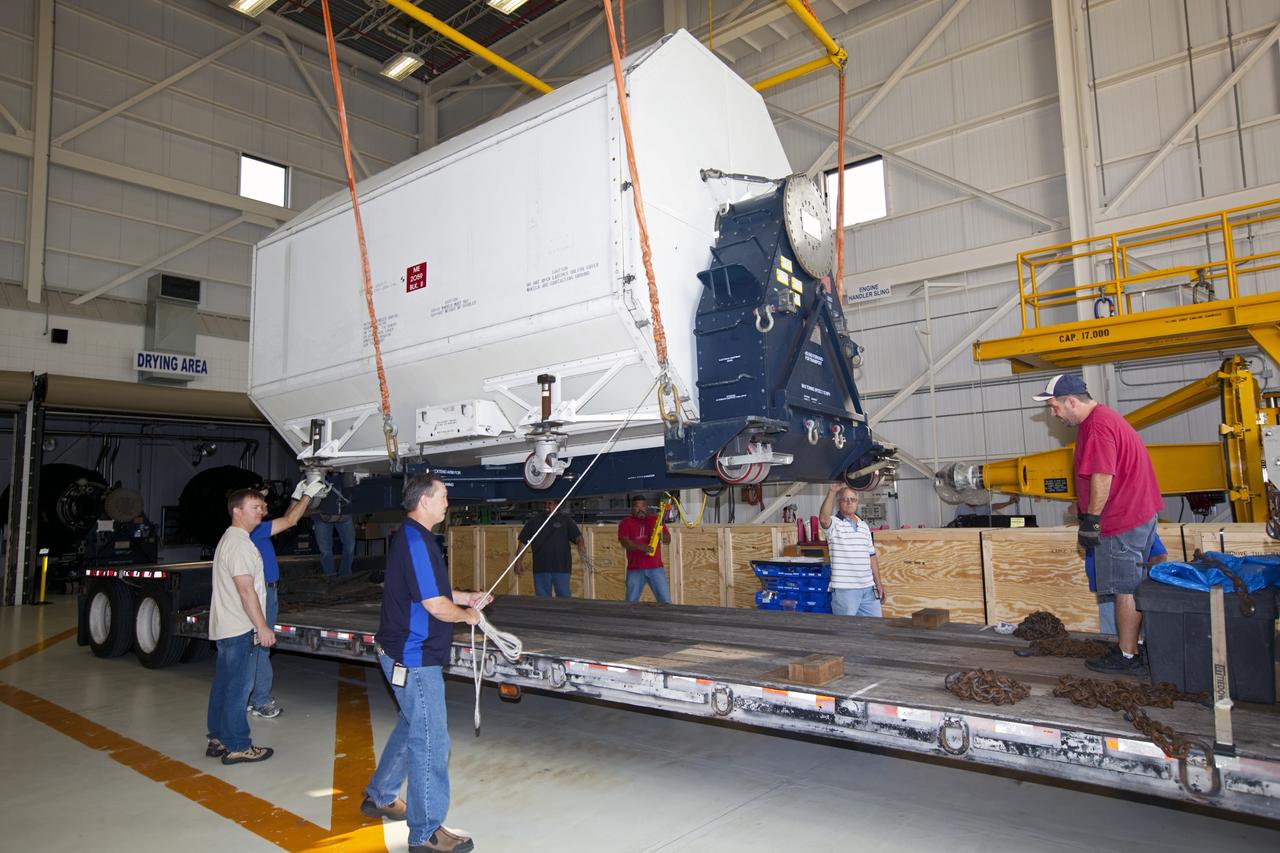
CAPE CANAVERAL, Fla. – In the Orbiter Processing Facility-3 engine shop at NASA's Kennedy Space Center in Florida, a transportation canister containing the last Pratt and Whitney Rocketdyne space shuttle main engine, or SSME, is lifted onto a flatbed truck for shipment to NASA's Stennis Space Center in Mississippi. The first two groups of engines were shipped from Kennedy to Stennis in November 2011 and January 2012 the remaining engines departed today. Altogether, 15 shuttle-era engines will be stored at Stennis for reuse on NASA’s Space Launch System heavy-lift rocket, under development. Photo credit: NASA/Dimitri Gerondidakis
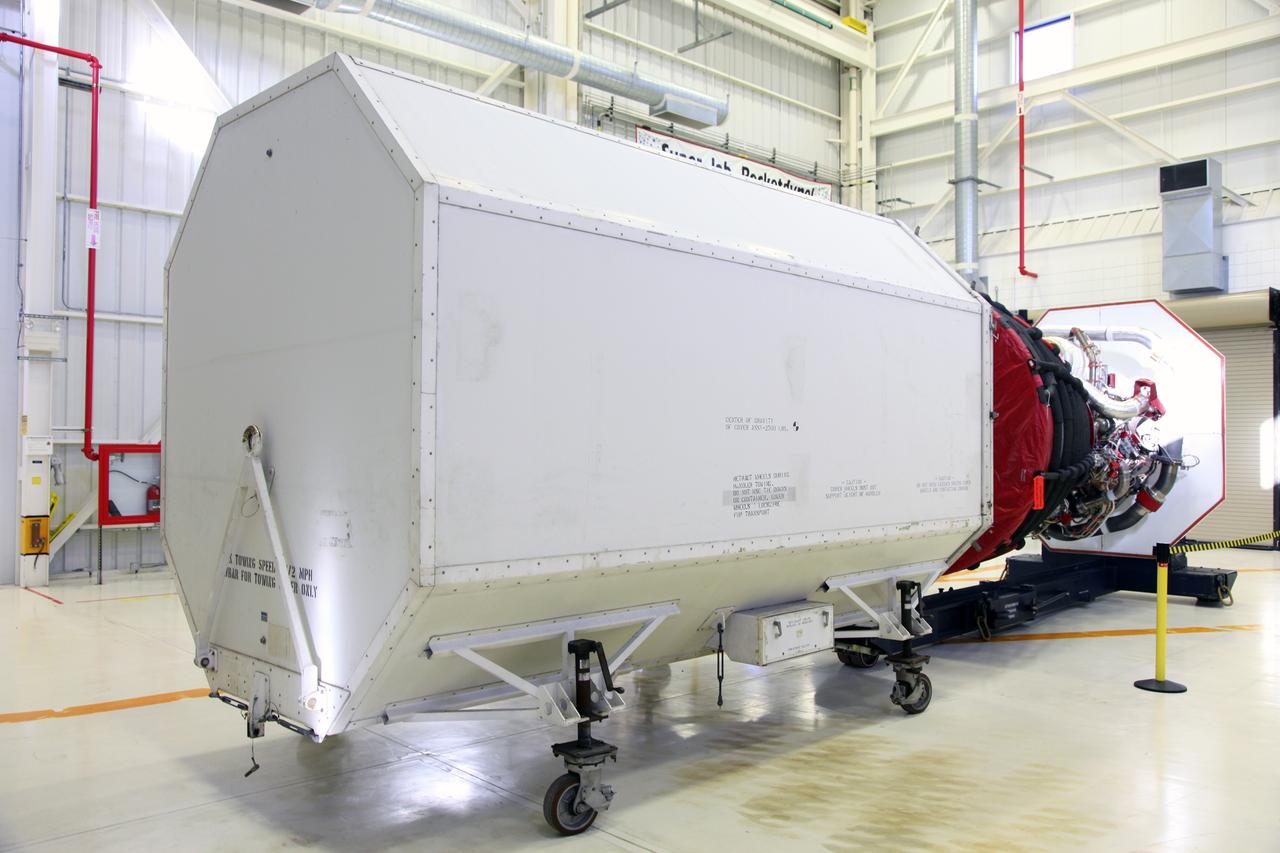
CAPE CANAVERAL, Fla. – In the Space Shuttle Main Engine Processing Facility at NASA’s Kennedy Space Center in Florida, a Pratt Whitney Rocketdyne space shuttle main engine (SSME) is installed in a transportation canister. This is the second of the 15 engines used during the Space Shuttle Program to be prepared for transfer to NASA's Stennis Space Center in Mississippi. The engines will be stored at Stennis for future use on NASA's new heavy-lift rocket, the Space Launch System (SLS), which will carry NASA's new Orion spacecraft, cargo, equipment and science experiments to space. For more information, visit http://www.nasa.gov/shuttle. Photo credit: NASA/Gianni Woods
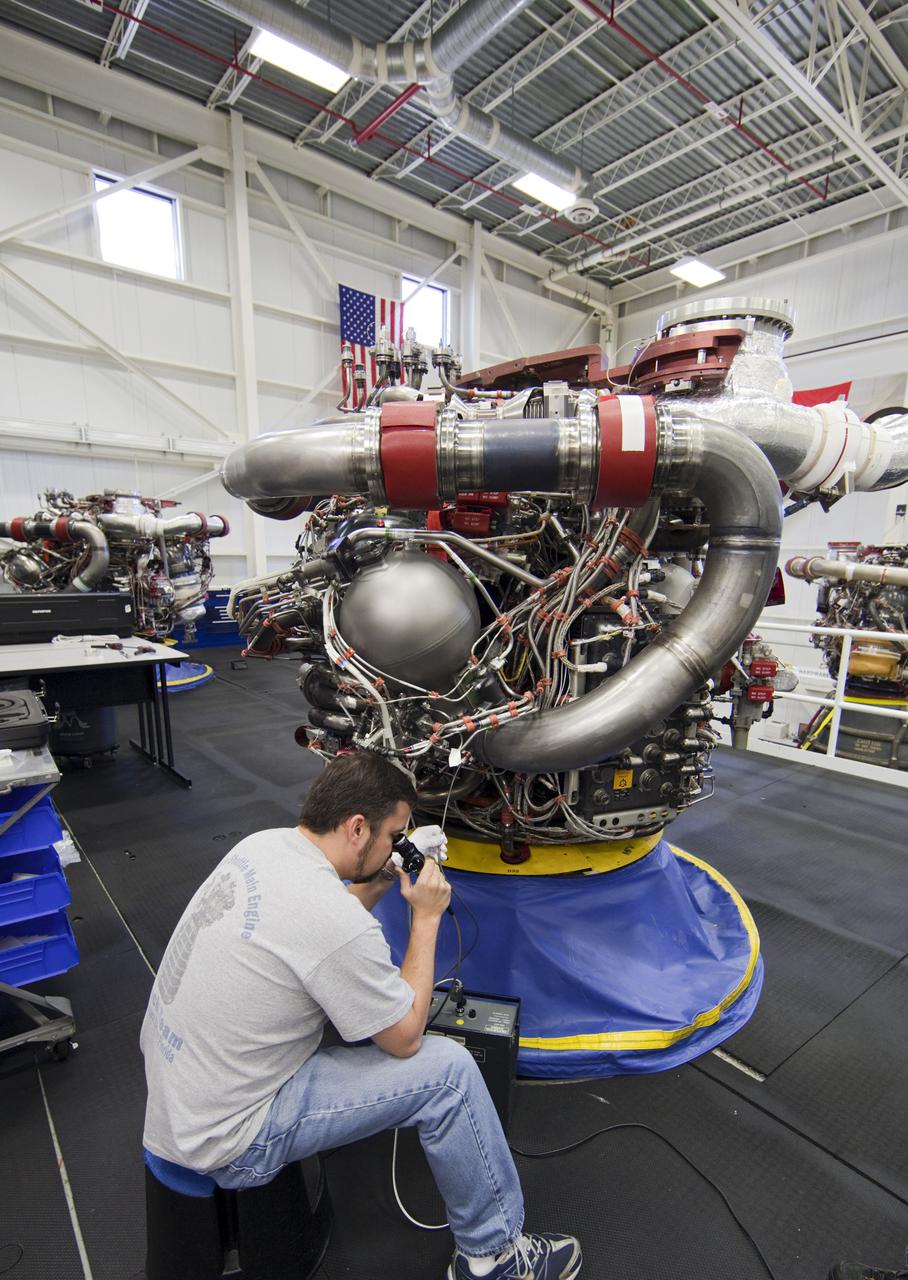
CAPE CANAVERAL, Fla. – Inside the Engine Shop at NASA’s Kennedy Space Center in Florida, a technician performs a boroscope test on a high pressure oxidizer pump on one of the Pratt Whitney Rocketdyne space shuttle main engines (SSMEs) positioned in a test cell. For the first time, all 15 main engines are in the Engine Shop at the same time. They are being prepared for shipment to NASA's Stennis Space Center in Mississippi for storage following the completion of the Space Shuttle Program. The engines are being repurposed for use on NASA’s Space Launch System heavy lift rocket. Photo credit: NASA_Dimitri Gerondidakis
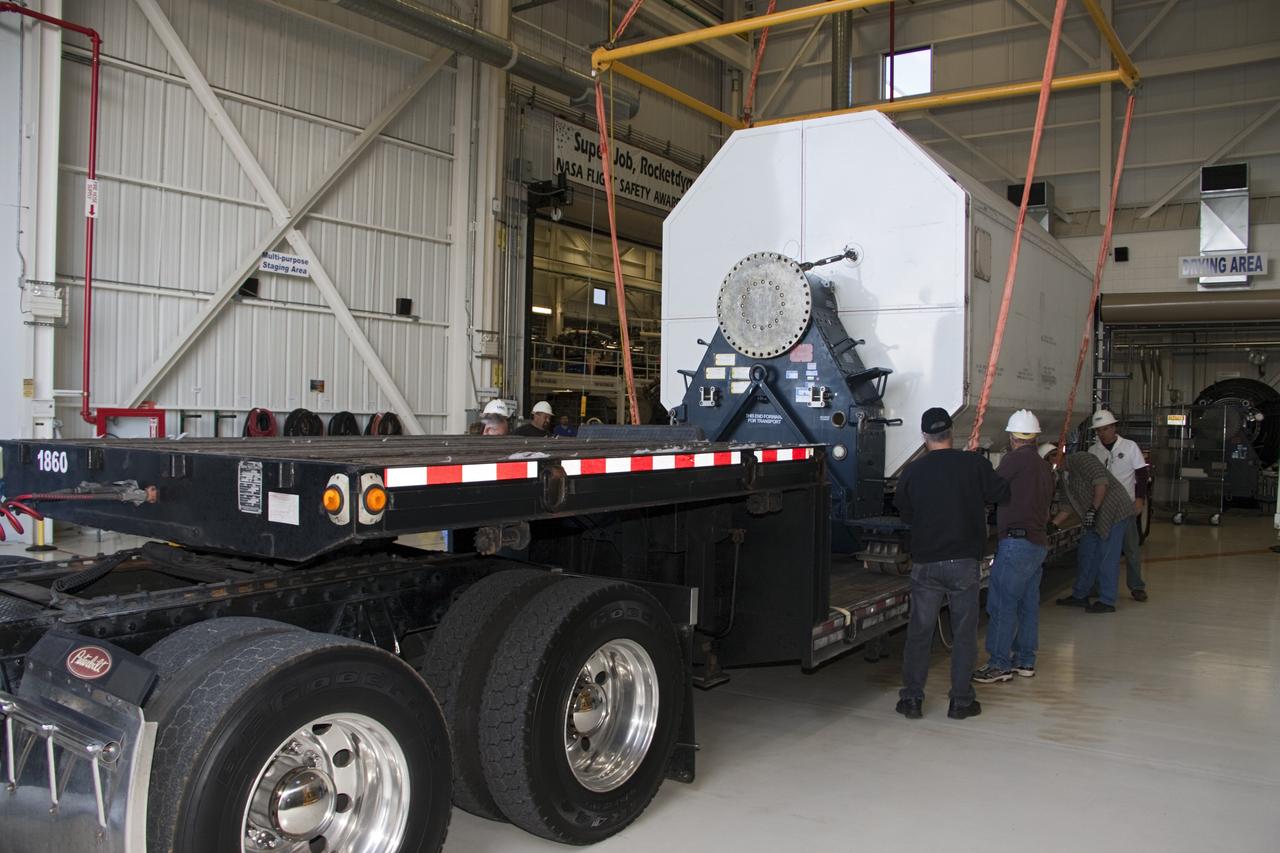
CAPE CANAVERAL, Fla. – In the Space Shuttle Main Engine Processing Facility at NASA’s Kennedy Space Center in Florida, a transportation canister containing a Pratt & Whitney Rocketdyne space shuttle main engine (SSME) is secured onto a flatbed trailer. This is the second of the 15 engines used during the Space Shuttle Program to be transported to NASA's Stennis Space Center in Mississippi. The engines will be stored at Stennis for future use on NASA's new heavy-lift rocket, the Space Launch System (SLS), which will carry NASA's new Orion spacecraft, cargo, equipment and science experiments to space. For more information, visit http://www.nasa.gov/shuttle. Photo credit: NASA/Jim Grossmann

CAPE CANAVERAL, Fla. -- The last Pratt and Whitney Rocketdyne space shuttle main engine, or SSME, is enclosed in a transportation canister in the Orbiter Processing Facility-3 engine shop at NASA's Kennedy Space Center in Florida. The engine was packed for shipment to NASA's Stennis Space Center in Mississippi. The first two groups of engines were shipped from Kennedy to Stennis in November 2011 and January 2012, and the remaining engines are scheduled to depart on April 9. Altogether, 15 shuttle-era engines will be stored at Stennis for reuse on NASA’s Space Launch System heavy-lift rocket, under development. Photo credit: NASA/Cory Huston
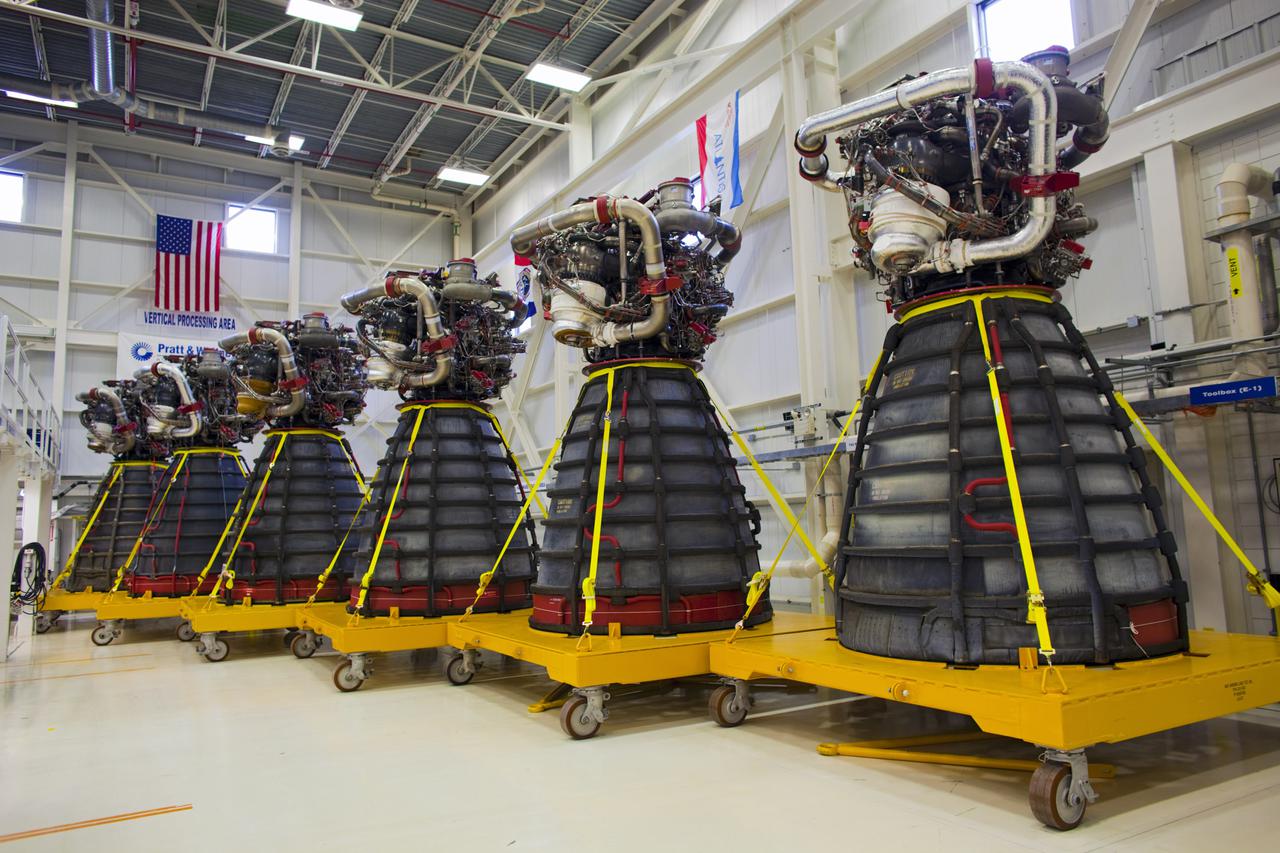
CAPE CANAVERAL, Fla. – At NASA’s Kennedy Space Center in Florida, all six Pratt Whitney Rocketdyne space shuttle main engines (SSMEs) from space shuttle Endeavour's STS-134 and space shuttle Atlantis' STS-135 missions sit in test cells inside the Engine Shop. For the first time, all 15 main engines are in the Engine Shop at the same time. They are being prepared for shipment to NASA's Stennis Space Center in Mississippi for storage following the completion of the Space Shuttle Program. The engines are being repurposed for use on NASA’s Space Launch System heavy lift rocket. Photo credit: NASA_Dimitri Gerondidakis
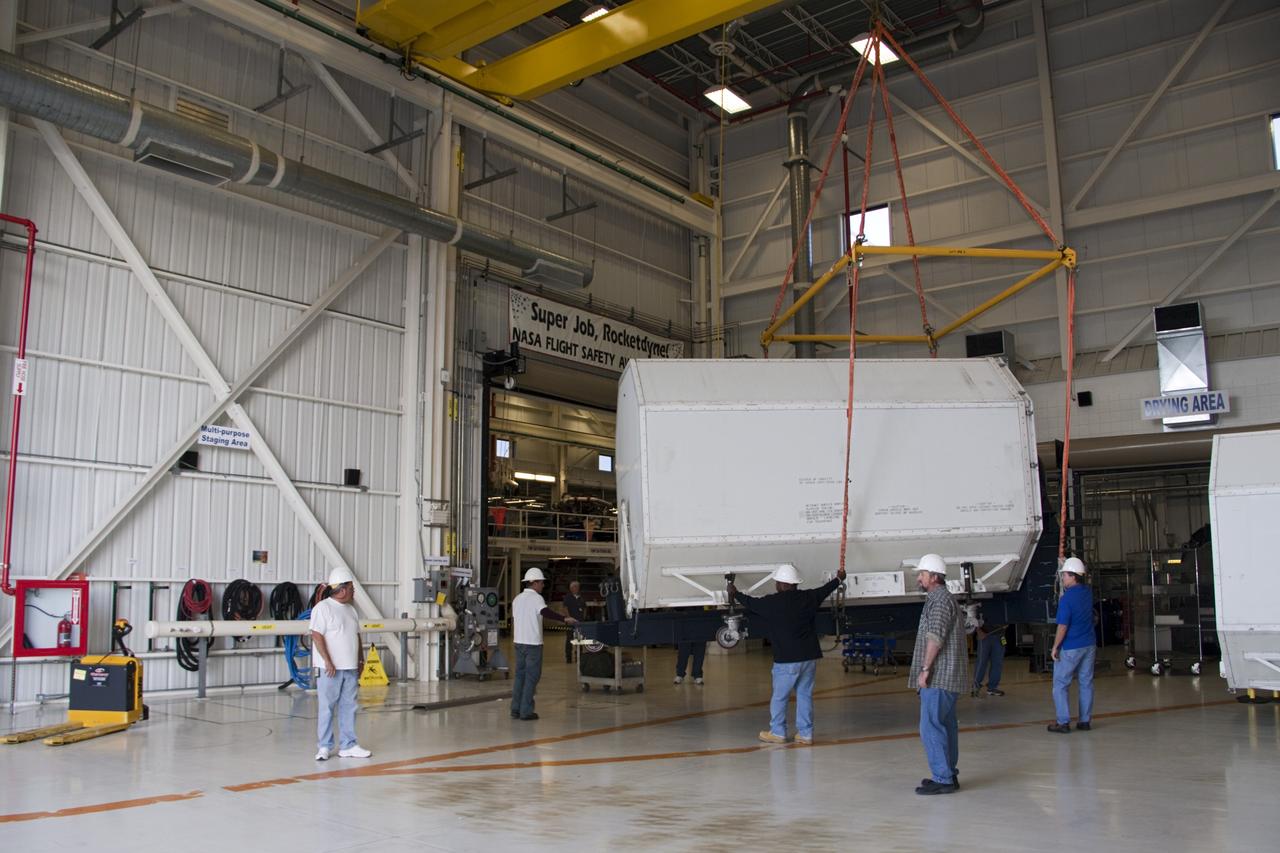
CAPE CANAVERAL, Fla. – In the Space Shuttle Main Engine Processing Facility at NASA’s Kennedy Space Center in Florida, a transportation canister containing a Pratt & Whitney Rocketdyne space shuttle main engine (SSME) glides above the floor toward a flatbed trailer. This is the second of the 15 engines used during the Space Shuttle Program to be transported to NASA's Stennis Space Center in Mississippi. The engines will be stored at Stennis for future use on NASA's new heavy-lift rocket, the Space Launch System (SLS), which will carry NASA's new Orion spacecraft, cargo, equipment and science experiments to space. For more information, visit http://www.nasa.gov/shuttle. Photo credit: NASA/Jim Grossmann
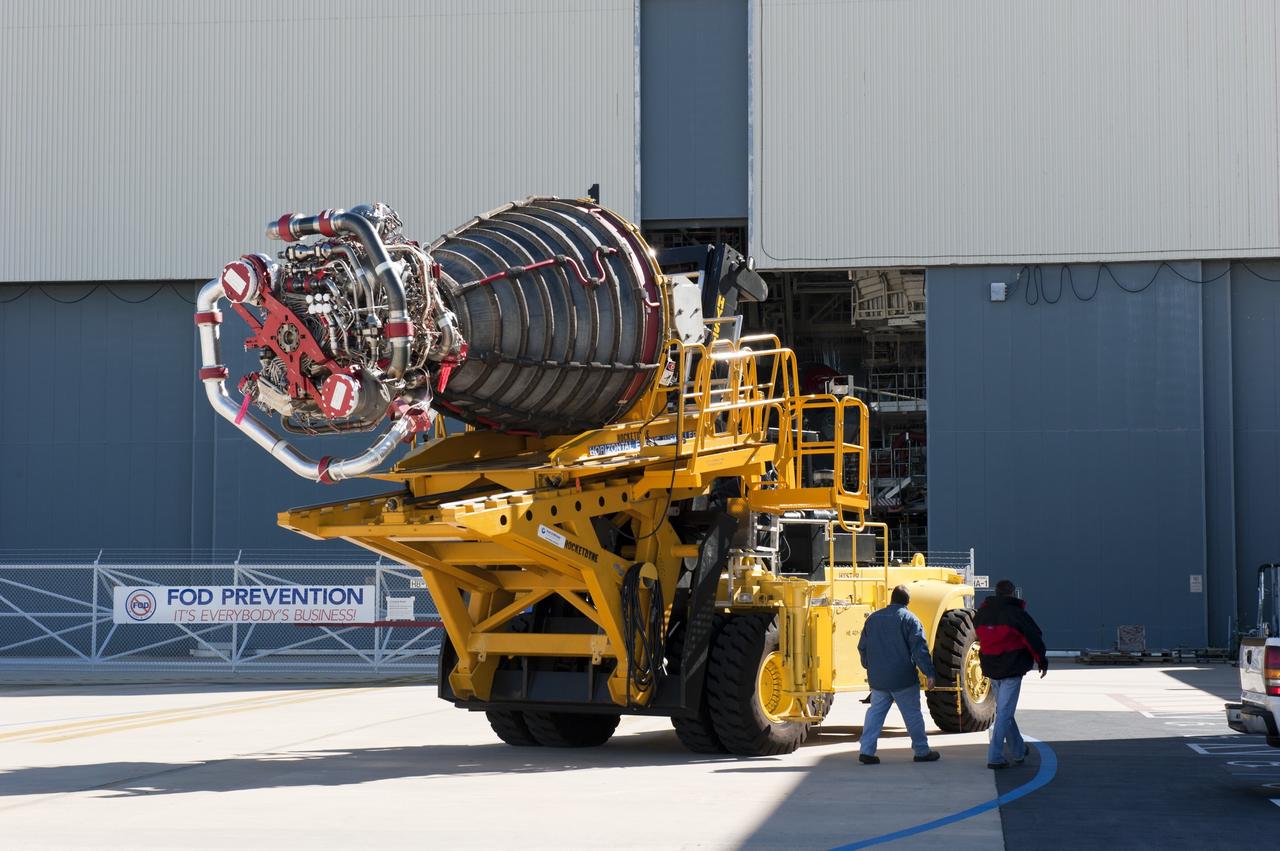
CAPE CANAVERAL, Fla. -- A Hyster forklift transports the second of shuttle Atlantis' three main engines from the Space Shuttle Main Engine (SSME) Shop to Orbiter Processing Facility-1 at NASA's Kennedy Space Center in Florida. Once inside the processing facility, the engine will be installed in the shuttle. Each engine is 14 feet long, weighs about 6,700 pounds, and is 7.5 feet in diameter at the end of the nozzle. This is the final planned engine installation for the Space Shuttle Program. Atlantis is being prepared for the "launch on need," or potential rescue mission, for the final planned shuttle flight, Endeavour's STS-134 mission. For more information, visit www.nasa.gov/shuttle. Photo credit: NASA/Kim Shiflett
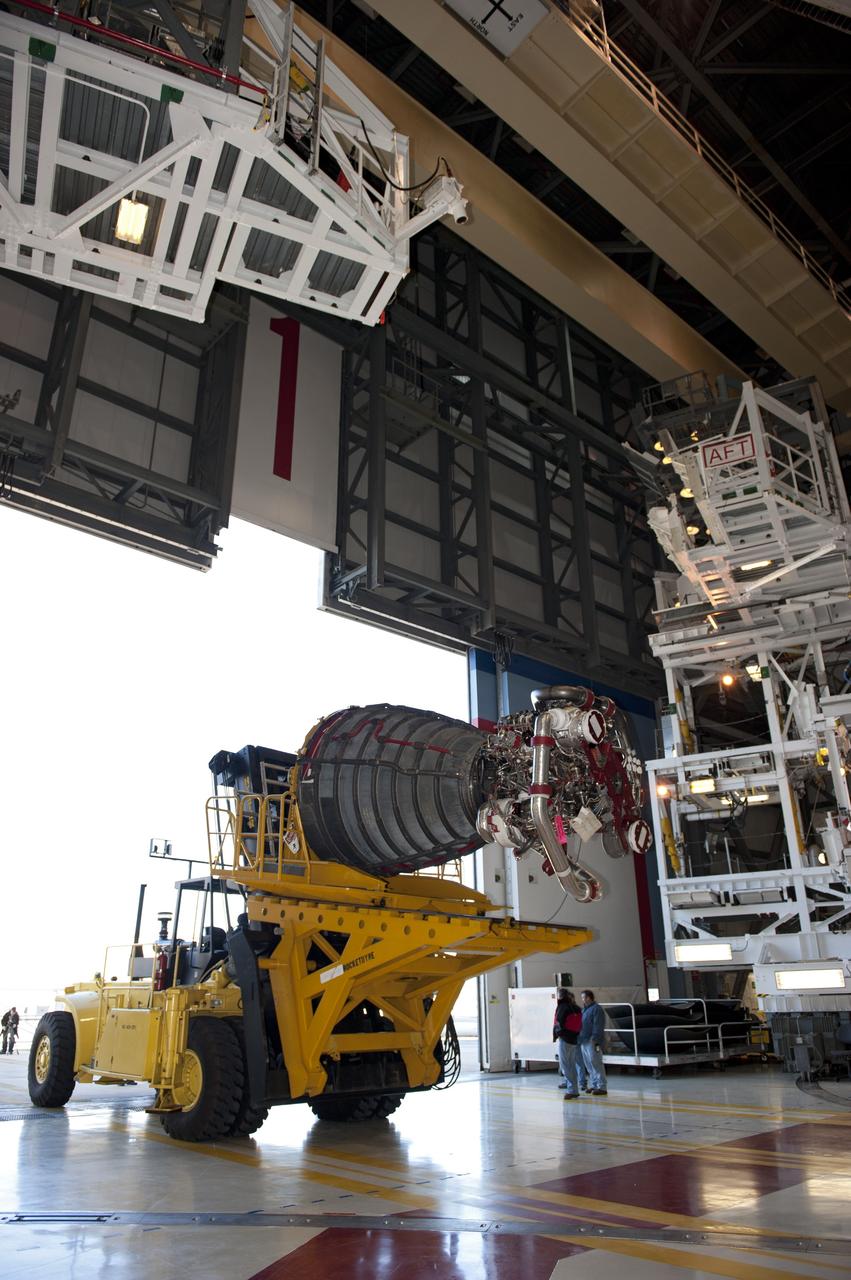
CAPE CANAVERAL, Fla. -- A Hyster forklift transporting the second of shuttle Atlantis' three main engines arrives at Orbiter Processing Facility-1 from the Space Shuttle Main Engine (SSME) Shop at NASA's Kennedy Space Center in Florida. There, the engine will be installed in the shuttle. Each engine is 14 feet long, weighs about 6,700 pounds, and is 7.5 feet in diameter at the end of the nozzle. This is the final planned engine installation for the Space Shuttle Program. Atlantis is being prepared for the "launch on need," or potential rescue mission, for the final planned shuttle flight, Endeavour's STS-134 mission. For more information, visit www.nasa.gov/shuttle. Photo credit: NASA/Kim Shiflett
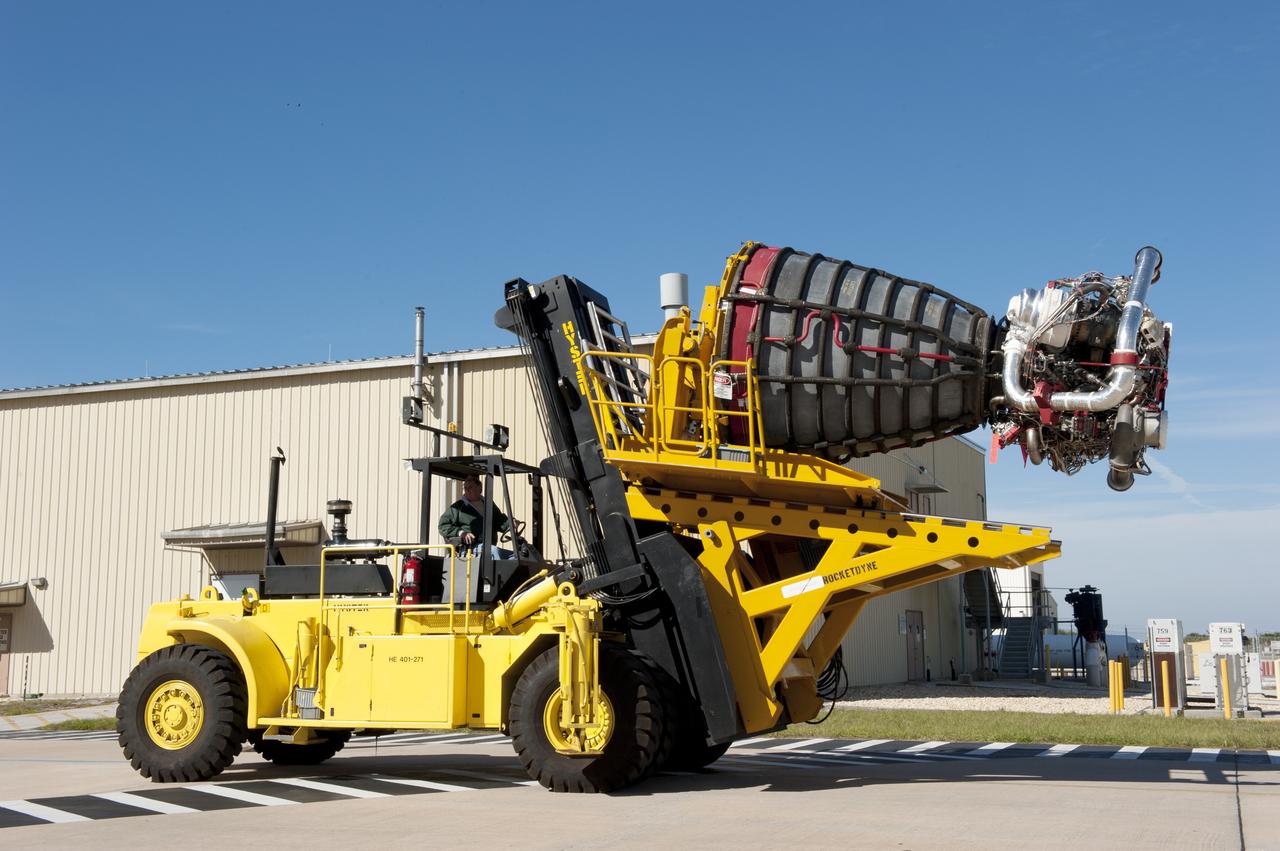
CAPE CANAVERAL, Fla. -- A Hyster forklift transports engine #2, the last of shuttle Atlantis' three main engines, from the Space Shuttle Main Engine (SSME) Shop to Orbiter Processing Facility-1 at NASA's Kennedy Space Center in Florida. Inside the processing facility, the engine will be installed in the shuttle. Each engine is 14 feet long, weighs about 6,700 pounds, and is 7.5 feet in diameter at the end of the nozzle. This is the final planned engine installation for the Space Shuttle Program. Atlantis is being prepared for the "launch on need," or potential rescue mission, for the final planned shuttle flight, Endeavour's STS-134 mission. For more information, visit www.nasa.gov/shuttle. Photo credit: NASA/Kim Shiflett
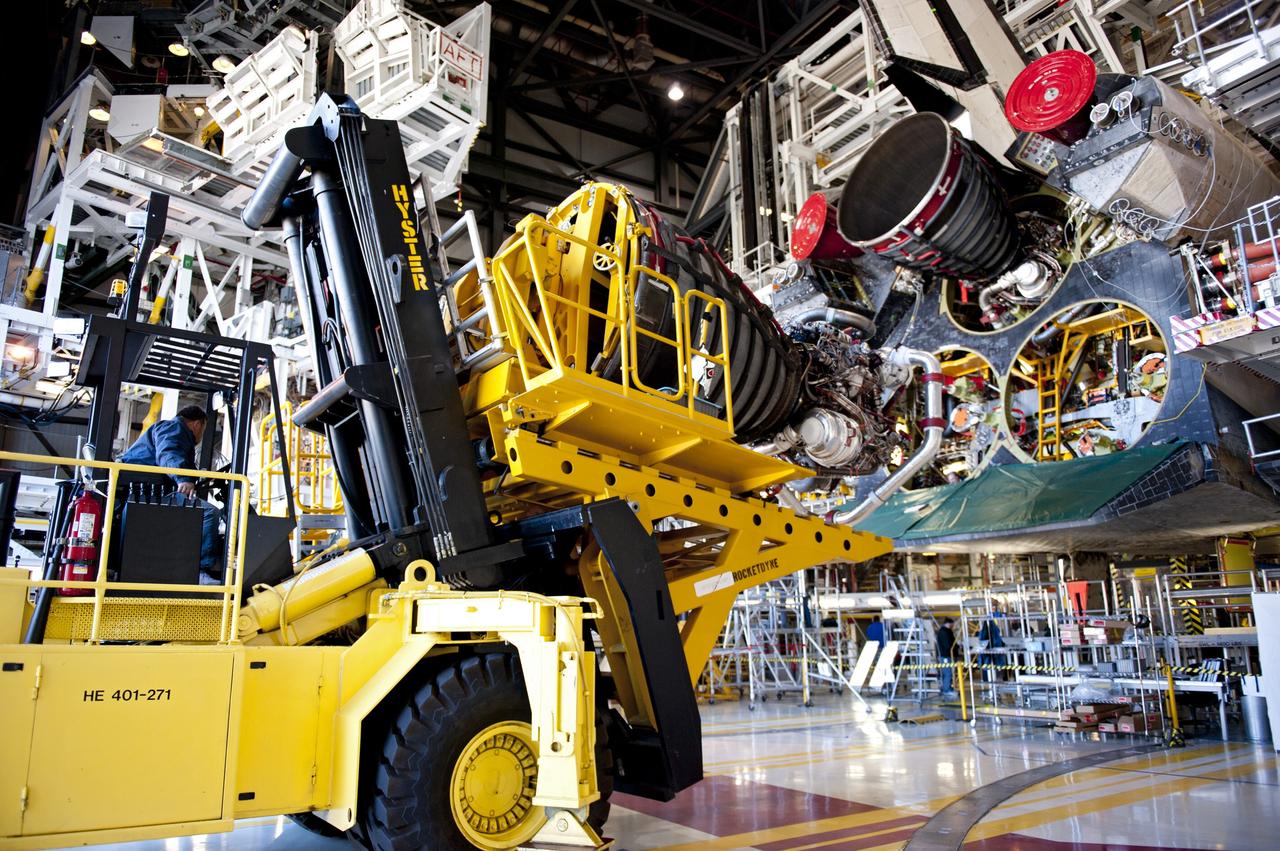
CAPE CANAVERAL, Fla. -- A Hyster forklift transporting the second of shuttle Atlantis' three main engines arrives at Orbiter Processing Facility-1 from the Space Shuttle Main Engine (SSME) Shop at NASA's Kennedy Space Center in Florida. There, the engine will be installed in the shuttle. Each engine is 14 feet long, weighs about 6,700 pounds, and is 7.5 feet in diameter at the end of the nozzle. This is the final planned engine installation for the Space Shuttle Program. Atlantis is being prepared for the "launch on need," or potential rescue mission, for the final planned shuttle flight, Endeavour's STS-134 mission. For more information, visit www.nasa.gov/shuttle. Photo credit: NASA/Kim Shiflett
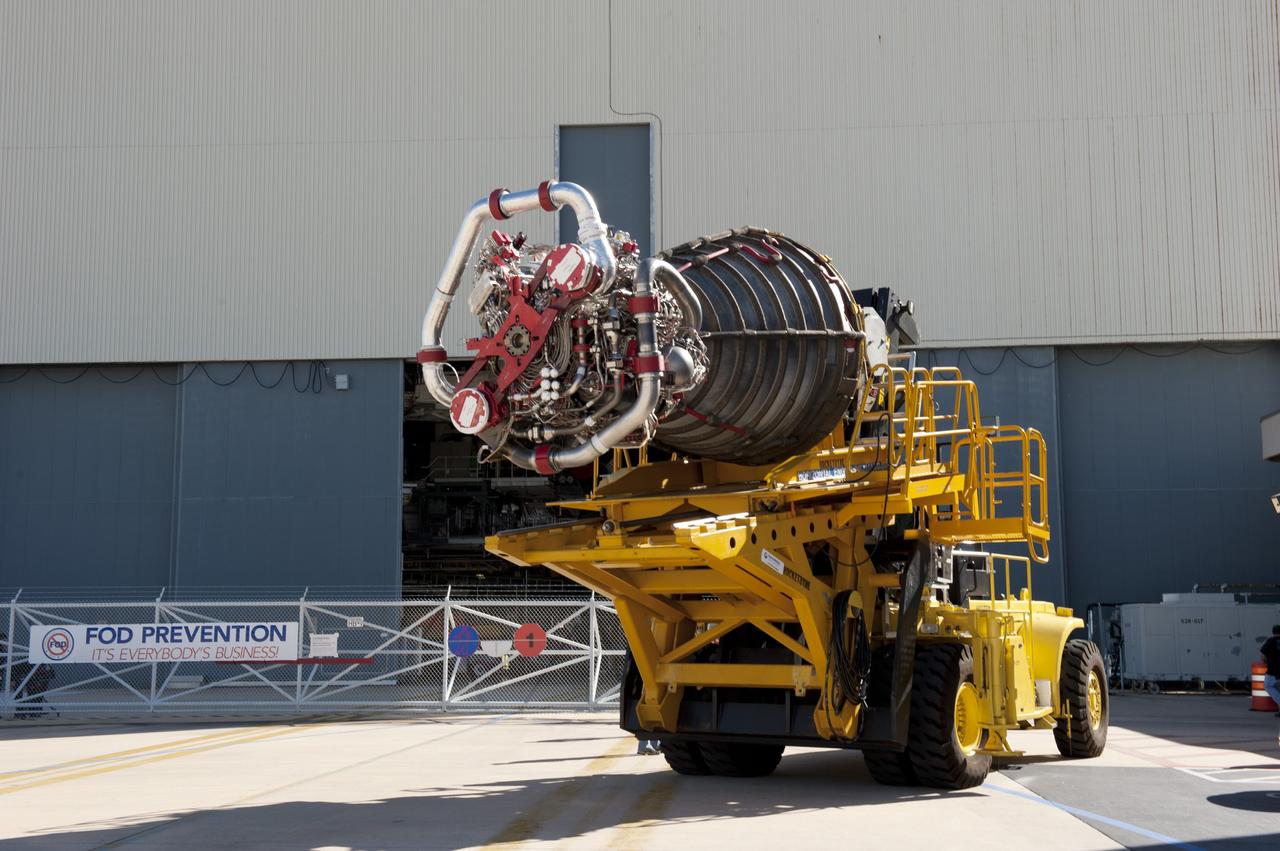
CAPE CANAVERAL, Fla. -- A Hyster forklift transports engine #2, the last of shuttle Atlantis' three main engines, from the Space Shuttle Main Engine (SSME) Shop to Orbiter Processing Facility-1 at NASA's Kennedy Space Center in Florida. Inside the processing facility, the engine will be installed in the shuttle. Each engine is 14 feet long, weighs about 6,700 pounds, and is 7.5 feet in diameter at the end of the nozzle. This is the final planned engine installation for the Space Shuttle Program. Atlantis is being prepared for the "launch on need," or potential rescue mission, for the final planned shuttle flight, Endeavour's STS-134 mission. For more information, visit www.nasa.gov/shuttle. Photo credit: NASA/Kim Shiflett
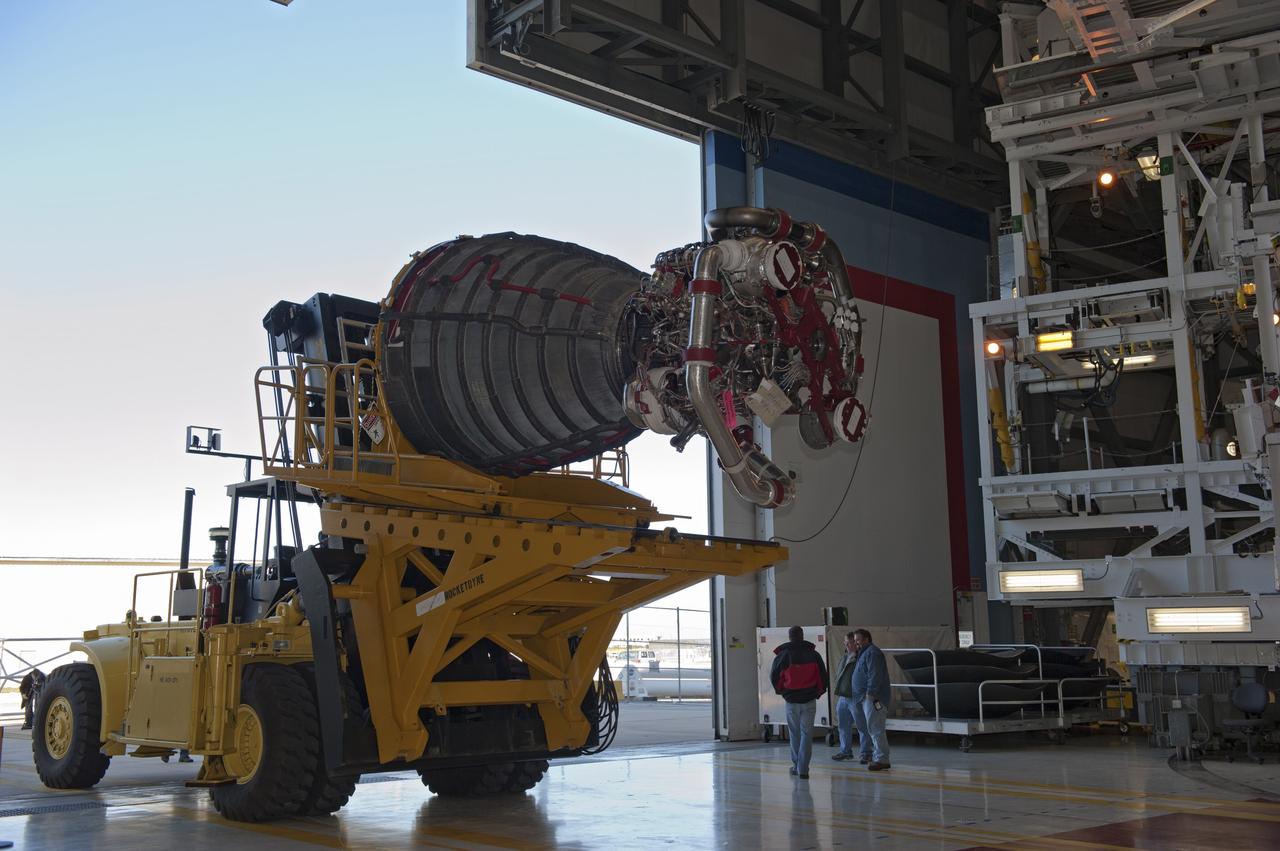
CAPE CANAVERAL, Fla. -- A Hyster forklift transporting the second of shuttle Atlantis' three main engines arrives at Orbiter Processing Facility-1 from the Space Shuttle Main Engine (SSME) Shop at NASA's Kennedy Space Center in Florida. There, the engine will be installed in the shuttle. Each engine is 14 feet long, weighs about 6,700 pounds, and is 7.5 feet in diameter at the end of the nozzle. This is the final planned engine installation for the Space Shuttle Program. Atlantis is being prepared for the "launch on need," or potential rescue mission, for the final planned shuttle flight, Endeavour's STS-134 mission. For more information, visit www.nasa.gov/shuttle. Photo credit: NASA/Kim Shiflett
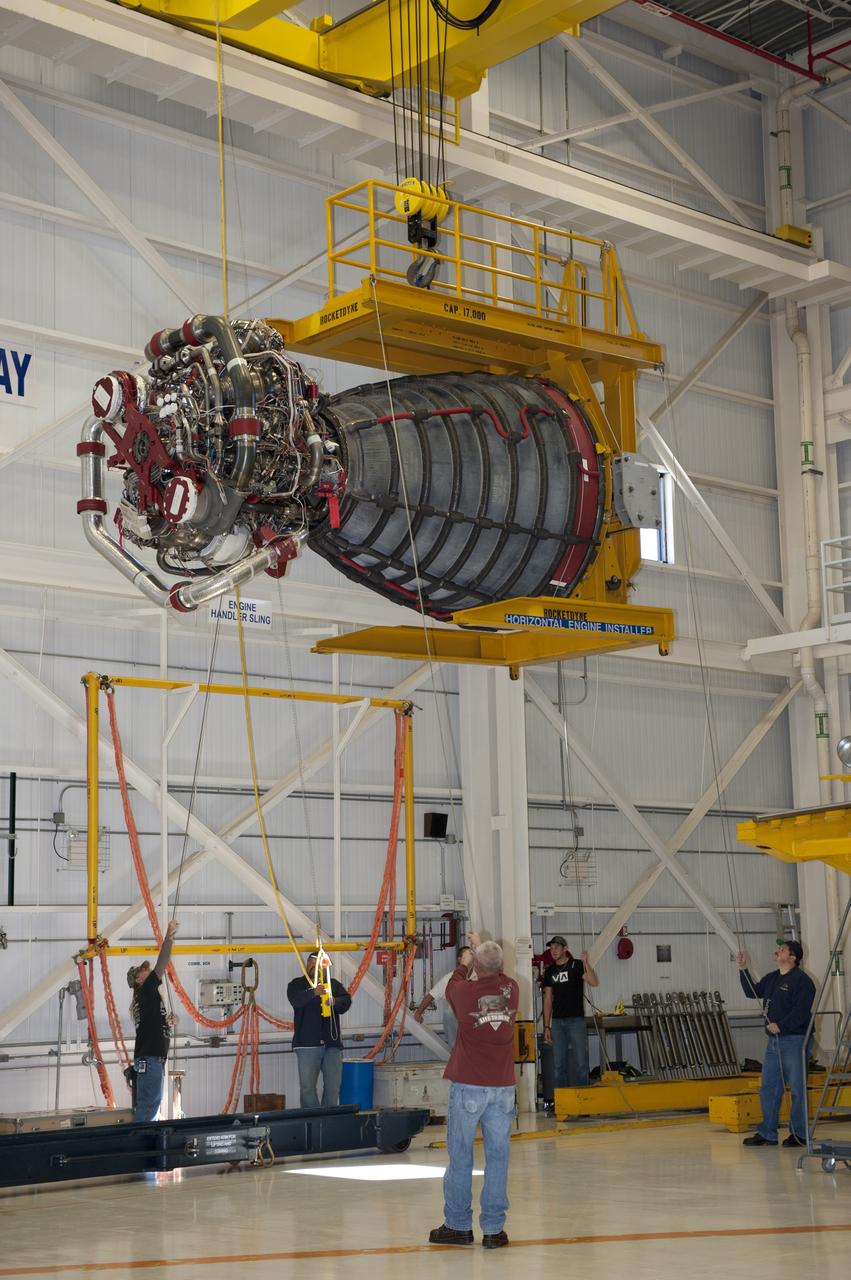
CAPE CANAVERAL, Fla. -- Workers in the Space Shuttle Main Engine (SSME) Shop at NASA's Kennedy Space Center in Florida raise the second of shuttle Atlantis' three main engines so it can be attached to a Hyster forklift. Then, the engine will be transported to Orbiter Processing Facility-1 where it will be installed in the shuttle. Each engine is 14 feet long, weighs about 6,700 pounds, and is 7.5 feet in diameter at the end of the nozzle. This is the final planned engine installation for the Space Shuttle Program. Atlantis is being prepared for the "launch on need," or potential rescue mission, for the final planned shuttle flight, Endeavour's STS-134 mission. For more information, visit www.nasa.gov/shuttle. Photo credit: NASA/Kim Shiflett
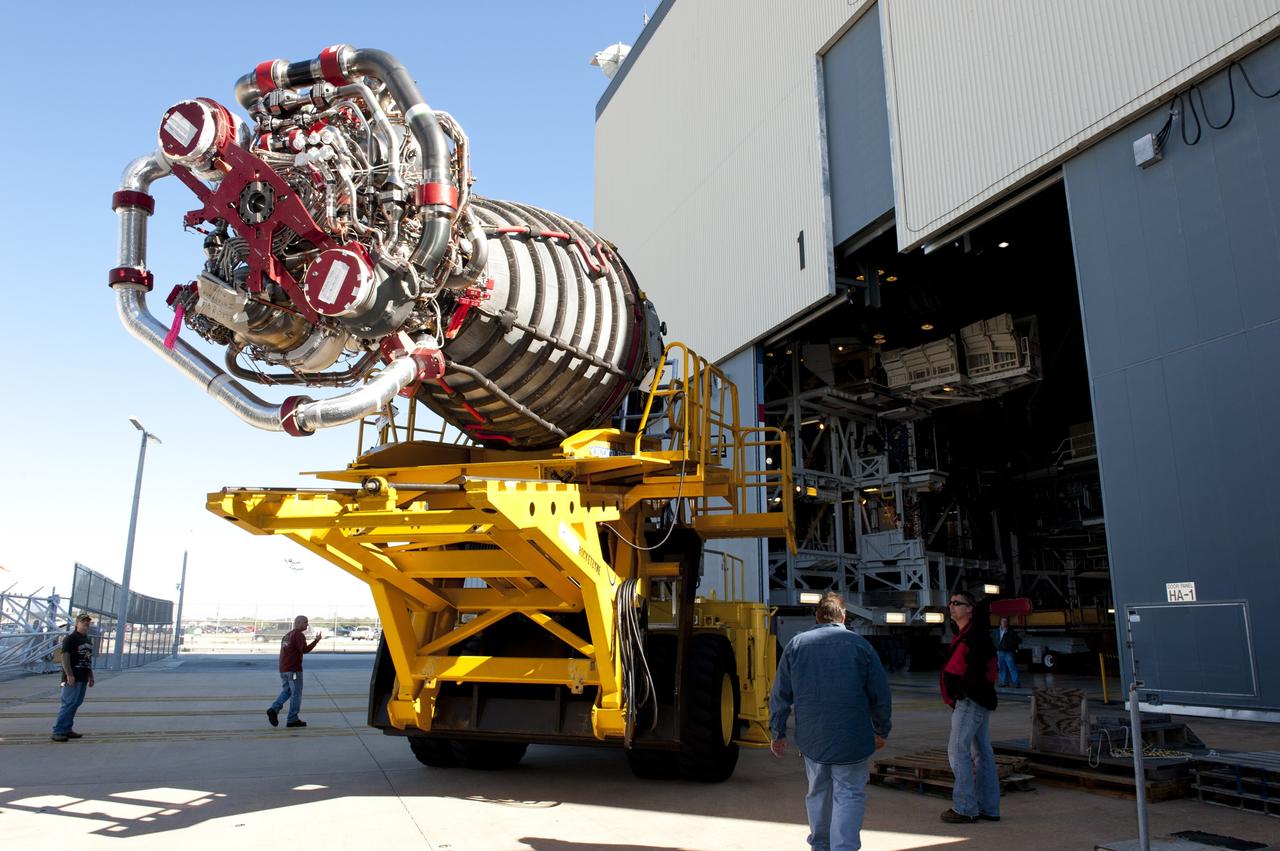
CAPE CANAVERAL, Fla. -- A Hyster forklift transports the second of shuttle Atlantis' three main engines from the Space Shuttle Main Engine (SSME) Shop to Orbiter Processing Facility-1 at NASA's Kennedy Space Center in Florida. Once inside the processing facility, the engine will be installed in the shuttle. Each engine is 14 feet long, weighs about 6,700 pounds, and is 7.5 feet in diameter at the end of the nozzle. This is the final planned engine installation for the Space Shuttle Program. Atlantis is being prepared for the "launch on need," or potential rescue mission, for the final planned shuttle flight, Endeavour's STS-134 mission. For more information, visit www.nasa.gov/shuttle. Photo credit: NASA/Kim Shiflett
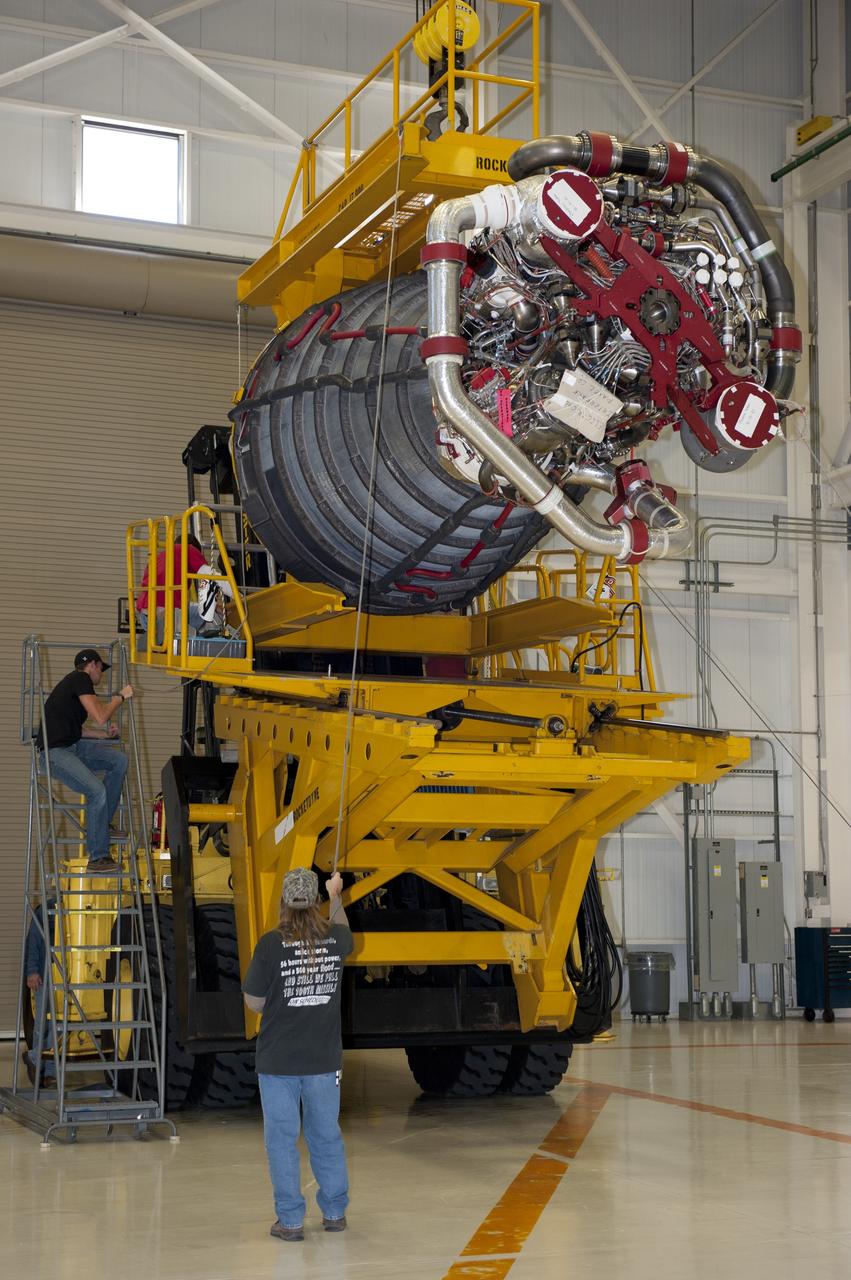
CAPE CANAVERAL, Fla. -- Workers in the Space Shuttle Main Engine (SSME) Shop at NASA's Kennedy Space Center in Florida attached the second of shuttle Atlantis' three main engines to a Hyster forklift. Next, the engine will be transported to Orbiter Processing Facility-1 where it will be installed in the shuttle. Each engine is 14 feet long, weighs about 6,700 pounds, and is 7.5 feet in diameter at the end of the nozzle. This is the final planned engine installation for the Space Shuttle Program. Atlantis is being prepared for the "launch on need," or potential rescue mission, for the final planned shuttle flight, Endeavour's STS-134 mission. For more information, visit www.nasa.gov/shuttle. Photo credit: NASA/Kim Shiflett
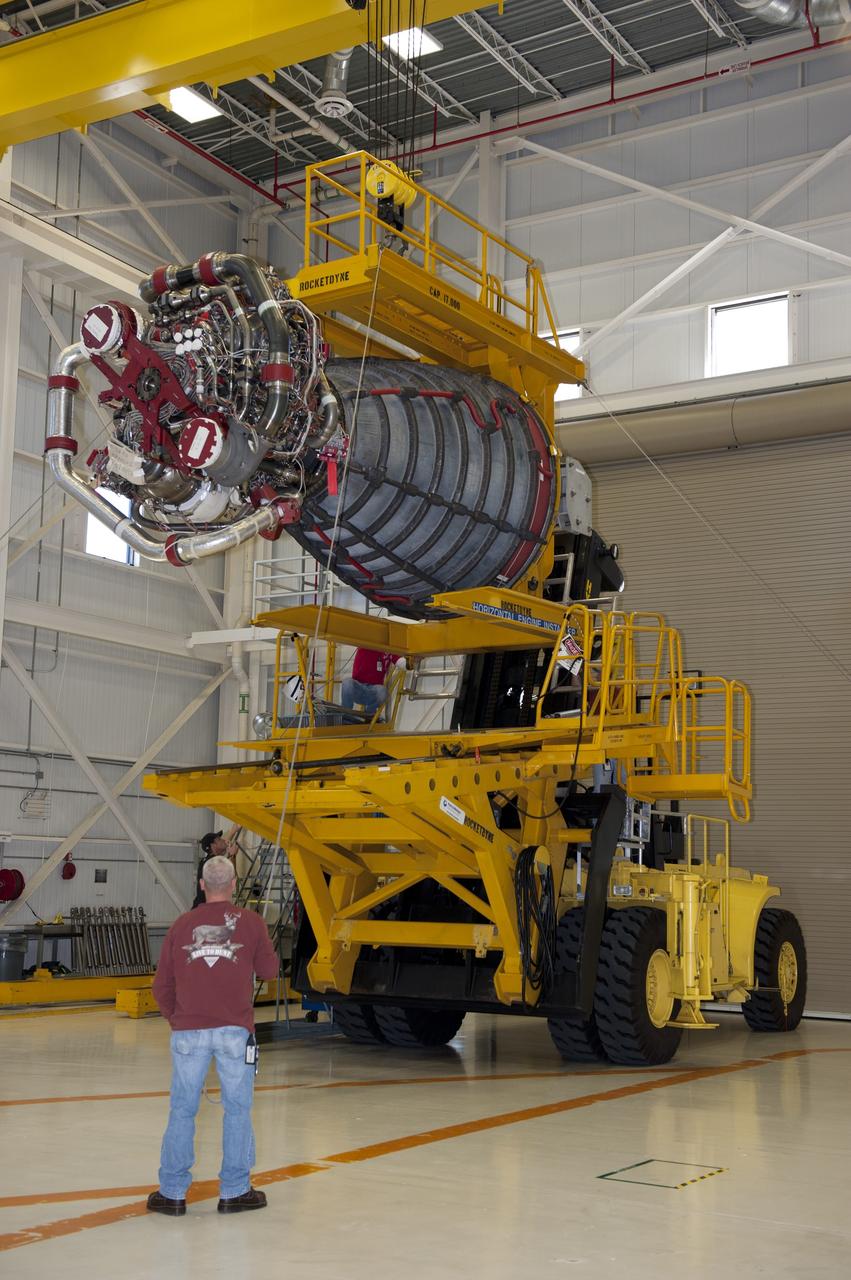
CAPE CANAVERAL, Fla. -- Workers in the Space Shuttle Main Engine (SSME) Shop at NASA's Kennedy Space Center in Florida attached the second of shuttle Atlantis' three main engines to a Hyster forklift. Next, the engine will be transported to Orbiter Processing Facility-1 where it will be installed in the shuttle. Each engine is 14 feet long, weighs about 6,700 pounds, and is 7.5 feet in diameter at the end of the nozzle. This is the final planned engine installation for the Space Shuttle Program. Atlantis is being prepared for the "launch on need," or potential rescue mission, for the final planned shuttle flight, Endeavour's STS-134 mission. For more information, visit www.nasa.gov/shuttle. Photo credit: NASA/Kim Shiflett
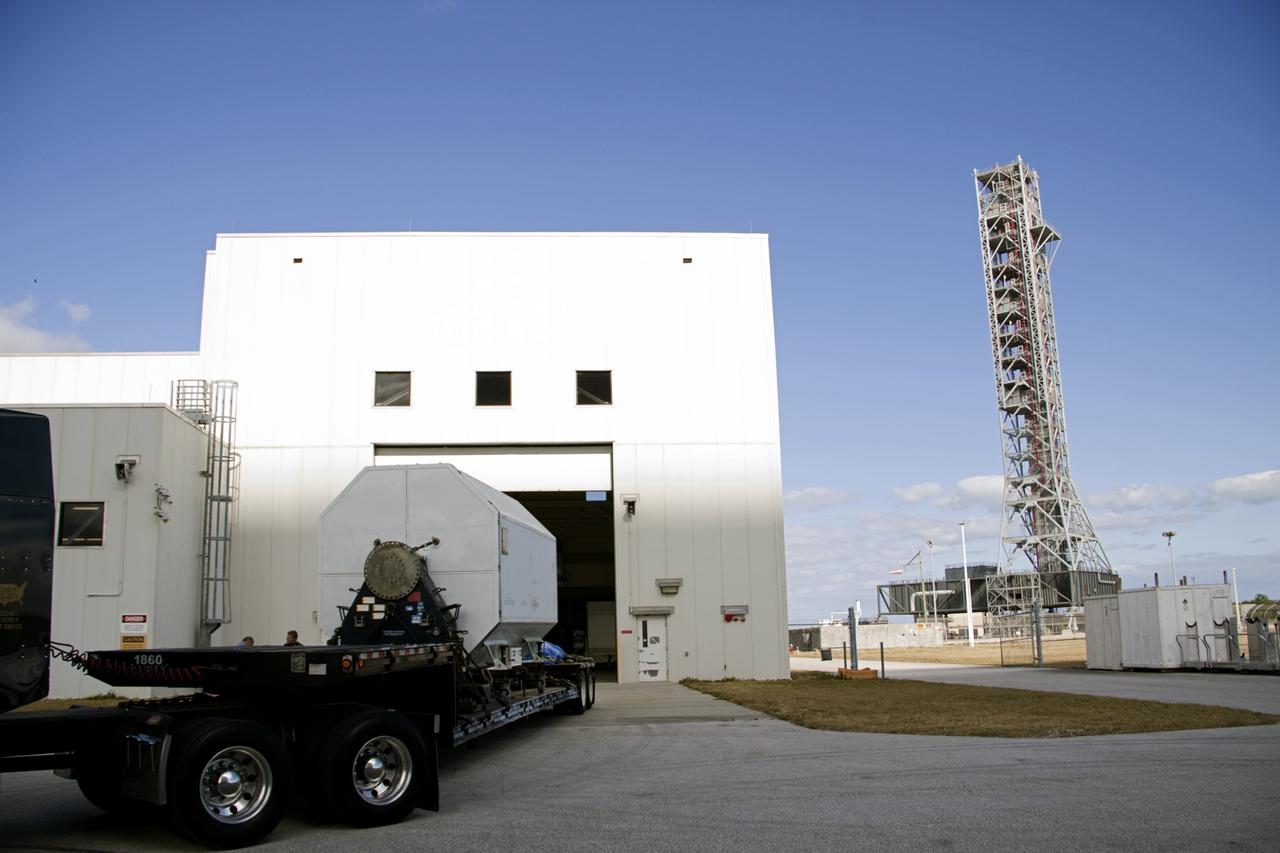
CAPE CANAVERAL, Fla. – At NASA’s Kennedy Space Center in Florida, a flatbed truck prepares to depart from the Space Shuttle Main Engine Processing Facility carrying a transportation canister containing a Pratt & Whitney Rocketdyne space shuttle main engine (SSME). A right is NASA's new mobile launcher. This is the second of the 15 engines used during the Space Shuttle Program to be transported to NASA's Stennis Space Center in Mississippi. The engines will be stored at Stennis for future use on NASA's new heavy-lift rocket, the Space Launch System (SLS), which will carry NASA's new Orion spacecraft, cargo, equipment and science experiments to space. For more information, visit http://www.nasa.gov/shuttle. Photo credit: NASA/Jim Grossmann

CAPE CANAVERAL, Fla. – At NASA’s Kennedy Space Center in Florida, a flatbed truck prepares to depart from the Space Shuttle Main Engine Processing Facility carrying a transportation canister containing a Pratt & Whitney Rocketdyne space shuttle main engine (SSME). In the background is the Vehicle Assembly Building (VAB). This is the second of the 15 engines used during the Space Shuttle Program to be transported to NASA's Stennis Space Center in Mississippi. The engines will be stored at Stennis for future use on NASA's new heavy-lift rocket, the Space Launch System (SLS), which will carry NASA's new Orion spacecraft, cargo, equipment and science experiments to space. For more information, visit http://www.nasa.gov/shuttle. Photo credit: NASA/Jim Grossmann

CAPE CANAVERAL, Fla. -- A Hyster forklift transporting engine #2, the last of shuttle Atlantis' three main engines from the Space Shuttle Main Engine (SSME) Shop, enters Orbiter Processing Facility-1 at NASA's Kennedy Space Center in Florida. Inside the processing facility, the engine will be installed in the shuttle. Each engine is 14 feet long, weighs about 6,700 pounds, and is 7.5 feet in diameter at the end of the nozzle. This is the final planned engine installation for the Space Shuttle Program. Atlantis is being prepared for the "launch on need," or potential rescue mission, for the final planned shuttle flight, Endeavour's STS-134 mission. For more information, visit www.nasa.gov/shuttle. Photo credit: NASA/Kim Shiflett
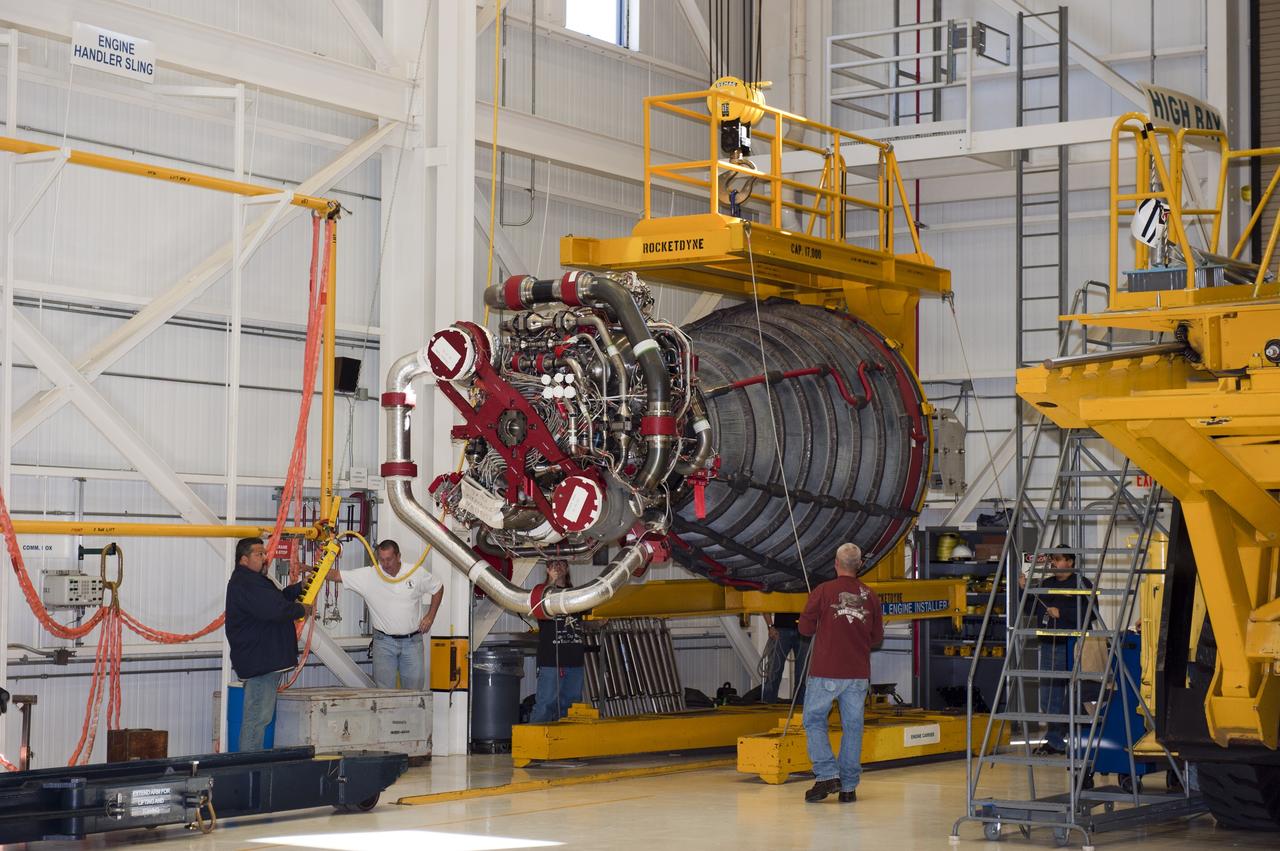
CAPE CANAVERAL, Fla. -- Workers in the Space Shuttle Main Engine (SSME) Shop at NASA's Kennedy Space Center in Florida get ready to raise the second of shuttle Atlantis' three main engines so it can be attached to a Hyster forklift. Then, the engine will be transported to Orbiter Processing Facility-1 where it will be installed in the shuttle. Each engine is 14 feet long, weighs about 6,700 pounds, and is 7.5 feet in diameter at the end of the nozzle. This is the final planned engine installation for the Space Shuttle Program. Atlantis is being prepared for the "launch on need," or potential rescue mission, for the final planned shuttle flight, Endeavour's STS-134 mission. For more information, visit www.nasa.gov/shuttle. Photo credit: NASA/Kim Shiflett
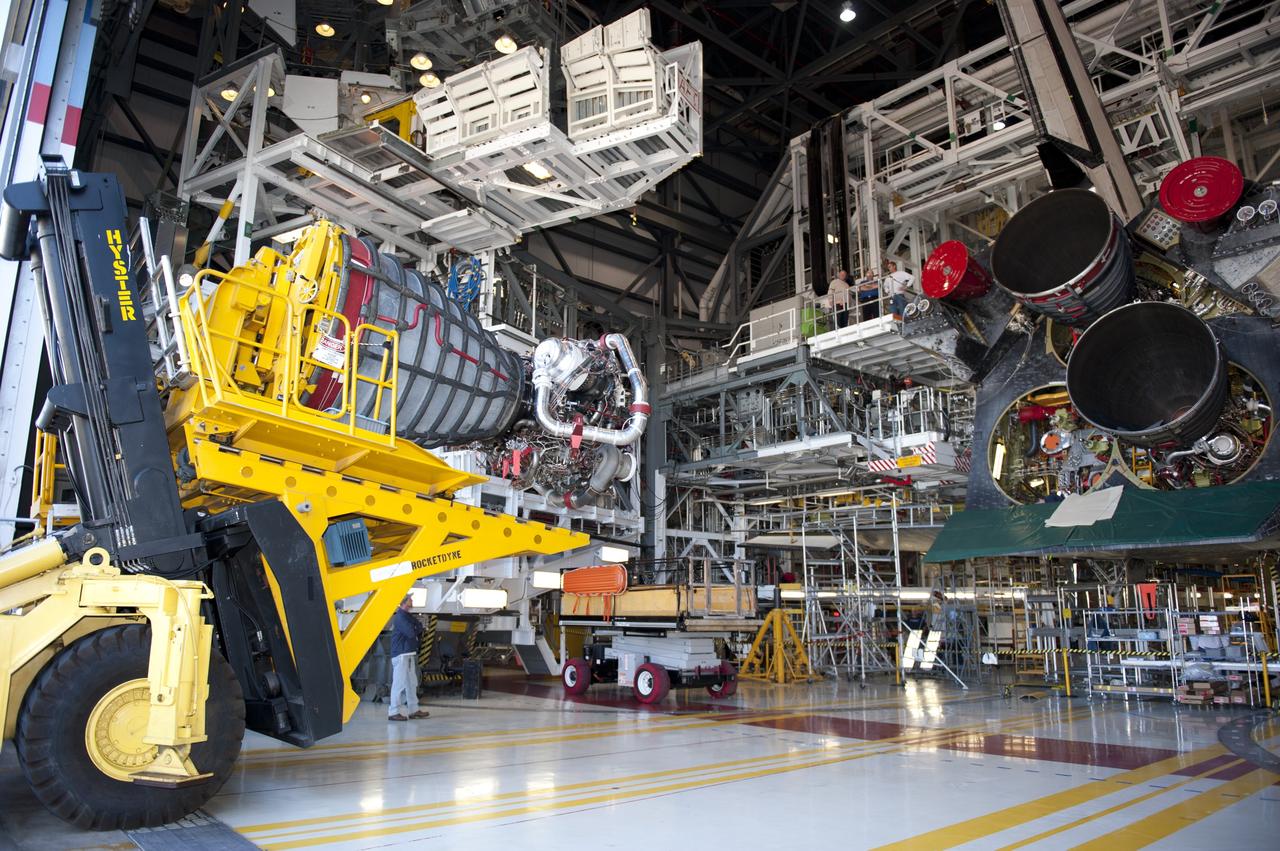
CAPE CANAVERAL, Fla. -- A Hyster forklift transporting engine #2, the last of shuttle Atlantis' three main engines from the Space Shuttle Main Engine (SSME) Shop, enters Orbiter Processing Facility-1 at NASA's Kennedy Space Center in Florida. Inside the processing facility, the engine will be installed in the shuttle. Each engine is 14 feet long, weighs about 6,700 pounds, and is 7.5 feet in diameter at the end of the nozzle. This is the final planned engine installation for the Space Shuttle Program. Atlantis is being prepared for the "launch on need," or potential rescue mission, for the final planned shuttle flight, Endeavour's STS-134 mission. For more information, visit www.nasa.gov/shuttle. Photo credit: NASA/Kim Shiflett
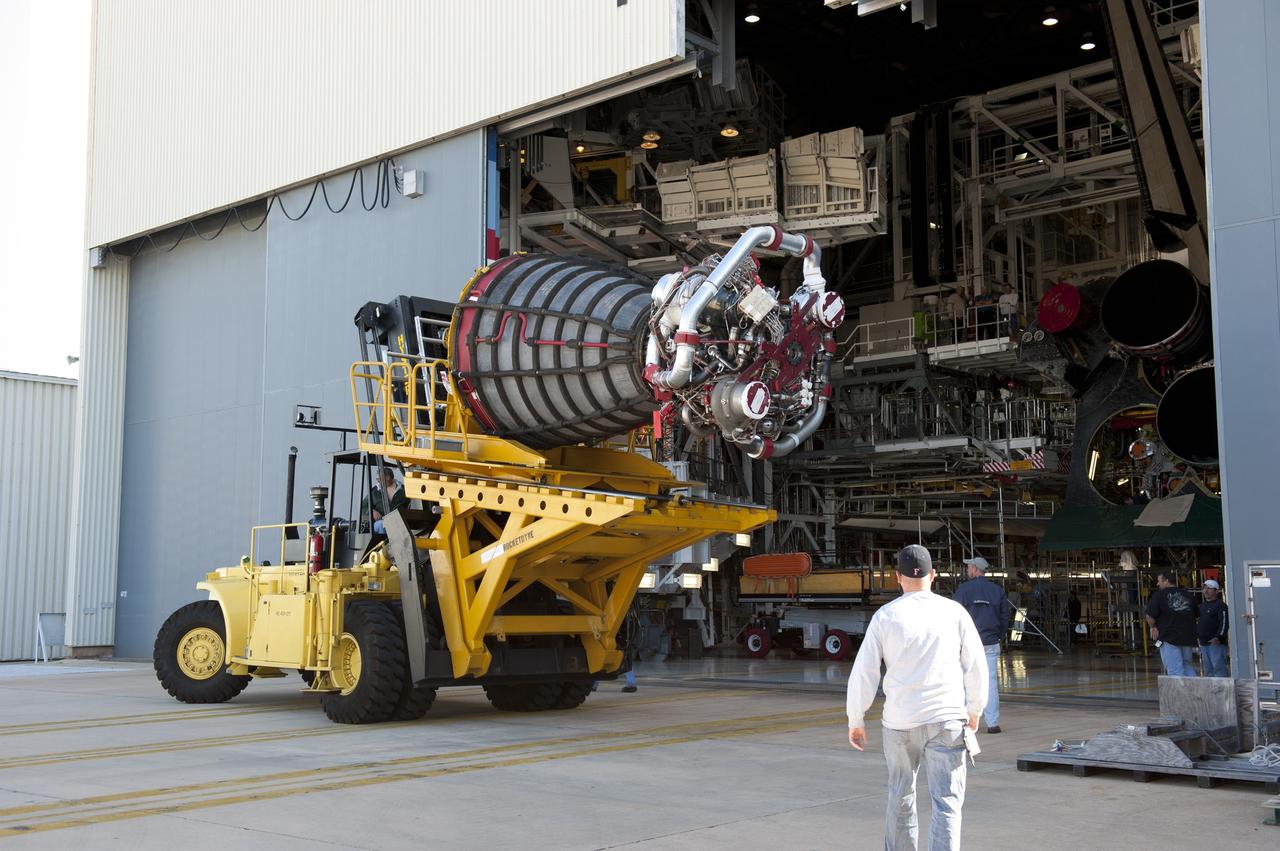
CAPE CANAVERAL, Fla. -- A Hyster forklift transporting engine #2, the last of shuttle Atlantis' three main engines from the Space Shuttle Main Engine (SSME) Shop, arrives at Orbiter Processing Facility-1 at NASA's Kennedy Space Center in Florida. Inside the processing facility, the engine will be installed in the shuttle. Each engine is 14 feet long, weighs about 6,700 pounds, and is 7.5 feet in diameter at the end of the nozzle. This is the final planned engine installation for the Space Shuttle Program. Atlantis is being prepared for the "launch on need," or potential rescue mission, for the final planned shuttle flight, Endeavour's STS-134 mission. For more information, visit www.nasa.gov/shuttle. Photo credit: NASA/Kim Shiflett
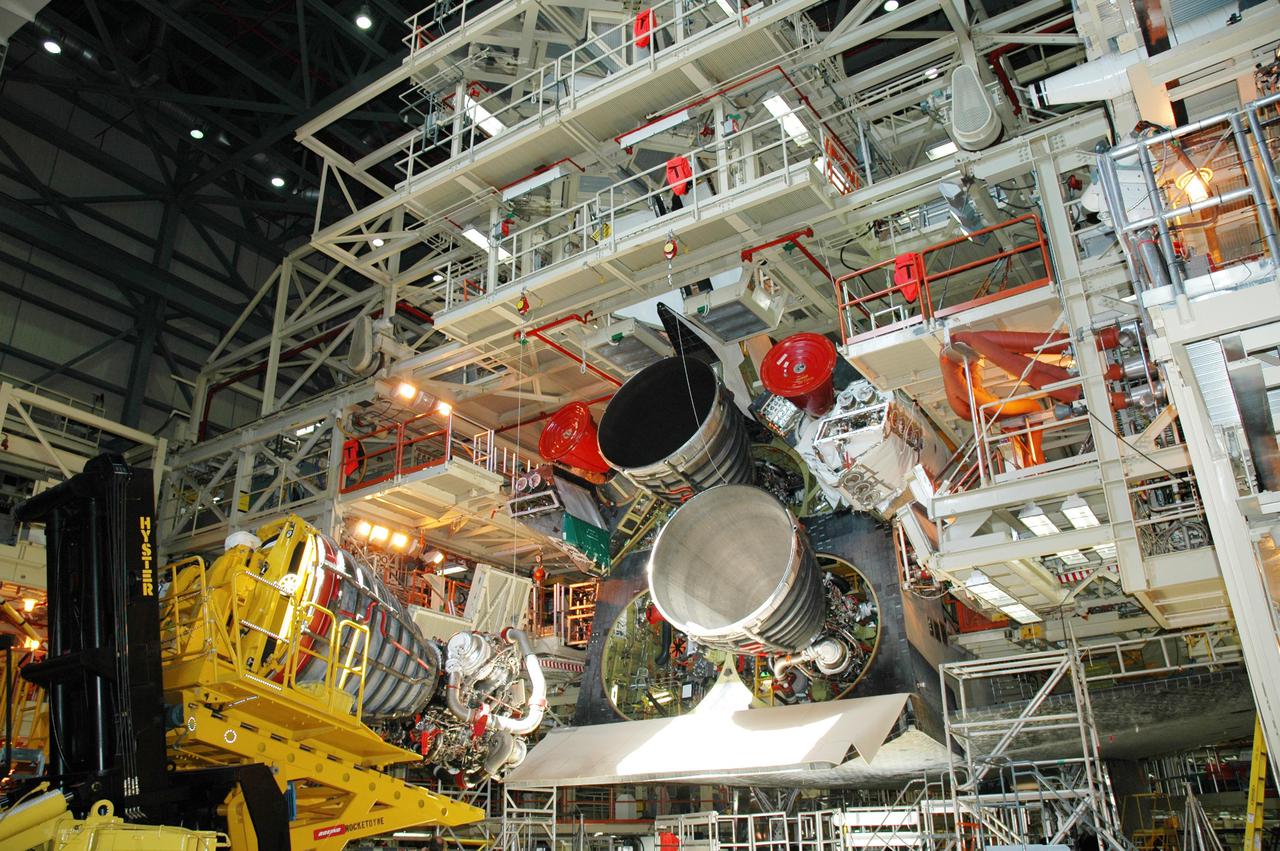
KENNEDY SPACE CENTER, FLA. - The third Space Shuttle Main Engine (SSME) arrives in the Orbiter Processing Facility for installation on Discovery. Discovery is designated as the Return to Flight vehicle for mission STS-114. Recent improvements to the SSME include the introduction of redesigned high-pressure turbopumps into the SSME fleet. The new pumps are designed and built by Pratt and Whitney at West Palm Beach, Fla. SSMEs and the Pratt and Whitney turbopumps are tested at Stennis Space Center in Mississippi. Engines and engine components are delivered to Kennedy Space Center to be prepared for flight.
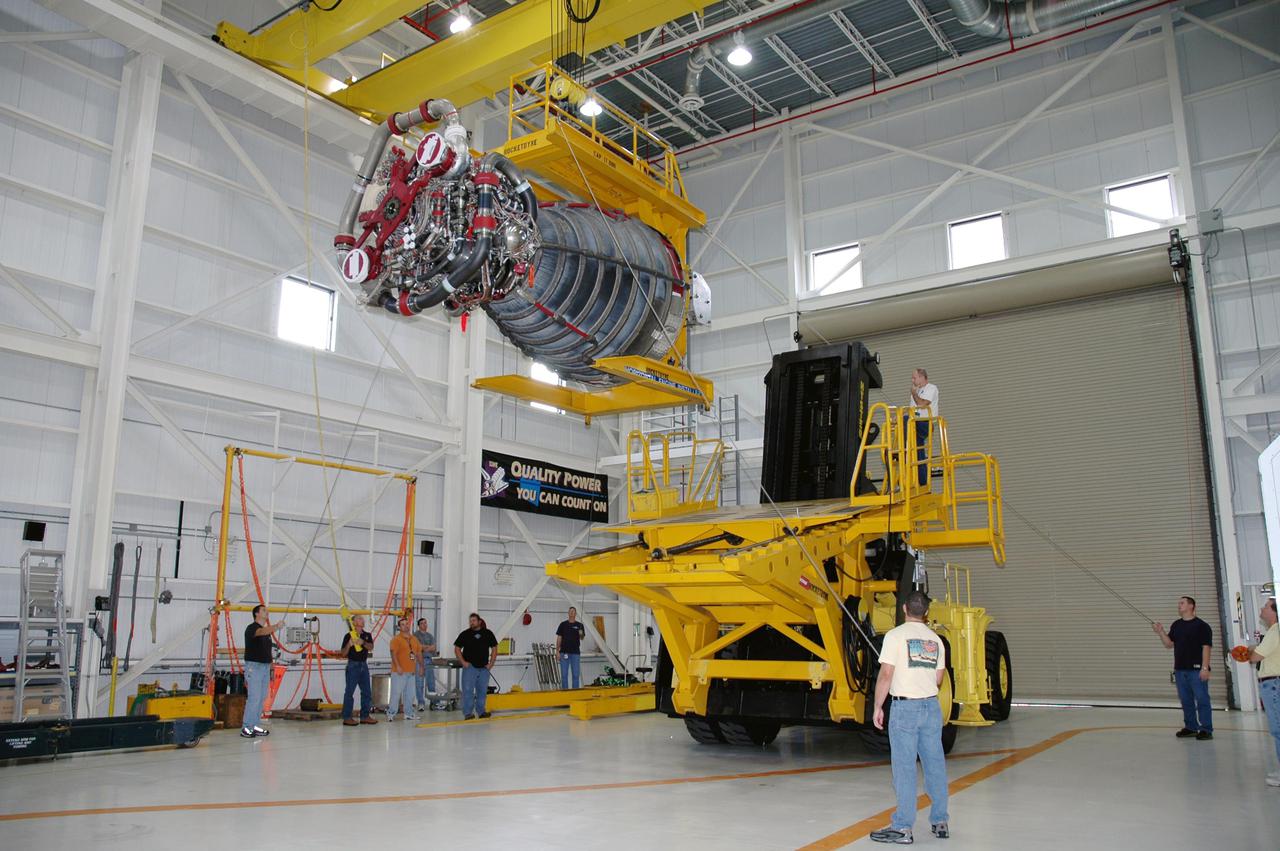
KENNEDY SPACE CENTER, FLA. - In the Space Shuttle Main Engine (SSME) Shop, the SSME is lifted and moved toward the Hyster lift that will transport it to the Orbiter Processing Facility. There it will be installed in the orbiter Discovery for Return to Flight mission STS-114. This is the third SSME to be installed in Discovery. Overall, an SSME weighs approximately 7,000 pounds. An SSME operates at greater temperature extremes than any mechanical system in common use today. The liquid hydrogen fuel is -423 degrees Fahrenheit, the second coldest liquid on Earth. When the hydrogen is burned with liquid oxygen, the temperature in the engine's combustion chamber reaches +6000 degrees Fahrenheit -- higher than the boiling point of iron. Each SSME is controlled by its own computer, which checks the health of the engines 50 times per second during countdown and ascent. The controller can shut an engine down if it detects a problem.
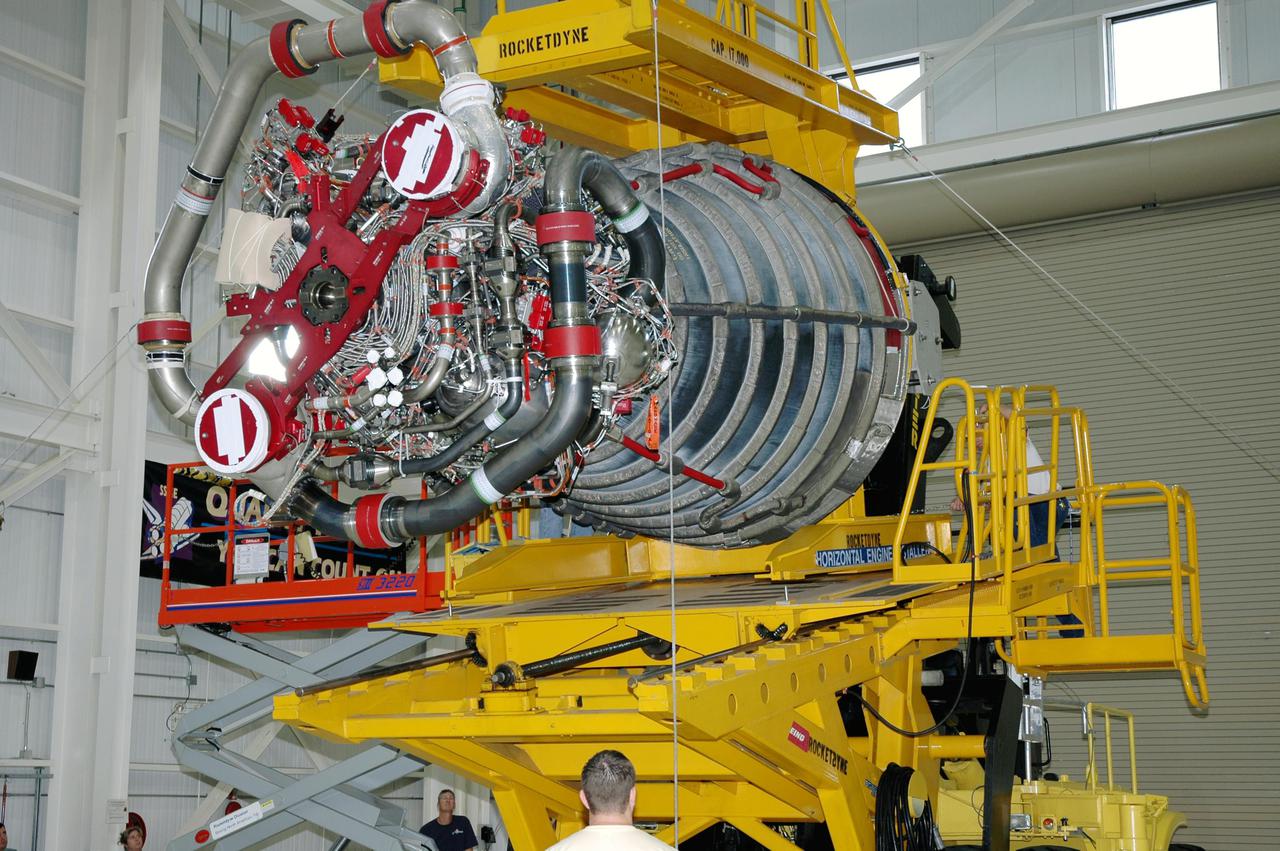
KENNEDY SPACE CENTER, FLA. - In the Space Shuttle Main Engine (SSME) Shop, the SSME is lowered onto the Hyster lift for transport to the Orbiter Processing Facility. There it will be installed in the orbiter Discovery for Return to Flight mission STS-114. This is the third SSME to be installed in Discovery. Overall, an SSME weighs approximately 7,000 pounds. An SSME operates at greater temperature extremes than any mechanical system in common use today. The liquid hydrogen fuel is -423 degrees Fahrenheit, the second coldest liquid on Earth. When the hydrogen is burned with liquid oxygen, the temperature in the engine's combustion chamber reaches +6000 degrees Fahrenheit -- higher than the boiling point of iron. Each SSME is controlled by its own computer, which checks the health of the engines 50 times per second during countdown and ascent. The controller can shut an engine down if it detects a problem.
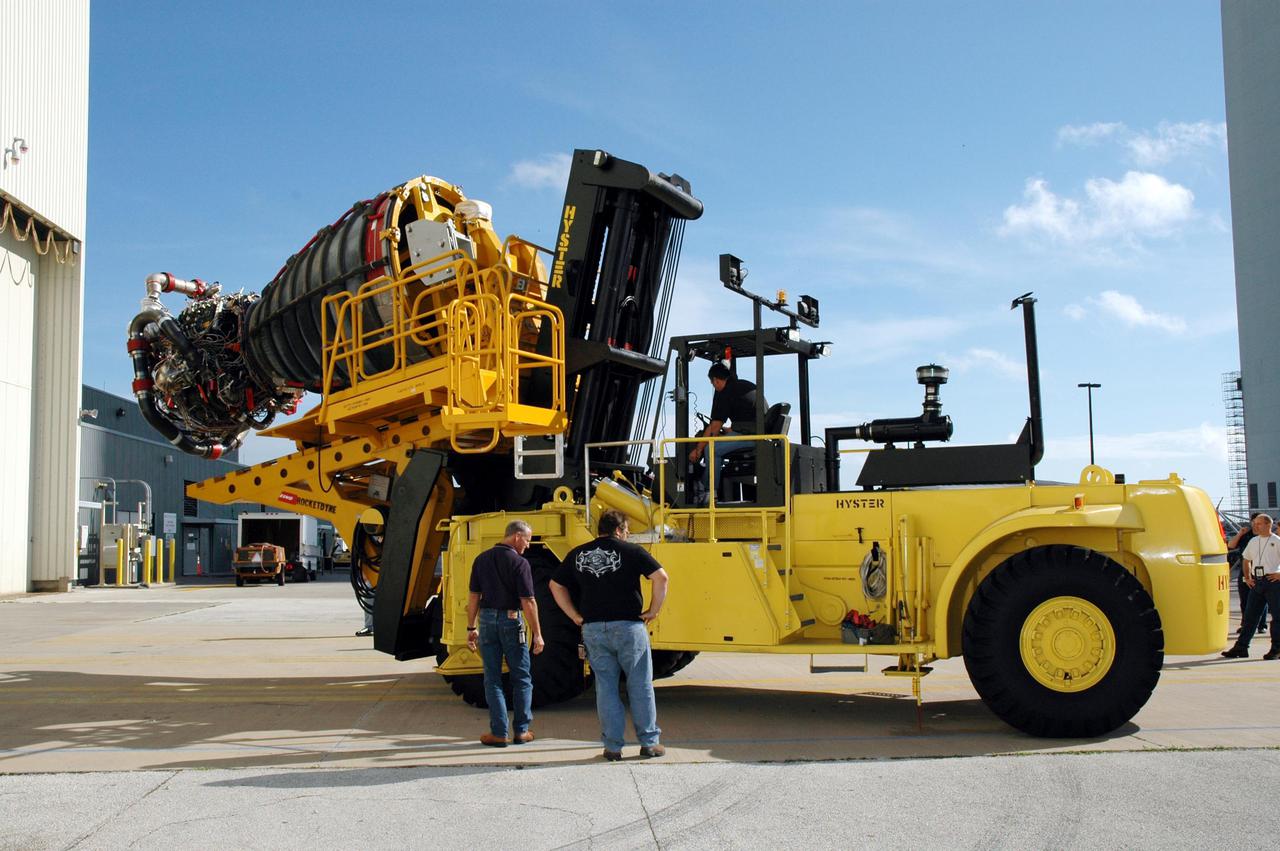
KENNEDY SPACE CENTER, FLA. - This Space Shuttle Main Engine (SSME) is slowly moved from the SSME Shop to the Orbiter Processing Facility where it will be installed in the orbiter Discovery for Return to Flight mission STS-114. This is the third SSME to be installed in Discovery. Overall, an SSME weighs approximately 7,000 pounds. An SSME operates at greater temperature extremes than any mechanical system in common use today. The liquid hydrogen fuel is -423 degrees Fahrenheit, the second coldest liquid on Earth. When the hydrogen is burned with liquid oxygen, the temperature in the engine's combustion chamber reaches +6000 degrees Fahrenheit -- higher than the boiling point of iron. Each SSME is controlled by its own computer, which checks the health of the engines 50 times per second during countdown and ascent. The controller can shut an engine down if it detects a problem.