
S68-19459 (22 Jan. 1968) --- The Apollo 5 (LM-1/Saturn 204) unmanned space mission was launched from the Kennedy Space Center's Launch Complex 37 at 5:48:09 p.m. (EST), Jan. 22, 1968. The Lunar Module-1 payload was boosted into Earth orbit by a launch vehicle composed of a Saturn IB first stage and a Saturn S-IVB second stage. The Apollo lunar module's first flight test was called a complete success. Ascent and descent propulsion systems and the ability to abort a lunar landing and return to orbit were demonstrated.

S68-19460 (22 Jan. 1968) --- The Apollo 5 (LM-1/Saturn 204) unmanned space mission was launched from the Kennedy Space Center's Launch Complex 37 at 5:48:09 p.m. (EST), Jan. 22, 1968. The Lunar Module-1 payload was boosted into Earth orbit by a launch vehicle composed of a Saturn IB first stage and a Saturn S-IVB second stage. The Apollo lunar module's first flight test was called a complete success. Ascent and descent propulsion systems and the ability to abort a lunar landing and return to orbit were demonstrated.

S68-18733 (22 Jan. 1968) --- Dr. Robert R. Gilruth (right), MSC Director, sits with Dr. Christopher C. Kraft Jr., MSC director of flight operations, at his flight operations director console in the Mission Control Center, Building 30, during the Apollo 5 (LM-1/Saturn 204) unmanned space mission.
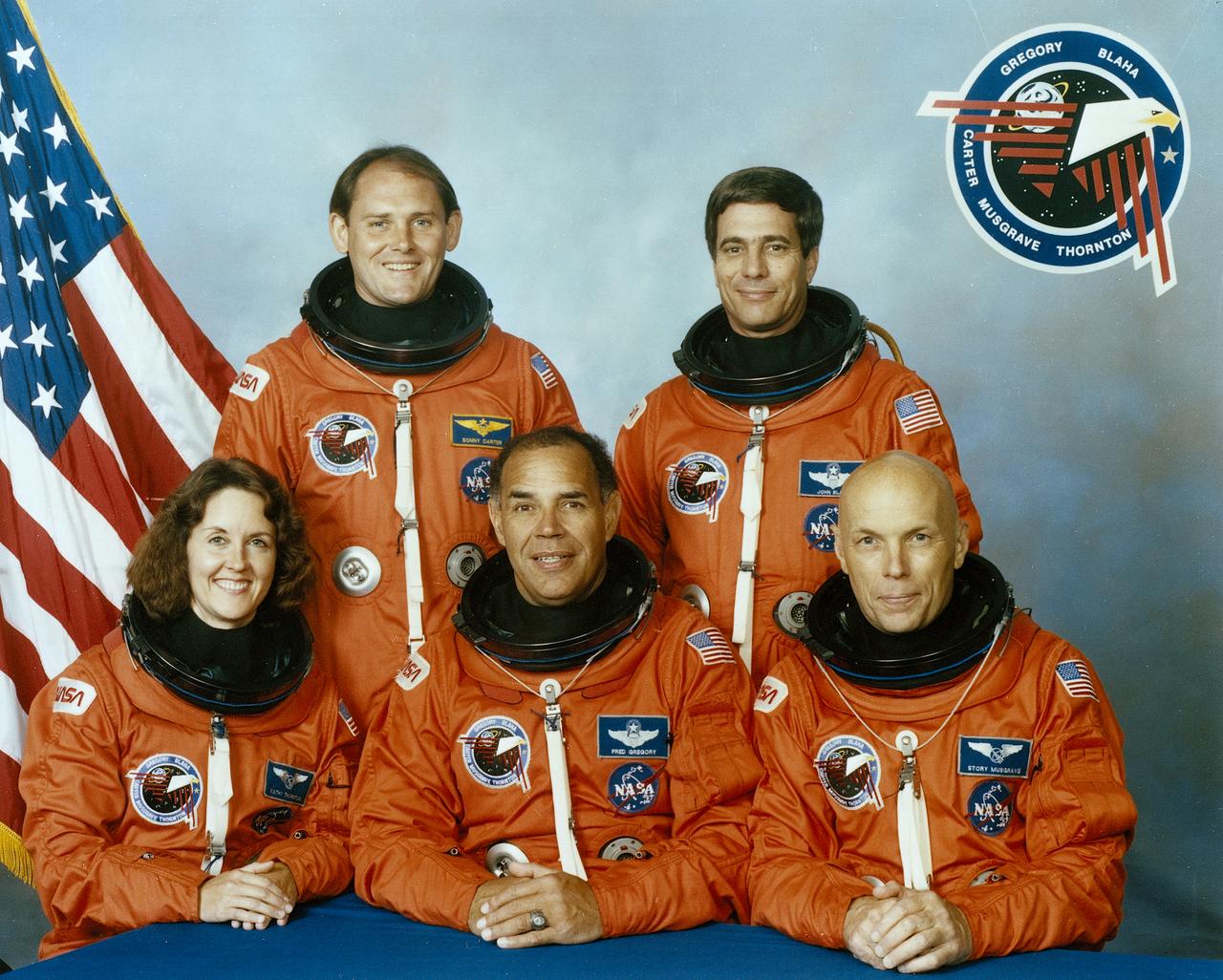
On November 22, 1989, at 7:23:30pm (EST), 5 astronauts were launched into space aboard the Space Shuttle Orbiter Discovery for the 5th Department of Defense mission, STS-33. Photographed from left to right are Kathryn C. Thornton, mission specialist 3; Manley L. (Sonny) Carter, mission specialist 2; Frederick D. Gregory, commander; John E. Blaha, pilot; and F. Story Musgrave, mission specialist 1.
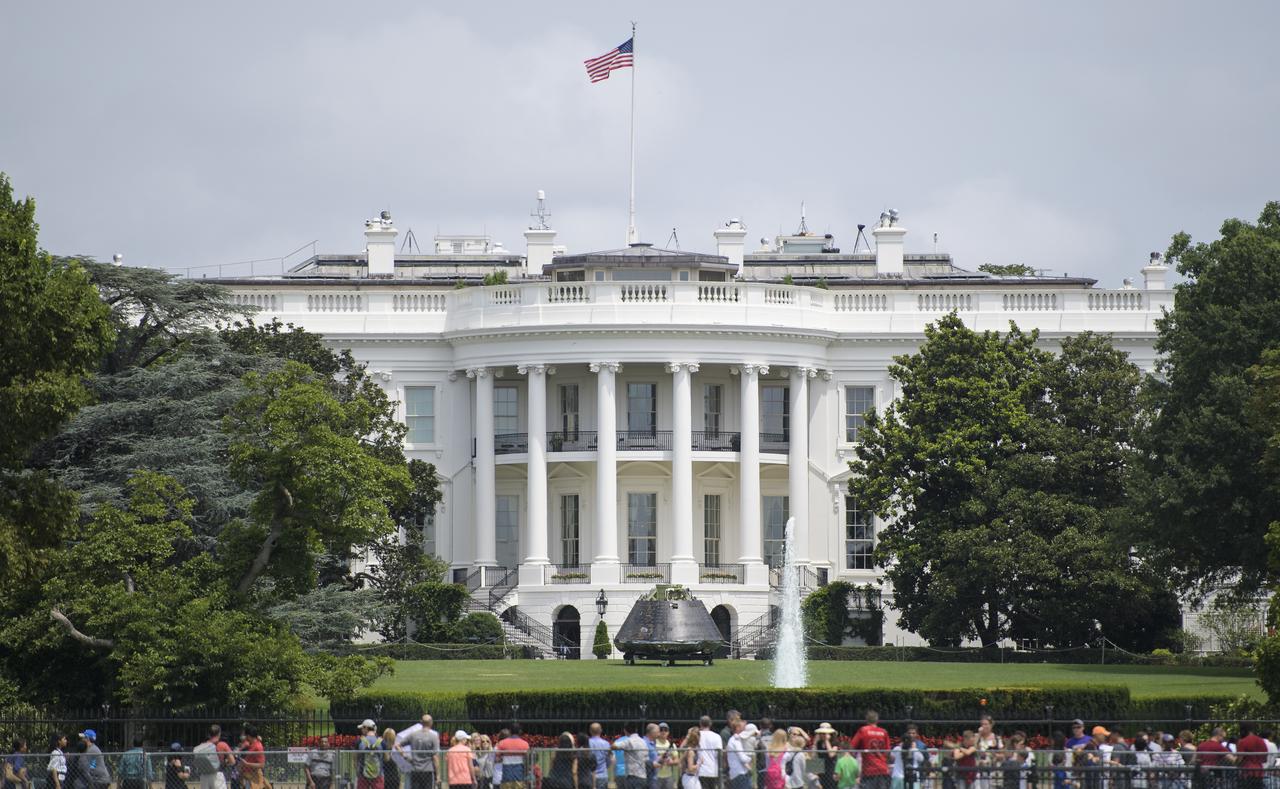
NASA's Orion spacecraft that flew Exploration Flight Test-1 on Dec. 5, 2014 is seen on the South Lawn of the White House, Sunday, July 22, 2018 in Washington, DC. Lockheed Martin, NASA’s prime contractor for Orion, began manufacturing the Orion crew module in 2011 and delivered it in July 2012 to NASA's Kennedy Space Center where final assembly, integration and testing was completed. More than 1,000 companies across the country manufactured or contributed elements to the spacecraft. Photo Credit: (NASA/Joel Kowsky)
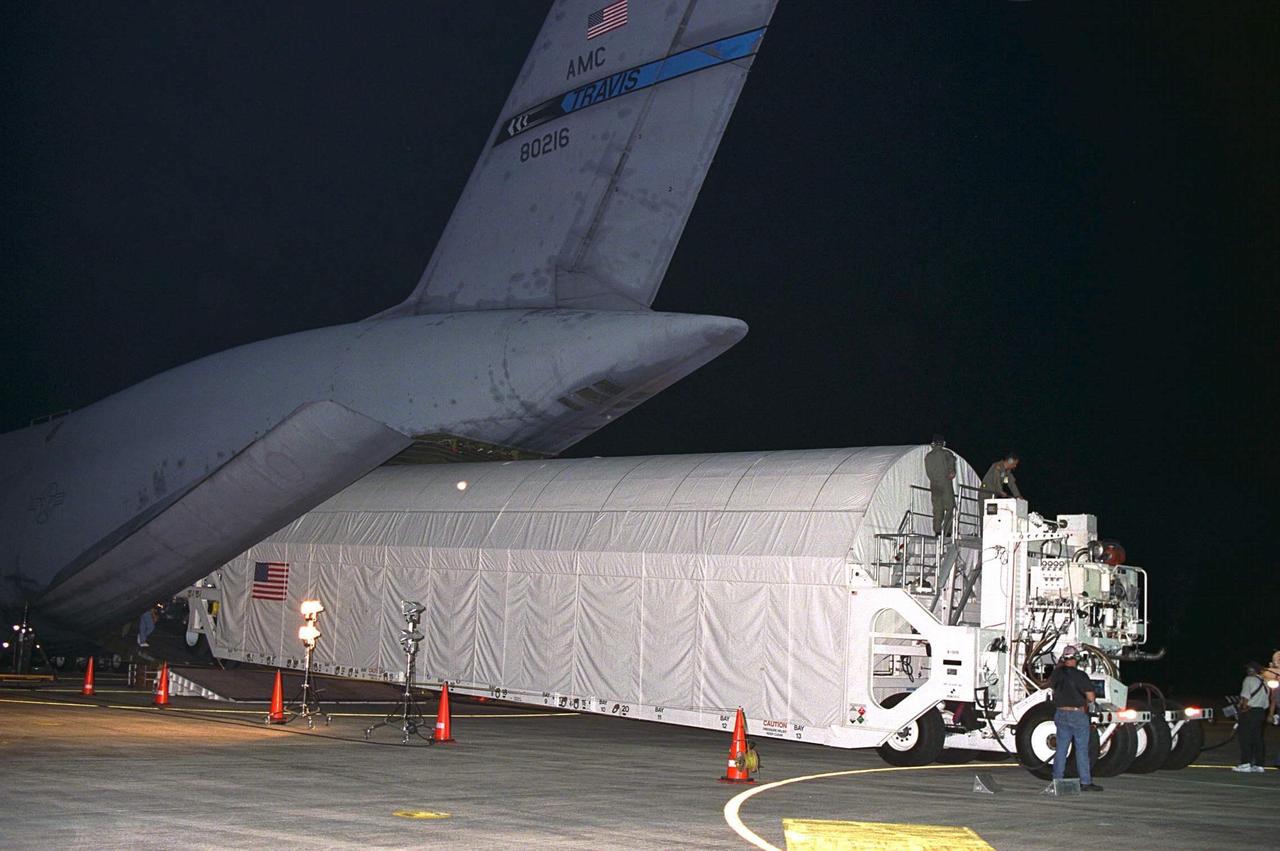
Node 1, the first element of the International Space Station to be manufactured in the United States and the first to be launched on the Space Shuttle, is unloaded in its container from an Air Force C-5 jet cargo transport at KSC’s Shuttle Landing Facility runway on June 23 after its arrival from NASA’s Marshall Space Flight Center (MSFC). The module was then transported to the Space Station Processing Facility. The Node 1 module is currently scheduled to lift off aboard the Space Shuttle Endeavour in July 1998 along with Pressurized Mating Adapters (PMAs) 1 and 2. The 18-foot in diameter, 22-foot-long aluminum module was manufactured by the Boeing Co. at MSFC. Once in space, the Node 1 will function as a connecting passageway to the living and working areas of the International Space Station. It has six hatches that will serve as docking ports to the U.S. laboratory module, U.S. habitation module, an airlock and other Space Station elements
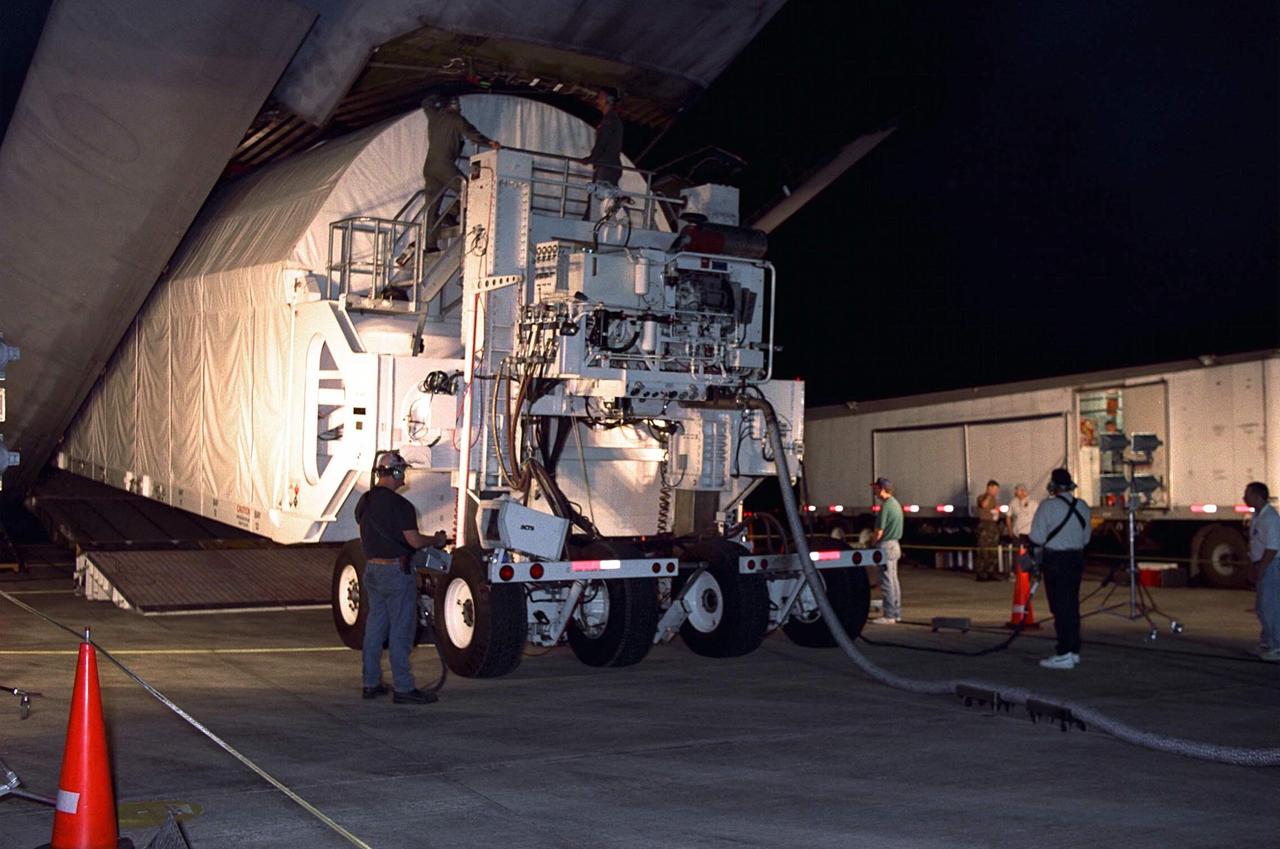
Node 1, the first element of the International Space Station to be manufactured in the United States and the first to be launched on the Space Shuttle, is unloaded in its container from an Air Force C-5 jet cargo transport at KSC’s Shuttle Landing Facility runway on June 23 after its arrival from NASA’s Marshall Space Flight Center (MSFC). The module was then transported to the Space Station Processing Facility. The Node 1 module is currently scheduled to lift off aboard the Space Shuttle Endeavour in July 1998 along with Pressurized Mating Adapters (PMAs) 1 and 2. The 18-foot-in-diameter, 22-foot-long aluminum module was manufactured by the Boeing Co. at MSFC. Once in space, the Node 1 will function as a connecting passageway to the living and working areas of the International Space Station. It has six hatches that will serve as docking ports to the U.S. laboratory module, U.S. habitation module, an airlock and other Space Station elements
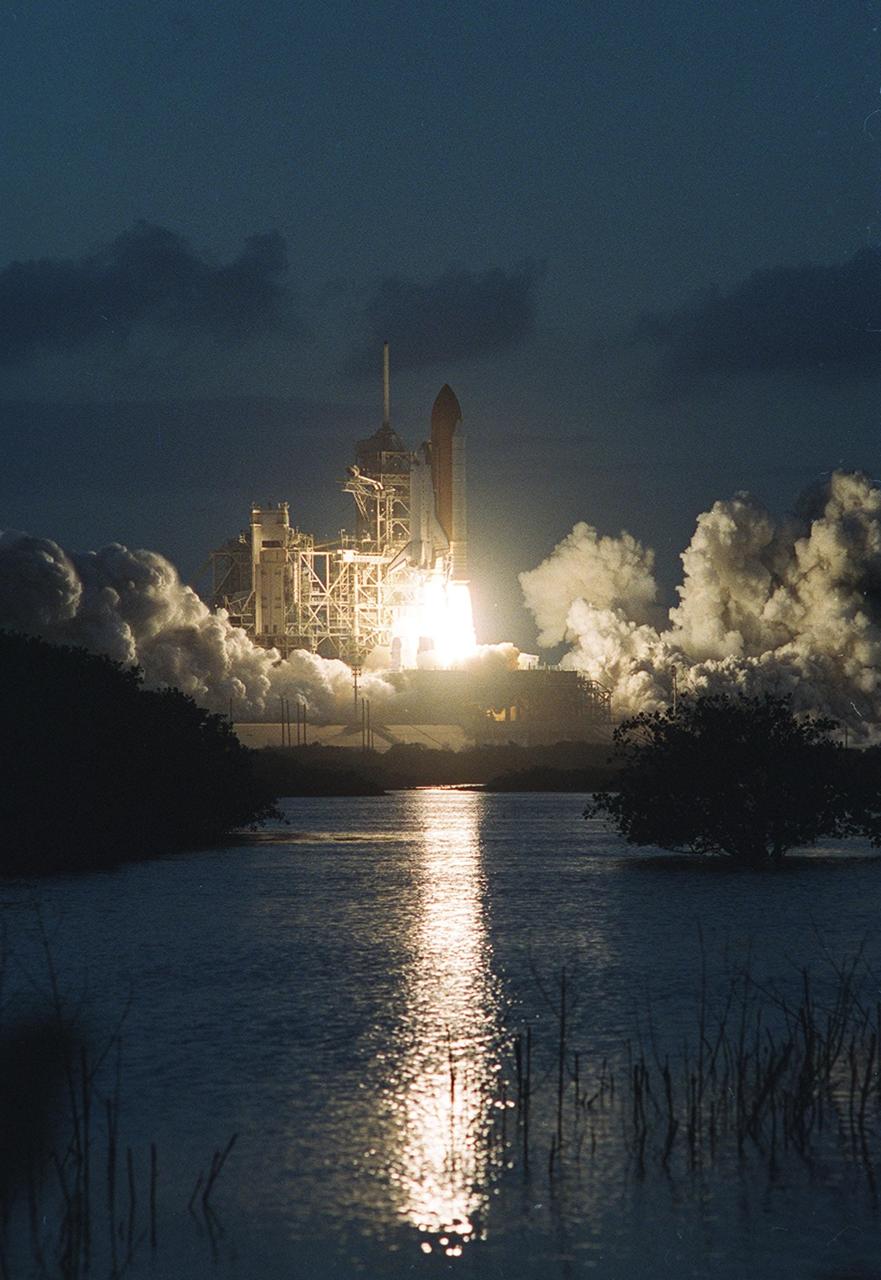
KENNEDY SPACE CENTER, Fla. - The reflection in water near Launch Pad 39B captures the brilliance of the flames trailing Space Shuttle Endeavour as it soars into the twilight sky on mission STS-108. Liftoff occurred at 5:19:28 p.m. EST (22:19 GMT) on this second launch attempt in two days. Endeavour will dock with the International Space Station on Dec. 7. STS-108 is the final Shuttle mission of 2001and the 107th Shuttle flight overall. It is the 12th flight to the Space Station. Landing of the orbiter at KSC's Shuttle Landing Facility is targeted for 1:05 p.m. EST (18:05 p.m. GMT) Dec. 16
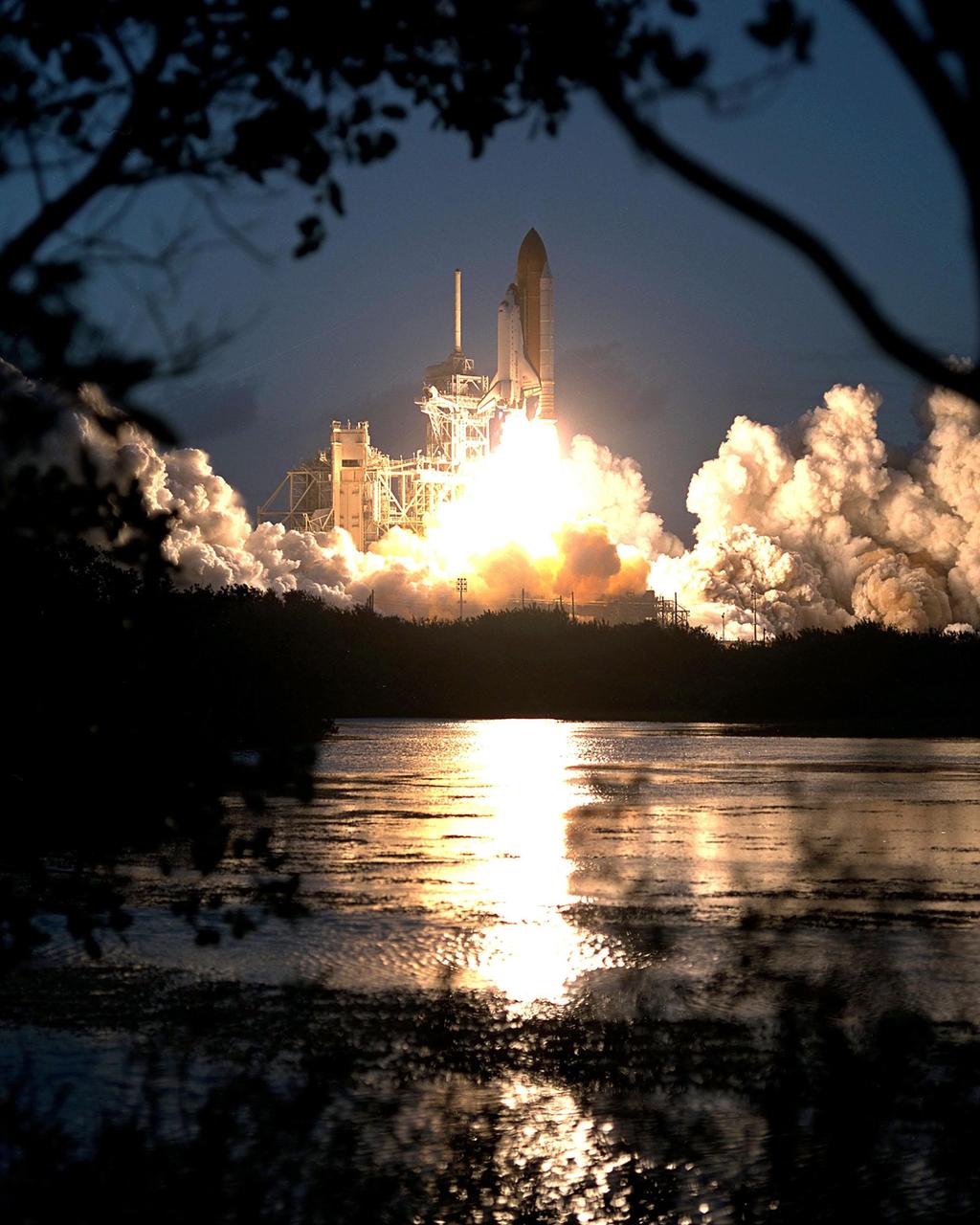
KENNEDY SPACE CENTER, Fla. -- Space Shuttle Endeavour soars into a twilight sky on mission STS-108, the second launch attempt over two days. Liftoff occurred at 5:19:28 p.m. EST (22:19.28 GMT). Endeavour will dock with the International Space Station on Dec. 7. STS-108 is the final Shuttle mission of 2001and the 107th Shuttle flight overall. It is the 12th flight to the Space Station. Landing of the orbiter at KSC's Shuttle Landing Facility is targeted for 1:05 p.m. EST (18:05 p.m. GMT) Dec. 16
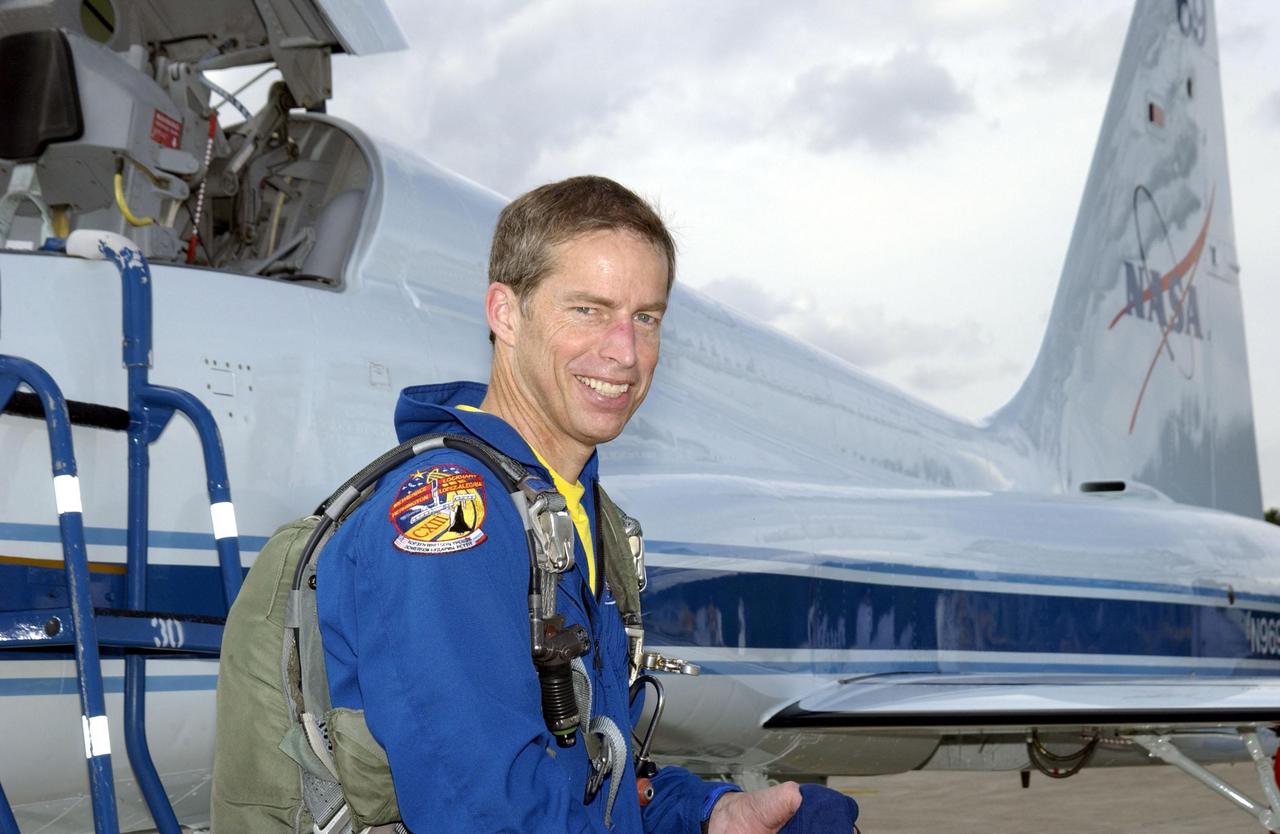
KENNEDY SPACE CENTER, FLA. -- STS-113 Commander James Wetherbee arrives at KSC's Shuttle Landing Facility to get ready for launch. STS-113 is the 16th American assembly flight to the International Space Station. The primary objective of the mission is bringing the Expedition 6 crew to the Station and returning the Expedition 5 crew to Earth. The major task of the mission is delivery of the Port 1 (P1) Integrated Truss Assembly, which will be attached to the port side of the S0 truss. Three spacewalks are planned to install and activate the truss and its associated equipment. Launch of Space Shuttle Endeavour on mission STS-113 is targeted for no earlier than Nov. 22 between 7 and 11 p.m. EST.
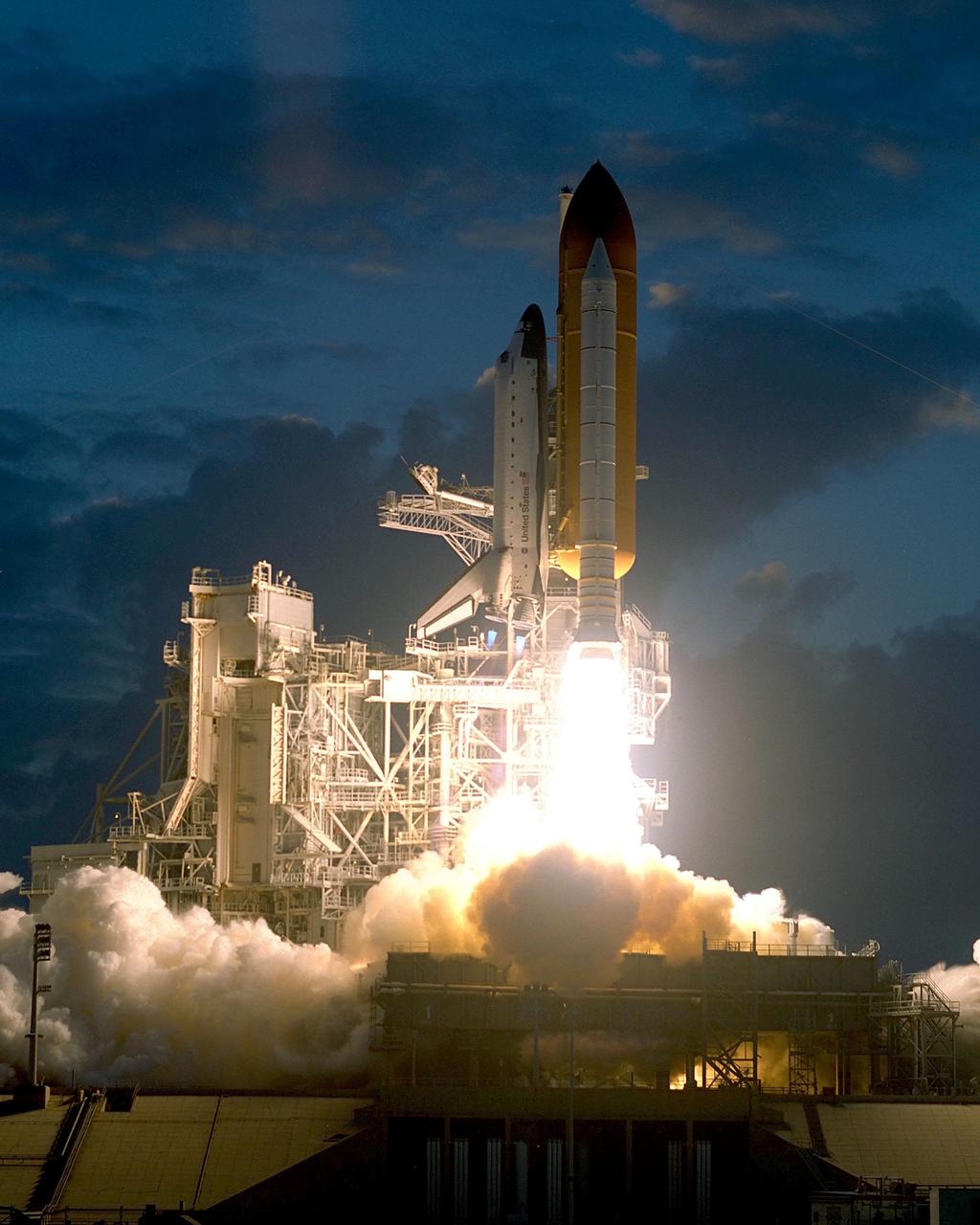
KENNEDY SPACE CENTER, Fla. -- Space Shuttle Endeavour soars into a twilight sky on mission STS-108, the second launch attempt over two days. Liftoff occurred at 5:19:28 p.m. EST (22:19.28 GMT). Endeavour will dock with the International Space Station on Dec. 7. STS-108 is the final Shuttle mission of 2001and the 107th Shuttle flight overall. It is the 12th flight to the Space Station. Landing of the orbiter at KSC's Shuttle Landing Facility is targeted for 1:05 p.m. EST (18:05 p.m. GMT) Dec. 16
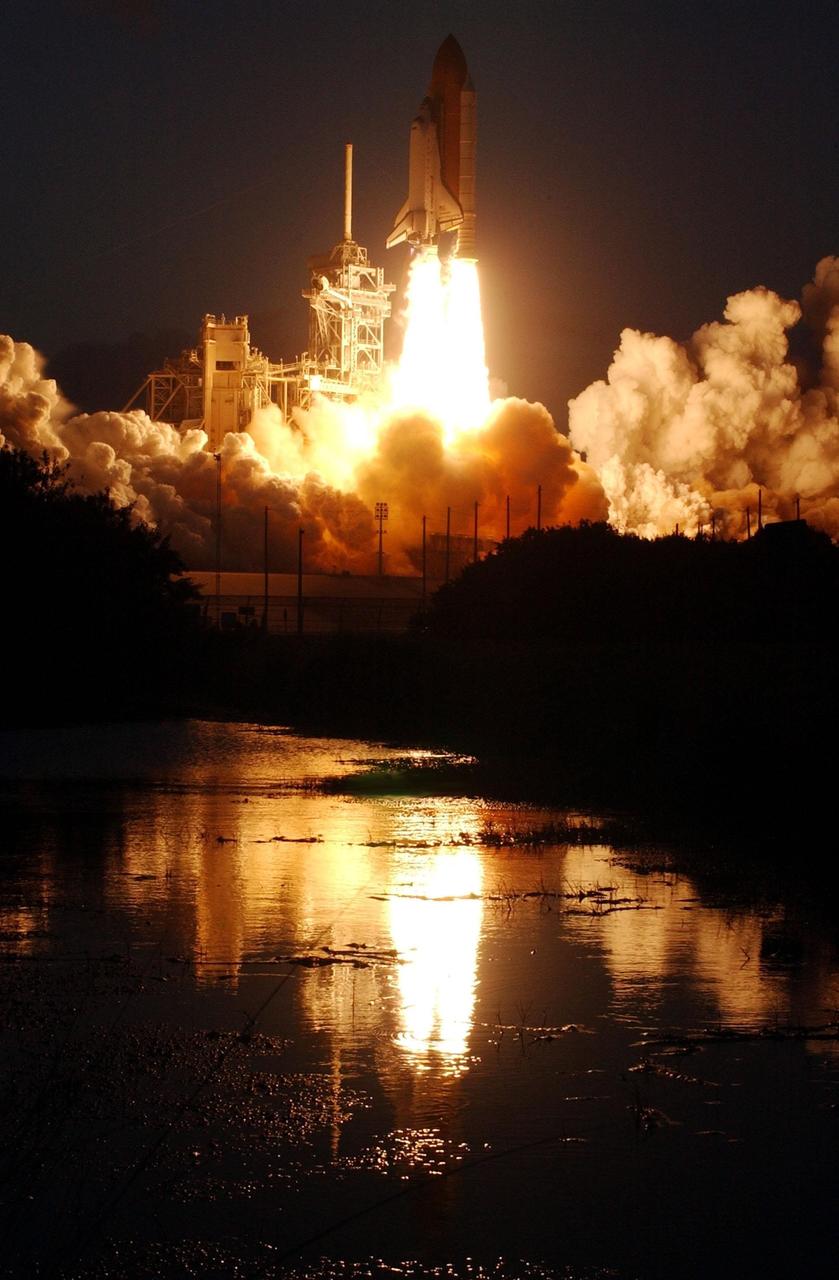
KENNEDY SPACE CENTER, Fla. -- A pool of water near Launch Pad 39B turns crimson from the reflection of flames at the launch of Space Shuttle Endeavour on mission STS-108. The second attempt in two days, liftoff occurred at 5:19:28 p.m. EST (22:19 GMT). Endeavour will dock with the International Space Station on Dec. 7. STS-108 is the final Shuttle mission of 2001and the 107th Shuttle flight overall. It is the 12th flight to the Space Station. Landing of the orbiter at KSC's Shuttle Landing Facility is targeted for 1:05 p.m. EST (18:05 p.m. GMT) Dec. 16
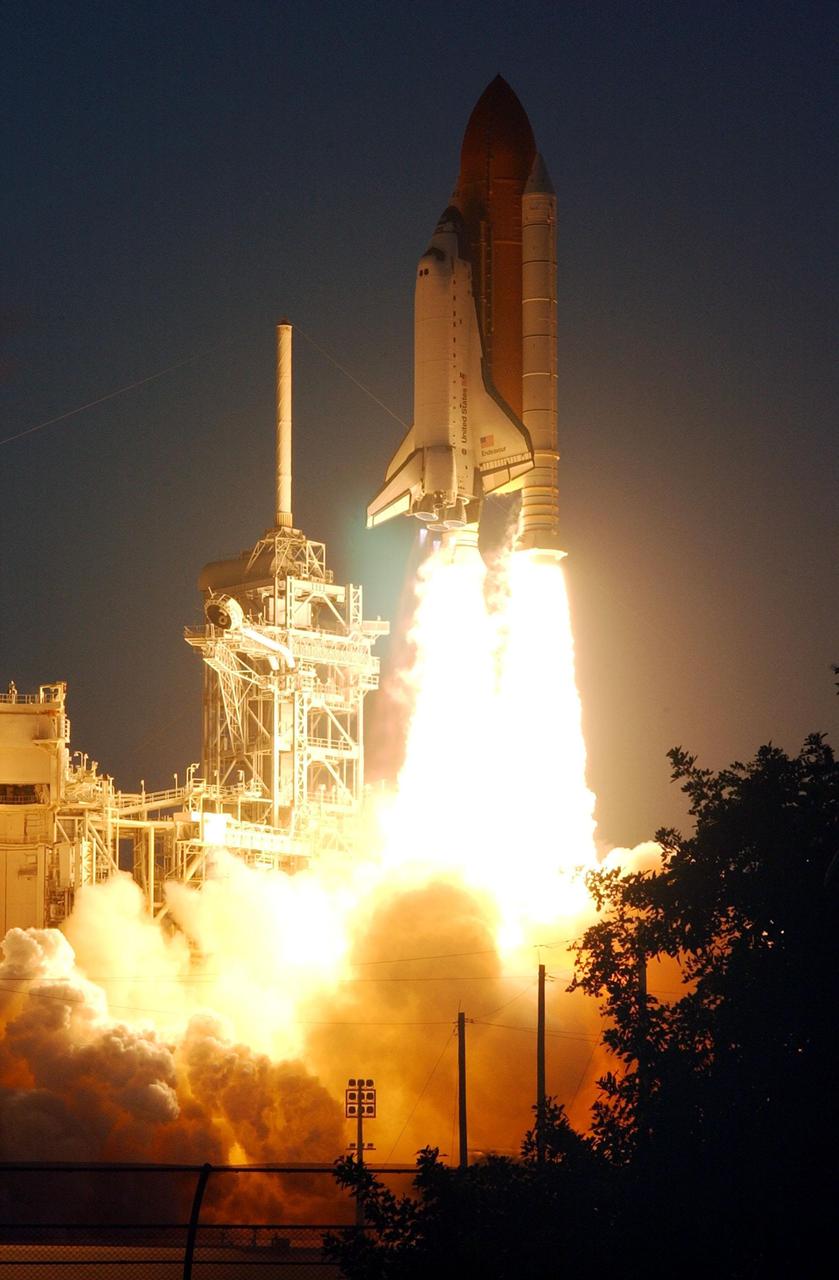
KENNEDY SPACE CENTER, Fla. -- Spewing flames and smoke, Space Shuttle Endeavour hurtles into the twilight sky on mission STS-108. The second attempt in two days, liftoff occurred at 5:19:28 p.m. EST (22:19 GMT). Endeavour will dock with the International Space Station on Dec. 7. STS-108 is the final Shuttle mission of 2001and the 107th Shuttle flight overall. It is the 12th flight to the Space Station. Landing of the orbiter at KSC's Shuttle Landing Facility is targeted for 1:05 p.m. EST (18:05 p.m. GMT) Dec. 16
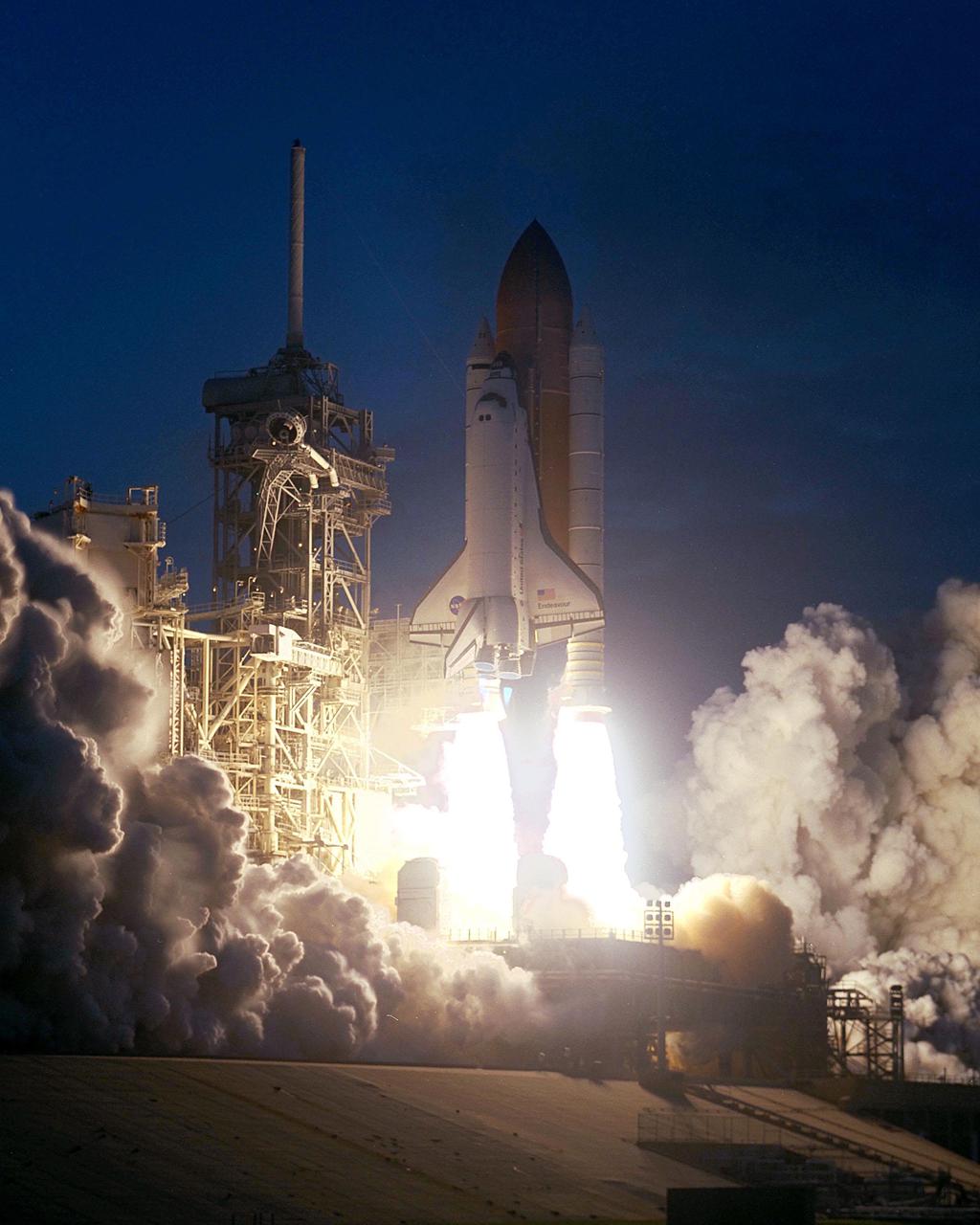
KENNEDY SPACE CENTER, Fla. -- Space Shuttle Endeavour soars into a twilight sky on mission STS-108, the second launch attempt over two days. Liftoff occurred at 5:19:28 p.m. EST (22:19.28 GMT). Endeavour will dock with the International Space Station on Dec. 7. STS-108 is the final Shuttle mission of 2001and the 107th Shuttle flight overall. It is the 12th flight to the Space Station. Landing of the orbiter at KSC's Shuttle Landing Facility is targeted for 1:05 p.m. EST (18:05 p.m. GMT) Dec. 16
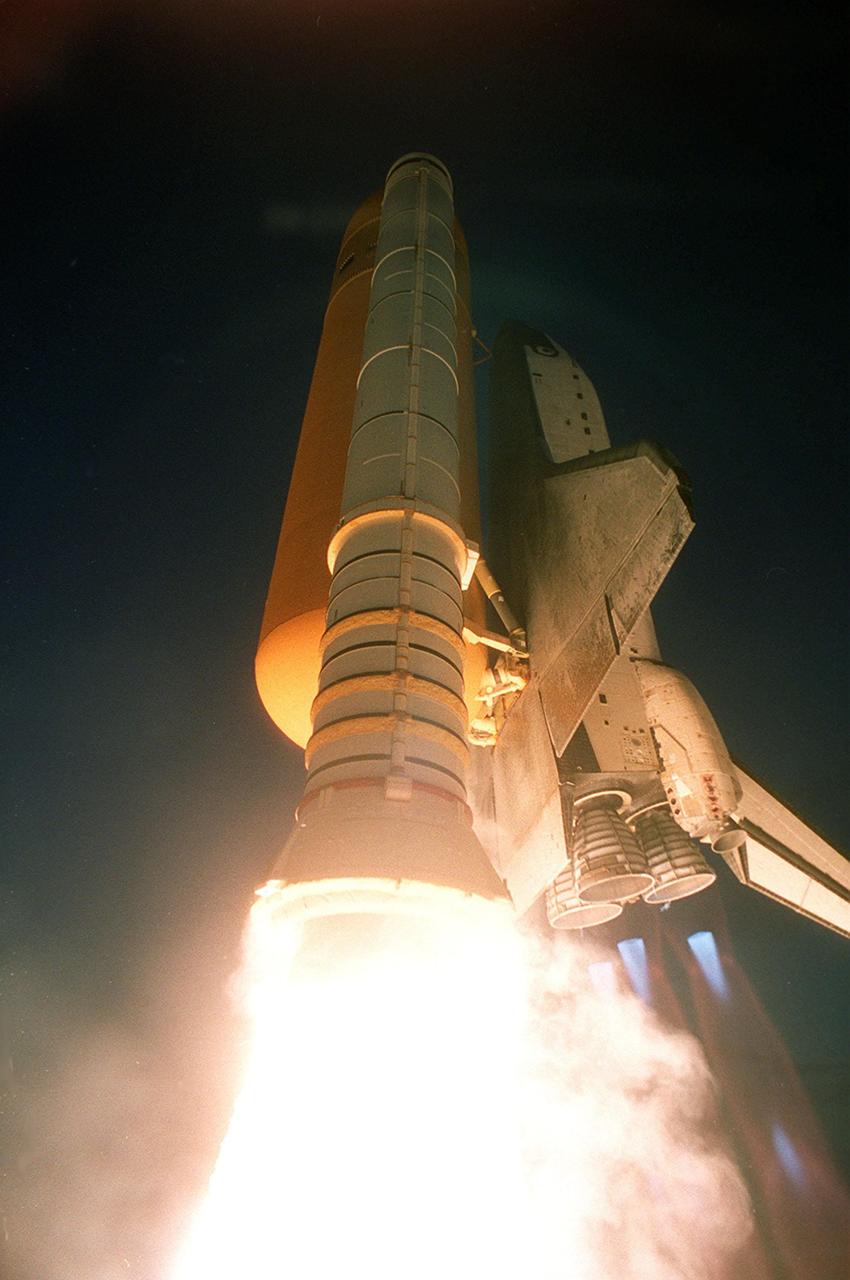
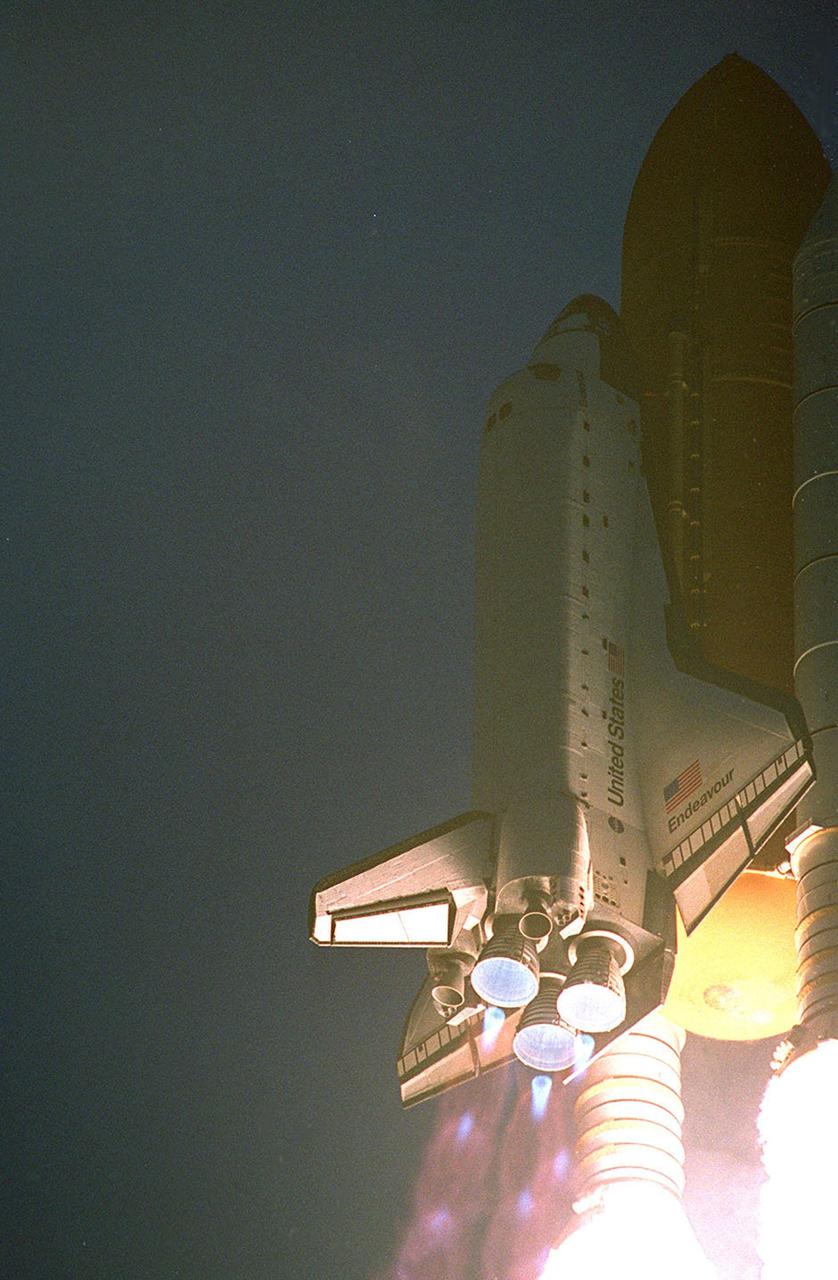
KENNEDY SPACE CENTER, FLA. - Flames shoot out from beneath the solid rocket booster propelling Space Shuttle Endeavour into space on mission STS-108. Liftoff occurred at 5:19:28 p.m. EST (22:19:28 GMT) on this second launch attempt in two days. Endeavour will dock with the International Space Station on Dec. 7. STS-108 is the final Shuttle mission of 2001and the 107th Shuttle flight overall. It is the 12th flight to the Space Station. Landing of the orbiter at KSC's Shuttle Landing Facility is targeted for 1:05 p.m. EST (18:05 p.m. GMT) Dec. 16
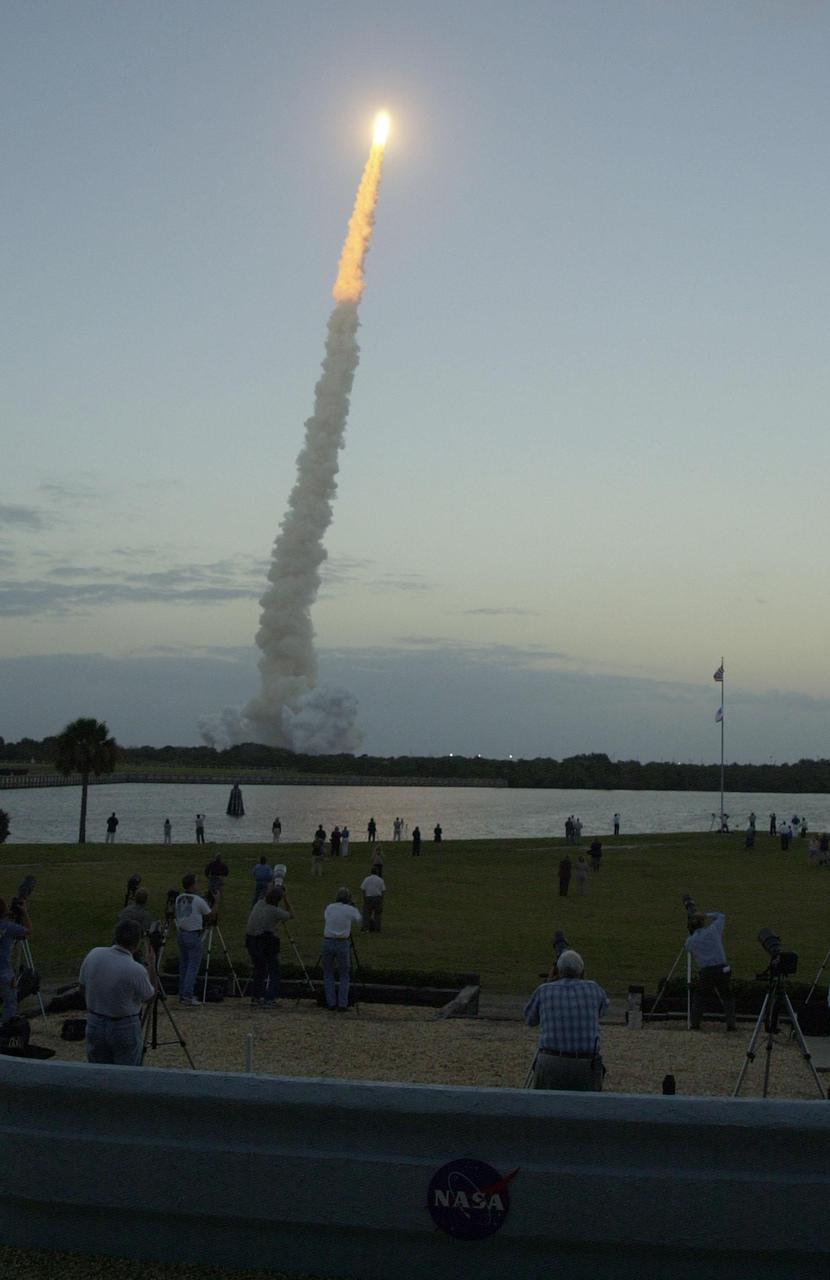
KENNEDY SPACE CENTER, Fla. -- Space Shuttle Endeavour soars into a twilight sky on mission STS-108, the second attempt over two days. Liftoff occurred at 5:19:28 p.m. EST (22:19 GMT). Endeavour will dock with the International Space Station on Dec. 7. STS-108 is the final Shuttle mission of 2001and the 107th Shuttle flight overall. It is the 12th flight to the Space Station. Landing of the orbiter at KSC's Shuttle Landing Facility is targeted for 1:05 p.m. EST (18:05 p.m. GMT) Dec. 16
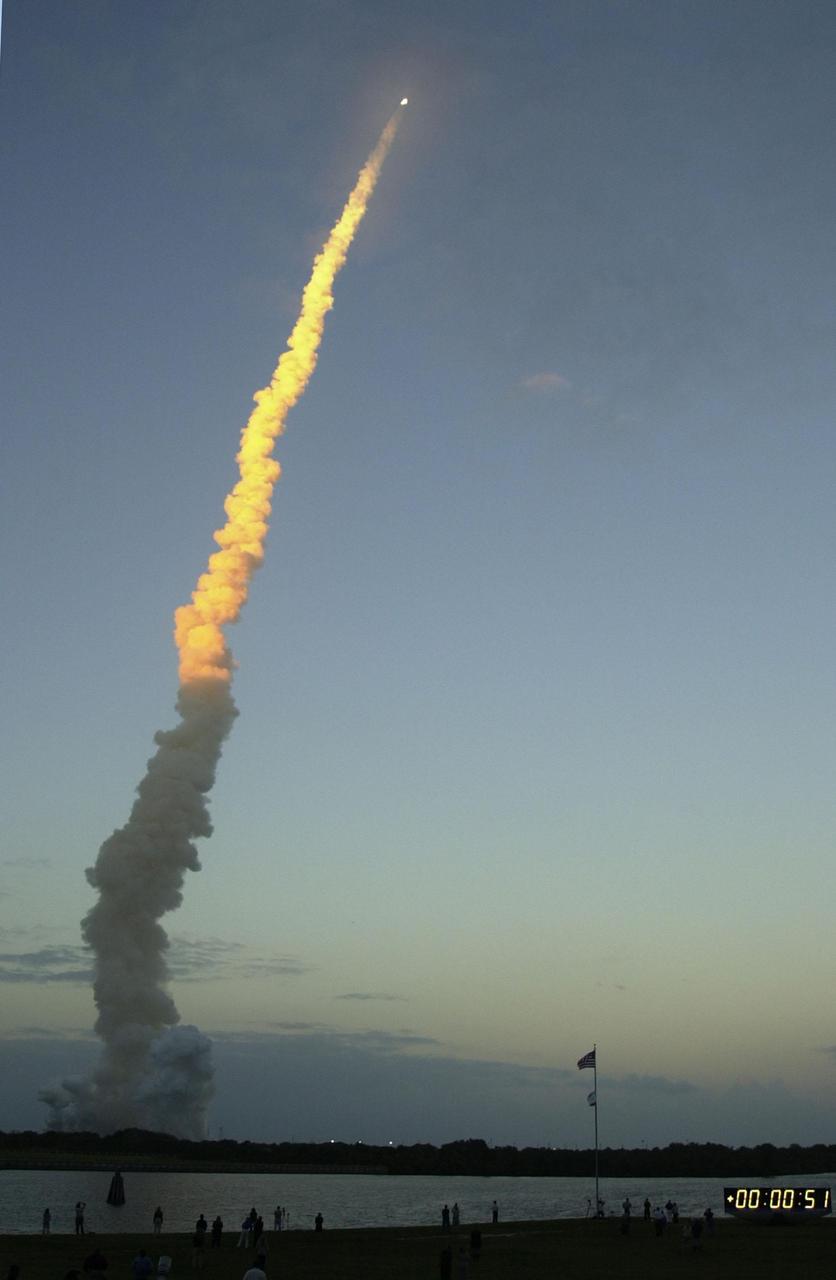
KENNEDY SPACE CENTER, Fla. -- Like a lighted taper, Space Shuttle Endeavour shines atop its twisted contrail as it soars into space on mission STS-108. Liftoff occurred at 5:19:28 p.m. EST (22:19 GMT). Endeavour will dock with the International Space Station on Dec. 7. STS-108 is the final Shuttle mission of 2001and the 107th Shuttle flight overall. It is the 12th flight to the Space Station. Landing of the orbiter at KSC's Shuttle Landing Facility is targeted for 1:05 p.m. EST (18:05 p.m. GMT) Dec. 16
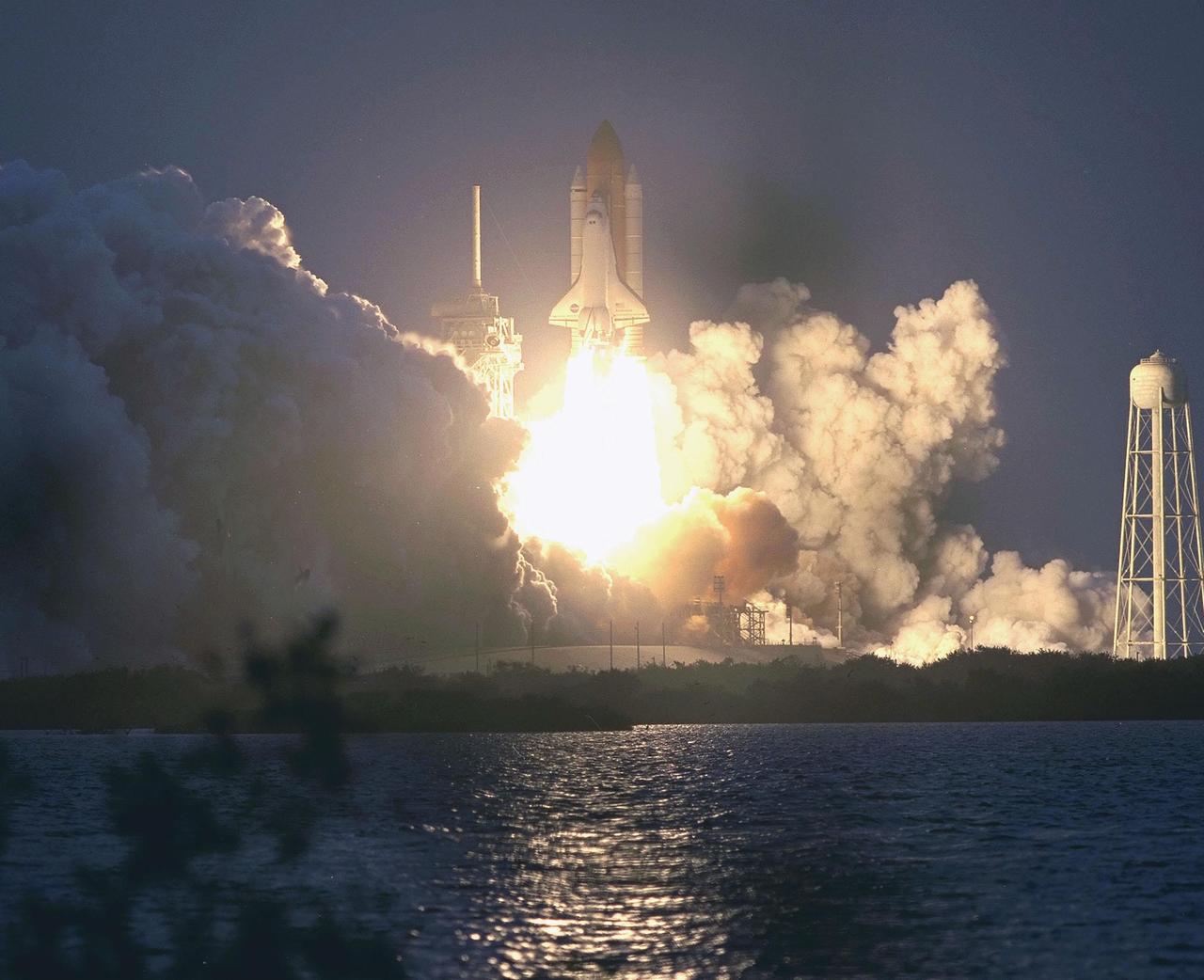
KENNEDY SPACE CENTER, Fla. -- Billows of smoke and steam roll away from Launch Pad 39B as Space Shuttle Endeavour hurtles into space on mission STS-108. The second attempt in two days, liftoff occurred at 5:19:28 p.m. EST (22:19.28 GMT). Endeavour will dock with the International Space Station on Dec. 7. STS-108 is the final Shuttle mission of 2001and the 107th Shuttle flight overall. It is the 12th flight to the Space Station. Landing of the orbiter at KSC's Shuttle Landing Facility is targeted for 1:05 p.m. EST (18:05 p.m. GMT) Dec. 16
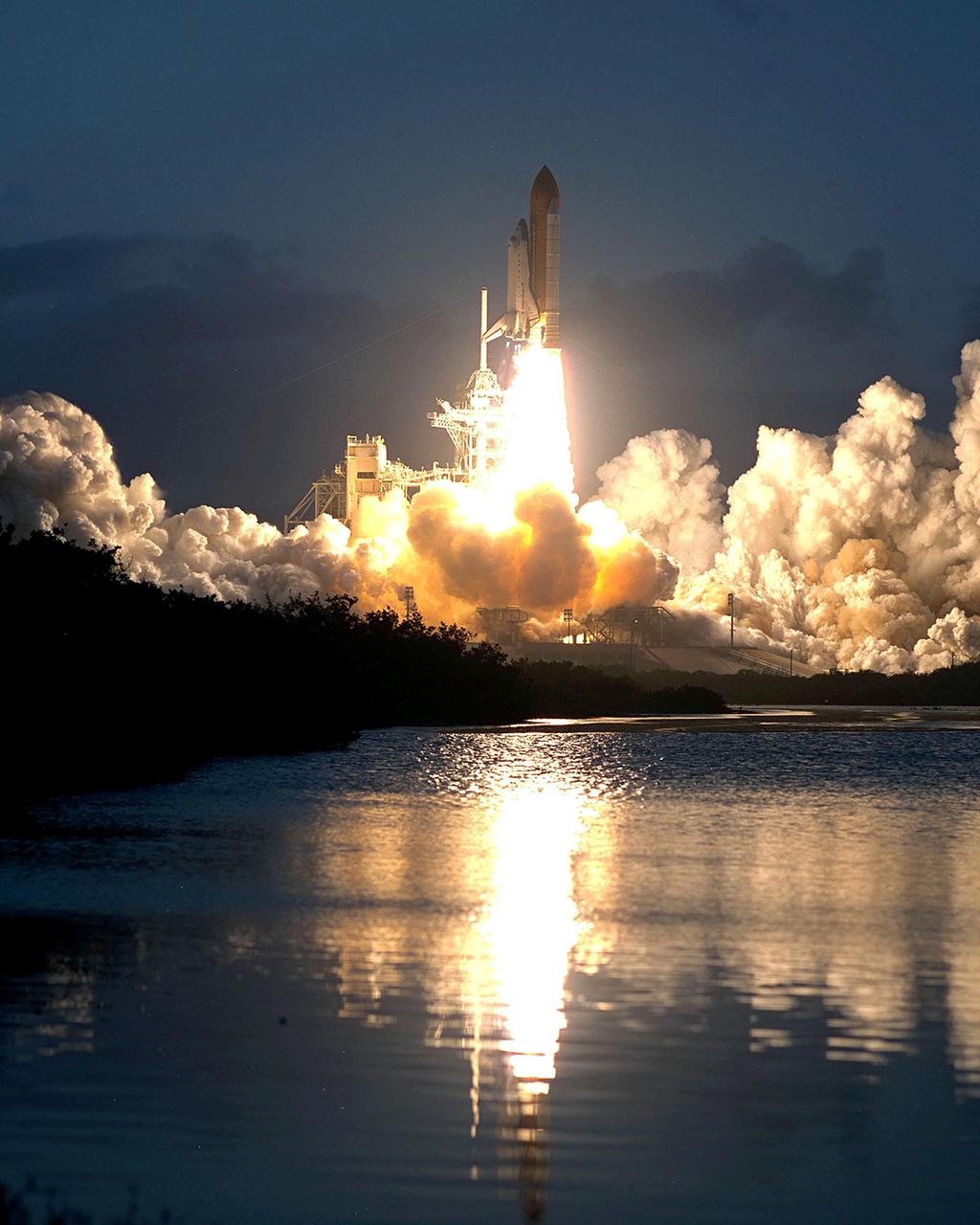
KENNEDY SPACE CENTER, Fla. -- Space Shuttle Endeavour soars into a twilight sky on mission STS-108, the second launch attempt over two days. Liftoff occurred at 5:19:28 p.m. EST (22:19.28 GMT). Endeavour will dock with the International Space Station on Dec. 7. STS-108 is the final Shuttle mission of 2001and the 107th Shuttle flight overall. It is the 12th flight to the Space Station. Landing of the orbiter at KSC's Shuttle Landing Facility is targeted for 1:05 p.m. EST (18:05 p.m. GMT) Dec. 16
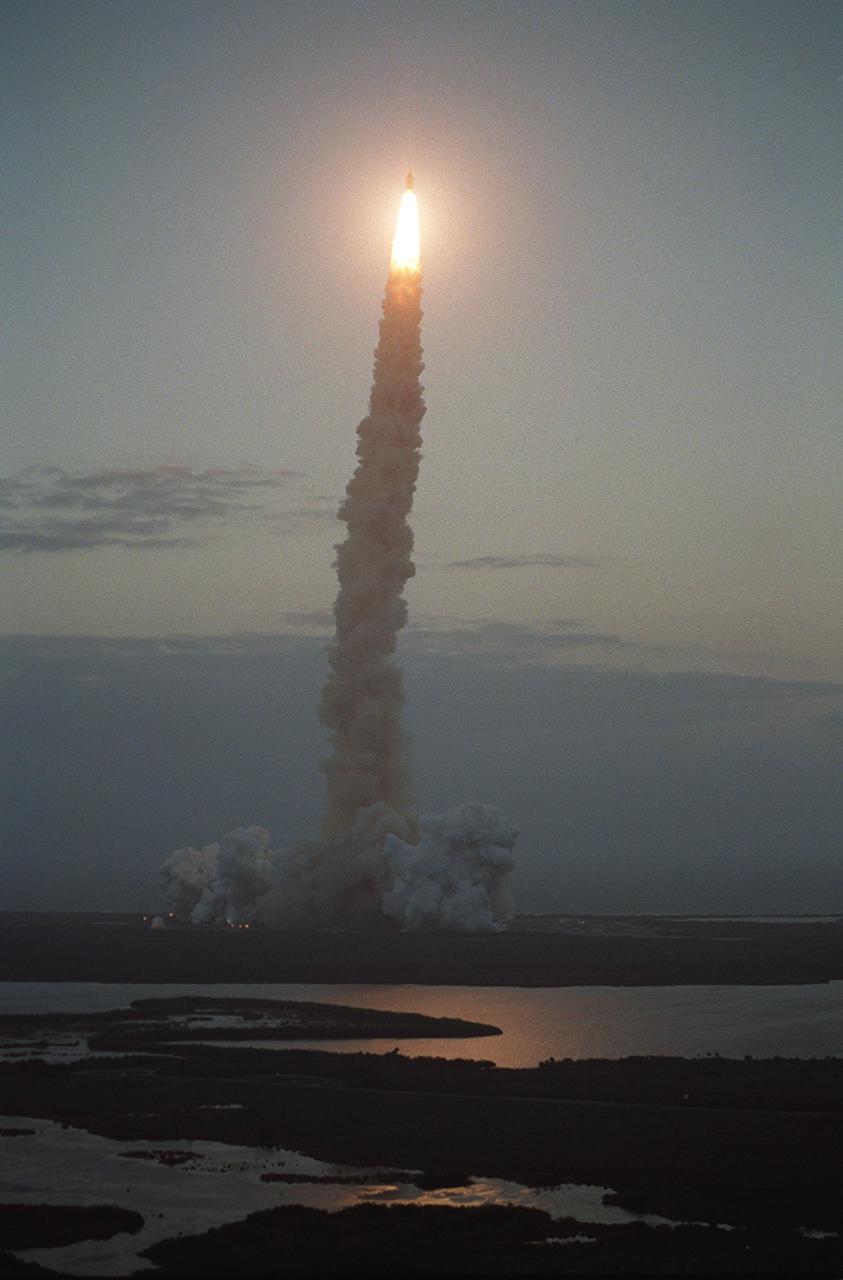
KENNEDY SPACE CENTER, FLA. -- Like a lighted candle, Space Shuttle Endeavour appears like a flame atop its twisted column of smoke as it soars into space on mission STS-108. Liftoff occurred at 5:19:28 p.m. EST (22:19.28 GMT). Endeavour will dock with the International Space Station on Dec. 7. STS-108 is the final Shuttle mission of 2001and the 107th Shuttle flight overall. It is the 12th flight to the Space Station. Landing of the orbiter at KSC's Shuttle Landing Facility is targeted for 1:05 p.m. EST (18:05 p.m. GMT) Dec. 16
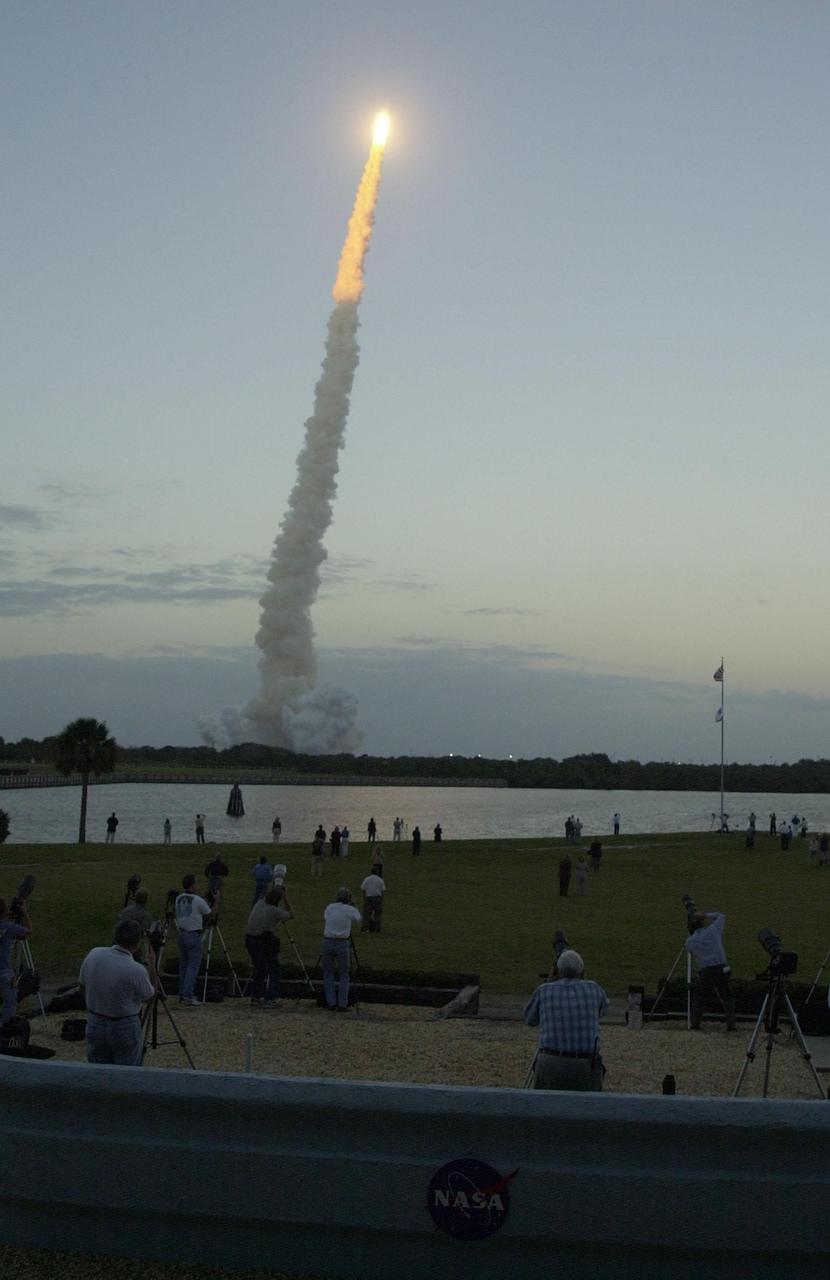
KENNEDY SPACE CENTER, Fla. -- Space Shuttle Endeavour soars into a twilight sky on mission STS-108, the second attempt over two days. Liftoff occurred at 5:19:28 p.m. EST (22:19 GMT). Endeavour will dock with the International Space Station on Dec. 7. STS-108 is the final Shuttle mission of 2001and the 107th Shuttle flight overall. It is the 12th flight to the Space Station. Landing of the orbiter at KSC's Shuttle Landing Facility is targeted for 1:05 p.m. EST (18:05 p.m. GMT) Dec. 16
KENNEDY SPACE CENTER, Fla. -- Space Shuttle Endeavour soars into a twilight sky on mission STS-108, the second attempt over two days. Liftoff occurred at 5:19:28 p.m. EST (22:19 GMT). Endeavour will dock with the International Space Station on Dec. 7. STS-108 is the final Shuttle mission of 2001and the 107th Shuttle flight overall. It is the 12th flight to the Space Station. Landing of the orbiter at KSC's Shuttle Landing Facility is targeted for 1:05 p.m. EST (18:05 p.m. GMT) Dec. 16
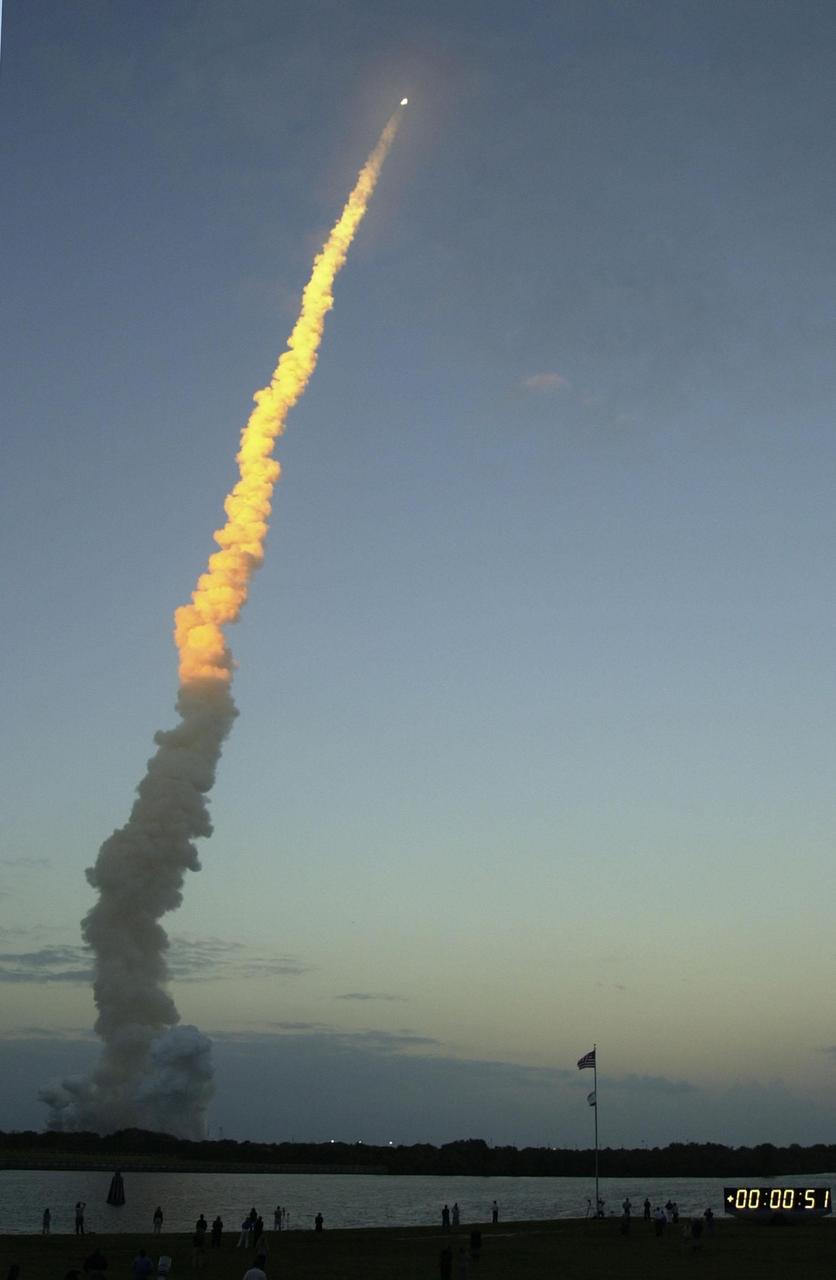
KENNEDY SPACE CENTER, Fla. -- Like a lighted taper, Space Shuttle Endeavour shines atop its twisted contrail as it soars into space on mission STS-108. Liftoff occurred at 5:19:28 p.m. EST (22:19 GMT). Endeavour will dock with the International Space Station on Dec. 7. STS-108 is the final Shuttle mission of 2001and the 107th Shuttle flight overall. It is the 12th flight to the Space Station. Landing of the orbiter at KSC's Shuttle Landing Facility is targeted for 1:05 p.m. EST (18:05 p.m. GMT) Dec. 16
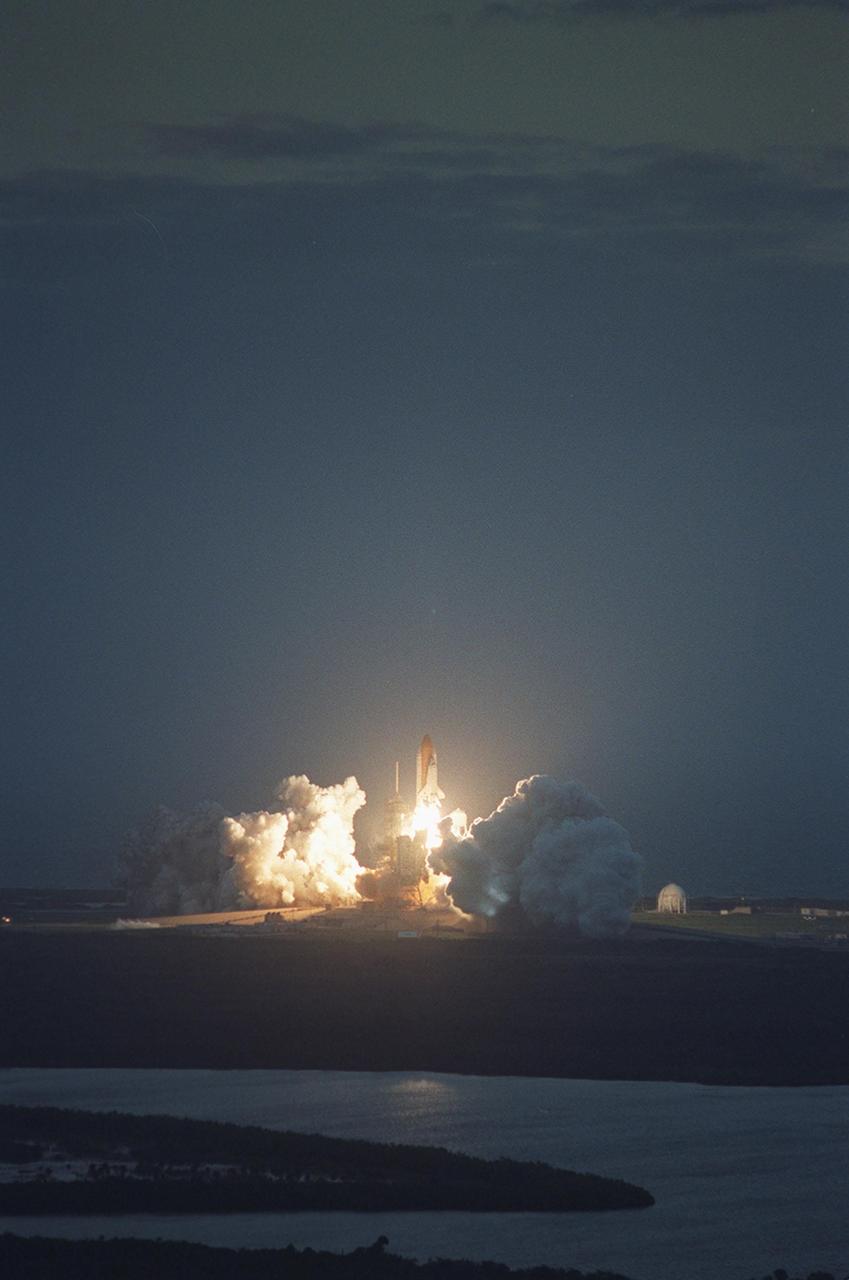
KENNEDY SPACE CENTER, FLA. -- Viewed from the roof of the Vehicle Assembly Building, Space Shuttle Endeavour rises from between billows of smoke and steam to begin its journey to the International Space Station on mission STS-108. Liftoff occurred at 5:19:28 p.m. EST (22:19:28 GMT). Endeavour will dock with the International Space Station on Dec. 7. STS-108 is the final Shuttle mission of 2001and the 107th Shuttle flight overall. It is the 12th flight to the Space Station. Landing of the orbiter at KSC's Shuttle Landing Facility is targeted for 1:05 p.m. EST (18:05 p.m. GMT) Dec. 16
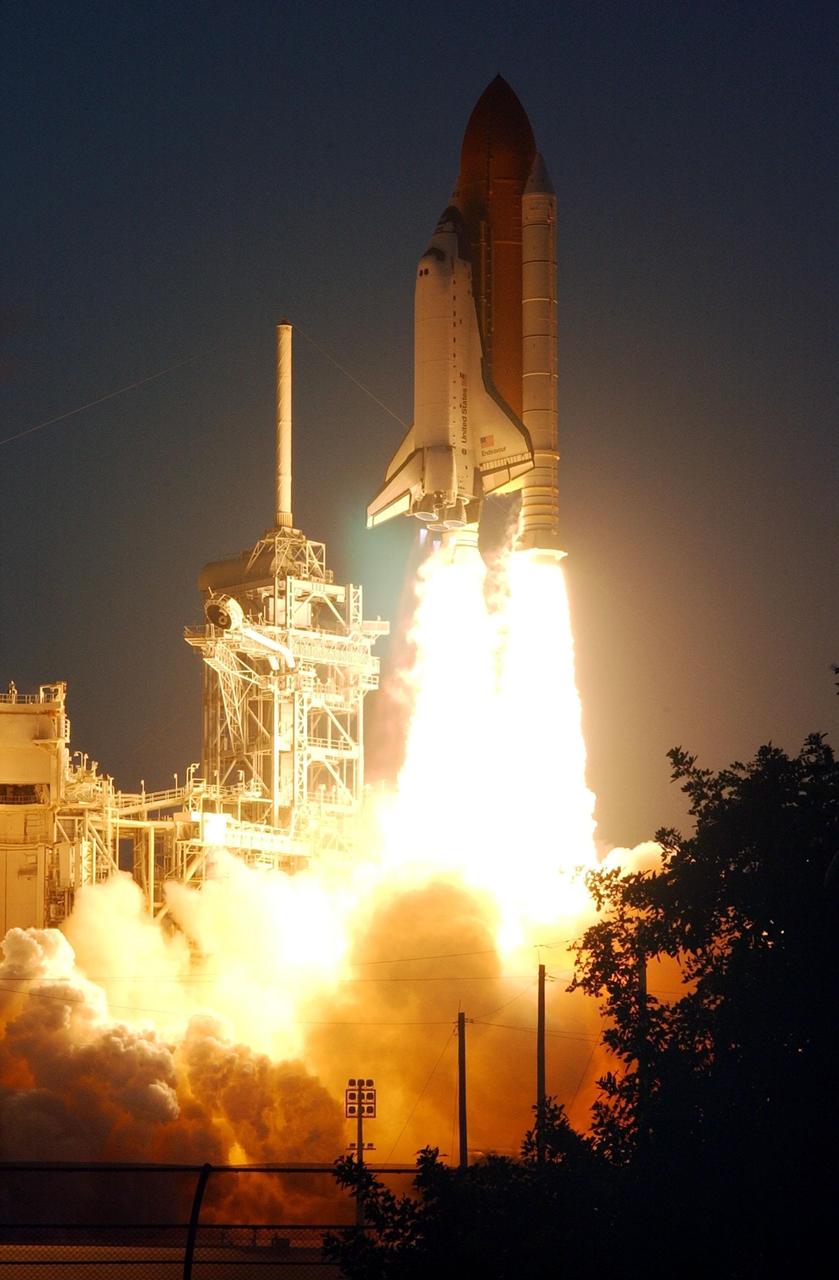
KENNEDY SPACE CENTER, Fla. -- Spewing flames and smoke, Space Shuttle Endeavour hurtles into the twilight sky on mission STS-108. The second attempt in two days, liftoff occurred at 5:19:28 p.m. EST (22:19 GMT). Endeavour will dock with the International Space Station on Dec. 7. STS-108 is the final Shuttle mission of 2001and the 107th Shuttle flight overall. It is the 12th flight to the Space Station. Landing of the orbiter at KSC's Shuttle Landing Facility is targeted for 1:05 p.m. EST (18:05 p.m. GMT) Dec. 16
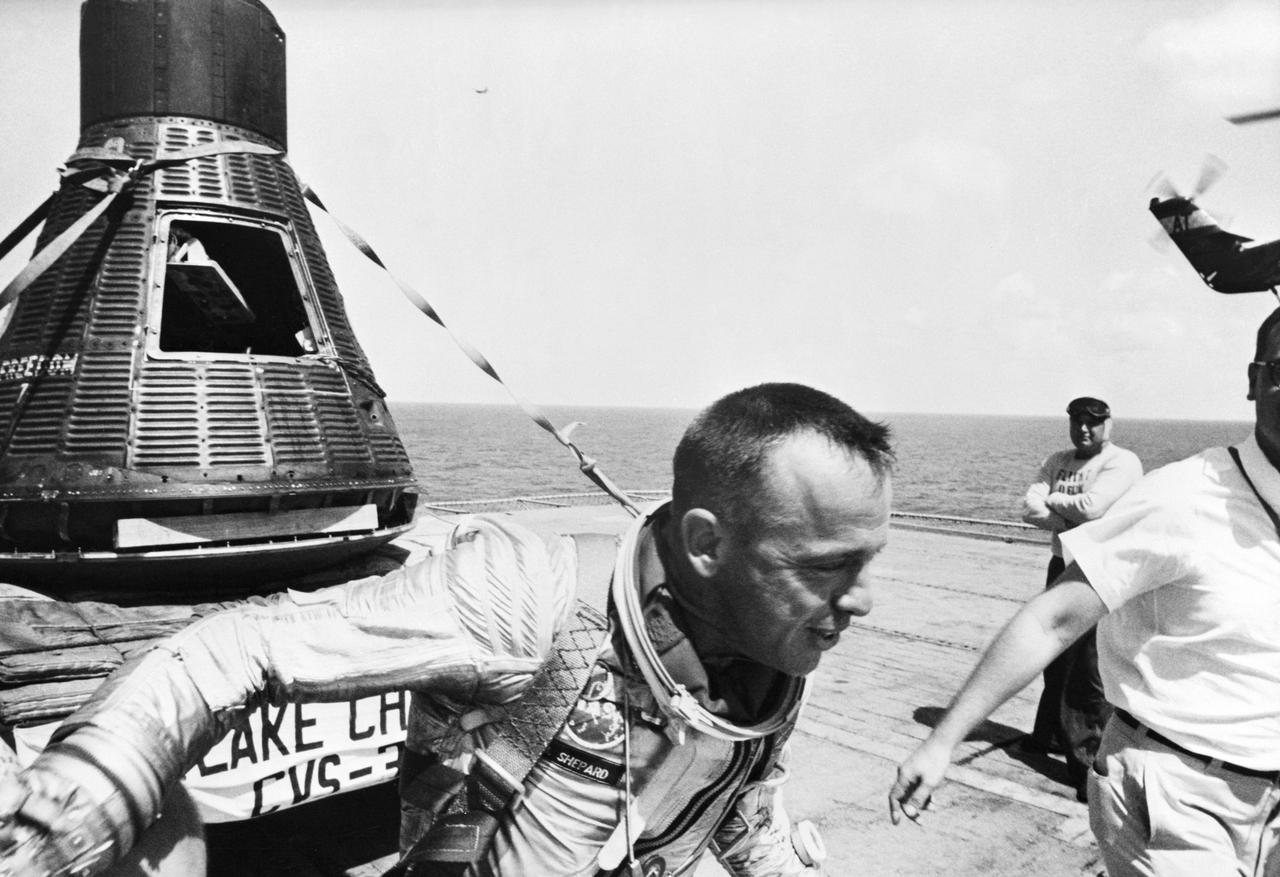
S61-02727 (5 May 1961) --- Astronaut Alan B. Shepard is seen on the deck of the USS Lake Champlain after the recovery of his Mercury capsule in the western Atlantic Ocean. Shepard and the Mercury spacecraft designated the ?Freedom 7? were flown to the deck of the recovery ship within 11 minutes of splashdown. MR-3 was the United States? first manned space mission. The spacecraft attained a maximum speed of 5,180 miles per hour, reached an altitude of 116 1/2 statute miles, and landed 302 statute miles downrange from Cape Canaveral, Florida. The suborbital mission lasted 15 minutes and 22 seconds. Photo credit: NASA or National Aeronautics and Space Administration
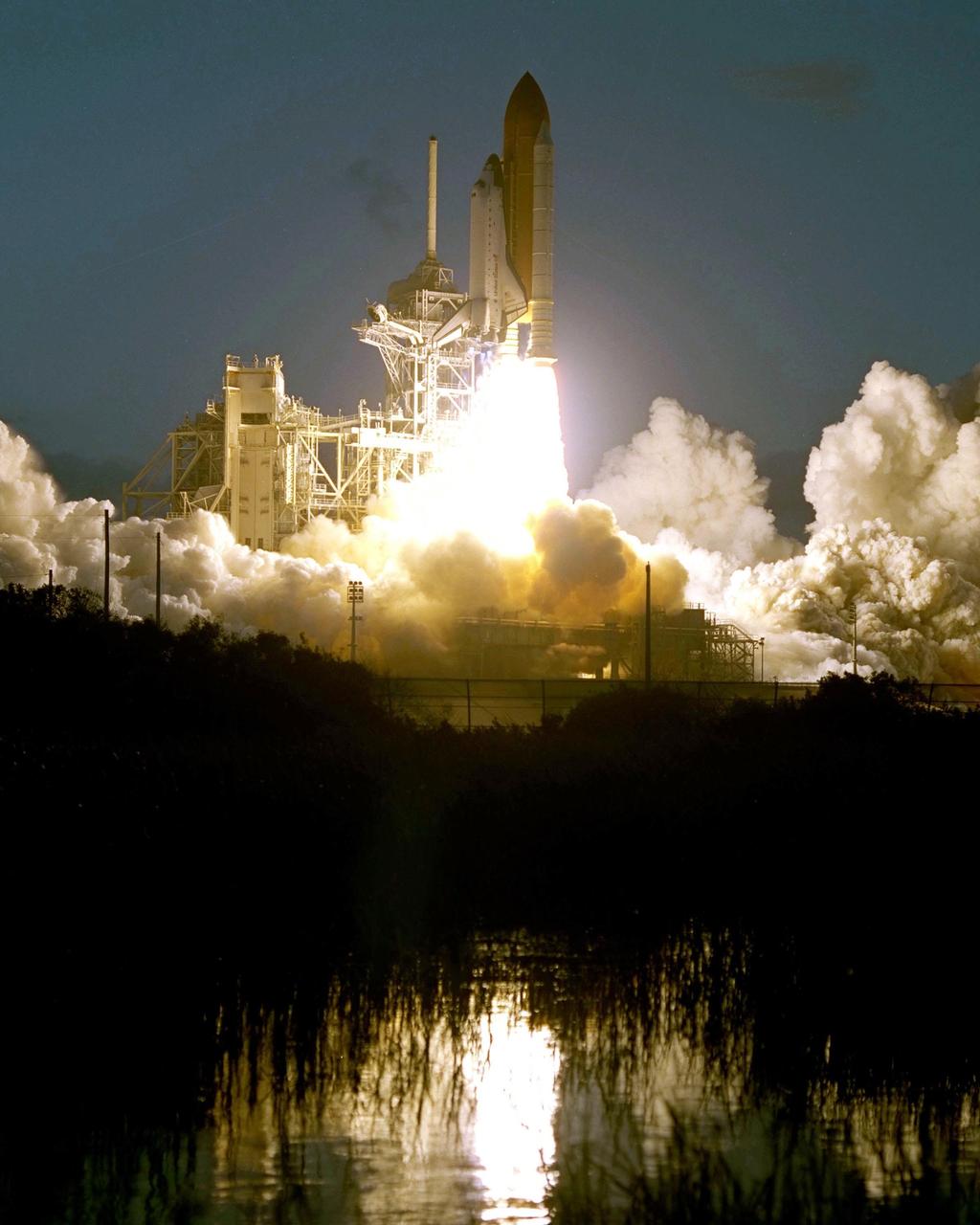
KENNEDY SPACE CENTER, Fla. -- Billows of smoke and steam are blown away from Launch Pad 39B as Space Shuttle Endeavour hurtles into space on mission STS-108. The second attempt in two days, liftoff occurred at 5:19:28 p.m. EST (22:19.28 GMT). Endeavour will dock with the International Space Station on Dec. 7. STS-108 is the final Shuttle mission of 2001and the 107th Shuttle flight overall. It is the 12th flight to the Space Station. Landing of the orbiter at KSC's Shuttle Landing Facility is targeted for 1:05 p.m. EST (18:05 p.m. GMT) Dec. 16
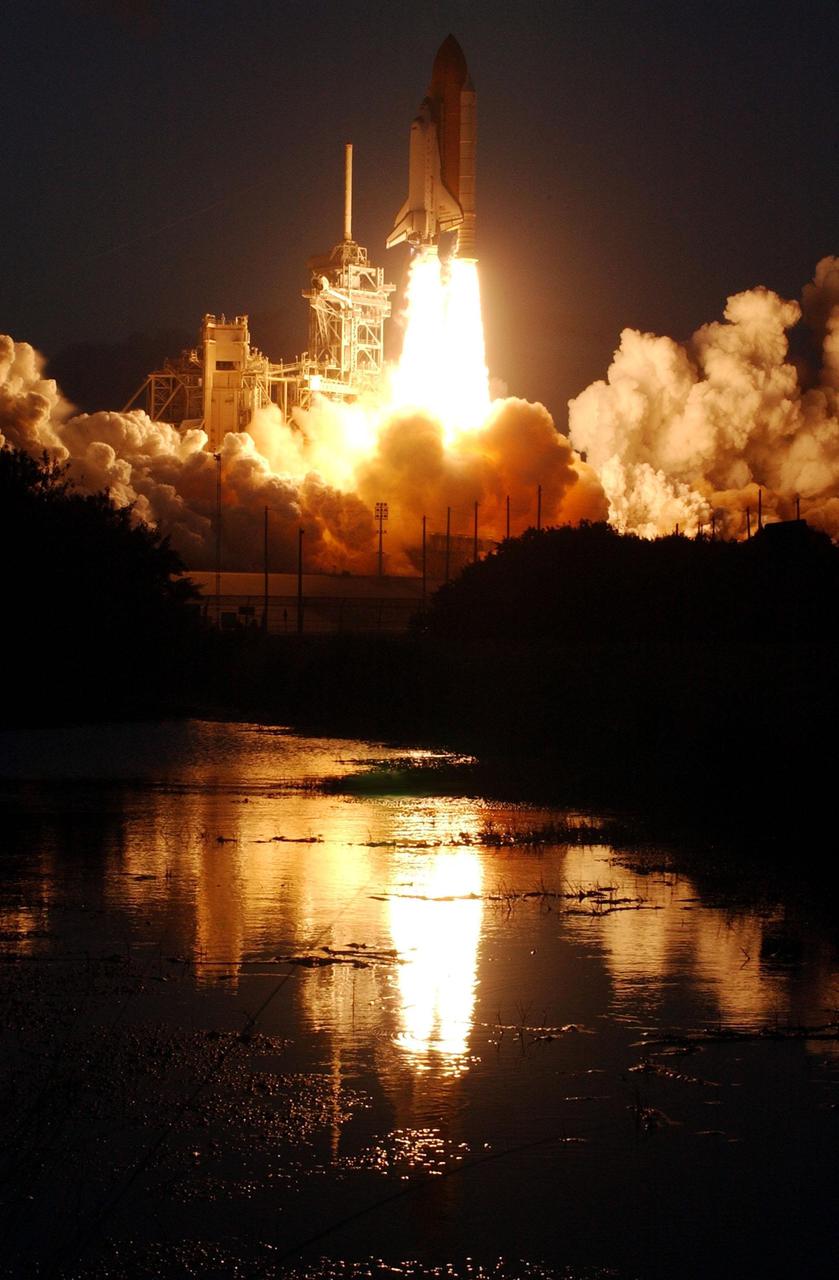
KENNEDY SPACE CENTER, Fla. -- A pool of water near Launch Pad 39B turns crimson from the reflection of flames at the launch of Space Shuttle Endeavour on mission STS-108. The second attempt in two days, liftoff occurred at 5:19:28 p.m. EST (22:19 GMT). Endeavour will dock with the International Space Station on Dec. 7. STS-108 is the final Shuttle mission of 2001and the 107th Shuttle flight overall. It is the 12th flight to the Space Station. Landing of the orbiter at KSC's Shuttle Landing Facility is targeted for 1:05 p.m. EST (18:05 p.m. GMT) Dec. 16

The Maldives nation, in the Indian Ocean, faces an environmental threat from sea level rise, as 80% of its islands are less than 1 m above seal level. To counter this threat, the country is creating a new artificial island, Hulhumale. The capital city of Male, southwest of the new island and the airport, houses 130,000 people in 2.5 sq km. By 2019, more than 50,000 people had moved to Hulhumale, with plans to host 240,000 of the nation's people by the mid-2020s (BBC.com, December 31, 2020). The ASTER image was acquired December 22, 2018, the Landsat-5 image (Figure 1) was acquired February 3, 1999. The images cover an area of 9.2 by 11.3 km, and are located at 4.2 degrees north, 73.5 degrees east. https://photojournal.jpl.nasa.gov/catalog/PIA24381
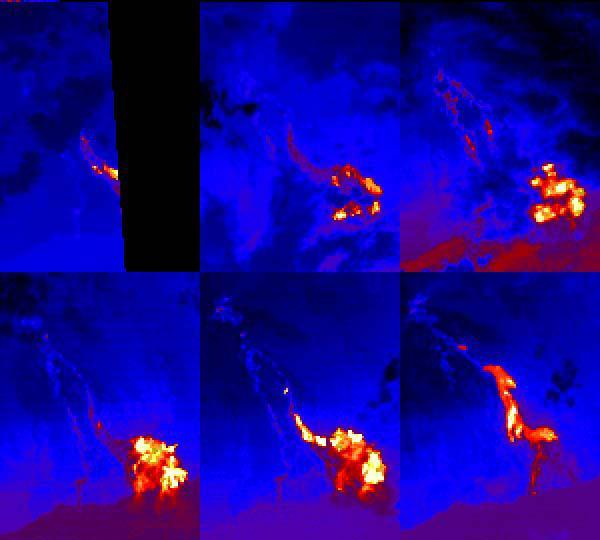
This sequence of ASTER nighttime thermal images shows the Pu'u O'o lava flows entering the sea at Kamokuna on the southeast side of the Island of Hawaii. Each image covers an area of 9 x 12 km. The acquisition dates are April 4 2000, May 13 2000, May 22 2000 (upper row) and June 30 2000, August 1 2000 and January 1 2001 (lower row). Thermal band 14 has been color coded from black (coldest) through blue, red, yellow and white (hottest). The first 5 images show a time sequence of a single eruptive phase; the last image shows flows from a later eruptive phase. The images are located at 19.3 degrees north latitude, 155 degrees west longitude. http://photojournal.jpl.nasa.gov/catalog/PIA11093
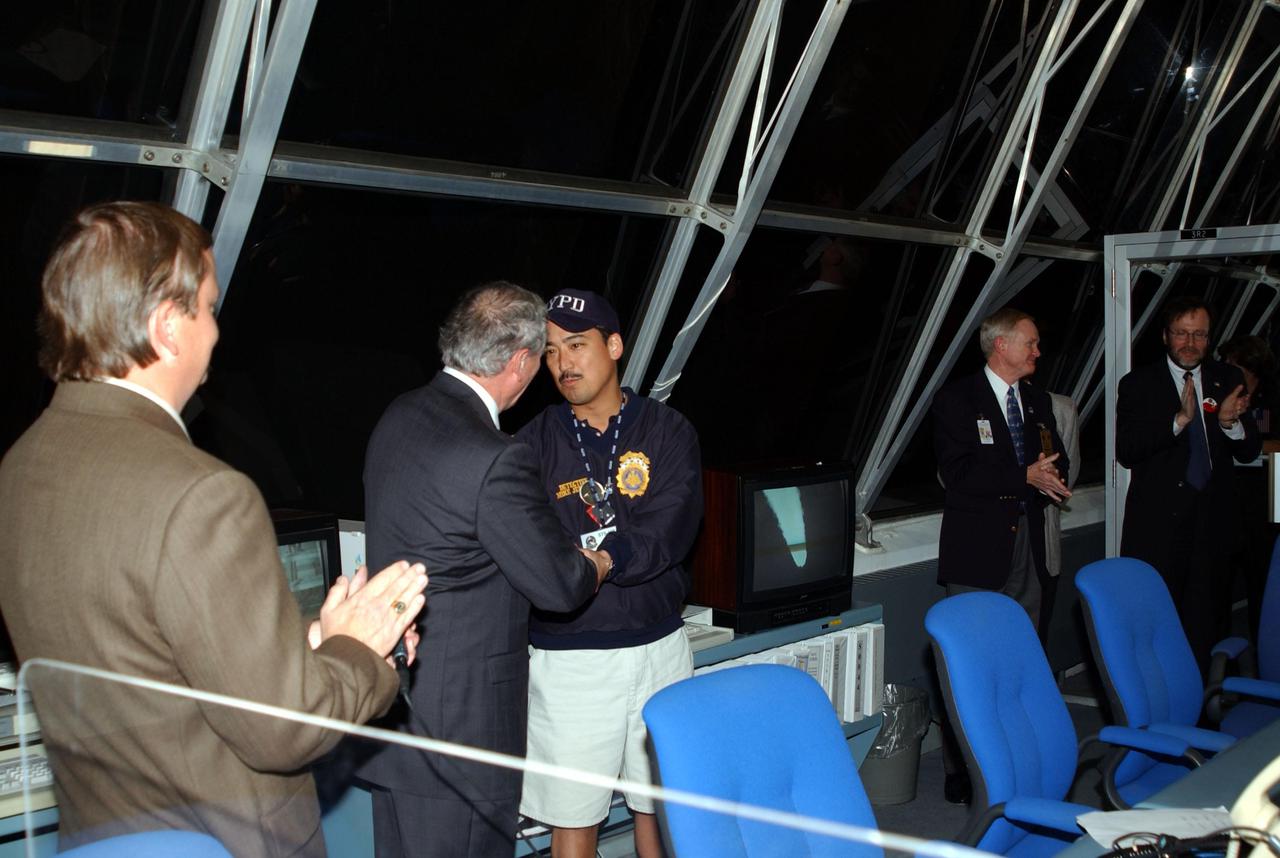
KENNEDY SPACE CENTER, Fla. -- New York Police Department Detective Michael Jermyn (center) is thanked for representing the New York Police and Fire Departments at the launch of Space Shuttle Endeavour on mission STS-108. Offering his handshake is NASA's Acting Administrator Daniel Mulville; Launch Director Mike Leinbach (left) applauds. At right is Center Director Roy Bridges Jr. Jermyn praised the efforts of the workers on the successful launch. Endeavour is carrying 6,000 flags that will be given to the families of those who died in the fall of the Twin Towers. Liftoff of Endeavour occurred at 5:19:28 p.m. EST (22:19.28 GMT). Endeavour will dock with the International Space Station on Dec. 7. STS-108 is the final Shuttle mission of 2001and the 107th Shuttle flight overall. It is the 12th flight to the Space Station. Landing of the orbiter at KSC's Shuttle Landing Facility is targeted for 1:05 p.m. EST (18:05 p.m. GMT) Dec. 16
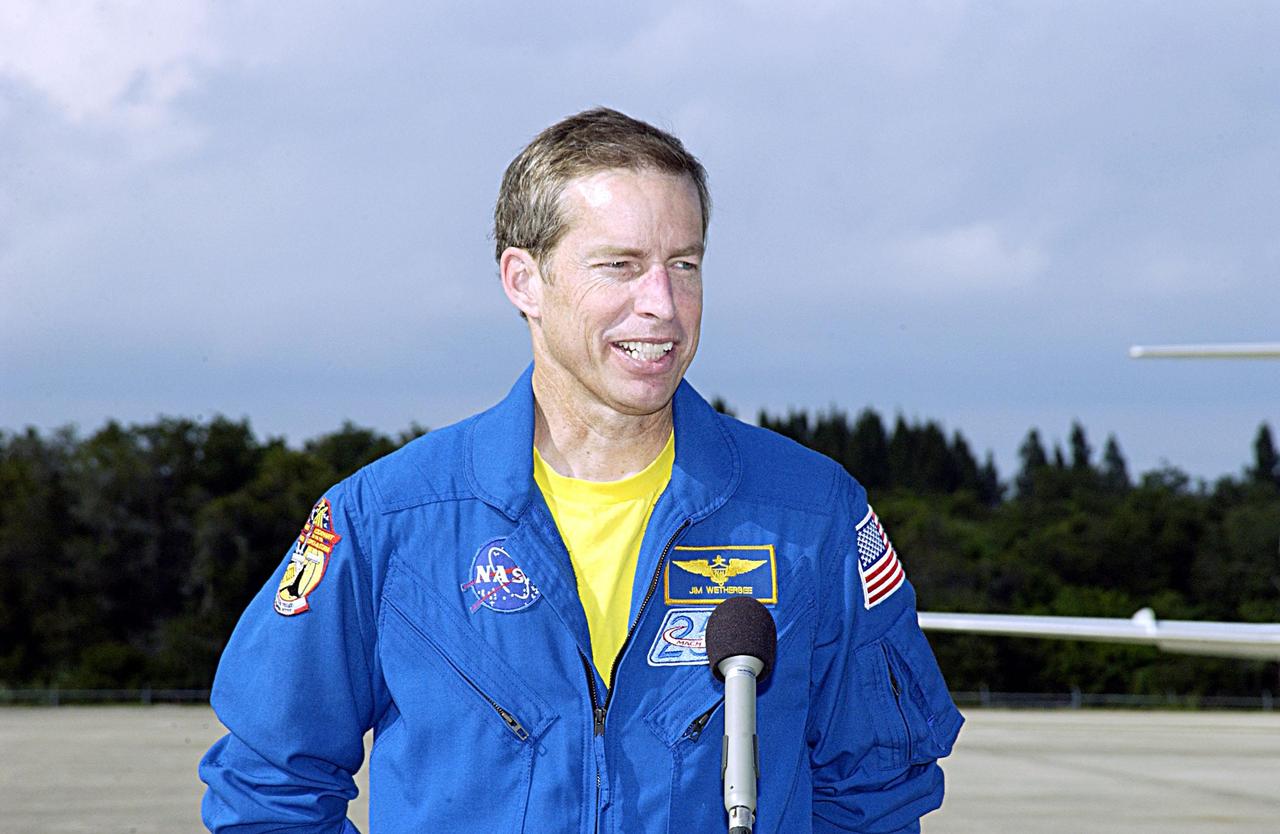
KENNEDY SPACE CENTER, FLA. -- STS-113 Commander James Wetherbee makes a brief statement upon his arrival at KSC's Shuttle Landing Facility to prepare for launch. STS-113 is the 16th American assembly flight to the International Space Station. The primary objective of the mission is bringing the Expedition 6 crew to the Station and returning the Expedition 5 crew to Earth. The major task of the mission is delivery of the Port 1 (P1) Integrated Truss Assembly, which will be attached to the port side of the S0 truss. Three spacewalks are planned to install and activate the truss and its associated equipment. Launch of Space Shuttle Endeavour on mission STS-113 is targeted for no earlier than Nov. 22 between 7 and 11 p.m. EST.
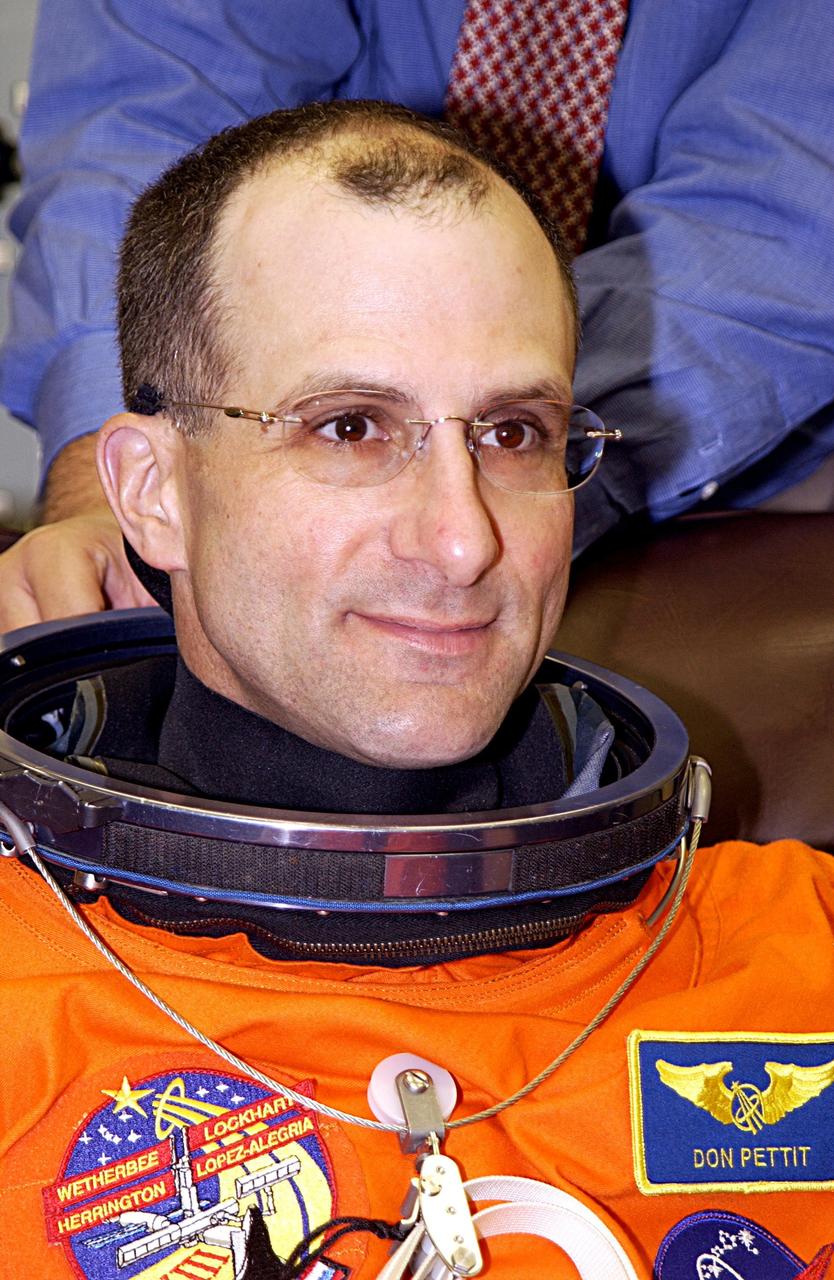
KENNEDY SPACE CENTER, FLA. -- Expedition 6 flight engineer Donald Pettit is eager for launch as he suits up for a second launch attempt on mission STS-113. The launch on Nov. 22 was scrubbed due to poor weather conditions at the Transoceanic Abort Landing sites. Pettit will be making his first Shuttle flight. The launch will carry the Expedition 6 crew to the Station and return the Expedition 5 crew to Earth. The major objective of the mission is delivery of the Port 1 (P1) Integrated Truss Assembly, which will be attached to the port side of the S0 truss. Three spacewalks are planned to install and activate the truss and its associated equipment. Launch of Space Shuttle Endeavour on mission STS-113 is now scheduled for Nov. 23 at 7:50 p.m. EST.
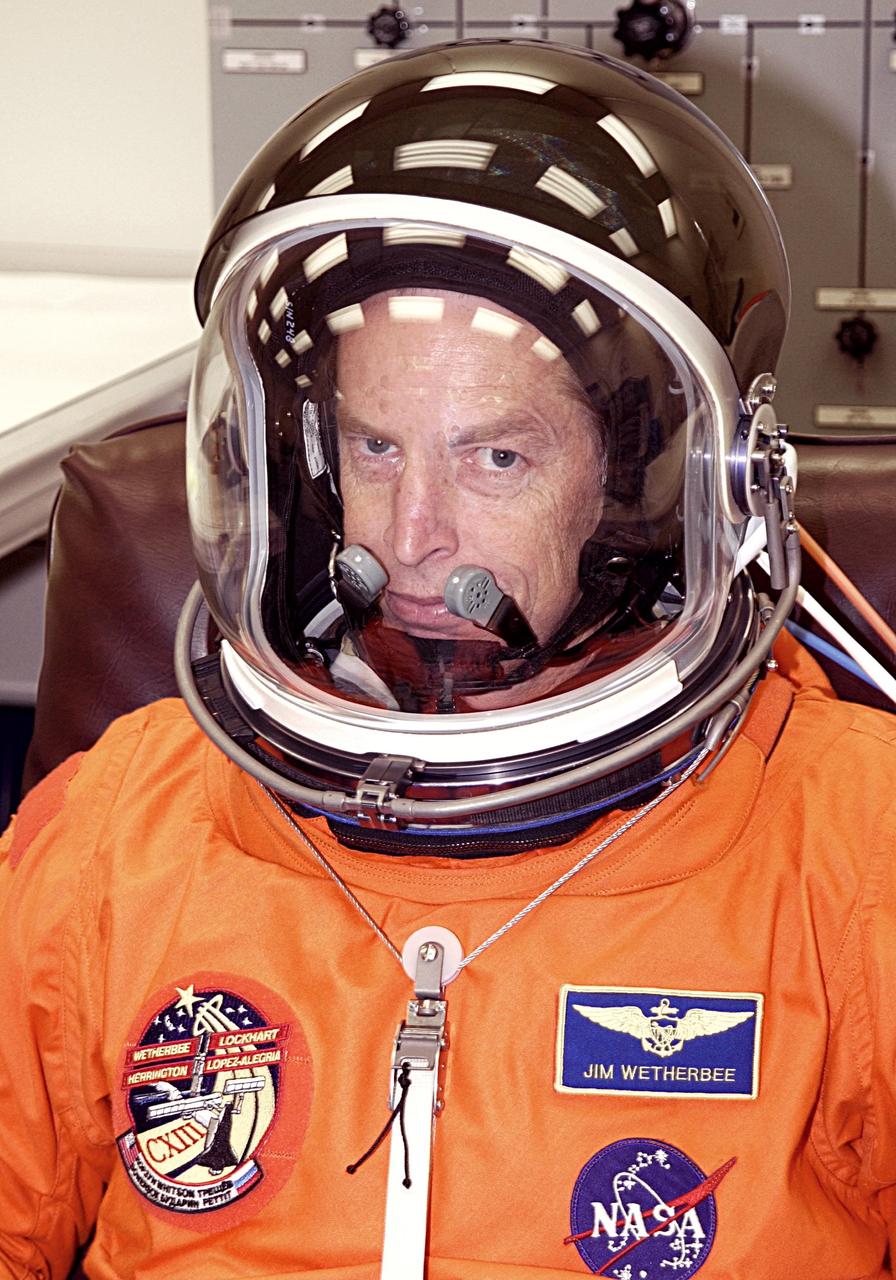
KENNEDY SPACE CENTER, FLA. -- STS-113 Commander James Wetherbee shows a serious side as he suits up for a second launch attempt on mission STS-113. The launch on Nov. 22 was scrubbed due to poor weather conditions at the Transoceanic Abort Landing sites. Wetherbee will be making his sixth Shuttle flight. The launch will carry the Expedition 6 crew to the Station and return the Expedition 5 crew to Earth. The major objective of the mission is delivery of the Port 1 (P1) Integrated Truss Assembly, which will be attached to the port side of the S0 truss. Three spacewalks are planned to install and activate the truss and its associated equipment. Launch of Space Shuttle Endeavour on mission STS-113 is now scheduled for Nov. 23 at 7:50 p.m. EST.
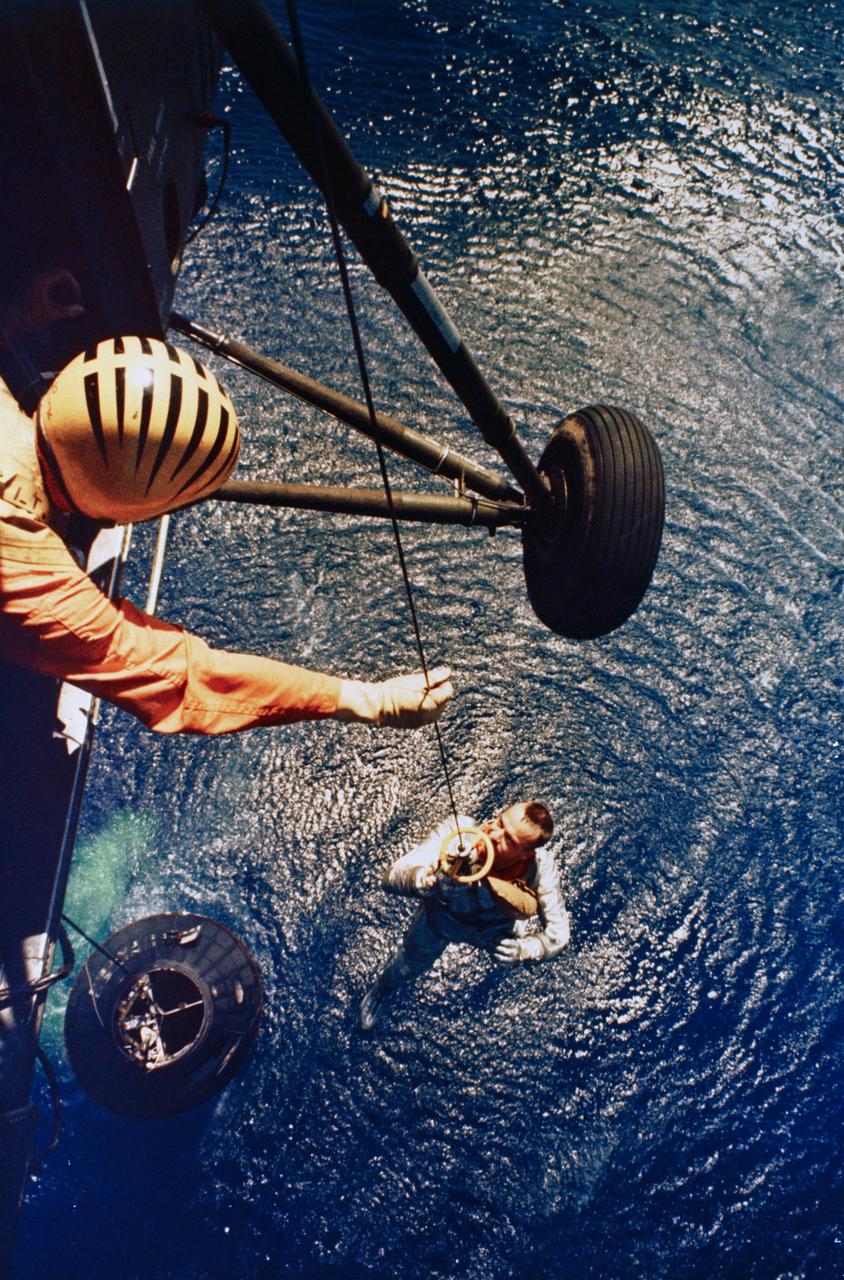
S88-31376 (5 May 1961) --- Astronaut Alan B. Shepard Jr., pilot of the Mercury-Redstone 3 (MR-3) suborbital spaceflight, is retrieved by a helicopter from the USS Lake Champlain during recovery operations in the western Atlantic Ocean. Shepard and the Mercury spacecraft designated the ?Freedom 7? (floating in water below) were flown to the deck of the recovery ship within 11 minutes of splashdown. MR-3 was the United States? first manned space mission. The spacecraft attained a maximum speed of 5,180 miles per hour, reached an altitude of 116 1/2 statute miles, and landed 302 statute miles downrange from Cape Canaveral, Florida. The suborbital mission lasted 15 minutes and 22 seconds. Photo credit: NASA or National Aeronautics and Space Administration
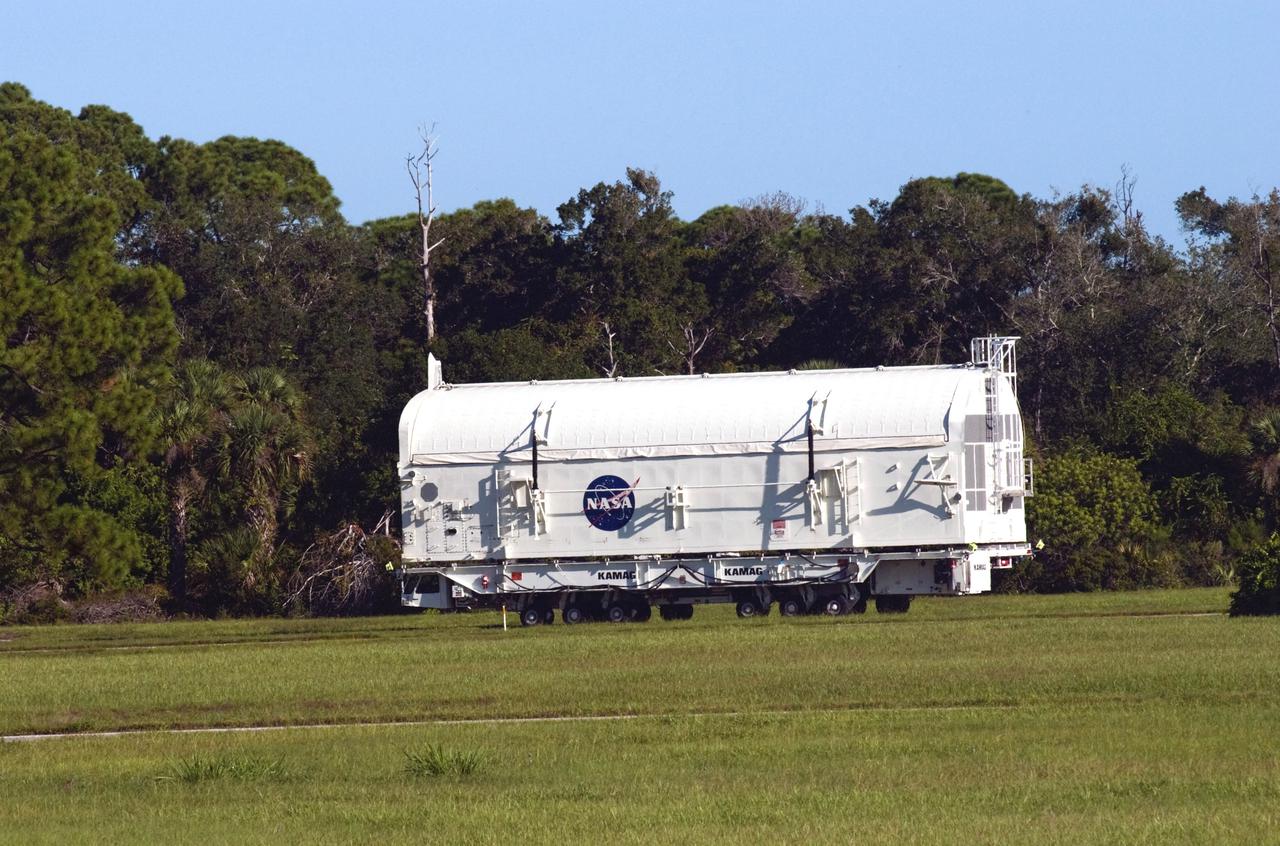
CAPE CANAVERAL, Fla. -- At NASA's Kennedy Space Center in Florida, payload canister #1 travels at a slow, steady 5 mph from the Canister Rotation Facility to the Reutilization, Recycling and Marketing Facility on Ransom Road. The two payload canisters used to transport space shuttle payloads to the launch pad for installation in the shuttles' cargo bays are being decommissioned following the end of the Space Shuttle Program. Each canister weighs 110,000 pounds and is 65 feet long, 22 feet wide, and 18 feet, 7 inches high. The canisters were prescreened through NASA Headquarters as possible artifacts, but their size makes them difficult to transport to locations off the center. Federal and state agencies now will be given the opportunity to screen the canisters for potential use before a final decision is made on their disposition. For more information, visit http:__www.nasa.gov_centers_kennedy_pdf_167403main_CRF-06.pdf. Photo credit: NASA_Jim Grossmann
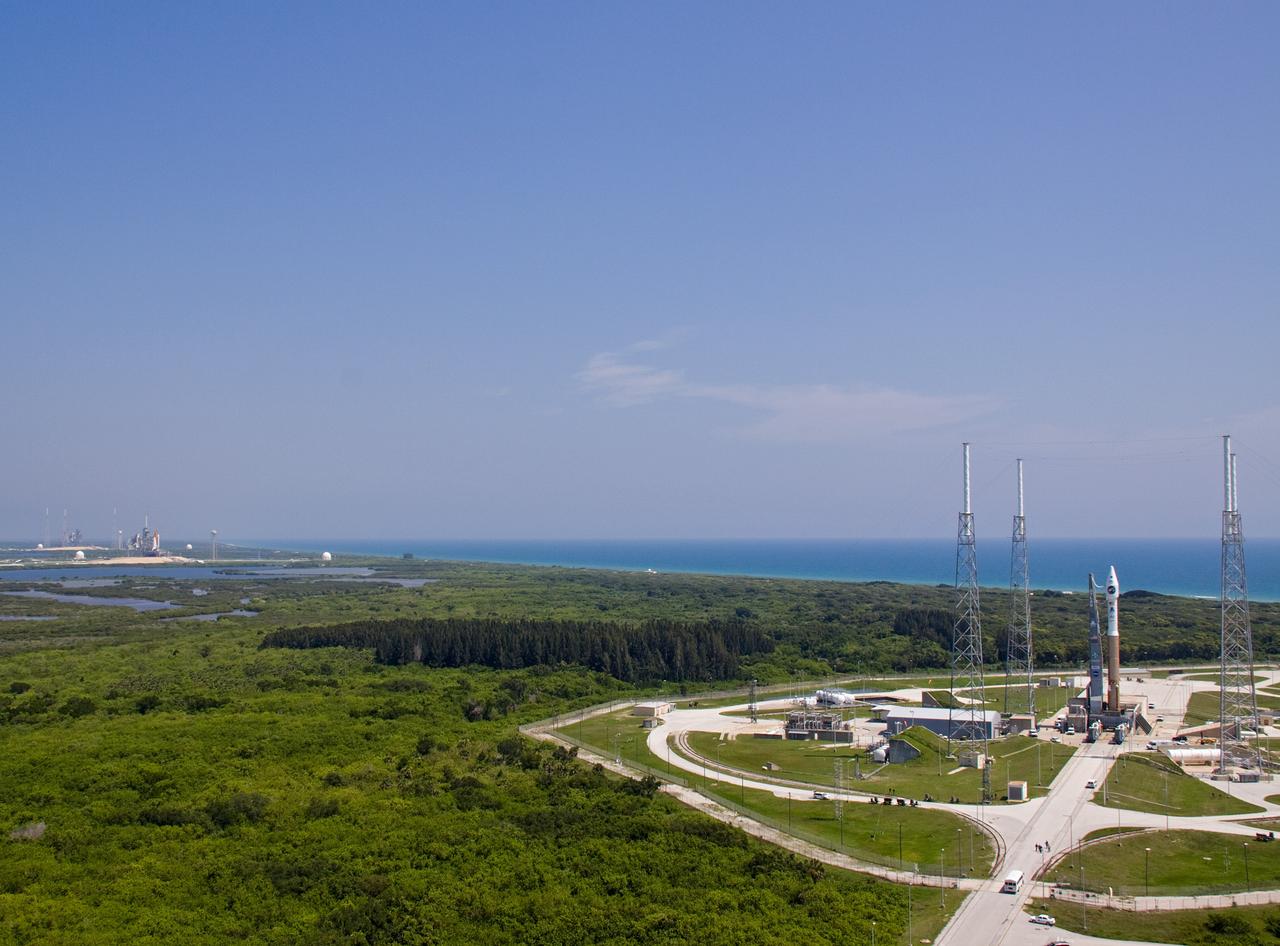
CAPE CANAVERAL, Fla. – A wide view captures both Launch Complex-41 on Cape Canaveral Air Force Station at right and Launch Pad 39A at NASA's Kennedy Space Center in Florida at left. Space shuttle Endeavour is still on the pad after launch was officially scrubbed at 1:55 a.m. this morning when a gaseous hydrogen leak occurred at the Ground Umbilical Carrier Plate. NASA's Lunar Reconnaissance Orbiter, or LRO, and NASA's Lunar Crater Observation and Sensing Satellite, known as LCROSS, are on Complex 41 waiting for launch on the Atlas V/Centaur rocket. LRO and LCROSS are the first missions in NASA's plan to return humans to the moon and begin establishing a lunar outpost by 2020. The LRO also includes seven instruments that will help NASA characterize the moon's surface: DIVINER, LAMP, LEND, LOLA, CRATER, Mini-RF and LROC. Launch is scheduled for 5:22 p.m. EDT June 18 . Photo credit: NASA/Jack Pfaller
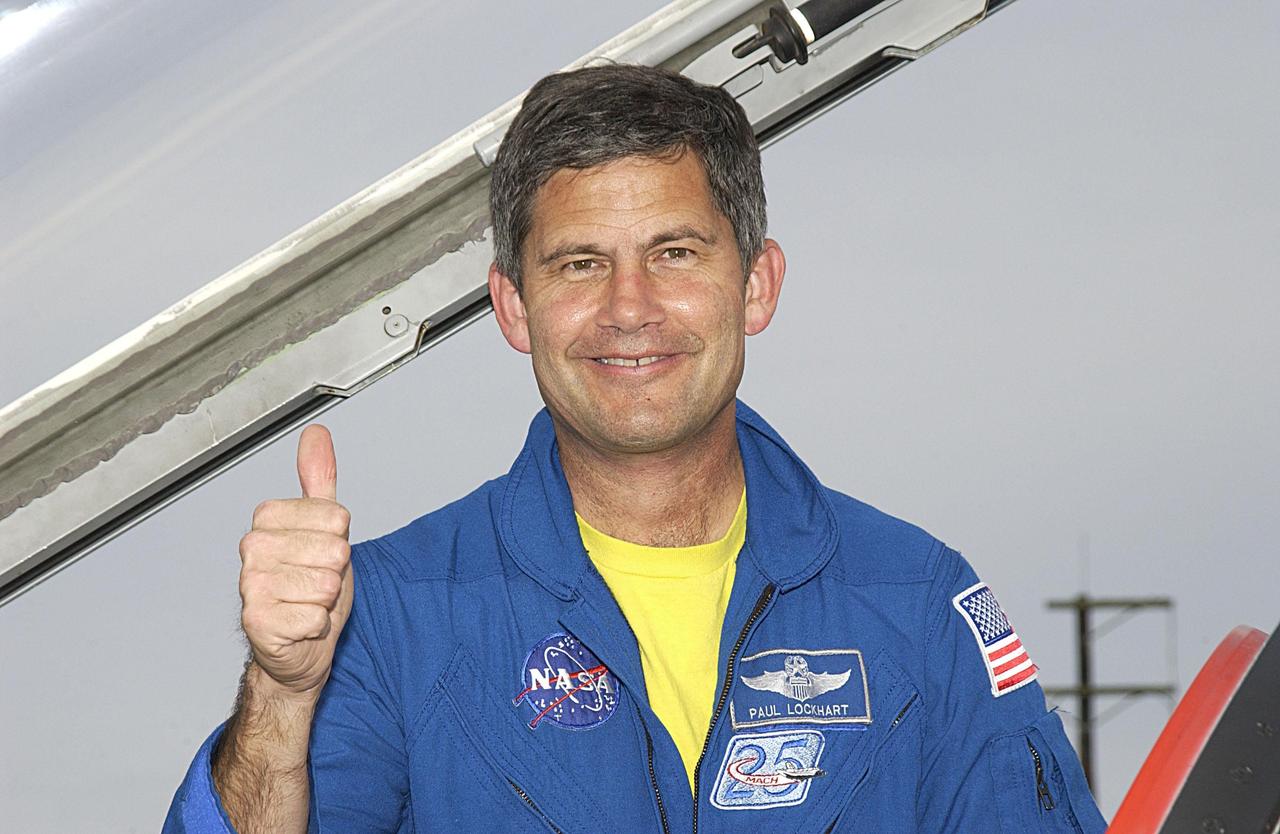
KENNEDY SPACE CENTER, FLA. -- STS-113 Pilot Paul Lockhart gives a thumbs up following his arrival at KSC's Shuttle Landing Facility to prepare for launch. STS-113 is the 16th American assembly flight to the International Space Station. The primary objective of the mission is bringing the Expedition 6 crew to the Station and returning the Expedition 5 crew to Earth. The major task of the mission is delivery of the Port 1 (P1) Integrated Truss Assembly, which will be attached to the port side of the S0 truss. Three spacewalks are planned to install and activate the truss and its associated equipment. Launch of Space Shuttle Endeavour on mission STS-113 is targeted for no earlier than Nov. 22 between 7 and 11 p.m. EST.
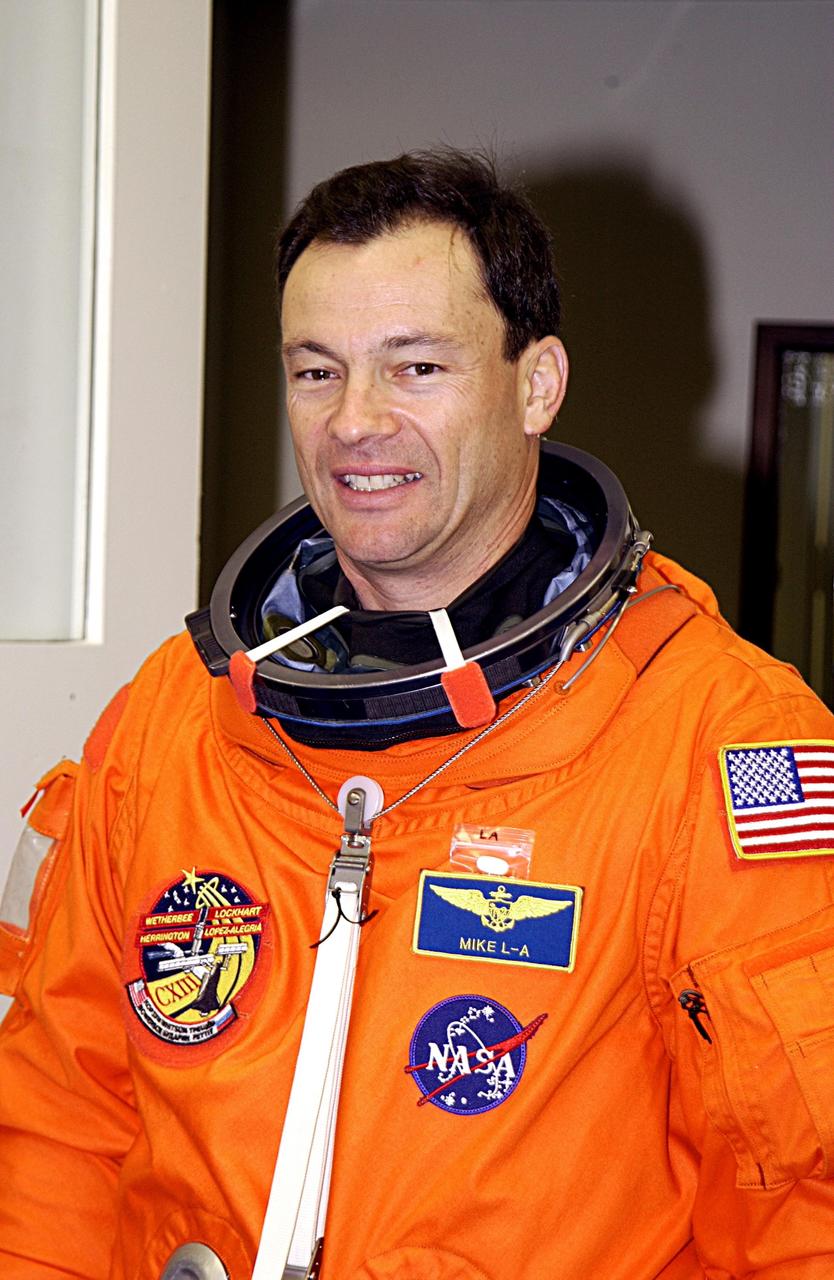
KENNEDY SPACE CENTER, FLA. - STS-113 Mission Specialist Michael Lopez-Alegria suits up for the second launch attempt of mission STS-113. The previous launch on Nov. 22 was scrubbed due to poor weather conditions at the Transoceanic Abort Landing sites. He will be making his third Shuttle flight. The launch will carry the Expedition 6 crew to the Station and return the Expedition 5 crew to Earth. The major objective of the mission is delivery of the Port 1 (P1) Integrated Truss Assembly, which will be attached to the port side of the S0 truss. Three spacewalks are planned to install and activate the truss and its associated equipment. Launch of Space Shuttle Endeavour on mission STS-113 is now scheduled for Nov. 23 at 7:50 p.m. EST.
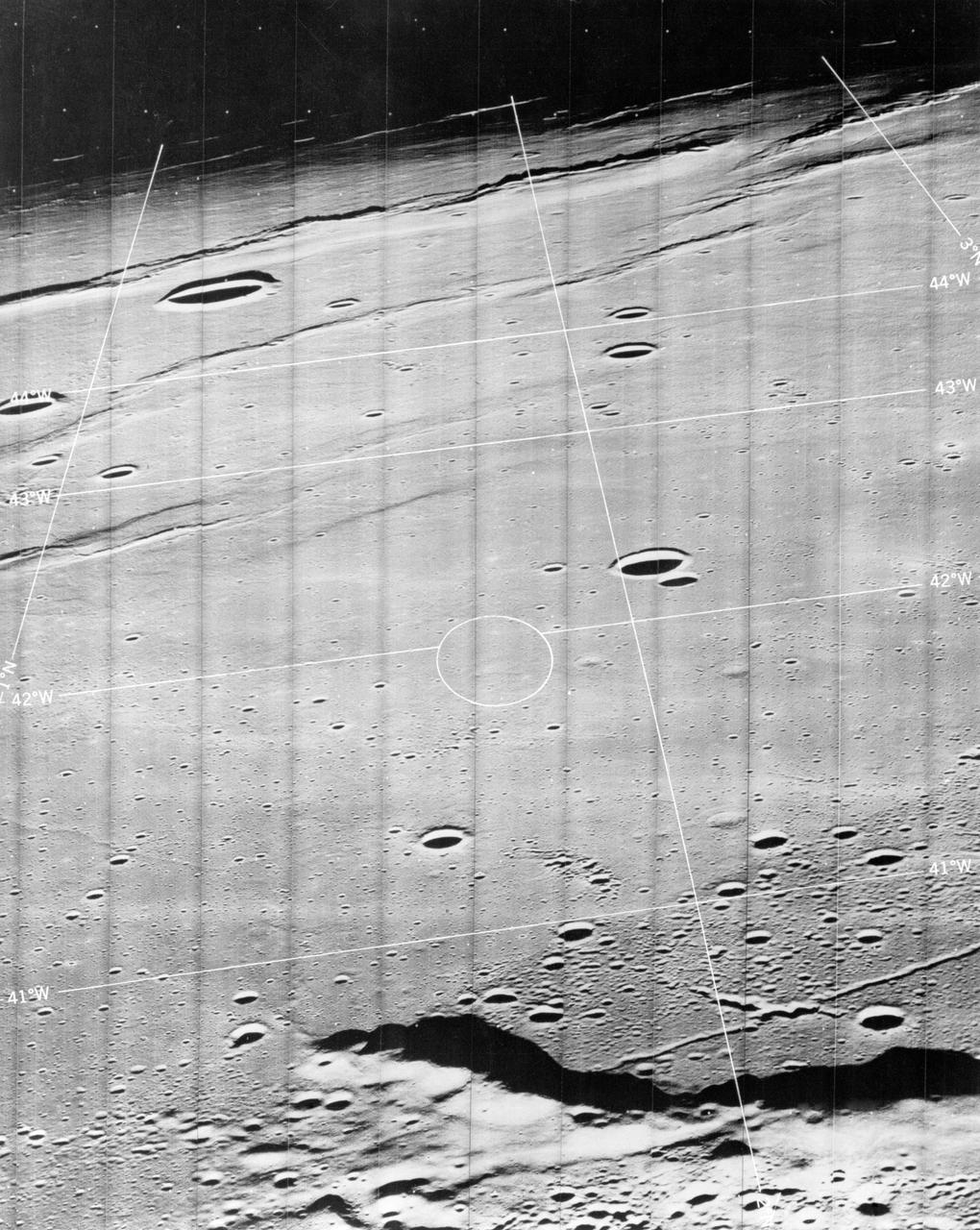
S69-54553 (October 1969) --- If the Apollo 12 launch is postponed until Nov. 16, 1969, the lunar landing will be made in this area in the Sea of Storms. (The prime launch window is Nov. 14, 1969, at 11:22 a.m. (EST), landing at Site 7.) This site (Site 5) is located at 41 degrees 40 minutes west longitude and 1 degree 40 minutes north latitude. This photograph was taken by Lunar Orbiter 3 on Feb. 21, 1967, at an altitude of 32 miles (51.8 kilometers) above the moon. This view is looking west with the sun almost directly behind the spacecraft. These approximates show the landing site as it will look to Apollo astronauts as they approach the site. The actual target site is represented by the ellipse which measures three by five miles. The lines indicate coordinates on the moon near the target site.
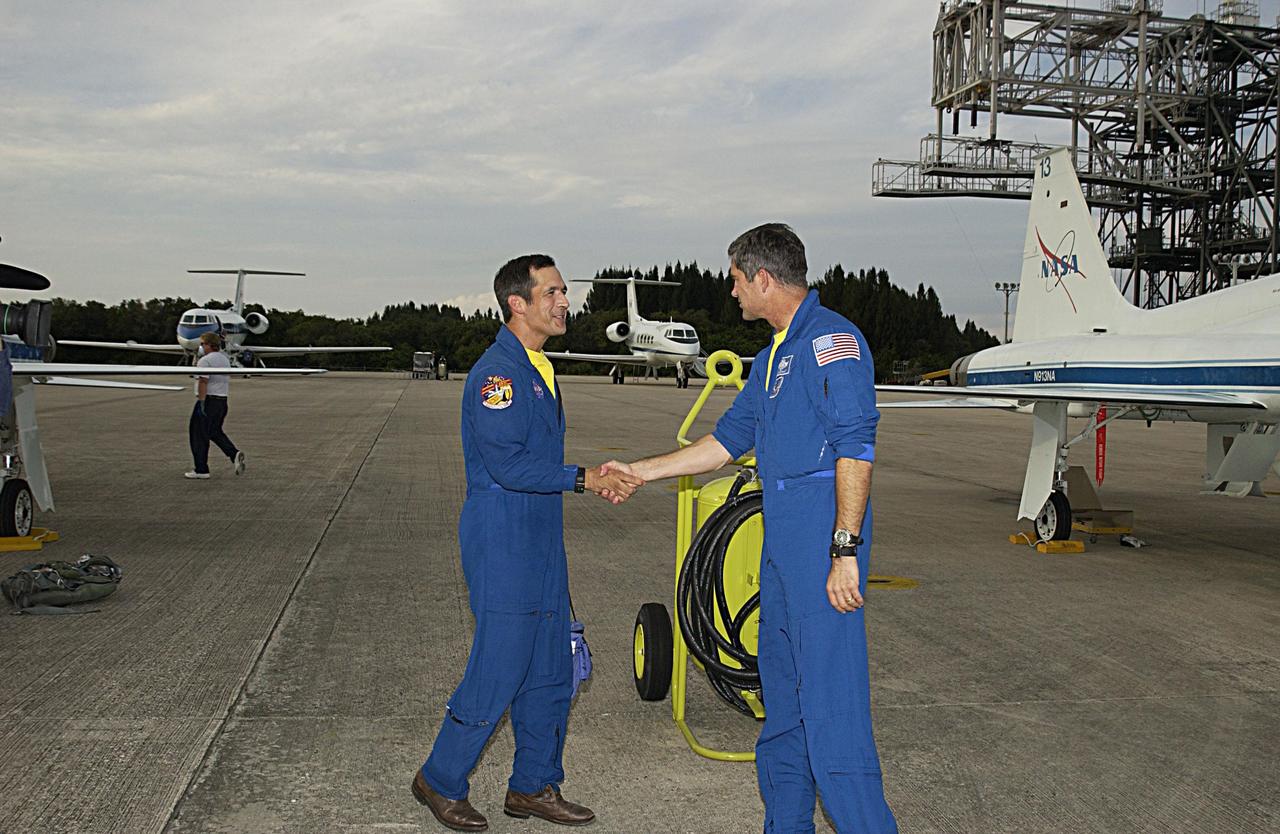
KENNEDY SPACE CENTER, FLA. -- STS-113 Mission Specialist John B. Herrington (left) and Pilot Paul Lockhart shake hands following their arrival at KSC's Shuttle Landing Facility to prepare for launch. STS-113 is the 16th American assembly flight to the International Space Station. The primary objective of the mission is bringing the Expedition 6 crew to the Station and returning the Expedition 5 crew to Earth. The major task of the mission is delivery of the Port 1 (P1) Integrated Truss Assembly, which will be attached to the port side of the S0 truss. Three spacewalks are planned to install and activate the truss and its associated equipment. Launch of Space Shuttle Endeavour on mission STS-113 is targeted for no earlier than Nov. 22 between 7 and 11 p.m. EST.
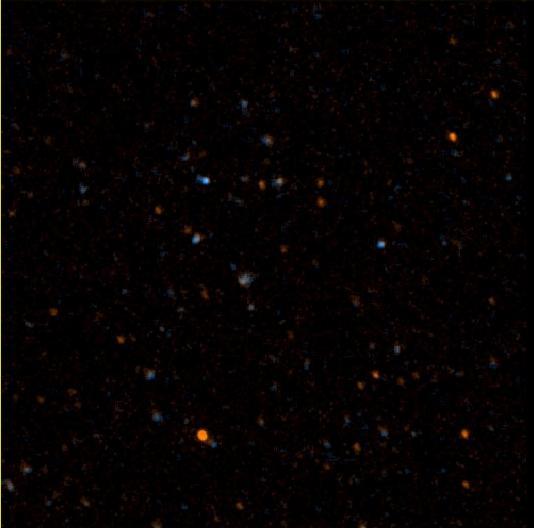
NASA's Galaxy Evolution Explorer took this image on May 21 and 22, 2003. The image was made from data gathered by the two channels of the spacecraft camera during the mission's "first light" milestone. It shows about 100 celestial objects in the constellation Hercules. The reddish objects represent those detected by the camera's near ultraviolet channel over a 5-minute period, while bluish objects were detected over a 3-minute period by the camera's far ultraviolet channel. The Galaxy Evolution Explorer's first light images are dedicated to the crew of the Space Shuttle Columbia. The Hercules region was directly above Columbia when it made its last contact with NASA Mission Control on February 1, over the skies of Texas. The Galaxy Evolution Explorer launched on April 28 on a mission to map the celestial sky in the ultraviolet and determine the history of star formation in the universe over the last 10 billion years. http://photojournal.jpl.nasa.gov/catalog/PIA04281

KENNEDY SPACE CENTER, FLA. -- The STS-113 and Expedition 6 crews head for the Astrovan to transport them to Launch Pad 39A and Space Shuttle Endeavour. In the foreground, from left, are Mission Specialist Michael Lopez-Alegria and John Herrington, and Expedition 6 Commander Ken Bowersox. In the background, from left, are Expedition 6 flight engineers Donald Pettit and Nikolai Budarin, Pilot Paul Lockhart and Commander James Wetherbee. The primary mission for the crew is bringing the Expedition 6 crew to the Station and returning the Expedition 5 crew to Earth. The major objective of the mission is delivery of the Port 1 (P1) Integrated Truss Assembly, which will be attached to the port side of the S0 truss. Three spacewalks are planned to install and activate the truss and its associated equipment. Launch of Space Shuttle Endeavour on mission STS-113 is scheduled for Nov. 22, 2002, at 8:15 p.m. EST.
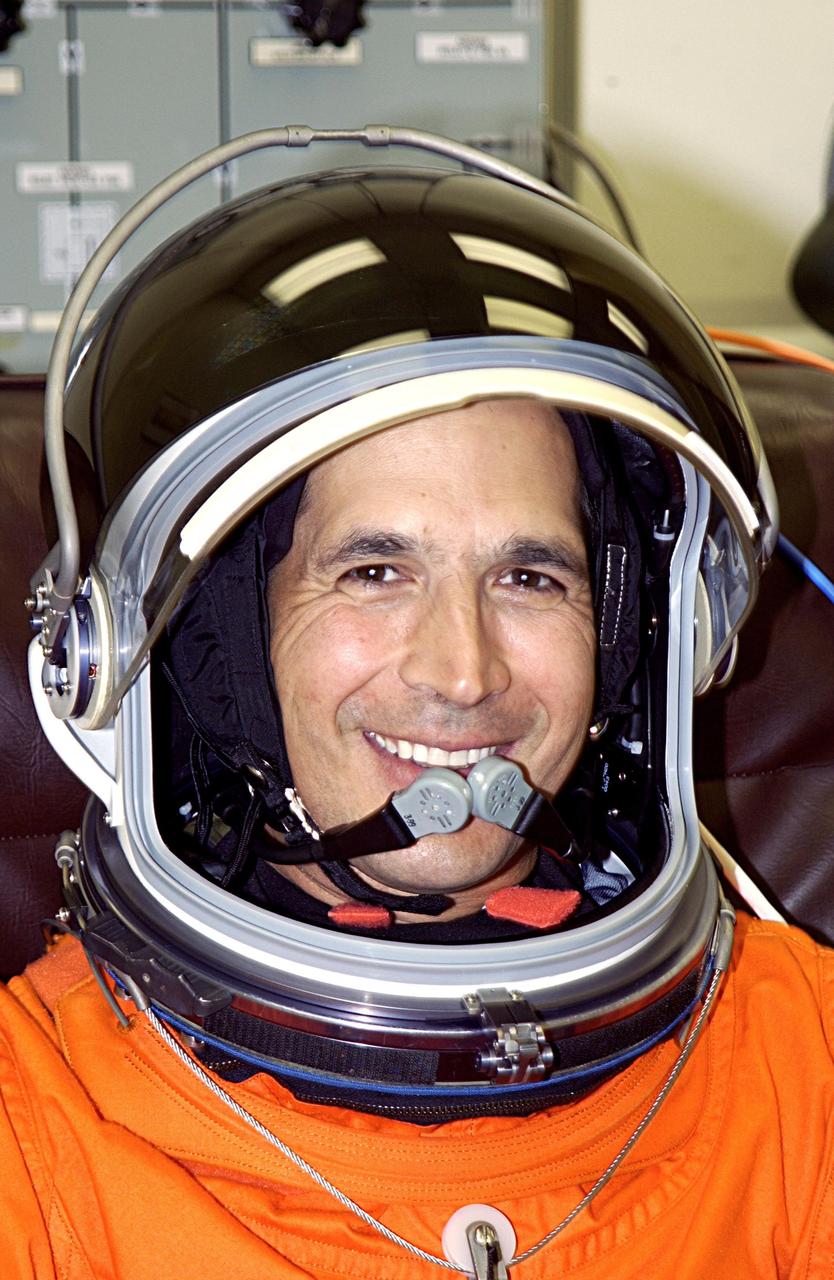
KENNEDY SPACE CENTER, FLA. -- - STS-113 Mission Specialist John Herrington smiles as he finishes suiting up for a second launch attempt on mission STS-113. The launch on Nov. 22 was scrubbed due to poor weather conditions at the Transoceanic Abort Landing sites. Herrington will be making his first Shuttle flight. The launch will carry the Expedition 6 crew to the Station and return the Expedition 5 crew to Earth. The major objective of the mission is delivery of the Port 1 (P1) Integrated Truss Assembly, which will be attached to the port side of the S0 truss. Three spacewalks are planned to install and activate the truss and its associated equipment. Launch of Space Shuttle Endeavour on mission STS-113 is now scheduled for Nov. 23 at 7:50 p.m. EST.
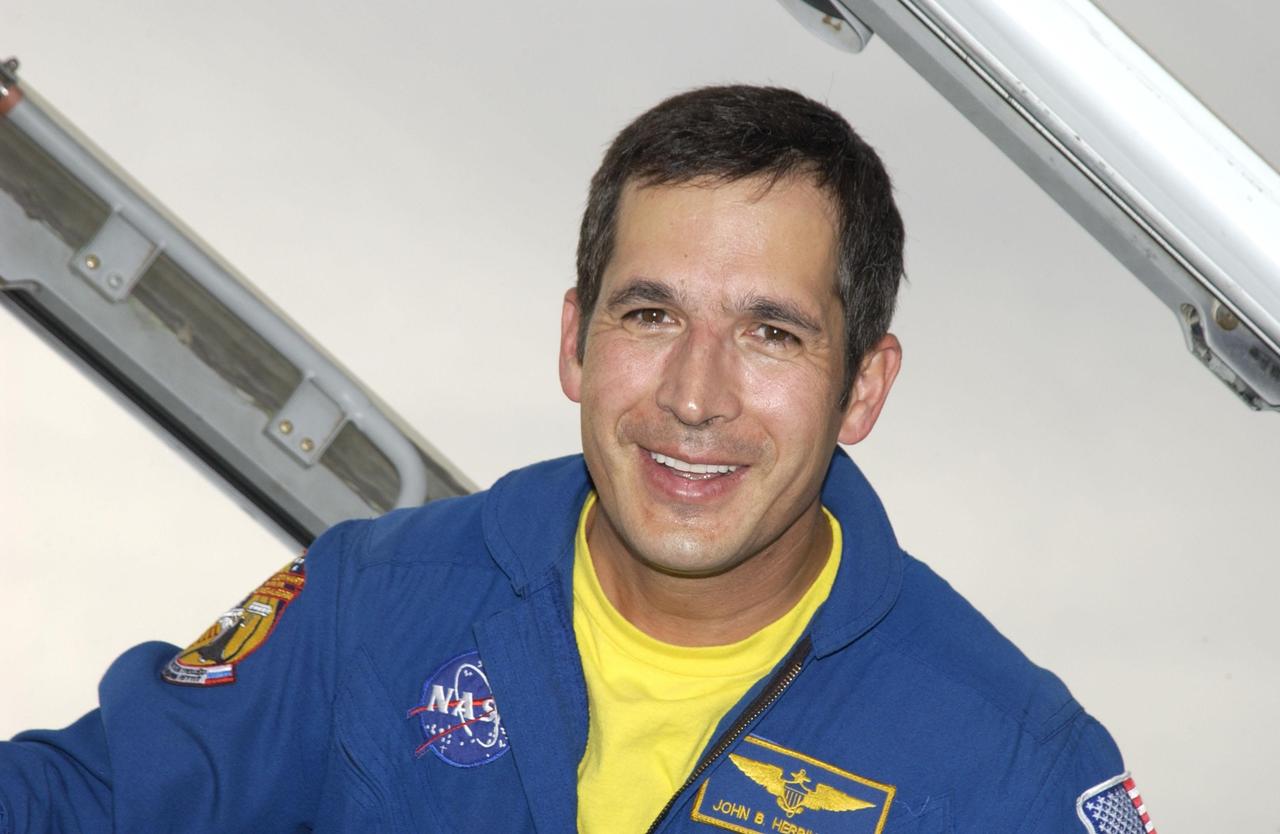
KENNEDY SPACE CENTER, FLA. -- STS-113 Mission Specialist John B. Herrington smiles for the camera upon his arrival at KSC's Shuttle Landing Facility to prepare for launch. STS-113 is the 16th American assembly flight to the International Space Station. The primary objective of the mission is bringing the Expedition 6 crew to the Station and returning the Expedition 5 crew to Earth. The major task of the mission is delivery of the Port 1 (P1) Integrated Truss Assembly, which will be attached to the port side of the S0 truss. Three spacewalks are planned to install and activate the truss and its associated equipment. Launch of Space Shuttle Endeavour on mission STS-113 is targeted for no earlier than Nov. 22 between 7 and 11 p.m. EST.
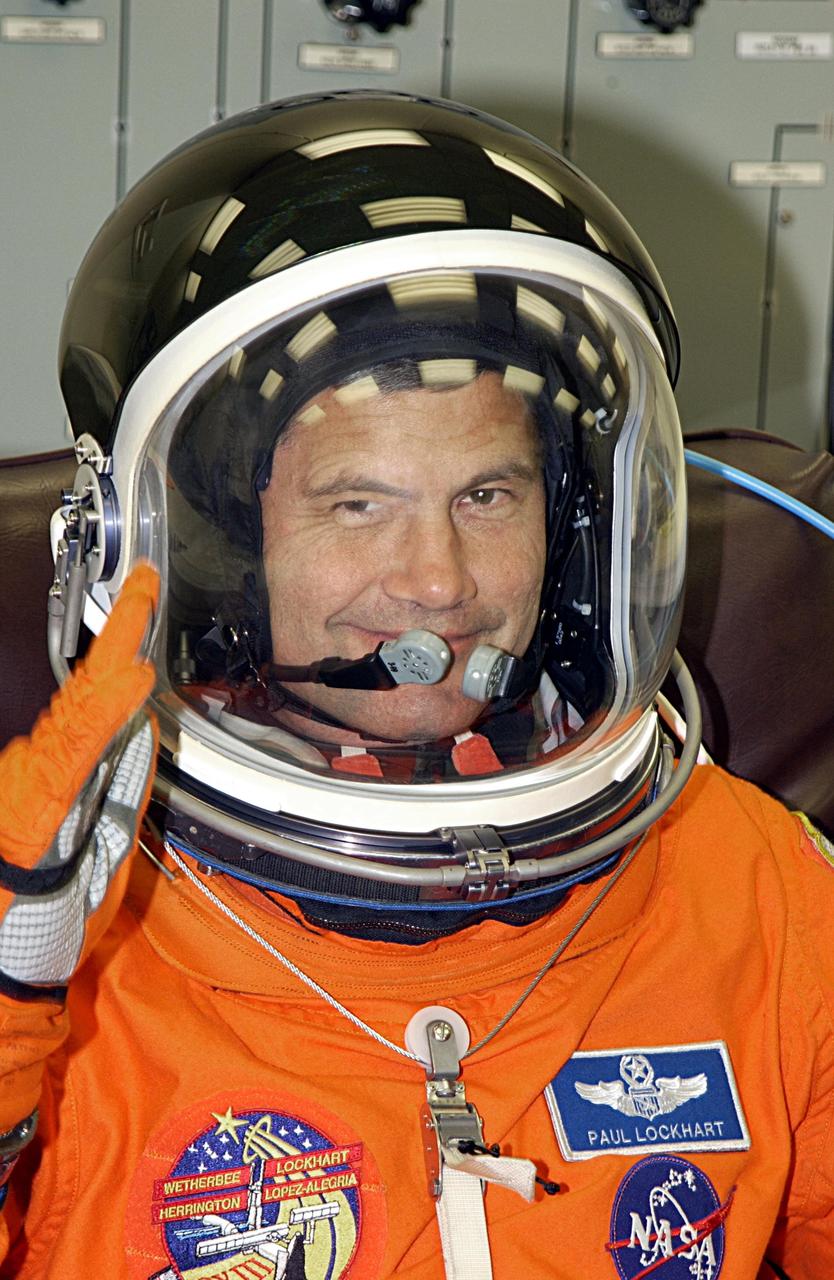
KENNEDY SPACE CENTER, FLA. - STS-113 Pilot Paul Lockhart salutes as he finishes suiting up for a second launch attempt on mission STS-113. The launch on Nov. 22 was scrubbed due to poor weather conditions at the Transoceanic Abort Landing sites. Lockhart will be making his second Shuttle flight. The launch will carry the Expedition 6 crew to the Station and return the Expedition 5 crew to Earth. The major objective of the mission is delivery of the Port 1 (P1) Integrated Truss Assembly, which will be attached to the port side of the S0 truss. Three spacewalks are planned to install and activate the truss and its associated equipment. Launch of Space Shuttle Endeavour on mission STS-113 is now scheduled for Nov. 23 at 7:50 p.m. EST.
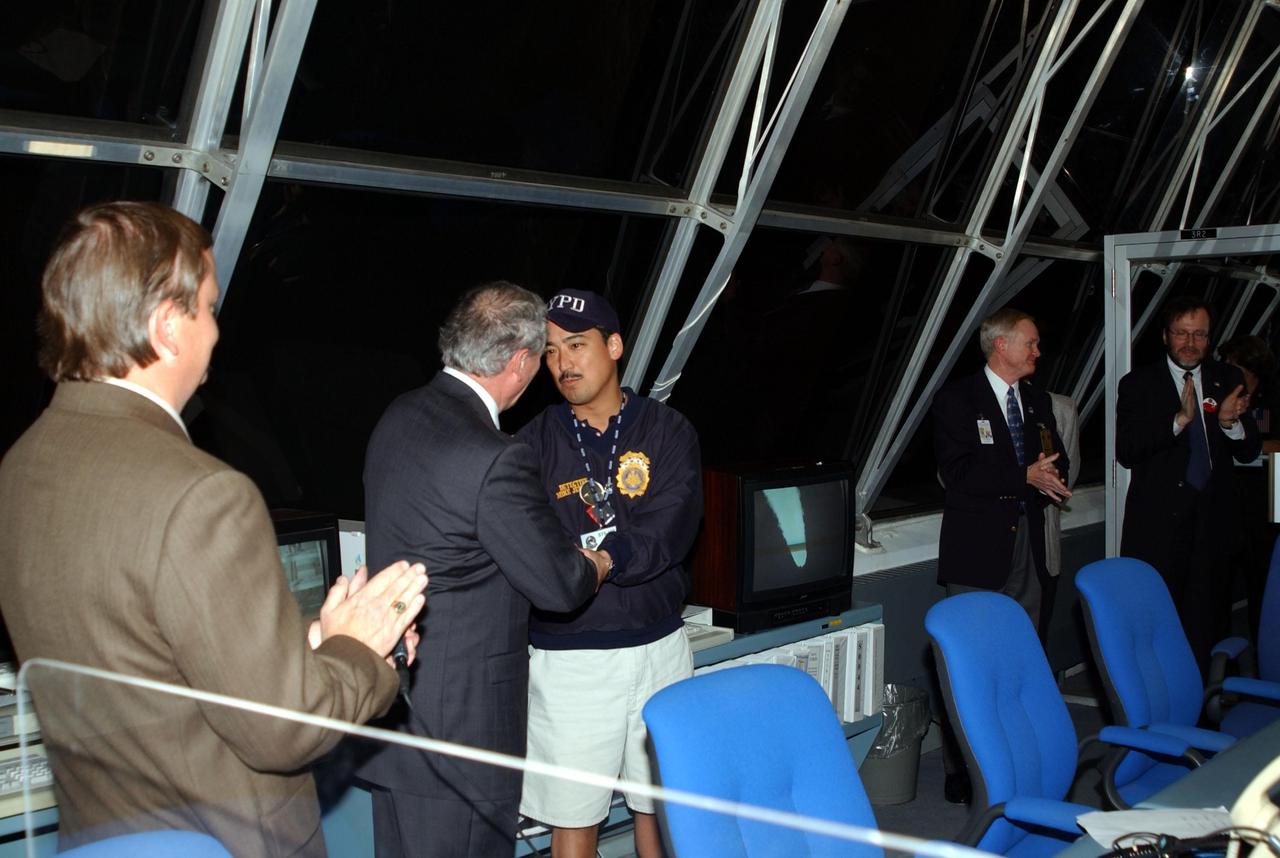
KENNEDY SPACE CENTER, Fla. -- New York Police Department Detective Michael Jermyn (center) is thanked for representing the New York Police and Fire Departments at the launch of Space Shuttle Endeavour on mission STS-108. Offering his handshake is NASA's Acting Administrator Daniel Mulville; Launch Director Mike Leinbach (left) applauds. At right is Center Director Roy Bridges Jr. Jermyn praised the efforts of the workers on the successful launch. Endeavour is carrying 6,000 flags that will be given to the families of those who died in the fall of the Twin Towers. Liftoff of Endeavour occurred at 5:19:28 p.m. EST (22:19.28 GMT). Endeavour will dock with the International Space Station on Dec. 7. STS-108 is the final Shuttle mission of 2001and the 107th Shuttle flight overall. It is the 12th flight to the Space Station. Landing of the orbiter at KSC's Shuttle Landing Facility is targeted for 1:05 p.m. EST (18:05 p.m. GMT) Dec. 16
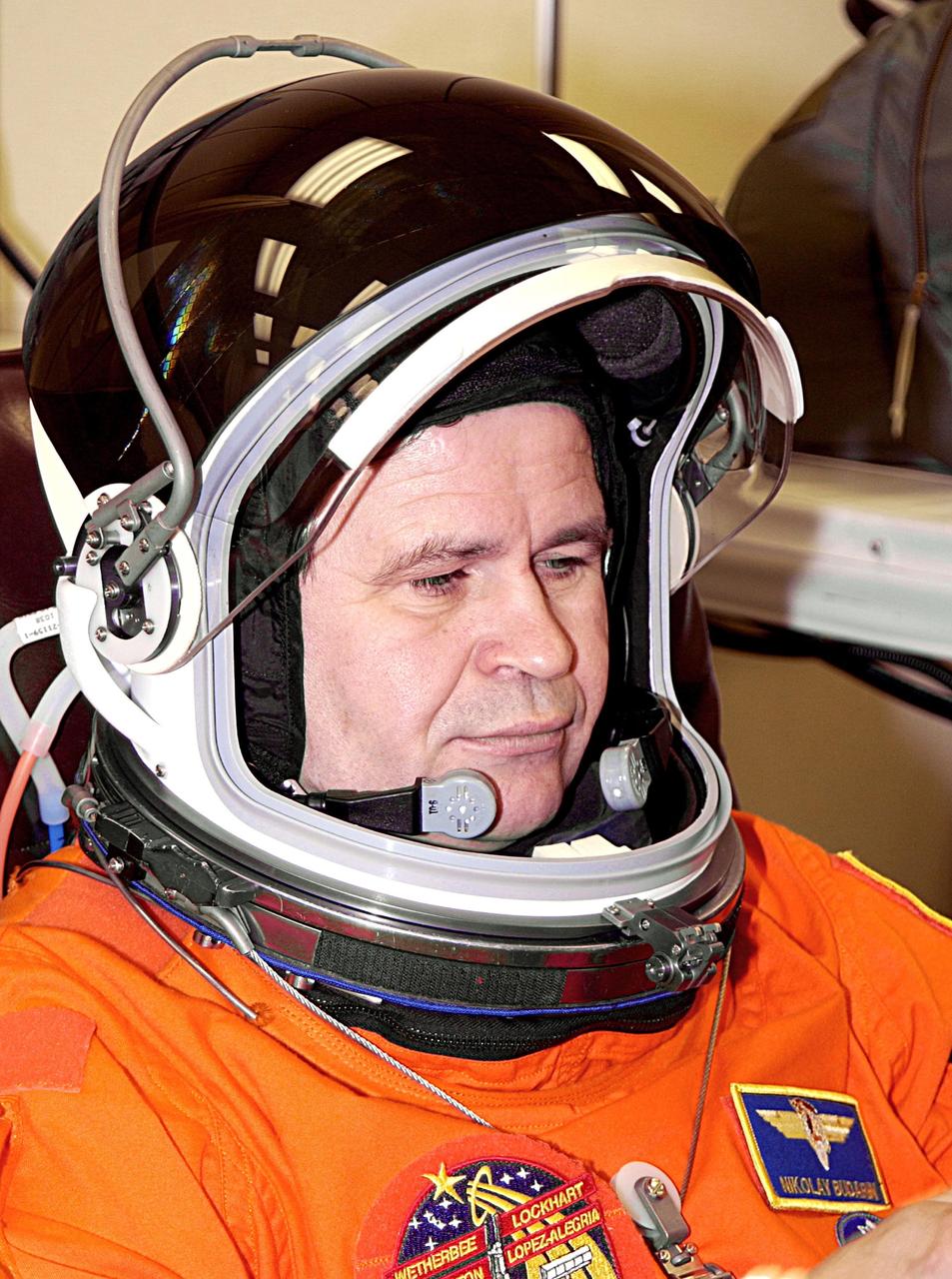
KENNEDY SPACE CENTER, FLA. -- Expedition 6 flight engineer Nikolai Budarin is stoic as he suits up for a second launch attempt on mission STS-113. The launch on Nov. 22 was scrubbed due to poor weather conditions at the Transoceanic Abort Landing sites. Budarin, who is with the Russian Space Agency, will be making his second Shuttle flight. The primary mission for the crew is bringing the Expedition 6 crew to the Station and returning the Expedition 5 crew to Earth. The major objective of the mission is delivery of the Port 1 (P1) Integrated Truss Assembly, which will be attached to the port side of the S0 truss. Three spacewalks are planned to install and activate the truss and its associated equipment. Launch of Space Shuttle Endeavour on mission STS-113 is scheduled for 7:50 p.m. EST.
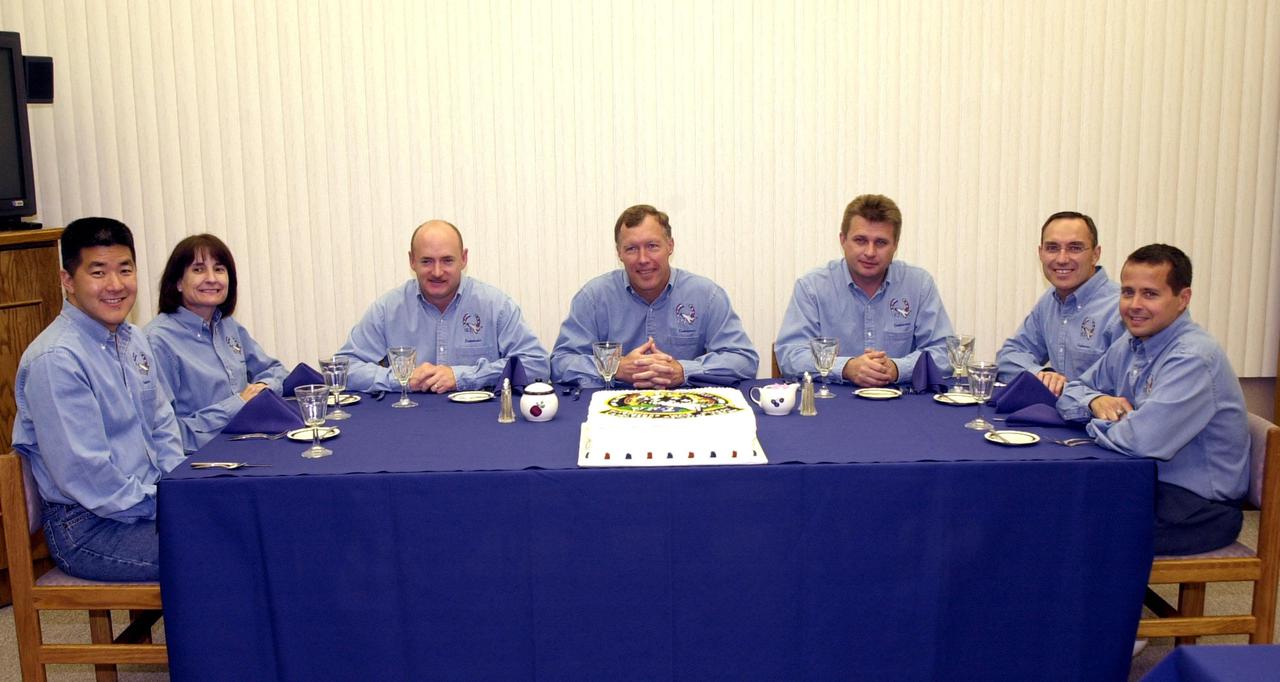
KENNEDY SPACE CENTER, Fla. -- Gathered for a second day after a scrub due to weather conditions, the STS-108 crew again enjoy a pre-launch snack featuring a cake with the mission patch. Seated left to right are Mission Specialists Daniel M. Tani and Linda A. Godwin, Pilot Mark E. Kelly and Commander Dominic L. Gorie; the Expedition 4 crew Commander Yuri Onufrienko and astronauts Carl E. Walz and Daniel W. Bursch. Top priorities for the STS-108 (UF-1) mission of Endeavour are rotation of the International Space Station Expedition 3 and Expedition 4 crews; bringing water, equipment and supplies to the station in the Multi-Purpose Logistics Module Raffaello; and the crew's completion of robotics tasks and a spacewalk to install thermal blankets over two pieces of equipment at the bases of the Space Station's solar wings. Launch is scheduled for 5:19 p.m. EST (22:19 GMT) Dec .5, 2001, from Launch Pad 39B

KENNEDY SPACE CENTER, Fla. -- Gathered for a second day after a scrub due to weather conditions, the STS-108 crew again enjoy a pre-launch snack featuring a cake with the mission patch. Seated left to right are Mission Specialists Daniel M. Tani and Linda A. Godwin, Pilot Mark E. Kelly and Commander Dominic L. Gorie; the Expedition 4 crew Commander Yuri Onufrienko and astronauts Carl E. Walz and Daniel W. Bursch. Top priorities for the STS-108 (UF-1) mission of Endeavour are rotation of the International Space Station Expedition 3 and Expedition 4 crews; bringing water, equipment and supplies to the station in the Multi-Purpose Logistics Module Raffaello; and the crew's completion of robotics tasks and a spacewalk to install thermal blankets over two pieces of equipment at the bases of the Space Station's solar wings. Launch is scheduled for 5:19 p.m. EST (22:19 GMT) Dec .5, 2001, from Launch Pad 39B
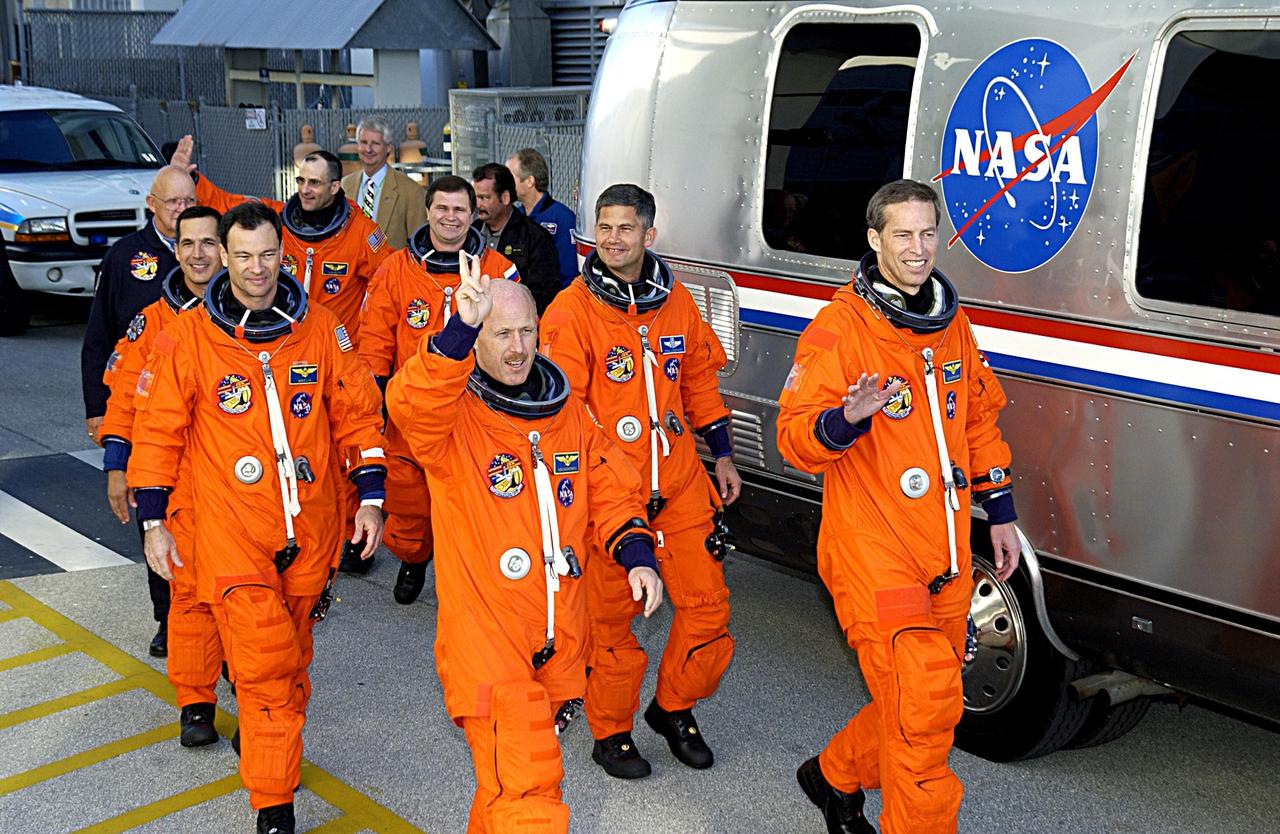
KENNEDY SPACE CENTER, FLA. - Waving at spectators, the STS-113 and Expedition 6 crews head for the Astrovan that will transport them to Launch Pad 39A and Space Shuttle Endeavour for a second launch attempt. The launch on Nov. 22 was scrubbed due to poor weather conditions at the Transoceanic Abort Landing sites. In the foreground, from left, are Mission Specialists John Herrington and Michael Lopez-Alegria, and Expedition 6 Commander Ken Bowersox; in the background, from left, are Expedition 6 flight engineers Donald Pettit and Nikolai Budarin, Mission Pilot Paul Lockhart and Commander James Wetherbee. The launch will carry the Expedition 6 crew to the Station and return the Expedition 5 crew to Earth. The major objective of the mission is delivery of the Port 1 (P1) Integrated Truss Assembly, which will be attached to the port side of the S0 truss. Three spacewalks are planned to install and activate the truss and its associated equipment. Launch of Space Shuttle Endeavour on mission STS-113 is now scheduled for Nov. 23 at 7:50 p.m. EST.
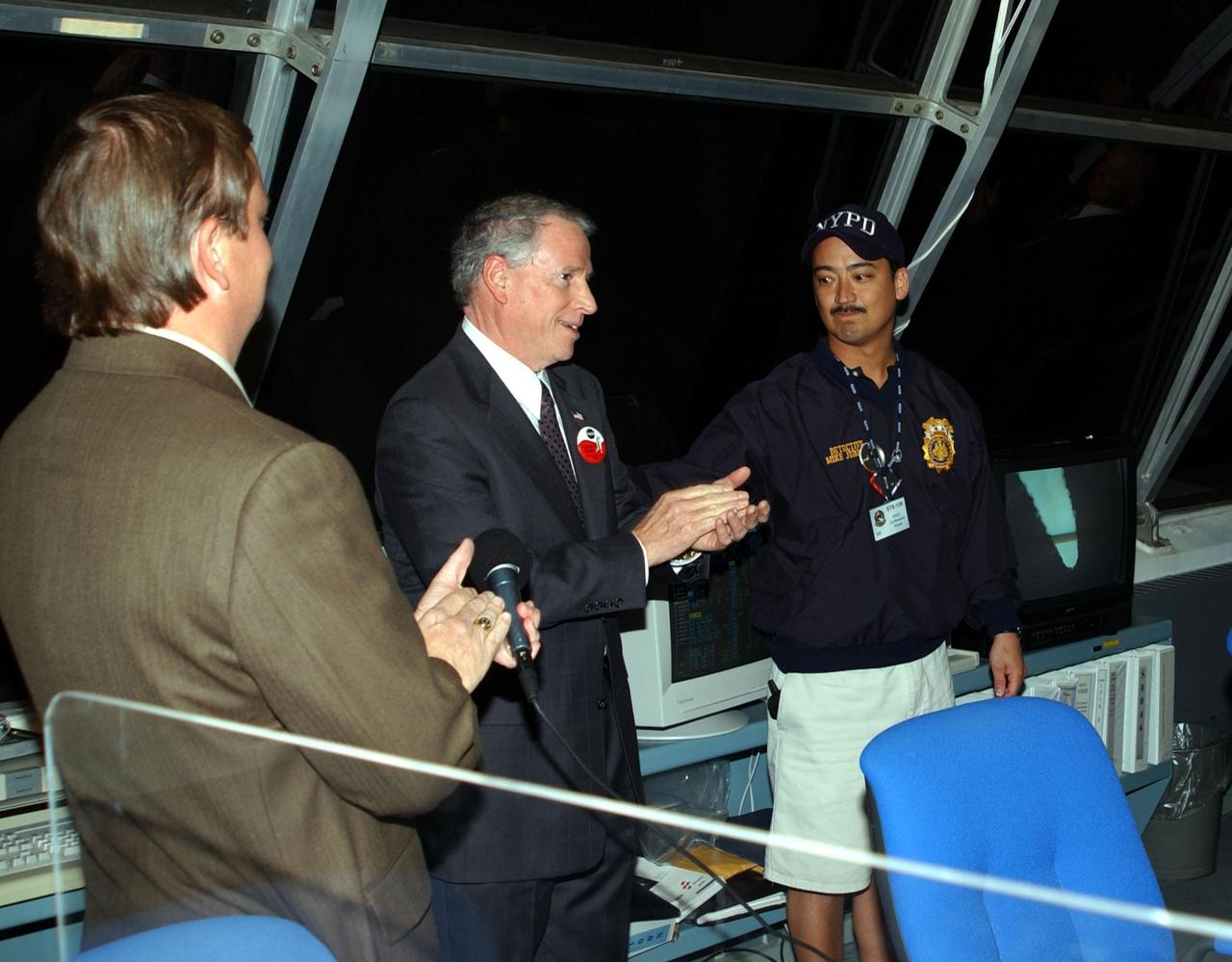
KENNEDY SPACE CENTER, FLA. -- NASA's Acting Administrator Daniel Mulville (center) joins Launch Director Mike Leinbach (left) in recognizing New York Police Department Detective Michael Jermyn in the Firiing Room, Launch Control Center, after watching the launch of Space Shuttle Endeavour on mission STS-108. Jermyn attended the launch as a guest representing the New York Police and Fire Departments whose members lost their lives in the September 11 attacks. Endeavour is carrying 6,000 flags that will be given to the families of those who died in the fall of the Twin Towers. Liftoff of Endeavour occurred at 5:19:28 p.m. EST (22:19.28 GMT). Endeavour will dock with the International Space Station on Dec. 7. STS-108 is the final Shuttle mission of 2001and the 107th Shuttle flight overall. It is the 12th flight to the Space Station. Landing of the orbiter at KSC's Shuttle Landing Facility is targeted for 1:05 p.m. EST (18:05 p.m. GMT) Dec. 16
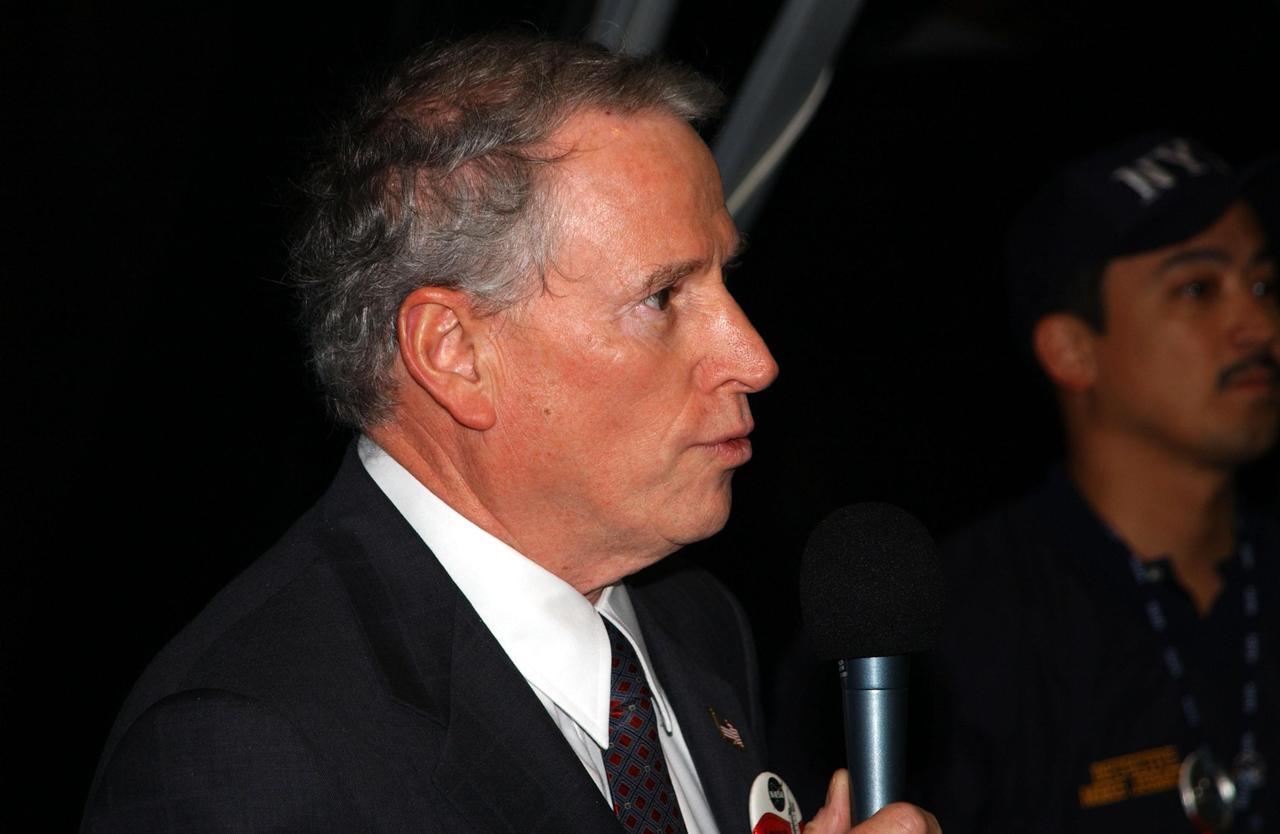
KENNEDY SPACE CENTER, Fla. -- After watching the launch of Space Shuttle Endeavour on mission STS-108, NASA's Acting Administrator Daniel Mulville (left) speaks to workers and guests in the Firiing Room, Launch Control Center. With him, at right, is New York Police Department Detective Michael Jermyn, who attended the launch as a guest representing the New York Police and Fire Departments whose members lost their lives in the September 11 attacks. Endeavour is carrying 6,000 flags that will be given to the families of those who died in the fall of the Twin Towers. Liftoff of Endeavour occurred at 5:19:28 p.m. EST (22:19.28 GMT). Endeavour will dock with the International Space Station on Dec. 7. STS-108 is the final Shuttle mission of 2001and the 107th Shuttle flight overall. It is the 12th flight to the Space Station. Landing of the orbiter at KSC's Shuttle Landing Facility is targeted for 1:05 p.m. EST (18:05 p.m. GMT) Dec. 16
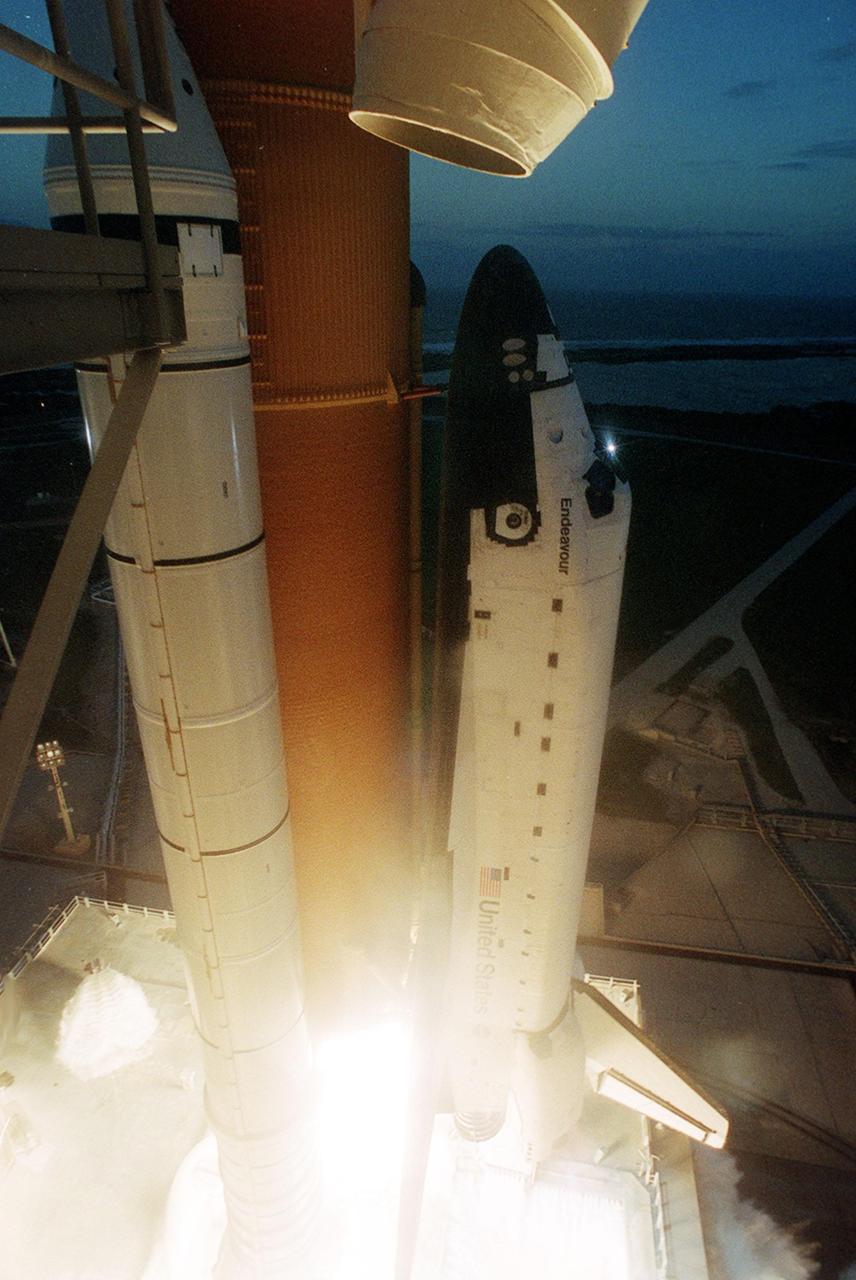
KENNEDY SPACE CENTER, FLA. -- Just before sunset, Space Shuttle Endeavour lifts off Launch Pad 39B at 5:19:28 p.m. EST (22:19:28 GMT) on mission STS-108. At left can be seen one of the six 12-foot-high rainbirds circling the Shuttle on the mobile launcher platform. Part of the sound suppression system, when solid rocket booster ignition and liftoff occur, a torrent of water flows onto the MLP from the rainbirds. Acoustical levels reach their peak when the Space Shuttle is about 300 feet above the MLP. Beyond the Shuttle can be seen part of the Banana Creek. Endeavour will dock with the International Space Station on Dec. 7. STS-108 is the final Shuttle mission of 2001and the 107th Shuttle flight overall. It is the 12th flight to the Space Station. Landing of the orbiter at KSC's Shuttle Landing Facility is targeted for 1:05 p.m. EST (18:05 p.m. GMT) Dec. 16
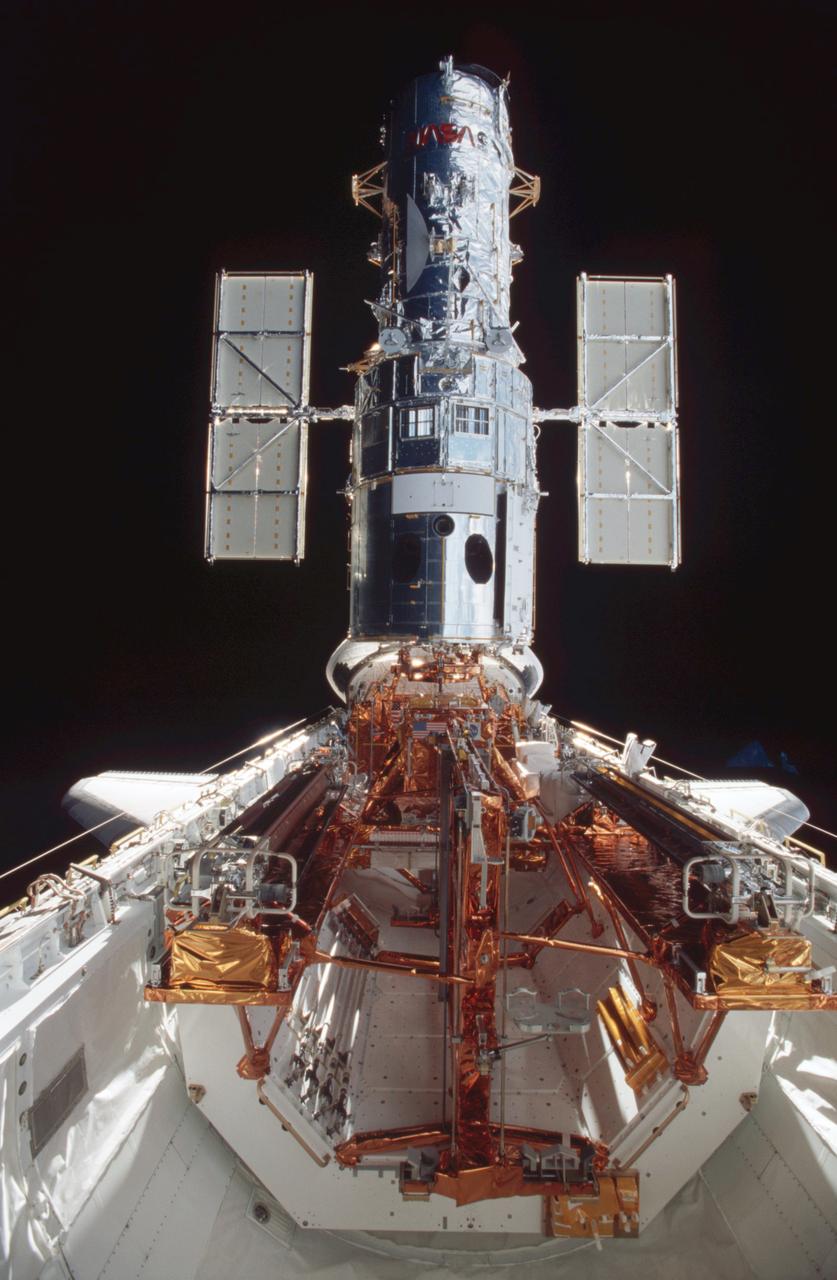
After five days of service and upgrade work on the Hubble Space Telescope (HST), the STS-109 crew photographed the giant telescope in the shuttle's cargo bay. The telescope was captured and secured on a work stand in Columbia's payload bay using Columbia's robotic arm, where 4 of the 7-member crew performed 5 space walks completing system upgrades to the HST. Included in those upgrades were: The replacement of the solar array panels; replacement of the power control unit (PCU); replacement of the Faint Object Camera (FOC) with a new advanced camera for Surveys (ACS); and installation of the experimental cooling system for the Hubble's Near-Infrared Camera and Multi-object Spectrometer (NICMOS), which had been dormant since January 1999 when its original coolant ran out. The Marshall Space Flight Center had the responsibility for the design, development, and construction of the the HST, which is the most complex and sensitive optical telescope ever made, to study the cosmos from a low-Earth orbit. Launched March 1, 2002, the STS-109 HST servicing mission lasted 10 days, 22 hours, and 11 minutes. It was the 108th flight overall in NASA's Space Shuttle Program.
![KENNEDY SPACE CENTER, FLA. -- The STS-113 and Expedition 6 crews head for the Astrovan that will transport them to Launch Pad 39A and Space Shuttle Endeavour for a second launch attempt. The launch on Nov. 22 was scrubbed due to poor weather conditions at the Transoceanic Abort Landing sites. From left are Expedition 6 flight engineer Donald Pettit; a security guard; Expedition 6 flight engineer Nikolai Budarin; Mission Specialists John Herrington and Michael Lopez-Alegria, Pilot Paul Lockhart and Commander James Wetherbee (background); and Expedition 6 Commander Ken Bowersox. The launch will carry the Expedition 6 crew to the Station and return the Expedition 5 crew to Earth. The major objective of the mission is delivery of the Port 1 (P1) Integrated Truss Assembly, which will be attached to the port side of the S0 truss. Three spacewalks are planned to install and activate the truss and its associated equipment. Launch of Space Shuttle Endeavour on mission STS-113 is now scheduled for Nov. 23 at 7:50 p.m. EST. [Photo by Scott Andrews]](https://images-assets.nasa.gov/image/KSC-02pd1802/KSC-02pd1802~medium.jpg)
KENNEDY SPACE CENTER, FLA. -- The STS-113 and Expedition 6 crews head for the Astrovan that will transport them to Launch Pad 39A and Space Shuttle Endeavour for a second launch attempt. The launch on Nov. 22 was scrubbed due to poor weather conditions at the Transoceanic Abort Landing sites. From left are Expedition 6 flight engineer Donald Pettit; a security guard; Expedition 6 flight engineer Nikolai Budarin; Mission Specialists John Herrington and Michael Lopez-Alegria, Pilot Paul Lockhart and Commander James Wetherbee (background); and Expedition 6 Commander Ken Bowersox. The launch will carry the Expedition 6 crew to the Station and return the Expedition 5 crew to Earth. The major objective of the mission is delivery of the Port 1 (P1) Integrated Truss Assembly, which will be attached to the port side of the S0 truss. Three spacewalks are planned to install and activate the truss and its associated equipment. Launch of Space Shuttle Endeavour on mission STS-113 is now scheduled for Nov. 23 at 7:50 p.m. EST. [Photo by Scott Andrews]
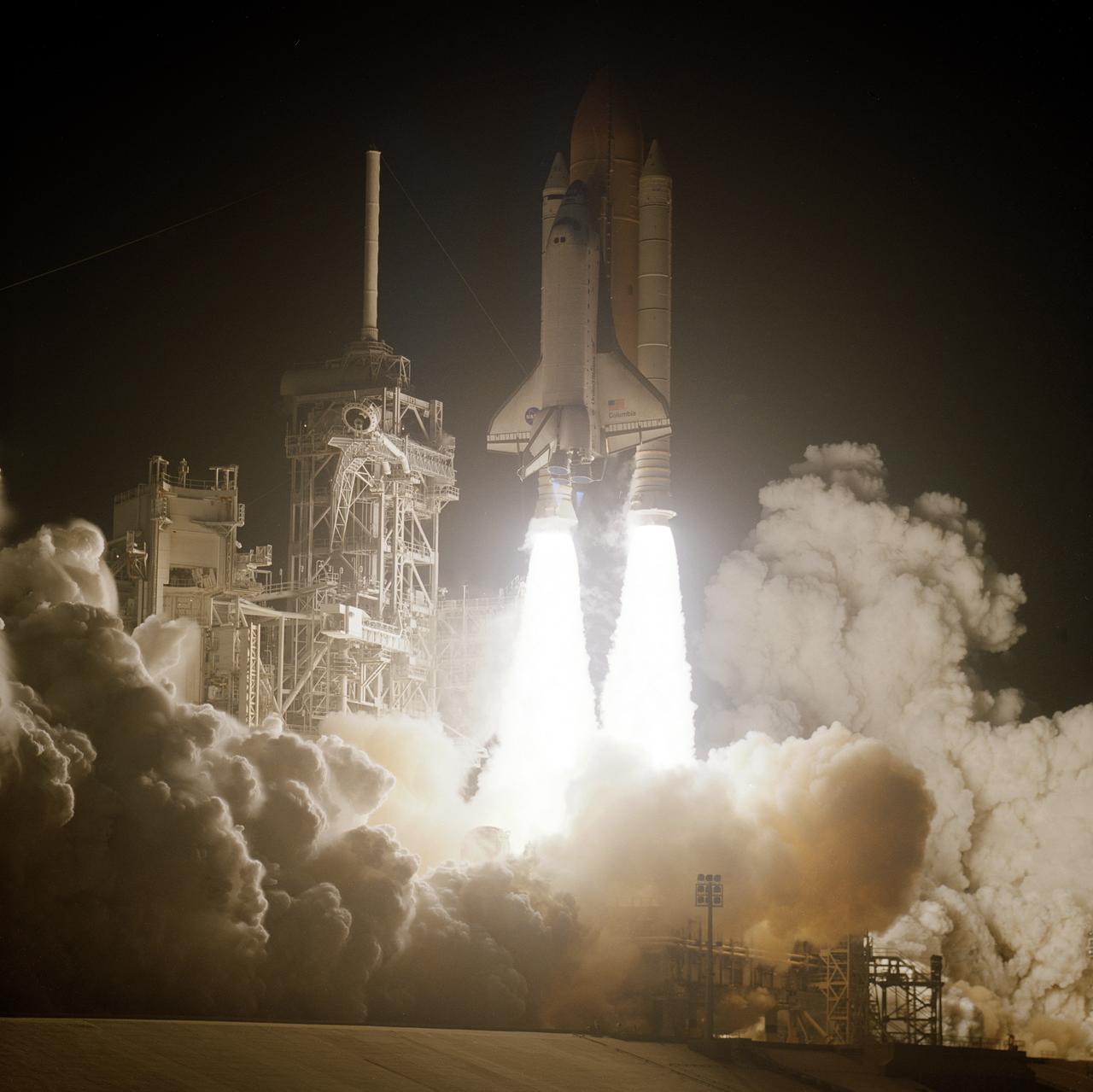
Carrying the STS-109 crew of seven, the Space Shuttle Orbiter Columbia blasted from its launch pad as it began its 27th flight and 108th flight overall in NASA's Space Shuttle Program. Launched March 1, 2002, the goal of the mission was the maintenance and upgrade of the Hubble Space Telescope (HST) which was developed, designed, and constructed by the Marshall Space Flight Center. Captured and secured on a work stand in Columbia's payload bay using Columbia's robotic arm, the HST received the following upgrades: replacement of the solar array panels; replacement of the power control unit (PCU); replacement of the Faint Object Camera (FOC) with a new advanced camera for Surveys (ACS); and installation of the experimental cooling system for the Hubble's Near-Infrared Camera and Multi-object Spectrometer (NICMOS), which had been dormant since January 1999 when it original coolant ran out. Four of the crewmembers performed 5 space walks in the 10 days, 22 hours, and 11 minutes of the the STS-109 mission.
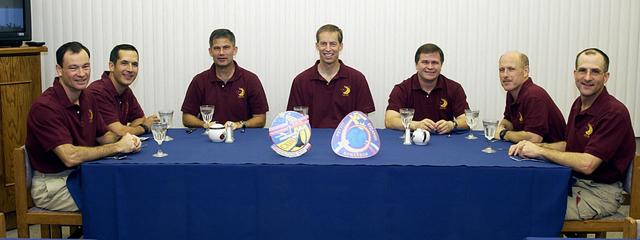
KENNEDY SPACE CENTER, FLA. - On the second launch attempt, the STS-113 crew enjoys a snack before suiting up for launch. The launch was scrubbed on Nov. 22 because of poor weather in the Transoceanic Abort Landing sites. Seated left to right are Mission Specialists Michael Lopez-Alegria and John Herrington, Pilot Paul Lockhart and Commander James Wetherbee; Expedition 6 flight engineer Nikolai Budarin, Commander Ken Bowersox and flight engineer Donald Pettit. STS-113 is the 16th American assembly flight to the International Space Station. The launch will carry the Expedition 6 crew to the Station and return the Expedition 5 crew to Earth. The major objective of the mission is delivery of the Port 1 (P1) Integrated Truss Assembly, which will be attached to the port side of the S0 truss. Three spacewalks are planned to install and activate the truss and its associated equipment. Launch of Space Shuttle Endeavour on mission STS-113 is now scheduled for Nov. 23 at 7:50 p.m. EST.
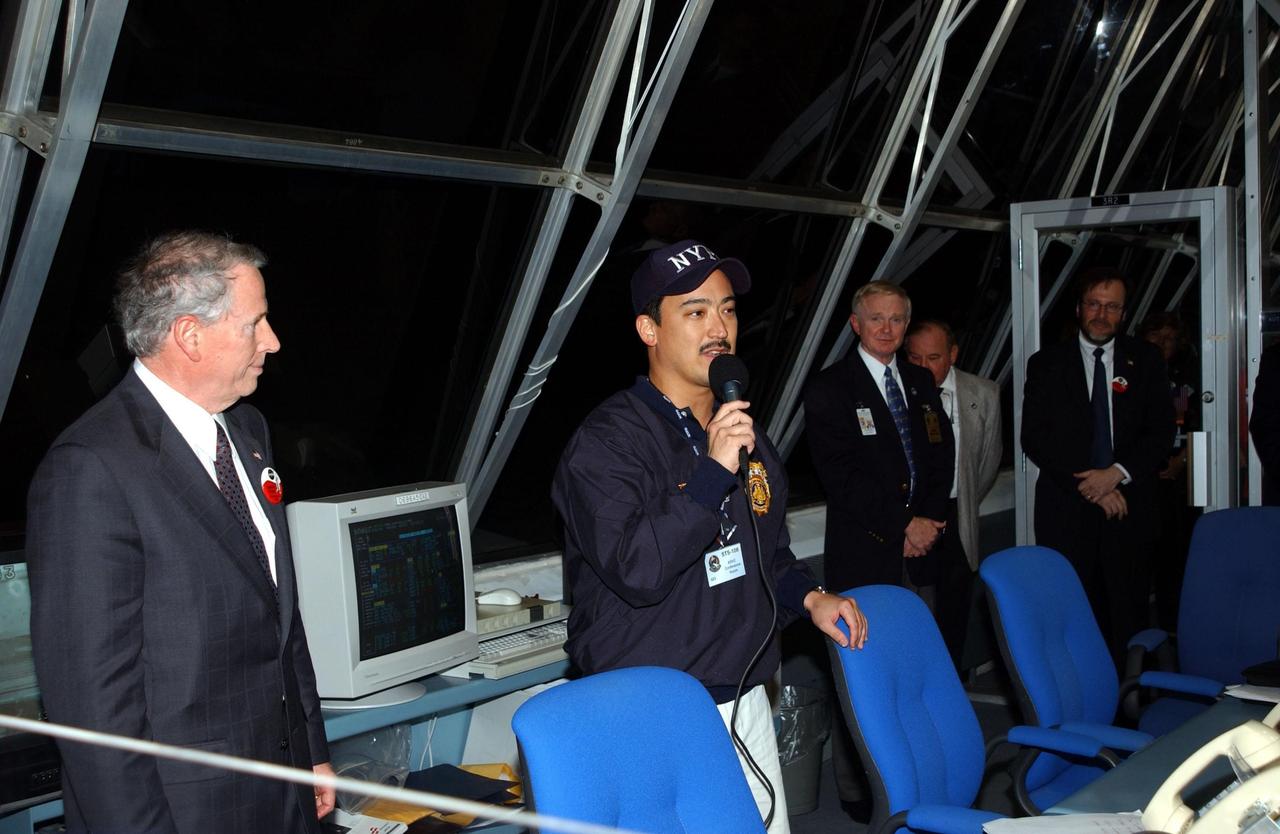
KENNEDY SPACE CENTER, Fla. -- After watching the launch of Space Shuttle Endeavour on mission STS-108 from the Firing Room of Launch Control Center, New York Police Department Detective Michael Jermyn praises the efforts of the workers on the successful launch. He is flanked by NASA's Acting Administrator Daniel Mulville (left) and Center Director Roy Bridges Jr. (right). Jermyn attended the launch as a guest representing the New York Police and Fire Departments whose members lost their lives in the September 11 attacks. Endeavour is carrying 6,000 flags that will be given to the families of those who died in the fall of the Twin Towers. Liftoff of Endeavour occurred at 5:19:28 p.m. EST (22:19.28 GMT). Endeavour will dock with the International Space Station on Dec. 7. STS-108 is the final Shuttle mission of 2001and the 107th Shuttle flight overall. It is the 12th flight to the Space Station. Landing of the orbiter at KSC's Shuttle Landing Facility is targeted for 1:05 p.m. EST (18:05 p.m. GMT) Dec. 16
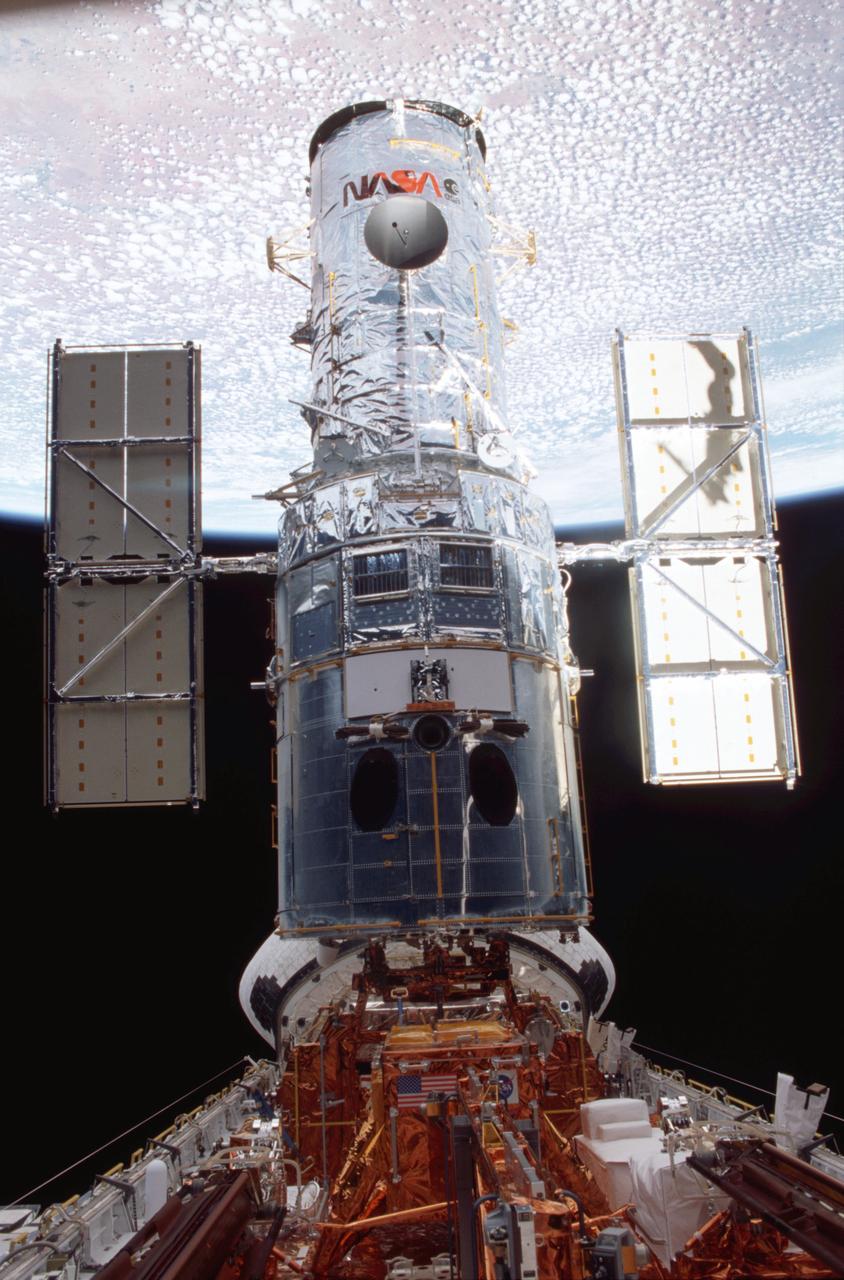
After five days of service and upgrade work on the Hubble Space Telescope (HST), the STS-109 crew photographed the giant telescope in the shuttle's cargo bay. The telescope was captured and secured on a work stand in Columbia's payload bay using Columbia's robotic arm, where 4 of the 7-member crew performed 5 space walks completing system upgrades to the HST. Included in those upgrades were: The replacement of the solar array panels; replacement of the power control unit (PCU); replacement of the Faint Object Camera (FOC) with a new advanced camera for Surveys (ACS); and installation of the experimental cooling system for the Hubble's Near-Infrared Camera and Multi-object Spectrometer (NICMOS), which had been dormant since January 1999 when its original coolant ran out. The Marshall Space Flight Center had the responsibility for the design, development, and construction of the the HST, which is the most complex and sensitive optical telescope ever made, to study the cosmos from a low-Earth orbit. Launched March 1, 2002, the STS-109 HST servicing mission lasted 10 days, 22 hours, and 11 minutes. It was the 108th flight overall in NASA's Space Shuttle Program.
![KENNEDY SPACE CENTER, FLA. -- The STS-113 and Expedition 6 crews leave the Operations and Checkout Building, heading for Launch Pad 39A and Space Shuttle Endeavour for a second launch attempt. The launch on Nov. 22 was scrubbed due to poor weather conditions at the Transoceanic Abort Landing sites. In front, left to right, are Expedition 6 Commander Ken Bowersox and Mission Commander James Wetherbee; next row, Mission Specialist Michael Lopez-Alegria and Pilot Paul Lockhart; third row, Mission Specialist John Herrington and Expedition 6 flight engineer Nikolai Budarin; and finally, Expedition 6 flight engineer Donald Pettit. The launch will carry the Expedition 6 crew to the Station and return the Expedition 5 crew to Earth. The major objective of the mission is delivery of the Port 1 (P1) Integrated Truss Assembly, which will be attached to the port side of the S0 truss. Three spacewalks are planned to install and activate the truss and its associated equipment. Launch of Space Shuttle Endeavour on mission STS-113 is now scheduled for Nov. 23 at 7:50 p.m. EST. [Photo by Scott Andrews]](https://images-assets.nasa.gov/image/KSC-02pd1800/KSC-02pd1800~medium.jpg)
KENNEDY SPACE CENTER, FLA. -- The STS-113 and Expedition 6 crews leave the Operations and Checkout Building, heading for Launch Pad 39A and Space Shuttle Endeavour for a second launch attempt. The launch on Nov. 22 was scrubbed due to poor weather conditions at the Transoceanic Abort Landing sites. In front, left to right, are Expedition 6 Commander Ken Bowersox and Mission Commander James Wetherbee; next row, Mission Specialist Michael Lopez-Alegria and Pilot Paul Lockhart; third row, Mission Specialist John Herrington and Expedition 6 flight engineer Nikolai Budarin; and finally, Expedition 6 flight engineer Donald Pettit. The launch will carry the Expedition 6 crew to the Station and return the Expedition 5 crew to Earth. The major objective of the mission is delivery of the Port 1 (P1) Integrated Truss Assembly, which will be attached to the port side of the S0 truss. Three spacewalks are planned to install and activate the truss and its associated equipment. Launch of Space Shuttle Endeavour on mission STS-113 is now scheduled for Nov. 23 at 7:50 p.m. EST. [Photo by Scott Andrews]

KENNEDY SPACE CENTER, FLA. -- The STS-113 and Expedition 6 crews leave the Operations and Checkout Building, heading for Launch Pad 39A and Space Shuttle Endeavour. In front, left to right, are Expedition 6 Commander Ken Bowersox and Mission Commander James Wetherbee; next row, Mission Specialist John Herrington and Pilot Paul Lockhart; third row, Mission Specialist Michael Lopez-Alegria and Expedition 6 flight engineer Nikolai Budarin; and finally, Expedition 6 flight engineer Donald Pettit. The primary mission for the crew is bringing the Expedition 6 crew to the Station and returning the Expedition 5 crew to Earth. The major objective of the mission is delivery of the Port 1 (P1) Integrated Truss Assembly, which will be attached to the port side of the S0 truss. Three spacewalks are planned to install and activate the truss and its associated equipment. Launch of Space Shuttle Endeavour on mission STS-113 is scheduled for Nov. 22, 2002, at 8:15 p.m. EST.
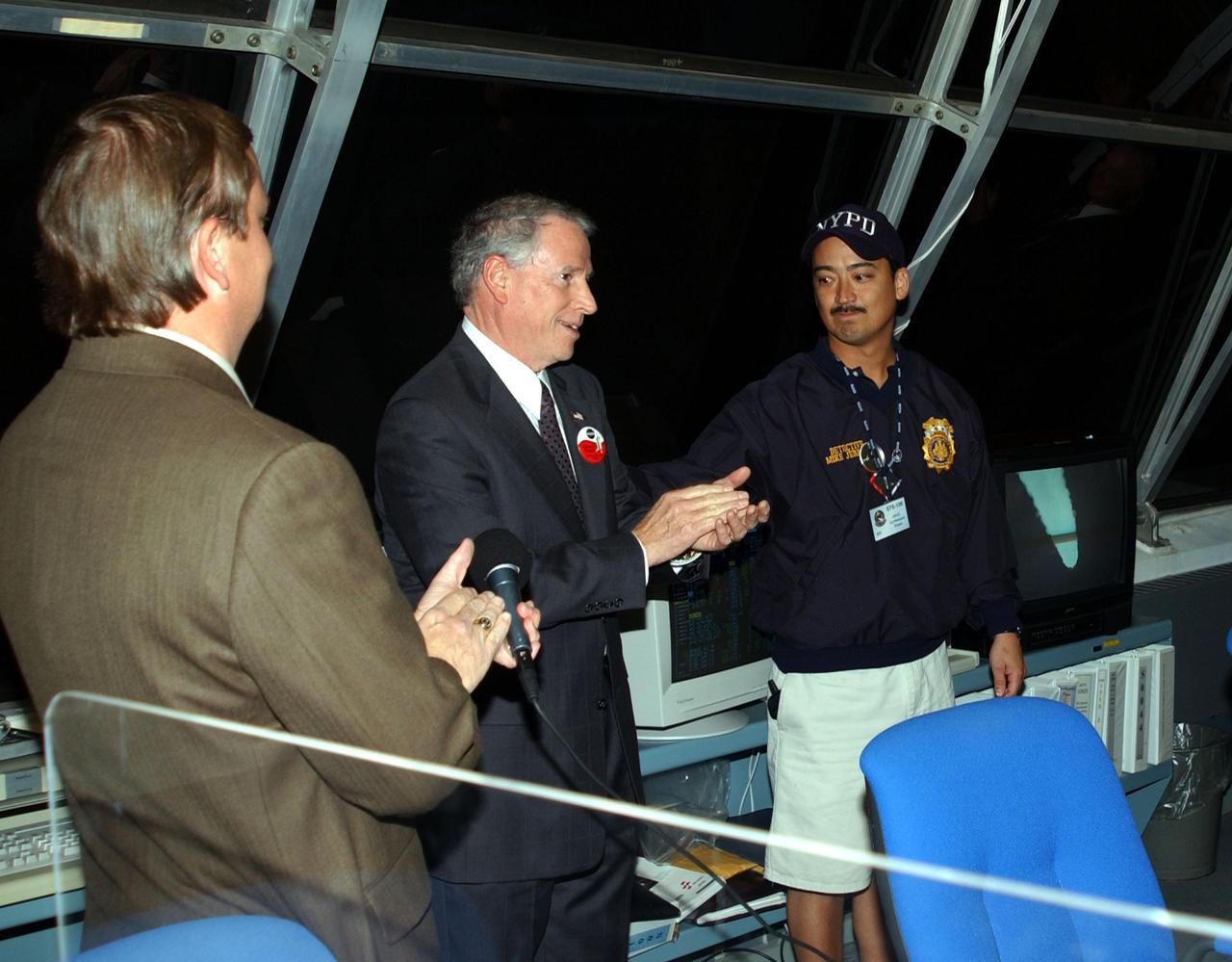
KENNEDY SPACE CENTER, FLA. -- NASA's Acting Administrator Daniel Mulville (center) joins Launch Director Mike Leinbach (left) in recognizing New York Police Department Detective Michael Jermyn in the Firiing Room, Launch Control Center, after watching the launch of Space Shuttle Endeavour on mission STS-108. Jermyn attended the launch as a guest representing the New York Police and Fire Departments whose members lost their lives in the September 11 attacks. Endeavour is carrying 6,000 flags that will be given to the families of those who died in the fall of the Twin Towers. Liftoff of Endeavour occurred at 5:19:28 p.m. EST (22:19.28 GMT). Endeavour will dock with the International Space Station on Dec. 7. STS-108 is the final Shuttle mission of 2001and the 107th Shuttle flight overall. It is the 12th flight to the Space Station. Landing of the orbiter at KSC's Shuttle Landing Facility is targeted for 1:05 p.m. EST (18:05 p.m. GMT) Dec. 16
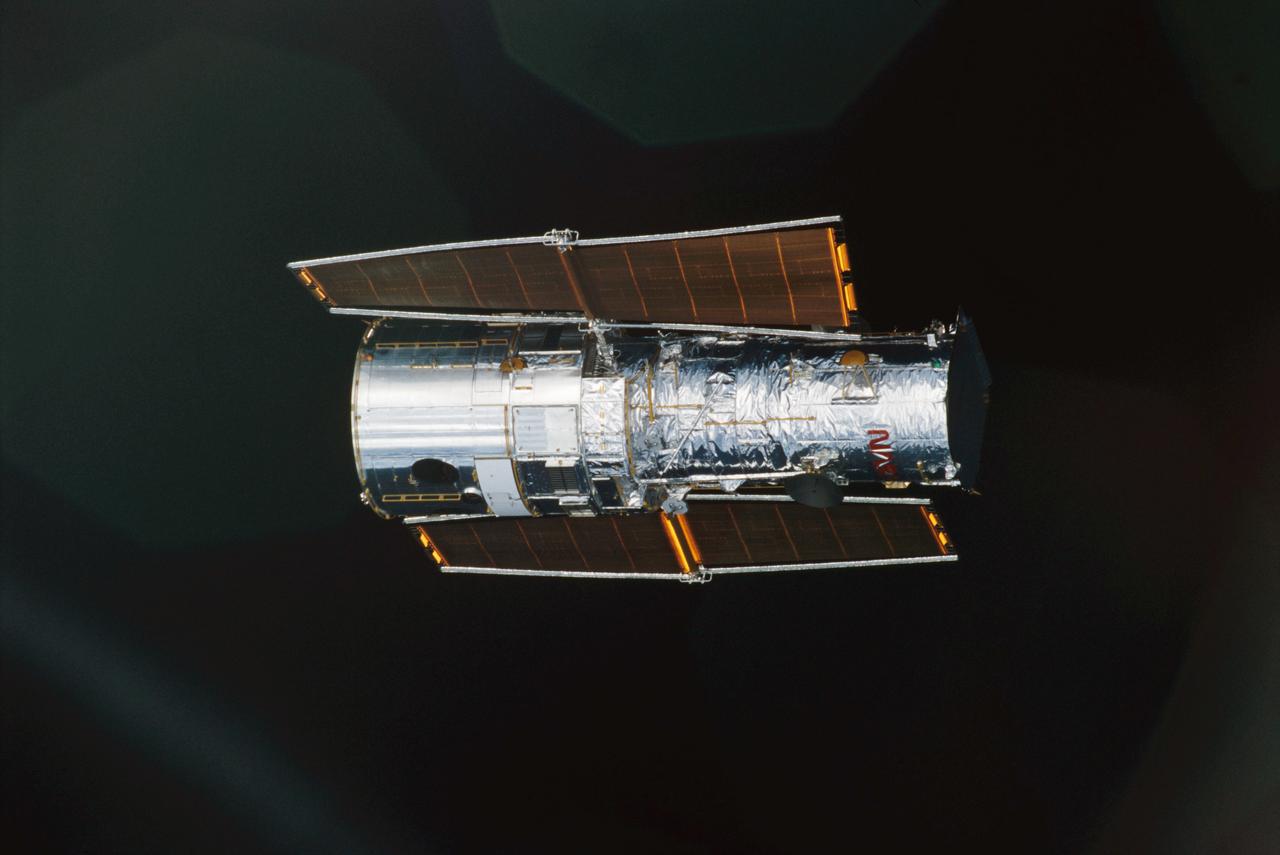
The Hubble Space Telescope (HST), with its normal routine temporarily interrupted, is about to be captured by the Space Shuttle Columbia prior to a week of servicing and upgrading by the STS-109 crew. The telescope was captured by the shuttle's Remote Manipulator System (RMS) robotic arm and secured on a work stand in Columbia's payload bay where 4 of the 7-member crew performed 5 space walks completing system upgrades to the HST. Included in those upgrades were: The replacement of the solar array panels; replacement of the power control unit (PCU); replacement of the Faint Object Camera (FOC) with a new advanced camera for Surveys (ACS); and installation of the experimental cooling system for the Hubble's Near-Infrared Camera and Multi-object Spectrometer (NICMOS), which had been dormant since January 1999 when its original coolant ran out. The Marshall Space Flight Center had the responsibility for the design, development, and construction of the the HST, which is the most complex and sensitive optical telescope ever made, to study the cosmos from a low-Earth orbit. Launched March 1, 2002, the STS-109 HST servicing mission lasted 10 days, 22 hours, and 11 minutes. It was the 108th flight overall in NASA's Space Shuttle Program.
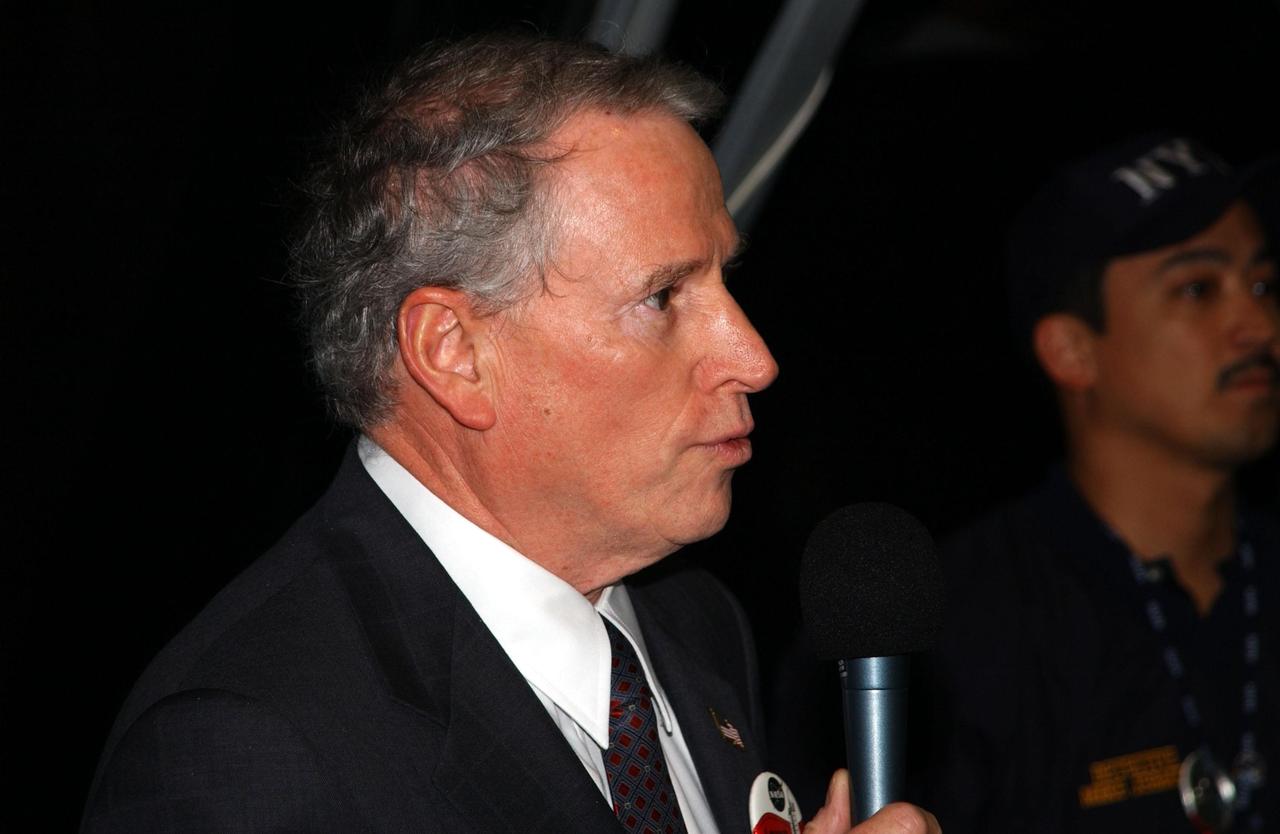
KENNEDY SPACE CENTER, Fla. -- After watching the launch of Space Shuttle Endeavour on mission STS-108, NASA's Acting Administrator Daniel Mulville (left) speaks to workers and guests in the Firiing Room, Launch Control Center. With him, at right, is New York Police Department Detective Michael Jermyn, who attended the launch as a guest representing the New York Police and Fire Departments whose members lost their lives in the September 11 attacks. Endeavour is carrying 6,000 flags that will be given to the families of those who died in the fall of the Twin Towers. Liftoff of Endeavour occurred at 5:19:28 p.m. EST (22:19.28 GMT). Endeavour will dock with the International Space Station on Dec. 7. STS-108 is the final Shuttle mission of 2001and the 107th Shuttle flight overall. It is the 12th flight to the Space Station. Landing of the orbiter at KSC's Shuttle Landing Facility is targeted for 1:05 p.m. EST (18:05 p.m. GMT) Dec. 16
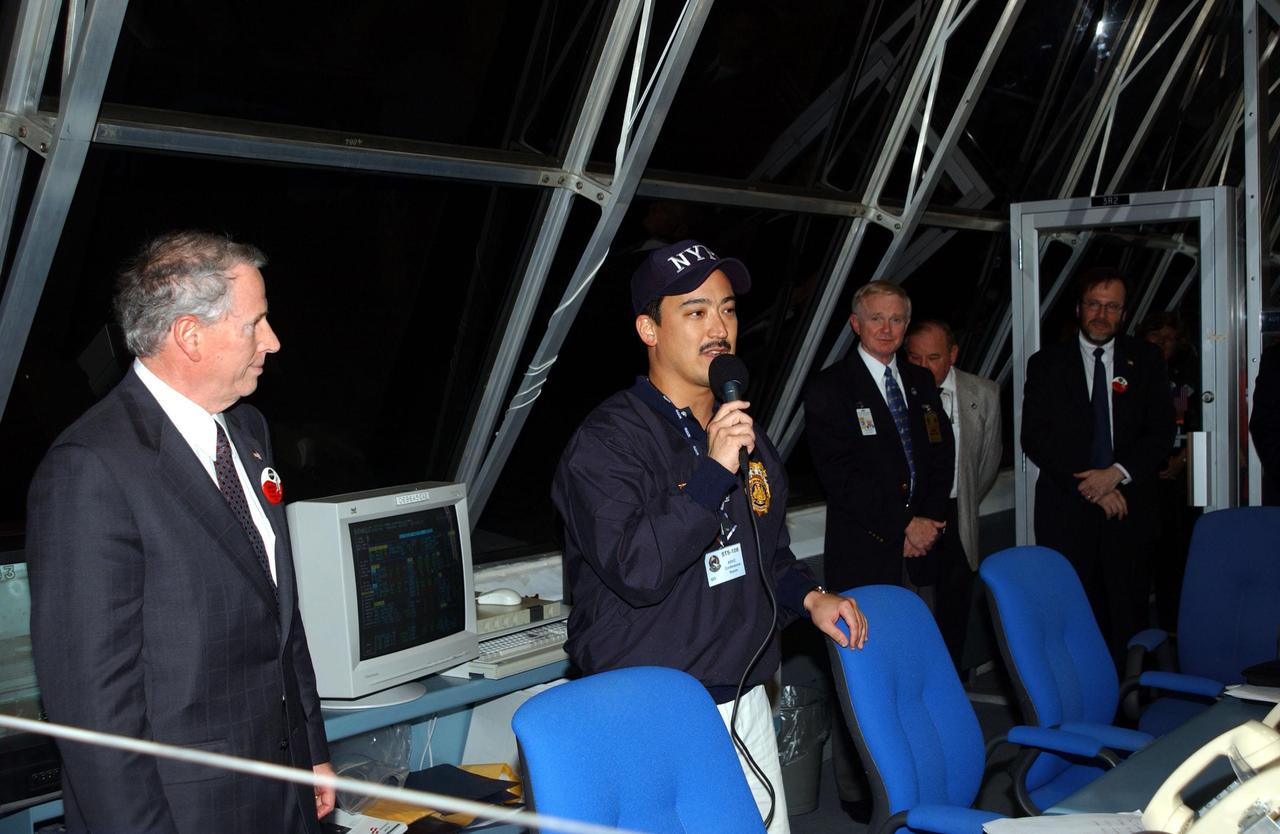
KENNEDY SPACE CENTER, Fla. -- After watching the launch of Space Shuttle Endeavour on mission STS-108 from the Firing Room of Launch Control Center, New York Police Department Detective Michael Jermyn praises the efforts of the workers on the successful launch. He is flanked by NASA's Acting Administrator Daniel Mulville (left) and Center Director Roy Bridges Jr. (right). Jermyn attended the launch as a guest representing the New York Police and Fire Departments whose members lost their lives in the September 11 attacks. Endeavour is carrying 6,000 flags that will be given to the families of those who died in the fall of the Twin Towers. Liftoff of Endeavour occurred at 5:19:28 p.m. EST (22:19.28 GMT). Endeavour will dock with the International Space Station on Dec. 7. STS-108 is the final Shuttle mission of 2001and the 107th Shuttle flight overall. It is the 12th flight to the Space Station. Landing of the orbiter at KSC's Shuttle Landing Facility is targeted for 1:05 p.m. EST (18:05 p.m. GMT) Dec. 16
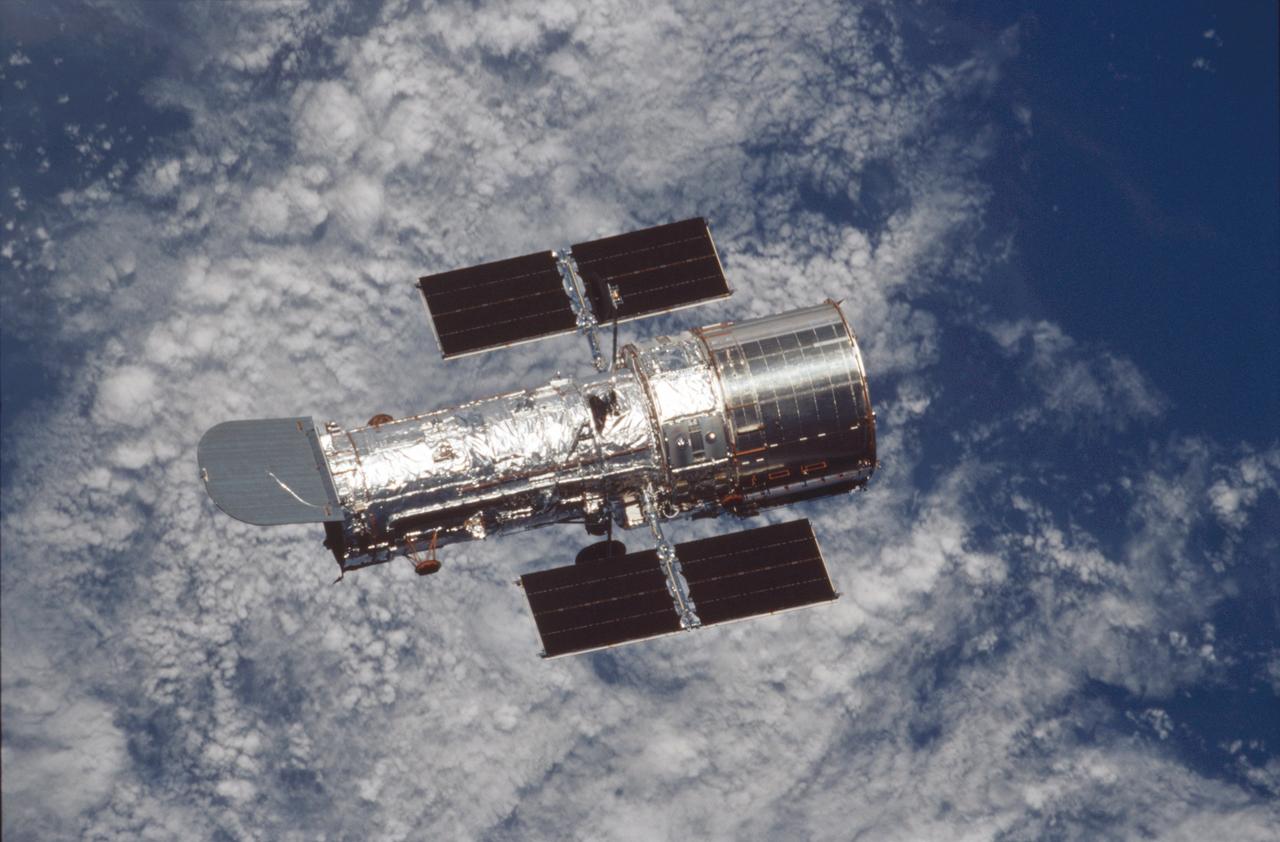
After five days of service and upgrade work on the Hubble Space Telescope (HST), the STS-109 crew photographed the giant telescope returning to its normal routine. The telescope was captured and secured on a work stand in Columbia's payload bay using Columbia's robotic arm, where 4 of the 7-member crew performed 5 space walks completing system upgrades to the HST. Included in those upgrades were: The replacement of the solar array panels; replacement of the power control unit (PCU); replacement of the Faint Object Camera (FOC) with a new advanced camera for Surveys (ACS); and installation of the experimental cooling system for the Hubble's Near- Infrared Camera and Multi-object Spectrometer (NICMOS), which had been dormant since January 1999 when its original coolant ran out. The Marshall Space Flight Center had the responsibility for the design, development, and construction of the the HST, which is the most complex and sensitive optical telescope ever made, to study the cosmos from a low-Earth orbit. Launched March 1, 2002, the STS-109 HST servicing mission lasted 10 days, 22 hours, and 11 minutes. It was the 108th flight overall in NASA's Space Shuttle Program.
![KENNEDY SPACE CENTER, FLA. -- The STS-113 and Expedition 6 crews stride down the ramp from the Operations and Checkout Building, eager to head for Launch Pad 39A and Space Shuttle Endeavour for a second launch attempt. The launch on Nov. 22 was scrubbed due to poor weather conditions at the Transoceanic Abort Landing sites. In front, left to right, are Expedition 6 Commander Ken Bowersox and Mission Commander James Wetherbee; next row, Mission Specialist Michael Lopez-Alegria and Pilot Paul Lockhart; third row, Mission Specialist John Herrington and Expedition 6 flight engineer Nikolai Budarin; and finally, Expedition 6 flight engineer Donald Pettit. The launch will carry the Expedition 6 crew to the Station and return the Expedition 5 crew to Earth. The major objective of the mission is delivery of the Port 1 (P1) Integrated Truss Assembly, which will be attached to the port side of the S0 truss. Three spacewalks are planned to install and activate the truss and its associated equipment. Launch of Space Shuttle Endeavour on mission STS-113 is now scheduled for Nov. 23 at 7:50 p.m. EST. [Photo by Scott Andrews]](https://images-assets.nasa.gov/image/KSC-02pd1801/KSC-02pd1801~medium.jpg)
KENNEDY SPACE CENTER, FLA. -- The STS-113 and Expedition 6 crews stride down the ramp from the Operations and Checkout Building, eager to head for Launch Pad 39A and Space Shuttle Endeavour for a second launch attempt. The launch on Nov. 22 was scrubbed due to poor weather conditions at the Transoceanic Abort Landing sites. In front, left to right, are Expedition 6 Commander Ken Bowersox and Mission Commander James Wetherbee; next row, Mission Specialist Michael Lopez-Alegria and Pilot Paul Lockhart; third row, Mission Specialist John Herrington and Expedition 6 flight engineer Nikolai Budarin; and finally, Expedition 6 flight engineer Donald Pettit. The launch will carry the Expedition 6 crew to the Station and return the Expedition 5 crew to Earth. The major objective of the mission is delivery of the Port 1 (P1) Integrated Truss Assembly, which will be attached to the port side of the S0 truss. Three spacewalks are planned to install and activate the truss and its associated equipment. Launch of Space Shuttle Endeavour on mission STS-113 is now scheduled for Nov. 23 at 7:50 p.m. EST. [Photo by Scott Andrews]
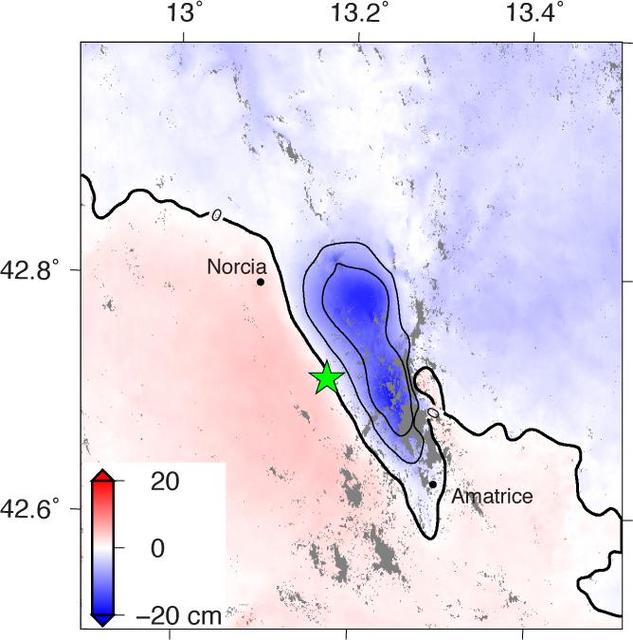
Amatrice earthquake in central Italy, which caused widespread building damage to several towns throughout the region. This earthquake was the strongest in that area since the 2009 earthquake that destroyed the city of L'Aquila. The Advanced Rapid Imaging and Analysis (ARIA) data system, a collaborative project between NASA's Jet Propulsion Laboratory, Pasadena, California, and the California Institute of Technology in Pasadena, automatically generated interferometric synthetic aperture radar images from the Copernicus Sentinel 1A satellite operated by the European Space Agency (ESA) for the European Commission to calculate a map of the deformation of Earth's surface caused by the quake. This false-color map shows the amount of permanent surface movement, as viewed by the satellite, during a 12-day interval between two Sentinel 1 images acquired on Aug. 15, 2016, and Aug. 27, 2016. The movement was caused almost entirely by the earthquake. In this map, the colors of the surface displacements are proportional to the surface motion. The red and pink tones show the areas where the land moved toward the satellite by up to 2 inches (5 centimeters). The area with various shades of blue moved away from the satellite, mostly downward, by as much as 8 inches (20 centimeters). Contours on the surface motion are 2 inches (5 centimeters) The green star shows the epicenter where the earthquake started as located by the U.S. Geological Survey National Earthquake Information Center. Black dots show town locations. Scientists use these maps to build detailed models of the fault slip at depth and associated land movements to better understand the impact on future earthquake activity. The map shows the fault or faults that moved in the earthquake is about 14 miles (22 kilometers) long between Amatrice and Norcia and slopes to the west beneath the area that moved downward. http://photojournal.jpl.nasa.gov/catalog/PIA20896
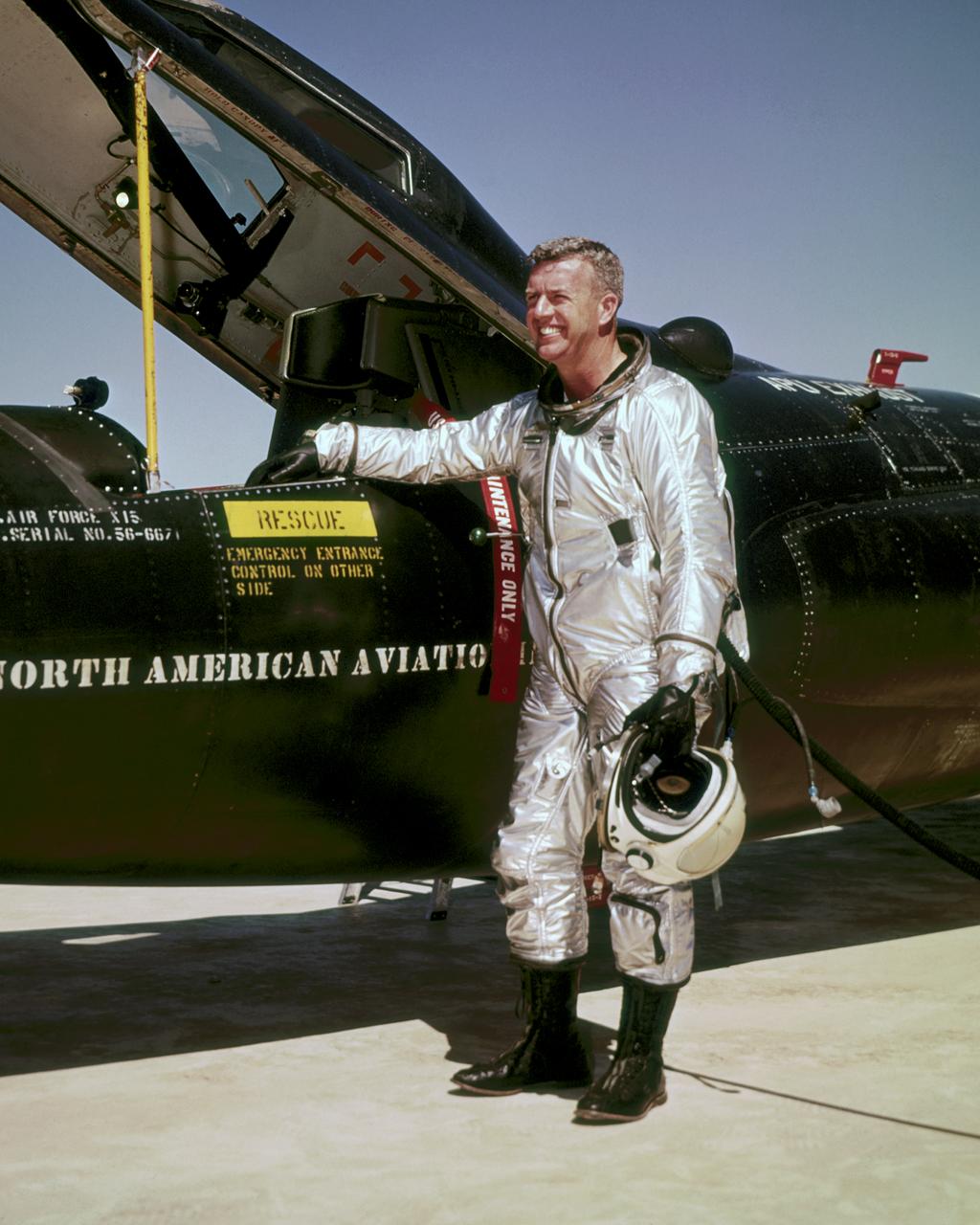
Joseph A. Walker was a Chief Research Pilot at the NASA Dryden Flight Research Center during the mid-1960s. He joined the NACA in March 1945, and served as project pilot at the Edwards flight research facility on such pioneering research projects as the D-558-1, D-558-2, X-1, X-3, X-4, X-5, and the X-15. He also flew programs involving the F-100, F-101, F-102, F-104, and the B-47. Walker made the first NASA X-15 flight on March 25, 1960. He flew the research aircraft 24 times and achieved its fastest speed and highest altitude. He attained a speed of 4,104 mph (Mach 5.92) during a flight on June 27, 1962, and reached an altitude of 354,300 feet on August 22, 1963 (his last X-15 flight). He was the first man to pilot the Lunar Landing Research Vehicle (LLRV) that was used to develop piloting and operational techniques for lunar landings. Walker was born February 20, 1921, in Washington, Pa. He lived there until graduating from Washington and Jefferson College in 1942, with a B.A. degree in Physics. During World War II he flew P-38 fighters for the Air Force, earning the Distinguished Flying Cross and the Air Medal with Seven Oak Clusters. Walker was the recipient of many awards during his 21 years as a research pilot. These include the 1961 Robert J. Collier Trophy, 1961 Harmon International Trophy for Aviators, the 1961 Kincheloe Award and 1961 Octave Chanute Award. He received an honorary Doctor of Aeronautical Sciences degree from his alma mater in June of 1962. Walker was named Pilot of the Year in 1963 by the National Pilots Association. He was a charter member of the Society of Experimental Test Pilots, and one of the first to be designated a Fellow. He was fatally injured on June 8, 1966, in a mid-air collision between an F-104 he was piloting and the XB-70.
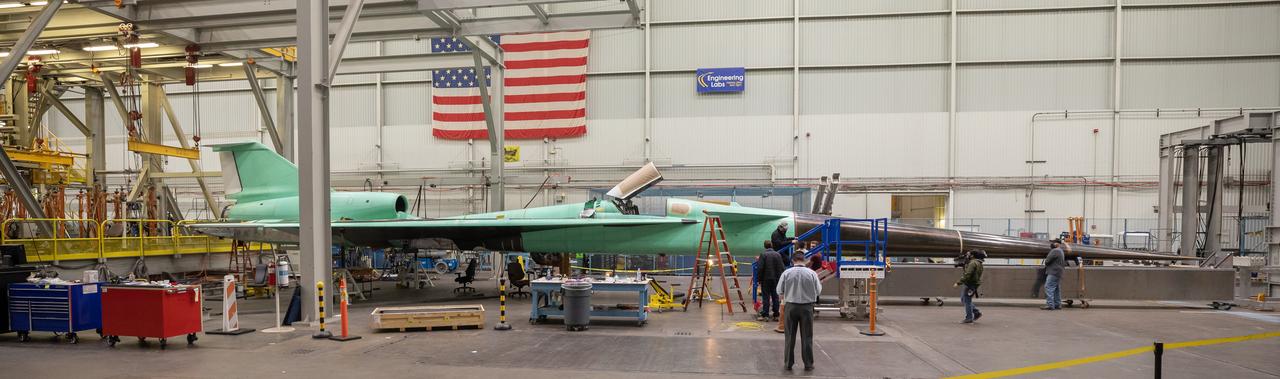
A panoramic view of NASA’s X-59 in Fort Worth, Texas to undergo structural and fuel testing. The X-59’s nose makes up one third of the aircraft, at 38-feet in length. The X-59 is a one-of-a-kind airplane designed to fly at supersonic speeds without making a startling sonic boom sound for the communities below. This is part of NASA’s Quesst mission which plans to help enable supersonic air travel over land.
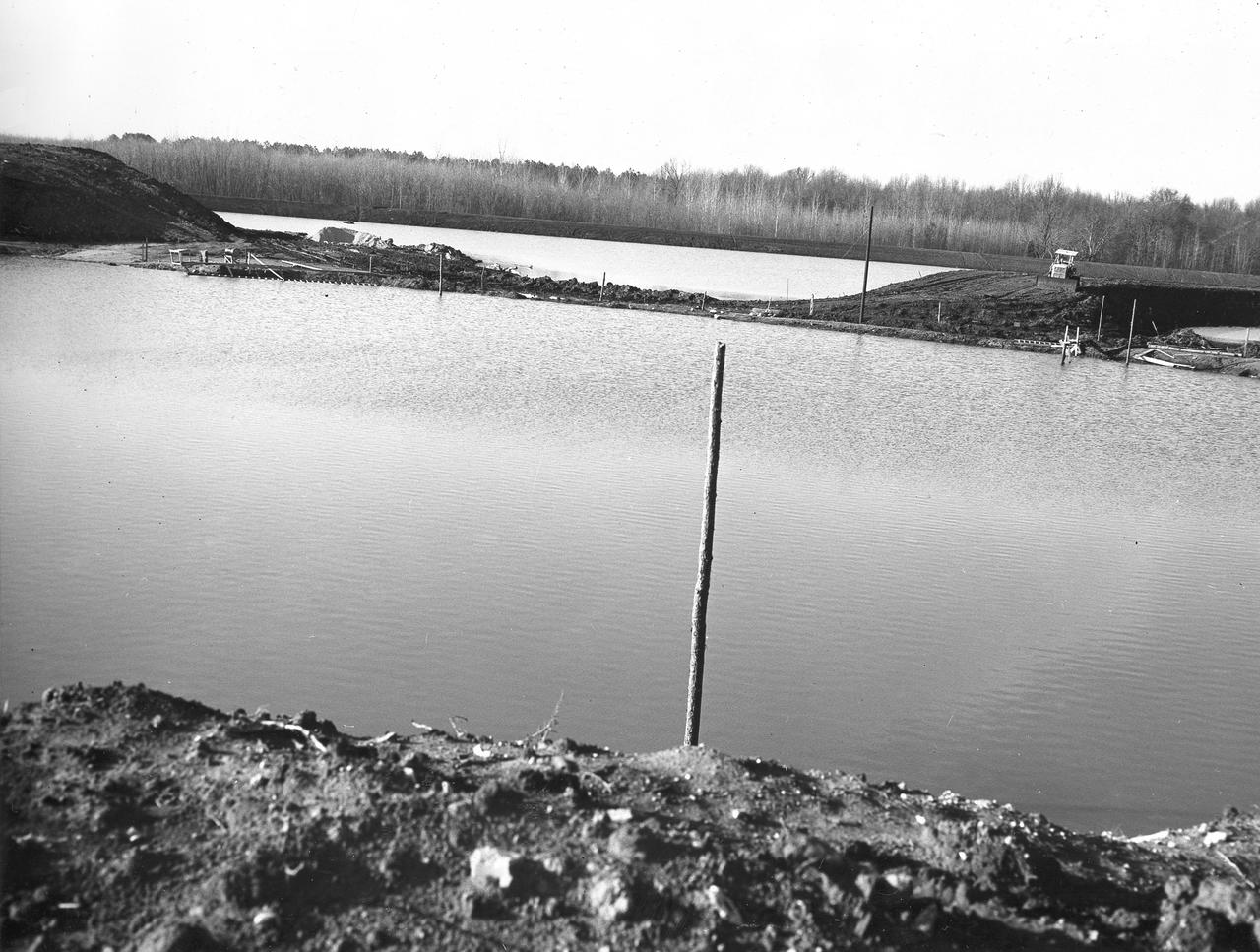
At its founding, the Marshall Space Flight Center (MSFC) inherited the Army’s Jupiter and Redstone test stands, but much larger facilities were needed for the giant stages of the Saturn V. From 1960 to 1964, the existing stands were remodeled and a sizable new test area was developed. The new comprehensive test complex for propulsion and structural dynamics was unique within the nation and the free world, and they remain so today because they were constructed with foresight to meet the future as well as on going needs. Construction of the S-IC Static test stand complex began in 1961 in the west test area of MSFC, and was completed in 1964. The S-IC static test stand was designed to develop and test the 138-ft long and 33-ft diameter Saturn V S-IC first stage, or booster stage, weighing in at 280,000 pounds. Required to hold down the brute force of a 7,500,000-pound thrust produced by 5 F-1 engines, the S-IC static test stand was designed and constructed with the strength of hundreds of tons of steel and 12,000,000 pounds of cement, planted down to bedrock 40 feet below ground level. The foundation walls, constructed with concrete and steel, are 4 feet thick. The base structure consists of four towers with 40-foot-thick walls extending upward 144 feet above ground level. The structure was topped by a crane with a 135-foot boom. With the boom in the upright position, the stand was given an overall height of 405 feet, placing it among the highest structures in Alabama at the time. Construction of the S-IC test stand came to a halt at the end of September as the determination was made that the Saturn booster size had to be increased. As a result, the stand had to be modified. With construction delayed, and pumps turned off, this photo, taken December 22, 1961, shows danger signs posted around the abandoned site with floods nearing the top. The flooding was caused by the disturbance of a natural spring months prior during the excavation of the site.
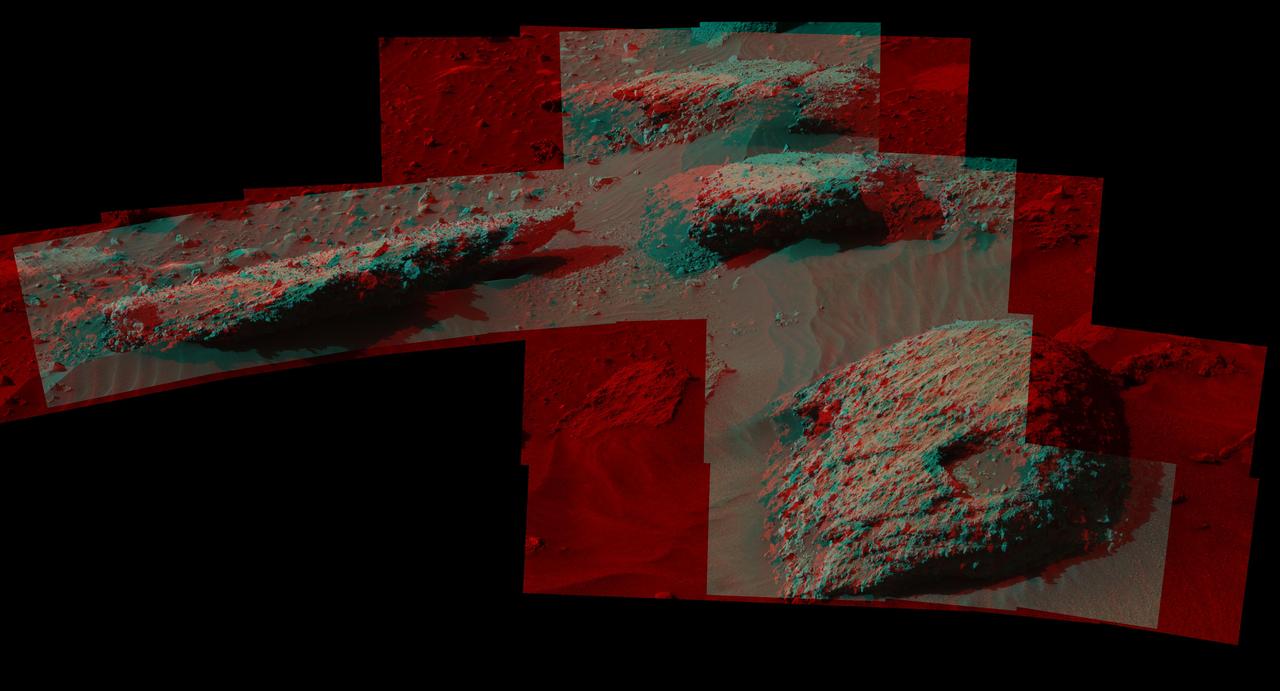
This stereo scene from the Mast Camera (Mastcam) on NASA's Curiosity Mars Rover shows boulders composed, in part, of pebble-size (0.2 to 2.6 inches, or 0.5 to 6.5 centimeters across) and larger rock fragments. The size and shape of the fragments provide clues to the origins of these boulders. This image is an anaglyph that appears three dimensional when viewed through red-blue glasses with the red lens on the left. The separate right-eye and left-eye views combined into the stereo version are Figure 1 and Figure 2. Mastcam's right-eye camera has a telephoto lens, with focal length of 100 millimeters. The left-eye camera provides a wider view, with a 34-millimeter lens. These images were taken on July 22, 2016, during the 1,408th Martian day, or sol, of Curiosity's work on Mars. For scale, the relatively flat rock at left is about 5 feet (1.5 meters) across. The rock in the foreground at right is informally named "Balombo." The group of boulders is at a site called "Bimbe." The Curiosity team chose to drive the rover to Bimbe to further understand patches of boulders first identified from orbit and seen occasionally on the rover's traverse. The boulders at Bimbe consist of multiple rock types. Some include pieces, or "clasts," of smaller, older rock cemented together, called breccias or conglomerates. The shapes of the inclusion clasts -- whether they are rounded or sharp-edged -- may indicate how far the clasts were transported, and by what processes. Breccias have more angular clasts, while conglomerates have more rounded clasts. As is clear by looking at these boulders, they contain both angular and rounded clasts, leading to some uncertainty about how they formed. Conglomerate rocks such as "Hottah" were inspected near Curiosity's landing site and interpreted as part of an ancient streambed. Breccias are generally formed by consolidation of fragments under pressure. On Mars such pressure might come from crater-forming impact, or by deep burial and exhumation. http://photojournal.jpl.nasa.gov/catalog/PIA20836
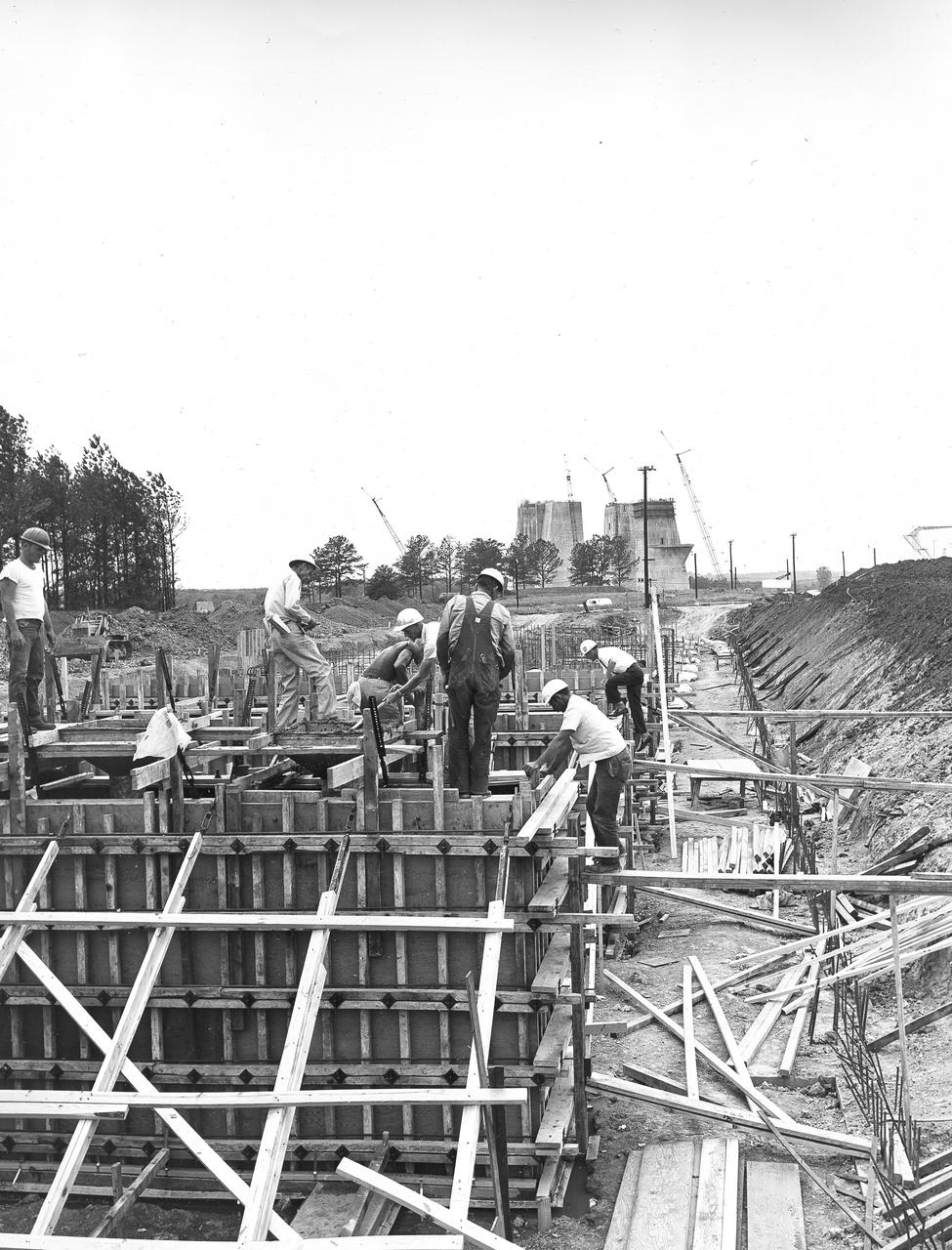
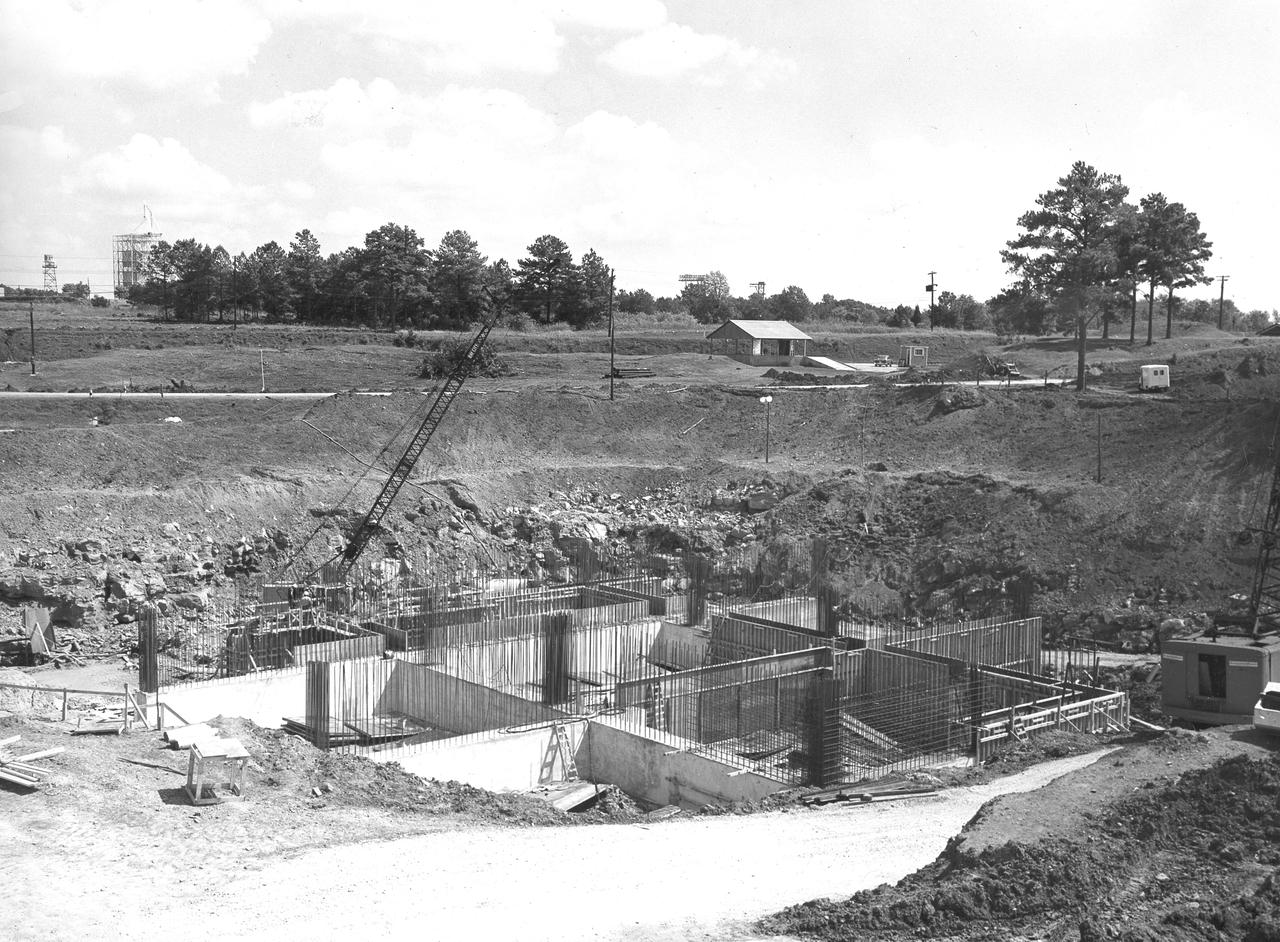
At its founding, the Marshall Space Flight Center (MSFC) inherited the Army’s Jupiter and Redstone test stands, but much larger facilities were needed for the giant stages of the Saturn V. From 1960 to 1964, the existing stands were remodeled and a sizable new test area was developed. The new comprehensive test complex for propulsion and structural dynamics was unique within the nation and the free world, and they remain so today because they were constructed with foresight to meet the future as well as on going needs. Construction of the S-IC Static test stand complex began in 1961 in the west test area of MSFC, and was completed in 1964. The S-IC static test stand was designed to develop and test the 138-ft long and 33-ft diameter Saturn V S-IC first stage, or booster stage, weighing in at 280,000 pounds. Required to hold down the brute force of a 7,500,000-pound thrust produced by 5 F-1 engines, the S-IC static test stand was designed and constructed with the strength of hundreds of tons of steel and 12,000,000 pounds of cement, planted down to bedrock 40 feet below ground level. The foundation walls, constructed with concrete and steel, are 4 feet thick. The base structure consists of four towers with 40-foot-thick walls extending upward 144 feet above ground level. The structure was topped by a crane with a 135-foot boom. With the boom in the upright position, the stand was given an overall height of 405 feet, placing it among the highest structures in Alabama at the time. In addition to the stand itself, related facilities were constructed during this time. Built directly east of the test stand was the Block House, which served as the control center for the test stand. The two were connected by a narrow access tunnel which housed the cables for the controls. Again to the east, just south of the Block House, was a newly constructed Pump House. Its function was to provide water to the stand to prevent melting damage during testing. The water was sprayed through small holes in the stand’s 1900 ton water deflector at the rate of 320,000 gallons per minute. In this photo, taken May 22, 1963, the Pump House is undergoing construction.
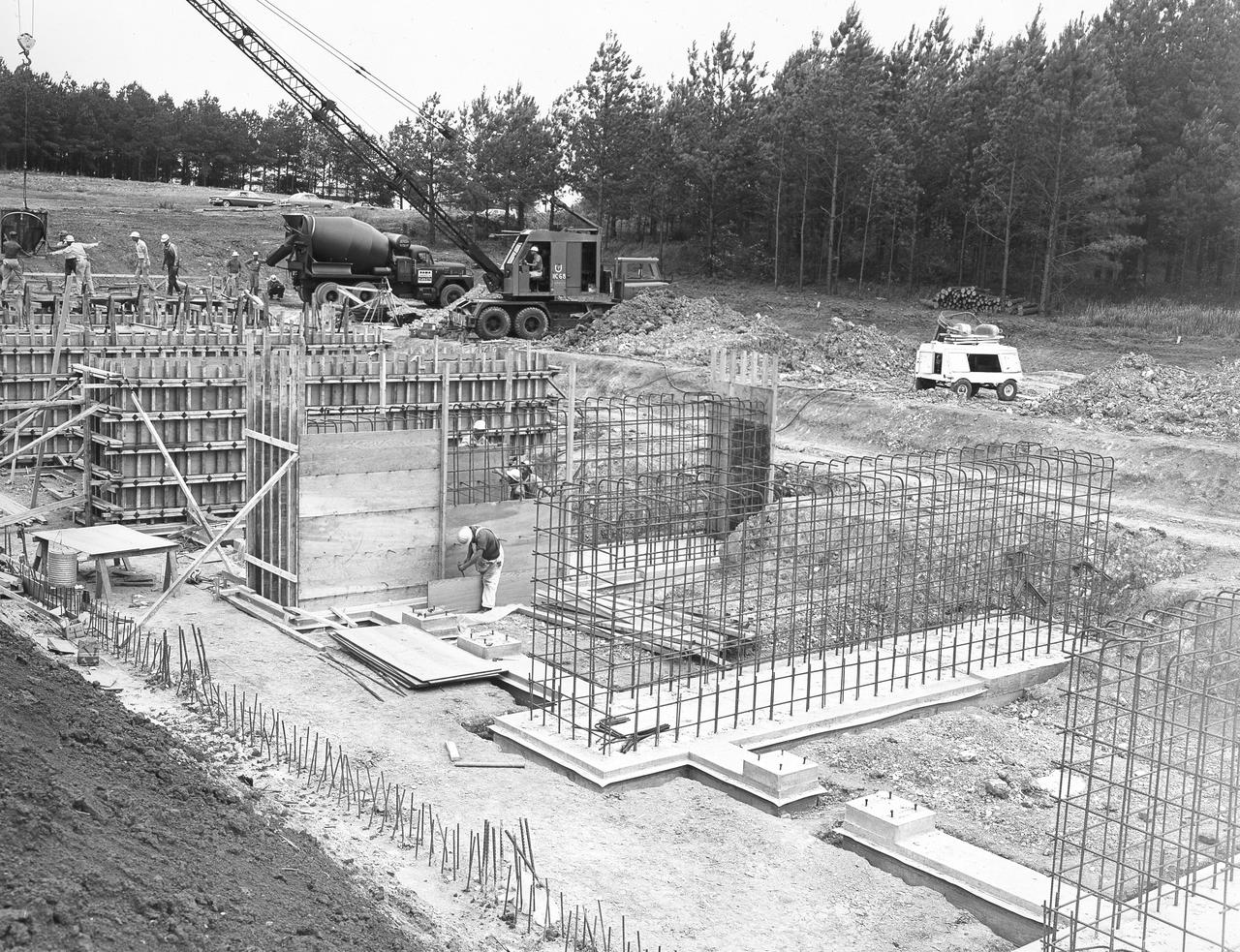
At its founding, the Marshall Space Flight Center (MSFC) inherited the Army’s Jupiter and Redstone test stands, but much larger facilities were needed for the giant stages of the Saturn V. From 1960 to 1964, the existing stands were remodeled and a sizable new test area was developed. The new comprehensive test complex for propulsion and structural dynamics was unique within the nation and the free world, and they remain so today because they were constructed with foresight to meet the future as well as on going needs. Construction of the S-IC Static test stand complex began in 1961 in the west test area of MSFC, and was completed in 1964. The S-IC static test stand was designed to develop and test the 138-ft long and 33-ft diameter Saturn V S-IC first stage, or booster stage, weighing in at 280,000 pounds. Required to hold down the brute force of a 7,500,000-pound thrust produced by 5 F-1 engines, the S-IC static test stand was designed and constructed with the strength of hundreds of tons of steel and 12,000,000 pounds of cement, planted down to bedrock 40 feet below ground level. The foundation walls, constructed with concrete and steel, are 4 feet thick. The base structure consists of four towers with 40-foot-thick walls extending upward 144 feet above ground level. The structure was topped by a crane with a 135-foot boom. With the boom in the upright position, the stand was given an overall height of 405 feet, placing it among the highest structures in Alabama at the time. This photo, taken September 22, 1961, shows the progress of the concrete walls for the stand’s foundation. Some of the walls have been poured and some of the concrete forms have been removed.
At its founding, the Marshall Space Flight Center (MSFC) inherited the Army’s Jupiter and Redstone test stands, but much larger facilities were needed for the giant stages of the Saturn V. From 1960 to 1964, the existing stands were remodeled and a sizable new test area was developed. The new comprehensive test complex for propulsion and structural dynamics was unique within the nation and the free world, and they remain so today because they were constructed with foresight to meet the future as well as on going needs. Construction of the S-IC Static test stand complex began in 1961 in the west test area of MSFC, and was completed in 1964. The S-IC static test stand was designed to develop and test the 138-ft long and 33-ft diameter Saturn V S-IC first stage, or booster stage, weighing in at 280,000 pounds. Required to hold down the brute force of a 7,500,000-pound thrust produced by 5 F-1 engines, the S-IC static test stand was designed and constructed with the strength of hundreds of tons of steel and 12,000,000 pounds of cement, planted down to bedrock 40 feet below ground level. The foundation walls, constructed with concrete and steel, are 4 feet thick. The base structure consists of four towers with 40-foot-thick walls extending upward 144 feet above ground level. The structure was topped by a crane with a 135-foot boom. With the boom in the upright position, the stand was given an overall height of 405 feet, placing it among the highest structures in Alabama at the time. In addition to the stand itself, related facilities were constructed during this time. Built directly east of the test stand was the Block House, which served as the control center for the test stand. The two were connected by a narrow access tunnel which housed the cables for the controls. Again to the east, just south of the Block House, was a newly constructed Pump House. Its function was to provide water to the stand to prevent melting damage during testing. The water was sprayed through small holes in the stand’s 1900 ton water deflector at the rate of 320,000 gallons per minute. In this photo, taken May 22, 1963, the Pump House is undergoing construction.
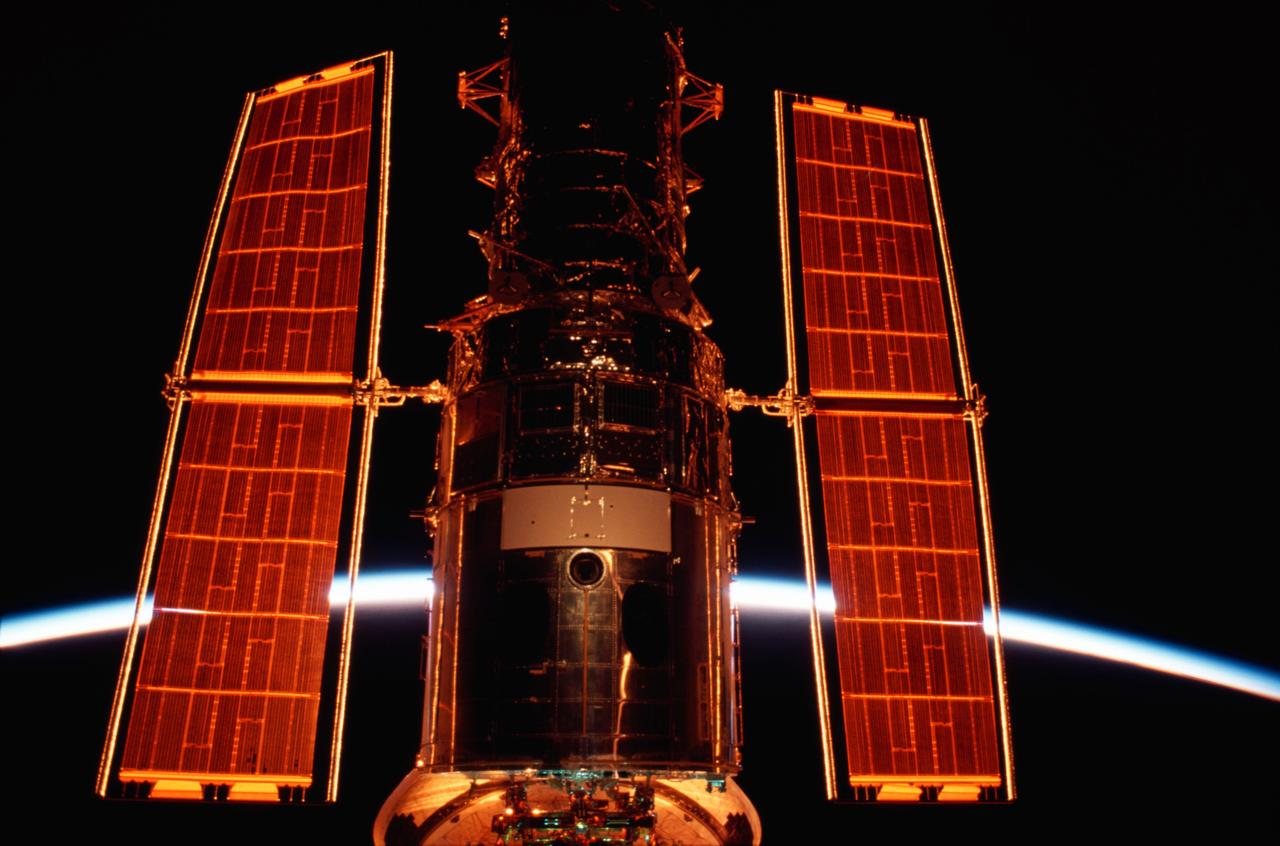
This is a photo of the Hubble Space Telescope (HST),in its origianl configuration, berthed in the cargo bay of the Space Shuttle Columbia during the STS-109 mission silhouetted against the airglow of the Earth's horizon. The telescope was captured and secured on a work stand in Columbia's payload bay using Columbia's robotic arm, where 4 of the 7-member crew performed 5 spacewalks completing system upgrades to the HST. Included in those upgrades were: replacement of the solar array panels; replacement of the power control unit (PCU); replacement of the Faint Object Camera (FOC) with a new advanced camera for Surveys (ACS); and installation of the experimental cooling system for the Hubble's Near-Infrared Camera and Multi-object Spectrometer (NICMOS), which had been dormant since January 1999 when its original coolant ran out. The Marshall Space Flight Center had the responsibility for the design, development, and construction of the the HST, which is the most complex and sensitive optical telescope ever made, to study the cosmos from a low-Earth orbit. The HST detects objects 25 times fainter than the dimmest objects seen from Earth and provides astronomers with an observable universe 250 times larger than is visible from ground-based telescopes, perhaps as far away as 14 billion light-years. The HST views galaxies, stars, planets, comets, possibly other solar systems, and even unusual phenomena such as quasars, with 10 times the clarity of ground-based telescopes. Launched March 1, 2002 the STS-109 HST servicing mission lasted 10 days, 22 hours, and 11 minutes. It was the 108th flight overall in NASA's Space Shuttle Program.
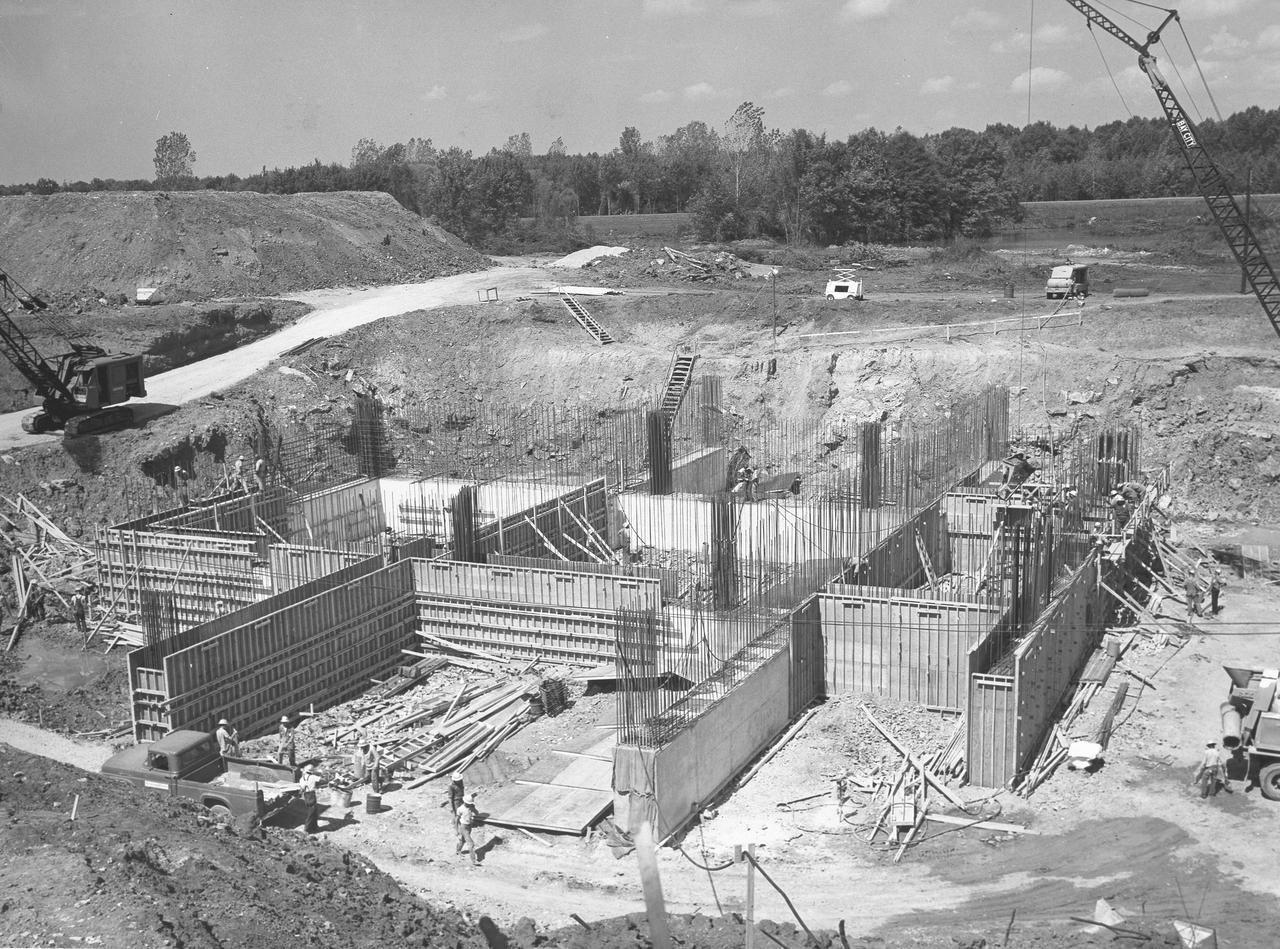
At its founding, the Marshall Space Flight Center (MSFC) inherited the Army’s Jupiter and Redstone test stands, but much larger facilities were needed for the giant stages of the Saturn V. From 1960 to 1964, the existing stands were remodeled and a sizable new test area was developed. The new comprehensive test complex for propulsion and structural dynamics was unique within the nation and the free world, and they remain so today because they were constructed with foresight to meet the future as well as on going needs. Construction of the S-IC Static test stand complex began in 1961 in the west test area of MSFC, and was completed in 1964. The S-IC static test stand was designed to develop and test the 138-ft long and 33-ft diameter Saturn V S-IC first stage, or booster stage, weighing in at 280,000 pounds. Required to hold down the brute force of a 7,500,000-pound thrust produced by 5 F-1 engines, the S-IC static test stand was designed and constructed with the strength of hundreds of tons of steel and 12,000,000 pounds of cement, planted down to bedrock 40 feet below ground level. The foundation walls, constructed with concrete and steel, are 4 feet thick. The base structure consists of four towers with 40-foot-thick walls extending upward 144 feet above ground level. The structure was topped by a crane with a 135-foot boom. With the boom in the upright position, the stand was given an overall height of 405 feet, placing it among the highest structures in Alabama at the time. This photo, taken September 22, 1961, shows the progress of the concrete walls for the stand’s foundation. Some of the walls have been poured and some of the concrete forms have been removed.
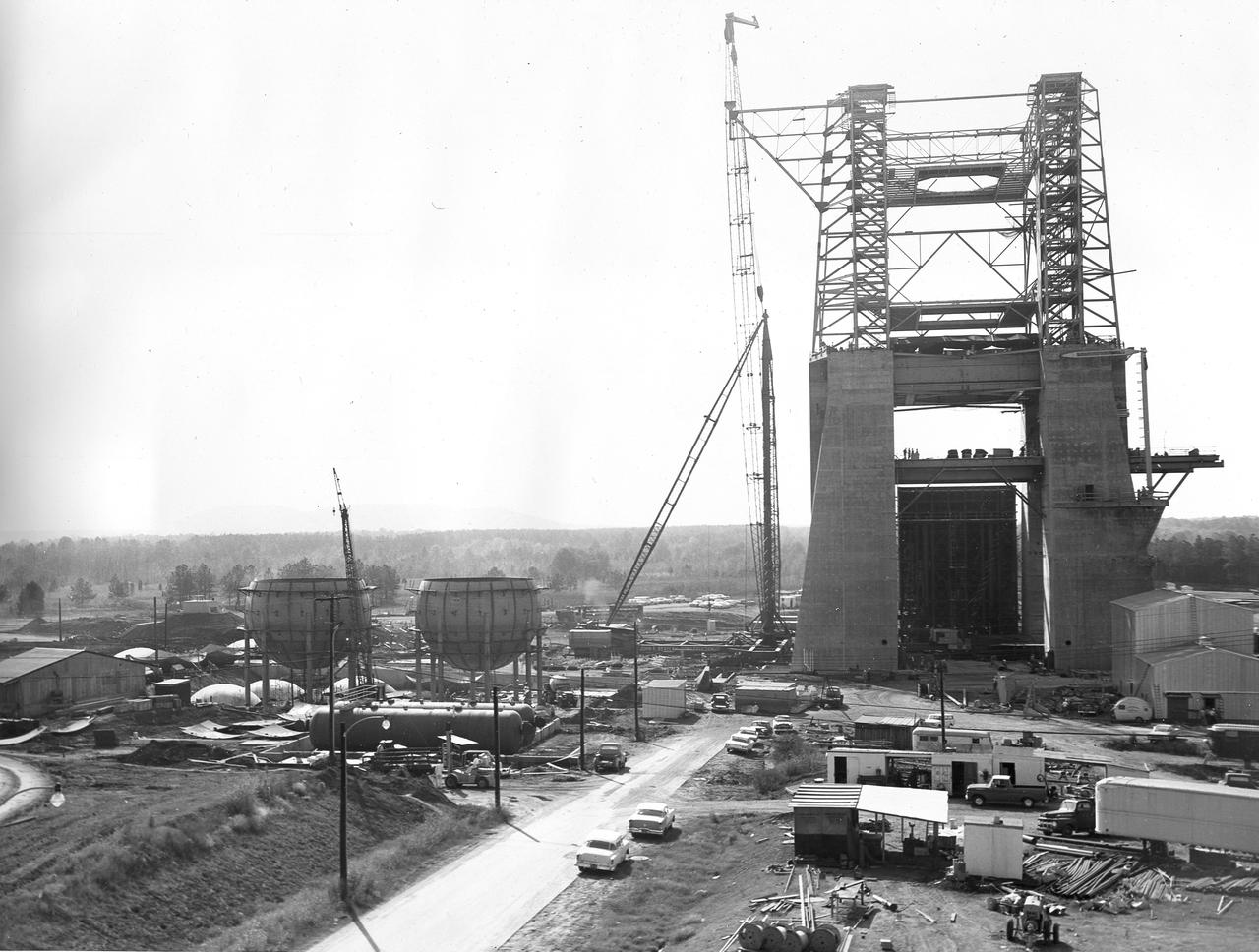
At its founding, the Marshall Space Flight Center (MSFC) inherited the Army’s Jupiter and Redstone test stands, but much larger facilities were needed for the giant stages of the Saturn V. From 1960 to 1964, the existing stands were remodeled and a sizable new test area was developed. The new comprehensive test complex for propulsion and structural dynamics was unique within the nation and the free world, and they remain so today because they were constructed with foresight to meet the future as well as on going needs. Construction of the S-IC Static test stand complex began in 1961 in the west test area of MSFC, and was completed in 1964. The S-IC static test stand was designed to develop and test the 138-ft long and 33-ft diameter Saturn V S-IC first stage, or booster stage, weighing in at 280,000 pounds. Required to hold down the brute force of a 7,500,000-pound thrust produced by 5 F-1 engines, the S-IC static test stand was designed and constructed with the strength of hundreds of tons of steel and 12,000,000 pounds of cement, planted down to bedrock 40 feet below ground level. The foundation walls, constructed with concrete and steel, are 4 feet thick. The base structure consists of four towers with 40-foot-thick walls extending upward 144 feet above ground level. The structure was topped by a crane with a 135-foot boom. With the boom in the upright position, the stand was given an overall height of 405 feet, placing it among the highest structures in Alabama at the time. This photo shows the progress of the S-IC test stand as of October 22, 1963. Spherical liquid hydrogen tanks can be seen to the left. Just to the lower front of those are the cylindrical liquid oxygen (LOX) tanks.
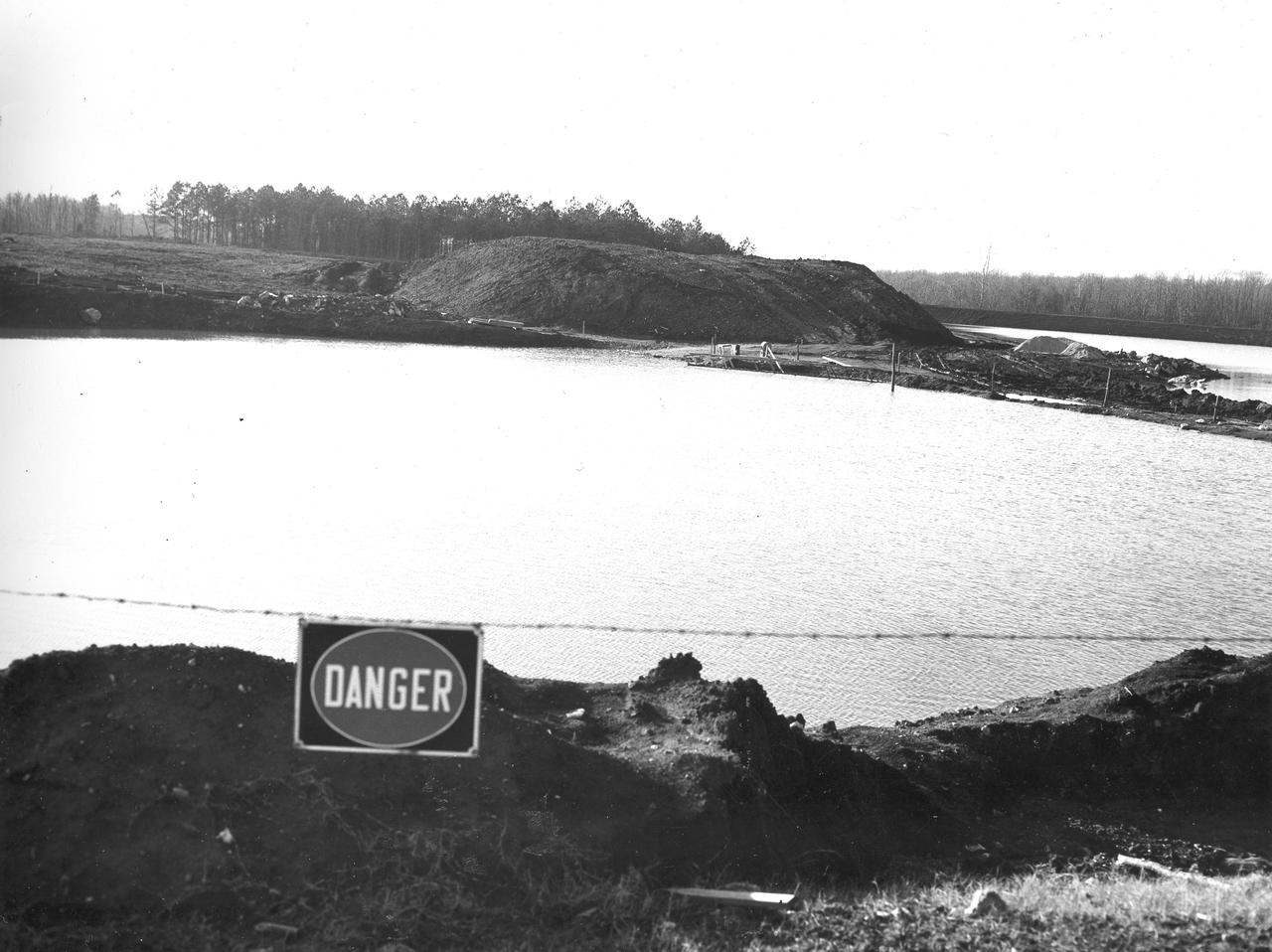
At its founding, the Marshall Space Flight Center (MSFC) inherited the Army’s Jupiter and Redstone test stands, but much larger facilities were needed for the giant stages of the Saturn V. From 1960 to 1964, the existing stands were remodeled and a sizable new test area was developed. The new comprehensive test complex for propulsion and structural dynamics was unique within the nation and the free world, and they remain so today because they were constructed with foresight to meet the future as well as on going needs. Construction of the S-IC Static test stand complex began in 1961 in the west test area of MSFC, and was completed in 1964. The S-IC static test stand was designed to develop and test the 138-ft long and 33-ft diameter Saturn V S-IC first stage, or booster stage, weighing in at 280,000 pounds. Required to hold down the brute force of a 7,500,000-pound thrust produced by 5 F-1 engines, the S-IC static test stand was designed and constructed with the strength of hundreds of tons of steel and 12,000,000 pounds of cement, planted down to bedrock 40 feet below ground level. The foundation walls, constructed with concrete and steel, are 4 feet thick. The base structure consists of four towers with 40-foot-thick walls extending upward 144 feet above ground level. The structure was topped by a crane with a 135-foot boom. With the boom in the upright position, the stand was given an overall height of 405 feet, placing it among the highest structures in Alabama at the time. Construction of the S-IC test stand came to a halt at the end of September as the determination was made that the Saturn booster size had to be increased. As a result, the stand had to be modified. With construction delayed, and pumps turned off, this photo, taken December 22, 1961, shows danger signs posted around the abandoned site with floods nearing the top. The flooding was caused by the disturbance of a natural spring months prior during the excavation of the site.
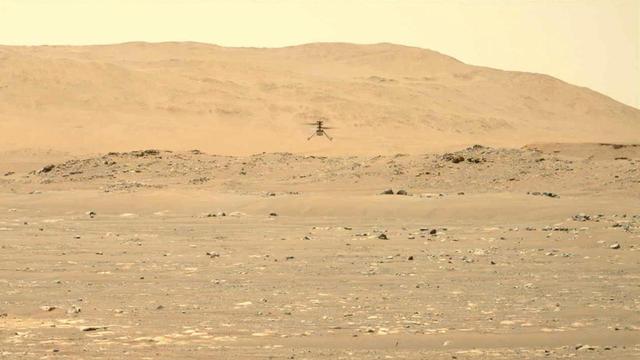
NASA's Ingenuity Mars Helicopter hovers and rotates over Jezero Crater during its second experimental flight test on April 22, 2021. The footage was captured by the Mastcam-Z imager, a pair of zoomable cameras aboard NASA's Perseverance Mars rover. Altimeter data from the solar-powered helicopter indicates it climbed to its prescribed maximum altitude of 16 feet (5 meters), flew downrange 7 feet (2 meters) and returned, performed several turns while in a hover, and landed. Total flight time 51.9 seconds. Flying in a controlled manner on Mars is far more difficult than flying on Earth. The Red Planet has significant gravity (about one-third that of Earth's), but an atmosphere with only about 1% of the density at Earth's surface. Stitched together from multiple images, the mosaic is not white balanced; instead, it is displayed in a preliminary calibrated version of a natural-color composite, approximately simulating the colors of the scene as it would appear on Mars. Arizona State University in Tempe leads the operations of the Mastcam-Z instrument, working in collaboration with Malin Space Science Systems in San Diego. The Ingenuity Mars Helicopter was built by JPL, which also manages this technology demonstration project for NASA Headquarters. It is supported by NASA's Science Mission Directorate, Aeronautics Research Mission Directorate, and Space Technology Mission Directorate. NASA's Ames Research Center and Langley Research Center provided significant flight performance analysis and technical assistance during Ingenuity's development. A key objective for Perseverance's mission on Mars is astrobiology, including the search for signs of ancient microbial life. The rover will characterize the planet's geology and past climate, pave the way for human exploration of the Red Planet, and be the first mission to collect and cache Martian rock and regolith (broken rock and dust). Subsequent NASA missions, in cooperation with ESA (European Space Agency), would send spacecraft to Mars to collect these sealed samples from the surface and return them to Earth for in-depth analysis. The Mars 2020 Perseverance mission is part of NASA's Moon to Mars exploration approach, which includes Artemis missions to the Moon that will help prepare for human exploration of the Red Planet. Movie available at https://photojournal.jpl.nasa.gov/catalog/PIA24595

This composite image of the Jovian moon Io was generated using data collected by the JunoCam imager aboard NASA's Juno spacecraft during four separate flybys. The resolution of the images gets progressively better as the distance between spacecraft and moon decreases with each flyby. The image of the moon on the far left has a resolution 44 miles (71 kilometers) per pixel. It was taken on April 9, 2022, during Juno's 41st orbit of Jupiter (perijove 41, or PJ41), when the spacecraft flew past Io at a distance of about 66,000 miles (106,000 kilometers). Note the gray, roughly triangular patch at the terminator near the moon's center. Citizen scientist Björn Jónsson created this image using data from JunoCam. The center-left image was acquired on July 5, 2022, during Juno's 43rd orbit of Jupiter (PJ43) at a distance of 53,000 miles (86,000 kilometers). The resolution in this image has improved to 36 miles (58 kilometers) per pixel. In this view, more detail of the gray patch is seen (from a different perspective). Citizen scientist Jason Perry created this image using data from JunoCam. By the time the center-right image of Io was taken on Dec. 14, 2022, (PJ47), the distance between spacecraft and moon had decreased to 40,000 miles (64,000 kilometers), which increased the resolution to 27 miles (43 kilometers) per pixel. Here, the gray triangle appears as three distinct volcanoes with the central vents visible as dark spots in their centers. Characteristics of other nearby volcanoes also begin to stand out. Citizen scientist Mike Ravine created this image using data from JunoCam. The far-right image, taken during Juno's 49th flyby (PJ49) on March 1, 2023, shows that the spacecraft again approached the moon from a changed perspective, allowing different territory on Io's surface to be viewed. The triplet of volcanoes that make up the gray triangular patch are visible near the top of the image, and more detail of the volcanic terrain can be made out. The altitude at the time of closest approach was about 32,000 miles (51,500 kilometers), allowing resolution to increase to 22 miles (35 kilometers) per pixel. Citizen scientist Kevin M. Gill created this image using data from JunoCam. https://photojournal.jpl.nasa.gov/catalog/PIA25887