
Astronaut L. Gordon Cooper, Jr., one of the original seven astronauts for Mercury Project selected by NASA on April 27, 1959. The MA-9 mission, boosted by the Mercury-Atlas launch vehicle, was the last flight of the Mercury Project. The Faith 7 spacecraft orbited the Earth 22 times in 1-1/2 days.
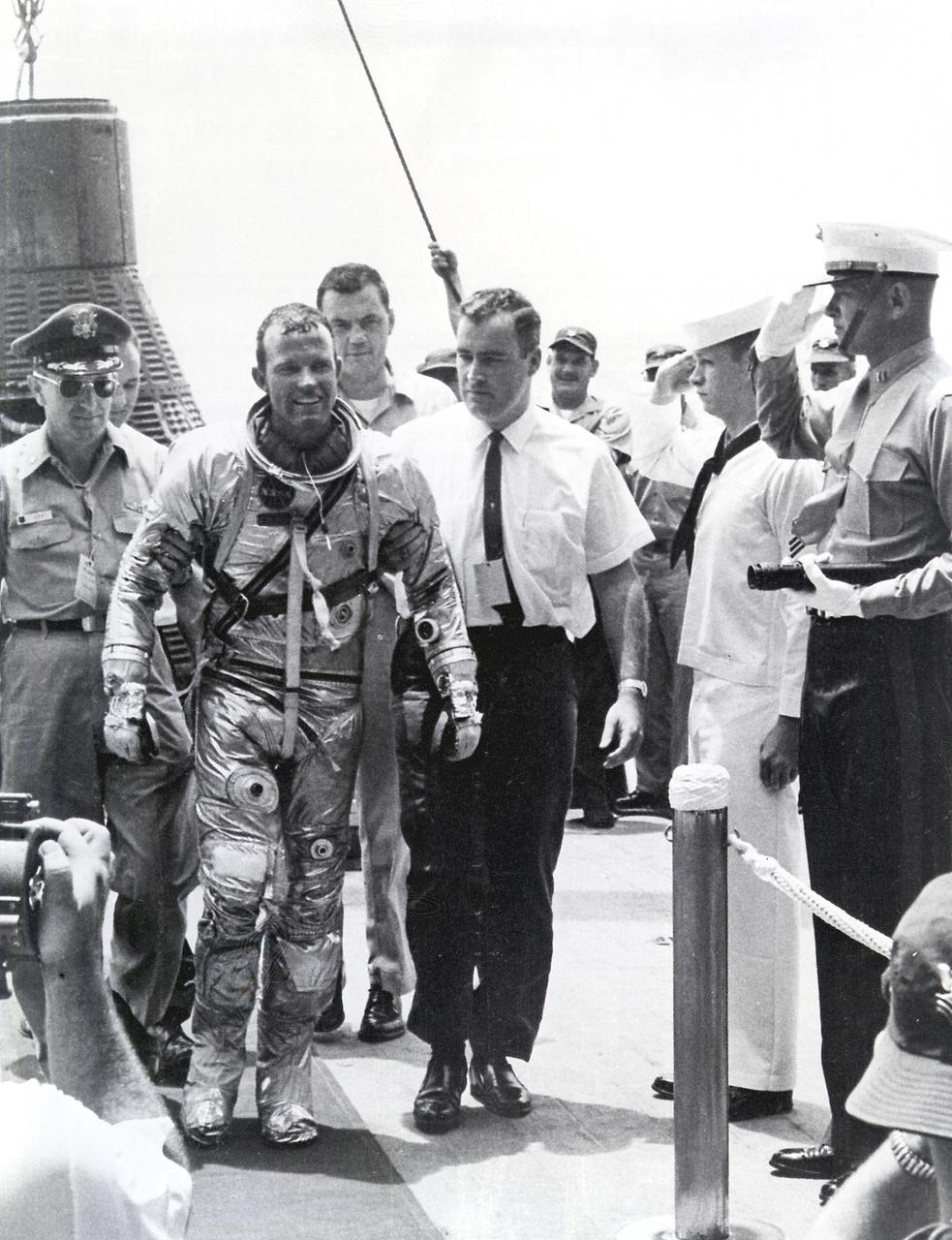
Astronaut Gordon Cooper leaves the Faith 7 (MA-9) spacecraft after a successful recovery operation. The MA-9 mission, the last flight of the Mercury Project, was launched on May 15, 1963, orbited the Earth 22 times, and lasted for 1-1/2 days.
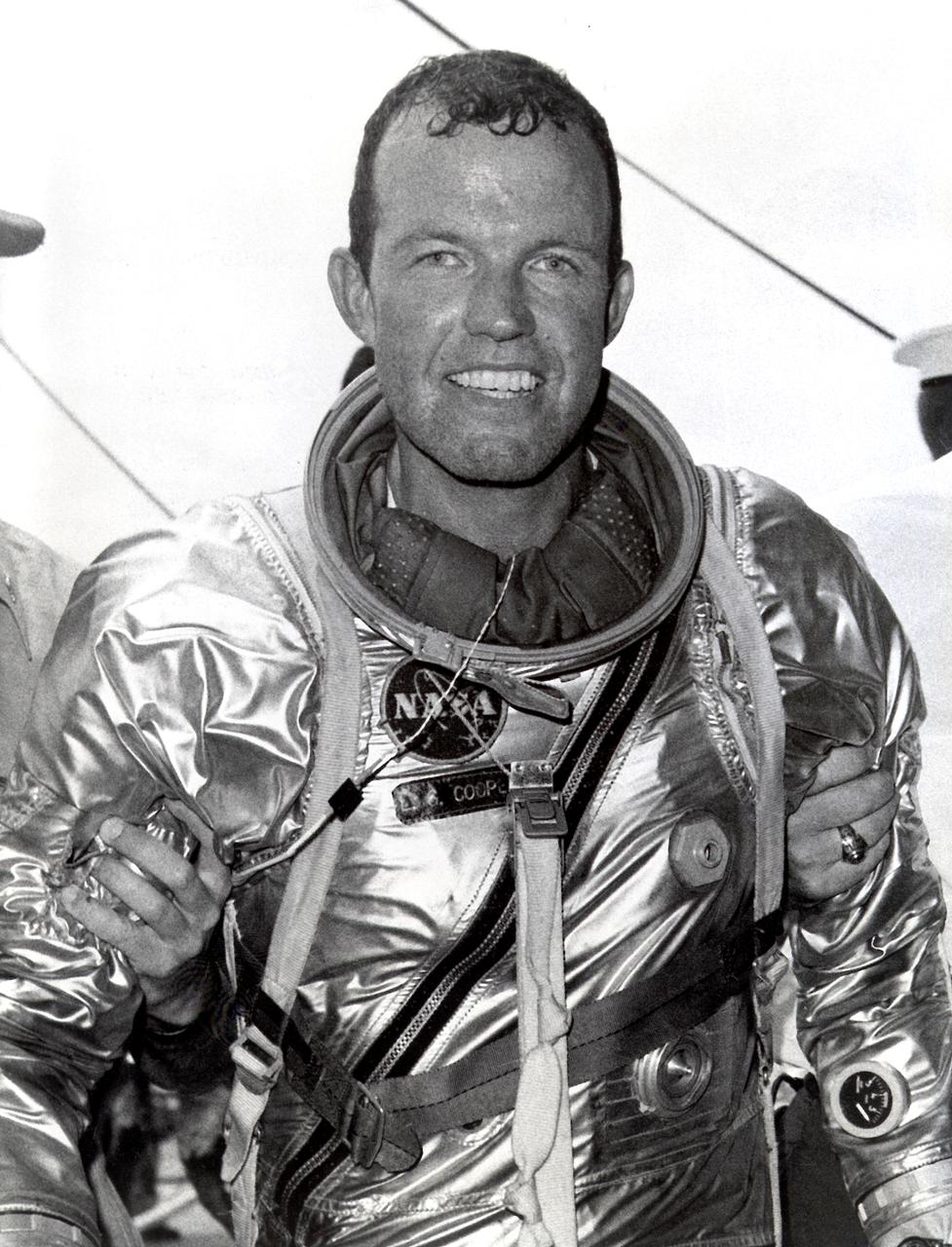
Astronaut Gordon Cooper leaves the Faith 7 (MA-9) spacecraft after a successful recovery operation. The MA-9 mission, the last flight of the Mercury Project, was launched on May 15, 1963, orbited the Earth 22 times, and lasted for 1-1/2 days.
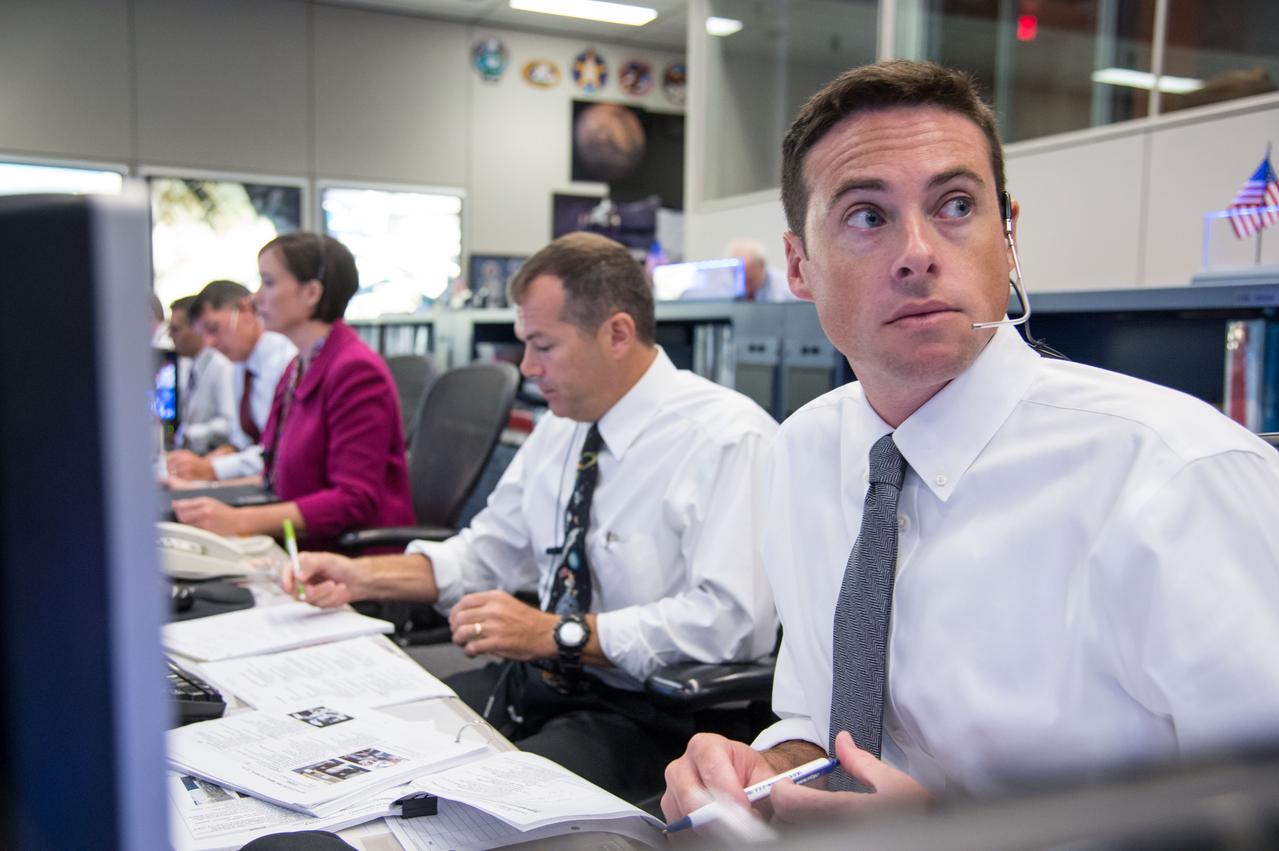
PHOTO DATE: 07-09-13 LOCATION: Bldg. 30 - FCR-1, ISS MER & B-7 SUBJECT: Expedition 36 ISS flight controllers on console during EVA #22 with Chris Cassidy and Luca Parmitano. PHOTOGRAPHER: BILL STAFFORD
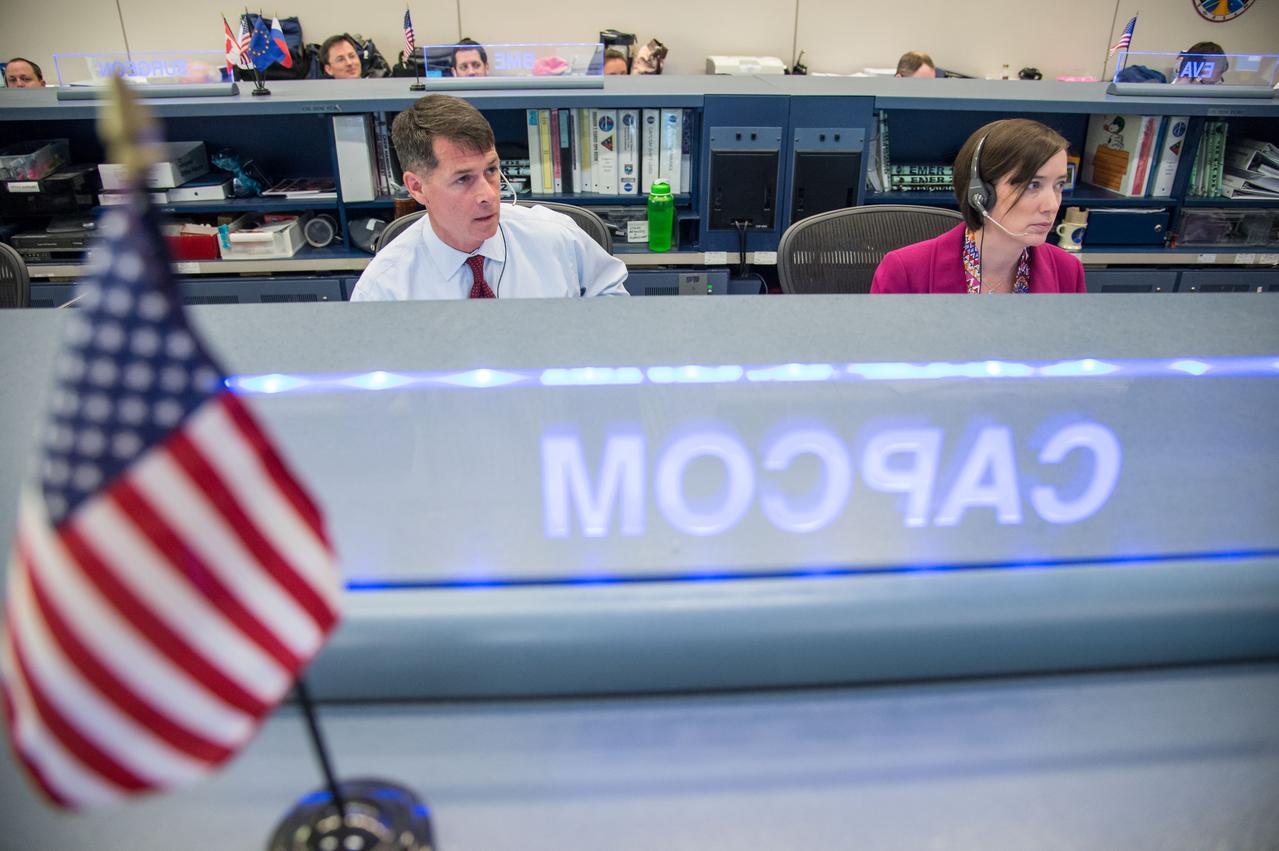
PHOTO DATE: 07-09-13 LOCATION: Bldg. 30 - FCR-1, ISS MER & B-7 SUBJECT: Expedition 36 ISS flight controllers on console during EVA #22 with Chris Cassidy and Luca Parmitano. PHOTOGRAPHER: BILL STAFFORD

PHOTO DATE: 07-09-13 LOCATION: Bldg. 30 - FCR-1, ISS MER & B-7 SUBJECT: Expedition 36 ISS flight controllers on console during EVA #22 with Chris Cassidy and Luca Parmitano. PHOTOGRAPHER: BILL STAFFORD
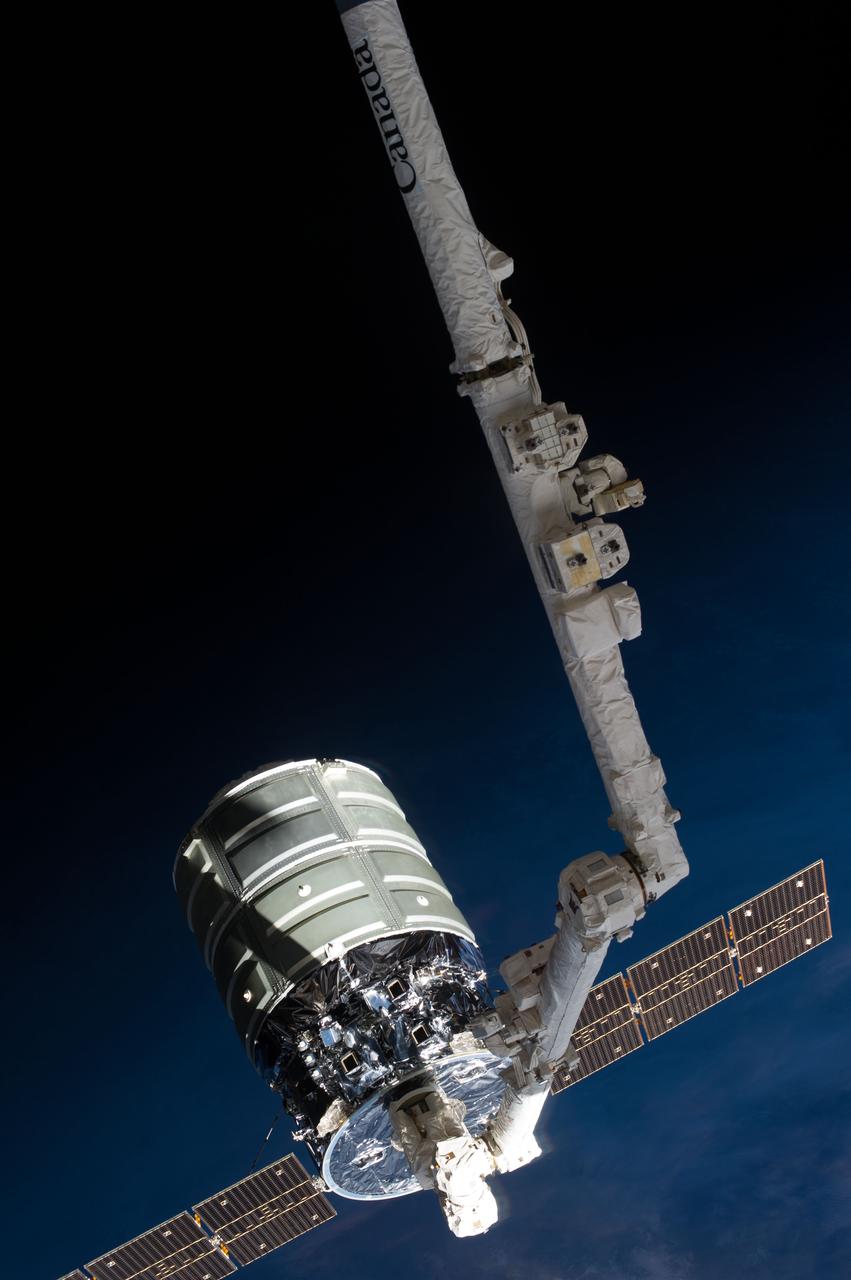
ISS037-E-018544 (22 Oct. 2013) --- The International Space Station’s Canadarm2 prepares to release the Orbital Sciences’ Cygnus commercial craft after three weeks at the space station. European Space Agency astronaut Luca Parmitano and NASA astronaut Karen Nyberg, both Expedition 37 flight engineers, were at the controls of the robotics workstation removing Cygnus from the Harmony node then safely releasing it at 7:31 a.m. (EDT) Oct. 22, 2013. On Oct. 23, the Cygnus will fire its engines for the last time at 1:41 p.m. and re-enter Earth’s atmosphere for destruction over the Pacific Ocean.
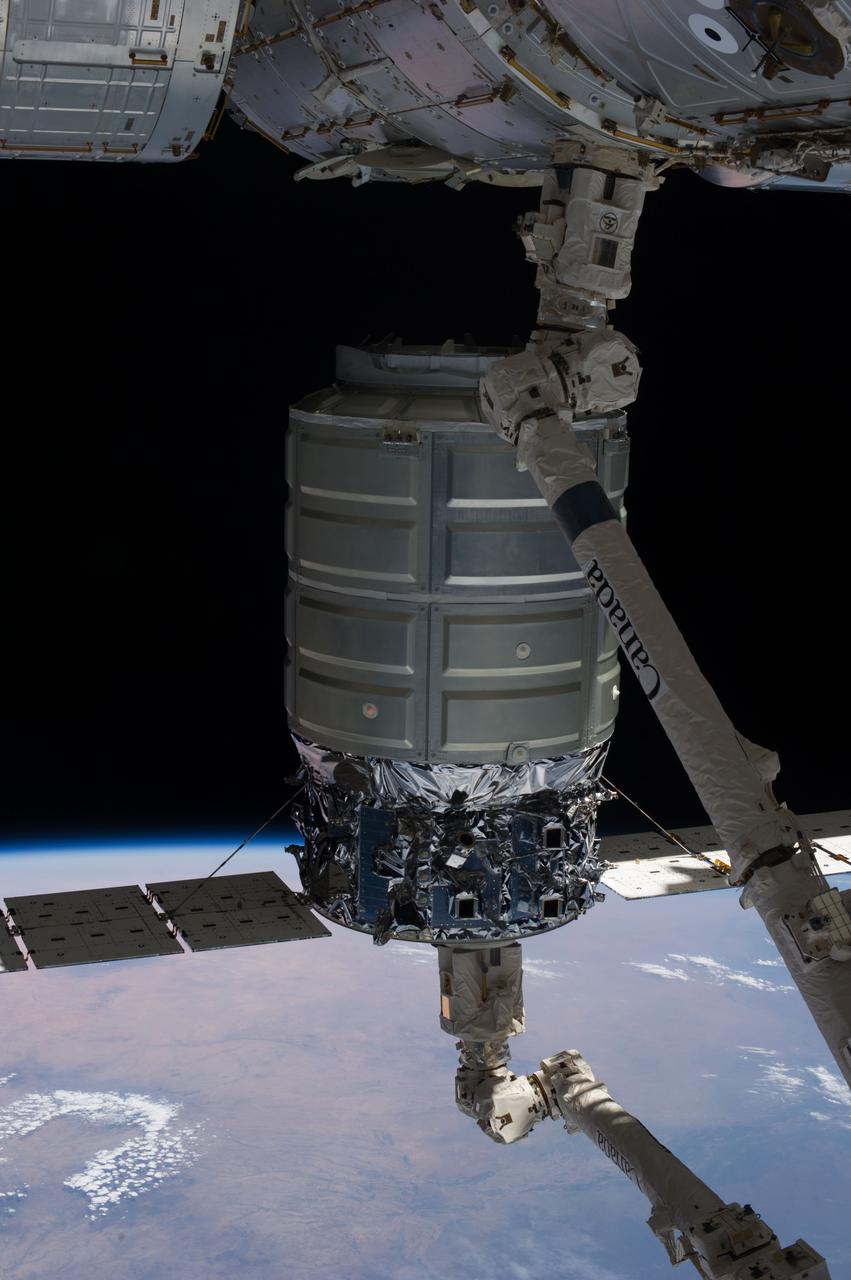
ISS037-E-018505 (22 Oct. 2013) --- The International Space Station’s Canadarm2 unberths the Orbital Sciences’ Cygnus commercial craft after three weeks at the space station. European Space Agency astronaut Luca Parmitano and NASA astronaut Karen Nyberg, both Expedition 37 flight engineers, were at the controls of the robotics workstation removing Cygnus from the Harmony node then safely releasing it at 7:31 a.m. (EDT) Oct. 22, 2013. On Oct. 23, the Cygnus will fire its engines for the last time at 1:41 p.m. and re-enter Earth’s atmosphere for destruction over the Pacific Ocean. Earth’s horizon and the blackness of space provide the backdrop for the scene.
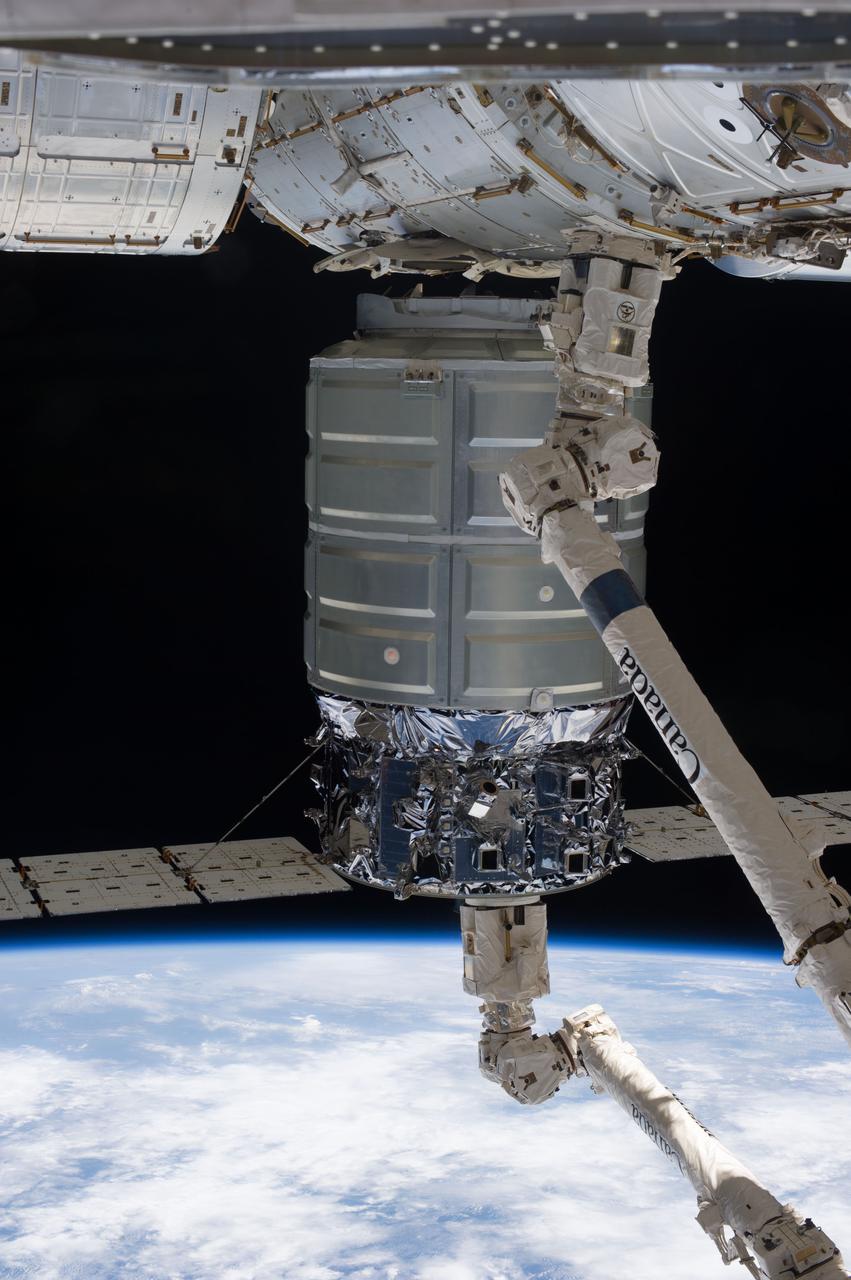
ISS037-E-018502 (22 Oct. 2013) --- The International Space Station’s Canadarm2 unberths the Orbital Sciences’ Cygnus commercial craft after three weeks at the space station. European Space Agency astronaut Luca Parmitano and NASA astronaut Karen Nyberg, both Expedition 37 flight engineers, were at the controls of the robotics workstation removing Cygnus from the Harmony node then safely releasing it at 7:31 a.m. (EDT) Oct. 22, 2013. On Oct. 23, the Cygnus will fire its engines for the last time at 1:41 p.m. and re-enter Earth’s atmosphere for destruction over the Pacific Ocean. Earth’s horizon and the blackness of space provide the backdrop for the scene.
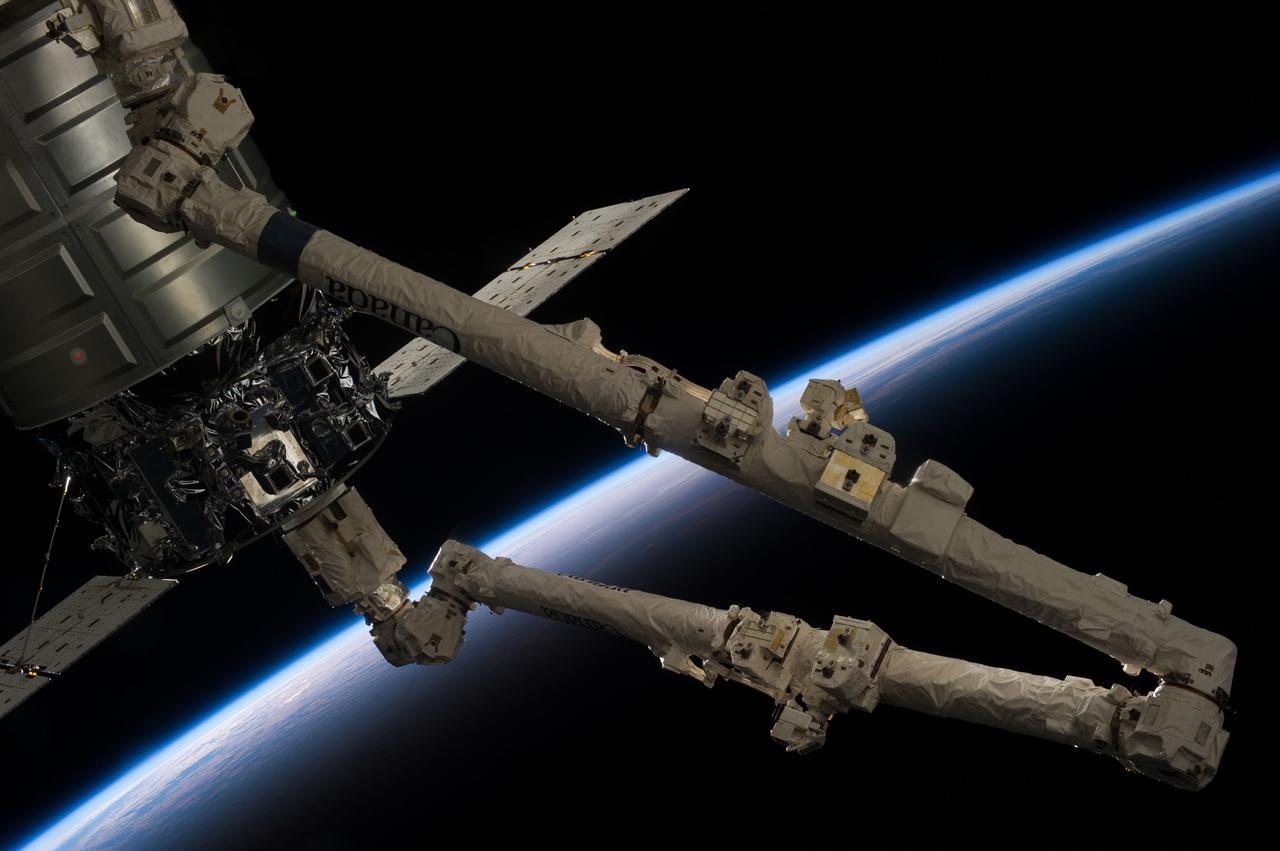
ISS037-E-018500 (22 Oct. 2013) --- The International Space Station’s Canadarm2 prepares to release the Orbital Sciences’ Cygnus commercial craft after three weeks at the space station. European Space Agency astronaut Luca Parmitano and NASA astronaut Karen Nyberg, both Expedition 37 flight engineers, were at the controls of the robotics workstation removing Cygnus from the Harmony node then safely releasing it at 7:31 a.m. (EDT) Oct. 22, 2013. On Oct. 23, the Cygnus will fire its engines for the last time at 1:41 p.m. and re-enter Earth’s atmosphere for destruction over the Pacific Ocean. Earth’s horizon and the blackness of space provide the backdrop for the scene.
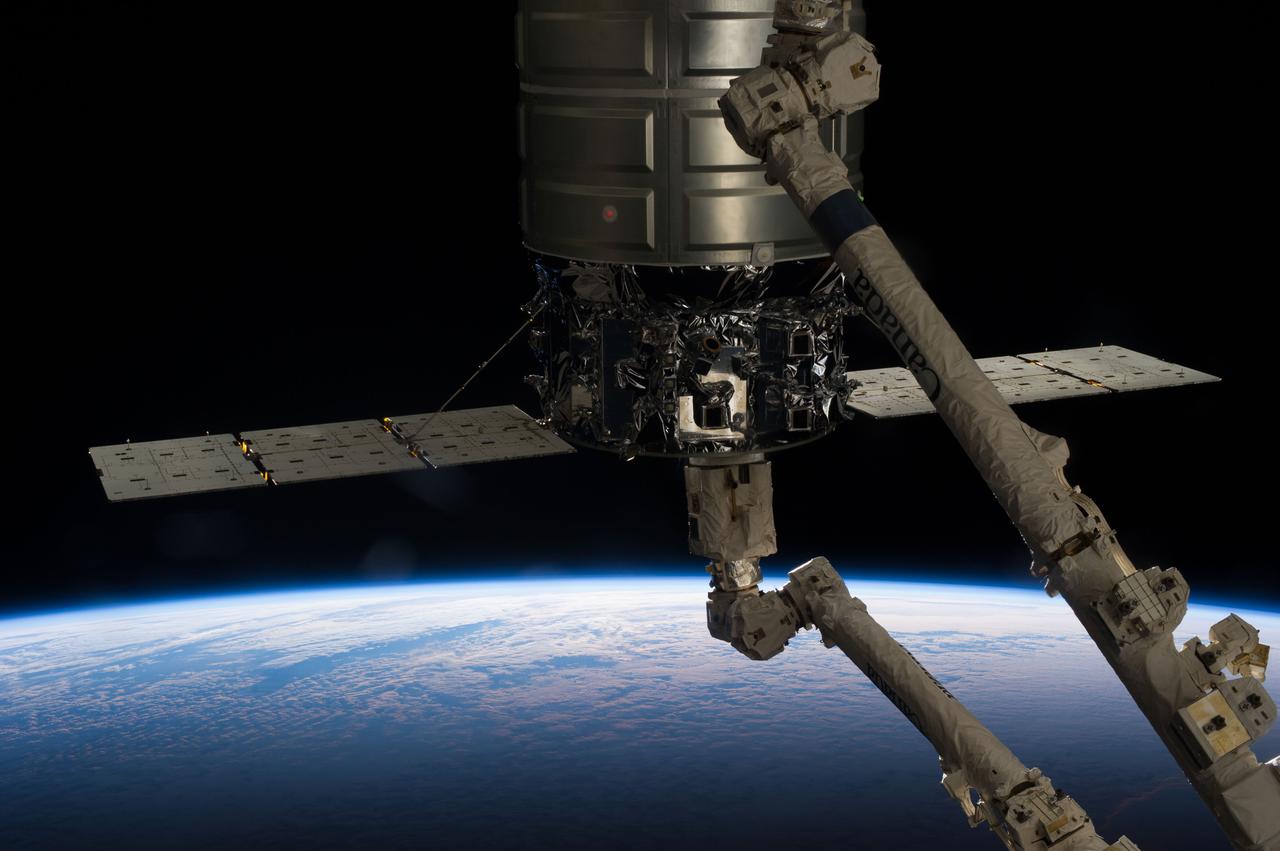
ISS037-E-018501 (22 Oct. 2013) --- The International Space Station’s Canadarm2 prepares to release the Orbital Sciences’ Cygnus commercial craft after three weeks at the space station. European Space Agency astronaut Luca Parmitano and NASA astronaut Karen Nyberg, both Expedition 37 flight engineers, were at the controls of the robotics workstation removing Cygnus from the Harmony node then safely releasing it at 7:31 a.m. (EDT) Oct. 22, 2013. On Oct. 23, the Cygnus will fire its engines for the last time at 1:41 p.m. and re-enter Earth’s atmosphere for destruction over the Pacific Ocean. Earth’s horizon and the blackness of space provide the backdrop for the scene.
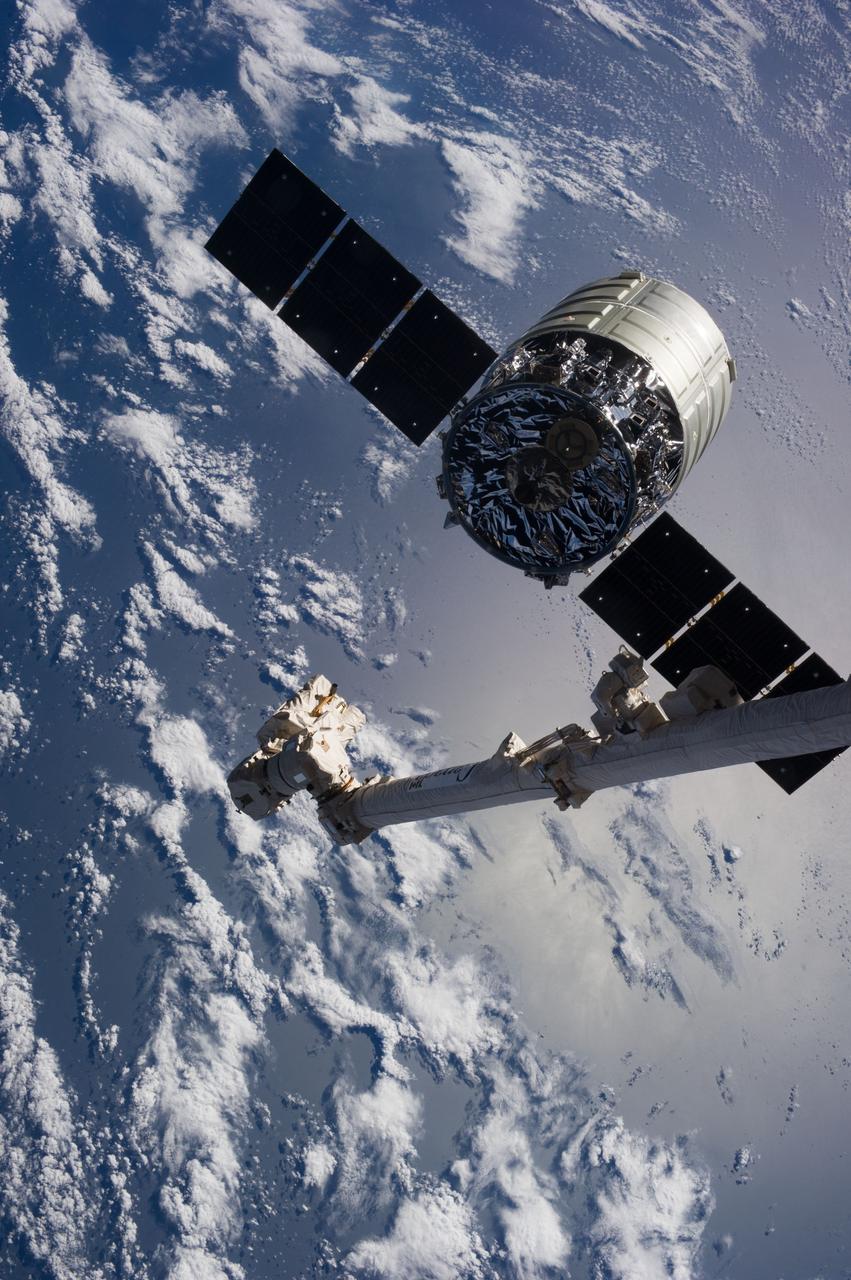
ISS037-E-018564 (22 Oct. 2013) --- The International Space Station?s Canadarm2 releases the Orbital Sciences? Cygnus commercial craft after three weeks at the space station. European Space Agency astronaut Luca Parmitano and NASA astronaut Karen Nyberg, both Expedition 37 flight engineers, were at the controls of the robotics workstation removing Cygnus from the Harmony node then safely releasing it at 7:31 a.m. (EDT) Oct. 22, 2013. On Oct. 23, the Cygnus will fire its engines for the last time at 1:41 p.m. and re-enter Earth?s atmosphere for destruction over the Pacific Ocean. A blue and white part of Earth provides the backdrop for the scene.
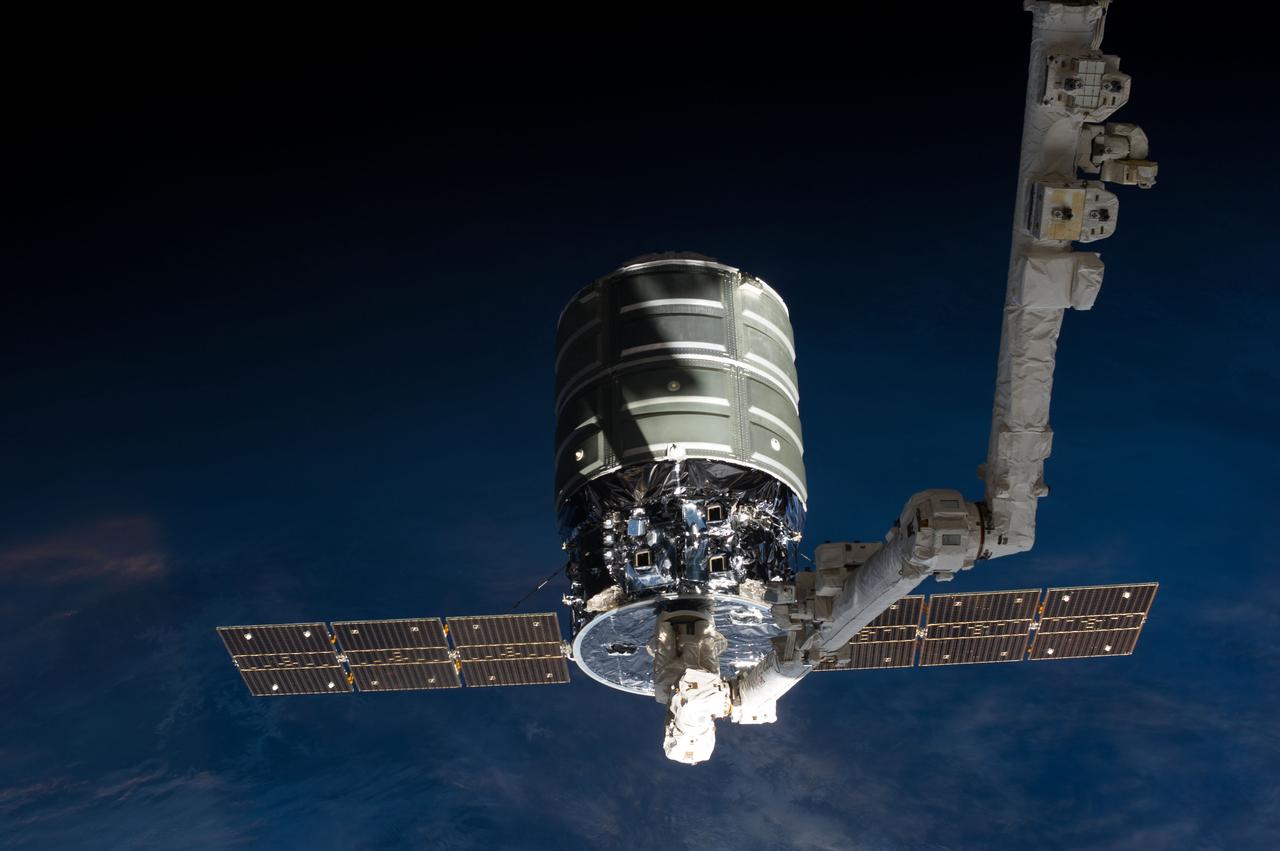
ISS037-E-018543 (22 Oct. 2013) --- The International Space Station’s Canadarm2 prepares to release the Orbital Sciences’ Cygnus commercial craft after three weeks at the space station. European Space Agency astronaut Luca Parmitano and NASA astronaut Karen Nyberg, both Expedition 37 flight engineers, were at the controls of the robotics workstation removing Cygnus from the Harmony node then safely releasing it at 7:31 a.m. (EDT) Oct. 22, 2013. On Oct. 23, the Cygnus will fire its engines for the last time at 1:41 p.m. and re-enter Earth’s atmosphere for destruction over the Pacific Ocean.
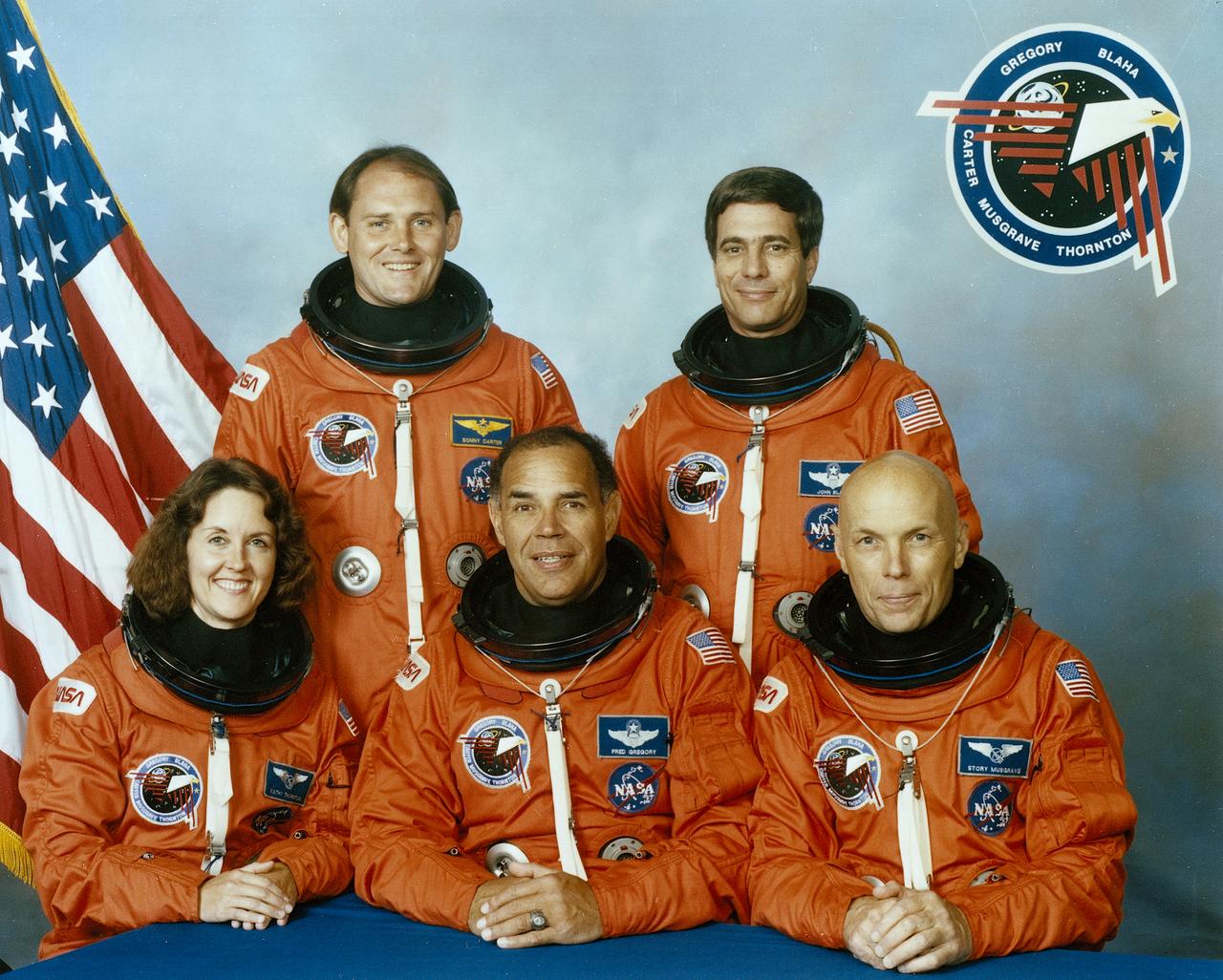
On November 22, 1989, at 7:23:30pm (EST), 5 astronauts were launched into space aboard the Space Shuttle Orbiter Discovery for the 5th Department of Defense mission, STS-33. Photographed from left to right are Kathryn C. Thornton, mission specialist 3; Manley L. (Sonny) Carter, mission specialist 2; Frederick D. Gregory, commander; John E. Blaha, pilot; and F. Story Musgrave, mission specialist 1.
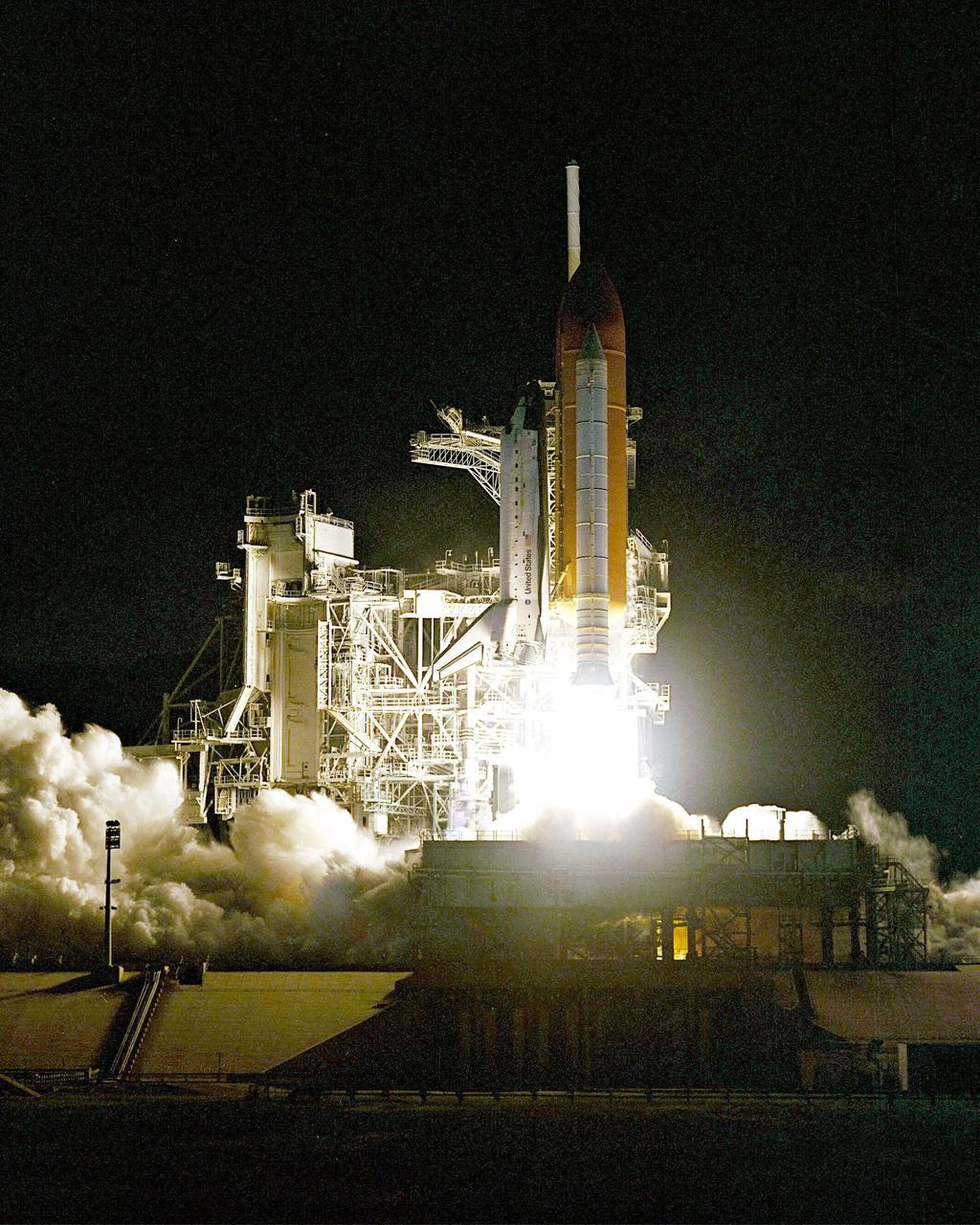
KENNEDY SPACE CENTER, Fla. -- A perfect on-time launch for Space Shuttle Discovery at 7:17 p.m. EDT. This marks the 100th launch in the history of the Shuttle program. Discovery carries a payload that includes the Integrated Truss Structure Z-1, first of 10 trusses that will form the backbone of the Space Station, and the third Pressurized Mating Adapter that will provide a Shuttle docking port for solar array installation on the sixth Station flight and Lab installation on the seventh Station flight. Discovery’s landing is expected Oct. 22 at 2:10 p.m. EDT
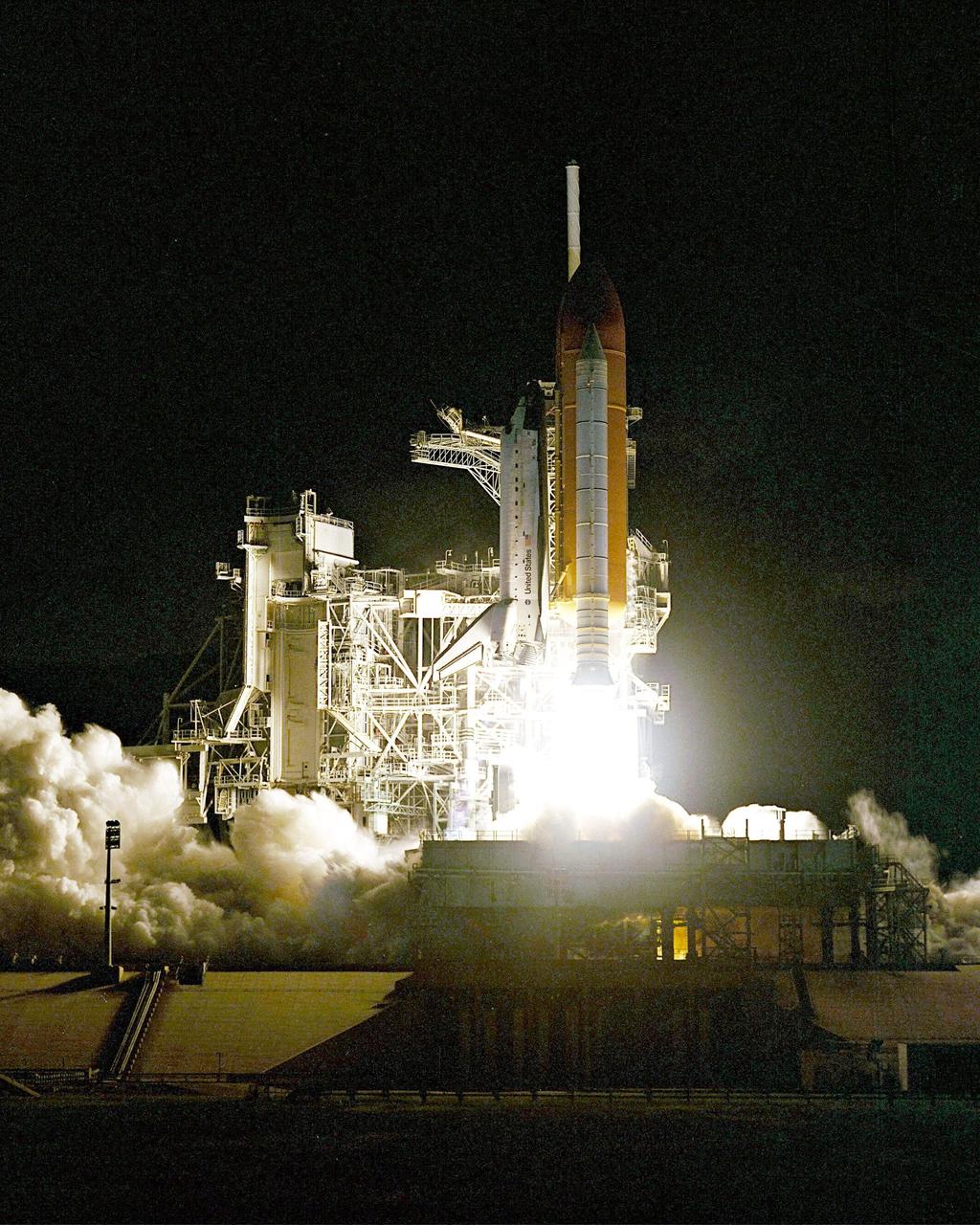
KENNEDY SPACE CENTER, Fla. -- A perfect on-time launch for Space Shuttle Discovery at 7:17 p.m. EDT. This marks the 100th launch in the history of the Shuttle program. Discovery carries a payload that includes the Integrated Truss Structure Z-1, first of 10 trusses that will form the backbone of the Space Station, and the third Pressurized Mating Adapter that will provide a Shuttle docking port for solar array installation on the sixth Station flight and Lab installation on the seventh Station flight. Discovery’s landing is expected Oct. 22 at 2:10 p.m. EDT
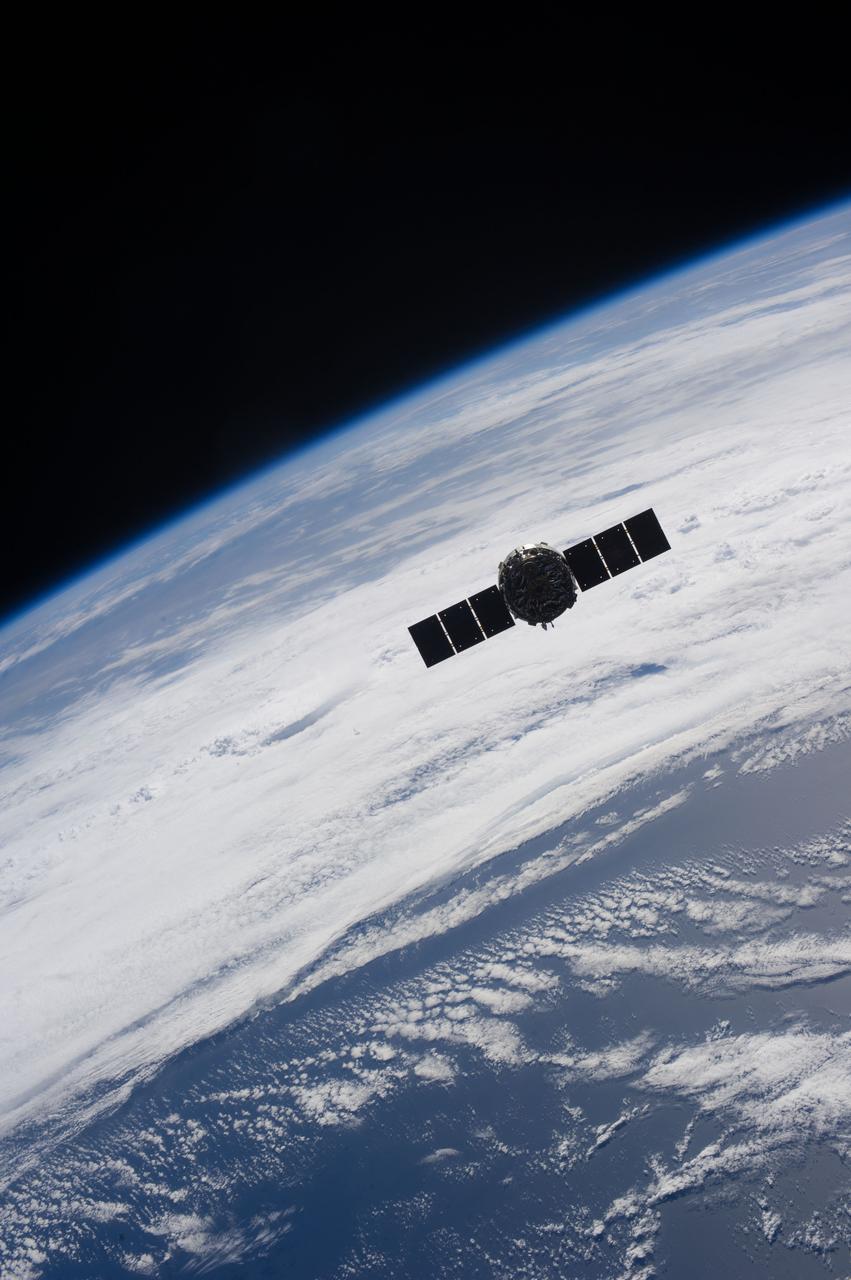
ISS037-E-018572 (22 Oct. 2013) --- The Orbital Sciences’ Cygnus commercial craft begins its relative separation from the International Space Station after three weeks at the station. European Space Agency astronaut Luca Parmitano and NASA astronaut Karen Nyberg, both Expedition 37 flight engineers, were at the controls of the robotics workstation removing Cygnus from the Harmony node then safely releasing it at 7:31 a.m. (EDT) Oct. 22, 2013. On Oct. 23, the Cygnus will fire its engines for the last time at 1:41 p.m. and re-enter Earth’s atmosphere for destruction over the Pacific Ocean. A blue and white part of Earth and the blackness of space provide the backdrop for the scene.
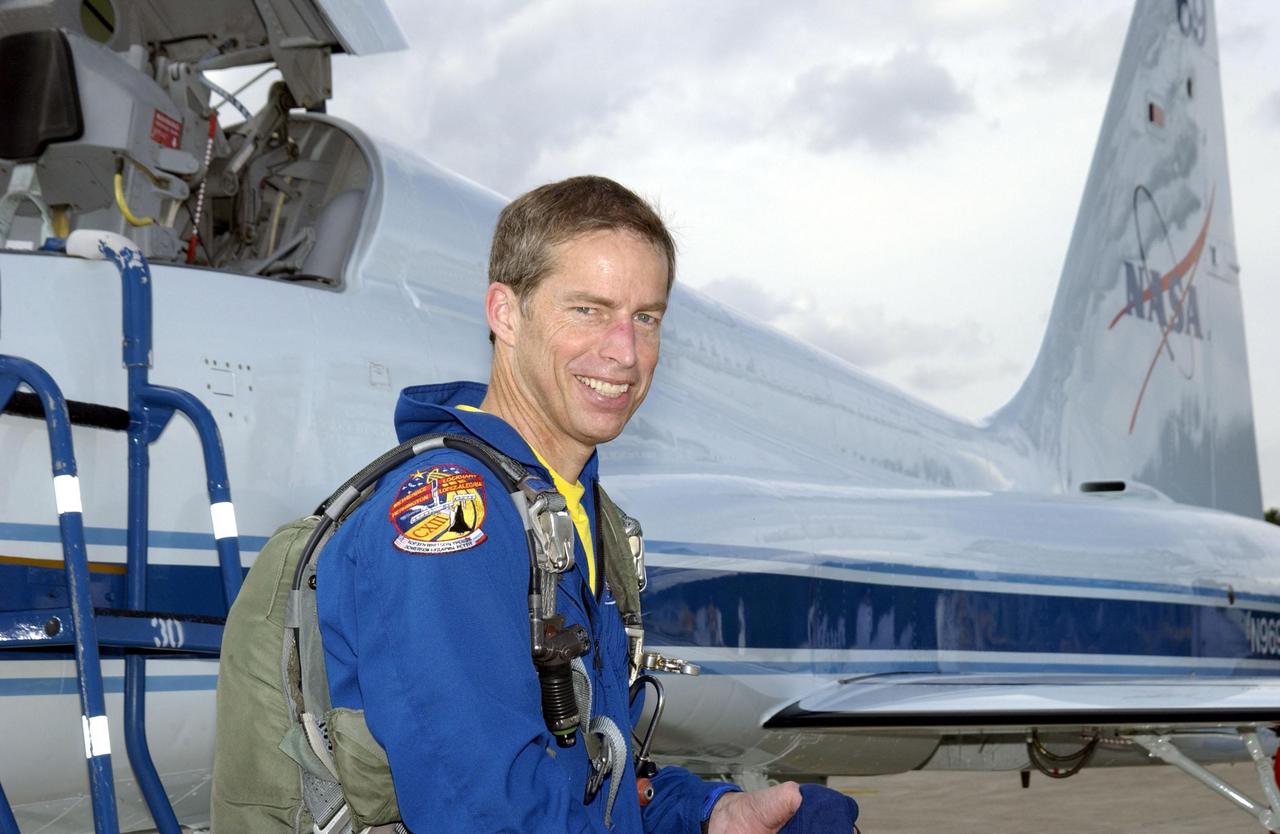
KENNEDY SPACE CENTER, FLA. -- STS-113 Commander James Wetherbee arrives at KSC's Shuttle Landing Facility to get ready for launch. STS-113 is the 16th American assembly flight to the International Space Station. The primary objective of the mission is bringing the Expedition 6 crew to the Station and returning the Expedition 5 crew to Earth. The major task of the mission is delivery of the Port 1 (P1) Integrated Truss Assembly, which will be attached to the port side of the S0 truss. Three spacewalks are planned to install and activate the truss and its associated equipment. Launch of Space Shuttle Endeavour on mission STS-113 is targeted for no earlier than Nov. 22 between 7 and 11 p.m. EST.
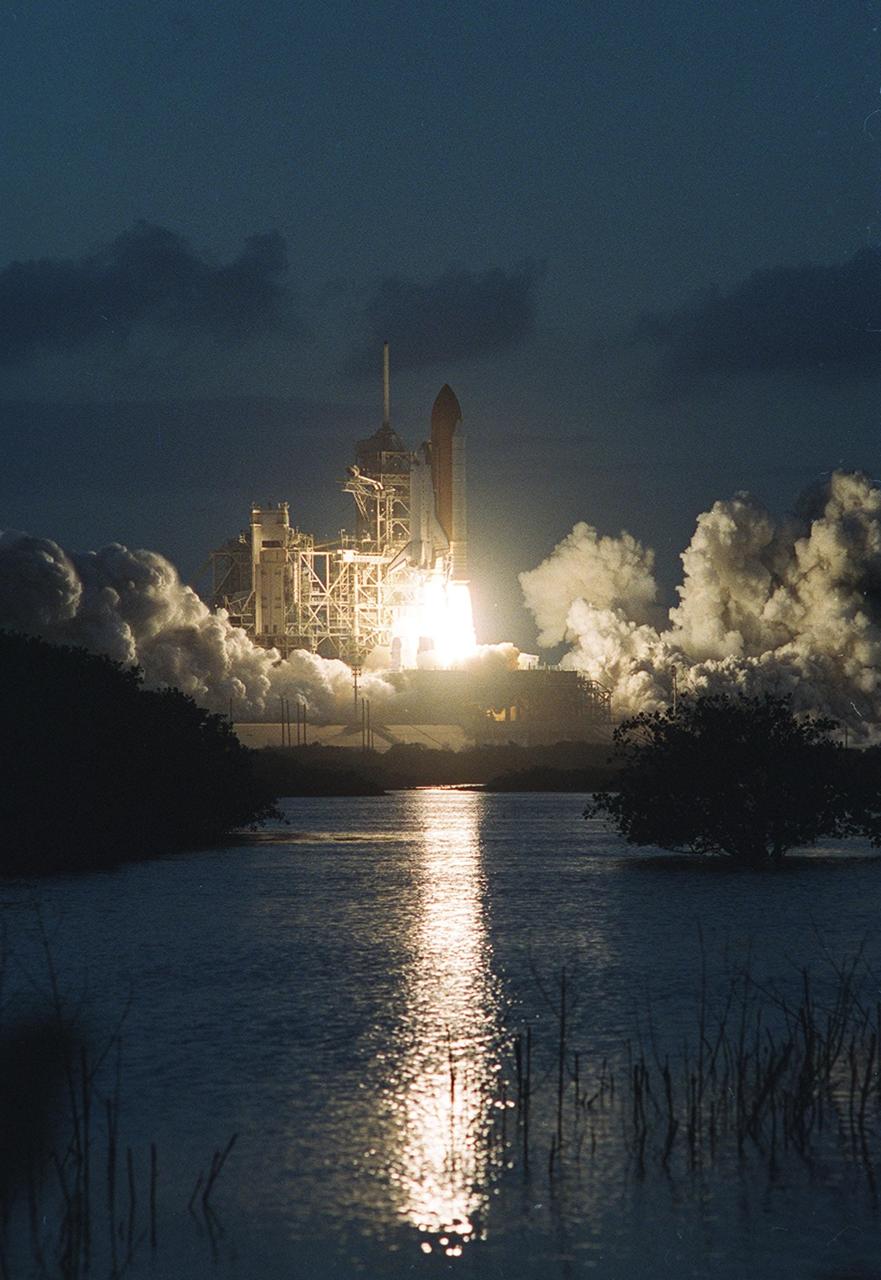
KENNEDY SPACE CENTER, Fla. - The reflection in water near Launch Pad 39B captures the brilliance of the flames trailing Space Shuttle Endeavour as it soars into the twilight sky on mission STS-108. Liftoff occurred at 5:19:28 p.m. EST (22:19 GMT) on this second launch attempt in two days. Endeavour will dock with the International Space Station on Dec. 7. STS-108 is the final Shuttle mission of 2001and the 107th Shuttle flight overall. It is the 12th flight to the Space Station. Landing of the orbiter at KSC's Shuttle Landing Facility is targeted for 1:05 p.m. EST (18:05 p.m. GMT) Dec. 16
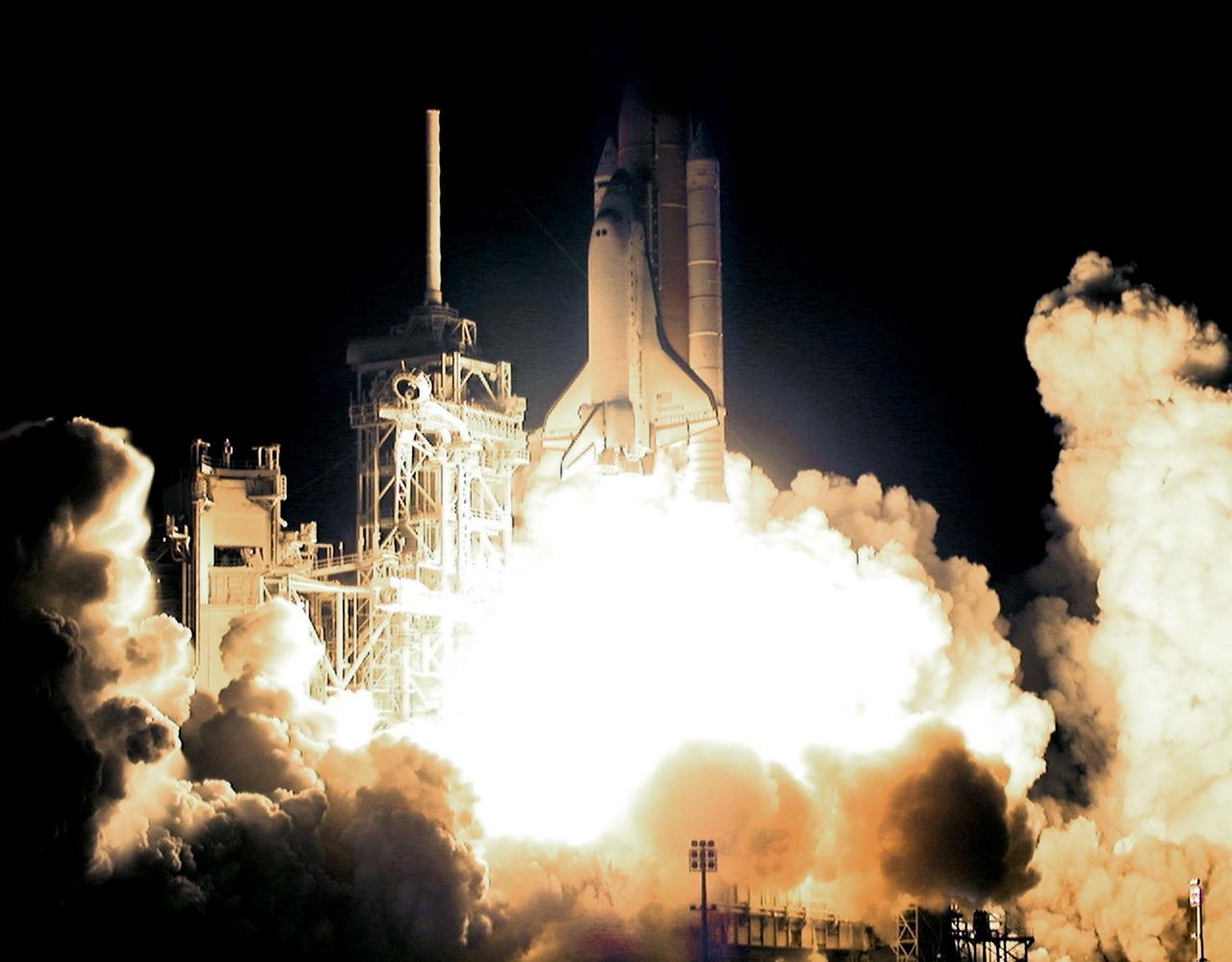
KENNEDY SPACE CENTER, Fla. -- In a perfect on-time launch at 7:17 p.m. EDT, Space Shuttle Discovery trails a blaze of flame amid clouds of smoke and steam as it leaps into the night sky. The launch of mission STS-92 carries a crew of seven on a construction flight to the International Space Station. Discovery also carries a payload that includes the Integrated Truss Structure Z-1, first of 10 trusses that will form the backbone of the Space Station, and the third Pressurized Mating Adapter that will provide a Shuttle docking port for solar array installation on the sixth Station flight and Lab installation on the seventh Station flight. Discovery’s landing is expected Oct. 22 at 2:10 p.m. EDT
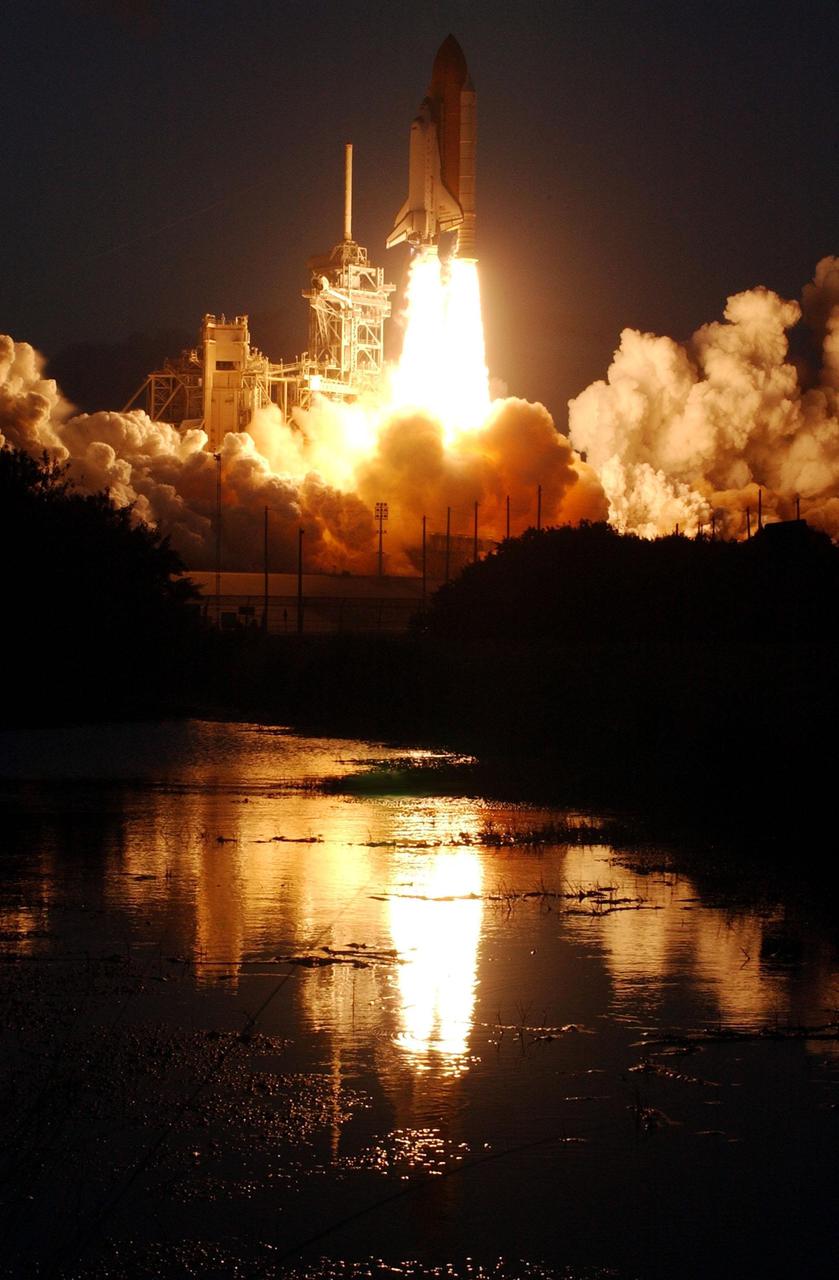
KENNEDY SPACE CENTER, Fla. -- A pool of water near Launch Pad 39B turns crimson from the reflection of flames at the launch of Space Shuttle Endeavour on mission STS-108. The second attempt in two days, liftoff occurred at 5:19:28 p.m. EST (22:19 GMT). Endeavour will dock with the International Space Station on Dec. 7. STS-108 is the final Shuttle mission of 2001and the 107th Shuttle flight overall. It is the 12th flight to the Space Station. Landing of the orbiter at KSC's Shuttle Landing Facility is targeted for 1:05 p.m. EST (18:05 p.m. GMT) Dec. 16
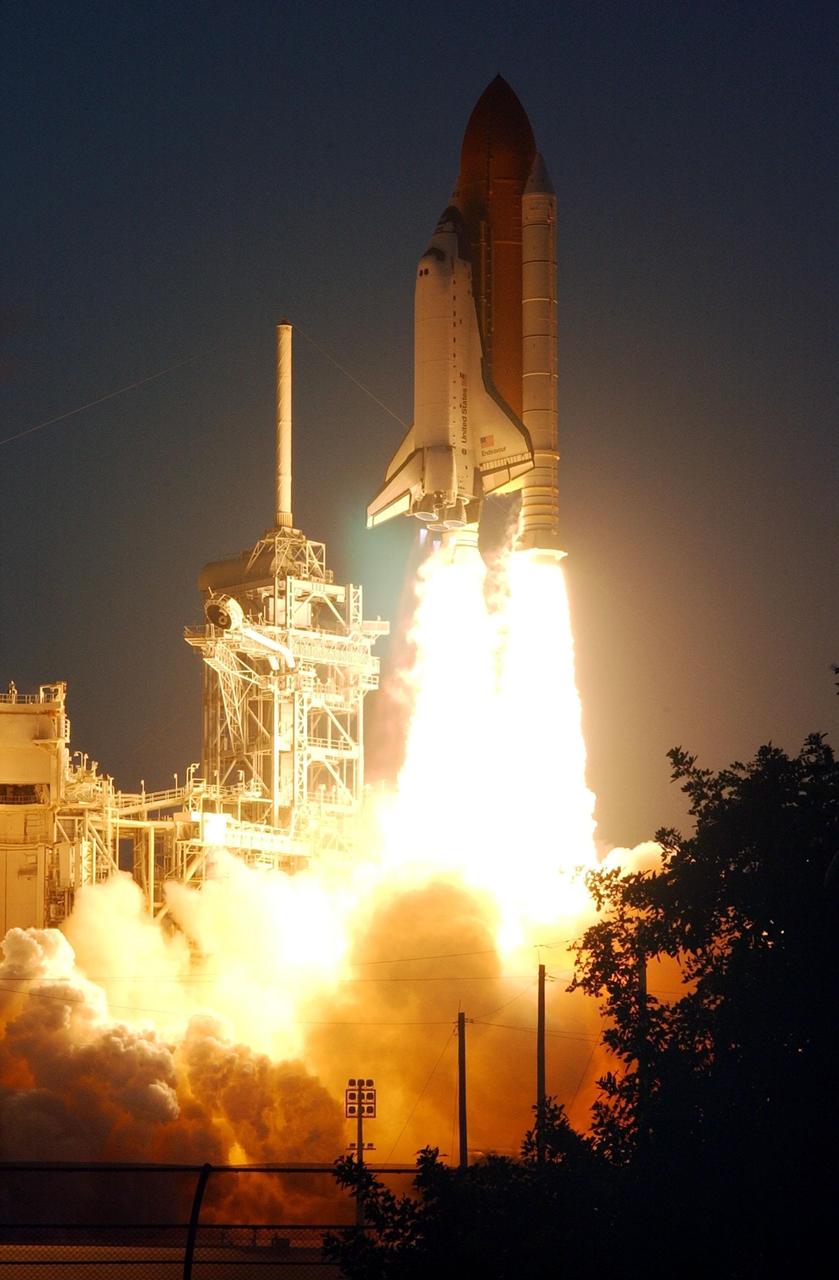
KENNEDY SPACE CENTER, Fla. -- Spewing flames and smoke, Space Shuttle Endeavour hurtles into the twilight sky on mission STS-108. The second attempt in two days, liftoff occurred at 5:19:28 p.m. EST (22:19 GMT). Endeavour will dock with the International Space Station on Dec. 7. STS-108 is the final Shuttle mission of 2001and the 107th Shuttle flight overall. It is the 12th flight to the Space Station. Landing of the orbiter at KSC's Shuttle Landing Facility is targeted for 1:05 p.m. EST (18:05 p.m. GMT) Dec. 16
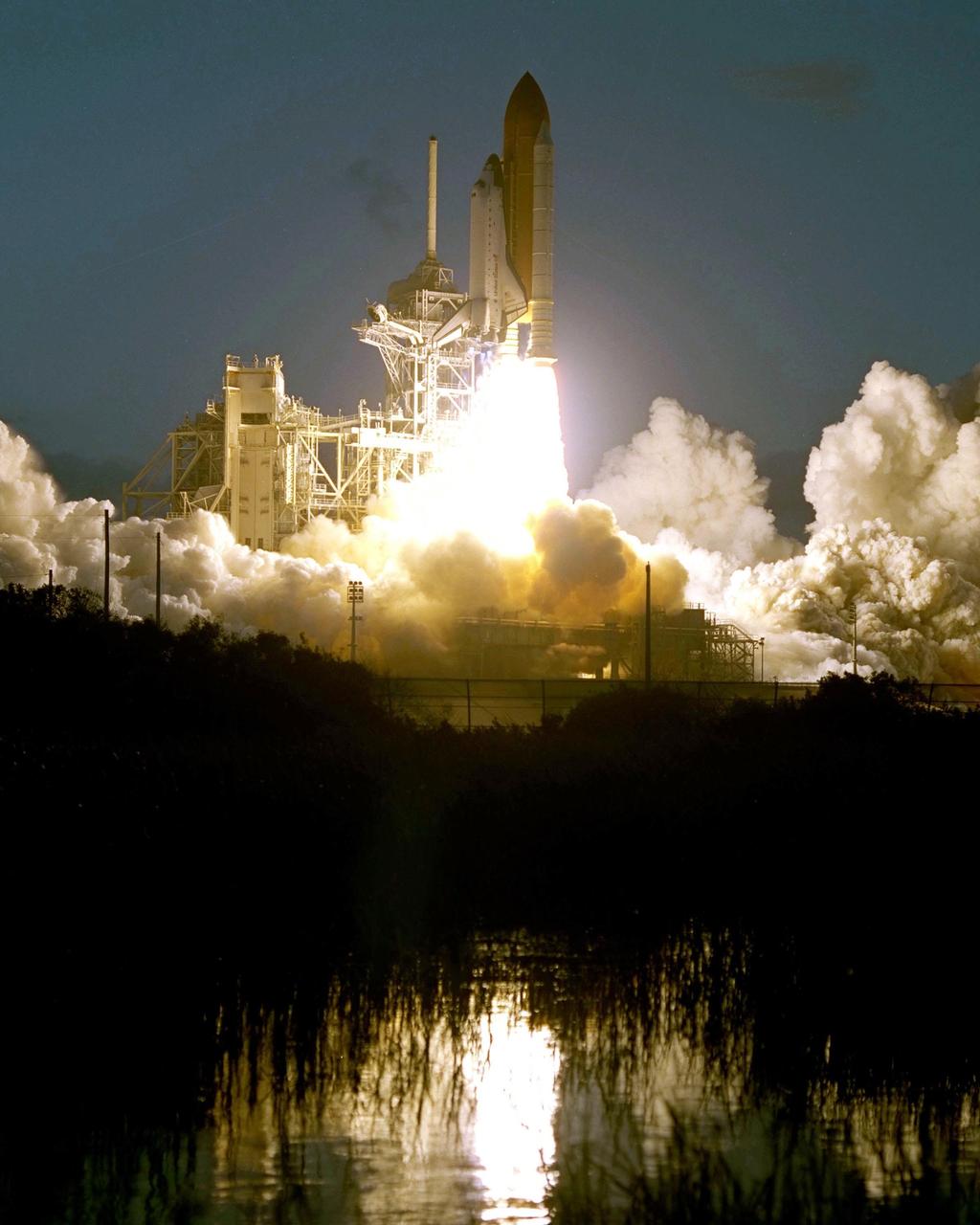
KENNEDY SPACE CENTER, Fla. -- Billows of smoke and steam are blown away from Launch Pad 39B as Space Shuttle Endeavour hurtles into space on mission STS-108. The second attempt in two days, liftoff occurred at 5:19:28 p.m. EST (22:19.28 GMT). Endeavour will dock with the International Space Station on Dec. 7. STS-108 is the final Shuttle mission of 2001and the 107th Shuttle flight overall. It is the 12th flight to the Space Station. Landing of the orbiter at KSC's Shuttle Landing Facility is targeted for 1:05 p.m. EST (18:05 p.m. GMT) Dec. 16
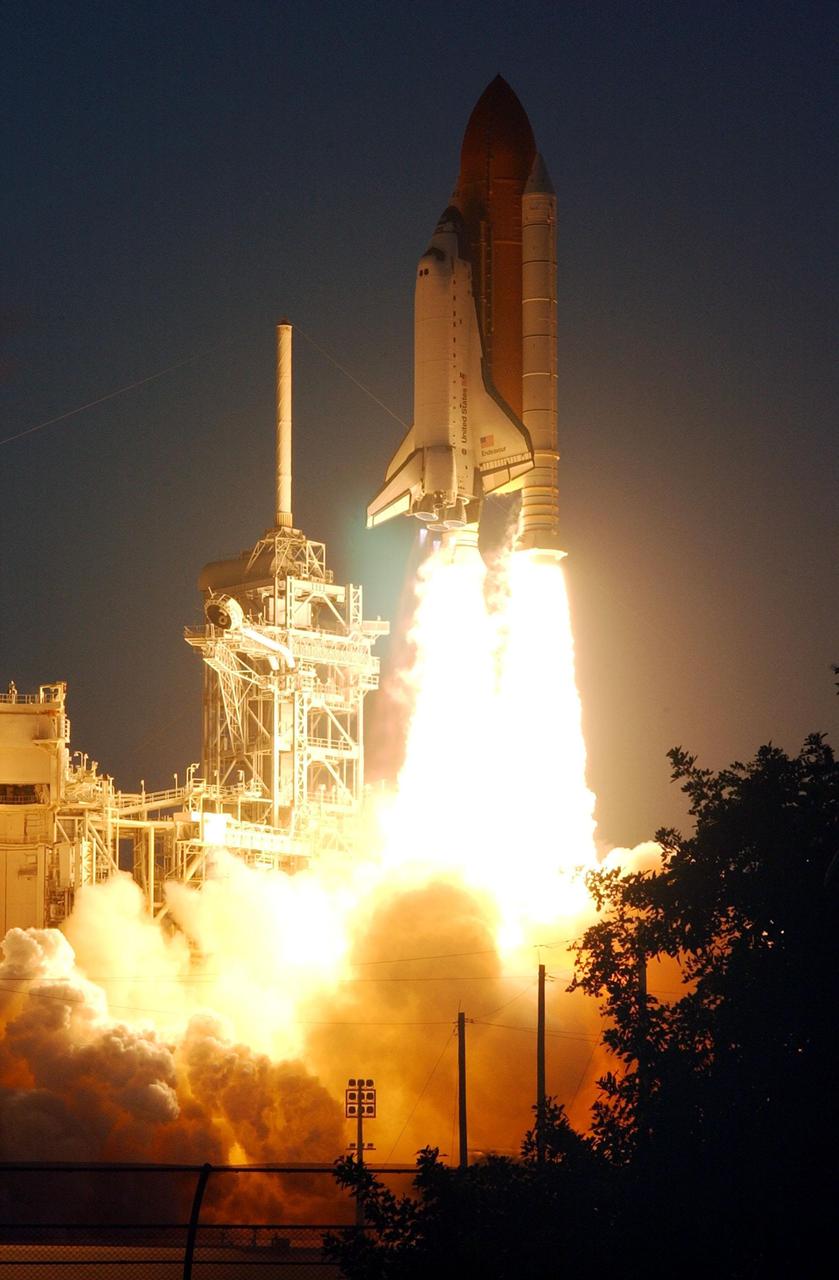
KENNEDY SPACE CENTER, Fla. -- Spewing flames and smoke, Space Shuttle Endeavour hurtles into the twilight sky on mission STS-108. The second attempt in two days, liftoff occurred at 5:19:28 p.m. EST (22:19 GMT). Endeavour will dock with the International Space Station on Dec. 7. STS-108 is the final Shuttle mission of 2001and the 107th Shuttle flight overall. It is the 12th flight to the Space Station. Landing of the orbiter at KSC's Shuttle Landing Facility is targeted for 1:05 p.m. EST (18:05 p.m. GMT) Dec. 16
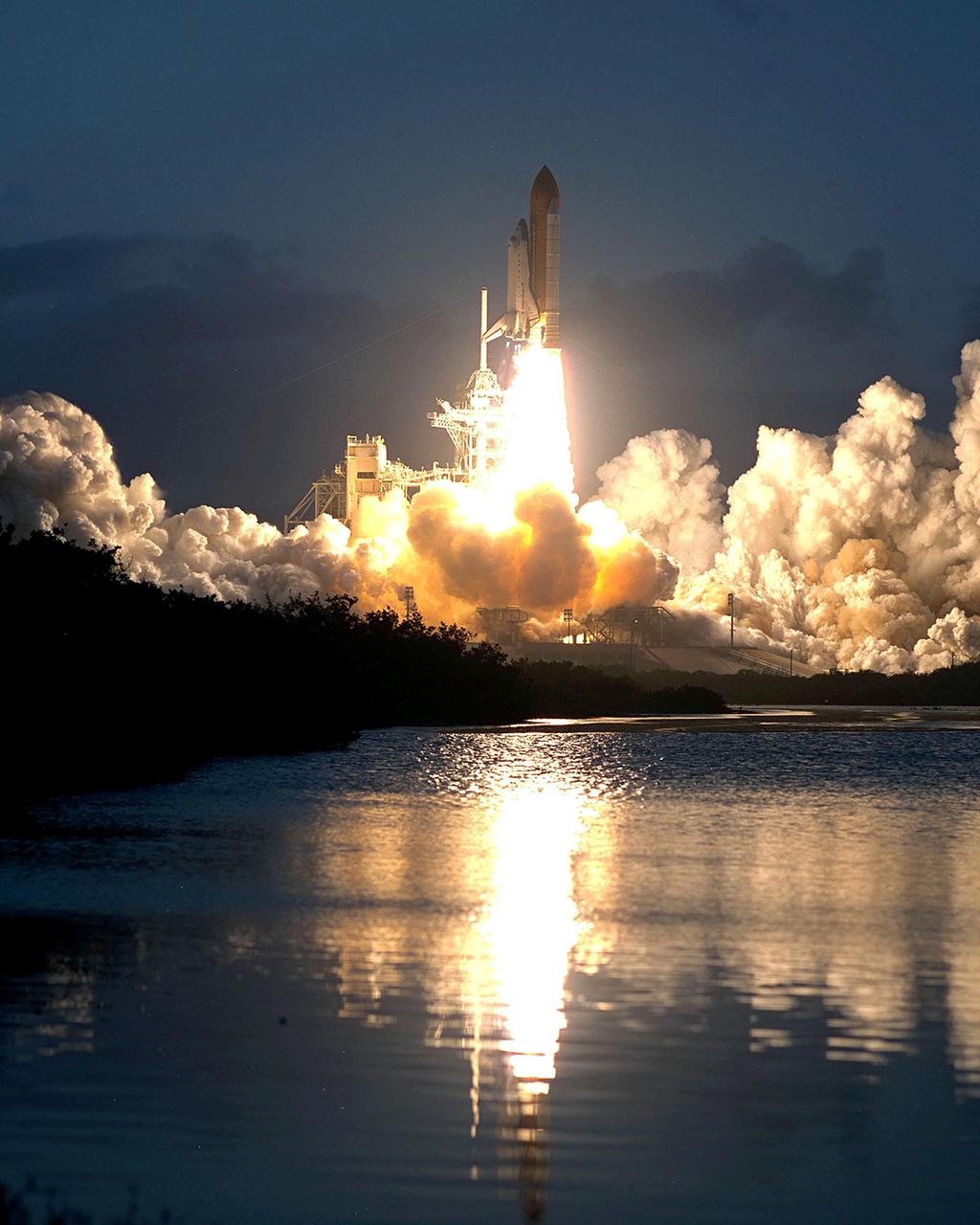
KENNEDY SPACE CENTER, Fla. -- Space Shuttle Endeavour soars into a twilight sky on mission STS-108, the second launch attempt over two days. Liftoff occurred at 5:19:28 p.m. EST (22:19.28 GMT). Endeavour will dock with the International Space Station on Dec. 7. STS-108 is the final Shuttle mission of 2001and the 107th Shuttle flight overall. It is the 12th flight to the Space Station. Landing of the orbiter at KSC's Shuttle Landing Facility is targeted for 1:05 p.m. EST (18:05 p.m. GMT) Dec. 16
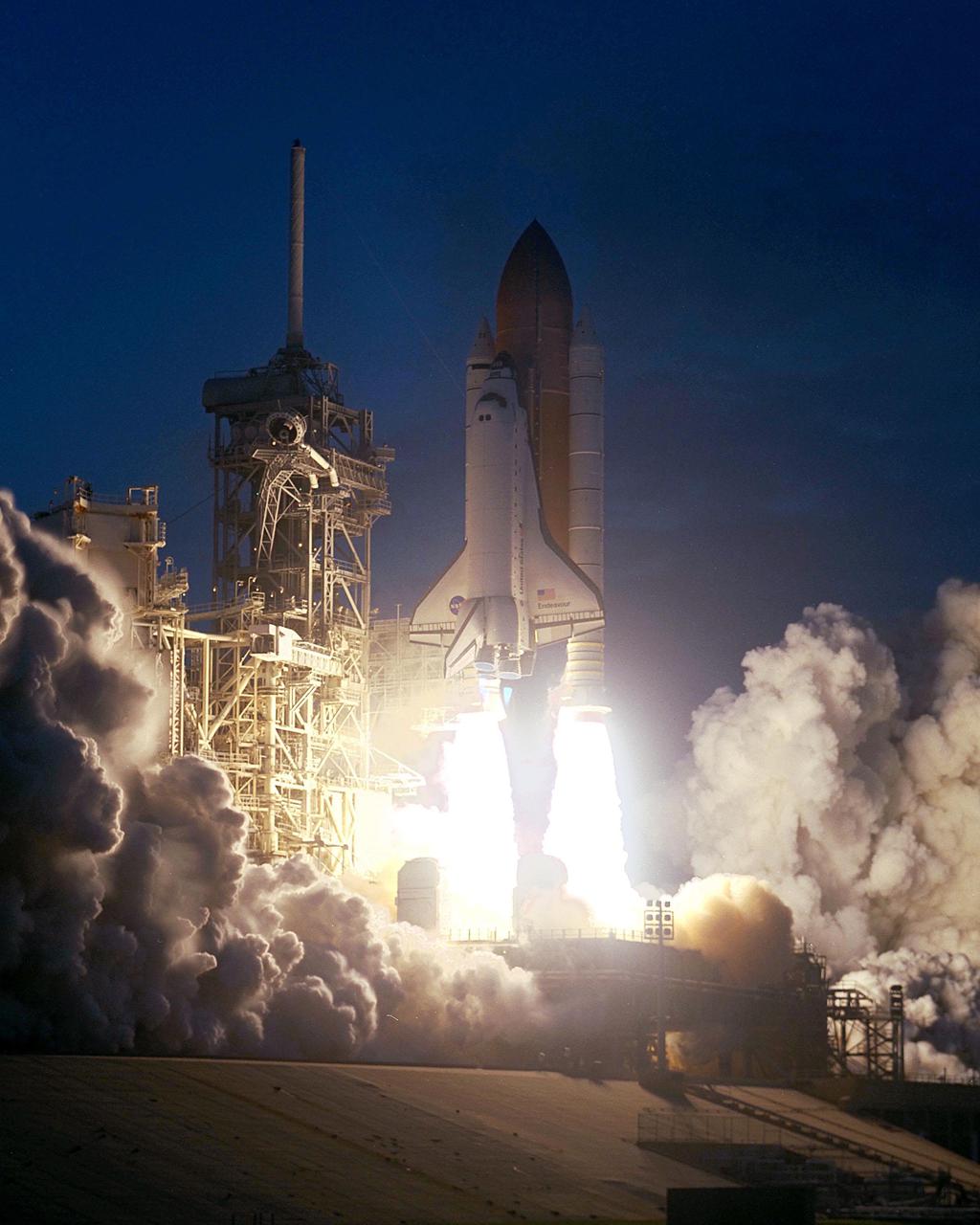
KENNEDY SPACE CENTER, Fla. -- Space Shuttle Endeavour soars into a twilight sky on mission STS-108, the second launch attempt over two days. Liftoff occurred at 5:19:28 p.m. EST (22:19.28 GMT). Endeavour will dock with the International Space Station on Dec. 7. STS-108 is the final Shuttle mission of 2001and the 107th Shuttle flight overall. It is the 12th flight to the Space Station. Landing of the orbiter at KSC's Shuttle Landing Facility is targeted for 1:05 p.m. EST (18:05 p.m. GMT) Dec. 16
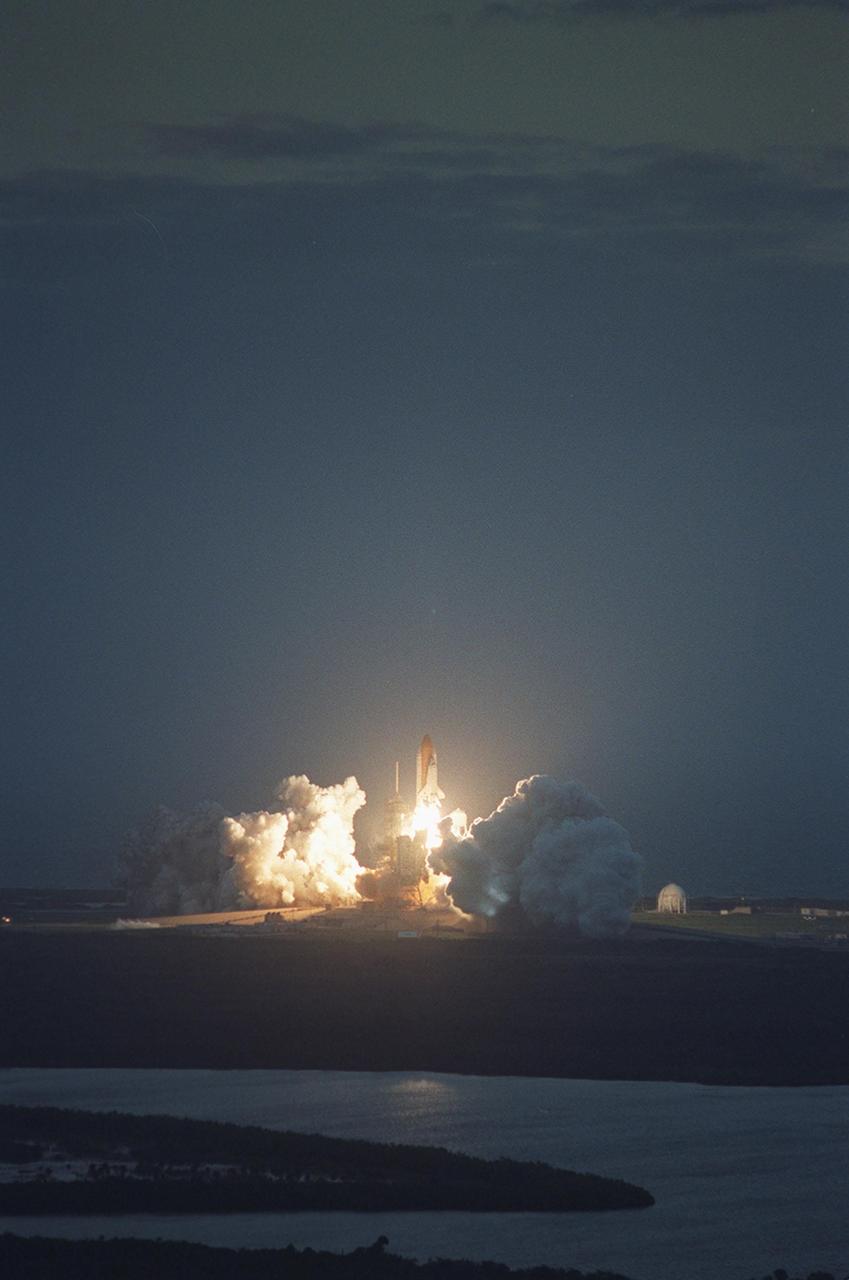
KENNEDY SPACE CENTER, FLA. -- Viewed from the roof of the Vehicle Assembly Building, Space Shuttle Endeavour rises from between billows of smoke and steam to begin its journey to the International Space Station on mission STS-108. Liftoff occurred at 5:19:28 p.m. EST (22:19:28 GMT). Endeavour will dock with the International Space Station on Dec. 7. STS-108 is the final Shuttle mission of 2001and the 107th Shuttle flight overall. It is the 12th flight to the Space Station. Landing of the orbiter at KSC's Shuttle Landing Facility is targeted for 1:05 p.m. EST (18:05 p.m. GMT) Dec. 16
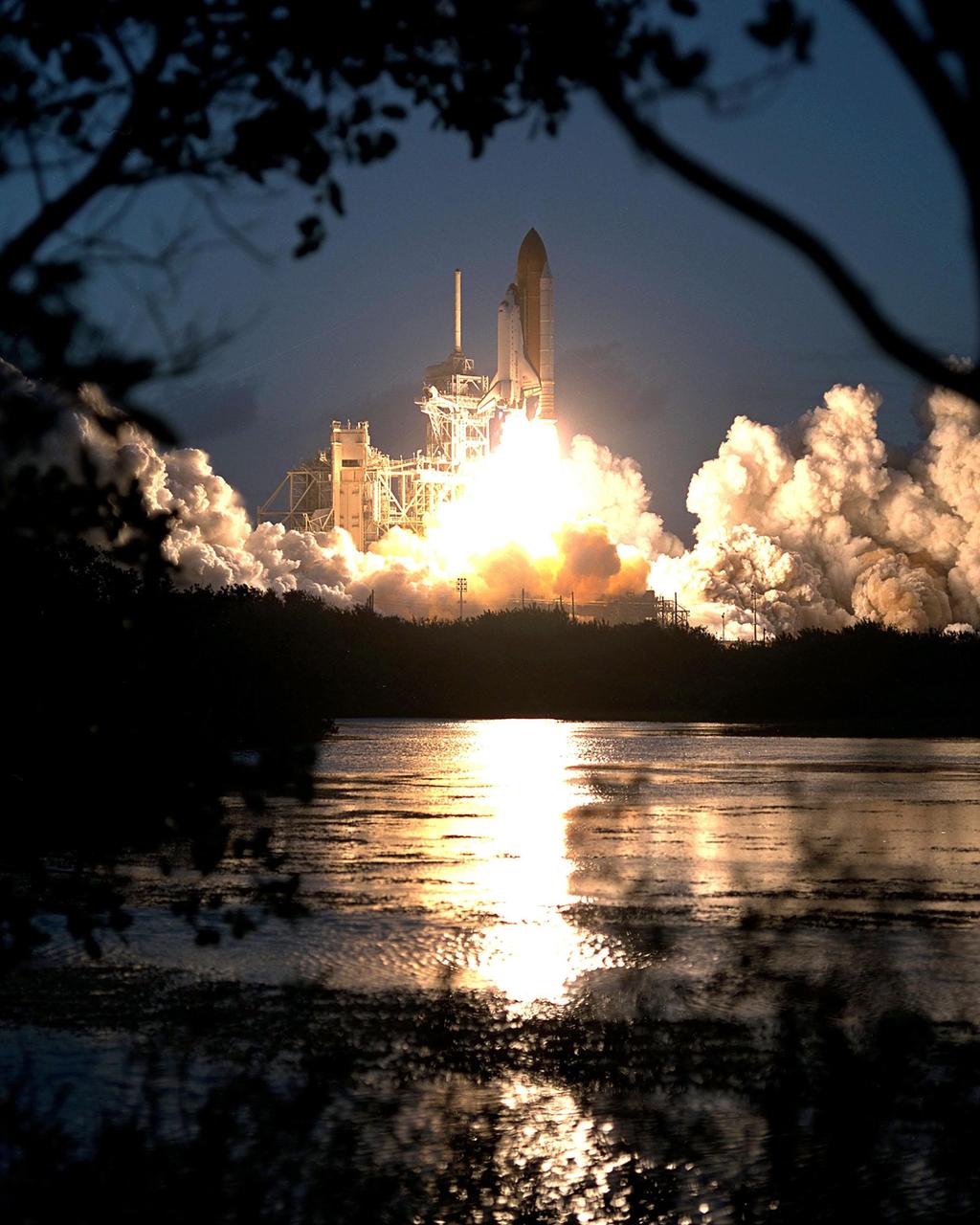
KENNEDY SPACE CENTER, Fla. -- Space Shuttle Endeavour soars into a twilight sky on mission STS-108, the second launch attempt over two days. Liftoff occurred at 5:19:28 p.m. EST (22:19.28 GMT). Endeavour will dock with the International Space Station on Dec. 7. STS-108 is the final Shuttle mission of 2001and the 107th Shuttle flight overall. It is the 12th flight to the Space Station. Landing of the orbiter at KSC's Shuttle Landing Facility is targeted for 1:05 p.m. EST (18:05 p.m. GMT) Dec. 16
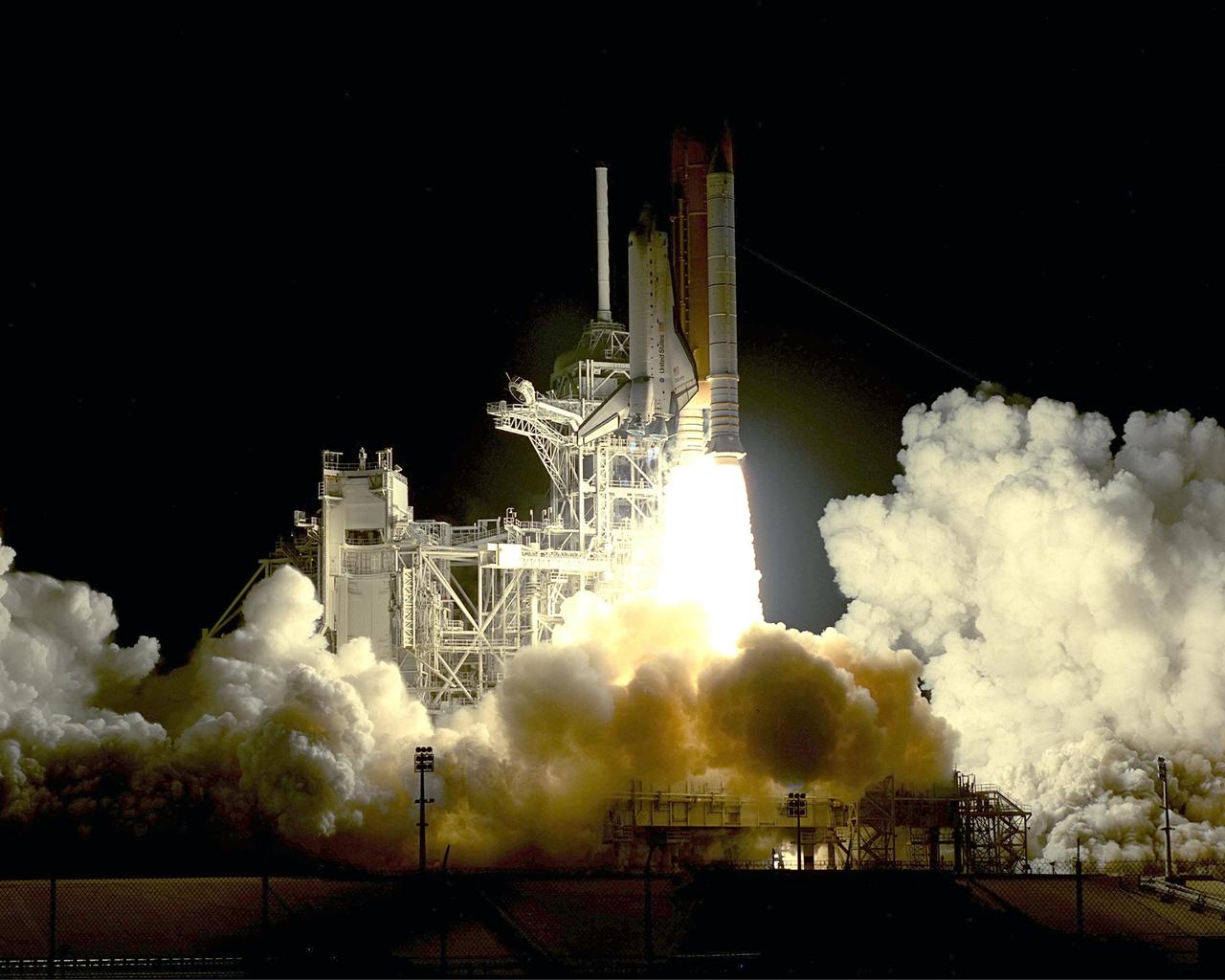
KENNEDY SPACE CENTER, Fla. -- Billows of smoke and steam spread across Launch Pad 39A as Space Shuttle Discovery lifts off on mission STS-92 to the International Space Station. The perfect on-time liftoff occurred at 7:17 p.m. EDT, sending a crew of seven on the 100th launch in the history of the Shuttle program. Discovery carries a payload that includes the Integrated Truss Structure Z-1, first of 10 trusses that will form the backbone of the Space Station, and the third Pressurized Mating Adapter that will provide a Shuttle docking port for solar array installation on the sixth Station flight and Lab installation on the seventh Station flight. Discovery’s landing is expected Oct. 22 at 2:10 p.m. EDT
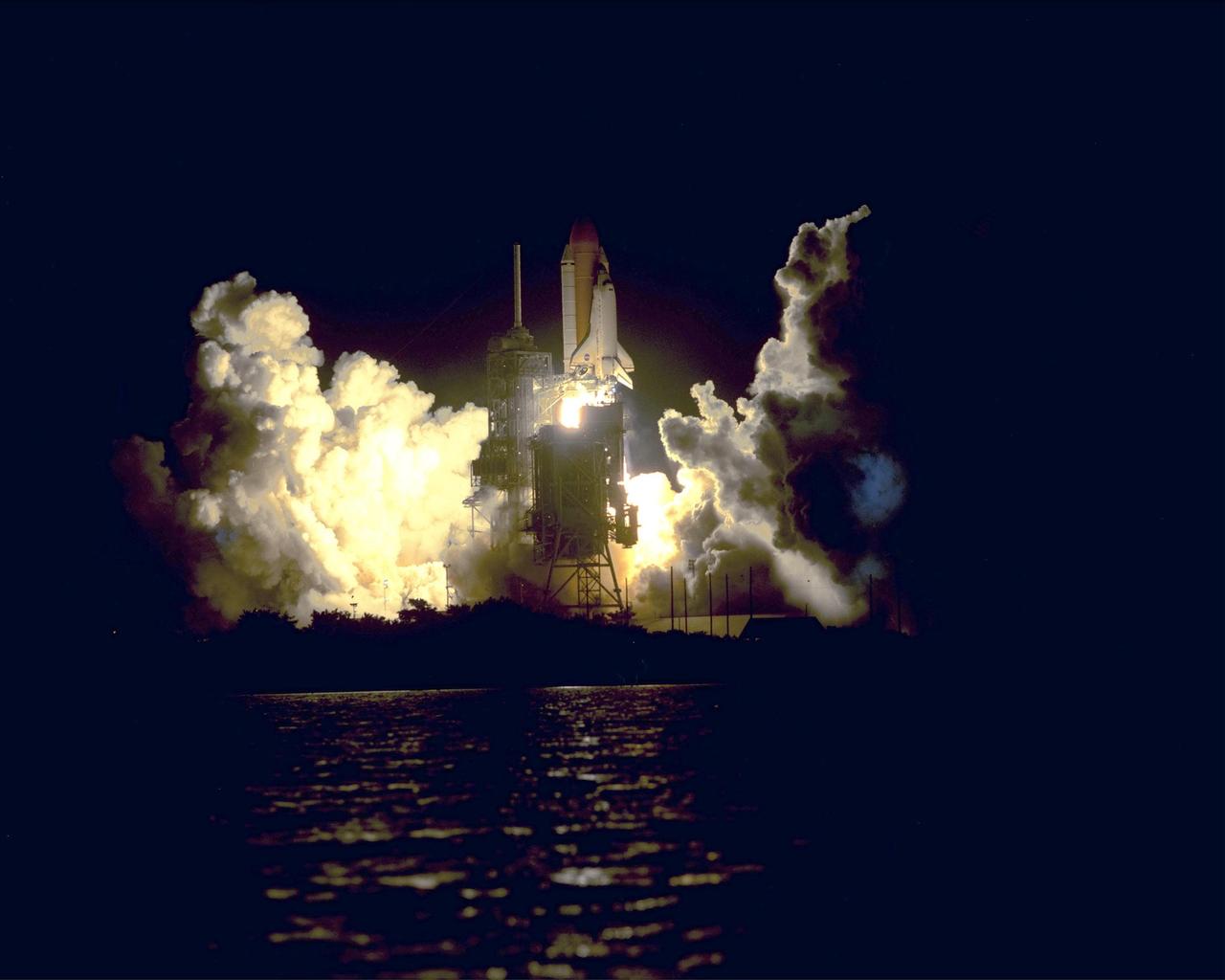
KENNEDY SPACE CENTER, Fla. -- Billows of smoke and steam surround Space Shuttle Discovery as it lifts off from Launch Pad 39A on mission STS-92 to the International Space Station. The perfect on-time liftoff occurred at 7:17 p.m. EDT, sending a crew of seven on the 100th launch in the history of the Shuttle program. Discovery carries a payload that includes the Integrated Truss Structure Z-1, first of 10 trusses that will form the backbone of the Space Station, and the third Pressurized Mating Adapter that will provide a Shuttle docking port for solar array installation on the sixth Station flight and Lab installation on the seventh Station flight. Discovery’s landing is expected Oct. 22 at 2:10 p.m. EDT
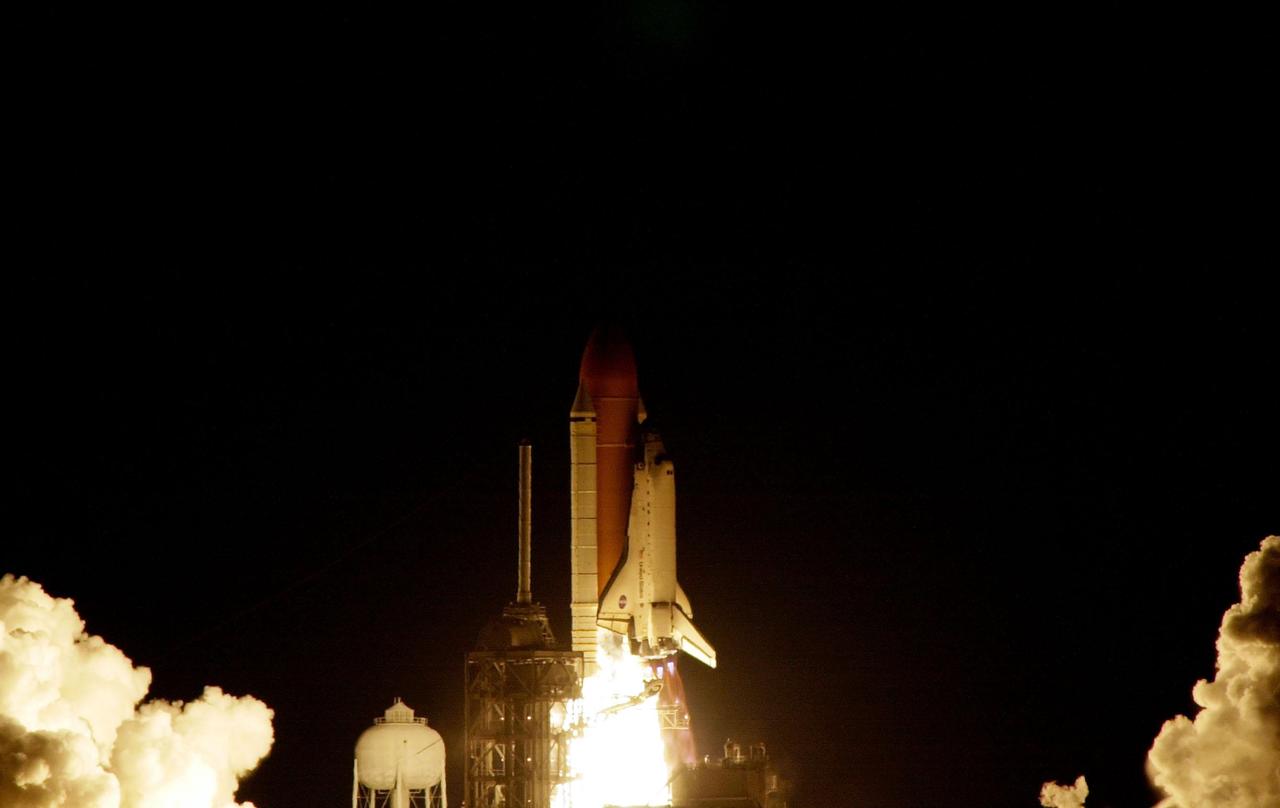
KENNEDY SPACE CENTER, FLA. -- In a perfect on-time launch at 7:17 p.m. EDT, Space Shuttle Discovery leaps free of Earth as its solid rocket boosters hurl it into the night sky. The launch of mission STS-92 carries a crew of seven on a construction flight to the International Space Station. Discovery also carries a payload that includes the Integrated Truss Structure Z-1, first of 10 trusses that will form the backbone of the Space Station, and the third Pressurized Mating Adapter that will provide a Shuttle docking port for solar array installation on the sixth Station flight and Lab installation on the seventh Station flight. Discovery’s landing is expected Oct. 22 at 2:10 p.m. EDT
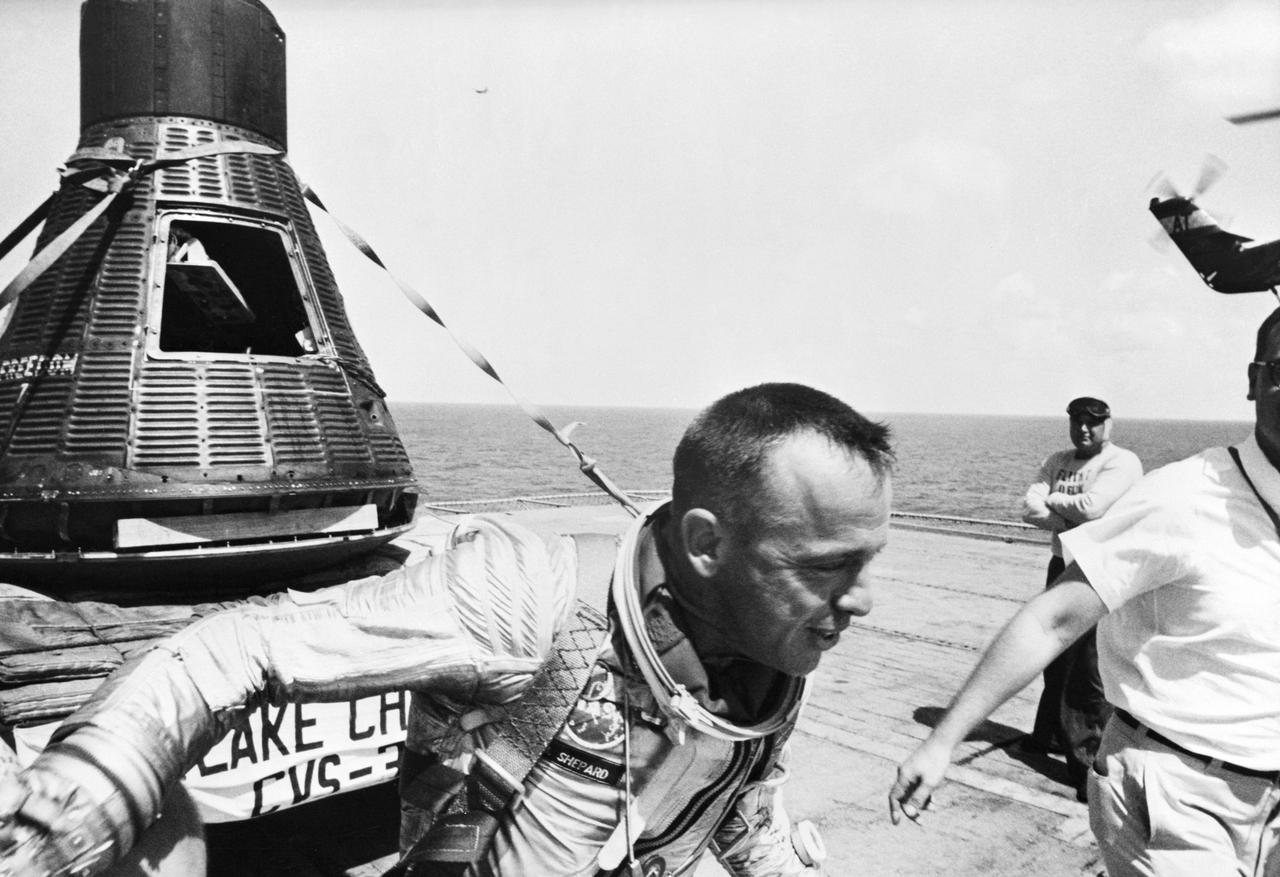
S61-02727 (5 May 1961) --- Astronaut Alan B. Shepard is seen on the deck of the USS Lake Champlain after the recovery of his Mercury capsule in the western Atlantic Ocean. Shepard and the Mercury spacecraft designated the ?Freedom 7? were flown to the deck of the recovery ship within 11 minutes of splashdown. MR-3 was the United States? first manned space mission. The spacecraft attained a maximum speed of 5,180 miles per hour, reached an altitude of 116 1/2 statute miles, and landed 302 statute miles downrange from Cape Canaveral, Florida. The suborbital mission lasted 15 minutes and 22 seconds. Photo credit: NASA or National Aeronautics and Space Administration
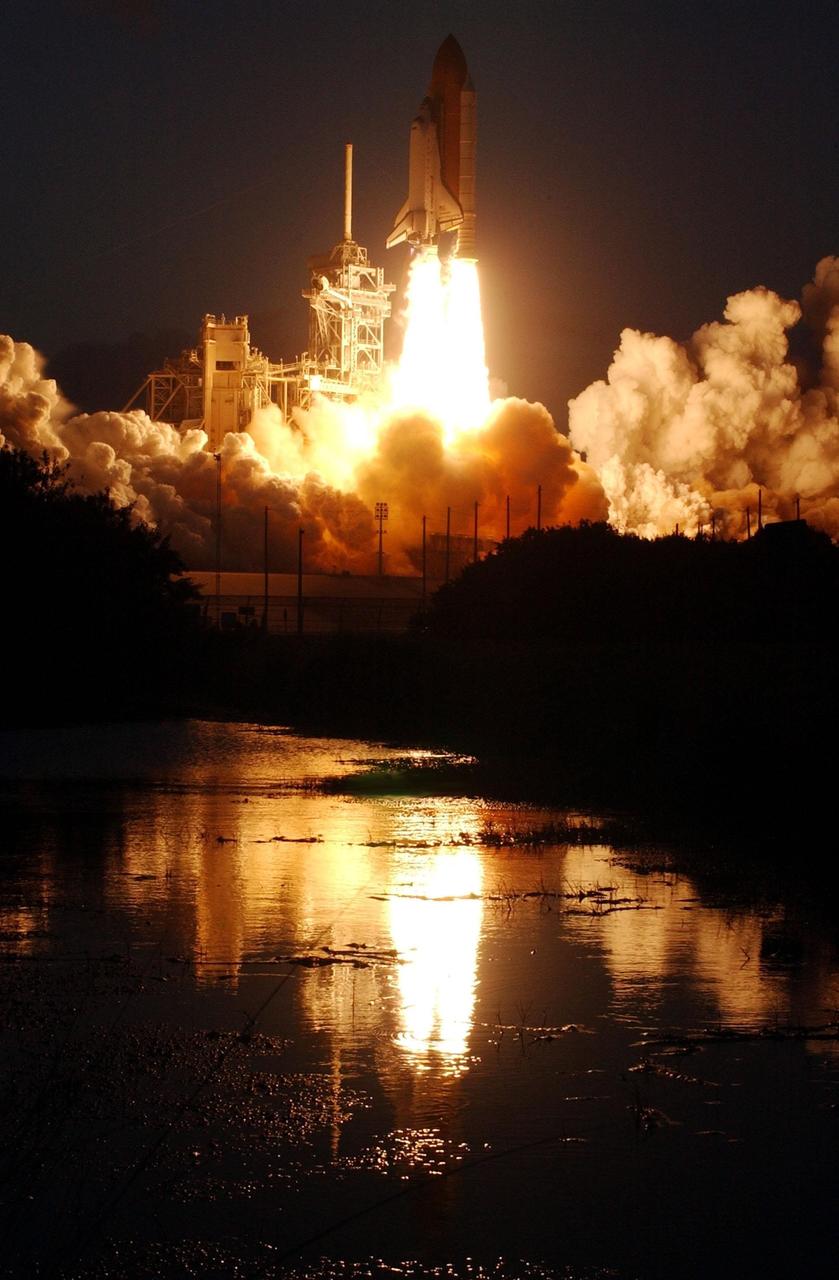
KENNEDY SPACE CENTER, Fla. -- A pool of water near Launch Pad 39B turns crimson from the reflection of flames at the launch of Space Shuttle Endeavour on mission STS-108. The second attempt in two days, liftoff occurred at 5:19:28 p.m. EST (22:19 GMT). Endeavour will dock with the International Space Station on Dec. 7. STS-108 is the final Shuttle mission of 2001and the 107th Shuttle flight overall. It is the 12th flight to the Space Station. Landing of the orbiter at KSC's Shuttle Landing Facility is targeted for 1:05 p.m. EST (18:05 p.m. GMT) Dec. 16
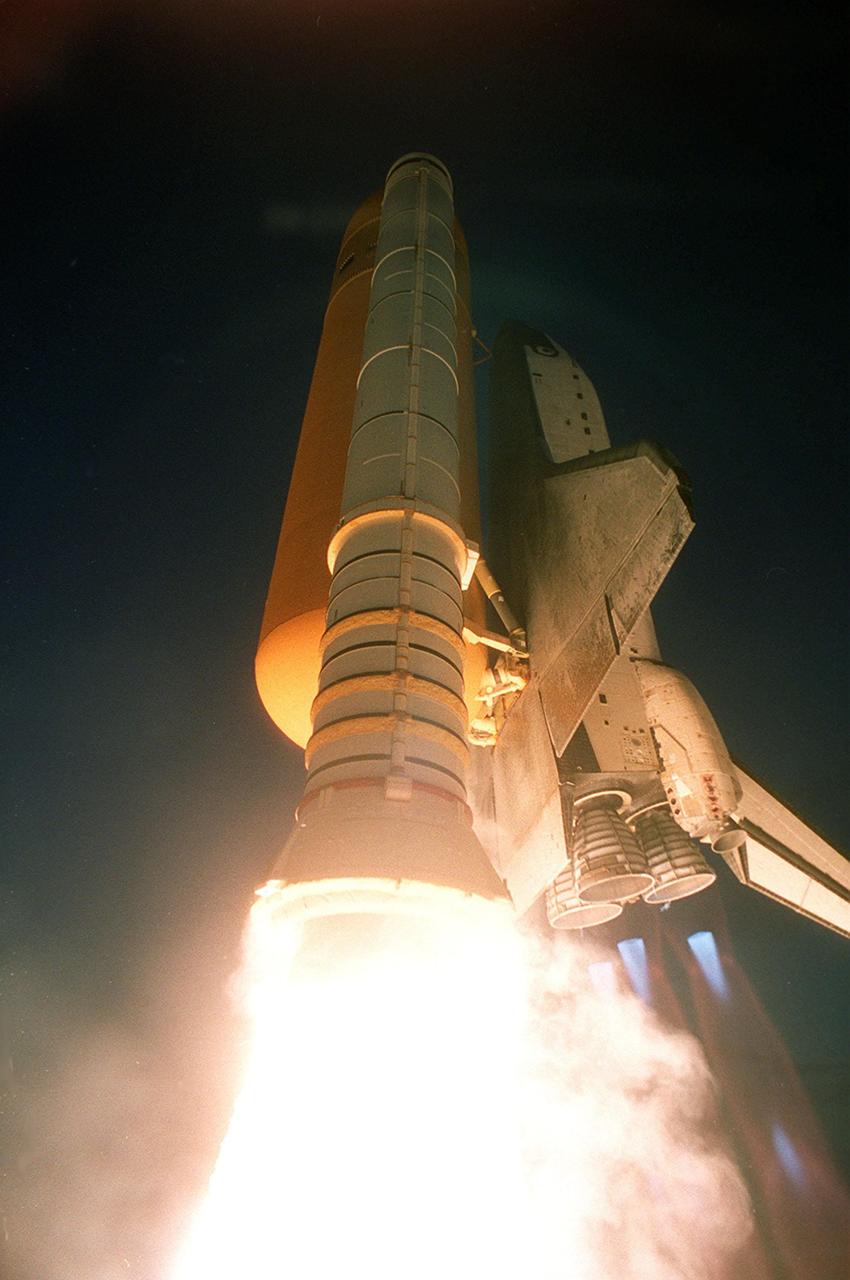
KENNEDY SPACE CENTER, FLA. - Flames shoot out from beneath the solid rocket booster propelling Space Shuttle Endeavour into space on mission STS-108. Liftoff occurred at 5:19:28 p.m. EST (22:19:28 GMT) on this second launch attempt in two days. Endeavour will dock with the International Space Station on Dec. 7. STS-108 is the final Shuttle mission of 2001and the 107th Shuttle flight overall. It is the 12th flight to the Space Station. Landing of the orbiter at KSC's Shuttle Landing Facility is targeted for 1:05 p.m. EST (18:05 p.m. GMT) Dec. 16
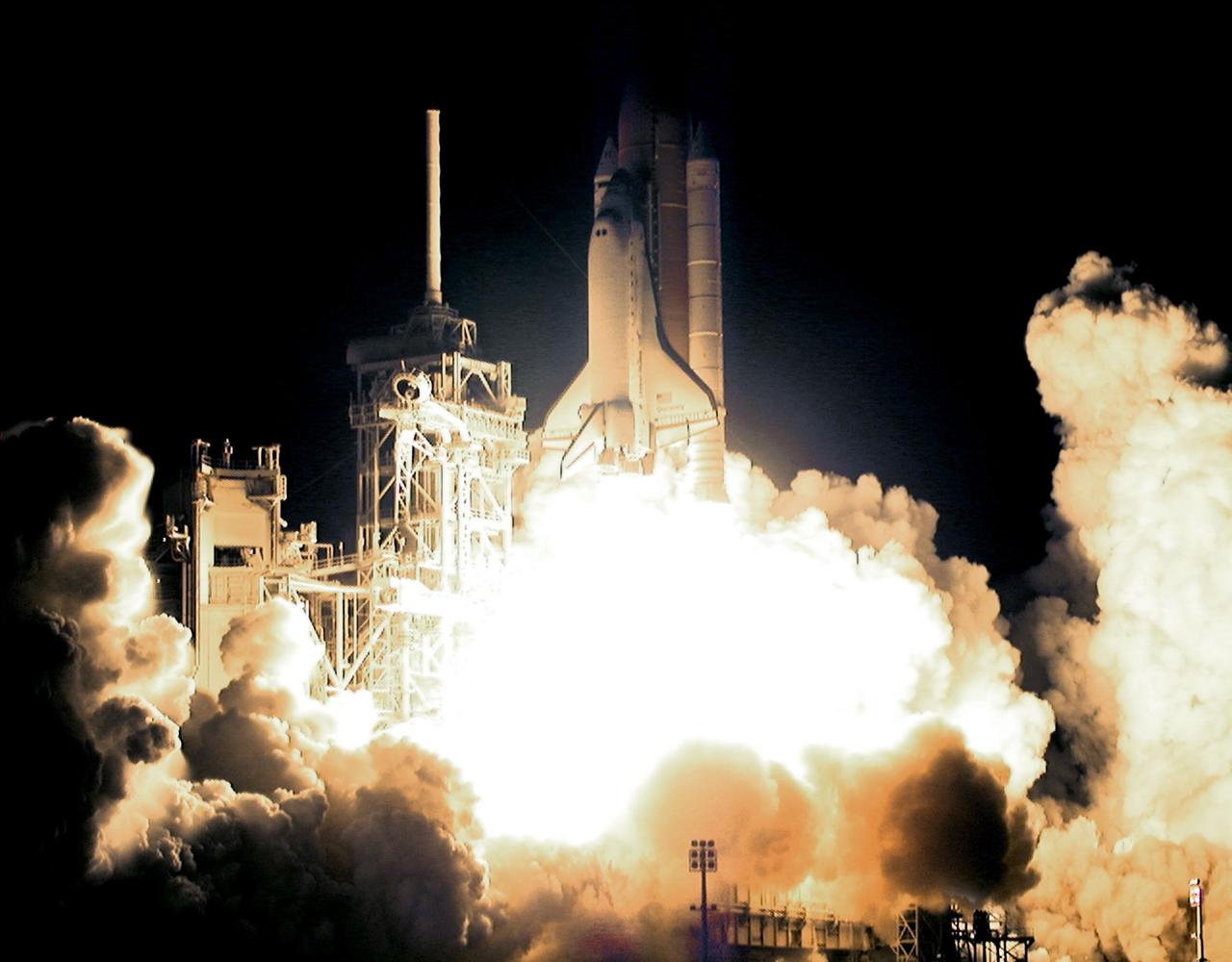
KENNEDY SPACE CENTER, Fla. -- In a perfect on-time launch at 7:17 p.m. EDT, Space Shuttle Discovery trails a blaze of flame amid clouds of smoke and steam as it leaps into the night sky. The launch of mission STS-92 carries a crew of seven on a construction flight to the International Space Station. Discovery also carries a payload that includes the Integrated Truss Structure Z-1, first of 10 trusses that will form the backbone of the Space Station, and the third Pressurized Mating Adapter that will provide a Shuttle docking port for solar array installation on the sixth Station flight and Lab installation on the seventh Station flight. Discovery’s landing is expected Oct. 22 at 2:10 p.m. EDT
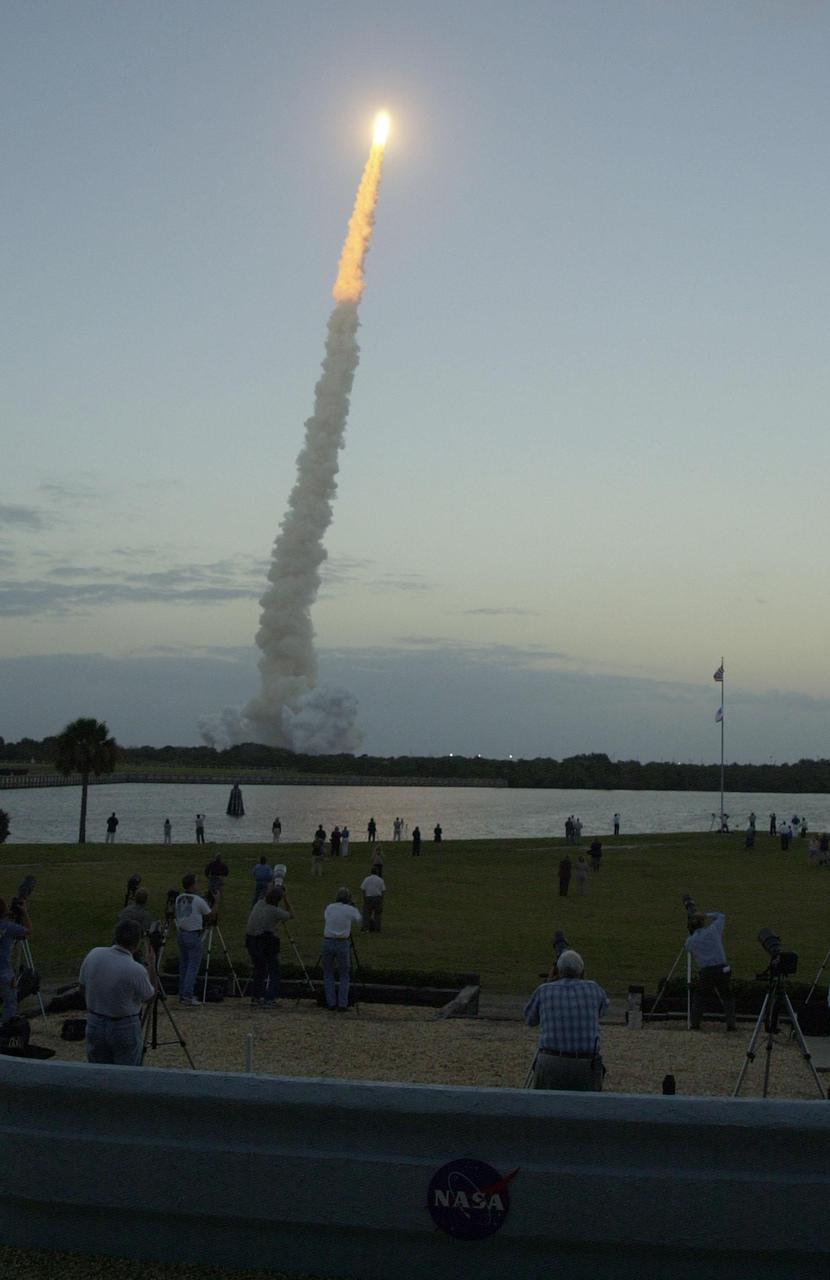
KENNEDY SPACE CENTER, Fla. -- Space Shuttle Endeavour soars into a twilight sky on mission STS-108, the second attempt over two days. Liftoff occurred at 5:19:28 p.m. EST (22:19 GMT). Endeavour will dock with the International Space Station on Dec. 7. STS-108 is the final Shuttle mission of 2001and the 107th Shuttle flight overall. It is the 12th flight to the Space Station. Landing of the orbiter at KSC's Shuttle Landing Facility is targeted for 1:05 p.m. EST (18:05 p.m. GMT) Dec. 16
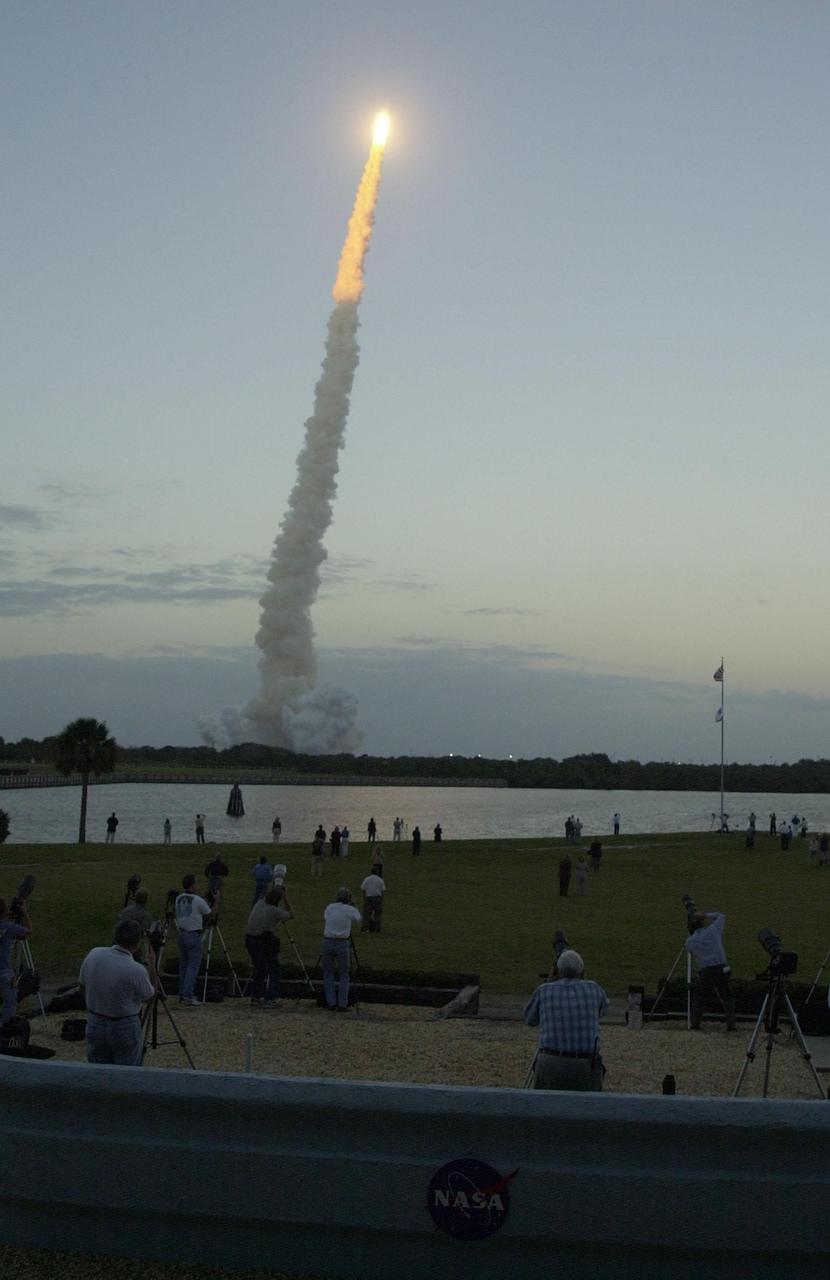
KENNEDY SPACE CENTER, Fla. -- Space Shuttle Endeavour soars into a twilight sky on mission STS-108, the second attempt over two days. Liftoff occurred at 5:19:28 p.m. EST (22:19 GMT). Endeavour will dock with the International Space Station on Dec. 7. STS-108 is the final Shuttle mission of 2001and the 107th Shuttle flight overall. It is the 12th flight to the Space Station. Landing of the orbiter at KSC's Shuttle Landing Facility is targeted for 1:05 p.m. EST (18:05 p.m. GMT) Dec. 16
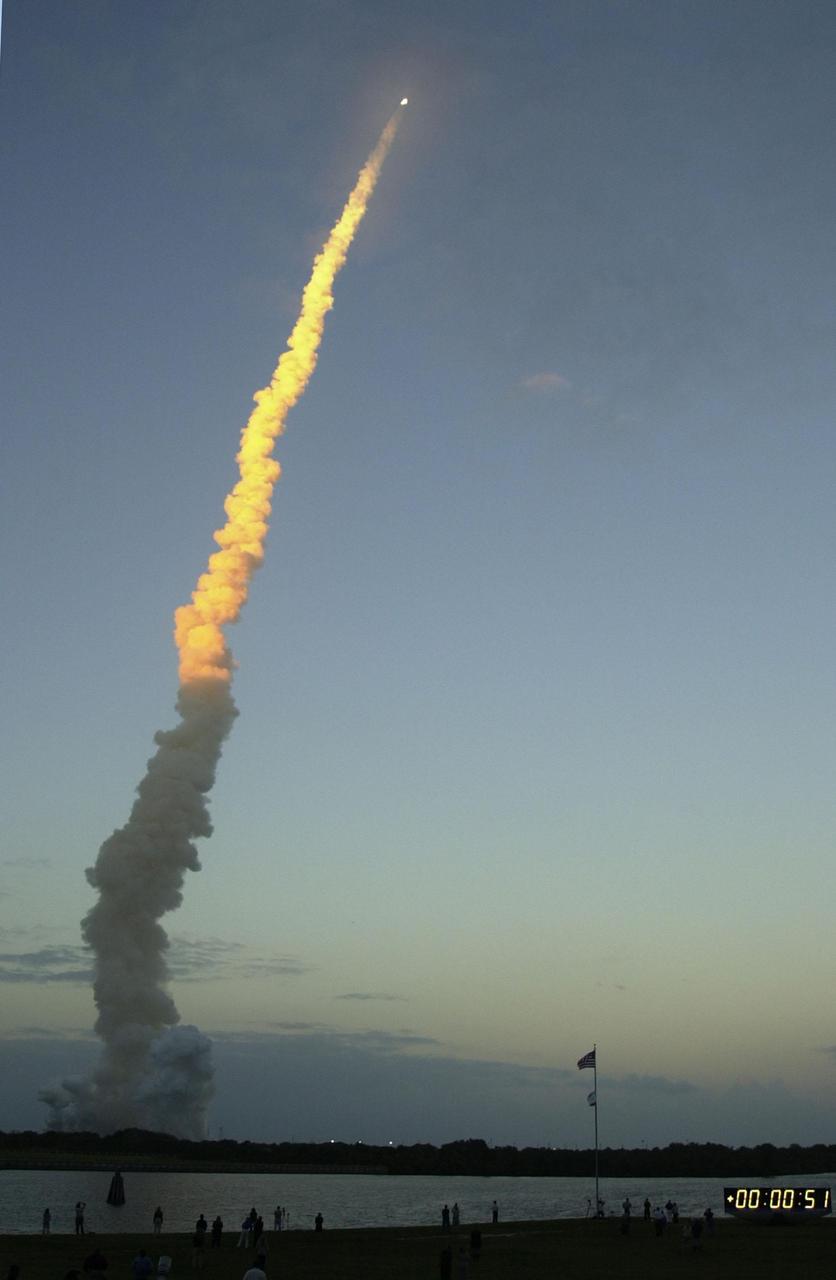
KENNEDY SPACE CENTER, Fla. -- Like a lighted taper, Space Shuttle Endeavour shines atop its twisted contrail as it soars into space on mission STS-108. Liftoff occurred at 5:19:28 p.m. EST (22:19 GMT). Endeavour will dock with the International Space Station on Dec. 7. STS-108 is the final Shuttle mission of 2001and the 107th Shuttle flight overall. It is the 12th flight to the Space Station. Landing of the orbiter at KSC's Shuttle Landing Facility is targeted for 1:05 p.m. EST (18:05 p.m. GMT) Dec. 16
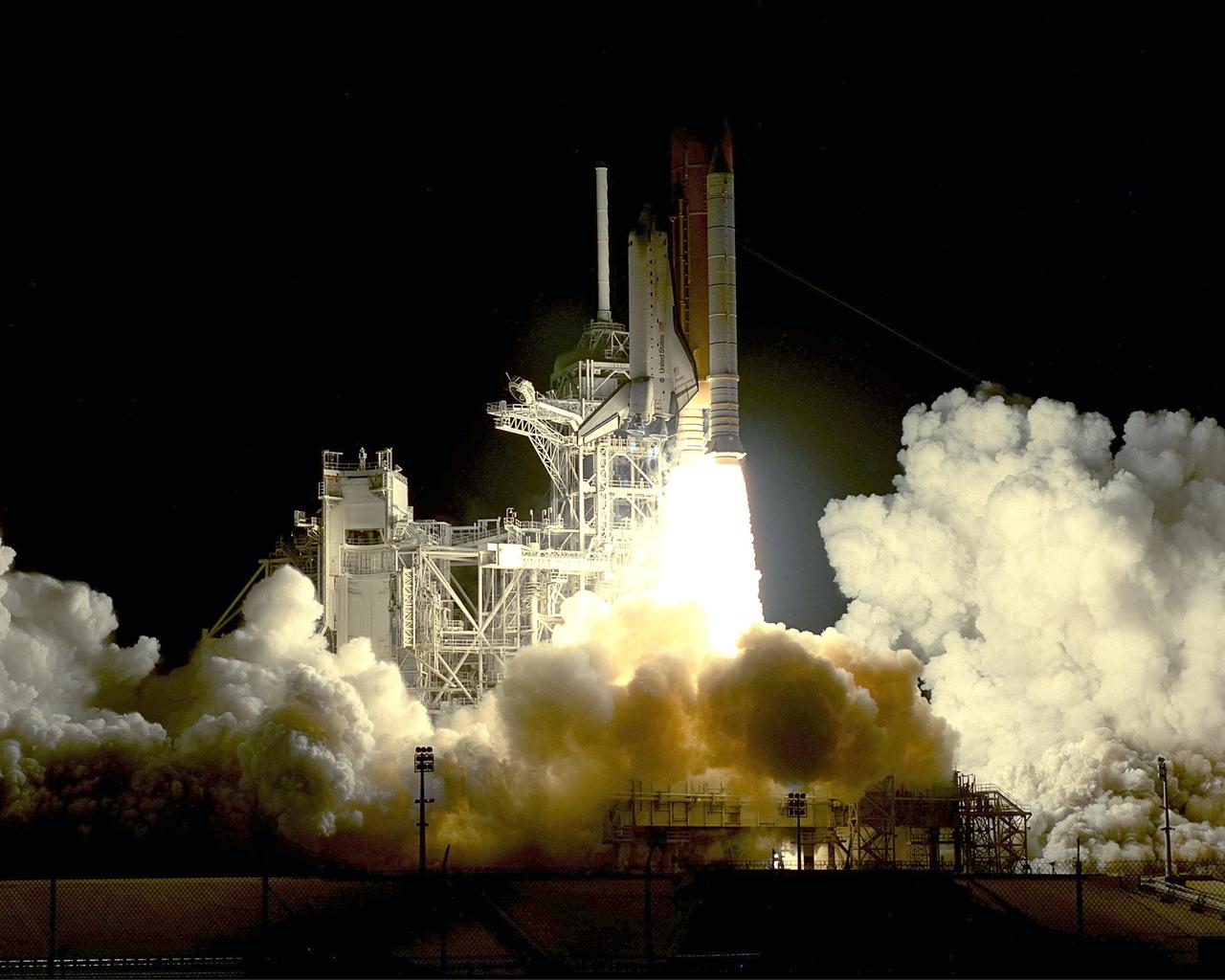
KENNEDY SPACE CENTER, Fla. -- Billows of smoke and steam spread across Launch Pad 39A as Space Shuttle Discovery lifts off on mission STS-92 to the International Space Station. The perfect on-time liftoff occurred at 7:17 p.m. EDT, sending a crew of seven on the 100th launch in the history of the Shuttle program. Discovery carries a payload that includes the Integrated Truss Structure Z-1, first of 10 trusses that will form the backbone of the Space Station, and the third Pressurized Mating Adapter that will provide a Shuttle docking port for solar array installation on the sixth Station flight and Lab installation on the seventh Station flight. Discovery’s landing is expected Oct. 22 at 2:10 p.m. EDT
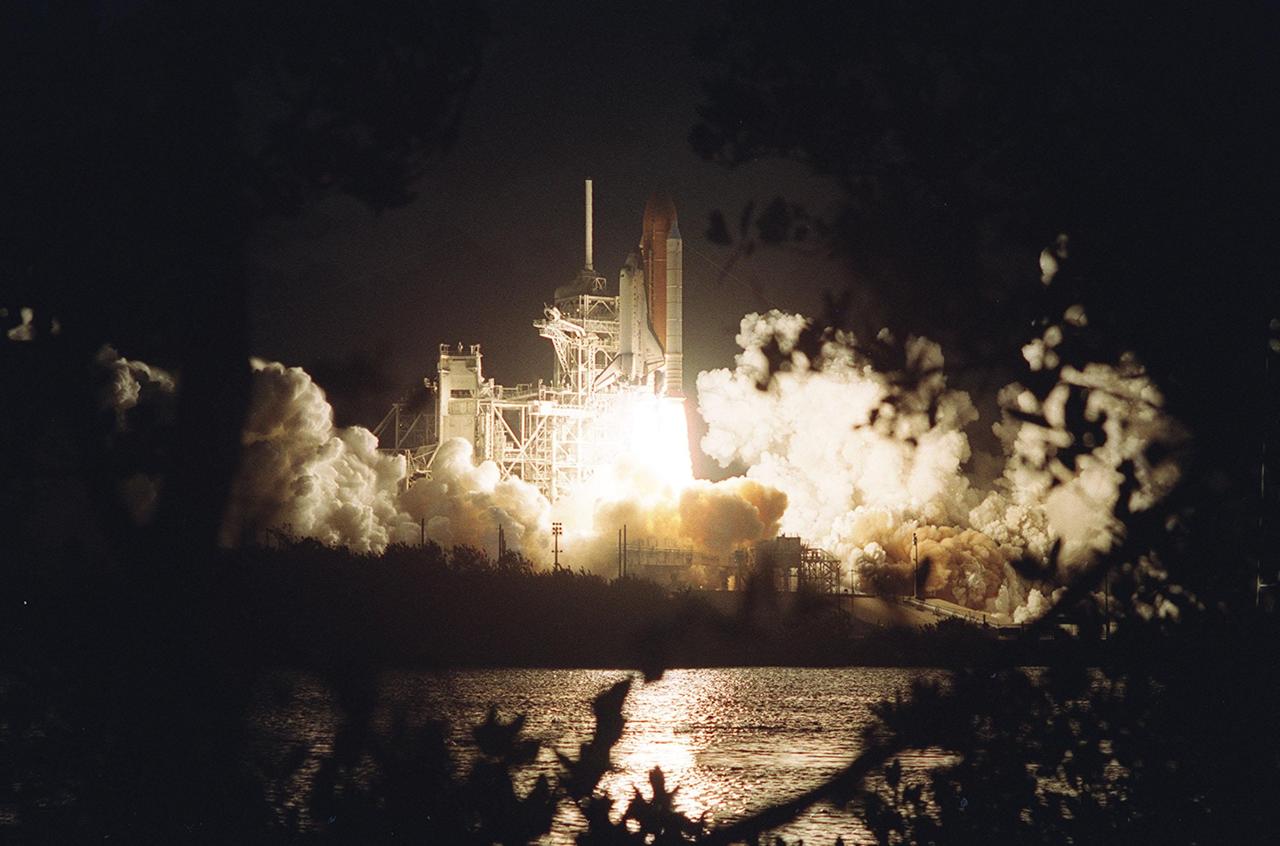
KENNEDY SPACE CENTER, Fla. -- Viewed from across the waters of Banana Creek, clouds of smoke and steam are illuminated by the flames from Space Shuttle Discovery’s perfect on-time launch at 7:17 p.m. EDT. Discovery carries a crew of seven on a construction flight to the International Space Station. Discovery also carries a payload that includes the Integrated Truss Structure Z-1, first of 10 trusses that will form the backbone of the Space Station, and the third Pressurized Mating Adapter that will provide a Shuttle docking port for solar array installation on the sixth Station flight and Lab installation on the seventh Station flight. Discovery’s landing is expected Oct. 22 at 2:10 p.m. EDT
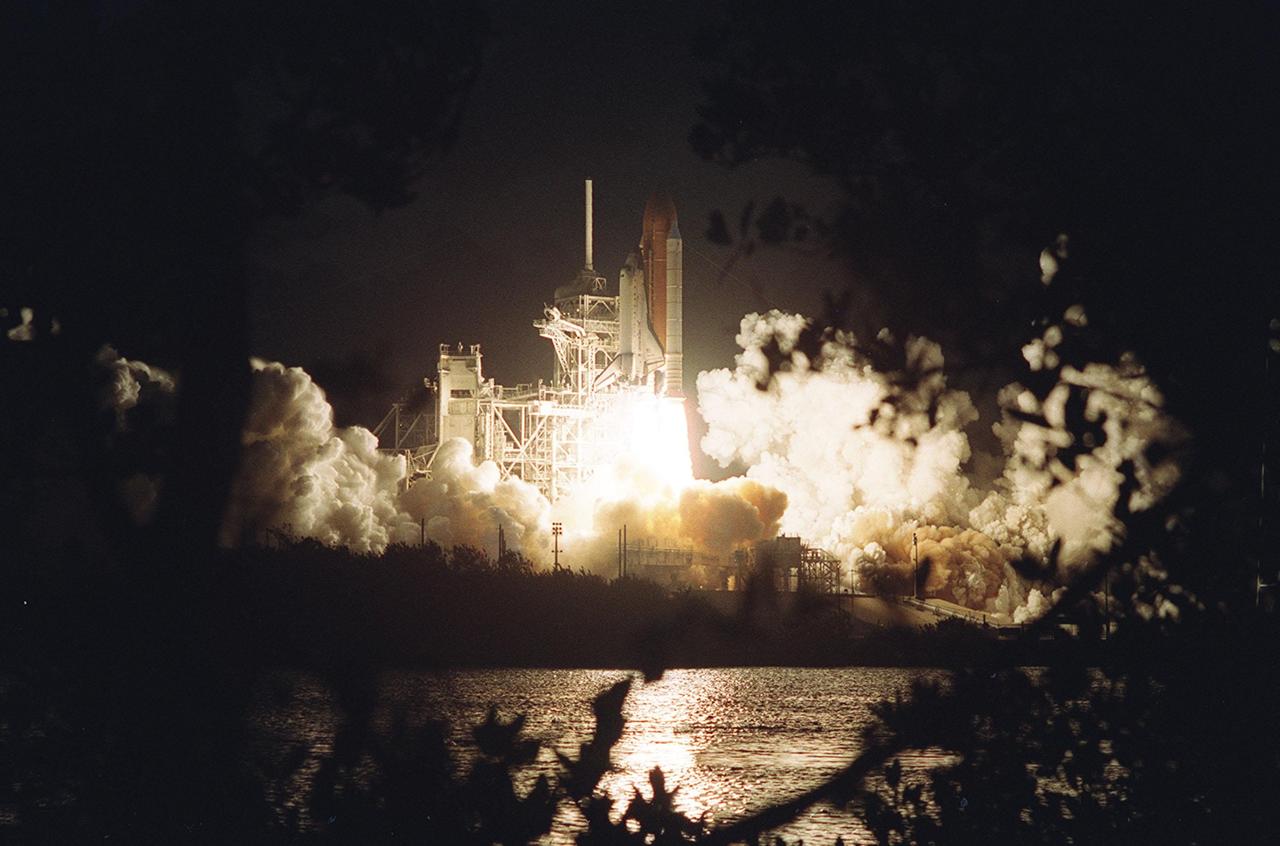
KENNEDY SPACE CENTER, Fla. -- Viewed from across the waters of Banana Creek, clouds of smoke and steam are illuminated by the flames from Space Shuttle Discovery’s perfect on-time launch at 7:17 p.m. EDT. Discovery carries a crew of seven on a construction flight to the International Space Station. Discovery also carries a payload that includes the Integrated Truss Structure Z-1, first of 10 trusses that will form the backbone of the Space Station, and the third Pressurized Mating Adapter that will provide a Shuttle docking port for solar array installation on the sixth Station flight and Lab installation on the seventh Station flight. Discovery’s landing is expected Oct. 22 at 2:10 p.m. EDT
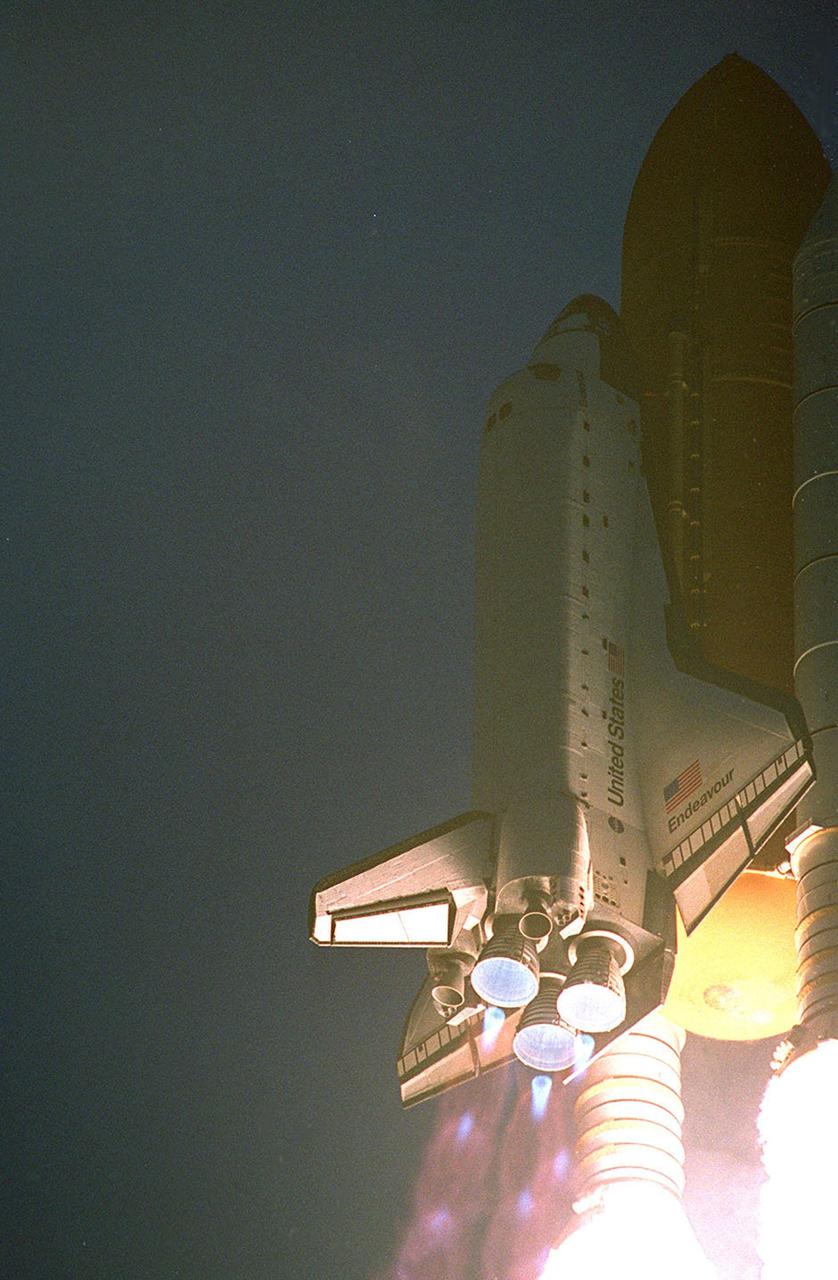
KENNEDY SPACE CENTER, Fla. -- Space Shuttle Endeavour soars into a twilight sky on mission STS-108, the second attempt over two days. Liftoff occurred at 5:19:28 p.m. EST (22:19 GMT). Endeavour will dock with the International Space Station on Dec. 7. STS-108 is the final Shuttle mission of 2001and the 107th Shuttle flight overall. It is the 12th flight to the Space Station. Landing of the orbiter at KSC's Shuttle Landing Facility is targeted for 1:05 p.m. EST (18:05 p.m. GMT) Dec. 16
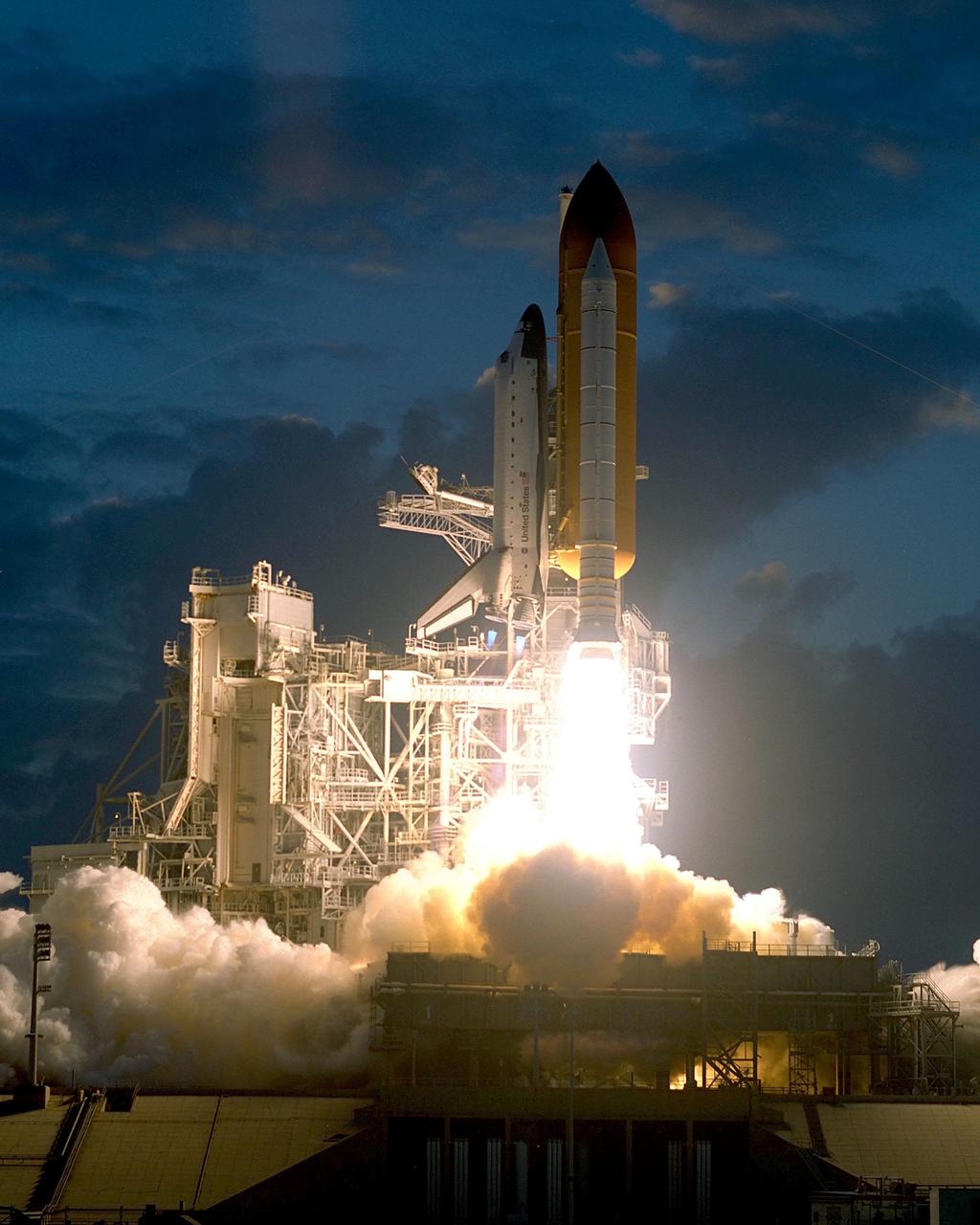
KENNEDY SPACE CENTER, Fla. -- Space Shuttle Endeavour soars into a twilight sky on mission STS-108, the second launch attempt over two days. Liftoff occurred at 5:19:28 p.m. EST (22:19.28 GMT). Endeavour will dock with the International Space Station on Dec. 7. STS-108 is the final Shuttle mission of 2001and the 107th Shuttle flight overall. It is the 12th flight to the Space Station. Landing of the orbiter at KSC's Shuttle Landing Facility is targeted for 1:05 p.m. EST (18:05 p.m. GMT) Dec. 16
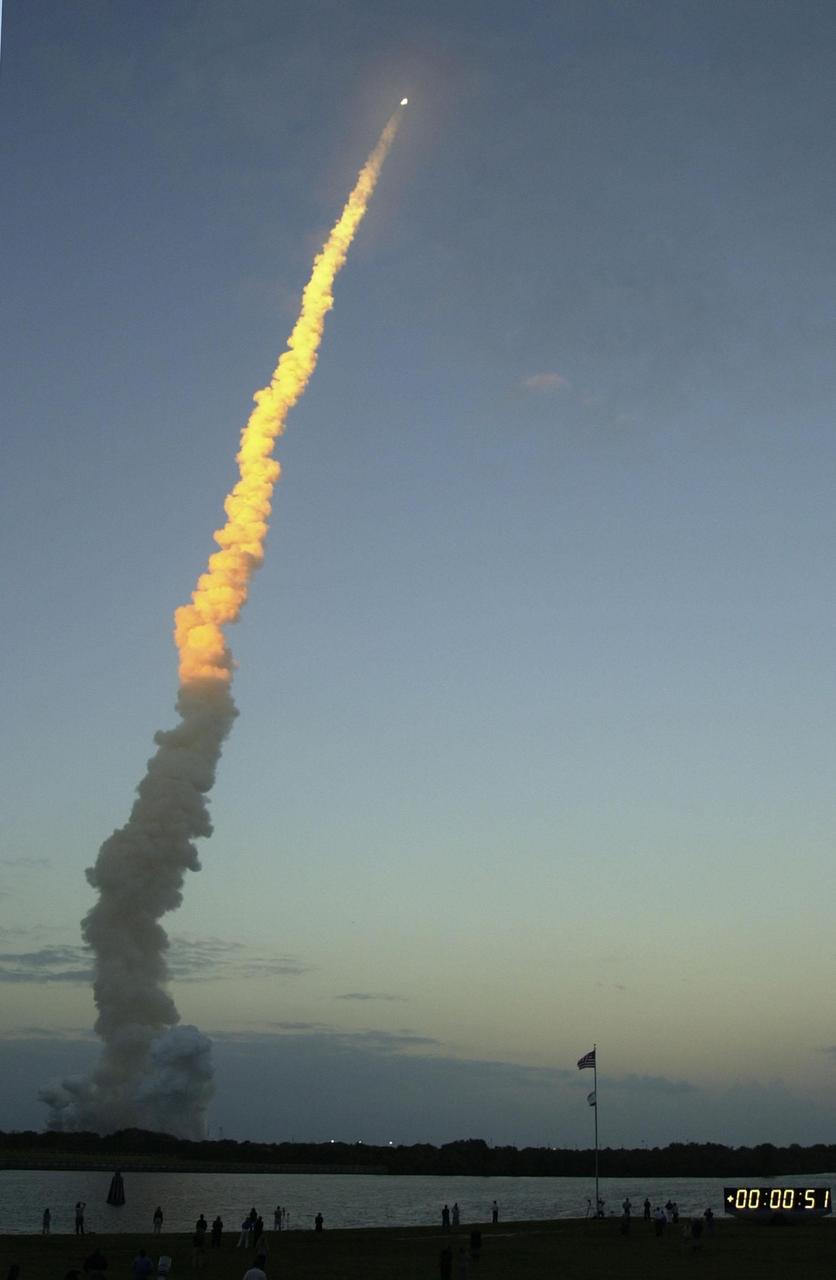
KENNEDY SPACE CENTER, Fla. -- Like a lighted taper, Space Shuttle Endeavour shines atop its twisted contrail as it soars into space on mission STS-108. Liftoff occurred at 5:19:28 p.m. EST (22:19 GMT). Endeavour will dock with the International Space Station on Dec. 7. STS-108 is the final Shuttle mission of 2001and the 107th Shuttle flight overall. It is the 12th flight to the Space Station. Landing of the orbiter at KSC's Shuttle Landing Facility is targeted for 1:05 p.m. EST (18:05 p.m. GMT) Dec. 16
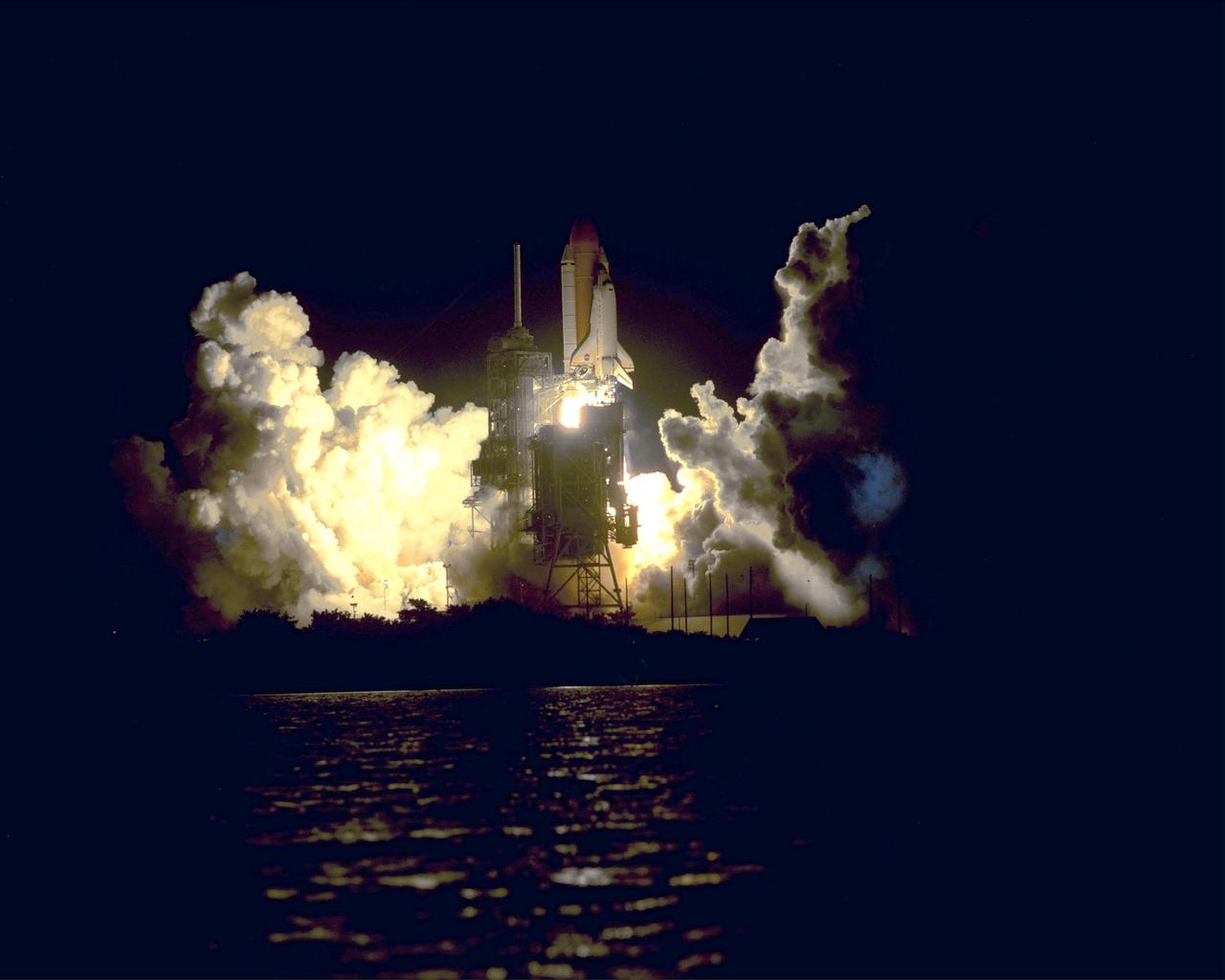
KENNEDY SPACE CENTER, Fla. -- Billows of smoke and steam surround Space Shuttle Discovery as it lifts off from Launch Pad 39A on mission STS-92 to the International Space Station. The perfect on-time liftoff occurred at 7:17 p.m. EDT, sending a crew of seven on the 100th launch in the history of the Shuttle program. Discovery carries a payload that includes the Integrated Truss Structure Z-1, first of 10 trusses that will form the backbone of the Space Station, and the third Pressurized Mating Adapter that will provide a Shuttle docking port for solar array installation on the sixth Station flight and Lab installation on the seventh Station flight. Discovery’s landing is expected Oct. 22 at 2:10 p.m. EDT
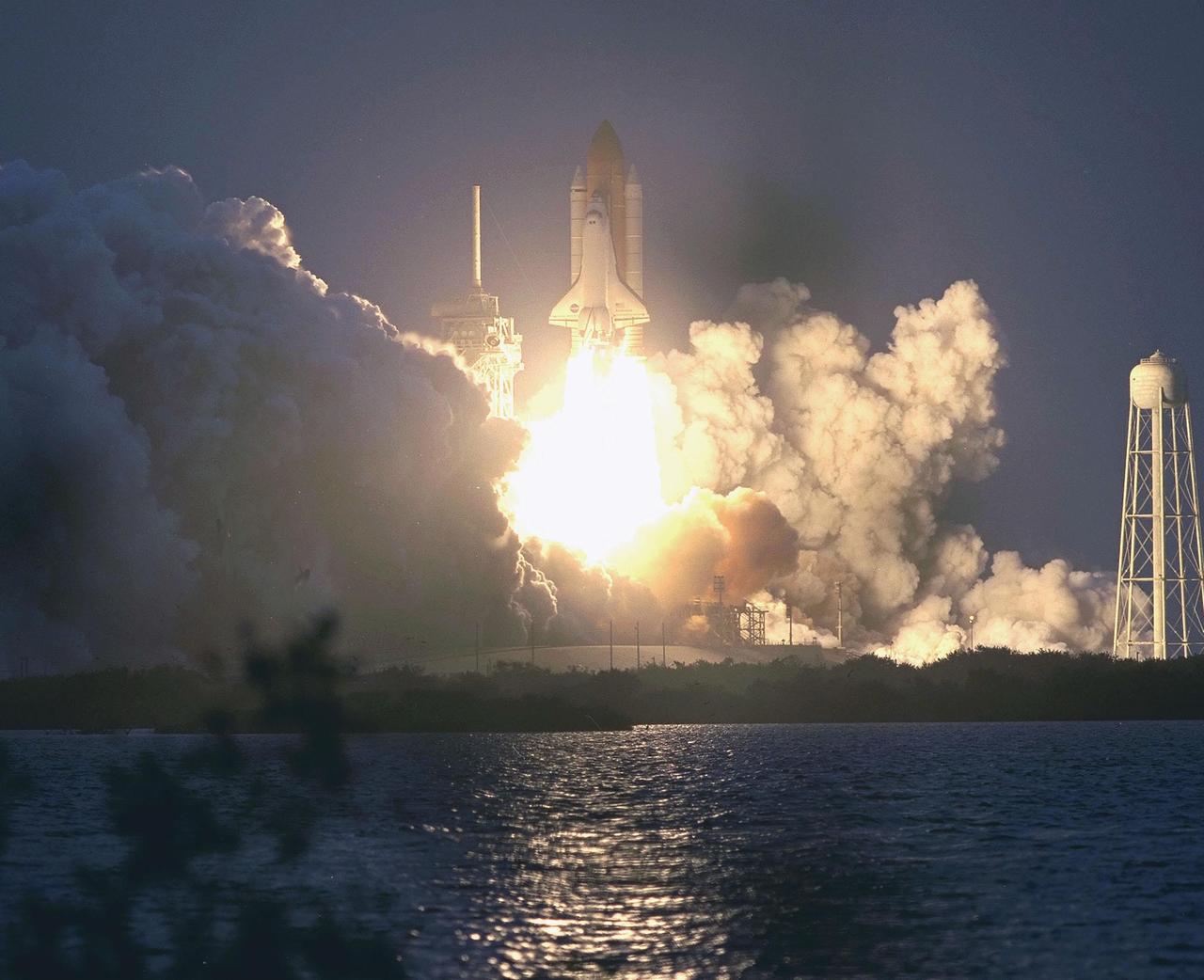
KENNEDY SPACE CENTER, Fla. -- Billows of smoke and steam roll away from Launch Pad 39B as Space Shuttle Endeavour hurtles into space on mission STS-108. The second attempt in two days, liftoff occurred at 5:19:28 p.m. EST (22:19.28 GMT). Endeavour will dock with the International Space Station on Dec. 7. STS-108 is the final Shuttle mission of 2001and the 107th Shuttle flight overall. It is the 12th flight to the Space Station. Landing of the orbiter at KSC's Shuttle Landing Facility is targeted for 1:05 p.m. EST (18:05 p.m. GMT) Dec. 16
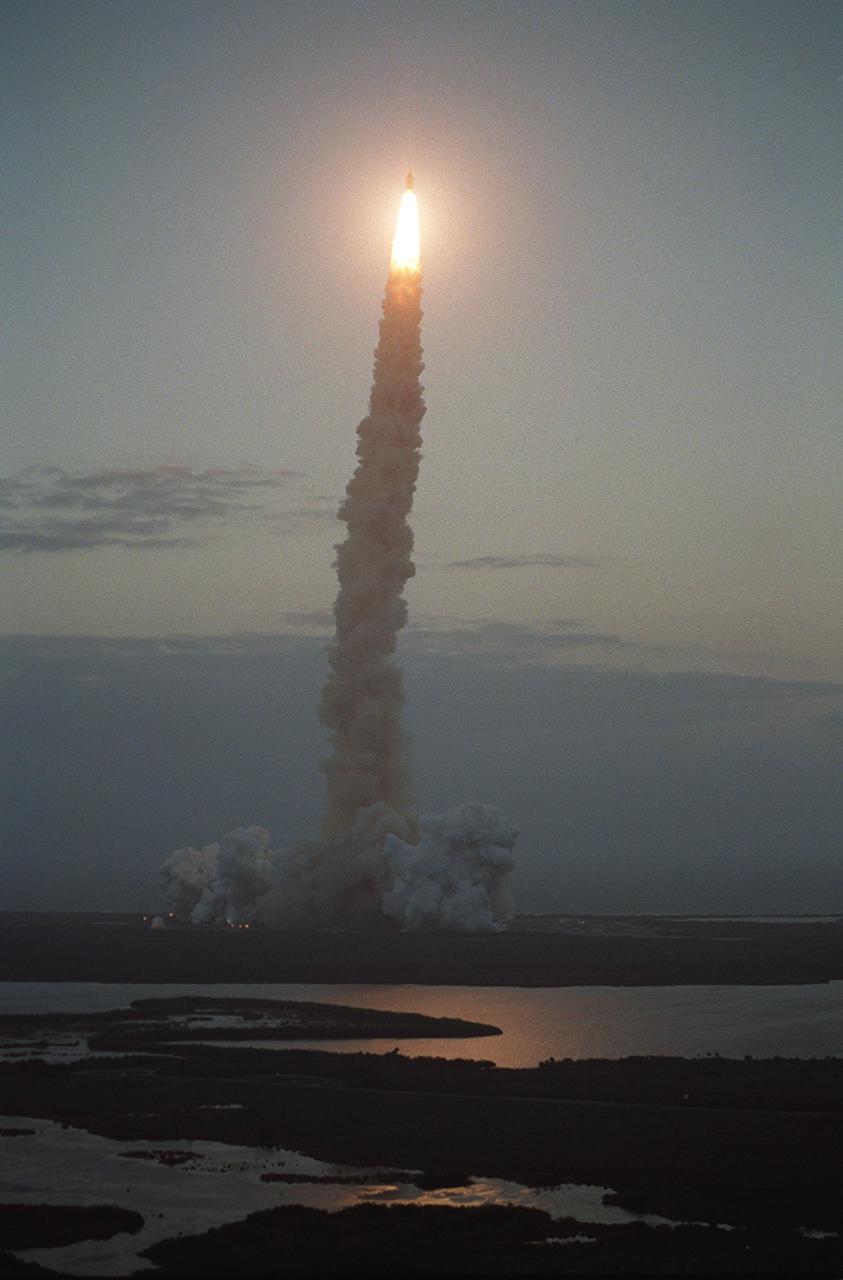
KENNEDY SPACE CENTER, FLA. -- Like a lighted candle, Space Shuttle Endeavour appears like a flame atop its twisted column of smoke as it soars into space on mission STS-108. Liftoff occurred at 5:19:28 p.m. EST (22:19.28 GMT). Endeavour will dock with the International Space Station on Dec. 7. STS-108 is the final Shuttle mission of 2001and the 107th Shuttle flight overall. It is the 12th flight to the Space Station. Landing of the orbiter at KSC's Shuttle Landing Facility is targeted for 1:05 p.m. EST (18:05 p.m. GMT) Dec. 16

jsc2025e064330 (7/22/2025) --- Perfusable vascular network printed via Auxilium's AMP-1 on the International Space Station for the Biomanufacturing in Space of Drug-Delivery Medical Devices (InSPA-Auxilium Bioprinter) investigation. InSPA-Auxilium Bioprinter 3D prints an implantable medical device that could be used to deliver drugs to support nerve regeneration. Devices printed in microgravity are of higher quality than those printed on Earth. In-space manufacturing could improve device performance, benefiting patients on Earth and crew members on long-duration space missions. Image courtesy of Auxilium Biotechnologies.
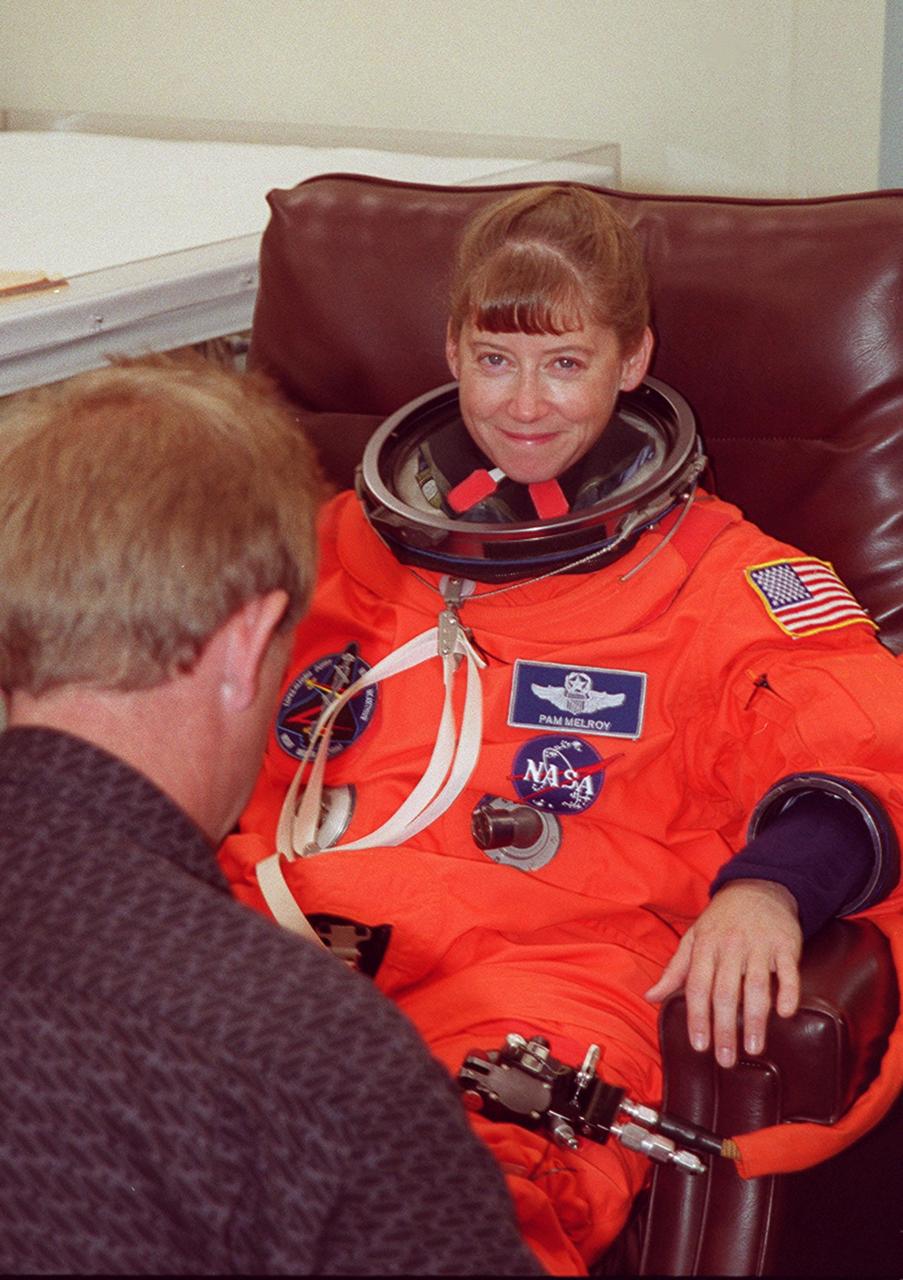
In the Operations and Checkout Building, STS-92 Pilot Pamela Ann Melroy smiles during suit check before heading out to the Astrovan for the ride to Launch Pad 39A. During the 11-day mission to the International Space Station, four extravehicular activities (EVAs), or spacewalks, are planned for construction. The payload includes the Integrated Truss Structure Z-1 and the third Pressurized Mating Adapter. The Z-1 truss is the first of 10 that will become the backbone of the Space Station, eventually stretching the length of a football field. PMA-3 will provide a Shuttle docking port for solar array installation on the sixth Station flight and Lab installation on the seventh Station flight. Launch is scheduled for 7:17 p.m. EDT. Landing is expected Oct. 22 at 2:10 p.m. EDT
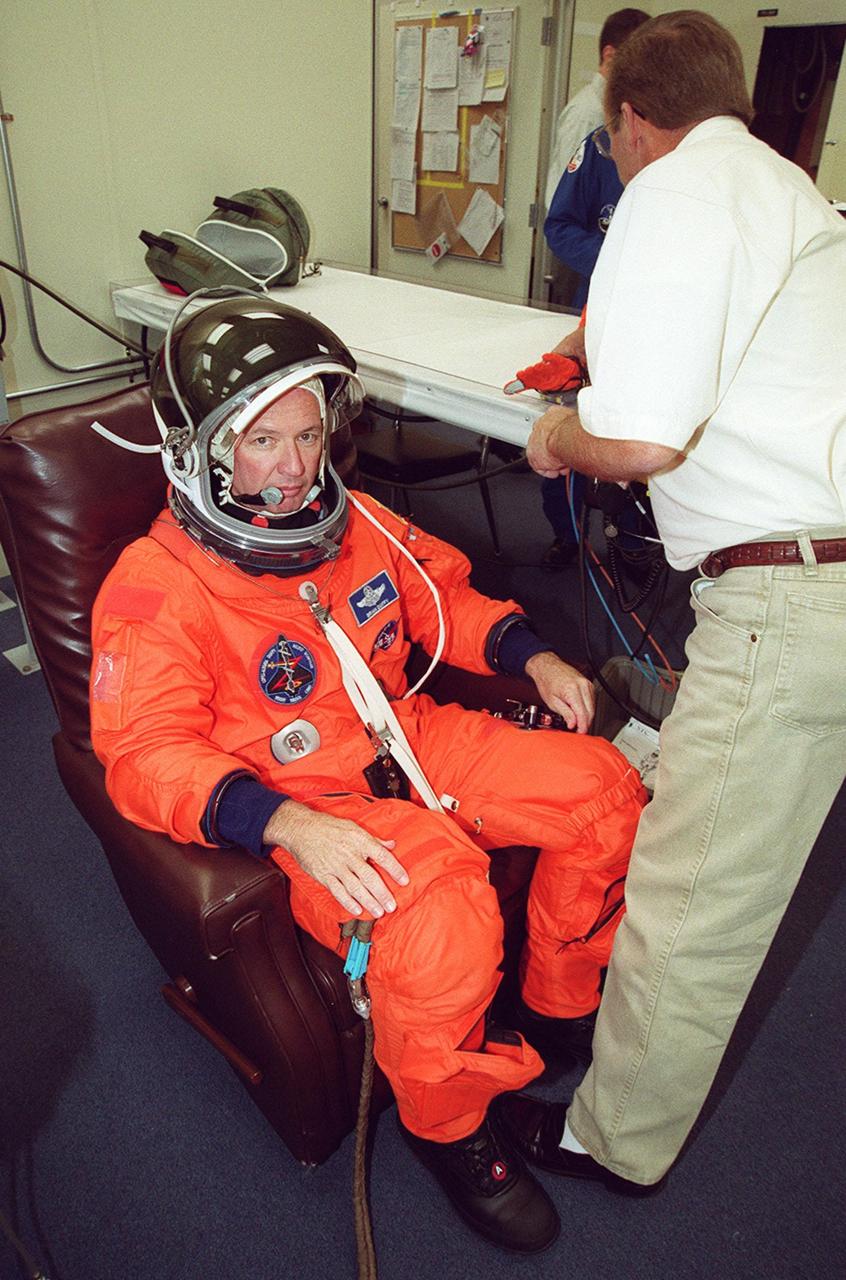
In the Operations and Checkout Building, STS-92 Commander Brian Duffy solemnly undergoes suit check before heading out to the Astrovan for the ride to Launch Pad 39A. During the 11-day mission to the International Space Station, four extravehicular activities (EVAs), or spacewalks, are planned for construction. The payload includes the Integrated Truss Structure Z-1 and the third Pressurized Mating Adapter. The Z-1 truss is the first of 10 that will become the backbone of the Space Station, eventually stretching the length of a football field. PMA-3 will provide a Shuttle docking port for solar array installation on the sixth Station flight and Lab installation on the seventh Station flight. Launch is scheduled for 7:17 p.m. EDT. Landing is expected Oct. 22 at 2:10 p.m. EDT
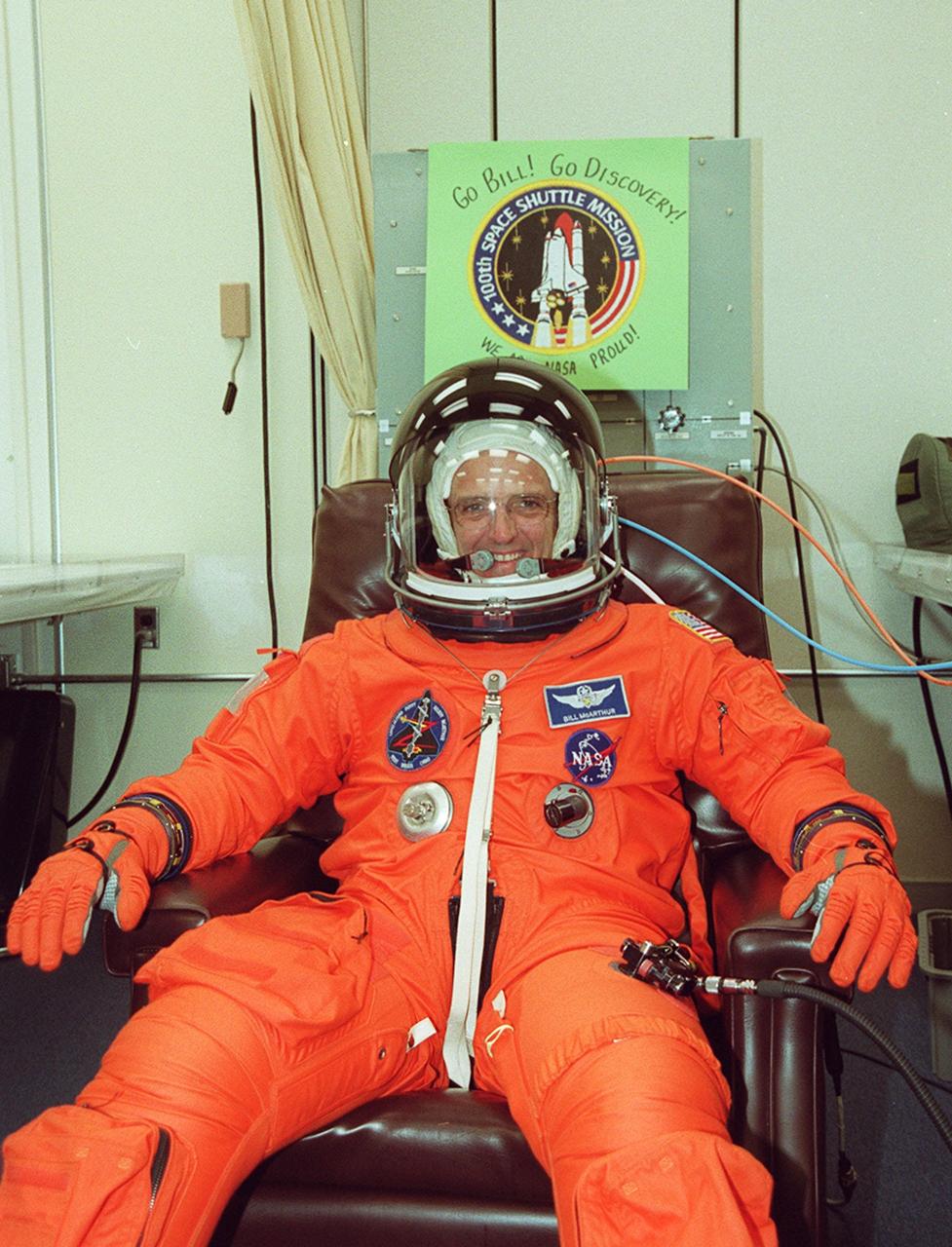
STS-92 Mission Specialist William S. McArthur Jr. is fully suited up before the second launch attempt. He and the rest of the crew will be leaving soon for the ride to Launch Pad 39A on the Astrovan. During the 11-day mission to the International Space Station, four extravehicular activities (EVAs), or spacewalks, are planned for construction. The payload includes the Integrated Truss Structure Z-1 and the third Pressurized Mating Adapter. The Z-1 truss is the first of 10 that will become the backbone of the Space Station, eventually stretching the length of a football field. PMA-3 will provide a Shuttle docking port for solar array installation on the sixth Station flight and Lab installation on the seventh Station flight.; Launch is scheduled for 7:17 p.m. EDT. Landing is expected Oct. 22 at 2:10 p.m. EDT
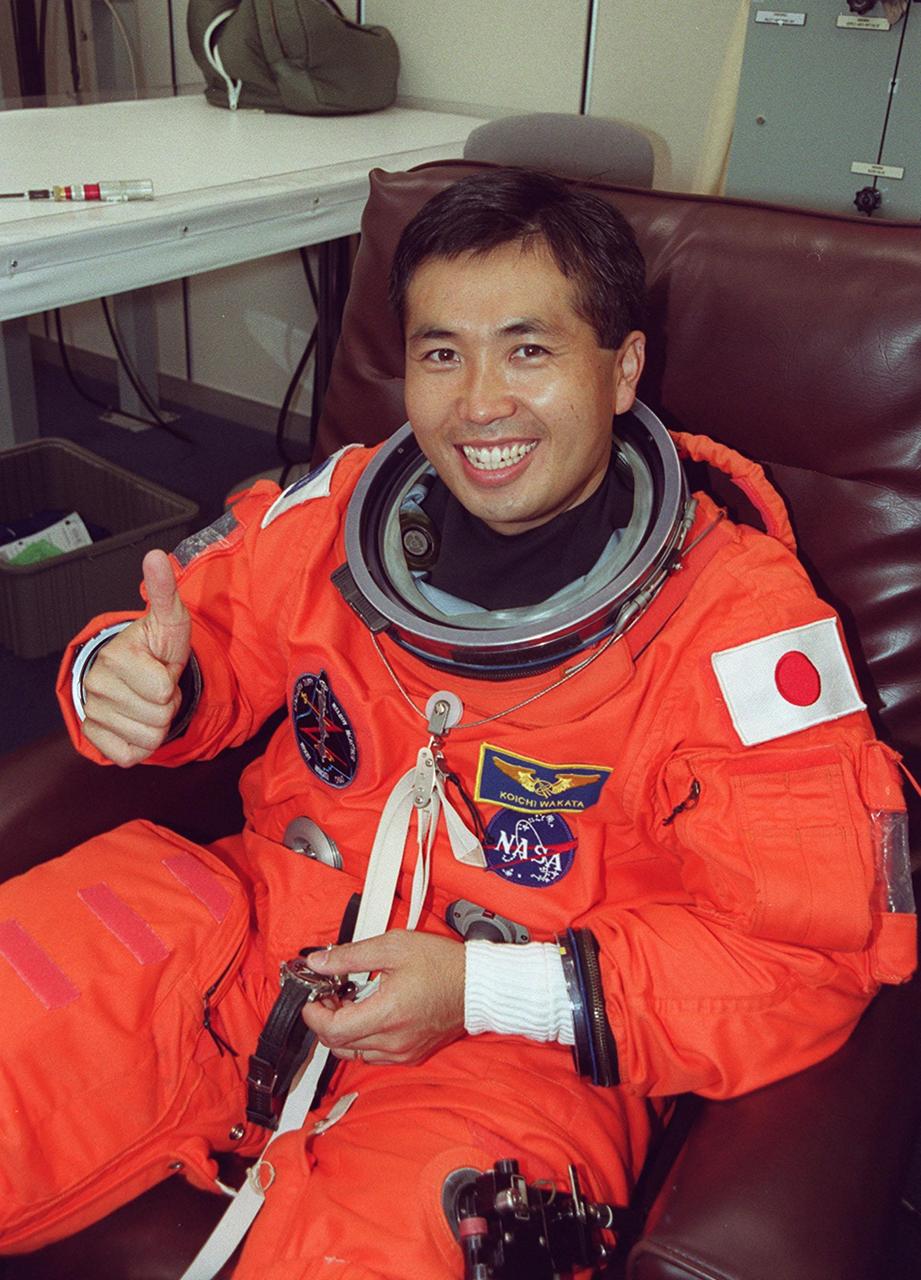
During suitup in the Operations and Checkout Building, STS-92 Mission Specialist Koichi Wakata of Japan signals thumbs up for a second launch attempt. During the 11-day mission to the International Space Station, four extravehicular activities (EVAs), or spacewalks, are planned for construction. The payload includes the Integrated Truss Structure Z-1 and the third Pressurized Mating Adapter. The Z-1 truss is the first of 10 that will become the backbone of the Space Station, eventually stretching the length of a football field. PMA-3 will provide a Shuttle docking port for solar array installation on the sixth Station flight and Lab installation on the seventh Station flight.; Launch is scheduled for 7:17 p.m. EDT. Landing is expected Oct. 22 at 2:10 p.m. EDT
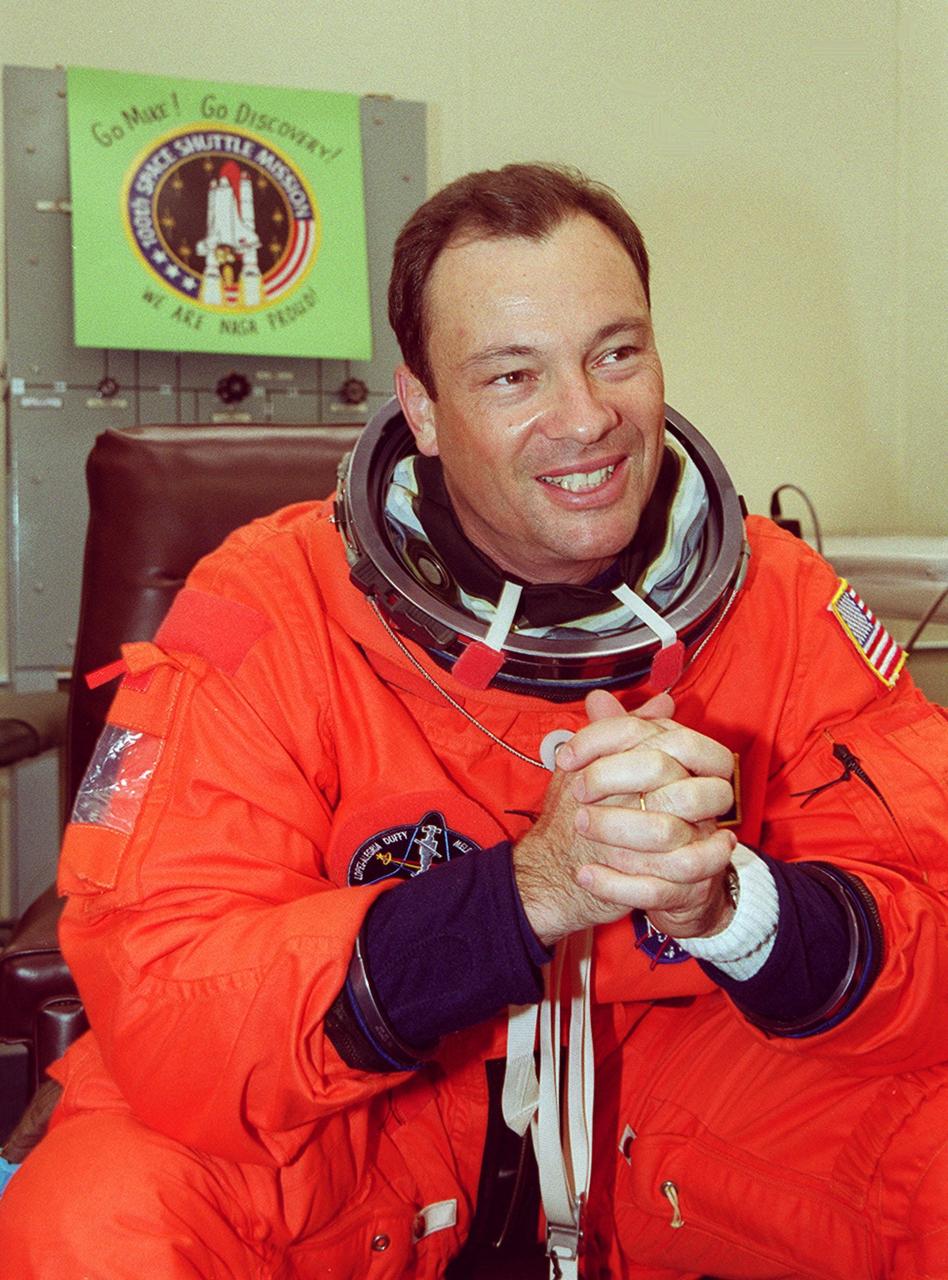
During suitup in the Operations and Checkout Building, STS-92 Mission Specialist Michael E. Lopez-Alegria smiles and clasps his hands in anticipation of a second launch attempt. He and the rest of the crew will be heading out to the Astrovan for the ride to Launch Pad 39A. During the 11-day mission to the International Space Station, four extravehicular activities (EVAs), or spacewalks, are planned for construction. The payload includes the Integrated Truss Structure Z-1 and the third Pressurized Mating Adapter. The Z-1 truss is the first of 10 that will become the backbone of the Space Station, eventually stretching the length of a football field. PMA-3 will provide a Shuttle docking port for solar array installation on the sixth Station flight and Lab installation on the seventh Station flight. Launch is scheduled for 7:17 p.m. EDT. Landing is expected Oct. 22 at 2:10 p.m. EDT
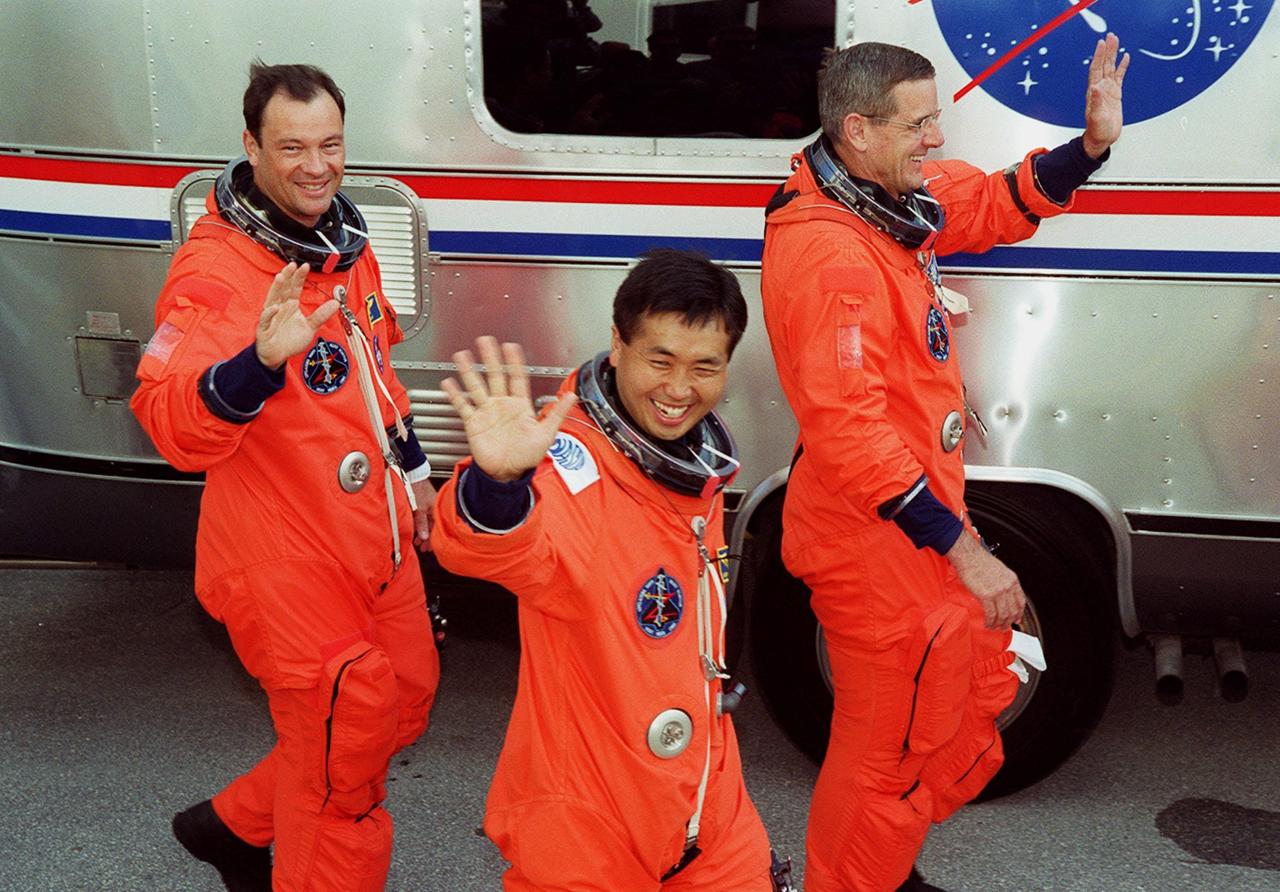
Three happy astronauts make their way to the waiting Astrovan that will take the STS-92 crew to Launch Pad 39A for liftoff of Space Shuttle Discovery. From left, they are Mission Specialists Michael Lopez-Alegria and Koichi Wakata, and Commander Brian Duffy. During the 11-day mission to the International Space Station, four extravehicular activities (EVAs), or spacewalks, are planned for construction. The payload includes the Integrated Truss Structure Z-1 and the third Pressurized Mating Adapter. The Z-1 truss is the first of 10 that will become the backbone of the Space Station, eventually stretching the length of a football field. PMA-3 will provide a Shuttle docking port for solar array installation on the sixth Station flight and Lab installation on the seventh Station flight. Launch is scheduled for 7:17 p.m. EDT. Discovery’s landing is expected Oct. 22 at 2:10 p.m. EDT

During suitup in the Operations and Checkout Building, STS-92 Mission Specialist Leroy Chiao gives thumbs up for launch. With him (left) is VITT Mission Lead Roland Nedelkovich, from Houston. During the 11-day mission to the International Space Station, four extravehicular activities (EVAs), or spacewalks, are planned for construction. The payload includes the Integrated Truss Structure Z-1 and the third Pressurized Mating Adapter. The Z-1 truss is the first of 10 that will become the backbone of the Space Station, eventually stretching the length of a football field. PMA-3 will provide a Shuttle docking port for solar array installation on the sixth Station flight and Lab installation on the seventh Station flight. Launch is scheduled for 7:17 p.m. EDT. Landing is expected Oct. 22 at 2:10 p.m. EDT
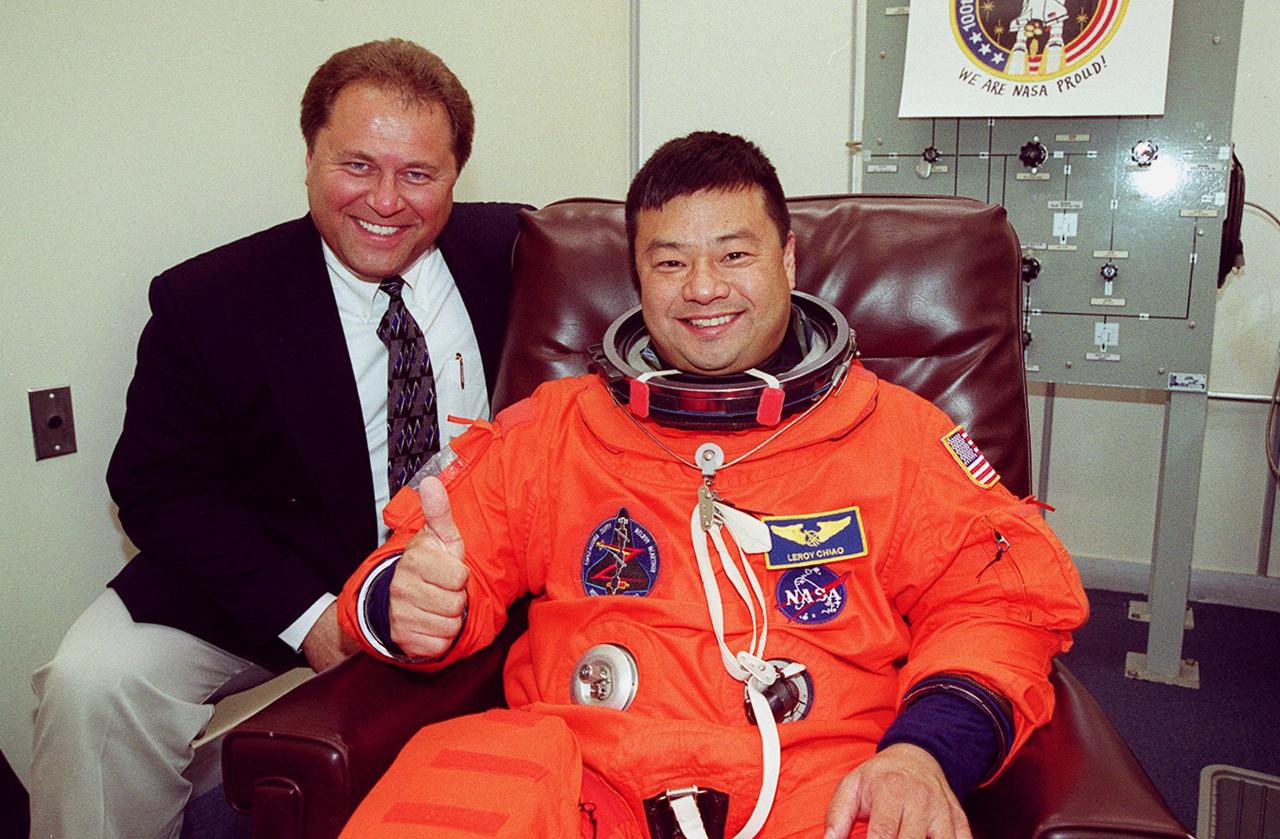
During suitup in the Operations and Checkout Building, STS-92 Mission Specialist Leroy Chiao gives thumbs up for launch. With him (left) is VITT Mission Lead Roland Nedelkovich, from Houston. During the 11-day mission to the International Space Station, four extravehicular activities (EVAs), or spacewalks, are planned for construction. The payload includes the Integrated Truss Structure Z-1 and the third Pressurized Mating Adapter. The Z-1 truss is the first of 10 that will become the backbone of the Space Station, eventually stretching the length of a football field. PMA-3 will provide a Shuttle docking port for solar array installation on the sixth Station flight and Lab installation on the seventh Station flight. Launch is scheduled for 7:17 p.m. EDT. Landing is expected Oct. 22 at 2:10 p.m. EDT
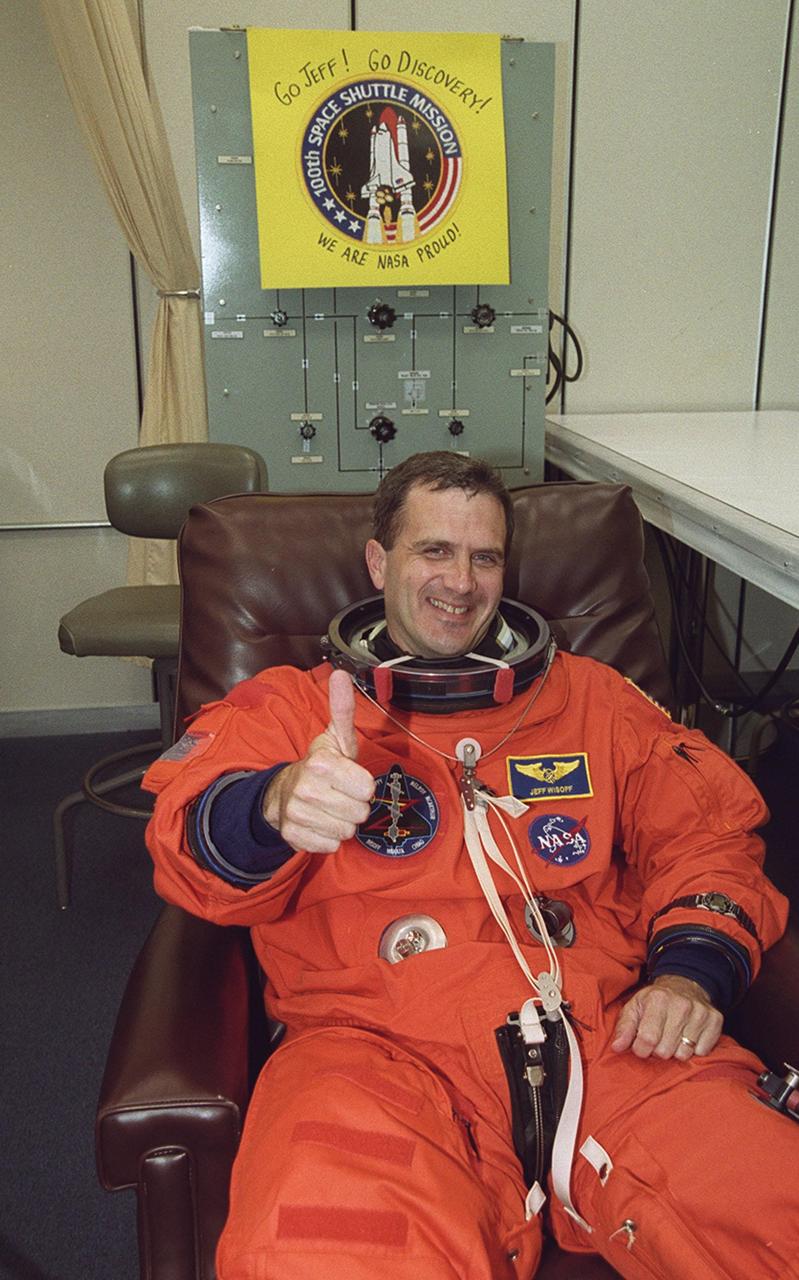
During suitup in the Operations and Checkout Building, STS-92 Mission Specialist Peter J.K. “Jeff” Wisoff signals thumbs up for a second launch attempt. During the 11-day mission to the International Space Station, four extravehicular activities (EVAs), or spacewalks, are planned for construction. The payload includes the Integrated Truss Structure Z-1 and the third Pressurized Mating Adapter. The Z-1 truss is the first of 10 that will become the backbone of the Space Station, eventually stretching the length of a football field. PMA-3 will provide a Shuttle docking port for solar array installation on the sixth Station flight and Lab installation on the seventh Station flight. Launch is scheduled for 7:17 p.m. EDT. Landing is expected Oct. 22 at 2:10 p.m. EDT
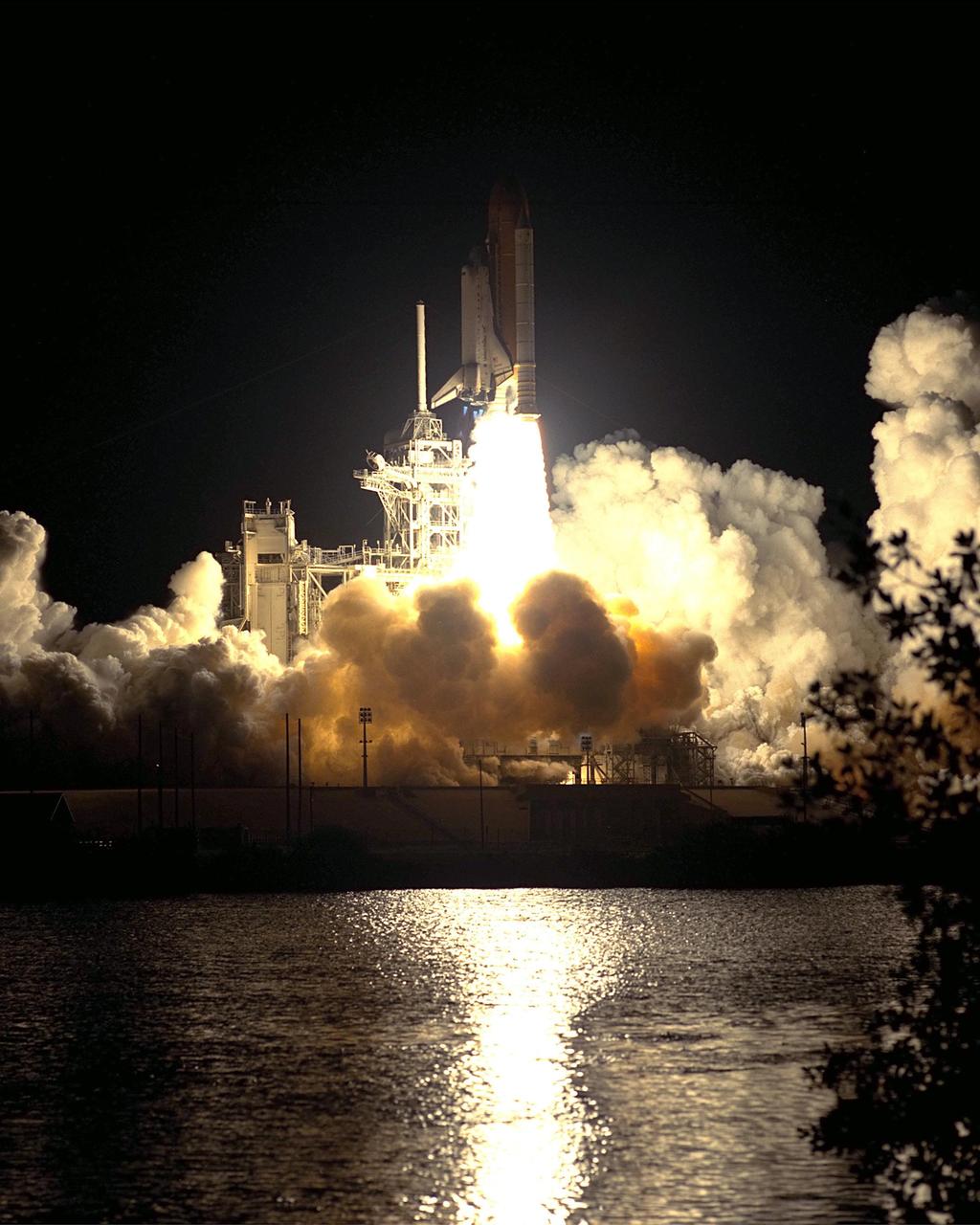
KENNEDY SPACE CENTER, Fla. -- Space Shuttle Discovery seems to burst forth from a pillow of smoke as it lifts off from Launch Pad 39A on mission STS-92 to the International Space Station. The brilliant light from the solid rocket booster flames is reflected in nearby water. The perfect on-time liftoff occurred at 7:17 p.m. EDT, sending a crew of seven on the 100th launch in the history of the Shuttle program. Discovery carries a payload that includes the Integrated Truss Structure Z-1, first of 10 trusses that will form the backbone of the Space Station, and the third Pressurized Mating Adapter that will provide a Shuttle docking port for solar array installation on the sixth Station flight and Lab installation on the seventh Station flight. Discovery’s landing is expected Oct. 22 at 2:10 p.m. EDT
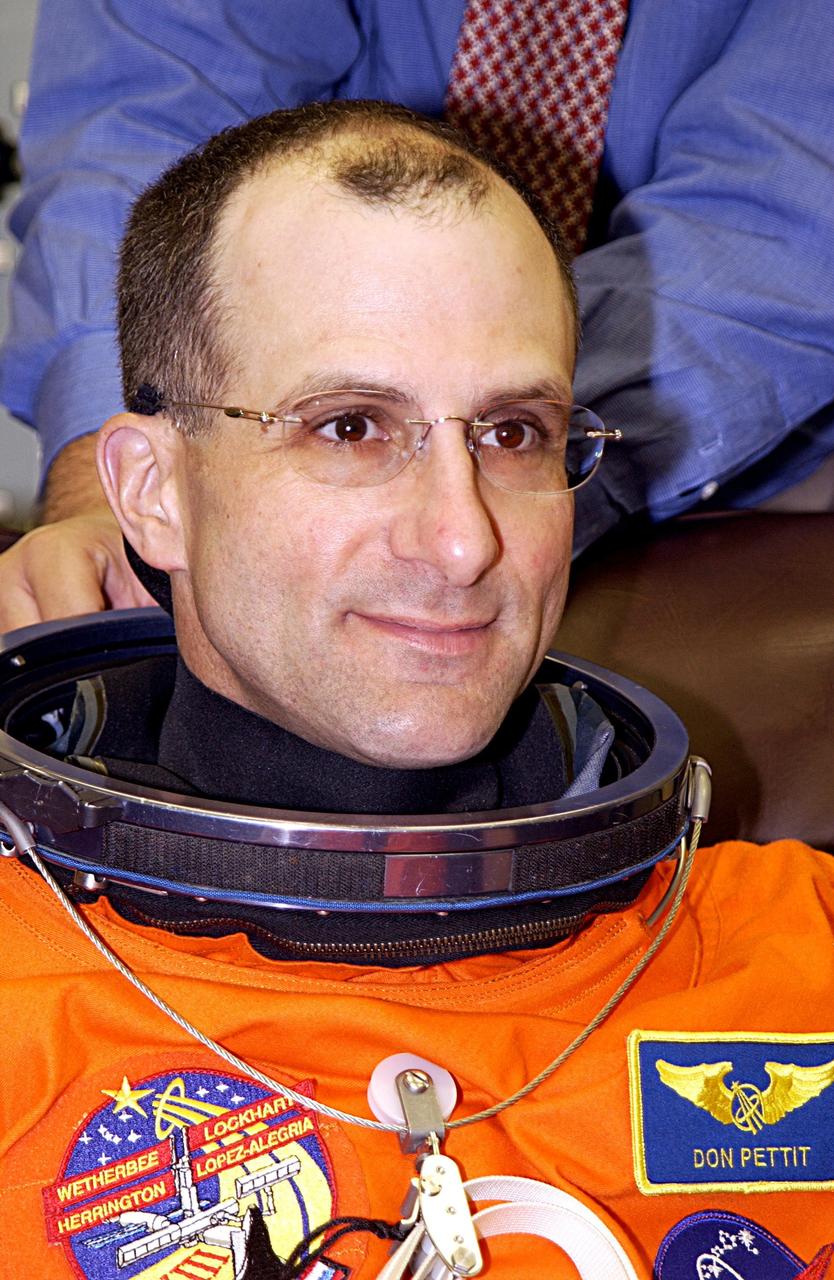
KENNEDY SPACE CENTER, FLA. -- Expedition 6 flight engineer Donald Pettit is eager for launch as he suits up for a second launch attempt on mission STS-113. The launch on Nov. 22 was scrubbed due to poor weather conditions at the Transoceanic Abort Landing sites. Pettit will be making his first Shuttle flight. The launch will carry the Expedition 6 crew to the Station and return the Expedition 5 crew to Earth. The major objective of the mission is delivery of the Port 1 (P1) Integrated Truss Assembly, which will be attached to the port side of the S0 truss. Three spacewalks are planned to install and activate the truss and its associated equipment. Launch of Space Shuttle Endeavour on mission STS-113 is now scheduled for Nov. 23 at 7:50 p.m. EST.
![KENNEDY SPACE CENTER, FLA. -- Space Shuttle Discovery rises above the lighting mast on the Fixed Service Structure as it hurtles into the night sky on mission STS-92. Discovery launched on time at 7:17 p.m. EDT. Discovery carries a crew of seven on a construction flight to the International Space Station. Discovery also carries a payload that includes the Integrated Truss Structure Z-1, first of 10 trusses that will form the backbone of the Space Station, and the third Pressurized Mating Adapter that will provide a Shuttle docking port for solar array installation on the sixth Station flight and Lab installation on the seventh Station flight. Discovery’s landing is expected Oct. 22 at 2:10 p.m. EDT.; <i>[Photo taken with Nikon D1 camera.]</i](https://images-assets.nasa.gov/image/KSC00padig042/KSC00padig042~medium.jpg)
KENNEDY SPACE CENTER, FLA. -- Space Shuttle Discovery rises above the lighting mast on the Fixed Service Structure as it hurtles into the night sky on mission STS-92. Discovery launched on time at 7:17 p.m. EDT. Discovery carries a crew of seven on a construction flight to the International Space Station. Discovery also carries a payload that includes the Integrated Truss Structure Z-1, first of 10 trusses that will form the backbone of the Space Station, and the third Pressurized Mating Adapter that will provide a Shuttle docking port for solar array installation on the sixth Station flight and Lab installation on the seventh Station flight. Discovery’s landing is expected Oct. 22 at 2:10 p.m. EDT.; <i>[Photo taken with Nikon D1 camera.]</i
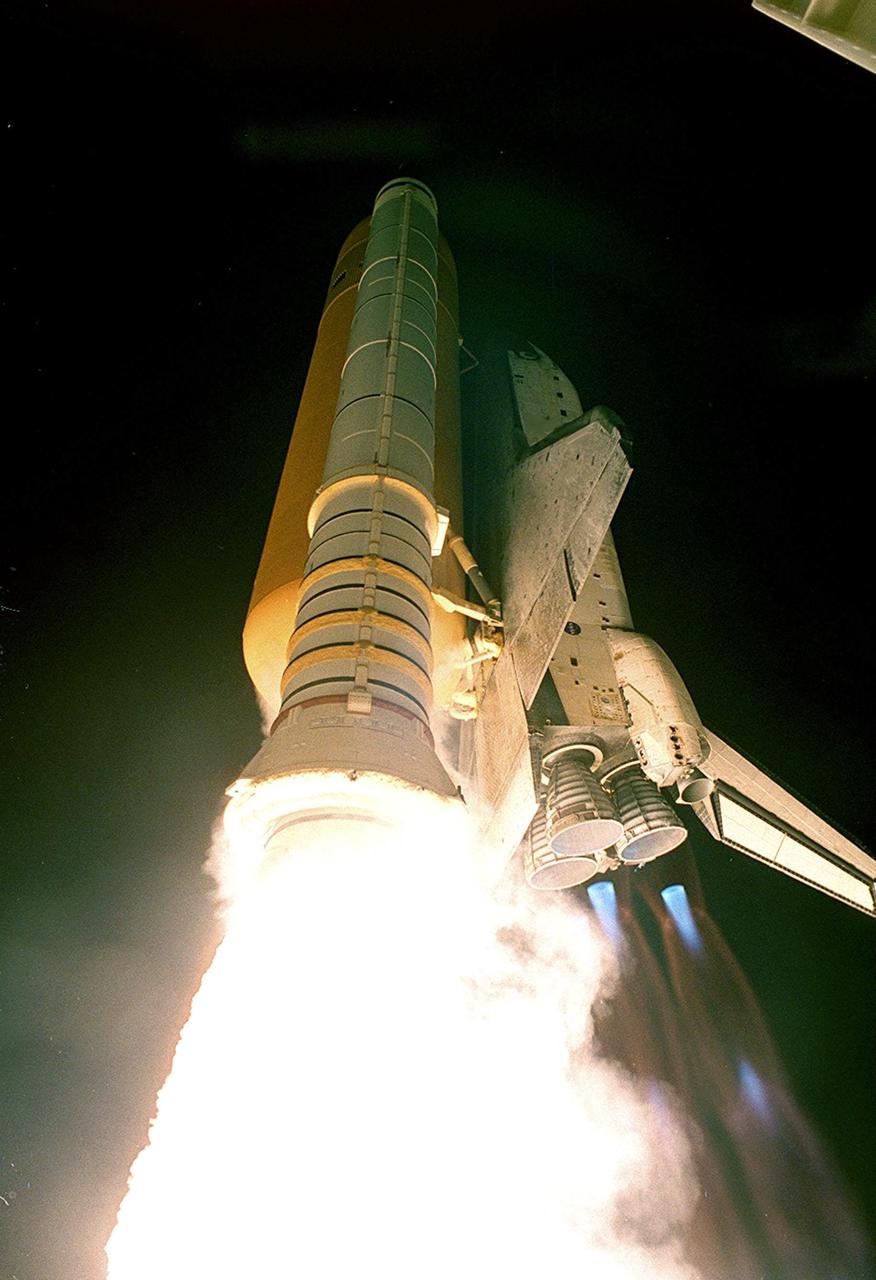
KENNEDY SPACE CENTER, Fla. -- Space Shuttle Discovery roars through the sky trailing fire and blue mach diamonds from the engines. The perfect on-time liftoff at 7:17 p.m. EDT sends a crew of seven on a construction flight to the International Space Station on mission STS-92, the 100th in the history of the Shuttle program. Discovery also carries a payload that includes the Integrated Truss Structure Z-1, first of 10 trusses that will form the backbone of the Space Station, and the third Pressurized Mating Adapter that will provide a Shuttle docking port for solar array installation on the sixth Station flight and Lab installation on the seventh Station flight. Discovery’s landing is expected Oct. 22 at 2:10 p.m. EDT
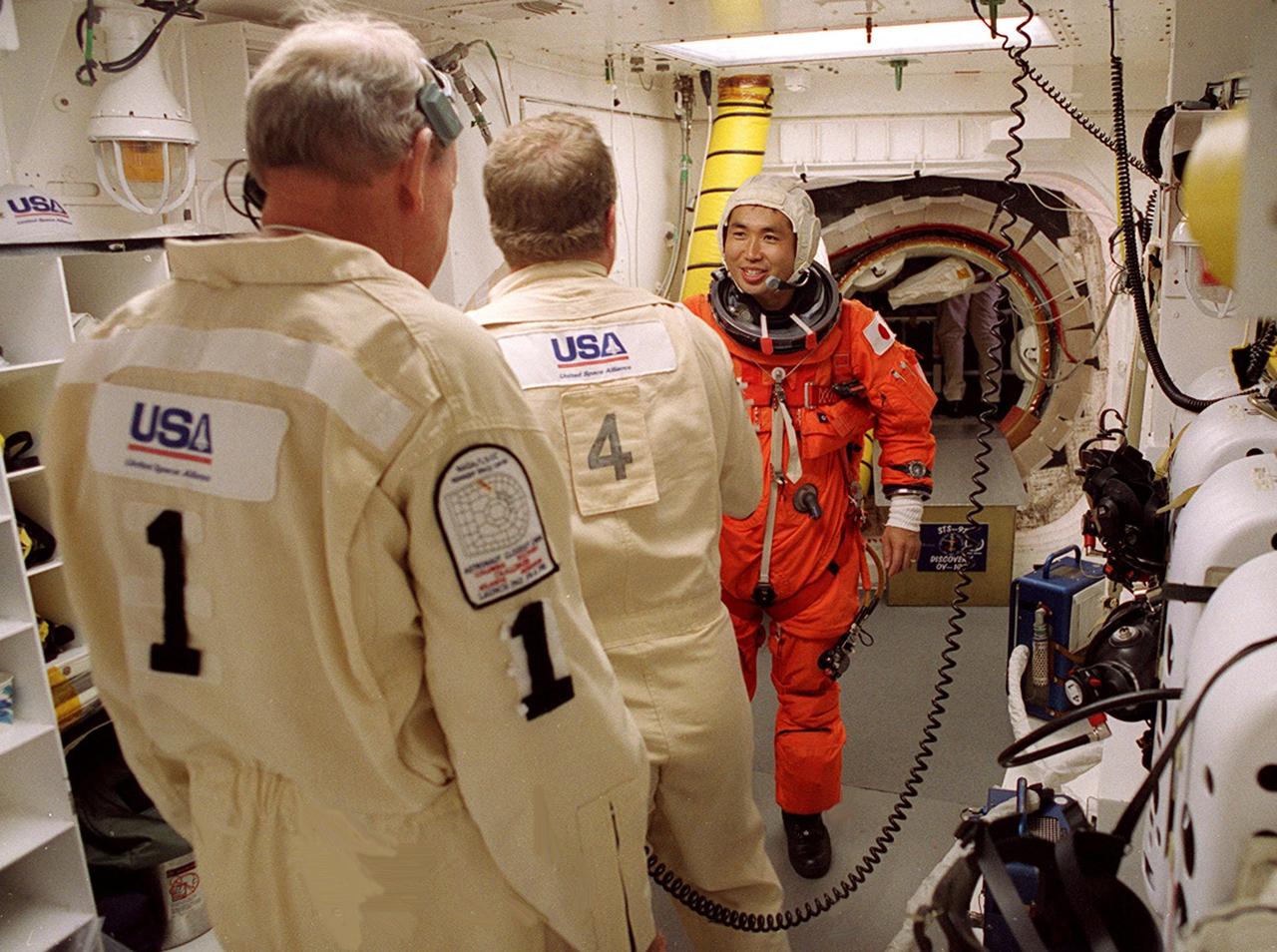
STS-92 Mission Specialist Koichi Wakata of Japan gets a final check of his launch and entry suit in the White Room before entering Discovery. The White Room is an environmentally controlled area at the end of the Orbiter Access Arm that provides entry to the orbiter as well as emergency egress if needed. The arm remains in the extended position until 7 minutes 24 seconds before launch. Wakata and the rest of the crew are making the fifth flight to the International Space Station for construction. Discovery carries a payload that includes the Integrated Truss Structure Z-1, first of 10 trusses that will form the backbone of the Space Station, and the third Pressurized Mating Adapter that will provide a Shuttle docking port for solar array installation on the sixth Station flight and Lab installation on the seventh Station flight. The mission includes four spacewalks for the construction activities. Discovery’s landing is expected Oct. 22 at 2:10 p.m. EDT
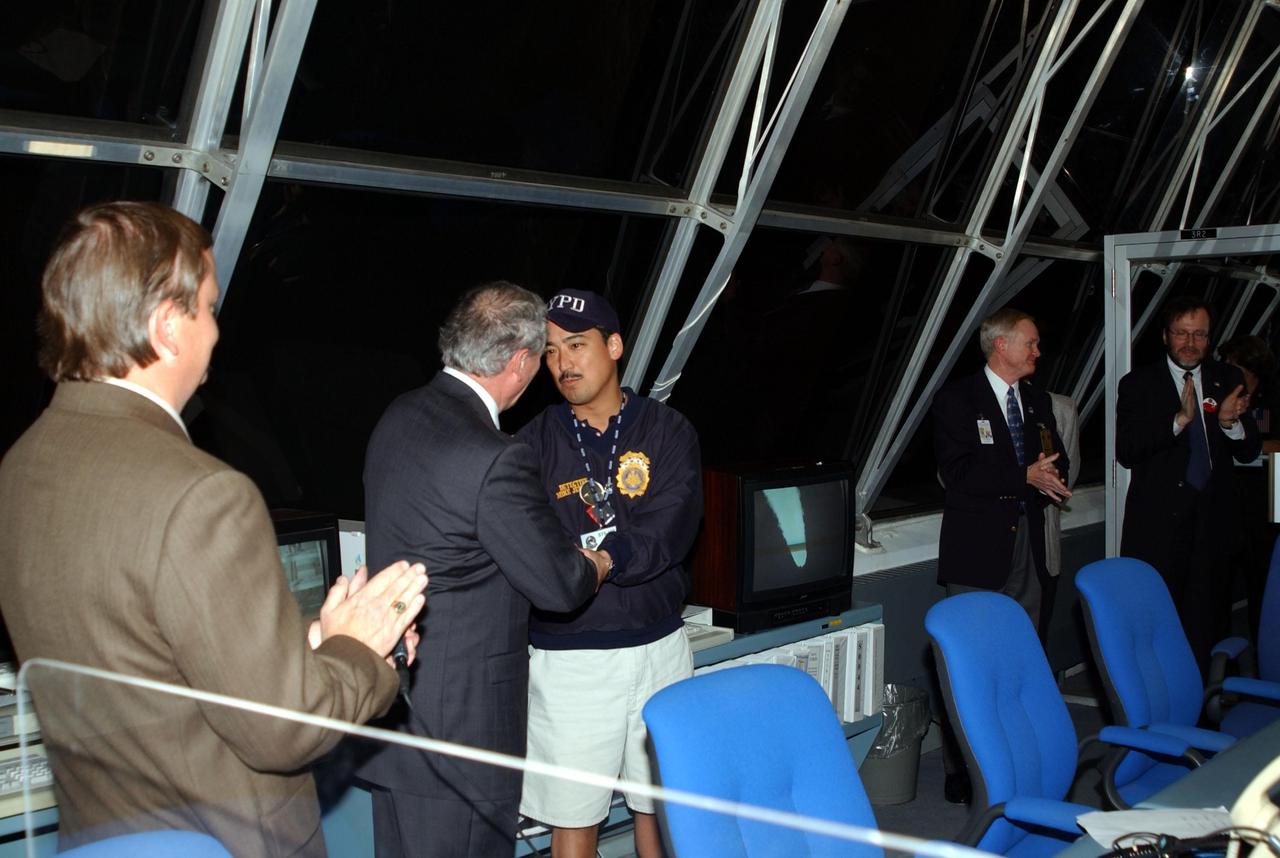
KENNEDY SPACE CENTER, Fla. -- New York Police Department Detective Michael Jermyn (center) is thanked for representing the New York Police and Fire Departments at the launch of Space Shuttle Endeavour on mission STS-108. Offering his handshake is NASA's Acting Administrator Daniel Mulville; Launch Director Mike Leinbach (left) applauds. At right is Center Director Roy Bridges Jr. Jermyn praised the efforts of the workers on the successful launch. Endeavour is carrying 6,000 flags that will be given to the families of those who died in the fall of the Twin Towers. Liftoff of Endeavour occurred at 5:19:28 p.m. EST (22:19.28 GMT). Endeavour will dock with the International Space Station on Dec. 7. STS-108 is the final Shuttle mission of 2001and the 107th Shuttle flight overall. It is the 12th flight to the Space Station. Landing of the orbiter at KSC's Shuttle Landing Facility is targeted for 1:05 p.m. EST (18:05 p.m. GMT) Dec. 16
![KENNEDY SPACE CENTER, FLA. -- Space Shuttle Discovery hurtles into the night sky, trailing a tail of fire from the solid rocket boosters, after a perfect on-time launch at 7:17 p.m. EDT. The launch of mission STS-92 carries a crew of seven on a construction flight to the International Space Station. Discovery also carries a payload that includes the Integrated Truss Structure Z-1, first of 10 trusses that will form the backbone of the Space Station, and the third Pressurized Mating Adapter that will provide a Shuttle docking port for solar array installation on the sixth Station flight and Lab installation on the seventh Station flight. Discovery’s landing is expected Oct. 22 at 2:10 p.m. EDT.; <i>[Photo taken with Nikon D1 camera.]</i](https://images-assets.nasa.gov/image/KSC00padig041/KSC00padig041~medium.jpg)
KENNEDY SPACE CENTER, FLA. -- Space Shuttle Discovery hurtles into the night sky, trailing a tail of fire from the solid rocket boosters, after a perfect on-time launch at 7:17 p.m. EDT. The launch of mission STS-92 carries a crew of seven on a construction flight to the International Space Station. Discovery also carries a payload that includes the Integrated Truss Structure Z-1, first of 10 trusses that will form the backbone of the Space Station, and the third Pressurized Mating Adapter that will provide a Shuttle docking port for solar array installation on the sixth Station flight and Lab installation on the seventh Station flight. Discovery’s landing is expected Oct. 22 at 2:10 p.m. EDT.; <i>[Photo taken with Nikon D1 camera.]</i
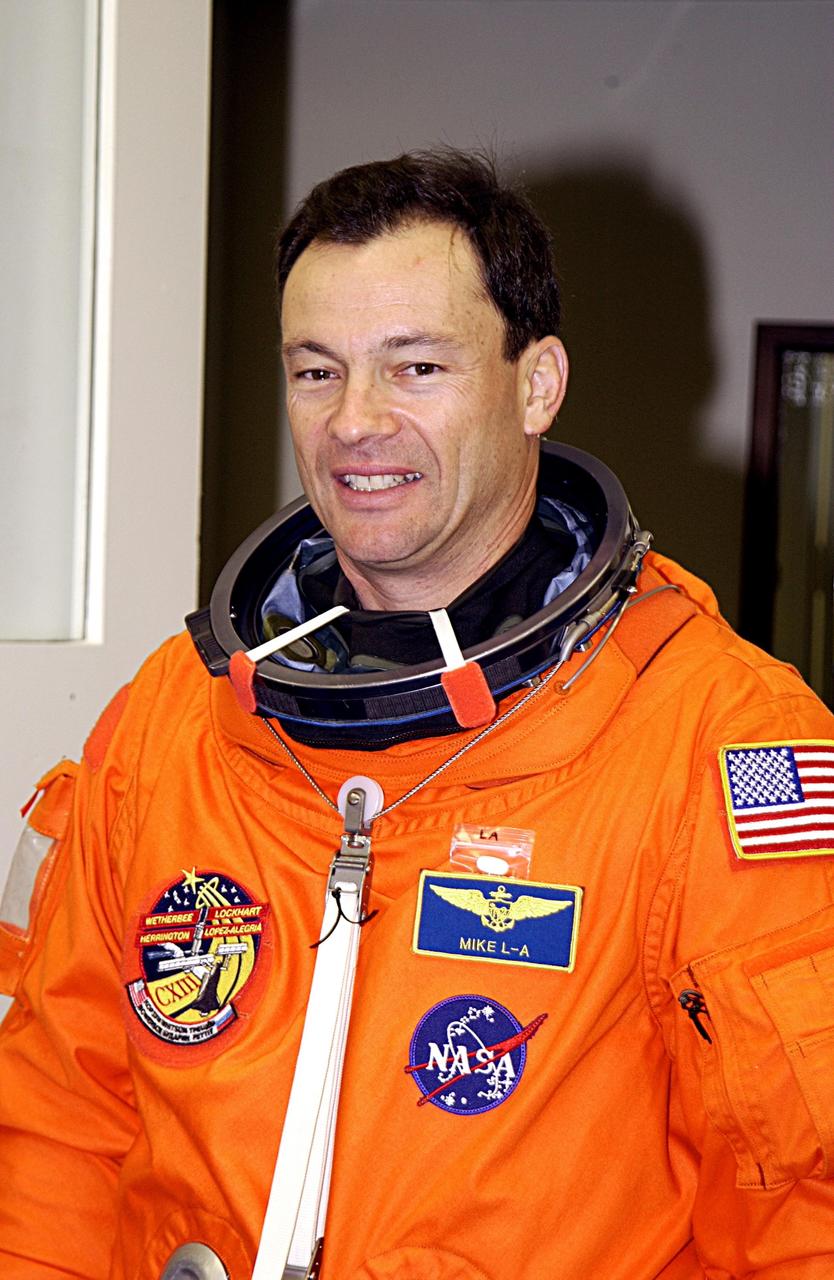
KENNEDY SPACE CENTER, FLA. - STS-113 Mission Specialist Michael Lopez-Alegria suits up for the second launch attempt of mission STS-113. The previous launch on Nov. 22 was scrubbed due to poor weather conditions at the Transoceanic Abort Landing sites. He will be making his third Shuttle flight. The launch will carry the Expedition 6 crew to the Station and return the Expedition 5 crew to Earth. The major objective of the mission is delivery of the Port 1 (P1) Integrated Truss Assembly, which will be attached to the port side of the S0 truss. Three spacewalks are planned to install and activate the truss and its associated equipment. Launch of Space Shuttle Endeavour on mission STS-113 is now scheduled for Nov. 23 at 7:50 p.m. EST.
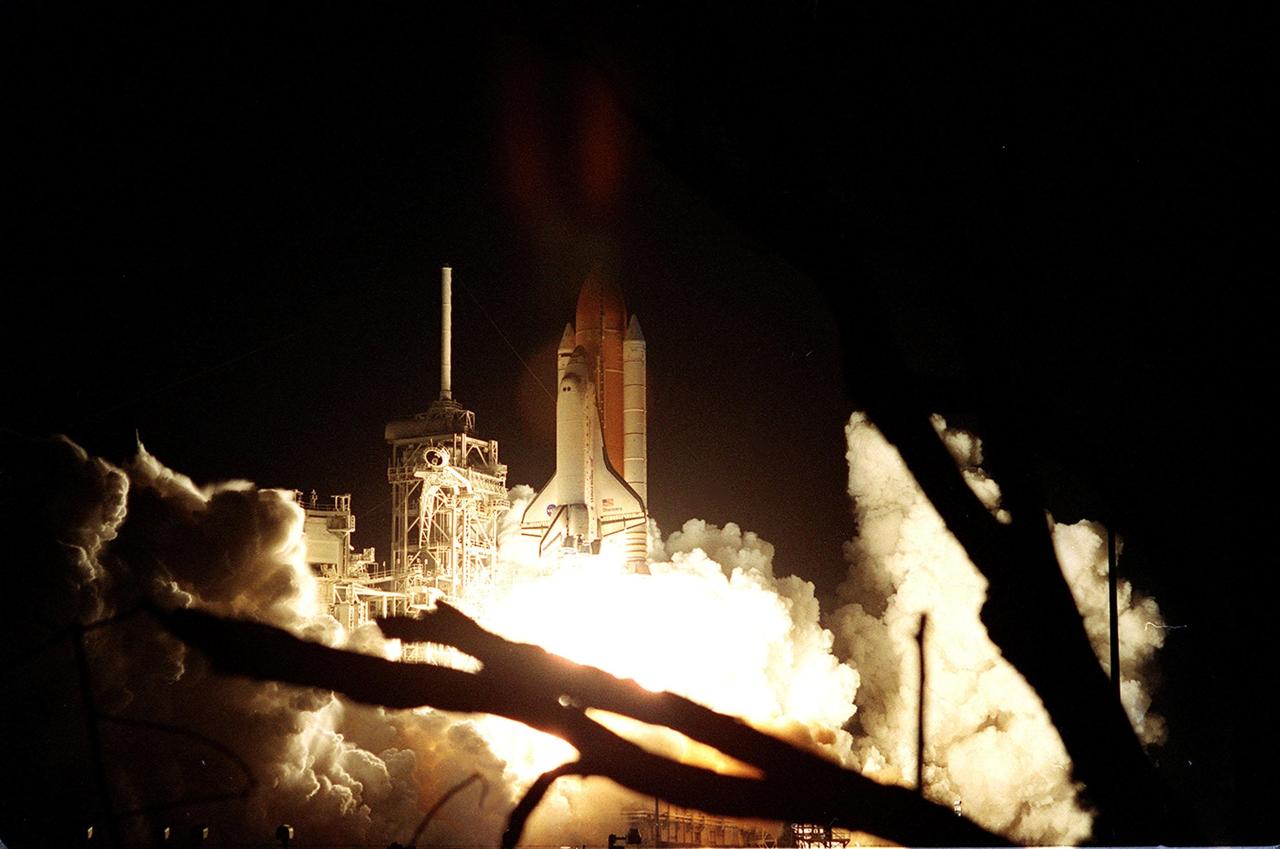
KENNEDY SPACE CENTER, Fla. -- Framed in angle of two tree branches, Space Shuttle Discovery appears to rise out of the smoke and steam at Launch Pad 39A. The perfect on-time liftoff at 7:17 p.m. EDT sends a crew of seven on a construction flight to the International Space Station on mission STS-92, the 100th in the history of the Shuttle program. Discovery also carries a payload that includes the Integrated Truss Structure Z-1, first of 10 trusses that will form the backbone of the Space Station, and the third Pressurized Mating Adapter that will provide a Shuttle docking port for solar array installation on the sixth Station flight and Lab installation on the seventh Station flight. Discovery’s landing is expected Oct. 22 at 2:10 p.m. EDT
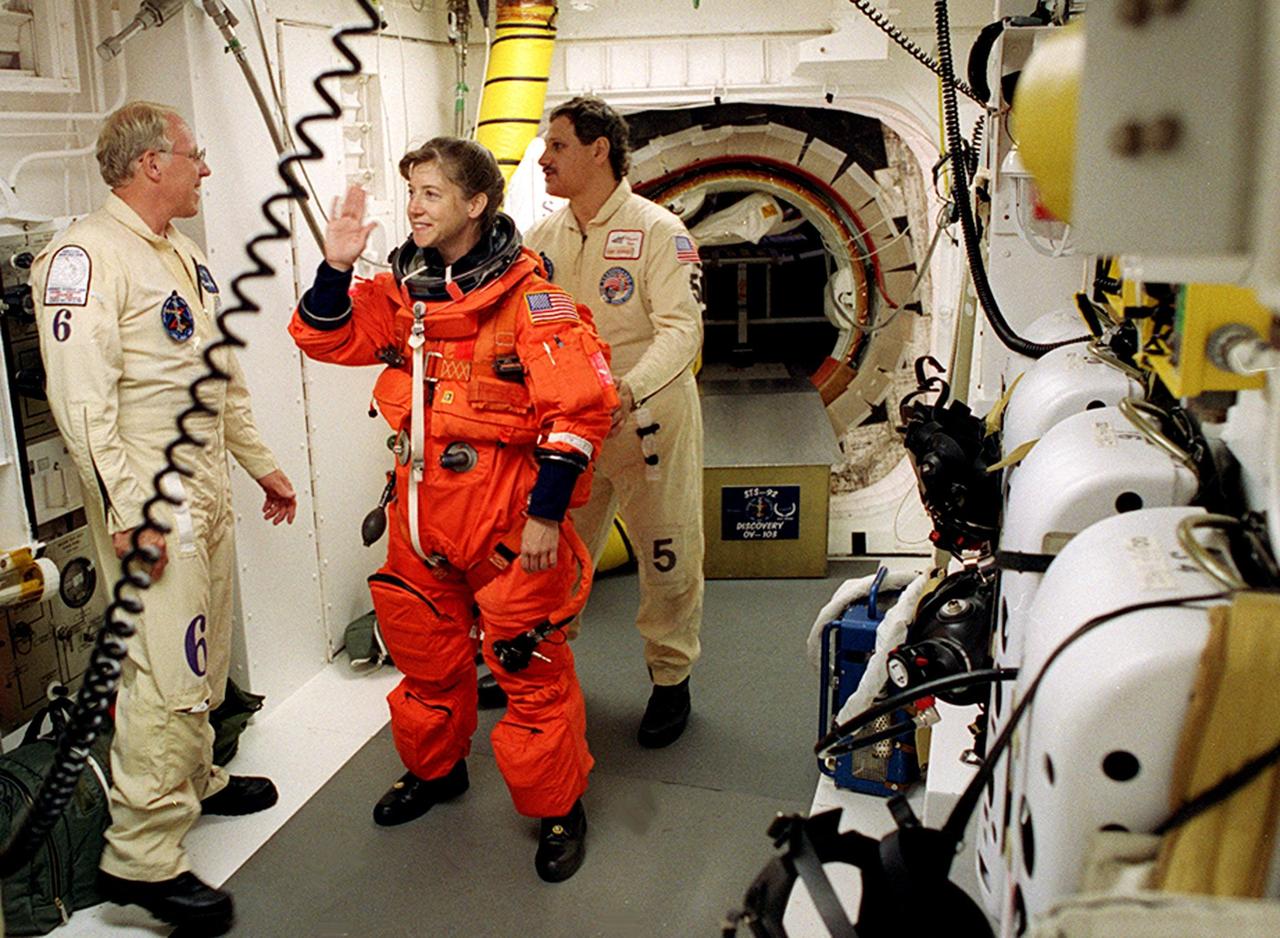
STS-92 Pilot Pamela Ann Melroy has a final check on her launch and entry suit in the White Room before entering Discovery. The White Room is an environmentally controlled area at the end of the Orbiter Access Arm that provides entry to the orbiter as well as emergency egress if needed. The arm remains in the extended position until 7 minutes 24 seconds before launch. Melroy and the rest of the crew are undertaking the fifth flight to the International Space Station for construction. Discovery carries a payload that includes the Integrated Truss Structure Z-1, first of 10 trusses that will form the backbone of the Space Station, and the third Pressurized Mating Adapter that will provide a Shuttle docking port for solar array installation on the sixth Station flight and Lab installation on the seventh Station flight. The mission includes four spacewalks for the construction activities. Discovery’s landing is expected Oct. 22 at 2:10 p.m. EDT
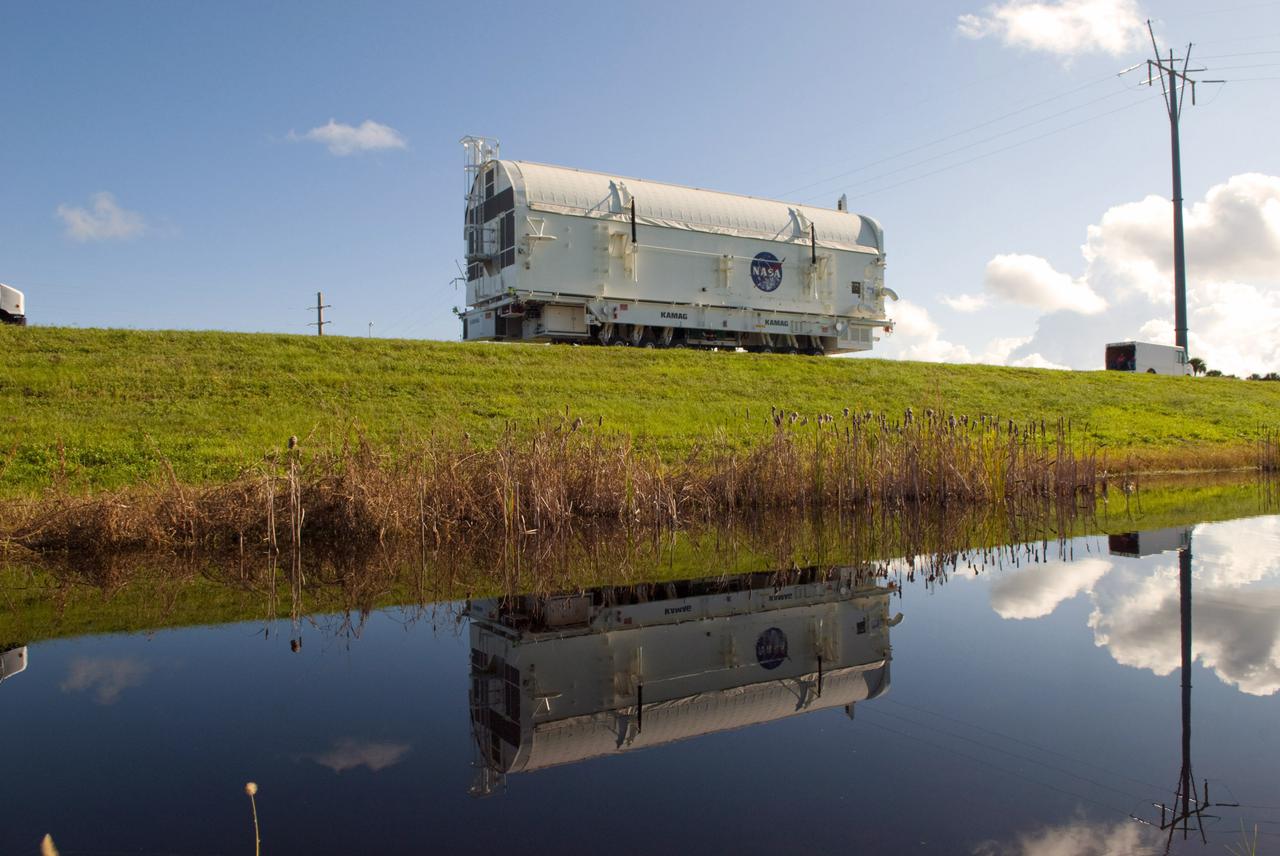
CAPE CANAVERAL, Fla. -- At NASA's Kennedy Space Center in Florida, payload canister #1 is reflected in the water standing beside the roadway leading from the Canister Rotation Facility to the Reutilization, Recycling and Marketing Facility on Ransom Road. The two payload canisters used to transport space shuttle payloads to the launch pad for installation in the shuttles' cargo bays are being decommissioned following the end of the Space Shuttle Program. Each canister weighs 110,000 pounds and is 65 feet long, 22 feet wide, and 18 feet, 7 inches high. The canisters were prescreened through NASA Headquarters as possible artifacts, but their size makes them difficult to transport to locations off the center. Federal and state agencies now will be given the opportunity to screen the canisters for potential use before a final decision is made on their disposition. For more information, visit http:__www.nasa.gov_centers_kennedy_pdf_167403main_CRF-06.pdf. Photo credit: NASA_Jim Grossmann
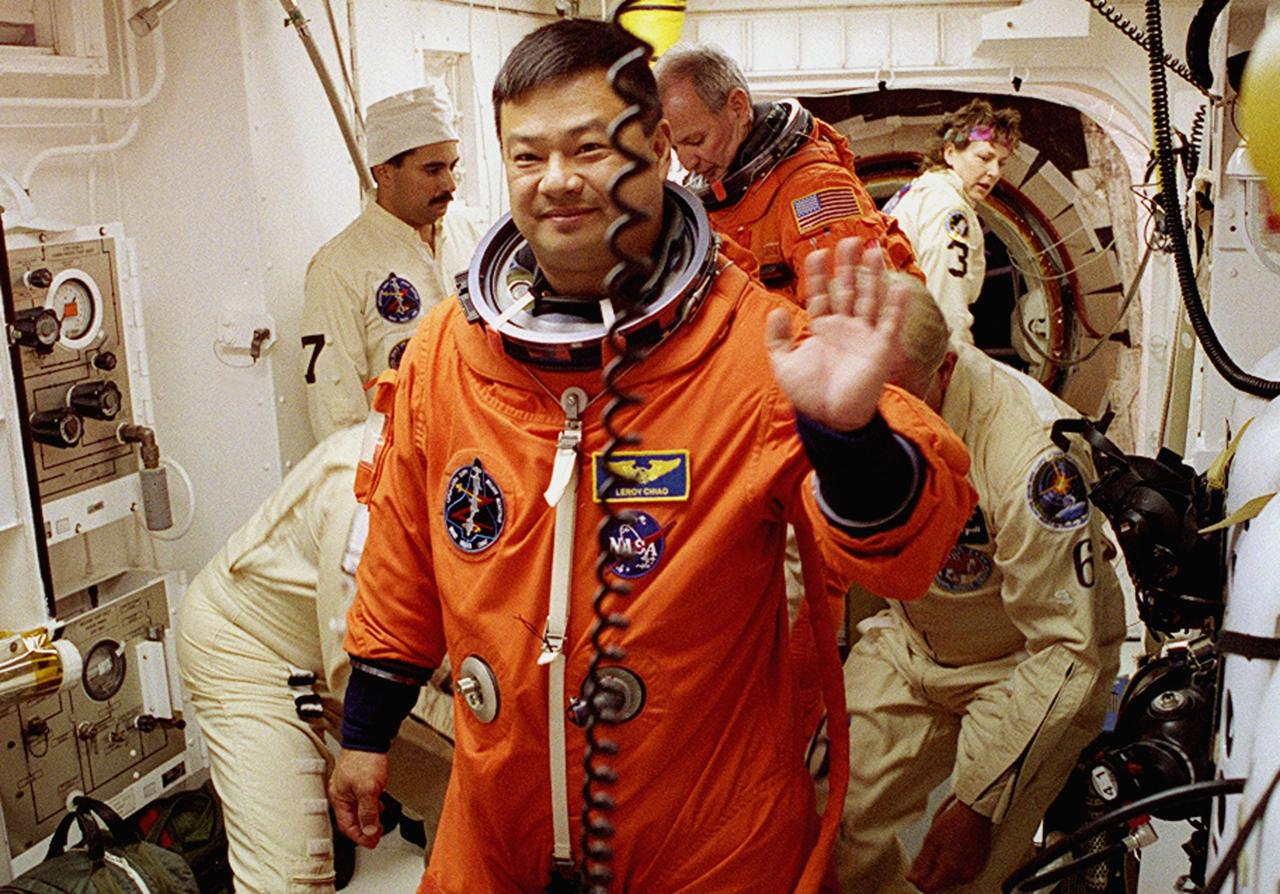
STS-92 Mission Specialist Leroy Chiao waves while waiting for suit check in the White Room. Behind him is Commander Brian Duffy. The White Room is an environmentally controlled area at the end of the Orbiter Access Arm that provides entry to the orbiter as well as emergency egress if needed. The arm remains in the extended position until 7 minutes 24 seconds before launch. Chiao, Duffy and the rest of the crew are undertaking the fifth flight to the International Space Station for construction. Discovery carries a payload that includes the Integrated Truss Structure Z-1, first of 10 trusses that will form the backbone of the Space Station, and the third Pressurized Mating Adapter that will provide a Shuttle docking port for solar array installation on the sixth Station flight and Lab installation on the seventh Station flight. The mission includes four spacewalks for the construction activities. Discovery’s landing is expected Oct. 22 at 2:10 p.m. EDT
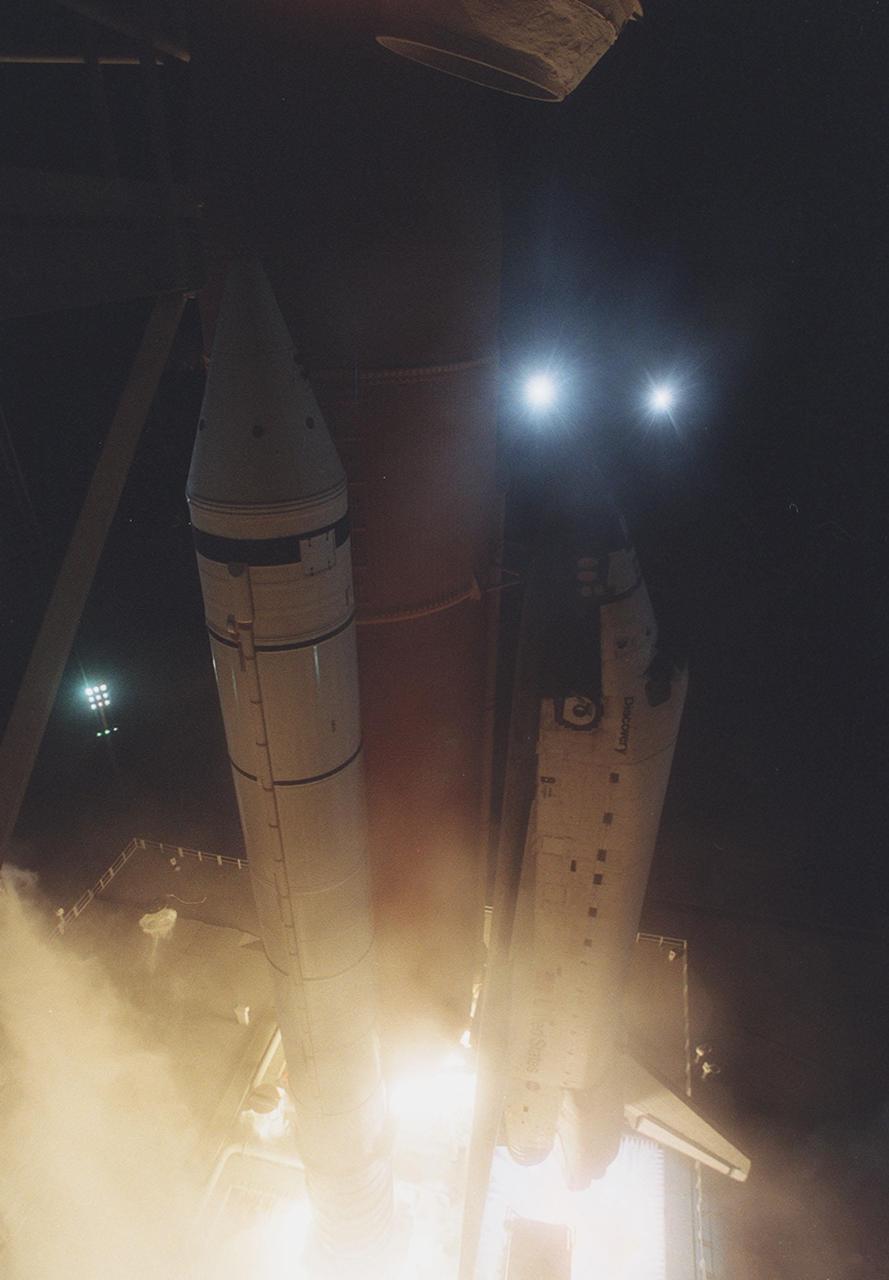
KENNEDY SPACE CENTER, Fla. -- Space Shuttle Discovery lifts off Launch Pad 39A against a backdrop of xenon lights (just above the orbiter’ nose and at left). On the Mobile Launcher Platform beneath, water begins flooding the area for flame and sound control. The perfect on-time liftoff occurred at 7:17 p.m. EDT, sending a crew of seven on the 100th launch in the history of the Shuttle program. Discovery carries a payload that includes the Integrated Truss Structure Z-1, first of 10 trusses that will form the backbone of the Space Station, and the third Pressurized Mating Adapter that will provide a Shuttle docking port for solar array installation on the sixth Station flight and Lab installation on the seventh Station flight. Discovery’s landing is expected Oct. 22 at 2:10 p.m. EDT
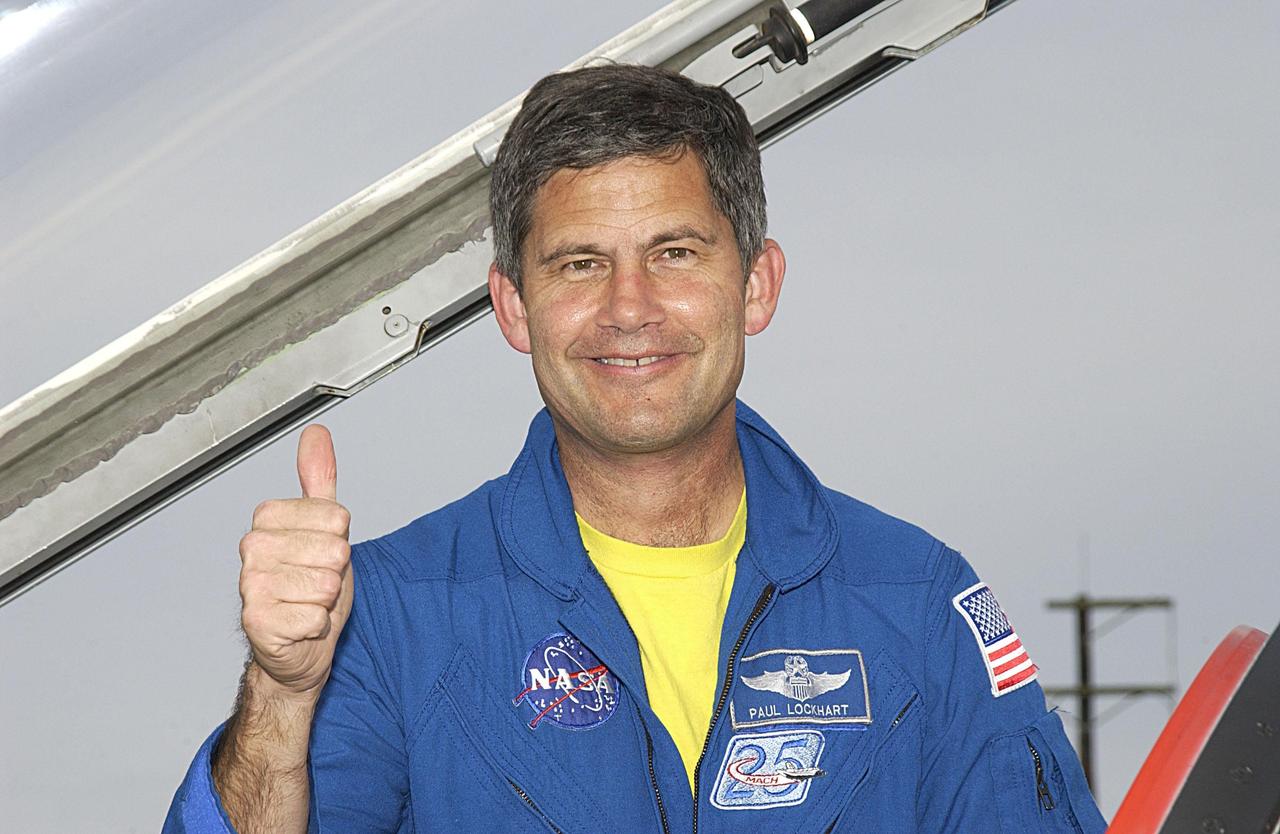
KENNEDY SPACE CENTER, FLA. -- STS-113 Pilot Paul Lockhart gives a thumbs up following his arrival at KSC's Shuttle Landing Facility to prepare for launch. STS-113 is the 16th American assembly flight to the International Space Station. The primary objective of the mission is bringing the Expedition 6 crew to the Station and returning the Expedition 5 crew to Earth. The major task of the mission is delivery of the Port 1 (P1) Integrated Truss Assembly, which will be attached to the port side of the S0 truss. Three spacewalks are planned to install and activate the truss and its associated equipment. Launch of Space Shuttle Endeavour on mission STS-113 is targeted for no earlier than Nov. 22 between 7 and 11 p.m. EST.

CAPE CANAVERAL, Fla. – Space shuttle Discovery rolls from Orbiter Processing Facility 3 to the Vehicle Assembly Building (in the background) at NASA's Kennedy Space Center, Fla. The first motion of the shuttle out of its hangar was at 7:22 a.m. EDT. In the VAB, Discovery will be lifted into High Bay 1 and mated to the external fuel tank and solid rocket boosters already installed on the mobile launcher platform. The shuttle is scheduled to roll out to Launch Pad 39A the first week of August to prepare for the STS-128 mission to the International Space Station. Discovery will carry the Leonardo Multi-Purpose Logistics Module containing life support racks and science racks and the Lightweight Multi-Purpose Experiment Support Structure Carrier in its payload bay. Launch of Discovery is targeted for late August. Photo credit: NASA/Kim Shiflett
![KENNEDY SPACE CENTER, FLA. -- Space Shuttle Discovery hurtles into the night sky, trailing a tail of fire from the solid rocket boosters, after a perfect on-time launch at 7:17 p.m. EDT. The launch of mission STS-92 carries a crew of seven on a construction flight to the International Space Station. Discovery also carries a payload that includes the Integrated Truss Structure Z-1, first of 10 trusses that will form the backbone of the Space Station, and the third Pressurized Mating Adapter that will provide a Shuttle docking port for solar array installation on the sixth Station flight and Lab installation on the seventh Station flight. Discovery’s landing is expected Oct. 22 at 2:10 p.m. EDT.; <i>[Photo taken with Nikon D1 camera.]</i](https://images-assets.nasa.gov/image/KSC-00padig041/KSC-00padig041~medium.jpg)
KENNEDY SPACE CENTER, FLA. -- Space Shuttle Discovery hurtles into the night sky, trailing a tail of fire from the solid rocket boosters, after a perfect on-time launch at 7:17 p.m. EDT. The launch of mission STS-92 carries a crew of seven on a construction flight to the International Space Station. Discovery also carries a payload that includes the Integrated Truss Structure Z-1, first of 10 trusses that will form the backbone of the Space Station, and the third Pressurized Mating Adapter that will provide a Shuttle docking port for solar array installation on the sixth Station flight and Lab installation on the seventh Station flight. Discovery’s landing is expected Oct. 22 at 2:10 p.m. EDT.; <i>[Photo taken with Nikon D1 camera.]</i
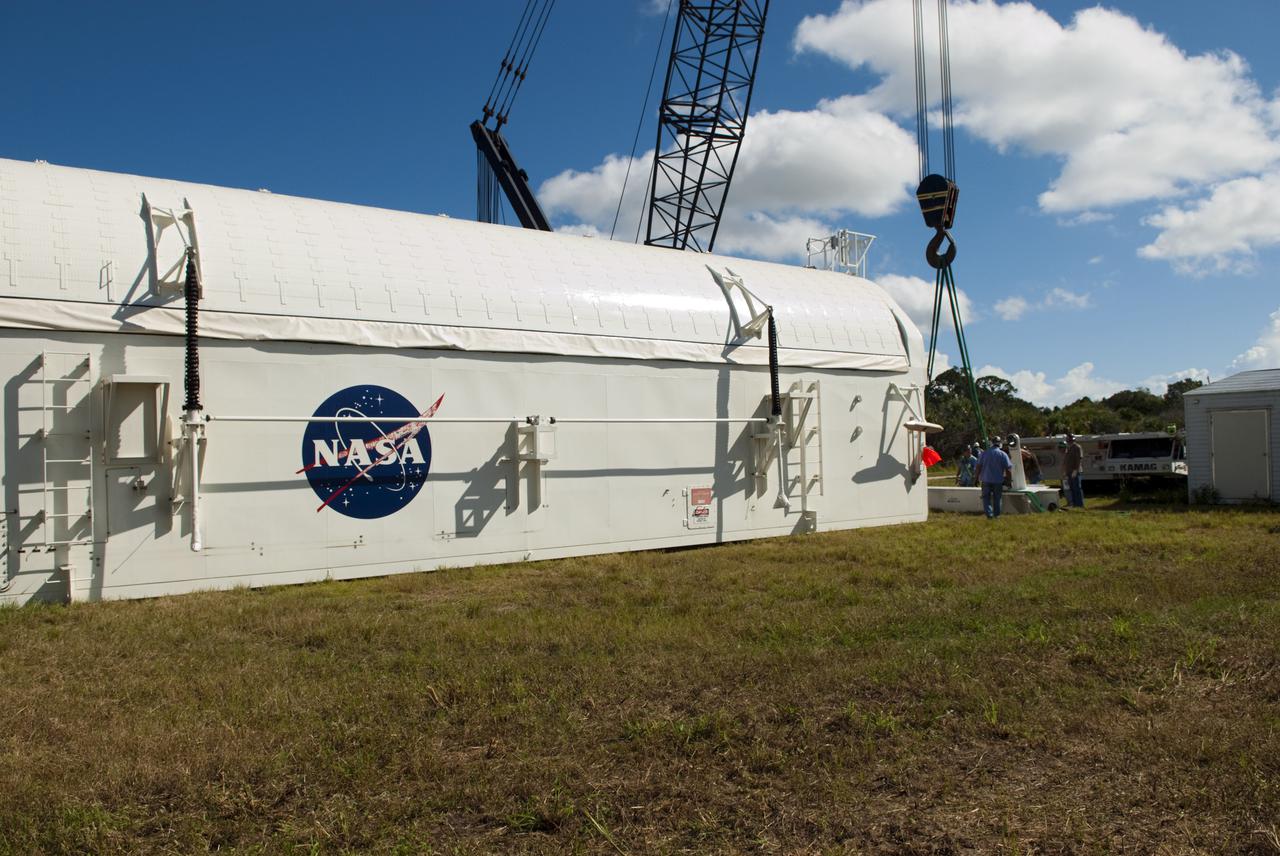
CAPE CANAVERAL, Fla. -- Payload canister #1 awaits decommissioning outside the Reutilization, Recycling and Marketing Facility on Ransom Road at NASA's Kennedy Space Center in Florida. The two payload canisters used to transport space shuttle payloads to the launch pad for installation in the shuttles' cargo bays are being decommissioned following the end of the Space Shuttle Program. Each canister weighs 110,000 pounds and is 65 feet long, 22 feet wide, and 18 feet, 7 inches high. The canisters were prescreened through NASA Headquarters as possible artifacts, but their size makes them difficult to transport to locations off the center. Federal and state agencies now will be given the opportunity to screen the canisters for potential use before a final decision is made on their disposition. For more information, visit http:__www.nasa.gov_centers_kennedy_pdf_167403main_CRF-06.pdf. Photo credit: NASA_Jim Grossmann
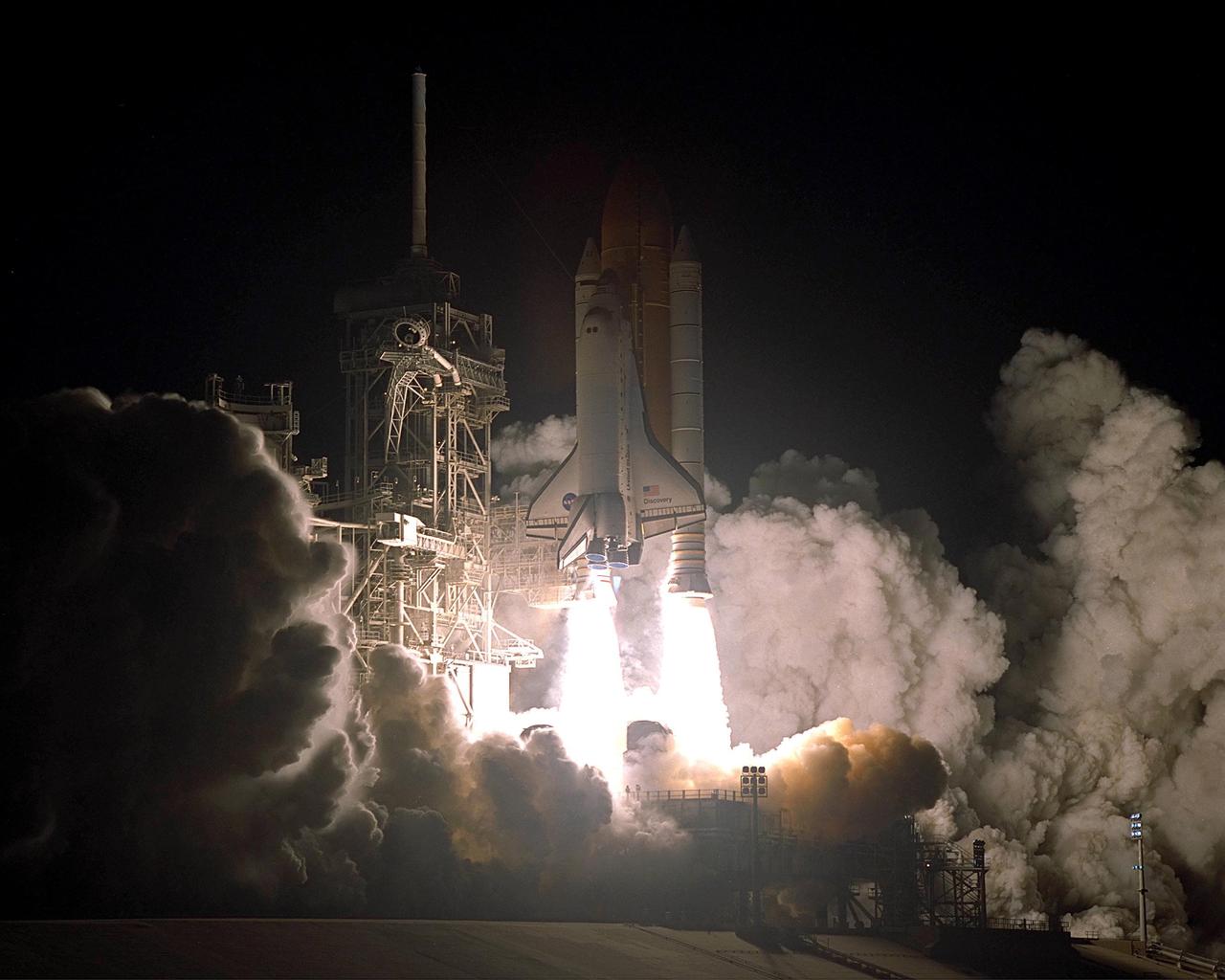
KENNEDY SPACE CENTER, Fla. -- Twin columns of flame from the solid rocket boosters illuminate the clouds of smoke and steam as Space Shuttle Discovery lifts off on mission STS-92, the fifth construction flight for the International Space Station. The perfect on-time liftoff occurred at 7:17 p.m. EDT, sending a crew of seven on the 100th launch in the history of the Shuttle program. Discovery carries a payload that includes the Integrated Truss Structure Z-1, first of 10 trusses that will form the backbone of the Space Station, and the third Pressurized Mating Adapter that will provide a Shuttle docking port for solar array installation on the sixth Station flight and Lab installation on the seventh Station flight. Discovery’s landing is expected Oct. 22 at 2:10 p.m. EDT
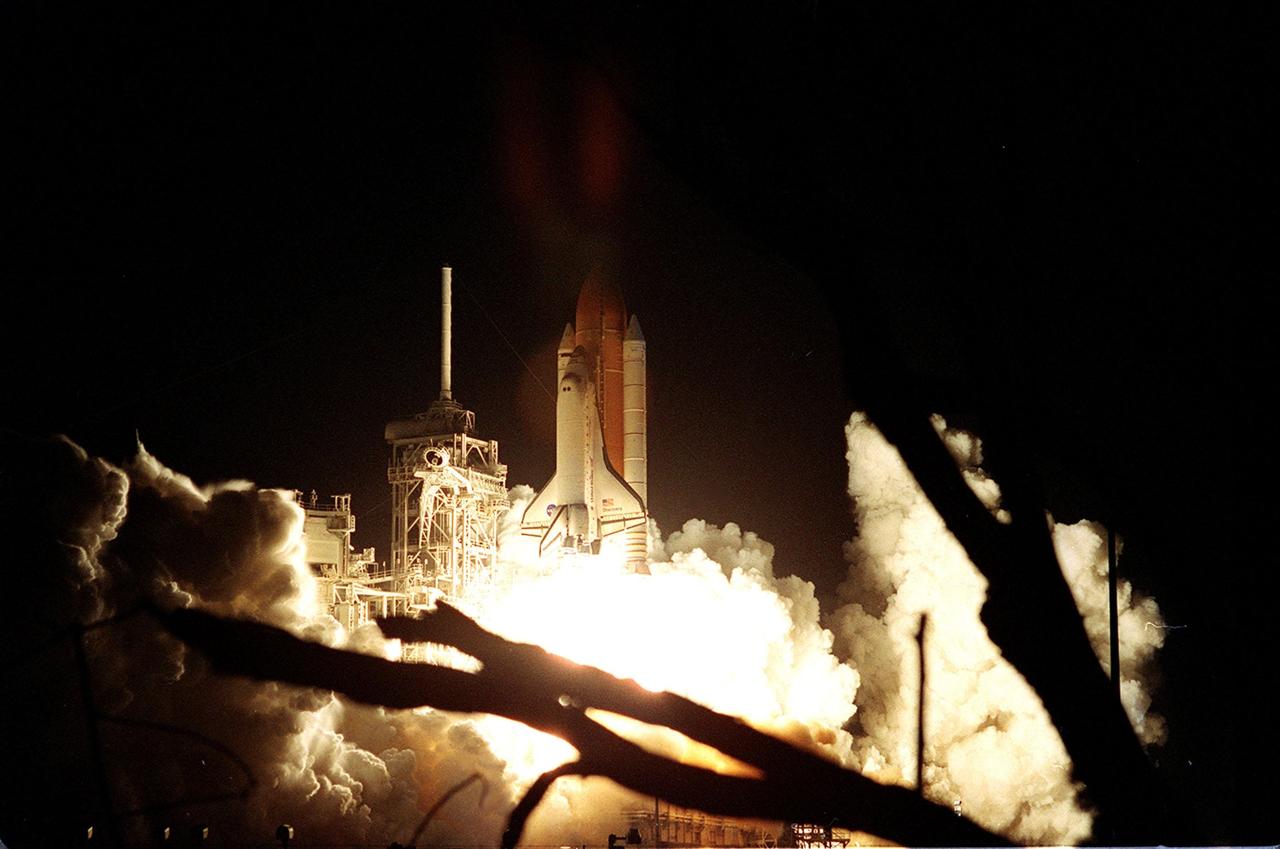
KENNEDY SPACE CENTER, Fla. -- Framed in angle of two tree branches, Space Shuttle Discovery appears to rise out of the smoke and steam at Launch Pad 39A. The perfect on-time liftoff at 7:17 p.m. EDT sends a crew of seven on a construction flight to the International Space Station on mission STS-92, the 100th in the history of the Shuttle program. Discovery also carries a payload that includes the Integrated Truss Structure Z-1, first of 10 trusses that will form the backbone of the Space Station, and the third Pressurized Mating Adapter that will provide a Shuttle docking port for solar array installation on the sixth Station flight and Lab installation on the seventh Station flight. Discovery’s landing is expected Oct. 22 at 2:10 p.m. EDT
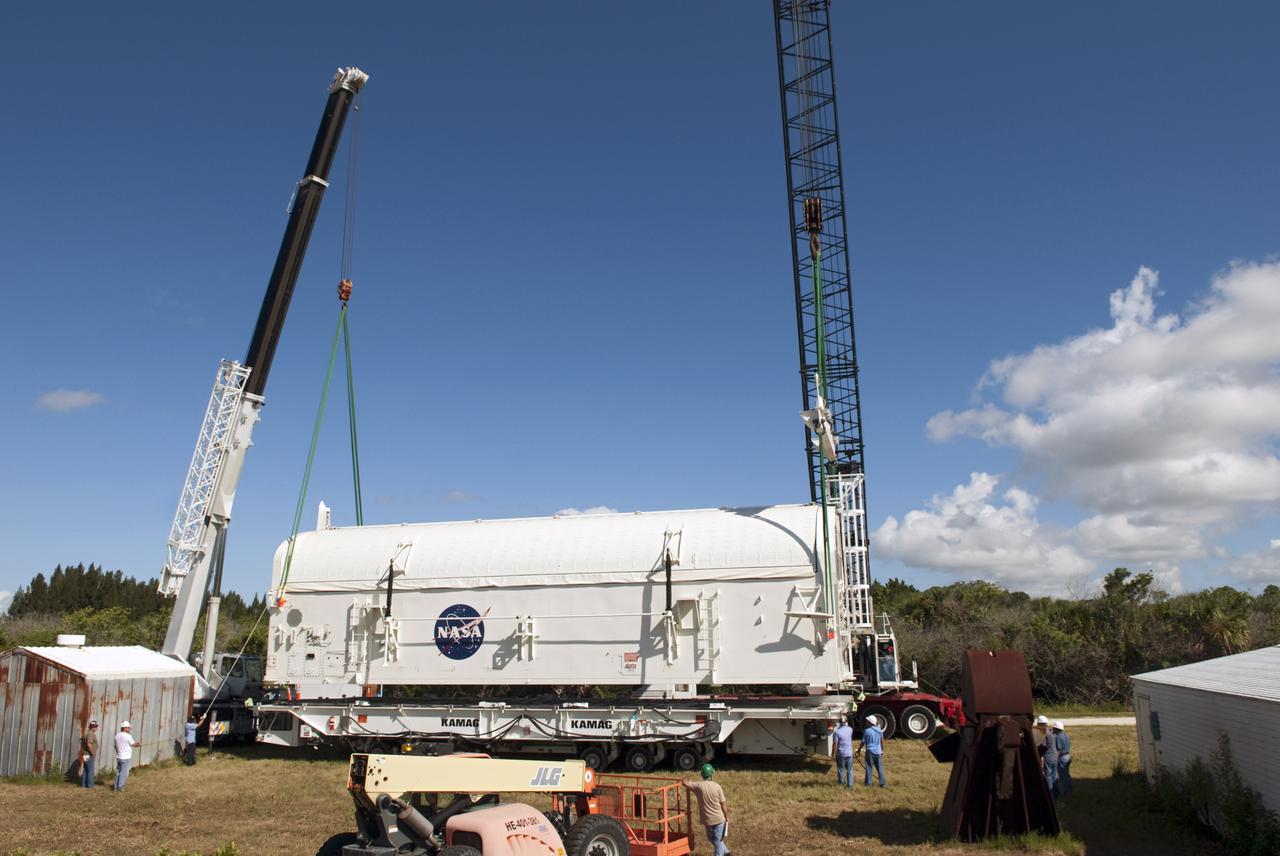
CAPE CANAVERAL, Fla. -- Cranes are attached to payload canister #1 to lift it from the transporter that delivered it to the Reutilization, Recycling and Marketing Facility on Ransom Road at NASA's Kennedy Space Center in Florida. The two payload canisters used to transport space shuttle payloads to the launch pad for installation in the shuttles' cargo bays are being decommissioned following the end of the Space Shuttle Program. Each canister weighs 110,000 pounds and is 65 feet long, 22 feet wide, and 18 feet, 7 inches high. The canisters were prescreened through NASA Headquarters as possible artifacts, but their size makes them difficult to transport to locations off the center. Federal and state agencies now will be given the opportunity to screen the canisters for potential use before a final decision is made on their disposition. For more information, visit http:__www.nasa.gov_centers_kennedy_pdf_167403main_CRF-06.pdf. Photo credit: NASA_Jim Grossmann
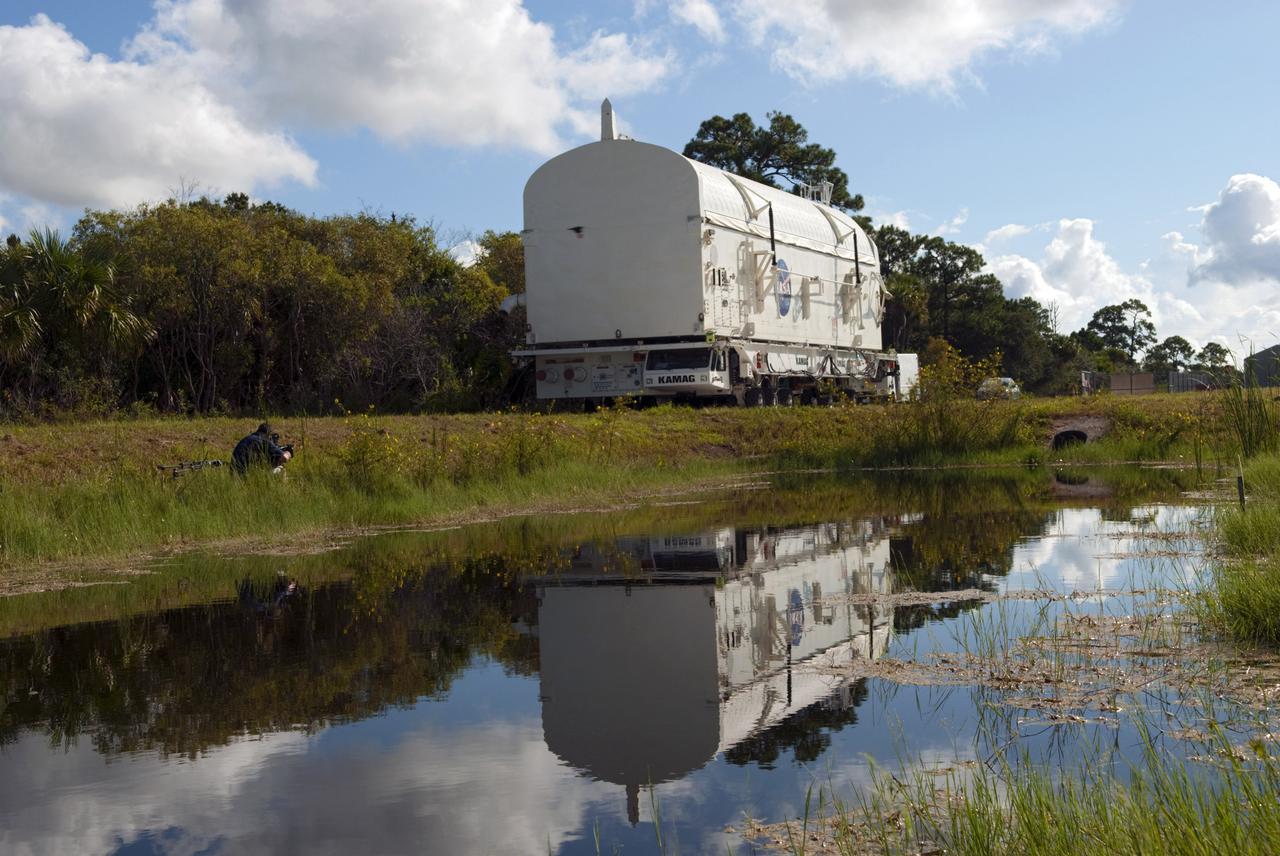
CAPE CANAVERAL, Fla. -- At NASA's Kennedy Space Center in Florida, payload canister #1 is reflected in the water standing beside the roadway leading to the Reutilization, Recycling and Marketing Facility on Ransom Road. The two payload canisters used to transport space shuttle payloads to the launch pad for installation in the shuttles' cargo bays are being decommissioned following the end of the Space Shuttle Program. Each canister weighs 110,000 pounds and is 65 feet long, 22 feet wide, and 18 feet, 7 inches high. The canisters were prescreened through NASA Headquarters as possible artifacts, but their size makes them difficult to transport to locations off the center. Federal and state agencies now will be given the opportunity to screen the canisters for potential use before a final decision is made on their disposition. For more information, visit http:__www.nasa.gov_centers_kennedy_pdf_167403main_CRF-06.pdf. Photo credit: NASA_Jim Grossmann
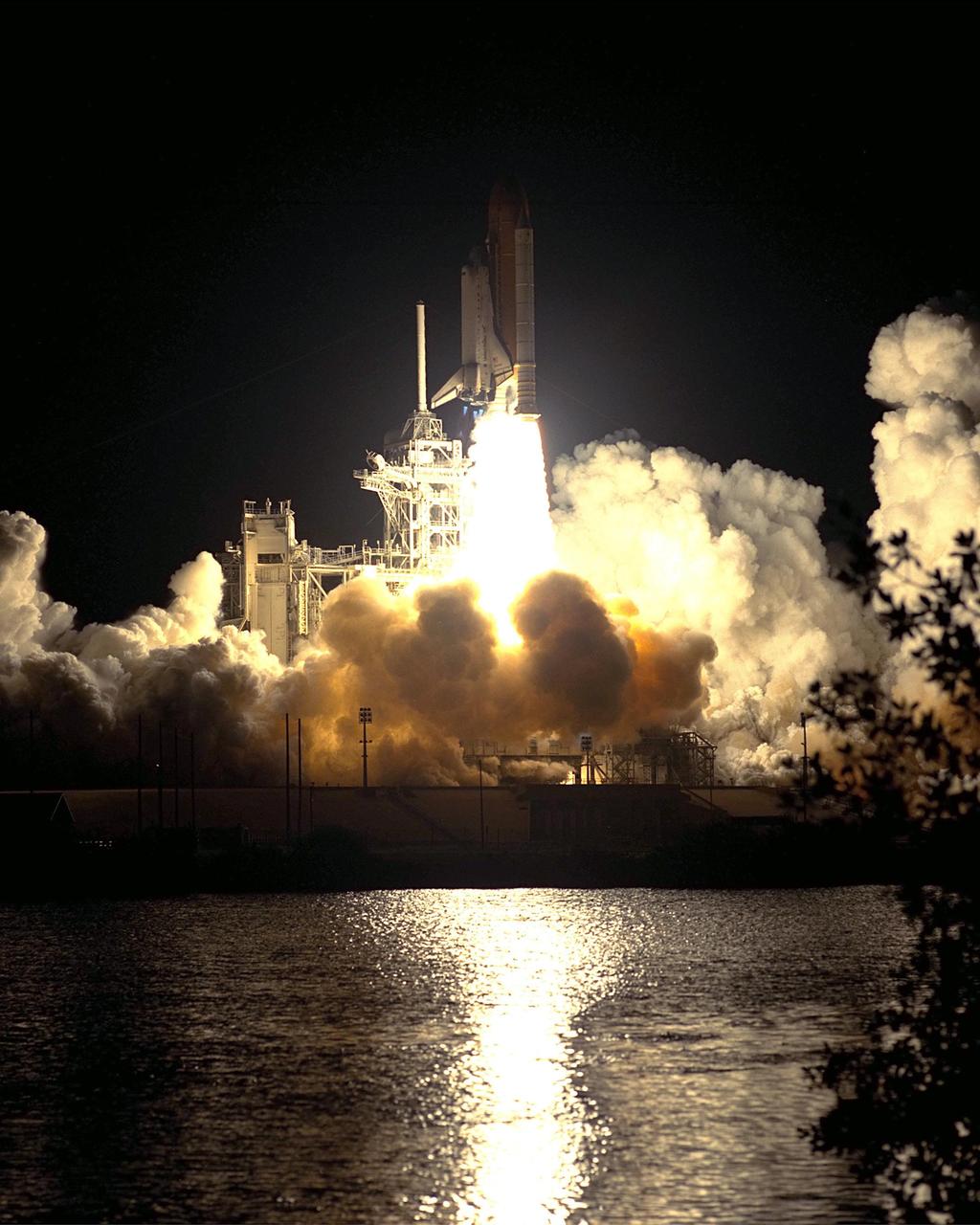
KENNEDY SPACE CENTER, Fla. -- Space Shuttle Discovery seems to burst forth from a pillow of smoke as it lifts off from Launch Pad 39A on mission STS-92 to the International Space Station. The brilliant light from the solid rocket booster flames is reflected in nearby water. The perfect on-time liftoff occurred at 7:17 p.m. EDT, sending a crew of seven on the 100th launch in the history of the Shuttle program. Discovery carries a payload that includes the Integrated Truss Structure Z-1, first of 10 trusses that will form the backbone of the Space Station, and the third Pressurized Mating Adapter that will provide a Shuttle docking port for solar array installation on the sixth Station flight and Lab installation on the seventh Station flight. Discovery’s landing is expected Oct. 22 at 2:10 p.m. EDT
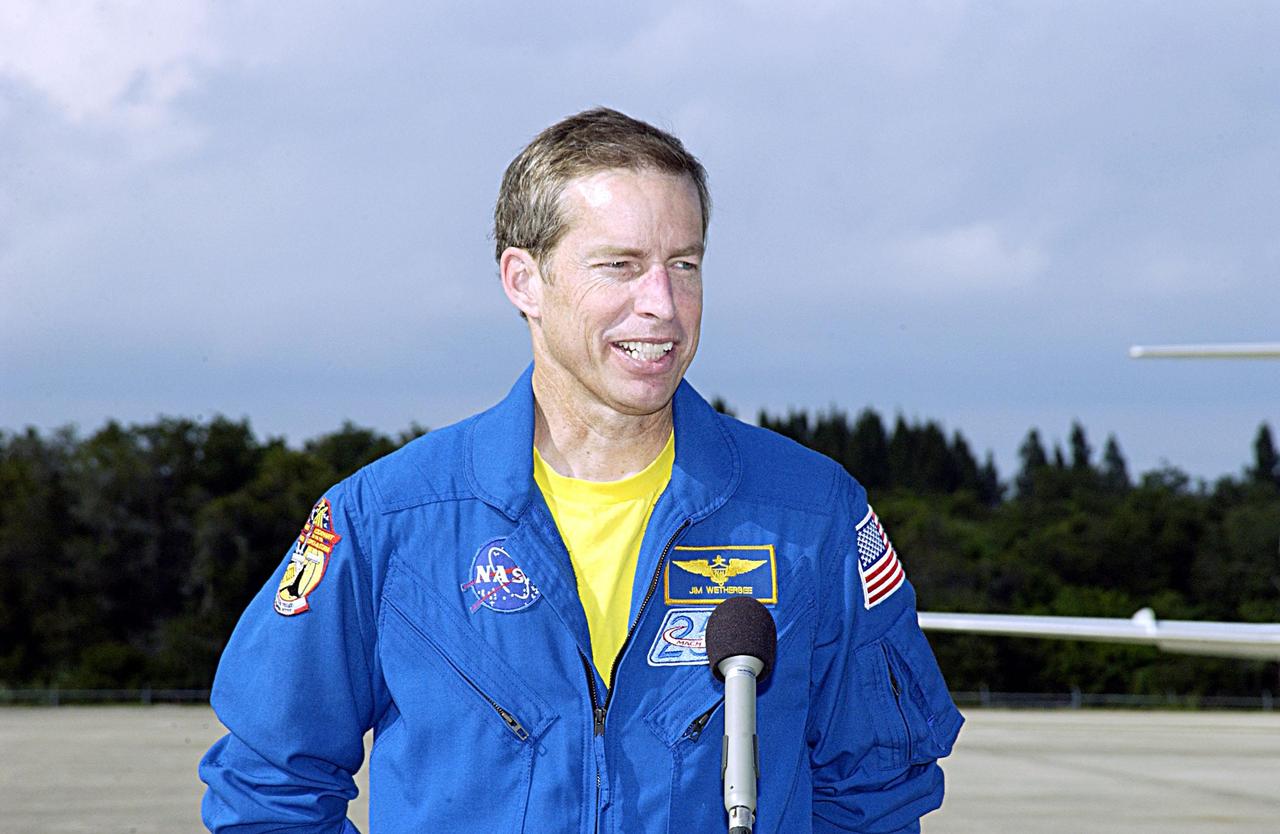
KENNEDY SPACE CENTER, FLA. -- STS-113 Commander James Wetherbee makes a brief statement upon his arrival at KSC's Shuttle Landing Facility to prepare for launch. STS-113 is the 16th American assembly flight to the International Space Station. The primary objective of the mission is bringing the Expedition 6 crew to the Station and returning the Expedition 5 crew to Earth. The major task of the mission is delivery of the Port 1 (P1) Integrated Truss Assembly, which will be attached to the port side of the S0 truss. Three spacewalks are planned to install and activate the truss and its associated equipment. Launch of Space Shuttle Endeavour on mission STS-113 is targeted for no earlier than Nov. 22 between 7 and 11 p.m. EST.
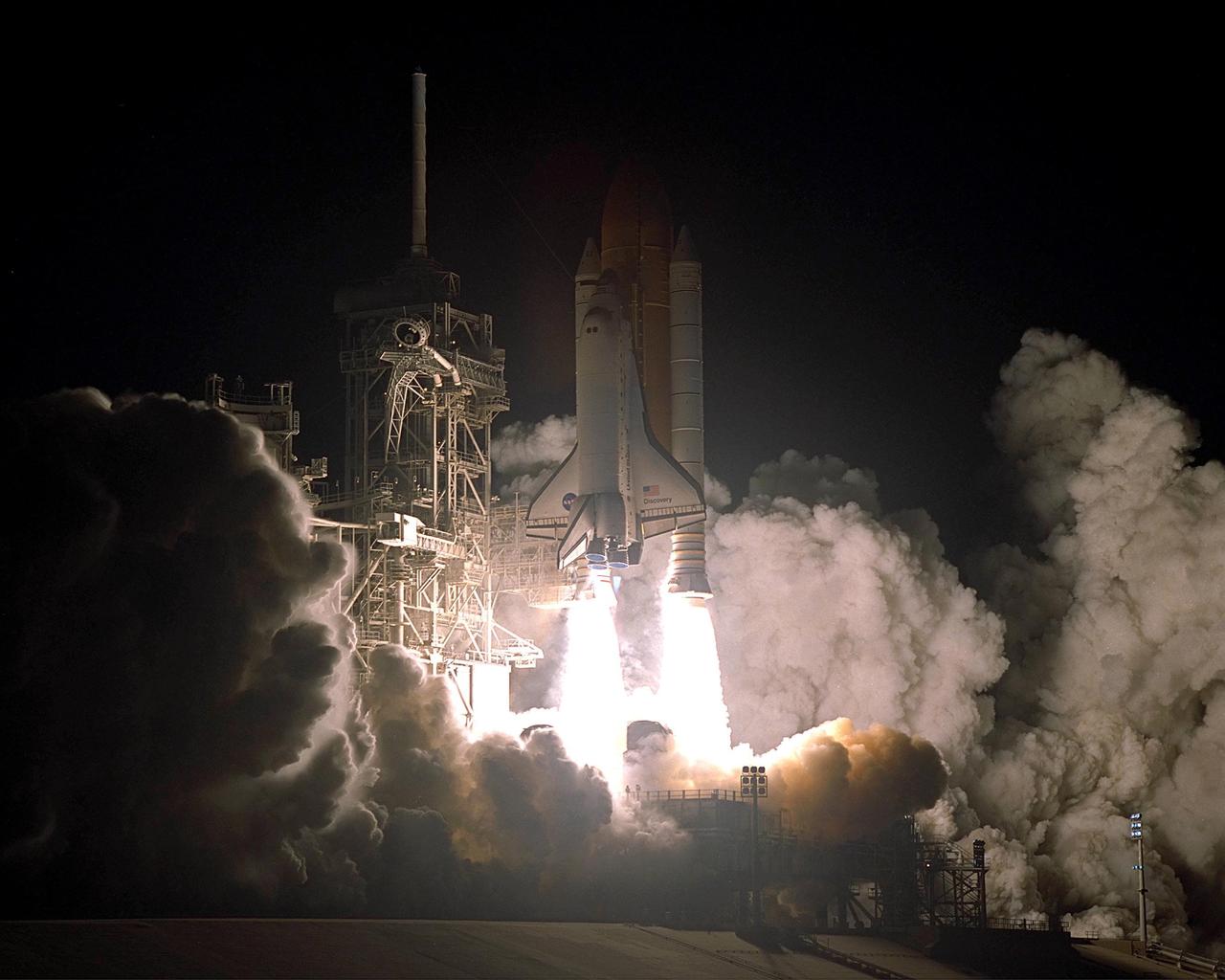
KENNEDY SPACE CENTER, Fla. -- Twin columns of flame from the solid rocket boosters illuminate the clouds of smoke and steam as Space Shuttle Discovery lifts off on mission STS-92, the fifth construction flight for the International Space Station. The perfect on-time liftoff occurred at 7:17 p.m. EDT, sending a crew of seven on the 100th launch in the history of the Shuttle program. Discovery carries a payload that includes the Integrated Truss Structure Z-1, first of 10 trusses that will form the backbone of the Space Station, and the third Pressurized Mating Adapter that will provide a Shuttle docking port for solar array installation on the sixth Station flight and Lab installation on the seventh Station flight. Discovery’s landing is expected Oct. 22 at 2:10 p.m. EDT
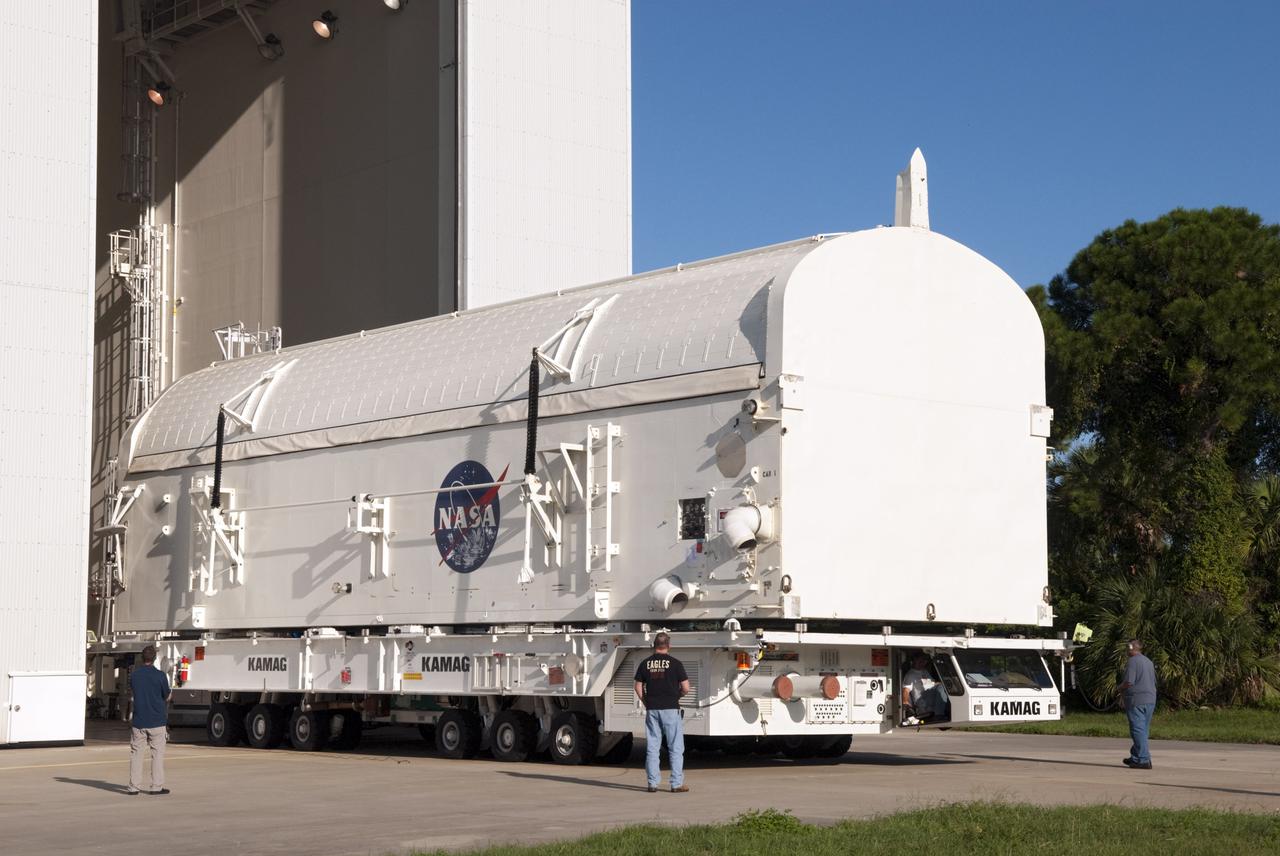
CAPE CANAVERAL, Fla. -- Employees monitor payload canister #1 as it rolls out of the high bay of the Canister Rotation Facility at NASA's Kennedy Space Center in Florida for its trip to the Reutilization, Recycling and Marketing Facility on Ransom Road. The two payload canisters used to transport space shuttle payloads to the launch pad for installation in the shuttles' cargo bays are being decommissioned following the end of the Space Shuttle Program. Each canister weighs 110,000 pounds and is 65 feet long, 22 feet wide, and 18 feet, 7 inches high. The canisters were prescreened through NASA Headquarters as possible artifacts, but their size makes them difficult to transport to locations off the center. Federal and state agencies now will be given the opportunity to screen the canisters for potential use before a final decision is made on their disposition. For more information, visit http:__www.nasa.gov_centers_kennedy_pdf_167403main_CRF-06.pdf. Photo credit: NASA_Jim Grossmann
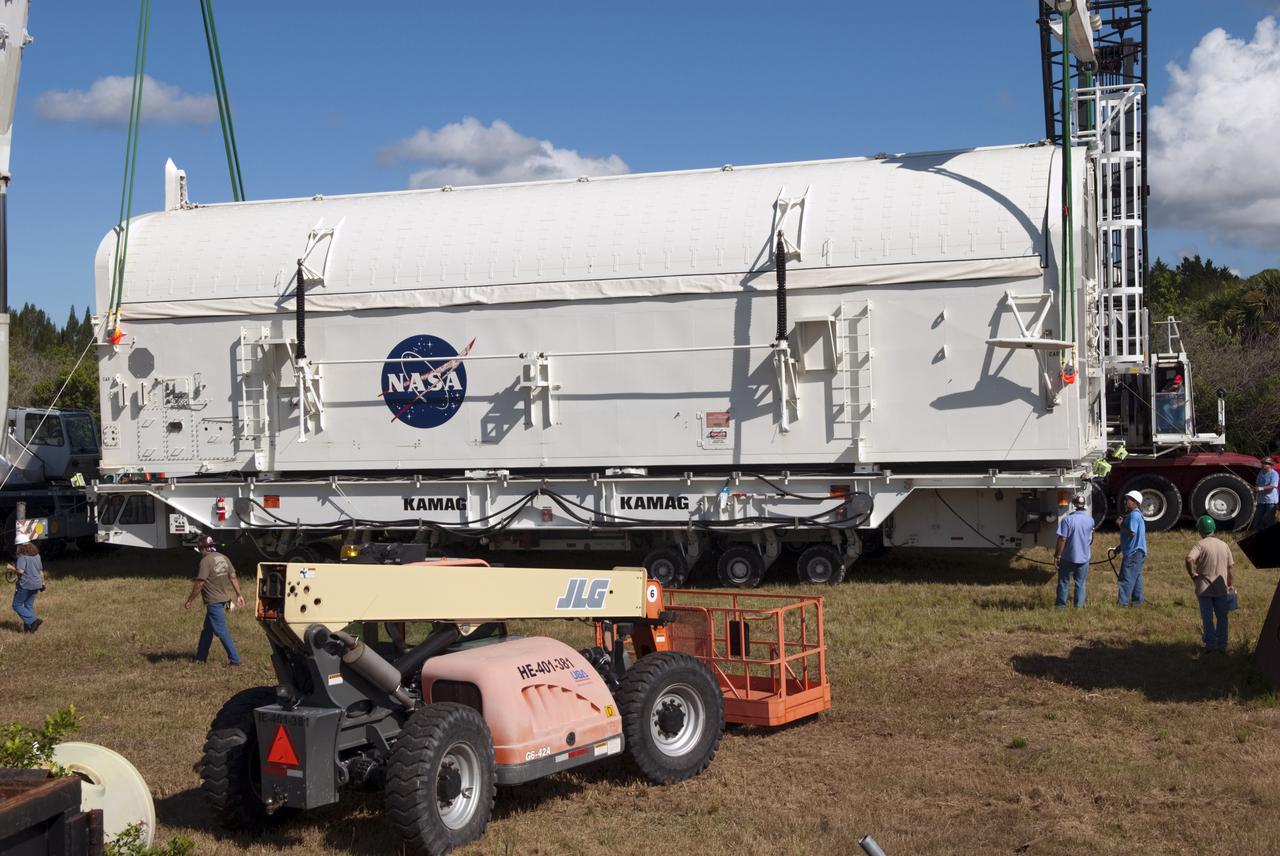
CAPE CANAVERAL, Fla. -- Preparations are under way to lift payload canister #1 from the transporter that delivered it to the Reutilization, Recycling and Marketing Facility on Ransom Road at NASA's Kennedy Space Center in Florida. The two payload canisters used to transport space shuttle payloads to the launch pad for installation in the shuttles' cargo bays are being decommissioned following the end of the Space Shuttle Program. Each canister weighs 110,000 pounds and is 65 feet long, 22 feet wide, and 18 feet, 7 inches high. The canisters were prescreened through NASA Headquarters as possible artifacts, but their size makes them difficult to transport to locations off the center. Federal and state agencies now will be given the opportunity to screen the canisters for potential use before a final decision is made on their disposition. For more information, visit http:__www.nasa.gov_centers_kennedy_pdf_167403main_CRF-06.pdf. Photo credit: NASA_Jim Grossmann
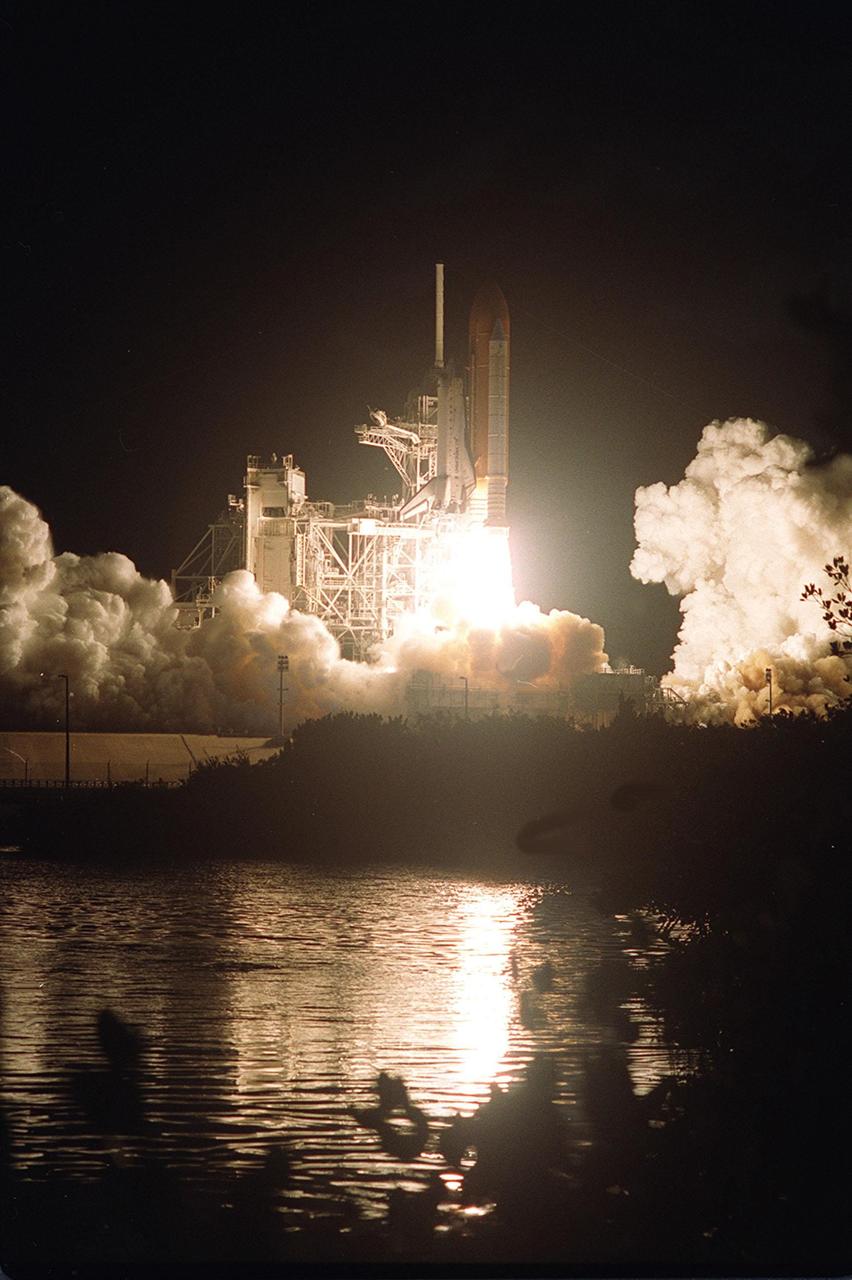
KENNEDY SPACE CENTER, Fla. -- The brilliance of the exhaust flames from Space Shuttle Discovery’s solid rocket boosters are captured in the water below Launch Pad 39A. The perfect on-time liftoff at 7:17 p.m. EDT sends a crew of seven on a construction flight to the International Space Station on mission STS-92, the 100th in the history of the Shuttle program. Discovery also carries a payload that includes the Integrated Truss Structure Z-1, first of 10 trusses that will form the backbone of the Space Station, and the third Pressurized Mating Adapter that will provide a Shuttle docking port for solar array installation on the sixth Station flight and Lab installation on the seventh Station flight. Discovery’s landing is expected Oct. 22 at 2:10 p.m. EDT
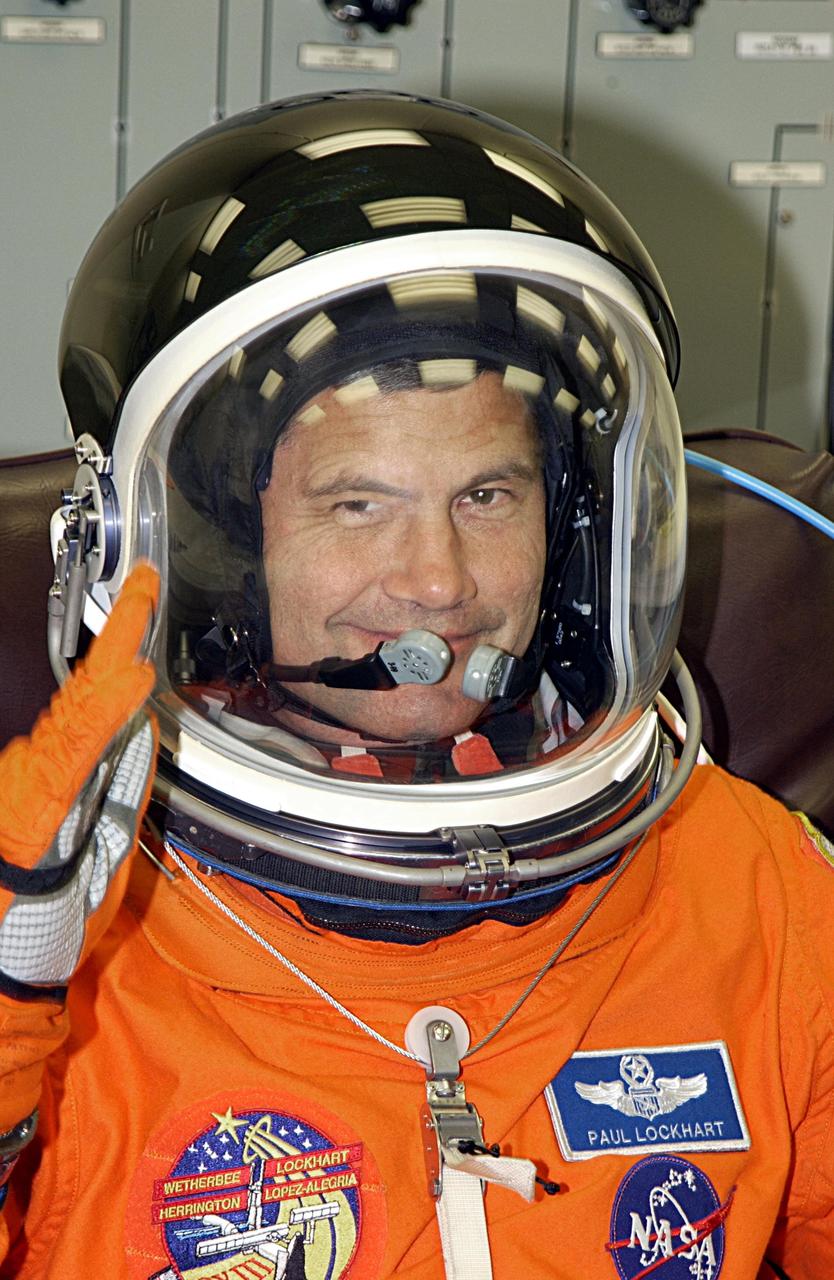
KENNEDY SPACE CENTER, FLA. - STS-113 Pilot Paul Lockhart salutes as he finishes suiting up for a second launch attempt on mission STS-113. The launch on Nov. 22 was scrubbed due to poor weather conditions at the Transoceanic Abort Landing sites. Lockhart will be making his second Shuttle flight. The launch will carry the Expedition 6 crew to the Station and return the Expedition 5 crew to Earth. The major objective of the mission is delivery of the Port 1 (P1) Integrated Truss Assembly, which will be attached to the port side of the S0 truss. Three spacewalks are planned to install and activate the truss and its associated equipment. Launch of Space Shuttle Endeavour on mission STS-113 is now scheduled for Nov. 23 at 7:50 p.m. EST.
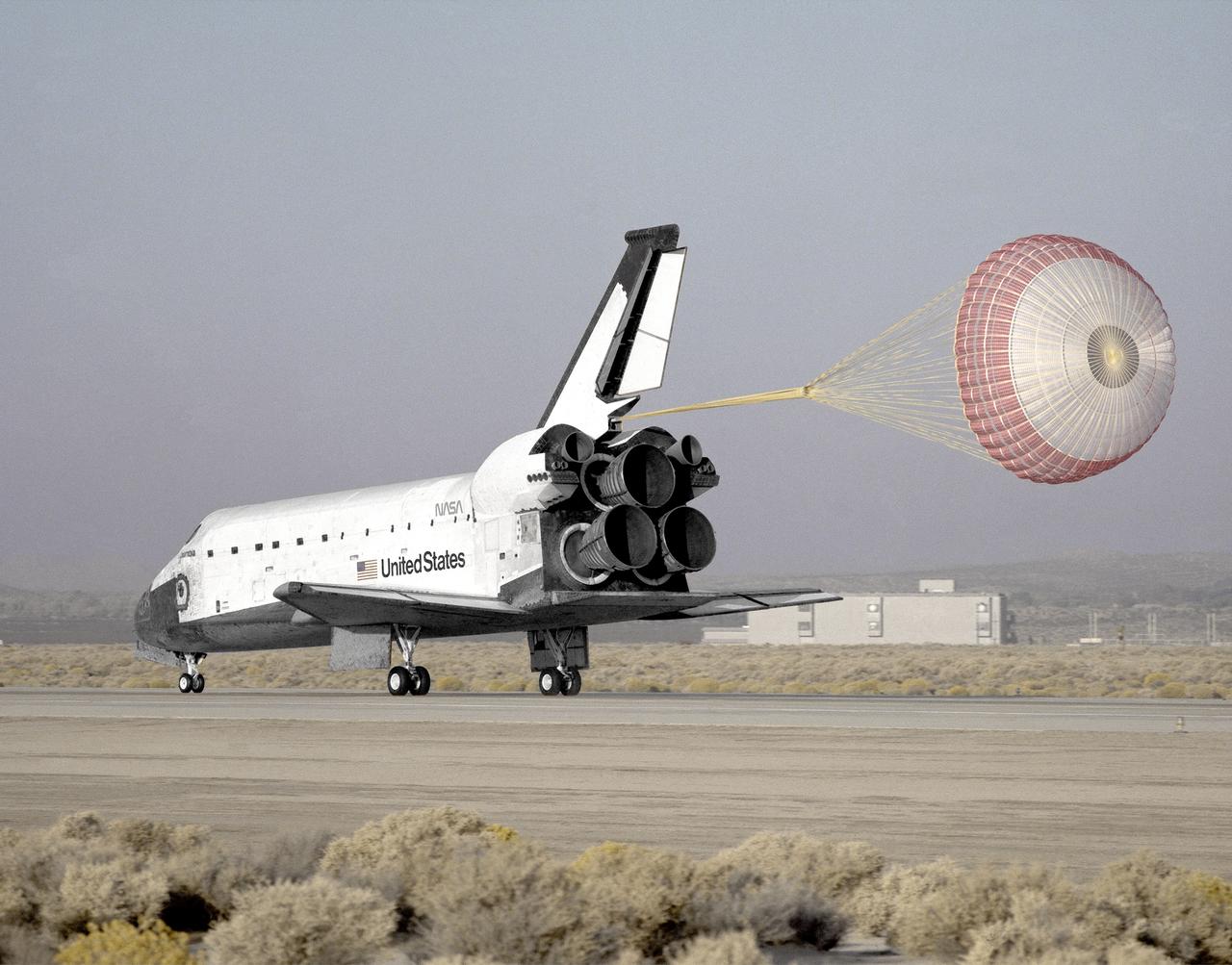
A drag chute slows the space shuttle Columbia as it rolls to a perfect landing concluding NASA's longest mission at that time, STS-58, at the Ames-Dryden Flight Research Facility (later redesignated the Dryden Flight Research Center), Edwards, California, with a 8:06 a.m. (PST) touchdown 1 November 1993 on Edward's concrete runway 22. The planned 14 day mission, which began with a launch from Kennedy Space Center, Florida, at 7:53 a.m. (PDT), October 18, was the second spacelab flight dedicated to life sciences research. Seven Columbia crewmembers performed a series of experiments to gain more knowledge on how the human body adapts to the weightless environment of space. Crewmembers on this flight included: John Blaha, commander; Rick Searfoss, pilot; payload commander Rhea Seddon; mission specialists Bill MacArthur, David Wolf, and Shannon Lucid; and payload specialist Martin Fettman.
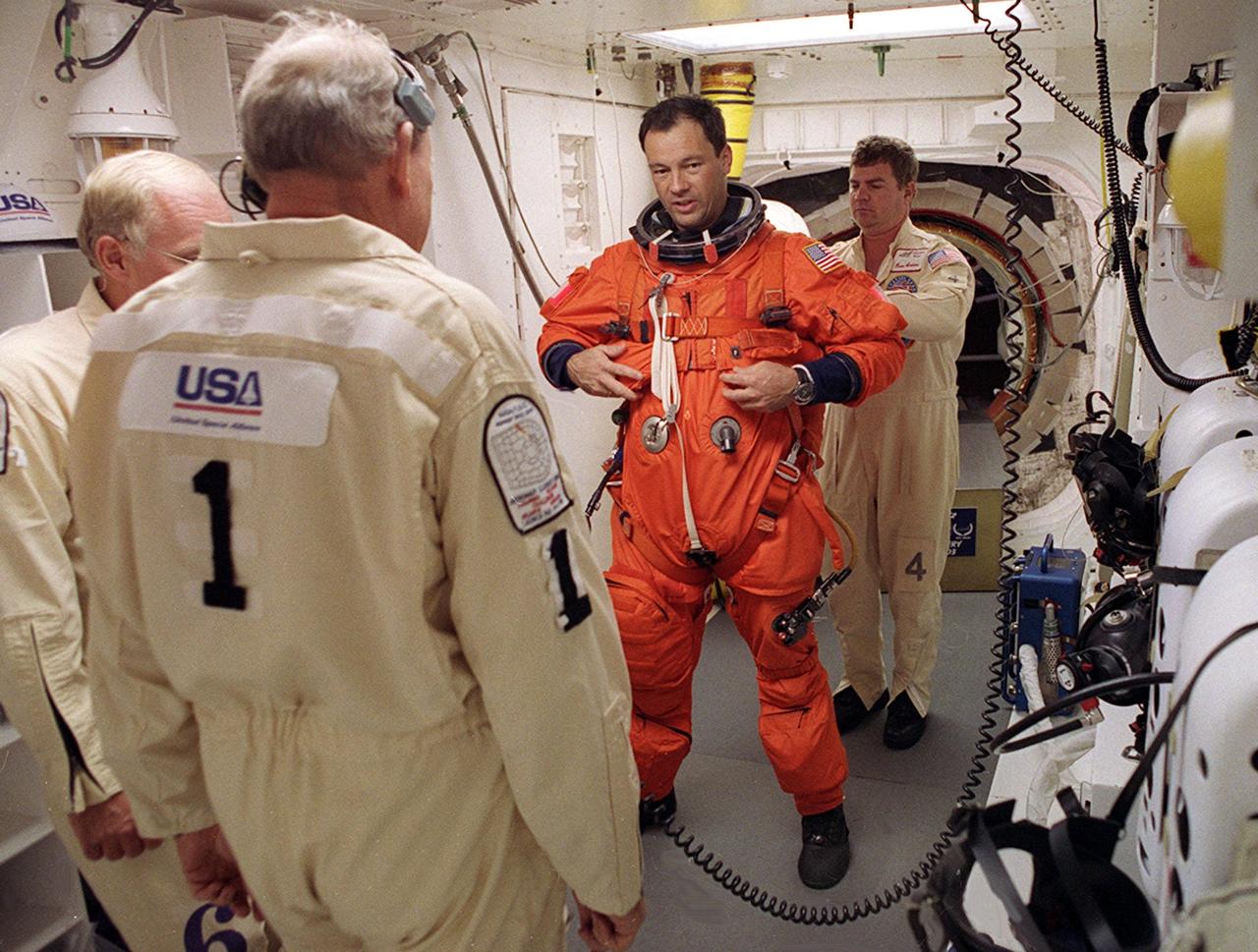
STS-92 Mission Specialist Michael E. Lopez-Alegria gets a final check of his launch and entry suit in the White Room before entering Discovery. The White Room is an environmentally controlled area at the end of the Orbiter Access Arm that provides entry to the orbiter as well as emergency egress if needed. The arm remains in the extended position until 7 minutes 24 seconds before launch. Lopez-Alegria and the rest of the crew are undertaking the fifth flight to the International Space Station for construction. Discovery carries a payload that includes the Integrated Truss Structure Z-1, first of 10 trusses that will form the backbone of the Space Station, and the third Pressurized Mating Adapter that will provide a Shuttle docking port for solar array installation on the sixth Station flight and Lab installation on the seventh Station flight. The mission includes four spacewalks for the construction activities. Discovery’s landing is expected Oct. 22 at 2:10 p.m. EDT
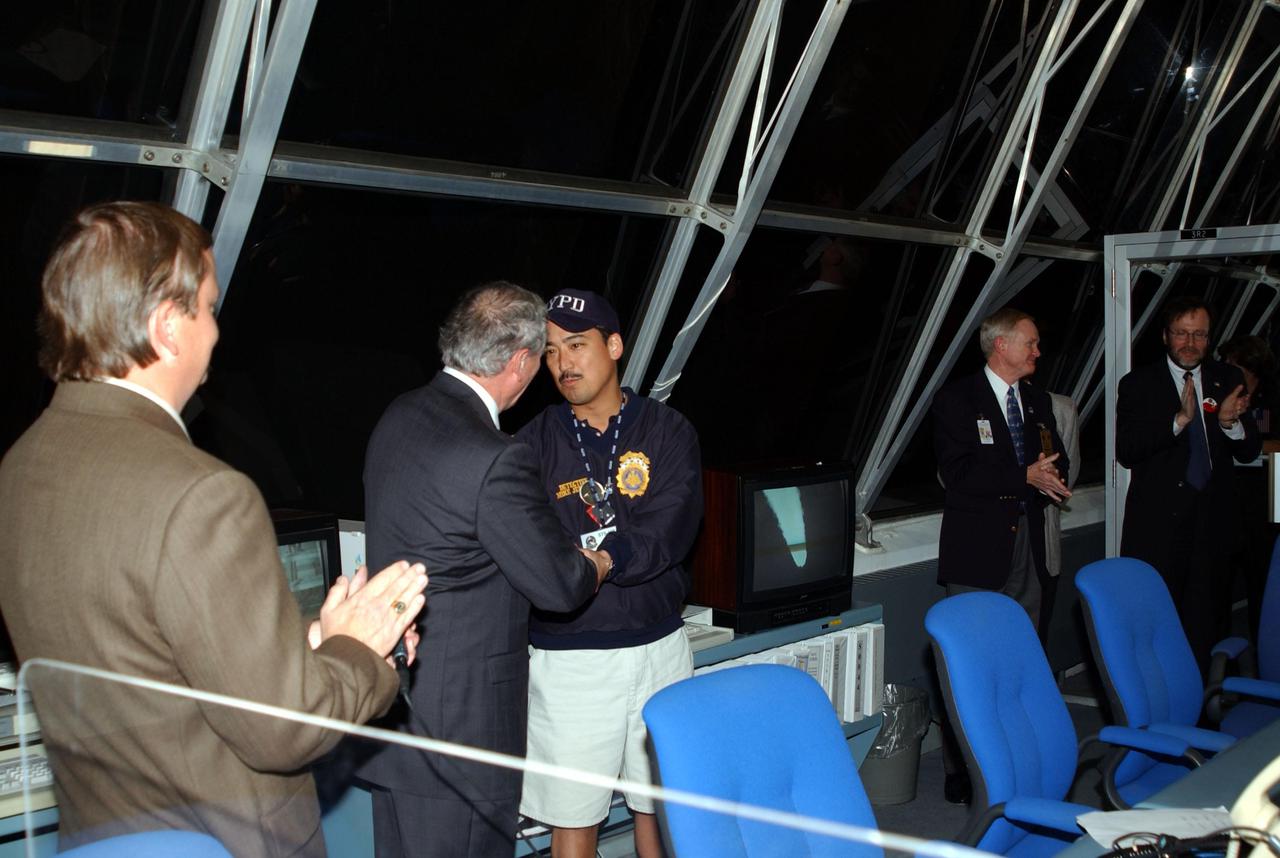
KENNEDY SPACE CENTER, Fla. -- New York Police Department Detective Michael Jermyn (center) is thanked for representing the New York Police and Fire Departments at the launch of Space Shuttle Endeavour on mission STS-108. Offering his handshake is NASA's Acting Administrator Daniel Mulville; Launch Director Mike Leinbach (left) applauds. At right is Center Director Roy Bridges Jr. Jermyn praised the efforts of the workers on the successful launch. Endeavour is carrying 6,000 flags that will be given to the families of those who died in the fall of the Twin Towers. Liftoff of Endeavour occurred at 5:19:28 p.m. EST (22:19.28 GMT). Endeavour will dock with the International Space Station on Dec. 7. STS-108 is the final Shuttle mission of 2001and the 107th Shuttle flight overall. It is the 12th flight to the Space Station. Landing of the orbiter at KSC's Shuttle Landing Facility is targeted for 1:05 p.m. EST (18:05 p.m. GMT) Dec. 16
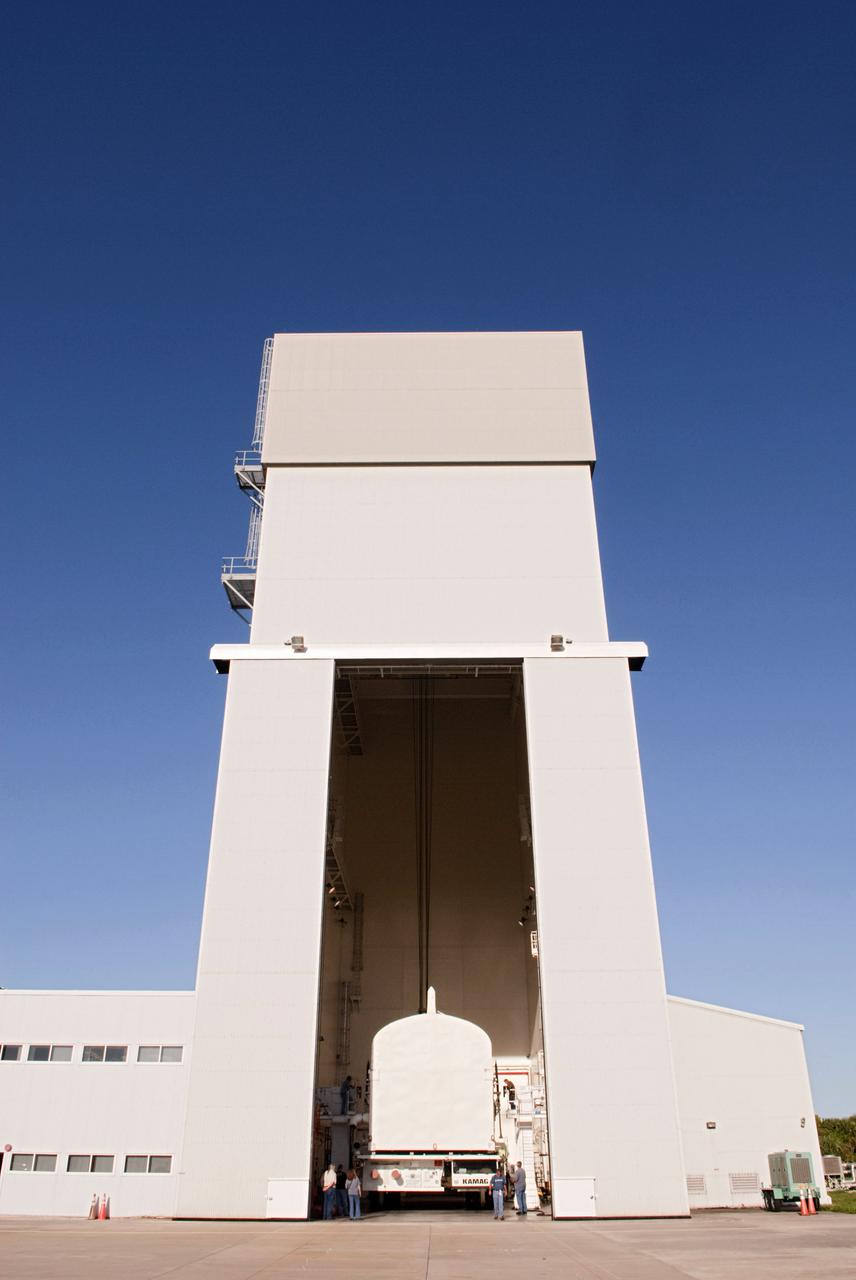
CAPE CANAVERAL, Fla. -- At the Canister Rotation Facility at NASA's Kennedy Space Center in Florida, preparations are under way to move payload canister #1 to the Reutilization, Recycling and Marketing Facility on Ransom Road. The two payload canisters used to transport space shuttle payloads to the launch pad for installation in the shuttles' cargo bays are being decommissioned following the end of the Space Shuttle Program. Each canister weighs 110,000 pounds and is 65 feet long, 22 feet wide, and 18 feet, 7 inches high. The canisters were prescreened through NASA Headquarters as possible artifacts, but their size makes them difficult to transport to locations off the center. Federal and state agencies now will be given the opportunity to screen the canisters for potential use before a final decision is made on their disposition. For more information, visit http:__www.nasa.gov_centers_kennedy_pdf_167403main_CRF-06.pdf. Photo credit: NASA_Jim Grossmann
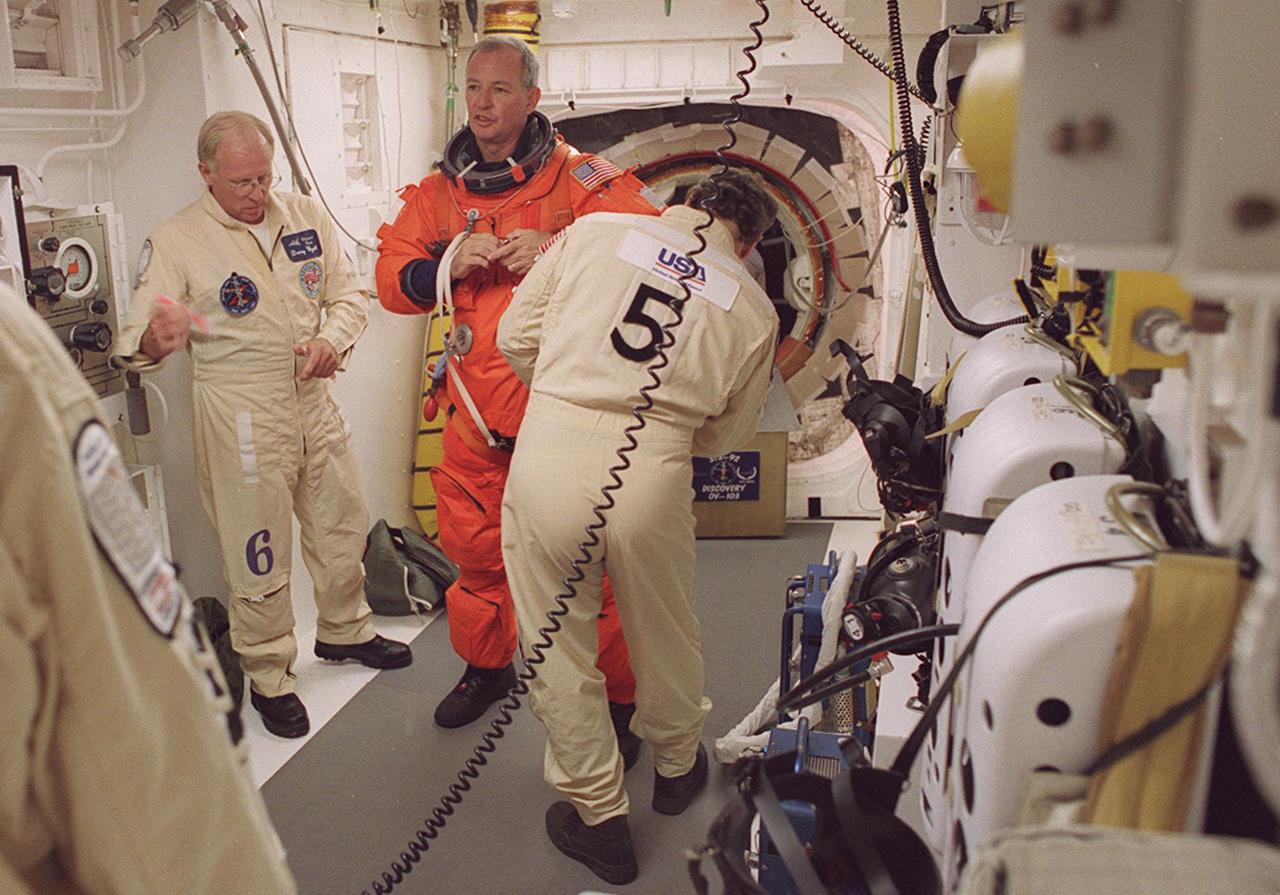
STS-92 Commander Brian Duffy is helped with final suit check in the White Room before entering Discovery. The White Room is an environmentally controlled area at the end of the Orbiter Access Arm that provides entry to the orbiter as well as emergency egress if needed. The arm remains in the extended position until 7 minutes 24 seconds before launch. Duffy and the rest of the crew are undertaking the fifth flight to the International Space Station for construction. Discovery carries a payload that includes the Integrated Truss Structure Z-1, first of 10 trusses that will form the backbone of the Space Station, and the third Pressurized Mating Adapter that will provide a Shuttle docking port for solar array installation on the sixth Station flight and Lab installation on the seventh Station flight. The mission includes four spacewalks for the construction activities. Discovery’s landing is expected Oct. 22 at 2:10 p.m. EDT
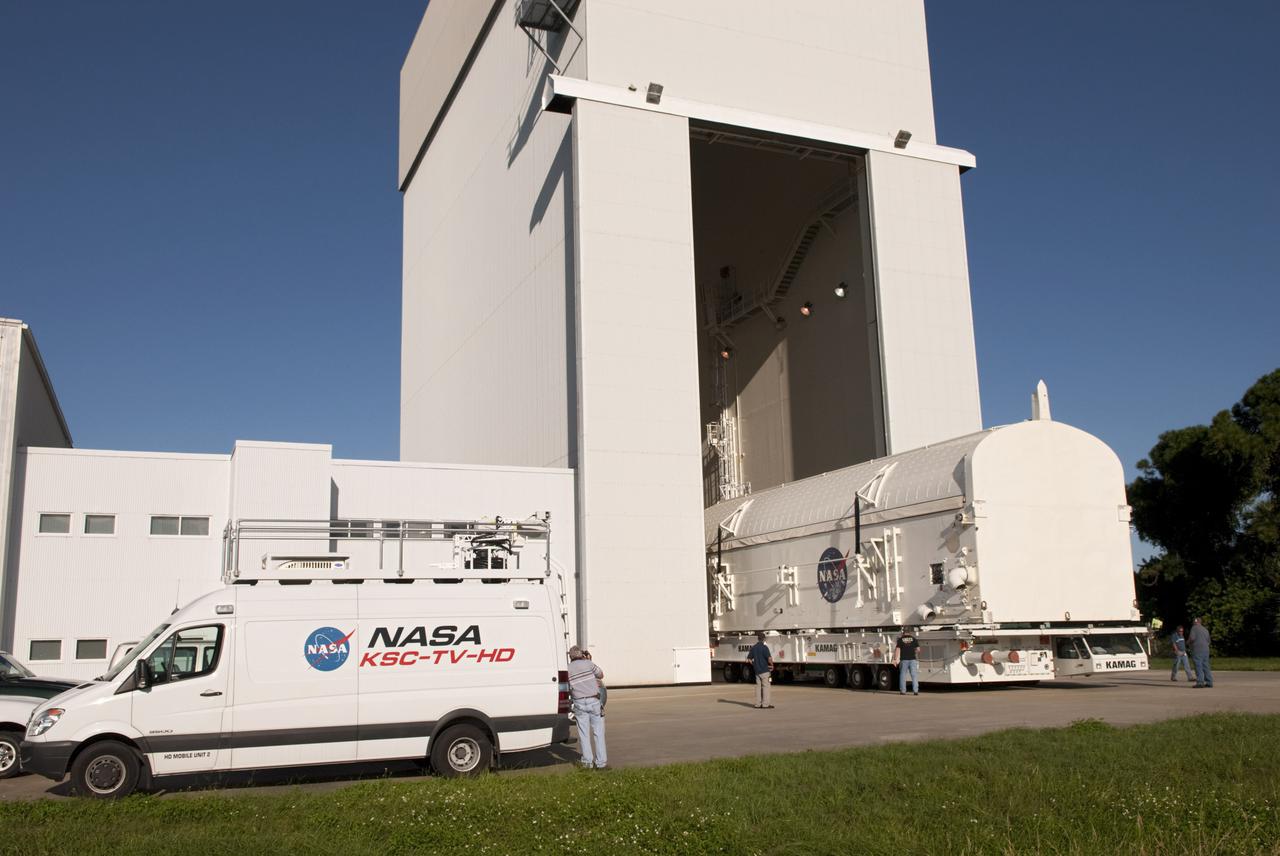
CAPE CANAVERAL, Fla. -- Payload canister #1 rolls out of the high bay of the Canister Rotation Facility at NASA's Kennedy Space Center in Florida on its way to the Reutilization, Recycling and Marketing Facility on Ransom Road. The two payload canisters used to transport space shuttle payloads to the launch pad for installation in the shuttles' cargo bays are being decommissioned following the end of the Space Shuttle Program. Each canister weighs 110,000 pounds and is 65 feet long, 22 feet wide, and 18 feet, 7 inches high. The canisters were prescreened through NASA Headquarters as possible artifacts, but their size makes them difficult to transport to locations off the center. Federal and state agencies now will be given the opportunity to screen the canisters for potential use before a final decision is made on their disposition. For more information, visit http:__www.nasa.gov_centers_kennedy_pdf_167403main_CRF-06.pdf. Photo credit: NASA_Jim Grossmann
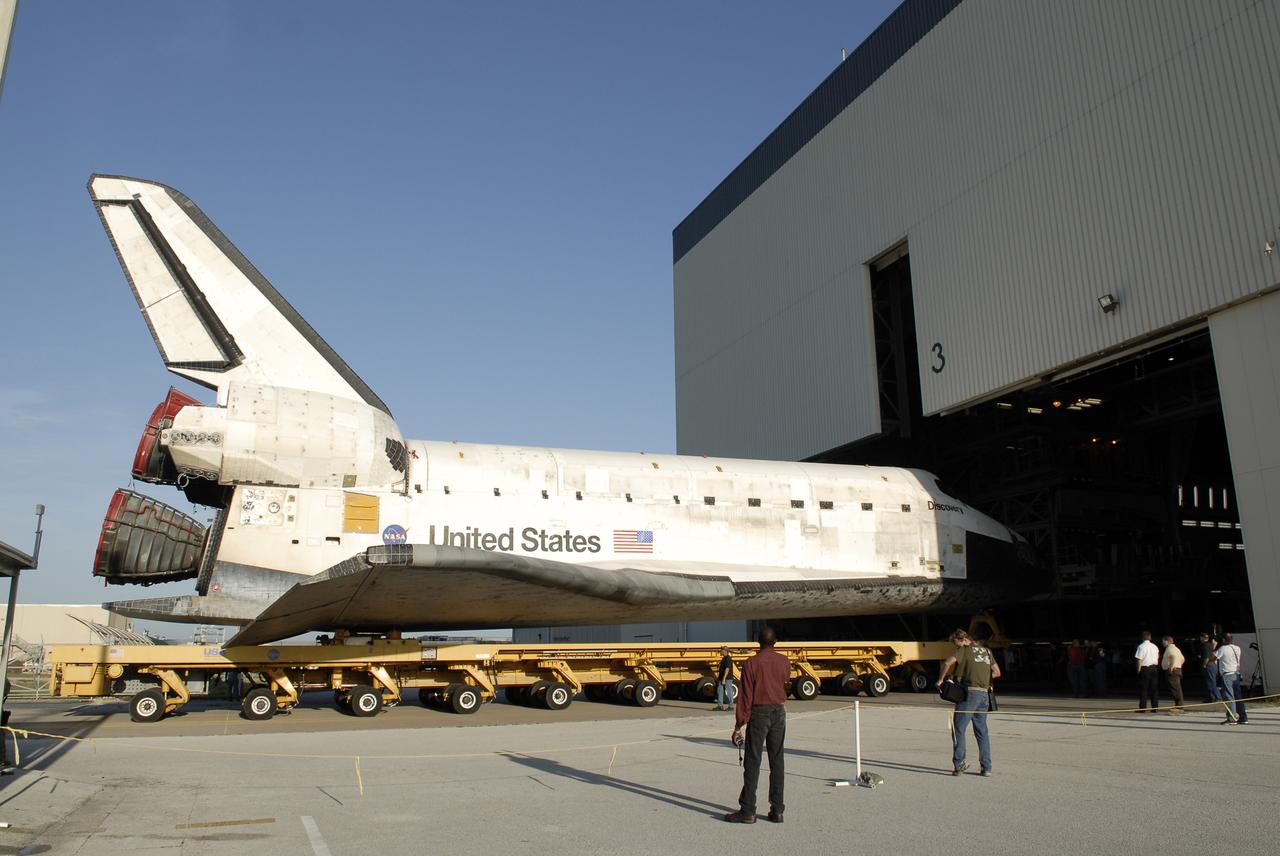
CAPE CANAVERAL, Fla. – Space shuttle Discovery rolls out of Orbiter Processing Facility 3 to the Vehicle Assembly Building at NASA's Kennedy Space Center, Fla. The first motion of the shuttle out of its hangar was at 7:22 a.m. EDT. In the VAB, Discovery will be lifted into High Bay 1 and mated to the external fuel tank and solid rocket boosters already installed on the mobile launcher platform. The shuttle is scheduled to roll out to Launch Pad 39A the first week of August to prepare for the STS-128 mission to the International Space Station. Discovery will carry the Leonardo Multi-Purpose Logistics Module containing life support racks and science racks and the Lightweight Multi-Purpose Experiment Support Structure Carrier in its payload bay. Launch of Discovery is targeted for late August. Photo credit: NASA/Kim Shiflett
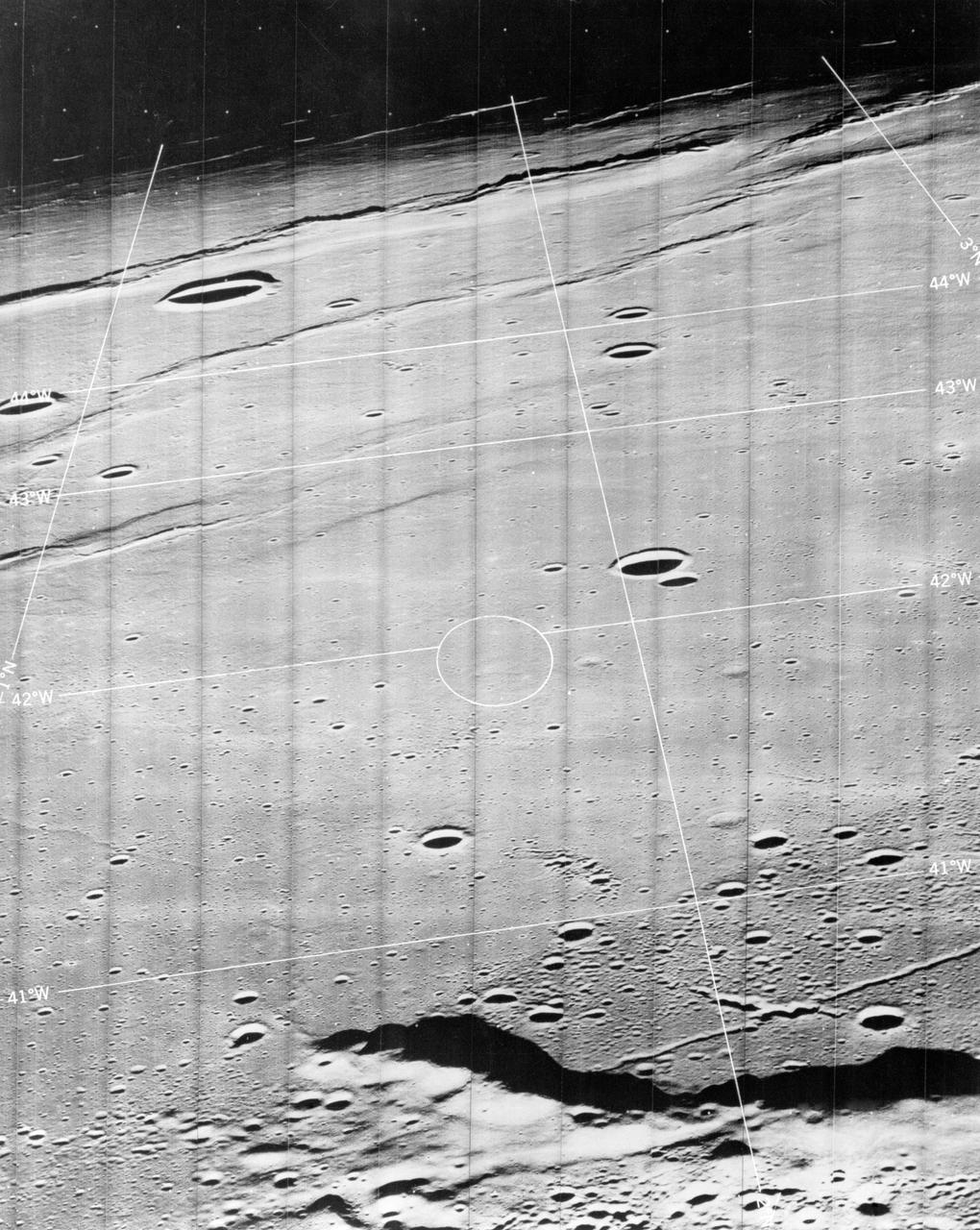
S69-54553 (October 1969) --- If the Apollo 12 launch is postponed until Nov. 16, 1969, the lunar landing will be made in this area in the Sea of Storms. (The prime launch window is Nov. 14, 1969, at 11:22 a.m. (EST), landing at Site 7.) This site (Site 5) is located at 41 degrees 40 minutes west longitude and 1 degree 40 minutes north latitude. This photograph was taken by Lunar Orbiter 3 on Feb. 21, 1967, at an altitude of 32 miles (51.8 kilometers) above the moon. This view is looking west with the sun almost directly behind the spacecraft. These approximates show the landing site as it will look to Apollo astronauts as they approach the site. The actual target site is represented by the ellipse which measures three by five miles. The lines indicate coordinates on the moon near the target site.
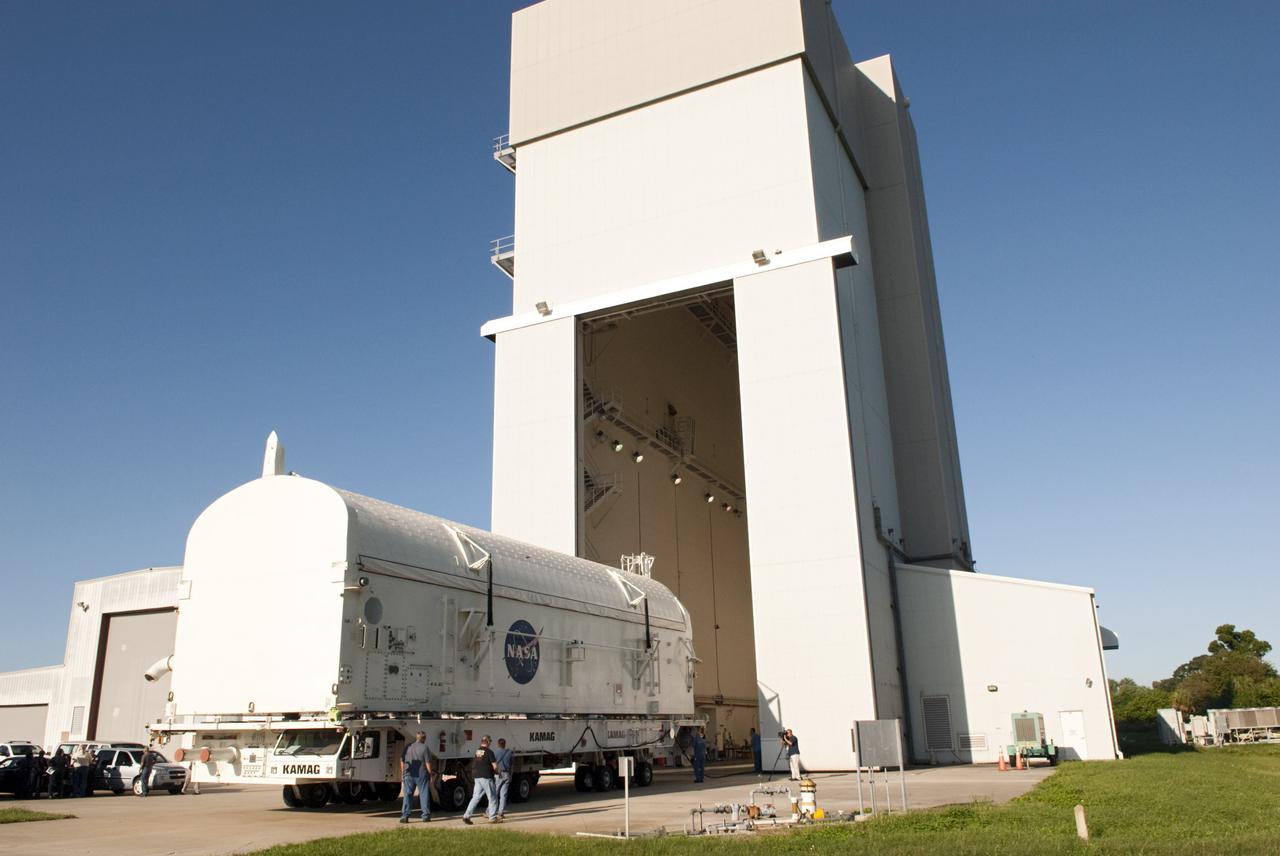
CAPE CANAVERAL, Fla. -- Payload canister #1 departs the high bay of the Canister Rotation Facility at NASA's Kennedy Space Center in Florida for the last time. The canister is being moved to the Reutilization, Recycling and Marketing Facility on Ransom Road. The two payload canisters used to transport space shuttle payloads to the launch pad for installation in the shuttles' cargo bays are being decommissioned following the end of the Space Shuttle Program. Each canister weighs 110,000 pounds and is 65 feet long, 22 feet wide, and 18 feet, 7 inches high. The canisters were prescreened through NASA Headquarters as possible artifacts, but their size makes them difficult to transport to locations off the center. Federal and state agencies now will be given the opportunity to screen the canisters for potential use before a final decision is made on their disposition. For more information, visit http:__www.nasa.gov_centers_kennedy_pdf_167403main_CRF-06.pdf. Photo credit: NASA_Jim Grossmann
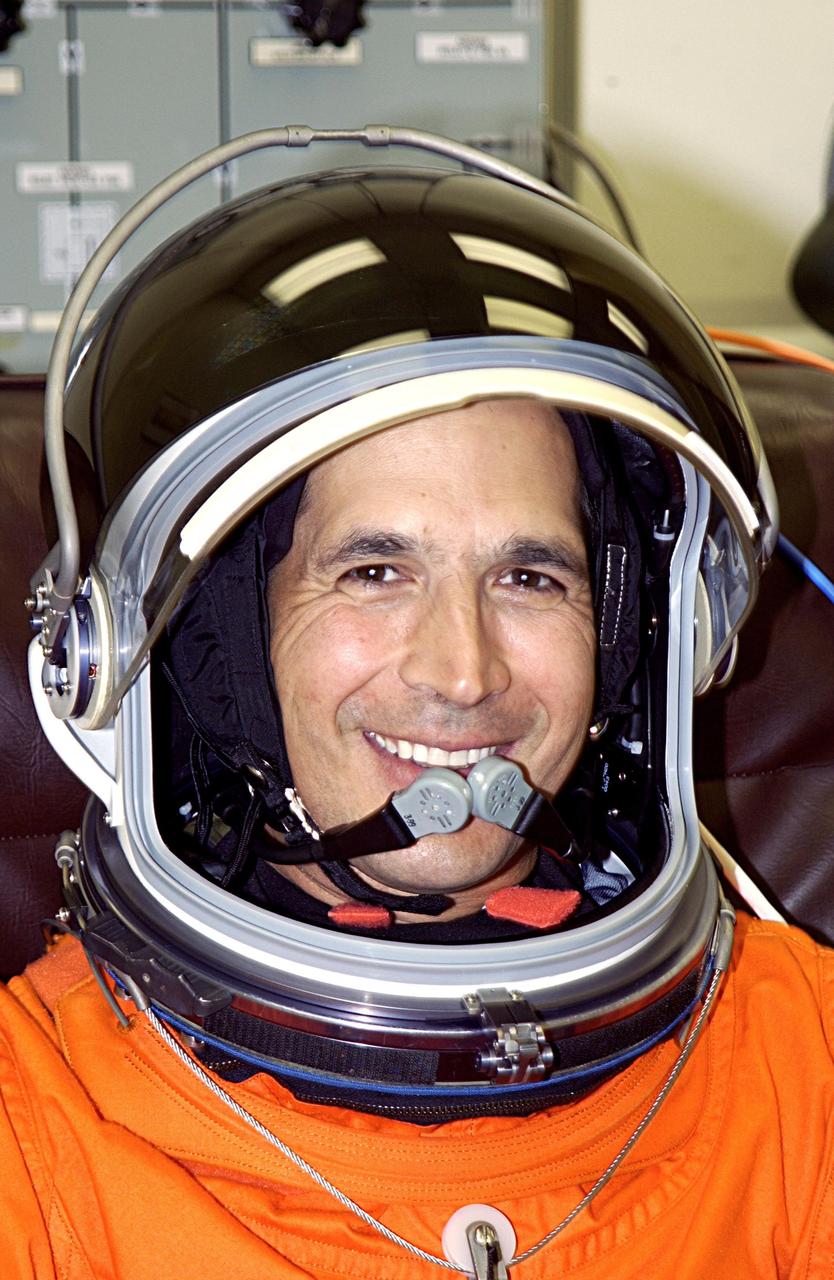
KENNEDY SPACE CENTER, FLA. -- - STS-113 Mission Specialist John Herrington smiles as he finishes suiting up for a second launch attempt on mission STS-113. The launch on Nov. 22 was scrubbed due to poor weather conditions at the Transoceanic Abort Landing sites. Herrington will be making his first Shuttle flight. The launch will carry the Expedition 6 crew to the Station and return the Expedition 5 crew to Earth. The major objective of the mission is delivery of the Port 1 (P1) Integrated Truss Assembly, which will be attached to the port side of the S0 truss. Three spacewalks are planned to install and activate the truss and its associated equipment. Launch of Space Shuttle Endeavour on mission STS-113 is now scheduled for Nov. 23 at 7:50 p.m. EST.
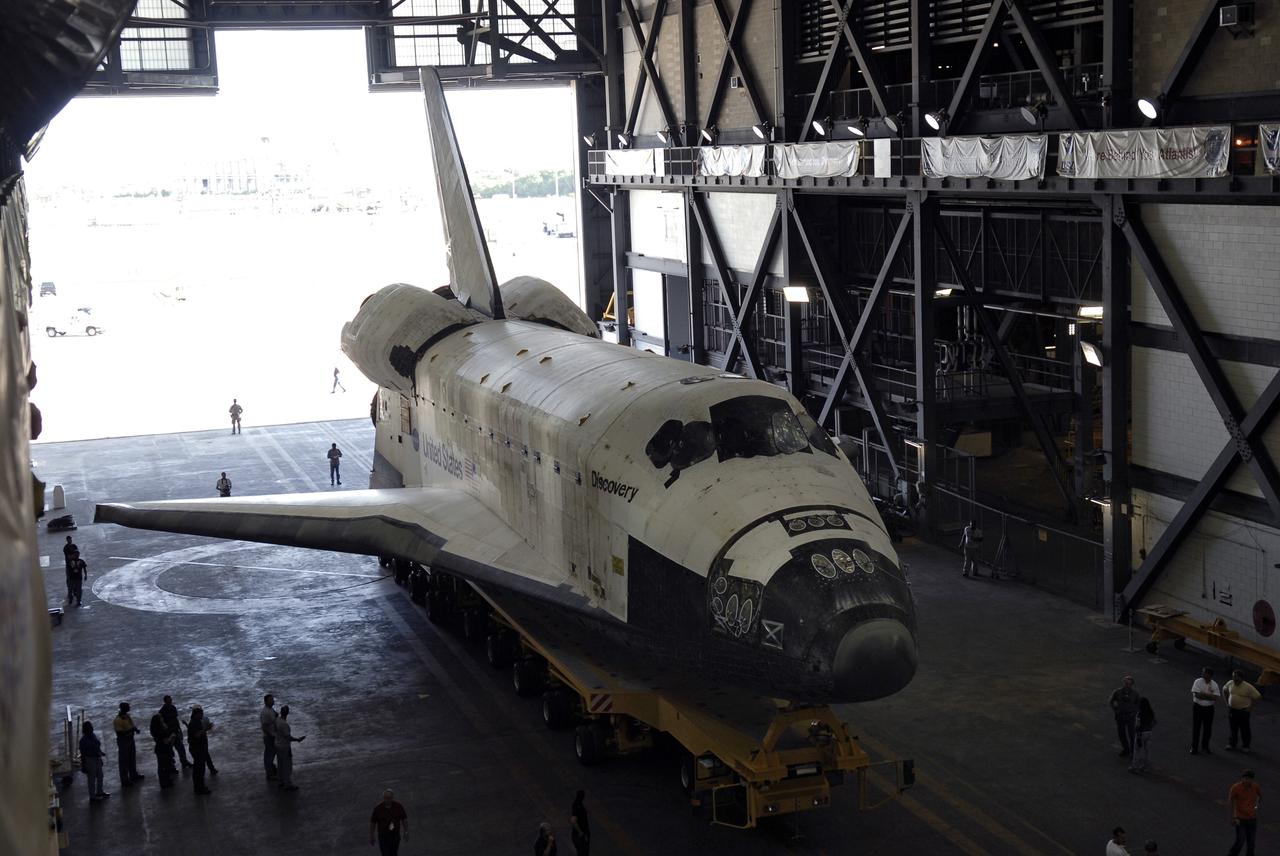
CAPE CANAVERAL, Fla. – Space shuttle Discovery rolls into the Vehicle Assembly Building at NASA's Kennedy Space Center, Fla. The first motion of the shuttle out Orbiter Processing Facility 3 was at 7:22 a.m. EDT. In the VAB, Discovery will be lifted into High Bay 1 and mated to the external fuel tank and solid rocket boosters already installed on the mobile launcher platform. The shuttle is scheduled to roll out to Launch Pad 39A the first week of August to prepare for the STS-128 mission to the International Space Station. Discovery will carry the Leonardo Multi-Purpose Logistics Module containing life support racks and science racks and the Lightweight Multi-Purpose Experiment Support Structure Carrier in its payload bay. Launch of Discovery is targeted for late August. Photo credit: NASA/Kim Shiflett
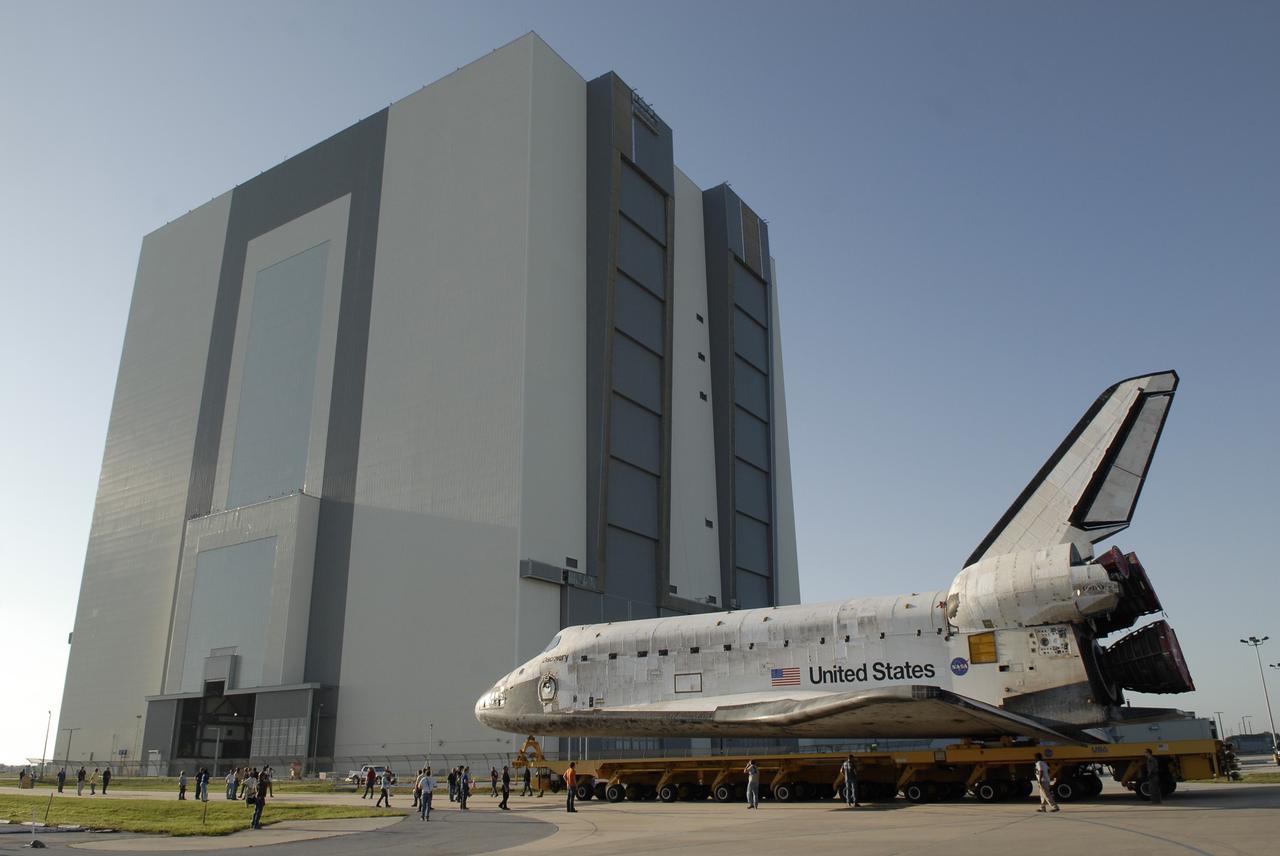
CAPE CANAVERAL, Fla. – Space shuttle Discovery rolls toward the Vehicle Assembly Building (in the background) at NASA's Kennedy Space Center, Fla. The first motion of the shuttle out of Orbiter Processing Facility 3 was at 7:22 a.m. EDT. In the VAB, Discovery will be lifted into High Bay 1 and mated to the external fuel tank and solid rocket boosters already installed on the mobile launcher platform. The shuttle is scheduled to roll out to Launch Pad 39A the first week of August to prepare for the STS-128 mission to the International Space Station. Discovery will carry the Leonardo Multi-Purpose Logistics Module containing life support racks and science racks and the Lightweight Multi-Purpose Experiment Support Structure Carrier in its payload bay. Launch of Discovery is targeted for late August. Photo credit: NASA/Kim Shiflett
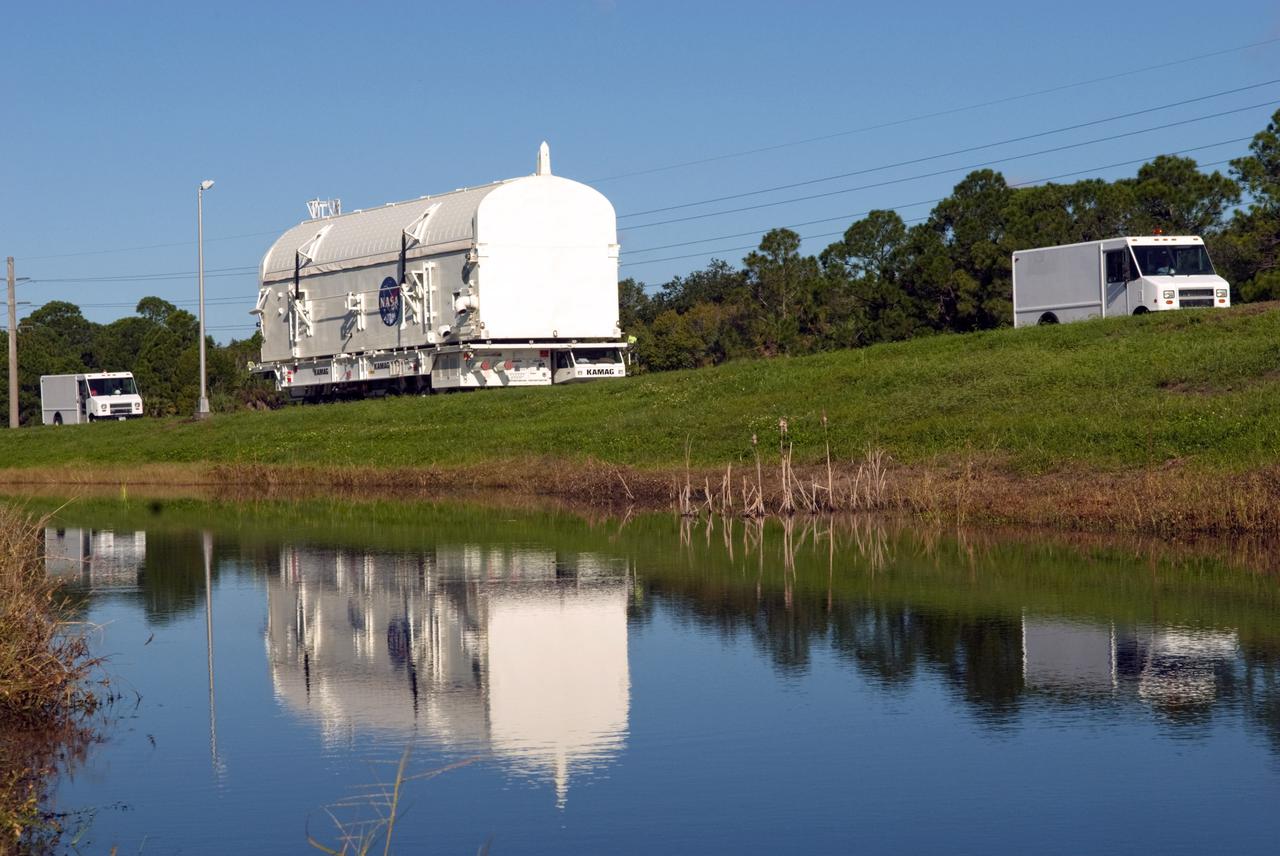
CAPE CANAVERAL, Fla. -- At NASA's Kennedy Space Center in Florida, payload canister #1 is reflected in the water standing beside the roadway leading from the Canister Rotation Facility to the Reutilization, Recycling and Marketing Facility on Ransom Road. The two payload canisters used to transport space shuttle payloads to the launch pad for installation in the shuttles' cargo bays are being decommissioned following the end of the Space Shuttle Program. Each canister weighs 110,000 pounds and is 65 feet long, 22 feet wide, and 18 feet, 7 inches high. The canisters were prescreened through NASA Headquarters as possible artifacts, but their size makes them difficult to transport to locations off the center. Federal and state agencies now will be given the opportunity to screen the canisters for potential use before a final decision is made on their disposition. For more information, visit http:__www.nasa.gov_centers_kennedy_pdf_167403main_CRF-06.pdf. Photo credit: NASA_Jim Grossmann
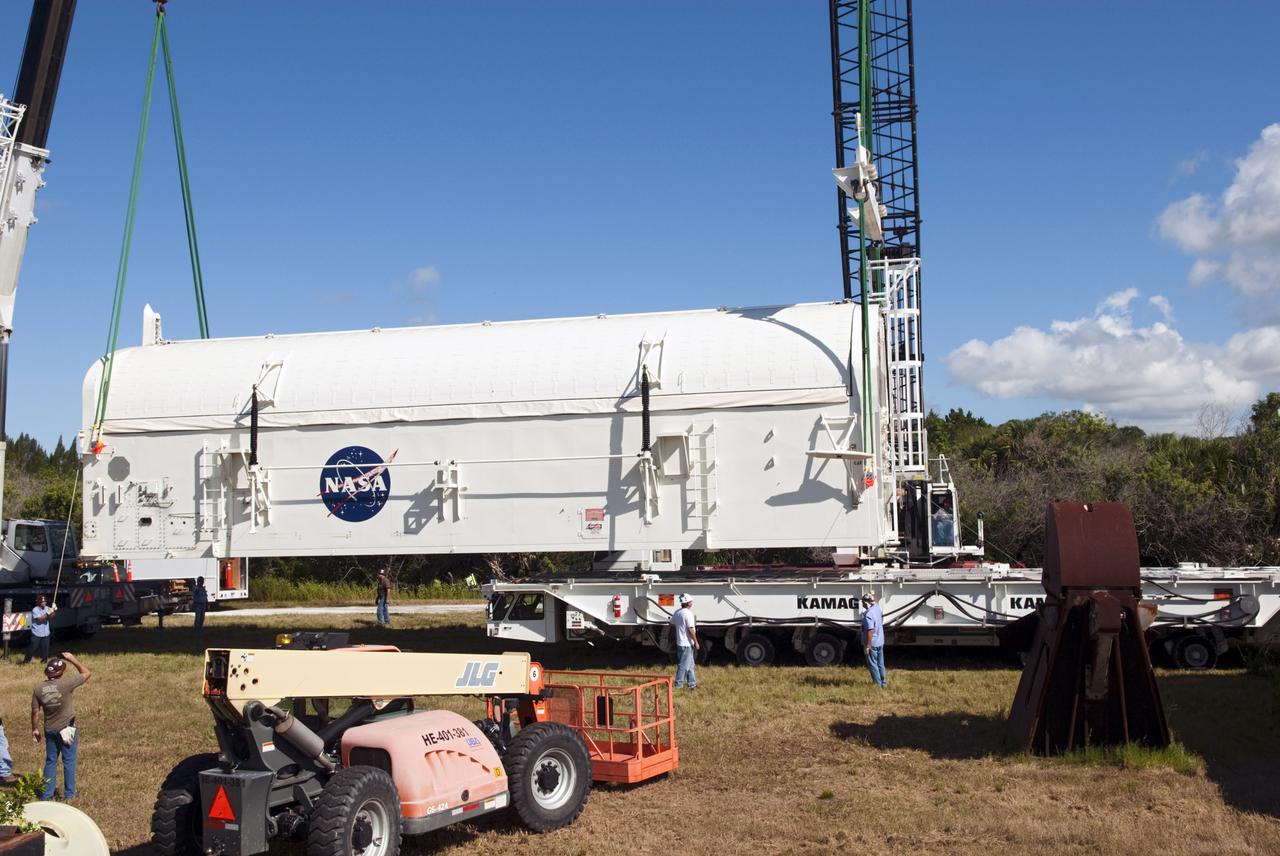
CAPE CANAVERAL, Fla. -- Cranes lift payload canister #1 from the transporter that delivered it to the Reutilization, Recycling and Marketing Facility on Ransom Road at NASA's Kennedy Space Center in Florida. The two payload canisters used to transport space shuttle payloads to the launch pad for installation in the shuttles' cargo bays are being decommissioned following the end of the Space Shuttle Program. Each canister weighs 110,000 pounds and is 65 feet long, 22 feet wide, and 18 feet, 7 inches high. The canisters were prescreened through NASA Headquarters as possible artifacts, but their size makes them difficult to transport to locations off the center. Federal and state agencies now will be given the opportunity to screen the canisters for potential use before a final decision is made on their disposition. For more information, visit http:__www.nasa.gov_centers_kennedy_pdf_167403main_CRF-06.pdf. Photo credit: NASA_Jim Grossmann
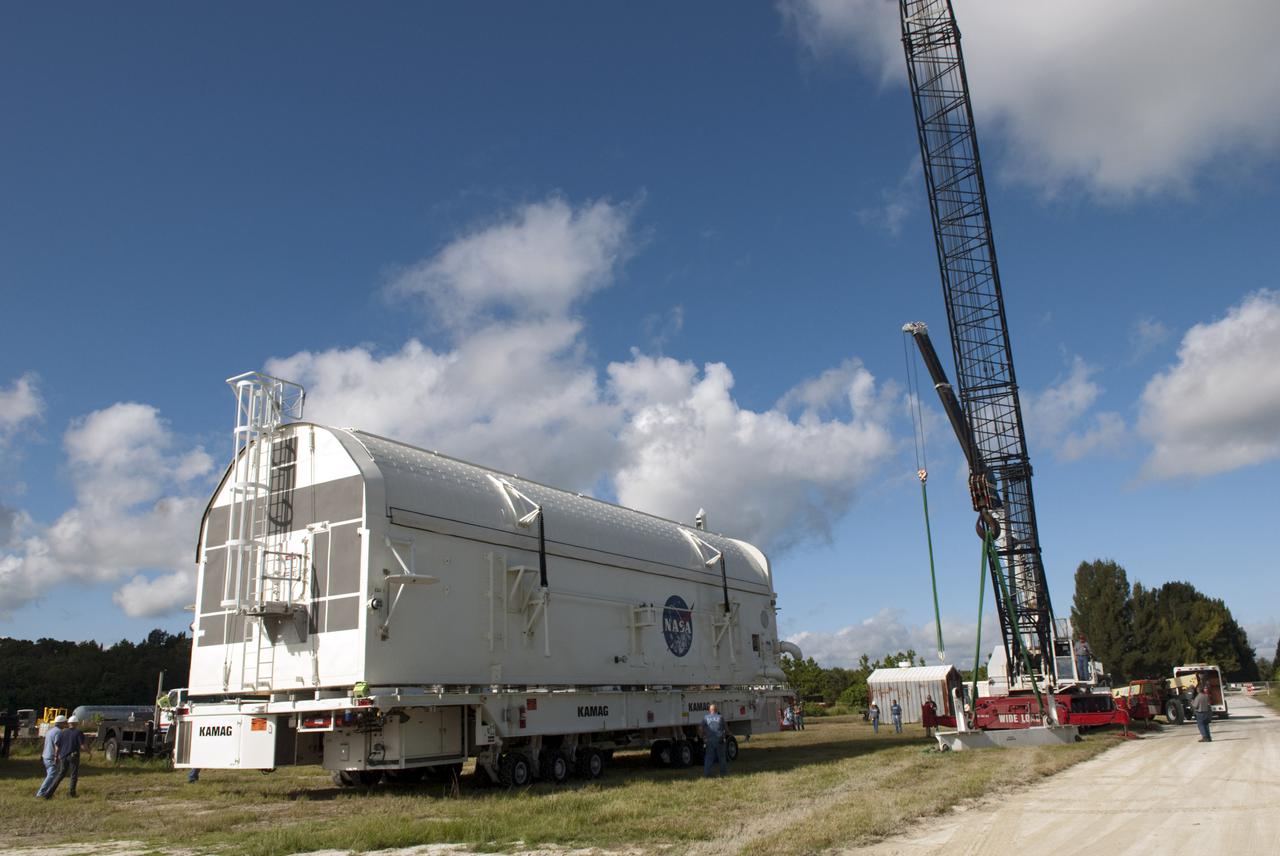
CAPE CANAVERAL, Fla. -- Payload canister #1 arrives outside the Reutilization, Recycling and Marketing Facility on Ransom Road at NASA's Kennedy Space Center in Florida. The two payload canisters used to transport space shuttle payloads to the launch pad for installation in the shuttles' cargo bays are being decommissioned following the end of the Space Shuttle Program. Each canister weighs 110,000 pounds and is 65 feet long, 22 feet wide, and 18 feet, 7 inches high. The canisters were prescreened through NASA Headquarters as possible artifacts, but their size makes them difficult to transport to locations off the center. Federal and state agencies now will be given the opportunity to screen the canisters for potential use before a final decision is made on their disposition. For more information, visit http:__www.nasa.gov_centers_kennedy_pdf_167403main_CRF-06.pdf. Photo credit: NASA_Jim Grossmann