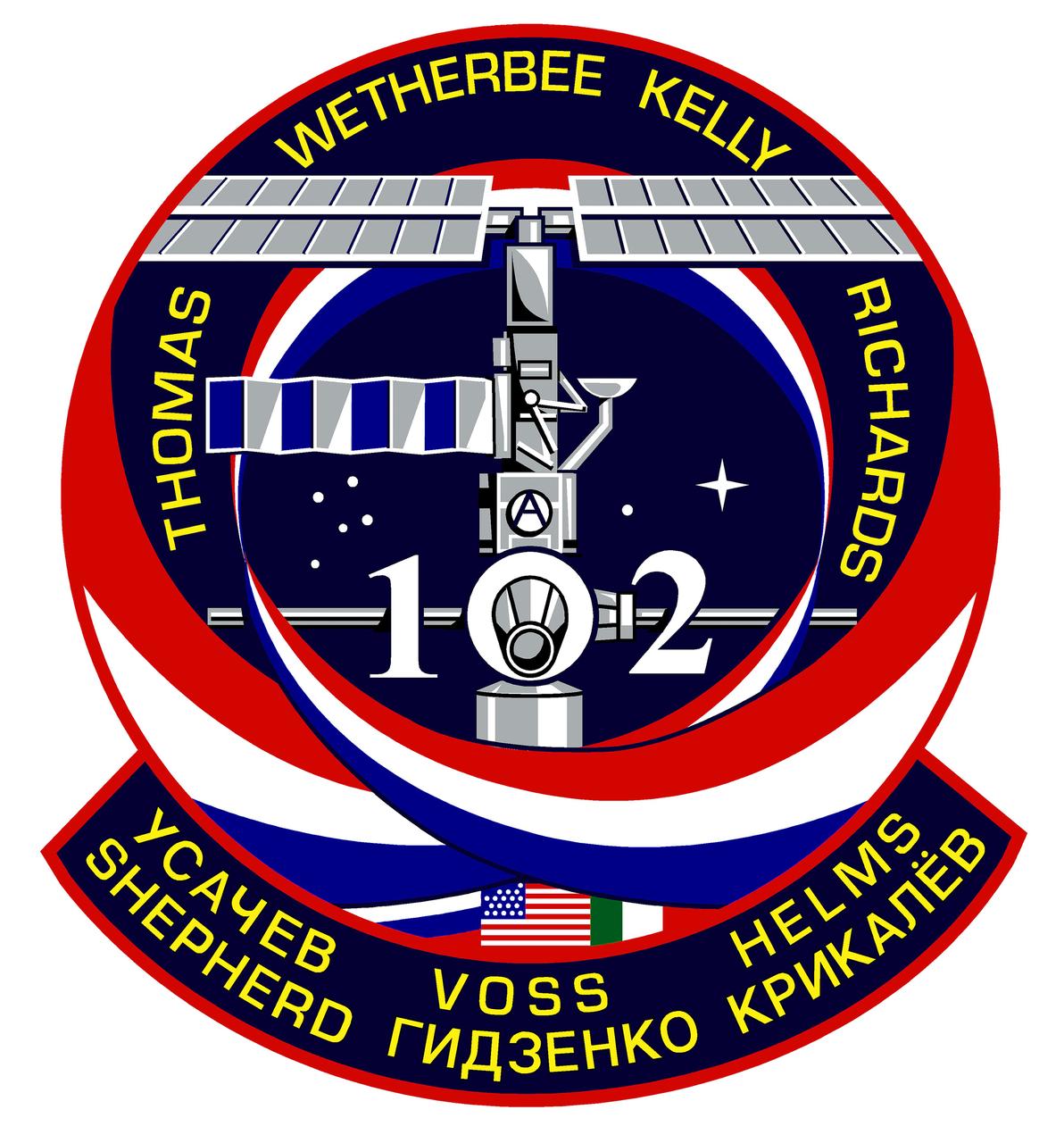
This is the STS-102 mission crew insignia. The central image on the crew patch depicts the International Space Station (ISS) in the build configuration that it had at the time of the arrival and docking of Discovery during the STS-102 mission, the first crew exchange flight to the Space Station. The station is shown along the direction of the flight as was seen by the shuttle crew during their final approach and docking, the so-called V-bar approach. The names of the shuttle crew members are depicted in gold around the top of the patch, and surnames of the Expedition crew members being exchanged are shown in the lower barner. The three ribbons swirling up to and around the station signify the rotation of these ISS crew members. The number 2 is for the Expedition 2 crew who flew up to the station, and the number 1 is for the Expedition 1 crew who then returned down to Earth. In conjunction with the face of the Lab module of the Station, these Expedition numbers create the shuttle mission number 102. Shown mated below the ISS is the Italian-built Multipurpose Logistics Module, Leonardo, that flew for the first time on this flight. The flags of the countries that were the major contributors to this effort, the United States, Russia, and Italy are also shown in the lower part of the patch. The build-sequence number of this flight in the overall station assembly sequence, 5A.1, is captured by the constellations in the background.
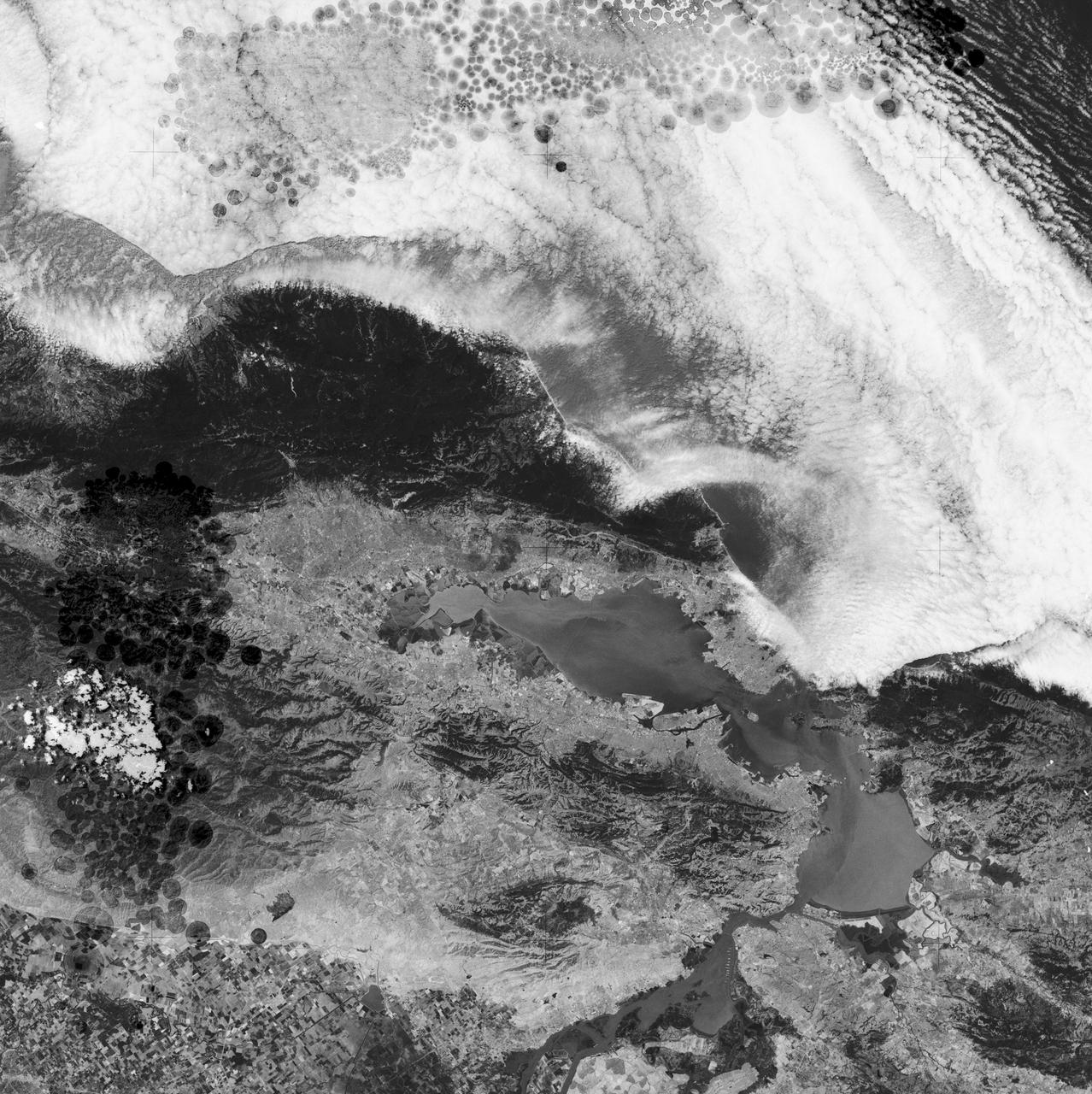
SL2-05-102 (June 1973) --- A black and white photograph of the San Francisco Bay California area, taken from the Skylab 1-2 space station cluster in Earth orbit. THE PICTURE SHOULD BE HELD WITH THE CLOUDS AND PACIFIC OCEAN ON THE LEFT. This photograph was taken by one of six lenses of the Itek-furnished S190-A Multispectral Photographic Facility Experiment in the Multiple Docking Adapter of the space station. Note the thickly populated and highly developed area around the Bay. Among the cities visible in this photograph are San Francisco, Oakland, Berkeley and San Jose. This view extends eastward to show a portion of the San Joaquin Valley. The S190-A experiment is part of the Skylab Earth Resources Experiments Package (EREP). Type SO-022 film was used. This station covered the spectral region from 0.6 to .07 micrometers. Photo credit: NASA
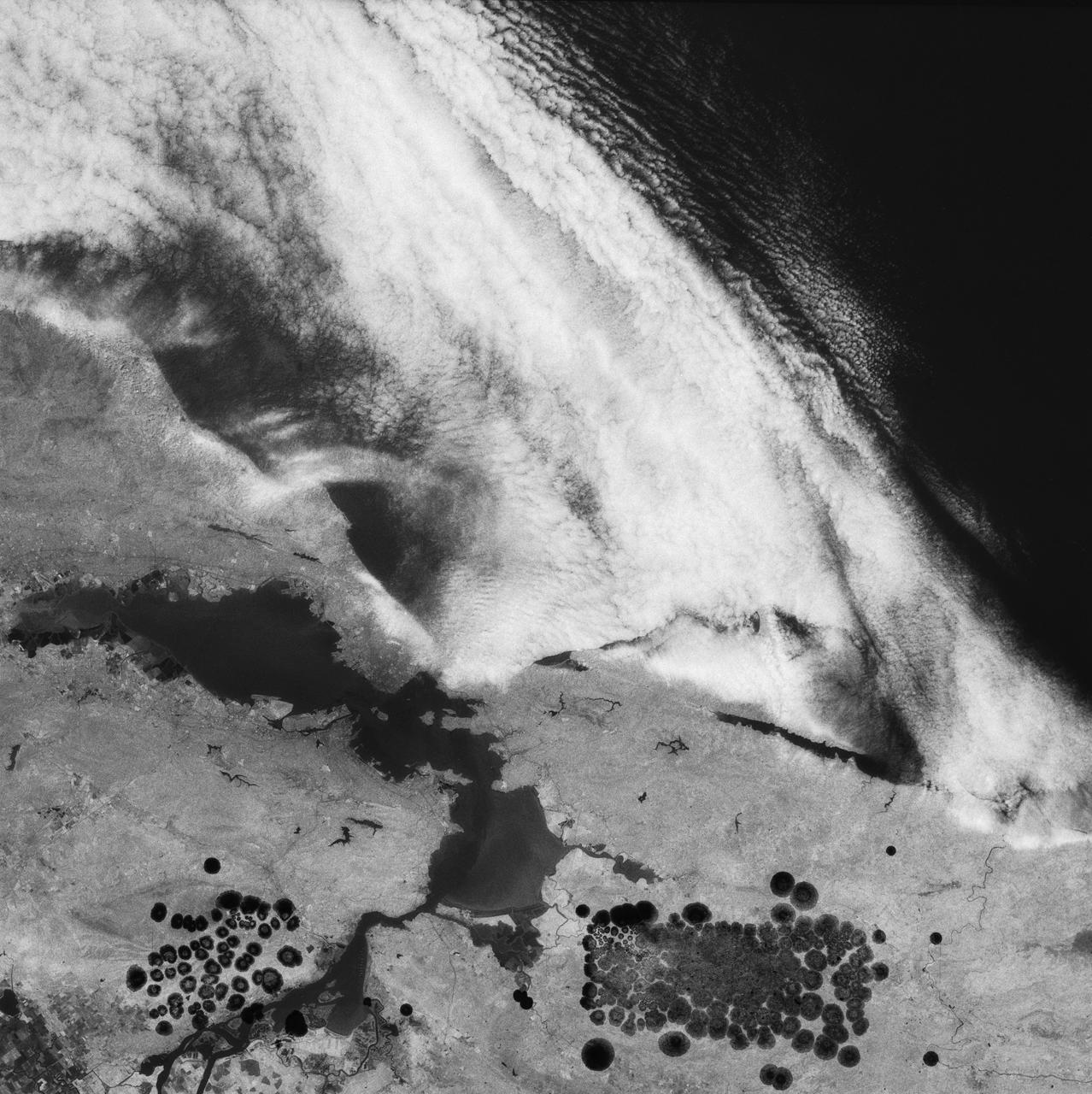
SL2-06-102 (June 1973) --- A black and white photograph of the San Francisco Bay California area, taken from the Skylab 1-2 space station cluster in Earth orbit. THE PICTURE SHOULD BE HELD WITH THE CLOUDS AND PACIFIC OCEAN ON THE LEFT. This photograph was taken by one of six lenses of the Itek-furnished S190-A Multispectral Photographic Facility Experiment in the Multiple Docking Adapter of the space station. Note the thickly populated and highly developed area around the Bay. Among the cities visible in this photograph are San Francisco, Oakland, Berkeley and San Jose. This view extends eastward to show a portion of the San Joaquin Valley. The S190-A experiment is part of the Skylab Earth Resources Experiments Package (EREP). Type SO-022 film was used. This station covered the spectral region from 0.5 to 0.6 micrometers. Photo credit: NASA
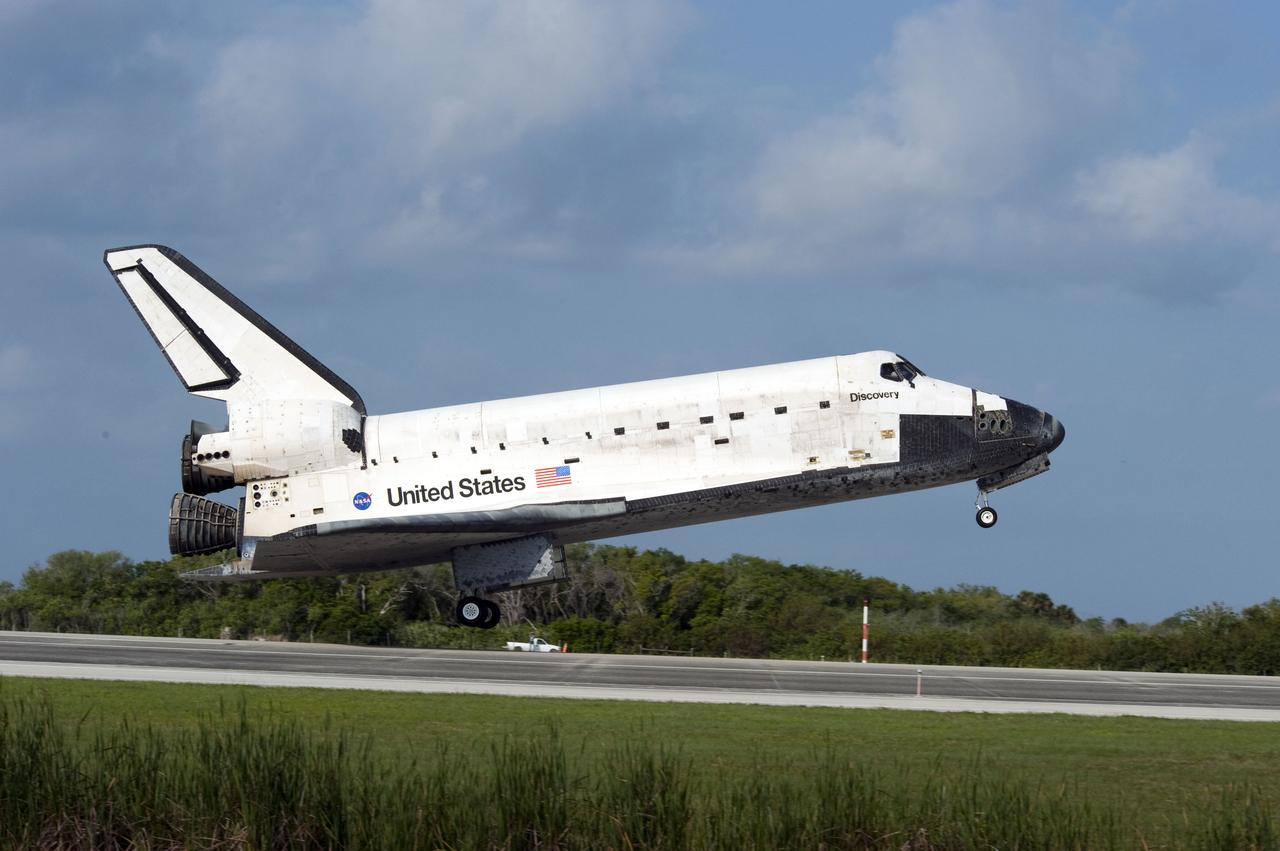
STS131-S-102 (20 April 2010) --- Space shuttle Discovery lands on Runway 33 at the Shuttle Landing Facility at NASA's Kennedy Space Center in Florida at 9:08 a.m. (EDT) on April 20, 2010, completing the 15-day STS-131 mission to the International Space Station. Main gear touchdown was at 9:08:35 a.m. followed by nose gear touchdown at 9:08:47 a.m. and wheels stop at 9:09:33 a.m. Aboard are NASA astronauts Alan Poindexter, commander; James P. Dutton Jr., pilot; Dorothy Metcalf-Lindenburger, Rick Mastracchio, Stephanie Wilson, Clayton Anderson and Japanese astronaut Naoko Yamazaki, all mission specialists. The seven-member STS-131 crew carried the Leonardo Multi-Purpose Logistics Module, filled with supplies, a new crew sleeping quarters and science racks that were transferred to the station's laboratories. The crew also switched out a gyroscope on the station?s truss, installed a spare ammonia storage tank and retrieved a Japanese experiment from the station?s exterior. STS-131 is the 33rd shuttle mission to the station and the 131st shuttle mission overall.
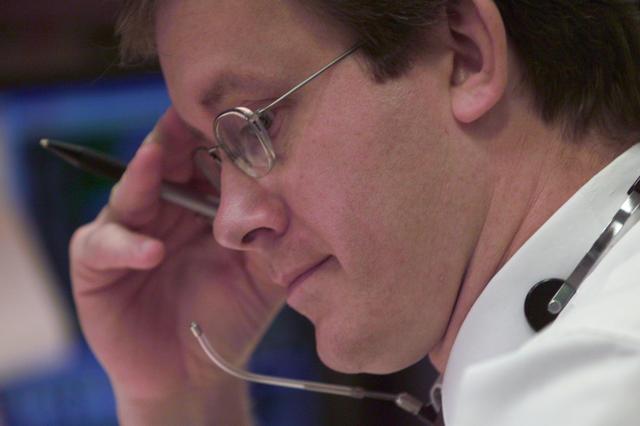
JSC2001-E-06200 (8 March 2001) --- At his console in Houston's Mission Control Center, STS-102 lead flight director John Shannon, studies mission data on STS-102 launch day.
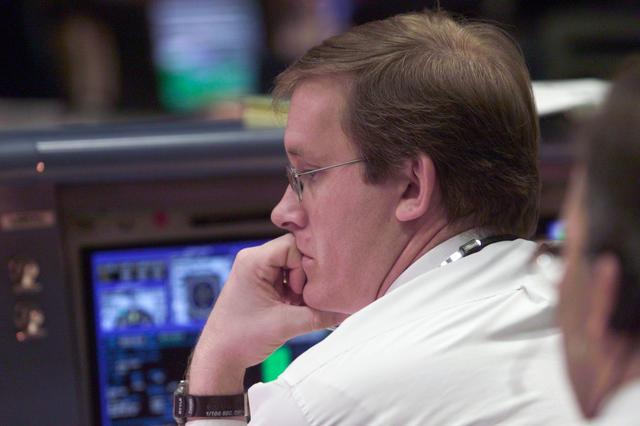
JSC2001-E-06217 (8 March 2001) --- At his console in Houston's Mission Control Center, STS-102 lead flight director John Shannon studies mission data on STS-102 launch day.
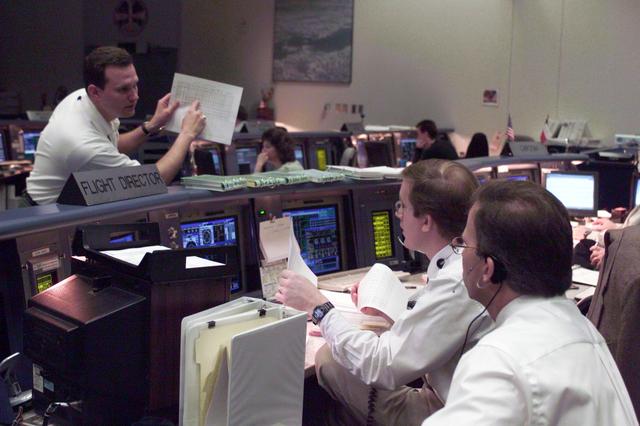
JSC2001-E-06196 (8 March 2001) --- At his console in Houston's Mission Control Center, STS-102 lead flight director John Shannon (center), gathers mission data on STS-102 launch day.
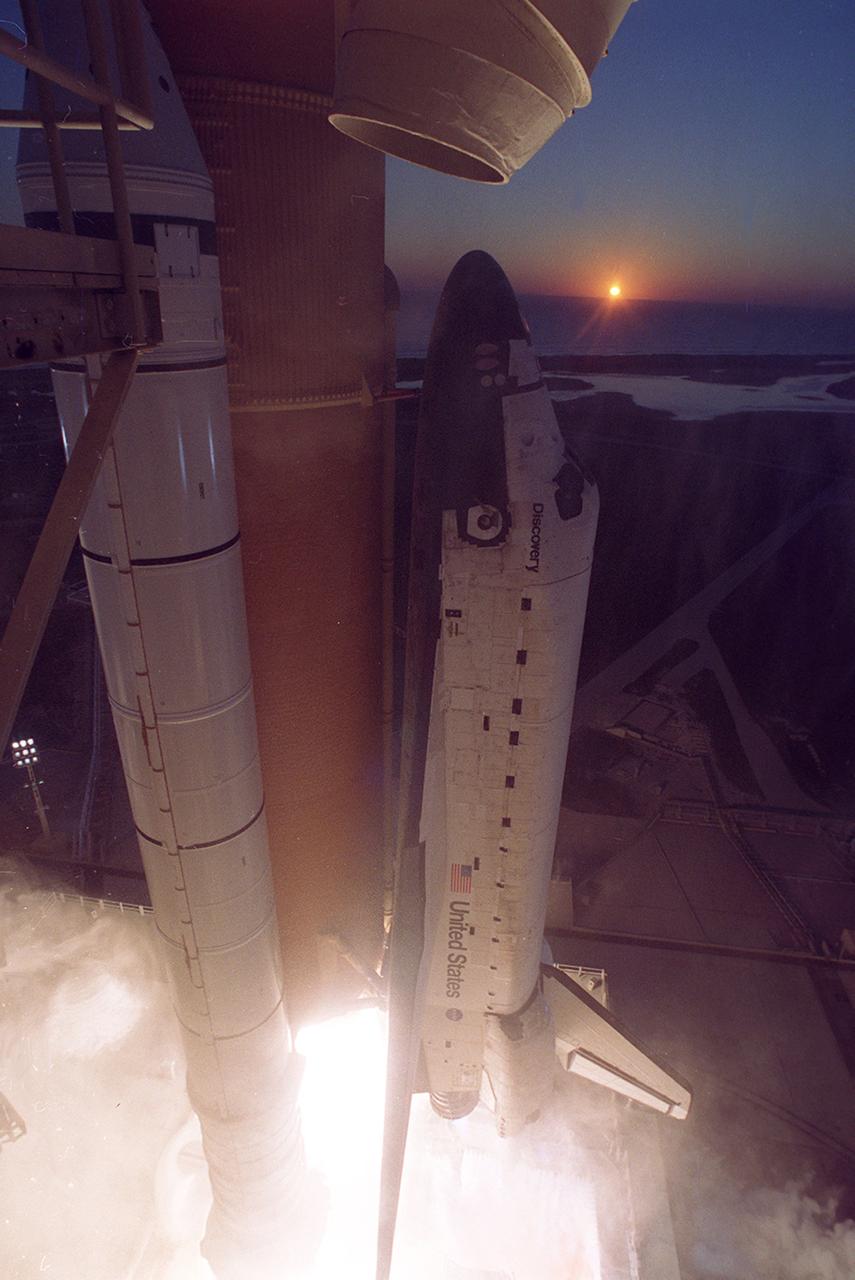
The Space Shuttle Discovery, STS-102 mission, clears launch pad 39B at the Kennedy Space Center as the sun peers over the Atlantic Ocean on March 8, 2001. STS-102's primary cargo was the Leonardo, the Italian Space Agency built Multipurpose Logistics Module (MPLM). The Leonardo MPLM is the first of three such pressurized modules that will serve as the International Space Station's (ISS') moving vans, carrying laboratory racks filled with equipment, experiments, and supplies to and from the Station aboard the Space Shuttle. The cylindrical module is approximately 21-feet long and 15- feet in diameter, weighing almost 4.5 tons. It can carry up to 10 tons of cargo in 16 standard Space Station equipment racks. Of the 16 racks the module can carry, 5 can be furnished with power, data, and fluid to support refrigerators or freezers. In order to function as an attached station module as well as a cargo transport, the logistics module also includes components that provide life support, fire detection and suppression, electrical distribution, and computer functions. NASA's 103rd overall flight and the eighth assembly flight, STS-102 was also the first flight involved with Expedition Crew rotation. The Expedition Two crew was delivered to the station while Expedition One was returned home to Earth.
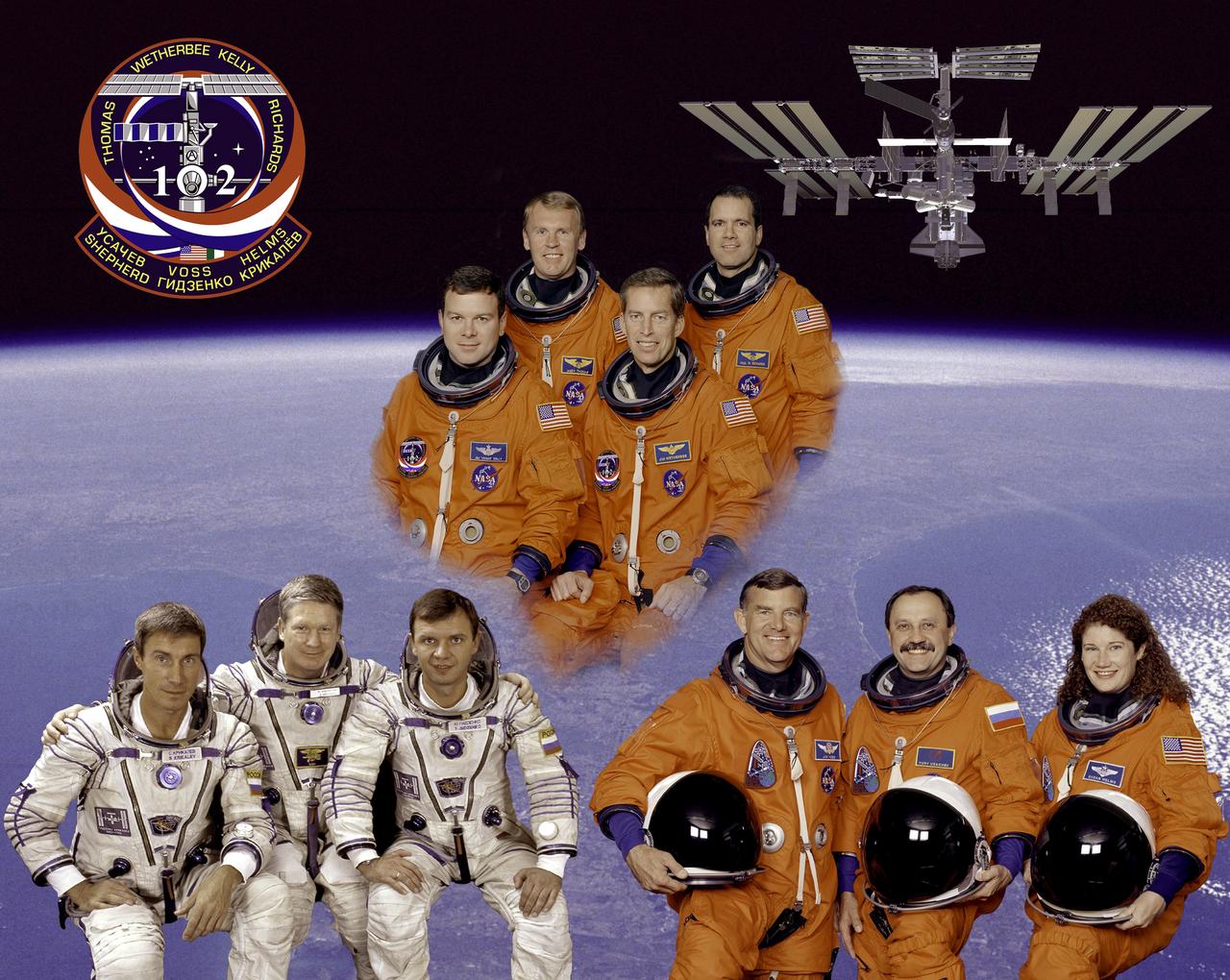
These 10 astronauts and cosmonauts represent the base STS-102 space travelers, as well as the crew members for the station crews switching out turns aboard the outpost. Those astronauts wearing orange represent the STS-102 crew members. In the top photo, from left to right are: James M. Kelly, pilot; Andrew S.W. Thomas, mission specialist; James D. Wetherbee, commander; and Paul W. Richards, mission specialist. The group pictured in the lower right portion of the portrait are STS-members as well as Expedition Two crew members (from left): mission specialist and flight engineer James S. Voss; cosmonaut Yury V. Usachev, Expedition Two Commander; and mission specialist and flight engineer Susan Helms. The lower left inset are the 3 man crew of Expedition One (pictured from left): Cosmonaut Sergei K. Krikalev, flight engineer; astronaut William M. (Bill) Shepherd, commander; and cosmonaut Yuri P. Gidzenko, Soyuz commander. The main objective of the STS-102 mission was the first Expedition Crew rotation and the primary cargo was the Leonardo, the Italian Space Agency-built Multipurpose Logistics Module (MPLM). The Leonardo MPLM is the first of three such pressurized modules that will serve as the International Space Station's (ISS') moving vans, carrying laboratory racks filled with equipment, experiments, and supplies to and from the Station aboard the Space Shuttle. NASA's 103rd overall mission and the 8th Space Station Assembly Flight, STS-102 mission launched on March 8, 2001 aboard the Space Shuttle Orbiter Discovery.
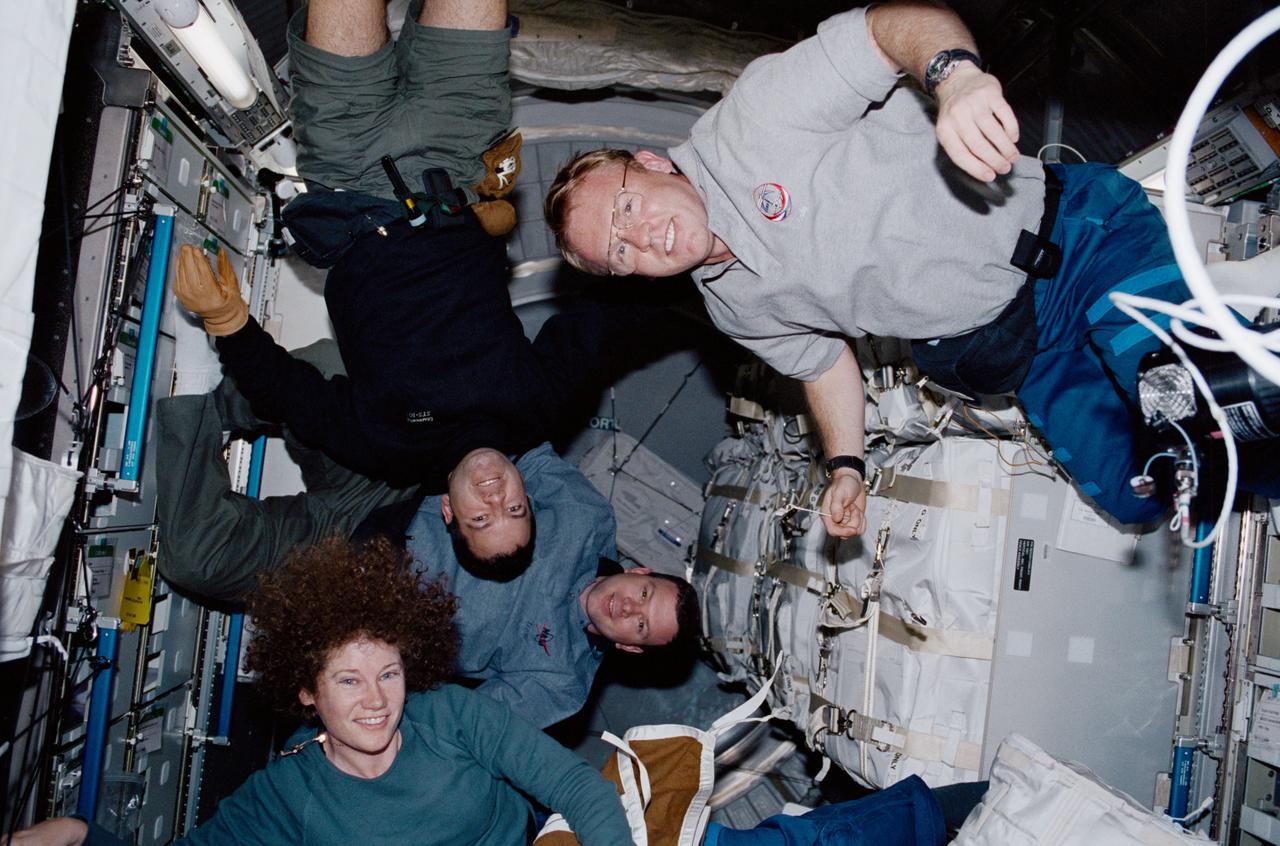
STS102-346-035 (8 - 21 March 2001) --- Four STS-102 crew members participate in the movement of supplies inside Leonardo, the Italian Space Agency-built Multipurpose Logistics Module (MPLM). Clockwise from lower left are astronauts Susan J. Helms, STS-102 mission specialist and Expedition Two flight engineer; James M. Kelly, STS-102 pilot; and Paul W. Richards and Andrew S.W. Thomas, both STS-102 mission specialists.
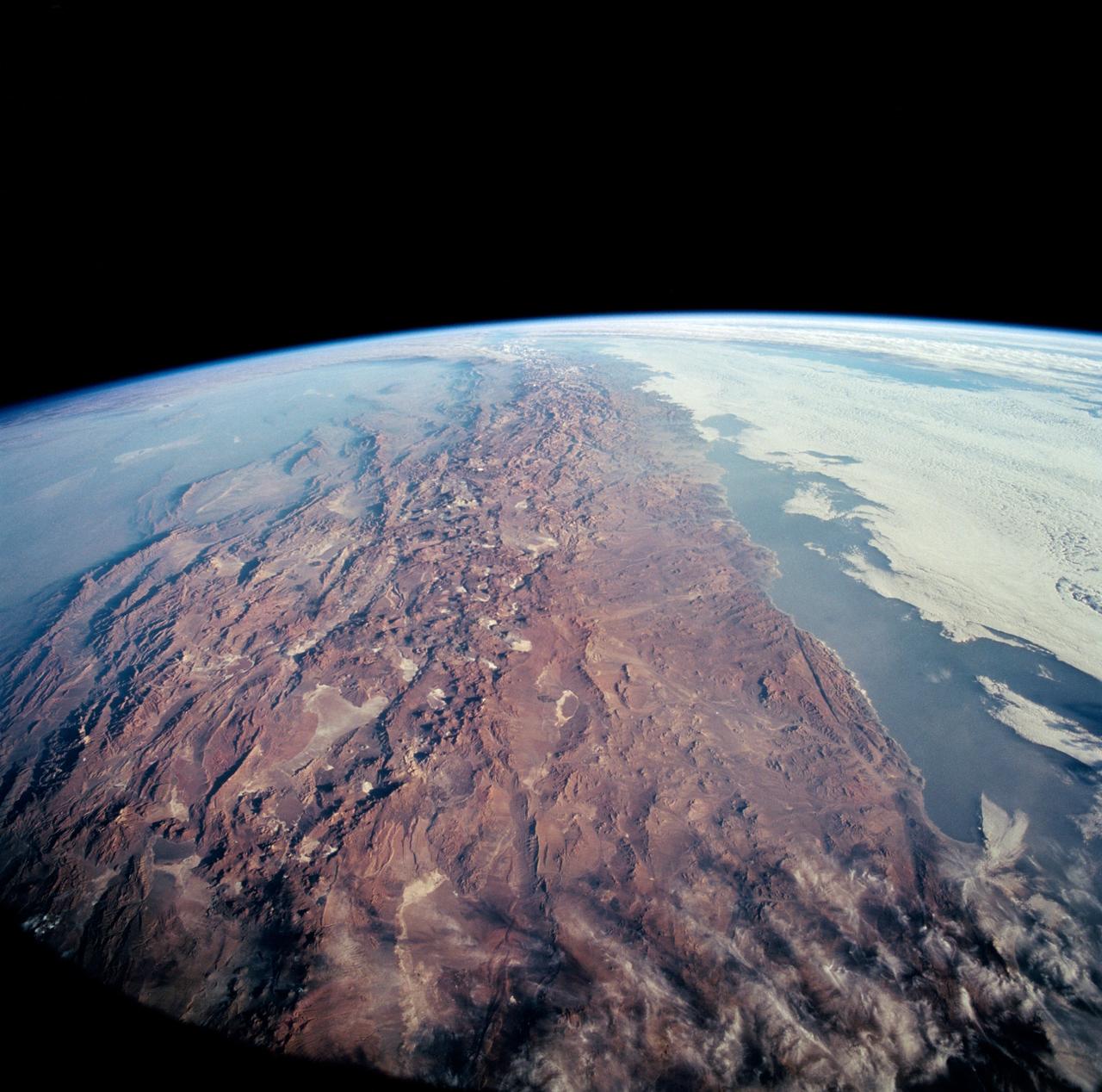
STS-65 Earth observation taken aboard Columbia, Orbiter Vehicle (OV) 102, shows Northern Chile and the Andes Mountains. This color photograph is a panoramic (southern view) that features Chile and the Andes Mountains of South America. The Atacama Desert, one of the driest regions on Earth, is clearly visible along the Chilean coast. In the near left foreground is the Salar de Arizaro. Salar Punta Negra in the center foreground appears to be partially filled with water. On the right side of the view, a coastal plateau rises from the Pacific Ocean and meets the Andes Mountains that appear as a backbone running north to south along the border of Chile and Argentina. In the distant left portion of the view can be seen the hazy Chaco Plains and Pampas.
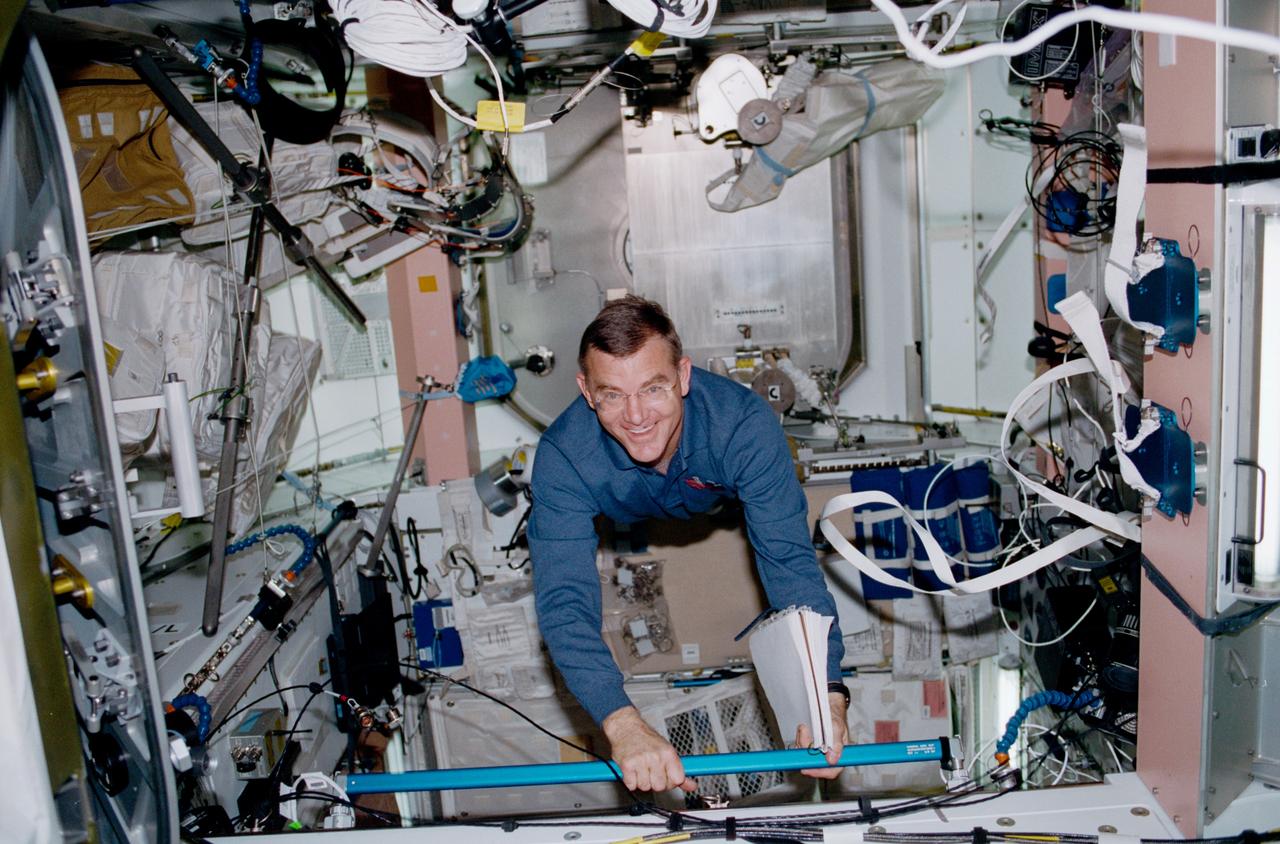
STS102-319-001 (8-21 March 2001)--- Astronaut James S. Voss, Expedition Two flight engineer, is photographed in the U.S.-built Unity node on the International Space Station (ISS) during the STS-102 mission.
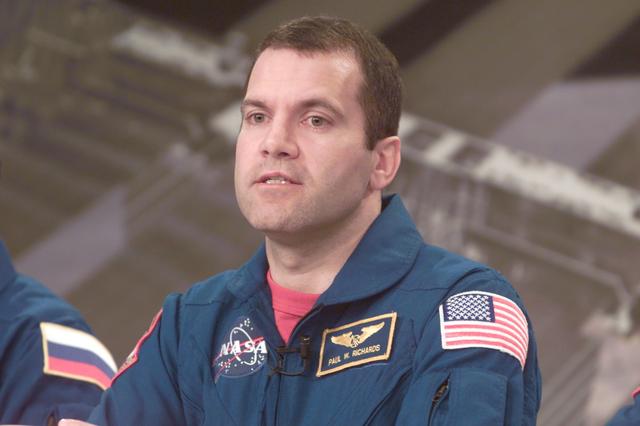
JSC2001-E-05533 (28 February 2001) --- Astronaut Paul W. Richards, STS-102 mission specialist, responds to a news media representative's question during a press briefing at the Johnson Space Center (JSC).
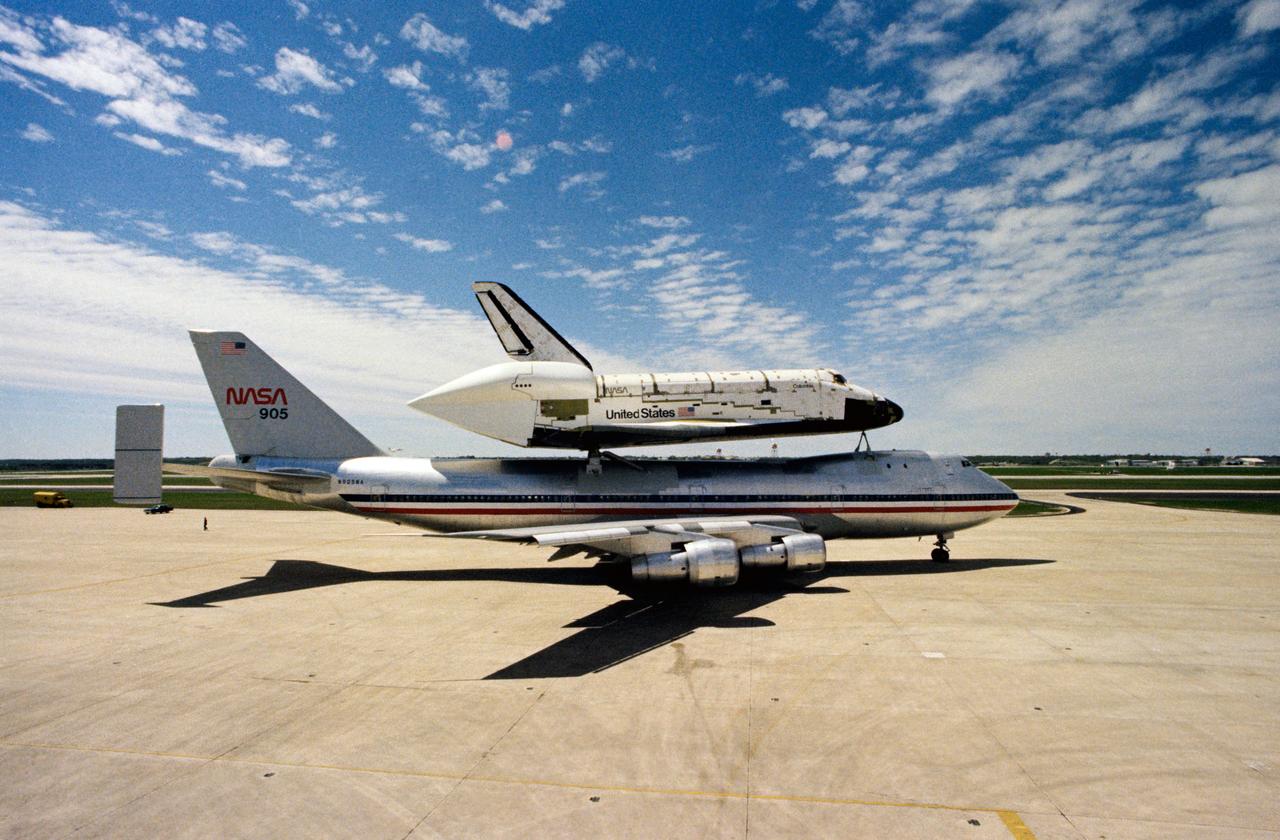
S79-30103 (23 March 1978) --- A side view of the huge space shuttle orbiter 102 Columbia mated atop its 747 carrier aircraft--NASA 905?in ?piggyback? mode, ready for takeoff from Kelly Air Force Base. Kelly AFB was one of the scheduled stops enroute to the Kennedy Space Center from the Dryden Flight Research Center in southern California. The ferry flight covered about 2,400 miles. Columbia reached Dryden Flight Research Center from its Palmdale manufacturing facility, some 35 miles away, via powerful transport vehicle. At DFRC, the Columbia and 747 were mated for the flight to Florida. Orbiter 102 will be the first shuttle vehicle in space when the orbital flight test (OFT) series begins next year. Photo credit: NASA
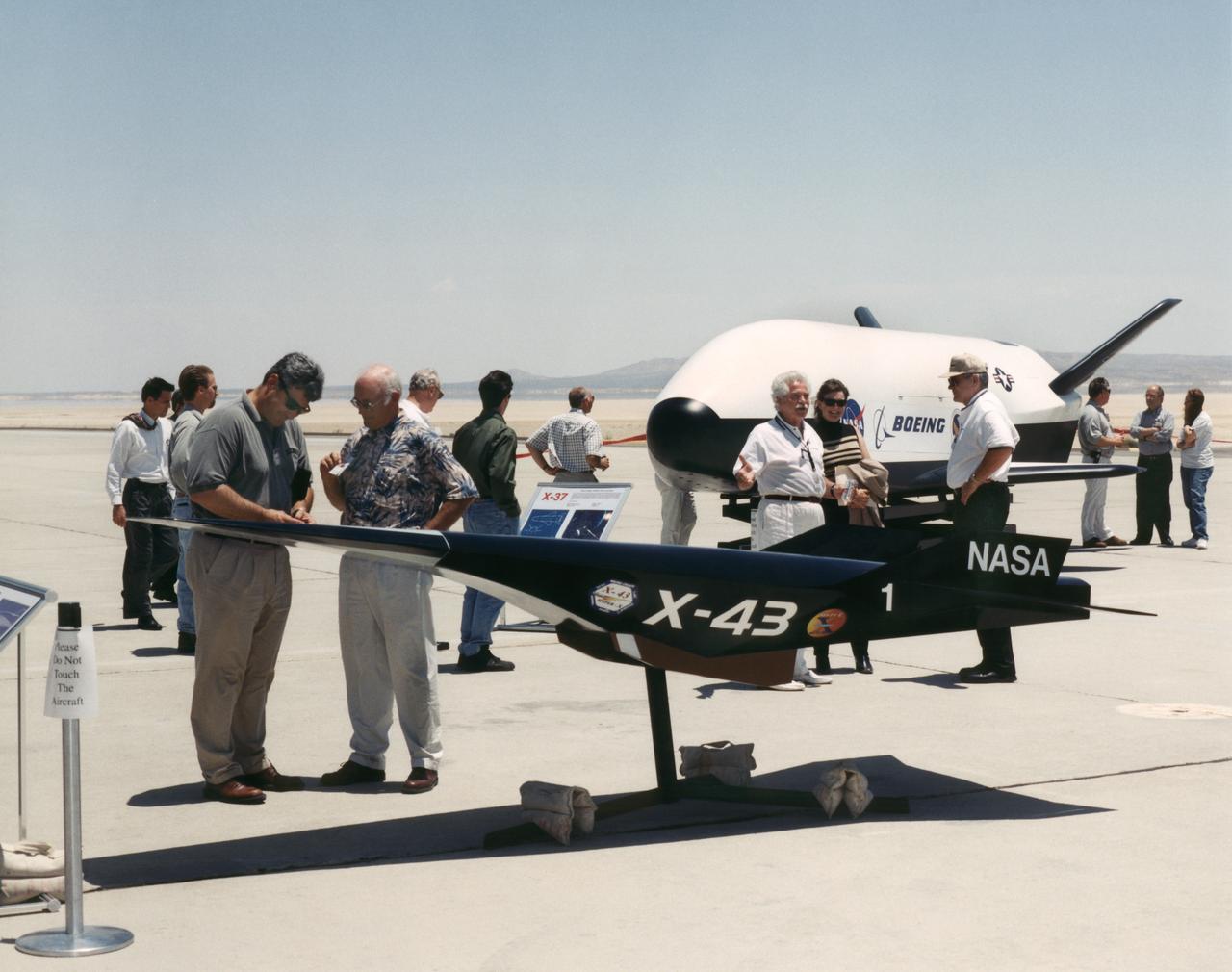
Aerospace industry representatives view actual and mock-up versions of 'X-Planes' intended to enhance access to space during a technical exposition on June 22, 2000 at Dryden Flight Research Center, Edwards, California. From left to right: NASA's B-52 launch aircraft, in service with NASA since 1959; a neutral-buoyancy model of the Boeing's X-37; the Boeing X-40A behind the MicroCraft X-43 mock-up; Orbital Science's X-34 and the modified Lockheed L-1011 airliner that was intended to launch the X-34. These X-vehicles are part of NASA's Access to Space plan intended to bring new technologies to bear in an effort to dramatically lower the cost of putting payloads in space, and near-space environments. The June 22, 2000 NASA Reusable Launch Vehicle (RLV) Technology Exposition included presentations on the history, present, and future of NASA's RLV program. Special Sessions for industry representatives highlighted the X-37 project and its related technologies. The X-37 project is managed by NASA's Marshall Space Flight Center, Huntsville, Alabama.
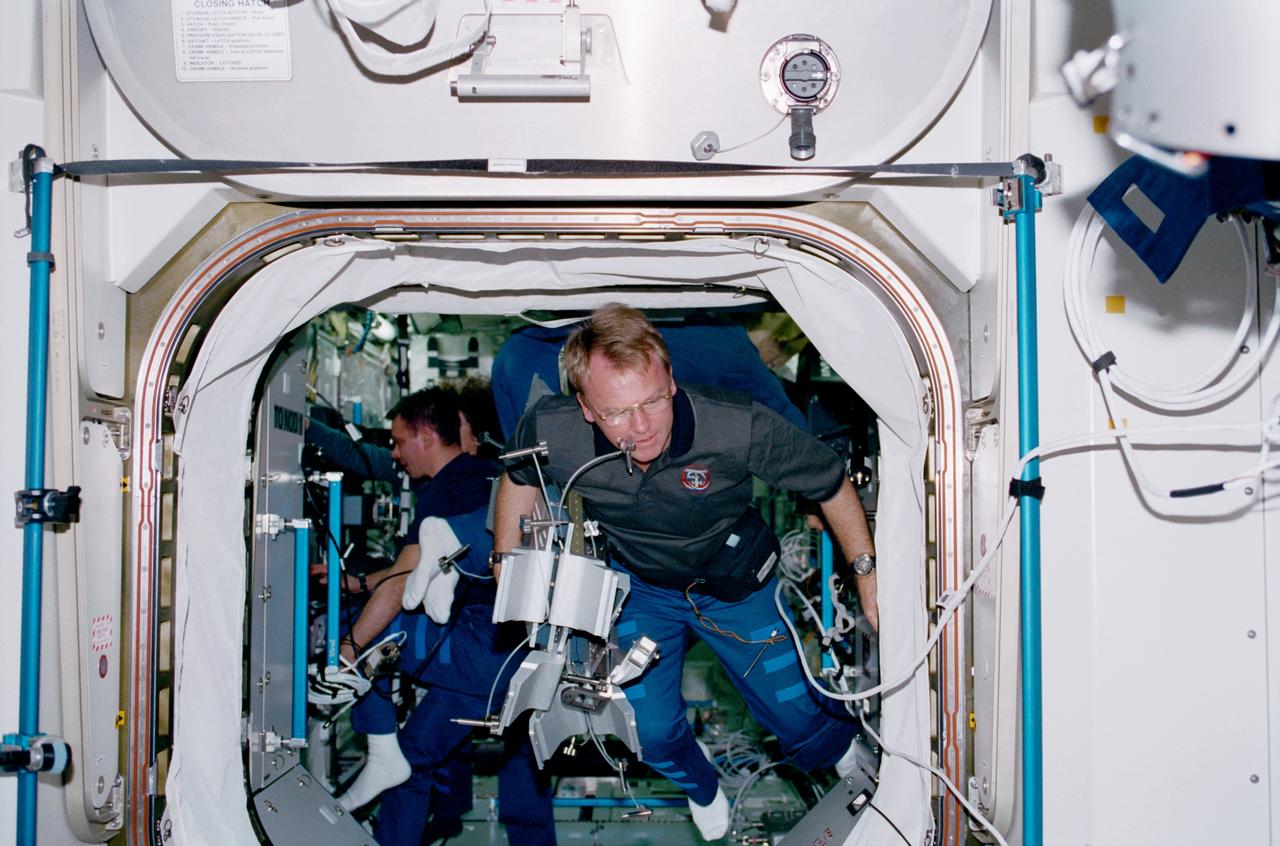
STS102-319-010 (8 - 21 March 2001) --- Astronaut Andrew S.W. Thomas, STS-102 mission specialist, floats near the hatchway for the Destiny laboratory. Cosmonaut Yuri P. Gidzenko, a member of the Expedition One crew, can be seen in the background.
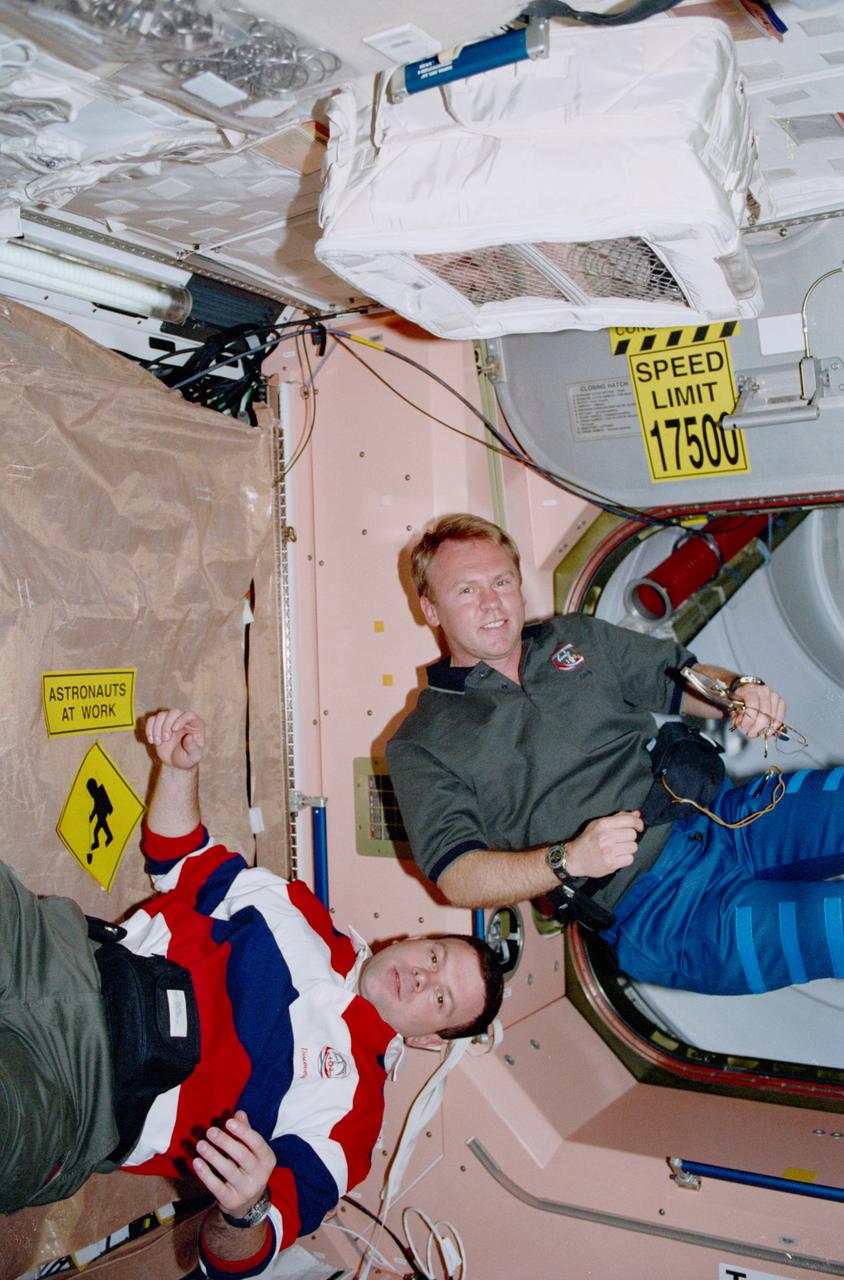
STS102-319-005 (8-21 March 2001) --- Astronauts Andrew S. W. Thomas, mission specialist and James M. Kelly, pilot, are photographed in the U.S.-built Unity node of the International Space Station during the STS-102 mission.
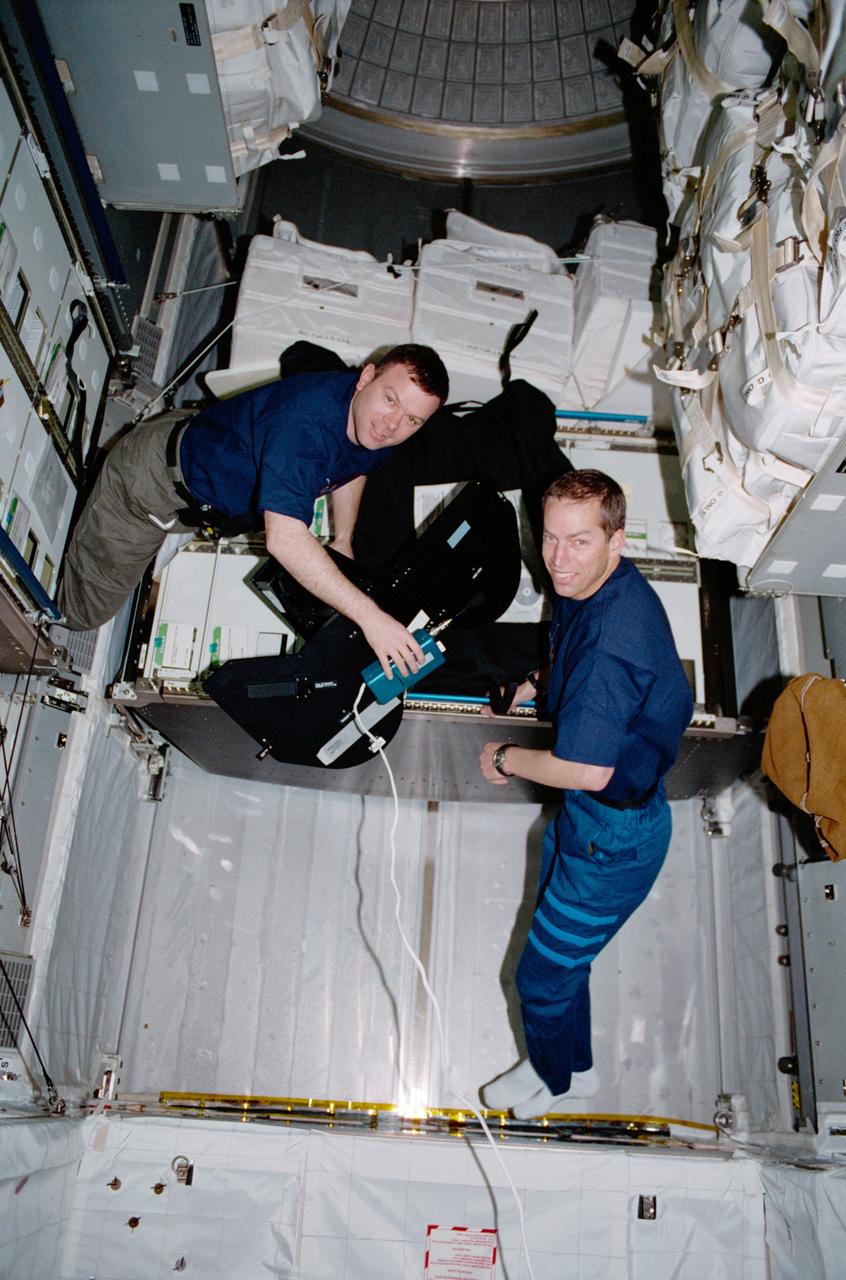
Pilot James M. Kelly (left) and Commander James D. Wetherbee for the STS-102 mission, participate in the movement of supplies inside Leonardo, the Italian Space Agency built Multipurpose Logistics Module (MPLM). In this particular photograph, the two are handling a film magazine for the IMAX cargo bay camera. The primary cargo of the STS-102 mission, the Leonardo MPLM is the first of three such pressurized modules that will serve as the International Space Station's (ISS') moving vans, carrying laboratory racks filled with equipment, experiments, and supplies to and from the Station aboard the Space Shuttle. The cylindrical module is approximately 21-feet long and 15- feet in diameter, weighing almost 4.5 tons. It can carry up to 10 tons of cargo in 16 standard Space Station equipment racks. Of the 16 racks the module can carry, 5 can be furnished with power, data, and fluid to support refrigerators or freezers. In order to function as an attached station module as well as a cargo transport, the logistics module also includes components that provide life support, fire detection and suppression, electrical distribution, and computer functions. The eighth station assembly flight, the STS-102 mission also served as a crew rotation flight. It delivered the Expedition Two crew to the Station and returned the Expedition One crew back to Earth.
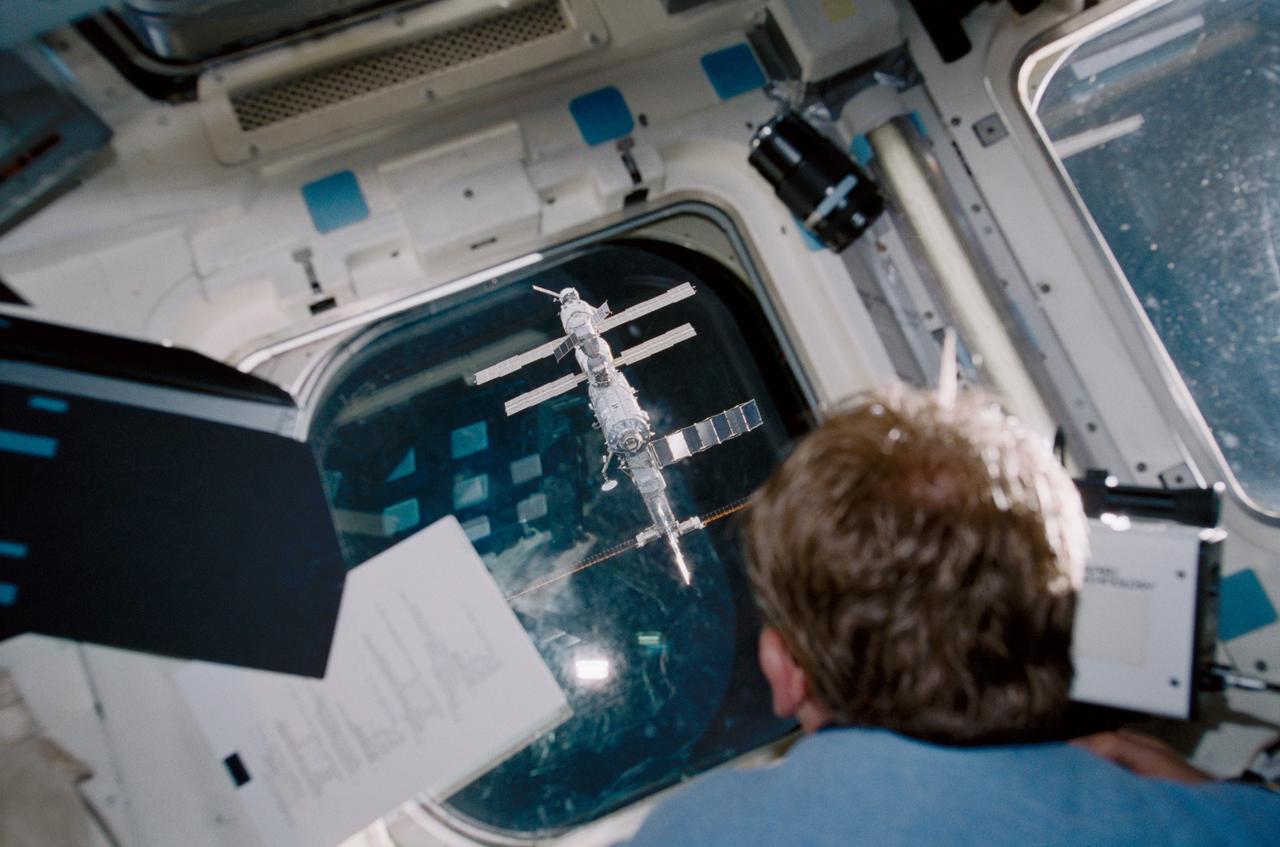
STS-102 astronaut and mission specialist, Andrew S.W. Thomas, gazes through an aft window of the Space Shuttle Orbiter Discovery as it approaches the docking bay of the International Space Station (ISS). Launched March 8, 2001, STS-102's primary cargo was the Leonardo, the Italian Space Agency-built Multipurpose Logistics Module (MPLM). The Leonardo MPLM is the first of three such pressurized modules that will serve as the ISS's moving vans, carrying laboratory racks filled with equipment, experiments, and supplies to and from the Station aboard the Space Shuttle. The cylindrical module is approximately 21-feet long and 15- feet in diameter, weighing almost 4.5 tons. It can carry up to 10 tons of cargo in 16 standard Space Station equipment racks. Of the 16 racks the module can carry, 5 can be furnished with power, data, and fluid to support refrigerators or freezers. In order to function as an attached station module as well as a cargo transport, the logistics module also includes components that provide life support, fire detection and suppression, electrical distribution, and computer functions. NASA's 103rd overall mission and the 8th Space Station Assembly Flight, STS-102 mission also served as a crew rotation flight. It delivered the Expedition Two crew to the Station and returned the Expedition One crew back to Earth.
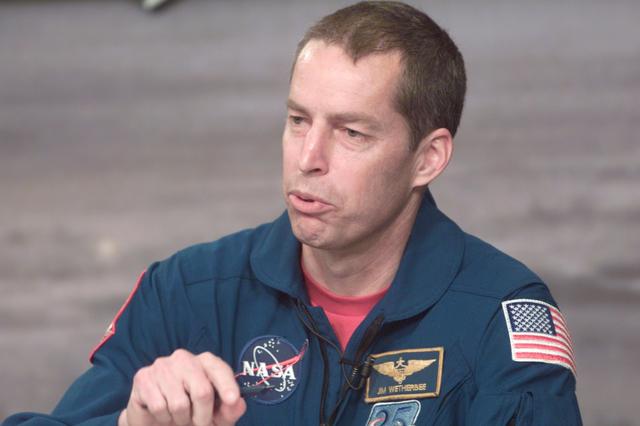
JSC2001-E-05530 (28 February 2001) --- Astronaut James D. Wetherbee, STS-102 mission commander, follows a news representative's question with a brief explanation during a press briefing at the Johnson Space Center (JSC).
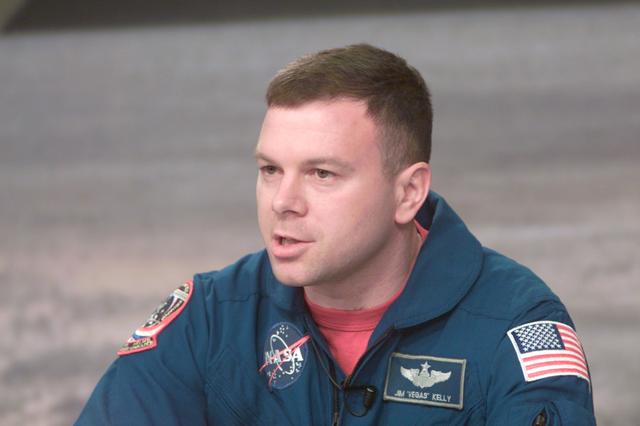
JSC2001-E-05531 (28 February 2001) --- Astronaut James M. Kelly, STS-102 pilot, responds to a news media representative's question during a press briefing at the Johnson Space Center (JSC).
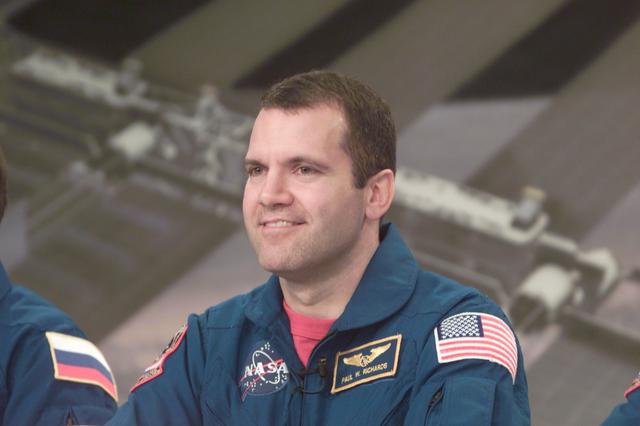
JSC2001-E-05529 (28 February 2001) --- Astronaut Paul W. Richards, STS-102 mission specialist, responds to a news representative's question during a press briefing at the Johnson Space Center (JSC).
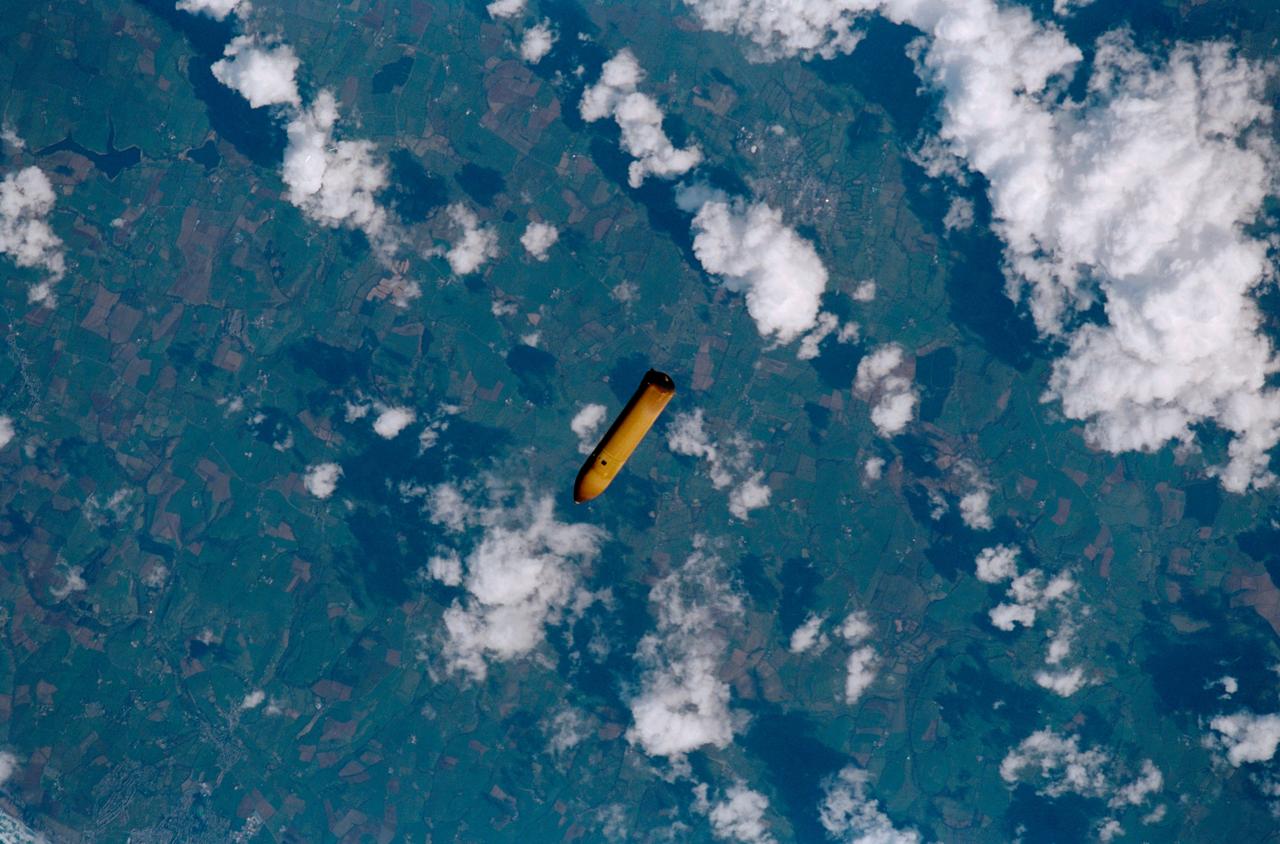
STS102-311-013 (8 March 2001) --- The external tank falls toward Earth's atmosphere during the completion of the launch phase of the STS-102 mission. Western Europe is in the background.
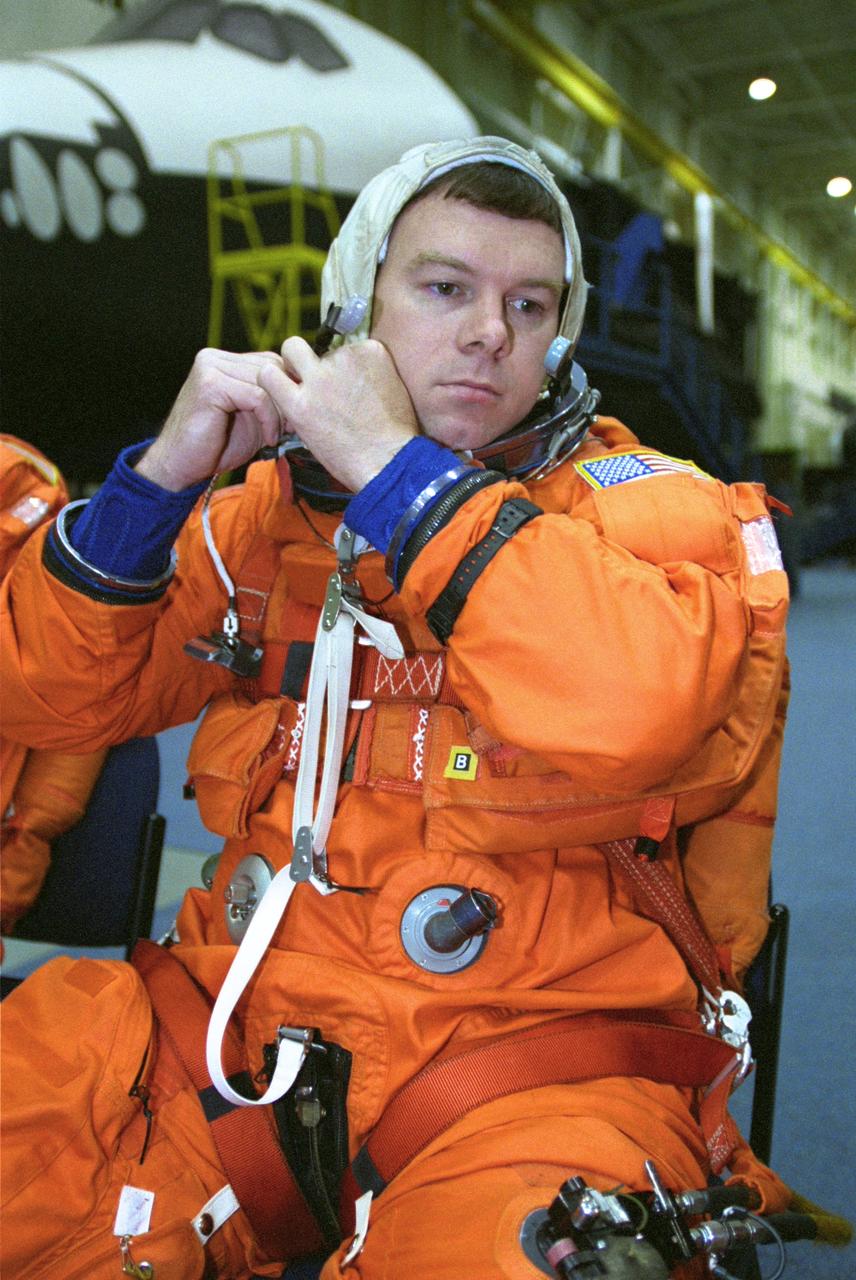
JSC2000-05552 (3 August 2000) --- Astronaut James M. Kelly, STS-102 pilot, snaps on his communications head gear prior to a session of egress training in the Johnson Space Center's Systems Integration Facility.

JSC2001-E-05526 (28 February 2001) --- Astronaut James M. Kelly, STS-102 pilot, greets the press during a briefing at the Johnson Space Center (JSC).

JSC2001-E-05527 (28 February 2001) --- Astronaut Andrew S.W. Thomas, STS-102 mission specialist, greets the news media during a press briefing at the Johnson Space Center (JSC).
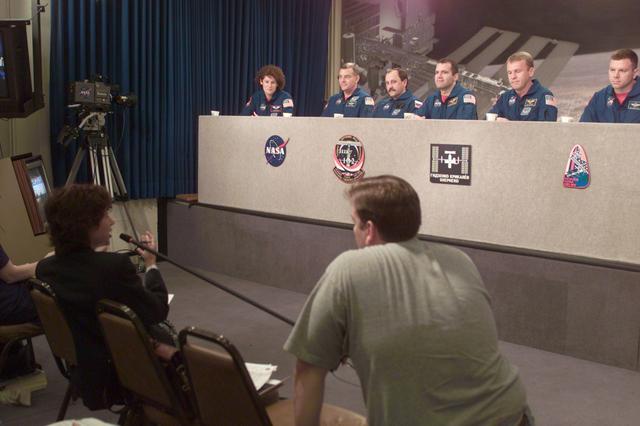
JSC2001-E-05534 (28 February 2001) --- The STS-102 crew fields questions from various news media representatives at a press briefing at the Johnson Space Center (JSC). From the right are astronauts James M. Kelly, pilot; and Andrew S.W. Thomas and Paul W. Richards, both mission specialists; cosmonaut Yury V. Usachev, and astronauts James S. Voss and Susan J. Helms, all mission specialists. Astronaut James D. Wetherbee, STS-102 commander, is out of frame at right. Expedition Two commander Usachev, representing Rosaviakosmos, will join Voss and Helms in the first crew exchange aboard the Earth-orbiting International Space Station (ISS) at some point following the docking of the outpost and the Space Shuttle Discovery.
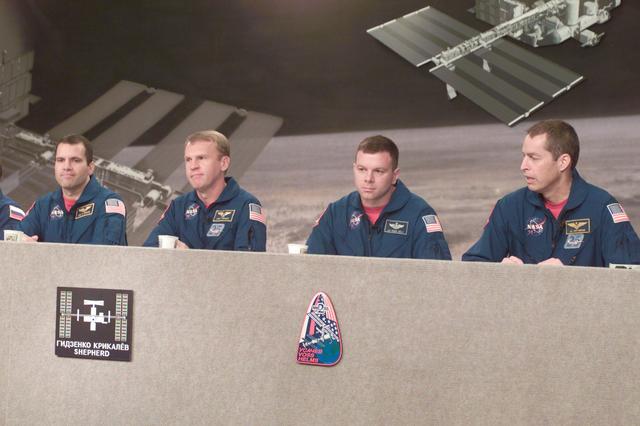
JSC2001-E-05535 (28 February 2001) --- The STS-102 crew fields questions from various news media representatives at a press briefing at the Johnson Space Center (JSC). From the right are astronauts James D. Wetherbee, mission commander; James M. Kelly, pilot; and Andrew S.W. Thomas and Paul W. Richards, both mission specialists. Out of frame at left are cosmonaut Yury V. Usachev, and astronauts James S. Voss and Susan J. Helms, all of whom will fulfill STS-102 mission specialist rolls until some point after the Space Shuttle Discovery links up with the International Space Station (ISS). Expedition Two commander Usachev, representing Rosaviakosmos, will join Voss and Helms in the first crew exchange aboard the Earth-orbiting International Space Station (ISS).
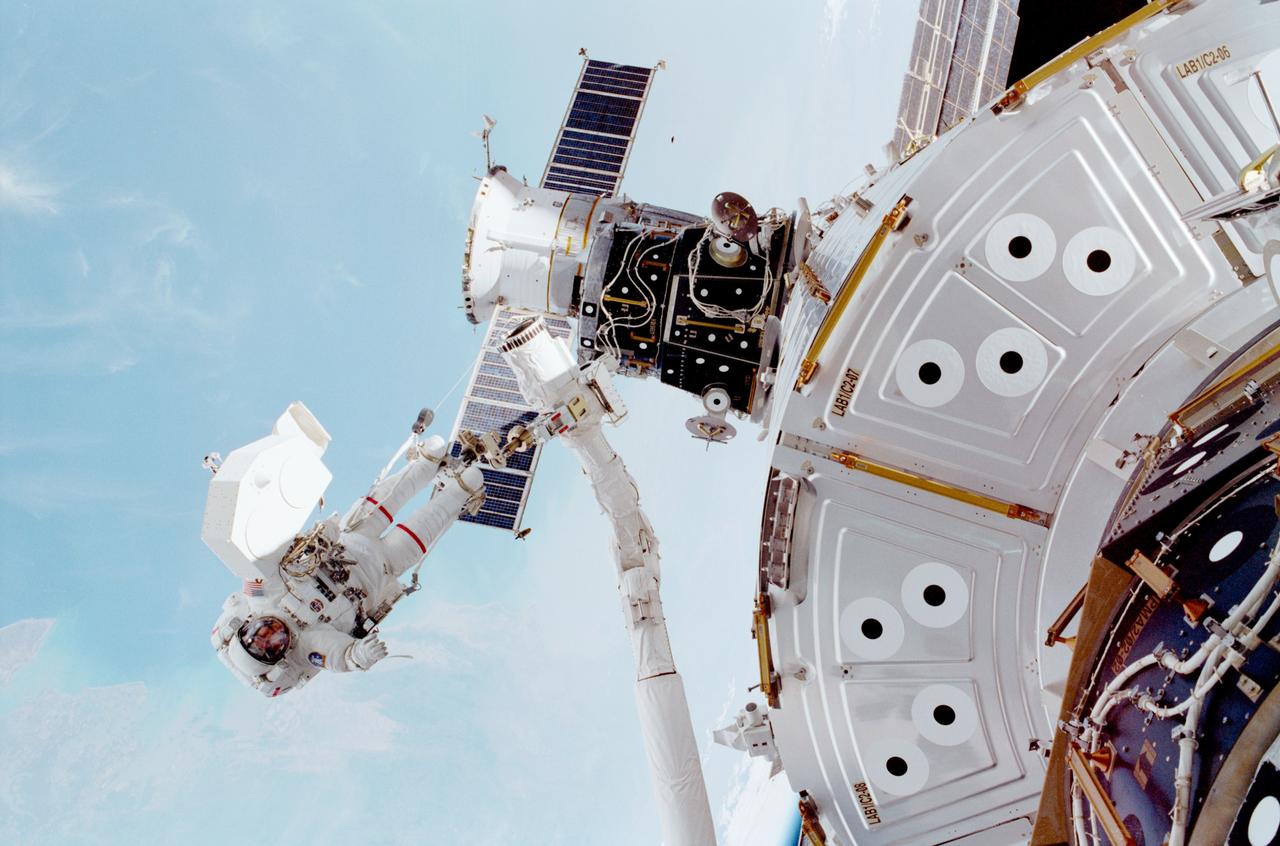
STS102-312-004 (11 March 2001) --- Astronaut James S. Voss works while anchored to the remote manipulator system (RMS) robot arm on the Space Shuttle Discovery. This extravehicular activity (EVA), on which Voss was joined by astronaut Susan J. Helms (out of frame), was the first of two scheduled STS-102 space walks. The pair, destined to become members of the Expedition Two crew aboard the station later in the mission, rode aboard Discovery into orbit and at the time of this EVA were still regarded as STS-102 mission specialists.
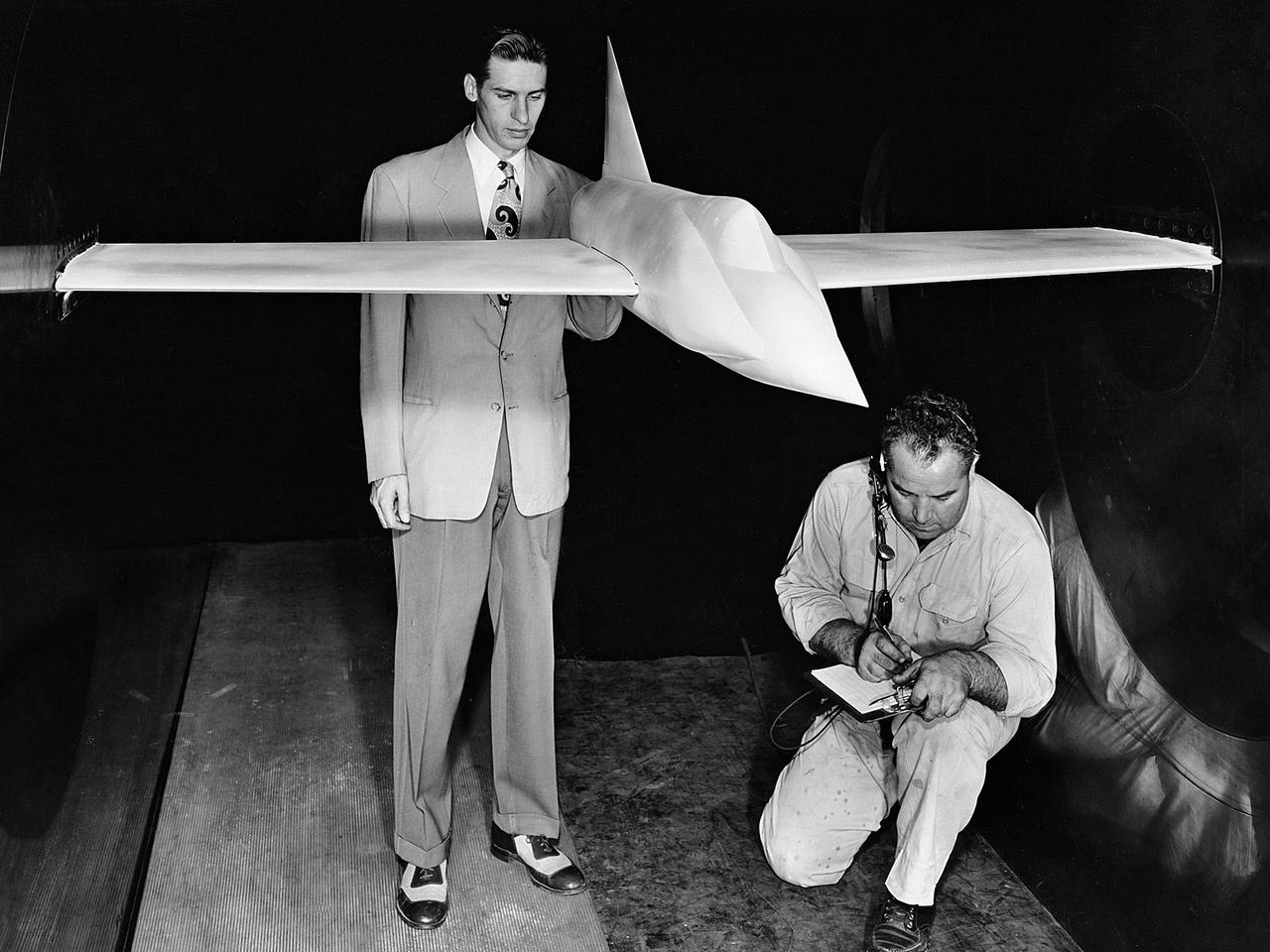
A .10-scale model of Convair’s XF-102 in the 8- by 6-Foot Supersonic Wind Tunnel at the National Advisory Committee for Aeronautics (NACA) Lewis Flight Propulsion Laboratory for jet exit studies. The XF-102 was a prototype of the F-102 Delta Dagger. The F-102 served as an interceptor against long range bombers from the Soviet Union. The aircraft was powered by a Pratt and Whitney J57 turbojet. The first prototype crashed two weeks after is first flight on October 24, 1953, just months after this photograph. Engineers then incorporated the fixed-wing design to reduce drag at supersonic speeds. The production model F-102 became the first delta-wing supersonic aircraft in operation. The 8- by 6-Foot Supersonic Wind Tunnel is used to study propulsion systems, including inlets and exit nozzles, combustion fuel injectors, flame holders, exit nozzles, and controls on ramjet and turbojet engines. Flexible sidewalls alter the tunnel’s nozzle shape to vary the Mach number during operation. A seven-stage axial compressor, driven by three electric motors that yield a total of 87,000 horsepower, generates air speeds from Mach 0.36 to 2.0.
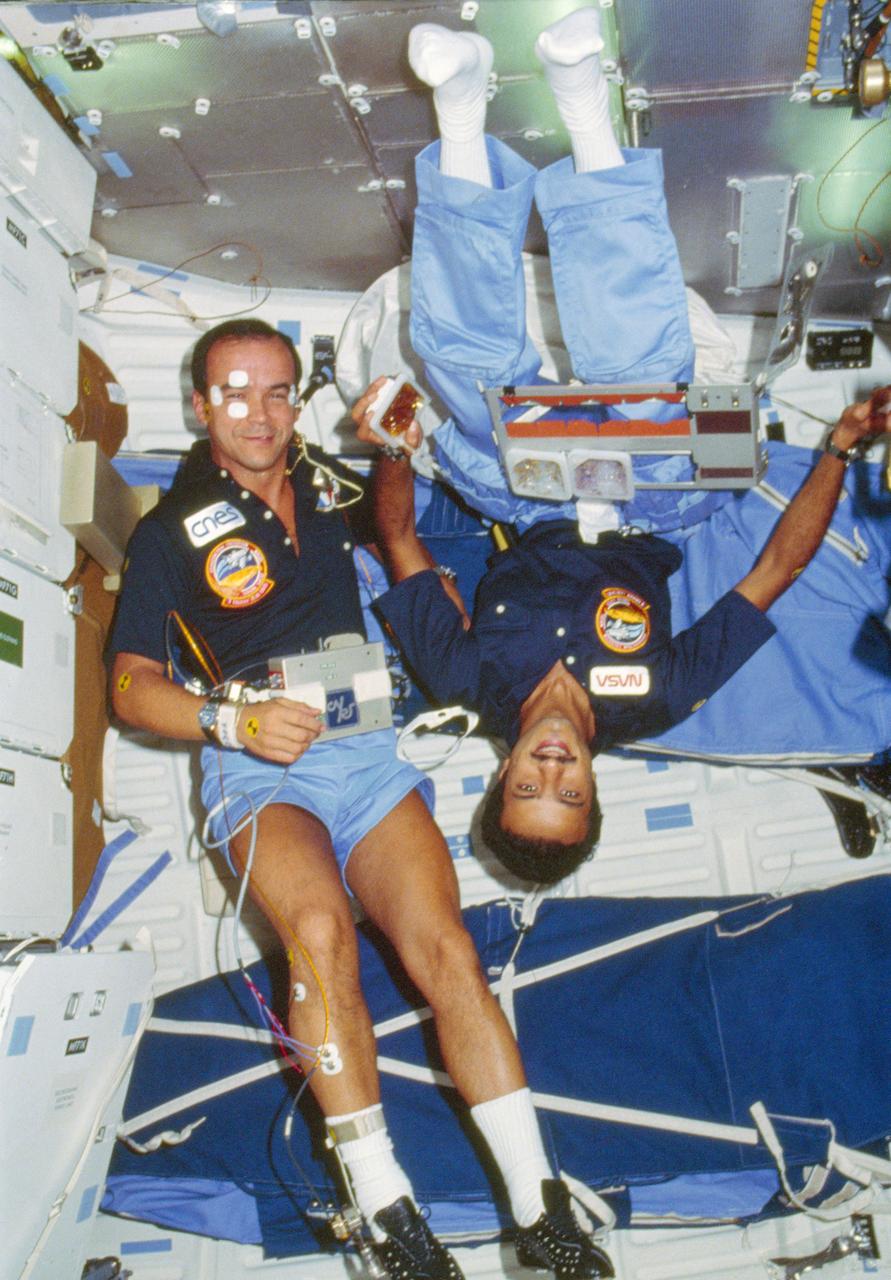
51G-102-035 (17-24 June 1985) --- The two payload specialists for the week-long flight share a middeck scene on the earth-orbiting Discovery. Sultan Salman Abdelazize Al-Saud (left) is in the midst of a meal while Patrick Baudry conducts a phase of the French Postural Experiment (FPE) on himself. Sleep restraints are in the background.
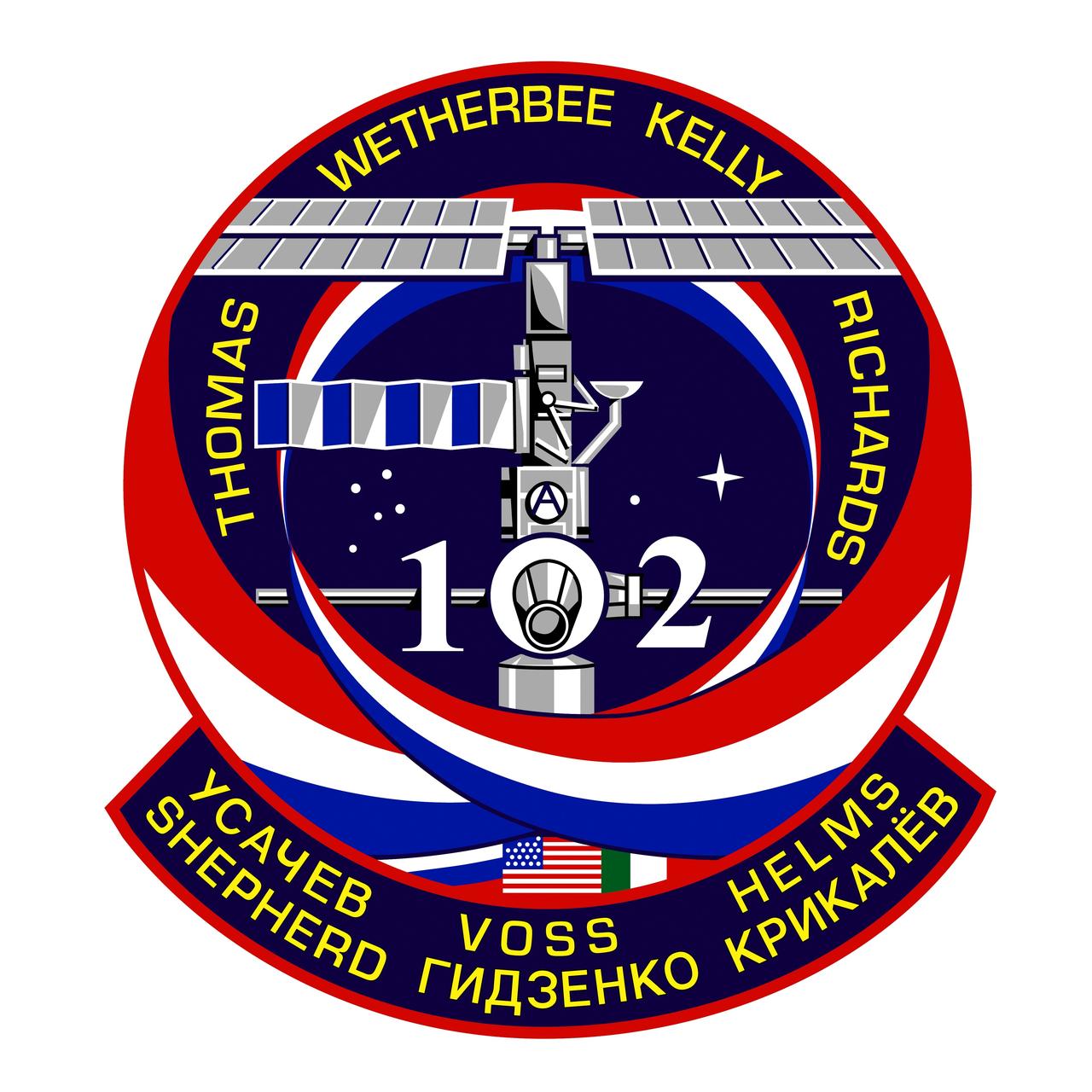
STS102-S-001 (January 2001) --- The central image on the STS-102 crew patch depicts the International Space Station (ISS) in the build configuration that it will have at the time of the arrival and docking of Discovery during the STS-102 mission, the first crew exchange flight to the space station. The station is shown along the direction of the flight as will be seen by the shuttle crew during their final approach and docking, the so-called V-bar approach. The names of the shuttle crew members are depicted in gold around the top of the patch, and surnames of the Expedition crew members being exchanged are shown in the lower banner. The three ribbons swirling up to and around the station signify the rotation of these ISS crew members. The number two is for the Expedition Two crew who fly up to the station, and the number one is for the Expedition One crew who then return down to Earth. In conjunction with the face of the Lab module of the station, these Expedition numbers create the shuttle mission number 102. Shown mated below the ISS is the Italian-built Multi-Purpose Logistics Module, Leonardo, that will fly for the first time on this flight, and which will be attached to the station by the shuttle crew during the docked phase of the mission. The flags of the countries that are the major contributors to this effort, the United States, Russia, and Italy are also shown in the lower part of the patch. The build-sequence number of this flight in the overall station assembly sequence, 5A.1, is captured by the constellations in the background. The NASA insignia design for space shuttle flights is reserved for use by the astronauts and for other official use as the NASA Administrator may authorize. Public availability has been approved only in the forms of illustrations by the various news media. When and if there is any change in this policy, which is not anticipated, the change will be publicly announced. Photo credit: NASA
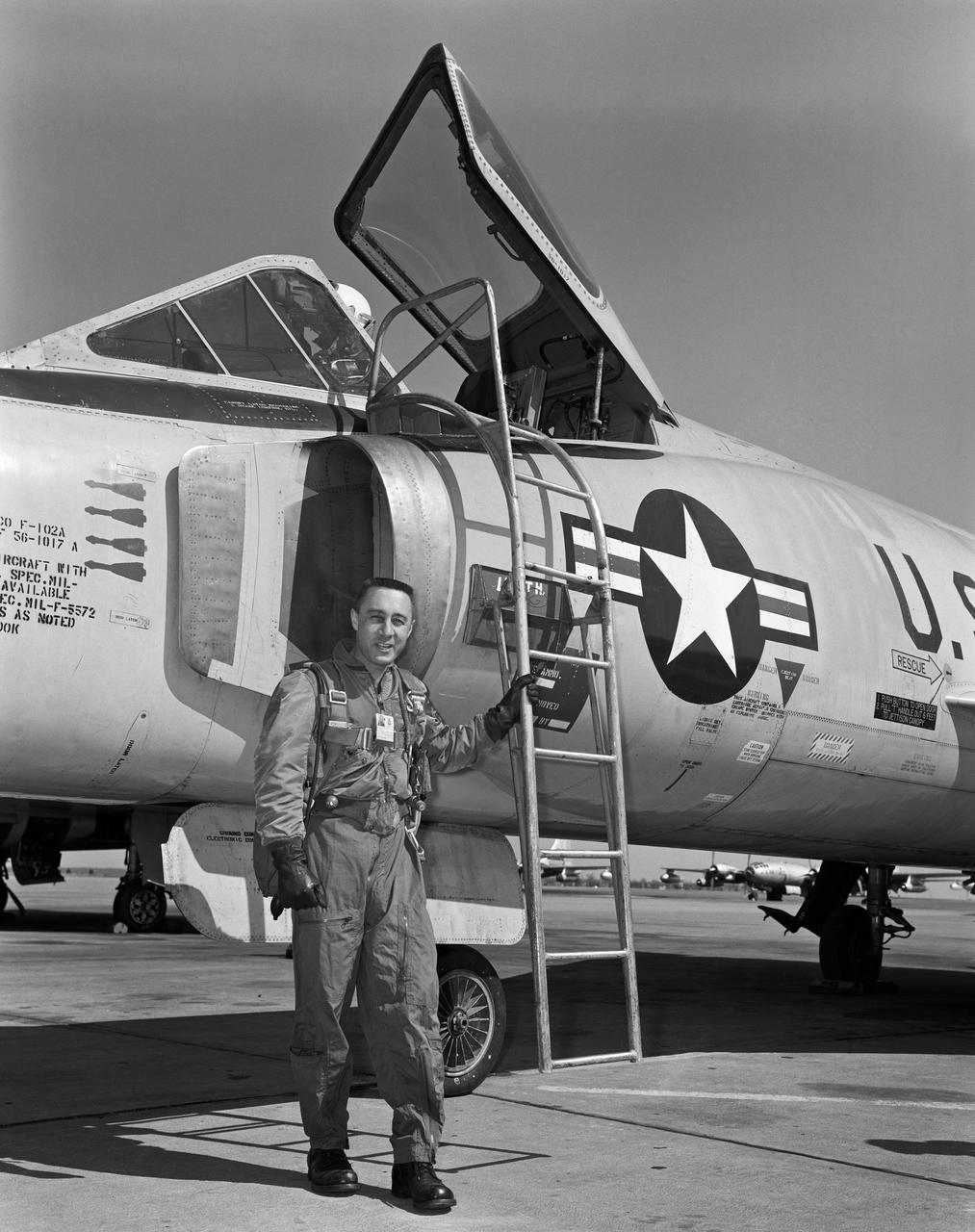
B60-00708 (1960) --- Astronaut Virgil I (Gus) Grissom pictured standing beside a F-102 on the flight line. Photo credit: NASA
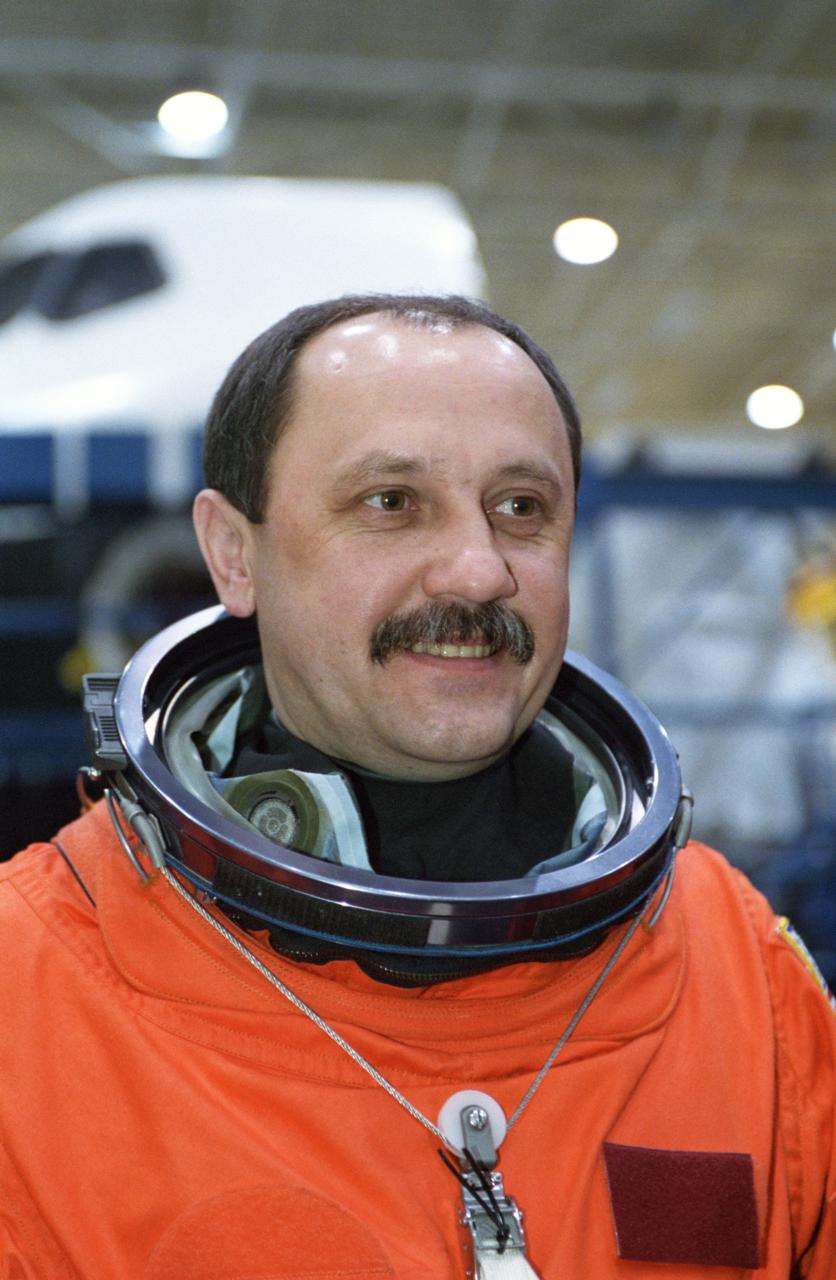
JSC2000-07445 (6 December 2000) --- Cosmonaut Yury V. Usachev, Expedition Two mission commander, talks to nearby astronauts (out of frame) during a joint Expedition Two/STS-102 training session in the Systems Integration Facility at the Johnson Space Center (JSC). The Russian Aviation and Space Agency representative, along with two astronauts on his crew and the four STS-102 crew members, later simulated procedures for a nominal countdown in the crew compartment trainer (CCT-2) in the high bay area of this facility.
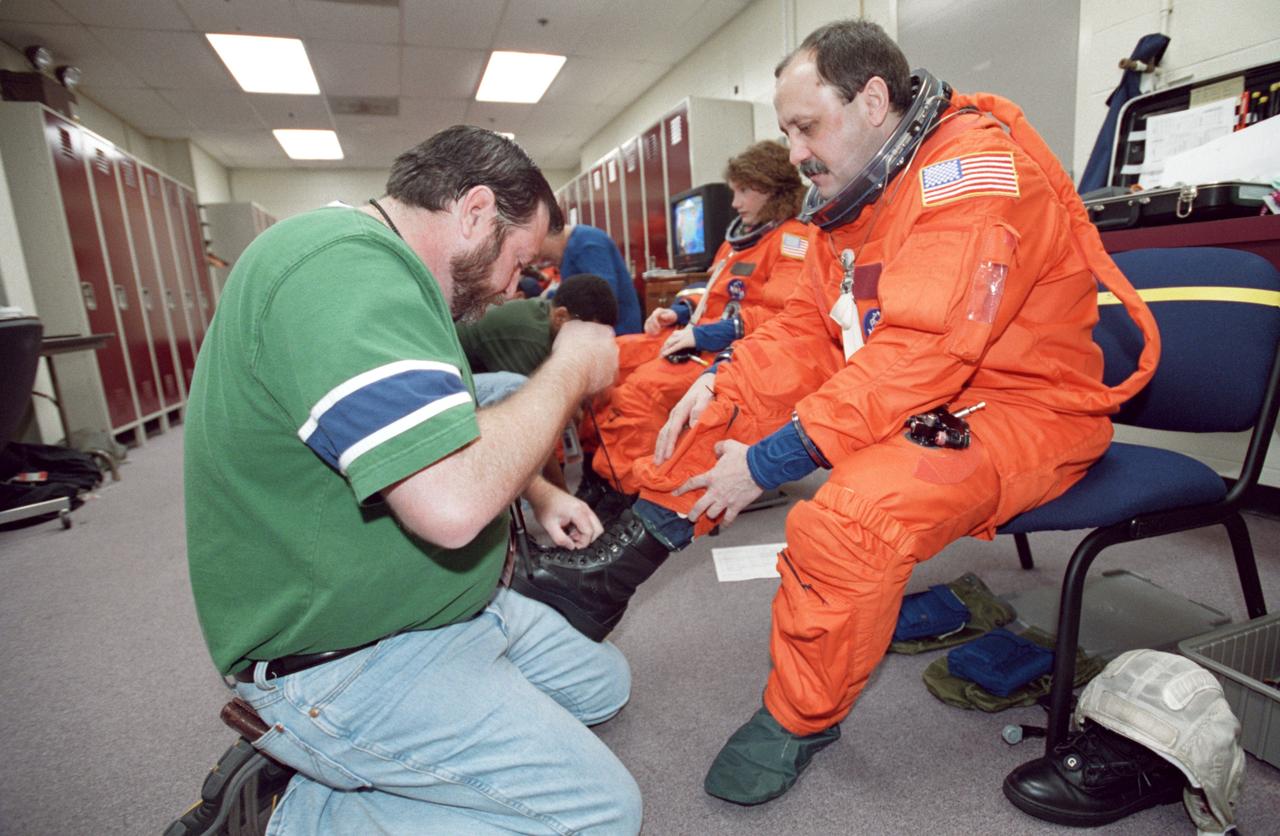
JSC2000-07446 (6 December 2000) --- Suit technician Steve Clendenin helps cosmonaut Yury V. Usachev with his boot straps during an STS-102 training session in the Systems Integration Facility at the Johnson Space Center (JSC). The Expedition Two commander, along with two astronauts on his crew and the four STS-102 crew members, later simulated procedures for a nominal countdown in the crew compartment trainer (CCT-2) in the high bay area of this facility.
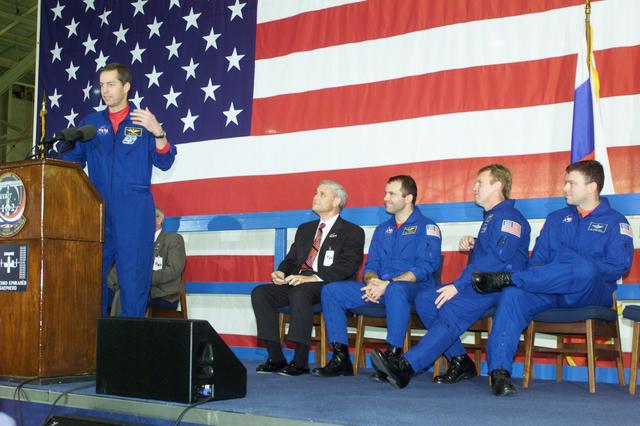
JSC2001-E-08322 (22 March 2001) --- Astronaut James D. Wetherbee, STS-102 mission commander, speaks to a crowd of greeters during a crew return ceremony in Ellington Field's Hangar 990. Pictured in the background on the dais are (from the left) Roy S. Estess, Johnson Space Center's Acting Director; along with astronauts Paul W. Richards, Andrew S.W. Thomas and James M. Kelly of the STS-102 crew.
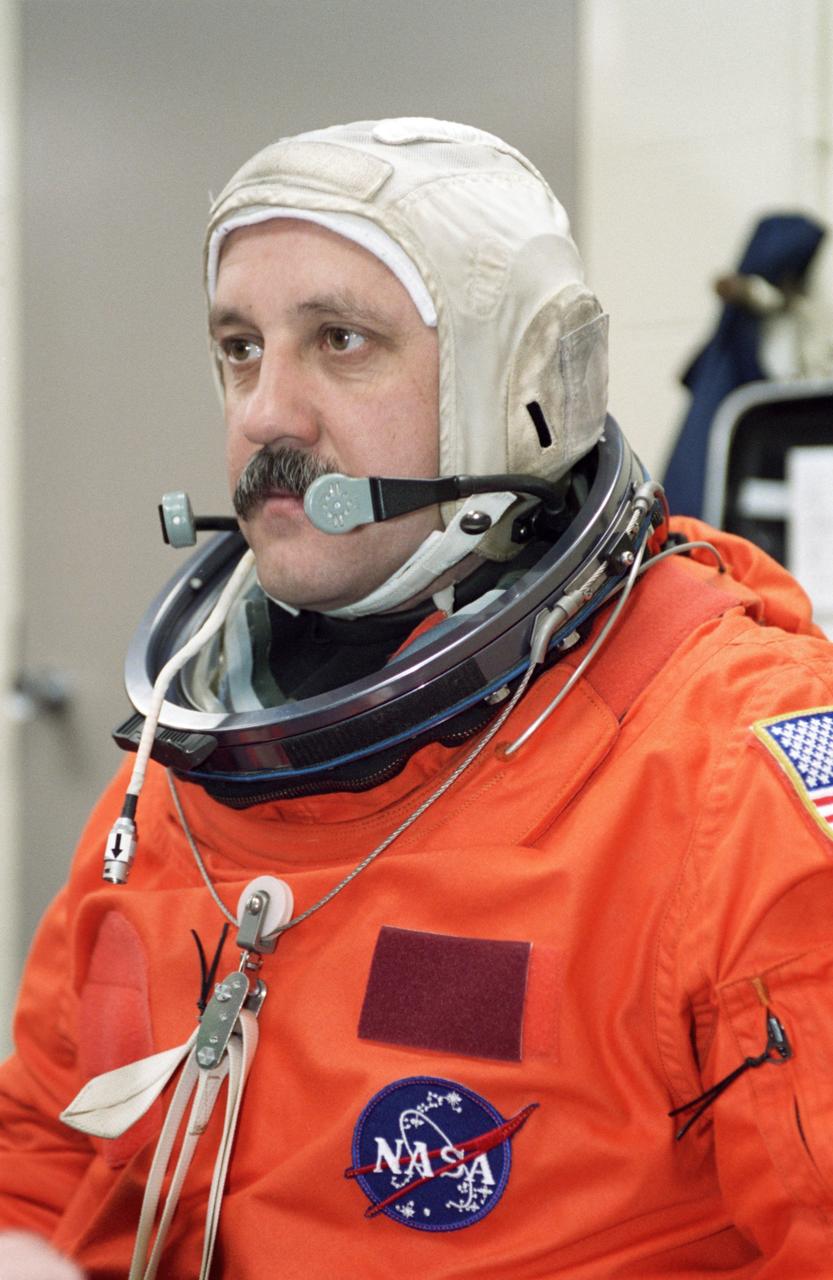
JSC2000-07447 (6 December 2000) --- Cosmonaut Yury V. Usachev, Expedition Two mission commander, checks out his communications gear during a joint Expedition Two/STS-102 training session in the Systems Integration Facility at the Johnson Space Center (JSC). The Russian Aviation and Space Agency representative, along with two astronauts on his crew and the four STS-102 crew members, later simulated procedures for a nominal countdown in the crew compartment trainer (CCT-2) in the high bay area of this facility.
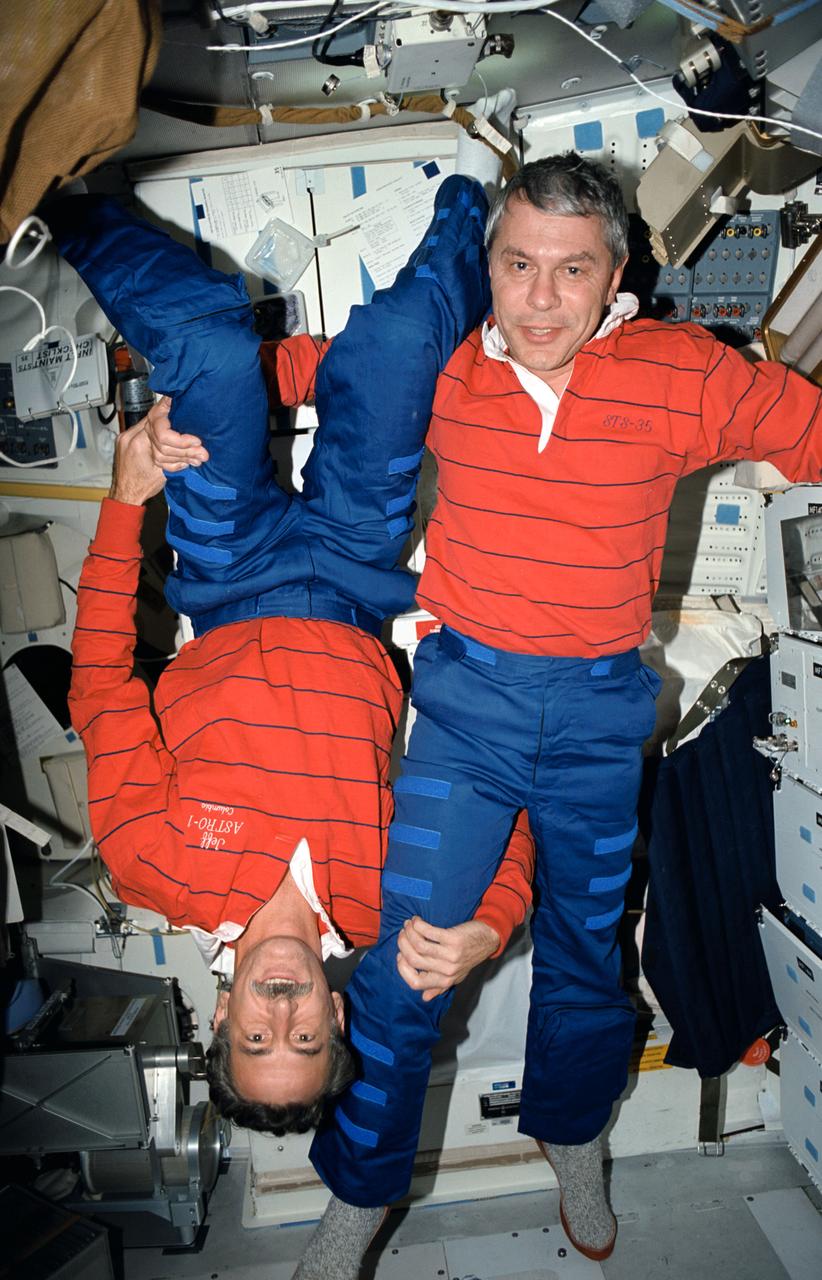
STS035-49-029 (2-10 Dec 1990) --- Posing on the middeck of Columbia, Orbiter Vehicle (OV) 102, are Mission Specialist (MS) Jeffrey A. Hoffman (mustache) and MS Robert A. R. Parker. Determining who is right side up is complicated by the microgravity of space. Hoffman's head is at the middeck floor and his feet are at the ceiling. The two crewmembers are in front of OV-102's port side with the waste collection system (WCS) contingency unit, side hatch, and galley visible behind them.

JSC2001-E-08321 (22 March 2001) --- Applause was plentiful during the welcome home ceremonies for the joint crews of STS-102 and Expedition One. Pictured on the stage in Ellington Field's Hangar 990 are, from the left, JSC Acting Director Roy S. Estess, along with astronauts Paul W. Richards and Andrew S.W. Thomas, both STS-102 mission specialists, and James M. Kelly, pilot.
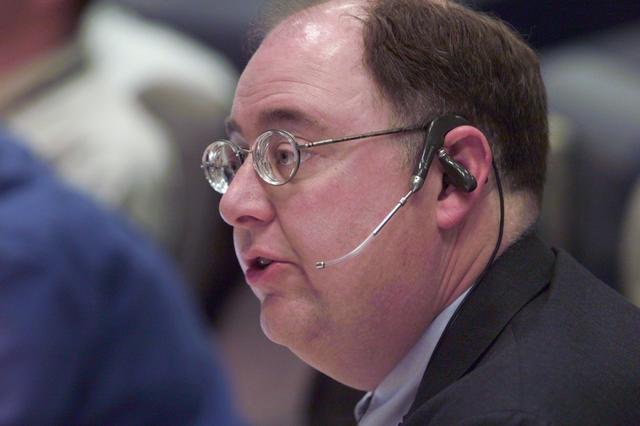
JSC2001-E-06208 (8 March 2001) --- At his console in Houston's Mission Control Center, ascent flight director Wayne Hale monitors Discovery's pre-launch activities several hundred miles away in Florida on STS-102 launch day.
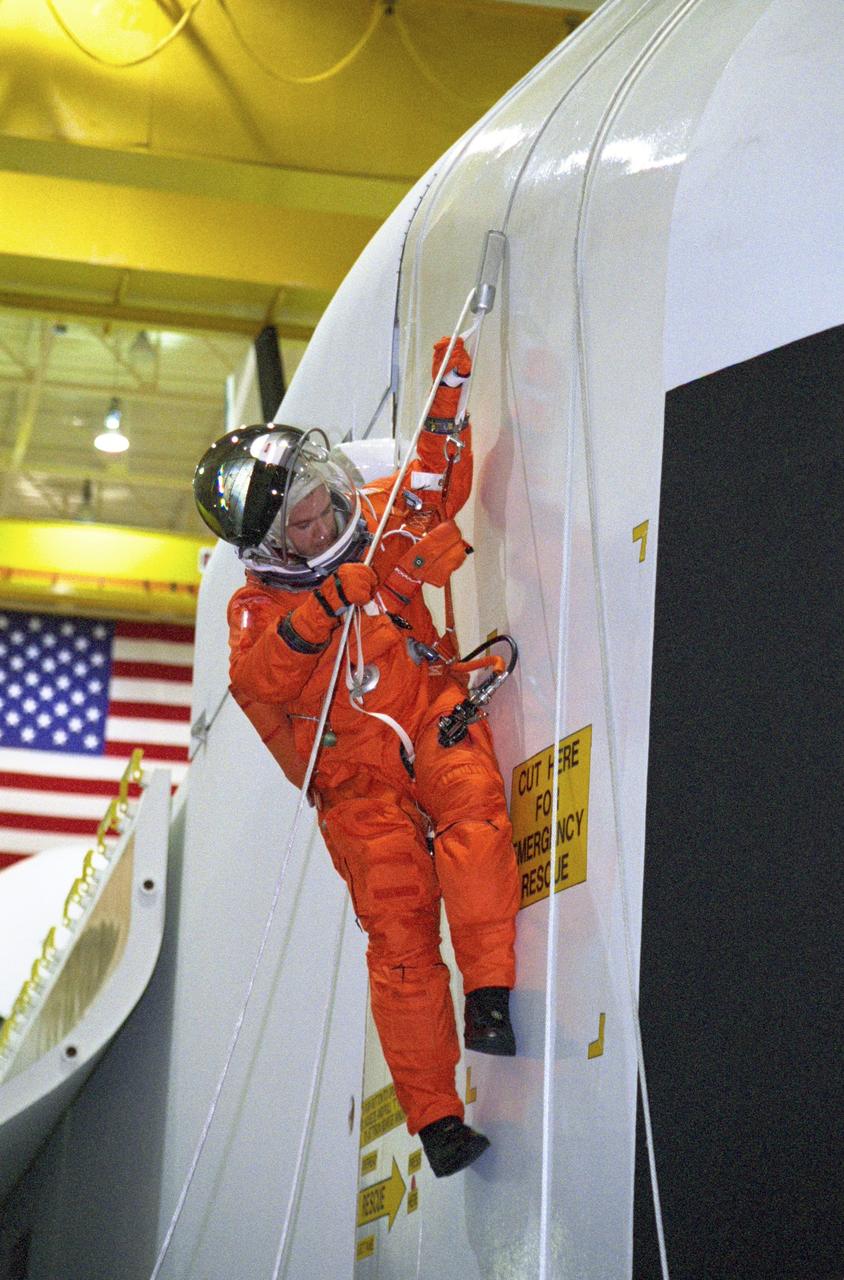
JSC2000-05553 (3 August 2000) --- Astronaut Paul W. Richards, STS-102 mission specialist, during a session of egress training in the Johnson Space Center's Systems Integration Facility, uses a Sky-genie device to escape from a simulated shuttle in trouble. The full fuselage trainer (FFT) is a full scale mockup of a shuttle.
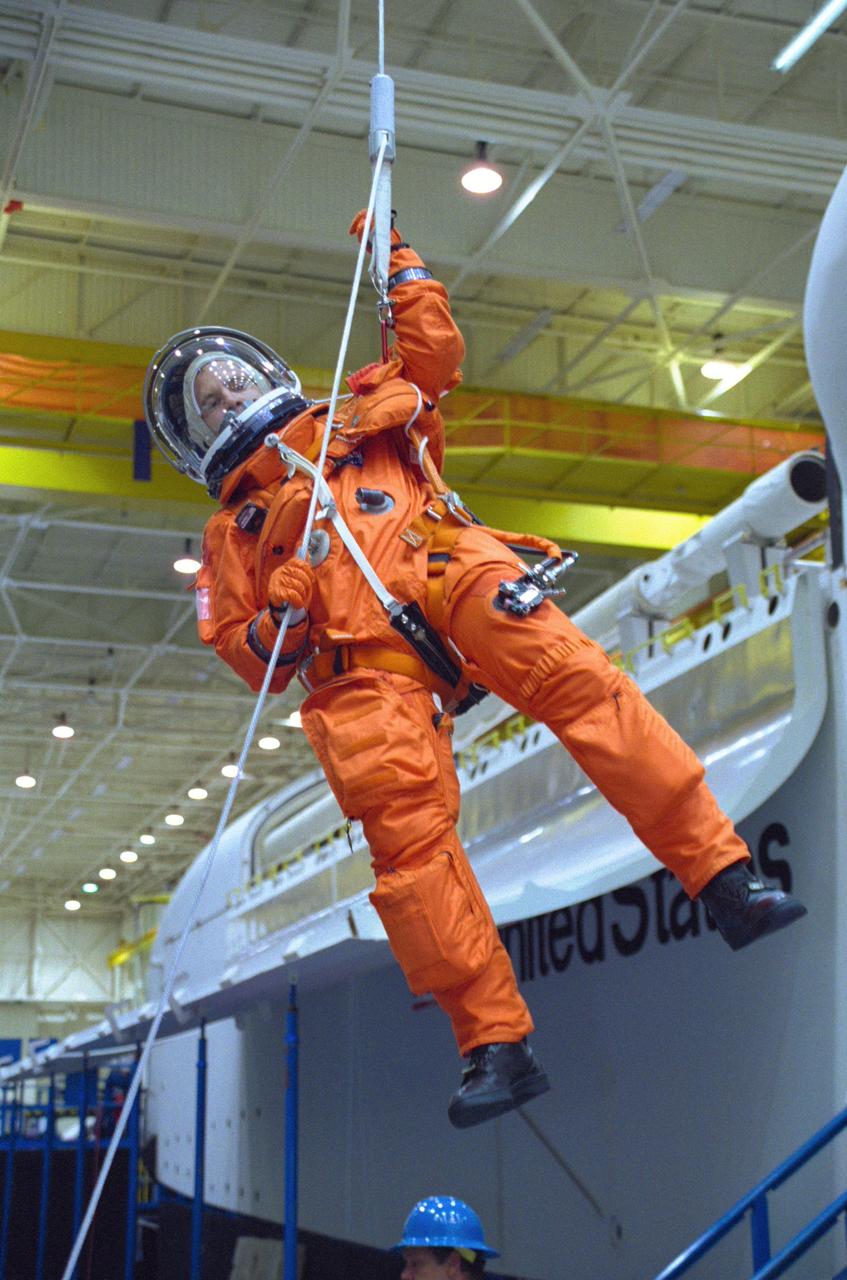
JSC2000-05554 (3 August 2000) --- Astronaut Paul W. Richards, STS-102 mission specialist, rappels from the top of the shuttle full fuselage trainer (FFT) during an emergency egress training exercise at the Johnson Space Center's Systems Integration Facility.
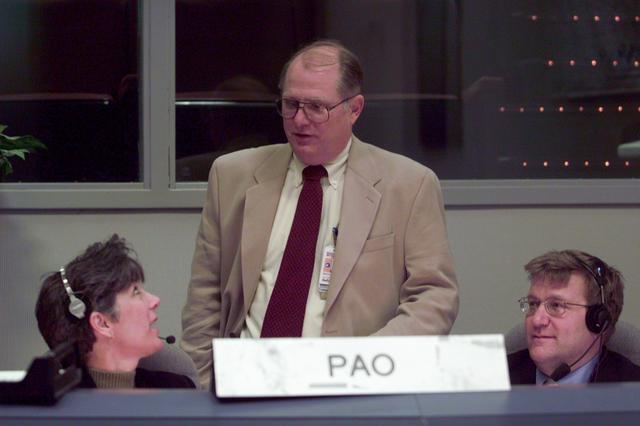
JSC2001-E-06205 (8 March 2001) --- Eileen Hawley at the Public Affairs Officer (PAO) console poses a query to Brock R. (Randy) Stone (center) of the Mission Operations Directorate (MOD) prior to the launch of STS-102. Hawley was the launch commentator for the Discovery mission. Daniel Carpenter, director of the Public Affairs Office, is at right.
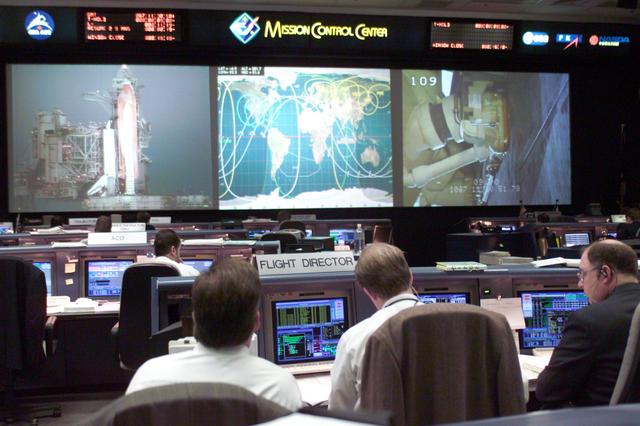
JSC2001-E-06210 (8 March 2001) --- As STS-102 Discovery liftoff countdown proceeds at the Kennedy Space Center (KSC)in Florida, flight controllers in Houston follow the progress at their assigned consoles. Ascent flight director Wayne Hale views his monitor at right.
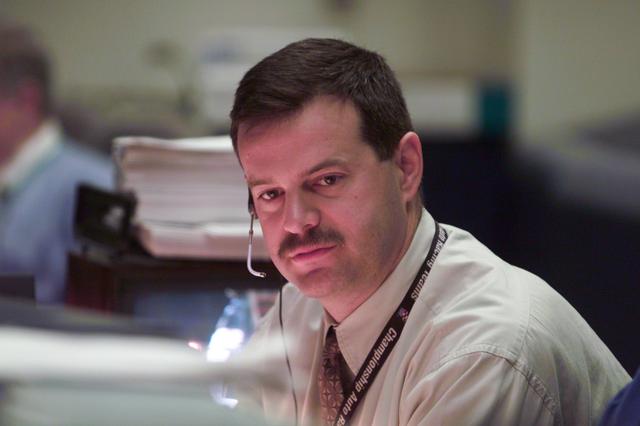
JSC2001-E-06203 (8 March 2001) --- At his console in Houston's Mission Control Center, astronaut Scott D. Altman, spacecraft communicator (CAPCOM), monitors weather data possibly affecting Discovery's pre-launch activities several hundred miles away in Florida on STS-102 launch day.

JSC2001-E-06207 (8 March 2001) --- Lead STS-102 flight director John Shannon discusses a mission detail with John Guidi, temporarily assigned at JSC from the Kennedy Space Center (KSC). The two are awaiting the launch of the Space Shuttle Discovery at the Flight Director console in JSC's Mission Control Center (MCC).
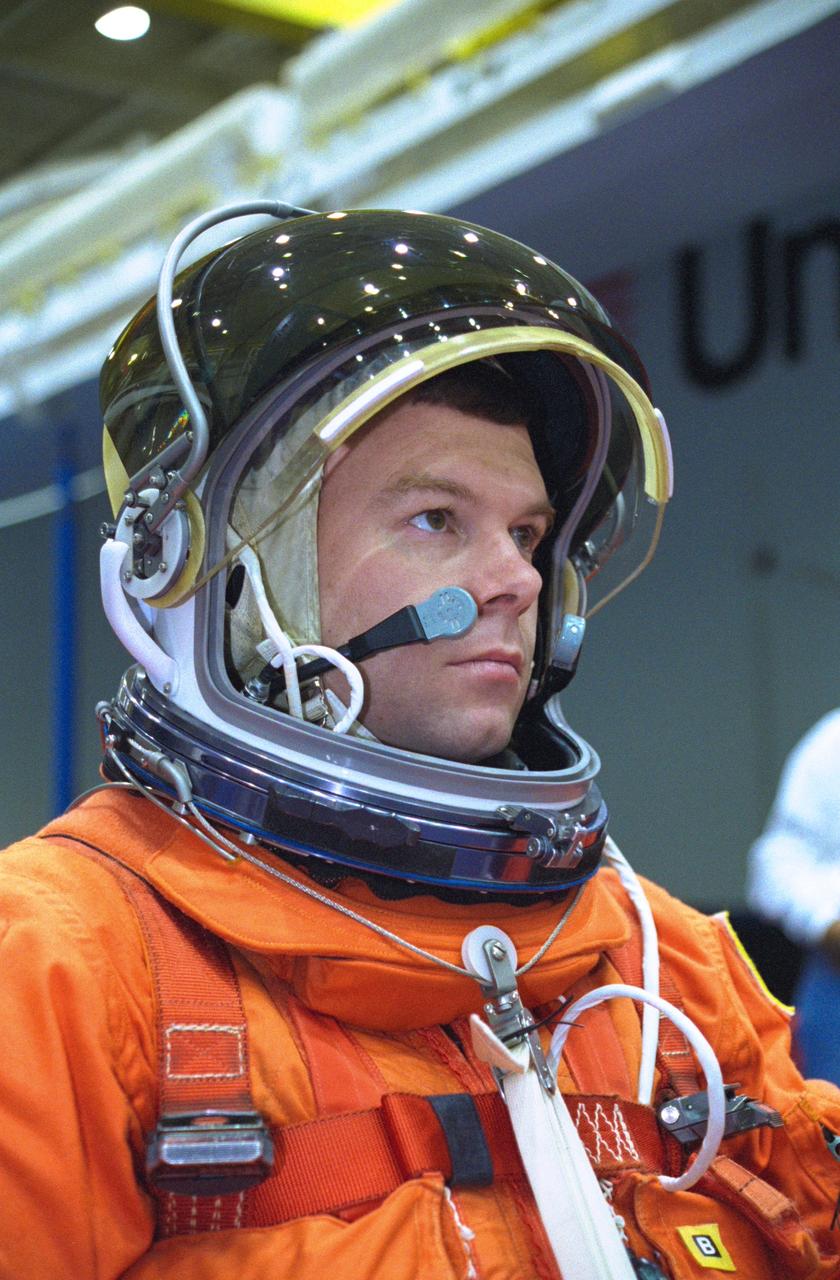
JSC2000-05557 (3 August 2000) --- Astronaut James M. Kelly, STS-102 pilot, listens as a crew training staff member briefs the astronauts at the Full Fuselage Trainer (FFT) during an emergency egress training exercise at the Johnson Space Center's Systems Integration Facility.
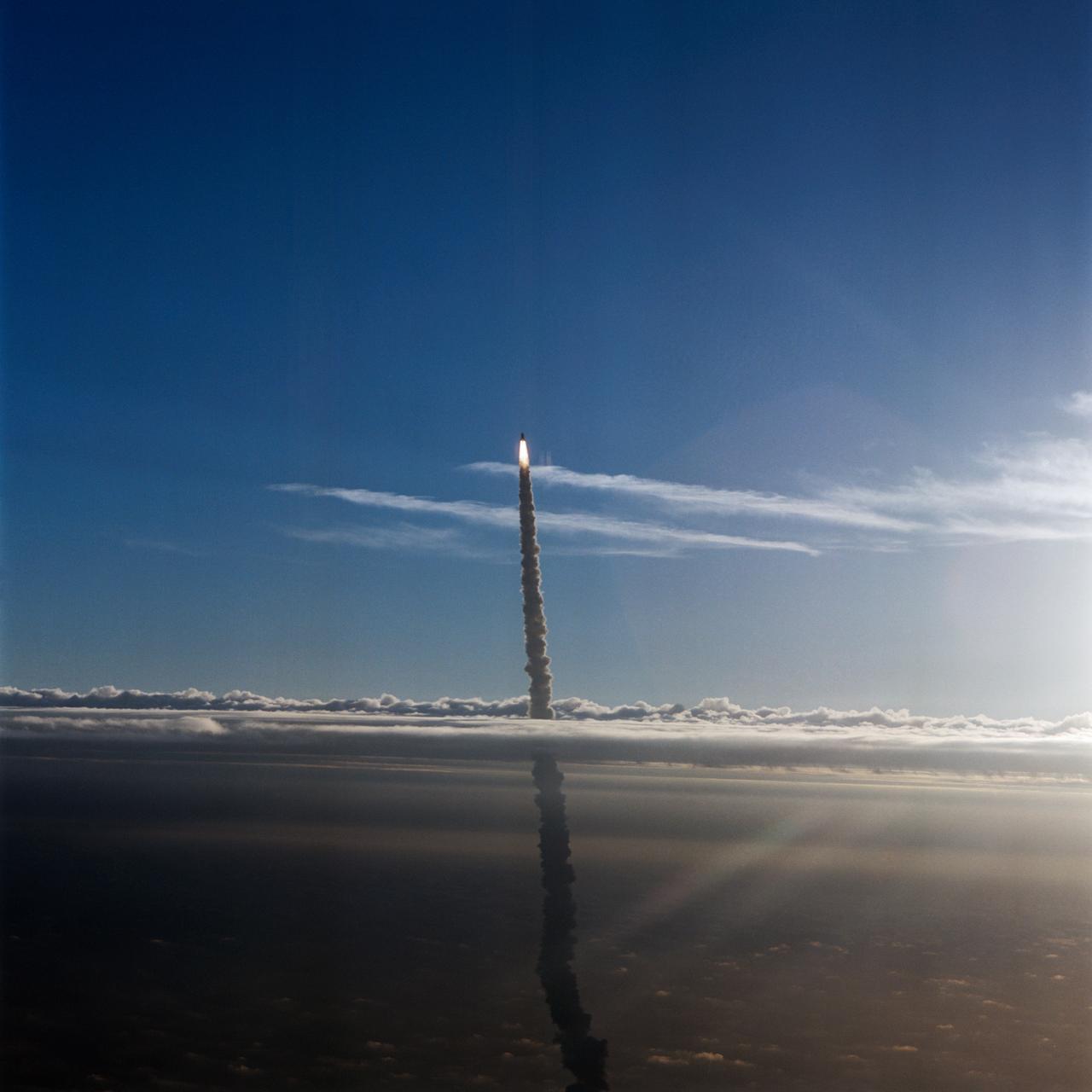
STS-32 Columbia, Orbiter Vehicle (OV) 102, pierces a layer of low lying clouds as it makes its ascent to Earth orbit for a 10-day mission. In this air-to-air view, OV-102 rides atop the external tank (ET) with flames created by solid rocket boosters (SRBs) appearing directly underneath it and a long plume of exhaust smoke trailing behind it and extending to Kennedy Space Center (KSC) Launch Complex (LC) Pad 39A below. OV-102 left KSC LC Pad 39A at 7:34:59:98 am Eastern Standard Time (EST) some 24 hours after dubious weather at the return-to-landing site (RTLS) had cancelled a scheduled launch. The photo was taken by astronaut Michael L. Coats, acting chief of the Astronaut Office, from the Shuttle Training Aircraft (STA).
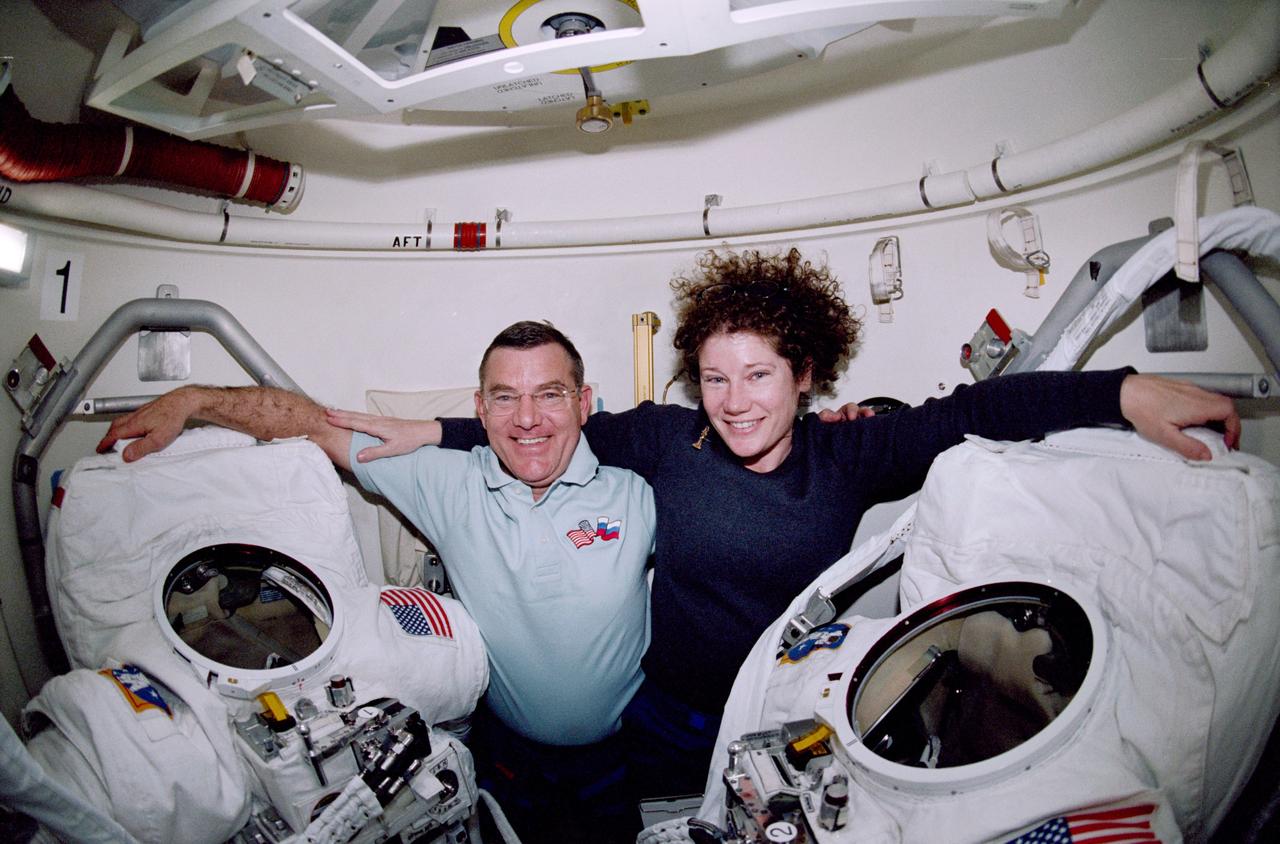
STS102-321-013 (8-21 March 2001) --- Sandwiched between the extravehicular mobility unit (EMU) space suits, astronauts James S. Voss (left) and Susan J. Helms, both Expedition Two flight engineers, are photographed in the shuttle airlock of the Earth-orbiting Space Shuttle Discovery. Voss and Helms were involved in the first of two space walks performed on the STS-102 mission while docked with the International Space Station (ISS).

STS102-331-012 (8-21 March 2001) --- The STS-102 crew members used a 35mm camera on the flight deck of the Space Shuttle Discovery to record this image of several meandering distributary channels of the Orinoco River draining northward into the south side of the Gulf of Paria in eastern Venezuela. According to NASA scientists studying the STS-102 collection, these sediment-laden channels carry a tremendous quantity of fluvial material that constantly changes the size and shapes of the shoreline and adjacent islands. An assortment of mud flats and sand bars, seen here as lighter colored features in the water, are affected both by stream flow and tidal forces. The extensive dark landscape identifies the flat, swampy coastal plains of northeast Venezuela that is covered by dense stands of vegetation.
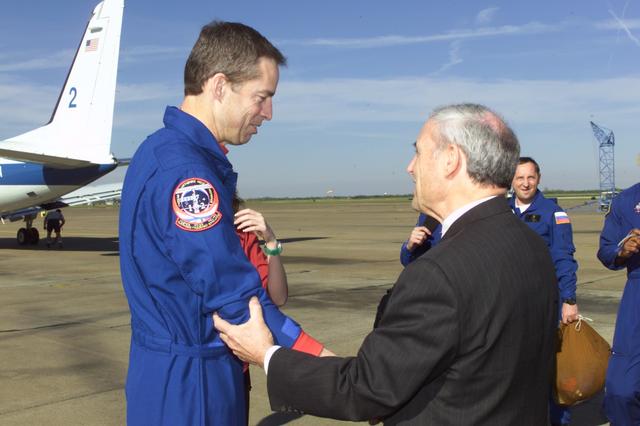
JSC2001-E-08304 (22 March 2001) --- Astronaut James D. Wetherbee (left), STS-102 mission commander, is greeted by JSC Acting Director Roy S. Estess following crew arrival at Ellington Field.
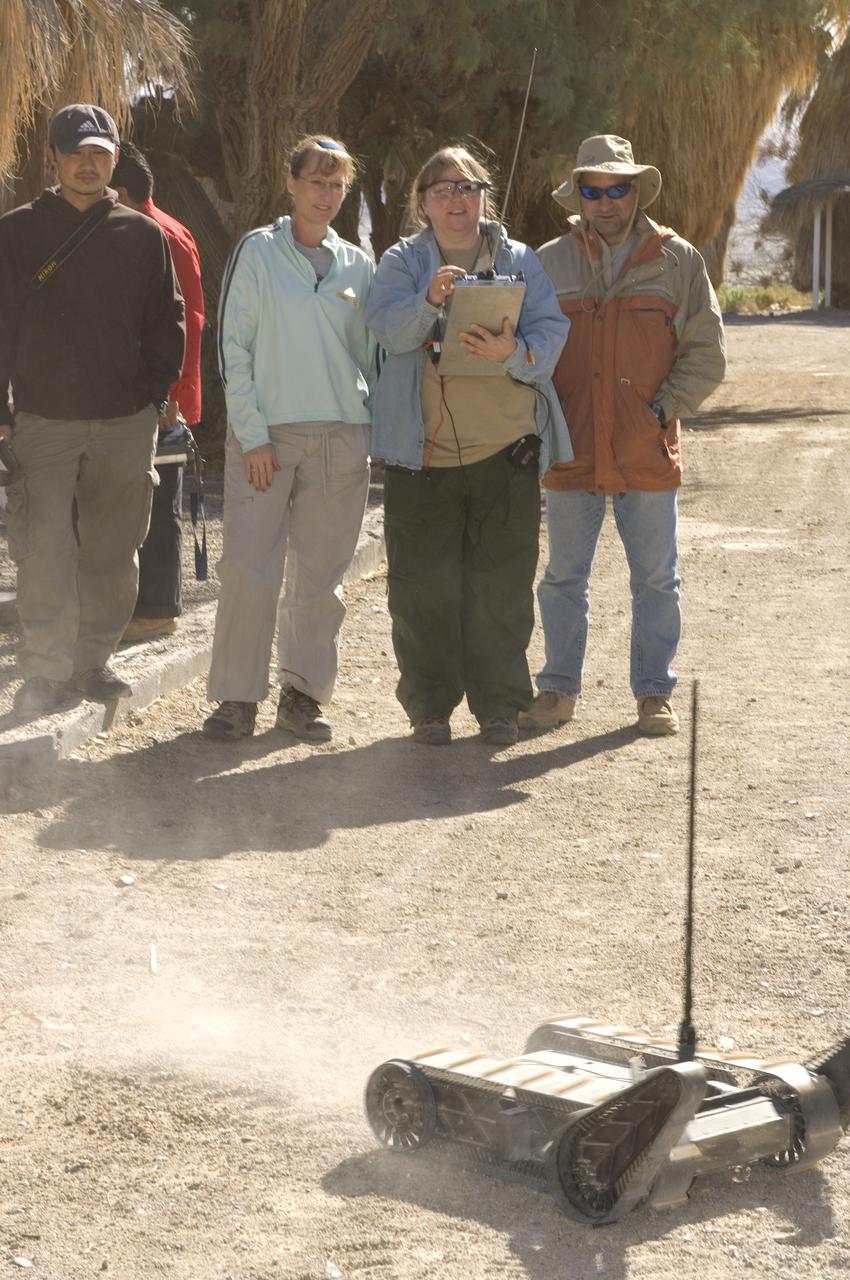
Spaceward Bound event in the Mojave Deser , CA (an outreach exercise) with Dr Chris McKay and Ames Education department personnel Brian Day, Barbara Bazar and a accompaning (learning for the the classroom) team of teachers will be studying side-by-side with NASA scientists who search for life in extreme environments, closely approximating what they expect to find on other planets. Why the Mojave -- an inhospitable, sun-drenched spot in the California Desert? This natural setting presents scientists with opportunities to study environments that are analogous to what explorers will find on the Moon and Mars. Teachers and scientists will perform scientific fieldwork in lunar geology, Mars astrobiology, Mars geology, and issues of temperature and solar inundation and radiation. for additional information and Outreach projects see http://quest.arc.nasa.gov/
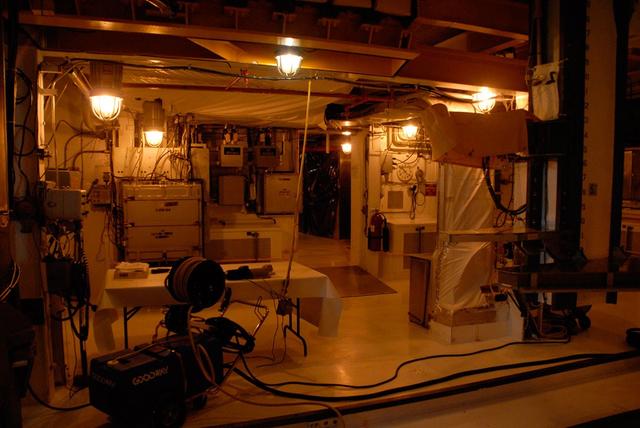
Interior view of Launch Pad 39A
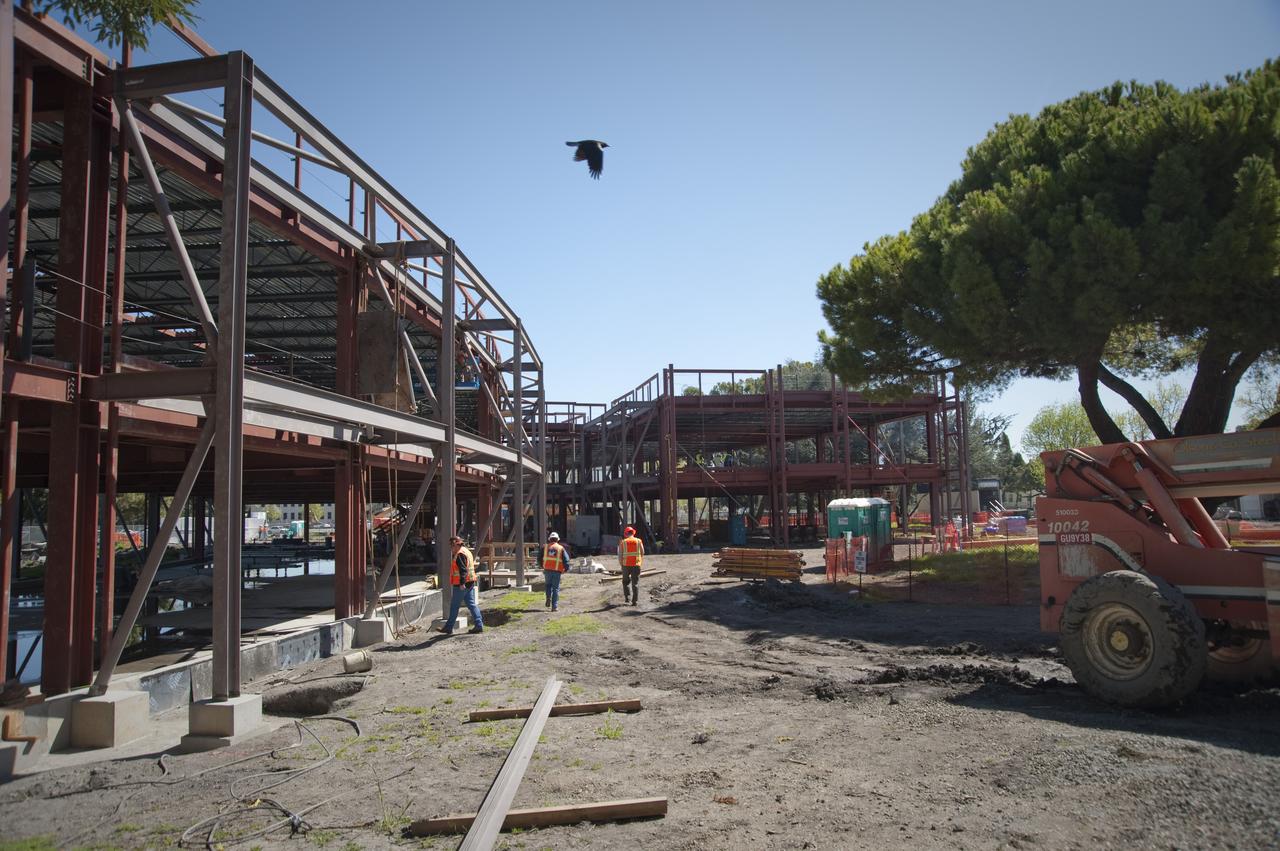
Construction of the new NASA Ames Green Building dubbed Sustainability Base located on the Ames Research Center campus at Moffett Field, CA. Hawk flying over looking for lunch.
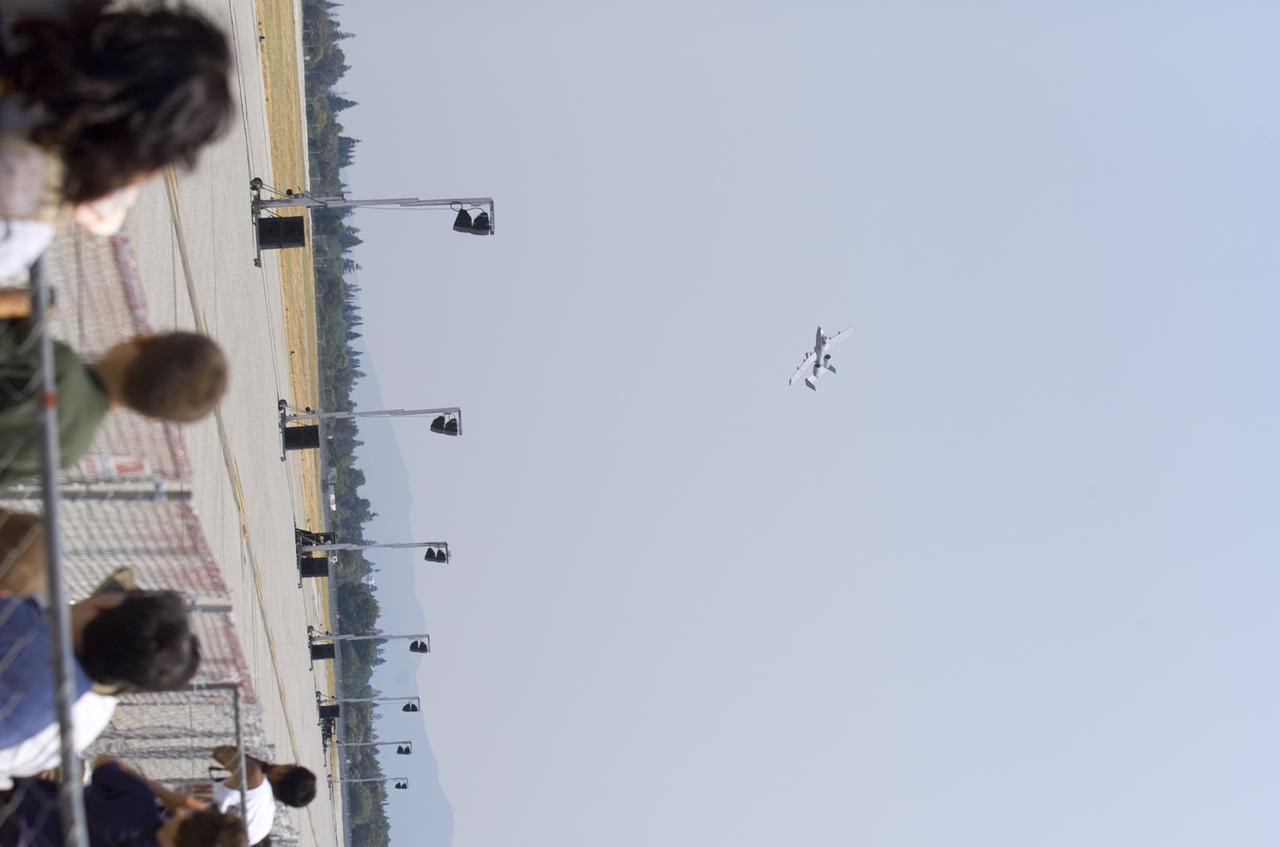
airshow hosted by MFA
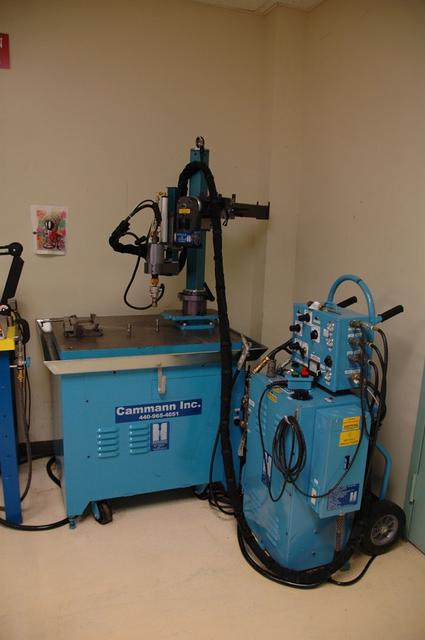
Interior View of Orbiter Processing Facility 3
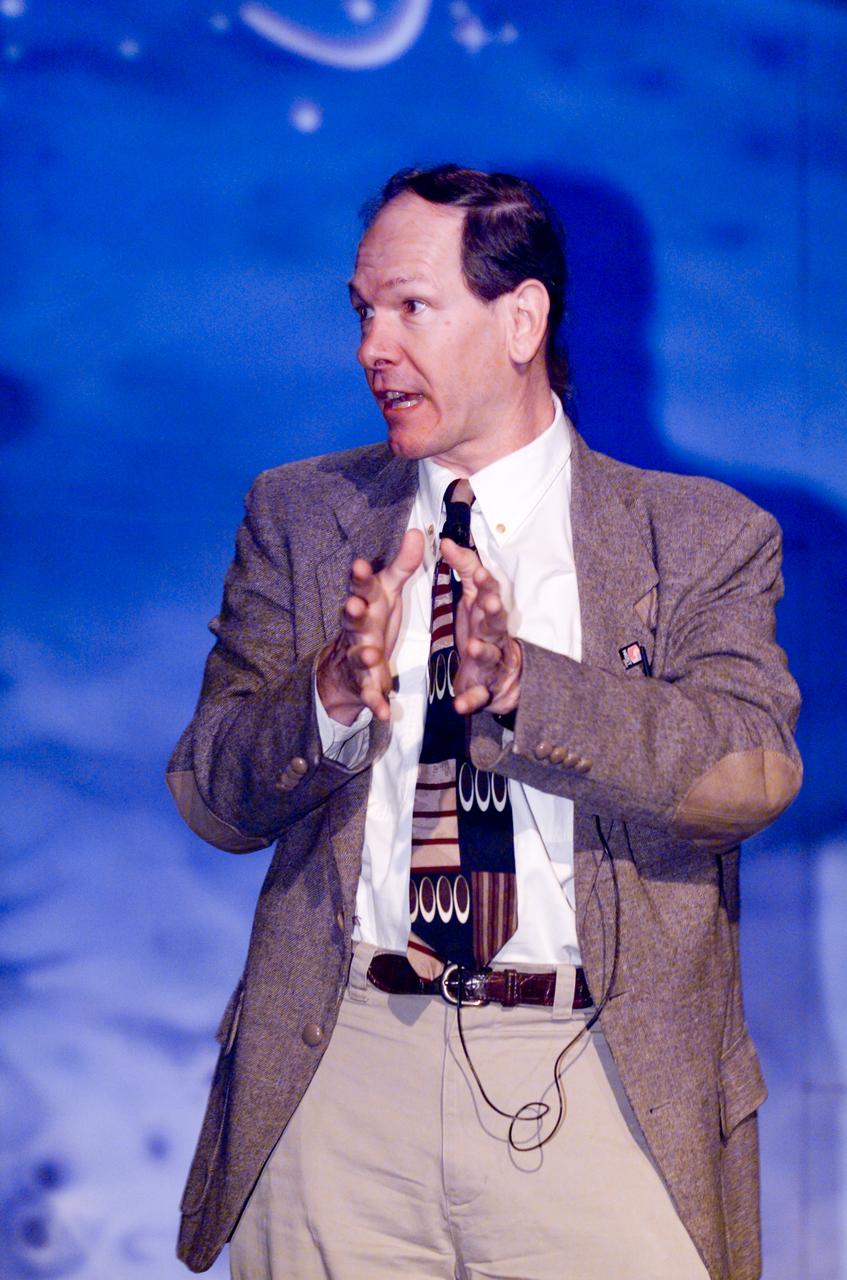
Astrobiology Conference 2002
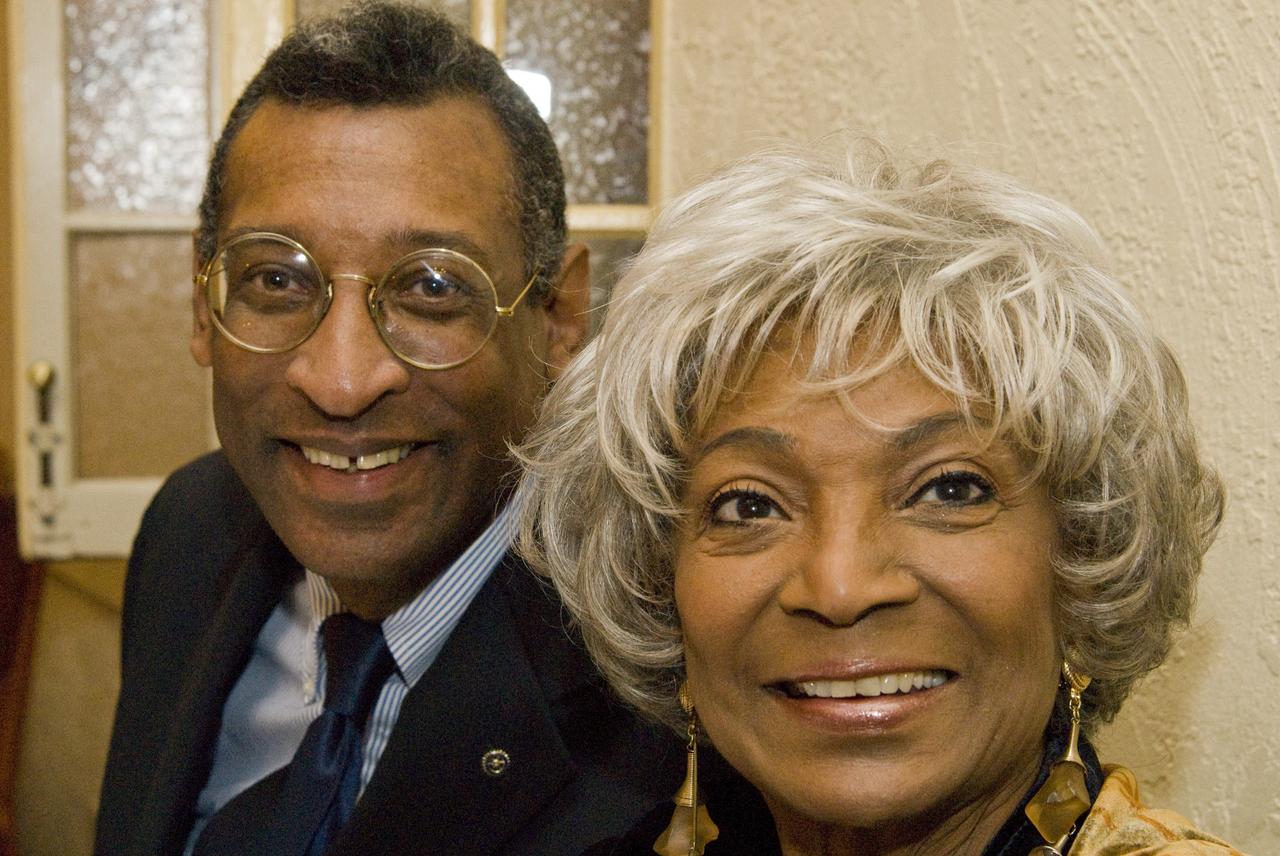
NASA Ames Research Center 70 Year Anniversary Gala Dinner held at Santa Clara University, Santa Clara, California with special guest speaker Nichelle Nichols of Star Trek fame.
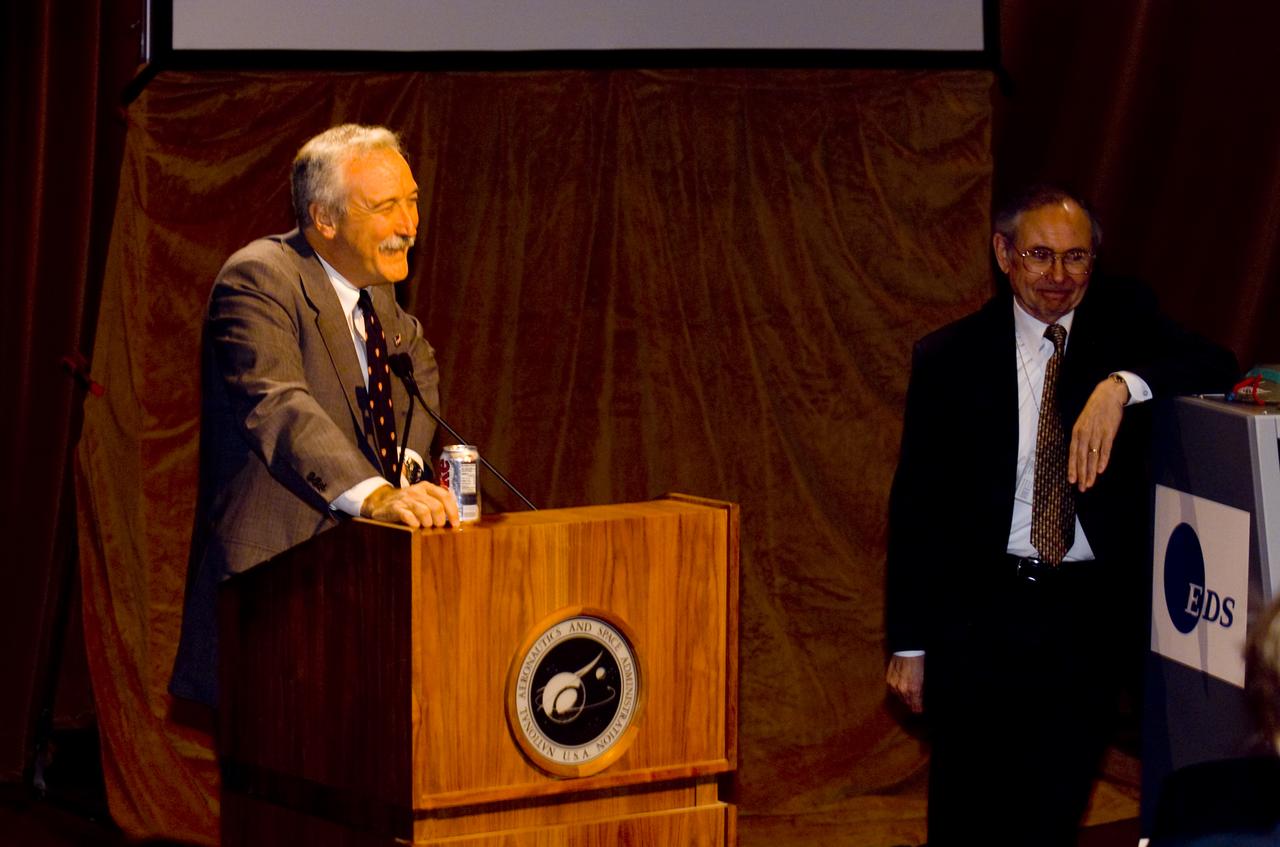
NASA Administrator Sean O'Keefe comes to Ames for employee briefing and tour. N-201 assembly
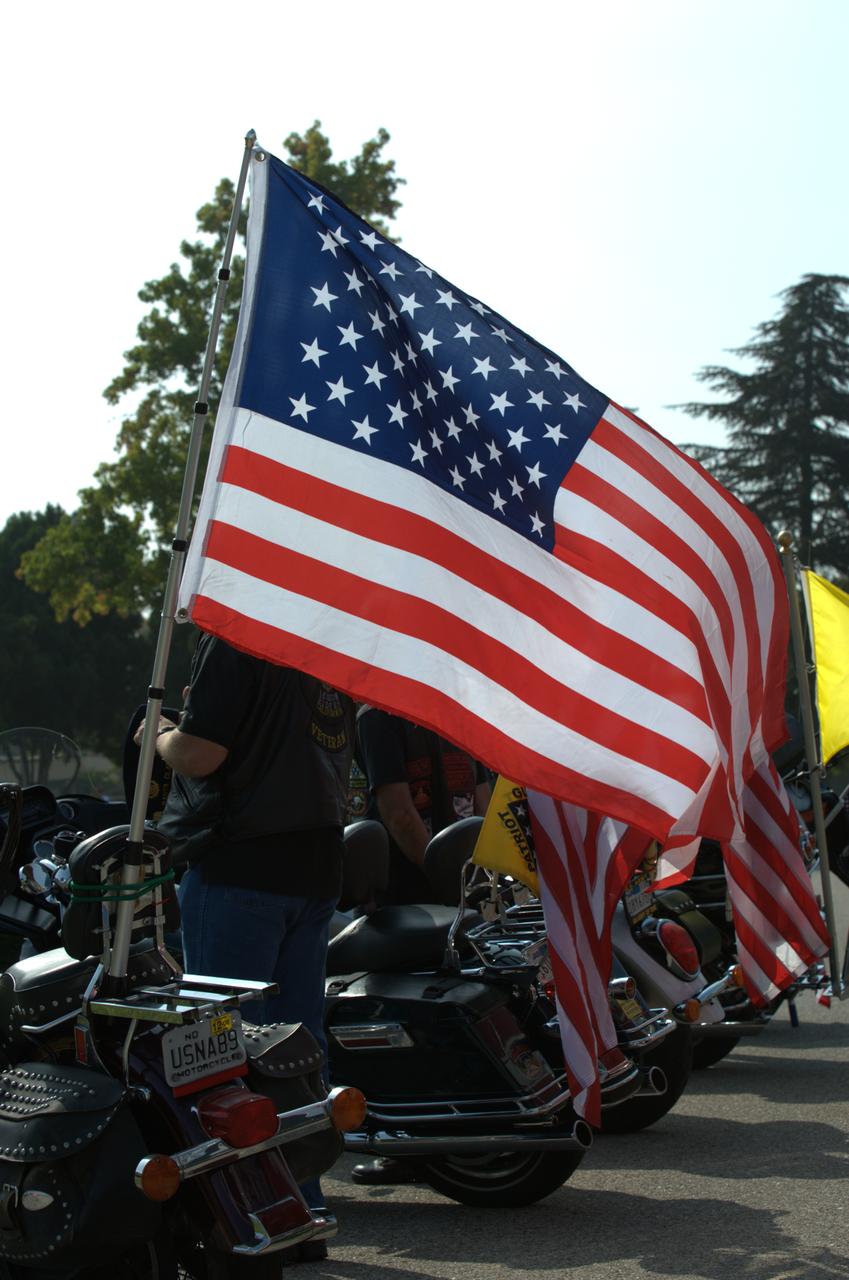
September 11th remembrance ceremony held in front of NASA Research Park Bldg-17 (Lunar Science Institute) hosted by the American Legion, Post 881, Moffett Field.
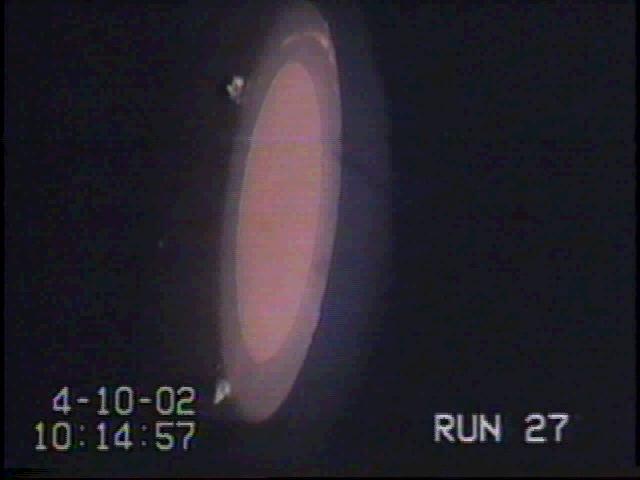
RCC (Reinforced Carbon-Carbon) Johnson Space Center model testing in Ames interactive Heating Facility IHF-127 (data run 27)
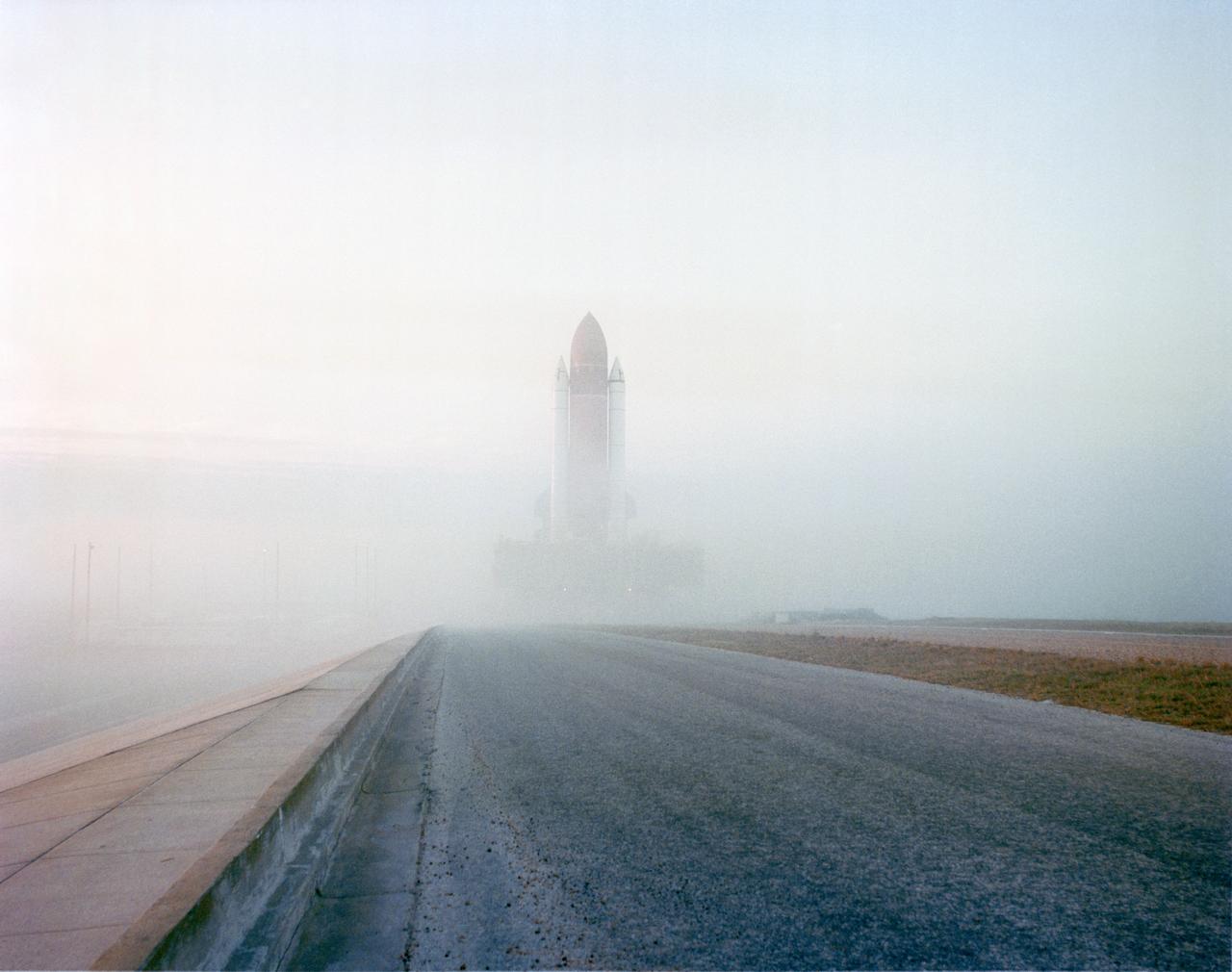
STS-32 Columbia, Orbiter Vehicle (OV) 102, rolls through the morning's foggy mist atop the mobile launcher platform and crawler transporter to Kennedy Space Center (KSC) Launch Complex (LC) Pad 39A. OV-102's wings appear on either side of the two solid rocket boosters (SRBs) and external tank (ET). Rollout from the Vehicle Assembly Building (VAB) began at 2:32 am Eastern Standard Time (EST), and OV-102 was on the pad pedestals about 8 hours later. This marks the first time a Space Shuttle has been at LC Pad 39A since 01-12-85 when OV-102 was launched on mission 61C. View provided by KSC with alternate number KSC-89PC-1259.
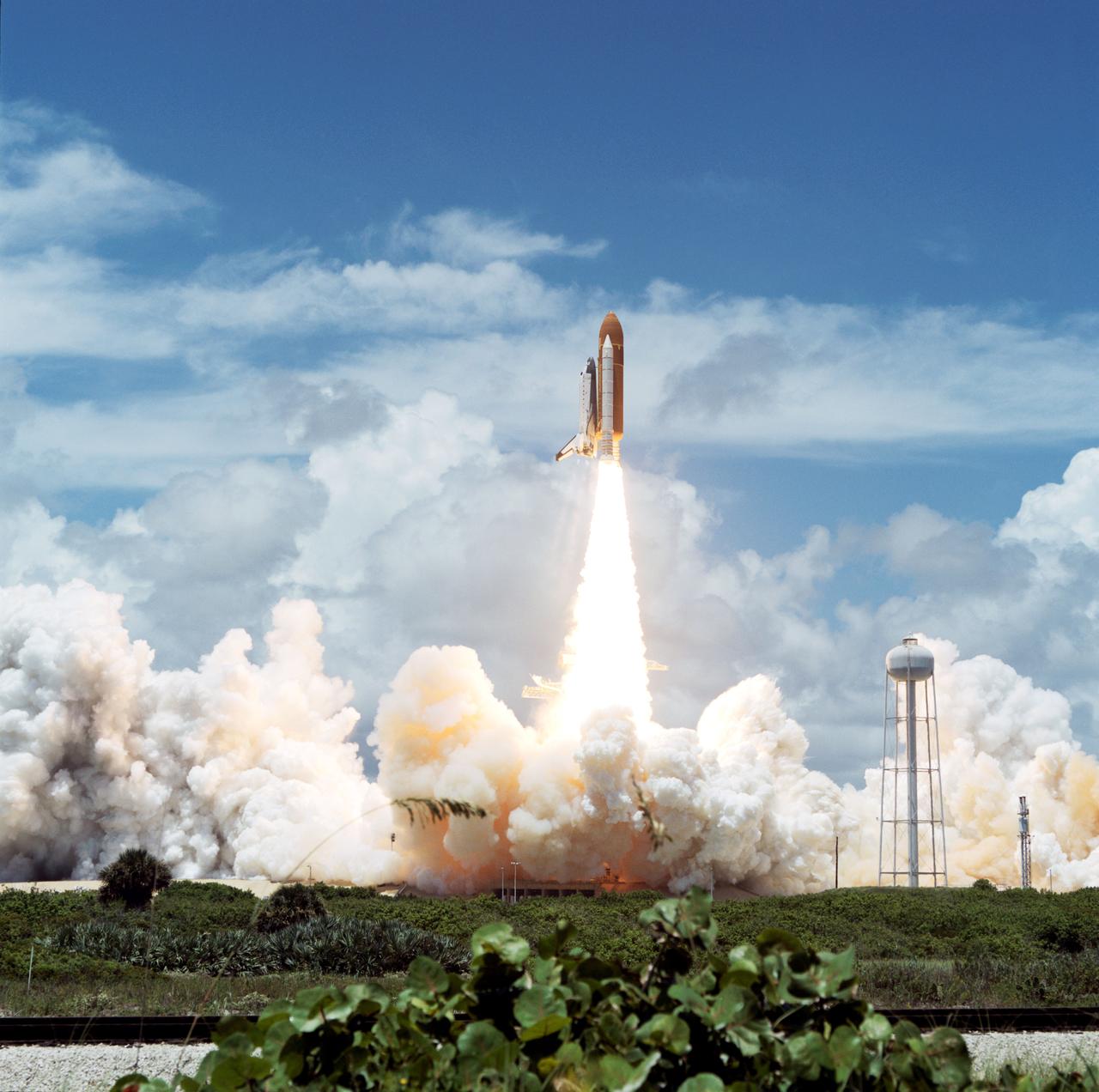
Columbia, Orbiter Vehicle (OV) 102, heads skyward after clearing the fixed service structure (FSS) tower at Kennedy Space Center (KSC) Launch Complex (LC) Pad 39A. Florida plant life appears in the foreground. The exhaust cloud produced by OV-102's solid rocket boosters (SRBs) covers the launch pad area with the exception of the sound suppression water system tower. OV-102's starboard side and the right SRB are visible from this angle. Launch occurred at 12:43 pm Eastern Daylight Time (EDT). Once in Earth orbit, STS-65's six NASA astronauts and a Japanese Payload Specialist aboard OV-102 will begin two weeks of experimentation in support of the second International Microgravity Laboratory (IML-2).
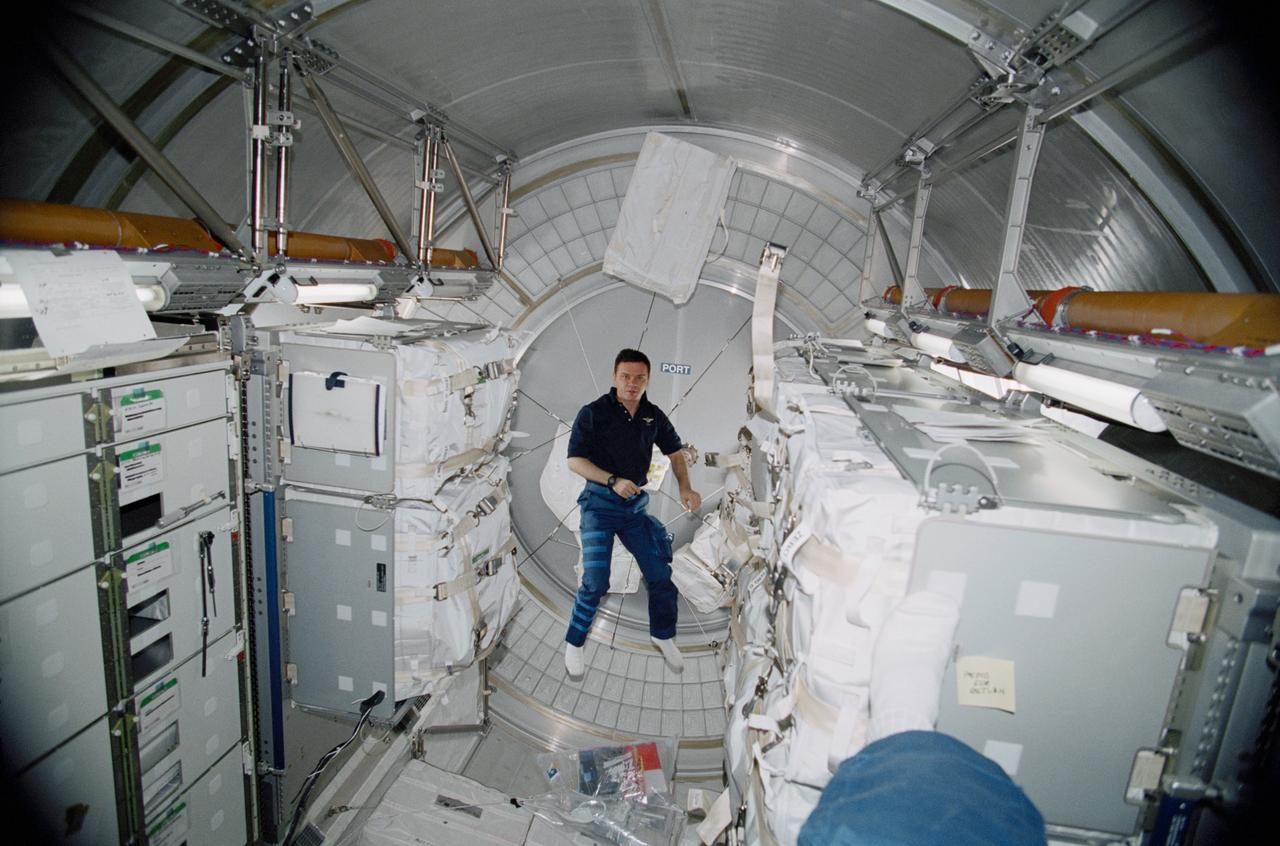
A crewmember of Expedition One, cosmonaut Yuri P. Gidzenko, is dwarfed by transient hardware aboard Leonardo, the Italian Space Agency-built Multi-Purpose Logistics Module (MPLM), a primary cargo of the STS-102 mission. The Leonardo MPLM is the first of three such pressurized modules that will serve as the International Space Station's (ISS's) moving vans, carrying laboratory racks filled with equipment, experiments and supplies to and from the Space Station aboard the Space Shuttle. The cylindrical module is approximately 21-feet long and 15- feet in diameter, weighing almost 4.5 tons. It can carry up to 10 tons of cargo into 16 standard Space Station equipment racks. Of the 16 racks the module can carry, 5 can be furnished with power, data, and fluid to support refrigerators or freezers. In order to function as an attached station module as well as a cargo transport, the logistics module also includes components that provide life support, fire detection and suppression, electrical distribution, and computer functions. The eighth Shuttle mission to visit the ISS, the STS-102 mission served as a crew rotation flight. It delivered the Expedition Two crew to the Station and returned the Expedition One crew back to Earth.
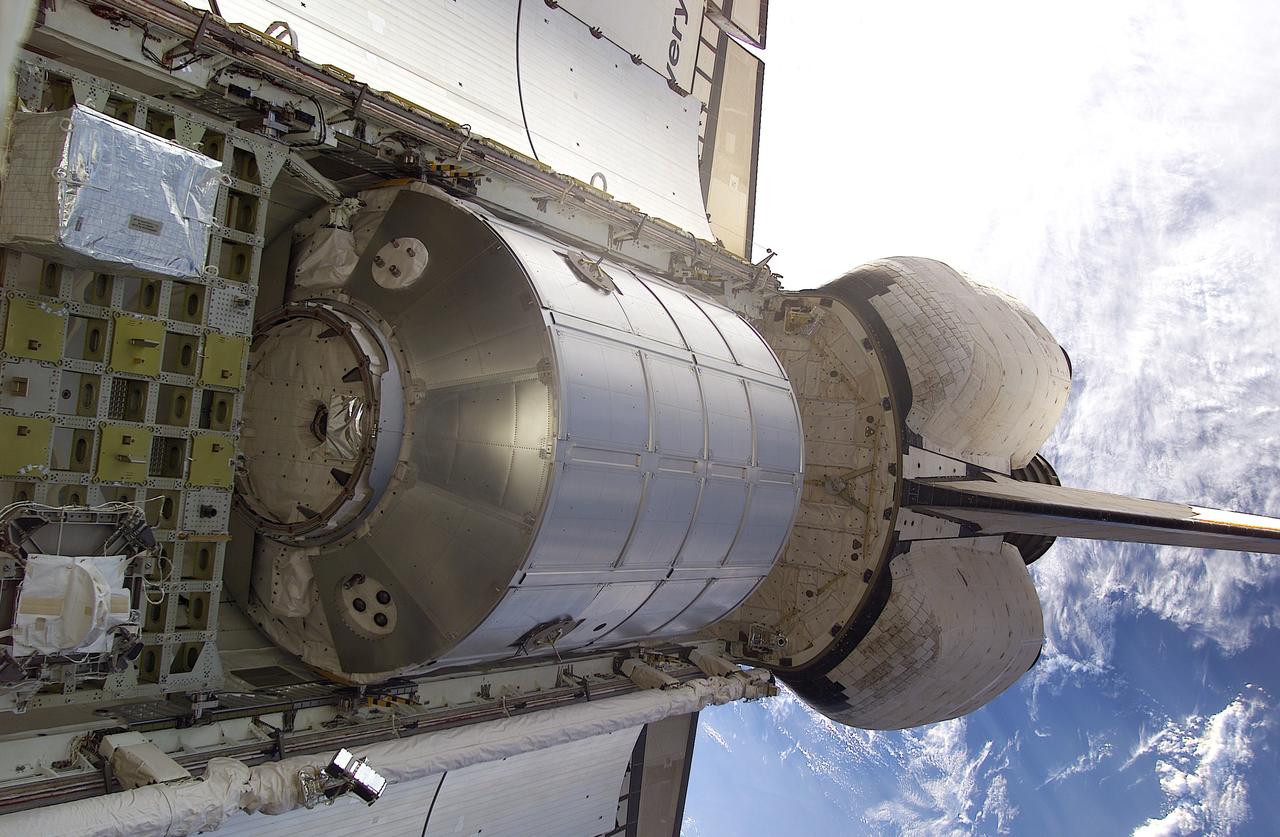
This in-orbit close up shows the Italian Space Agency-built multipurpose Logistics Module (MPLM), Leonardo, the primary cargo of the STS-102 mission, resting in the payload bay of the Space Shuttle Orbiter Discovery. The Leonardo MPLM is the first of three such pressurized modules that will serve as the International Space Station's (ISS') moving vans, carrying laboratory racks filled with equipment, experiments, and supplies to and from the Station aboard the Space Shuttle. The cylindrical module is approximately 21-feet long and 15- feet in diameter, weighing almost 4.5 tons. It can carry up to 10 tons of cargo in 16 standard Space Station equipment racks. Of the 16 racks the module can carry, 5 can be furnished with power, data, and fluid to support refrigerators or freezers. In order to function as an attached station module as well as a cargo transport, the logistics module also includes components that provide life support, fire detection and suppression, electrical distribution, and computer functions. The eighth station assembly flight and NASA's 103rd overall flight, STS-102 launched March 8, 2001 for an almost 13 day mission.
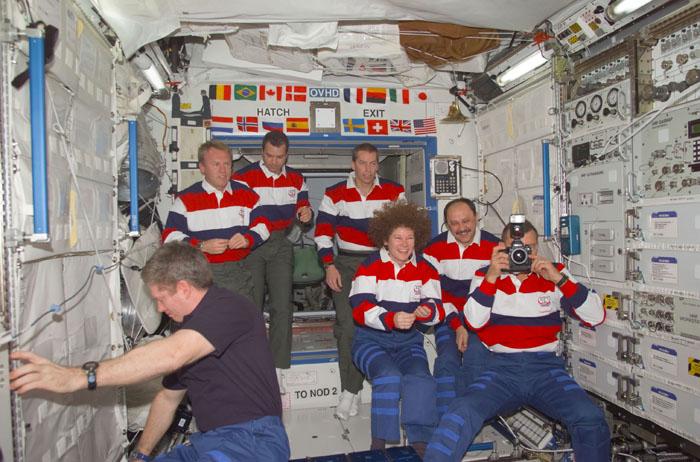
STS102-E-5227 (16 March 2001) --- Onboard the Destiny laboratory on the International Space Station (ISS), astronauts and cosmonauts convene in the midst of personnel changes on crew assignments. From the left are astronauts William M. (Bill) Shepherd, Andrew S.W. Thomas, Paul W. Richards, James D. Wetherbee and Susan J. Helms; along with cosmonaut Yury V. Usachev of Rosaviakosmos and astronaut James S. Voss. Though six here are wearing STS-102 attire, Helms, Voss and Usachev will be dressed in that of the Expedition Two crew shortly and Shepherd's suit will match those of the STS-102 crew members. The photo was taken with a digital still camera.
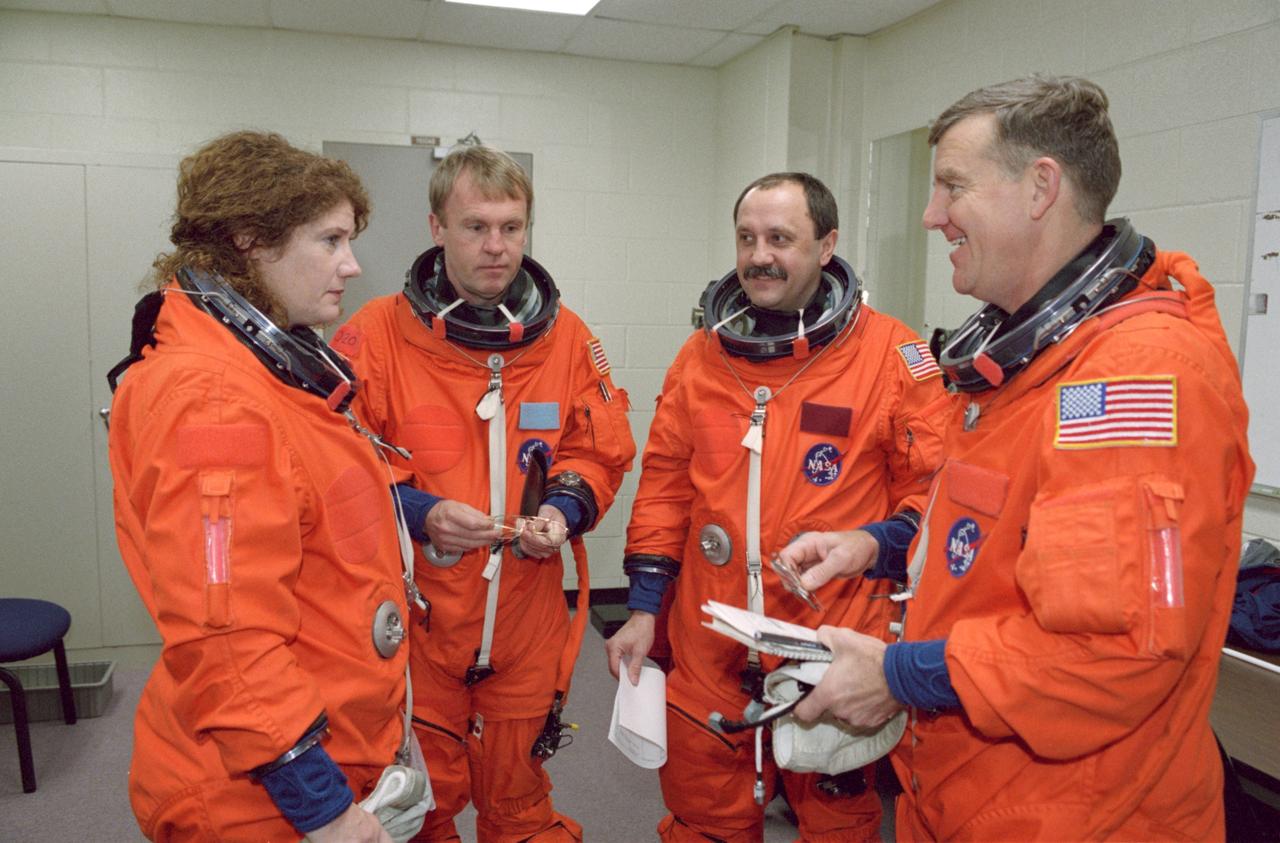
JSC2000-07449 (6 December 2000) --- Astronaut Andrew S.W. Thomas (second left), STS-102 mission specialist, chats with the Expedition Two crew members prior to a simulation exercise in the Systems Integration Facility at the Johnson Space Center. The station crew members are, from left, astronaut Susan J. Helms, cosmonaut Yury V. Usachev and astronaut James S. Voss. Usachev is commander for the second station crew, which will replace the initial group onboard the outpost. The three station crew members will accompany the STS-102 crew aboard the Space Shuttle Discovery to the outpost in March of next year.
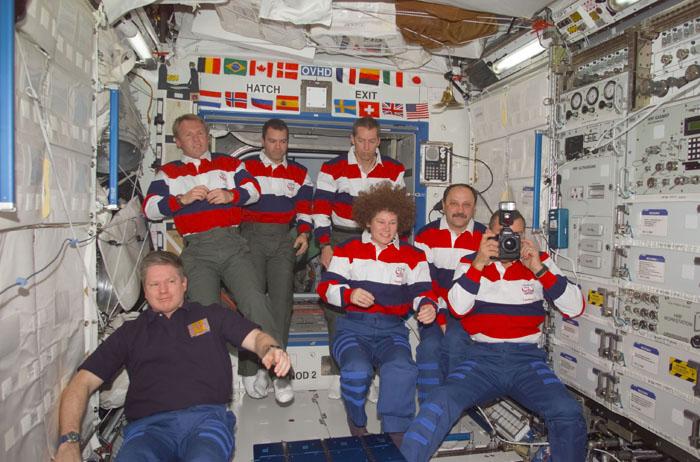
STS102-E-5228 (16 March 2001) --- Onboard the Destiny laboratory for the International Space Station (ISS), astronauts and cosmonauts convene in the midst of personnel changes on crew assignments. From the left are astronauts William M. (Bill) Shepherd, Andrew S.W. Thomas, Paul W. Richards, James D. Wetherbee and Susan J. Helms; along with cosmonaut Yury V. Usachev of Rosaviakosmos and astronaut James S. Voss. Though six here are wearing STS-102 attire, Helms, Voss and Usachev will be dressed in that of the Expedition Two crew shortly and Shepherd's suit will match those of the STS-102 crew members. The photo was taken with a digital still camera.
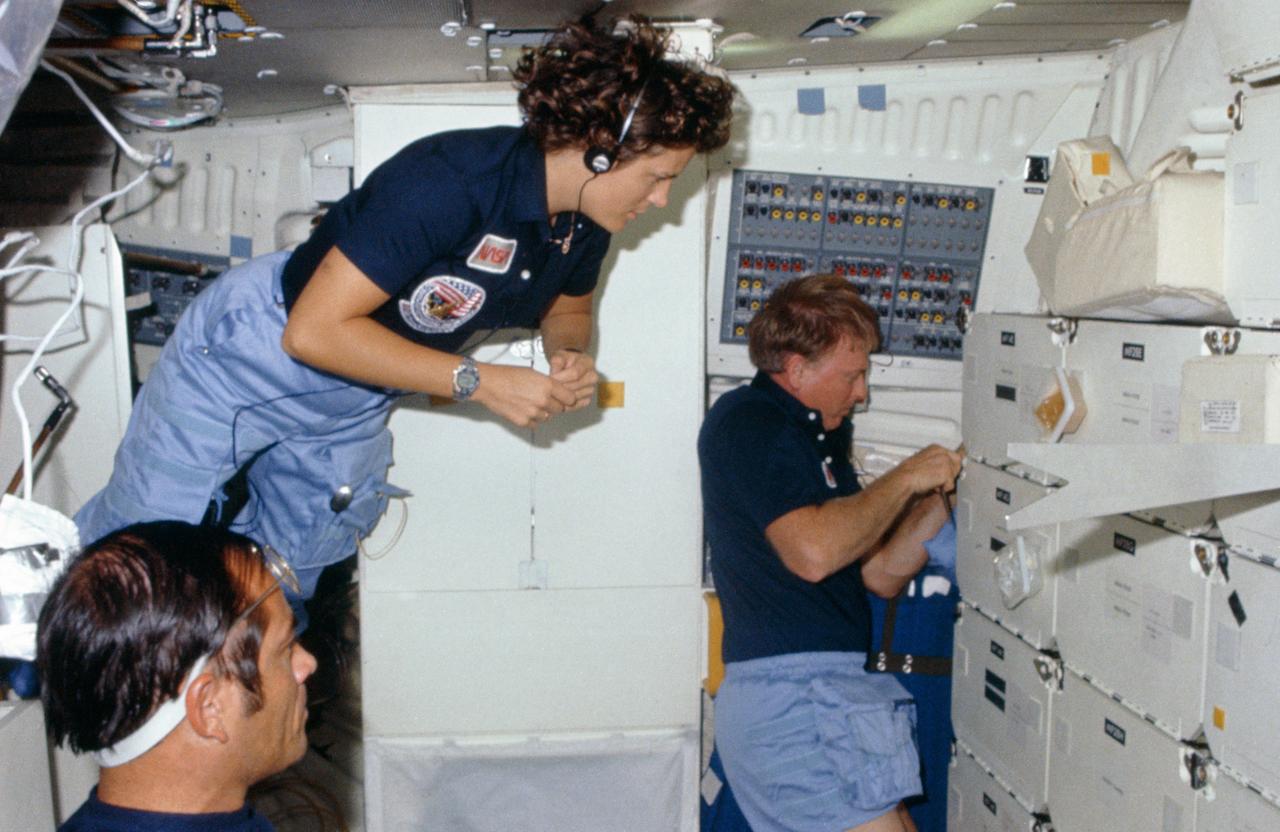
41G-102-003 (5-13 Oct 1984) ---- Astronaut Kathryn D. Sullivan, 41-G mission specialist, floats into a middeck scene to join a more stationary pair of crewmembers---Astronauts Robert L. Crippen, crew commander; and Jon A. McBride, pilot. The protruding article near the stowage lockers is a Krimsky rule, part of the near vision acuity experiment in which recent NASA space travelers have participated.
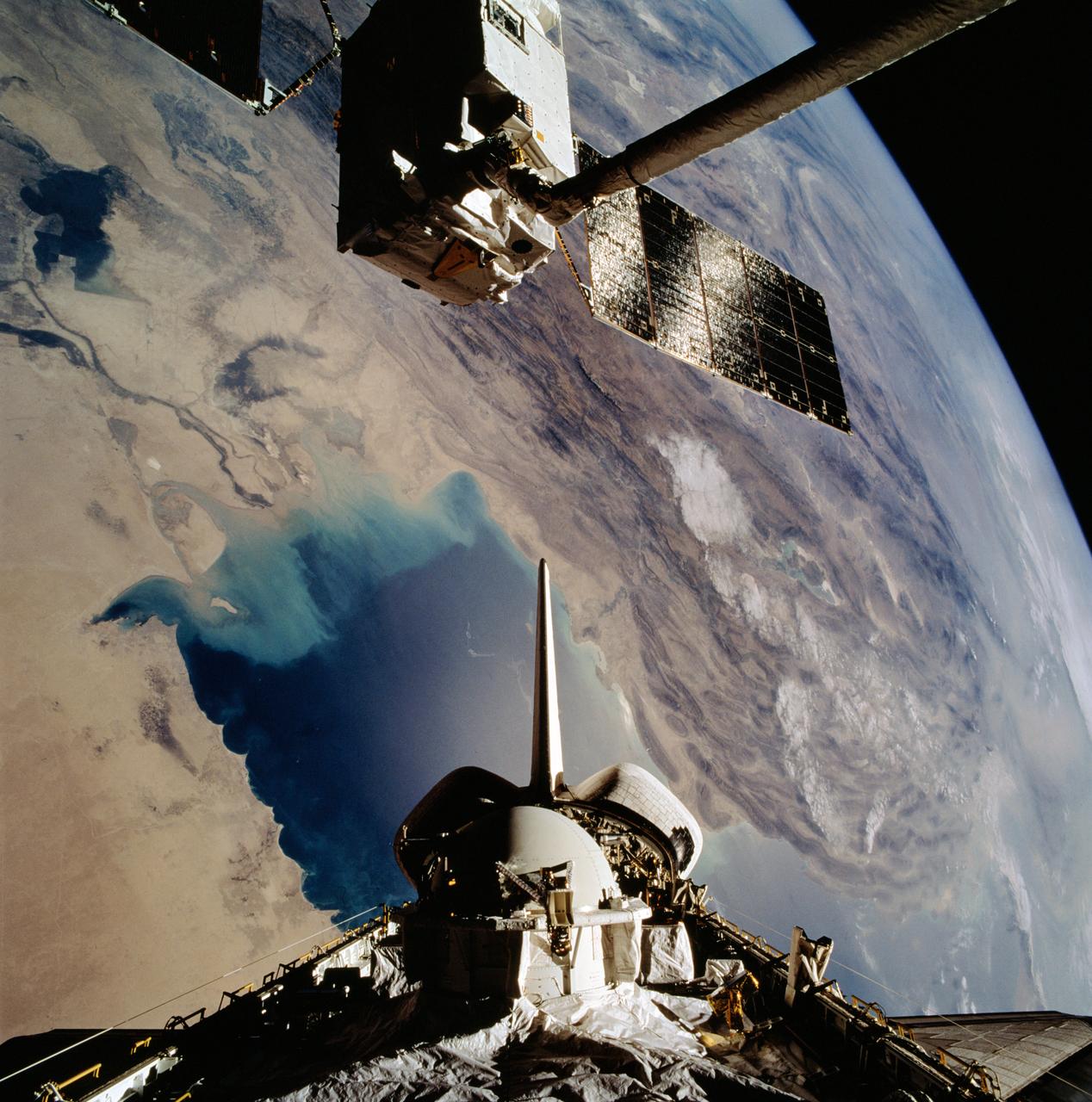
STS046-102-021 (1 Aug 1992) --- The European Space Agency's (ESA) EURECA satellite remains in the grasp of the Space Shuttle Atlantis' Remote Manipulator System (RMS) as the Space Shuttle passes over the Persian Gulf. Most of the theater of the recent war is visible in the frame. Parts of Kuwait, Iraq, Iran and Saudi Arabia can be delineated. The Tethered Satellite System (TSS) remains stowed in the aft cargo bay of Atlantis.
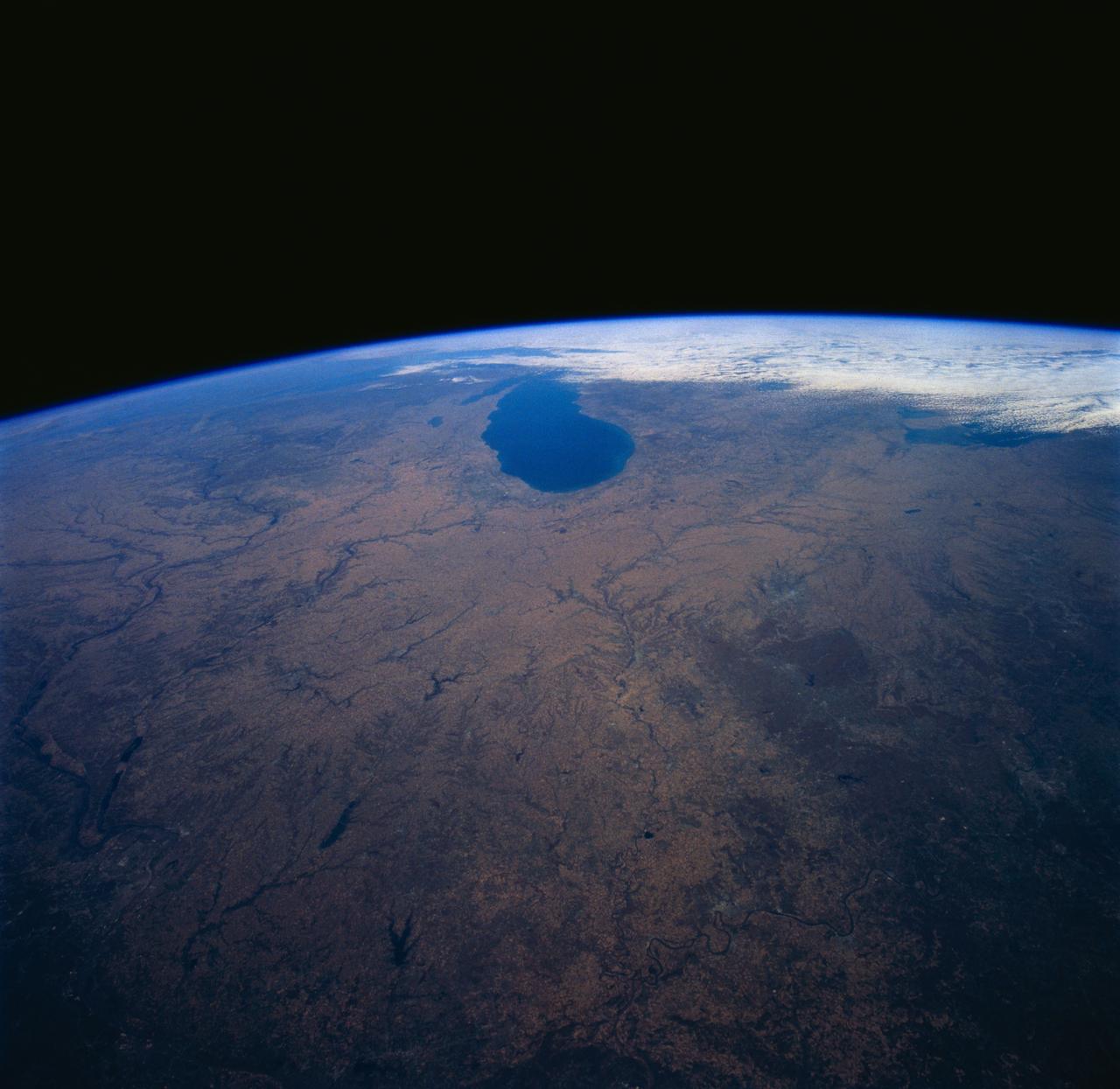
STS058-102-018 (18 Oct-1 Nov 1993) --- A cloud-free, wide-angle view from above western Tennessee to the northern edge of Lake Michigan. The view extends from Saint Louis, Missouri near the lower left-hand corner, past Evansville, Indiana and Louisville, Kentucky to Cincinnati, Ohio. A range of hills covered by trees in Fall foliage extends from the Ohio River toward Lake Michigan, ending just southwest of Indianapolis, Indiana.
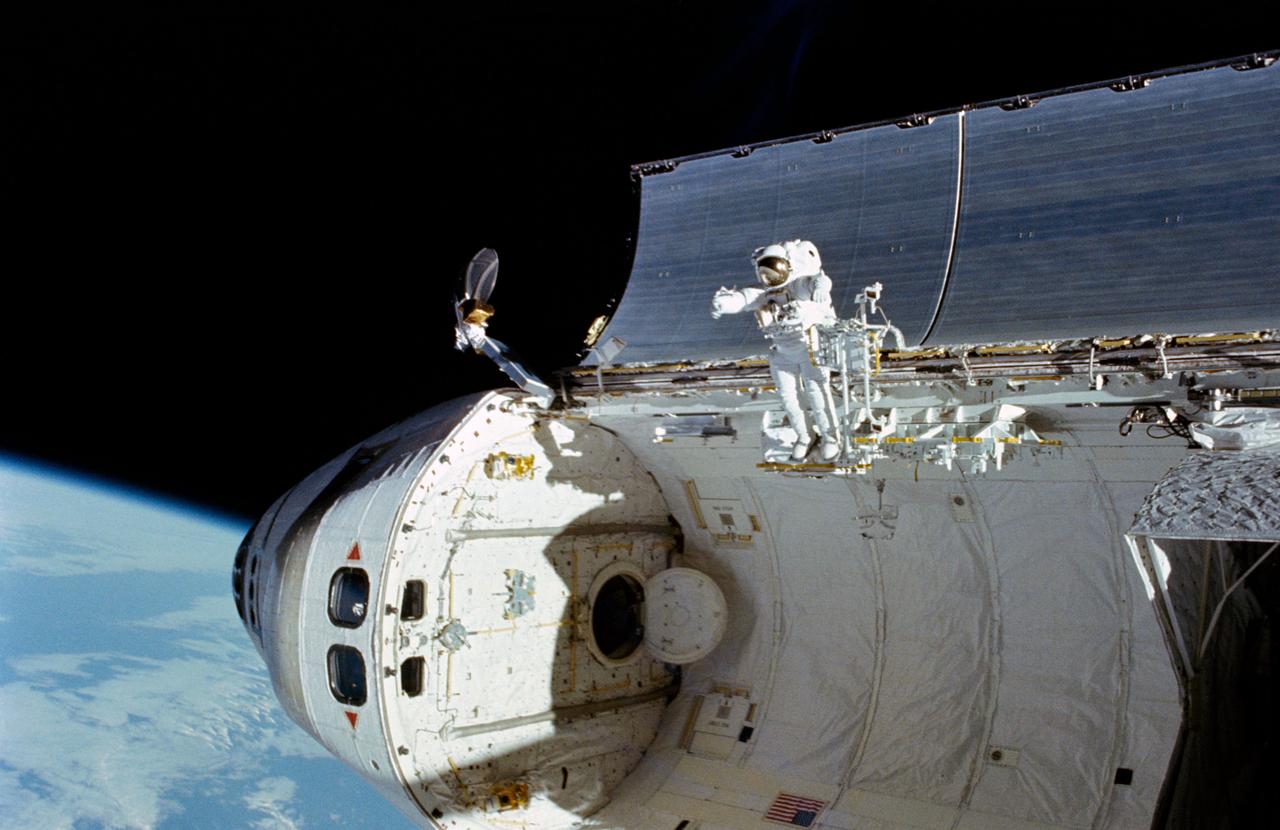
51I-102-048 (4-5 Sept 1985) --- A 35mm frame showing astronaut William F. Fisher standing on the edge of Discovery's cargo bay (in foot restraint) during the second day of a two-day effort to capture, repair and re-release the Syncom IV-3 communications satellite. Astronaut James D. van Hoften, standing on the Discovery's RMS arm, exposed the frame.

41G-102-047 (13 Oct. 1984) --- An unusual picture, photographed by astronaut Kathryn D. Sullivan, shows the beginning and ending location of her eight-day mission in space with six other 41-G crew members aboard the space shuttle Challenger. The picture was made moments before touchdown at the KSC landing facility. Dr. Sullivan aimed a 35mm camera through the port hole in Challenger's hatch. The five ground features represented as circles or pentagonals are launch areas. Photo credit: NASA
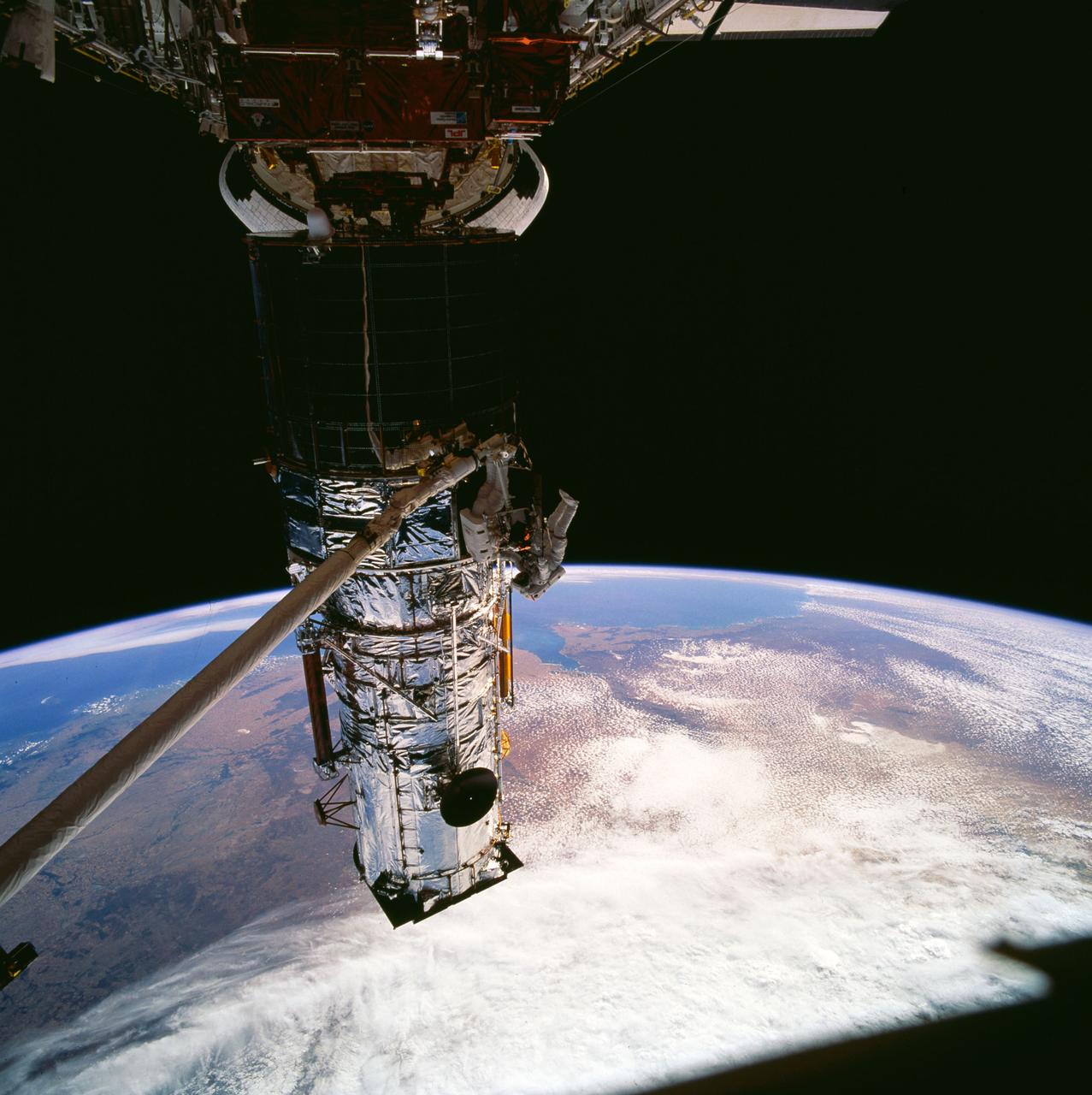
STS061-102-010 (9 Dec 1993) --- Astronauts Jeffrey A. Hoffman (left) and F. Story Musgrave team to replace one of two Solar Array Drive Electronics (SADE) units on the Hubble Space Telescope (HST). Musgrave is standing on a foot restraint mounted on the end of the Space Shuttle Endeavour's Remote Manipulator System (RMS) arm. The black object, in upper left corner, is part of the window frame, through which this 70mm frame was exposed, inside Endeavour's cabin.
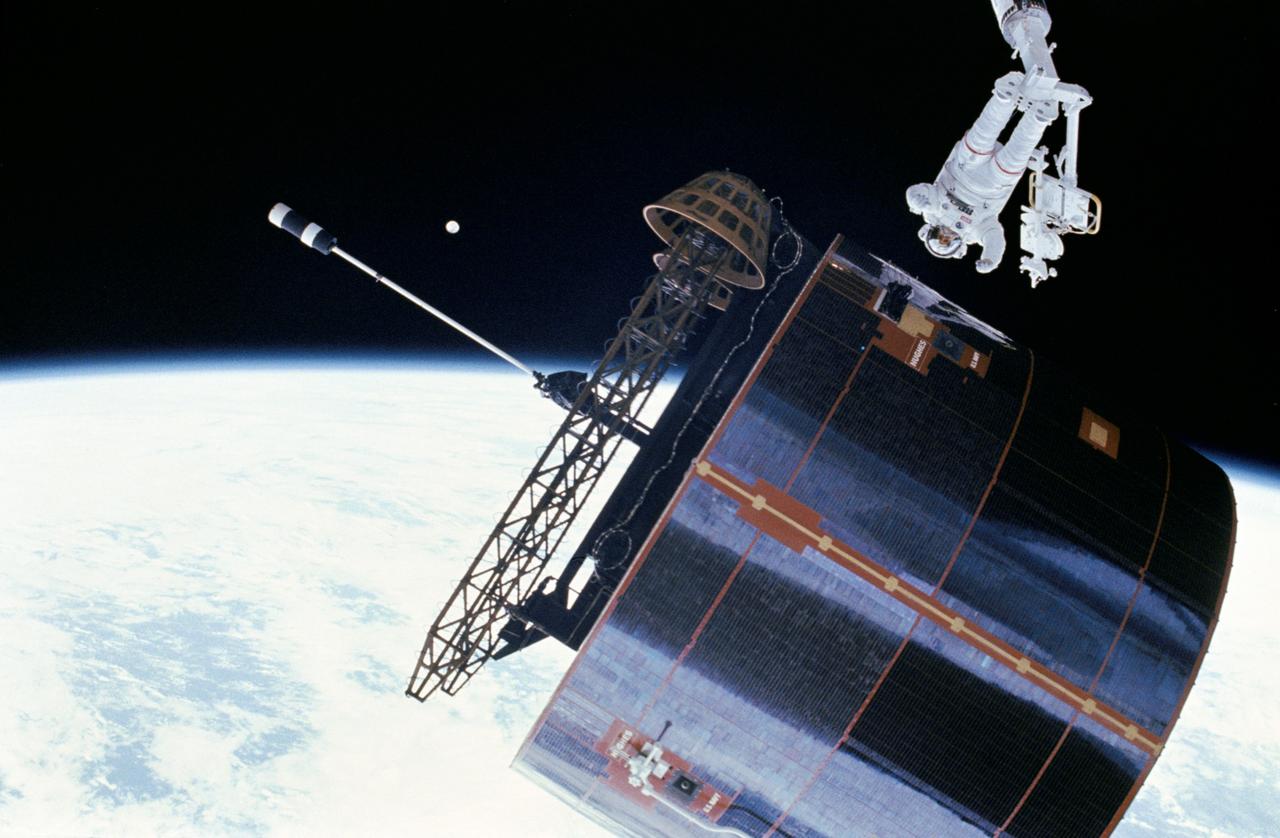
51I-102-029 (31 August - 1 September 1985) --- This is one of a series of six photographs released by NASA covering the extravehicular activity (EVA) of astronauts James D. van Hoften and William F. Fisher, who helped to capture, repair and release the previously errant Syncom IV-3 communications satellite. Here, Dr. van Hoften has just given a shove to the the Syncom. (For orientation, moon should be in lower right quadrant).
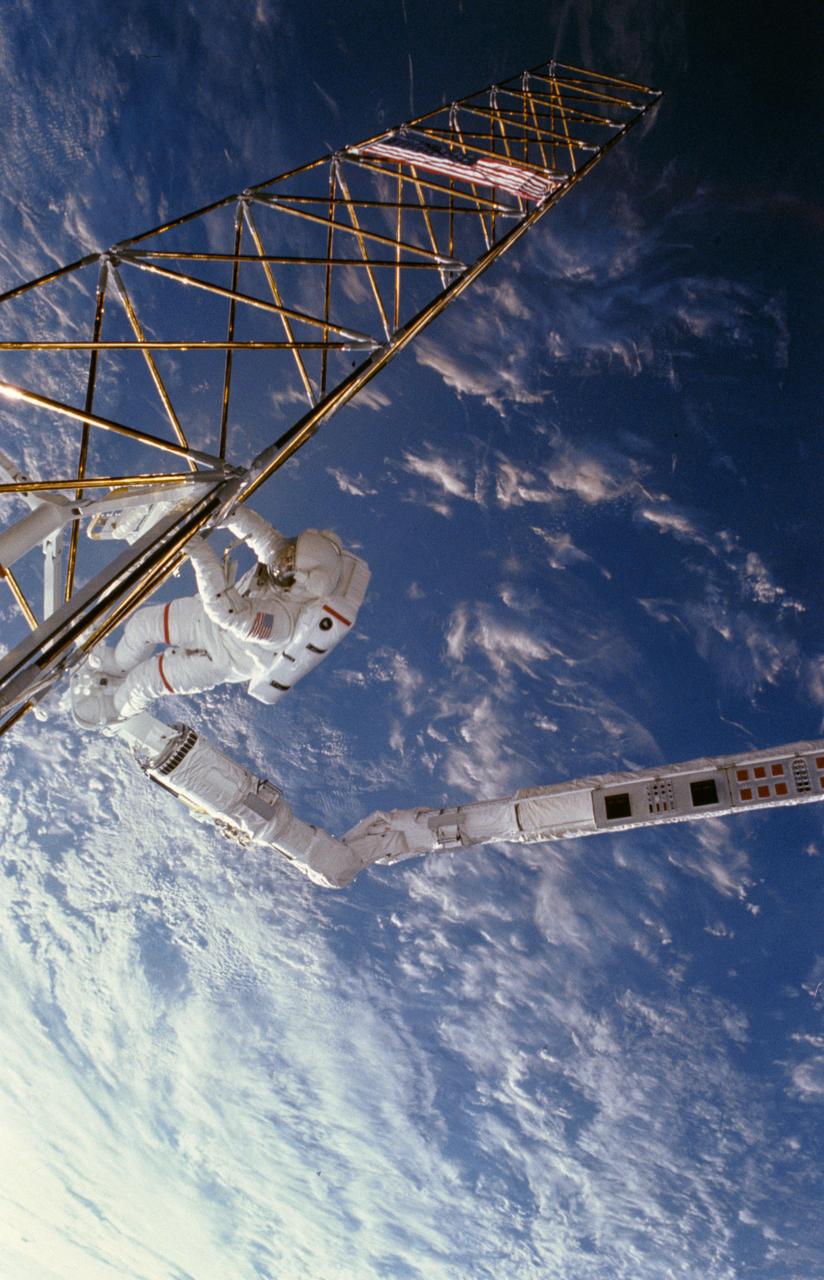
61B-102-022 (1 Dec 1985) --- Astronaut Jerry L. Ross, anchored to the foot restraint on the remote manipulator system (RMS), holds onto the tower-like Assembly Concept for Construction of Erectable Space Structures (ACCESS) device, as the Atlantis flies over white clouds and blue ocean waters. The frame was exposed with a negative-equipped camera held by Astronaut Sherwood C. Spring, who was also on the EVA-task.
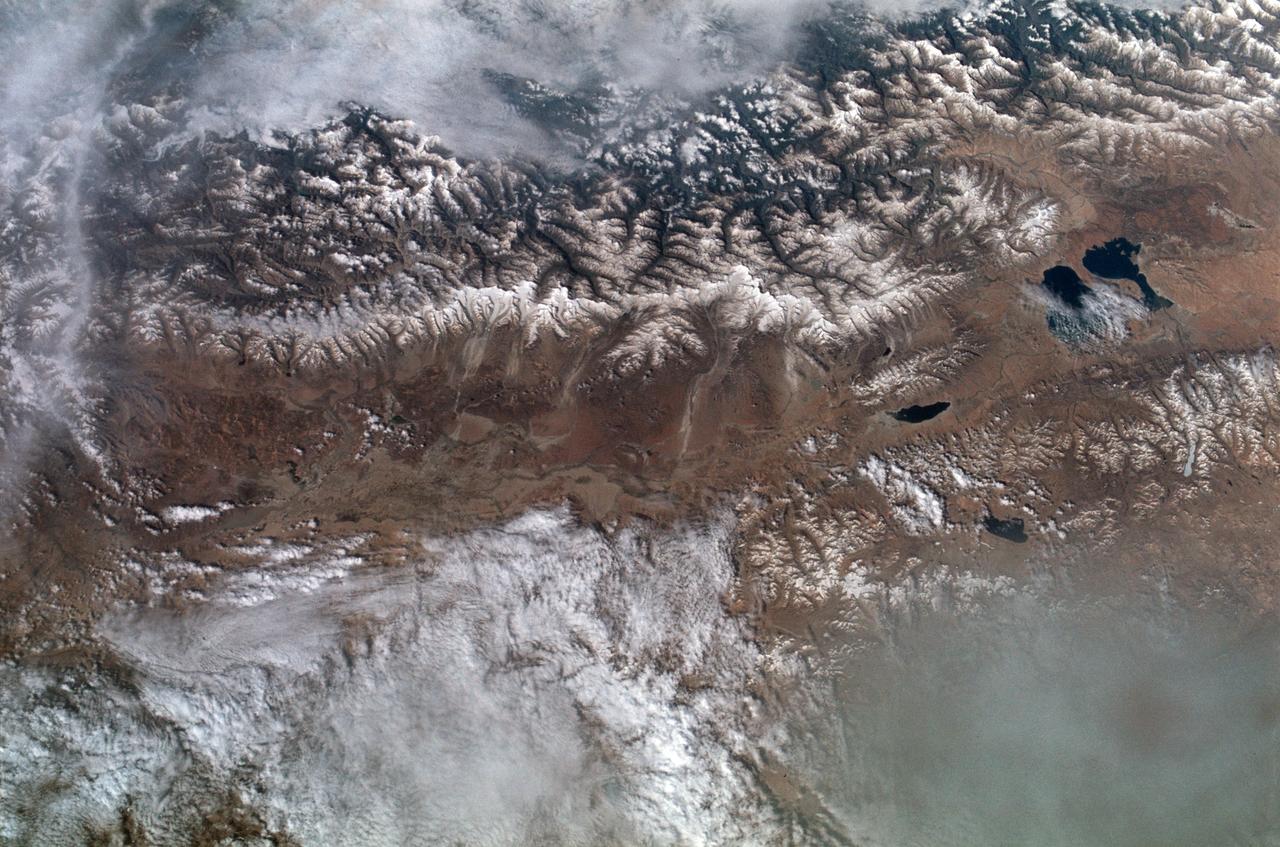
SL2-102-900 (22 June 1973) --- The Great Himalayan Mountain Range, India/Tibet (30.5N, 81.5E) is literally the top of the world where mountains soar to over 20,000 ft. effectively isolating Tibet from the rest of the world. The two lakes seen in the center of the image are the Laga Co and the Kunggyu Co located just inside the Tibet border. Although clouds and rainfall are rare in this region, snow is always present on the mountain peaks. Photo credit: NASA
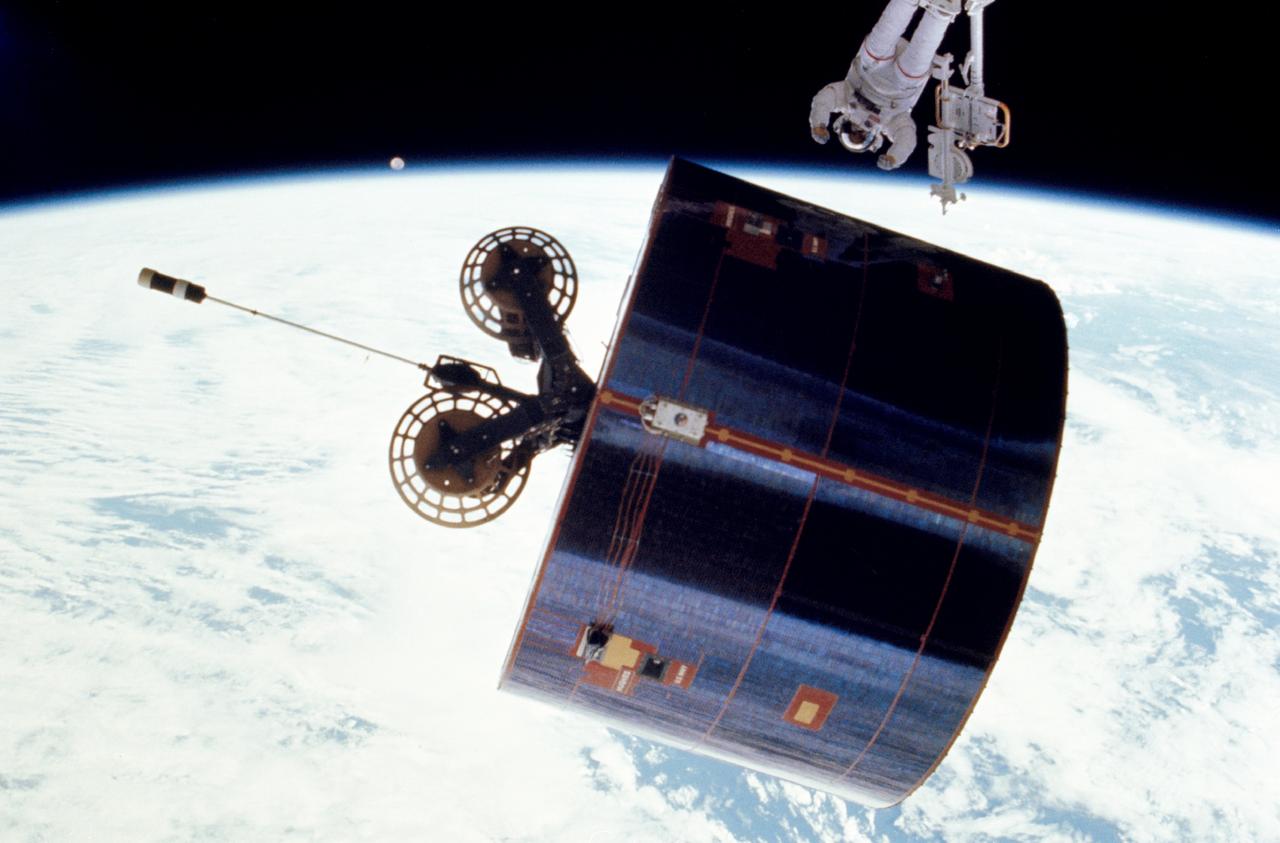
51I-102-033 (31 August - 1 September 1985) --- This is one of a series of six photographs released by NASA covering the extravehicular activity (EVA) of astronauts James D. van Hoften and William F. Fisher, who helped to capture, repair and release the previously errant Syncom IV-3 communications satellite. Here, Dr. van Hoften has just given a shove to the the Syncom. (For orientation, moon should be in lower right quadrant).
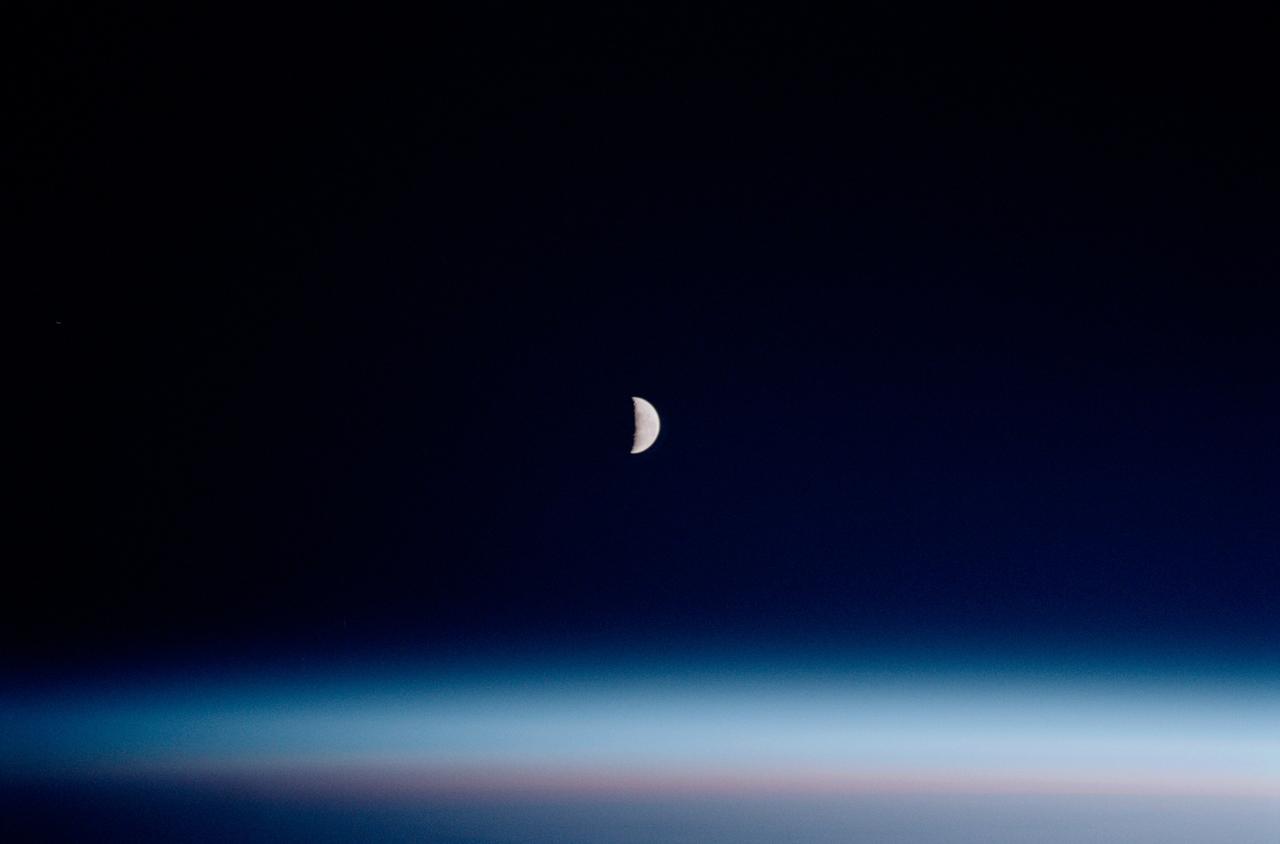
STS102-342-024 (8-21 March 2001)--- The largest percentage of astronaut out-the-window photography is scientific in nature. However, occasionally scenes such as this one showing the moon over Earth's airglow are irresistable for crew members with cameras. The 35mm scene was recorded by one of the STS-102 astronauts from the aft flight deck of the Space Shuttle Discovery.
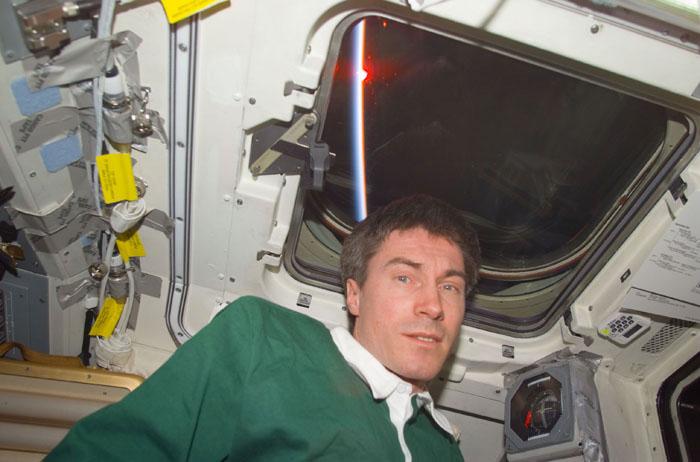
STS102-E-5147 (12 March 2001) --- Cosmonaut Sergei K. Krikalev, now a member of the STS-102 crew on Discovery's flight deck. A sun setting can be seen through the flight deck windows in the background. Krikalev, representing Rosaviakosmos, had been onboard the International Space Station (ISS) since early November 2000. The photograph was taken with a digital still camera.

JSC2000-05556 (3 August 2000) --- Astronaut James M. Kelly, STS-102 pilot, during a session of egress training in the Johnson Space Center's Systems Integration Facility, prepares to use a Sky-genie device to escape from a simulated shuttle in trouble. Crew trainer David Pogue (right) gives the pilot some tips on using the device.
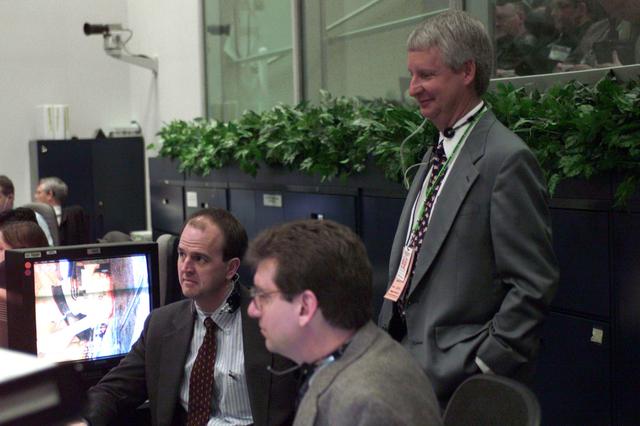
JSC2001-E-06209 (8 March 2001) --- At the Mission Operations Directorate (MOD) console in Houston's Mission Control Center (MCC), (from the left) Robbie D. Gest, Jeffrey W. Bantle and Steven A. Hawley monitor pre-launch activity for STS-102. Gest is Project Leader for Mission Operations for the United Space Alliance (USA); Bantle is with the Flight Director Office in MOD; and Hawley is with the Flight Crew Operations Directorate.
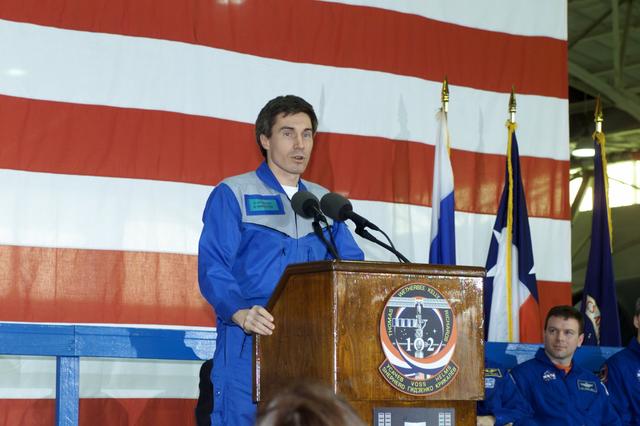
JSC2001-E-08332 (22 March 2001) --- Cosmonaut Sergei K. Krikalev, Expedition One flight engineer, speaks to a crowd of greeters during a crew return ceremony in Ellington Field's Hangar 990. Pictured in the background on the dais is astronaut James M. Kelly, STS-102 pilot.
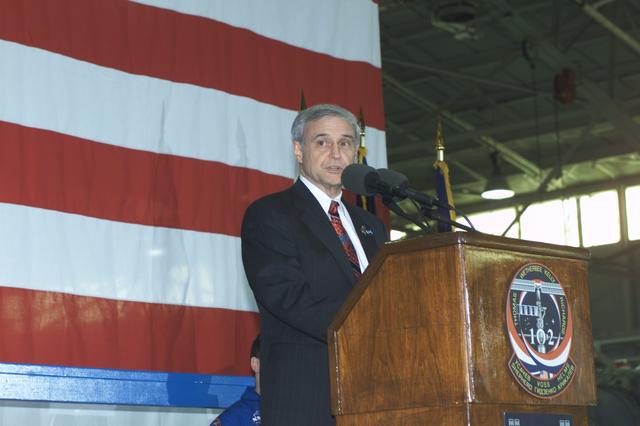
JSC2001-E-08316 (22 March 2001) --- JSC Acting Director Roy S. Estess introduces the STS-102 and Expedition One crew members (out of frame) to a crowd gathered in Ellington Field's Hangar 990 during crew return ceremonies.
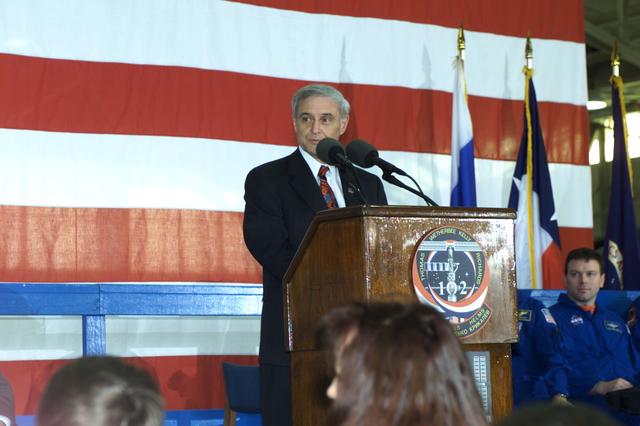
JSC2001-E-08315 (22 March 2001) --- JSC Acting Director Roy S. Estess introduces the STS-102 and Expedition One crew members to a crowd gathered in Ellington Field's Hangar 990 during crew return ceremonies.
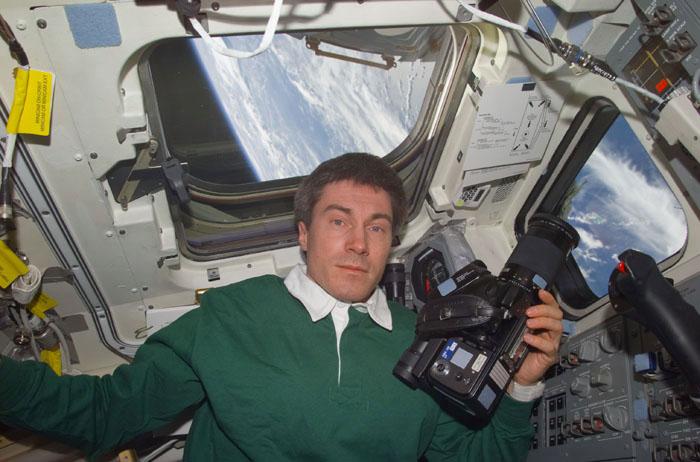
STS102-E-5142 (12 March 2001) --- Cosmonaut Sergei K. Krikalev, now a member of the STS-102 crew, prepares to use a camera on Discovery's flight deck. Krikalev, representing Rosaviakosmos, had been onboard the International Space Station (ISS) since early November 2000. The photograph was taken with a digital still camera.
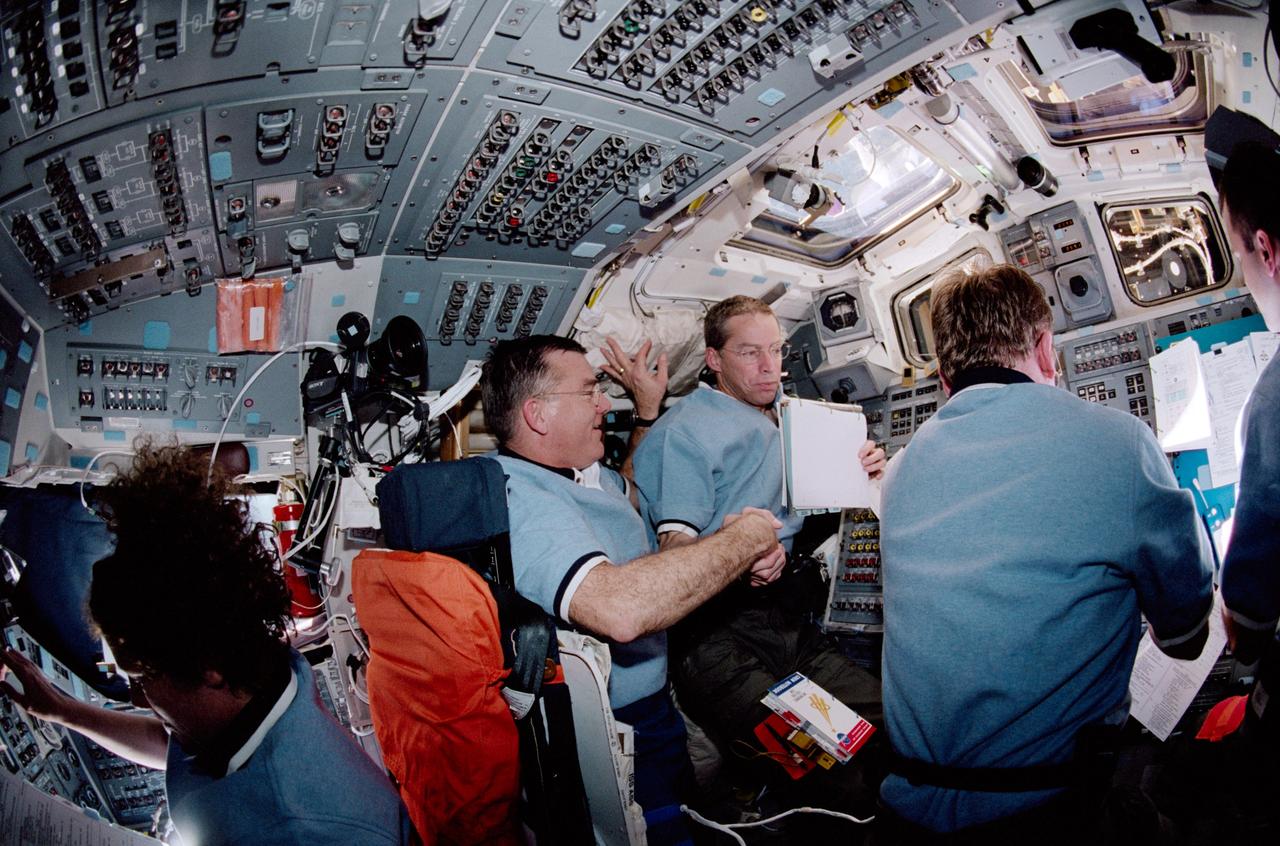
STS102-323-003 (10 March 2001) --- The STS-102 crew members are pictured on the aft flight deck of the Space Shuttle Discovery during docking operations with the International Space Station (ISS). From the left are astronauts James S. Voss, James D. Wetherbee and Andrew S.W. Thomas.

STS-32 Columbia, Orbiter Vehicle (OV) 102, is captured as its main landing gear (MLG) touches down on runway 22 at Edwards Air Force Base (EAFB), California, in the early morning darkness. The night landing ended a record 11-day mission in space. Moments later, at 1:36:38 am Pacific Standard Time (PST), OV-102 came to a complete stop, having logged 4,509,972 miles in flight.
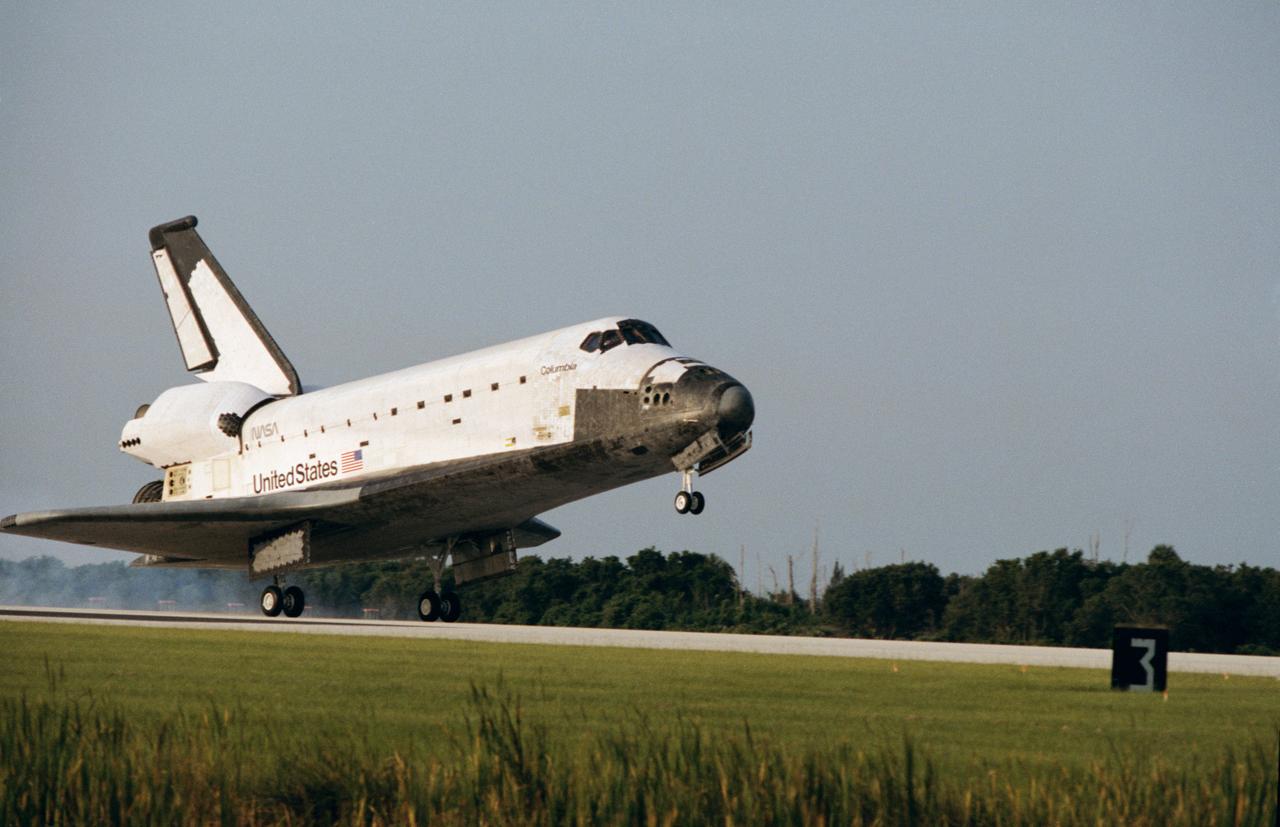
STS-50 Columbia's, Orbiter Vehicle (OV) 102's, main landing gear touches down on runway 33 at the Kennedy Space Center (KSC) Shuttle Landing Facility (SLF) producing a small cloud of dust. Landing occurred at 7:42 am (Eastern Daylight Time (EDT)). In this view of the OV-102's starboard side, the nose landing gear (NLG) continues to ride above the runway surface. Florida vegetation, a runway sign, and runway lights appear in the foreground.
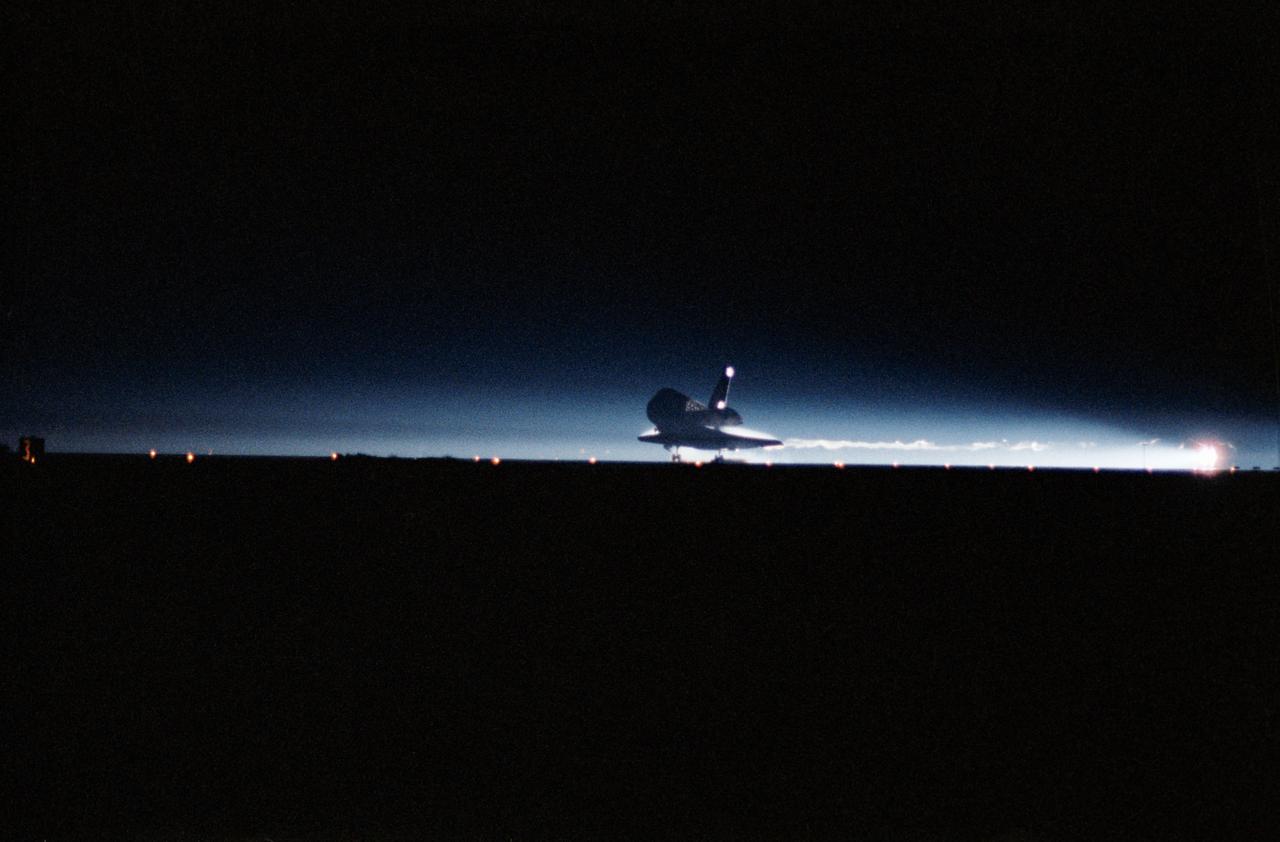
STS-32 Columbia, Orbiter Vehicle (OV) 102, is captured as its main landing gear (MLG) touches down on runway 22 at Edwards Air Force Base (EAFB), California, in the early morning darkness. The night landing ended a record 11-day mission in space. Moments later, at 1:36:38 am Pacific Standard Time (PST), OV-102 came to a complete stop, having logged 4,509,972 miles in flight.
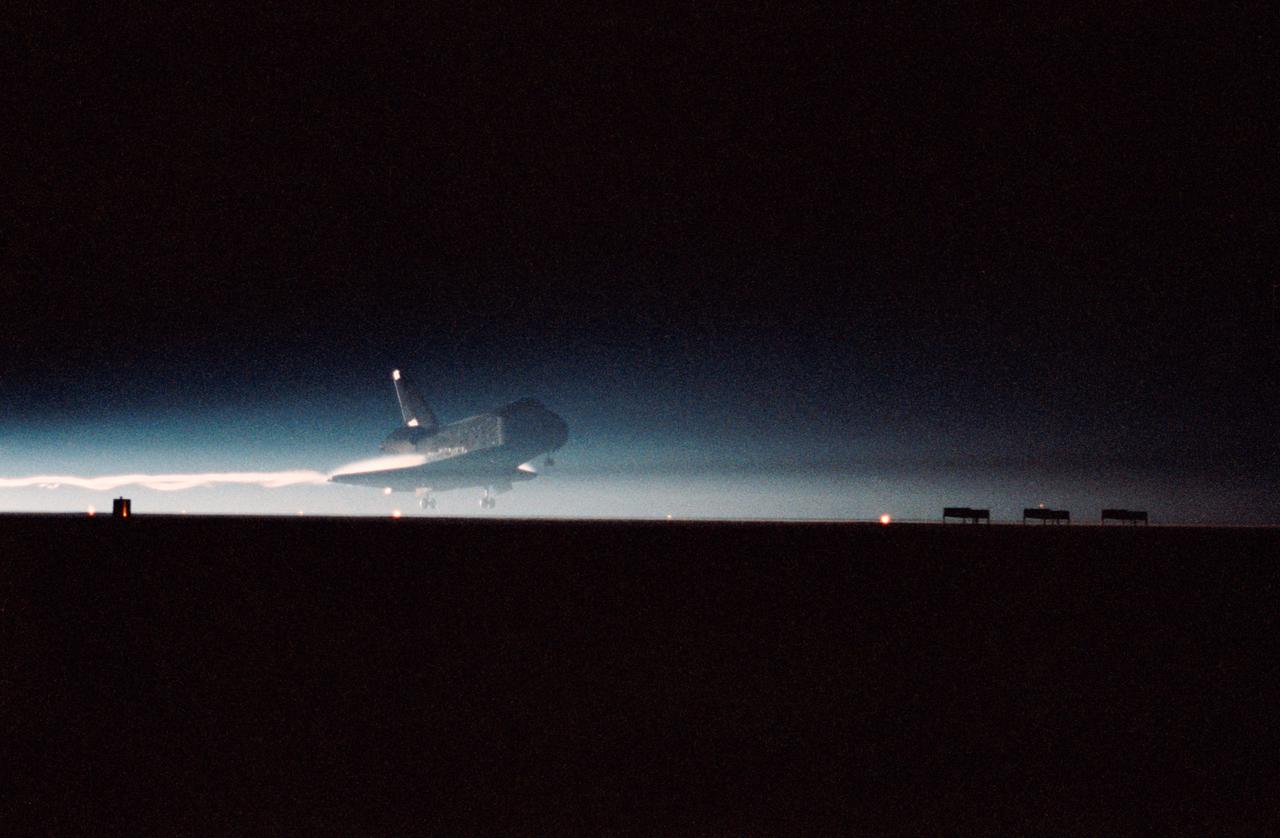
STS-32 Columbia, Orbiter Vehicle (OV) 102, is captured as its main landing gear (MLG) touches down on runway 22 at Edwards Air Force Base (EAFB), California, in the early morning darkness. The night landing ended a record 11-day mission in space. Moments later, at 1:36:38 am Pacific Standard Time (PST), OV-102 came to a complete stop, having logged 4,509,972 miles in flight.
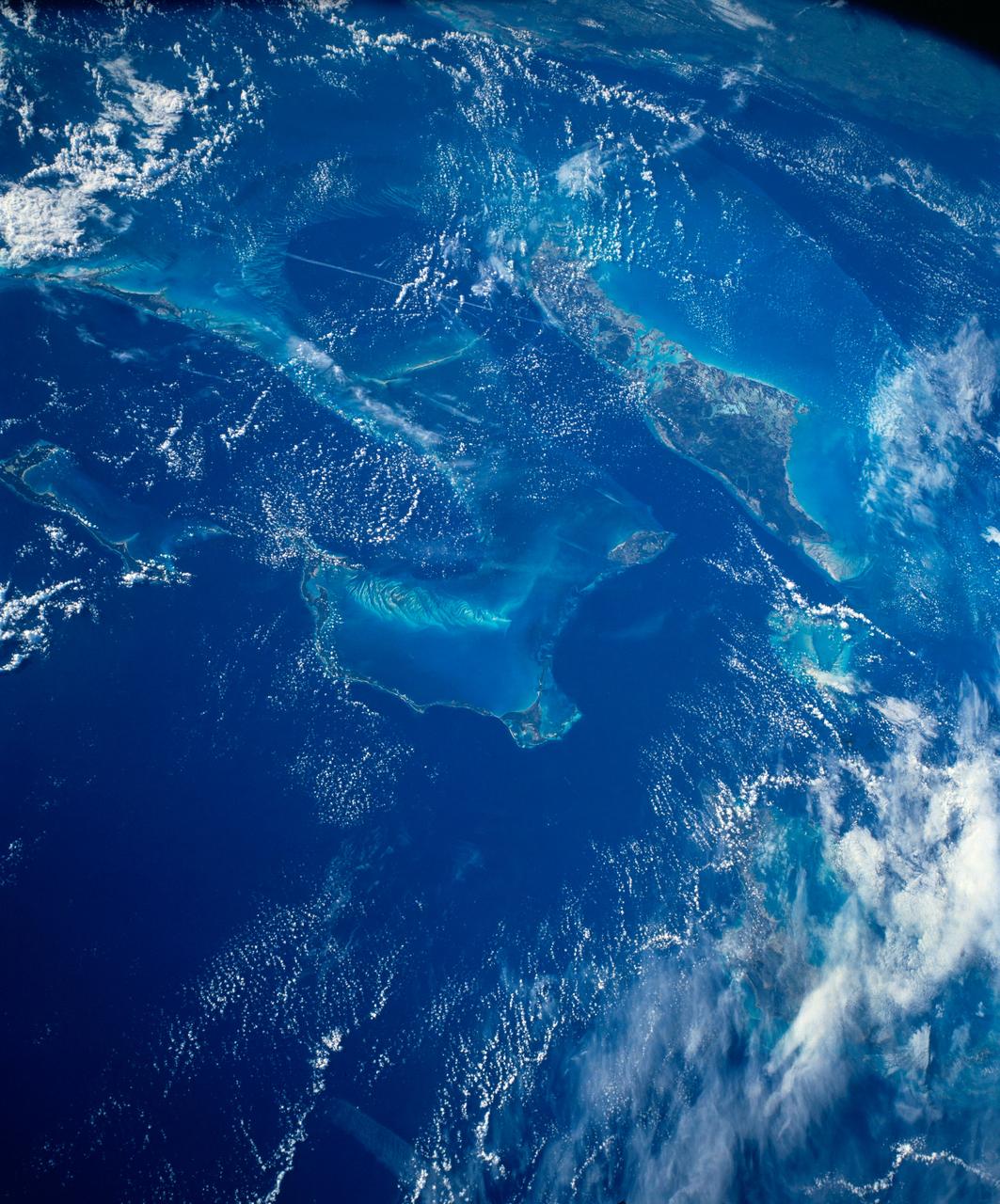
STS054-152-102 (13-19 Jan. 1993) --- This is a south-looking, wide angle view of the northern Bahamas, featuring the islands (from mid-foreground toward background) of Eleuthera, New Providence, and Andros. The northern shore of Cuba can be seen in the background. The resort city of Nassau occupies much of eastern New Providence. The Bahamas host some very distinctive features -- the deep blue channels and the shallow, light blue platforms, feathery sand bars at the edges of the deep water sounds, and colorful lakes and tidal channels like seen on Andros Island.
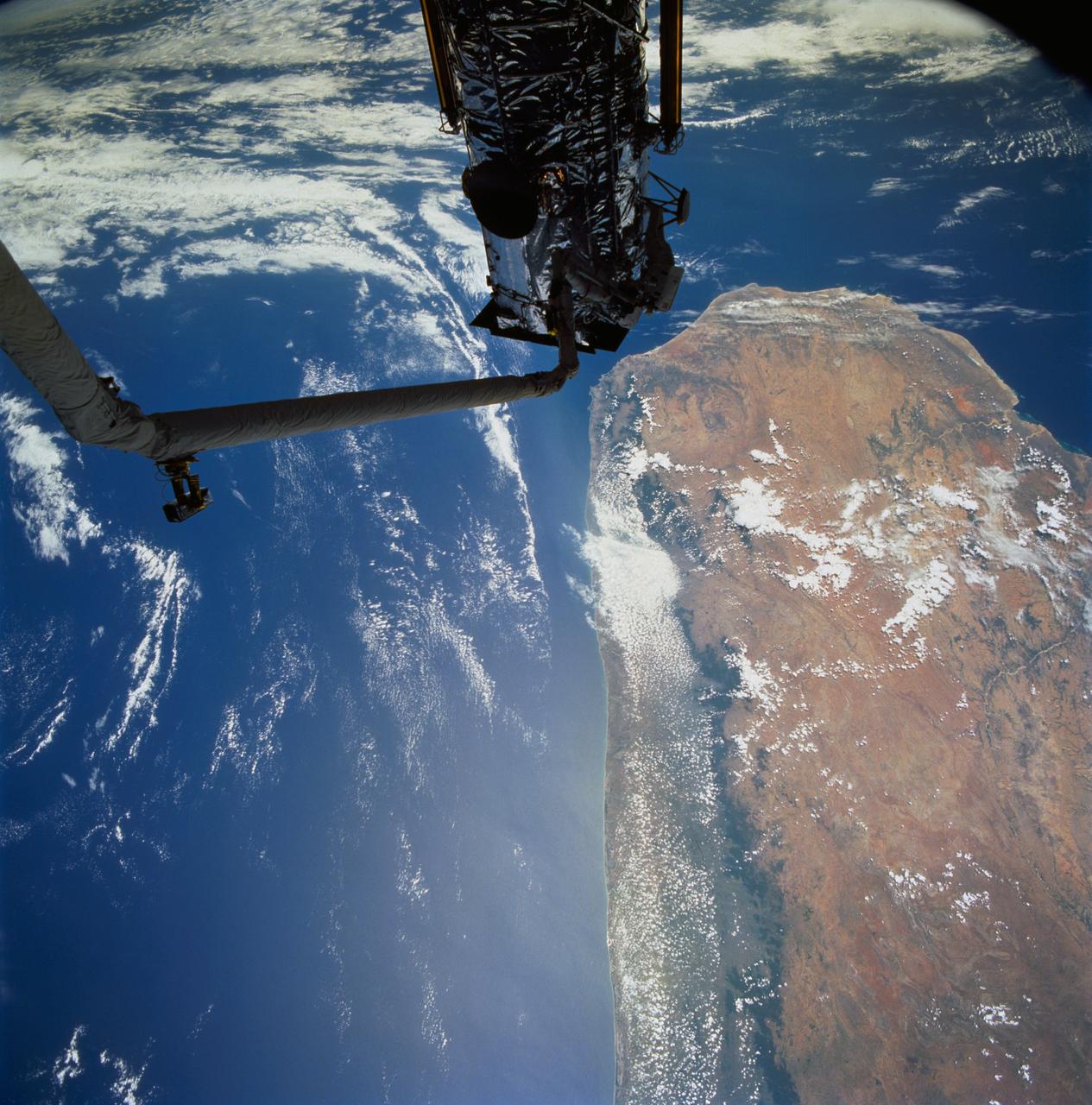
STS061-77-102 (7 Dec 1993) --- Astronauts Jeffrey A. Hoffman (left) and F. Story Musgrave are partially silhouetted against the Indian Ocean as they work to install the Magnetic Sensing System (MSS) on the Hubble Space Telescope (HST). Musgrave is anchored to the end of the Space Shuttle Endeavour's Remote Manipulator System (RMS) arm. The HST is positioned along the southern end of Madagascar, 325 nautical miles away. Visible on the western coast are the sediment laden Onilahy and Fiherenana Rivers which empty into Saint Augustin Bay. North of Fiherenana River is the Mangoky River. The circular feature on the southern end of Madagascar and to the right of HST is the L'ivakoany Mountains. The eastern coast is relatively straight compared to the western coast.
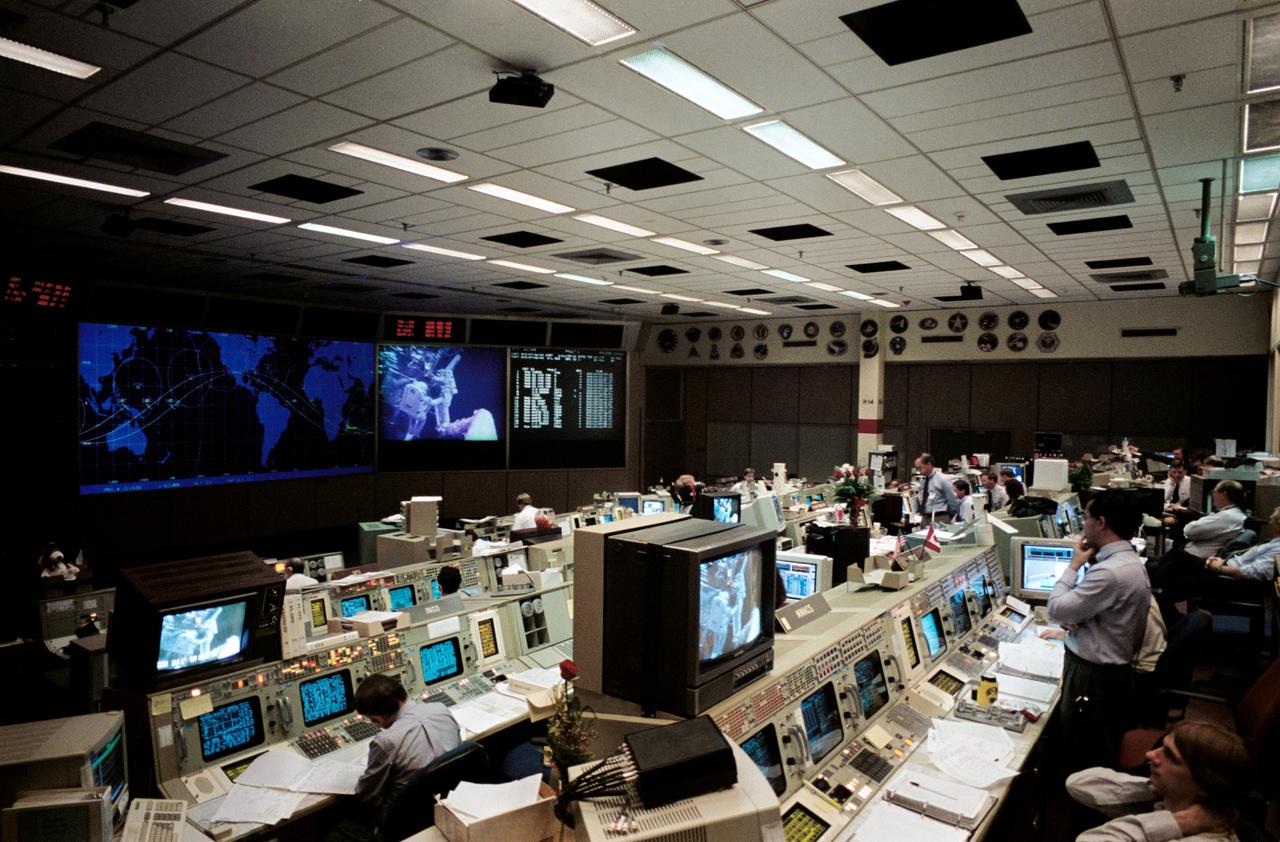
STS061-S-102 (5 Dec. 1993) --- Flight controllers Harry Black (left foreground) and Kevin McCluney (right foreground) monitor the televised activity of two space walkers during the first STS-61 extravehicular activity (EVA). Astronauts F. Story Musgrave and Jeffrey A. Hoffman were performing a variety of equipment replacements. At the Integrated Communications Officer Console (INCO) Black plays a roill in controlling the TV while McLuney's duties deal with maintenance, mechanical, arm and crew systems, meaning that they and their colleagues will be busy for the next five days. Four astronauts in alternating pairs will perform a variety of tasks on the giant telescope during that period.
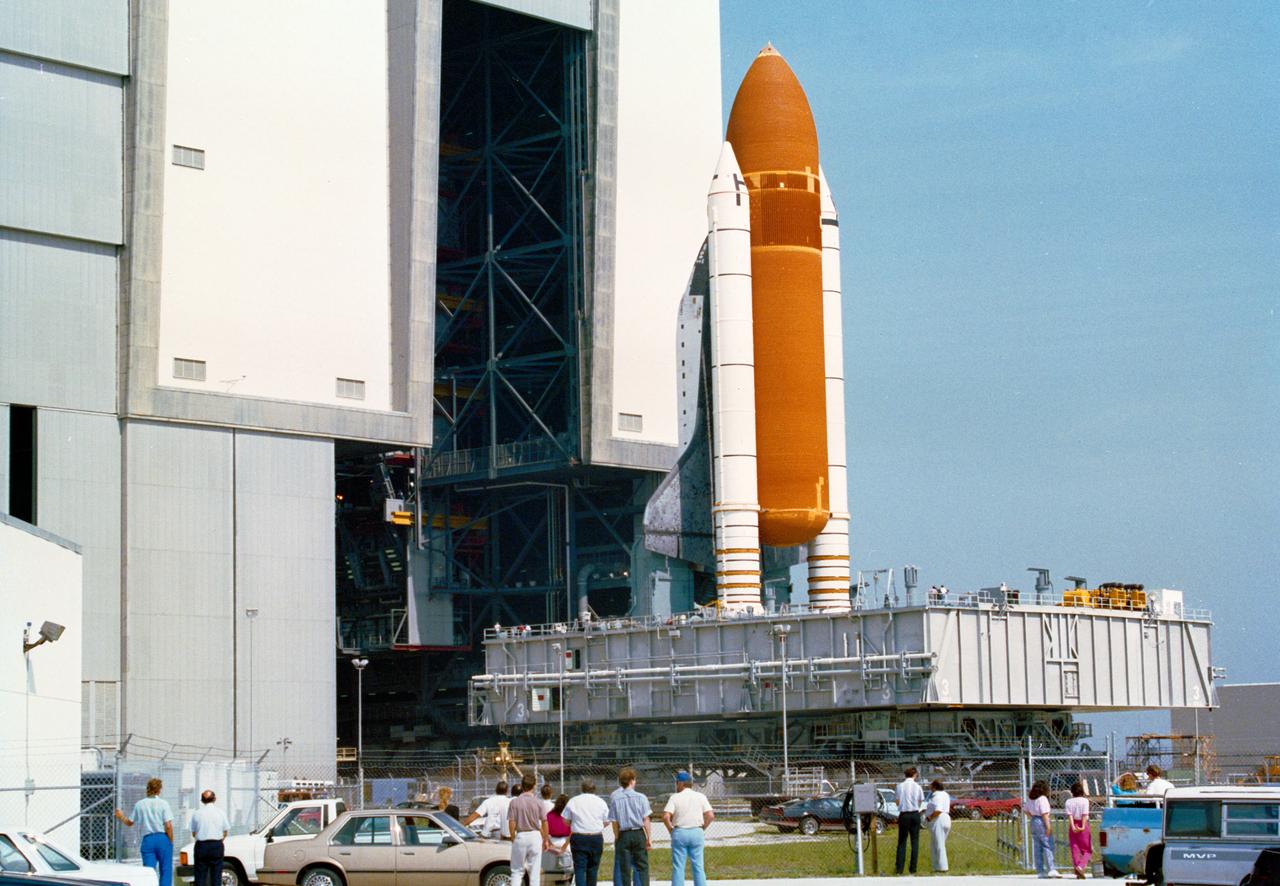
S90-42289 ( 3 July 1990) --- Kennedy Space Center (KSC) workers watch as Columbia, Orbiter Vehicle (OV) 102, along with its external tank (ET) and two solid rocket boosters (SRBs) atop the giant crawler transporter, rolls back to KSC's Vehicle Assembly Building (VAB). The rollback was caused by a hydrogen leak that stopped the STS-35 countdown during ET fueling, 05-29-90. Once in the VAB, OV-102 and its stack will be demated, and OV-102, with its Astronomy Laboratory 1 (ASTRO-1) payload aboard, will be moved to the Orbiter Processing Facility (OPF) to await return to KSC Launch Complex (LC) Pad 39A. View provided by KSC with alternate number KSC-90PC-901.
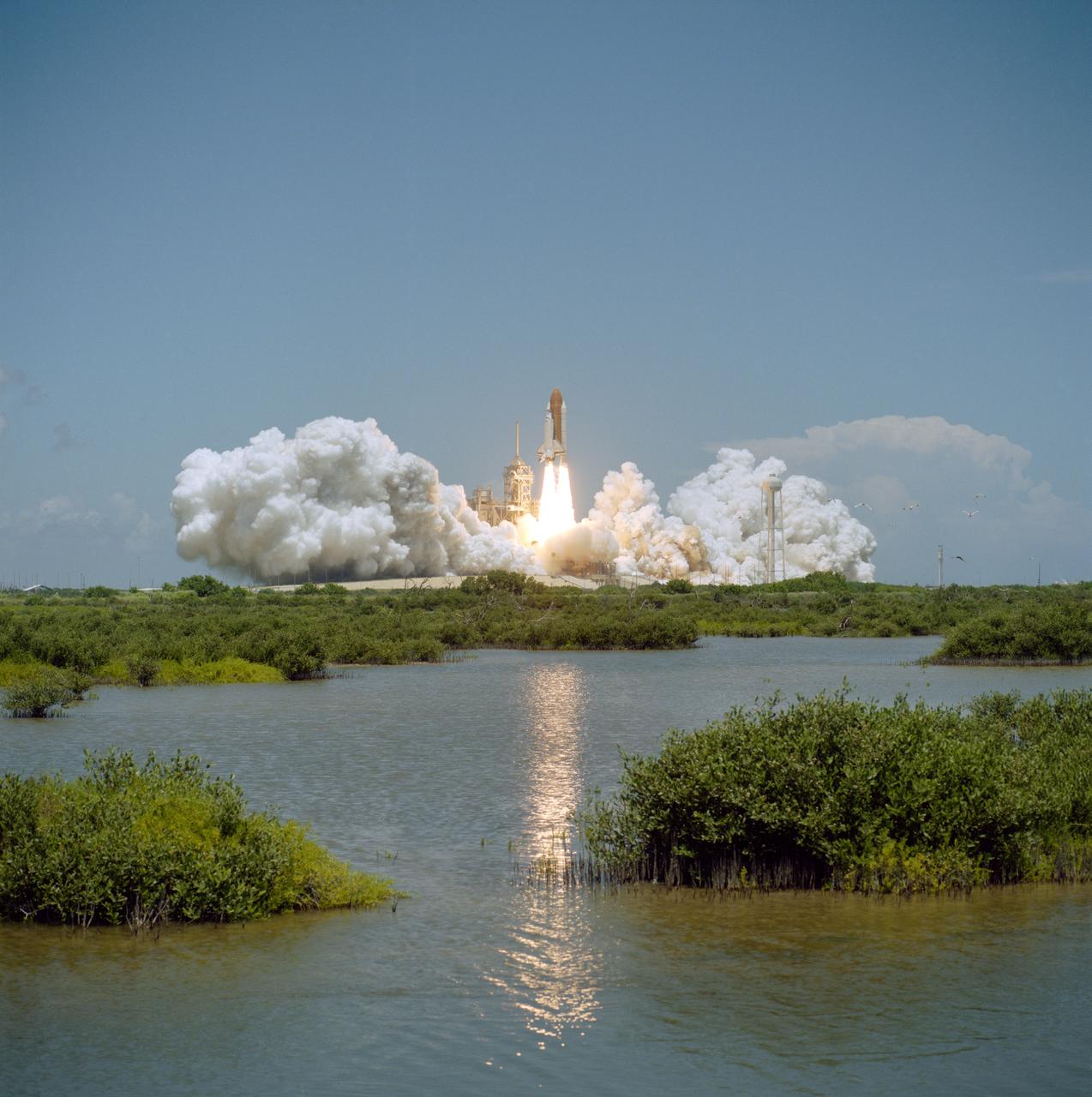
Columbia, Orbiter Vehicle (OV) 102, rises above Kennedy Space Center (KSC) Launch Complex (LC) Pad 39A after liftoff at 12:43 pm Eastern Daylight Time (EDT). An exhaust cloud covers the launch pad area and the glow of the space shuttle main engine (SSME) and solid rocket booster (SRB) firings is reflected in a nearby marsh as OV-102 atop its external tank (ET) heads toward Earth orbit. A small flock of birds is visible at the right. Once in Earth's orbit, STS-65's six NASA astronauts and a Japanese Payload Specialist aboard OV-102 will begin two weeks of experimentation in support of the second International Microgravity Laboratory (IML-2) mission.
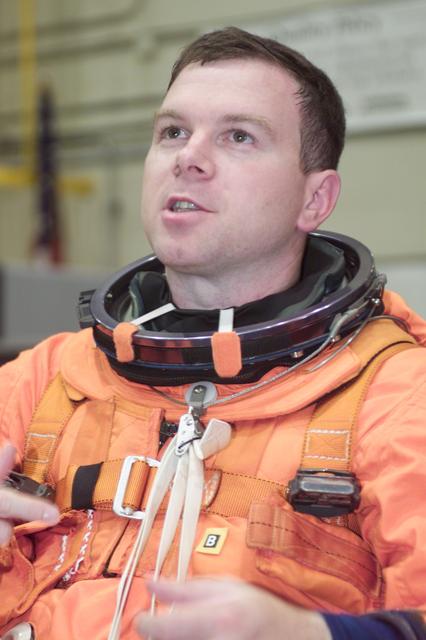
Views of STS-102 and Expedition Four bailout training in the Building 9NW's crew compartment trainer II (CCT II). Images include: Expedition Four's Carl Walz gets help from a trainer during the donning of his Launch and Entry Suit (LES)(23705); STS-102 Pilot James Kelly gets help with his LES from a trainer (23706); Expedition Four commander / cosmonaut Yuri Onufrienko (left) and Expedition Four's Daniel Bursch, both wearing LES and helmets, get strapped into their seats by a trainer on the middeck of the CCT (23707); Onufrienko and Bursch seated on the middeck (23708); Onufrienko (left), Bursch and Walz seated on the middeck preparing to begin emergency egress (23709); Walz, with LES and helmet, egresses from the port hatch of the CCT and goes into a roll on the mat (23710 and 23711); from left to right, all wearing LES's, STS-106 Commander James Wetherbee, Kelly, STS-102 Mission Specialist (MS) Paul Richards, STS-102 MS Andrew Thomas, Walz, Bursch and Onufrienko seated outside the CCT while being attended to by trainers (23712); Wetherbee seated in his LES (23713); Walz talks with Bursch and Onufrienko - Thomas is visible to the left (23714); Bursch seated (23715); Richards seated (23716); Thomas in his LES (23717); Kelly in his LES (23718); and Wetherbee (left) and Kelly converse while seated (23719).

STS-102 mission astronauts James S. Voss and James D. Weatherbee share a congratulatory handshake as the Space Shuttle Orbiter Discovery successfully docks with the International Space Station (ISS). Photographed from left to right are: Astronauts Susan J. Helms, mission specialist; James S. Voss, Expedition 2 crew member; James D. Weatherbee, mission commander; Andrew S.W. Thomas, mission specialist; and nearly out of frame is James M. Kelley, Pilot. Launched March 8, 2001, STS-102's primary cargo was the Leonardo, the Italian Space Agency-built Multipurpose Logistics Module (MPLM). The Leonardo MPLM is the first of three such pressurized modules that will serve as ISS' moving vans, carrying laboratory racks filled with equipment, experiments, and supplies to and from the Station aboard the Space Shuttle. The cylindrical module is approximately 21-feet long and 15- feet in diameter, weighing almost 4.5 tons. It can carry up to 10 tons of cargo in 16 standard Space Station equipment racks. Of the 16 racks the module can carry, 5 can be furnished with power, data, and fluid to support refrigerators or freezers. In order to function as an attached station module as well as a cargo transport, the logistics module also includes components that provide life support, fire detection and suppression, electrical distribution, and computer functions. NASA's 103rd overall mission and the 8th Space Station Assembly Flight, STS-102 mission also served as a crew rotation flight. It delivered the Expedition Two crew to the Station and returned the Expedition One crew back to Earth.

Astronaut Paul W. Richards, STS-102 mission specialist, works in the cargo bay of the Space Shuttle Discovery during the second of two scheduled space walks. Richards, along with astronaut Andy Thomas, spent 6.5 hours outside the International Space Station (ISS), continuing work to outfit the station and prepare for delivery of its robotic arm. STS-102 delivered the first Multipurpose Logistics Modules (MPLM) named Leonardo, which was filled with equipment and supplies to outfit the U.S. Destiny Laboratory Module. The Leonardo MPLM is the first of three such pressurized modules that will serve as the ISS' moving vans, carrying laboratory racks filled with equipment, experiments, and supplies to and from the Station aboard the Space Shuttle. The cylindrical module is approximately 21-feet long and 15- feet in diameter, weighing almost 4.5 tons. It can carry up to 10 tons of cargo in 16 standard Space Station equipment racks. Of the 16 racks the module can carry, 5 can be furnished with power, data, and fluid to support refrigerators or freezers. In order to function as an attached station module as well as a cargo transport, the logistics module also includes components that provide life support, fire detection and suppression, electrical distribution, and computer functions. NASA's 103rd overall mission and the 8th Space Station Assembly Flight, STS-102 mission also served as a crew rotation flight. It delivered the Expedition Two crew to the Station and returned the Expedition One crew back to Earth.
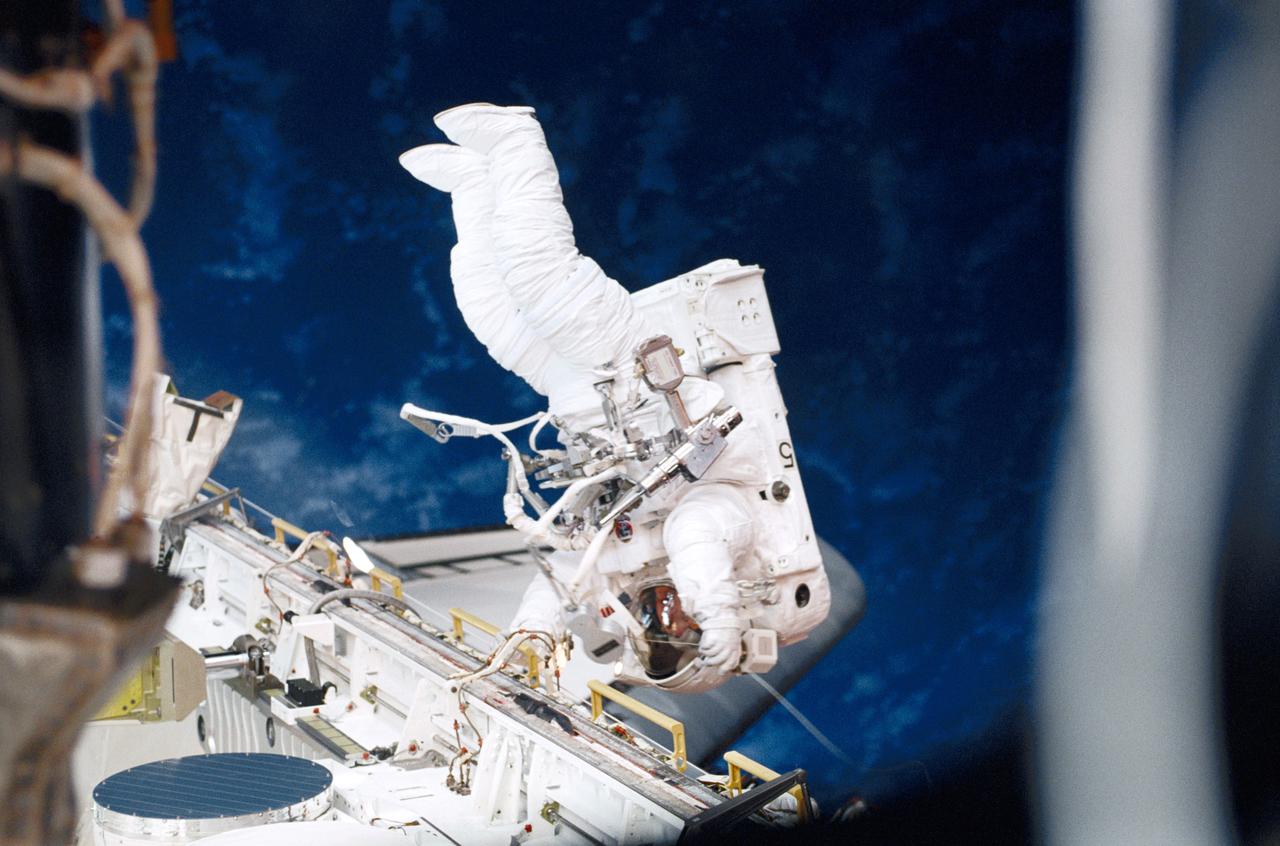
STS-102 mission astronaut Susan J. Helms translates along the longerons of the Space Shuttle Discovery during the first of two space walks. During this walk, the Pressurized Mating Adapter 3 was prepared for repositioning from the Unity Module's Earth-facing berth to its port-side berth to make room for the Leonardo multipurpose Logistics Module (MPLM), supplied by the Italian Space Agency. The Leonardo MPLM is the first of three such pressurized modules that will serve as the International Space Station's (ISS') moving vans, carrying laboratory racks filled with equipment, experiments, and supplies to and from the Station aboard the Space Shuttle. The cylindrical module is approximately 21-feet long and 15- feet in diameter, weighing almost 4.5 tons. It can carry up to 10 tons of cargo in 16 standard Space Station equipment racks. Of the 16 racks the module can carry, 5 can be furnished with power, data, and fluid to support refrigerators or freezers. In order to function as an attached station module as well as a cargo transport, the logistics module also includes components that provide life support, fire detection and suppression, electrical distribution, and computer functions. NASA's 103rd overall mission and the 8th Space Station Assembly Flight, STS-102 mission also served as a crew rotation flight. It delivered the Expedition Two crew to the Station and returned the Expedition One crew back to Earth.