
Technicians check out the mounting structure of the 20-metric-ton infrared telescope installed in NASA's Stratospheric Observatory for Infrared Astronomy (SOFIA).
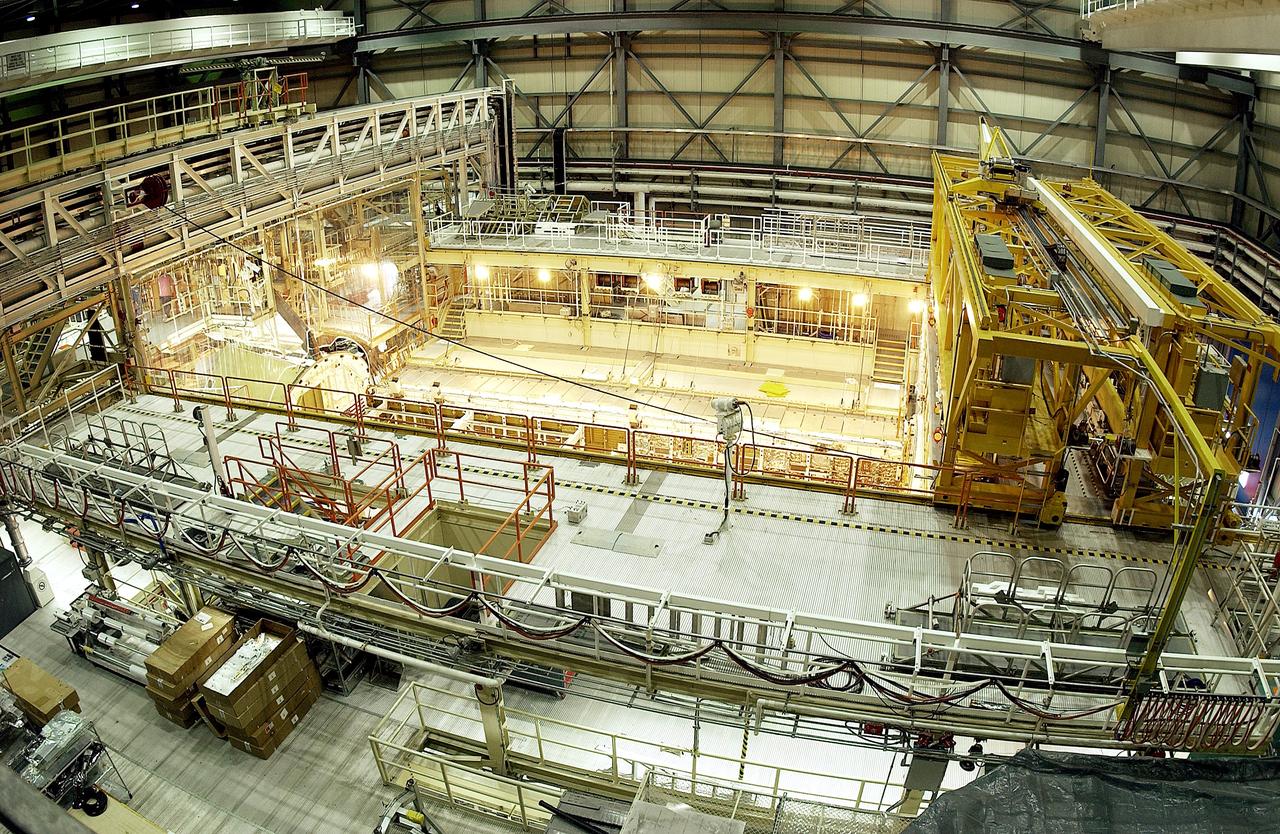
KENNEDY SPACE CENTER, FLA. - This bird's-eye view of a high bay in the Orbiter Processing Facility (OPF) shows the open payload bay of Space Shuttle Discovery surrounded by the standard platforms and equipment required to process a Space Shuttle orbiter. The high bay is 197 feet (60 meters) long, 150 feet (46 meters) wide, 95 feet (29 meters) high, and encompasses a 29,000-square-foot (2,694-meter) area. The 30-ton (27-metric-ton) bridge crane (yellow device, right) has a hook height of approximately 66 feet (20 meters). Platforms, a main access bridge, and two rolling bridges with trucks provide access to various parts of the orbiter. In addition to routine servicing and checkout, the inspections and modifications made to enhance Discovery's performance and upgrade its systems were performed in the OPF during its recently completed Orbiter Major Modification (OMM) period.
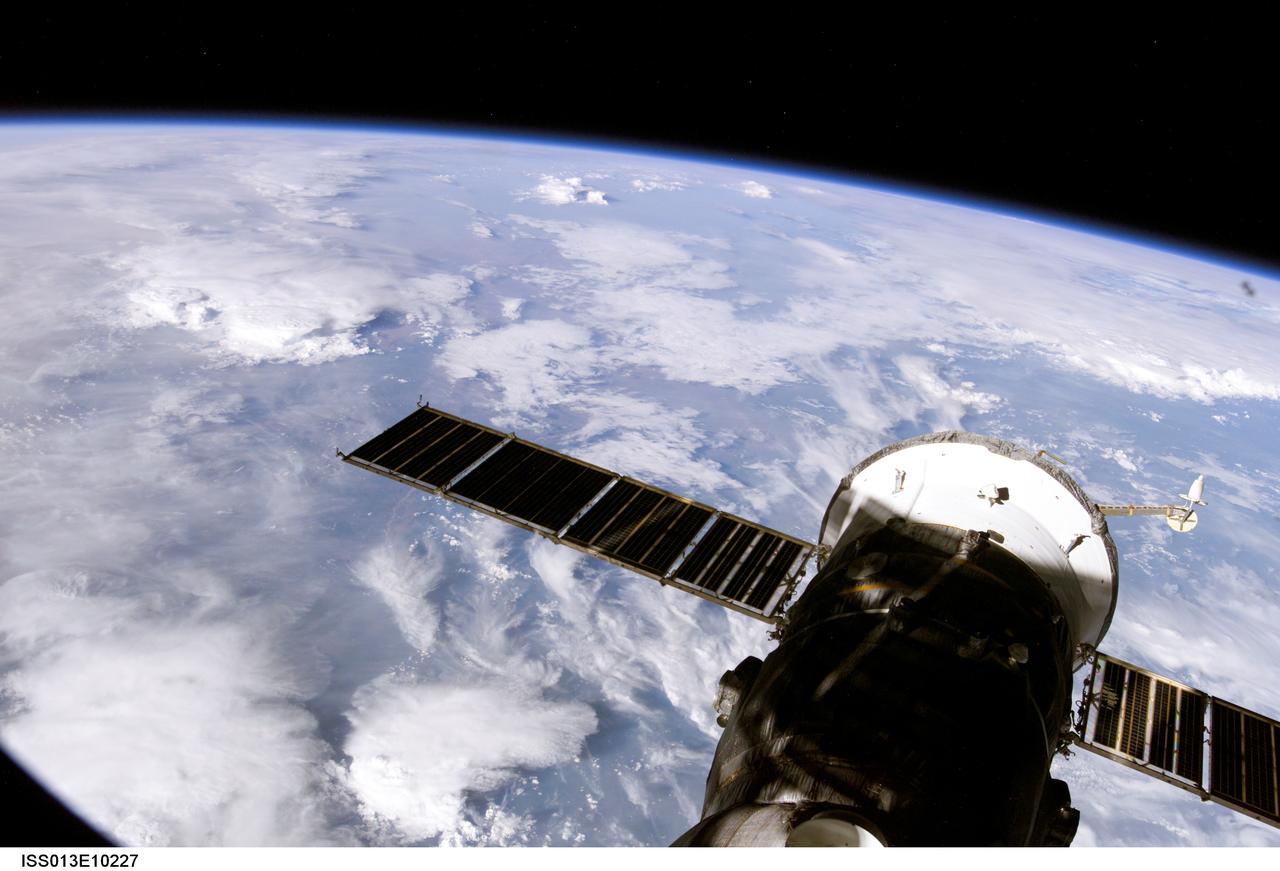
ISS013-E-10227 (26 April 2006) --- Backdropped by a blue and white Earth and the blackness of space, the docked Progress 20 supply vehicle is featured in this image photographed by an Expedition 13 crewmember from a window on the International Space Station. Shortly after this image was captured, the Progress 21 supply vehicle docked with the station, delivering 2.5 tons of food, water, fuel, oxygen, spare parts and other supplies to the crewmembers onboard the station. Progress 20 will remain docked until mid-June. It will be used to stow trash, and its supply of oxygen will help replenish the station’s atmosphere.
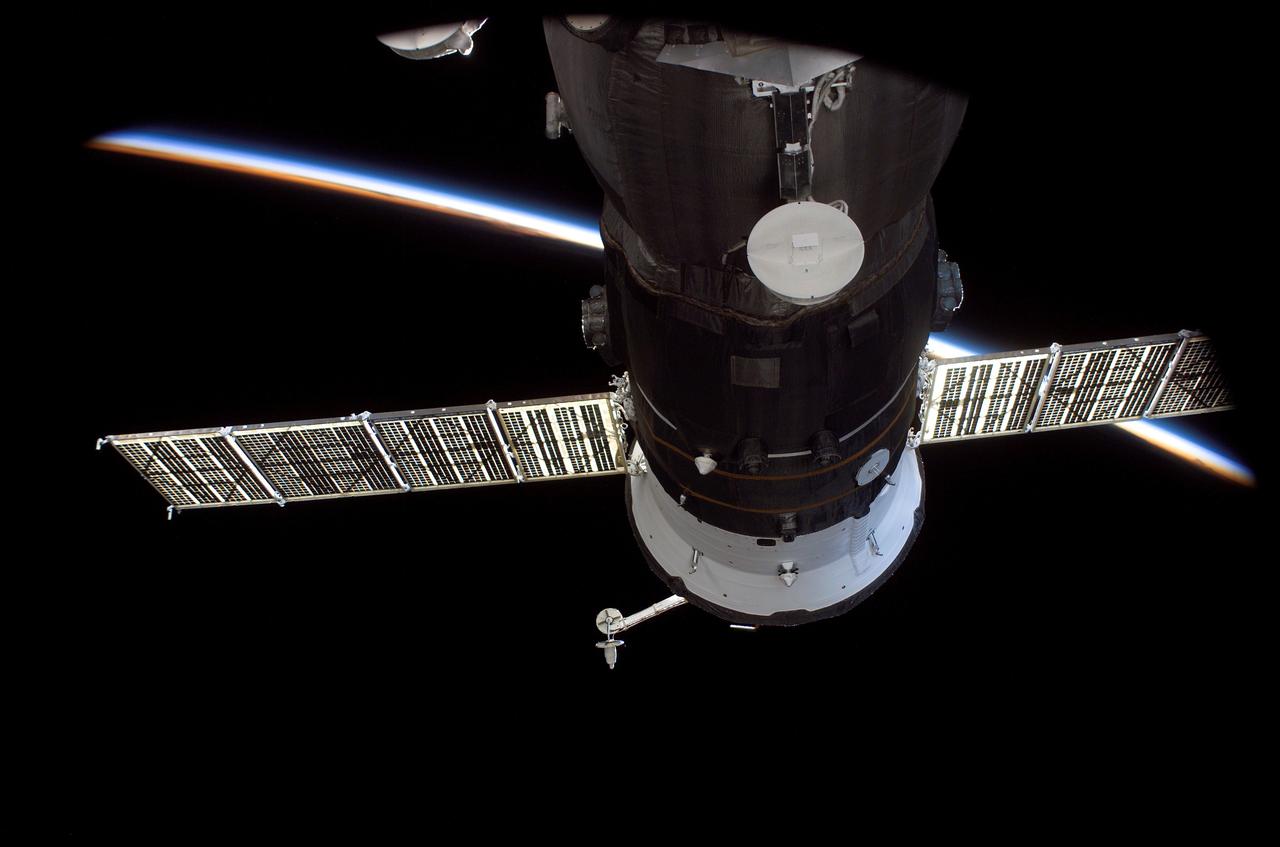
ISS012-E-13579 (23 Dec. 2005) --- The blackness of space and airglow of Earth’s horizon provide the backdrop for this scene of the Progress 20 resupply vehicle, docked to the Pirs Docking Compartment of the International Space Station. Progress 20 launched at 12:38 p.m. (CST) on Dec. 21, 2005 from the Baikonur Cosmodrome in Kazakhstan to deliver 2.8 tons of supplies, gifts, food, water, fuel and equipment to the Expedition 12 crew members onboard the station. Progress docked to the Pirs Docking Compartment at 1:46 p.m. (CST) on Dec. 23 as the station flew approximately 220 statute miles above the Atlantic off the east coast of South America.
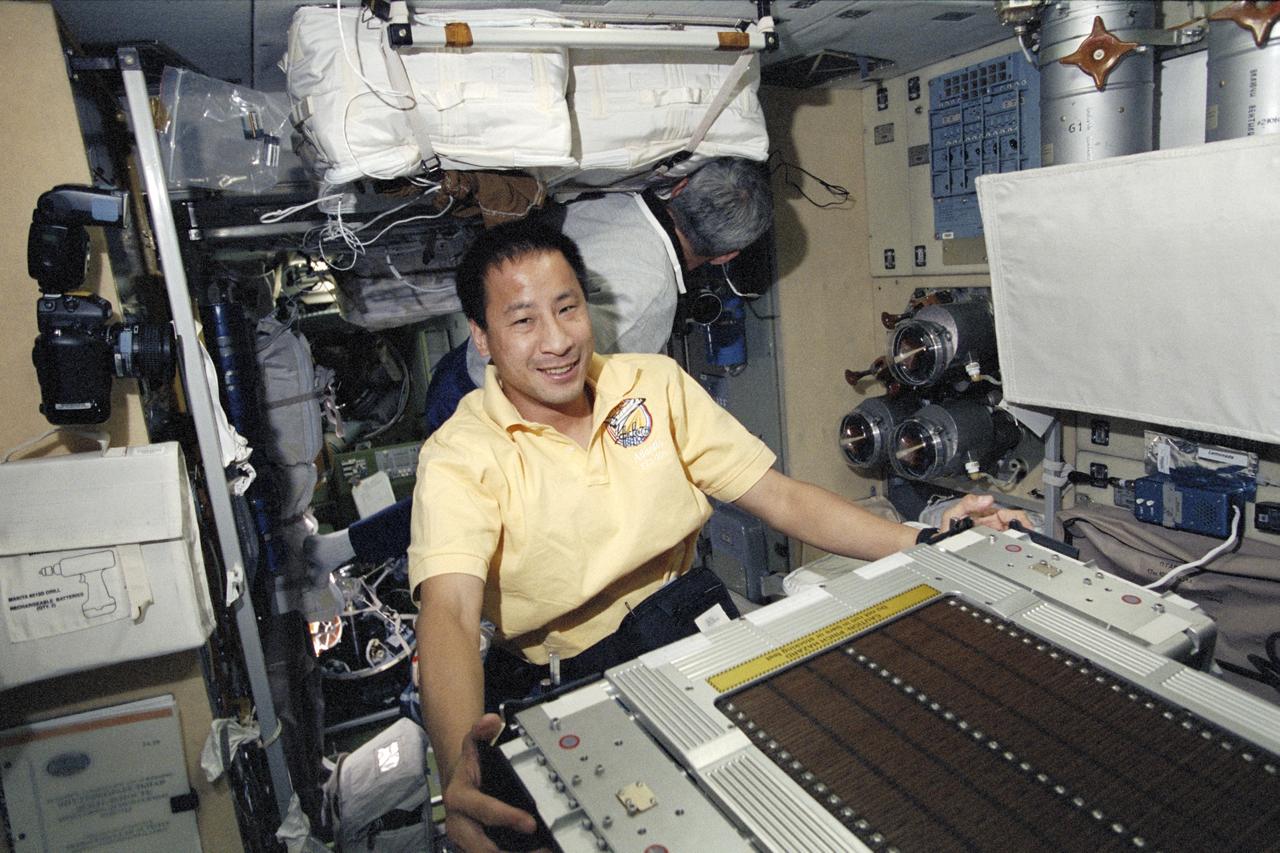
STS106-390-024 (8-20 September 2000) --- Astronaut Edward T. Lu, mission specialist, handles part of the treadmill device on the Service Module for the International Space Station. The crew left this and a large number of other items of hardware and supplies for future inhabitants of the station. Lu and four other astronauts, along with two cosmonauts, are wrapping up a 4.9 million-mile mission in which more than three tons of equipment were delivered to the International outpost.
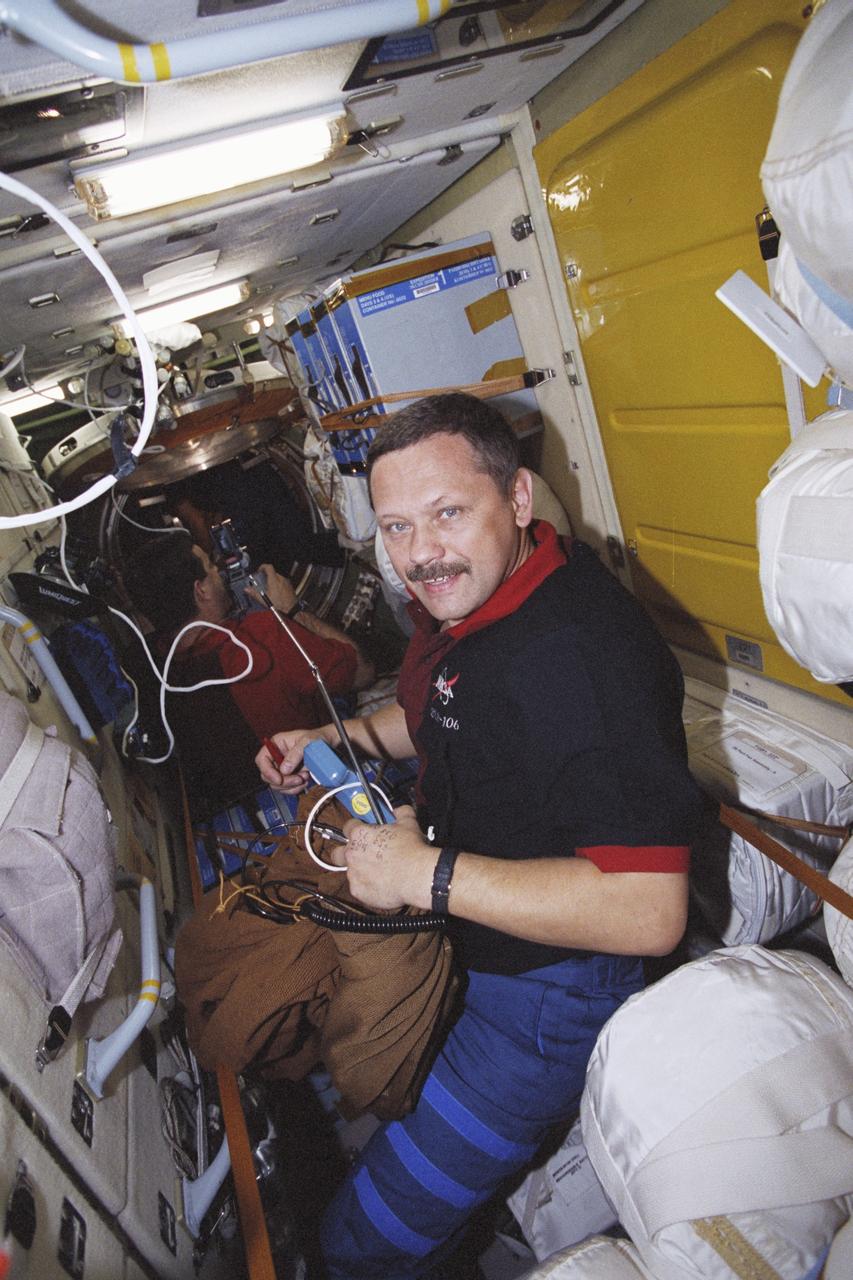
STS106-322-017 (8-20 September 2000) --- Cosmonaut Boris V. Morukov, mission specialist representing the Russian Aviation and Space Agency, works onboard the Functional Cargo Block (FGB) as the seven-man STS-106 crew carried out its busy move- and install-effort on the International Space Station. The astronauts and cosmonauts were able to accomplish the movement of several tons of hardware and supplies during the period the station was docked with the Space Shuttle Atlantis.
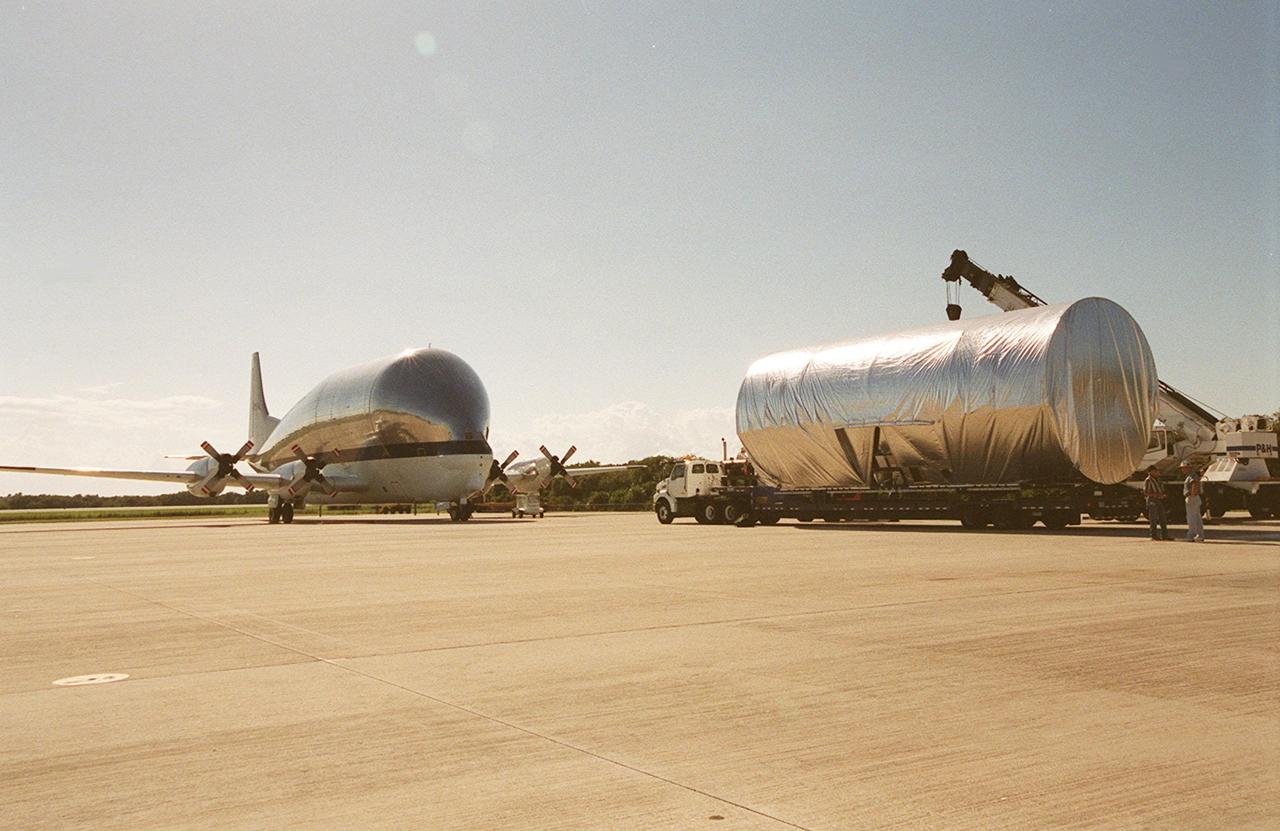
KENNEDY SPACE CENTER, FLA. -- At the KSC Shuttle Landing Facility, the Joint Airlock Module, the gateway from which crew members aboard the International Space Station (ISS) will enter and exit the 470-ton orbiting research facility, is ready for transport to the Operations and Checkout Building in the KSC industrial area. There it will undergo vacuum chamber testing. It will then be moved to the Space Station Processing Facility (SSPF) for further pre-launch preparation and checkout. The massive, spindle-shaped airlock is 20 feet long, has a diameter of 13 feet at its widest point, and weighs six and a half tons. It was manufactured at NASA's Marshall Space Flight Center by the Huntsville division of The Boeing Company. The Space Shuttle Atlantis will carry the airlock to orbit on mission STS-104, the tenth International Space Station flight, currently targeted for liftoff in May 2001
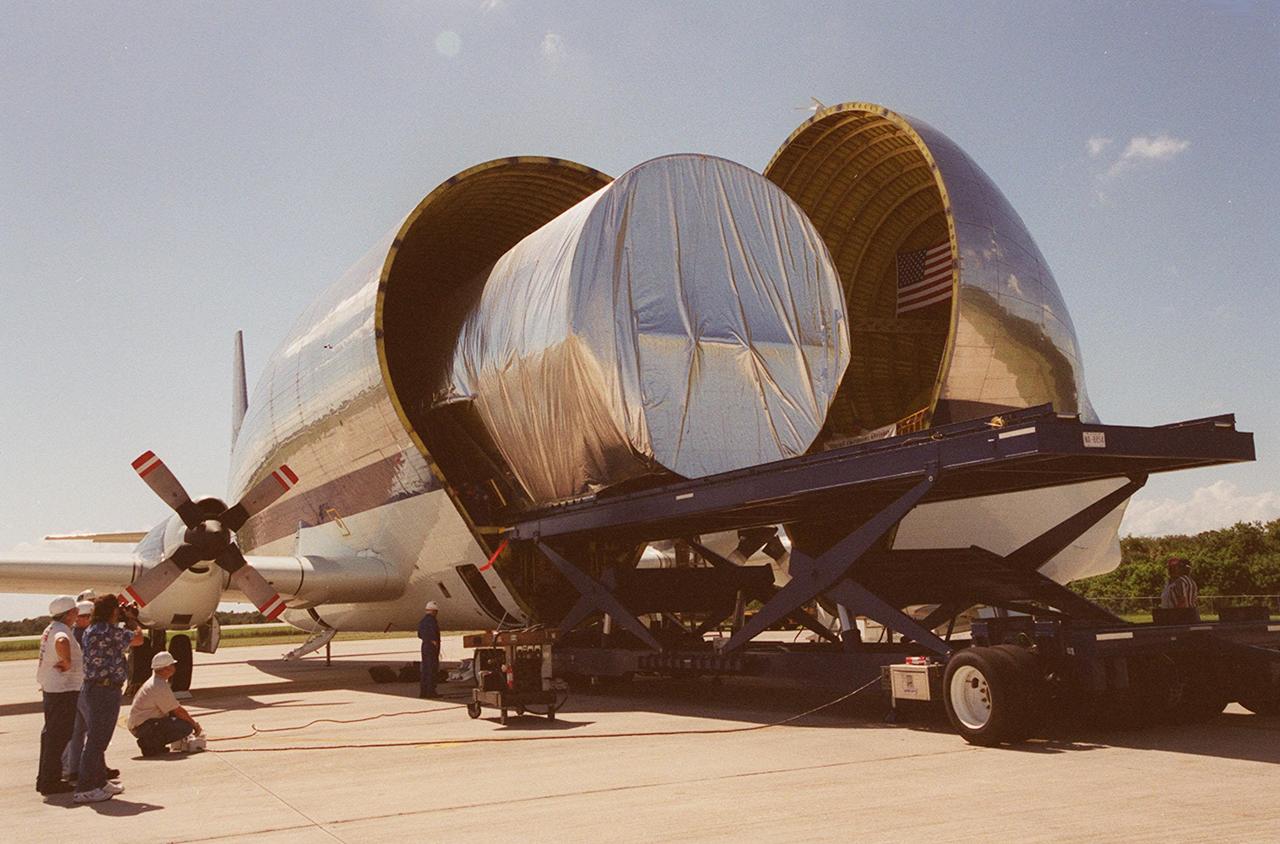
KENNEDY SPACE CENTER, FLA. -- The Joint Airlock Module, the gateway from which crew members aboard the International Space Station (ISS) will enter and exit the 470-ton orbiting research facility, rolls out of NASA's Super Guppy aircraft. It will be transferred to the Operations and Checkout Building in the KSC industrial area where it will undergo vacuum chamber testing. It will then be moved to the Space Station Processing Facility (SSPF) for further prelaunch preparation and checkout. The massive, spindle-shaped airlock is 20 feet long, has a diameter of 13 feet at its widest point, and weighs six and a half tons. It was manufactured at NASA's Marshall Space Flight Center by the Huntsville division of The Boeing Company. The Space Shuttle Atlantis will carry the airlock to orbit on mission STS-104, the tenth International Space Station flight, currently targeted for liftoff in May 2001
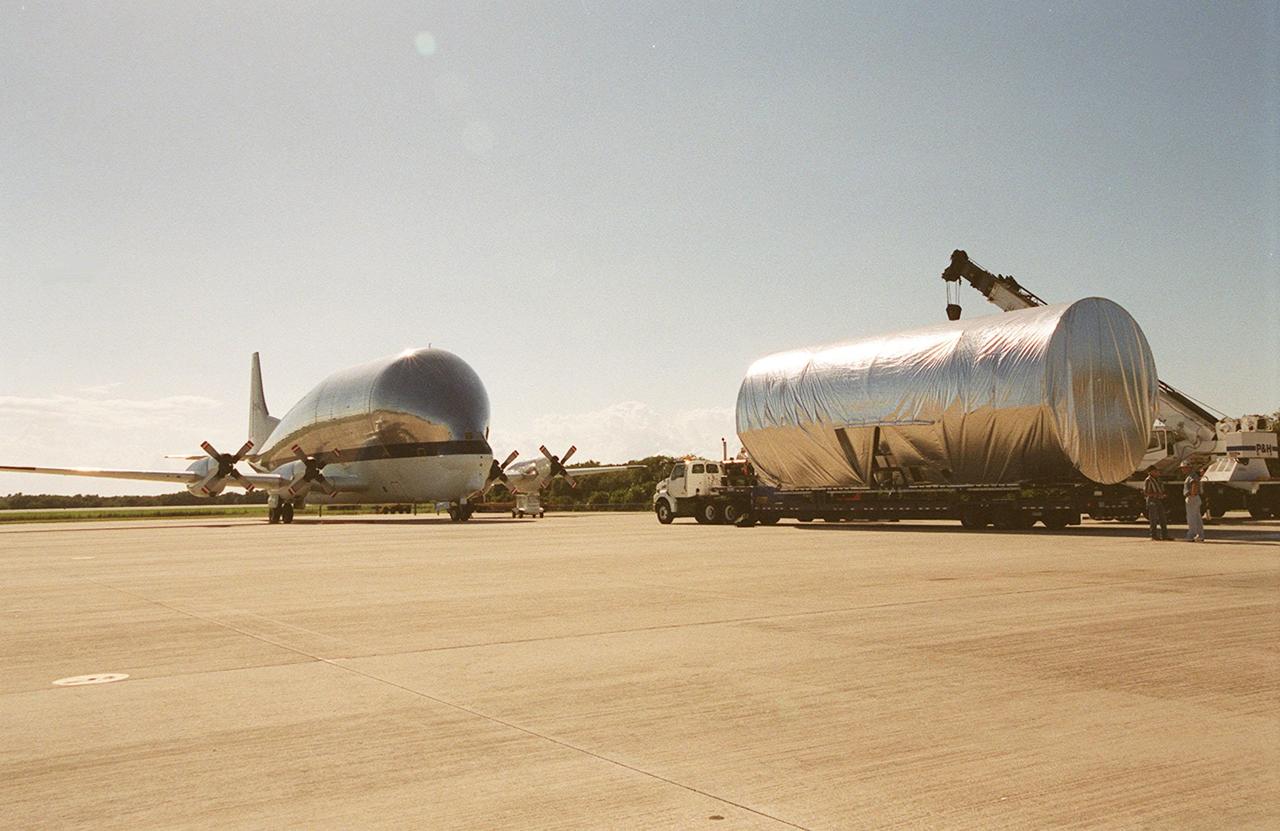
KENNEDY SPACE CENTER, FLA. -- At the KSC Shuttle Landing Facility, the Joint Airlock Module, the gateway from which crew members aboard the International Space Station (ISS) will enter and exit the 470-ton orbiting research facility, is ready for transport to the Operations and Checkout Building in the KSC industrial area. There it will undergo vacuum chamber testing. It will then be moved to the Space Station Processing Facility (SSPF) for further pre-launch preparation and checkout. The massive, spindle-shaped airlock is 20 feet long, has a diameter of 13 feet at its widest point, and weighs six and a half tons. It was manufactured at NASA's Marshall Space Flight Center by the Huntsville division of The Boeing Company. The Space Shuttle Atlantis will carry the airlock to orbit on mission STS-104, the tenth International Space Station flight, currently targeted for liftoff in May 2001
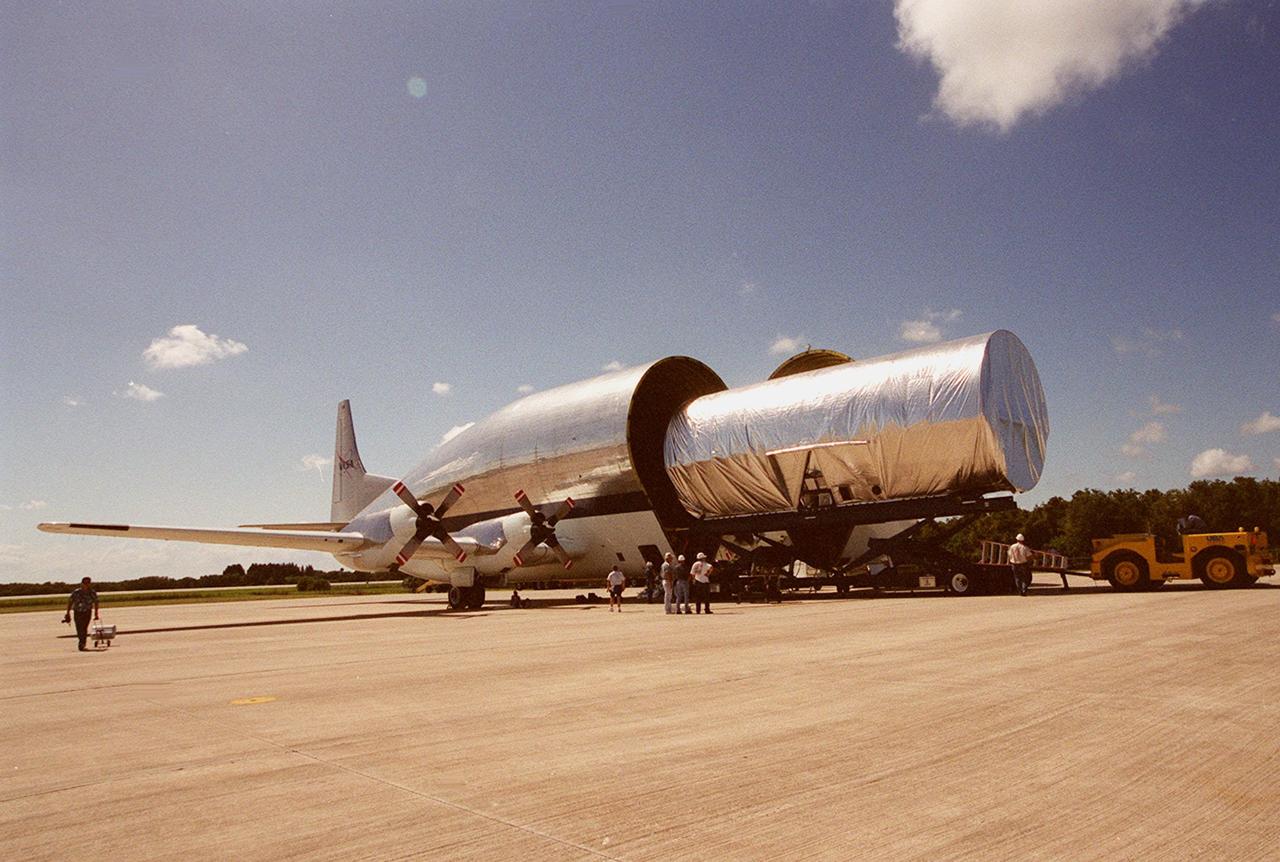
KENNEDY SPACE CENTER, FLA. -- At the KSC Shuttle Landing Facility, the Joint Airlock Module, the gateway from which crew members aboard the International Space Station (ISS) will enter and exit the 470-ton orbiting research facility, is moved away from NASA’s Super Guppy aircraft for transfer to the Operations and Checkout Building in the KSC industrial area. There it will undergo vacuum chamber testing. It will then be moved to the Space Station Processing Facility (SSPF) for further prelaunch preparation and checkout. The massive, spindle-shaped airlock is 20 feet long, has a diameter of 13 feet at its widest point, and weighs six and a half tons. It was manufactured at NASA's Marshall Space Flight Center by the Huntsville division of The Boeing Company. The Space Shuttle Atlantis will carry the airlock to orbit on mission STS-104, the tenth International Space Station flight, currently targeted for liftoff in May 2001

KENNEDY SPACE CENTER, FLA. -- At the KSC Shuttle Landing Facility, the Joint Airlock Module, the gateway from which crew members aboard the International Space Station (ISS) will enter and exit the 470-ton orbiting research facility, is settled onto a flatbed trailer for transport to the Operations and Checkout Building in the KSC industrial area. There it will undergo vacuum chamber testing. It will then be moved to the Space Station Processing Facility (SSPF) for further prelaunch preparation and checkout. The massive, spindle-shaped airlock is 20 feet long, has a diameter of 13 feet at its widest point, and weighs six and a half tons. It was manufactured at NASA's Marshall Space Flight Center by the Huntsville division of The Boeing Company. The Space Shuttle Atlantis will carry the airlock to orbit on mission STS-104, the tenth International Space Station flight, currently targeted for liftoff in May 2001
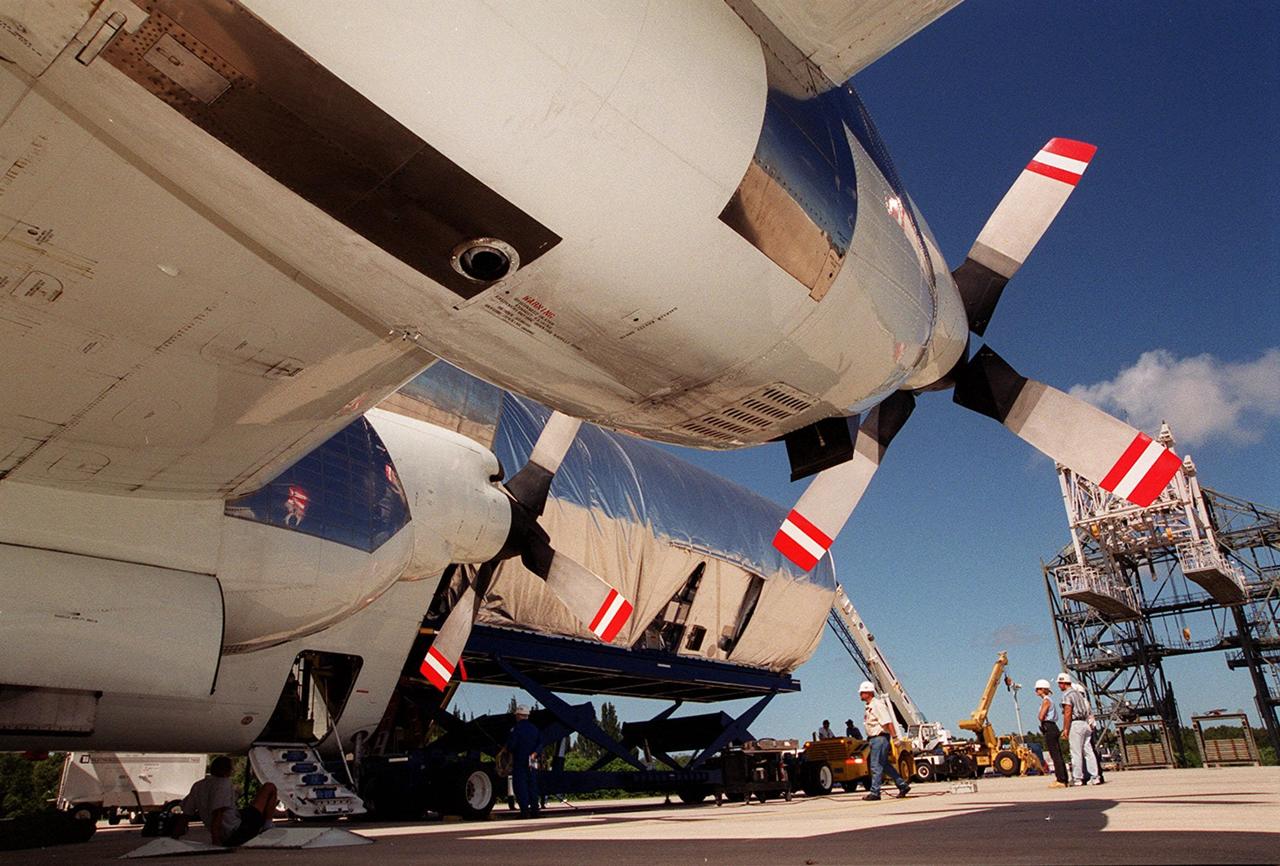
KENNEDY SPACE CENTER, FLA. -- Viewed from underneath the wing of NASA’s Super Guppy aircraft, the Joint Airlock Module, the gateway from which crew members aboard the International Space Station (ISS) will enter and exit the 470-ton orbiting research facility, rolls out of the aircraft. It will be transferred to the Operations and Checkout Building in the KSC industrial area where it will undergo vacuum chamber testing. Then it will be moved to the Space Station Processing Facility (SSPF) for further pre-launch preparation and checkout. The massive, spindle-shaped airlock is 20 feet long, has a diameter of 13 feet at its widest point, and weighs six and a half tons. It was manufactured at NASA's Marshall Space Flight Center by the Huntsville division of The Boeing Company. The Space Shuttle Atlantis will carry the airlock to orbit on mission STS-104, the tenth International Space Station flight, currently targeted for liftoff in May 2001
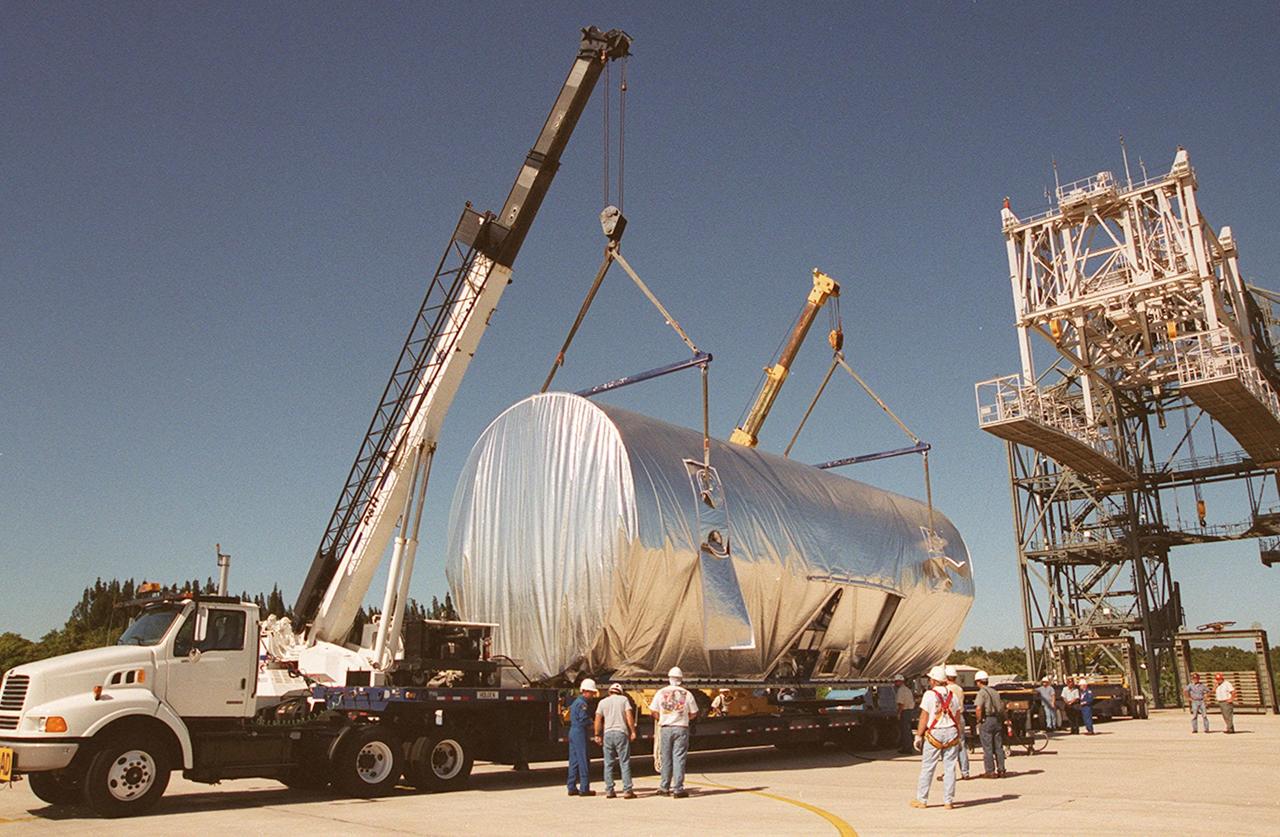
KENNEDY SPACE CENTER, FLA. -- At the KSC Shuttle Landing Facility, the Joint Airlock Module, the gateway from which crew members aboard the International Space Station (ISS) will enter and exit the 470-ton orbiting research facility, is settled onto a flatbed trailer for transport to the Operations and Checkout Building in the KSC industrial area. There it will undergo vacuum chamber testing. It will then be moved to the Space Station Processing Facility (SSPF) for further prelaunch preparation and checkout. The massive, spindle-shaped airlock is 20 feet long, has a diameter of 13 feet at its widest point, and weighs six and a half tons. It was manufactured at NASA's Marshall Space Flight Center by the Huntsville division of The Boeing Company. The Space Shuttle Atlantis will carry the airlock to orbit on mission STS-104, the tenth International Space Station flight, currently targeted for liftoff in May 2001
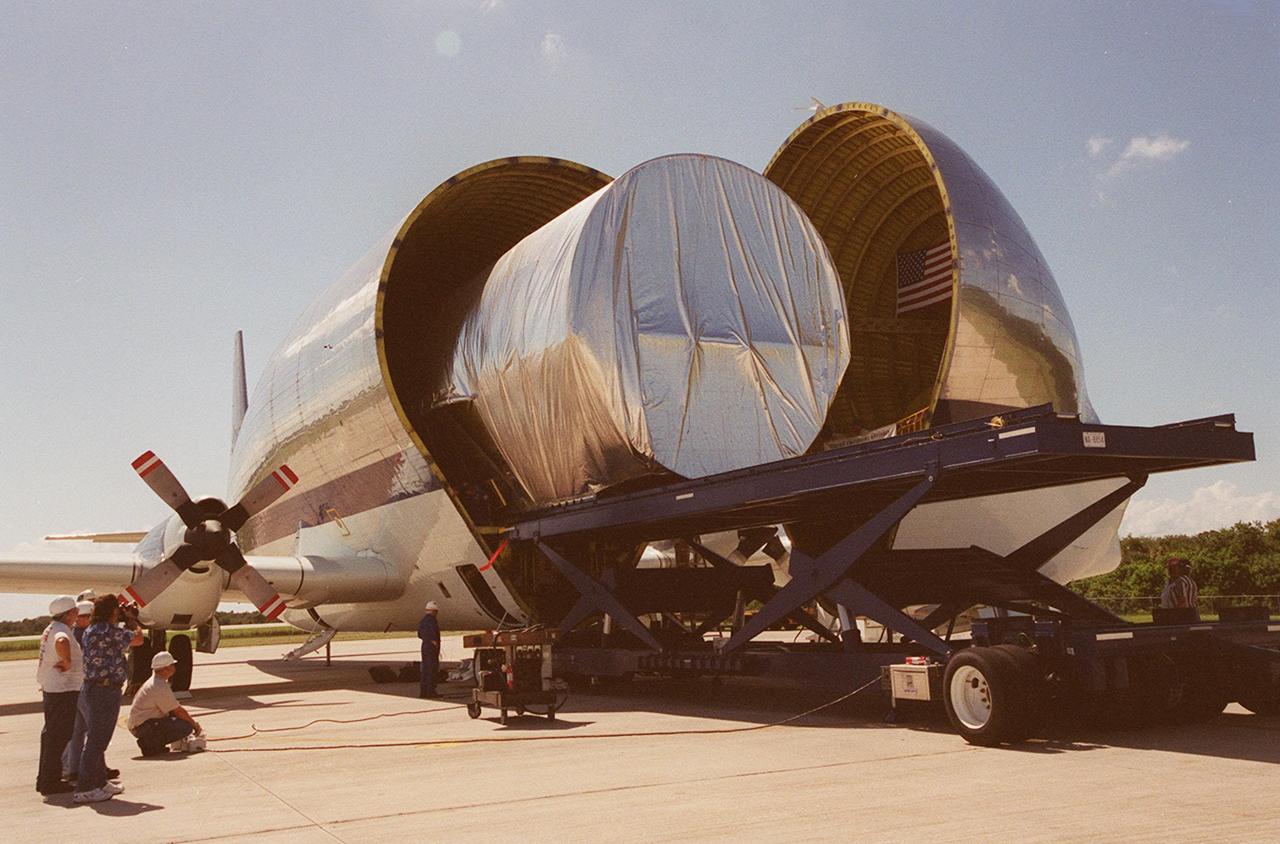
KENNEDY SPACE CENTER, FLA. -- The Joint Airlock Module, the gateway from which crew members aboard the International Space Station (ISS) will enter and exit the 470-ton orbiting research facility, rolls out of NASA's Super Guppy aircraft. It will be transferred to the Operations and Checkout Building in the KSC industrial area where it will undergo vacuum chamber testing. It will then be moved to the Space Station Processing Facility (SSPF) for further prelaunch preparation and checkout. The massive, spindle-shaped airlock is 20 feet long, has a diameter of 13 feet at its widest point, and weighs six and a half tons. It was manufactured at NASA's Marshall Space Flight Center by the Huntsville division of The Boeing Company. The Space Shuttle Atlantis will carry the airlock to orbit on mission STS-104, the tenth International Space Station flight, currently targeted for liftoff in May 2001
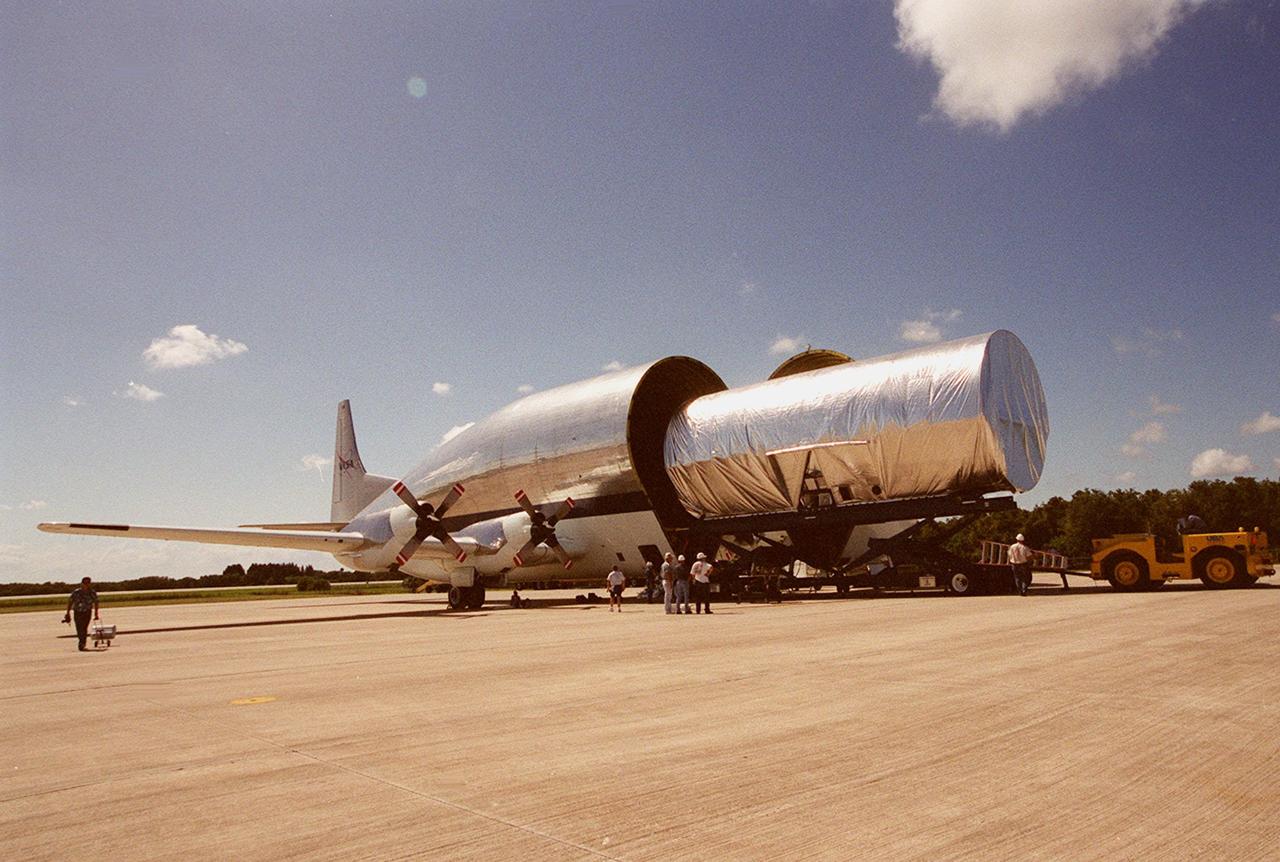
KENNEDY SPACE CENTER, FLA. -- At the KSC Shuttle Landing Facility, the Joint Airlock Module, the gateway from which crew members aboard the International Space Station (ISS) will enter and exit the 470-ton orbiting research facility, is moved away from NASA’s Super Guppy aircraft for transfer to the Operations and Checkout Building in the KSC industrial area. There it will undergo vacuum chamber testing. It will then be moved to the Space Station Processing Facility (SSPF) for further prelaunch preparation and checkout. The massive, spindle-shaped airlock is 20 feet long, has a diameter of 13 feet at its widest point, and weighs six and a half tons. It was manufactured at NASA's Marshall Space Flight Center by the Huntsville division of The Boeing Company. The Space Shuttle Atlantis will carry the airlock to orbit on mission STS-104, the tenth International Space Station flight, currently targeted for liftoff in May 2001
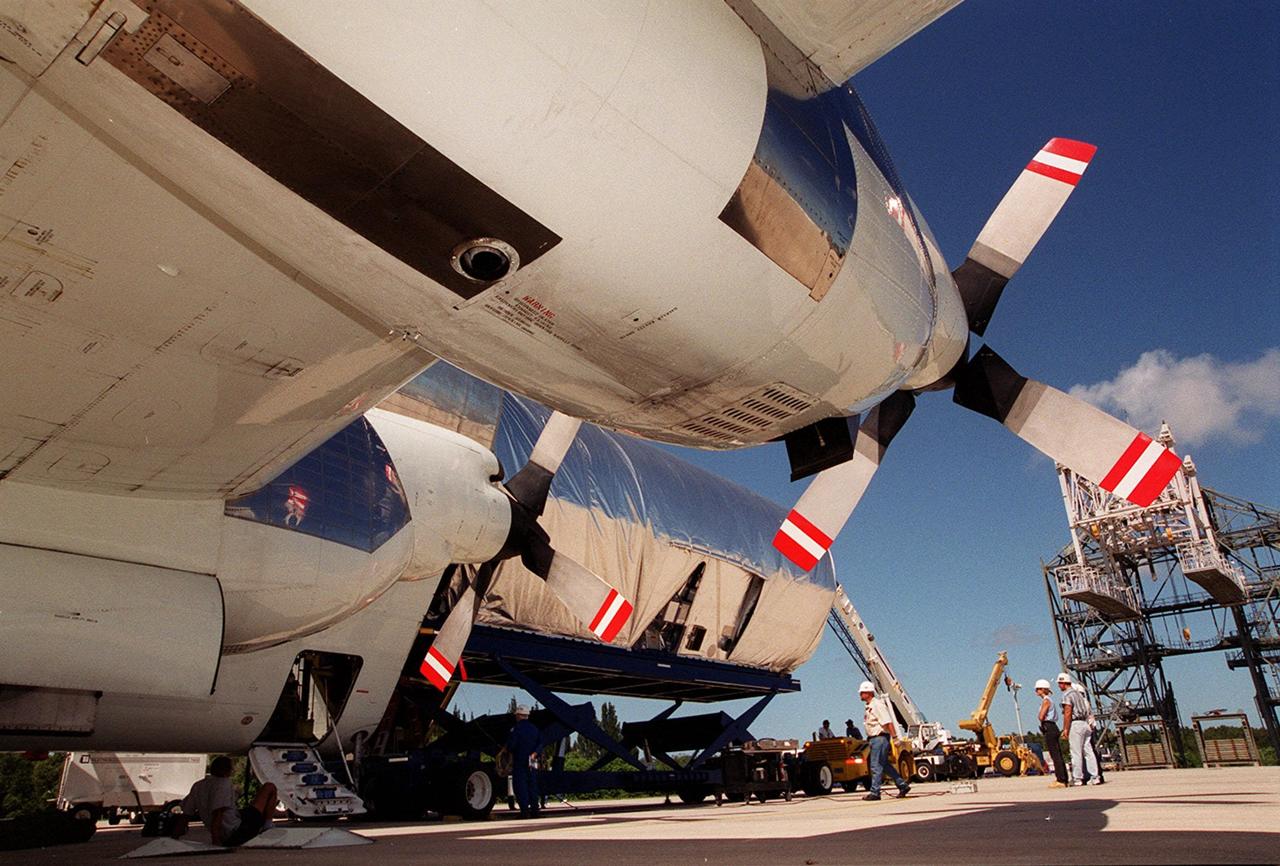
KENNEDY SPACE CENTER, FLA. -- Viewed from underneath the wing of NASA’s Super Guppy aircraft, the Joint Airlock Module, the gateway from which crew members aboard the International Space Station (ISS) will enter and exit the 470-ton orbiting research facility, rolls out of the aircraft. It will be transferred to the Operations and Checkout Building in the KSC industrial area where it will undergo vacuum chamber testing. Then it will be moved to the Space Station Processing Facility (SSPF) for further pre-launch preparation and checkout. The massive, spindle-shaped airlock is 20 feet long, has a diameter of 13 feet at its widest point, and weighs six and a half tons. It was manufactured at NASA's Marshall Space Flight Center by the Huntsville division of The Boeing Company. The Space Shuttle Atlantis will carry the airlock to orbit on mission STS-104, the tenth International Space Station flight, currently targeted for liftoff in May 2001
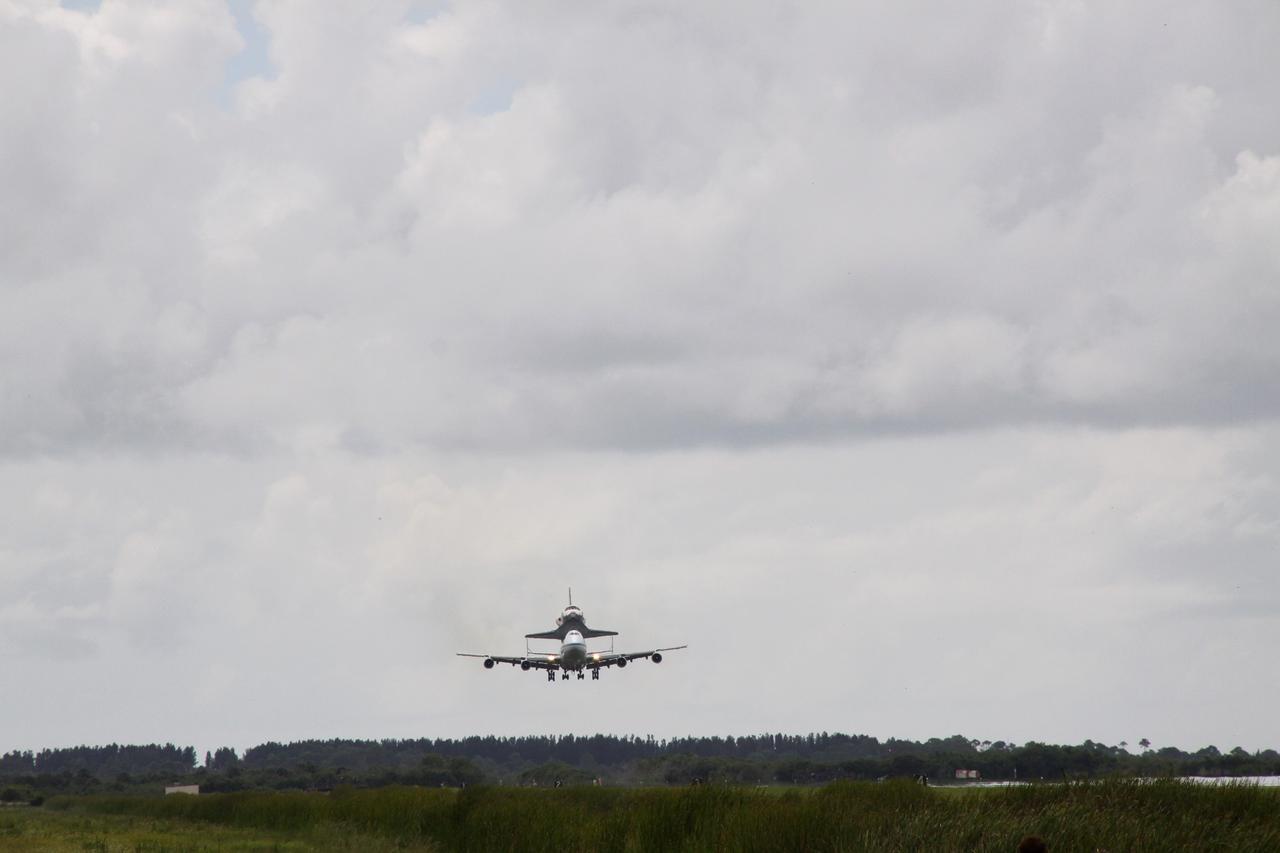
CAPE CANAVERAL, Fla. – Space shuttle Discovery arrives at NASA's Kennedy Space Center in Florida on the back of the Boeing 747 Shuttle Carrier Aircraft, or SCA. The two-day return flight from Edwards Air Force Base in California began at 9:20 a.m. EDT Sept. 20. After three fueling stops that included an overnight stay in Louisiana, the piggybacked shuttle had to navigate through a line of showers across Louisiana and around Kennedy. Discovery had landed at Edwards Sept. 11 after the 13-day STS-128 mission to the International Space Station. The shuttle delivered more than 7 tons of supplies, science racks and equipment, as well as additional environmental hardware to sustain six crew members on the station. Landings at Kennedy were waved off on two days due to inclement weather, leading to the landing at Edwards. Photo credit: NASA/Jack Pfaller
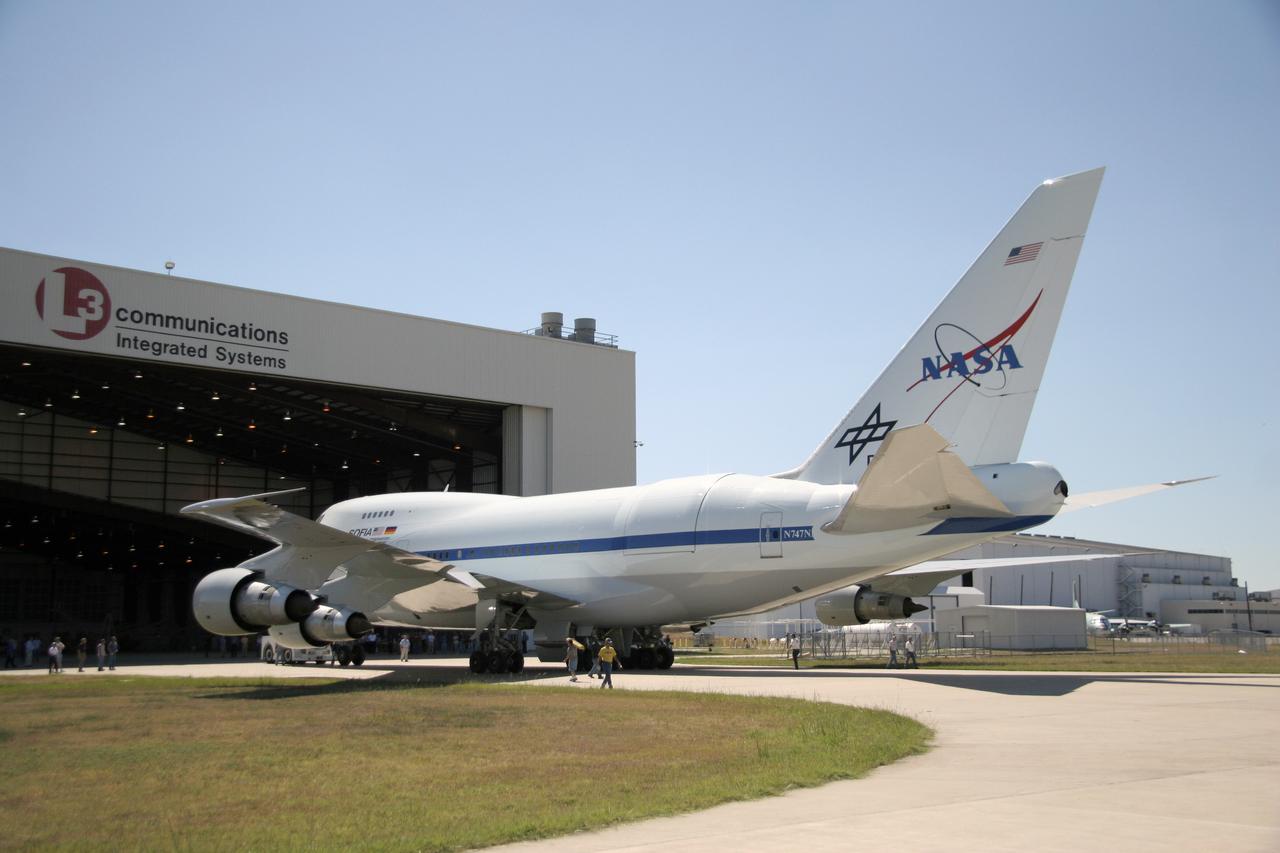
NASA's freshly painted Stratospheric Observatory for Infrared Astronomy (SOFIA) 747SP aircraft sits outside a hangar at L-3 Communications Integrated Systems' facility in Waco, Texas. The observatory, which features a German-built 100-inch (2.5 meter) diameter infrared telescope weighing 20 tons, is approaching the flight test phase as part of a joint program by NASA and DLR Deutsches Zentrum fuer Luft- und Raumfahrt (German Aerospace Center). SOFIA's science and mission operations are being planned jointly by Universities Space Research Association (USRA) and the Deutsches SOFIA Institut (DSI). Once operational, SOFIA will be the world's primary infrared observatory during a mission lasting up to 20 years, as well as an outstanding laboratory for developing and testing instrumentation and detector technology.
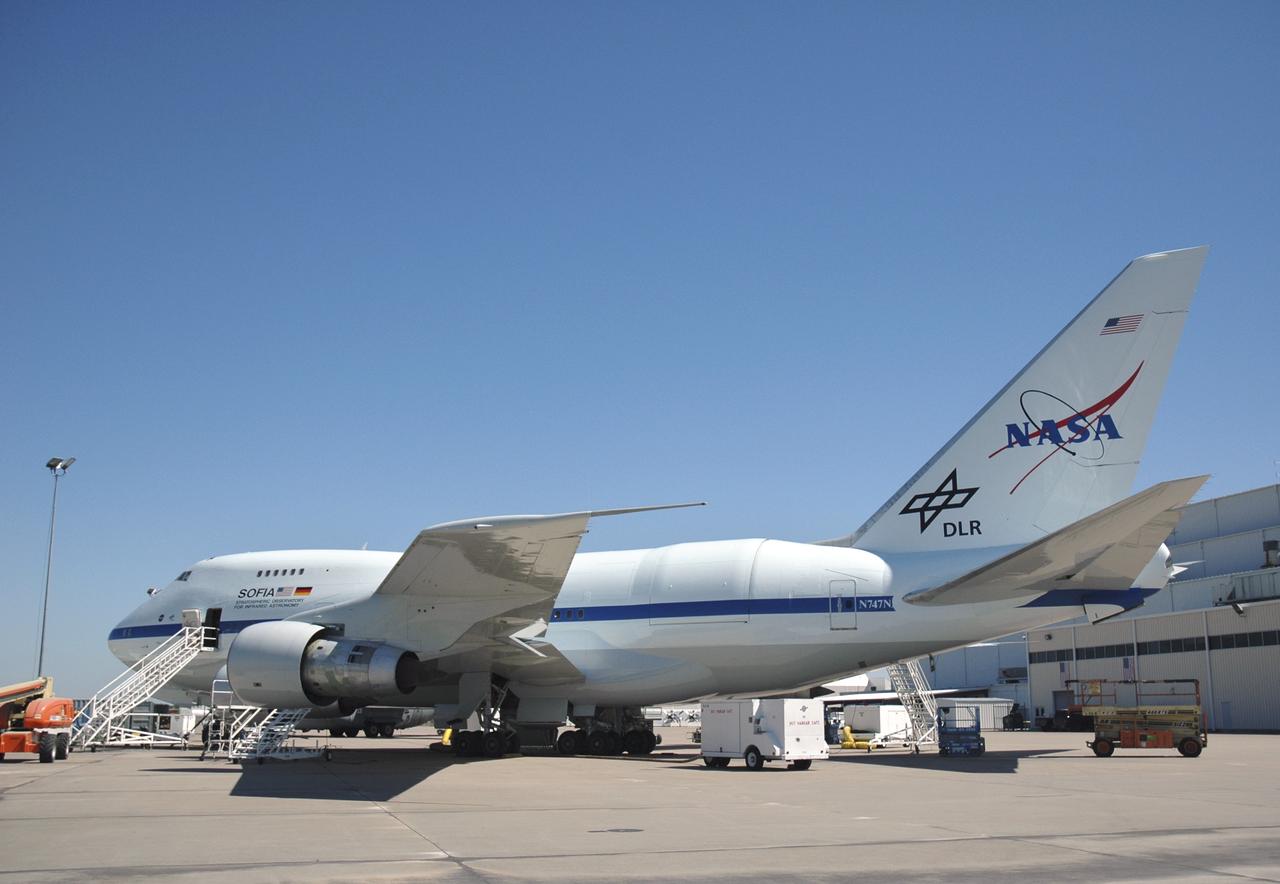
NASA's freshly painted Stratospheric Observatory for Infrared Astronomy (SOFIA) 747SP is shown at L-3 Communications Integrated Systems' facility in Waco, Texas, where major modifications and installation was performed. The observatory, which features a German-built 100-inch (2.5 meter) diameter infrared telescope weighing 20 tons, is approaching the flight test phase as part of a joint program by NASA and DLR Deutsches Zentrum fuer Luft- und Raumfahrt (German Aerospace Center). SOFIA's science and mission operations are being planned jointly by Universities Space Research Association (USRA) and the Deutsches SOFIA Institut (DSI). Once operational, SOFIA will be the world's primary infrared observatory during a mission lasting up to 20 years, as well as an outstanding laboratory for developing and testing instrumentation and detector technology.
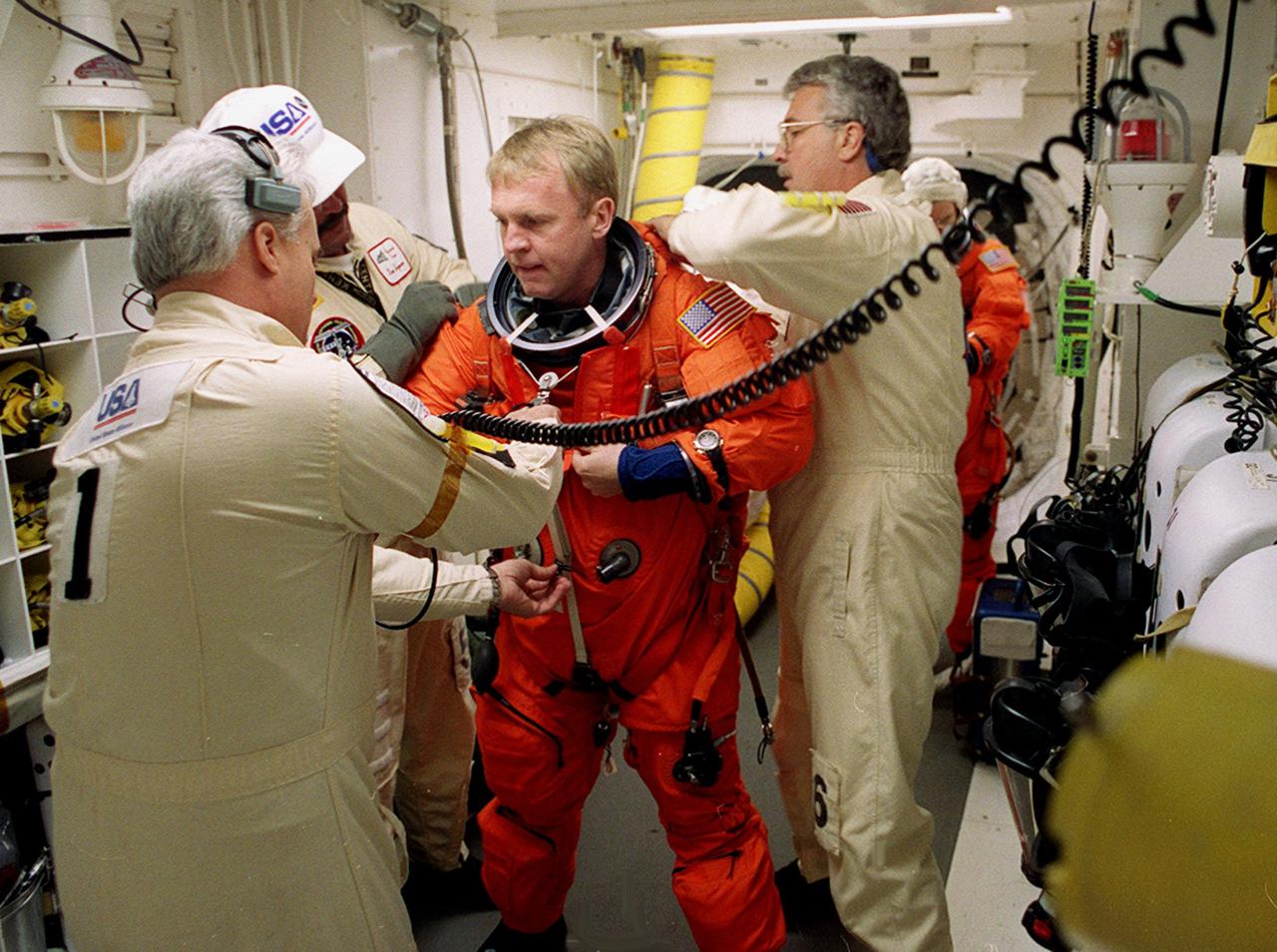
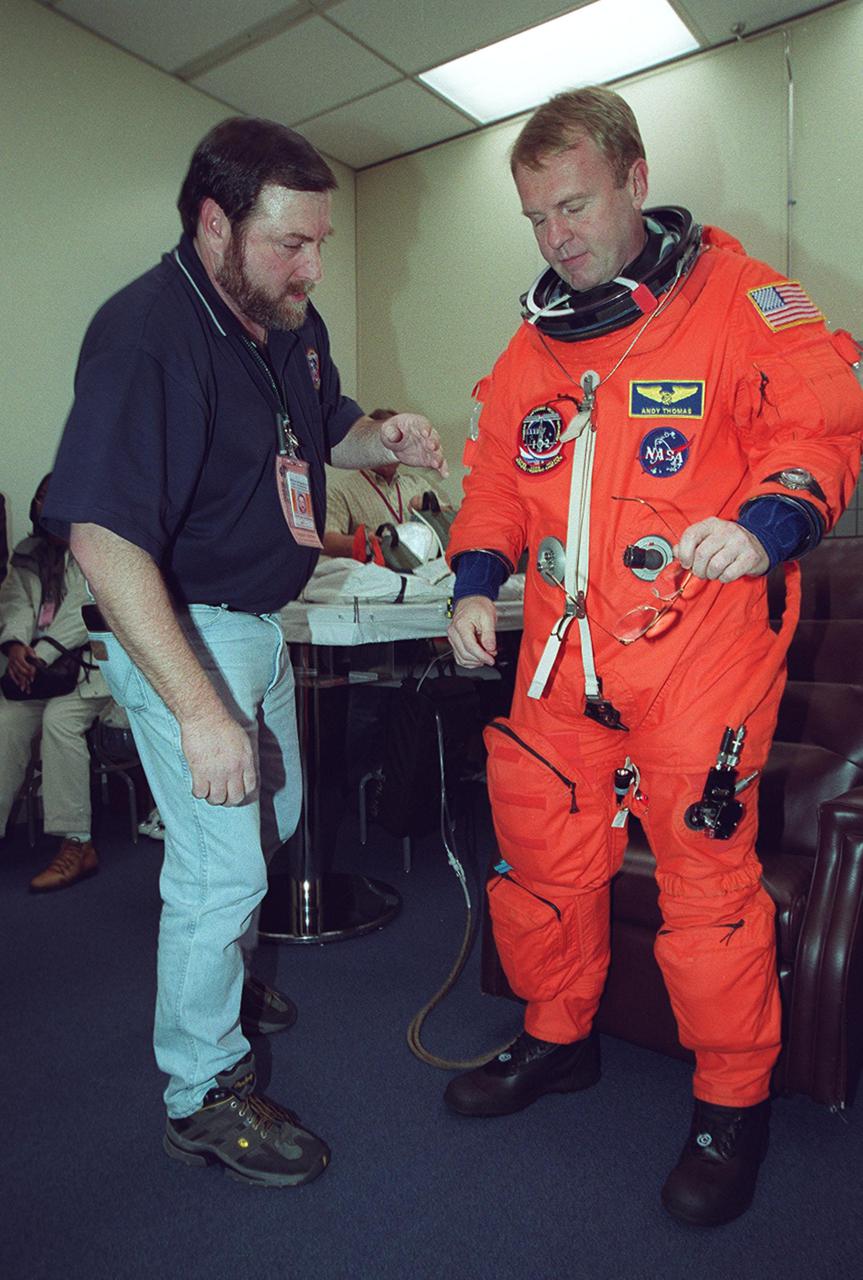
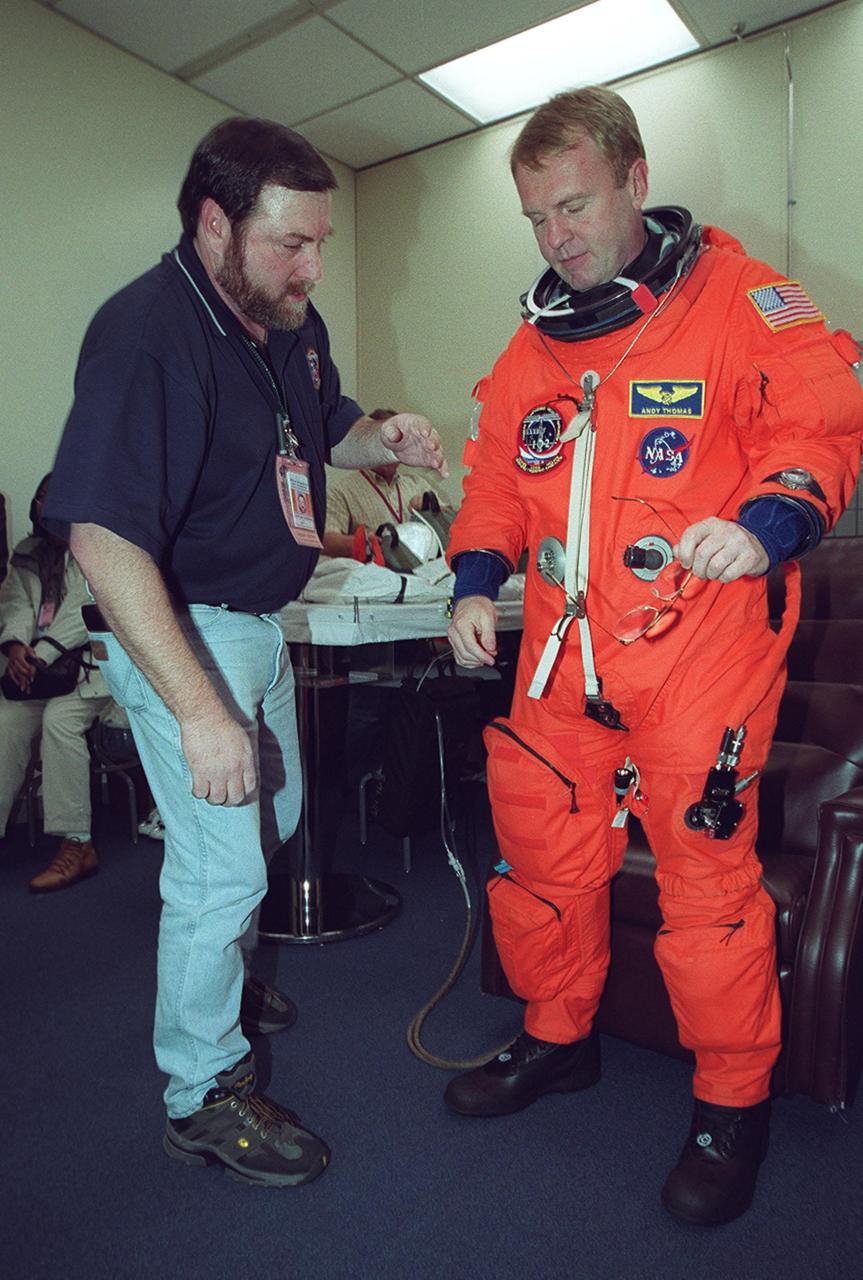
Before entering Space Shuttle Discovery, STS-102 Mission Specialist Andrew Thomas is helped with his launch and entry suit by technicians in the White Room. The mission is Thomas’s third Shuttle flight. Discovery is carrying the Multi-Purpose Logistics Module Leonardo on the eighth construction flight to the International Space Station. The primary delivery system used to resupply and return Station cargo requiring a pressurized environment, Leonardo will deliver up to 10 tons of laboratory racks filled with equipment, experiments and supplies for outfitting the newly installed U.S. Laboratory Destiny. Discovery is set to launch March 8 at 6:42 a.m. EST. The 12-day mission is expected to end with a landing at KSC on March 20
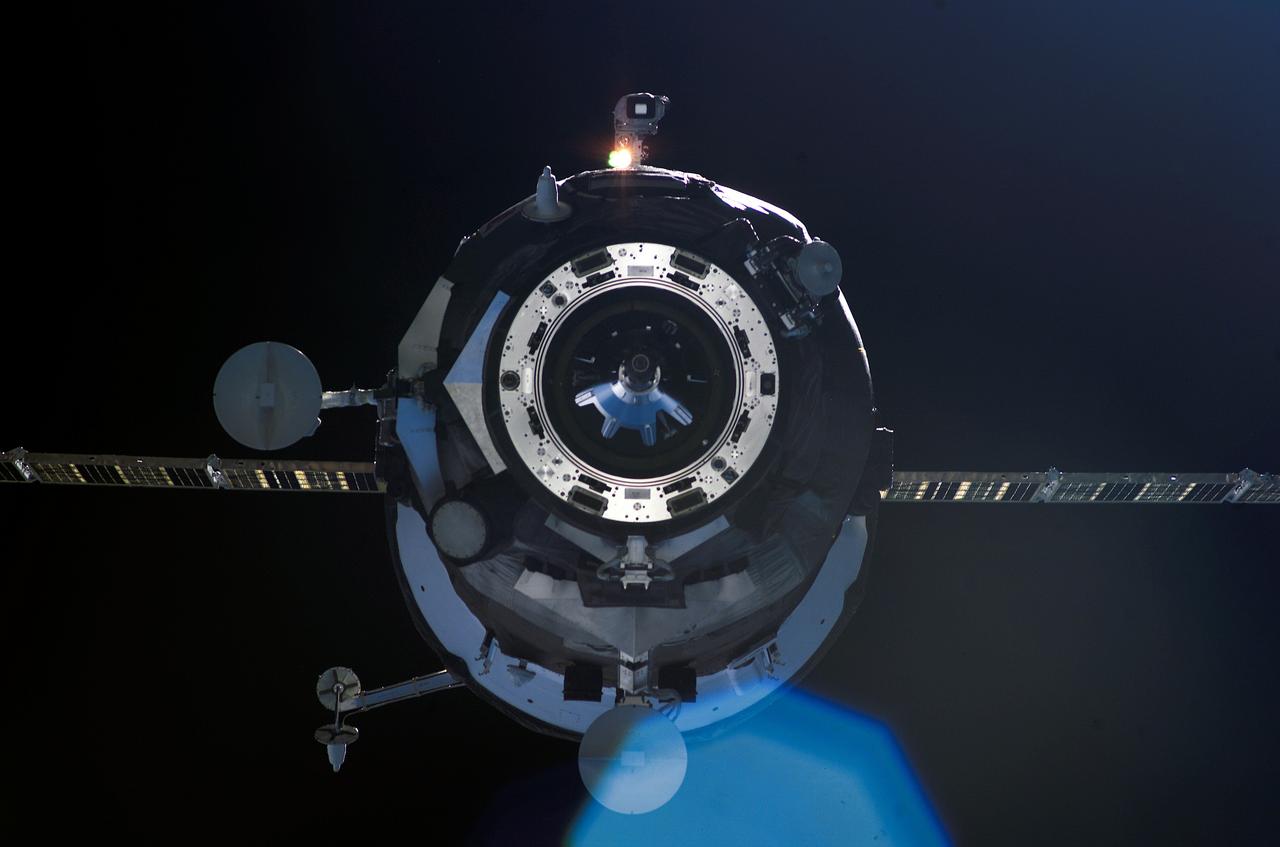
ISS012-E-13564 (23 Dec. 2005) --- Backdropped by the blackness of space, an unpiloted Progress supply vehicle approaches the International Space Station. The Progress 20 resupply craft launched at 12:38 p.m. (CST) on Dec. 21, 2005 from the Baikonur Cosmodrome in Kazakhstan to deliver 2.8 tons of supplies, gifts, food, water, fuel and equipment to the Expedition 12 crew members onboard the station. Progress docked to the Pirs Docking Compartment at 1:46 p.m. (CST) on Dec. 23 as the station flew approximately 220 statute miles above the Atlantic off the east coast of South America.
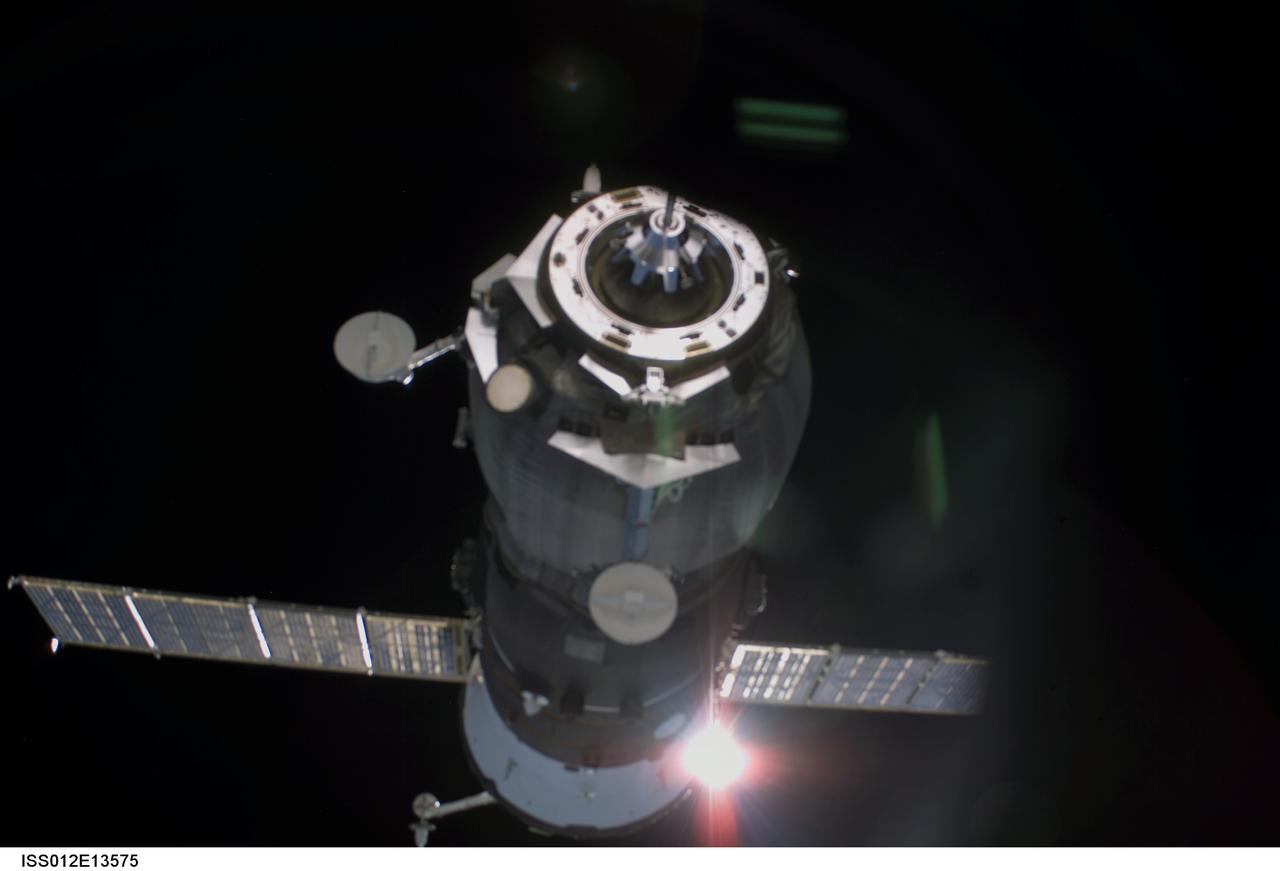
ISS012-E-13575 (23 Dec. 2005) --- Backdropped by the blackness of space, an unpiloted Progress supply vehicle approaches the International Space Station. The Progress 20 resupply craft launched at 12:38 p.m. (CST) on Dec. 21, 2005 from the Baikonur Cosmodrome in Kazakhstan to deliver 2.8 tons of supplies, gifts, food, water, fuel and equipment to the Expedition 12 crew members onboard the station. Progress docked to the Pirs Docking Compartment at 1:46 p.m. (CST) on Dec. 23 as the station flew approximately 220 statute miles above the Atlantic off the east coast of South America.
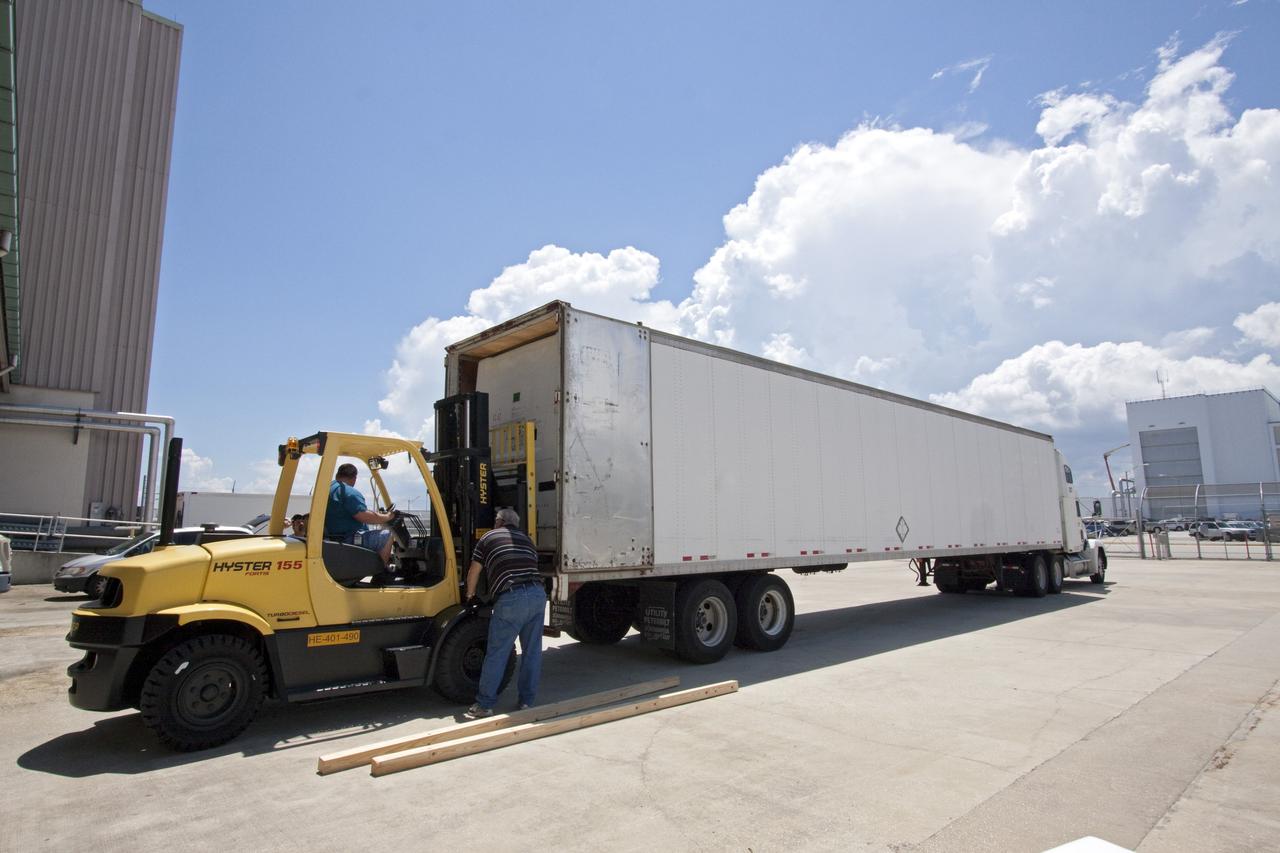
CAPE CANAVERAL, Fla. -- In the Space Station Processing Facility at NASA's Kennedy Space Center in Florida, a forklift moves shipping containers packed with tools and flight support equipment for orbital replacement units into a tractor-trailer for their trip to the Japanese Aerospace Exploration Agency's Tanegashima Space Center. There, the six units, including the flex hose rotary coupler, will be processed for launch to the International Space Station aboard HTV-2, scheduled for Jan. 20, 2011. HTV-2 is an uncrewed cargo transporter that will be launched by the H-IIB launch vehicle. It is designed to deliver up to 6 tons of supplies, including food, clothes and experiment devices to the space station. Photo credit: NASA/Jack Pfaller
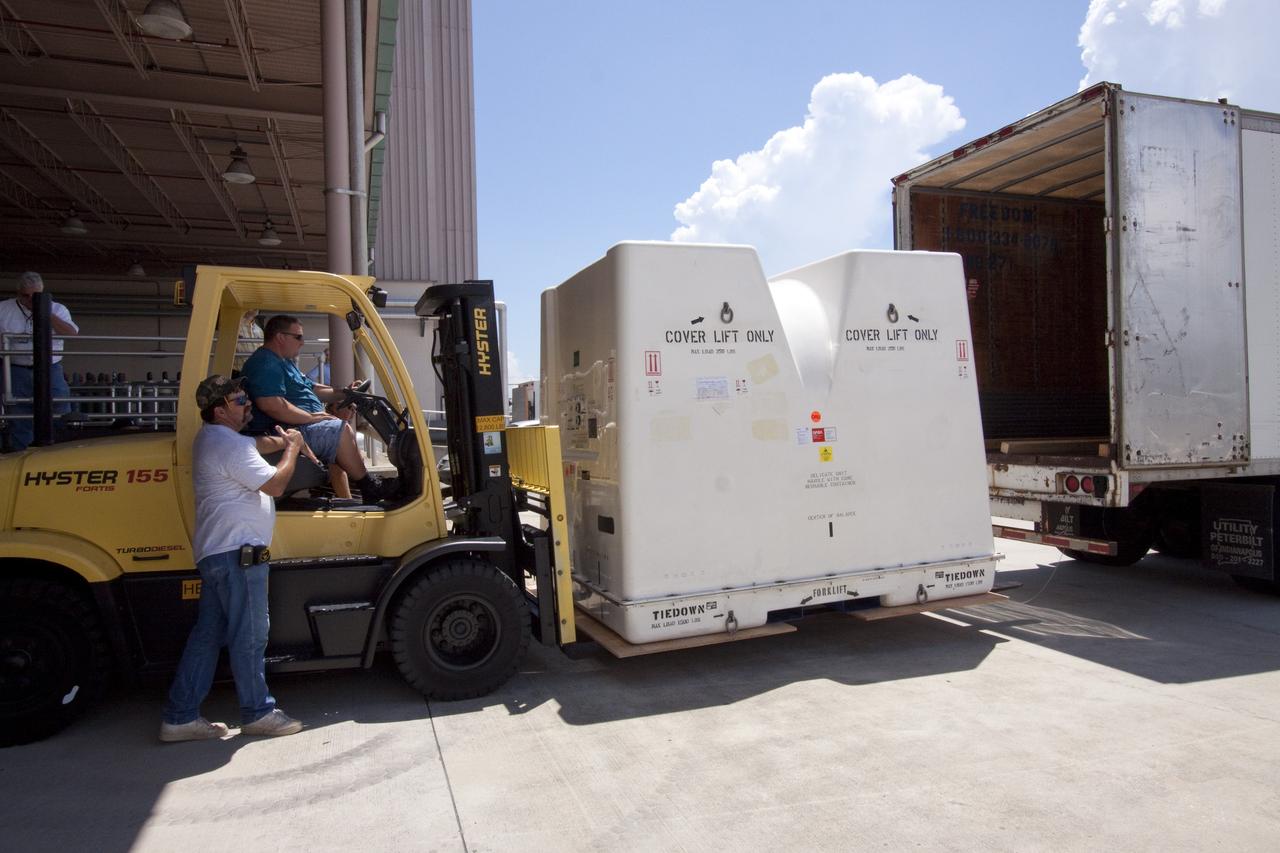
CAPE CANAVERAL, Fla. -- In the Space Station Processing Facility at NASA's Kennedy Space Center in Florida, a forklift moves shipping containers packed with tools and flight support equipment for orbital replacement units into a tractor-trailer for their trip to the Japanese Aerospace Exploration Agency's Tanegashima Space Center. There, the six units, including the flex hose rotary coupler, will be processed for launch to the International Space Station aboard HTV-2, scheduled for Jan. 20, 2011. HTV-2 is an uncrewed cargo transporter that will be launched by the H-IIB launch vehicle. It is designed to deliver up to 6 tons of supplies, including food, clothes and experiment devices to the space station. Photo credit: NASA/Jack Pfaller
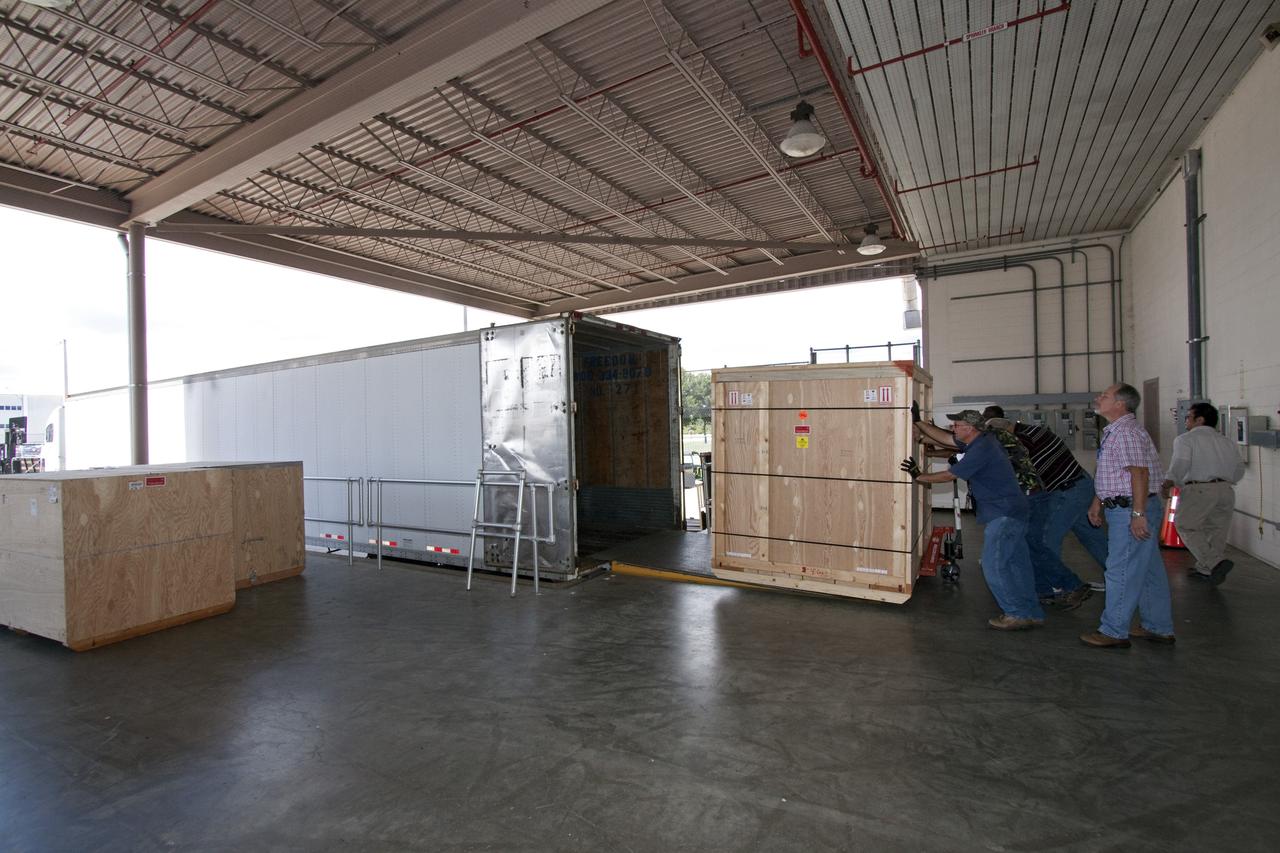
CAPE CANAVERAL, Fla. -- In the Space Station Processing Facility at NASA's Kennedy Space Center in Florida, shipping containers packed with tools and flight support equipment for orbital replacement units are loaded into a tractor-trailer for their trip to the Japanese Aerospace Exploration Agency's Tanegashima Space Center. There, the six units, including the flex hose rotary coupler, will be processed for launch to the International Space Station aboard HTV-2, scheduled for Jan. 20, 2011. HTV-2 is an uncrewed cargo transporter that will be launched by the H-IIB launch vehicle. It is designed to deliver up to 6 tons of supplies, including food, clothes and experiment devices to the space station. Photo credit: NASA/Jack Pfaller
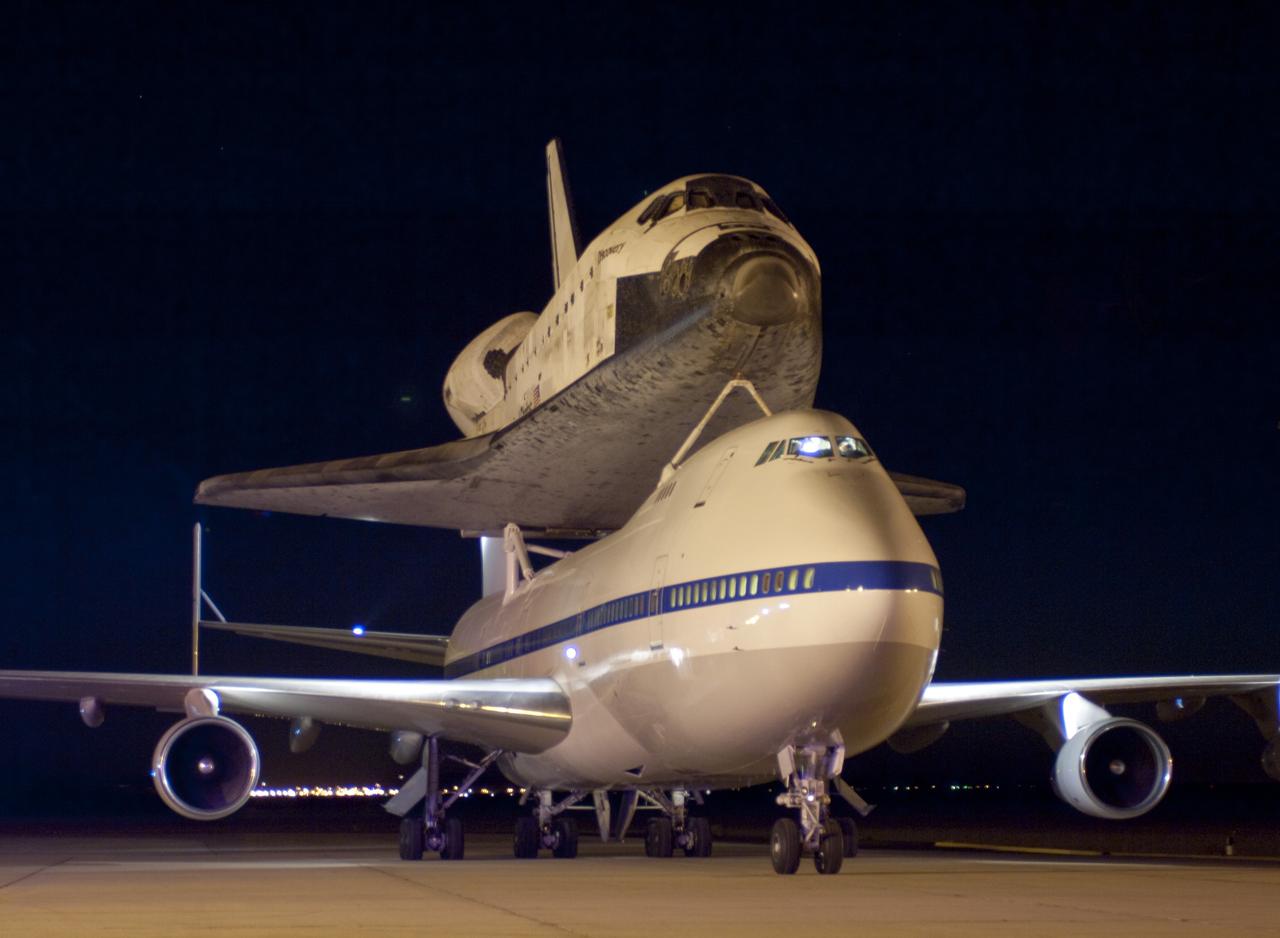
EDWARDS AIR FORCE BASE, Calif. – (ED09-0253-114) NASA’s modified Boeing 747 carrying the space shuttle Discovery taxis toward the runway at Edwards Air Force Base in Southern California shortly before dawn on Sept. 20, 2009 prior to taking off on their two-day ferry flight to the Kennedy Space Center in Florida. Discovery had landed at Edwards Sept. 11 after the almost 14-day mission STS-128 to the International Space Station. The shuttle delivered more than 7 tons of supplies, science racks and equipment, as well as additional environmental hardware to sustain six crew members on the International Space Station. NASA photo /Jim Ross
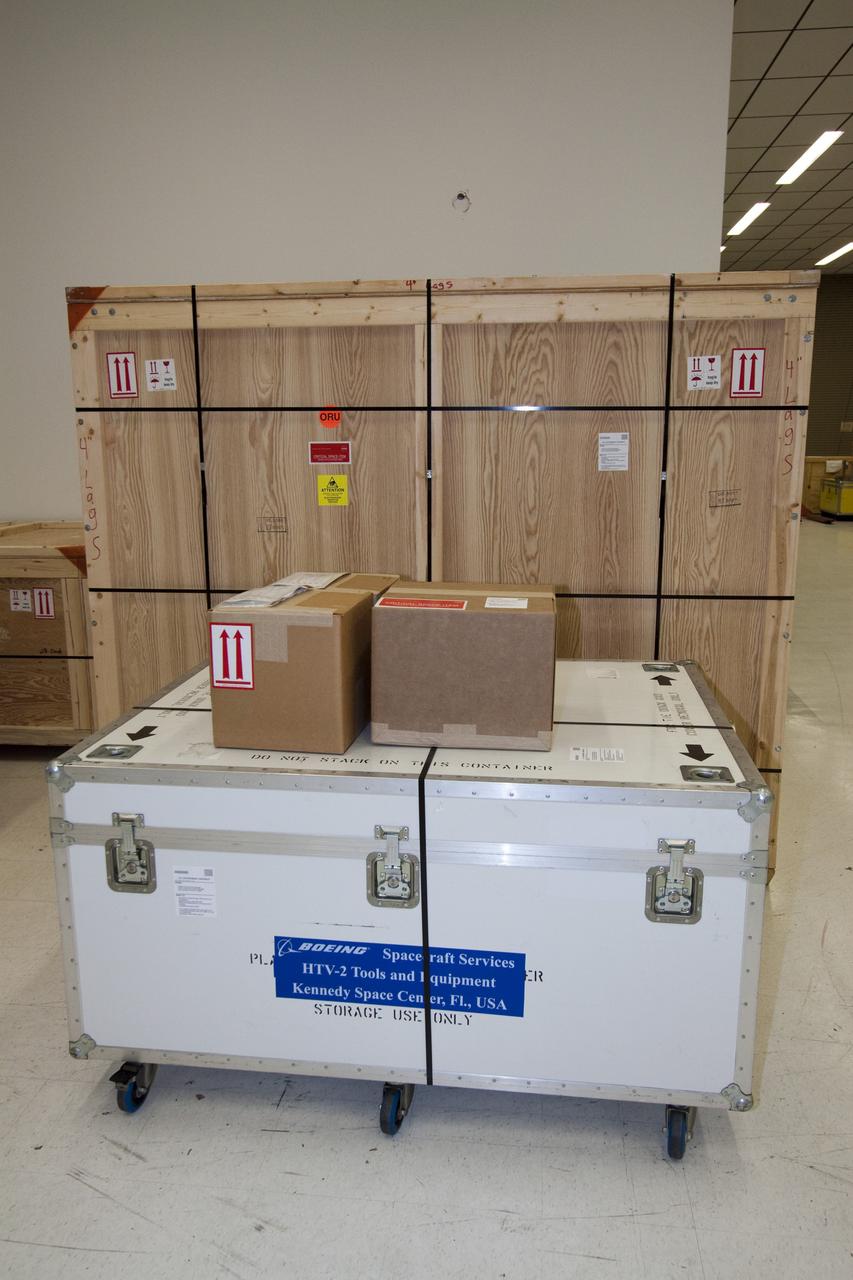
CAPE CANAVERAL, Fla. -- In the Space Station Processing Facility at NASA's Kennedy Space Center in Florida, shipping containers packed with tools and flight support equipment for orbital replacement units are ready for their trip to the Japanese Aerospace Exploration Agency's Tanegashima Space Center. There, the six units, including the flex hose rotary coupler, will be processed for launch to the International Space Station aboard HTV-2, scheduled for Jan. 20, 2011. HTV-2 is an uncrewed cargo transporter that will be launched by the H-IIB launch vehicle. It is designed to deliver up to 6 tons of supplies, including food, clothes and experiment devices to the space station. Photo credit: NASA/Jack Pfaller
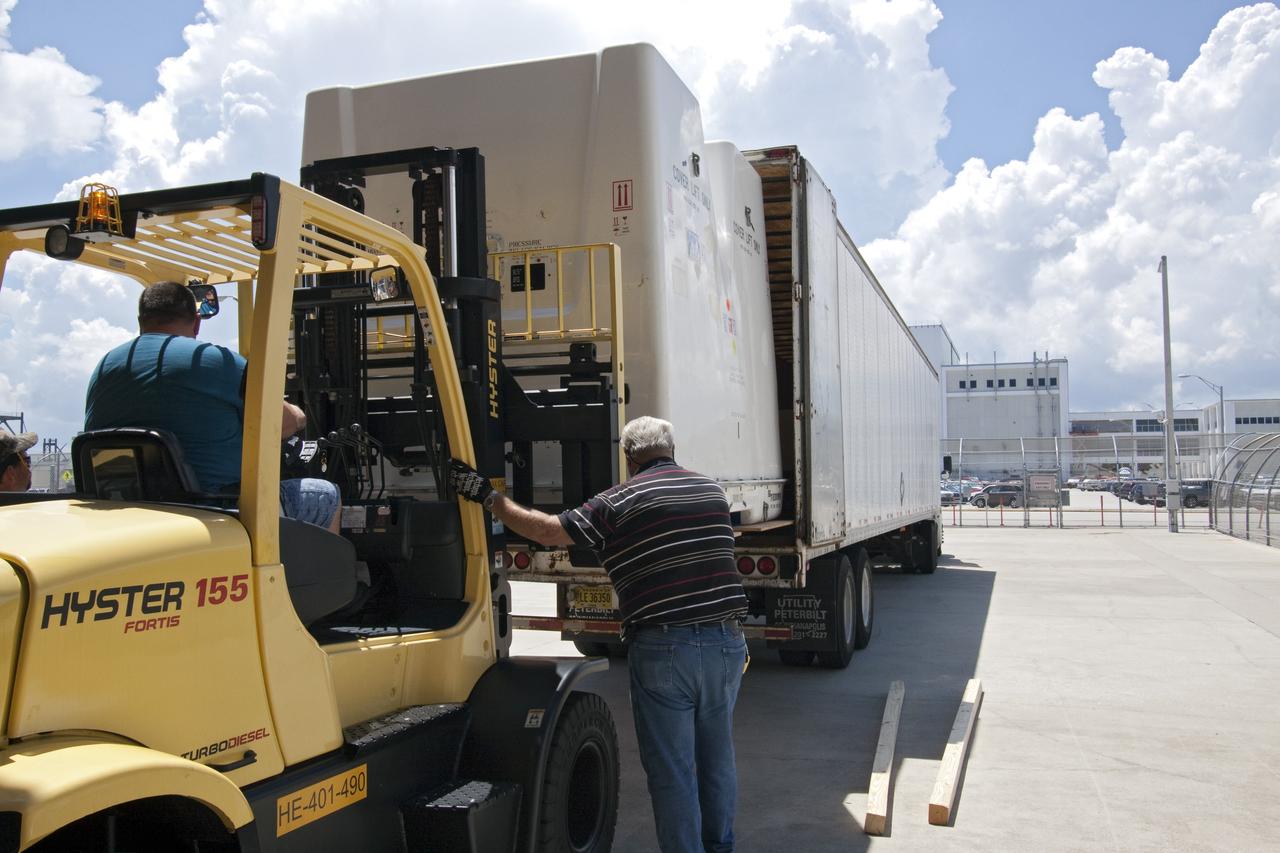
CAPE CANAVERAL, Fla. -- In the Space Station Processing Facility at NASA's Kennedy Space Center in Florida, a forklift moves shipping containers packed with tools and flight support equipment for orbital replacement units into a tractor-trailer for their trip to the Japanese Aerospace Exploration Agency's Tanegashima Space Center. There, the six units, including the flex hose rotary coupler, will be processed for launch to the International Space Station aboard HTV-2, scheduled for Jan. 20, 2011. HTV-2 is an uncrewed cargo transporter that will be launched by the H-IIB launch vehicle. It is designed to deliver up to 6 tons of supplies, including food, clothes and experiment devices to the space station. Photo credit: NASA/Jack Pfaller
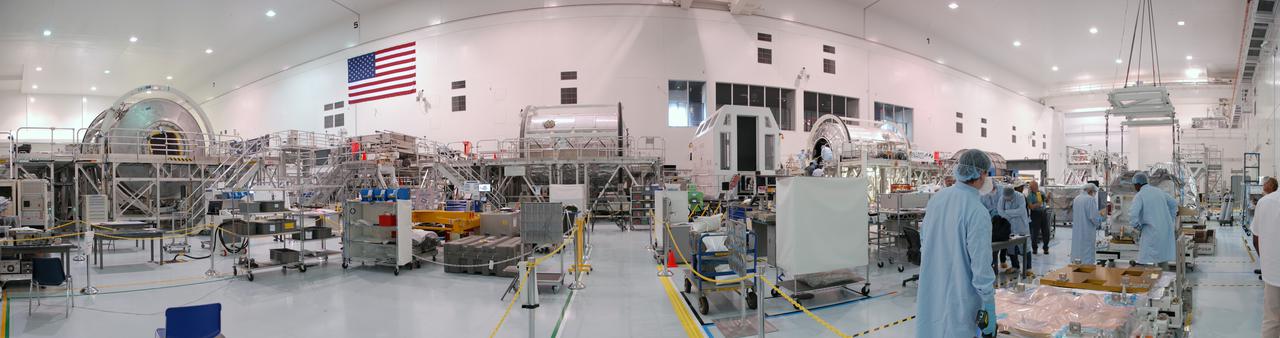
CAPE CANAVERAL, Fla. -- In the Space Station Processing Facility at NASA's Kennedy Space Center in Florida, technicians prepare to lift the cargo transportation container, or CTC, for installation into a shipping container. The container will be transported to the Japanese Aerospace Exploration Agency's Tanegashima Space Center to begin processing for launch to the International Space Station aboard HTV-2, scheduled for Jan. 20, 2011. HTV-2 is an uncrewed cargo transporter that will be launched by the H-IIB launch vehicle. It is designed to deliver up to 6 tons of supplies, including food, clothes and experiment devices to the space station. Photo credit: NASA_Frankie Martin
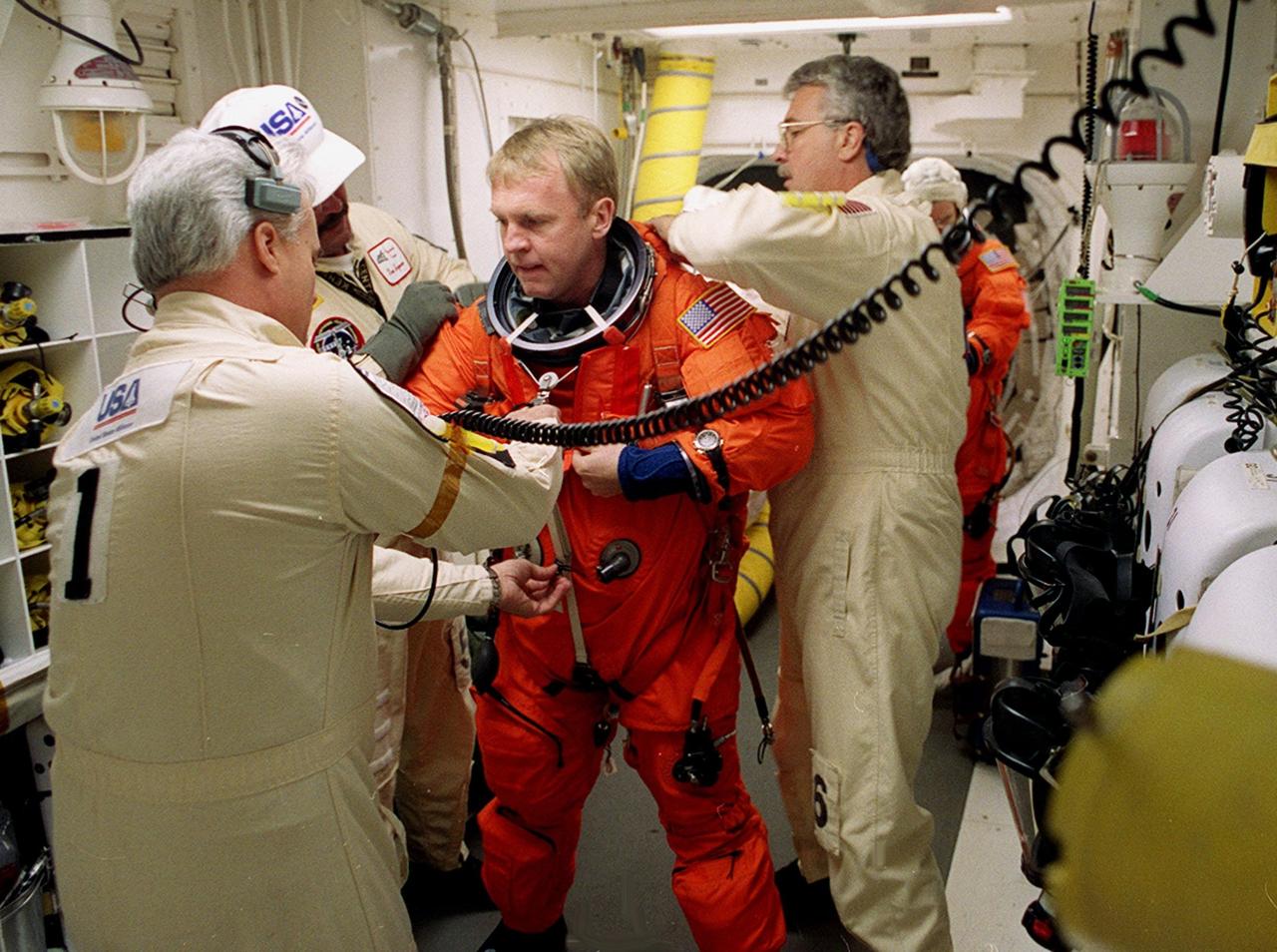
Before entering Space Shuttle Discovery, STS-102 Mission Specialist Andrew Thomas is helped with his launch and entry suit by technicians in the White Room. The mission is Thomas’s third Shuttle flight. Discovery is carrying the Multi-Purpose Logistics Module Leonardo on the eighth construction flight to the International Space Station. The primary delivery system used to resupply and return Station cargo requiring a pressurized environment, Leonardo will deliver up to 10 tons of laboratory racks filled with equipment, experiments and supplies for outfitting the newly installed U.S. Laboratory Destiny. Discovery is set to launch March 8 at 6:42 a.m. EST. The 12-day mission is expected to end with a landing at KSC on March 20
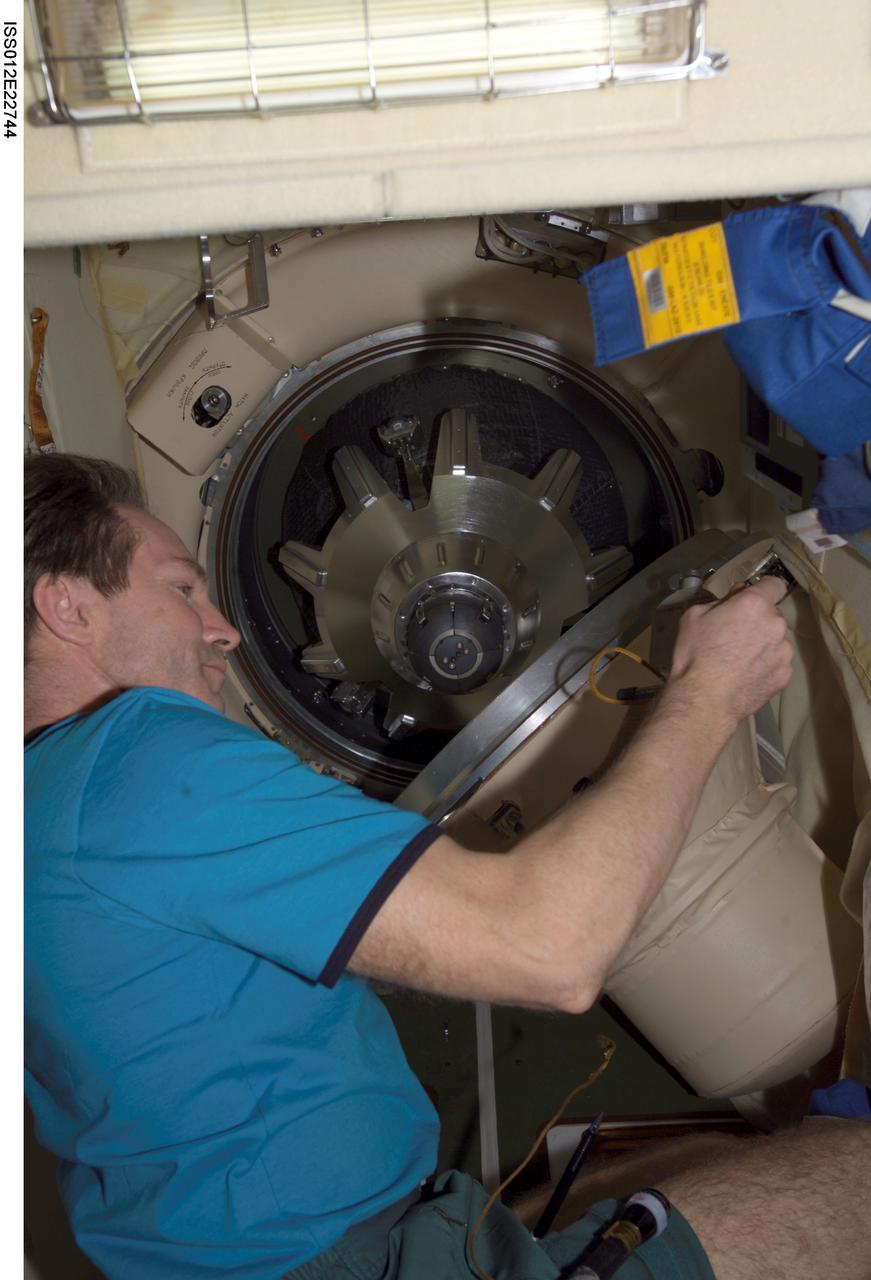
ISS012-E-22744 (23 Dec. 2005) --- Cosmonaut Valery I. Tokarev, Expedition 12 flight engineer representing Russia's Federal Space Agency, opens the Progress transfer hatch on the International Space Station. Progress 20 docked to the Pirs Docking Compartment at 1:46 p.m. (CST) on Dec. 23 as the station flew approximately 220 statute miles above the Atlantic off the east coast of South America. Progress delivered 2.8 tons of supplies, gifts, food, water, fuel and equipment to the crew members onboard the station.
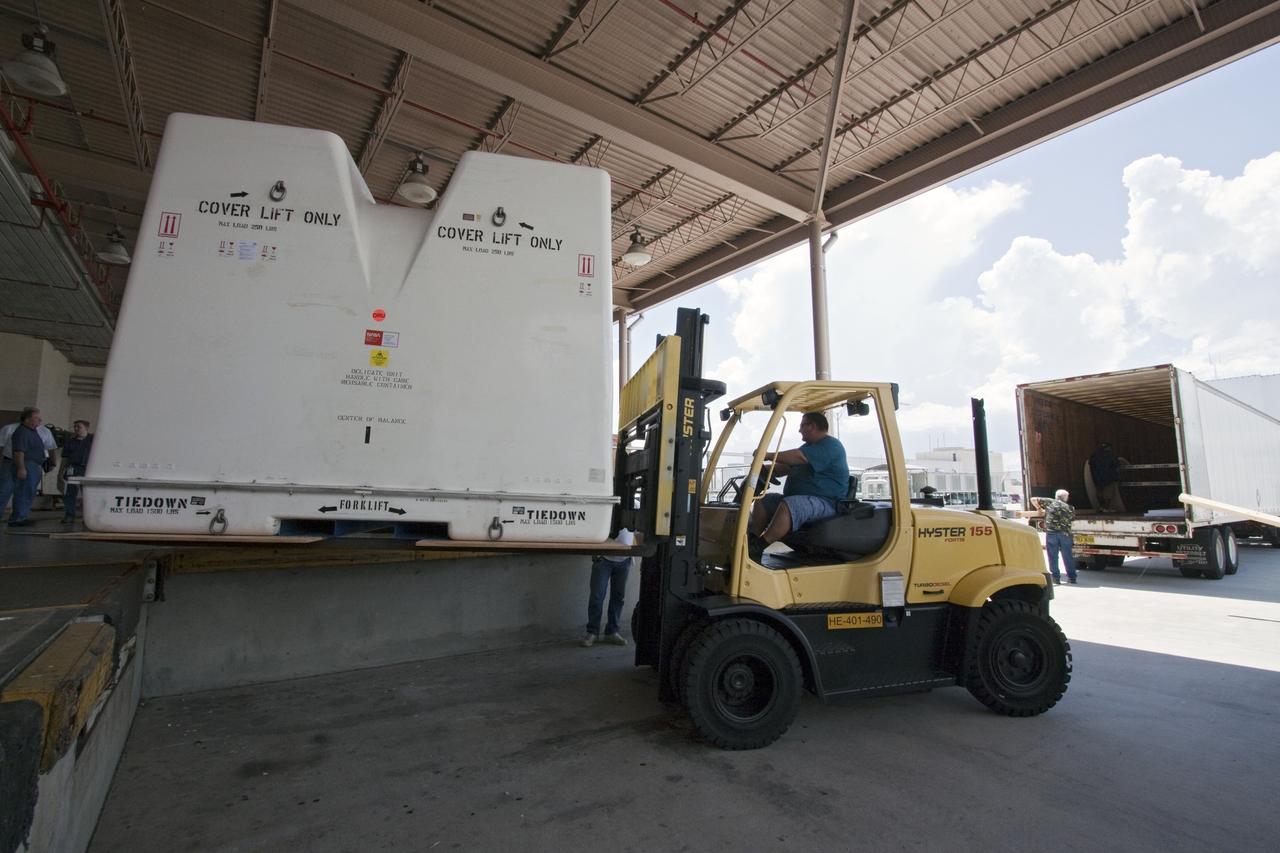
CAPE CANAVERAL, Fla. -- In the Space Station Processing Facility at NASA's Kennedy Space Center in Florida, a forklift moves shipping containers packed with tools and flight support equipment for orbital replacement units into a tractor-trailer for their trip to the Japanese Aerospace Exploration Agency's Tanegashima Space Center. There, the six units, including the flex hose rotary coupler, will be processed for launch to the International Space Station aboard HTV-2, scheduled for Jan. 20, 2011. HTV-2 is an uncrewed cargo transporter that will be launched by the H-IIB launch vehicle. It is designed to deliver up to 6 tons of supplies, including food, clothes and experiment devices to the space station. Photo credit: NASA/Jack Pfaller
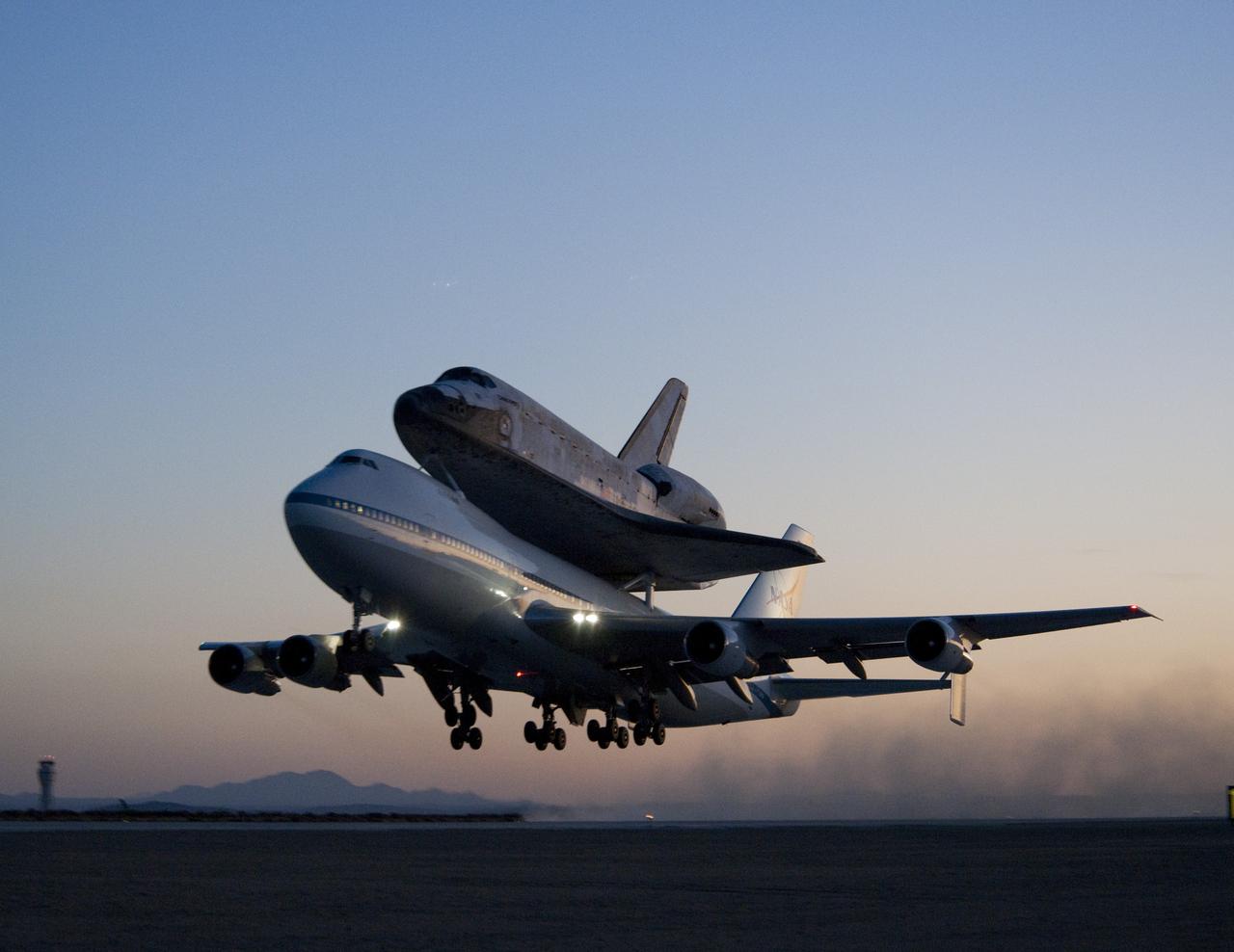
EDWARDS AIR FORCE BASE, Calif. – ED09-0253-108) Space shuttle Discovery and its modified 747 carrier aircraft lift off from Edwards Air Force Base early in the morning on Sept. 20, 2009 on the first leg of its ferry flight back to the Kennedy Space Center in Florida. Discovery had landed at Edwards Sept. 11 after the STS-128 mission to the International Space Station. The shuttle delivered more than 7 tons of supplies, science racks and equipment, as well as additional environmental hardware to sustain six crew members on the International Space Station. NASA photo /Tony Landis

These two radar images show the majestic Yellowstone National Park, Wyoming, the oldest national park in the United States and home to the world's most spectacular geysers and hot springs. The region supports large populations of grizzly bears, elk and bison. In 1988, the park was burned by one of the most widespread fires to occur in the northern Rocky Mountains in the last 50 years. Surveys indicated that 793,880 acres of land burned. Of that, 41 percent was burned forest, with tree canopies totally consumed by the fire; 35 percent was a combination of unburned, scorched and blackened trees; 13 percent was surface burn under an unburned canopy; 6 percent was non-forest burn; and 5 percent was undifferentiated burn. Six years later, the burned areas are still clearly visible in these false-color radar images obtained by the Spaceborne Imaging Radar-C/X-band Synthetic Aperture Radar on board the space shuttle Endeavour. The image at the left was obtained using the L-band radar channel, horizontally received and vertically transmitted, on the shuttle's 39th orbit on October 2, 1994. The area shown is 45 kilometers by 71 kilometers (28 miles by 44 miles) in size and centered at 44.6 degrees north latitude, 110.7 degrees west longitude. North is toward the top of the image (to the right). Most trees in this area are lodge pole pines at different stages of fire succession. Yellowstone Lake appears as a large dark feature at the bottom of the scene. At right is a map of the forest crown, showing its biomass, or amount of vegetation, which includes foliage and branches. The map was created by inverting SIR-C data and using in situ estimates of crown biomass gathered by the Yellowstone National Biological Survey. The map is displayed on a color scale from blue (rivers and lakes with no biomass) to brown (non-forest areas with crown biomass of less than 4 tons per hectare) to light brown (areas of canopy burn with biomass of between 4 and 12 tons per hectare). Yellow indicates areas of canopy burn and mixed burn with a biomass of between 12 to 20 tons per hectare; light green is mixed burn and on-burn forest with a biomass of 20 to 35 tons per hectare; and green is non-burned forest with a biomass of greater than 35 tons per hectare. Forest recovery from the fire seems to depend on fire intensity and soil conditions. In areas of severe canopy burn and poor soil conditions, crown biomass was still low in 1994 (indicated by the brown areas at the center left), whereas in areas of mixed burn with nutrient-rich soils, seen west of Yellowstone Lake, crown biomass has increased significantly in six years (indicated by the yellow and light green areas). Imaging fire-affected regions with spaceborne radar illustrates SIR-C/X-SAR's keen abilities to monitor regrowth after a fire. Knowing the amount of carbon accumulated in the atmosphere by regenerating forest in the 20 to 50 years following a fire disturbance is also a significant factor in understanding the global carbon cycle. Measuring crown biomass is necessary to evaluate the effects of past and future fires in specific regions. http://photojournal.jpl.nasa.gov/catalog/PIA01741
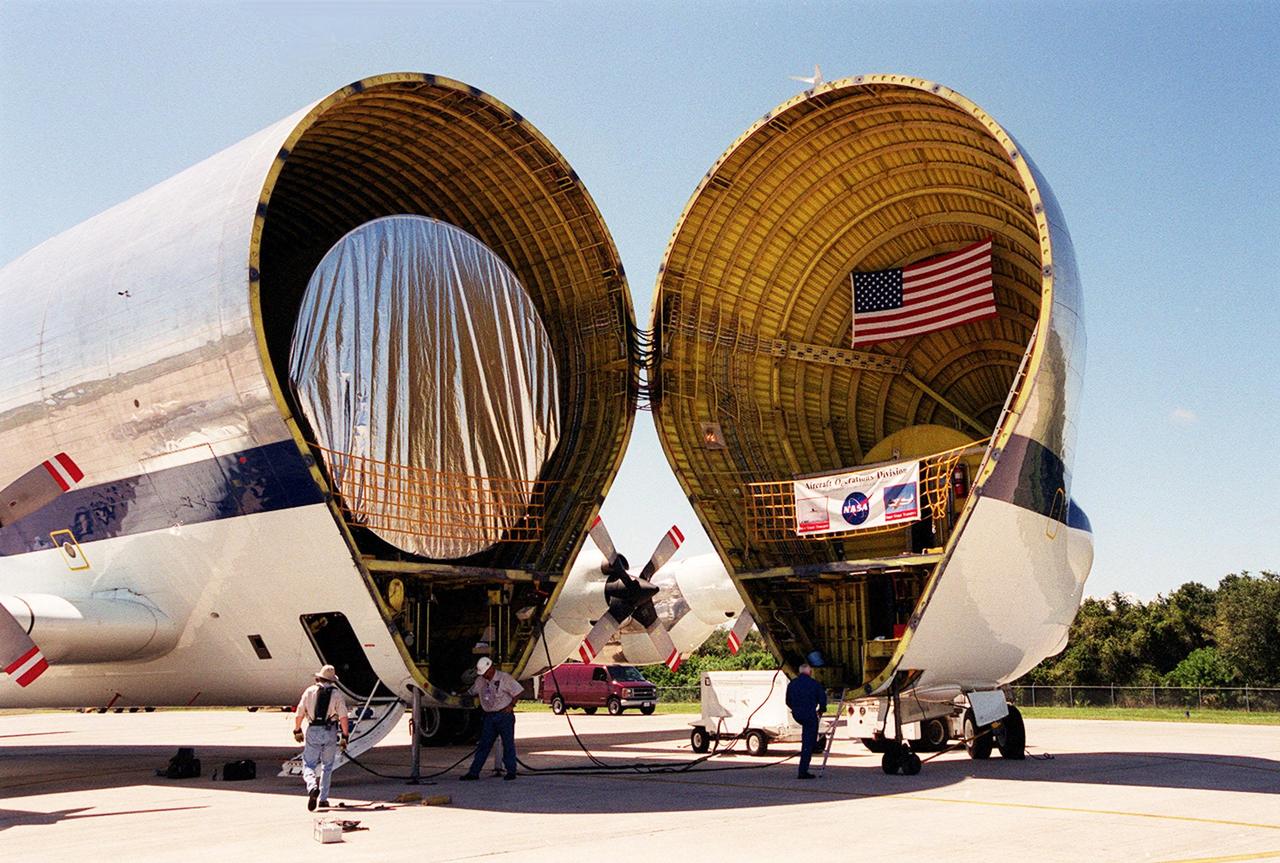
KENNEDY SPACE CENTER, FLA. -- The nose of NASA's Super Guppy aircraft opens to reveal the <a href="http://www-pao.ksc.nasa.gov/kscpao/release/2000/78-00.htm">Joint Airlock Module</a> the gateway from which crew members aboard the International Space Station (ISS) will enter and exit the 470-ton orbiting research facility. The airlock was transported from NASA's Marshall Space Flight Center in Huntsville, Ala. The airlock will be transported to the Operations and Checkout Building in the KSC industrial area where it will undergo vacuum chamber testing. It will then be moved to the Space Station Processing Facility (SSPF) for further prelaunch preparation and checkout. The massive, spindle-shaped airlock is 20 feet long, has a diameter of 13 feet at its widest point, and weighs six and a half tons. It was manufactured at NASA's Marshall Space Flight Center by the Huntsville division of The Boeing Company. The Space Shuttle Atlantis will carry the airlock to orbit on mission STS-104, the tenth International Space Station flight, currently targeted for liftoff in May 2001
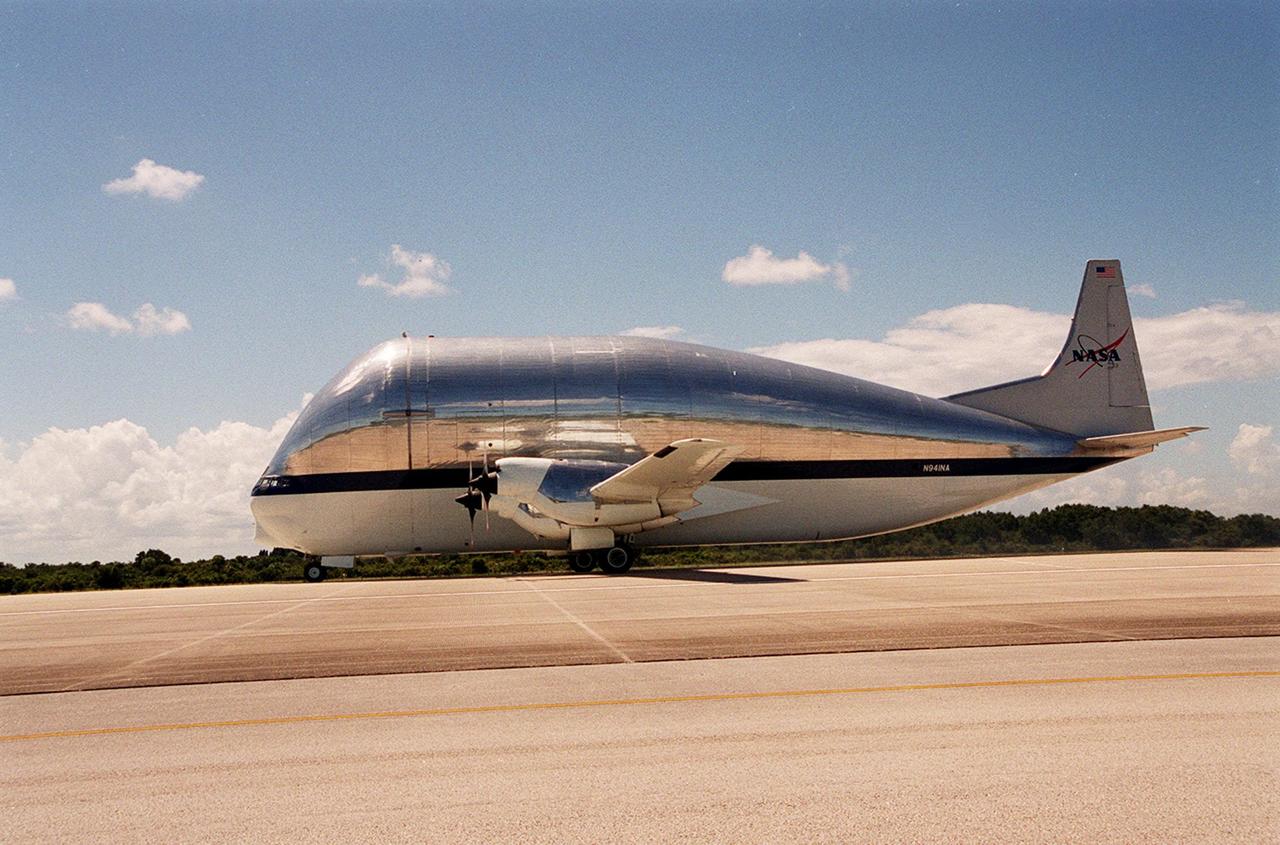
KENNEDY SPACE CENTER, FLA. -- NASA's Super Guppy aircraft lands at the KSC Shuttle Landing Facility with its cargo, the <a href="http://www-pao.ksc.nasa.gov/kscpao/release/2000/78-00.htm"> Joint Airlock Module</a> the gateway from which crew members aboard the International Space Station (ISS) will enter and exit the 470-ton orbiting research facility. The airlock was transported from NASA's Marshall Space Flight Center in Huntsville, Ala. The airlock will be transported to the Operations and Checkout Building in the KSC industrial area where it will undergo vacuum chamber testing. It will then be moved to the Space Station Processing Facility (SSPF) for further prelaunch preparation and checkout. The massive, spindle-shaped airlock is 20 feet long, has a diameter of 13 feet at its widest point, and weighs six and a half tons. It was manufactured at NASA's Marshall Space Flight Center by the Huntsville division of The Boeing Company. The Space Shuttle Atlantis will carry the airlock to orbit on mission STS-104, the tenth International Space Station flight, currently targeted for liftoff in May 2001
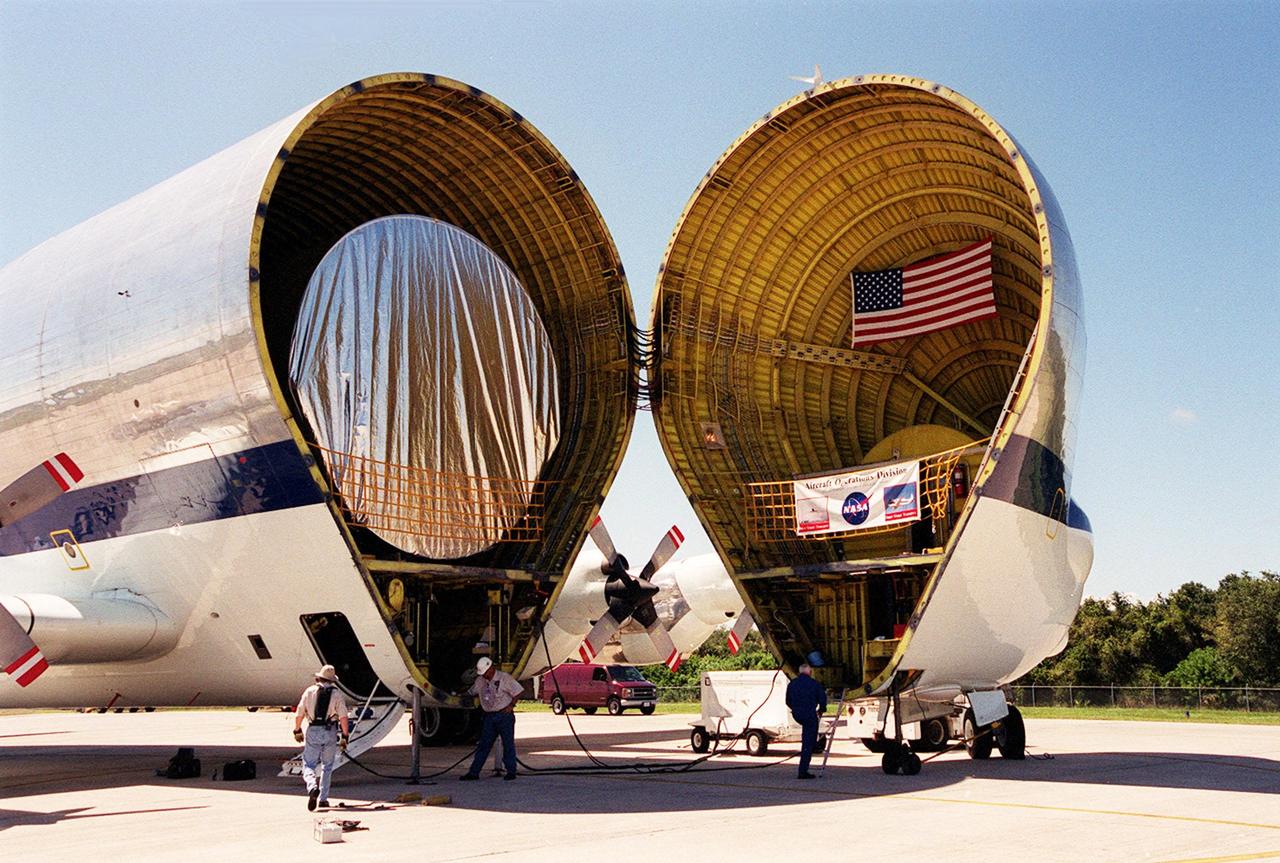
KENNEDY SPACE CENTER, FLA. -- The nose of NASA's Super Guppy aircraft opens to reveal the <a href="http://www-pao.ksc.nasa.gov/kscpao/release/2000/78-00.htm">Joint Airlock Module</a> the gateway from which crew members aboard the International Space Station (ISS) will enter and exit the 470-ton orbiting research facility. The airlock was transported from NASA's Marshall Space Flight Center in Huntsville, Ala. The airlock will be transported to the Operations and Checkout Building in the KSC industrial area where it will undergo vacuum chamber testing. It will then be moved to the Space Station Processing Facility (SSPF) for further prelaunch preparation and checkout. The massive, spindle-shaped airlock is 20 feet long, has a diameter of 13 feet at its widest point, and weighs six and a half tons. It was manufactured at NASA's Marshall Space Flight Center by the Huntsville division of The Boeing Company. The Space Shuttle Atlantis will carry the airlock to orbit on mission STS-104, the tenth International Space Station flight, currently targeted for liftoff in May 2001
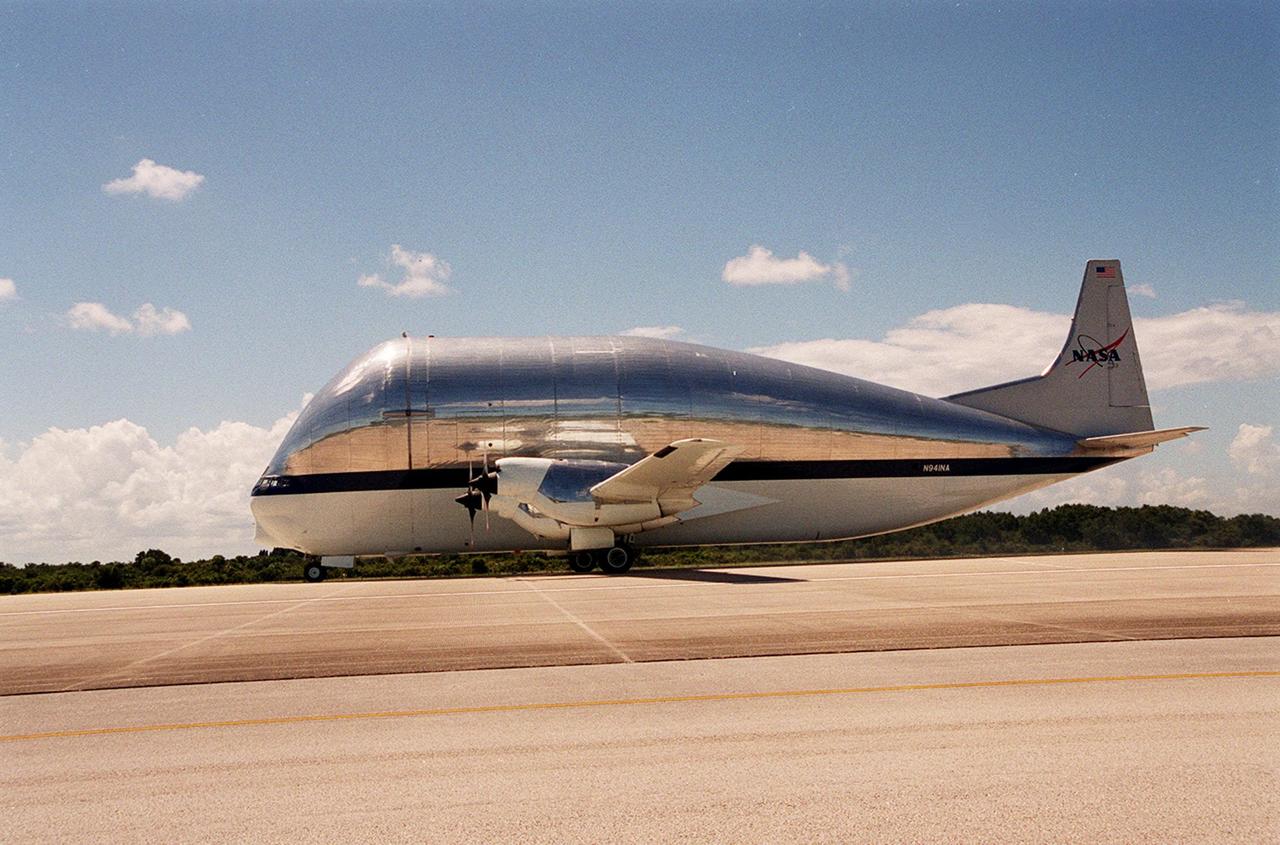
KENNEDY SPACE CENTER, FLA. -- NASA's Super Guppy aircraft lands at the KSC Shuttle Landing Facility with its cargo, the <a href="http://www-pao.ksc.nasa.gov/kscpao/release/2000/78-00.htm"> Joint Airlock Module</a> the gateway from which crew members aboard the International Space Station (ISS) will enter and exit the 470-ton orbiting research facility. The airlock was transported from NASA's Marshall Space Flight Center in Huntsville, Ala. The airlock will be transported to the Operations and Checkout Building in the KSC industrial area where it will undergo vacuum chamber testing. It will then be moved to the Space Station Processing Facility (SSPF) for further prelaunch preparation and checkout. The massive, spindle-shaped airlock is 20 feet long, has a diameter of 13 feet at its widest point, and weighs six and a half tons. It was manufactured at NASA's Marshall Space Flight Center by the Huntsville division of The Boeing Company. The Space Shuttle Atlantis will carry the airlock to orbit on mission STS-104, the tenth International Space Station flight, currently targeted for liftoff in May 2001
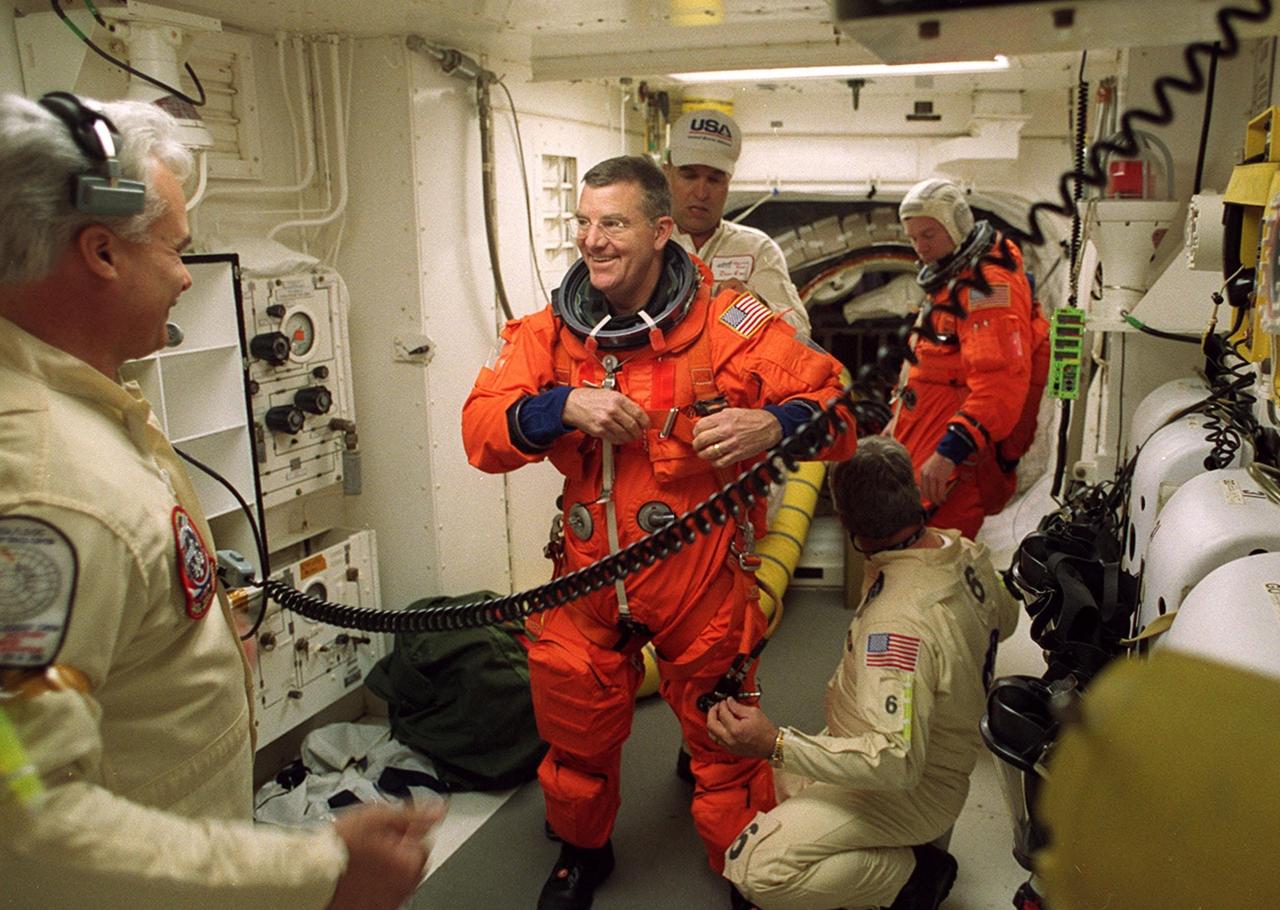
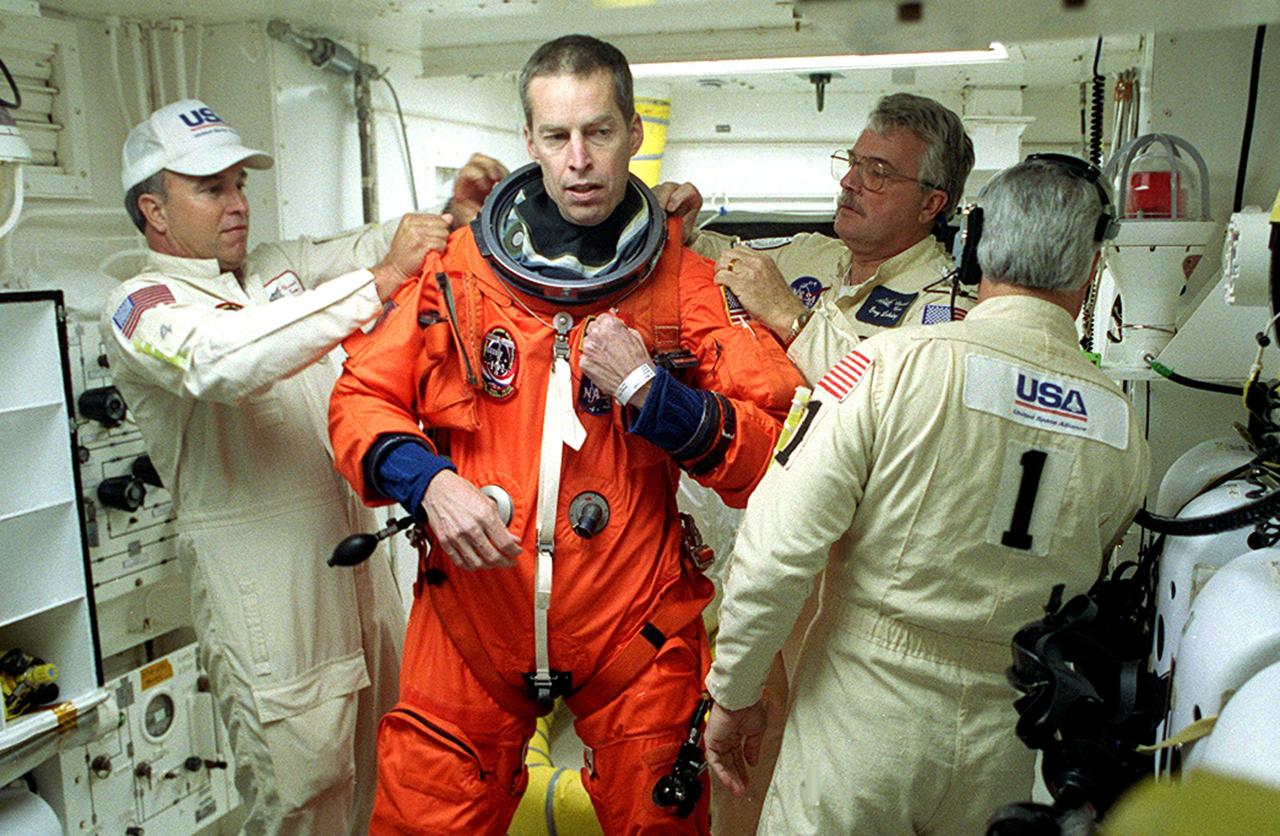
Before entering Space Shuttle Discovery, STS-102 Mission Specialist James Voss (center) is helped preparing his launch and entry suit for launch from technicians in the White Room. The mission is Voss’s fifth Shuttle flight. In the background is Pilot James Kelly waiting to enter Discovery. Voss is also part of the Expedition Two crew flying on the mission to replace the Expedition One crew on the Station. Discovery is carrying the Multi-Purpose Logistics Module Leonardo on the eighth construction flight to the International Space Station. The primary delivery system used to resupply and return Station cargo requiring a pressurized environment, Leonardo will deliver up to 10 tons of laboratory racks filled with equipment, experiments and supplies for outfitting the newly installed U.S. Laboratory Destiny. Discovery is set to launch March 8 at 6:42 a.m. EST. The 12-day mission is expected to end with a landing at KSC on March 20
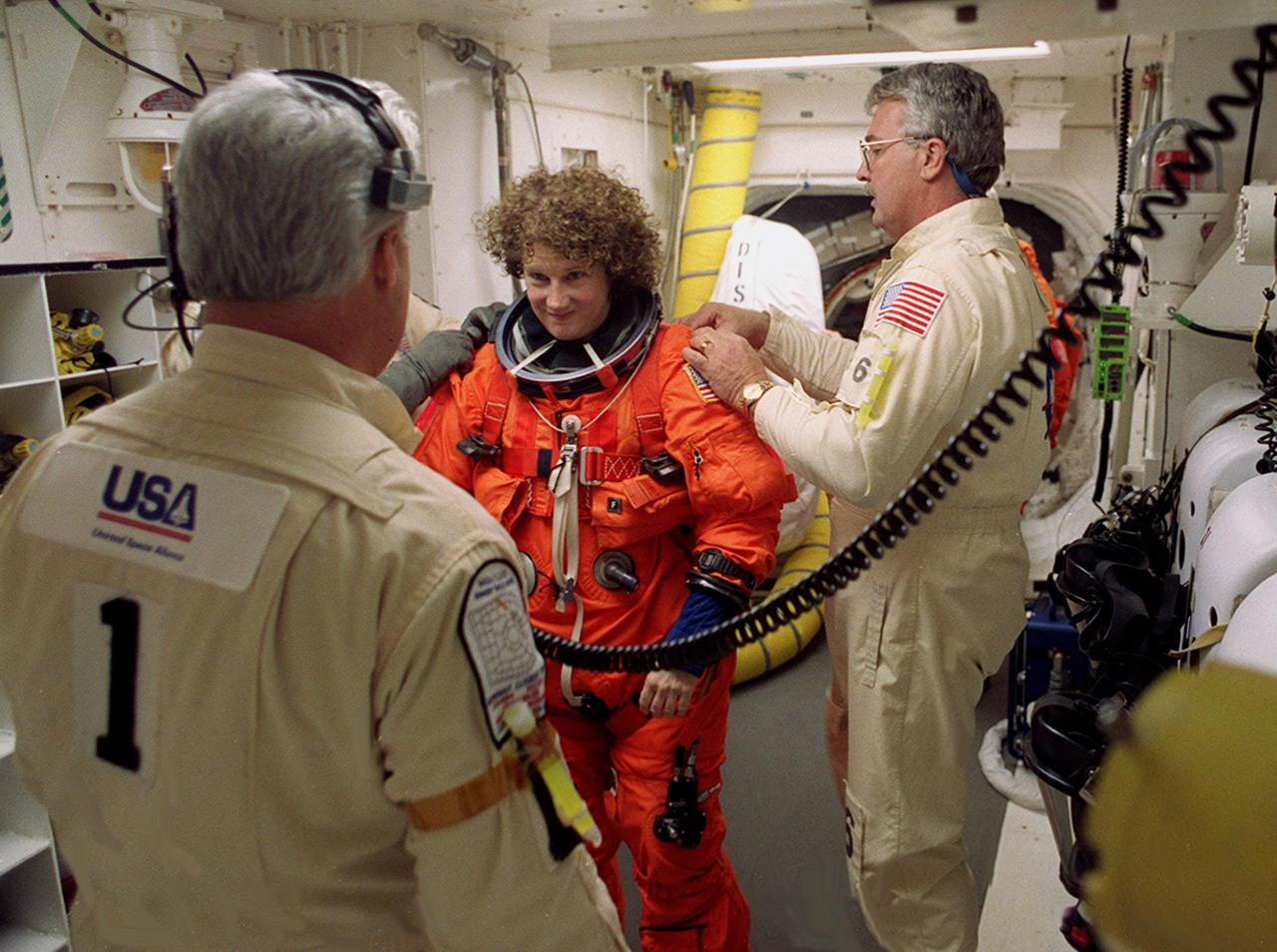
Technicians in the White Room, Launch Pad 39B, help STS-102 Mission Specialist Susan Helms with her launch and entry suit before she enters Space Shuttle Discovery. The mission is Helms’ fifth Shuttle flight. Helms is also part of the Expedition Two crew flying on the mission to replace the Expedition One crew on the Station. Discovery is carrying the Multi-Purpose Logistics Module Leonardo on the eighth construction flight to the International Space Station. The primary delivery system used to resupply and return Station cargo requiring a pressurized environment, Leonardo will deliver up to 10 tons of laboratory racks filled with equipment, experiments and supplies for outfitting the newly installed U.S. Laboratory Destiny. Discovery is set to launch March 8 at 6:42 a.m. EST. The 12-day mission is expected to end with a landing at KSC on March 20
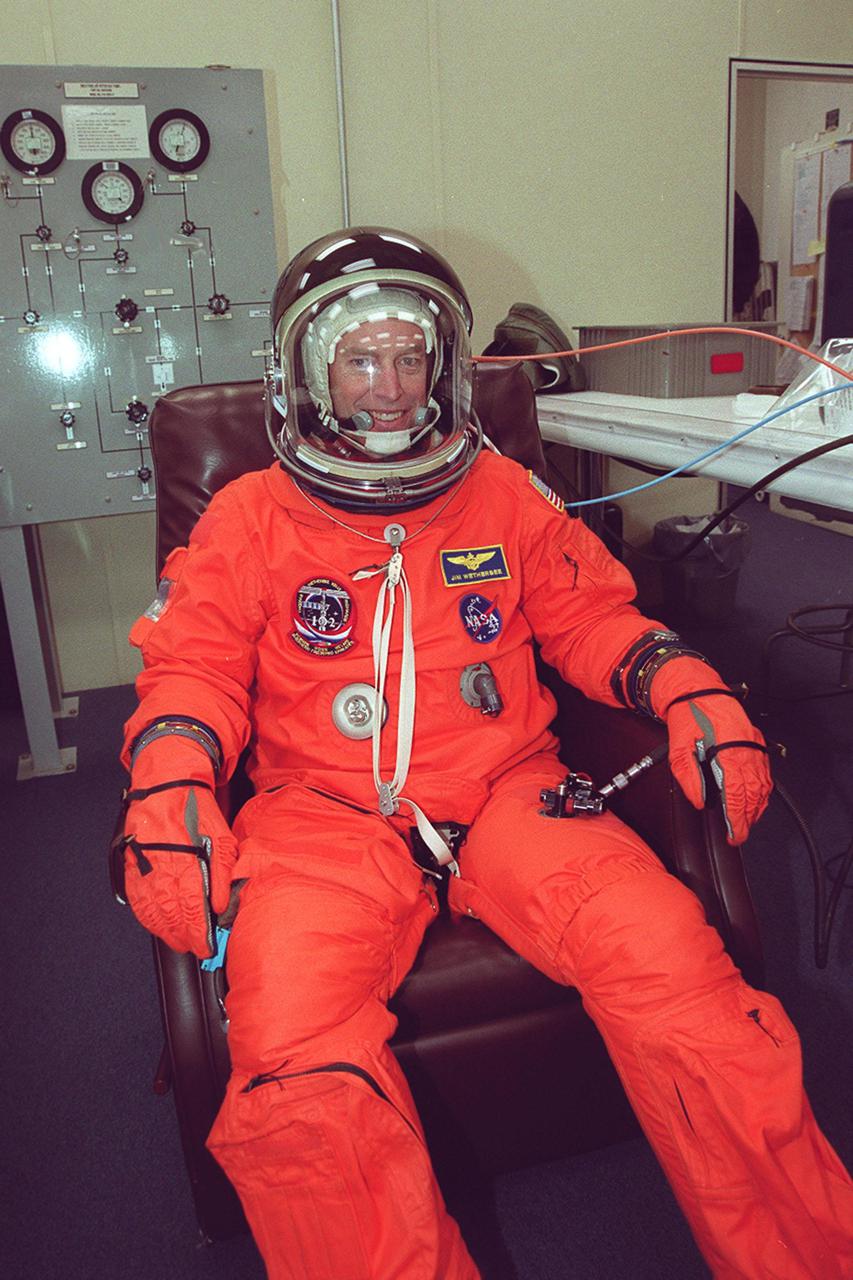
STS-102 Commander James Wetherbee gets final adjustments on his launch and entry suit before heading to Space Shuttle Discovery on Launch Pad 39B. This mission is Wetherbee’s fifth Shuttle flight. Discovery is scheduled to launch March 8 at 6:42 a.m. EST, carrying the Multi-Purpose Logistics Module Leonardo to the International Space Station. The primary delivery system used to resupply and return Station cargo requiring a pressurized environment, Leonardo will deliver up to 10 tons of laboratory racks filled with equipment, experiments and supplies for outfitting the newly installed U.S. Laboratory Destiny. In addition, three crew members Mission Specialists James Voss, Susan Helms and Russian cosmonaut Yury Usachev are the Expedition Two crew replacing Expedition One on the Station. Discovery is expected to land at KSC on March 20 at 2:02 a.m
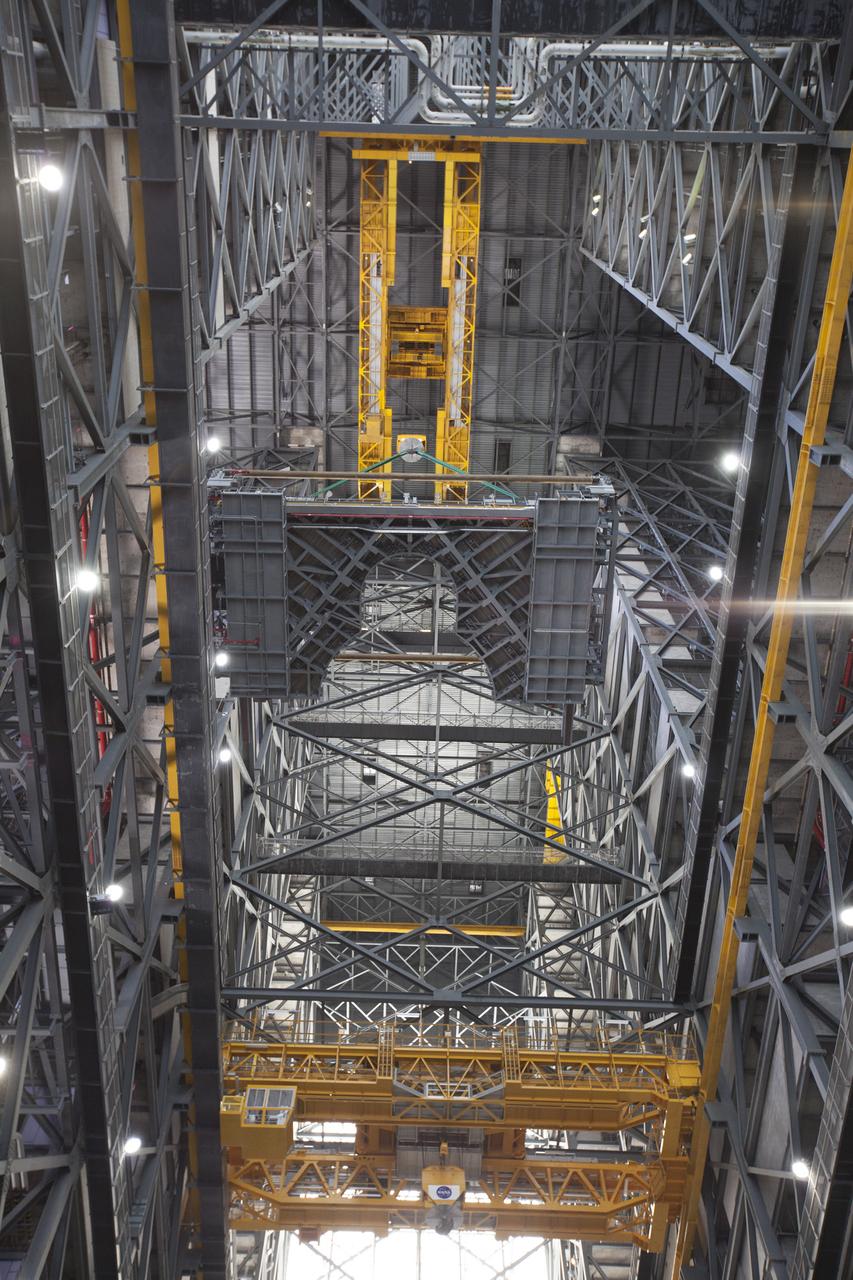
A 250-ton crane is used to lift the second half of the K-level work platforms for NASA’s Space Launch System (SLS) rocket high above the transfer aisle inside the Vehicle Assembly Building at NASA's Kennedy Space Center in Florida. The platform is being lifted up for transfer into High Bay 3 for installation. The platform will be secured about 86 feet above the VAB floor, on tower E of the high bay. The K work platforms will provide access to the SLS core stage and solid rocket boosters during processing and stacking operations on the mobile launcher. The Ground Systems Development and Operations Program is overseeing upgrades and modifications to High Bay 3 to support processing of the SLS and Orion spacecraft. A total of 10 levels of new platforms, 20 platform halves altogether, will surround the SLS rocket and Orion spacecraft.
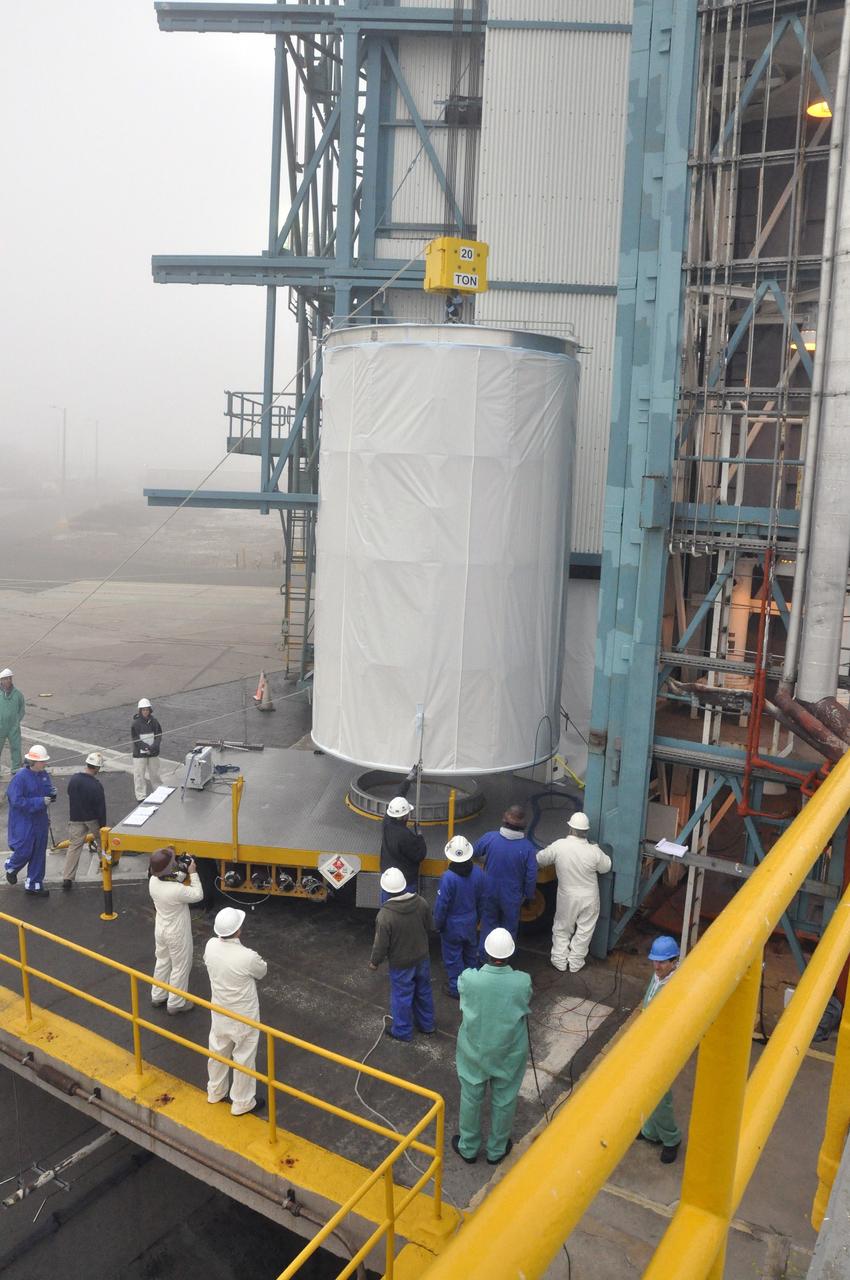
VANDENBERG AIR FORCE BASE, Calif. – A 20-ton crane lifts NASA's Orbiting Carbon Observatory-2, or OCO-2, from its transporter beside the mobile service tower at Space Launch Complex 2 at Vandenberg Air Force Base in California. The spacecraft will be mated with the United Launch Alliance Delta II rocket inside the tower. Launch is scheduled for July 1. OCO-2 will collect precise global measurements of carbon dioxide in the Earth's atmosphere and provide scientists with a better idea of the chemical compound's impacts on climate change. Scientists will analyze this data to improve our understanding of the natural processes and human activities that regulate the abundance and distribution of this important atmospheric gas. To learn more about OCO-2, visit http://oco.jpl.nasa.gov. Photo credit: NASA/Randy Beaudoin
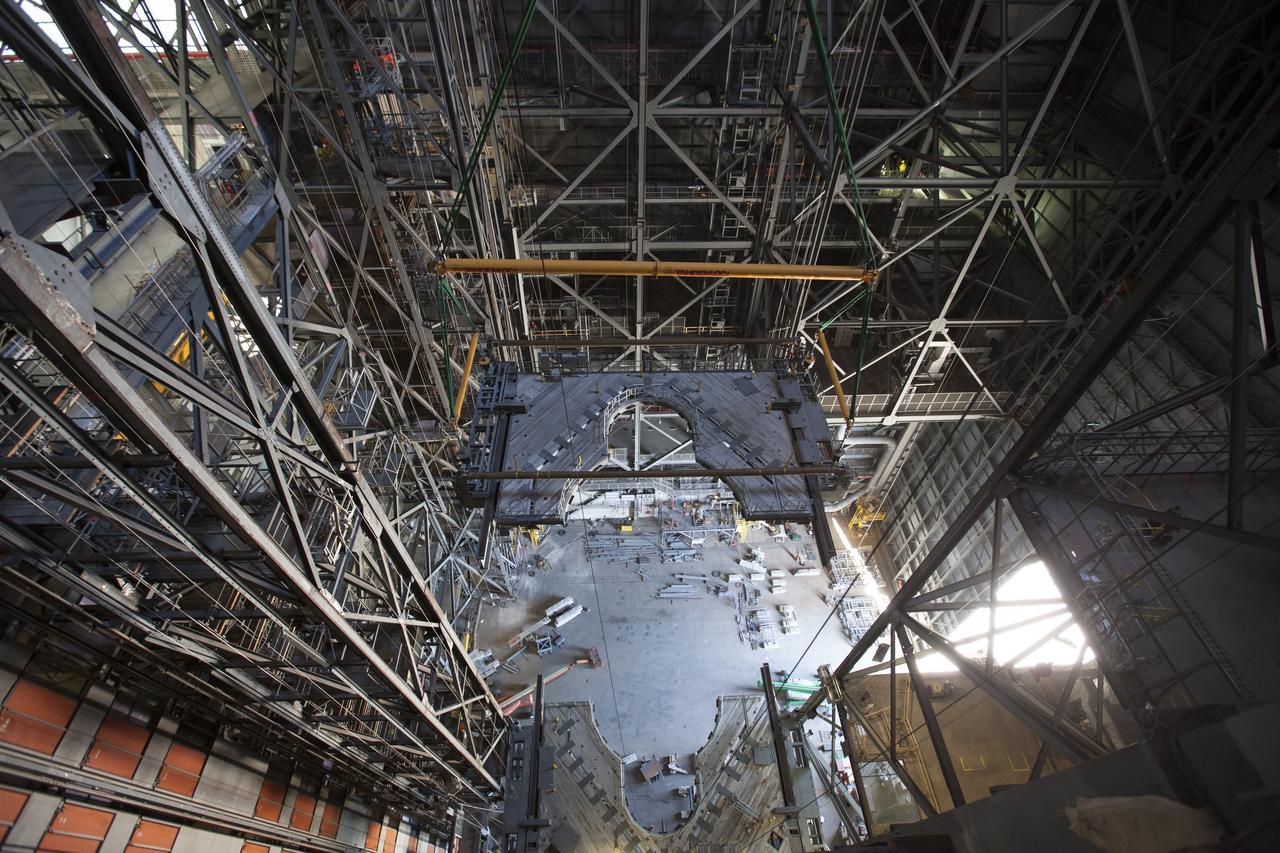
A 250-ton crane is used to lower the second half of the K-level work platforms for NASA’s Space Launch System (SLS) rocket into High Bay 3 inside the Vehicle Assembly Building at NASA's Kennedy Space Center in Florida. The platform will be secured about 86 feet above the VAB floor, on tower E of the high bay. The K work platforms will provide access to the SLS core stage and solid rocket boosters during processing and stacking operations on the mobile launcher. The Ground Systems Development and Operations Program is overseeing upgrades and modifications to High Bay 3 to support processing of the SLS and Orion spacecraft. A total of 10 levels of new platforms, 20 platform halves altogether, will surround the SLS rocket and Orion spacecraft.
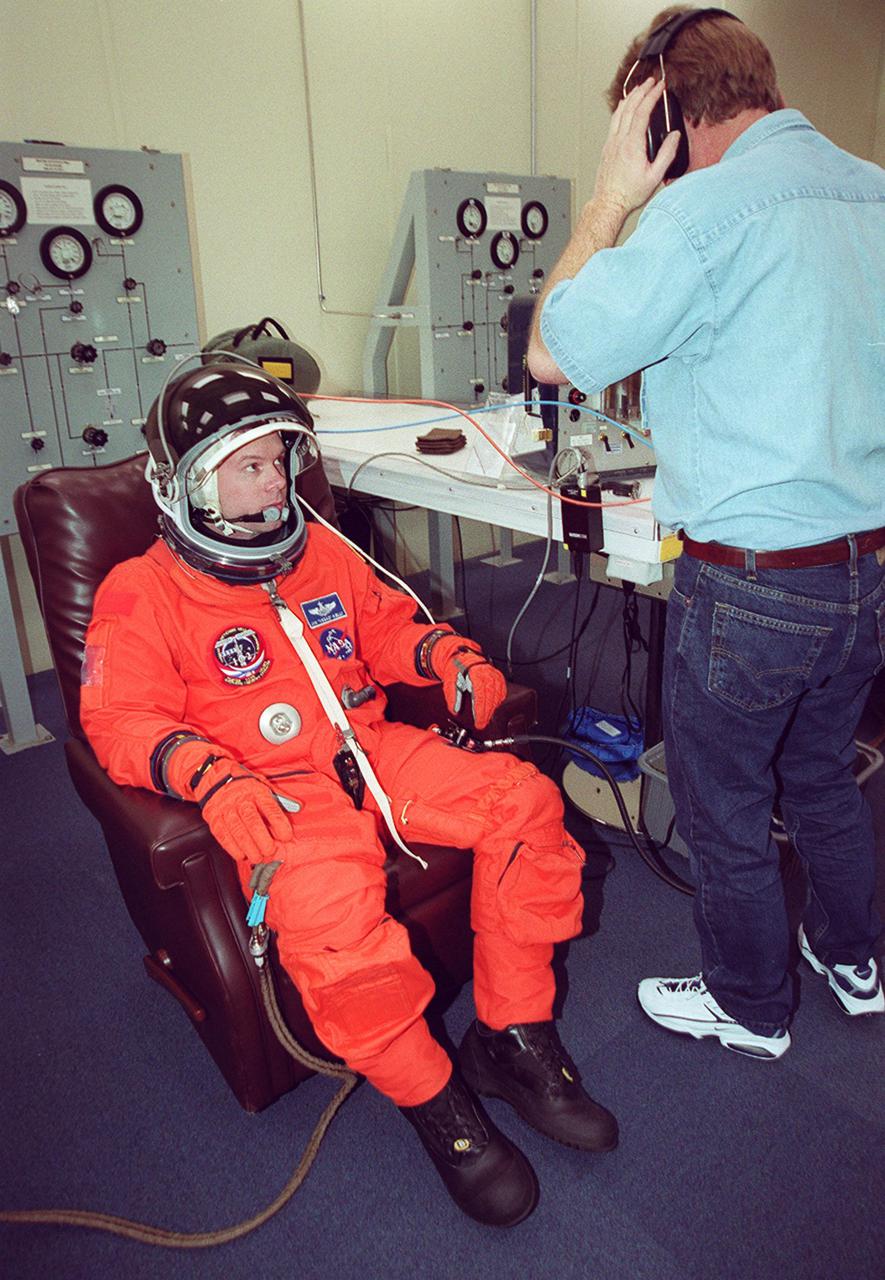
STS-102 Pilot James Kelly gets a final fitting in his launch and entry suit. This will be Kelly’s first Shuttle launch. . STS-102 is the eighth construction flight to the International Space Station, carrying the Multi-Purpose Logistics Module Leonardo. The primary delivery system used to resupply and return Station cargo requiring a pressurized environment, Leonardo will deliver up to 10 tons of laboratory racks filled with equipment, experiments and supplies for outfitting the newly installed U.S. Laboratory Destiny. In addition, three of the crew members Mission Specialists James Voss, Susan Helms and Yury Usachev, known as Expedition Two are flying to the Station to replace Expedition One, who will return to Earth on Discovery. Discovery is set to launch March 8 at 6:42 a.m. EST. The 12-day mission is expected to end with a landing at KSC on March 20

STS-102 Mission Specialist Paul Richards signals thumbs up for launch as he suits up in the Operations and Checkout Building. This will be Richards’ first Shuttle launch. . STS-102 is the eighth construction flight to the International Space Station, carrying the Multi-Purpose Logistics Module Leonardo. The primary delivery system used to resupply and return Station cargo requiring a pressurized environment, Leonardo will deliver up to 10 tons of laboratory racks filled with equipment, experiments and supplies for outfitting the newly installed U.S. Laboratory Destiny. In addition, three of the crew members Mission Specialists James Voss, Susan Helms and Yury Usachev, known as Expedition Two are flying to the Station to replace Expedition One, who will return to Earth on Discovery. Discovery is set to launch March 8 at 6:42 a.m. EST. The 12-day mission is expected to end with a landing at KSC on March 20
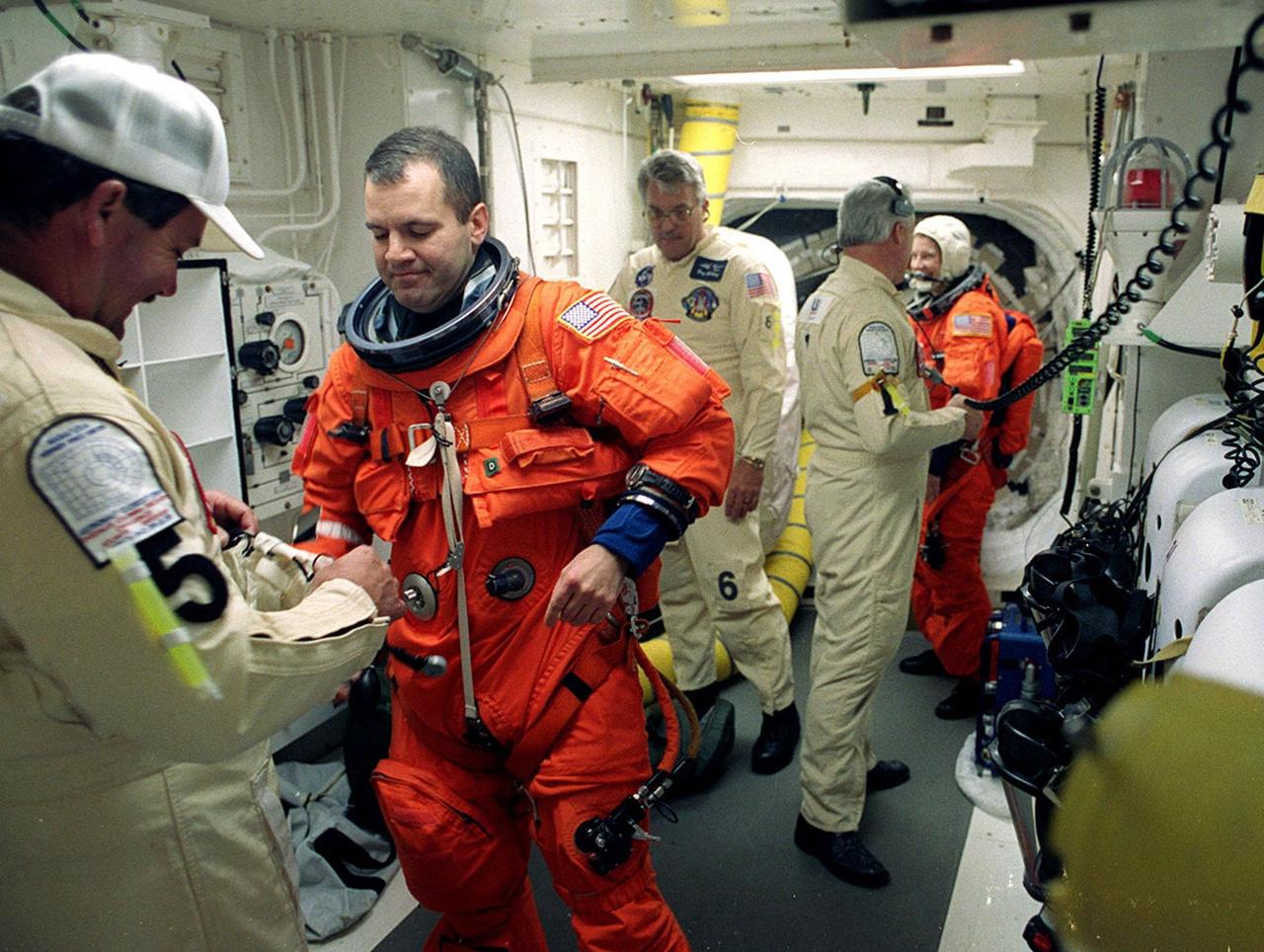
Technicians in the White Room, Launch Pad 39B, help STS-102 Mission Specialist Paul Richards with his launch and entry suit before he enters Space Shuttle Discovery. The mission is Richards’ first Shuttle flight. In the background is Mission Specialist Susan Helms. Discovery is carrying the Multi-Purpose Logistics Module Leonardo on the eighth construction flight to the International Space Station. The primary delivery system used to resupply and return Station cargo requiring a pressurized environment, Leonardo will deliver up to 10 tons of laboratory racks filled with equipment, experiments and supplies for outfitting the newly installed U.S. Laboratory Destiny. Discovery is set to launch March 8 at 6:42 a.m. EST. The 12-day mission is expected to end with a landing at KSC on March 20
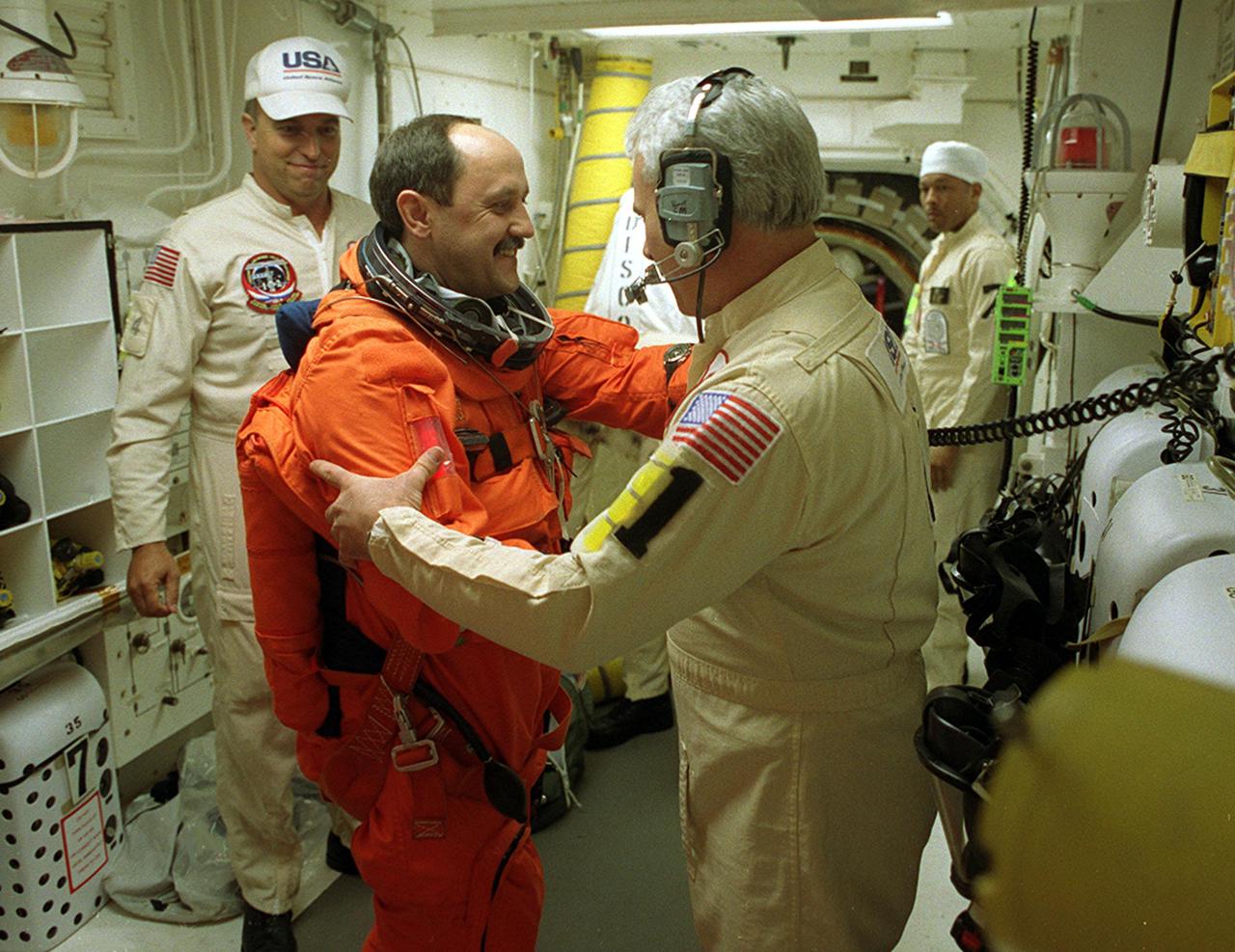
In the White Room, Launch Pad 39B, STS-102 Mission Specialist Yury Usachev gets warm greetings from one of the suit technicians helping with final preparations before entering Space Shuttle Discovery. STS-102 is Russian cosmonaut Usachev’s second Shuttle flight. He is also part of the Expedition Two crew flying on the mission to replace the Expedition One crew on the Station. Discovery is carrying the Multi-Purpose Logistics Module Leonardo on the eighth construction flight to the International Space Station. The primary delivery system used to resupply and return Station cargo requiring a pressurized environment, Leonardo will deliver up to 10 tons of laboratory racks filled with equipment, experiments and supplies for outfitting the newly installed U.S. Laboratory Destiny. Discovery is set to launch March 8 at 6:42 a.m. EST. The 12-day mission is expected to end with a landing at KSC on March 20
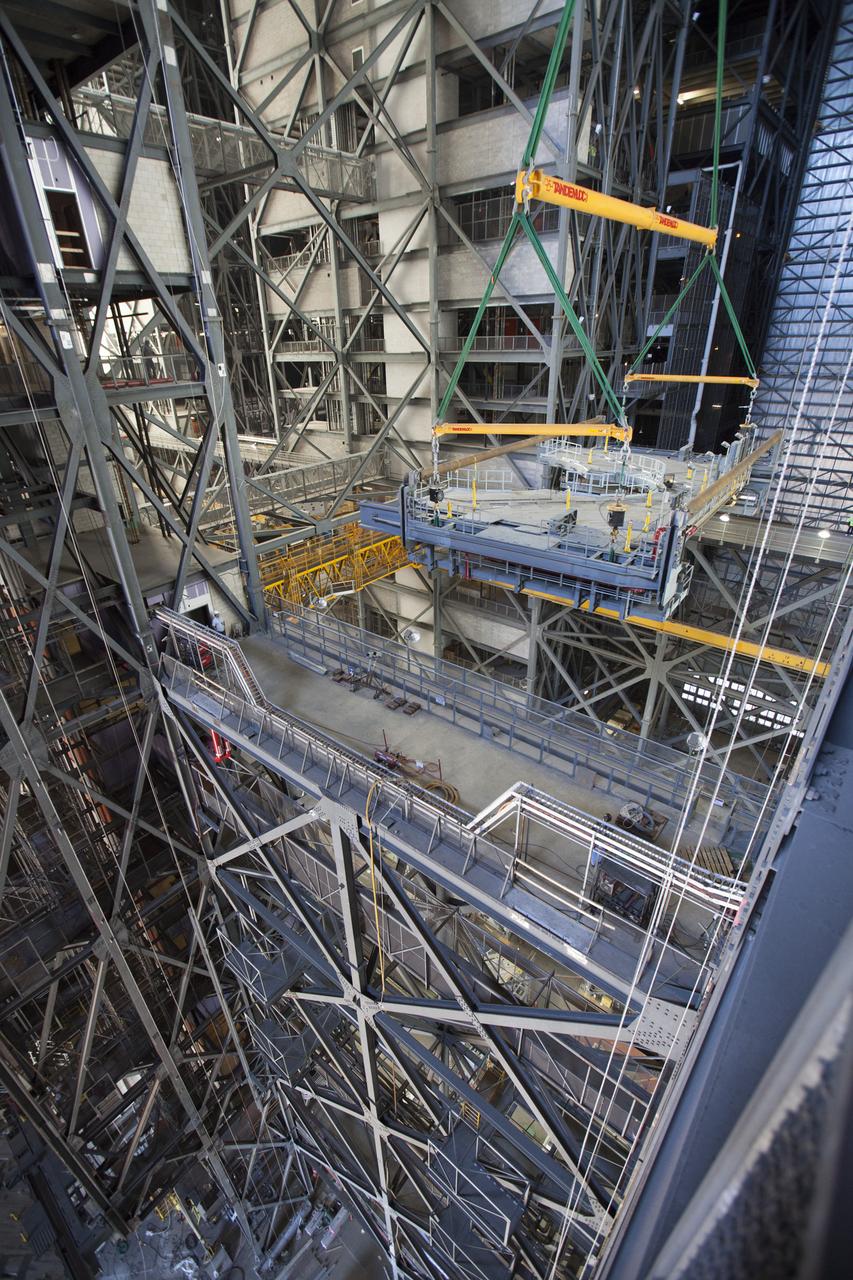
A 250-ton crane is used to lift the second half of the K-level work platforms for NASA’s Space Launch System (SLS) rocket up from High Bay 4 inside the Vehicle Assembly Building at NASA's Kennedy Space Center in Florida. The platform is being lifted up and over the transfer aisle and will be lowered into High Bay 3 for installation. It will be secured about 86 feet above the VAB floor, on tower E of the high bay. The K work platforms will provide access to the SLS core stage and solid rocket boosters during processing and stacking operations on the mobile launcher. The Ground Systems Development and Operations Program is overseeing upgrades and modifications to High Bay 3 to support processing of the SLS and Orion spacecraft. A total of 10 levels of new platforms, 20 platform halves altogether, will surround the SLS rocket and Orion spacecraft.
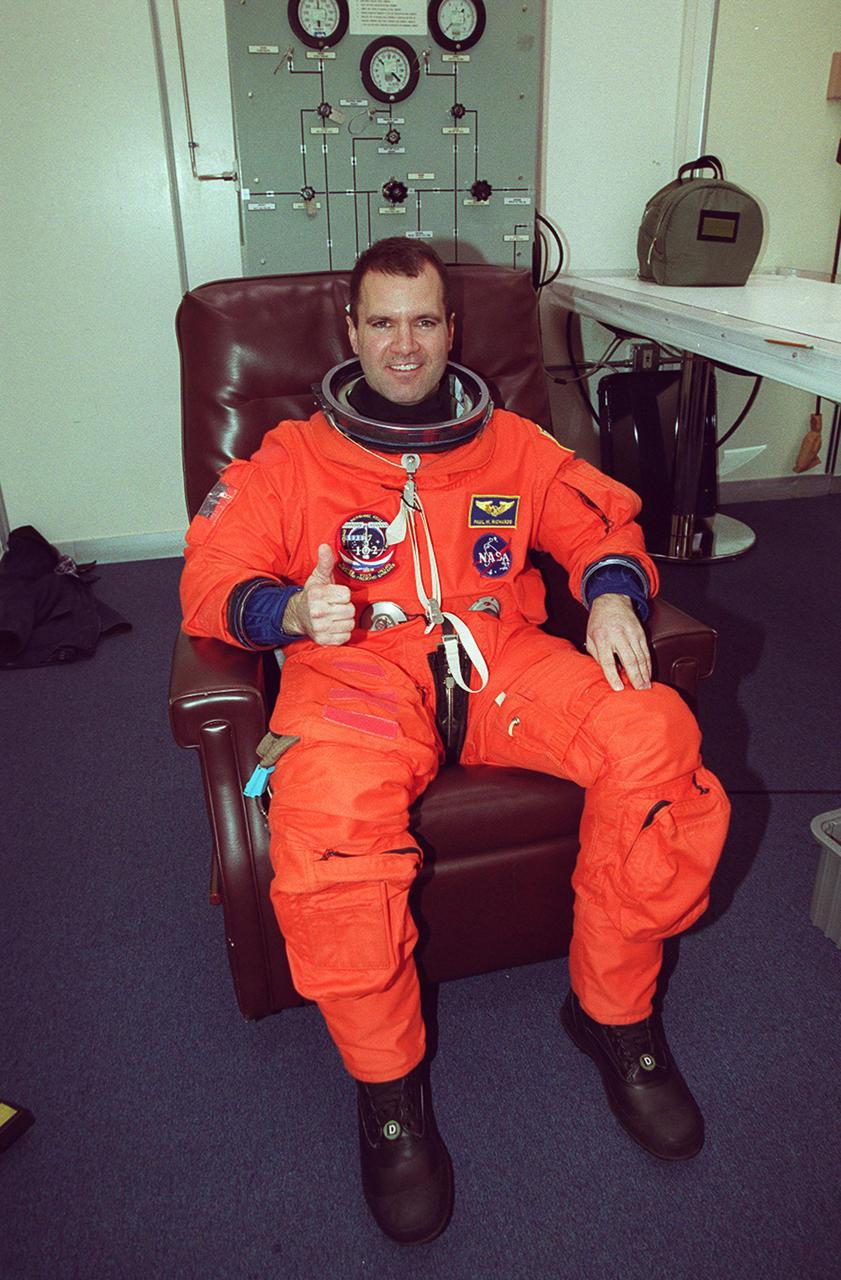
STS-102 Mission Specialist Paul Richards signals thumbs up for launch as he suits up in the Operations and Checkout Building. This will be Richards’ first Shuttle launch. . STS-102 is the eighth construction flight to the International Space Station, carrying the Multi-Purpose Logistics Module Leonardo. The primary delivery system used to resupply and return Station cargo requiring a pressurized environment, Leonardo will deliver up to 10 tons of laboratory racks filled with equipment, experiments and supplies for outfitting the newly installed U.S. Laboratory Destiny. In addition, three of the crew members Mission Specialists James Voss, Susan Helms and Yury Usachev, known as Expedition Two are flying to the Station to replace Expedition One, who will return to Earth on Discovery. Discovery is set to launch March 8 at 6:42 a.m. EST. The 12-day mission is expected to end with a landing at KSC on March 20
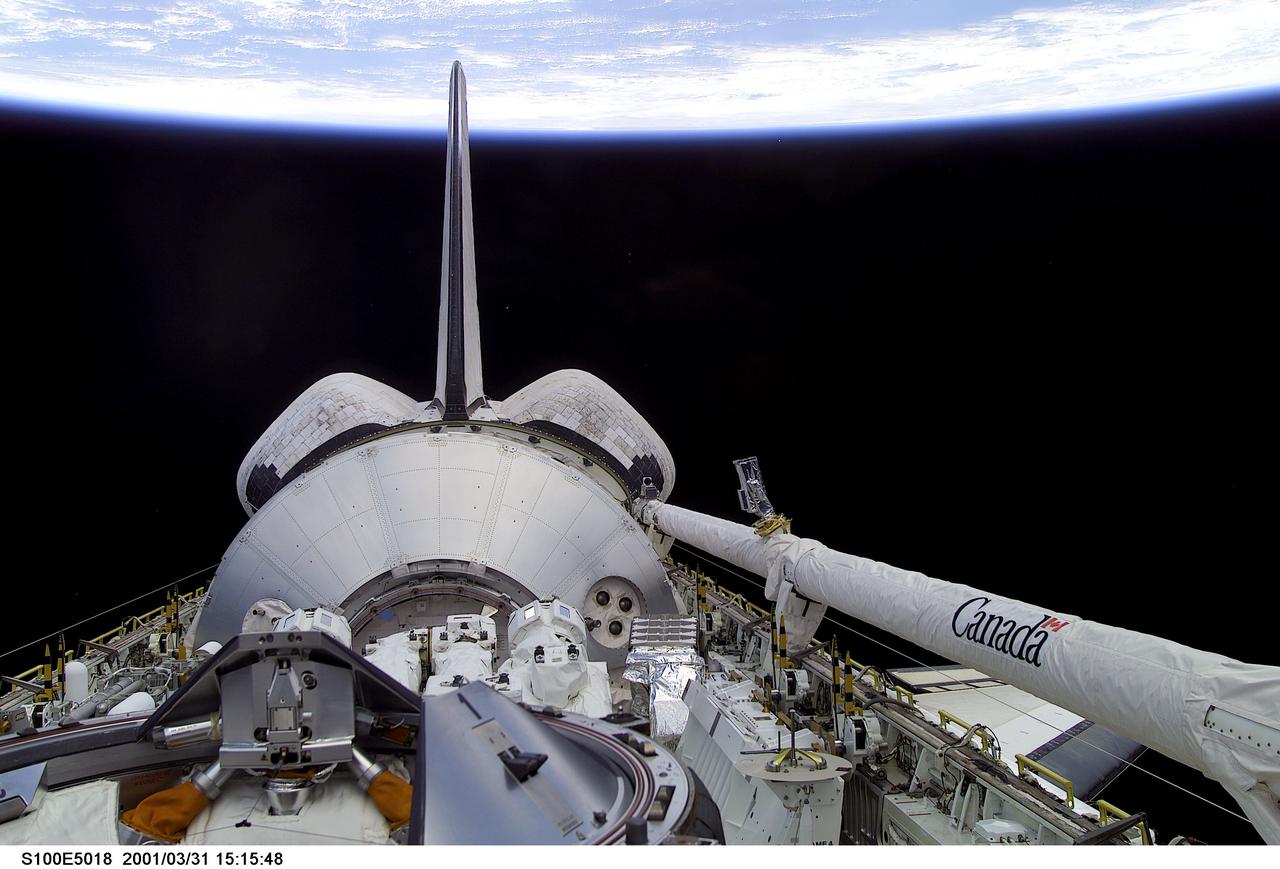
S100-E-5018 (20 April 2001) --- One of the crew members of STS-100 aimed a digital still camera through Endeavour's aft flight deck windows to record this image of the cargo bay, backdropped against a scene of black space and Earth's horizon. Housed in the bay, beyond the docking mechanism in the foreground, is the Italian Space Agency-provided Raffaello cargo module, which is carrying several tons of equipment for the Expedition Two crew and racks of hardware for installation in Destiny which will be used for scientific research in the future. Raffaello, which is the second of three such logistics modules, will be berthed to the ISS on April 23 so its contents can be transferred to the station throughout the course of docked operations. Also in the bay is the 57-foot-long Canadarm2, which will be mounted on the Destiny Laboratory for future station assembly work. Endeavour's Canadian-built Remote Manipulator System (RMS) arm can be seen in its berthed position on the port side of the payload bay.
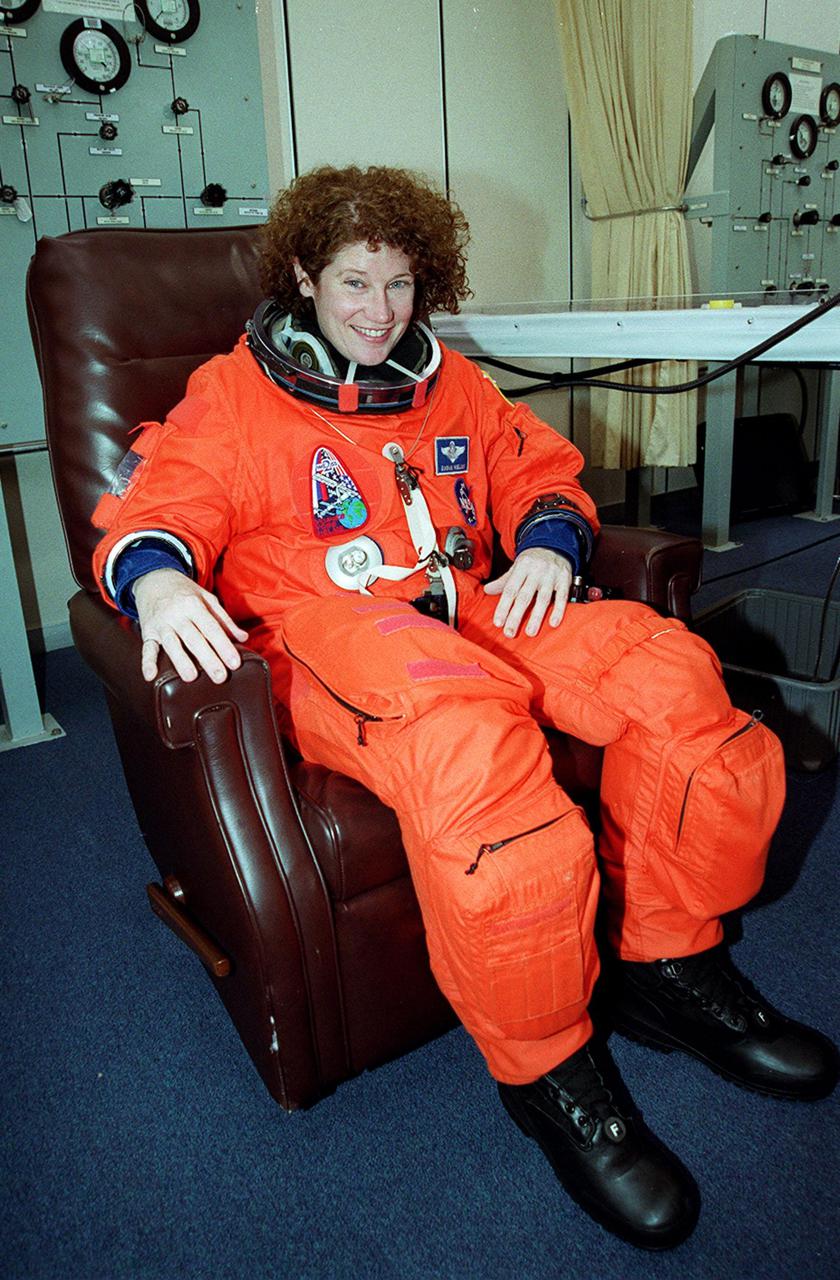
STS-102 Mission Specialist Susan Helms shows her pleasure at the imminent launch to the International Space Station. This will be Helms’ fifth Shuttle flight. She is also part of the Expedition Two crew replacing Expedition One. STS-102 is the eighth construction flight to the Station, carrying the Multi-Purpose Logistics Module Leonardo. The primary delivery system used to resupply and return Station cargo requiring a pressurized environment, Leonardo will deliver up to 10 tons of laboratory racks filled with equipment, experiments and supplies for outfitting the newly installed U.S. Laboratory Destiny. Discovery is set to launch March 8 at 6:42 a.m. EST. The 12-day mission is expected to end with a landing at KSC on March 20
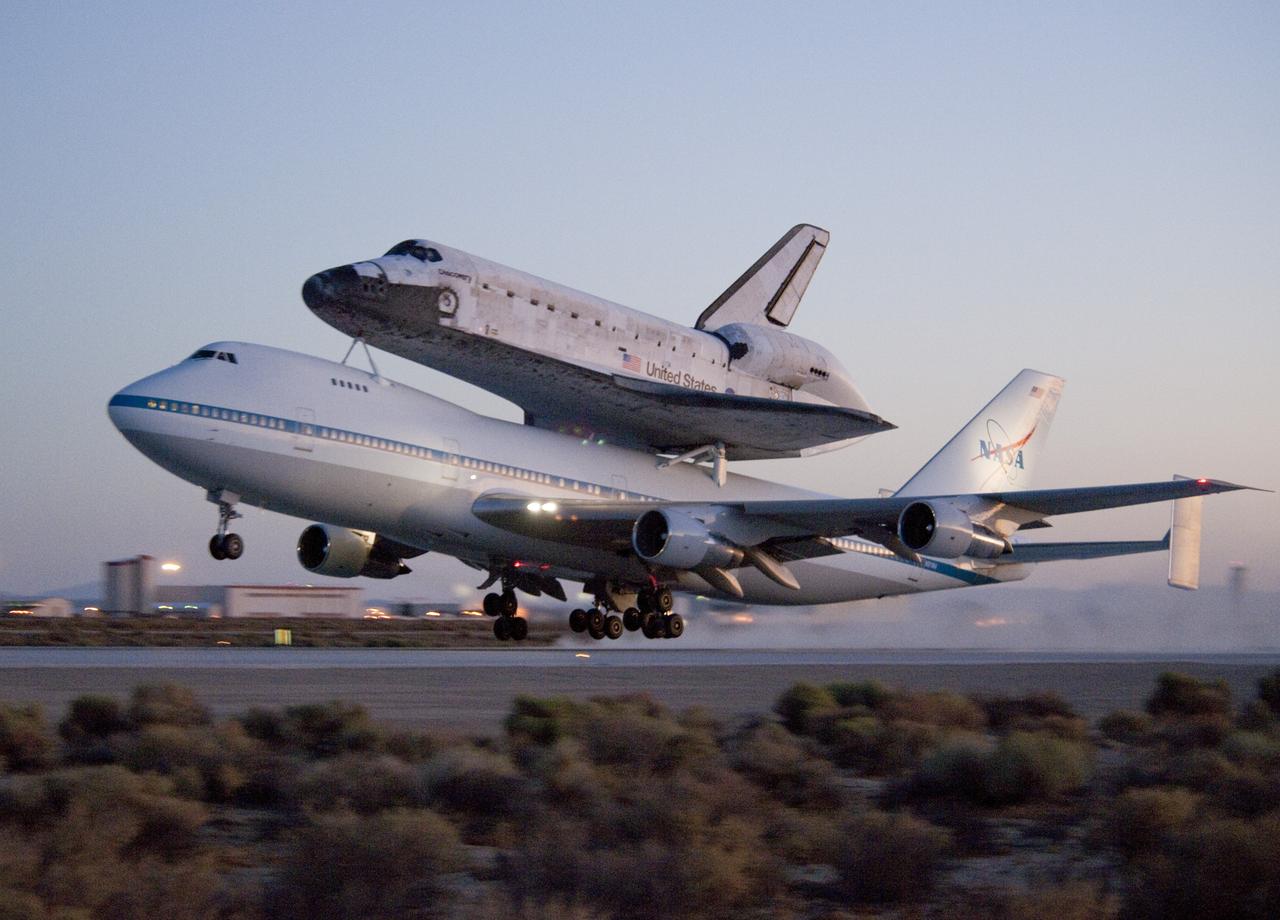
EDWARDS AIR FORCE BASE, Calif. – ED09-0253-103) Space shuttle Discovery and its modified 747 carrier aircraft lift off from Edwards Air Force Base early in the morning on Sept. 20, 2009 on the first leg of its ferry flight back to the Kennedy Space Center in Florida. Discovery had landed at Edwards Sept. 11 after the STS-128 mission to the International Space Station. Discovery returned to Earth Sept. 11 on the STS-128 mission, landing at Edwards Air Force Base in California. The shuttle delivered more than 7 tons of supplies, science racks and equipment, as well as additional environmental hardware to sustain six crew members on the International Space Station. NASA photo /Tom Tschida
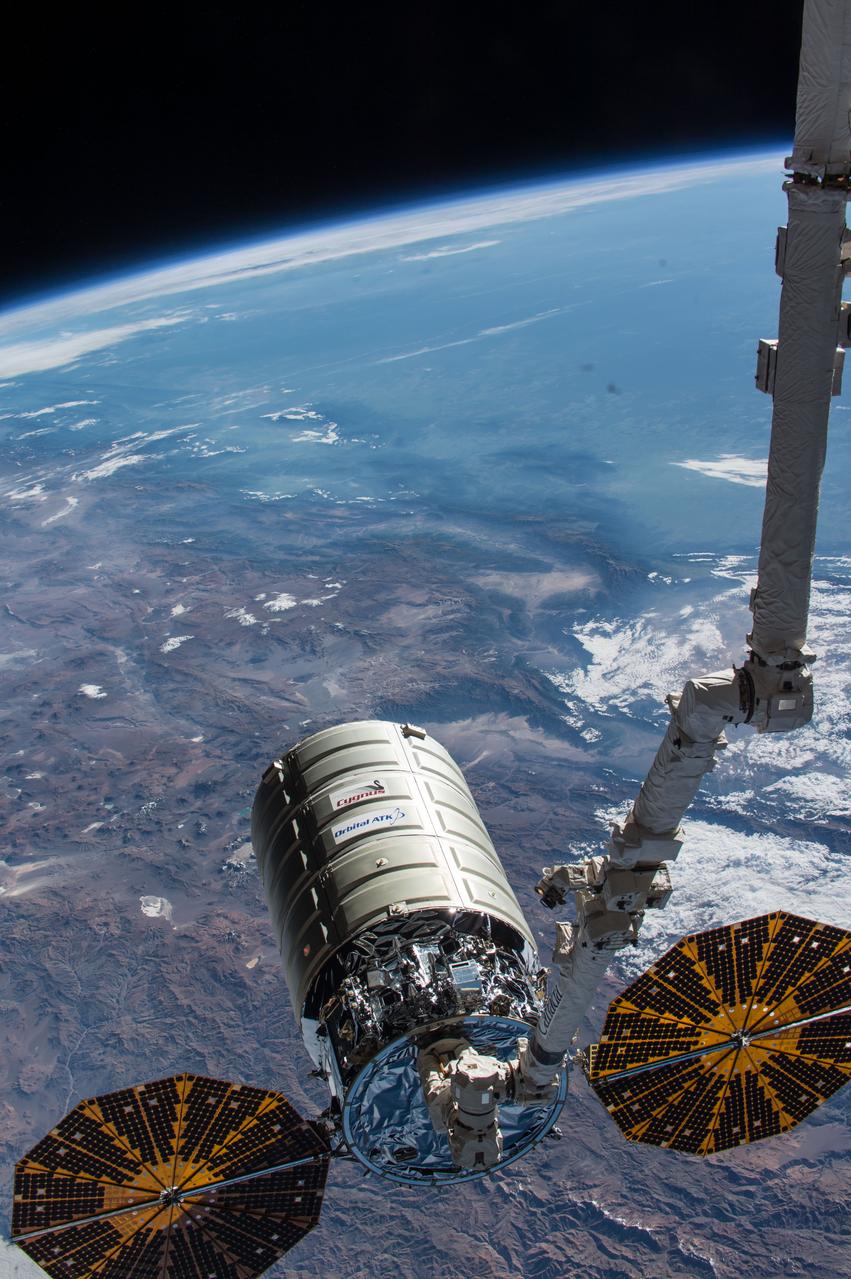
ISS046e043433 (02/19/2016) --- The Expedition 46 crew took out the trash recently when it released the Orbital ATK Cygnus spacecraft from the grips of the International Space Station’s Canadarm2 robotic arm. Cygnus was filled with roughly 1.5 tons of trash and discarded gear before the hatches were closed. Ground controllers then remotely guided the Canadarm2 to grapple Cygnus and detach it from the Unity module. NASA astronauts Scott Kelly and Tim Kopra commanded the Canadarm2 to release Cygnus Feb 19, at 7:26 a.m. EST when it began gracefully departing the vicinity of the station. Cygnus ultimately burned up during reentry through the Earth’s atmosphere on Saturday, Feb 20. This was Orbital ATK’s fourth commercial resupply mission.
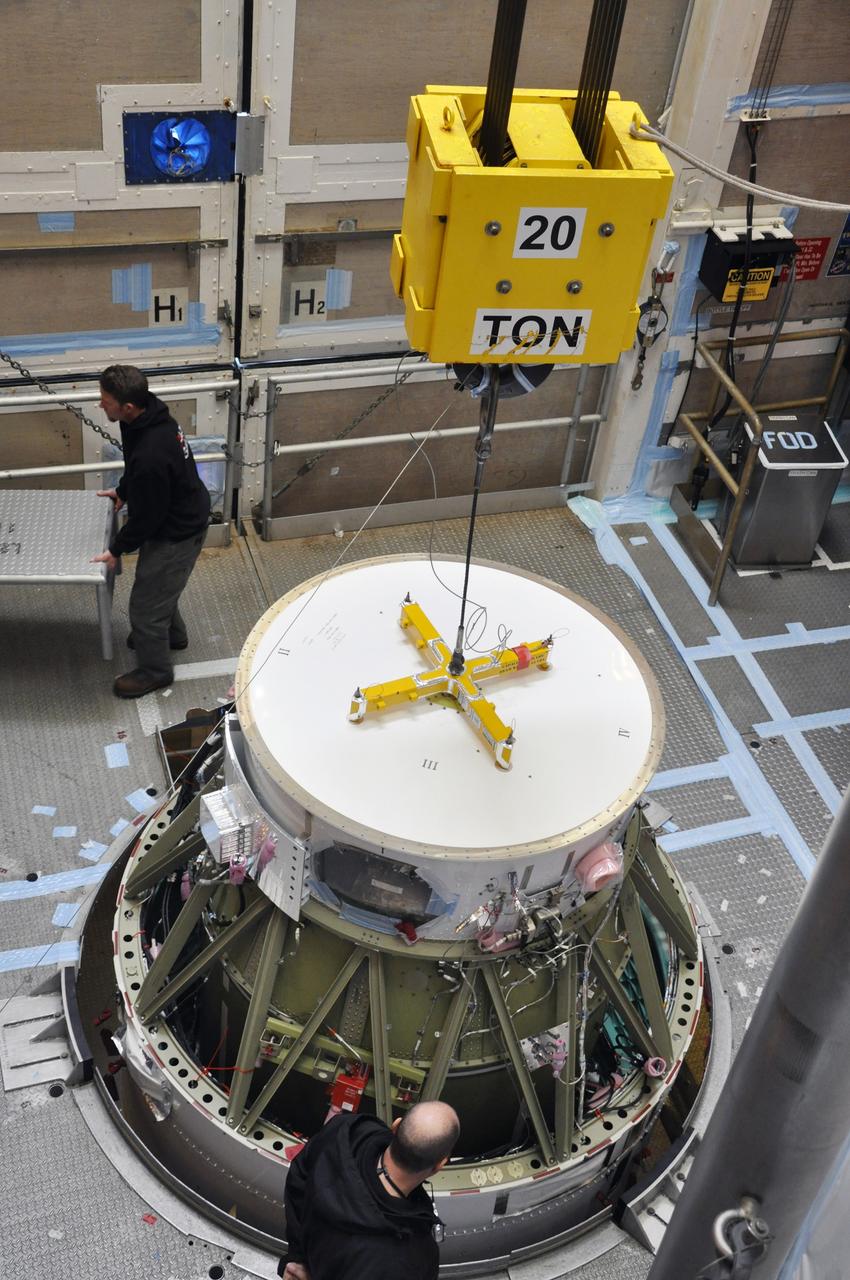
VANDENBERG AIR FORCE BASE, Calif. – A 20-ton crane supports the Delta II second stage for NASA's Orbiting Carbon Observatory-2 mission, or OCO-2, as it is mated with the rocket's first stage in the mobile service tower at Space Launch Complex 2 on Vandenberg Air Force Base in California. OCO-2 is scheduled to launch aboard a United Launch Alliance Delta II rocket in July. The rocket's second stage will insert OCO-2 into a polar Earth orbit. OCO-2 will collect precise global measurements of carbon dioxide in the Earth's atmosphere and provide scientists with a better idea of the chemical compound's impacts on climate change. Scientists will analyze this data to improve our understanding of the natural processes and human activities that regulate the abundance and distribution of this important atmospheric gas. To learn more about OCO-2, visit http://oco.jpl.nasa.gov. Photo credit: NASA/Randy Beaudoin
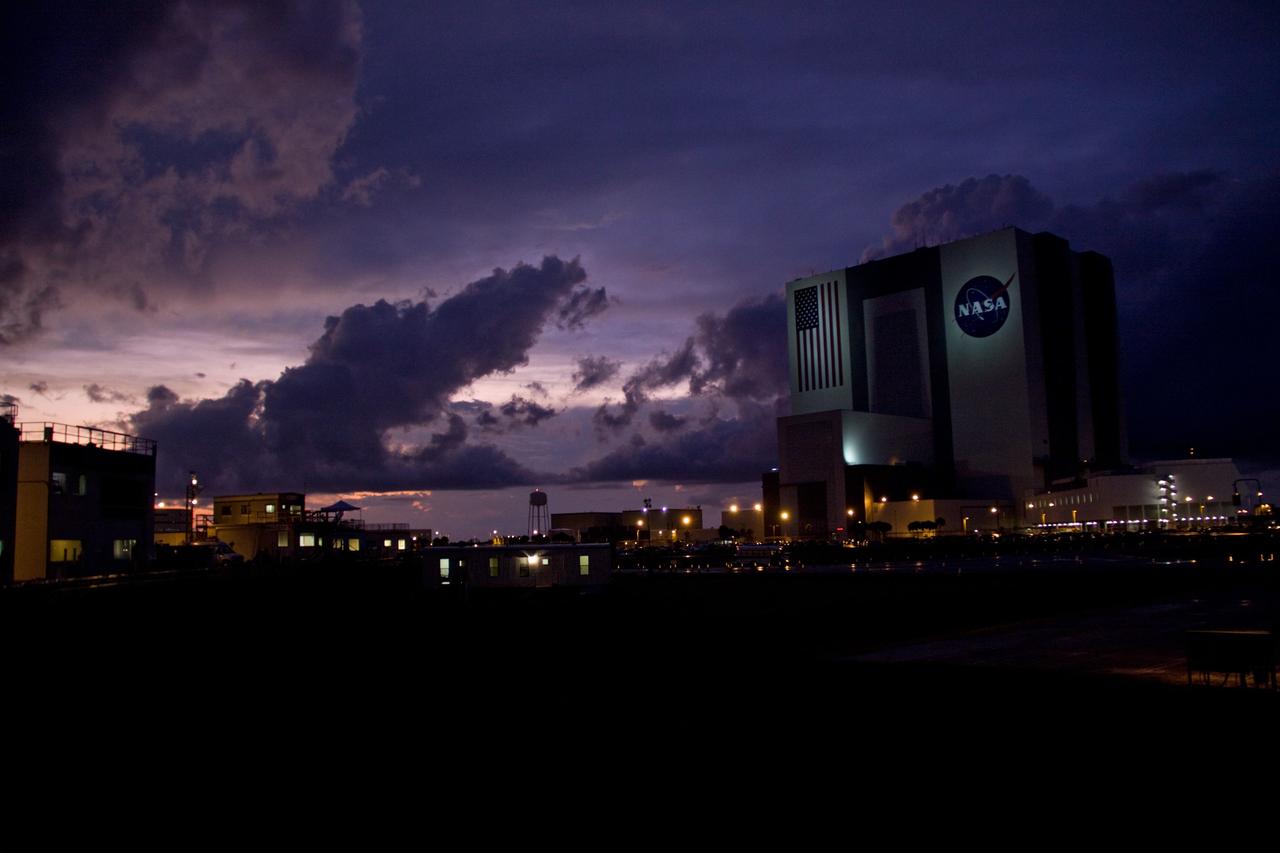
CAPE CANAVERAL, Fla. – Shortly after 8 p.m. EDT, black clouds from the west roll past the Vehicle Assembly Building at NASA's Kennedy Space Center in Florida. The center is in launch mode as the countdown continues for liftoff of space shuttle Discovery at 1:36 a.m. EDT Aug. 25 on the STS-128 mission. Weather plays a significant role in any launch attempt. Forecasters give only 20 percent probability of weather prohibiting launch. Discovery's 13-day mission will deliver more than 7 tons of supplies, science racks and equipment, as well as additional environmental hardware to sustain six crew members on the International Space Station. The equipment includes a freezer to store research samples, a new sleeping compartment and the COLBERT treadmill. The mission is the 128th in the Space Shuttle Program, the 37th flight of Discovery and the 30th station assembly flight. Photo credit: NASA/Troy Cryder

Before entering Space Shuttle Discovery, STS-102 Mission Specialist James Voss (center) is helped preparing his launch and entry suit for launch from technicians in the White Room. The mission is Voss’s fifth Shuttle flight. In the background is Pilot James Kelly waiting to enter Discovery. Voss is also part of the Expedition Two crew flying on the mission to replace the Expedition One crew on the Station. Discovery is carrying the Multi-Purpose Logistics Module Leonardo on the eighth construction flight to the International Space Station. The primary delivery system used to resupply and return Station cargo requiring a pressurized environment, Leonardo will deliver up to 10 tons of laboratory racks filled with equipment, experiments and supplies for outfitting the newly installed U.S. Laboratory Destiny. Discovery is set to launch March 8 at 6:42 a.m. EST. The 12-day mission is expected to end with a landing at KSC on March 20
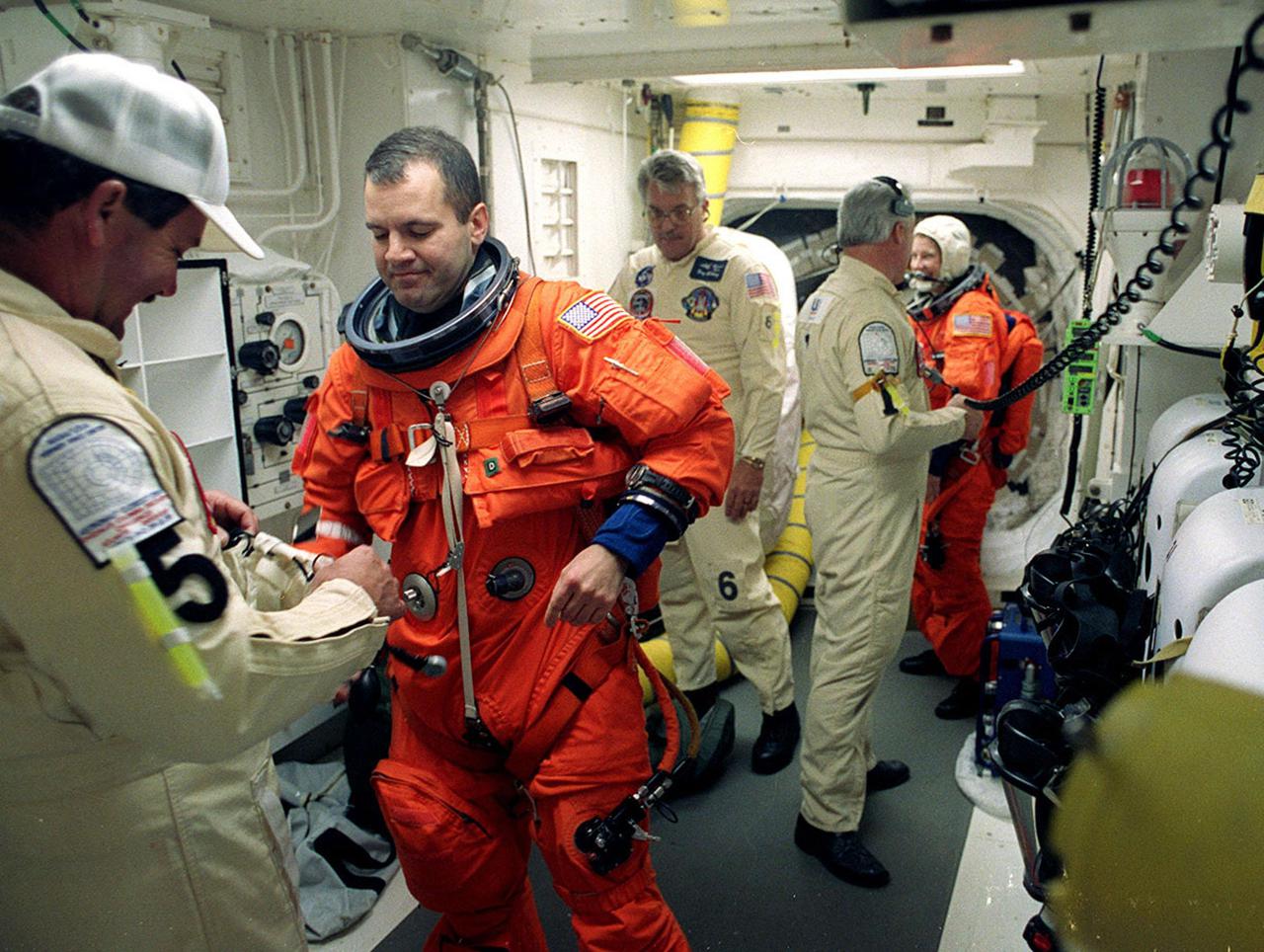
Technicians in the White Room, Launch Pad 39B, help STS-102 Mission Specialist Paul Richards with his launch and entry suit before he enters Space Shuttle Discovery. The mission is Richards’ first Shuttle flight. In the background is Mission Specialist Susan Helms. Discovery is carrying the Multi-Purpose Logistics Module Leonardo on the eighth construction flight to the International Space Station. The primary delivery system used to resupply and return Station cargo requiring a pressurized environment, Leonardo will deliver up to 10 tons of laboratory racks filled with equipment, experiments and supplies for outfitting the newly installed U.S. Laboratory Destiny. Discovery is set to launch March 8 at 6:42 a.m. EST. The 12-day mission is expected to end with a landing at KSC on March 20
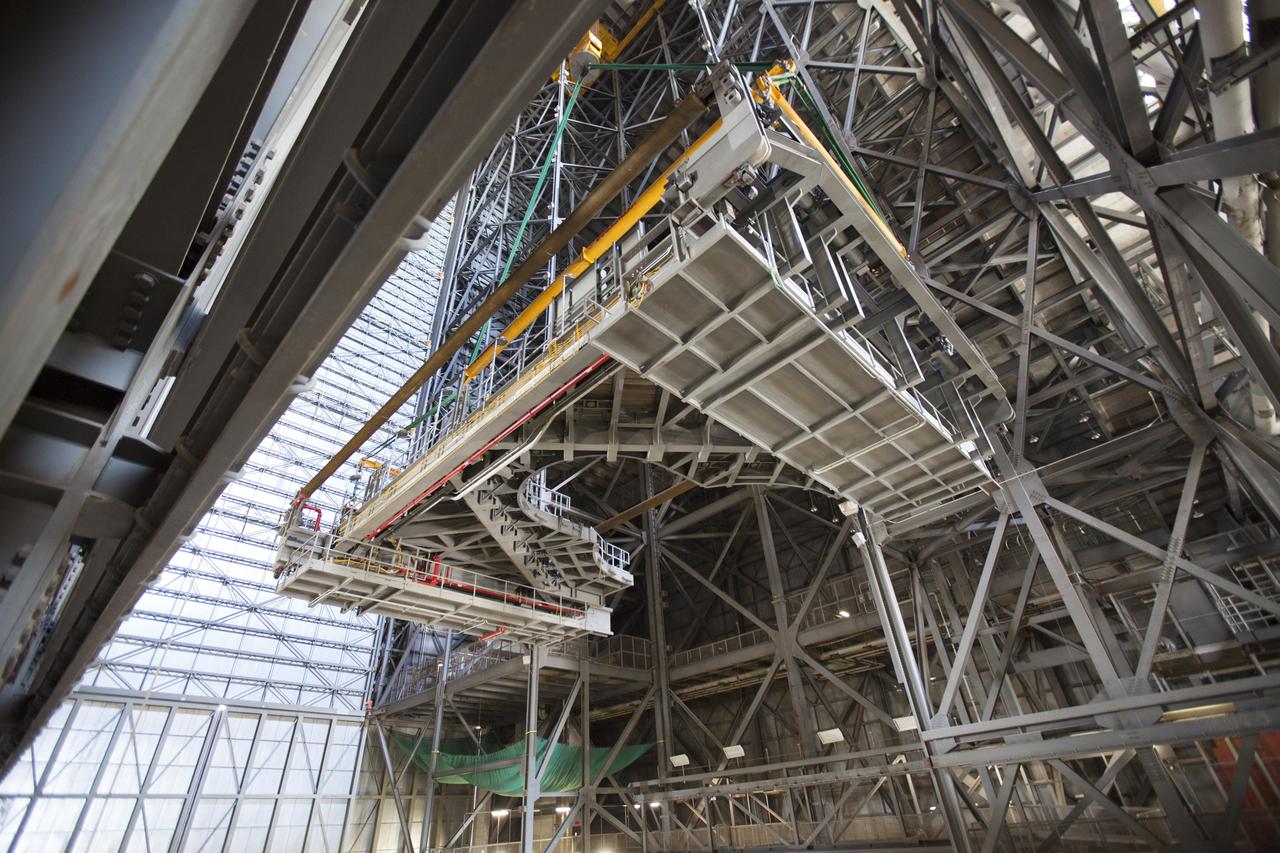
A 250-ton crane is used to lift the second half of the K-level work platforms for NASA’s Space Launch System (SLS) rocket up from High Bay 4 inside the Vehicle Assembly Building at NASA's Kennedy Space Center in Florida. The platform will be lifted up and over the transfer aisle and then lowered into High Bay 3 for installation. It will be secured about 86 feet above the VAB floor, on tower E of the high bay. The K work platforms will provide access to the SLS core stage and solid rocket boosters during processing and stacking operations on the mobile launcher. The Ground Systems Development and Operations Program is overseeing upgrades and modifications to High Bay 3 to support processing of the SLS and Orion spacecraft. A total of 10 levels of new platforms, 20 platform halves altogether, will surround the SLS rocket and Orion spacecraft.
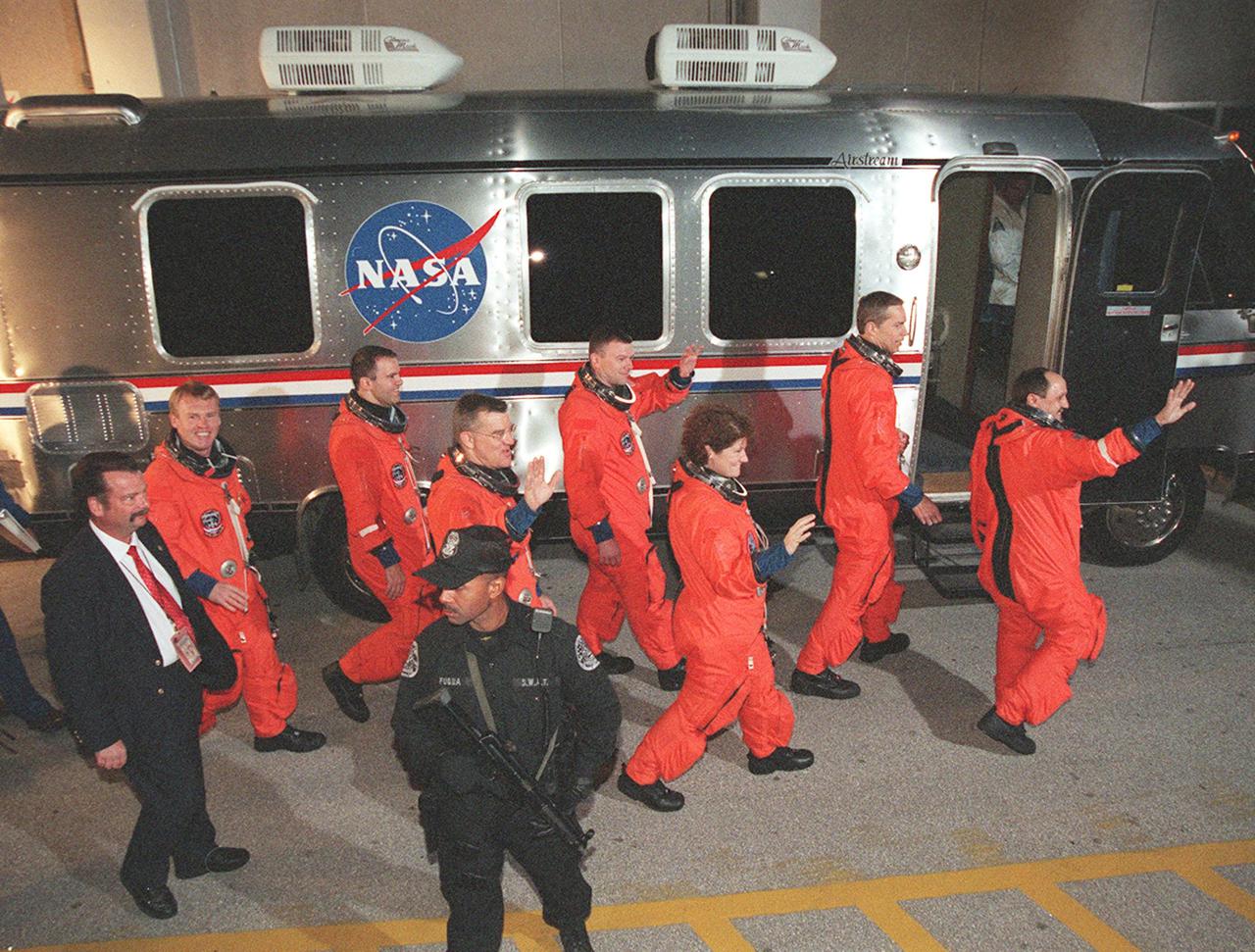
The STS-102 crew wave to onlookers as they head for the Astrovan after leaving the Operations and Checkout Building. Left to right are Mission Specialists Andrew Thomas, Paul Richards and James Voss; Pilot James Kelly; Mission Specialist Susan Helms; Commander James Wetherbee; and Mission Specialist Yury Usachev. STS-102 is the eighth construction flight to the Space Station, carrying the Multi-Purpose Logistics Module Leonardo. The primary delivery system used to resupply and return Station cargo requiring a pressurized environment, Leonardo will deliver up to 10 tons of laboratory racks filled with equipment, experiments and supplies for outfitting the newly installed U.S. Laboratory Destiny. In addition, Voss, Helms and Usachev, known as Expedition Two, are flying to the Station to replace Expedition One, who will return to Earth on Discovery. Discovery is set to launch March 8 at 6:42 a.m. EST. The 12-day mission is expected to end with a landing at KSC on March 20
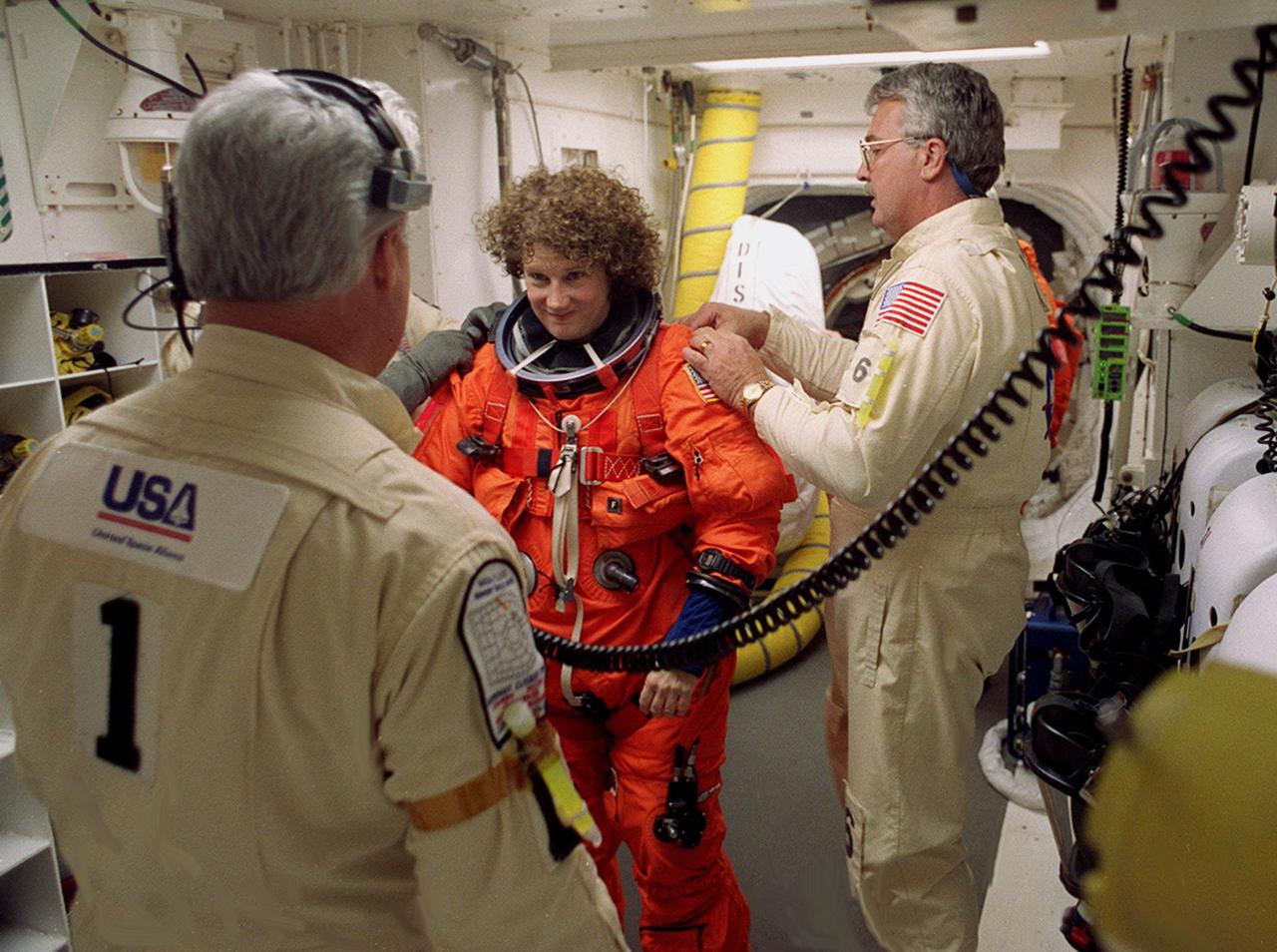
Technicians in the White Room, Launch Pad 39B, help STS-102 Mission Specialist Susan Helms with her launch and entry suit before she enters Space Shuttle Discovery. The mission is Helms’ fifth Shuttle flight. Helms is also part of the Expedition Two crew flying on the mission to replace the Expedition One crew on the Station. Discovery is carrying the Multi-Purpose Logistics Module Leonardo on the eighth construction flight to the International Space Station. The primary delivery system used to resupply and return Station cargo requiring a pressurized environment, Leonardo will deliver up to 10 tons of laboratory racks filled with equipment, experiments and supplies for outfitting the newly installed U.S. Laboratory Destiny. Discovery is set to launch March 8 at 6:42 a.m. EST. The 12-day mission is expected to end with a landing at KSC on March 20
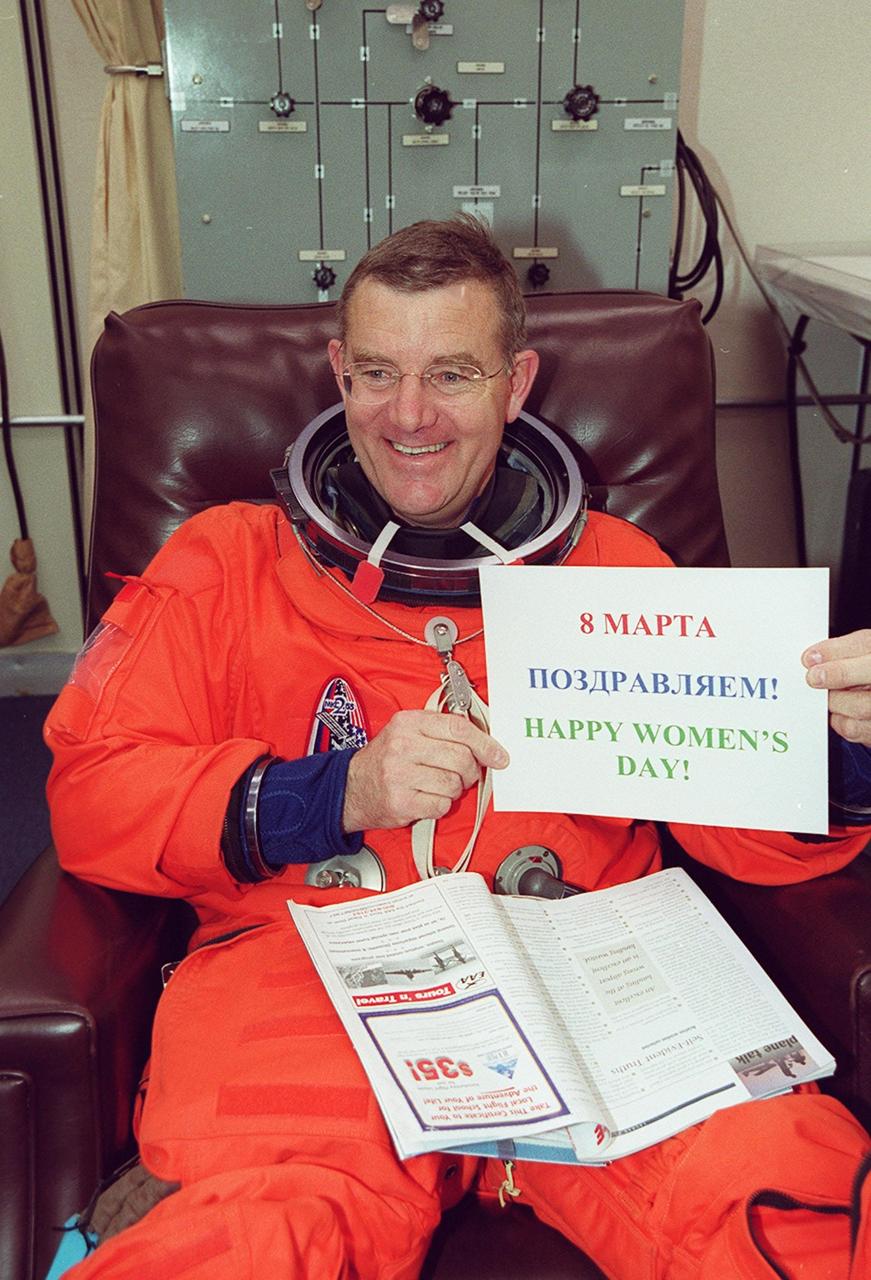
While suiting up in the Operations and Checkout Building, Mission Specialist James Voss shows his support of International Women’s Day, March 8, with a sign in both Cyrillic and English. Voss is also part of a crew, known as Expedition One, who will be replacing Expedition One on the International Space Station. STS-102 is the eighth construction flight to the Space Station, carrying the Multi-Purpose Logistics Module Leonardo. The primary delivery system used to resupply and return Station cargo requiring a pressurized environment, Leonardo will deliver up to 10 tons of laboratory racks filled with equipment, experiments and supplies for outfitting the newly installed U.S. Laboratory Destiny. Discovery is set to launch March 8 at 6:42 a.m. EST. The 12-day mission is expected to end with a landing at KSC on March 20
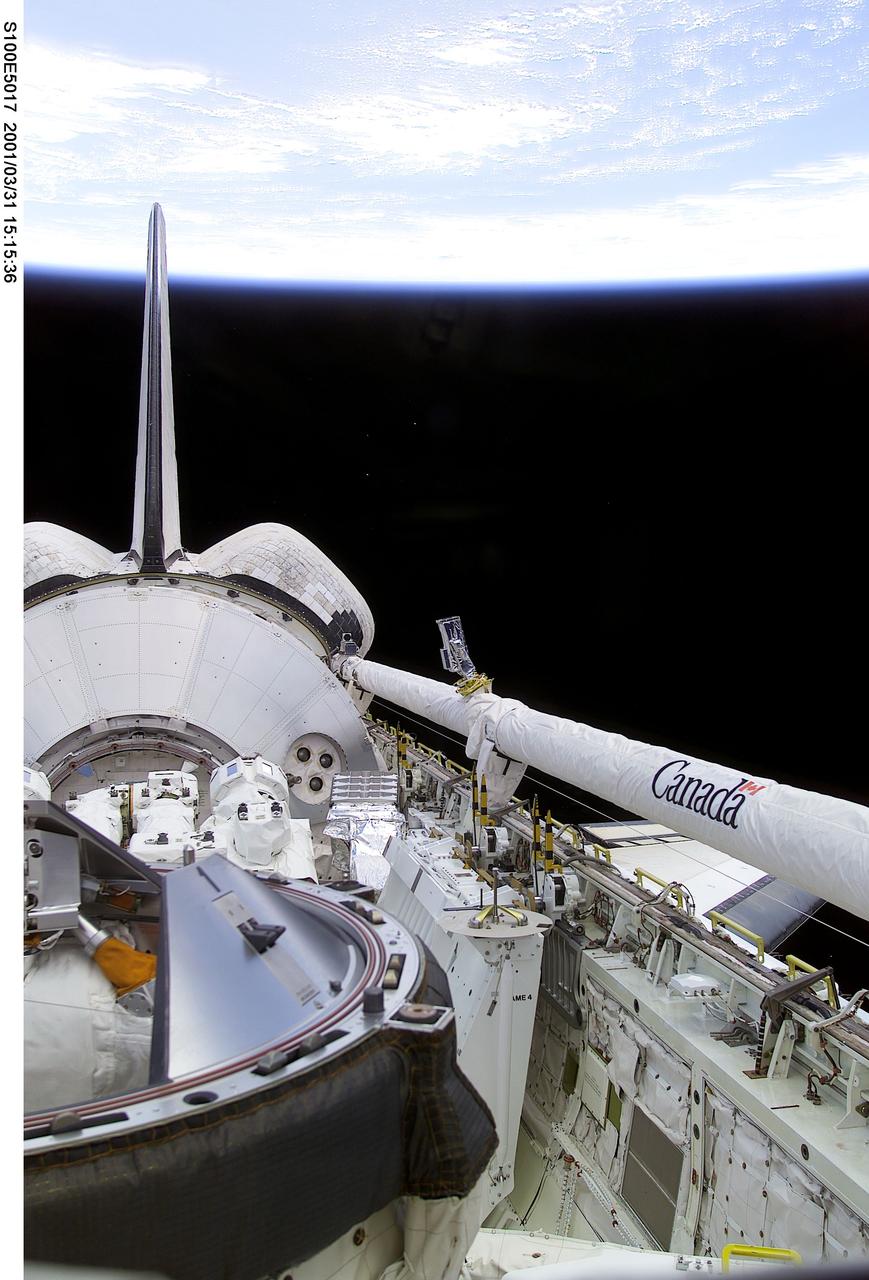
S100-E-5017 (20 April 2001) --- One of the crew members of STS-100 aimed a digital still camera through Endeavour's aft flight deck windows to record this image of the cargo bay, backdropped against a scene of black space and Earth's horizon. Housed in the bay, beyond the docking mechanism in the foreground, is the Italian Space Agency-provided Raffaello cargo module, which is carrying several tons of equipment for the Expedition Two crew and racks of hardware for installation in Destiny which will be used for scientific research in the future. Raffaello, which is the second of three such logistics modules, will be berthed to the ISS on April 23 so its contents can be transferred to the station throughout the course of docked operations. Also in the bay is the 57-foot-long Canadarm2, which will be mounted on the Destiny Laboratory for future station assembly work. Endeavour's Canadian-built Remote Manipulator System (RMS) arm can be seen in its berthed position on the port side of the payload bay.
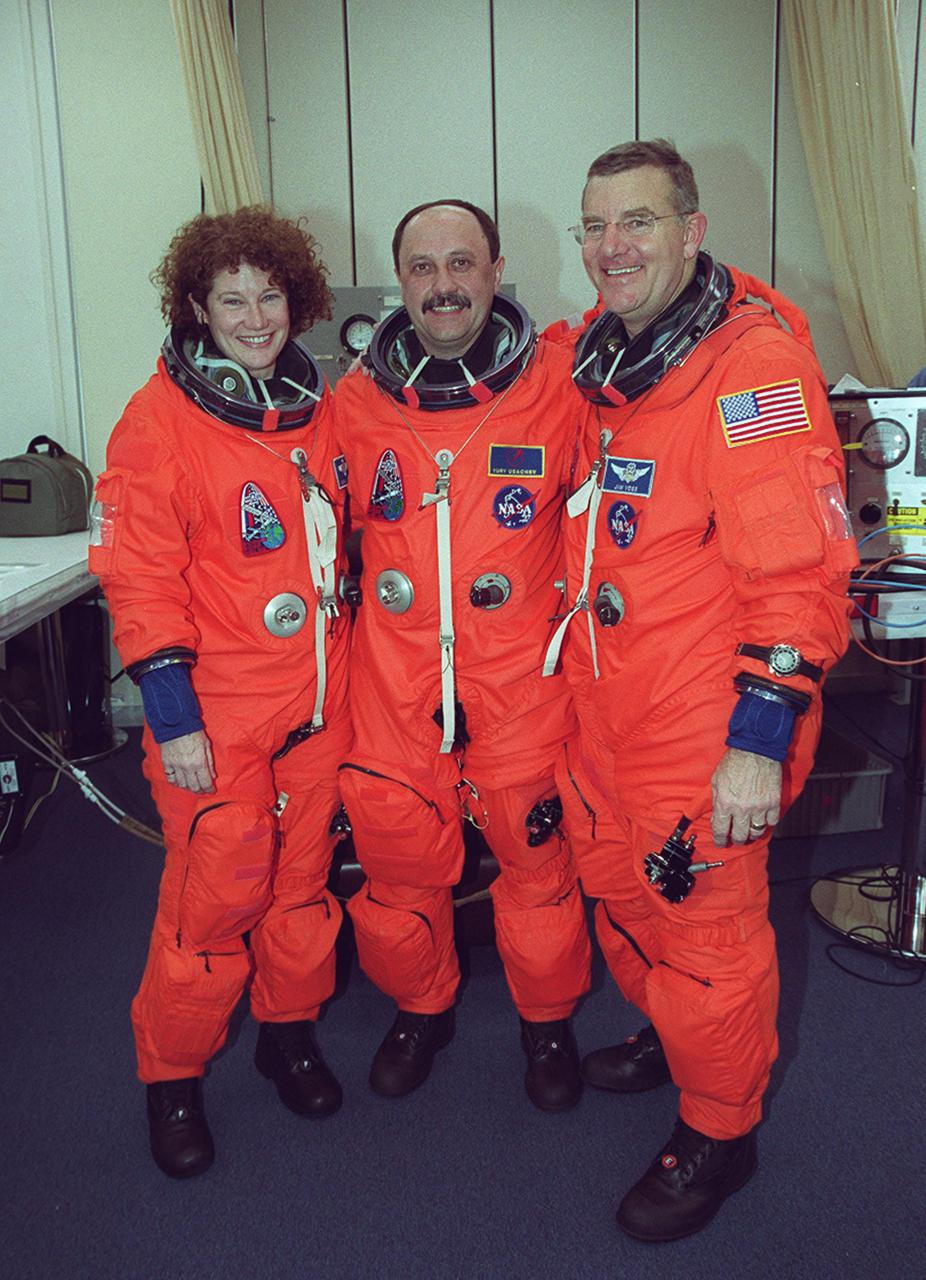
STS-102 Mission Specialists, Susan Helms, Yury Usachev and James Voss pose after suitup. Voss and Helms are making their fifth Shuttle flights and Usachev is making his second. All three are the Expedition Two crew who are replacing Expedition One on the International Space Station. STS-102 is the eighth construction flight to the Station, carrying the Multi-Purpose Logistics Module Leonardo. . The primary delivery system used to resupply and return Station cargo requiring a pressurized environment, Leonardo will deliver up to 10 tons of laboratory racks filled with equipment, experiments and supplies for outfitting the newly installed U.S. Laboratory Destiny. Discovery is set to launch March 8 at 6:42 a.m. EST. The 12-day mission is expected to end with a landing at KSC on March 20
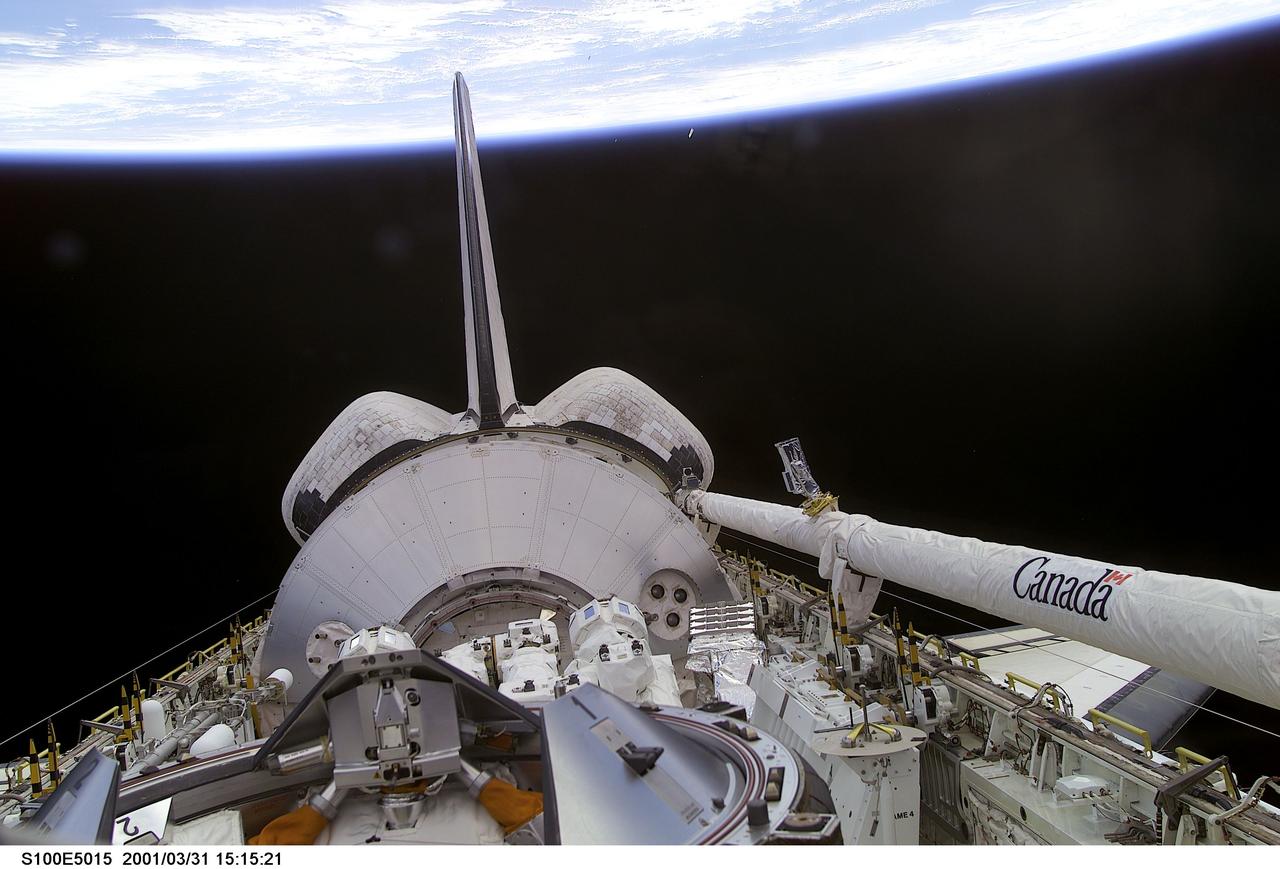
S100-E-5015 (20 April 2001) --- One of the crew members of STS-100 aimed a digital still camera through Endeavour's aft flight deck windows to record this image of the cargo bay, backdropped against a scene of black space and Earth's horizon. Housed in the bay, beyond the docking mechanism in the foreground, is the Italian Space Agency-provided Raffaello cargo module, which is carrying several tons of equipment for the Expedition Two crew and racks of hardware for installation in Destiny which will be used for scientific research in the future. Raffaello, which is the second of three such logistics modules, will be berthed to the ISS on April 23 so its contents can be transferred to the station throughout the course of docked operations. Also in the bay is the 57-foot-long Canadarm2, which will be mounted on the Destiny Laboratory for future station assembly work. Endeavour's Canadian-built Remote Manipulator System (RMS) arm can be seen in its berthed position on the port side of the payload bay.
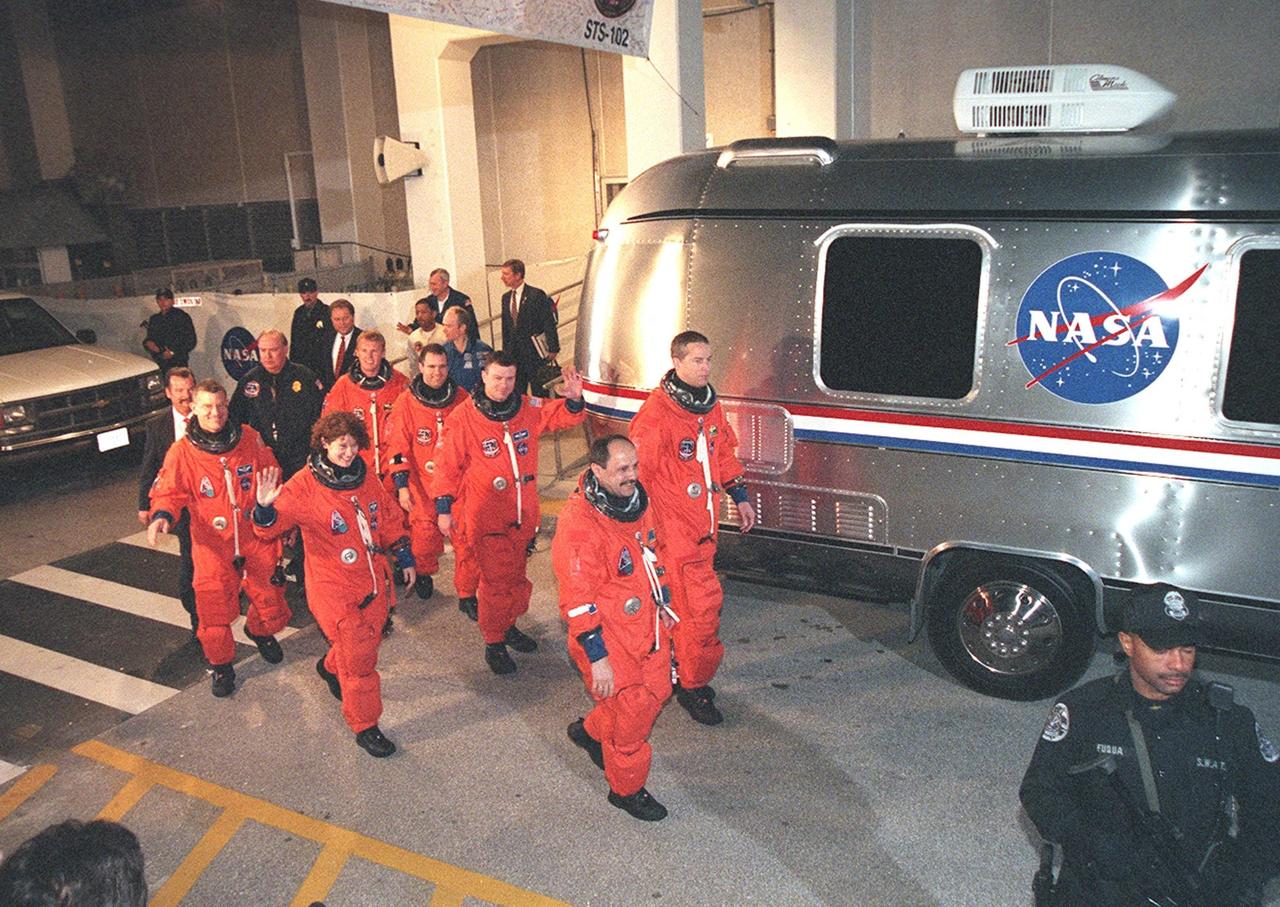
The STS-102 crew heads for the Astrovan after leaving the Operations and Checkout Building behind them. In front, left to right, are Mission Specialists James Voss, Susan Helms and Yury Usachev. In back, left to right, are Mission Specialists Andrew Thomas and Paul Richards, Pilot James Kelly and Commander James Wetherbee. STS-102 is the eighth construction flight to the Space Station, carrying the Multi-Purpose Logistics Module Leonardo. The primary delivery system used to resupply and return Station cargo requiring a pressurized environment, Leonardo will deliver up to 10 tons of laboratory racks filled with equipment, experiments and supplies for outfitting the newly installed U.S. Laboratory Destiny. In addition, Voss, Helms and Usachev, known as Expedition Two, are flying to the Station to replace Expedition One, who will return to Earth on Discovery. Discovery is set to launch March 8 at 6:42 a.m. EST. The 12-day mission is expected to end with a landing at KSC on March 20
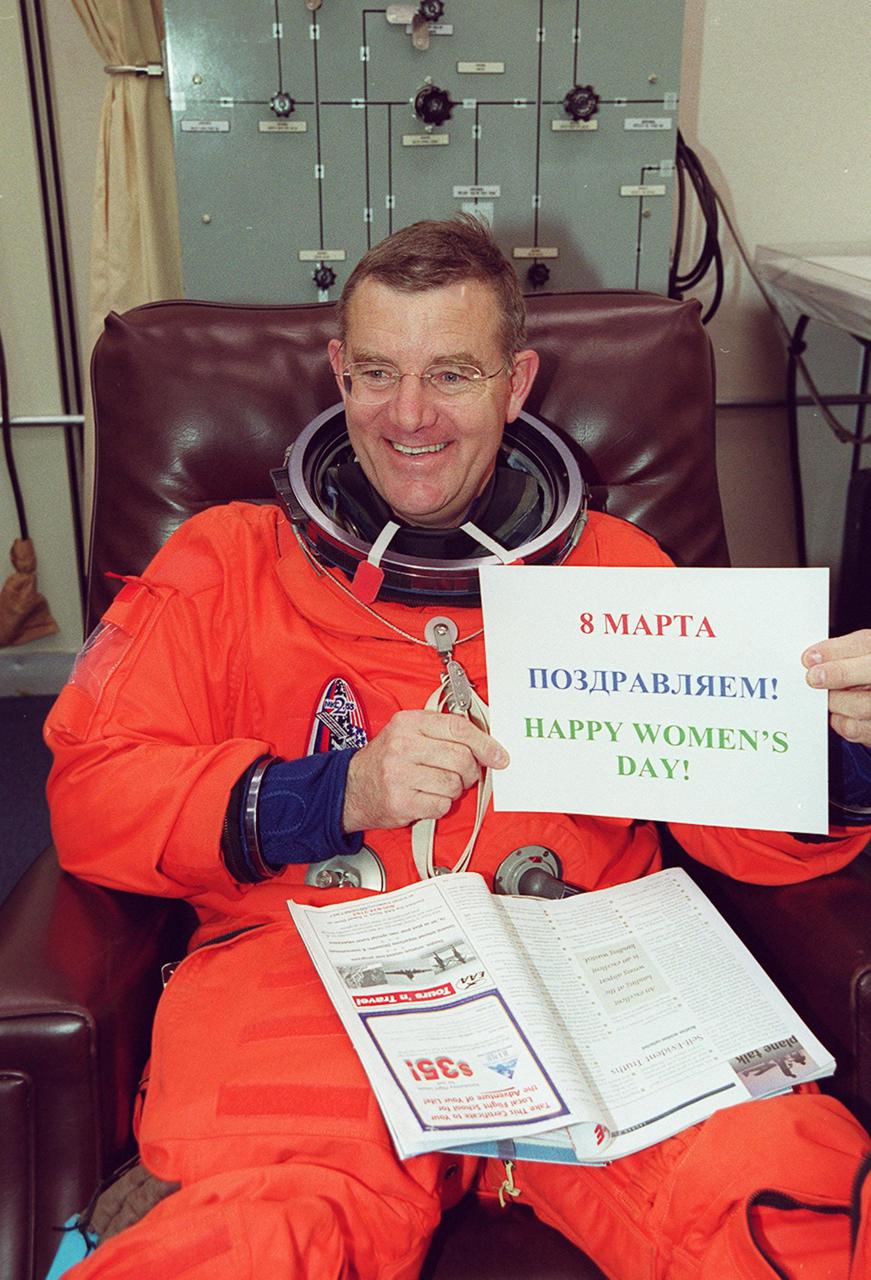
While suiting up in the Operations and Checkout Building, Mission Specialist James Voss shows his support of International Women’s Day, March 8, with a sign in both Cyrillic and English. Voss is also part of a crew, known as Expedition One, who will be replacing Expedition One on the International Space Station. STS-102 is the eighth construction flight to the Space Station, carrying the Multi-Purpose Logistics Module Leonardo. The primary delivery system used to resupply and return Station cargo requiring a pressurized environment, Leonardo will deliver up to 10 tons of laboratory racks filled with equipment, experiments and supplies for outfitting the newly installed U.S. Laboratory Destiny. Discovery is set to launch March 8 at 6:42 a.m. EST. The 12-day mission is expected to end with a landing at KSC on March 20
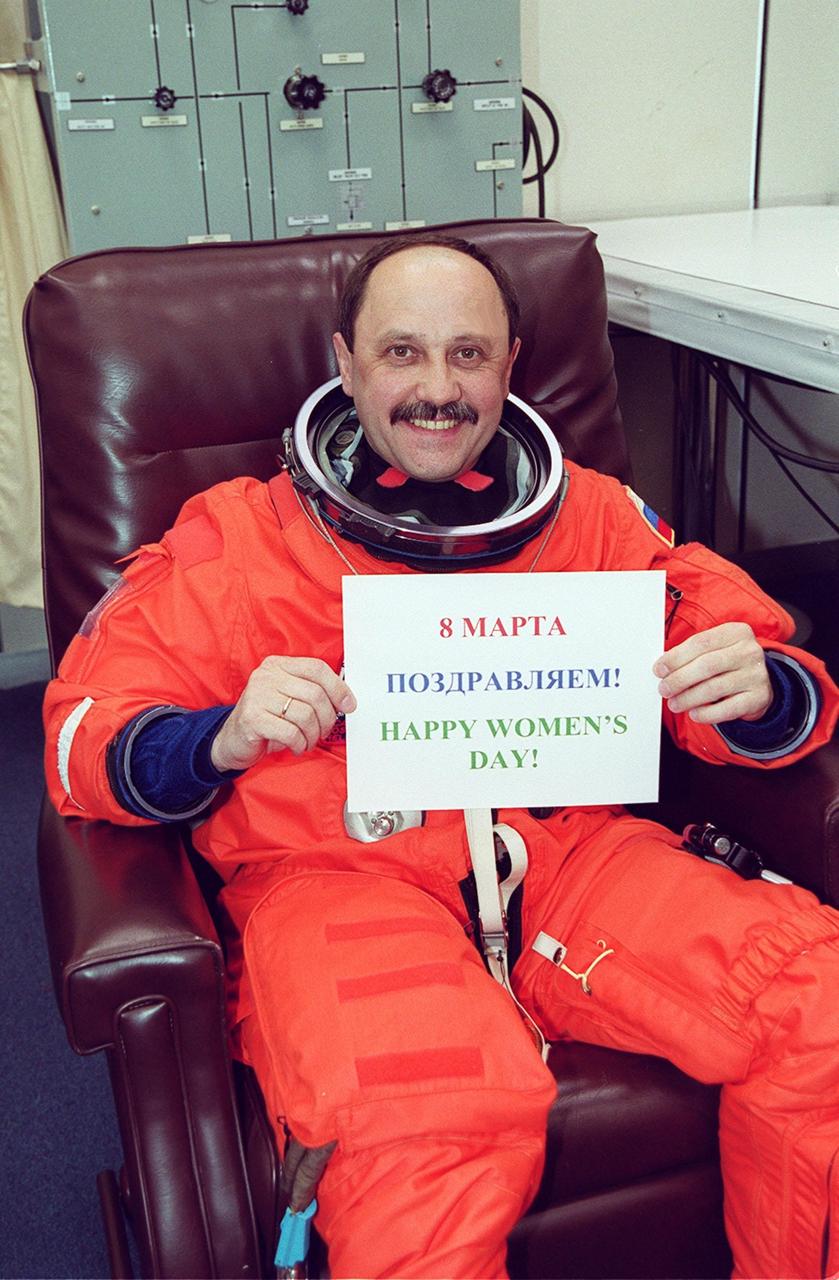
STS-102 Mission Specialist Yury Usachev, a Russian cosmonaut, shows his support of International Women’s Day, March 8, with a sign in both Cyrillic and English. This will be Usachev’s second Shuttle flight. Usachev is also part of a crew, known as Expedition One, who will be replacing Expedition One on the International Space Station. STS-102 is the eighth construction flight to the Space Station, carrying the Multi-Purpose Logistics Module Leonardo. The primary delivery system used to resupply and return Station cargo requiring a pressurized environment, Leonardo will deliver up to 10 tons of laboratory racks filled with equipment, experiments and supplies for outfitting the newly installed U.S. Laboratory Destiny. Discovery is set to launch March 8 at 6:42 a.m. EST. The 12-day mission is expected to end with a landing at KSC on March 20
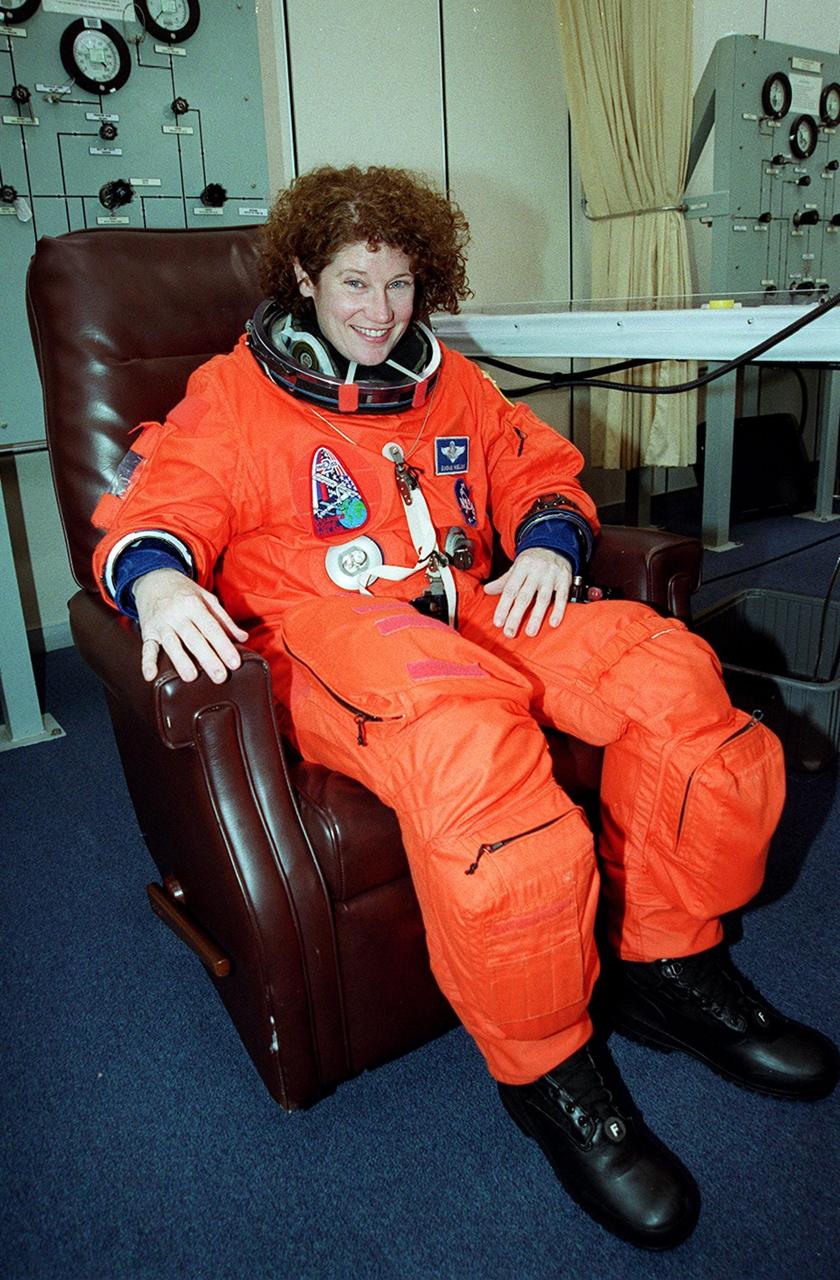
STS-102 Mission Specialist Susan Helms shows her pleasure at the imminent launch to the International Space Station. This will be Helms’ fifth Shuttle flight. She is also part of the Expedition Two crew replacing Expedition One. STS-102 is the eighth construction flight to the Station, carrying the Multi-Purpose Logistics Module Leonardo. The primary delivery system used to resupply and return Station cargo requiring a pressurized environment, Leonardo will deliver up to 10 tons of laboratory racks filled with equipment, experiments and supplies for outfitting the newly installed U.S. Laboratory Destiny. Discovery is set to launch March 8 at 6:42 a.m. EST. The 12-day mission is expected to end with a landing at KSC on March 20
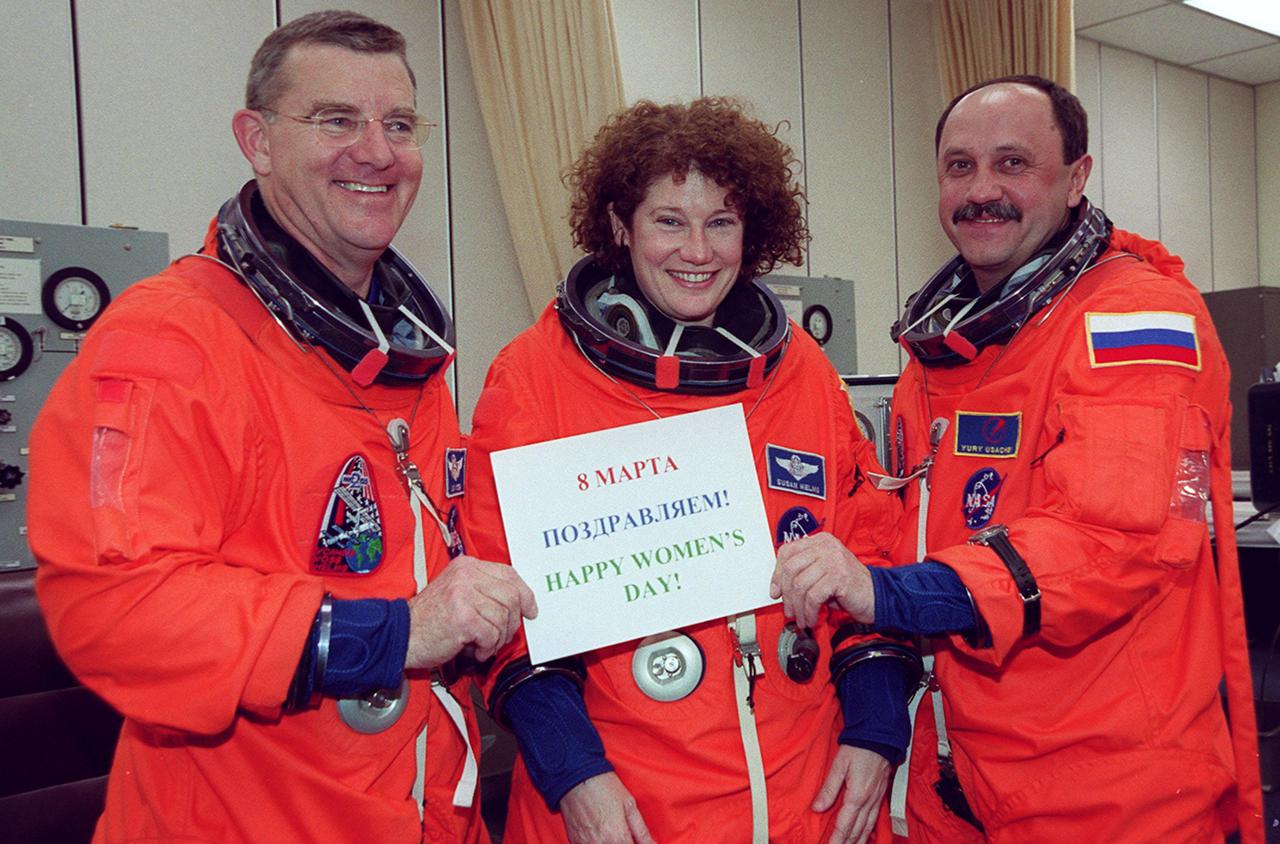
STS-102 Mission Specialists James Voss, Susan Helms and Yury Usachev hold up a sign after donning their launch and entry suits. In Cyrillic and English, the sign recognizes International Women’s Day, March 8. Voss and Helms are making their fifth Shuttle flights and Usachev is making his second. All three are the Expedition Two crew who are replacing Expedition One on the International Space Station. STS-102 is the eighth construction flight to the Station, carrying the Multi-Purpose Logistics Module Leonardo. . The primary delivery system used to resupply and return Station cargo requiring a pressurized environment, Leonardo will deliver up to 10 tons of laboratory racks filled with equipment, experiments and supplies for outfitting the newly installed U.S. Laboratory Destiny. Discovery is set to launch March 8 at 6:42 a.m. EST. The 12-day mission is expected to end with a landing at KSC on March 20
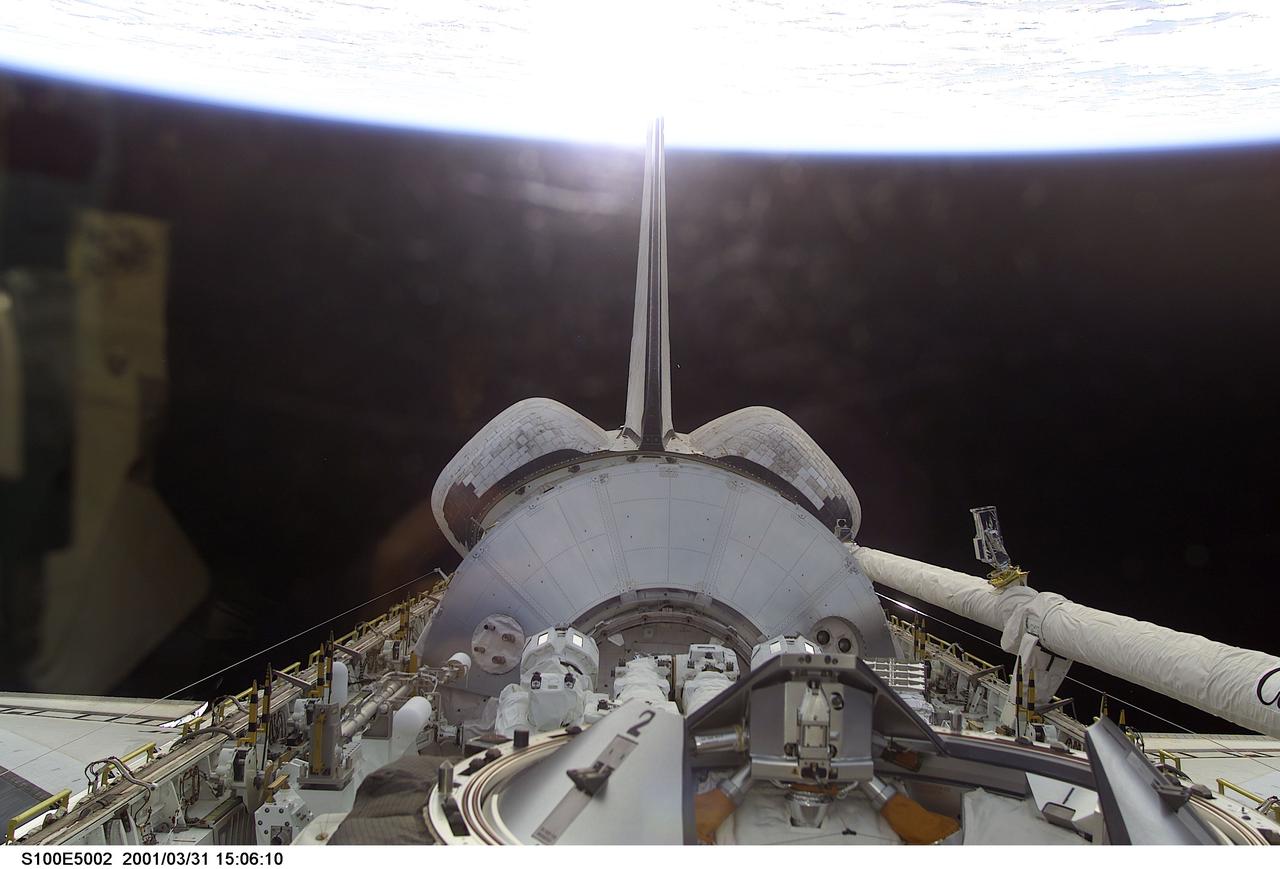
S100-E-5002 (20 April 2001) --- One of the crew members of STS-100 aimed a digital still camera through Endeavour's aft flight deck windows to record this image of the cargo bay, backdropped against a scene of black space and Earth's horizon. Housed in the bay, beyond the docking mechanism in the foreground, is the Italian Space Agency-provided Raffaello cargo module, which is carrying several tons of equipment for the Expedition Two crew and racks of hardware for installation in Destiny which will be used for scientific research in the future. Raffaello, which is the second of three such logistics modules, will be berthed to the ISS on April 23 so its contents can be transferred to the station throughout the course of docked operations. Also in the bay is the 57-foot-long Canadarm2, which will be mounted on the Destiny Laboratory for future station assembly work. Endeavour's Canadian-built Remote Manipulator System (RMS) arm can be seen in its berthed position on the port side of the payload bay.
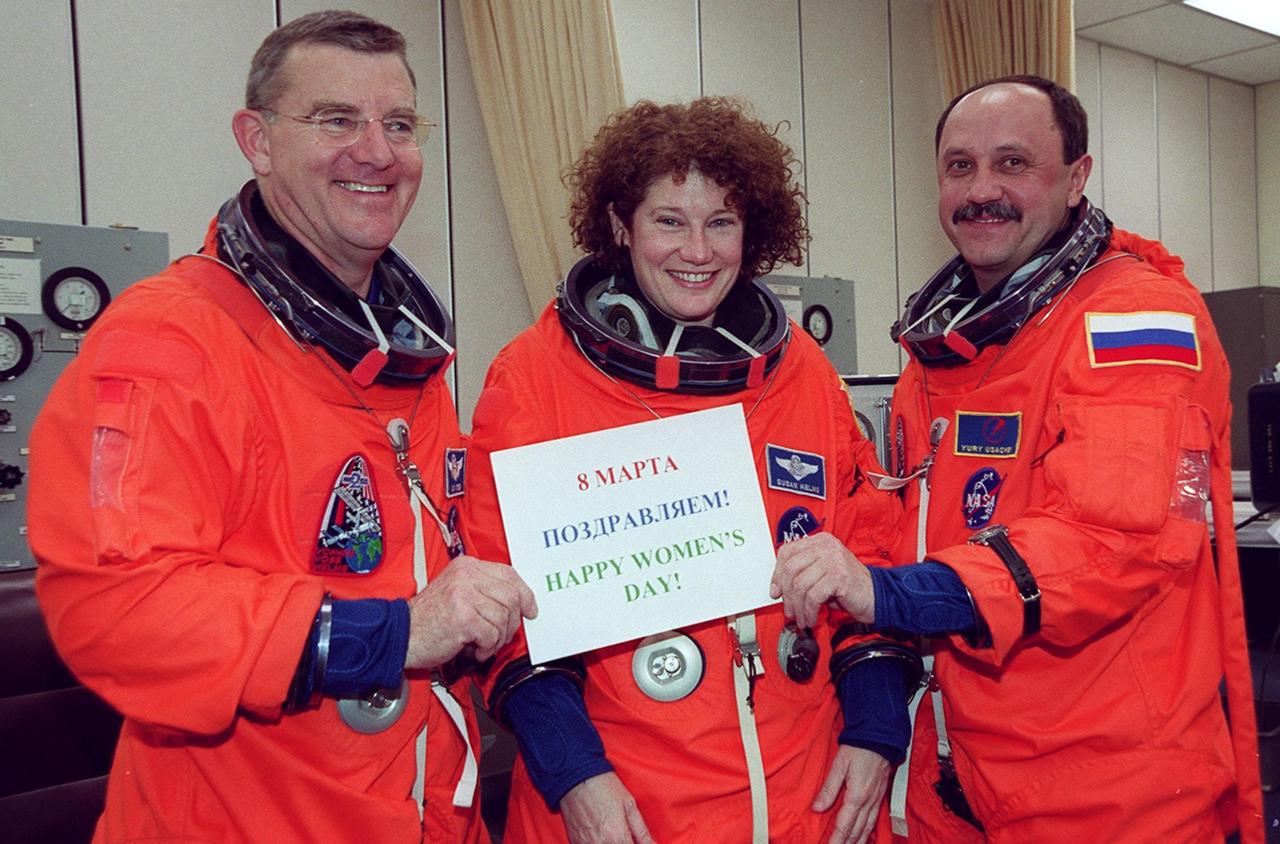
STS-102 Mission Specialists James Voss, Susan Helms and Yury Usachev hold up a sign after donning their launch and entry suits. In Cyrillic and English, the sign recognizes International Women’s Day, March 8. Voss and Helms are making their fifth Shuttle flights and Usachev is making his second. All three are the Expedition Two crew who are replacing Expedition One on the International Space Station. STS-102 is the eighth construction flight to the Station, carrying the Multi-Purpose Logistics Module Leonardo. . The primary delivery system used to resupply and return Station cargo requiring a pressurized environment, Leonardo will deliver up to 10 tons of laboratory racks filled with equipment, experiments and supplies for outfitting the newly installed U.S. Laboratory Destiny. Discovery is set to launch March 8 at 6:42 a.m. EST. The 12-day mission is expected to end with a landing at KSC on March 20
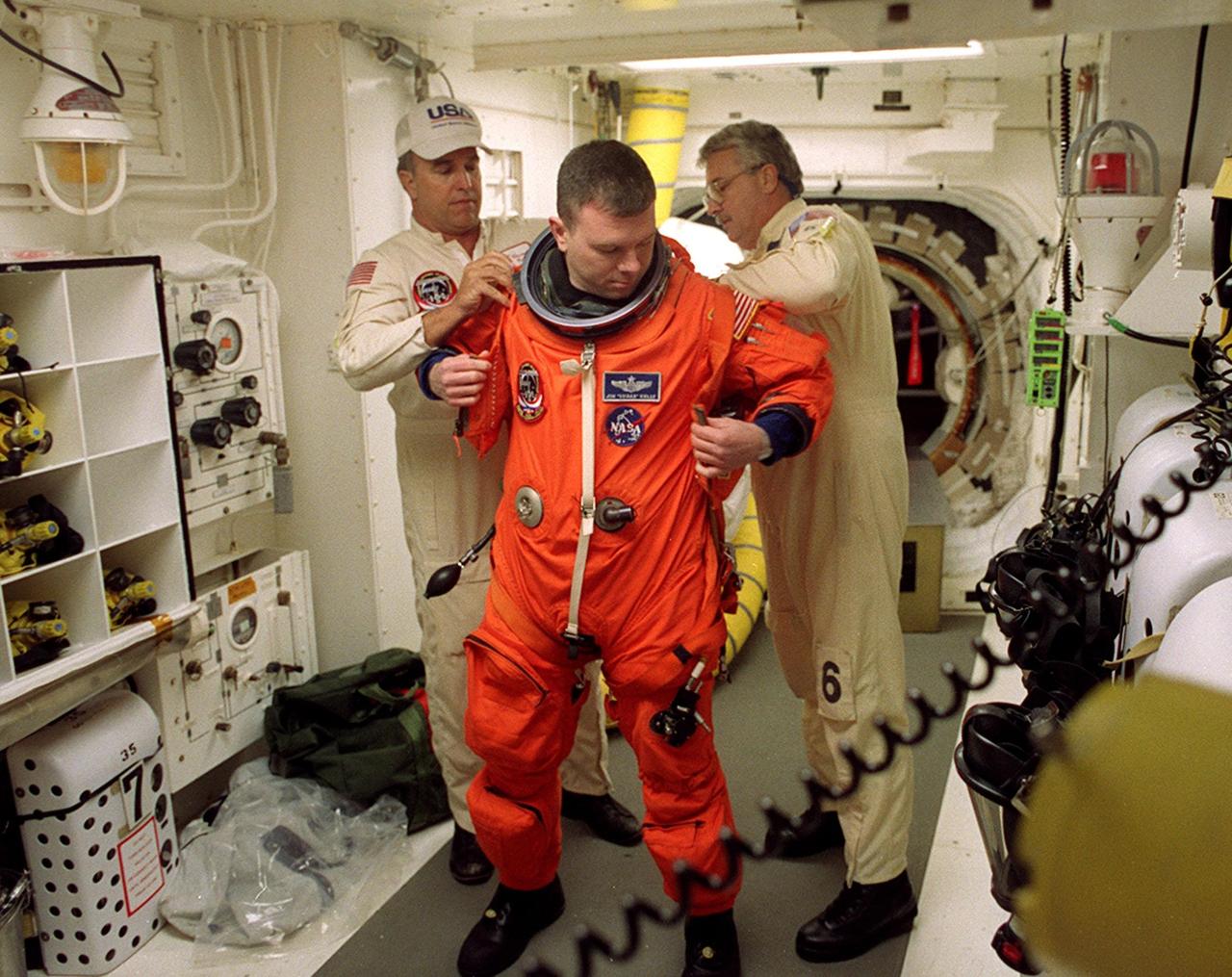
Before entering Space Shuttle Discovery, STS-102 Pilot James Kelly gets help with his launch and entry suit from technicians in the White Room. The mission is Kelly’s first Shuttle flight. Discovery is carrying the Multi-Purpose Logistics Module Leonardo on the eighth construction flight to the International Space Station. The primary delivery system used to resupply and return Station cargo requiring a pressurized environment, Leonardo will deliver up to 10 tons of laboratory racks filled with equipment, experiments and supplies for outfitting the newly installed U.S. Laboratory Destiny. Discovery is set to launch March 8 at 6:42 a.m. EST. The 12-day mission is expected to end with a landing at KSC on March 20
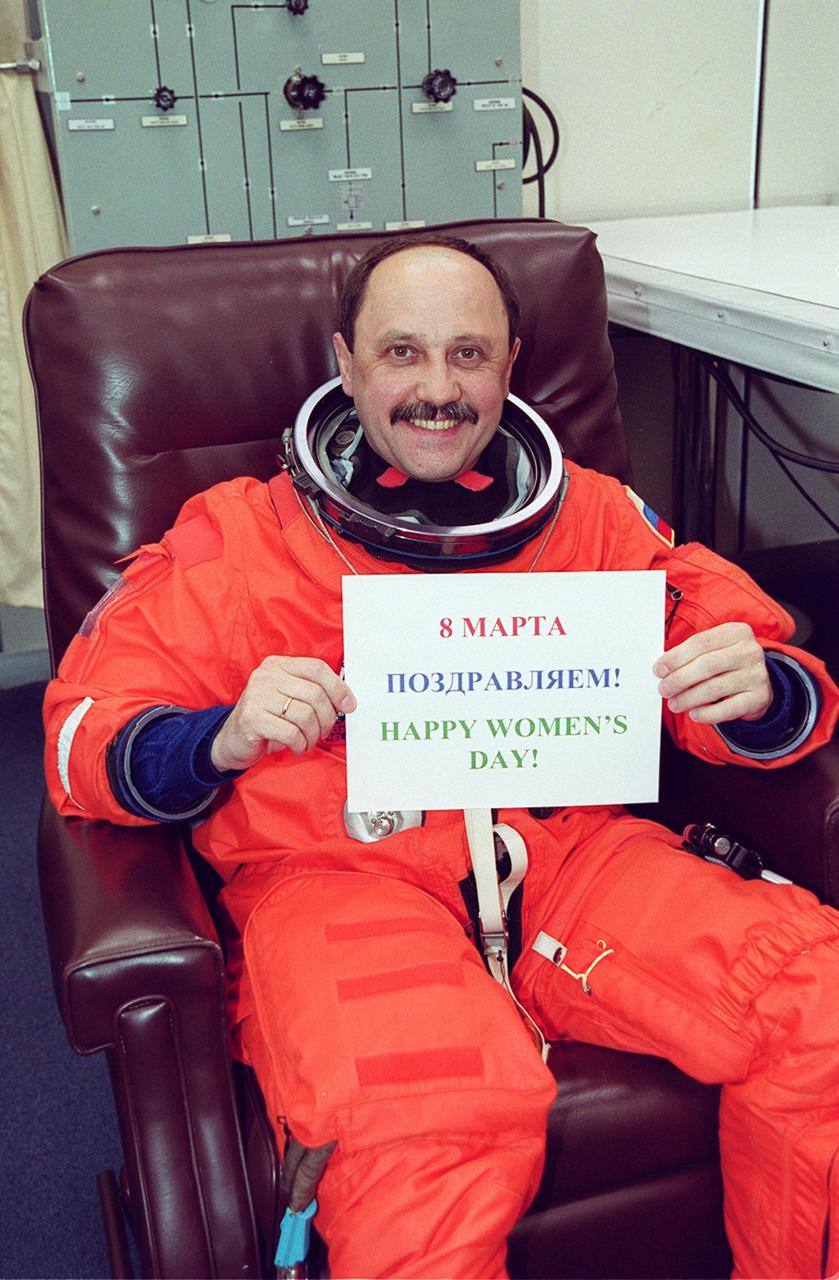
STS-102 Mission Specialist Yury Usachev, a Russian cosmonaut, shows his support of International Women’s Day, March 8, with a sign in both Cyrillic and English. This will be Usachev’s second Shuttle flight. Usachev is also part of a crew, known as Expedition One, who will be replacing Expedition One on the International Space Station. STS-102 is the eighth construction flight to the Space Station, carrying the Multi-Purpose Logistics Module Leonardo. The primary delivery system used to resupply and return Station cargo requiring a pressurized environment, Leonardo will deliver up to 10 tons of laboratory racks filled with equipment, experiments and supplies for outfitting the newly installed U.S. Laboratory Destiny. Discovery is set to launch March 8 at 6:42 a.m. EST. The 12-day mission is expected to end with a landing at KSC on March 20
In the White Room, Launch Pad 39B, STS-102 Commander James Wetherbee gets help with final suit preparations before entering Space Shuttle Discovery. STS-102 is Wetherbee’s fifth Shuttle flight. Discovery is carrying the Multi-Purpose Logistics Module Leonardo on the eighth construction flight to the International Space Station. The primary delivery system used to resupply and return Station cargo requiring a pressurized environment, Leonardo will deliver up to 10 tons of laboratory racks filled with equipment, experiments and supplies for outfitting the newly installed U.S. Laboratory Destiny. In addition, Discovery is transporting Expedition Two, three crew members who are replacing Expedition One on the Station. Discovery is set to launch March 8 at 6:42 a.m. EST. The 12-day mission is expected to end with a landing at KSC on March 20
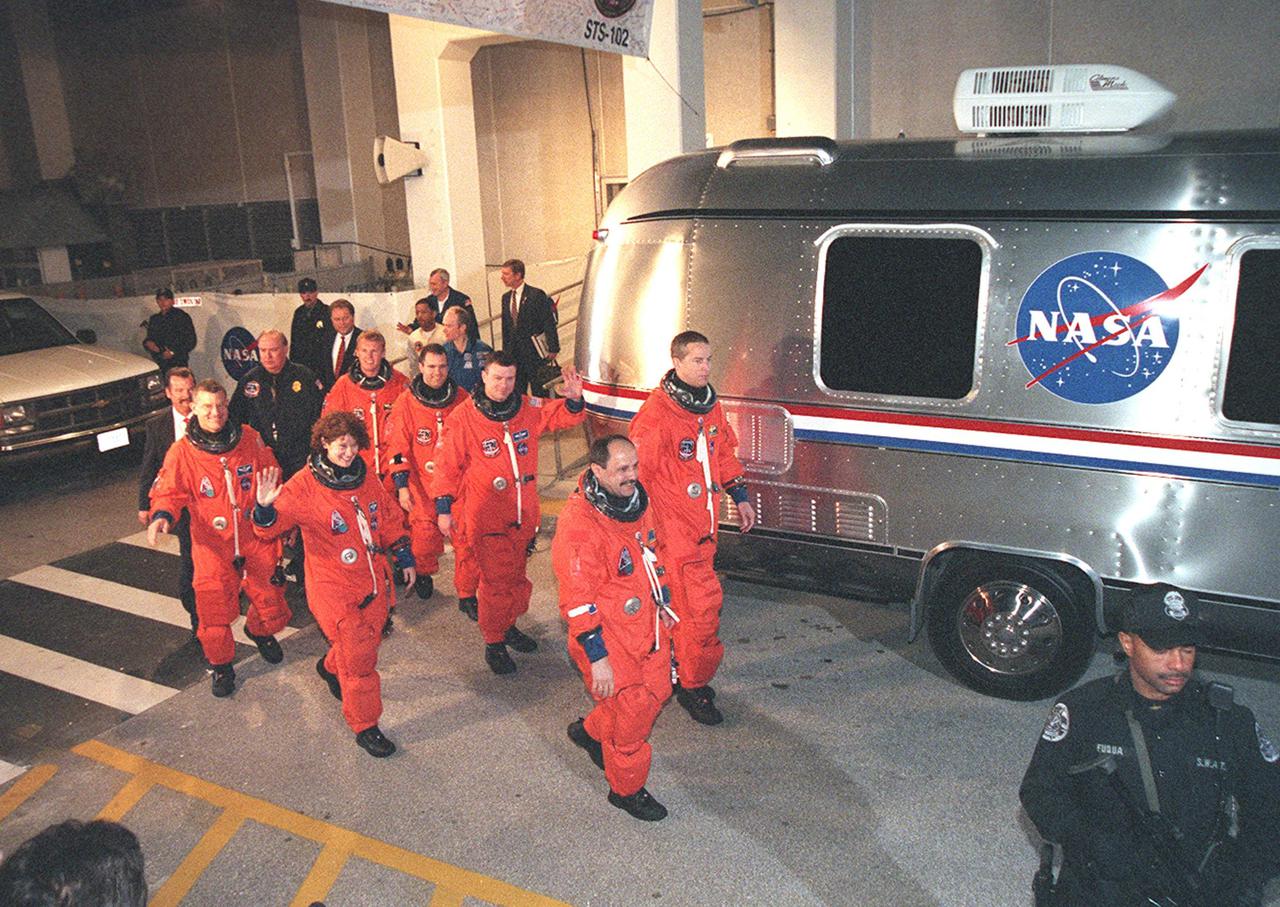
The STS-102 crew heads for the Astrovan after leaving the Operations and Checkout Building behind them. In front, left to right, are Mission Specialists James Voss, Susan Helms and Yury Usachev. In back, left to right, are Mission Specialists Andrew Thomas and Paul Richards, Pilot James Kelly and Commander James Wetherbee. STS-102 is the eighth construction flight to the Space Station, carrying the Multi-Purpose Logistics Module Leonardo. The primary delivery system used to resupply and return Station cargo requiring a pressurized environment, Leonardo will deliver up to 10 tons of laboratory racks filled with equipment, experiments and supplies for outfitting the newly installed U.S. Laboratory Destiny. In addition, Voss, Helms and Usachev, known as Expedition Two, are flying to the Station to replace Expedition One, who will return to Earth on Discovery. Discovery is set to launch March 8 at 6:42 a.m. EST. The 12-day mission is expected to end with a landing at KSC on March 20
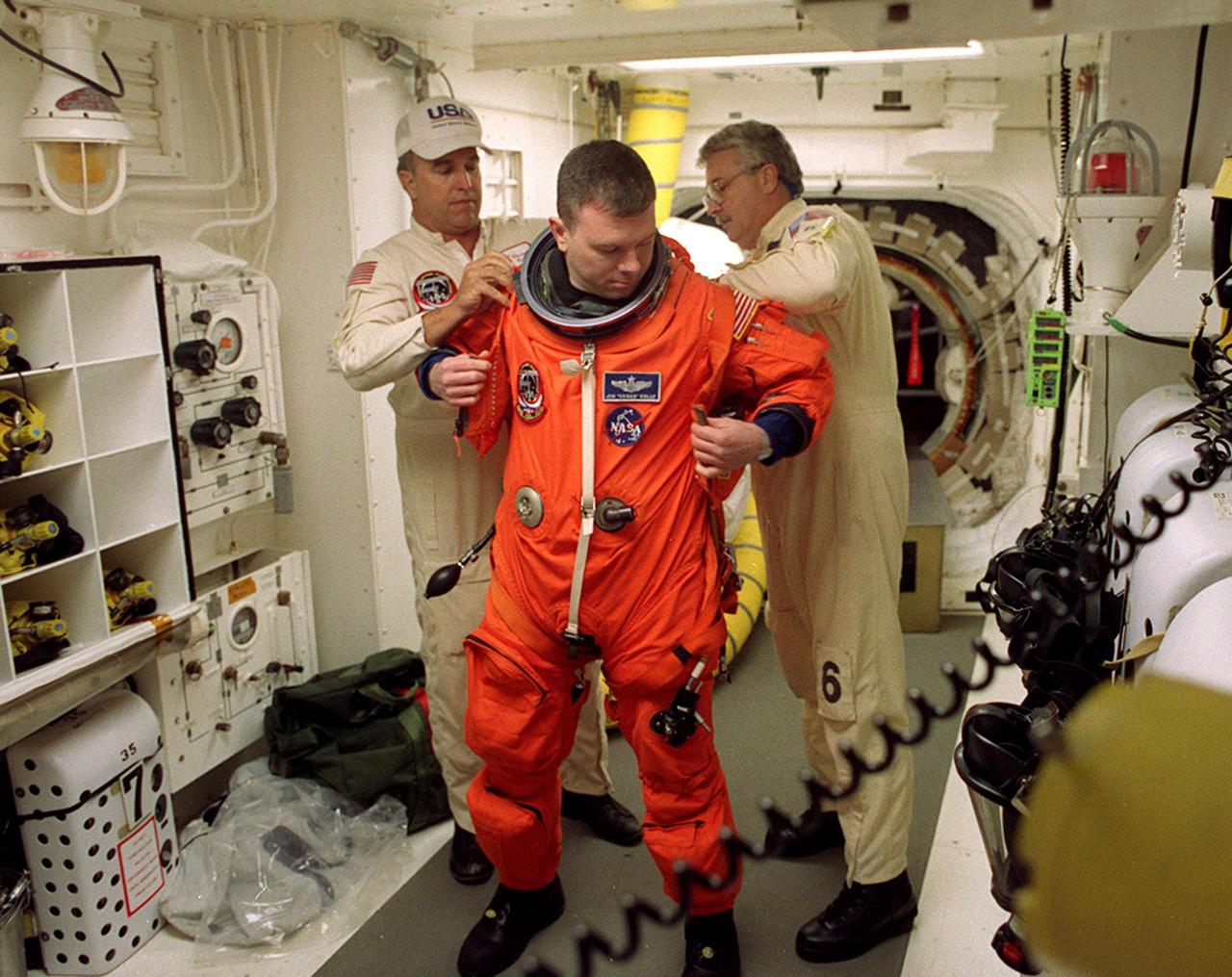
Before entering Space Shuttle Discovery, STS-102 Pilot James Kelly gets help with his launch and entry suit from technicians in the White Room. The mission is Kelly’s first Shuttle flight. Discovery is carrying the Multi-Purpose Logistics Module Leonardo on the eighth construction flight to the International Space Station. The primary delivery system used to resupply and return Station cargo requiring a pressurized environment, Leonardo will deliver up to 10 tons of laboratory racks filled with equipment, experiments and supplies for outfitting the newly installed U.S. Laboratory Destiny. Discovery is set to launch March 8 at 6:42 a.m. EST. The 12-day mission is expected to end with a landing at KSC on March 20
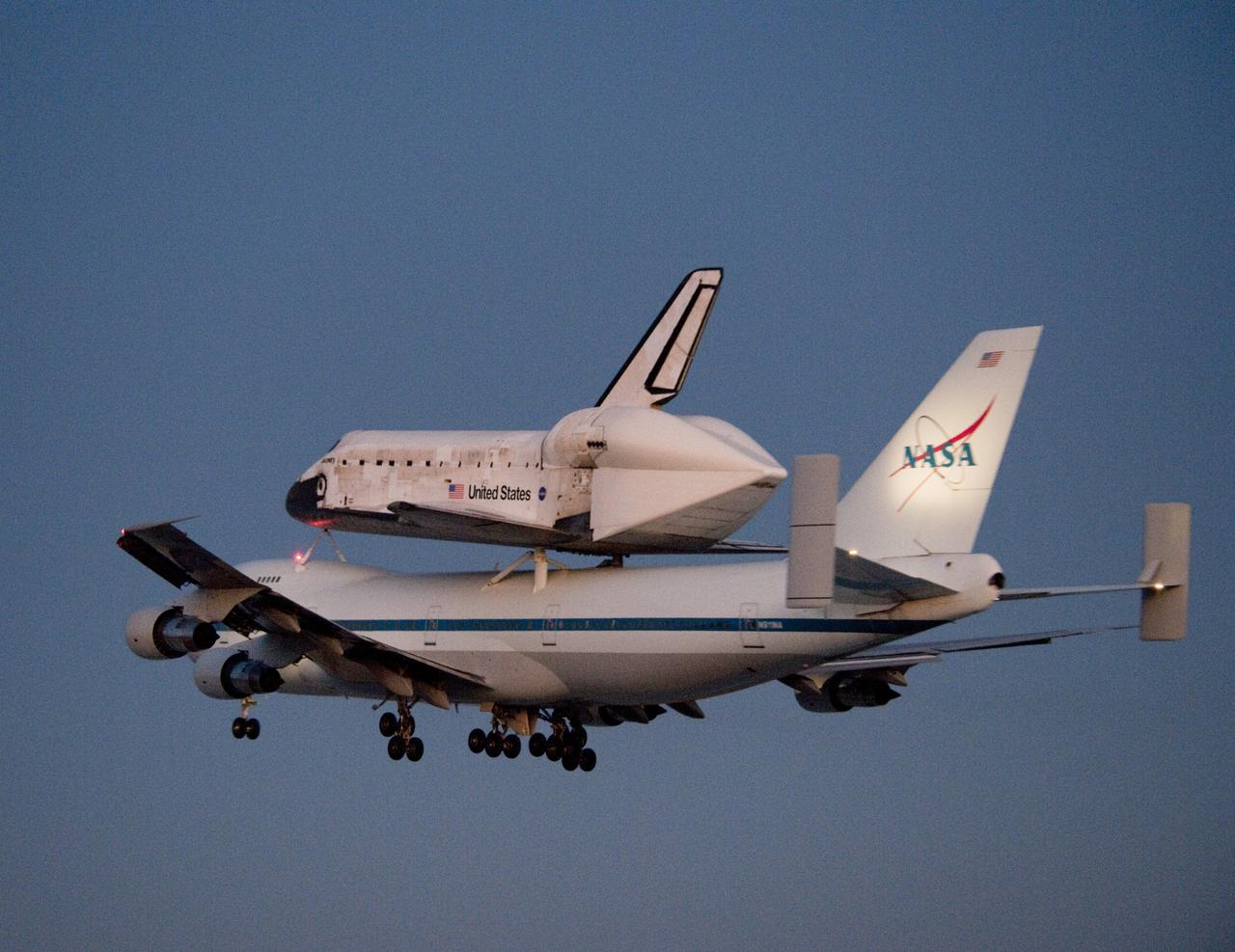
EDWARDS AIR FORCE BASE, Calif. – ED09-0253-109) NASA’s modified 747 Shuttle Carrier Aircraft with the shuttle Discovery securely mounted on top soars into the morning sky after takeoff from Edwards Air Force Base Sept. 20, 2009. The piggyback pair was due to arrive back at NASA’s Kennedy Space Center in Florida the following day after the 2,500-mile cross-country ferry flight. Discovery had landed at Edwards Sept. 11 after the STS-128 mission to the International Space Station. The shuttle delivered more than 7 tons of supplies, science racks and equipment, as well as additional environmental hardware to sustain six crew members on the International Space Station. NASA photo /Tony Landis
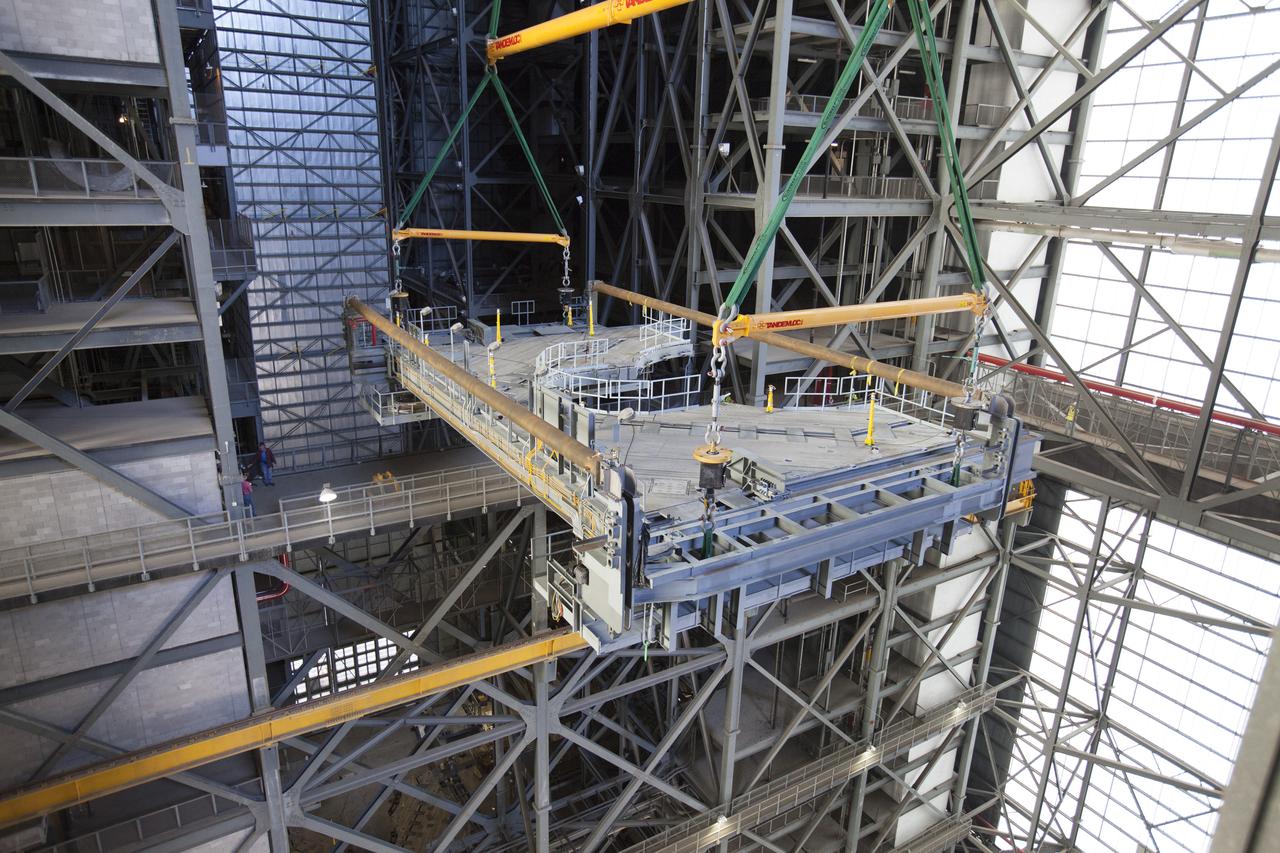
A 250-ton crane is used to lift the second half of the K-level work platforms for NASA’s Space Launch System (SLS) rocket up from High Bay 4 inside the Vehicle Assembly Building at NASA's Kennedy Space Center in Florida. The platform is being lifted up and over the transfer aisle and will be lowered into High Bay 3 for installation. It will be secured about 86 feet above the VAB floor, on tower E of the high bay. The K work platforms will provide access to the SLS core stage and solid rocket boosters during processing and stacking operations on the mobile launcher. The Ground Systems Development and Operations Program is overseeing upgrades and modifications to High Bay 3 to support processing of the SLS and Orion spacecraft. A total of 10 levels of new platforms, 20 platform halves altogether, will surround the SLS rocket and Orion spacecraft.
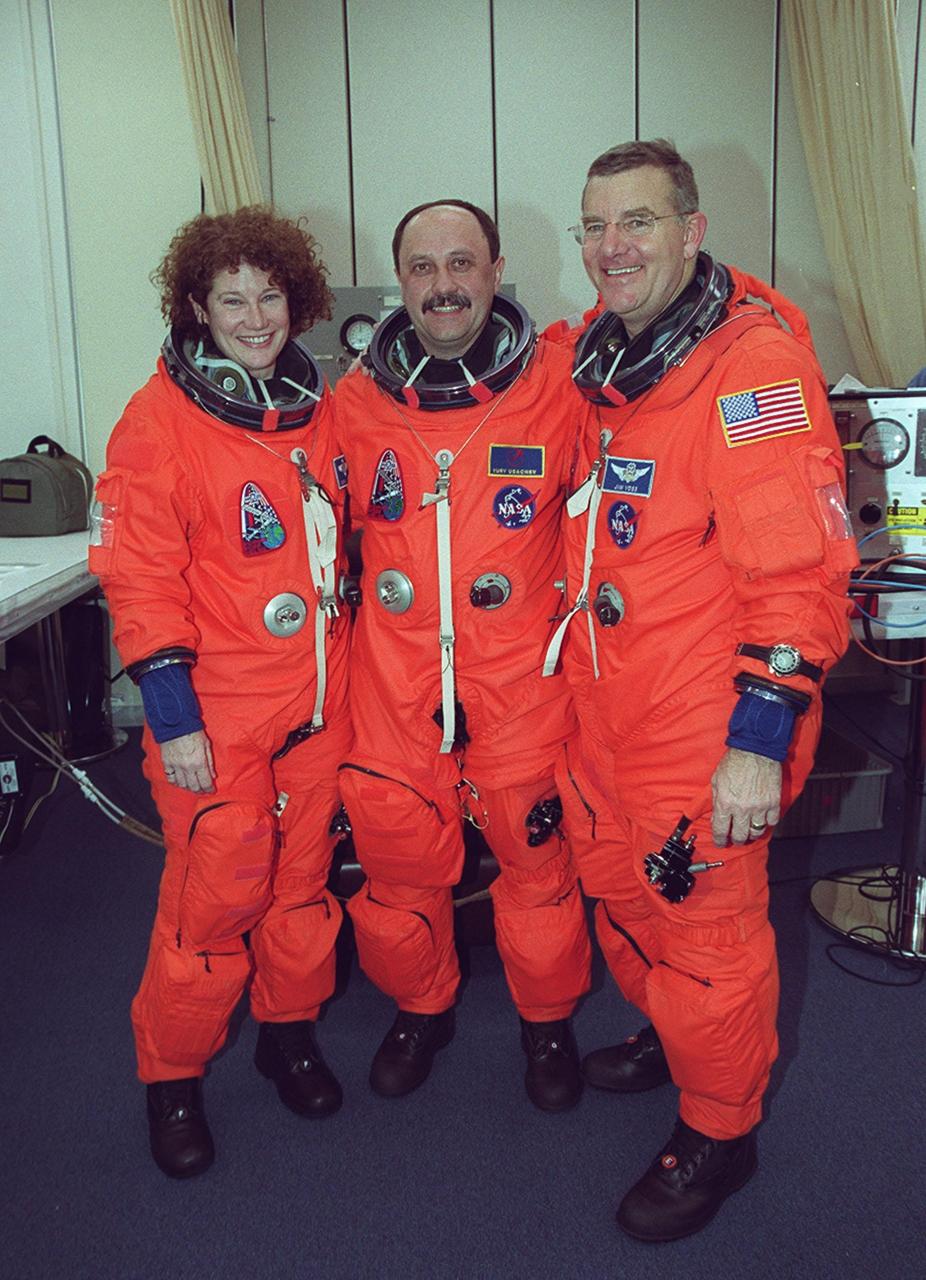
STS-102 Mission Specialists, Susan Helms, Yury Usachev and James Voss pose after suitup. Voss and Helms are making their fifth Shuttle flights and Usachev is making his second. All three are the Expedition Two crew who are replacing Expedition One on the International Space Station. STS-102 is the eighth construction flight to the Station, carrying the Multi-Purpose Logistics Module Leonardo. . The primary delivery system used to resupply and return Station cargo requiring a pressurized environment, Leonardo will deliver up to 10 tons of laboratory racks filled with equipment, experiments and supplies for outfitting the newly installed U.S. Laboratory Destiny. Discovery is set to launch March 8 at 6:42 a.m. EST. The 12-day mission is expected to end with a landing at KSC on March 20
STS-102 Mission Specialist Susan Helms shows her pleasure at the imminent launch to the International Space Station. This will be Helms’ fifth Shuttle flight. She is also part of the Expedition Two crew replacing Expedition One. STS-102 is the eighth construction flight to the Station, carrying the Multi-Purpose Logistics Module Leonardo. The primary delivery system used to resupply and return Station cargo requiring a pressurized environment, Leonardo will deliver up to 10 tons of laboratory racks filled with equipment, experiments and supplies for outfitting the newly installed U.S. Laboratory Destiny. Discovery is set to launch March 8 at 6:42 a.m. EST. The 12-day mission is expected to end with a landing at KSC on March 20
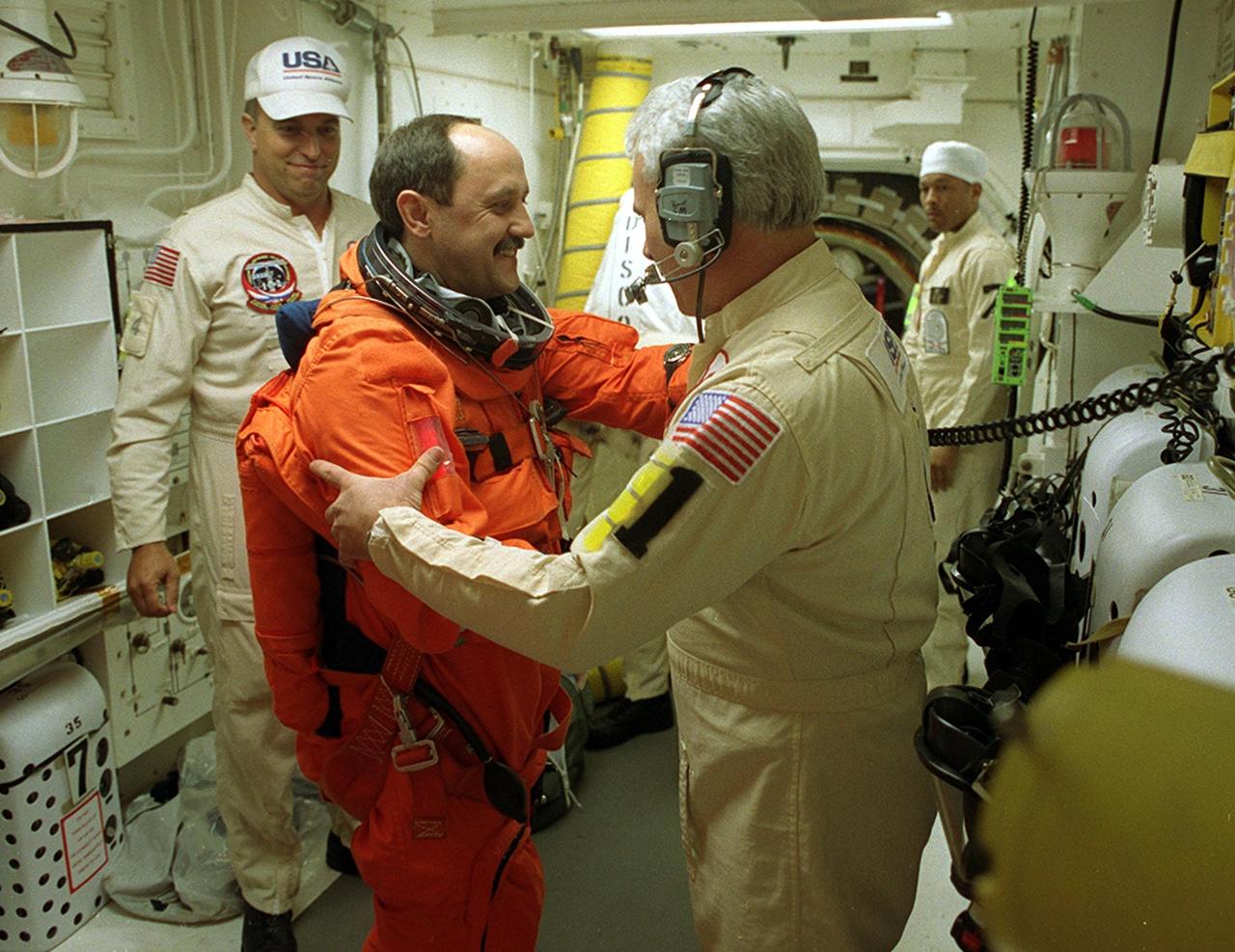
In the White Room, Launch Pad 39B, STS-102 Mission Specialist Yury Usachev gets warm greetings from one of the suit technicians helping with final preparations before entering Space Shuttle Discovery. STS-102 is Russian cosmonaut Usachev’s second Shuttle flight. He is also part of the Expedition Two crew flying on the mission to replace the Expedition One crew on the Station. Discovery is carrying the Multi-Purpose Logistics Module Leonardo on the eighth construction flight to the International Space Station. The primary delivery system used to resupply and return Station cargo requiring a pressurized environment, Leonardo will deliver up to 10 tons of laboratory racks filled with equipment, experiments and supplies for outfitting the newly installed U.S. Laboratory Destiny. Discovery is set to launch March 8 at 6:42 a.m. EST. The 12-day mission is expected to end with a landing at KSC on March 20
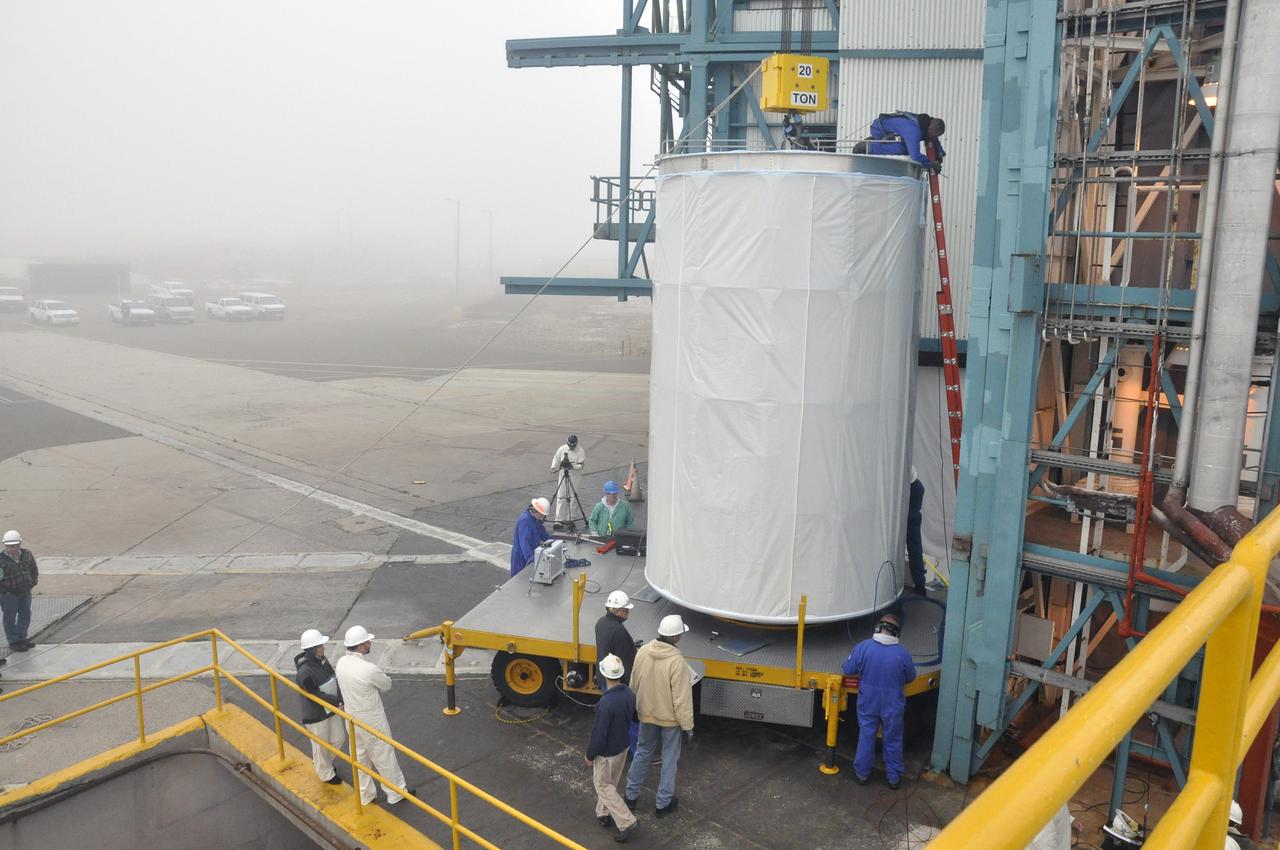
VANDENBERG AIR FORCE BASE, Calif. – NASA's Orbiting Carbon Observatory-2, or OCO-2, is connected to a 20-ton crane at the mobile service tower at Space Launch Complex 2 at Vandenberg Air Force Base in California. The spacecraft will be mated with the United Launch Alliance Delta II rocket inside the tower. Launch is scheduled for July 1. OCO-2 will collect precise global measurements of carbon dioxide in the Earth's atmosphere and provide scientists with a better idea of the chemical compound's impacts on climate change. Scientists will analyze this data to improve our understanding of the natural processes and human activities that regulate the abundance and distribution of this important atmospheric gas. To learn more about OCO-2, visit http://oco.jpl.nasa.gov. Photo credit: NASA/Randy Beaudoin

In the White Room, Launch Pad 39B, STS-102 Commander James Wetherbee gets help with final suit preparations before entering Space Shuttle Discovery. STS-102 is Wetherbee’s fifth Shuttle flight. Discovery is carrying the Multi-Purpose Logistics Module Leonardo on the eighth construction flight to the International Space Station. The primary delivery system used to resupply and return Station cargo requiring a pressurized environment, Leonardo will deliver up to 10 tons of laboratory racks filled with equipment, experiments and supplies for outfitting the newly installed U.S. Laboratory Destiny. In addition, Discovery is transporting Expedition Two, three crew members who are replacing Expedition One on the Station. Discovery is set to launch March 8 at 6:42 a.m. EST. The 12-day mission is expected to end with a landing at KSC on March 20
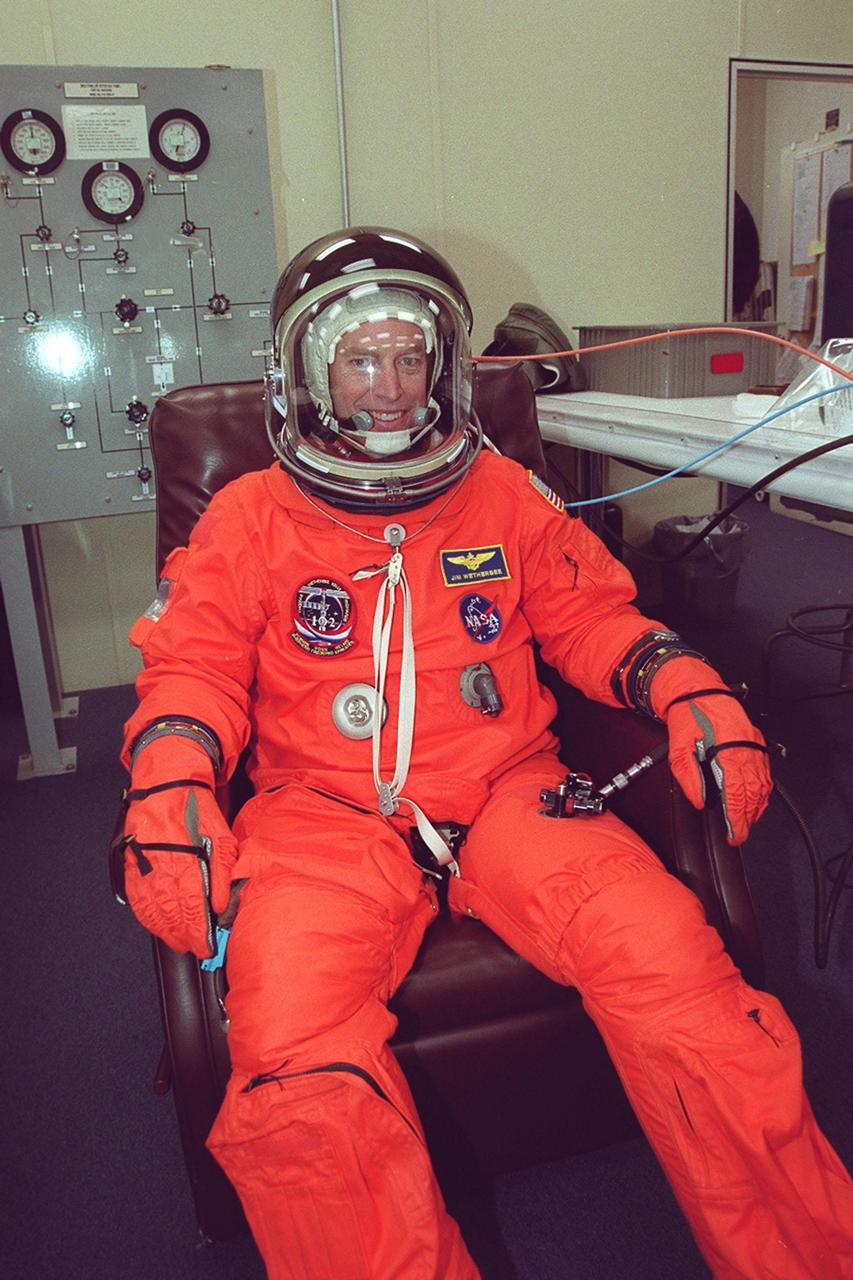
STS-102 Commander James Wetherbee gets final adjustments on his launch and entry suit before heading to Space Shuttle Discovery on Launch Pad 39B. This mission is Wetherbee’s fifth Shuttle flight. Discovery is scheduled to launch March 8 at 6:42 a.m. EST, carrying the Multi-Purpose Logistics Module Leonardo to the International Space Station. The primary delivery system used to resupply and return Station cargo requiring a pressurized environment, Leonardo will deliver up to 10 tons of laboratory racks filled with equipment, experiments and supplies for outfitting the newly installed U.S. Laboratory Destiny. In addition, three crew members Mission Specialists James Voss, Susan Helms and Russian cosmonaut Yury Usachev are the Expedition Two crew replacing Expedition One on the Station. Discovery is expected to land at KSC on March 20 at 2:02 a.m
STS-102 Mission Specialist Susan Helms shows her pleasure at the imminent launch to the International Space Station. This will be Helms’ fifth Shuttle flight. She is also part of the Expedition Two crew replacing Expedition One. STS-102 is the eighth construction flight to the Station, carrying the Multi-Purpose Logistics Module Leonardo. The primary delivery system used to resupply and return Station cargo requiring a pressurized environment, Leonardo will deliver up to 10 tons of laboratory racks filled with equipment, experiments and supplies for outfitting the newly installed U.S. Laboratory Destiny. Discovery is set to launch March 8 at 6:42 a.m. EST. The 12-day mission is expected to end with a landing at KSC on March 20
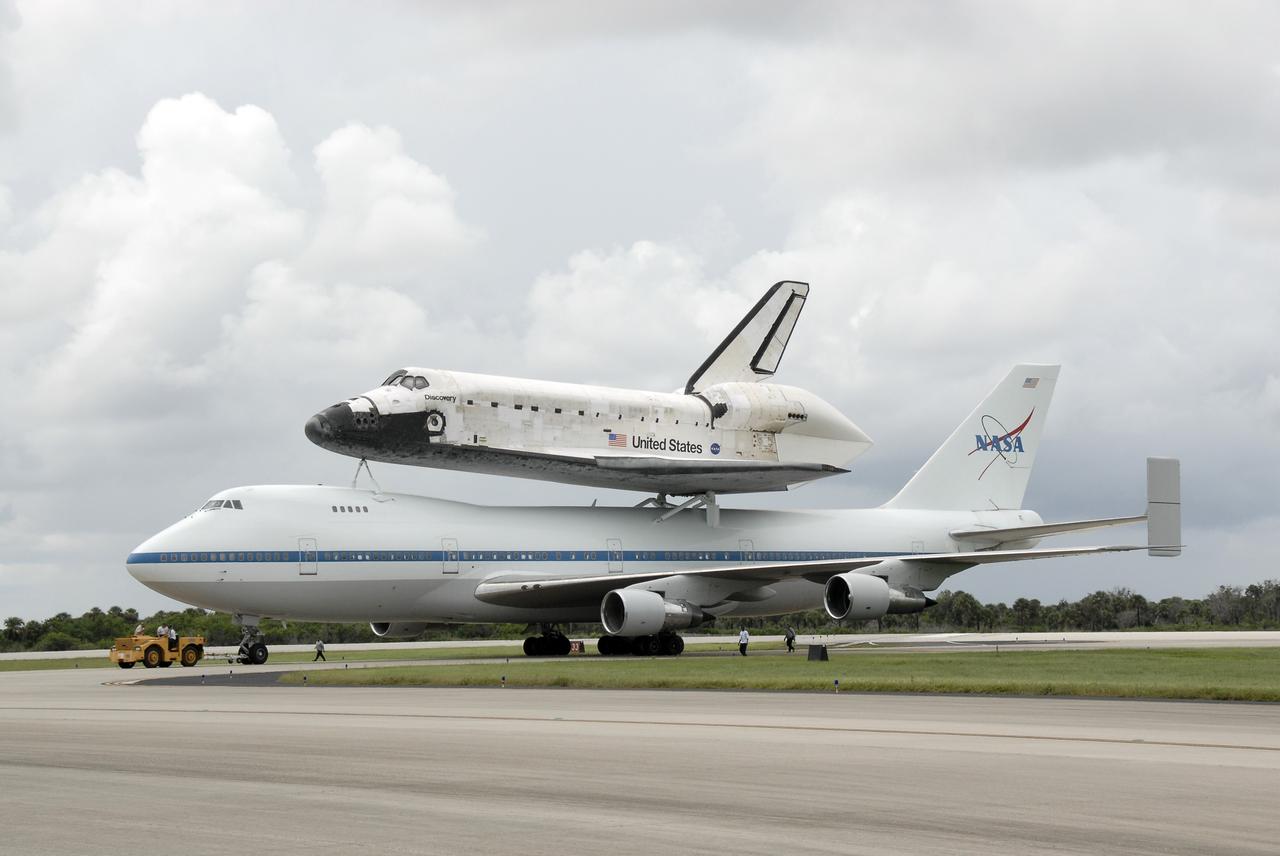
CAPE CANAVERAL, Fla. – The Boeing 747 Shuttle Carrier Aircraft, or SCA, with space shuttle Discovery on top, is ready for towing from the Shuttle Landing Facility's runway 33 at NASA's Kennedy Space Center in Florida after touching down at 12:05 p.m. EDT. The two-day return flight from Edwards Air Force Base in California began at 9:20 a.m. EDT Sept. 20. After three fueling stops that included an overnight stay in Louisiana, the piggybacked shuttle had to navigate through a line of showers across Louisiana and around Kennedy. Discovery had landed at Edwards Sept. 11 after the 13-day STS-128 mission to the International Space Station. The shuttle delivered more than 7 tons of supplies, science racks and equipment, as well as additional environmental hardware to sustain six crew members on the station. Landings at Kennedy were waved off on two days due to inclement weather, leading to the landing at Edwards. Photo credit: NASA/Kim Shiflett
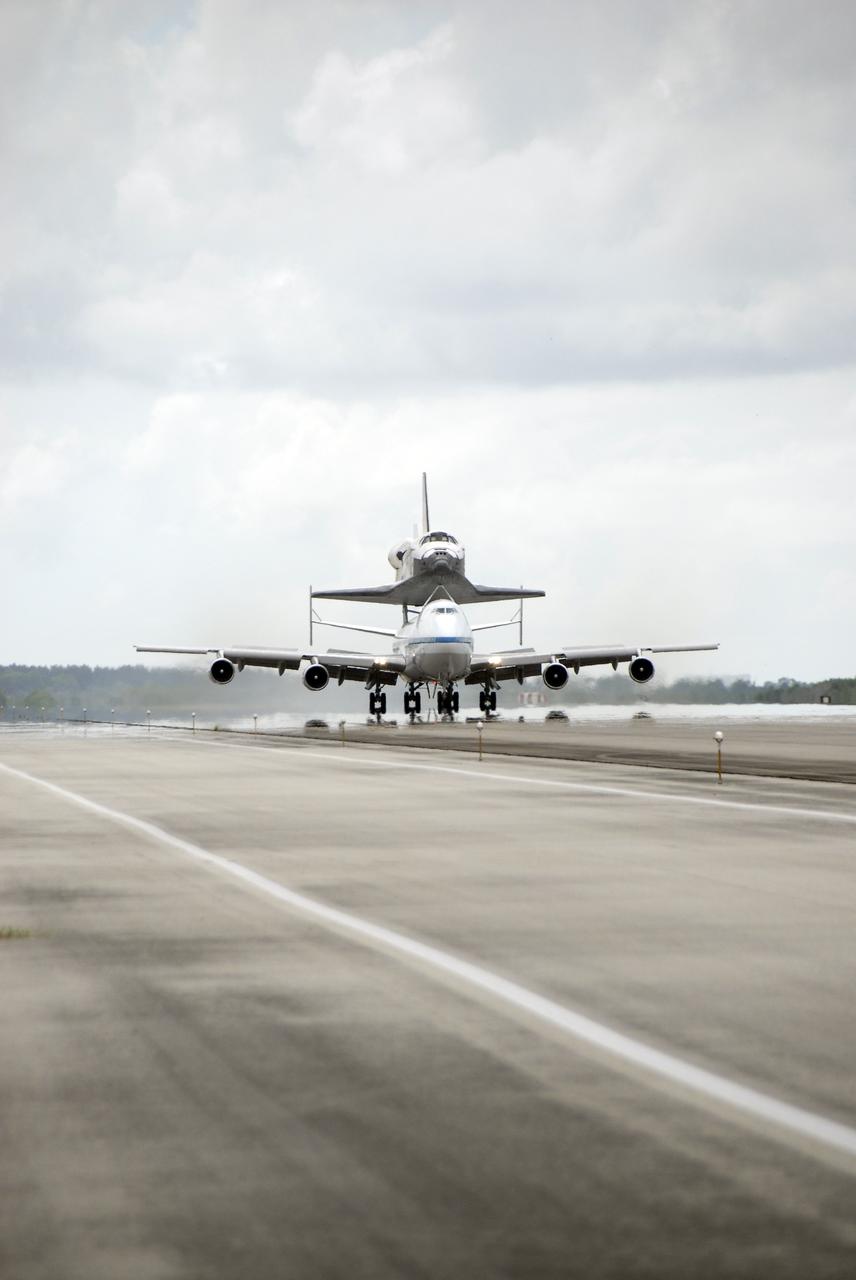
CAPE CANAVERAL, Fla. – The Boeing 747 Shuttle Carrier Aircraft, or SCA, with space shuttle Discovery on top, touches down on the Shuttle Landing Facility's runway 33 at NASA's Kennedy Space Center in Florida at 12:05 p.m. EDT. The two-day return flight from Edwards Air Force Base in California began at 9:20 a.m. EDT Sept. 20. After three fueling stops that included an overnight stay in Louisiana, the piggybacked shuttle had to navigate through a line of showers across Louisiana and around Kennedy. Discovery had landed at Edwards Sept. 11 after the 13-day STS-128 mission to the International Space Station. The shuttle delivered more than 7 tons of supplies, science racks and equipment, as well as additional environmental hardware to sustain six crew members on the station. Landings at Kennedy were waved off on two days due to inclement weather, leading to the landing at Edwards. Photo credit: NASA/Kim Shiflett
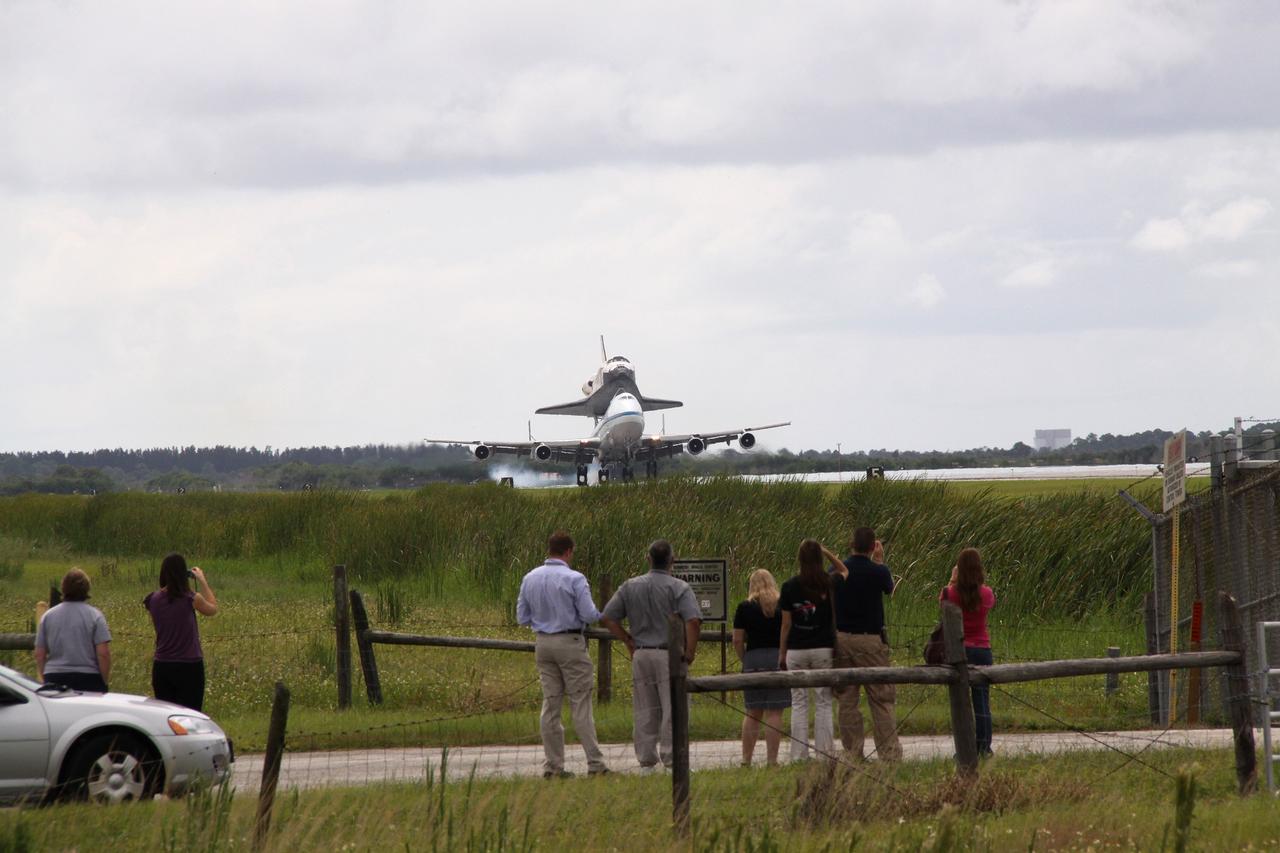
CAPE CANAVERAL, Fla. – The Boeing 747 Shuttle Carrier Aircraft, or SCA, with space shuttle Discovery on top, touches down on runway 33 at NASA's Kennedy Space Center in Florida at 12:05 p.m. EDT. The two-day return flight from Edwards Air Force Base in California began at 9:20 a.m. EDT Sept. 20. After three fueling stops that included an overnight stay in Louisiana, the piggybacked shuttle had to navigate through a line of showers across Louisiana and around Kennedy. Discovery had landed at Edwards Sept. 11 after the 13-day STS-128 mission to the International Space Station. The shuttle delivered more than 7 tons of supplies, science racks and equipment, as well as additional environmental hardware to sustain six crew members on the station. Landings at Kennedy were waved off on two days due to inclement weather, leading to the landing at Edwards. Photo credit: NASA/Jack Pfaller
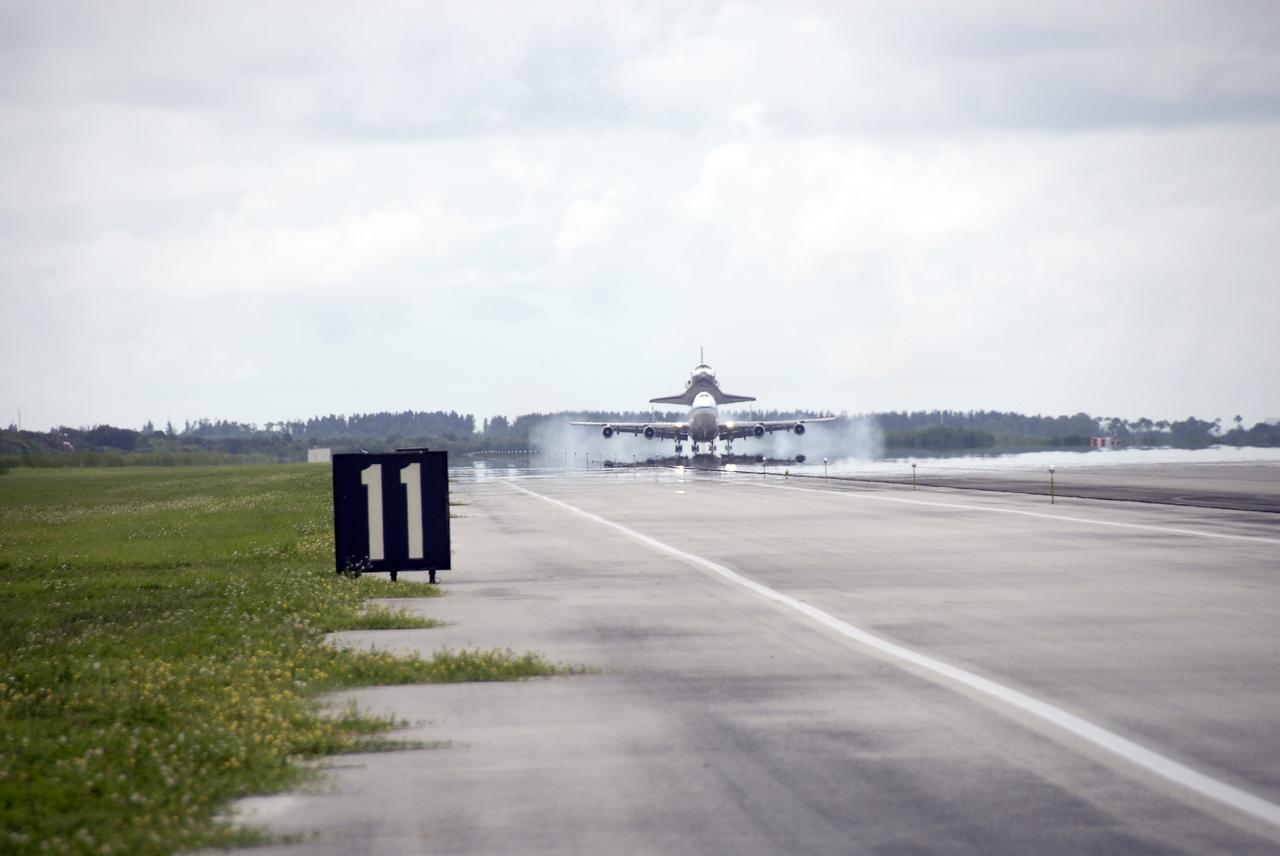
CAPE CANAVERAL, Fla. – The Boeing 747 Shuttle Carrier Aircraft, or SCA, with space shuttle Discovery on top, touches down on the Shuttle Landing Facility's runway 33 at NASA's Kennedy Space Center in Florida at 12:05 p.m. EDT. The two-day return flight from Edwards Air Force Base in California began at 9:20 a.m. EDT Sept. 20. After three fueling stops that included an overnight stay in Louisiana, the piggybacked shuttle had to navigate through a line of showers across Louisiana and around Kennedy. Discovery had landed at Edwards Sept. 11 after the 13-day STS-128 mission to the International Space Station. The shuttle delivered more than 7 tons of supplies, science racks and equipment, as well as additional environmental hardware to sustain six crew members on the station. Landings at Kennedy were waved off on two days due to inclement weather, leading to the landing at Edwards. Photo credit: NASA/Kim Shiflett
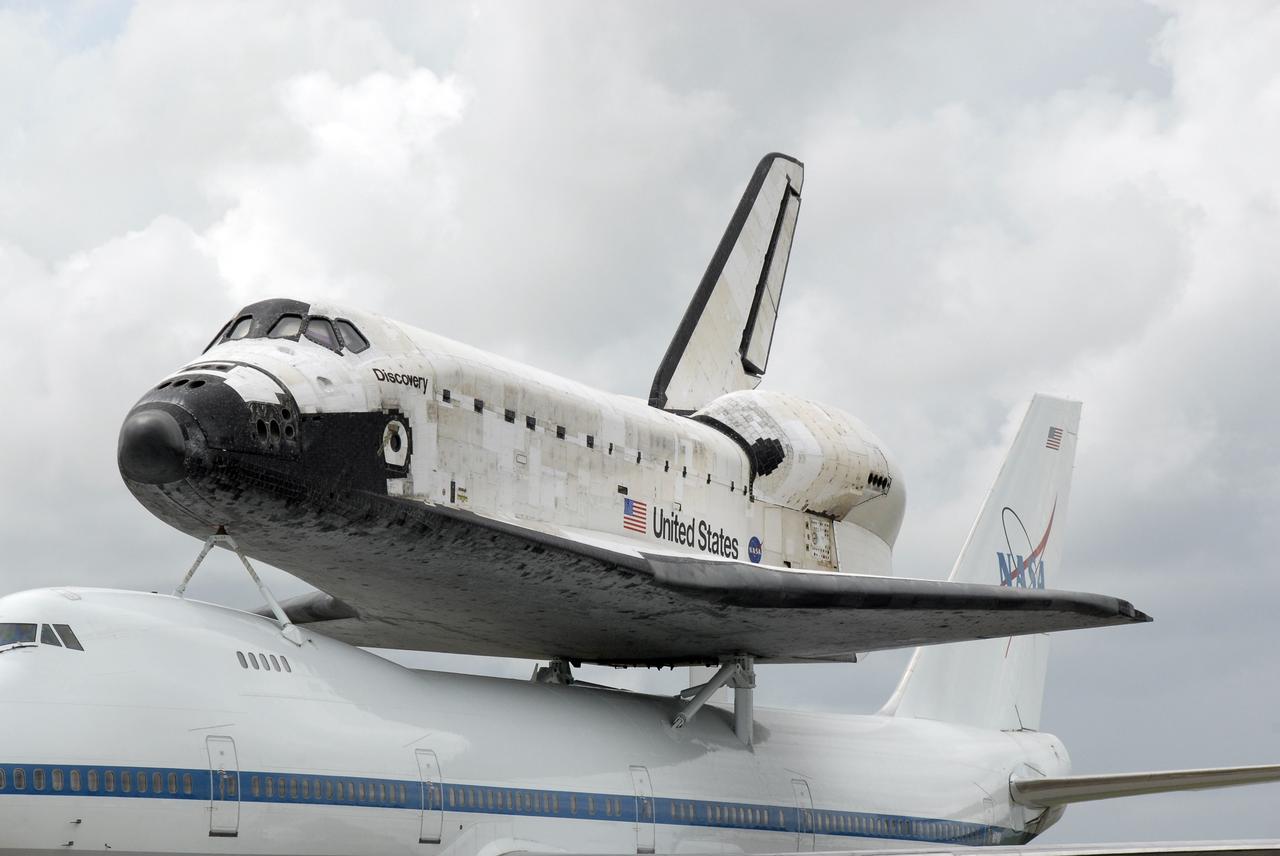
CAPE CANAVERAL, Fla. – At NASA's Kennedy Space Center in Florida, space shuttle Discovery is attached to the Boeing 747 Shuttle Carrier Aircraft that ferried it from Edwards Air Force Base in California. The piggybacked shuttle and aircraft landed on the Shuttle Landing Facility's runway 33 at 12:05 p.m. EDT. The two-day return flight from Edwards Air Force Base in California began at 9:20 a.m. EDT Sept. 20. After three fueling stops that included an overnight stay in Louisiana, the piggybacked shuttle had to navigate through a line of showers across Louisiana and around Kennedy. Discovery had landed at Edwards Sept. 11 after the 13-day STS-128 mission to the International Space Station. The shuttle delivered more than 7 tons of supplies, science racks and equipment, as well as additional environmental hardware to sustain six crew members on the station. Landings at Kennedy were waved off on two days due to inclement weather, leading to the landing at Edwards. Photo credit: NASA/Kim Shiflett
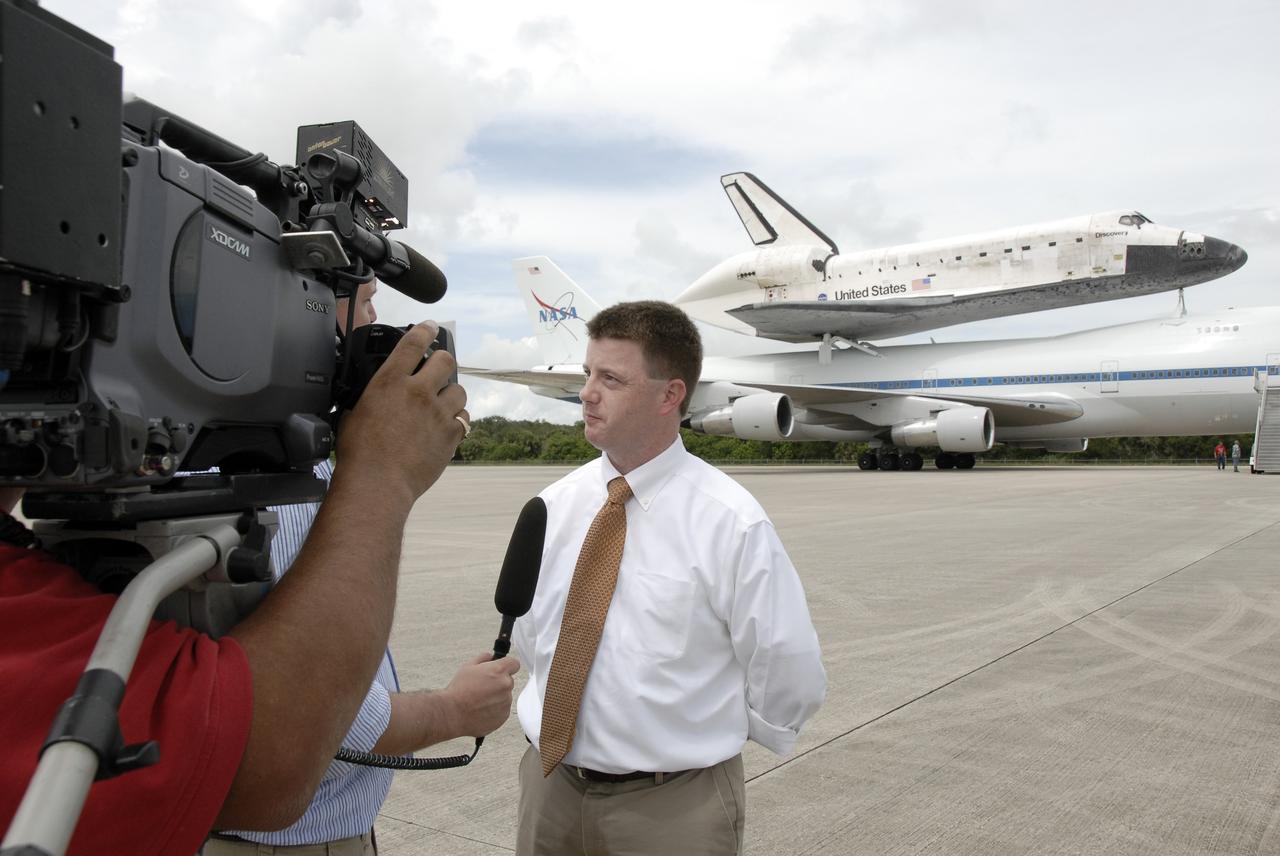
CAPE CANAVERAL, Fla. – A reporter and videographer interview Mission Management Team Chair Mike Moses after the landing of space shuttle Discovery atop the Boeing 747 Shuttle Carrier Aircraft, in the background. The piggybacked shuttle and aircraft landed on the Shuttle Landing Facility's runway 33 at 12:05 p.m. EDT. The two-day return flight from Edwards Air Force Base in California began at 9:20 a.m. EDT Sept. 20. After three fueling stops that included an overnight stay in Louisiana, the piggybacked shuttle had to navigate through a line of showers across Louisiana and around Kennedy. Discovery had landed at Edwards Sept. 11 after the 13-day STS-128 mission to the International Space Station. The shuttle delivered more than 7 tons of supplies, science racks and equipment, as well as additional environmental hardware to sustain six crew members on the station. Landings at Kennedy were waved off on two days due to inclement weather, leading to the landing at Edwards. Photo credit: NASA/Kim Shiflett
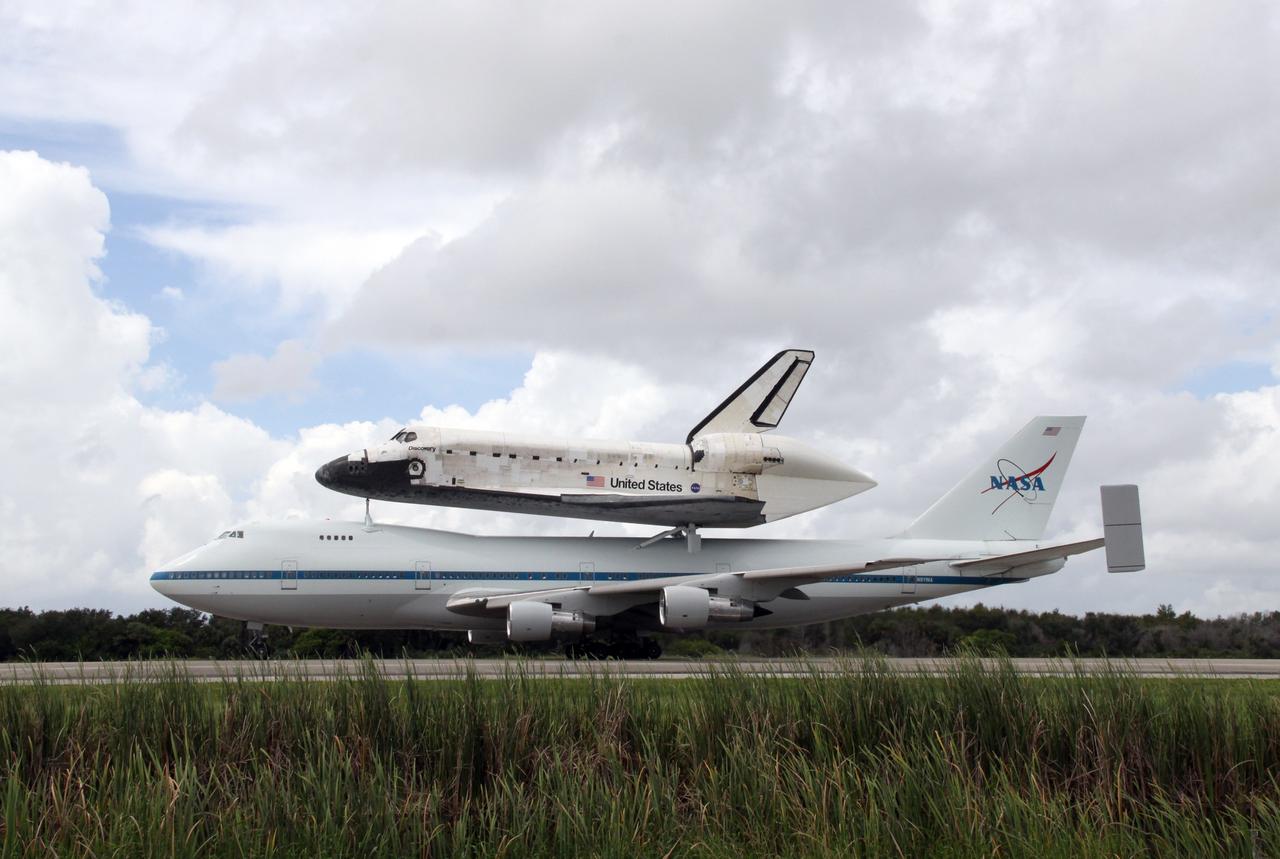
CAPE CANAVERAL, Fla. – The Boeing 747 Shuttle Carrier Aircraft, or SCA, with space shuttle Discovery on top, rolls on runway 33 at NASA's Kennedy Space Center in Florida after touchdown at 12:05 p.m. EDT. The two-day return flight from Edwards Air Force Base in California began at 9:20 a.m. EDT Sept. 20. After three fueling stops that included an overnight stay in Louisiana, the piggybacked shuttle had to navigate through a line of showers across Louisiana and around Kennedy. Discovery had landed at Edwards Sept. 11 after the 13-day STS-128 mission to the International Space Station. The shuttle delivered more than 7 tons of supplies, science racks and equipment, as well as additional environmental hardware to sustain six crew members on the station. Landings at Kennedy were waved off on two days due to inclement weather, leading to the landing at Edwards. Photo credit: NASA/Jack Pfaller
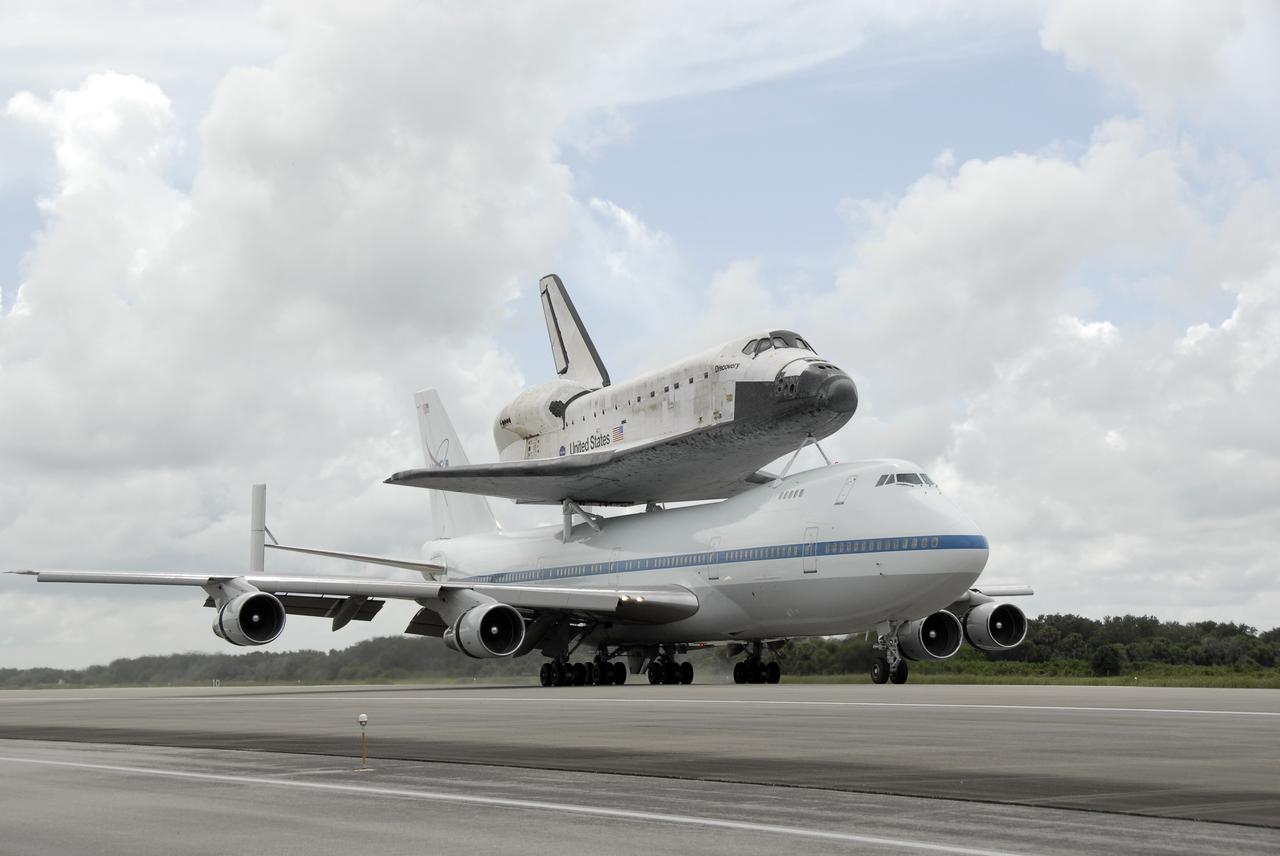
CAPE CANAVERAL, Fla. – The Boeing 747 Shuttle Carrier Aircraft, or SCA, with space shuttle Discovery on top, rolls down the Shuttle Landing Facility's runway 33 at NASA's Kennedy Space Center in Florida after touching down at 12:05 p.m. EDT. The two-day return flight from Edwards Air Force Base in California began at 9:20 a.m. EDT Sept. 20. After three fueling stops that included an overnight stay in Louisiana, the piggybacked shuttle had to navigate through a line of showers across Louisiana and around Kennedy. Discovery had landed at Edwards Sept. 11 after the 13-day STS-128 mission to the International Space Station. The shuttle delivered more than 7 tons of supplies, science racks and equipment, as well as additional environmental hardware to sustain six crew members on the station. Landings at Kennedy were waved off on two days due to inclement weather, leading to the landing at Edwards. Photo credit: NASA/Kim Shiflett
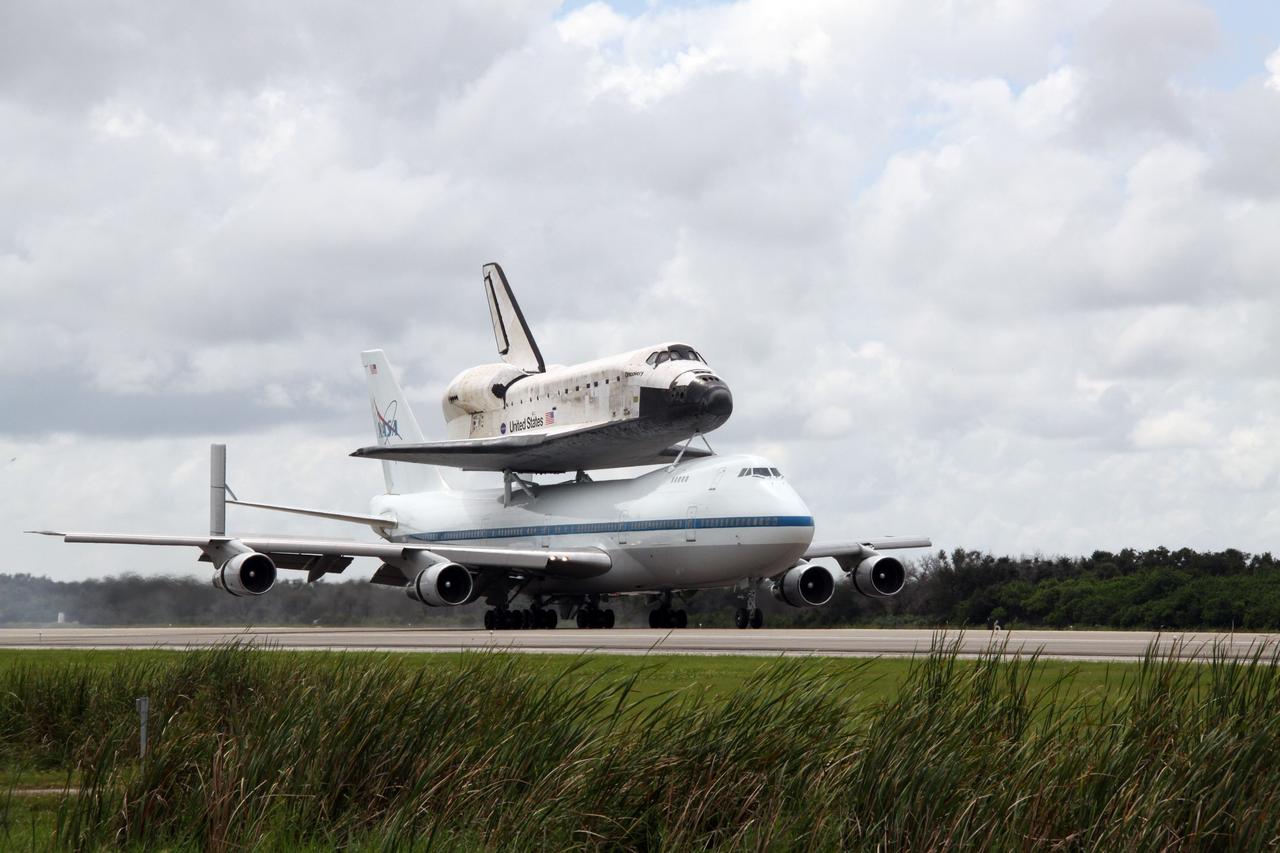
CAPE CANAVERAL, Fla. – The Boeing 747 Shuttle Carrier Aircraft, or SCA, with space shuttle Discovery on top, touches down on runway 33 at NASA's Kennedy Space Center in Florida at 12:05 p.m. EDT. The two-day return flight from Edwards Air Force Base in California began at 9:20 a.m. EDT Sept. 20. After three fueling stops that included an overnight stay in Louisiana, the piggybacked shuttle had to navigate through a line of showers across Louisiana and around Kennedy. Discovery had landed at Edwards Sept. 11 after the 13-day STS-128 mission to the International Space Station. The shuttle delivered more than 7 tons of supplies, science racks and equipment, as well as additional environmental hardware to sustain six crew members on the station. Landings at Kennedy were waved off on two days due to inclement weather, leading to the landing at Edwards. Photo credit: NASA/Jack Pfaller
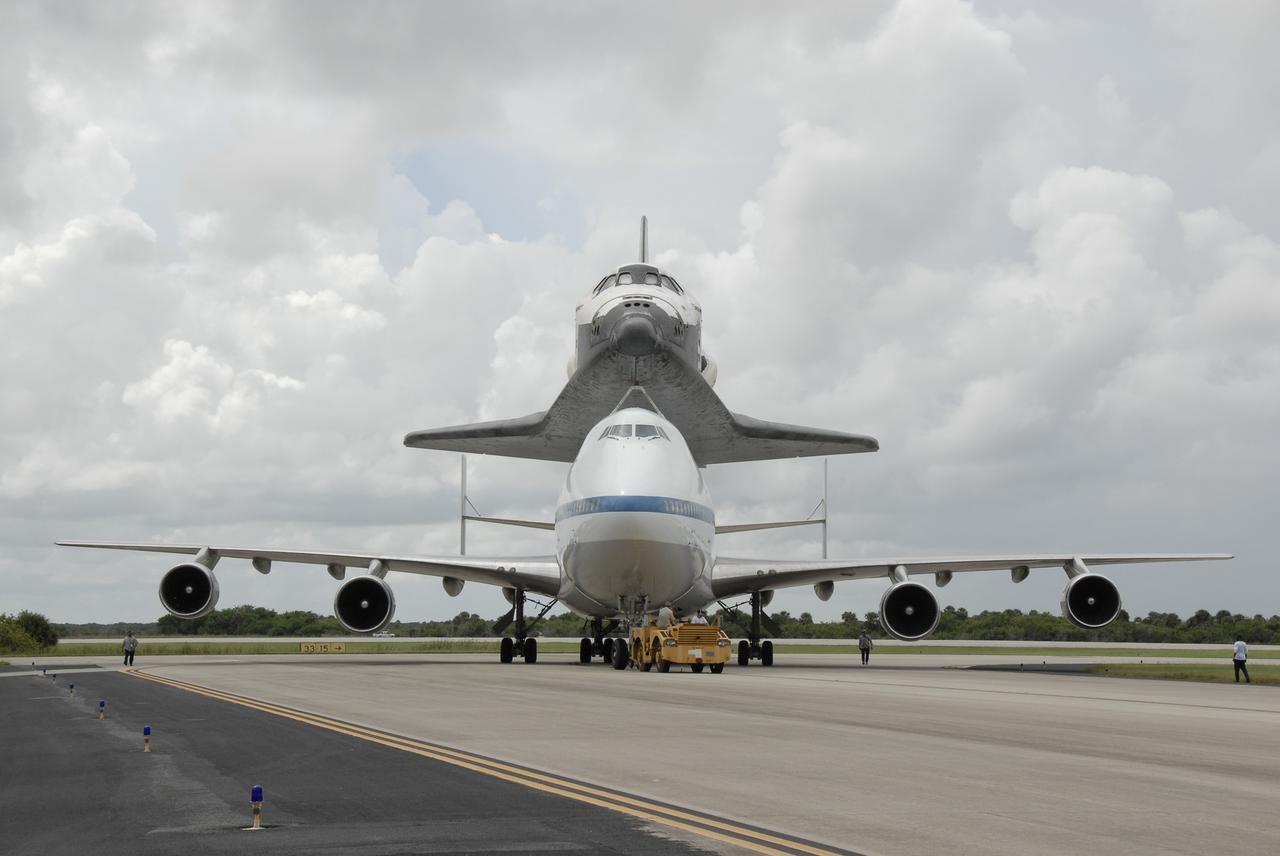
CAPE CANAVERAL, Fla. – The Boeing 747 Shuttle Carrier Aircraft, or SCA, with space shuttle Discovery on top, is towed from the Shuttle Landing Facility's runway 33 at NASA's Kennedy Space Center in Florida after touching down at 12:05 p.m. EDT. The two-day return flight from Edwards Air Force Base in California began at 9:20 a.m. EDT Sept. 20. After three fueling stops that included an overnight stay in Louisiana, the piggybacked shuttle had to navigate through a line of showers across Louisiana and around Kennedy. Discovery had landed at Edwards Sept. 11 after the 13-day STS-128 mission to the International Space Station. The shuttle delivered more than 7 tons of supplies, science racks and equipment, as well as additional environmental hardware to sustain six crew members on the station. Landings at Kennedy were waved off on two days due to inclement weather, leading to the landing at Edwards. Photo credit: NASA/Kim Shiflett
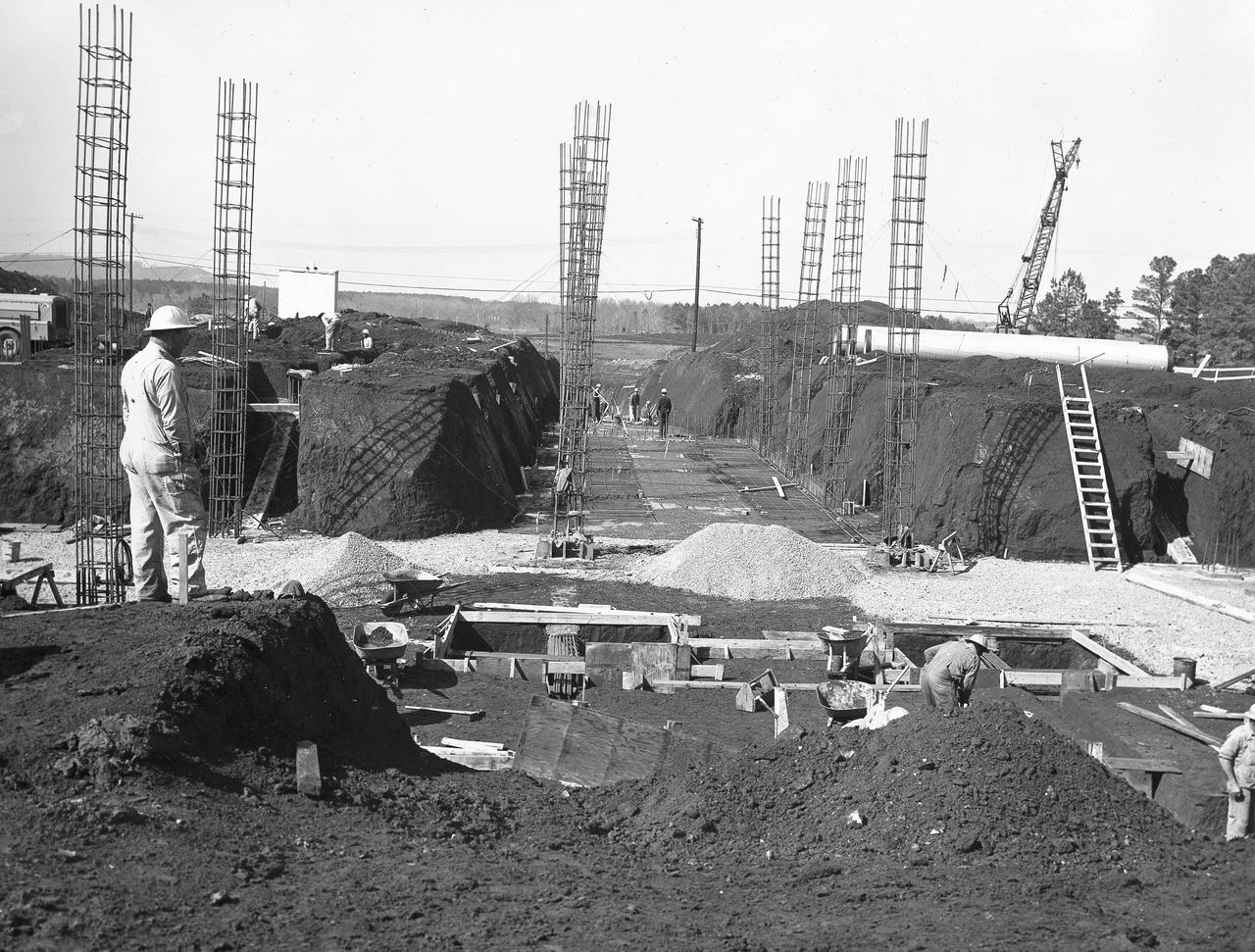
At its founding, the Marshall Space Flight Center (MSFC) inherited the Army’s Jupiter and Redstone test stands, but much larger facilities were needed for the giant stages of the Saturn V. From 1960 to 1964, the existing stands were remodeled and a sizable new test area was developed. The new comprehensive test complex for propulsion and structural dynamics was unique within the nation and the free world, and they remain so today because they were constructed with foresight to meet the future as well as on going needs. Construction of the S-IC Static test stand complex began in 1961 in the west test area of MSFC, and was completed in 1964. The S-IC static test stand was designed to develop and test the 138-ft long and 33-ft diameter Saturn V S-IC first stage, or booster stage, weighing in at 280,000 pounds. Required to hold down the brute force of a 7,500,000-pound thrust produced by 5 F-1 engines, the S-IC static test stand was designed and constructed with the strength of hundreds of tons of steel and 12,000,000 pounds of cement, planted down to bedrock 40 feet below ground level. The foundation walls, constructed with concrete and steel, are 4 feet thick. The base structure consists of four towers with 40-foot-thick walls extending upward 144 feet above ground level. The structure was topped by a crane with a 135-foot boom. With the boom in the upright position, the stand was given an overall height of 405 feet, placing it among the highest structures in Alabama at the time. In addition to the stand itself, related facilities were constructed during this time. Built directly east of the test stand was the Block House, which served as the control center for the test stand. The two were connected by a narrow tunnel which housed the cables for the controls. Again to the east, just south of the Block House, was a newly constructed Pump House. Its function was to provide water to the stand to prevent melting damage during testing. The water was sprayed through small holes in the stand’s 1900 ton water deflector at the rate of 320,000 gallons per minute. In this photo, taken March 20, 1962, construction of the Pump House area is well underway.
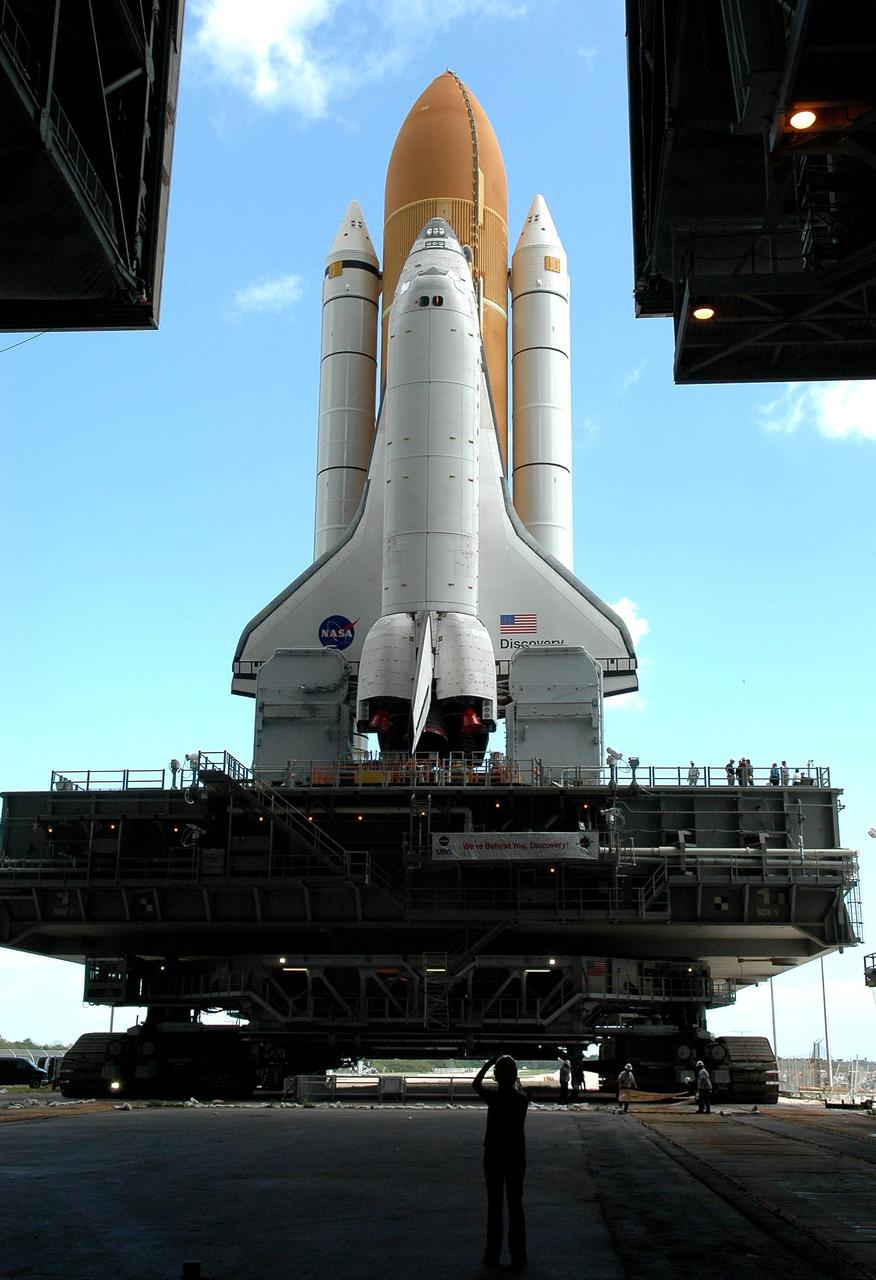
KENNEDY SPACE CENTER, FLA. - Framed in the open doors of the Vehicle Assembly Building (VAB) at NASA’s Kennedy Space Center, Space Shuttle Discovery is bathed in light as it begins its long, slow journey to Launch Pad 39B. The Space Shuttle rests on the Mobile Launcher Platform, which is moved by the Crawler-Transporter underneath. The Crawler is 20 feet high, 131 feet long and 114 feet wide. It moves on eight tracks, each containing 57 shoes, or cleats, weighing one ton each. Loaded with the Space Shuttle, the Crawler can move at a maximum speed of approximately 1 mile an hour. A leveling system in the Crawler keeps the Shuttle vertical while negotiating the 5 percent grade leading to the top of the launch pad. Launch of Discovery on its Return to Flight mission, STS-114, is targeted for May 15 with a launch window that extends to June 3. During its 12-day mission, Discovery’s seven-person crew will test new hardware and techniques to improve Shuttle safety, as well as deliver supplies to the International Space Station. Discovery was moved on March 29 from the Orbiter Processing Facility to the VAB and attached to its propulsion elements, a redesigned ET and twin SRBs.
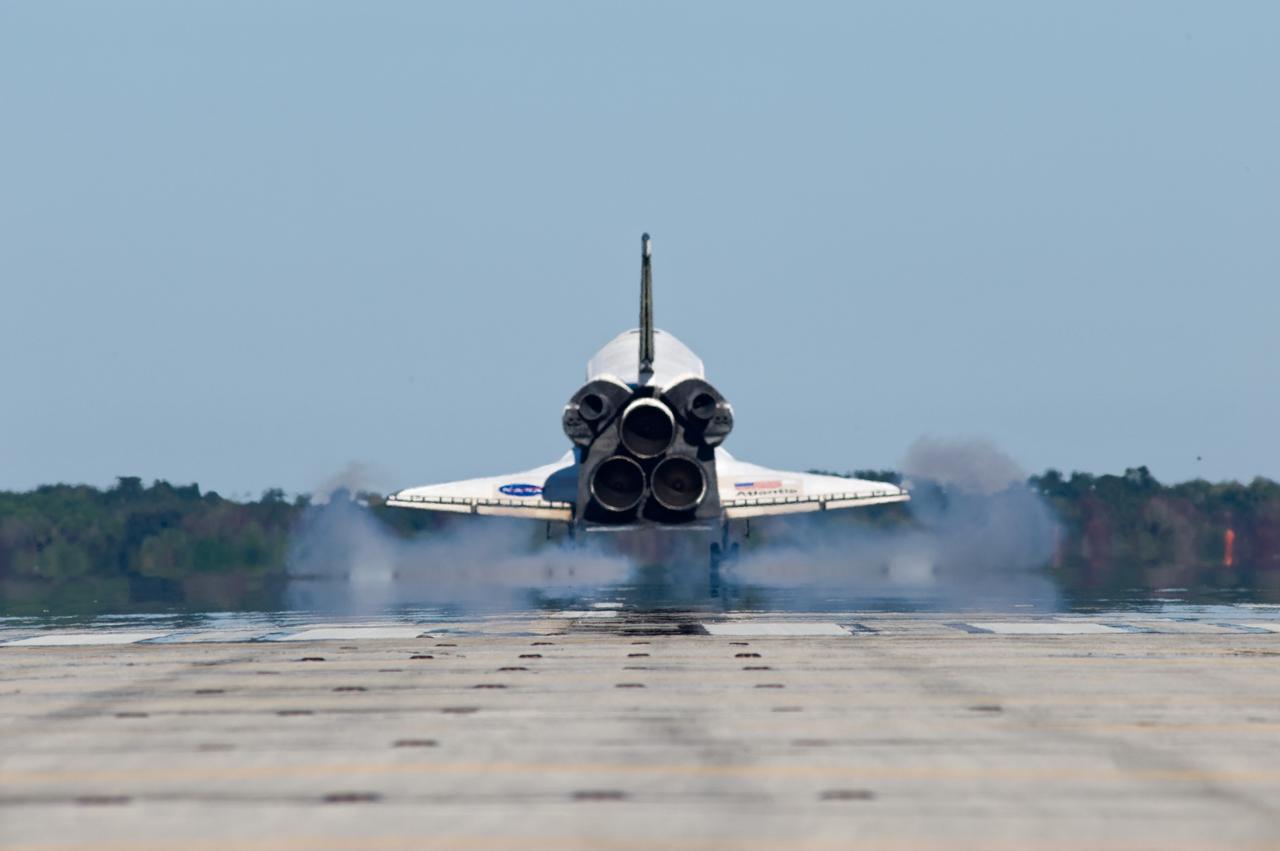
CAPE CANAVERAL, Fla. - Touchdown is apparent by the cloud of dust kicked up by space shuttle Atlantis as its main landing gear tires contact Runway 33 at the Shuttle Landing Facility at NASA's Kennedy Space Center in Florida. After 11 days in space, Atlantis' 4.5-million-mile STS-129 mission is completed on orbit 171. Main gear touchdown was at 9:44:23 a.m. EST. Nose gear touchdown was at 9:44:36 a.m., and wheels stop was at 9:45:05 a.m. Aboard Atlantis are Commander Charles O. Hobaugh; Pilot Barry E. Wilmore; Mission Specialists Leland Melvin, Randy Bresnik, Mike Foreman and Robert L. Satcher Jr.; and Expedition 20 and 21 Flight Engineer Nicole Stott who spent 87 days aboard the International Space Station. STS-129 is the final space shuttle Expedition crew rotation flight on the manifest. On STS-129, the crew delivered 14 tons of cargo to the orbiting laboratory, including two ExPRESS Logistics Carriers containing spare parts to sustain station operations after the shuttles are retired next year. For information on the STS-129 mission and crew, visit http://www.nasa.gov/mission_pages/shuttle/shuttlemissions/sts129/index.html. Photo credit: NASA/Kevin O'Connell and Rick Prickett
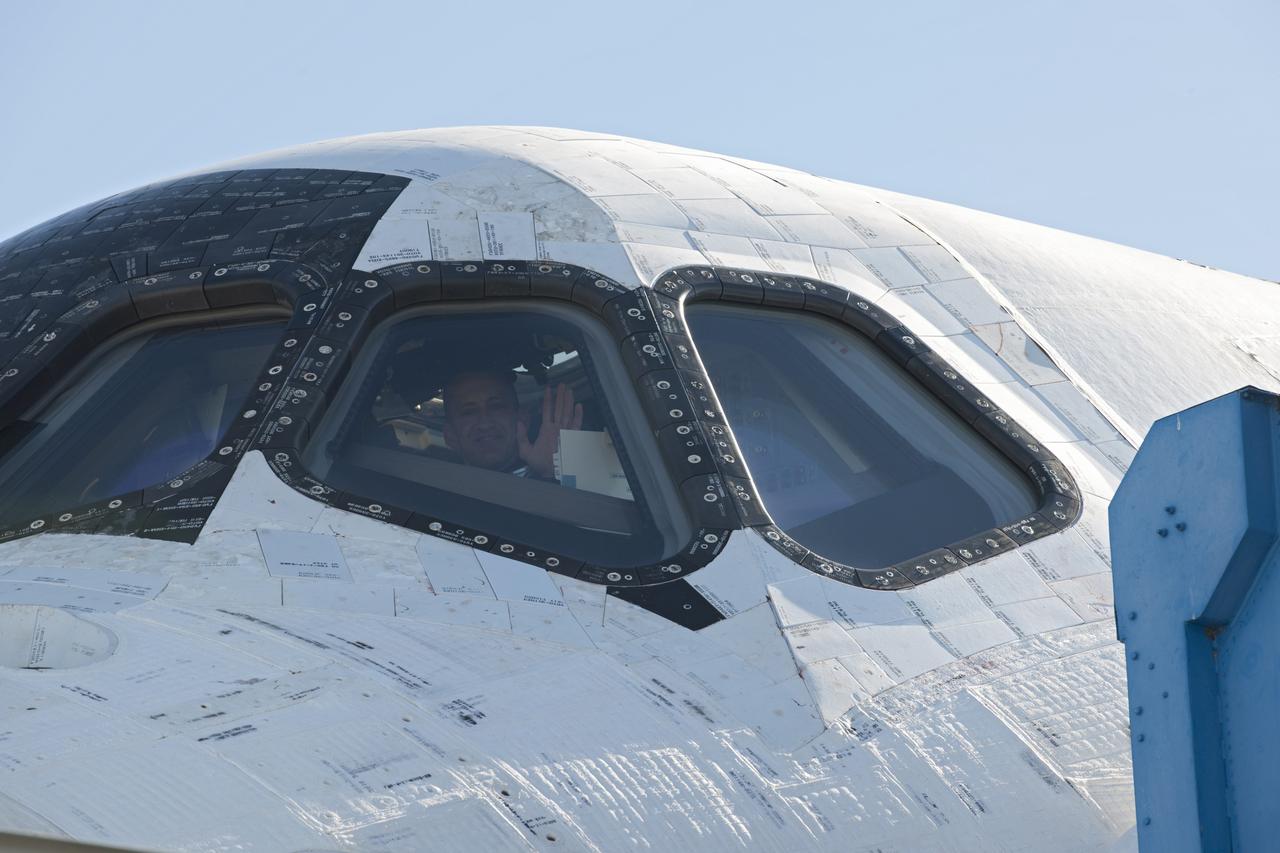
CAPE CANAVERAL, Fla. - STS-129 Commander Charles O. Hobaugh waves from the cockpit of space shuttle Atlantis following a picture-perfect landing at the Shuttle Landing Facility at NASA's Kennedy Space Center in Florida. After 11 days in space, Atlantis completed the 4.5-million mile STS-129 mission on orbit 171. Main gear touchdown was at 9:44:23 a.m. EST. Nose gear touchdown was at 9:44:36 a.m., and wheels stop was at 9:45:05 a.m. Other crew members aboard Atlantis are Pilot Barry E. Wilmore; Mission Specialists Leland Melvin, Randy Bresnik, Mike Foreman and Robert L. Satcher Jr.; and Expedition 20 and 21 Flight Engineer Nicole Stott who spent 87 days aboard the International Space Station. STS-129 is the final space shuttle Expedition crew rotation flight on the manifest. On STS-129, the crew delivered 14 tons of cargo to the orbiting laboratory, including two ExPRESS Logistics Carriers containing spare parts to sustain station operations after the shuttles are retired next year. For information on the STS-129 mission and crew, visit http://www.nasa.gov/mission_pages/shuttle/shuttlemissions/sts129/index.html. Photo credit: NASA/Jeff Wolfe