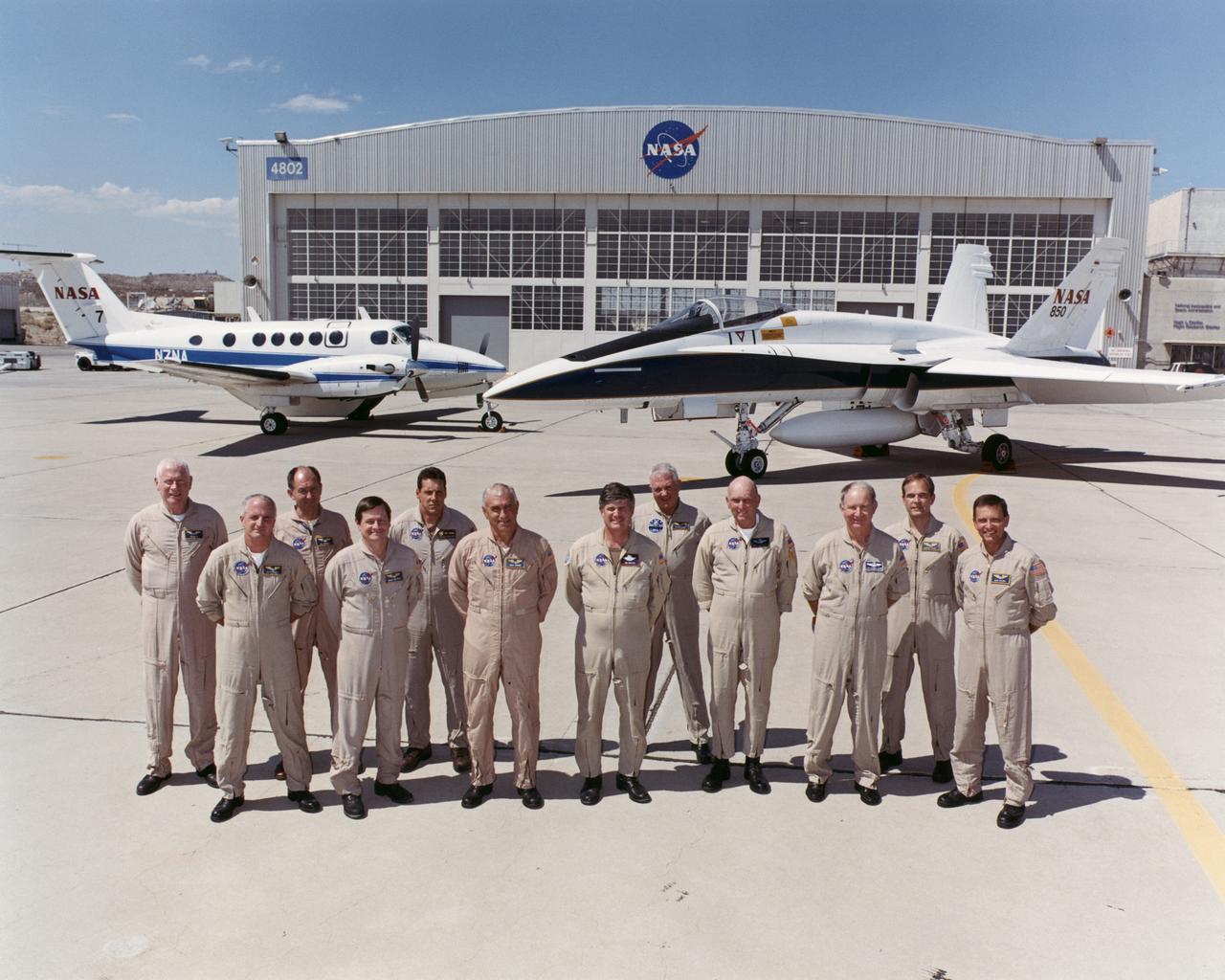
2004 NASA Dryden Research Pilots. Left to Right: Edwin W. Lewis, Jr., David A. Wright (Director of Flight Operations), William Frederick Brockett, Frank Batteas, Craig R. Bomben, Richard G. Ewers, James W. Smolka, Douglas H. Baker, C. Gordon Fullerton (Chief Pilot), James Barrilleaux, Martin J. Trout, and Mark Pestana. (not pictured: Dana Purifoy)
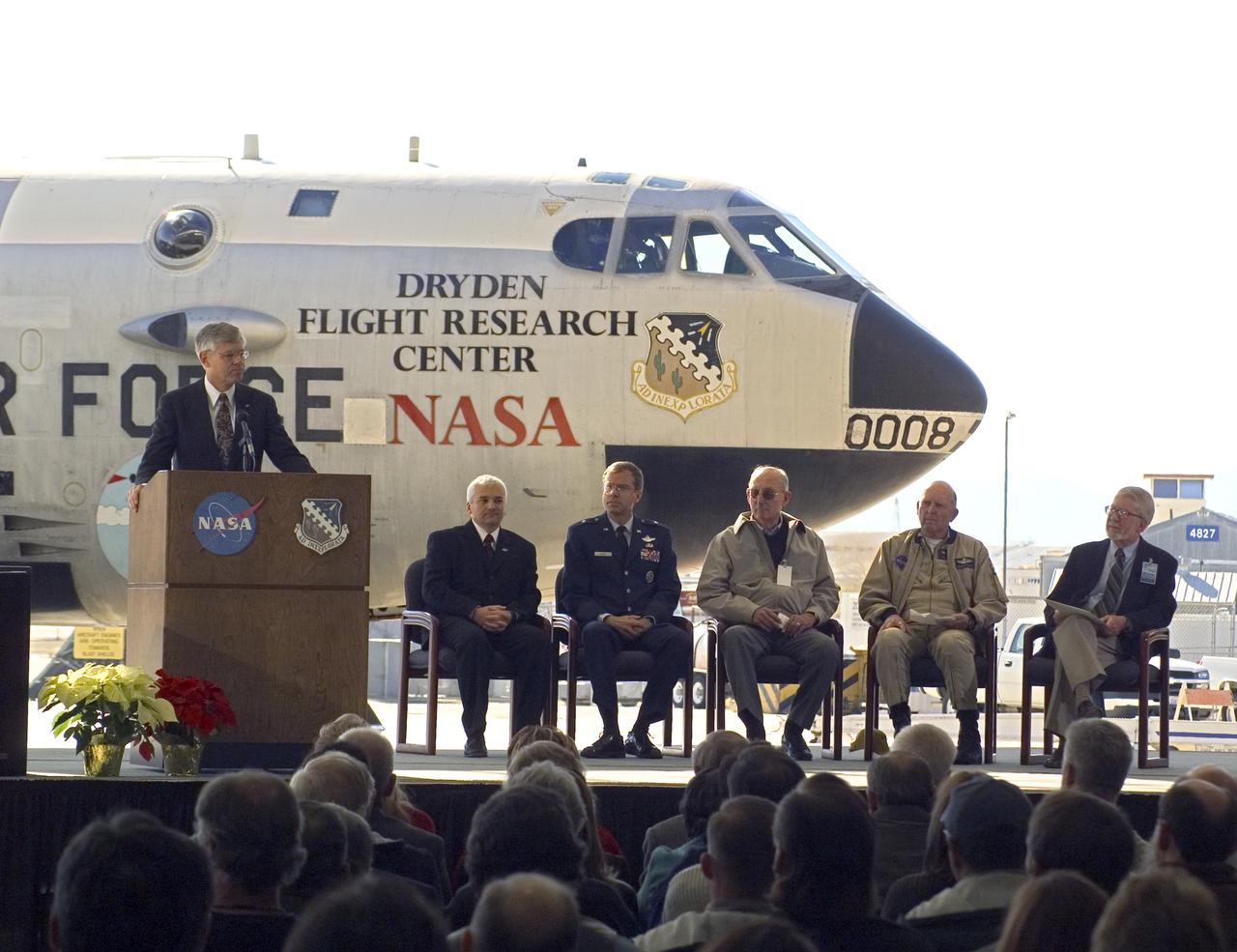
Retired NASA Dryden research pilot Ed Schneider served as master of ceremonies at the retirement ceremony for NASA's B-52B, on Dec. 17, 2004.
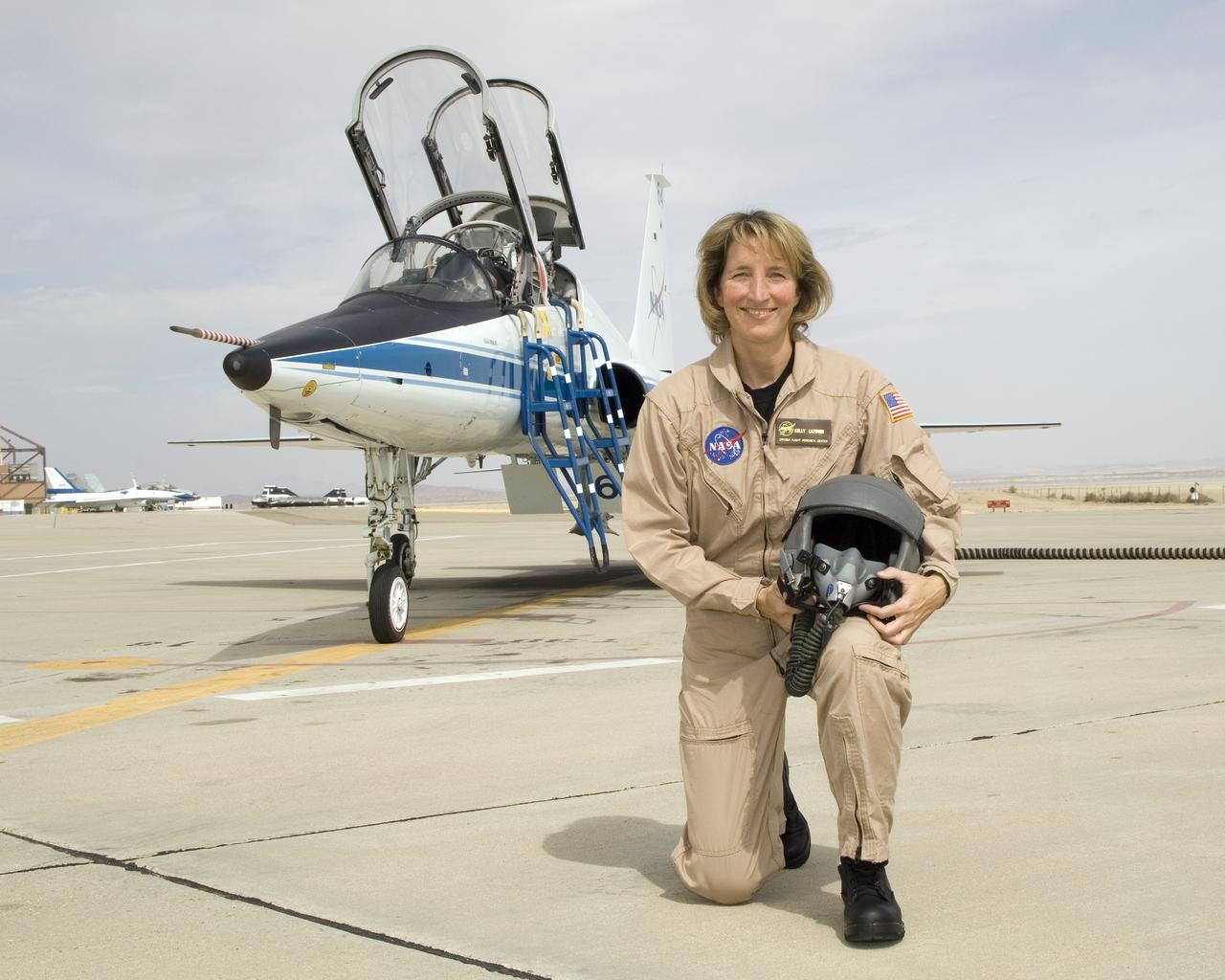
Kelly Latimer is a research pilot in the Flight Crew Branch of NASA's Dryden Flight Research Center, Edwards, Calif. Latimer joined NASA in March 2007 and will fly the T38, T-34, G-III, C-17 and the "Ikhana" Predator B. Latimer is Dryden's first female research test pilot. Prior to joining NASA, Latimer was on active duty with the U.S. Air Force. She has accumulated more than 5,000 hours of military and civilian flight experience in 30 aircraft. Latimer's first association with NASA was while attending graduate school at George Washington University, Washington, D.C. Her studies included work with the Joint Institute for the Advancement of Flight Sciences at NASA's Langley Research Center, Hampton, Va. She flew an Air Force C-17 during a 2005 NASA study to reduce aircraft noise. A team of California Polytechnic State University students and Northrop Grumman personnel were stationed on Rogers Dry Lake located at Edwards Air Force Base, Calif., to record the noise footprint of the aircraft as it made various landing approaches to Edwards' runway. Latimer completed undergraduate pilot training at Reese Air Force Base, Texas, in 1990. She remained at Reese as a T-38 instructor pilot until 1993. She was assigned as a C-141 aircraft commander at McCord Air Force Base, Tacoma, Wash., until 1996. Latimer graduated from the U.S. Air Force Test Pilot School at Edwards in Class 96B. She served as a C-17 and C-141 experimental test pilot at Edwards until 2000. She then became the chief of the Performance Branch and a T-38 instructor pilot at The Air Force Test Pilot School. She returned to McCord in 2002, where she was a C-17 aircraft commander and the operations officer for the 62nd Operations Support Squadron. In 2004, Latimer became the commander of Edwards' 418th Flight Test Squadron and director of the Global Reach Combined Test Force. Following that assignment, she deployed to Iraq as an advisor to the Iraqi Air Force. Her last active duty tour was as an instructor a
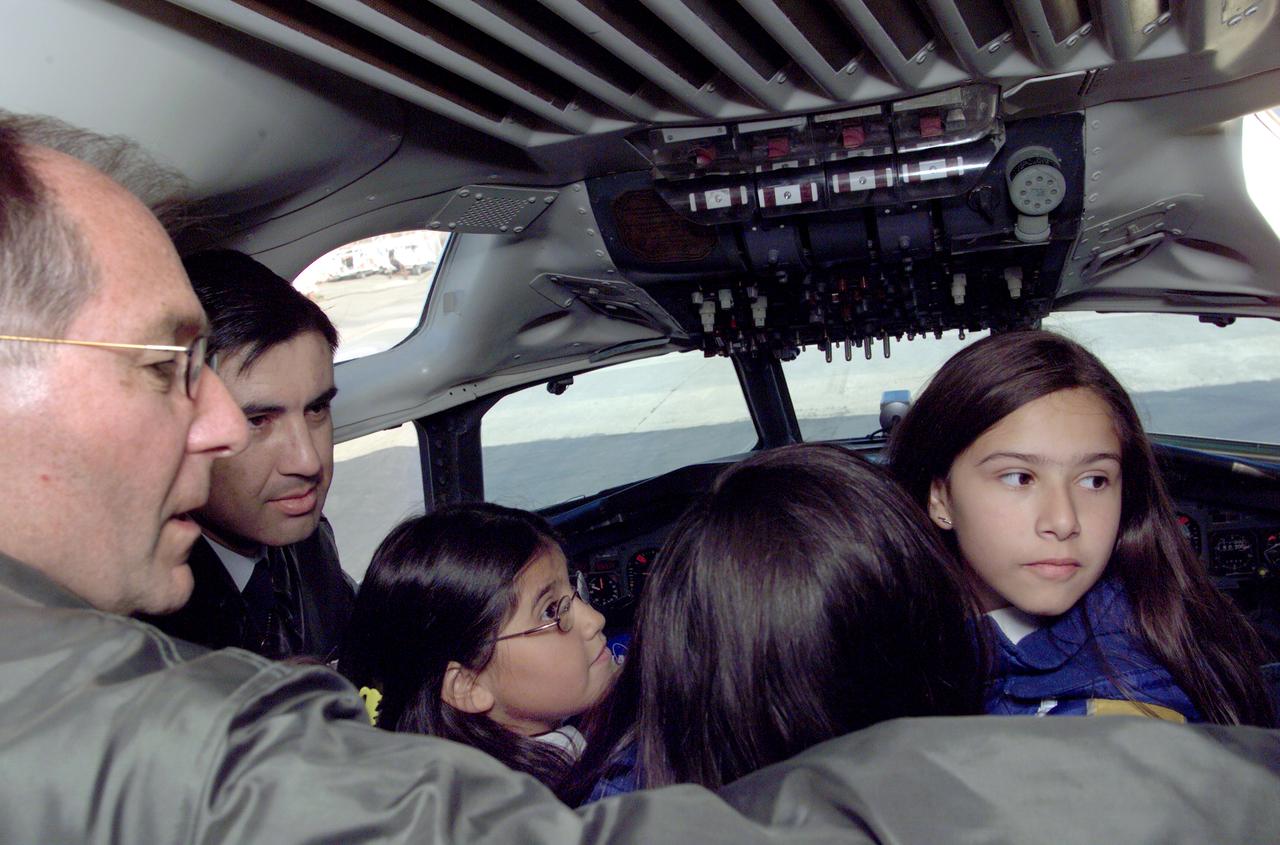
Pilot Bill Brockett (left) and Chilean Air Force Captain Saez with school children in the cockpit of NASA Dryden's DC-8 flying laboratory. Brockett explained NASA's AirSAR 2004 mission in Chile. AirSAR 2004 is a three-week expedition by an international team of scientists that uses an all-weather imaging tool, called the Airborne Synthetic Aperture Radar (AirSAR) which is located onboard NASA's DC-8 airborne laboratory. Scientists from many parts of the world including NASA's Jet Propulsion Laboratory are combining ground research done in several areas in Central and South America with NASA's AirSAR technology to improve and expand on the quality of research they are able to conduct. In South America and Antarctica, AirSAR collected imagery and data to help determine the contribution of Southern Hemisphere glaciers to sea level rise due to climate change. In Patagonia, researchers found this contribution had more than doubled from 1995 to 2000, compared to the previous 25 years. AirSAR data will make it possible to determine whether that trend is continuing or accelerating. AirSAR will also provide reliable information on ice shelf thickness to measure the contribution of the glaciers to sea level.
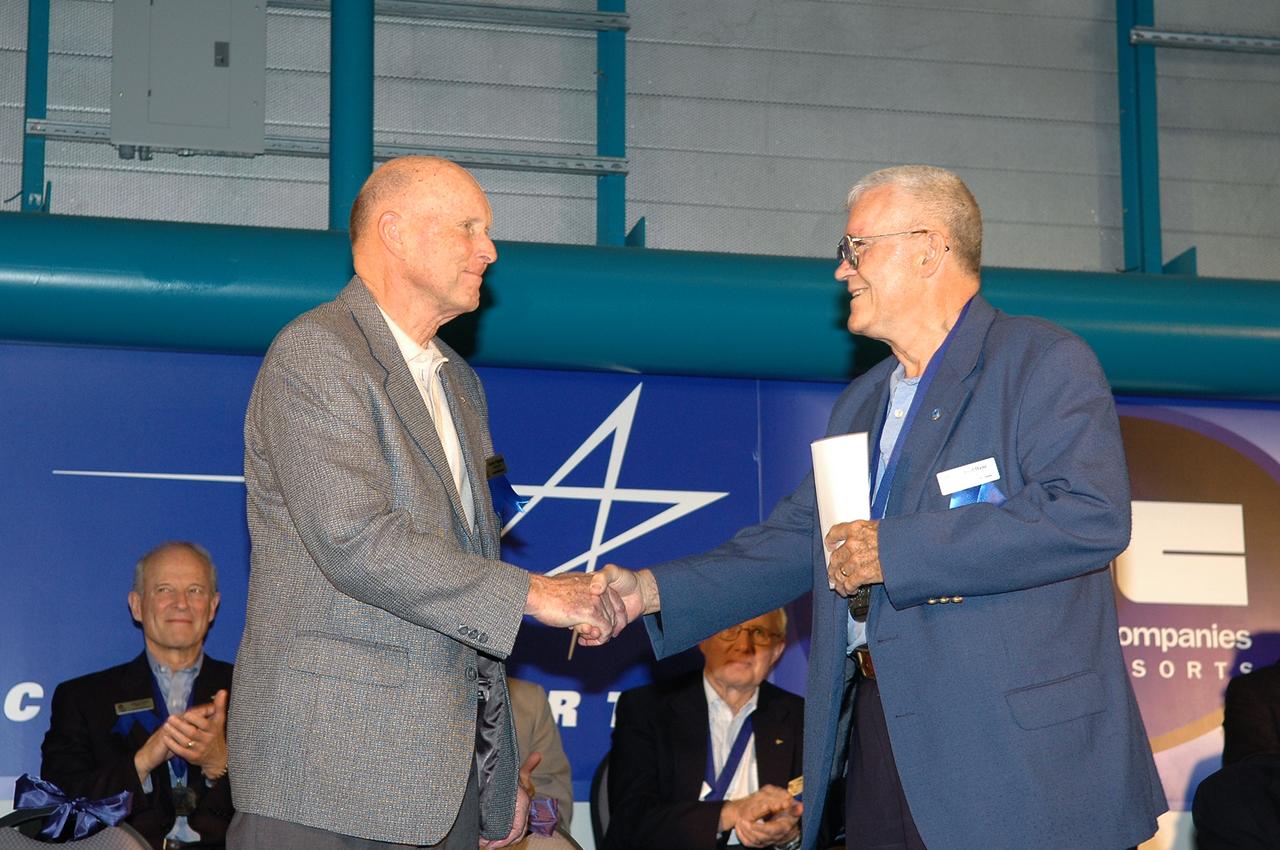
Former astronaut Gordon Fullerton (left), currently chief research pilot at NASA's Dryden Flight Research Center at Edwards Air Force Base, is congratulated by former astronaut Fred Haise (right) upon Fullerton's induction into the Astronaut Hall of Fame at the Kennedy Space Center (KSC) in Florida on April 30, 2005. Fullerton and Haise were one of two flight crews who flew the Approach and Landing Tests of the prototype Space Shuttle orbiter Enterprise at Dryden in 1977. Fullerton, who had served on the support crews for four Apollo moon landing missions in the early 1970s, went on to fly two Shuttle missions, STS-3 in 1982 and STS-51F in 1985. STS-3 became the only Shuttle mission to date to land at White Sands, N.M., and STS-51F was completed successfully despite the failure of one of the Shuttle's main engines during ascent to orbit. Haise, a member of the crew on the ill-fated Apollo 13 mission, was also a research pilot at NASA Dryden during his pre-astronaut career. Former astronauts Joseph Allen and Bruce McCandless were also inducted during the 2005 ceremonies at the KSC Visitor Center. In addition to honoring former members of NASA's astronaut corps who have made significant contributions to the advancement of space flight, the annual induction ceremonies serve as a fund-raiser for the Astronaut Scholarship Foundation. The foundation funded 17 $10,000 scholarships to college students studying science and engineering in 2004.
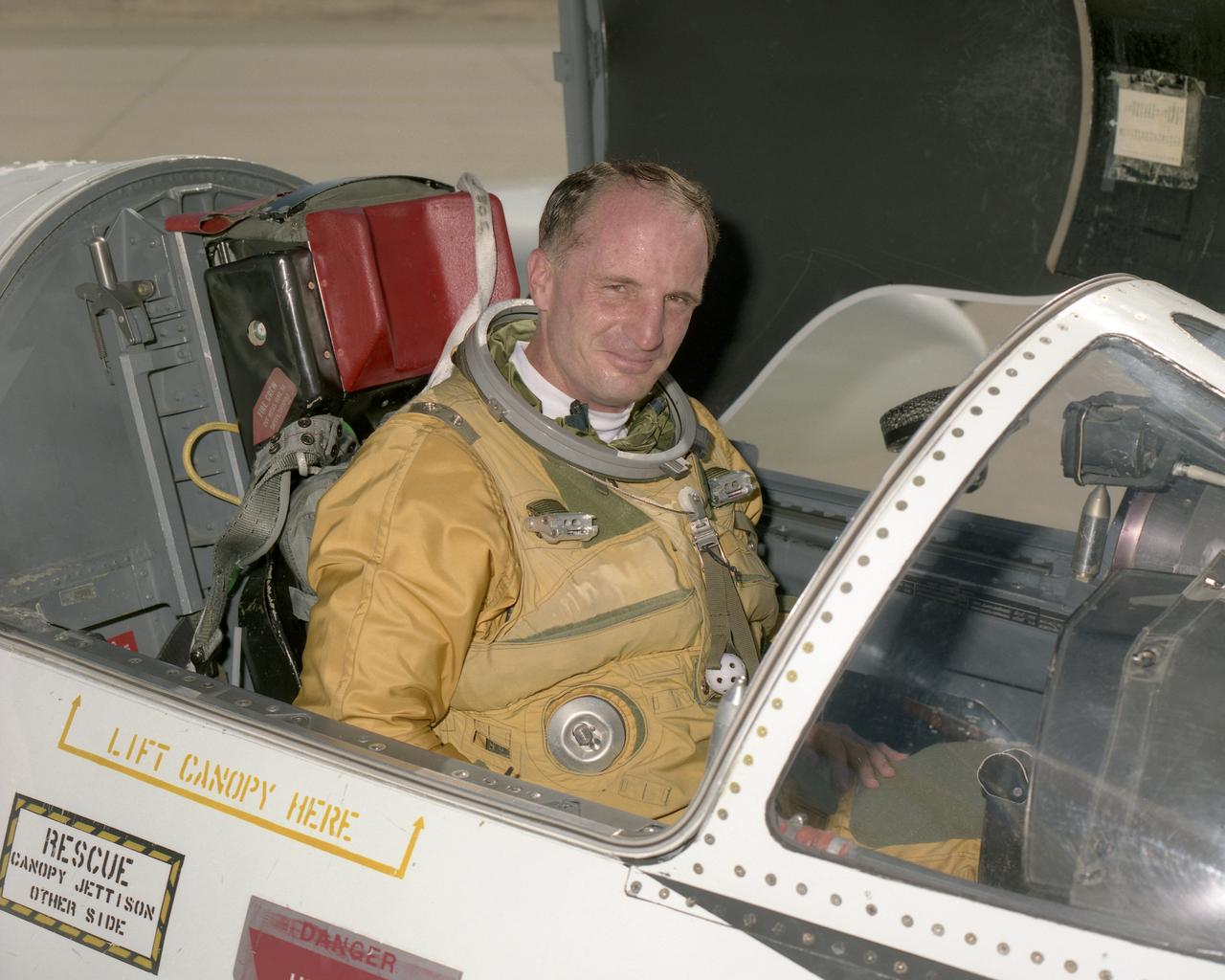
David A. Wright is associate director for Center Operations at the NASA Dryden Flight Research Center, Edwards, Calif. He was formerly director of Flight Operations. He is also a research pilot, flying NASA's ER-2 and T-38. The ER-2s are civilian variants of the military U-2S reconnaissance aircraft and carry scientific instruments to study the Earth during worldwide deployments. Wright has more than 4,500 hours in six different aircraft. He held the position of deputy director of the Airborne Science Program at Dryden from 2002 until 2004. Wright came to Dryden after retiring from the U.S. Air Force as a lieutenant colonel. His final assignment was to the Joint Staff J3, Directorate of Operations at the Pentagon from November 1996 until August 1999. Prior to the Pentagon assignment, he served as commander of the 1st Reconnaissance Squadron at Beale Air Force Base near Marysville, Calif., the unit responsible for training all U-2 pilots. He was the operations officer for one the largest U-2 operations in history, flying combat missions against Iraq and managing an unprecedented U-2 flying schedule during the 1991 Desert Storm conflict. He was selected for the Air Force U-2 program in 1987 following duty as an aircraft commander in the E-3A AWACS (Airborne Warning and Control System) aircraft. Wright was a T-38 instructor for three years at Reese Air Force Base, Lubbock, Texas, following completion of pilot training in 1978. He graduated from the U.S. Air Force Academy in 1977 with a Bachelor of Science in mathematics and computer science. Wright earned a Master of Arts in Adult Education from Troy State University, Montgomery, Ala., in 1987, and a Master of Science in National Security and Strategic Studies from the Naval War College, Newport, R.I., in 1995.